WARNING
HOT GLASS WILL
CAUSE BURNS.
DO NOT TOUCH GLASS
UNTIL COOLED.
NEVER ALLOW CHILDREN
TO TOUCH GLASS.
20302381 11/13 Rev. 9

2
20302381
Designer Series Direct Vent Gas Fireplace
High Elevations .......................................................5
Gas Pressures ........................................................5
Gas Specications & Orice Size ...........................5
STLDV Framing ......................................................8
CRLDV/CLLDV Framing .........................................9
PFDV Framing ......................................................10
Before You Start .................................................... 11
Items Required for Installation .............................. 11 .
Firebox Framing .................................................... 11
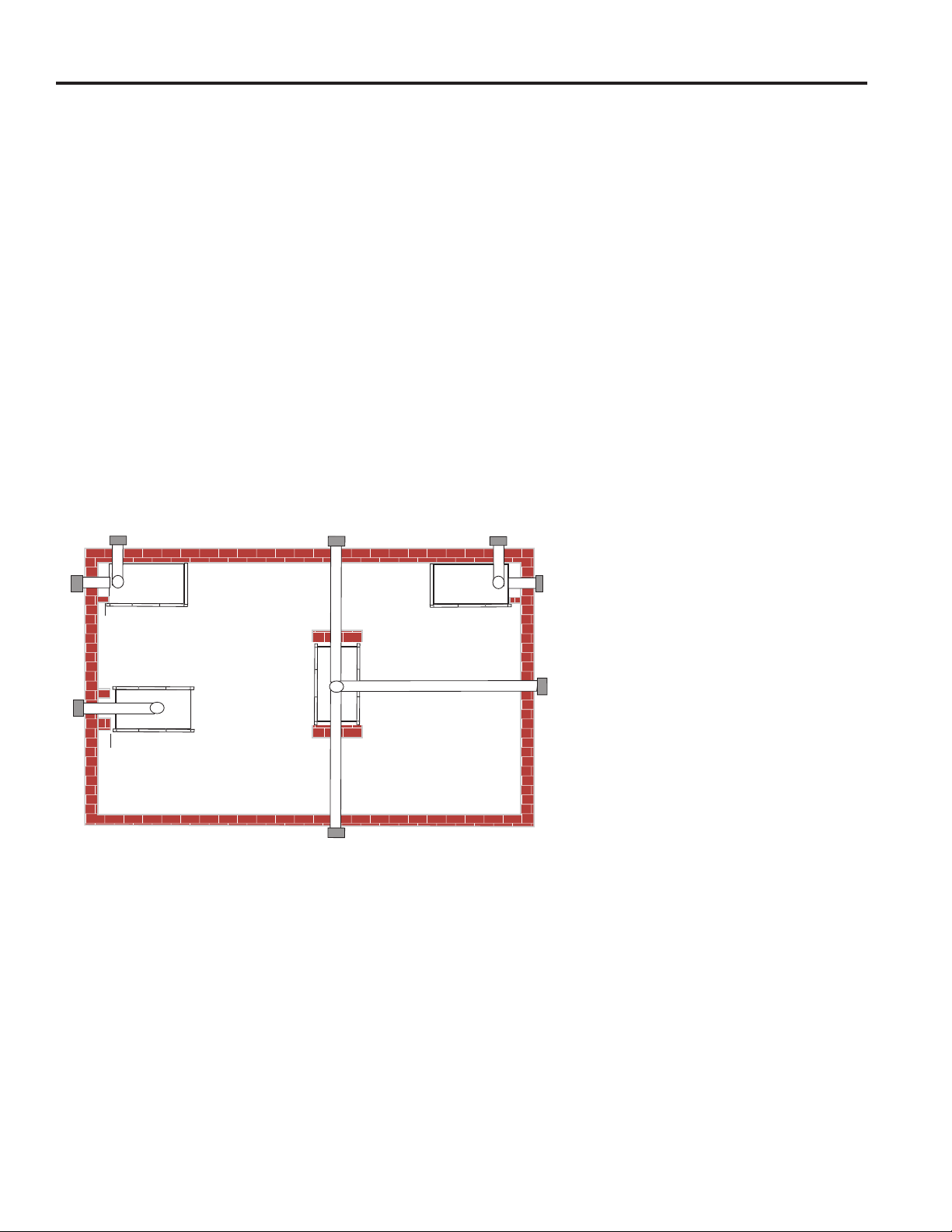
Fireplace Location .................................................12
Installation Precautions .........................................14
Optional Top Vent Applications .............................14
Vent Pipe Clearances ...........................................16
Installation Planning ..............................................17
Horizontal & Vertical Termination ..........................17
Termination Location .............................................18
Vent Graph ............................................................19
Rear Wall Vent Installation ....................................20
Horizontal w/Vertical Rise Applications .................22
Below Grade Installation .......................................24
Vertical Through-the-Roof Applications .................25
Installation for Vertical Termination .......................26
Flex Vent Installation .............................................28
Check Gas Type....................................................31
Install Gas Piping ..................................................32
Junction Box Wiring ..............................................34
Command Center Wall Installation ........................34
Wall Switch Installation .........................................34
Signature Command Wiring Diagram ...................35
Signature Command Single Blower BLOTSTSC ..36
Automatic Dual Thermostat Blower BLOTBLDV ...37
Automatic Single Thermostat Blower BLOTDL .....37
Rockwool Placement ............................................39
Log Placement ......................................................40
Safety Information .................................................43
Operating Instructions ...........................................44
To Turn Off Gas to Appliance ................................44
Burner, Pilot and Control Compartment ................48
Pilot Flame ............................................................48
Burner Flame ........................................................48
Venting System .....................................................49
Glass Door ............................................................49
Logs ......................................................................49
Rock Wool ............................................................49
Signature Command System ................................50
Firebox Components .............................................51
Signature Command System ................................52
Logs ......................................................................54
Brick ......................................................................55
Venting Components .............................................56

20302381
3
Designer Series Direct Vent Gas Fireplace
4. Never install the replace
• in a recreational vehicle
• where curtains, furniture, clothing, or other am-
mable objects are less than 42" from the front, top,
or sides of the replace
• in high trafc areas
• in windy or drafty areas
5. This replace reaches high temperatures. Keep children
and adults away from hot surfaces to avoid burns or
clothing ignition. Fireplace will remain hot for a time after
shutdown. Allow surfaces to cool before touching.
6. Young children should be carefully supervised when
they are in the same room as the appliance. Toddlers,
young children and others may be susceptible to acci-
dental contact burns. A physical barrier is recommended
if there are at risk individuals in the house. To restrict
access to a replace or stove, install an adjustable
safety gate to keep toddlers, young children and other
at risk individuals out of the room and away from hot
surfaces.
7. Do not modify replace under any circumstances. Any
parts removed for servicing must be replaced prior to
operating replace.
8. Turn replace off and let cool before servicing, install-
ing, or repairing. Only a qualied service person should
install, service, or repair the replace. Have burner
system inspected annually by a qualified service
person.
9. You must keep control compartments, burners, and
circulating air passages clean. More frequent cleaning
may be needed due to excessive lint and dust. Turn off
the gas valve and pilot light before cleaning replace.
10. Have venting system inspected annually by a qualied
service person. If needed, have venting system cleaned
or repaired. Refer to Cleaning and Maintenance, Page
48.
11. Keep the area around your replace clear of combus-
tible materials, gasoline, and other ammable vapor and
liquids. Do not run replace where these are used or
stored. Do not place items such as clothing or decora-
tions on or around replace.
Please leave these instructions with the appliance.
Please retain these instructions for future reference
.
This replace is a vented product. This replace must be
properly installed by a qualied service person. The glass
door must be properly seated and sealed. If this unit is not
properly installed by a qualied service person with glass
door properly seated and sealed, combustion leakage can
occur.
Early signs of carbon
monoxide poisoning are similar to the u with headaches,
dizziness and/or nausea. If you have these signs, the re-
place may not have been installed properly. Get fresh air
at once! Have the replace inspected and serviced by a
qualied service person. Some people are more affected
by carbon monoxide than others. These include pregnant
women, people with heart or lung disease or anemia,
those under the inuence of alcohol, and those at high
altitudes.
Propane/LP gas and natural gas are both odorless. An
odor-making agent is added to each of these gases. The
odor helps you detect a gas leak. However, the odor added
to these gases can fade. Gas may be present even though
no odor exists.
Make certain you read and understand all warnings. Keep
this manual for reference. It is your guide to safe and proper
operation of this replace.
1. This appliance is only for use with the type of gas
indicated on the rating plate. This appliance is not
convertible for use with other gases unless a certied
kit is used.
2. For propane/LP replace, do not place propane/LP
supply tank(s) inside any structure. Locate propane/LP
supply tank(s) outdoors. To prevent performance prob-
lems, do not use propane/LP fuel tank of less than 100
lbs. capacity.
3. If you smell gas
• shut off gas supply.
• do not try to light any appliance.
• do not touch any electrical switch; do not use any
phone in your building .
• immediately call your gas supplier from a neighbor’s
phone. Follow the gas supplier’s instructions.
4
20302381
Designer Series Direct Vent Gas Fireplace
12. Do not use this replace to cook food or burn paper or
other objects.
13. Never place anything on top of replace.
14. Do not use any solid fuels (wood, coal, paper, card-
board, etc.) in this replace. Use only the gas type
indicated on rating plate.
15. This appliance, when installed, must be electrically
grounded in accordance with local codes or in the
absence of local codes, with the National Electrical
Code, ANSI/NFPA 70, or the Canadian Electrical Code,
CSA C22.1.
16. Do not obstruct the ow of combustion and ventilation
air in any way. Provide adequate clearances around
air openings into the combustion chamber along with
adequate accessibility clearance for servicing and
proper operation.
17. When the appliance is installed directly on carpeting,
tile or other combustible material other than wood oor-
ing, you must set appliance on a metal or wood panel
or hearth pad extending the full width and depth of the
appliance.
18. Do not use replace if any part has been exposed to
or has been under water. Immediately call a qualied
service technician to inspect the appliance and replace
any part of the control system and any gas control which
as been submerged in water.
19. Do not operate replace if any log is broken.
20. Do not use a blower insert, heat exchanger insert, or
any other accessory not approved for use with this
replace.
21. Do not operate the replace with glass door removed,
cracked, or broken.
Direct Vent type appliances draw all combustion air from
outside of the dwelling through the vent pipe.
These appliances have been tested by CSA and found to
comply with the established standards for DIRECT VENT
GAS FIREPLACE HEATERS in the USA and Canada as
follows:
TESTED TO:
ANSI Z21.88-2009 / CSA 2.33-2009 STANDARDS
A manufactured home (USA only) or mobile home OEM
installation must conform with the Manufactured Home
Construction and Safety Standard,
or when such a standard is not applicable, the
, or
.
It is normal for replaces fabricated of steel
to give off some expansion and/or contraction
noises during the start up or cool down cycle.
Similar noises are found with your furnace heat
exchanger or car engine.
It is not unusual for gas replace to give off
some odor the rst time it is burned. This is due
to the manufacturing process.
It is recommended that you burn your replace
for at least ten (10) hours the rst time you use
it. Place the fan switch in the “OFF” position
during this time.
WARNING
HOT GLASS WILL
CAUSE BURNS.
DO NOT TOUCH GLASS
UNTIL COOLED.
NEVER ALLOW CHILDREN
TO TOUCH GLASS.
20302381
5
Designer Series Direct Vent Gas Fireplace
• This appliance has been certied for use with either
natural or propane gas. See appropriate data plates.
• This appliance is not for use with solid fuels.
The appliance is approved for bedroom or bedsitting
room installations.
The appliance must be installed in accordance with local
codes if any. If none exist use the current installation
code. ANSI Z223.1/NFPA 54 in the USA, CSA B149 in
Canada.
This appliance is mobile home approved.
The appliance must be properly connected to a venting
system.
The appliance is not approved for closet or recessed
installations.
Input ratings are shown in BTU per hour and are certied
without deration for elevations up to 4,500 feet (1,370
m) above sea level.
For elevations above 4,500 feet (1,370 m) in USA,
installations must be in accordance with the current
ANSI Z223.1/NFPA 54 and/or local codes having juris-
diction.
In Canada, please consult provincial and/or local authori-
ties having jurisdiction for installations at elevations
above 4,500 feet (1,370 m).
Natural Propane (LP)
Inlet Minimum 4.5” w.c. 11.0” w.c.
Inlet Maximum 10.5” w.c. 13.0” w.c.
Manifold Pressure 3.5” w.c. 10.0” w.c.
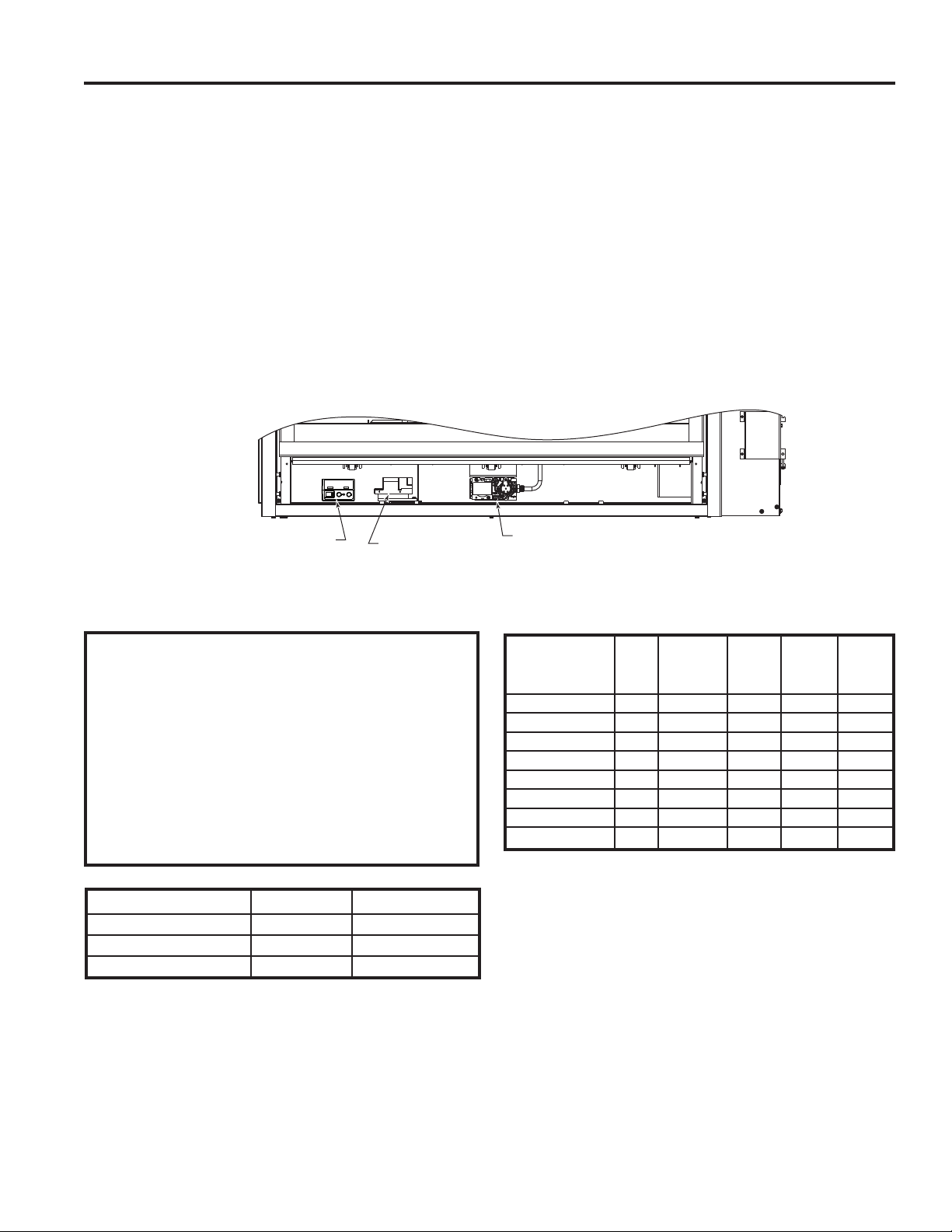
Figure 1 -
Designer Controls
FP2815
Control Box
Gas Valve
Command
Center
PFLDVNS Nat. SCS 37,000 25,000 #31
PFLDVPS LP SCS 35,000 27,000 1.8 mm
STLDVNS Nat. SCS 37,000 25,000 #31
STLDVPS LP SCS 35,000 27,000 1.8 mm
CLLDVNS Nat. SCS 37,000 25,000 #31
CLLDVPS LP SCS 35,000 27,000 1.8 mm
CRLDVNS Nat. SCS 37,000 25,000 #31
CRLDVPS LP SCS 35,000 27,000 1.8 mm
6
20302381
Designer Series Direct Vent Gas Fireplace
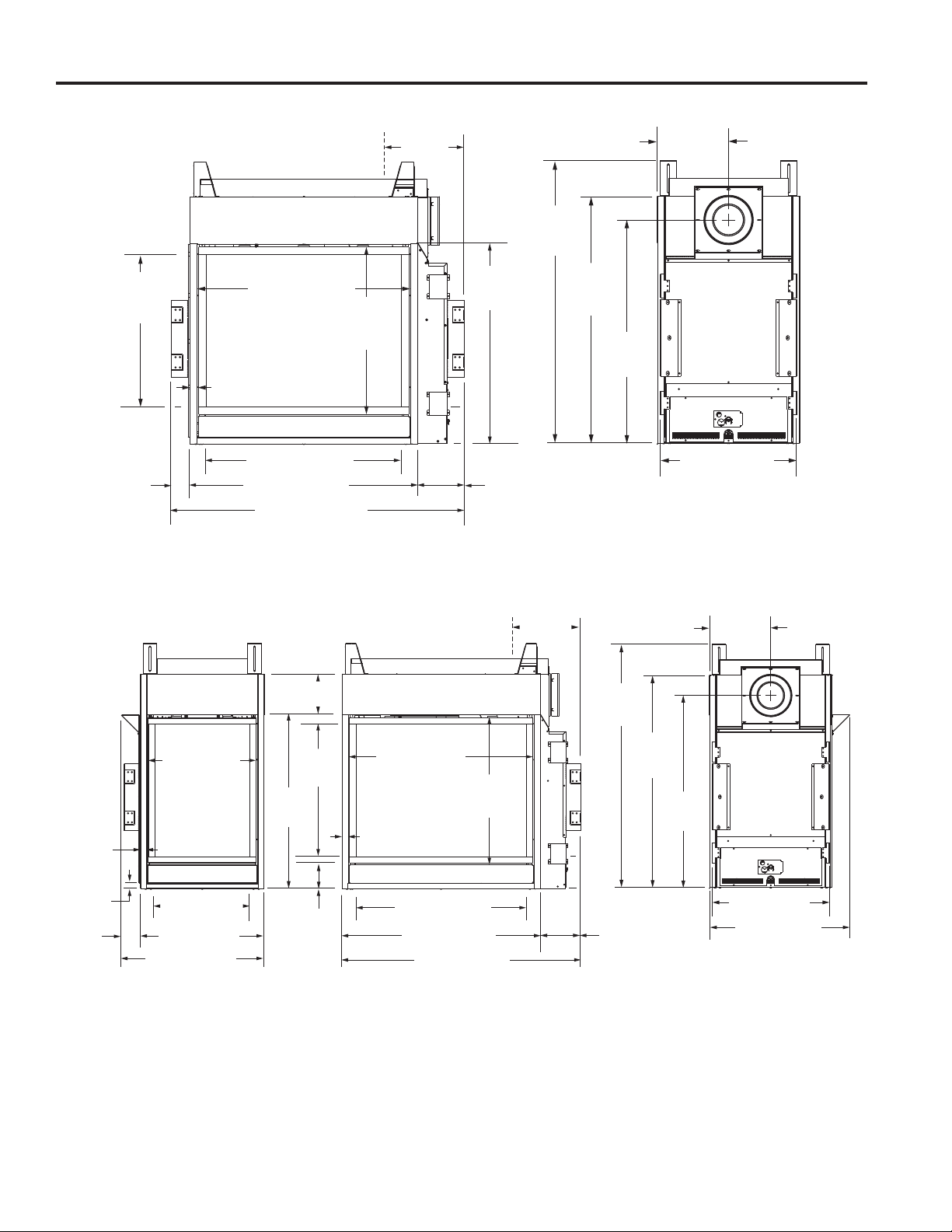
Figure 2 -
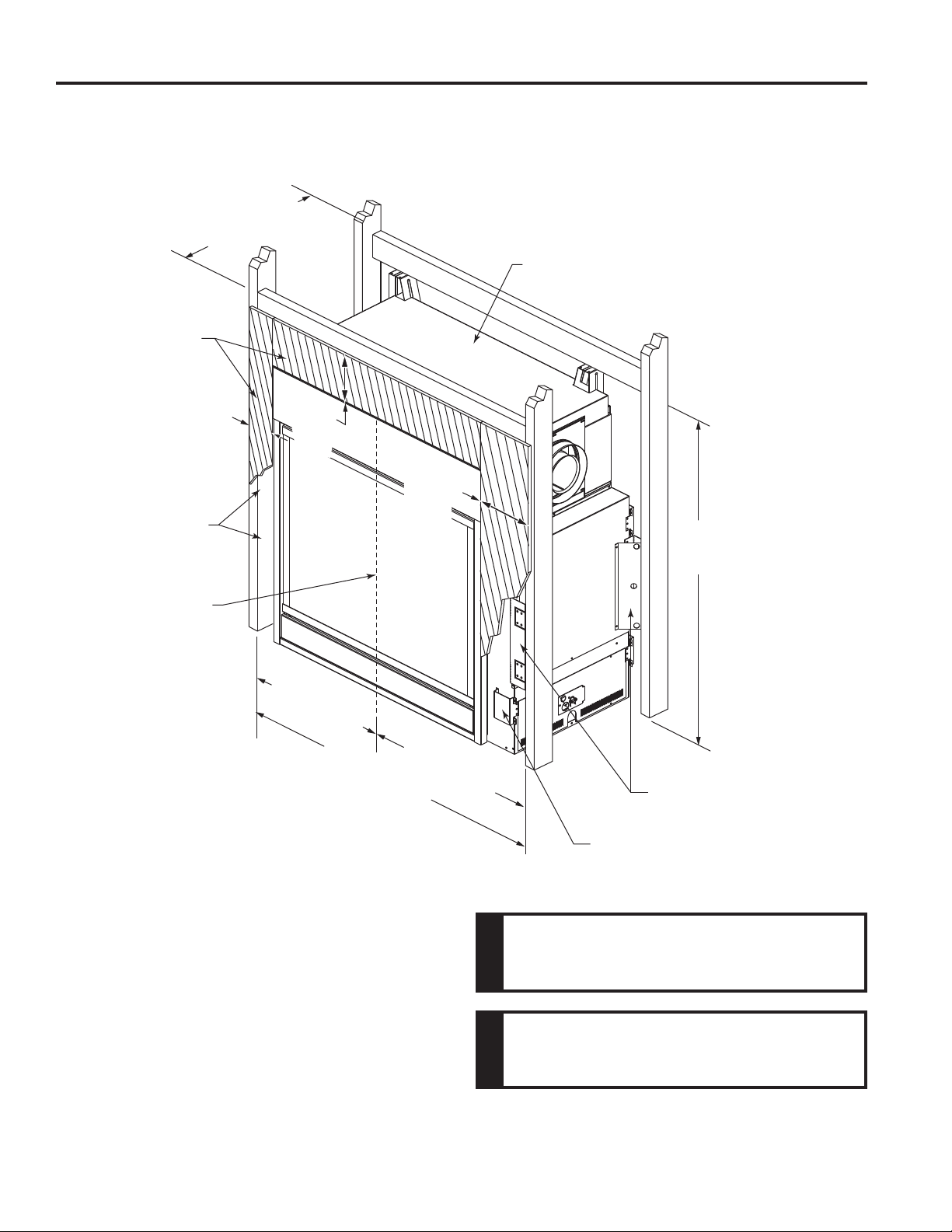
STLDV (See-thru) Fireplace Dimensions
36QE”
(81 mm)
386QE” (979 mm)
496QE” (1259 mm)
7(6”
(200 mm)
12"
(305 mm)
47(6”
(1216 mm)
41(6”
(1064 mm)
37(6”
(962 mm)
23" (584 mm)
356QE” (903 mm)
2856M”
(718 mm)
256M”
(654 mm)
3356QE” (840 mm)
156M"
(32 mm)
34”
(864 mm)
116M”
(298 mm)
36M”
(95 mm)
24” (610 mm)
276M” (705 mm)
466” (1178 mm)
386QE” (979 mm)
7(6”
(200 mm)
12"
(305 mm)
47(6”
(1216 mm)
41(6”
(1064 mm)
37(6”
(962 mm)
23" (584 mm)
156M"
(32 mm)
356QE” (903 mm)
2856M”
(718 mm)
256M”
(654 mm)
1856O" (470 mm)
21” (533 mm)
7(6”
(200 mm)
556”
(130 mm)
156”
(29 mm)
3356QE" (840 mm)
276M” (705 mm)
156M"
(32 mm)
34”
(864 mm)
116M”
(298 mm)
Figure 3 -
CLLDV/CRLDV (Corner) Fireplace Dimensions
FP2851
FP2852
Centerline of Flue
Outlet
Centerline of Flue
Outlet
20302381
7
Designer Series Direct Vent Gas Fireplace
21”
(533 mm)
1856O”
(470 mm)
2856M”
(718 mm)
256M”
(654 mm)
7(6”
(200 mm)
556”
(130 mm)
156”
(29 mm)
3356QE” (840 mm)
386QE” (979 mm)
466” (1178 mm)
7(6”
(200 mm)
12"
(305 mm)
47(6”
(1216 mm)
41(6”
(1064 mm)
37(6”
(962 mm)
23" (584 mm)
356QE” (903 mm)
2856M”
(718 mm)
156M"
(32 mm)
156M"
(32 mm)
34”
(864 mm)
116M”
(298 mm)
FP2853
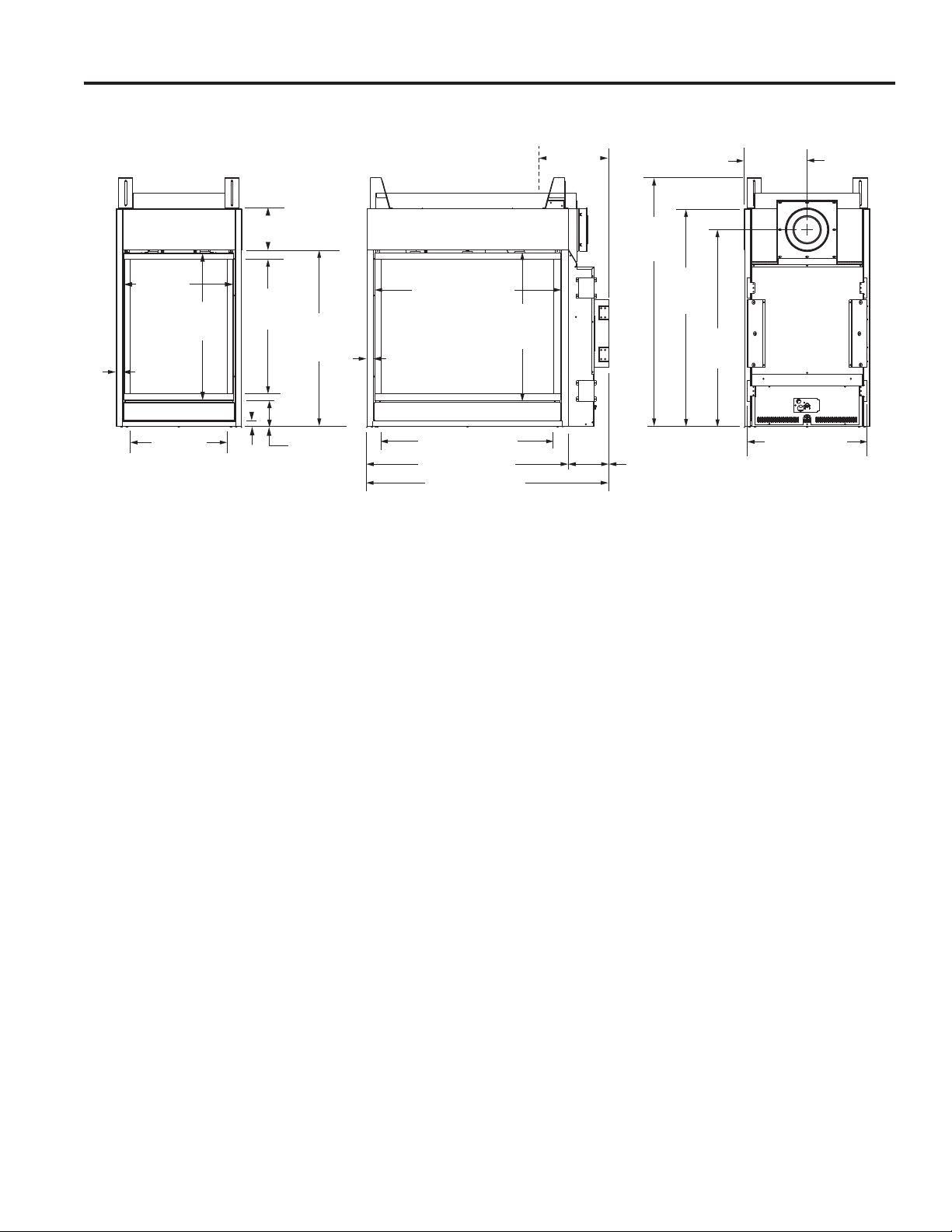
Figure 4 -
PFLDV (Peninsula) Fireplace Dimensions
Centerline of Flue
Outlet
8
20302381
Designer Series Direct Vent Gas Fireplace
486QE”
(1224 mm)
C
L
276” (695 mm)
5056QE” (1272 mm)
23" (1/2" Drywall)
or Adjustable to
226M” (5/8” Drywall)
22556QE” (576 mm)
8556QE”
(221 mm)
Min.
7”
(178 mm)
Min.
4”
(102 mm)
Min.
Remove box and
Insulation for Top
Vent Congurations
Fold Outer Tabs
and Nail to Framing
Members
If using 5/8" drywall, remove
framing tabs and re-install
on 2nd set of holes
positioned slightly inwards
Figure 5 -
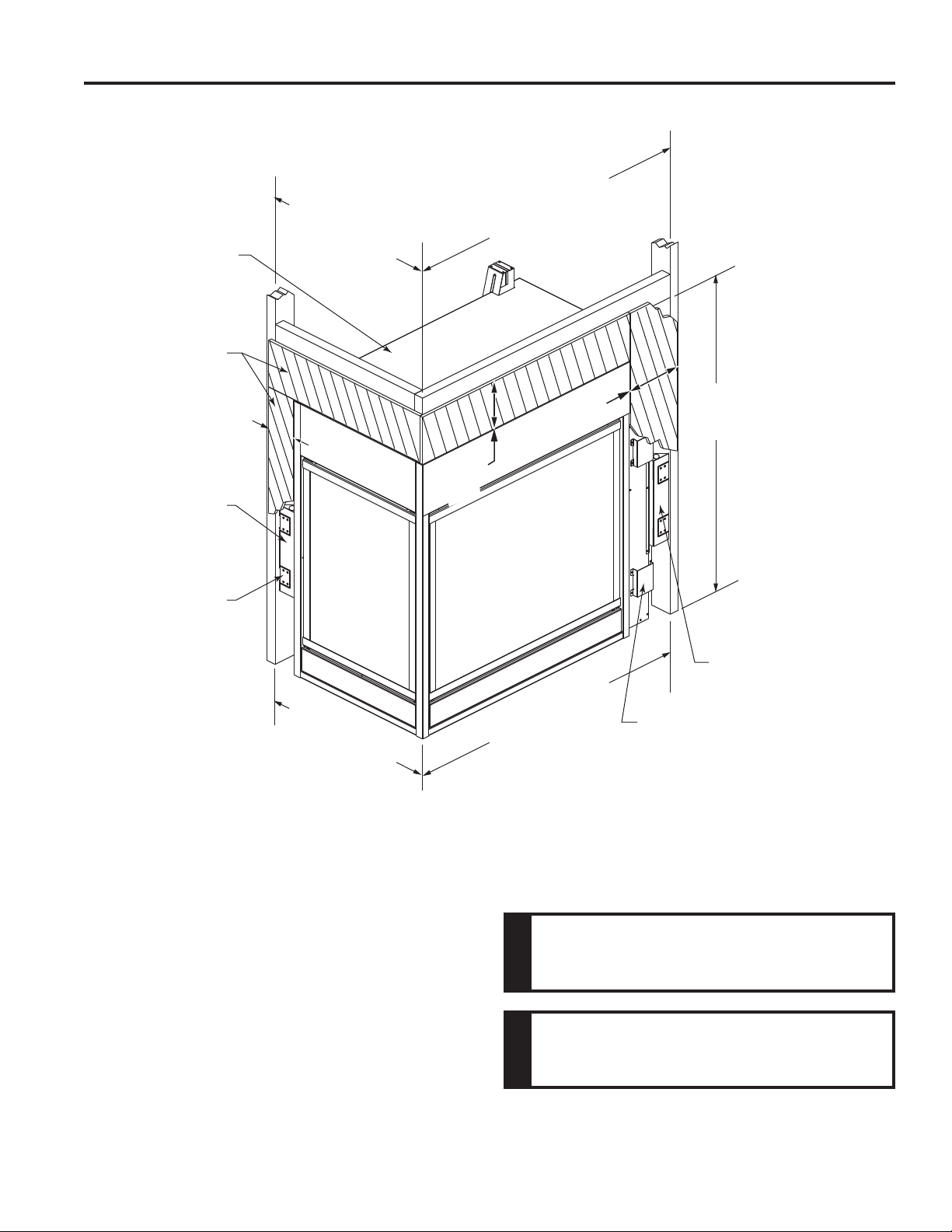
STLDV (See-thru) Framing
If using 5/8" drywall, remove
noncombustible supports,
rotate 180° and reinstall to
achieve 5/8" depth
The replace must be secured to the oor and/or to framing
studs as shown in Figure 5 . Use four (4) wood screws or
masonry/ concrete screws to secure replace to the oor.
Use four (4) screws to attach replace to framing. The side
brackets or nailing anges are designed to accommodate
two wall boards thicknesses, 1/2" or 5/8".
Figures 5, 6, 7
Glass cen-
terline is off center
from rought framing
dimensions.
20302381
9
Designer Series Direct Vent Gas Fireplace
2756O” (699 mm)
(1/2” Drywall)
or
276” (696 mm)
(5/8” Drywall)
4656” (1172 mm)
(1/2” Drywall)
or
46” (1168 mm)
(5/8” Drywall)
27(6” (708 mm)
466” (1184 mm)
486QE"
(1224 mm)
8556QE”
(221 mm) Min,
7”
(178 mm)
Min.
456O”
(114 mm)
Min.
Remove box and
Insulation for Top
Vent Congurations
Fold Outer Tabs
and Nail to Framing
Members
Figure 6 -
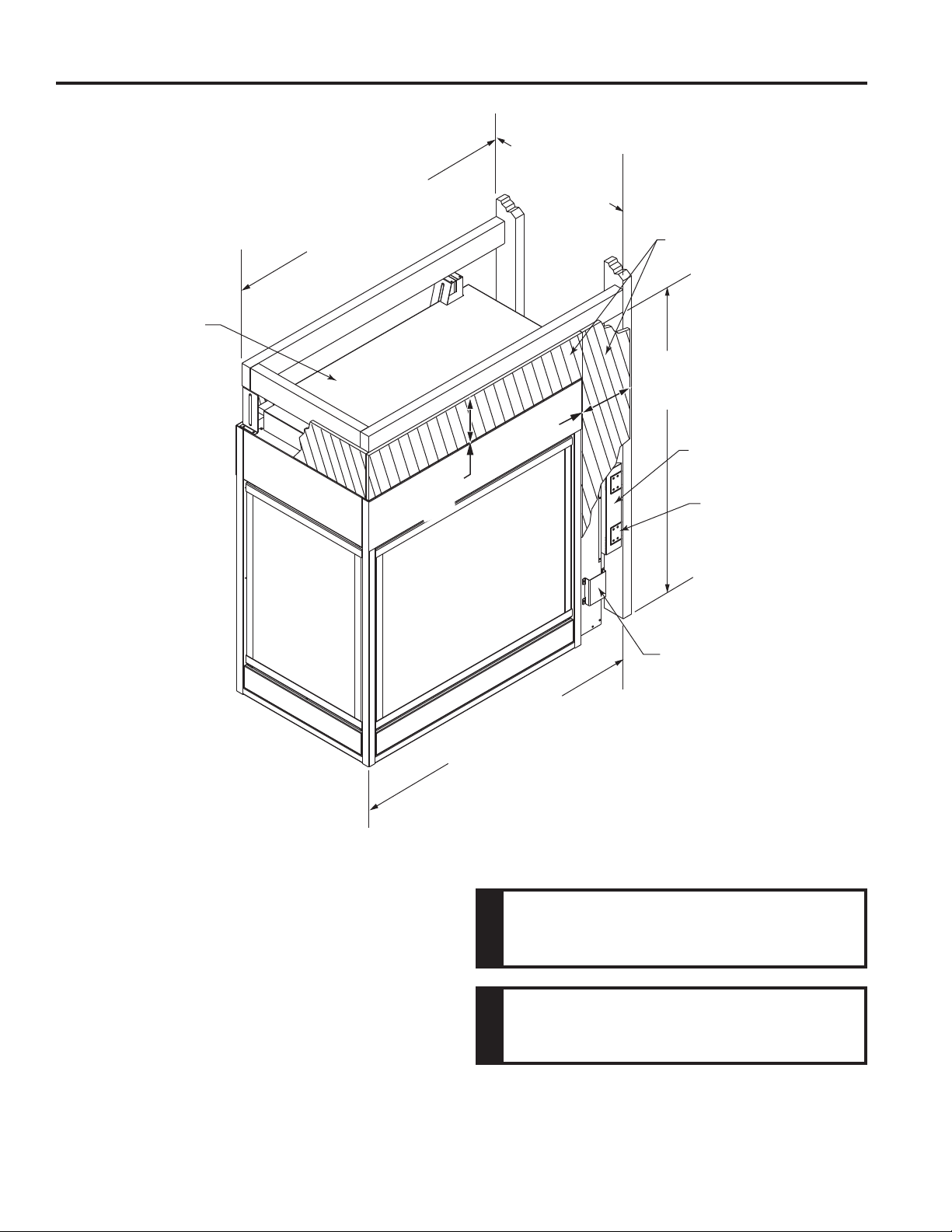
CRLDV and CLLDV (Corner) Framing
If using 5/8" drywall, remove
framing tabs and re-install
on 2nd set of holes
positioned slightly inwards
If using 5/8" drywall,
remove framing
tabs and re-install
on 2nd set of holes
positioned slightly
inwards
The replace must be secured to the oor and/or to framing
studs as shown in Figure 6 . Use four (4) wood screws or
masonry/ concrete screws to secure replace to the oor.
Use four (4) screws to attach replace to framing. The side
brackets or nailing anges are designed to accommodate
two wall boards thicknesses, 1/2" or 5/8".
Figures 5, 6, 7
If using 5/8" drywall, remove
noncombustible supports, rotate
180° and reinstall to achieve
5/8" depth
4656” (1172 mm)
(1/2” Drywall)
or
46” (1168 mm)
(5/8” Drywall)
23” (584 mm)
(1/2” Drywall)
or Adjustable to
226M” (578 mm)
(5/8” Drywall)
486QE”
(1224 mm)
466” (1184 mm)
7”
(178 mm)
Min.
8556QE”
(221 mm) Min,
The Vermont Castings Group Model BPWC500
mantel is specially designed to comply with all mantel
temperature requirements. Any custom-built mantels must
comply with the framing clearances and the use of non-
combustibles as shown in Figures 5, 6 and 7.
10
20302381
Designer Series Direct Vent Gas Fireplace
Remove box and
Insulation for Top
Vent Congurations
Fold Outer Tabs
and Nail to Framing
Members
Figure 7 -
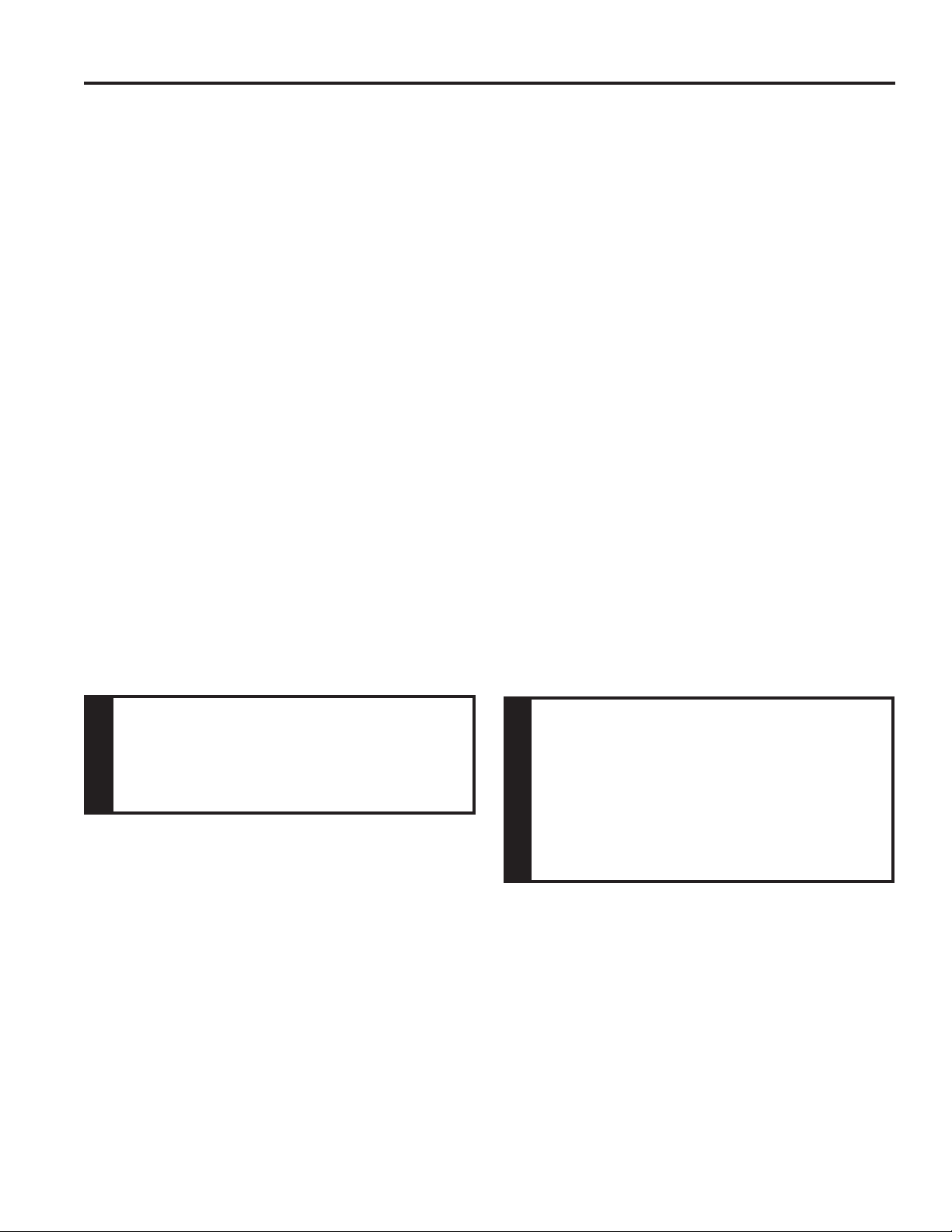
PFDV (Peninsula) Framing
If using 5/8" drywall, remove
framing tabs and re-install
on 2nd set of holes
positioned slightly inwards
The replace must be secured to the oor and/or to framing
studs as shown in Figure 7 . Use four (4) wood screws or
masonry/ concrete screws to secure replace to the oor.
Use four (4) screws to attach replace to framing. The side
brackets or nailing anges are designed to accommodate
two wall boards thicknesses, 1/2" or 5/8".
Figures 5, 6, 7
If using 5/8" drywall, remove
noncombustible supports,
rotate 180° and reinstall to
achieve 5/8" depth
20302381
11
Designer Series Direct Vent Gas Fireplace
Read this homeowner manual thoroughly and follow all
instructions carefully. Inspect all contents for shipping
damage and immediately inform your dealer if any damage
is found. Do not install any unit with damaged, incomplete,
or substitute parts. Check your packing list to verify that
all listed parts have been received. You should have the
following:
• Fireplace (Firebox and Burner System)
• Log Set • Fasteners
• Rock Wool • Restrictor Plate/Disc (2)
• White Toggle Switch • Switch Cover Plate
• Phillips Screwdriver • Framing Materials
• Hammer • Wall Finishing Materials
• Saw and/or saber saw • Level
• Measuring Tape • Pliers
• Electric Drill and Bits • Square
• Pipe Wrench • Tee Joint
• Noncombustible Panel
• Caulking Material (noncombustible)
• Fireplace Surround Material (noncombustible)
• Piping Complying with Local Codes
• Pipe Sealant Approved for use with Propane/LPG
(Resistant to sulfur compounds)
Firebox framing can be built before or after the appliance
is set in place. Construct rebox framing following Figure
5, 6 or 7 for your specic installation requirements. The
framing headers may rest on the top of the rebox stand-
offs. Do not bring headers below top of standoffs.
When planning your framing and installation, keep in mind
that the gas line and electric power come in on the same
end of the replace. Refer to Figures 2, 3 & 4 for replace
dimensions.
The rebox may be installed directly on a combustible oor
or raised on a platform of an appropriate height. When
the rebox is installed directly on carpeting, tile, or other
combustible material, other than wood ooring, the rebox
shall be installed on a metal or wood panel extending the
full width and depth of the enclosure.
Any remote wiring (i.e. remote control, wall switch,
and optional fan) must be done prior to nal nishing to
avoid costly reconstruction.
Only noncombustible materials (i.e. brick, tile, slate, steel,
or other materials with a UL re rating of Zero) may be
used to cover the black surface of the appliance. A 300°F
minimum adhesive may be used to attach facing materi-
als to the black surface. If joints between the nished wall
and the replace surround are sealed, a 300°F minimum
sealant material (General Electric RTV103 or equivalent)
must be used.
Refer to cold climate pilot information on Page 46
for more information on standing pilot vs. intermittent pilot
options.
12
20302381
Designer Series Direct Vent Gas Fireplace
Plan for the installation of your appliance. This includes
determining where the unit is to be installed, the vent con-
guration to be used, framing and nishing details, and
whether any optional accessories (i.e. blower, wall switch,
or remote control) are desired. Consult your local building
code agency to ensure compliance with local codes, includ-
ing permits and inspections.
The following factors should be taken into consideration:
• Clearance to side-wall, ceiling, woodwork, and windows.
Minimum clearances to combustibles
• This replace may be installed along a wall, across a
corner, or use an exterior chase. Refer to Figure 8 for
suggested locations.
• Location should be out of high trafc areas and away
from furniture and draperies due to heat from appli-
ance.
Y
B
C
Y
X
D
A
** Island (C) and Room Divider (D) installation is possible as long
as the horizontal portion of the vent system (X) does not exceed
20’ (610cm). See details in Venting Section.
* When you install your replace in (D) Room divider or (E) Flat
on wall corner positions (Y), a minimum of 6” (152mm) clearance
must be maintained from the perpendicular wall and the front side
edge of the replace.
A Flat on wall
B **Island
C *Room divider
D *Flat on wall corner
Y 6” minimum
Figure 8 -
Locate Fireplace
• Never obstruct the front opening of the replace.
• Do install in the vicinity where gasoline or other
ammable liquids may be stored.
• Vent pipe routing. See Venting section found in this
manual for allowable venting congurations.
• These units can be installed in a bedroom. See National
Fuel Gas Code ANSI Z233.1/NFPA 54 — (current
edition), the Uniform Mechanical Code — (current edi-
tion), and Local Building Codes for specic installation
requirements.
• These units can be installed in a bathroom.
20302381
13
Designer Series Direct Vent Gas Fireplace
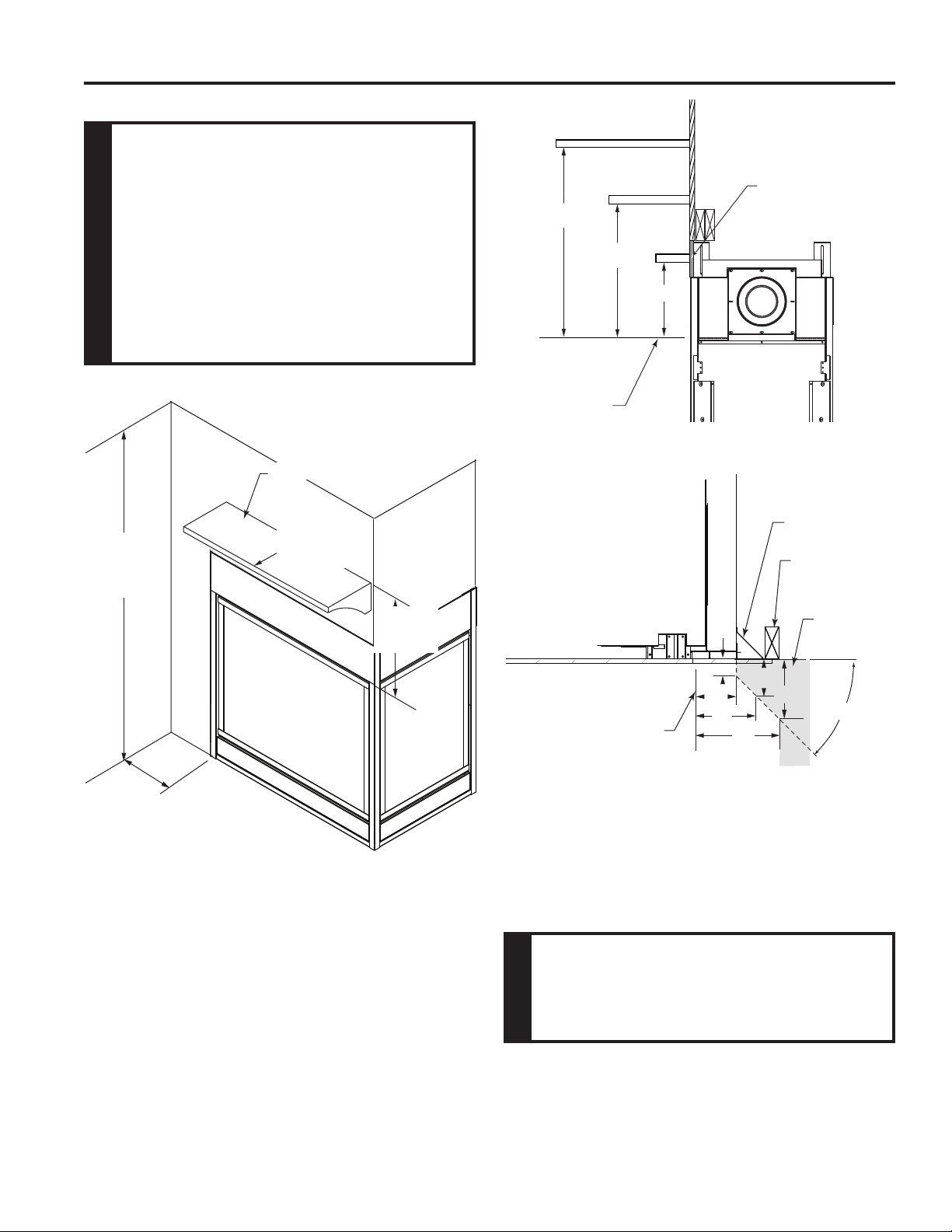
The combustible area above the facing must
not protrude more than 1/2" from the facing. If it does,
it is considered a mantel and must meet the mantel
requirements listed in this manual.
Vermont Castings Group Model BPWC500
Mantel is designed to comply with all mantel temperature
requirements.
16”
12”
10”
12”
6”
256O”
FP2817
Top of Fireplace
Opening
45°
1”
4”
5”
6”
”
3”
Figure 10 -
Mantel Clearance
Stud
Combustible
Material Area
FP2818
Spacer
Side of Fireplace
Opening
72”
(1829 mm)
Min.
Ceiling
6”
(152 mm)
Min.
Figure 9 -
Ceiling and Side Wall Clearances
FP2544
12"
(305 mm)
Max. Depth
16"
(406 mm)
Min.
Combustible Mantel
14
20302381
Designer Series Direct Vent Gas Fireplace
Consult local building codes before beginning the
installation. The installer must make sure to select the
proper vent system for installation. Before installing vent
kit, the installer must read this replace manual and vent
kit instructions.
Only a qualied installer/service person should install the
venting system. The installer must follow these safety
rules:
• Wear gloves and safety glasses for protection.
• Use extreme caution when using ladders or when on
rooftops.
• Be aware of electrical wiring locations in walls and ceil-
ings.
The following actions will void the warranty on your vent-
ing system:
• Installation of any damaged venting component.
• Unauthorized modication of the venting system.
• Installation of any component part not manufactured or
approved by Vermont Castings Group
• Installation other than permitted by these instructions.
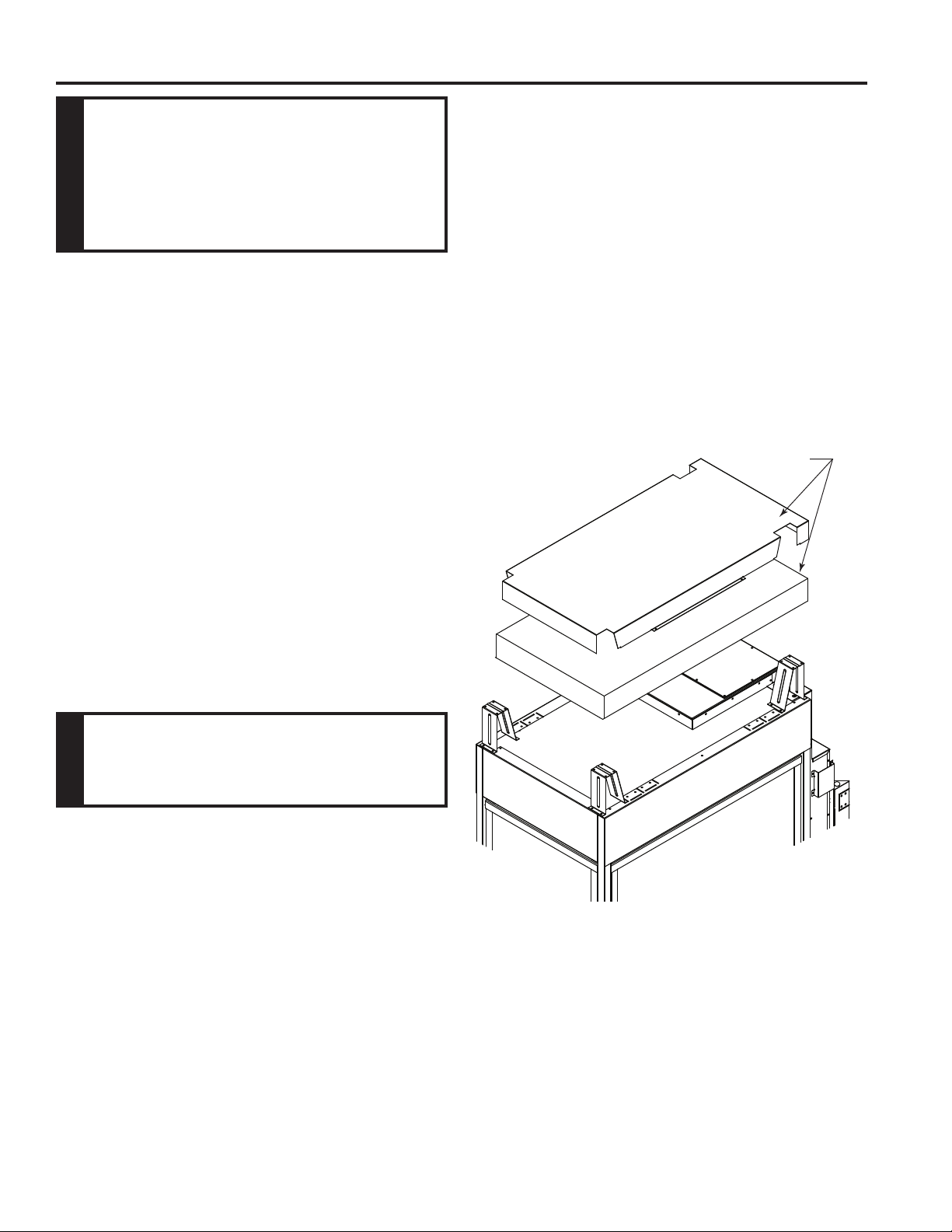
The appliance is shipped as a rear vent unit. If the installa-
tion layout requires the unit to be a top vent conguration,
the appliance can be converted by following the steps
below.
When removing and retting the plates and adapter, be
sure the associated gaskets are undamaged and retted
as required.
1. Remove the eight (8) screws securing the ue pipe
adapter to the replace body. Figure 12
2. Set the ue pipe adapter aside, complete with the
gasket. Do not damage the gaskets as the adapter and
gasket must be retted.
3. Remove the eight (8) screws securing the ue pipe cover
to the top of the intake box and remove the cover and
gasket. Figure 12
Remove for Top Vent
applications
FP2895
Figure 11
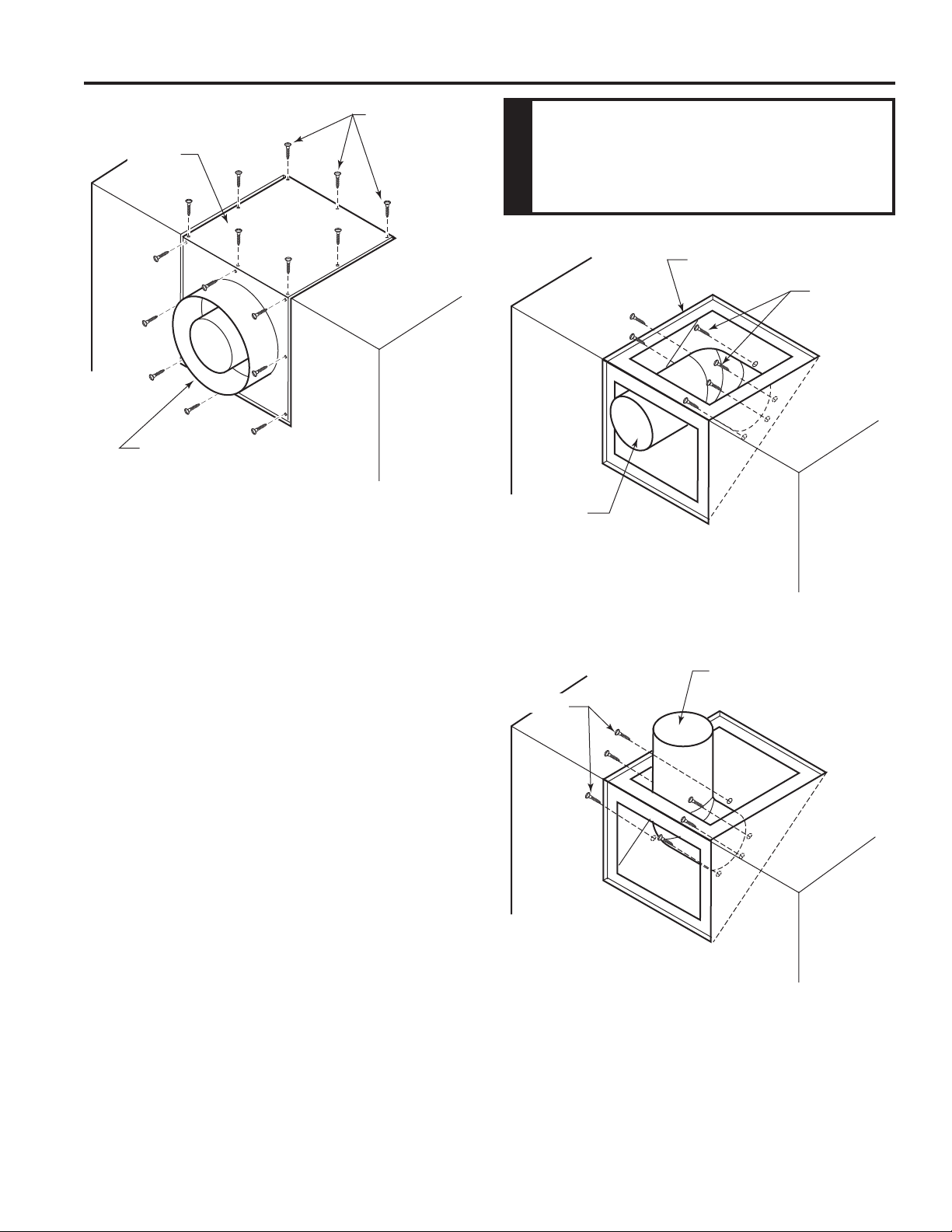
20302381
15
Designer Series Direct Vent Gas Fireplace
Screws
Flue Pipe
Cover
Flue Pipe
Adapter
FP2833
Figure 12 -
Remove 16 screws from Flue Pipe Adapter and
Flue Pipe Cover
4. Remove six (6) screws securing the ue pipe to the
back of the intake box and remove the pipe and gasket.
Figure 13
5. Replace the ue pipe to top of rebox. Ensure the gasket
is in place and undamaged. Secure with six (6) screws.
Figure 14
6. Place the ue pipe cover and gasket removed in Step
3 over the ue opening in bottom of the intake box.
7. Ret the ue pipe adapter and gasket to the top of re-
place. Secure the adapter with six (6) screws removed
in Step 1.
Flue Cover
Screws
Flue Pipe
FP2834
Figure 13 -
Remove Flue Pipe
Screws
Flue Pipe
FP2835
Figure 14 -
Attach Flue Pipe to Top Vent Conguration
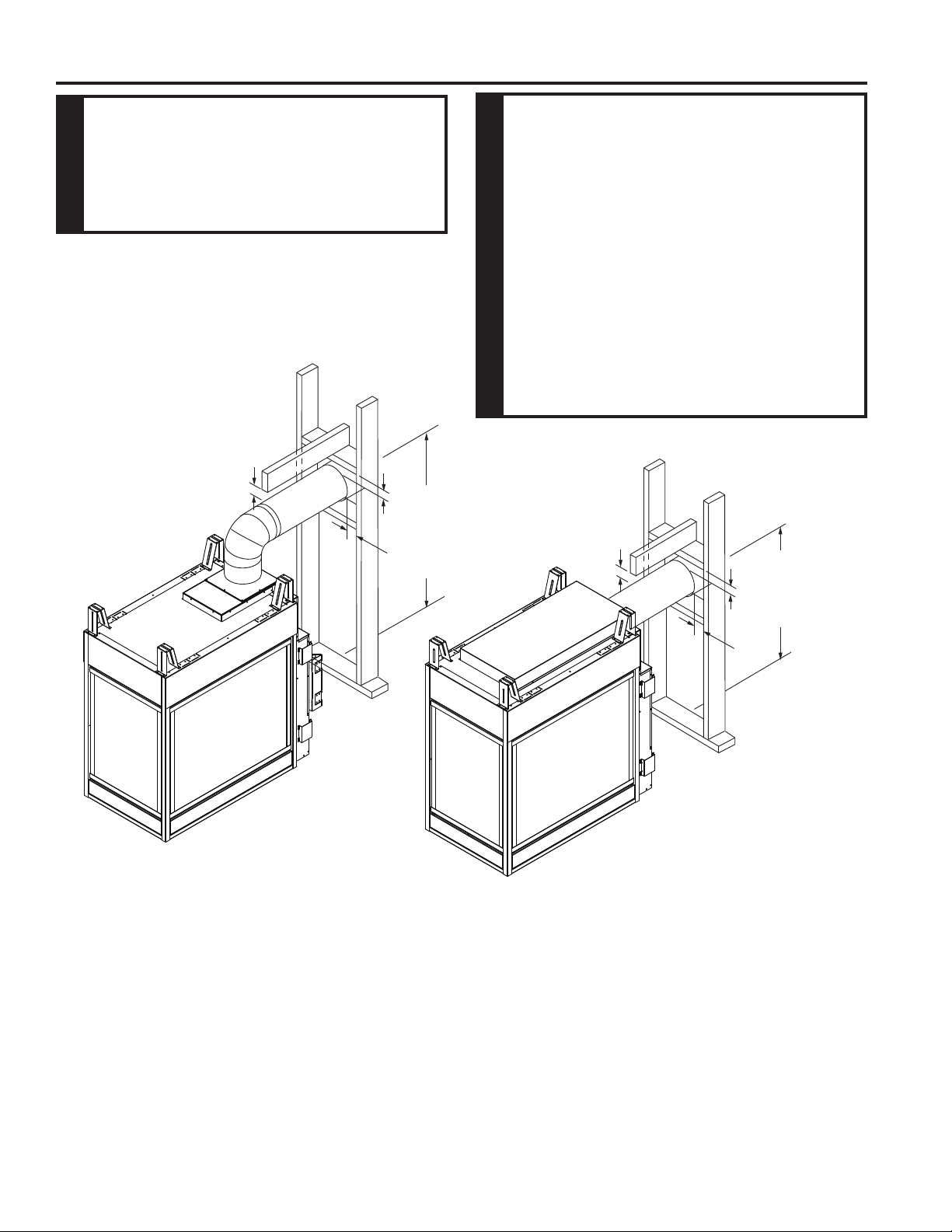
16
20302381
Designer Series Direct Vent Gas Fireplace
**1"
**1”
*3"
37(6”
(962 mm)
Flue Pipe
Centerline
to Floor
**1"
*3"
**1”
516”
(1305 mm)
Flue Pipe
Centerline
to Floor
Figure 15 -
Combustible Clearances for Vent Pipe with Minimum Rise
* A minimum of 3" clearance to the top is required along horizontal
length until ue pipe penetrates outside wall.
** A minimum 1" clearance to combustibles permitted all around
ue at outside wall
FP2819
until the
ue penetrates the outside wall.
Z\x
20302381
17
Designer Series Direct Vent Gas Fireplace
There are two basic types of direct-vent installation:
• Horizontal Termination
• Vertical Termination
It is important to select the proper length of vent pipe for
the type of termination you choose. It is also important to
note the wall thickness.
Select the amount of vertical rise desired. All horizontal run
of venting must have 1/4" rise for every 12" of run towards
the termination below 7Z\x' of vertical rise from oor of re-
place. With 7Z\x feet or more of vertical rise from the oor
of the replace, the horizontal run may be level. NEVER
run vent piping down.
You may use up to three 90° elbows in this vent congura-
tion. Refer to Vertical/Horizontal Termination Congurations
on Page 21.
Horizontal venting which incorporates the twist lock pipe
must be installed on a level plane without an inclining or
declining slope.
Measure the distance from the replace oor to the ceil-
ing. Add the ceiling thickness, the vertical rise in an attic
or second story, and allow for sufcient vent height above
the roof line.
NOTE: You may use two 45° elbows in place of a 90°
elbow. You must follow rise to run ratios when using
45° elbows. The appliance is approved for use with
three 90° elbows maximum or a combination of 90°
and 45° elbows up to a maximum of 270°.
Z\x
For two-story applications, restops are required at each
oor level. If an offset is needed in the attic, additional pipe
and elbows will be required.
You may use a chase with a vent termination with exposed
pipe on the exterior of the house. See Installing Vent
System in a Chase below. If pipe is enclosed in chase, it
is not exposed.
It is very important that the venting system maintain its bal-
ance between the combustion air intake and the ue gas
exhaust. Certain limitations apply to vent congurations
and must be strictly followed.
A chase is a vertical boxlike structure built to enclose
venting that runs along the outside of a building. A chase
is required for such venting.
18
20302381
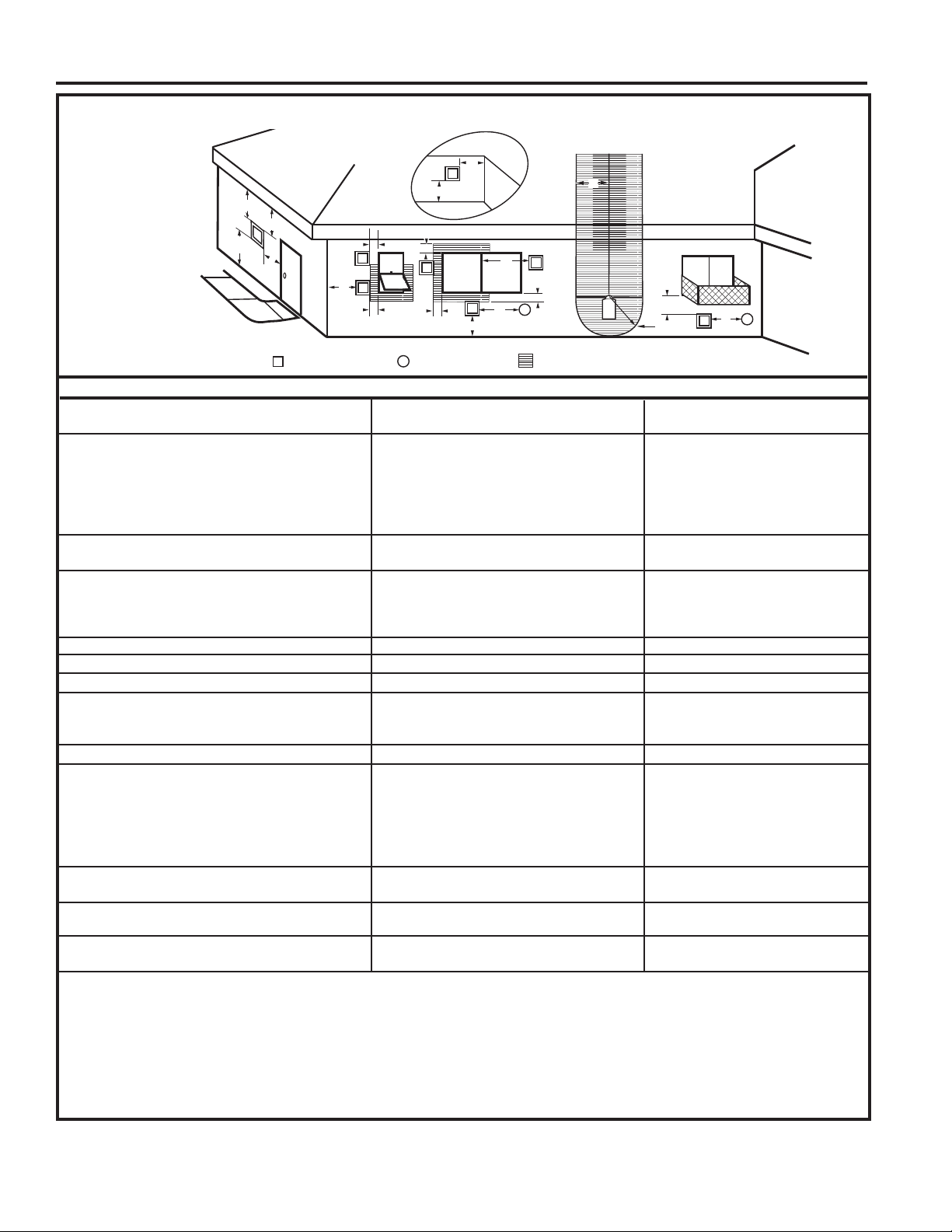
Designer Series Direct Vent Gas Fireplace
A = Clearance above grade, veranda, porch, 12” (30 cm) 12” (30 cm)
deck, or balcony
B = Clearance to window or door that may be 6” (15 cm) for appliances 6” (15 cm) for appliances
opened < 10,000BTU/h (3kW), 12” (30 cm) < 10,000 BTU/h (3kW), 9”
for appliances > 10,000 Btuh (3kW) and (23 cm) for appliances > 10,000
< 100,000 BTU/h (30kW), 36” (91 cm) Btuh (3kW) and < 50,000 BTU/h
for appliances > 100,000 BTU/h (30kW) (15kW), 12” (30 cm) for
appliances > 50,000 BTU/h(15kW)
C = Clearance to permanently closed window 12” (305 mm) recommended to 12” (305 mm) recommended to
prevent window condensation prevent window condensation
D = Vertical clearance to ventilated soft located
above the terminal within a horizontal 18” (458 mm) 18” (458 mm)
distance of 2’ (610mm) from the center
line of the terminal
E = Clearance to unventilated soft 12” (305 mm) 12” (305 mm)
F = Clearance to outside corner see next page see next page
G = Clearance to inside corner (see next page) see next page see next page
H = Clearance to each inside of center line 3’ (91 cm) within a height of 15’ (5 m) 3’ (91 cm) within a height of 15’
extended above meter/regulator assembly above the meter/regulator assembly (5 m) above the meter/regulator
assy
I = Clearance to service regulator vent outlet 3’ (91 cm) 3’ (91 cm)
J = Clearance to nonmechanical air supply inlet 6” (15 cm) for appliances < 10,000 6” (15 cm) for appliances
to building or the combustion air inlet to any BTU/h (3kW), 12” (30 cm) for < 10,000 BTU/h (3kW), 9”
other appliances appliances > 10,000 BTU/h (3kW) and (23 cm) for appliances > 10,000
< 100,000 Btuh (30kW), 36” (91 cm) BTU/h (3kW) and < 50,000 BTU/h
for appliances > 100,000 BTU/h (30kW) (15kW), 12” (30 cm) for
appliances > 50,000 BTU/h(15kW)
K = Clearance to a mechanical air supply inlet 6’ (1.83 m) 3’ (91 cm) above if within 10'
(3 m) horizontally
L = Clearance above paved sidewalk or paved 7’ (2.13 m)† 7’ (2.13 m)†
driveway located on public property
M = Clearance under veranda, porch, deck or 12” (30 cm) 12” (30cm)
balcony
1 In accordance with the current CSA-B149 Installation Codes
2 In accordance with the current ANSI Z223.1/NFPA 54 National Fuel
Gas Codes
† A vent shall not terminate directly above a sidewalk or paved
driveway which is located between two single family
dwellings and serves both dwellings
only permitted if veranda, porch, deck or balcony is fully open on a
minimum 2 sides beneath the oor:
NOTE: 1. Local codes or regulations may require different
clearances.
2. The special venting system used on Direct Vent Fireplaces
are certied as part of the appliance, with clearances
tested and approved by the listing agency.
3. Vermont Castings Group assumes no responsibility for the
improper performance of the appliance when the venting
system does not meet these requirements.
Figure 16 -
Termination Locations
V
X
X
X
D
E
B
B
B
C
B
M
B
A
J
K
F
L
VENT TERMINATION AIR SUPPLY INLET
AREA WHERE TERMINAL IS NOT PERMITTED
H
I
Fixed
Closed
Operable
Operable
Fixed
Closed
B
INSIDE
CORNER DETAIL
A
G
CFM145a
V
V
V
V
V
V
V
V
20302381
19
Designer Series Direct Vent Gas Fireplace
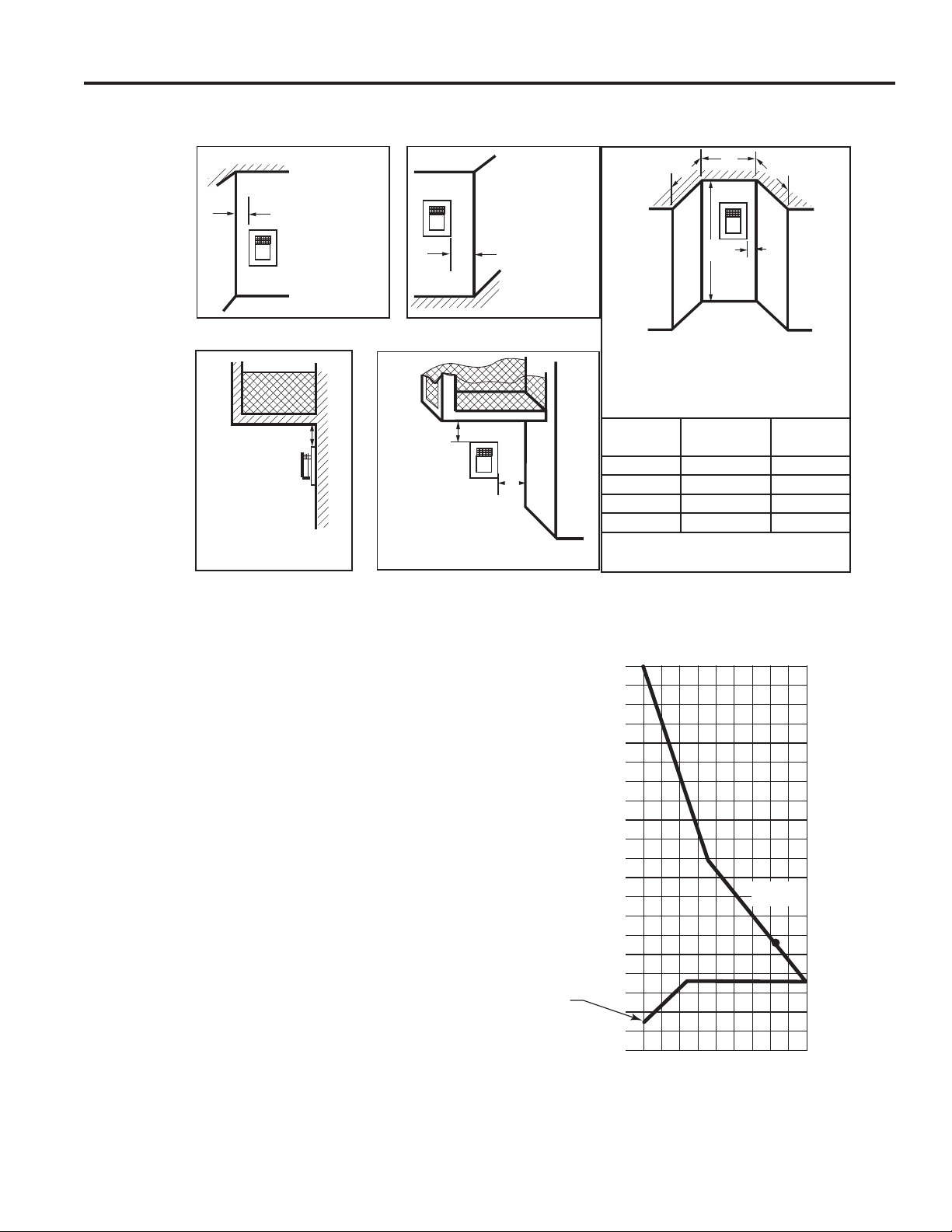
The Vent Graph should be read in conjunction with the
following vent installation instructions to determine the
relationship between the vertical and horizontal dimensions
of the vent system.
1. Determine the height of the center of the horizontal vent
pipe exiting through the outer wall. Using this dimen-
sion on the Sidewall Vent Graph below, locate the point
intersecting with the slanted graph line.
2. From the point of this intersection, draw a vertical line
to the bottom of the graph.
3. Select the indicated dimension, and position the re-
place in accordance with same.
Example: If the vertical dimension from the oor of the
replace is 11' (3.4 m) the horizontal run to the face of
the outer wall must not exceed 16' (4.9 m).
Sidewall Vent Graph showing the relationship between
vertical and horizontal dimensions for a Direct Vent ue
system.
Figure 18 -
Rear Wall Venting Graph
Horizontal dimension from the nished outside wall
to the center of the pipe on the replace
Vertical Dimension From the Floor of Unit to the Center of the
Horizontal Vent Pipe
Dimensions in
Feet
40
38
36
34
32
30
28
26
24
22
20
18
16
14
12
10
8
6
4
2
2 4 6 8 10 12 14 16 18 20
eg: A
32C\v" to Center
of Horizontal
Pipe
Outside Corner
Inside Corner
Termination Clearances
Termination clearances for buildings with combustible and noncombustible exteriors.
G =
Combustible
6" (152 mm)
Noncombustible
2" (51 mm)
F =
Combustible
6" (152 mm)
Noncombustible
2" (51 mm)
G
Balcony -
with no side wall
M =
Combustible &
Noncombustible
12" (305 mm)
M
Balcony -
with perpendicular side wall
M = 12" (305 mm)
P = 6” (152 mm)
M
F
Alcove Applications*
C
D
C
E
V
V
Combustible &
Noncombustible
E = Min. 2” (51 mm) for
non-vinyl sidewalls
Min. 12” (305 mm) for
vinyl sidewalls
O = 8’ (2.4 m) Min.
O
P
V
V
V
584-15
No.
of Caps DMin. CMax.
1 3’ (914 mm) 2 x DActual
2 6’ (1.8 m) 1 x DActual
3 9’ (2.7 m) 2/3 x DActual
4 12’ (3.7 m) 1/2 x DActual
DMin. = # of Termination caps x 3
CMax. = (2 / # termination caps) x DActual
Termination in an alcove space (spaces open only on one side and with an overhang) is permitted with the dimensions specied for vinyl or
non-vinyl siding and softs. 1. There must be a 3’ (914 mm) minimum between termination caps. 2. All mechanical air intakes within 10’ (1 m) of a
termination cap must be a minimum of 3’ (914 mm) below the termination cap. 3. All gravity air intakes within 3’ (914 mm) of a termination cap must
be a minimum of 1’ (305 mm) below the termination cap.
Figure 17 -
Termination
Clearances
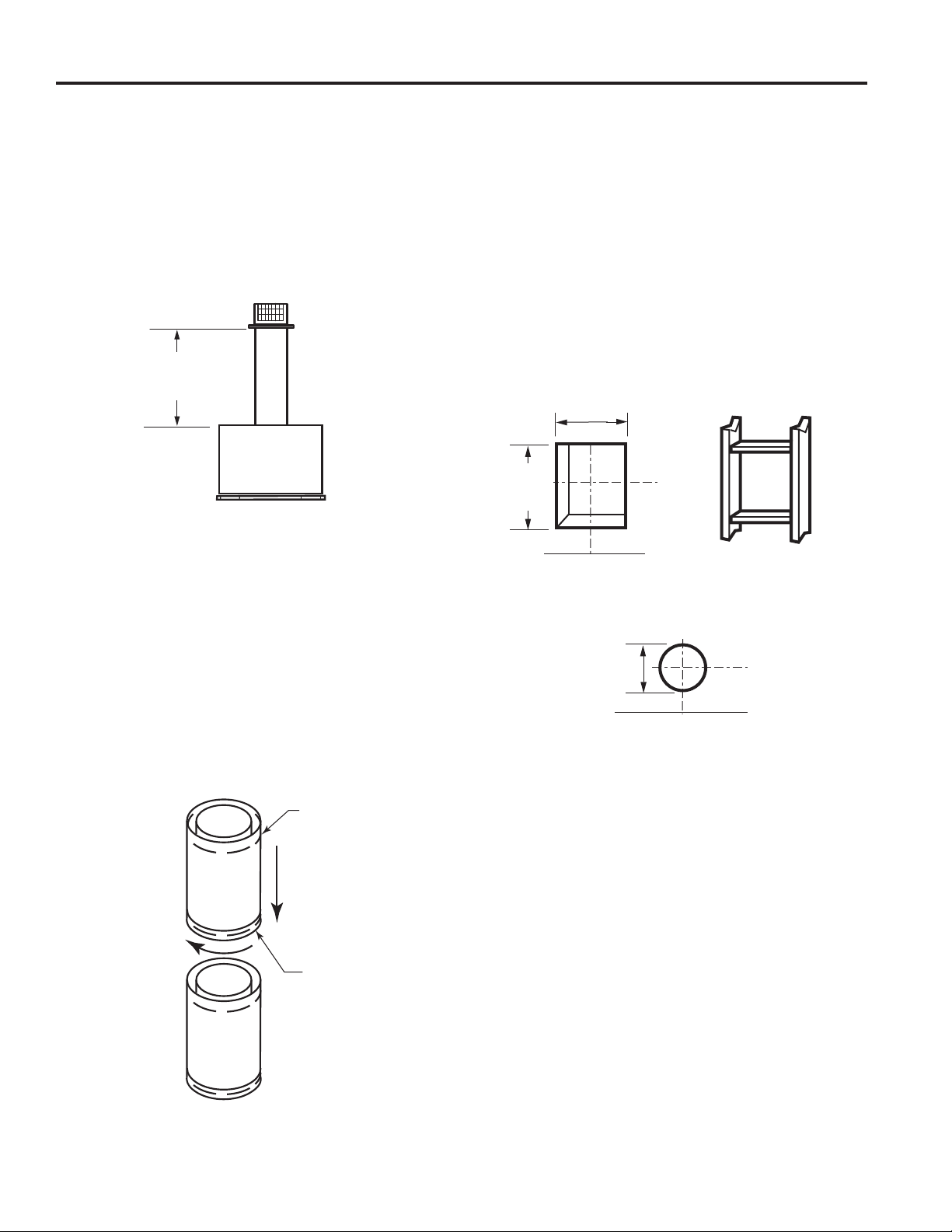
20
20302381
Designer Series Direct Vent Gas Fireplace
When installed as a rear vent unit, this appliance may be
vented directly to a termination located on the rear wall
behind the appliance. Only an Vermont Castings Group
brand termination is allowed for this application.
• The maximum horizontal distance between the rear
of the appliance and the termination is 20" (508 mm).
Figure 19
Figure 19 -
Rear Vent Application Maximum
Horizontal Distance
Maximum
20"
(508 mm)
Top View Flat
Installation
• Only one 45 degree elbow is allowed in these installa-
tions.
1. Rigid vent pipes and ttings have special twist-lock
connections. Assemble the desired combination of pipe
and elbows to the appliance adapter.
The female ends of the pipes
and ttings have three (3) locking lugs (indentations).
These lugs will slide straight into matching slots on
the male end of adjacent pipes and ttings. Push the
pipe sections together and twist one section clockwise
approximately one-quarter turn until the sections are
fully locked. Figure 20
Female Locking
Lugs
Male Slots
Horizontal runs of
vent must be supported
every three feet (914
mm). Use wall straps for
this purpose.
Figure 20 -
Rigid Vent Pipe Con-
nections
2. Refer to venting and termination instructions for further
instructions.
3. Locate and cut the vent opening in the wall. For com-
bustible walls rst frame in opening.
Cut a 12
1
/2" x 10
1
/2" hole
through the interior wall.
Cut a 10
1
/2" x 10
1
/2"
square hole through the exterior wall frame. Figure 21
Hole opening should be 8
1
/2"
(216 mm) in diameter.
4. The center of the hole should align with the center line
of the horizontal rigid vent pipe end. Allow 1/4" minimum
rise per foot. Figure 21
10Z\x”
(267 mm)
Min.
Fireplace Hearth
Framing Detail
8Z\x”
(216 mm)
Fireplace Hearth
FP2293
Figure 21 -
Locate vent opening on wall
10Z\x”
(267 mm) Min.
5. Apply a bead of non-hardening mastic around the
outside edge of vent cap. Position the vent cap in the
center of hole on the exterior wall with the word "UP"
on the vent cap facing up. Insure proper clearance of
1" to combustibles is maintained. Attach the vent cap
with four (4) wood screws supplied. Figure 22
For vinyl siding, stucco or wood exterior, use vinyl
siding standoffs between vent cap and exterior wall for
Duravent or Selkirk Terminations only. The vinyl siding
standoff prevents excessive heat from melting the
vinyl siding material. Vermont Castings Group
Termination does not require standoff. Bolt the vent
cap to the standoff or wall. Apply non-hardening mastic
around outside edge of the standoff instead of the vent
cap assembly. Use wood screws provided to attach the
standoff. Figure 23
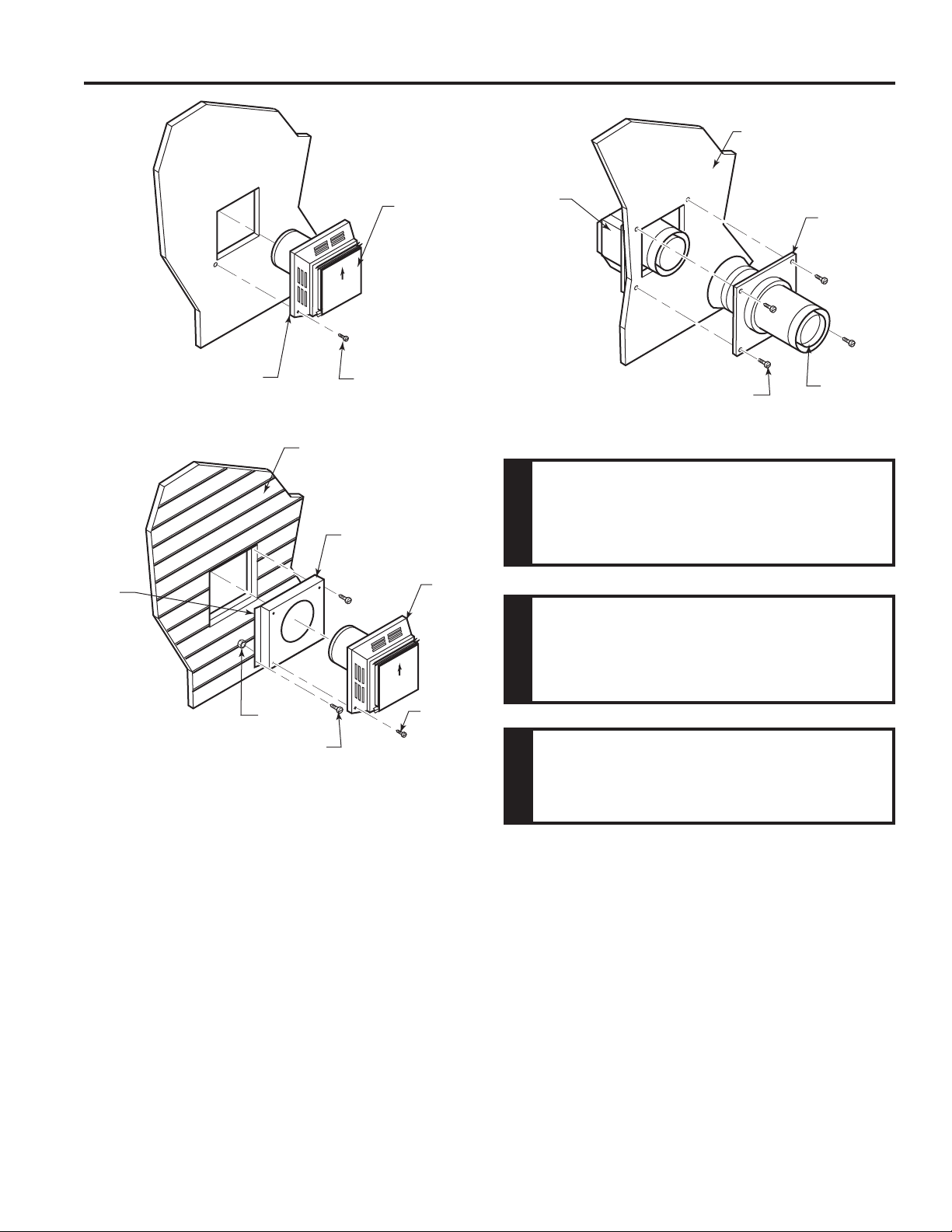
20302381
21
Designer Series Direct Vent Gas Fireplace
6. Slide the stop over the vent pipe before connecting the
horizontal run to the vent cap. Figure 24
7. Carefully move the fireplace with vent assembly
attached toward the wall and insert the vent pipe into
the horizontal termination. The pipe overlap should
be a minimum of 1
1
/4". Apply silicone to the outer pipe
connection. Fasten all vent connections with screws
provided.
8. Slide the wall thimble against the interior wall surface
and attach with screws. Figure 24
HOT
Vent Cap
Wood Screw
Apply Mastic to all
Four Sides
Figure 22 -
Install Horizontal Termination
HOT
Cut Vinyl Siding Away
to Fit Standoff
Standoff #1250 or
5DT-VS
(Not required for
Vermont Castings
Group termination)
Termination
Bolt
Wood Screw
Nut
Apply Mastic
to all Four
Sides
Figure 23 -
Install Duravent/Selkirk Vinyl Siding Standoff and
Termination
FP1956
Inerior Wall
Surface
Firestop
Horizontal
Vent Pipe
Screw
Vent Cap
(Horizontal
Termination)
Figure 24 -
Install Firestop on Horizontal Vent Pipe
FP1957
No other manu-
facturer's termination is permitted in this
application.
22
20302381
Designer Series Direct Vent Gas Fireplace
The Vent Graph, showing the relationship between vertical
and horizontal side wall venting, will help to determine the
various dimensions allowable. Figure 18
Minimum clearance between vent pipes and combustible
materials is 3" on top and 1" from bottom and sides unless
otherwise noted (Exception: Outside wall with restop: 1"
all around pipes are allowed). If the vertical run is 7.5 feet
or more, from the oor of the replace, the clearance is 1"
on all sides of the horizontal run.
When vent termination exits through foundations less than
20" below siding outcrop, the vent pipe must be ush with
the siding.
It is best to locate the replace in such a way that minimizes
the number of offsets and horizontal vent length.
The horizontal vent run refers to the total length of vent
pipe from the ue collar of the replace (or the top of the
Transition Elbow) to the face of the nished outside wall
or the mounting ange of the termination.
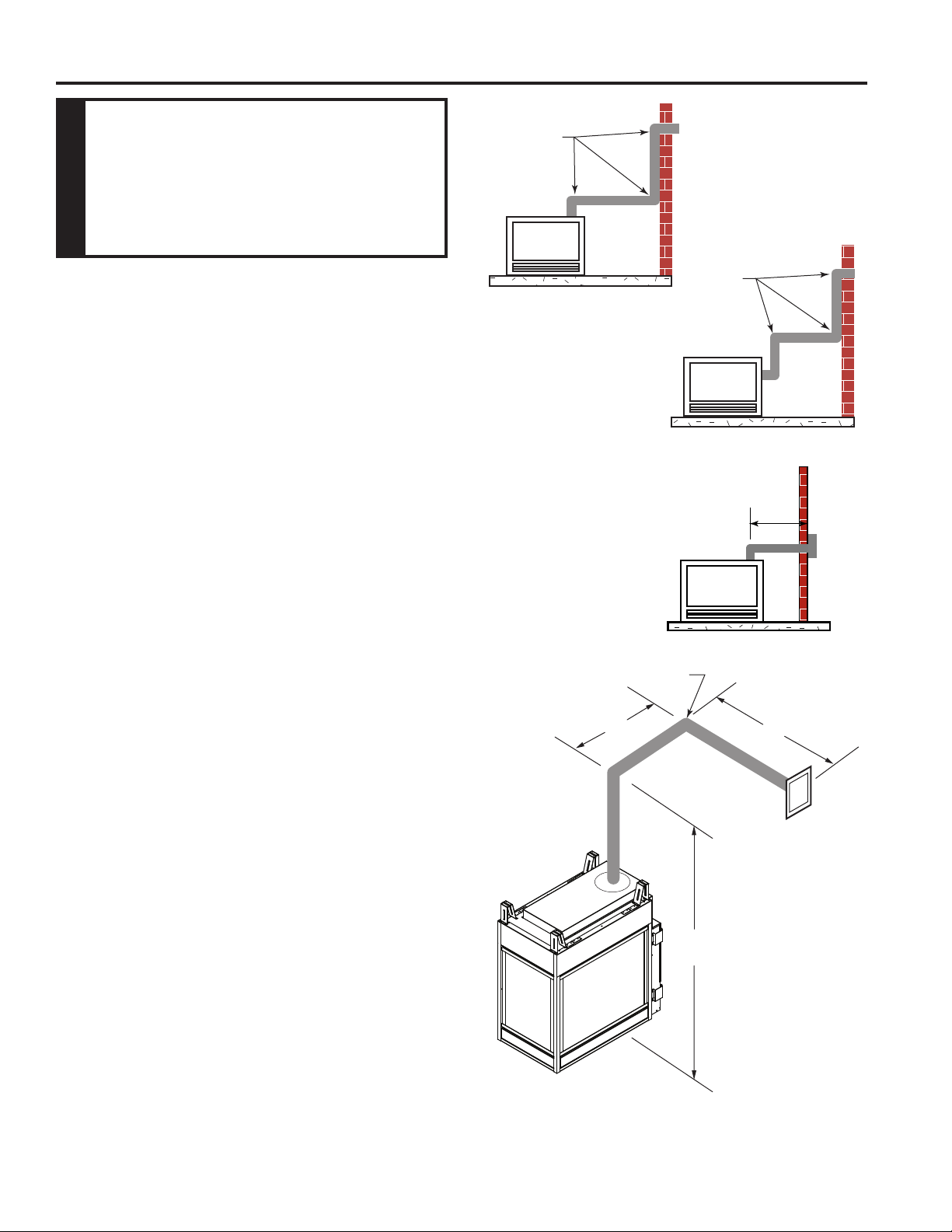
• The maximum number of 90° elbows per side wall
installation is three (3). Figure 25
• If a 90° elbow is tted directly on the top of the replace,
the maximum horizontal vent run before the termination
or a vertical rise is 36” (914 mm). Figure 26
• If a 90° elbow is used in the horizontal vent run (level
height maintained) the horizontal vent length is reduced
by 36". Figure 23. This does not apply if the 90° elbows
are used to increase or redirect a vertical rise. Figure
27
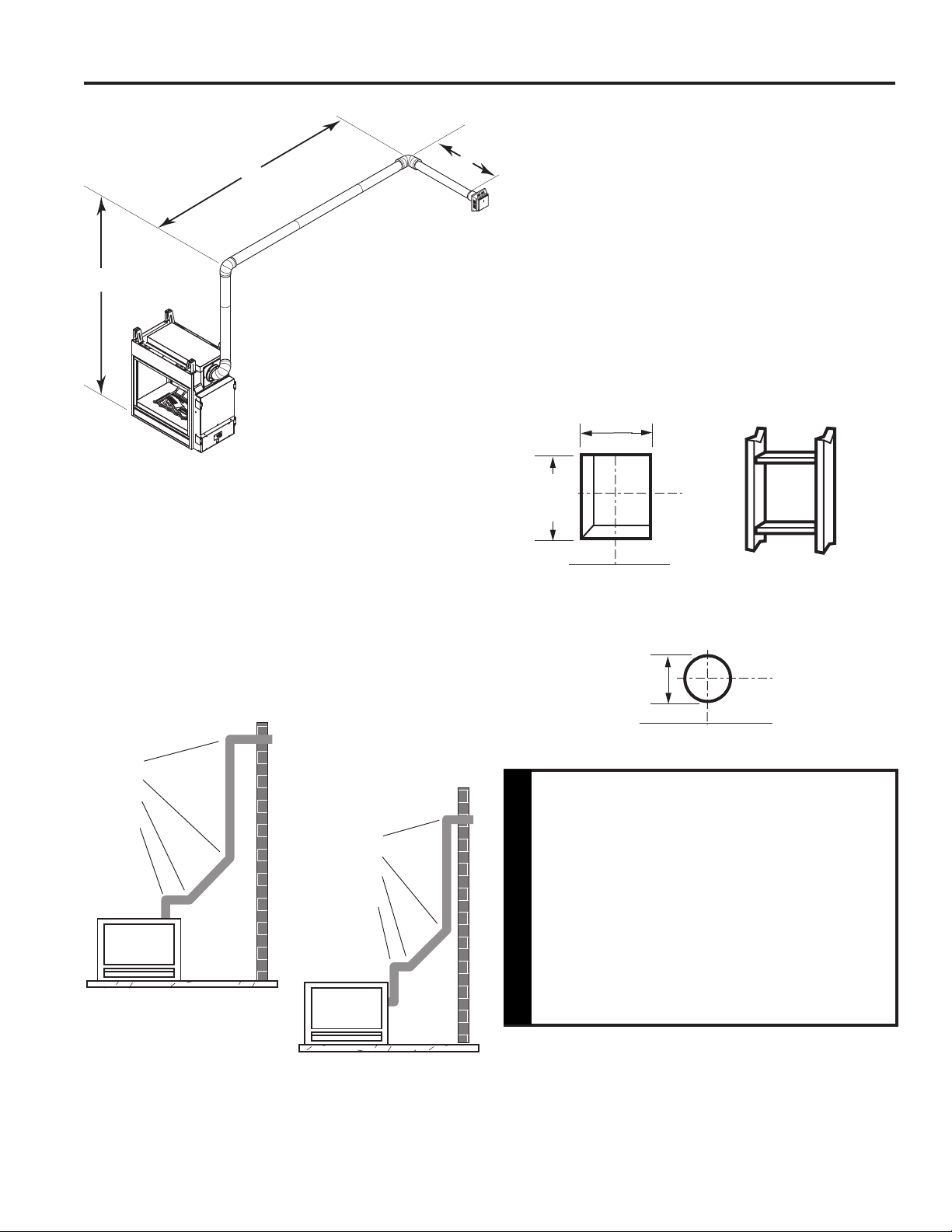
According to the vent graph (Page 19) the
maximum horizontal vent length in a system with a 7.5'
vertical rise is 20’ (6 m) and if a 90° elbow is required in the
horizontal vent it must be reduced to 17' (5.2 m).
In Figures 27 and 28 dimension A plus B must not be
greater than 17' (5.2 m).
Figure 25 -
Maximum Three (3) 90°
Elbows Per Installation
3 x 90°
Elbows
3 x 90°
Elbows
FP1176
36"
(914 mm)
Max.
Figure 26 -
Maximum Horizontal Run
with No Rise
FP1177
7’6”
A
B
90°
FP2837
Figure 27 -
Horizontal Run Reduction
20302381
23
Designer Series Direct Vent Gas Fireplace
• The maximum number of 45° elbows permitted per side
wall installation is two (2). These elbows can be installed
in either the vertical or horizontal run.
• For each 45° elbow installed in the horizontal run, the
length of the horizontal run MUST be reduced by 18"
(457 mm). This does not apply if the 45° elbows are
installed on the vertical part of the vent system.
• The maximum number of elbow degrees in a system is
270°. Figure 24
Figure 28 -
Maximum Vent Run with Elbows
FP2838
A + B = 17' Maximum
Horizontal 90° Elbow =
3' Reduction
7'6"
10'
7'
1
2
3
4
1
2
3
4
Figure 29 -
Maximum Elbow Usage
1 + 2 + 3 + 4 = 270°
FP2307
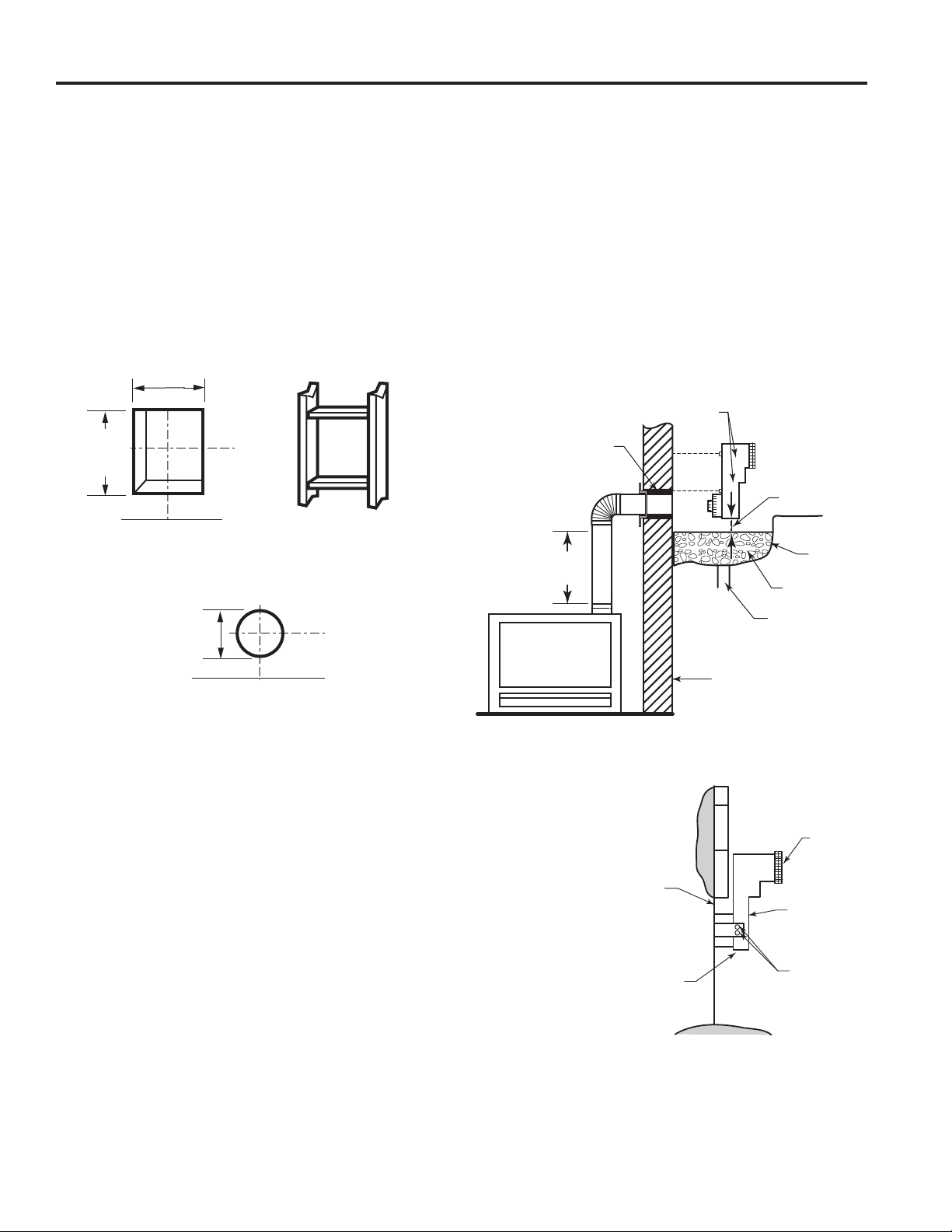
Cut a 12Z\x"H x 10Z\x" W
hole through the interior wall.
Cut a 10Z\x"H x 10Z\x"W
square hole through the exterior wall frame. Figure 25
Hole opening should be 8Z\x"
(216 mm) in diameter.
2. The center of the hole should line up with the center line
of the horizontal rigid vent pipe end. Allow 1/4" minimum
rise per foot. Figure 30
B\,
B\,
B\,
10Z\x”
(267 mm)
Min.
Fireplace Hearth
Framing Detail
8Z\x”
(216 mm)
Fireplace Hearth
FP2293
Figure 30 -
Locate vent opening on wall
10Z\x”
(267 mm) Min.
24
20302381
Designer Series Direct Vent Gas Fireplace
1. Locate and cut the vent opening in the wall. For com-
bustible walls rst frame in opening.
Cut a 11Z\x"H x 9Z\x" W
hole through the interior wall.
Cut a 9Z\x"H x 9Z\x"W
square hole through the exterior wall frame. Figure 31
Hole opening should be 7Z\x"
(190 mm) in diameter.
2. The center of the hole should line up with the center line
of the horizontal rigid vent pipe end. Allow 1/4" minimum
rise per foot. Figure 31
9Z\x”
(241 mm)
Min.
Fireplace Hearth
Framing Detail
7Z\x”
(190 mm)
Fireplace Hearth
FP2293
Figure 31 -
Locate vent opening on wall
9Z\x”
(241 mm) Min.
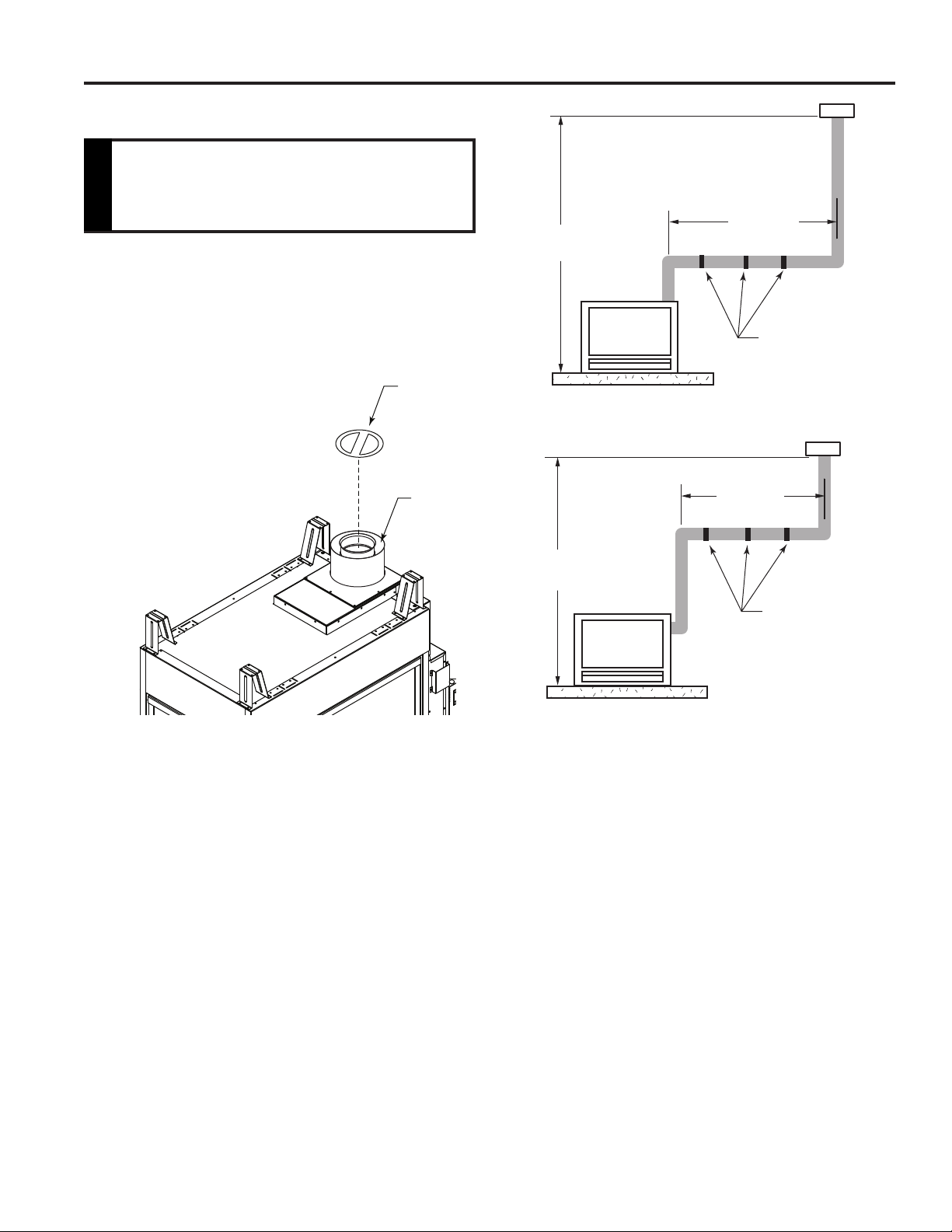
When it is not possible to meet the required vent terminal
clearances of 12" above grade level, a snorkel kit is recom-
mended. It allows installation depth down to 7" (178 mm)
below grade level. The 7" (178 mm) is measured from the
center of the horizontal vent pipe as it penetrates through
the wall.
If installing a snorkel, a minimum 24" vertical rise is nec-
essary. The maximum horizontal run with the 24” vertical
pipe is 36". This measurement is taken from the collar of
the replace (or transition elbow) to the face of the exterior
wall. Refer to the Sidewall Venting Graph for extended
horizontal run if the vertical exceeds 24".
1. Establish vent hole through the wall.
2.
Remove soil to a depth of approximately 16" below base
of snorkel. Install drain pipe. Install window well (not
supplied). Rell hole with 12" of coarse gravel leaving a
clearance of approximately 4" below snorkel. Figure 32
3. Install vent system.
4. Ensure a watertight seal is made around the vent pipe
coming through the wall.
5. Apply high temperature sealant caulking (supplied)
around the 5" and 8" snorkel collars.
6. Slide the snorkel into the vent pipes and secure to the
wall.
7. Level the soil so as to maintain a 4" clearance below
snorkel. Figure 32
Figure 32 -
Below Grade Installation
Screws
Minimum
4" Clearance
Ground
Window
Well
Gravel
Drain
Foundation Wall
Firestop
24"
Minimum
FP1965
If the foundation
is recessed, use
recess brackets
(not supplied) for
securing lower por-
tion of the snorkel.
Fasten brackets
to wall first, then
secure to snorkel
with self drilling #8
x 1/2 sheet metal
screws. It will be
necessary to extend
vent pipes out as
far as the protrud-
ing wall face. Figure
33
Figure 33 -
Snorkel Installation,
Recessed Foundation
Foundation
Recess
Watertight Seal
Around Pipe
Sheet
Metal
Screws
Wall
Screws
Snorkel
FP1966
20302381
25
Designer Series Direct Vent Gas Fireplace
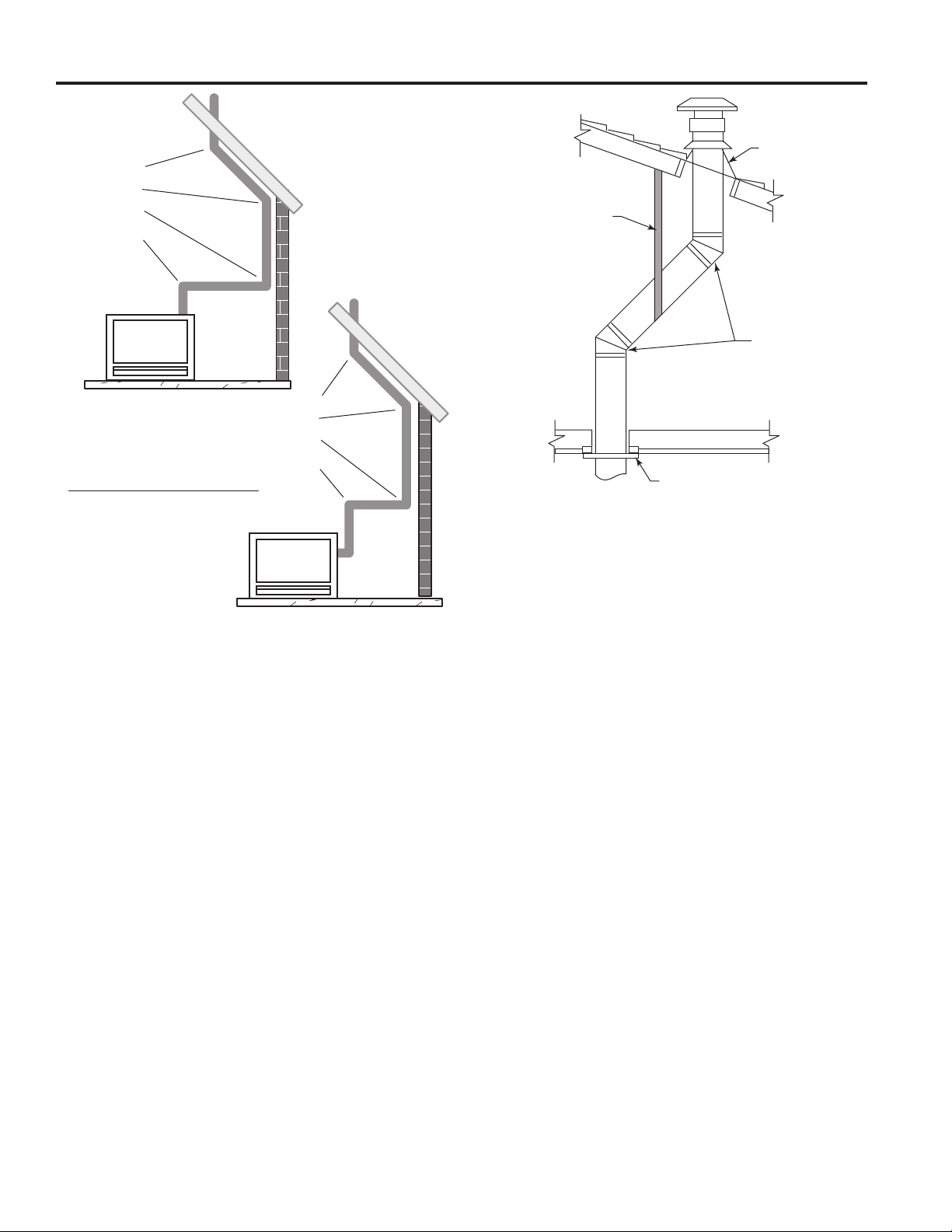
Install restrictor disc as shown in Figure 34 for vertically
vented applications.
Up to two (2) restrictor discs may be needed for 40' instal-
lation.
The two (2) restrictor discs suppled will work for most instal-
lations. If a third disc is needed order Part No. 56D3027.
You may use a reducer to 4" x 6B\," or
4" x 7" in vertically vented applica-
tions. If a reducer is used, only one
restrictor may be used.
Restrictor
Disc
Fireplace
Collar
FP2839
Figure 34 -
Install Restrictor Disc
into Fireplace Collar
This gas replace has been approved for,
• Vertical installations up to 40' (12 m) in height. Up to
a 10' (3 m) horizontal vent run can be installed within
the vent system using a maximum of two 90° elbows.
Figure 35
Horizontal sections of this vent system require a
minimum of 3" clearances to combustibles at the top of
the ue and 1" clearance at the sides and bottom until the
ue penetrates the outside wall. A minimum 1" clearance
all around the ue is acceptable at this point of penetration.
Unless the vertical run is 7Z\x feet or higher form oor of
replace, the clearance for the horizontal run is 1" on all
sides.
Vertical sections of this vent system require a minimum of
1" clearance to combustibles on all sides of the pipe.
• Up to two 45° elbows may be used within the horizontal
run. For each 45° elbow used on the horizontal plane,
the maximum horizontal length must be reduced by 18"
(457 mm).
Figure 35 -
Support Straps for Horizontal Runs
40' Maximum Height
8' Minimum Height
40' Maximum Height
8' Minimum Height
10'
Maximum
10'
Maximum
Support Straps
Every 3'
Support Straps
Every 3'
FP2308
Example: Maximum horizontal length
No elbows = 10’ (3 m)
1x45° elbows = 8.5’ (2.6 m)
2x45° elbows = 7’ (2.1 m)
• A minimum of an 8' (2.5 m) vertical rise is required.
• Two sets of 45°elbows offsets may be used within the
vertical sections. From 0 to a maximum of 8' (2.5 m)
of vent pipe can be used between elbows. Figure 27
• The maximum angular variation allowed in the system
is 270°. Figure 27
• For the minimum height of the vent above the highest
point of penetration through the roof refer to Page 27,
Figure 40.
26
20302381
Designer Series Direct Vent Gas Fireplace
1
2
3
4
1
2
3
4
Figure 36 -
Maximum Elbow Usage
Example: Elbow 1 = 90°
Elbow 2 = 45°
Elbow 3 = 45°
Elbow 4 = 90°
Total Angular Variation = 270°
1. Determine the route your vertical venting will take. If
ceiling joist, roof rafters or other framing will obstruct
the venting system, consider an offset. Refer to Figure
32 to avoid cutting load bearing members.
Pay special attention to these installation instructions
for required clearances (air space) to combustibles when
passing through ceilings, walls, roofs, enclosures, attic
rafters, etc. Do not pack air spaces with insulation. Also
note maximum vertical rise of the venting system and any
maximum horizontal offset limitations. Offsets must fall
within the parameters shown on Page 19, Figure 18.
2. Set replace in desired location. Drop a plumb line down
from the ceiling to the position of the ue exit. Mark the
center point where the vent will penetrate the ceiling.
Drill a small locating hole at this point.
Drop a plumb line from the inside of the roof to the locat-
ing hole in the ceiling. Mark the center point where the
vent will penetrate the roof. Drill a small locating hole
at this point.
Figure 37 -
Offset with Wall Strap and 45° Elbows
Roof
Flashing
Wall Strap
45° Elbows
Ceiling Firstop
FP1669
1. Cut a 10Z\x" (267 mm) square hole in the ceiling using
the locating hole as a center point The opening should
be framed to 10Z\x" x 10Z\x" (267 x 267 mm) inside
dimensions as shown in Figure 39 using framing lumber
the same size as the ceiling joist. If the area above the
ceiling is an insulated ceiling or a room, nail restop
from the top side. This prevents loose insulation from
falling into the required clearance space. Figure 39.
Otherwise, install restop below the framed hole. The
restop should be installed with no less than three (3)
nails per side. Figure 38 or 39.
2. Assemble the desired lengths of pipe and elbows nec-
essary to reach from the burner system ue up through
the restop. Be sure pipe and elbow connections are
fully twist-locked. Page 20, Figure 20.
3. Cut a hole in the roof using the locating hole as a center
point. (Cover any exposed open vent pipes before cut-
ting hole in roof). The 10Z\x" x 10Z\x" (267 x 267 mm)
hole must be measured on the horizontal. Actual length
may be larger depending on the pitch of the roof. There
must be a 1" minimum clearance from the vent pipe to
combustible materials. (Insulation should be considered
a combustible material). Frame the opening as shown
on Page 20, Figure 21.
4. Connect a section of pipe and extend up through the
hole.
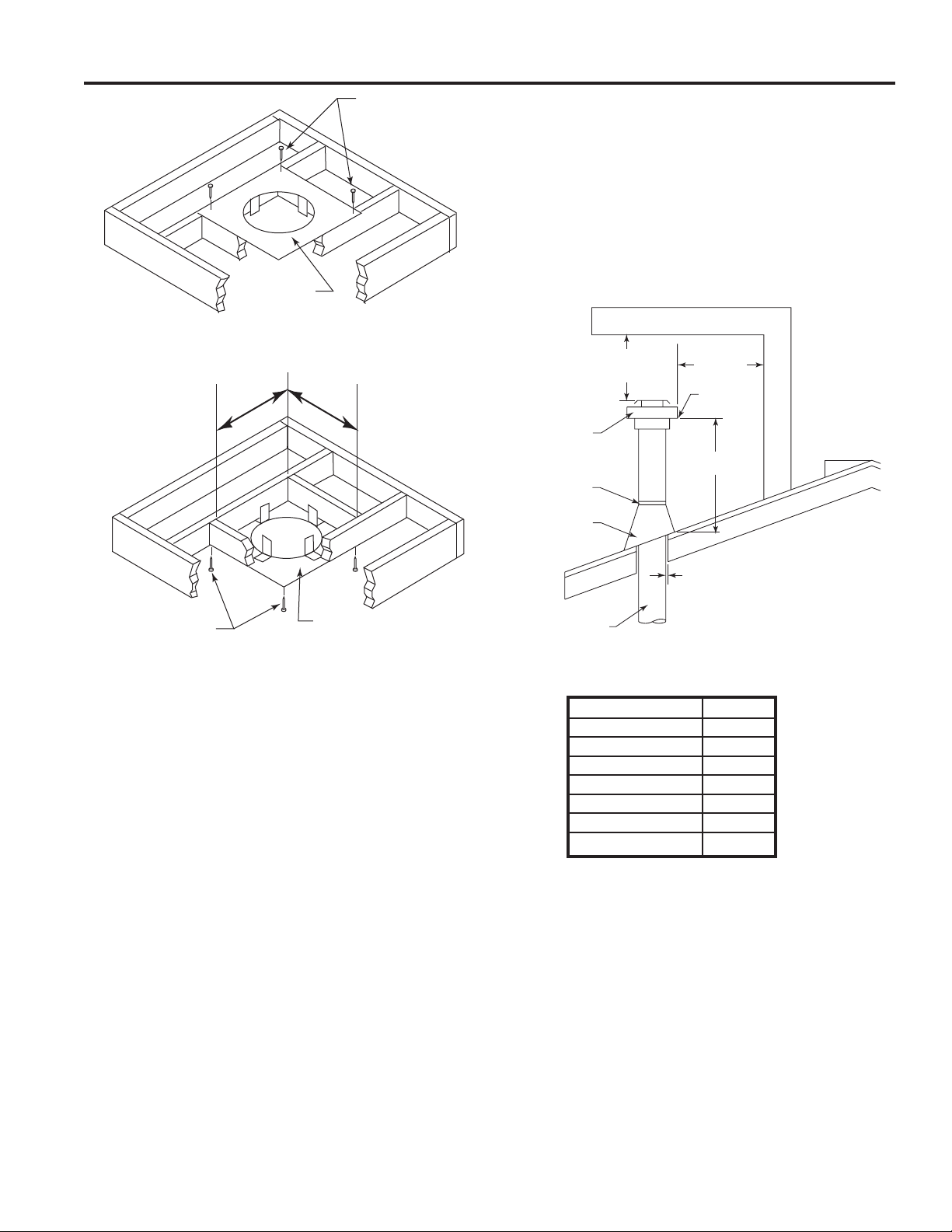
20302381
27
Designer Series Direct Vent Gas Fireplace
Figure 38 -
If Area Above is a Room, Install Firestop above
Framed Hole as Shown
Firestop
Nails
10
1
/
2
"
10
1
/
2
"
Figure 39 -
If Area Above is Not a Room, Install Firestop above
Framed Hole as Shown
Nails
Firestop
FP1970
2 ft.
Min.
2 ft. Min.
X
12
H*
Horizontal Overhang
Termination
Vent
Lowest
Discharge
Opening
Storm Collar
Flashing
Concentric
Vent Pipe
1" Minimum
Clearances to
Combustibles
Vertical Wall
FP1971
Figure 40 -
Minimum Chimney Clearance
Flat to 6/12 1.0
Over 6/12 to 7/12 1.25
Over 7/12 to 8/12 1.5
Over 8/12 to 9/12 2.0
Over 9/12 to 10/12 2.5
Over 10/12 to 11/12 3.25
Over 11/12 to 12/12 4.0
*H - Minimum height from roof to
lowest discharge opening of vent
If an offset is needed to avoid obstructions, you
must support the vent pipe every three (3) feet. Use wall
straps for this purpose. Refer to Page 26, Figure 37.
Whenever possible, use 45° elbows instead of 90° elbows.
The 45° elbow offers less restriction to the ow of the ue
gases and intake air.
5. Place the ashing over the pipe section(s) extending
through the roof. Secure the base of the ashing to
the roof and framing with roong nails. Be sure roong
material overlaps the top edge of the ashing. There
must be a 1" clearance from the vent pipe to combus-
tible materials.
6. Continue to add pipe sections until the height of the
vent cap meets the minimum requirements below.
You must increase vent height for steep roof
pitches. Nearby trees, adjoining roof lines, steep pitched
roofs, and other similar factors may cause poor draft or
down-drafting in high winds. Increasing the vent height
may solve this problem.
If the vent pipe passes through any occupied areas
above the rst oor, including storage spaces and closets,
you must enclose pipe. You may frame and sheetrock the
enclosure with standard construction material. Make sure
to meet the minimum allowable clearances to combustibles.
Do not ll any of the required clearance spaces with
insulation.
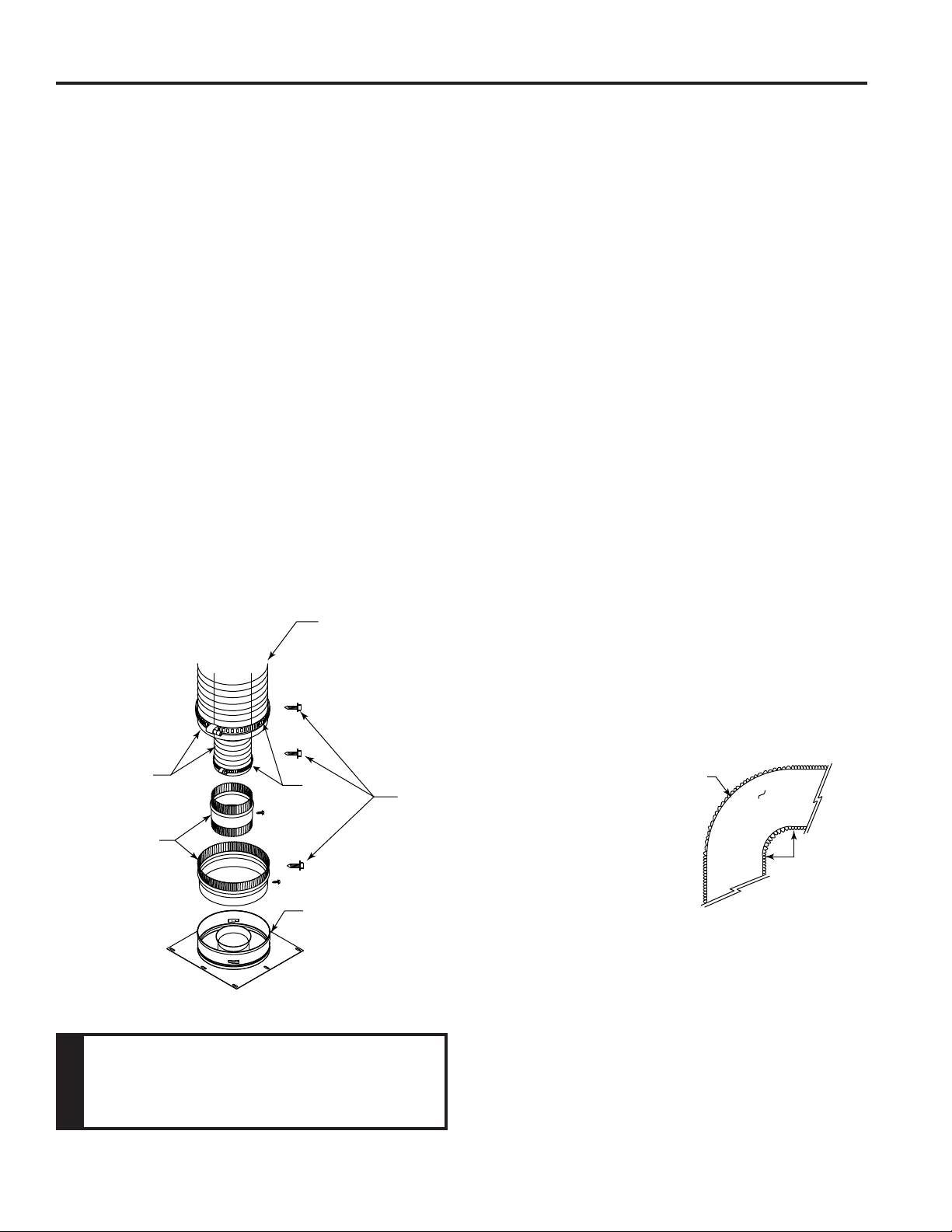
28
20302381
Designer Series Direct Vent Gas Fireplace
1. Flexible UL1777 listed venting may be used in any
venting application where rigid direct vent components
can be used.
Flex kits may not be modied. Flex
kits may be added to the end of a vent run made of rigid
vent sections using pipe manufacturer's approved ex
to pipe adapters. This may occur only if doing so does
not violate any of the venting length, height, routing,
horizontal to vertical ratio requirements or clearance
considerations detailed in this manual.
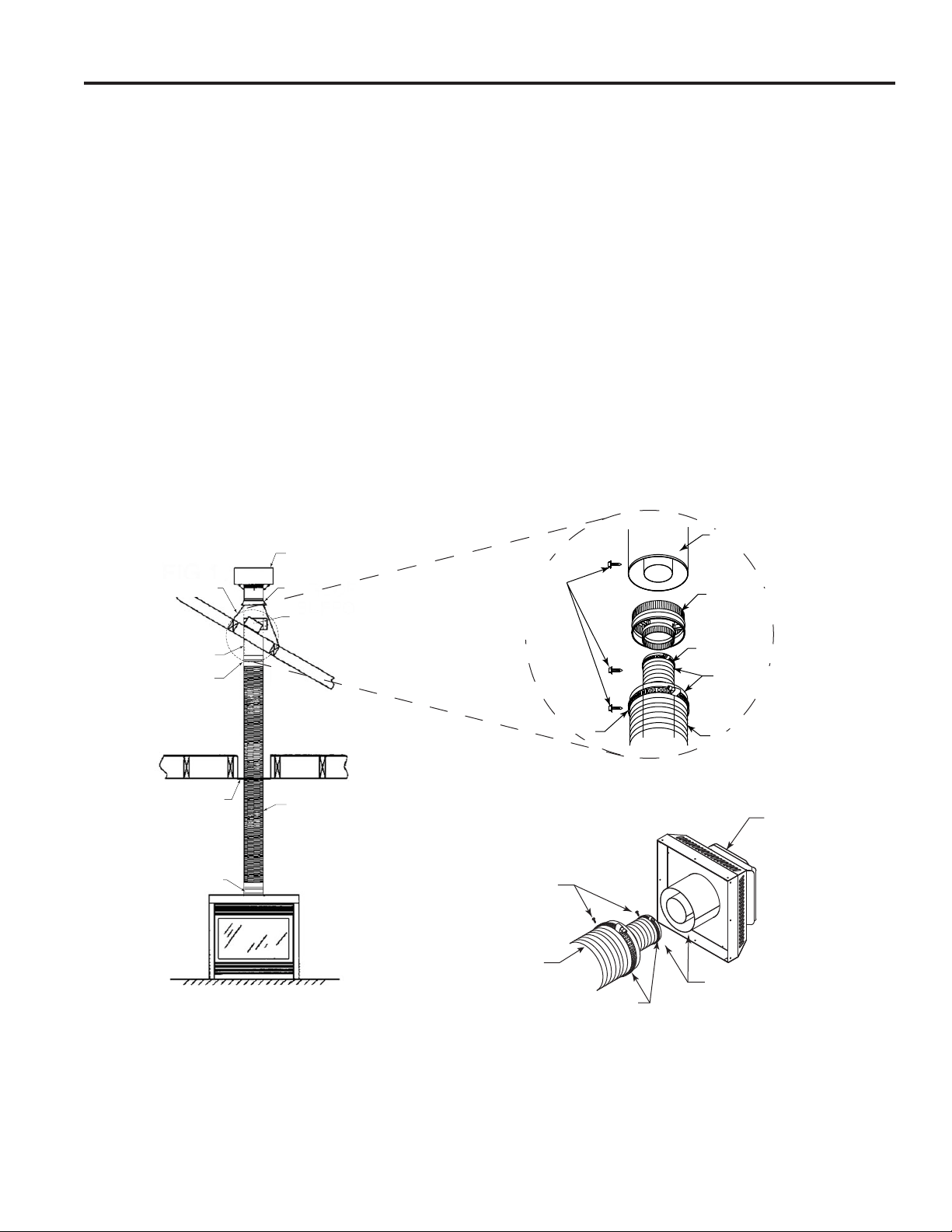
2. The ex adapter starter kit (DVFF8A/8) is used to attach
ex venting to the appliance starting collar. It includes
5" inner and 8" outer adapter rings. Figure 41
• The inner and outer adapter rings are required to
start all ex runs.
• Never install damaged or torn exible venting.
• Over tightening clamps may rip, tear, or otherwise
damage exible venting.
• The adapter kit does not include individual pipe sec-
tions which may be purchased separately. (UL1777
listed type venting only.)
3. Start the exible vent as follows:
A. Installing the inner ex adapter and pipe. Figure
41
UL1777
Flex Vent
Screws
(3 places,
equidistant just
above gear
clamp)
1C\v" Flex-
ible Pipe
and Adapter
Outer
DVFF8A/8
Inner Adapter
Outer Adapter
Appliance
Starting Collar
Figure 41 -
Typical 5" x 8" Appliance Connection
1. Insert the long side of the 5" inner ring into exhaust
pipe, gently tap to seat into place, and secure with
screws.
2. Slide the small gear clamp over the inner exible
vent pipe, and push out of the way.
3. Pull and extend the inner exible vent.
4. Slide the inner vent onto the adapter collar, for a
minimum 1C\v" overlap.
5. Locate the clamp at approximately 3/4" from the ex
end and tighten.
6. Secure the clamped inner section with three self-
tapping screws, drilled equidistant, just above the
clamp perimeter.
B. Installing the outer ex pipe. Figure 41
1. Firmly insert the 8" outer adapter ring into the
outer appliance starting collar and secure with
screws.
2. Slide the large gear clamp over the outer exible
vent pipe, and push out of the way.
3. Pull and extend the outer exible vent.
4. Slide the outer vent onto the appliance collar outer
adapter for a minimum 1C\v" overlap.
5. Locate the clamp at approximately 3/4" from the
ex end and tighten.
6. Secure the clamped outer section with three self-
tapping screws, drilled equidistant, just above the
clamp perimeter.
C. Routing UL1777 ex pipe.
1. Always maintain the required clearance when
routing the ex vent assembly.
2. Install restop spacers, Figure 43, when penetrat-
ing ceiling, attic spaces, or walls.
3. Do not allow the exible vent to bend in radius
tighter than 5" (127 mm). Figure 42
4. Horizontal runs of exible vent shall be supported
at maximum 2
foot intervals;
vertical runs,
five feet inter-
v a l s . M e t a l
strapping, prop-
erly secured, is
an acceptable
means to sup-
port the exible
vent.
5. Flexible vent
spacers are to
be installed at intervals prescribed by the exible
vent manufacturer; and in such a way as to main-
tain concentric inner and outer vent spacing.
UL1777
Flex Vent
5° Radius
Figure 42 -
Minimum Radius for Flex
Vent Section
20302381
29
Designer Series Direct Vent Gas Fireplace
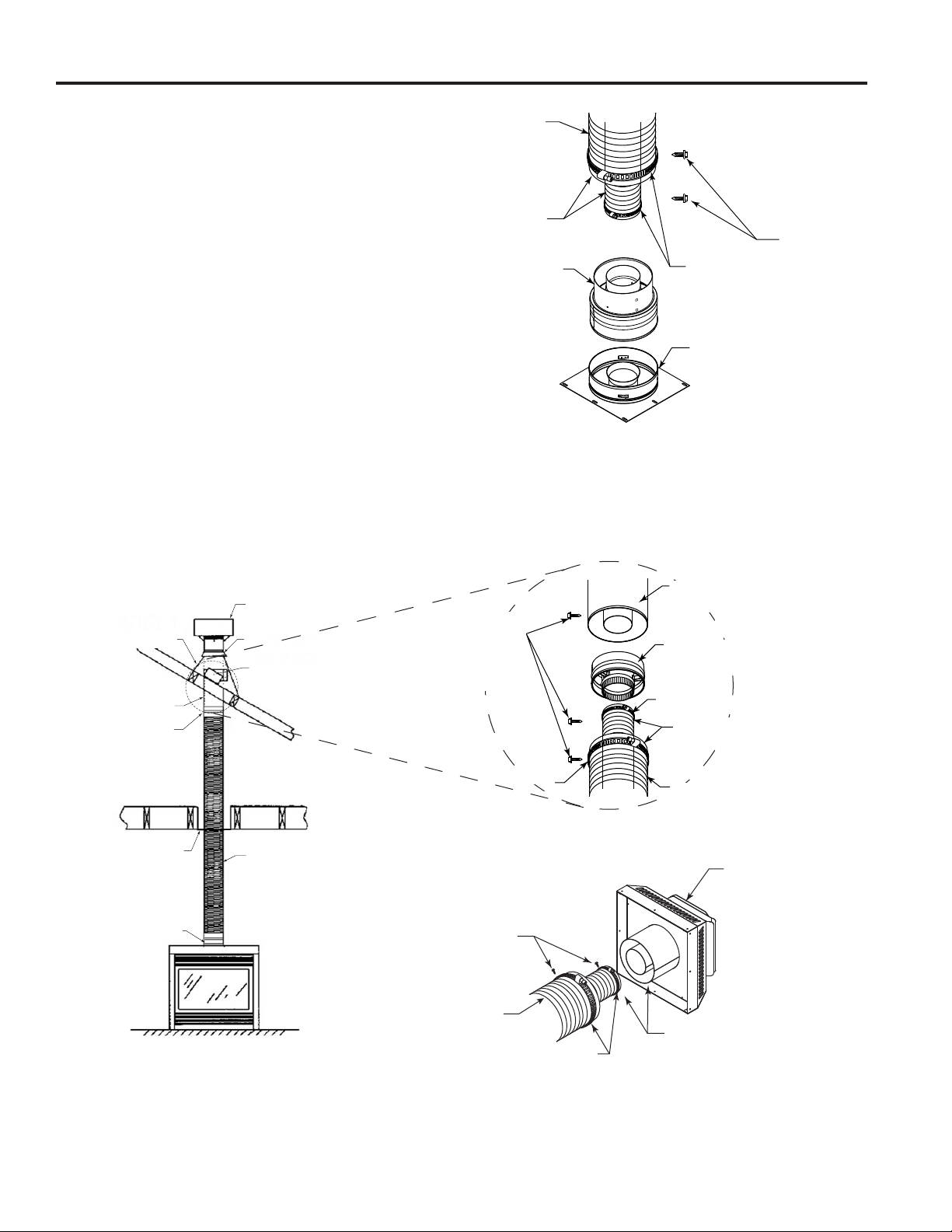
D. Attaching exible venting to vertical termination
assemblies.
1. When using Duravent pipe, an Vermont Cast-
ings Group ex-to-pipe adapter and/or rigid pipe
section(s) is required to connect the exible vent
assembly to the vertical termination by using
three self-penetrating screws.
2. Review Figure 44 and corresponding instruc-
tions for proper overlap, clamp and screw place-
ment.
3. Three each self-penetrating screws are drilled
opposite one another and below the gear
clamp.
4. Use only listed and approved terminations and
accessories, installed per the installation instruc-
tions and Figure 43.
E. Installing exible venting to horizontal termination
assemblies.
1. Connect the 5" exible vent to the horizontal
termination as in Figure 45.
2. Connect the 8" exible vent to the termination
ring as in Figure 45.
3. Review Figure 45 for proper overlap and clamp
placement.
4. Three each self-penetrating screws are drilled
opposite one another and below the gear lamp.
5. Use only listed an approved terminations and
accessories, installed per the termination instruc-
tions and Figure 45.
Termination
Cap
Storm Collar
Roof Support
Flashing
Rigid Pipe
Length
Flex to Pipe
Adapter
Firestop
UL1777 Flex
PIpe
Figure 43 -
Typical Vertical Flex Vent Installation
Screws
(3 Places
equidistant
just above
gear clamp)
Rigid Pipe Length
Flex to Pipe Adapter
Gear Clamp
1C\v" Flexible Pipe and Adapter
Outer Collar Overlap
UL1777 Flex Vent
Figure 44 -
Typical Pipe Connection
Gear
Clamp
Screws
(3 Places equidistant just
above gear clamp)
Gear Clamp
UL1777 Flex Vent
1C\v" Flexible Pipe and
Collar Overlap
Vermont Castings
Group Horizontal
Vent Termination
Figure 45 -
Typical Horizontal Flex Vent Installation
DVFF8A/8 5" x 8" to
5" x 8" Flex Adapter
FP1974
30
20302381
Designer Series Direct Vent Gas Fireplace
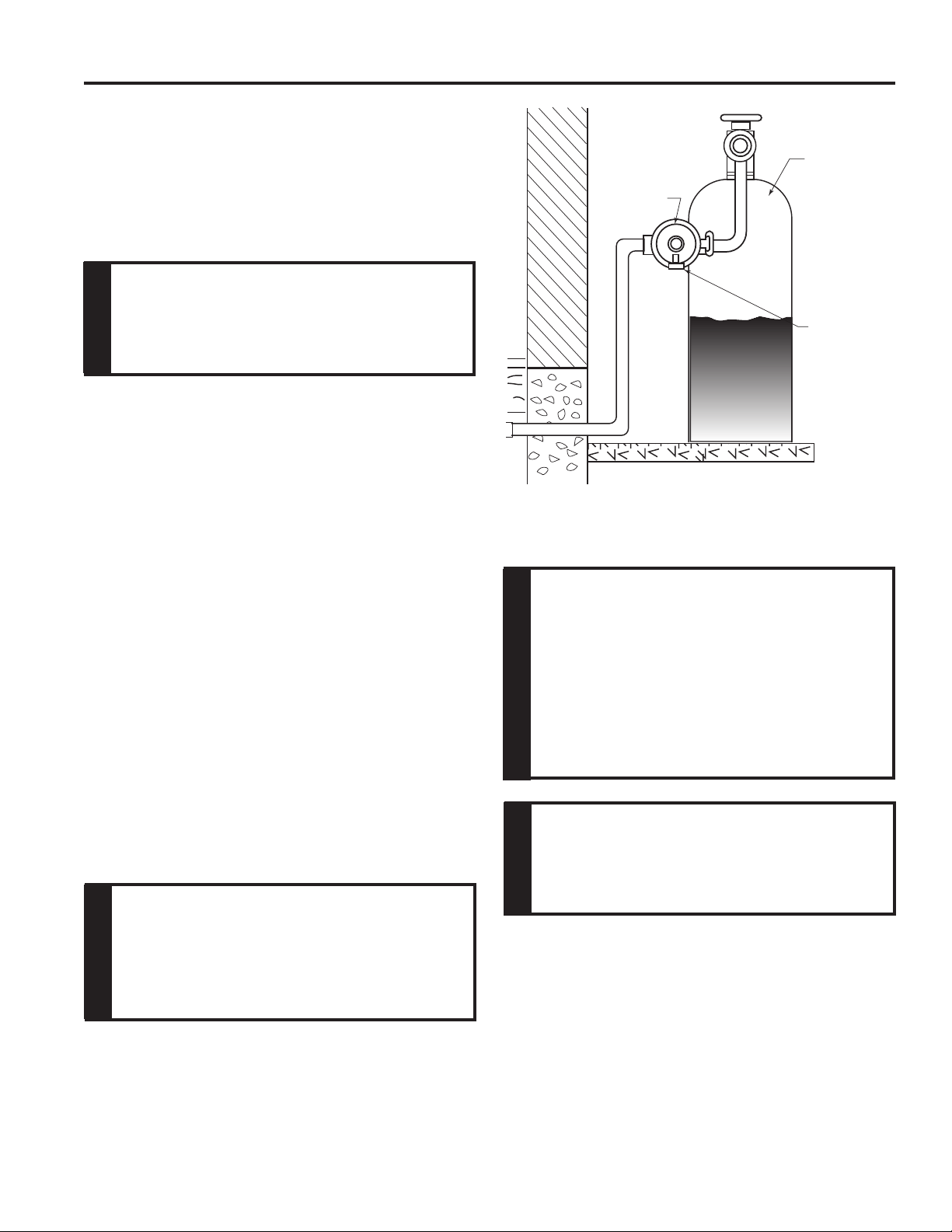
If you prefer to use 4" x 7" ex pipe, you must install model
7TDVP58 reducer (5" x 8" to 4" x 7") onto the replace
collar. Then follow the the assembly guidelines for 5" x 8"
ex venting.
Termination
Cap
Storm Collar
Roof Support
Flashing
Rigid Pipe
Length
Flex to Pipe
Adapter
(DVFFA/8)
Firestop
UL1777 Flex
PIpe
Figure 47 -
Typical Vertical Flex Vent Installation
Screws
(3 Places
equidistant
just above
gear clamp)
4" x 7"
Rigid Pipe Length
Flex to Pipe Adapter
(DVFFA/8)
Gear Clamp
1C\v" Flexible Pipe and Adapter
Outer Collar Overlap
UL1777 Flex Vent
Figure 48 -
Typical Pipe Connection
Gear
Clamp
Screws
(3 Places equidistant just
above gear clamp)
Gear Clamp
UL1777 Flex Vent
1C\v" Flexible Pipe and
Collar Overlap
Vermont Castings
Group Horizontal
Vent Termination
Figure 49 -
Typical Horizontal Flex Vent Installation
7TDVP58 5" x 8" to
4" x 7" Reducer
FP1974
UL1777
Flex Vent
Screws
(3 places,
equidistant just
above gear
clamp)
1C\v" Flex-
ible Pipe
and Adapter
Outer
Appliance
Starting Collar
Figure 46 -
Typical 4" x 7" Appliance
Connection
5" x 8" to 4" x 7"
Adapter (7TDVP58)
Gear
Clamp
FP1972a
20302381
31
Designer Series Direct Vent Gas Fireplace
Use proper gas type for the replace you are installing.
If you have conicting gas type, do not install replace.
See dealer where you purchased the replace for proper
replace according to your gas type.
When using copper or ex connectors use only ttings
approved for gas connections. The gas control inlet is
3/8" NPT.
Before installing replace and burner system, make sure
you have the items listed below.
• External regulator • Tee joint
• Piping (check local codes) • Pipe wrench
• Sealant (resistant to propane/LP gas)
(supplied by installer)
• Test gauge connection*
• Sediment trap (recommended)
• Equipment shutoff valve*
• approved exible gas line with gas connector (if
allowed by local codes — not provided)
* A CSA design-certied equipment shutoff valve with
1/8" NPT tap is an acceptable alternative to test gauge
connection. Purchase the CSA design-certied equip-
ment shutoff valve from your dealer.
For propane/LP connections only, the installer must supply
an external regulator. The external regulator will reduce
incoming gas pressure. You must reduce incoming gas
pressure to between 11 and 13 inches of water. If you do
not reduce incoming gas pressure, burner system regula-
tor damage could occur. Install external regulator with the
vent pointing down as shown in Figure 50. Pointing the
vent down protects it from freezing rain or sleet.
External
Regulator
100 gal. (min)
Propane/LP
Supply Tank
Vent Pointing
Down
Figure 50 -
External Regulator with Vent Pointing Down
(Propane/LP Only)
FP1977
32
20302381
Designer Series Direct Vent Gas Fireplace
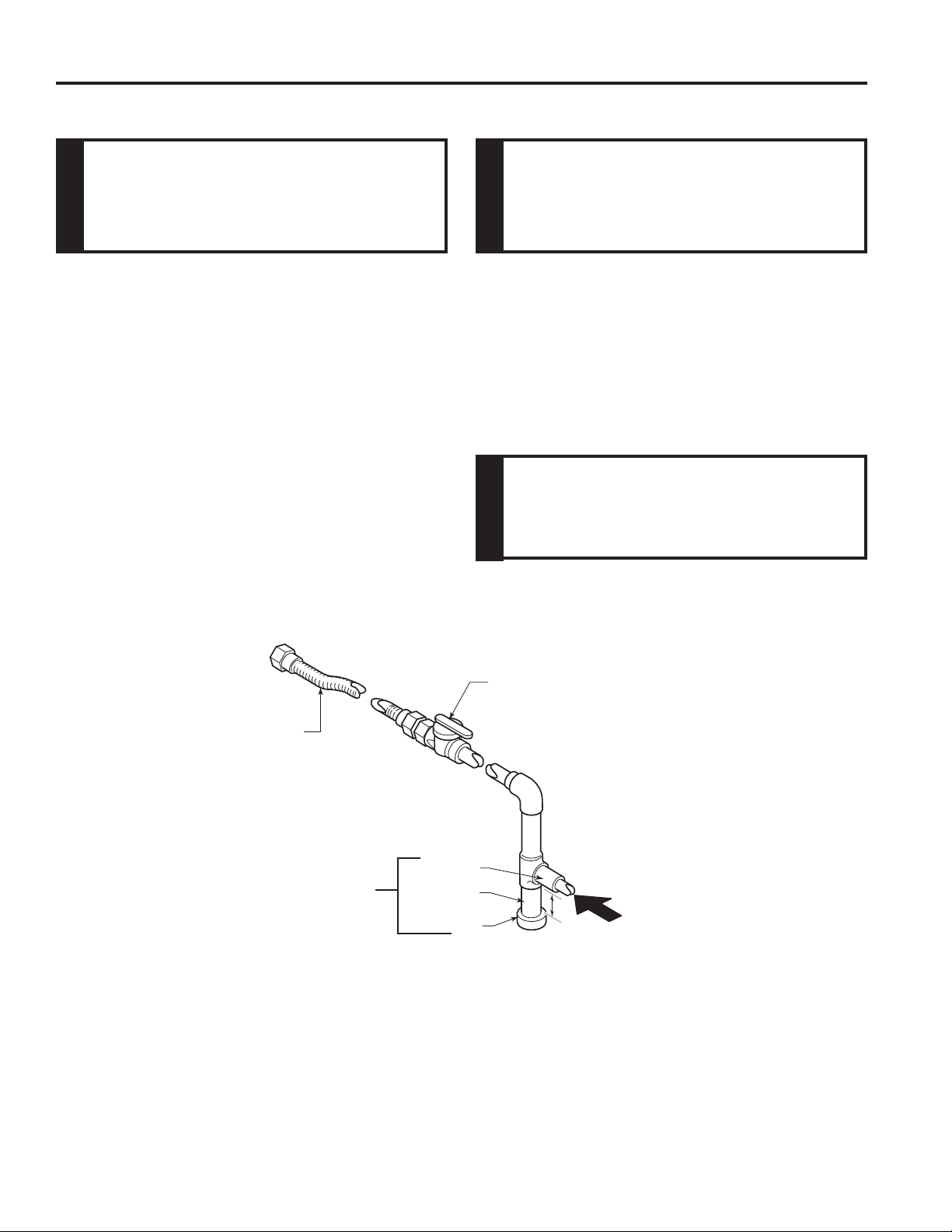
The gas line connection may be made using 1/2"
rigid tubing or an approved ex connector. Since some
municipalities have additional local codes it is always best
to consult your local authorities and the current edition of
the National Fuel Gas Code ANSI.Z223.1, NFPA54. In
Canada CSA-B149 (1 or 2) Installation Code.
A listed manual shutoff valve must be installed upstream of
the appliance. Union tee and plugged 1/8" NPT pressure
tapping point should be installed upstream of the appli-
ance. Figure 51
Install main gas valve (equipment shutoff
valve) in an accessible location. The main gas valve is for
turning on or shutting off the gas to the replace.
Check your building codes for any special requirements for
locating equipment shutoff valve to replaces.
Apply pipe joint sealant lightly to male threads. This will
prevent excess sealant from going into pipe. Excess seal-
ant in pipe could result in clogged burner system valves.
Figure 51
3" Minimum
Pipe Nipple
Cap
Figure 51 -
Gas Connection
Tee Joint
Approved Flexible
Gas Line
CSA Design-Certied Equipment Shutoff Valve
with 1/8" NPT Tap*
Sediment Trap/Drip Leg
From Gas Meter
(4.0" w.c. to 10.5" w.c. Pressure)
From External Regulator
(11" w.c. to 13" w.c. Pressure)
We recommend that you install a sediment trap/drip leg
in supply line as shown in Figure 51. Locate sediment
trap/drip leg where it is within reach for cleaning. Install
in piping system between fuel supply and burner system.
Locate sediment trap/drip leg where trapped matter is not
likely to freeze. A sediment trap traps moisture and contami-
nants. This keeps them from going into the burner system
gas controls. If sediment trap/drip leg is not installed or is
installed wrong, burner system may not run properly.
20302381
33
Designer Series Direct Vent Gas Fireplace
1. Check gas type. The gas supply must be the same as
stated on the appliance’s rating decal. If the gas supply
is different from the replace, Do not install the
appliance. Contact your dealer immediately.
2. To ease installation, a 24" (610 mm) ex line with manual
shut-off valve has been provided with on this appliance.
Install and attach 1/2" gas line onto shut-off valve.
3. After completing gas line connection, purge air from
gas line and test all gas joints from the gas meter to the
replace for leaks. Use a solution of 50/50 water and
soap solution or a gas sniffer.
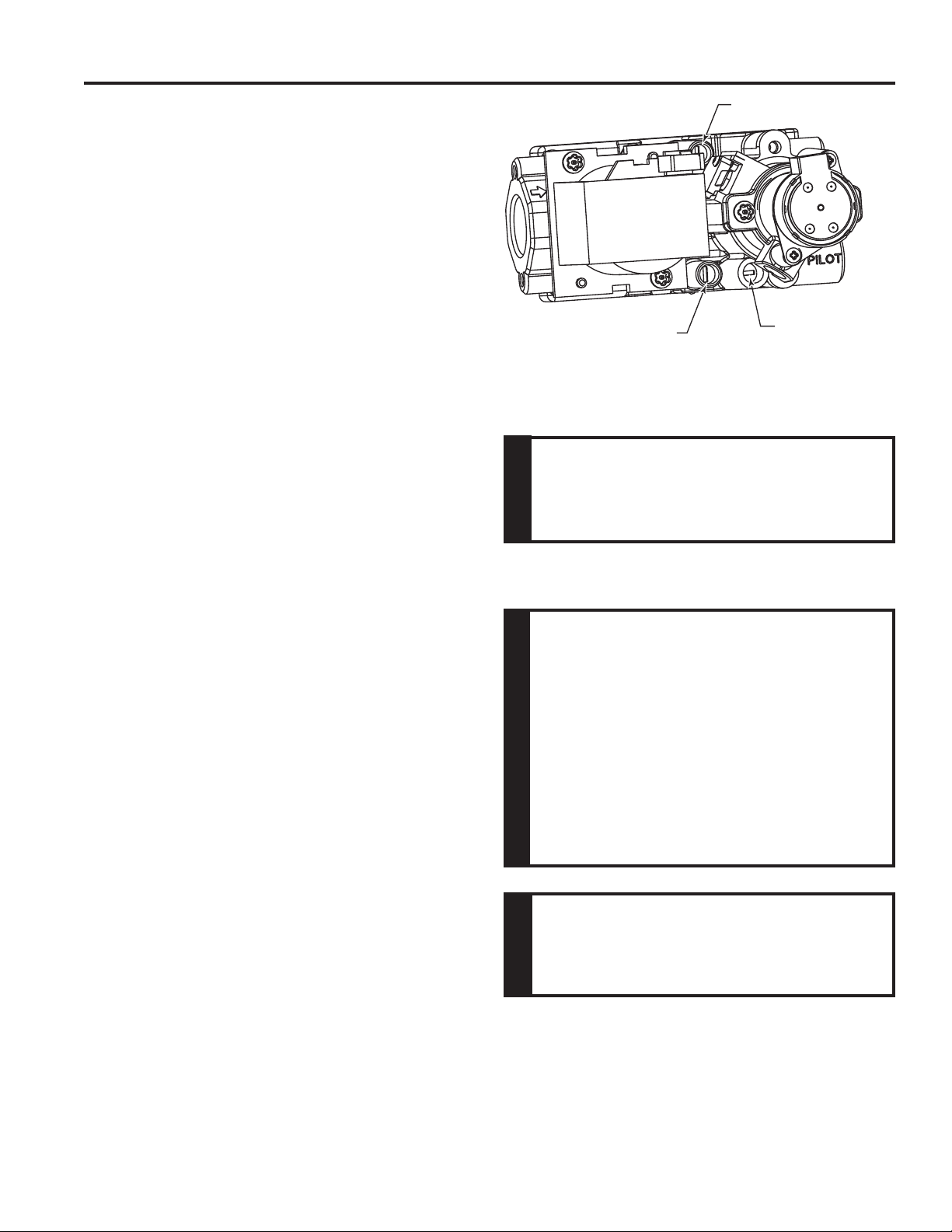
4. To check gas pressures at valve, turn captured screw
counter clockwise 2 or 3 turns and then place tubing
to pressure gauge over test point. Turn unit to high.
Figure 52. After taking pressure reading, be sure and
turn captured screw clockwise rmly to reseal. Do not
over torque. Check test points for gas leaks.
Figure 52 -
Signature Command Valve
Pilot Adjustment
Screw
Pressure Outlet
FP1909a
Pressure Inlet
1. This replace is equipped with the Signature Control
valve which operates on 6 volts. The 6 volt DC adapter
plugs into the replace junction box A/C power supply.
Four (4) “AA” batteries are used for back up during
power outages.
2. The Signature Command System can also be operated
without A/C power. The system can run on four (4) “AA”
batteries for approximately six (6) months under normal
use.
3. A/C power must be used to power the A/C module,
blowers, lights and AUX accessories if used with this
replace.
1. This replace may be used with a wall switch, wall
mounted thermostat and/or Signature Command wire-
less controls.
2. The command center control may be mounted on the
wall with the use of the SCSWEK 15ft. wall mount exten-
sion kit.
34
20302381
Designer Series Direct Vent Gas Fireplace
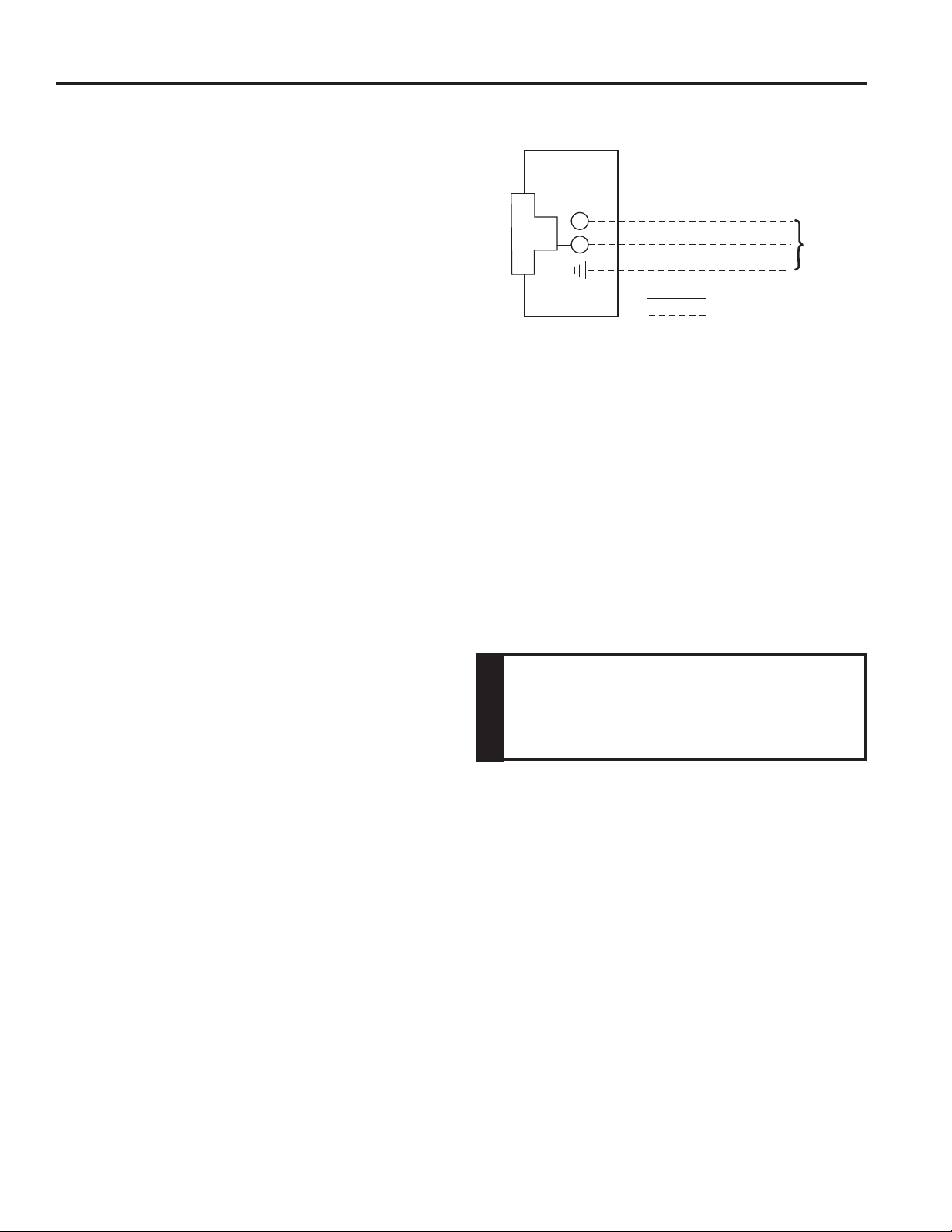
1. This should be done before framing the replace. Wire
the receptacle into an electrical circuit. Wire with mini-
mum 60° C wire in accordance with prevailing codes.
2. Remove the external junction box cover by removing
the screw from the side of the outside rebox wall.
Junction box was installed at the factory.
3. The junction box cover has a factory installed “romex”
style strain relief connector. After connecting the wires,
route the wire leads through this connector. Refer to
the wiring diagram in Figure 53.
Figure 53 -
Junction Box Wiring Diagram
Junction Box
Factory Supplied
Not Supplied
120V AC
60Hz
The command center may be mounted on the wall with
the use of the SCSWEK Kit (15ft. cable, junction box, wall
cover).
Mount the junction box provided at the desired location
on the wall. Do not extend beyond the 15 ft. wire cable
provided. If a longer distance is required, the 15 ft. may be
extended up to 30 ft. maximum by using two (2) SCSWEK
cables plugged together.
Route the wire from junction box to lower control area at
bottom of replace. Unplug the 12" cable from the com-
mand center. Attach the connector to the pins from wire
by pushing in to connector making sure to follow the color
code on connector. Plug the 15 ft. extension cable into the
2 ft. cable. Remove command center from the replace
and plug the other end of the extension cable into the
command center. Snap on wall cover provided and screw
to junction box.
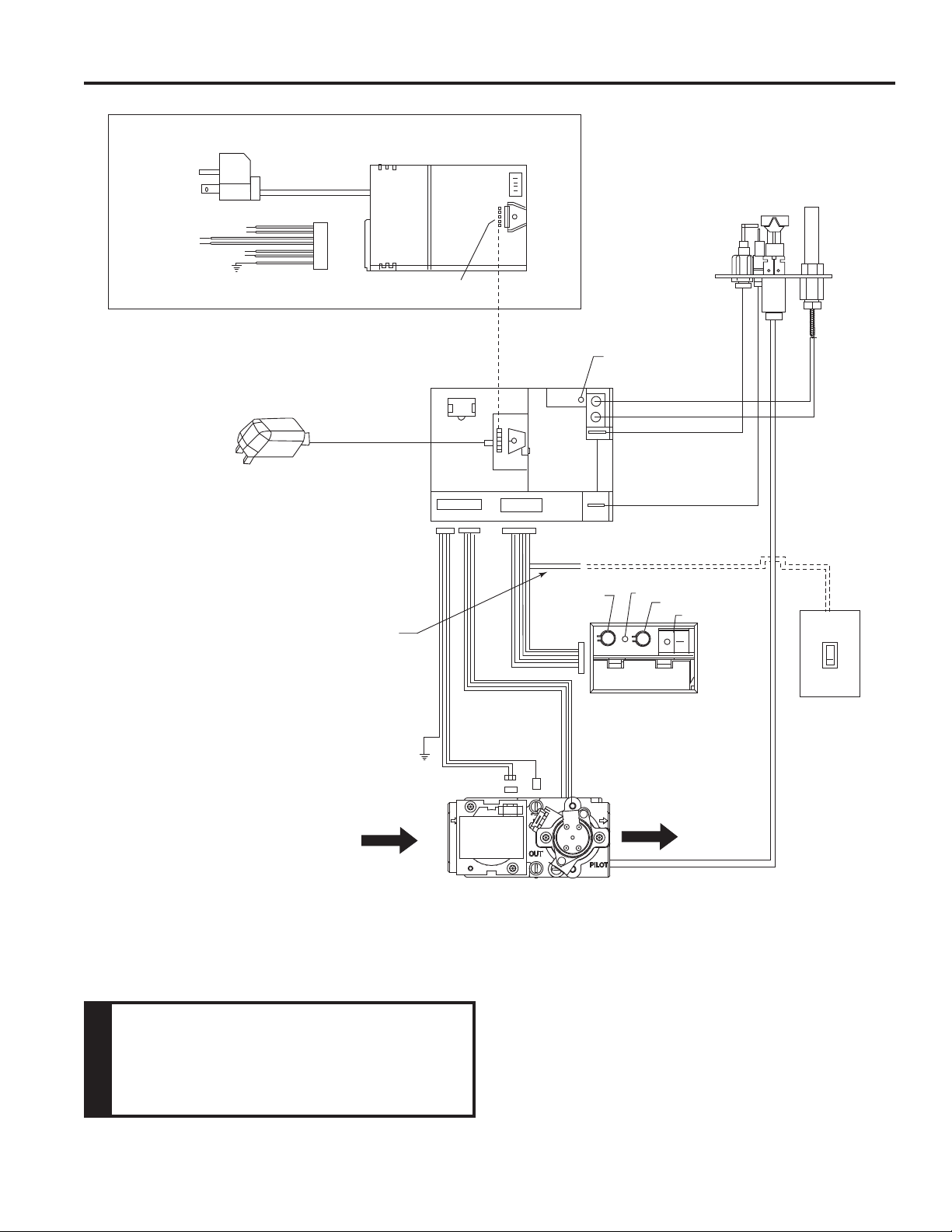
The wall switch wire connection is located off the 2 ft. wire
harness from the control box to the command center. Fig-
ure 54. The connection is labeled “Wall Switch”. Unplug
the male and female connectors and connect the two (2)
low voltage wires provided. Run wire to desired location
on wall. Up to 50 ft. of 18 ga. wire may be used if neces-
sary. Attach wires to wall switch. Mount the wall switch in
to junction box and screw on cover.
20302381
35
Designer Series Direct Vent Gas Fireplace
Figure 54 -
Signature Command Wiring Diagram
To Junction Box
in Fireplace
Optional
AC Module
{
White
Black
Optional
Light
White
Black
{
Optional
Blower
White
Black
{
Optional
Aux.
Green
Plug in
Connector
Connector Pin
To Control Board
Input 300 Watt Max. Each
Optional A/C Module Replaces 6V Adapter
When Used
6V AC
Adapter
Control Board
RF Receiver
ON/OFF Button
Pilot
Black / Thermopile
Red / Thermopile
Sensor
Ignitor / Sparker
Conversion
NG/LP
Plug-in Connector
Control Board to Command Center
OFF/LO
LED
ON/HI
Master Switch
Command Center
Optional
Wall Switch
Plug-in Connector
Stepper Motor to
Control Board
DC Power/Green
Ground
Plug-in Connector
Control Board to
Solenoid
Gas In
Gas Out
Pilot Gas Tubing
Valve
Wall switch wires must be con-
nected together if a wall switch is not
being used.
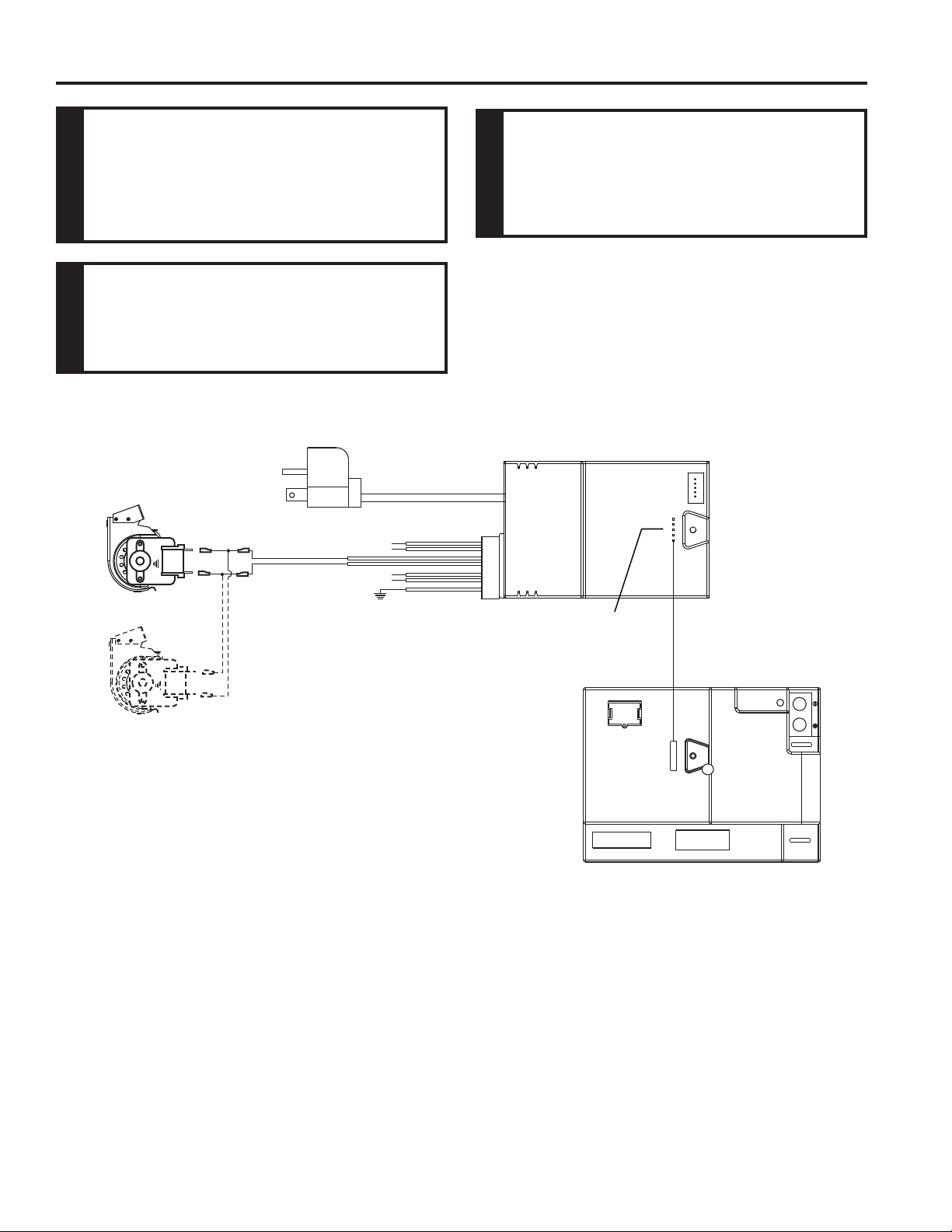
36
20302381
Designer Series Direct Vent Gas Fireplace
To Junction Box
In Fireplace
WHITE
BLACK
WHITE
BLACK
BLACK
WHITE
GREEN
Connector
Pin To Contro l Box
{
{
Light
Optional
AUX
Blower (300w Max)
Blower (300w Max)
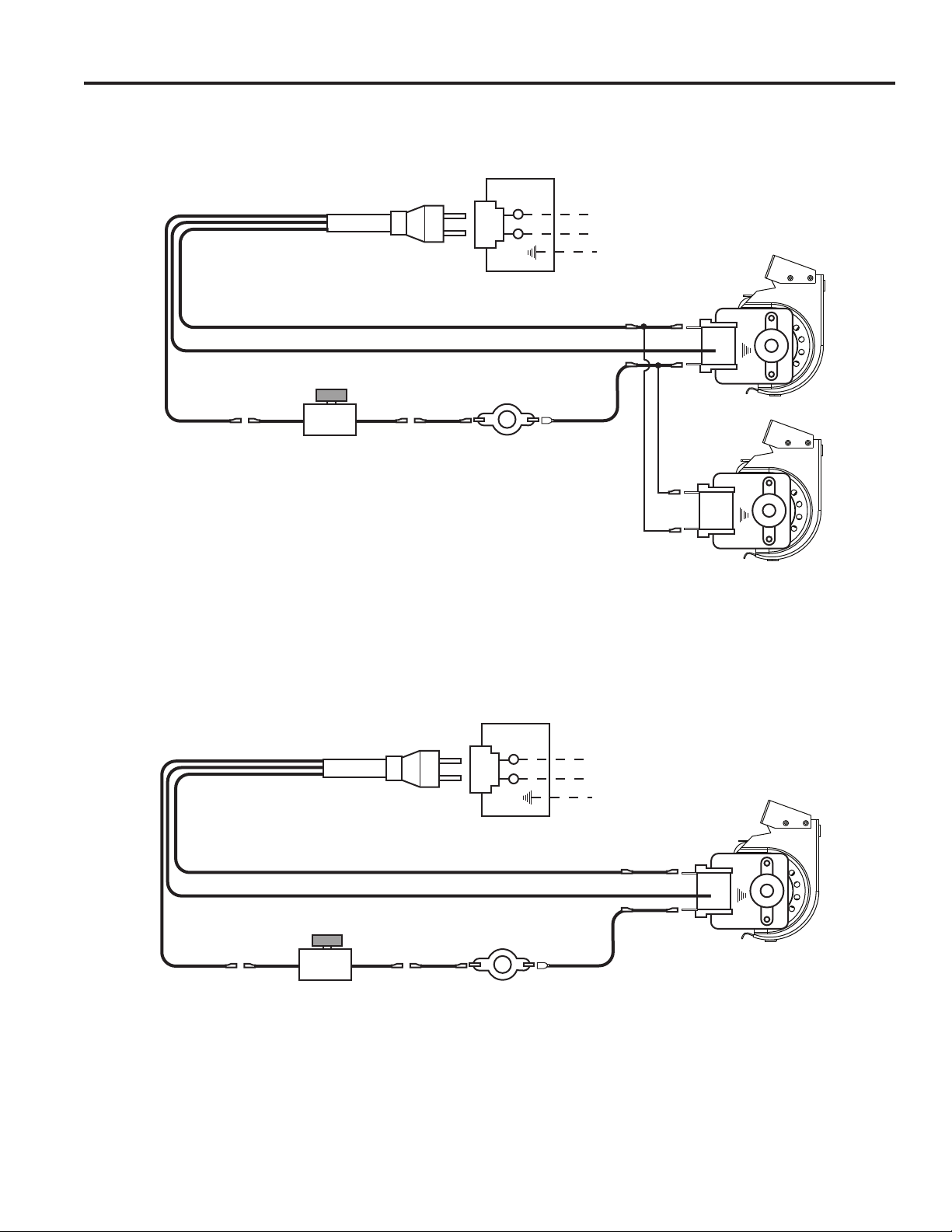
Figure 55 -
BLOTSTSC Blower Wiring Diagram
(shown with 2 blower kits)
FP2708
The BLOTSDVSC Blower Kit requires the SCSACM A/C
Module and the TSFSC remote to install and operate this
kit. Refer to blower instructions for installation.
If two (2) blowers are required with the Signature
Command System SCSACM & TSFSC remote, two (2)
BLOTSTSC Kits must be purchased.
20302381
37
Designer Series Direct Vent Gas Fireplace
BLACKBLACKWHITE
GREEN
BLACK
BLACKWHITE
Receptacle
Junction
Box
120VAC
Speed Control
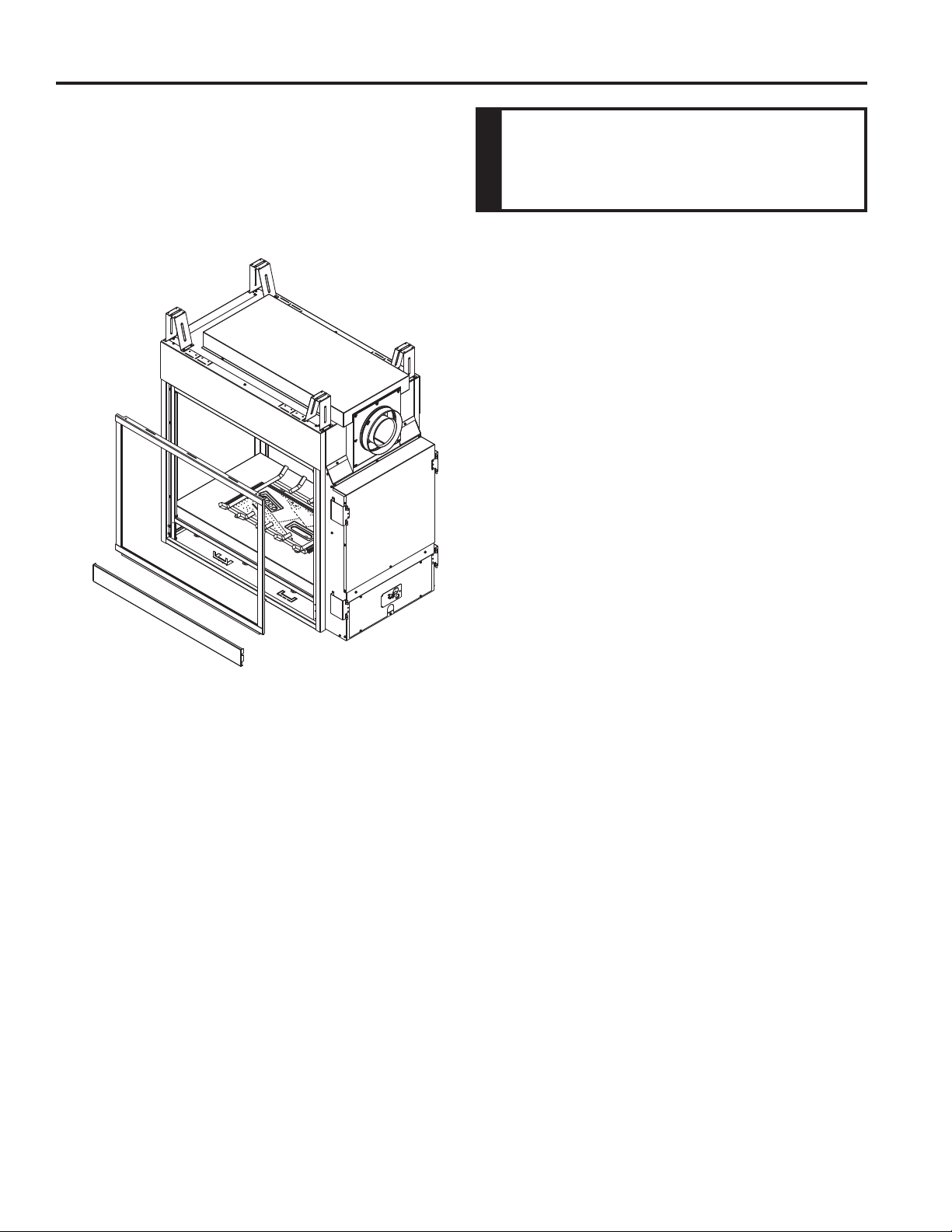
Figure 56 -
BLOTBLDV Blower Wiring Diagram
FP2685
Before installing the blower, wire the receptacle into an
electrical circuit. This should be done before framing the
replace. Wire with minimum 60° C wire in accordance
with prevailing codes.
BLACKBLACKWHITE
GREEN
BLACK
BLACKWHITE
Receptacle
Junction
Box
120VAC
Speed Control
Figure 57 -
BLOTDL Blower Wiring Diagram
38
20302381
Designer Series Direct Vent Gas Fireplace
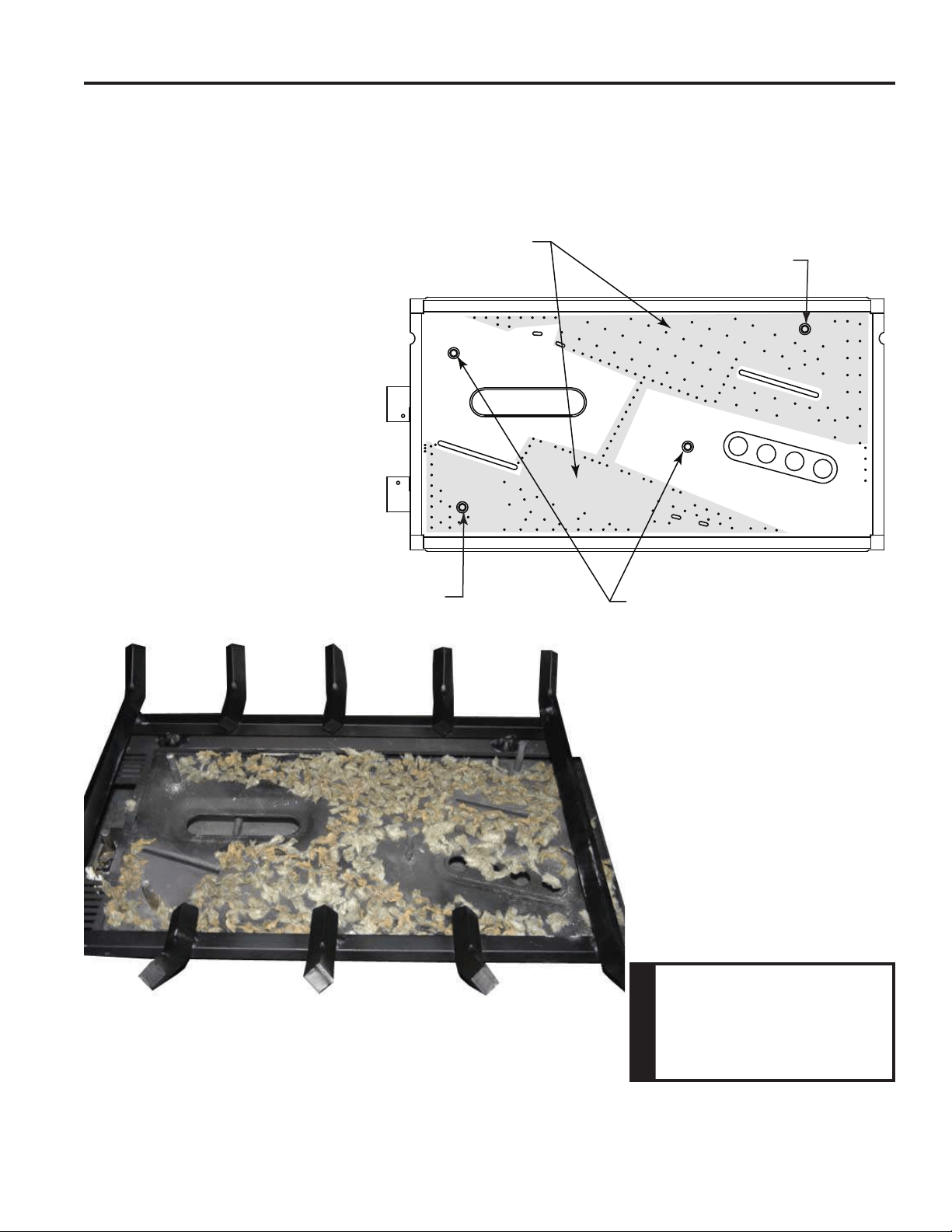
Figure 58 -
Remove Glass Frame
FP2840
1. Remove access panel by lifting up and out.
2. Release two clamps (500 model has three clamps) on
bottom of replace. Figure 58
3. Tilt glass frame out and lift glass frame up until it clears
three tabs on top of replace.
4. Set glass frame aside.
20302381
39
Designer Series Direct Vent Gas Fireplace
Place rock wool evenly in dime-sized pieces
over the burner ports. Do not place embers
over the burner slots. To better enable the
gas to permeate the rock wool, apply the
rock wool in light, dime size uffy pieces.
Figure 59 -
Rockwool placement
FP2841
Rock Wool Areas
Log Placement
Pins
Pin used with
Contemporary Stone Kit
Pin used with
Contemporary Stone Kit
40
20302381
Designer Series Direct Vent Gas Fireplace
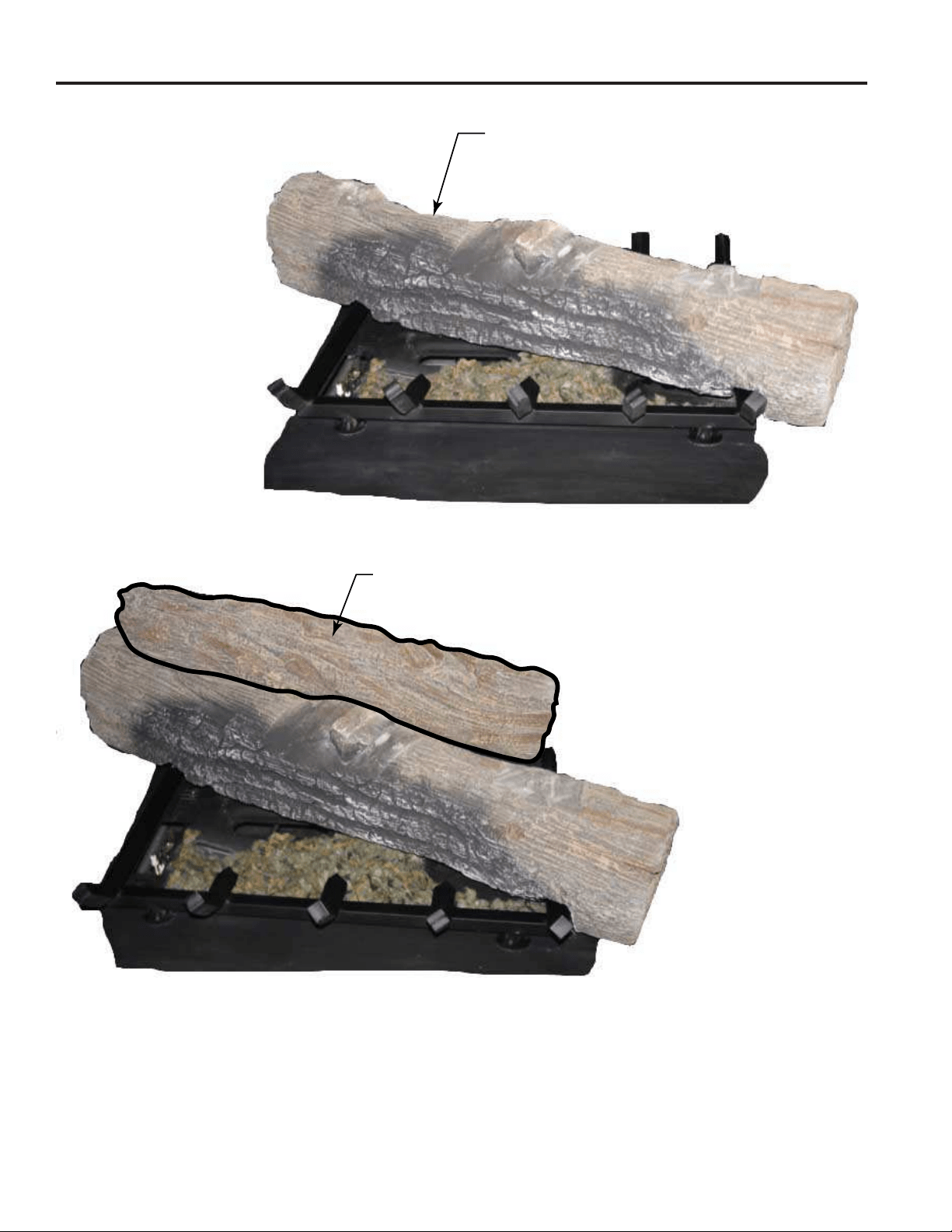
1. Hold log #1 with the rounded
end opposite the pilot.
Log #1 is designed
to not be symmetrical. Place
log #1 aligning the two (2)
pins provided making sure
to fit the notches in the
bottom of the log over the
sides of the grate so that it
sits rmly in place. The log
will rest on the grate bar
about 1/4" over the top of
the burner surface. Figure
60
Log #1
LG965
Log #2
LG966
Figure 60
Figure 61
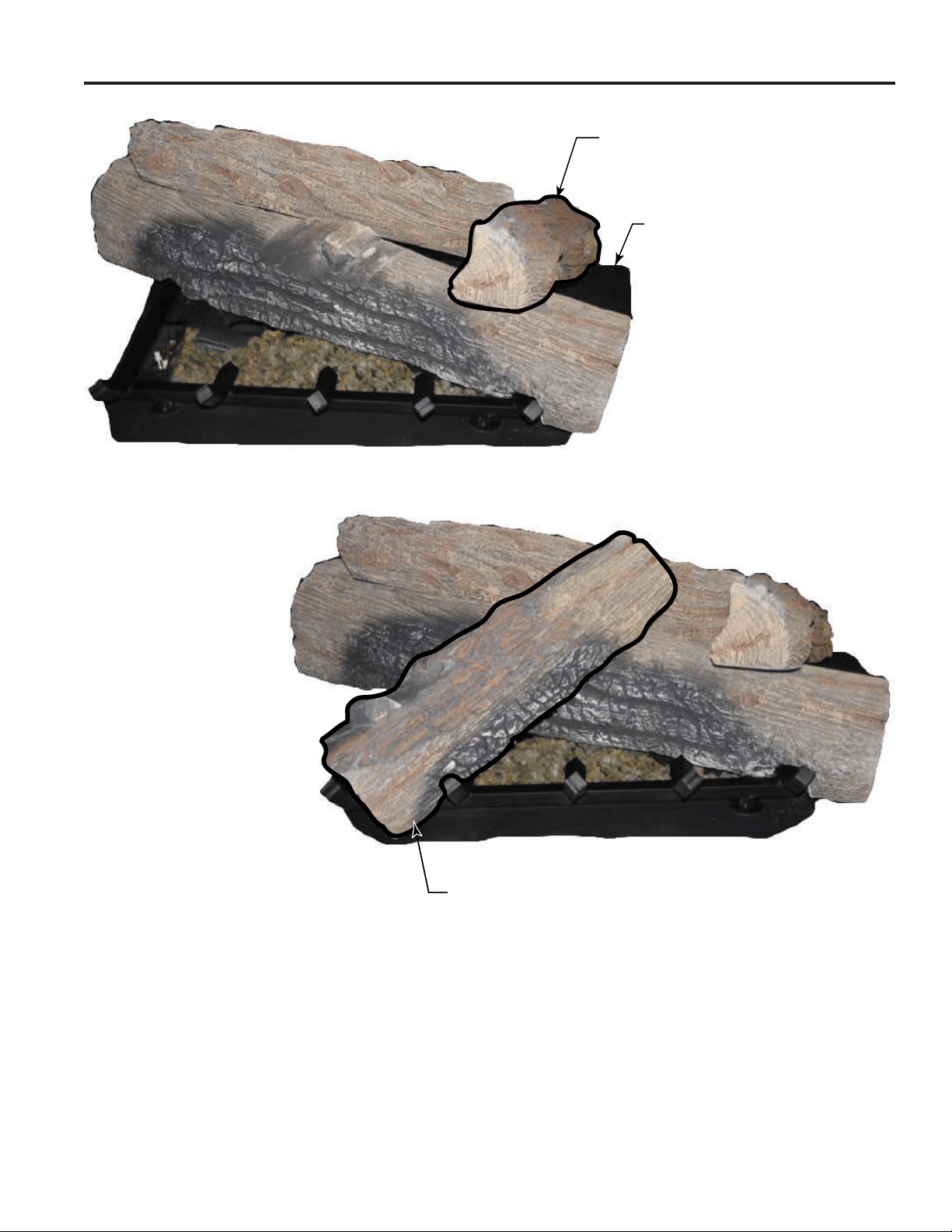
2. Place log #2 so the fat end of the log
rests on the 2nd tine of the grate (oppo-
site the pilot) and the thin, right end of
the log sits on top of the key provided
on the end of log #1 closest to the pilot.
Figure 61
20302381
41
Designer Series Direct Vent Gas Fireplace
3. Position log #3 on the key pro-
vided on the rounded end of log
#1. The other end sits on the
"false-bottom hearth" (the sheet
metal surrounding the burner and
supporting the grate), just outside
of the grate. The base of the log
should be about 1" from the end
of log #2. Figure 62
Log #3
LG967
Log #4
LG968
Figure 62
Figure 63
False-Bottom
Hearth
4. On the remaining key on the top of
log #1 (in the center), place log #4
with the charred area of the log facing
down and toward the nearest glass.
The other end of the log rests on the
second tine from the end closest to
the pilot. Figure 63
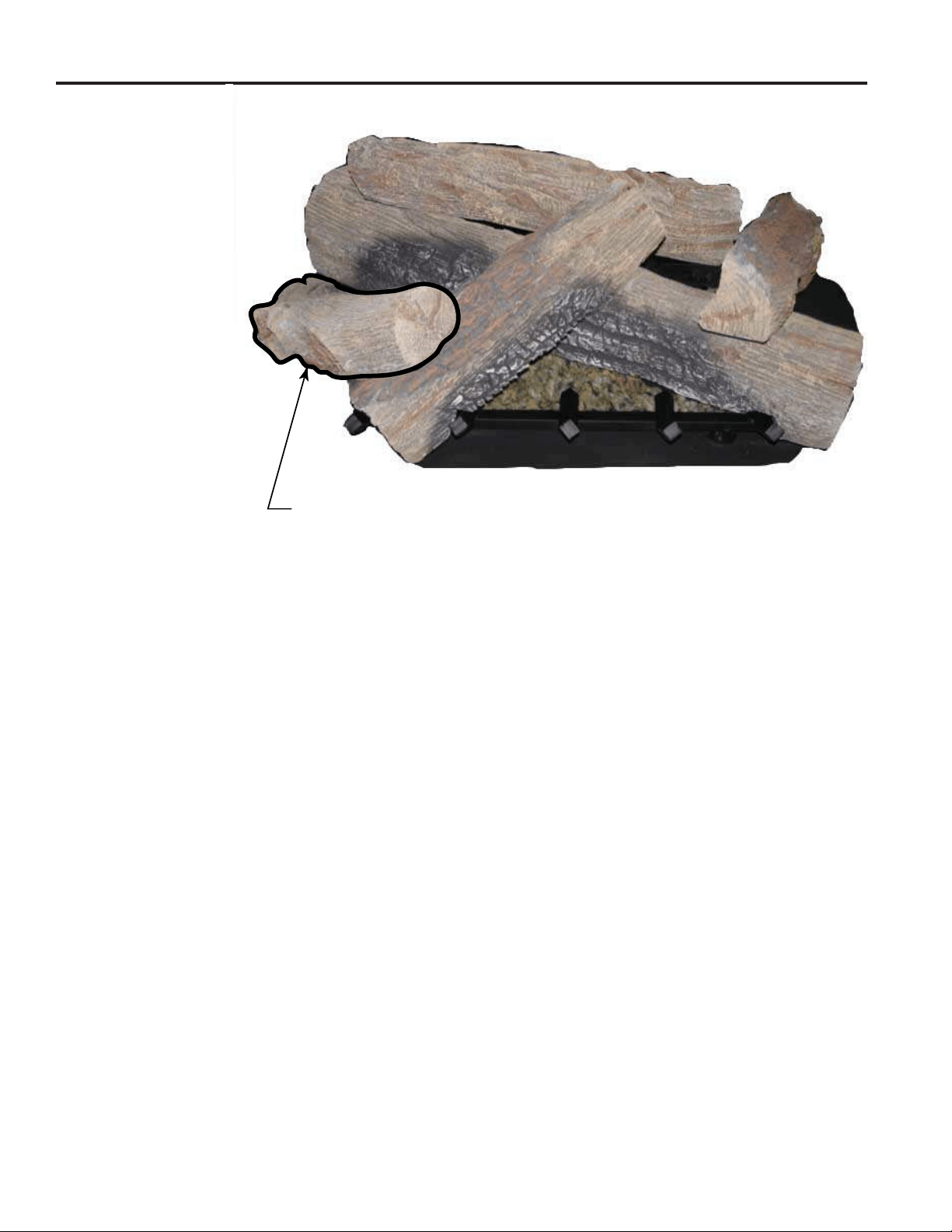
42
20302381
Designer Series Direct Vent Gas Fireplace
5. Place log #5 on the key
provided on log #4. Rest
the other end of the log
on the "false-bottom
hearth" just outside of
the grate. It should be
almost touching the end
of log #1. Figure 64
Log #5
LG969
Figure 64
20302381
43
Designer Series Direct Vent Gas Fireplace
This appliance is equipped with an ignition device which automatically lights the pilot. Refer
to the instructions.
BEFORE OPERATING smell all around the appliance area for gas. Be sure to smell next to
the oor because some gas is heavier than air and will settle on the oor.
• Do not attempt to light any appliance.
• Do not touch any electric switch; do not use any phone in your building.
• Immediately call your gas supplier from a neighbor's phone. Follow the gas supplier's
instructions.
• If you cannot reach your gas supplier, call the re department.
Use only your nger to push in the master switch. Never use tools. If the switch will not func-
tion by hand, do not try to repair it. Call a qualied service technician. Force or attempted
repair may result in a re or explosion.
Do not use this appliance if any part of it has been under water. Immediately call a qualied
service technician to inspect the appliance and to replace any part of the control system and
any gas control that has been under water.
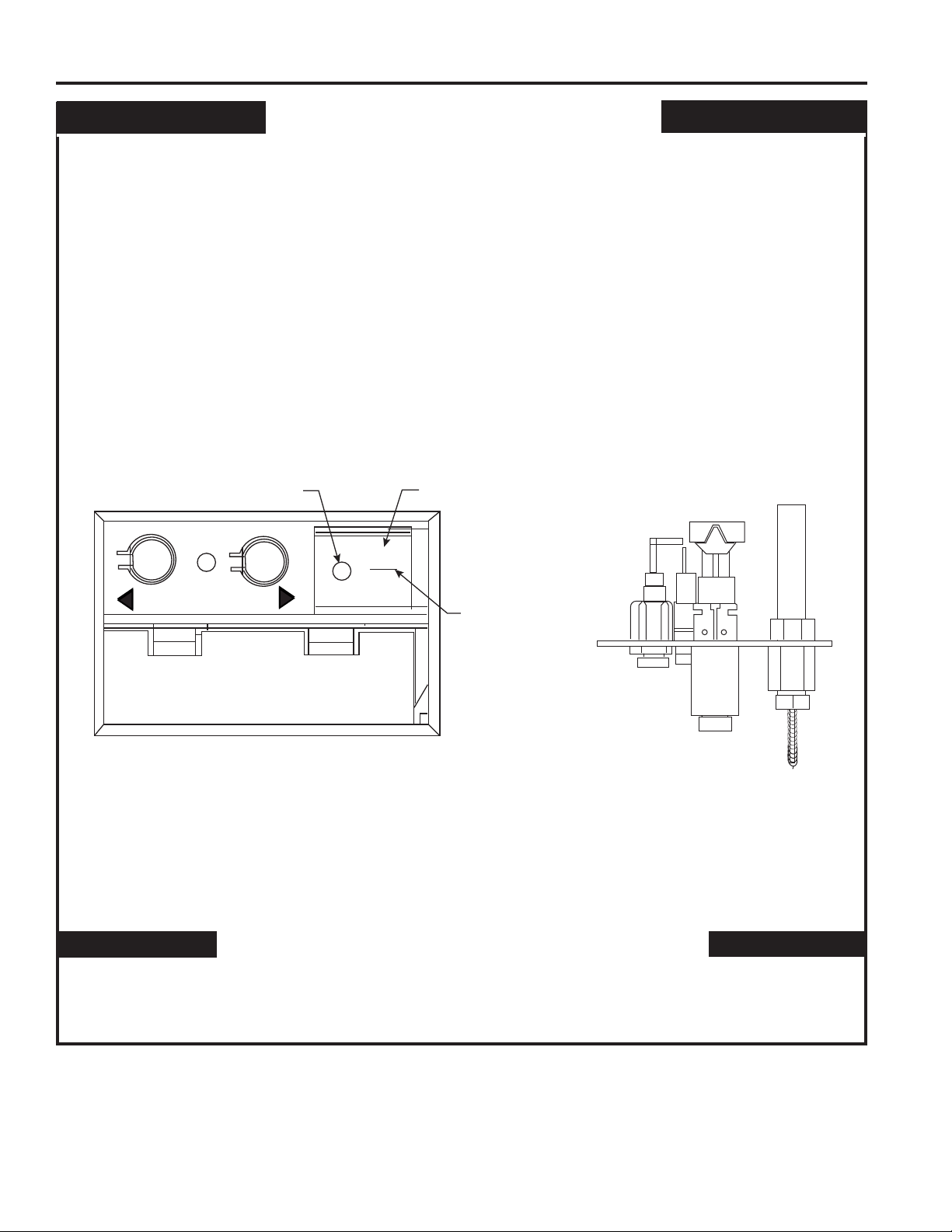
44
20302381
Designer Series Direct Vent Gas Fireplace
ON
Master
Switch
OFF
1. Read the safety information above.
2. This appliance is equipped with an ignition device which automatically lights the burner. Do not try
to light the burner by hand.
3. With ve (5) minutes to clear out any gas. Then smell for gas, including near the oor. If you smell
gas, Follow "B" in the safety information on Page 43. If you do not smell gas, go to next
step.
4. Press the master switch to the "ON" (-) position. Within eight (8) seconds it will beep once. This
indicates the system is ready.
5. Press "ON " button. Sparker will spark and pilot ame will light.
6. Once pilot ame is established, the main burner ame will light automatically.
7. If the pilot will not stay lit after several tries, turn the master switch to "OFF" and call your service
technician or gas supplier.
1. Turn master switch to "OFF".
2. Turn off all electrical power to the appliance if service is to be performed.
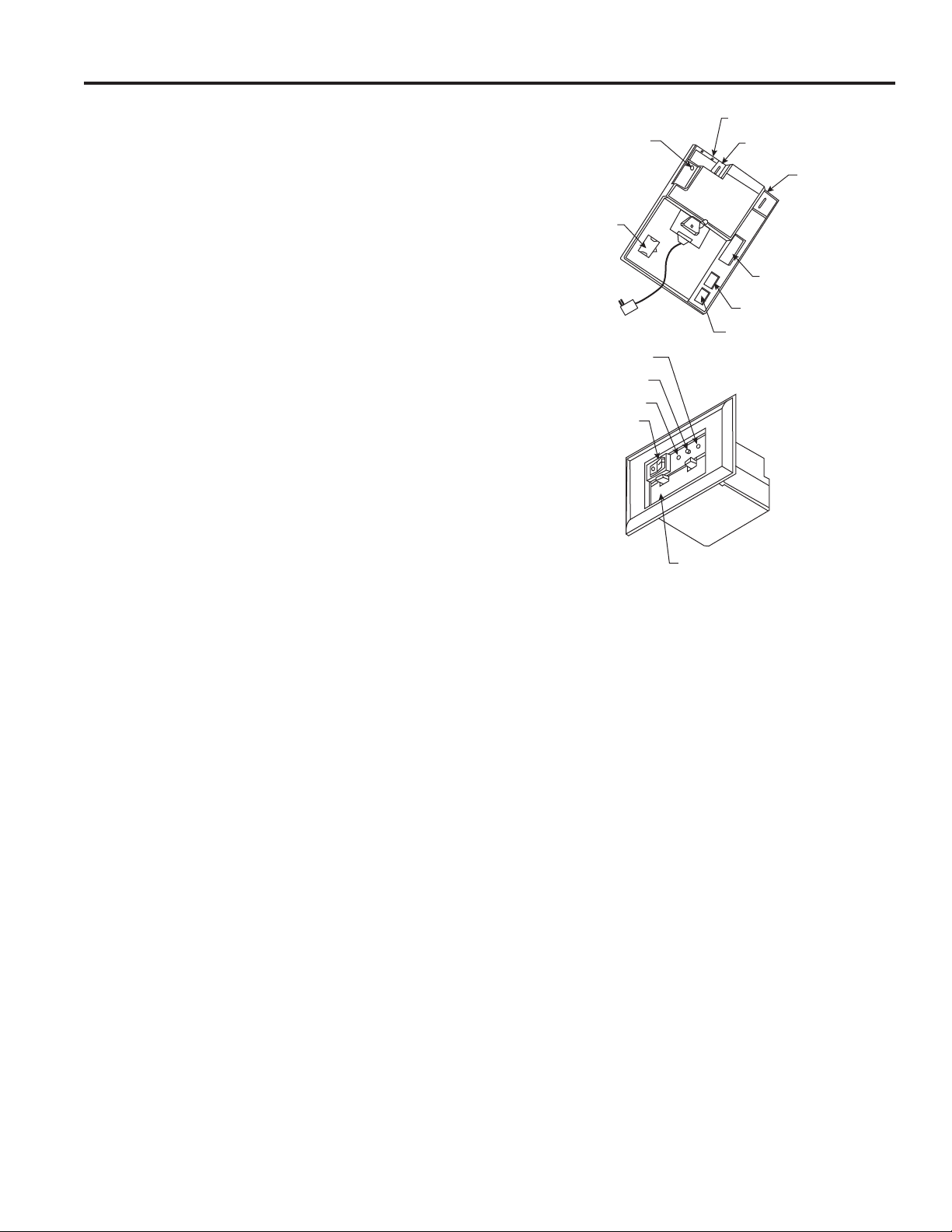
20302381
45
Designer Series Direct Vent Gas Fireplace
• Easy Access Function Operation and System Congura-
tion
• Operation Conrmation/Fault Diagnostic Indications (LED/
Buzzer)
• ON/OFF/HI/Med/Low Operation
• Optional Wall Mounting
• Electronic Ignition
• Pilot Lockout safety feature
• Electric Power Regeneration from Thermopile to save bat-
tery
• 6-hour Automatic Shut Down Option
• Convenient NG/LP Gas Type Conversion
• Standing Pilot/Intermittent pilot Conversion
• Previous settings Restoration Ability (Memory Off)
• Uninterrupted Operation During Power Outage (Automatic
Battery Backup)
• ON/OFF RF Remote Receiver
• Optional Transmitter Learn Capability
• Easy Snap-on Design
• Embedded Compact 120 VAC Adapter with Auto Battery Back up Feature
• Remote Controlled 3-step Blower, Lighting, and On/Off Auxiliary AC Outputs
TSFSC TSTSC TSMSC RTSC RMSC
Three Flame Height Settings X X X X X
Low battery Indication for Transmitter X X X X X
Child Proof Lock-out X X X X X
LCD Backlight X X X X X
Security Codes 16 X X X X X
Countdown 6 hr Timer X X X -- --
Standard Thermostatic Control Mode X X -- X --
Smart Mode
®
Thermostat (Auto Flame & Blower Modulation) X X -- -- --
Three Brightness Settings for Lights X -- -- -- --
Three Speed Control for Blower X -- -- -- --
On/Off Auxiliary X -- -- -- --
Programmable Timer to turn blower on and off X -- -- -- --
The Command Center uses four (4) "AA" batteries as back up for power outages. The system can operate for ap-
proximately six (6) months on battery power.
1. Press down the battery door tabs and pull out to remove battery door.
2. Install the batteries as indicated on Command Center.
3. Close battery door by snapping in place.
4. When the four (4) batteries are installed the system will operate without power.
5. The batteries should be replaced when the LED indicates low battery or at least once a year.
RF Receiver
ON/OFF
NG/LP
Conversion
To Thermopile
To Sensor
To Sparker
To Command Center
To Stepper Motor
To Valve
Battery Door
Master Switch
ON
LED
OFF
Figure 65 -
Signature Command System Components
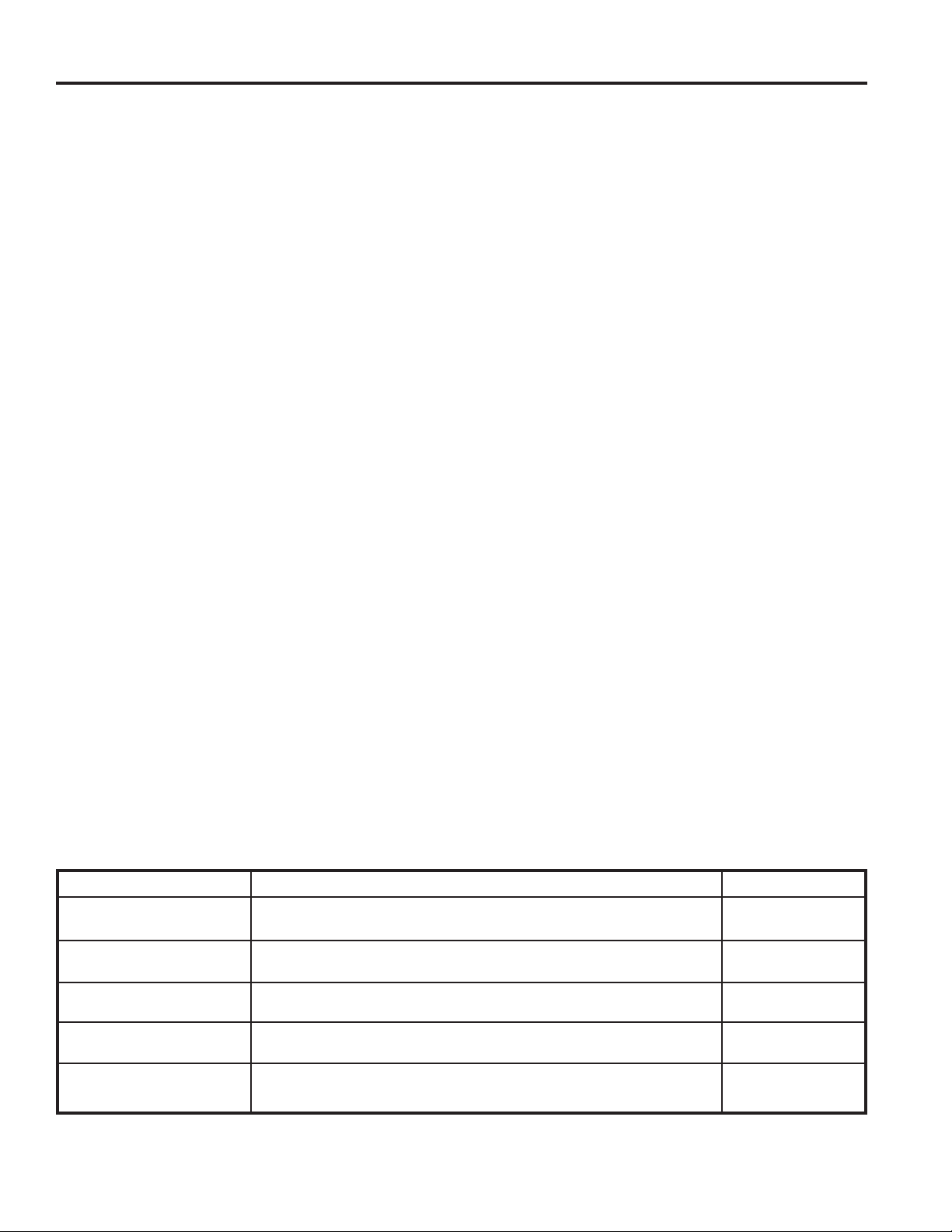
46
20302381
Designer Series Direct Vent Gas Fireplace
All System conguration/setup is done on the Command
Center.
When using On/Off wall switch, the switch must be
in the ON position to perform all conguration set ups at
the command center.
Choose the Mode That Best Suits Your Needs
The Signature Command System is designed to operate
in either Standing Pilot or Intermittent Pilot mode.
• The Standing Pilot Mode is best for colder climates
when the pilot must remain on continuously to prevent
condensation and ensure reliable operation.
• The Intermittent Pilot Mode is ideal for maximum ef-
ciency, igniting the pilot only when needed to start your
replace, lowering fuel consumption and reducing your
carbon footprint.
Either mode benets from the instantaneous battery back-
up, so you never have to worry about a power outage.
The Signature Command System comes stan-
dard in the Intermittent Pilot mode, so you must follow
the instructions below to switch to Standing Pilot Mode if
needed.
1. Holding the ON button on the Command Center while
turning on the master switch will toggle between stand-
ing pilot and intermittent pilot.
2. After the above operation, one beep (for standing pi-
lot) or two beeps (for intermittent pilot) will be given as
conrmation.
1. The system comes preset from the factory with a six
(6) hour shutdown from its last command of operation.
This is done to prevent the replace from continuing to
operate if unattended. You may disable this feature if
you wish.
Intermittent/Standing Hold the ON ▲ button while turning on the master switch Intermittent
Pilot Setup (Beep once for standing pilot, twice for intermittent pilot) Pilot
Standing Pilot Temp. Hold the ON ▲ button 3 seconds (when the master switch
Shutoff on the main burner is off)
RF Remote Receiver Push the RF receiver On/Off button on the control board RF OFF
On/Off Beep once for ON and beep twice for OFF
Learn Remote Hold the OFF ▼ button while turning on the master switch
Transmitter (Beep twice then press any handheld remote button)
6-hour safety Press the ON ▲ button and OFF ▼ button simultaneously ON
shutdown setup (Beep once for ON, twice for OFF)
By disabling this feature, your replace may con-
tinue to operate unattended.
2. When the master switch is in the ON position (“-”), press-
ing the ON button and the OFF button on the Command
Center simultaneously will toggle between enabling and
disabling the six-hour shutdown option.
3. After the above operation, one beep (for enabling the
six-hour shutdown option) or two beeps (for disabling
the six-hour shutdown option) will be given as conrma-
tion.
1. The RF receiver button located on the Control Board
must be in the on position before the learn function can
begin. Use paper clip to depress button. One beep for
RF receiver ON or two beeps for RF receiver OFF will be
given as conrmation. Refer to Figure 57 for location.
2. After the RF receiver is on, holding the OFF button on
the Command Center while turning on the master switch
will activate the learn function for the transmitter.
3. After the above operation, two beeps will be given and
the green LED on the Command Center will ash for
10 seconds.
4. During the 10 seconds, press the OFF button on a
transmitter to learn. Another two beeps will be given
to conrm a successful learning. Refer to transmitter
instructions for remote operations.
To shut off the standing pilot for service or summer shut
down, press and hold the ON button on the Command
Center for 3 seconds when the master switch is in the ON
position (“-”) and the main burner is off.
: Pilot will resume the next time system is turned
on.
When On/Off wall switch is used, it must be in the
On position to perform all system setups.
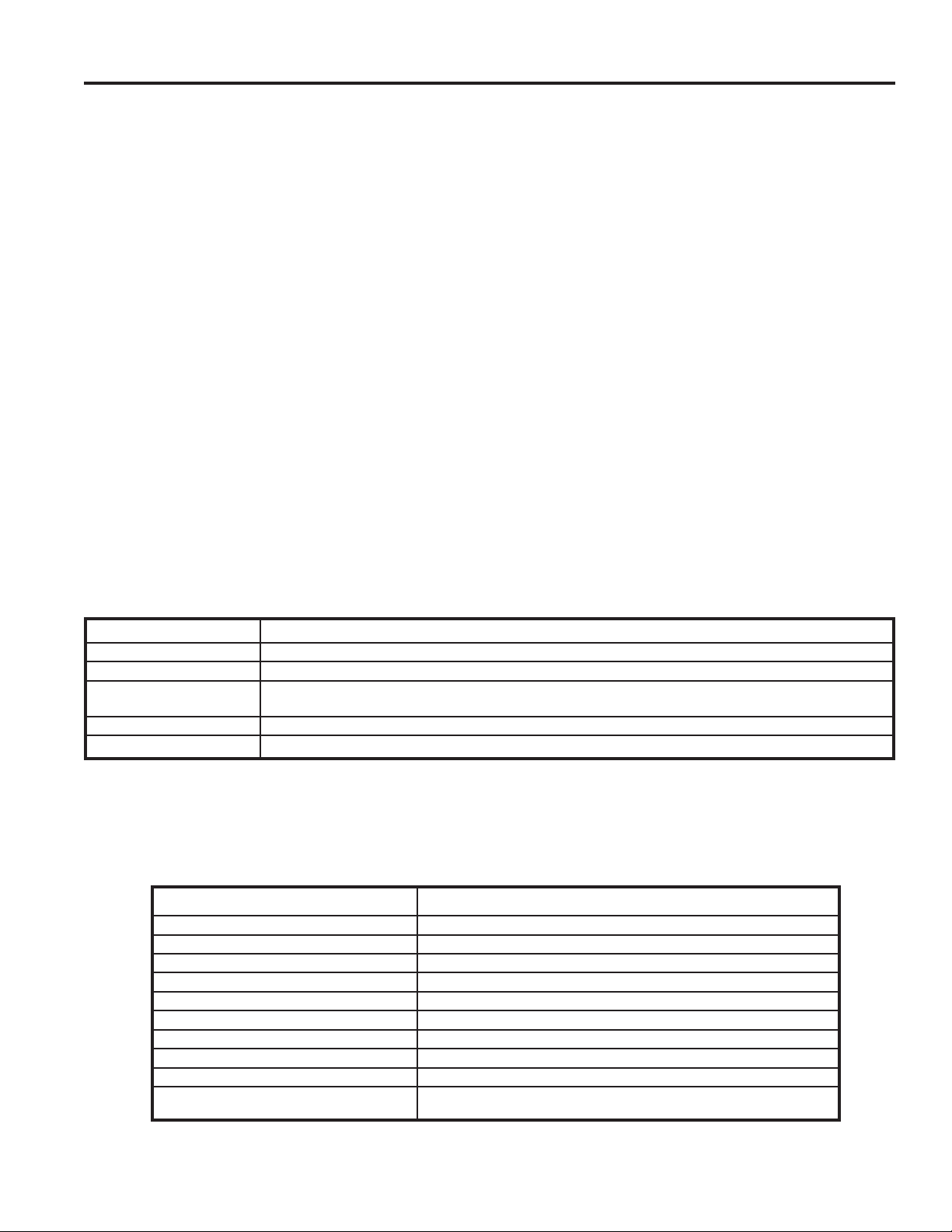
20302381
47
Designer Series Direct Vent Gas Fireplace
Conversion Cover Missing One RED (1 time)
Spark Fail Two RED (1 time)
No Sensor Signal Three RED (1 time)
Pilot Lockout - trial One GREEN, every 2 sec. (until manual reset)
Pilot Lockout - ame loss One RED-GREEN, every 2 sec. (until manual reset)
Low Battery One RED, every 10s (continuously)
No or Low Thermopile Power Two RED, every 10s (continuously)
Learning GREEN Flashes, every 1 sec. (for 10 sec.)
AC Power On GREEN solid
Pressure Switch Failure One RED every 2 sec. (until manual reset)
Power Vent Only
1. Turn on the master switch and wait for a beep.
2. Press the ON button on the Command Center or turn
on wall switch. Pilot will light and burner will come on
High setting or last memory setting (See Turning Off
Fireplace below). For memory feature.
1. If the pilot doesn’t light after sparking for 30 seconds,
pilot trial lockout happens. The LED on the Command
Center ashes Green once every 2 seconds, until re-
set.
2. If the pilot ame is lost during normal operation, the
system will try three (3) times to relight after three (3)
failures, ame loss lockout happens. The LED on the
Command Center ashes Red-Green once every 2
seconds, until reset.
3. Turning the master switch on the Command Center to
the off position, then ON again will reset the system.
1. Press the ON button (on the Command Center) once to
turn on the main burner with maximum ame height.
2. Press the OFF button to decrease ame height. The rst
two presses will decrease the ame height to medium
and low.
The Command Center has a self-diagnostic LED enabling
you to troubleshoot problems and potentially avoid a
service call. Please refer to the charts below for indicator
reference.
Power Up Flip the master switch to the ON ("_") position to power up the system
Fireplace ON Press the ON ▲ button on the Command Center or turn on wall switch to turn the replace on
Fireplace OFF Flip the master switch to the OFF ("o") position OR press the OFF ▼ button 3
times OR for Memory Off, hold the OFF ▼ button 3 seconds, or turn off wall switch
Flame Height Up Press the ON ▲ button once to turn on the replace with maximum ame height
Flame Height Down Press the OFF ▼ button to lower the ame height to Medium and Low
3. The third press on OFF will turn off the main burner. In
standing pilot conguration, the pilot will stay; in inter-
mittent pilot conguration, the pilot will be shut off.
There are three ways to turn the replace off.
1. Flip the master switch to the off (“O”) position. (This will
turn the entire system OFF.)
2. Press the OFF button to Medium, Low, then Off.
3. Hold the OFF button anytime for three seconds or by
turning off the wall switch. These two commands of
OFF are (Memory Off) the system will remember all last
settings before turning off. The next time the replace is
turned on, all settings will resume. To reset, change to
the desired settings and shut off by using the Memory
Off commands and the system will be reset to those
new settings.
The following functions are available on the Command
Center.
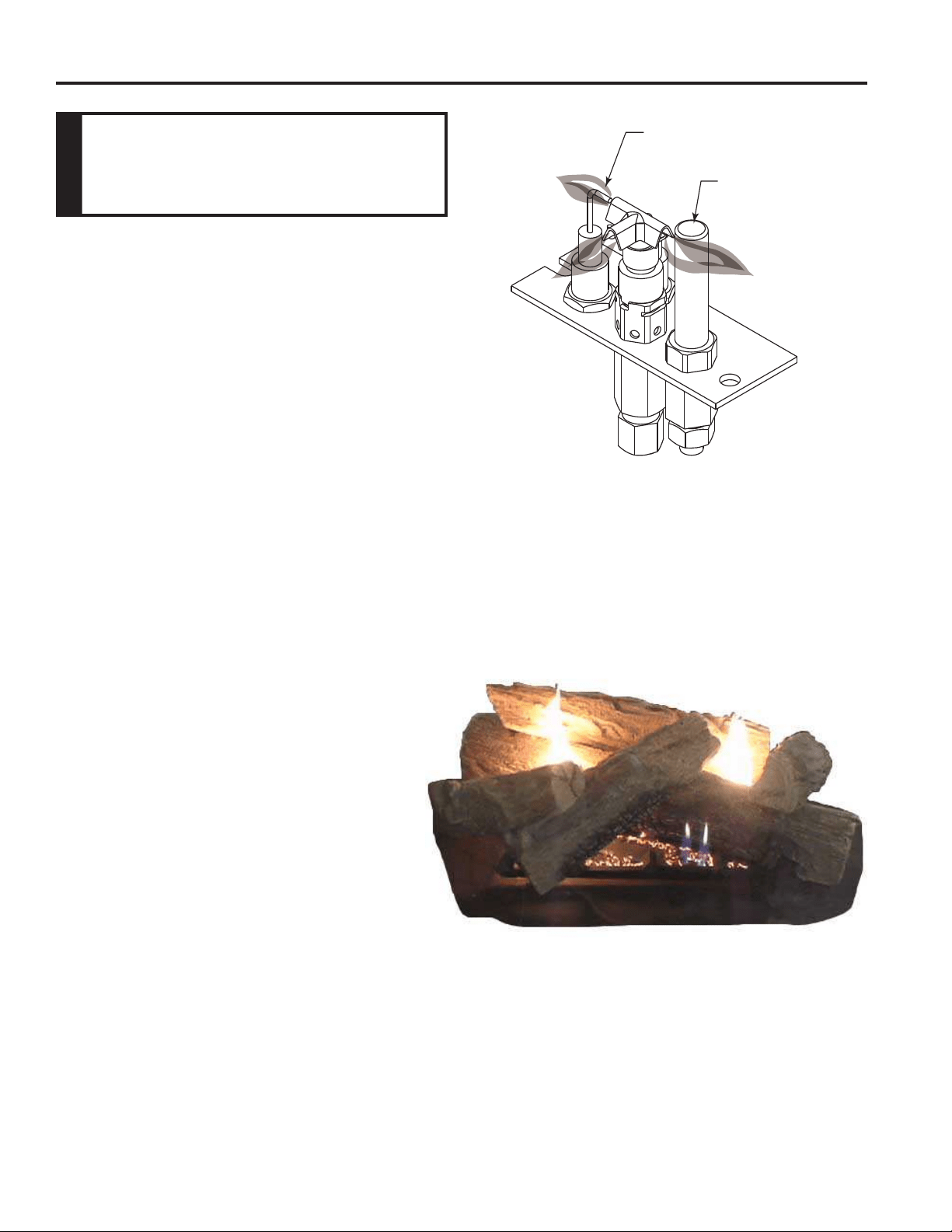
48
20302381
Designer Series Direct Vent Gas Fireplace
The ames from the burner should be visually checked
as soon as the heater is installed and periodically
during normal operation. In normal operation, at full
rate, and after operating for about 15 to 30 minutes,
the ame should be yellow and slightly taller than the
rear log. Figure 67
If the ame is blue and only in the center, turn off unit
and let cool. After unit is cool, remove logs and check to
make sure the back holes in the burner are not covered
with rock wool. If the back holes are clear, add more
rock wool to the center of the burner. Replace logs.
The type of installation, vent system
conguration, and wind effects may cause the ame
patterns to vary.
Keep the control compartment, logs, and burner areas
surrounding the logs clean by vacuuming or brushing at
least twice a year. Make sure the burner porting, pilot air
opening and burner air opening are free of obstructions
at all times.
The ames from the pilot should be visually checked as
soon as the heater is installed and periodically during
normal operation.
Figure 66. The
pilot ame has four distinct ames, one engulng the
thermopile, one engulng the sensor, and the other two
reaching to the main burners.
Inspect area around the injector. Remove any lint or foreign
material with a brush or vacuum.
Figure 67 -
Burner Flame Appearance
Figure 66 -
Pilot Flame
Thermopile
Sensor
FP2453

20302381
49
Designer Series Direct Vent Gas Fireplace
The replace and venting system should be inspected
before initial use and at least annually by a qualied eld
service person. Inspect the external vent cap on a regular
basis to make sure that no debris is interfering with the
airow. Inspect entire venting system to ensure proper
function.
Thoroughly clean the inside of the glass door after using
the replace for ten hours. Periodically clean the glass
door as necessary.
When cleaning the glass, remember:
• Allow glass to
cool before removal.
• NEVER use abrasive materials.
• Keep children and pets a safe distance away.
• Never operate the replace without the glass door
properly secured.
• Never operate the replace if the glass is broken.
• Replace any glass that is chipped, cracked, or broken.
Replacement glass door assemblies MUST be supplied
by the replace manufacturer –
• Handle glass door with care to avoid striking or scratch-
ing it on hard objects.
To clean glass door, follow “Glass Removal” procedure
outlined in the Final Installation section. Film deposit on the
inside of the glass should be cleaned off using a nontoxic,
non-corrosive, non-abrasive, mild-cleaning solution. Simply
apply an adequate amount to the glass and wipe off with
a damp cloth. After all maintenance has been completed,
re-install glass door.
Leave logs installed in the replace for cleaning. Vacuum
surface of the logs with a brush attachment. If logs must be
removed for cleaning, handle carefully by holding gently at
each end. Gloves are recommended to prevent skin irrita-
tion from ceramic bers. If skin becomes irritated, wash
gently with soap and water. Vacuum surface of logs with
brush attachment or brush logs with a soft bristle brush
(i.e. clean, dry paintbrush). To place logs back in the re-
place, see “Log Placement” found in the Final Installation
section.
Replace or add rock wool as required following installa-
tion instructions in the Final Installation section of this
manual.
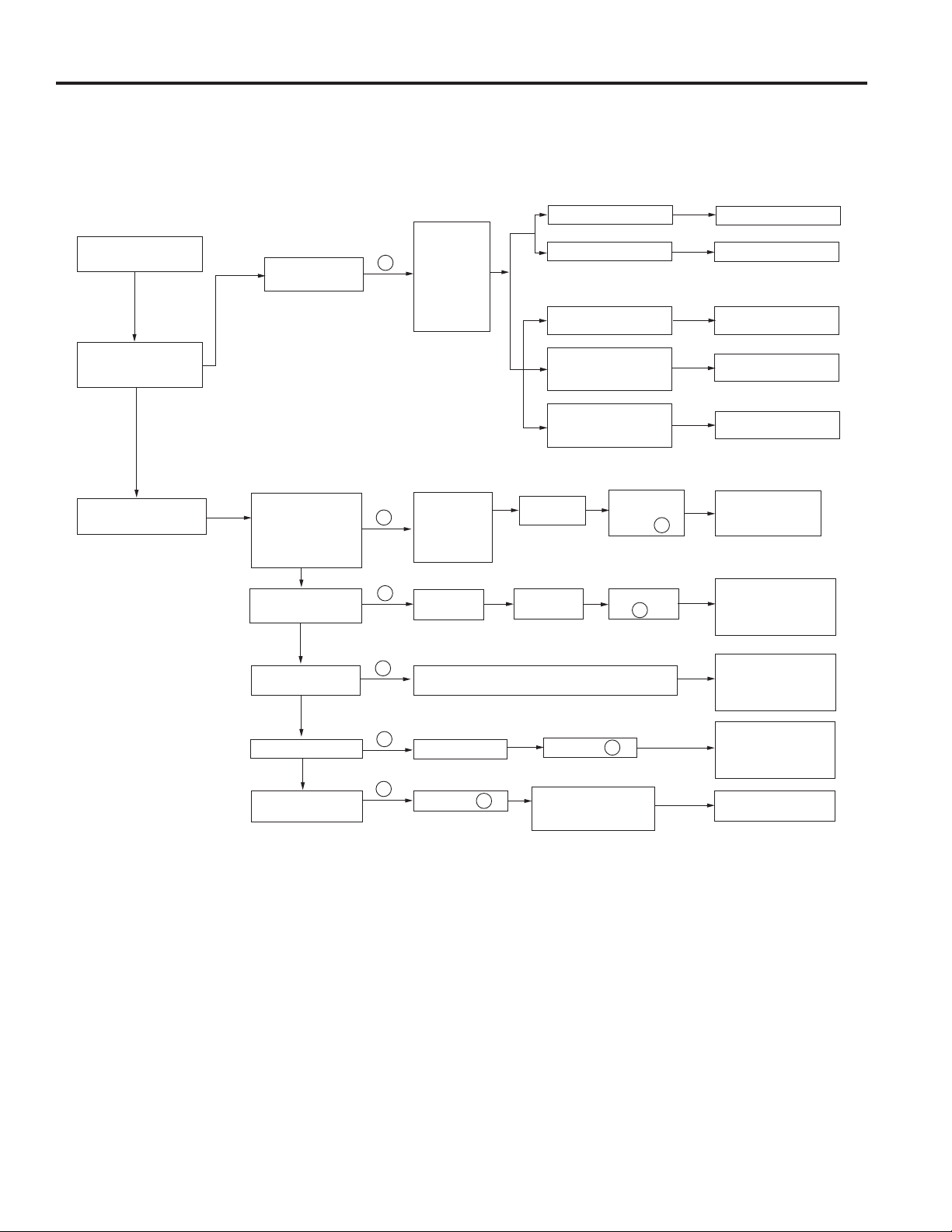
50
20302381
Designer Series Direct Vent Gas Fireplace
OPERATION
Install batteries and/or
plug in the AC board
Flip the master switch
(rocker switch) to the
ON position
Press the ON button on
the Command Center
FAULT
No beep in about
8 seconds
No beep
or
no sound from the
valve indicating pilot
solenoid open
No sparking on
the pilot
Sparking doesn’t
continue
Pilot doesn’t light
Main burner doesn’t
light
DIAGNOSIS
Make sure
Command
Center and
the control
board are
connected by
a 2 feet or 15
feet cable
Check NG/LP
conversion cap
and control
board
connections
Check pilot
connections
The Control Board is having interference from the
surrounding metal (Ground)
Check gas supply
Go through
Battery polarity wrong?
LED on the Command
Center does not show
solid green?
The 5-pin connector on
the AC board broken or
bent?
AC plug is plugged to
AC mains?
Battery voltage low?
Using
battery?
Check valve
connections
Check power
supply (go
through )
A
E
Check
grounding
Go through
B
Go through
C
The sensor on the pilot
is not in the flame
(pilot flame too small)?
ACTION
Re-install batteries
Change batteries
Plug the AC plug to
AC mains
Repair or replace the
AC Board
Replace the AC Board
Replace the Control
Board or
Command Center
Sparking is happening
elsewhere (under the
pilot), re-install/replace
the pilot
Re-install the Control
Board, move it around
or change the
Control Board
Sparking is not in the
path of gas flow, adjust
sparker position or
replace the pilot
Adjust sensor position
or replace the pilot
After the beep
A
B
C
D
E
F
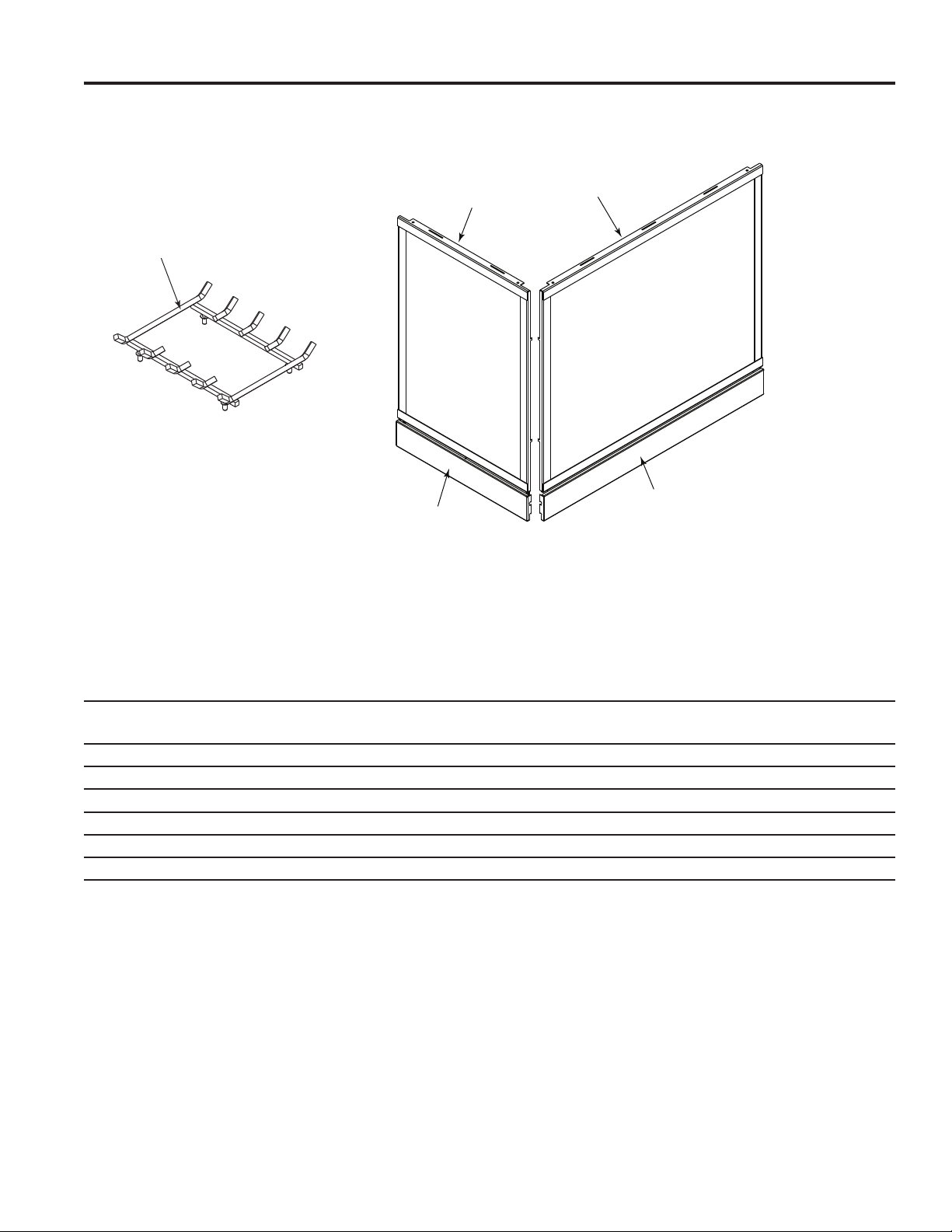
20302381
51
Designer Series Direct Vent Gas Fireplace
1. Glass Frame Assembly 2 2 1 20302401
2. Access Panel 2 2 1 20302126
3. Glass Frame Assembly, Short -- 1 1 20302151
4. Access Panel, Short -- 1 1 20302127
5. Grate 1 1 1 20301124
6. Junction Box Assembly (not shown) 1 1 1 26D2128
1
2
3
4
5
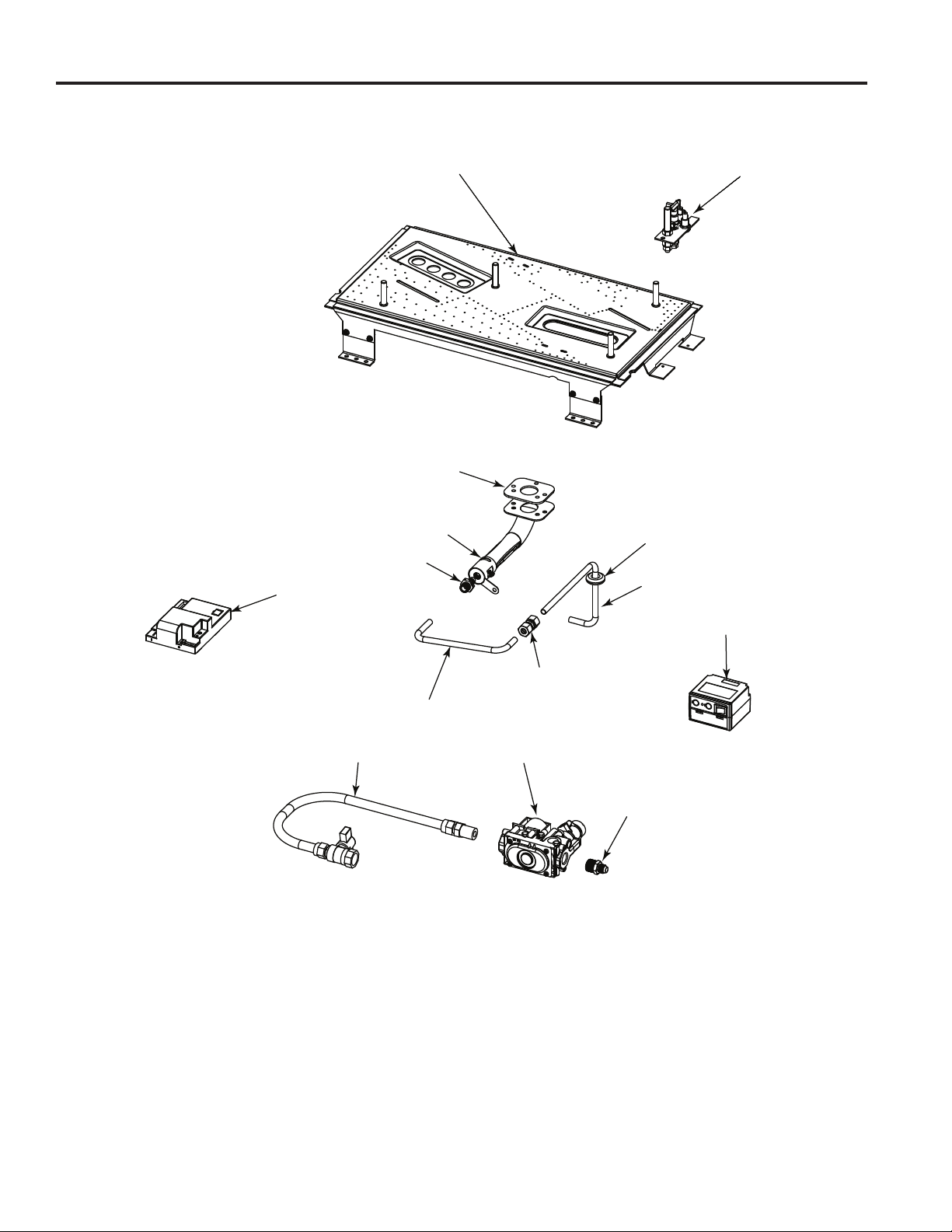
52
20302381
Designer Series Direct Vent Gas Fireplace
1
12
2
3
4
15
13
7
16
11
5
9
6
8

20302381
53
Designer Series Direct Vent Gas Fireplace
1. Burner Assy 1 20302188 20302188
2. Venturi Gasket 1 45D0032
3. Venturi Assy 1 69D1119
4. Injector 1 70D0064 20H3153
5. Tube, Union to Venturi 1 20302009 20302009
6. Fitting Brass - Union 5/16 Compression 1 37D0713 37D0713
7. Tube, Elbow to Union 1 20302008 20302008
8. Fitting, 5/16 x 3/8 Brass Male 1 11V0313 11V0313
9. Valve SCS 1 80D0001
10. Bolt M5-.8 x 8 mm 1 20H0108 20H0108
11. Flexline, 18" w/ Shutoff Valve 1 69D0030 69D0030
12. Pilot SCS 1 80D0006
13. Grommet 1 73D0189 73D0189
14. Sealant 1 28D0149 28D0149
15. Control Board SCS 1 80D0018 80D0019
16. Command Center SCS 1 80D0005 80D0005
17. Wire, CC/CB 24" SCS 1 80D0008 80D0008
18. Wire, Valve/control Board SCS 1 80D0010 80D0010
SCS Blower Kit (1 blower) 1 BLOTSTSC
A/C Module SCS (Opt. blower, lights, 1 SCSACM
& aux. control)
Blower T-Stat w/speed control (1 blower) 1 BLOTDL
SCS Wall Extension Kit 1 SCSWEK
(15' Wire, Rough-in Box, Wall Cover)
Blower T-Stat w/speed control (2 blowers) 1 BLOTBLDV
STLDVCKPS
STLDVCKNS
TSFSC must be used with SCS A/C Module to
control lights, blower & aux.
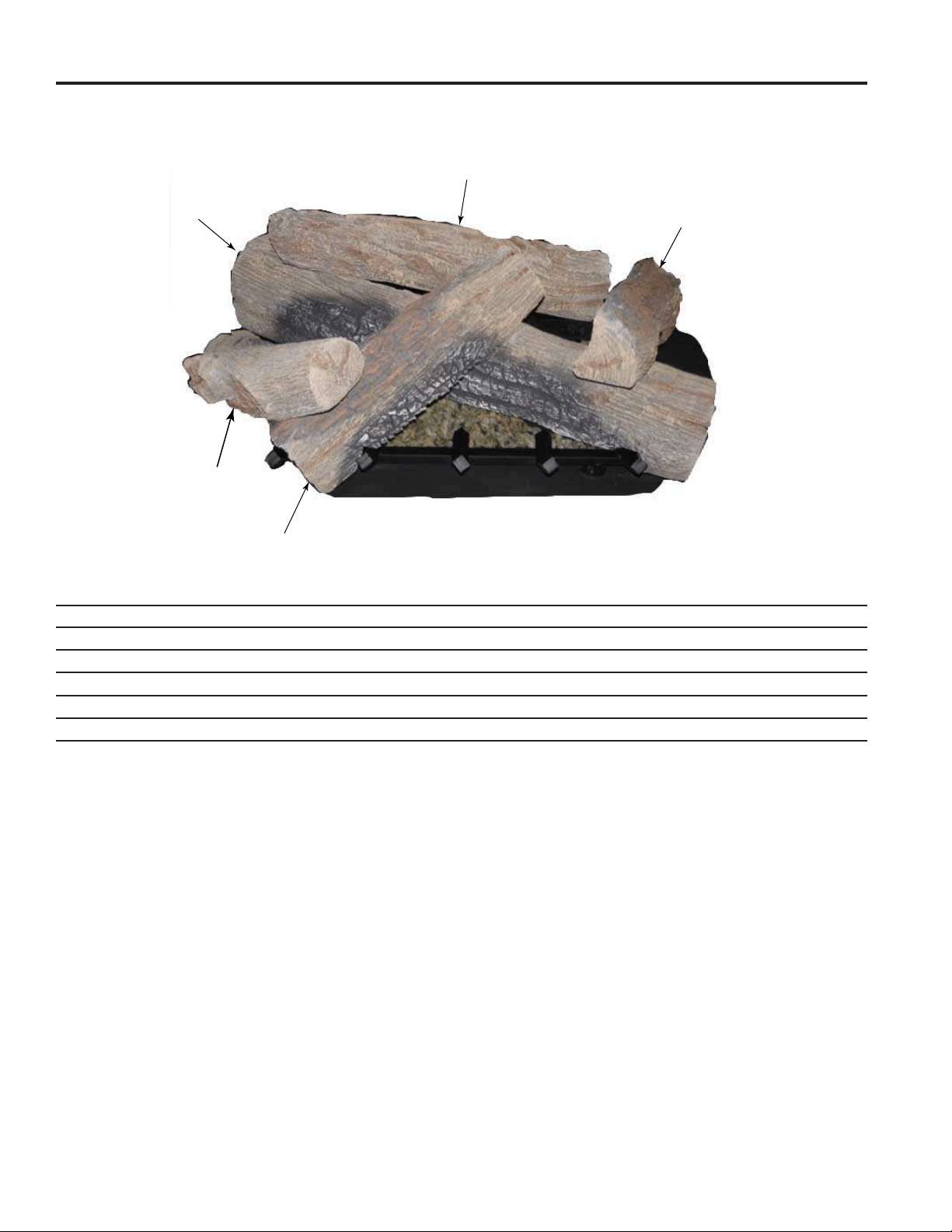
54
20302381
Designer Series Direct Vent Gas Fireplace
1. Log #1 1 20302432
2. Log #2 1 20302433
3. Log #3 1 20302434
4. Log #4 1 20302435
5. Log #5 1 20302436
5
1
2
3
4
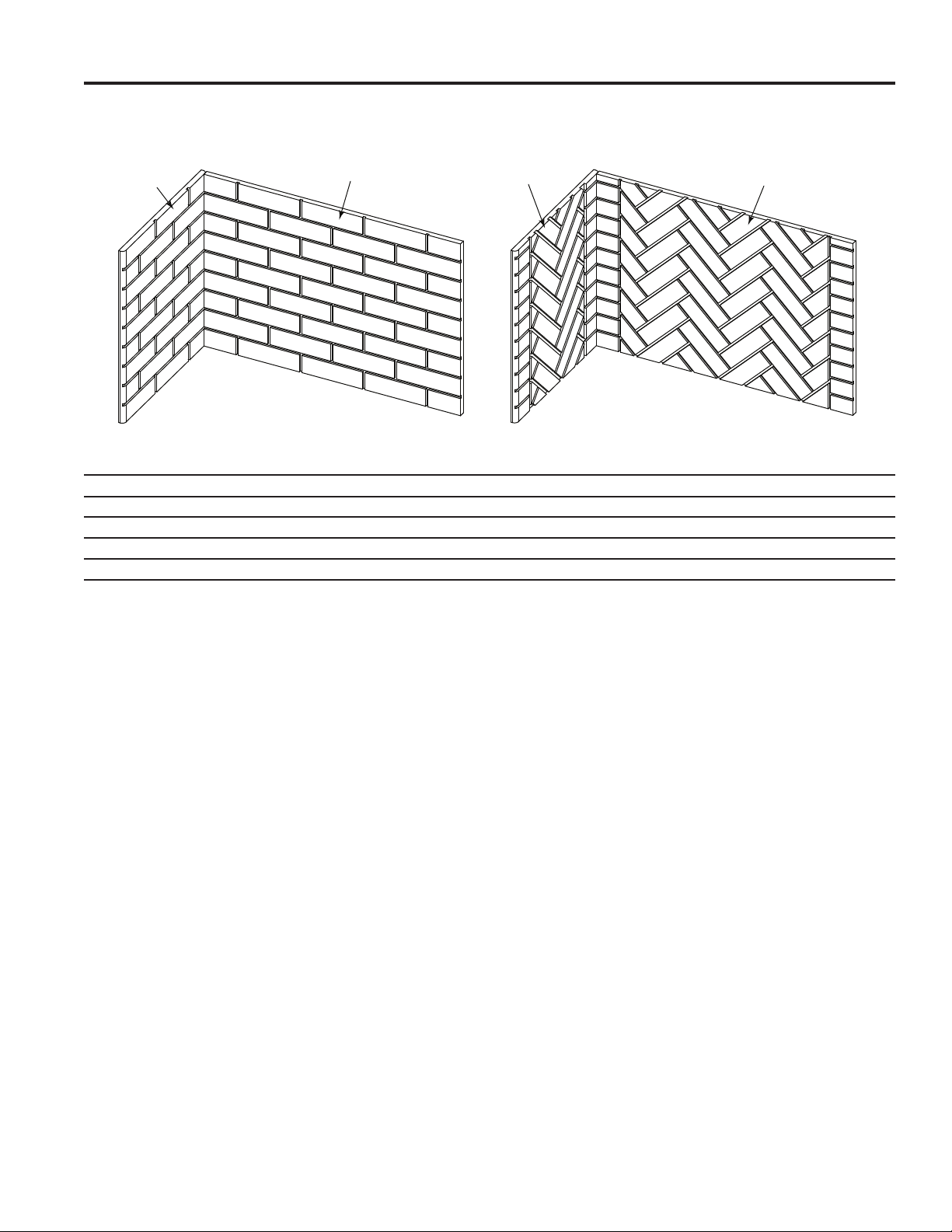
20302381
55
Designer Series Direct Vent Gas Fireplace
1
2
3
4
1. End Wall, Traditional 20302517 -- --
2. Long Wall, Traditional 20302518 -- --
3. End Wall, Herringbone -- 20302519 20302521
4. Long Wall, Herringbone -- 20302520 20302522
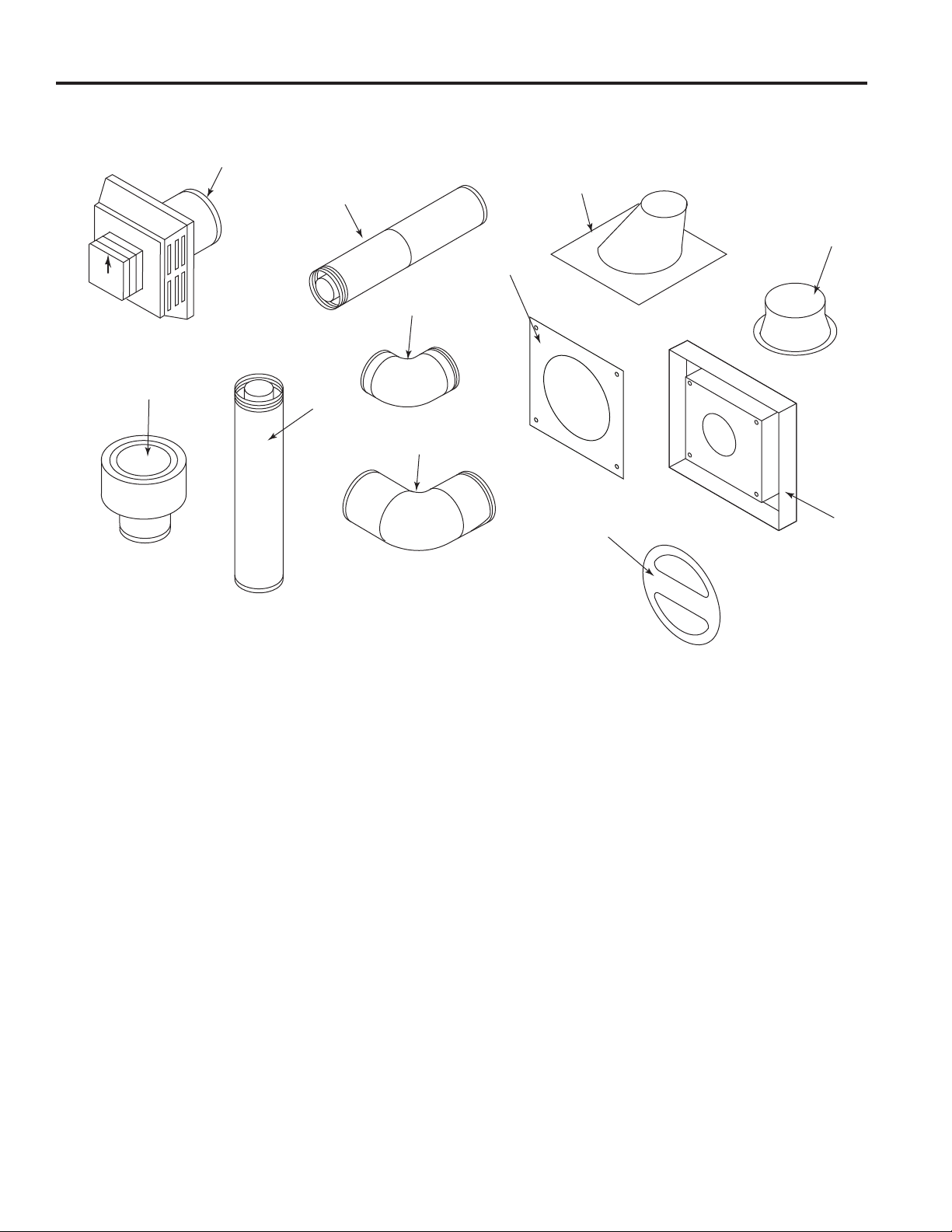
56
20302381
Designer Series Direct Vent Gas Fireplace
HOT
1
2
3
4
5
6
9
7
8
11
10

20302381
57
Designer Series Direct Vent Gas Fireplace
Current Old
Duravent Duravent
or Vermont or Vermont
Qty./ Castings Group Castings Group Selkirk
Item Box Description Part no. Part no. Part no.
1 1 Thru-roof Flexible Pipe Termination Kit with ex adapter TRFK -- --
24" rigid pipe, roof support 4" x 65/8" and termination cap
1 1 Horizontal Square Termination Cap with built-in vinyl BHRTK BHRTK --
siding standoff, heat deector and restop
1 1 Square Horizontal Termination Cap 46DVA-HC 985 4DT-HC
1 1 Round Horizontal Termination Cap 46DVS-HRCS -- --
1 1 Sconce Termination Cap (aluminum) 46DVA-HSC -- --
2 1 Low-Prole Vertical Termination Cap 46DVA-VC 980 Note
3 6 6" Pipe Length (galvanized) 46DVA-06 908 4DT-06
3 6 9" Pipe Length (galvanized) 46DVA-09 907 4DT-09
3 6 12" Pipe Length (galvanized) 46DVA-12 906 4DT-1
3 6 24" Pipe Length (galvanized) 46DVA-24 904 4DT-4
3 6 36" Pipe Length (galvanized) 46DVA-36 903 4DT-36
3 6 48" Pipe Length (galvanized) 46DVA-48 902 4DT-48
4 6 81/2" Pipe Extension (galvanized) 46DVA-08A -- 4DT-AJ
4 6 16" Pipe Extension (galvanized) 46DVA-16A -- 4DT-AJ14
5 6 45° Elbow (galvanized) 46DVA-E45 945 4DT-EL45
6 6 90° Elbow (galvanized) 46DVA-E90 990 4DT-EL90
7 6 Adjustable Roof Flashing 0/12 - 6/12 46DVA-F6 943 4DT-AF6
8 6 Storm Collar 46DVA-SC 953 4DT-SC
9 6 1" Firestop 46DVA-FS 963 4DT-FS
9 6 3" Firestop FS3 -- --
10 1 Vinyl Siding Standoff 46DVA-VSS 950 4DT-VS
11 1 Restrictor Disk 45D0551 45D0551 --
1 Attic Insulation Shield 46DVA-IS -- --
6 Steep Roof Flashing 7/12 - 12/12 46DVA-F12 943S --
8 Horizontal Termination with 1" restop BHRT/8 -- --
8 Flex Adapter Starter DVFA/8 -- --
B\,
This termination is not recommended for use with the
Designer Series Fireplaces.

58
20302381
Designer Series Direct Vent Gas Fireplace
1 1 Horizontal Termination Cap w/Built-In Vinyl Siding BHR58TK9 --
Standoff Heat Deector, Firestop and Adjustable
Pipe 11" to 14
5
/8"
1 1 Horizontal Termination Cap Built-In Vinyl Siding Standoff, BHS58TK --
Heat Deector, Firestop, 90° Elbow and Adjustable
Pipe 11" to 14
5
/8"
1 1 Horizontal Termination Cap w/Built-In Vinyl Siding Standoff, BHSF58TK --
Heat Deector, Firestop, Flexible Pipe 20" to 48", Adapter
1 8 Horizontal Termination w/ 1" Firestop BHR58T/8
1 1 Horizontal High Wind Termination Cap 58DVA-HC 1285 5DT-HC --
1 1 Horizontal Temination Cap 5DHT
2 1 Vertical Termination 58DVA-VC 1280 Note Note
3 4 6" Pipe Length 58DVA-06 1208 5DT-06 5D6
3 4 9" Pipe Length 58DVA-09 1207 5DT-09
3 4 12" Pipe Length 58DVA-12 1206 5DT-12 5D12
3 4 24" Pipe Length 58DVA-24 1204 5DT-24 5D24
3 4 36" Pipe Length 58DVA-36 1203 5DT-36 5D36
3 4 48" Pipe Length 58DVA-48 1202 5DT-48 5D48
4 4 8
1
/2" Pipe Extension 58DVA-08A -- 5DT-AJ
4 4 16" Pipe Extension 58DVA-16A -- --
5 4 45° Elbow 58DVA-E45 1245 5DT-EL45 5D456
5 4 45° Swivel Elbow -- -- 5DT-EL45
6 4 90° Elbow 58DVA-E90 1290 5DT-EL90S 5D906
6 4 90° Swivel Elbow -- 1290G 5DT-EL90S
7 6 Flashing, 0/12 to 6/12 Roof Pitch 58DVA-F6 1243 5DT-AF6 5DF
7 Steep Roof Flashing 58DVA-F12 1243S --
8 6 Storm Collar 58DVA-SC 1253 5DT-SC 5DSC
9 4 Firestop 58DVA-FS 1263 5DT-FS 5DFS
9 3" Firestop FS38 FS38 --
10 1 Vinyl Siding Standoff 58DVA-VSS 1250 5DT-VS 5DVS
11 Attic Insulation Shield (not shown) 58DVA-IS -- --
12 8 Flex Adapter Starter (not shown) DVFF8A/8 -- --
13 1 Reducer - 5 x 8 to 4 x 6
5
/8 (not shown) 1222DA 1222DA --
For more information about, or instructions for, the venting components referenced above, please contact
the component manufacturer:
Selkirk Corporation: www. selkirkcorp.com or 800-992-8368
Duravent: www. duravent.com or 800-835-4429
Metal-Fab, Inc.: www.metal-fabinc.com or 316-943-2351
This termination is not recommended for use with the
Designer Series Fireplaces.
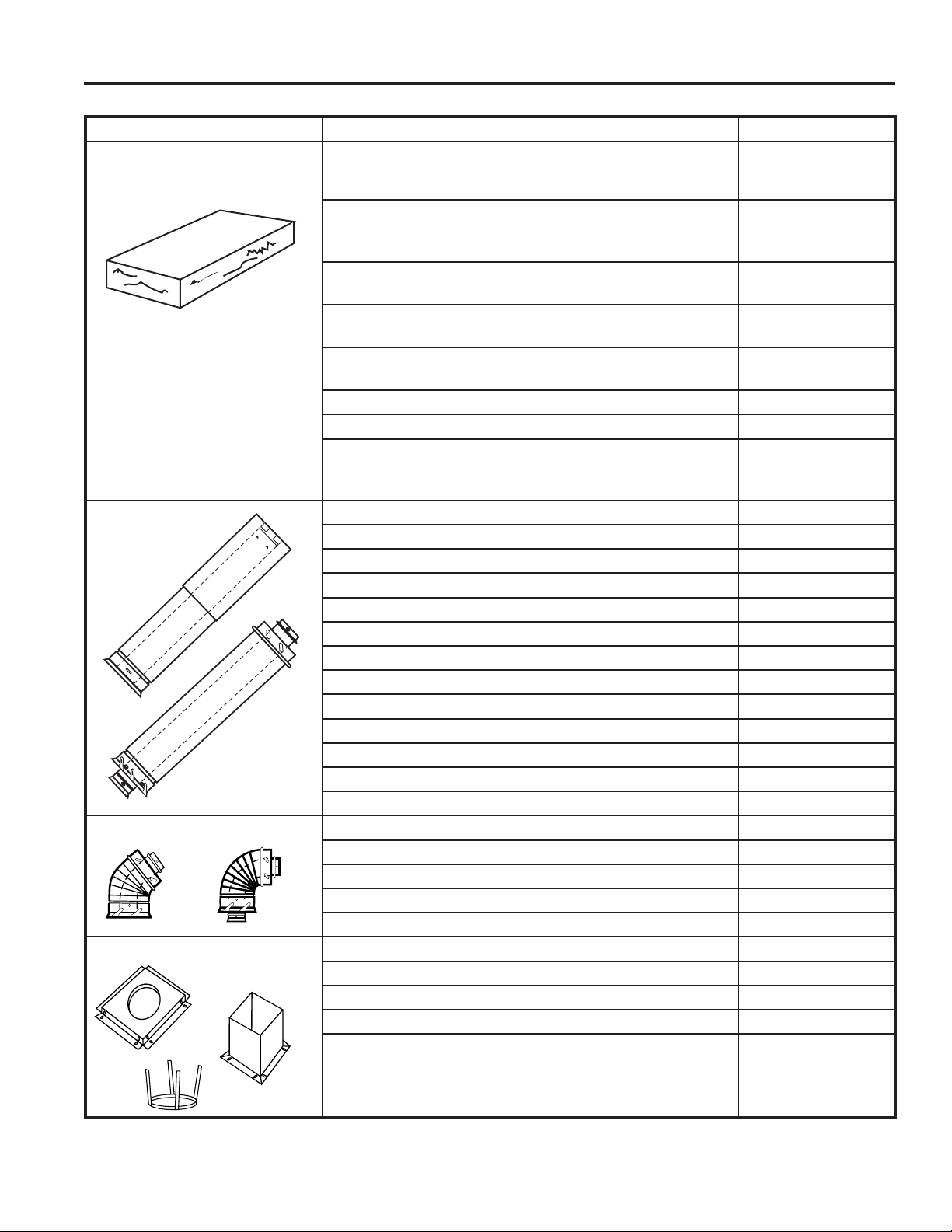
20302381
59
Designer Series Direct Vent Gas Fireplace
Horizontal Vent Termination Kits Rear Vent Hot Touch Termination Kit w/ 10" to 16" 7TBRHTK
Adjustable Termination Pipe, Firestop, and Hot Touch
Termination w/ Siding Shield
Up and Out Side Wall Termination Kit w/ 10" to 16" 7TDVSCTK
Adjustable Termination Pipe, 90° Elbow, Firestop, and
Cool Touch Termination w/ Siding Shield
Rear Vent Cool Touch Termination w/ Siding Shield for 7TRVCT/8
Straight-out Applications and Firestop - 8 pack
Rear Vent Hot Touch Termination w/ Siding Shield for 7TRVHT/8
Straight-out Applications and Firestop - 8 pack
Termination Guard for 7" T.L. Rear Vent Hot Touch 7TRVTG
Terminations 97TRVT/7TSVKT)
Snorkel Termination 7TDVSNORK
7" T.L. DVRTSB Termination Screen Guard 7TBSG
Up and Out Starter Kit w/ 40" Flex Pipe, Firestop, Cool 7FDVSCTK
Touch Termination w/ Siding Shield, and 2 ea. Clamp
Bands
Twist Lock Pipe 20" Termination Pipe - 8 pack 7TDVP20/8
10" - 16" Adjustable Termination Pipe - 4 pack 7TDVPA/4
12" - 18" Adjustable Vent Length 7TDVP1218
35" - 64" Adjustable Vent Length 7TDVP3564
8" Vent Pipe - 4 pack 7TDVP8/4
12" Vent Pipe - 4 pack 7TDVP12/4
24" Vent Pipe - 4 pack 7TDVP24/4
36" Vent Pipe 7TDVP36
36" Vent Pipe - 30 pack 7TDVP36/30
48" Vent Pipe 7TDVP48
48" Vent Pipe - 30 pack 7TDVP48/30
5" x 8" to 4" x 7" Adapter 7TDVP58
Flex Adapter Starter Kit DVFFA/8
Twist Lock Elbows 45° Elbow for Vertical/Horizontal Offset 7TDV45
45° Elbow for Vertical Offsets - 8 pack 7TDV45/8
90° Elbow for Vertical/Horizontal Offset 7TDV90
90° Elbow for Vertical/Horizontal Offset - 8 pack 7TDV90/8
Shields and Supports 1" Firestop 7DV1FS
3" Firestop 7DV3FS
1" Attic Insulation Shield 7DV1AIS
Combination Horizontal Offset/Roof Support 7DVCS
Venting Components
Telescope vent
10/20/99 twist lock
584F
Venting Components
Pipe sections
2/25/99 djt
10/20/99 twist lock
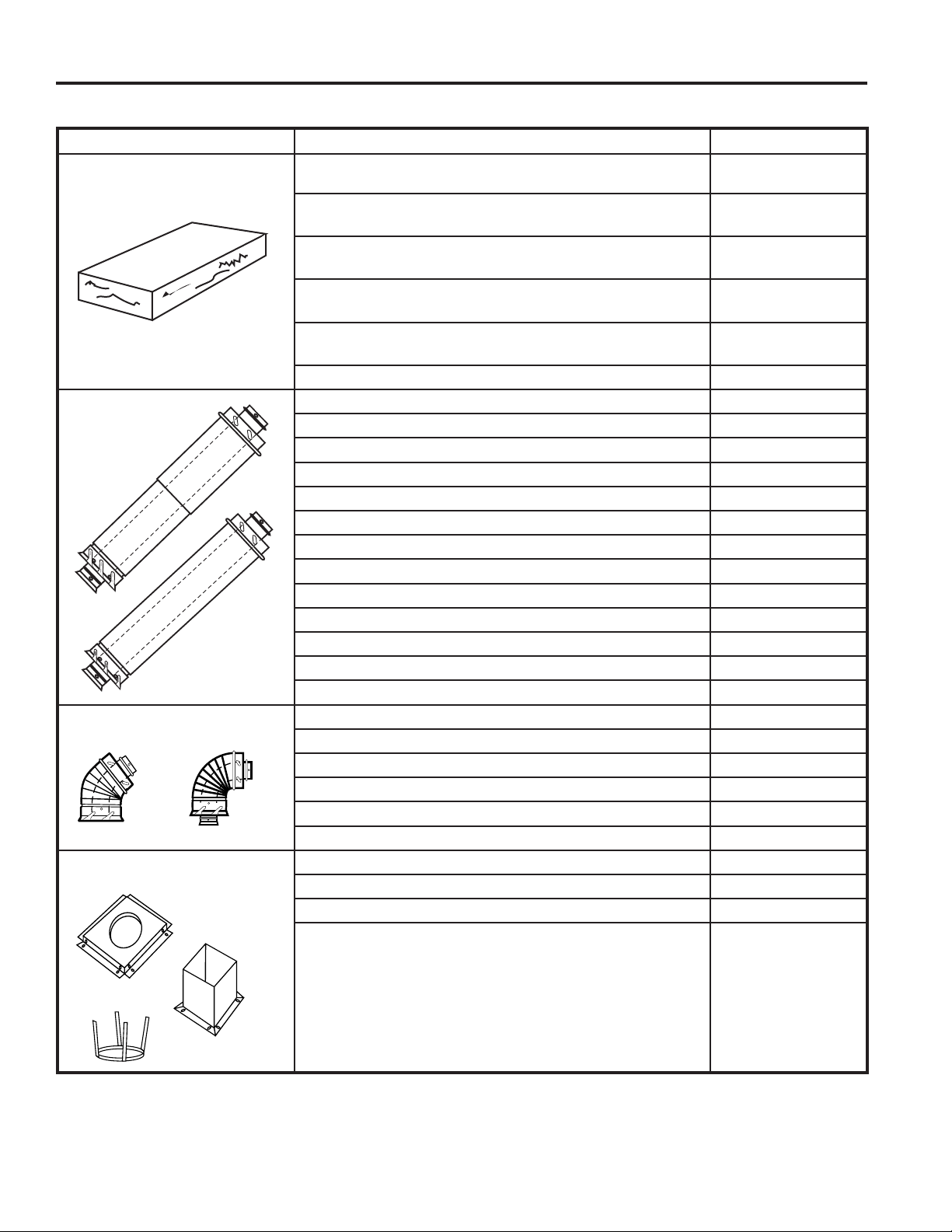
60
20302381
Designer Series Direct Vent Gas Fireplace
Vertical Vent Termination Kits Vertical Vent Termination w/ Storm Collar 7TDVSKV
(ashing NOT included)
Vertical Vent Termination w/ Storm Collar - 8 pack 7TDVSKV/8
(ashing NOT included)
Vertical Vent Termination w/ 1/12 - 6/12 Flashing, Storm 7TDVSKVA*
Collar and Ceiling Support Kit
Vertical Vent Termination w/ 6/12 - 12/12 Flashing, 7TDVSKVB*
Storm Collar and Ceiling Support Kit
Vertical Vent Termination w/ Flat Flashing, Storm Collar 7TDVSKVF*
and Ceiling Support Kit
Twist Lock Pipe 20" Rigid Pipe - single pack 7TDVP20
30" Flex Pipe - single pack 7FDVP30
12" - 18" Adjustable Vent Length 7TDVP1218
35" - 64" Adjustable Vent Length 7TDVP3564
8" Vent Pipe - 4 pack 7TDVP8/4
12" Vent Pipe - 4 pack 7TDVP12/4
24" Vent Pipe - 4 pack 7TDVP24/4
36" Vent Pipe 7TDVP36
36" Vent Pipe - 30 pack 7TDVP36/30
48" Vent Pipe 7TDVP48
48" Vent Pipe - 30 pack 7TDVP48/30
5" x 8" to 4" x 7" Adapter 7TDVP58
Flex Adapter Starter Kit DVFFA/8
Twist Lock Elbows 45° Elbow for Vertical/Horizontal Offset 7TDV45
45° Elbow for Vertical Offsets - 8 pack 7TDV45/8
90° Elbow for Vertical/Horizontal Offset 7TDV90
90° Elbow for Vertical/Horizontal Offset - 8 pack 7TDV90/8
Shields and Supports 1" Firestop 7DV1FS
1" Attic Insulation Shield 7DV1AIS
Combination Horizontal Offset/Roof Support 7DVCS
584E
Venting Components
Telescope vent
2/25/99 djt
10/20/99 twist lock
584F
Venting Components
Pipe sections
2/25/99 djt
10/20/99 twist lock

20302381
61
Designer Series Direct Vent Gas Fireplace

62
20302381
Designer Series Direct Vent Gas Fireplace
This product must be installed by a licensed plumber or
gas fitter when installed within the Commonwealth of
Massachusetts.
Flex line installation must not exceed 36 inches and must
have a T shutoff valve.
Any residence with a direct vent product must have a CO
detector installed in the residence.
Installation of the replace or vented gas log in the State
of Massachusetts requires the damper to be permanently
removed or welded in the fully open position.
In addition, neither a naturally vented gas log nor a vent-
free product may be installed in a bedroom or bathroom in
the State of Massachusetts.
All gas tting and installation of this heater shall only be
done by a licensed gas tter or licensed plumber.
For all side wall horizontally vented gas fueled equipment
installed in every dwelling, building or structure used in
whole or in part for residential purposes, including those
owned or operated by the Commonwealth and where the
side wall exhaust vent termination is less than seven (7) feet
above nished grade in the area of the venting, including but
not limited to decks and porches, the following requirements
shall be satised:
At the time of installation of the side wall horizontal vented
gas fueled equipment, the installing plumber or gas tter
shall observe that a hard wired carbon monoxide detector
with an alarm is installed on each additional level of the
dwelling, building or structure served by the side wall
horizontal vented gas fueled equipment. It shall be the
responsibility of the property owner to secure the services
of qualied licensed professionals for the installation of hard
wired carbon monoxide detectors.
In the event that the side wall horizontally vented gas fueled
equipment is installed in a crawl space or an attic, the hard
wired carbon monoxide detector with alarm and battery
back-up may be installed on the next adjacent oor level.
In the event that the requirements of this subdivision can not
be met at the time of completion of installation, the owner
shall have a period of thirty (30) days to comply with the
above requirements; provided, however, that during said
thirty (30) day period, a battery operated carbon monoxide
detector with an alarm shall be installed.
Each carbon monoxide detector as required in accordance
with the above provisions shall comply with NFPA 720 and
ANSI/UL 2034 listed and IAS certied.
A metal or plastic identication plate shall be permanently
mounted to the exterior of the building at a minimum height
of eight (8) feet above grade directly in line with the exhaust
vent terminal for the horizontally vented gas fueled heating
appliance or equipment. The sign shall read, in print size no
less than one-half (1/2) inch in size,
The state or local gas inspector of the side wall horizontally
vented gas fueled equipment shall not approve the
installation unless, upon inspection, the inspector observes
carbon monoxide detectors and signage installed in
accordance with the provisions of 248 CMR 5.08(2)(a)1
through 4.
The following equipment is exempt from 248 CMR
5.08(2)(a)1 through 4:
• The equipment listed in Chapter 10 entitled “Equipment
Not Required To Be Vented” in the most current edition
of NFPA 54 as adopted by the Board; and
• Product Approved side wall horizontally vented gas
fueled equipment installed in a room or structure
separate from the dwelling, building or structure used
in whole or in part for residential purposes.
When the manufacturer of Product Approved side wall
horizontally vented gas equipment provides a venting
system design or venting system components with the
equipment, the instructions provided by the manufacturer
for installation of the equipment and the venting system
shall include:
• Detailed instructions for the installation of the venting
system design or the venting system components; and
• A complete parts list for the venting system design or
venting system.
When the manufacturer of a Product Approved side wall
horizontally vented gas fueled equipment does not provide
the parts for venting the ue gases, but identies “special
venting systems”, the following requirements shall be
satised by the manufacturer:
• The referenced “special venting system” instructions
shall be included with the appliance or equipment
installation instructions; and
• The “special venting systems” shall be Product
Approved by the Board, and the instructions for that
system shall include a parts list and detailed installation
instructions.
A copy of all installation instructions for all Product Approved
side wall horizontally vented gas fueled equipment, all
venting instructions, all parts lists for venting instructions,
and/or all venting design instructions shall remain with
the appliance or equipment at the completion of the
installation.

20302381
63
Designer Series Direct Vent Gas Fireplace
The following components are warranted for life to the original owner, subject to proof of purchase: Firebox, Com-
bustion Chamber, Heat Exchanger, Grate and Stainless Steel Burners.
The following components are warranted ve (5) years to the original owner, subject of proof of purchase: Ceramic
Fiber Logs.
Vermont Castings Group warrants the components and materials in your gas appliance to be free from manufacturing
and material defects for a period of two years from date of installation. After installation, if any of the components
manufactured by Vermont Castings Group in the appliance are found to be defective in materials or workmanship,
Vermont Castings Group will, at its option, replace or repair the defective components at no charge to the original
owner. Vermont Castings Group will also pay for reasonable labor costs incurred in replacing or repairing such
components for a period of two years from date of installation. Any products presented for warranty repair must be
accompanied by a dated proof of purchase.
This Limited Lifetime Warranty will be void if the appliance in not installed by a qualied installer in accordance
with the installation instructions. The Limited Lifetime Warranty will also be void if the appliance is not operated
and maintained according to the operating instructions supplied with the appliance, and does not extend to (1)
rebox/burner assembly damage by accident, neglect, misuse, abuse, alterations, negligence of others, including
the installation thereof by unqualied installers, (2) the costs of removal, reinstallation or transportation of defec-
tive parts on the appliance, or (3) incidental or consequential damage. All service work must be performed by an
authorized service representative.
This warranty is expressly in lieu of other warranties, express or implied, including the warranty of merchantability
of tness for purpose and of all other obligations or liabilities. Vermont Castings Group does not assume for it any
other obligations or liabilities in connection with sale or use of the appliance. It states that do not allow limitations
on how long an implied warranty lasts, or do not allow exclusion of indirect damage, those limitations of exclusions
may not apply to you. You may also have additional rights not covered in the Limited Lifetime Warranty.
Vermont Castings Group reserves the right to investigate any and all the claims against the Limited Lifetime War-
ranty and decide upon method of settlement.
1. Contact your supplier. Make sure you have your warranty, your sales receipt and the model/serial number of
your Vermont Castings Group product.
2. DO NOT ATTEMPT TO DO ANY SERVICE WORK YOURSELF.
64
20302381
Designer Series Direct Vent Gas Fireplace
Based on CSA P.4.1-09
Natural Gas 69.7 67.0
LP/Propane 79.4 68.3
149 Cleveland Drive • Paris, Kentucky 40361
www.vermontcastingsgroup.com