
Instruction Manual
I(RRFTSMRWI
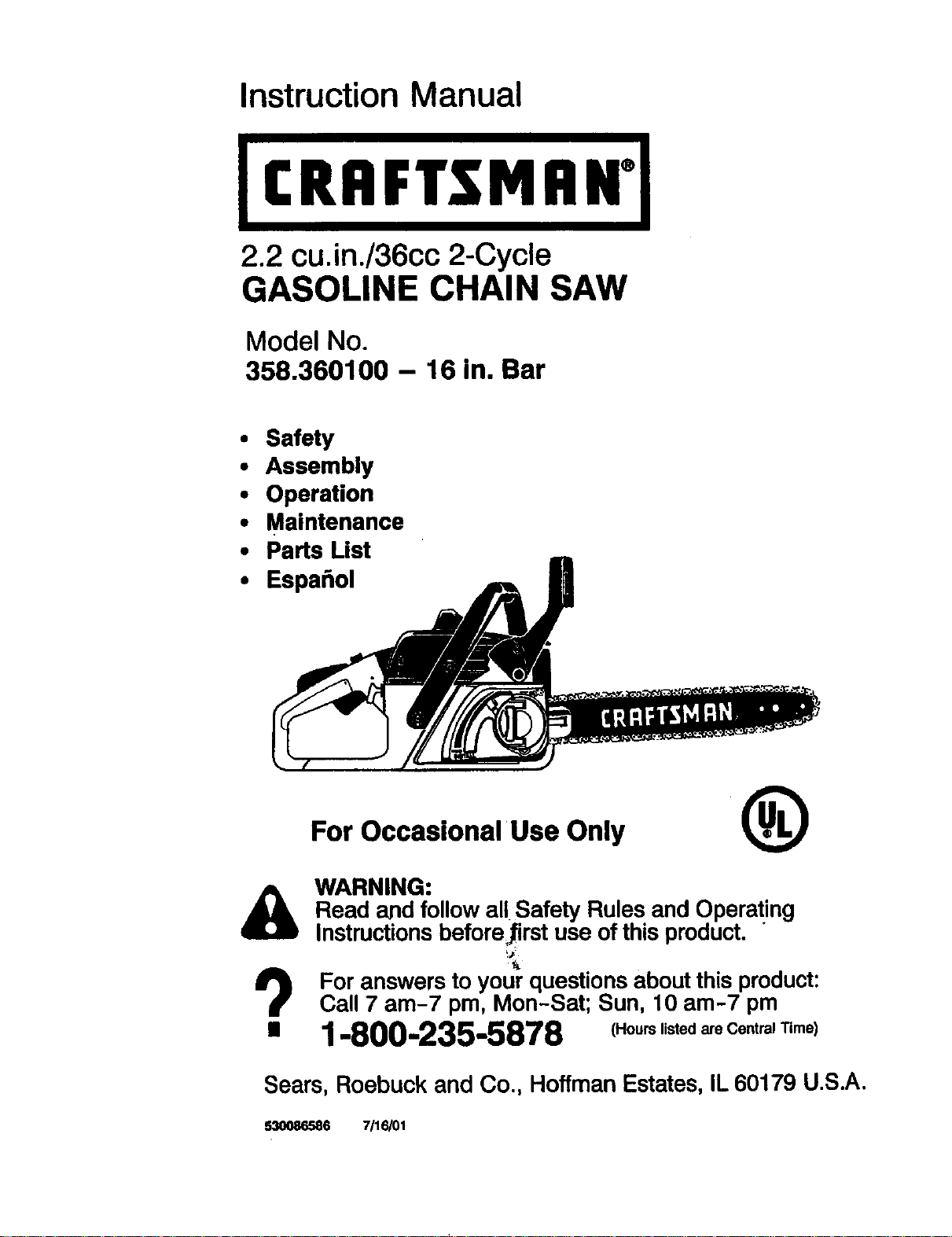
2.2 cu.in./36cc 2-Cycle
GASOLINE CHAIN SAW
Model No.
358.360100 - 16 in. Bar
• Safety
• Assembly
• Operation
• Maintenance
• Parts List
• Espa_ol
For Occasional Use Only
®
WARNING:
Read and follow all Safety Rules and Operating
Instructions before_rst use of this product.
9
t_
For answers to your questions about this product:
Call 7 am-7 pm, Mon-Sat; Sun, 10 am-7 pm
1-800-235-5878 ,.ou_ listedare Central Time)
Sears, Roebuck and Co., Hoffman Estates,IL60179 U.S.A.
530086586 7/16/01
Warranty 2 Storage 19
Safety Rules 2 Troubleshooting Table 20
Assembly 6 Emissions Statement 21
Operation 7 Parts List 23
Maintenance 13 Spanish 26
Service and Adjustments 16 Pads & Ordering Back Cover
FULL ONE YEAR WARRANTY ON CRAFTSMAN ® GAS CHAIN SAW
For one year from the date of purchase, when this Craftsman Gas Chain Saw is
maintained, lubricated and tuned up according to the instruction manual, Sears
will repair, free of charge, any defect in material or workmanship.
This warranty excludes the bar, chain, spark plug and air filter, which are
expendable pads, and become worn during normal use.
If this Gas Chain Saw is used for commercial or rental purposes, this warranty
applies for 30 days from the date of purchase.
WARRANTY SERVICE IS AVAILABLE BY RETURNING THIS CHAIN SAW TO THE
NEAREST SEARS STORE OR SERVICE CENTER IN THE UNITED STATES.
This warranty gives you specific legal rights, and you may also have other rights
which vary from state to state.
Sears, Roebuck and Co., D/817 WA, Hoffman Estates, IL 60179
WARNING: Always disconnect
spark plug wire when making repairs
except for carburetor adjustments. Be-
cause a chain saw is a high-speed
woodcutting tool, special precautions
must be observed to reduce dsk of ac-
cidents. Careless or improper use of
this tool can cause serious injury.
PLAN AHEAD
• Restrict the use of your saw to adult
users who understand and can fol-
low the safety rules, precautions,
and operating instructions found in
this manual.
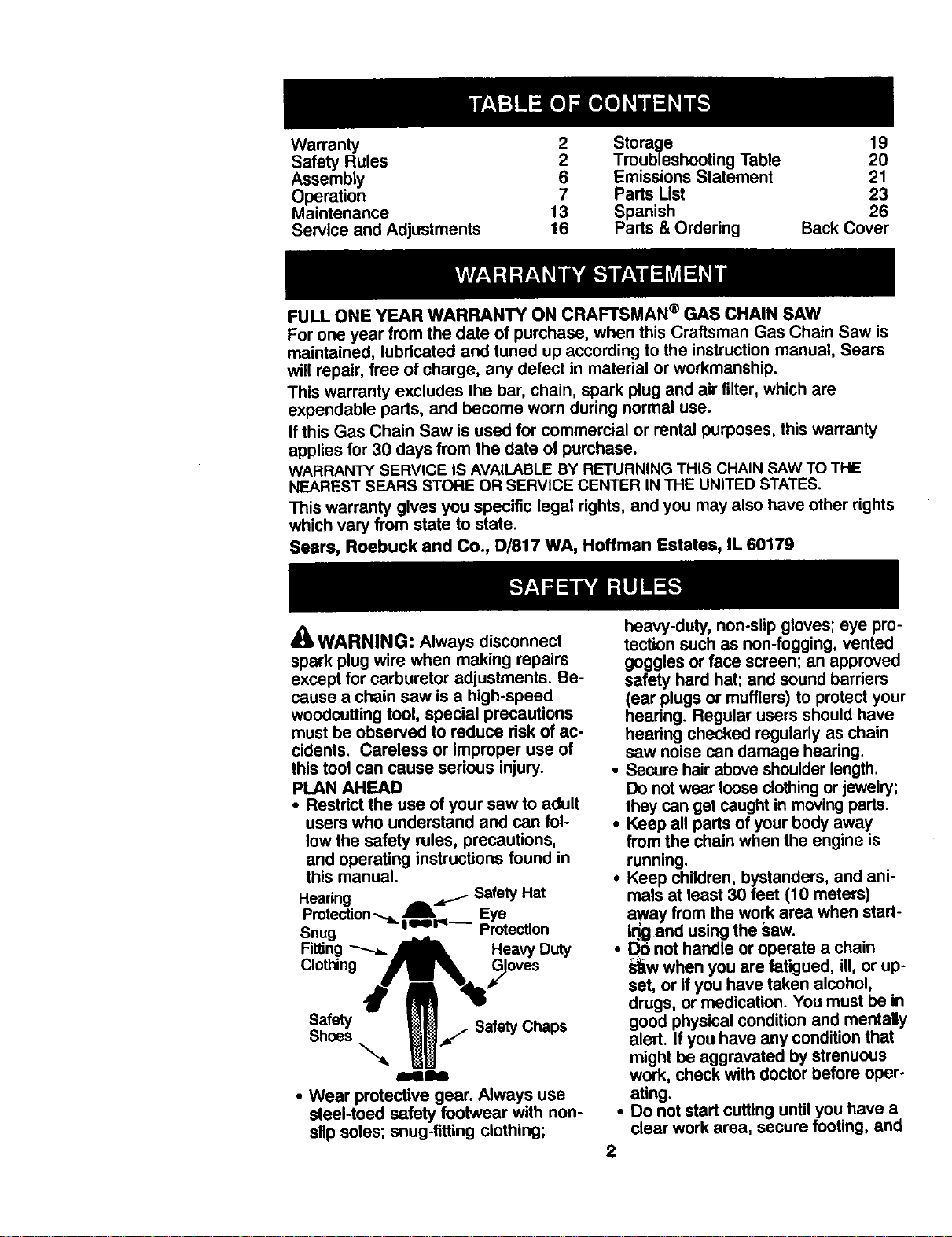
Hearing _ Safety Hat
Protection_ JL _r Eye
Snug eMrq_-- Protection
Fitting _ Heavy Duty
Clothing oves
SafetYshoes j Safety Chaps
\
_N
• Wear protective gear. Always use
steel-toed safety footwear with non-
slip soles; snug-fitting clothing;
heavy-duty, non-slip gloves; eye pro-
tection such as non-fogging, vented
goggles or face screen; an approved
safety hard hat; and sound barriers
(ear plugs or mufflers) to protect your
hearing. Regular users should have
hearing checked regularly as chain
saw noise can damage hearing.
• Secure hair above shoulder length.
Do not wear loose clothing or jewelry;
they can get caught in moving pads.
• Keep all parts of your body away
from the chain when the engine is
running.
• Keep children, bystanders, and ani-
mals at least 30 feet (10 meters)
away from the work area when start-
Ing and using the saw.
• D_ not handle or operate a chain
_aw when you are fatigued, ill, or up-
set, or if you have taken alcohol,
drugs, or medication. You must be in
good physical condition and mentally
alert. If you have any condition that
might be aggravated by strenuous
work, check with doctor before oper-
ating.
• Do not start cutting until you have a
clear work area, secure footing, and
2
especiallyifyouarefelling a tree, a
retreat path.
OPERATE YOUR SAW SAFELY
• Do not operate with one hand. Seri-
ous injury to the operator, helpers, or
bystanders may result from one-
handed operation. A chain saw is in-
tended for two-handed use.
• Operate the chain sawonly in a well-
ventilated outdoor area.
• Do not operate saw from a ladder or
in a tree.
• Make sure the chain will not make
contact with any object while starting
the engine. Never try to start the saw
when the guide bar is in a cut.
• Do not put pressure on the saw, es-
pecially at the end of the cut. Doing
so can cause you to lose control
when the cut is completed.
• Stop engine before setting saw
down.
• Hand carry saw only when engine is
stopped. Carry with muffler away
from body; guide bar & chain project-
ing behind you; guide bar preferably
covered with a scabbard.
• Do not operate a chain saw that is
damaged, improperly adjusted, or not
completely and securely assembled.
Always replace bar, chain, hand
guard, chain brake, or other pads im-
mediately if they become damaged,
broken, or are otherwise removed.
MAINTAIN YOUR SAW IN GOOD
WORKING ORDER
• Have all chain saw service per-
formed by a qualified service dealer
except the items listed in the MAINTE-
NANCE section of this manual.
• Make certain the saw chain stops
moving when the throttle trigger is
released. For correction, refer to
CARBURETOR ADJUSTMENTS.
• Keep the handles dry, clean, and
free from oil or fuel mixture.
• Keep caps and fasteners securely
tightened.
• Nonconforming replacement compo-
nents or the removal of safety devices
may cause damage to the unit and
possible injury to the operator or by-
standers. Use only Craftsman acces-
sodes and replacement parts as rec-
ommended. Never modify your saw.
• Maintain chain saw with care.
• Keep unit sharp and clean for better
and safer performance.
• Follow instructions for lubricating and
changing accessories.
• Check for damaged parts. Before fur-
ther use of the chain saw, a guard or
other part that is damaged should be
carefully checked to determine that it
will operate properly and perform its
intended function. Check for alignment
of moving parts, binding of moving
parts, breakage of pads, mounting and
any other conditions that may affect its
operation. A guard or other part that is
damaged should be properly repaired
or replaced by a Sears Service Center
unless otherwise indicated elsewhere
in the instruction manual.
• When not in use, chain saws should
be stored in a dry, high or locked-up
place out of the reach of children.
• When storing saw, use a scabbard or
carrying case.
HANDLE FUEL WITH CAUTION
• Do not smoke while handling fuel or
while operating the saw.
• Eliminate all sources of sparks or
flame in areas where fuel is mixed or
poured.
• Mix and pour fuel in an outdoor area
and use an approved, marked con-
tainer for all fuel purposes. Wipe up
all fuel spills before starting saw.
• Move at least 10 feet (3 meters) from
fueling site before starting.
• Turn the engine off and let saw cool
in a non-combustible area, not on
dry leaves, straw, paper, etc. Slowly
remove fuel cap and refuel unit.
• Store the unit and fuel in a cool, dry
well ventilated space where fuel va-
pors cannot reach sparks or open
flames from water heaters, electric
motors or switches, furnaces, etc.
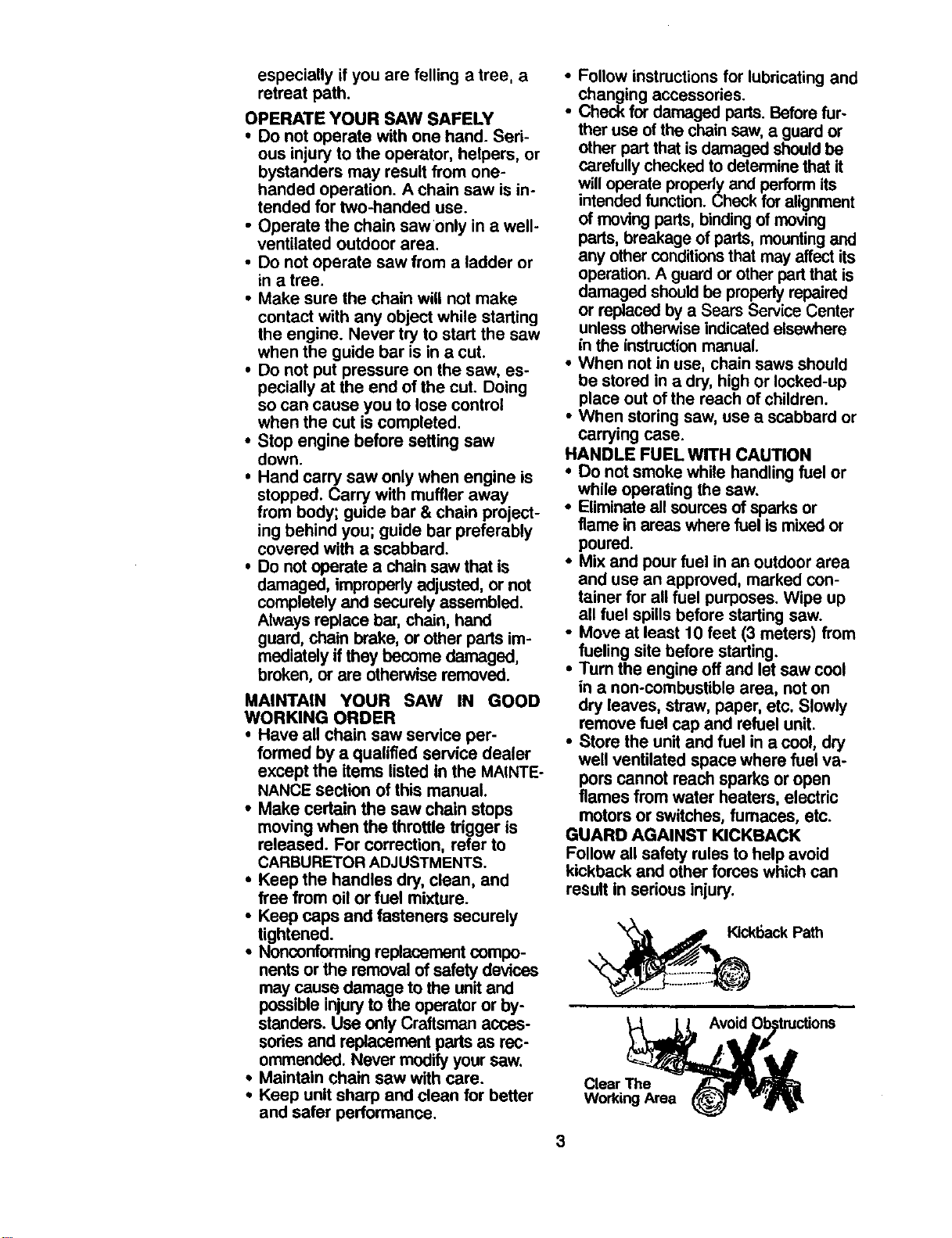
GUARD AGAINST KICKBACK
Follow all safety rules to help avoid
kickback and other forces which can
result in serious injury.
3
WARNING: Avoidkickbackwhich
canresultinseriousinjury. Kickback
isthebackward,upwardorsuddenfor-
wardmotionoftheguidebaroccurring
whenthesawchainneartheuppertip
oftheguidebarcontactsanyobject
suchasa logorbranch,orwhenthe
woodclosesinandpinchesthesaw
chaininthecut.Contactingaforeign
objectinthewoodcanalsoresultin
lossofchainsawcontrol.
• Rotational Kickback can occur
when the moving chain contacts an
object at the upper tip of the guide
bar. This contact can cause the
chain to diginto the object, which
stops the chain for an instant. The
result is a lightning fast, reverse
reaction which kicks the guide bar
up and back toward the operator.
• Pinch-Kickback can occur when
the the wood closes in and pinches
the moving saw chain in the cut
along the topof the guide bar and
the saw cha,n is suddenly stopped.
This sudden stopping of the chain
results in a reversal of the chain
force used to cut wood and causes
the saw to move in the opposite di-
rection of the chain rotation. The
saw is driven straight back toward
the operator.
• Pull-In can occur when the moving
chain contacts a foreign object in
the wood in the cut along the bot-
tom of the guide bar and the saw
chain is suddenly stopped. This
sudden stoppingpulls the saw for-
ward and away from the operator
and could easily cause the opera-
tor to lose control of the saw.
REDUCE THE CHANCE OF
KICKBACK
• Recognize that kickback can happen.
With a basic understanding of kick-
back, you can reduce the element of
surpdse which contdbutes to acci-
dents.
_ Never let the moving chain contact
any object at the tip of the guide bar.
Keep working area free from obstruc-
tions such as other trees, branches,
rocks, fences, etump6, etc. Eliminate
or avoid any obstruction that your saw
chain could hit while cutting.
• When cuffing a branch, do not let the
guide bar contact another branch or
other objects around it
• Keep saw chain sharp and propedy
tensioned. A loose or dull chain can
increase the chance of kickb_lck. Fol-
low manufacturer's chain sharpening
and maintenance instructions. Check
tension at regular intervals, but never
with engine running. Make su[e chain
brake nuts are securely tightened.
• Begin and continue cuttin_ at ful!
speed. If the chain is moving at a
slower speed, there is greate_ chance
of kickback occurring.
• Use extreme caution when repntering
a cut.
• Do not attempt cuts starting with the
tip of the bar (plunge cuts).
• Watch for shifting logs or other forces
that could close a cut and pinph or fall
into chain.
• Use the specified Reduced-Kickback
Guide Bar and Low-Kickback Chain.
Avoid Pinch-Kickback:
• Be extremely aware of situations or
obstructions that can cause Ftaterial
to pinch the top of or otherwise stop
the chain.
• Do not cut more than one log at a
time.
• Do not twist saw as bar is withdrawn
from an undercut when bucking.
Avoid Pull-In:
• Always begin cutting with the engine
at full speed and the saw housing
against wood.
• Use wedges made of plastic or wood.
Never use metal to hold the cpt open.
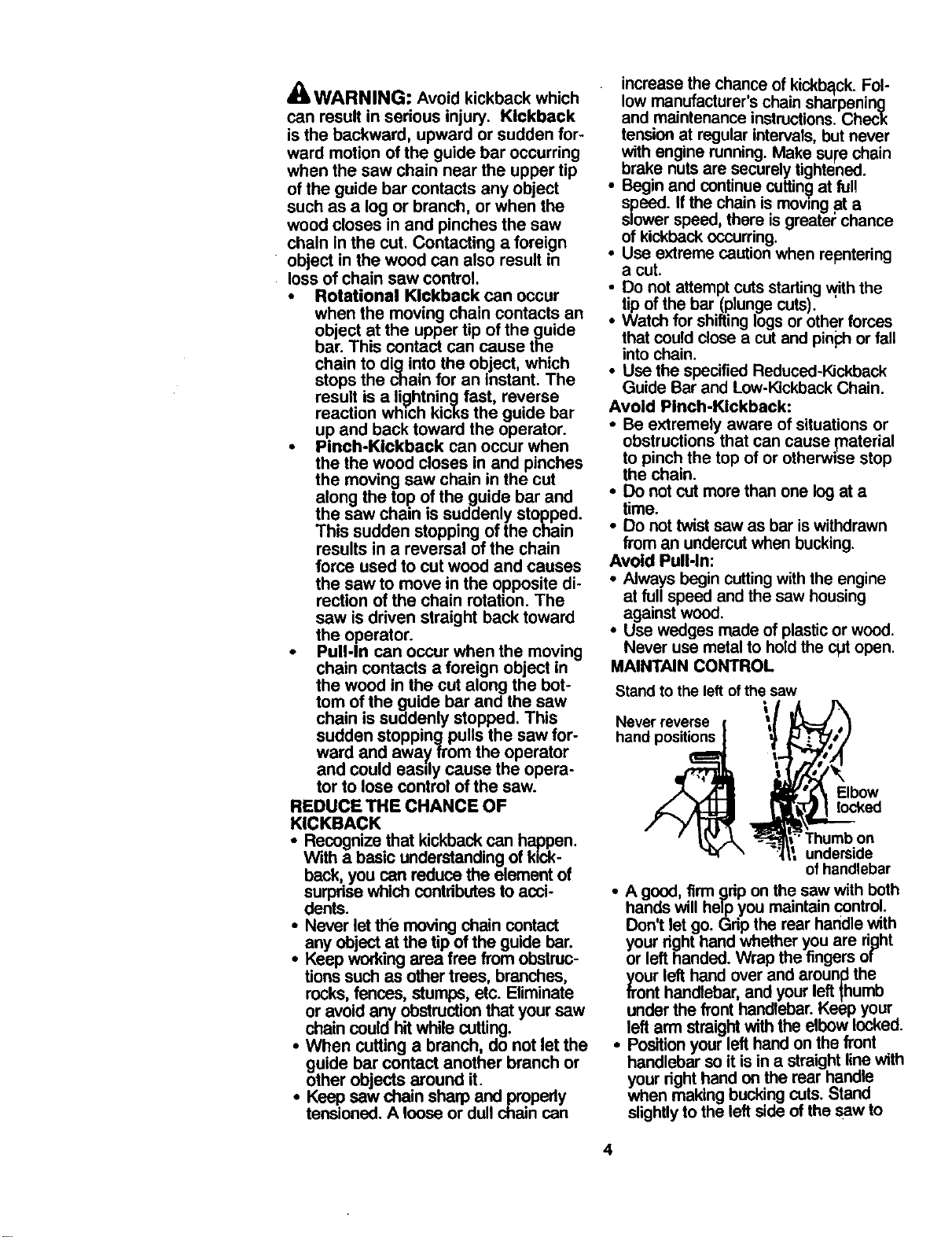
MAINTAIN CONTROL
Stand to the leftof the saw
Never reverse
hand positions
_ Im_"_ Elbow
""Thumb on
underside
of handlebar
• A good firm gdp on the saw with both
hands will help you maintain contro.
Don't let go. Gdp the rear handle with
your dght hand whether you are right
or left handed. Wrap the fingers of
_our left hand over and arounf:Jthe
ont handlebar, and your left _humb
under the front handlebar. Keep your
left arm straight with the elbow locked.
• Position your left hand on the front
handlebar so it is in a straight line with
YwheOurright hand on the rear handle
n making bucking cuts. Stand
s ghtly to the left side of the sew to
4
keepyourbodyfrom being in a direct
line with the cutting chain.
• Stand with your weight evenly bal-
anced on both feet.
• Do not overreach. You could be drawn
or thrown off balance and lose control.
• Do not cut above shoulder height. It is
difficult to maintain control of saw
above shoulder height.
KICKBACK SAFETY FEATURES
WARNING: The following features
are included on your saw to help reduce
hazard of kickback; however, such fea-
tures will not totally eliminate this danger.
Do not rely only on safety devices. Fol-
low all safety rules to help avoid kick-
back and other forces which can result
in serious injury,
• Front Hand Guard: designed to reduce
the chance ofyour left hand contact-
ing the chain if your hand slips off the
front handlebar.
• Position of front and rear handlebars:
designed with distance between han-
dles and "in-lina" with each other. The
spread and "in-line" position of the
hands provided by this design work
together to give balance and resis-
tance in controlling the pivot of the
saw back toward the operator if kick-
back occurs.
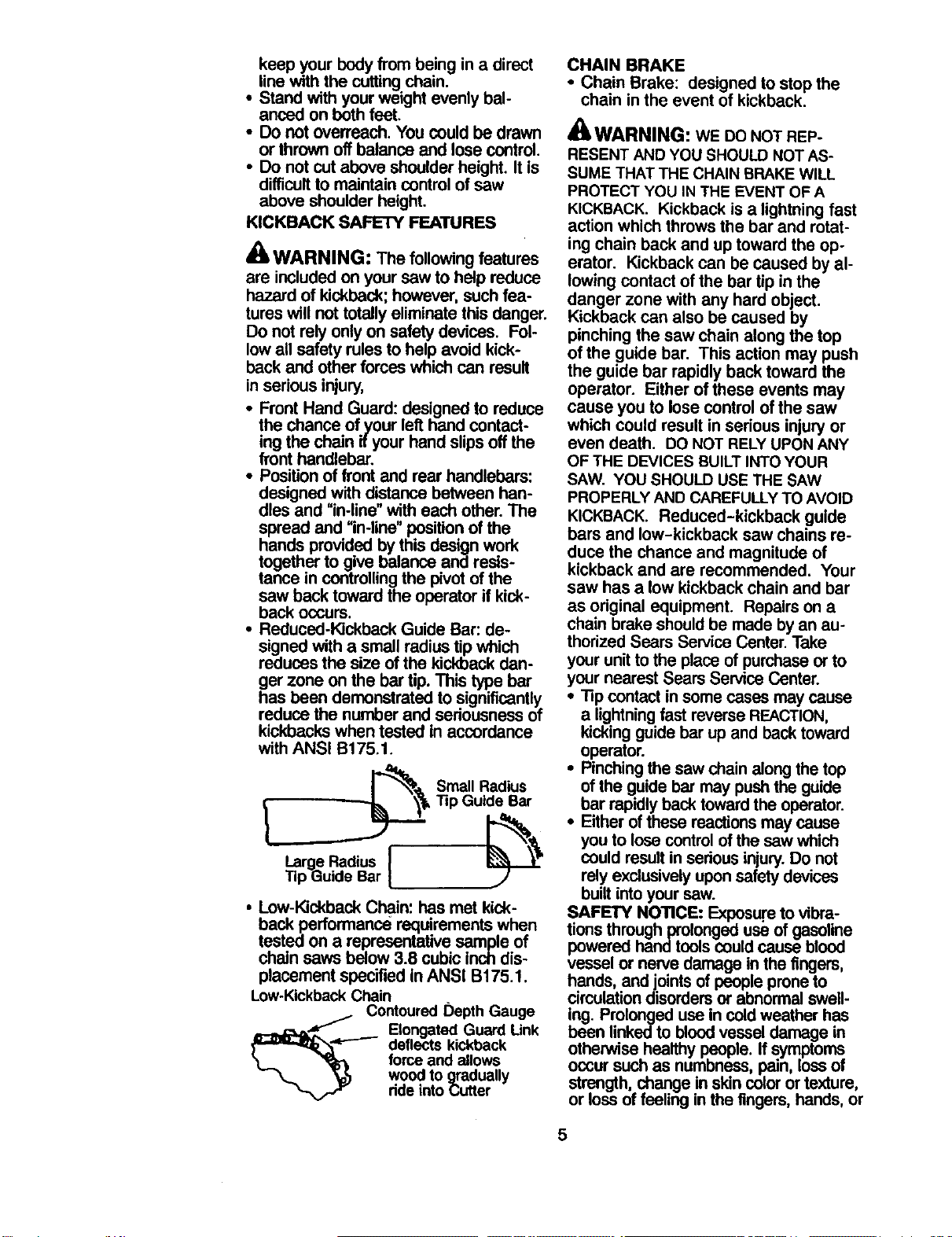
• Reduced-Kickback Guide Bar: de-
signed with a small radius tip which
reduces the size of the kickback dan-
ger zone on the bar tip. This type bar
has been demonstrated to significantly
reduce the number and seriousness of
kickbacks when tested in accordance
with ANSI B175.1.
Large Radius I
Tip Guide Bar
Small Radius
Tip Guide Bar
• Low-Kickback Chain: has met kick-
back performance requirements when
tested on a representative sample of
chain saws below 3.8 cubic inch dis-
placement specified In ANSI B175.1.
Low-Kickback Chain
Contoured Depth Gauge
Elongated Guard Link
deflects kickback
force and allows
wood to gradually
dde intoCutter
CHAIN BRAKE
• Chain Brake: designed to stop the
chain in the event of kickback.
_,WARNING: WE DO NOT REP-
RESENT AND YOU SHOULD NOT AS-
SUME THAT THE CHAIN BRAKE WILL
PROTECT YOU IN THE EVENT OF A
KICKBACK. Kickback is a lightning fast
action which throws the bar and rotat-
ing chain back and up toward the op-
erator. Kickback can be caused by al-
lowing contact of the bar tip in the
danger zone with any hard object.
Kickback can also be caused by
pinching the saw chain along the top
of the guide bar. This action may push
the guide bar rapidly back toward the
operator. Either of these events may
cause you to lose control of the saw
whk_h could result inserious injury or
even death. DO NOT RELY UPON ANY
OF THE DEVICES BUILT INTO YOUR
SAW. YOU SHOULD USE THE SAW
PROPERLY AND CAREFULLY TO AVOID
KICKBACK. Reduced-kickback guide
bars and low-kickback saw chains re-
duce the chance and magnitude of
kickback and are recommended. Your
saw has a low kickback chain and bar
as original equipment. Repairs on a
chain brake should be made by an au-
thorized Sears Service Center. Take
your unit to the place of purchase or to
your nearest Sears Service Center.
• lip contact in some cases may cause
a lightning fast reverse REACTION,
kicking guide bar up and back toward
operator.
• Pinching the saw chain along the top
of the guide bar may push the guide
bar rapidly back toward the operator.
• Either of these reactions may cause
you to lose control of the saw which
could result in serious injury. Do not
rely exclusively upon safety devices
built into your saw.
SAFETY NOTICE: Exposureto vibra-
tions through prolonged use of gasoline
powered hand tools could cause blood
vessel or nerve damage in the fingers,
hands, and joints of people prone to
circulation disorders or abnormal swell-
ing. Prolonged use in cold weather has
been linkedto blood vessel damage in
othenNise healthy people. If symptoms
occur such as numbness, pain, loss of
strength, change in skin color or tenure,
or loss of feeling in the fingers, hanas, or
5
joints,discontinuetheuseofthistool
and seek medical attention An anti-vi-
bration system does not guarantee the
avoidance of these problems. Users
who operate power tools on a continual
and regular basis must closely monitor
their physical condition and the condition
of this tool.
CHAIN BRAKE: If this saw is to be
used for commercial logging, a chain
brake is required and shall not be re-
moved or otherwise disabled to comply
with Federal OSHA Regulations for
Commercial Legging
SPARK ARRESTING SCREEN: Your
saw is equipped with a temperature lim-
iting muffler and spark arresting screen
which meets the requirements of Califor-
nia Codes 4442 and 4443. All U.S. for-
est land and the states of Califomia, Ida-
ho, Maine, Minnesota, New Jersey,
Oregon, and Washington require by law
that many intemal combustion engines
be equipped with a spark arresting
screen. If you operate a chain saw in a
state or locale where such regulations
exist, you are legally responsible for
maintaining the operating condition of
these parts Failure to do so is a viola-
tion of the law Refer to Customer Re-
sponsibilities chart in the MAINTENANCE
section.
STANDARDS: This chain saw is listed
by Underwriters Laboratories, Inc in ac-
cordance with American National Stan-
dards for Gasoline-Powered Chain
Saws Safety Requirements (ANSI
B175 1-2000).
_k WARNING: Before usingchain
saw, ensure all fasteners are secure
CARTON CONTENTS
Check carton contentsagainst the fol-
lowinglist.
Model 358.360100
• Chain Saw (fullyassembled)
• 2-cycle engine oil
• Carrying case
• Extra chain
Examinepartsfor damage Do not use
damaged pads.
If you need assistance or find that parts
are missing or damaged, please call
1-800-235-5878.
NOTE: It is normal to hear the fuel filter
rattle in an empty fuel tank.
Your unit has been factory tested and
the carburetor precisely adjusted. As a
result you may smell gasoline or find a
drop of oil/fuel residue on the muffler
when you unpack the unit.
ASSEMBLY
Your saw is fully assembled; no
assembly is necessary.
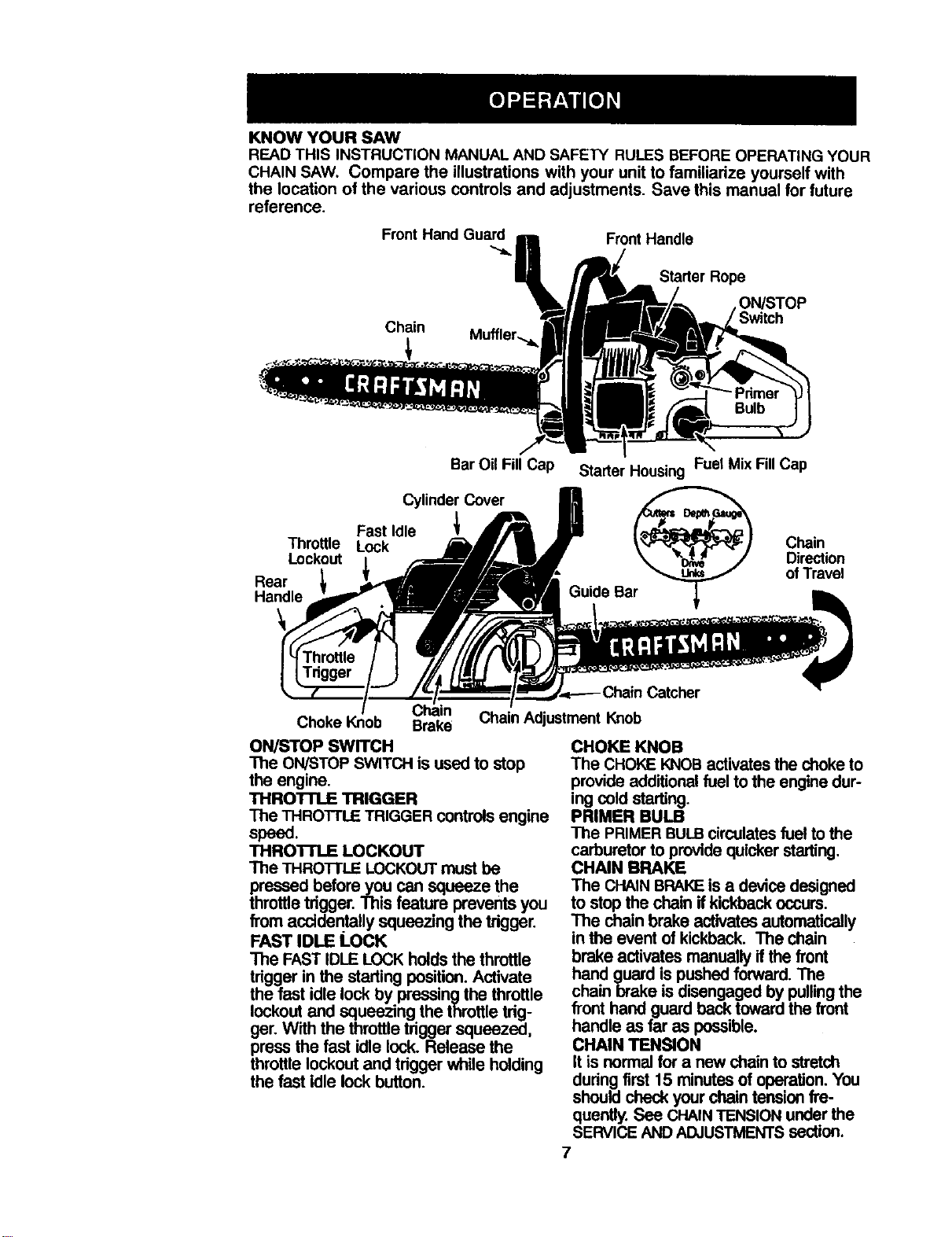
KNOWYOURSAW
READTHISINSTRUCTIONMANUAL AND SAFETY RULES BEFORE OPERATING YOUR
CHAIN SAW. Compare the illustrations with your unit to familiarize yourself with
the location of the various controls and adjustments. Save this manual for future
reference.
Front Hand Guard Front Handle
,_
Starter Rope
ON/STOP
Chain
Mufti
Throttle
Lockout
Rear
Handle
Bar Oil Fill Cap
Cylinder Cover
Fastldle _
Lock
Starter Housing Fuel Mix Fill Cap
r_ Chain
Direction
of Travel
Guide Ba
Choke Knob
Brake Chain Adjustment Knob
ON/S'rOP SWITCH
The ON/STOP SWITCH is used to stop
the engine.
THRO'n'LE TRIGGER
The THROTrLE TRIGGER controls engine
speed.
THROTTLE LOCKOUT
The THROrrLE LOCKOUT must be
pressed before you can squeeze the
throttle tngger. This feature prevents you
from accidentally squeezing the trigger.
FAST IDLE LOCK
The FAST IDLE LOCK holds the throttle
trigger in the starting position. Activate
the fast idle lock by pressing the throttle
lockout and squeezing the throttle trig-
ger. With the throttle trigger squeezed,
press the fast idle lock. Release the
throttle lockout and tdgger while holding
the fast idle lock button.
CHOKE KNOB
The CHOKE KNOB activates the choke to
provide additional fuel to the engine dur-
ing cold starting.
PRIMER BULB
The PRIMER BULB circulates fuel to the
carburetor to provide quicker starting.
CHAIN BRAKE
The CHAIN BRAKE is a device designed
to stop the chain if kickback occurs.
The chain brake activates automatically
in the event of kickback. The chain
brake activates manually if the front
hand guard is pushed forward. The
chain brake is disengaged by pulling the
front hand guard back toward the front
handle as far as possible.
CHAIN TENSION
It is normal for a new chain to stretch
during first 15 minutes of operation. You
should check your chain tension fre-
quenUy. See CHAIN TENSION under the
SERVICE AND ADJUSTMENTS section.
7
_lbWARNING: Muffler is very hot
during and after use. Do not touch the
muffler or allow combustible material
such as dry grass or fuel to do so.
BEFORE STARTING ENGINE
_, WARNING: Be sure to read the
fuel handling information in the safety
rules section of this manual before you
begin. If you do not understand the
fuel handling information do not at-
tempt to fuel your unit. Seek help from
someone that does understand the in-
formation or call the customer assis-
tance help line at 1-800-235-5878.
GUIDE BAR AND CHAIN OIL
The bar and chain require lubrication.
The chain oiler provides continuous
lubrication to the chain and guide bar.
Be sure to fill the bar oil tank when you
fill the fuel tank (Capacity = 6.8 ft. oz.),
Lack of oil will quickly ruin the bar and
chain. Too little oil will cause overheat-
ing shown by smoke coming from the
chain and/or discoloration of the bar.
For maximum guide bar and chain life,
we recommend you use Craftsman
chain saw bar oil. If Craftsman bar oil
is not available, you may use a good
grade SAE 30 oil until you are able to
obtain Craftsman brand. The oil output
is automatically metered during opera-
tion. Your saw will use approximately
one tank of bar oil for every tank of fuel
mix. Always fill the bar oil tank when
you fill the fuel tank.
FUELING ENGINE
_WARNING: Remove fuel cap
slowly when refueling.
This engine is certified to operate on
unleaded gasoline. Before operation,
gasoline must be mixed with a good
quality 2-cycle air-cooled engine oil.
We recommend Craftsman brand oil.
Mix gasoline and oil at a ratio of 40:1.
A 40:1 ratio is obtained by mixing 3.2
ounces of oil with 1 gallon of unleaded
gasoline. Included with this saw is a
3.2 ounce container of Craftsman
brand oil. Pour the entire contents of
this container into 1 gallon of gasoline
to achieve the proper fuel mixture.
DO NOT USE automotive oil or boat oil.
These oils will cause engine damage.
When mixing fuel follow the instruc-
tions pdnted on the oil container.
Once oil is added to the gasoline,
shake container momentarily to assure
that the fuel is thoroughly mixed. Al-
ways read and follow the safety rules
relating to fuel before fueling your unit.
IMPORTANT
Experience indicates that alcohol
blended fuels (called gasohol or using
ethanol or methanol) can attract mois-
ture which leads to separation and
formation of acids during storage. Acidic
gas can damage the fuel system of an
engine while in storage. To avoid engine
problems, the fuel system should be
emptied before storage for 30 days or
longer. Drain the gas tank, stad the en-
gine and let it run until the fuel lines and
carburetor are empty. Use fresh fuel
next season, See STORAGE instructions
for additional information.
Never use engine or carburetor clean-
er products in the fuel tank or perma-
nent damage may occur.
See the STORAGE section for addition-
al information.
CHAIN BRAKE
Ensure chain brake is disengaged by
pulling the front hand guard back to-
ward the front handle as far as pos-
sible. The chain brake must be disen-
gaged before cutting with the saw.
A
,Ira WARNING: The chain must not
move when the engine runs at idle
speed, If the chain moves at idle
speed, refer to CARBURETOR ADJUST-
MENT within this manual. Avoid con-
tact with the muffler. A hot muffler can
cause sedous bums.
STOPPING YOUR ENGINE
• Move ON/STOP switch to the STOP
position.
STARTING POSITION
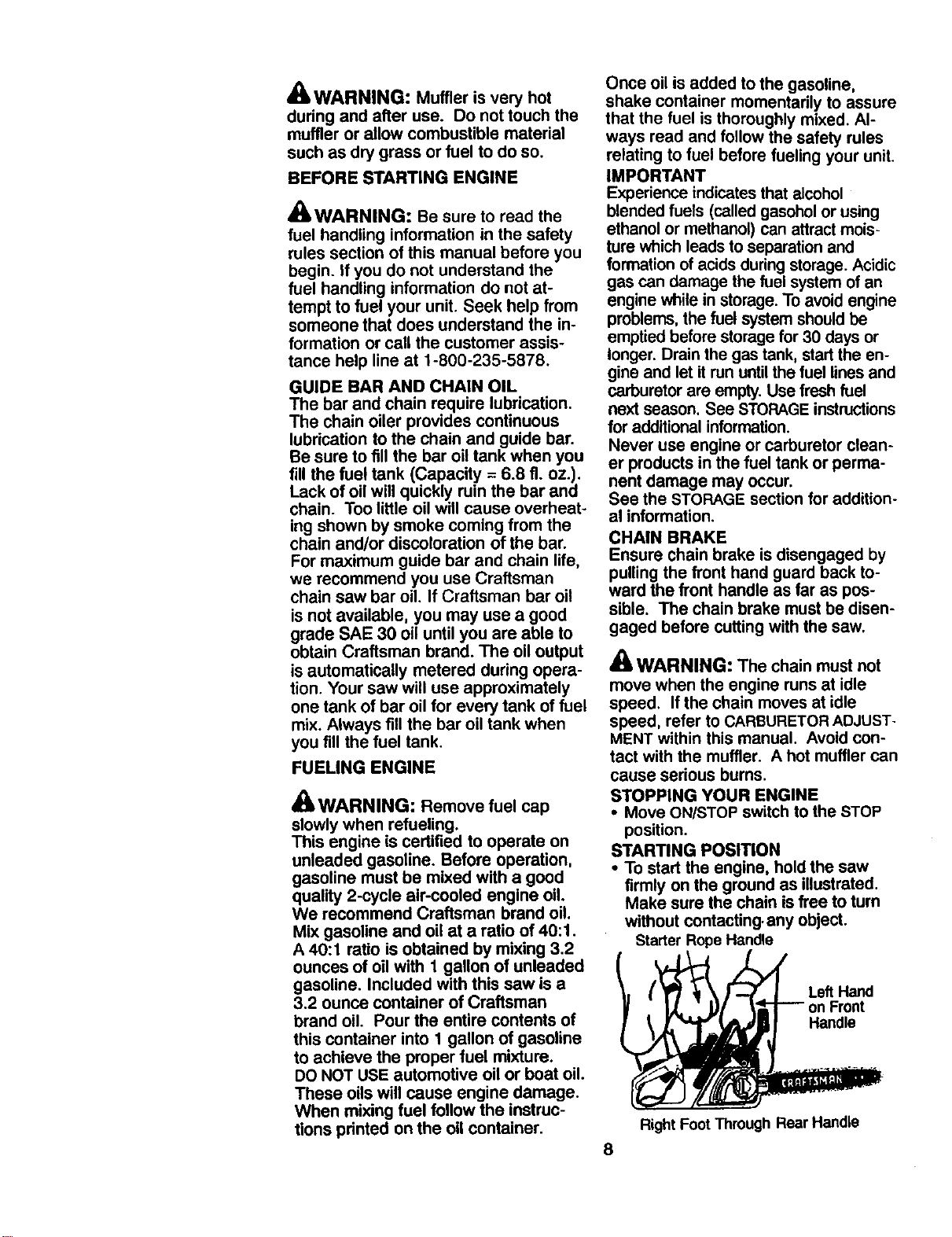
• To start the engine, hold the saw
firmly on the ground as illustrated.
Make sure the chain is free to turn
without contacting, any object.
Starter Rope Handle
Left Hand
Front
Handle
Right Foot Through Rear Handle
8
IMPORTANTPOINTSTOREMEMBER
Whenpullingthestarterrope,donot
usethefull extent of the rope as this
can cause the rope to break. Do not
let starter rope snap back. Hold the
handle and let the rope rewind slowly.
NOTE: DO NOT attempt to cut material
with the fast idle lock button in the
locked position.
STARTING A COLD ENGINE (or a
warm engine after running out of
fuel)
1. Move ON/STOP switch to ON posi-
tion.
2. Pull choke knob out to the full extent.
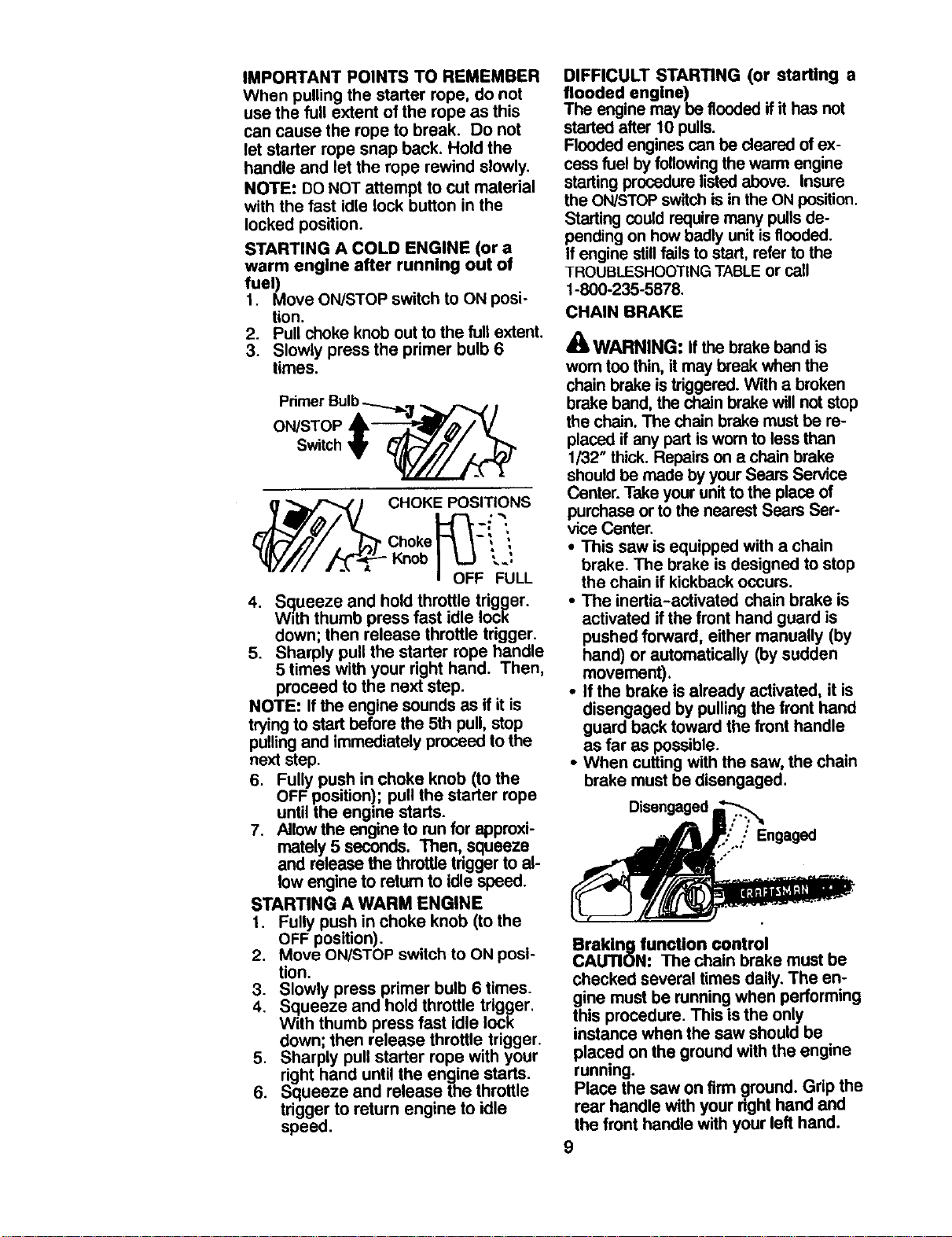
3. Slowly press the primer bulb 6
times.
Primer Bulb -._,=;]f
Switch _'_
._ CHOKE POSITIONS
o.o el :ii
4. Sgueeze and hold throttle trigger.
With thumb press fast idle lock
down; then release throttle trigger.
5. Sharply pull the starter rope handle
5times with your right hand. Then,
proceed to the next step.
NOTE: Ifthe enginesoundsas if it is
tryingto start beforethe 5th pull,stop
pullingand immediatelyproceed tothe
next step.
6. Fully push in choke knob (to the
OFF position); pull the starter rope
untilthe engine starts.
7. Allowthe engineto run for approxi-
mately 5 seconds. Then, squeeze
and release the thro_e triggerto al-
low engineto refum to idlespeed.
STARTING A WARM ENGINE
t. Fully push in choke knob (to the
OFF position).
2. Move ON/STOP switch to ON posi-
tion.
3. Slowly press primer bulb 6 times.
4. Squeeze and hold throttle trigger.
With thumb press fast idle lock
down; then release throttle trigger.
5. Sharply pull starter rope with your
right hand until the engine starts.
6. Squeeze and release the throttle
trigger to return engine to idle
speed.
DIFFICULT STARTING (or starting a
flooded engine)
The engine may be flooded if it has not
started after 10 pulls.
Rooded engines can be cleared of ex-
cess fuel by following the warm engine
starting procedure listed above. Insure
the ON/STOP switch is in the ON posifion.
Starting could require many pultsde-
pending on how badly unit is flooded.
If engine stillfalls to start, refer to the
TROUBLESHOOTING TABLE or call
1-800-235-5878.
CHAIN BRAKE
_ WARNING: If the brake band is
wom too thin, it may break when the
chain brake is triggered. With a broken
brake band, the chain brake will not stop
the chain. The chain brake must be re-
placed if any part is worn to less than
1/32" thick, Repairs on a chain brake
should be made by your Sears Service
Center. Take your unit to the place of
purchase or to the nearest Sears Ser-
vice Center.
• This saw is equipped with a chain
brake. The brake is designed to stop
the chain if kickback occurs.
• The inertia-activated chain brake is
activated if the front hand guard is
pushed forward, either manually (by
hand) or automatically (by sudden
movement).
• If the brake is already activated, it is
disengaged by pulling the front hand
guard back toward the front handle
as far as possible.
• When cutting with the saw, the chain
brake must be disengaged.
Disengaged
'i' i F:ngaged
Braking function control
CAUTION: The chain brake must be
checked several times daily. The en-
gine must be running when performing
this procedure. This is the only
instance when the saw should be
placed on the ground with the engine
running.
Place the saw on firm ground. Grip the
rear handle with your right hand and
the front handle with your left hand.
9
Applyfull throttlebyfullydepressing
thethrottletrigger.Activatethechain
brakebyturningyourleftwristagainst
thehandguardwithoutreleasingyour
griparoundthefront handle. The chain
should stop immediately.
Inertia activating function control
_,WARNING: When performing the
following procedure, the engine must
be turned off.
Grip the rear handle with your right
hand and the front handle with your left
hand. Hold the chain saw approxi-
mately 14" (35 cm) above a stump or
other wooden surface. Release your
grip on the front handle and let the tip
of the guide bar fall forward and con-
tact the stump. When the tip of the bar
hits the stump, the brake should acti-
vate.
OPERATING TIPS
• Check chain tension before first use
and after t minute of operation. See
CHAIN TENSION in the MAINTENANCE
section.
• Cut wood only. Do not cut metal,
plastics, masonry, non-wood building
materials, etc.
• Stop the saw if the chain strikes a
foreign object. Inspect the saw and
repair parts as necessary.
• Keep the chain out of dirt and sand.
Even a small amount of dirt will
quickly dull a chain and increase the
possibility of kickback.
• Practice cutting a few small logs us-
ing the following steps. This will help
you get the "feel" of using your saw
before you begin a major sawing op-
eration.
• Squeeze the throttle trigger and al-
low the engine to reach full speed
before cutting.
• Begin cutting with the saw frame
against the log.
• Keep the engine at full speed the
entire time you are cutting.
• Allow the chain to cut for you. Exert
only light downward pressure.
• Release the throttle trigger as soon
as the cut is completed, allowing
the engine to idle. If you run the
saw at full throttle without a cutting
load, unnecessary wear can occur.
• To avoid losing control when cut is
complete, do not put pressure on
saw at end of cut.
• Stop engine before setting saw down.
TREE FELLING TECHNIQUES
40&WARNING: Check for broken or
dead branches which can fall while
cutting causing serious injury. Do not
cut qear buildings or electrical wires if
you do not know the direction of tree
fall, nor cut at night since you will not
be a_01eto see well, nor during bad
weather such as rain, snow, or strong
winds, etc. If a tree makes contact with
any utility line, the utility company
shoqld be notified immediately.
• Carefully plan your sawing operation
in advance.
• Clear the work area. You need a
clear area all around the tree so you
can have secure footing.
• Th e chain saw operator should keep
on the uphill side of the terrain as the
tree is likely to roll or slide downhill
after it is felled.
• Study the natural conditions that can
cause the tree to fall in a particular
direction. These conditions include:
• The wind direction and speed.
• The lean of the tree. The lean of a
tree might not be apparent due to
uneven or sloping terrain. Use a
plumb or level to determine the di-
rection of tree lean.
• Weight and branches on one side.
• S_urrounding trees and obstacles.
• Look for decay and rot. If the trunk is
rotted, it can snap and fall toward the
operator.
• Make sure there is enough room for
the tree to fall. Maintain a distance of
2-1/2 tree lengths from the nearest
person or other objects. Engine
noise can drown out a warning call.
• Reprove dirt, stones, loose bark,
nails, staples, and wire from the tree
whpre cuts are to be made.
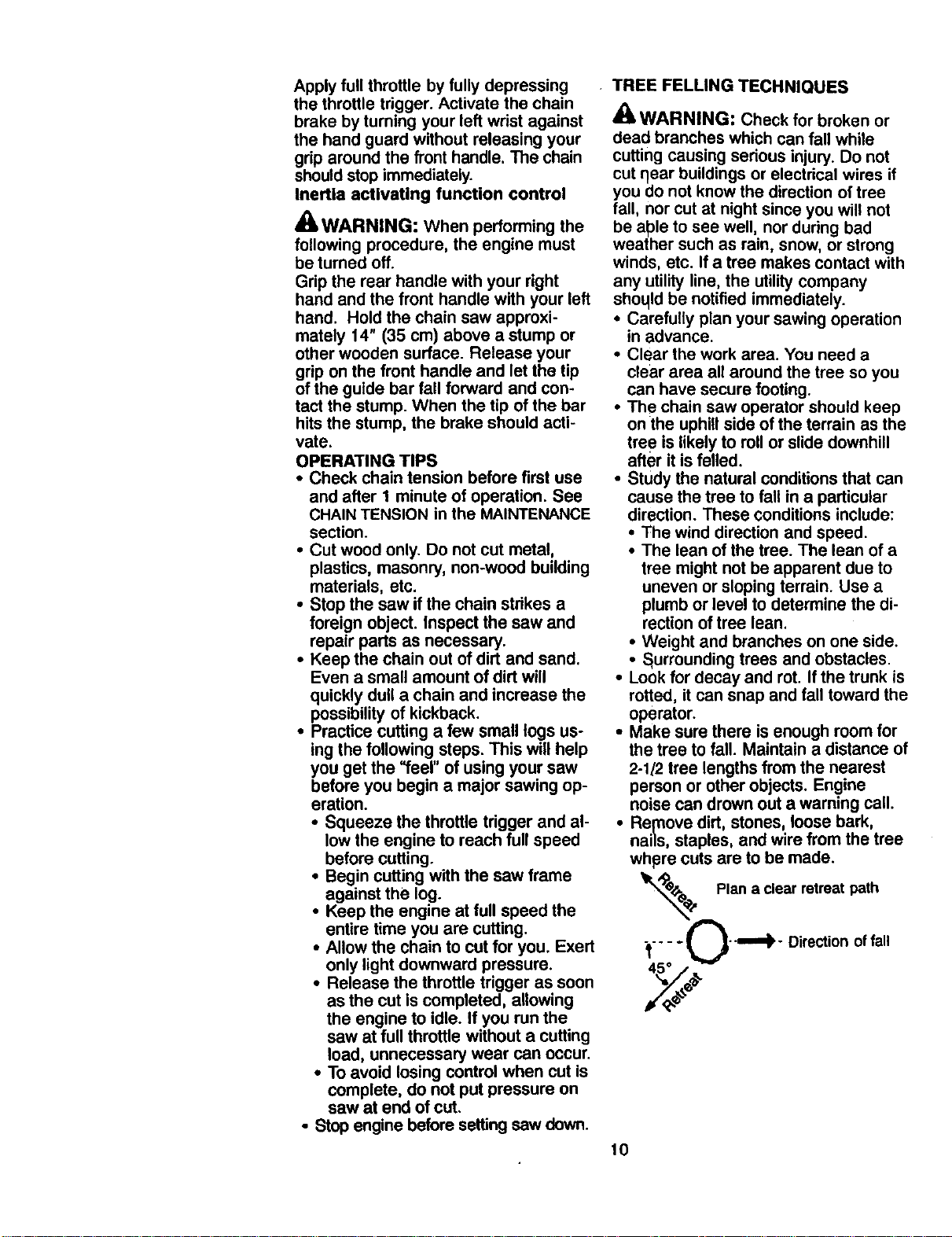
,_,, Plan a clear retreat path
(2"'='"=_" Direction of fall
10
FELUNG LARGE TREES
(6 inches in diameter or larger)
The notch method is used to fell large
trees. A notch is cut on the side of the
tree in the desired direction of fall. After
a felling cut is made on the opposite
side of tree, the tree will tend to fall in
the direction of the notch.
NOTE: If tree has large buttress roots,
remove them before making the notch.
If using saw to remove buttress roots,
keep saw chain from contacting
ground to prevent dulling of the chain.
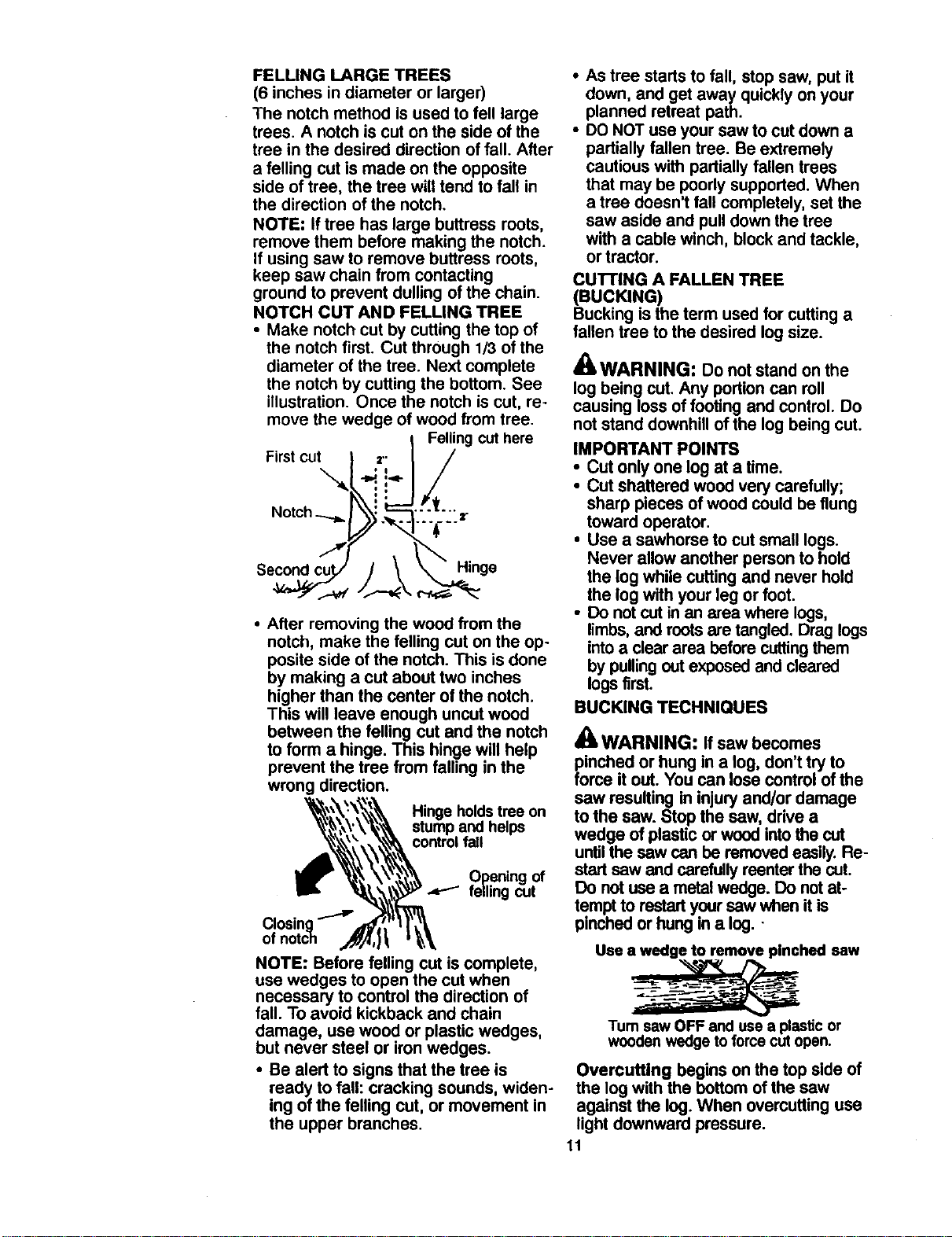
NOTCH CUT AND FELLING TREE
• Make notch cut by cutting the top of
the notch first. Cut through 1/3 of the
diameter of the tree. Next complete
the notch by cutting the bottom. See
illustration. Once the notch is cut, re-
move the wedge of wood from tree.
Felling cut here
First cut =.. /
/,
Notch _ _ ._.. ""_-"lr
• After removing the wood from the
notch, make the felling cut on the op-
posite side of the notch. This is done
by making a cut about two inches
higher than the center of the notch.
This will leave enough uncut wood
between the felling cut and the notch
to form a hinge. This hinge will help
prevent the tree from falling in the
wrong direction.
Hinge holds tree on
stump and helps
controlfall
Opening of
felling cut
NOTE: Before felling cut is complete,
use wedges to open the cut when
necessary to control the direction of
fall. To avoid kickback and chain
damage, use wood or plastic wedges,
but never steel or iron wedges.
• Be alert to signs that the tree is
ready to fall: cracking sounds, widen-
ing of the felling cut, or movement in
the upper branches.
• As tree starts to fall, stop saw, put it
down, and get away quickly on your
planned retreat path.
• DO NOT use your saw to cut down a
partially fallen tree. Be extremely
cautious with partially fallen trees
that may be poorly supported. When
a tree doesn't fall completely, set the
saw aside and pull down the tree
with a cable winch, block and tackle,
or tractor.
cu'n'ING A FALLEN TREE
(BUCKING)
Bucking is the term used for cutting a
fallen tree to the desired log size.
_WARNING: Do not stand on the
log being cut. Any portion can roll
causing loss of footing and control. Do
not stand downhill of the log being cut.
IMPORTANT POINTS
• Cut only one log at a time.
• Cut shattered wood very carefully;
sharp pieces of wood could be flung
toward operator.
• Use a sawhorse to cut small logs.
Never allow another person to hold
the log while cutting and never hold
the log with your leg or foot.
• Do not cut in an area where logs,
limbs, and roots are tangled. Drag logs
into a clear area before cutting them
by pulling out exposed and cleared
logs first.
BUCKING TECHNIQUES
WARNING: If saw becomes
pinched or hung in a log, don't try to
force it out. You can lose control of the
saw resulting in injury and/or damage
to the saw. Stop the saw, drive a
wedge of plastic or wood into the cut
until the saw can be removed easily. Re-
start saw and carefully reenter the cut.
Do not use a metal wedge. Do not at-
tempt to restart your saw when it is
pinched or hung in a log. •
Use a wedge to remove pinched saw
Tum saw OFF and use a plasticor
wooden wedge to force cut open.
Overcutting begins onthe top side of
the log with the bottom ofthe saw
against the log.When overcuttinguse
lightdownward pressure.
11
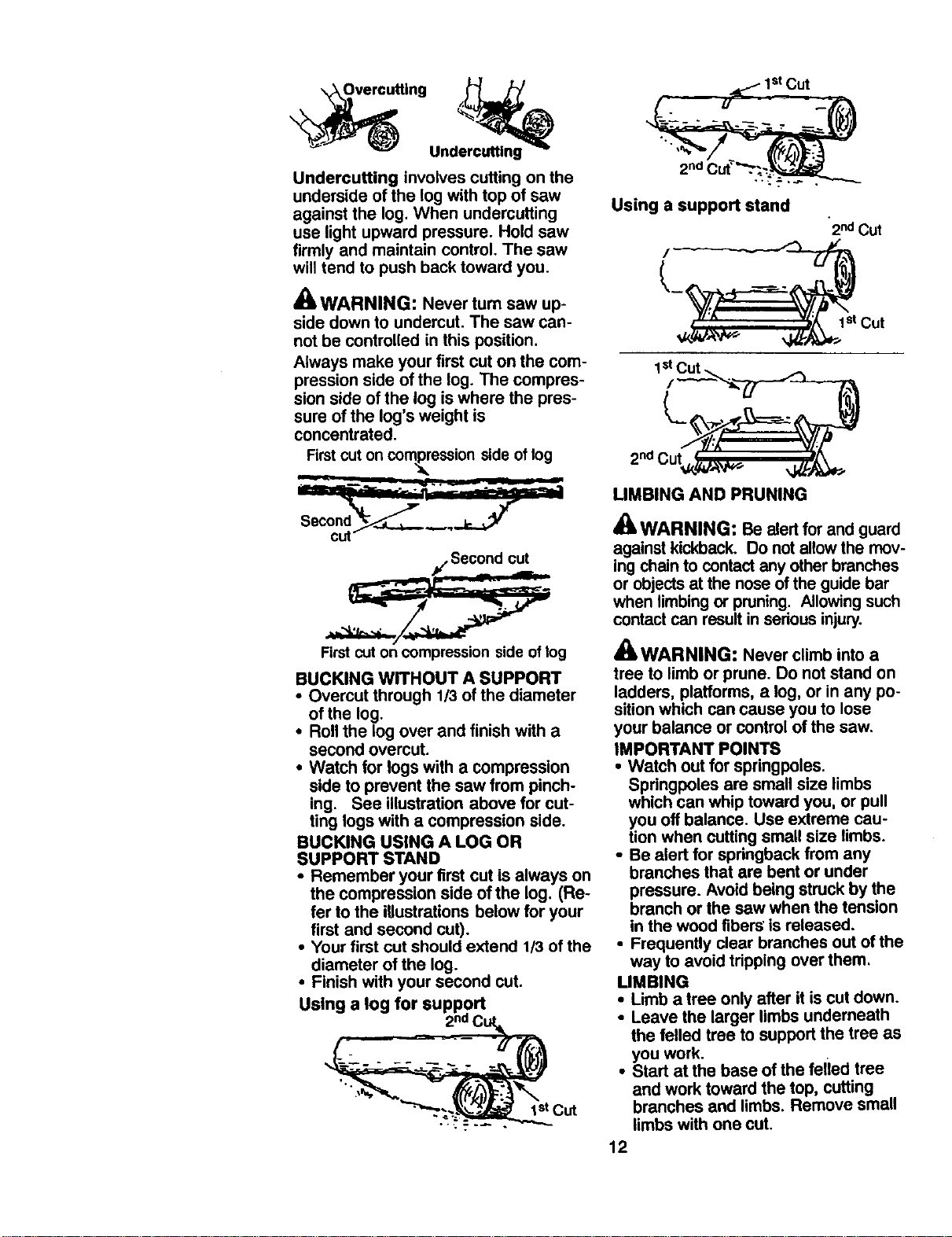
_tting Und_rc_in_g
Undercutting involves cutting on the
underside of the log with top of saw
against the log. When undercutting
use light upward pressure. Hold saw
firmly and maintain control. The saw
will tend to push back toward you.
WARNING: Never tum saw up-
side down to undercut. The saw can-
not be controlled in this position.
Always make your first cut on the com-
pression side of the log. The compres-
sion side of the log is where the pres-
sure of the log's weight is
concentrated.
Firstcut on compression side of log
j Second cut
Firstcut on compression side of log
BUCKING WITHOUT A SUPPORT
• Overcut through 1/3 of the diameter
of the log.
• Roll the log over and finish with a
second overcut.
• Watch for logs with a compression
side to prevent the saw from pinch-
ing. See illustration above for cut-
ting logs with a compression side.
BUCKING USING A LOG OR
SUPPORT STAND
• Remember your first cut is always on
the compression side of the log. (Re-
fer to the iUustrations below for your
first and second cut).
• Your first cut should extend 1/3 of the
diameter of the log.
• Finish with your second cut.
Using a log for support
I stCut
2nd
Using a support stand
"2ndCut
(_i _stCut
1StCut ._.
LIMBING AND PRUNING
_WARNING: Be alert for and guard
against kickback. Do not allow the mov-
ing chain to contact any other branches
or objects at the nose of the guide bar
when limbing or pruning. Allowing such
contact can result in sedous injury.
_WARNING: Never climb into a
tree to limb or prune. Do not stand on
ladders, platforms, a log, or in any po-
sition which can cause you to lose
your balance or control of the saw.
IMPORTANT POINTS
• Watch out for springpoles.
Spdngpoles are small size limbs
which can whip toward you, or pull
you off balance. Use extreme cau-
tion when cutting small size limbs.
• Be alert for spdngback from any
branches that are bent or under
pressure. Avoid being struck by the
branch or the saw when the tension
in the wood fibers' is released.
• Frequently clear branches out of the
way to avoid tdpplng over them.
LIMBING
• Limb a tree only after it is cut down.
• Leave the larger limbs underneath
the felled tree to support the tree as
you work.
• Start at the base of the felled tree
and work toward the top, cutting
branches and limbs. Remove small
limbs with one cut.
12
• Keep the tree between you and the
chain.
• Remove larger branches with the
cutting techniques described in
BUCKING WITHOUT A SUPPORT.
• Always use an overcut to cut small
and freely hanging limbs. Undercut-
ting could cause limbs to fall and
pinch the saw.
PRUNING
_WARNING: Limit pruning to limbs
shoulder height or below. Do not cut if
branches are higher than your shoul-
der. Get a professional to do the job.
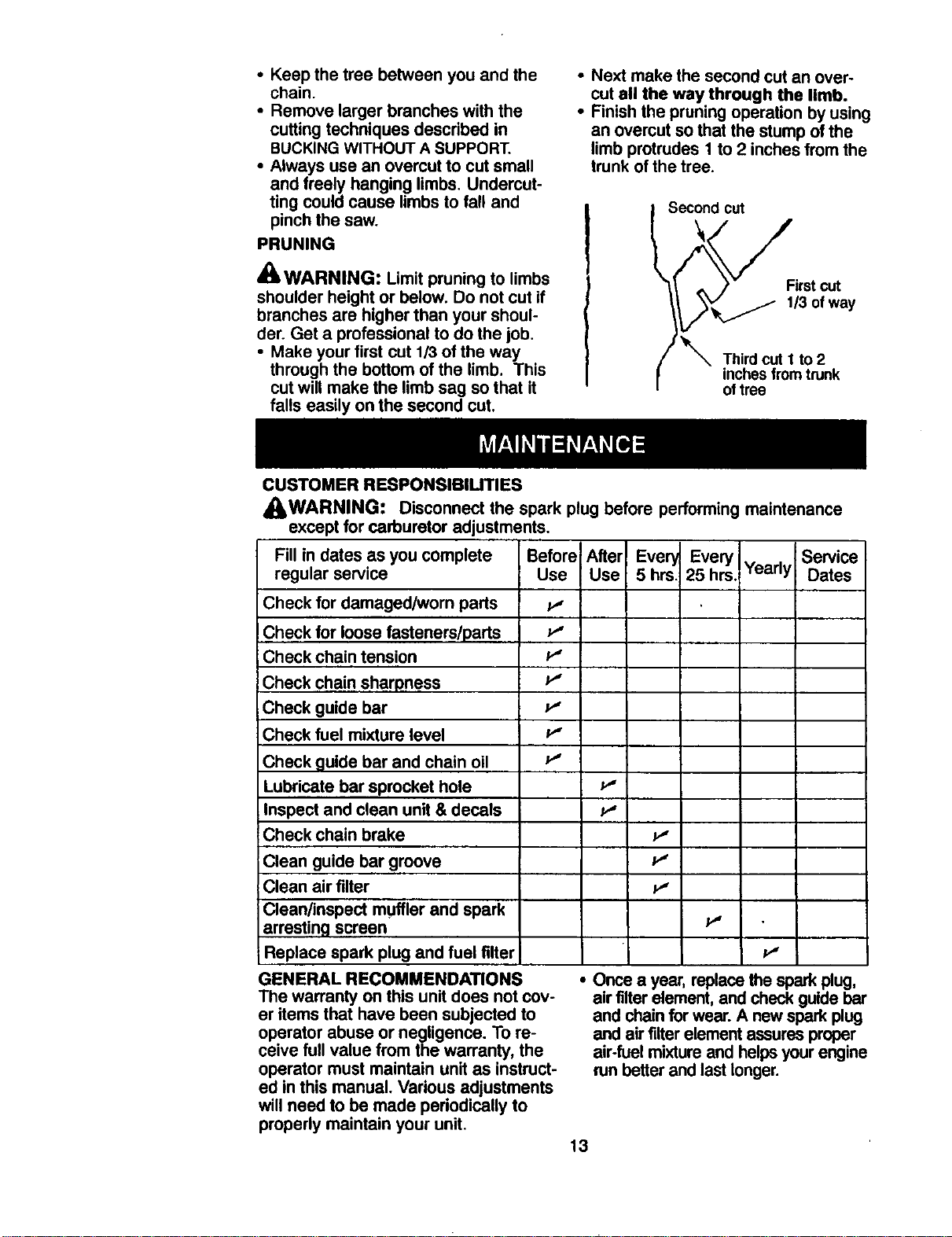
• Make your first cut 1/3 of the way
through the bottom of the limb. This
cut will make the limb sag so that it
falls easily on the second cut.
CUSTOMER RESPONSIBIUTIES
• Next make the second cut an over-
cut all the way through the limb.
• Finish the pruning operation by using
an overcut so that the stump of the
limb protrudes 1 to 2 inches from the
trunk of the tree.
eC_d cut
irst cut
1/3 of way
Third cut 1 to 2
_WARNING: Disconnect the spark plug before performing maintenance
except for carburetor adjustments.
Fill in dates as you complete Before After Ever Every I Service
regular service Use Use 5 hrs 25 hrs._Yearly Dates
Check for damaged/worn parts
Check for loose fasteners/parts _'
Check chain tension P"
Check chain sharpness
Check guide bar
p-
p,,
Check fuel mixture level
y,,
Check guide bar and chain oil
Lubricate bar sprocket hole P"
_Inspect and clean unit & decals I,"
Check chain brake p,,
Clean guide bar groove
Clean air filter
p,,
p,,
Clean/inspect muffler and spark
arresting screen
Replace spark plug and fuel filter
p-
y,,
|ENERAL RECOMMENDATIONS
The warranty on this unit does not cov-
er items that have been subjected to
operator abuse or negligence. To re-
ceive full value from the warranty, the
operator must maintain unit as instruct-
ed in this manual. Various adjustments
will need to be made periodicaUy to
properly maintain your unit.
• Once a year, replacethe spark plug,
air filterelement,and checkguide bar
and chainfor wear. A new sparkplug
and airfilterelement assuresproper
air-fuelmixtureand helpsyour engine
mn better and lastlonger.
13
CHECKFORDAMAGEDOR
WORNPARTS
ContactSearsServiceCenterforre-
placementofdamagedor wornparts.
NOTE:Itisnormalforasmallamount
ofoiltoappearunderthesawafteren-
ginestops.Donotconfusethiswitha
leakingoiltank.
• ON/STOP Switch - Ensure ON/STOP
switch functions properly by moving
the switch to the STOP position.
Make sure engine stops; then restart
engine and continue.
• Fuel Tank - Do not use saw if fuel
tank shows signs of damage or leaks,
• Oil Tank - Do not use saw if oil tank
shows signs of damage or leaks.
CHECK FOR LOOSE
FASTENERS AND PARTS
• Chain Brake
• Chain
• Muffler
• Cylinder Shield
• Air Filter
• Clutch Drum/Sprocket
• Handle Screws
• Starter Housing
• Front Hand Guard
CHECK CHAIN TENSION
,_ WARNING: Wear protective
gloves when handling chain. The
chain is sharp and can cut you even
when it is not moving.
Chain tension is very important. Chains
stretch during use. This is especially
true during the first few times you use
your saw. Always check chain tension
each time you use and refuel your saw
or when any sag in the chain is noted.
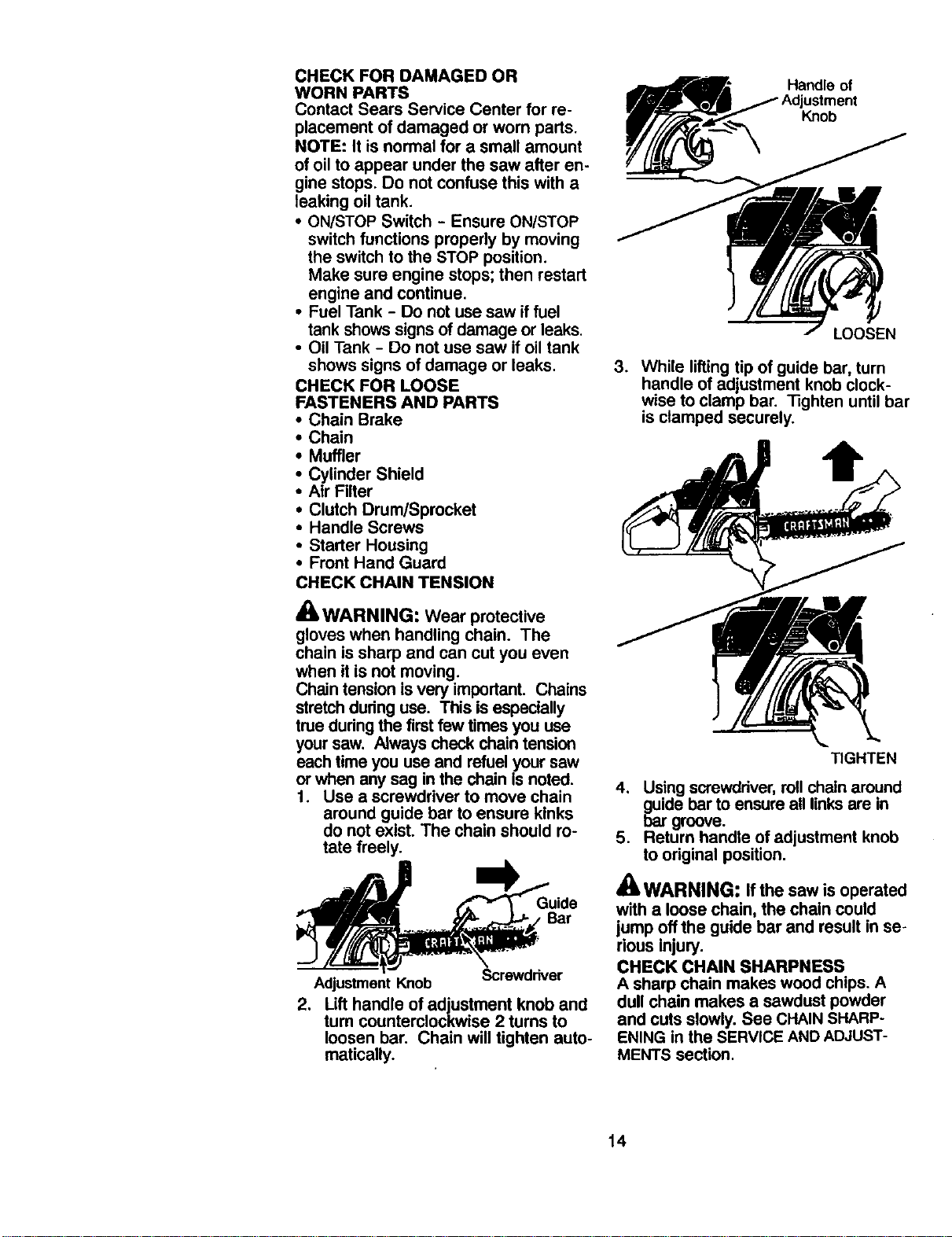
1. Use a screwdriver to move chain
around guide bar to ensure kinks
do not exist. The chain should ro-
tate freely.
Adjustment Knob Screwdriver
2. Lift handle of adjustment knob and
tum counterclockwise 2 turns to
loosen bar. Chain will tighten auto-
matically.
Handle of
Knob
LOOSEN
3. While lifting tip of guide bar, turn
handle of adjustment knob clock-
wise to clamp bar. "13ghten until bar
is clamped securely.
TIGHTEN
4. Using scrowddver, roll chain around
_de bar to ensure all links are in
roove.
5. Return handle of adjustment knob
to original position.
WARNING: If the saw is operated
with a loose chain, the chain could
jump off the guide bar and result in se-
rious injury.
CHECK CHAIN SHARPNESS
A sharp chain makes wood chips. A
dull chain makes a sawdust powder
and cuts slowly. See CHAIN SHARP-
ENING in the SERVICE AND ADJUST-
MENTS section,
14
CHECKGUIDEBAR
Conditions which require guide bar
maintenance:
• Saw cuts to one side or at an angle.
• Saw has to be forced through the cut.
• Inadequate supply of oil to bar/chain.
Check the condition of guide bar each
time chain is sharpened. A worn guide
bar will damage the chain and make
cutting difficult.
After each use, ensure ON/STOP
switch is in the STOP position, then
clean all sawdust from the guide bar
and sprocket hole.
To maintain guide bar:
• Move ON/STOP switch to STOP.
• Loosen and remove chain brake
nuts and chain brake. Remove bar
and chain from saw.
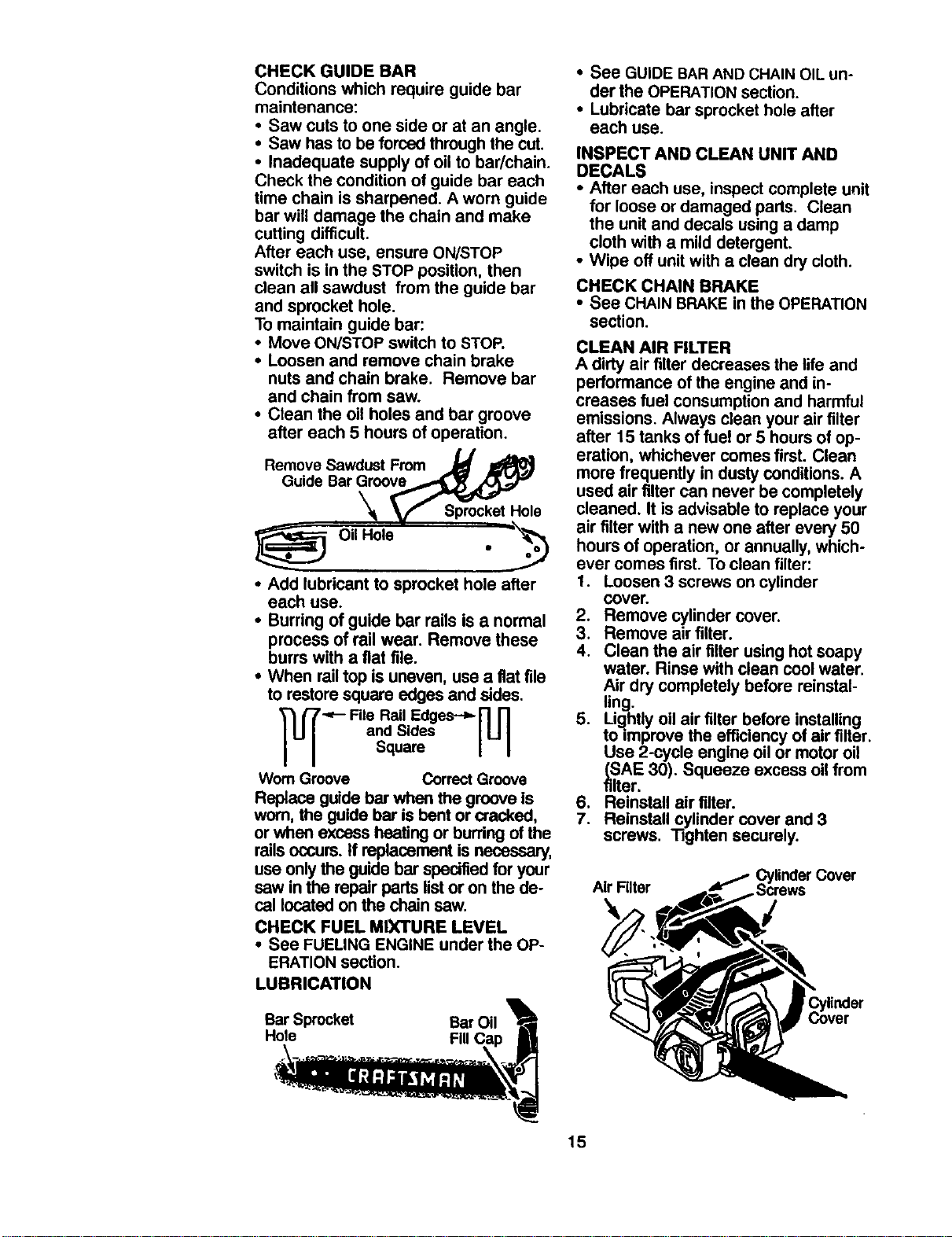
• Clean the oil holes and bar groove
after each 5 hours of operation,
Remove Sawdust From _f
Guide Bar Gr__
_,_ _ Sprocket Hole
Oil Hole
• Add lubricant to sprocket hole after
each use.
• Burring of guide bar rails is a normal
process of rail wear. Remove these
burrs with a fiat tile.
• When rail top is uneven, use a fiat file
to restore square edges and sides.
'.,t-- File Rail Edges-_ N I1
andSides ILI I
Square I I
Wom Groove Correct Groove
Replace guide bar when the groove is
worn, the guide bar is bent or cracked,
or when excess heating or burring of the
rails occurs. If replacement is necessary,
use only the guide bar specified for your
saw in the repair parts list or on the de-
cal located on the chain saw.
CHECK FUEL MIXTURE LEVEL
• See FUELING ENGINE under the OP-
ERATION section.
LUBRICATION
Bar Sprocket Bar Oil
H¢!e Fill Cap
• See GUIDE BAR AND CHAIN OIL un-
der the OPERATION section.
• Lubricate bar sprocket hole after
each use.
INSPECT AND CLEAN UNIT AND
DECALS
• After each use, inspect complete unit
for loose or damaged parts. Clean
the unit and decals using a damp
cloth with a mild detergent.
• Wipe off unit with a clean dry cloth.
CHECK CHAIN BRAKE
• See CHAIN BRAKE in the OPERATION
section.
CLEAN AIR FILTER
A dirty air filter decreases the life and
performance of the engine and in-
creases fuel consumption and harmful
emissions. Always clean your air filter
after 15 tanks of fuel or 5 hours of op-
eration, whichever comes first. Clean
more frequently in dusty conditions. A
used air filter can never be completely
cleaned. It is advisable to replace your
air filter with a new one after every 50
hours of operation, or annually, which-
ever comes first. To clean filter:
1. Loosen 3 screws on cylinder
cover.
2. Remove cylinder cover.
3. Remove air filter.
4. Clean the air tilter using hot soapy
water. Rinse with clean cool water.
Air dry completely before reinstal-
ling.
5. Liqhfiy oil air filter before installing
to improve the efficiency of air filter.
Use 2-cycle engine oil or motor oil
(SAE 30). Squeeze excess oil from
filter.
6. Reinstall air filter.
7. Reinstall cylinder cover and 3
screws. Tighten securely.
Air Filter
Cover
15
INSPECTMUFFLERANDSPARKAR-
RESTINGSCREEN
AStheunitisused,carbondeposits
builduponthemufflerandsparkar-
restingscreen,andmustberemoved
toavoidcreatingafirehazardoraf-
fectingengineperformance.
Replacethe sparkarrestingscreenif
breaksoccur,
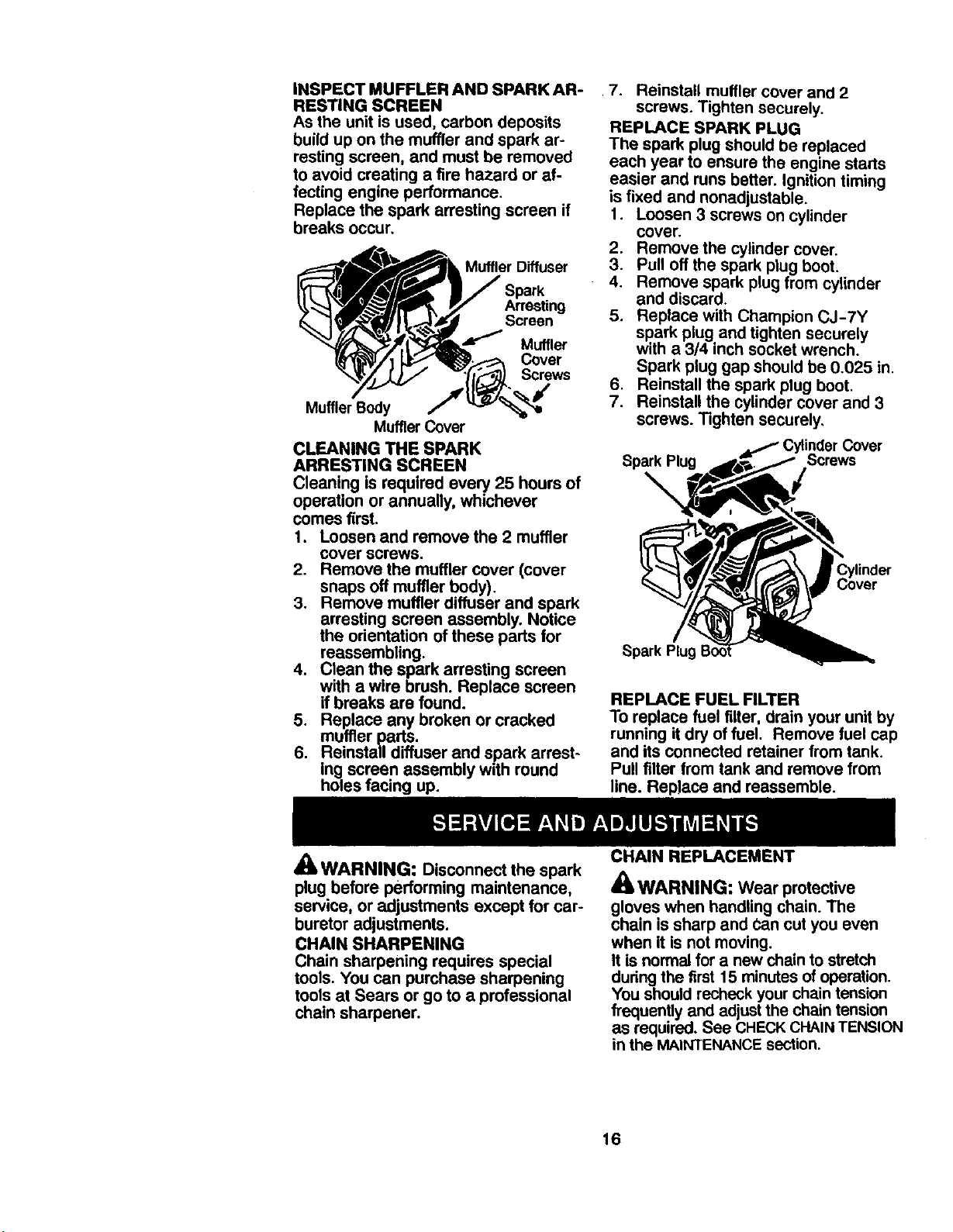
Muffler Diffuser
Spark
Arresting
Screen
Muffler
Cover
Screws
Muffler Body J
Muffler Cover
CLEANING THE SPARK
ARRESTING SCREEN
Cleaning is required every 25 hours of
operation or annually, whichever
comes first.
1. Loosen and remove the 2 muffler
cover screws.
2. Remove the muffler cover (cover
snaps off muffler body).
3. Remove muffler diffuser and spark
arresting screen assembly. Notice
the orientation of these parts for
reassembling.
4. Clean the spark arresting screen
with a wire brush. Replace screen
if breaks are found.
5. Replace any broken or cracked
muffler parts.
6. Reinstall diffuser and spark arrest-
ing screen assembly with round
holes facing up.
7. Reinstall muffler cover and 2
screws. Tighten securely.
REPLACE SPARK PLUG
The spark plug should be replaced
each year to ensure the engine starts
easier and runs better. Ignition timing
is fixed and nonadjustable.
1. Loosen 3 screws on cylinder
cover.
2. Remove the cylinder cover.
3. Pull off the spark plug boot.
4. Remove spark plug from cylinder
and discard.
5. Replace with Champion CJ-7Y
spark plug and tighten securely
with a 3/4 inch socket wrench.
Spark plug gap should be 0.025 in.
6. Reinstall the spark plug boot.
7. Reinstall the cylinder cover and 3
screws. Tighten securely,
Spark Plug Screws
Spark Plug
REPLACE FUEL FILTER
TO replace fuel filter, drain your unit by
running it dry of fuel. Remove fuel cap
and its connected retainer from tank.
Pull filter from tank and remove from
line. Replace and reassemble.
WARNING: Disconnect the spark
plug before performing maintenance,
service, or adjustments except for car-
buretor adjustments.
CHAIN SHARPENING
Chain sharpening requires special
tools. You can purchase sharpening
tools at Sears or go to a professional
chain sharpener.
CHAIN REPLACEMENT
A(_ WARNING: Wear protective
gloves when handling chain. The
chain is sharp and Can cut you even
when it is not moving.
It is normal for a new chain to stretch
during the first 15 minutes of operation.
You should recheck your chain tension
frequently and adjust the chain tension
as required. See CHECK CHAIN TENSION
in the MAINTENANCE section.
16
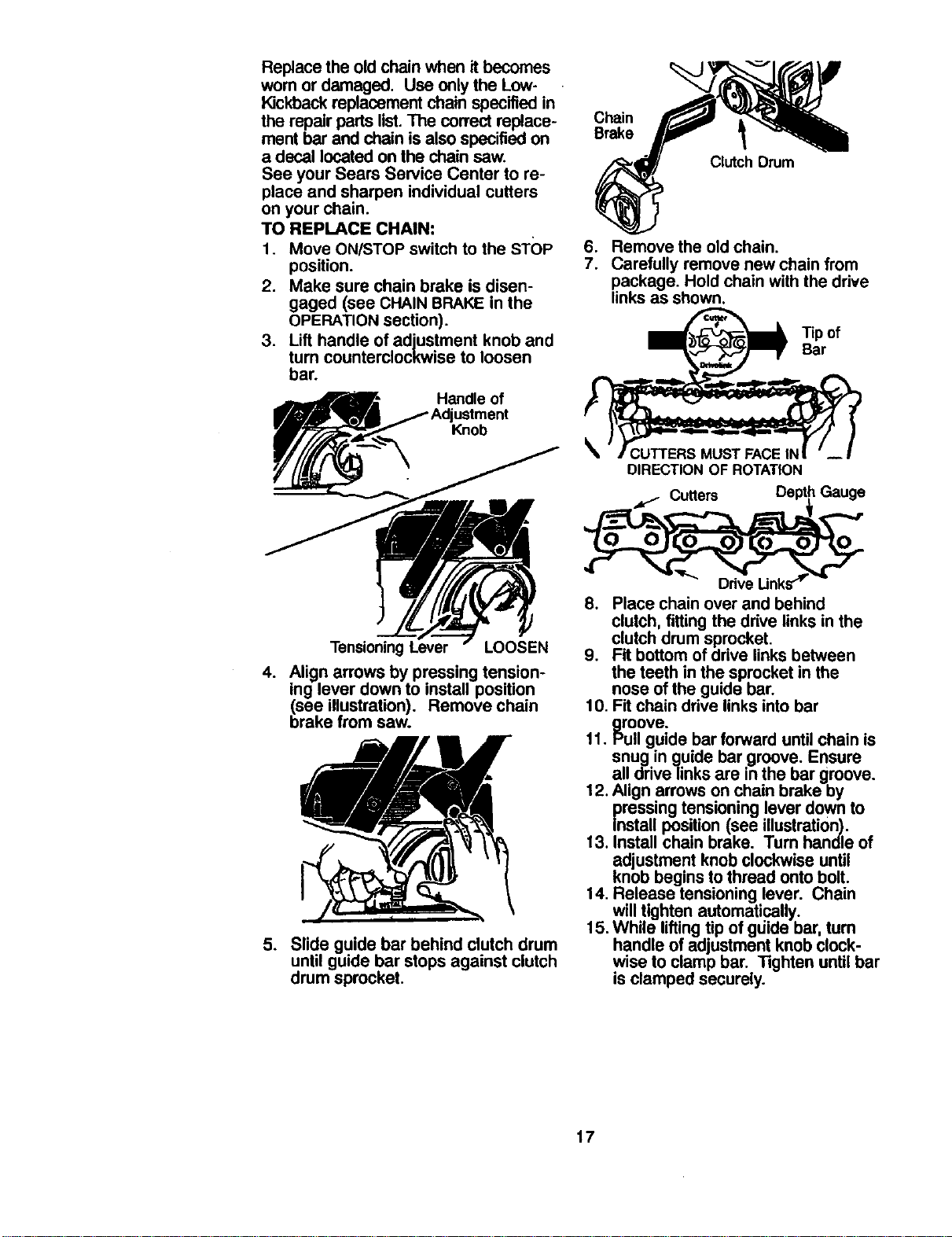
Replacetheoldchainwhenit becomes
womordamaged.UseonlytheLow-
Kickbackreplacementchainspecifiedin
therepairpartslist.Thecorrectreplace-
mentbarandchainisalsospecifiedon
adecallocatedonthechainsaw.
SeeyourSearsServiceCenterto re-
placeandsharpenindividualcutters
onyourchain.
TOREPLACECHAIN:
1. MoveON/STOPswitchto theSTOP
position.
2. Makesurechainbrakeisdisen-
gaged(seeCHAINBRAKEinthe
OPERATIONsection).
3. Lifthandleofadjustmentknoband
turncounterclockwiseto loosen
bar.
Handle of
Knob
Tensioning Lever LOOSEN
4. Align arrows by pressing tension-
ing lever down to install position
(see illustration). Remove chain
brake from saw.
5. Slide guide bar behind clutch drum
until guide bar stops against clutch
drum sprocket.
Chain
Brake
Clutch Drum
6. Remove the old chain.
7. Carefully remove new chain from
package. Hold chain with the drive
links as shown.
Tip of
Bar
\
DIRECTION OF ROTATION
Cutters Depth Gauge
8. Place chain over and behind
clutch, fitting the drive links in the
clutch drum sprocket.
9. Fit bottom of drive links between
the teeth in the sprocket in the
nose of the guide bar.
10. Fit chain drive links into bar
groove.
11. Pull guide bar forward until chain is
snug in guide bar groove. Ensure
all drive/inks are in the bar groove.
12. Align arrows on chain brake by
FnreSsing tensioning lever down to
stall position (see illustration).
13. Install chain brake. Turn handle of
adjustment knob clockwise until
knob begins to thread onto bolt.
14. Release tensioning lever. Chain
will tighten automatically.
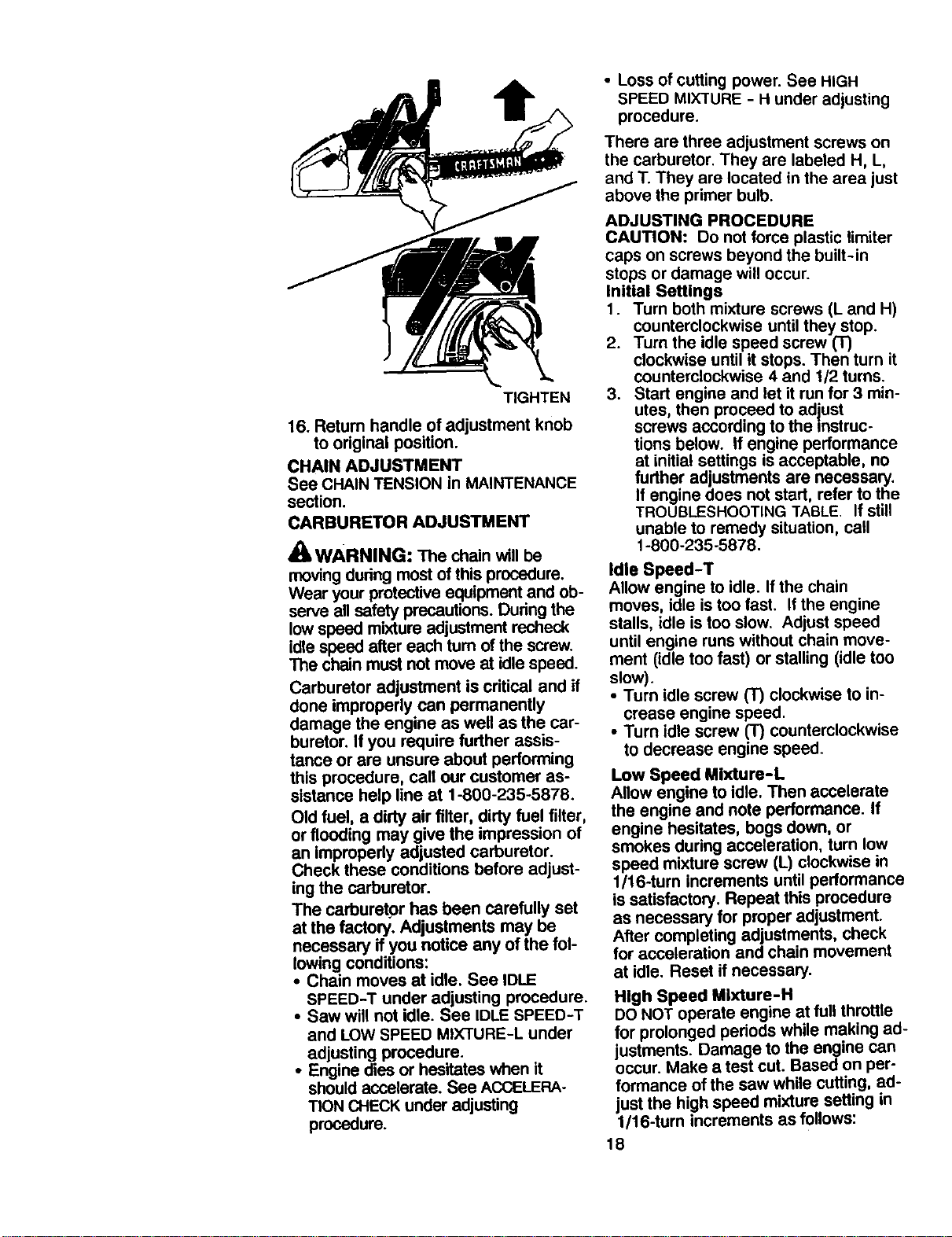
15. While lifting tip of guide bar, tum
handle of adjustment knob clock-
wise to clamp bar. Tighten until bar
,s clamped securely.
17
t
TIGHTEN
16. Retum handle of adjustment knob
to odginal position.
CHAIN ADJUSTMENT
See CHAIN TENSION in MAINTENANCE
section.
CARBURETOR AOJUSTMENT
'_ WARNING: The chain will be
movingdudng most of thisprocedure.
Wear your protectiveequipmentand ob-
serve allsafety precautions.Duringthe
lowspeed mixtureadjustmentrecheck
idlespeed after each tum of the screw.
The chainmustnot move at idlespeed.
Carburetor adjustment is critical and if
done improperly can permanently
damage the engine as well as the car-
buretor. If you require further assis-
tance or are unsure about performing
this procedure, call our customer as-
sistance help line at 1-800-235-5878.
Old fuel, a dirty air filter, dirty fuel filter,
or flooding may give the impression of
an improperly adjusted carburetor.
Check these conditions before adjust-
ing the carburetor.
The carburetor has been carefully set
at the factory. Adjustments may be
necessary if you notice any of the fol-
lowing conditions:
• Chain moves at idle. See IDLE
SPEED-T under adjusting procedure.
• Saw wilt not idle. See IDLE SPEED-T
and LOWSPEED MIXTURE-L under
adjusting procedure.
• Engine diesor hesitateswhen it
shouldaccelerate. See ACCELERA-
TION CHECKunderadjusting
procedure.
• Loss of cutting power. See HIGH
SPEED MIXTURE - H under adjusting
procedure.
There are three adjustment screws on
the carburetor. They are labeled H, L,
and T. They are located in the area just
above the primer bulb.
ADJUSTING PROCEDURE
CAUTION: DO not force plastic limiter
caps on screws beyond the built-in
stops or damage will occur.
Initial Settings
1. Turn both mixture screws (L and H)
counterclockwise until they stop.
2. Turn the idle speed screw (T)
clockwise until it stops. Then turn it
counterclockwise 4 and 1/2 turns.
3. Start engine and let it run for 3 min-
utes, then proceed to adjust
screws according to the instruc-
tions below. If engine performance
at initial settings =sacceptable, no
further adjustments are necessary.
If engine does not start, refer to the
TROUBLESHOOTING TABLE. If still
unable to remedy situation, call
1-800-235-5878.
Idle Speed-T
Allow engine to idle. If the chain
moves, idle is too fast. If the engine
stalls, idle is too slow. Adjust speed
until engine runs without chain move-
ment (idle too fast) or stalling (idle too
slow).
• Turn idle screw (T) clockwise to in-
crease engine speed.
• Turn idle screw ('1")counterclockwise
to decrease engine speed.
Low Speed Mlxture-L
Allow engine to idle. Then accelerate
the engine and note performance. If
engine hesitates, bogs down, or
smokes during acceleration, turn low
speed mixture screw (L) clockwise in
1/16-turn increments until performance
is satisfactory. Repeat this procedure
as necessary for proper adjustment.
After completing adjustments, check
for acceleration and chain movement
at idle. Reset if necessary.
High Speed Mixture-H
DO NOT operate engine at full throttle
for prolonged periods while making ad-
justments. Damage to the engine can
occur. Make a test cut. Based on per-
formance of the saw while cutting, ad-
just the high speed mixture setting in
1/16-turn increments as follows:
18
• Turnthe highspeedmixturescrew(H)
clockwiseuntilsawhasgoodpowerin
thecutwithnohesitation.Donotad-
justbysoundorspeed,butjudgeby
how well the saw performs in the cut.
• Turn the high speed mixture screw (H)
counterclockwise if the saw has
speed, but dies in the cut or lacks
power in the cut.
After completing adjustments, check
for acceleration and chain movement
at idle. Reset if necessary.
Acceleration Check
If the engine dies or hesitates instead of
accelerating, tum the low speed mixture
screw (L) counterclockwise until you
have smooth acceleration with no chain
movement at idle.
/1_____
a_WARNING: Perform the following
steps after each use:
• Allow the engine to cool, and secure
the unit before storing or transporting.
• Store chain saw and fuel in a well
ventilated area where fuel vapors
cannot reach sparks or open flames
from water heaters, electric motors or
switches, furnaces, etc.
• Store chain saw with all guards in
place and position chain saw so that
any sharp object cannot accidentally
cause injury.
• Store chain saw well out of the reach
of children.
SEASONAL STORAGE
Prepare your unit for storage at the
end of the season or if it will not be
used for 30 days or more.If your chain
saw is to be stored for a period of time:
• Clean saw thoroughly before storage.
• Store in a clean dry area.
• Lightly oil external metal surfaces
and guide bar.
• Oil the chain and wrap it in heavy pa-
per or cloth.
FUEL SYSTEM
Under FUELING ENGINE in the OPERA-
TION section of this manual, see mes-
sage labeled IMPORTANT regarding
the use of gasohol in your chain saw.
Fuel stabilizer is an acceptable alter-
native in minimizing the formation of
fuel gum deposits during storage. Add
stabilizer to the gasoline in the fuel
tank or fuel storage container. Follow
the mix instructions found on stabilizer
containers. Run engine at least 5 min-
utes after adding stabilizer.
Craftsman 40:1, 2-cycle engine oil (air
cooled) is blended with fuel stabilizer. If
you do not use this Sears oil, you can
add a fuel stabilizer to your fuel tank.
ENGINE
• Remove spark plug and pour I tea-
spoon of 40:1,2-cycle engine oil (air
cooled) through the spark plug open-
ing. Slowly pull the starter rope 8 to
10 times to distribute oil.
• Replace spark plug with new one of
recommended type and heat range.
• Clean air filter.
• Check entire unit for loose screws,
nuts, and bolts. Replace any dam-
aged, broken, or worn parts.
• At the beginning of the next season,
use only fresh fuel having the proper
gasoline to oil ratio.
OTHER
• Do not store gasoline from one sea-
son to another.
• Replace your gasoline can if it starts
to rust.
19
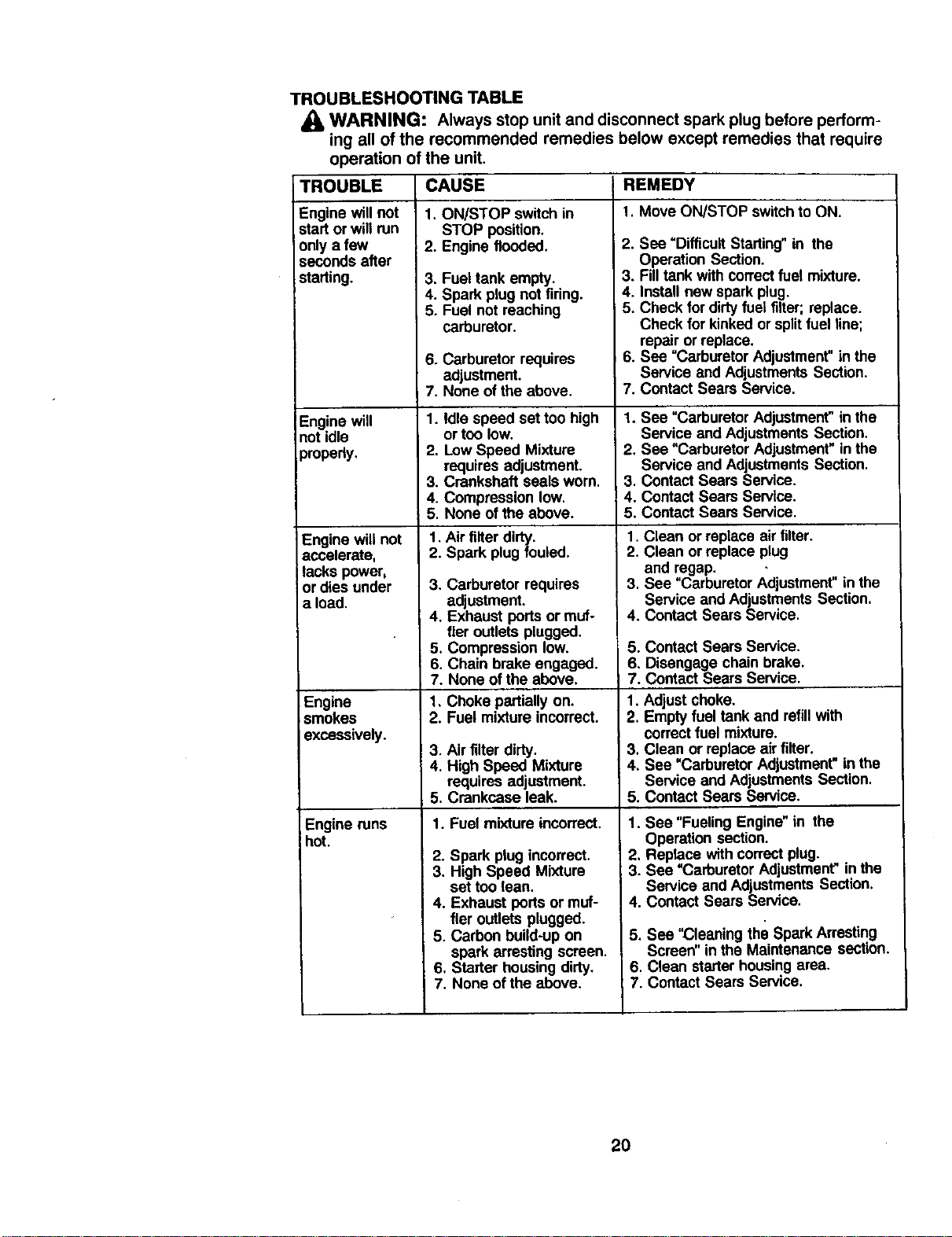
TROUBLESHOOTINGTABLE
WARNING: Alwaysstopunitanddisconnectsparkplugbeforeperform-
ingalloftherecommendedremediesbelowexceptremediesthatrequire
Engine willnot
startor will run
onlya few
seconds after
starting.
operation of the unit.
TROUBLE CAUSE REMEDY
1. Move ON/STOP switchto ON.
Engine will
not idle
propedy.
Engine willnot
accelerate.
lacks power.
or dies under
a load.
Engine
i smokes
excessively.
Engine runs
hot.
1. ON/STOP switch in
STOP position.
2. Engine flooded.
3. Fuel tank empty.
4. Spark plug not firing.
5. Fuel not reaching
carburetor.
6. Carburetor requires
adjustment.
7. None of the above.
1. Idle speed set too high
or too low.
2. Low Speed Mixture
requires adjustment.
3. Crankshaft seals worn,
4. Compression low.
5. None of the above.
1. Air filterdirty.
2. Spark plug fouled,
3. Carburetor requires
adjustment.
4. Exhaust pods or muf-
fler outlets plugged.
5. Compression low.
6. Chain brake engaged.
7. None of the above.
1. Choke partially on.
2. Fuel mixtureincorrect.
3. Airfilter dirty.
4. High Speed Mixture
requires adjustment.
5. Crankcase leak.
1. Fuel mixture incorrect,
2. Spark plug incorrect.
3. High Speed Mixture
set too lean.
4. Exhaust portsor muf-
fler outlets plugged.
5. Carbon build-upon
spark arresting screen.
6. Starter housing dirty.
7. None of the above.
2. See "DifficultStarting"in the
Operation Section.
3. Fill tank with correct fuel mixture.
4. Install new spark plug.
5. Check for dirtyfuel filter; replace.
Check for kinkedor splitfuel line;
repair or replace.
6. See "CarburetorAdjustment"in the
Service and Adjustments Section.
7. Contact Sears Service,
1. See "Carburetor Adjustment"in the
Service and AdjustmentsSection.
2, See "Carburetor Adjustment"in the
Service and AdjustmentsSection,
3. Contact Sears Service.
! 4. Contact Sears Service,
5. Contact Sears Service.
1. Clean or replace air filter.
2. Clean or replace plug
and regep.
3. See "Carburetor Adjustment" inthe
Service and AdjustmentsSection.
4. Contact Sears Service.
5. Contact Sears Service.
6. Disengage chain brake.
7. Contact Sears Service.
1. Adjust choke,
2. Empty fuel tank and refillwith
correctfuel mixture.
3, Clean or replace air filter.
4. See "CarburetorAdjustment"in the
Service and AdjustmentsSection.
5. Contact Sears Service.
1. See "Fueling Engine" in the
Operation section,
2, Replace with correctplug.
3. See "CarburetorAdjustment"inthe
Service and AdjustmentsSection,
4. Contact Sears Service.
5. See °Cleaning the Spark Arresting
Screen" inthe Maintenance section.
6. Clean starter housing area.
7. Contact Sears Service.
2O
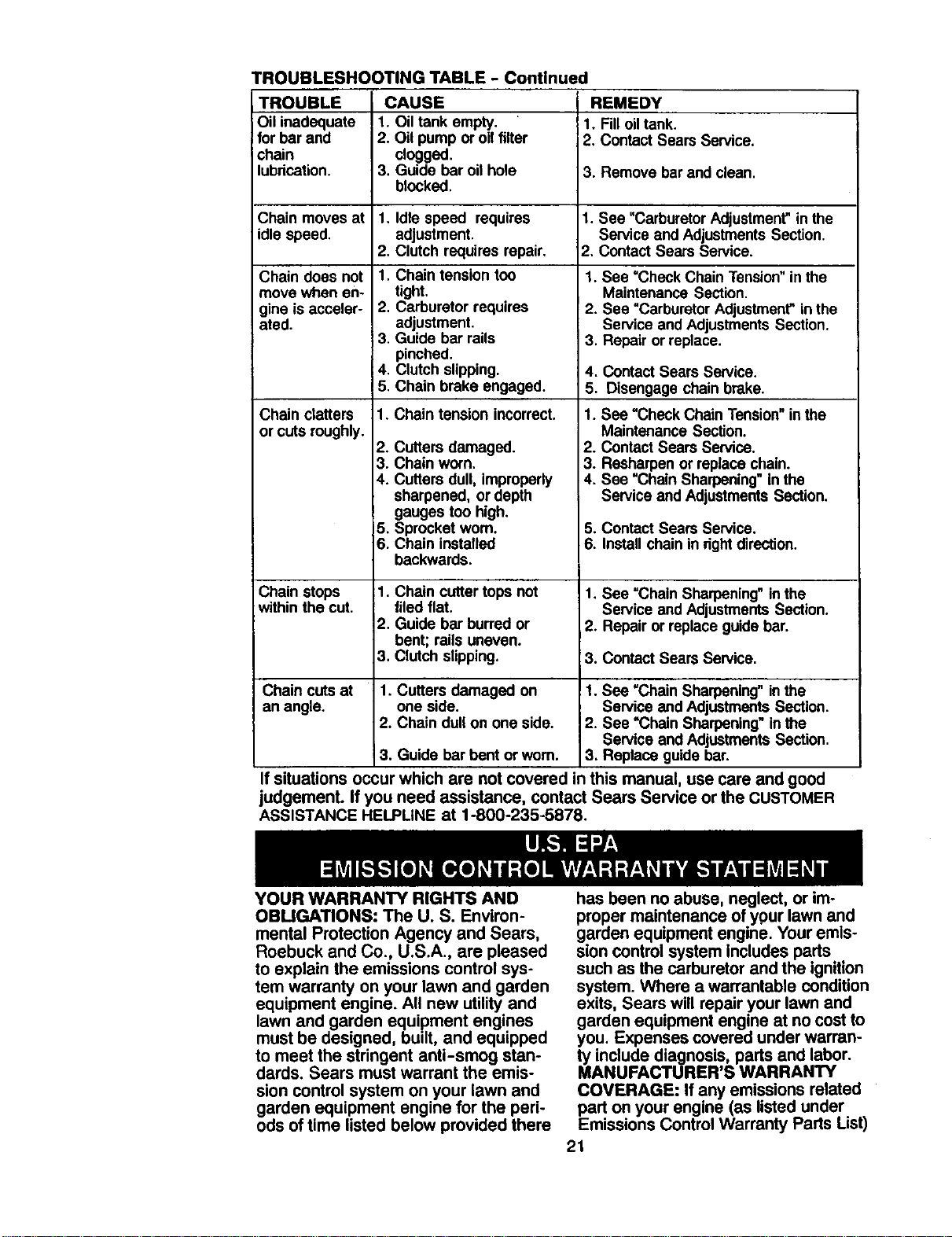
TROUBLESHOOTING TABLE - Contlnued
TROUBLE CAUSE REMEDY
Oil inadequate 1. Oil tank empty. I. Fill olltank.
for bar and 2. Oil pump or oilfilter 2. Contact Sears Service.
chain clogged.
lubrication. 3. Guide bar oilhole 3. Remove bar and clean.
blocked.
Chain moves at 1. Idle speed requires 1. See "CarburetorAdjustment"in the
idle speed, adjustment. Service and AdjustmentsSection.
2. Clutch requires repair. 2. Contact Sears Service.
Chain does not
move when en-
gine is acceler-
ated.
Chain clatters
or cuts roughly.
Chain stops
within the cut.
Chain cuts at
an angle,
1. Chain tension too
tight.
2. Carburetor requires
adjustment.
3. Guide bar rails
pinched.
4. Clutch slipping.
5. Chain brake engaged.
1. Chain tension incorrect.
2. Cutters damaged.
3. Chain worn.
4. Cutters dull, impropedy
sharpened, or depth
gauges too high.
5. Sprocket worn.
6. Chain installed
backwards.
1. Chain cutter tops not
filed flat.
2. Guide bar burredor
bent; rails uneven.
3. Clutch slipping.
1. Cutters damaged on
one side.
2. Chain dull on one side.
3. Guide bar bent or worn.
1. See "Check Chain Tension"inthe
Maintenance Section.
2. See "CarburetorAdjustment"inthe
Service and AdjustmentsSection.
3. Repair or replace.
4. Contact Sears Service.
5. Disengage chain brake.
1. See "Check Chain Tension"in the
Maintenance Section.
2. Contact Sears Service.
3. Resharpen or replace chain.
4. See "Chain Sharpening"Inthe
Service and Adjustments Section.
5. Contact Sears Service.
6. Install chain in rightdirection.
1. See "Chain Sharpening"in the
Service end AdjustmentsSection.
2. Repair or replace guide bar.
3. Contact Sears Service.
1. See "Chain Sharpening"in the
Service and AdjustmentsSection.
2. See "Chain Sharpening"inthe
Service and AdjustmentsSe_ien.
3. Replace guide bar.
If situations occur which are not covered in this manual, use care and good
judgement. If you need assistance, contact Sears Service or the CUSTOMER
ASSISTANCE HELPLINE at 1-800-235-5878.
YOUR WARRANTY RIGHTS AND
OBLIGATIONS: The U. S. Environ-
mental Protection Agency and Sears,
Roebuck and Co., U.S.A., are pleased
to explain the emissions control sys-
tem warranty on your lawn and garden
equipment engine. All new utility and
lawn and garden equipment engines
must be designed, built, and equipped
to meet the stringent anti-smog stan-
dards. Sears must warrant the emis-
sion control system on your lawn and
garden equipment engine for the peri-
ods of time listed below provided there
has been no abuse, neglect, or im-
proper maintenance of your lawn and
garden equipment engine. Your emis-
sion control system includes parts
such as the carburetor and the ignition
system. Where a warrantable condition
exits, Sears will repair your lawn and
garden equipment engine at no cost to
you. Expenses covered under warran-
ty include diagnosis, parts and labor.
MANUFACTURER'S WARRANTY
COVERAGE: If any emissions related
part on your engine (as listed under
Emissions Control Warranty Parts List)
21
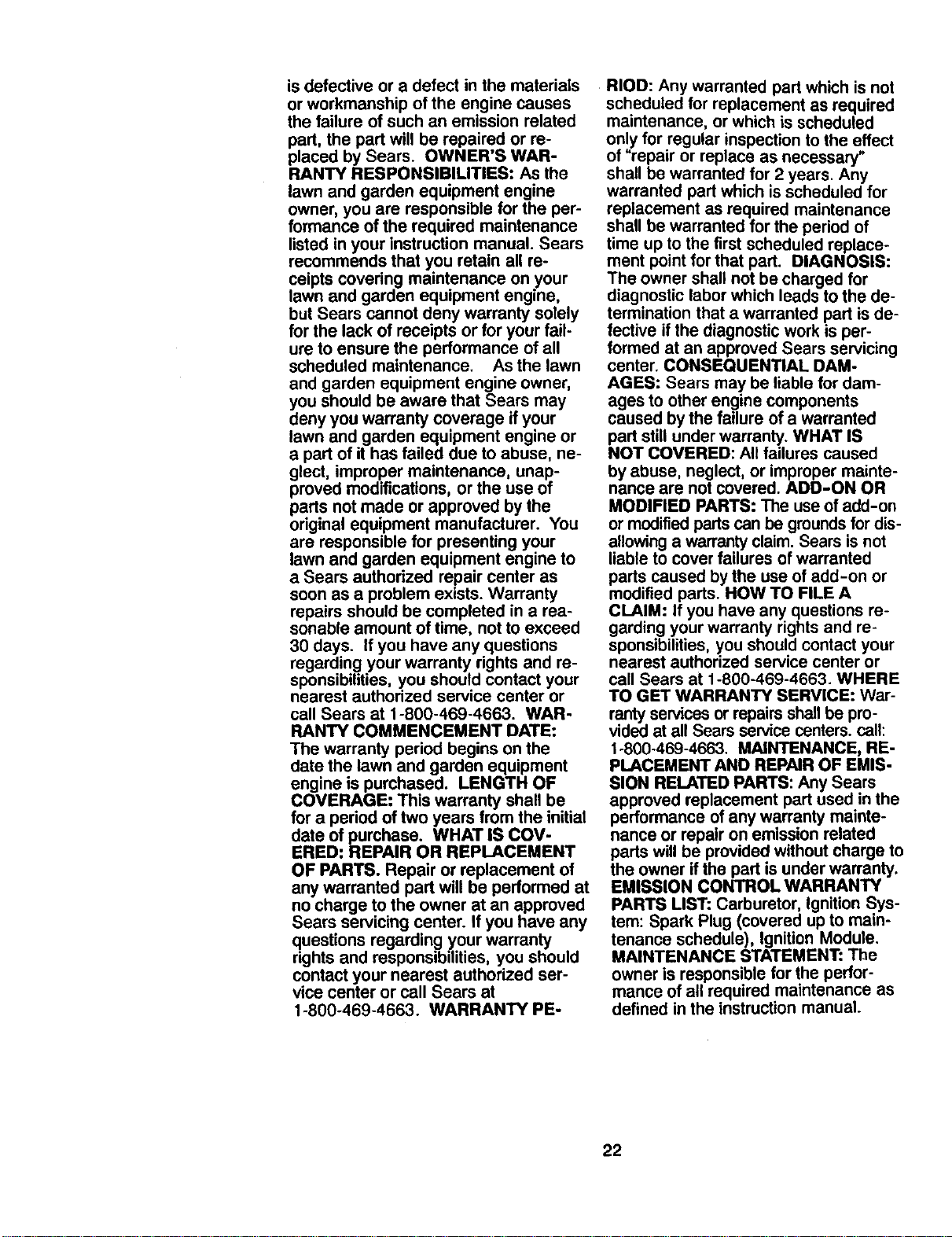
isdefectiveoradefectinthematerials
orworkmanshipoftheenginecauses
thefailureofsuchanemission related
part, the part wilt be repaired or re-
placed by Sears. OWNER'S WAR-
RANTY RESPONSIBIUTIES: As the
lawn and garden equipment engine
owner, you are responsible for the per-
formance of the required maintenance
listed in your instruction manual. Sears
recommends that you retain all re-
ceipts covering maintenance on your
lawn and garden equipment engine,
but Sears cannot deny warranty solely
for the lack of receipts or for your fail-
ure to ensure the performance of all
scheduled maintenance. As the lawn
and garden equipment engine owner,
you should be aware that Sears may
deny you warranty coverage if your
lawn and garden equipment engine or
a part of it has failed due to abuse, ne-
glect, improper maintenance, unap-
proved modifications, or the use of
parts not made or approved by the
original equipment manufacturer. You
are responsible for presenting your
lawn and garden equipment engine to
a Sears authorized repair center as
soon as a problem exists. Warranty
repairs should be completed in a rea-
sonable amount of time, not to exceed
30 days. If you have any questions
regarding your warranty rights and re-
sponsibilities, you should contact your
nearest authorized service center or
call Sears at 1-800-469-4663. WAR-
PANTY COMMENCEMENT DATE:
The warranty period begins on the
date the lawn and garden equipment
engine is purchased. LENGTH OF
COVERAGE: This warranty shall be
for a period of two years from the initial
date of purchase. WHAT IS COV-
ERED: REPAIR OR REPLACEMENT
OF PARTS. Repair or replacement of
any warranted part will be performed at
no charge to the owner at an approved
Sears servicing center. If you have any
questions regarding your warranty
rights and responsibilities, you should
contact your nearest authorized ser-
vice center or call Sears at
1-800-469-4663. WARRANTY PE-
RIOD: Any warranted part which is not
scheduled for replacement as required
maintenance, or which is scheduled
only for regular inspection to the effect
of "repair or replace as necessary"
shall be warranted for 2 years. Any
warranted part which is scheduled for
replacement as required maintenance
shall be warranted for the period of
time up to the first scheduled replace-
ment point for that part. DIAGNOSIS:
The owner shall not be charged for
diagnostic labor which leads to the de-
termination that a warranted part is de-
fective if the diagnostic work is per-
formed at an approved Sears servicing
center. CONSEQUENTIAL DAM-
AGES: Sears may be liable for dam-
ages to other engine components
caused by the failure of a warranted
part still under warranty. WHAT IS
NOT COVERED: All failures caused
by abuse, neglect, or improper mainte-
nance are not covered. ADD-ON OR
MODIFIED PARTS: The use of add-on
or modified pads can be grounds for dis-
allowing a warranty claim. Sears is not
liable to cover failures of warranted
parts caused by the use of add-on or
modified pads. HOW TO FILE A
CLAIM: If you have any questions re-
garding your warranty rights and re-
sponsibilities, you should contact your
nearest authorized service center or
call Sears at 1-800-469-4663. WHERE
TO GET WARRANTY SERVICE: War-
ranty services or repairs shall be pro-
vided at all Sears service centers, call:
1-800-469-4663. MAINTENANCE, RE-
PLACEMENT AND REPAIR OF EMIS-
SION RELATED PARTS: Any Sears
approved replacement part used in the
performance of any warranty mainte-
nance or repair on emission related
parts will be provided without charge to
the owner if the part is under warranty.
EMISSION CONTROL WARRANTY
PARTS LIST: Carburetor, Ignition Sys-
tem: Spark Plug (covered up to main-
tenance schedule), Ignition Module.
MAINTENANCE STATEMENT: The
owner is responsible for the perfor-
mance of all required maintenance as
defined in the instruction manual.
22
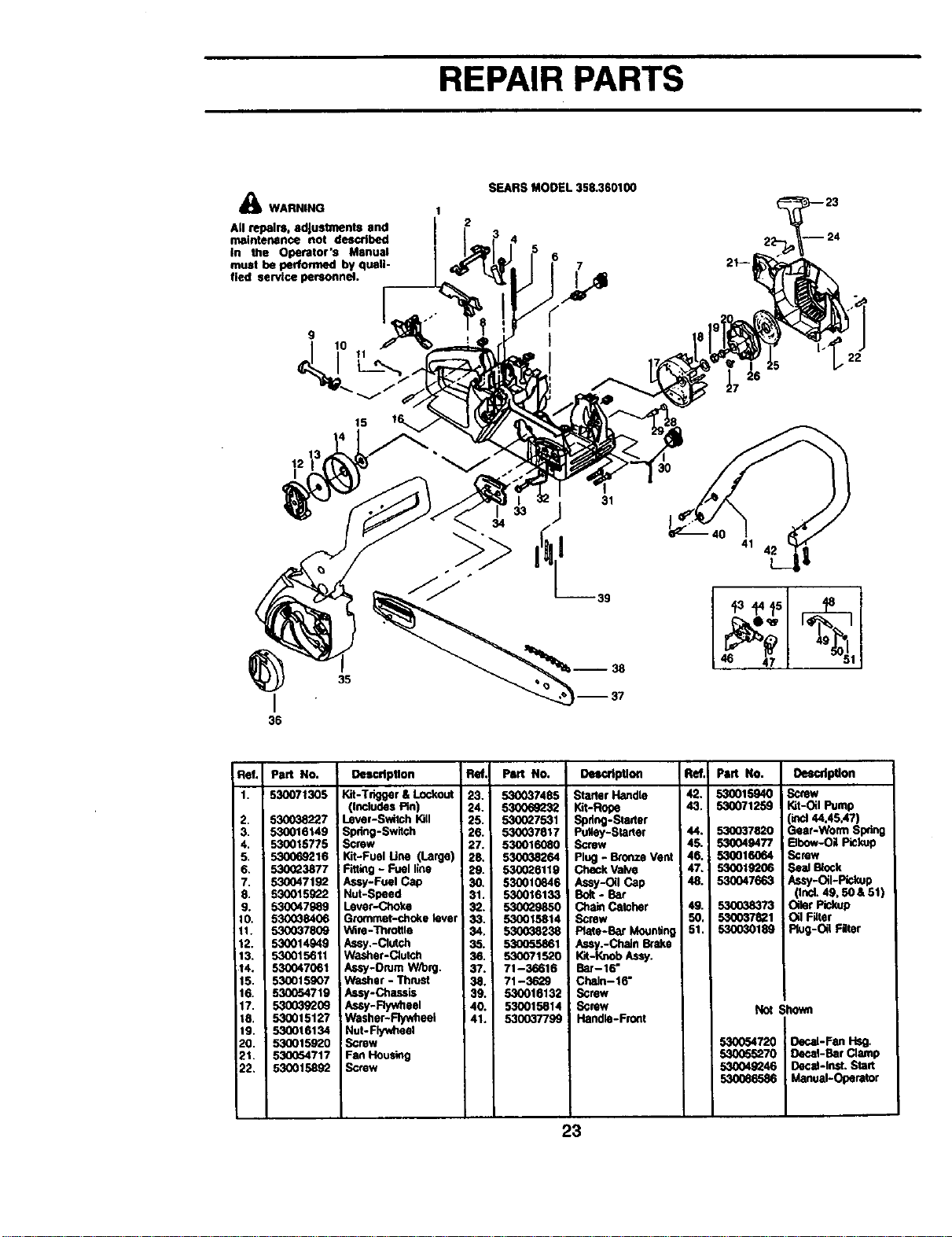
REPAIR PARTS
All repairs, adjustments and
maintenance not desorlbed
in the Operator's Manual
must be perlomted by quail-
fled service personnel,
15
12
I
35
I
36
SEARS MOOEL 358.360100
1
2
6
7
31
38
m 37
22
R_.
1.
2.
3.
4.
5.
6.
9.
10.
11.
12.
13.
;14.
15.
17.
t8.
19.
20.
21.
22.
Part No. Onacdptlon
530071305 Kit-Trigger & Lockout
(includesPin)
530038227 Laver-Switch Kill
530016149 Spring-Switch
530015775 Screw
530069216 Kit-Fuel Une (Largo)
530<_3877 Fiffiug- Fuel line
530047192 Assy-Fuel Cap
530015922 Nut-Speed
_0047989 Laver-Choke
530038406 Grommet-choke lever
530037809 W_m-'lllmltte
530014949 Assy.-Clutch
530015611 Washer-C_utch
530047061 Assy-Drum W/brg.
530015907 Washer - Thrust
530054719 Assy-Chassis
530039209 Assy-Flywheel
530015127 Washer-Fl'p_eei
530016134 Nut- Fl_eel
530015920 Screw
530054717 Fen Housing
530015892 Screw
Ref Part NO.
23. 530037485
24. 53006_!32
25. 530027531
26. 530037817
27. 53O016080
28. 530038264
29. 530026119
30. 530010846
31. 530016133
32. 530029850
33. 530015814
34. 530038238
35. 53OO55861
36. 530071520
37. 71-36616
38. 71-3629
39. 530016132
40. 530015814
41. 530037799
Descdpgon
Starter Handle
Kit-Rape
Spdug-Starter
PuNey-Staner
Screw
Plug - BronzeVent
Check Valve
Assy-Oil Cap
Bolt-Bar
Chain Catcher
Screw 50,
Piute-Bai" Mounting 51,
Assy.-Chaln Brake
K_-Knab_y.
Bar-16"
Chain-16"
Screw
Screw
Handle-Front
Ref.! Pert No.
42. 53OO1594O
43. 530071259
44. 530037820
45. 530049477
46. 530016064
47. Sg(X)IS206
48. S30047663
49. 530038373
530037821
530030189
OeacdpUon
Screw
Kit-Oil Pump
(ind 44,45,47)
Gear-Worm Swing
Show-OR Pickap
Screw
Seal B_ock
Assy-(Xt-P_up
(Ind. 49, 50 & 51)
OilerPickup
Oil Filter
IPiug-_t Filter
Not :;hown
530054720 De.-Fan HSg.
530055270 Danot-Ber Clamp
530049246 Decld-lnat. Start
530066586 Manual-Operator
23
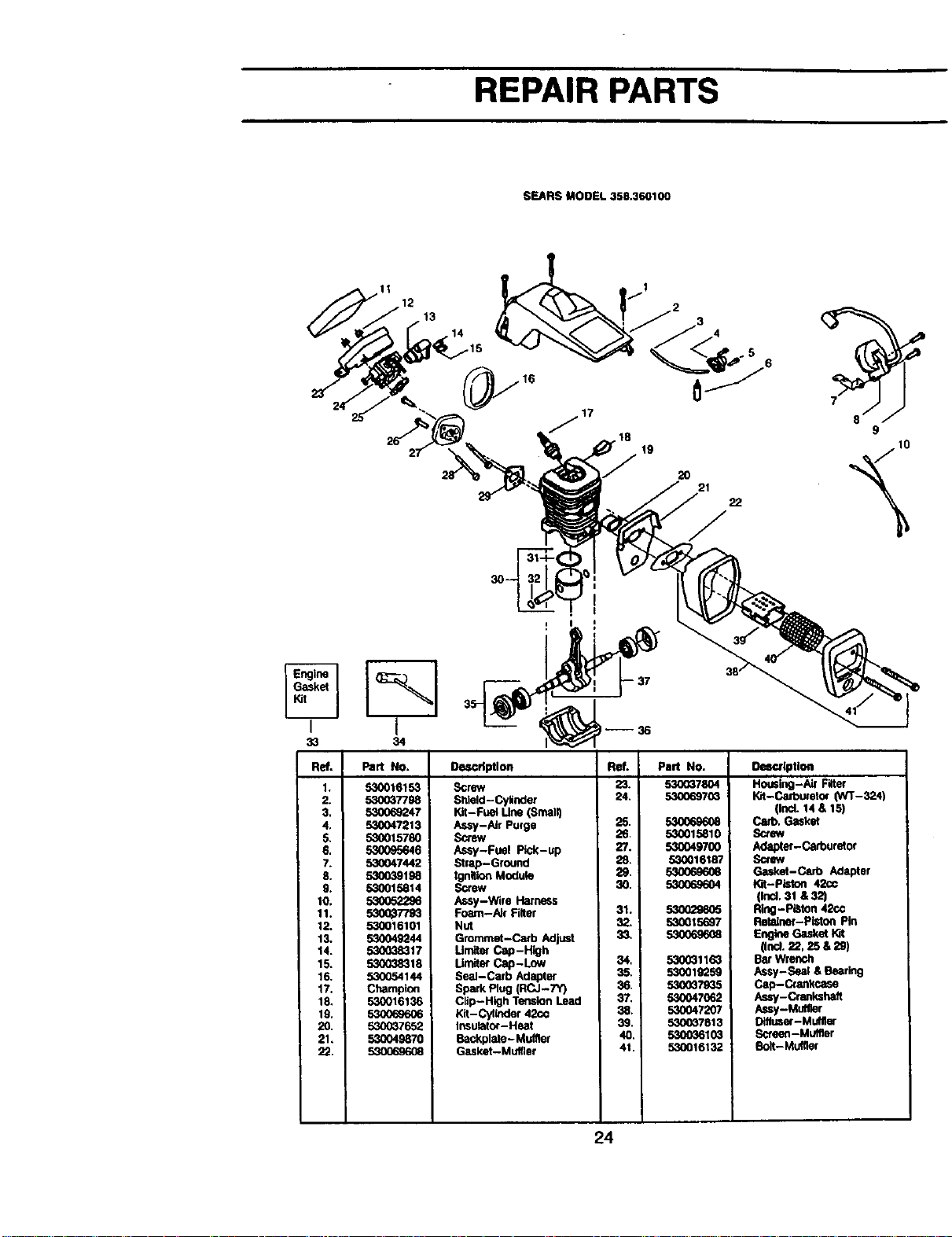
REPAIR PARTS
SEARS MOOEL 358.360100
12
20
21
22
/
9
I
33
Re/-
1.
2.
3.
4.
5.
6.
7.
8.
9.
10.
11.
12.
13.
14.
15.
16.
17.
18.
19.
20.
21,
22.
34
Part No.
530016153
530_7798
530069247
530047213
530015780
,53X)95646
530047442
530039198
530015814
53O052296
S30_7793
530016101
530049244
530038317
53(]038318
530054144
Champion
530016136
530069606 ;
530037652
530049870
,53006_608
Description
Screw
Shield-Cylinder
Klt-Fuet Une (Small)
_ssy-Nr Purge
Scmw
Assy-Fuel Pick-up
Strap-Ground
Ignition Module
Screw
Assy-Wire Harness
Foarn-Ak F'dtor
Net
Grommet-Catb Adjust
Umlt_r Cap-High
UmiterCap-low
Seal-Catb Adapter
Spark Plug (RCJ-7_)
Clip-High TensionLead
Kit-Cylinder 42c¢
Insufetor- Heet
Backplate- Muffler
G_sket-Muffler
Ref.
23.
24.
25.
26.
27.
28.
29.
30.
31.
32.:
33,
34,
35.
36.
37,
38.
39.
40.
41.
Pa_ No.
530_7804
53OO697O3
530O696O8
530015810
530049700
530016187
53006_0e
53006S604
530029605
530015697
53006,,°608
530031163
530019_5,9
53OO37935
530047062
53OO472O7
530037813
53OO361O3
530016132
Description
Housing-Air Filter
10t-Carburetor 0NT-32.4)
(ind. 14 & 15)
Cad), Gasket
Scmw
Adapter-Cad)uretor
Screw
Gasket-Carb Adapter
Wd-Pieton 42cc
(Ir_. 3t Z 32)
Ring-PIMon 42c¢
Retainer-Piston Pin
EngineGasket Kit
(Incl. 22, 2s &29)
BarWrench
Assy-Seal & Bearing
Cap-Crankcase
Assy-Crankshaft
/_sy-Multler
Diffuser-Muffler
Screen-Muffler
Bolt-Muffler
24
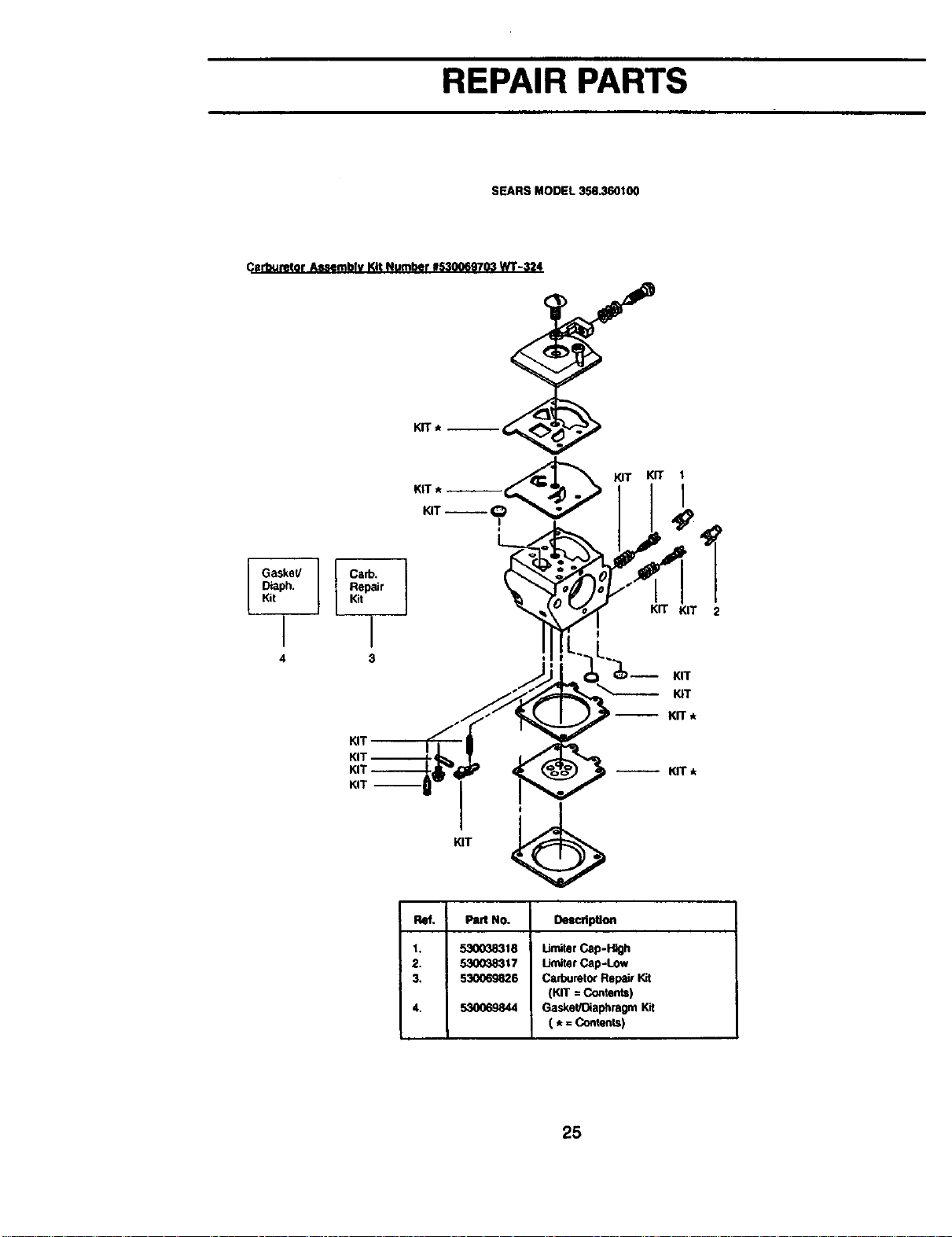
REPAIR PARTS
SEARS MODEL 358.380100
C#rl_retor Assembly Kit Number #530069703 WT-324
GaskeV
Diaph.
Kit
4
{
Ref. Pert NO. DescripSon
1, 530038318 Umiler Cap-High
2. 530038317 Umiter Cap-Low
3. 530069626 CarburetocRepair Kit
(KiT =Contents)
4. 530069844 Gasket/_aphragm Kit
( * = Coments)
25
Declaraci6n de Garantla 26
Reglas de Seguridid 26
Montaje 32
Uso 32
Mantenimiento 40
Servicio y Ajustes 44
Almacenamiento 47
Tabla Diagn6stica 48
Declaracibn de Emision 50
Lista de Piezas 23
Repuestos y Encargos Contratapa
GARANTIA COMPLETA DE UN AI_IO PARA LA SIERRA DE CAOENA A
GASOLINA CRAFTSMAN ®
Por un a_o a contar de la fecha de compra, siempre que esta Sierra de Cadena a
Gasolina Craftsman est_ mantenida, lubricada y ajustada de acuerdo al manual
de instrucciones, Sears repararb gratuitamente cualquier defecto de materiales o
mano de obra.
Esta garantia excluye la barra, la cadena, la bujia y el filtro de aire, que son
articulos fungibles y se gastan durante el funcionamiento normal.
Si se usa esta Sierra de Cadena a Gasolina para propbsitos comerciales o de
alquiler, esta garantla tendr& validez de 30 dlas contados a partir de la fecha de
compra.
EL SERVICIO BAJO GARANTIA ESTA A SU DISPOSICION CON SOLO DEVOLVER LA
SIERRA DE CADENA AL TIENDA DE SEARS O CENTRO DE SERVICIO SEARS MAS
CERCANO EN LOS ESTADOS UNIDOS.
Esta garantia le confiere derechos jurldicos especificos; ademda ud. podr_ tener
otros derechos que varY.an entre estados.
Sears, Roebuck and Co., I)/817 WA, Hoffman Estates, IL 60179
A_kADVERTENCIA: Desconecte
siempre el cable de la bujia al reparar
el aparato, excepto en el caso de
ajustes al carburador. Debido a que
las sierras de cadena son Instrumen-
tos para cortar madera a alta veloci-
dad, deben observarse precauciones
de seguridad especiales para reducir
el riesgo de accidentes. El uso des-
cuidado o indebidode esta herramien-
ta puede causar graves heddas.
PIENSE ANTES DE PROCEDER
• Limite el uso de la sierra a aquellos
usuarios adultos que comprendan y
puedan implementar todas las pre-
cauciones, reglas de seguridad e in-
strucciones de uso que se encuen-
tran en este manual.
Proteccibn de O|dos
Casco Duro
Protecci6n
26
Guantes
Uso
Industrial
Zapatos de
Seguddad ',,_ _,,_ de Seguridad
Use equipo protector. Siempre use
calzado de seguddad con puntas de
acero y suelas anti-deslizantes; ropa
ajustada al ¢uerpo_ guantes gruesos
de uso Industrial anti-deslizantes;
protecci6n de ojos tales como gafas
de seguridad gue no se la cara; cas-
co duro aprobado; y barrera de soni-
do (tapones de oido u orejeras anti-
sonido) para proteger la audici6n.
Los que usan sierras de fuerza ha-
bitualmente deber&n hacerse revisar
la audicl6n frecuentemente ya que el
ruido de las sierras de cadena
puede da_ar los oidos.
• Mantengael cabellopOrencimadel
niveldeloshombros.Nodesgaste
laropasueltaojoyer[a; puedenen-
redarseenlasplezasm6vlles.
• Mantengatodaslaspartesdecuer-
poalejadasdelacadenasiempre
queel motorest0enfuncionamiento.
• Mantenga a los nifios, espectadores
y animales a una dlstancla minima
de 10 metros (30 pies) del drea de
trabajo o cuando est_ haciendo ar-
rancar el motor.
• No levante ni opere las sierras de
cadena cuando esfd fatigado, enfer-
too, ansloso o si ha tomado alcohol,
drogas o remedlos. Es |nprescindible
que ud. est_ en buenas condidones
f{sicas y elerta mentalmente. Si ud.
suite de cualquier condici6n que
pueda empeorar con el trabajo ar-
duo, ases6rese con su m6dico.
• No ponga en marcha la sierra sin
tenet un drea de trabajo despejada,
una superficie estable para parase y,
si est_ derrubando drbeles, un cami-
no predeterminado de retroceso,
USE LA SIERRA OBSERVANDO TO-
DOS LOS PROCEDIMIENTOS DE
SEGURIDAD
• Mantenga las dos manos en las man-
ijas siempre que el aparato estd en
marcha. El uso del aparato con una
sola mano puede causar graves hed-
das al usuario, a los asistentes o a los
especadores. I_as sierras de cadena
est_n dise_ades para que se las use
con las dos manos en todo momento.
• Hags uso de la sierra de cadena Oni-
camente en lugares exteriores bien
ventilados.
• No haga uso de la sierra desde las
escaleras port,tiles ni los _.rboles.
• Asegt_rese de que la cadena no vaya
a hacer contacto con ningt_nobjeto
antes de poner en marcha el motor.
Nunca intente hacer arrancar la sierra
con la barra guia dentro de un code.
• No aplique presibn a la sierra al final
de los cortes. Aplicar presk_ puede
hacer uue pierda el control al com-
pletarse el corte.
• Pare el motor antes de apoyar la
sierra en nlngtln lado.
• Cuando traslade la sierra en la
mano, hSgalo dnicamente con el mo-
tor parado. Lldvela con el silenciador
apartado del cuerpo y la barra y ca-
dena hacia atrds, con la barra de
preferencia cubierta por una funds.
* No ponga en funcionamiento la sier-
ra de cadena si est_ da_ada, incor-
rectamente ajustada, o al nOestd ar-
mada completa y seguramente.
Slempre cambie el babe, cadena,
protector de mano, freno de cadena,
o el otras piezas immediatamente si
da_ado, roto, o se sale pot cualquier
motivo.
MANTENGA LA SIERRA EN BUE-
NAS CONDICIONES DE FUNCIONA-
MIENTO
• IJeve la sierra de cadena a un pro-
veedor de servlclo autorizado para
que hags todo servldo menos aquel-
los procedimientos listados en la
seccl6n de MANTENIMIENTO de este
manual.
• Asegdrese de qua la cadena se de-
tenga por completo cuando se suelta
el gatillo. Para hacer correcciones,
vea los AJUSTES AL CARBURADOR.
• Mantenga las manljas secas, limplas
y libres de aceite o de mezcla de
combustible.
• Mantenga las tapes y los fijador_s
bien fijos.
• Componentes de repuesto que no
concuerden con las plezes odginales
o la remoci6n de dispositivos de segu-
ddad podria causar dafK)s al aparato y
accidentes al usuario o a especta-
dores. Use exclusivamente los acce-
sorios y repuestos Craftsman recom-
endados. Nunca modifique la sierra.
• Mantenga su sierra de cadena con
cuidado.
• Mantenga la herramlenta afilada y
limpia para mejor funcionamiento y
mayor seguddad.
• Siga todas las instrucciones para lu-
bricaci6n y cambio de accesodos.
• Desconecte la sierra de cadena del
recurso de energ|a cuando no se en-
cuentre en uso, antes de efectuar
servicio, y el cambiar accesodos,
como Io es la cadena de la sierra y
el protector.
• Inspeccione todas las piezas por sl
hubiera da_os. Antes de continuar con
el uso del aparato;, el protector u otra
pieza que se encuentre daFnadadeb-
er_ ser inspeccionada culdadosa-
mente para determinar si pueden
usarse de forma apmpiada y para
vierificar si puede efectuar el fundona-
miento para el cueal fue disefin.J:la.In-
speccione el allneamiento de las pie-
zas movibles, plezas movibles que se
27
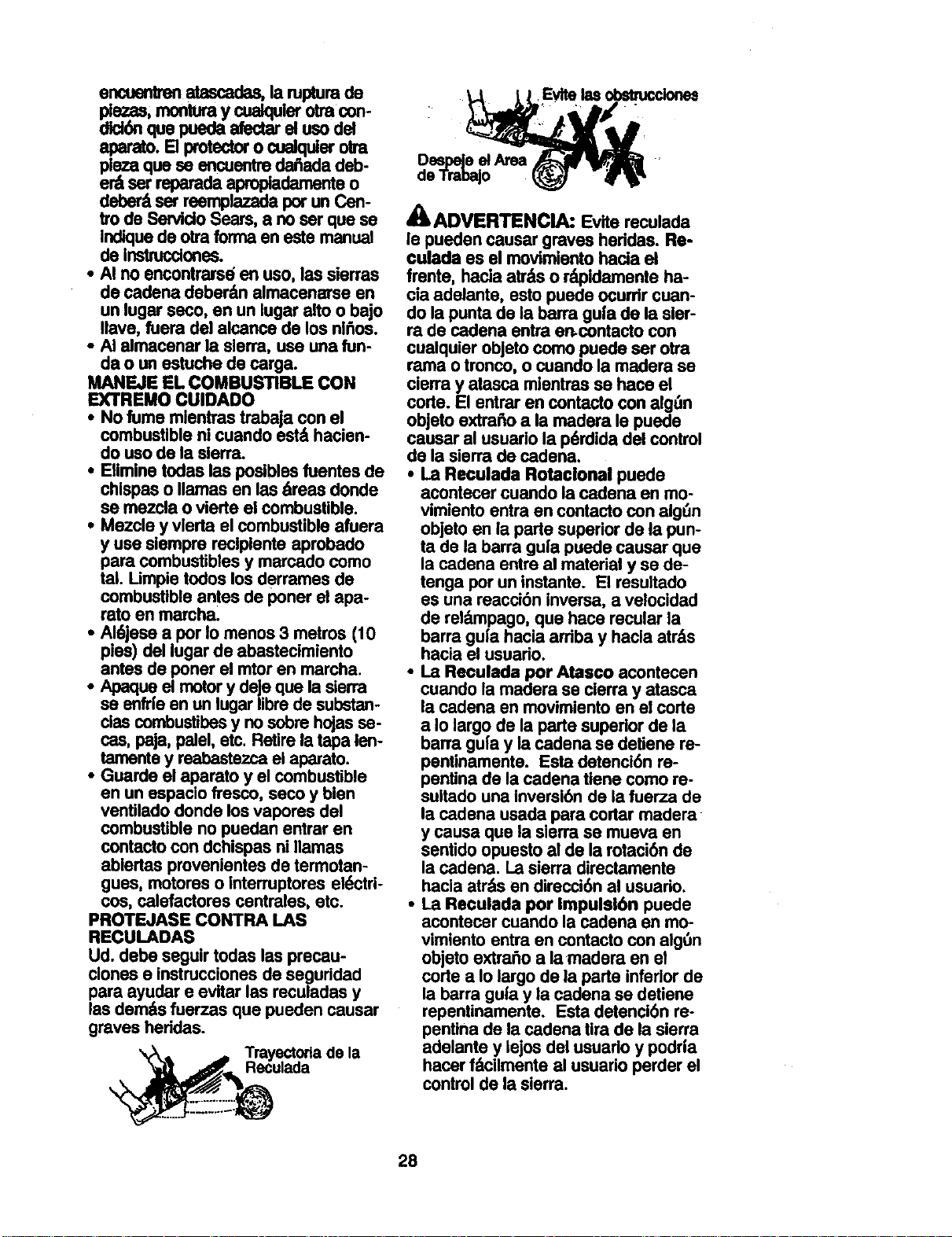
encuentrenatasc_ la rupturade
plezas, monturay coalquler otra con-
dlcl6nque pueda afectar el uso del
aparato.B protectorocualqulerotra
pleza que se encuentredafiada deb-
er_ set reparadaapropiadamenteo
deber_,set reemplazada pot unCen-
trode Servido Sears, a no ser que se
Indiquede otra forma en este manual
de Instmcclones.
• AI no encontrarsd en uso, las sierras
de cadena deberdn almacenarse en
unlugar seco, on un lugar alto o bajo
Ilave, fuera del alcance de los nlfios.
• AI almacenar la sierra, use una fun-
da o unestucho de carga.
MANEJE EL COMBUSTIBLE CON
EXTREMO CUIDADO
• No fume mlentras trabaja con el
combustible nl cuando estd hacien-
do use de la sierra.
• EIimine todas las posibles fuentes de
chispas o llamas en las dreas donde
se mezcla o viedo el combustible.
• Mezcle y vlerta el combustible afuera
y use siempre reclplente aprobado
para combustibles y marcado como
tal. Umpie todos los derrames de
combustible antes de poner el apa-
rato en marcha.
• AI6jese a por Io menos 3 metros (10
pies) del lugar de abastecimiento
antes de poner el mtor en marcha.
• Apaque el motory deje que la sierra
se enfrleen un lugarlibrede substan-
clascombustibes y nosobre hojasse-
cas, paja,palel, etc. Retirela tapa len-
tamentey reabastezcael aparato.
• Guarde el aparato y el combustible
en un espacio fresco, seco y blen
ventilado donde losvapores del
combustible no puedan entrar en
contacto con dchispas ni llamas
ablertas provenientes de termotan-
gues, motores o Interruptores el6ctd-
cos, calefactores centrales, etc.
PROTEJASE CONTRA LAS
RECULAOAS
Ud, debe seguir todas las precau-
clones e instrucciones de seguddad
para ayudar e evitar las reculadas y
las demos fuerzas que pueden causer
graves heridas.
,_. Trayectodade la
Reculada
u i i Evitelas _
Des e elArea
_1=ADVERTENClA: Evite reculada
le pueden causar graves heridas. Re-
culada as el movimiento hacia el
frente, hacia atr_s o r=Sq)idamenteha-
cia adelante, esto puede ocurrircuan-
do la punta de la barra gui'ade la sier-
ra de cadena entra on.contacto con
cualquier objeto como puede ser otra
rama o tronco, o cuando la madera se
cierra y atasca mlentras se haco el
code. El entrar en contacto con algt_n
objeto extrafio a la madera le puede
causar al usuarlola p6rdida del control
de la sierra de cadena.
• La Reculada Rotacional puedo
acontecer cuando la cadena en mo-
vimiento entra en contacto con algt_n
objeto en la parte superior de la pun-
ta de la barra gul'apuede causer que
la cadena entre al material y se de-
tenga por un instante. El resultado
es una reacci6n inversa, a velocidad
de rel_mpago, que hace recular la
barra gu|a hacia arriba y hacla atr,_s
hacia el usuario.
• La Reoulada por Atasco acontecen
cuando la madera se cierra y atasca
la cadena en movimiento en el corte
a Io largo de la pade superior de la
barra gufa y la cadena se det,ene re-
pentinamente. Esta detenci6n re-
penUna de la cadena tiene como re-
sultado una inversi6n de la fuerza de
la cadena usada para cortar madera
y causa que la sierra se mueva en
sentido opuesto al de la rotaci6n de
la cadena. La sierra directamente
hacia atrds en direcci6n al usuario.
• La Reculada pot Impulst6n puede
acontecer cuando la cadena en mo-
vimiento entra en contacto con alg(m
objeto extra_o a lamadera en el
code a Io largo de la parle inferior de
la barra gu|a y la cadena se detiene
repentinamente. Esta detenci6n re-
pentina de la cadena tira de la sierra
adelante y lejos del usuado y podrla
hacer f:_cilmenteal usuario perder el
control de la sierra.
28
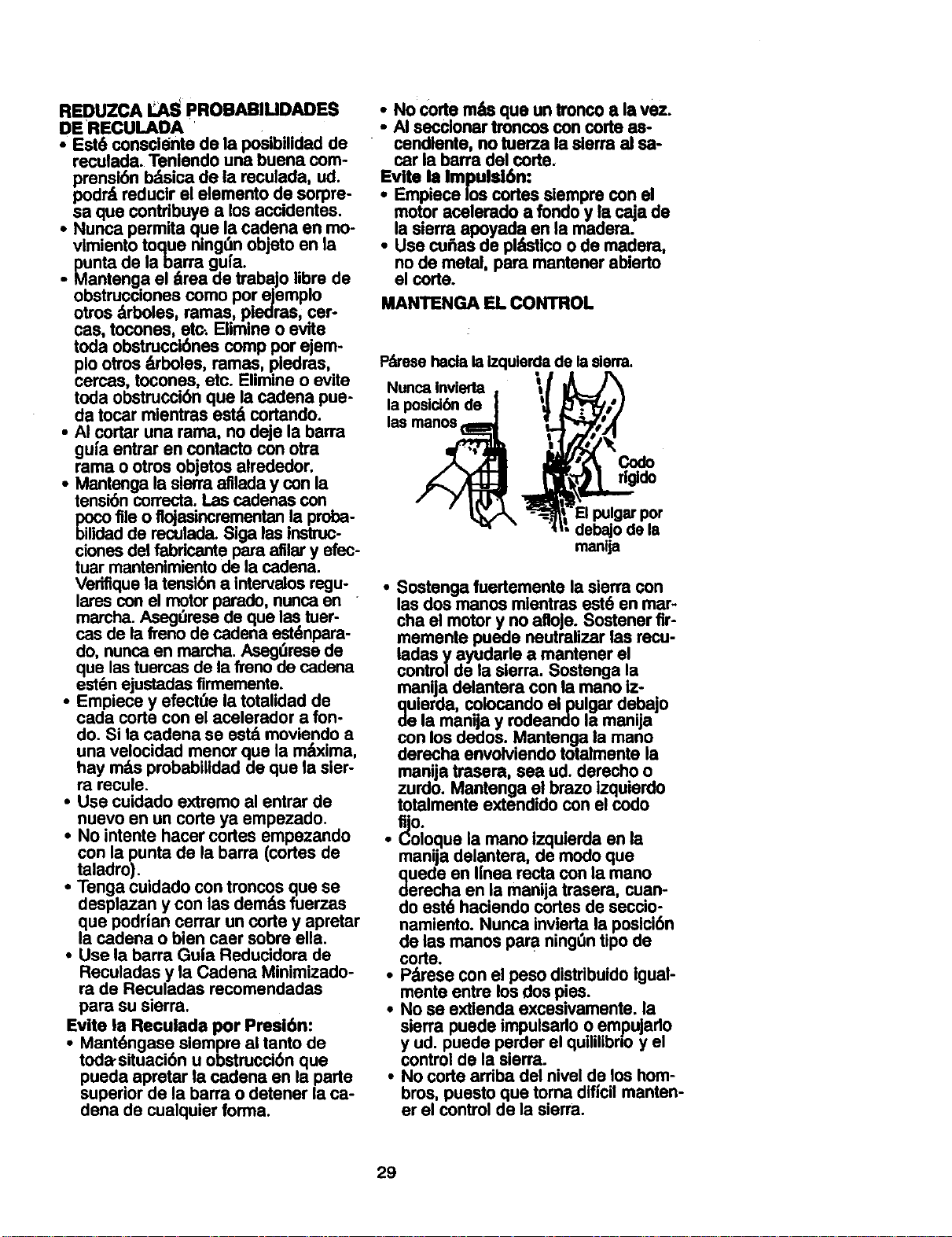
REDUZCA I_,_ PROBABIUDADES
DE RECULADA '
• Est0 consdento do la posibilidad de
recotada. Tenlendo una buena com-
prensi6n bdsica de la reculada, ud.
podr_ reducir el elemento de sorpre-
sa qua contdbuye a los accidentes.
i unca permita que la cadena en mo-
vimiento toque ning_n obleto en la
punta de la barra gufa.
Mantenga el _rea de trabaJolibre de
obstrucciones corno por eJemplo
otros drboles, ramas, pledras, cer-
cas, tocones, eta. Elimine o evite
toda obstmcci6nes comp porejem-
• No corte m=tsqua un tronco a lavez.
AI seccionar troncos con code as-
cendlente, no tuerza la sierra al sa-
car la barra del code.
Evite I.aImpulsi6n:
• Emp,ece los codes siempre con el
motor acelerado a fondo y la caja de
la sierra apoyada en la madera.
• Use cones de pl=_sUcoode madera,
no de metal, para mantener abierto
el code.
MANTENGA EL CONTROL
P_ese
plo otros drboles, ramas, pledras, hacla la izqulerda de la sierra.
cercas, tocones, etc. Ehmlne o evite Nunca Invierta . \/ I_---_
toda obstmcci0n que la cadena pue- la posick_nde
da tocar mlentras est6. cortando.
• AI codar una rama, no deje la barra las/_ _'_,_._
gu|a entrar en contacto con otra _ Codo
rama o otros objetos alrededor, i do
• Mantenga la sierra afilada y con la
tensi6n correcta. Las cadenas con _ El pulgar por
poco file o flojesincrementan la proba- _t_'__-'-'_
bilidad de reculada. Siga les instruc- debajo de la
clones del fabricante para afilar y efec-
tuar mantenim,ento de la cadena.
Verifique la tensibn a intervalos regu-
lares con el n_,tor parado, nunca en
marcha. Asegurese de qua las.tuer-
cas de la freno de cadena est_npara-
do, nunca en marcha. Asegurese de
que las tuercas de la fTeno de cadena
esten ejustadas firmemente.
• Empiece y efect_e la totalidad de
cada corte con el acelerador a fon-
do. Si la cadena se est=_moviendo a
una velocidad menor que la m_lxima,
hay m_s probabilidad de que la sier-
ra recule.
• Use cuidado extremo al entrar de
nuevo en un corte ya empezado.
• No intente hacer codes empezando
con la punta de la barra (cortes de
taladro).
• Tenga cuidado con troncos qua se
desplazan y con las demds fuerzas
que podrlan cerrar un corte y apretar
la cadena o bien caer sobre ella.
• Use la barra Guia Reducidora de
Reculadas y la Cadena Minimizado-
ra de Reculadas recomendadas
para su sierra.
Evite la Reculada por Presi6n:
• Mant6ngase siempre al tanto de
toda*situaci6n u obstruccibn que
pueda apretar la cadena en la parte
superior de la barra o detener la ca-
dana de cualquier forma.
mantja
• Sostenga fuertemente la sierra con
les dos manos mientres est6 en mar-
cha el motor y no afloje. Sostener fir-
memente puede neutralizar les recu-
ladas y ayudarle a mantener el
control de la sierra. Sostenga la
manija dalantera con la mano Iz-
quierda, colocando elpulgar debajo
de la manija y rodeando la manija
con los dedos. Mantenga la mano
derecha envolviendo totalmente la
manija trasera, sea ud. derecho o
zurdo. Mantenga el brazo izquierdo
totalmente extendido con el codo
flO.fij
• C_oloque la mano izquierda en la
manijadelantera, de modo que
quedeen linea rectacon la mano
derecha en la manlja trasera, cuan-
do est6 haciendo codes de seccio-
namlento. Nunca invlerta,,la posici6n
de las manos par a ningun tipo de
code.
• P_rese con el peso distdbuido igual-
manta entre los dos pies.
• No se extlenda excesivamente, la
sierra puede impulsarlo o empujado
y ud. puede perder el quililibrio y el
control de la sierra.
• No corte arriba del nivel de los hom-
bros, puesto que toma diflcil manten-
er el control de la sierra.
29
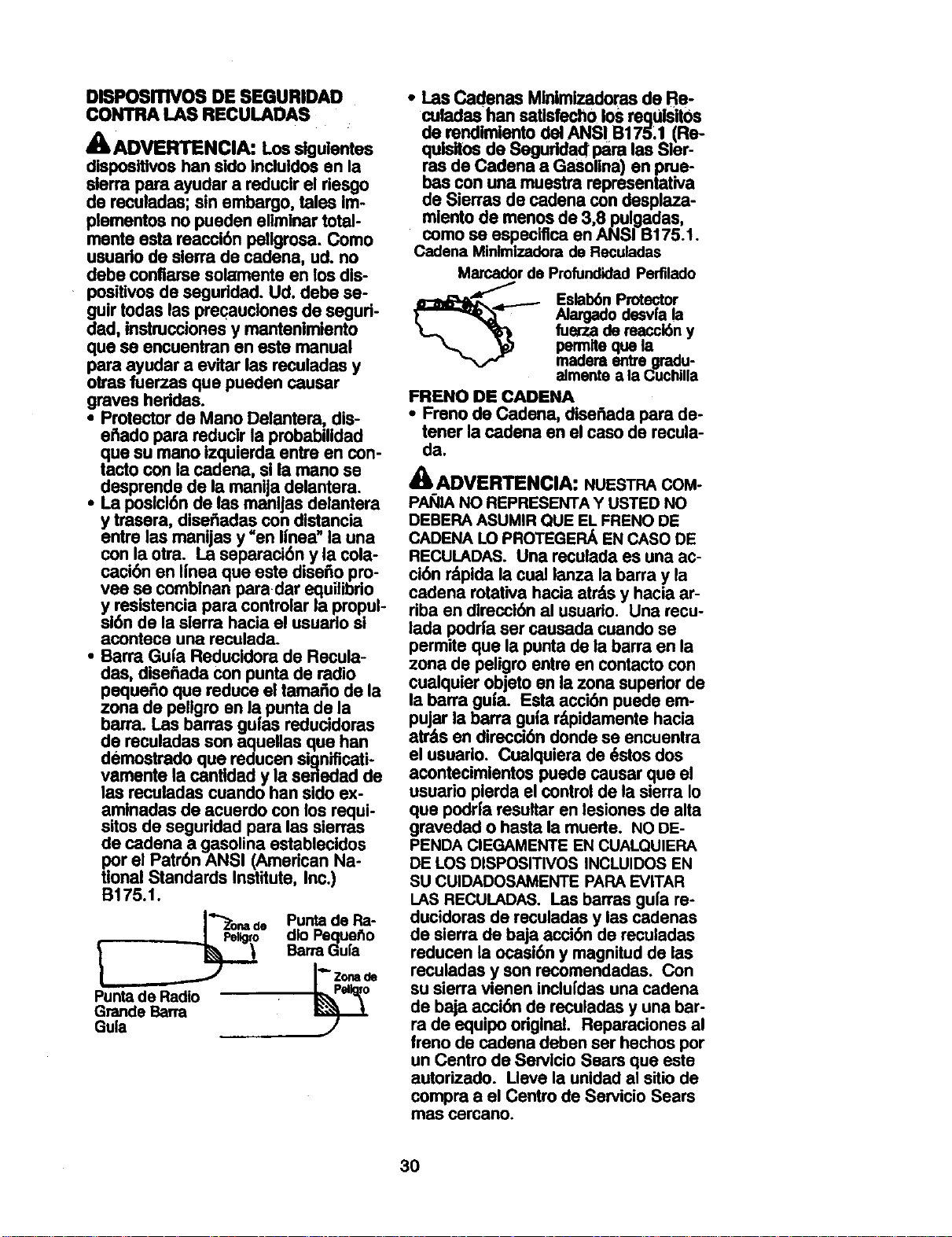
DISPOSITNOS DE SEGURIDAO
CONTRA LAS RECULADAS
_ADVERTENCIA: Los elgulentes
disposltlvoshan sldo Incluldos en la
sierra para ayudar a reducir el desgo
de reculadas; sin embargo, tales Im-
plementos no pueden allmlnar total-
mente esta reacci6n pellgrosa. Como
usuado de sierra de cadena, ud. no
debe conflarse solamenta en los dis-
posltlvos de seguddad. Ud. debe sa-
guir todas las precauclones de seguri-
dad, instruccionesy mantenlmiento
que se encuentran en este manual
para ayudar a evitar las reculades y
otras fuerzas que pueden causar
graves heddas.
• Protector de Mano Delantera, dis-
er_adopara redudr la pmbabilldad
que su mano Izquierda entre en con-
tacto con la cadena, si la mano se
desprende de la manija delantera.
• La poslcl6n de las manljas delantera
y trasera, dise_adas con distancia
entre las manijas y "en Ifnea" la una
con la otra. La separaci6n y la cola-
caci6n en llnea que este diseno pro-
vee se comblnan paradar equilibdo
y resistencia para controlar la propul-
sl6n de la sierra hacia el usuado sl
acontece una reculada.
• Barra Gu|a Reducidora de Recula-
des, dise_ada con punta de radio
peque_o que reduce el tama_o de la
zona de pellgro an la punta de la
barra. Las barras gules reducldoras
de reculadas son aquelles que han
demostrado que reducen significati-
vamente la canfldad y la sededad de
les recoladas cuando han sido ex-
amlnadas de acuerdo con los requi-
sitos de seguridad para las sierras
de cadena a gasolina establecidos
por el Patr6n ANSI (American Na-
tional Standards Institute, Inc.)
B175.1.
.._"_ona de
Punta de Radio
Grande Bana
Guia
Punta de Ra-
dio Peque_o
BarraGu|a
• Las Cadenas Minlmizadoras de Re-
c.ladashan satisfech0 los requisit0s
de rendlmiento (lel ANSI B175J (Re-
quisltosde _egufldadpara las Sier-
res de Cadena a Gasollna) en prue-
bas con una muestra representativa
de Sierras de cadena con desplaza-
mlento de menos de 308 pulgadas,
como se especiflca en ANSI B175.1.
CadenaMinlmlzadorade Reculadas
Mamador de Profundidad Pedilado
_ Eslal_n Pml_'lor
permlte que la
madera entre gradu-
almente a la Cuchilla
Alargado desvla !a
fuerza de reaccl6n y
FRENO DE CADENA
• Freno do Cadena, dise_ada para de-
tener la cadena en el caso de recula-
da.
ADVERTENCIA: NUESTRACOM-
PAI_IIANO REPRESENTA Y USTED NO
DEBERA ASUMIR QUE EL FRENO DE
CADENA LO PROTEGER_ EN CASO DE
RECULADAS. Una reculada es una ac-
ci6n r;_pida la cual lanza la barra y la
cadena rotativa hacia atr_s y hacia ar-
riba en dlreccl6n al usuado. Una recu-
lada podr|a ser causada cuando se
permite que la punta de la barra en la
zona de peligro entre en contacto con
cualquier objeto en la zona supedor de
la barra guia. Esta acci6n puede em-
pujar la barra guia r._pidamente hacia
atr_.s en direcci6n donde se encuentra
el usuado. Cualquiera de 6stos dos
acontecimientos puede caesar que el
usuado pierda el control de la sierra Io
que podr|a resultar en lesiones de alta
gravedad o hasta la muerte. NO DE-
PENDA CIEGAMENTE EN CUALQUIERA
DE LOS DISPOSITIVOS INCLUIDOS EN
SU CUIDADOSAMENTE PAPA EVITAR
I.AS RECULADAS. Las barras guia re-
ducidoras de reculadas y las cadenas
de sierra de baja acci6n de reculadas
reducen la ocask_n y magnitud de las
reculadas y son recomendadas. Con
su sierra vienen incluldas una cadena
de baja acci6n de reculades y una bar-
ra de equipo odginel. Reparaciones al
freno de cadena deben ser hechos per
un Centro de Servicio Seam que este
autorizado. Llave la unidad al sitio de
compra a el Centro de Servicio Sears
mas cercano.
3O
• Elcontactoconla puntade.la sierra quehacenusoc0ntinu0yprolongen-
pu_le causarunaREACCION dodelasherramientasdefuerzade-
contradaquoaunavolocidadvertigi- benrkscaltzar atentamente su astado
nosa expulsa la espada hacla arriba
y hacia atr._s,en direcck_nal
operador.
• Si la cadena queda atrapada por la
parte superior do la aspada, _sta
puede rebotar bruscamente hacia el
operador.
• Cualqulera de estas dos reacdonas
puede provocar la p6rdlda del con-
trol de la motoslerra y causar una
grave lasi6n. No conf|e excluslva-
mente en los dispositivos de segud-
dad que incorpora su sierra.
AVISO DE SEGURIDAD: El estar ex-
puesto alas vibracionos a trav_s del
uso prolongado de herramientas de
fuerza a gasolina puedo causar da_os
a losvasos sanguineos o a los norvios
de los dedos, las manos y las coyuntu-
ras en aquollas personas que tlenen
propensldad a lostrastomos do la cir-
culacl6n o alas hlnchazones anor-
males. El uso prolongado en tiempo
frio ha sido asociado con daf=osa los
vasos sangulneos de personas que
porotra parte se encuentran en per-
fecto estado de salud. Si ocurren
sintomas tales como el entumecimlen-
to, el dolor, la falta de fuerza, los cam-
bios, en el color o la textura do la piel o
falta de sentido en los dedos, las man-
os o las muflecas, deje de usar la
m_.quina inmediatamento y procure
atencibn m6dica. Los sistemas de
anti-vibraci6n nogarantizan que se
eviten tales problemas. Los usuados
fisico y el estado del aparato.
FRENO DE CADENA: Si asta sierra
ha de usarse para el tumbado comer-
cial de :_rbelas,un freno de cadena se
requiem y no ser_ quitado ni ser_ lisla-
do de otra menera conformarse con
las Regulaciones Federalas del OSHA
para el tumbado comerclal de _rboles.
REJILLA ANTICHISPA: Su sierra
viene equipada con silenclador limita-
dor de temperatura y con rejllla anti-
chispa que cumple losrequisitos de
los C6digos de Califomla 4442 y 4443.
Todas las tierras forestadas federales,
m_s los estados de Califomia, Idaho,
Maine, Minnesota, Nueva Jersey,
Washington y Oreg6n, requieren por
ley que muchos motorss de combus-
tibn intema est6n equipados con rejilla
antichlspa. Si usted usa una sierra de
cadena en unastado y otra Iocalidad
donde existen tales reglamentos,
usted tiene la responsabilidad jur|dica
de mantener estas piezas en correcto
astado de funcionameinto. De Io con-
trado, estar_,en infracci6n de la ley.
Refiera a la carta de RESPONSABIUDA-
DES DEL USUARIOen la secci6n del
MANTENIMIENTO.
PADRONES: Este sierra de cadena
consta en la lista de Underwriters Lab-
oratodas, Inc. do acuerdo a los Requi-
sitos Nacionales de Seguddad Esta-
dounidenses para Sierras de Cadena
a GasoUna (ANSI B175.1-2000).
31
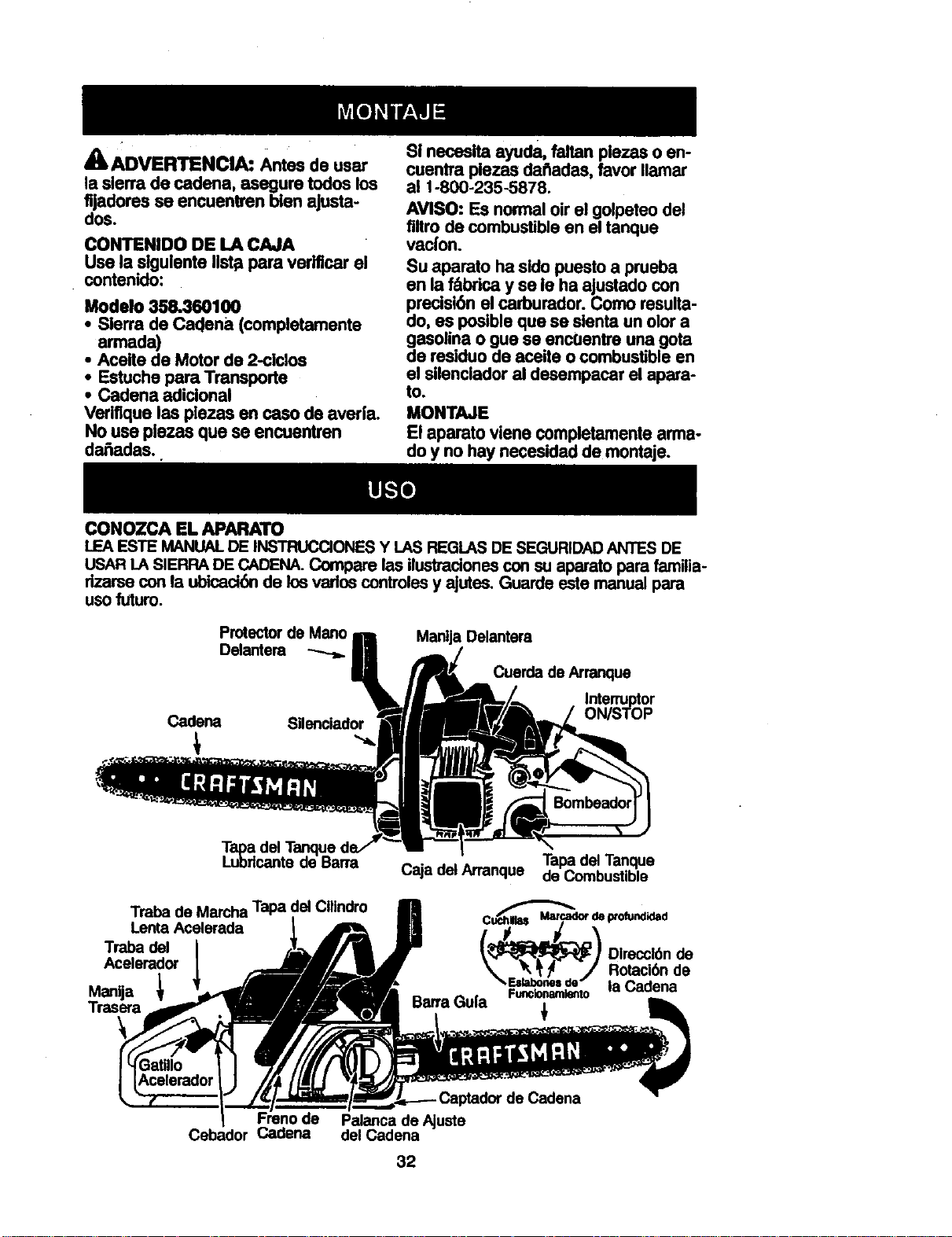
ADVERTENCIA: Antes de usar
la sierra de cadena, asegure todos los
fljadores se encuentren blen ajusta-
dos.
CONTENIDO DE LA CAJA
Use la slgulente llstp pare veriflcar el
• contenido:
Modelo 358.360100
• Sierra de Cadena (completamente
armada)
• Aceite de Motor de 2-ciclos
• Estuche para Transporte
• Cadena adicional
Veriflque las plezas en caso de averia.
No use piezas que se encuentren
dar3adas.
Sl neossita ayuda, faltan plezas o en-
cuentra plezas daf=adas,favor Ilamar
al 1-800-235-5878.
AVISO: Es normal oir el golpeteo del
filtrode combustible en el tanque
vacfon.
Su aparato ha sido puesto a prueba
en la f_brica y se le ha ajustado con
precisi6n el carburador. Como resulta-
do, as posible que se sienta un olor a
gasolina o gue se enc0entre una gota
de residuo de aosite o combustible en
el silenciador al desempacar el apara-
to.
MONTAJE
El aparato viene completamente arma-
do y no hay necesidad de montaje.
CONOZCA EL APARATO
LEAESTEMANUALDE INSTRUCCIONESY LASREGLASDESEGURIDADANTESDE
USAR LA SIERRA DE CADENA. Compare las ilustradones con su aparato pare familia-
rizarse con la ubicaci6n de los varios controles y ajutes, Guarde este manual para
uso futuro.
Protector de Mano
Delantera
Manlja Delantera
Cuerda de Arranque
Cadena Silenciador
Tmba de Marcha Tapa del Cllindro
Lenta Acelerada
Traba del
Acelerador
Manija
Trasera
Tapa del Tanque
Caja del Arranque de Combustible
ode Palanca de Ajuste
Cebador Cadena del Cadena
32
_EN_PE INTERRUPTOR . BOMBEADOR
BEN_E (ONK)FF)tNTERRUPTORest_ El BOMBEADORcirculacombustibleai
acostumbradoa detener la n_quina.
caburador.
GATILLO DE ACELERADOR
El GATILLO DE ACELERADOR controla
veloctdad de m&quina.
TRABA DEL ACELERADOR
Es necesario apretar pdmoro la TRABA
DEL ACELERADOR para poder acdonar
el acolerador. Este dlspositivo prevlene
el adonamlento accidental del acelera-
dor.
TRABA DE LA MARCHA LENTA
ACELERADA
La TRABA DE LA MARCHA LENTA ACEL-
ERADA manUene el gatillo en la posic_n
de arranque. Active la traba de marcha
lenta acelorada en la siguiente manera:
presione la traba del acelerador y luego
apretando el gatillo acelorador. Con el
acelerador apretado, optima la traba de
marcha lenta acelerada. Suelte la traba
del acelerador y el gatillo rnientras man-
tiene opdmida la traba de marcha lenta
acolerada.
PALANCA DEL CEBADOR
La PALANCADEL CEBADOR provee com-
bustible adicional al motor el anancar en
frio.
FRENO DE CADENA
B FRENODECADENAestd dise_do
para detenerla cadenaen casode m-
culade. B freno de cadena se activa
autorndticamenteen caso de reculadas.
B freno de cadena se actlvamanual-
mente si ernpujanai protectorde mano
delantero adelante. Para desactivarel
freno de cadena, tim Io rn_ posibledel
protectorde mano delanterohaclala
manija delantera. "'_
TENSION DE LA CADENA
Es normalqua lascadenasnuevasse
estirendurantelos pdmoros30 minutos
de uso. Deber-_verificarselatensidnde
la cadena frecuentemente.Vea TEN-
SIONDE LACADENAen la secci6nde
SERVICIO Y AJUSTES.
'_ ADVERTENCIA: El silenciador
es extremadamente caliente durante
el uso y despu6s de usar el aparato.
No toque el silenciador ni permita que
el material combustible tal como gaso-
lina o hierba seca hagan contacto.
ANTES DE PONER EL MOTOR EN
MARCHA
_ADVERTENClA: Lea toda la in-
formaci6n sobre el manejo del com-
bustible en la secci6n de reglas de se-
guridad de este manual antes de
empezar. Si no comprende la informa-
ci6n sobre el manejo del combustible,
no intente abastecer su aparato. Pro-
cure ayuda de alguien que comprenda
la informaci6n o Ilame al tel6fono de
ayuda al consumidor al
1-800-235-5878.
ACEITIE PAPA BARRA Y LA CAOENA
La barra y la cadena requieren lubdca-
d6n. El libricador de la cadena provee
lubricaci0n continua a la cadena y a la
barra gula No se olvlde de Ilenar el tan-
que de acaite para barra slempre que
Ilene el tanque de combustible (Capaci-
dad = 6,8 ft. oz.). La faita de acelte arrui-
nat& la.barra y la cadena r_oidamante.
El uso de demaslado poco aceite cau-
sat& exceso de calentamianto que ser_
detectable por el humo proveniente de
la cadena y/o por la descoloracibn de la
barra. Para obtener la mdxima prolon-
gack_n de la vlda de la bara y la cade-
na, recomendamos que use el acelte
pare barras de sierra de cadena Crafts-
man. Si el aceite Craftsman no est_ dis-
pondible, puede usarse un acaite SAE
30 de buena ca,dad hasta obtener el
aceite marcha Craftsman. La cantidad
de lubricaci6n es rnedida automdtica-
mante durante el funcionamiento de la
sierra. La sierra usar_ m_Is o menus un
tanque de acaite para la barra por cada
tanque de combustible. Siempre llene el
tanque de aceite de la barra cuando
llene el tanque de combustible.
ABASTEClMIENTO DEL MOTOR
_k ADVERTENCIA: Remueva la
tapa del tanque de combustible lenta-
mente al reabastecer combustible.
Este motor est_ habilitado 10amfuncio-
nar con gasollna sin plomo. Antes de
usar, se deber_ mezclar la gasolina con
un aceite de buena celldad para mo-
tores de 2 tiempps enfriados a aire. Re-
comendarnos el aceite marcha Crafts-
man. Mezde la gasolina con el acelte
en la proporcl6n de 40:1. Se obtiane
una proporci6n de 40:1 mezclando 3,2
33
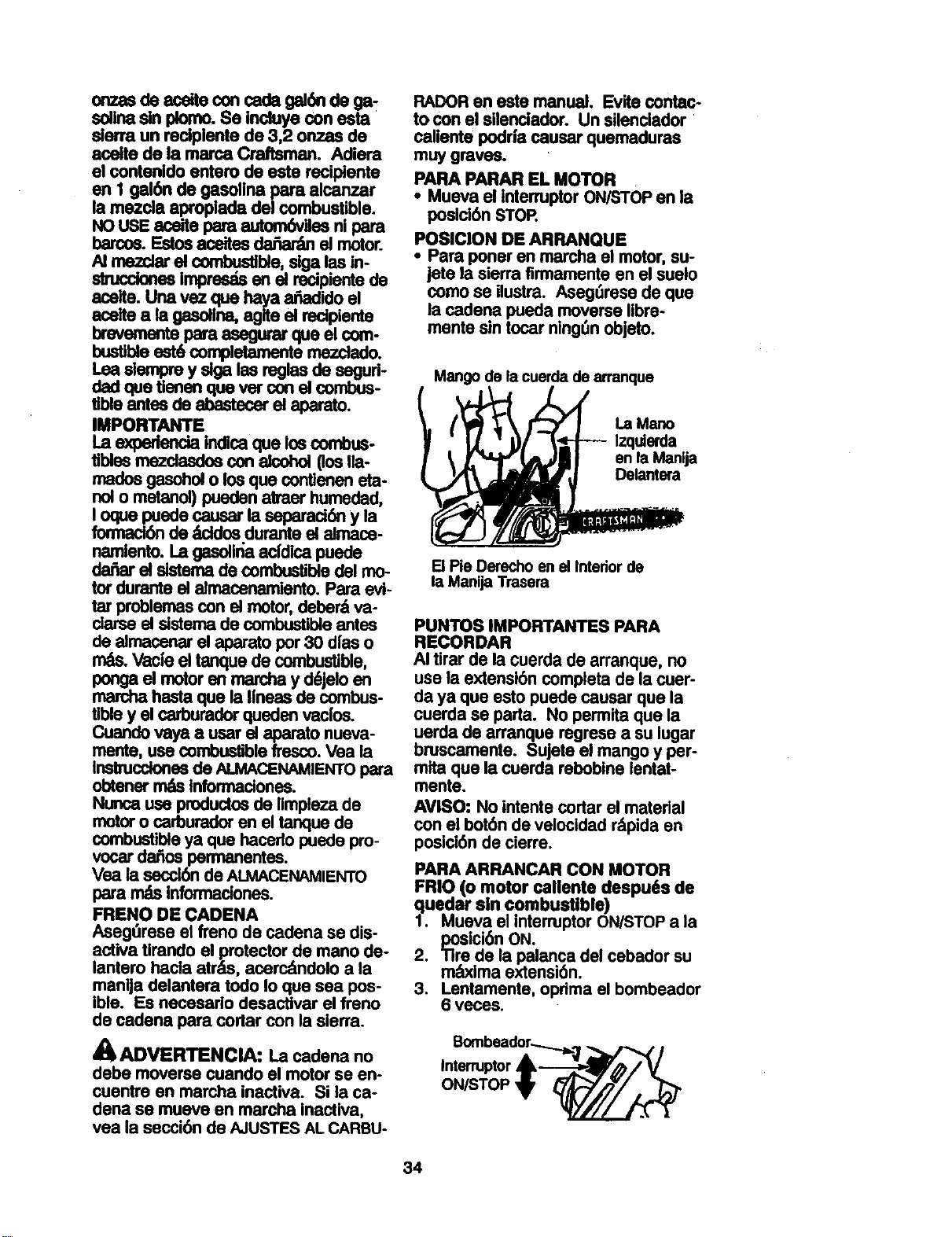
onzasde acsite con cada gel0nde ga-
solinasin plomo. Se induye con esta
sierra un reciplente de 3,2 onzas de
acelte de la marca Craftsman. Adiera
el contenldo entero de este recipiente
an I gal6n de gasollna para alcanzar
la mezcla aproplada del combustible.
NO USEacelte para auton_iles ni para
barcos. Estosaceites dar_ar_nel motor.
AI rnezdar el combustible,siga las in-
struccionosimpresdsen el recipientede
aoslte. Una vez cluehaya a_adido el
acelte a la gasolina,agite el reclpiente
brevemeflte pareaesgurar que el com-
bustibleest6 complelamente mezdado.
Lea siempm y siga las reglasde seguri-
dad que tienen que vet con el combus-
tibleantes de abastecer el aparato.
IMPORTANTE
La expedenciain(_ca que loscombos-
Ubles mezclasdoscon alcohol(losIla-
madosgasoholo los que contleneneta-
nolo melanel) pueden alr'amhumedad,
I oque puede caosar la esparaci6n y la
formac_n de ;_cldesdurante el almace-
namlento. La gasolir;aacidlcapuede
da_ar el slstemade combustible del mo-
tordurante el elmacanamlento. Para evi-
tar problemascon el motor,deberd va-
dame el sistema de combustibleantes
de almacanar el aparato por 30 d|as o
rn_s.Vac|e el tanque de combustible,
ponga el motor en marcha y d6jsio en
marcha hasta que la lineas de combus-
Ubley el carburadorqueden vac|os.
Cuandovaya a usar el aparatonueva-
mente, use combusiiblefresco.Vea la
Instruccionesdo ALMACENAMIENTOpara
obtener rn_sInformaclones.
Nunca use productosde limplezade
motoro carburadoren el tanque de
combustibleya que hacerlo puede pro-
vocar dar_espermanentes.
Vea la secci_ de ALMACENAMIENTO
pararods Informaciones.
FRENO DE CADENA
Aseg0rese el freno de cadena se dis-
acUva tirando el protectorde mano de-
lantero hacla atr_s, acercdndolo a la
manlja delantera todo Io que sea pos-
ible. Es necesado desactivar el freno
de cadena para cortar con la sierra.
ADVERTENCIA: La cadena no
debe moverse cuando el motor se en-
cuentre en marcha inacUva. Si la ca-
dana se mueve an marcha inactiva,
vea la secci6n de AJUSTESALCARBU-
RADORan este manual, Evite contac-
to con el silenciador. Un silenclador
cellante podria cauesr quemaduras
muy graves.
PARA PARAR EL MOTOR
• Mueva el interruptor ON/STOPen la
poslcibn STOR
POSIClON DE ARRANQUE
• Para poner an marcha el motor,su-
jeto la sierra flrmamente en el suelo
como se ilustra. Asegdrese de que
la cadana pueda moverse libre*
mante sin tocar ningdn objeto.
Mango de la cuerda de arranque
/\ LaMa,.
Izqulerda
i enla Manlja
Delantera
B Pie Derecho enel Interior de
la Manija Trasera
PUNTOS IMPORTANTES PARA
RECORDAR
AI tirar de la cuerda de arranque, no
use la extensl6n completa de la cuer-
da ya que esto puede causar que la
cuerda se parta. No permita que la
uerde de arranque regrese a su lugar
bruscamante. Sujete el mango y per-
mita que la cuerde rebobine lentst-
mante.
AVlSO: No intente cortar el material
con el bot6n de velocided r-_pideen
poslci6n de cierre.
PARA ARRANCAR CON MOTOR
FRIO (o motor callente despu6s de
quedar sin combustible)
1. Mueva el interruptorON/STOPa la
posici6n ON.
2. Tire de la palanca del cebador su
mbxima extensi6n.
3. Lentamente, oprima el bombeador
6 veces.
Bombeado[_
ON/STOP t
34
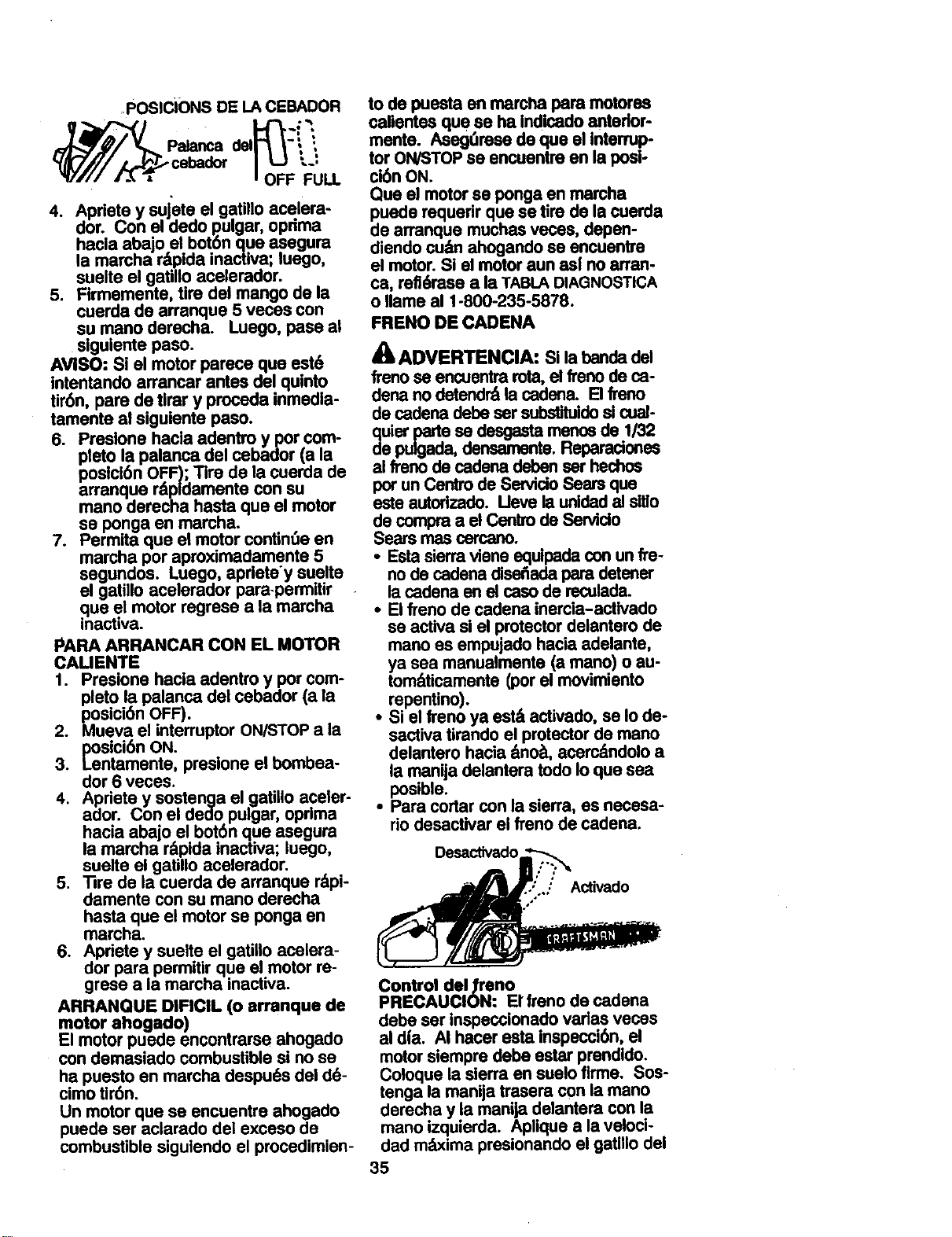
•POSICiONSDELACEBADOR
4. Apriete y suj'eteel gaUllo acelera-
dor. Con el dedo pulgar, opnma
hacla abajo el bot6n que asegura
la marcha r&plda inacUva; luego,
suelte el gatillo acelerador.
5. Flrmemente, tire del mango de la
cuerda de arranque 5 veces con
su mano derecha. Luego, pase al
sigulente paso.
AVISO: Si el motor parece que est6
Intentando arrancar antes del quinto
Ur6n, pare de tirar y proceda inmedla-
tamente al siguiente paso.
6. Preslone hacia adentro ypor com-
pleto la palanca del cebador (ala
postcl6n OFF); Tire de la cuerda de
arranque rdptdamante con su
mane derecha hasta que el motor
se ponga en marcha.
7. Permita que el motor continue en
marcha por aproximadamente 5
segundes. Luego, aprlete'y suelte
el gatillo acelerador para.permitir
iqueel motor regrese ala marcha
nectiva.
PAPA ARRANCAR CON EL MOTOR
CAUENTE
1. Presione hacia adentro y por com-
pleto la palanca del cebador (ala
posici6n OFF).
2. Mueva el interruptor ON/STOP ala
posici6n ON.
3. Lentamente, presione el bombea-
dor 6 veces.
4. Apriete y sostenga el gatillo aceler-
ador. Con el dedo pulgar, oprlma
hacia abajo el bot6n que asegura
la marcha r_pida inactiva; luego,
suelte el gatillo acelerador.
5. "13rede la cuerda de arranque rdpi-
damente con su mano derecha
hasta que el motor se ponga en
marcha.
6. Apdete y suelte el gatillo acelera-
dor para permitir que el motor re-
grese a la marcha inactiva.
ARRANQUE DIFIClL (o arranque de
motor ahogado)
El motor puede encentrarse ahogado
con demasiado combustible si no se
ha puesto en marcha despu_s del d6-
cimo tir6n.
Un motor que se encuentre ahogado
puede ser aclarado del exceso de
combustible sigulendo el procedimien-
to de puesta en marcha pare motores
callentes que se ha Indicadoanteder-
mente. Asegdrese de que el Interrup-
tor ON/STOPse encuentre en la posi-
ci6n ON.
Que el motorse ponga en marcha
puede requerir que se tire de la cuerda
de arranque muchasveces, depen-
diendo cu&nahogando se encuentre
el motor. Si el moter aun as[ no arran-
ca, refi6rase ala TABLADIAGNOSTICA
o Uame al 1-800-235-5878.
FRENO DE CADENA
ADVERTENCIA: Si la banda del
freno se encuentrarote, el frenode ca-
dena nodetendr_la cadena. El fmno
de cadena debeser substituidosicual-
_uier parte se desgastamenos de 1/32
e pulgada,densamente.Reparaciones
al fTenode cadena debenser hechos
por unCentre de ServicioSears que
este autodzado. Ueve la unidadalsltlo
de comprea el Centrode Servicle
Sears mascercano.
• Esta sierra vlene equlpadacon unfie-
node cadena disefiadapare detener
la cadena en el casode reculada.
• El freno de cadena inercia-activado
se active si el protector delantero de
mano es empujado hacia adelante,
ya sea manualmente (a mane) o au-
tomdticamente (por el movimiento
repenUne).
• Si el freno ya est&activado, se Io de-
sactiva tirando el protector de mano
delantero hacia _mo_, acem_ndole a
la manija delantera todo Io que sea
posible.
• Pare cortar con la sierra, es necesa-
rio desactivar el freno de cadena.
Desactivado_"---,_
Control del _reno
PRECAUCION: Et freno de cadena
debe ser inspeccionade varias veces
al d|a. AI hacer esta inspecci6n, el
motor siempre debe ester prendido.
Coloque la sierra en suelo firme. Sos-
tenga la manija trasera con la mano
derecha y la manija delantera con la
mano izquierda. Aplique ala veloci-
dad m_lxima presionando el gatitlo del
35
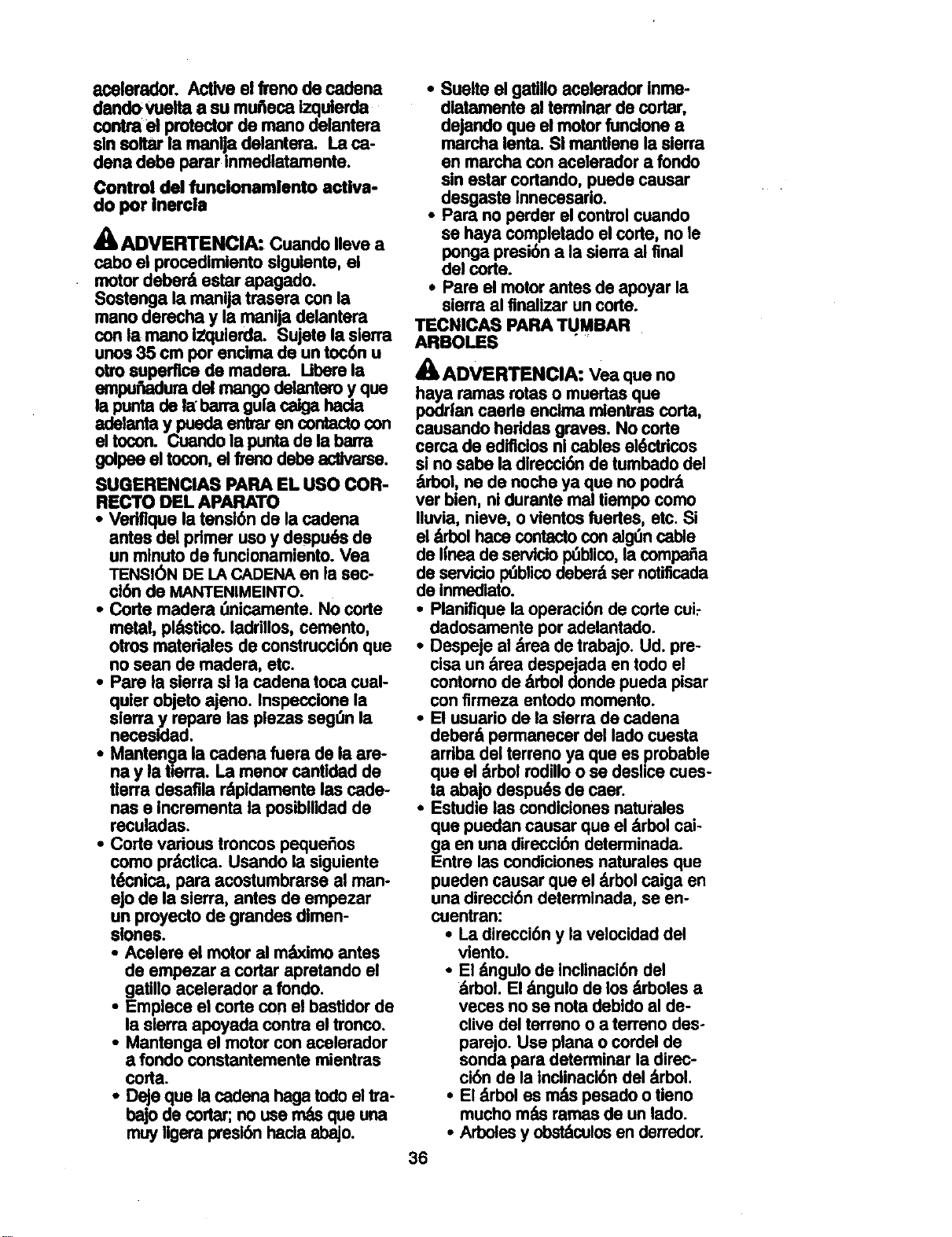
acelerador.Activeelfrenode cadena
dandovuelta a su mufieca izqulerda
contra el protector de mano delantera
sin soltar la manija delantera. La ca-
dena debe parar Inmedlatamente.
Control del funclonamlento acUva-
do por inercla
ADVERTENCIA: Cuando ,eve a
cabo el procedimiento slguiente, el
• motor deber_ estar apagado.
Sostenga la mani|a trasera con la
mano derecha y la manija delantera
con la mano iZquierda. Sujete la sierra
unos 35 cm por encima de untocfn u
otto superflce de madera. Ubere la
empufadura del mango delant_o y que
la punta de la"barragu|a caiga hacla
adelanta y pueda entraren contacto con
el tocon. Cuandola puntade la barra
golpee eltocon, el freno debe acUvarse.
SUGERENClAS PARA EL USO COR-
RECTO DEL APARATO
• Vedfique la tensl6n de la cadena
antes del primer uso y despufs de
un minuto de funcionamiento. Vea
TENSION DELACADENAen la sec-
cifn de MANTENIMEINTO.
• Corte madera (micamente. No corte
metal, pl_lstico,ladrillos, cemento,
otros materiales de construcci6n que
no sean de madera, etc.
• Pare la sierra sl la cadena toca coal-
quiet objeto ajeno. Inspeccione la
sierra y repare las piezas segdn la
necesidad.
• Mantenga la cadena fuera de la are-
na y la tierra. La menor canfidad de
tlerra desafila rdpidamente las cade-
nas e incrementa la posibllidad de
reculadas.
• Code various troncos peque_os
como prdctlca. Usando la siguiente
tfcnica, para acostumbrarse al man-
e|o de la sierra, antes de empezar
un proyecto de grandes dimen-
slones.
• Acelere el motor al n_ximo antes
de empezar a cortar apretando el
gaUlloacelerador a fondo.
• Emplece el corte con el bastidor de
la sierra apoyada contra el tronco.
• Mantenga el motor conacelerador
a fondo constantemente mientras
coda.
• Deje que la cadena haga todoel tra-
baIo de cortar; no use m_s que una
muy Ilgera preslbnhacla abajo.
• Suelte el gatillo acelerador inme-
dlatamente el termlnar de cortar,
dejando que el motorfunclone a
marcha lanta. SI mantlane la sierra
en marcha con acelerador a fondo
sin estar cortando, puede causar
desgeste Innecesario.
• Para no perder el control cuando
se haya completado.el code, no le
ponga preszfn a la szerraal final
del code.
• Pare el motorantes de apoyar la
sierra al finalizar uncode.
"rECNICAS PARA TUMBAR
ARBOLIES
ADVERTENCIA: Vea que no
haya ramas iotas o muertes que
podrian caede enclma rnientras corta,
causando hefldes graves. No code
cerca de ediflcios ni cables el_ctricos
si no sabe la direccifn de tumbado del
_.rbol, ne de noche ya que no podr_,
ver bien, ni durante mal tiempo como
Iluvia, nieve, o vientos fuertes, etc. Si
el _rbol haco contacto con alg_n cable
de I|nea de servicio pdbllco, la compa_a
de servicio pOblico deber& ser notificada
de inmediato.
• Planifique la operacifn de code cui.-
dadosamente por adelantado.
• Despeje al drea de trabajo. Ud. pre-
cisa un _rea despejada en todo el
contorno de &rbol donde pueda pisar
con firmeza entodo momanto.
• El usuario de la sierra de cadena
deber& permanecor del lado cuesta
arriba del terreno ya que es probable
que el _rbol rodillo o se desl,ce cues-
ta abajo despufs de caer.
• Estudie les condiciones naturales
que puedan causar que el 8rbol cai-
ga en una direccifn determinada.
Entre las condiciones naturales que
pueden causar que el _rbol caiga en
una direccifn determlnada, se en-
cuentran:
• La direccifn y la velocidad del
viento.
• El dngulo de incllnacifn del
brbol. El 8ngulo de los 8rboles a
veces no se nota debido al de-
clive del terreno o a terreno des-
parejo. Use plana o cordel de
sonda para determinar la direc-
cifn de la Inclinacifn del _rbol.
• El _.rbol es m_Ls pesado o tieno
mucho m_ts ramas de un lado.
• Arboles y obst_culus en derredor.
36
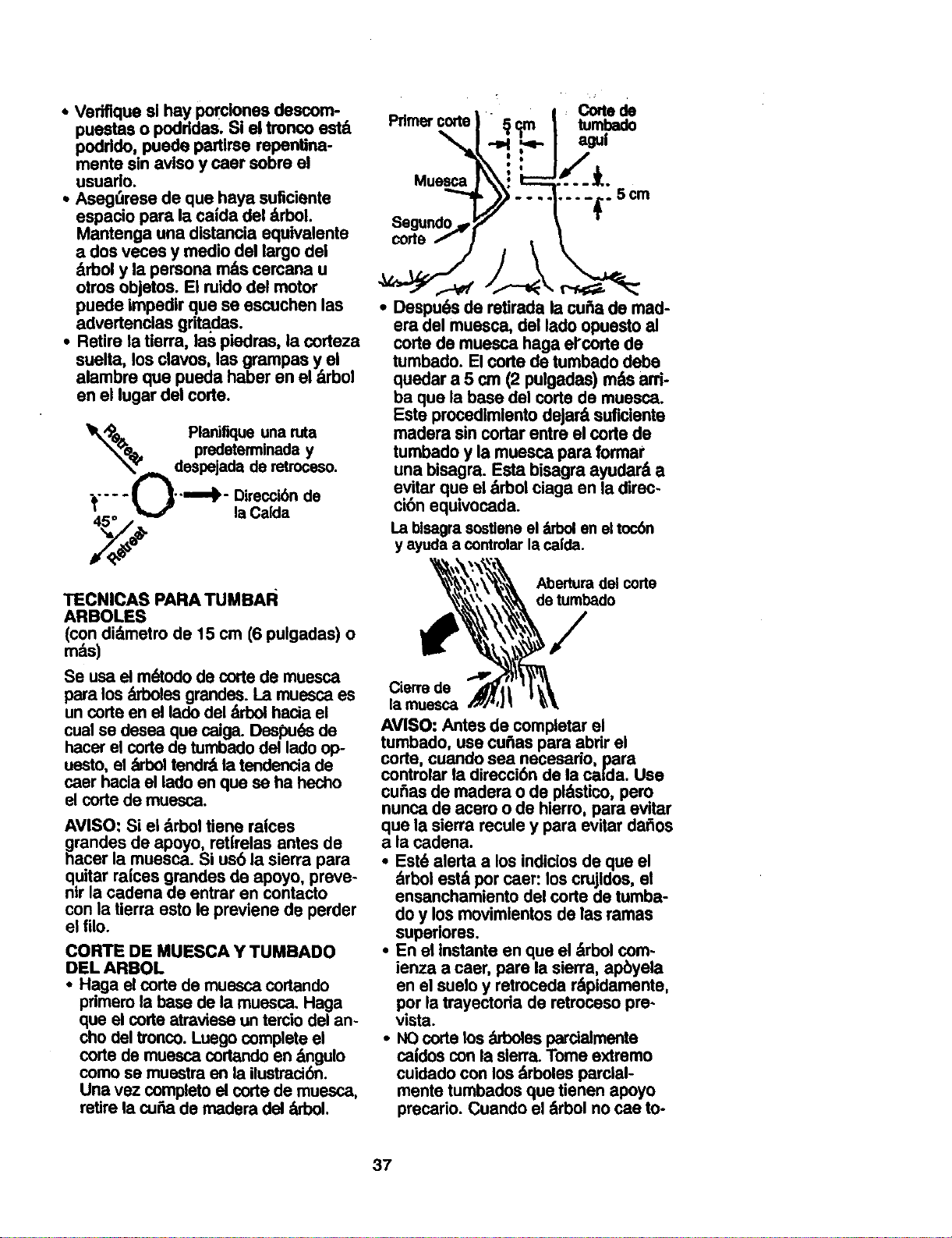
• Vedflquesl hayporcionasdescom-
puastasopodridas.Sieltroncoest_
podddo,puedepartlrserepentina-
mentesin avisoycaarsobreel
usuado.
• Asegt_resedequehayasuficiente
espacioparalacaidadeldrbol.
Mantenga una distancia equivalente
a dos veces y medio del largo del
_rbol y la persona m_s cercana u
otros objelos. El ruidodel motor
puede impedirque se ascuchen las
advertenclas gritadas.
• Retire la Uerra, las piedras, la corteza
suelta, los davos, las grampas y el
alambre que pueda haber en el drbol
en el lugar del code.
_P,_'ge. Planifique una ruta
_,_e_. predeterminada y
\_A despejada de mtroceso.
¥.... ( l-.,m,,Ik - Direcci6n de
_5 o _ la Calda
TECNICAS PARA TUMBAR
ARBOLES
(con di6metro de 15 cm (6 pulgadas) o
m_s)
Se usa el m_todo de corte de muesca
para los _x)les grandes. La muesca es
un code en el lado del drbol hacia el
cual se desea que caiga. Despuds de
hacer el code de tumbado del lado op-
uesto, el _ tend_ la tendencia de
caer hacia el lado en que se ha hecho
el code de muesca.
AVISO: Si el drbol tiene raices
hgrandesde apoyo, retirelas antes de
acer la muesea. Si usb la sierra para
quitar raices grandes de apoyo, preve-
nir la cadena de entrar en contacto
con la tierra esto le previene de perder
el filo.
CORTE DE MUESCA Y TUMBADO
DEL ARBOL
• Haga el code de muesca cortando
pdmem la base de la muesca. Haga
que el code atraviese un tercio del an-
cho del tronco. Luego complete el
code de muesca cortando en dngulo
como se muestra en la ilustracibn.
Una vez completo el corte de muesca,
retire la curia de madera del _Lrbol.
Codede
Primer corte ' tumbado
agui
Muesca i.
_.Scm
code
• Despu6s de retirada lacuba de mad-
era del muesca, del lado opuesto al
corte de muesca haga ercode de
tumbado. El corte de tumbado debe
quedar a 5 cm (2 pulgadas) m_lsarri-
ba que la base del code de muasca.
Este procedlmlento dejar_ suficiente
madera sin cortar entre el corte de
tumbado y la muesca para formar
una bisagra. Esta bisagra ayudar_ a
evitar que el brbol ciaga en la direc-
cibn equivocada.
La blsagrasosUeneel_uboleneltoc6n
y ayudaa contmlarlacalda.
Abertura del corte
de tumbado
Cierre de
la muesca
AVISO: Antes de complelar el
tumbado, use cu_as para abdr el
code, cuando sea necesado, para
controlar la direcci6n de la ca|da. Use
cu_as de madera o de pl_stico pero
nunca de acero o de hierro, para ev tar
que la sierra recule y para evitar dafios
a la cadena.
• Est_ alerta a los indicios de que el
drbol est'. por caer: los crujldos, el
ensanchamiento del code de tumba-
do y los movimientos de las ramas
supedores.
• En el Instante en que el _rbol com-
ienza a caer, pare la sierra, apbyela
en el suelo y retroceda r_pidamente,
por la tmyectoda de retrocaso pre-
vista.
• NO code los brboles parcialmente
ca|dos con la sierra. Tome extremo
cuidado con los =_rboles parelal-
mente tumbados que tienen apoyo
precario. Cuando el _rbol no cae to-
37
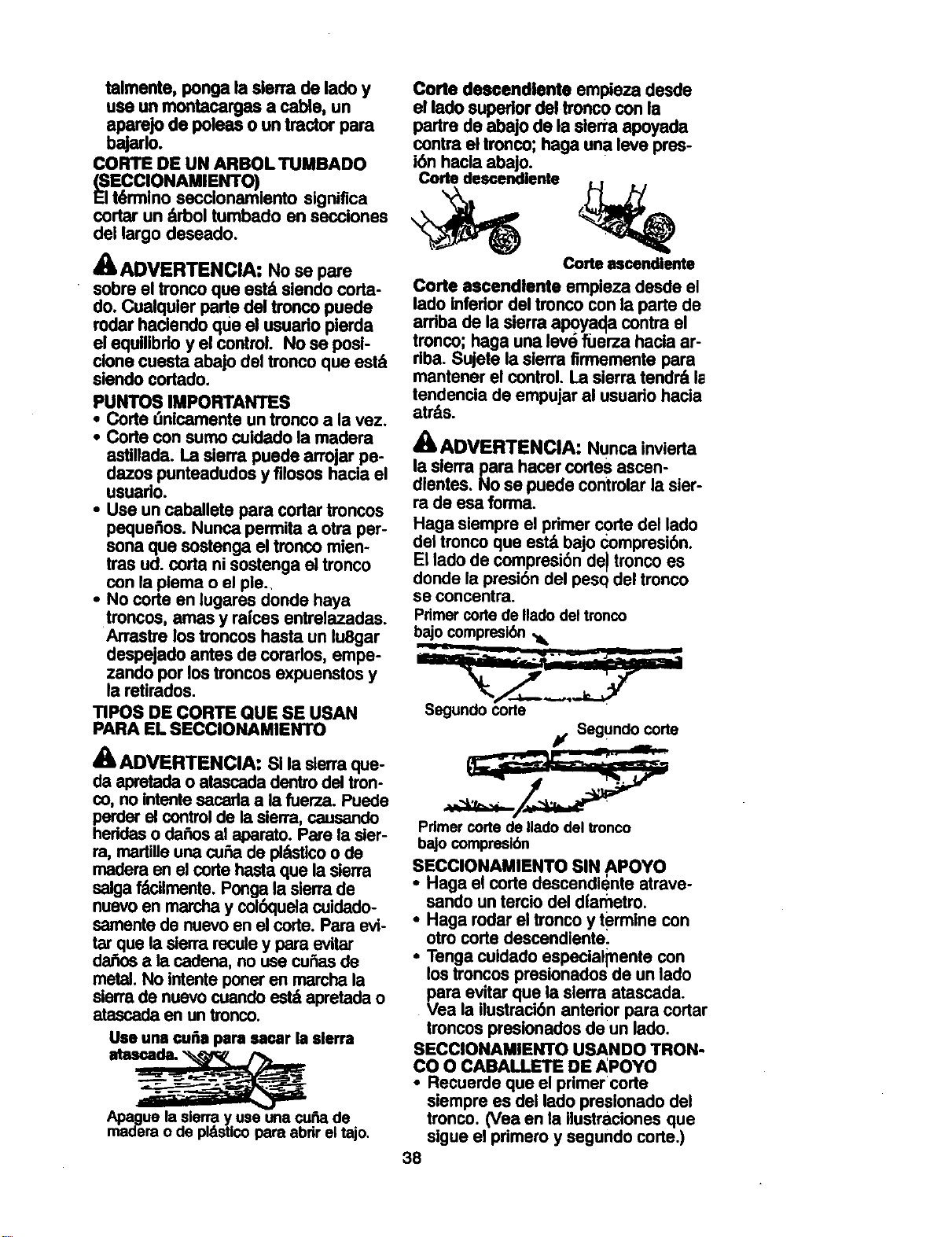
talmente, ponga la sierra de lado y
use unmontacargas a cable, un
aparejo de poleas o untractor para
bajado.
COITIFEDE UN ARBOL TUMBADO
_ECClONAMIENTO)
t6rmlno secclonamiento signiflca
cortar un _,'bol tumbado en secciones
del largo deseado.
AL ADVERTENCIA: No so pare
• sobre el tronco que est_ siendo coda-
do. Cuelquler pade del tronco puede
rodar haclendo que el usuario pierda
el equilibdo y el control. No se posi-
done cuesta abajo del tronco que est',
siendo cortado.
PUNTOS IMPORTANTES
• Corte dnlcamente un tronco a la vez.
• Code con sumo cuidado la madera
astillada. La sierra puede arrojar pe-
dazes punteadudos y filosos hacia el
usuario.
• Use uncaballete para cortar troncos
peque_os. Nunca permita a otra per-
sona que sostenga el tronco mien-
tras ud. corta ni sostenga el tronco
con la plema o el pie..
• No corte en lugares donde haya
tmncos, areas y ra|ces entrelazadas.
Arrastre los troncos hasta un lu8gar
despejado antes de comflos, empe-
zando por lostroncos expuenstos y
la retirados.
TIPOS DE CORTE QUE SE USAN
PARA EL SECCIONAMIENTO
• ILADVERTENCIA: Si la sierraque-
de apretada o atascada dentrodsi tron-
co,no intentesacarla ala fuerza. Puede
perderelcontrolde la sierra,causando
heddaso dafios al aparato. Pare la sier-
ra, marUlleuna cuJ_ade plSsticoo de
madera en el corte hastaque la sierra
salgaf_dlmente. Ponga la sierrade
nuevoen marchay col6quelacuidado-
samentedo nuevo en el code. Para evi-
tar que la sierra reculey para evitar
deJ_osala cadena, no use cutlas de
metal. No intente poner en marchala
sierrade nuevo cuandoest_ apretada o
atascada en untronco.
Use uns curia pare sacar la sierra
Apa_ue la sierra y use una cuba de
maaera o de pldstlco pars abrir el tajo.
Corte descendlente empieza desde
el lado supedor del troncocon la
padre de abajo de la sierra apoyada
contra el tronco; haga una leve pres-
i6n hacla abajo.
Code descendlente
Code ascendiente
Corte ascendlente empieza desde el
lado infedor del tronco con le pade de
arriba de la sierra ap?y.aclacontra el
tmnco; hags una lev_ fuerza hacia ar-
dba. Sujete la sierra firmemente para
mantener el control. La sierra tendrd b
tendencia do empujar al usuado hacia
atr_s.
A
4tSADVERTENCIA: Nunca invierta
la sierra para hacer codes ascen-
dlentes. No se puede controlar la sier-
ra do esa forma.
Haga siempre el primer corte del lado
del tronco que est:_bajo €ompresi6n.
El lado de compresJbnde troncoes
donde la presi6n de pesq de tronco
se concentra.
Pdmer corte de Ilado del tronco
bajo compresi6n ,_
Segundo corte
_lq Segund° corte
Primer corte de ,ado del tronco
bajo compreslbn
SECClONAMIENTO SIN APOYO
• Hags el code descendl_nte atrave-
sando un tercio del dlametro.
•Haga rodar el troncoy t_rmine con
otro corte descendiente.
• Tenga cuidado especlal_nente con
los troncos presionados de un lado
para evitar que la sierra atascada.
Veala ilustraci6n anterior para cortar
troncos presionados de un lado.
SECClONAMIENTO USANDO TRON-
CO O CABALLETE DE APOYO
• Recuerde que el primer corte
siempre es del lado presionado del
tronco. (Vea en la Ilustraciones que
sigue el primero y segundo code.)
38
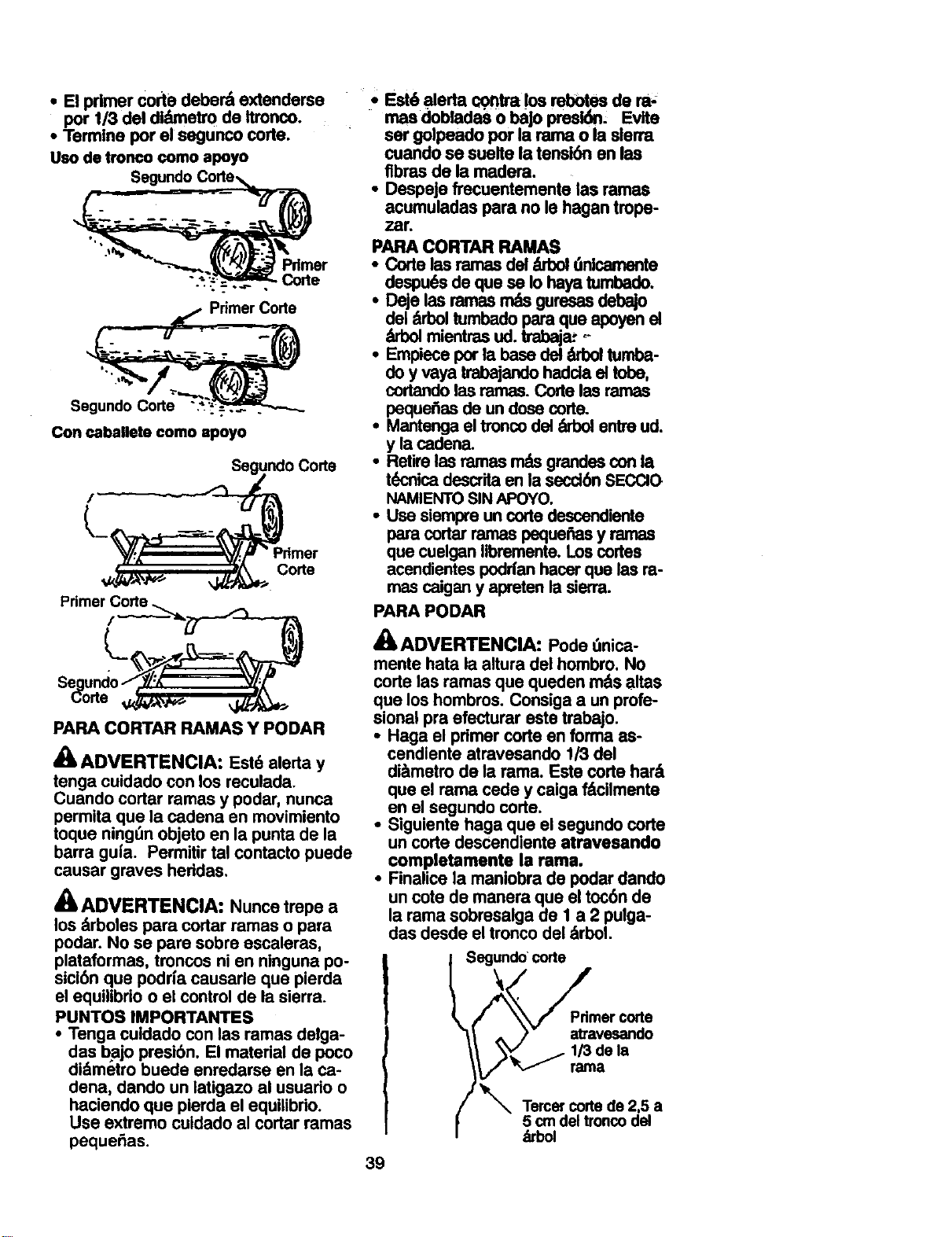
• El primer Code deber_ extenderse
por 1/3 del dl_urnetrode Itronco.
• Termlne por el segunco code.
Usode tronco como apoyo
Primer
- ",_ Corte
Primer Corte
Segundo Corte .. ; :.._ .
Con caballete come apoyo
SegundoCorte
PrimerCorte
PAPA CORTAR RAMAS Y PODAR
ADVERTENCIA: Est6 alerta y
tenga cuidado con los reculada.
Cuando cortar ramas y podar, nunca
permita que la cadena en movimiento
toque ningdn objeto en la punta de la
barra gula. Permitir tal contacto puede
causar graves heridas.
'_ ADVERTENCIA: Nunce trepe a
los &rboles para cortar ramas o para
podar. No se loam sobre escaleras,
plataformas, troncos ni en ninguna po-
stci6n que podda causarle que pierda
el equilibrio o el control de la sierra.
PUNTOS IMPORTANTES
• Tenga culdado con las ramas delga-
das bajo presibn. El material de poco
di_,metro buede enredarse en la ca-
dena, dando un latigazo al usuado o
haciendo que pierda el equilibrio.
Use extremo culdado al cortar ramas
pequefias.
• Est6 alerta €ontra los rebotes de re.-
rues doblada 0 baJopreeldn, Evite
ser golpeado por la rama o la sierra
cuando se suelte la tensk_nen las
flbras de la madera.
• Despeje frecuentemente las ramas
acumuladas para no le hagan trope-
Far.
PARA CORTAR RAMAS
• Code las ramas del _utx)lOnlcamente
despu_s de que se Io haya tumbado.
• Deje las ramasmds guresasdebajo
del _Vooltumbadopara que apoyenel
drbolmientrasud. trabaja_
• Empiece pot la base del _ rumba-
doy vaya trabajandohadclael robe,
cortandolasramas. Corte las ramas
peque_as de un dosecorte.
• Mantenga el troncodel drbolentre ud.
y lacadena.
• Retire las ramas m_tsgrandescon la
t_nica descdta en la secd6n SECCIO
NAMIENTO SIN APOYO.
• Use siempre un corte descendiente
para cortar ramas pequef, as y ramas
que cuelgan libremente. Los codes
acendientes poddan hacer qua las ra-
mas caigan y apreten la sierra.
PARA PODAR
ADVERTENCIA: Pode Onica-
mente hata la altura del hombro. No
code las ramas que queden robs altas
que los hombros. Consiga a un profe-
sional pra efecturar este trabajo.
• Haga el primer corte en forma as-
cendiente atravesando 1/3 del
dibmetm de la rama. Este corte har&
que el rama cede y caiga f&cilmente
en el segundo code.
• Siguiente haga que el segundo corte
un corte descendiente atravesando
completamente la rama.
• Finalice la maniobra de podar dando
uncote de manera que el toc6n de
la rama sobresalga de I a 2 pulga-
das desde el troncodel 4rbol.
Seg_do corte
//__Pdmer comte
ab'avesando
Tercer corte de 2,5 a
o=o
39
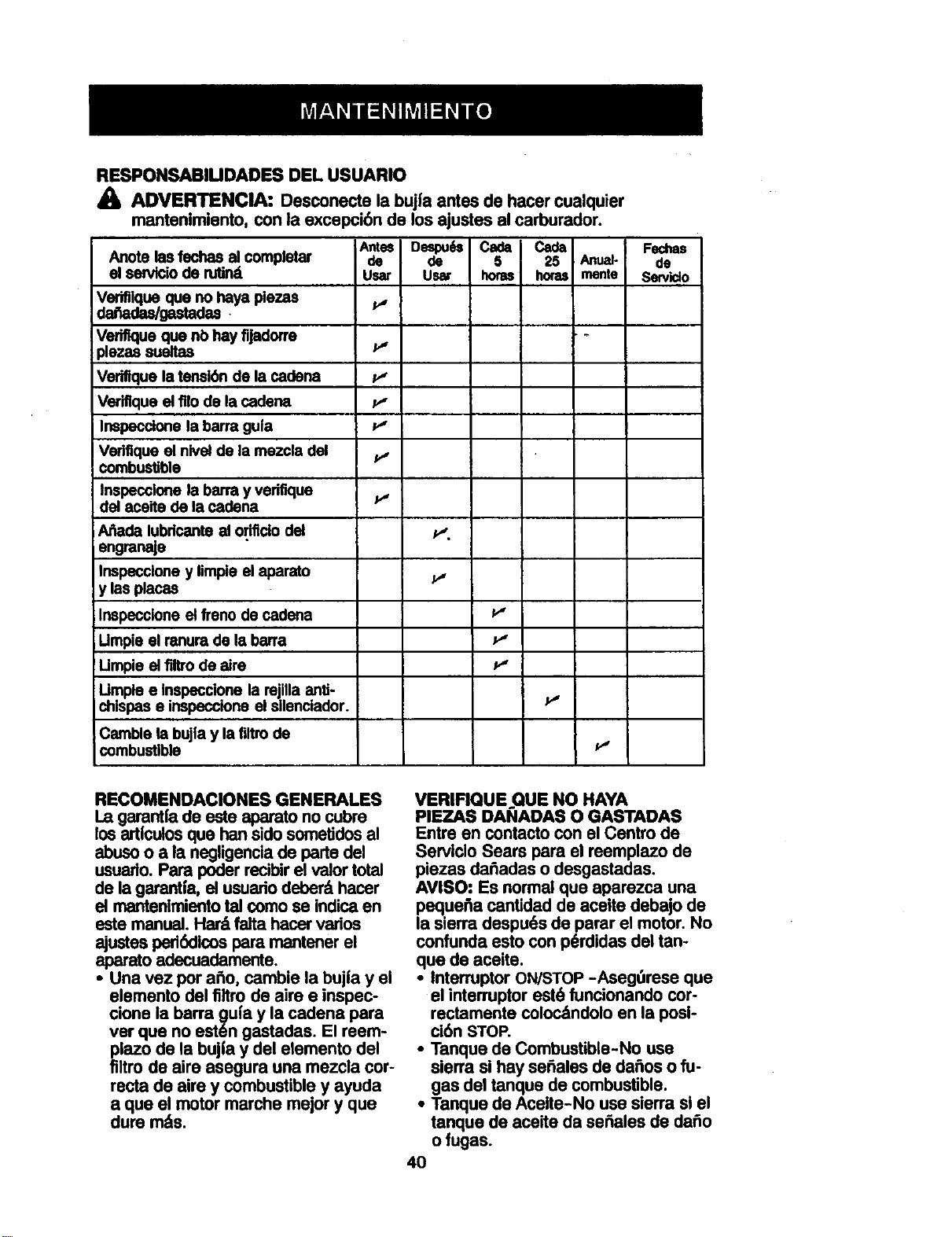
RESPONSABIUDADES DEL USUARIO
_L ADVERTENCIA: Desconecte la bujia antes de hacer cualquier
rnantenirniento, con la excepci6n de los ajustes al carburador.
Antes Despu6s Cada Cada
Anote lasfechas el complstar de de 5 25
el sensIciode rutind Usat Usu horas horas
Verifllque que no haya piezas
der_u_s/gastadas,
Jedflque que nb hay fijadorre
)lezas sueltas
Veriflque la tenel6n de la cadena p,'
Verifique el fllo de la cadena i!
Inspecclone la barra gula jv-
Vedflque el nivel de la mezcla del
combustible
Inspecclone la barra y verifique
del aceite de la cadena
Armadalubricants el o[.iflclodel p-.
engranaje
Inspecclone y limpie el aparato I,s
y las placas
Inspeccione el freno de cadena v'
Umpie el ranura de la barra P"
Limpie el flltro de aim _"
Lirnplee Inspecclone la rejillaanti-
chlspas • inspeccione el silenciador. J_
Camble la bujia y la filtro de
combustible
Fechas
Anual- de
mente Serviclo
p,,
RECOMENDACIONES GENERALES
La garant|a de este aparato no cubre
los artlculos que han sido sometJdos al
abuso o a la negligencia de parts del
usuarlo. Para poder recibir el valor total
de la garent|a, el usuario deber_ hacer
el mantenlmiento tal como se indica en
este manual. Har_ falta hacer varios
ajustes peri6dicos pard mantener el
aparato adecuadamente.
• Una vez por a_o, cambie la bujla y el
elemento del flltro de airs e inspec-
clone la barra guia y la cadena para
ver que no est_n gastadas. El reem-
plazo de la bujla y del elemento del
filtro de aire asegura una mezcla cor-
recta de airs y combustible y ayuda
a que el motor marche mejor y que
dure m_s.
VERIFIQUE QUE NO HAYA
PIEZAS DANADAS O GASTADAS
Entre en contacto con el Centro de
Servlclo Sears para el reemplazo de
piezas dafiadas o desgastadas.
AVISO: Es normal que aparezca una
peque_a cant|dad de aceite debajo de
la sierra despu(_s de parar el motor. No
confunda esto con p6rdidas del tan-
que de ace|re.
• Interruptor ON/STOP -Asegt_rese que
el interruptor est6 funcionando coro
rectamente coloc_ndolo en la posi-
cl6n STOP.
• Taoque de Combustible-No use
sierra si hay se_ales de da_os o fu-
gas del tanque de combustible.
• Tanque de Acelte-No use sierra sl el
tanque de aceite da se_ales de dafio
o fugas.
4O
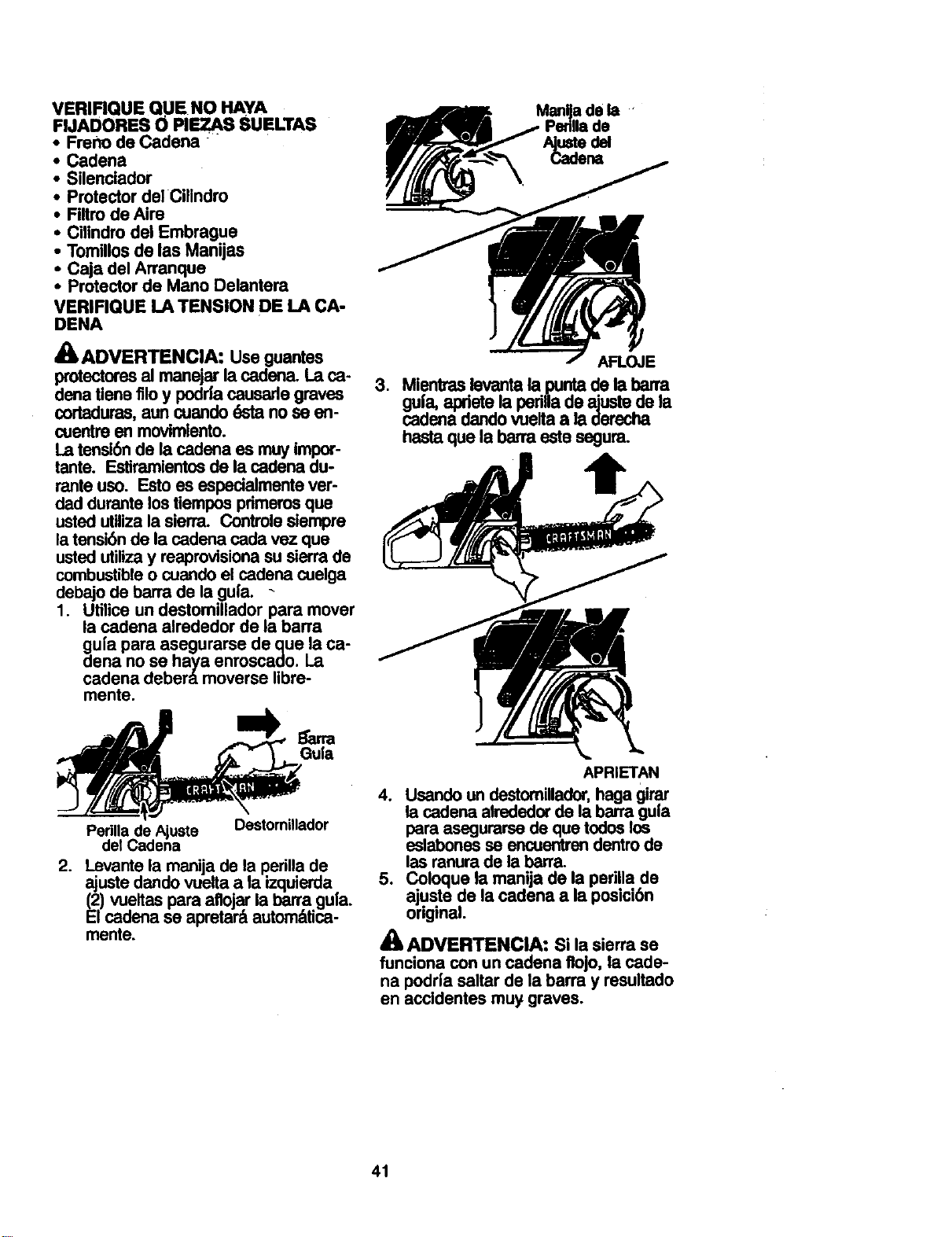
VERIFIQUE QUE NO HAYA
FMADORES 0 PIEZAS SUELTAS
• Freno de Cadena
• Cadena
• Silenciador
• Protector delCilindro
• Filtro de Aim
• Cillndro del Embrague
• Tom,los de las Manijas
• Caja del Arranque
• Protector de Mano Delantera
VERIFIQUE LA TENSION DE LA CA-
DENA
_kADVERTENCIA: Use guantes
protectores al manejar la cadena. La ca-
dena tiene filo y podr|a causade graves
cortaduras, aun oJando _ no se en-
cuentre en movimlento.
La tensl6n de la cadena es muy impor-
tante. Estiramientos de la cadena du-
rante uso. Esto es especialmente ver-
dad durante los tiempos primeros que
usted utiliza la sierra. Controle siempre
la tensi6n de la cadena cada vez que
usted utiliza y reaprovisiona su sierra de
combustible o cuando el cadena cuelga
debajo de barra de la gu|a.
1. Utilice un destomillador para mover
la cadena alrededor de la barra
_u|a para asegurarse de que la ca-
ena no se haya enroscado. La
cadena deber_, moverse libre-
mente.
del Cadena
2. Levante la manija de la perilla de
ajuste dando vuelta a la izquierda
(2) vueltas para aflojar la barra gufa.
El cadena se aprelar_ automdtica-
mente.
3. Mientras levanta la puntade la barra
gula, apdete la perillade ajustede la
cadena dandovuelta a laderecha
hasta que la barra este segura.
APRIETAN
4. Usando un destomillador, haga girar
la cadena atrededor de la barra gula
para asegurarse de que todos los
esiabones se encuentren dentro de
las ranura de la barra.
5. Co loque la manija de la perilla de
aluste de la cadena a la posici6n
original.
ADVERTENCIA: Si la sierra se
funciona con un cadena flojo, la code-
na podria saltar de la barra y resultado
en accidentes muy graves.
41
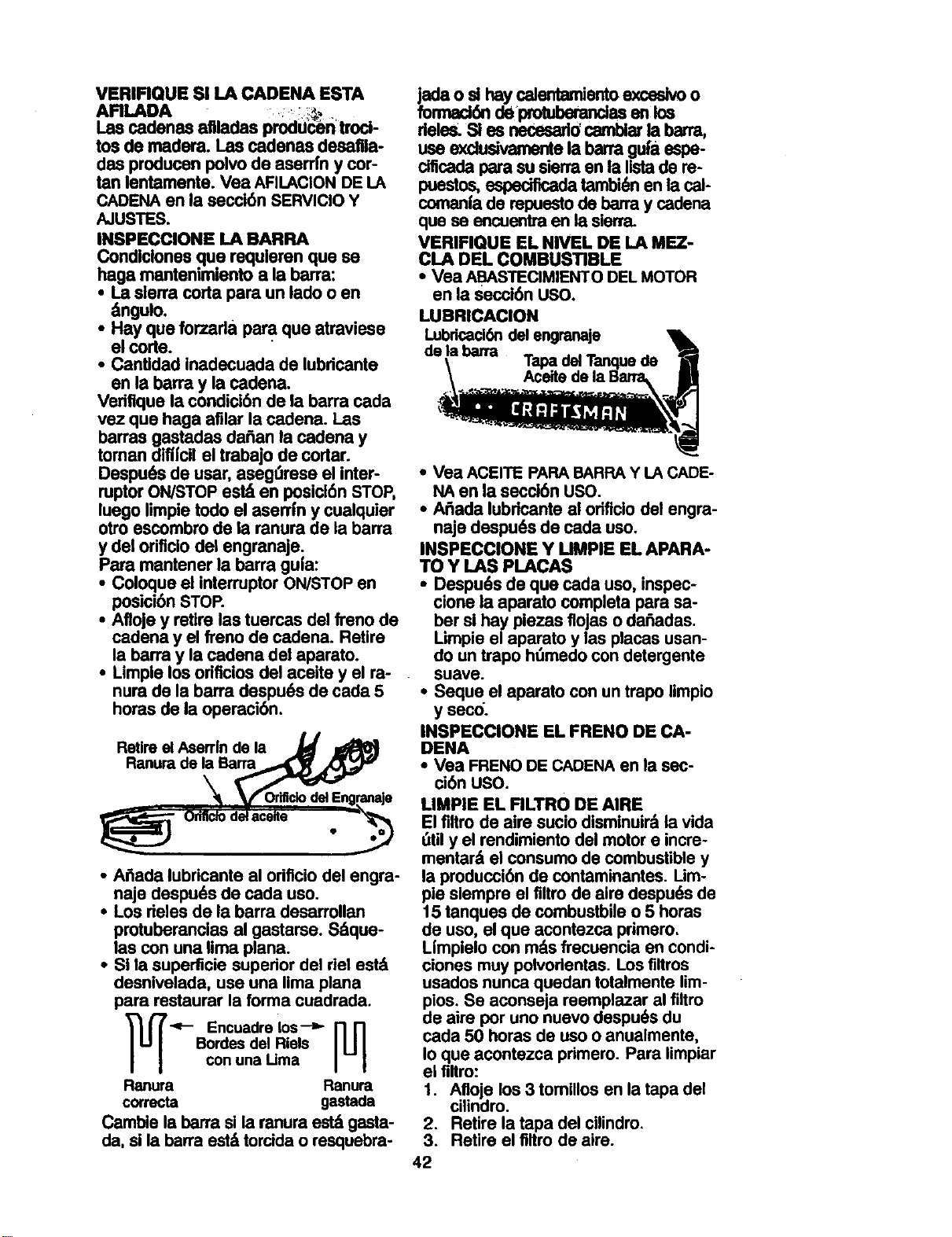
VERIFIQUE$1LACADENAESTA
AFILADA
Lascadenasaflladasproducentroct-
tosdemadera.I.ascadenasdesaflla-
des producen polvo de aserr|n y cor-
tan lentamente. Vea AFILAClONDELA
CADENAen la seccl6n SERVICIOY
AJUSTES.
INSPECCIONE LA BARRA
Condlclones que requlemn qua se
hags mantenimiento a la barrs:
• La sierra coda para un lade o en
_ngulo.
• Hay que forzarla para que atraviese
el code.
• Cantidad inadecuada de lubricant•
en la barra y la cad•ha.
Vedflque Is condioi6n de la barra cada
vez que haga afilar Is cadena. Las
barras gastadas dafian la cad•ha y
toman difl|cil el trabajo de cortar.
Despu6s de usar, aseg(zrese el inter-
ruptorON/STOP est_ en posici6n STOP,
luego limpietodo el aserr|n y cualquier
otro escombro de la ranura de la barra
y del odficlo del engranaje.
Para mantener la barra guia:
• Coloque el interruptor ON/STOP en
posici6n STOR
• Afloje y retire las tuercas del freno de
cadena y el freno de cadena. Retire
la barra y la cadena del aparato.
• Limpie los orificiosdel aceite y el ra-
nura de la barra despu_)sde cada 5
horns de la opemcibn
Retireel Aserrlnde la
Ranurade laBarra
\
• Afisda lubricante al odflcio del engra
na|e despu6s de cada uso
• LOS deles de la barra desarrollan
pmtuberancias al gastarse S_que
las con una lima plans
• Si la supedicie superior del del estd
desnivelada, use una lima plana
pars restaurar la forma cuadrada
"_-- Encuadre los --_ ___
Bordes del Riels
con una Lima
Ranura Ranura
correcta gastada
Camble la barra si la ranura est_ gasta
da sl la barra est& torcida o resquebra-
jada o si haycalentamientoexceslvoo
formad6ndeprotuberandasenlos
deles Si os necesadOcamblarlabarra,
use exdusivam_e la barra gufa espe
cificadapars su sierraen la listsde re-
puestos,espedflcada tambi6nen la cal-
coman|ade repuestode barra y cadena
que se encuentm en la sierra.
VERIFIQUE EL NIVEL DE LA MEZ-
CLA DEL COMBUSTIBLE
• Vea ABASTECIMIENTO DEL MOTOR
en la secci6n USO.
LUBRICACION
Lubdcacl6ndel engranaje
de_ barfs TapadelTanquede
\ . Aceitedela Barra_ J
• Vea ACEITE PARA BARRA Y LA CADE-
NA en la seccl6n USO.
• Afiada lubdcante al orificio del engra-
naje despu6s de cada uso.
INSPECClONE Y MMPIE EL APARA-
TO Y LAS PLACAS
• Despu6s de que cads uso, inspec-
clone la aparato completa pars sa-
ber si hay piezas flojas o dafiadas.
Limpie el aparato y las piacas usan-
do un trapo humsdo con detergent•
suave.
• Seque el aparato con un trapo limpio
y sec(_.
INSPECClONE EL FRENO DE CA-
DENA
• Vea FRENO DE CADENA en la sec-
ci0n USO.
LIMPIE EL RLTRO DE AIRE
El filtro de aire sucio disminuir_ la vida
_til y el rendimiento del motor e incre-
mentar& el consumo de combustible y
la producci6n de contaminantes Lim
pie slempre el filtro de sire despuds de
15 tanques de combustbile o 5 horas
de uso, el que acontezca primsro
LImpielo con mds frecuencia en condi-
clones muy polvodentas Los filtros
usados nunca quedan totalmente lim
pios Se aconseja reemplazar al filtro
de aire por uno nuevo despu_s du
cada 50 horas de uso o anualmente,
Io que acontezca pdmero Para limpiar
el filtro:
1 Afloje los 3 tomillos en la tapa del
cilindro
2 Retire la tapa del cllindm
3 Retire el filtro de air•
42
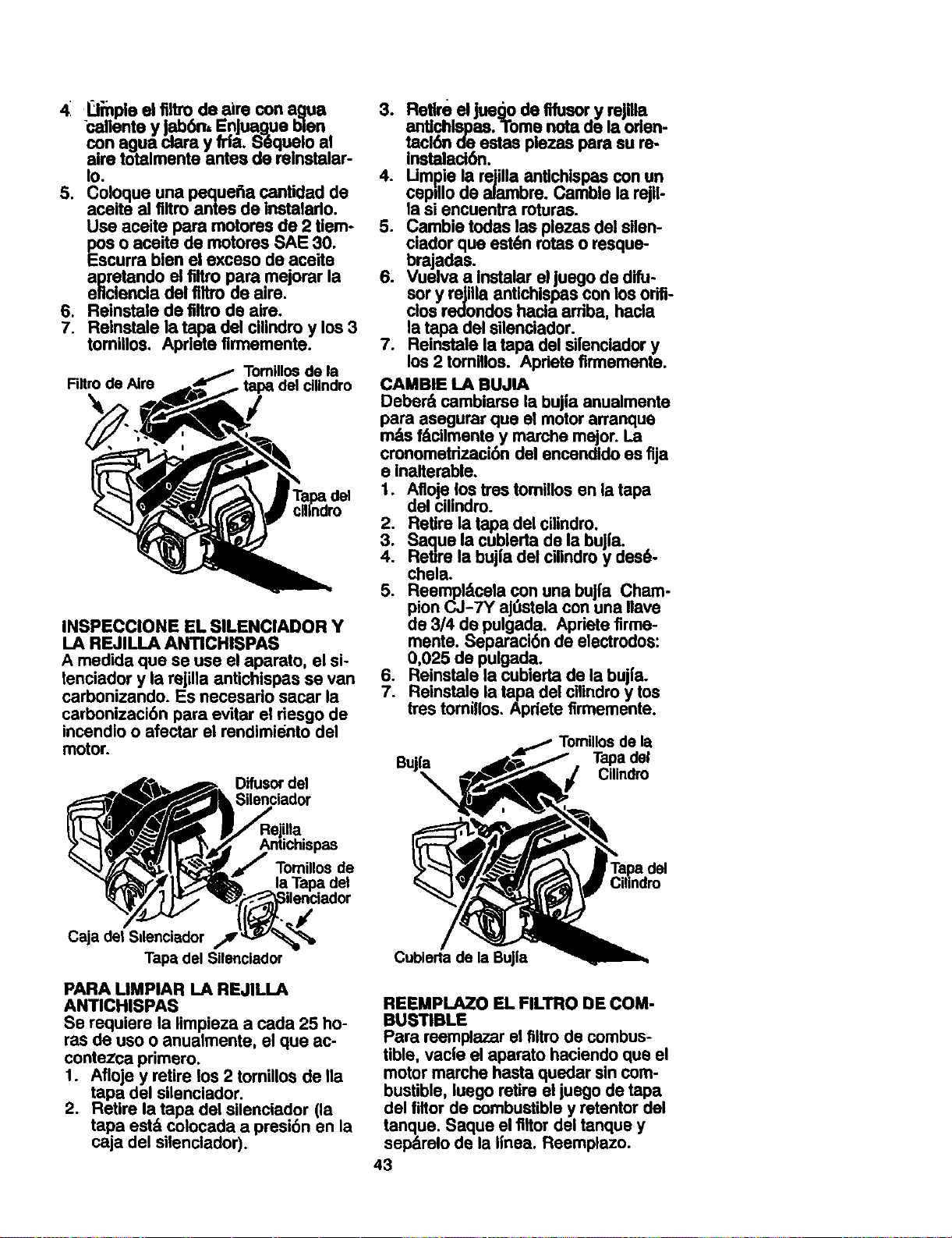
41 I_i_npieel filtro de alre con agua
caltenta y Jab0n, EnJuag.ueblen
con agua clara y 1ha. _equelo al
elm totelmente antes ae relnstelar-
to.
5. Coloque una peque6a cant!dad de
aceite al finn) antes de Instalado.
Use aceite pare motores de 2 tiem-
pos o aceite de motores 8AE 30.
Escurra bien el exceso de aceite
apretando elfiltn) para mejorar la
eficiencla del flltrode airs.
6. Reinstale de flltn) de airs.
7. Reinstale la tape del cilindro y los 3
tomillos. Aprlete flrmemente.
Tom,los de la
Filtrode Aim del cillndro
INSPECCIONE EL SILENCIADOR Y
LA REJILLA ANTICHISPAS
A medida que se use el aparato, el si-
tenciador y la rejilla antichispas se van
carbonizando. Es necesado sacar la
carbonizaci6n para evitar el desgo de
incendio o afectar el rendimiento del
motor.
Difusordel
Silenciador
3. Retire eljue0o de Iffusory rejilla
anUchLspas.Tome nota de la oden-
tecidn de estas plezas pare su ra-
instelact0n.
4. Ump.iela rejilla anUchlspascon un
ceplllo de alambre. Camble la rejll-
la si encuentra roturas.
5. Cambie todas las plezas del sllen-
ciador que esten rotes o resque-
brajadas.
6. Vuelva a Instelar eljuego de dlfu-
sor yrejilla antlchispascon losoriti-
clos redondos hacia amba, hacla
la tapa del silenciador.
7. Reinstala la tapa del silenciador y
los2 tom,los. Apriete tirmemente.
CAMBIE LA BUJIA
Deber_ cambiarse la bujia anualmente
para asegurar que el motorarranque
m6s f6cilmente y marche mejor. La
cronometdzaci6n del encendidoes fija
e Inalterable.
1. Afloje los tres tomillos en la tapa
de! cilindro.
2. Retire la tapa del cilindro.
3. 8aque la cublerte de la bujla.
4. Retire la bujla del cilindroy desk-
chela.
5. Reem_o!6cela_n una bujfa Cham-
pion CJ-7Y ajustela con una ,ave
de 3/4 de pulgada. Aprietetirme-
mente. Separacibn de electrodos:
0,025 de pulgada.
6. Reinstale la cubierta de la bujia.
7. Reinstele la tape del cilindroy tos
tres tomillos. Apdete firmemente.
°°\
Tomillos de la
Tapa de!
CIIIndro
Tomillos de
laTape del
Caja del S=lenciador
Tape del Silenclador
PARA UMPIAR LA REJILLA
ANTICHISPAS
Se requiere la limpieza a cada 25 ho-
ras de uso o anualmente, el que ac-
contezca primero.
1. Afloje y retire los 2 torn,los de Ila
tapa del silenciador.
2. Retire la tapa de! silenciador (la
tapa est& colocada a presibn en la
caja del silenclador).
Cublerta de la Bujia
REEMPLAZO EL FILTRO DE COM-
BUSTIBLE
Pare reemplazar el filtro de combus-
tible, vacle el aparato haciendo qus el
motor marche hasta quedar sin com-
bustible, luego retire e! juego de tepa
del filtor de combustible y retentor del
tanque. Saque el tiltor del tanque y
sep6relo de la linea. Reemplazo.
43
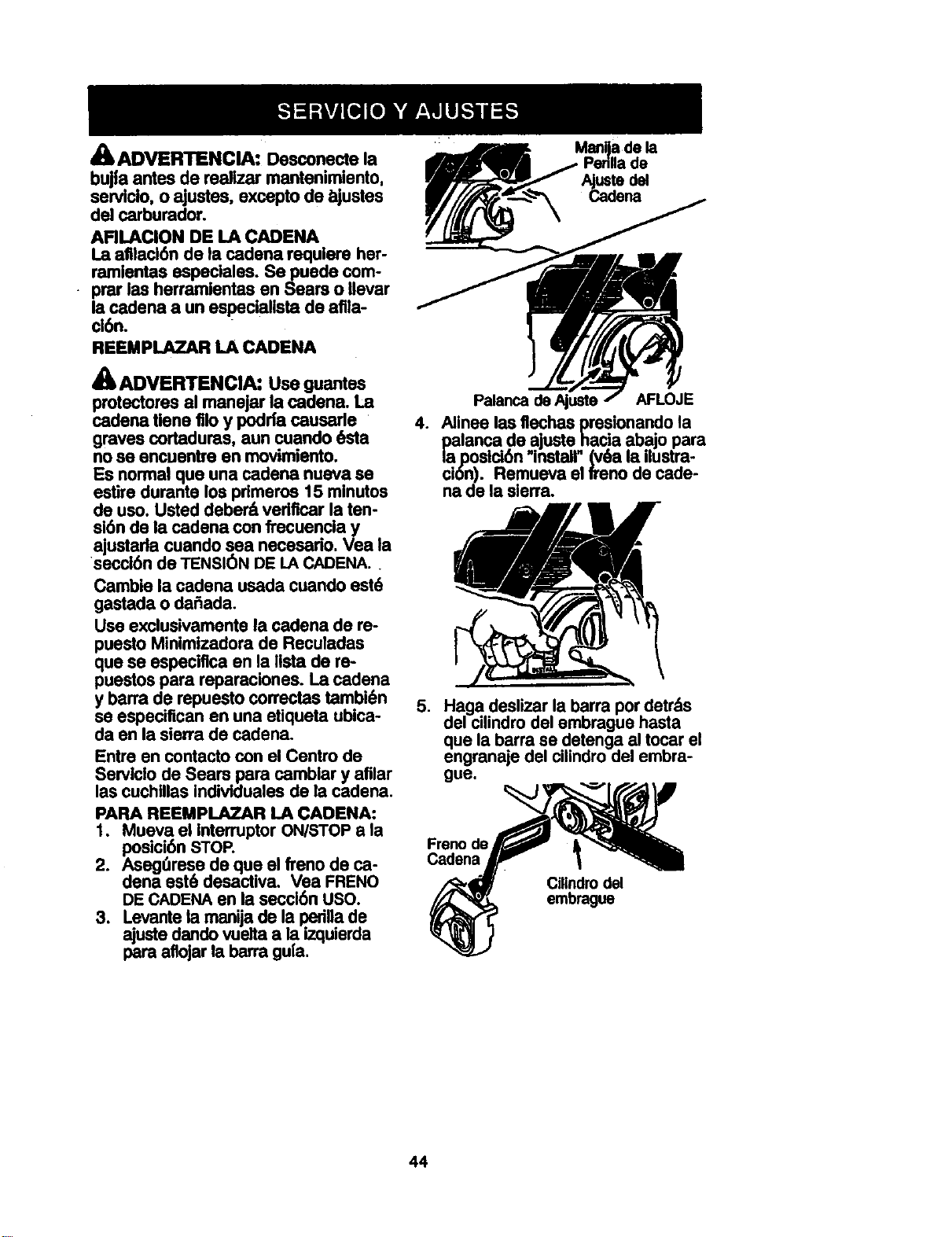
ADVERTENCIA: Desconecte la
buj|a antes de reallzar mantenirniento,
servicio, o ajustes, excepto de _justes
del carburador.
AFILACION DE LA CADENA
La afilacl0n de la cadena requiem her-
ramientas especlales. Se puede com-
prar las herramientas en Sears o Ilevar
la cadena a un especialista de afila-
ci6n.
REEMPLAZAR LA CADENA
ALADVERTENCIA: Use guantes
protectores al manejar la cadena. La
cadena tlene filo y podda causarle
graves cortaduras, aun cuando 6sta
nose encuentre en movimiento.
Es normal que una cadena nueva se
estire durante los pdmeros 15 minutos
de uso. Usted deber_ vedficar la ten-
si0n de la cadena con frecuencia y
ajustada cuando sea necesario. Vea la
secci0n de TENSION DE LACADENA.
Cambie la cadena usada cuando est6
gastada o dafiada.
Use exclusivamente la cadena de re-
puesto Minimizadora de Reculadas
que se especiflca en la llsta de re-
puestos para reparaciones. La cadena
y barra de repuesto correctas tambi_n
se especifican en una etiqueta ubica-
da en la sierra de cadena.
Entre en contacto con el Centro de
Servlclo de Sears para camblar y afilar
las cuchillas indivIduales de la cadena.
PARA REEMPLAZAR LA CAOENA:
1, Mueva el Interruptor ON/STOP a la
posici6n STOR
2. Asegt_rese de que el freno de ca-
dena est6 desactiva, Vea FRENO
DE CADENA en la secci6n USO.
3. Levante la manija de la perilla de
ajuste dando vuelta a _ izquierda
pard aflojar la barra gula,
de
PalancadeAjuste AFLOJE
4. Alinee las flechas presionandola
palanca de ajuste hacia abajo para
la poslci6n "install"(v6a la ilustra-
cibn). Remueva el freno de cade-
na de la sierra.
5. Haga deslizar la barra por detrds
del cilindrodel embrague hasta
que la barra se detenga al tocar el
engranaje del cilindrodel embra-
gue.
Freno
Cilindro del
embrague
44
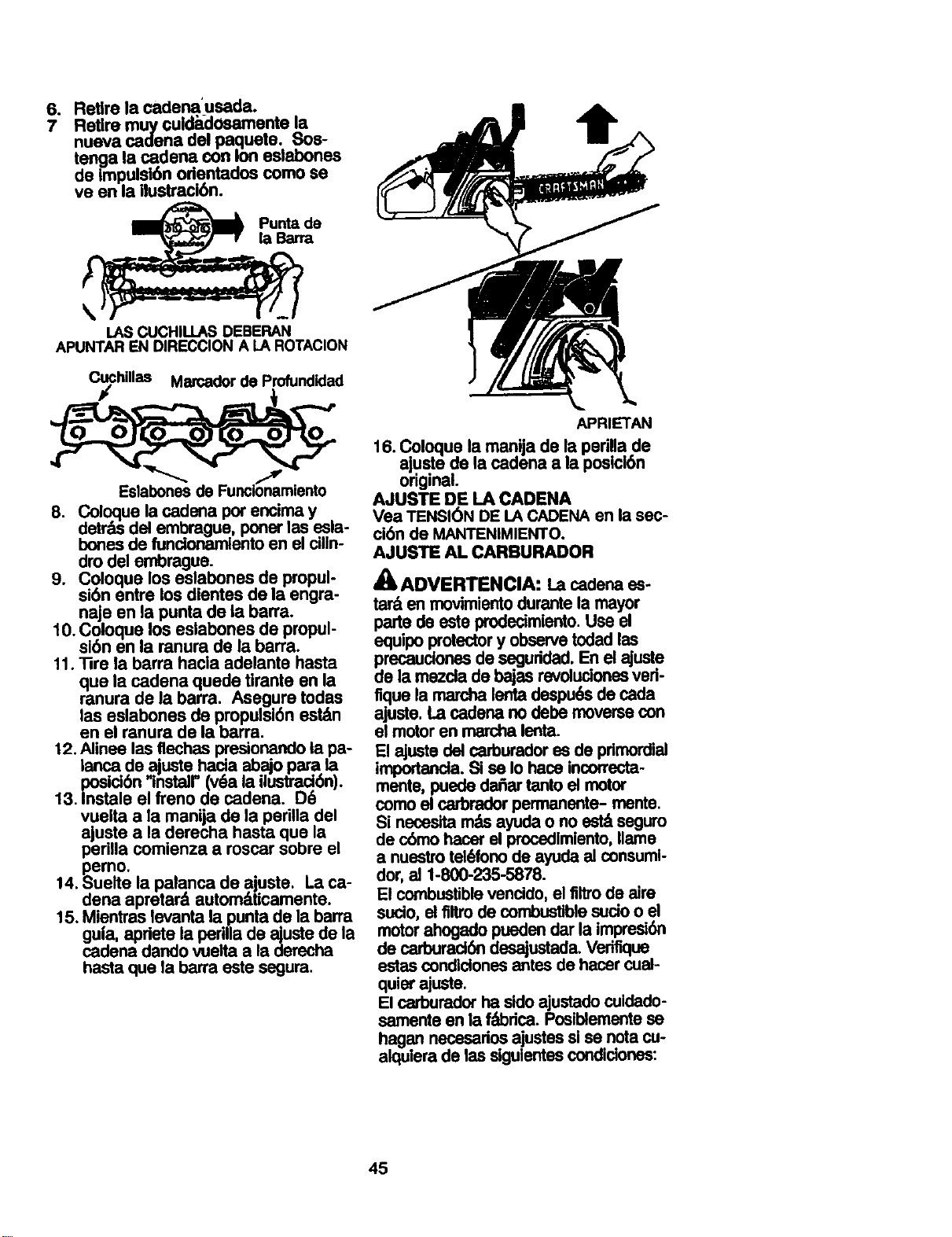
6. Retire la cadena'usada.
7 Retire muYcuidaclosamente la
nueva cadena del paqueto. Sos-
tenga la cadena con Ion eslabones
de Impulsl6n odentados como se
ve en la Ilustraci6n.
LAS CUCHILLAS DEBERAN
APUNTAR EN DIRECCION A LA ROTACION
Cuchillas Marcador de Profundidad
8. Coloque lacadena porencirnay
detrbs del embrague, ponerlas esla-
bonesde funcionamlentoen el cilln-
drodel embrague.
9. Coloque los eslabones de propul-
si6n entre los dientes de la engra-
naje en la punta de la barra.
10. Coloque los eslabones de propul-
si6n en la ranura de la barra.
11. "13rela barra hacia adelante hasta
que la cadena quede tirante en la
ranura de la barra. Asegure todas
las eslabones de pmpulsl6n estdn
en el ranura de la barra.
12. Alinee las fleches presionandola pa-
lanca de ajuste hacia abajopara la
pesicibn"instalr (v6a la ilustraci6n).
13. Instals el fi'eno de cadena. D6
vuelta a la manija de la perilla del
ajuste a la derecha hasta que la
perilla comienza a roscar sobre el
pemo.
14. Suelte la palanca de ajuste. La ca-
dena apretad, autom_ticamente.
15. Mientres levanta la puntade la barra
guia, apdete la perillade ajuste de la
cadena dando vuelta a laderecha
hasta que la barra este segura.
APRIL=TAN
16. Coloque la manija de la perilla de
ajuste de la cadena a la posicl6n
original.
AJUSTE DE I.A CADENA
Vea TENSION DE LACADENAen lasec-
cibn de MANTENIMIENTO.
AJUSTIE AL CARBURADOR
ADVERTENCIA: La cadena es-
tar_ en movimiento durante la mayor
parte de este prodecimiento. Use el
equipo protector y observe todad las
precaudones de seguridad. En el ajuste
de la mezda de bajas revoluciones vsri-
fique la marcha lenta despu_s de cada
ajuste. La cadena no debe moverse con
el motor en rnard'_ lenta.
El ajuste del carburador es de primordial
importanda. Si se Io hace incorrecta-
mente, puede dar3artanto el motor
como el carbrador permanente- mente.
Si necesita m_s ayuda o no est_ seguro
de c6mo hacer el procedimiento, Ilame
a nuestro tel6fono de ayuda al consumi-
dor, el 1-800-235-5878.
El combustible vencido, el flltro de aim
sucio, el filtro de combustible sucio o el
motor ahogado pueden dar la impresi6n
de carburad6n desajustada. Verifique
estas condldones antes de hacer cual-
quiet"ajuste.
El carburador ha sido ajustado cuidads-
sarnente en la f"abdca. Posiblemente se
hagan necesados ajustes si se nota cu-
alqulera de las siguientes condiciones:
45
• La codena se mueve con el motor
en marcha lenta. Vea MARCHALEN-
TA"T" bajo prodeclmlento de ajuste.
• La sierra no anda a amrcha lenta.
Vea MARCHALENTA'T" y MEZCLADE
BAJASREVOLUClONES"L'.
• El motor ee pars o se ahoga cuando
debe acelerar. Vea MEZCLADE ALo
TAS REVOLUCIONES"l-r bajo el pro-
cedlmiento de ajuste.
• Baja de potencla Ue code. Vea MEZ-
CLADE ALTASREVOLUCIONES"H"
bajo el procedimiento de ajuste.
Hay tres tomiHos de ajuste en el car-
burador. Est_rmmarcados con "14","L"y
"1". Est_mubucados ardba del bomb-
eador.
PROCEDIMIENTO DE AJUSTE
PRECAUClON: AI hacer ajustes no
fueme las tapas limitadores de pt_stlco
rn_s all&de los retenedores o puede
haber dafios.
Procedimlento Inlclal
1. Gire el t.omlilosde mezcla (=L"y:'H")
a la izqumrda(en contrade sentido
del reloj) hastaque se pare.
2. Glre el tornillo de marcha lenta ("T'_
a la derecha (en el sentldode.Ireloj)
hasta que se detenga. Seguioa-
mente, girelo hacia la izqulerda4
vueltas y media.
3. Ponga el motoren marcha y d6jelo
en marcha por3 minutos. Luego,
proceda a ajustarlostomillosde
acu rdoalas instrucciones indicas
en la sigulentesecci6n. Si el funclo-
namientodel motores aceptable
con las posidones antedores,no
har_ falta hacer m_rzsajustes. SI el
motorno ananca, vea la TABLA
DIAGN(_STICA. Si a0n es incapaz
remediar la situacibn,Ilamada
1-8001235-5878.
Maroha Lenta "T"
Deje que el motortrabaje an marcha
lenta. Si la cadena se mueve, la mar-
cha lenta es demaslado. Si el motor
se para, la marcha lenta es demasiado
lenta. Ajuste las revoluciones hasta
que el motor se mantenga an marcha
sin que la cadena se mueva (la mar-
cha lenta es demasiado) o que el mo-
tor se ahogue (la marcha lenta es de-
maslado lenta).
• Gire el tomillo de la marcha lenta _T"
a la derecha (en el sentldo del reloj)
para aumentar las revoluciones del
motor.
• Gire el tomlllo de la marcha lenta "T"
a la Izqulerda (en contradel sentido
del reloj) para bajar las revoluctones.
Mezda 10amBaJu Revoluclmzu =L"
Deje el motoren marchalenta. Luego
acelere el motory sienteel funciona-
miento.Si el motor trata de parar, no
acelera blen o larba humoal acelerar,
gire el tomillode la mezcla parabajas
revolucionies"L" a la derecha (en el
sentidodel reloDen incrementosde
1/16 de vuelta hastaobtenerunfuncio-
namlentosatisfactodo.Repita este pro-
cedimientolas vecesqua sea necesario
para obteflerun rendim|entosaUsfacto-
rio. Despu6sde completarestos
ajustes,vedflquela aceleraci6ny el mo-
vimlentode la cadenaen marchalenta.
Ajustenuevamentesies necesado.
Mazda para Altas Revoluelones "H"
NO HAGAfuncionar el motorcon el
acelerador a fondo pormucho tiempo
al hacer los ajustes ya que puede
dafiar el motor. Haga uncode de prue-
ba. Basado en el funcionamientode la
sierra durante el code, ajuste el tomillo
para la mezcla de altas revoluciones
por incrementos de s61o1/16 de vuel-
ta, como se detalla a continuaci6n:
• Gire el tornillo de la mezcla para al-
tas revoluciones"H" a la derecha (en
el sentido del reloj) hasta que la sier-
ra tenga buena potencla al cortar sin
hesitaciones. No haga los ajustes
por el sonido ni porlas revoluciones,
sino pot el buen funcionamiento al
cortar.
• GIre el tornillode la mezcla para al-
tas revoluclones "H"a la izquierda
(en contra del sentido del reloj) sila
sierra tiene revolucionesaltas pero
se para o le felta potencia al cortar.
Despu6s de completar losajustes,
veriflque la aceleracibn y el movimien-
to de la cadena en marcha lenta.
Ajuste nuevamente si es necesario.
Veriflcaci6n de la Aceleracl6n
Si el motorse para o hesitaen vez de
acelerar, gireel tomillode la mezcla
parabajas revoluciones"L"para bajas
revolucionesa la izquierda (en contra
delsentidodel reloj)conseguir unaacel-
eraci6nparejasin movimientode la ca-
dena en marchalenta.
46
• kADVERTIENCIA: Re=dicelos sl-
guientes pasos despu6s de cada uso:
• Deje que el motor se enfrie y flje
bien el aparato antes de guardado o
de transportarlo.
• Guarde la sierra y el combustible en
unlocal blen ventUado donde los va-
pores de combustible no puedan en-
trar en contacto con shlspas nl lla-
mas ablertas provenlentes de los
termotanques, los motores o inter-
ruptores el_ctdcos, celefactores con-
trales, etc.
• Guarde el aparato con todos los pro-
tectores en su lugar y coloque el
ap==r==tode modoque las plezas filo-
s==sno puedan causar heridas por
accidente.
• Guarde el aparato bien fuera del al-
cance de los ni_os.
ESTAClONAL ALMACENAJE
Prepare el aparato p==raguardarlo al
final de la tempor==dao si no se Io v==a
usar por rods de 30 dlas o m_s.
Siva a guardar el ap==ratodurante un
periodo largo:
• Limple I==sierra a concienci==antes
del ==lmacenaje.
• Almac6ne en un lugar Umpioy seco.
• Aplique una peque_a cantidad de
aceite alas superficies extemas
met_licas y a la barra gu|a.
• Lubrique la c==denay envu61vala en
papel grueso otela.
SISTEMA DE COMBUSTIBLE
Vea el mensaje marcado IMPOR-
TANTE, que se reflere al uso de com-
bustibles con mezcla de alcohol en su
aparato, en la secci6n de USO, bajo
ABASTECIMIENTODEL MOTOR. Los es-
tabiUzadoresde combustible son una
altemativa aceptabte para minimizar la
formaci6n de delX_ltos de gom==du-
rante el almacenamiento. A_ada esta-
bilizadora la gasollna en el tanque de
combustible o en el reclpiente de al-
macenado de combustible. Siga las
instruccionesde mezcla que se en-
cuentran en los envases de estabillza-
dor. Ponga el motor en march==y d_je-
Io en marcha unos 5 mlnutos despu6s
de ponede estabilizador.
El acelte Craftsmen 40:1 para motores
de 2 tiempos (enfdados a elre) viene
mezclado con estabilizador de com-
bustible. Si no usaenste aceite de
Sears, entonces puede a_adir un esta-
bilizador al tanque de conmbustible.
INTERIOR DEL MOTOR
• Retire la bujla y vierta una cuchara-
da de las de t6 de adceite 40:1 para
motores de 2 tiempos (enfriadosa
aire) porI==abertura p==rala bujia. 11-
ronee lentamente de la soga de ar-
ranque 8 a 10 veces para distdbuir el
aceite.
• Reemplace la buj(a con otra del tipo
y de la gama de celor recomenda-
dos.
• Limpie el flltrode aire.
• Examine todo el aparato para verifl-
car que no haya tomillos, tuercas nl
pernos sueltos. Cambie dotas las
piezas dafiad==s,quebrad==so gasta-
das.
• AI pdncipiode la pr6ximatemporada,
use excluslvamente combustible
nuevo con la proporci6ncorrecta de
gasolina a adeite.
OTRO
• No guarde gasolina de una tempora-
da a la prbxima.
• Cambie el recipiente de gasolina si
se empieza a oxidar.
47
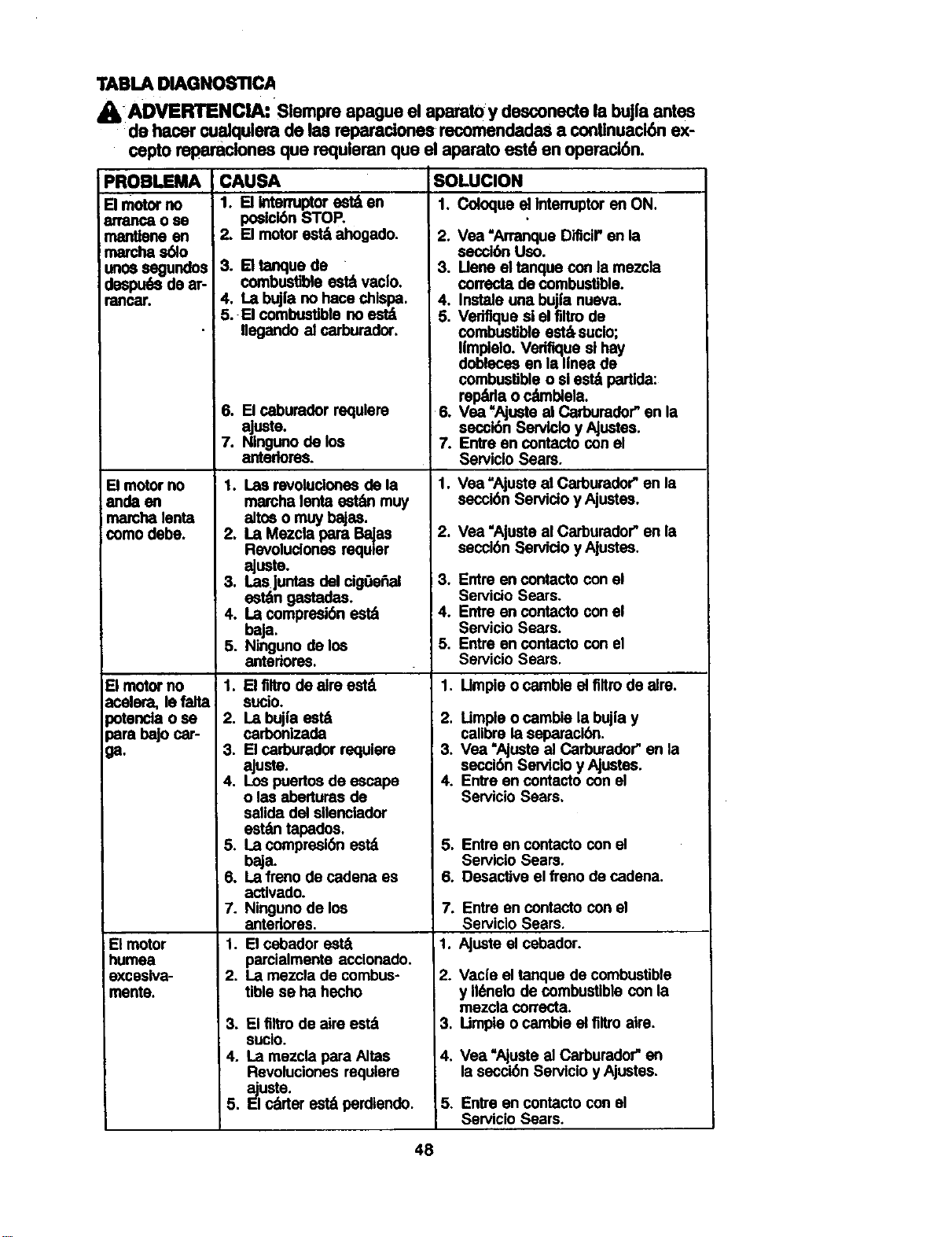
TABLA DIAGNO_I'ICA
_ADVERTENCIA: Slempre apague el aparato y desconecte la bujfa antes
de hacer cualqulera de las mparaciones recomendadas a contlnuaci6n ex-
cepto reparaciones que requieran que el aparato est6 en opemci6n.
PROBLEMA
El motor no
81TarlGa O ee
manUeneen
imarcha s61o
tun0s segundos
despu6s de ar-
rarlP,,ar.
El motor no
anda en
marcha lenta
como debe.
El motorno
acelara, le falta
)otenda o se
para halo car-
ga.
El motor
humea
exceslva-
mente.
CAUSA
1. B interru_oros_en
pos_n STOR
EIm_ores_ahogado.
3. [] tanque de
combustible est_ vaclo.
4. La bujia no hace chlspa.
5. El combustible no est_
Ilegando at carburador.
6. El caburador requiem
ajoste.
7. Nlngunode los
anterlores.
1. I.as revoluclonos de la
marcha lenta est,_ muy
altos o muy bajos.
2. La Mezcla para Bajas
Revoluclonos requler
ajuste.
3. Las Juntasdel cig0efial
ost_n gastadas.
4. La compresi6n est_
baja.
5. Ninguno de los
anteriores.
1. El filtro de alra est_
sucio.
2. La bujla est_
carbonlzada
3. El carburador requiem
_u_e.
4. Lospuertosde escape
o las aberturas de
salida dal allenclador
est_=ntapados.
5. La comprosl6n est_
baja.
6. La freno de cadena es
activado.
7. Ninguno de los
anteriores.
1. El cebador est_
parcialmente acclonado.
2. La mezcla de combus-
tible se ha hecho
3, El tiltro de aire est,,
suclo.
4. La raezcla para Altas
Revoluciones requiem
ajuste.
5. El c_ar est_percllendo.
SOLUCION
1. Coloque el Intermptor en ON.
2. Vea "Arranque Dificir'en la
secci6n Uso.
3. Llene el tanque con la mezcla
correcta de combustible.
4. Instate una bujla nueva.
5. Veriflque si el tinro de
combustible est_suclo;
Ilmplsto. Veritique el hay
doblecos en la linea de
combustible o el est_ parUda:
re_a o c_mblela.
6. Vea"Ajuste at Carbumdor" en la
secoibn Servlclo y Ajustos.
7. Entre en contacto con el
Servicio Sears.
1. Vea "A|usteat Carburador"en la
secci6n Se_cio y Ajustes.
2. Vea "Ajuste al Carburador"en la
secci6n Servicio y A|ustos.
3. Entre en contacto con el
Servicio Sears.
4. Entre en contacto con el
Senticio Sears.
5. Entre en contacto con el
Servicio Seam.
1. Umple o camble el tiltm de alre.
2. Limple o cambie la bujla y
calibre la separaci6n.
3. Vea "Ajusteat Carburador"en la
secci6n Servicio y Ajustos.
4. Entre en contacto con el
Servicio Sears.
5. Entre en contactocon el
Servicio Sears.
6. Desactive el freno de cadena.
7. Entre en contactocon el
Servicio Sears.
1. AJusteel cebador.
2. Vac|e el tanque de combustible
y 116nelode combustible con la
mezcla correcta.
3. Umpie ocambie el filtroaim.
4. Vea "Ajusteal Carburador" en
la secci6n Servicio y Ajustes.
5. Entre en contacto con el
Servicio Sears.
48
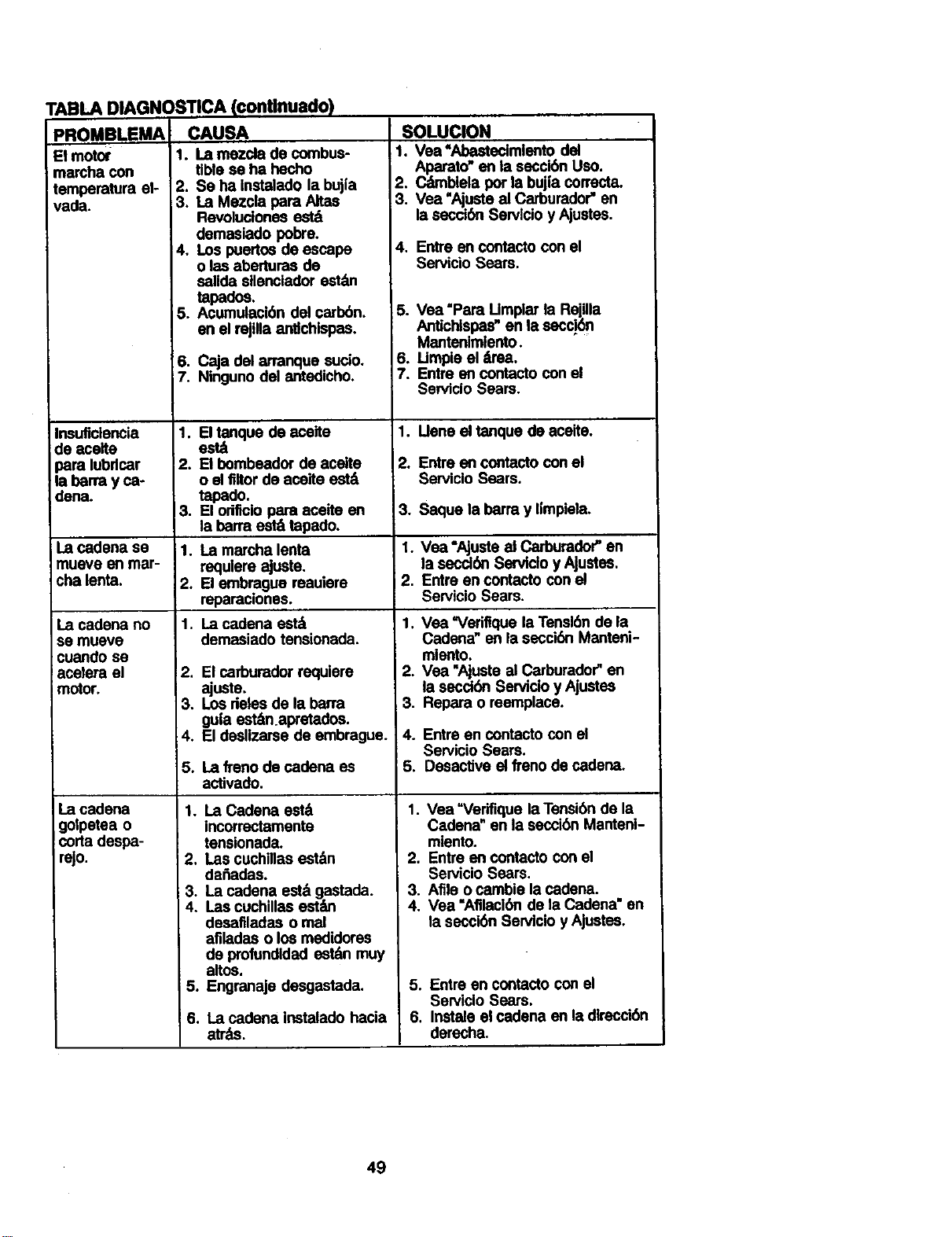
TABLADIAGNOSTICA
PROMBII=MA
Elmotor
marcha con
temperatura el- 2.
vada. 3.
4.
i5.
6.
7.
1.Insultclencia
de acelte
)ara lubrlcar
la barra y ca-
dena.
(¢ontinuado)
CAUSA
1. La mezcla de combus-
tible se ha hecho
Se ha Instalado la bujla
La Mezda para ARea
Revolucionea eat_
demasiado pobre.
Los puertos de escape
o las aberturas de
salida silenciador esk'fm
tapados.
Acumulaci6n del carbbn.
en el rejtlla antlchlspas.
Caja del arranque sucio.
Ningunodel antedicho.
El tanque de acelte
est_
2. [] bomhaador de aceite
o elflltor de acolte est_
tapedo.
3, El orificiopare acelte en
la barm est_ tapado.
Lacadena se 1.
mueve en rnar-
cha lenta. 2.
La cadena no 1.
se mueve
cuando sa
acelera el 2.
motor.
3.
:4.
5.
La cadena 1.
gelpetea o
corta despa-
rejo. 2.
3.
4.
5.
6.
SOLUCION
1. Vea "Abastedmlento del
Aparato" en la seccl6n Uso.
2. Cdmblela per le bujia correcta.
3. Vea "Ajusteal Carburador"en
la secctbn Servlcio y Ajustea,
El carburador requiem
ajuste.
Los deles de la barra
gula est_n.apretados.
El deallzame de embragua.
4. Entre en contacto con el
Servicio Seam.
5. Vea "Pare Umplar la RejUla
Antichlspas"en la eacci6 n
Mantenlmlento.
6. Umpie el _=rea.
7. Entre en contacto con el
Serviclo Sears.
1. Uene el tanque de acolte.
2. Entre en contacto con el
Servicio Sears.
3. Saquela barmy limpiala.
La marcha lenta 1. Vea'Ajuste el Carburadof' en
requiem ajuste, la secci6n Serviclo y AJustes.
El embrague reauiere 2, Entre en contacto con el
reparaciones. Servicio Seam.
La cadena eat& 1. Vea =Vadflque la Tensl6n de la
demasiado tensionada. Cadena" en la secci6n Manteni-
mlento.
2. Vea "Ajuste al Carburador"en
la seccidn Servicioy Ajustea
3. Repara o reamplaco.
La freno de cadena es
activado.
La Cadena est8
incorrectamente
tensionada.
Las cuchinas est_n
dafiadas.
La cadena est_ gastada.
Lea cuchillaseat_rm
desafiladas o mel
afiladas o los medidores
de profundldad eat_m muy
altos.
Engranaje deagastada.
La cadena Instalado hacia
atr_s.
4. Entre en contacto con el
Servicio Sears.
5. DesactJveel freno de cadena.
1. Vea =Vedfique la Tensibnde la
Cadena" en la seccibn Manteni-
miento.
2. Entre en contacto con el
Servicio Sears.
3. Afile o cambie la cadena.
4. Vea "Afilacibn de la Cadena" en
ta secci6n Servlcio y Ajustes.
5. Entre en contacto con el
Serviclo Sears.
6. Instale el cadena ea la dlrecci6n
derecha.
49
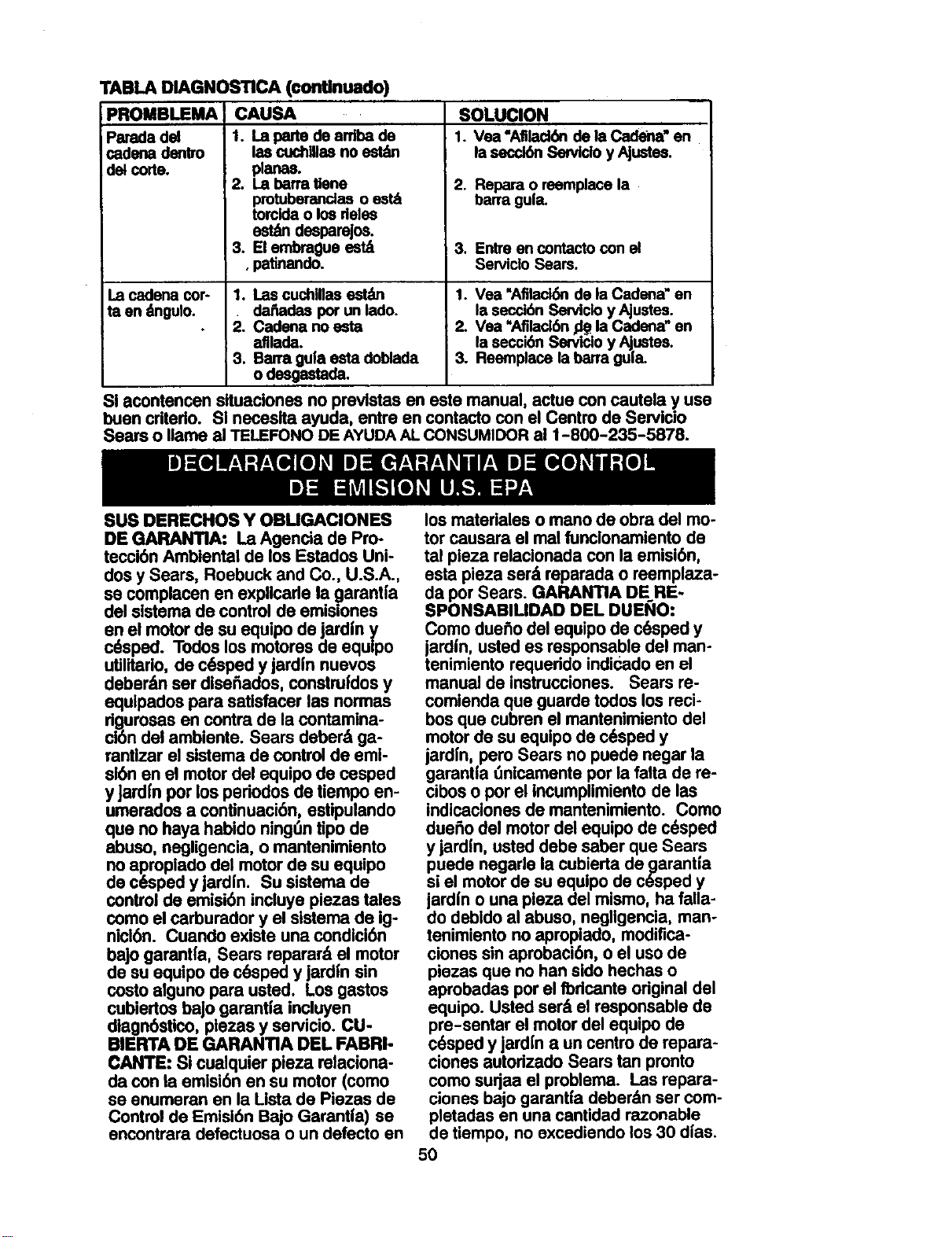
TABLA DIAGNOSTICA (continuado)
PROMBLEMA CAUSA
Parade did 1. La parle de ardba de
cadena dentro las cuchlllas no estlm
det torte, pianos.
2. La barra tlene
protuberandas o est_
tomida o los deles
desparejos.
3. El embrague est_
•patinando.
La cadena cor-
ta en dngulo.
1. I.as cuchlllas est_n
• da.rladaspor un lado.
2. Ca(lena no esta
afllada.
3. Barra gu|a esta doblada
o desgastada.
SOLUCION
1. Vea'Afllad6n de la Cadena" en
la secd6n Sevlclo y AJostos.
2. Repara o reemplace la
barra gula.
3. Entre en contacto conel
Servicio Seam.
1. Vea "Afllacldn de la Cadena" en
la seccidn Sendcio y Ajustes.
2. Vea "Afilad6n _1_la Cadena" en
la secci6n Se_o y Ajustea.
3. Reemplace la barra gula.
SI acontencen sttuaciones no previstas en este manual, actue con cautela y use
buen criterio. Si necesita ayuda, entre en contacto con el Centro de Servicio
Sears o flame al TELEFONO DE AYUDA AL CONSUMIDOR al 1-800-235-5878.
SUS DERECHOS Y OBUGACIONES
DE GARANTIA: La Agenda de Pro-
teccibn Amblental de los Estados Uni-
dos y Sears, Roebuck and Co., U.S.A.,
se complacen en expllcade la _]arantia
del sistema de control de emislones
en el motor de su equipo de jardln y
cdsped. Todos los motores de equipo
uUlitario, de c6sped y jardin nuevos
deberdn ser disefiados, constru|dos y
equlpados para satlsfacer las normas
rigurosas en contra de la contamina-
ci6n del ambiente. Sears deber_ ga-
rantizar el sistema de control de emi-
si6n en el motor del equipo de cesped
y Jardin por los periodos de tiempo en-
umerados a continuaci6n, estipulando
que no haya habido ning0n tipo de
abuso, negligencia, o mantenimiento
no apropiado del motor de su equipo
de c6sped y jardin. Su sistama de
control de emisi6n incluye piezas tales
como el carburador y el slstema de ig-
nicl6n. Cuando existe una condici6n
bajo garantia, Sears reparard el motor
de su equipo de c6sped y jard|n sin
costo alguno para usted. Los gastos
cubiertos bajo garantia incluyen
dlagn6stico, plezas y servicio. CU-
BIERTA DE GARANTIA DEL FABRI-
CANTE: Si cualquier pieza relaciona-
da con la emisi6n en su motor (como
se enumeran en la Usta de Piezas de
Control de Emisi6n Bajo Garantia) se
encontrara defectuosa o un defecto en
losmater|ales o mano de obra del mo-
tor causara el malfunclonamiento de
tal pleza relaclonada con la emisi6n,
esta pieza ser_ reparada o reemplaza-
da porSears. GARANTIA DERE-
SPONSABIUDAD DEL DUENO:
Como duefio del equipo de c6sped y
jardin, usted es responsable del man-
tenimiento requeridoindicado en el
manual de instrucciones. Sears re-
comienda que guarde todos los reci-
bos que cubren el mantanimiento del
motor de su equlpo de c6sped y
jardin, pero Sears no puede negar la
garantla unicamente por la falta de re-
cibos o por el Incumpllmiento de las
indlcacionesde mantenimiento. Como
duefio del motor del equipo de c_sped
y jardin, usted debe saber que Sears
puede negarle la cubierta degarantla
si el motorde su equlpo de c6sped y
jardin o una pieza del mismo, ha falla-
do debldo al abuso, negllgencia, man-
tenimiento no apropiado, modifica-
clones sin aprobaci6n, o el uso de
piezas que no han sldo hechas o
aprobadas por el tbdsante original del
equipo. Usted sat& el responsable de
pre-sentar el motordel equipo de
c6sped y jardin a uncentro de repara-
ciones autodzado Sears tan pronto
como surjaa el problema. Las repara-
clones bajo garant|a deber&nser com-
pletadas en una cant|dad razonable
de tiempo, no excediendo los 30 dlas.
5O
Sicuentaconalgunapreguntaen re-
ferenciaasusderechosy msponsabi-
lidades,usteddeber_entrarencon-
tactoconsucantro de servlcio
autodzado rn_s cercano o Ilamar a
Sears al 1-800-469-4663. FECHA
DEL COMIENZO DE LA GARANTIA:
El pedodo de garantla comlen7.a en la
fecha en que se compr6 el motor del
equipo de c6sped y jardln. DURA-
ClON DE LA GARANTIA: Esta ga-
rantla tlene unpedodo de cubierta de
dos a_os desde la fecha inicial de
compra. QUE CUBRE: REPARA-
CLONES O REEMPI.AZO DE PIEZAS.
Las reparsclones o reemplazo de cu-
alquler pieza en garantla serdn efec-
tuadas sin cargo alguno para el due_o
en un cantro de servicio Sears aproba-
do. Si tiene alguna pregunta en rela-
ci6n con susderechos y responsabili-
dades de garantla, usted deber_
comunicarse con su centro de servicio
autodzado m&scercano o Ilamar a
Sears al 1-800-469-4663. PERIODO
DE GARANTIA: Cualquier pieza bajo
garantia que no est6 programada para
set reemplazada como requisito del
programa de mantenimiento, o la coal
est6 programada para ser inspecclo-
nada de forma regular para efectos de
"reparaciones o reemplazos si es ne-
cesario_deber& garantizarse pot dos
a_os. Cualquier pieza garantizada
que est6 programada para ser reem-
plazada como Io es requerido por el
programa de mantenimiento, deber_
ser garantizada por el periodo de tiem-
po hasta el primer cambio programado
para el reemplazo. DIAGNOSTICO:
No se deber_cargar al due_o ningun
tlpo de recargos por el servIcio de
diagn6stico el coal nos conduce a la
determinaci6n de que una pieza bajo
garantia est_ defectuosa, si el trabajo
de diagn6stico ha sido Ilevado a cabo
en un centro de servicio Sears aproba-
do. DA_IOS POR CONSECUENCIA-
MAGES: Sears puede ser mspons-
able por dai_osa otroscomponentos
del motor causados por el fallo de una
pieza garsntizada mlentras 0sta se en-
cuentre en garantla. QUE NO
CUBRE: Todos los fallos causados
porel abuso, la negligenda, oel man-
tenimiento noaproplado no estdn cu-
blertos. PIEZAS PARA ANADIR O
MODIFICADAS: El uso de piezas ar3a-
dldas o modlficadas puede ser la base
para anular la garantla. Sears nose
haca responsable de cubdrfallos de
piezas garantizadas debido al uso de
piezas at_adldaso modificadas.
COMO ENTABLAR UNA RECLAMA-
ClON: Si cuenta usted con alguna pre-
gunta en referenda a susderechos y
responsabilidades de garant|a, usted
deberd contactar a su centro de servi-
cio autorizado rn_s cercano o Ilamar a
Sears al 1-800-469-4663. EN DONDE
OBTENER SERVIClO DE GARAN-
TIA: Servicio o reparaciones de ga-
rantia deber& set provistas portodos
los centrosde servicio Sears, flameal:
1-800-469-4663. MANTENIMIENTO,
REEMPLAZO Y REPARAClONES DE
PIEZAS RELAClONADAS CON LA
EMISION: Cualquierpieza de reempla-
zo Sears aprobada usada en la pro-
gramaci6n de cualquier mantenimiento
de garantla o reparaclbn de piezas re-
lacionadas con la emisi6n ser&provis-
ta al due_o sin cargo alguno si la pie-
za se encuentra bajo garantia. MSTA
DE PIEZAS DE CONTROL DE EMI-
SlON BAJO GARANTIA: Carburador,
Sistema de Ignici6n: Bujia (cubierta
tlnicamente hasta el pedodo del primer
mantenimiento programado), Mbdulo
de Ignici6n. DECLARACION DE
MANTENIMIENTO: El dueho es re-
sponsable de efectuar todo manten-
imiento programado como Io define el
manual de Instrucciones.
51

For repairof majorbrandappllancesIn your own home...
nomatterwhomadeit,nomatterwhosoldig
1.800-4.MY-HOME D Anyltm,dayornight
(I-8004694663) (U,S,A.andCamda)
WNW_ WWW_
For repairofcany-inproductslikevacuums, lawnequipment,and
electronics,callforthe nearestSeam Parts and Repair Center.
1-800-488-1222 /v_rme,dayornight(U.SAonly)
wwwm
Forgle replacementparts,accessoriesand owners manuals
thatyouneed todo-it-yourself,callSears PartsDirects"!
1-800-366-PART 6a.r_- 11p.m.,7daysaweek
0-eoo.,,._7278) (u.s._.on'y)
Wlt,Rv,sem'__
To purchaseorInquireabouta Sears Se_ice Agreement
orSearsMaintenanceAgreement:
1-800-827-6655 (u.sA) 1-800-361-6665 (Canada)
7 am. - 5 p.m.,CST, M(_ - Sat. 9 a.m.- 8 p.m.ES3",M- F,4 p.m.Sat.
Parepedrsen/Iclodo_ a AuCanadapoursauceenfrmX;_
d(xnk:io,ypareoldenarplozas: I.eOO4.E.FOYERMc
1"888'SU4"IO61AR_M (1.,8)0-5,33"6037)
(1.,888-78€6427) www.seam.ca
HomeCenlral®J
® Registered Trademark / ;u Trademark I sMSewlce Mark of Sears, Roebuck and Co.
® Malrca Regl$1radeI TMMerca de F/=bdcaI SMMarcElde Sswlclo de Sears, Roebuck end Co.
McMarque de (x)mmerce I MoMarque d_pos_e de Sears, Roebu(;k and Co,

