OWHER'$ MANUAL
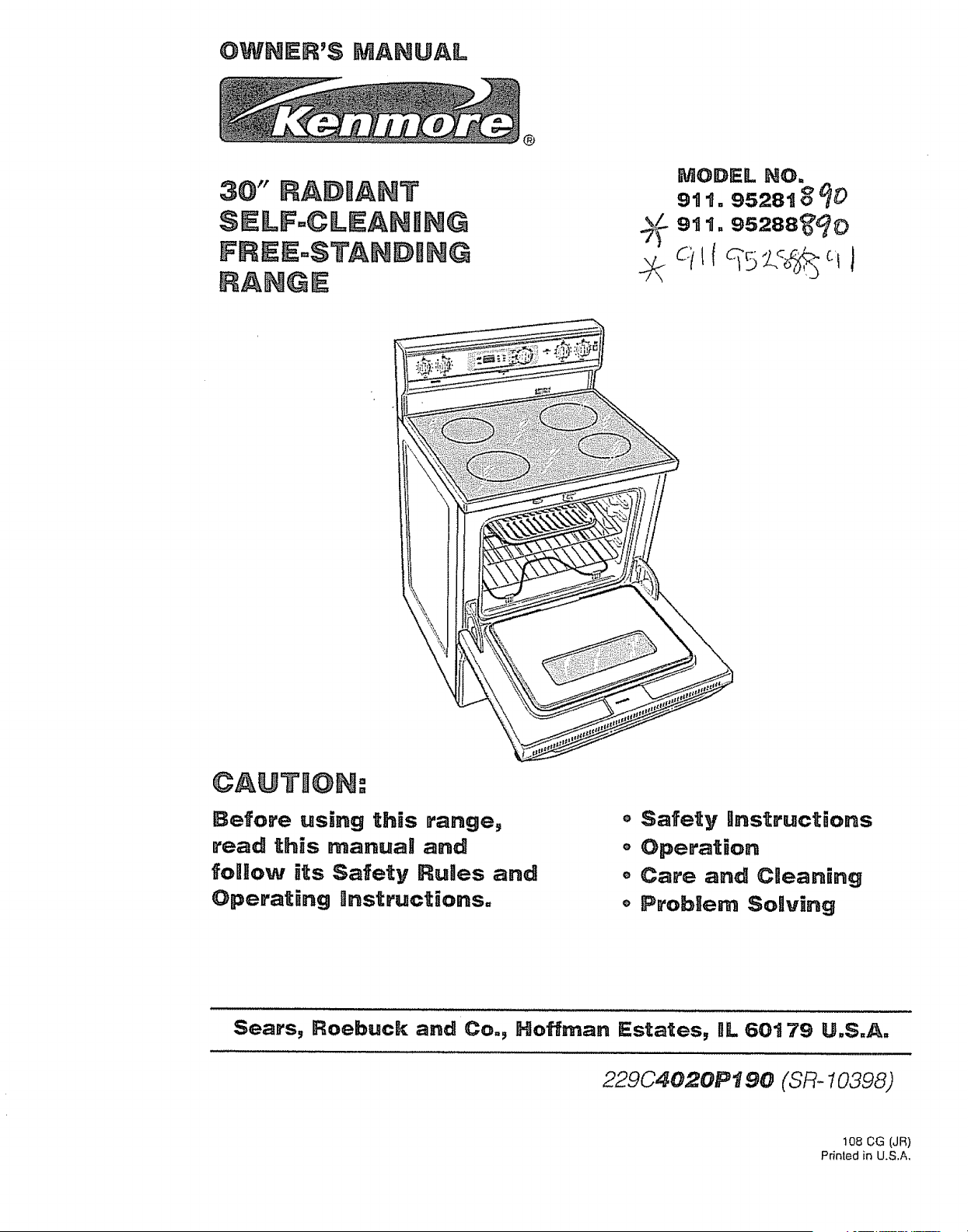
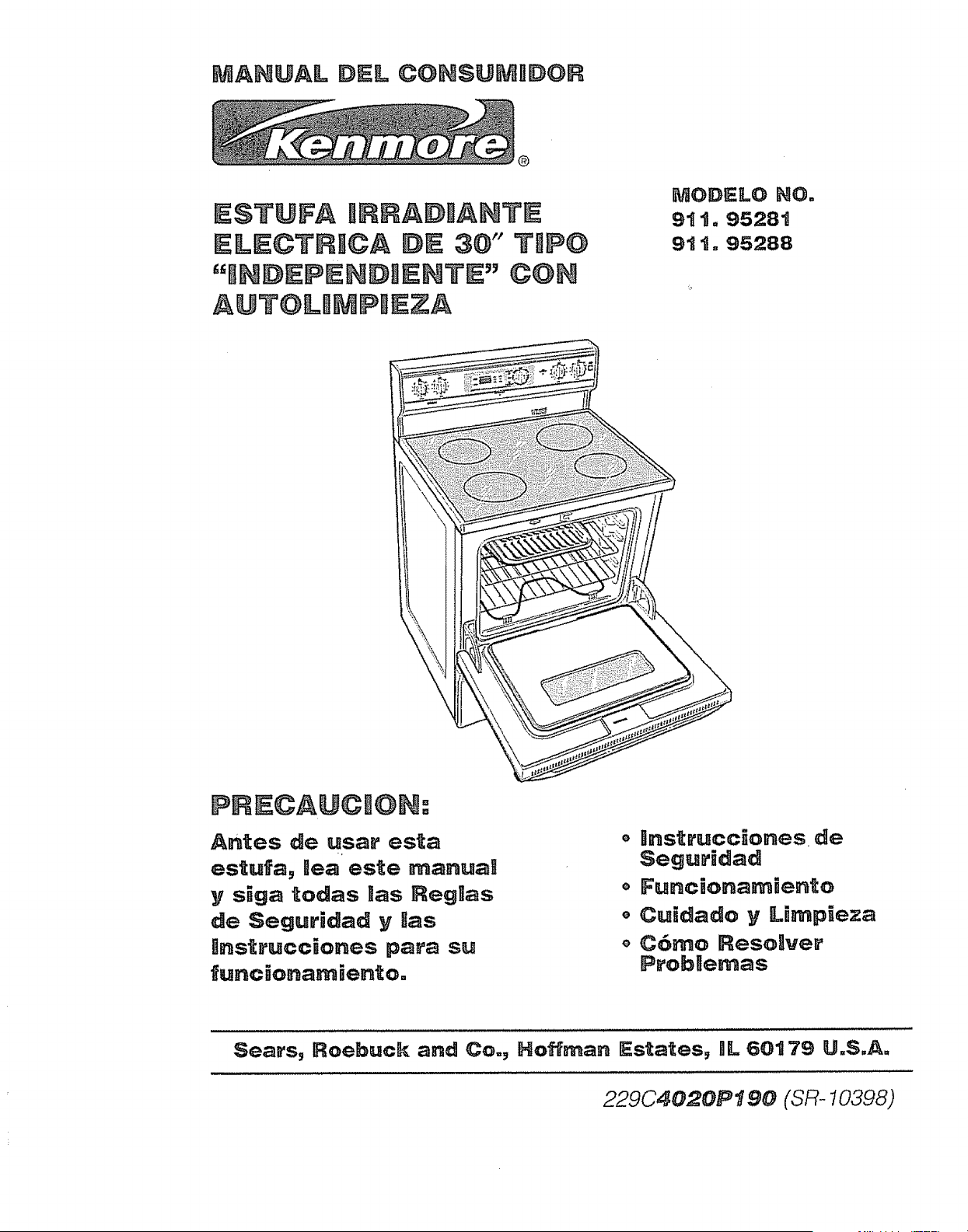
30" RADIANT
RANGE
®
MODSL HO.
911.952818_
9t1.9s2as qD
Before using this range,
read this rnanuaB and
follow its Safety Rules and
Operating _nstructions°
o Safety mnstructions
o Operation
• Care and Cl_eaning
o Problem Solving
Sears, Roebuck and Co., Hoffrnan Estates, IlL 60t 79 U.S=A.
229C4020P190 (SR- 10398)
108 CG [JR)
Printed in U,S,A,
Tableof Contents
®
Range Safety .......... 3-6
Stability Device .......... 3
SELF=CLEAN#NGRADIANT
FREE=STANDIHGP NGE
Protecting the Cooktop .... 7
Removal of Packaging Tape
Features of Your Range .... 8
Cooking Zones .......... 9
Cooking Utensils ......... 9
Checking Your Cookware .. 9
Cookware Performance .... 9
Radiant Coils .......... 10
Radiant Unit Cycle ...... 10
Control Settings ......... t0
Home Canning Tips ..... 10
Clock, Timer & Oven Control 11
Hour/Minute Arrow Pad ... 1t
Display ............... 1t
Indicator Lights ......... 11
To Black Out the Display .. 11
F Codes .............. 11
Power On ............. 11
Automatic Oven Shut-Off .. 11
To Set the Clock ........ 12
To Set the Timer ........ 12
To Reset the Timer ...... 12
To Cancel the Timer ..... 12
Oven Cooking Tips ,.. 13-15
Oven Control ........... 15
Baking ............... 16
Broiling ............... 17
Self-Cleaning Cycle ... 18, 19
Glass Cooktop Cleaning 20, 21
Control Panel .......... 21
Broiler Pan and Grid ..... 21
Control Knobs .......... 22
Oven Light Bulb ........ 22
Storage Drawer ......... 23
Oven Racks ........... 24
Oven Door ............ 24
Before Calling For Service 25-27
Temperature Adjustment .. 28
Warranty .............. 29
Consumer Service Numbers 30
For your convenience and future reference, please write down your
model and serial number in the space provided. They are located on
the front frame behind the storage drawer.
MODEL NUMBER: SERIAL NUMBER:
2
®
SAVETHESERNSTRuc'rRo ,J$
Read all instructions before using this appliance. When using gas or
electrical appliances, basic safety precautions should be followed,
including the following:
o All Ranges Can Tip ;i._:i
o Injury To Persons ,
Could Result
:::_::i
Device Packed
o See Installation
Instructions ....
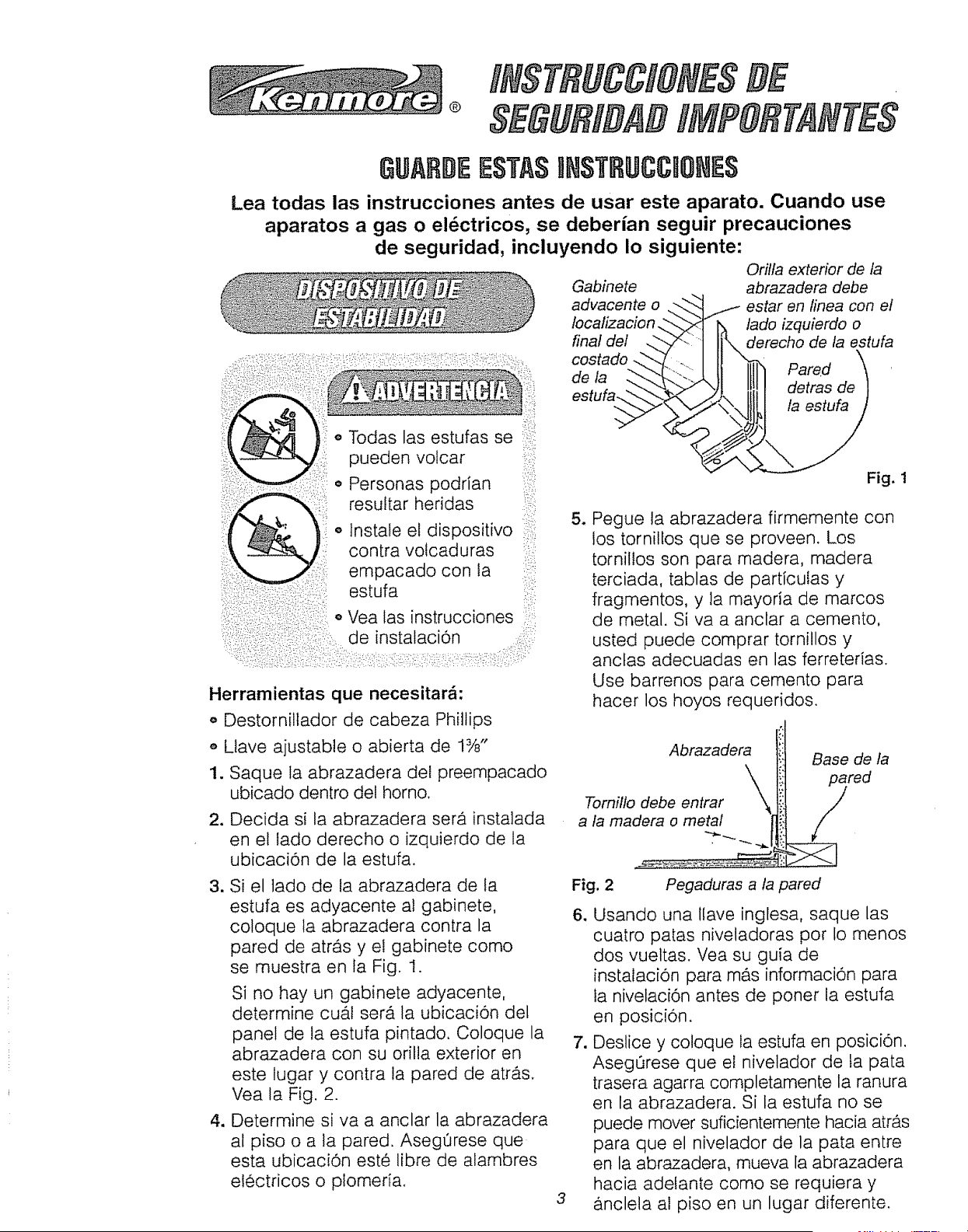
Adjacent cabinet
or final
location
of range
side
panel
Tools you will need:
o Phillips head screwdriver
o 13/8" open end or adjustable
wrench
1. Remove the bracket from the
prepack located inside the oven.
2. Decide whether the bracket will be
installed on the right or left side of
range location.
3. If the bracket side of the range is
adjacent to a cabinet, place the
bracket against back wail and
cabinet as shown in Figure 1.
If there is no adjacent cabinet,
determine where the location of
the range side (painted outside
panel) will be. Place the bracket
with its outside edge at this
location and against back wall.
See Figure 2.
4. Determine whether you will anchor
the bracket to the floor or wall.
Make sure this location is clear of
electrical wiring or plumbing.
Outside edge of
bracket to be flush with
left or right of range
Fig, 1
=
Fasten the bracket securely with
the screws provided. Screws are
self-drilling in wood, plywood,
particle and chip board, and most
metal framing. If attaching to
masonry, you can buy suitable
screws and anchors at hardware
stores. Use a masonry drill bit to
drill the required holes.
Br c.e,\ti
Screw must enter _Ji!l
woodormetal.,...__fji::l
Fig, 2
Wall plate
/
Attachment to walt
6_
=
Using the wrench, back out the
four leg levelers at least two turns.
See your installation guide for
more leveling information before
positioning range.
Slide the range into place. Be sure
rear leg leveler fully engages the
slot in the bracket. If range cannot
be moved back far enough for
rear leg leveler to enter bracket,
move bracket forward as required
and attach to floor in new location.
3

®
WARNING! To prevent -"'_
accidental tipping of the
range from abnormal
usage, including excessive
loading of the oven door,
attach the range to the wall or
floor by installing the Anti-Tip
device supplied. If the range is
moved for cleaning, servicing
or any reason, be sure the
Anti-Tip device is re-engaged
properly when the range is slid
back in the opening. Failure to
do so could result in the range
tipping or personal injury.
To inspect the Anti-Tip device,
remove the storage drawer
and look to see if the rear leg
leveler fully engages the slot
in the bracket.
IMPORTANT: To insure safety for
yourself, family and home, please
read your Owner's Manua! carefully.
Keep it handy for reference. Pay
close attention to Safety Sections.
BE SURE your appliance is installed
and grounded by a qualified
technician.
_,DO NOT leave children alone
or unattended near an appliance
in use.
o TEACH CHILDREN not to play
with controls or any part of the
appliance, and not to sit, climb
or stand on the door, or any other
part of the appliance.
@
o
CAUTION: NEVER STORE
items of interest to children on the
backguard or in cabinets above
the appliance. Children climbing
on the appliancecould be
seriously injured.
KEEP THIS manual for later use.
NEVER USE your appliance for
warming or heating the room.
o NEVER TRY to repair or replace
any part of the appliance unless
instructions are given in this
manual. All other work should be
done by a qualified technician.
_,ALWAYS KEEP combustible wall
coverings, curtains, dish cloths,
towels, potholders, and other
linens a safe distance from the
appliance.
o NEVER HEAT unopened food
containers. Pressure buildup can
cause the container to burst and
cause injury.
o NEVER LEAVE jars or cans of fat
or drippings in your oven.
o ALWAYS KEEP the oven ancl
surface unit areas free from things
that will burn. Food, wooden
utensils, and grease buildup could
catch fire. Plastic utensils could
melt and canned foods could
explode. Your appliance should
never be used as a storage area.
_,ALWAYS KEEP your appliance
clear of things that will burn
(gasoline and other flammable
vapors or liquids).
o NEVER TRY to clean a hot
surface. Some cleaners produce
noxious fumes, and wet cloths or
sponges could cause steam burns.
o NEVER WEAR loose fitting clothing
when using your appliance.
o NEVER USE a towel or other bulky
cloth as a potholder, and make
sure the potholder is dry. Moist
potholders and wet cloths or
sponges could cause steam burns.
DO NOT let potholders touch hot
heating zones.
4
,, DO NOT touch heating zones,
surfaces near them, or interior oven
surfaces. These may be hot enough
to cause burns even though they
are dark in color. During and after
use, do not touch or let clothing or
flammable material contact the
zones or hot surfaces until they
have had time to cool. Other
surfaces near the oven vent
openings, oven door and window,
and cooktop surfaces may also
be hot enough to cause burns.
,, ONLY SOl'dE kinds of (heat proof)
glass or ceramic cookware can be
used for cooktop cooking. Make
sure the cookware you choose to
use is designed for cooktop
cooking without breaking due to
the sudden temperature change.
o ALWAYS USE care when touching
cooktop elements. They will retain
heat after the range has been
turned off.
,, NEVER BLOCK the oven air vent
on the backguard of the range.
,, COOKWARE USED for cooktop
cooking should be flat on the
bottom and large enough to cover
the heating area being used.
Undersized utensils expose the
heating element and may result in
direct contact or ignition of clothing.
o NEVER LEAVE surface units
unattended at high settings.
Boi!overs result in smoking or
greasy spills which could catch fire.
@
NEVER cook on a broken cooktop;
cleaning solutions and spillage
could penetrate it and create the
risk of electrical shock or fire.
ALWAYS TURN utensil handles
inward and away from other
surface units to reduce the risk of
burns, ignition, unintended contact,
and spillage.
PLACE OVEN RACKS in the
desired position while the oven is
cool. If racks must be moved while
oven is hot, do not let potholder
contact the hot oven element.
o AFTER BROILING, always take
the broiler pan and grid out of the
oven and clean them. Leftover
grease in the broiler pan could
catch fire the next time you use
your oven.
o ALWAYS USE care when opening
the oven door, Let hot air and
steam escape before moving
foods.
NEVER USE aluminum foil to line
the oven bottom, Improper use
of foil could result in the risk of
electrical shock and fire.
5
®
,, CLEAN ONLY the parts listed in
this manual. Follow all cleaning
instructions. Be sure to remove
broiler pan and grid before the
self-clean cycle.
o NEVER RUB, move or damage
the door gasket on self-cleaning
ranges.
,, NEVER TRY to clean utensils,
cookware, removable parts,
or broiler pan and grid in the
self-clean cycle,
o DO NOT USE oven cleaners--
No commercial oven cleaner, or
protective coating of any kind,
should be used in or around any
part of the oven.
o NEVER force the door handle
open while the oven is hot.
IMPORTANT SAFETY NOTICE!
The California Safe Drinking Water
and Toxic Enforcement Act
requires the governor of California
to publish a list of substances
known to the state to cause birth
defects or other reproductive harm
and requires businesses to warn
their customers of potential
exposure to such substances.
The fiberglass insulation in a
self-cleaning oven will give off
a very small amount of carbon
monoxide during the cleaning
cycle. Exposure can be minimized
by venting with an open door or
window or using a ventilation fan
or hood.
READ AND UNDERSTAND THIS
INFORMATION NOW!
Be sure everyone in your home
knows what to do in case of fire,
Never use water on a grease fire;
it will only spread the flames.
COOKTOP GREASE FIRE:
Never pick up a flaming pan...
1. Turn off the surface elements.
2. Smother the flame with a tightly
fitting lid. Use baking soda or a
dry chemical, foam, or halon type
extinguisher.
OVEN FIRE:
Do not try to move the pan?
1. Close the oven door and turn
controls off.
2. If fire continues, carefully open the
door, throw baking soda on the
fire, or use a dry chemical, foam,
or halon type extinguisher.
6

® OPERATION
Protecting the Cooktop
o DO NOT slide cookware across
your cooktop.
,, DO NOT use scouring powders
or metal cleaning pads on your
cooktop.
o DO NOT apply your cooktop
cleaning creme to the cooktop
surface if the surface is hot.
÷
o READ the instruction label on the
cooktop cleaning creme bottle
before attempting to clean the
surface of your cooktop.
_,AFTER cleaning the cooktop
surface, be sure to wipe off any
residue that may be left from the
creme with a dry paper towel.
o FOR MAJOR spills, turn the
surface control knob to OFR Use
a dry paper towel to wipe up spill,
then use a razor scraper (held with
a potholder) at a 30 ° angle against
the surface of the cooktop to
scrape remaining spill from the
hot cooking zone.
30 ° angle
f' CAUTION: When the _
surface controls are
turned off, the Hot
Surface Indicator light
will remain lit until the cooktop
surface has cooled to
approximately 150°F. The glass-
ceramic surface will retain heat
after the indicator light goes
out. Use caution until the
cooktop surface has had time
,p oo,: j
To remove the adhesive left from
packaging tape, use household
dishwashing liquid, minera! oil or
cooking oil. With a soft cloth rub into
the area and allow to soak. Rinse
and dry well. Repeat procedure
using an appliance polish to insure
no damage is done. This should be
done before the range is turned on
for the first time. The tape cannot
be removed once the range has
heated. Packaging tape may be
found in the following areas: Cooktop
surface, Door Handle, Control Panel
area, Door Trim and Oven area.
o DO NOT cook directly on the
surface of the glass.
,, DO NOT use the cooktop as
a cutting board.
7

_OPERATION
®
FEATURESOF YOURRANGE
Oven control
Clock and timer
Coot(top control
Surface indicator light
Glass-ceramic cooktop
Door latch and
unlatch handle
Broiler pan and grid
Broil element
Hot surface
indicator light
Oven light switch
Oven vent
Cookingzone
Oven door latch
Removable racks
Bake element
Model and serial
number location
Storage drawer
\
Oven door gasket
Removable
oven door
8
OPERATION
®
Radiant CooktopCooking
Before using your new radiant
cooktop, clean it with the Cooktop
Cleaning Creme _'. This will leave
a protective coating.
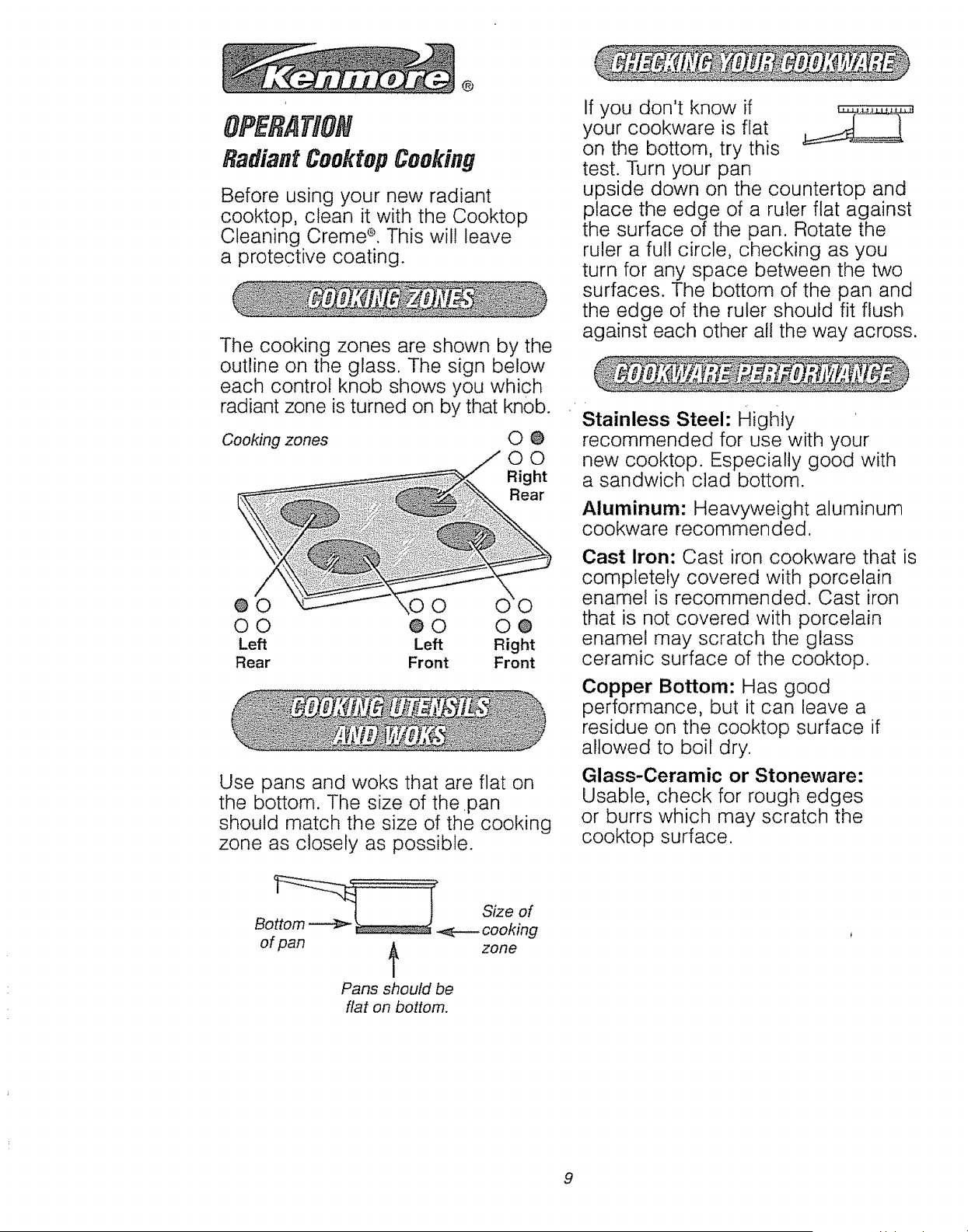
The cooking zones are shown by the
outline on the glass. The sign below
each control knob shows you which
radiant zone is turned on by that knob.
Cooking zones
...............
O0
Left
Rear
O@
OO
Right
Rear
\00
@O O@
Left Right
Front Front
Use pans and woks that are flat on
the bottom. The size of the pan
should match the size of the cooking
zone as closely as possible.
__! [ Sized
Bottom _ _ _ cooking
of pan _ zone
I
Pans should be
flat on bottom.
if you don't know if _,_,
your cookware is flat
on the bottom, try this
test. Turn your pan
upside down on the countertop and
place the edge of a ruler flat against
the surface of the pan. Rotate the
ruler a full circle, checking as you
turn for any space between the two
surfaces. The bottom of the pan and
the edge of the ruler should fit flush
against each other all the way across.
Stainless Steel: Highly
recommended for use with your
new cooktop. Especially good with
a sandwich clad bottom.
Aluminum: Heavyweight aluminum
cookware recommended.
Cast Iron: Cast iron cookware that is
completely covered with porcelain
enamel is recommended. Cast iron
that is not covered with porcelain
enamel may scratch the glass
ceramic surface of the cooktop.
Copper Bottom: Has good
performance, but it can leave a
residue on the cooktop surface if
allowed to boil dry.
Glass-Ceramic or Stoneware:
Usable, check for rough edges
or burrs which may scratch the
cooktop surface.
9
OPERATIOH
®
Radiant CooktopCooking
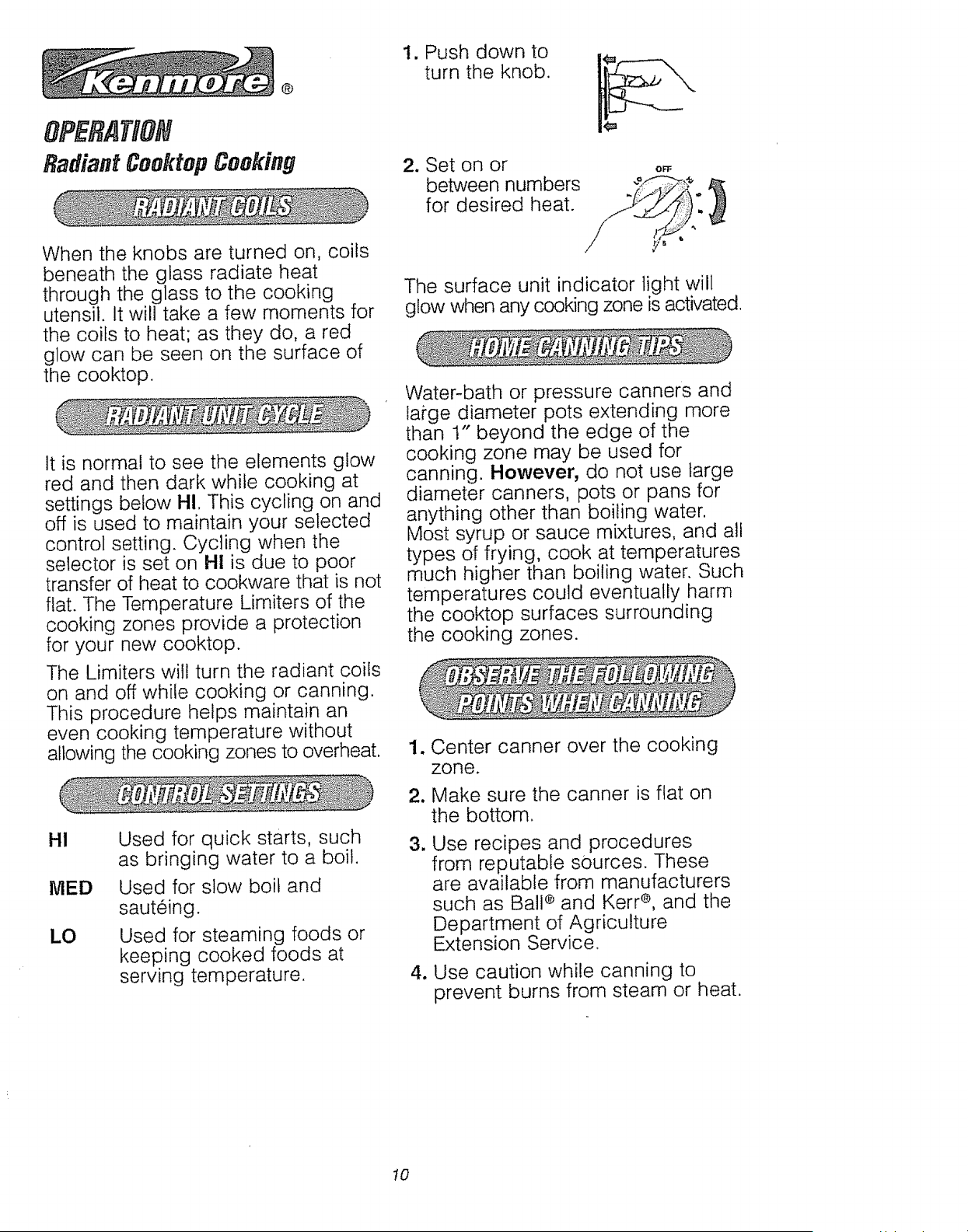
1. Push down to
turn the knob.
2. Set on or
between numbers
for desired heat.
When the knobs are turned on, coils
beneath the glass radiate heat
through the glass to the cooking
utensil. It will take a few moments for
the coils to heat; as they do, a red
glow can be seen on the surface of
the cooktop.
it is normal to see the elements glow
red and then dark while cooking at
settings below HI. This cycling on and
off is used to maintain your selected
control setting. Cycling when the
selector is set on Hi is due to poor
transfer of heat to cookware that is not
flat. The Temperature Limiters of the
cooking zones provide a protection
for your new cooktop.
The Limiters will turn the radiant coils
on and off while cooking or canning.
This procedure helps maintain an
even cooking temperature without
allowing the cooking zones to overheat.
HI
MED
LO
Used for quick starts, such
as bringing water to a boil.
Used for slow boil and
saut6ing.
Used for steaming foods or
keeping cooked foods at
serving temperature.
The surface unit indicator light will
glow when any cooking zone is activated.
Water-bath or pressure canners and
laige diameter pots extending more
than 1" beyond the edge of the
cooking zone may be used for
canning. However, do not use large
diameter canners, pots or pans for
anything other than boiling water.
Most syrup or sauce mixtures, and all
types of frying, cook at temperatures
much higher than boiling water. Such
temperatures could eventually harm
the cooktop surfaces surrounding
the cooking zones.
2w
11
Center
canner over the cooking
zone.
Make sure the canner is flat on
the bottom.
Use recipes and procedures
from reputable sources. These
are available from manufacturers
such as Ball ® and Kerr ®, and the
Department of Agriculture
Extension Service.
Use caution while canning to
prevent burns from steam or heat.
10
OPERATION
®
Clock, Timer& OvenControl
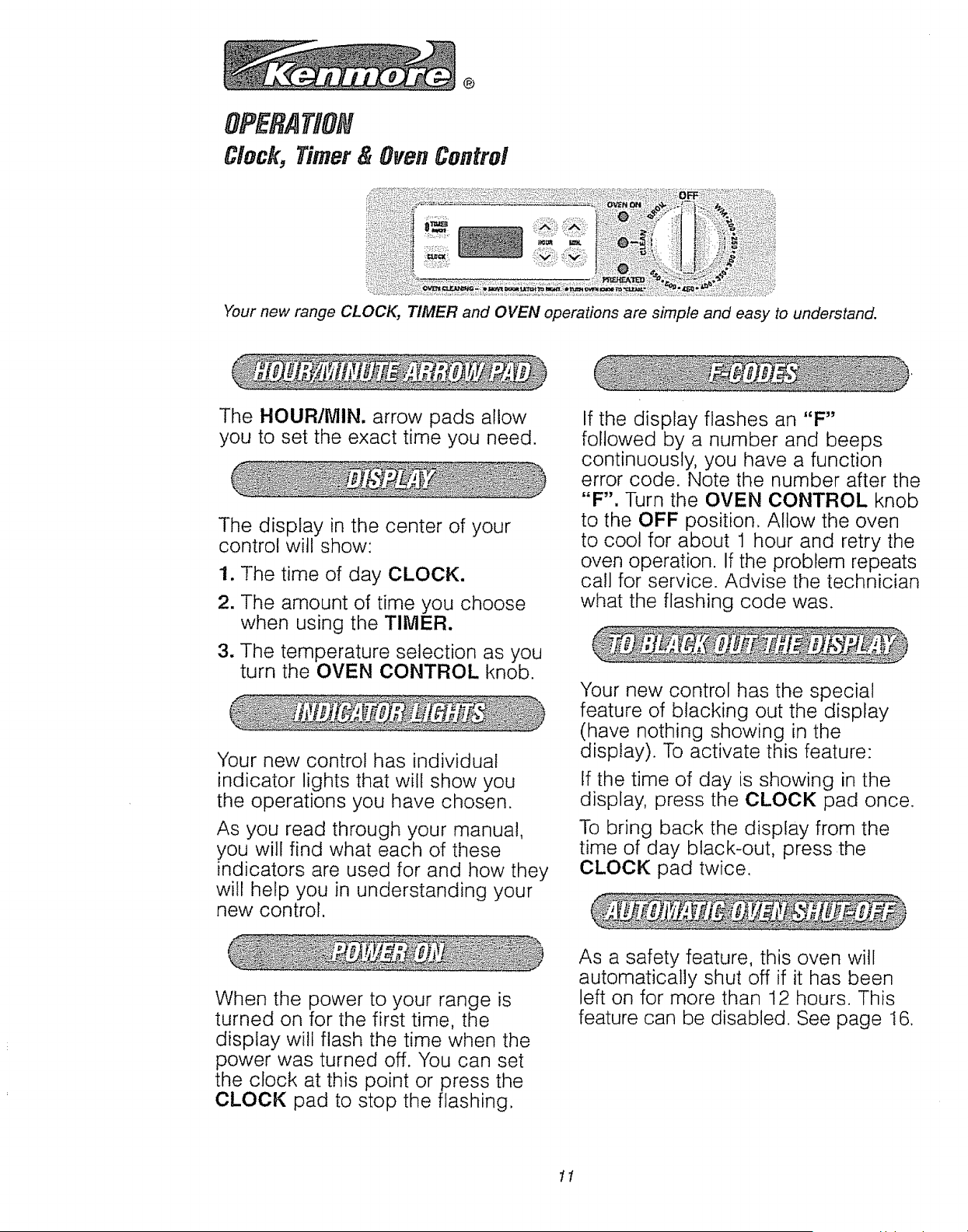
Your new range CLOCK, TIMER and OVEN operations are simple and easy to understand.
The HOUR/MIN. arrow pads allow
you to set the exact time you need.
The display in the center of your
control will show:
1. The time of day CLOCK.
2. The amount of time you choose
when using the TIMER.
3. The temperature selection as you
turn the OVEN CONTROL knob.
Your new control has individual
indicator lights that will show you
the operations you have chosen.
As you read through your manual,
you will find what each of these
indicators are used for and how they
will help you in understanding your
new control.
If the display flashes an "F"
followed by a number and beeps
continuously, you have a function
error code. Note the number after the
"F". Turn the OVEN CONTROL knob
to the OFF position, Allow the oven
to cool for about 1 hour and retry the
oven operation. If the problem repeats
call for service. Advise the technician
what the flashing code was.
Your new control has the special
feature of blacking out the display
(have nothing showing in the
display). To activate this feature:
If the time of day is showing in the
display, press the CLOCK pad once.
To bring back the display from the
time of day black-out, press the
CLOCK pad twice.
When the power to your range is
turned on for the first time, the
display will flash the time when the
power was turned off. You can set
the clock at this point or press the
CLOCK pad to stop the flashing.
As a safety feature, this oven will
automatically shut off if it has been
left on for more than 12 hours. This
feature can be disabled. See page i6.
11
OPERATION
Clock and Timer
@
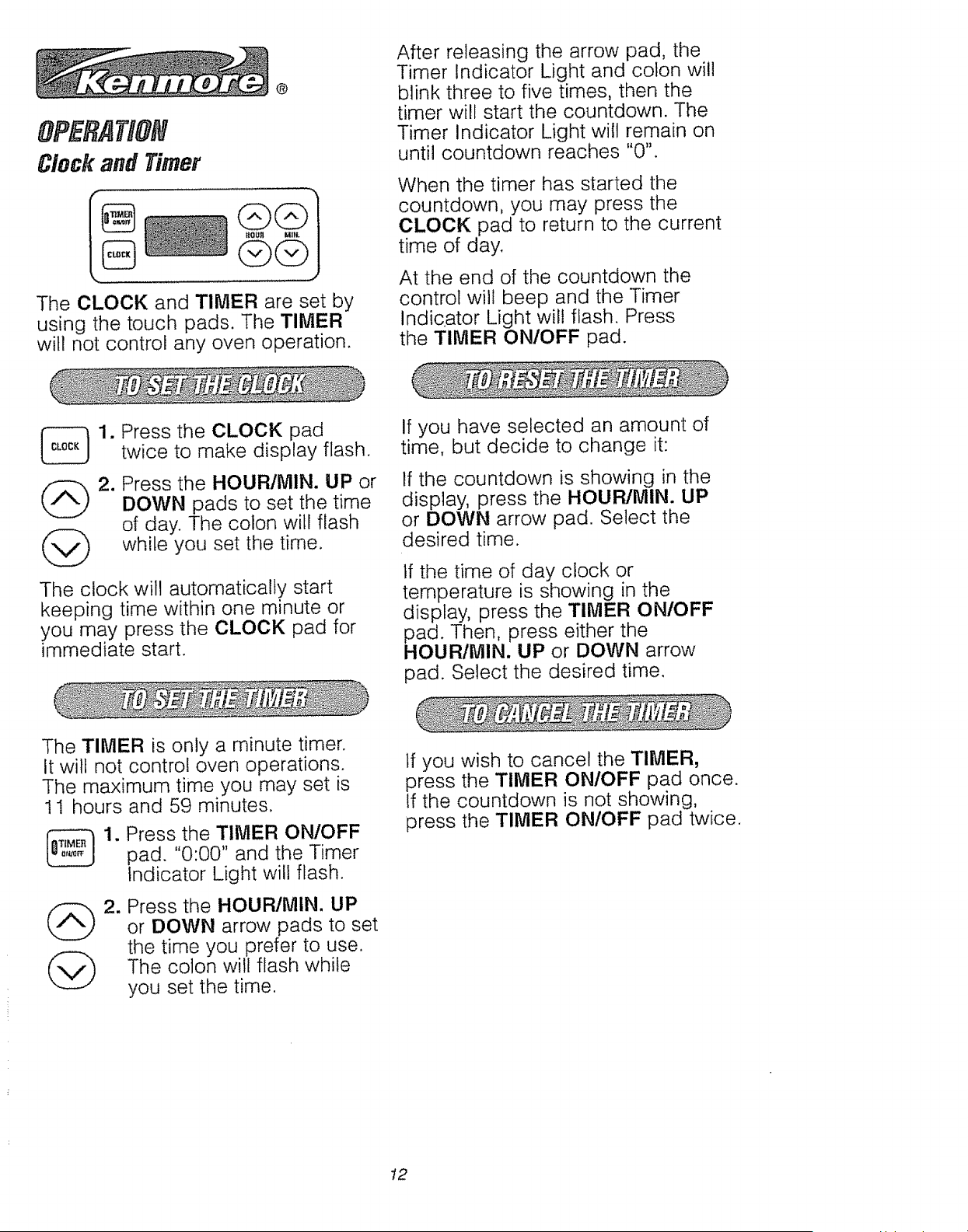
The CLOCK and TIMER are set by
using the touch pads. The TIMER
will not control any oven operation.
After releasing the arrow pad, the
Timer Indicator Light and colon will
blink three to five times, then the
timer will start the countdown. The
Timer Indicator Light will remain on
until countdown reaches "0".
When the timer has started the
countdown, you may press the
CLOCK pad to return to the current
time of day.
At the end of the countdown the
control will beep and the Timer
Indicator Light wil! flash. Press
the TIMER ON/OFF pad.
1. Press the CLOCK pad
twice to make display flash.
(_2. Press the HOUR/MIN. LIP or
DOWN pads to set the time
of day. The colon will flash
while you set the time.
The clock will automatically start
keeping time within one minute or
you may press the CLOCK pad for
immediate start.
If you have selected an amount of
time, but decide to change it:
If the countdown is showing in the
display, press the HOUR/MIN. UP
or DOWN arrow pad. Select the
desired time.
If the time of .day clock or
temperature _s showing in the
display, press the TIMER ON/OFF
pad. Then, press either the
HOUR/MIN. UP or DOWN arrow
pad. Select the desired time.
The TIMER is only a minute timer.
It will not control oven operations.
The maximum time you may set is
11 hours and 59 minutes.
Press the TII_JIER ON/OFF
pad. "0:00" and the Timer
Indicator Light will flash.
(_2.
Press the HOUR/MIN. UP
or DOWN arrow pads to set
the time you prefer to use.
The colon will flash while
you set the time.
If you wish to cancel the TIMER,
press the TIMER ON/OFF pad once.
If the countdown is not showing,
press the TIMER ON/OFF pad twice.
12
OPERATIOH
OvenCookingTips
®
It is normal to have some odor when
using your oven for the first time.
To help eliminate this odor, ventilate
the room by opening a window or
using a vent hood.
In the back of the oven you will
notice a small tube. This is a heat
sensor that maintains the temperature
of the oven. Never move or bend
this tube.
Oven temperature ...._._ _,,
sensor _
IMPORTANT: Never cover the oven
bottom or oven rack with aluminum
foil. Improper use can cause poor
heat flow, poor baking results, and
may damage the oven finish.
Opening the door often to check
foods will cause heat loss and poor
baking results.
The low temperature zone of your
oven (between !70 ° and 200°F)is
available to keep hot cooked foods
warm. However, foods kept at these
temperatures longer than 2 hours
may spoil.
The oven vent is located on the
backguard. This area could become
very hot during oven use. Never
block this vent.
Oven vent location
Preheating is bringing the oven
temperature up to the temperature
you wil! be using during baking.
Let the oven preheat thoroughly
when recipes call for preheating.
13
OPERATION
OvenCookingTips
®
FLAT COOKIE SHEETS, without
sides, allow air to circulate all around
the cookies for even browning.
5
SHINY PANS reflect heat, and are
perfect for cakes and quick breads
that need a light brown crust.
GLASS, DARK NON-STICK OR
DARKENED BY AGE BAKEWARE,
absorb heat, and can be used for
yeast breads, pie crust or foods that
need a brown crust. The oven
temperature, when using these pans,
should be reduced by 25°R
If baking with more than one pan,
place the pans so each has at least
1 to 1W' of air space around it.
Place pans so one is not directly
above the other.
The Oven Temperature Sensor
continuously senses and controls
the temperature inside the oven.
To keep a constant set temperature,
the elements will cycle or turn on
and off during cooking.
The oven rack is designed with stop
locks, a convenience as well
as a safety precaution. The guides
have a bump to prevent the rack
from tilting when it is pulled out
of the oven.
Bump in \
rack guide
Your oven has four (4) rack positions.
Above the top guide cannot be used
for a rack position.
Gu_e
3
2
1
Always place oven rack in the
proper position while oven is cool.
14

OPERAT#OH
OvenCookingTips
®
Most recipes for baking have
been developed using high fat
products such as butter or margarine
(80% fat). If you decrease the fat,
the recipe may not give the same
results as with a higher fat product.
Recipe failure can result if cakes,
pies, pastries, cookies or candies
are made with low fat spreads. The
lower the fat content of a spread
product, the more noticeable these
differences become.
Federal standards require products
labeled "margarine" to contain at
least 80% fat by weight. Low fat
spreads, on the other hand, contain
less fat and more water. The high
moisture content of these spreads
affect the texture and flavor of baked
goods. For best results with your old
favorite recipes, use margarine,
butter or stick spreads containing
at least 70% vegetable oil.
You may feet that your new oven
cooks differently than the oven it
replaced, We recommend that you
use your new oven a few weeks to
become more familiar with it, following
the times given in your recipes as a
guide. See Do It Yourself Temperature
Adjustment in the back of this manual
to make the adjustment if you feel
your oven is too hot or too coot for
your cooking preference.
Your oven control has a selector
knob for setting BAKE, BROIL, or
CLEAN. Simply turn the knob to
the temperature setting you want
to use or to Broil or Clean.
OFF
The Indicator Lights:
PREHEATED Indicator Light--
turns on and stays on when oven
has reached selected bake
temperature.
OVEN ON indicator Light--turns
on and stays on when a Bake, Broil
or Clean function has been chosen.
CLEAN Indicator Light--turns
on for self-clean. If the CLEAN
indicator Light flashes, you should
check for one of the following:
1. The door handle is latched
during a baking function;
2. The door handle is not latched
during a self-clean function.
15
®
1. Turn the OVEN CONTROL knob
to selected temperature from
WM to 550°R As the knob turns
the control display will show
the changing temperatures.
When the display shows your
selected temperature release
the control knob.
2. The "OVEN ON" indicator Light
will glow.
3. When the oven has reached the
selected temperature, a series of
short tones wilt sound, and the
"PREHEATED" and "OVEN ON"
indicator lights wilt glow.
4. The "PREHEATED" and "OVEN
ON" indicator lights will remain
on until baking is complete and
the control knob is turned to the
OFF position.
1. With the control knob in the OEF
position, press and hold the MIN.
LIP and DOWN arrow pads, at the
same time, until "ON" or "OFF"
shows in the display.
2. Holding the MIN. UP or DOWN
arrow pads again at the same
time, will alternate between
12 hour shut-off on or off.
16
®
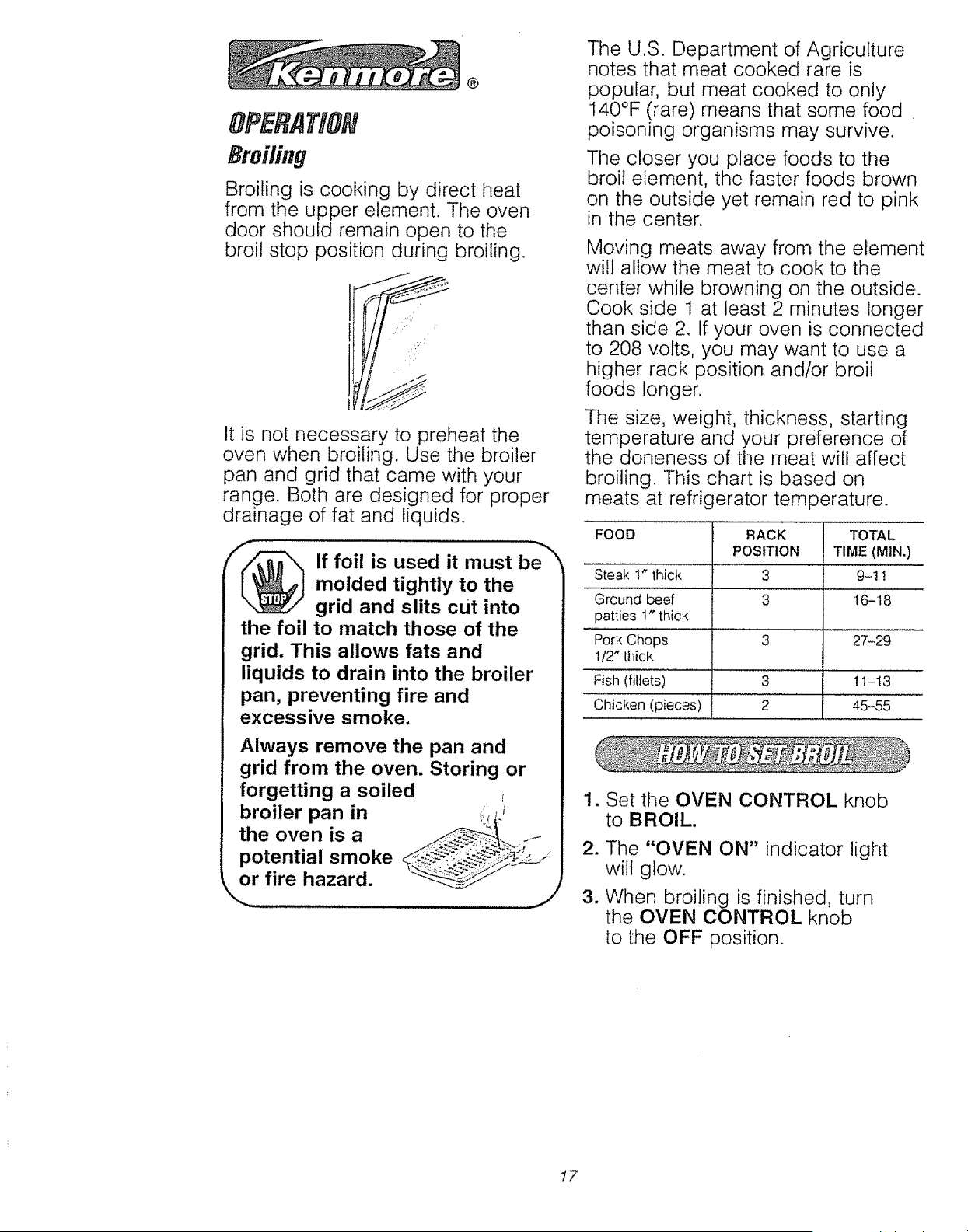
Broiling is cooking by direct heat
from the upper element. The oven
door should remain open to the
broil stop position during broiling.
It is not necessary to preheat the
oven when broiling. Use the broiler
pan and grid that came with your
range. Both are designed for proper
drainage of fat and liquids.
/_/_ If foil is used it must be_
molded tightly to the
grid and slits cut into
the foil to match those of the
grid. This allows fats and
liquids to drain into the broiler
pan, preventing fire and
excessive smoke.
Always remove the pan and
grid from the oven. Storing or
forgetting a soiled
broiler pan in ,_ i
the oven is a :':
potential smoke ....__'_':_ ....or fire hazard.
J
The U.S. Department of Agriculture
notes that meat cooked rare is
popular, but meat cooked to only
I40°F (rare) means that some food
poisoning organisms may survive.
The closer you place foods to the
broil element, the faster foods brown
on the outside yet remain red to pink
in the center.
Moving meats away from the element
will allow the meat to cook to the
center while browning on the outside.
Cook side 1 at least 2 minutes longer
than side 2. If your oven is connected
to 208 volts, you may want to use a
higher rack position and/or broil
foods longer,
The size, weight, thickness, starting
temperature and your preference of
the doneness of the meat will affect
broiling. This chart is based on
meats at refrigerator temperature.
FOOD RACK TOTAL
POSITION TIME (MIN.)
Steak 1" thick 3 9-t !
Ground beef 3 I6-18
patties 1" thick
Pork Chops 3 27-29
t/2" thick
Fish (fillets) 3 11-t3
Chicken (pieces) 2 45-55
1. Set the OVEN CONTROL knob
to BROIL.
2. The "OVEN ON" indicator light
witt glow.
3. When broiling is finished, turn
the OVEN CONTROL knob
to the OFF position.
17
® #AREAN##Z NIN8
Self-CleaningCycle
1. Remove the broiler pan and grid,
oven racks, utensils and any foi!
that may be in the oven.
2. Soil on the front frame, 1" inside
the oven, and outside the door
gasket will need to be cleaned
Front frame
L
Door gasket
Door liner
by hand.
Clean these areas with hot water,
soap-filled steel wool pads or
cleansers such as Soft Scrub _' to
remove any soil. Rinse wel! with
clean water and dry.
3. Wipe up any heavy spillovers on
the oven bottom.
4. Do not clean the door gasket.
The fiberglass material of the
oven door gasket cannot
withstand abrasion. It is essential
for the gasket to remain intact.
If you notice it becoming worn,
frayed or displaced on the door
it should be replaced,
The door gasket is designed to have
a 5-6" gap at the bottom of the door.
This allows for proper air circulation.
Door panel Gasket
Door liner
It is normal for your oven door to give
the appearance of not having a good
seal against the range. This is due to
the gasket. The location of the gasket
on the oven door maintains a good
seal and prevents any heat loss.
/_@ Utensils should never
be left in the oven
during a self-clean cycle.
The oven racks may be cleaned
during the self-clean cycle, but
will lose their luster and become
hard to slide. If you choose
to leave them in during the
cycle, wiping them down with
vegetable oil after the cycle
will help them slide easier.
For the first clean cycle, vent
the room with an opened
window or hood vent. This
will reduce the odor produced
kwhen heating new parts.
.... j_
18
1. For best results, follow the steps in
PREPARING YOUR OVEN.
2. Slide the latch handle to the right.
3. Turn the OVEN CONTROL knob
to CLEAN. The "CLEAN" and
"OVEN ON" indicator lights
will glow.
4. The handle will lock when high
temperatures are reached.
5. The clean cycle lasts 4 hours and
20 minutes. This includes cool
down time. The "OVEN ON" and
"CLEAN" indicator lights will blink
at the end of the clean cycle.
6. After the cycle is finished, turn
the OVEN CONTROL knob to the
OFF position.
7. When the temperature has cooled,
the door latch handle will easily
slide to the left.
Turn the OVEN CONTROL knob to
the OFF position. You will need to
wait for the oven temperature to drop
below the lock temperature (approx.
1 hour) before attempting to open
the door. The indicator light will not
blink if the cycle is interrupted,
After the cycle, you
may notice some
white ash in the
oven. Just wipe it
up with a damp
cloth or sponge.
If white spots remain, scrub them
with a soap-filled steel wool pad, Be
sure to rinse thoroughly. These are
usually deposits of salt that cannot
be removed during the cycle.
if for any reason you are not
satisfied with the cleaning results,
just repeat the cycle.
19

®
Glass-Ceramic Cooktop Cleaning
Cleaning a glass-ceramic cooktop is
different from cleaning a standard
porcelain cooktop. To maintain and
protect your glass-ceramic cooktop
follow these basic steps.
IMPORTANT: Using a
razor scraper will not
damage the surface if
the 30 ° angle is
maintained. Do not use a dull
or nicked razor blade on your
cooktop. Store the razor scraper
\out of reach of children.
Use only Cooktop Cleaning Creme e
on glass-ceramic.
For normal, light soil:
1. Using a damp paper towel, rub a
few drops of creme onto soiled
area. Wipe until all soil and creme
are removed.
2. Clean surface with creme after
each cooktop use. Frequent
cleaning is essential in preventing
scratches and abrasions.
For heavy, burned-on soil:
1. Apply a few drops of creme to
the cool, soiled area.
2. Using a damp paper towel, rub
creme into the burned-on area.
3. Holding a razor scraper at a 30 °
angle against the glass-ceramic
surface, carefully scrape
remaining soil.
Sugar spills (such as jellies, fudge
and candy syrups) or melted plastic
can cause pitting of the cooktop
surface unless the spill is removed
while it is still hot. Special care .
should be taken when removing hot
substances.
Follow these instructions carefully
and remove soil while spill is hot.
1. Turn off the cooking zone affected
by the spill. Remove the utensils.
2_
Wearing an oven mitt, hold the razor
scraper at a 30 ° angle against the
cooktop and scrape hot spill to a
cool area outside the cooking zone.
=
With spill in a cool area, use a dry
paper towel to remove any spillover.
Any spill remaining should be left
until the surface of the cooktop
has cooled. Do not continue to
use the soiled cooking zone unti!
all of the spill has been removed.
Follow the steps under Heavy Soil
to continue the cleaning process,
30 ° angle
4. If any soil remains, repeat the
steps listed above. For additional
protection after soil has been
removed, polish the entire surface
with creme.
20
As the creme cleans, it leaves a
protective coating that helps prevent
buildup of mineral deposits (water
spots) and wilt make future cleaning
easier. Dishwashing detergent removes
the protective coating and should not
be used.
o VVater stains (mineral deposits) are
removable using the creme or full
strength white vinegar.
,, Do not use a dull or nicked razor
blade on your cooktop.
o Do not use abrasive cleaners or
abrasive scouring pads on your
cooktop.
o Plastic mesh pads, such as Dobie ®
may be used.
To order additional Cooktop Cleaning
Creme e, call your nearest Sears
Service Center or Retail Store, ask
for (Stock No. 40079).
o Most cleaners contain ammonia,
chemicals and abrasives that damage
the surface of your cooktop. Use
only the Cooktop Cleaning Creme ®
for proper cleaning and protection
of your glass-ceramic surface.
o If you slide aluminum or copper
bottom cookware across the surface
of the cooktop, they may leave metal
markings which appear as scratches.
Use the razor scraper and cooktop
creme to remove these marks. Failure
to remove this residue immediately
may leave permanent marks.
o If pots with a thin overlay of
aluminum, copper or enamel boil
dry, bonding with the glass-ceramic
surface of the cooktop may occur.
This black discoloration should be
removed immediately or it could
become permanent.
o Use of glass cleaner may leave
an iridescent film on the cooktop.
cleaning creme will remove this film.
CLEANING MATERIALS
,, Dishwashing detergent
°Warm water
o Soft cloth
Do not use abrasive cleaners,
industrial cleaners or bleach.
CLEANING MATERIALS
• Dishwashing detergent
o Warm water
o Soap-filled scouring pad
o Commercial oven cleaner
TO CLEAN
Allow the pan to soak. Sprinkle the
grid with dishwashing detergent and
cover with a damp cloth or paper
towel. Rinse and dry well. Scour as
needed. You may also place both
the pan and grid in the dishwasher.
21
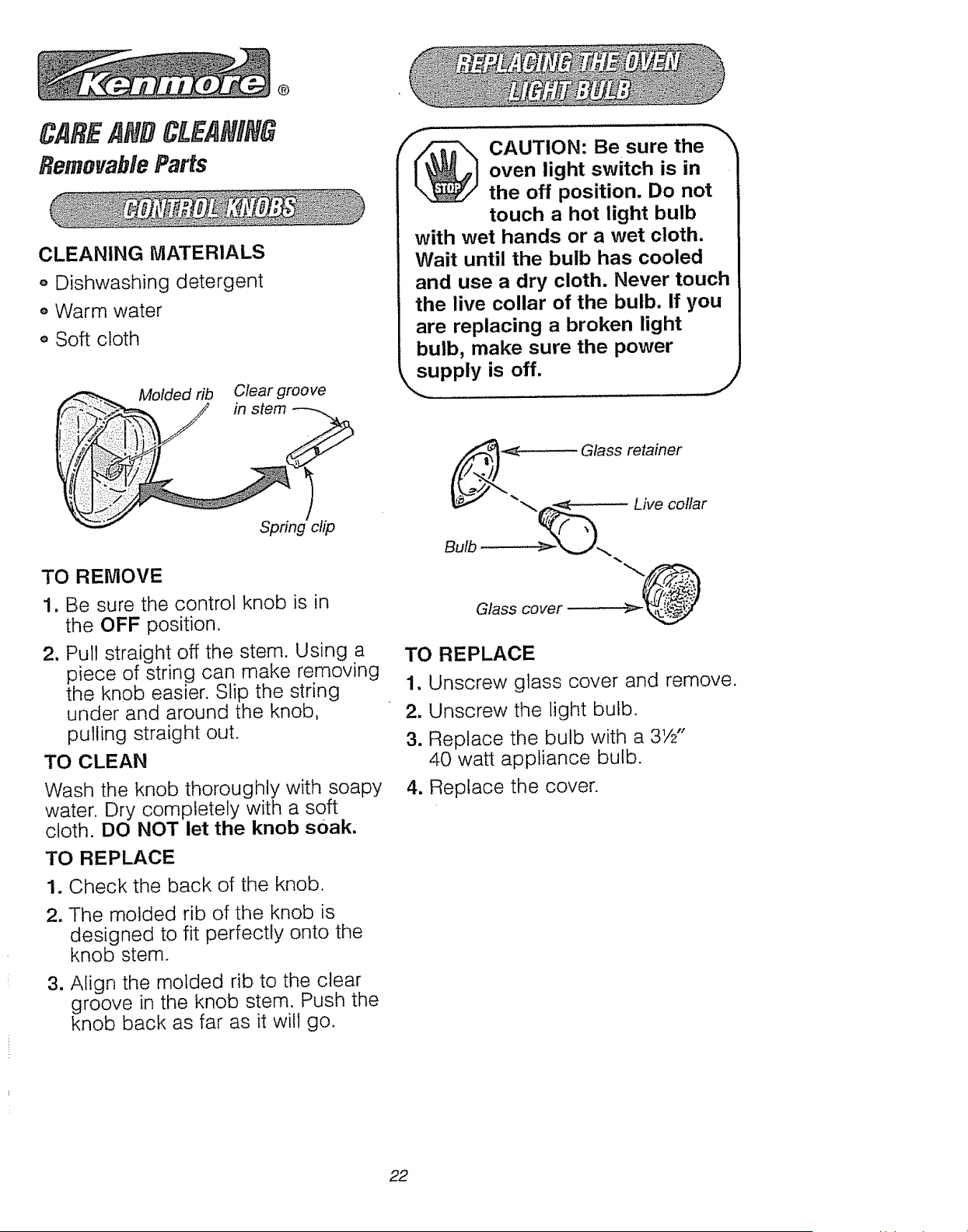
CLEANING MATERIALS
o Dishwashing detergent
o 'Warm water
o Soft cloth
Molded rib Clear groove
in stem
if(_ CAUTION: Be sure the -'_
oven light switch is in
the off position. Do not
touch a hot light bulb
with wet hands or a wet cloth.
Wait until the bulb has cooled
and use a dry cloth. Never touch
the live collar of the bulb. If you
are replacing a broken light
bulb, make sure the power
supply is off.
,, , Glass retainer
Sprin_:_
TO REMOVE
1. Be sure the control knob is in
the OFF position.
2. Pull straight off the stem. Using a
piece of string can make removing
the knob easier. Slip the string
under and around the knob,
pulling straight out.
TO CLEAN
Wash the knob thoroughly with soapy
water. Dry completely with a soft
cloth. DO NOT let the knob soak.
TO REPLACE
1. Check the back of the knob.
2. The molded rib of the knob is
designed to fit perfectly onto the
knob stem.
3. Align the molded rib to the clear
groove in the knob stem. Push the
knob back as far as it will go.
Bulb ..............._L
Live collar
Glass cover
TO REPLACE
1. Unscrew glass cover and remove.
2. Unscrew the light bulb.
3. Replace the bulb with a 3W"
40 watt appliance bulb.
4. Replace the cover.
22
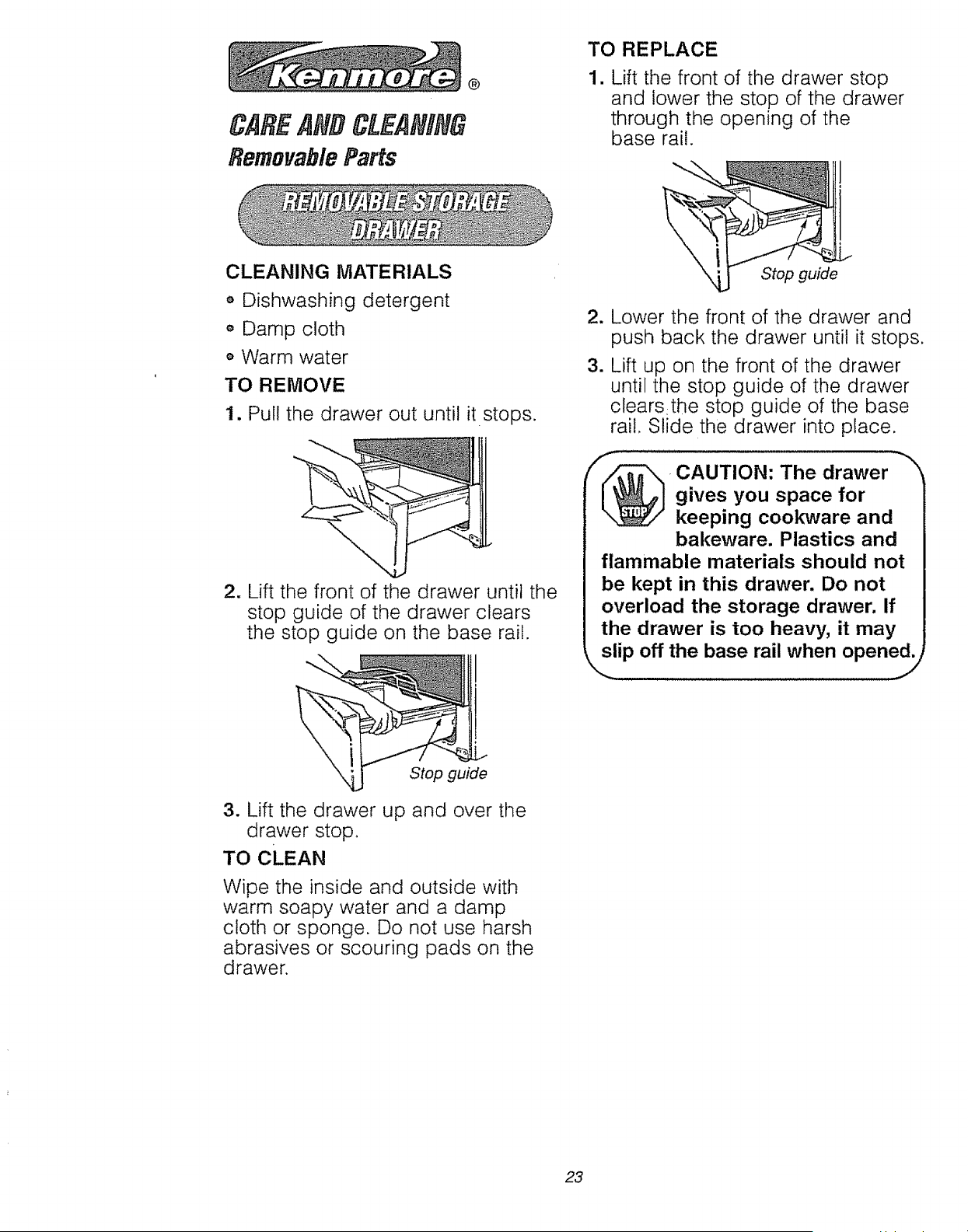
TO REPLACE
1. Lift the front of the drawer stop
and lower the stop of the drawer
through the opening of the
base rail.
CLEANING MATERIALS
o Dishwashing detergent
o Damp cloth
o Warm water
TO REMOVE
1. Pull the drawer out until itstops.
2. Lift the front of the drawer until the
stop guide of the drawer clears
the stop guide on the base rail.
i
Stop guide
2. Lower the front of the drawer and
push back the drawer until it stops.
3. Lift up on the front of the drawer
until the stop guide of the drawer
clears:the stop guide of the base
rail, Slide the drawer into place.
/__@ CAUTION: The drawer "X
gives you space for
keeping cookware and
bakeware. Plastics and
flammable materials should not
be kept in this drawer. Do not
overload the storage drawer. If
the drawer is too heavy, it may
slip off the base rail when opened.,
J
Stop guide
3. Lift the drawer up and over the
drawer stop.
TO CLEAN
Wipe the inside and outside with
warm soapy water and a damp
cloth or sponge. Do not use harsh
abrasives or scouring pads on the
drawer.
23

CLEANING MATERIALS
o Dishwashing detergent
o Warm water
o Scouring pad or soap-filled steel
wool pad
Bump in
rack guide
Raised back
of the rack....._
TO REMOVE
1. Pull the racks out to the stop lock
position.
2. Pull up the front of the rack and
slide under the bump of the
rack guide.
TO CLEAN
Clean with warm water and detergent.
For hard to remove stains, gently
scrub with a scouring pad or a
soap-filled steel wool pad. Rinse well.
TO REPLACE
1. Place the raised back of the rack
onto the rack guides.
2. Lift the front of the rack until the
raised back slides under the
bump of the rack guides.
3. Slide the rack all the way back.
Broil stop position
TO REMOVE
1. Open the door to the broil stop
position.
2. Grasp the door at each side and
lift up and off the hinges, DO NOT
LIFT DOOR BY THE HANDLE.
f(_ CAUTION: When the _"_
door is removed and the
hinge arms are at the
broil stop position, as
a precaution, cover the hinge
arms with toweling or an empty
paper towel roll. Do not bump
or try to move the hinge arms
while working in the oven area.
They could snap back causing
injury to the hands or damage
the porcelain finish of the
k,_.ont frame.
J
TO REPLACE
=
2_
3.
4_
Make sure the hinge arms are
inthe broil stop position,
Lift the door by the sides.
Line up the slots at the bottom
edge of the door with the
hinge arms.
Slide the door down onto the
hinge arms as far as it will go.
5, Close the door.
24
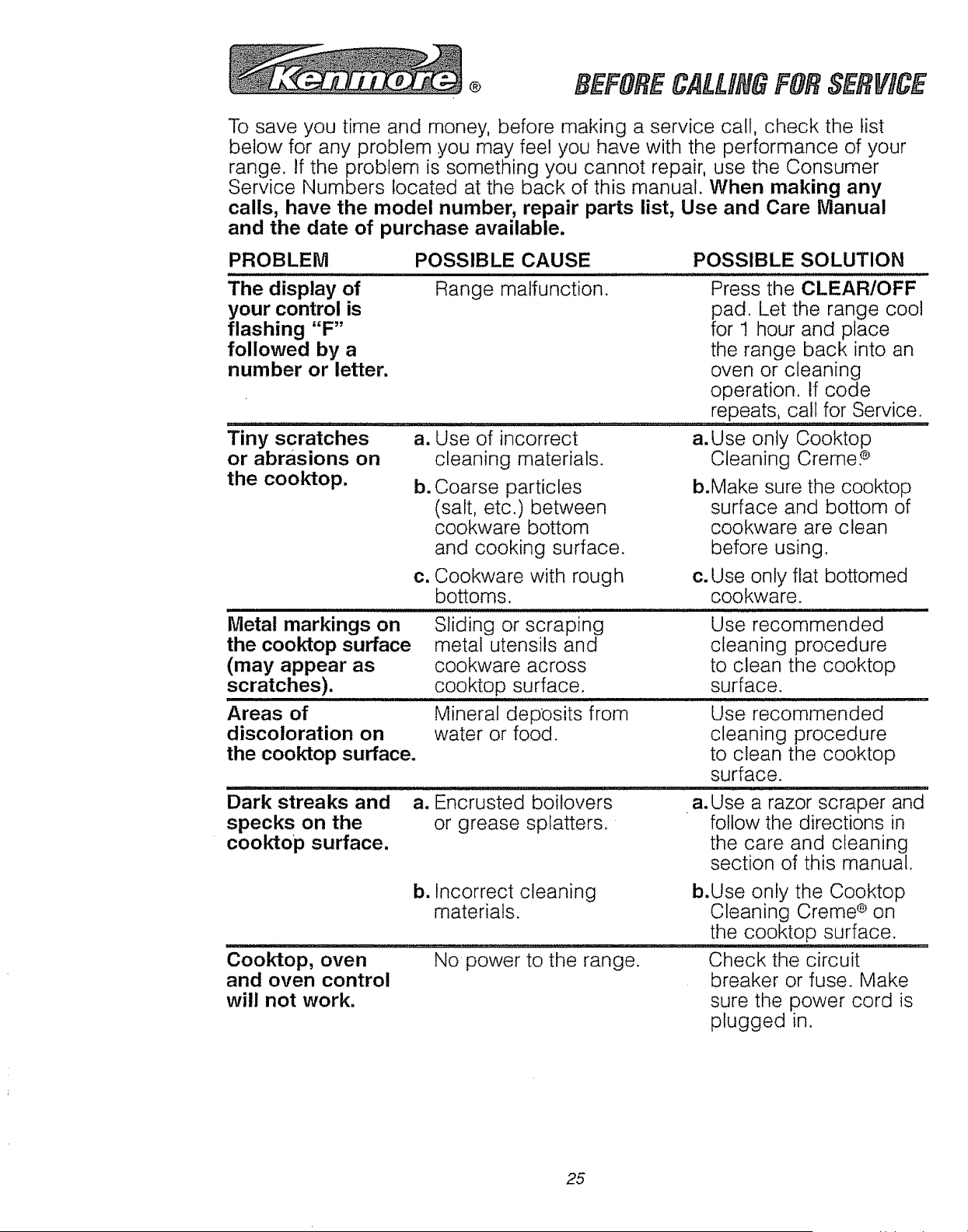
To save you time and money, before making a service call, check the list
below for any problem you may feel you have with the performance of your
range. If the problem is something you cannot repair, use the Consumer
Service Numbers located at the back of this manual. When making any
calls, have the model number, repair parts list, Use and Care Manual
and the date of purchase available.
PROBLEM
The display of
your control is
flashing "F"
followed by a
number or letter.
POSSIBLE CAUSE POSSIBLE SOLUTION
Range malfunction. Press the CLEAR/OFF
pad. Let the range cool
for 1 hour and place
the range back into an
oven or cleaning
operation. If code
repeats, call for Service.
Tiny scratches
or abrasions on
the cooktop.
a. Use of incorrect a.Use only Cooktop
cleaning materials. Cleaning Creme, _
b. Coarse particles b.Make sure the cooktop
C=
(salt, etc.) between
cookware bottom
and cooking surface.
Cookware with rough
bottoms.
Co
surface and bottom of
cookware are clean
before using.
Use only flat bottomed
cookware.
Metal markings on
the cooktop surface
(may appear as
scratches).
Areas of
discoloration on
the cooktop surface.
Sliding or scraping
metal utensils and
cookware across
cooktop surface.
Mineral deposits from
water or food.
Use recommended
cleaning procedure
to clean the cooktop
surface.
Use recommended
cleaning procedure
to clean the cooktop
surface.
Dark streaks and
specks on the
cooktop surface.
a. Encrusted boilovers
or grease splatters,
a.Use a razor scraper and
follow the directions in
the care and cleaning
section of this manual.
b. Incorrect cleaning b.Use only the Cooktop
materials. Cleaning Creme ® on
the cooktop surface.
Cooktop, oven No power to the range. Check the circuit
and oven control breaker or fuse. Make
will not work. sure the power cord is
plugged in.
25
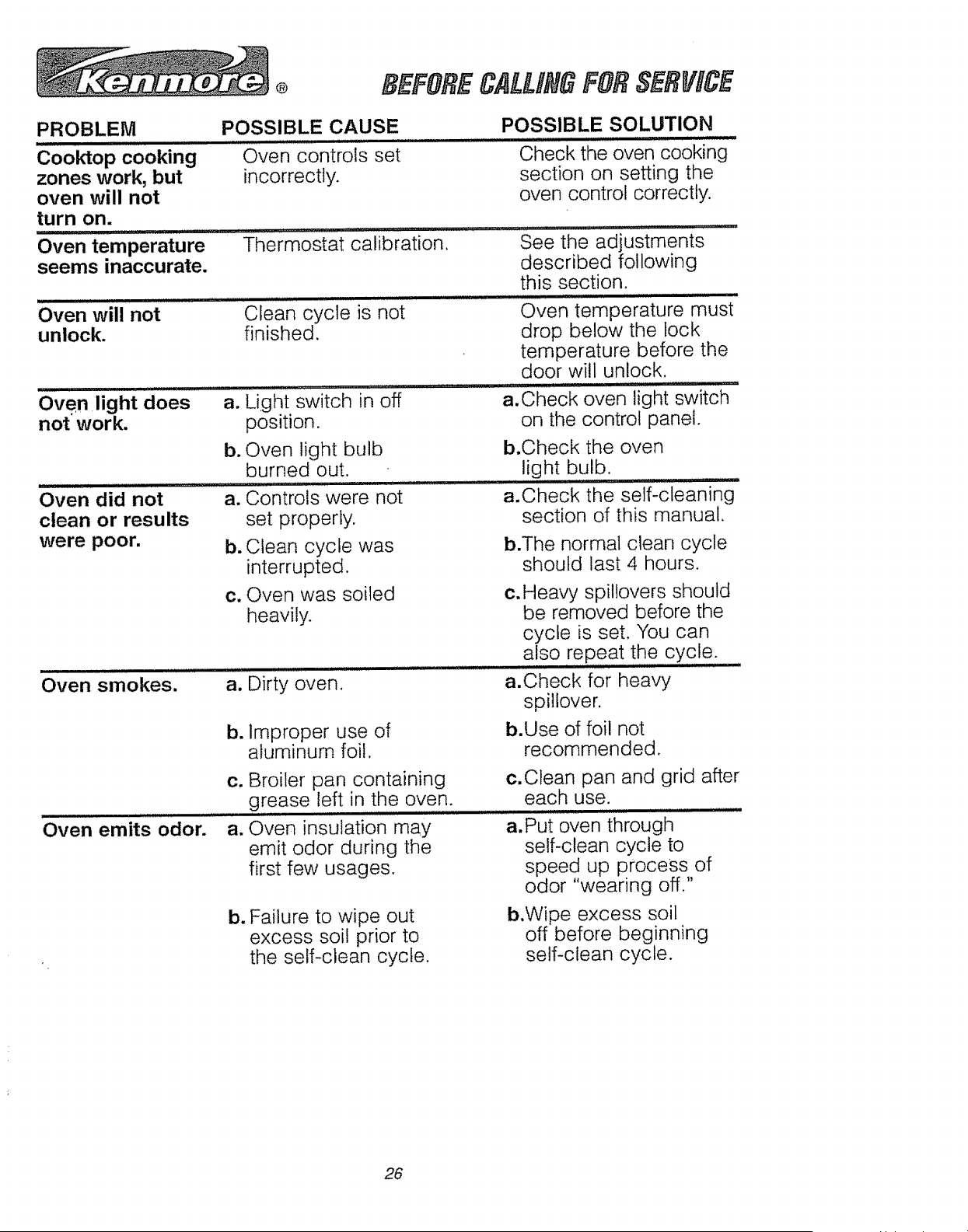
PROBLEM POSSIBLE CAUSE
Oven controls set
incorrectly.zones work, but
oven will not
turn on.
'Oven temperature Thermostat calibration. See the adjustments
seems inaccurate, described following
Oven will not Clean cycle is not
unlock, finished.
OVen ................
.. light does
not work.
POSSIBLE SOLUTION
cookingCheck the oven
section on setting the
oven control correctly.
a. Light swiiCh in off
position.
this section.
Oven temperature must
drop below the lock
temperature before the
door will unlock.
a,Check oven light switch
on the control panel.
Oven did not
clean or results
were poor.
b, Oven light bulb
burned out.
. ,,, , ,,,,,,,,,,,,,,,,,',,,, i,,mnlU. , i i i, /i,/ , i ...... ll,,......
a. Controls were not
set properly.
b. Clean cycle was
interrupted.
c, Oven was soiled
heavily.
'Oven smokes".'" a. Dirty Ovenl
b,Check the oven
light bulb.
a,Check the self-cleaning
section of this manual.
b,The normal clean cycle
should last 4 hours.
c, Heavy spillovers should
be removed before the
cycle is set. You can
also repeat the cycle.
...... a'Check for heavy .......................
spillover.
b. Improper use of
aluminum foil.
b.Use of foil not
recommended.
Ca
"oven emits''""odor.'" a.
Broiler pan containing
grease left in the oven.
Oven insulation may
emit odor during the
first few usages.
c.Clean pan and grid after
each use.
I III iiiii ...........iiiiiiiit :_
a.Put oven through
se_f-c/ean cycle to
speed up proceSs of
odor "wearing off."
b, Failure to wipe out
excess soil prior to
the self-clean cycle.
b,Wipe excess soil
off before beginning
self-clean cycle.
26
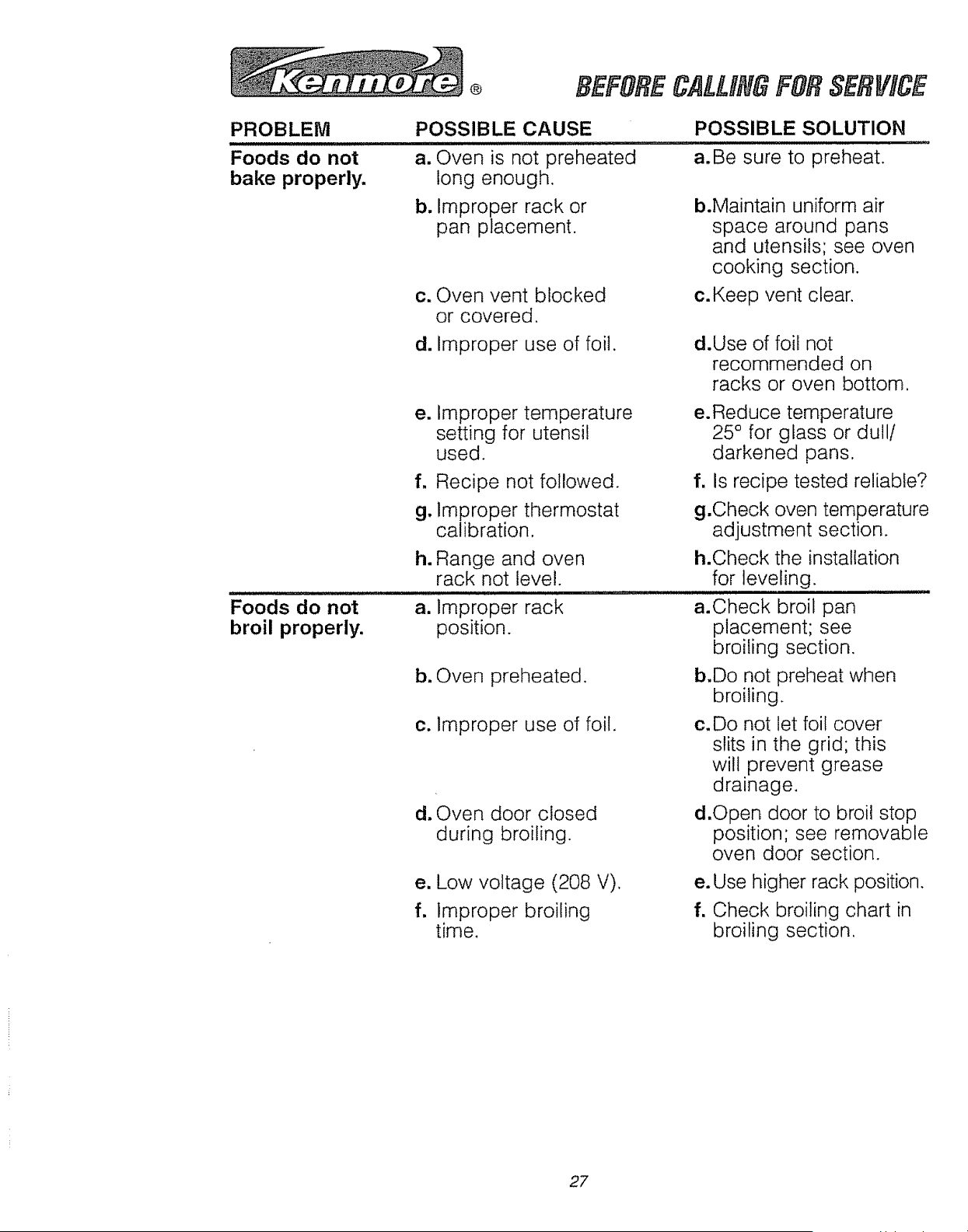
PROBLEM
Foods do not
bake properly.
POSSIBLE CAUSE
a. Oven is not preheated
long enough.
b. Improper rack or
pan placement.
POSSIBLE SOLUTION
a.Be sure to preheat.
b.Maintain uniform air
space around pans
c. Oven vent blocked
or covered.
and utensils; see oven
cooking section.
c.Keep vent clear.
d. improper use of foil.
d.Use of foil not
recommended on
racks or oven bottom,
e=
Improper temperature
setting for utensil
used.
f. Recipe not followed.
g. improper thermostat
calibration,
h.
Range and oven
rack not level.
e. Reduce temperature
25 ° for glass or dull/
darkened pans,
f. Is recipe tested reliable?
g.Check oven temperature
adjustment section.
h.Check the installation
for leveling.
Foods do not
broil properly.
a.
improper rack
position.
a.Check broil pan
placement; see
broiling section.
b. Oven preheated.
b.Do not preheat when
broiling.
c. Improper use of foil.
c.Do not let foil cover
slits in the grid; this
wilt prevent grease
drainage.
d. Oven door closed
during broiling.
d.Open door to broil stop
position; see removable
oven door section.
e. Low voltage (208 V),
f. Improper broiling
time.
e.Use higher rack position.
f. Check broiling chart in
broiling section,
27
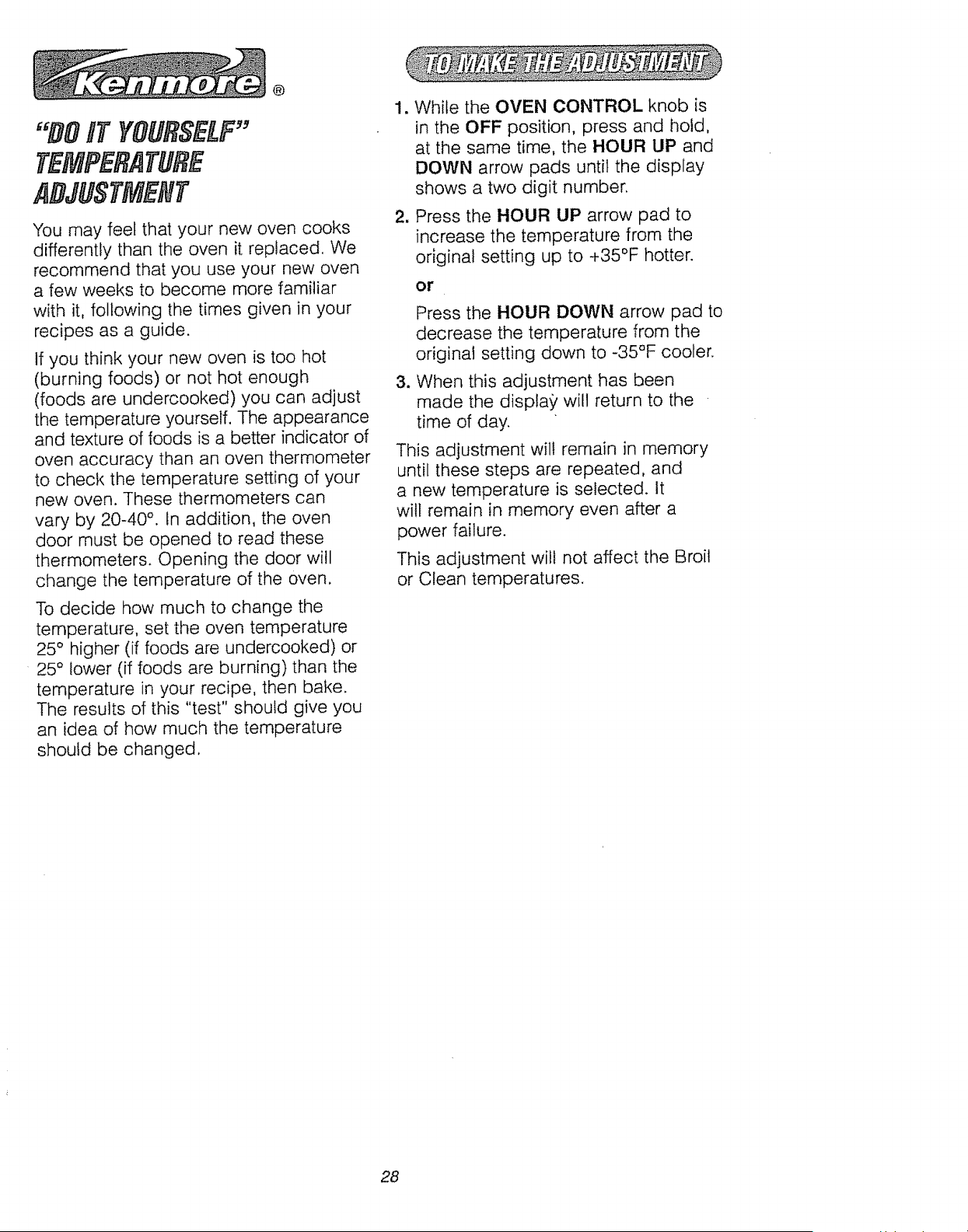
®
"BOIT YOURSELF"
TEMFERATURE
ADJUSTMENT
You may feet that your new oven cooks
differently than the oven it replaced. We
recommend that you use your new oven
a few weeks to become more familiar
with it, following the times given in your
recipes as a guide.
If you think your new oven is too hot
(burning foods) or not hot enough
(foods are undercooked) you can adjust
the temperature yourself. The appearance
and texture of foods is a better indicator of
oven accuracy than an oven thermometer
to check the temperature setting of your
new oven. These thermometers can
vary by 20-40 °. fn addition, the oven
door must be opened to read these
thermometers. Opening the door will
change the temperature of the oven.
To decide how much to change the
temperature, set the oven temperature
25 ° higher (if foods are undercooked) or
25 ° lower (if foods are burning) than the
temperature in your recipe, then bake.
The results of this "test" should give you
an idea of how much the temperature
should be changed.
lm
,
While the OVEN CONTROL knob is
in the OFF position, press and hold,
at the same time, the HOUR UP and
DOWN arrow pads until the display
shows a two digit number.
Press the HOUR UP arrow pad to
increase the temperature from the
original setting up to +35°F hotter.
or
Press the HOUR DOWN arrow pad to
decrease the temperature from the
original setting down to -35°F cooler.
3. When this adjustment has been
made the display will return to the
time of day.
This adjustment will remain in memory
until these steps are repeated, and
a new temperature is selected, it
will remain in memory even after a
power failure.
This adjustment will not affect the Broil
or Clean temperatures.
28
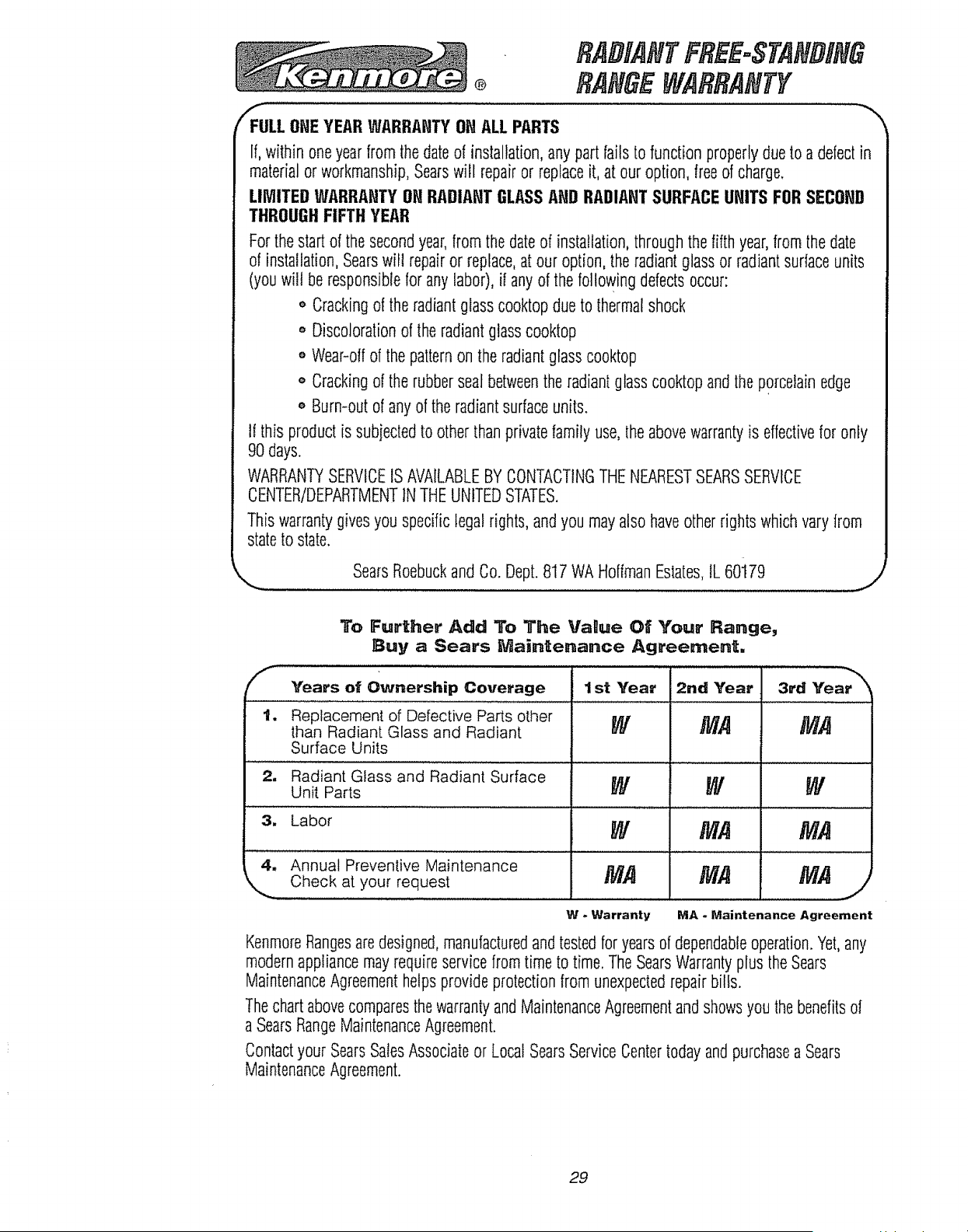
RAD#JNTFREEoSTANDIHG
® RANGEWARRANTY
.LLo.EYEA.WARRA..O.ALLPARTS
If,within oneyearfromthedateof installation,anypart failstofunction properlydueto a defectin
materialor workmanship,Searswill repairor replaceit, at our option, freeof charge,
LIMITED WARRANTYONRADIANTGLASSANDRADIANTSURFACEUNITS FORSECOND
THROUGHFIFTH YEAR
Forthe startof thesecondyear,from thedateof installation,throughthe fifth year,fromthedate
of installation,Searswill repairor replace,at our option,theradiantglassor radiantsurlaceunits
(youwill beresponsiblefor anylabor), il anyof the followingdefectsoccur:
o Crackingof theradiantglasscooktopdue to thermalshock
o Discolorationof theradiantglasscooktop
o Wear-offof thepatternonthe radiantglasscooktop
o Crackingd therubbersealbetweentheradiantglasscooktopand theporcelainedge
e Burn-outof anyof the radiantsurfaceunits.
if this productis subjectedto otherthanprivatefamily use,theabovewarrantyis effectivefor only
90 days.
WARRANTYSERVICEIS AVAILABLEBY CONTACTINGTHENEARESTSEARSSERVICE
CENTER/DEPARTMENTtN THEUNITEDSTATES.
Thiswarrantygivesyou specificlegalrights,and you mayalso haveotherrights whichvaryfrom
stateto state.
SearsRoebuckandCo. Dept.817 WAHoffmanEstates,IL 60179
',,.._
To Further Add To The Vague Of Your Range,
Buy a Sears Maintenance Agreement.
f Years of Ownership Coverage I st Year
....::.
1. Replacement of Defective Parts other
than Radiant Glass and Radiant _/_ J'_'A _/_A
Surface Units
2. Radiant Glass and Radiant Surface
Unit Parts _r W _V
3. Labor _r _/_.4 _i_A
....,,,,,, ,,, , ,, ,, .:. ,.,, ,:..
4. Annual Preventive Maintenance
request _/'_.,4j
Check at Your _VJ_ /_/_'.,_
W - Warranty MA - Maintenance Agreement
KenmoreRangesaredesigned,manufacturedandtestedfor yearsof dependableoperation.Yet,any
modernappliancemayrequireservicefromtimeto time.TheSearsWarrantyplus theSears
MaintenanceAgreementhelpsprovideprotectionfrom unexpectedrepair bills.
Thechartabovecomparesthe warrantyand MaintenanceAgreementandshowsyouthebenefitsol
a SearsRangeMaintenanceAgreement.
Contactyour SearsSalesAssociateor LocaiSearsServiceCentertodayand purchasea Sears
MaintenanceAgreement.
29

For the repah" or replacement parts you need
Call 7 am-7 pro, 7 days a week
1__800=366-PAIRT
(i-800-366-7278)
For m-home major brand repa_ service
Call 24 hours a day, 7 days a week
I =800=4_MY_HOME s"
(I-800-469-4663)
For the location of a
Sears Parts and Service Center
in your area
Call 24 hours a day, 7 days a week
U_800-488_ B222
For more hfformafion on purchasing a
Sears Maintenance Agreement
or to inqu_e about an exiting Agreement
Call 9 am-5 pro, [Monday-Saturday
The Service Side of Sears."
3O
MANUAL DEL CO1RSUMmDOR
®
ESTUFA nRRADIANTE
ELECTRICA D_ 30" TIPO
"HNDEPENDIEIRTE" @OH
AUTO MPIEZA
MODELO HO,
911. 95281
9tt°95288
PRECAUCION:
Antes de usar esta
estufa, _ea este _anual
y siga todas llas Reggas
de Segur_dad y lias
Bnstrucc_ones para su
funcionam_ento=
o instrucciones, de
Segur_dad
Cu_dado y L_p_e_a
Cbmo Rese_ve_
ProDllernas
229C4020P1 _0 (SR- 10398)
lndice
® ESTUFAIRP DIANTEELECTRICA
TIPO"INDEPENDIENTE"
Seguridad en el uso de
la estufa ................ 3-6
Dispositivo de estabilidad .... 3
C0mo proteger su nueva
cubierta para cocinar ........ 7
C6mo sacar la cinta de
empaque ................. 7
Caracteristicas de la estufa ... 8
Zonas para cocinar ......... 9
Utensilios para cocinar ....... 9
C6mo revisar los utensilios .... 9
Eficiencia de los utensifios .... 9
Espirales radiantes ......... 10
Ciclo de ta unidad radiante .. 10
C6mo programar los controles 10
COmo hacer conservas en casa 10
Reloj, CronOmetro y control
del homo ................ 11
Botones con flechas
horas!Minutos ............. 1I
Dial .................... 11
Luces indicadoras ......... 11
C6mo poner el dial en blanco II
C6digo F ................ 11
Encendido ............... 11
Apagado automb.ticodel horno 11
C6mo poner el re!oj ........ 12
C6mo programar el cronometro 12
COmo reprogramar elcronOmetro12
Para cancetar el cron6metro,. 12
Cosejos para cocinar en
el homo .............. 13-15
Control del homo .......... 15
C6mo hornear ............ 16
COmo asar a la parritla ...... 17
Ciclo de Autolimpieza .... 18, 19
Limpieza de superficie
de vidrio-cera_mica ...... 20, 2!
Panel de control ........... 21
Cacerola y parrilla para asar . 21
Periltas de control ......... 22
Foco de la luz del homo ..... 22
Caj6n de almacenamiento . .. 23
Parriltas de homo .......... 24
Puerta del homo ........... 24
Antes de ltamar para un
servicio ............... 25-27
Ajustes de temperatura ..... 28
Garantia ............. .... 39
N0meros para seP,/icios del
consumidor ............... 30
Para su conveniencia y referencia futura, per favor escriba el mimero
de modelo y de serie en el espacio que se le provee. Est_n ubicados
detr_s del caj6n de almacenamiento.
NUMERO DE MODELO:
NUMERO DE SERIE:
2
®
UMPO#TA#TE$
GUARDEESTA$liHSTRUCCIO E$
Lea todas las instrucciones antes de usar este aparato. Cuando use
aparatos a gas o el_ctricos, se deberian seguir precauciones
de seguridad, incluyendo Io siguiente:
Orilla exterior de la
o Todas las estufas se
pueden votcar
o Personas podrian
resultar heridas
Instate el dispositivo
contra votcaduras
empacado con ta
estufa
Yea las instrucciones
Gabinete
advacente o
localizacion .
final del
costado
dela
abrazadera debe
estar en linea con el
lado izquierdo o
derecho de la estufa
Pared
i,:;::i¸
Herramientas que necesitar_:
o Destornillador de cabeza Phillips
o Llave ajustable o abierta de 1V8"
1. Saque la abrazadera dei preempacado
ubicado dentro del horno.
2. Decida si la abrazadera ser,_ instalada
en el lado derecho o izquierdo de la
ubicaci6n de la estufa.
3. Si el lado de la abrazadera de fa
estufa es adyacente al gabinete,
coloque la abrazadera contra la
pared de atra.s y et gabinete como
se muestra en la Fig. 1.
Si no hay un gabinete adyacente,
determine cu,:fi.lser_ la ubicacion del
panel de ta estufa pintado. Coloque la
abrazadera con su oritla exterior en
este lugar y contra ta pared de atr&s.
Vea la Fig. 2.
4. Determine siva a anclar la abrazadera
al piso o a la pared. AsegQrese que
esta ubicaciOn est6 libre de alambres
electricos o plomeria,
5_
3
la estufa
Fig. 1
Pegue la abrazadera firmemente con
los tornilfos que se proveen. Los
tornillos son para madera, madera
terciada, tablas de particulas y
fragmentos, y la mayoria de marcos
de metal. Si va a anclar a cemento,
usted puede comprar tornillos y
ancfas adecuadas en las ferreterias.
Use barrenos para cemento para
hacer los hoyos requeridos.
Ab za e li LOaso e,
\ pared
Fig. 2 Pegaduras a ta pared
6_
1
Usando una ltave inglesa, saque las
cuatro paras niveladoras por Io menos
dos vueltas. Vea su guia de
instalaciOn para mas informaciOn para
fa nivelaci6n antes de poner ia estufa
en posici6n.
Deslice y coloque la estufa en posiciOn.
AsegOrese que el nivelador de ta pata
trasera agarra completamente la ranura
en la abrazadera. Si la estufa no se
puede mover suficientemente hacia atr,_s
para que el nivelador de la pata entre
en la abrazadera, mueva la abrazadera
hacia adelante como se requiera y
a.nclela al piso en un lugar diferente.
®
/__@ iADVERTENCIA! Para _'_
prevenir que la estufa se
vuelque accidentalmente
debido a un uso anormal,
incluyendo una carga e×cesiva sobre
ia puerta, enganche la estufa a la
pared o al suelo instalando el
dispositivo contra volcaduras que se
provee. Si la estufa se mueve para
limpiarla, para hacerle ser¢icio o
cualquier razbn, aseg_3rese que el
dispositivo contra volcaduras sea
enganchado nuevamente cuando la
estufa se coloque de vuelta en la
abertura. No hacerlo podr{a resultar en
que la estufa se vuelque o en heridas
personales. Para inspeccionar el
dispositivo contra volcaduras, saque
el panel frontal y mire para asegurarse
que el nivelador de la pata trasero
est_ bien enganchado en la ranura
k._e la abrazadera.
IMPORTANTE: Para garantizar su
seguridad, la de su familia y la de su
hogar, por favor lea su Manual del
Consumidor cuidadosamente. Mantengalo
a la mano para referencias. Ponga mucha
atenci6n alas secciones de seguridad.
ASEGURESE que su estufa sea instalada
por un t6cnico especiatizado y que haga
tierra adecuadamente.
o NO DEJE a los nitros sin vigilancia cerca
de una estufa que se est6 usando.
o ENSEi_IE A LOS NII_OS a no jugar con
los controles o cualquier parte de la
estufa y no sentarse, subirse o pararse
sobre la puerta de este aparato o de
cuafquier otra parte de la estufa.
4
o PRECAUClON: NUNCA GUARDE
articulos que sean de interes para los
ni_os en el panel trasero o en los
gabinetes sobre la estufa. Los ni¢_os
que se suban sobre la estufa podrian
resuttar gravemente heridos.
o GUARDE ESTE fibro para un uso futuro.
o NUNCA USE su estufa para entibiar o
calentar una habitaci6n.
o NUNCA TRATE de reparar o reemptazar
una parte de la estufa a menos que las
instrucciones se den en este manual.
Todo otro trabajo deberia ser hecho
por un t6cnico especializado.
° SlEMPRE MANTENGA los revestimientos
combustibles de las paredes, cortinas
y otros paros a una distancia prudente
de la estufa.
o NUNCA CALIENTE contenedores de
alimentos cerrados. El aumento de la
presiOn podria causar que el contenedor
explote y cause heridas.
,, NUNOA deje frascos o latas de grasa
o goteaduras sobre o cerca de la estufa.
° SiEMPRE MANTENGA el _.rea de la
estufa despejada de cosas que se
podrian quemar. La acumulacion de
comida y grasa y los utensilios de
madera se podrian incendiar. Los
utensitios de plAstico se podrian
derretir y las comidas en conservas
podrian exptotar. Su homo nunca se
deberia usar para almacenar cosas.
o SIEMPRE MANTENGA la estufa
despejada de cosas que se podrian
quemar (gasolina y otros vapores o
tiquidos infiamables).
o NUNCA trate de limpiar las superficies
calientes. Algunos limpiadores
producen vapores nocivos y los pa_os
y las esponjas mojadas podr{an causar
quemaduras por vapor.
• NUNCA USE ropa suelta cuando use
la estufa.
NUNCA USE una toalla u otro pa¢_o
abultado como agarradera y aseg0rese
que ta agarradera este seca. Las
agarraderas h0medas, y los pa_os y
esponjas mojadas podrian causar
quemaduras por vapor. NO PERMITA
que las agarraderas toquen las zonas
para cocinar calientes.
®
IMPOR $
o NO TOQUE las zonas para catentar,
las superficies cerca de elias o las
superficies interiores del horno. Estas
podrian estar suficientemente calientes
para quemar aunque se vean de color
oscuro. Durante y despu6s del uso, no
toque o permita que la ropa o materiales
inflamables hagan contacto con las
zonas o superficies calientes hasta que
hayan tenido tiempo de enfriarse. Las
.otras superficies cerca de las ventanillas
de ventilaci6n del horno, puertas,
ventanas y las superficies para cocinar
tambien poddan estar Suficientemente
calientes para causar quemaduras.
o SOLO PUEDEN USARSE ClERTAS
ctases de utensilios de vidrio (refractario)
o cer,_mica para cocinar sobre la
cubierta. AsegOrese de que los utensilios
de cocinar que seleccione esten
dise5ados para cocinar directamente
sobre la cubierta sin quebrarse debido
a los sObitos cambios de temperatura.
o SIEMPRE TENGA cuidado cuando
toque los elementos de la cubierta.
Retendrb.n calor despues de que la
estufa se haya apagado.
o NUNCA OBSTRUYA la ventilaci6n del
homo bajo e! elemento derecho de atr&s.
o SlEMPRE USE los recipientes para
derrames para evitar dar_os a los
alambrados y a los componentes.
No use forros de aluminio o de papel
de aluminio sobre los recipientes,
El uso inadecuado de _stos podria
resultar en un riesgo de golpe de
corriente o incendio.
NUNCA DEJE las unidades de superficie
sin vigitancia a temperaturas altas. Los
derrames poddan resultar en humo o
en derrames de grasa que se poddan
incendiar.
o NUNCA COClNE sobre una cubierta
quebrada. Las soIuciones para la
limpieza y los derrames podrian
penetrarla y crear el riesgo de un
gotpe de corriente o un incendio,
o SIEMPRE COLOQUE las agarraderas
(maniilas) de las oltas hacia adentro
y lejos de las otras unidades de la
superficie para reducir el riesgo de
quemaduras, encendido, un contacto
y derrame accidental.
° COLOQUE LAS PARRILLAS DEL
HORNO en la posicion deseada
mientras et homo este frio. Si las
parriltas se deben mover mientras el
homo esta caliente, no permita que la
agarradera haga contacto con el
quemador caliente del homo.
o DESPUES DE ASAR A LA PARRILLA,
siempre saque la cacerola y la parrilla
para asardel homo y limpietas. Los
sobrados de grasa en la cacerota para
asar podrian incendiarse la proxima
vez que usted use el horno.
° SIEMPRE TENGA cuidado cuando
abra la puerta del horno. Deje que el
aire caliente y el vapor escapen antes
de mover los alimentos.
NUNCA UTILiCE papel de aluminio
para cubrir el fondo del homo. El uso
incorrecto del papel de aluminio podria
resultar en el riesgo de un golpe de
corriente e incendio,
5
®
o Li[VIPIE SOLAMENTE las partes que
se listan en este manual. Siga todas
las instrucciones para la limpieza.
AsegOrese de sacar la cacerola y la
parrilla para asar antes del ciclo de
autolimpieza.
o NUNCA FRIEGUE, mueva, o da¢le el
sello de la puerta en las estufas con
autotimpieza.
o NUNCA TRATE de timpiar los
utensitios, ollas, partes removibfes o
la cacerola y la parrilta para asar en
el cicto de autolimpieza.
o NO USE limpiadores para hornos--
No se deberia usar ninguna clase
de limpiador para hornos o cremas
protectoras dentro o alrededor de
cualquier parte del horno.
o NUNOA FUERCE fa manilla del cerrojo
a la posiciOn de abierto mientras el
homo estb. catiente.
iADVERTENClA DE SEGURIDAD
IMPORTANTE!
California Safe Drinking Water and
Toxic Enforcement Act requiere que el
gobernador de California publique una
iista de substancias que el estado sepa
que producen defectos de nacimiento
u otros da_os reproductivos y requiere
que los hombres de negocios adviertan
a sus clientes del contacto potencial a
tales substancias. El aislante de fibra
de vidrio en el homo con autolimpieza
emitird una muy pequefia cantidad de
mon6xido de carbono durante el ciclo
de autolimpieza. El contacto se puede
minimizar ventilando con una puerta o
ventana abierta o usando un ventilador
o una campana de ventitaci6n.
iLEA Y COMPRENDA ESTA
INFORMAClON AHORA!
Aseg_rese que todos en su hogar
sepan qu6 hacer en caso de incendio.
Nunca use agua sobre un incendio de
grasa; esto solamente extender_ las
llamas.
INCENDIO DE GRASA EN LA
CUBIERTA:
Nunca levante una oila en llamas...
1. Apague tos efementos de la
superficie.
2. Sofoque la llama con una tapa
apretada, soda para cocinar o con un
extintor qufmico, a espuma o "halon".
FUEGO EN EL HORNO:
iNo trate de mover la cacerola!
1. Cierre la puerta del homo y apague
los controles.
. Si el incendio continQa,
cuidadosamente abra la puerta,
arroje soda para cocinar sobre el
fuego, o use un extintor de quimico
seco, espuma o "halon".
6
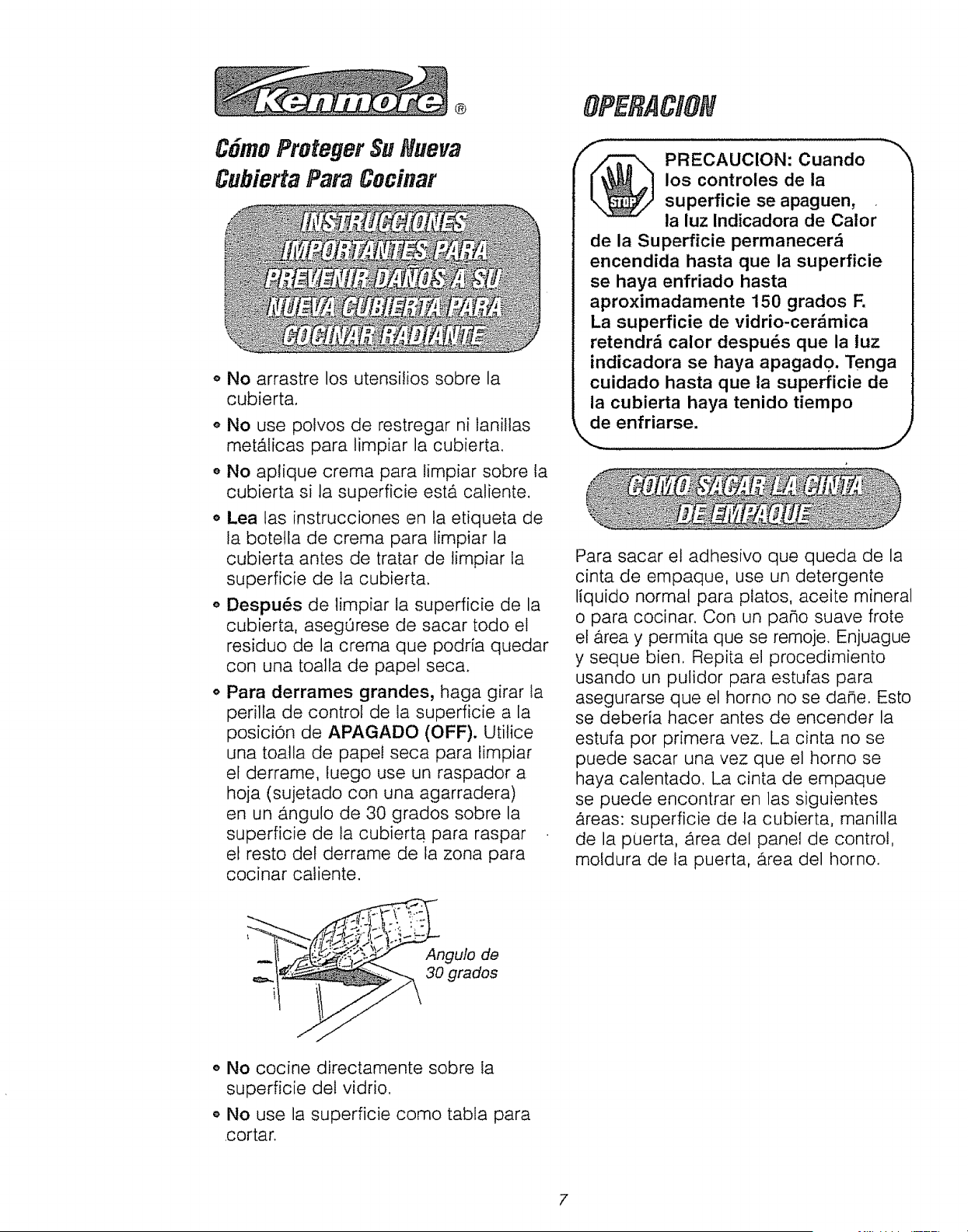
o No arrastre los utensitios sobre la
cubierta.
o No use polvos de restregar ni laniltas
metbJicas para limpiar la cubierta.
,, No aplique crema para limpiar sobre ta
cubierta si la superficie est& caliente.
o Lea tas instrucciones en ta etiqueta de
ta botella de crema para limpiar la
cubierta antes de tratar de limpiar la
superficie de la cubierta.
o Despu_s de limpiar la superficie de la
cubierta, aseg0rese de sacar todo el
residuo de la crema que podr[a quedar
con una toalla de papel seca.
° Para derrames grandes, haga girar la
perilla de control de ta superficie a la
posicion de APAGADO (OFF). Utitice
una toatla de papet seca para fimpiar
el derrame, luego use un raspador a
hoja (sujetado con una agarradera)
en un angulo de 30 grados sobre la
superficie de ta cubierta para raspar
et resto del derrame de ta zona para
cocinar caliente.
_'_' Angulo de
30 grados
o 1',41ococine directamente sobre la
superficie del vidrio.
o No use la superficie como tabla para
cortar.
OPERACiOH
/'P@ PRECAUClON: Cuando _'_
los controles de la
superficie se apaguen,
la luz Indicadora de Caior
de la Superficie permanecer&
encendida hasta que la superficie
se haya enfriado hasta
aproximadamente 150 grados F.
La superficie de vidrio-cer_mica
retendr_ calor despu6s que la luz
indicadora se haya apagad0. Tenga
cuidado hasta que la superficie de
la cubierta haya tenido tiempo
de enfriarse.
__. J
Para sacar el adhesivo que queda de la
cinta de empaque, use un detergente
liquido normal para platos, aceite mineral
o para cocinar. Con un patio suave frote
el area y permita que se remoje. Enjuague
y seque bien. Repita el procedimiento
usando un pulidor para estufas para
asegurarse que el homo no se da_e. Esto
se deberia hacer antes de encender la
estufa por primera vez. La cinta no se
puede sacar una vez que el horno se
haya calentado. La cinta de empaque
se puede encontrar en las siguientes
_.reas: superficie de la cubierta, manilla
de la puerta, area del panel de control,
moldura de la puerta, area del horno.
7
OPERACION
®
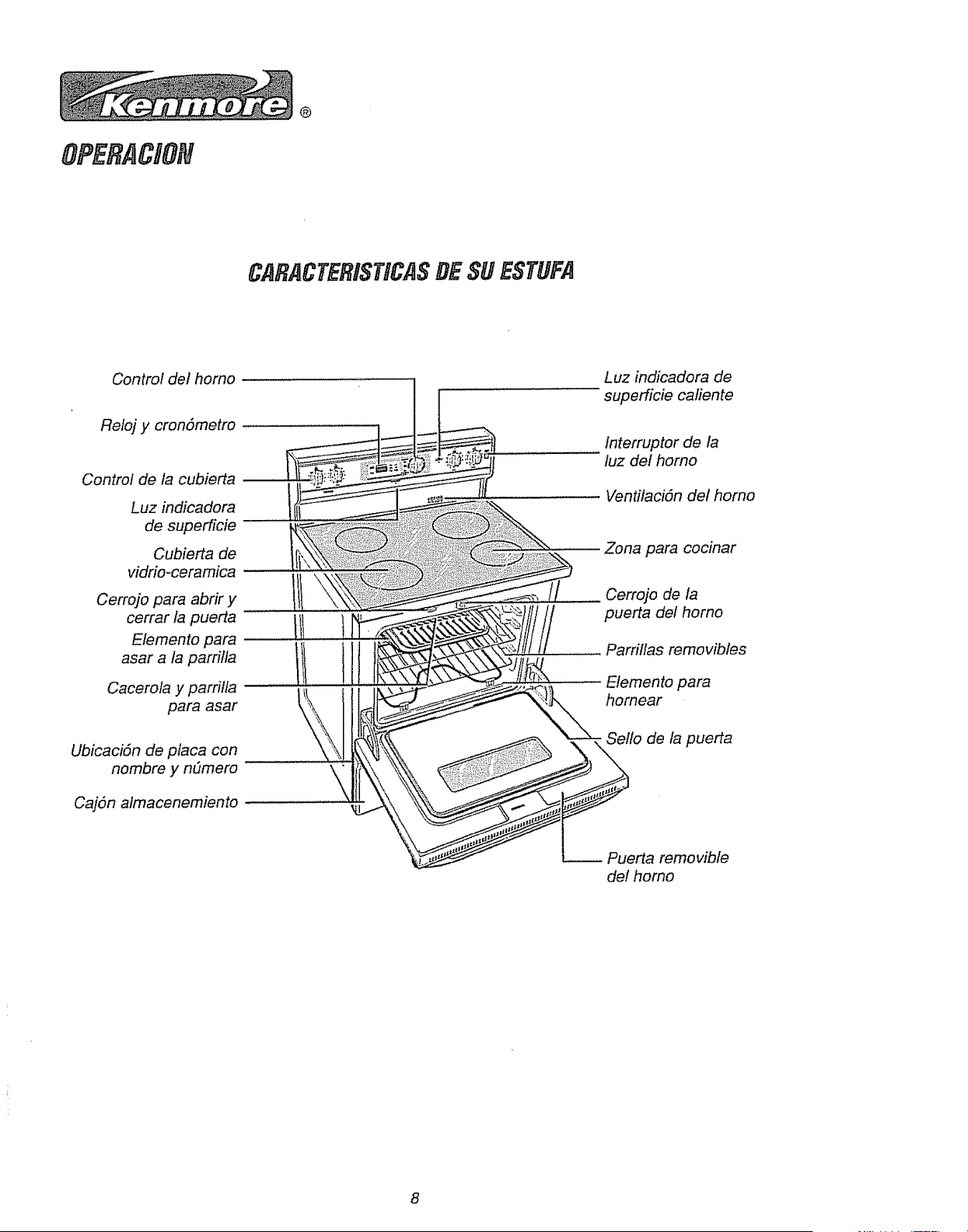
CARACTERISTICASDESUESTUFA
Control del homo
Reloj y cmndmetro
Control de la cubierta
Luz indicadora
de superficie
Cubierta de
vidrio-ceramica
Cerrojo para abrir y
cerrar la puerta
Elemento para
asar a la parrilla
Cacerola y parrilla
para asar
Ubicaci6n de placa con
nombre y ndmero
Cajdn almacenemiento
Luz indicadora de
superficie caliente
fnterruptor de la
luz del homo
Ventilaci6n del homo
Zona para cocinar
Cerrojo de la
puerta del homo
Parrillas removibles
Elemento para
homear
Sello de la puerta
Puerta removible
del homo
8
®
OPERACION
C6moCecinarSobre
Una CubiertaRadiante
Antes de usar su nueva cubierta para
cocinar radiante, limpiela con Cooktop
Cleaning Creme ®. Esto dejara, una capa
protectora.
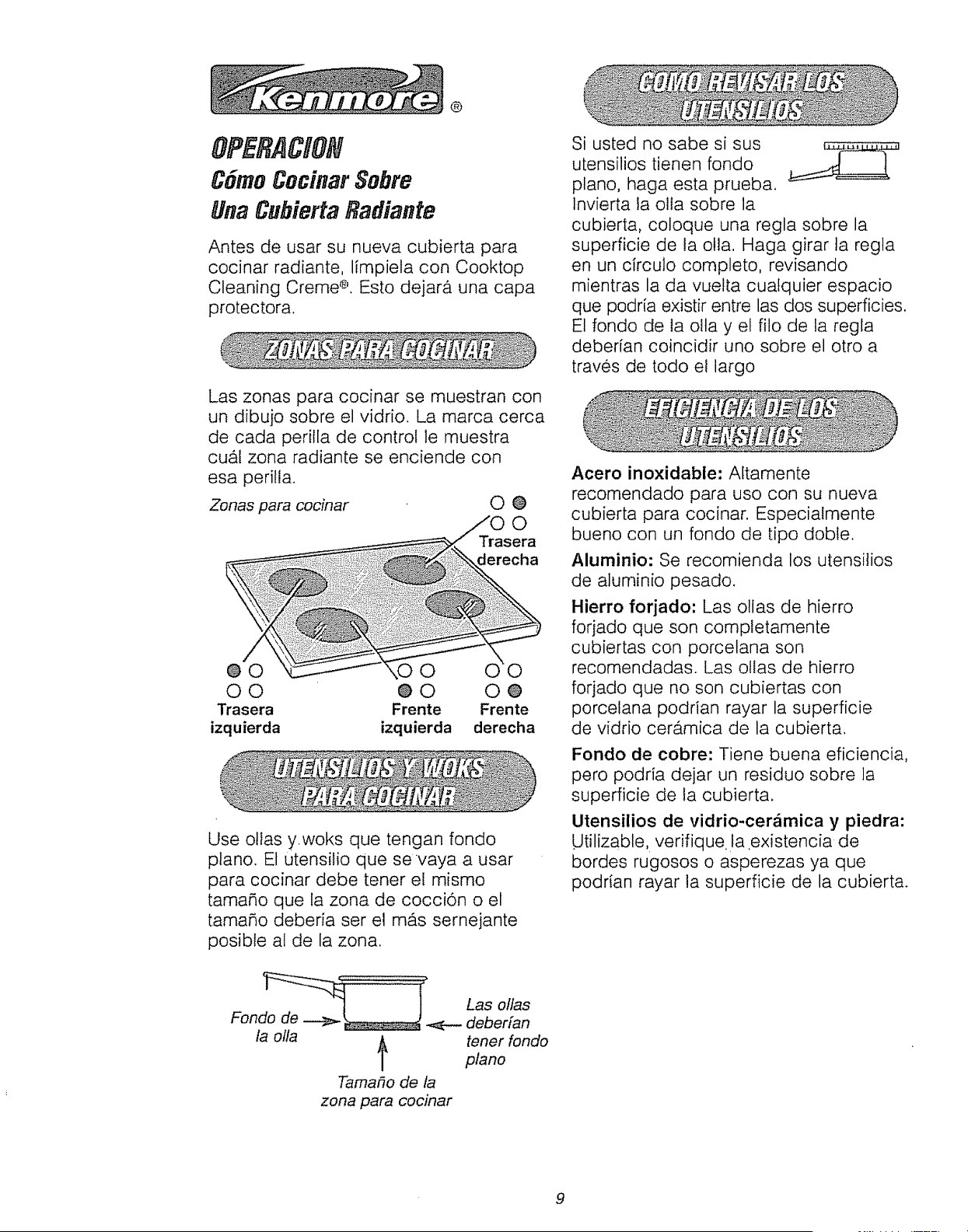
Las zonas para cocinar se muestran con
un dibujo sobre el vidrio. La marca cerca
de cada perilla de control le muestra
cual zona radiante se enciende con
esa peritla.
Zonas para cocinar
.....¸................................
e"o
O0
Trasera
izquierda
O@
0
Trasera
,,00
@0 O@
Frente Frente
izquierda derecha
Use otlas y.woks que tengan rondo
plano. El utensitio que se vaya a usar
para cocinar debe tener et mismo
tamaSo que la zona de coccion o el
tama5o deberia ser el m_.s sernejante
posibIe al de la zona.
Fon _ deberfan
la olla A tener fondo
T
piano
TamaAo de la
zona para cocinar
Si usted no sabe si sus _ ....
utensitios tienen rondo , _._ _
piano, haga esta prueba,
lnvierta la olla sobre la
cubierta, coloque una regla sobre la
superficie de la olla. Haga girar ta regla
en un circulo completo, revisando
mientras la da vuelta cualquier espacio
que podria existir entre las dos superficies.
El fondo de la olla y el filo de la regla
debedan coincidir uno sobre el otro a
traves de todo el largo
Acero inoxidable" Attamente
recomendado para uso con su nueva
cubierta para cocinar. Especialmente
bueno con un fondo de tipo doble.
Aluminio: Se recomienda los utensi]ios
de aluminio pesado.
Hierro forjado: Las ollas de hierro
forjado que son completamente
cubiertas con porcelana son
recomendadas. Las otlas de hierro
forjado que no son cubiertas con
porcelana podrian rayar la superficie
de vidrio ceramica de la cubierta,
Fondo de cobre: Tiene buena eficiencia,
pero podria dejar un residuo sobre la
superficie de la cubierta.
Utensilios de vidrio-cer_mica y piedra:
Utilizable, verifique.la existencia de
bordes rugosos o asperezas ya que
podrian rayar la superficie de la cubierta.
OPERACION
C6moCocinarSobre
®
UnaCubiertaRadiante
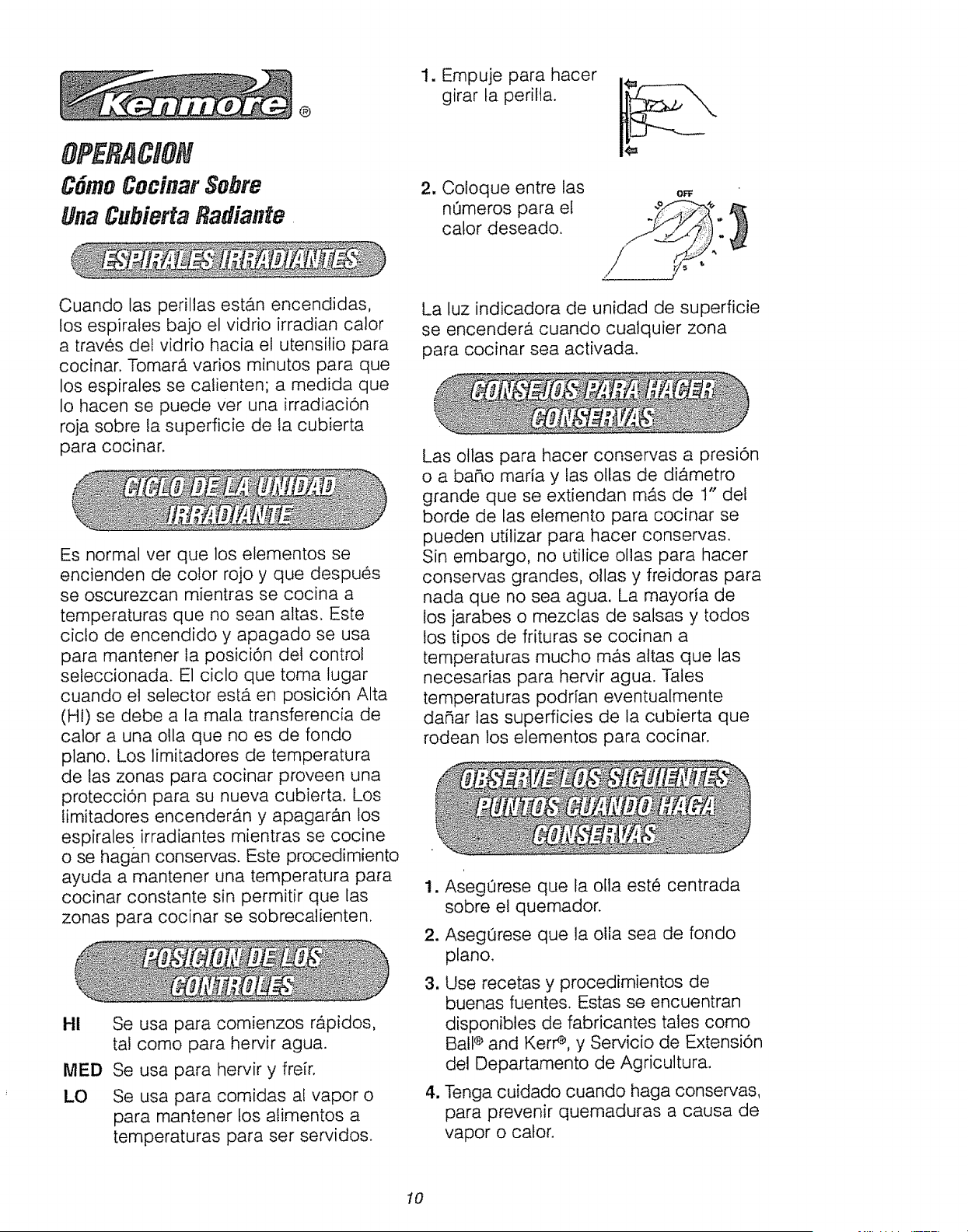
Cuando las perillas esta.n encendidas,
los espirales bajo el vidrio irradian calor
a traves def vidrio hacia el utensilio para
cocinar, Tomar,A varios minutos para que
los espirales se calienten; a medida que
Io hacen se puede ver una irradiaci6n
roja sobre la superficie de la cubierta
para cocinar.
Es normal ver que los elementos se
encienden de color rojo y que despues
se oscurezcan mientras se cocina a
temperaturas que no sean altas. Este
cic!o de encendido y apagado se usa
para mantener ta posici6n del control
seleccionada. E1ciclo que toma lugar
cuando el selector est_ en posiciOn Alta
(HI) se debe a la mala transferencia de
calor a una otla que no es de fondo
plano. Los limitadores de temperatura
de las zonas para cocinar proveen una
protecci6n para su nueva cubierta. Los
timitadores encenderan y apagaran los
espirales irradiantes mientras se cocine
o se hagan conservas. Este procedimiento
ayuda a mantener una temperatura para
cocinar constante sin permitir que las
zonas para cocinar se sobrecalienten.
H!
Se usa para comienzos r&pidos,
tal como para hervir agua.
MED Se usa para hervir y frefr.
LO Se usa para comidas al vapor o
para mantener los aIimentos a
temperaturas para ser servidos.
1. Empuje para hacer
girar ta perifla.
2, Coloque entre las
nOmeros para el
calor deseado.
/
La luz indicadora de unidad de superficie
se encendera cuando cualquier zona
para cocinar sea activada.
Las ollas para hacer conservas a presi0n
o a ba_o maria y fas ollas de di#,metro
grande que se extiendan m_s de 1" del
borde de las elemento para cocinar se
pueden utilizar para hacer conservas.
Sin embargo, no utitice otlas para hacer
conservas grandes, o!las y freidoras para
nada que no sea agua, La mayoria de
los jarabes o mezclas de salsas y todos
los tipos de frituras se cocinan a
temperaturas mucho m_s attas que las
necesarias para hervir agua. Tales
temperaturas podrfan eventualmente
da_ar las superficies de la cubierta que
rodean los elementos para cocinar.
lm
2_
3_
4,
AsegOrese que la otla este centrada
sobre el quemador.
AsegQrese que ]a olla sea de fondo
piano.
Use recetas y procedimientos de
buenas fuentes. Estas se encuentran
disponibles de fabricantes tales como
BalP and Kerre, y Servicio de Extensi6n
del Departamento de Agricultura.
Tenga cuidado cuando haga conservas,
para prevenir quemaduras a causa de
vapor o cafor.
10
OPERACION
®
Reloj, Cron6metroy Controlde/Homo
Las funciones de! RELOJ, CRONOMETRO y HORNO de su estufa nueva son simptes y f_ciles
de entender.
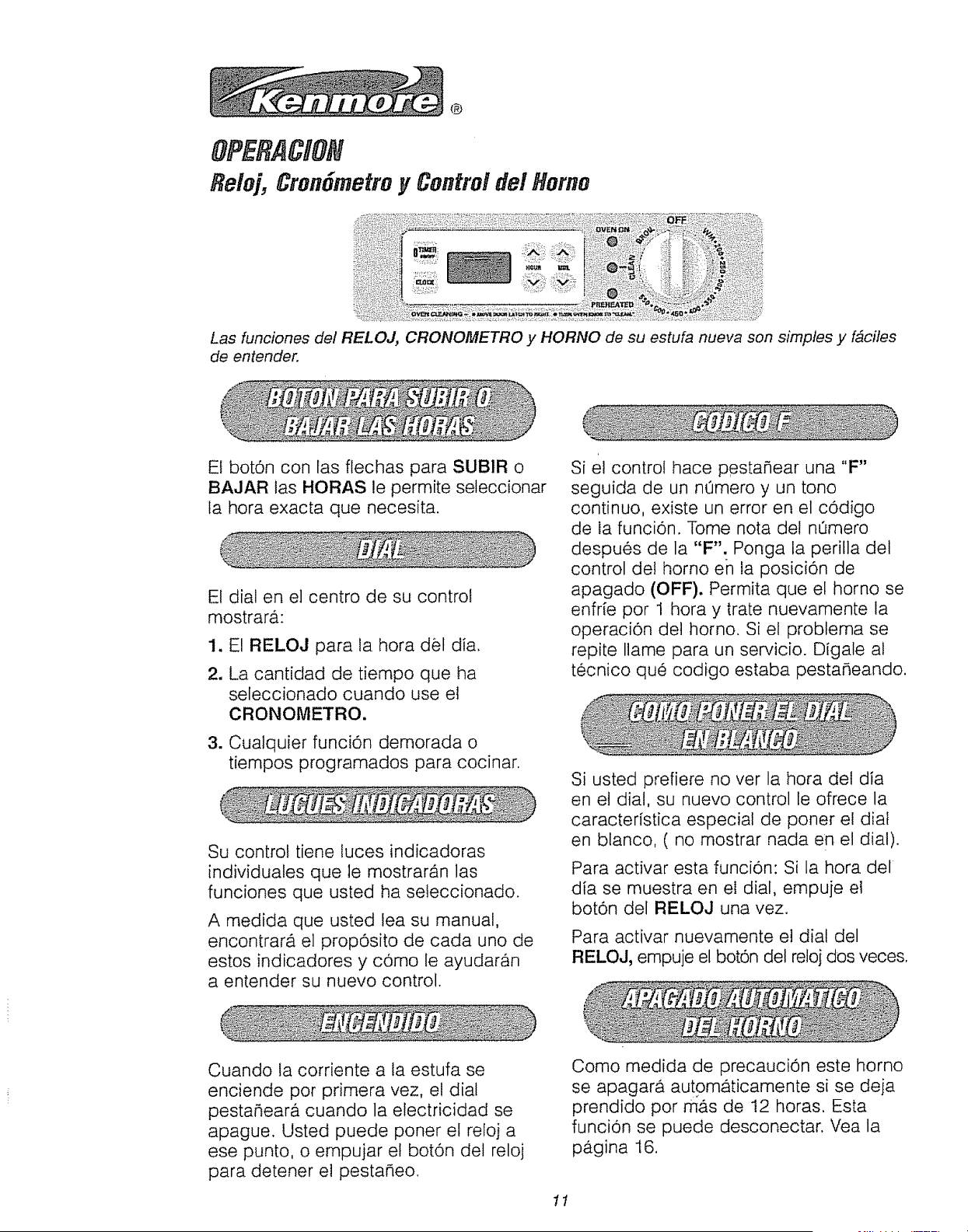
EI bot6n con las flechas para SUBIR o
BAJAR las HORAS le permite seleccionar
la hora exacta que necesita.
El dial en el centro de su control
mostrara:
1. El RELOJ para la hora del dia.
2. La cantidad de tiempo que ha
seleccionado cuando use el
CRONOMETRO,
3. Cualquier funciOn demorada o
tiempos programados para cocinar,
Su control tiene luces indicadoras
individuafes que le mostraran las
funciones que usted ha seteccionado.
A medida que usted lea su manual,
encontrarb, el propOsito de cada uno de
estos indicadores y como le ayudaran
a entender su nuevo control.
Si el control hace pesta_ear una "F"
seguida de un n0mero y un tono
continuo, existe un error en el cOdigo
de la funcion. Tome nota del nQmero
despues de la "F": Ponga ia perifla del
control del homo en la posiciOn de
apagado (OFF). Permita que el horno se
enfr[e por 1 hora y trate nuevamente la
operacion det horno. Si el problema se
repite Ilame para un servicio. Digale al
tecnico que codigo estaba pestar_eando,
Si usted prefiere no ver la hora det dia
en et dial, su nuevo control le ofrece la
caracterfstica especial de poner el dial
en blanco, ( no mostrar nada en el dial).
Para activar esta funci6n: Si la hora del
dia se muestra en el dial, empuje el
bot6n del RELOJ una vez.
Para activar nuevamente el dial del
RELOJ, empuje el botOn del reloj dos veces,
Cuando la corriente a la estufa se
enciende por primera vez, el dial
pestaCtearb, cuando la electricidad se
apague. Usted puede poner el reloj a
ese punto, o empujar el bot6n del reloj
para detener el pesta_eo.
Como medida de precauci6n este homo
se apagara automaticamente si se deja
prendido por mas de 12 horas. Esta
funcion se puede desconectar. Vea la
p,Agina t6,
11
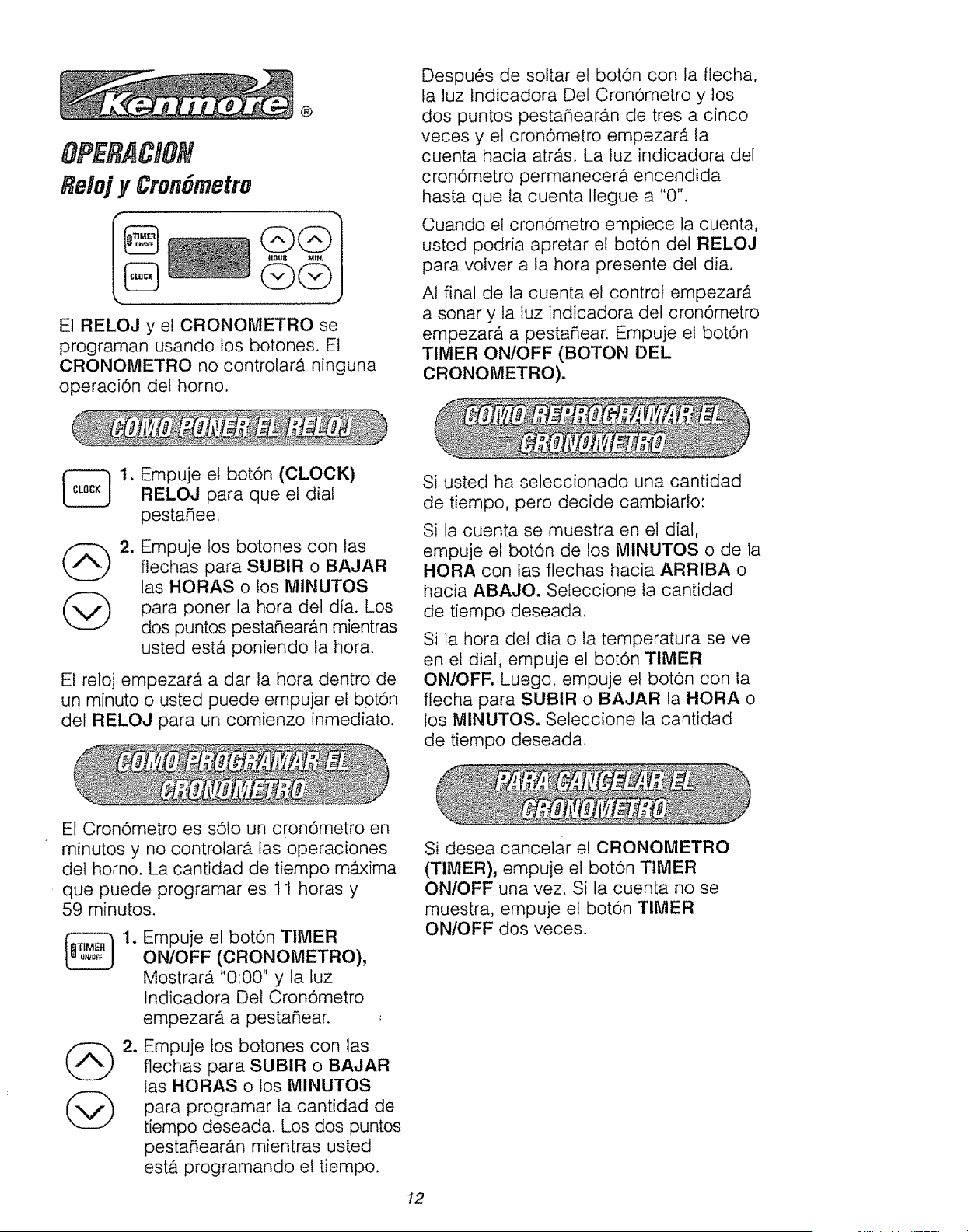
®
OPERAC#ON
Re/oj y Cron6rnetro
El RELOJ y el CRONOMETRO se
programan usando los botones. Et
CRONOMETRO no controlar_t ninguna
operaci6n def horno.
Despues de sottar el botOn con la flecha,
ta luz lndicadora Del CronOmetro y los
dos puntos pesta_ear&n de tres a cinco
veces y el cronOmetro empezara la
cuenta hacia atr_,s, La luz indicadora del
cron6metro permanecer_t encendida
hasta que ia cuenta Ilegue a "0".
Cuando el cron6metro empiece ]a cuenta,
usted podria apretar el boton del RELOJ
para volver a ta hora presente del dia.
AI final de la cuenta et control empezar_
a sonar y la luz indicadora del cronometro
empezar& a pesta_ear. Empuje el bot6n
TIMER ONIOFF (BOTON DEL
CRONOMETRO).
1. mpuje et bot6n (CLOCK)
RELOJ para que el dial
pestaSee.
Empuje los botones con las
flechas para SUBIR o BAJAR
las HORAS o los MINUTOS
para poner fa hora det dia. Los
dos puntos pesta_ear&n mientras
usted esta poniendo Lahora.
El reloj empezar& a dar ta hora dentro de
un minuto ousted puede empujar el bptOn
def RELOJ para un comienzo inmediato.
Si usted ha seleccionado una cantidad
de tiempo, pero decide cambiarlo:
Si la cuenta se muestra en el dial,
empuje el botOn de los MINUTOS o de la
NORA con las ftechas hacia ARRIBA o
hacia ABAJO. Seleccione la cantidad
de tiempo deseada.
Si la hora de! dia o la temperatura se ve
en el dial, empuje et botOn TIMER
ONIOFF. Luego, empuje el botOn con la
ftecha para SUBIR o BAJAR ia NORA o
los MINUTOS. Seleccione la cantidad
de tiempo deseada.
El Cron6metro es s6to un cronOmetro en
minutos y no controlar& las operaciones
del horno. La cantidad de tiempo maxima
que puede programar es ti horas y
59 minutos.
Empuje el bot6n TIMER
ONtOFF (CRONOMETRO),
Mostrarb, "0:00" y la tuz
Indicadora Del CronOmetro
empezars, a pesta_ear.
Empuje los botones con las
fIechas para SUBIR o BAJAR
las HORAS o los MINUTOS
para programar ta cantidad de
tiempo deseada. Los dos puntos
pestaSear&n mientras usted
esta programando e! tiempo.
Si desea cancelar el CRONOMETRO
(TIMER), empuje el boron TIMER
ON/OFF una vez. Si la cuenta no se
muestra, empuje el botOn TIMER
ON/OFF dos veces.
12
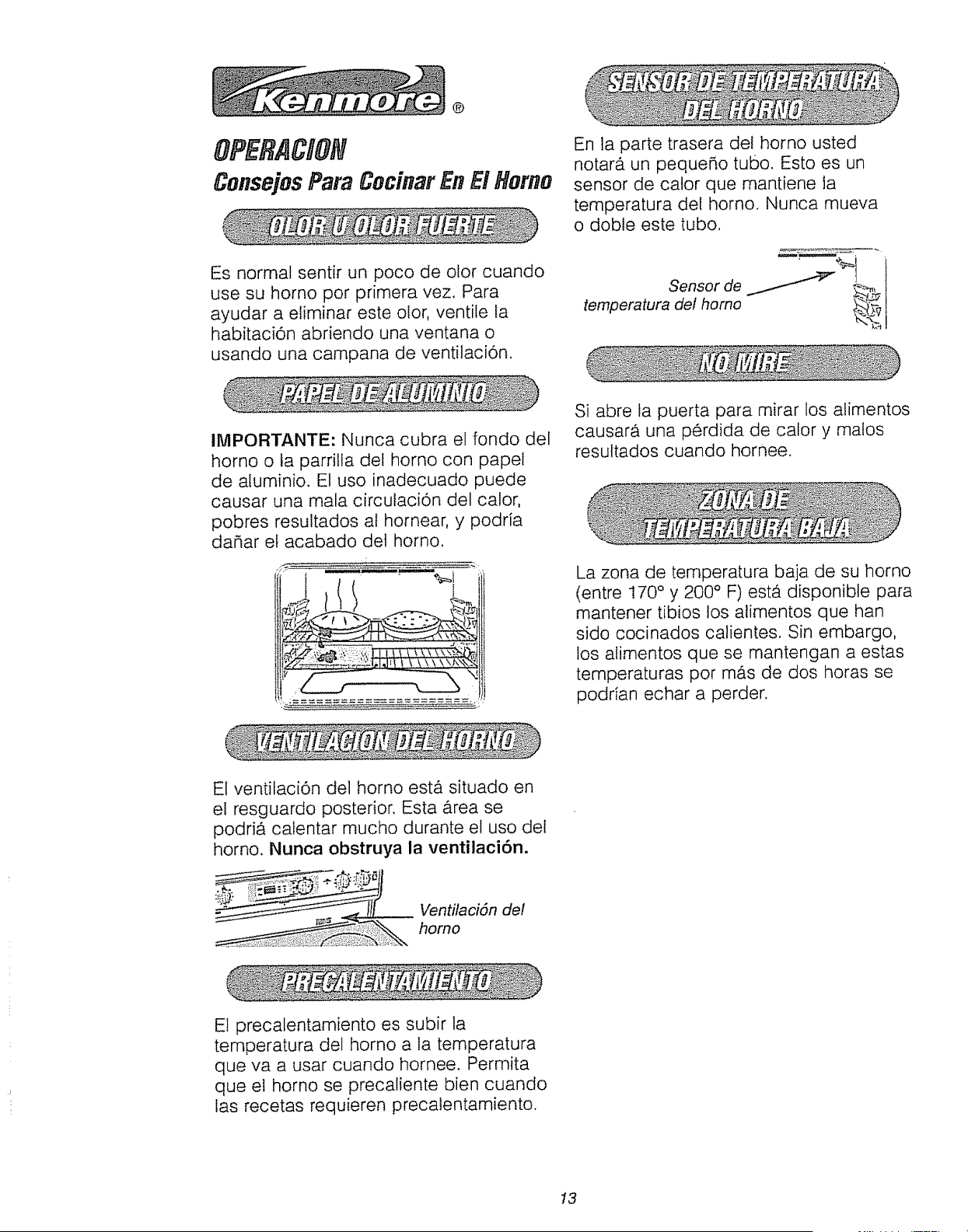
OPERACION
®
ConsejosPara CocinarEnEl Homo
Es normal sentir un poco de olor cuando
use su horno por primera vez. Para
ayudar a eliminar este olor, ventile la
habitaciOn abriendo una ventana o
usando una campana de ventilaciOn.
En ]a parte trasera del horno usted
notara un peque_o tubo. Esto es un
sensor de cator que mantiene la
temperatura del horno. Nunca mueva
o doble este tubo,
Sensor de _,
temperatura del homo _'___
k_'f
IMPORTANTE: Nunca cubra el fondo del
horno o la parrilla def homo con papel
de aluminio. El uso inadecuado puede
causar una mala circulaciOn del calor,
pobres resultados al hornear, y podria
daC_aret acabado det homo.
Si abre la puerta para mirar los alimentos
causara una p6rdida de calory malos
resultados cuando hornee.
La zona de temperatura baja de su homo
(entre !70 ° y 200 ° F) esta disponible para
mantener tibios los alimentos que han
sido cocinados calientes. Sin embargo,
los alimentos que se mantengan a estas
temperaturas pot m_s de dos horas se
podrian echar a perder.
El ventitaci6n del horno estb. situado en
el resguardo posterior. Esta a.rea se
podri& catentar mucho durante el uso del
homo. Nunca obstruya la ventilaci6n.
Ventilacidn del
homo
El precalentamiento es subir la
temperatura del homo a la temperatura
que va a usar cuando hornee. Permita
que el horno se precaliente bien cuando
las recetas requieren precaientamiento.
13
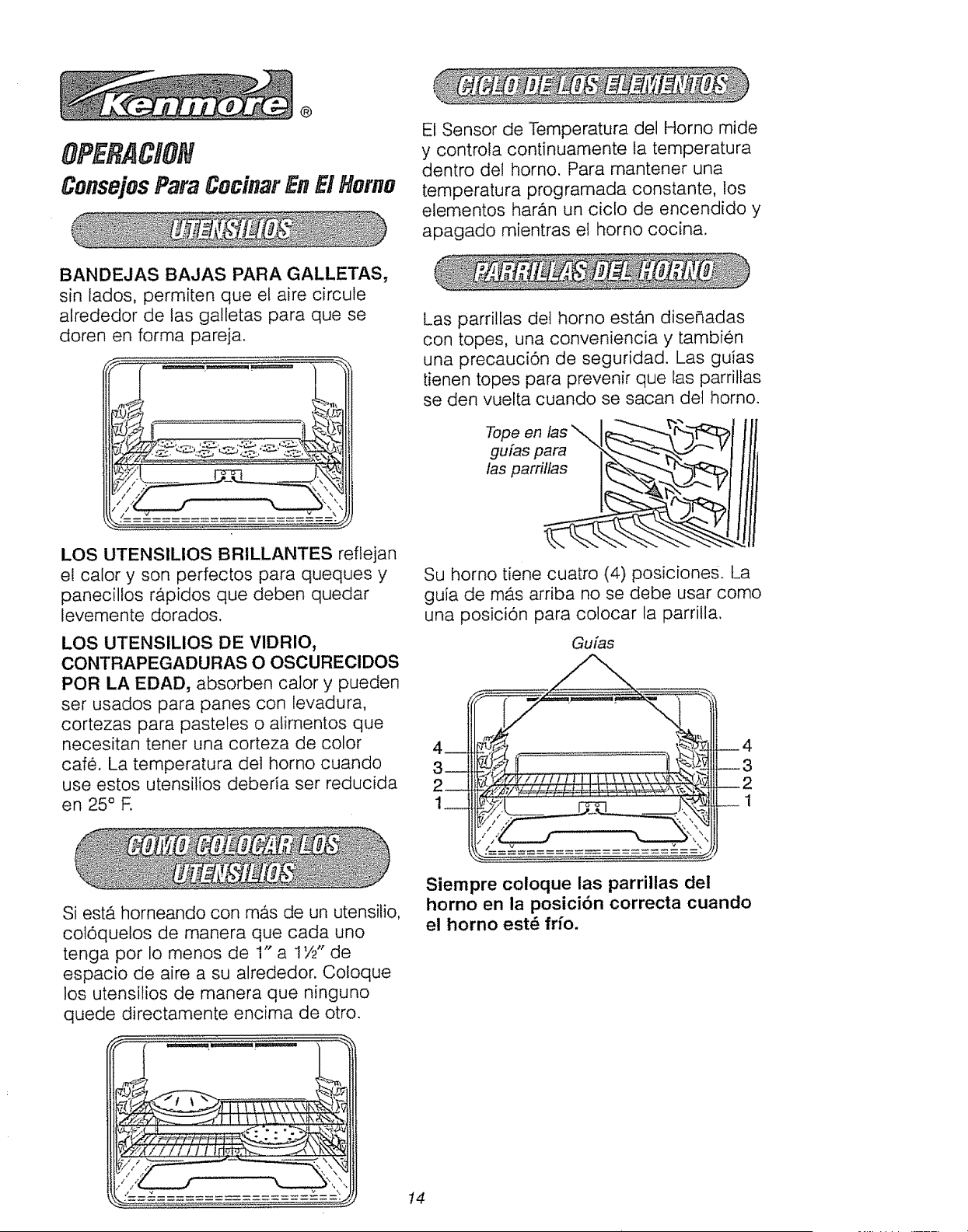
OPERACION
®
ConsejosPara CocinarEnEl Homo
BANDEJAS BAJAS PARA GALLETAS,
sin lados, permiten que el aire circule
alrededor de las galletas para que se
doren en forma pareja.
El Sensor de Temperatura del Homo mide
y controta continuamente la temperatura
dentro del horno. Para mantener una
temperatura programada constante, los
elementos haran un ciclo de encendido y
apagado mientras et horno cocina.
Las parrillas det homo estb.n dise5adas
con topes, una conveniencia y tambien
una precauci6n de seguridad. Las guias
tienen topes para prevenir que las parritlas
se den vuelta cuando se sacan det horno.
Tope en las
guias para
las parrillas
LOS UTENSILIOS BRILLANTES refiejan
el calory son perfectos para queques y
panecillos rapidos que deben quedar
levemente dorados.
LOS UTENSILIOS DE VlDRIO,
CONTRAPEGADURAS O OSCUREClDOS
POR LA EDAD, absorben calory pueden
ser usados para panes con levadura,
cortezas para pasteles o atimentos que
necesitan tener una corteza de color
cafe. La temperatura del homo cuando
use estos utensitios deberia ser reducida
en 25 ° R
Si est_ horneando con m_s de un utensilio,
col6que!os de manera que cada uno
tenga por Io menos de 1" a 1W' de
espacio de aire a su alrededor. Coloque
los utensifios de manera que ninguno
quede directamente encima de otro.
Su homo tiene cuatro (4) posiciones. La
guia de m_s arriba no se debe usar como
una posici6n para colocar la parrilla.
Gu_s
__
3--
2__
1__
_4
_3
--2
Siempre coloque las parrillas del
horno en la posici6n correcta cuando
el horno est_ frio.
14
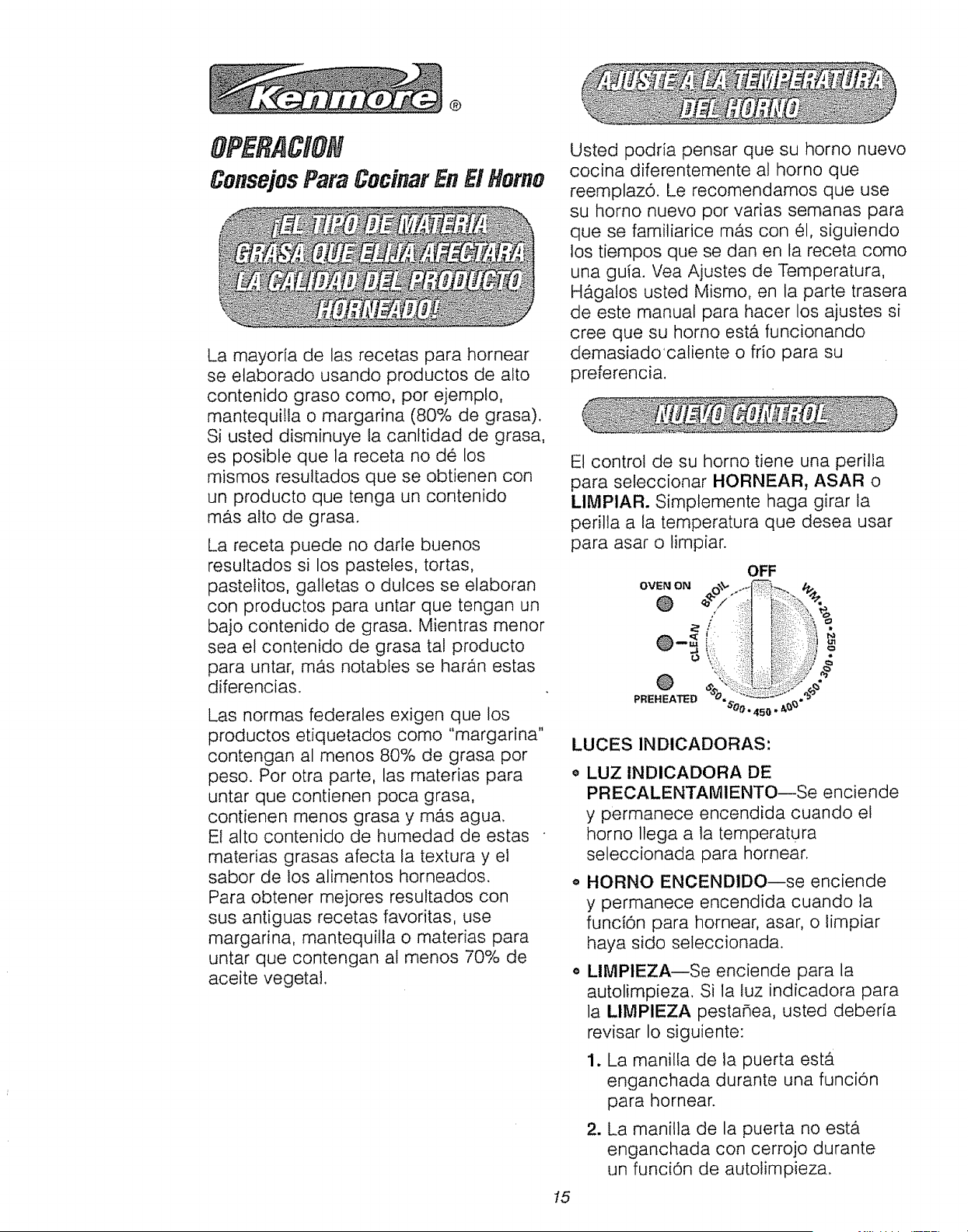
OPERACION
®
ConsejosParaCocinarEn El Homo
La mayoria de las recetas para hornear
se etaborado usando productos de alto
contenido graso como, por ejempto,
mantequilta o margarina (80% de grasa).
Si usted disminuye la canftidad de grasa,
es posible que la receta no de los
mismos resulLados que se obtienen con
un producto que tenga un contenido
m,As alto de grasa.
La receta puede no darle buenos
resultados si los pasteles, tortas,
pastelitos, galletas o dulces se elaboran
con productos para untar que tengan un
bajo contenido de grasa. Mientras menor
sea el contenido de grasa tal producto
para untar, mb.s notables se haran estas
diferencias.
Las normas federales exigen que los
productos etiquetados como "margarina"
contengan al menos 80% de grasa por
peso. Por otra parte, las materias para
untar que contienen poca grasa,
contienen menos grasa y mas agua.
El alto contenido de humedad de estas
materias grasas afecta ta textura y el
sabor de los alimentos horneados.
Para obtener mejores resultados con
sus antiguas recetas favoritas, use
margarina, mantequitla o materias para
untar que contengan al menos 70% de
aceite vegetal
Usted podfia pensar que su homo nuevo
cocina diferentemente al homo que
reemplaz6. Le recomendamos que use
su homo nuevo por varias semanas para
que se familiarice m_.s con el, siguiendo
los tiempos que se dan en la receta como
una guia. Vea Ajustes de Temperatura,
H_ga!os usLed Mismo, en la parte trasera
de este manual para hacer los ajustes si
cree que su homo esta funcionando
demasiado'caliente o frio para su
preferencia.
15
El control de su horno tiene una peritla
para seleccionar HORNEAR, ASAR o
LIMPIAR. Simplemente haga girar ia
perilla a la temperatura que desea usar
para asar o limpiar.
OFF
LUCES INDICADORAS:
LUZ INDICADORA DE
PRECALENTAMIENTO--Se enciende
y permanece encendida cuando et
homo llega a la temperatura
seleccionada para hornear.
HORNO ENCENDIDO--se enciende
y permanece encendida cuando la
funci6n para hornear, asar, o limpiar
haya sido seleccionada.
LIMPIEZA--Se enciende para la
autolimpieza. Si la luz indicadora para
la LIMPIEZA pestaSea, usted deberia
revisar Io siguiente:
1. La manilta de la puerta est#,
enganchada durante una funciOn
para hornear.
2. La manitla de la puerta no est&
enganchada con cerrojo durante
un funci6n de autolimpieza.

OPERACIOH
@
Consejospara CocinarEn E! Homo 1.
1. D6 vuelta la perilla OVEN CONTROL
a la temperatura deseada de tibio WM
hasta 550 ° E A medida que la peritla
gira, el dial det control mostrar_t los
cambios de temperatura. Cuando et
dial muestre la temperatura que usted
seteccion6, suette la perilfa del control.
2. La luz indicadora HORNO ENCENDIDO
(OVEN ON) se encendera.
3. Cuando el homo llegue a la temperatura
seleccionada, sonara una serie de tonos,
y las luces indicadoras "PREHEATED"
y "OVEN ON" se encenderan.
4. Las luces indicadoras de "PREHEATED"
y "OVEN ON" permaneceran
encendidas hasta que el horneado
haya terminado y la peri!la de control
se haya puesto en ta posicion de
apagado (OFF).
2_
Con la perilla de control en la posiciOn
de apagado, empuje y sujete los
botones con las flechas para SUBIR o
BAJAR las HORAS o los P,iIINUTOS a
la misma vez, hasta que "ON" u
"OFF" se muestren en el dia!.
El sujetar los botomes con las flechas
para SUBIR o BAJAR las HORAS
o los MINUTOS a la misma vez,
nuevamente alternar_ la conexiOn o
desconexi6n del apagado automatico
en 12 horas.
16

®
OPERACION
C6rnoAsar a La Parrilla
Asar es cocinar al calor directo del
elemento superior. La puerta del homo
deberia permanecer abierta en la
posicion de tope para asar cuando ase a
la parrilla.
No es necesario precalentar el horno
cuando ase a la parrilla. Use la cacerota
y la parrilla para asar que viene con su
estufa. Ambas est_n dise_adas para drenar
adecuadamente la grasa y los liquidos.
f@Si usa papel de aluminio,
debe ser moldeado
firmemente a la parrilla, y
debe hacer cortes en el
papel que est_n alineados con las
ranuras de la parrilla. Esto permite
que la grasa y los liquidos caigan
a la cacerola, evitando que se
produzca un incendio y humo
excesivo.
Siempre saque ia cacerola y la
parrilla del horno. Guardar y
oividar una cacerola
para asar sucia en _,.,'f
el horno es un
peligro para _ _ _-!., /
producir un
incendio o humo.
El Departamento de Agricultura de los
Estados Unidos nota que las carnes
cocinadas crudas son populares, pero
que la came que se cocina hasta sOio
140°F, (cruda) significa que algunos
organismos venenosos podrian sobrevivir.
Mientras mas cerca coloque los
alimentos de! elemento para asar, mas
rb.pido se doraran por afuera, pero
quedando rojo o rosado en et centro.
Cotocando las carnes lejos del elemento
permitir_, que las carnes se cocinen en
el centro mientras se doran por afuera.
Usando estas posiciones, cocine el lado
I por Io menos 2 minutos m_.s que el
lado 2. Si su homo esta conectado a
208 voltios, usted podria usar una
posiciOn de parritla mb.s alta y/o cocinar
los alimentos por mas tiempo.
El tama5o, peso, grosor, temperatura
inicial y su preferencia personal afectar_
el asado a la parritla. Esta tabla esta
basada en carnes a la temperatura del
refrigerador.
ALIMENTO POSICION DE T1EMPO TOTAL
PARRILLA (minutos)
Bistec 1" 3 9-t 1
de grueso
Tortas de 3 16-18
carne molida-l"
de grueso
Chutetas de 3 27-29
cerdo-1/2"
de grueso
Pescado (filetes) 3 t t-13
Polio (presas) 2 45-55
1
Q
1
Ponga la PERILLA DE CONTROL
DEL HORNO en BROIL.
La luz indicadora de "HORNO
ENCENDIDO" (OVEN ON) se
encender_,
Cuando termine de asar ponga la
PERILLA DE CONTROL DEL HORNO
en la posicion de apagado (OFF).
17

®
El Ciclo De Autolirnpieza
CUIDADOYLIMPIEZA
IN
2_
Saque la cacerola y la parrilla para
asar, la parrilla del homo, utensilios,
y cualquier papel de aluminio que
podria quedar en el horno.
La suciedad en et frente del marco,
1" dentro det homo, y a]rededor del
sello de la puerta def horno tendra
que ser limpiada a mano.
Marco frontal
_Y'_ Revestimento "_:
de la puerta
Limpie estas areas con agua caliente,
lanillas con jab6n o limpiadores como
Soft Scrub ® para sacar cualquier
suciedad. Enjuague bien con agua
fimpia y seque.
3. Limpie cualquier derrame pesado del
fondo del horno.
4_
No limpie el selto de la puerta de]
horno. Et material de fibra de vidrio
de la puerta del homo no soporta ta
abrasion. Es esencial que el selto
permanezca intacto. Si nota que se
est& gastando, trizando, o satiendo de
la puerta, deberia ser reemplazado.
E1setlo de ta puerta est,, dise_ado para
que tenga un espacio de 5-6" en el
fondo del horno.
Panel de la puerta Sello
la puerta
Esto permite fa circu]aci6n adecuada
del aire. Es normal que su homo d6 la
apariencia de no tener un buen sello
sobre et horno. Esto se debe al sello.
La ubicaciOn det sello sobre la puerta
del horno mantiene la puerta sellada y
previene cualquier perdida de calor.
Los utensilios nunca se
deberian dejar dentro del
homo durante un ciclo de
autolimpieza.
Las parrillas del horno se podrian
limpiar durante e! ciclo de
autolimpieza, pero perder&n su
brillo y se pondr_n dificiles de
deslizar. Si decide dejarlas dentro
durante el ciclo de limpieza, p_seles
aceite vegetal para que se deslicen
m_s f&cilmente.
Durante el primer ciclo de limpieza,
ventile la habitaciOn con una
ventana abierta o una campana
de ventilaciOn. Esto reducir_ el
olor cuando se calienten las
_partes nuevas.
18

1. Par:a mejor resultado, siga los pasos
para PREPARAR SU HORNO.
2. Corra la manilla hacia la derecha.
3. De vuelta la perilla de control a
"CLEAN" (LliViPIEZA). Las luces
indicadoras del "CERROJO DE LA
PUERTA" (CLEAN) y de "HORNO
ENCENDIDO" (OVEN ON) se
encenderb.n.
4. La manilta se cerrara, con cerrojo
cuando las altas temperaturas dentro
del homo sean obtenidas.
5. El cicfo de limpieza dura 4 horas y
20 minuLos. Es[o inctuye un periodo
de enfriamiento. Las tuces indicadoras
de "OVEN ON" (HORNO
ENCENDIDO) y "CLEAN" (LIMPIEZA)
pestanear_, a! final del ciclo de
limpieza.
6. Cuando el ciclo haya terminado,
ponga la perilla de control del horno
en posiciOn de apagado (OFF).
7.Cuando ta temperatura se haya
enfriado, la manilla de! cerrojo de la
puerta se deslizar& facilmente hacia
la izquierda.
D6 vueita la perilla de control del homo
a la posiciOn de apagado (OFF), Tendr_
que esperar a que la temperatura del
homo baje a menos de ta temperatura
de cierre (approx. 1 hora) antes de tratar
de abrir la puerta. Las luces indicadoras
no pestaNara.n si el ciclo de limpieza es
interrumpido.
Despues de un ciclo
de limpieza, es
posible que vea
un poco de cenizas
blancas en el horno.
Simplemente lfmpielas
con un pa5o o esponja h0meda.
Si manchas blancas persisten, frieguetas
con lanillas de acero con jabOn. AsegOrese
de enjuagar bien. Estas son generalmente
dep0sitos de sal que no se pueden
sacar durante el ciclo de limpieza.
Si por alguna razOn usted no queda
satisfecho con los resuttados de la
limpieza, simplemente repita el ciclo.
19
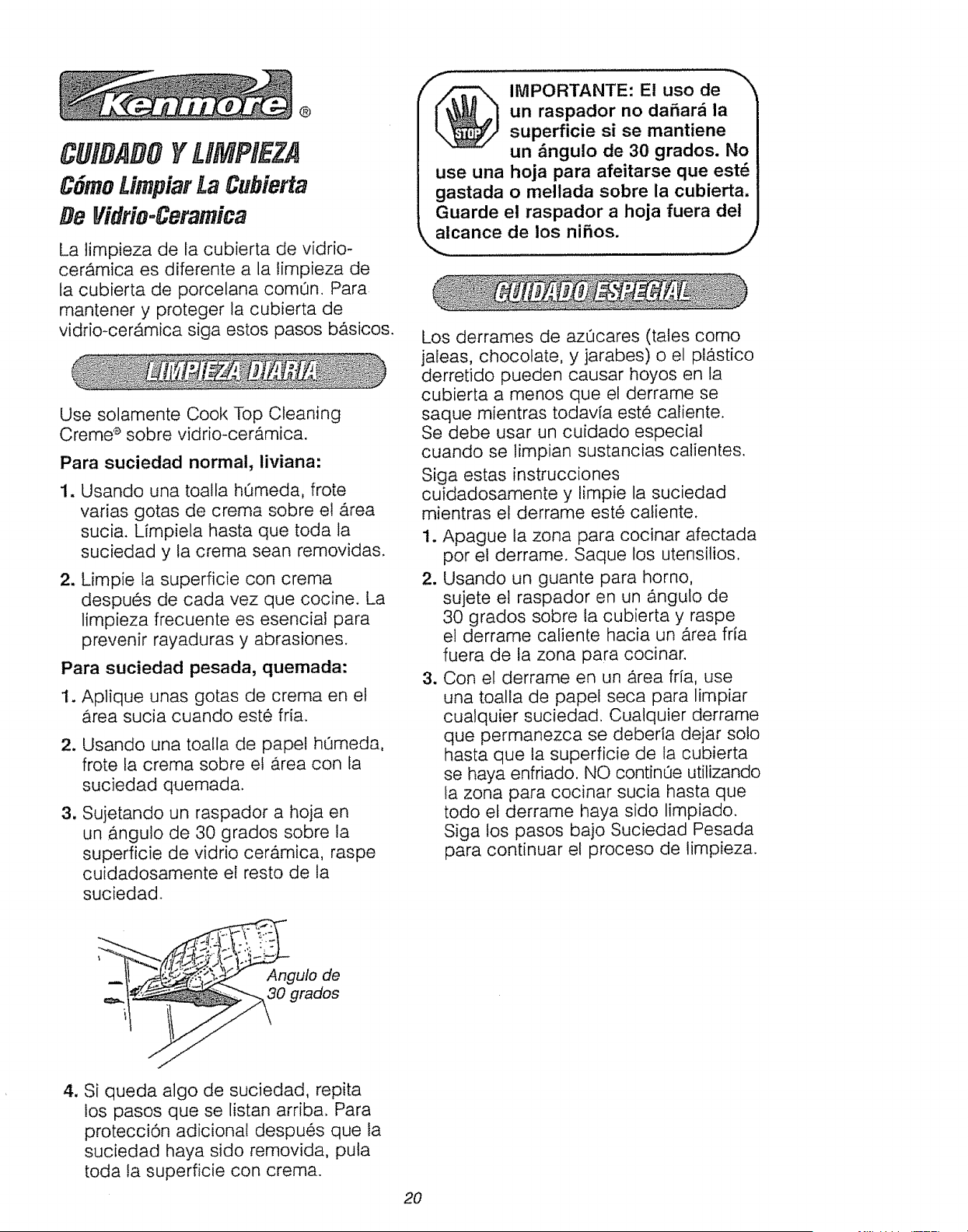
®
CUIDADOYLIMPIEZA
C6moUmpiar La Cubierfa
De Vidrio-Ceramica
La limpieza de la cubierta de vidrio-
cer_,mica es diferente a la limpieza de
la cubierta de porcelana com0n. Para
mantener y proteger la cubierta de
vidrio-cer_mica siga estos pasos b_sicos.
Use solamente Cook Top Cleaning
Creme s sobre vidrio-cer_mica.
Para suciedad normal, liviana:
1. Usando una toalla hOmeda, frote
varias gotas de crema sobre el b.rea
sucia. Limpiela hasta que toda la
suciedad y la crema sean removidas.
2. Limpie la superficie con crema
despu6s de cada vez que cocine. La
limpieza frecuente es esencial para
prevenir rayaduras y abrasiones.
Para suciedad pesada, quemada:
1. Aplique unas gotas de crema en el
area sucia cuando este fria.
2, Usando una toalla de papet h0meda,
frote la crema sobre el _rea con la
suciedad quemada.
3, Sujetando un raspador a hoja en
un _.ngulo de 30 grados sobre fa
superficie de vidrio ceramica, raspe
cuidadosamente el resto de la
suciedad.
/'_@ IMPORTANTE: El uso de
un raspador no daSar_ la
superficie si se mantiene
un &ngulo de 30 grados. No
use una hoja para afeitarse que est_
gastada o mellada sobre la cubierta,
Guarde el raspador a hoja fuera del
alcance de los ni_os.
Los derrames de az0cares (tales como
jaleas, chocolate, y jarabes) o el pi,Cstico
derretido pueden causar hoyos en la
cubierta a menos que et derrame se
saque mientras todavia est6 caliente.
Se debe usar un cuidado especial
cuando se limpian sustancias calientes.
Siga estas instrucciones
cuidadosamente y limpie la suciedad
mientras el derrame este cafiente,
1. Apague la zona para cocinar afectada
por el derrame. Saque los utensilios,
2. Usando un guante para horno,
sujete el raspador en un angulo de
30 grados sobre la cubierta y raspe
el derrame caliente hacia un _rea fria
fuera de la zona para cocinar.
3. Con el derrame en un _,rea fria, use
una toalla de papet seca para limpiar
cualquier suciedad, Cualquier derrame
que permanezca se deberia dejar solo
hasta que la superficie de ia cubierta
se haya enfriado. NO continOe utilizando
la zona para cocinar sucia hasta que
todo et derrame haya sido limpiado.
Siga los pasos bajo Suciedad Pesada
para continuar el proceso de limpieza.
Angulo de
30 grados
4, Si queda algo de suciedad, repita
los pasos que se listan arriba. Para
protecci6n adicional despu6s que la
suciedad haya sido removida, puta
toda la superficie con crema.
20
A medida que la crema limpia, deja una
capa protectora que ayuda a prevenir la
acumulaciOn de depOsitos minerales
(manchas de agua) y facilita la limpieza
futura. Et detergente para lavar ptatos
elimina ta capa protectora y no se
debeda utilizar.
o La mayoria de los limpiadores
contienen amonia, quimicos y
abrasivos que da_an fa superficie de
su cubierta. Use solamente Cooktop
Cleaning Creme ® para una limpieza
adecuada y para la protecci6n de la
superficie de vidrio cer_mica.
,, Si usted arrastra el fondo de las ollas
de aluminio o cobre sobre la superficie
de ta cubierta, podria dejar marcas de
metal en forma de rayaduras. Use el
raspador y la crema para la superficie
para sacar estas marcas. Si no saca
este residuo inmediatamente, podfia
producir marcas permanentes.
o Si las otlas con un enchapado de
aluminio delgado, de cobre o de
esmalte hierven cuando est_tn secas,
se podrian fundir con la superficie de
la cubierta. Esta descoloraci6n negra
debefia ser sacada inmediatamente o
podria ser permanente..
o E1uso de limpiadores de vidrio podrian
dejar una capa irridescente sobre la
cubierta. La crema para iimpiar sacarcfi
esta capa.
o Las manchas de agua (dep6sitos
minerafes) son removibles usando
crema y vinagre blanco a toda fuerza.
o No use un raspador con una hoja
gastada o mellada sobre la cubierta.
o No use limpiadores abrasivos o lanitlas
abrasivas sobre la cubierta.
Se puede usar lanillas de plastico tat
como Dobie ®.
Para ordenar Cooktop Cleaning Creme ®
adicional, flame a su Centro de Servicio
o tienda Sears mas cercana, pida el
(Stock No. 40079).
MATERIALES DE LIMPIEZA
° Detergente liquido para platos
o Agua tibia
o PaSo suave
No use limpadores abrasivos,
limpiadores industriales, o
blanquedores (cloro),
MATERIALES DE LIMPIEZA
o Detergente liquido para platos
o Agua tibia
o Lanitlas de acero con jabOn
o Limpiador comercial para hornos
COMO LIMPIAR:
Permita que la cacerola se remoje.
Ponga detergente para platos sobre la
parrilla y cubra con un patio o una toalla
hQmeda por un rato. Friegue a medida
que sea necesario. Lave, enjuague, y
seque bien. Usted tambien podria poner
la cacerota y la parrilla en ta lavadora
de platos.
21
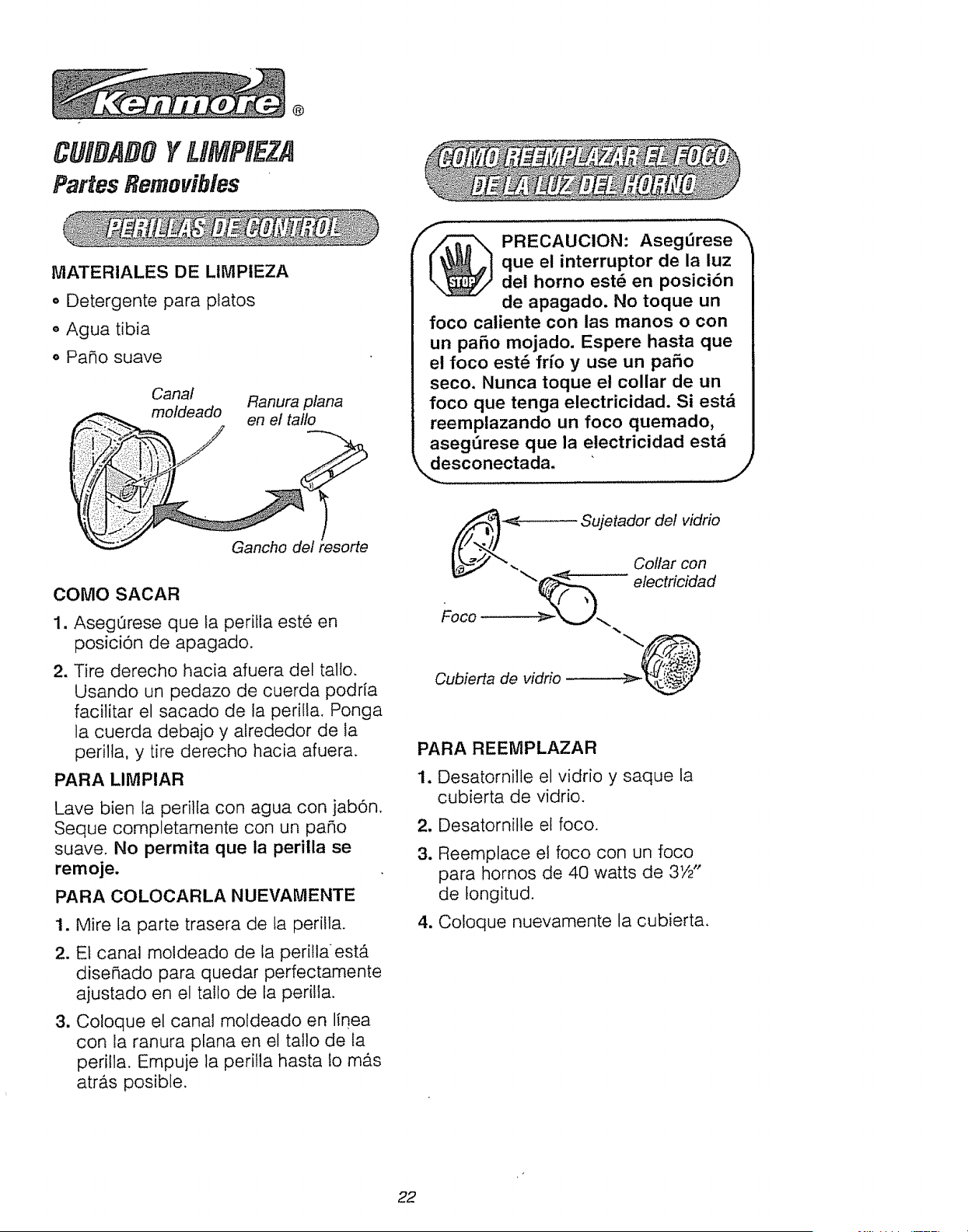
MATERIALES DE LIMPIEZA
o Detergente para platos
, Agua tibia
° Patqo suave
Canal Ranura plana
moldeado
j_ en el tall_
COMO SACAR
1. Aseg0rese que fa perilla est6 en
posicion de apagado.
2. Tire derecho hacia afuera del tallo.
Usando un pedazo de cuerda podria
facilitar el sacado de la perilla. Ponga
la cuerda debajo y alrededor de la
perilta, y tire derecho hacia afuera.
PARA LIMPIAR
Lave bien la periila con agua con jab6n,
Seque completamente con un pa£_o
suave. No permita que la perilta se
remoje.
PARA COLOCARLA NUEVAMENTE
1. Mire ta parte trasera de ta peritla.
2. Et canal moldeado de ta peritlaest_.
disehado para quedar perfectamente
ajustado en el tallo de fa perifla.
3. Coloque el canal moldeado en linea
con la ranura plana en el talio de ta
perilla. Empuje la perilla hasta 1omb.s
arras posible.
f@ PRECAUCION: Asegfirese"_
que el interruptor de la luz
del horno est_ en posici6n
de apagado. No toque un
foco caliente con las manos o con
un patio mojado. Espere hasta que
el foco est6 frfo y use un patio
seco. Nunca toque el collar de un
foco que tenga electricidad. Si estfi
reemplazando un foco quemado,
aseg_rese que la electricidad est_
\_descone_ctada.
Sujetador del vidrio
Collar con
electn'cidad
Foco
Cubierta de vidrio __@
PARA REEMPLAZAR
1. Desatorni]le el vidrio y saque la
cubierta de vidrio.
2. Desatornitle et foco.
3. Reemplace el foco con un foco
para hornos de 40 watts de 3W"
de fongitud.
4. Coloque nuevamente la cubierta,
22

COMO COLOCAR NUEVAMENTE
1. Levante el frente del tope del caj6n y
b,_jeto a traves de la abertura en la
base del riel.
MATERIALES DE LIMPIEZA
o Detergente para platos
o Agua tibia
o PaRo hOmedo
COMO SACAR
1. Tire el cajOn hacia afuera hasta que
se detenga.
2. Levante el frente del caj6n hasta que
el tope de ta guia del cajOn pase por
encima del tope de la gala sobre el
riel de la base.
Tope de la gufa
2. Baje el frente de! cajon y empuje el
cajOn hacia atr_s hasLa que se detenga.
3, Levante et frente del cajOn hasta que
et tope de la gufa del cajOn pase pot
encima de la gufa en el rie! de la
base. Deslice el cajOn hacia su fugar.
f@ PRECAUClON: El caj6n le_'_
ofrece espacio para guardar
utensilios para cocinar y
hornear. Los materiales
inflamables y de pl_stico no se
deberfan guardar en este caj6n. No
sobrecargue el caj6n. Si el caj6n est_
demasiado pesado, se podria salir
del riei de la base cuando Io abra.
_J
Tope de la gufa
3. Levante et caj6n por sobre los topes.
PARA LIMPIAR
Limpie por dentro y fuera det cajOn con
agua tibia con jabOn y un paso o esponja
homed& No use abrasivos fuertes o
tanas para fregar sobre el cajOn.
23
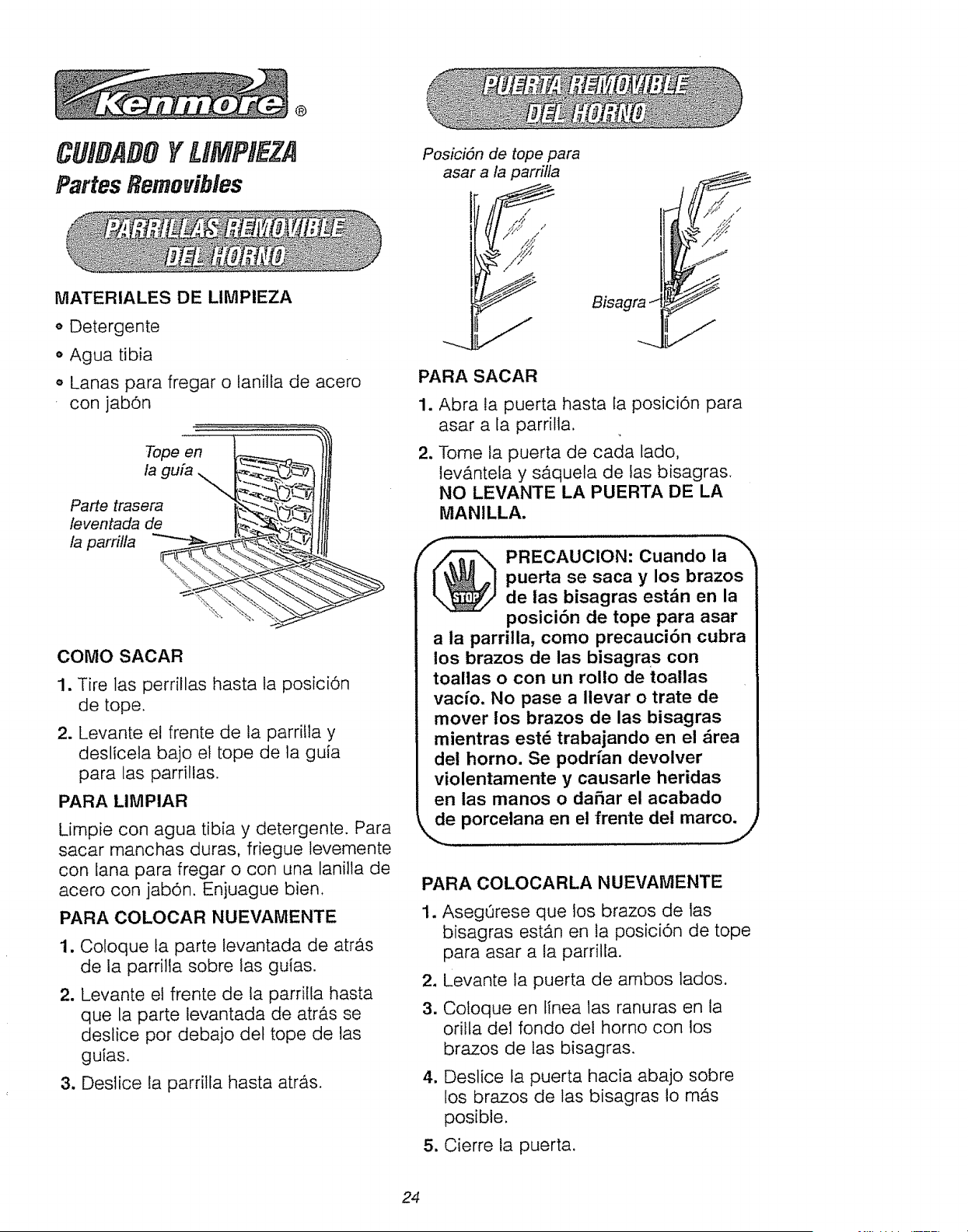
MATERIALES DE LIMPIEZA
,>Detergente
,, Agua tibia
,, Lanas para fregar o fanilfa de acero
con jab0n
Tope en
la gufa
Parte trasera
leventada de
la parrilla
COMO SACAR
1. Tire las perrillas hasta la posici6n
de tope.
2. Levante el frente de ta parrifia y
deslicela bajo el tope de la guia
para las parritlas.
PARA LIMPIAR
Limpie con agua tibia y detergente. Para
sacar manchas duras, friegue levemente
con tana para fregar o con una lanilla de
acero con jab6n. Enjuague bien+
PARA COLOCAR NUEVAMENTE
1. Coloque ta parte tevantada de atr&s
de la parrilia sobre tas guias.
2. Levante el frente de la parrilla hasta
que la parte levantada de atr_ts se
deslice por debajo det tope de tas
guias.
3, Deslice la parrilla hasta arras.
Posicidn de tope para
asar a la parrilla
J
Bisagra -I
PARA SACAR
1. Abra la puerta hasta la posici6n para
asar a la parrilla.
2. Tome la puerta de cada lado,
]ev,_ntela y s,_quela de fas bisagras.
NO LEVANTE LA PUERTA DE LA
MANILLA.
if@ PRECAUCION: Cuando la "_
puerta se saca y los brazos
de las bisagras est_n en la
posici6n de tope para asar
a la parrilla, como precauci6n cubra
los brazos de las bisagras con
toallas o con un rollo de toallas
vacio. No pase a Ilevar o trate de
mover los brazos de las bisagras
mientras est_ trabajando en el _rea
del horno. Se podrfan devolver
violentamente y causarle heridas
en ias manos o daSar el acabado
de porcelana en el frente del marco.
PARA COLOCARLA NUEVAMENTE
2_
3.
1
AsegOrese que los brazos de 1as
bisagras estb,n en ia posici6n de tope
para asar a la parrilta.
Levante la puerta de ambos lados.
Cotoque en ffnea las ranuras en la
orilta del fondo del homo con los
brazos de las bisagras.
Deslice la puerta hacia abajo sobre
los brazos de las bisagras 1o mas
posible.
5. Cierre ta puerta.
24
®
ANTESDELLAMARFARA
UNSERVICiO
Para ahorrar tiempo y dinero, antes de llamar para un servicio, revise la lista de mas
abajo para cuatquier problema que usted crea que tiene con el funcionamiento
de su estufa. Si el probtema es algo que usted no puede reparar, use los NOmeros
de Servicio para et Consumidor que se encuentran al final de este manual. Ouando
haga un llamado, tenga disponible el n_mero de modelo, lista de partes para
reparaciones, manual de uso y cuidado y la fecha de compra.
PROBLEMA POSIBLE CAUSA POSIBLE SOLUClON
El dial control Mal funcionamiento de Empuje el boron CLEAR/
la estufa.
pestahea un "F"
seguida por un
n_mero o letra.
a_
b.
Uso de materiates de
limpieza incorrectos.
Particutas asperas
(sal, etc.) entre el
fondo de las ollas
y la superficie para
cocinar.
Pequefias rayaduras
o abrasiones sobre
la cubierta.
OFF'. Permita que la
estufa se enfria por una
hora y ponga nuevamente
el homo en funcionamiento,
Si el problema se repite,
[lame para un servicio.
a. Use solamente Cooktop
Cleaning Creme_
b. AsegOrese que la
superficie de la cubierta
y el fondo de las ollas
esten iimpias antes
de usarlas.
Marcas de metal
en la superficie de
la cubierta
(pueden verse
como rayaduras).
Areas de
descoloraci6n
sobre la superficie
de ia cubierta.
Arrastrar o raspar los
utensilios sobre ta
superficie de la cubierta.
c. Utensilios con fondos c. Use solamente o!las de
b.speros, fondo piano.
Use el procedimienlEo
recomendado para
limpiar la superficie
de la cubierta.
Bandas y manchas
oscuras sobre la
superficie de ia
cubierta.
DepOsitOs de minerales Use procedimientos de
de agua y alimentos, limpieza recomendados
para timpiar la superficie
de la cubierta,
a, Derrames o a. Use un raspador a hoja
Los controles de
la cubierta, homo
y control del horno
no funcionan.
salpicaduras
de grasa incrustadas.
b. Uso de materiales
de limpieza incorrectos.
bm
y siga las direcciones
en la secci6n para la
limpieza de este manual.
Use sotemente Cooktop
Cleaning Creme ® sobre
la superficie de la
cubierta.
No pasa electricidad a
la estufa.
Revise el circuito
principal o los fusibles,
AsegOrese que el
cord6n est,. enchufado.
25
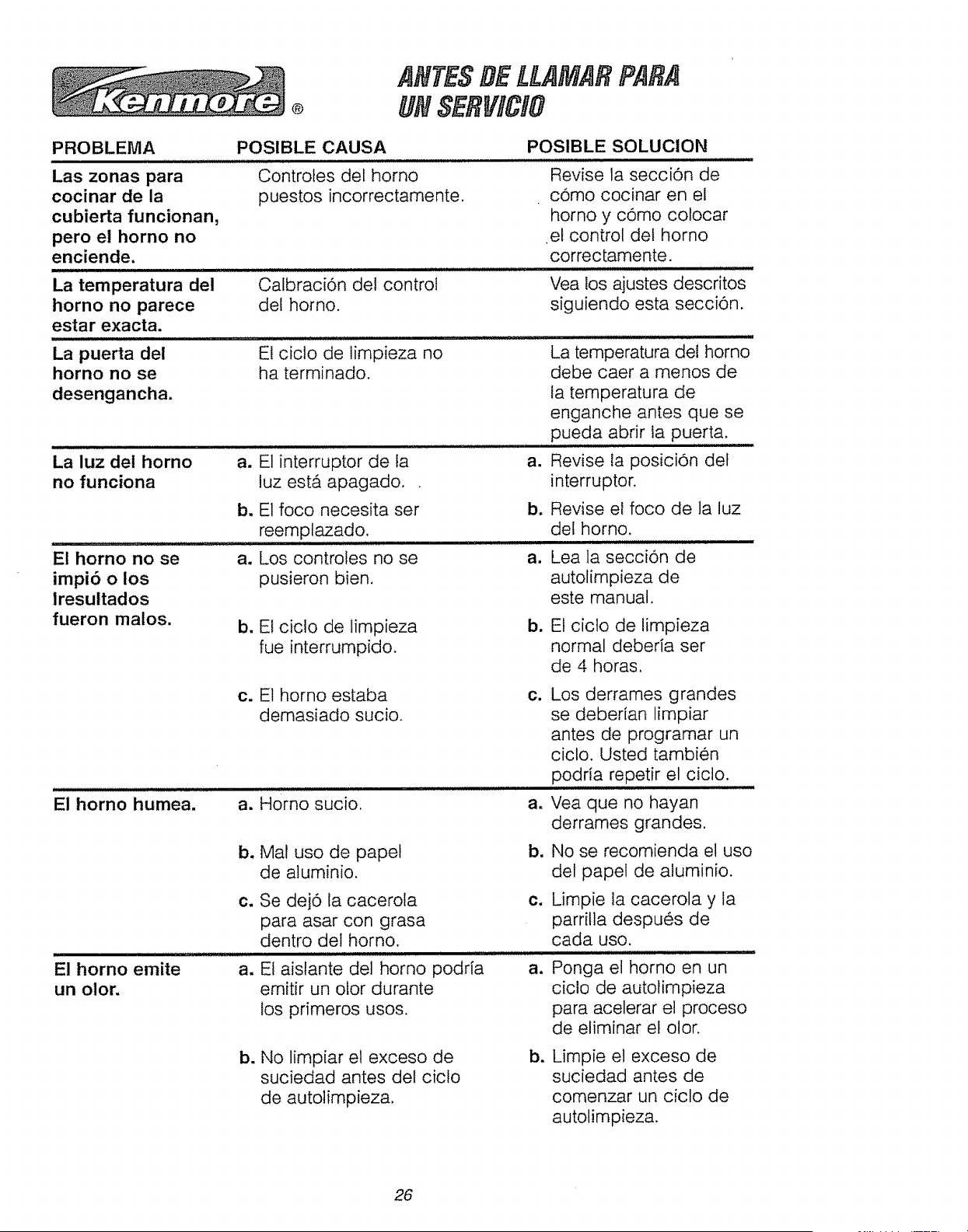
®
AH SDELLAMARPARA
UNSERVICIO
PROBLEMA POSIBLE CAUSA
Las zonas para Controfes del homo
cocinar de la puestos incorrectamente,
cubierta funcionan,
pero el horno no
enciende.
La temperatura dei
horno no parece
estar exacta.
Calbraci6n del control
del horno.
POSIBLE SOLUClON
Revise la secci6n de
cOmo cocinar en el
homo y c6mo colocar
et control det horno
correctamente.
Vea los ajustes descritos
siguiendo esta secciOn.
La puerta del
horno no se
desengancha.
La luz del horno
no funciona
E! horno no se
impi6 o los
Iresuitados
fueron maios.
El cicto de limpieza no
ha terminado.
a. El interruptor de la
luz est_ apagado.
b. E1foco necesita ser
reempfazado.
i i iii iii Ji uil((puil(
a. Los controles no se
pusieron bien.
b. El ciclo de limpieza
fue interrumpido.
La temperatura del homo
debe caer a menos de
ta temperatura de
enganche antes que se
pueda abrir la puerta.
a. Revise ia posiciOn def
interruptor.
b. Revise el foco de la luz
del horno.
a. Lea la secciOn de
autofimpieza de
este manual,
b. El ciclo de limpieza
normal deberia ser
de 4 horas,
El horno humea.
c. E1homo estaba c.
demasiado sucio.
as
Homo sucio, a.
Los derrames grandes
se deber[an limpiar
antes de programar un
ciclo. Usted tambien
podda repetir el ciclo.
Vea que no hayan
b. Mal uso de papel b.
de aluminio.
c. Se dej6 la cacerota c.
para asar con grasa
dentro det horno.
El horno emite
un olor.
a_ Et aislante de] homo podria
emitir un olor durante
los primeros usos.
derrames grandes.
No se recomienda el uso
det papel de aluminio.
Limpie la cacerola y ia
parrilla despu_s de
cada uso.
a. Ponga el horno en un
ciclo de autofimpieza
para acelerar el proceso
de eliminar el olor.
bm
No limpiar el exceso de
suciedad antes def ciclo
de autolimpieza.
b.
Limpie el exceso de
suciedad antes de
comenzar un ciclo de
autolimpieza.
26
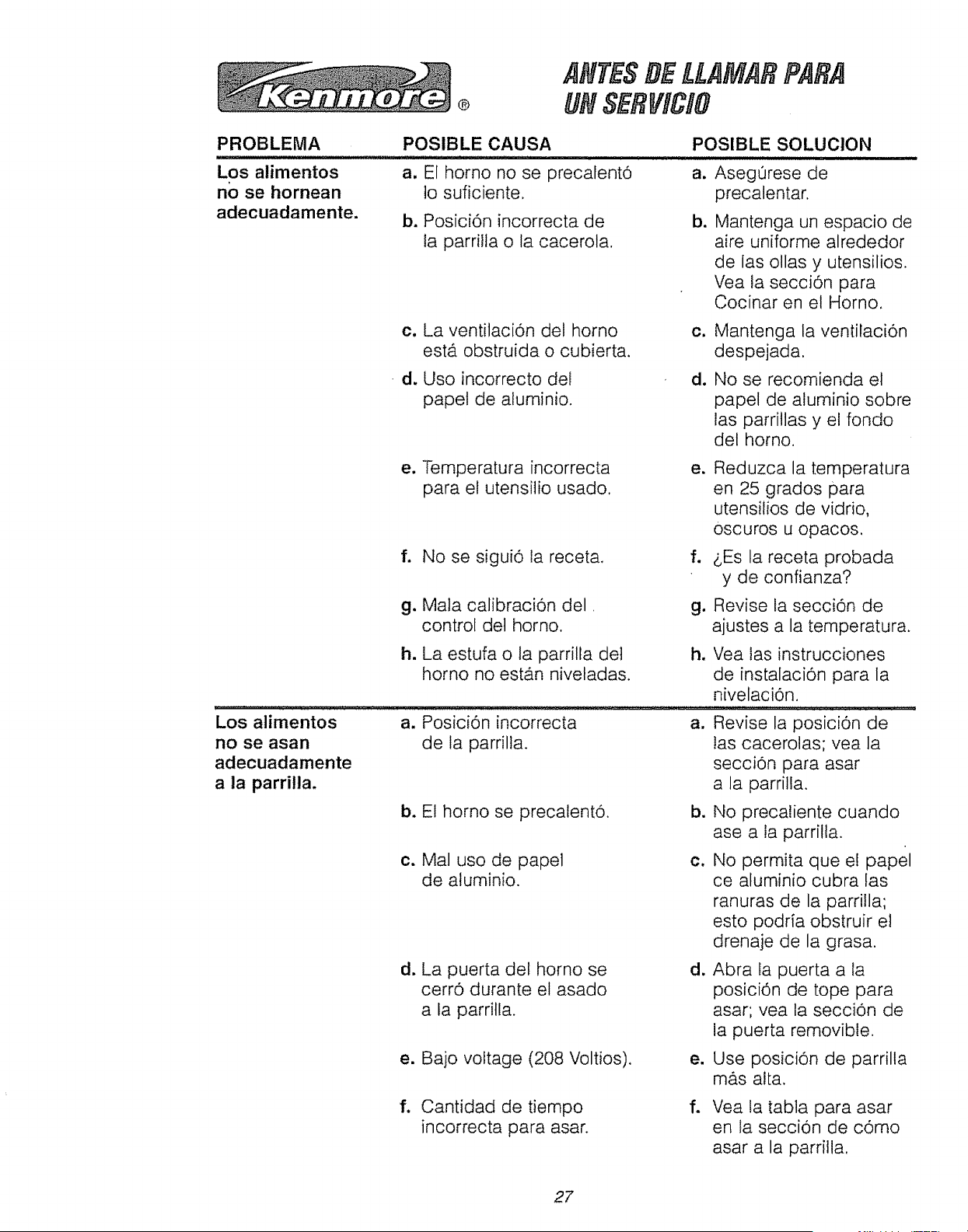
®
ANTESDELLAMARFARA
UNSERVICIO
PROBLEMA
Los alimentos
no se hornean
adecuadamente.
POSIBLE CAUSA POSIBLE SOLUClON
a. El homo no se precalento a. AsegQrese de
to suficiente, precalentar,
b. Posici6n incorrecta de b. Mantenga un espacio de
ta parrilla o la cacerola, aire uniforme alrededor
de las ollas y utensilios.
Vea la secciOn para
Cocinar en el Horno.
c. La ventilacion del homo c.
esta obstruida o cubierta.
• d. Uso incorrecto del d.
papel de aluminio.
Mantenga la ventilaciOn
despejada,
No se recomienda el
papel de atuminio sobre
las parritlas y el fondo
del homo.
e. Temperatura incorrecta
para el utensitio usado,
f. No se sigui6 la receta.
a
h.
Mala calibracion del
control det horno.
La estufa o la parrilla det
homo no estan niveladas.
Los alimentos a. Posici6n incorrecta a.
de la parrilla.
b. El homo se precalent6.
c. Mal uso de pape]
de atuminio.
d. La puerta del homo se
cerrO durante el asado
a la parriffa.
e. Bajo voltage (208 Voltios).
no se asan
adecuadamente
a la parri!la.
e. Reduzca la temperatura
en 25 grados para
utensilios de vidrio,
oscuros u opacos,
f. _,Es la receta probada
y de confianza?
g. Revise la secciOn de
ajustes a la temperatura.
h. Vea las instrucciones
de instalaciOn para la
nivelaciOn.
Revise la posiciOn de
las cacerolas; vea la
secciOn para asar
a la parrilla.
b. No precaliente cuando
ase a la parrilta.
c. No permita que e! papel
ce afuminio cubra tas
ranuras de la parrilla;
esto podrfa obstruir e!
drenaje de la grasa.
d. Abra la puerta a la
posici6n de tope para
asar; vea ia secciOn de
ia puerta removible.
e. Use posiciOn de parrilla
mas atLa,
f. Cantidad de tiempo
incorrecta para asar.
fo Vea la tabla para asar
en la seccion de c6mo
asar a la parritla,
27
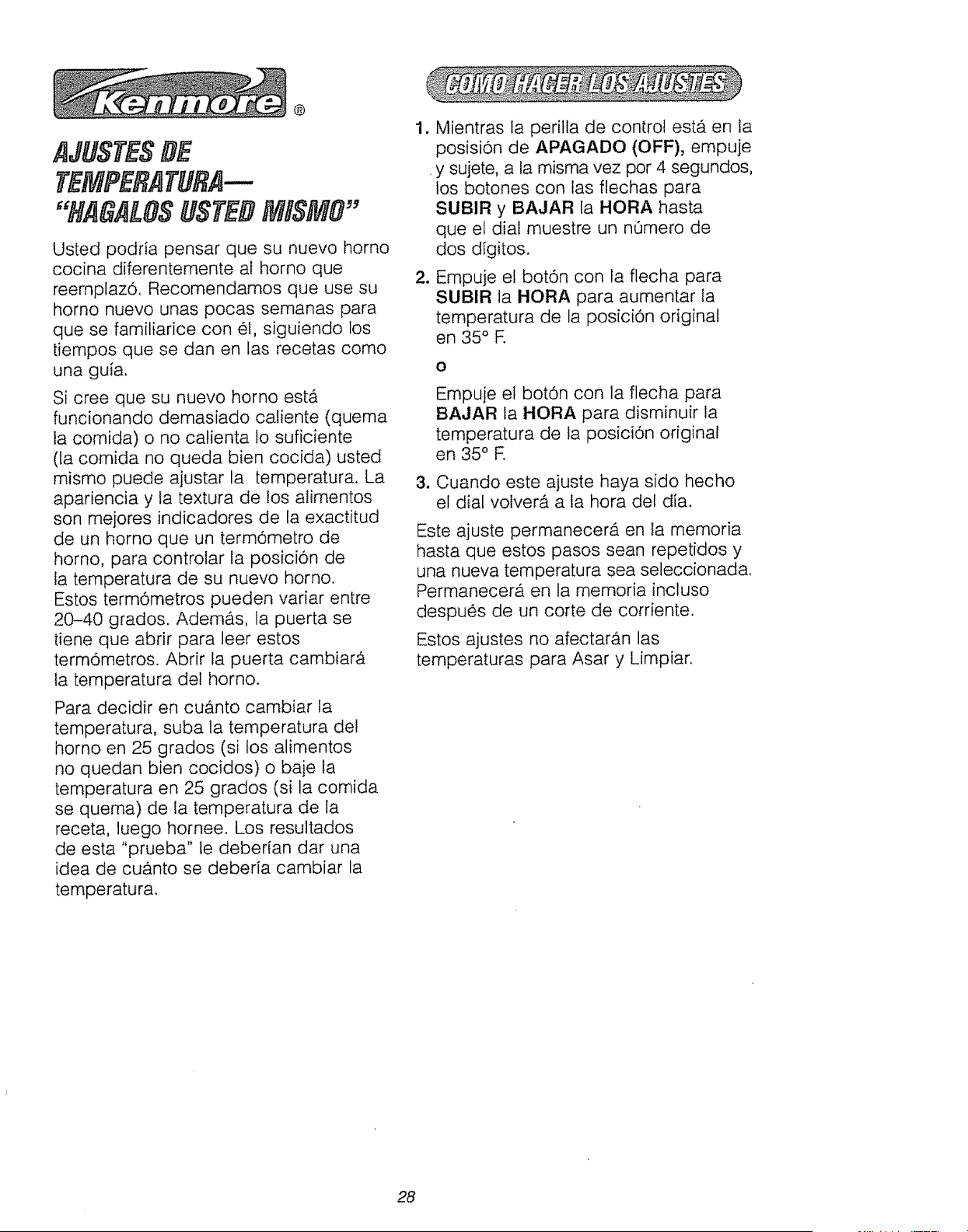
AJUSTESDE
TEMPERATURA--
®
"HAGALOSliSTEDMISMO"
Usted podria pensar que su nuevo horno
cocina diferentemente al horno que
reemplaz6. Recomendamos que use su
homo nuevo unas pocas semanas para
que se familiarice con el, siguiendo los
tiempos que se dan en las recetas como
una guia.
Si cree que su nuevo horno est_
funcionando demasiado catiente (quema
la comida) o no cafienta Io suficiente
(la comida no queda bien cocida) usted
mismo puede ajustar la temperatura. La
apariencia y la textura de los alimentos
son mejores indicadores de la exactitud
de un homo que un termometro de
homo, para controlar la posicion de
la temperatura de su nuevo horno.
Estos term6metros pueden variar entre
20-40 grados. Ademas, la puerta se
tiene que abrir para leer estos
term6metros. Abrir ta puerta cambiara
fa temperatura del homo.
Para decidir en cub.nto cambiar la
temperatura, suba la temperatura del
homo en 25 grados (si los alimentos
no quedan bien cocidos) o baje la
temperatura en 25 grados (si la comida
se quema) de la temperatura de la
receta, luego hornee. Los resultados
de esta "prueba" le deberian dar una
idea de cub.nto se deberia cambiar la
temperatura.
1. Mientras la peritla de control est_ en la
posisi0n de APAGADO (OFF), empuje
y sujete, a la misma vez por 4 segundos,
los botones con las flechas para
SUBIR y BAJAR la HORA hasta
que el dial muestre un nOmero de
dos digitos.
2_
Empuje el bot6n con fa flecha para
SUBIR la HORA para aumentar la
temperatura de la posiciOn original
en 35 ° E
O
Empuje el bot6n con la fiecha para
BAJAR ta HORA para disminuir la
temperatura de la posici6n original
en 35 ° R
3. Cuando este ajuste haya sido hecho
el dial volvera a ta hora del dia.
Este ajuste permanecer_, en la memoria
hasta que estos pasos sean repetidos y
una nueva temperatura sea seleccionada.
Permanecer_5 en la memoria incluso
despues de un corte de corriente.
Estos ajustes no afectar,_n las
temperaturas para Asar y Limpiar.
28
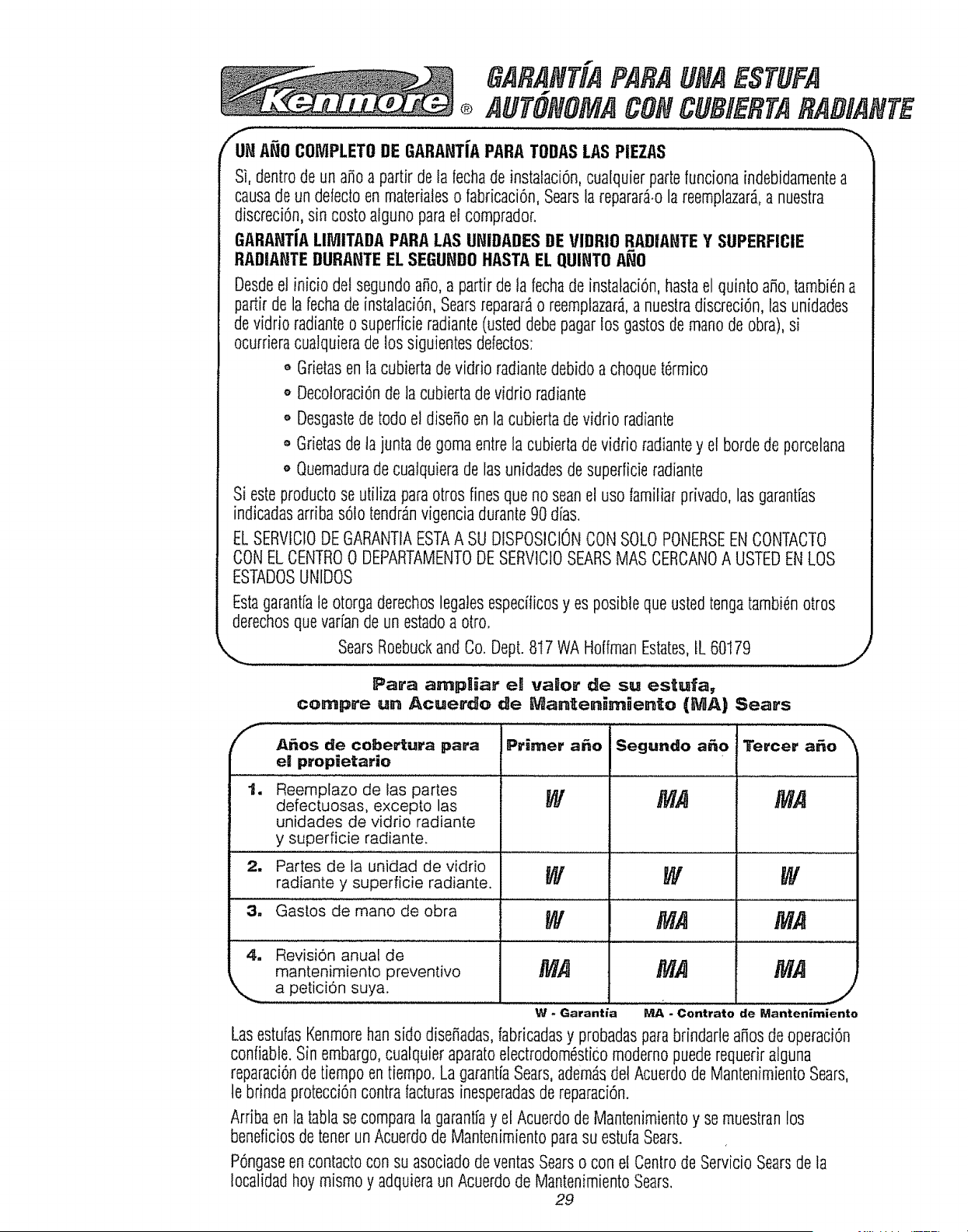
®
GARANTfAPARAUNAESTUFA
AUTONOMACONCUBIERTARADIANTE
_UN ANOCOIV]PLETODEGARAHTJAPARATODASLASPiEZAS
Si, dentrode un afio a partirde la fechade instafaciOn,cuaiquierpartefuncionaindebidamentea
causadeun defectoen materiateso fabricaciOn,Searsla reparar_.ola reemplazard,a nuestra
discreciOn,sin costoaiguno parael comprador.
GARANTiALIMITADA PARALAS Ui_IDADESDEVIDRIO RADtAHTEY SUPERFICIE
RADIAHTEDURAHTEEL SEGUHDOHASTAEL QUINTOANO
Desdeel inicio del segundoa_o,a partirde la fechade instataciOn,hastael quinto afio,tambi_na
partirde la fechade instalaciOn,Searsreparar_o reemplazar_,a nuestradiscreciOn,las unidades
devidrio radianteo superficieradiante(usteddebepagarlos gastosde manodeobra),si
ocurrieracualquierade los siguientesdefectos:
o Grietasen la cubiertadevidrio radiantedebidoa choquet_rmico
o DecoloraciOnde la cubiertade vidrio radiante
o Desgastede todo el disefioen la cubiertadevidrio radiante
,, GrietasdeJajunta de gomaentrela cubiertade vidrio radiantey el bordede porcelana
o Quemaduradecualquierade lasunidadesde superficieradiante
Si esteproductose utiliza paraotrosfines que no seanel uso familiarprivado,las garantias
indicadasarribasolo tendr_nvigenciadurante90 dias.
ELSERVICIODE GARANTIAESTAA SU DISPOSICIONCONSOLOPONERSEENCONTACTO
CONELCENTRO0 DEPARTAMENTODESERVIC]OSEARSMAS CERCANOA USTEDENLOS
ESTADOSUNIDOS
Estagarantfate otorgaderechoslegalesespecificosyes posible queustedtengatambidnotros
derechosquevarfandeun estadoa otro.
_. SearsRoebuckand Co. Dept.817 WAHoflmanEstates,IL 60179
Para arnpiiar e! vaRor die su estufa,
cornpre un Acuerdo de Mantenim_ento (MA) Sears
f
A_os de cobertura para
el propietario
1. Reempfazo de fas partes
defectuosas, excepto las
unidades de vidrio radiante
y superficie radiante.
2. Partes de la unidad de vidrio
radiante y superficie radiante.
3, Gasl.os de mano de obra
Pri_er a_o
W
Segundo a_o
MA
LasestufasKenmorebansido dise_adas,fabricadasy probadasparabrindarleaNosde operaciOn
confiable.Sin embargo,cualquieraparatoelectrodomdstiComodernopuederequeriralguna
reparaciOnde tiempoentiempo.La garantiaSears,ademdsdet AcuerdodeMantenimientoSears,
te brindaprotecciOncontraiacturasinesperadasdereparaciOn.
Arribaen la [ablase comparala garantfay el Acuerdode Mantenimientoy se muestranlos
beneficiosdetenerunAcuerdode Mantenimientoparasu estufaSears.
POngaseencontactocon su asociadodeventasSearso con e[ Centrode ServicioSearsde la
iocalidadhoymismo y adquieraun Acuerdode MantenimientoSears.
29
W W W
W MA MA
4. RevisiOn anual de
_,,. mantenimiento preventivo _I/_A _/_A _/7_
a peticion suya. ...... j
W - Garantia MA - Contrato de Mantenimiento

Para 1_ piez_s de reparad6n o repuesto
(refacci6n) que usted necesite
klame 7 am-7 pro, 7 dias a la semana al
_800_366_PARY
(I-800-366-7278)
Para servicio de reparad6n en casa
de las rnarcas principales
Llame 24 horas del dia, 7 dias a la semana al
l =800=4=MY=H@ME sM
(I-800-469-4663)
Para local_ar el Centre de $ervicio y de
Reparadones Sears en su _ea
Llame 24 horas al dia, 7 dias a la semana al
_800_488= El222
P_a recibir inforrnaci6n sobre la compra
de _m Acuerdo de Mante_ento con Sears
o para mdag_ sobre un Acuerdo eydstente
Llame 9 am-5 pro, de lunes a sfibado
1=800_.827_6655
The Se_ice Side of Sears."
3O