A1
English
Our Thanks to You and
Customer Assistance
Introduction
Nothing Comes Close to a Cobra
®
English
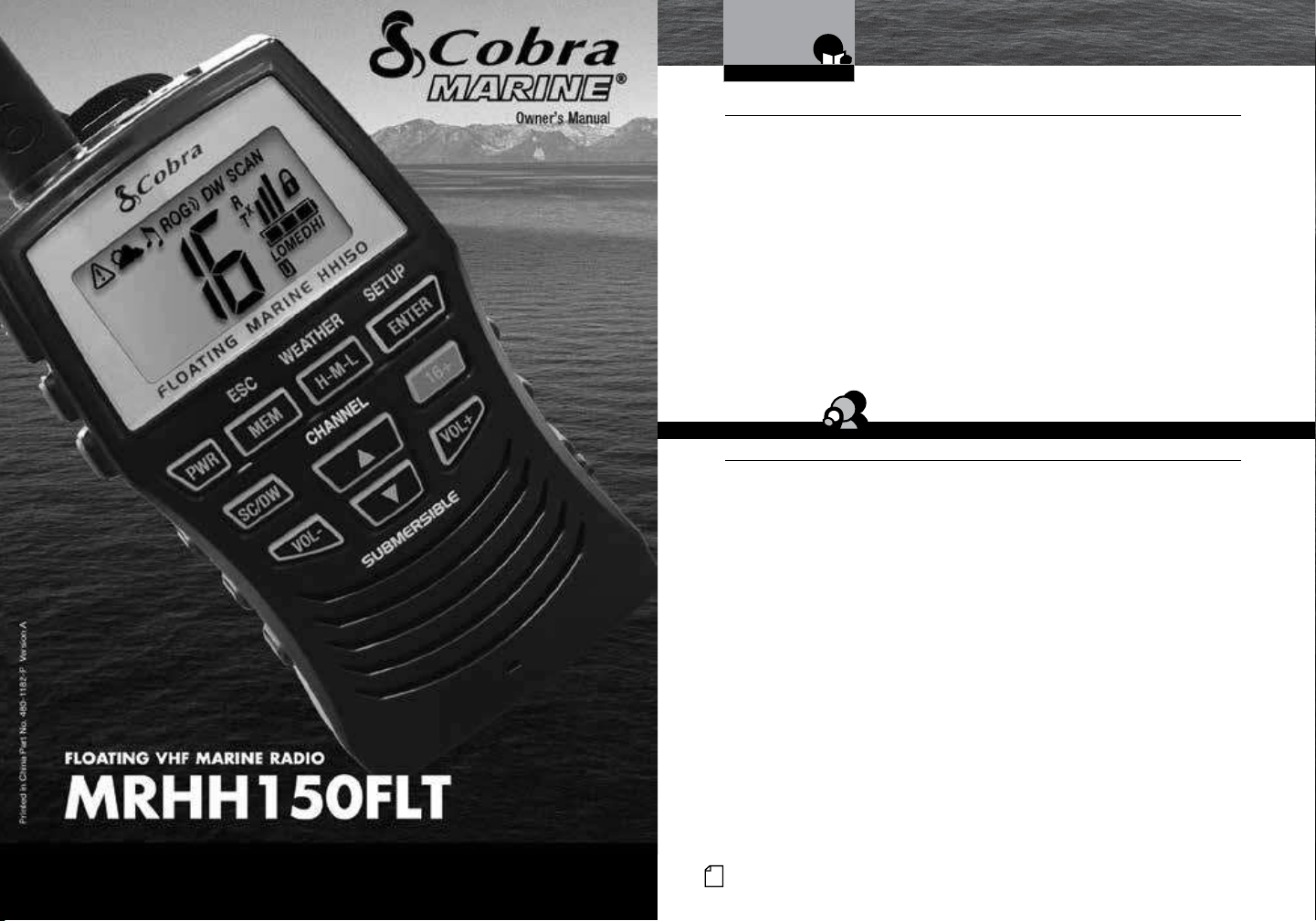
Our Thanks to You
•
Thank you for purchasing a CobraMarine
®
VHF radio.
Properly used, this Cobra
®
product will give you
many years of reliable service.
How Your CobraMarine VHF Radio Works
This radio is a battery-powered portable transceiver for use afloat. It gives you
two-way vessel-to-vessel and vessel-to-shore station communications, primarily
for safety and secondarily for navigation and operational purposes. With it, you
can call for help, get information from other boaters, talk to lock or bridge tenders,
and make radiotelephone calls to anywhere in the world through a marine operator.
Besides two-way communications, the radio can provide quick access to receive
all the NOAA (National Oceanographic and Atmospheric Administration) weather
channels and alert you to weather emergencies with a tone on a weather channel you
can tune in for your area.
Customer Assistance
•
Should you encounter any problems with this product, or not understand
its many features, please refer to this owner’s manual. If you require further
assistance after reading this manual, Cobra Electronics offers the following customer
assistance services:
For Assistance in the U.S.A.
Automated Help Desk English only.
24 hours a day, 7 days a week 773-889-3087 (phone).
Customer Assistance Operators English only.
8:00 a.m. to 5:30 p.m. Easternl Time Mon. through Fri.
(except holidays) 773-889-3087.
Technical Assistance English only.
www.cobra.com (on-line: Frequently Asked Questions).
English only: productinfo
@cobra.com (e-mail).
For Assistance Outside the U.S.A.
Contact Your Local Cobra Dealer
Customer Assistance
©2019 Cobra Electronics Corporation™
6500 West Cortland Street
Chicago, Illinois 60707 USA
www.cobra.com
A1
English
Our Thanks to You and
Customer Assistance
Introduction
Nothing Comes Close to a Cobra
®
English
Our Thanks to You
•
Thank you for purchasing a CobraMarine
®
VHF radio.
Properly used, this Cobra
®
product will give you
many years of reliable service.
How Your CobraMarine VHF Radio Works
This radio is a battery-powered portable transceiver for use afloat. It gives you
two-way vessel-to-vessel and vessel-to-shore station communications, primarily
for safety and secondarily for navigation and operational purposes. With it, you
can call for help, get information from other boaters, talk to lock or bridge tenders,
and make radiotelephone calls to anywhere in the world through a marine operator.
Besides two-way communications, the radio can provide quick access to receive
all the NOAA (National Oceanographic and Atmospheric Administration) weather
channels and alert you to weather emergencies with a tone on a weather channel you
can tune in for your area.
Customer Assistance
•
Should you encounter any problems with this product, or not understand
its many features, please refer to this owner’s manual. If you require further
assistance after reading this manual, Cobra Electronics offers the following customer
assistance services:
For Assistance in the U.S.A.
Automated Help Desk English only.
24 hours a day, 7 days a week 773-889-3087 (phone).
Customer Assistance Operators English only.
8:00 a.m. to 5:30 p.m. Easternl Time Mon. through Fri.
(except holidays) 773-889-3087.
Technical Assistance English only.
www.cobra.com (on-line: Frequently Asked Questions).
English only: productinfo
@cobra.com (e-mail).
For Assistance Outside the U.S.A.
Contact Your Local Cobra Dealer
Customer Assistance
©2019 Cobra Electronics Corporation™
6500 West Cortland Street
Chicago, Illinois 60707 USA
www.cobra.com
Memory Channel Icon
FLOATING MARINE HH150
ESC WEATHER SETUP
PWR
MEM
H-M-L
ENTER
CHANNEL
SC/DW
+16
VOL
VOL
SUBMERSIBLE
A3
English
Introduction
A2
English
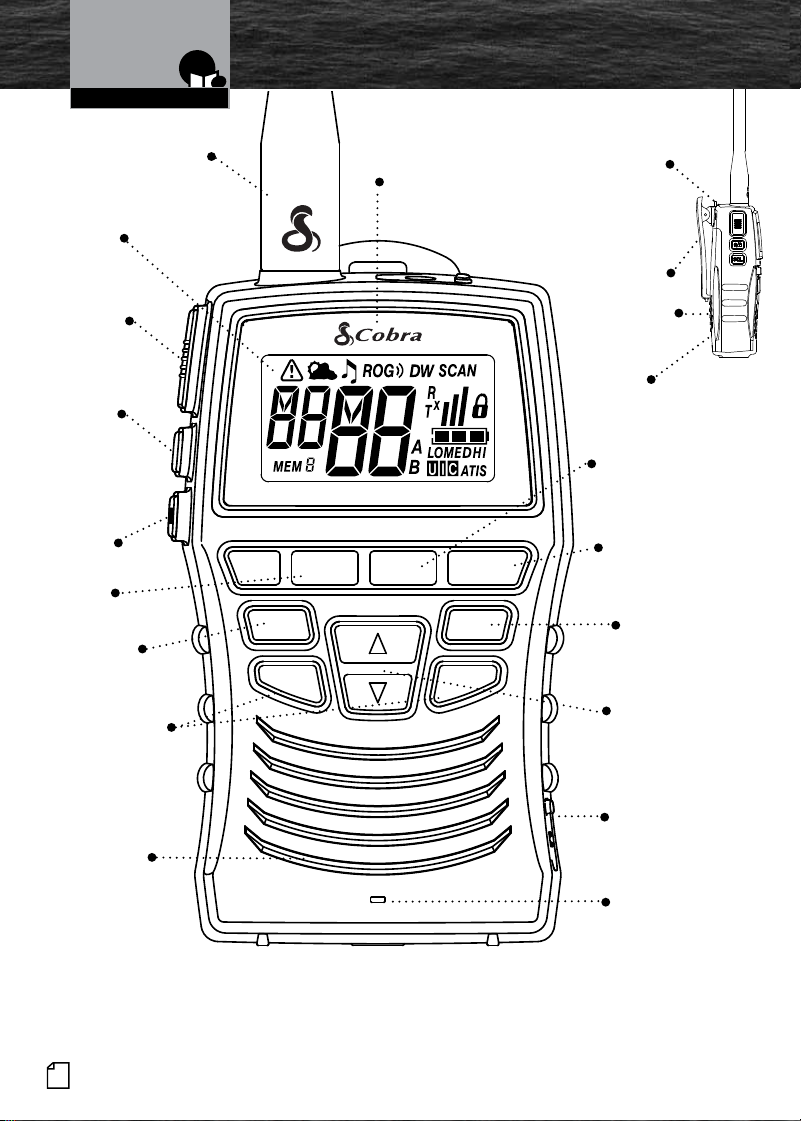
Radio Controls
and Indicators
Introduction
Backlit LCD (Liquid Crystal Display) Screen
•
Instant Channel
16/9
External Speaker/
Microphone Jack
Antenna
Backlit
LCD
Screen
Battery
Compartment
Backlight/
Key Lock
Memory/
Escape
Push to Talk
UIC Active Channel Map Icons
Dual Watch Icon
Battery Power Icon
Button Lock Icon
Weather Icon
Key Tone Icon
Scan Icon
Active Channel Numbers
Speaker
Power Settings
Select 0.5, 1 or 3 watts of output power
for near or distant calling.
USA/International/Canada Channels
Operate on any of the three different
channel maps set up for these areas.
All NOAA Weather Channels
Instant access to all National Weather
Channels, 24 hours a day.
Emergency Weather Alert
Receive NOAA alerts when threatening
weather is nearby.
Submersible
Meets JIS7/IPX7 waterproof standards.
Key Lock
Prevents accidental setting changes
when key lock is set.
Channel Scan/Memory Scan
Scan through all or memorized channels
to find conversations in progress.
Instant Channel 16/9
Provides instant access to priority Channel
16 and calling Channel 9.
Dual-Watch
Use to monitor two (channels at once –
Channel 16 and one user selected channel.
Roger Beep Tone (Selectable)
Confirmation tone indicates the completion
of the user’s transmission and signals to
others it is clear to talk.
On or Off selectable.
Rechargeable NiMH (Nickel-Metal
Hydride) Batteries
Five rechargeable NiMH batteries supplied
with the unit provide extended operating
time and have no memory effect. Five
AAA alkaline batteries may also be used
for emergency backup power.
12V Power Cord Included
Charge the NiMH batteries in a car or boat.
Speaker/Mic Jack
Allows connecting optional Cobra Lapel
Speaker/Mic.
Memory Channels
Allows programming of up to ten VHF
memory channels.
Signal Strength Meter
Shows the strength of incoming
or outgoing signals.
Illuminated Buttons
Allows high visibility of all function buttons.
Product Features
•
Belt Clip
Engagement
Microphone
Low/Med/High Power Icons
Battery Door
Simplex Operation Icon
Backlit LCD Screen
and Product Features
Roger Beep Icon
Power Level/
Weather
Enter/Setup
Dual Watch/
Scan
Channel Up/Down
Weather Alert Icon
Signal Strength Icon
Broadcast Receive Icon
Squelch
Defeat
Charge Jack
Wrist Strap
Connector
Volume Up/ Down
Receive & Transmit Icons
Memory Channel Icon
FLOATING MARINE HH150
ESC WEATHER SETUP
PWR
MEM
H-M-L
ENTER
CHANNEL
SC/DW
+16
VOL
VOL
SUBMERSIBLE
A3
English
Introduction
A2
English
Radio Controls
and Indicators
Introduction
Backlit LCD (Liquid Crystal Display) Screen
•
Instant Channel
16/9
External Speaker/
Microphone Jack
Antenna
Backlit
LCD
Screen
Battery
Compartment
Backlight/
Key Lock
Memory/
Escape
Push to Talk
UIC Active Channel Map Icons
Dual Watch Icon
Battery Power Icon
Button Lock Icon
Weather Icon
Key Tone Icon
Scan Icon
Active Channel Numbers
Speaker
Power Settings
Select 0.5, 1 or 3 watts of output power
for near or distant calling.
USA/International/Canada Channels
Operate on any of the three different
channel maps set up for these areas.
All NOAA Weather Channels
Instant access to all National Weather
Channels, 24 hours a day.
Emergency Weather Alert
Receive NOAA alerts when threatening
weather is nearby.
Submersible
Meets JIS7/IPX7 waterproof standards.
Key Lock
Prevents accidental setting changes
when key lock is set.
Channel Scan/Memory Scan
Scan through all or memorized channels
to find conversations in progress.
Instant Channel 16/9
Provides instant access to priority Channel
16 and calling Channel 9.
Dual-Watch
Use to monitor two (channels at once –
Channel 16 and one user selected channel.
Roger Beep Tone (Selectable)
Confirmation tone indicates the completion
of the user’s transmission and signals to
others it is clear to talk.
On or Off selectable.
Rechargeable NiMH (Nickel-Metal
Hydride) Batteries
Five rechargeable NiMH batteries supplied
with the unit provide extended operating
time and have no memory effect. Five
AAA alkaline batteries may also be used
for emergency backup power.
12V Power Cord Included
Charge the NiMH batteries in a car or boat.
Speaker/Mic Jack
Allows connecting optional Cobra Lapel
Speaker/Mic.
Memory Channels
Allows programming of up to ten VHF
memory channels.
Signal Strength Meter
Shows the strength of incoming
or outgoing signals.
Illuminated Buttons
Allows high visibility of all function buttons.
Product Features
•
Belt Clip
Engagement
Microphone
Low/Med/High Power Icons
Battery Door
Simplex Operation Icon
Backlit LCD Screen
and Product Features
Roger Beep Icon
Power Level/
Weather
Enter/Setup
Dual Watch/
Scan
Channel Up/Down
Weather Alert Icon
Signal Strength Icon
Broadcast Receive Icon
Squelch
Defeat
Charge Jack
Wrist Strap
Connector
Volume Up/ Down
Receive & Transmit Icons
Introduction
1
Nothing Comes Close to a Cobra
®
Table of Contents
Introduction
Our Thanks to You ......................................................................................... A1
Customer Assistance ..................................................................................... A1
Radio Controls and Indicators ....................................................................... A2
Backlit LCD (Liquid Crystal Display) Screen .................................................. A3
Product Features ........................................................................................... A3
Important Safety Information ............................................................................ 2
Marine Communication and Radio Procedures ................................................. 4
FCC Licensing Information ................................................................................ 5
Installation
Included in this Package ................................................................................... 6
Wrist Strap, Belt Clip and External Speaker/Mic ............................................... 7
Installing, Charging and Maintaining Batteries ................................................. 8
Operating Your Radio
Getting Started ................................................................................................ 10
Setup Mode Programming............................................................................... 14
NOAA All Hazards/Weather Radio and Alert .................................................... 17
Standby, Receive and Transmit ....................................................................... 18
Advanced Operation ........................................................................................ 21
Maintenance .................................................................................................... 27
Troubleshooting ............................................................................................... 27
VHF Marine Radio Protocols
VHF Marine Radio Procedures ......................................................................... 28
Voice Calling .................................................................................................... 30
Radiotelephone Calls ....................................................................................... 31
Emergency Messages and Distress Procedure ............................................... 32
Warranty and Trademark
Limited 1-Year Warranty ................................................................................. 35
Trademark Acknowledgement ........................................................................ 35
Customer Service
Product Service ............................................................................................... 36
Specifications .................................................................................................. 37
Appendix – English/Español
VHF Marine Channel Assignments .................................................................. 38
Weather Channel Assignments ....................................................................... 55
Accessories ..................................................................................................... 56
3
Nothing Comes Close to a Cobra
®
2
English
Important Safety Information
Introduction
Important Safety Information
WARNINGS
Your radio generates electromagnetic RF (radio frequency) energy when it is
transmitting. To ensure that you and those around you are not exposed to excessive
amounts of that energy, DO NOT touch the antenna when transmitting. KEEP the radio at
least two (2) inches (5cm) away from yourself and others when transmitting.
DO NOT operate with more than a duty cycle of 5% transmit, 5% receive and 90%
standby. The radio is transmitting when the Talk button is pressed and the transmit
information shows on the LCD screen.
ALWAYS use only Cobra authorized accessories.
DO NOT operate the radio in an explosive atmosphere, near blasting sites,
or in any area where signs are posted prohibiting radio transmissions.
NEVER place the transceiver or microphone/speaker where they might interfere
with operation of your vessel or cause injury.
DO NOT allow children or anyone unfamiliar with proper procedures to operate
the radio without supervision.
Failure to observe any of these warnings may cause you to exceed FCC RF
exposure limits or create other dangerous conditions.
Industry Canada Antenna Notice
Under Industry Canada regulations, this radio transmitter may only operate using an
antenna of a type and maximum (or lesser) gain approved for the transmitter by
Industry Canada. To reduce potential radio interference to other users, the antenna type
and its gain should be so chosen that the equivalent isotropically radiated power
(e.i.r.p.) is not more than that necessary for successful communication.
Avis d’antenne du Canada d’industrie
En vertu de la réglementation de l’industrie du Canada, cet émetteur de radio ne peut
fonctionner à l’aide d’une antenne d’un type et un maximum (ou moins) Gain approuvé
pour l’émetteur par Industrie Canada. Pour réduire le risque d’interférence aux autres
utilisateurs, le type d’antenne et son gain doivent être choisis afin que la puissance
isotrope rayonnée équivalente (PIRE) ne dépasse pas ce qui est nécessaire pour une
communication réussie.
Important Safety Information
•
Before using your CobraMarine
®
VHF radio, please read these general precautions
and warnings.
Warning and Notice Statements
To make the most of this radio, it must be used properly. Please read the operating
instructions carefully before using the radio. Special attention must be paid to the
WARNING and NOTICE statements in this manual.
WARNING
Statements identify conditions that could result in personal injury or loss of life.
NOTICE
Statements identify conditions that could cause damage to the radio
or other equipment.
Safety Training Information
This CobraMarine
®
radio has been tested and found to comply with the FCC RF
exposure limits for use by the “General Population” and Industry Canada RF exposure
limits for use by the “General Public.” This CobraMarine VHF radio also complies with
the following guidelines and standards regarding RF energy and electromagnetic
energy levels as well as evaluation of those levels for human exposure:
n
FCC OET Bulletin 65 Edition 97-01 Supplement C, Evaluating Compliance with FCC
Guidelines for Human Exposure to Radio Frequency Electromagnetic Fields.
n
American National Standards Institute (C95.1-1992), IEEE Standard for Safety
Levels with Respect to Human Exposure to Radio Frequency Electromagnetic
Fields, 3 kHz to 300 GHz.
n
American National Standards Institute (C95.3-1992), IEEE Recommended Practice
for the Measurement of Potentially Hazardous Electromagnetic
Fields — RF and Microwave.
n
Industry Canada RSS-102-Radio Frequency (RF) Exposure Compliance of
Radiocommunication Apparatus (All Frequency bands).
Conformité d’exposition de la fréquence du Canada RSS-102-Radio d’industrie
(rf) de l’appareillage de communication par radio (toutes les bandes de fréquence).
Caution
Introduction Introduction
General Precautions
•
The following WARNINGS and NOTICE information on the following page will make you
aware of RF exposure hazards and how to assure you operate the radio within the FCC
RF exposure limits established for the radio.
3
Nothing Comes Close to a Cobra
®
2
English
Important Safety Information
Introduction
Important Safety Information
WARNINGS
Your radio generates electromagnetic RF (radio frequency) energy when it is
transmitting. To ensure that you and those around you are not exposed to excessive
amounts of that energy, DO NOT touch the antenna when transmitting. KEEP the radio at
least two (2) inches (5cm) away from yourself and others when transmitting.
DO NOT operate with more than a duty cycle of 5% transmit, 5% receive and 90%
standby. The radio is transmitting when the Talk button is pressed and the transmit
information shows on the LCD screen.
ALWAYS use only Cobra authorized accessories.
DO NOT operate the radio in an explosive atmosphere, near blasting sites,
or in any area where signs are posted prohibiting radio transmissions.
NEVER place the transceiver or microphone/speaker where they might interfere
with operation of your vessel or cause injury.
DO NOT allow children or anyone unfamiliar with proper procedures to operate
the radio without supervision.
Failure to observe any of these warnings may cause you to exceed FCC RF
exposure limits or create other dangerous conditions.
Industry Canada Antenna Notice
Under Industry Canada regulations, this radio transmitter may only operate using an
antenna of a type and maximum (or lesser) gain approved for the transmitter by
Industry Canada. To reduce potential radio interference to other users, the antenna type
and its gain should be so chosen that the equivalent isotropically radiated power
(e.i.r.p.) is not more than that necessary for successful communication.
Avis d’antenne du Canada d’industrie
En vertu de la réglementation de l’industrie du Canada, cet émetteur de radio ne peut
fonctionner à l’aide d’une antenne d’un type et un maximum (ou moins) Gain approuvé
pour l’émetteur par Industrie Canada. Pour réduire le risque d’interférence aux autres
utilisateurs, le type d’antenne et son gain doivent être choisis afin que la puissance
isotrope rayonnée équivalente (PIRE) ne dépasse pas ce qui est nécessaire pour une
communication réussie.
Important Safety Information
•
Before using your CobraMarine
®
VHF radio, please read these general precautions
and warnings.
Warning and Notice Statements
To make the most of this radio, it must be used properly. Please read the operating
instructions carefully before using the radio. Special attention must be paid to the
WARNING and NOTICE statements in this manual.
WARNING
Statements identify conditions that could result in personal injury or loss of life.
NOTICE
Statements identify conditions that could cause damage to the radio
or other equipment.
Safety Training Information
This CobraMarine
®
radio has been tested and found to comply with the FCC RF
exposure limits for use by the “General Population” and Industry Canada RF exposure
limits for use by the “General Public.” This CobraMarine VHF radio also complies with
the following guidelines and standards regarding RF energy and electromagnetic
energy levels as well as evaluation of those levels for human exposure:
n
FCC OET Bulletin 65 Edition 97-01 Supplement C, Evaluating Compliance with FCC
Guidelines for Human Exposure to Radio Frequency Electromagnetic Fields.
n
American National Standards Institute (C95.1-1992), IEEE Standard for Safety
Levels with Respect to Human Exposure to Radio Frequency Electromagnetic
Fields, 3 kHz to 300 GHz.
n
American National Standards Institute (C95.3-1992), IEEE Recommended Practice
for the Measurement of Potentially Hazardous Electromagnetic
Fields — RF and Microwave.
n
Industry Canada RSS-102-Radio Frequency (RF) Exposure Compliance of
Radiocommunication Apparatus (All Frequency bands).
Conformité d’exposition de la fréquence du Canada RSS-102-Radio d’industrie
(rf) de l’appareillage de communication par radio (toutes les bandes de fréquence).
Caution
Introduction Introduction
General Precautions
•
The following WARNINGS and NOTICE information on the following page will make you
aware of RF exposure hazards and how to assure you operate the radio within the FCC
RF exposure limits established for the radio.
Introduction
5
Nothing Comes Close to a Cobra
®
4
English
Marine Communication,
Procedures & FCC Licensing
Marine Communication
and Radio Procedures
Introduction
Recommendations for Marine Communication
•
The frequencies your radio uses are set aside to enhance safety afloat and for vessel
navigation and operational messages over a range suitable for nearshore voyages.
If the 3 watt maximum output of your radio is not sufficient for the distances you travel
from the coast, consider a higher powered handheld or installing a Cobra Marine fixed
mount radio with up to 25 watts of output power. (Visit www.cobra.com or your local
dealer for model availability.)
If traveling far offshore, you should consider adding even more powerful radio
equipment such as HF single side band or satellite radio for your vessel.
The U.S. Coast Guard does not endorse cellular telephones as substitutes for marine
radios. They generally cannot communicate with rescue vessels and, if you make a
distress call on a mobile telephone, only the party you call will be able to hear you.
Additionally, mobile telephones may have limited coverage over water and can be
hard to locate. If you do not know where you are, the Coast Guard will have difficulty
finding you if you are using a mobile telephone.
However, cellular telephones can have a place on board where cellular coverage
is available — to allow social conversations and keep the marine frequencies
uncluttered and available for their intended uses.
Sea Tow Automated Radio Check (ARC) System
Please try the Sea Tow Automated Radio Check service. Areas where the safety check
service is available include the East Coast, Gulf of Mexico, and Southern California,
as well as in select inland regions. The first and only boating safety program of its
kind, the Sea Tow Automated Radio Check service is fully automated and allows 24
hour a day automatic responses to radio check calls.
Conducting a radio check through the Sea Tow Automated Radio Check service
couldn’t be simpler. All boaters need to do is tune their VHF radios to Channel 24, 25,
26, 27 or 28, depending on the region, key the mic, and ask for a radio check. The
Automated Radio Check system responds to each radio check with an automated
reply, and also replays to the boater’s original radio transmission, allowing him or her
to assess the strength of the signal and confirm the VHF radio is in good working order.
To find the Sea Tow Automated Radio Check service channel in an area, owners
should visit http://www.seatow.com/arc. The web page links to an instructional video
demonstrating how to use the service step by step.
FCC Licensing Information
•
CobraMarine VHF radios comply with the FCC (Federal Communications Commission)
requirements that regulate the Maritime Radio Service.
The radio operates on all currently allocated marine channels and is switchable for use
according to U.S.A., International or Canadian regulations. It features instant access
to emergency Channel 16 and calling Channel 9 as well as NOAA (National Oceanic
and Atmospheric Administration) All Hazards Radio with Alert that can be accessed by
pressing one button.
Station License
An FCC ship station license is no longer required for any vessel traveling in U.S.A. waters
which uses a VHF marine radio, RADAR, or EPIRB (Emergency Position Indicating Radio
Beacon), and which is not required to carry radio equipment. However, any vessel required
to carry a marine radio on an international voyage, carrying an HF single side band
radiotelephone, or carrying a marine satellite terminal must obtain a station license.
FCC license forms and applications for ship and land stations can be downloaded from the
Internet at www.fcc.gov. Forms can also be obtained by calling the FCC at 888-225-5322.
International Station License
If your vessel will be entering the sovereign waters of a country other than the
U.S.A. or Canada, you should contact that country’s communications regulatory
authority for licensing information.
Radio Call Sign
Currently, the FCC does not require recreational boaters to have a license. The United
States Coast Guard recommends that the boat’s registration number and state of registry
(e.g., IL 1234 AB) be used as a call sign and be clearly visible on the vessel.
Introduction
NOTICE
Your radio is waterproof only when the batteries are properly installed.
AVOID using or storing the radio at temperatures below -4˚F (-20˚C)
or above 140˚F (60˚C).
KEEP your radio at least 3 ft (0.9 m) away from your vessel’s magnetic
navigation compass.
DO NOT attempt to service any internal parts yourself. Have any necessary
service performed by a qualified technician.
This radio is supplied with NiMH (Nickel-Metal Hydride) rechargeable batteries.
n
Use only the Cobra power cord to recharge NiMH batteries in the radio.
n
Do not short circuit the batteries.
n
When replacing the batteries, dispose of the old batteries properly. The NiMH
batteries may explode if disposed of in a fire.
n
Do not attempt to operate your radio while recharging the batteries.
Changes or modifications to your radio MAY VOID its compliance with FCC (Federal
Communications Commission) rules and make it illegal to use.
Introduction
5
Nothing Comes Close to a Cobra
®
4
English
Marine Communication,
Procedures & FCC Licensing
Marine Communication
and Radio Procedures
Introduction
Recommendations for Marine Communication
•
The frequencies your radio uses are set aside to enhance safety afloat and for vessel
navigation and operational messages over a range suitable for nearshore voyages.
If the 3 watt maximum output of your radio is not sufficient for the distances you travel
from the coast, consider a higher powered handheld or installing a Cobra Marine fixed
mount radio with up to 25 watts of output power. (Visit www.cobra.com or your local
dealer for model availability.)
If traveling far offshore, you should consider adding even more powerful radio
equipment such as HF single side band or satellite radio for your vessel.
The U.S. Coast Guard does not endorse cellular telephones as substitutes for marine
radios. They generally cannot communicate with rescue vessels and, if you make a
distress call on a mobile telephone, only the party you call will be able to hear you.
Additionally, mobile telephones may have limited coverage over water and can be
hard to locate. If you do not know where you are, the Coast Guard will have difficulty
finding you if you are using a mobile telephone.
However, cellular telephones can have a place on board where cellular coverage
is available — to allow social conversations and keep the marine frequencies
uncluttered and available for their intended uses.
Sea Tow Automated Radio Check (ARC) System
Please try the Sea Tow Automated Radio Check service. Areas where the safety check
service is available include the East Coast, Gulf of Mexico, and Southern California,
as well as in select inland regions. The first and only boating safety program of its
kind, the Sea Tow Automated Radio Check service is fully automated and allows 24
hour a day automatic responses to radio check calls.
Conducting a radio check through the Sea Tow Automated Radio Check service
couldn’t be simpler. All boaters need to do is tune their VHF radios to Channel 24, 25,
26, 27 or 28, depending on the region, key the mic, and ask for a radio check. The
Automated Radio Check system responds to each radio check with an automated
reply, and also replays to the boater’s original radio transmission, allowing him or her
to assess the strength of the signal and confirm the VHF radio is in good working order.
To find the Sea Tow Automated Radio Check service channel in an area, owners
should visit http://www.seatow.com/arc. The web page links to an instructional video
demonstrating how to use the service step by step.
FCC Licensing Information
•
CobraMarine VHF radios comply with the FCC (Federal Communications Commission)
requirements that regulate the Maritime Radio Service.
The radio operates on all currently allocated marine channels and is switchable for use
according to U.S.A., International or Canadian regulations. It features instant access
to emergency Channel 16 and calling Channel 9 as well as NOAA (National Oceanic
and Atmospheric Administration) All Hazards Radio with Alert that can be accessed by
pressing one button.
Station License
An FCC ship station license is no longer required for any vessel traveling in U.S.A. waters
which uses a VHF marine radio, RADAR, or EPIRB (Emergency Position Indicating Radio
Beacon), and which is not required to carry radio equipment. However, any vessel required
to carry a marine radio on an international voyage, carrying an HF single side band
radiotelephone, or carrying a marine satellite terminal must obtain a station license.
FCC license forms and applications for ship and land stations can be downloaded from the
Internet at www.fcc.gov. Forms can also be obtained by calling the FCC at 888-225-5322.
International Station License
If your vessel will be entering the sovereign waters of a country other than the
U.S.A. or Canada, you should contact that country’s communications regulatory
authority for licensing information.
Radio Call Sign
Currently, the FCC does not require recreational boaters to have a license. The United
States Coast Guard recommends that the boat’s registration number and state of registry
(e.g., IL 1234 AB) be used as a call sign and be clearly visible on the vessel.
Introduction
NOTICE
Your radio is waterproof only when the batteries are properly installed.
AVOID using or storing the radio at temperatures below -4˚F (-20˚C)
or above 140˚F (60˚C).
KEEP your radio at least 3 ft (0.9 m) away from your vessel’s magnetic
navigation compass.
DO NOT attempt to service any internal parts yourself. Have any necessary
service performed by a qualified technician.
This radio is supplied with NiMH (Nickel-Metal Hydride) rechargeable batteries.
n
Use only the Cobra power cord to recharge NiMH batteries in the radio.
n
Do not short circuit the batteries.
n
When replacing the batteries, dispose of the old batteries properly. The NiMH
batteries may explode if disposed of in a fire.
n
Do not attempt to operate your radio while recharging the batteries.
Changes or modifications to your radio MAY VOID its compliance with FCC (Federal
Communications Commission) rules and make it illegal to use.
7
Nothing Comes Close to a Cobra
®
6
English
FCC Licensing (continued) &
Included in this Package
Wrist Strap, Belt Clip
and External Speaker/Mic
Included in this Package
•
You should find all of the following items in the package with your CobraMarine VHF radio.
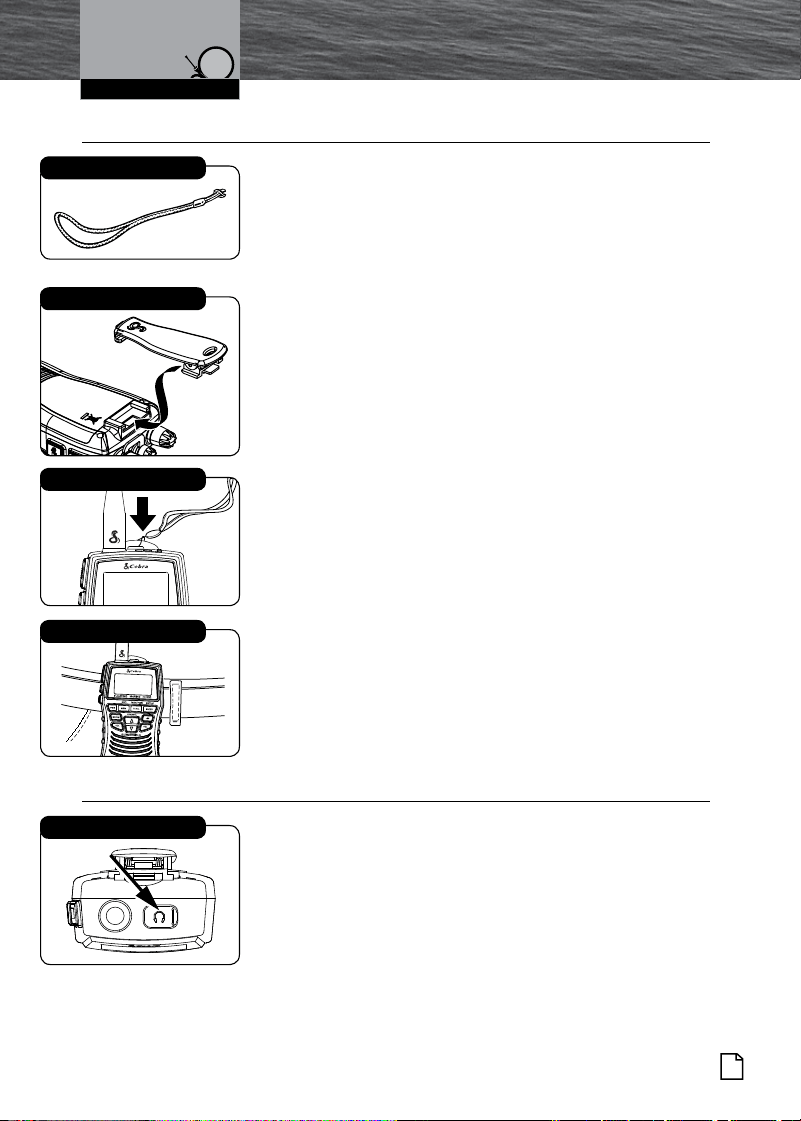
Wrist Strap and Belt Clip
•
Wrist Strap
The radio comes with the wrist strap already attached.
It can be easily removed if you choose not to use it.
Belt Clip
Use the spring-loaded belt clip to carry the radio on your
person.
1. Slide the belt clip into the guide channel on the back of the
radio until it is locked in place.
2. To attach the wrist strap, insert it through the hole at the
top of the belt clip, feed it through the looped end and pull
tight to secure to the belt clip.
3. Press open the belt clip, slide it over the belt and release
the clip.
4. To remove the belt clip from the radio press the tab on the
belt clip, which unlocks the clip, and slide it out.
External Speaker/Microphone Jack
•
Your radio can be fitted with an optional External Speaker/
Microphone (not included), freeing your hands
for other tasks. Contact your local CobraMarine
®
dealer
or Cobra
®
directly for optional accessories.
To attach the external speaker/microphone:
1. Open the speaker/microphone tab on top
of the radio.
2. Insert the plug into the speaker/microphone jack.
VHF Marine Radio Protocols
Operation
Installation
Wrist Strap
Insert Belt Clip onto Radio
Removing the Radio
Secure Radio
VHF Marine Radio Protocols
Operation
Installation
Speaker/Microphone Jack
Canadian Ship Station License
You need a Radio Operator’s Certificate if your vessel is operated in Canadian waters.
Radio Operator training and certification is available from the Canadian Power
Squadron. Visit their website at http://www.cps-ecp.ca/.
User Responsibility and Operating Locations
All users are responsible for observing domestic and foreign government regulations
and are subject to severe penalties for violations. The VHF frequencies on your radio
are reserved for marine use and require a special license to operate from land,
including when your boat is on its trailer.
NOTE
This device complies with part 15 of the FCC Rules, and Industry Canada
license-exempt RSS standards. Operation is subject
to the following two conditions:
1. This device may not cause harmful interference, and
2. This device must accept any interference received, including interference
that may cause undesired operation.
FCC Warning: Replacement or substitution of transistors, regular diodes or other
parts of a unique nature, with parts other than those recommended by Cobra
may cause a violation of the technical regulations of part 80 of the FCC Rules, or
violation of type acceptance requirements of part 2 of the rules.
FLOATING MARINE HH150
ESC WEATHER SETUP
PWR
MEM
H-M-L
ENTER
CHANNEL
SC/DW
+16
VOL
VOL
SUBMERSIBLE
Radio Wrist Strap
12V Power Cord
5 Rechargeable NiMH Batteries
Operating Instruction Manual
Spring-Loaded Belt Clip
For connection to 12-volt
power sources.
7
Nothing Comes Close to a Cobra
®
6
English
FCC Licensing (continued) &
Included in this Package
Wrist Strap, Belt Clip
and External Speaker/Mic
Included in this Package
•
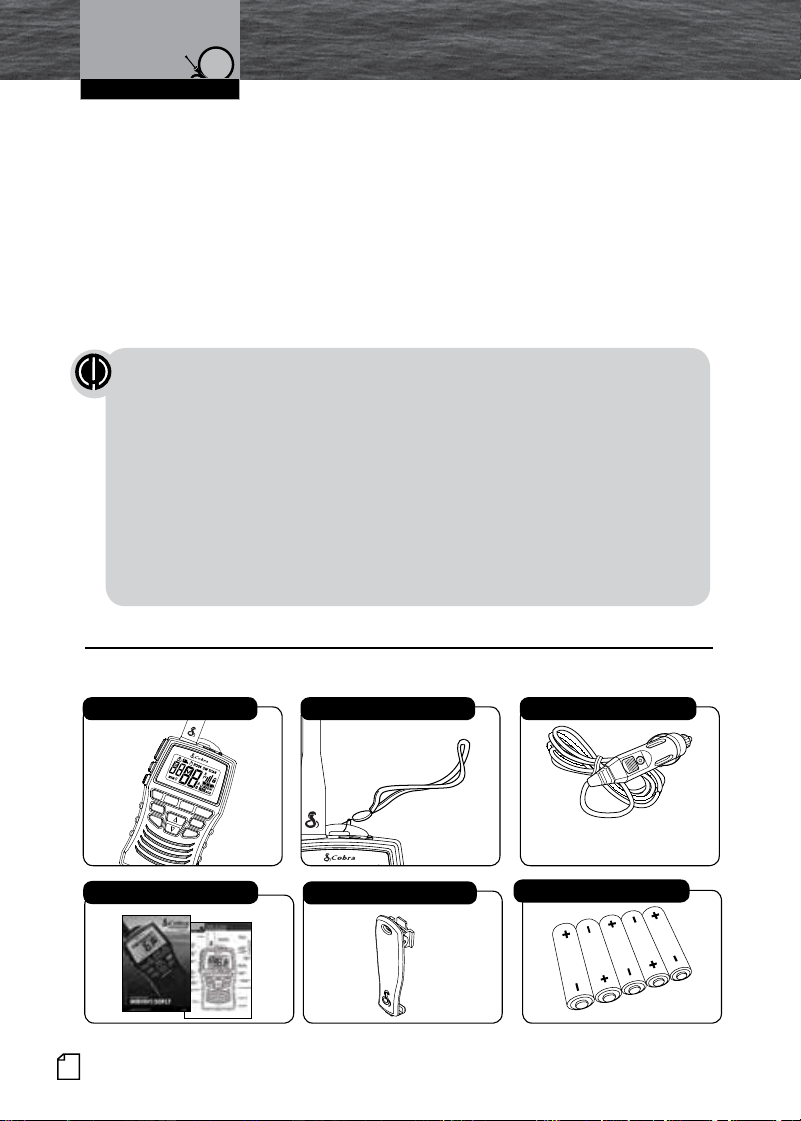
You should find all of the following items in the package with your CobraMarine VHF radio.
Wrist Strap and Belt Clip
•
Wrist Strap
The radio comes with the wrist strap already attached.
It can be easily removed if you choose not to use it.
Belt Clip
Use the spring-loaded belt clip to carry the radio on your
person.
1. Slide the belt clip into the guide channel on the back of the
radio until it is locked in place.
2. To attach the wrist strap, insert it through the hole at the
top of the belt clip, feed it through the looped end and pull
tight to secure to the belt clip.
3. Press open the belt clip, slide it over the belt and release
the clip.
4. To remove the belt clip from the radio press the tab on the
belt clip, which unlocks the clip, and slide it out.
External Speaker/Microphone Jack
•
Your radio can be fitted with an optional External Speaker/
Microphone (not included), freeing your hands
for other tasks. Contact your local CobraMarine
®
dealer
or Cobra
®
directly for optional accessories.
To attach the external speaker/microphone:
1. Open the speaker/microphone tab on top
of the radio.
2. Insert the plug into the speaker/microphone jack.
VHF Marine Radio Protocols
Operation
Installation
Wrist Strap
Insert Belt Clip onto Radio
Removing the Radio
Secure Radio
VHF Marine Radio Protocols
Operation
Installation
Speaker/Microphone Jack
Canadian Ship Station License
You need a Radio Operator’s Certificate if your vessel is operated in Canadian waters.
Radio Operator training and certification is available from the Canadian Power
Squadron. Visit their website at http://www.cps-ecp.ca/.
User Responsibility and Operating Locations
All users are responsible for observing domestic and foreign government regulations
and are subject to severe penalties for violations. The VHF frequencies on your radio
are reserved for marine use and require a special license to operate from land,
including when your boat is on its trailer.
NOTE
This device complies with part 15 of the FCC Rules, and Industry Canada
license-exempt RSS standards. Operation is subject
to the following two conditions:
1. This device may not cause harmful interference, and
2. This device must accept any interference received, including interference
that may cause undesired operation.
FCC Warning: Replacement or substitution of transistors, regular diodes or other
parts of a unique nature, with parts other than those recommended by Cobra
may cause a violation of the technical regulations of part 80 of the FCC Rules, or
violation of type acceptance requirements of part 2 of the rules.
FLOATING MARINE HH150
ESC WEATHER SETUP
PWR
MEM
H-M-L
ENTER
CHANNEL
SC/DW
+16
VOL
VOL
SUBMERSIBLE
Radio Wrist Strap
12V Power Cord
5 Rechargeable NiMH Batteries
Operating Instruction Manual
Spring-Loaded Belt Clip
For connection to 12-volt
power sources.
VHF Marine Radio Protocols
Operation
VHF Marine Radio Protocols
Operation
9
Comes Close to a Cobra
®
8
English
Batteries and Charging Batteries and Charging
Batteries and Charging
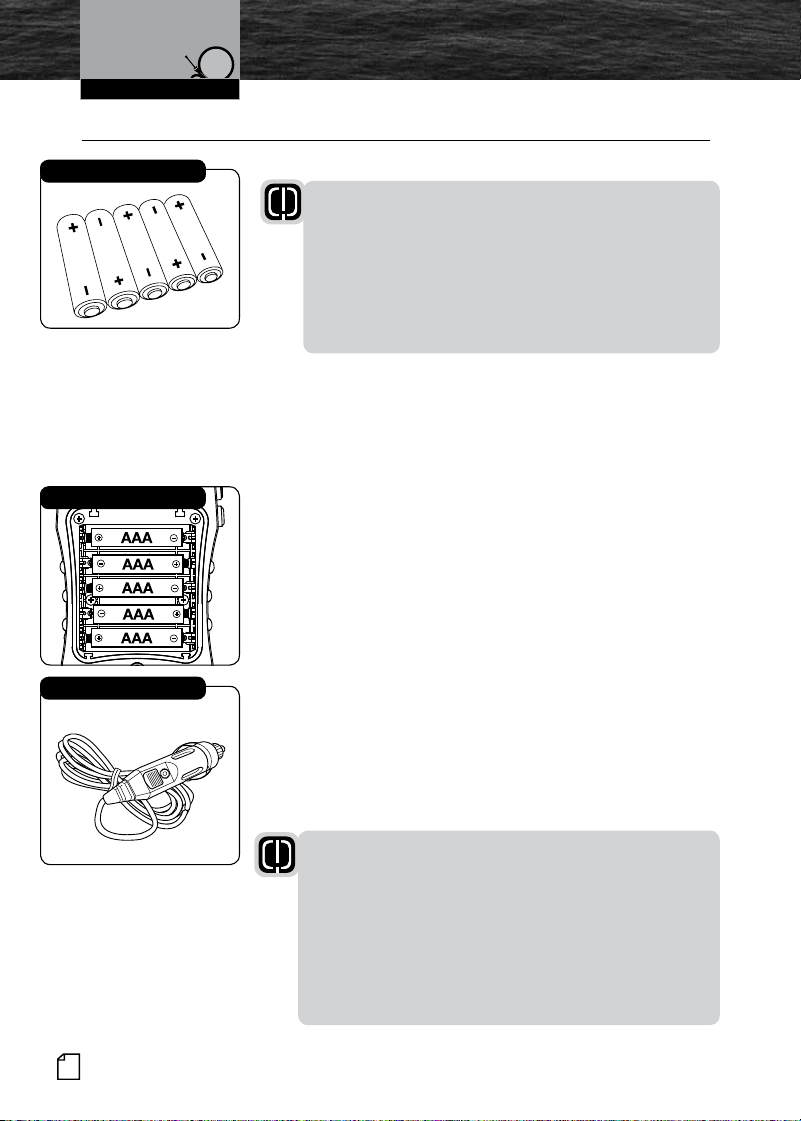
•
The radio is is shipped with five NiMH rechargeable batteries.
WARNING
The 12V power cord supplied with this radio is only
to be used with its rechargeable batteries. Do not
attempt to charge any other type of batteries in the
radio as fire, explosion or battery damage will occur.
Rechargeable battery life will be prolonged if extreme
ambient temperatures are avoided.
When your rechargeable batteries begin to discharge too
quickly, it is time to install new batteries. Your radio will also
operate with five (high-quality AAA alkaline batteries.
Installing the Batteries
Install the AAA batteries in the slots in the battery
compartment with the batteries oriented according
to the polarity (+ & -) marks in the slots.
Initial Charge
The Cobra-provided NiMH batteries may be charged in a car
or boat using the appropriate 12V power cord.
1. Insert the power cord into the side of the radio.
2. Insert the other end of the power cord into a 12V power
source.
3. Observe that the red light on the power cord glows to
indicate that power is present.
4. Allow the batteries to charge for 12 to 14 hours before use.
WARNING
Only the rechargeable NiMH batteries can be
recharged. You MUST use the charging device provided
with this radio. Do not substitute any other type of
charging adapter. Battery damage, fire or explosion
may result. It is equally important to prevent the NiMH
batteries from freezing to obtain best performance
from them.
Install Batteries
Power Source
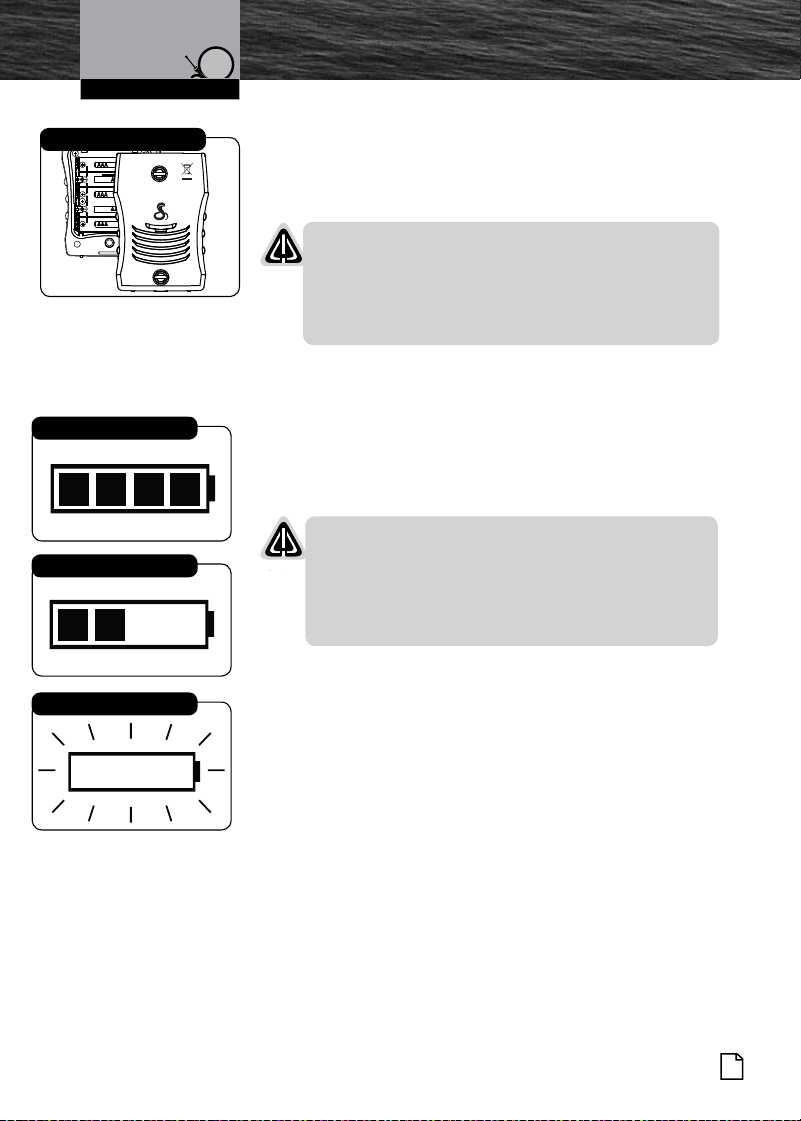
To Remove Batteries from Radio
1. Loosen the 2 screws on the back of the battery door.
2. Pull the individual batteries out of the radio housing.
NOTICE
NiMH batteries are toxic. Please dispose of properly.
Some marine suppliers accept old batteries for
recycling and some municipal waste disposal agencies
have special provisions for battery disposal.
Locking Tab
Maintaining the Battery Charge
As you use your radio, the battery power icon will show the
battery power remaining. When the icon begins to flash, it is
time to recharge or change the batteries.
NOTICE
Use only the 12V power cord provided by Cobra. Do
not use the power cord with alkaline batteries; only
the NiMH batteries are rechargeable. Spent alkaline
batteries must be discarded and replaced.
It is a good idea to keep a set of fresh, high-quality AAA
alkaline batteries with your radio. Should the rechargeable
batteries become discharged and no electrical power source
be available, you can insert fresh alkaline batteries and
continue to use your radio.
Caution
Caution
Install Batteries
Fully Charged
Partially Charged
Fully Discharged
VHF Marine Radio Protocols
Operation
VHF Marine Radio Protocols
Operation
9
Comes Close to a Cobra
®
8
English
Batteries and Charging Batteries and Charging
Batteries and Charging
•
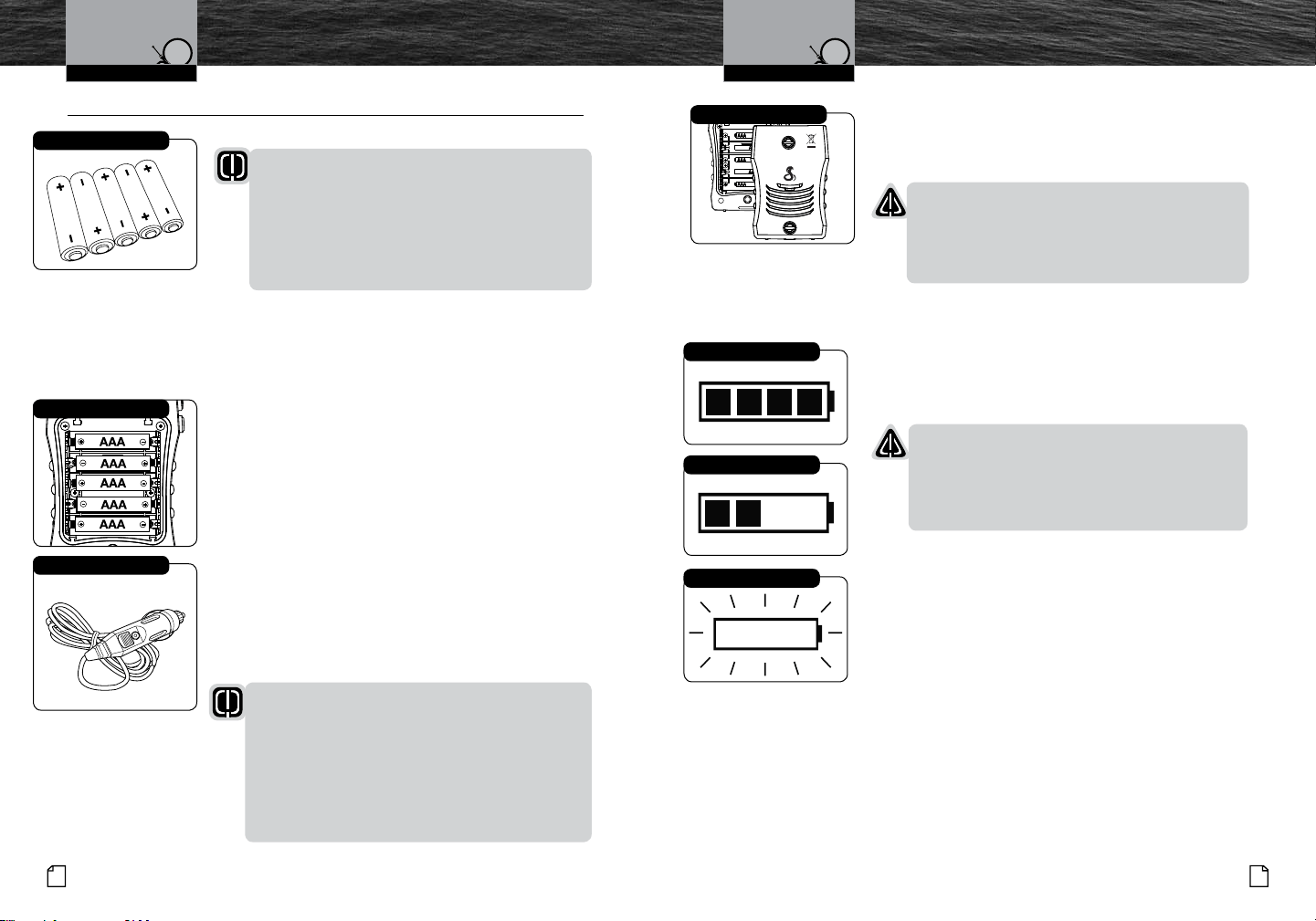
The radio is is shipped with five NiMH rechargeable batteries.
WARNING
The 12V power cord supplied with this radio is only
to be used with its rechargeable batteries. Do not
attempt to charge any other type of batteries in the
radio as fire, explosion or battery damage will occur.
Rechargeable battery life will be prolonged if extreme
ambient temperatures are avoided.
When your rechargeable batteries begin to discharge too
quickly, it is time to install new batteries. Your radio will also
operate with five (high-quality AAA alkaline batteries.
Installing the Batteries
Install the AAA batteries in the slots in the battery
compartment with the batteries oriented according
to the polarity (+ & -) marks in the slots.
Initial Charge
The Cobra-provided NiMH batteries may be charged in a car
or boat using the appropriate 12V power cord.
1. Insert the power cord into the side of the radio.
2. Insert the other end of the power cord into a 12V power
source.
3. Observe that the red light on the power cord glows to
indicate that power is present.
4. Allow the batteries to charge for 12 to 14 hours before use.
WARNING
Only the rechargeable NiMH batteries can be
recharged. You MUST use the charging device provided
with this radio. Do not substitute any other type of
charging adapter. Battery damage, fire or explosion
may result. It is equally important to prevent the NiMH
batteries from freezing to obtain best performance
from them.
Install Batteries
Power Source
To Remove Batteries from Radio
1. Loosen the 2 screws on the back of the battery door.
2. Pull the individual batteries out of the radio housing.
NOTICE
NiMH batteries are toxic. Please dispose of properly.
Some marine suppliers accept old batteries for
recycling and some municipal waste disposal agencies
have special provisions for battery disposal.
Locking Tab
Maintaining the Battery Charge
As you use your radio, the battery power icon will show the
battery power remaining. When the icon begins to flash, it is
time to recharge or change the batteries.
NOTICE
Use only the 12V power cord provided by Cobra. Do
not use the power cord with alkaline batteries; only
the NiMH batteries are rechargeable. Spent alkaline
batteries must be discarded and replaced.
It is a good idea to keep a set of fresh, high-quality AAA
alkaline batteries with your radio. Should the rechargeable
batteries become discharged and no electrical power source
be available, you can insert fresh alkaline batteries and
continue to use your radio.
Caution
Caution
Install Batteries
Fully Charged
Partially Charged
Fully Discharged
FLOATING MARINE HH150
ESC WEATHER SETUP
PWR
MEM
H-M-L
CHANNEL
SC/DW
VOL
SUBMERSIBLE
VHF Marine Radio ProtocolsOperating Your Radio VHF Marine Radio ProtocolsOperating Your Radio
11
Nothing Comes Close to a Cobra
®
10
English
Getting Started Getting Started
Getting Started
•
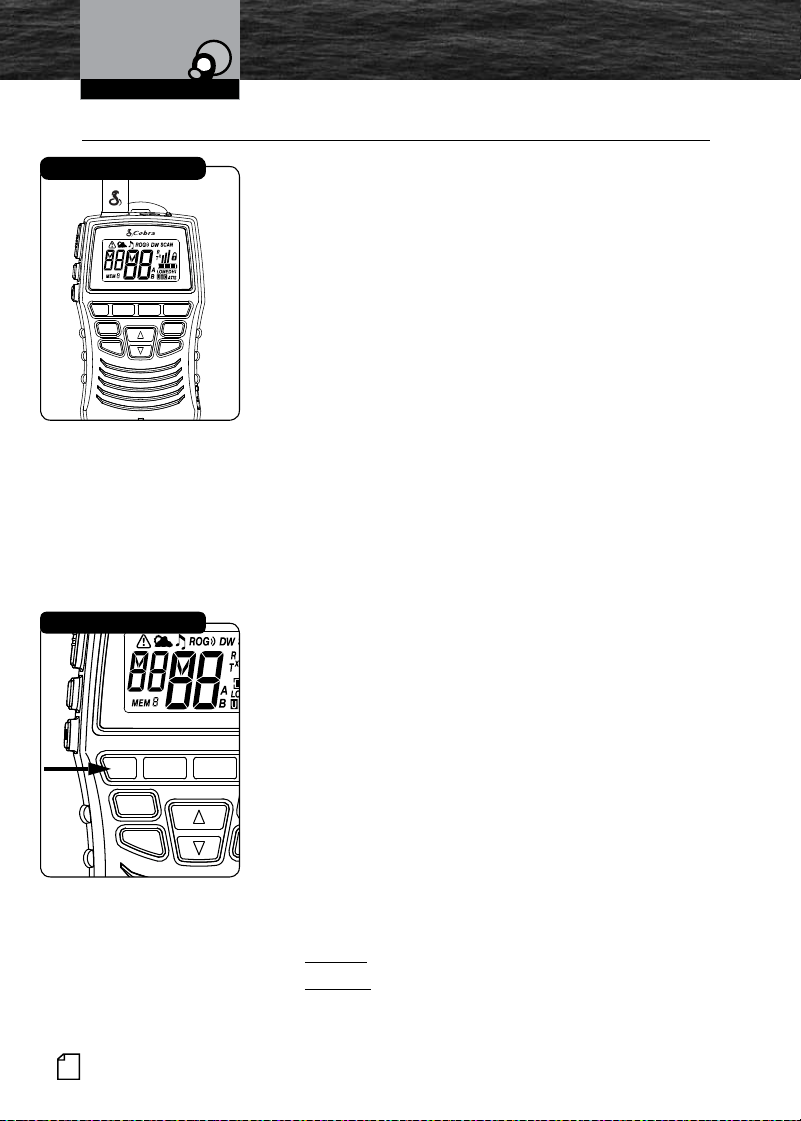
Refer to the foldout at the front of this manual to identify the
various controls and indicators on your radio. Throughout this
manual you will be instructed to “Press” or to “Press and
Hold” various buttons (except “Push to Talk”) on the radio.
“Press” means a momentary press of approximately one
second. “Press and Hold” means to hold the button down for
approximately three seconds.
Whenever you press any button except the Talk button on
your radio, a brief tone (beep) will sound to confirm the
button press. With all button presses, the appropriate icon
will appear on the LCD and the backlight will turn On. The
backlight will stay On for 10 seconds after the button is
released.
At times, you will hear two other sounds. Two beeps will
sound to confirm your setting changes and three beeps will
sound to notify you of an error.
Common Radio Functions
The following procedures define common operating functions of the radio when in
either Marine Standby or Weather (WX) Standby modes.
Power Button
Power On/Off Button
The On/Off Button control is located at the front left side of
the radio. Pressing and holding the power On/Off button for 3
seconds will turn the radio On or Off.
Power Saver
Your radio has a unique circuit designed to extend battery life.
If there are no transmissions, signals, or button presses for
ten seconds, the radio will automatically switch to Power Save
mode. Signal reception or any button press will take the radio
out of Power Save mode.
Volume Control
Volume is controlled by the Up/Down volume buttons.
n To increase the volume, press the Volume + button.
n To decrease the volume, press the Volume - button.
Radio Speaker and Microphone
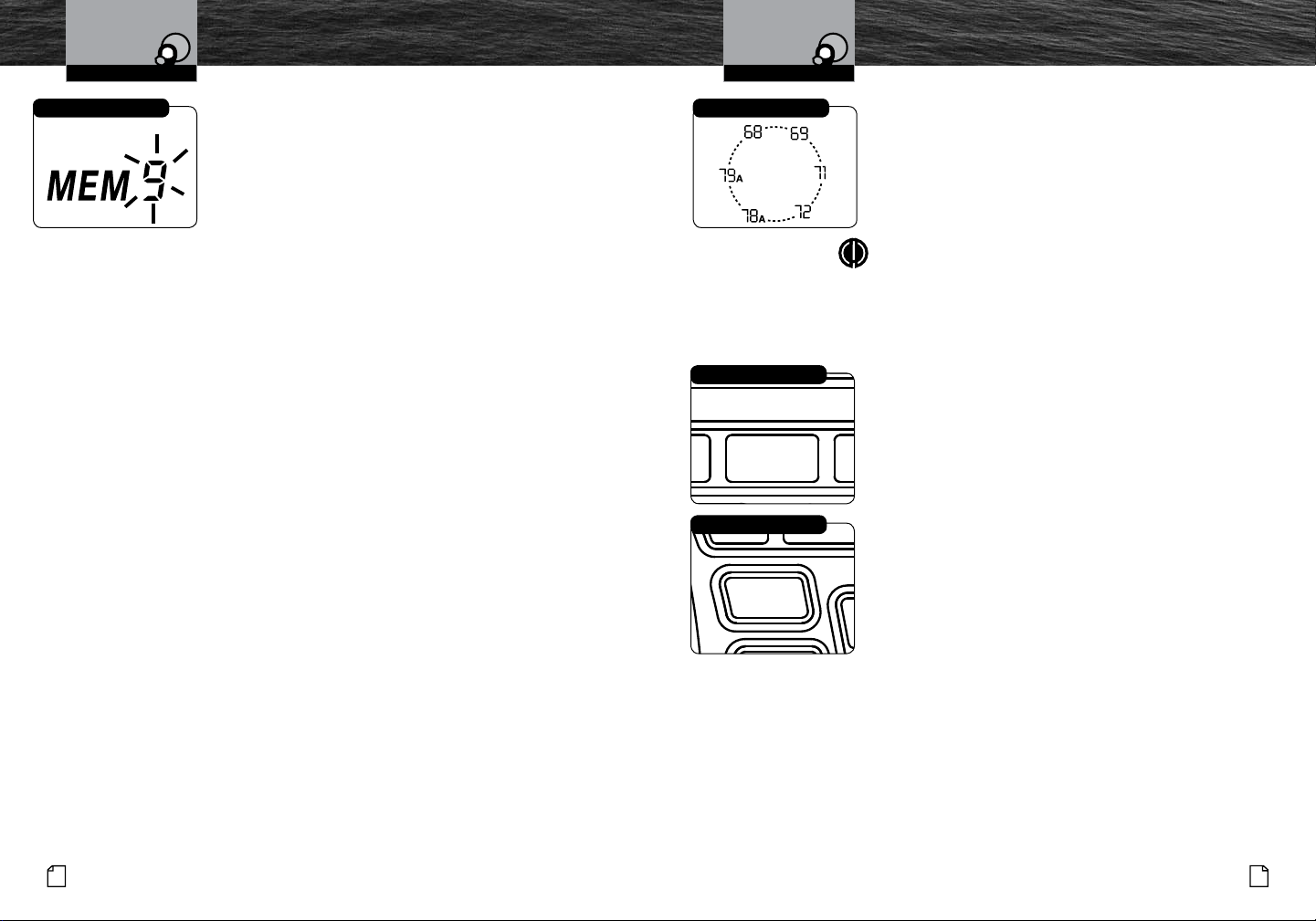
The internal Radio Speaker and Microphone are located on the
bottom front face of the radio below the lower control buttons.
An optional Speaker/Microphone jack is located at the top of
the radio. Flip the protective cap open and insert the plug into
the jack.
Talk Button
Press and hold the Talk button to transmit messages.
Release the Talk button to stop transmitting. If the Talk
button is pressed while on a receive only channel, a three
beep error signal will sound.
Squelch Control
This radio is equipped with an automatic squelch control.
Squelch filters weak signals and radio frequency (RF) noise so
you can hear the main signal clearly.
To receive weak signals, the automatic squelch can be turned
Off (opened) by pressing the Squelch Defeat button. You will
likely hear a lot of static and RF noise along with the weak
signal.
Press the Squelch Defeat button for up to five seconds to briefly
open squelch. To hold squelch open for longer periods, press
and hold the Squelch Defeat button for more than five seconds.
Squelch will remain open until you press the Squelch Defeat
button again or you change channels.
Squelch Control
Talk Button
Power On/Off Button
FLOATING MARINE HH150
ESC WEATHER SETUP
PWR
MEM
H-M-L
ENTER
CHANNEL
SC/DW
+16
VOL
VOL
SUBMERSIBLE
MR HH150FLT Radio
Speaker/Microphone Jack
FLOATING MARINE HH150
ESC WEATHER SETUP
PWR
MEM
H-M-L
CHANNEL
SC/DW
VOL
SUBMERSIBLE
VHF Marine Radio ProtocolsOperating Your Radio VHF Marine Radio ProtocolsOperating Your Radio
11
Nothing Comes Close to a Cobra
®
10
English
Getting Started Getting Started
Getting Started
•
Refer to the foldout at the front of this manual to identify the
various controls and indicators on your radio. Throughout this
manual you will be instructed to “Press” or to “Press and
Hold” various buttons (except “Push to Talk”) on the radio.
“Press” means a momentary press of approximately one
second. “Press and Hold” means to hold the button down for
approximately three seconds.
Whenever you press any button except the Talk button on
your radio, a brief tone (beep) will sound to confirm the
button press. With all button presses, the appropriate icon
will appear on the LCD and the backlight will turn On. The
backlight will stay On for 10 seconds after the button is
released.
At times, you will hear two other sounds. Two beeps will
sound to confirm your setting changes and three beeps will
sound to notify you of an error.
Common Radio Functions
The following procedures define common operating functions of the radio when in
either Marine Standby or Weather (WX) Standby modes.
Power Button
Power On/Off Button
The On/Off Button control is located at the front left side of
the radio. Pressing and holding the power On/Off button for 3
seconds will turn the radio On or Off.
Power Saver
Your radio has a unique circuit designed to extend battery life.
If there are no transmissions, signals, or button presses for
ten seconds, the radio will automatically switch to Power Save
mode. Signal reception or any button press will take the radio
out of Power Save mode.
Volume Control
Volume is controlled by the Up/Down volume buttons.
n To increase the volume, press the Volume + button.
n To decrease the volume, press the Volume - button.
Radio Speaker and Microphone
The internal Radio Speaker and Microphone are located on the
bottom front face of the radio below the lower control buttons.
An optional Speaker/Microphone jack is located at the top of
the radio. Flip the protective cap open and insert the plug into
the jack.
Talk Button
Press and hold the Talk button to transmit messages.
Release the Talk button to stop transmitting. If the Talk
button is pressed while on a receive only channel, a three
beep error signal will sound.
Squelch Control
This radio is equipped with an automatic squelch control.
Squelch filters weak signals and radio frequency (RF) noise so
you can hear the main signal clearly.
To receive weak signals, the automatic squelch can be turned
Off (opened) by pressing the Squelch Defeat button. You will
likely hear a lot of static and RF noise along with the weak
signal.
Press the Squelch Defeat button for up to five seconds to briefly
open squelch. To hold squelch open for longer periods, press
and hold the Squelch Defeat button for more than five seconds.
Squelch will remain open until you press the Squelch Defeat
button again or you change channels.
Squelch Control
Talk Button
Power On/Off Button
FLOATING MARINE HH150
ESC WEATHER SETUP
PWR
MEM
H-M-L
ENTER
CHANNEL
SC/DW
+16
VOL
VOL
SUBMERSIBLE
MR HH150FLT Radio
Speaker/Microphone Jack

VHF Marine Radio Protocols VHF Marine Radio Protocols
13
Nothing Comes Close to a Cobra
®
12
English
Getting Started Getting Started
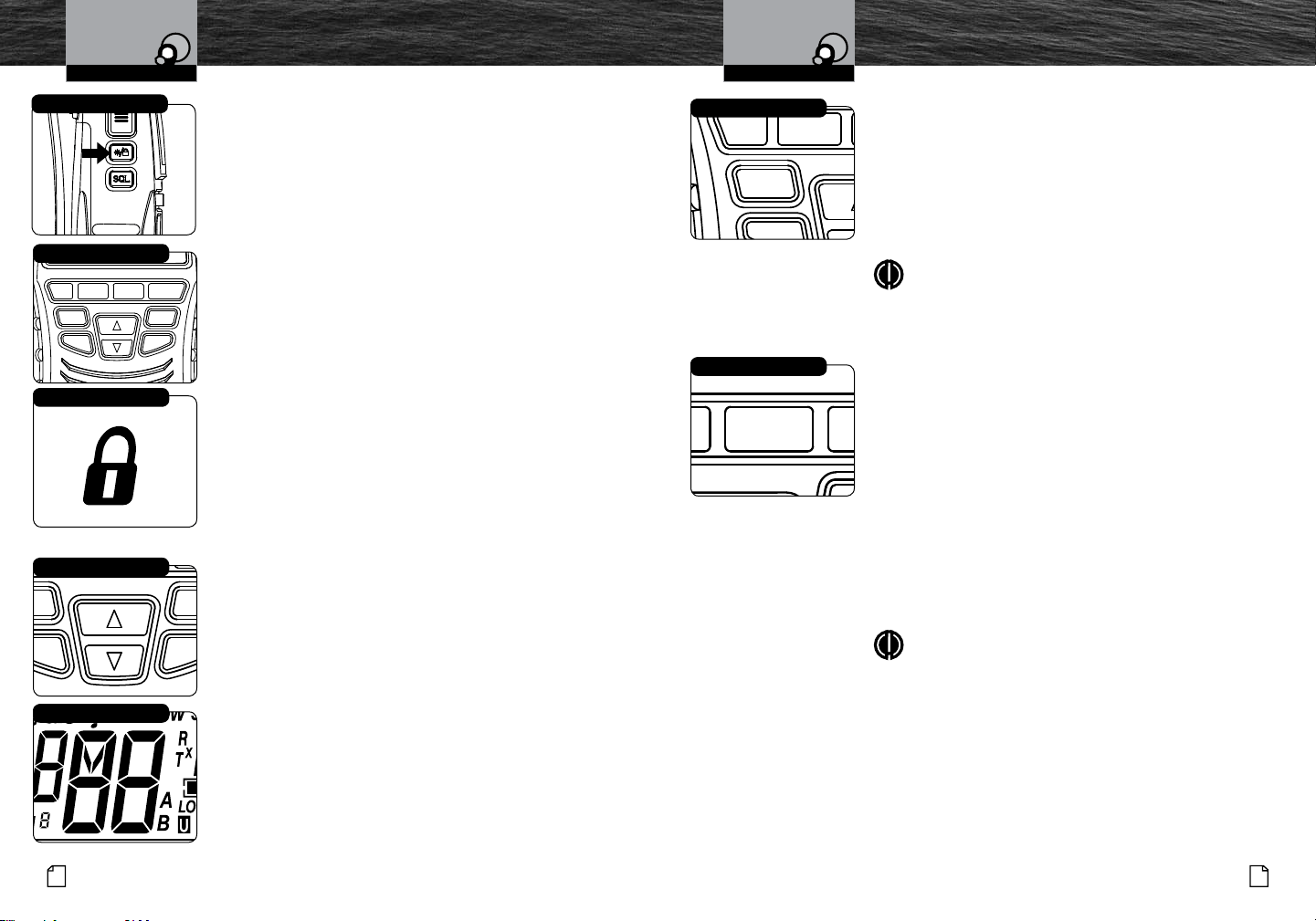
Backlight/Key Lock Button
The LCD will be illuminated by the backlight as long as any
button is pressed and will remain On for 10 seconds after the
button is released.
To Display the Backlight Momentarily:
Press the Backlight/Key Lock button. The backlight will
remain On for 10 seconds. If the backlight is already On,
a press of the Backlight/Key Lock button will turn it Off.
Key Lock
To prevent accidental changes to your settings, you can lock
all of the buttons on the front of the the radio along with the
Squelch Defeat button.
To Lock or Unlock the Buttons:
Press and hold the Backlight/Key Lock button for two
seconds. The Key Lock icon will appear or disappear in
the LCD. When Key Lock is On, pressing any of the buttons
on the front of the radio will result in a three beep error
message.
Both the Backlight/Key Lock button and the Talk button are
active — you can Receive (Rx) or Transmit (Tx) a message
with Key Lock On, but you cannot change the channel.
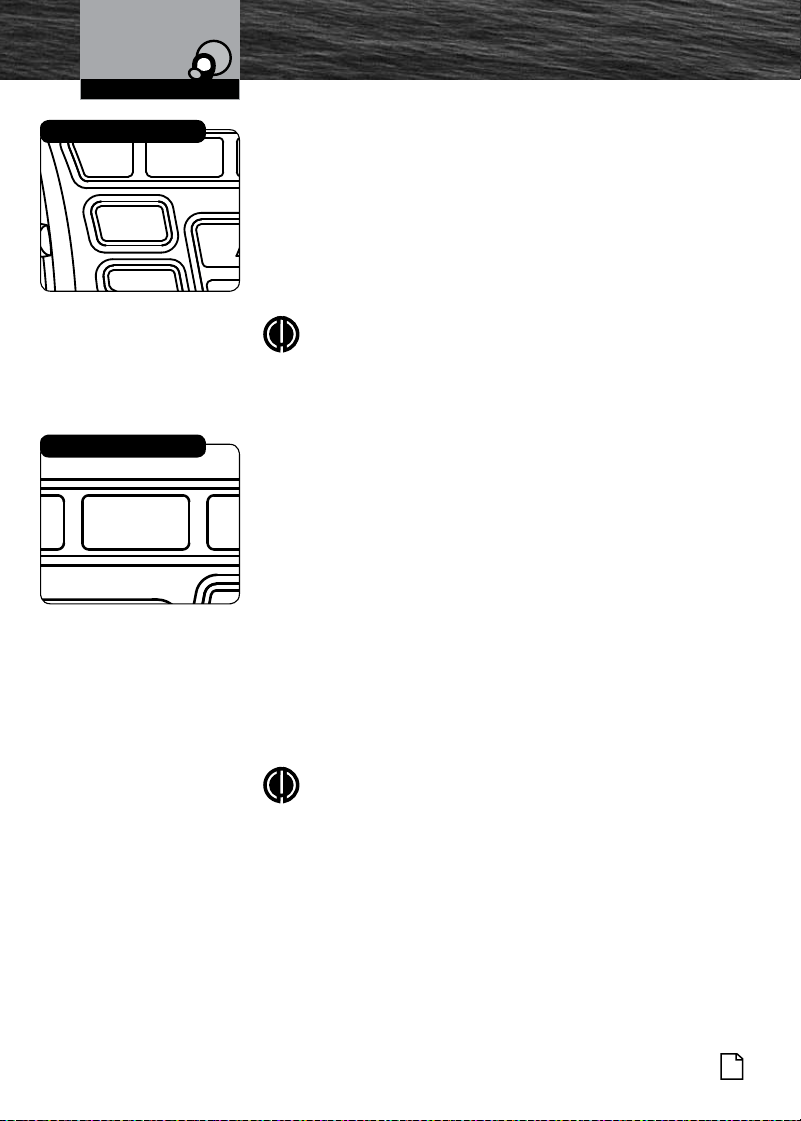
Channel Up/Down Buttons
Your radio will Receive (Rx) and Transmit (Tx) VHF signals on
the channel indicated on the LCD display. You can change the
channel at any time using the Channel Up/Down buttons.
To Change Channels:
Press the Channel Up/Down buttons.
If you are on Channel 88, pressing the Channel Up button
will advance to Channel 01. If you are on Channel 01,
pressing the Channel Down button will advance to 4 digit
channel.
You can press and hold the Channel Up/Down button for
fast advance. The beep sound will occur only at the first
press of the buttons and not during fast advance.
If the new channel selected is restricted to low power, the
radio will automatically switch to Low Power mode and the
Low Power icon will appear on the LCD.
If the radio is in the Key Lock mode, the channel will not
change and the three beep error signal will sound.
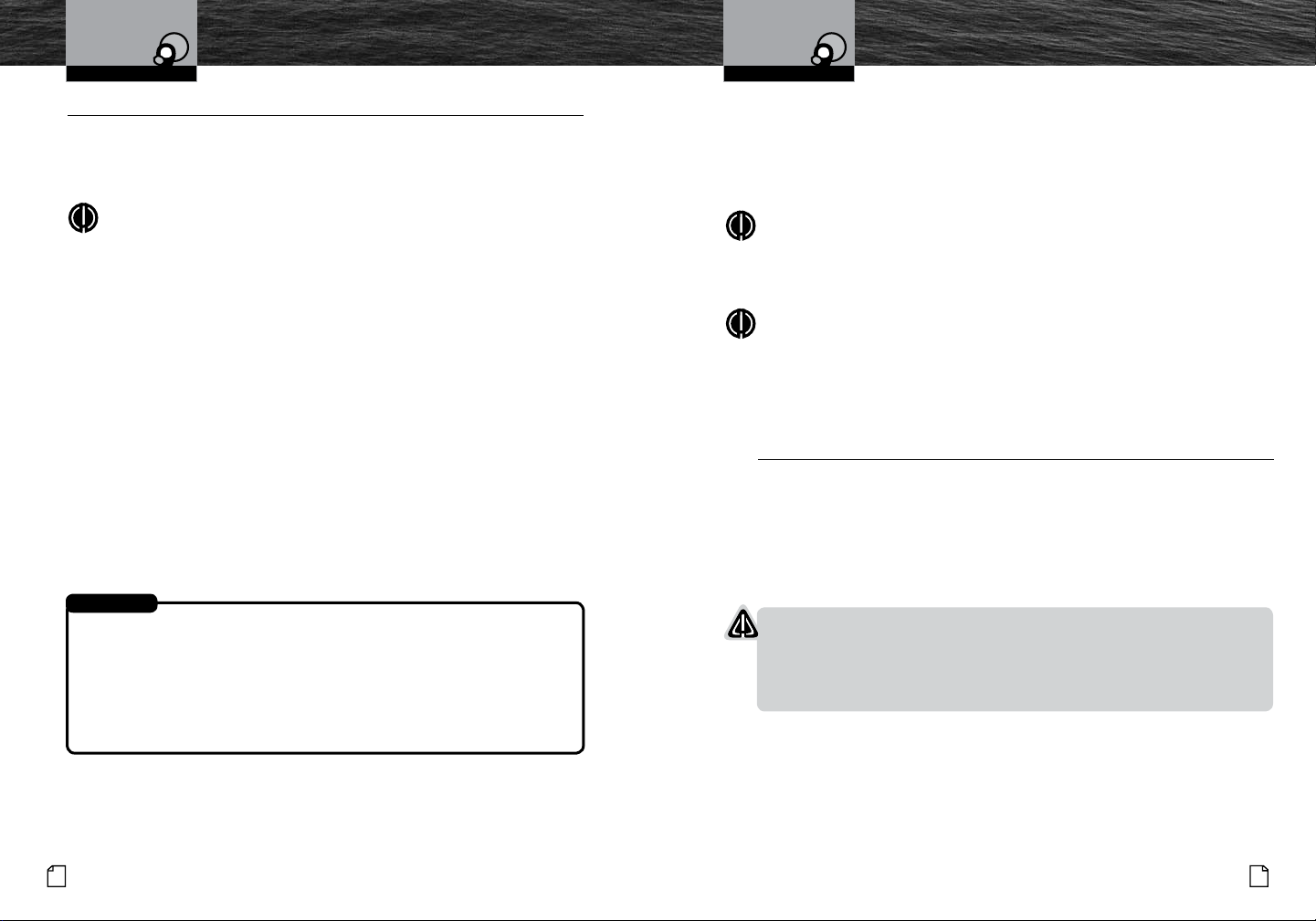
SCAN Button
Press and hold the SCN button to scan all channels.
The SCAN icon will display on the LCD display. Scanning
begins at lower channels, and scans to higher channels.
Press Channel Up/Down button to change the scan direction.
When a signal is received in SCAN mode, the radio will pause
10 seconds before resuming SCAN operation.
The scan will stop when the Talk button is pressed.
NOTE
Memory channels need to be saved to effectively enter
the Memory Channel mode and scan all memory
channels. See page 25.
High/Medium/Low (HI/MED/LO) Power Button
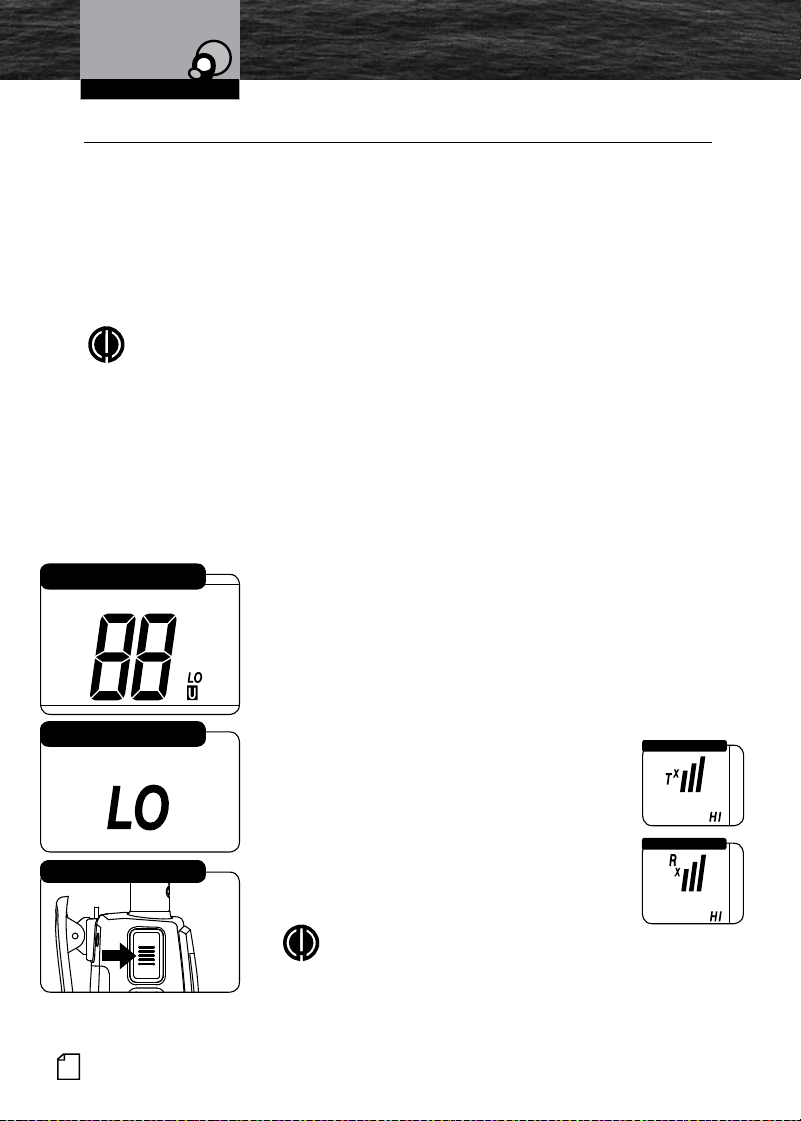
Your radio can transmit selectively at .5, 1 or 3 watts of power.
Cobra suggests you maintain the low power setting for
short-range communication. You will conserve battery life
and avoid overpowering nearby stations by using a low
power signal. Use the High Power setting for long-range
communications or when you do not receive a response
to a signal sent at .5 or 3 watt.
To Toggle Between Hi/Med/Lo Power Modes:
Press the Power Level/Weather button. The LCD
will show which mode is in effect. Some channels are
restricted for a maximum use of 1 watt. Your radio will
automatically set the power to Low Power mode when
you select those channels.
NOTE
Some channels, frequency bands and countries of use
might not be able to operate in High Power mode.
FLOATING MARINE HH150
ESC WEATHER SETUP
PWR
MEM
H-M-L
ENTER
CHANNEL
SC/DW
+16
VOL
VOL
SUBMERSIBLE
Key Locked Buttons
Key Lock Icon
PWR
MEM
CHANNEL
SC/DW
VOL
Scan Button
CHANNEL
SC/DW
+16
VOL
VOL
SUBMERSIBLE
Channel Up/Down Buttons
Currently On Channel 88
ESC WEATHER SETUP
MEM
H-M-L
ENTER
CHANNEL
+16
HI/MED/LO Power Button
VHF Marine Radio ProtocolsOperating Your Radio VHF Marine Radio ProtocolsOperating Your Radio
Backlight/Key Lock Button
VHF Marine Radio Protocols VHF Marine Radio Protocols
13
Nothing Comes Close to a Cobra
®
12
English
Getting Started Getting Started
Backlight/Key Lock Button
The LCD will be illuminated by the backlight as long as any
button is pressed and will remain On for 10 seconds after the
button is released.
To Display the Backlight Momentarily:
Press the Backlight/Key Lock button. The backlight will
remain On for 10 seconds. If the backlight is already On,
a press of the Backlight/Key Lock button will turn it Off.
Key Lock
To prevent accidental changes to your settings, you can lock
all of the buttons on the front of the the radio along with the
Squelch Defeat button.
To Lock or Unlock the Buttons:
Press and hold the Backlight/Key Lock button for two
seconds. The Key Lock icon will appear or disappear in
the LCD. When Key Lock is On, pressing any of the buttons
on the front of the radio will result in a three beep error
message.
Both the Backlight/Key Lock button and the Talk button are
active — you can Receive (Rx) or Transmit (Tx) a message
with Key Lock On, but you cannot change the channel.
Channel Up/Down Buttons
Your radio will Receive (Rx) and Transmit (Tx) VHF signals on
the channel indicated on the LCD display. You can change the
channel at any time using the Channel Up/Down buttons.
To Change Channels:
Press the Channel Up/Down buttons.
If you are on Channel 88, pressing the Channel Up button
will advance to Channel 01. If you are on Channel 01,
pressing the Channel Down button will advance to 4 digit
channel.
You can press and hold the Channel Up/Down button for
fast advance. The beep sound will occur only at the first
press of the buttons and not during fast advance.
If the new channel selected is restricted to low power, the
radio will automatically switch to Low Power mode and the
Low Power icon will appear on the LCD.
If the radio is in the Key Lock mode, the channel will not
change and the three beep error signal will sound.
SCAN Button
Press and hold the SCN button to scan all channels.
The SCAN icon will display on the LCD display. Scanning
begins at lower channels, and scans to higher channels.
Press Channel Up/Down button to change the scan direction.
When a signal is received in SCAN mode, the radio will pause
10 seconds before resuming SCAN operation.
The scan will stop when the Talk button is pressed.
NOTE
Memory channels need to be saved to effectively enter
the Memory Channel mode and scan all memory
channels. See page 25.
High/Medium/Low (HI/MED/LO) Power Button
Your radio can transmit selectively at .5, 1 or 3 watts of power.
Cobra suggests you maintain the low power setting for
short-range communication. You will conserve battery life
and avoid overpowering nearby stations by using a low
power signal. Use the High Power setting for long-range
communications or when you do not receive a response
to a signal sent at .5 or 3 watt.
To Toggle Between Hi/Med/Lo Power Modes:
Press the Power Level/Weather button. The LCD
will show which mode is in effect. Some channels are
restricted for a maximum use of 1 watt. Your radio will
automatically set the power to Low Power mode when
you select those channels.
NOTE
Some channels, frequency bands and countries of use
might not be able to operate in High Power mode.
FLOATING MARINE HH150
ESC WEATHER SETUP
PWR
MEM
H-M-L
ENTER
CHANNEL
SC/DW
+16
VOL
VOL
SUBMERSIBLE
Key Locked Buttons
Key Lock Icon
PWR
MEM
CHANNEL
SC/DW
VOL
Scan Button
CHANNEL
SC/DW
+16
VOL
VOL
SUBMERSIBLE
Channel Up/Down Buttons
Currently On Channel 88
ESC WEATHER SETUP
MEM
H-M-L
ENTER
CHANNEL
+16
HI/MED/LO Power Button
VHF Marine Radio ProtocolsOperating Your Radio VHF Marine Radio ProtocolsOperating Your Radio
Backlight/Key Lock Button
VHF Marine Radio Protocols VHF Marine Radio Protocols
15
Nothing Comes Close to a Cobra
®
14
English
Setup Mode Programming Setup Mode Programming
U.S.A./International/Canada Channel Maps
Three sets of VHF Channel Maps have been established for marine use in the U.S.A.,
Canada, and the rest of the world (International). Most of the channels are the same
for all three maps, but there are definite differences (see table in the Appendix).
Your radio has all three maps built into it and will operate correctly in whichever
area you choose.
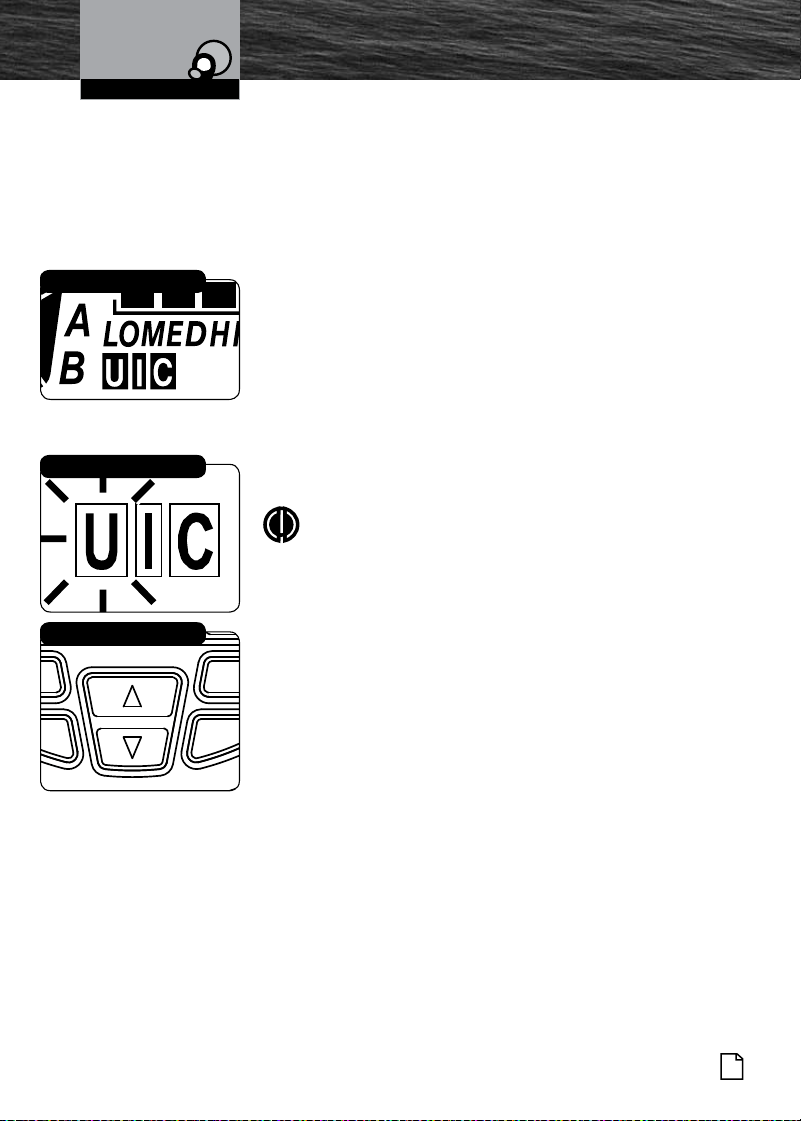
To Set Channel Map Operating Area:
1. The Channel Map mode is the first mode that begins the
Marine (VHF) Setup programming.
2. U, I and C will display, with the current setting
(the U icon is the default) flashing.
3. Press Channel Up/Down buttons to select the
U, I or C icon.
4. Press Enter/Setup button to save this entry and move to the
next setup programming mode.
NOTE
One or two of the channel maps might have been
disabled for sales of this radio in some countries.
Active Channel Map Icon
TING MARINE HH150
Set Channel Map
TING MARINE HH150
ESC WEATHER SETUP
H-M-L
ENTER
CHANNEL
+16
Enter/Setup Button
CHANNEL
SC/DW
+16
VOL
VOL
SUBMERSIBLE
Channel Up/Down Buttons
VHF Marine Radio ProtocolsOperating Your Radio VHF Marine Radio ProtocolsOperating Your Radio
Setup Mode Programming
•
The following series of procedures is designed to allow you to set the programmable
features of your radio. Correctly following these steps results in a minimal amount of
radio setup programming time.
NOTE
When in the Setup mode, if you stop programming for longer than 10 seconds,
your entry will be saved and the radio will go back to the Marine Standby mode.
Pressing any of the non-programming buttons (Talk, Dual-Watch/Scan, Power
Level/Weather, Instant Channel 16/9) will also exit Setup mode and invoke the
button function or return the radio to Marine Standby mode.
When you return to Setup mode and continue programming you will see the last
“value” displayed. While in the Setup mode, you will not receive any signal reception.
Programming these features will allow you to customize certain features of this radio
to enhance your “On-Water” audio needs.
Start from Marine Standby mode to begin Marine (VHF) Setup
programming. Press and hold the Enter/Setup button for three
seconds to enter the programming mode.
Marine (VHF) Mode Programming
VHF Marine Radio Protocols VHF Marine Radio Protocols
15
Nothing Comes Close to a Cobra
®
14
English
Setup Mode Programming Setup Mode Programming
U.S.A./International/Canada Channel Maps
Three sets of VHF Channel Maps have been established for marine use in the U.S.A.,
Canada, and the rest of the world (International). Most of the channels are the same
for all three maps, but there are definite differences (see table in the Appendix).
Your radio has all three maps built into it and will operate correctly in whichever
area you choose.
To Set Channel Map Operating Area:
1. The Channel Map mode is the first mode that begins the
Marine (VHF) Setup programming.
2. U, I and C will display, with the current setting
(the U icon is the default) flashing.
3. Press Channel Up/Down buttons to select the
U, I or C icon.
4. Press Enter/Setup button to save this entry and move to the
next setup programming mode.
NOTE
One or two of the channel maps might have been
disabled for sales of this radio in some countries.
Active Channel Map Icon
TING MARINE HH150
Set Channel Map
TING MARINE HH150
ESC WEATHER SETUP
H-M-L
ENTER
CHANNEL
+16
Enter/Setup Button
CHANNEL
SC/DW
+16
VOL
VOL
SUBMERSIBLE
Channel Up/Down Buttons
VHF Marine Radio ProtocolsOperating Your Radio VHF Marine Radio ProtocolsOperating Your Radio
Setup Mode Programming
•
The following series of procedures is designed to allow you to set the programmable
features of your radio. Correctly following these steps results in a minimal amount of
radio setup programming time.
NOTE
When in the Setup mode, if you stop programming for longer than 10 seconds,
your entry will be saved and the radio will go back to the Marine Standby mode.
Pressing any of the non-programming buttons (Talk, Dual-Watch/Scan, Power
Level/Weather, Instant Channel 16/9) will also exit Setup mode and invoke the
button function or return the radio to Marine Standby mode.
When you return to Setup mode and continue programming you will see the last
“value” displayed. While in the Setup mode, you will not receive any signal reception.
Programming these features will allow you to customize certain features of this radio
to enhance your “On-Water” audio needs.
Start from Marine Standby mode to begin Marine (VHF) Setup
programming. Press and hold the Enter/Setup button for three
seconds to enter the programming mode.
Marine (VHF) Mode Programming
VHF Marine Radio ProtocolsOperating Your Radio VHF Marine Radio ProtocolsOperating Your Radio
17
Nothing Comes Close to a Cobra
®
16
English
Setup Mode ProgrammingSetup Mode Programming
Roger Beep Mode
In Roger Beep mode, your listener will hear an audible tone
when you release the Talk button. This alerts your listener
that you are finished talking and it is OK for them to speak.
To Set Roger Beep On or Off:
1. Press and hold the Setup button for 3 seconds.
2. Press Channel Up/Down buttons to select ON or OFF. ROG
will be displayed when On.
3. Press Enter/Setup button to save this entry and move to the
next setup programming mode – Key Tone.
Key Tone Mode
In Key Tone mode, an audible tone will sound each time a
button is pressed or you change a setting.
To Set Key Tone On or Off:
1. Press and hold the Setup button for 3 seconds.
2. Press Channel Up/Down buttons to select
ON or OFF.
3. Press Enter/Setup button to save all entries.
You have now ended Marine (VHF) Setup programming mode
and will enter Marine Standby mode.
Roger Beep Mode
Key Tone Mode
Programming these features will allow your radio to listen to all NOAA Hazard Alert
radio signals and warnings (WX feature available in U.S. model only).
Start from WX Standby mode (see page 19) to begin WX Alert Setup programming.
Press and hold the Enter/Setup button for three seconds to enter the programming
mode.
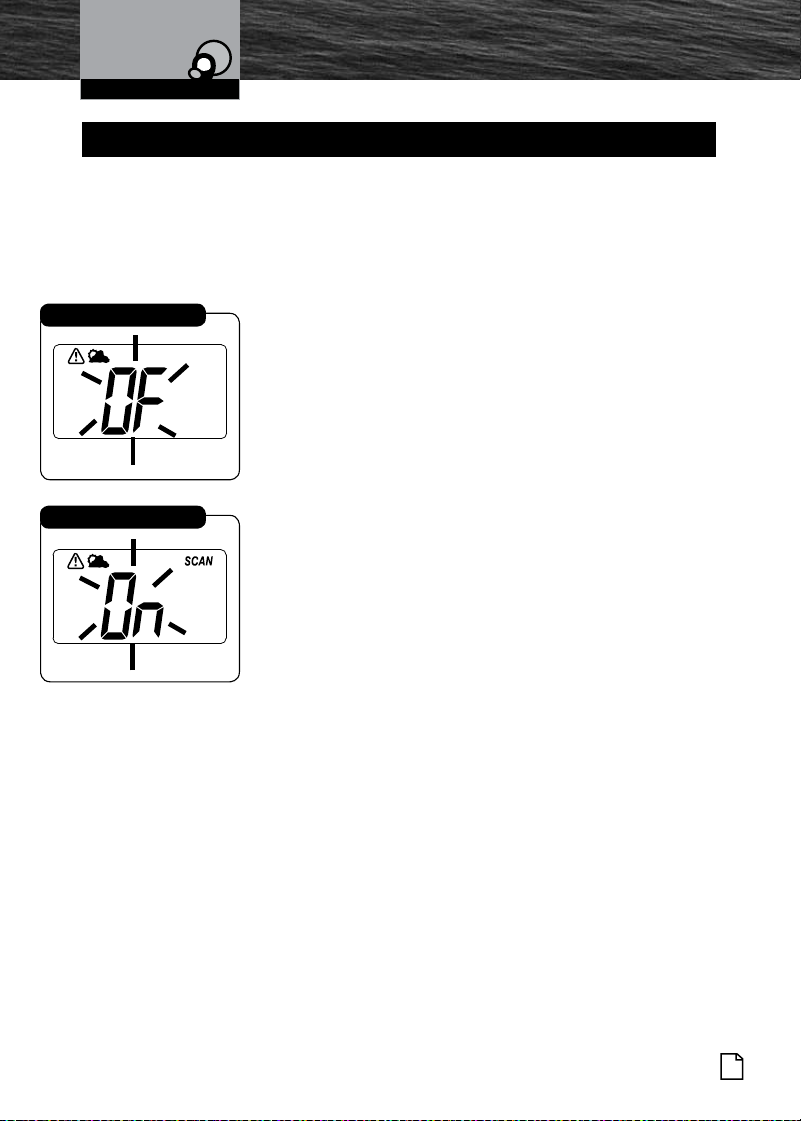
To Set WX Alert On or Off:
1. WX Alert mode is the first mode that begins WX Alert
Setup programming.
2. Display will show WX Alert icon and ON or OFF flashing.
3. Press Channel Up and Channel Down buttons
to select ON or OFF.
4. Press Enter/Setup button to save this entry and move to
the next setup programming mode.
To Set WX Auto Search (SCAN) On or Off:
1. Display will show WX Alert icon and SCAN,
ON or OFF is flashing.
2. Press Channel Up and Channel Down buttons
to select SCAN, ON or OFF.
3. Press the Enter/Setup button to save entry.
You have now ended the WX Alert Setup programming mode and will enter the
WX Alert Standby mode.
When WX Alert is On and WX Auto Search (SCAN) is Off, the unit will continuously
check the selected WX channel from Marine or WX Standby for the WX Alert tone. When
the tone is detected, the radio will sound an alert tone and flash the WX Alert icon.
The unit will remain on that WX channel until you switch back to Marine Standby
mode.
When WX Auto Search (SCAN) is On, the unit will scan the weather channels for a
stronger signal if the current weather channel signal falls below the squelch level.
WX Alert On/Off
WX Auto Search (SCAN)
Weather (WX) Alert Mode Programming
VHF Marine Radio ProtocolsOperating Your Radio VHF Marine Radio ProtocolsOperating Your Radio
17
Nothing Comes Close to a Cobra
®
16
English
Setup Mode ProgrammingSetup Mode Programming
Roger Beep Mode
In Roger Beep mode, your listener will hear an audible tone
when you release the Talk button. This alerts your listener
that you are finished talking and it is OK for them to speak.
To Set Roger Beep On or Off:
1. Press and hold the Setup button for 3 seconds.
2. Press Channel Up/Down buttons to select ON or OFF. ROG
will be displayed when On.
3. Press Enter/Setup button to save this entry and move to the
next setup programming mode – Key Tone.
Key Tone Mode
In Key Tone mode, an audible tone will sound each time a
button is pressed or you change a setting.
To Set Key Tone On or Off:
1. Press and hold the Setup button for 3 seconds.
2. Press Channel Up/Down buttons to select
ON or OFF.
3. Press Enter/Setup button to save all entries.
You have now ended Marine (VHF) Setup programming mode
and will enter Marine Standby mode.
Roger Beep Mode
Key Tone Mode
Programming these features will allow your radio to listen to all NOAA Hazard Alert
radio signals and warnings (WX feature available in U.S. model only).
Start from WX Standby mode (see page 19) to begin WX Alert Setup programming.
Press and hold the Enter/Setup button for three seconds to enter the programming
mode.
To Set WX Alert On or Off:
1. WX Alert mode is the first mode that begins WX Alert
Setup programming.
2. Display will show WX Alert icon and ON or OFF flashing.
3. Press Channel Up and Channel Down buttons
to select ON or OFF.
4. Press Enter/Setup button to save this entry and move to
the next setup programming mode.
To Set WX Auto Search (SCAN) On or Off:
1. Display will show WX Alert icon and SCAN,
ON or OFF is flashing.
2. Press Channel Up and Channel Down buttons
to select SCAN, ON or OFF.
3. Press the Enter/Setup button to save entry.
You have now ended the WX Alert Setup programming mode and will enter the
WX Alert Standby mode.
When WX Alert is On and WX Auto Search (SCAN) is Off, the unit will continuously
check the selected WX channel from Marine or WX Standby for the WX Alert tone. When
the tone is detected, the radio will sound an alert tone and flash the WX Alert icon.
The unit will remain on that WX channel until you switch back to Marine Standby
mode.
When WX Auto Search (SCAN) is On, the unit will scan the weather channels for a
stronger signal if the current weather channel signal falls below the squelch level.
WX Alert On/Off
WX Auto Search (SCAN)
Weather (WX) Alert Mode Programming
VHF Marine Radio ProtocolsOperating Your Radio VHF Marine Radio ProtocolsOperating Your Radio
19
Nothing Comes Close to a Cobra
®
18
English
NOAA All Hazards/Weather
Radio and Alert
Standby, Receive
and Transmit
Standby, Receive and Transmit
•
Marine Standby and Receive (Rx) Mode
Marine Standby mode is the default mode for the radio whenever it is turned On.
From this mode, you can change current settings by becoming familiar with the
different key functions that are active in Marine Standby mode. While in Marine
Standby mode, the user will be able to transmit by pressing the Push to Talk (Talk)
button. Users will hear signals on the selected channel(s) in Receive (RX) mode and
can hear alerts broadcast by the Coast Guard and NOAA.
NOTE
Coast Guard alerts are broadcast on Channel 16 and you need to have the WX
Alert turned On to receive NOAA weather alerts. While in Marine Standby mode,
you will receive any messages sent on the channel to which you are tuned.
Transmit (Tx) Mode
Transmit (Tx) mode gives you the ability to interact with safety services, other vessels
and shore stations. When you use this capability, be sure to follow the procedures and to
observe the courtesies that govern its use so everyone benefits. See Appendix to help
you select the proper channels.
To Transmit a Message:
1. Check to see that your radio is set to a proper channel for
the type of message you plan to send.
2. Toggle to the Low Power setting for a nearby station.
3. With the microphone about 2 in. [51 mm] from your mouth,
press and hold the Talk button and speak into the microphone.
The Transmit icon will appear on the LCD.
4. Release the Talk button when you are finished
speaking. Your radio can only operate in either
Transmit (Tx) or Receive (Rx) mode at any
given time. You will not hear the response to
your message unless the Talk button is released.
If the Battery Power icon begins blinking on the
LCD when the Talk button is pressed, the radio
will NOT transmit.
Low Power Mode
Check Channel Number
WX Standby Display
NOAA Weather Channels
Monitoring the weather will probably be a frequent use of your radio. NOAA provides
continuous, around-the-clock broadcasts of the latest weather information. Taped
weather messages run every four to six minutes and are revised every two or three
hours, or as needed. The Coast Guard also announces weather and other safety
warnings on Channel 16. Smart boaters keep an eye on safety and an ear to the radio
— and never let the weather catch them unaware.
NOAA Emergency Weather Alert
In the event of a major storm or other weather condition requiring vessels at sea
or on other bodies of water to be notified, NOAA broadcasts a 1050 Hz tone that
receivers such as your CobraMarine VHF radio can detect and warn you of a weather alert
condition. When the Weather Alert mode on your radio is On, this signal will produce
a loud tone from the speaker in the radio and will automatically switch to the alerting
weather channel so the alert broadcast can be heard.
NOAA Test Alert System
To test this system, NOAA broadcasts the 1050 Hz signal every Wednesday sometime
between 11 a.m. and 1 p.m. in each local time zone. Any receiver that can detect the
weather alert tone may use this service to verify that this system is functioning properly.
These signals will be received in Marine or Weather Standby modes as described below.
Weather (WX) Standby Mode
To enter the WX Standby mode, press and hold the
Power Level/Weather button. All common operating functions
of the radio will work the same in WX Standby mode as they
do in the normal Marine Standby mode. The radio will be
monitoring for all alerts in the background when in the WX
Standby mode when WX Alert is set ON.
Transmit
NOTE
If the Talk button is held down for five minutes, the
radio will automatically sound a series of beeps
and cease transmitting to prevent unwanted signal
generation and battery drain. As soon as the Talk
button is released, it can be pressed again to
resume transmission.
Talk Button
Receive
VHF Marine Radio ProtocolsOperating Your Radio VHF Marine Radio ProtocolsOperating Your Radio
19
Nothing Comes Close to a Cobra
®
18
English
NOAA All Hazards/Weather
Radio and Alert
Standby, Receive
and Transmit
Standby, Receive and Transmit
•
Marine Standby and Receive (Rx) Mode
Marine Standby mode is the default mode for the radio whenever it is turned On.
From this mode, you can change current settings by becoming familiar with the
different key functions that are active in Marine Standby mode. While in Marine
Standby mode, the user will be able to transmit by pressing the Push to Talk (Talk)
button. Users will hear signals on the selected channel(s) in Receive (RX) mode and
can hear alerts broadcast by the Coast Guard and NOAA.
NOTE
Coast Guard alerts are broadcast on Channel 16 and you need to have the WX
Alert turned On to receive NOAA weather alerts. While in Marine Standby mode,
you will receive any messages sent on the channel to which you are tuned.
Transmit (Tx) Mode
Transmit (Tx) mode gives you the ability to interact with safety services, other vessels
and shore stations. When you use this capability, be sure to follow the procedures and to
observe the courtesies that govern its use so everyone benefits. See Appendix to help
you select the proper channels.
To Transmit a Message:
1. Check to see that your radio is set to a proper channel for
the type of message you plan to send.
2. Toggle to the Low Power setting for a nearby station.
3. With the microphone about 2 in. [51 mm] from your mouth,
press and hold the Talk button and speak into the microphone.
The Transmit icon will appear on the LCD.
4. Release the Talk button when you are finished
speaking. Your radio can only operate in either
Transmit (Tx) or Receive (Rx) mode at any
given time. You will not hear the response to
your message unless the Talk button is released.
If the Battery Power icon begins blinking on the
LCD when the Talk button is pressed, the radio
will NOT transmit.
Low Power Mode
Check Channel Number
WX Standby Display
NOAA Weather Channels
Monitoring the weather will probably be a frequent use of your radio. NOAA provides
continuous, around-the-clock broadcasts of the latest weather information. Taped
weather messages run every four to six minutes and are revised every two or three
hours, or as needed. The Coast Guard also announces weather and other safety
warnings on Channel 16. Smart boaters keep an eye on safety and an ear to the radio
— and never let the weather catch them unaware.
NOAA Emergency Weather Alert
In the event of a major storm or other weather condition requiring vessels at sea
or on other bodies of water to be notified, NOAA broadcasts a 1050 Hz tone that
receivers such as your CobraMarine VHF radio can detect and warn you of a weather alert
condition. When the Weather Alert mode on your radio is On, this signal will produce
a loud tone from the speaker in the radio and will automatically switch to the alerting
weather channel so the alert broadcast can be heard.
NOAA Test Alert System
To test this system, NOAA broadcasts the 1050 Hz signal every Wednesday sometime
between 11 a.m. and 1 p.m. in each local time zone. Any receiver that can detect the
weather alert tone may use this service to verify that this system is functioning properly.
These signals will be received in Marine or Weather Standby modes as described below.
Weather (WX) Standby Mode
To enter the WX Standby mode, press and hold the
Power Level/Weather button. All common operating functions
of the radio will work the same in WX Standby mode as they
do in the normal Marine Standby mode. The radio will be
monitoring for all alerts in the background when in the WX
Standby mode when WX Alert is set ON.
Transmit
NOTE
If the Talk button is held down for five minutes, the
radio will automatically sound a series of beeps
and cease transmitting to prevent unwanted signal
generation and battery drain. As soon as the Talk
button is released, it can be pressed again to
resume transmission.
Talk Button
Receive
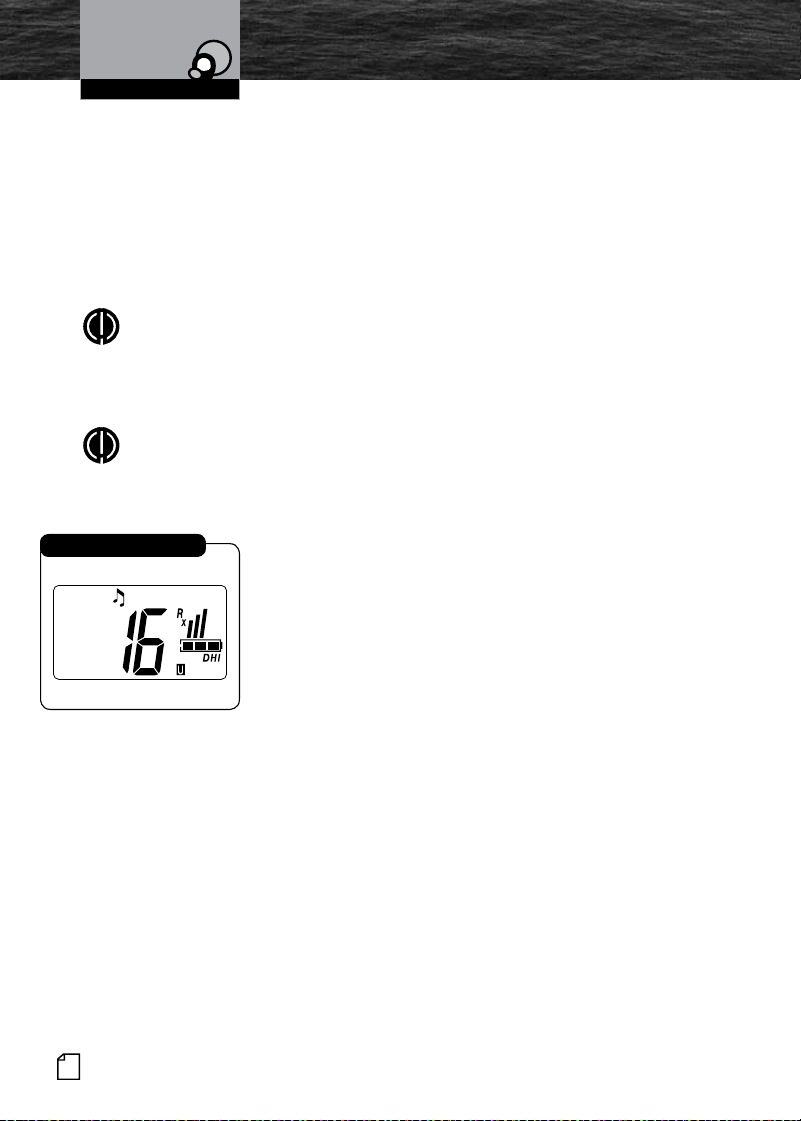
VHF Marine Radio ProtocolsOperating Your Radio VHF Marine Radio ProtocolsOperating Your Radio
21
Nothing Comes Close to a Cobra
®
20
English
Advanced Operation
NOAA All Hazards/Weather
Radio and Alert
WX Alert Standby Mode
When your radio is in WX Alert Standby mode, the following items will be displayed
on the LCD display:
n The WX icon (cloud/sun) icon will be displayed.
n The last used weather channel will be displayed.
n The bar graph will display received signal strength level.
n The WX Alert icon (safety triangle) will be displayed.
NOTE
Only one or two of the weather channels will be operating in any
given location (only in Receive (Rx) mode). You will need to select the
channel with the strongest signal in your location.
NOTE
When in the WX Alert mode, and NOAA sends the 1050Hz alert tone,
the radio will sound a series of beeps.
WX Auto Search (SCAN) Mode Function:
The purpose of the WX Auto Search (SCAN) function is to
enable the receiver to stay tuned to a strong weather channel
at all times in both the Marine and Weather standby modes.
This allows use of the communication functions of the radio
without missing a Weather Alert when:
n WX Auto Search (SCAN) function is On.
n WX Alert is On.
n The radio is tuned to a Marine VHF channel and
has entered Power Save mode (meaning there
is no signal activity or user input for 10 seconds).
n The radio software has detected that the current
WX channel signal level has dropped below
a preset minimum level or is gone completely.
Under these conditions, the software will scan the
WX channels looking for an active WX channel.
When an active WX channel is found, it will stop
the scan and use the new WX channel to look for
the standard 1050Hz alert tone.
WX Auto Search (SCAN)
Advanced Operation
•
Several capabilities of your radio can add to its versatility and ease of use even though
they are not needed for its basic operation.
Channel 16/9 Mode
Channel 16/9 mode gives you quick access to calling on Channel 16 and Channel 9
from any operational mode.
To Switch to Channel 16 or Channel 9:
1. Press the Channel 16/9 button to change
to Channel 16.
2. Press the Channel 16/9 button again to change
to Channel 9.
3. Press the Channel 16/9 button a third time and return to
the last used Marine Standby channel.
NOTE
This key is labeled as “16” for maximum visibility.
H-M-L
ENTER
CHANNEL
+16
VOL
Channel 16/9 Button
Channel 16
Channel 9
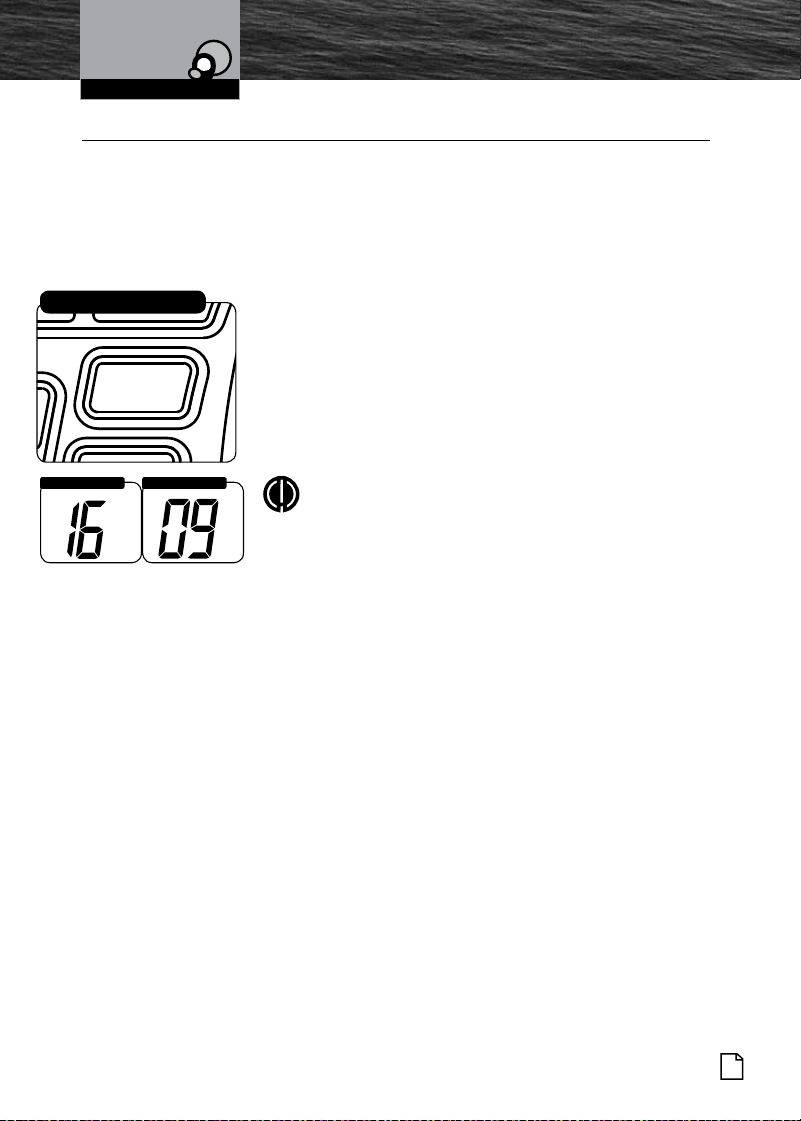
VHF Marine Radio ProtocolsOperating Your Radio VHF Marine Radio ProtocolsOperating Your Radio
21
Nothing Comes Close to a Cobra
®
20
English
Advanced Operation
NOAA All Hazards/Weather
Radio and Alert
WX Alert Standby Mode
When your radio is in WX Alert Standby mode, the following items will be displayed
on the LCD display:
n The WX icon (cloud/sun) icon will be displayed.
n The last used weather channel will be displayed.
n The bar graph will display received signal strength level.
n The WX Alert icon (safety triangle) will be displayed.
NOTE
Only one or two of the weather channels will be operating in any
given location (only in Receive (Rx) mode). You will need to select the
channel with the strongest signal in your location.
NOTE
When in the WX Alert mode, and NOAA sends the 1050Hz alert tone,
the radio will sound a series of beeps.
WX Auto Search (SCAN) Mode Function:
The purpose of the WX Auto Search (SCAN) function is to
enable the receiver to stay tuned to a strong weather channel
at all times in both the Marine and Weather standby modes.
This allows use of the communication functions of the radio
without missing a Weather Alert when:
n WX Auto Search (SCAN) function is On.
n WX Alert is On.
n The radio is tuned to a Marine VHF channel and
has entered Power Save mode (meaning there
is no signal activity or user input for 10 seconds).
n The radio software has detected that the current
WX channel signal level has dropped below
a preset minimum level or is gone completely.
Under these conditions, the software will scan the
WX channels looking for an active WX channel.
When an active WX channel is found, it will stop
the scan and use the new WX channel to look for
the standard 1050Hz alert tone.
WX Auto Search (SCAN)
Advanced Operation
•
Several capabilities of your radio can add to its versatility and ease of use even though
they are not needed for its basic operation.
Channel 16/9 Mode
Channel 16/9 mode gives you quick access to calling on Channel 16 and Channel 9
from any operational mode.
To Switch to Channel 16 or Channel 9:
1. Press the Channel 16/9 button to change
to Channel 16.
2. Press the Channel 16/9 button again to change
to Channel 9.
3. Press the Channel 16/9 button a third time and return to
the last used Marine Standby channel.
NOTE
This key is labeled as “16” for maximum visibility.
H-M-L
ENTER
CHANNEL
+16
VOL
Channel 16/9 Button
Channel 16
Channel 9
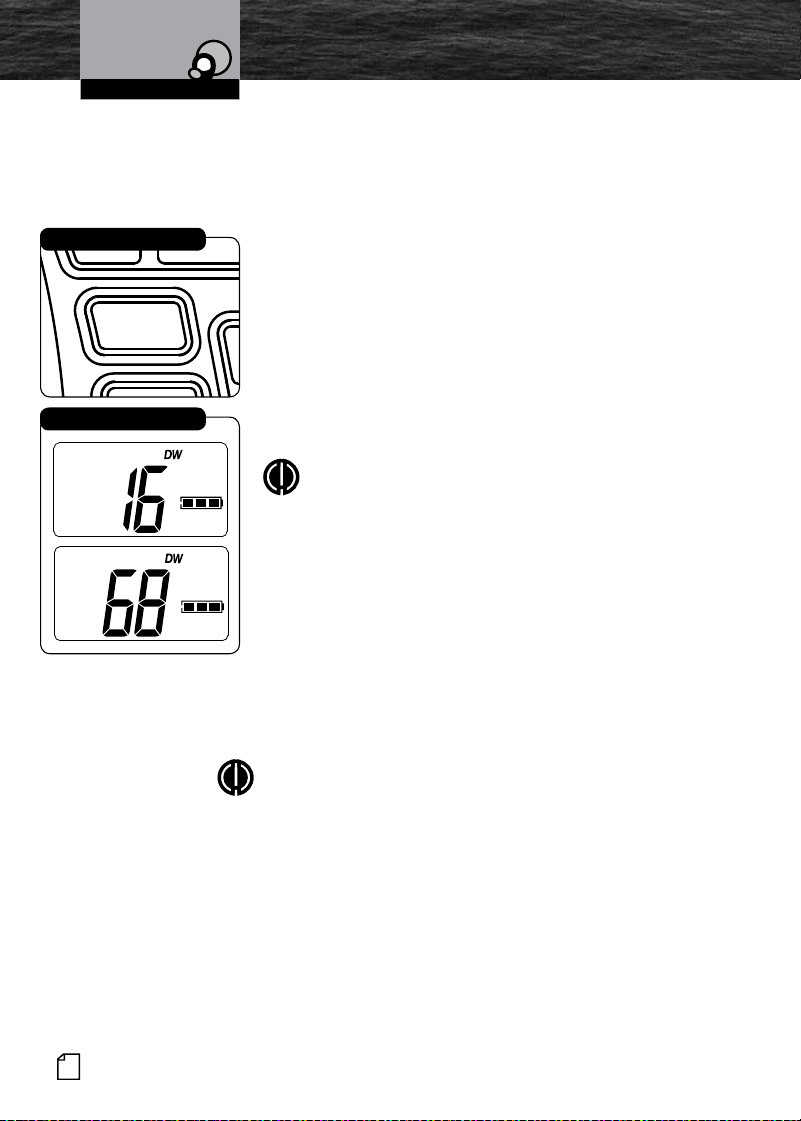
VHF Marine Radio ProtocolsOperating Your Radio VHF Marine Radio ProtocolsOperating Your Radio
23
Nothing Comes Close to a Cobra
®
Advanced Operation
22
English
Advanced Operation
Dual-Watch Scan Mode
To enter Memory mode, press Memory/Escape button. The
display will show the MEM icon and the Memory Channel
bank will be activated and displayed.
To Program Memory Locations:
1. Press and hold the Memory/Escape button for
two seconds. The memory location number
will start flashing.
2. Use the Channel Up and Channel Down buttons to advance
to the memory location (0-9) you want to program.
3. Press the Memory/Escape button to select the
memory location. The memory channel number
will stop flashing and the channel number will
start flashing.
4. Use the Channel Up and Channel Down buttons
to change to the channel you want to store into the
selected memory location.
5. Press the Memory/Escape button to program that
channel. The memory location number will flash again.
Repeat steps 2 through 5 to program as many additional
memory locations as you want [up to ten VHF memory
channels].
6. Press and hold the Memory/Escape button for
two seconds. This will return the radio to
Memory mode.
7. Press and release the Memory/Escape button
again to return to Marine Standby mode.
FLOATING MARINE HH150
ESC WEATHER SETUP
PWR
MEM
H-M-L
CHANNEL
MEM/ESC Button
Memory Location Number
CHANNEL
SC/DW
+16
VOL
VOL
SUBMERSIBLE
Channel Up/Down Buttons
Channel Number
Memory Location Mode
Your radio has ten memory locations (numbered 0 to 9) for your most frequently used
channels. These memory locations can be selected individually or can be scanned.
Dual-Watch Mode
Dual-Watch mode gives you one button access to scan a total of two channels of most
importance to you. Channel 16 is preprogrammed and will always be one of the scanned
locations. The other channel can be any marine VHF channel of your choice.
Using Dual-Watch
1. In Marine Standby mode, select the desired channel for
Dual-Watch scanning.
2. Press the Dual-Watch button. The DW icon will appear
on the LCD display and the radio will scan channel 16
and the selected channel.
3. A signal on any one of the two channels will
stop the scan for 10 seconds to allow you to listen
to the traffic on that location.
NOTE
After the Dual-Watch scan stops to monitor a channel,
as long as you do not press any buttons within 10
seconds, your radio will automatically resume scanning
the Dual-Watch channels.
4. Press the Channel Up or Channel Down buttons
to resume scanning the Dual-Watch channels or
to change the scan direction.
5. To EXIT the Dual-Watch scan, press the Dual-Watch button
again. The DW icon will disappear from the
LCD and the radio will return to Marine Standby mode.
NOTE
Dual-Watch also functions with a Memory channel.
PWR
MEM
CHANNEL
SC/DW
VOL
DUAL-WATCH Button
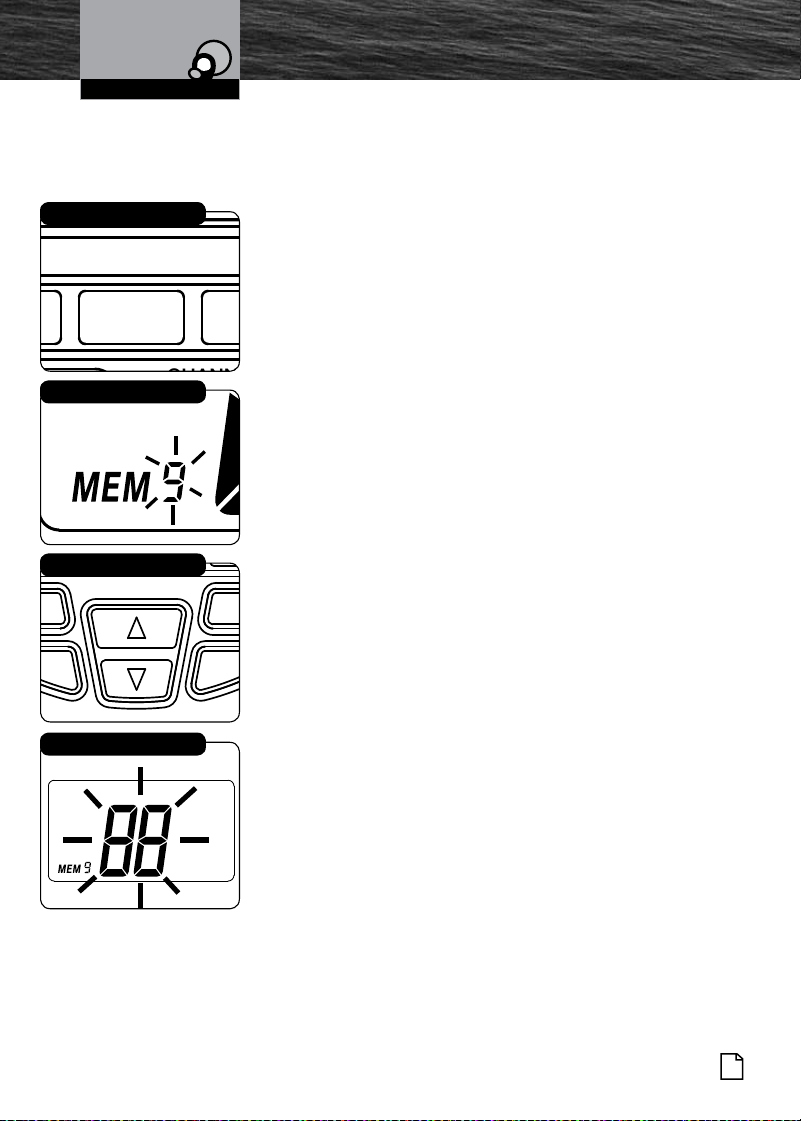
VHF Marine Radio ProtocolsOperating Your Radio VHF Marine Radio ProtocolsOperating Your Radio
23
Nothing Comes Close to a Cobra
®
Advanced Operation
22
English
Advanced Operation
Dual-Watch Scan Mode
To enter Memory mode, press Memory/Escape button. The
display will show the MEM icon and the Memory Channel
bank will be activated and displayed.
To Program Memory Locations:
1. Press and hold the Memory/Escape button for
two seconds. The memory location number
will start flashing.
2. Use the Channel Up and Channel Down buttons to advance
to the memory location (0-9) you want to program.
3. Press the Memory/Escape button to select the
memory location. The memory channel number
will stop flashing and the channel number will
start flashing.
4. Use the Channel Up and Channel Down buttons
to change to the channel you want to store into the
selected memory location.
5. Press the Memory/Escape button to program that
channel. The memory location number will flash again.
Repeat steps 2 through 5 to program as many additional
memory locations as you want [up to ten VHF memory
channels].
6. Press and hold the Memory/Escape button for
two seconds. This will return the radio to
Memory mode.
7. Press and release the Memory/Escape button
again to return to Marine Standby mode.
FLOATING MARINE HH150
ESC WEATHER SETUP
PWR
MEM
H-M-L
CHANNEL
MEM/ESC Button
Memory Location Number
CHANNEL
SC/DW
+16
VOL
VOL
SUBMERSIBLE
Channel Up/Down Buttons
Channel Number
Memory Location Mode
Your radio has ten memory locations (numbered 0 to 9) for your most frequently used
channels. These memory locations can be selected individually or can be scanned.
Dual-Watch Mode
Dual-Watch mode gives you one button access to scan a total of two channels of most
importance to you. Channel 16 is preprogrammed and will always be one of the scanned
locations. The other channel can be any marine VHF channel of your choice.
Using Dual-Watch
1. In Marine Standby mode, select the desired channel for
Dual-Watch scanning.
2. Press the Dual-Watch button. The DW icon will appear
on the LCD display and the radio will scan channel 16
and the selected channel.
3. A signal on any one of the two channels will
stop the scan for 10 seconds to allow you to listen
to the traffic on that location.
NOTE
After the Dual-Watch scan stops to monitor a channel,
as long as you do not press any buttons within 10
seconds, your radio will automatically resume scanning
the Dual-Watch channels.
4. Press the Channel Up or Channel Down buttons
to resume scanning the Dual-Watch channels or
to change the scan direction.
5. To EXIT the Dual-Watch scan, press the Dual-Watch button
again. The DW icon will disappear from the
LCD and the radio will return to Marine Standby mode.
NOTE
Dual-Watch also functions with a Memory channel.
PWR
MEM
CHANNEL
SC/DW
VOL
DUAL-WATCH Button
Memory Location Scan Mode
During Memory Location Scan mode, the radio will rapidly
scan through all programmed memory channels. Whenever
any activity is detected on a channel, the radio will stop the
scan for 10 seconds to allow you to listen briefly on that
channel. It will then continue to scan unless you switch out of
Memory Location Scan mode.
NOTE
If there are fewer than two memory locations programmed
in the radio, the Memory Location Scan option will not
be available. At least two memory locations need to be
programmed to use the Scan button.
To Enter Memory Location Scan:
1. From Marine Standby mode, press the Memory/Escape
button.
2. Press and hold the DUAL WATCH/SCAN button.
The radio will immediately begin to scan all pre-assigned
memory channels. The SCAN and MEM icons will show on
the LCD.
3. A signal on any channel will stop the scan for
10 seconds to allow you to listen to the traffic
on that location.
4. Press the Channel Up or Channel Down button
to resume scanning the Memory Location Scan
channels or to change the scan direction.
5. To EXIT Memory Location Scan mode, press and hold the
DUAL WATCH/SCAN button again. The SCAN and MEM
icons will disappear from the LCD and the radio will return
to Memory mode.
VHF Marine Radio ProtocolsOperating Your Radio VHF Marine Radio ProtocolsOperating Your Radio
25
Nothing Comes Close to a Cobra
®
24
English
To Recall a Stored Memory Location:
1. Press the Memory/Escape button. The MEM icon will be
turned On.
2. Press the Channel Up or Channel Down button to select
the memory location. If a memory location has been
programmed, its associated channel will display on the
LCD. Your radio is now in Marine Standby mode on the
selected memory location.
To Exit Memory Location Mode:
Press the Memory/Escape button to return the radio
to Marine Standby mode. The last channel used in Marine
Standby mode will now be displayed on the
LCD and the MEM icon will disappear.
To Erase Stored Memory Locations:
1. Press and hold the Memory/Escape button for two
seconds. The memory location number will start flashing
and the MEM icon will be turned On.
2. Use the Channel Up and Channel Down buttons to advance
to the memory location you want to erase.
3. Press the Memory/Escape button to select the memory
location. The memory channel number will stop flashing
and the channel number will start flashing.
4. Use the Channel Up and Channel Down buttons to change
the channel to read “
--” at the selected memory location.
5. Press the Memory/Escape button to erase that memory
location.
Repeat steps 2 through 5 to erase as many additional memory
locations as you want.
6. Press and hold the Memory/Escape button for two seconds.
This will return the radio to Memory mode.
7. Press and release the Memory/Escape button again
to return to Marine Standby mode.
MEM Icon Memory Location Scan
ESC WEA
PWR
MEM
H-M-L
CHANNEL
MEM/ESC Button
PWR
MEM
CHANNEL
SC/DW
Scan Button
Advanced OperationAdvanced Operation
Memory Location Scan Mode
During Memory Location Scan mode, the radio will rapidly
scan through all programmed memory channels. Whenever
any activity is detected on a channel, the radio will stop the
scan for 10 seconds to allow you to listen briefly on that
channel. It will then continue to scan unless you switch out of
Memory Location Scan mode.
NOTE
If there are fewer than two memory locations programmed
in the radio, the Memory Location Scan option will not
be available. At least two memory locations need to be
programmed to use the Scan button.
To Enter Memory Location Scan:
1. From Marine Standby mode, press the Memory/Escape
button.
2. Press and hold the DUAL WATCH/SCAN button.
The radio will immediately begin to scan all pre-assigned
memory channels. The SCAN and MEM icons will show on
the LCD.
3. A signal on any channel will stop the scan for
10 seconds to allow you to listen to the traffic
on that location.
4. Press the Channel Up or Channel Down button
to resume scanning the Memory Location Scan
channels or to change the scan direction.
5. To EXIT Memory Location Scan mode, press and hold the
DUAL WATCH/SCAN button again. The SCAN and MEM
icons will disappear from the LCD and the radio will return
to Memory mode.
VHF Marine Radio ProtocolsOperating Your Radio VHF Marine Radio ProtocolsOperating Your Radio
25
Nothing Comes Close to a Cobra
®
24
English
To Recall a Stored Memory Location:
1. Press the Memory/Escape button. The MEM icon will be
turned On.
2. Press the Channel Up or Channel Down button to select
the memory location. If a memory location has been
programmed, its associated channel will display on the
LCD. Your radio is now in Marine Standby mode on the
selected memory location.
To Exit Memory Location Mode:
Press the Memory/Escape button to return the radio
to Marine Standby mode. The last channel used in Marine
Standby mode will now be displayed on the
LCD and the MEM icon will disappear.
To Erase Stored Memory Locations:
1. Press and hold the Memory/Escape button for two
seconds. The memory location number will start flashing
and the MEM icon will be turned On.
2. Use the Channel Up and Channel Down buttons to advance
to the memory location you want to erase.
3. Press the Memory/Escape button to select the memory
location. The memory channel number will stop flashing
and the channel number will start flashing.
4. Use the Channel Up and Channel Down buttons to change
the channel to read “
--” at the selected memory location.
5. Press the Memory/Escape button to erase that memory
location.
Repeat steps 2 through 5 to erase as many additional memory
locations as you want.
6. Press and hold the Memory/Escape button for two seconds.
This will return the radio to Memory mode.
7. Press and release the Memory/Escape button again
to return to Marine Standby mode.
MEM Icon Memory Location Scan
ESC WEA
PWR
MEM
H-M-L
CHANNEL
MEM/ESC Button
PWR
MEM
CHANNEL
SC/DW
Scan Button
Advanced OperationAdvanced Operation
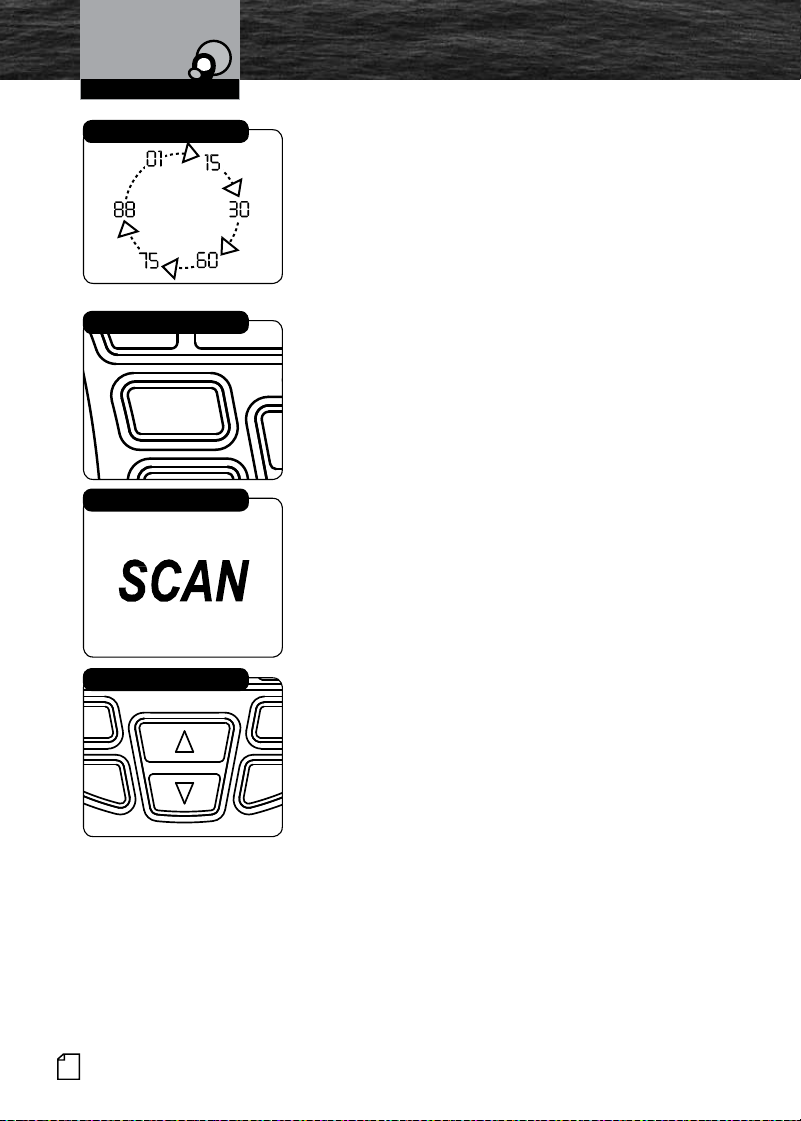
VHF Marine Radio Protocols
Maintenance and
Troubleshooting
26
English
Advanced Operation
Channel Scan Mode
During Channel Scan mode, the radio will rapidly switch
from channel to channel through ALL the channels. Whenever
any activity is detected, the radio will stop the scan for 10
seconds to allow you to listen briefly on that channel. The
radio will then continue to scan unless you switch out of the
Channel Scan mode.
To Enter Channel Scan:
1. From Marine Standby mode, press and hold the
DUAL WATCH/SCAN button. The radio will immediately
begin to scan the entire channel map selected in
the active channel map. The SCAN icon will show
on the LCD.
2. A signal on any channel will stop the scan for
10 seconds to allow you to listen to the traffic
on that location.
3. Press the Channel Up or Channel Down button
to resume scanning the Channel Scan channels
or to change the scan direction.
4. To EXIT Channel Scan mode, press and hold the
DUAL WATCH/SCAN button again. The SCAN icon
will disappear from the LCD and the radio will
return to Marine Standby mode.
PWR
MEM
CHANNEL
SC/DW
VOL
SCAN Button
SCAN Icon
Scanning
CHANNEL
SC/DW
+16
VOL
VOL
SUBMERSIBLE
Channel Up/Down Buttons
Operating Your Radio VHF Marine Radio ProtocolsOperating Your Radio
No display on LCD when
radio is turned On
Batteries are exhausted
Batteries not installed
properly
Recharge or
replace batteries
Remove batteries and
reinstall according to
polarity markings
NiMH batteries run
down quickly
Batteries are at the
end of their life
Replace with new batteries
Will transmit at .5 or 1
Watt, but not at 3 Watts
Batteries are low
Selected channel is limited
to one (1) watt
Recharge or
replace batteries
Switch to
another channel
Will not transmit Selected channel is limited
to receive only
Switch to
another channel
No sound from speaker Volume level is too low Re-adjust volume
No response to
button press
Button lock is On Press Backlight/
Key Lock button
No answer to calls Out of range of
other station
Signal is blocked
by terrain
Switch to three (3) watts
or move closer
Move until you have a “line-
of-sight” to the other station
Problem Possible Cause(s) Solution(s)
Maintenance
•
Very little maintenance is required to keep your CobraMarine VHF radio
in good operating condition:
n
Keep the radio clean by wiping with a soft cloth and mild detergent. Do not use
solvents or harsh or abrasive cleaners, which could damage the case or scratch
the LCD screen.
n
If the radio is exposed to salt water, wipe with a soft, moist cloth at least once a day to
prevent buildup of salt deposits, which could interfere with button operation.
n
If the radio will be stored for a long period, such as over the winter,
remove the batteries from the battery tray and store them in a separate
package. This is especially important if you are using alkaline batteries.
Troubleshooting
•
27
Nothing Comes Close to a Cobra
®
VHF Marine Radio Protocols
Maintenance and
Troubleshooting
26
English
Advanced Operation
Channel Scan Mode
During Channel Scan mode, the radio will rapidly switch
from channel to channel through ALL the channels. Whenever
any activity is detected, the radio will stop the scan for 10
seconds to allow you to listen briefly on that channel. The
radio will then continue to scan unless you switch out of the
Channel Scan mode.
To Enter Channel Scan:
1. From Marine Standby mode, press and hold the
DUAL WATCH/SCAN button. The radio will immediately
begin to scan the entire channel map selected in
the active channel map. The SCAN icon will show
on the LCD.
2. A signal on any channel will stop the scan for
10 seconds to allow you to listen to the traffic
on that location.
3. Press the Channel Up or Channel Down button
to resume scanning the Channel Scan channels
or to change the scan direction.
4. To EXIT Channel Scan mode, press and hold the
DUAL WATCH/SCAN button again. The SCAN icon
will disappear from the LCD and the radio will
return to Marine Standby mode.
PWR
MEM
CHANNEL
SC/DW
VOL
SCAN Button
SCAN Icon
Scanning
CHANNEL
SC/DW
+16
VOL
VOL
SUBMERSIBLE
Channel Up/Down Buttons
Operating Your Radio VHF Marine Radio ProtocolsOperating Your Radio
No display on LCD when
radio is turned On
Batteries are exhausted
Batteries not installed
properly
Recharge or
replace batteries
Remove batteries and
reinstall according to
polarity markings
NiMH batteries run
down quickly
Batteries are at the
end of their life
Replace with new batteries
Will transmit at .5 or 1
Watt, but not at 3 Watts
Batteries are low
Selected channel is limited
to one (1) watt
Recharge or
replace batteries
Switch to
another channel
Will not transmit Selected channel is limited
to receive only
Switch to
another channel
No sound from speaker Volume level is too low Re-adjust volume
No response to
button press
Button lock is On Press Backlight/
Key Lock button
No answer to calls Out of range of
other station
Signal is blocked
by terrain
Switch to three (3) watts
or move closer
Move until you have a “line-
of-sight” to the other station
Problem Possible Cause(s) Solution(s)
Maintenance
•
Very little maintenance is required to keep your CobraMarine VHF radio
in good operating condition:
n
Keep the radio clean by wiping with a soft cloth and mild detergent. Do not use
solvents or harsh or abrasive cleaners, which could damage the case or scratch
the LCD screen.
n
If the radio is exposed to salt water, wipe with a soft, moist cloth at least once a day to
prevent buildup of salt deposits, which could interfere with button operation.
n
If the radio will be stored for a long period, such as over the winter,
remove the batteries from the battery tray and store them in a separate
package. This is especially important if you are using alkaline batteries.
Troubleshooting
•
27
Nothing Comes Close to a Cobra
®

VHF Marine Radio ProtocolsVHF Marine Radio Protocols
29
Nothing Comes Close to a Cobra
®
VHF Marine Radio
Procedures
28
English
VHF Marine Radio
Procedures
VHF Marine Radio Procedures
•
Maintain Your Watch
Whenever your boat is underway, the radio must be turned On and be tuned to Channel
16 except when being used for messages.
Power
Try 0.5 watts first, if the station being called is within a few miles. If there is no answer,
switch to 1 watt and call again. You have the ability to go up to 3 watts of output power to
increase your calling distance. Remember, the lower wattage outputs will conserve your
battery and minimize interference to other users.
Calling Coast Stations
Call a coast station on its assigned channel. You may use Channel 16 when you
do not know the assigned channel.
Calling Other Vessels
Call other vessels on Channel 16 or on Channel 9. (Channel 9 is preferred for recreational
vessel use.) You may also call on ship-to-ship channels when you know that the vessel is
listening on a ship-to-ship channel.
Initial Calling on Channel 16 or 9
The use of Channel 16 is permitted for making initial contact (hailing) another vessel. The
limits on calling must be followed. Be reminded, Channel 16’s most important function
is for Emergency Messages. If for some reason, Channel 16 is congested, the use of
Channel 9, especially in U.S. waters, may be used as the initial contact (hailing) channel
for non-emergency communication.
Limits on Calling
You must not call the same station for more than 30 seconds at a time.
If you do not get a reply, wait at least two minutes before calling again.
After three calling periods, wait at least 15 minutes before calling again.
Change Channels
After contacting another station on a calling channel, change immediately
to a channel which is available for the type of message you want to send.
Station Identification
Identify, in English, your station by your FCC call sign (if available), vessel name and the
state registration number, at both the beginning and at the end of the message.
Prohibited Communications
You MUST NOT transmit:
n
False distress or emergency messages.
n
Messages containing obscene, indecent or profane language.
n
General calls, signals or messages (messages not addressed to a particular station) on
Channel 16, except in an emergency or if you are testing your radio.
n
When you are on land.

VHF Marine Radio ProtocolsVHF Marine Radio Protocols
29
Nothing Comes Close to a Cobra
®
VHF Marine Radio
Procedures
28
English
VHF Marine Radio
Procedures
VHF Marine Radio Procedures
•
Maintain Your Watch
Whenever your boat is underway, the radio must be turned On and be tuned to Channel
16 except when being used for messages.
Power
Try 0.5 watts first, if the station being called is within a few miles. If there is no answer,
switch to 1 watt and call again. You have the ability to go up to 3 watts of output power to
increase your calling distance. Remember, the lower wattage outputs will conserve your
battery and minimize interference to other users.
Calling Coast Stations
Call a coast station on its assigned channel. You may use Channel 16 when you
do not know the assigned channel.
Calling Other Vessels
Call other vessels on Channel 16 or on Channel 9. (Channel 9 is preferred for recreational
vessel use.) You may also call on ship-to-ship channels when you know that the vessel is
listening on a ship-to-ship channel.
Initial Calling on Channel 16 or 9
The use of Channel 16 is permitted for making initial contact (hailing) another vessel. The
limits on calling must be followed. Be reminded, Channel 16’s most important function
is for Emergency Messages. If for some reason, Channel 16 is congested, the use of
Channel 9, especially in U.S. waters, may be used as the initial contact (hailing) channel
for non-emergency communication.
Limits on Calling
You must not call the same station for more than 30 seconds at a time.
If you do not get a reply, wait at least two minutes before calling again.
After three calling periods, wait at least 15 minutes before calling again.
Change Channels
After contacting another station on a calling channel, change immediately
to a channel which is available for the type of message you want to send.
Station Identification
Identify, in English, your station by your FCC call sign (if available), vessel name and the
state registration number, at both the beginning and at the end of the message.
Prohibited Communications
You MUST NOT transmit:
n
False distress or emergency messages.
n
Messages containing obscene, indecent or profane language.
n
General calls, signals or messages (messages not addressed to a particular station) on
Channel 16, except in an emergency or if you are testing your radio.
n
When you are on land.
VHF Marine Radio ProtocolsVHF Marine Radio Protocols
31
Nothing Comes Close to a Cobra
®
Voice Calling &
Radiotelephone Calls
n
If the other party does not respond, wait two minutes and repeat. You are
permitted to attempt contact three times, two minutes apart. If you still have not
made contact, wait 15 minutes before trying again.
n
After communications are completed, each vessel must sign off with its call sign
or vessel name and the word “out” and return to Channel 16.
NOTE
For best sound quality at the station you are calling, hold the microphone on the
front of the radio at least 2 in. (51 mm) from your mouth and slightly off to one
side. Speak in a normal tone of voice.
NOTE
“Over and Out”
The most commonly misused procedure words are “over and out” within the
same transmission. “Over” means you expect a reply. “Out” means you are
finished and do not expect a reply.
For Example
30
English
Voice Calling
Voice Calling
•
You are required to listen to Channel 16 while standing by. Channel 16 is the distress
and safety channel used for establishing initial contact with another station and for
emergency communication. The Coast Guard also monitors Channel 16 for safety
purposes for everyone on the water.
NOTE
Channel 9 may be used by recreational vessels for general-purpose calling.
This frequency should be used whenever possible to help relieve congestion
on Channel 16. The Coast Guard generally does not make urgent marine
information broadcasts or weather warnings on Channel 9. Boaters are still asked
to “keep watch” on Channel 16 whenever the radio is turned on and
not in use with another station.
To call another vessel or shore installation (e.g, lock or bridge tender):
n
Make sure the radio is On.
n
Make sure you are in standby listening mode on Channel 16. Make sure Channel
16 is not in use.
n
When the channel is open (quiet), press the Talk button and call a vessel. Hold
the radio or microphone several inches from your face and speak clearly and
distinctly in a normal voice tone. Say “name or station being called,” “THIS IS
[your vessel name or call sign].”
n
Once contact is made, you must leave Channel 16 and go to another working
channel. See channel listing in the appendix.
The vessel Corsair is calling the vessel Vagabond:
Corsair: “Vagabond, this is Corsair. Over.”
Vagabond: “Please switch and answer on Channel 68 (or any proper working channel).
Over.”
Corsair: “Switching to Channel 68. Over.”
Radiotelephone Calls
•
Boaters may make and receive radiotelephone calls to and from any number on
the telephone network by using the services of public coast stations. For a fee,
calls can be made between your radio and telephones on land, sea and in the air.
See the appendix for the public correspondence (marine operator) channels.
If you plan to use these services, consider registering with the operator of the
public coast station that you plan to work through. These services can provide
you with detailed information and procedures to follow.
NOTICE
You may disclose privileged information during a radiotelephone call.
Keep in mind that your transmission is NOT private, as it is on a regular
telephone. Both sides of the conversation are being broadcast and can be
heard by anyone who has a radio and tunes to the channel you are using.
Caution
VHF Marine Radio ProtocolsVHF Marine Radio Protocols
31
Nothing Comes Close to a Cobra
®
Voice Calling &
Radiotelephone Calls
n
If the other party does not respond, wait two minutes and repeat. You are
permitted to attempt contact three times, two minutes apart. If you still have not
made contact, wait 15 minutes before trying again.
n
After communications are completed, each vessel must sign off with its call sign
or vessel name and the word “out” and return to Channel 16.
NOTE
For best sound quality at the station you are calling, hold the microphone on the
front of the radio at least 2 in. (51 mm) from your mouth and slightly off to one
side. Speak in a normal tone of voice.
NOTE
“Over and Out”
The most commonly misused procedure words are “over and out” within the
same transmission. “Over” means you expect a reply. “Out” means you are
finished and do not expect a reply.
For Example
30
English
Voice Calling
Voice Calling
•
You are required to listen to Channel 16 while standing by. Channel 16 is the distress
and safety channel used for establishing initial contact with another station and for
emergency communication. The Coast Guard also monitors Channel 16 for safety
purposes for everyone on the water.
NOTE
Channel 9 may be used by recreational vessels for general-purpose calling.
This frequency should be used whenever possible to help relieve congestion
on Channel 16. The Coast Guard generally does not make urgent marine
information broadcasts or weather warnings on Channel 9. Boaters are still asked
to “keep watch” on Channel 16 whenever the radio is turned on and
not in use with another station.
To call another vessel or shore installation (e.g, lock or bridge tender):
n
Make sure the radio is On.
n
Make sure you are in standby listening mode on Channel 16. Make sure Channel
16 is not in use.
n
When the channel is open (quiet), press the Talk button and call a vessel. Hold
the radio or microphone several inches from your face and speak clearly and
distinctly in a normal voice tone. Say “name or station being called,” “THIS IS
[your vessel name or call sign].”
n
Once contact is made, you must leave Channel 16 and go to another working
channel. See channel listing in the appendix.
The vessel Corsair is calling the vessel Vagabond:
Corsair: “Vagabond, this is Corsair. Over.”
Vagabond: “Please switch and answer on Channel 68 (or any proper working channel).
Over.”
Corsair: “Switching to Channel 68. Over.”
Radiotelephone Calls
•
Boaters may make and receive radiotelephone calls to and from any number on
the telephone network by using the services of public coast stations. For a fee,
calls can be made between your radio and telephones on land, sea and in the air.
See the appendix for the public correspondence (marine operator) channels.
If you plan to use these services, consider registering with the operator of the
public coast station that you plan to work through. These services can provide
you with detailed information and procedures to follow.
NOTICE
You may disclose privileged information during a radiotelephone call.
Keep in mind that your transmission is NOT private, as it is on a regular
telephone. Both sides of the conversation are being broadcast and can be
heard by anyone who has a radio and tunes to the channel you are using.
Caution
Marine Emergency Signals
The three spoken international emergency signals are:
The distress signal MAYDAY is used to indicate that a station is threatened by grave
and imminent danger and requests immediate assistance.
The urgency signal PAN PAN is used when the safety of the vessel or person is in
jeopardy. (This signal is properly pronounced pahn pahn.)
The safety signal SECURITE is used for messages about the safety of navigation or
important weather warnings. (This signal is properly pronounced see-cure-ee-tay.)
When using an international emergency signal, the appropriate signal is to be spoken
three times prior to the message.
MAYDAY
PAN PAN
SECURITE
VHF Marine Radio ProtocolsVHF Marine Radio Protocols
33
Nothing Comes Close to a Cobra
®
32
English
Emergency Messages and
Distress Procedure
Emergency Messages and
Distress Procedure
Emergency Messages and Distress Procedure
•
The ability to summon assistance in an emergency is the primary reason to have a VHF
marine radio. The marine environment can be unforgiving, and what may initially be a
minor problem can rapidly develop into a situation beyond your control.
The Coast Guard monitors Channel 16, responds to all distress calls, and coordinates
all search and rescue efforts. Depending on the availability of other capable vessels or
commercial assistance operators in your vicinity, Coast Guard or Coast Guard Auxiliary
craft may be dispatched.
In any event, communicate with the Coast Guard as soon as you experience difficulties
and before your situation becomes an emergency. Use the emergency message
procedures only after your situation has become grave or you are faced with a sudden
danger threatening life or property and requiring immediate help. Use Channel 16 to
communicate your emergency message. Make sure you transmit on high power.
If you are merely out of gas, do not send an emergency message. Drop your anchor
and call a friend or marina to bring the fuel you need or to give you a tow.
If You Hear a Distress Call
You must give any message beginning with one of these signals priority over any
other messages. ALL stations MUST remain silent on Channel 16 for the duration of
the emergency unless the message relates directly to the emergency.
If you hear a distress message from a vessel, stand by your radio. If it is not
answered, YOU should answer. If the distressed vessel is not nearby, wait a short
time for others who may be closer to acknowledge. Even if you cannot render direct
assistance, you may be in a position to relay the message.
Marine Distress Procedure
Speak slowly — clearly — calmly.
1. Make sure your radio is On.
2. Select Channel 16.
3. Press Talk button and say:
“MAYDAY — MAYDAY — MAYDAY.”
(Or “PAN PAN— PAN PAN— PAN PAN,”
or “SECURITE — SECURITE — SECURITE.”)
4. Say:
“THIS IS [your vessel name or call sign],” repeated three (3) times.
5. Say:
“MAYDAY (or “PAN PAN” or “SECURITE”)
[your vessel name or call sign].
6. Tell where you are:
(what navigational aids or landmarks are nearby).
7. State the nature of your distress.
8. State the kind of assistance needed.
9. Give number of persons aboard and conditions of any injured.
10. Estimate present seaworthiness of your vessel.
11. Briefly describe your vessel (length, type, color, hull).
12. Say:
“I WILL BE LISTENING ON CHANNEL 16.”
13. End message by saying:
“THIS IS [your vessel name or call sign]. OVER.”
14. Release Talk button and listen. Someone should answer.
If not, repeat the call, beginning at step 3 above.
Keep the radio nearby. Even after your message has been received, the Coast Guard can
find you more quickly if you can transmit a signal for a rescue boat to hone in on.

Marine Emergency Signals
The three spoken international emergency signals are:
The distress signal MAYDAY is used to indicate that a station is threatened by grave
and imminent danger and requests immediate assistance.
The urgency signal PAN PAN is used when the safety of the vessel or person is in
jeopardy. (This signal is properly pronounced pahn pahn.)
The safety signal SECURITE is used for messages about the safety of navigation or
important weather warnings. (This signal is properly pronounced see-cure-ee-tay.)
When using an international emergency signal, the appropriate signal is to be spoken
three times prior to the message.
MAYDAY
PAN PAN
SECURITE
VHF Marine Radio ProtocolsVHF Marine Radio Protocols
33
Nothing Comes Close to a Cobra
®
32
English
Emergency Messages and
Distress Procedure
Emergency Messages and
Distress Procedure
Emergency Messages and Distress Procedure
•
The ability to summon assistance in an emergency is the primary reason to have a VHF
marine radio. The marine environment can be unforgiving, and what may initially be a
minor problem can rapidly develop into a situation beyond your control.
The Coast Guard monitors Channel 16, responds to all distress calls, and coordinates
all search and rescue efforts. Depending on the availability of other capable vessels or
commercial assistance operators in your vicinity, Coast Guard or Coast Guard Auxiliary
craft may be dispatched.
In any event, communicate with the Coast Guard as soon as you experience difficulties
and before your situation becomes an emergency. Use the emergency message
procedures only after your situation has become grave or you are faced with a sudden
danger threatening life or property and requiring immediate help. Use Channel 16 to
communicate your emergency message. Make sure you transmit on high power.
If you are merely out of gas, do not send an emergency message. Drop your anchor
and call a friend or marina to bring the fuel you need or to give you a tow.
If You Hear a Distress Call
You must give any message beginning with one of these signals priority over any
other messages. ALL stations MUST remain silent on Channel 16 for the duration of
the emergency unless the message relates directly to the emergency.
If you hear a distress message from a vessel, stand by your radio. If it is not
answered, YOU should answer. If the distressed vessel is not nearby, wait a short
time for others who may be closer to acknowledge. Even if you cannot render direct
assistance, you may be in a position to relay the message.
Marine Distress Procedure
Speak slowly — clearly — calmly.
1. Make sure your radio is On.
2. Select Channel 16.
3. Press Talk button and say:
“MAYDAY — MAYDAY — MAYDAY.”
(Or “PAN PAN— PAN PAN— PAN PAN,”
or “SECURITE — SECURITE — SECURITE.”)
4. Say:
“THIS IS [your vessel name or call sign],” repeated three (3) times.
5. Say:
“MAYDAY (or “PAN PAN” or “SECURITE”)
[your vessel name or call sign].
6. Tell where you are:
(what navigational aids or landmarks are nearby).
7. State the nature of your distress.
8. State the kind of assistance needed.
9. Give number of persons aboard and conditions of any injured.
10. Estimate present seaworthiness of your vessel.
11. Briefly describe your vessel (length, type, color, hull).
12. Say:
“I WILL BE LISTENING ON CHANNEL 16.”
13. End message by saying:
“THIS IS [your vessel name or call sign]. OVER.”
14. Release Talk button and listen. Someone should answer.
If not, repeat the call, beginning at step 3 above.
Keep the radio nearby. Even after your message has been received, the Coast Guard can
find you more quickly if you can transmit a signal for a rescue boat to hone in on.
For Example
WarrantyVHF Marine Radio Protocols
35
Nothing Comes Close to a Cobra
®
34
English
Warranty and Trademark
Acknowledgement
Emergency Messages
and Distress Procedure
“Mayday — Mayday — Mayday”
“This is Corsair — Corsair — Corsair” [or “IL 1234 AB,” repeated three (3) times]
“Mayday Corsair (or IL 1234 AB)”
“Navy Pier bears 220 degrees magnetic — distance 5 miles”
“Struck submerged object and flooding — need pump and tow”
“Four (4) adults, three (3) children aboard — no one injured”
“Estimate we will remain afloat one-half hour”
“Corsair (or IL 1234 AB) is 26 ft sloop with blue hull and tan deck house”
“I will be listening on Channel 16”
“This is Corsair (or IL 1234 AB)”
“Over”
It is a good idea to write out a script of the message form and post it where you
and others on your vessel can see it when an emergency message needs to be sent.
Limited 1-Year Warranty
•
Proof of Purchase Required:
For warranty service you will need to provide proof of purchase from an approved dealer
or retailer. Please note that if you purchased your product on the Internet from Ebay,
Amazon, or any third party seller, you will need to provide a receipt from the original seller
for verification as an approved retailer.
For Products Purchased In The U.S.A.
Cobra Electronics Corporation warrants that its CobraMarine VHF radio, and the component
parts thereof, will be free of defects in workmanship and materials for a period of one
year from the date of first consumer purchase. This warranty may be enforced by the first
consumer purchaser, provided that the product is utilized within the U.S.A.
Cobra will, without charge, repair or replace, at its option, defective radios, products or
component parts upon delivery to the Cobra Factory Service department, accompanied by
proof of the date of first consumer purchase, such as a duplicated copy of a sales receipt.
You must pay any initial shipping charges required to ship the product for warranty
service, but the return charges will be at Cobra’s expense, if the product is repaired or
replaced under warranty. This warranty gives you specific legal rights, and you may also
have other rights which may vary from state to state.
Exclusions: This limited warranty does not apply:
1. To any product damaged by accident.
2. In the event of misuse or abuse of the product or as a result
of unauthorized alterations or repairs.
3. If the serial number has been altered, defaced, or removed.
4. If the owner of the product resides outside the U.S.A.
All implied warranties, including warranties of merchantability and fitness for a particular
purpose are limited in duration to the length of this warranty. Cobra shall not be liable for
any incidental, consequential or other damages; including, without limitation, damages
resulting from loss of use or cost of installation.
Some states do not allow limitations on how long an implied warranty lasts and/or do not
allow the exclusion or limitation of incidental or consequential damages, so the above
limitations may not apply to you.
For Products Purchased Outside The U.S.A.
Please contact your local dealer for additional warranty information.
Trademark Acknowledgement
•
Cobra
®
, CobraMarine
®
, Nothing Comes Close to a Cobra
®
, and the snake design are
registered trademarks of Cobra Electronics Corporation, USA.
Cobra Electronics Corporation
™
is a trademark of Cobra Electronics Corporation, USA.
For Example
WarrantyVHF Marine Radio Protocols
35
Nothing Comes Close to a Cobra
®
34
English
Warranty and Trademark
Acknowledgement
Emergency Messages
and Distress Procedure
“Mayday — Mayday — Mayday”
“This is Corsair — Corsair — Corsair” [or “IL 1234 AB,” repeated three (3) times]
“Mayday Corsair (or IL 1234 AB)”
“Navy Pier bears 220 degrees magnetic — distance 5 miles”
“Struck submerged object and flooding — need pump and tow”
“Four (4) adults, three (3) children aboard — no one injured”
“Estimate we will remain afloat one-half hour”
“Corsair (or IL 1234 AB) is 26 ft sloop with blue hull and tan deck house”
“I will be listening on Channel 16”
“This is Corsair (or IL 1234 AB)”
“Over”
It is a good idea to write out a script of the message form and post it where you
and others on your vessel can see it when an emergency message needs to be sent.
Limited 1-Year Warranty
•
Proof of Purchase Required:
For warranty service you will need to provide proof of purchase from an approved dealer
or retailer. Please note that if you purchased your product on the Internet from Ebay,
Amazon, or any third party seller, you will need to provide a receipt from the original seller
for verification as an approved retailer.
For Products Purchased In The U.S.A.
Cobra Electronics Corporation warrants that its CobraMarine VHF radio, and the component
parts thereof, will be free of defects in workmanship and materials for a period of one
year from the date of first consumer purchase. This warranty may be enforced by the first
consumer purchaser, provided that the product is utilized within the U.S.A.
Cobra will, without charge, repair or replace, at its option, defective radios, products or
component parts upon delivery to the Cobra Factory Service department, accompanied by
proof of the date of first consumer purchase, such as a duplicated copy of a sales receipt.
You must pay any initial shipping charges required to ship the product for warranty
service, but the return charges will be at Cobra’s expense, if the product is repaired or
replaced under warranty. This warranty gives you specific legal rights, and you may also
have other rights which may vary from state to state.
Exclusions: This limited warranty does not apply:
1. To any product damaged by accident.
2. In the event of misuse or abuse of the product or as a result
of unauthorized alterations or repairs.
3. If the serial number has been altered, defaced, or removed.
4. If the owner of the product resides outside the U.S.A.
All implied warranties, including warranties of merchantability and fitness for a particular
purpose are limited in duration to the length of this warranty. Cobra shall not be liable for
any incidental, consequential or other damages; including, without limitation, damages
resulting from loss of use or cost of installation.
Some states do not allow limitations on how long an implied warranty lasts and/or do not
allow the exclusion or limitation of incidental or consequential damages, so the above
limitations may not apply to you.
For Products Purchased Outside The U.S.A.
Please contact your local dealer for additional warranty information.
Trademark Acknowledgement
•
Cobra
®
, CobraMarine
®
, Nothing Comes Close to a Cobra
®
, and the snake design are
registered trademarks of Cobra Electronics Corporation, USA.
Cobra Electronics Corporation
™
is a trademark of Cobra Electronics Corporation, USA.
VHF Marine Radio Protocols Introduction
37
Nothing Comes Close to a Cobra
®
36
English
Specifications
Product Service
•
For any questions about operating or installing this new Cobra product, or
if parts are missing…PLEASE CALL COBRA FIRST…
do not return this
product to the store.
If this product should require factory service, please call Cobra first before sending the
product. This will ensure the fastest turnaround time on any repair. If Cobra asks that
the product be sent to its factory, the following must be furnished to have the product
serviced and returned:
1.
For Warranty Repair include some form of proof-of-purchase, such as a mechanical
reproduction or carbon of a sales receipt. Make sure the date of purchase and product
model number are clearly readable. If the originals are sent, they cannot be returned;
2. Send the entire product;
3. Enclose a description of what is happening with the product. Include a typed or
clearly printed name and address of where the product is to be returned, with
phone number (required for shipment).
4. Pack the product securely to prevent damage in transit. If possible,
use the original packing material;
5. Ship prepaid and insured by way of a traceable carrier such as
United Parcel Service (UPS) or Priority Mail to avoid loss in transit to:
Cobra Factory Service
Cobra Electronics Corporation
6500 West Cortland Street
Chicago, Illinois 60707 U.S.A.;
6. If the product is in warranty, upon receipt of the product, it will either be repaired or
exchanged depending on the model. Please allow approximately
3 – 4 weeks before contacting Cobra for status. If the product is out of warranty,
a letter will automatically be sent with information as to the repair charge or
replacement charge.
For any questions, please call 773-889-3087 for assistance.
Specifications
Product Service
Customer Service
Specifications (Typical)
•
General
Number of Channels All U.S., Canadian, International and
NOAA Weather Channels
Channel Spacing 25 kHz
Modulation 5 kHz Max.
Input Voltage 6.0 VDC
Battery Life: NiMH: 9.4 hours @ 3 watts
20 hours @ 0.5 watts
5% TX, 5% RX, 90% Standby 12 hours @ 1 watt
Alkaline: 26 hours @ 3 watts
33 hours @ 1 watt
Current Drain:
Standby 45 mA
Receive (Rx) 140 mA
Transmit (Tx) 1.1 A @ High Power, 450 mA @ Low Power
Temperature Range -20˚C to 50˚C
Radio Dimensions 4.5” H x 2.7” W x 1.5” D
(114 mm x 69 mm x 38 mm) not including
antenna
Radio Weight 0 lbs., 8 oz. (247g.)
Receiver
Frequency Range 156.050 to 163.275 MHz
Receiver Type Double Conversion Super-Heterodyne
Sensitivity:
12 dB Sinad 0.25 uV
Adjacent Channel Selectivity 70 dB
Intermodulation and Rejection 70 dB
Spurious and Image Rejection 70 dB
AF Output 250 mW @ 8 Ohms
Transmitter
Frequency Range (Tx): 156.025 to 157.425 MHz
RF Output Power .5, 1 or 3 watts
Spurious Emissions -60 dB @ High Power, -55 dB @ Low
Power
Microphone Type Condenser
Frequency Stability +/-10 ppm
FM Hum and Noise 40 dB
Disposal of Old Electrical or Electronics Equipment
This product may contain hazardous substances that could impact health and the
environment if not disposed of properly.
The crossed out wheeled bin symbol indicates that the product should not
be disposed of along with household waste. It should be handed over to
an applicable collection point for the recycling of electrical equipment. By
ensuring that this product is disposed of correctly you will help/prevent
potential negative impact on the environment.
If you need more information on the collection, reuse and recycling systems, please
contact your local civic office or the shop where it was originally purchased.
VHF Marine Radio Protocols Introduction
37
Nothing Comes Close to a Cobra
®
36
English
Specifications
Product Service
•
For any questions about operating or installing this new Cobra product, or
if parts are missing…PLEASE CALL COBRA FIRST…
do not return this
product to the store.
If this product should require factory service, please call Cobra first before sending the
product. This will ensure the fastest turnaround time on any repair. If Cobra asks that
the product be sent to its factory, the following must be furnished to have the product
serviced and returned:
1.
For Warranty Repair include some form of proof-of-purchase, such as a mechanical
reproduction or carbon of a sales receipt. Make sure the date of purchase and product
model number are clearly readable. If the originals are sent, they cannot be returned;
2. Send the entire product;
3. Enclose a description of what is happening with the product. Include a typed or
clearly printed name and address of where the product is to be returned, with
phone number (required for shipment).
4. Pack the product securely to prevent damage in transit. If possible,
use the original packing material;
5. Ship prepaid and insured by way of a traceable carrier such as
United Parcel Service (UPS) or Priority Mail to avoid loss in transit to:
Cobra Factory Service
Cobra Electronics Corporation
6500 West Cortland Street
Chicago, Illinois 60707 U.S.A.;
6. If the product is in warranty, upon receipt of the product, it will either be repaired or
exchanged depending on the model. Please allow approximately
3 – 4 weeks before contacting Cobra for status. If the product is out of warranty,
a letter will automatically be sent with information as to the repair charge or
replacement charge.
For any questions, please call 773-889-3087 for assistance.
Specifications
Product Service
Customer Service
Specifications (Typical)
•
General
Number of Channels All U.S., Canadian, International and
NOAA Weather Channels
Channel Spacing 25 kHz
Modulation 5 kHz Max.
Input Voltage 6.0 VDC
Battery Life: NiMH: 9.4 hours @ 3 watts
20 hours @ 0.5 watts
5% TX, 5% RX, 90% Standby 12 hours @ 1 watt
Alkaline: 26 hours @ 3 watts
33 hours @ 1 watt
Current Drain:
Standby 45 mA
Receive (Rx) 140 mA
Transmit (Tx) 1.1 A @ High Power, 450 mA @ Low Power
Temperature Range -20˚C to 50˚C
Radio Dimensions 4.5” H x 2.7” W x 1.5” D
(114 mm x 69 mm x 38 mm) not including
antenna
Radio Weight 0 lbs., 8 oz. (247g.)
Receiver
Frequency Range 156.050 to 163.275 MHz
Receiver Type Double Conversion Super-Heterodyne
Sensitivity:
12 dB Sinad 0.25 uV
Adjacent Channel Selectivity 70 dB
Intermodulation and Rejection 70 dB
Spurious and Image Rejection 70 dB
AF Output 250 mW @ 8 Ohms
Transmitter
Frequency Range (Tx): 156.025 to 157.425 MHz
RF Output Power .5, 1 or 3 watts
Spurious Emissions -60 dB @ High Power, -55 dB @ Low
Power
Microphone Type Condenser
Frequency Stability +/-10 ppm
FM Hum and Noise 40 dB
Disposal of Old Electrical or Electronics Equipment
This product may contain hazardous substances that could impact health and the
environment if not disposed of properly.
The crossed out wheeled bin symbol indicates that the product should not
be disposed of along with household waste. It should be handed over to
an applicable collection point for the recycling of electrical equipment. By
ensuring that this product is disposed of correctly you will help/prevent
potential negative impact on the environment.
If you need more information on the collection, reuse and recycling systems, please
contact your local civic office or the shop where it was originally purchased.
ApéndiceAppendix
39
Nothing Comes Close to a Cobra
®
/Nada se compara a Cobra
®
38
English/Español
Asignación de canales de VHF
para radiocomunicación marítima
VHF Marine
Channel Assignments
Asignación de canales de VHF para radiocomunicación marítima
•
Existen tres mapas de canales VHF para uso marítimo en los EE.UU., Canadá y el resto
del mundo (internacional). La mayoría de los canales coinciden en los tres mapas,
pero sin duda existen diferencias (consulte las tablas en las páginas siguientes).
El radio incorpora los tres mapas y funcionará correctamente en cualquiera de las
tres áreas.
A continuación presentamos en forma resumida las asignaciones de canales del
Mapa de canales para EE.UU.
Auxilio, seguridad y llamadas
Canal 16
Para ser oídos por otra estación (llamadas) o en casos de emergencia (auxilio y seguridad).
Llamadas
Canal 9
Llamadas de carácter general (excepto casos de emergencia) para embarcaciones no comerciales.
Se le pide encarecidamente a la tripulación de las embarcaciones recreativas usar este canal
para reducir la congestión del canal 16.
Seguridad entre embarcaciones
Canal 6
Para mensajes de seguridad entre embarcaciones y para mensajes de búsqueda y rescate
enviados a barcos y aviones de la guardia costera.
Enlace con la guardia costera
Canal 22A
Para hablar con las guardias costeras estadounidenses y canadienses (excepto casos de
emergencia) tras haber establecido contacto por el canal 16.
No comerciales
Canales 67*, 68*, 69, 71, 72, 78A, 79A*, 80A*
Canales activos para pequeñas embarcaciones. Los mensajes deberán estar relacionados con
necesidades de las embarcaciones, como por ejemplo, informes de pesca, atraques y agrupamientos.
Use el canal 72 solamente para mensajes entre embarcaciones.
Comerciales
Canales 1A, 7A, 8, 9, 10, 11, 18A, 19A, 63A, 67, 72, 79A, 80A, 88A*
Canales activos para embarcaciones activas solamente. Los mensajes deberán estar
relacionados con la actividad comercial o las necesidades de la embarcación. Use los
canales 8, 67, 72 y 88A solamente para mensajes entre embarcaciones.
VHF Marine Channel Assignments
•
Three sets of VHF channels have been established for marine use in the U.S.A.,
Canada and the rest of the world (International). Most of the channels are the same
for all three maps, but there are definite differences (see table on the following
pages). Your radio has all three maps built into it and will operate correctly in
whichever area you choose.
The following is a brief outline of the channel assignments in the U.S.A. Channel
Map.
Distress, Safety, and Calling
Channel 16
Getting the attention of another station (calling) or in emergencies (distress and safety).
Calling
Channel 9
General-purpose (non-emergency) calling by non-commercial vessels. Recreational boaters are
urged to use this channel to reduce congestion on Channel 16
Intership Safety
Channel 6
Ship-to-ship safety messages and for search and rescue messages to Coast Guard ships
and aircraft.
Coast Guard Liaison
Channel 22A
To talk to the Coast Guard, Canadian Coast Guard (non-emergency) after making contact on
Channel 16.
Non-Commercial
Channels 67*, 68*, 69, 71, 72, 78A, 79A*, 80A*
Working channels for small vessels. Messages must be about needs of the vessel, such as
fishing reports, berthing and rendezvous. Use Channel 72 only for ship-to-ship messages.
Commercial
Channels 1A, 7A, 8, 9, 10, 11, 18A, 19A, 63A, 67, 72, 79A, 80A, 88A*
Working channels for working ships only. Messages must be about business or needs
of the ship. Use Channels 8, 67, 72 and 88A only for ship-to-ship messages.
Channel Assignments (English)
Asignaciones de canales (Español)
ApéndiceAppendix
39
Nothing Comes Close to a Cobra
®
/Nada se compara a Cobra
®
38
English/Español
Asignación de canales de VHF
para radiocomunicación marítima
VHF Marine
Channel Assignments
Asignación de canales de VHF para radiocomunicación marítima
•
Existen tres mapas de canales VHF para uso marítimo en los EE.UU., Canadá y el resto
del mundo (internacional). La mayoría de los canales coinciden en los tres mapas,
pero sin duda existen diferencias (consulte las tablas en las páginas siguientes).
El radio incorpora los tres mapas y funcionará correctamente en cualquiera de las
tres áreas.
A continuación presentamos en forma resumida las asignaciones de canales del
Mapa de canales para EE.UU.
Auxilio, seguridad y llamadas
Canal 16
Para ser oídos por otra estación (llamadas) o en casos de emergencia (auxilio y seguridad).
Llamadas
Canal 9
Llamadas de carácter general (excepto casos de emergencia) para embarcaciones no comerciales.
Se le pide encarecidamente a la tripulación de las embarcaciones recreativas usar este canal
para reducir la congestión del canal 16.
Seguridad entre embarcaciones
Canal 6
Para mensajes de seguridad entre embarcaciones y para mensajes de búsqueda y rescate
enviados a barcos y aviones de la guardia costera.
Enlace con la guardia costera
Canal 22A
Para hablar con las guardias costeras estadounidenses y canadienses (excepto casos de
emergencia) tras haber establecido contacto por el canal 16.
No comerciales
Canales 67*, 68*, 69, 71, 72, 78A, 79A*, 80A*
Canales activos para pequeñas embarcaciones. Los mensajes deberán estar relacionados con
necesidades de las embarcaciones, como por ejemplo, informes de pesca, atraques y agrupamientos.
Use el canal 72 solamente para mensajes entre embarcaciones.
Comerciales
Canales 1A, 7A, 8, 9, 10, 11, 18A, 19A, 63A, 67, 72, 79A, 80A, 88A*
Canales activos para embarcaciones activas solamente. Los mensajes deberán estar
relacionados con la actividad comercial o las necesidades de la embarcación. Use los
canales 8, 67, 72 y 88A solamente para mensajes entre embarcaciones.
VHF Marine Channel Assignments
•
Three sets of VHF channels have been established for marine use in the U.S.A.,
Canada and the rest of the world (International). Most of the channels are the same
for all three maps, but there are definite differences (see table on the following
pages). Your radio has all three maps built into it and will operate correctly in
whichever area you choose.
The following is a brief outline of the channel assignments in the U.S.A. Channel
Map.
Distress, Safety, and Calling
Channel 16
Getting the attention of another station (calling) or in emergencies (distress and safety).
Calling
Channel 9
General-purpose (non-emergency) calling by non-commercial vessels. Recreational boaters are
urged to use this channel to reduce congestion on Channel 16
Intership Safety
Channel 6
Ship-to-ship safety messages and for search and rescue messages to Coast Guard ships
and aircraft.
Coast Guard Liaison
Channel 22A
To talk to the Coast Guard, Canadian Coast Guard (non-emergency) after making contact on
Channel 16.
Non-Commercial
Channels 67*, 68*, 69, 71, 72, 78A, 79A*, 80A*
Working channels for small vessels. Messages must be about needs of the vessel, such as
fishing reports, berthing and rendezvous. Use Channel 72 only for ship-to-ship messages.
Commercial
Channels 1A, 7A, 8, 9, 10, 11, 18A, 19A, 63A, 67, 72, 79A, 80A, 88A*
Working channels for working ships only. Messages must be about business or needs
of the ship. Use Channels 8, 67, 72 and 88A only for ship-to-ship messages.
Channel Assignments (English)
Asignaciones de canales (Español)
ApéndiceAppendix
Asignación de canales de VHF
para radiocomunicación marítima
VHF Marine
Channel Assignments
41
40
Nothing Comes Close to a Cobra
®
/Nada se compara a Cobra
®
English/Español
Sea Tow ARC (Automated Radio Check)
Channels 24, 25, 26, 27, 28
Tune your radio to the proper channel for your community. Conduct a radio check as you normally would.
Upon releasing the mic, the system will replay your transmission, letting you hear how you sound.
Public Correspondence (Marine Operator)
Channels 84, 85, 86, 87, 87A, 88*
For calls to marine operators at public coast stations. You can make and receive telephone calls
through these stations.
Port Operations
Channels 1A*, 5A*, 12*, 14*, 20A, 63A*, 65A, 66A, 73, 74, 75, 76, 77*
Used for directing the movement of ships in or near ports, locks or waterways. Messages
must be about operational handling, movement and safety of ships.
Navigational
Channels 13, 67
Channels are available to all vessels. Messages must be about navigation, including passing
or meeting other vessels. These are also the main working channels for most locks and drawbridges.
You must keep your messages short and power output at no more than 1 watt.
Maritime Control
Channel 17
For talking to vessels and coast stations operated by state or local governments. Messages must be
about regulation and control, boating activities, or assistance.
Digital Selective Calling
Channel 70
This channel is set aside for distress, safety and general calling using only digital selective calling
techniques. Voice communication is prohibited; your radio cannot transmit voice messages on this channel.
Weather
Channels Wx 1 Thru 10
Receive-only channels for NOAA and Canadian weather broadcasts. You cannot transmit on these
channels.
NOTE
* These channels are restricted to the listed uses in certain parts of the country
or for certain types of users only. Consult FCC rules or a knowledgeable radio
operator before using them.
Remolque Marino CAR (Chequeo Automatizado de la Radio)
Canales 24, 25, 26, 27, 28
Sintonice su radio en el canal apropiado para su comunidad. Realice un chequeo de la radio como lo
hace normalmente. Al soltar el micrófono, el sistema repetirá su transmisión, dejá oír como suena.
Correspondencia pública (operador marítimo)
Canales 84, 85, 86, 87, 87A, 88*
Para llamadas a operadores marítimos en estaciones costeras públicas. Usted puede realizar y
recibir llamadas telefónicas a través de estas estaciones.
Operaciones portuarias
Canales 1A*, 5A*, 12*, 14*, 20A, 63A*, 65A, 66A, 73, 74, 75, 76, 77*
Usados para dirigir el movimiento de las embarcaciones dentro de áreas portuarias, esclusas o
canales. Los mensajes deberán estar relacionados con maniobras operacionales, movimientos
y seguridad de las embarcaciones.
Navegación
Canales 13, 67
Estos canales están disponibles para todas las embarcaciones. Los mensajes deberán
estar relacionados con la navegación, incluidas las maniobras para pasar o alcanzar otras
embarcaciones. Éstos también son los principales canales activos para la mayoría de las esclusas
y puentes levadizos. Usted deberá transmitir mensajes cortos y mantener la potencia de salida en
un vatio como máximo.
Control marítimo
Canal 17
Para comunicarse con embarcaciones y estaciones costeras operadas por entidades
gubernamentales locales o estatales. Los mensajes deberán estar relacionados con regulación y
control, asistencia o actividades de navegación.
Llamadas selectivas digitales
Canal 70
Este canal está reservado para solicitudes de auxilio, seguridad y llamadas de carácter general
que usen solamente técnicas de llamadas selectivas digitales. Las comunicaciones verbales están
prohibidas; el radio no puede transmitir mensajes de voz por este canal.
Meteorología
Canales Wx 1 a 10
Canales de recepción únicamente para difusión de información meteorológica NOAA y canadiense.
Usted no puede transmitir por estos canales.
NOTA
* El uso de estos canales está dedicado a las aplicaciones que aparecen en la lista, en
ciertas partes del país o para ciertos tipos de usuario solamente. Consulte las normas de la
FCC o a un operador de radio con experiencia antes de usarlos.
Channel Assignments (English) Asignaciones de canales (Español)
ApéndiceAppendix
Asignación de canales de VHF
para radiocomunicación marítima
VHF Marine
Channel Assignments
41
40
Nothing Comes Close to a Cobra
®
/Nada se compara a Cobra
®
English/Español
Sea Tow ARC (Automated Radio Check)
Channels 24, 25, 26, 27, 28
Tune your radio to the proper channel for your community. Conduct a radio check as you normally would.
Upon releasing the mic, the system will replay your transmission, letting you hear how you sound.
Public Correspondence (Marine Operator)
Channels 84, 85, 86, 87, 87A, 88*
For calls to marine operators at public coast stations. You can make and receive telephone calls
through these stations.
Port Operations
Channels 1A*, 5A*, 12*, 14*, 20A, 63A*, 65A, 66A, 73, 74, 75, 76, 77*
Used for directing the movement of ships in or near ports, locks or waterways. Messages
must be about operational handling, movement and safety of ships.
Navigational
Channels 13, 67
Channels are available to all vessels. Messages must be about navigation, including passing
or meeting other vessels. These are also the main working channels for most locks and drawbridges.
You must keep your messages short and power output at no more than 1 watt.
Maritime Control
Channel 17
For talking to vessels and coast stations operated by state or local governments. Messages must be
about regulation and control, boating activities, or assistance.
Digital Selective Calling
Channel 70
This channel is set aside for distress, safety and general calling using only digital selective calling
techniques. Voice communication is prohibited; your radio cannot transmit voice messages on this channel.
Weather
Channels Wx 1 Thru 10
Receive-only channels for NOAA and Canadian weather broadcasts. You cannot transmit on these
channels.
NOTE
* These channels are restricted to the listed uses in certain parts of the country
or for certain types of users only. Consult FCC rules or a knowledgeable radio
operator before using them.
Remolque Marino CAR (Chequeo Automatizado de la Radio)
Canales 24, 25, 26, 27, 28
Sintonice su radio en el canal apropiado para su comunidad. Realice un chequeo de la radio como lo
hace normalmente. Al soltar el micrófono, el sistema repetirá su transmisión, dejá oír como suena.
Correspondencia pública (operador marítimo)
Canales 84, 85, 86, 87, 87A, 88*
Para llamadas a operadores marítimos en estaciones costeras públicas. Usted puede realizar y
recibir llamadas telefónicas a través de estas estaciones.
Operaciones portuarias
Canales 1A*, 5A*, 12*, 14*, 20A, 63A*, 65A, 66A, 73, 74, 75, 76, 77*
Usados para dirigir el movimiento de las embarcaciones dentro de áreas portuarias, esclusas o
canales. Los mensajes deberán estar relacionados con maniobras operacionales, movimientos
y seguridad de las embarcaciones.
Navegación
Canales 13, 67
Estos canales están disponibles para todas las embarcaciones. Los mensajes deberán
estar relacionados con la navegación, incluidas las maniobras para pasar o alcanzar otras
embarcaciones. Éstos también son los principales canales activos para la mayoría de las esclusas
y puentes levadizos. Usted deberá transmitir mensajes cortos y mantener la potencia de salida en
un vatio como máximo.
Control marítimo
Canal 17
Para comunicarse con embarcaciones y estaciones costeras operadas por entidades
gubernamentales locales o estatales. Los mensajes deberán estar relacionados con regulación y
control, asistencia o actividades de navegación.
Llamadas selectivas digitales
Canal 70
Este canal está reservado para solicitudes de auxilio, seguridad y llamadas de carácter general
que usen solamente técnicas de llamadas selectivas digitales. Las comunicaciones verbales están
prohibidas; el radio no puede transmitir mensajes de voz por este canal.
Meteorología
Canales Wx 1 a 10
Canales de recepción únicamente para difusión de información meteorológica NOAA y canadiense.
Usted no puede transmitir por estos canales.
NOTA
* El uso de estos canales está dedicado a las aplicaciones que aparecen en la lista, en
ciertas partes del país o para ciertos tipos de usuario solamente. Consulte las normas de la
FCC o a un operador de radio con experiencia antes de usarlos.
Channel Assignments (English) Asignaciones de canales (Español)
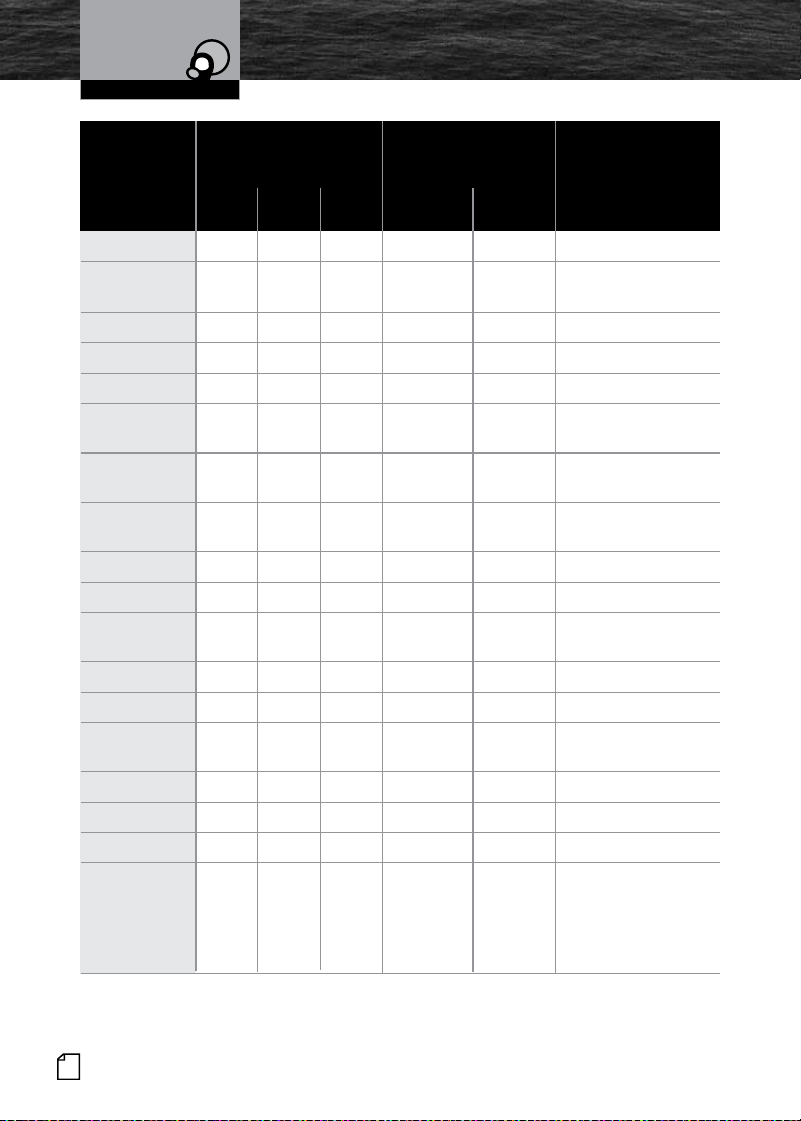
AppendixAppendix
VHF Marine
Channel Assignments
VHF Marine
Channel Assignments
43
42
English/Español
Nothing Comes Close to a Cobra
®
/Nada se compara a Cobra
®
01
•
•
156.050 160.650 Canada Public Correspondence (Marine Operator) Correspondencia pública (operador marítimo)
01A/1001
•
156.050 156.050 Port Operations and Commercial, Operaciones portuarias y comerciales;
VTS in selected areas VTS en áreas selectas
02 • • 156.100 160.700 Public Correspondence (Marine Operator) Correspondencia pública (operador marítimo)
03 • • 156.150 160.750 Public Correspondence (Marine Operator) Correspondencia pública (operador marítimo)
03A/1003 • 156.150 156.150 Coast Guard Only guardia costera solamente
04 • 156.200 160.800 Public Correspondence (Marine Operator), Correspondencia pública (operador marítimo)
Port Operations, Ship Movement operaciones portuarias,movimiento de embarcaciones
1004 • 156.200 156.200 West Coast (Coast Guard Only); Costa occidental (guardia costera solamente);
East Coast (Commercial Fishing) Costa oriental (pesca comercial)
05 • 156.250 160.850 Public Correspondence (Marine Operator), Correspondencia pública (operador marítimo)
Port Operations, Ship Movement operaciones portuarias,movimiento de embarcaciones
05A/1005 • • 156.250 156.250 Port Operations, VTS in selected areas Operaciones portuarias; VTS en áreas selectas
06 • • • 156.300 156.300 Intership Safety Seguridad entre embarcaciones
07 • 156.350 160.950 Public Correspondence (Marine Operator), Correspondencia pública (operador marítimo)
Port Operations, Ship Movement operaciones portuarias,movimiento de embarcaciones
07A/1007 • • 156.350 156.350 Commercial Comerciales
08 • • • 156.400 156.400 Commercial (Intership Only) Comercial (entre embarcaciones solamente)
09 • • • 156.450 156.450 Boater Calling Channel, Canal de llamada de la tripulación,
Non-Commercial (Recreational) no comercial (recreativo)
10 • • • 156.500 156.500 Commercial Comerciales
11 • • • 156.550 156.550 Commercial, VTS in selected areas Comercial; VTS en áreas selectas
12 • • • 156.600 156.600 Port Operations, VTS in selected areas Operaciones portuarias; VTS en áreas selectas
13 • • • 156.650 156.650
1 Watt USA Intership Navigation Safety (Bridge-to-
Bridge). In U.S. waters, large vessels
maintain a listening watch on this channel.
Channel Use (English) Uso de canales (Español)
Channel Map
Mapa de canales
Channel
Number
Número
de canal
Power Limits
Límites de potencia
Frequency
Frecuencia
USA Int’l Canada Transmit
Receive
EE.UU. nternac Canadá Transm. Recepción
1 vatio EE.UU.
Seguridad marítima entre embarcaciones (de
puente de mando a puente de mando). En aguas
estadounidenses, las grandes embarcaciones se
mantienen vigilantes con sus radios sintonizados
en este canal
AppendixAppendix
VHF Marine
Channel Assignments
VHF Marine
Channel Assignments
43
42
English/Español
Nothing Comes Close to a Cobra
®
/Nada se compara a Cobra
®
01
•
•
156.050 160.650 Canada Public Correspondence (Marine Operator) Correspondencia pública (operador marítimo)
01A/1001
•
156.050 156.050 Port Operations and Commercial, Operaciones portuarias y comerciales;
VTS in selected areas VTS en áreas selectas
02 • • 156.100 160.700 Public Correspondence (Marine Operator) Correspondencia pública (operador marítimo)
03 • • 156.150 160.750 Public Correspondence (Marine Operator) Correspondencia pública (operador marítimo)
03A/1003 • 156.150 156.150 Coast Guard Only guardia costera solamente
04 • 156.200 160.800 Public Correspondence (Marine Operator), Correspondencia pública (operador marítimo)
Port Operations, Ship Movement operaciones portuarias,movimiento de embarcaciones
1004 • 156.200 156.200 West Coast (Coast Guard Only); Costa occidental (guardia costera solamente);
East Coast (Commercial Fishing) Costa oriental (pesca comercial)
05 • 156.250 160.850 Public Correspondence (Marine Operator), Correspondencia pública (operador marítimo)
Port Operations, Ship Movement operaciones portuarias,movimiento de embarcaciones
05A/1005 • • 156.250 156.250 Port Operations, VTS in selected areas Operaciones portuarias; VTS en áreas selectas
06 • • • 156.300 156.300 Intership Safety Seguridad entre embarcaciones
07 • 156.350 160.950 Public Correspondence (Marine Operator), Correspondencia pública (operador marítimo)
Port Operations, Ship Movement operaciones portuarias,movimiento de embarcaciones
07A/1007 • • 156.350 156.350 Commercial Comerciales
08 • • • 156.400 156.400 Commercial (Intership Only) Comercial (entre embarcaciones solamente)
09 • • • 156.450 156.450 Boater Calling Channel, Canal de llamada de la tripulación,
Non-Commercial (Recreational) no comercial (recreativo)
10 • • • 156.500 156.500 Commercial Comerciales
11 • • • 156.550 156.550 Commercial, VTS in selected areas Comercial; VTS en áreas selectas
12 • • • 156.600 156.600 Port Operations, VTS in selected areas Operaciones portuarias; VTS en áreas selectas
13 • • • 156.650 156.650
1 Watt USA Intership Navigation Safety (Bridge-to-
Bridge). In U.S. waters, large vessels
maintain a listening watch on this channel.
Channel Use (English) Uso de canales (Español)
Channel Map
Mapa de canales
Channel
Number
Número
de canal
Power Limits
Límites de potencia
Frequency
Frecuencia
USA Int’l Canada Transmit
Receive
EE.UU. nternac Canadá Transm. Recepción
1 vatio EE.UU.
Seguridad marítima entre embarcaciones (de
puente de mando a puente de mando). En aguas
estadounidenses, las grandes embarcaciones se
mantienen vigilantes con sus radios sintonizados
en este canal
AppendixAppendix
VHF Marine
Channel Assignments
VHF Marine
Channel Assignments
45
44
English/Español
Nothing Comes Close to a Cobra
®
/Nada se compara a Cobra
®
14 • • • 156.700 156.700 Port Operations, VTS in selected areas Operaciones portuarias; VTS en áreas selectas
15 • Rx Only 156.750 Environmental (Receive Only). Medioambiental (recepción solamente).
Usado por radiobalizas de localización
de siniestros (EPIRB) clase C
15 • • 156.750 156.750
1 Watt CAN Canada (EPIRB Buoys Only); International Canadá (boyas de EPIRB solamente);
(On-Board Communication) Internacional (comunicación de a bordo)
16 • • • 156.800 156.800 International Distress, Safety and Calling Llamadas, seguridad y solicitud
de auxilio internacional
17 • • • 156.850 156.850
1 Watt CAN
State Controlled (U.S.A. Only) Controlado a nivel estatal (EE.UU. solamente)
18
•
156.900 161.500 Port Operations, Ship Movement Operaciones portuarias,
movimiento de embarcaciones
18A/1018
•
•
156.900 156.900 Commercial Comerciales
19
•
156.950 161.550 Port Operations, Ship Movement Operaciones portuarias,
movimiento de embarcaciones
19A/1019
•
•
156.950 156.950 Commercial Comerciales
1019 • 156.950 156.950 Port Operations Operaciones portuarias
2019 • 161.550 161.550 Port Operations Operaciones portuarias
20 • • • 157.000 161.600 1 Watt CAN Canada (Coast Guard Only); International Canadá (guardia costera solamente);
(Port Operations, Ship Movement) Internacional (operaciones portuarias,
movimiento de embarcaciones)
20A/1020 • • 157.000 157.000 Port Operations Operaciones portuarias
2020 • 161.600 161.600
Port Operations Operaciones portuarias
21
•
157.050 161.650 Port Operations, Ship Movement Operaciones portuarias,
movimiento de embarcaciones
21A/1021
•
•
157.050 157.050 U.S. (Government Only); EE.UU. (entidades gubernamentales solamente);
Canada (Coast Guard Only) Canadá (guardia costera solamente)
2021 • RX only 161.650 Coast Guard Only – Weather Broadcasts Solamente Guardacostas –
Transmisiones Meteorológicas
22 • 157.100 161.700 Port Operations, Ship Movement Operaciones portuarias,
movimiento de embarcaciones
22A/1022 • • 157.100 157.100 U.S. and Canadian Coast Guard Liaison and Enlace entre las guardias costeras estadounidenses
Maritime Safety Information Broadcasts that y canadienses, y difusión de información sobre
are announced on Channel 16 seguridad marítima anunciada por el canal 16
23
•
•
157.150 161.750 Public Correspondence (Marine Operator) Correspondencia pública (operador marítimo)
Channel Use (English) Uso de canales (Español)
Channel Map
Mapa de canales
Channel
Number
Número
de canal
Frequency
Frecuencia
USA Int’l Canada Transmit
Receive
EE.UU. nternac Canadá Transm. Recepción
1 vatio Canadá
1 vatio Canadá
1 vatio Canadá
AppendixAppendix
VHF Marine
Channel Assignments
VHF Marine
Channel Assignments
45
44
English/Español
Nothing Comes Close to a Cobra
®
/Nada se compara a Cobra
®
14 • • • 156.700 156.700 Port Operations, VTS in selected areas Operaciones portuarias; VTS en áreas selectas
15 • Rx Only 156.750 Environmental (Receive Only). Medioambiental (recepción solamente).
Usado por radiobalizas de localización
de siniestros (EPIRB) clase C
15 • • 156.750 156.750
1 Watt CAN Canada (EPIRB Buoys Only); International Canadá (boyas de EPIRB solamente);
(On-Board Communication) Internacional (comunicación de a bordo)
16 • • • 156.800 156.800 International Distress, Safety and Calling Llamadas, seguridad y solicitud
de auxilio internacional
17 • • • 156.850 156.850
1 Watt CAN
State Controlled (U.S.A. Only) Controlado a nivel estatal (EE.UU. solamente)
18
•
156.900 161.500 Port Operations, Ship Movement Operaciones portuarias,
movimiento de embarcaciones
18A/1018
•
•
156.900 156.900 Commercial Comerciales
19
•
156.950 161.550 Port Operations, Ship Movement Operaciones portuarias,
movimiento de embarcaciones
19A/1019
•
•
156.950 156.950 Commercial Comerciales
1019 • 156.950 156.950 Port Operations Operaciones portuarias
2019 • 161.550 161.550 Port Operations Operaciones portuarias
20 • • • 157.000 161.600 1 Watt CAN Canada (Coast Guard Only); International Canadá (guardia costera solamente);
(Port Operations, Ship Movement) Internacional (operaciones portuarias,
movimiento de embarcaciones)
20A/1020 • • 157.000 157.000 Port Operations Operaciones portuarias
2020 • 161.600 161.600
Port Operations Operaciones portuarias
21
•
157.050 161.650 Port Operations, Ship Movement Operaciones portuarias,
movimiento de embarcaciones
21A/1021
•
•
157.050 157.050 U.S. (Government Only); EE.UU. (entidades gubernamentales solamente);
Canada (Coast Guard Only) Canadá (guardia costera solamente)
2021 • RX only 161.650 Coast Guard Only – Weather Broadcasts Solamente Guardacostas –
Transmisiones Meteorológicas
22 • 157.100 161.700 Port Operations, Ship Movement Operaciones portuarias,
movimiento de embarcaciones
22A/1022 • • 157.100 157.100 U.S. and Canadian Coast Guard Liaison and Enlace entre las guardias costeras estadounidenses
Maritime Safety Information Broadcasts that y canadienses, y difusión de información sobre
are announced on Channel 16 seguridad marítima anunciada por el canal 16
23
•
•
157.150 161.750 Public Correspondence (Marine Operator) Correspondencia pública (operador marítimo)
Channel Use (English) Uso de canales (Español)
Channel Map
Mapa de canales
Channel
Number
Número
de canal
Frequency
Frecuencia
USA Int’l Canada Transmit
Receive
EE.UU. nternac Canadá Transm. Recepción
1 vatio Canadá
1 vatio Canadá
1 vatio Canadá
AppendixAppendix
VHF Marine
Channel Assignments
VHF Marine
Channel Assignments
47
46
English/Español
Nothing Comes Close to a Cobra
®
/Nada se compara a Cobra
®
23A/1023
•
157.150 157.150 Coast Guard Only Solamente Guardacostas
2023
•
Rx Only 161.750 Coast Guard Only – Weather Broadcasts Solamente Guardacostas –
Transmisiones Meteorológicas
24
•
•
•
157.200 161.800 Sea Tow ARC (Automated Radio Check) RMCAR (Chequeo Automatizado de la Radio)
25
•
•
•
157.250 161.850 Sea Tow ARC (Automated Radio Check) RMCAR (Chequeo Automatizado de la Radio)
2025
•
RX only 161.850 Safety: Continuous Marine Broadcast (CMB) Seguridad: Transmisión Marítima Continua (CMB)
service by MCTS Canada servicio por MCTS Canadá
26
•
•
•
157.300 161.900 Sea Tow ARC (Automated Radio Check) RMCAR (Chequeo Automatizado de la Radio)
27
•
•
•
157.350 161.950 Sea Tow ARC (Automated Radio Check) RMCAR (Chequeo Automatizado de la Radio)
28
•
•
•
157.400 162.000 Sea Tow ARC (Automated Radio Check) RMCAR (Chequeo Automatizado de la Radio)
2028
•
RX only 162.000 Safety: Continuous Marine Broadcast (CMB) Seguridad: Transmisión Marítima Continua (CMB)
service by MCTS Canada servicio por MCTS Canadá
60
•
•
156.025 160.625 Public Correspondence (Marine Operator) Correspondencia pública (operador marítimo)
61
•
156.075 160.675 Public Correspondence (Marine Operator) Correspondencia pública (operador marítimo),
Port Operation, Ship Movement operaciones portuarias, movimiento de embarcaciones
1061
• 156.075 156.075
Canada (Coast Guard Only);
West Coast (Coast Guard
Only); East Coast (Commercial Fishing)
62
•
156.125 160.725 Public Correspondence (Marine Operator), Correspondencia pública (operador marítimo),
Port Operations, Ship Movement operaciones portuarias, movimiento de embarcaciones
1062
•
156.125 156.125 West Coast (Coast Guard Only); Costa occidental (guardia costera solamente);
East Coast (Commercial Fishing) Costa oriental (pesca comercial)
63
•
156.175 160.775 Public Correspondence (Marine Operator), Correspondencia pública (operador marítimo),
Port Operations, Ship Movement operaciones portuarias, movimiento de embarcaciones
63A/1063
•
•
156.175 156.175 Port Operations and Commercial, Operaciones portuarias y comerciales; VTS en
VTS in selected areas, Canada Tow Boats-BCC áreas selectas, Barcos-BCC de la remolque
de Canadá
64
•
•
156.225 160.825 Public Correspondence (Marine Operator), Correspondencia pública (operador marítimo),
Port Operations, Ship Movement operaciones portuarias, movimiento de embarcaciones
1064
•
156.225 156.225 U.S. (Government Only); EE.UU. (entidades gubernamentales
Canada (Commercial Fishing) solamente); Canadá (pesca comercial)
65
•
156.275 160.875 Public Correspondence (Marine Operator), Correspondencia pública (operador marítimo),
Port Operations, Ship Movement operaciones portuarias, movimiento de embarcaciones
65A/1065
•
•
156.275 156.275 Port Operations Operaciones portuarias
Channel Use (English) Uso de canales (Español)
Channel Map
Mapa de canales
Channel
Number
Número
de canal
Power Limits
Límites de potencia
Frequency
Frecuencia
USA Int’l Canada Transmit
Receive
EE.UU. nternac Canadá Transm. Recepción
Canadá (guardia costera solamente); Costa
occidental (guardia costera solamente);
Costa oriental (pesca comercial)
AppendixAppendix
VHF Marine
Channel Assignments
VHF Marine
Channel Assignments
47
46
English/Español
Nothing Comes Close to a Cobra
®
/Nada se compara a Cobra
®
23A/1023
•
157.150 157.150 Coast Guard Only Solamente Guardacostas
2023
•
Rx Only 161.750 Coast Guard Only – Weather Broadcasts Solamente Guardacostas –
Transmisiones Meteorológicas
24
•
•
•
157.200 161.800 Sea Tow ARC (Automated Radio Check) RMCAR (Chequeo Automatizado de la Radio)
25
•
•
•
157.250 161.850 Sea Tow ARC (Automated Radio Check) RMCAR (Chequeo Automatizado de la Radio)
2025
•
RX only 161.850 Safety: Continuous Marine Broadcast (CMB) Seguridad: Transmisión Marítima Continua (CMB)
service by MCTS Canada servicio por MCTS Canadá
26
•
•
•
157.300 161.900 Sea Tow ARC (Automated Radio Check) RMCAR (Chequeo Automatizado de la Radio)
27
•
•
•
157.350 161.950 Sea Tow ARC (Automated Radio Check) RMCAR (Chequeo Automatizado de la Radio)
28
•
•
•
157.400 162.000 Sea Tow ARC (Automated Radio Check) RMCAR (Chequeo Automatizado de la Radio)
2028
•
RX only 162.000 Safety: Continuous Marine Broadcast (CMB) Seguridad: Transmisión Marítima Continua (CMB)
service by MCTS Canada servicio por MCTS Canadá
60
•
•
156.025 160.625 Public Correspondence (Marine Operator) Correspondencia pública (operador marítimo)
61
•
156.075 160.675 Public Correspondence (Marine Operator) Correspondencia pública (operador marítimo),
Port Operation, Ship Movement operaciones portuarias, movimiento de embarcaciones
1061
• 156.075 156.075
Canada (Coast Guard Only);
West Coast (Coast Guard
Only); East Coast (Commercial Fishing)
62
•
156.125 160.725 Public Correspondence (Marine Operator), Correspondencia pública (operador marítimo),
Port Operations, Ship Movement operaciones portuarias, movimiento de embarcaciones
1062
•
156.125 156.125 West Coast (Coast Guard Only); Costa occidental (guardia costera solamente);
East Coast (Commercial Fishing) Costa oriental (pesca comercial)
63
•
156.175 160.775 Public Correspondence (Marine Operator), Correspondencia pública (operador marítimo),
Port Operations, Ship Movement operaciones portuarias, movimiento de embarcaciones
63A/1063
•
•
156.175 156.175 Port Operations and Commercial, Operaciones portuarias y comerciales; VTS en
VTS in selected areas, Canada Tow Boats-BCC áreas selectas, Barcos-BCC de la remolque
de Canadá
64
•
•
156.225 160.825 Public Correspondence (Marine Operator), Correspondencia pública (operador marítimo),
Port Operations, Ship Movement operaciones portuarias, movimiento de embarcaciones
1064
•
156.225 156.225 U.S. (Government Only); EE.UU. (entidades gubernamentales
Canada (Commercial Fishing) solamente); Canadá (pesca comercial)
65
•
156.275 160.875 Public Correspondence (Marine Operator), Correspondencia pública (operador marítimo),
Port Operations, Ship Movement operaciones portuarias, movimiento de embarcaciones
65A/1065
•
•
156.275 156.275 Port Operations Operaciones portuarias
Channel Use (English) Uso de canales (Español)
Channel Map
Mapa de canales
Channel
Number
Número
de canal
Power Limits
Límites de potencia
Frequency
Frecuencia
USA Int’l Canada Transmit
Receive
EE.UU. nternac Canadá Transm. Recepción
Canadá (guardia costera solamente); Costa
occidental (guardia costera solamente);
Costa oriental (pesca comercial)
AppendixAppendix
VHF Marine
Channel Assignments
VHF Marine
Channel Assignments
49
48
English/Español
Nothing Comes Close to a Cobra
®
/Nada se compara a Cobra
®
66
•
156.325 160.925 Public Correspondence (Marine Operator), Correspondencia pública (operador marítimo),
Port Operations, Ship Movement operaciones portuarias, movimiento de embarcaciones
66A/1066
•
•
156.325 156.325 Port Operations Operaciones portuarias
67
•
•
•
156.375 156.375
68
•
•
•
156.425 156.425 Non-Commercial (Recreational) No comercial (recreativo)
69
•
•
•
156.475 156.475
U.S. (Non-Commercial, Recreational); Canada
(Commercial Fishing Only); International
(Intership, Port Operations, Ship Movement)
70
•
•
•
RX only 156.525 Digital Selective Calling Llamadas selectivas digitales
(Voice communications not allowed) (las comunicaciones verbales están prohibidas)
71
•
•
•
156.575 156.575
1 Watt USA
U.S. and Canada (Non-Commercial, Recreational); EE.UU. y Canadá (no comercial, recreativo);
International (Port Operations, Ship Movement) Internacional (operaciones portuarias,
movimiento de embarcaciones)
72
•
•
•
156.625 156.625 Non-Commercial (Intership Only) No comercial (entre embarcaciones solamente)
73
•
•
•
156.675 156.675
U.S. (Port Operations); Canada (Commercial EE.UU. (operaciones portuarias); Canadá (pesca
Fishing Only); International (Intership, comercial solamente); Internacional (comunicaciones
Port Operations, Ship Movement) entre embarcaciones, operaciones portuarias,
movimiento de embarcaciones)
74
•
•
•
156.725 156.725
U.S. (Port Operations); Canada (Commercial EE.UU. (operaciones portuarias); Canadá (pesca
Fishing Only); International (Intership, comercial solamente); Internacional (comunicaciones
Port Operations, Ship Movement) entre embarcaciones, operaciones portuarias,
movimiento de embarcaciones)
75
•
•
•
156.775 156.775 1 Watt Port Operations (Intership Only) Operaciones portuarias
(entre embarcaciones solamente)
76 • • • 156.825 156.825 1 Watt
Port Operations (Intership Only) Operaciones portuarias
(entre embarcaciones solamente)
77
•
•
•
156.875 156.875 1 Watt USA
Port Operations (Intership only). Restricted to Operaciones portuarias (entre embarcaciones
communications with pilots for movement and solamente). Restringido a comunicaciones con
docking of ships. pilotos para el movimiento y atraque de
embarcaciones.
Channel Use (English) Uso de canales (Español)
Channel Map
Mapa de canales
Channel
Number
Número
de canal
Power Limits
Límites de potencia
Frequency
Frecuencia
USA Int’l Canada Transmit
Receive
EE.UU. nternac Canadá Transm. Recepción
U.S. (Commercial). Used for bridge-to-bridge
communications in lower Mississippi River
(Intership Only); Canada (Commercial Fishing), S&R
EE.UU. (comercial). Usado para comunicaciones
de puente de mando a puente de mando en la
parte baja del Río Misisipí (entre embarcaciones
solamente); Canadá (pesca comercial) (transmisión
y recepción)
EE.UU. (no comercial, recreativo); Canadá
(pesca comercial solamente); Internacional
(comunicaciones entre embarcaciones,
operaciones portuarias, movimiento de
embarcaciones)
AppendixAppendix
VHF Marine
Channel Assignments
VHF Marine
Channel Assignments
49
48
English/Español
Nothing Comes Close to a Cobra
®
/Nada se compara a Cobra
®
66
•
156.325 160.925 Public Correspondence (Marine Operator), Correspondencia pública (operador marítimo),
Port Operations, Ship Movement operaciones portuarias, movimiento de embarcaciones
66A/1066
•
•
156.325 156.325 Port Operations Operaciones portuarias
67
•
•
•
156.375 156.375
68
•
•
•
156.425 156.425 Non-Commercial (Recreational) No comercial (recreativo)
69
•
•
•
156.475 156.475
U.S. (Non-Commercial, Recreational); Canada
(Commercial Fishing Only); International
(Intership, Port Operations, Ship Movement)
70
•
•
•
RX only 156.525 Digital Selective Calling Llamadas selectivas digitales
(Voice communications not allowed) (las comunicaciones verbales están prohibidas)
71
•
•
•
156.575 156.575
1 Watt USA
U.S. and Canada (Non-Commercial, Recreational); EE.UU. y Canadá (no comercial, recreativo);
International (Port Operations, Ship Movement) Internacional (operaciones portuarias,
movimiento de embarcaciones)
72
•
•
•
156.625 156.625 Non-Commercial (Intership Only) No comercial (entre embarcaciones solamente)
73
•
•
•
156.675 156.675
U.S. (Port Operations); Canada (Commercial EE.UU. (operaciones portuarias); Canadá (pesca
Fishing Only); International (Intership, comercial solamente); Internacional (comunicaciones
Port Operations, Ship Movement) entre embarcaciones, operaciones portuarias,
movimiento de embarcaciones)
74
•
•
•
156.725 156.725
U.S. (Port Operations); Canada (Commercial EE.UU. (operaciones portuarias); Canadá (pesca
Fishing Only); International (Intership, comercial solamente); Internacional (comunicaciones
Port Operations, Ship Movement) entre embarcaciones, operaciones portuarias,
movimiento de embarcaciones)
75
•
•
•
156.775 156.775 1 Watt Port Operations (Intership Only) Operaciones portuarias
(entre embarcaciones solamente)
76 • • • 156.825 156.825 1 Watt
Port Operations (Intership Only) Operaciones portuarias
(entre embarcaciones solamente)
77
•
•
•
156.875 156.875 1 Watt USA
Port Operations (Intership only). Restricted to Operaciones portuarias (entre embarcaciones
communications with pilots for movement and solamente). Restringido a comunicaciones con
docking of ships. pilotos para el movimiento y atraque de
embarcaciones.
Channel Use (English) Uso de canales (Español)
Channel Map
Mapa de canales
Channel
Number
Número
de canal
Power Limits
Límites de potencia
Frequency
Frecuencia
USA Int’l Canada Transmit
Receive
EE.UU. nternac Canadá Transm. Recepción
U.S. (Commercial). Used for bridge-to-bridge
communications in lower Mississippi River
(Intership Only); Canada (Commercial Fishing), S&R
EE.UU. (comercial). Usado para comunicaciones
de puente de mando a puente de mando en la
parte baja del Río Misisipí (entre embarcaciones
solamente); Canadá (pesca comercial) (transmisión
y recepción)
EE.UU. (no comercial, recreativo); Canadá
(pesca comercial solamente); Internacional
(comunicaciones entre embarcaciones,
operaciones portuarias, movimiento de
embarcaciones)
AppendixAppendix
VHF Marine
Channel Assignments
VHF Marine
Channel Assignments
51
50
English/Español
Nothing Comes Close to a Cobra
®
/Nada se compara a Cobra
®
78
•
156.925 161.525 Public Correspondence (Marine Operator) Correspondencia pública (operador marítimo)
78A/1078
•
•
156.925 156.925 Non-Commercial (Recreational) No comercial (recreativo)
1078 • 156.925 156.925 Port Operations Operaciones portuarias
2078 • 161.525 161.525 Port Operations Operaciones portuarias
79
•
156.975 161.575 Port Operations, Ship Movement Operaciones portuarias,
movimiento de embarcaciones
79A/1079
•
•
156.975 156.975 Commercial (Also Non-Commercial Comercial (en los Grandes
only in Great Lakes) Lagos también no comercial)
1079 • 156.975 156.975 Port Operations Operaciones portuarias
2079 • 161.575 161.575 Port Operations Operaciones portuarias
80 • 157.025 161.625
Port Operations, Ship Movement
Operaciones portuarias,
movimiento de embarcaciones
80A/1080
•
•
157.025 157.025 Commercial (Also Non-Commercial Comercial (en los Grandes
only in Great Lakes) Lagos también no comercial)
81
•
157.075 161.675 Port Operations, Ship Movement Operaciones portuarias,
movimiento de embarcaciones
81A/1081
•
•
157.075 157.075 U.S. (Government Only; Environmental EE.UU. (entidades gubernamentales solamente;
Protection Operations) operaciones de protección medioambiental)
82
•
157.125 161.725 Public Correspondence (Marine Operator), Correspondencia pública (operador marítimo),
Port Operation, Ship Movement operaciones portuarias, movimiento de embarcaciones
82A/1082
•
•
157.125 157.125 U.S. (Government Only); Canada EE.UU. (entidades gubernamentales solamente);
(Coast Guard Only) Canadá (guardia costera solamente)
83 • 157.175 161.775
Port Operations, Ship Movement Operaciones portuarias,
movimiento de embarcaciones
83A/1083
•
•
157.175 157.175 (Coast Guard Only) Canadá (guardia costera solamente)
(Coast Guard Only) Canadá (guardia costera solamente)
2083
•
RX only 161.775 Coast Guard Only – Weather Broadcasts
Solamente Guardacostas –
Transmisiones Meteorológicas
84
•
•
•
157.225 161.825 Public Correspondence (Marine Operator) Correspondencia pública (operador marítimo)
85
•
•
•
157.275 161.875 Public Correspondence (Marine Operator) Correspondencia pública (operador marítimo)
86
•
•
•
157.325 161.925 Public Correspondence (Marine Operator) Correspondencia pública (operador marítimo)
87
•
•
•
157.375 157.375 Public Correspondence (Marine Operator) Correspondencia pública (operador marítimo)
88
•
•
•
157.425 157.425 U.S. (Commercial). EE.UU. (comercial).
Port Operations and VTS (International & Canada). Operaciones Portuarias y VTS (Internacional y Canadá).
88A/1088
•
157.425 157.425 Commercial Intership only Comercial entre embarcaciones solamente
Channel Use (English) Uso de canales (Español)
Channel Map
Mapa de canales
Channel
Number
Número
de canal
Power Limits
Límites de potencia
Frequency
Frecuencia
USA Int’l Canada Transmit
Receive
EE.UU. nternac Canadá Transm. Recepción
AppendixAppendix
VHF Marine
Channel Assignments
VHF Marine
Channel Assignments
51
50
English/Español
Nothing Comes Close to a Cobra
®
/Nada se compara a Cobra
®
78
•
156.925 161.525 Public Correspondence (Marine Operator) Correspondencia pública (operador marítimo)
78A/1078
•
•
156.925 156.925 Non-Commercial (Recreational) No comercial (recreativo)
1078 • 156.925 156.925 Port Operations Operaciones portuarias
2078 • 161.525 161.525 Port Operations Operaciones portuarias
79
•
156.975 161.575 Port Operations, Ship Movement Operaciones portuarias,
movimiento de embarcaciones
79A/1079
•
•
156.975 156.975 Commercial (Also Non-Commercial Comercial (en los Grandes
only in Great Lakes) Lagos también no comercial)
1079 • 156.975 156.975 Port Operations Operaciones portuarias
2079 • 161.575 161.575 Port Operations Operaciones portuarias
80 • 157.025 161.625
Port Operations, Ship Movement
Operaciones portuarias,
movimiento de embarcaciones
80A/1080
•
•
157.025 157.025 Commercial (Also Non-Commercial Comercial (en los Grandes
only in Great Lakes) Lagos también no comercial)
81
•
157.075 161.675 Port Operations, Ship Movement Operaciones portuarias,
movimiento de embarcaciones
81A/1081
•
•
157.075 157.075 U.S. (Government Only; Environmental EE.UU. (entidades gubernamentales solamente;
Protection Operations) operaciones de protección medioambiental)
82
•
157.125 161.725 Public Correspondence (Marine Operator), Correspondencia pública (operador marítimo),
Port Operation, Ship Movement operaciones portuarias, movimiento de embarcaciones
82A/1082
•
•
157.125 157.125 U.S. (Government Only); Canada EE.UU. (entidades gubernamentales solamente);
(Coast Guard Only) Canadá (guardia costera solamente)
83 • 157.175 161.775
Port Operations, Ship Movement Operaciones portuarias,
movimiento de embarcaciones
83A/1083
•
•
157.175 157.175 (Coast Guard Only) Canadá (guardia costera solamente)
(Coast Guard Only) Canadá (guardia costera solamente)
2083
•
RX only 161.775 Coast Guard Only – Weather Broadcasts
Solamente Guardacostas –
Transmisiones Meteorológicas
84
•
•
•
157.225 161.825 Public Correspondence (Marine Operator) Correspondencia pública (operador marítimo)
85
•
•
•
157.275 161.875 Public Correspondence (Marine Operator) Correspondencia pública (operador marítimo)
86
•
•
•
157.325 161.925 Public Correspondence (Marine Operator) Correspondencia pública (operador marítimo)
87
•
•
•
157.375 157.375 Public Correspondence (Marine Operator) Correspondencia pública (operador marítimo)
88
•
•
•
157.425 157.425 U.S. (Commercial). EE.UU. (comercial).
Port Operations and VTS (International & Canada). Operaciones Portuarias y VTS (Internacional y Canadá).
88A/1088
•
157.425 157.425 Commercial Intership only Comercial entre embarcaciones solamente
Channel Use (English) Uso de canales (Español)
Channel Map
Mapa de canales
Channel
Number
Número
de canal
Power Limits
Límites de potencia
Frequency
Frecuencia
USA Int’l Canada Transmit
Receive
EE.UU. nternac Canadá Transm. Recepción
Appendix
VHF Marine
Channel Assignments
52
English/Español
Appendix
VHF Marine
Channel Assignments
53
Nothing Comes Close to a Cobra
®
/Nada se compara a Cobra
®
1001
•
156.050 156.050 Port Operations / Vessel Trafc Service Operaciones portuarias / Servicio de Tránsito
de Embarcaciones
1005 • 156.250 156.250
Port Operations / Vessel Trafc Service Operaciones portuarias / Servicio de Tránsito
de Embarcaciones
1007
•
156.350 156.350 Commercial Comercial
1018
•
156.900 156.900 Commercial Comercial
1019
•
156.950 156.950 Port Operations Operaciones portuarias
1020
•
157.000 157.000 Port Operations Operaciones portuarias
1021
•
157.050 157.050 Coast Guard Only Solamente Guardacostas
1022
•
157.100 157.100 Coast Guard Only Solamente Guardacostas
1023
•
157.150 157.150 Coast Guard Only Solamente Guardacostas
1063
•
156.175 156.175 Port Operations / Vessel Trafc Service Operaciones portuarias / Servicio de Tránsito
de Embarcaciones
1065
•
156.275
156.275
Port Operations / Vessel Trafc Service Operaciones portuarias / Servicio de Tránsito
de Embarcaciones
1066
•
156.325 156.325
Port Operations / Vessel Trafc Service Operaciones portuarias / Servicio de Tránsito
de Embarcaciones
1078
•
156.925 156.925 Commercial/Non-Commercial Comercial / No Comercial
1079
•
156.975 156.975 Commercial/Non-Commercial Comercial / No Comercial
1080
•
157.025 157.025 Commercial/Non-Commercial Comercial / No Comercial
1081
•
157.075 157.075 Commercial/Environmental Comercial/ Medioambiental
1082
•
157.125 157.125 Commercial/U.S. (Government Only) Comercial/ EE.UU. entidades gubernamentales
solamente
1083
•
157.175 157.175 Commercial/ Coast Guard Only Comercial/ Solamente Guardacostas
Channel Use (English) Uso de canales (Español)
Channel Map
Mapa de canales
Channel
Number
Número
de canal
Power Limits
Límites de potencia
Frequency
Frecuencia
USA Int’l Canada Transmit
Receive
EE.UU. nternac Canadá Transm. Recepción
Appendix
VHF Marine
Channel Assignments
52
English/Español
Appendix
VHF Marine
Channel Assignments
53
Nothing Comes Close to a Cobra
®
/Nada se compara a Cobra
®
1001
•
156.050 156.050 Port Operations / Vessel Trafc Service Operaciones portuarias / Servicio de Tránsito
de Embarcaciones
1005 • 156.250 156.250
Port Operations / Vessel Trafc Service Operaciones portuarias / Servicio de Tránsito
de Embarcaciones
1007
•
156.350 156.350 Commercial Comercial
1018
•
156.900 156.900 Commercial Comercial
1019
•
156.950 156.950 Port Operations Operaciones portuarias
1020
•
157.000 157.000 Port Operations Operaciones portuarias
1021
•
157.050 157.050 Coast Guard Only Solamente Guardacostas
1022
•
157.100 157.100 Coast Guard Only Solamente Guardacostas
1023
•
157.150 157.150 Coast Guard Only Solamente Guardacostas
1063
•
156.175 156.175 Port Operations / Vessel Trafc Service Operaciones portuarias / Servicio de Tránsito
de Embarcaciones
1065
•
156.275
156.275
Port Operations / Vessel Trafc Service Operaciones portuarias / Servicio de Tránsito
de Embarcaciones
1066
•
156.325 156.325
Port Operations / Vessel Trafc Service Operaciones portuarias / Servicio de Tránsito
de Embarcaciones
1078
•
156.925 156.925 Commercial/Non-Commercial Comercial / No Comercial
1079
•
156.975 156.975 Commercial/Non-Commercial Comercial / No Comercial
1080
•
157.025 157.025 Commercial/Non-Commercial Comercial / No Comercial
1081
•
157.075 157.075 Commercial/Environmental Comercial/ Medioambiental
1082
•
157.125 157.125 Commercial/U.S. (Government Only) Comercial/ EE.UU. entidades gubernamentales
solamente
1083
•
157.175 157.175 Commercial/ Coast Guard Only Comercial/ Solamente Guardacostas
Channel Use (English) Uso de canales (Español)
Channel Map
Mapa de canales
Channel
Number
Número
de canal
Power Limits
Límites de potencia
Frequency
Frecuencia
USA Int’l Canada Transmit
Receive
EE.UU. nternac Canadá Transm. Recepción
Appendix
VHF Marine Channel
Assignments
54
English/Español
Appendix
Weather Channel
Assignments
55
Weather Channel Assignments
Asignaciones de canales meteorológicos
•
RX Frequency MHz
Frecuencia de recepción (MHz)
Channel
Number
Número
de canal
1 162.550 NOAA
2 162.400 NOAA
3 162.475 NOAA
4 162.425 NOAA
5 162.450 NOAA
6 162.500 NOAA
7 162.525 NOAA
8 161.650 Canada
9 161.775 Canada
10 163.275 NOAA
Weather Channel
Weather Channel
Nothing Comes Close to a Cobra
®
/Nada se compara a Cobra
®
NOTE
Many of the plain-numbered channels, such as 01, 02 and 03, transmit and receive on
different frequencies. This is termed duplex operation. Some other plain-numbered
channels (Including 4 digit channels) and all of the A channels, such as 01A,
03A and 04A, transmit and receive on a single frequency, which is termed
simplex operation. Your radio automatically adjusts to these conditions. This
radio includes new four digit channels to be compliant with the latest and future
regulations.
NOTE
All channels are preprogrammed at the factory according to international
regulations and those of the FCC (U.S.A.) and Industry Canada (Canada).
They cannot be altered by the user nor can modes of operation be changed between
simplex and duplex.
NOTA
Muchos de los canales de números simples, como 01, 02 y 03, transmiten
y reciben en diferentes frecuencias. A esto se le llama operación dúplex. El
resto de los canales de números simples (Incluyendo canales de 4 digitos) y
todos los canales A, como 01A, 03A y 04A, transmiten y reciben en una sola
frecuencia, a la que se le llama operación simple (simplex). Su radio se ajusta
automáticamente a estas condiciones. Cuando esté en operación simple, el
icono A aparecerá en la pantalla de cristal líquido (vea la ilustración de la página
A2). Esta radio incluye nuevos canales de cuatro dígitos para cumplir con las
regulaciones más recientes.
NOTA
Todos los canales vienen programados previamente de fábrica conforme
a los reglamentos internacionales y a los de la FCC (EE. UU) e Industry Canada
(Canadá). No pueden ser alterados por el usuario, así como tampoco pueden
cambiarse los modos de operación entre simple y dúplex.
VHF Marine Channel Assignments (English)
Asignación de canales de VHF para radiocomunicación marítima (Español)
Appendix
VHF Marine Channel
Assignments
54
English/Español
Appendix
Weather Channel
Assignments
55
Weather Channel Assignments
Asignaciones de canales meteorológicos
•
RX Frequency MHz
Frecuencia de recepción (MHz)
Channel
Number
Número
de canal
1 162.550 NOAA
2 162.400 NOAA
3 162.475 NOAA
4 162.425 NOAA
5 162.450 NOAA
6 162.500 NOAA
7 162.525 NOAA
8 161.650 Canada
9 161.775 Canada
10 163.275 NOAA
Weather Channel
Weather Channel
Nothing Comes Close to a Cobra
®
/Nada se compara a Cobra
®
NOTE
Many of the plain-numbered channels, such as 01, 02 and 03, transmit and receive on
different frequencies. This is termed duplex operation. Some other plain-numbered
channels (Including 4 digit channels) and all of the A channels, such as 01A,
03A and 04A, transmit and receive on a single frequency, which is termed
simplex operation. Your radio automatically adjusts to these conditions. This
radio includes new four digit channels to be compliant with the latest and future
regulations.
NOTE
All channels are preprogrammed at the factory according to international
regulations and those of the FCC (U.S.A.) and Industry Canada (Canada).
They cannot be altered by the user nor can modes of operation be changed between
simplex and duplex.
NOTA
Muchos de los canales de números simples, como 01, 02 y 03, transmiten
y reciben en diferentes frecuencias. A esto se le llama operación dúplex. El
resto de los canales de números simples (Incluyendo canales de 4 digitos) y
todos los canales A, como 01A, 03A y 04A, transmiten y reciben en una sola
frecuencia, a la que se le llama operación simple (simplex). Su radio se ajusta
automáticamente a estas condiciones. Cuando esté en operación simple, el
icono A aparecerá en la pantalla de cristal líquido (vea la ilustración de la página
A2). Esta radio incluye nuevos canales de cuatro dígitos para cumplir con las
regulaciones más recientes.
NOTA
Todos los canales vienen programados previamente de fábrica conforme
a los reglamentos internacionales y a los de la FCC (EE. UU) e Industry Canada
(Canadá). No pueden ser alterados por el usuario, así como tampoco pueden
cambiarse los modos de operación entre simple y dúplex.
VHF Marine Channel Assignments (English)
Asignación de canales de VHF para radiocomunicación marítima (Español)
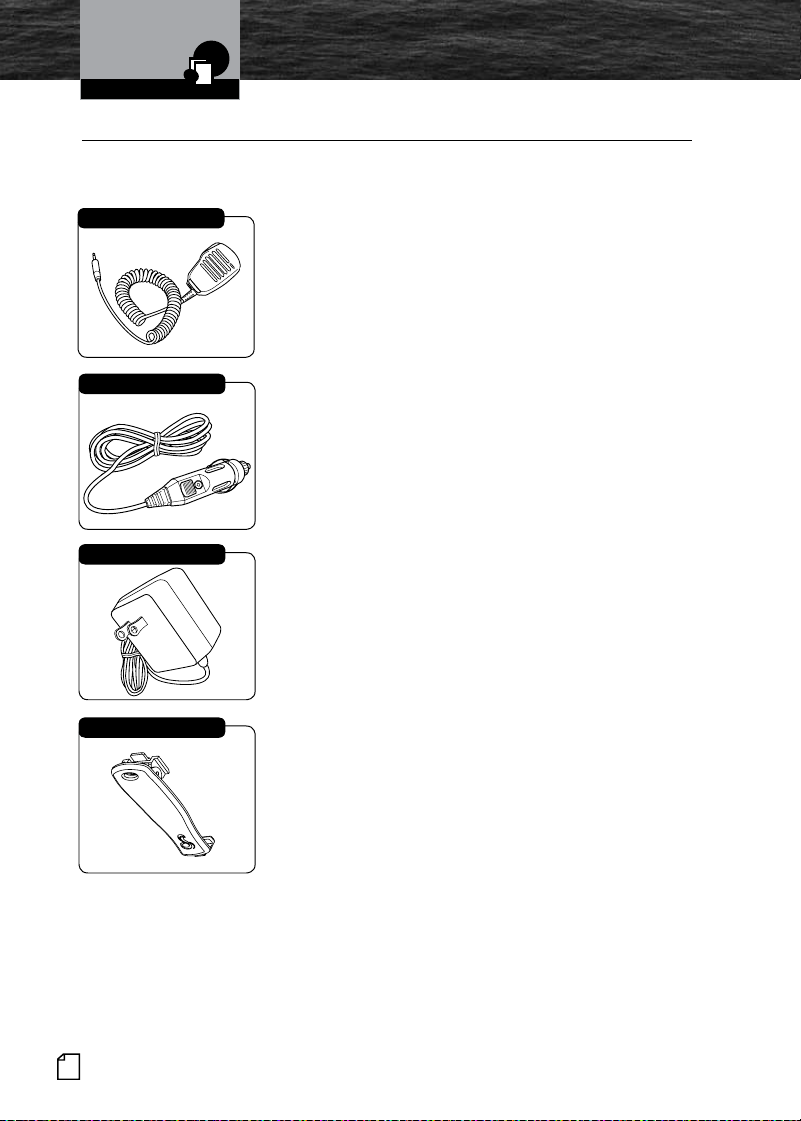
VHF Marine Radio ProtocolsVHF Marine Radio Protocols
Accessories
Accessories
This page intentionally left blank.
57
Nothing Comes Close to a Cobra
®
56
English
Accessories
•
Optional Cobra accessories can enhance the use of the radio and offer convenience
to the end user.
Lapel Speaker/Microphone
A speaker/microphone, that attaches to your lapel.
Order P/N CM 330-001.
This unique accessory allows you to wear the radio on
your belt while still being able to communicate with other
vessels. A small Push to Talk button on the lapel speaker/
microphone allows you to answer any incoming call.
DC Charger
12VDC charging cord for - VHF Handheld model
MR HH125/150FLT.
Order P/N CM 130-005.
Fits all Cobra Marine charging cradles (drop-in chargers).
AC Charger
AC wall charger for Cobra MR HH125/150FLT.
Order P/N CM 120-005.
Input= 120VAC
Output = 12VDC, 100mA (Center-tip positive)
Belt Clip
Order P/N CM 240-003.
Lapel Speaker/Microphone
DC Charger
AC Charger
Belt Clip

VHF Marine Radio ProtocolsVHF Marine Radio Protocols
Accessories
Accessories
This page intentionally left blank.
57
Nothing Comes Close to a Cobra
®
56
English
Accessories
•
Optional Cobra accessories can enhance the use of the radio and offer convenience
to the end user.
Lapel Speaker/Microphone
A speaker/microphone, that attaches to your lapel.
Order P/N CM 330-001.
This unique accessory allows you to wear the radio on
your belt while still being able to communicate with other
vessels. A small Push to Talk button on the lapel speaker/
microphone allows you to answer any incoming call.
DC Charger
12VDC charging cord for - VHF Handheld model
MR HH125/150FLT.
Order P/N CM 130-005.
Fits all Cobra Marine charging cradles (drop-in chargers).
AC Charger
AC wall charger for Cobra MR HH125/150FLT.
Order P/N CM 120-005.
Input= 120VAC
Output = 12VDC, 100mA (Center-tip positive)
Belt Clip
Order P/N CM 240-003.
Lapel Speaker/Microphone
DC Charger
AC Charger
Belt Clip