• •KetllmoFo
"gerafor O ner s
Contents
• Safety Instructions .......................... 2
oGrounding Requirements .................. 2, 3
• Starting the Refrigerator ................. 3
• Adjusting the Controls ....................... 4
• Energy-Saving Tips ........................ 4
o Food Storage Suggestions .................. 5-7
• Features ................................. 8, 9
- Ice & Chilled Water Dispenser ............. 10, 11
e Care and Cleaning .................... t2, 13
o Before You Call for Service ................. 14, 15
o Vacation and Moving Precautions ............ t5
• Warranty ....................... Back Cover
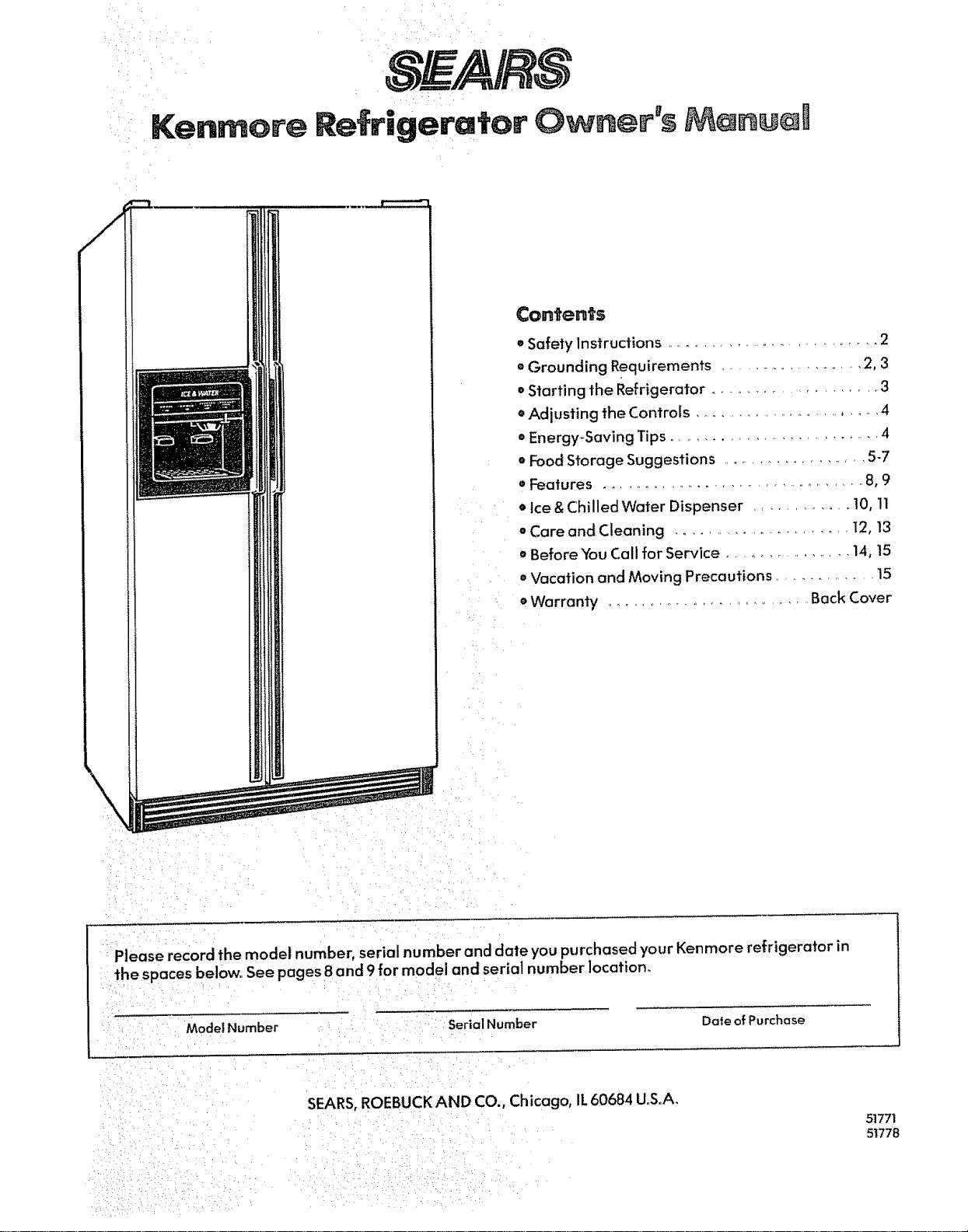
Please record the model number, serial number and date you purchased your Kenmore refrigerator in
the spaces below° See pages B and 9 for model and serial number ]ocation_
Model Number Serial Number Dale of Purchase
SEARS.ROEBUCK AND CO., Chicago, IL60684 U.SoA.
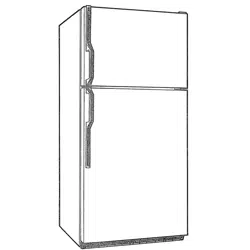
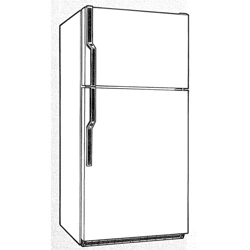
51771
51778
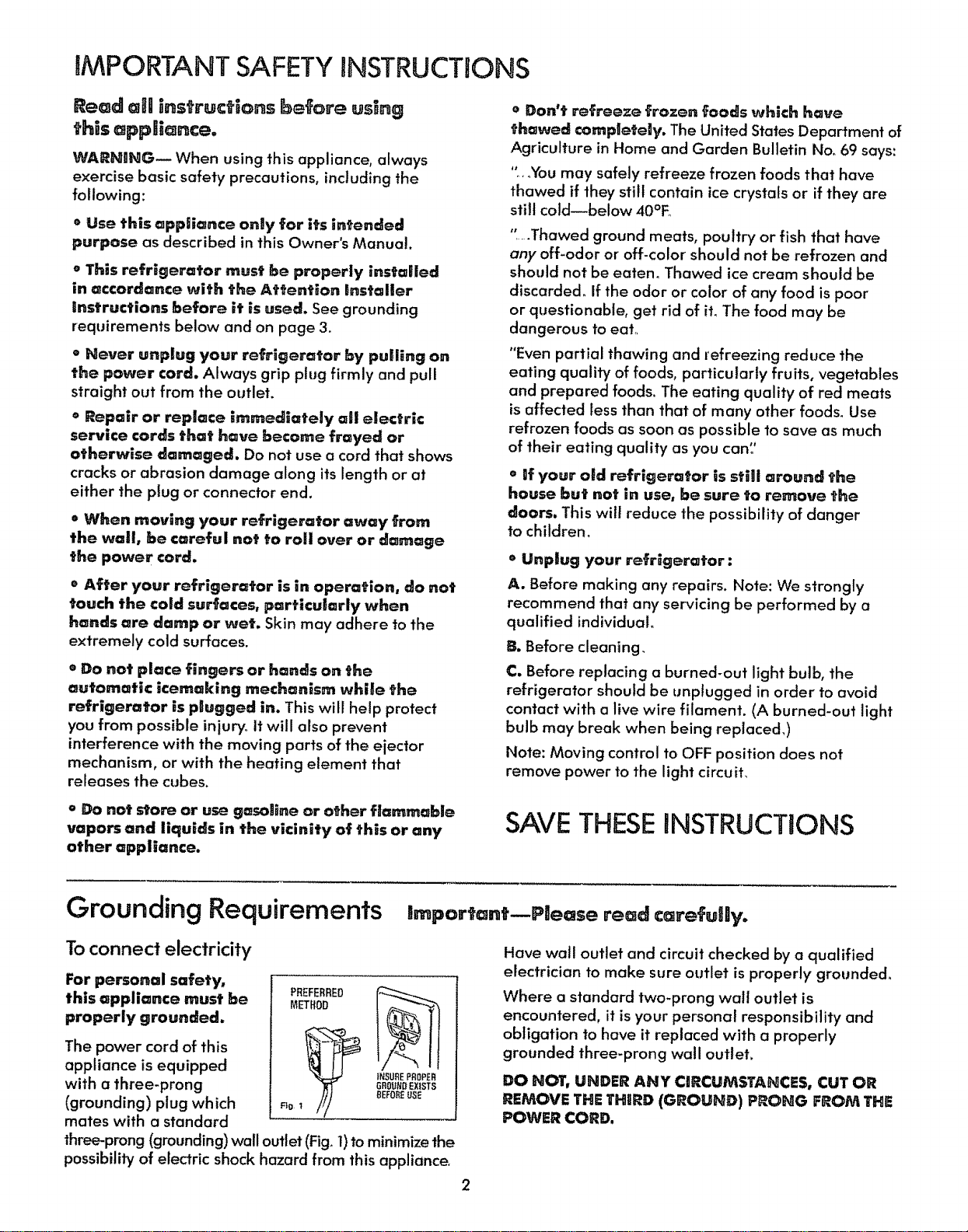
IMPORTANT SAFETY mNSTRUCTIONS
Read aH instructions before using
_hUsappffance.
WARNgNG-- When using this appliance, always
exercise basic safety precautions, including the
following:
• Use this appllance only for its intended
purpose as described in this Owner's Manual.
e This refrigerator must be properly installed
in accordance with the Attenffon Installer
instructions before it is used. See grounding
requirements below and on page 3.
o Never unplug your refrigerator by pulling on
the power cord. Always grip plug firmly and pull
straight out from the outlet.
o Repair or replace immediately a|! electric
service cords that have become frayed or
otherwise damaged. Do not use a cord that shows
cracks or abrasion damage along its length or at
either the plug or connector end.
• When moving your refrigerator away from
the wall, be careful not 1toroll over or damage
the power cord.
• After your refrigerator is in operation, do not
touch the cold surfaces, particularly when
hands are damp or eeet. Skin may adhere to the
extremely cold surfaces.
• Do not place fingers or hands on the
automatic icemaking mechanism while the
refrigerator is plugged in. This will help protect
you from possible injury° It will also prevent
interference with the moving parts of the ejector
mechanism, or with the heating element that
releases the cubes.
o Don't refreeze frozen foods which have
thawed completely. The United States Department of
Agriculture in Home and Garden Bulletin No. 69 says:
", °Youmay safely refreeze frozen foods that have
thawed if they still contain ice crystals or if they are
still cold--below 40°E
".Thawed ground meats, poultry or fish that have
any off-odor or off-color should not be refrozen and
should not be eaten. Thawed ice cream should be
discarded. If the odor or color of any food is poor
or questionable, get rid of it, The food may be
dangerous to eat,
"Even partial thawing and refreezing reduce the
eating quality of foods, particularly fruits, vegetables
and prepared foods. The eating quality of red meats
is affected less than that of many other foods. Use
refrozen foods as soon as possible to save as much
of their eating quality as you can'°'
. If your old refrigerator is still around the
house but not in use, be sure to remove the
doors. This will reduce the possibility of danger
to children.
o Unplug your refrigerator:
A. Before making any repairs. Note: We strongly
recommend that any servicing be performed by a
qualified individual°
B. Before cleaning
C. Before replacing a burned_out light bulb, the
refrigerator should be unplugged in order to avoid
contact with a live wire filament. (A burned-out light
bulb may break when being replaced,)
Note: Moving control to OFF position does not
remove power to the light circuit,
• Do not sCore or use gasoline or other flammable
vapors and liquids in the vicinity of this or any
other appliance.
SAVE THESEINSTRUCTIONS
Grounding Requirements
nmporCan¢_Pfease read carefullBy.
Toconnect electricity
For personal safety,
this appliance must be
properly grounded.
The power cord of this
appliance is equipped
with a three-prong
(grounding) plug which
mates with a standard
PEEFERREO I_
METHOD
iNSUREPROPER
GROUNDEXISTS
BEFOREUSE
Fig, I
three-prong (grounding) wall outlet (Fig. 1)to minimize the
possibility of electric shock hazard from this appliance.
Have wall outlet and circuit checked by a qualified
electrician to make sure outlet is properly grounded.
Where a standard two-prong wall outlet is
encountered, it is your personal responsibility and
obligation to have it replaced with a properly
grounded three-prong wall outlet.
DO NOT, UNDER ANY CIRCUMSTANCES, CUT OR
REMOVE THE THIRD (GROUND) PRONG FROM THE
POWER CORD.
2
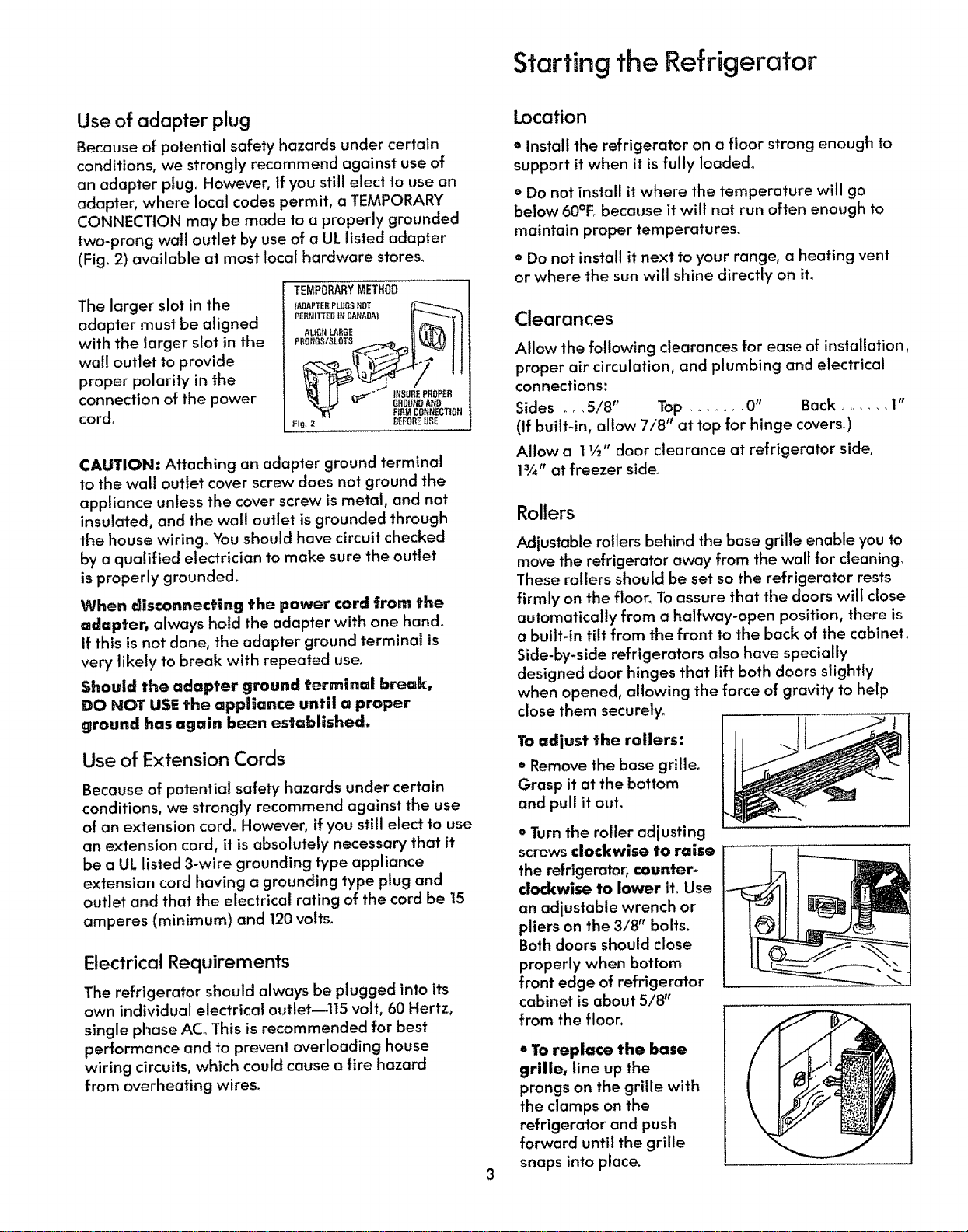
Starting the Refrigerator
Use of adapter plug
Because of potential safety hazards under certain
conditions, we strongly recommend against use of
an adapter ptug,. However, if you still elect to use an
adapter, where local codes permit, a TEMPORARY
CONNECTION may be made to a properly grounded
two-prong wall outlet by use of a UL listed adapter
(Fig_ 2) available at most local hardware stores_
The larger slot in the
adapter must be aligned
with the larger slot in the
wall outlet to provide
proper polarity in the
connection of the power
cord.
TEMPORARY METHOD
IADAPTERPLUGS NUT
PERMITTEDtN CANADA) IJ _-_-_'
AUG,,_,GE It_ l
I I _ r'_" INSUREPROPER
..._.,_.j._v GROUhiDAND
FIRM CONNECTION
Fig, 2 BEFORE USE
CAUTION: Attaching an adapter ground terminal
to the ,.,calloutlet cover screw does not ground the
appliance unless the cover screw is metal, and not
insulated, and the wall outlet is grounded through
the house wiring_ You should have circuit checked
by a qualified electrician to make sure the outlet
is properly grounded.
When disconnecting the power cord from the
adapter, always hold the adapter with one hand_
If this is not done, the adapter ground terminal is
very likely to break with repeated use_
Should the adapter ground terminal break,
DO NOT USE the appliance until a proper
ground has again been established.
Use of Extension Cords
Because of potential safety hazards under certain
conditions, we strongly recommend against the use
of an extension cord.. However, if you still elect to use
an extension cord, it is absolutely necessary that it
be a UL listed 3-wire grounding type appliance
extension cord having a grounding type plug and
outlet and that the electrical rating of the cord be 15
amperes (minimum) and t20 votts_
Electrical Requirements
The refrigerator should always be plugged into its
own individual electrical outlets115 volt, 60 Hertz,
single phase ACo This is recommended for best
performance and to prevent overloading house
wiring circuits, which could cause a fire hazard
from overheating wires_
3
Location
= Install the refrigerator on a floor strong enough to
support it when it is fully loaded..
o Do not install it where the temperature will go
below 60°E because it wilt not run often enough to
maintain proper temperatures°
='Do not install it next to your range, a heating vent
or where the sun will shine directly on it_
Clearances
Allow the following clearances for ease of installation,
proper air circulation, and plumbing and electrical
connections:
Sides __,5/8" Top .......... 0" Back ........ 1"
(If built-in, allow 7/8" at top for hinge covers_)
Allow a 1Y_" door clearance at refrigerator side,
13//' at freezer side°
Rollers
Adjustable rollers behind the base grille enable you to
move the refrigerator away from the wall br cleaning
These rollers should be set so the refrigerator rests
firmly on the floor. Toassure that the doors will close
automatically from a halfway-open position, there is
a built-in tilt from the front to the back of the cabinet°
Side-by-side refrigerators also have specially
designed door hinges that lift both doors slightly
when opened, allowing the force of gravity to help
close them securely_
To adjust the rollers:
o Remove the base grille_
Grasp it at the bottom
and pull it out,
o Turn the roller adjusting
screws clockwise to raise
the refrigerator, counter-
clockwise to lower it. Use
an adjustable wrench or
pliers on the 3/8" bolts.
Both doors should close
properly ,when bottom
front edge of refrigerator
cabinet is about 5/8"
from the floor,
o To replace the base
grille, line up the
prongs on the grille with
the clamps on the
refrigerator and push
forward until the grille
snaps into place.
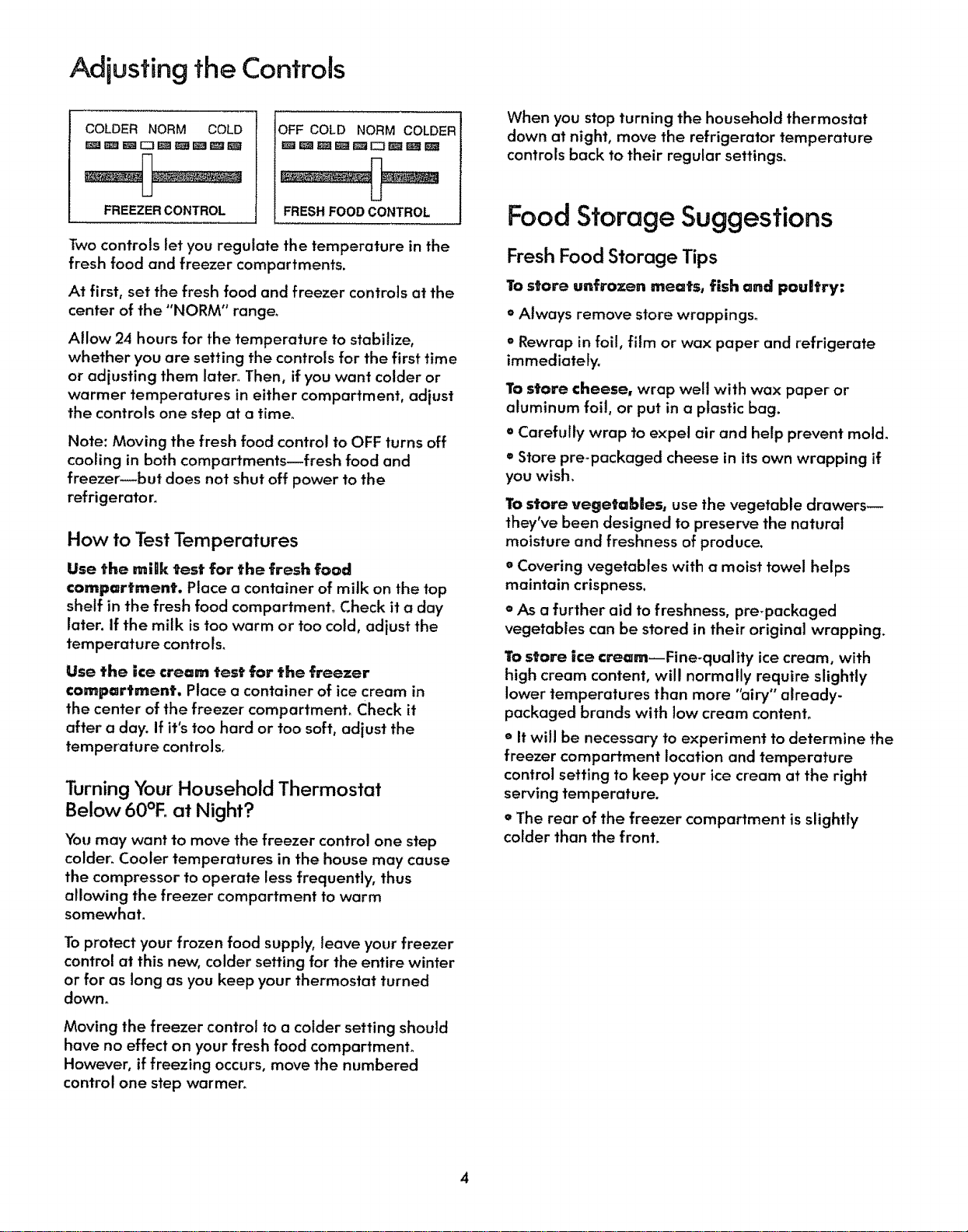
Adiusting the Controls
COLDER NORM COLD
FREEZER CONTROL
OFF COLD NORM COLDER
FRESH FOOD CONTROL
Two controls let you regulate the temperature in the
fresh food and freezer compartments.
At first, set the fresh food and freezer controls at the
center of the "NORM" range.
Allow 24 hours for the temperature to stabilize,
whether you are setting the controls for the first time
or adjusting them later° Then, if you want colder or
warmer temperatures in either compartment, adjust
the controls one step at a time.
Note: Moving the fresh food control to OFF turns off
cooling in both compartments--fresh food and
freezer--but does not shut off power to the
refrigerator.
How to Test Temperatures
Use the mi"k test for the fresh food
compartment. Place a container of milk on the top
shelf in the fresh food compartment° Check it a clay
later. If the milk is too warm or too cold, adjust the
temperature controls.
Use the ice cream test for the freezer
compartment. Place a container of ice cream in
the center of the freezer compartment. Check it
after a day. If it's too hard or too soft, adjust the
temperature controls.
Turning Your Household Thermostat
Below 60°E at Night?
You may want to move the freezer control one step
colder: Cooler temperatures in the house may cause
the compressor to operate less frequently, thus
allowing the freezer compartment to warm
somewhat.
To protect your frozen food supply, leave your freezer
control at this new, colder setting for the entire winter
or for as long as you keep your thermostat turned
down.
Moving the freezer control to a colder setting should
have no effect on your fresh food compartment_
However, if freezing occurs, move the numbered
control one step warmer.
When you stop turning the household thermostat
down at night, move the refrigerator temperature
controls back to their regular settings.
Food Storage Suggestions
Fresh Food Storage Tips
To store unfrozen meats, fish and poultry:
=Always remove store wrappings°
=Rewrap in foil, film or wax paper and refrigerate
immediately.
To stere cheese, wrap well "with wax paper or
aluminum foi!, or put in a plastic bag.
o Carefully wrap to expel air and help prevent mold.
= Store pre-packaged cheese in its own wrapping if
you wish.
To store vegetables, use the -vegetable drawers--
they've been designed to preserve the natural
moisture and freshness of produce.
o Covering vegetables with a moist towel helps
maintain crispness.
o As a further aid to freshness, pre-packaged
vegetables can be stored in their original wrapping.
To store ice cream--Fine-quality ice cream, with
high cream content, will normally require slightly
lower temperatures than more "airy" already-
packaged brands with low cream content.
o It will be necessary to experiment to determine the
freezer compartment location and temperature
control setting to keep your ice cream at the right
serving temperature.
='The rear of the freezer compartment is slightly
colder than the front.
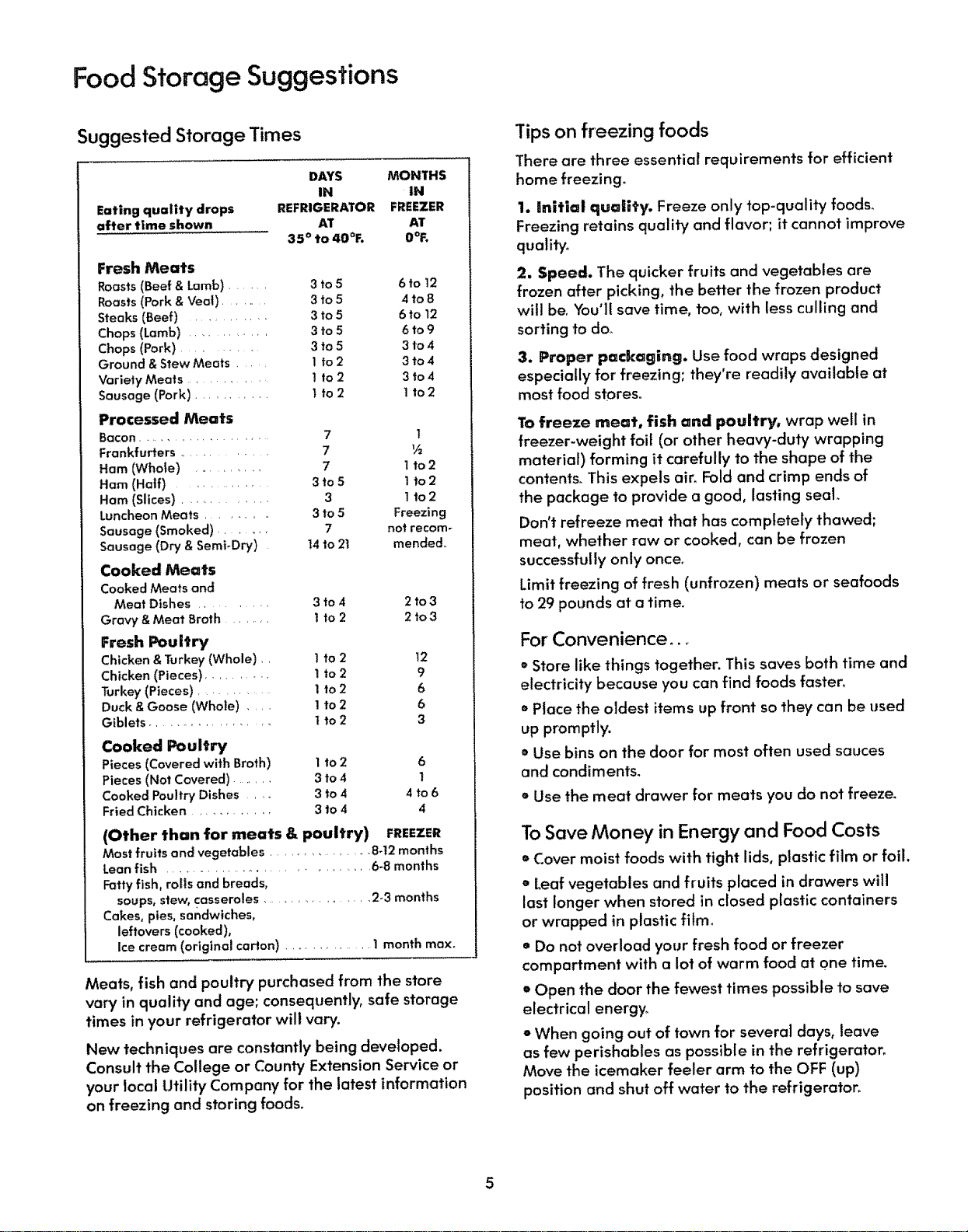
Food Storage Suggestions
Suggested Storage Times
Eating quality drops
after time shown
DAYS MONTHS
IN IN
REFRIGERATOR FREEZER
AT AT
35 ° to 40°i=. O°F.
Fresh Meats
Roasts (Beef & Lamb) ...... 3 to 5
Roasts (Pork & Veal) ....... 3 to S
Steaks (Beef) ........... 3to 5
Chops (Lamb) ............. 3to 5
Chops (Pork) ............ 3to 5
Ground &Stew Meats ..... 1to 2
Variety Meats .............. 1to 2
Sausage (Pork) ........... I to 2
Processed Meats
Bacon .................... 7
Frankfurters ........... 7
Ham (Whote) ........... 7
Ham (Half) .............. 3 to S
Ham (Slices) ............. 3
Luncheon Meats ........ 3 to 5
Sausage (Smoked) ....... 7
Sausage (Dry & Semi-Dry) 14to 2t
Cooked Meats
Cooked Meats and
Meat Dishes .......... 3 to 4
Gravy & Meat Broth ........ 1to 2
Fresh Poultry
Chicken 8,Turkey (Whole), , 1 to 2
Chicken (Pieces) .......... 1 to 2
Turkey (Pieces) ........... I to 2
Duck 8,Goose (Whole) .... 1 to 2
Giblets ................... t to 2
6to 12
4tab
6to 12
6to9
3 to4
3to4
3 to4
1 to2
1
1/2
I to2
1to2
1to2
Freezing
not recom-
mended.,
2to3
2to3
12
9
6
6
3
Cooked Poultry
Pieces (Covered with Broth) 1to 2 6
Pieces (Not Covered) ........ 3 to 4 1
Cooked Poultry Dishes 3to 4 4 to 6
Fried Chicken ............ 3 to 4 4
(Other than for meats & poultry) FREEZER
Most fruits and vegetables ................. 8-!2 months
Lean fish ............................... 6-8 months
Fatty fish, roils and breads,
soups, stew, casseroles ................... 2-3 months
Cakes, pies, sandwiches,
leftovers (cooked),
Ice cream (original carton) ................. 1 month max.
Meats, fish and poultry purchased from the store
vary in quality and age; consequently, safe storage
times in your refrigerator will vary.
New techniques are constantly being developed.
Consult the College or County Extension Service or
your local Utility Company for the latest information
on freezing and storing foods,
Tips on freezing foods
There are three essential requirements for efficient
home freezing.
1. Initial quality. Freeze only top-quality foods_
Freezing retains quality and flavor; it cannot improve
quality.
2. Speed. The quicker fruits and vegetables are
frozen after picking, the better the frozen product
will be, You']t save time, too, ,with less culling and
sorting to don
3. Proper packaging. Use food wraps designed
especially for freezing; they're readily available at
most food stores.
To freeze meat, fish and poultry, wrap we!l in
freezer-weight foil (or other heavy-duty wrapping
material) forming it carefully to the shape of the
contents. This expels air. Fold and crimp ends of
the package to provide a good° lasting seal_
Don't refreeze meat that has completely thawed;
meat, whether raw or cooked, can be frozen
successfully only once°
Limit freezing of fresh (unfrozen) meats or seafoods
to 29 pounds at a time.
For Convenience...
=Store like things together. This saves both time and
electricity because you can find foods faster.
o Place the oldest items up front so they can be used
up promptly.
• Use bins on the door for most often used sauces
and condiments,
e Use the meat drawer for meats you do not freeze.
To Save Money inEnergy and Food Costs
e Cover moist foods with tight lids, plastic film or foil.
= Leaf vegetables and fruits placed in drawers will
last longer when stored in closed plastic containers
or wrapped in plastic film.
• Do not overload your fresh food or freezer
compartment with a lot of warm food at one time.
o Open the door the fewest times possible to save
electrical energy,
When going out of town for several days, leave
as few perishables as possible in the refrigerator,
Move the icemaker feeler arm to the OFF (up)
position and shut off water to the refrigerator.
5
Shelves and Storage Drawers
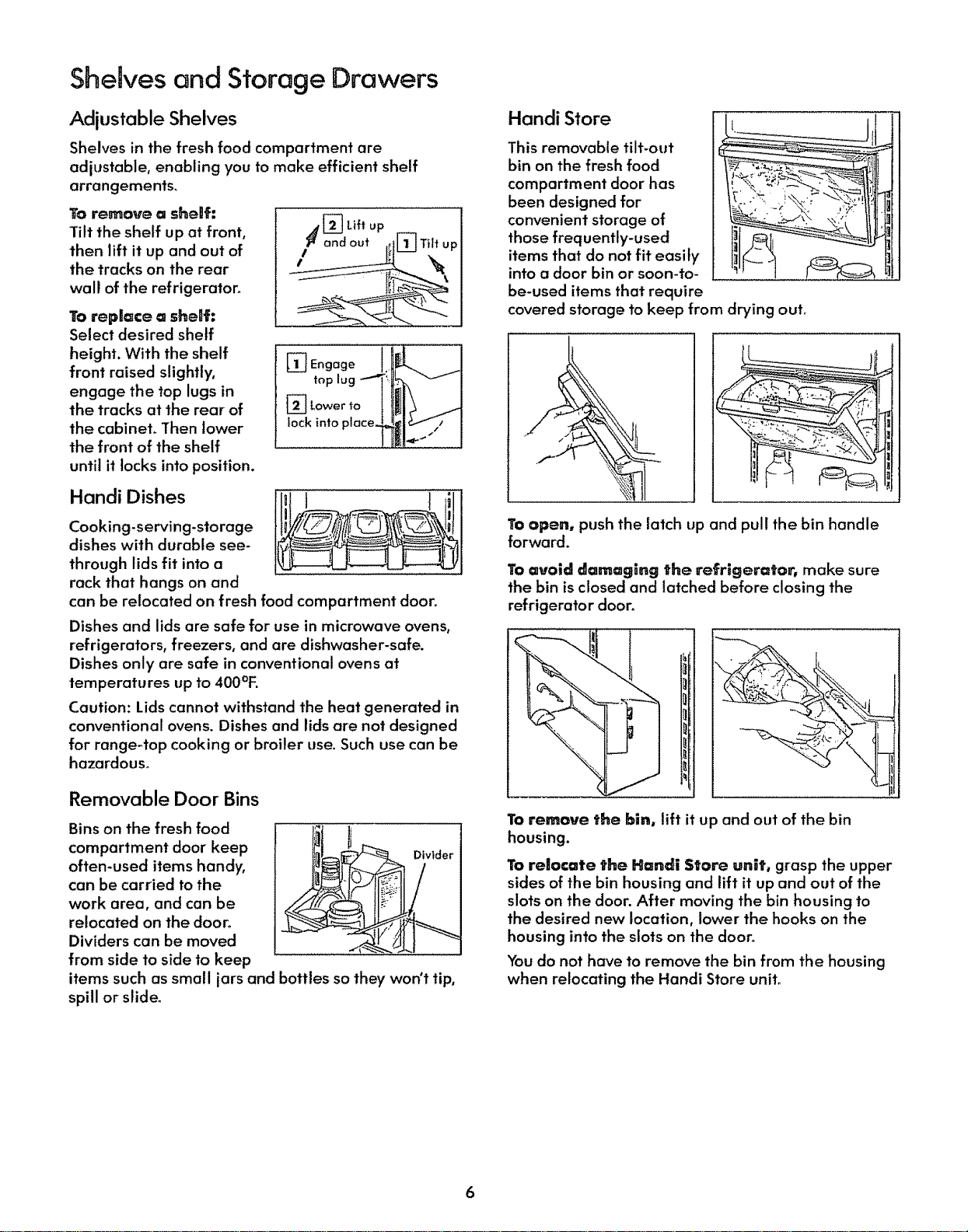
Adjustable Shelves
Shelves in the fresh food compartment are
adjustable° enabling you to make efficient shelf
arrangements_
To remove a shelf:
Tilt the shelf up at front,
then lift it up and out of
the tracks on the rear
wall of the refrigerator.
To replace = shelf:
Select desired shelf
height. With the shelf
front raised slightly,
engage the top lugs in
the tracks at the rear of
the cabinet_ Then lower
the front of the shelf
until it locks into position.
[_ Engage ._
t p,ug 'r'ru
Handi Dishes
Cooking-serving-storage
dishes with durable see-
through lids fit into a
rack that hangs on and
can be relocated on fresh food compartment door_
Dishes and lids are safe for use in microwave ovens,
refrigerators, freezers, and are dishwasher-safe.
Dishes only are safe in conventional ovens at
temperatures up to 400°t:.
Caution: Lids cannot withstand the heat generated in
conventional ovens. Dishes and lids are not designed
for range-top cooking or broiler use. Such use can be
hazardous_
Removable Door Bins
Bins on the fresh food
compartment door keep Divider
often-used items handy,
can be carried to the
work area, and can be
relocated on the door_
Dividers can be moved
from side to side to keep
items such as small jars and bottles so they won't tip,
spill or slide°
Handi Store
This removable tilt-out
bin on the fresh food
compartment door has
been designed for
convenient storage of
those frequently-used
items that do not fit easily
into a door bin or soon-to-
be-used items that require
covered storage to keep from drying out.
To open, push the latch up and pull the bin handle
forward.
To avoid dam=glng the refriger=tor, make sure
the bin isclosed and latched before closing the
refrigerator door.
To remove the bin, lift it up and out of the bin
housing.
To relocate #he Handi Sttore unit, grasp the upper
sides of the bin housing and lift it up and out of the
slots on the door. After moving the bin housing to
the desired new location, lower the hooks on the
housing into the slots on the door°
You do not have to remove the bin from the housing
when relocating the Handi Store unit°
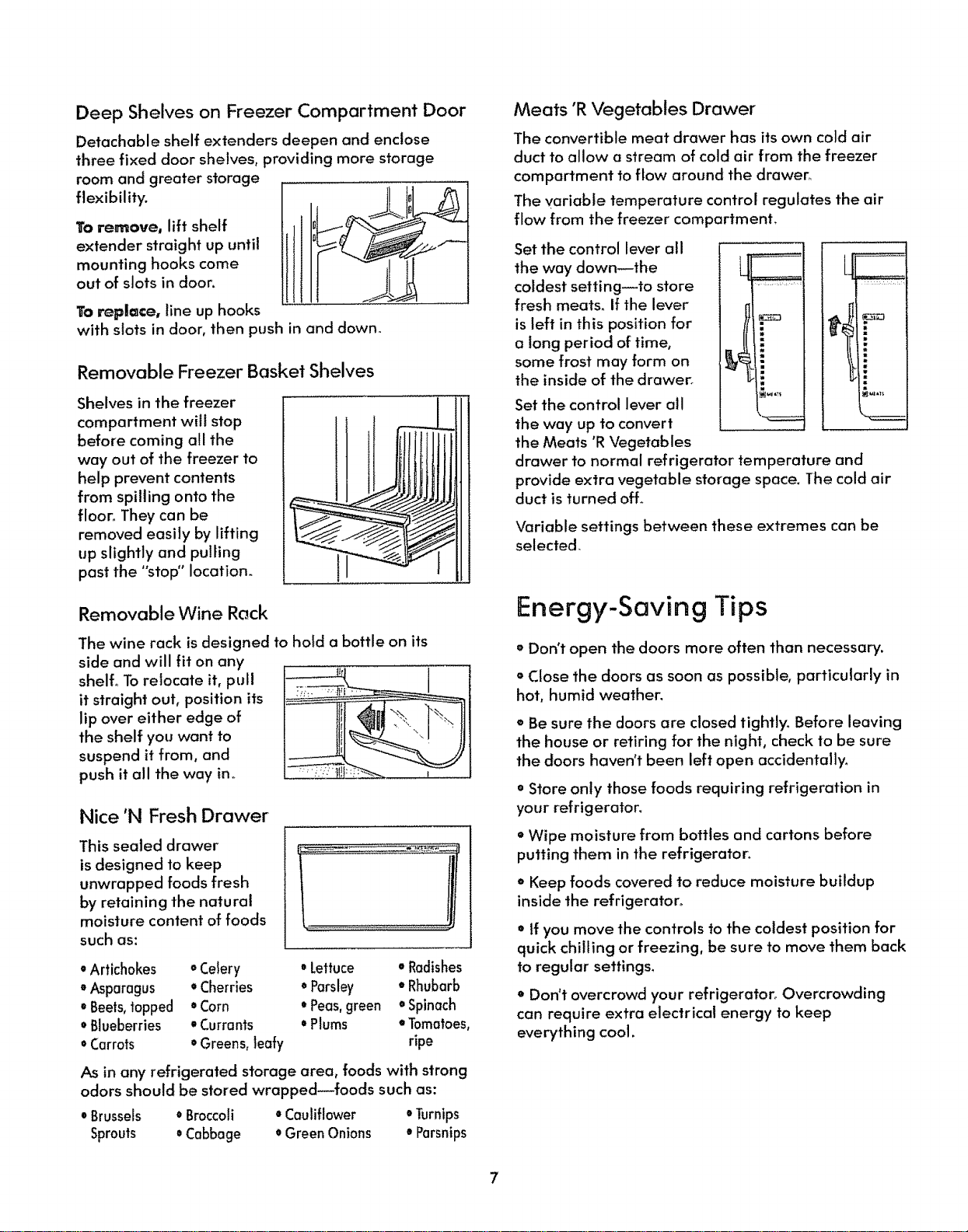
Deep Shelves on Freezer Compartment Door
Detachable shelf extenders deepen and enclose
three fixed door shelves, providing more storage
room and greater storage
flexibility.
To remove, lift shelf
extender straight up until
mounting hooks come
out of slots in door.
To replace, line up hooks
with slots in door, then push in and dowm
Removable Freezer Basket Shelves
Shelves in the freezer
compartment will stop
before coming all the
way out of the freezer to
help prevent contents
from spilling onto the
floor° They can be
removed easily by lifting
up slightly and pulling
past the "stop" location.
i
Removable Wine Rack
The wine rack is designed to hold a bottle on its
side and will fit on any
shelf° To relocate it, pull
it straight out, position its
lip over either edge of
the shelf you want to
suspend it from, and
push it all the way im
Nice 'N Fresh Drawer
This sealed drawer
is designed to keep
unwrapped foods fresh
by retaining the natural
moisture content of foods
such as:
• Artichokes • Celery • Lettuce • Radishes
oAsparagus 0Cherries • Parsley • Rhubarb
• Beets,topped 0Corn • Peas,green • Spinach
• Blueberries • Currants 0Plums 0Tomatoes,
0Carrots • Greens, leafy ripe
As in any refrigerated storage area, foods with strong
odors should be stored wrapped--foods such as:
• Brussels 0Broccoli • Cauliflower • Turnips
Sprouis 0Cabbage 0Green Onions • Parsnips
Meats 'R Vegetables Drawer
The convertible meat drawer has its own cold air
duct to allow a stream of cold air from the freezer
compartment to flow around the drawer_
The variable temperature control regulates the air
flow from the freezer compartment.
Set the control lever all
the way down--the
coldest setting--to store
fresh meats. If the lever
is left in this position for
a long period of time,
some frost may form on
the inside of the drawer.
Set the control lever all
the way up to convert
the Meats 'R Vegetables
J
i
drawer to normal refrigerator temperature and
provide extra vegetable storage space. The cold air
duct is turned off_
Variable settings between these extremes can be
selected.
Energy-Saving Tips
o Don't open the doors more often than necessary.
• Close the doors as soon as possible, particularly in
hot, humid weather.
• Be sure the doors are closed tightly° Before leaving
the house or retiring for the night, check to be sure
the doors haven't been left open accidentally,
• Store only those foods requiring refrigeration in
your refrigerator,
oWipe moisture from bottles and cartons before
putting them in the refrigerator.
o Keep foods covered to reduce moisture buildup
inside the refrigerator°
• if you move the controls to the coldest position for
quick chilling or freezing, be sure to move them back
to regular settings_
o Don't overcrowd your refrigerator° Overcrowding
can require extra electrical energy to keep
everything cool.
Features
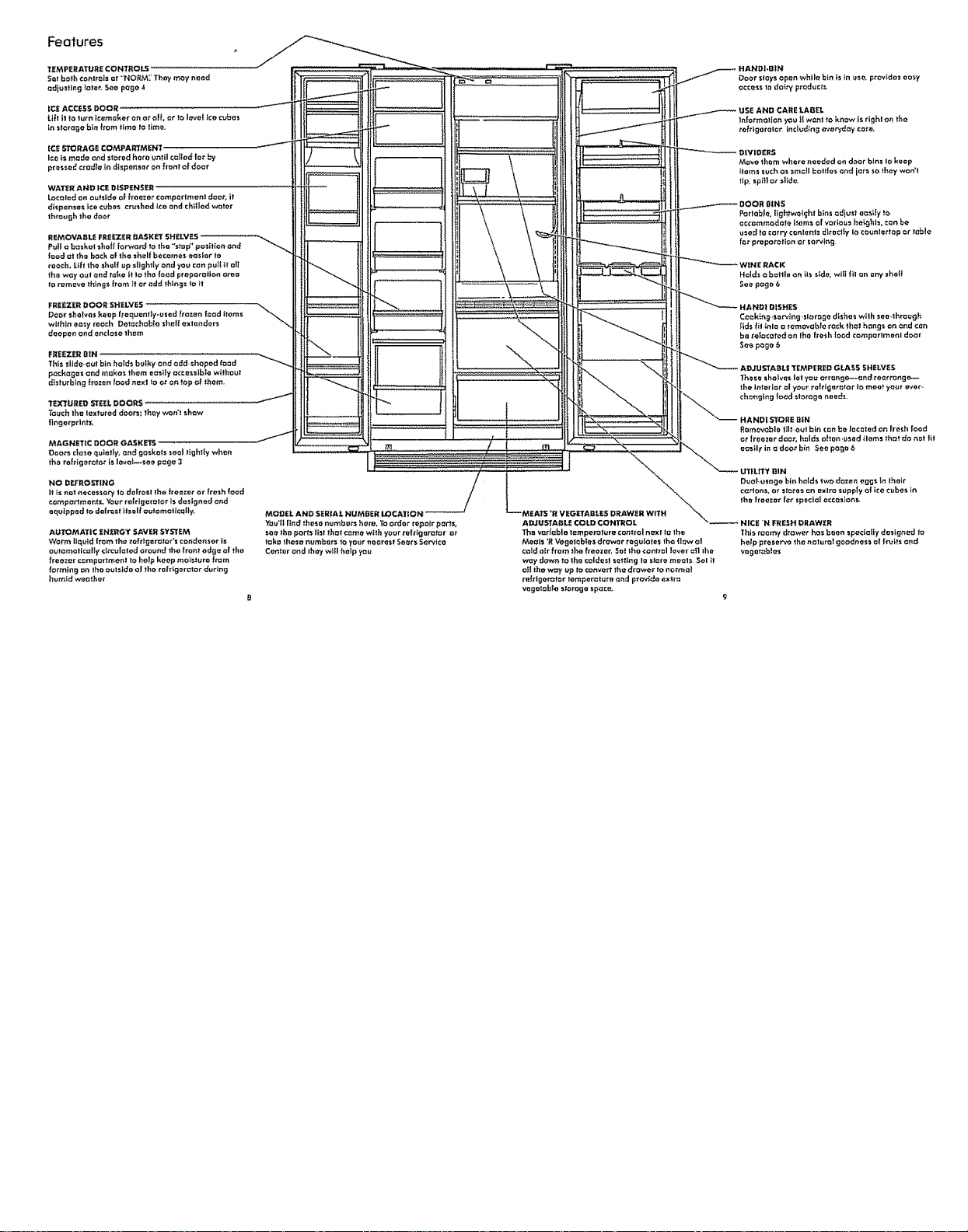
"i'EM PERATUR_ CONTROLS
Sat both co,_t_'ols st "NORM:' They moy need
adiusfln g fat_'_ SOlopO_O 4
ICE ACCESS DOOR
Liftit1oturn l_*_moker on or off,or Iol_r_ol_co c_bo_
1_ _c,_o_e ben {ram timo to time_
iCE _O RAC
Ice iS made Dad st,.rod hero ._ntil €_}Iod tot by
pr_ss_ cro_a {o ,3f.cponso_' on _rmnt of door
WATER AND ICE DtSPENSER
Loccded on c=_t.cida of free,or temporizers| d_:Di_,it
d_spans_.€ icecubos crushed {co end chilled wotor
th_'_ugh tea door
REMOVABLE FREEZER BASKET SHE_.VE5
P_{{ c_basket .cko|ffo,"€_;_{tO _ha '_stDp'* po_Itior{_d
load o{ thn back of the shelf bocomo.€ oos}or to
rOOCh, Lift the .chaff Up slightly Dad yo_. can pu{| it e!f
the way out anCltc,kaitto the food propo¢otlon ore_
to rernavo things from _tor od_ things to it
FREEZER DOOR SHELVES
Door .ch,_,fvo.€koop ffoquenlfy-usod frozen food ffomm
wlthl_,oo_y r_och Doto_ft_bfo shriftoxl_ndml'm{
deepen o_d OO_:Io.COthem
FREEZEI_ BIN
Tht.€ .cHdo-,ou{ bin bcllds b_{ky cod o_d ,mhopod _oad
package.€ cod moko.€ tho_ eos{ly acc_s.€}b_o without
d_sturb_ng ff_zon l_d nex{ _o or oa top of fl_em.
TEXTUREO _[EEL DOORS
Teach tha lextuted doors: they won't mft_ow
flngerpl'iot.€,
MAGNb'TIC DOOR GASKETS
Oclor.€ Close qui0t{y, oad goskcHs sea{ {tgh{_y wh_
the refrigeratorislevel--see pc_e 3
NO DEFROS'_}NG
It is not _ecosmory to clef.tool the freezer c_r fro.oh food
_ompartmom.€, YO_" rel_iBemlor i.€designed o_d
oquippod to doffr_.ctIt_elf outomafl_ol{y_
AUTOMATIC ENERGY SAVER SY_'TEM
Worm {{_d h'_m the _'etr IRa ratot".€ conde_.ce_' }.€
Ou{omati(c{{{y¢{_{oted around the frontedge of the
trooz_r campmrt_an_ to ho}p keep _oi.ct_ro {ram
fc_rming on {he outside of the rofr}gorcrtor dur{ng
humid weotkor
:::::.::: ,
MODEL AND SERIAL NUMBER LOCATION
Yo_'lt find th o.co nurnhor_ hare. To ardor repo_r p_rt_,
.€oo_ho ports ff_t that camo with y_ur r_fr_ga_tar _r
fake those numbers 10 yc_r noor_.ct Soars EO_VI_O
Center and {hay wtf} help y_u
A DJU STA/3LE COLD CONTROL
Tha V_:ri_hJo t_mpolroturo ¢c_Ot_oJnext tO Iho
MoOls 'R Vo_ot_bfo_ drawer regufotes Ibo _{_w el
COI_ air from the freezer, Sot lho _:_nt_oI lover €_{1Iho
way d_,vn to the cmld_sl s_ttlng Io st_ro me_ts, ,_ol il
_{fthe w_y up to convert the drawer to norse|
r_fr{go_-::=lor tompor'_ro and pr_|do oxt_=
vegetable storage space.
Door .Cloys open while b{n }.€in u.co.pK_vfdos easy
O_:COssto do_ty producl_
LABEL
Information you {Iwahl to know Isright on the
rotrigoral_r includ|ng everyday core.
Move them whore noodad _q door bins Io keep
Hams su_;h os .cmall botlle.€ ¢_d ir_r.€so they won'l
lip, sp_!l o; _l;da.
_rloble, {Igbtweh3h! b{os adju.clDo.tillto
occommodoto {|ores _f v_rious ha|,3bl:_, _on be
u.€_d to cor r'/cr_nl_nl_ d}to_lfy IO ¢ounlattap _r I_b}o
for Wepc:c_tl_ _r _orvirtg
Holds_ bmltloon Ils.old0,w{IIfH_n =sayshall
SoDpooo 6
lAND{ DISHES
Co=k_g ,sorvingslornge disho.€ with sod 4hr_ugh
_}ds _i{ _nlo a romcr_obto ro_k _I_| hangs _n _nd can
bn relocated on Iho fresh todd €ompartmonl dear
Sea pore 6
_ELVES
Thesu shelves let y_u orroogo--ond raorrongo.-.
the interior of your rolrigorator Io meet y_r ave,'.
chom neor_s.
Romovgblo t{It,o_t bin cnn ba lacolad on fie.oh food
or fro_or door, holds otlol'_,usod |toms that _o n_t t_I
_c_s_l_"in a door bin SO0 page 6
UTILITY DIN
Ouof, usogo bin hoid.€ _wo _ozan agfi.€ tn Iholr
cottons, or sto_o_ _:n exl_ .cuppfy of ice ¢_bo.€ in
the fraaza_ re: .cpecic_I occo.€_ons_
NiCE "N FRESH DRAWER
1'his roomy drawer he= boon spoc{aliy designed Io
ho{p prossorvo lha nature| _..eodna.cs of ff_;ts a_d
reBate=bias
Automatic lcemaker and ice & Chilled Water Dispenser
See separate Water Line Installation Requirements
included in both the literature pack and on the back
of the refrigerator
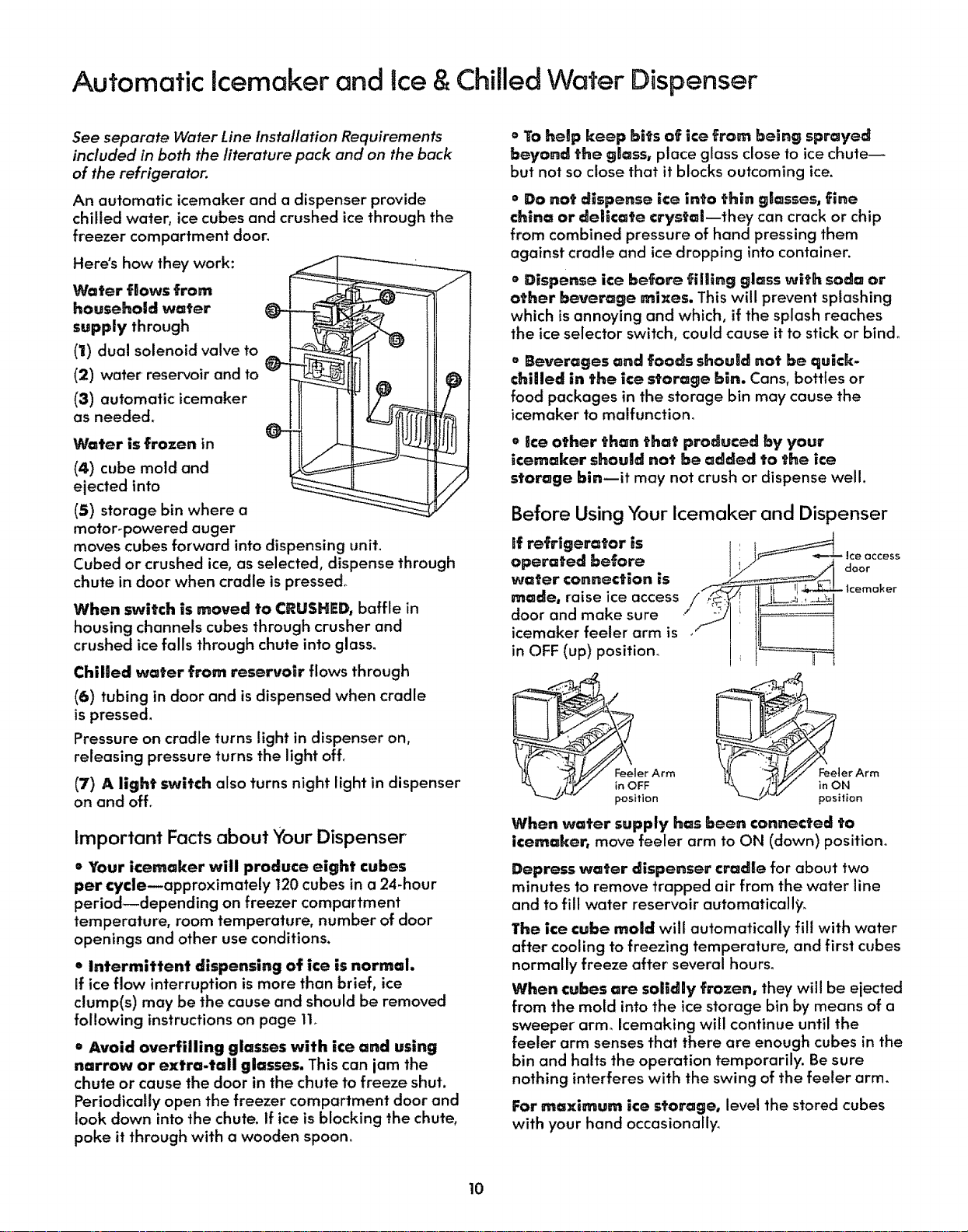
An automatic icemaker and a dispenser provide
chilled water, ice cubes and crushed ice through the
freezer compartment door
Here's how they work:
Water flows from |
household water
supply through
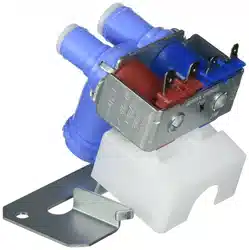
(1) dual solenoid valve to
(2) water reservoir and to
(3) automatic icemaker
as needed.
Water _s frozen in
(4) cube mold and
ejected into
(5) storage bin where a
motor-powered auger
moves cubes forward into dispensing unit°
Cubed or crushed ice, as selected, dispense through
chute in door when cradle is pressed°
When switch is moved to CRUSHED, baffle in
housing channels cubes through crusher and
crushed ice falls through chute into glass
Chilled water from reservoir flows through
(6) tubing in door and isdispensed when cradle
is pressed.
Pressure on cradle turns light in dispenser on,
releasing pressure turns the light off.
(7) A light switch also turns night light in dispenser
on and off.
Important Facts about Your Dispenser
• Your icemaker will produce eight cubes
per cycle--approximately t20 cubes in a 24-hour
period--depending on freezer compartment
temperature, room temperature, number of door
openings and other use conditions.
• Intermittent dispensing of ice iS normal.
If ice flow interruption is more than brief, ice
clump(s) may be the cause and should be removed
following instructions on page 11_
. Avoid overfilling glasses with ice and using
narrow or extra-tall glasses. This can jam the
chute or cause the door in the chute to freeze shut.
Periodically open the freezer compartment door and
look down into the chute. If ice is blocking the chute,
poke it through with a wooden spoon.
o To help keep bHs of ice from being sprayed
beyond the glass, place glass close to ice chute--
but not so close that it blocks outcoming ice.
o Do not dispense ice into thin glasses, fine
china or delicate crystal--they can crack or chip
from combined pressure of hand pressing them
against cradle and ice dropping into container.
o Dispense ice before filling glass with soda or
other beverage mixes. This will prevent splashing
which is annoying and which, if the splash reaches
the ice selector switch, could cause it to stick or bind°
o Beverages and foods should not be quick-
chilled in the ice storage bin. Cans, bottles or
food packages in the storage bin may cause the
icemaker to matfunctiom
e ice other than that produced by your
icemaker should not be added to the ice
storage bln--it may not crush or dispense well.
Before Using Your Icemaker and Dispenser
Jf refrigerator is
operated before
water connection is
made, raise ice access
door and make sure
icemaker feeler arm is
in OFF (up) position
_Ce access
door
lcemoker
IJ
ler Arm Feeler Arm
"_\ !_j_/" in OFF in ON
- position position
When water supply has been connected to
icemaker, move feeler arm to ON (down) position°
Depress water dispenser cradle for about two
minutes to remove trapped air from the water line
and to fill water reservoir automatically
The ice cube mold will automatically fill with water
after cooling to freezing temperature, and first cubes
normally freeze after several hours.
When cubes are solidly frozen, they wilt be ejected
from the mold into the ice storage bin by means of a
sweeper arm° Icemaking will continue until the
feeler arm senses that there are enough cubes in the
bin and halts the operation temporarily. Be sure
nothing interferes with the swing of the feeler arm.
For maximum ice storage, level the stored cubes
with your hand occasionally
10
Once your icemaker is in operation, throw
away the first few batches of ice cubes. This will
flush away any impurities in the water line. Do the
same thing after vacations or long periods when ice
isn't used°
Discard the first six glassfuls of wafer in the
kitchen sink° This will eliminate the slight "plastic"
taste temporarily imparted to the water by the
water reservoir°
CAUTION: Under certain rare circumstances, ice
cubes may be discolored, usually appearing with
a green-bluish hue. This unusual disco!oration is
apparently due to a combination of factors such as
certain characteristics of local waters, household
plumbing and the accumulation of copper sa}ts in an
inactive water supply line which feeds the icemaker.
Continued consumption of such discolored ice cubes
may be injurious to health. If your ice cubes are
discolored, discard them and contact your Sears
Service Center.
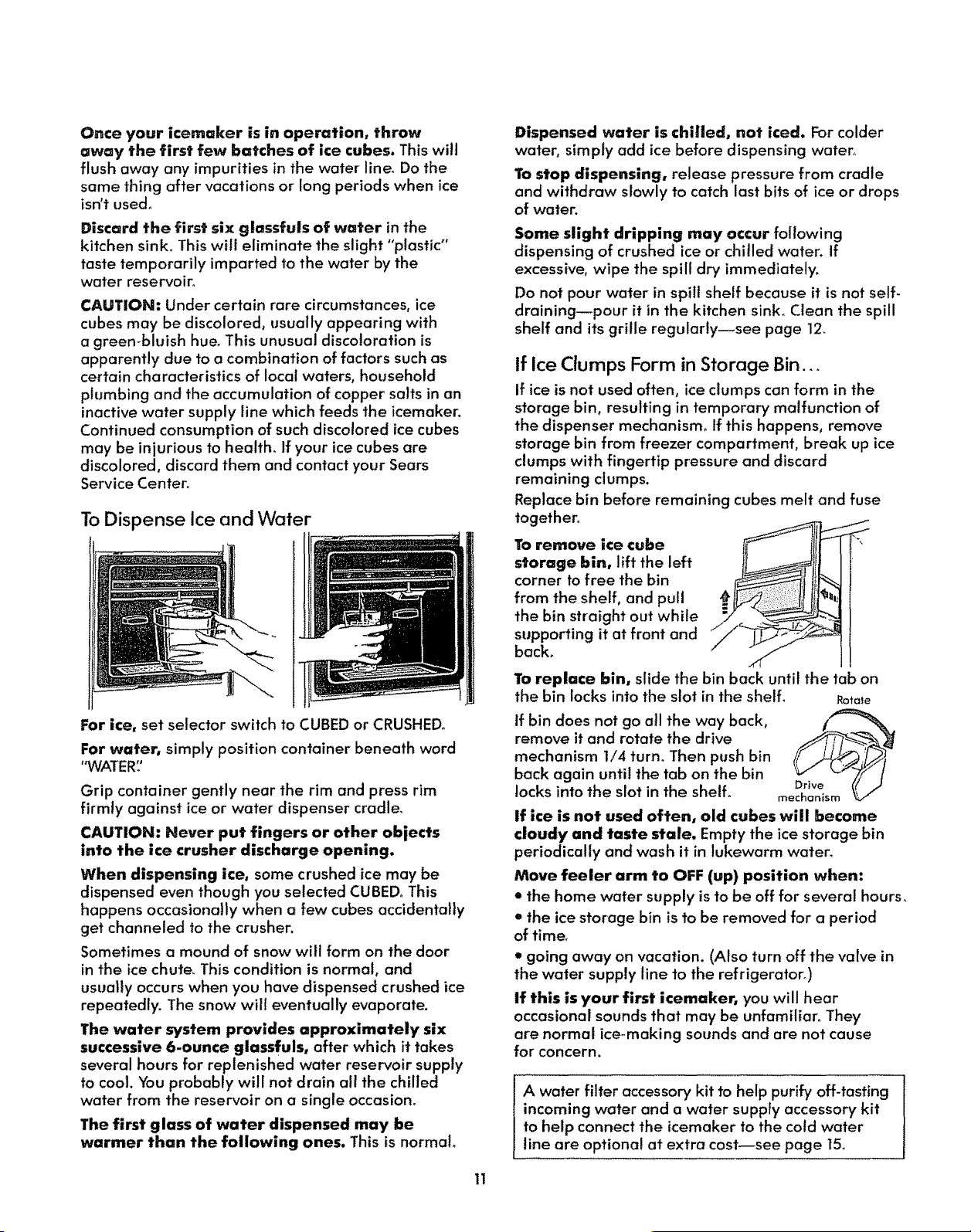
To Dispense Ice and Water
For ice, set selector switch to CUBED or CRUSHED_
For water, simply position container beneath word
"WATER'/
Grip container gently near the rim and press rim
firmly against ice or water dispenser cradle.
CAUTION: Never put fingers or other objects
into the ice crusher discharge opening.
When dispensing ice, some crushed ice may be
dispensed even though you selected CUBED° This
happens occasionally when a few cubes accidentally
get channeled to the crusher.
Sometimes a mound of snow wilt form on the door
in the ice chute_ This condition is normal, and
usually occurs when you have dispensed crushed ice
repeatedly. The snow will eventually evaporate.
The water system provides approximately six
successive 6.ounce glassfuls, after which it takes
several hours for replenished water reservoir supply
to cool. You probably will not drain al! the chilled
water from the reservoir on a single occasion°
The first glass of water dispensed may be
warmer than the following ones. This is normal
Dispensed water is chilled, not iced. For colder
water, simply add ice before dispensing water,
To stop dispensing, release pressure from cradle
and withdraw slowly to catch last bits of ice or drops
of water.
Some slight dripping may occur following
dispensing of crushed ice or chilled water. If
excessive, wipe the spill dry immediately.
Do not pour water in spill shelf because it is not self-
draining--pour it in the kitchen sink° Clean the spill
shelf and its grille regularly--see page 12.
If Ice Clumps Form in Storage Bin...
If ice is not used often, ice clumps can form in the
storage bin, resulting in temporary malfunction of
the dispenser mechanism. If this happens, remove
storage bin from freezer compartment, break up ice
clumps with fingertip pressure and discard
remaining clumps.
Replace bin before remaining cubes melt and fuse
together.
To remove ice cube
storage bin, lift the left
corner to free the bin
from the shelf, and pull
the bin straight out while
supporting it at front and
back_
J
To replace bin, slide the bin back until the tab on
the bin locks into the slot in the shelf. Rotate
If bin does not go all the way back,
remove it and rotate the drive
mechanism I/4 turn. Then push bin
back again until the tab on the bin
locks into the slot in the shelf.
mechanism
If ice is not used often, old cubes will become
cloudy and taste stale. Empty the ice storage bin
periodically and wash it in lukewarm water,
Move feeler arm to OFF (up) position when:
* the home water supply is to be off for several hours,
o the ice storage bin isto be removed far a period
of time,
* going away on vacation. (Also turn off the valve in
the water supply line to the refrigerator.)
If this is your first icemaker, "youwill hear
occasional sounds that may be unfamiliar. They
are normal ice-making sounds and are not cause
for concern.
A water filter accessory kit to help purify off-tasting
incoming water and a water supply accessory kit
to help connect the icemaker to the cold water
line are optional at extra cost_see page 15,
11
Care and Cleaning
Outside
The water and ice dispenser spillshelf should be
wiped dry immediately to prevent spotting_ Water
left on the shelf may leave deposits that you can
remove by soaking in undiluted vinegar. You can also
use a paste of non-precipitating water softener (such
as Calgon brand) and water, or one teaspoon of citric
acid powder per pint of hot tap water. Soak until the
deposit disappears or becomes toose enough to rinse
away. Usually 30 minutes soaking time is adequate.
Avoid using wax on the spill shelf and trim_
The door handles and trim can be cleaned with
a cloth dampened with a solution of mild liquid
dishwashing detergent and water_ Dry with a soft
cloth. Don't use wax on the door handles and trim.
Keep the flnlshcliean, Wipe with a clean cloth
lightly dampened with kitchen appliance wax or
mild liquid dishwashing detergent. Dry and polish
with a clean, soft cloth. Do not wipe the refrigerator
with a soiled dishwashing cloth or wet towel These
may leave a residue that can harm the paint. Do not
use scouring pads, powdered cleaners, bleach or
cleaners containing bleach because these products
can scratch and weaken the paint finish.
Prottect the palnf flnlsh, The finish on the outside
of the refrigerator is a high quality, baked-on paint
finish. With proper care, it will stay new-looking and
rust-free for years° Apply a coat of kitchen/appliance
wax when the refrigerator is new and then at least
twice a year,
Inside
The fresh food and freezer compartment
inter|ors should be cleaned at least once a yearr
Unplug the refrigerator before cleaning° If this isnot
practical, wring excess moisture out of sponge or cloth
when cleaning around switches, lights or controls.
Use warm water and baking soda solution--about a
tablespoon of baking soda to a quart of water. This
both cleans and neutralizes odors_ Rinse thoroughly
with water and wipe dry_
Other refrigerator parts_tncluding door gaskets,
meat and vegetable drawers, ice storage bin and all
plastic parts_can be cleaned the same way. Do not
use cleansing powders or other abrasive cleaners_
Door gaskets are factory*lubricated with petro|eum
jelly on the hinge side. If the lubricant is excessive,
wipe it off but leave a thin film on the gasket to help
insure a proper hinge-side seal. When you clean the
door gaskets, retubricate them.
Tohelp prevent odors, leave an open box of baking
soda in the rear of the refrigerator, on the top shelf.
12
Change the box every three months. In addition, put
an open box of baking soda in the freezer to absorb
stale freezer odors°
Do not wash any plastic parts from your
refrigerator in your automatic dishwasher.
Storage Drawers
Drawers at bottom of fresh food compartment will
stop before coming all the way out of refrigerator to
help prevent contents from spilling onto floor. The
drawers can be removed easily by tilting up slightly
and pulling past the "stop" location.
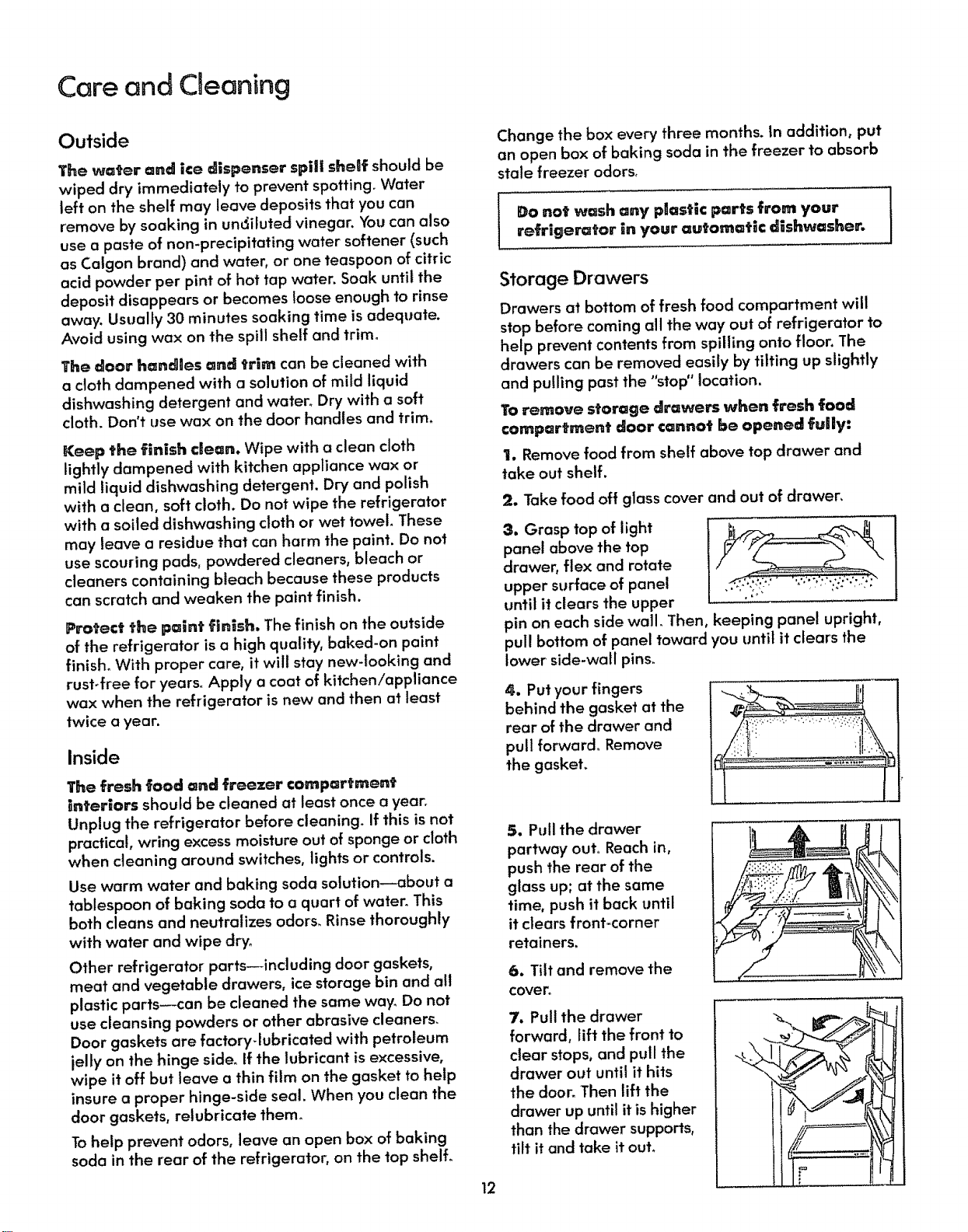
To remove storage dra_ers when fresh food
compartment door cannot be opened fully:
_. Remove food from shelf above top drawer and
take out shelf.
2. Take food off glass cover and out of drawer,
3. Grasp top of light _..___. _
panel above the top
drawer, flex and rotate
upper surface of panel ..._:_1.97° w_'_?'.i_?,,?::?:
until it clears the upper
pin on each side wall_ Then, keeping panel upright,
pull bottom of panel toward you until it clears the
lower side-wall pins.
4. Put your fingers
behind the gasket at the
rear of the drawer and
pull forward° Remove
the gasket.
5. Pull the drawer
partway out° Reach in,
push the rear of the
glass up; at the same
time, push it back until
it clears front_corner
retainers.
6. Tilt and remove the
cove_
7. Pull the drawer
forward, lift the front to
clear stops, and pull the
drawer out until it hits
the door_ Then lift the
drawer up until it is higher
than the drawer supports,
tilt it and take it out_
8. If tape holds bottom drawer cover to drawer
supports, remove the taper Pull drawer partway out.
Reach in, push the rear of the glass up and, at the
same time, back, until it clears front-corner retainers.
9. Tilt and remove the cover°
10. Tilt and remove the drawer.
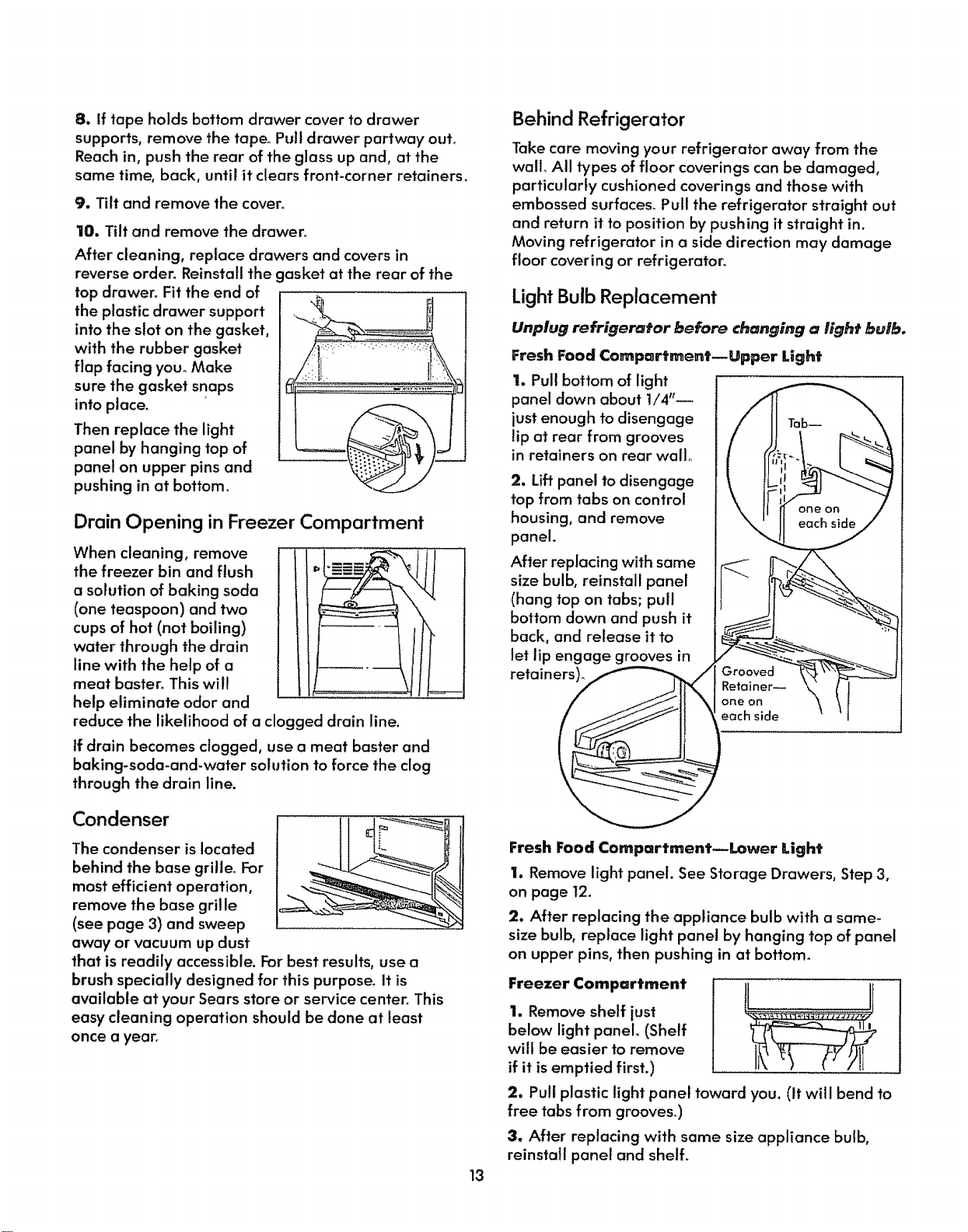
After cleaning, replace drawers and covers in
reverse order. Reinstall the gasket at the rear of the
top drawer° Fit the end of
the plastic drawer support
into the slot on the gasket,
with the rubber gasket
flap facing you° Make
sure the gasket snaps
into p,ace. __
Then replace the light
panel by hanging top of
panel on upper pins and ..:_.':
pushing in at bottom. ...
Drain Opening in Freezer Compartment
When cleaning, remove 1
the freezer bin and flush
a solution of baking soda
(one teaspoon) and two
cups of hot (not boiling)
water through the drain
line with the help of a
meat baster. This will
help eliminate odor and
reduce the likelihood of a clogged drain line.
tf drain becomes clogged, use a meat baster and
baking-soda-and-water solution to force the clog
through the drain line.
Condenser
The condenser is located
behind the base grille. For
most efficient operation,
remove the base grille
(see page :3)and sweep
away or vacuum up dust
that is readily accessible. For best results, use a
brush specially designed for this purpose. It is
available at your Sears store or service center. This
easy cleaning operation should be done at least
once a year.
13
Behind Refrigerator
Take care moving your refrigerator away from the
watt. All types of floor coverings can be damaged,
particularly cushioned coverings and those with
embossed surfaces. Pull the refrigerator straight out
and return it to position by pushing it straight in.
Moving refrigerator in a side direction may damage
floor covering or refrigerator.
Light Bulb Replacement
Unplug refrigerator before changing a light bulb.
Fresh Food Compartment--Upper Light
1. Pull bottom of light
panel down about 1/4"-
just enough to disengage
lip at rear from grooves
in retainers an rear wallo
2. Lift panel to disengage
top from tabs on control
housing, and remove
panel.
After replacing with same
size bulb, reinstall panel
(hang top on tabs; pull
bottom down and push it
back, and release it to
let tip engage grooves in
retainers)°
Fresh Food Compartment--Lower Light
1. Remove light panel. See Storage Drawers, Step 3,
on page 12.
:2. After replacing the appliance bulb with a same-
size bulb, replace light panel by hanging top of panel
on upper pins, then pushing in at bottom_
Freezer Compartment
1. Remove shelf just
below light panel. (Shelf
will be easier to remove
if it is emptied first.)
2. Pull plastic light panel toward you. (It will bend to
free tabs from grooves_)
3. After replacing with same size appliance bulb,
reinstall panel and shelf.
Before YouCall for Service
Savetime and money. Checkthis list of causesof minor
operating problems you cancorrect yourselL
Refrigerator does not operate
o May be in defrostcycle when motor doesnot operate for
about 30 minutes°
•TemperaturecontrolinOFF position.
•Ifinteriorlightisnoton,refrigeratormay notbeplugged
inat wall outlet°
• if plug issecure and refrigerator fails to operate, plug a
lamp intosame outlet to determine if there isa tripped
circuit breaker or burned out fuse_
Motor operates for long periods
• Modern refrigerators with more storagespace anda
larger freezer require more operating time.
oNormal when refrigerator isfirst deliveredto your home--
usuaflyrequires 24 hourstocompletely cool down_
o Largeamountsoffood placedin refrigerator tobe cooled
or frozen°
• Hotweather--frequent door openings.
o Door left open_
o Temperaturecontrols set tooco_doSee page4.
• Condenserneedscleaning. Referto page t3o
• Check ENERGY_SAVINGTIPSon page 7.
Operating sounds
oThe high speed compressor motor required to maintain
near zero temperatures in the large freezer comportment
may producehigher sound levelsthan your old refrigerator°
• Normal fan air flow--one fan blowscold air throughthe
refrigerator and freezer compartments--another fan cools
the compressor motor.
These NORMALsoundswil! also be heardfrom time to time:
o Defrosttimer switch clicks at defrost.
• Defrostwater dripping.
• Temperature control clicks ON or OFF°
a Refrigerant boilingor gurgling.
• Crackingor poppingof cooling coils caused byexpansion
and contraction duringdefrostand refrigeration following
defrost.
• Icecubes droppingintothe binand water running inpipes
as icemaker refills.
Motor starts & stops frequently
o Temperature control startsand stopsmotor to maintain
eventemperatures. Thisisnormal
Door not closing properly
mDoor gasketon hinge side sticking or foldingover. Tocorrect,
put a smallamount of petroleumjelly onface of gasket.
Vibration or rattling
If refrigerator vibrates, more than likely itis not resting
solidlyonthe floor,The frontroller screwsneed adjusting;
or floor isweak or uneven_Referto page3.
o Ifdishesvibrate on shelves,trymovingthem° Slight
vibrationis normal.
Foodsdry out
• Foodsnot covered, wrapped or sealed properly,
Fresh food or freezer compartment temperature too
warm
• Temperaturecontrol not setcold enough_ Refertopage4_
• Warm weather--frequent door openings.
• Door left open for long time.
o Packagemay be holding door open,
Frost or ice crystals on frozen food
* Door may have been left ajar or packageholding door
open_
oToofrequent or too longdoor openings°
o Frostwithin package isnormal_
Slow ice cube freezing
* Doormay have been left ajar.
o Settemperature offreezer compartment colder.
Ice cubes have odor/taste
oOld cubes need tobediscarded, Empty icebin every
30 days.
•lce storagebinneedsto bewashed.
• Unsealedpackagesin refrigerator and/or freezer
compartments may be transmitting odor/taste to icecubes,
• Interior of refrigerator needscleaning. Referto page 12o
Automatic icemaker does not work
• lcemaker feeler arm in OFF(up) position.
• Water supplyturned off or not connected°
• Freezercompartment too warm_
• Cubestoo small_water shutoffvalve connecting
refrigerator tohome water line may beclogged.
a Sometimescubesfuse to the side ofthe icemoldand hold
the feeler arm inthe OFF (up) position.Removethis iceto
restart the icemaker.
e Piledupcubes instoragebin may cause icemaker to shut
offprematurely, With icemaker feeler armin OFF (up)
position,level cubes in binbyhand.
• When leveling cubes byhand, you may have pushedthe
feeler arm intothe OFF (up)positionbymistake.
14
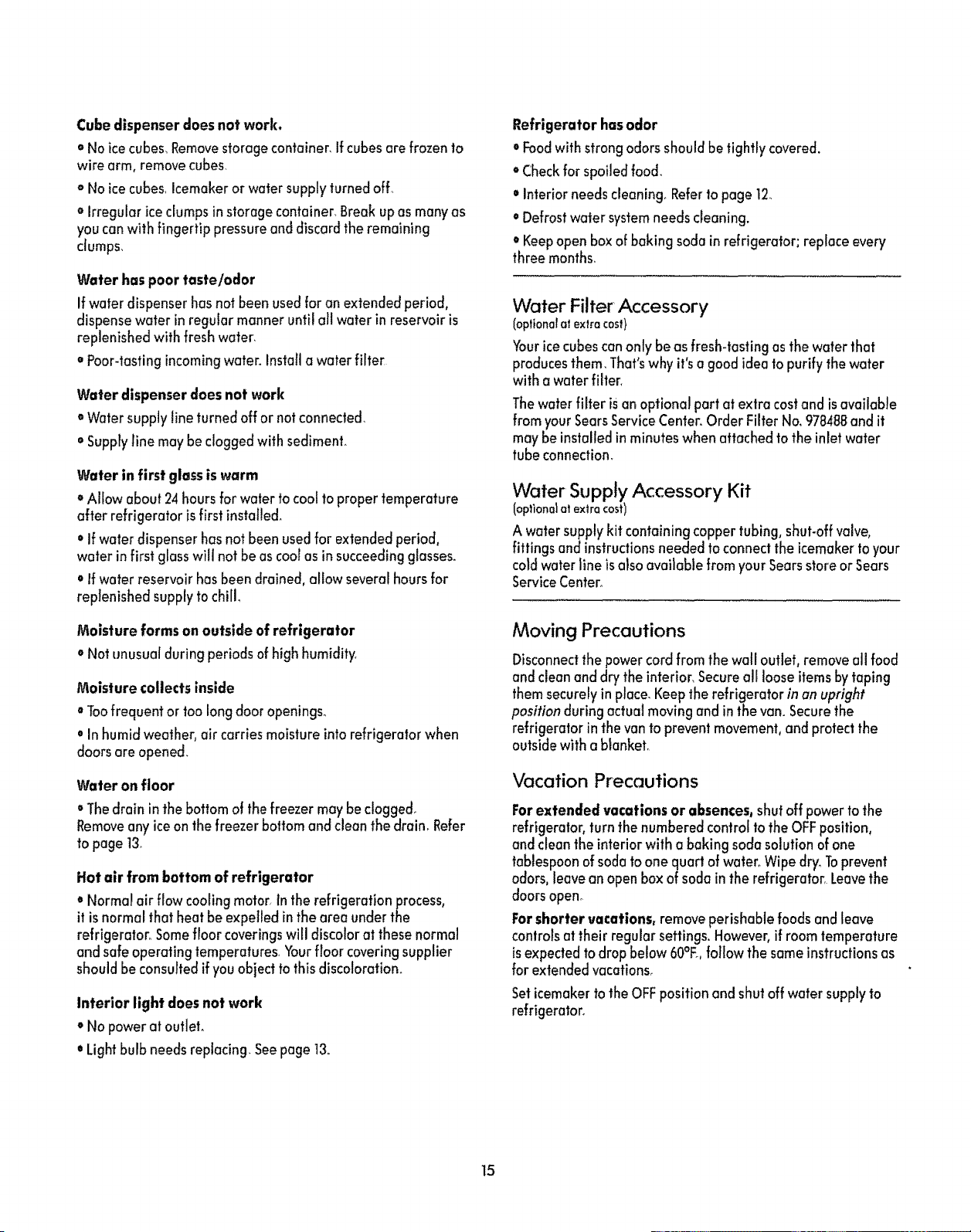
Cubedispenser does not work.
oNo icecubes_Removestoragecontainer, Ifcubesare frozen to
wire arm, remove cubes
o Noicecubes Icemaker or water supply turnedoff
• Irregular iceclumpsin storagecontainer_Breakup asmany as
youcanwith fingertip pressureand discard the remaining
clumps,
Water has poor taste/odor
If water dispenser hasnot been usedfor an extended period,
dispense water in regular manner until all water in reservoir is
replenished with fresh water
• Poor_tastingincomingwater° Installa water filter
Water dispenser doesnot work
• Watersupply line turnedoff or notconnected,
• Supplyline may be cloggedwith sedimenL
Water in first glassis warm
• Allow about 24hours forwater tocoot toproper temperature
after refrigerator isfirstinstalled.
• If water dispenser hasnot beenusedfor extended period,
water in first glasswill not beascool asinsucceedingglasses.
• If water reservoir hasbeen drained,allow severalhoursfor
replenished supply to chill_
Moisture forms on outside of refrigerator
oNot unusualduring periods of high humidity,
Moisture collects inside
• Toofrequentor too longdoor openings_
• In humidweather, air carries moisture intorefrigerator when
doors are opened.
Water on floor
oThedrain inthe bottom of thefreezermay beclogged,
Removeany iceon the freezerbottom and cleanthe drain, Refer
to page t3.
Hot air from bottom of refrigerator
• Normalair flow cooling motor_Intherefrigeration process,
itis normal that heat be expetled in thearea under the
refrigerator° Somefloor coveringswilldiscolor at thesenormal
and safe operating temperaturesYourfloor covering supplier
should be consultedifyou object to thisdiscoloration_
Interior light does not work
• No powerat outlet.
• Lightbulb needsreplacing. Seepage 13o
Refrigerator hasodor
* Foodwith strong odorsshould be tightly covered.
oCheckfor spoiledfood.
aInteriorneedscleaning. Referto page 12_
oDefrost water systemneedscleaning.
oKeepopen boxof baking soda inrefrigerator: replace every
threemonths_
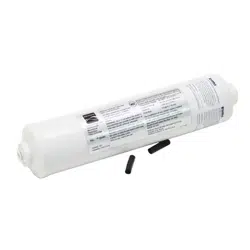
Water Filter Accessory
(optionara_extracos_)
Youricecubescanonlyheasfresh-tastingasthe water that
producesthem,Thatswhy it'sa goodideato purifythe water
with a waterfilter.
Thewaterfilter iSan optional part at extra costand isavailable
fromyour SearsServiceCenter.OrderFilterNor978488andit
may be installedinminutes when attachedtothe inletwater
tubeconnection,
Water Supply Accessory Kit
(op_tionalatextracost)
A water supply kit containing copper tubing, shut-off valve,
fittings and instructions needed to connectthe icemaker toyour
cold water line isalso available fromyourSearsstore or Sears
ServiceCenter.,
Moving Precautions
Disconnectthe powercordfrom thewall outlet, removeal! food
andcleanand dry the interior, Secureall looseitemsbytoping
them securelyin place_Keepthe refrigerator in an upright
position during actual moving and in the van. Securethe
refrigerator in thevan toprevent movement,andprotect the
outside with a blanket.
Vacation Precautions
Forextended vacations or absences,shutoff power tothe
refrigerator, turnthenumberedcontrol tothe OFFposition,
andcleanthe interiorwith a baking sodasolution ofone
tablespoonofsodatoonequartofwater_Wipedry_Toprevent
odors,leavean openbox ofsodainthe refrigerator. Leavethe
doorsopen_
Forshorter eacafions, removeperishablefoodsandleave
controlsat theirregular settings.However,ifroom temperature
isexpectedtodropbelow 60°F,followthesameinstructionsas
forextendedvacations,
Seticemakerto theOFFposition and shut off water supply to
refrigerator_
15
A/RS
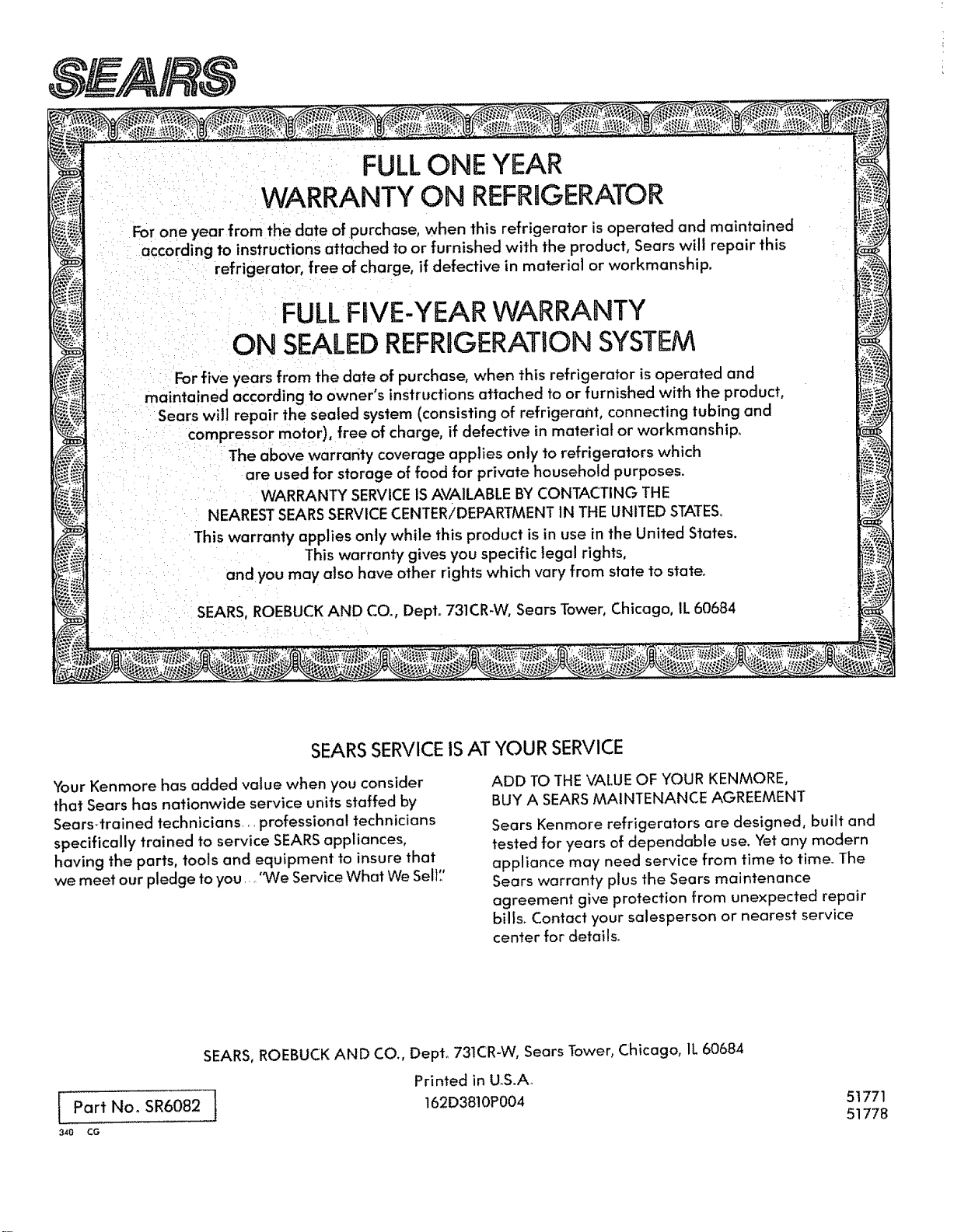
FULLONE YEAR
WARRANTY ON REFRIGERATOR
For one year from the date of purchase, when this refrigerator is operated and maintained
according to instructions attached to or furnished with the product, Sears will repair this
refrigerator, free of charge, if defective in material or workmanship.
FULLFBVE-YEARWARRANTY
ON SEALEDREFRRGERATIONSYSTEM
For five years from the date of purchase, when this refrigerator is operated and
maintained according to owner's instructions attached to or furnished with the product,
Sears will repair the sealed system (consisting of refrigerator, connecting tubing and
compressor motor), free of charge, if defective in material or workmanship.
The above warranty coverage applies only to refrigerators which
are used for storage of food for private household purposes.
WARRANTY SERVICEIS AVAILABLE BY CONTACTING THE
NEAREST SEARSSERVICECENTER/DEPARTMENT IN THE UNITED STATES°
This warranty applies only while this product is in use in the United States.
This warranty gives you specific legal rights,
and you may also have other rights which vary from state to state,.
SEARS, ROEBUCK AND CO., Depto 731CR-W, Sears Tower, Chicago, IL 60684
SEARSSERVICEISAT YOUR SERVICE
Your Kenmore has added value when you consider
that Sears has nationwide service units staffed by
Sears-trained technicians ....professionaltechnicians
specifically trained to service SEARS appliances,
having the parts, tools and equipment to insure that
we meet our pledge to you., '_Ve Service What We Sell'o'
ADD TO THE VALUE OF YOUR KENMORE,
BUY A SEARSMAINTENANCE AGREEMENT
Sears Kenmore refrigerators are designed, built and
tested for years of dependable use. Yet any modern
appliance may need service from time to time. The
Sears warranty ptus the Sears maintenance
agreement give protection from unexpected repair
bills. Contact "your salesperson or nearest service
center for details.
SEARS, ROEBUCK AND CO., Depto 731CR-W, Sears Tower, Chicago, 1L60684
Printed in U_S.A_
I Part No. SR6082 I 162D3810P004
3_0 CG
51771
51778