Installation
Instructions
Free-Standing
Electric
Ranges
Questions?
Call
1.800.GE.CARES
(1.800.432.2737)
or
visit
www.GEAppliances.com
In
Canada,
call
1.800.561.3344
or visit
www.GEAppliances.ca
BEFORE
YOU
BEGIN
Read
these
instructions
completely
and
carefully.
®
IMPORTANT
—
sove
these
instructions
for
local
inspector's
use.
®
IMPORTANT
—
observe
all
°
Proper
installation
is
the
responsibility
of
the
governing
codes
and
ordinances.
. . .
*
Product
failure
due
to
improper
installation
is
e
Note
to
Installer
-
Be
sure
to
leave
these
not
covered
under
warrant
instructions
with
consumer.
y:
e
Note
to
consumer
-
Keep
these
instructions
for
future
reference.
Skill
level
-
Installation
of
this
appliance
requires
a
qualified
installer
or
electrician.
FOR
YOUR
SAFETY:
PNA
SIIMG
Tip-Over
Hazard
%
y
«
Achild
or
adult
can
tip
the
range
and
be
killed.
¢
{install
the
anti-tip
bracket
to
the
wall
or
floor.
«
Engage
the
range
to
the
anti-tip
bracket
by
sliding
the
range
back
such
that
the
foot
is
engaged.
*
Re-engage
the
anti-tip
bracket
if
the
range
is
moved.
*
Failure
to
do
so
can
result
in
death
or
serious
burns
to
children
or
adults.
Anti-Tip
Bracket
Kit
Included
AWARNING
=
Before
beginning
the
installation,
switch
power
off at
service
panel
and
lock
the
service
disconnecting
if
you
did
not
receive
an
anti-tip
bracket
with
your
purchase,
call
1.800.626.8774
to
receive
one
at
no
cost.
{In
Canada, means
to
prevent
power
from
being
call
1.800.561.3344}
For
installation
instructions
of
the
bracket,
switched
on
accidentally.
When
the
service
visit:
www.GEAppliances.com.
{In
Canada,
www.GEAppliances.ca)
disconnecting
means
cannot
be
locked,
securely
fasten
a
prominent
warning
device,
such
as
a
tag,
to
the
service
panel.
TOOLS
YOU
WILL
NEED
Drill
with
1/8”
Bit
Tin
Snips
Safety
Glasses
Tape
Measure
Adjustable
Wrench
Pliers
(UL
Listed
40
AMP)
Level
1/4”
Nut
Driver
4-Wire
Cord
4
long
OR
3-Wire
Cord
4’
long
MATERIALS
YOU
MAY
NEED
Squeeze
Connector
(For
Conduit
Installations
Only)
[4]
REMOVE
PACKAGING
MATERIALS:
railure
to
remove
packaging
materials
could
result
in
darnage
to
the
appliance.
Remove
all
packing
parts
from
oven,
racks,
heating
elements
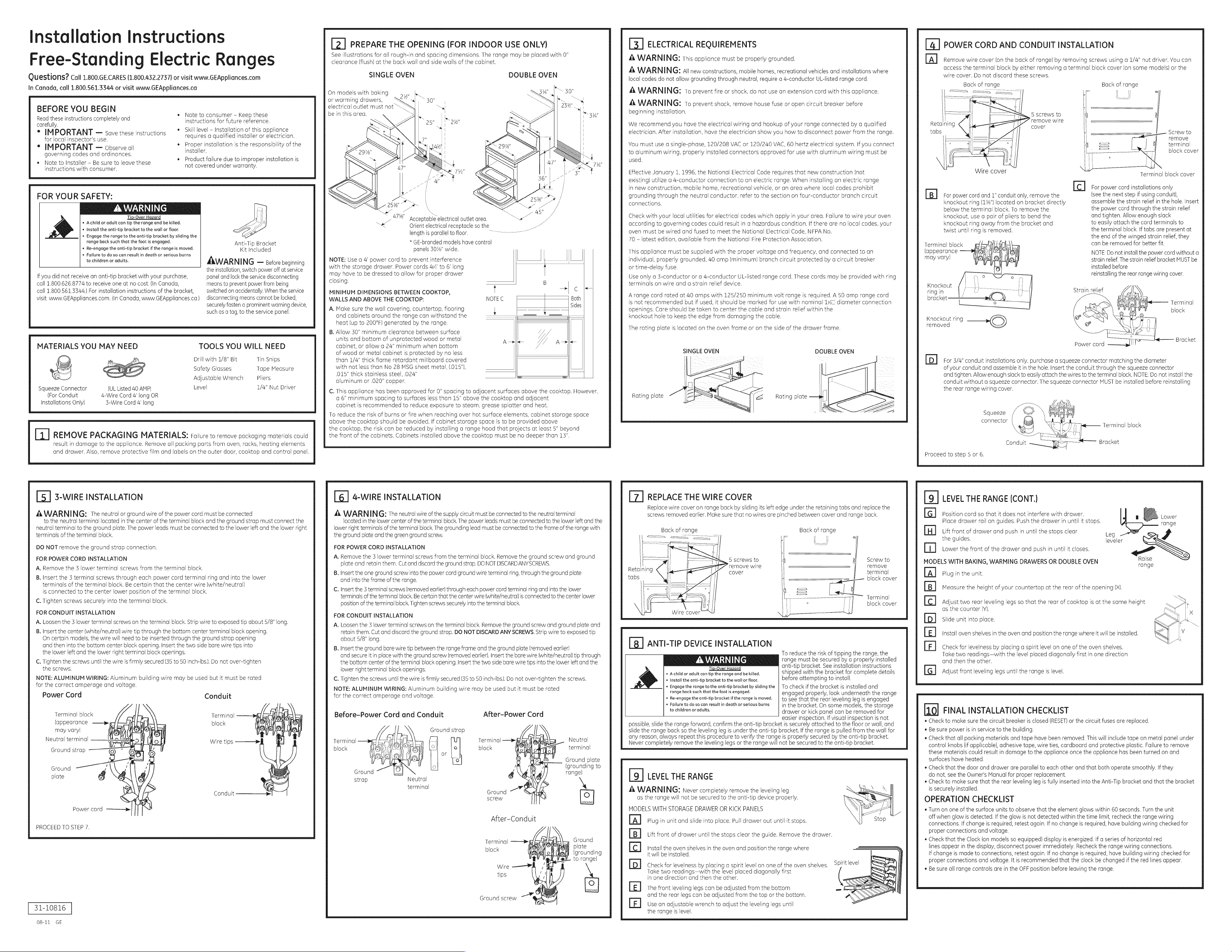
[2]
PREPARE
THE
OPENING
(FOR
INDOOR
USE
ONLY)
See
illustrations
for
all
rough-in
and
spacing
dimensions.
The
range
may
be
placed
with
0”
clearance
(flush)
at
the
back
wall
and
side
walls
of
the
cabinet.
SINGLE
OVEN
DOUBLE
OVEN
On
models
with
baking
or
warming
drawers,
~S
electrical
outlet
must
not
be
in
this
area.
2
2
“
on
25%
|
Nae
ein
\
47%
Acceptable
electrical
outlet
area.
Orient
electrical
receptacle
so
the
length
is
parallel
to
floor.
oe
*
GE-branded
models
have
control
panels
307”
wide.
NOTE:
Use
a 4’
power
cord
to
prevent
interference
with
the
storage
drawer.
Power
cords
4%’
to
6’
long
may
have
to
be
dressed
to
allow
for
proper
drawer
closing.
MINIMUM
DIMENSIONS
BETWEEN
COOKTOP,
WALLS
AND
ABOVE
THE
COOKTOP:
A.
Make
sure
the
wall
covering,
countertop,
flooring
and
cabinets
around
the
range
can
withstand
the
heat
(up
to
200°F)
generated
by
the
range.
B.
Allow
30”
minimum
clearance
between
surface
units
and
bottom
of
unprotected
wood
or
metal
cabinet,
or
allow
a
24”
minimum
when
bottom
of
wood
or
metal
cabinet
is
protected
by
no
less
than
1/4’
thick
flame
retardant
millboard
covered
with
not
less
than
No
28
MSG
sheet
metal,
(.015”),
.015”
thick
stainless
steel,
024”
aluminum
or
.020”
copper.
C.
This
appliance
has
been
approved
for
0”
spacing
to
adjacent
surfaces
above
the
cooktop.
However,
a
6”
minimum
spacing
to
surfaces
less
than
15”
above
the
cooktop
and
adjacent
cabinet
is
recommended
to
reduce
exposure
to
steam, grease
splatter
and
heat.
To
reduce
the
risk
of
burns
or
fire
when
reaching
over
hot
surface
elements,
cabinet
storage
space
above
the
cooktop
should
be
avoided.
If
cabinet
storage
space
is
to
be
provided
above
the
cooktop,
the
risk
can
be
reduced
by
installing
a
range
hood
that
projects
at
least
5”
beyond
the
front
of
the
cabinets.
Cabinets
installed
above
the
cooktop
must
be
no
deeper
than
13”.
[3]
ELECTRICAL
REQUIREMENTS
A
WARNING:
this
appliance
must
be
properly
grounded.
A
WARNING:
ali
new
constructions,
mobile
homes,
recreational
vehicles
and
installations
where
local
codes
do
not
allow
grounding
through
neutral,
require
a
4-conductor
UL-listed
range
cord.
A
WARNING:
to
prevent
fire
or
shock,
do
not
use
an
extension
cord
with
this
appliance.
A
WARNING:
To
prevent
shock,
remove
house
fuse
or
open
circuit
breaker
before
beginning
installation.
We
recommend
you
have
the
electrical
wiring
and
hookup
of
your
range
connected
by
a
qualified
electrician.
After
installation,
have
the
electrician
show
you
how
to
disconnect
power
from
the
range.
You
must
use
a
single-phase,
120/208
VAC
or
120/240
VAC,
60
hertz
electrical
system.
If
you
connect
to
aluminum
wiring,
properly
installed
connectors
approved
for
use
with
aluminum
wiring
must
be
used.
Effective
January
1,
1996,
the
National
Electrical
Code
requires
that
new
construction
(not
existing]
utilize
a
4-conductor
connection
to
an
electric
range.
When
installing
an
electric
range
in
new
construction, mobile
home,
recreational
vehicle,
or
an
area
where
local
codes
prohibit
grounding
through
the
neutral
conductor,
refer
to
the
section
on
four-conductor
branch
circuit
connections.
Check
with
your
local
utilities
for
electrical
codes
which
apply
in
your
area.
Failure
to
wire
your
oven
according
to
governing
codes
could
result
in a
hazardous
condition.
If
there
are
no
local
codes,
your
oven
must
be
wired and
fused
to
meet
the
National
Electrical
Code,
NFPA
No.
70
-
latest
edition,
available
from
the
National
Fire
Protection
Association.
This
appliance
must
be
supplied
with
the
proper
voltage and
frequency,
and
connected
to
an
individual,
properly
grounded,
40
amp
(minimum)
branch
circuit
protected
by
a
circuit
breaker
or
time-delay
fuse.
Use
only
a
3-conductor
or
a
4-conductor
UL-listed
range
cord.
These
cords
may
be
provided
with
ring
terminals
on
wire
and
a
strain
relief
device.
A
range
cord
rated
at
40
amps
with
125/250
minimum
volt
range
is
required.
A
50
amp
range
cord
is
not
recommended
but
if
used,
it
should
be
marked
for
use
with
nominal
1%2
diameter
connection
openings.
Care
should
be
taken
to
center
the
cable
and
strain
relief
within
the
knockout
hole
to
keep
the
edge
from
damaging
the
cable.
The
rating
plate
is
located
on
the
oven
frame
or
on
the
side
of
the
drawer
frame.
SINGLE
OVEN
DOUBLE
OVEN
Rating
plate
and
drawer.
Also,
remove
protective
film
and
labels
on
the
outer
door,
cooktop
and
control
panel.
[a]
POWER
CORD
AND
CONDUIT
INSTALLATION
Remove
wire
cover
(on
the
back
of
range)
by
removing
screws
using
a
1/4”
nut
driver.
You
can
access
the
terminal
block
by
either
removing
a
terminal
block
cover
{on
some
models}
or
the
wire
cover.
Do
not
discard
these
screws.
Back
of
range
Back
of
range
—
—
»
5
screws
to
be
pe”
remove
wire
Retaining
cover
tabs
et
Screw
to
=
ra,
remove
cose
terminal
block
cover
Wire
cover
Terminal
block
cover
For
power
cord
installations
only
(see
the
next
step
if
using
conduit),
assemble
the
strain
relief
in
the
hole.
Insert
the
power
cord
through
the
strain
relief
and
tighten.
Allow
enough
slack
to
easily
attach
the
cord
terminals
to
the
terminal
block.
If
tabs
are
present
at
the
end
of
the
winged
strain
relief,
they
can
be
removed
for
better
fit.
For
power
cord
and
1”
conduit
only,
remove
the
knockout
ring
(1%”)
located
on
bracket
directly
below
the
terminal
block.
To
remove
the
knockout,
use
a
pair
of
pliers
to
bend
the
knockout
ring
away
from
the
bracket
and
twist
until
ring
is
removed.
Terminal
block
lappearance
NOTE:
Do
not
install
the
power
cord
without
a
may
vary}
strain
relief.
The
strain
relief
bracket
MUST
be
installed
before
reinstalling
the
rear
range
wiring
cover.
Knockout
: .
ring
in
Strain
relief
bracket
.
Terminal
block
Knockout
ring
removed
\
Power
cord
[p]
For
3/4”
conduit
installations
only,
purchase
a
squeeze
connector
matching
the
diameter
of
your
conduit
and
assemble
it
in
the
hole.
Insert
the
conduit
through
the
squeeze
connector
and
tighten.
Allow
enough
slack
to
easily
attach
the
wires
to
the
terminal
block.
NOTE:
Do
not
install
the
conduit
without
a
squeeze
connector.
The
squeeze
connector
MUST
be
installed
before
reinstalling
the
rear
range
wiring
cover.
Squeeze
connector
Terminal
block
Conduit
:
os
Bracket
Proceed
to
step
5
or
6.
[5
|
3-WIRE
INSTALLATION
A
WARNING:
The
neutral
or
ground
wire
of
the
power
cord
must
be
connected
to
the
neutral
terminal located
in
the
center
of
the
terminal
block
and
the
ground
strap
must
connect
the
neutral
terminal
to
the
ground
plate.
The
power
leads
must
be
connected
to
the
lower
left
and
the
lower
right
terminals
of
the
terminal
block.
DO
NOT
remove
the
ground
strap
connection.
FOR
POWER
CORD
INSTALLATION
A.
Remove
the
3
lower
terminal
screws
from
the
terminal
block.
B.
Insert
the
3
terminal
screws
through
each
power
cord
terminal
ring
and
into
the
lower
terminals
of
the
terminal
block.
Be
certain
that
the
center
wire
(white/neutral]
is
connected
to
the
center
lower
position
of
the
terminal
block.
C.
Tighten
screws
securely
into
the
terminal
block.
FOR
CONDUIT
INSTALLATION
A.
Loosen
the
3
lower
terminal
screws
on
the
terminal
block.
Strip
wire
to
exposed
tip
about
5/8”
long.
B.
Insert
the
center
(white/neutral]
wire
tip
through
the
bottom
center
terminal
block
opening.
On
certain
models,
the
wire
will
need
to
be
inserted
through
the
ground
strap
opening
and
then
into
the
bottorn
center
block
opening.
Insert
the
two
side
bare
wire
tips
into
the
lower
left
and
the
lower
right
terminal
block
openings.
C.
Tighten
the
screws
until
the
wire
is
firmly
secured
(35
to
50
inch-lbs..
Do
not
over-tighten
the
screws.
NOTE:
ALUMINUM
WIRING:
Aluminum
building
wire
may
be
used
but
it
must
be
rated
for
the
correct
amperage
and
voltage.
Power
Cord
Conduit
Terminal
block
Terminal
lappearance
——_p
block
may
vary)
Neutral
terminal
Ground
strap
Ground
plate
PROCEED
TO
STEP
7.
08-11
GE
[6]
4-WIRE
INSTALLATION
A.
WARNING:
the
neutral
wire
of
the
supply
circuit
must
be
connected
to
the
neutral
terminal
located
in
the
lower
center
of
the
terminal
block.
The
power
leads
must
be
connected
to
the
lower
left
and
the
lower
right
terminals
of
the
terminal
block.
The
grounding
lead
must
be
connected
to
the
frame
of
the
range
with
the
ground
plate
and
the
green
ground
screw.
FOR
POWER
CORD
INSTALLATION
A,
Remove
the
3
lower
terminal
screws
from
the
terminal
block.
Remove
the
ground
screw
and
ground
plate
and
retain
them.
Cut
and
ciscard
the
ground
strap.
DO
NOT
DISCARD
ANY
SCREWS.
B.
Insert the
one
ground
screw
into
the
power
cord
ground
wire
terminal
ring,
through
the
ground
plate
and
into
the
frame
of
the
range.
C.
Insert
the
3
terrninal
screws
(removed
earlier)
through
each
power
cord
terminal
ring
and
into
the
lower
terminals
of
the
terminal
block.
Be
certain
that
the
center
wire
(white/neutrall
is
connected
to
the
center
lower
position
of
the
terminal
block.
Tighten
screws
securely
into
the
terminal
block.
FOR
CONDUIT
INSTALLATION
A.
Loosen
the
3
lower terminal
screws
on
the
terminal
block.
Remove
the
ground
screw
and
ground
plate
and
retain
them.
Cut
and
discard
the
ground
strap.
DO
NOT
DISCARD
ANY
SCREWS.
Strip
wire
to
exposed
tip
about
5/8”
long.
B.
Insert the
ground
bare
wire
tip
between
the
range
frame
and
the
ground
plate
(removed
earlier}
and secure
it
in
place
with
the
ground
screw
(removed
earlier).
Insert
the
bare
wire
(white/neutral
tio
through
the
bottorn
center
of
the
terminal
block
opening.
Insert
the
two
side
bare
wire
tips
into
the
lower
left
and
the
lower
right
terrninal
block
openings.
C.
Tighten
the
screws
until
the
wire
is
firmly
secured
(35
to
50
inch-lbs}.
Do
not
over-tighten
the
screws.
NOTE:
ALUMINUM
WIRING:
Aluminum
building
wire
may
be
used
but
it
must
be
rated
for
the
correct
amperage
and
voltage.
After~Power
Cord
Before-Power
Cord
and
Conduit
Ground
strap
Neutral
terminal
Ground
plate
(grounding
to
range]
ROUND!
strap
Neutral
terminal
Terminal
sh
@leia
ate
block
Ha
etl
(grounding
ql
/
to
range}
Wire
rd
Ue
tips
\
[7]
REPLACE
THE
WIRE
COVER
Replace
wire
cover
on
range
back
by
sliding
its
left
edge under
the
retaining
tabs
and
replace
the
screws
removed
earlier.
Make
sure
that
no
wires
are
pinched
between
cover
and
range
back.
Back
of
range
ata
ent
5
screws
to
Screw
to
ue
remove
wire
remove
Retaining
cover
terminal
tabs
Tat
block
cover
Terminal
block
cover
To
reduce
the
risk
of
tipping
the
range,
the
range
must
be
secured
by
a
properly
installed
anti-tip
bracket.
See
installation
instructions
shipped
with
the
bracket
for
complete
details
before
attempting
to
install.
%
Tip-Over
Hazard
A
°
Achild
or
adult
can
tip
the
range
and
be
killed.
*
Install
the
anti-tip
bracket
to
the
wall
or
floor.
:
*
Engage
the
range
to
the
anti-tip
bracket
by
sliding
the
|
To
check
if
the
bracket
is
installed
and
range
back
such
that
the
foot
is
engaged.
engaged
properly,
look
underneath
the
range
*
Re-engage
the
anti-tip
bracket
if
the
range
is
moved.
to
see
that
the
rear
leveling
leg
is
engaged
°
Failure
to
do
so
can
result
in
death
or
serious
burns
in
the
bracket.
On
some
models,
the
storage
to
children
or
adults.
drawer
or
kick
panel
can
be
removed
for
easier
inspection.
If
visual
inspection
is
not
possible,
slide
the
range
forward,
confirm
the
anti-tip
bracket
is
securely
attached
to
the
floor
or
wall,
and
slide
the
range
back
so
the
leveling
leg
is
under
the
anti-tip
bracket.
If
the
range
is
pulled
from
the
wall
for
any
reason,
always
repeat
this
procedure
to
verify
the
range
is
properly
secured
by
the
anti-tip
bracket
Never
completely
remove
the
leveling
legs
or
the
range
will
not
be
secured
to
the
anti-tip
bracket.
[9]
LEVEL
THE
RANGE
(CONT.)
Position
cord
so
that
it
does
not
interfere
with
drawer.
i
2
Lower
Place
drawer
rail
on
guides.
Push
the
drawer
in
until
it
stops.
range
Lift
front
of
drawer
and
push
in
until
the
stops
clear
the
guides.
ies
a
4
[1]
Lower
the
front
of
the
drawer
and
push
in
until
it
closes.
.
S
MODELS
WITH
BAKING,
WARMING
DRAWERS
OR
DOUBLE
OVEN
re
Plug
in
the
unit.
Measure
the
height
of
your
countertop
at
the
rear
of
the
opening
{x).
Adjust
two
rear
leveling
legs
so
that
the
rear
of
cooktop
is
at
the
same
height
as
the
counter
(Y).
Slide
unit
into
place.
Install
oven
shelves
in
the
oven
and
position
the
range
where
it
will
be
installed.
El
ele]
el
ele!
Check
for
jevelness
by
placing
a
spirit
level
on
one
of
the
oven
shelves.
Take
two
readings—with
the
level
placed
diagonally
first
in
one
direction
and
then
the
other.
Adjust
front
leveling
legs
until
the
range
is
level.
e]
[9]
LEVEL
THE
RANGE
A
WARNING:
never
completely
remove
the
leveling
leg
as
the
range
will
not
be
secured
to
the
anti-tip
device
properly.
MODELS
WITH
STORAGE
DRAWER
OR
KICK
PANELS
Plug
in
unit
and
slide
into
place.
Pull
drawer
out
until
it
stops.
Lift
front
of
drawer
until
the
stops
clear
the
guide.
Remove
the
drawer.
Install
the
oven
shelves
in
the
oven
and
position
the
range
where
it
will
be
installed.
Check
for
levelness
by
placing
a
spirit
level
on
one
of
the
oven
shelves.
Spirit
level
Take
two
readings—with
the
level
placed
diagonally
first
in
one
direction
and
then
the
other.
The
front
leveling
legs
can
be
adjusted
from
the
bottom
we
&
and
the
rear
legs
can
be
adjusted
from
the
top
or
the
bottom.
Fle]
&)
eel]
Use
an
adjustable
wrench
to
adjust
the
leveling
legs
until
the
range
is
level.
FINAL
INSTALLATION
CHECKLIST
*
Check
to
make
sure
the
circuit
breaker
is
closed
(RESET)
or
the
circuit
fuses
are
replaced.
*
Be
sure
power
is
in
service
to
the
building.
*
Check
that
all
packing
materials
and
tape
have been
removed.
This
will
include
tape
on
metal
panel
under
control
knobs
(if
applicable},
adhesive
tape,
wire
ties,
cardboard
and
protective
plastic.
Failure
to
remove
these
materials
could
result
in
damage
to
the
appliance
once
the
appliance
has
been
turned
on
and
surfaces
have
heated.
*
Check
that
the
door
and
drawer
are
parallel
to
each
other
and
that
both
operate
smoothly.
If
they
do
not,
see
the
Owner’s
Manual
for
proper
replacement.
*
Check
to
make
sure
that
the
rear
leveling
leg
is
fully
inserted
into
the
Anti-Tip
bracket
and
that
the
bracket
is
securely
installed.
OPERATION
CHECKLIST
*
Turn
on
one
of
the
surface
units
to
observe
that
the
element
glows
within
60
seconds.
Turn
the
unit
off
when
glow
is
detected.
If
the
glow
is
not
detected
within
the
time
limit,
recheck
the
range
wiring
connections.
If
change
is
required,
retest
again.
If
no
change
is
required,
have
building
wiring
checked
for
proper
connections
and
voltage.
*
Check
that
the
Clock
fon
models
so
equipped)
display
is
energized.
If
a
series
of
horizontal
red
lines
appear
in
the
display,
disconnect
power
immediately.
Recheck
the
range
wiring
connections.
if
change
is
made
to
connections,
retest
again.
If
no
change
is
required,
have
building
wiring
checked
for
proper
connections
and
voltage.
It
is
recommended
that
the
clock
be
changed
if
the
red
lines
appear.
*
Be
sure
all
range
controls
are
in
the
OFF
position
before
leaving
the
range.
Instrucciones
de
instalacion
Cocinas
eléctricas
independientes
éPreguntas?
Llamada
1.800.GE.CARES
(1.800.432.2737)
o
visita
www.GEAppliances.com
En
Canadé,
llame
1.800.561.3344
0
visita
www.GEAppliances.ca
ANTES
DE
COMENZAR
*
Nota
al
consumidor
-
Conserve
estas
instrucciones
para
referencia
futura.
*
Nivel
de
destreza
-
La
instalacién
de
este
aparato
debe
efectuarla
un
instalador
o
electricista
calificado.
e
El
instalador
tiene
la
responsabilidad
de
efectuar
una
instalacién
adecuada.
*
Lagarantia
no
cubre
las
fallas
del
producto
debido
a
una
instalaci6n
incorrecta.
Lea
estas
instrucciones
por
completo
y
con
detenimiento.
*
IMPORTANTE
—
Guarde
estas
instrucciones
para
el
uso
de
inspectores
locales.
*
IMPORTANTE
—
siga
todos
los
cédigos
y
ordenanzas
vigentes.
e
Nota
al
instalador
~
Aseguirese
de
dejar
estas
instrucciones
con
el
consumidor.
PARA
SU
SEGURIDAD
AADVERTENCIA
Riesgo
de
Caida
%
AA
«
Un
nifio
o
adulto
pueden
volear
la
cocina
y
morir.
«
{nstale
el
soporte
anti-volcaduras
sobre
la
pared
o
el
piso.
¢
Adhiera
la
estufa
al
soporte
anti-volcaduras,
volviendo
a
deslizar
la
estufa
de
modo
que
el
pie
quede
adherido.
«
Vuelva
a
adherir
el
soporte
anti-volcaduras
si
la
estufa
se
mueve
de
lugar.
«
Si
esto
nose
hace,
se
podré
producir
la
muerte
o
quemaduras
graves
en nifios
o
adultos.
Kit
de
soporte
anti-volcaduras
incluido
Ay
ADVERTENCIA
—
antes
de
comenzar
Ia
instalacion,
apague
el
encendido
en
el
panel
de
servicio
y
bloquee
el
medio
de
desconexi6n
del
servicio
a
fin
de
evitar
que
el
encendido
se
active
de
forma
accidental.
Cuando
el
medio
de
desconexién
del
servicio
no
se
pueda
bloquear,
ajuste
de
manera
segura
un
item
de
advertencia
que
esté bien
visible,
tal
como
una
etiqueta,
sobre
el
panel
de
servicio.
Si
no
recibid
un
soporte
anti
volcaduras
con
su
compra,
llame
al
1.800.626.8774
para
recibir
uno
sin
costo.
{En
Canada,
llame
al
1.800.561.3344).
Para
recibir
instrucciones
de
instalacién
del
soporte,
visite:
GEAppliances.com
{En
Canada,
GEAppliances.ca)].
HERRAMIENTAS
NECESARIAS
Perforadora
con
Tijeras
para
MATERIALES
QUE
PUEDE
NECESITAR
broca
de
1/8”
hojalata
eae”
Some
Gafas
de
Cinta
métrica
Conector
de
presién
(Aprobados
por
UL
de
40
AMP}
seguridad
Alicates
(S6lo
para
instalaciones
Cable
de
4
alambres
de
4’
Llave
ajustable
Llave
de
tuercas
con
conductos
de
largo
O
Cable
de
3
alambres
.
°
portacables|
de
4’
de
largo
Nivel
de
1/4
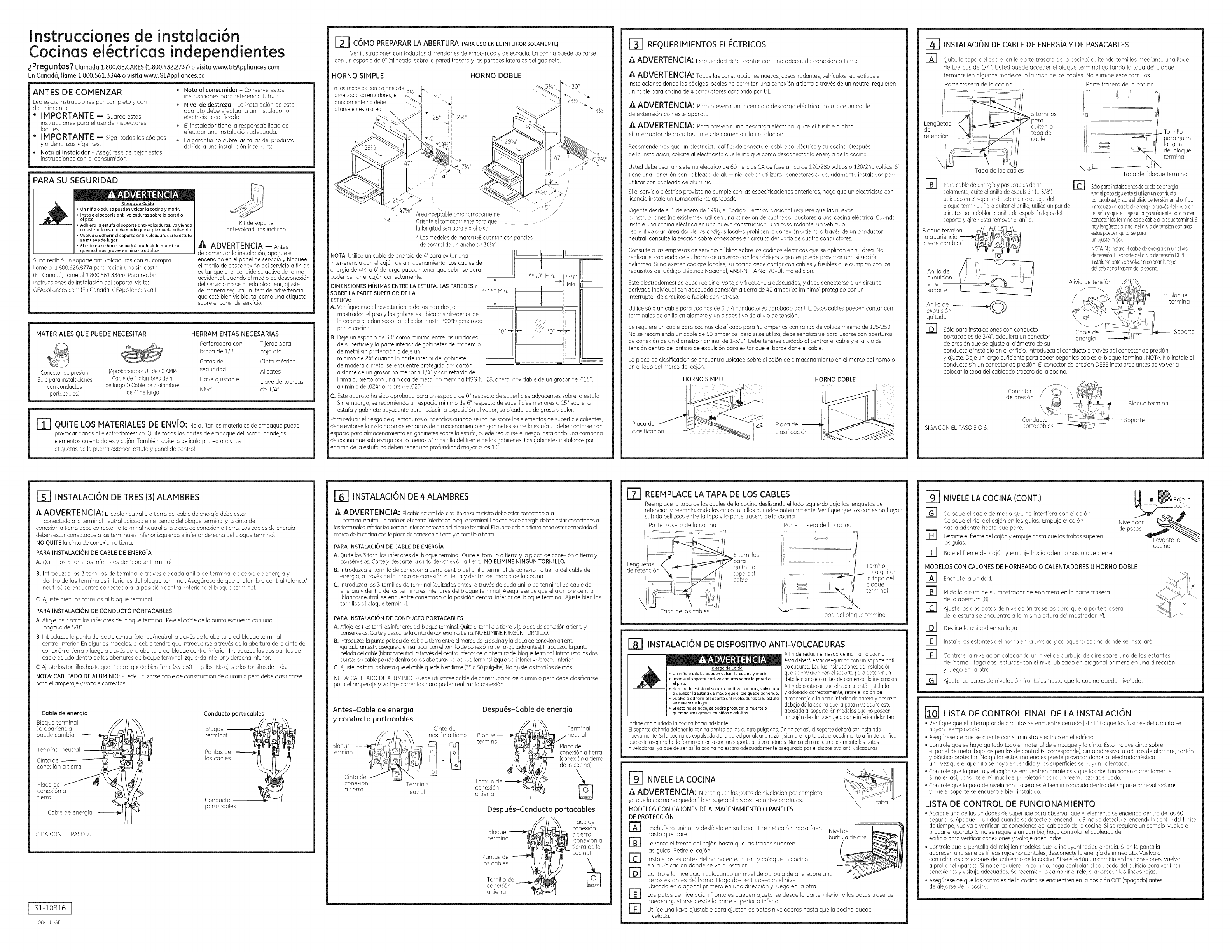
[2]
COMO
PREPARAR
LA
ABERTURA
(para
USO
EN
EL
INTERIOR
SOLAMENTE]
Ver
ilustraciones
con
todas
las
dimensiones
de
empotrado
y
de
espacio.
La
cocina
puede
ubicarse
con
un
espacio
de
0”
{alineado}
sobre
la
pared
trasera
y
las
paredes
laterales
del
gabinete.
HORNO
DOBLE
HORNO
SIMPLE
En
los
modelos
con
cajones
de
horneado
o
calentadores,
el
tomacorriente
no
debe
hallarse
en
esta
drea.
ean
~
Ya"
NN
.
oN
4
45°
ae
Area
aceptable
para
tomacorriente.
.
oN
Oriente
el
tomacorriente
para
que
ae
la
longitud
sea
paralela
al
piso.
*
Los
modelos
de
marca
GE
cuentan
con
paneles
de
control
de un
ancho
de
30%".
NOTA:
Utilice
un
cable
de
energia
de
4’
para
evitar
una
|__|
|
—_]L___
L_
interferencia
con
el
cajon
de
almacenamiento.
Los
cables
de
energia
de
414’
a
6'
de
largo
pueden
tener
que
cubrirse
para
poder
cerrar
el
cajon
correctamente.
DIMENSIONES
MINIMAS
ENTRE
LA
ESTUFA,
LAS
PAREDES
Y
SOBRE
LA
PARTE
SUPERIOR
DE
LA
ESTUFA;
A.
Verifique
que
el
revestimiento
de
las
paredes,
el
mostrador,
el
piso
y
los
gabinetes
ubicados
alrededor
de
la
cocina
puedan
soportar
el
calor
(hasta
200°F}
generado
por
la
cocina.
**30”
Min.
HKG"
Min.
=e
t
**15"
Min.
B.
Deje
un
espacio
de
30”
como
minimo
entre
las
unidades
de
superficie
y
la
parte
inferior
de
gabinetes
de
madera
o
de
metal
sin
protecci6én
o
deje
un
minimo
de
24”
cuando
la
parte
inferior
del
gabinete
de
madera
o
metal
se
encuentre
protegida
por
carton
alslante
de un
grosor
no
menor
a
1/4”
y
con
retardo
de
llarna
cubierto
con una
placa
de
metal
no
menor
a
MSG
N°
28,
acero
inoxidable
de un
grosor
de
.015”,
aluminio
de
.024”
o
cobre
de
.020”.
C.
Este
aparato
ha
sido
aprobado
para
un
espacio
de
0”
respecto
de
superficies
adyacentes
sobre
la
estufa.
Sin
embargo,
se
recomienda
un
espacio
minimo
de
6”
respecto
de
superficies
menores
a
15”
sobre
la
estufa
y
gabinete
adyacente
para
reducir
la
exposicién
al
vapor,
salpicaduras
de
grasa
y
calor.
[3
|
REQUERIMIENTOS
ELECTRICOS
A
ADVERTENCIA:
esta
unidad
debe
contar
con
una
adecuada
conexién
a
tierra.
A
ADVERTENCIA:
todas
las
construcciones
nuevas,
casas
rodantes,
vehiculos
recreativos
e
instalaciones
donde
los
cddigos
locales
no
permiten
una
conexién
a
tierra
a
través
de un
neutral
requieren
un
cable
para
cocina
de
4
conductores
aprobado
por
UL.
A
ADVERTENCIA:
para
prevenir
un
incencio
o
descarga
eléctrica,
no
utilice
un
cable
de
extensidn
con
este
aparato.
4
ADVERTENCIA:
Para
prevenir
una
descarga
eléctrica,
quite
el
fusible
o
abra
el
interruptor
de
circuitos
antes
de
comenzar
la
instalacién.
Recomendamos
que
un
electricista
calificado
conecte
el
cableado
eléctrico
y
su
cocina.
Después
de
la
instalacion,
solicite
al
electricista
que
le
indique
cémo
desconectar
la
energia
de
la
cocina.
Usted
debe
usar
un
sistema
eléctrico
de 60
hercios
CA
de
fase
Unica
de
120/280
valtios
o
120/240
valtios.
Si
tiene
una
conexién
con
cableaco
de
aluminio,
deben
utilizarse
conectores
adecuadamente
instalados
para
utilizar
con
cableado
de
aluminio.
Si
el
servicio
eléctrico
provisto
no
cumple
con
las
especificaciones
anteriores,
haga
que
un
electricista
con
licencia
instale
un
tomacorriente
aprobado.
Vigente
desde
el
1
de
enero
de
1996,
el
Codigo
Eléctrico
Nacional
requiere
que
las
nuevas
construcciones
(no
existentes)
utilicen
una
conexion
de
cuatro
conductores
a
una
cocina
eléctrica.
Cuando
instale
una
cocina
eléctrica
en
una
nueva
construccién,
una
casa rodante,
un
vehiculo
recreativo
o
un
area
donde
los
cédigos
locales
prohiben
la
conexién
a
tierra
a
través
de un
conductor
neutral,
consulte
la
seccién
sobre
conexiones
en
circulto
derivado
de
cuatro
conductores.
Consulte
a
las
empresas
de
servicio
publico
sobre
los
codigos
eléctricos
que
se
aplican
en
su
drea.
No
realizar
el
cableado
de
su
horno
de
acuerdo
con
los
codigos
vigentes
puede
provocar
una
situacion
peligrosa.
Si
no
existen
codigos
locales,
su
cocina
debe
contar
con
cables
y
fusibles
que
cumplan
con
los
requisitos
del
Codigo
Eléctrico
Nacional,
ANSI/NFPA
No.
70-Ultima
edicién.
Este
electrodoméstico
debe
recibir
el
voltaje
y
frecuencia
adecuados,
y
debe
conectarse
a
un
circuito
derivado
individual
con
adecuada
conexi6n
a
tierra
de 40
amperios
(minimo}
protegido
por
un
interruptor
de
circuitos
o
fusible
con
retraso.
Utilice
sdlo
un
cable
para
cocinas
de
3
o 4
conductores
aprobado
por
UL.
Estos
cables
pueden
contar
con
terminales
de
anillo
en
alambre
y
un
dispositivo
de
alivio
de
tension.
Se
requiere
un
cable
para
cocinas
clasificado
para
40
amperios
con
rango
de
voltios
minimo
de
125/250.
No
se
recomienda
un
cable
de
50
amperios,
pero
si
se utiliza,
debe
sefializarse
para
usarse
con
aberturas
de
conexién
de un
didmetro
nominal
de
1-3/8”.
Debe
tenerse
cuidado
al
centrar
el
cable
y
el
alivio
de
tension
dentro
del
orificio
de
expulsién
para
evitar
que
el
borde
dane
el
cable.
La
placa
de
clasificacién
se
encuentra
ubicada
sobre
el
cajon
de
almacenamiento
en
el
marco
del
horno
o
en
el
lado
del
marco
del
caj6n.
HORNO
SIMPLE
HORNO
DOBLE
[4]
INSTALACION
DE
CABLE
DE
ENERGIA
Y
DE
PASACABLES
Quite
la
tapa
del
cable
(en
la
parte
trasera
de
!a
cocina)
quitando
tornillos
mediante
una
llave
de
tuercas
de
1/4”.
Usted
puede
acceder
el
bloque
terminal
quitando
la
tapa
del
bloque
terminal
{en
algunos
modelos}
0
la
tapa
de
los
cables.
No
elimine
esos
tornillos.
Parte
trasera
de
la
cocina
5
tornillos
para
guitar
la
tapa
cel
cable
Lengletas
de
retencion
Tornillo
para
quitar
la
tapa
del
bloque
terminal
|
|
|
Tapa
de
los
cables
2
Para
cable
de
energia
y
pasacables
de
1”
solamente,
quite
el
anillo
de
expulsion
(1-3/8")
ubicado
en
el
soporte
directamente
cebajo
del
bloque
terminal.
Para
quitar
el
anillo, utilice
un
par
de
alicates
para
coblar
el
anillo
de
expulsion
lejos
del
soporte
y
gire
hasta
remover
el
anillo.
Tapa
del
bloque
terminal
Sélo
para
instalaciones
de
cable
de
energia
(ver
el
paso
siguiente
si
utiliza
un
conducto
portacables),
instale
el
alivio
de
tensidn
en
el
orificio.
Introduzca
el
cable
de
energia
a
través
del
alivio
de
tension
y
ajuste.
Deje
un
largo
suficiente
para
pocler
conectar
las
terminales
de
cable
al
bloque
terminal.
Si
hay
lenglietas
al
final
del
alivio
de
tension
con
alas,
be
=
éstas
pueden
quitarse
para
|
un
ajuste mejor.
NOTA:
No
instale
el
cable
de
energia
sin
un
alivio
de
tensi6n.
E}
soporte
del
alivio
de
tension
DEBE
instalarse
antes
de
volver
a
colocar
la
tapa
del
cableado
trasero
de
la
cocina.
Bloque
terminal
(ia
apariencia
puede
cambiar]
Anillo
de
expulsion
.
v.
Alivio
de
tensi6n
soporte
Anillo
de
expulsi6n
/
quitado
Bloque
terminal
[po]
Sélo
para
instalaciones
con
conducto
Cabie
de
portacables
de
3/4”,
adquiera
un
conector
energia
de
presién que
se
ajuste
al
didmetro
cde
su
conducto
e
instdlelo
en
el
orificio.
Introduzca
el
conducto
a
través
del
conector
de
presién
y
ajuste.
Deje
un
largo
suficiente
para
poder pegar
los
cables
al
bloque
terminal.
NOTA:
No
instale
e/
conducto
sin
un
conector
de
presion.
El
conector
de
presién
DEBE
instalarse
antes
de
volver
a
colocar
la
tapa
del
cableado
trasero
de
la
cocina.
Soporte
Conector
de
presién
Bloque
terminal
deben
estar
conectacos
a
las
terminales
inferior
izquierda
e
inferior
derecha
del
bloque
terminal.
NO QUITE
Ja
cinta
de
conexi6n
a
tierra.
PARA
INSTALACION
DE
CABLE
DE
ENERGIA
A.
Quite
los
3
tornillos
inferiores
del
bloque
terminal.
B.
Introduzca
los
3
tornillos
de
terminal
a
través
de
cada
anillo
de
terminal
de
cable
de
energia
y
dentro
de
las
terminales
inferiores
del
bioque
terminal.
Asegurese
de
que
el
alambre
central
{blanco/
neutral]
se
encuentre
conectado
a
la
posicién
central
inferior
del
bloque
terminal.
C.
Ajuste
bien
los
tornillos
al
bloque
terminal.
PARA
INSTALACION
DE
CONDUCTO
PORTACABLES
A.
Afloje
los
3
tornillos
inferiores
del
bloque
terrninal.
Pele
el
cable
de
la
punta
expuesta
con
una
longitud
de
5/8”.
B.
Introduzca
la
punta
del
cable
central
(blanco/neutral)
a
través
de
la
abertura
del
bloque
terminal
central
inferior.
En
algunos
modelos,
el
cable
tendra
que
introducirse
a
través
de
la
abertura
de
la
cinta
de
conexién
a
tierra
y
luego
a
través
de
la
abertura
del
bloque
central
inferior.
Introduzca
las
dos
puntas
de
cable
pelado
dentro
ce
las
aberturas
de
bloque
terminal
izquierda
inferior
y
derecha
inferior.
C.
Ajuste
los
tornillos
hasta
que
el
cable
quede
bien
firme
(35
a
50 pulg-lbs}.
No
ajuste
los
tornillos
de
mds.
NOTA:
CABLEADO
DE
ALUMINIO:
Puede
utilizarse
cable
de
construcci6n
de
aluminio
pero
debe
clasificarse
para
el
amperaje
y
voltaje
correctos.
Cable
de
energia
Conducto
portacables
Bloque
terminal
(ia
apariencia
puede
cambiar)
Bloque
terminal
Terminal
neutral
Cinta
de
conexidn
a
tierra
Placa
de
conexion
a
tierra
Conducto
portacabies
SIGA
CON
EL
PASO
7.
08-11
GE
marco
de
la
cocina
con
la
placa
de
conexién
a
tierra
y
el
tornillo
a
tierra.
PARA
INSTALACION
DE
CABLE
DE
ENERGIA
A,
Quite
los
3
tornillos
inferiores
del
bloque
terminal.
Quite
el
tornillo
a
tierra
y
la
placa
de
conexi6n
a
tierra
y
consérvelos.
Corte
y
descarte
la
cinta de
conexién
a
tierra.
NO
ELIMINE
NINGUN
TORNILLO.
B.
Introduzca
el
tornillo
de
conexidn
a
tierra
dentro
del
anillo
terminal
de
conexion
a
tierra
dei
cable
de
energia,
a
través
de
la
placa
de
conexi6n
a
tierra
y
dentro
del
marco
de
la
cocina.
C.
Introduzca
los
3
tornillos
de
terminal
(quitados
antes}
a
través
de
cada
anillo
de
terminal
de
cable
de
energia
y
dentro
de
las
terminales
inferiores
del
bloque
terminal.
Aseglirese
de
que
el
alambre
central
(blanco/neutral)
se
encuentre
conectado
a
la
posicién
central
inferior
del
bloque
terminal.
Ajuste
bien
los
tornillos
al
bloque
terminal.
PARA
INSTALACION
DE
CONDUCTO
PORTACABLES
A.
Afioje
los
tres
tornillos
inferiores
del
bloque
terminal.
Quite
el
tornillo
a
tierra
y
la
placa
de
conexi6n
a
tierra
y
consérvelos.
Corte
y
descarte
la
cinta
de
conexi6n
a
tierra.
NO
ELIMINE
NINGUN
TORNILLO.
B.
Introduzca
la
punta
pelada
cel
cable
a
tierra
entre
el
marco
de
la
cocina
y
la
placa
de
conexi6n
a
tierra
(quitada
antes}
y
asegtirela
en
su
lugar
con
el
tornillo
de
conexion
a
tierra
{quitado
antes).
Introduzca
la
punta
pelada
del
cable
(blanco/neutral)
a
través
del
centro
Inferior
de
la
abertura
del
bloque
terminal.
Introduzca
las
dos
puntas
de
cable
pelado
dentro
de
las
aberturas
de
bloque
terminal
izquierda
inferior
y
derecha
inferior.
C.
Ajuste
los
tornillos
hasta
que
el
cable
quede
bien
firme
(35
a
50
pulg-lbs}.
No
ajuste
los
tornillos
de
mas.
NOTA:
CABLEADO
DE
ALUMINIO:
Puede
utilizarse
cable
de
construccién
de
aluminio
pero
debe
clasificarse
para
el
amperaje
y
voltaje
correctos
para
poder
realizar
la
conexi6n.
Antes-Cable
de
energia
Después—Cable
de
energia
y
conducto
portacables
Terminal
neutral
Cinta
de
conexién
a
tierra
terminal
Bloque
Placa
de
terminal
conexion
a
tierra
O
(conexion
a
tierra
é
de
la
cocina)
Cinta
de
ilo
d
&
\
conexi6n
Terminal
Torniilo
de
wo
A.
i
conexion
a
tierra
neutral
G
tierra
GROUND!
Placa
de
conexion
Bloque
~~
iE
:
terminal
He
aera
(conexi6n
a
;
tierra
de
la
Puntas
de
~~~
J
cocina)
los
cables
Tornillo
de
conexion
a
tierra
Le
L
BH
®
i!
Some
5
tornillos
|
Lengtietas
guitar
lo
i
Tornillo
de
retencion
tapa
del
+)
ecemnnmmmamms
para
quitar
ve
|
Z|
cable
|
tT
|
tapa
del
|
A
bloque
:
=
—
terminal
Tapa
de
los
cables
Tapa
del
bloque
terminal
[3]
INSTALACION
DE
DISPOSITIVO
ANTI-VOLCADURAS
AADVERTENCIA
A
fin
de
reducir
el
riesgo
ce
inclinar
la
cocina,
ésta
deberd
estar
asegurada
con
un
soporte
anti
’
Riesgo
de
Caida
volcaduras.
Lea
las
instrucciones
de
instalacién
AA
*
Un
nifio
o
adulto
pueden
volcar
la
cocina
y
morir.
que
se
enviaron
con
el
soporte
para
obtener
un
.
Instale
el
soporte
anti-volcaduras
sobre
la
pared
o
detalle
completo
antes
de
comenzar
la
instalaci6n.
el
piso.
1
be
*
Adhiera
la
estufa
al
soporte
anti-volcaduras,
volviendo
Afin
de
controlar
que
el
soporte
este
instalado
adeslizar
la
estufa
de
modo
que
el
pie
quede
adherido.
|
¥
adosado
correctamente,
retire
el
cajén
de
*
Vuelva
a
adherir
el
soporte
anti-volcaduras
si
la
estufa
almacenale
ola
parte
inferior
delantera
y
observe
Siatons
ée
ger
podré producir
la
muerte
0
debajo
de
la
cocina
que
la
pata
niveladora
esté
quemaduras
graves
en
nifos
o
adultos.
adosada
al
soporte.
En
modelos
que
no
poseen
un
cajén
de
almacenaie
o
parte
inferior
delantera,
incline
con
cuidado
la
cocina
hacia
adelante.
El
soporte
deberia
detener
la
cocina
dentro
de
las
cuatro
pulgadas.
De
no
ser
asi,
el
soporte
deberd
ser
instalado
nuevamente.
Sila
cocina
es
expulsada
de
la
pared
por
alguna
razon,
siempre
repita
este
procedimiento
a
fin
de
verificar
que
esté
asegurado
de
forma
correcta
con
un
soporte
anti
volcaduras.
Nunca
elimine
completamente
las
patas
niveladoras,
ya
que
cle
ser
asi
la
cocina
no
estard
adecuadamente
asegurada
por
el
dispositive
anti
volcaduras.
¢
Para
reducir
el
riesgo
de
quemaduras
o
incendios
cuando
se
incline
sobre
los
elementos
de
superficie
calientes,
Conducto
Soporte
[4]
QUITE
LOS
MATERIALES
DE
ENVIO:
no
quitar
los
materiales
de
empaque
puede
debe
evitarse
la
instalacién
de
espacios
de
almacenamiento
en
gabinetes
sobre
la
estufa.
Si
debe
contarse
con
Placa
de
.
Placa
de
]
|
SIGA
CON
EL
PASO
5
06.
portacables
provocar
dafios
al
electrodoméstico.
Quite
todas
las
partes
de
empaque
del
horno,
bandejas,
espacio
para
almacenamiento
en
gabinetes
sobre
la
estufa,
puede
reducirse
el
riesgo
instalando
una
campana
clasificacion
clasificacion
Bac
elementos
calentadores
y
cajén.
También,
quite
Ia
pelicula
protectora
y
las
de
cocina
que
sobresalga
por
lo
menos
5”
mds
alld
del
frente
de
los
gabinetes.
Los
gabinetes
instalados
por
-
=
etiquetas
de
Ia
puerta
exterior,
estufa
y
panel
de
control.
encima
de
la
estufa
no
deben
tener
una
profundidad
mayor
a
los
13”,
[5
|
INSTALACION
DE
TRES
(3)
ALAMBRES
[6]
INSTALACION
DE
4
ALAMBRES
[7]
REEMPLACE
LA
TAPA
DE
LOS
CABLES
[9
|
NIVELE
LA
COCINA
(CONT)
e
Zoran
Reemplace
Ia
tapa
de
los
cables
de
la
cocina
deslizando
el
lado
izquierdo
bajo
las
lenguetas
de
cocina
A
ADVERTENCIA:
&i
cable
neutral
oa
tierra
del
cable
de
energia
debe
estar
4
ADVERTENCIA:
cable
neutral
del
circuito
de
suministro
debe
estar
conectade
a
la
ree
oalloece
onins
taka
cane
toce
ads
oceermente
Verifique
que
los
cables
no
hayan
Coloque
el
cable
de
modo
que
no
interfiera
con
el
caj6n.
$
conectado
a
la
terminal
neutral
ubicada
en
el
centro
del
bloque
terminal
y
la
cinta de
terminal
neutral
ubicada
en
el
centro
inferior
del
bloque
terminal.
Los
cables
de
energia
deben
estar
conectacos
a
de
|
. :
de
|
.
Coloque
el
riel
del
cajén
en
las
gufas.
Empuje
el
cajén
Nivelador
conexién
a
tierra
debe
conectar
la
terminal
neutral
a
fa
placa
de
conexién
a
tierra.
Los
cables
de
energia
las
terminales
inferior
izquierda
e
inferior
derecha
del
bloque
terminal.
El
cuarto
cable
a
tierra
debe
estar
conectado
al
Parte
trasera
de
ja
cocina
.
Parte
trasera
&
a
cocina
hacia
adentro
hasta
que
pare.
de
patas
Levante
el
frente
del
cajon
y
empuje
hasta
que
las
trabas
superen
las
guias.
Levante
la
cocina
E]
E]
Baje
el
frente
del
cajén
y
empuje
hacia
adentro
hasta
que
cierre.
=
Oo
ODELOS
CON
CAJONES
DE
HORNEADO
O
CALENTADORES
U
HORNO
DOBLE
Enchufe
la
unidad.
Mida
la
altura
de
su
mostrador
de
encimera
en
la
parte
trasera
de
la
abertura
(x).
Ajuste
jas
dos
patas
de
nivelaci6n
traseras
para
que
la
parte
trasera
de
la
estufa
se
encuentre
a
la
misma
altura
del
mostrador
(Y).
Deslice
la
unidad
en su
lugar.
Instale
los
estantes
del
horno
en
la
unidad
y
coloque
la
cocina
donde
se
instalard.
Elele]
be]
ele!
Controle
la
nivelacién
colocando
un
nivel
de
burbuja
de
aire
sobre
uno
de
los
estantes
del
horno.
Haga
dos
lecturas-con
el
nivel
ubicado
en
diagonal
primero
en
una
direccién
y
luego
en
|a
otra.
e]
Ajuste
las
patas
de
nivelacién
frontales
hasta
que
la
cocina
quede
nivelaca.
[9]
NIVELE
La
COCINA
A
ADVERTENCIA:
Nunca
quite
las
patas
de
nivelacién
por
completo
ya
que
la
cocina
no
quedard
bien
sujeta
al
dispositivo
anti-volcaduras.
MODELOS
CON
CAJONES
DE
ALMACENAMIENTO
O
PANELES
DE
PROTECCION
Enchufe
la
unidad
y
deslicela
en
su
lugar.
Tire
del
cajén
hacia
fuera
Nivel
de
hasta
que
pare.
burbuja
de
aire
Levante
el
frente
dei
cajén
hasta
que
las
trabas
superen
(
>
Ele!
el
ele]
Bl
las
gulas.
Retire
el
cajén.
Instale
los
estantes
del
horno
en
el
horno
y
coloque
la
cocina
en
la
ubicacién
donde
se
va
a
instalar.
at
toms
Controle
!a
nivelacién
colocando
un
nivel
de
burbuja
de
aire
sobre
uno
de
los
estantes
del
horno.
Haga
dos
lecturas-con
el
nivel
ubicado
en
diagonal
primero
en
una
direcci6n
y
luego
en
la
otra.
Las
patas
de
nivelacién
frontales
pueden
ajustarse
desde
la
parte
inferior
y
las
patas
traseras
pueden
ajustarse
desde
la
parte
superior
o
inferior.
Utilice
una
llave
ajustable
para
ajustar
las
patas
nivelacoras
hasta
que
la
cocina
quede
nivelada.
SS
ae
ees
LISTA
DE
CONTROL
FINAL
DE
LA
INSTALACION
*
Verifique
que
el
interruptor
de
circuitos
se
encuentre
cerrado
(RESET)
o
que
los
fusibles
del
circuito
se
hayan
reemplazado.
*
Asegtirese
de
que
se
cuente
con
suministro
eléctrico
en
el
edificio.
*
Controle
que
se
haya
quitado
todo
el
material
de
empaque
y
Ia
cinta.
Esto
incluye
cinta
sobre
el
panel
de
metal
bajo
las
perillas
de
control
(si
corresponde),
cinta
adhesiva,
ataduras
de
alambre,
carton
y
pldstico
protector.
No
quitar
estos
materiales
puede
provocar
dafios
al
electrodoméstico
una
vez
que
el
aparato
se
haya
encendido
y
las
superficies
se
hayan
calentado.
*
Controle
que
la
puerta
y
el
cajon
se
encuentren
paralelos
y
que
los
dos
funcionen
correctamente.
Si
no
es
asi,
consulte
el
Manual
del
propietario
para
un
reemplazo adecuado.
*
Controle
que
la
pata
de
nivelaci6n
trasera
esté
bien
introducida
dentro
del
soporte
anti-volcaduras
y
que
el
soporte
se
encuentre
bien
instalado.
LISTA
DE
CONTROL
DE
FUNCIONAMIENTO
*
Accione
una
de
las
unidades
de
superficie
para
observar
que
el
elemento
se
encienda
dentro
de
los
60
segundos.
Apague
la
unidad
cuando
se
detecte
el
encendido.
Si
no
se
detecta
el
encendido
dentro
del
limite
de
tiempo,
vuelva
a
verificar
las
conexiones
del
cableado
de
la
cocina.
Si
se
requiere
un
cambio,
vuelva
a
probar
el
aparato.
Si
no
se
requiere
un
cambio,
haga
controlar
el
cableado
del
edificio
para
verificar
conexiones
y
voltaje
adecuados.
*
Controle
que
la
pantalla
del
reloj
(en
modelos
que
lo
incluyan)
reciba
energia.
Si
en
la
pantalla
aparecen
una
serie
de
lineas
rojas
horizontales,
desconecte
la
energia
de
inmediato.
Vuelva
a
controlar
las
conexiones
del
cableado
de
la
cocina.
Si
se
efecttia
un
cambio
en
las
conexiones,
vuelva
a
probar
el
aparato.
Si
no
se
requiere
un
cambio,
haga
controlar
el
cableado
del
ecificio
para
verificar
conexiones
y
voltaje
adecuados.
Se
recomienda
cambiar
el
reloj
si
aparecen
las
lineas
rojas.
*
Aseglirese
de
que
los
controles
de
la
cocina
se
encuentren
en
la
posicién
OFF
(apagado}
antes
de
alejarse
de
la
cocina.
S|

