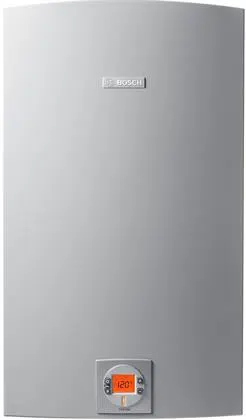
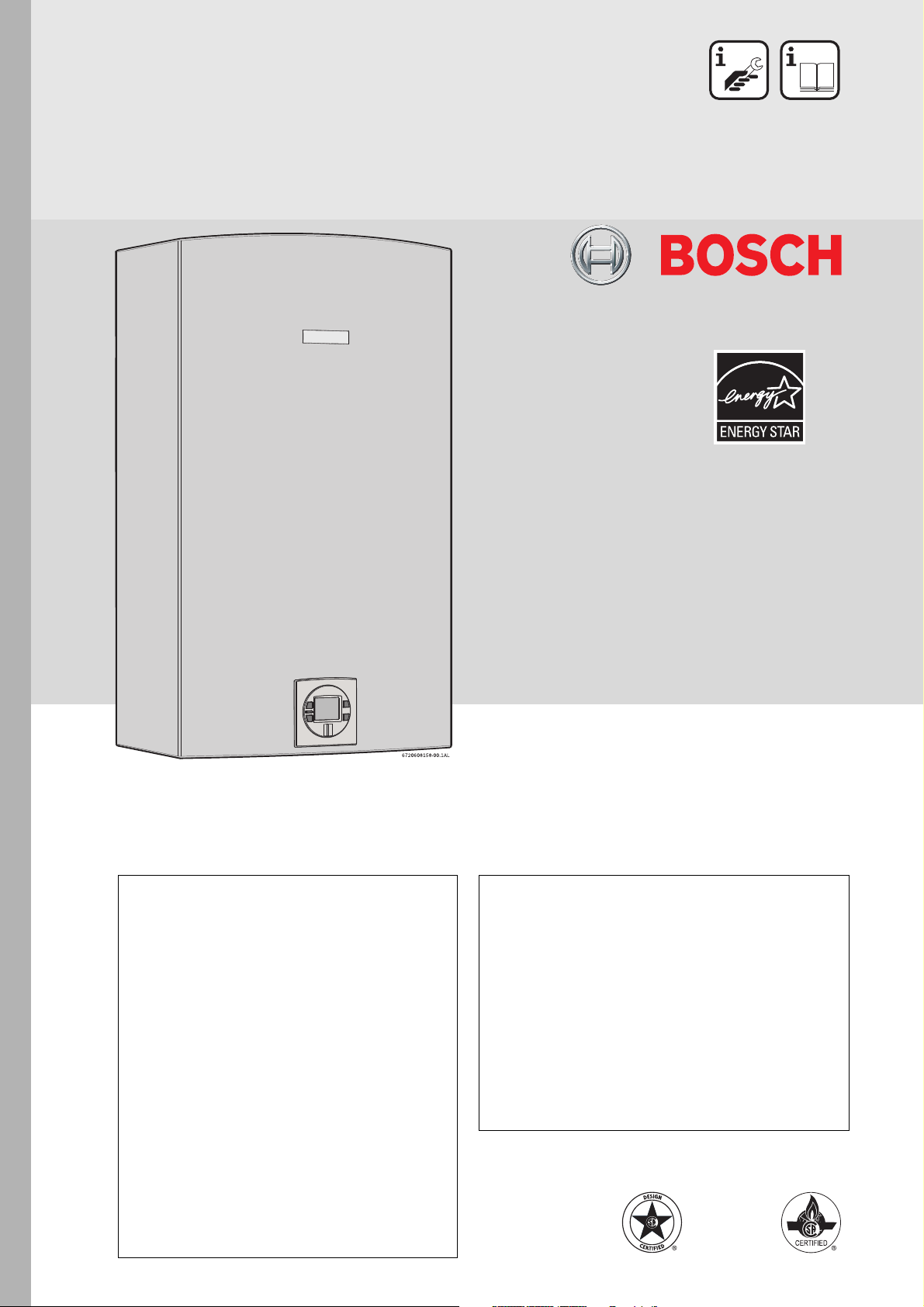
830 ES
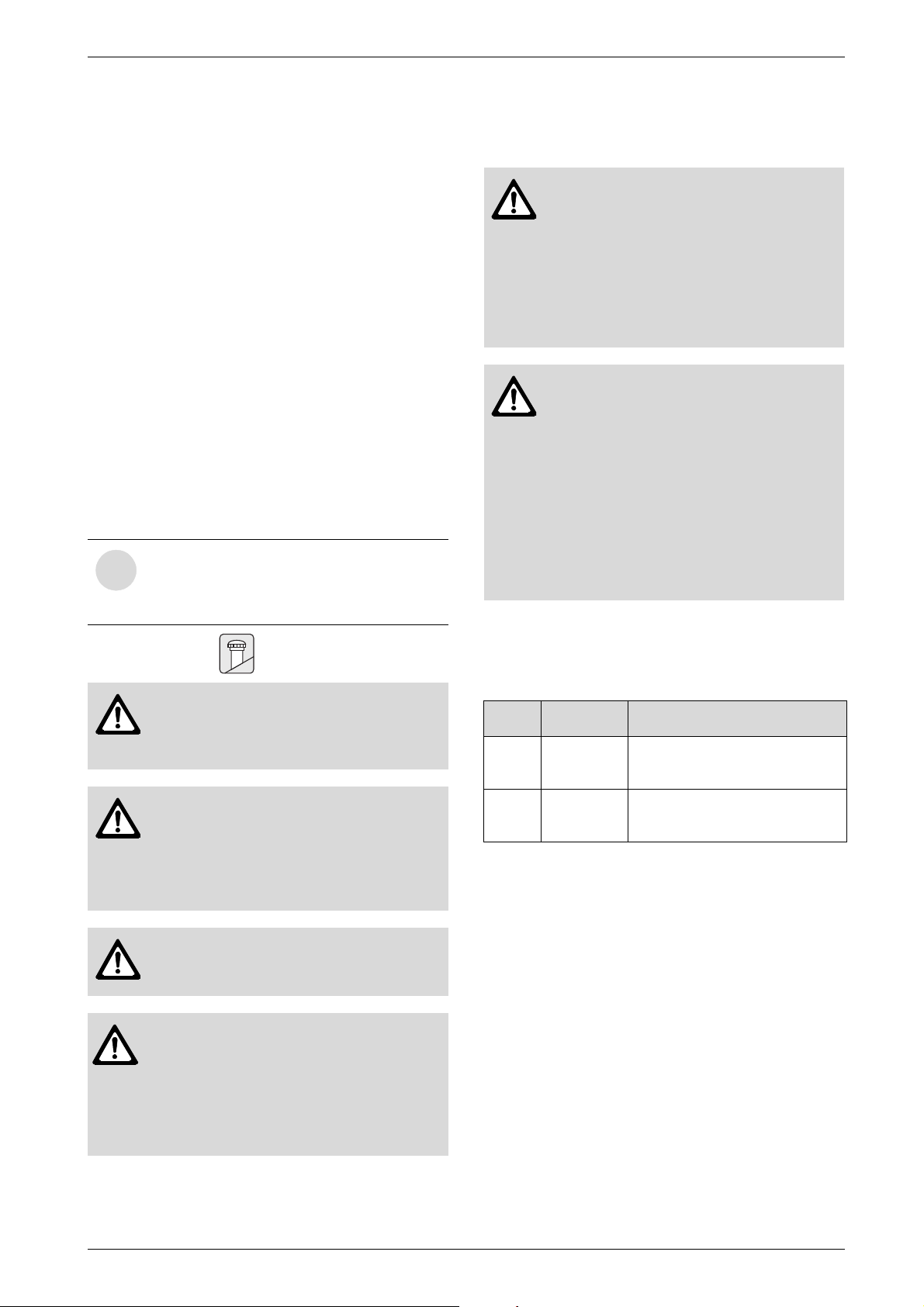
INDOOR MODEL
Temperature Modulated with Electronic Ignition
Suitable for heating potable water only and space heating
(Intended for variable flow applications)
830 ES - Natural Gas
830 ES - Liquefied Petroleum (LP) Gas
6 720 644 936 (2010/09) US
Warning: If the information in this manual is not
followed exactly, a fire or explosion may result
causing property damage, personal injury or death.
Do not store or use gasoline or other flammable
vapors and liquids in the vicinity of this or any other
appliance.
Improper installation, adjustment, alteration,
service or maintenance can cause injury or
property damage. Refer to this manual. For
assistance or additional information consult a
qualified installer, service agency or the gas
supplier.
In the Commonwealth of Massachusetts this
product must be installed by a licensed plumber or
gas fitter.
Upon completion of the installation, these
instructions should be handed to the user of the
appliance for future reference.
What to do if you smell gas
• Close gas valve. Open windows.
• Do not try to light any appliance.
• Do not touch any electrical switch; do not use any
phone in your building.
• Immediately call your gas supplier from a neighbor’s
phone. Follow the gas supplier’s instructions.
• If you cannot reach your gas supplier, call the fire
department.
• Installation and service must be performed by a
qualified installer, service agency or the gas supplier.

6 720 644 936
2
Index
Index
1 Warning 3
2 Appliance details 5
2.1 Features 5
2.2 Specifications (Technical data) 5
2.3 Unpacking the heater 6
2.4 General rules to follow for safe operation 7
2.5 Dimensions and Minimum
installation clearances 8
3 Installation instructions 9
3.1 Specialized tools 9
3.2 Introduction 9
3.3 Venting 9
3.4 Combustion air requirements 23
3.5 Proper location for installing your heater 23
3.6 Heater placement and clearances 24
3.7 Mounting installation 24
3.8 Gas piping & connections 25
3.9 Water connections 28
3.10 Water quality 28
3.11 Domestic hot water recirculation 29
3.12 Space heating applications 30
3.13 Measuring gas pressure 32
4 Electrical connections 33
4.1 Electrical power supply 33
4.2 Position of the fuses in control unit 33
5 Operation instructions 34
5.1 Description LCD display 34
5.2 For your safety read before operating
your water heater 35
5.3 Power 35
5.4 Temperature selection 35
5.5 Use of optional remote control accessory
(part no. TSTAT2) 36
5.6 Operation 36
5.7 Reset button 36
5.8 Program button 36
5.9 Locked condition 37
6 Maintenance and service 37
6.1 Annual maintenance 37
6.2 Winterizing for seasonal use 38
6.3 Mineral scale build-up 38
6.4 Adjusting CO2 39
6.5 Program values 41
6.6 Diagnostic menu 42
7 Troubleshooting 43
7.1 Introduction 43
7.2 Burner do not ignite when hot water
is turned ON 43
7.3 Water is too hot 43
7.4 Water is not hot enough 43
7.5 Low water flow/pressure 44
7.6 Hot water temperature fluctuates at tap 44
7.7 Noisy burner/heater during operation 44
8 Problem solving 46
8.1 Error code diagnostics 46
9 Electrical diagram 50
10 Sensor resistance charts 51
11 Functional scheme 53
12 Interior components diagram
and parts list 54
12.1 Interior components 54
12.2 Components diagram 56
13 Protecting the environment 62
14 Limited Warranty 63
6 720 644 936
Warning
3
1 Warning
For your safety
Do not store or use gasoline or other flammable,
combustible or corrosive vapors and liquids in the
vicinity of this or any other appliance.
Warning: Carefully plan where you
install the heater. Correct combustion
air supply and flue pipe installation are
very important. If a gas appliance is not
installed correctly, fatal accidents can
result, such as carbon monoxide
poisoning or fire.
Warning: Exhaust gas must be vented
to outside using stainless steel vent
material suitable for category III vent
systems and temperatures up to 480°F.
Vent piping must be sealed gas-tight to
prevent possibility of flue gas spillage,
carbon monoxide emissions and risk of
fire, resulting in severe personal injury
or death. Approved vent terminators
must be used when penetrating to the
outside.
Warning: Place the heater in a location
where water leaks will do NO DAMAGE
to adjacent areas or lower floors.
Warning: Field wiring connections and
electrical grounding must comply with
local codes, or in the absence of local
codes, with the latest edition of the
National Electric Code, ANSI/NFPA 70,
or in Canada, all electrical wiring must
comply with the local codes and the
Canadian Electrical Code, CSA C22.1
Part 1.
Warning: Shock hazard: line voltage is
present. Before servicing the water
heater, unplug power supply cord from
outlet. Failure to do so could result in
severe personal injury or death.
Warning: The heater must be
disconnected from the gas supply
piping system during any pressure
testing of that system at test pressures
equal to or more than 0.5 psig.
Warning: The appliance should be
located in an area where leakage of the
heater or connections will not result in
damage to the area adjacent to the
appliance or to lower floors of the
structure. When such locations cannot
be avoided, it is recommended that a
suitable drain pan, adequately drained,
be installed under the appliance. The
pan must not restrict combustion air
flow.
Warning: The maximum inlet gas
pressure must not exceed the value
specified by the manufacturer and the
minimum value listed is for the purpose
of input adjustment.
Warning: If a water heater is installed in
a closed water supply system, such as
one having a backflow preventer in the
cold water supply line, means shall be
provided to control thermal expansion.
Contact the water supplier or local
plumbing inspector on how to control
this situation.
Warning: Keep appliance area clear
and free from combustible materials,
gasoline and other flammable vapors
and liquids.
Warning: Do not obstruct the flow of
combustion and ventilation air.
Warning: Precautions must be taken
prior to manually operating the relief
valve to avoid contact with hot water
coming out of the relief valve and to
prevent water damage.
Caution: Label all wires prior to
disconnection when servicing controls.
Wiring errors can result in improper and
dangerous operation.
Verify proper operation after servicing.
6 720 644 936
4
Warning
FCC:
This device complies with Part 15 of the FCC rules.
Operation is subject to the following two conditions: (1)
This device may not cause harmful interference, and (2)
this device must accept any interference received,
including interference that may cause undesired opera-
tion.
Fig. 1
Warning: If a relief valve discharges
periodically, this may be due to thermal
expansion in a closed water supply
system. Contact the water supplier or
local plumbing inspector on how to
correct this situation. Do not plug the
relief valve.
Warning: If the water heater is used in
a space heating application, all piping
and components connected to the
water heater must be suitable for use
with potable water.
Warning: Toxic chemicals, such as
those used for boiler treatment, shall not
be introduced into the potable water
used for space heating.
Warning: A water heater which will be
used to supply potable water shall not
be connected to any heating system or
component(s) previously used with a
nonpotable water heating appliance.
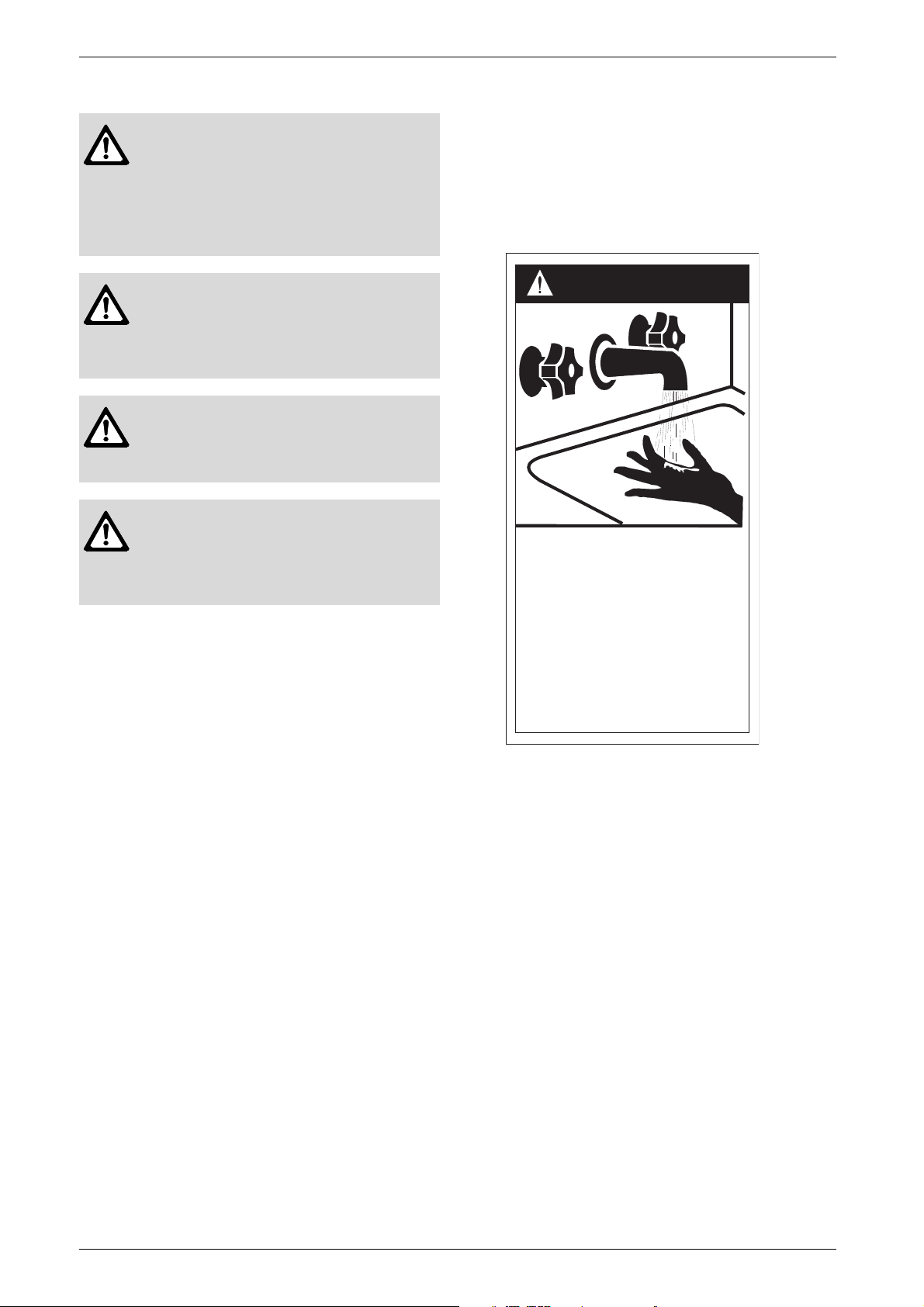
HOT
BURN
D A N G E R
Watertemperatureover125°Fcan
causesevereburnsinstantlyor
deathfromscalds.
Children,disabledandelderlyare
athighestriskofbeingscalded.
Seeinstructionmanualbefore
settingtemperatureatwater
heater.
Feelwaterbeforebathingor
showering.
6720608643-16.1AL

6 720 644 936
Appliance details
5
2 Appliance details
2.1 Features
Parts
• Key Pad interface control
• High power pre-mix compact burner with low NOx
emissions
• Modulating Gas Valve with constant gas:air ratio
control
• Modulating water valve for improved comfort and
temperature control.
High quality materials for long working life
• Copper heat exchanger
• High efficiency Ceramat Burner
• Compact space saver: mounts on a wall with a
supplied bracket.
Features
• Real-time diagnostics for troubleshooting/
informational purposes
• On/Off and Temperature control switches
• Reset button
• Program button (Selectable temperature default)
• Failure codes for easy diagnostics and repair
• Easily removable one-piece cover
• Built in freeze prevention.
Note: The freeze prevention kit is designed to provide
protection for the water heater down to approximately
5°F for short term conditions only. It will not protect the
appliance in areas where the temperature is routinely
expected to be below freezing.
- The freeze prevention kit will not protect plumbing out-
side the appliance from freezing. Precautions should be
taken.
Accessories (Bosch part #)
• Optional wireless remote control accessory to
operate with the appliance (TSTAT2)
• Cascading kit (77090003962)
• Outdoor kit (BTOK)
• External water filter (8703305356)
• Gas conversion kit (8719002176)
• Vertical vent kit (ESVVT)
• Concentric vent /air intake kit (ESHCK)
• Horizontal vent kit (4TWHVK3SII)
1)
• Stainless steel bird screen (L2594)
(fits into a 3” PCV fitting - Intake vent).
• Pipe Cover (PTPCES)
• Recess box kit (7736500043)
• Pressure relief valve (FWL-2)
• High temperature kit (7736500074).
2.2 Specifications (Technical data)
Approved in US/Canada
Capacity
Maximum flow rate: 6.4 GPM (24 l/min) at a 45°F
(25°C) rise.
Maximum output
147,000 Btu/h (43.0 kW)
Maximum input
175,000 Btu/h (51.2 kW)
Efficiency in %
Thermal efficiency > 82%
Min. Input
19,900 Btu/h (5.8 kW)
Temperature Control
Selection range: 100°F (38°C) - 140°F (60°C)
Default temperature: 122°F (50°C)
Stability: +/- 2°F (+/- 1°C)
Gas Requirement
Gas connection (inches) - ¾”
Inlet gas pressure under operation (with a high hot
water flow rate)*
• Propane: 8” - 13” water column
• Natural Gas: 3.5” - 10.5” water column.
* To measure gas pressure, see Measuring Gas
Pressure, chapter 3.13, page 32.
Water
• Hot water connection (inches) - ¾”
• Cold water connection (inches) - ¾”
• Water valve material: Polymer (PPS) (Polypropylene
Sulfid)
• Minimum water flow: 0.5 gallon/minute (1,9 l/m).
Note: Activation varies with inlet water temperatures
from 0.5 - 1.6 gallon/minute (1,9 - 6.1 l/m).
• Minimum recommended water pressure: 30 PSI
(2.07 bar).
1) 4TWHVK3S vent kit is compatible with this appliance
but requires the purchase of an additional 12" piece of
straight pipe to meet minimum vent length requirements.
The aluminum flex piping included with this kit is not
permissible for use with this appliance.
i
BOSCH is constantly improving its
products, therefore specifications are
subject to change without prior notice.
6 720 644 936
6
Appliance details
• Minimum well pressure 40 psi, see page 28.
• Connections:
– Bottom of heater
Combustion
• NOx ≤ 40 Ng/J
(Nanograms of NOx (calculated as NO
2
) per
Joule of heat output).
• CO ≤ 250 ppm (measured)
• CO
2
level set from factory, see chapter 6.4, page 39.
Dimensions
• Depth (in): 11¼” (286 mm)
• Width (in): 17
7
/
8
” (452 mm)
• Height (in): 30½” (775 mm)
• Weight: 67 pounds (30.5 kg).
Gas types
Natural Gas.
LP Gas.
Voltage
120 V AC (60 Hz) nominal
Amperage
Idle - 40 mA
Operation - ≤ 2.5 A
Noise
45 - 65 db (A)
Safety devices
• Flame failure device (ionization flame rod sensor)
• Over heat prevention (temperature limiter)
• Inlet temperature sensor
• Outlet temperature sensor
• Back flow temperature sensor.
Water protection
IP X4 (protection against water drops)
2.3 Unpacking the heater
Before installing the unit, be certain you have the
correct heater for your type of Gas: Propane or
Natural Gas. Identification labels are found on the
shipping box, and on the rating plate which is located on
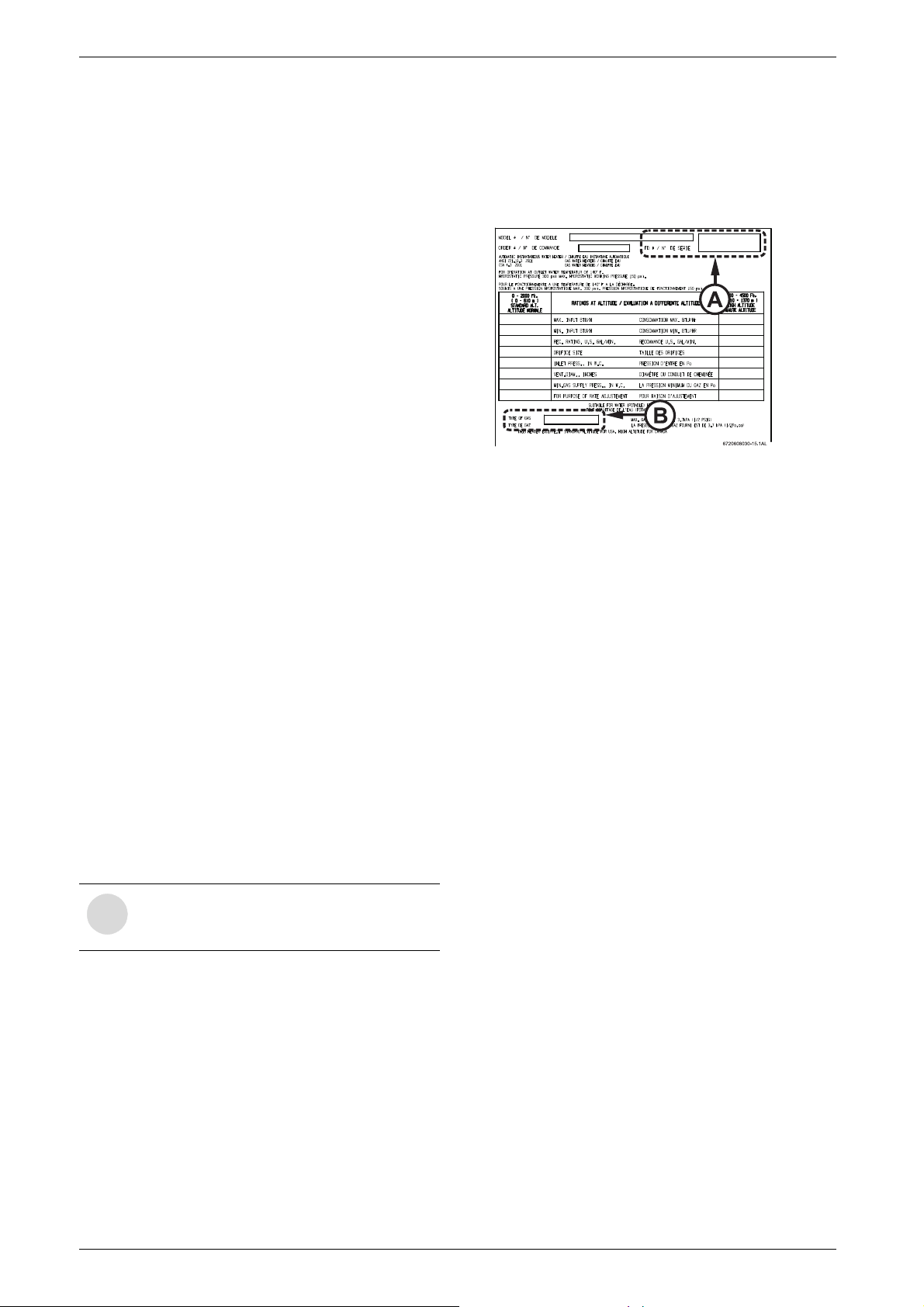
the right side panel of the cover.
Fig. 2 Rating plate
A Serial number
B Type of gas
The box includes:
• 830 ES
• Bracket for wall hanging the heater
• Exhaust vent adaptor (with 4 screws and gasket
provided)
• Combustion air inlet adaptor (with 3 screws and gas-
ket provided)
• Installation manual (manual can be downloaded at
www.boschpro.com)
• Product registration card.
Please complete and return the enclosed product
registration card.
The 830 ES is not approved or designed for:
• Manufactured (mobile) homes, boats or any
mobile installation. (Modular homes are
acceptable for installation).
• Use above 8000 ft A.S.L. altitude (see page 20).
• Outdoor installation without installation of
Outdoor kit (BTOK).
• Applications where inlet water temperature is
higher than 140ºF (60°C). A 3-way valve or
mixing valve must be installed before the
appliance if inlet water temperature exceeds
this limit.
i
If appliance is installed at elevations above
2000ft, refer to Section 3.3.7 Fan speed
adjustment.
6 720 644 936
Appliance details
7
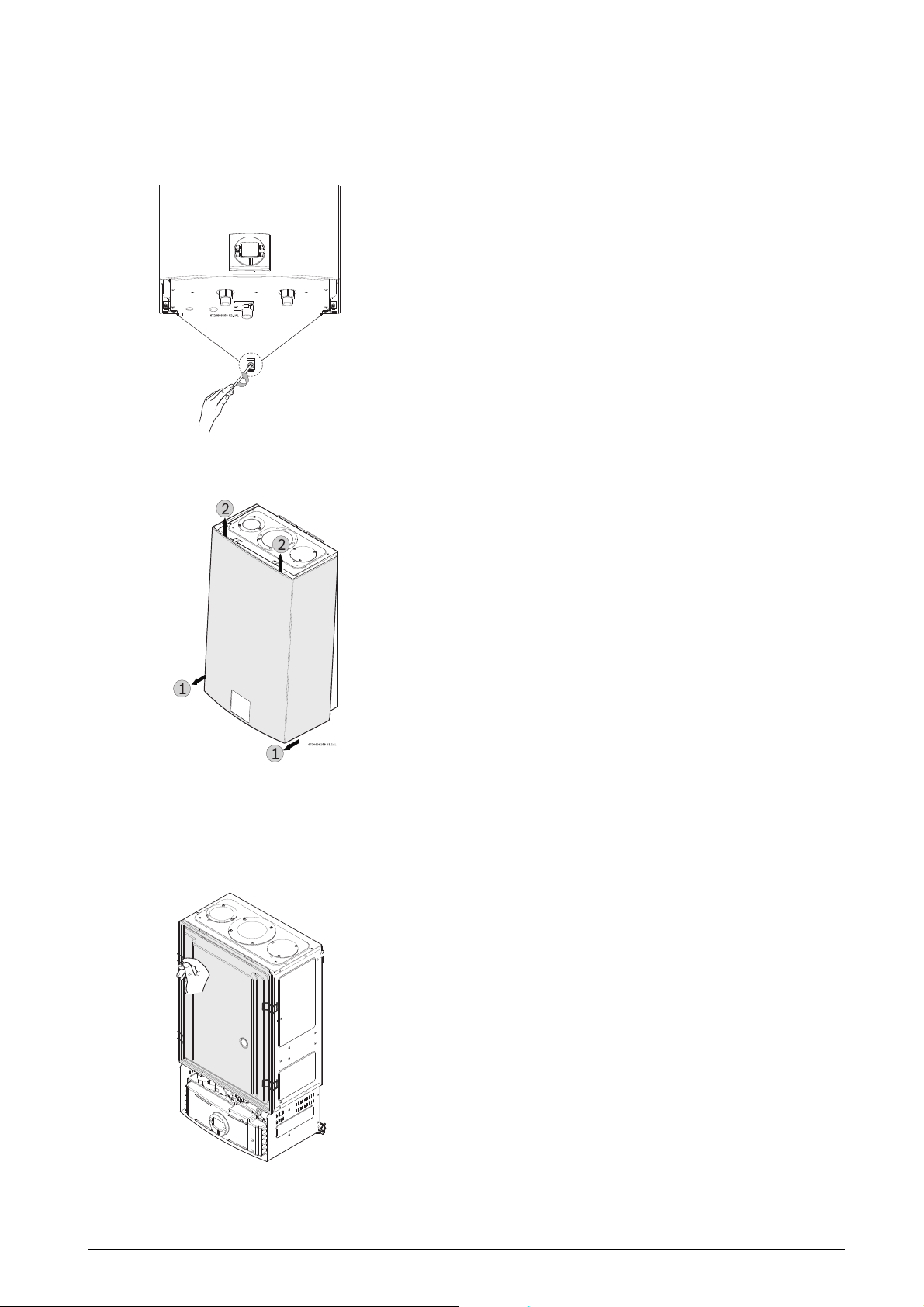
To remove front cover
B Loosen the two Philips head screws located on
bottom rear of cover (see Fig. 3).
Fig. 3 Loosen the two screws
B Lift front cover panel upward and remove.
Fig. 4 Remove the front cover
To remove combustion cover (service only)
B Open the four clips and remove the combustion
cover see Fig. 5.
Fig. 5 Remove the combustion cover
2.4 General rules to follow for safe
operation
B
1. You must follow these instructions when you install
your heater. In the United States: The installation must
conform with local codes or, in the absence of local
codes, the National Fuel Gas Code ANSI Z223.1/
NFPA 54.
In Canada: The Installation must conform with CGA
B149.(1,2) INSTALLATION CODES and /or local
installation codes.
B 2. Carefully plan where you install the heater. Correct
combustion air supply and vent pipe installation are
very important. If not installed correctly, fatal
accidents can occur, such as carbon monoxide
poisoning or fire.
B
3. When the unit is installed indoors and ROOM
SEALED (twin pipe) it is permitted to be located in
bathrooms, bedrooms and occupied rooms that are
normally kept closed. See chapter
3.3
(
page 9
). If the
unit will be installed indoors and use indoor
combustion air, the place where you install the heater
must have enough ventilation. The National Fuel
Gas Code does not allow UNSEALED gas fired
water heater installations in bathrooms,
bedrooms or any occupied rooms normally kept
closed. See chapter
3.5
,
page 23
and
3.4
,
page 23
.
B 4. You must vent your heater. See
chapter 3.3
,
page
9
on VENTING.
B 5. The appliance and its gas connection must be leak
tested before placing the appliance in operation.
The appliance must be isolated from the gas supply
piping system by closing its individual manual gas
shutoff valve (not supplied with heater) during any
pressure testing at pressures in excess of ½ Psig (3.5
kPa).
B 6. Keep water heater area clear and free from
combustibles and flammable liquids. Do not locate
the heater over any material which might burn.
B
7. Correct gas pressure is critical for the proper
operation of this heater. Gas piping must be sized to
provide the required pressure at the maximum output
of the heater, while all the other gas appliances are in
operation. Check with your local gas supplier, and see
the section on connecting the gas supply, see
chapter 3.8
.
B 8.
Should overheating occur or the gas supply fail to
shut off, turn off the gas supply at the manual gas shut
off valve, on the gas line. Note: manual gas shutoff
valve is not supplied with the heater but must be field
installed.
B 9.
Do not use this appliance if any part has been
underwater. Immediately call a qualified service
technician to inspect the appliance and to replace any
part of the control system and any gas control which
has been underwater.
B
10. Failure to install heater correctly may lead to
unsafe operation and void the warranty.
6720644956-11.1V
6 720 644 936
8
Appliance details
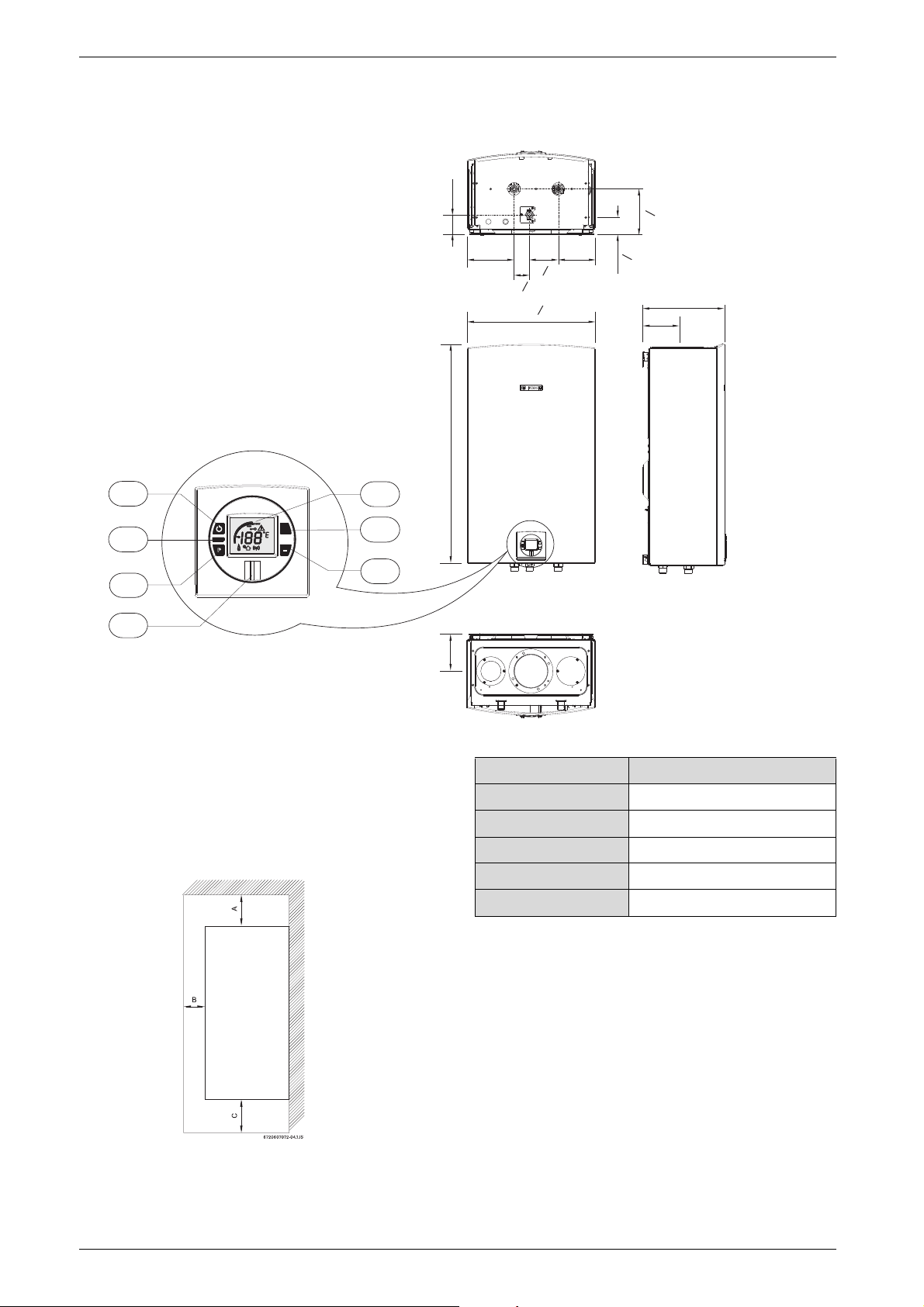
2.5 Dimensions and Minimum installation clearances
Fig. 6 Dimensions
1 On/Off button
2 Reset button
3 Program key
4 Power ON or stand-by LED
5 LCD display
6 Up button
7 Down button
Fig. 7 Minimum clearances
Note: For servicing access, a 2ft clearance to front
cover is recommended.
6720608158-04.2AL
2
3
1
6
5
7
4
re se t
P
+
5 ¼"
30 ½"
17 "
7
8
5 ¼"
11 ¼"
2 ¾"
6 ½"
2 "
16
5
5 ¼"
2 "
16
4 "
1
16
6 "
5
16
1
16
5
16
Model 830 ES
TOP (A) 12”
FRONT (B) 1”
BACK 0”
SIDES 1”
FLOOR (C) 12”
Table 1 Minimum clearances
6 720 644 936
Installation instructions
9
3 Installation instructions
3.1 Specialized tools
The following specialized tools may be required for
installation:
• Manometer
• Multi-meter
• Combustion Gas Analyzer.
3.2 Introduction
Please follow these instructions. Failure to follow
instructions may result in:
B Damage or injury.
B Improper operation.
B Loss of warranty.
If you are unable to perform the tasks required to install
this heater properly, please contact a locally licensed
plumber or gas technician.
3.3 Venting
3.3.1 Vent material
Establish vent clearances that comply with the vent
manufacturer's specifications. In all cases, follow local
codes. See Table 2.
Horizontal venting systems only:
An optional stainless concentric vent/air intake
termination can be used to provide only one penetration
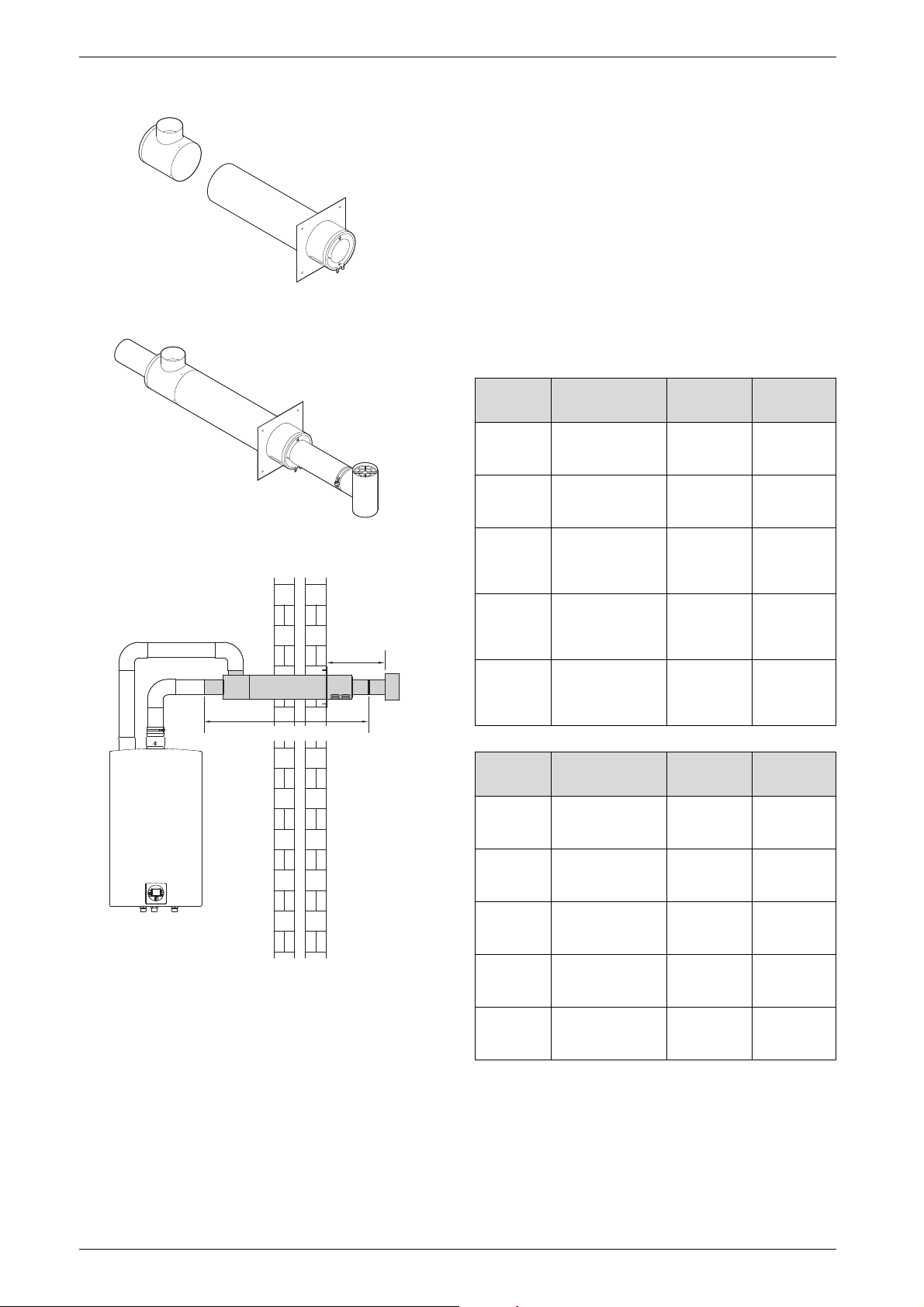
point through the exterior wall (see Fig. 8, 9 & 10). The
concentric vent/air intake kit can be ordered from your
local wholesaler. (Part# ESHCK). Note: Only tee
terminals are approved for use with the
concentric vent/air intake kit (see Table 3). Vent
piping and tee terminal used with kit must be
from the same vent pipe manufacturer. The
appliance can also be installed with separate air
intake and exhaust piping (see Fig. 16 ).
i
Common installation practice is to deter-
mine the venting/intake system layout and
penetration and then work back to the
heater.
Warning: Do not reduce the vent
(exhaust and combustion) pipe sizes
and do not common vent with any other
vented appliance or stove.
Warning: Failure to vent the exhaust
gases to the outside with sealed
stainless steel vent pipe (AL29-4C)
may result in dangerous flue gases
filling the structure in which it is
installed.
Warning: Do not mix vent pipe or
joining methods from different
manufacturers.
Warning: Approved terminators must
be used for inlet and exhaust vent sys-
tems to prevent rain from entering the
appliance. Failure to do so may result in
damage to the appliance. This failure is
not covered under the manufacturer’s
warranty.
Caution: The vent system must be
installed by a qualified installer in
accordance with these instructions. If
improperly installed, a hazardous
condition such as explosion or carbon
monoxide poisoning could result.
Bosch Water Heating will not be
responsible for improperly installed
appliances.
Warning: In areas where outside
temperatures routinely come close to
freezing, sealed combustion operation
is required. Use separate terminations
for combustion and vent, which must be
installed on the same wall or roof
surface, however never facing the
direction of prevailing winds. Failure to
do so may result in heat exchanger
freezing up and bursting. This failure is
not covered under the manufacturer's
warranty.
Diam. Material
Exhaust
Vent
3 or 4 inches Sealed single wall stainless steel
(AL29-4C)
Intake
Vent
3 or 4 inches Sealed PVC or any other rigid pipe
Table 2 Venting Specifications
6 720 644 936
10
Installation instructions
Fig. 8 Concentric kit part # ESHCK
Fig. 9 Concentric kit vent assembly
Fig. 10 Concentric kit installation
3.3.2 Venting Specifications
Install appliance as close to point of vent termination as
possible. The exhaust piping must vent directly to the
outside of the structure.
Horizontal sections of vent must pitch upward towards
termination ¼" for every foot of horizontal length, to
prevent the pooling of condensate, and be supported at
4 foot intervals with overhead hangers.
Exception: horizontal run between last elbow and
termination must pitch down to termination 1/4" per
foot. Note: For horizontal terminations, venting must
terminate once it penetrates to the outside of the
structure. There must be no sections of vent pipe
exposed to the outdoors other than the termination.
Note: Listed thimbles or collars are necessary where
venting passes through wall and ceiling partitions. If the
vent system passes through combustible areas where
the vent clearance requirements cannot be maintained,
it is permissible to chase straight sections of sealed 3
inch single wall vent through 4 inch (or greater) Type-B
vent. The distance to combustibles using this chase
technique is 1 inch. Note: Type-B vent must never be
used as the actual exhaust vent system for the
appliance, as it is not gas tight and illegal for use with
this appliance. This will create a serious health hazard
and void the warranty.
For specific questions concerning vent material, speci-
fications, usage or installation, please contact the vent
manufacturer directly.
6720608782-09.1Av
6720608782-10.1Av
12"
6720608782-11.1Av
3” stainless steel pipe
3”
VENTING
Z flex Protech Heat Fab
3"
90° elbow
2SVEEWCF0390 FSELB9003 9314
3" Tee
Terminal
2SVSTTF03 FSTT3 9390TEE
3”
Horizontal
Terminal
2SVSTB03 FSTB3 N/A
3" horiz.
terminal
with damper
2SVSHTD03 N/A N/A
3” Vertical
Terminal
2SVSRCF03 FSRC3 5300CI
Table 3 3" Terminator Part Numbers
4”
VENTING
Z flex Protech Heat Fab
4"
90° elbow
2SVEEWCF0490 FSELB9004 9414
4" Tee
Terminal
2SVSTTF04 FSTT4 9490TEE
4”
Horizontal
Terminal
2SVSTB04 FSTB4 N/A
4" horiz.
terminal
with damper
2SVSHTD04 FSRC4 5400CI
4"
vertical
terminal
2SVSRCF04 N/A N/A
Table 4 4" Terminator Part Numbers
6 720 644 936
Installation instructions
11
Condensate drain requirements
An external condensate drain (not supplied with the
heater) must be installed under the following
conditions:
• All vertical terminating vent installations.
• Horizontal terminating vent installations where the
total linear vent length is greater than 10 feet (3.1 m)
for 3" and 5 feet (1.5 m) for 4".
• Vent installations where any section of the exhaust
vent pipe passes through an unconditioned space.
Twin pipe termination clearances
The minimum clearance between exhaust vent and
combustion air inlet terminations for twin pipe
penetration is 3 feet.
Minimum combustion air and exhaust pipe
length
The minimum exhaust pipe length is 1 foot (0.3m) of
straight vent pipe. The minimum combustion air pipe
length is one 90° elbow.
Maximum combustion air and exhaust pipe
length
The following tables display the maximum allowable
straight pipe lengths for combustion air and exhaust
piping with consideration to the number of elbows
used. Reduce the equivalent length for each elbow
used from the maximum allowable length.
Use of elbows
It is recommended to limit the amount of elbows used in
the exhaust and combustion air piping to reduce friction
in the air flow. The following lists the maximum amount
of 90° elbows allowed in either the exhaust or combus-
tion air piping:
Company Contact info
Z-flex www.z-flex.com
800-654-5600
ProTech Industries www.protechinfo.com
800-766-3473
Heat-Fab www.heatfab.com
800-772-0739
Table 5 Vent manufacturers
Venting Maximum
allowable
Exhaust
pipe length
Maximum
allowable
Combustio
n air pipe
length
Elbow
Equivalency
90° 45°
3"
28.5 ft 28.5 ft 2.5 ft 1.25 ft
4"
61.25 ft 61.25 ft 1.25 ft .75 ft
Table 6 Maximum Allowable Exhaust and Combustion
Air Lengths
90° elbows
3"
Venting
4"
Venting
Max number of elbows 5 7
Table 7
i
Two 45° elbows are equal to one 90°
elbow. Any combination of 45° and
90° elbows may be used in the vent
system as long as the combination
does not exceed the maximum listed
in table 7 above.
6 720 644 936
12
Installation instructions
Calculation example for 3" venting:
Exhaust
Combustion air
Calculation example for 4" venting:
Exhaust
Combustion air
System used Concentric
Number of 90° elbows needed: 1
Number of 45° elbows needed: 2
Table 8
Calculation of example
Max. length 28.5’
90° elbow reduction - 2.5’
sub-total = 26’
45° elbow reduction - 2.5’
Total = 23.5’
Table 9
i
For this example, the maximum allowable
exhaust pipe length is 23.5 feet.
System used Concentric
Number of 90° elbows needed: 2
Number of 45° elbows needed: 1
Table 10
Calculation of example
Max. length 28.5’
90° elbow reduction - 5’
sub-total = 23.5’
45° elbow reduction - 1.25’
Total = 22.25’
Table 11
i
For this example, the maximum allowable
combustion air pipe length is 22.25 feet.
System used Twin pipe
Number of 90° elbows needed: 2
Number of 45° elbows needed: 2
Table 12
Calculation of example
Max. length 61.25’
90° elbow reduction - 2.5’
sub-total = 58.75’
45° elbow reduction - 1.5’
Total = 57.25’
Table 13
i
For this example, the maximum allowable
exhaust pipe length is 57.25 feet.
System used Twin pipe
Number of 90° elbows needed: 1
Number of 45° elbows needed: 2
Table 14
Calculation of example
Max. length 61.25’
90° elbow reduction - 1.25’
sub-total = 60’
45° elbow reduction - 1.5’
Total = 58.5’
Table 15
i
For this example, the maximum allowable
combustion air pipe length is 58.5 feet.
6 720 644 936
Installation instructions
13
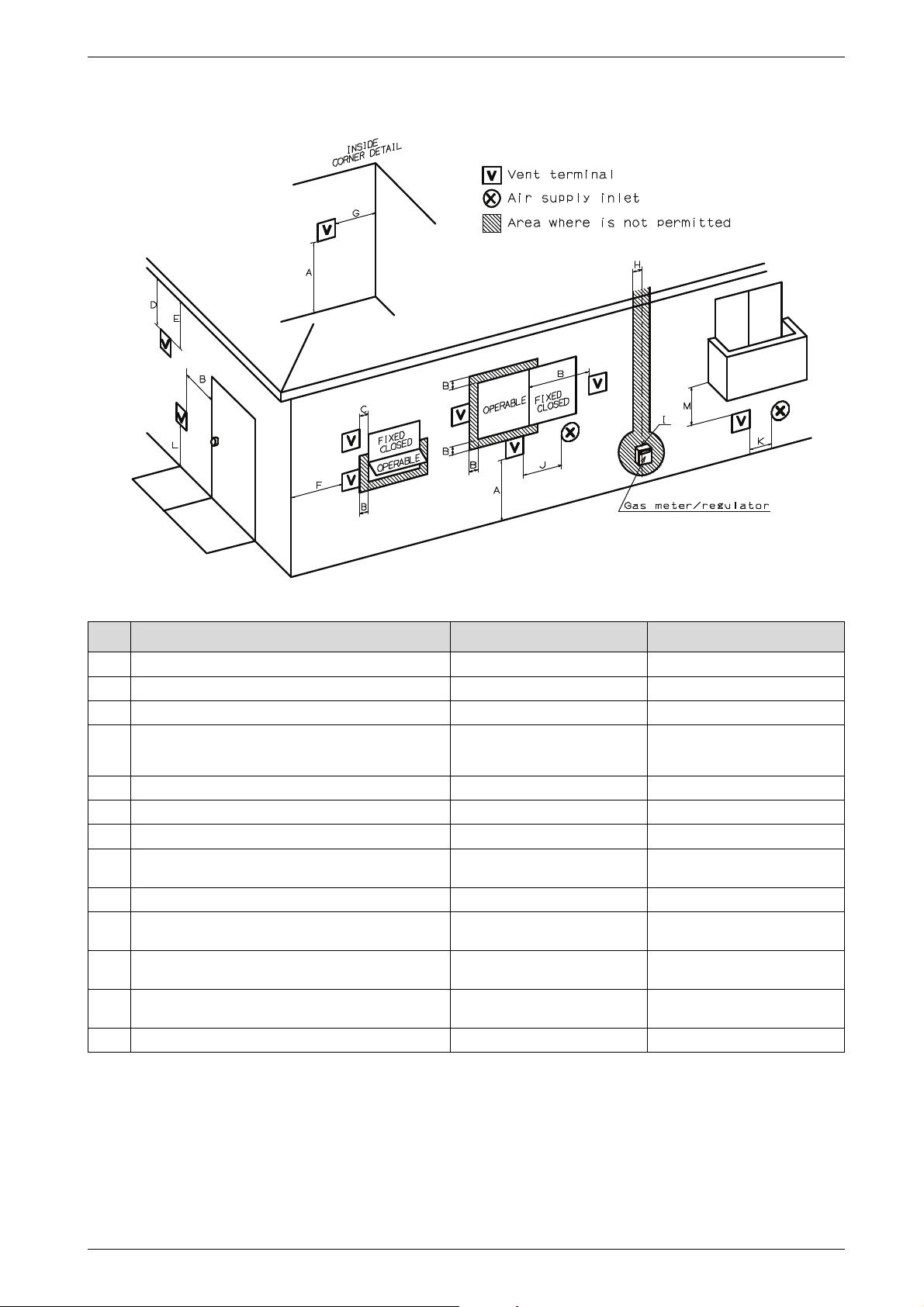
Required direct vent terminal clearances (twin pipe / concentric penetration)
Fig. 11
* For clearances not specified in ANSI Z223.1 / NFPA 54 or CSA-B149.1, one of the following shall be indicated:
a) A minimum clearance value determined by testing in accordance with section 2.20, or;
b) A reference to the following footnote:
“Clearance in accordance with local installation codes and the requirements of the gas supplier.”
6720608836-23.1Av
Canadian installations
1)
U.S. installations
2)
A Clearance above grade, veranda, porch, deck or balcony 12 in. 12 in.
B Clearance to window or door that may be opened 36 in. 12 in.
C Clearance to permanently closed window * *
D Vertical clearance to ventilated soffit located above the vent
terminator within a horizontal distance of 2 feet (61cm) from the
center line of the terminator
* *
E Clearance to unventilated soffit * *
F Clearance to outside corner * *
G Clearance to inside corner * *
H Clearance to each side of center line extended above meter/
regulator assembly
36 in. within a height 15 feet above
meter/ regulator assembly
*
I Clearance to service regulator vent outlet 36 in. *
J Clearance to non-mechanical air supply inlet to building or the
combustion air inlet to any other application
36 in. 12 in.
K Clearance to mechanical air supply inlet 72 in. 36 in. above if within 10 feet
horizontally
L Clearance above paved sidewalk or paved driveway located on
public property
84 in.
3)
*
M Clearance under veranda, porch deck or balcony 12 in.
4)
*
Table 16
1) In accordance with the current CSA B149.1 Natural Gas and Propane Installation Code
2) In accordance with the current ANSI Z223.1 / NFPA 54 National Fuel Gas Code
3) A vent shall not terminate directly above a sidewalk or paved driveway that is located between two single family dwellings and serves both dwellings.
4) Permitted only if veranda, porch, deck or balcony is fully open on a minimum of two sides beneath the floor.
6 720 644 936
14
Installation instructions
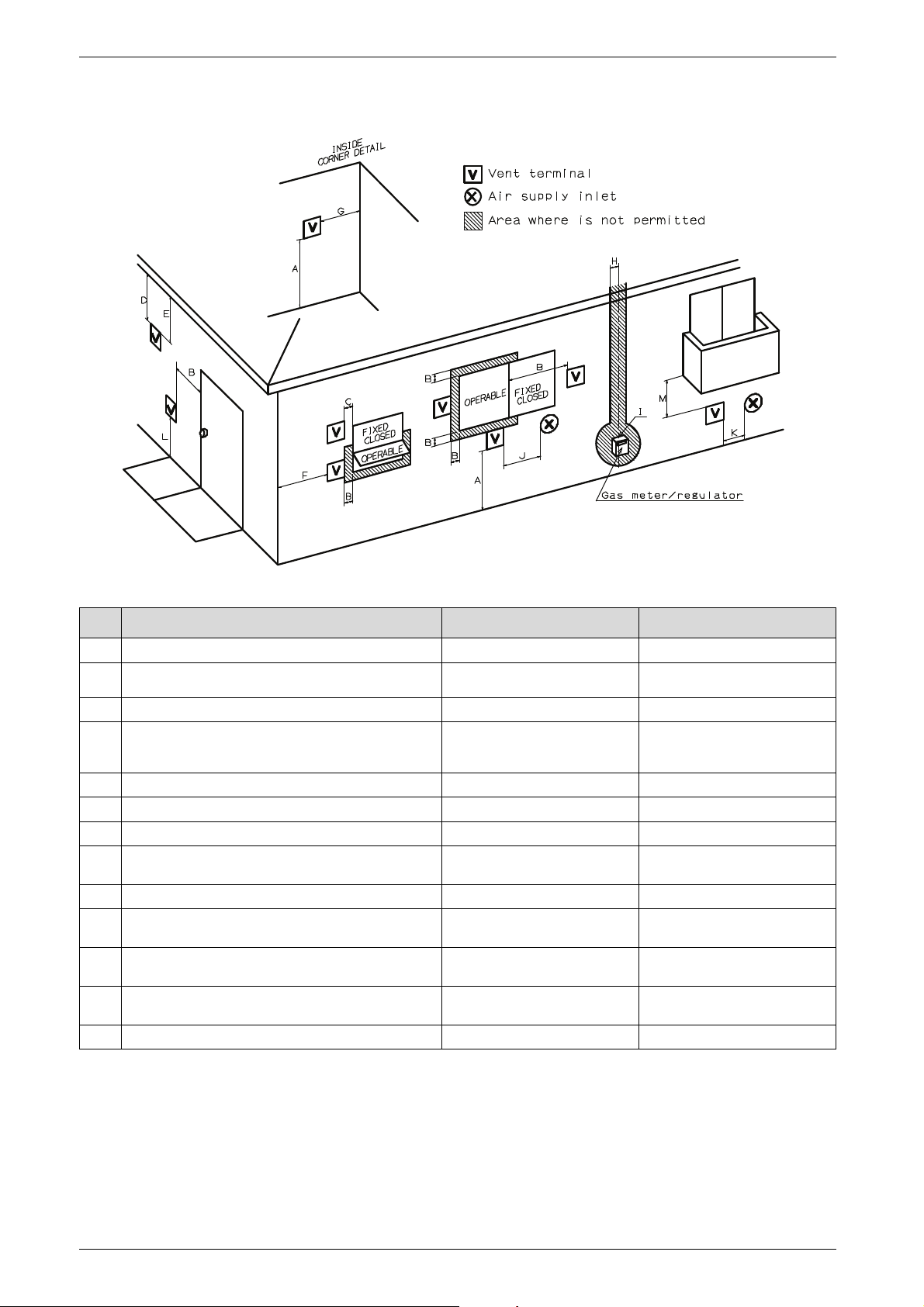
Required other than direct vent terminal clearances (single pipe penetration)
Fig. 12
* For clearances not specified in ANSI Z223.1 / NFPA 54 or CSA-B149.1, one of the following shall be indicated:
a) A minimum clearance value determined by testing in accordance with section 2.20, or;
b) A reference to the following footnote:
“Clearance in accordance with local installation codes and the requirements of the gas supplier.”
6720608836-23.1Av
Canadian installations
1)
U.S. installations
2)
A Clearance above grade, veranda, porch, deck or balcony 12 in. 12 in.
B Clearance to window or door that may be opened 36 in. 4 feet below or to side of opening;
1 foot above opening
C Clearance to permanently closed window * *
D Vertical clearance to ventilated soffit located above the vent
terminator within a horizontal distance of 2 feet (61cm) from the
center line of the terminator
* *
E Clearance to unventilated soffit * *
F Clearance to outside corner * *
G Clearance to inside corner * *
H Clearance to each side of center line extended above meter/
regulator assembly
36 in. within a height 15 feet above
meter/ regulator assembly
*
I Clearance to service regulator vent outlet 36 in. *
J Clearance to non-mechanical air supply inlet to building or the
combustion air inlet to any other application
36 in. 4 feet below or to side of opening;
1 foot above opening
K Clearance to mechanical air supply inlet 72 in. 36 in. above if within 10 feet
horizontally
L Clearance above paved sidewalk or paved driveway located on
public property
84 in.
3)
84 in.
M Clearance under veranda, porch deck or balcony 12 in.
4)
*
Table 17
1) In accordance with the current CSA B149.1 Natural Gas and Propane Installation Code
2) In accordance with the current ANSI Z223.1 / NFPA 54 National Fuel Gas Code
3) A vent shall not terminate directly above a sidewalk or paved driveway that is located between two single family dwellings and serves both dwellings.
4) Permitted only if veranda, porch, deck or balcony is fully open on a minimum of two sides beneath the floor.
6 720 644 936
Installation instructions
15
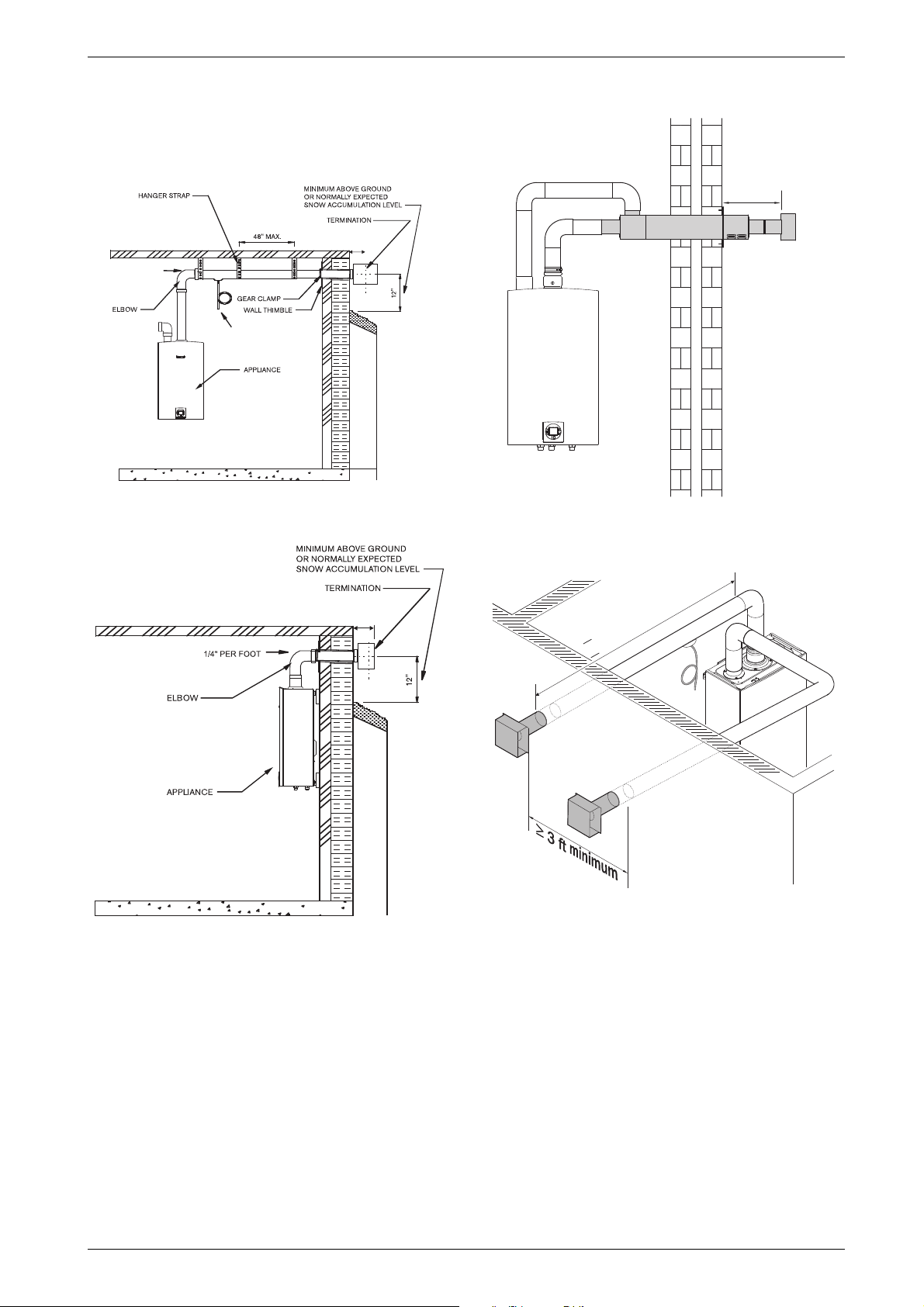
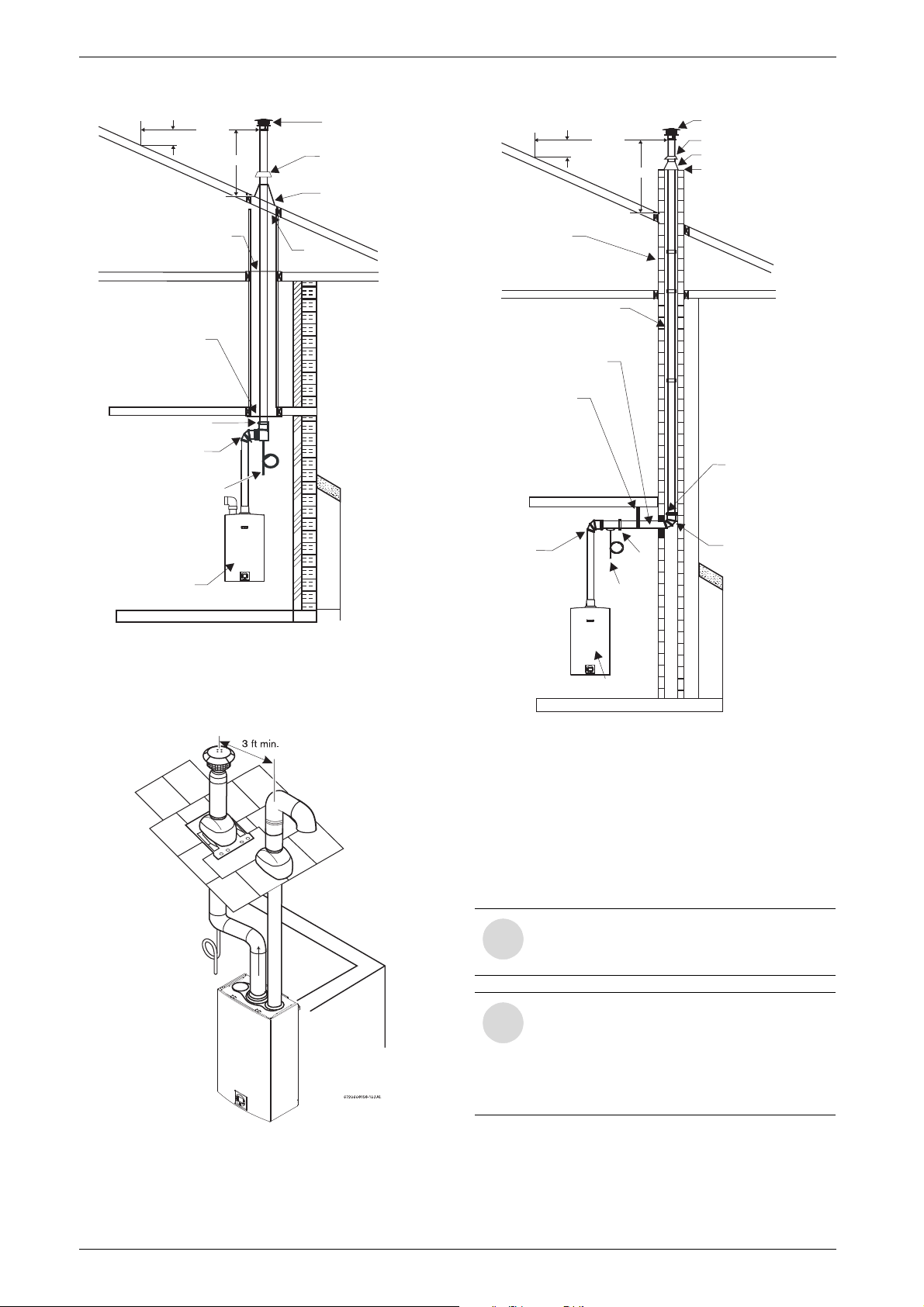
3.3.3 Venting configuration examples
Below are approved examples of horizontal
venting installations.
Fig. 13 Horizontal side wall venting installation (single
pipe penetration)
Fig. 14 Horizontal venting installation (combustion air
piping not shown)
Warning: Single pipe penetration should be used in
non-freezing climates only!
Important:
Note: Pitch horizontal runs down toward the heater,
except horizontal run between last elbow and termina-
tion which must slope down to termination 1/4" per
foot.
Note: For horizontal terminations, venting must
terminate once it penetrates to the outside of the
structure. There must be no sections of vent pipe
exposed to the outdoors.
Fig. 15 Horizontal venting installation (concentric
penetration)
Fig. 16 Horizontal twin pipe penetration
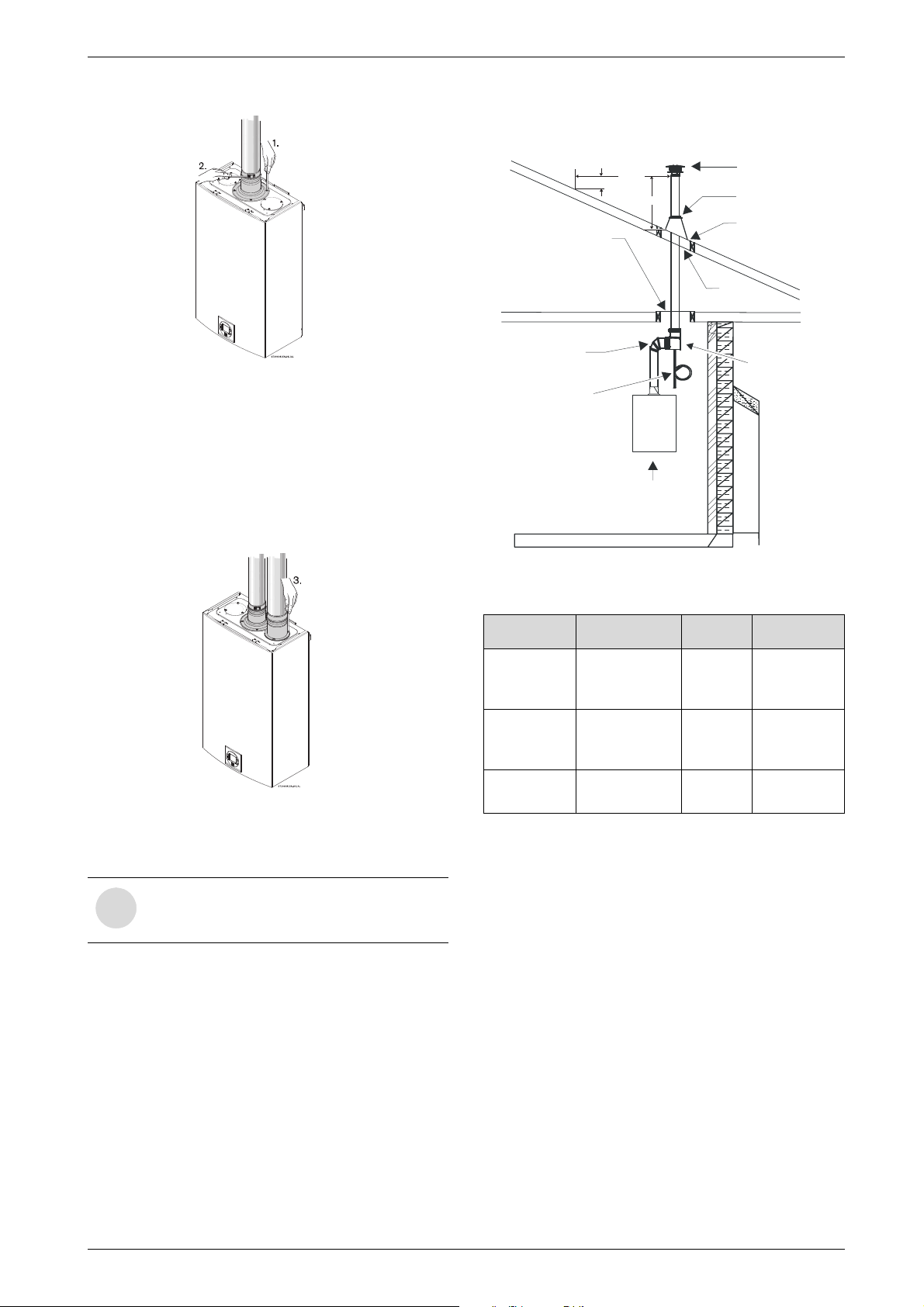
Below are approved examples of vertical venting
installations.
Important:
Note: Pitch horizontal runs down toward the heater,
1/4" per foot.
4"
6720608542-02.2AL
HORIZONTAL RUN
1/4" PERFOOT
DOWN TO
TERMINATOR.
CONDENSATE
DRAIN
4"
HORIZONTAL RUN
DOWN TO
TERMINATOR.
SIDE
OF
WATER
HEATER
NOTE:
MINIMUM1FT OF
STRAIGHT VENT PIPE
REQUIRED
6720608542-10.1V
12"
6720608782-11.2V
6720608542-05.3V
<
<
26ft with 3"venting
60ft with 4"venting
6 720 644 936
16
Installation instructions
Fig. 17 Vertical venting installation (single pipe pene-
tration)
Warning: Single pipe penetration should be used
in non-freezing climates only!
Fig. 18 Vertical venting installation (twin pipe penetra-
tion)
Fig. 19 Vertical venting installation - Masonry Chim-
ney (combustion air piping not shown)
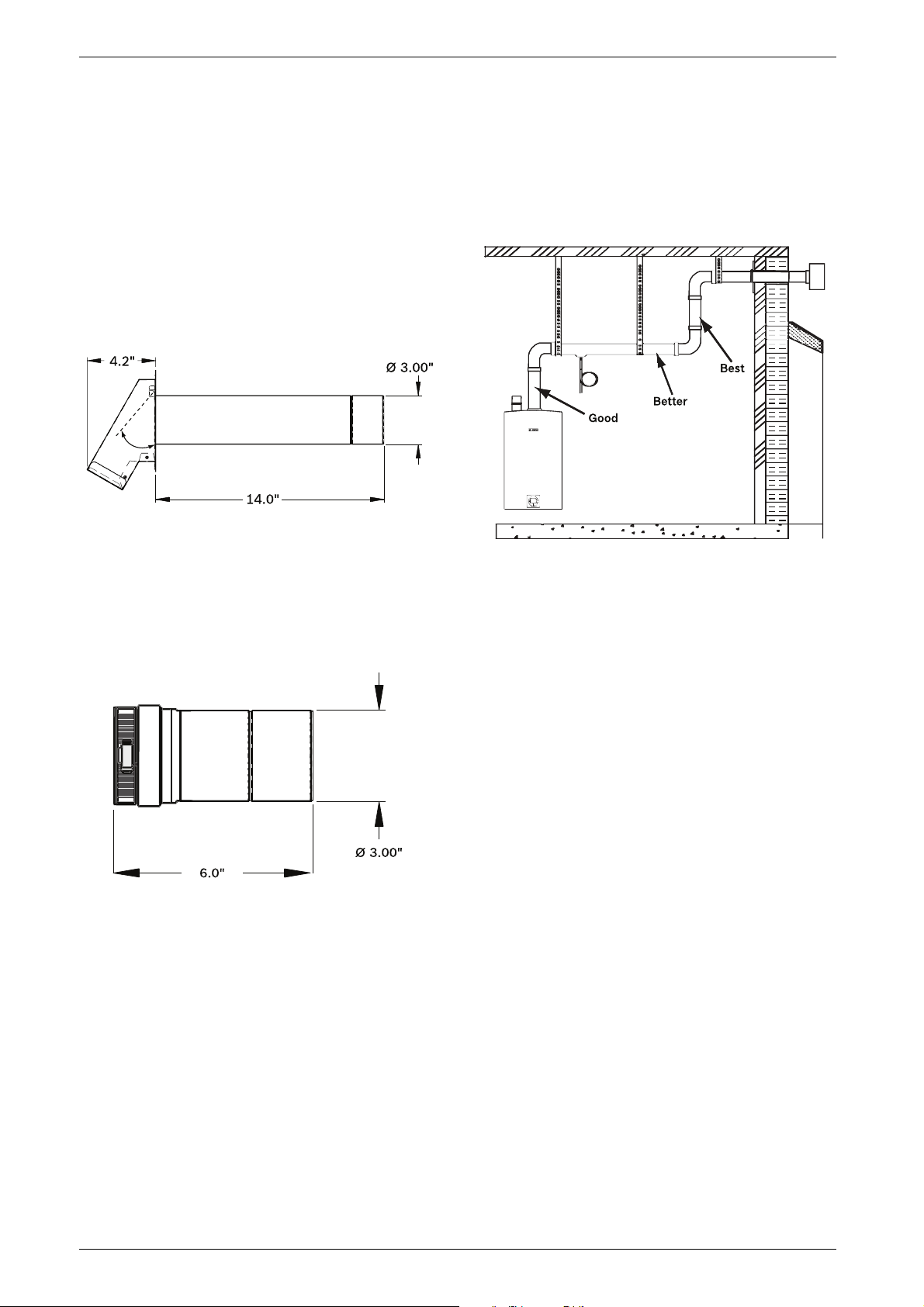
3.3.4 Vent connections
B Attach the flue gas exhaust accessory (8 705 504
151) to the top of the unit (position 1) using the 4
screws and gasket provided. Fully insert stainless
steel vent pipe 1.5” minimum into the accessory and
tighten the clamp (position 2).
FIRESTOP SUPPORT
ELBOW
APPLIANCE
HOSE
CLAMP
RAINCAP
STORMCOLLAR
FLASHING
FIRESTOP SUPPORT
4"MIN.
AIRSPACE
6720608158-91.2Av
CONDENSATE
DRAIN
2'MIN.
10'MIN.
3'MIN.
i
If using the 4” vent, a 3” to 4” increaser is
required immediately off the top of the
heater.
i
NOTE: Vent pipe must be completely ver-
tical when inserting or gasket inside ex-
haust accessory can become displaced.
Exhaust accessory can be removed with
vent pipe attached to check gasket posi-
tion.
CHIMNEY
MORTAR
HANGERSTRAP
HORIZONTAL RUN
1/4"RISE/FT
ELBOW
APPLIANCE
MAY BEINSULATED
IFNECESSARY
6720608158-14.2AL
HOSE
CLAMP
ELBOW
RAINCAP
STORMCOLLAR
SILICONESEAL
FLASHING
CONDENSATE
DRAIN
2'MIN.
10'MIN.
3'MIN.
6 720 644 936
Installation instructions
17
Fig. 20
B Attach the combustion air inlet accessory (8 705
504 154) to the top of the unit (position 3) using the
3 screws and gasket provided, and install air intake
pipe over the accessory. NOTE: The appliance has
the option to mount the combustion air inlet acces-
sory on the top right or on the top left side of the
heater. The combustion air inlet that is not used must
be kept sealed.
Fig. 21
B Ensure that exhaust vent pipe is fully inserted in collar
to enable proper connection.
3.3.5 Condensate drain installation
Note: Do not install condensate drain in areas where it
may freeze.
1. Install condensate drain as close to heater as possi-
ble.
2. Use 3/8" ID high temperature silicone tube to con-
nect to condensate drain port. Do not use copper pip-
ing for any portion of the condensate drain.
3. Form a condensate trap by means of a 3" loop par-
tially filled with water.
4. To increase the tube length, connect to end of the
high temperature silicone tubing with vinyl tubing, PVC
or CPVC pipe. Do not reduce the internal diameter at
any point.
5. Dispose of condensate according to local codes.
Fig. 22 Condensate drain installation (combustion air
piping not shown)
3.3.6 Freeze prevention
In cold climates, components of a tankless water heater
can freeze and burst from negative draft. A leading
cause of negative draft is combustion appliances in the
building not being supplied with sufficient combustion
air. A wood stove or furnace can pull its combustion air
from the water heater‘s vent pipe, allowing the cold
incoming air to freeze the cold water in the heat
exchanger. Supplying more combustion air for all com-
bustion appliances is the solution. A HVAC specialist
should be consulted to design solutions for providing
more combustion air.
Listed below are additional measures designed to fur-
ther limit backdraft in extreme conditions assuming all
other possible causes have been addressed.
i
Exhaust venting must be 3" or 4" sealed
single wall stainless steel (AL29-4C) vent
pipe.
3" Venting Z-flex ProTech Heat Fab
90°
Condensate
Drain Tee
2SVEVWCF03 FST3 &
FSDF3
93PPLSTEE
Horizontal
Condensate
Drain
2SVEDWCF03 FSHDT3 9321
Condensate
Drain Tube
2SVEDTK24 N/A 7000TUBE
Table 18 Approved Condensate Drain Part Numbers
RAIN CAP
STORM COLLAR
FLASHING
4" MIN.
AIR SPACE
CONDENSATE
APPLIANCE
6720608782-04.2Av
ELBOW
FIRESTOP SUPPORT
DRAIN TRAP
TO DRAIN - DISPOSE
OF CONDENSATE
ACCORDING TO
LOCAL CODES
DRAIN TEE
2'MIN.
10'MIN.
3'MIN.
6 720 644 936
18
Installation instructions
Solution One
The Z-flex vent termination hood is the preferred option
for limiting backdraft under the following conditions
(see Fig. 23):
• The vent hood is only to be used in the exhaust vent
piping.
• The vent hood can only be used for horizontal termi-
nations.
• The vent hood is able to meet the required clear-
ances outlined in the venting section of the water
heater‘s installation manual.
Fig. 23 Part nr. 2SVSHTD03 for 3" venting
Part nr. 2SVSHTD04 for 4" venting
Solution Two
If the required clearances of the Zflex termination hood
cannot be met, the Zflex damper is the preferred alter-
native (see Fig. 24).
Fig. 24 Part nr. 2ZVBP03 for 3" venting
Part nr. 2ZVBP04 for 4" venting
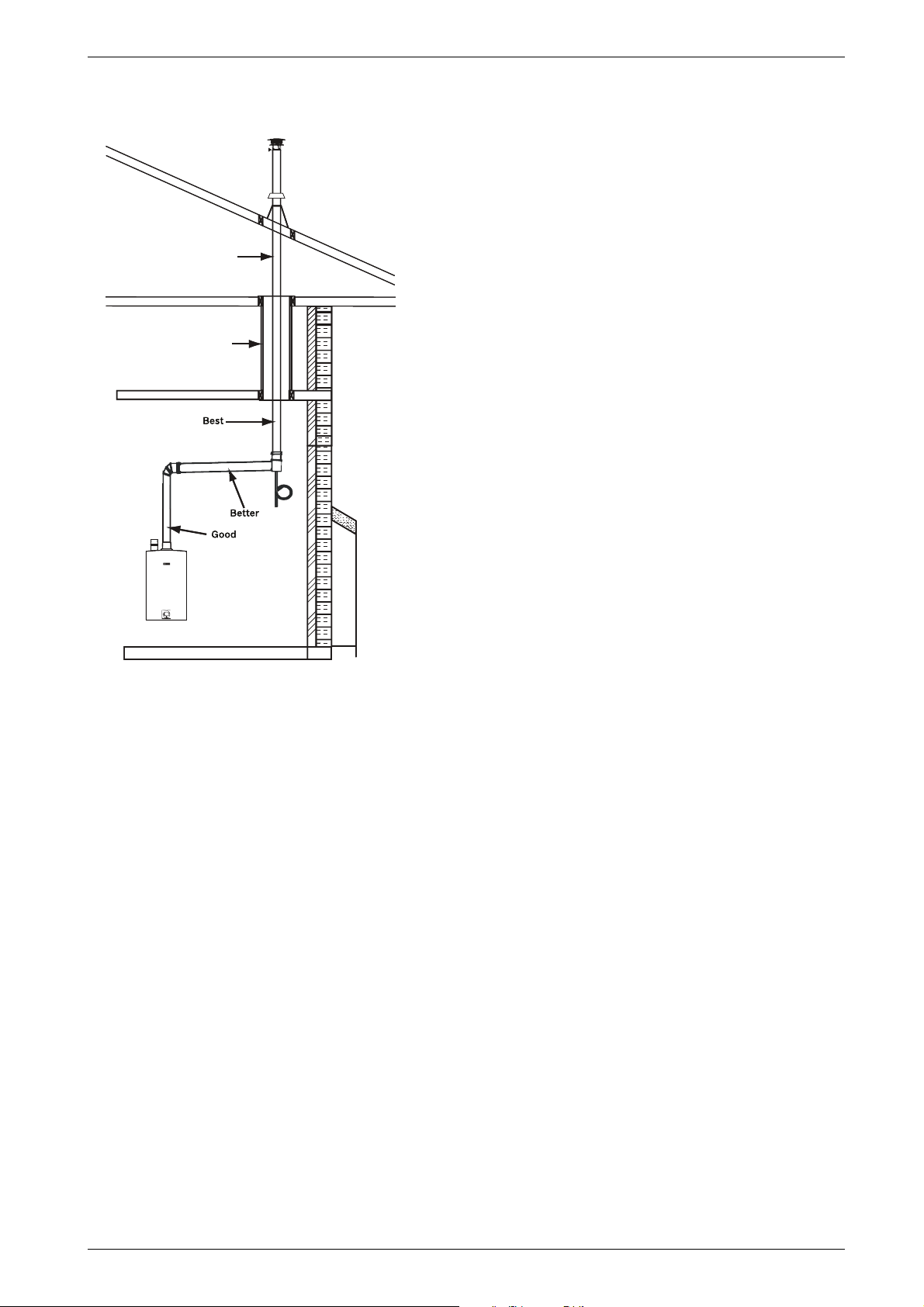
Installation
For these solutions to be effective, the internal flapper
must be 100% closed when the water heater is not run-
ning. Refer to Fig. 25 and 26 for preferred installation
positions in the vent system.
If using the Zflex damper:
• Ensure directional arrow on damper label faces in the
same direction as exhaust flow.
• If installed horizontally, the axis must be horizontal or
slightly pitched up towards termination to ensure
damper closes 100% when heater is not running.
• To allow accessibility, damper must not be installed
in an enclosed section of vent pipe.
• Do not install damper in unconditioned spaces (e.g.
attics) Condensation can build up while the heater is
running which can later freeze and potentially block
the flapper.
Fig. 25 Combustion air piping not shown for clarity
purposes
Good - Vertical directly on top of the heater.
Better - Closer to the termination horizontally installed in a condi-
tioned space.
Best - Closer to the termination vertically installed in a conditioned
space.
6720608542-07.1V
6720608542-08.1V
6720608542-06.1V
6 720 644 936
Installation instructions
19
Fig. 26 Combustion air piping not shown for clarity
purposes
Good - Vertical directly on top of the heater.
Better - Closer to the termination horizontally installed in a condi-
tioned space.
Best - Closer to the termination vertically installed in a conditioned
space.
3.3.7 Fan speed adjustment
IMPORTANT! Installation adjustment:
After installing the water heater, the fan speed values for
minimum power (P2) and maximum power (P1) may
need adjustment due to variations in altitude and vent
pipe length.
Failure to make necessary adjustments to fan speed
values may result in improper operation of the
appliance.
First calculate the total equivalent vent length. This is
the straight pipe length of both exhaust and combustion
air plus the number of elbows used. To determine the
length equivalency of each elbow refer to table 6.
Use the equivalent vent length value to determine the
appropriate fan speed values found in Table 19 and
20. Refer to page 21 on how to adjust the fan speeds
if an adjustment is necessary. After changing fan speed
values, proceed to section 6.4 to confirm CO2 values
are within specified ranges.
Preferreddamperpositionforverticalterminations
Unconditioned
space.Donot
installdamper.
Enclosedvent
pipe.Donot
installdamper.
6720608542-09.1V
6 720 644 936
20
Installation instructions
Fan speed adjustment
Natural Gas Liquid propane
Altitude
(above sea
level)
Total
equivalent
vent length
1)
Minimum
power fan
speed (P2)
Maximum
power fan speed
(P1)
Maximum
power fan speed
(P1)
0 - 2000 ft
(0 - 610 m)
3.5 - 32 ft
7
No
modification required
No
modification required
For operation at elevations
above 2,000 ft (610 m) the
equipment ratings shall be
reduced at the rate of 4% for
each 1,000 ft (305 m) above sea
level
33 - 57 ft
8
2000 - 4500 ft
(610 - 1372 m)
3.5 - 32 ft 8* 42* 40*
33 - 57 ft 8* 42* 41*
4500 - 8000 ft
(1372 - 2439 m)
3.5 - 32 ft 9* 43*
41*
33 - 57 ft 9* 43* 41*
* Above 2000 ft, CO
2
levels must be checked with a combustion gas analyzer, see section
6.4
for instructions.
Table 19 Fan speed adjustment for 3" piping
1) Full equivalent length (inlet + outlet piping + fittings)
Natural Gas Liquid propane
Altitude
(above sea
level)
Total
equivalent
vent length
1)
Minimum
power fan
speed (P2)
Maximum
power fan speed
(P1)
Maximum
power fan speed
(P1)
0 - 2000 ft
(0 - 610 m)
2.25 - 59 ft
7
No
modification required
No
modification required
For operation at elevations
above 2,000 ft (610 m) the
equipment ratings shall be
reduced at the rate of 4% for
each 1,000 ft (305 m) above sea
level
60 - 122.5 ft
8
2000 - 4500 ft
(610 - 1372 m)
2.25 - 59 ft 8* 42* 40*
60 - 122.5 ft 8* 42* 41*
4500 - 8000 ft
(1372 - 2439 m)
2.25 - 59 ft 9* 43*
41*
60 - 122.5 ft 9* 43* 41*
* Above 2000 ft, CO
2
levels must be checked with a combustion gas analyzer, see section
6.4
for instructions.
Table 20 Fan speed adjustment for 4" piping
1) Full equivalent length (inlet + outlet piping + fittings)
6 720 644 936
Installation instructions
21
Adjusting minimum power fan speed (P2)
To select fan speed:
B Press ON/OFF button into OFF.
B Press and hold "Program" button and press
ON/OFF button to turn appliance ON.
Fig. 27
B As soon as '188' is displayed, release "Program"
button , and the display should read P2.
B Press or to choose the fan speed suitable
with your installation, see Table 19 or 20.
B Press and hold (± 5 sec.) “Program” button until
the display flashes, then the selected value is memo-
rized.
Adjusting maximum power fan speed (P1)
To select fan speed:
B Press ON/OFF button into OFF.
B Press and hold "Program" button and press
ON/OFF button to turn appliance ON.
Fig. 28
B As soon as '188' is displayed, release "Program" but-
ton , and the display reads P2.
B Press the minus button to display P1.
B Press “Program” button to enter P1 adjustment.
The current setting will appear on the display.
B Press or to choose the fan speed suitable
with your installation, see Table 19 or 20.
B Press and hold (± 5 sec.) “Program” button until
the display flashes, then the selected value is memo-
rized.
i
Do not set P2 to greater then 9.
i
Proceed directly to Section 6.4 to confirm
CO
2
values are within range.

6 720 644 936
22
Installation instructions
Attention residents of the Commonwealth of
Massachusetts:
In the Commonwealth of Massachusetts the following
regulation went into effect on 12/30/2005:
(a) For all side wall horizontally vented gas fueled
equipment installed in every dwelling, building or
structure used in whole or in part for residential
purposes, including those owned or operated by the
Commonwealth and where the side wall exhaust vent
termination is less than seven (7) feet above finished
grade in the area of the venting, including but not limited
to decks and porches, the following requirements shall
be satisfied:
1. INSTALLATION OF CARBON MONOXIDE
DETECTORS. At the time of installation of the side wall
horizontal vented gas fueled equipment, the installing
plumber or gasfitter shall observe that a hard wired
carbon monoxide detector with an alarm and battery
back-up is installed on the floor level where the gas
equipment is to be installed. In addition, the installing
plumber or gasfitter shall observe that a battery
operated or hard wired carbon monoxide detector with
an alarm is installed on each additional level of the
dwelling, building or structure served by the side wall
horizontal vented gas fueled equipment. It shall be the
responsibility of the property owner to secure the
services of qualified licensed professionals for the
installation of hard wired carbon monoxide detectors.
a. In the event that the side wall horizontally vented gas
fueled equipment is installed in a crawl space or an at
tic, the hard wired carbon monoxide detector with alarm
and battery back-up may be installed on the next
adjacent floor level.
b. In the event that the requirements of this subdivision
can not be met at the time of completion of installation,
the owner shall have a period of thirty (30) days to
comply with the above requirements; provided,
however, that during said thirty (30) day period, a
battery operated carbon monoxide detector with an
alarm shall be installed.
2. APPROVED CARBON MONOXIDE DETECTORS.
Each carbon monoxide detector as required in
accordance with the above provisions shall comply with
NFPA 720 and be ANSI/UL 2034 listed and IAS
certified.
3. SIGNAGE. A metal or plastic identification plate shall
be permanently mounted to the exterior of the building
at a minimum height of eight (8) feet above grade
directly in line with the exhaust vent terminal for the
horizontally vented gas fueled heating appliance or
equipment. The sign shall read, in print size no less than
one half (1/2) inch in size, "GAS VENT DIRECTLY
BELOW. KEEP CLEAR OF ALL OBSTRUCTIONS".
4. INSPECTION. The state or local gas inspector of the
side wall horizontally vented gas fueled equipment shall
not approve the installation unless, upon inspection, the
inspector observes carbon monoxide detectors and
signage installed in accordance with the provisions of
248 CMR 5.08(2)(a)1 through 4.
(b) EXEMPTIONS: The following equipment is exempt
from 248 CMR 5.08(2)(a)1 through 4:
1. The equipment listed in Chapter 10 entitled
"Equipment Not Required To Be Vented" in the most
current edition of NFPA 54 as adopted by the Board;
and
2. Product approved side wall horizontally vented gas
fueled equipment installed in a room or structure
separate from the dwelling, building or structure used in
whole or in part for residential purposes.
(c) MANUFACTURERS REQUIREMENTS - GAS
EQUIPMENT VENTING SYSTEM REQUIRED. When
the manufacturer of Product Approved side wall
horizontally mounted gas equipment provides a venting
system design or venting system components with the
equipment, the instructions provided by the
manufacturer for the installation of the equipment and
the venting shall include:
1. Detailed instructions for the installation of the venting
system or the venting system components: and
2. A complete parts list for the venting system design or
venting system.
(d)MANUFACTURER REQUIREMENTS - GAS
EQUIPMENT VENTING SYSTEM NOT PROVIDED.
When the manufacturer of a product approved side wall
horizontally vented gas fueled equipment does not
provide the parts for the venting of flue gases, but
identifies "special venting systems," the following
requirements shall be satisfied by the manufacturer:
1. The referenced "special venting system" instructions
shall be included with the appliance or equipment
installation instructions; and
2. The "special venting systems" shall be product
approved by the Board, and the instructions for that
system shall include a parts list and detailed installation
instructions.
(e) A copy of all installation instructions for all products
approved side wall horizontally vented gas fueled
equipment, all venting instructions, all parts lists for
venting instructions, and/or all venting design
instructions shall remain with the appliance or
equipment at the completion of the installation.
6 720 644 936
Installation instructions
23
3.4 Combustion air requirements
Twin pipe and Concentric pipe
The water heater is designed as a sealed combustion
appliance. It is recommended that the combustion air
be provided from the outside by a dedicated pipe (twin
pipe) or by connecting to the concentric vent kit (see
Fig. 8, 9 & 10). The combustion air pipe may be PVC
or any other rigid sealed 3" or 4" pipe. Horizontal
sections of the combustion air pipe must pitch down
towards termination 1/4" per foot to prevent rain water
from entering the appliance. When using the twin pipe
method, combustion air inlet, whether terminating
vertically or horizontally, must be located in such a
manner as to provide a minimum 3 foot clearance
from the exhaust vent terminator. See Fig. 11 and
Fig. 12 Letter I, page 13.
For the maximum length of the combustion air
inlet pipe, see table 6.
Single pipe
Note: This appliance requires 9950 cubic feet of
available combustion air, or a minimum of 1243
square feet of space with an 8 foot ceiling to
operate. If the large amount of air space, which
equates to about half of most average sized
homes, is not available, the appliance must pull
air from the outside (see twin pipe above).
Although it is permissible to draw combustion air from
inside the structure, it is not the manufacturer’s
recommended installation method. Always install a 3
inch elbow on the top of the combustion air inlet
adaptor to prevent foreign objects from falling into the
unit.
If a single pipe installation is utilized, follow guidelines
below for providing adequate combustion air for the
water heater as well as any other appliances that may
consume air in the space. Always follow local codes if
they are more stringent.
This Installation Manual specifies the minimum vertical
vent pipe and the amount of combustion air required for
this unit. When all requirements are followed, the unit
will operate properly and safely. However, there may still
be a risk of freezing due to negative draft if the other
combustion appliances in the building are not supplied
with sufficient combustion air. A wood stove or furnace
can pull its combustion air from the heater's vent pipe,
allowing the cold incoming air to freeze the cold water
in the heat exchanger. Supplying more combustion air
for all combustion appliances is the solution. A HVAC
specialist should be consulted to design solutions for
providing more combustion air.
Observe the following guidelines:
Installations in structures that have been tightly
constructed (air infiltration rate of 0.40 ACH or less)
must be provided with combustion air per the National
Fuel Gas Code. Consult a HVAC specialist if your air
infiltration rate is questionable.
The space must have two permanent openings, one
commencing within 12 inches of the top and one
commencing within 12 inches of the bottom of the
enclosure.
Each opening must have a minimum free area of one
square inch per:
• 1000Btu/hr if all air is taken from inside the building
• 2000Btu/hr if all air is taken from the outside by
horizontal ducts
• 4000Btu/hr if all air is taken from the outside by
direct openings or vertical ducts.
Or the space must be provided with one permanent
opening or duct that is within 12 inches of the ceiling of
the enclosure.
This opening must have a minimum free area of one
square inch per:
• 3000Btu/hr if all air is taken from the outside by a
direct opening or vertical duct.
Louvers, grills and screens have a blocking effect. If the
effective free area in not known, increase the sizes of
your openings by 300% if your louvers are wood and by
43% if your louvers are metal. Refer to National Fuel
Gas Code for complete information.
3.5 Proper location for installing your
heater
Carefully select the location of the water heater. For
your safety and for proper heater operation, you must
provide combustion air to the heater and a proper
exhaust vent system.
Follow the guidelines below:
Warning: In areas where outside
temperatures routinely come close to
freezing, sealed combustion operation
is required. Use twin pipe or concentric
terminations for combustion air and
exhaust, which must be installed on the
same wall or roof surface, however
never facing the direction of prevailing
winds. Failure to do so may result in
heat exchanger freezing up and
bursting. This failure is not covered
under the manufacturer's warranty.
Warning: When installed in an
environment where corrosive chemicals
or dirty air (e.g. hair salons, car washes)
are present the twin pipe system is
required.
Warning: Terminations must prevent
rain and debris from entering the
combustion air and exhaust vent piping.
6 720 644 936
24
Installation instructions
B 1. Locate the heater where venting, gas and
plumbing connections are feasible and convenient.
B 2. The hot water lines should be kept short and
insulated to save energy. Centrally locating the water
heater is recommended to keep hot water
distribution times even throughout the structure.
3.6 Heater placement and clearances
The water heater is approved for installation on a
combustible wall (see chapter 3.7 Mounting
installation) provided the floor covering below
the heater is noncombustible. For installations in an
alcove or closet, maintain the minimum clearances to
combustible and non-combustible materials. See
chapter 2.5, page 8.
Clearances from any exhaust vent pipe are dependent
upon the clearance requirements of the stainless steel
vent pipe manufacturer. Single wall stainless steel
(AL29-4C) vent pipe (vent type rated for Category III
appliances) must be used when exhaust venting this
appliance. See chapter 3.3 (page 9) Venting.
3.7 Mounting installation
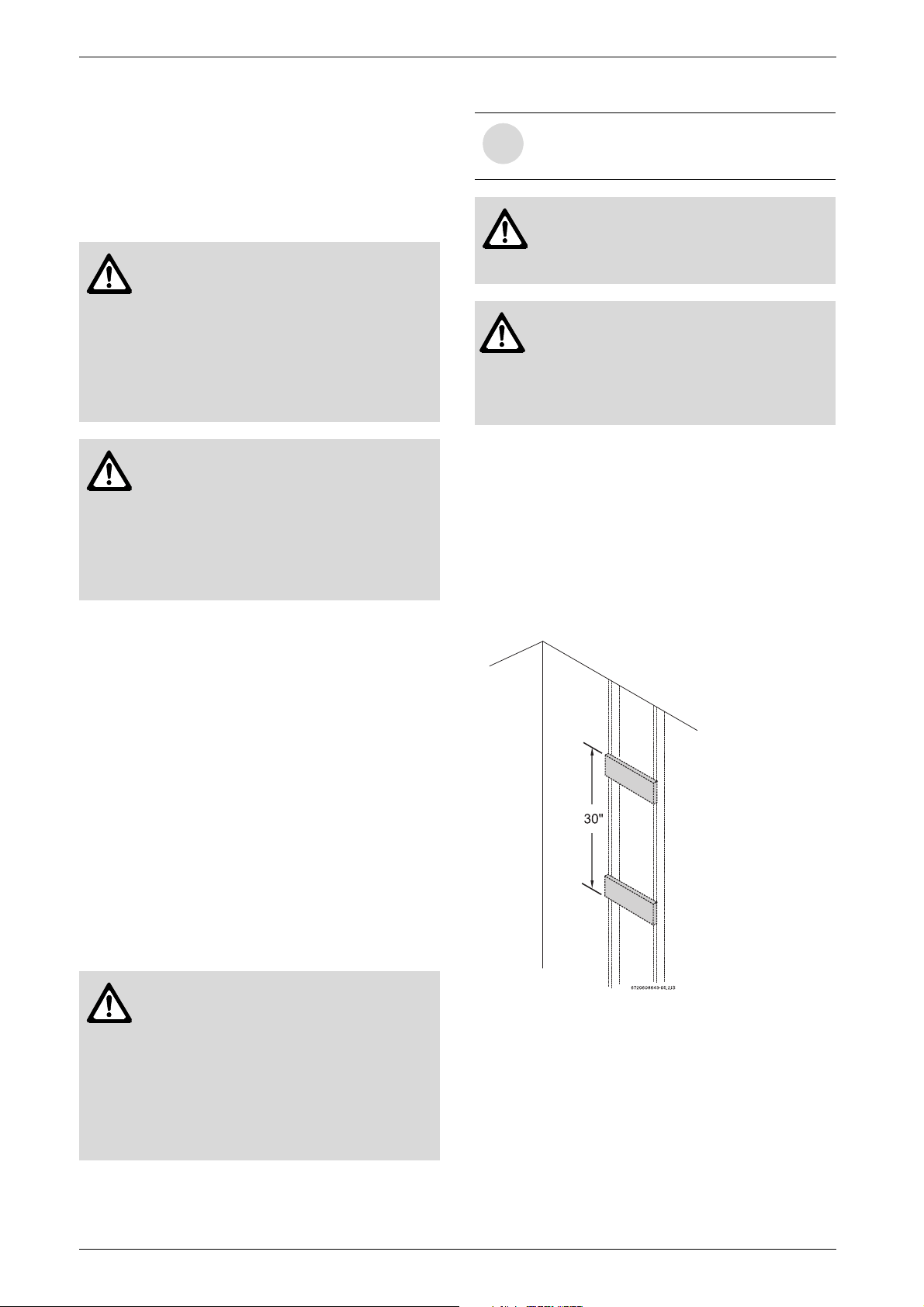
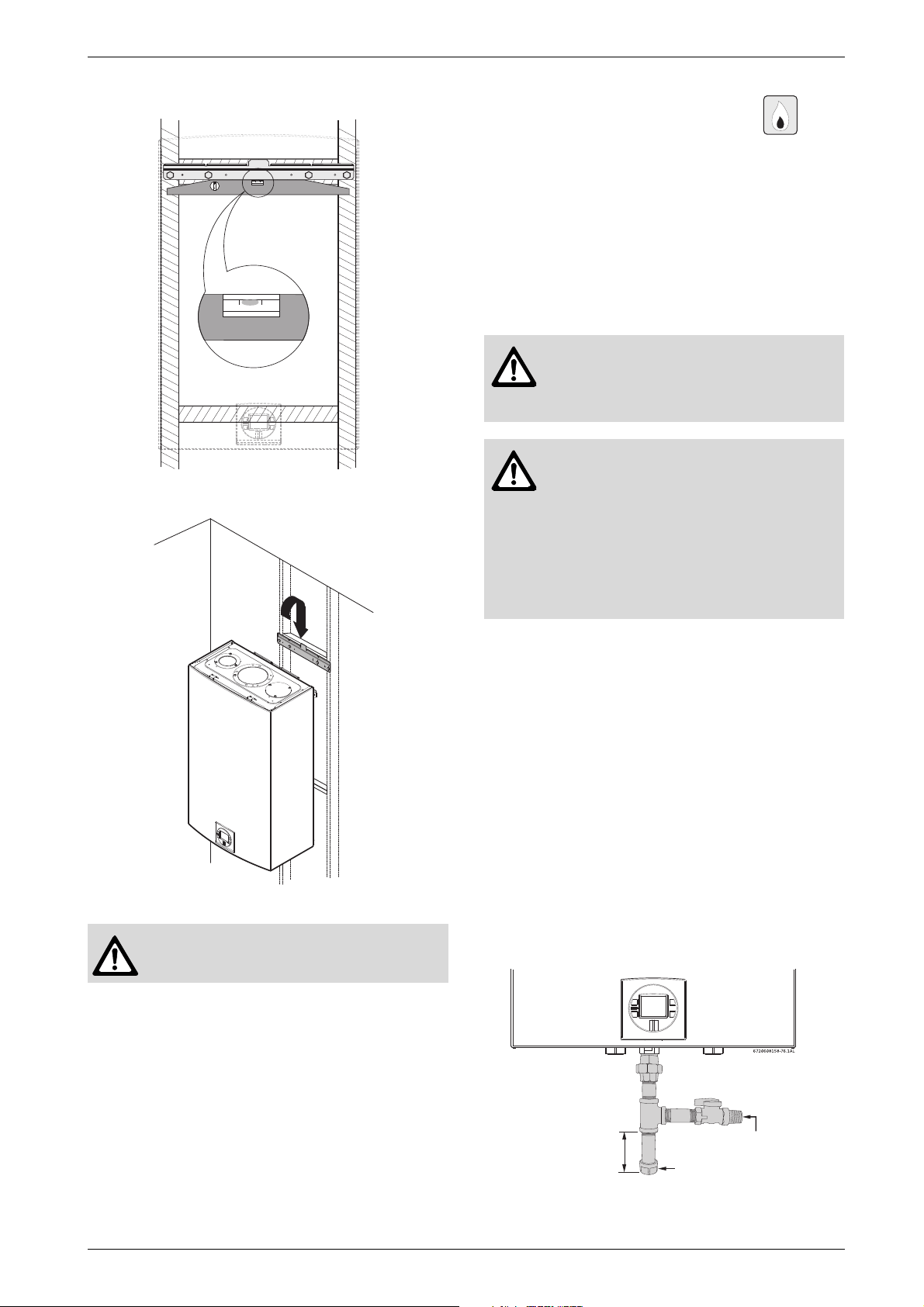
If wall is sheathed with plaster or drywall, it is recom-
mended that two support boards, either 1”x4” or 1/2"
(minimum) plywood first be attached across a pair of
studs, see Fig. 29, page 24.
B Secure the wall mounting bracket provided with the
heater to the wall surface. The heater must be kept
level on the wall surface, see Fig. 30, page 25.
B Hang the appliance on the bracket, see Fig. 31, page
25.
Fig. 29 Distance between support boards
Warning: The water in this water
heater is cold and always remains cold
except for the times the burner is on. In
the event of power outage in
conjunction with freezing temperatures,
it is recommended that the heater be
drained.
See chapter 6.2, page 38 “Winterizing”
for draining instructions.
Warning: Flammable materials,
gasoline, pressurized containers, or any
other items or articles that are potential
fire hazards must NOT be placed on or
adjacent to the heater. The appliance
area must be kept free of all
combustible materials, gasoline and
other flammable vapors and liquids.
Warning: before mounting
appliance
B Check that there are no loose or
damaged parts inside the
appliance
B Confirm the gas type of the heater
matches the gas supply you will be
connecting the heater, see Fig. 2,
page 6.
i
Front cover should be removed (see
instructions on page 7) in order to inspect
components visually.
Warning: Do not install this appliance
on a carpeted wall. The heater must be
mounted on a wall using appropriate
anchoring materials.
Warning: In areas where outside
temperature is routinely below 32°F and
the heater is to be installed on the inside
of an exterior wall, a minimum 2" air gap
or rigid insulation between the heater
back and the wall is recommended.
Studs 16"
(406mm) on
center
6 720 644 936
Installation instructions
25
Fig. 30 Leveling the mounting bracket on the studs
Fig. 31 Mounting the heater
3.8
Gas piping & connections
Before connecting the gas supply, check the rating
plate on the right side of the heater to be sure that the
heater is rated for the same gas to which it will be
connected.
In the United States: The installation must conform with
local codes or, in the absence of local codes, the
National Fuel Gas Code ANSI Z223.1/NFPA 54.
In Canada: The Installation must conform to CSA B149
INSTALLATION CODES and/or local installation
codes.
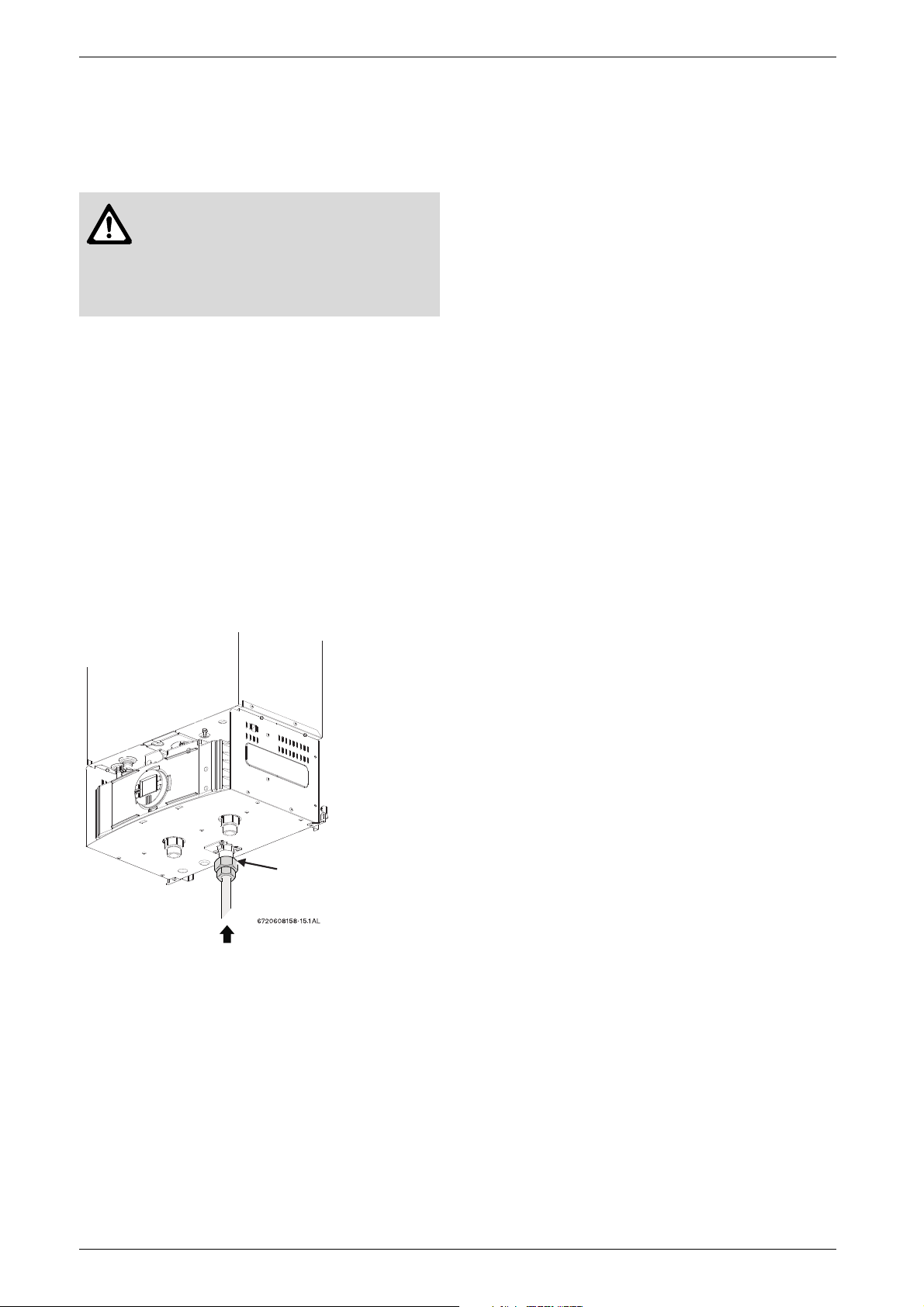
GAS CONNECTIONS
B Install a manual gas shut off valve on the gas supply
line within easy reach of the appliance.
B Install a union when connecting gas supply.
B The minimum internal diameter required for
any appliance connector is ¾”, see Fig. 34 for
more details on pipe sizing.
B Undersized flexible appliance connector not permit-
ted.
B National Fuel Gas Code requires that a sediment
trap (drip leg) be installed on gas appliances not so
equipped. The drip leg must be accessible and not
subject to freezing conditions. Install in accordance
with the recommendations of the serving gas
supplier, see Fig. 32.
Fig. 32 Gas connection (drip leg)
Warning: Appliance must be installed
vertically.
6720608158-64.1AL
6720608158-05.1AL6720608158-05.1AL
Warning: DO NOT connect to an
unregulated or high pressure propane
line or to a high pressure commercial
natural gas line.
Warning: The heater must be isolated
from the gas supply piping system
during any pressure testing of that
system at test pressures equal to or
more than 0.5 psig. If overpressure has
occurred, such as through improper
testing of the gas lines or malfunction of
the supply system, the gas valve must
be checked for safe operation.
Gas supply
Cap
Minimum
3”
6 720 644 936
26
Installation instructions
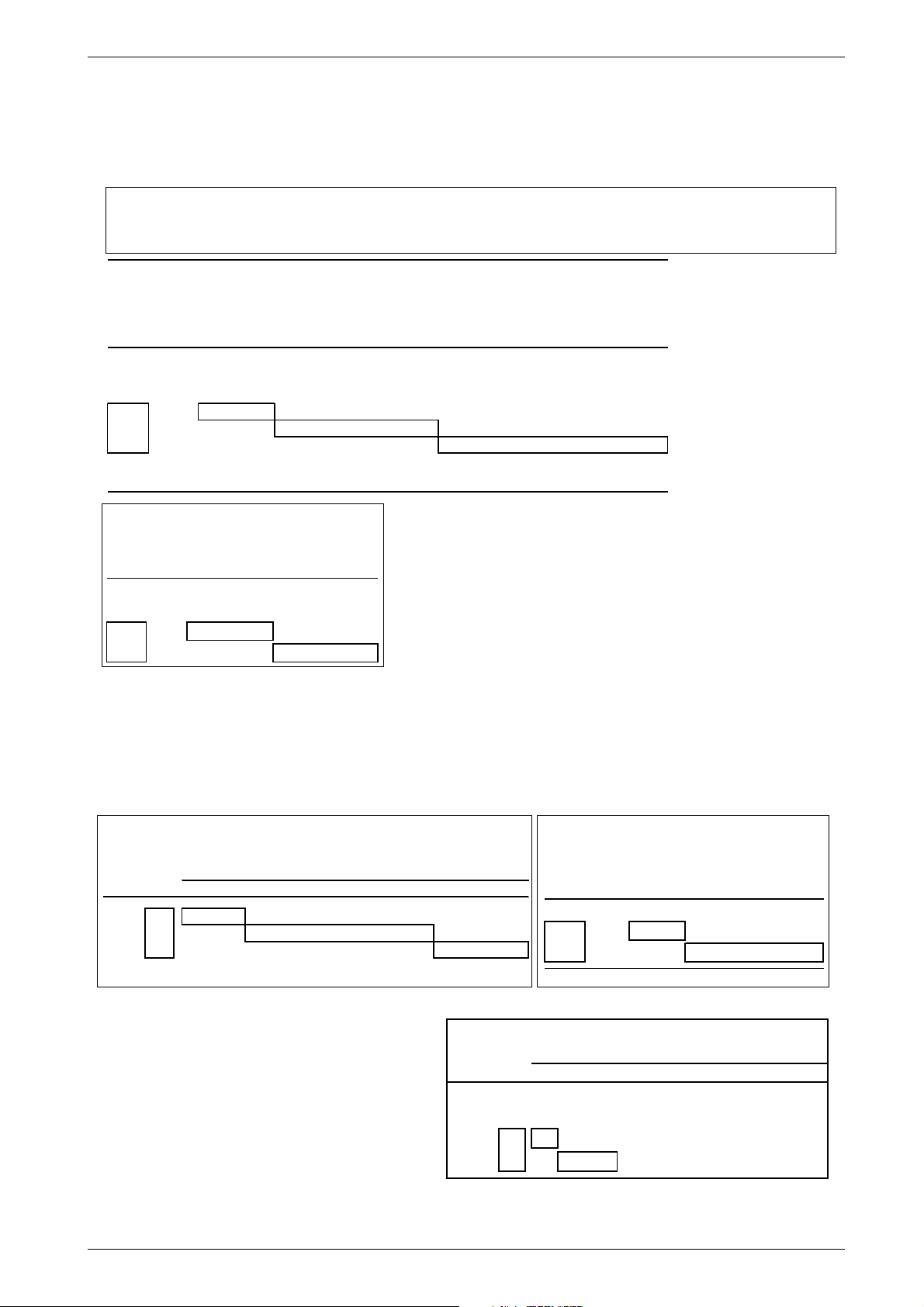
Once connections are made, check for gas leaks at all
joints. Apply some gas leak detection solution to all gas
fittings. Bubbles are a sign of a leak. A combustible gas
detector may also be used to detect for leaks.
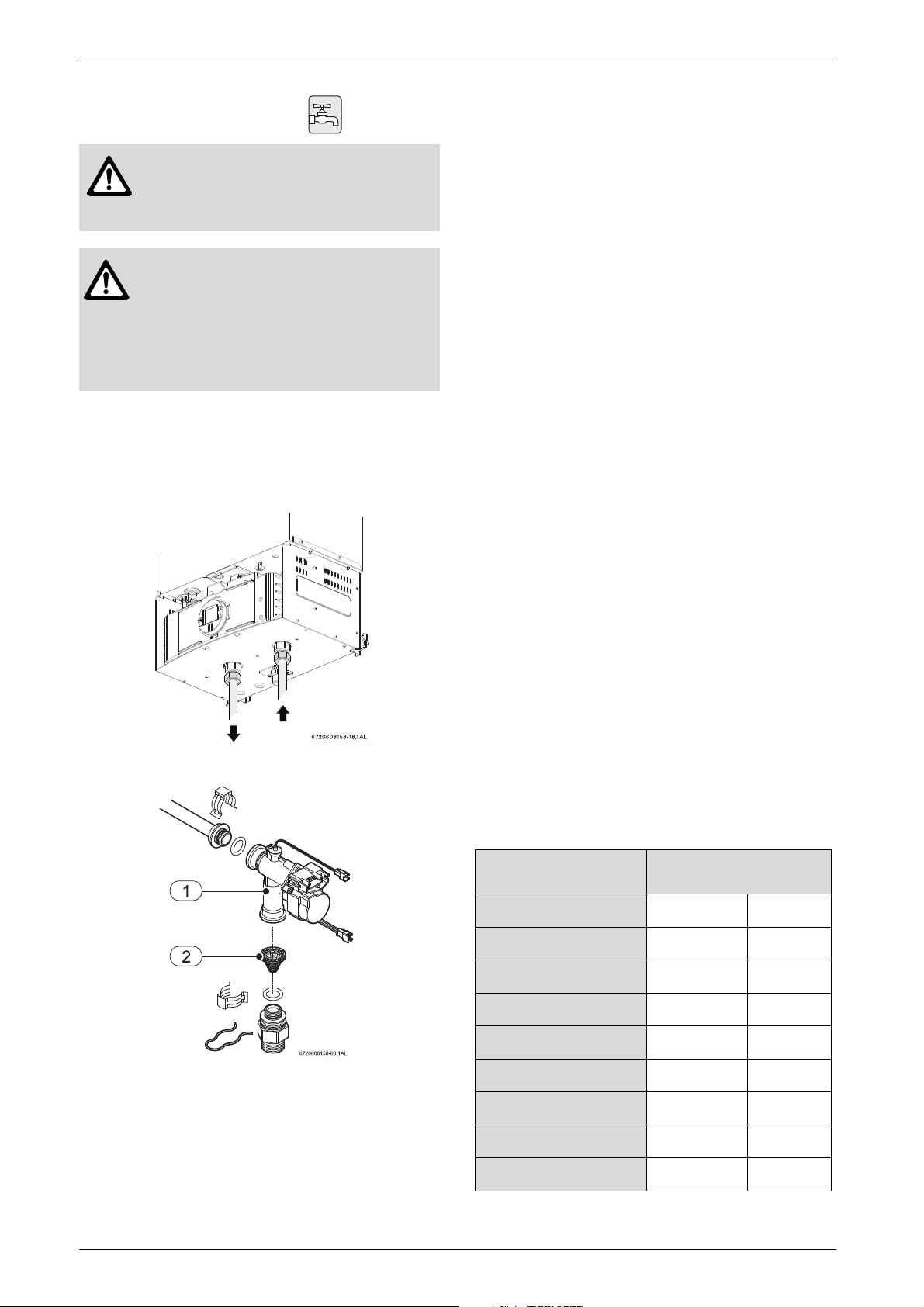
GAS LINE SIZING
The gas supply piping for a single heater should be
sized for a maximum draw of 175,000 BTUH. Measure
the length of gas supply line and use the tables in
Fig. 34, page 27 or the gas line manufacturer’s sizing
tables to determine the pipe diameter necessary to
accommodate the 175,000 BTU demand of the heater.
If there are more gas appliances on the line, size the gas
line according to the total maximum amount of BTU
input rating for all appliances.
Note: Undersizing the gas line may result in diminished
hot water flow rate and temperature. See chapter 3.13,
page 32 for the procedure to confirm gas pressure.
Proper gas pressure must be confirmed at time of
installation.
Fig. 33
Danger: If you have a leak, shut off the
gas. Tighten appropriate fittings to stop
leak. Turn the gas on and check again
with a gas leak detection solution.
Never test for gas leaks using a match
or flame.
Gas piping
Inlet gas particle screen
(included)
6 720 644 936
Installation instructions
27
FOR NATURAL GAS
Maximum Capacity of pipe in Cubic Feet of Gas per Hour for Gas Pressure of 0.5 Psig or less and a Pressure drop
of 0.3” in Water Column (0.75mbar).(Based on a 0.60 Specific Gravity Gas) Btu numbers given in thousands.
Fig. 34
Follow boxed numbers for piping just one 830 ES (example: ¾” B.I. Natural Gas pipe for 10 ft (3.0m). will
handle 278,000 btu’s (81.5 kWh). For multiple appliances combine the total maximum btu input load and then
refer to applicable chart below.
* EHD = Equivalent Hydraulic Diameter. The greater the
value of EHD, the greater the gas capacity of the tubing
.
Maximum Capacity of Semi-Rigid (flexible, non
corrugated) Tubing in Thousands of BTU per Hour of
Undiluted Liquefied Petroleum Gases (at 11 inches
Water Column Inlet Pressure).
(Based on a Pressure Drop of 0.5 Inch Water Column)
* Source National Fuel Gas Code NFPA 54, ANSI
Z223.1 - No Additional Allowance is necessary for an
ordinary number of fittings
FOR LP GAS
Maximum Capacity of Pipe in Thousands of BTU per Hour of Undiluted Petroleum Gases (at 11 inches Water Column Inlet
Pressure) (Based on a Pressure Drop of 0.5 Inch Water Column).
* EHD = Equivalent Hydraulic Diameter. The greater the
value of EHD, the greater the gas capacity of the tubing.
Nominal
Iron Length of Black iron Pipe , Feet
Pipe Internal
Size, Diameter
inches inches 10 20 30 40 50 60 70 80 90 100 125 150 175 200
1/4 0.364 32 22 18 15 14 12 11 11 10 9 8 8 7 6
3/8 0.493 72 49 40 34 30 27 25 23 22 21 18 17 15 14
1/2 0.622 132 92 73 63 56 50 46 43 40 38 34 31 28 26
3/4 0.824 278 190 152 130 115 105 96 90 84 79 72 64 59 55
1 1.049 520 350 285 245 215 195 180 170 160 150 130 120 110 100
1 1/4 1.380 1050 730 590 500 440 400 370 350 320 305 275 250 225 210
1 1/2 1.610 1600 1100 890 760 670 610 560 530 490 460 410 380 350 320
2 2.067 3050 2100 1650 1450 1270 1150 1050 990 930 870 780 710 650 610
Tube
size,
inches EHD*
10 20 30 40 50 60
1/2 18 EHD 82 58 47 41 37 34
3/4 23 EHD 161 116 96 83 75 68
1 30 EHD 330 231 188 162 144 131
1 1/4 37 EHD 639 456 374 325 292 267
Length of Flexible Corrugated Stainless Steel Tubing (CSST), Feet
Nominal
iron
Black Iron Pipe
pipe
Length of Pipe, Feet
Inches
10 20 30 40 50 60 80 100 125 150 200
1/2 291 200 160 137 122 110 94 84 74 67 58
3/4 608 418 336 287 255 231 197 175 155 140 120
1
1145 787 632 541 480 434 372 330 292 265 227
Tube
size
inches EHD*
10 20 30 40 50 60
1/2 18 EHD 129 91 74 64 58 53
3/4 23 EHD 254 183 151 131 118 107
1 30 EHD 521 365 297 256 227 207
Length of Flexible Corrugated Stainless Steel Tubing (CSST), Feet
Copper
Outside Length of Tubing, Feet
diameter
Inch 10 20 30 40 50 60 70 80 90 100
3/8 39 26 21 19 _ _ _ _ _ _
1/2 92 62 50 41 37 35 31 29 27 26
5/8 199 131 107 90 79 72 67 62 59 55
3/4 329 216 181 145 131 121 112 104 95 90
6 720 644 936
28
Installation instructions
3.9 Water connections
B When facing the heater, the ¾” cold connection is on
the bottom right and the hot connection is on the bot-
tom left. Centrally locating the water heater is recom-
mended to keep hot water distribution times even
throughout the structure.
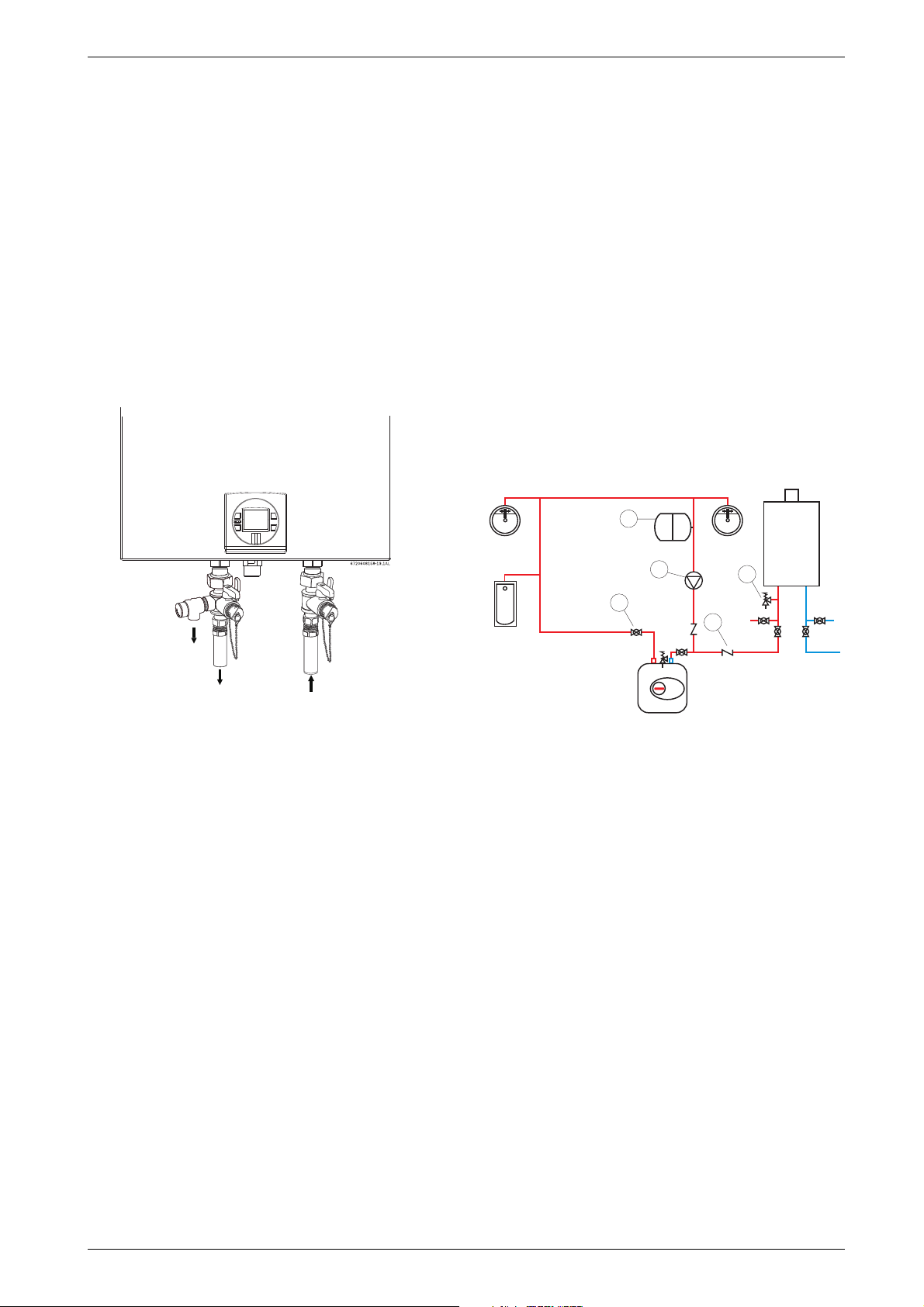
Fig. 35
Fig. 36 Water filter
1 Water valve with engine
2 Water filter
B The use of unions when connecting both water
pipes to the inlet and outlet connections is
required. This will facilitate any necessary
servicing.
B Plastic or PEX type plumbing line materials are not
suitable for connecting directly to the water heater.
B Although water piping throughout the building may
be other than copper, we recommend that copper or
suitably rated stainless steel flex line piping be used
for the water connections for 1.5’ on either side of
the water heater (follow local codes if more
stringent).
B Never sweat any piping directly to or beneath
the water connections, as damage can occur to
the internal water valve from heating of the
pipe.
B Keep water inlet and outlet pipes to no less
than ¾" (19.05mm) diameter to allow the full
flow capacity.
B If the cold and hot connections to the heater are
reversed, the heater will not function. Be certain there
are no loose particles or dirt in the piping. Blow out
or flush the lines before connecting to the water
heater.
B Full port shutoff valves should be installed on both
the cold water supply and hot water outlet lines to
facilitate servicing the heater (see Fig. 37).
B For installation on a private well system with the use
of a pressure tank, the lowest pressure range setting
recommended is 40-60 psi (2.75 and 4.15 bar).
3.10 Water quality
Water quality can have an impact on appliance
longevity and may not be covered under the
manufacturer's warranty.
For water analysis data call your local water department,
or if on a well, have well water analyzed periodically. If
water quality exceeds one or more of the values
specified below, Bosch recommends consulting a local
water treatment professional for water softening/
conditioning options.
Warning: This heater is not approved
for preheated water applications above
140°F (60°C). See chapter 3.11 for
approved recirculating application.
Warning:
In applications where inlet water
temperature can exceed 140°F (60ºC), a
3-way valve or mixing valve must be
installed before the appliance to prevent
water exceeding 140°F (60°C) from
entering the appliance.
HOT
COLD
Description Max. Levels
pH pH 6.5 - 8.5
TDS (total Dissolved
mg/l or ppm 500
Total hardness mg/l or ppm
100
Aluminum mg/l or ppm 2.0
Chlorides mg/l or ppm 250
Copper mg/l or ppm 1.0
Iron mg/l or ppm 0.3
Manganese mg/l or ppm 0.05
Zinc mg/l or ppm 5.0
Table 21
6 720 644 936
Installation instructions
29
Connecting the pressure relief valve (PRV)
A listed pressure relief valve must be installed at the
time of installation. No valve is to be placed between
the PRV and the heater. No reducing coupling or
other restriction may be installed in the discharge line.
The discharge line must be a minimum of 4” above a
drain and installed such that it allows complete drainage
of both the PRV and the line. The discharge line must be
placed where it will not cause any damage.
The location of the PRV must be readily accessible for
servicing or replacement, and be mounted as close to
the water heater as possible. See Fig. 37. To install the
PRV, a suitable fitting connected to an extension on a
“T” fitting can be sweated to the hot water line.
Support all piping.
Fig. 37 Plumbing Connections (with shutoff valves)
and Pressure Relief Valve
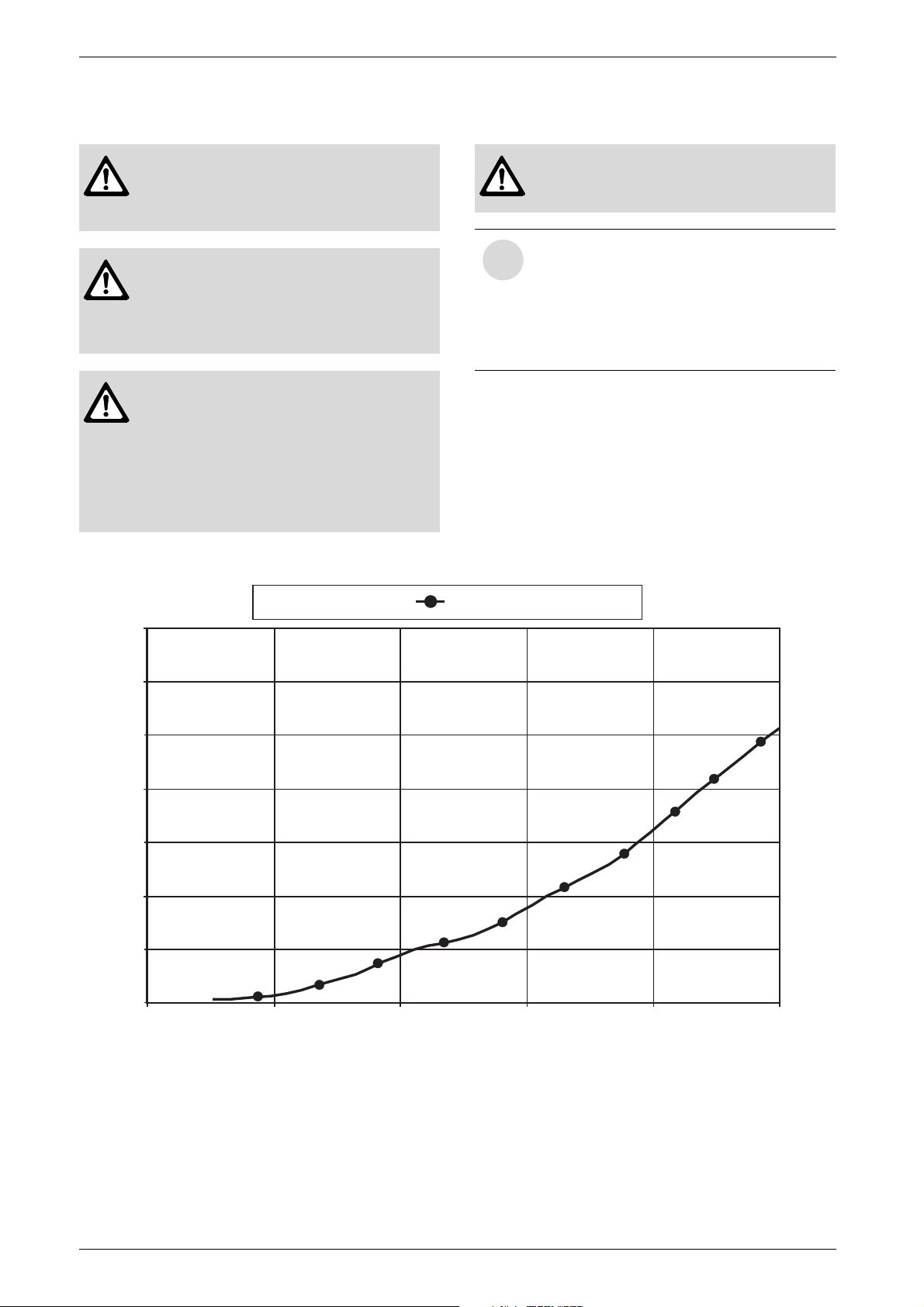
3.11 Domestic hot water recirculation
Although recirculation directly through the tankless
water heater is allowed, temperature stability is
improved by recirculating through a mini-tank as shown
in Fig. 38. By using the design in Fig. 38, there is no
recirculation of hot water through the tankless water
heater and therefore, does not affect the heat
exchanger warranty. Direct recirculation through the
tankless water heater is permissible, however, the heat
exchanger warranty is reduced; contact Bosch
Thermotechnology for further installation requirements.
The following drawing is provided to outline one
possible recirculation design using the water heater in
conjunction with an Ariston mini tank water heater. This
schematic is for illustration only and must not be used
for actual installation without appropriate engineering
and technical advice from a properly licensed
professional in the locality where the installation is
made.
Fig. 38 Recirculation application
1 Full port isolation valve
2 Circulator (pump on timer)
3 Check valve
4 PRV
5 Expansion tank
The use of a small electric mini-tank water heater (4-6
gallon size) should be used for this application and
designed so the pump will circulate the water through
the mini-tank and the building's hot water return loop
only. Timed or thermostatically controlled operation of
the pump is commonly done. Contact Bosch
Thermotechnology if further information is needed.
6720608158-77.1AL
1
4
5
3
2
Ariston Minitank
GWH
830
ES
6 720 644 936
30
Installation instructions
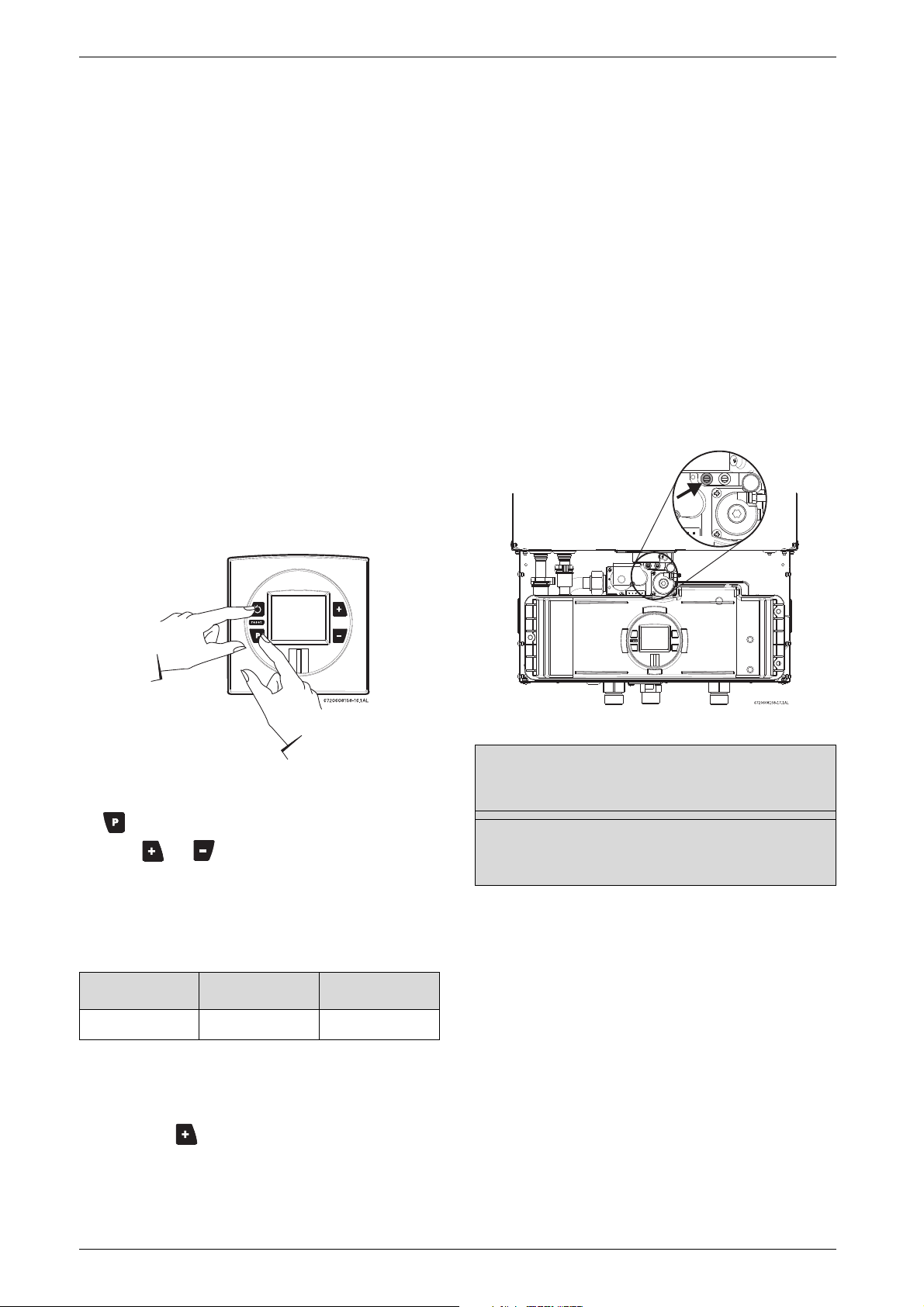
3.12 Space heating applications
Bosch tankless water heaters are approved for use in
combination DHW and space heating applications
(open-loop setup). These water heaters are not
approved for use in space heating only applications
(closed-loop setup). Bosch supports applications of
combination DHW and space heating in an open loop
configuration if plumbed similar to Fig. 40. Use of a
Bosch tankless water heater in a combination DHW
and space heating application will result in the product
warranty being reduced to 3 years.
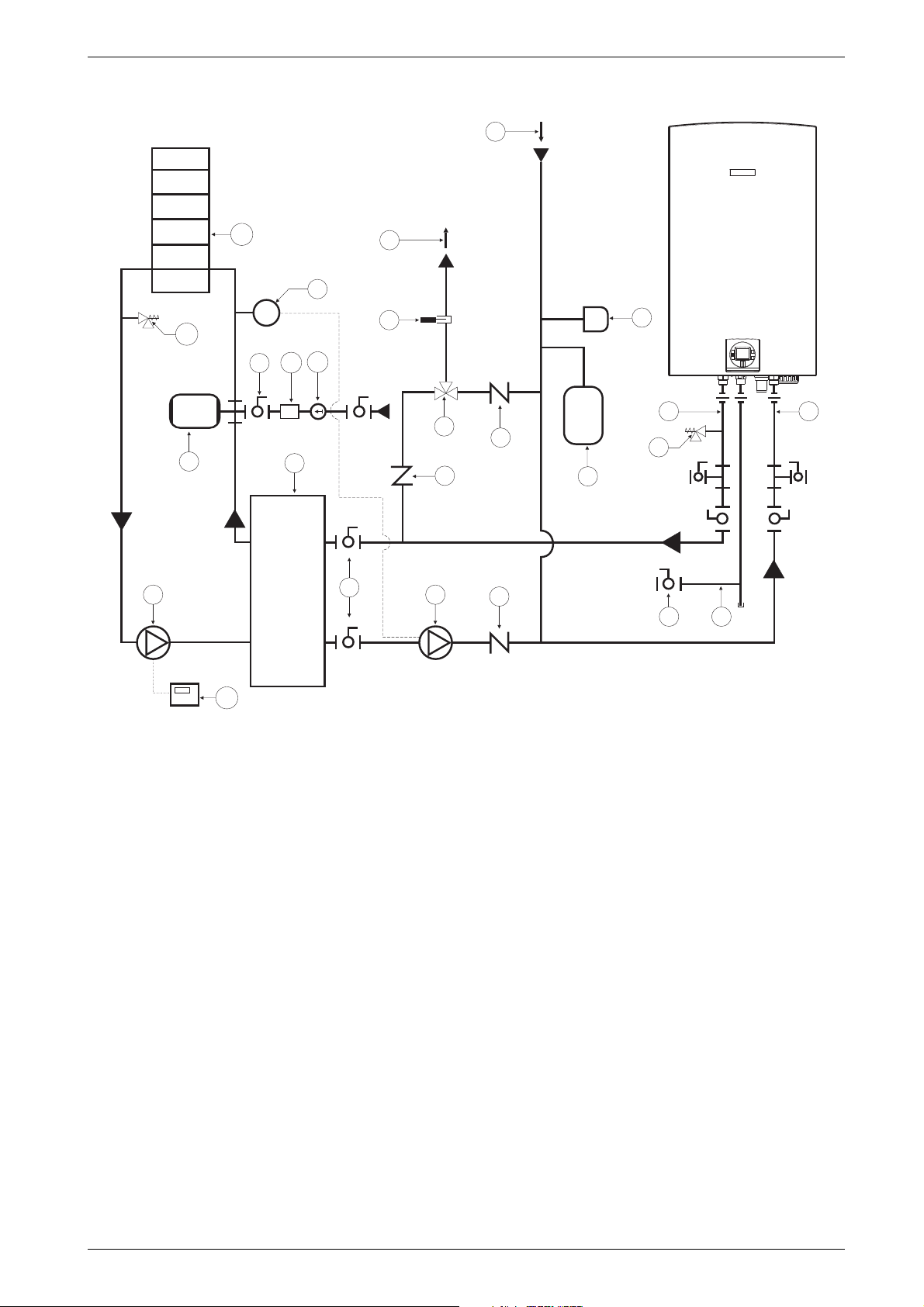
Fig. 39 Pressure drop curve
Warning: If the set point temperature is
above 120°F, precautions should be
taken to protect users of potable water
from scalding.
Warning: Propylene glycol may be
used for freeze prevention ONLY on the
space heating side of the heat
exchanger. Do not use ethylene glycol
(automotive antifreeze).
Warning: The use of a flow switch is
recommended to ensure DHW priority
and to prevent “cold-blow” situations
when the Bosch tankless water heater is
used with an air-handling system. The
flow switch should be used to disable
the blower on the air-handling system
when domestic water is used.
Warning: Ensure the primary pump is
properly sized to provide adequate flow
for the system heat load.
i
For Pump sizing please refer to the
pressure drop curves, Fig. 39. Also
remember to account for system piping
pressure loss. A minimum of 1.7 GPM is
recommended to provide adequate flow
through the water heater when
determining the size of the primary pump.
Flow(GPM)
Pressure(FeetofHead)
0
0.0 1.0 2.0 3.0 4.0 5.0
10
20
30
40
50
60
70
830ES
6720644936-01.1V
6 720 644 936
Installation instructions
31
Fig. 40 Space heating diagram
1 Hot water outlet
2 Cold water inlet
3 Pressure relief valve
4 Gas supply
5 Shut off gas valve
6 Thermal expansion tank (as required)
7 Atmospheric vacuum breaker
8 Cold inlet
9 Check valve
10 Pump
11 Thermostatic mixing valve
12 Thermometer (optional)
13 DHW outlet
14 Water to water heat exchanger
15 Backflow preventer
16 Automatic water feed
17 Thermostat
18 Space heating zone
19 Zone controller
20 Space heating pump
21 Expansion tank
22 Pressure relief valve
6720644887-02.1V
21
3
5
6
7
8
13
11
12
5
21
17
20
14
10
9
9
9
15
16
22
19
4
T
18
5
6 720 644 936
32
Installation instructions
3.13 Measuring gas pressure
Confirm gas pressure upon installation.
Connecting manometer
B Shut off gas supply at installer supplied shutoff valve
for this water heater.
B Remove front cover and locate inlet gas pressure
measuring point (see Fig. 42).
B Loosen screw inside left test point fitting (do not
remove) and connect manometer tube to test point.
Remove screw completely if correct size tapping is
available.
Static Pressure Test
B Turn gas supply back on.
B Record static gas pressure reading in table 23.
Operating Pressure Test
B Press ON/OFF button to turn off the appliance.
B Press and hold "Program" (P) button and press ON/
OFF button to turn appliance ON.
Fig. 41
B As soon as '188' is displayed, release "Program"
, button and the display should read P2.
B Press or until P1 appears.
Note: While in this mode the appliance will run
constantly at maximum power and allow
maximum water flow.
For inlet gas pressure adjustment consider the
following table:
B Turn on high volume of hot water flow (at least 6
gpm) and heater will ignite. If heater display reverts to
P2, open more hot water fixtures to allow sufficient
flow. Press until P1 reappears on display.
B Operate all other gas appliances (except this heater)
on same gas piping system at maximum output.
B Record lowest operating gas pressure reading in
table 23.
Gas pressures lower than 3.5" W.C. for Natural Gas or
8" W.C. for LPG will result in insufficient degree rise to
the hot water being used, reduced hot water volume,
possible error code faults and must be corrected. See
Gas Connections, chapter 3.8, page 25.
P1 fan speed:
Factory default: NG: 42, LP: 40
Lowering P1 fan speed reduces the maximum BTU
input.
As a temporary measure if the gas pressure in P1 is
below specification, lower P1 fan speed incrementally
until minimum inlet gas pressure reaches specified
range (table 22). After upgrading gas line, reset
appliance to P1 factory default setting (NG: 42, LP: 40)
or setting from Section 3.3.7.
Fig. 42 Gas pressure test port (left tapping)
Gas type NG LPG
p
in
3.5” WC 8” WC
Table 22 Minimum inlet gas pressure under full operation
Static Gas Pressure Reading (see Chapter 3.13)
enter here: ___________________ Date: ___________
Operating Gas Pressure Reading (see Chapter 3.13)
enter here: ___________________ Date: ___________
Table 23
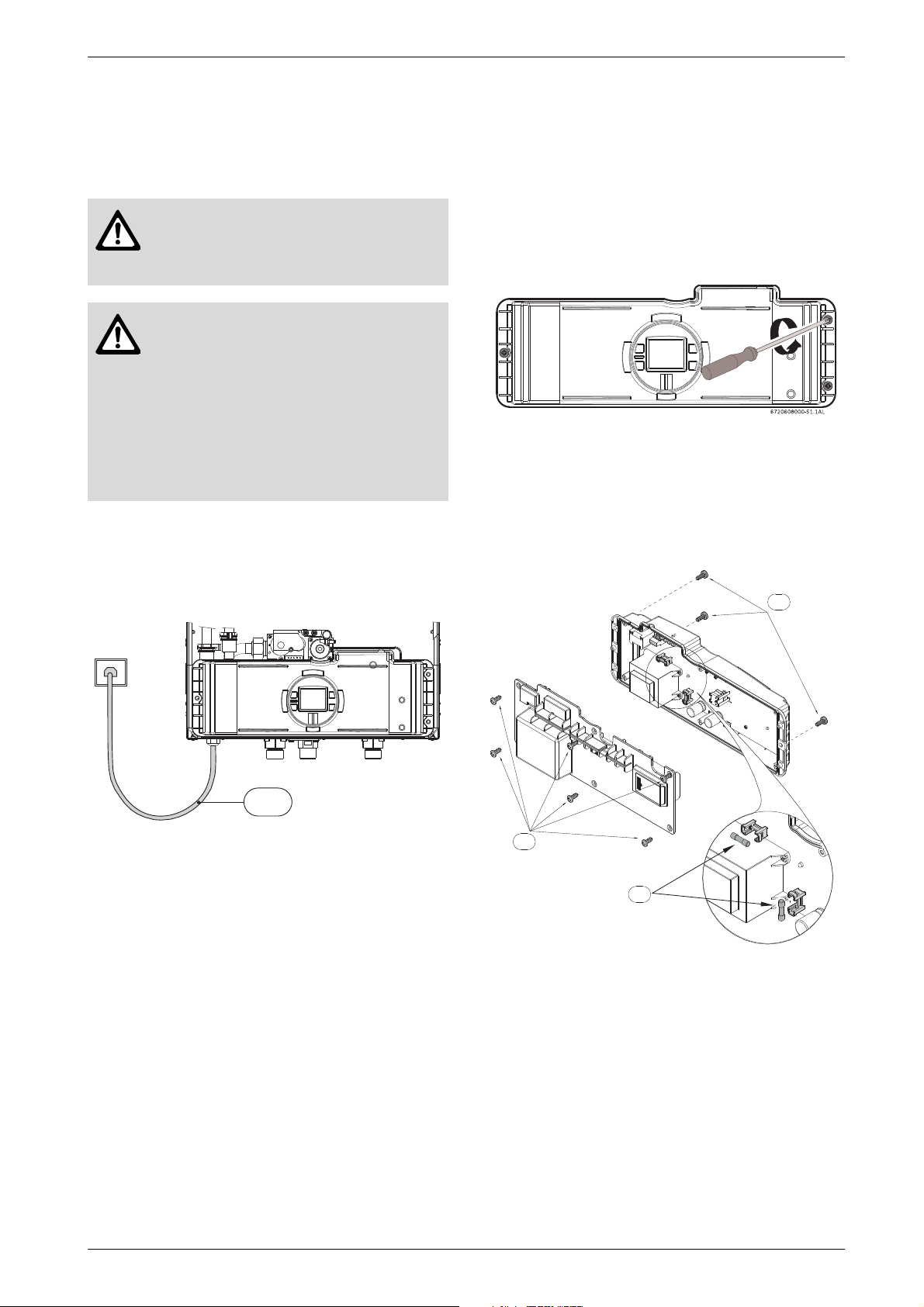
6 720 644 936
Electrical connections
33
4 Electrical connections
4.1 Electrical power supply
The water heater requires an electrical power supply
from a 120VAC / 60Hz properly rated receptacle and
must be properly grounded.
The heater is wired as shown in the wiring diagram
(chapter 9, Fig. 68).
Fig. 43
Note: Outlet appliance is plugged in to should be clear
from possible water damage.
4.2 Position of the fuses in control unit
To check fuses, proceed as follows:
B Remove the front cover, see Fig. 4, page 7.
B Remove the three screws on front of the control unit.
Fig. 44
B Pull control unit free to access and remove the six
screws from the back cover of the control unit, see
Fig. 45, pos. 2.
B Check the fuses in the printed circuit board, see Fig.
45, pos. 3.
Fig. 45 Location of fuses
B After verifying the fuses mount all parts in reverse
order.
Warning: For safety reasons,
disconnect the power supply cord to
the heater before any service or testing
is performed.
Warning: This heater must be
electrically grounded in accordance
with the most recent edition of the
National Electrical Code. NFPA 70. In
Canada, all electrical wiring to the
heater should be in accordance with
local codes and the Canadian Electrical
Code, CSA C22.1 Part 1. Do not rely
on the gas or water piping to ground the
metal parts of the heater.
6720608643-15.1AL
1
2
1
3
6720608158-78.1AL
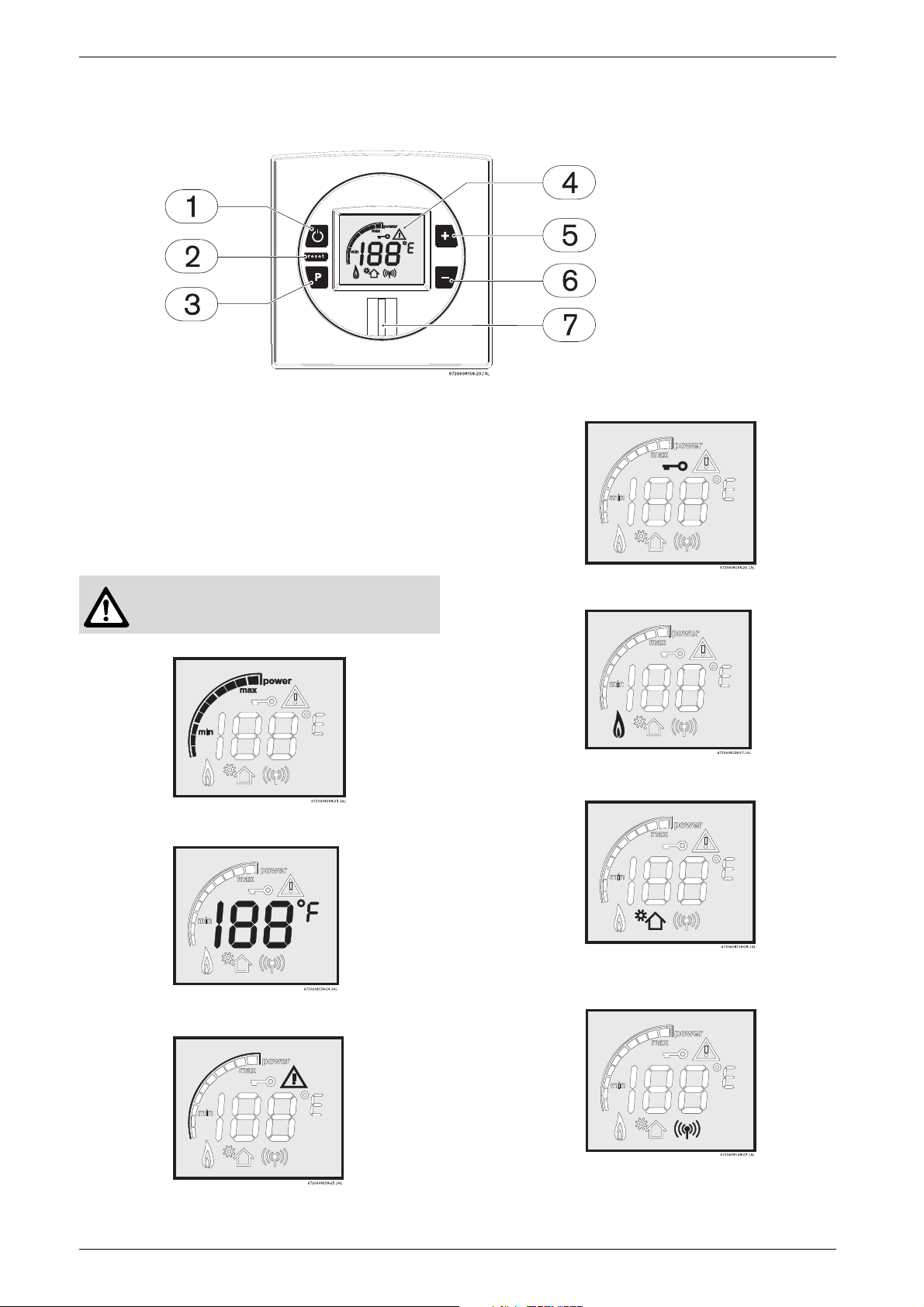
6 720 644 936
34
Operation instructions
5 Operation instructions
Fig. 46
1 On/Off button
2 Reset button
3 Program Key
4 LCD display
5 Up button
6 Down button
7 LED - Power On indicator or Stand-by
5.1 Description LCD display
Fig. 47 Power bar indicator (input)
Fig. 48 Temperature indicator
Fig. 49 Error indicator
Fig. 50 Lock indicator (only with remote control)
Fig. 51 Flame indicator
Fig. 52 Solar mode indicator (see chapter 5.4, page
35)
Fig. 53 Cascading Master appliance
Warning: Do not use any cleaning or
corrosive agent to clean the window.
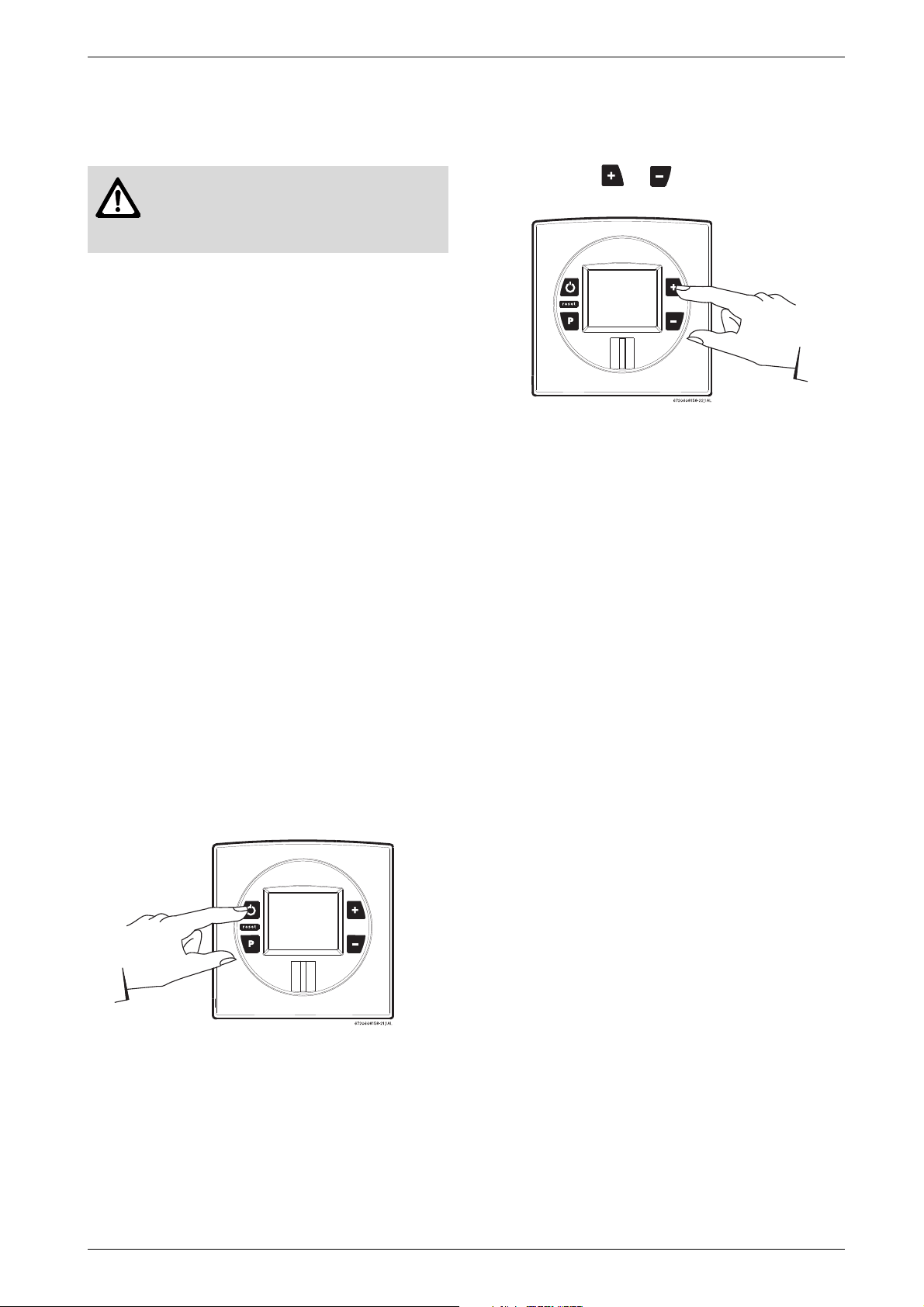
6 720 644 936
Operation instructions
35
5.2 For your safety read before
operating your water heater
A. This appliance is equipped with electronic ignition for
lighting the main burner. When turning the heater on,
follow these instructions exactly.
B. Before operating the unit, press the On/Off button.
WHAT TO DO IF YOU SMELL GAS
B Do not try to light any appliance.
B Do not touch any electric switch; do not use any
phone in your building.
B Immediately call your gas supplier from a neighbors
phone. Follow the gas supplier’s instructions.
B If you cannot reach your gas supplier, call the fire
department.
C. Use only your hand to press the on/off control switch.
Never use tools. Follow these instructions exactly. If
control switch is jammed, close the gas supply and call
a qualified service technician. Attempted forceful repair
may result in a fire or explosion.
D. Do not use this appliance if any part has been under
water. Immediately call a qualified service technician to
inspect the appliance and to replace any part of the
control system and any gas control which has been
under water.
5.3 Power
On
B To start the appliance press the On/Off button.
Fig. 54
Off
B To shut down the appliance press the On/Off button
again.
5.4 Temperature selection
To select output water temperature:
B Press buttons or in order to reach desired
temperature.
Fig. 55
Setting the water temperature
The desired temperature of the hot water can be
adjusted on the front control panel of the heater.
The water heater has an electronically controlled gas
valve that modulates the burner input in response to
both varying hot water flow rates and/or changes in any
incoming and outgoing water temperatures.
Note: The water heater, running at minimum BTU, may
still achieve temperatures above the desired set
temperature. Low flowing fixtures are the leading cause
of this type of temperature overshoot. To combat this
symptom, clean fixtures or replace with higher flowing
ones.
Saving water resources:
B Make sure you close all the taps after any use. Avoid
leaving the taps dripping. Repair any leaking tap.
B Define the temperature you want, in the appliance or
with the remote control. This way you have the
precise water flow needed (mixing cold water to
regulate temperature will increase the water flow with
consequent waste of water)
Warning: If you do not follow these
instructions exactly, a fire or explosion
may result causing property damage,
personal injury or loss of life.
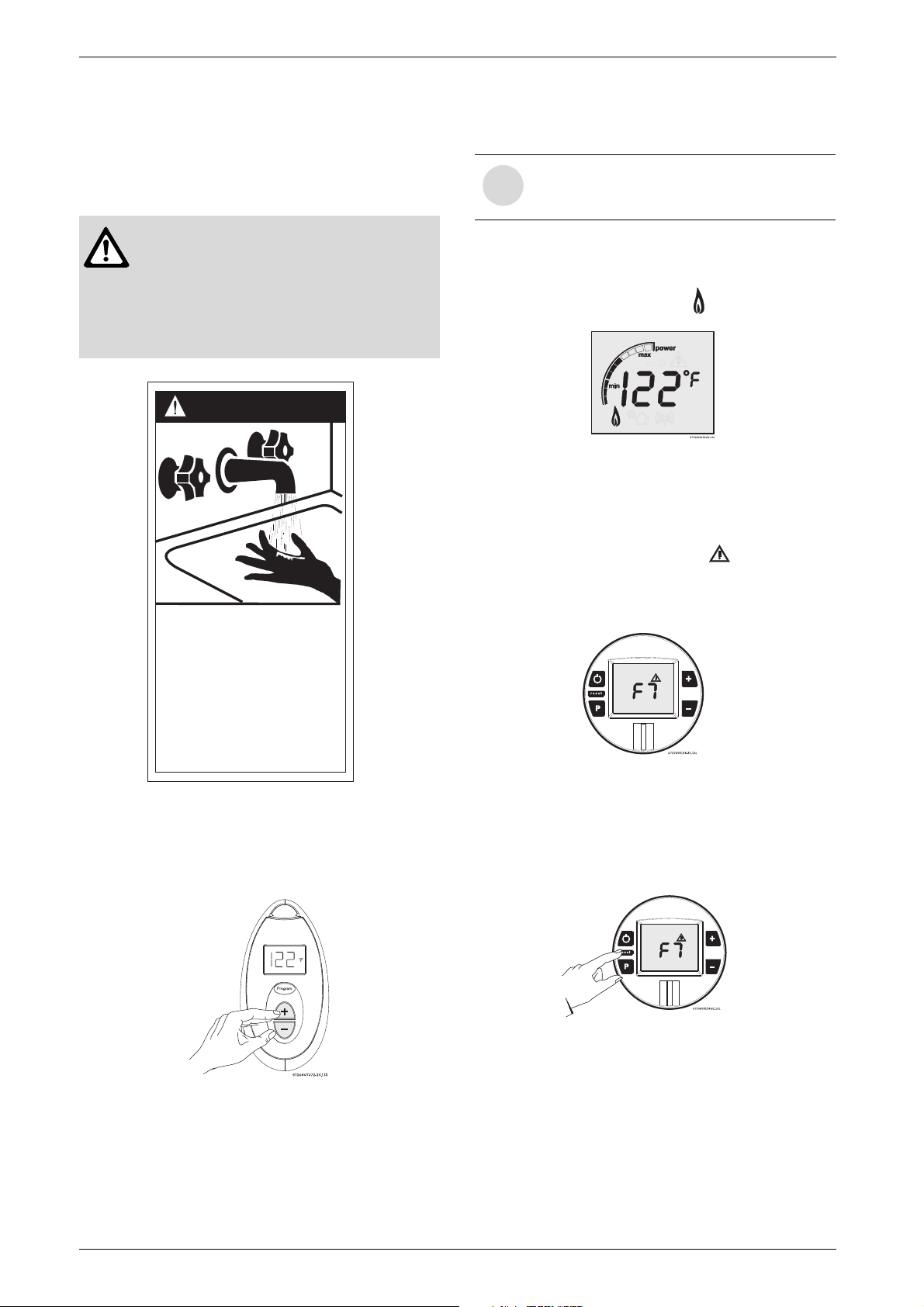
6 720 644 936
36
Operation instructions
Solar mode
The water heater will not ignite if inlet water temperature
exceeds the set temperature on the appliance. In this
condition, the solar mode indicator will show on the
LCD display. See Fig. 52, page 34.
Fig. 56
5.5 Use of optional remote control
accessory (part no. TSTAT2)
Fig. 57 Remote control
The wireless remote control accessory (Fig. 80,
component 13) and the temperature selector buttons
on the front of the water heater operate identically.
Contact your distributor to order the remote control
accessory. Modification of the water heaters interior
control unit (Fig. 80, component 16) is required when
programming the remote control with this heater.
5.6 Operation
B When a hot water tap is opened, main burner ignites
and LCD displays the symbol .
Fig. 58
B LCD blinks until selected temperature is reached.
5.7 Reset button
If the LCD shows the error symbol do not shut off
power or unplug the heater.
See the error code on LCD and consult
“Troubleshooting” section.
Fig. 59
After following instructions indicated in
“Troubleshooting” section.
B press reset firmly in order to return heater to normal
operation.
Fig. 60 Reset button
If the problem persists, contact your installer.
5.8 Program button
Program button can be used on the appliance and in the
remote control.
Warning:
In applications where inlet water
temperature can exceed 140°F (60ºC), a
thermostatic or mixing valve must be
installed before the appliance to prevent
water exceeding 140°F (60°C) from
entering the appliance.
HOT
BURN
D A N G E R
Watertemperatureover125°Fcan
causesevereburnsinstantlyor
deathfromscalds.
Children,disabledandelderlyare
athighestriskofbeingscalded.
Seeinstructionmanualbefore
settingtemperatureatwater
heater.
Feelwaterbeforebathingor
showering.
6720608643-16.1AL
i
NOTE: up to 6 remote controls can be
programmed for one single water heater,
each with a range distance of 98 ft (30 m).
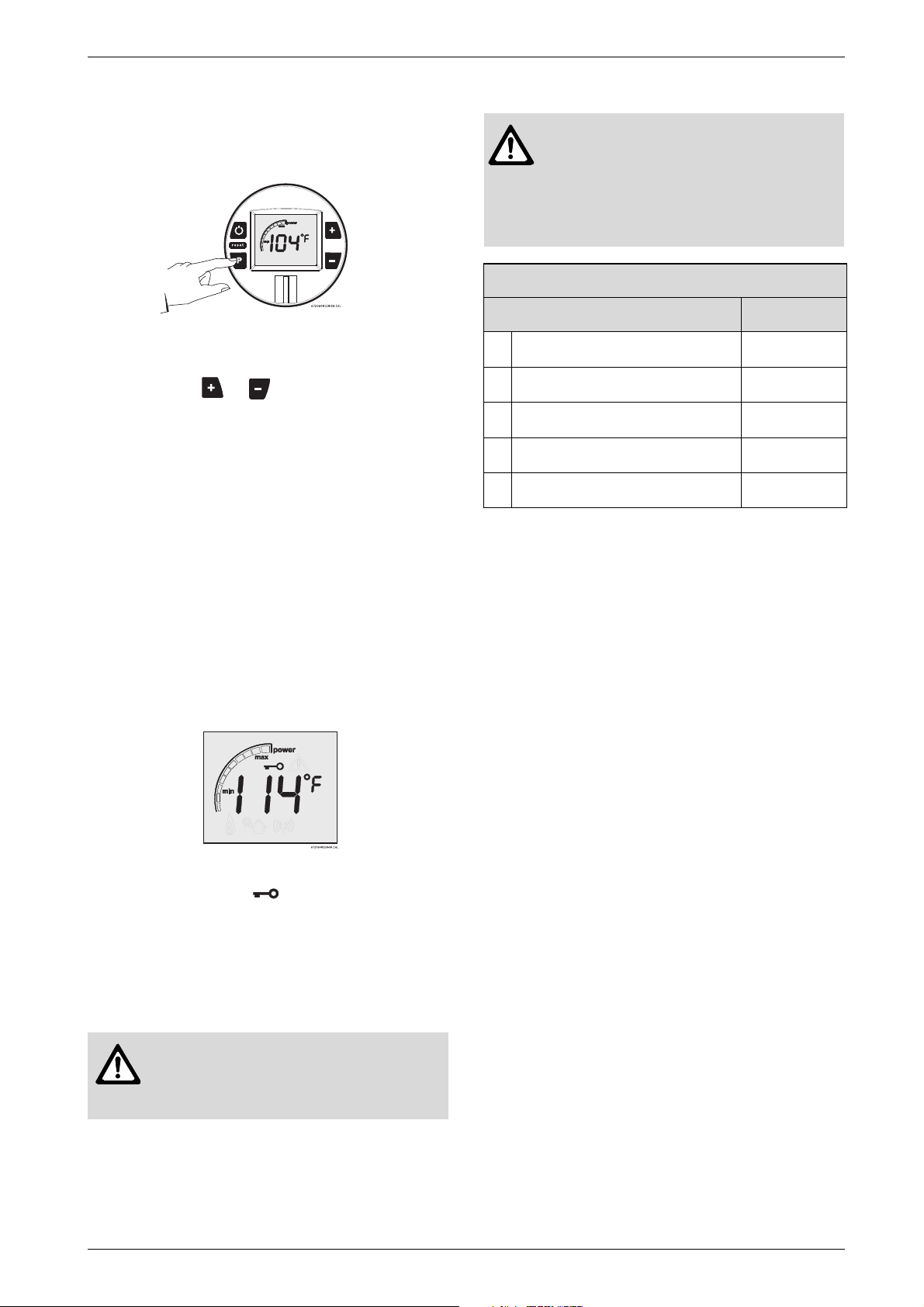
6 720 644 936
Maintenance and service
37
Programming “Program” function
Programming actions are similar for both controls
(appliance control pad and wireless remote control).
Fig. 61 “Program” key
Memorizing selected temperature
B Press buttons or to select temperature to be
memorized.
B Hold “Program” button for 3 seconds to save
temperature.
When LCD stops blinking, temperature is saved in
memory.
Using “Program” function
In order to select memorized temperature
B Press “Program” key.
LCD shows pre-memorized temperature, which is now
the hot water selected temperature.
5.9 Locked condition
This condition is only valid for appliances with one or
more remote controls installed.
Fig. 62 Locked condition
Whenever LCD shows the temperature setting
cannot be adjusted because the appliance is in use by
a user which already selected a different temperature.
Appliance will be automatically unlocked after closing
the hot water tap.
6 Maintenance and service
The unit should be checked once a year by a gas
technician. If repairs are needed, the repairs should be
done by a gas technician.
6.1 Annual maintenance
(To remove front cover, see page 7.)
Venting System
• Venting system - inspect inside of flue pipe for any
blockage or restriction. Observe burner flames
during heater operation. (Vent pipe must be
removed). Inspect the combustion air inlet pipe for
blockage or debris. Inspect combustion air and
exhaust terminations for blockage or debris.
Combustion chamber
• Inspect burner observation window (Fig. 73, #10) for
cracks or spillage of flue gases. Observe burner
flames during heater operation. Flames should be
steady and blue with no signs of yellowing. Yellow
burner flames are an indication of improper
combustion. Refer to Section 3.4 & 3.3 of this
manual to ensure that exhaust system and
combustion air supply meets manufacturer's
specifications.
Pressure relief valve
• Manually open the pressure relief valve to ensure
proper operation.
Inlet water filter
• Verify the inlet filter screen is clean and undamaged.
The inlet water filter is located above the ¾" cold
water inlet on the right side of the appliance (See
Fig. 36, page 28). Close installer supplied cold water
Warning: Always turn off the electrical
power supply, turn off the manual gas
shut off valve and turn off the water shut
off valves whenever servicing.
Caution:
B Check and clean the complete water
heating system once a year.
B Carry out a maintenance overhaul if
necessary. Immediately repair defects to
avoid damage to the system.
Annual maintenance table
Every year
1. Inspect venting system X
2. Inspect Combustion chamber X
3. Inspect burner X
4. Inspect condensate trap X
5. Inspect water filter X
Table 24 Annual maintenance

6 720 644 936
38
Maintenance and service
shutoff and supplied water shutoffs, carefully remove
inlet and outlet clips on watervalve. Remove water
valve to access filter. Clean or replace if damaged.
Descaling
• In areas where the water supply has a high mineral
content (see Table 21, page 28), the heat exchanger
should be periodically flushed with a descaling
solution. Scale build up will shorten the life of the
water heater and damage resulting from scale is not
covered under warranty. Refer to section 6.3 for
detailed instructions on descaling the heat
exchanger.
Fin coils
• Inspect heat exchanger fincoil for soot build-up or
blockage. To access fincoil, venting must be
removed from flue gas exhaust accessory. With
venting removed and inspect fincoil below with a
flashlight. If there is evidence of soot build-up or
blockage, the heat exchanger should be removed by
a professsional and cleaned thoroughly. To remove
the heat exchanger, consult service bulletin at
www.boschpro.com
.
6.2 Winterizing for seasonal use
Installation instructions state that the water heater must
not be installed in a location where it may be exposed to
freezing temperatures. If the heater must be left in a
space which is likely to experience freezing
temperatures, all water must be drained from the heater.
If precautions are not taken, resulting damage will not
be covered under the warranty. NOTE: Use of agents
such as anti-freeze is not permitted as they may cause
damage to the water heater's internal components.
1. Press ON/OFF switch on the water heater to turn
OFF the heater and unplug power supply cord. The
display should be blank.
2. Shut off gas supply to heater.
3. Shut off the water supply to the water heater using
installer supplied shutoff valve.
4. Open hot water taps to drain the plumbing system. If
water continues to flow after 5 minutes, a plumbing
crossover is present and must be corrected before
proceeding.
5. Open service valves (if available) or disconnect inlet
and outlet water pipes from the water heater. Place a
small bucket underneath the water heater to catch
residual water remaining inside the water heater.
6. Using an air compressor, blow short bursts of air
(100psi max) through the outlet water connection
until there is no water present coming through the
inlet water connection of the heater.
7. Reconnect water fittings and return heater to service
when danger of freezing has passed.
6.3 Mineral scale build-up
Periodic descaling may be necessary in areas with high
mineral content in the water. Scale buildup in the heat
exchanger may result in lower flow rates, error codes of
A7 and E9 and boiling sounds (knocking and banging)
in the heat exchanger.
Descaling using a pump
1. Disconnect electrical supply from the water heater.
2. Shut off the water supply to the water heater using
(installer supplied) shutoff valve.
3. Open hot water taps to drain and relieve pressure
from the plumbing system.
4. Drain water from the unit's heat exchanger by
disconnecting inlet and outlet water connections
from the heater.
5. Connect a line (A) from the outlet of the circulating
pump (installer supplied) to the inlet water fitting on
the water heater (see Fig. 63).
6. Using another line (B), connect to the water outlet
fitting on the water heater. Route the other end of this
line into a descaling reservoir.
7. Using a 3rd line (C) from the descaling reservoir,
connect to the inlet side of circulating pump. Install a
filter on the end of this line in the descaling reservoir.
8. Make sure all connections are "water tight.".
9. Fill tank with descaling solution so both lines inside
are submersed. We recommend straight white
vinegar. If using a commercial descalant, refer to
manufacturer's instructions on dilution with water.
10.Operate the circulating pump.
11.Make sure there are no leaks and the solution is
flowing from the descaling reservoir through the
heater and returning to the reservoir.
12.Run solution through the heater until the solution
returning to the descaling reservoir comes out clear.
(Changing to a fresh solution may be necessary
during this process).
13.Disconnect all lines and drain all solution from heat
exchanger. Properly discard of solution.
14.Position a container below the hot water outlet and
connect cold water supply. Open cold water supply
isolation valve and flush heat exchanger with clean
water.
15.Shut cold water shutoff valve and reconnect hot
water supply to the water heater.
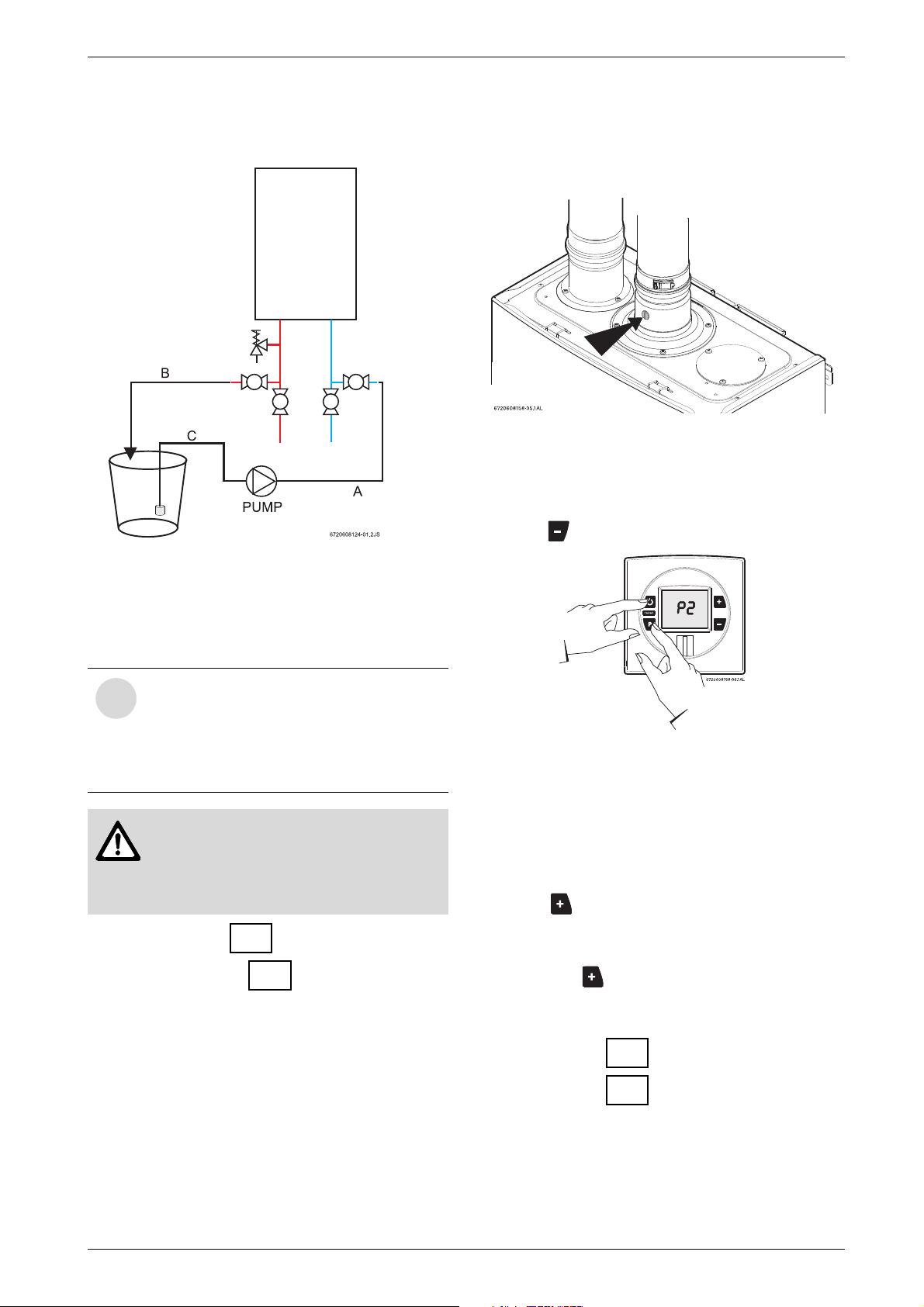
6 720 644 936
Maintenance and service
39
16.Reconnect electrical supply to unit, open water
shutoff valves, and return the unit to service.
Fig. 63
6.4 Adjusting CO
2
The CO
2
can only be adjusted by a certified gas
technician with a calibrated CO
2
analyzer.
Static Gas Pressure: “ WC
P1 Operating Pressure: “ WC
The P1 minimum operating gas pressure is 3.5" WC for
Natural Gas and 8" WC for Propane. Do not proceed in
adjusting CO
2
until pressure is at or above these levels,
but not to exceed 10.5" WC for Natural Gas and 13"
WC for Propane.
A. Once Gas Pressure is adequate
B Press ON/OFF button to turn off the heater.
B Remove brass flat head screw on the exhaust collar
as seen in Fig. 64.
B Insert CO
2
analyzer probe into the measuring port.
The tip of the probe should be in the center of the flue
pipe (approx 1.5" inserted). Avoid air gaps between
probe and measuring port as they can alter readings.
Fig. 64 Measuring port
B While holding the Program (P) button in, press the
ON/OFF button to turn ON the heater (see Fig. 65).
As soon as ‘188’ flashes on the display, release the
Program button. The display should now read P2.
Press ‘ ’ button until “P1” appears on display.
Fig. 65
B. Measuring CO
2
(combustion cover must be
installed):
B Open all hot water taps to achieve a flow rate of at
least 6 gallons per minute. (1 tub and 2 sinks should
be sufficient). If heater display reverts back to P2,
open more hot water fixtures to allow sufficient flow.
B Press ‘ ’ until P1 reappears on display.
B Record the CO
2
reading in P1 below. (Analyzer
reading may take several minutes to stabilize).
B Press the ‘ ’ button until P2 appears. Unit will
ramp down to low fire and the flow should decrease.
B Record the CO
2
reading in P1 and P2 below.
P2 CO
2
Reading: % CO
2
P1 CO
2
Reading: % CO
2
Note: When making adjustments, make sure
combustion cover is installed.
i
CO
2
adjustment is required in Natural
Gas installations where energy content
is less than 900 BTU/cuft, and in
installations with repeated unresolved
EA and EC errors (ref. to page 46
“Problem solving”).
Caution: One factor that may affect
CO
2
levels is improper gas pressure.
Please see Chapter 3.13 for the
procedure to measure gas pressure
and record your findings below:
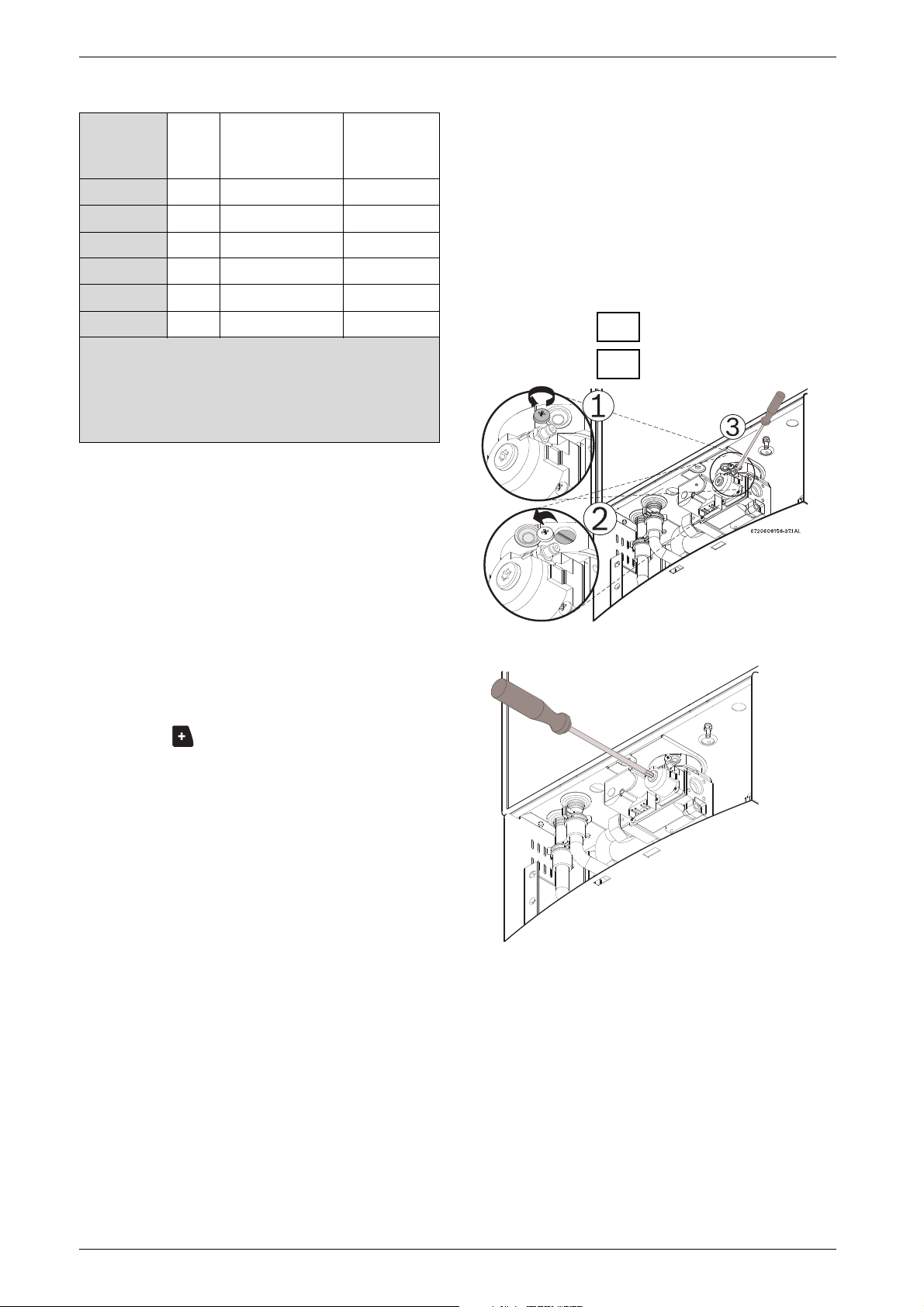
6 720 644 936
40
Maintenance and service
C. Adjusting CO
2
:
Note: P1 adjustment will change the P2 reading.
Confirm the P1 value BEFORE adjusting the P2 level.
1. If P1 CO
2
level is off:
B Loosen yellow painted Phillips screw (1) and cover
should rotate down (2) revealing a recessed brass
slotted screw. Fig. 66.
B Turning the slotted screw counter clockwise will
raise P1 CO
2
levels and clockwise will lower P1
CO
2
levels. Adjustments to the slotted screw will
also change P2 CO
2
levels.
B After bringing the P1 CO
2
readings in proper range,
press the ‘ ’ button to enter the P2 mode. Verify
CO
2
readings in P2 mode.
2. If P2 CO
2
level is off:
B Remove yellow painted #40 Torx cover from the front
of the gas valve. (Fig. 67) A plastic #40 Torx screw
will be revealed.
B Turning the plastic #40 Torx screw counter
clockwise will lower P2 CO
2
levels and clockwise
will raise P2 CO
2
levels.
Note: This screw adjustment is very sensitive and
should be made in small increments. It may take several
minutes for readings to stabilize.
3. Verify both P1 and P2 CO
2
readings are within the
ranges specified in table 25. Repeat steps 1 and 2 as
necesssary until CO
2
values are within the specified
ranges.
4. Once CO
2
values are within the specified ranges,
verify the CO readings on P1 and P2 do not exceed
values shown in table 25. If values exceed this limit,
inspect vent system and fin coils (chapter 6.1, page 37)
for blockage.
D. Returning to Service:
1. Return slotted screw cover to original position and
tighten philips screw.
2. Reinstall Torx cover.
3. Remove CO
2
analyzer probe and reinstall flathead
screw with gasket in exhaust collar.
4. Press ON/OFF button to turn OFF the heater and
then turn ON the heater.
5. Heater is ready for normal operation.
Final Readings
P2 CO
2
Reading: % CO
2
P1 CO
2
Reading: % CO
2
Fig. 66 Adjusting P1 CO
2
level
Fig. 67 Adjusting P2 CO
2
level
CO
2
range (%)
Max. CO
level
(measured)
Nat. Gas
max. input P1 7.2 % - 7.8 % < 250 ppm
min. input P2 2.3 % - 2.6 % < 60 ppm
LP Gas
max. input P1 8.3 % - 8.9 % < 250 ppm
min. input P2 2.6 % - 2.9 % < 60 ppm
* Values above are for climate controlled conditions.
Inputs such as gas pressure, heating value of the gas,
humidity and temperature of combustion air all impact CO
and CO
2
values. Changes in these inputs can result in
different CO and CO
2
values on the same appliance.
Table 25 CO
2
& CO target numbers
6720608158-38.1AL
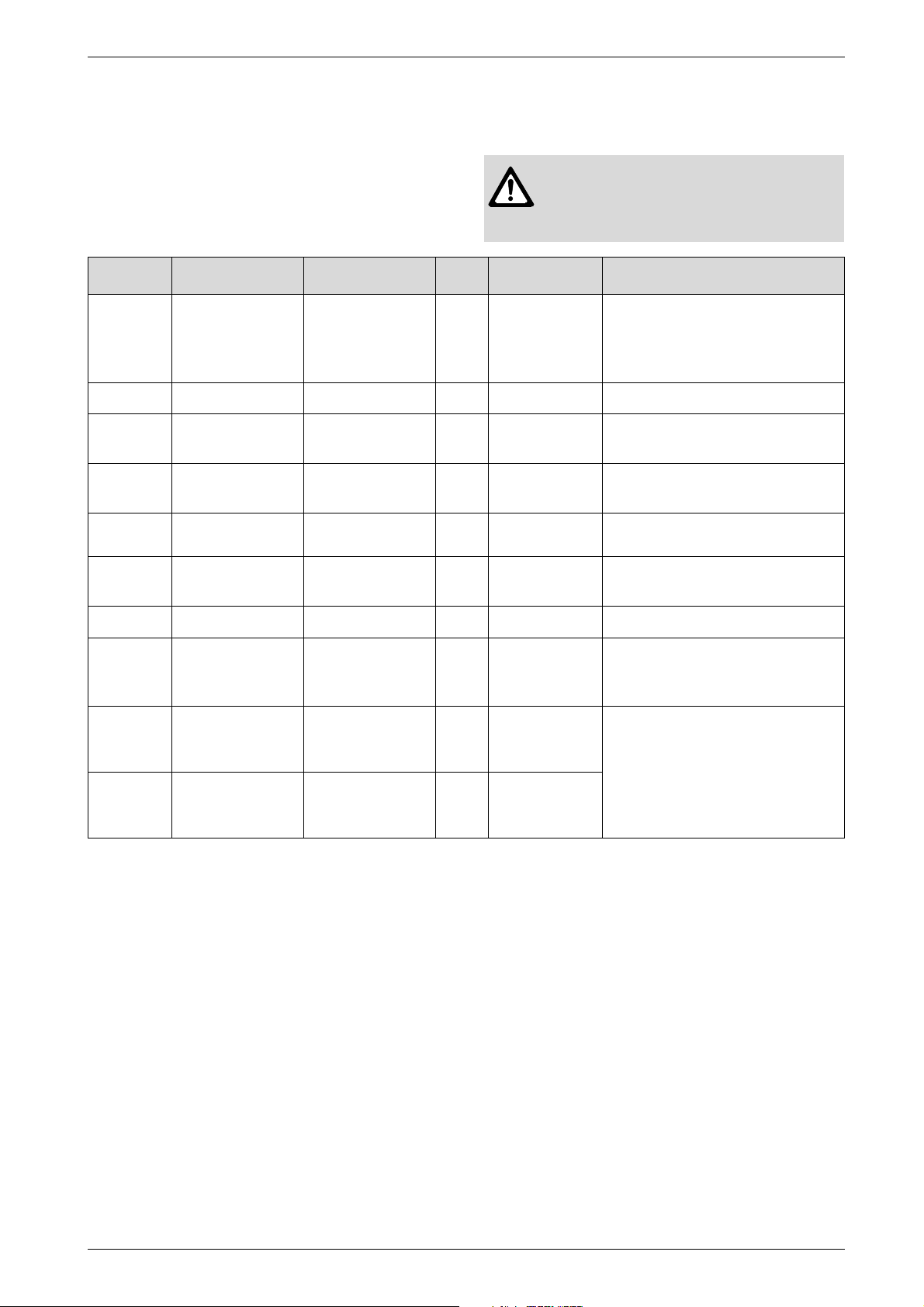
6 720 644 936
Maintenance and service
41
6.5 Program values
This section describes details on programming the
appliance. For most applications the factory default
values will robust and stable operation. Only adjust the
factory settings if the installation requires changes as
indicated in the appropriate section of this manual.
Refer to chapter 6.6 Control board diagnostics (page
42) regarding how to access these P-modes.
Caution: Misadjusted program
values can lead to appliance
malfunction, errors, and service
calls.
Program Description Factory Default MIN MAX Comment
P1 Maximum Power NG: 42,
LP: 40
21 NG: 43,
LP: 41
see chapter 3.13, page 32.
note: reducing P1 values below
maximum will reduce maximum
power of the appliance.
P2 Minimum Power 7 7 20 see chapter 3.3.7, page 19
P3 Remote Con-
trols installed
_0 _0 6 see chapter 5.5, page 36
P4 Access to Diag-
nostic Mode
E 0d 10f see chapter 6.6, page 42
P5 Cascade Mode NO NO CC contact Bosch for details
P6 Temperature
Unit
°F °F °C
P7 Appliance Type NO Cd NO Condensing / Non-condensing*
P9 Fan Purge runs secondary and primary fan
when P9 is selected by
depressing the “P” - button
PH Cascading type IC IC SC This menu is only available when
cascade mode is selected CC.
Contact Bosch Water Heating for
details.
PC Master/Slave
mode
CS CS CM
Table 26 Program values, factory default settings and ranges.
* Incorrect setting causes errors.
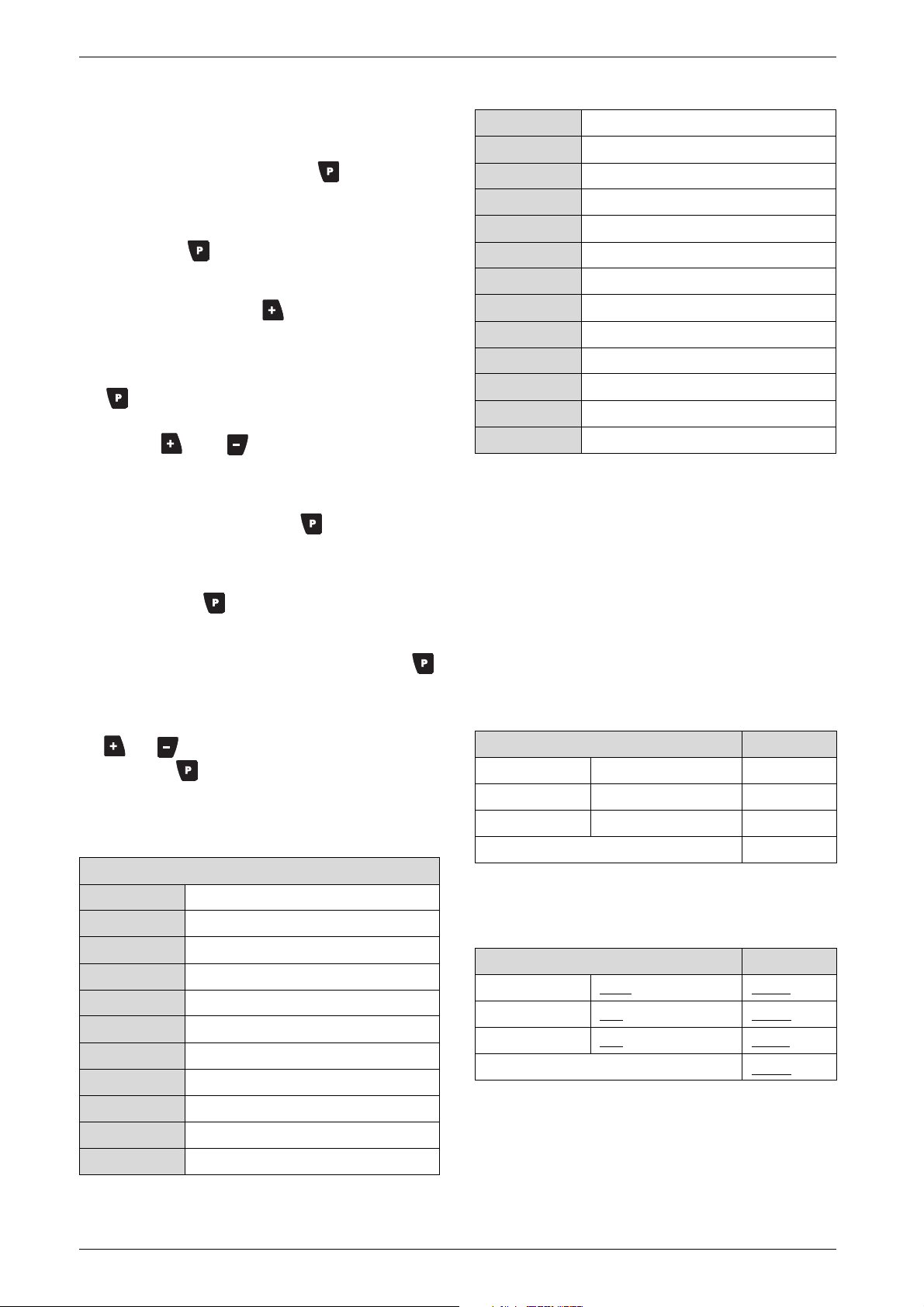
6 720 644 936
42
Maintenance and service
6.6 Diagnostic menu
1. Turn on/off switch on water heater to off (O) position.
B Press and hold the program ' ' button while
turning the on/off switch to the on (I) position. The
display will cycle through a startup procedure
including the software version.
B Release the ' ' button when '188' appears on the
display. The display should read 'P2' when the
program button is released. If not, repeat process.
B Press and release the ' ' button on the control
panel until the display reads 'P4'. You are now in the
diagnostic mode of the control board.
B When the display reads 'P4', press and release the
' ' button once again and the display should read
'E'.
B Use the ' ' and ' ' button on the control board
to cycle through different diagnostic modes
available.
B Once in the selected diagnostic mode of your
choice, press and release the ' ' button to display
the diagnostic information.
B EXAMPLE: to read the flow rate in gallons per minute
while the unit is flowing water, cycle to the '3d' mode
and press the ' ' button. A reading of 25 on the
display would indicate the heater is reading a flow
rate of 2.5 gallons/minute.
B Once the information is obtained, press the ' '
button again to return to the diagnostic mode menu
and scroll to addition diagnostic information.
B To exit the diagnostic mode of the heater, use the
' ' or ' ' button until the display reads 'E'.
B Press the ' ' button once again and the display
should read P4.
2. Turn the on/off switch off (O) and back on (I) again to
return heater to normal function.
6.6.1 Working hours
To see how many hours the appliance has worked,
please enter the “Diagnostic menu” (chapter 6.6);
B Select the sub-mode “H0”.
Write the number that shows in the display.
B Select the sub-mode “H1”.
Write the number that shows in the display.
B Select the sub-mode “H2”.
Write the number that shows in the display.
After checking the sub-modes H0, H1 and H2, intro-
duce the values in the table below;
Example:
Calculation of number of working hours,
Diagnostic menu
E Entry/Exit into sub-modes
0d Set-point temperature
1d Inlet water temperature (°F)
2d Outlet water temperature (°F)
3d Water flow (gallons/min)
4d Gas type (LP or NG)
5d Fan speed (Hz)
6d Burner power (%)
7d Maximum power (kW)
8d Back flow temperature (°C)
9d Not used, setting 00
Table 27
1F Most recent error/failure
2F 2nd most recent error
3F 3rd most recent error
4F 4th most recent error
5F 5th most recent error
6F 6th most recent error
7F 7th most recent error
8F 8th most recent error
9F 9th most recent error
10F 10th most recent error
H0 Numbers of hours - mode 0
H1 Numbers of hours - mode 1
H2 Numbers of hours - mode 2
Working hours
Number in H0 ______
_______ +
Number in H1 ______ (X 100) =
_______ +
Number in H2 ______ (X 10 000) =
_______ +
(H0 + H1 + H2) = Total of hours _________
Table 28
Working hours
Number in H0 60 60 +
Number in H1 5 (X 100) = 500
+
Number in H2 0 (X 10 000) = 0
+
(H0 + H1 + H2) = Total of hours
560
Table 29
Table 27
6 720 644 936
Troubleshooting
43
7 Troubleshooting
7.1 Introduction
Many of the questions customers ask regarding operation
of this unit can be answered by following the
troubleshooting steps as outlined below. Visit our web site
at www.boschpro.com for more detailed troubleshooting
and service bulletins. For best results, perform each step
before proceeding to the next. The suggested solutions
may require that the cover be taken off. (See Page
7
. Fig.
3
).
7.2 Burner do not ignite when hot
water is turned ON
1.
If the display is blank, verify power to outlet. (120VAC/
60Hz properly grounded circuit required). Verify that
the heater ON/OFF button is turned ON.
2. Verify the fuses in the control board are good. See
Section
4.2
, page
33
of the installation manual for fuse
locations.
3. Make sure cold water inlet connection is plumbed to
the right side of heater when facing unit. See Fig.
35
,
page 28
.
4. A minimum of 0.5 gallons per minute (GPM) (1.9 l/m) is
required to activate the heater. A quart container
should fill in 25 seconds or less to activate heater. In
areas of warm inlet water temperatures, the heater may
increase activation rate to as high as 1.6 gallons per
minute (GPM) to prevent overshooting of set
temperature.
5. Clean inlet filter screen per chapter
6.2
,
page 38
.
6. Inspect the water path for obstructions. Make sure all
showerheads, faucet aerators and whole house filters
are clear of debris.
7. The heater activates when the water flow through the
unit is at or above the required minimum of 0.5 GPM
(1.9 l/m). A crossover in the plumbing creates back
pressure on the water flowing through the heater.
Therefore, a higher flow rate than normal is needed to
force the heater to activate. To check for a plumbing
crossover, shut off the cold water supply to the water
heater. Then open all of the hot water taps served by
the heater. Wait 10 minutes and check for water flow
at taps. There should be no water flowing. Any
continuous flow of water, small or large, indicates a
crossover is present and must be corrected. Consult a
professional plumber for help in correcting a crossover.
Failing single lever faucets and mixing valves are
common causes of plumbing crossovers.
8. With the ON/OFF switch turned to OFF (O) position
and the power supply cord unplugged, remove the
unit's front cover (See Page
7
. Fig
3
). Check wire
connections between the water valve, control unit and
electrode set. See chapter
12.2
,
page 56
for location
of these parts.
9.
Water heater in solar mode. If inlet water temperatures
exceed the water heater's set temperature, the burners
will not ignite and the solar mode indicator will show on
the display. See Fig.
52
, page
34
.
7.3 Water is too hot
1.
Selected temperature on the unit is set too high. To
lower output temperature, see chapter
5.4
,
page 35
.
2. Clean inlet filter screen per chapter
6.1
,
page 37
.
3. Inspect the water path for obstructions. Make sure all
showerheads, faucet aerators and whole house filters
are clear of debris.
4. Confirm the heater's gas type coincides with the type
of gas being supplied. See Fig.
2
,
page 6
for location
of rating plate.
5. Avoid restrictive outlets. Clean all showerheads and
faucet aerators. It may be necessary to upgrade to
higher flow rate shower heads if allowable by local
code.
6. In areas where the water has a high mineral content,
periodic descaling may necessary. See chapter
6.3
,
page 38
for directions.
7.
Ensure the outlet temperature sensor is making contact
and firmly mounted on the hot water pipe.
7.4 Water is not hot enough
1.
Selected temperature on the unit is too low. To raise
output temperature, see chapter
5.4
,
page 35
.
2. Clean inlet filter screen. See chapter
6.1
,
page 37
.
3. Inspect the water path for obstructions. Make sure all
showerheads, faucet aerators and whole house filters
are clear of debris.
4. Confirm the heater's gas type coincides with the type of
gas being supplied. See Fig.
2
,
page 6
for location of
rating plate.
5. Check inlet gas particle screen for blockage at gas inlet
connection on bottom of unit.
6. Verify gas pressure is in accordance with specifications
in chapter
3.13
,
page 32
. A gas pressure reading is
needed to proceed further. Contact your original
installer or a local certified gas technician to obtain this
reading.
7. Cold water is mixing into the hot water lines (plumbing
crossover). A plumbing crossover can unintentionally
Warning: If you are unable to perform
the tasks listed below, or need
additional assistance please contact
your original installer or licensed gas
technician.
i
Inside the heater it is normal to find
unplugged wire connectors. These
connections are for adding accessories
such as cascading.

6 720 644 936
44
Troubleshooting
mix cold water with the hot water leaving the heater. The
end result is a cooler water temperature than desired.
To check for a plumbing crossover, shut off the cold
water supply to the water heater. Then open all of the
hot water taps served by the heater. Wait 10 minutes
and check all taps for water flow. There should be no
water flowing. Any continuous flow of water, small or
large, indicates a crossover and must be corrected.
Consult a professional plumber for help in correcting a
crossover. Failing single lever faucets and mixing valves
are common causes of plumbing crossovers.
8.
Ensure the outlet temperature sensor is making contact
and firmly mounted on the hot water pipe.
7.5 Low water flow/pressure
1.
Too many hot water applications are being used
simultaneously or too much flow is demanded. The
water heater will effectively support two 2.0-2.5 GPM
shower heads simultaneously or multiple sink
applications. Greater draws will result in a water
pressure drop and reduced flow at taps.
2. Ensure that gas pressure is in accordance with
specifications in chapter
3.13
,
page 32
. A gas
pressure reading is needed to proceed further. Contact
your original installer or a local certified gas technician
to obtain this reading. If gas pressure is inadequate, the
water heater will close its motorized water valve,
reducing the hot water flow rate in an attempt to reach
the selected output temperature.
3. If selected temperature on the unit is set too high for the
demanded flow rate, the water heater will close its
motorized water valve, reducing the hot water flow rate
in an attempt to reach the selected output temperature.
Lowering the selected temperature will allow the
motorized water valve to open up for increased water
flow rate.
4. Clean inlet filter screen per chapter
6.1
,
page 37
.
5.
Inspect the water path for obstructions. Make sure all
showerheads, faucet aerators and whole house filters
are clear of debris.
7.6 Hot water temperature fluctuates
at tap
1.
Hot water is very hot out of the tap, requiring mixing of
cold water in order to attain a useable hot water
temperature. The addition of too much cold water will
overpower the hot water flow from the tankless water
heater.
This slows the flow within the tankless water heater,
decreasing it below activation point, which shuts off the
burners. The end result is nothing but cold water
coming out of the outlet.
Consult www.boschpro.com for a detailed service
bulletin on overcoming temperature fluctuations.
2. Unbalanced pressure in water lines. Any restriction in
the water heater, such as a clogged inlet filter screen,
can result in unequal pressures between the cold and
hot water lines. In such cases, when mixing in the higher
pressure cold water at the tap, the lower pressure hot
water can be overpowered. This will shut down the
burners because the hot water flow rate fell below the
minimum flow rate required for activation. Verify inlet
filter screen is clean and clear of debris. See
chapter
6.1
,
page 37
for inlet filter cleaning
instructions.
3. Heater deactivated by temperature balancing valves. If
the outlet water temperature is set too high, the heater
can produce temperatures that are too hot. A
temperature balance shower valve will automatically mix
in cold water to reduce the hot water temperature. In the
event of any temperature instability at a fixture using a
temperature balancing valve, refer to the valve
manufacturer for instructions on internal adjustment
setting. An adjustment should be made to minimize the
amount of cold water the valve is adding. Additionally,
the temperature setting on the heater can be lowered to
prevent the temperature balance valve from mixing in
too much cold water.
4.
Inlet water pressure is erratic due to fluctuating supply
water pressure. For installation on a private well system
with the use of a pressure tank, the lowest pressure
range setting recommended is 40-60 psi (2.75 - 4.15
bar). Consult your installer or local plumber for effective
ways to maintain constant water pressure to the water
heater when on a well system.
7.7 Noisy burner/heater during
operation
1.
Sealed combustion leak. Make sure combustion cover
is securely fastened. Ensure the exhaust vent adaptor is
properly sealed with supplied gasket. Leaky seals
create improper combustion resulting in noise.
2. Improper venting. Venting that is unsealed, the wrong
material, too big in diameter or too long in run will result
in unstable burner flames and noise. Ensure venting is
proper and in accordance with specifications in
chapter
3.3
,
page 9
.
3. Lack of adequate combustion air. Drawing combustion
air from a room area of inadequate size will result in
unstable burner flames and noise. Improper use of
piping for combustion air will result in unstable burner
flames and noise. Ensure adequate combustion air is
provided to the unit in accordance with specifications in
Section
3.4
,
page 23
, Combustion Air Requirements.
4. Cross contamination. Ensure that intake and exhaust
terminations maintain minimum required clearances
stated in the manual. Cross contamination between
intake and exhaust may cause unstable burner flames
and noise.
5. Lack of adequate gas pressure. Inadequate gas
pressure will cause the fuel-to-air mixture (CO
2
) to be
out of adjustment. This will result in unstable burner
flames and noise. Ensure gas pressure is in accordance
with specifications in section
3.13
,
page 32
Measuring
Gas Pressure. A gas pressure reading is needed to

6 720 644 936
Troubleshooting
45
proceed further. Contact your original installer or a local
certified gas technician to obtain this reading.
6.
Verify proper CO
2
readings per chapter
6.4
,
page 39
.
CO
2
adjustments must be done by a certified gas
technician with a calibrated combustion gas analyzer.
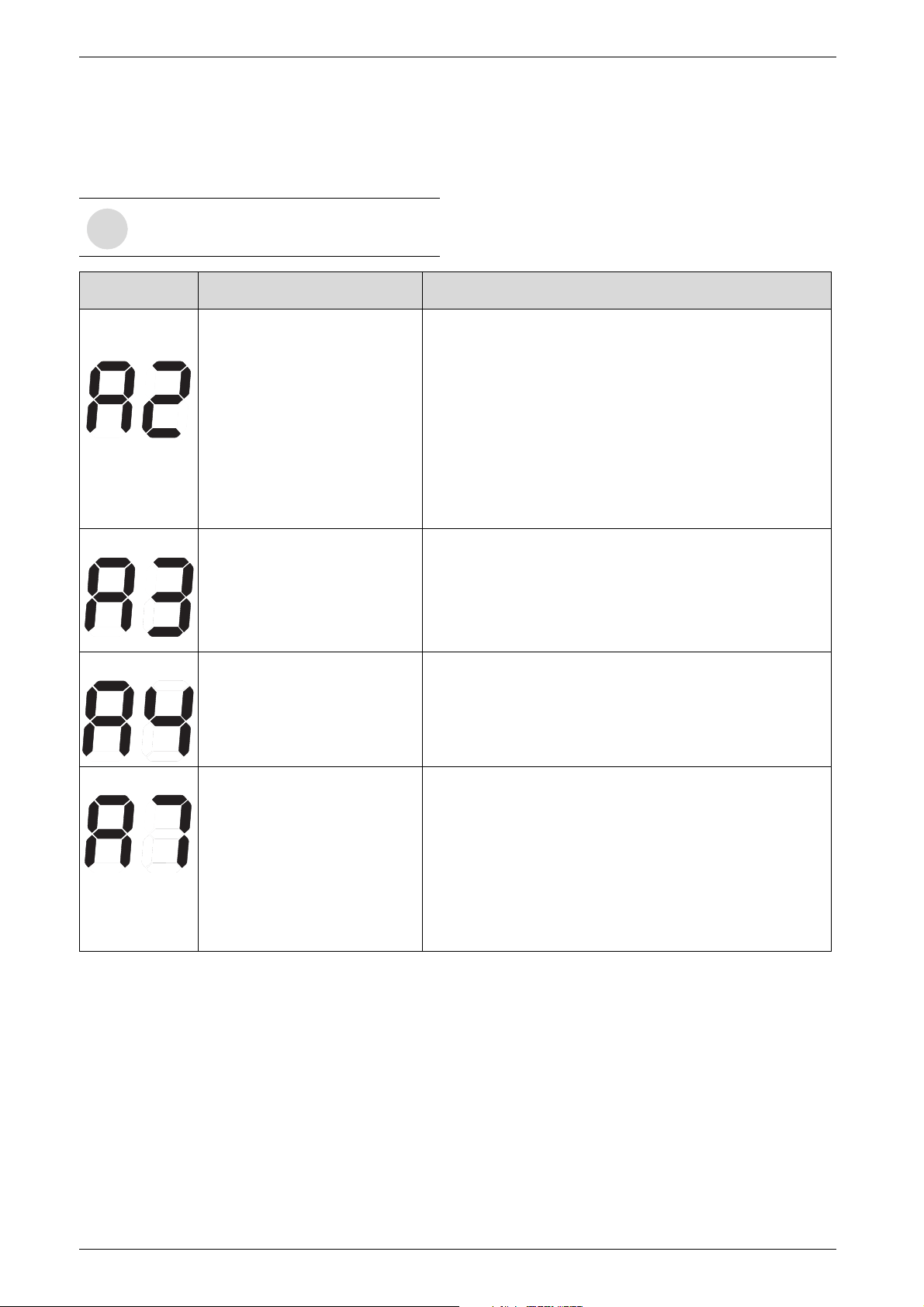
6 720 644 936
46
Problem solving
8 Problem solving
8.1 Error code diagnostics
i
To remove error code from the
display, press the reset button.
Display Cause Solution
Fault in the flue gas limiter.
Temperature above 230°F
(110°C) inside the cabinet.
1. Check continuity of the flue gas limiter (see Fig.
73
, page
54
).
Go to steps two and three to determine air box temperature
sensor fault and replace it.
2. Check for flue gas leakage around the top and bottom seals of
heat exchanger use mirror to check around the rear as well as the
viewing window.
3. Check that flue gas limiter connector and spade connections
are secure.
4. Unplug heater and check the wiring harness connections inside
the control board.
Appliance selection on “P7” mode
is not correct.
1. Check “P7” mode: the
water heater
requires setting “NC”.
2. Check jumper and connection on sensor at upper right hand
corner of heat exchanger.
3. Measure jumper resistance, must be 115-125 ohms.
Backflow temperature sensor
defect - happens if sensor is
disconnected or short circuit.
1. Check blackflow temperature sensor connection. See
Fig. 73
,
page
54
.
2. Replace backflow temperature sensor.
3. Check sensor (ref.
page 52
,
chapter 10
).
Outlet temperature sensor fault
(Temperature below 36°F or above
210°F).
1. Check red wire connections at hot water temperature sensor.
Clean terminals with an eraser. If badly corroded, replace sensor
and wire harness. See Fig.
73
, page
54.
2. Sensor may trip if water temperature drops below 36°F to
protect heater from freezing conditions. Any damage due to
freezing conditions is not covered under warranty.
3. In areas where water has a high mineral content, periodic
descaling may be necessary.
4. Check sensor (ref.
page 51
,
chapter 10
).
Table 30
* By installer or service technician only.
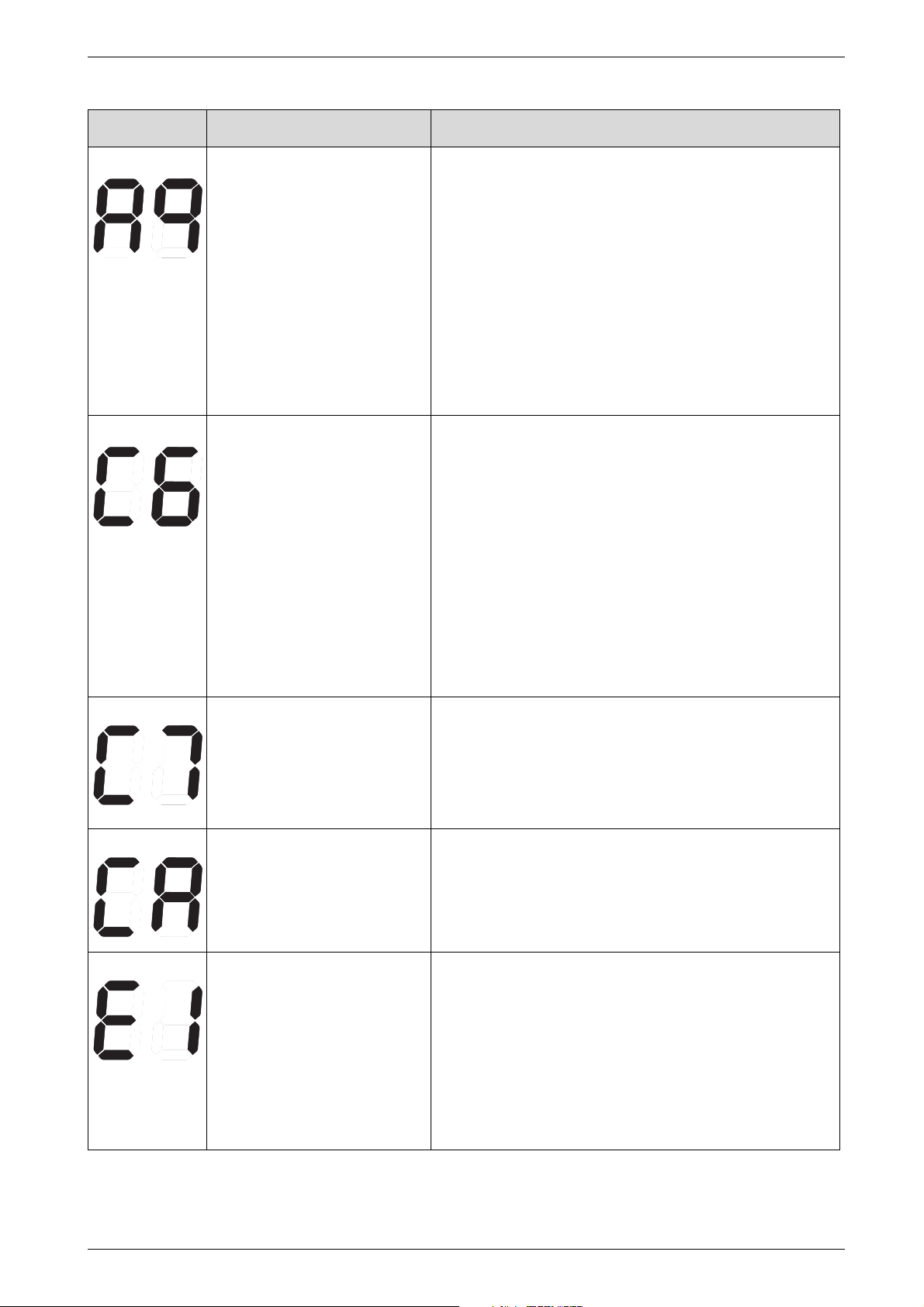
6 720 644 936
Problem solving
47
(Flashing) Outlet temperature sensor not
sensing expected output
temperature.
(Status message, not an error).
1. Check that the sensor is firmly attached to the hot water pipe
(see Fig.
79
, page
60
).
2. Ensure that outlet temperature sensor is not placed on any
bends in the hot water pipe or misreading may occur.
3. Check gas pressure. Low gas pressure may prevent the heater
from reaching desired output temperature.
4. Check supply voltage. It must be 120VAC and properly
grounded.
5. Possible defective control unit call Bosch Water Heating for
further instructions.
Primary fan rotation too low on
operation.
1. Disconnect power supply cord and check wire connection on
back side of primary fan and the connectors on the control board
(see Fig.
80
, page
61
).
2. Check supply voltage. It must be 120VAC and properly
grounded.
3. Check venting specifications are met. Long vent lengths,
venting with more than three elbows, blocked vent or combination
venting may cause this failure.
4. Ensure intake and exhaust terminations maintain the required
minimum clearances stated in the manual. Cross contamination
between intake and exhaust may cause the fan to alter its
rotational speed.
5. Check gas pressure. Low gas pressure may cause the fan to
change its speed to meet desired temperature.
6. Possible defective control unit call Bosch Water Heating for
further instructions.
No rotational speed sensor signal
from primary fan.
1. Disconnect power supply cord and check wire connections on
back side of primary fan and the two connectors on the control
board (see Fig.
80
, page
61
).
2. Check supply voltage. It must be 120VAC and properly
grounded.
3. Possible defective component in fan or defective control unit
call Bosch Water Heating for further instructions.
(Flashing) Water flow signal over specified
maximum value.
Water flow > 10 gallon/min.
(Status message, not an error).
1. Disconnect power supply cord and check wire connections on
water valve and the two connectors on the control board (see
Fig.
80
, page
61
).
2. Excessive water pressure and flow. Ensure water pressure is
less than 150psi and flow rate is below 10 gallons per minute.
Over-temperature detected by
outlet temperature sensor on hot
water pipe.
Temperature > 185°F
1. Check that the sensor is firmly attached to the vertical section of
the hot water pipe (see Fig.
79
, page
60
).
2. Check red wire connections at outlet temperature sensor.
Clean terminals with an eraser. If badly corroded, replace sensor
and wire harness.
3. In areas where water has a high mineral content, periodic
descaling may be necessary. See chapter
6.3
,
page 38
for
directions.
4. Check sensor (ref.
page 51
,
chapter 10
).
Display Cause Solution
Table 30
* By installer or service technician only.
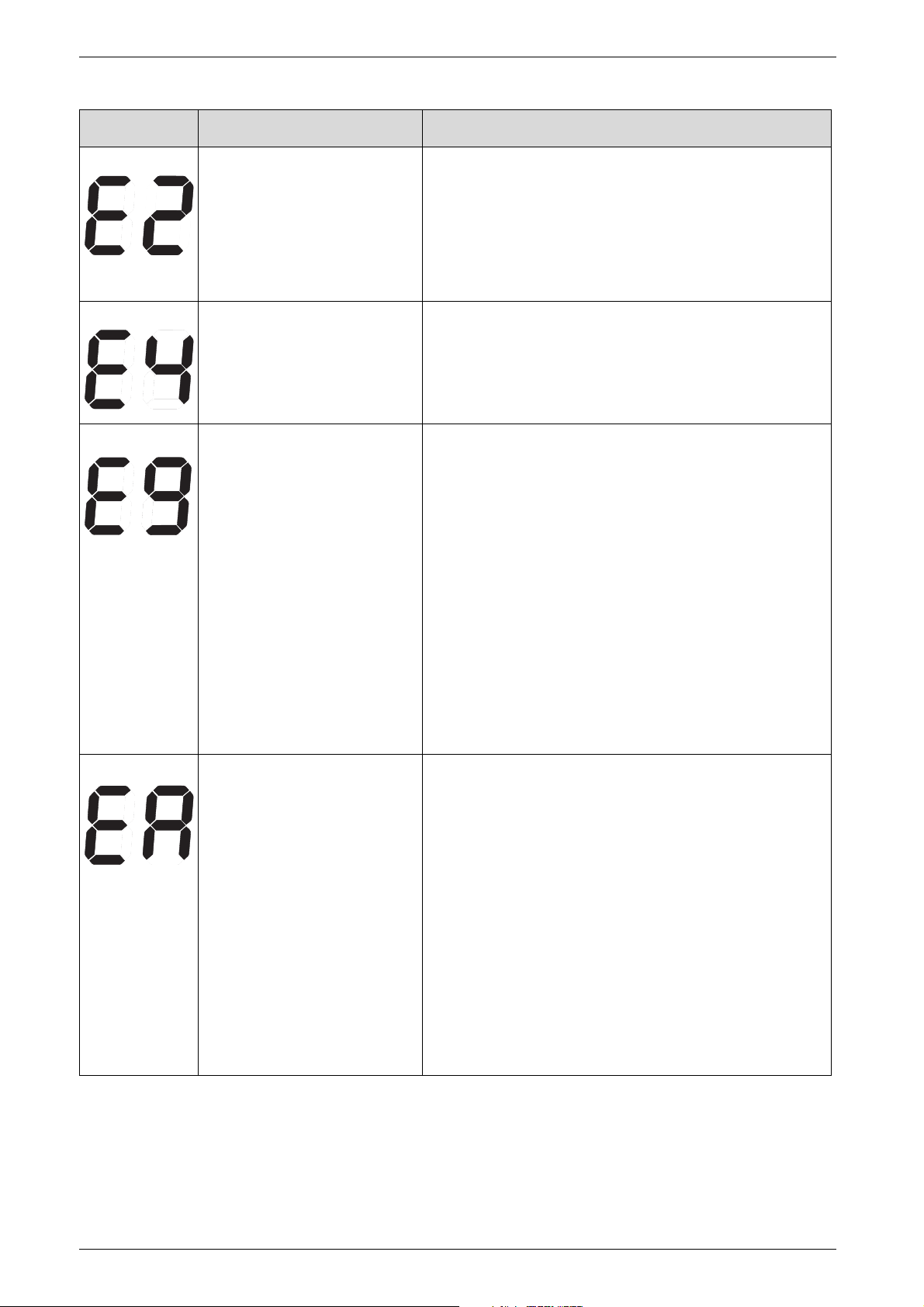
6 720 644 936
48
Problem solving
Cold water temperature sensor
fault.
1. Check connector on wires coming from top of watervalve for a
secure connection. See Fig.
73
, page
54.
2. Sensor may trip if water temperature drops below 36°F to
protect heater from freezing conditions Any damage due to
freezing conditions is not covered under warranty.
3. Check sensor (ref.
page 51
,
chapter 10
).
Backflow temperature sensor over
309°F.
The appliance will close the burner
and lock.
1. Check combustion air and exhaust vent piping for blockage.
2. Check if secondary fan connections are disconnected.
3. Check venting specifications are met. Long vent lengths,
venting with more than three elbows, blocked vent or combination
venting may cause this failure.
4. Call Bosch Water Heating for further instruction.
Overheat sensor (ECO) open
circuit (resets when cooler
temperatures are detected 220
°
F/
104
°C
).
1. Disconnect power supply cord and check wire connections on
overheat sensor (top right of heat exchanger) and the two
connectors on the control board. See Fig.
73
, page
54.
2. Check white wire connections at overheat sensor. Clean
terminals with an eraser. If badly corroded, replace sensor and
wire harness.
3. Check venting specifications are met. Long vent lengths,
venting with more than three elbows, blocked vent or combination
venting may cause this failure.
4. In areas where water has a high mineral content, periodic
descaling may necessary, see
chapter 6.3
.
5. Unplug power supply cord to the water heater. Open a hot
water tap for several minutes to allow cold water to pass through
heat exchanger. Close hot water tap and disconnect lead wires to
overheat sensor. Using a multimeter, check continuity through
overheat sensor contacts. Replace sensor if open.
No flame ionization detected with
water flow.
1. Verify that all manual gas shut off valves are open.
2. Check gas type, see
Fig. 2
,
page 6
.
3. Reset error code and open a water tap to cycle the heater in an
effort to purge air on new installations. Cycling hot water tap on
and off multiple times may be necessary. If heater still faults with
EA error code, have a licensed gas technician properly purge air
out of the gas line leading to the water heater.
4. Check three wire connections to ignition group on the lower
front of the heat exchanger are secure.
5. Check gas pressure, see
chapter 3.13
,
page 32
.
6. Check venting specifications are met. Improper venting may
cause premature failure of the flame sensor rod.
7.
Check that the minimum power fan speed has been adjusted to
the proper value. See page
20.
8. Observe inside the viewing window of the heat exchanger when
a hot water tap is opened. Sparking should be followed by a
steady blue flame. If flame is unstable or yellow with proper gas
pressure, confirm CO
2
readings per
section 6.4
.
Display Cause Solution
Table 30
* By installer or service technician only.
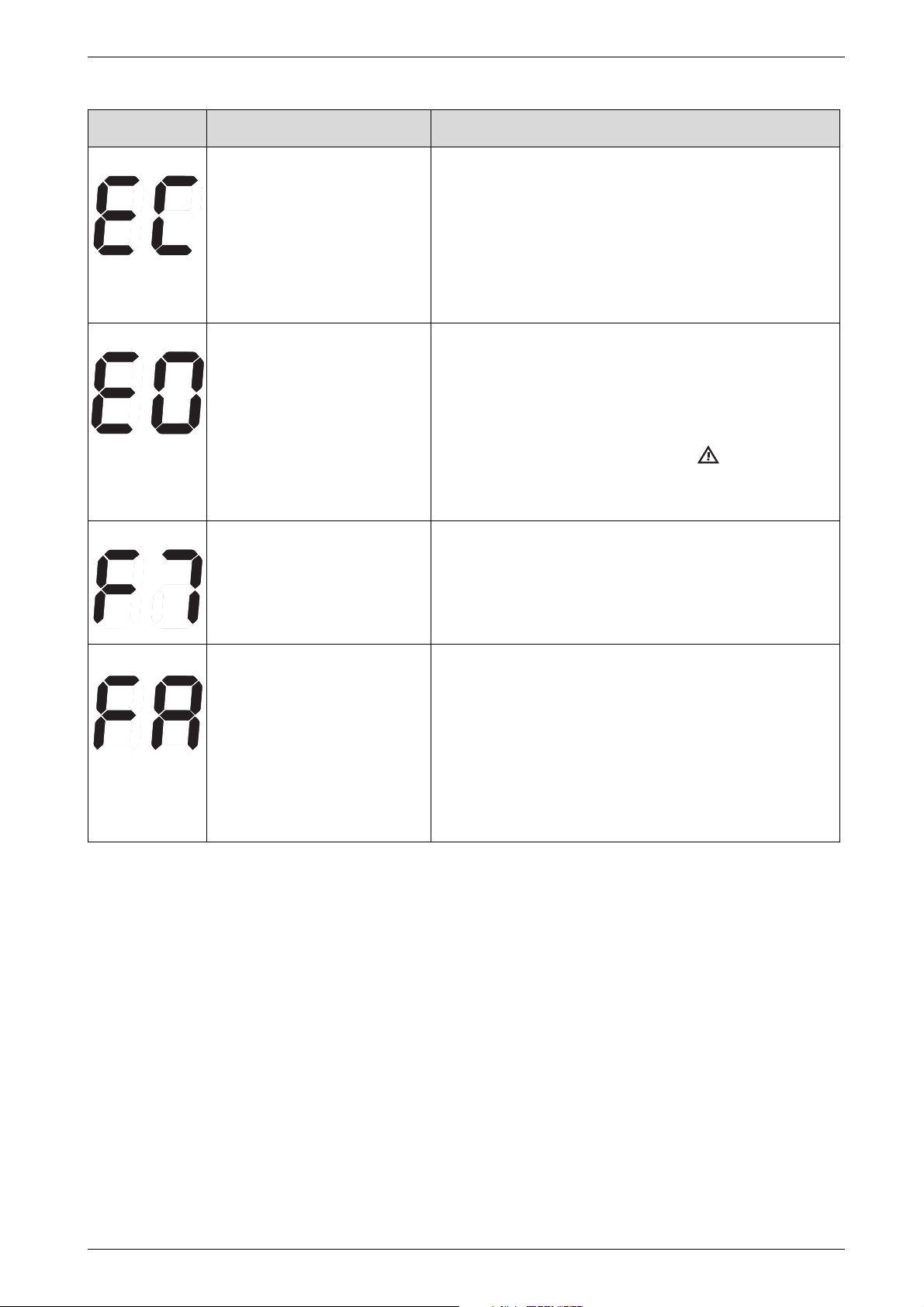
6 720 644 936
Problem solving
49
Ionization failure during operation. 1. Check gas type, see
Fig. 2
,
page 6
.
2. Check three wire connections to ignition group on the lower
front of the heat exchanger are secure.
3. Check venting specifications are met. Improper venting may
cause unstable burner flames and loss of flame ionization.
4.
Check that the minimum power fan speed has been adjusted to
the proper value. See page
20.
5. Check gas pressure, see
section 3.13
,
page 32
.
6. Check and adjust CO
2
readings, see
section 6.4, page 39.
Internal hardware/software failure. 1. Disconnect power supply cord and check the two wire and
ground connections on control board as well as ground connection
on heater chassis.
2. Pushing the wrong combination of buttons on the control unit
can create confusion among the microprocessors inside. In this
case, the error code should not happen more than once or twice.
Turn off the water heater. Turn water heater back on and try
resetting error code. Use the reset button ( ) to reset any error
codes.
3. Possible defective control unit. Call Bosch Water Heating for
further instructions.
Ionization error at standby. 1. Loose connection to the flame ionization rod. Verify that the
thinner wire leading from the control unit is securely connected to
the flame sensor located on the lower front of the heat exchanger.
See Fig.
73
, page
54.
2. Flame ionization rod or control unit may be damaged. Contact
Bosch Water Heating for further instruction.
Gas leakage error, gas valve circuit
not closing properly.
1. Disconnect power supply cord and check wire connections on
gas valve and the two connectors on the control board.
2. Flow water out of a hot water tap above the minimum activation
point of 0.5 GPM. Measure voltage at the gas valve wire plug
connection. The voltage should measure 24VDC between the left
pair of wires and 24VDC between the right pair of wires when the
unit is operating. If voltage is not proper, contact Bosch Water
Heating for further instruction.
3. Gas valve may be defective, contact Bosch Water Heating for
further instrucation.
Display Cause Solution
Table 30
* By installer or service technician only.
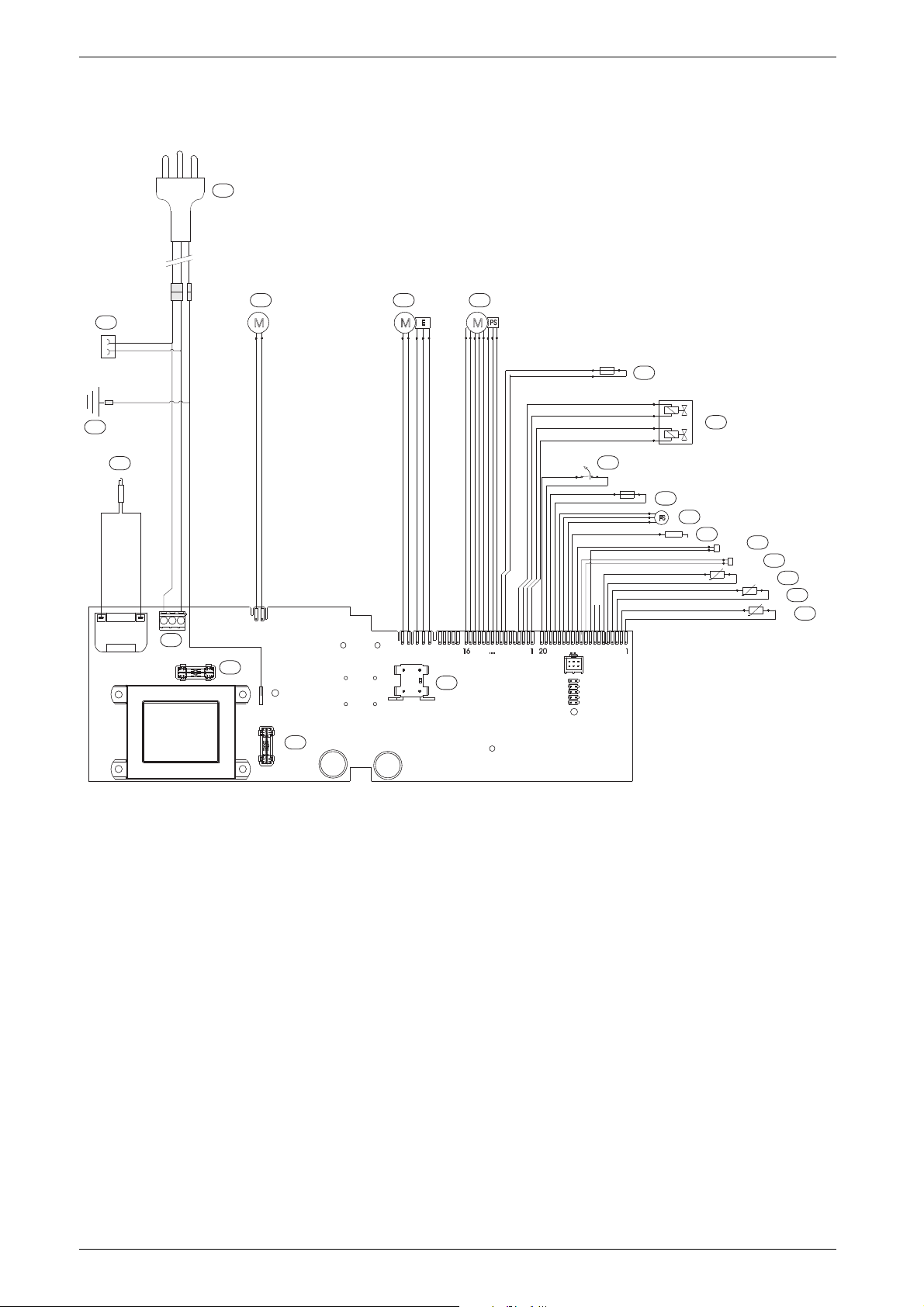
6 720 644 936
50
Electrical diagram
9 Electrical diagram
Fig. 68 Electrical scheme
1 Intlet water temperature sensor
2 Outlet water temperature sensor
3 Backflow temperature sensor
4 Cascading output connection
5 Cascading input connection
6 Ionization sensor
7 Water flow sensor
8 Flue gas limiter
9 Heat exchanger overheat sensor (ECO)
10 Gas valve
11 Jumper resistance
12 Water valve
13 Primary fan
14 ON/OFF switch
15 Secondary fan
16 AC plug
17 Main connection
18 Ignition electrodes
19 Ground post
20 Antifreeze kit connection
21 Fuse
22 Fuse
20...1
16...1
JP5
JP6
JP7
JP8
JP2
M
PS
MM
E
FS
T=104°C
T=220°F
Casc.
input
Casc.
output
2
1
4
5
6
7
9
10
11
12
13
15
16
20
19
18
21
22
17
14
8
Backflow
3
6720608158-92.1AL
T=110°C
T=230°F
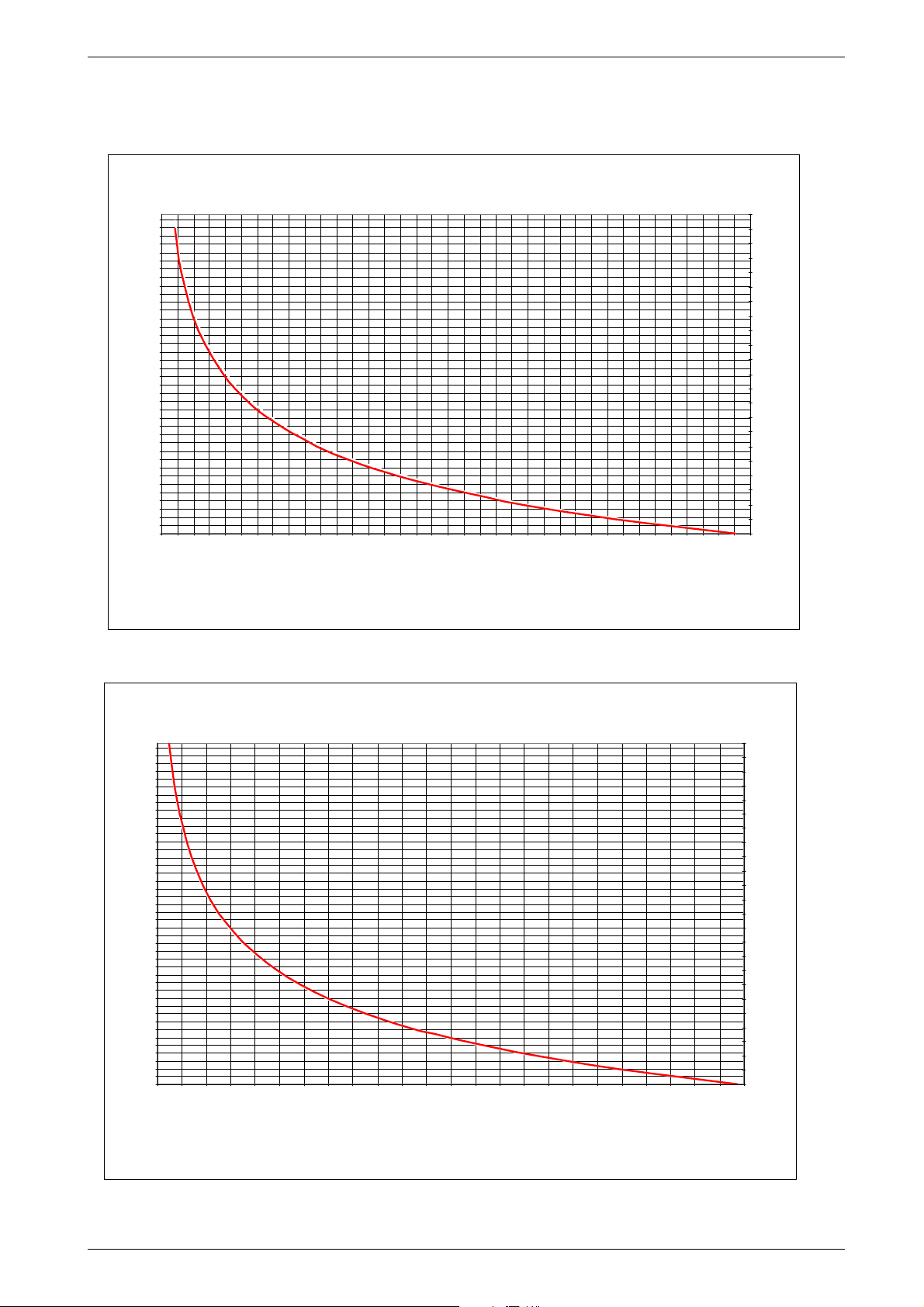
6 720 644 936
Sensor resistance charts
51
10 Sensor resistance charts
Fig. 69
Fig. 70
Outlet NTC characteristics
3 2
3 7
4 2
4 7
52
57
6 2
6 7
72
77
8 2
8 7
9 2
9 7
10 2
10 7
112
117
12 2
12 7
13 2
13 7
14 2
14 7
152
157
16 2
16 7
172
177
18 2
18 7
19 2
19 7
2 0 2
2 0 7
2 12
2 17
2 2 2
0 1 2 3 4 5 6 7 8 9 10 11 12 13 14 15 16 17 18 19 20 21 2 2 2 3 2 4 25 26 27 2 8 2 9 3 0 3 1 3 2 33 3 4 3 5 3 6 3 7
Resistance (Kohm)
Temp ºF
0
5
10
15
2 0
2 5
3 0
3 5
4 0
4 5
50
55
6 0
6 5
70
75
8 0
8 5
9 0
9 5
10 0
10 5
110
Temp ºC
Inlet NTC characteristics
3 2
3 7
4 2
4 7
52
57
6 2
6 7
72
77
8 2
8 7
9 2
9 7
10 2
10 7
112
117
12 2
12 7
13 2
13 7
14 2
14 7
152
157
16 2
16 7
172
177
18 2
18 7
19 2
19 7
2 0 2
2 0 7
2 12
2 17
2 2 2
2 2 7
2 3 2
2 3 7
2 4 2
2 4 7
0 1 2 3 4 5 6 7 8 9 10 11 12 13 14 15 16 17 18 19 20 21 22 23 24
Resistance (Kohm)
Temp ºF
0
5
10
15
2 0
2 5
3 0
3 5
4 0
4 5
50
55
6 0
6 5
70
75
8 0
8 5
9 0
9 5
10 0
10 5
110
115
12 0
Temp ºC
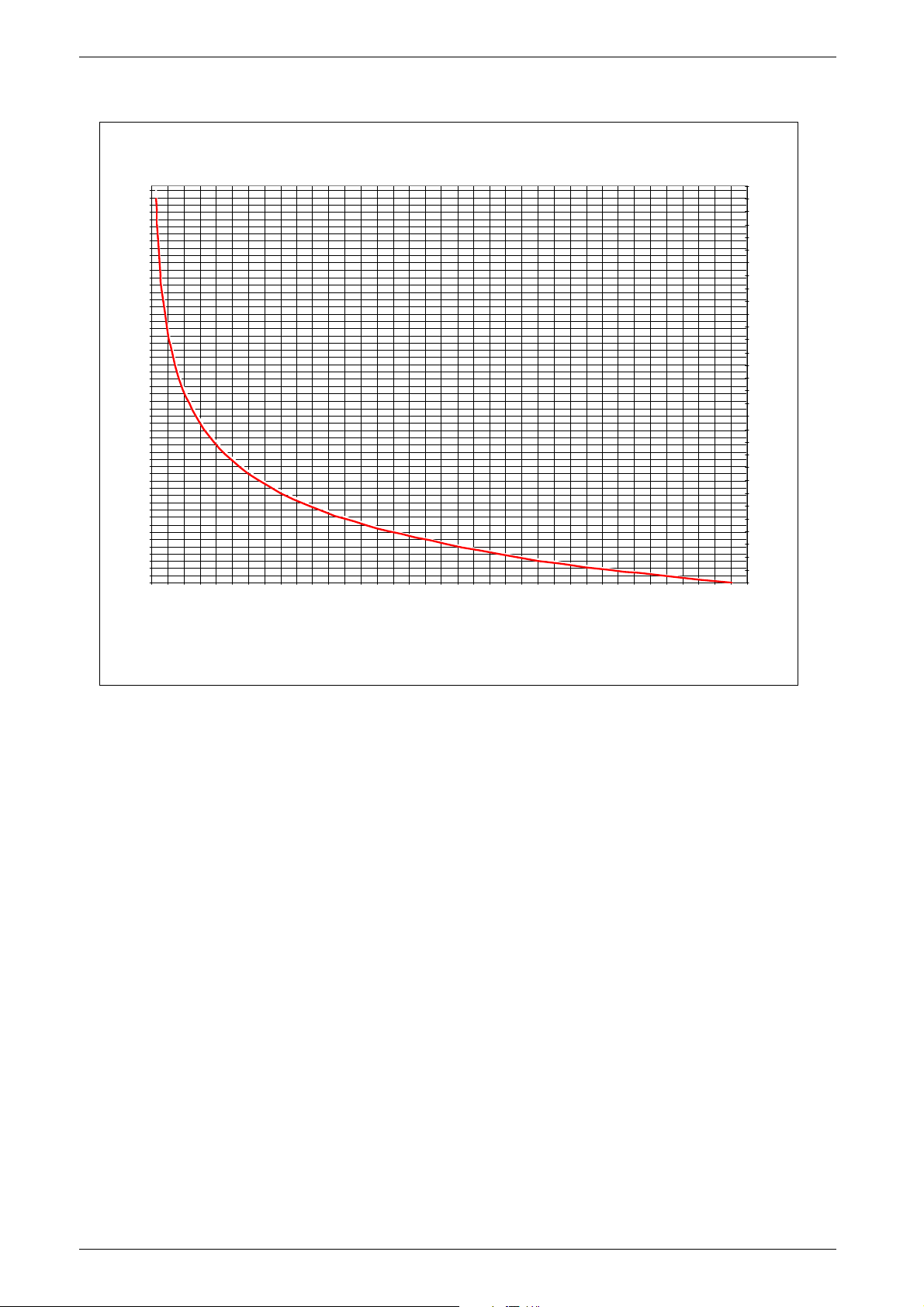
6 720 644 936
52
Sensor resistance charts
Fig. 71
Back Flow characteristics
3 2
3 7
4 2
4 7
5 2
5 7
6 2
6 7
7 2
7 7
8 2
8 7
9 2
9 7
10 2
10 7
112
117
12 2
12 7
13 2
13 7
14 2
14 7
15 2
15 7
16 2
16 7
17 2
17 7
18 2
18 7
19 2
19 7
2 0 2
2 0 7
2 12
2 17
2 2 2
2 2 7
2 3 2
2 3 7
2 4 2
2 4 7
2 5 2
2 5 7
2 6 2
2 6 7
2 7 2
2 7 7
2 8 2
2 8 7
2 9 2
2 9 7
3 0 2
0 1 2 3 4 5 6 7 8 9 10 11 12 13 14 15 16 17 18 19 20 21 22 23 24 25 26 27 28 29 30 31 32 33 34 35 36 37
Resistance (Kohm)
Temp ºF
0
5
10
15
2 0
2 5
3 0
3 5
4 0
4 5
50
55
6 0
6 5
70
75
8 0
8 5
9 0
9 5
10 0
10 5
110
115
12 0
12 5
13 0
13 5
14 0
14 5
150
155
Temp ºC
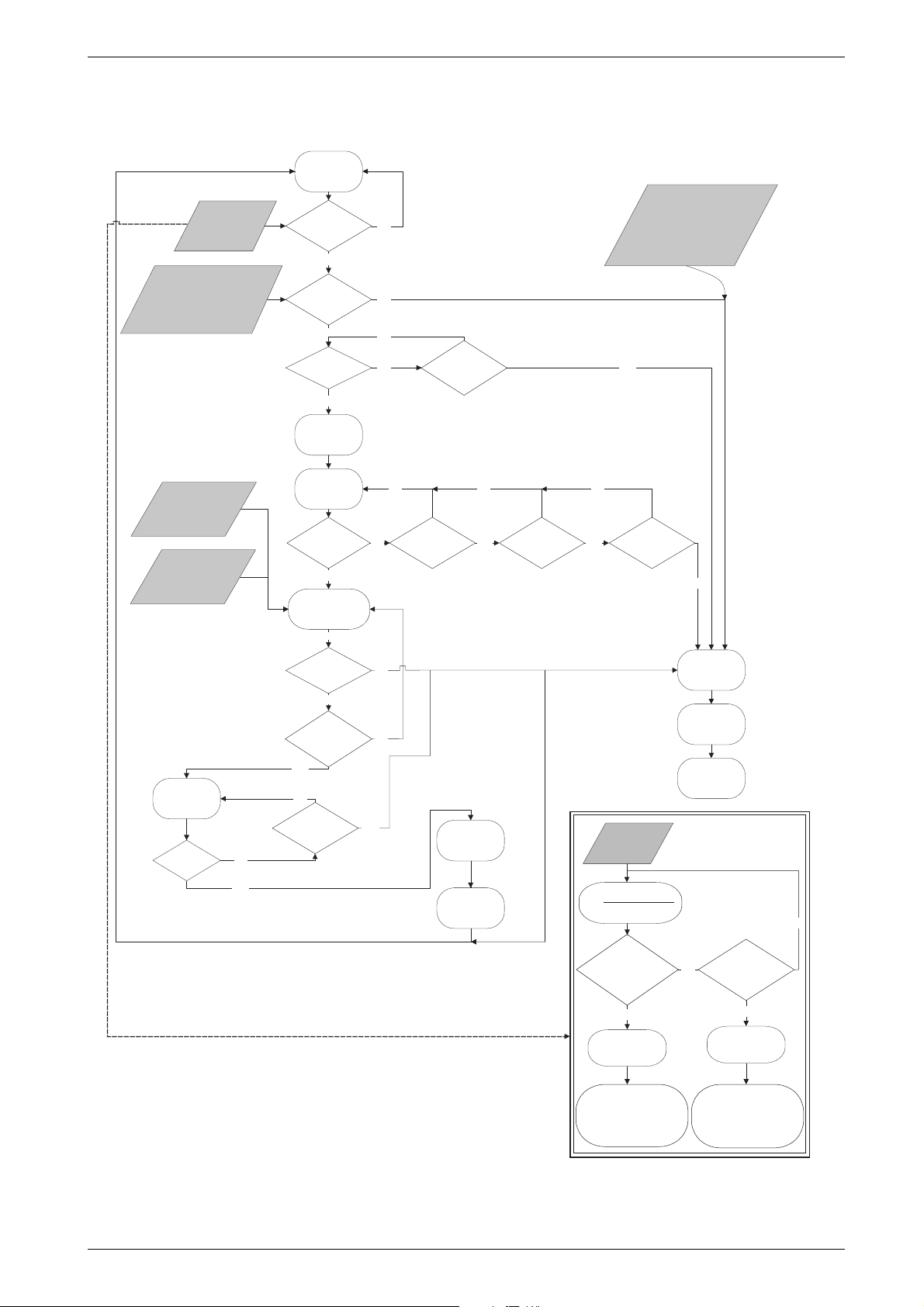
6 720 644 936
Functional scheme
53
11 Functional scheme
Fig. 72 Functional scheme
Fanspeed
OK?
waiting
timeof10s
passed?
watertap
open?
Waterflow
0.5gpm
(>1.9l/min)
(seeWFcalc.)
>
NO
NO
NO
NO
YES
YES
YES
YES
NO NO NO
NO
YES
YES
Startsparking
IDLE
Openthegas
valve
1st
Safetytime
of5spassed?
Ionization
detected?
6720608158-65.2V
NO
NO
NO
NO
YES
YES
YES
Seeerror
codetable
Postpurgeof
fanfor7sec.
Stayblocked
tillRESET
closesecond
gasvalve
Postpurgeof
fanfor7sec.
watertap
closed
<0.5gpm?
safety
devices
OK?
closeonegas
valve
waiting
timeof
1spassed?
flameoff?
Hotwater
deliveredat
selectedtemp.
Appliance
readytostart?
Fanspeed=correct
Ionization=off
Temp.limiter=closed
Temp.sensors=ok
Overheatprotection=ok
Seeerrorcodetable
INPUTS:
-FANSPEED
-WATER TEMP.
-WATERFLOW
OUTPUTS:
-FANSPEED
-WATERFLOW
YES
YES
YES YES
2nd
Safetytimeof
5spassed?
3rd
Safetytime
of5spassed?
Waterflow
Calculus
WF=
BurnerON
BurnerON
MinimumPower
(Setpoint-Inlet)
NO
YES
YES
Burnershutdownat:
Setpoint+9°F(5°C)
WF<0.45gpm±0.05gpm
(WF<1.7l/min±0.2l/min)
Burnershutdownat:
Setpoint+14°F(8°C)
WF<0.45gpm±0.05gpm
(WF<1.7l/min±0.2l/min)
0.5GPM<WF<1.6GPM
(2l/min<WF<6l/min)
WF>1.6GPM
(WF>6l/min)
NO
Waterflowprocedure
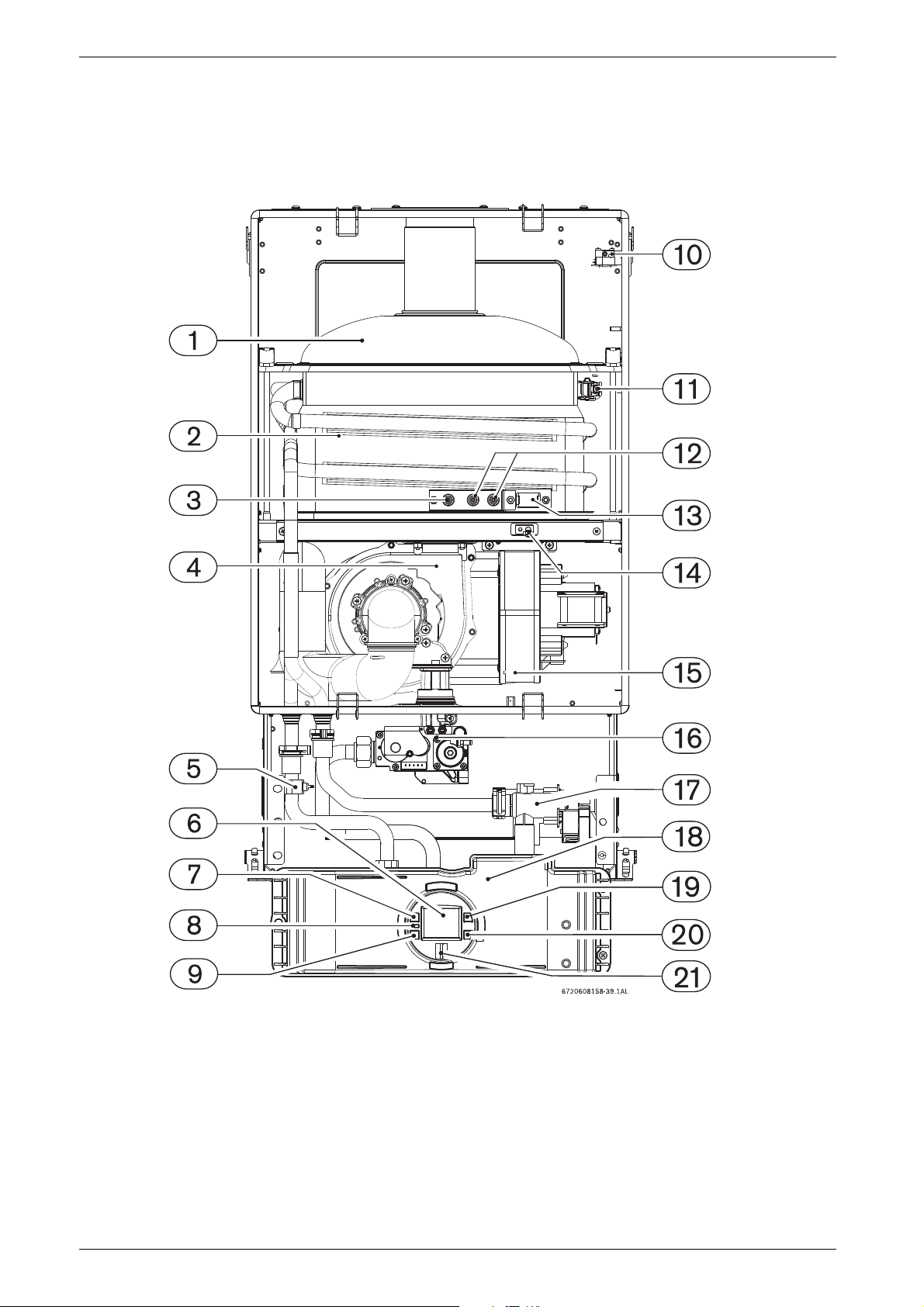
6 720 644 936
54
Interior components diagram and parts list
12 Interior components diagram and parts list
12.1 Interior components
Fig. 73 Components
1 Flue gas collector
2 Heat exchanger
3 Flame sensor
4 Primary fan (Mixer)
5 Outlet temperature sensor
6 LCD display
7 On/Off button
8 Reset button
9 Program key
10 Flue gas limiter
11 Heat exchanger overheat sensor
12 Ignition electrodes
13 Observation window
14 Backflow temperature sensor
15 Secondary air fan
16 Gas valve
17 Water valve with engine and temperature sensor
18 Control unit
19 Up button
20 Down button
21 LED
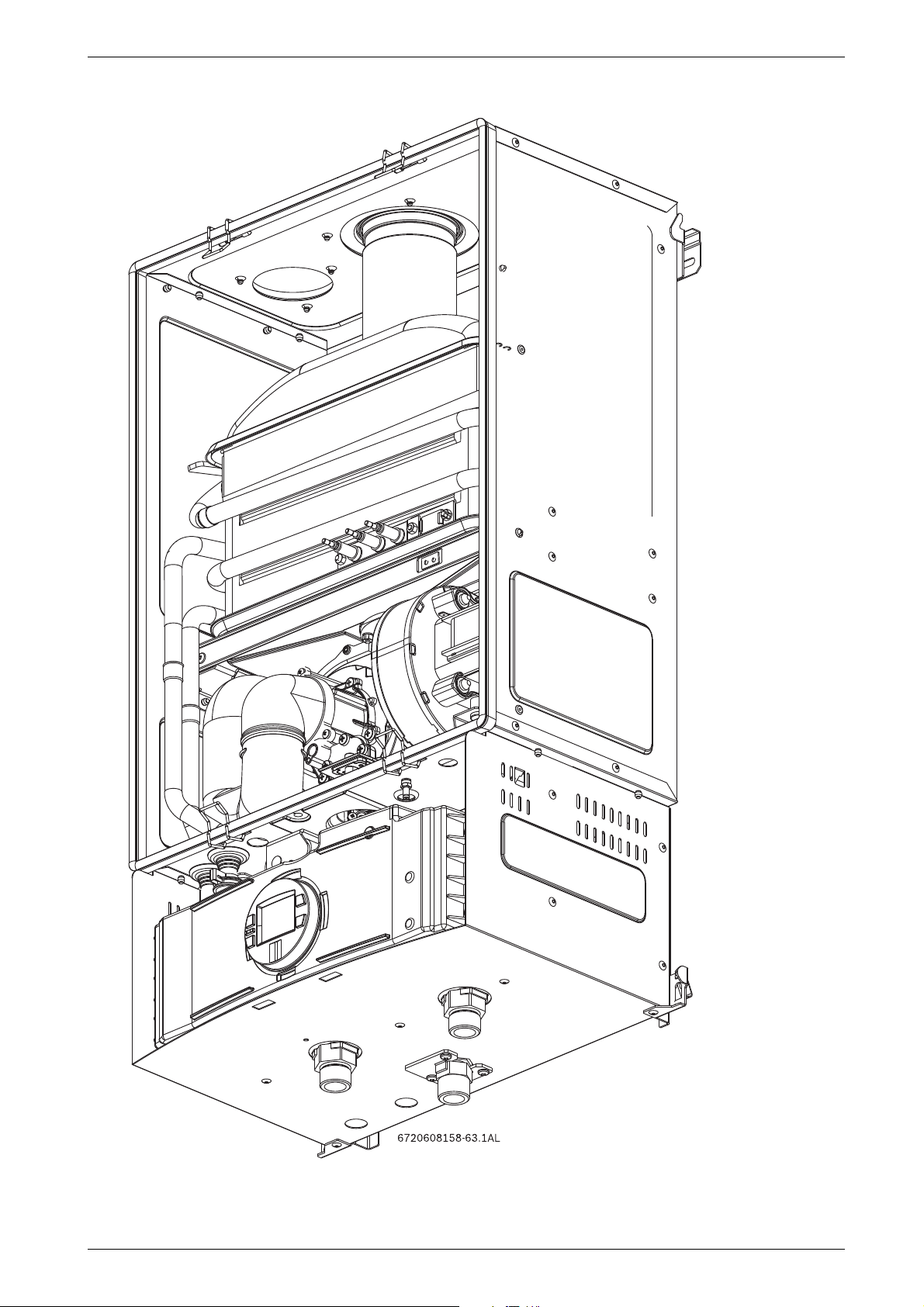
6 720 644 936
Interior components diagram and parts list
55
Fig. 74 Appliance overview
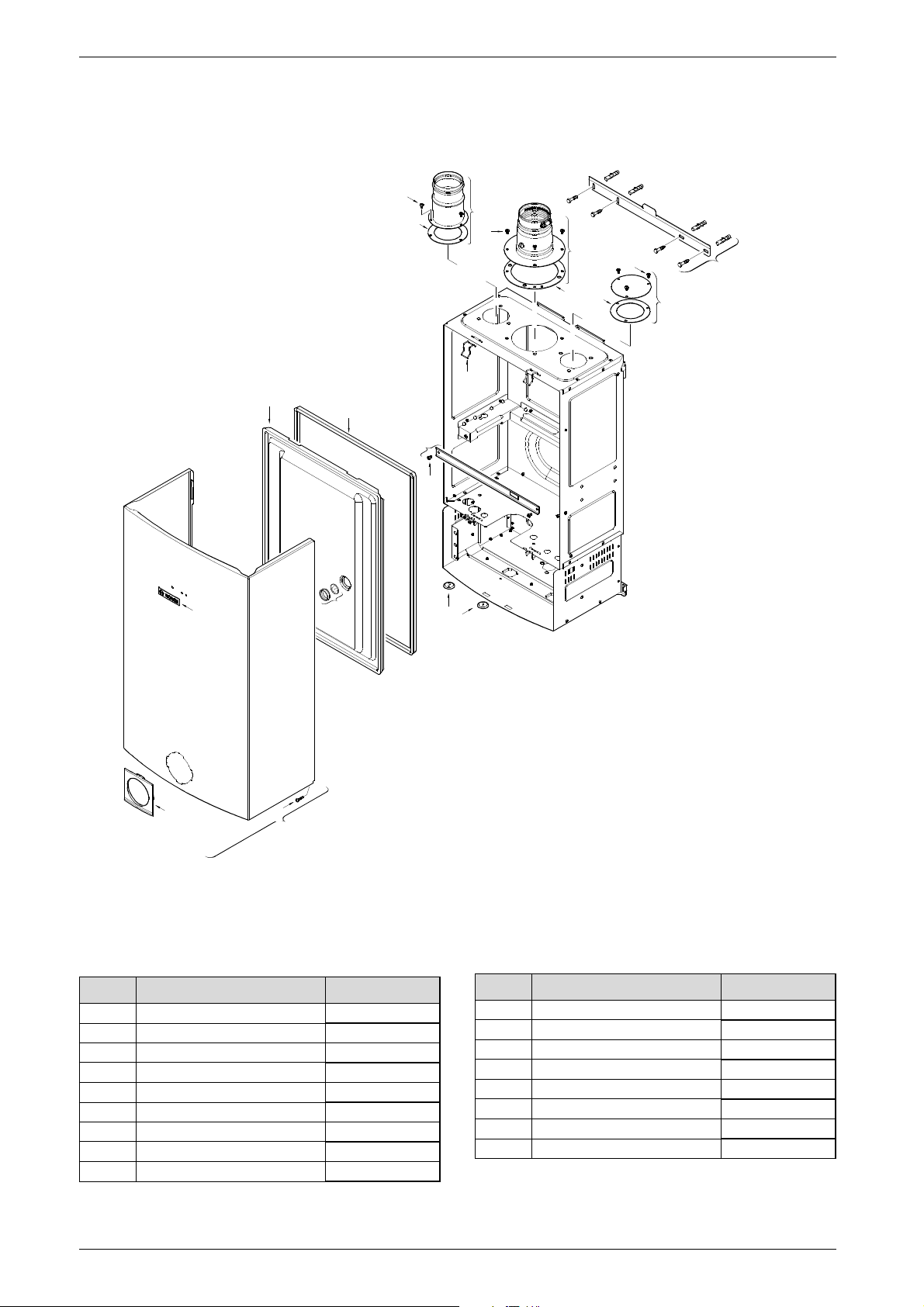
6 720 644 936
56
Interior components diagram and parts list
12.2 Components diagram
12.2.1 Group 1
Fig. 75 Components Diagram
9
9
8
5
1
2
3
6
7
9
10
12
9
14
16
17
11
13
15
15
4
6720902973.AA JF
Item Description Reference
1 Front cover 8 705 431 412
2 Cover shield 8 705 506 906
3 Trade mark badge 8 701 103 140
4 Cover screw 8 703 401 170
5 Combustion cover 8 700 506 300
6 Combustion cover gasket 8 704 701 084
7 Observation window 8 705 600 003
8 Holding bracket 8 708 104 103
9 Screw 8 703 403 012
Table 31
10 Combustion cover clip 8 701 201 032
11 Grommet set 8 710 203 039
12 Exhaust accessory 8 705 504 151
13 Gasket exhaust 8 700 103 710
14 Inlet air cover 8 708 006 022
15 Inlet air gasket 8 700 103 166
16 Inlet air accessory 8 705 504 154
17 Mounting bracket 8 701 309 164
Item Description Reference
Table 31
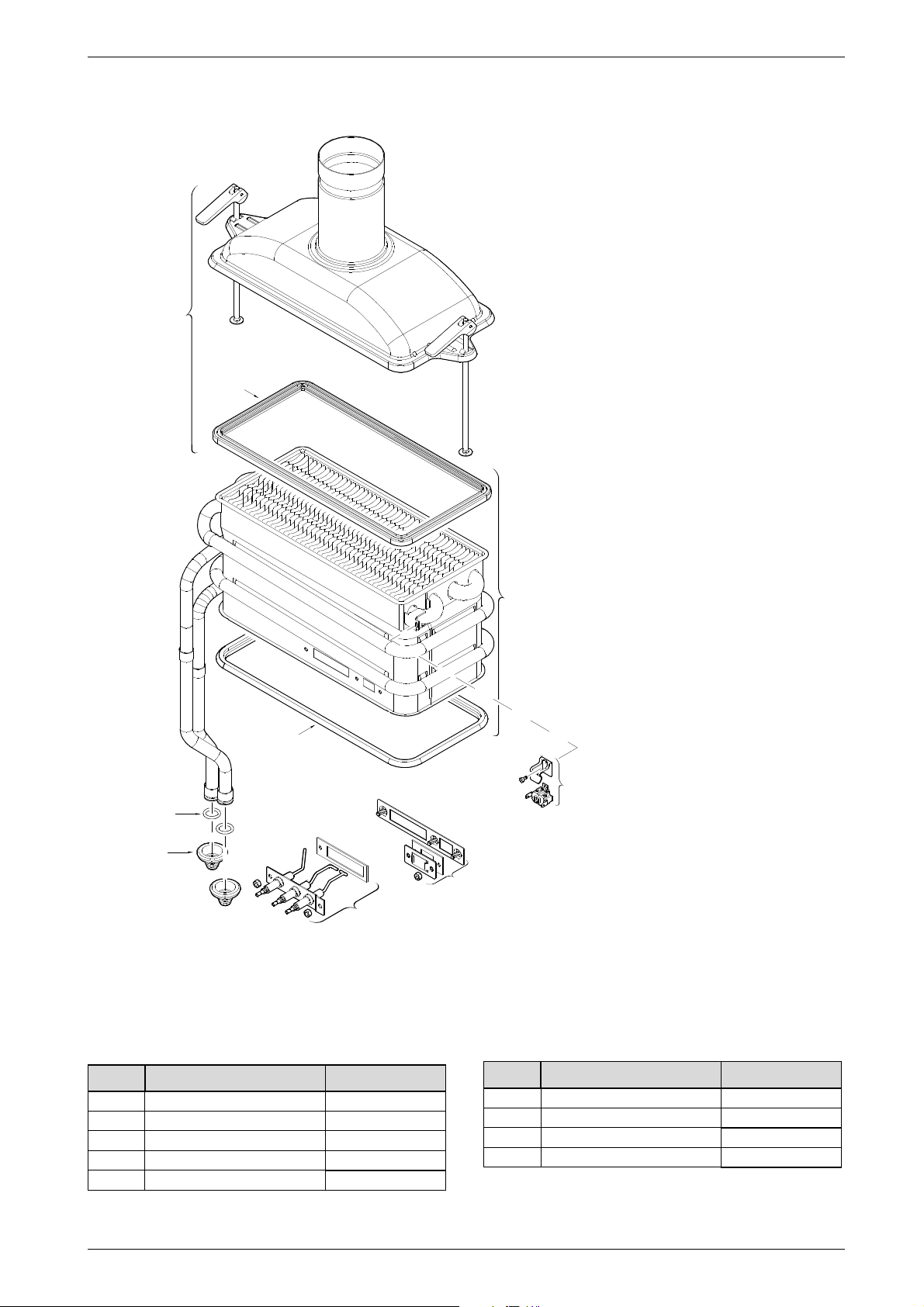
6 720 644 936
Interior components diagram and parts list
57
12.2.2 Group 2
Fig. 76 Components Diagram
1
3
2
4
5
6
7
8
9
6720902974.AA JF
Item Description Reference
1 Heat exchanger 8 705 406 422
2 Heat exchanger top gasket 8 704 701 052
3 Flue gas collector 8 705 700 153
4 Overheat sensor (ECO) 8 707 206 204
5 Heat exchanger bottom gasket 8 704 701 054
Table 32
6 Site window 8 701 000 401
7 Ignition group 8 701 302 249
8 Heat exchanger O-ring 8 700 205 147
9 Rubber grommet 8 710 303 027
Item Description Reference
Table 32
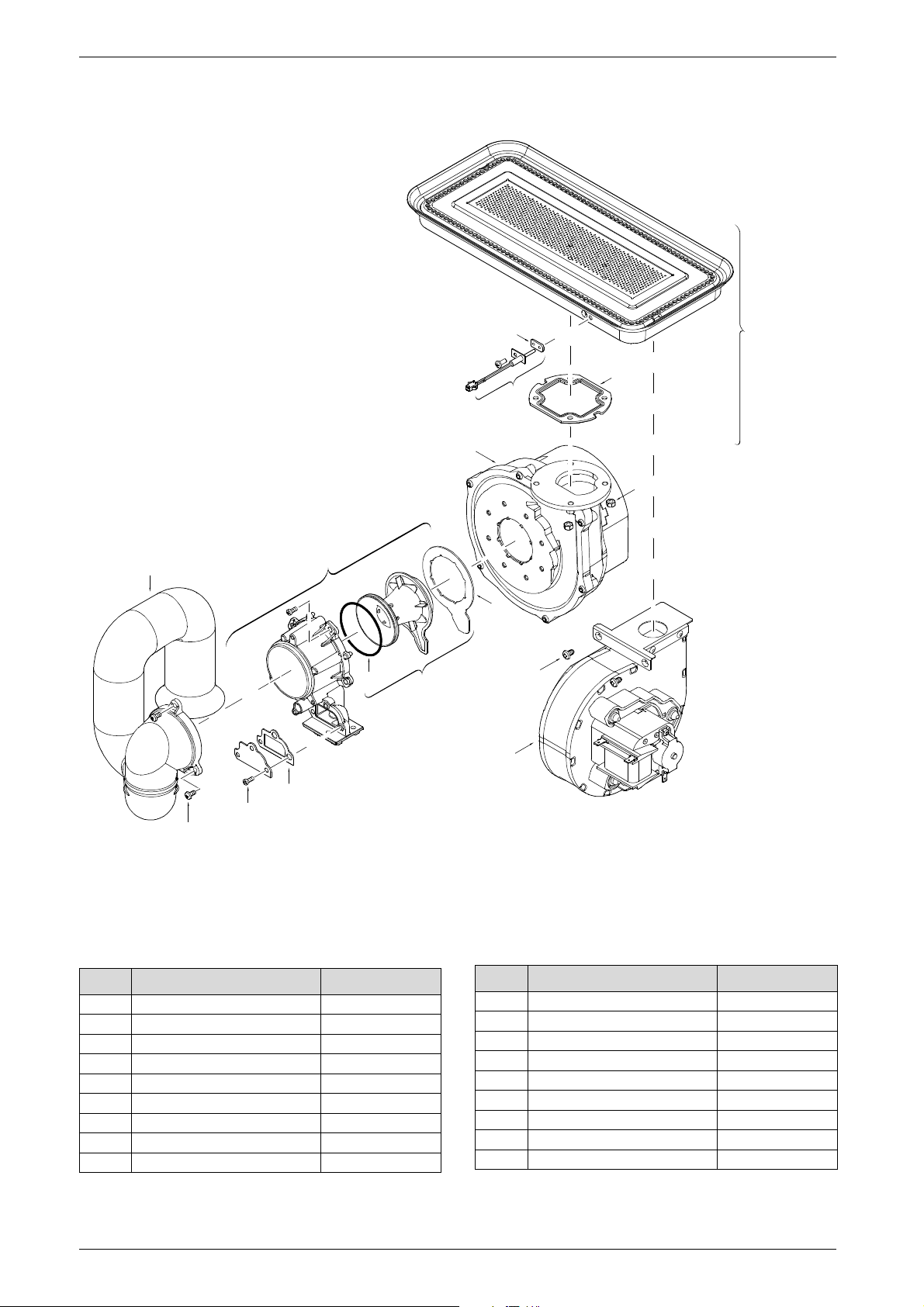
6 720 644 936
58
Interior components diagram and parts list
12.2.3 Group 3
Fig. 77 Components Diagram
15
14
1
3
4
6
7
8
2
12
9
11
13
16
17
5
6720902975.AA JF
Item Description Reference
1 Main burner 8 708 120 699
2 Burner gasket 8 704 701 087
3 Primary fan 8 707 204 071
4 Backflow temperature sensor 8 707 206 459
5 Washer 8 704 701 097
6 Fan mount nut 2 915 011 006
7 Secondary fan - NG 8 707 204 094
7 Secondary fan - LPG 8 707 204 072
8 Screw 8 703 403 012
Table 33
9 Gas / Air Mixer 8 705 700 170
10 Air duct O-ring 8 700 205 149
11 Venturi 8 700 306 226
12 O-ring 8 700 205 224
13 Mixer / Fan gasket 8 704 701 059
14 Screw 2 910 642 150
15 Plate gasket 8 701 004 049
16 Air supply duct 8 705 700 155
17 Screw 2 910 952 122
Item Description Reference
Table 33
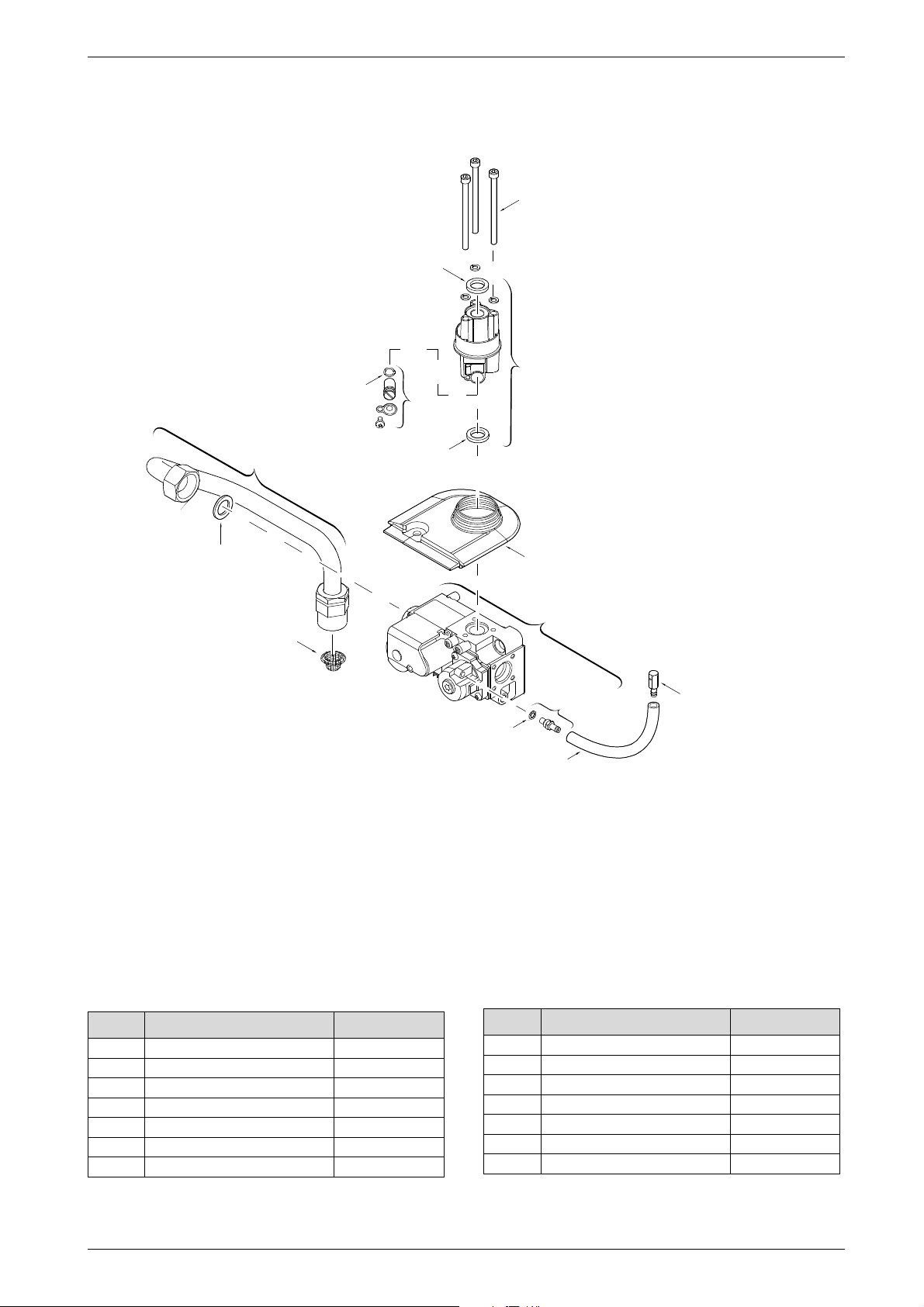
6 720 644 936
Interior components diagram and parts list
59
12.2.4 Group 4
Fig. 78 Components Diagram
9
2
14
1
3
4
5
6
7
8
11
11
12
13
10
6720608158-73.1AL
Item Description Reference
1 Gas valve 8 707 021 019
2 Pressure tapping 8 703 404 219
3 Washer 8 700 203 041
4 Pressure balance tube 8 700 703 136
5 Pressure balance nut 8 703 300 041
6 Gas supply pipe 8 700 715 389
7 Gas valve washer 8 700 103 014
Table 34
8 Gas filter 8 700 507 002
9 Gasket 8 704 701 085
10 Gas / Fan connector 8 705 202 140
11 Washer 8 704 701 062
12 Regulation screw 8 703 404 220
13 O-ring 8 700 205 009
14 Screw 2 910 149 181
Item Description Reference
Table 34
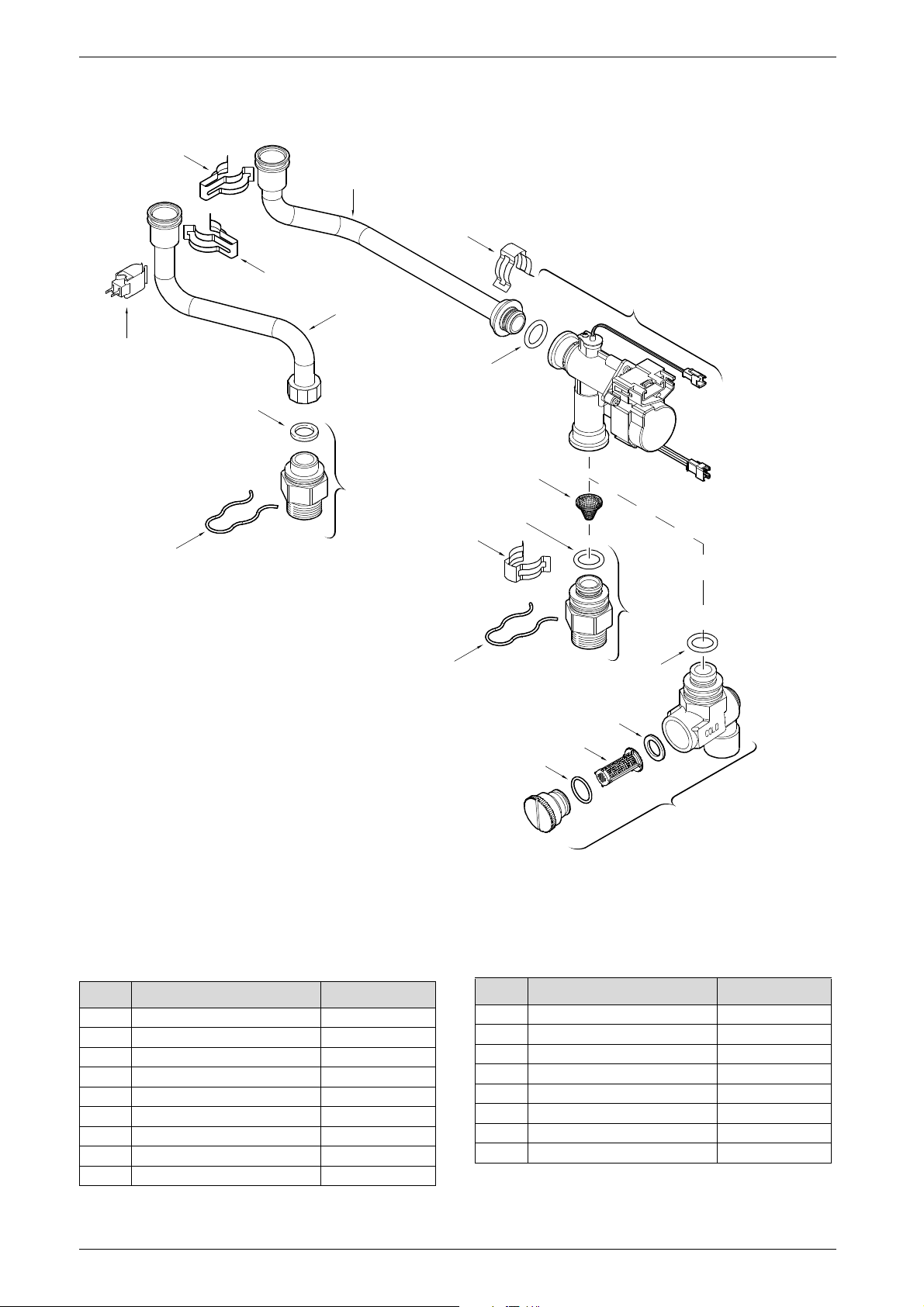
6 720 644 936
60
Interior components diagram and parts list
12.2.5 Group 5
Fig. 79 Components Diagram
9
11
12
13
10
1
2
3
4
4
5
6
7
8
9
11
14
15
16
17
12
6720902977.AA JF
Item Description Reference
1 Water valve with engine 8 708 505 024
2 O-ring 8 700 205 147
3 Cold water pipe 8 700 715 394
4 Pipe connection clip 8 701 201 028
5 Hot water pipe 8 700 715 469
6 Temperature sensor 8 700 400 015
7 Outlet fitting 8 703 305 349
8 Inlet / Outlet washer 8 710 103 045
9 Wireform spring 8 701 300 025
Table 35
10 Inlet fitting 8 703 305 348
11 O-ring 8 700 205 157
12 Watervalve clip 8 716 102 607
13 Water filter 8 700 507 001
14 Inlet fitting with filter (optional) 8 703 305 356
15 Washer (optional) 8 700 103 764
16 Water filter (optional) 8 700 507 059
17 O-ring (optional) 8 700 205 231
Item Description Reference
Table 35
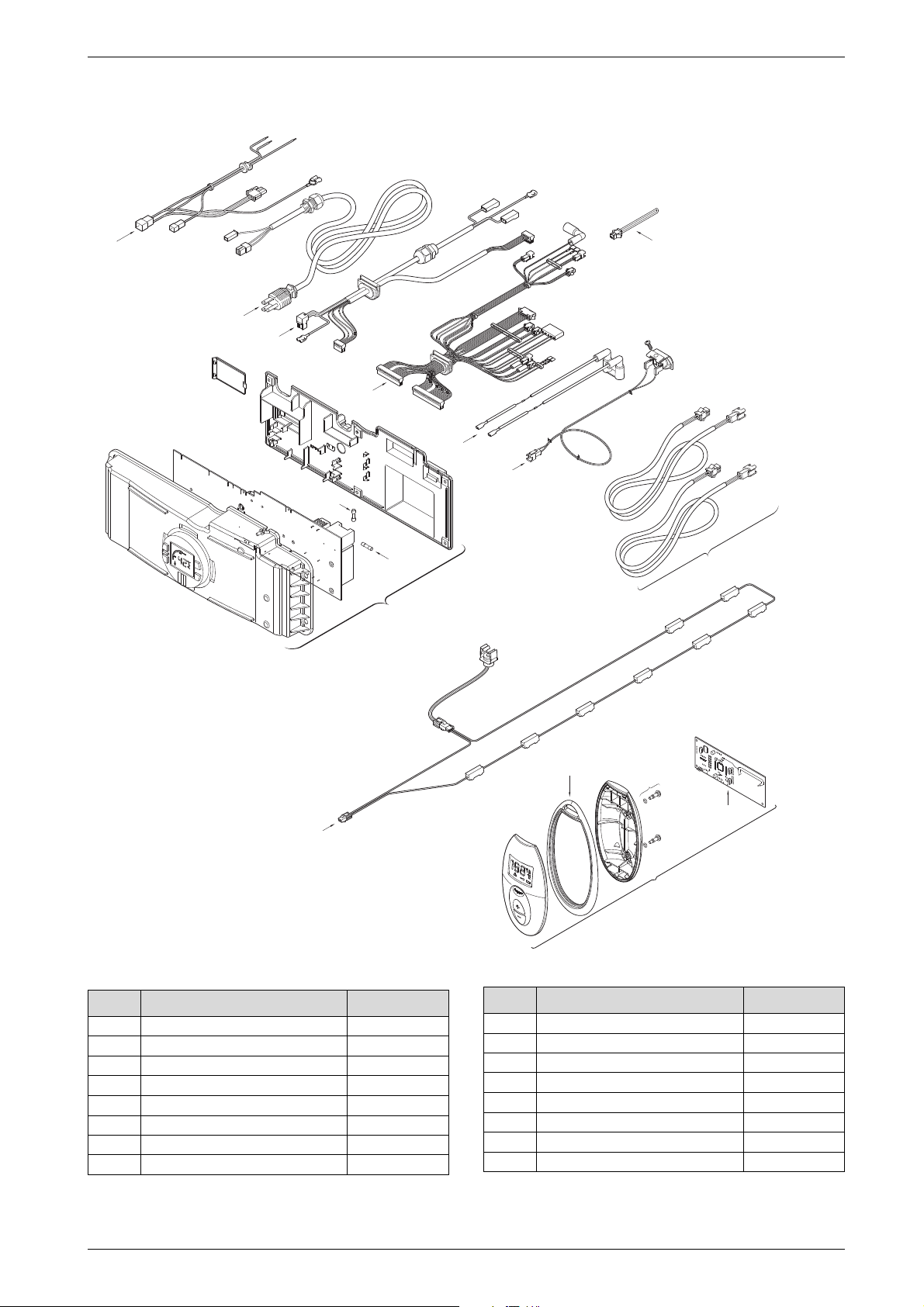
6 720 644 936
Interior components diagram and parts list
61
12.2.6 Group 6
Fig. 80 Components Diagram
7
9
10
8
4
6720644956-09.1V
3
1
6
5
2
15
13
16
14
12
11
Item Description Reference
1 Control unit 8 707 207 366
2 Fuse T2.5A 1 904 521 342
3 Fuse T1.6A 8 700 609 008
4 Power supply cables 8 704 401 371
5 Power supply cord 8 704 401 378
6 Fan cables 8 704 401 347
7 Wire harness 8 704 401 348
8 Jumper 8 704 401 376
Table 36
9 Electrode cables 8 704 401 346
10 Flue gas limiter 8 700 400 032
11 Kit inteligent cascading 7 709 003 962
12 Freeze prevention kit 7 709 003 665
13 Remote control (optional) TSTAT2
14 Shaped seal (optional) 8 700 201 012
15 Screw (optional) 8 703 401 109
16 Printed circuit transceiver (optional) 8 708 300 123
Item Description Reference
Table 36

6 720 644 936
62
Protecting the environment
13 Protecting the environment
Packing
The packing box may be fully recycled as confirmed by
the recycling symbol .
Components
Many parts in the heater can be fully recycled in the end
of the product life. Contact your city authorities for
information about the disposal of recyclable products.
Saving water resources:
B Make sure you close all the taps after any use. Avoid
leaving the taps dripping. Repair any leaking tap.
B Define the temperature you want, in the appliance or
with the remote control. This way you have the
precise water flow needed (mixing cold water to
regulate temperature will increase the water flow with
consequent waste of water).

6 720 644 936
Limited Warranty
63
14 Limited Warranty
General
BOSCH PRO tankless water heaters are warranted by
the Manufacturer (BOSCH) through Bosch
Thermotechnology Corp.
Bosch Thermotechnology Corp. will furnish a
replacement heat exchanger and will furnish a
replacement of any other part which fails in normal use
and service within the applicable periods specified
below, in accordance with the terms of this warranty.
The Bosch Thermotechnology Corp. replacement will
be warranted for the unexpired portion of the original
warranty. This warranty will be valid only for water
heaters in possession of the original purchaser as
recorded on the warranty card.
The Heat Exchanger
If the heat exchanger fails within Fifteen (15) years after
the original installation and operation, Bosch
Thermotechnology Corp. will furnish a replacement
heat exchanger. However, if the water heater is used
within an approved hot water recirculation and supplied
with circulated water, this heat exchanger warranty is
limited to three (3) years from date of original installation
and operation. If the water heater is installed in other
than a single family dwelling, this heat exchanger
warranty is limited to two (2) years from date of original
installation and operation.
Exceptions
This warranty will not apply:
• 1. to defects or malfunctions resulting from failure to
properly install, operate or maintain the unit in
accordance with the printed instructions provided;
• 2. to damage or abuse, accident, neglect or freezing
and other acts of nature;
• 3. to damage resulting from operation with either the
flame sensor rod or overheat sensor removed;
• 4. to failure of the heat exchanger resulting from the
operation of the water heater in a corrosive
atmosphere or at water temperatures exceeding the
maximum rating, or if the water heater is not supplied
with potable water;
• 5. to defects or damage cause by any attachment
or modification, including any energy-saving device;
• 6. to damage resulting from scale deposits and/or
highly mineralized / unsoftened water supply.
All Other Parts
If any other part fails within five (5) years after original
installation and operation, Bosch Thermotechnology
Corp. will furnish a replacement part free of charge.
Service Labor Costs
This warranty does not cover any labor costs
associated with service, removal or re-installation of
part(s). All such costs must be borne by the Purchaser.
Additionally, this warranty does not cover any labor
costs associated with service, removal, installation or
re-installation of the original water heater or a replaced
water heater.
How to Make a Claim
Any claim for warranty parts should be made to your
local dealer or distributor:
BOSCH THERMOTECHNOLOGY CORP.
50 Wentworth Avenue
Londonderry, NH 03053
Tel. 866-330-2730
www.boschpro.com
In most cases, the dealer or distributor will be able to
promptly honor your claim and subsequently notify
Bosch Thermotechnology Corp.. However, all
replacements are made subject to validation by Bosch
Thermotechnology Corp. of in-warranty coverage. The
damaged or defective item must be made available in
exchange for the replacement.
Miscellaneous
No one is authorized to make any other warranties on
behalf of Bosch Thermotechnology Corp.. It is
expressly understood that the replacement warranty of
Bosch Thermotechnology Corp. shall be in lieu of any
and all other warranties, express or implied, including
warranties of merchantability or fitness for a particular
use or purpose, and further that Bosch
Thermotechnology Corp. shall not be liable for any loss
or damage directly or indirectly arising from the use of
the hot water heater, or for any consequential damages
arising from such use (including damages from water
leakage). Bosch Thermotechnology Corp. sole liability
with respect to any defect shall be for the replacement
of the defective part(s). Some states do not allow such
limitations and exclusions, so the above may not apply
to you.
This warranty gives specific legal rights. You may also
have other rights which vary from state to state.
i
NOTE: the water heater must be free of
damaging scale deposits and not subject
to gas pressures greater than those
shown on the rating plate, which must not
be altered, defaced or removed.
Replacement Parts available from:
Bosch Termotecnologia SA
Estrada de Cacia
3800 - 533 Cacia - PORTUGAL
© 2010 Bosch Thermotechnology Corp.,
Londonderry, NH
BOSCH THERMOTECHNOLOGY
CORP.
50 Wentworth Avenue
Londonderry, NH 03053
Tel. 866-330-2730
www.boschpro.com
Installer Checklist to be completed by installer upon installation
Serial Number ___ ___ ___ ___ ___ ___ ___ ___
(8 digit serial number is located on rating plate on right side panel)
Gas Pressure Reading* Static__________ Operating__________
Building Water Pressure __________ Range if on Well system __________
Installing Company _____________________________________________
Installer name _____________________________________________
Address _____________________________________________
Phone _____________________________________________
* See Chapter 3.13, page 32 and gas pressure table (to be filled out by installer)
Installation manual should be left with the owner after the installation is tested and completed
6720644936