Form No. 3329=256
t _-42Z
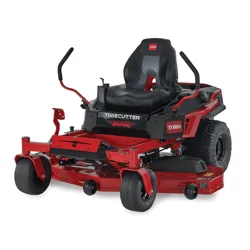
TimeCutter ® Z with Side Discharge Mower
IVlodel No, 74325mSerial No, 230000001 and Up
Operator's Manual
Domestic English (EN)
CALIFORNIA
Proposition 65 Warning
The engine exhaust from this product contains
chemicals known to the State of California to cause
cancel', birth defects, or other reproductive harm.
This engine is not equipped with a spark
arrester muffler. It is a violation of California Public
Resource Code Section 4442 to use or operate this engine
on any forest-covered, brush-covered, or grass-covered
land. Other states or federal areas may have similar laws.
This spark ignition system complies with Canadian
ICES-002.
Ce systbme d'allumage par dtincetle de vdhicute est
confonne g la nonne NMB-002 du Canada.
The enclosed Engine Owner's Manual is supplied for
information regarding The U.S. Environmental
Protection Agency (EPA) and the California Emission
Control Regulation of emission systems, maintenance
and warranty.
Keep this engine Owner's Manual with your unit.
Should this engine Owner's Manual become damaged
or illegible, replace immediately. Replacements may be
ordered through the engine manufacturer.
Contents
Page
Introduction ................................ 2
Safety ..................................... 3
Safe Operating Practices .................... 3
Toro Riding Mower Safety .................. 5
Slope Chart .............................. 7
Safety and Instruction Decals ................ 9
Gasoline and Oil ............................. 11
Reconm_ended Gasoline .................... 11
Using Stabilizer/Conditioner ................ 11
Filling the Fuel Tank ...................... 11
Checking the Engine Oil Level .............. 11
Operation .................................. 12
Think Safety First ......................... 12
Controls ................................ 12
Parldng Brake ............................ 12
Starting and Stopping the Engine ............. 13
Operating the Power Take Off (PTO) .......... 13
The Safety Interlock System ................ 14
Page
Testing the Safety Interlock System ........... 14
Driving Forward or Backward ............... 14
Stopping the Machine ...................... 15
Adjusting the Height of Cut ................. 15
Positioning the Seat ....................... 15
Adjusting the Motion Control Levers .......... 16
Pushing the Machine by Hand ............... 16
Adjusting the Footrest ..................... 16
Removing and Installing the Engine Hood ..... 17
Side Discharge ........................... 17
Tips for Mowing Grass ..................... 18
Maintenance ................................ 19
Recommended Maintenance Schedule ......... 19
Servicing the Engine Oil ................... 20
Servicing the Air Cleaner ................... 21
Servicing the Spark Plug ................... 22
Servicing the Cutting Blades ................ 23
Greasing and Lubrication ................... 25
Servicing the Battery ...................... 25
Draining the Fuel Tank ..................... 27
Replacing the Fuel Filter ................... 28
Checking the Tire Pressure .................. 28
Leveling the Mower from Side-to-Side ........ 28
Adjusting the Front-to-Rear Blade Slope ....... 29
Inspecting the Belts ....................... 30
Replacing the Mower Belt .................. 30
Removing the Mower ...................... 31
Installing the Mower ...................... 32
Fuse ................................... 32
Washing the Underside of the Mower ......... 32
Replacing the Grass Deflector ............... 33
Wiring Diagram .......................... 34
Cleaning and Storage ...................... 35
Troubleshooting ............................. 35
The Toro Total Coverage Guarantee ............. 40
Introduction
Read this manual carefully to learn how to operate and
maintain your product properly. The information in this
manual can help you and others avoid iniury and product
damage. Although Toro designs and produces safe
products, you are responsible for operating the product
properly and safely.
Whenever you need service, genuine Toro parts, or
additional information, contact an Authorized Service
Dealer or Toro Customer Service and have the model and
serial numbers of your product ready. Figure 1 illustrates
the location of the model and serial numbers on the
product.
© 2003 by The Toro Company
8111 Lyndale Avenue South
Bloomington, MN 55420-1196
2
All Rights Reserved
Printed in the USA
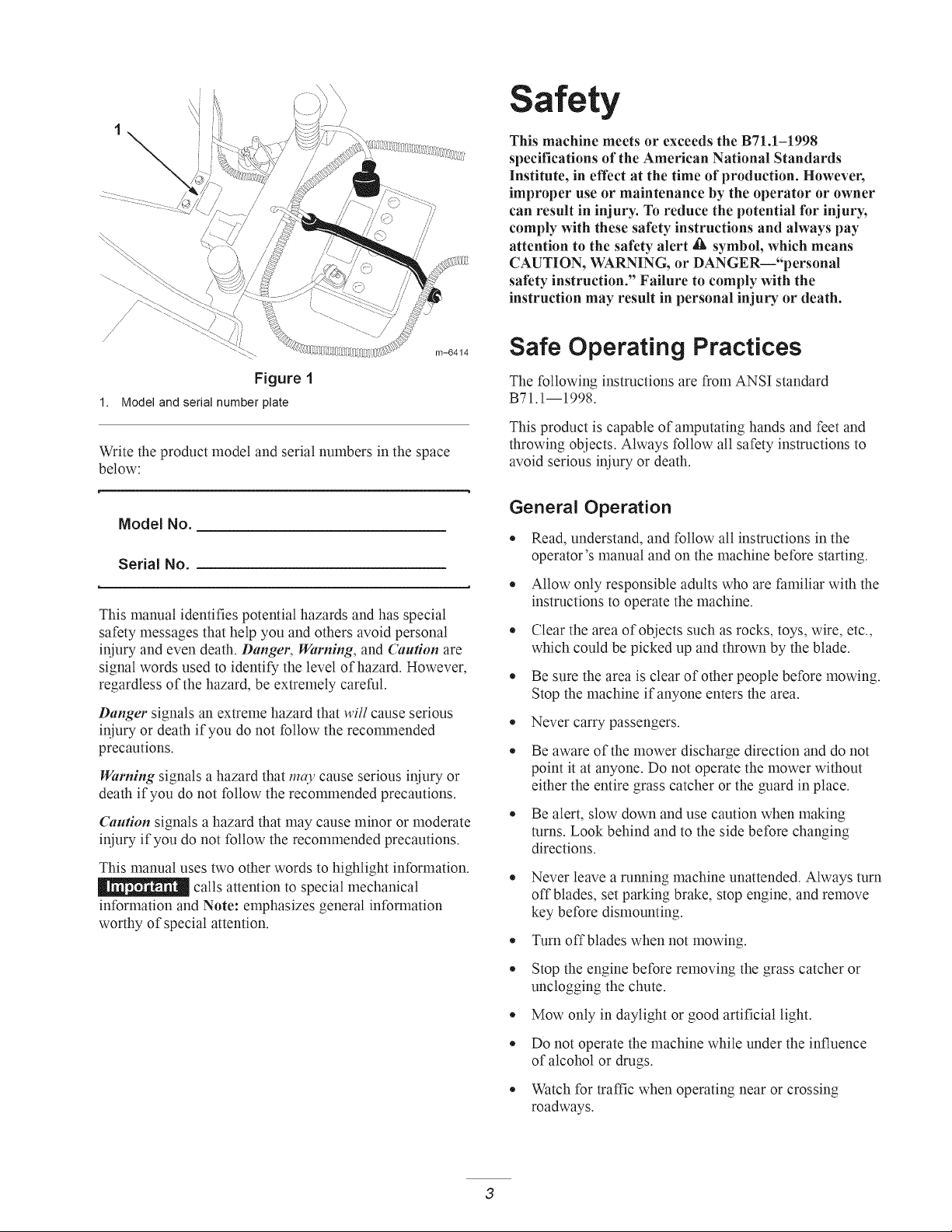
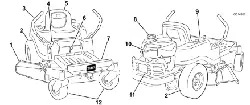
Figure 1
1. Model and serial number plate
m-6414
Write the product model and serial numbers in the space
below:
Model No.
Serial No.
This manual identifies potential hazards and has special
safety messages that help you and others avoid personal
injury and even death. Danger, _wning, and Caution are
signal words used to identify the level of hazard. However,
regardless of the hazard, be extremely careful.
Danger signals an extreme hazard that will cause serious
injury or death if you do not follow the reconmlended
precautions.
Warning signals a hazard that may cause serious iniury or
death if you do not follow the reconmlended precautions.
Caution signals a hazard that may cause minor or moderate
injury if you do not follow the recommended precautions.
This manual uses two other words to highlight information.
calls attention to special mechanical
information and Note: emphasizes general information
worthy of special attention.
Safety
This machine meets or exceeds the B71.1-1998
specifications of the American National Standards
Institute, in effect at the time of production. However,
improper use or maintenance by the operator or owner
can result in injury. To reduce the potential for injury,
comply with these safety instructions and always pay
attention to the safety alert _ symbol, which means
CAUTION, WARNING, or DANGER--"personal
safety instruction." Failure to comply with the
instruction may result in personal injury or death.
Safe Operating Practices
The following instructions are from ANSI standard
B71.1--1998.
This product is capable of amputating hands and feet and
throwing objects. Always follow all safety instructions to
avoid serious injury or death.
General Operation
®
®
Read, understand, and follow all instructions in the
operator's manual and on the machine before starting.
Allow only responsible adults who are familiar with the
instructions to operate the machine.
Clear the area of objects such as rocks, toys, wire, etc.,
which could be picked up and thrown by the blade.
Be sure the area is clear of other people before mowing.
Stop the machine if anyone enters the area.
Never carry passengers.
Be aware of the mower discharge direction and do not
point it at anyone. Do not operate the mower without
either the entire grass catcher or the guard in place.
Be alert, slow down and use caution when making
turns. Look behind and to the side before changing
directions.
®
®
®
®
Never leave a running machine unattended. Always turn
off blades, set parking brake, stop engine, and remove
key before dismounting.
Turn off blades when not mowing.
Stop the engine before removing the grass catcher or
unclogging the chute.
Mow only in daylight or good artificial light.
Do not operate the machine while under the influence
of alcohol or drugs.
Watch for traffic when operating near or crossing
roadways.
3
Be alert, slow down and use caution when making
turns. Look behind and to the side before changing
directions.
Use extra care when loading or unloading the machine
into a trailer or truck.
Always wear safety goggles or safety glasses with side
shields when operating mower.
Data indicates that operators, age 60 years and above,
are involved in a large percentage of riding
mower-related injuries. These operators should
evaluate their ability to operate the riding mower safely
enough to protect themselves and others from serious
injury.
Slope Operation
®
®
®
®
®
Do not mow slopes greater than 15 degrees.
Do not mow near drop-offs, ditches, steep banks or
water. Wheels dropping over edges can cause rollovers,
which may result in serious injury, death or drowning.
Do not mow slopes when grass is wet. Slippery
conditions reduce traction and could cause sliding and
loss of control.
Reduce speed and use extreme caution on slopes.
Do not make sudden turns or rapid speed changes.
Use a walk behind mower and/or a hand trimmer near
drop-offs, ditches, steep banks or water.
Remove or mark obstacles such as rocks, tree limbs,
etc. from the mowing area. Tall grass can hide
obstacles.
Watch for ditches, holes, rocks, dips, and rises that
change the operating angle, as rough terrain could
overturn the machine.
Avoid sudden starts when mowing uphill because the
mower may tip backwards.
Be aware that loss of traction may occur going
downhill. Weight transfer to the front wheels may cause
drive wheels to slip and cause loss of braking and
steering.
Always avoid sudden starting or stopping on a slope. If
tires lose traction, disengage the blades and proceed
slowly off the slope.
Use extreme care with grass catchers or other
attachinents. These can change the stability of the
machine and cause loss of control.
Children
Tragic accidents can occur if the operator is not alert to the
presence of children. Children are often attracted to the
machine and the mowing activity. Never assume that
children will remain where you last saw them.
,, Keep children out of the mowing area and under the
watchful care of another responsible adult.
* Be alert and turn the machine off if children enter the
area.
®
®
Before and while backing or changing direction, look
behind, down, and side-to-side for small children.
Never carry children, even with the blades off. They
may fall off and be seriously injured or interfere with
safe machine operation.
Children who have been given rides in the past may
suddenly appear in the mowing area for another ride
and be run over or backed over by the mower.
Never allow children to operate the machine.
Use extra care when approaching blind corners, shrubs,
trees, the end of a fence or other objects that may
obscure vision.
Service
Use extra care when handling gasoline and other fuels.
They are flanmmble and vapors are explosive.
A.
B.
Use only an approved container.
Never remove the gas cap or add fuel when the
engine is running. Allow the engine to coot before
refueling. Do not smoke.
C. Never refuel the machine indoors.
D. Never store the machine or fuel container inside
where there is an open flame, such as near a water
heater or furnace.
®
®
Never run a machine inside a closed area.
Keep nuts and bolts tight, especially the blade
attachment bolts. Keep equipment in good condition.
Never tamper with safety devices. Check their proper
operation regularly.
Keep the machine free of grass, leaves, or other debris
build-up. Clean up oil or fuel spillage. Allow the
machine to coot before storing.
Stop and inspect the equipment if you strike an object.
Repair, if necessary, before restarting.
Grass catcher components are subject to wear, damage
and deterioration, which could expose moving parts or
allow objects to be thrown. Frequently check
components and replace with manufacturer's
recommended parts, when necessary.
Mowerbladesare sharp and can cut. Wrap the blade(s)
or wear gloves, and use extra caution when servicing
them.
Use only genuine Toro replacement parts to ensure that
original standards are maintained.
Toro Riding Mower Safety
The following list contains safety information specific to
Toro products or other safety information that you must
know that is not included in the ANSI standards.
Engine exhaust contains carbon monoxide, which is an
odorless, deadly poison that can kill you. Do not run
engine indoors or in an enclosed area.
Stop the engine, disconnect spark plug wire(s) and
remove key before perforlning any service, repairs,
maintenance or adjustlnents.
Never leave a running machine unattended. Always turn
off blades, set parking brake, stop engine, and remove
the ignition key before dismounting.
Keep hands, feet, hair, and loose clothing away from
attaclmlent discharge area, underside of mower and any
moving parts while engine is running.
Do not touch equiplnent or attachlnent parts which may
be hot from operation. Allow to coot before attempting
to maintain, adjust or service.
Battery acid is poisonous and can cause burns. Avoid
contact with skin, eyes, and clothing. Protect your face,
eyes, and clothing when working with a battery.
Battery gases Call explode. Keep cigarettes, sparks and
flames away from battery.
Use only Toro approved attaclmlents. Warranty may be
voided if used with unapproved attachments.
If loading the machine onto a trailer or truck, use a
single, full-width ramp only. The ramp angle should not
exceed 15 degrees.
5

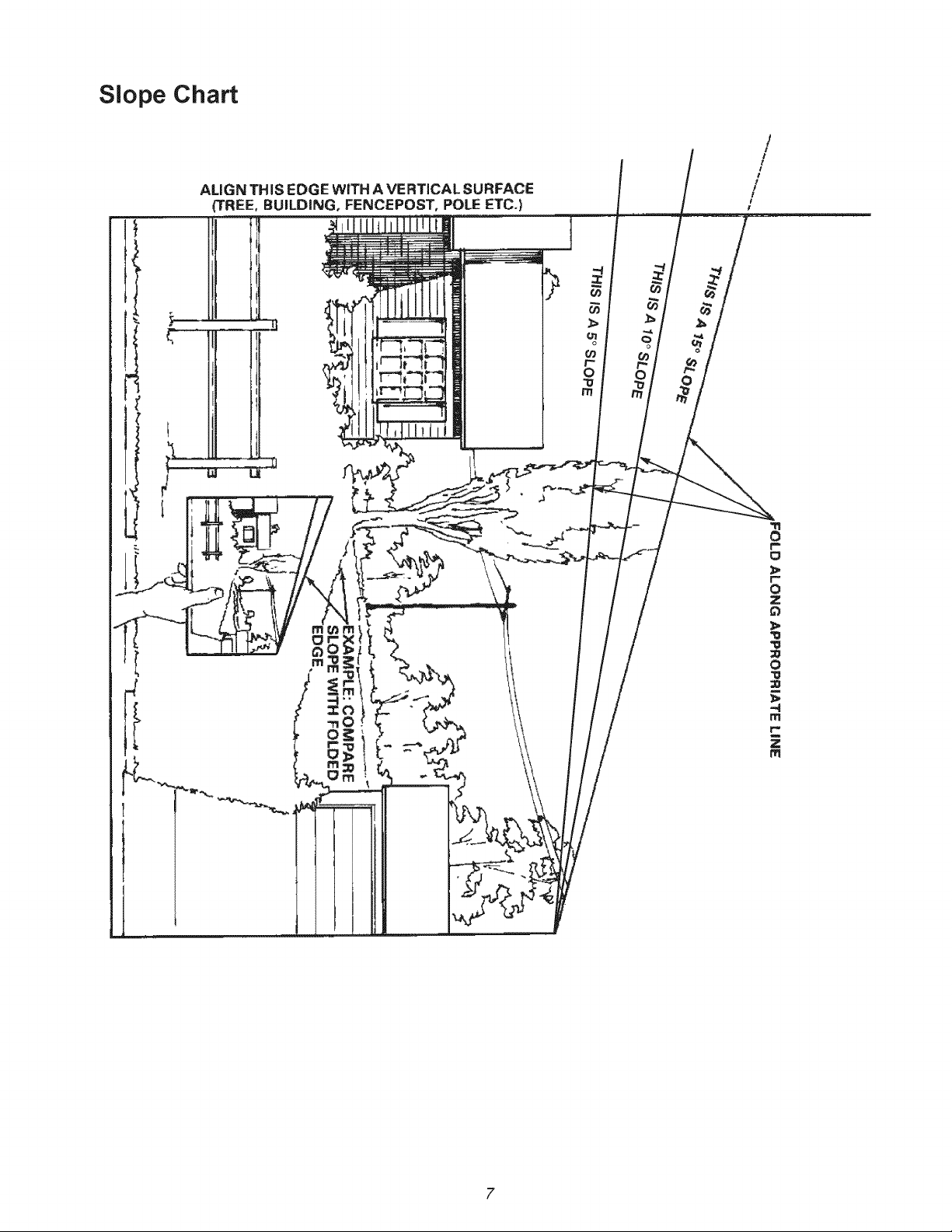
Slope Chart
ALIGN THIS EDGE WITH A VERTICAL SURFACE
_REE, BUiLDiNG, FENCEPOST, POLE ETC.)
J

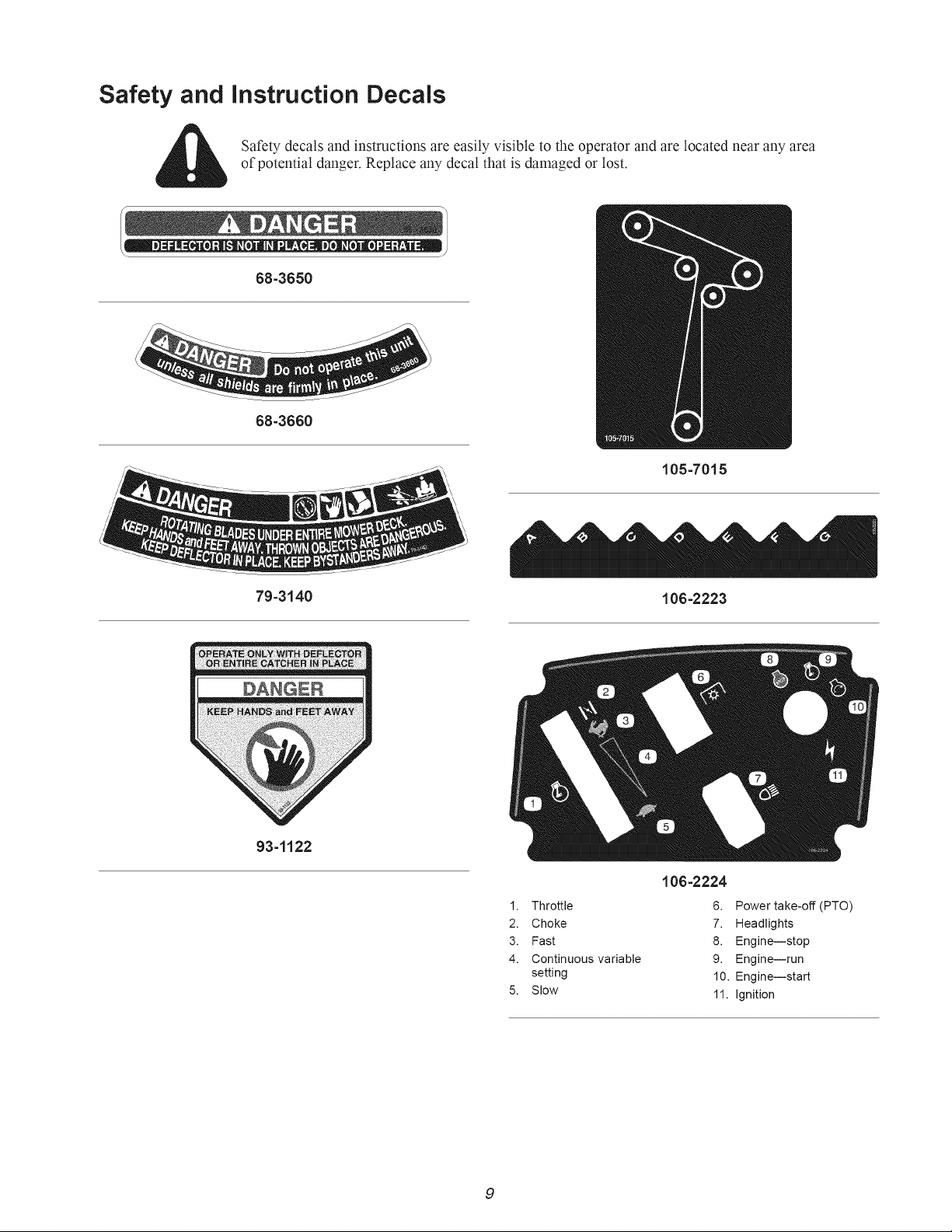
Safety and instruction Decals
Safety decals and instructions are easily visible to the operator and are located near any area
of potential danger. Replace any decal that is damaged or lost.
68=3660
105-7015
79=3140 106=2223
93=1122
1. Throttle
2. Choke
3. Fast
4. Continuous variable
setting
5. Slow
106=2224
6.
7.
Power take-off (PTO)
Headlights
8. Engine--stop
9. Engine--run
10. Engine--start
11. ignition
9
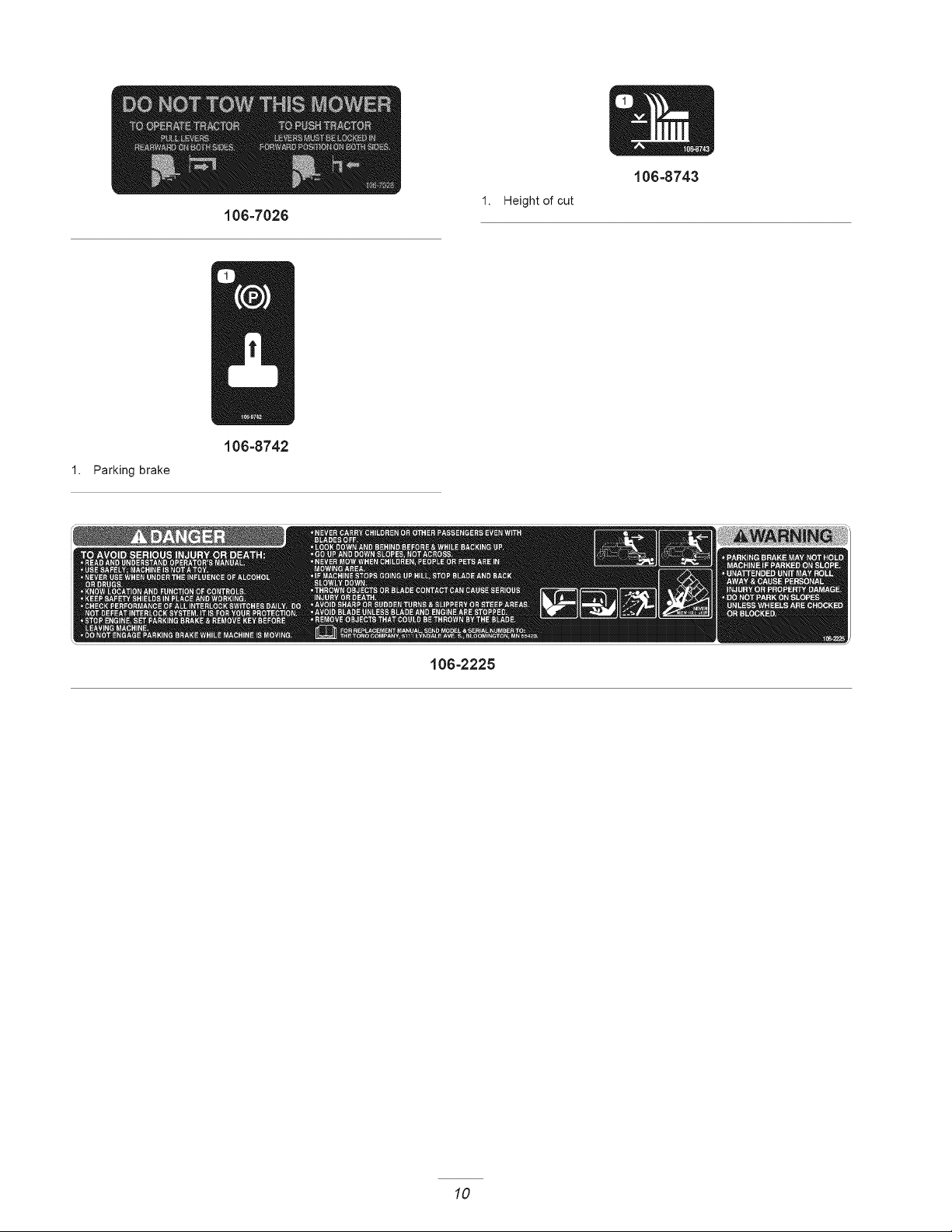
106-7026
1. Height of cut
106-8743
1. Parking brake
106-8742
106-2225
10
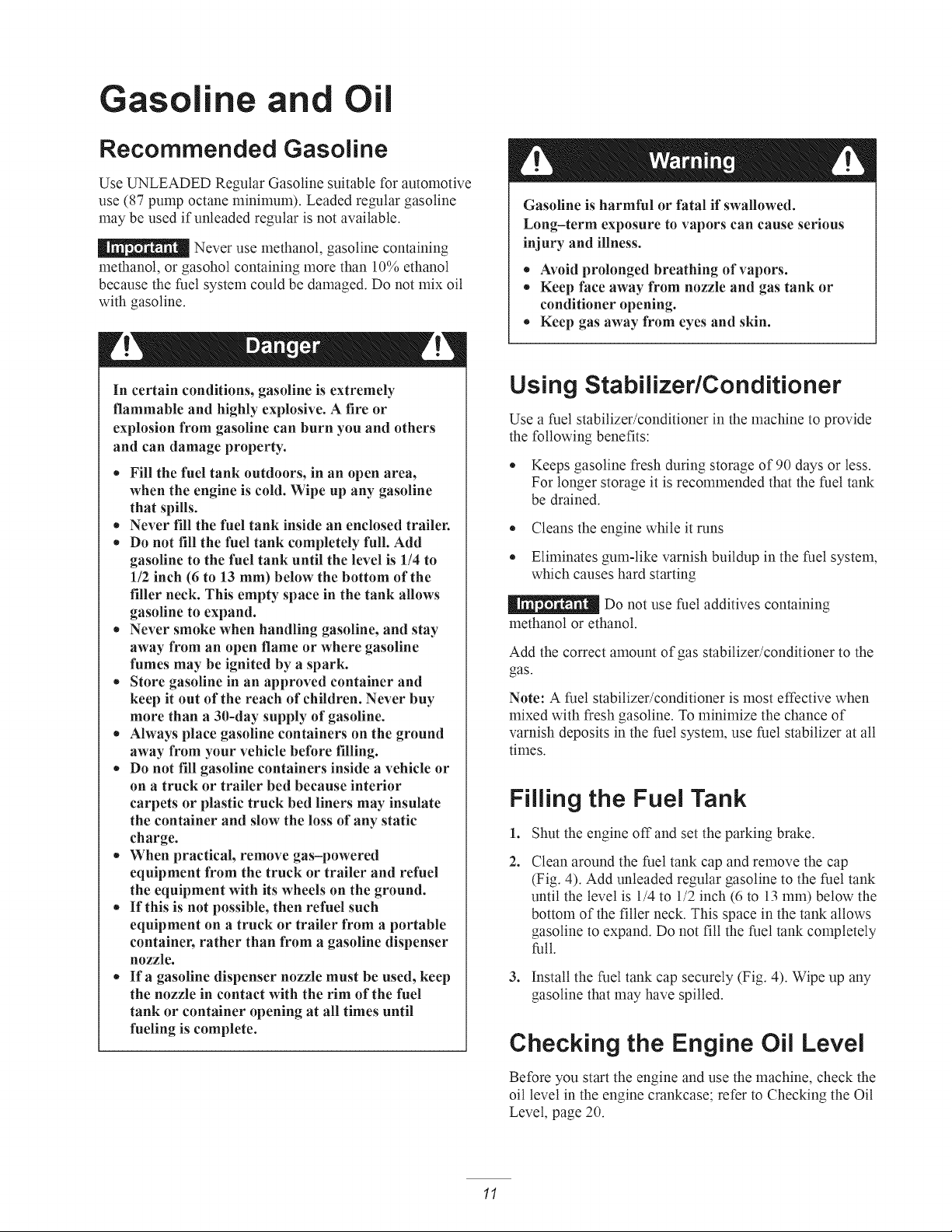
Gasoline and Oil
Recommended Gasoline
Use UNLEADED Regular Gasoline suitable for automotive
use (87 pump octane mininmnl). Leaded regular gasoline
may be used if unleaded regular is not available.
Never use methanol, gasoline containing
methanol, or gasohol containing more than 10% ethanol
because the fuel wstem could be damaged. Do not mix oil
with gasoline.
In certain conditions, gasoline is extremely
flammable and highly explosive. A fire or
explosion from gasoline can burn you and others
and can damage property.
* Fill the fuel tank outdoors, in an open area,
when the engine is cold. Wipe up any gasoline
that spills.
* Never fill the fuel tank inside an enclosed trailer.
* Do not fill the fuel tank completely full. Add
gasoline to the fuel tank until the level is 1/4 to
112 inch (6 to 13 ram) below the bottom of the
filler neck. This empty space in the tank allows
gasoline to expand.
* Never smoke when handling gasoline, and stay
away from an open flame or where gasoline
fumes may be ignited by a spark.
* Store gasoline in an approved container and
keep it out of the reach of children. Never buy
more than a 30-day supply of gasoline.
* Always place gasoline containers on the ground
away from your vehicle before filling.
* Do not fill gasoline containers inside a vehicle or
on a truck or trailer bed because interior
carpets or plastic truck bed liners may insulate
the container and slow the loss of any static
charge.
* When practical, remove gas-powered
equipment from the truck or trailer and refuel
the equipment with its wheels on the ground.
* If this is not possible, then refuel such
equipment on a truck or trailer from a portable
container, rather than from a gasoline dispenser
nozzle.
* If a gasoline dispenser nozzle must be used, keep
the nozzle in contact with the rim of the fuel
tank or container opening at all times until
fueling is complete.
Gasoline is harmful or fatal if swallowed.
Long-term exposure to vapors can cause serious
injury and illness.
* Avoid prolonged breathing of vapors.
* Keep face away from nozzle and gas tank or
conditioner opening.
* Keep gas away from eyes and skin.
Using StabilizerlConditioner
Use a fuel stabilizer/conditioner in the machine to provide
the following benefits:
®
®
Keeps gasoline fresh during storage of 90 days or less.
For longer storage it is recommended that the fuel tank
be drained.
Cleans the engine while it runs
Eliminates gun>like varnish buildup in the fuel system,
which causes hard starting
Do not use fuel additives containing
methanol or ethanol.
Add the correct amount of gas stabilizer/conditioner to the
gas.
Note: A fuel stabilizer/conditioner is most effective when
mixed with fresh gasoline. To minimize the chance of
varnish deposits in the fuel system, use fuel stabilizer at all
times.
Filling the Fuel Tank
1.
2.
Shut the engine off and set the parking brake.
Clean around the fuel tank cap and remove the cap
(Fig. 4). Add unleaded regular gasoline to the fuel tank
until the level is 1/4 to 1/2 inch (6 to 13 ram) below the
bottom of the filler neck. This space in the tank allows
gasoline to expand. Do not fill the fuel tank completely
full.
3. Install the fuel tank cap securely (Fig. 4). Wipe up any
gasoline that may have spilled.
Checking the Engine Oil Level
Before you start the engine and use the machine, check the
oil level in the engine crankcase; refer to Checking the Oil
Level, page 20.
11
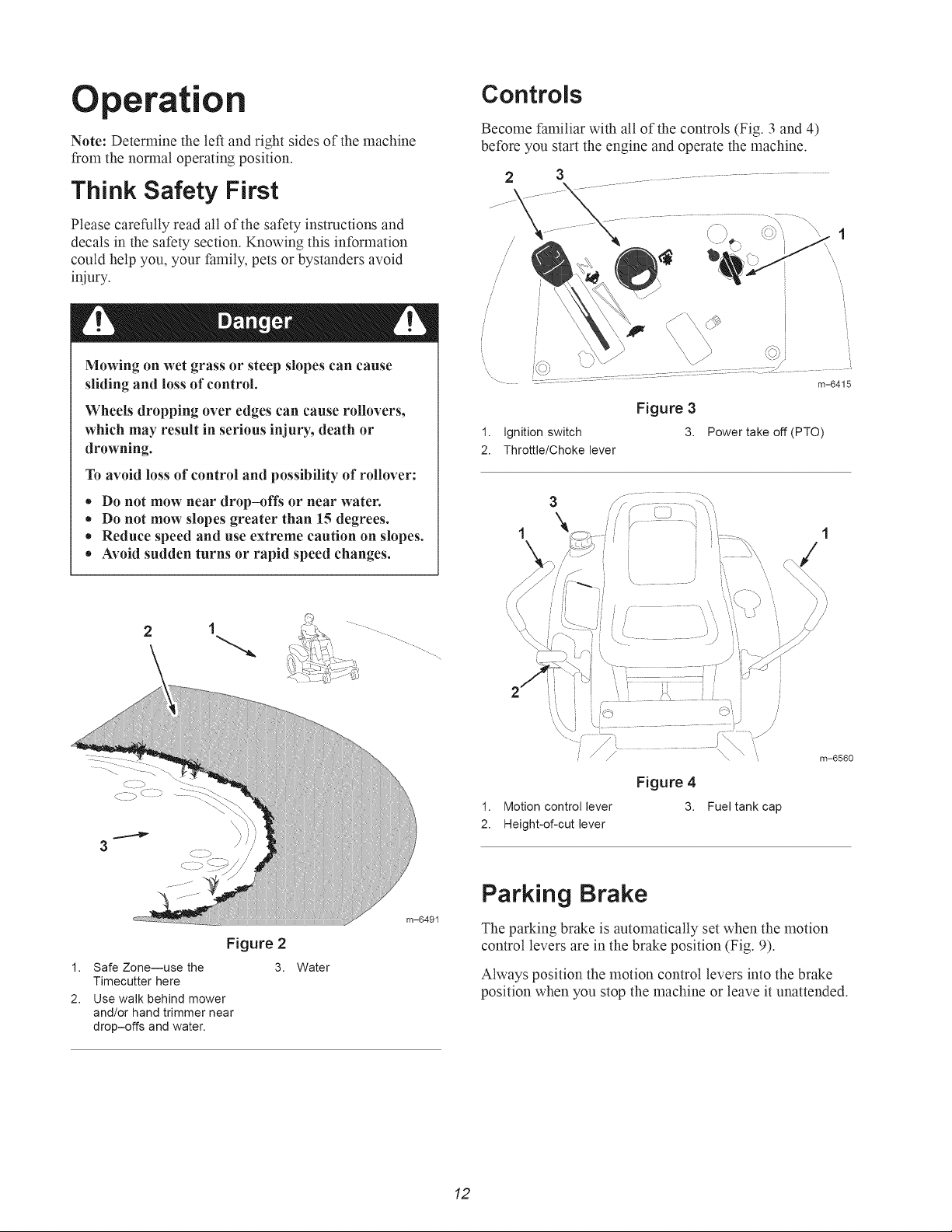
Operation
Note: Determine the left and right sides of the machine
from the normal operating position.
Think Safety First
Please carefully read all of the safety instructions and
decals in the safety section. Knowing this information
could help you, your family, pets or bystanders avoid
injury.
Mowing on wet grass or steep slopes can cause
sliding and loss of control.
Wheels dropping over edges can cause rollovers,
which may result in serious injury, death or
drowning.
To avoid loss of control and possibility of rollover:
* Do not mow near drop-offs or near water.
* Do not mow slopes greater than 15 degrees.
* Reduce speed and use extreme caution on slopes.
+ Avoid sudden turns or rapid speed changes.
1
Controls
Become familiar with all of the controls (Fig. 3 and 4)
before you start the engine and operate the machine.
3 .........................................................................
/
/
/
1. ignition switch
2. Throttle/Choke lever
m-6415
Figure 3
3. Power take off (PTO)
/
/
k
1.
2.
(->
<[ > (->
,,\
S /
...... //
Figure 2
Safe Zone--use the 3.
Timecutter here
Use walk behind mower
and/or hand trimmer near
drop-offs and water.
Water
m-6491
1. Motion control lever
2. Height-of-cut lever
Figure 4
3. Fuel tank cap
m-6560
Parking Brake
The parking brake is automatically set when the motion
control levers are in the brake position (Fig. 9).
Always position the motion control levers into the brake
position when you stop the machine or leave it unattended.
12
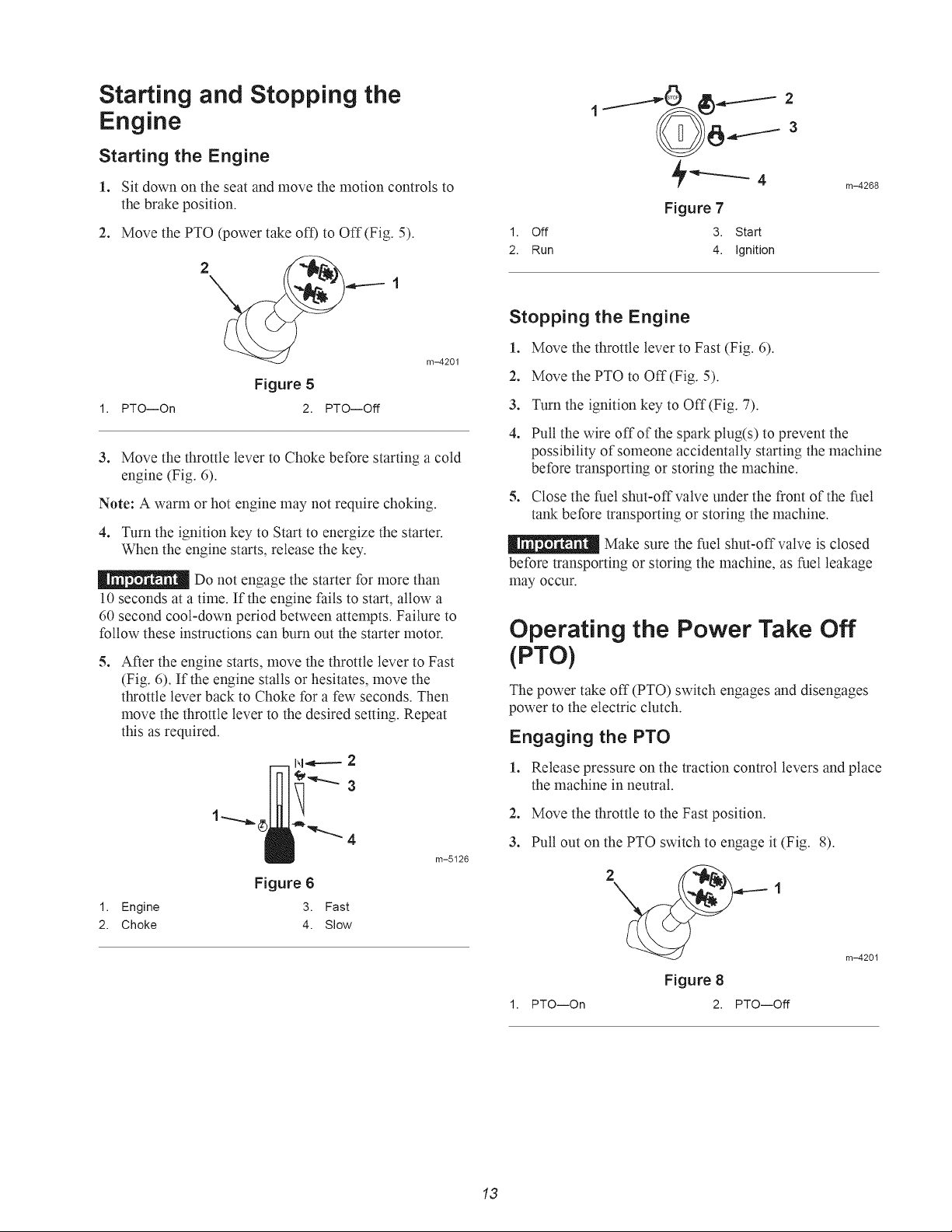
Starting and Stopping the
Engine
Starting the Engine
1. Sit down on the seat and move the motion controls to
the brake position.
2. Move the PTO (power take off) to Off (Fig. 5).
2_4.----- 1
Figure 5
1. PTO--On 2. PTO--Off
m-4201
3. Move the throttle lever to Choke before starting a cold
engine (Fig. 6).
Note: A warm or hot engine may not require choking.
4. Turn the ignition key to Start to energize the starter.
When the engine starts, release the key.
Do not engage the starter for more than
l0 seconds at a time. If the engine fails to start, allow a
60 second coot-down period between attempts. Failure to
follow these instructions can burn out the starter motor.
5o
After the engine starts, move the throttle lever to Fast
(Fig. 6). If the engine stalls or hesitates, move the
throttle lever back to Choke for a few seconds. Then
move the throttle lever to the desired setting. Repeat
this as required.
m-5126
1. Engine
2. Choke
Figure 6
3. Fast
4. Slow
1. Off
2. Run
1 _8 _ 3
4
Figure 7
3. Start
4. Ignition
m-4268
Stopping the Engine
1. Move the throttle lever to Fast (Fig. 6).
2. Move the PTO to Off (Fig. 5).
3. Turn the ignition key to Off (Fig. 7).
4. Pull the wire off of the spark plug(s) to prevent the
possibility of someone accidentally starting the machine
before transporting or storing the machine.
5. Close the fuel shut-off valve under the front of the fuel
tank before transporting or storing the machine.
Make sure the fuel shut-off valve is closed
before transporting or storing the machine, as fuel leakage
may occur.
Operating the Power Take Off
(PTO)
The power take off (PTO) switch engages and disengages
power to the electric clutch.
Engaging the PTO
1. Release pressure on the traction control levers and place
the machine in neutral.
2. Move the throttle to the Fast position.
3. Putt out on the PTO switch to engage it (Fig. 8).
2_.._..._ 1
m-4201
Figure 8
1. PTO--On 2. PTO--Off
13
Disengaging the PTO
Push the PTO switch to Off (Fig. 8).
The Safety Interlock System
If safety interlock switches are disconnected or
damaged the machine could operate unexpectedly
causing personal injury.
®
o
Do not tamper with the interlock switches.
Check the operation of the interlock switches
daily and replace any damaged switches before
operating the machine.
Driving Forward or Backward
The throttle control regulates the engine speed as measured
in rpm (revolutions per minute). Place the throttle control in
the Fast position for best performance. Always operate in
the full throttle position.
The machine can spin very rapidly. The operator
may lose control of the machine and cause
personal injury or damage to the machine.
* Use caution when making turns.
+ Slow the machine down before making sharp
turns.
Understanding the Safety interlock
System
The safety interlock system is designed to prevent the
engine from starting unless:
* The PTO is disengaged.
* The motion control levers are in the brake position.
The safety interlock system also is designed to stop the
engine when the control levers out of brake position and
you rise from the seat when the PTO is engaged.
Testing the Safety Interlock
System
Test the safety interlock system before you use the machine
each time. If the safety system does not operate as
described below, have an Authorized Service Dealer repair
the safety system immediately.
1. While sitting on the seat, with the control levers in
brake position, and move the PTO to On. Try starting
the engine; the engine should not crank.
2.
While sitting on the seat, move the PTO to Off. Move
either motion control lever to the center, unlocked
position. Try starting the engine; the engine should not
crank. Repeat with the other motion control lever.
3.
While sitting on the seat, move the PTO to Off, and
lock the motion control levers in neutral. Start the
engine. While the engine is running, move the motion
control levers to the center, unlocked position, engage
the PTO, and rise slightly from the seat; the engine
should stop.
Forward
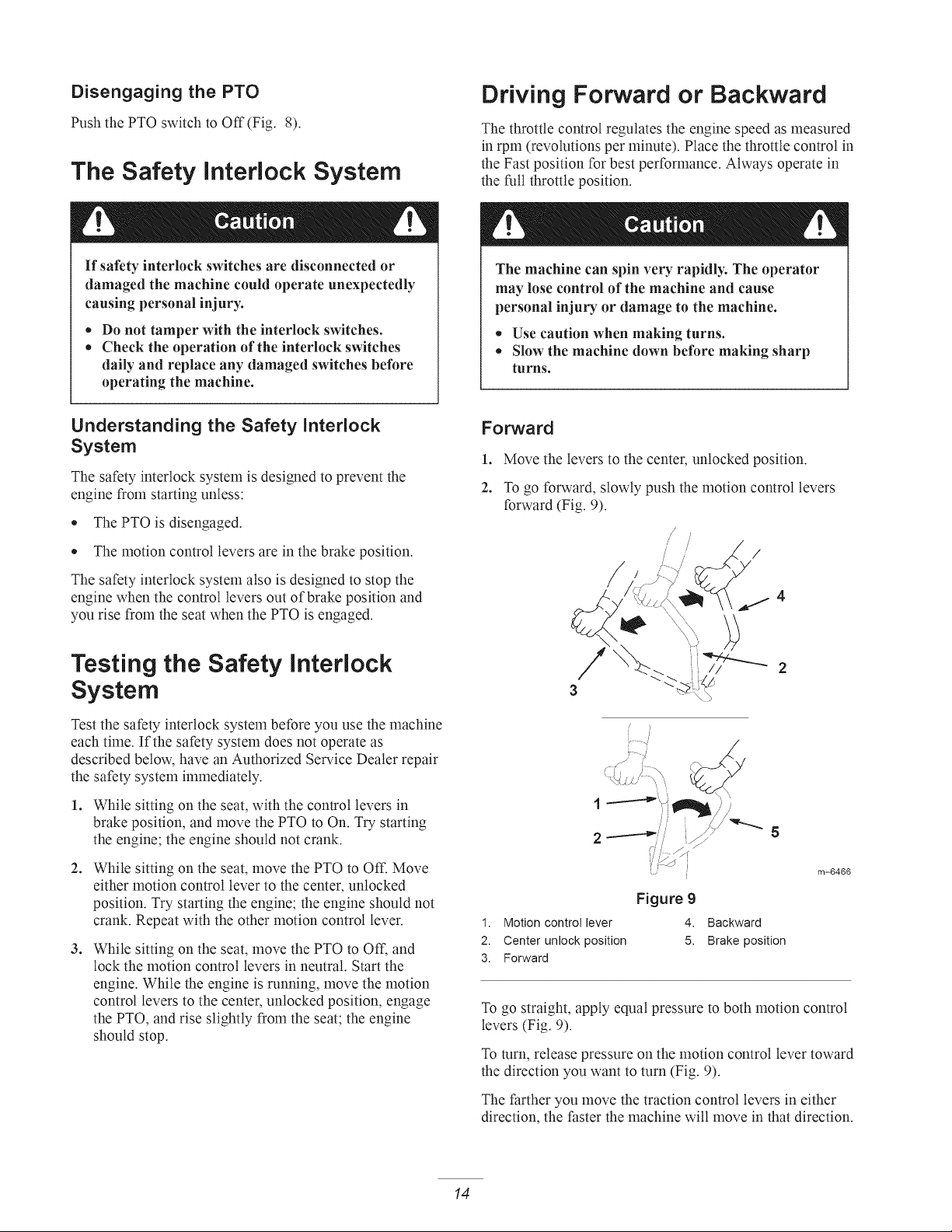
1. Move the levers to the center, unlocked position.
2. To go forward, slowly push the motion control levers
forward (Fig. 9).
3
/
1.
2.
3.
(¸¸7¸
\_,2// \ ,
2 ----_// i_ 5
Figure 9
Motion control lever 4. Backward
Center uNock position 5. Brake position
Forward
m-6466
To go straight, apply equal pressure to both motion control
levers (Fig. 9).
To turn, release pressure on the motion control lever toward
the direction you want to turn (Fig. 9).
The farther you move the traction control levers in either
direction, the faster the machine will move in that direction.
14
To stop, putt the motion control levers to neutral. }>
Backward
1. Move the levers to the center, unlocked position.
2. To go backward, slowly pull the motion control levers
rearward (Fig. 9).
To go straight, apply equal pressure to both motion control
levers (Fig. 9).
To turn, release the pressure on the motion control lever
toward the direction you want to turn (Fig. 9).
To stop, push the motion control levers to neutral.
Stopping the Machine
To stop the machine, move the traction control levers to
neutral and separate to the brake position, disengage the
PTO, ensure the throttle is in the Fast position, and turn the
ignition key to Off. Remember to remove the key from the
i_nition switch.
Children or bystanders may be injured if they
move or attempt to operate the tractor while it is
unattended.
Always remove the ignition key and move the
motion control levers to the brake position when
leaving the machine unattended, even if just for a
few minutes.
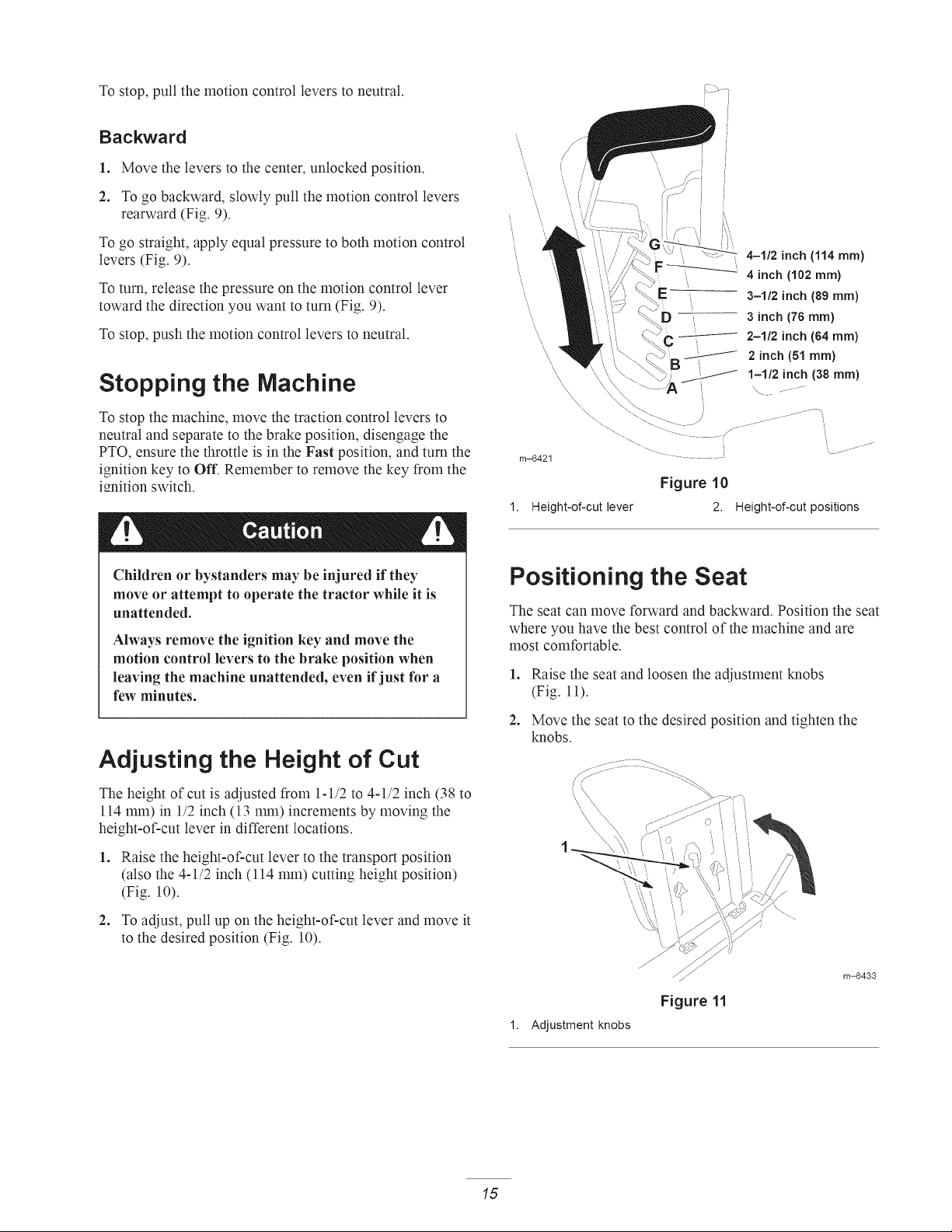
Adjusting the Height of Cut
The height of cut is adjusted from 1-1/2 to 4-1/2 inch (38 to
114 nml) in 1/2 inch (13 nm_) increments by moving the
height-of-cut lever in different locations.
1.
2.
Raise the height-of-cut lever to the transport position
(also the 4-1/2 inch (114 nml) cutting height position)
(Fig. 10).
To adjust, pull up on the height-of-cut lever and move it
to the desired position (Fig. 10).
m-6421
1. Height-of-cut lever
E
D
Figure 10
2.
4-1/2 inch (114 mm)
4 inch (102 mm)
3-1/2 inch (89 mm)
3 inch (76 ram)
2-1/2 inch (64 mm)
2 inch (51 mm)
1-1/2 inch (38 mm)
\
Height-of-cut positions
Positioning the Seat
The seat can move forward and backward. Position the seat
where you have the best control of the machine and are
most comfortable.
1.
2.
Raise the seat and loosen the adjustment knobs
(Fig. 11).
Move the seat to the desired position and tighten the
knobs.
1. Adjustment knobs
Figure 11
m-6433
15
Adjusting the Motion Control
Levers
The motion control levers can be adjusted higher or lower
for maximum operator comfort.
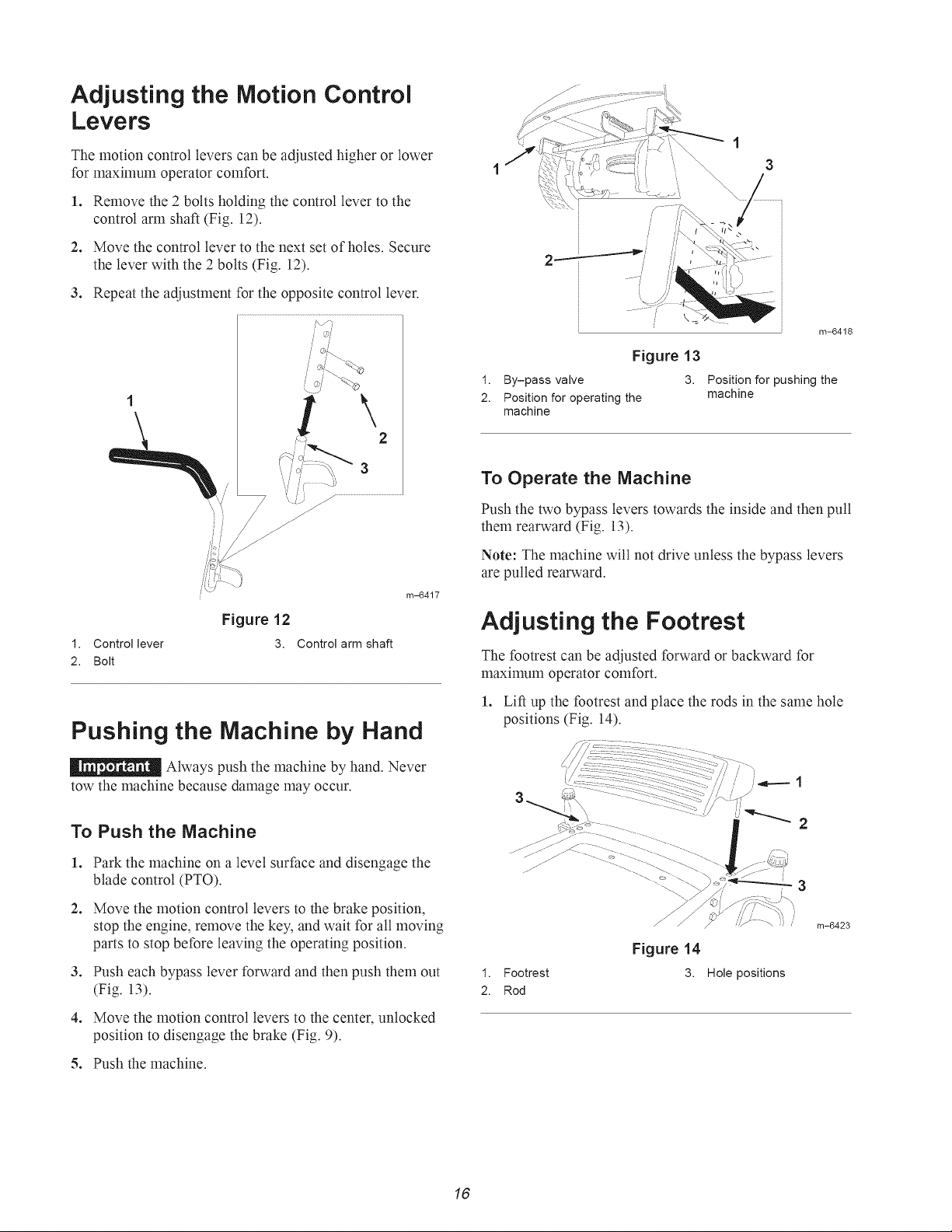
1. Remove the 2 bolts holding the control lever to the
control ann shaft (Fig. 12).
2. Move the control lever to the next set ofhotes. Secure
the lever with the 2 bolts (Fig. 12).
3. Repeat the adjustment for the opposite control lever.
i Qi
/ /
Figure 12
1. Control lever 3. Control arm shaft
2. Bolt
m-6417
Pushing the Machine by Hand
Always push the machine by hand. Never
tow the machine because damage may occur.
To Push the Machine
1o
2,
3o
4o
Park the machine on a level surface and disengage the
blade control (PTO).
Move the motion control levers to the brake position,
stop the engine, remove the key, and wait for all moving
parts to stop before leaving the operating position.
Push each bypass lever forward and then push them out
(Fig. 13).
Move the motion control levers to the center, unlocked
position to disengage the brake (Fig. 9).
5. Push the machine.
\
\
1
3
1.
2.
m-6418
Figure 13
By-pass valve 3. Position for pushing the
Position for operating the machine
machine
To Operate the Machine
Push the two bypass levers towards the inside and then pull
them rearward (Fig. 13).
Note: The machine will not drive unless the bypass levers
are pulled rearward.
Adjusting the Footrest
The footrest can be adjusted forward or backward for
maximum operator comfort.
1. Lift up the footrest and place the rods in the same hole
positions (Fig. 14).
1.
2.
Figure 14
Footrest 3. Hole positions
Rod
m-6423
16
Removing and Installing the
Engine Hood
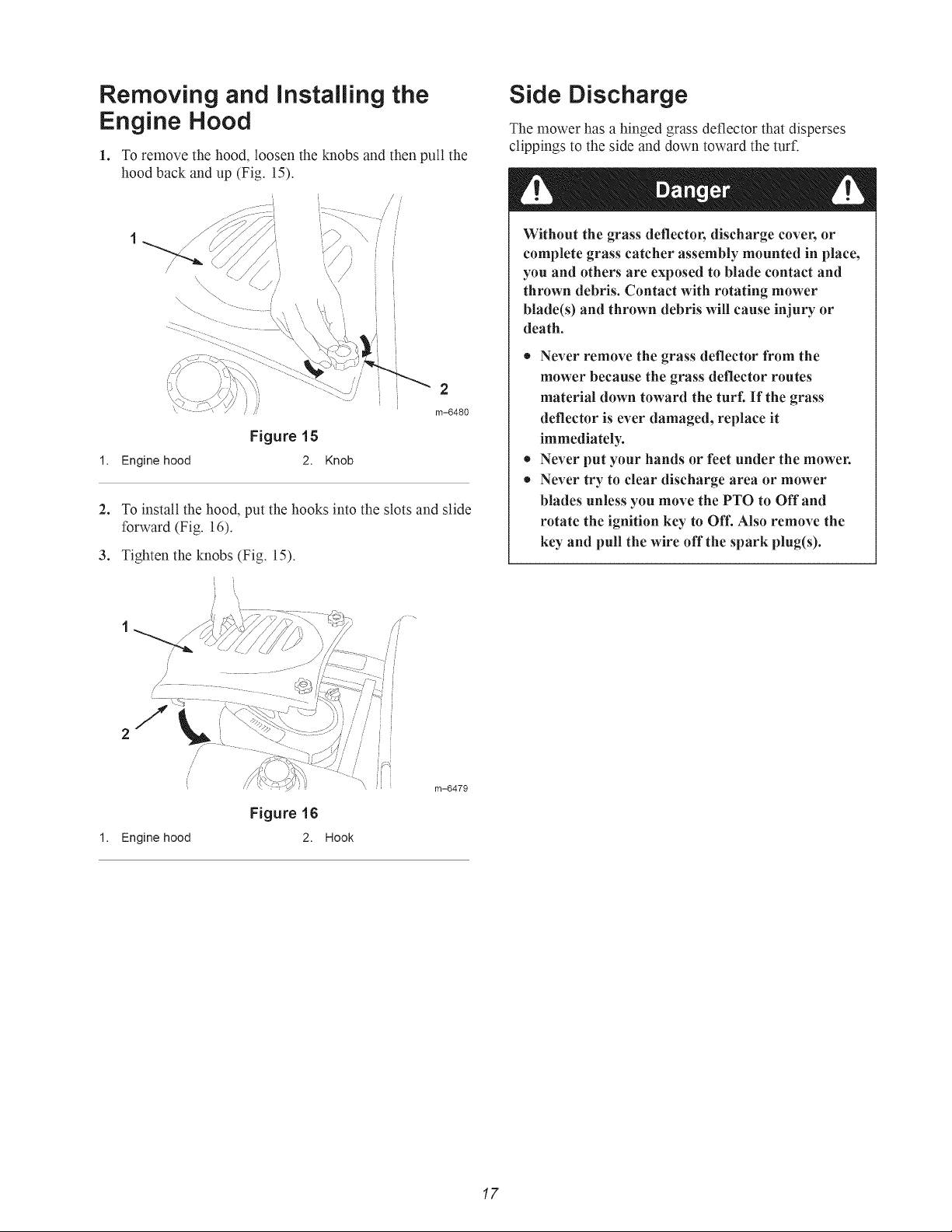
1. To remove the hood, loosen the knobs and then pull the
hood back and up (Fig. 15).
/ .....
/
i)
Figure 15
1. Engine hood 2. Knob
2
m-6480
2.
To install the hood, put the hooks into the slots and slide
forward (Fig. 16).
3. Tighten the knobs (Fig. 15).
Side Discharge
The mower has a hinged grass deflector that disperses
clippings to the side and down toward the turf.
Without the grass deflector, discharge cover, or
complete grass catcher assembly mounted in place,
you and others are exposed to blade contact and
thrown debris. Contact with rotating mower
blade(s) and thrown debris will cause injury or
death.
+ Never remove the grass deflector from the
mower because the grass deflector routes
material down toward the turf. If the grass
deflector is ever damaged, replace it
immediately.
® Never put your hands or feet under the mower.
® Never try to clear discharge area or mower
blades unless you move the PTO to Off and
rotate the ignition key to Off. Also remove the
key and pull the wire offthe spark plug(s).
1.
/
/
2
/
/
/:
(
Engine hood
Figure 16
2. Hook
m-6479
17
Tips for Mowing Grass
Fast Throttle Setting
For best mowing and maximum air circulation, operate the
engine at the Fast position. Air is required to thoroughly cut
grass clippings, so do not set the height-of-cut so low as to
totally surround the mower by uncut grass. Always try to
have one side of the mower free from uncut grass, which
allows air to be drawn into the mower.
Cutting a Lawn for the First Time
Cut grass slightly longer than normal to ensure that the
cutting height of the mower does not scalp any uneven
ground. However, the cutting height used in the past is
generally the best one to use. When cutting grass longer
than six inches tall, you may want to cut the lawn twice to
ensure an acceptable quality of cut.
Cut 1/3 of the Grass Blade
It is best to cut only about 1/3 of the grass blade. Cutting
more than that is not reconm_ended unless grass is sparse,
or it is late fall when grass grows more slowly.
Mowing Direction
Alternate mowing direction to keep the grass standing
straigN. This also helps disperse clippings which enhances
decomposition and fertilization.
Mow at Correct Intervals
Normally, mow every four days. But remember, grass
grows at different rates at different times. So to maintain
the same cutting height, which is a good practice, mow
more often in early spring. As the grass growth rate slows
in mid sunmler, mow less frequently. If you cannot mow
for an extended period, first mow at a high cutting height;
then mow again two days later at a lower height setting.
Long Grass
If the grass is ever allowed to grow slightly longer than
normal, or if it contains a high degree of moisture, raise the
cutting height higher than usual and cut the grass at this
setting. Then cut the grass again using the lower, normal
setting.
When Stopping
If the machine's forward motion must be stopped while
mowing, a clump of grass clippings may drop onto your
lawn. To avoid this, move onto a previously cut area with
the blades engaged.
Keep the Underside of the Mower Clean
Clean clippings and dirt from the underside of the mower
after each use. If grass and dirt build up inside the mower,
cutting quality will eventually become unsatisfactory.
Blade Maintenance
Maintain a sharp blade throughout the cutting season
because a sharp blade cuts cleanly without tearing or
shredding the grass blades. Tearing and shredding turns
grass brown at the edges, which slows growth and increases
the chance of disease. Check the cutter blades daily for
sharpness, and for any wear or damage. File down any
nicks and sharpen the blades as necessary. If a blade is
damaged or worn, replace it inm_ediately with a genuine
Toro replacement blade.
Cutting Speed
To improve cut quality, use a slower ground speed.
Avoid Cutting Too Low
If the cutting width of the mower is wider than the mower
you previously used, raise the cutting height to ensure that
uneven turf is not cut too short.
18
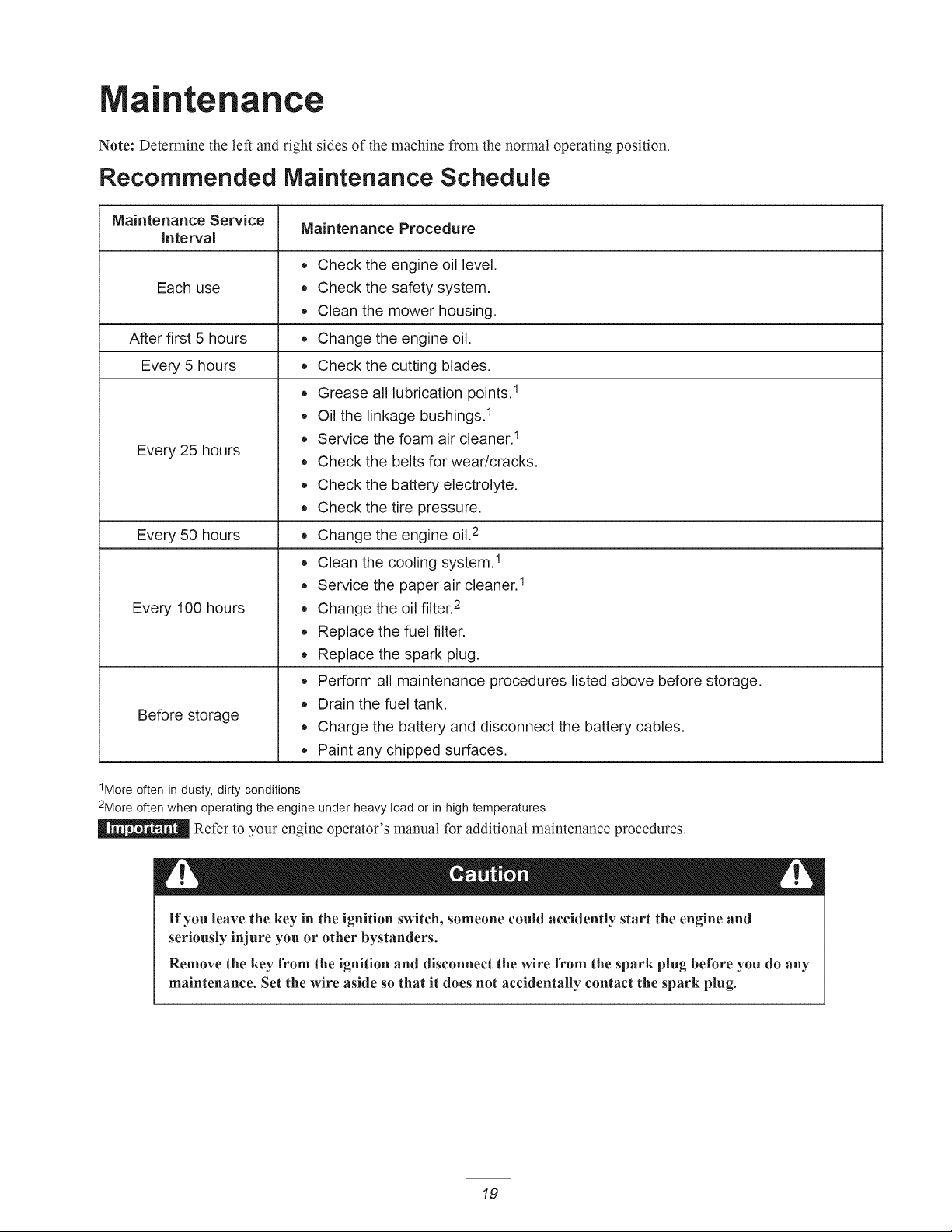
aintenance
Note: Determine the left and right sides of the machine from the normal operating position.
Recommended Maintenance Schedule
Maintenance Service
Maintenance Procedure
interval
Each use
After first 5 hours
Every 5 hours
Every 25 hours
Every 50 hours
Every 100 hours
Before storage
®
®
®
®
®
®
®
®
®
®
®
®
®
®
®
®
®
®
®
®
®
Check the engine oil level.
Check the safety system.
Clean the mower housing,
Change the engine oil.
Check the cutting blades,
Grease all lubrication points. 1
Oil the linkage bushings. 1
Service the foam air cleaner. 1
Check the belts for wear/cracks.
Check the battery electrolyte,
Check the tire pressure,
Change the engine oil. 2
Clean the cooling system. 1
Service the paper air cleaner. 1
Change the oil filter. 2
Replace the fuel filter.
Replace the spark plug.
Perform all maintenance procedures listed above before storage,
Drain the fuel tank.
Charge the battery and disconnect the battery cables,
Paint any chipped surfaces.
1Moreoften industy, dirty conditions
2More often when operating the engine under heavy loador in high temperatures
Refer to your engine operator's manual for additional maintenance procedures.
If you leave the key in the ignition switch, someone could accidently start the engine and
seriously injure you or other bystanders.
Remove the key from the ignition and disconnect the wire from the spark plug before you do any
maintenance. Set the wire aside so that it does not accidentally contact the spark plug.
19
Servicing the Engine Oil
Check the oil level daily or after every 8 hours.
Change the oil after the first 5 operating hours and every
50 operating hours thereafter.
Oil Type: Detergent oil (API service SF, SG, SH, SJ, or
higher)
Crankcase Capacity:
,, 48 oz./I-I/2 qt. (1400 cc/1.4 l) when the filter is not
changed;
* 56 oz./1-3/4 qt. (1700 cc/1.7 1) when the filter is
changed
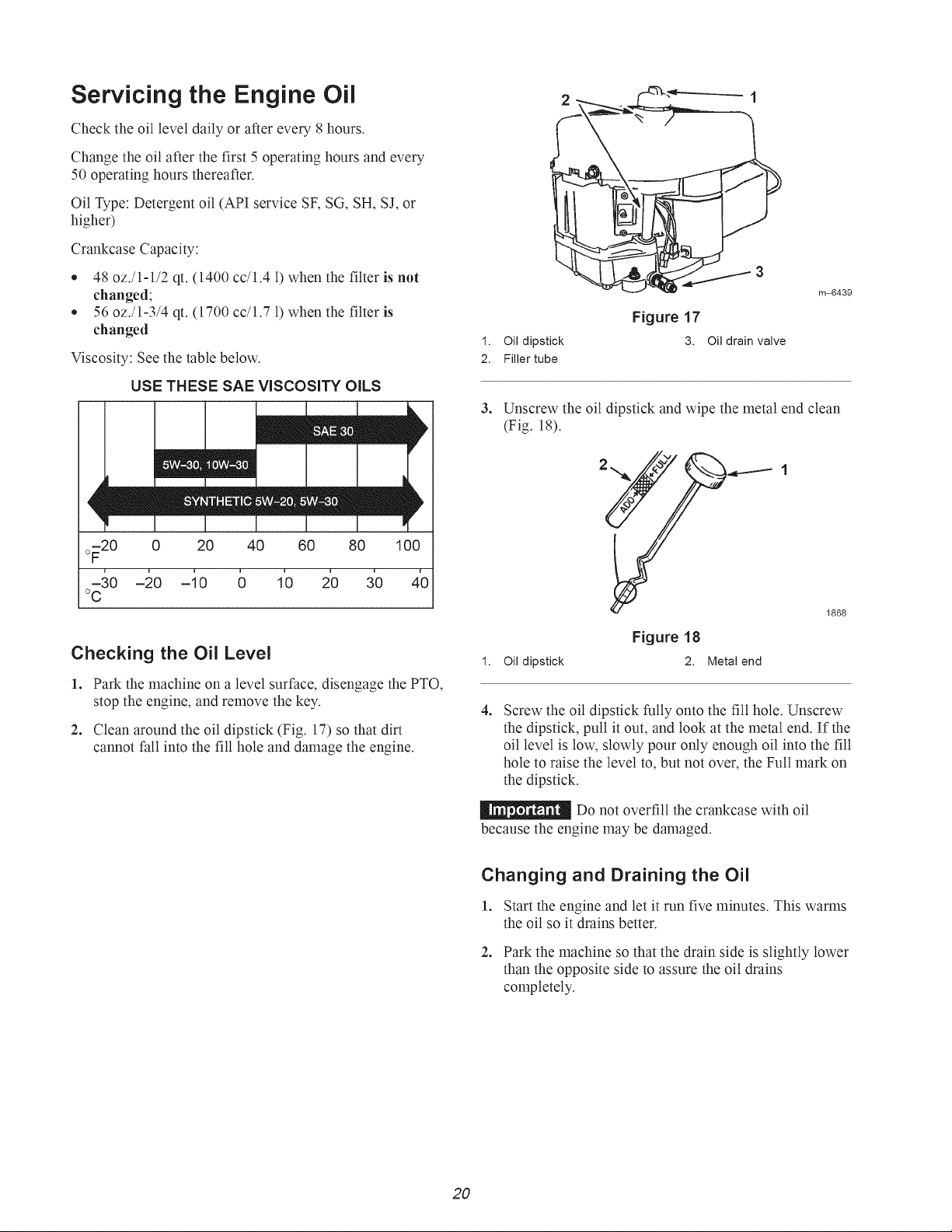
Viscosity: See the table below.
USE THESE SAE ViSCOSiTY OiLS
4
mmm
mm
oF20 0 20 40 60 80 100
/
-30 -20 -i0 () 1'0 2'0 3'0 4'0
°C
Checking the Oil Level
1. Park the machine on a level surface, disengage the PTO,
stop the engine, and remove the key.
2. Clean around the oil dipstick (Fig. 17) so that dirt
cannot fall into the fill hole and damage the engine.
1.
2.
2_
Oil dipstick
Filler tube
Figure 17
3. Oil drain valve
m-6439
3. Unscrew the oil dipstick and wipe the metal end clean
(Fig. 18).
Figure 18
1. Oil dipstick 2. Metal end
1868
4,
Screw the oil dipstick fully onto the fill hole. Unscrew
the dipstick, putt it out, and look at the metal end. If the
oil level is low, slowly pour only enough oil into the fill
hole to raise the level to, but not over, the Full mark on
the dipstick.
Do not overfill the crankcase with oil
because the engine may be damaged.
Changing and Draining the Oil
1. Start the engine and let it run five minutes. This warms
the oil so it drains better.
2. Park the machine so that the drain side is slightly lower
than the opposite side to assure the oil drains
completely.
2O
3,
4.
6.
Disengage the PTO and set the parking brake.
Stop the engine, remove the key, and wait for all
moving parts to stop before leaving the operating
position.
Slide the drain hose over the drain valve.
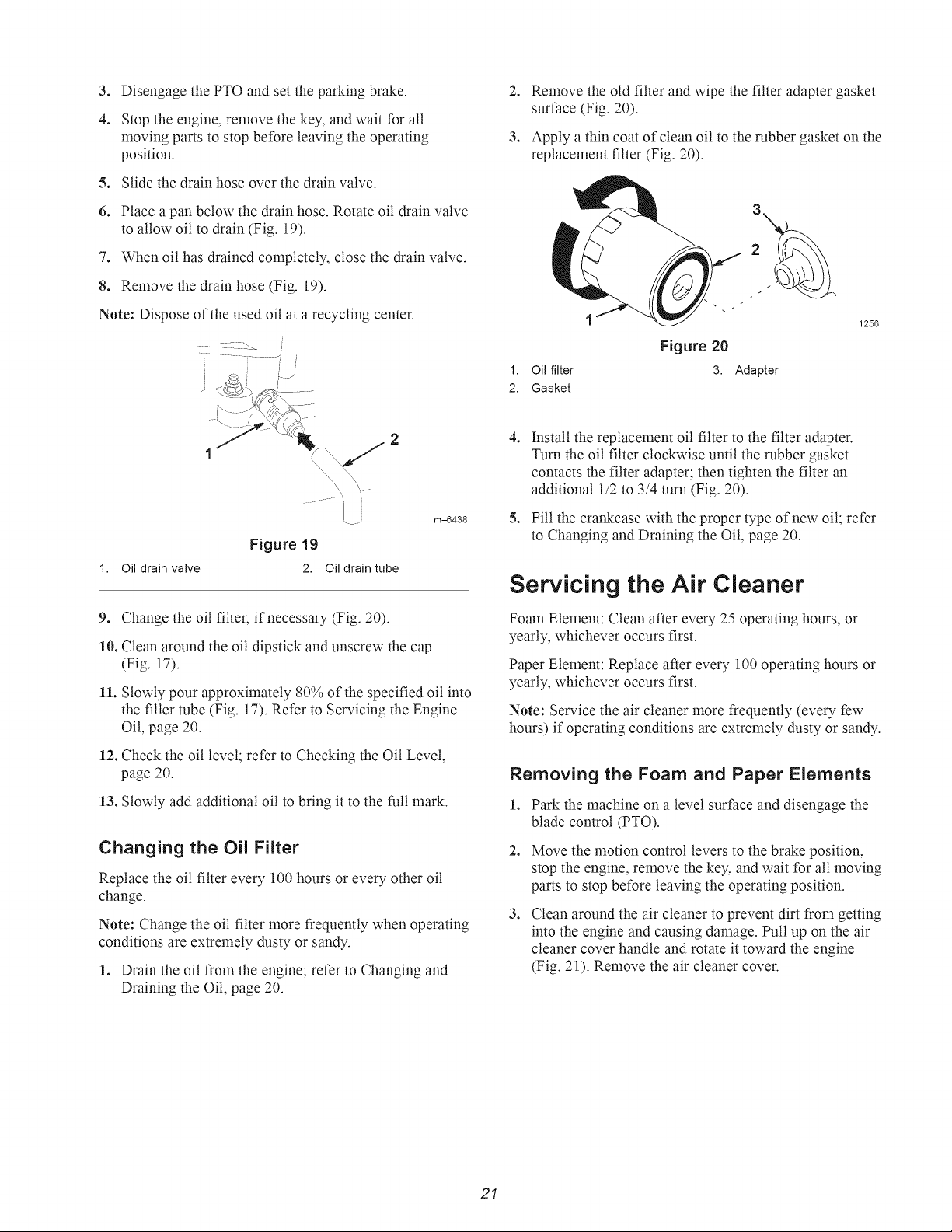
Place a pan below the drain hose. Rotate oil drain valve
to allow oil to drain (Fig. 19).
7. When oil has drained completely, close the drain valve.
8. Remove the drain hose (Fig. 19).
Note: Dispose of the used oil at a recycling center.
:2 5_-
2,
3,
Remove the old filter and wipe the filter adapter gasket
surface (Fig. 20).
Apply a thin coat of clean oil to the rubber gasket on the
replacement filter (Fig. 20).
1.
2.
Oil filter
Gasket
Figure 20
3. Adapter
1256
2
1. Oil drain valve
......... --\
Figure 19
2. Oil drain tube
m-6438
9. Change the oil filter, if necessary (Fig. 20).
10. Clean around the oil dipstick and unscrew the cap
(Fig. 17).
11. Slowly pour approximately 80% of the specified oil into
the filler tube (Fig. 17). Refer to Servicing the Engine
Oil, page 20.
12. Check the oil level; refer to Checking the Oil Level,
page 20.
13. Slowly add additional oil to bring it to the full mark.
Changing the Oil Filter
Replace the oil filter every 100 hours or every other oil
change.
Note: Change the oil filter more frequently when operating
conditions are extremely dusty or sandy.
1. Drain the oil from the engine; refer to Changing and
Draining the Oil, page 20.
4,
Install the replacement oil filter to the filter adapter.
Turn the oil filter clockwise until the rubber gasket
contacts the filter adapter; then tighten the filter an
additional 1/2 to 3/4 turn (Fig. 20).
Fill the crankcase with the proper type of new oil; refer
to Changing and Draining the Oil, page 20.
Servicing the Air Cleaner
Foam Element: Clean after every 25 operating hours, or
yearly, whichever occurs first.
Paper Elemem: Replace after every 100 operating hours or
yearly, whichever occurs first.
Note: Service the air cleaner more frequently (every few
hours) if operating conditions are extremely dusty or sandy.
Removing the Foam and Paper Elements
1. Park the machine on a level surface and disengage the
blade control (PTO).
2,
3.
Move the motion control levers to the brake position,
stop the engine, remove the key, and wait for all moving
parts to stop before leaving the operating position.
Clean around the air cleaner to prevent dirt from getting
into the engine and causing damage. Pull up on the air
cleaner cover handle and rotate it toward the engine
(Fig. 21). Remove the air cleaner cover.
21
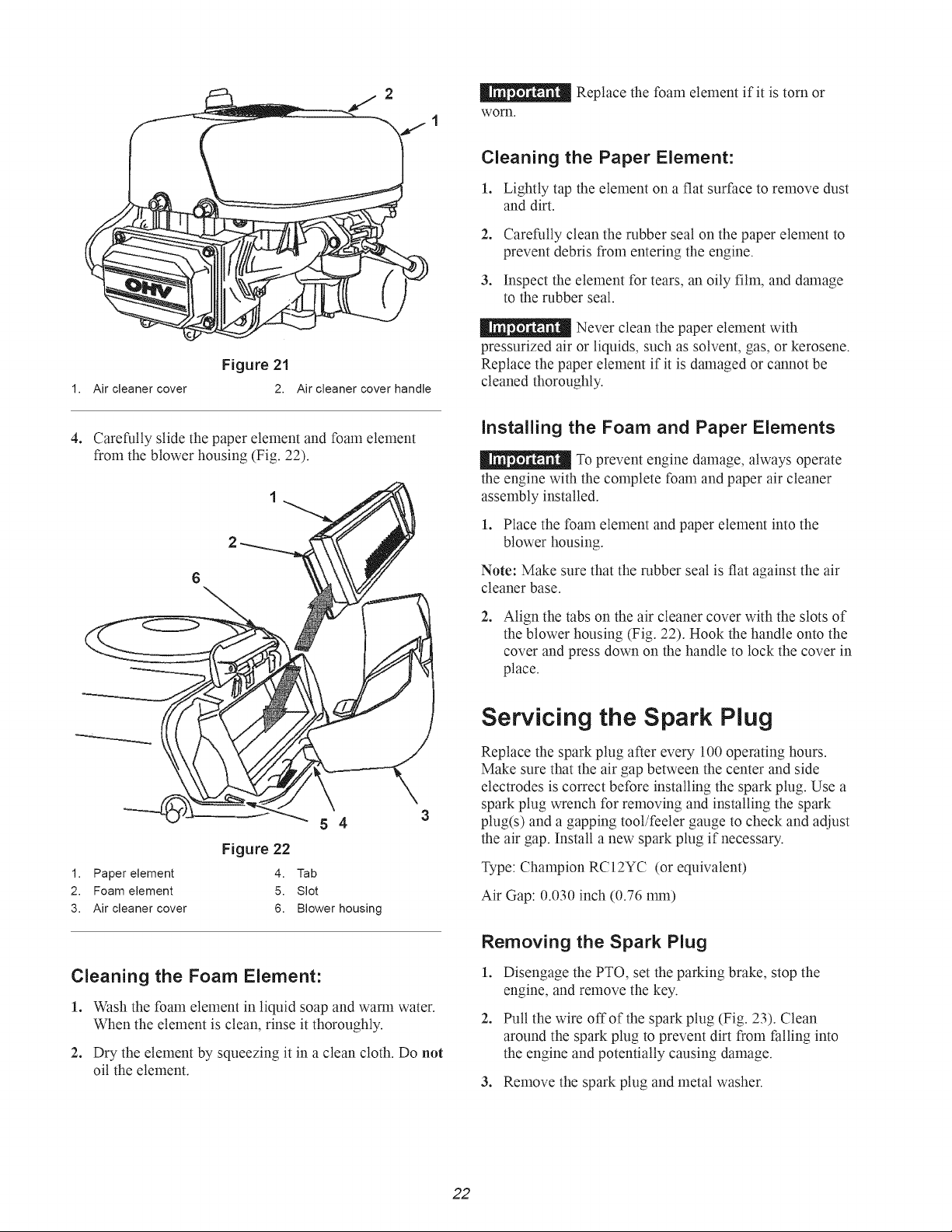
1. Air cleaner cover
2
4o
Figure 21
2. Air cleaner cover handle
Carefully slide the paper element and foam element
from the blower housing (Fig. 22).
2
6
Replace the foam element if it is torn or
worn.
Cleaning the Paper Element:
1. Lightly tap the element on a flat surface to remove dust
and dirt.
2. Carefully clean the rubber seal on the paper element to
prevent debris from entering the engine.
3. Inspect the element for tears, an oily fihn, and damage
to the rubber seal.
Never clean the paper element with
pressurized air or liquids, such as solvent, gas, or kerosene.
Replace the paper element if it is damaged or cannot be
cleaned thoroughly.
Installing the Foam and Paper Elements
To prevent engine damage, always operate
the engine with the complete foam and paper air cleaner
assembly installed.
1. Place the foam element and paper element into the
blower housing.
Note: Make sure that the rubber seal is flat against the air
cleaner base.
,
Align the tabs on the air cleaner cover with the slots of
the blower housing (Fig. 22). Hook the handle onto the
cover and press down on the handle to lock the cover in
place.
5 4
Figure 22
1. Paper element 4. Tab
2. Foam element 5. Slot
3. Air cleaner cover 6. Blower housing
Cleaning the Foam Element:
1o
2,
Wash the foam element in liquid soap and warm water.
When the element is clean, rinse it thoroughly.
Dry the element by squeezing it in a clean cloth. Do not
oil the element.
Servicing the Spark Plug
Replace the spark plug after every 100 operating hours.
Make sure that the air gap between the center and side
electrodes is correct before installing the spark plug. Use a
spark plug wrench for removing and installing the spark
plug(s) and a gapping toot/feeler gauge to check and adjust
the air gap. Install a new spark plug if necessary.
Type: Champion RC12YC (or equivalent)
Air Gap: 0.030 inch (0.76 nml)
Removing the Spark Plug
1o
2,
Disengage the PTO, set the parking brake, stop the
engine, and remove the key.
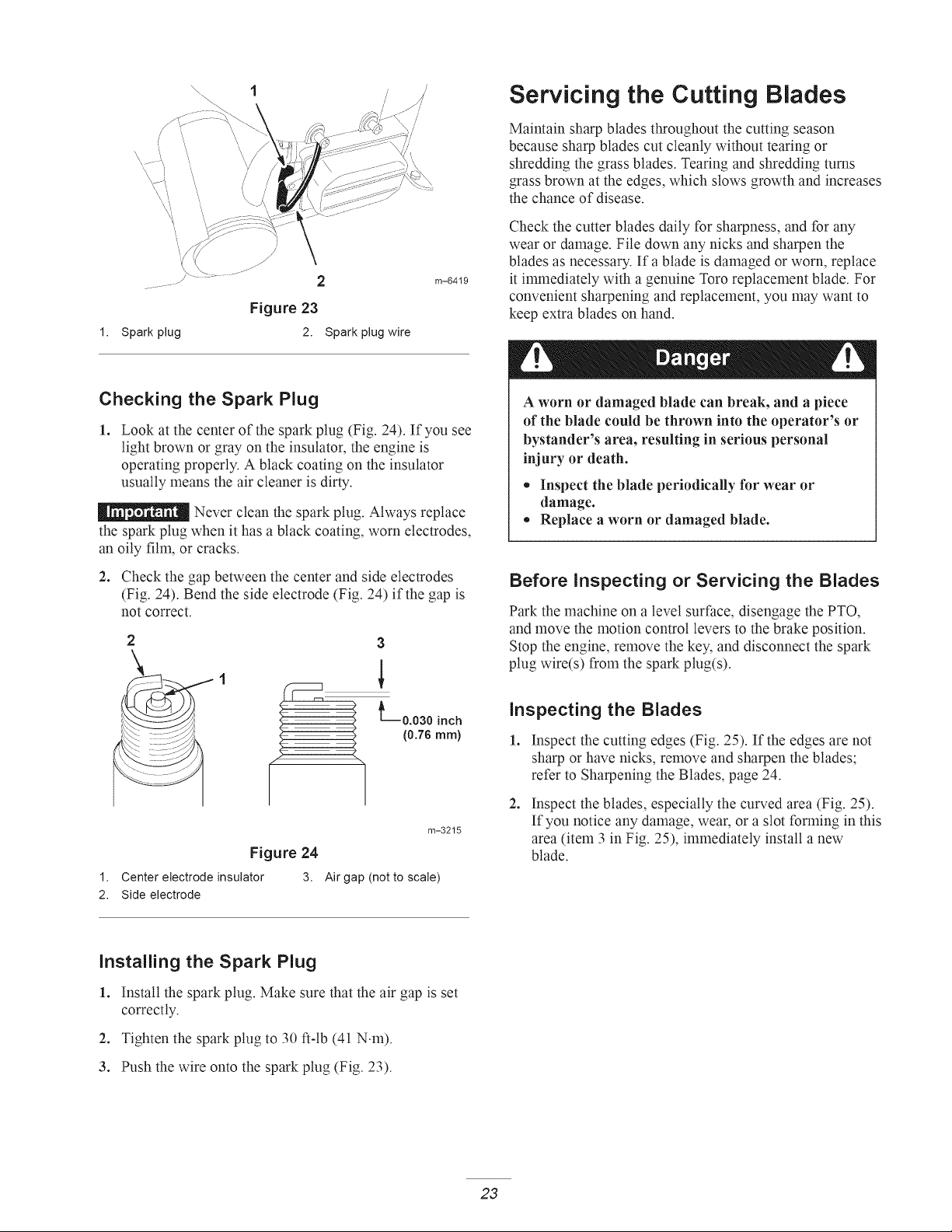
Pull the wire offof the spark plug (Fig. 23). Clean
around the spark plug to prevent dirt from Palling into
the engine and potentially causing damage.
3. Remove the spark plug and metal washer.
22
\\ i
\\
\
\
\
\
\
1. Spark plug
2
Figure 23
2. Spark plug wire
m-6419
Checking the Spark Plug
1.
Look at the center of the spark plug (Fig. 24). If you see
light brown or gray on the insulator, the engine is
operating properly. A black coating on the insulator
usually means the air cleaner is dirty.
Never clean the spark plug. Always replace
the spark plug when it has a black coating, worn electrodes,
an oily fihn, or cracks.
2. Check the gap between the center and side electrodes
(Fig. 24). Bend the side electrode (Fig. 24) if the gap is
not correct.
2
ho.03o,och(0.76 mm)
/ z _..
Figure 24
1. Center electrode insulator 3.
2. Side electrode
m-3215
Air gap (not to scale)
Servicing the Cutting Blades
Maintain sharp blades throughout the cutting season
because sharp blades cut cleanly without tearing or
shredding the grass blades. Tearing and shredding turns
grass brown at the edges, which slows growth and increases
the chance of disease.
Check the cutter blades daily for sharpness, and for any
wear or damage. File down any nicks and sharpen the
blades as necessary. If a blade is damaged or worn, replace
it inmaediately with a genuine Toro replacement blade. For
convenient sharpening and replacement, you may want to
keep extra blades on hand.
A worn or damaged blade can break, and a piece
of the blade could be thrown into the operator's or
bystander's area, resulting in serious personal
injury or death.
* Inspect the blade periodically for wear or
damage.
* Replace a worn or damaged blade.
Before inspecting or Servicing the Blades
Park the machine on a level surface, disengage the PTO,
and move the motion control levers to the brake position.
Stop the engine, remove the key, and disconnect the spark
plug wire(s) from the spark plug(s).
inspecting the Blades
1. Inspect the cutting edges (Fig. 25). If the edges are not
sharp or have nicks, remove and sharpen the blades;
refer to Sharpening the Blades, page 24.
2.
Inspect the blades, especially the curved area (Fig. 25).
If you notice any damage, wear, or a slot forming in this
area (item 3 in Fig. 25), immediately install a new
blade.
installing the Spark Plug
1. Install the spark plug. Make sure that the air gap is set
correctly.
2. Tighten the spark plug to 30 ft-tb (41 N.m).
3. Push the wire onto the spark plug (Fig. 23).
23
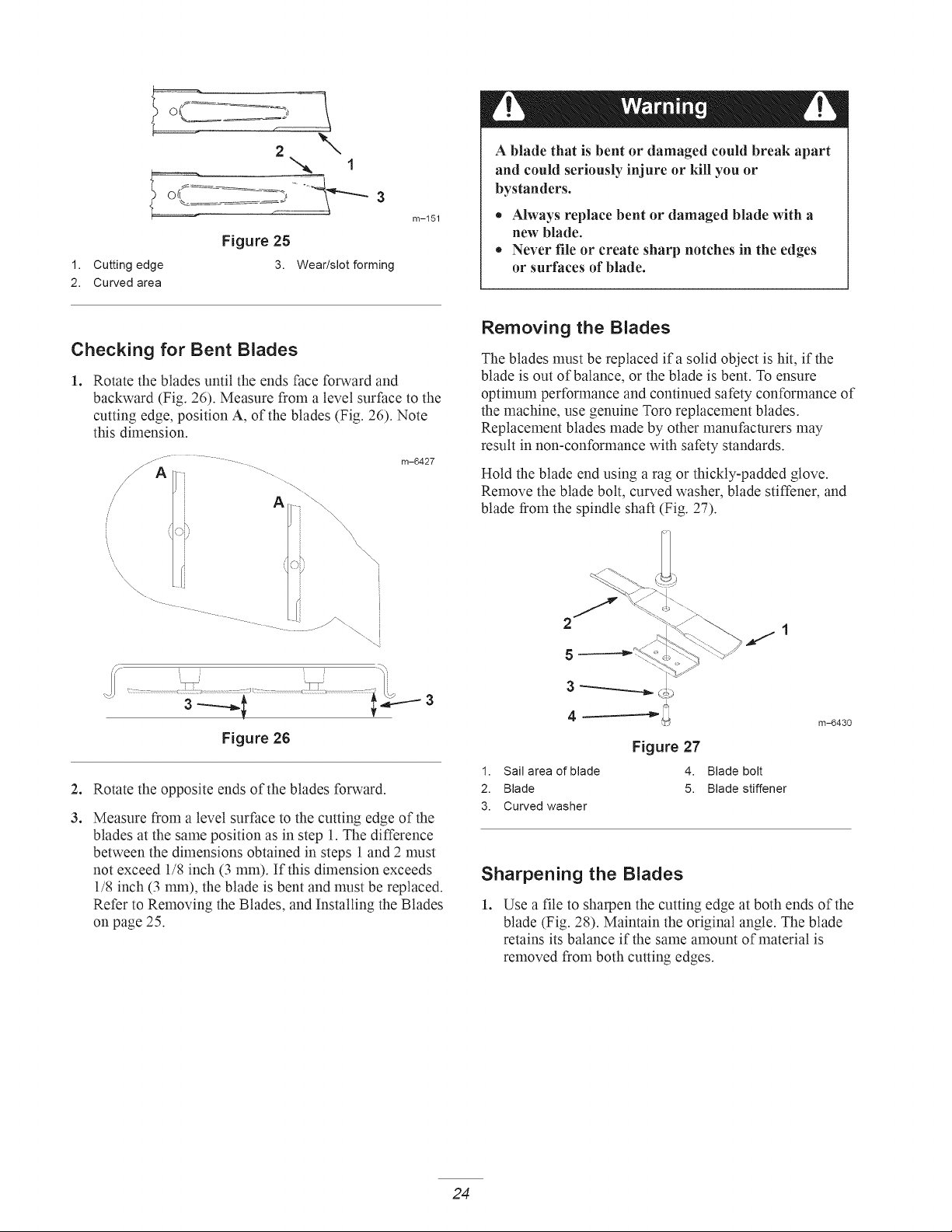
1 Cutting edge
2 Curved area
2 \
Figure 25
3 Wear/slot forming
m-151
A blade that is bent or damaged could break apart
and could seriously injure or kill you or
bystanders.
* Always replace bent or damaged blade with a
new blade.
* Never file or create sharp notches in the edges
or surfaces of blade.
Checking for Bent Blades
1. Rotate the blades until the ends face forward and
backward (Fig. 26). Measure from a level surface to the
cutting edge, position A, of the blades (Fig. 26). Note
this dimension.
\\\
i
I
i
I
i
m-6427
Figure 26
2.
3.
Rotate the opposite ends of the blades forward.
Measure from a level surface to the cutting edge of the
blades at the same position as in step 1. The difference
between the dimensions obtained in steps ! and 2 must
not exceed 1/8 inch (3 ram). If this dimension exceeds
1/8 inch (3 nml), the blade is bent and must be replaced.
Refer to Removing the Blades, and Installing the Blades
on page 25.
Removing the Blades
The blades must be replaced ifa solid object is hit, if the
blade is out of balance, or the blade is bent. To ensure
optimum performance and continued safety conformance of
the machine, use genuine Toro replacement blades.
Replacement blades made by other manufacturers may
result in non-conformance with safety standards.
Hold the blade end using a rag or thickly-padded glove.
Remove the blade bolt, curved washer, blade stiffener, and
blade from the spindle shaft (Fig. 27).
1.
2.
3.
4 ..... ,_
Figure 27
Sail area of blade 4.
Blade 5.
Curved washer
Blade bolt
Blade stiffener
m-6430
Sharpening the Blades
1.
Use a file to sharpen the cutting edge at both ends of the
blade (Fig. 28). Maintain the original angle. The blade
retains its balance if the same amount of material is
removed from both cutting edges.
24
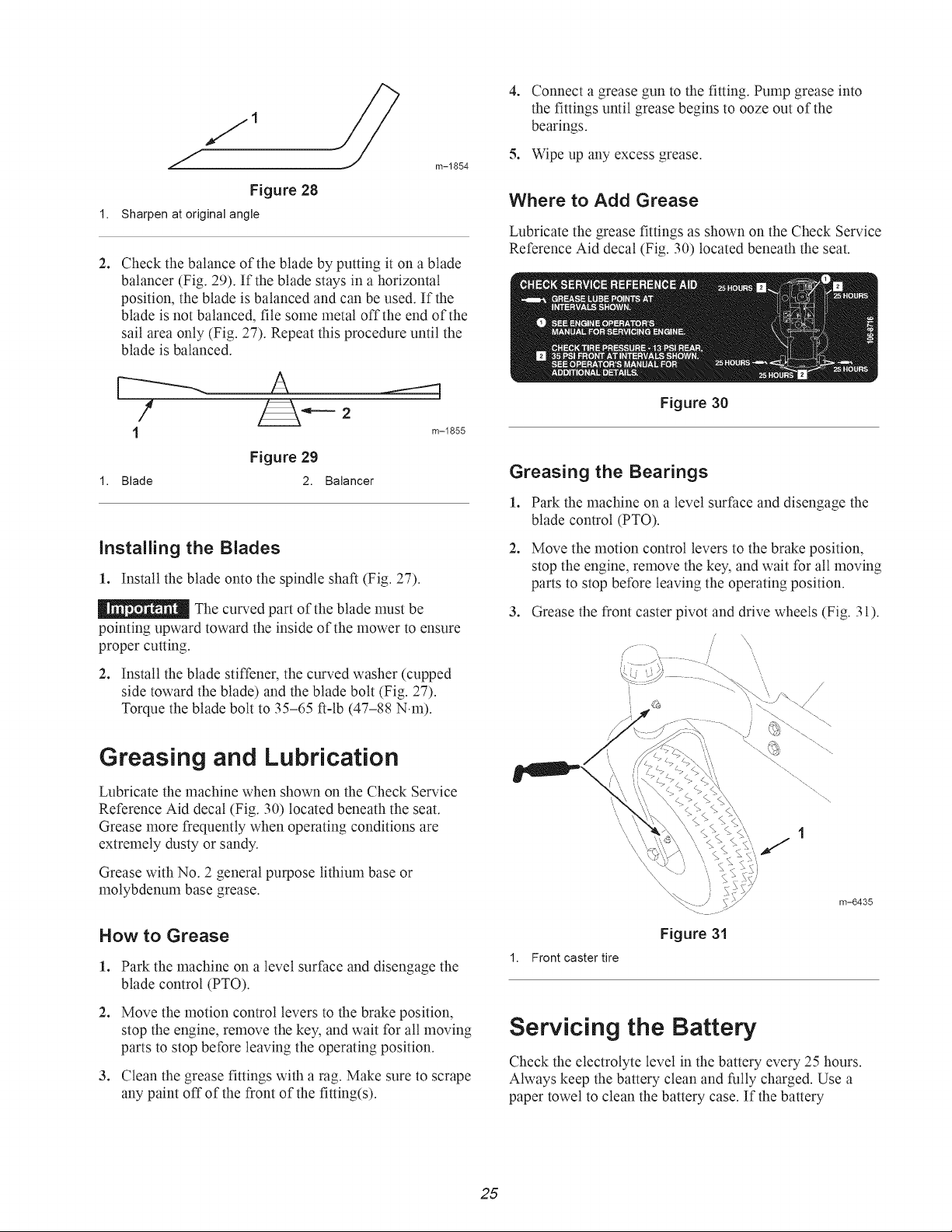
Figure 28
1. Sharpen at original angle
m-1854
2,
Check the balance of the blade by putting it on a blade
balancer (Fig. 29). If the blade stays in a horizontal
position, the blade is balanced and can be used. If the
blade is not balanced, file some metal off the end of the
sail area only (Fig. 27). Repeat this procedure until the
blade is balanced.
1 m-1855
1. Blade
Figure 29
2. Balancer
installing the Blades
1. Install the blade onto the spindle shaft (Fig. 27).
The curved part of the blade must be
pointing upward toward the inside of the mower to ensure
proper cutting.
2. Install the blade stiffener, the curved washer (cupped
side toward the blade) and the blade bolt (Fig. 27).
Torque the blade bolt to 35-65 ft-lb (47-88 N.m).
4,
Connect a grease gun to the fitting. Pump grease into
the fittings until grease begins to ooze out of the
bearings.
5. Wipe up any excess grease.
Where to Add Grease
Lubricate the grease fittings as shown on the Check Service
Reference Aid decal (Fig. 30) located beneath the seat.
Figure 30
Greasing the Bearings
1. Park the machine on a level surface and disengage the
blade control (PTO).
2. Move the motion control levers to the brake position,
stop the engine, remove the key, and wait for all moving
parts to stop before leaving the operating position.
3. Grease the front caster pivot and drive wheels (Fig. 31).
/ \
Greasing and Lubrication
Lubricate the machine when shown on the Check Service
Reference Aid decal (Fig. 30) located beneath the seat.
Grease more frequently when operating conditions are
extremely dusty or sandy.
Grease with No. 2 general purpose lithium base or
motybdenunl base grease.
How to Grease
1. Park the machine on a level surface and disengage the
blade control (PTO).
2. Move the motion control levers to the brake position,
stop the engine, remove the key, and wait for all moving
parts to stop before leaving the operating position.
3. Clean the grease fittings with a rag. Make sure to scrape
any paint off of the front of the fitting(s).
1. Front caster tire
m-6435
Servicing the Battery
Check the electrolyte level in the battery every 25 hours.
Always keep the battery clean and fully charged. Use a
paper towel to clean the battery case. If the battery
25
terminals are corroded, clean them with a solution of four
parts water and one part baking soda. Apply a light coating
of grease to the battery terminals to prevent corrosion.
Voltage: 12 v
Removing the Battery
Battery terminals or metal tools could short
against metal tractor components causing sparks.
Sparks can cause the battery gasses to explode,
resulting in personal injury.
* When removing or installing the battery, do not
allow the battery terminals to touch any metal
parts of the tractor.
* Do not allow metal tools to short between the
battery terminals and metal parts of the tractor.
1.
2.
3.
4.
Park the machine on a level surface and disengage the
blade control (PTO).
Move the motion control levers to the brake position,
stop the engine, remove the key, and wait for all moving
parts to stop before leaving the operating position.
Tip the seat forward to see the battery.
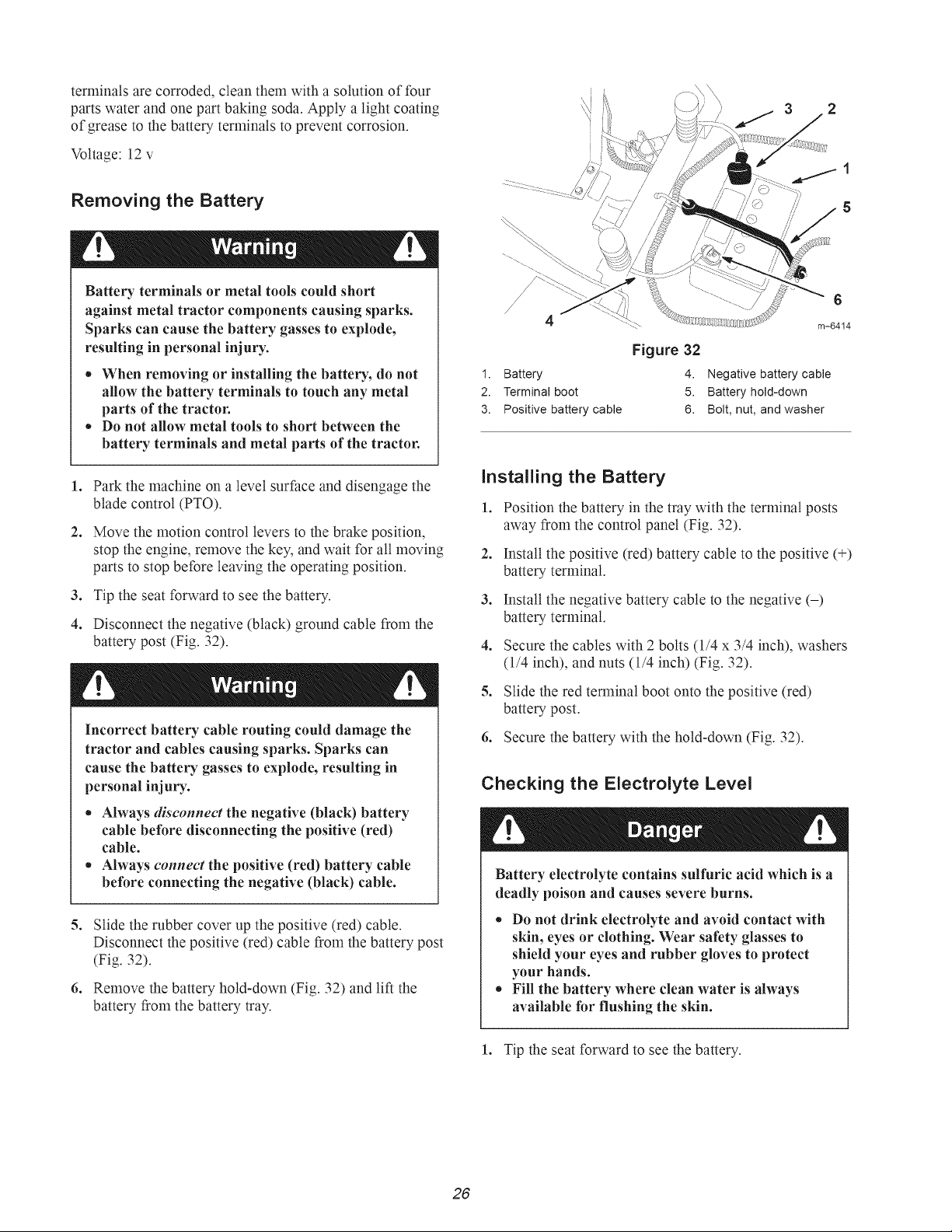
Disconnect the negative (black) ground cable from the
battery post (Fig. 32).
Incorrect battery cable routing could damage the
tractor and cables causing sparks. Sparks can
cause the battery gasses to explode, resulting in
personal injury.
* Always disconnect the negative (black) battery
cable before disconnecting the positive (red)
cable.
* Always connect the positive (red) battery cable
before connecting the negative (black) cable.
5.
6.
Slide the rubber cover up the positive (red) cable.
Disconnect the positive (red) cable from the battery post
(Fig. 32).
Remove the battery hold-down (Fig. 32) and lift the
battery from the battery tray.
!
3
1
5
4
6
m-6414
Figure 32
1. Battery 4. Negative battery cable
2. Terminal boot 5. Battery hold-down
3. Positive battery cable 6. Bolt, nut, and washer
installing the Battery
1. Position the battery in the tray with the terminal posts
away from the control panel (Fig. 32).
2. Install the positive (red) battery cable to the positive (+)
battery terminal.
3.
4.
Install the negative battery cable to the negative (-)
battery terminal.
Secure the cables with 2 bolts (1/4 x 3/4 inch), washers
(1/4 inch), and nuts (1/4 inch) (Fig. 32).
5. Slide the red terminal boot onto the positive (red)
battery post.
6. Secure the battery with the hold-down (Fig. 32).
Checking the Electrolyte Level
Battery electrolyte contains sulfuric acid which is a
deadly poison and causes severe burns.
* Do not drink electrolyte and avoid contact with
skin, eyes or clothing. Wear safety glasses to
shield your eyes and rubber gloves to protect
your hands.
* Fill the battery where clean water is always
available for flushing the skin.
1. Tip the seat forward to see the battery.
26
2.
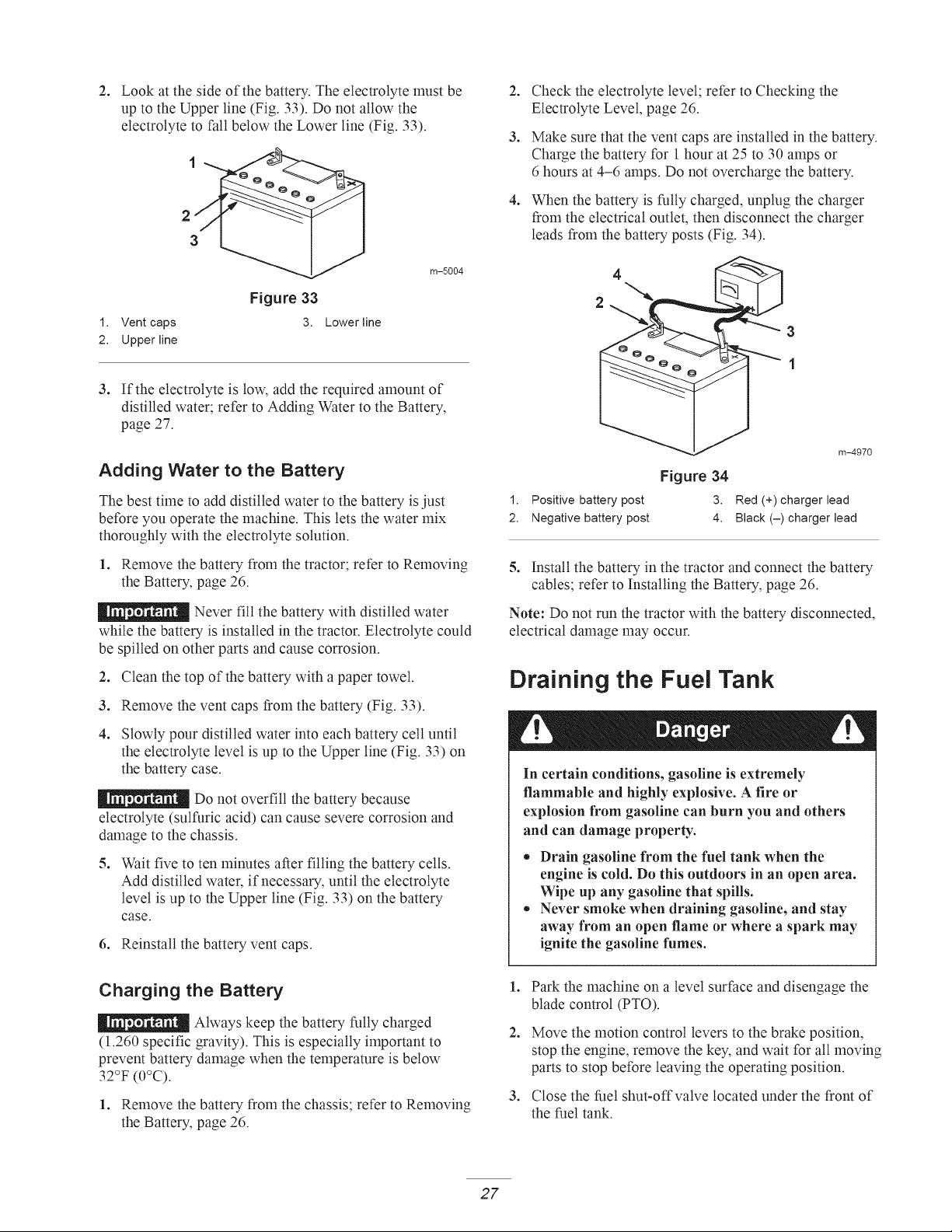
Look at the side of the battery. The electrolyte must be
up to the Upper line (Fig. 33). Do not allow the
electrolyte to fall below the Lower line (Fig. 33).
2
3
Figure 33
1. Vent caps 3. Lower line
2. Upper line
m-5004
3. If the electrolyte is low, add the required amount of
distilled water; refer to Adding Water to the Battery,
page 27.
Adding Water to the Battery
The best time to add distilled water to the battery is just
before you operate the machine. This lets the water mix
thoroughly with the electrolyte solution.
1. Remove the battery from the tractor; refer to Removing
the Battery, page 26.
Never fill the battery with distilled water
while the battery is installed in the tractor. Electrolyte could
be spilled on other parts and cause corrosion.
2. Clean the top of the battery with a paper towel.
3. Remove the veto caps from the battery (Fig. 33).
4. Slowly pour distilled water into each battery cell until
the electrolyte level is up to the Upper line (Fig. 33) on
the battery case.
Do not overfill the battery because
electrolyte (sulfuric acid) can cause severe corrosion and
damage to the chassis.
5.
Wait five to ten minutes after filling the battery cells.
Add distilled water, if necessary, until the electrolyte
level is up to the Upper line (Fig. 33) on the battery
case.
6. Reinstall the battery vent caps.
2.
3.
4.
Check the electrolyte level; refer to Checking the
Electrolyte Level, page 26.
Make sure that the vent caps are installed in the battery.
Charge the battery for 1 hour at 25 to 30 amps or
6 hours at 4-6 amps. Do not overcharge the battery.
When the battery is fully charged, unplug the charger
from the electrical outlet, then disconnect the charger
leads from the battery posts (Fig. 34).
m-4970
Figure 34
1. Positive battery post 3. Red (+) charger lead
2. Negative battery post 4. Black (-) charger lead
5. Install the battery in the tractor and connect the battery
cables; refer to Installing the Battery, page 26.
Note: Do not run the tractor with the battery discom_ected,
electrical damage may occur.
Draining the Fuel Tank
In certain conditions, gasoline is extremely
flammable and highly explosive. A fire or
explosion from gasoline can burn you and others
and can damage property.
* Drain gasoline from the fuel tank when the
engine is cold. Do this outdoors in an open area.
Wipe up any gasoline that spills.
* Never smoke when draining gasoline, and stay
away from an open flame or where a spark may
ignite the gasoline fumes.
Charging the Battery
Always keep the battery fully charged
(1.260 specific gravity). This is especially important to
prevent battery damage when the temperature is below
32°F (0°C).
1. Remove the battery from the chassis; refer to Removing
the Battery, page 26.
1.
2.
3.
Park the machine on a level surface and disengage the
blade control (PTO).
Move the motion control levers to the brake position,
stop the engine, remove the key, and wait for all moving
parts to stop before leaving the operating position.
Close the fuel shut-off valve located under the front of
the fuel tank.
27
4,
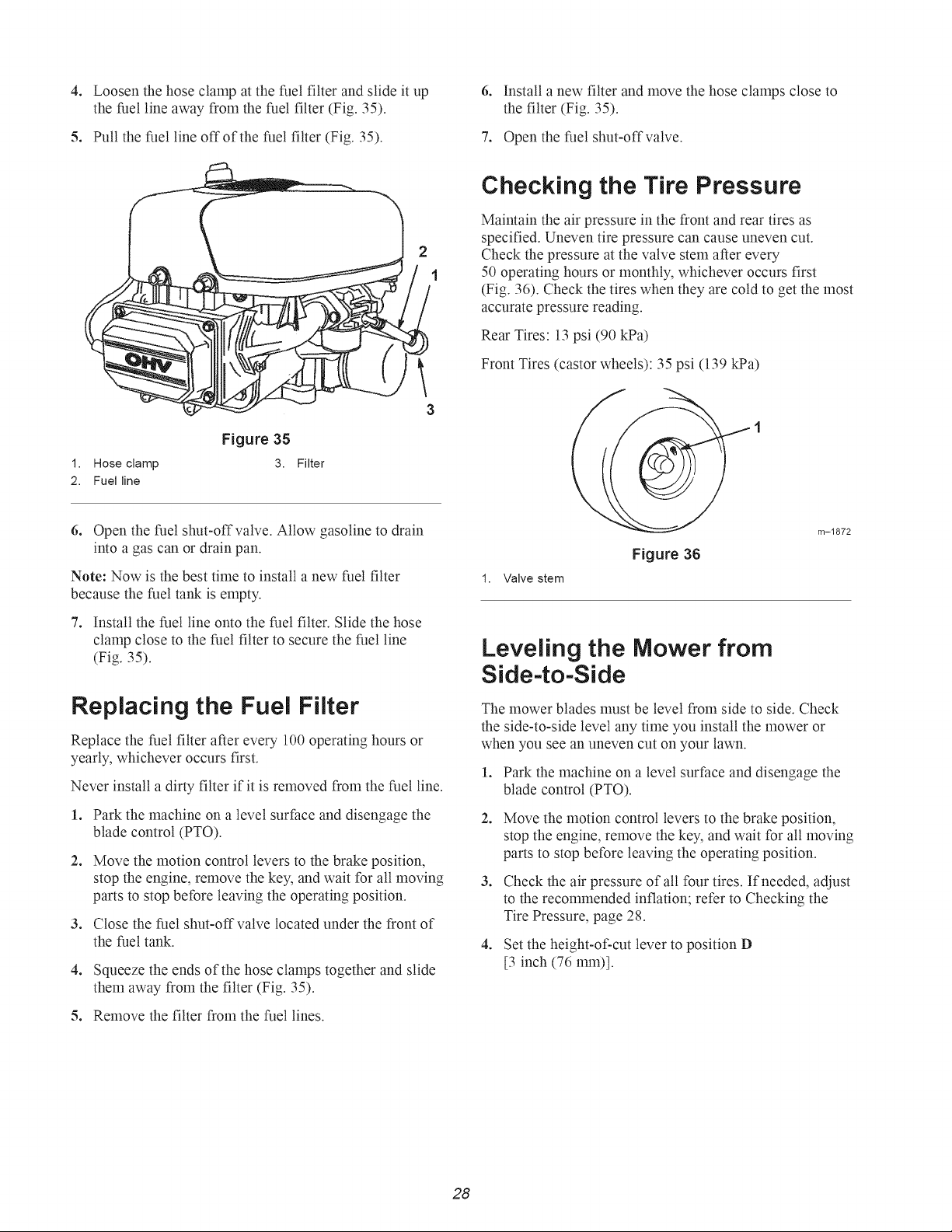
Loosen the hose clamp at the fuel filter and slide it up
the fuel line away from the fuel filter (Fig. 35).
5. Pull the fuel line offofthe fuel filter (Fig. 35).
6,
Install a new filter and move the hose clamps close to
the filter (Fig. 35).
7. Open the fuel shut-off valve.
2
1
Figure 35
1. Hose clamp 3. Filter
2. Fuel line
3
6. Open the fuel shut-off valve. Allow gasoline to drain
into a gas can or drain pan.
Note: Now is the best time to install a new fuel filter
because the fuel tank is empty.
7. Install the fuel line onto the fuel filter. Slide the hose
clamp close to the fuel filter to secure the fuel line
(Fig. 35).
Replacing the Fuel Filter
Replace the fuel filter after every 100 operating hours or
yearly, whichever occurs first.
Never install a dirty filter if it is removed from the fuel line.
1. Park the machine on a level surface and disengage the
blade control (PTO).
2,
3,
Move the motion control levers to the brake position,
stop the engine, remove the key, and wait for all moving
parts to stop before leaving the operating position.
Close the fuel shut-off valve located under the front of
the fuel tank.
4. Squeeze the ends of the hose clamps together and slide
them away from the filter (Fig. 35).
5. Remove the filter from the fuel lines.
Checking the Tire Pressure
Maintain the air pressure in the front and rear tires as
specified. Uneven tire pressure can cause uneven cut.
Check the pressure at the valve stem after every
50 operating hours or monthly, whichever occurs first
(Fig. 36). Check the tires when they are cold to get the most
accurate pressure reading.
Rear Tires: 13 psi (90 kPa)
Front Tires (castor wheels): 35 psi (139 kPa)
/
Figure 36
m-1872
1. Valve stem
Leveling the Mower from
Side-to-Side
The mower blades must be level from side to side. Check
the side-to-side level any time you install the mower or
when you see an uneven cut on your lawn.
1o
2,
3o
4,
Park the machine on a level surface and disengage the
blade control (PTO).
Move the motion control levers to the brake position,
stop the engine, remove the key, and wait for all moving
parts to stop before leaving the operating position.
Check the air pressure of all four tires. If needed, adjust
to the recommended inflation; refer to Checking the
Tire Pressure, page 28.
Set the height-of-cut lever to position D
[3 inch (76 nml)].
28
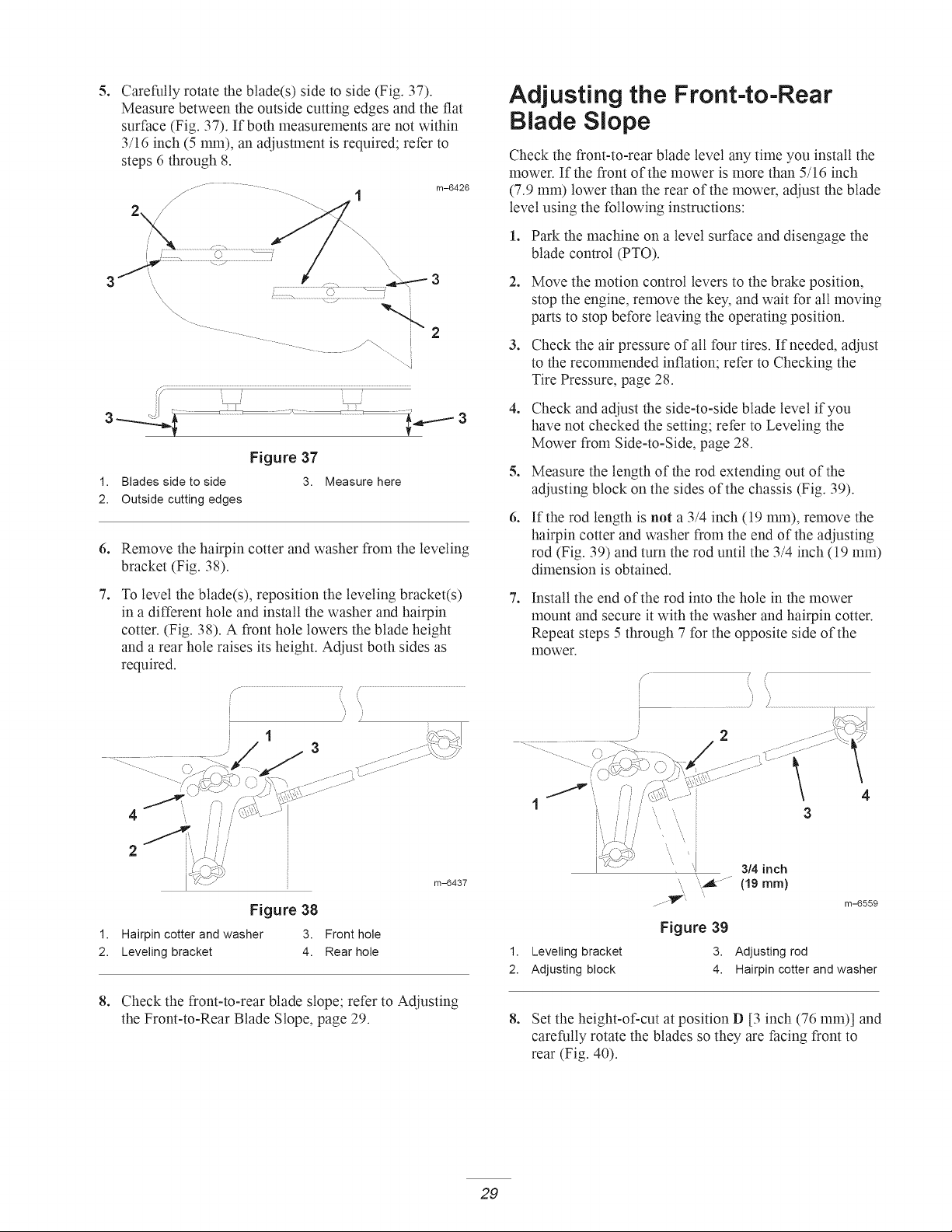
Carefully rotate the blade(s) side to side (Fig. 37).
Measure between the outside cutting edges and the flat
surface (Fig. 37). If both measurements are not within
3/16 inch (5 nml), an adjustment is required; refer to
steps 6 through 8.
m-6426
3_
\\
\\\\\\4\\ "-. ............................................_::_ ......................................
::........................................................................................................................................................., ..........................................
3___.,4......._...._ 3i ,- .. _ ........ ,t .. _ _ ........ i
Figure 37
1. Blades side to side 3. Measure here
2. Outside cutting edges
6.
7.
Remove the hairpin cotter and washer from the leveling
bracket (Fig. 38).
To level the blade(s), reposition the leveling bracket(s)
in a different hole and install the washer and hairpin
cotter. (Fig. 38). A front hole lowers the blade height
and a rear hole raises its height. Adjust both sides as
required.
/- ......................................................................................i;' (,..............................................................................................
4
Figure 38
1. Hairpin cotter and washer 3. Front hole
2. Leveling bracket 4. Rear hole
m-6437
8. Check the front-to-rear blade slope; refer to Adjusting
the Front-to-Rear Blade Slope, page 29.
Adjusting the Front-to-Rear
Blade Slope
Check the front-to-rear blade level any time you install the
mower. If the front of the mower is more than 5/16 inch
(7.9 mm) lower than the rear of the mower, adjust the blade
level using the following instructions:
1,
2,
3o
4,
6,
7,
Park the machine on a level surface and disengage the
blade control (PTO).
Move the motion control levers to the brake position,
stop the engine, remove the key, and wait for all moving
parts to stop before leaving the operating position.
Check the air pressure of all four tires. If needed, adjust
to the recommended inflation; refer to Checking the
Tire Pressure, page 28.
Check and adjust the side-to-side blade level if you
have not checked the setting; refer to Leveling the
Mower from Side-to-Side, page 28.
Measure the length of the rod extending out of the
adjusting block on the sides of the chassis (Fig. 39).
If the rod length is not a 3/4 inch (19 nml), remove the
hairpin cotter and washer from the end of the adjusting
rod (Fig. 39) and turn the rod until the 3/4 inch (19 mm)
dimension is obtained.
Install the end of the rod into the hole in the mower
mount and secure it with the washer and hairpin cotter.
Repeat steps 5 through 7 for the opposite side of the
mower.
Figure 39
1. Leveling bracket 3. Adjusting rod
2. Adjusting block 4. Hairpin cotter and washer
8. Set the height-of-cut at position D [3 inch (76 mm)] and
carefully rotate the blades so they are facing front to
rear (Fig. 40).
29
9.
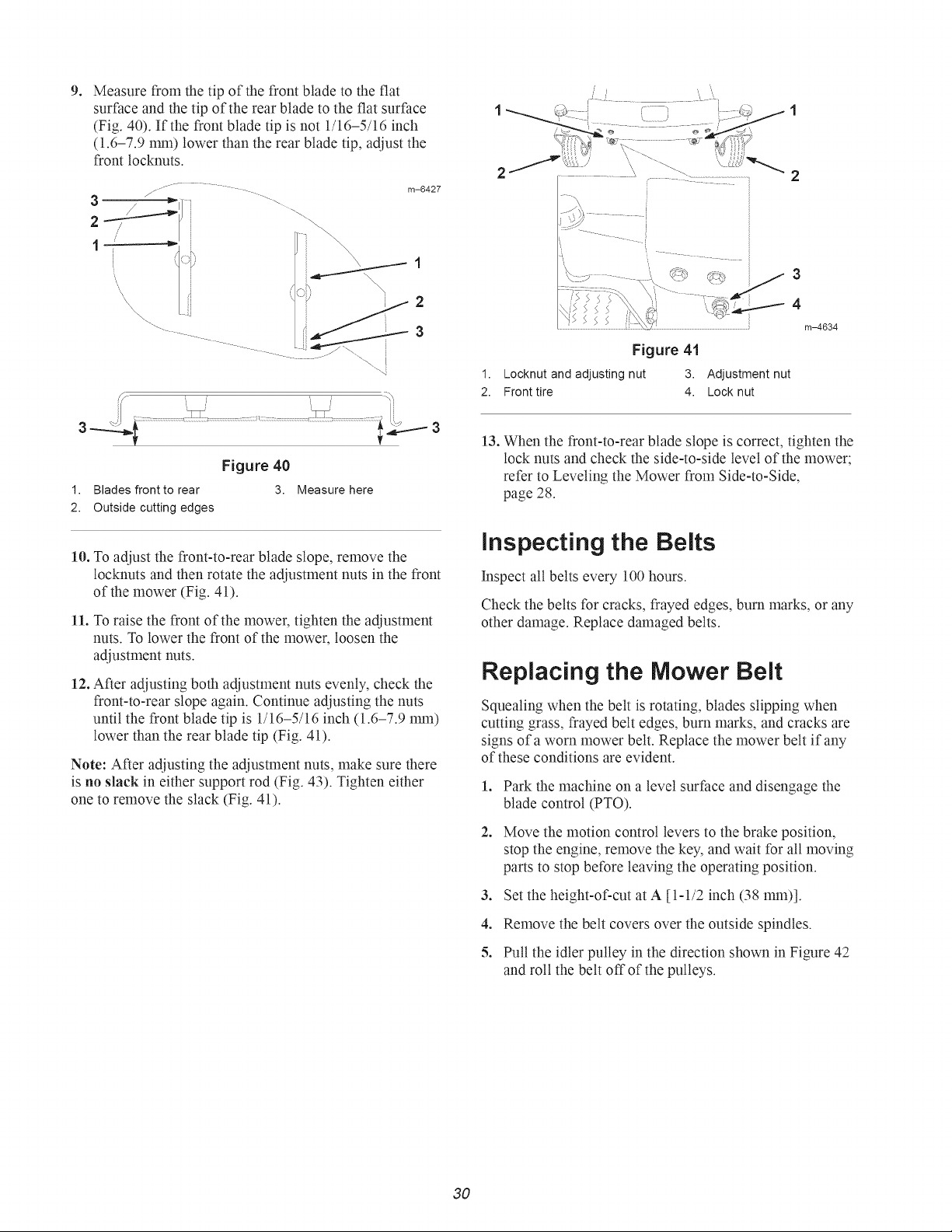
Measure from the tip of the front blade to the flat
surface and the tip of the rear blade to the flat surface
(Fig. 40). If the front blade tip is not 1/16-5/16 inch
(!.6-7.9 nml) lower than the rear blade tip, adjust the
front locknuts.
m-6427
Figure 40
1. Blades front to rear 3. Measure here
2. Outside cutting edges
3
10. To adjust the front-to-rear blade slope, remove the
locknuts and then rotate the adjustment nuts in the front
of the mower (Fig. 41).
11. To raise the front of the mower, tighten the adjustment
nuts. To lower the front of the mower, loosen the
adjustment nuts.
12. After adjusting both adjustment nuts evenly, check the
front-to-rear slope again. Continue adjusting the nuts
until the front blade tip is 1/16-5/16 inch (1.6-7.9 nml)
lower than the rear blade tip (Fig. 41).
Note: After adjusting the adjustment nuts, make sure there
is no slack in either support rod (Fig. 43). Tighten either
one to remove the slack (Fig. 41).
2
3
4
Figure 41
1. Locknut and adjusting nut 3. Adjustment nut
2. Front tire 4. Lock nut
m-4634
13. When the front-to-rear blade slope is correct, tighten the
lock nuts and check the side-to-side level of the mower;
refer to Leveling the Mower from Side-to-Side,
page 28.
inspecting the Belts
Inspect all belts every 100 hours.
Check the belts for cracks, frayed edges, burn marks, or any
other damage. Replace damaged belts.
Replacing the Mower Belt
Squealing when the belt is rotating, blades slipping when
cutting grass, frayed belt edges, burn marks, and cracks are
signs of a worn mower belt. Replace the mower belt if any
of these conditions are evident.
1o
2,
3o
4.
5.
Park the machine on a level surface and disengage the
blade control (PTO).
Move the motion control levers to the brake position,
stop the engine, remove the key, and wait for all moving
parts to stop before leaving the operating position.
Set the height-of-cut at A [l-l/2 inch (38 nml)].
Remove the belt covers over the outside spindles.
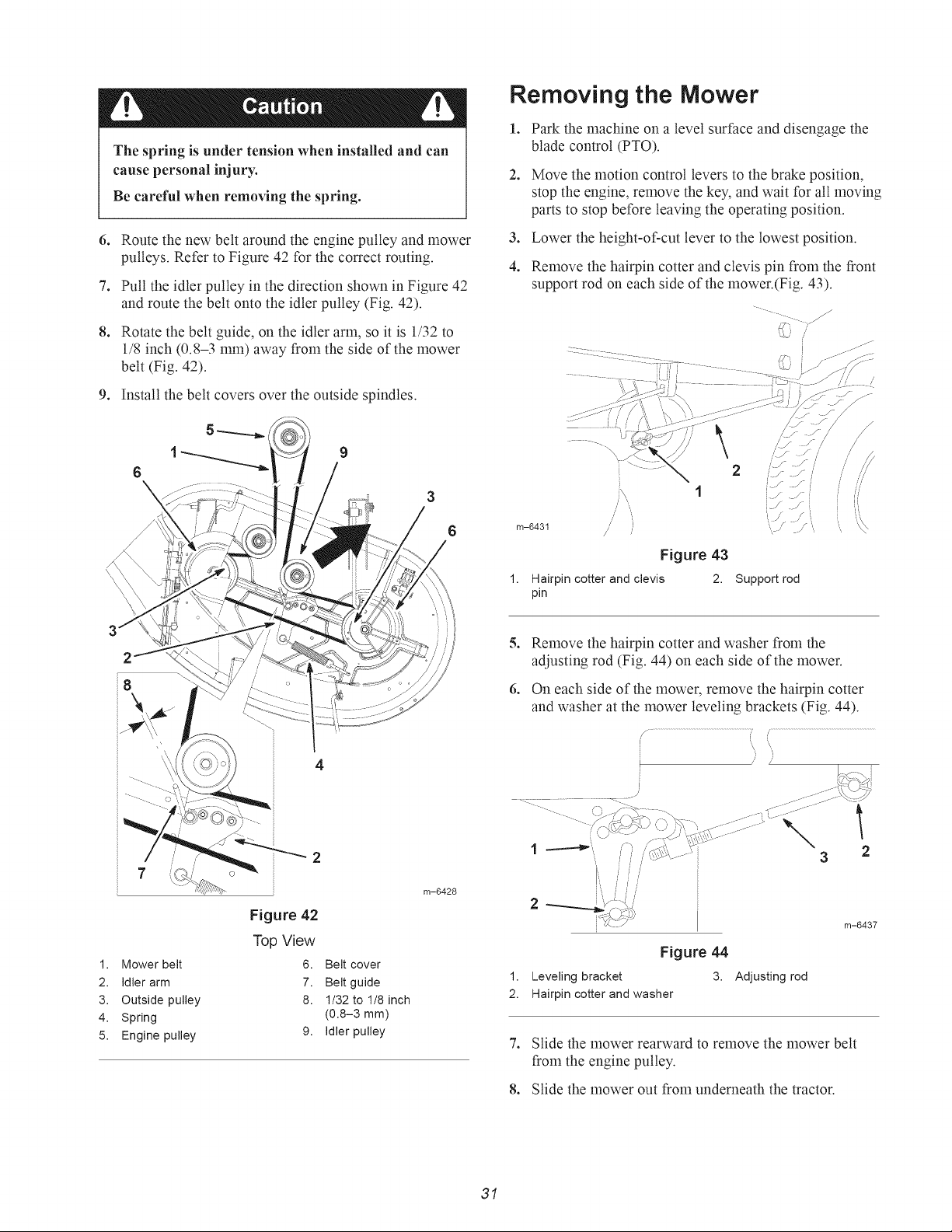
Pull the idler pulley in the direction shown in Figure 42
and roll the belt off of the pulleys.
3O
The spring is under tension when installed and can
cause personal injury.
Be careful when removing the spring.
6.
7.
8.
Route the new belt around the engine pulley and mower
pulleys. Refer to Figure 42 for the correct routing.
Putt the idler pulley in the direction shown in Figure 42
and route the belt onto the idler pulley (Fig. 42).
Rotate the belt guide, on the idler arm, so it is 1/32 to
1/8 inch (0.8-3 nml) away from the side of the mower
belt (Fig. 42).
9. Install the belt covers over the outside spindles.
6
\
9
Removing the Mower
1. Park the machine on a level surface and disengage the
blade control (PTO).
2.
Move the motion control levers to the brake position,
stop the engine, remove the key, and wait for all moving
parts to stop before leaving the operating position.
3. Lower the height-of-cut lever to the lowest position.
4.
Remove the hairpin cotter and clevis pin from the front
support rod on each side of the mower.(Fig. 43).
j--
m-6431
\
'i
1
Figure 43
1. Hairpin cotter and clevis 2.
pin
Support rod
/-
/
/
6.
Remove the hairpin cotter and washer from the
adjusting rod (Fig. 44) on each side of the mower.
On each side of the mower, remove the hairpin cotter
and washer at the mower leveling brackets (Fig. 44).
1.
2.
3.
4.
5.
4
Mower belt
idler arm
Outside pulley
Spring
Engine pulley
Figure 42
Top View
6.
7.
8.
g.
Belt cover
Belt guide
1132 to 118 inch
(0.8-3 mm)
idler pulley
m-6428
Figure 44
1. Leveling bracket 3. Adjusting rod
2. Hairpin cotter and washer
7. Slide the mower rearward to remove the mower belt
from the engine pulley.
8. Slide the mower out from underneath the tractor.
31
Note: Retain all parts for future installation.
Installing the Mower
1. Park the machine on a level surface and disengage the
blade control (PTO).
2. Move the motion control levers to the brake position,
stop the engine, remove the key, and wait for all moving
parts to stop before leaving the operating position.
3. Slide the mower under the tractor.
4. Lower the height-of-cut lever to the lowest position.
5. Attach the adjusting rod to the tractor with the washer
and hairpin cotter (Fig. 44) on each side of the mower.
6o
7o
8o
Slide the leveling brackets onto the mounting pins and
secure them with the washers and hairpin cotters
(Fig. 44).
Attach the front support rods to the tractor with the
clevis pins and hairpin cotters (Fig. 43).
Install the mower belt onto the engine pulley; refer to
Replacing the Mower Belt, page 30.
Fuse
The electrical system is protected by fuses. It requires no
maintenance; however, if a fuse blows, check the
component/circuit for a malfunction or short.
Fuse: Main F1--30 amp, blade-type
Charge Circuit F2--25 amp, blade-type
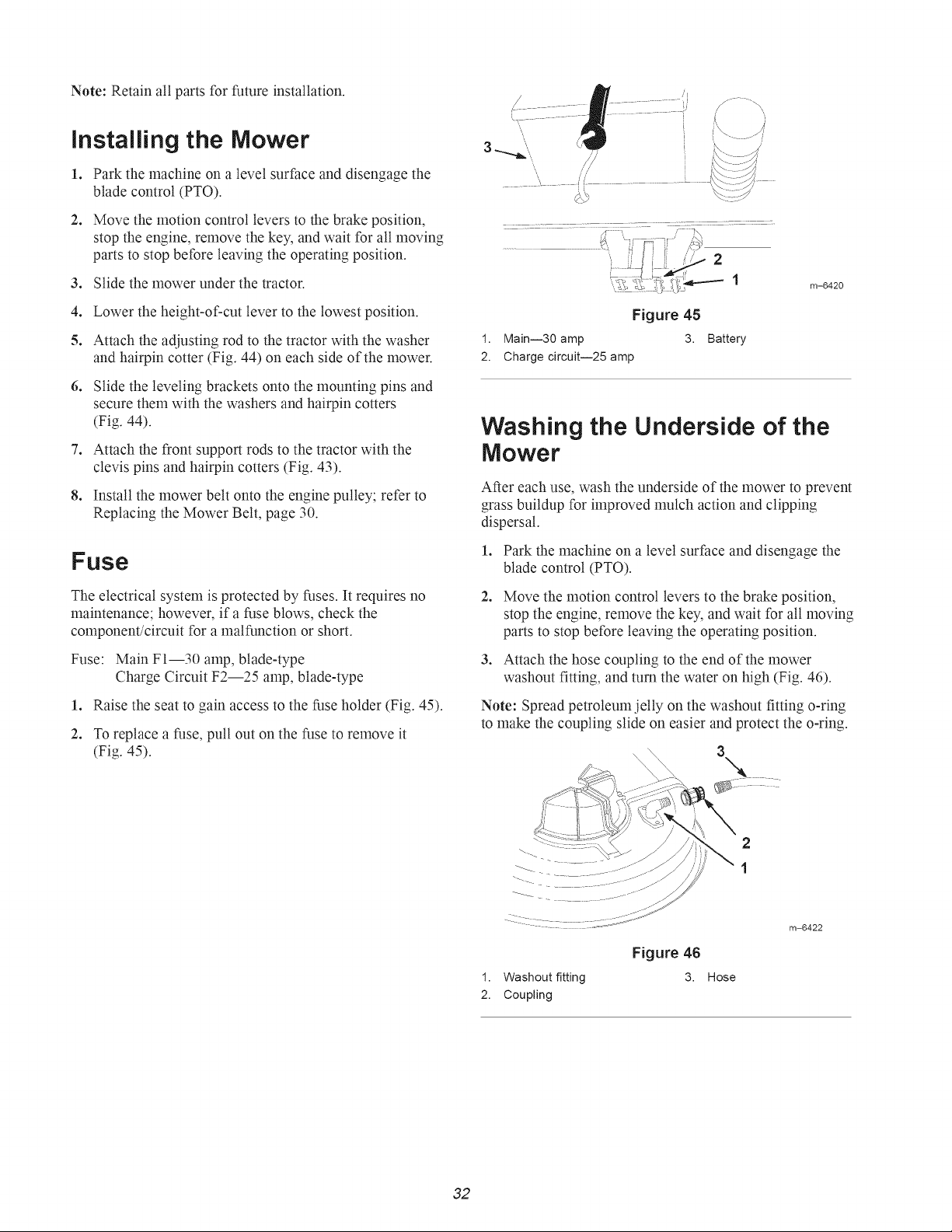
1. Raise the seat to gain access to the fuse holder (Fig. 45).
2. To replace a fuse, putt out on the fuse to remove it
(Fig. 45).
1.
2.
..................... :< _ i /g )
Figure 45
Main--30 amp 3. Battery
Charge circuit--25 amp
m-6420
Washing the Underside of the
Mower
After each use, wash the underside of the mower to prevent
grass buildup for improved nmtch action and clipping
dispersal.
1o
2,
3o
Park the machine on a level surface and disengage the
blade control (PTO).
Move the motion control levers to the brake position,
stop the engine, remove the key, and wait for all moving
parts to stop before leaving the operating position.
Attach the hose coupling to the end of the mower
washout fitting, and turn the water on high (Fig. 46).
Note: Spread petroleum .jelly on the washout fitting o-ring
to make the coupling slide on easier and protect the o-ring.
1.
2.
Washout fitting
Coupling
Figure 46
3. Hose
2
1
m-6422
32
4. Lower the mower to the lowest height-of-cut.
5. Sit on the seat and start the engine. Engage the PTO and
let the mower run for one to three minutes.
6.
7.
Disengage the PTO, stop the engine, and remove the
ignition key. Wait for all moving parts to stop.
Turn the water off and remove the coupling from the
washout fitting.
Note: If the mower is not clean after one washing, soak it
and let it stand for 30 minutes. Then repeat the process.
8. Run the mower again for one to three minutes to
remove excess water.
A broken or missing washout fitting could expose
you and others to thrown objects or blade contact.
Contact with blade or thrown debris can cause
injury or death.
® Replace broken or missing washout fitting
immediately, before using mower again.
® Plug any hole(s) in mower with bolts and
locknuts.
+ Never put your hands or feet under the mower
or through openings in the mower.
Replacing the Grass Deflector
An uncovered discharge opening could allow the
lawn mower to throw objects in the operator's or
bystander's direction and result in serious injury.
Also, contact with the blade could occur.
Never operate the lawn mower unless you install a
cover plate, a mulch plate, or a grass chute and
catcher.
6.
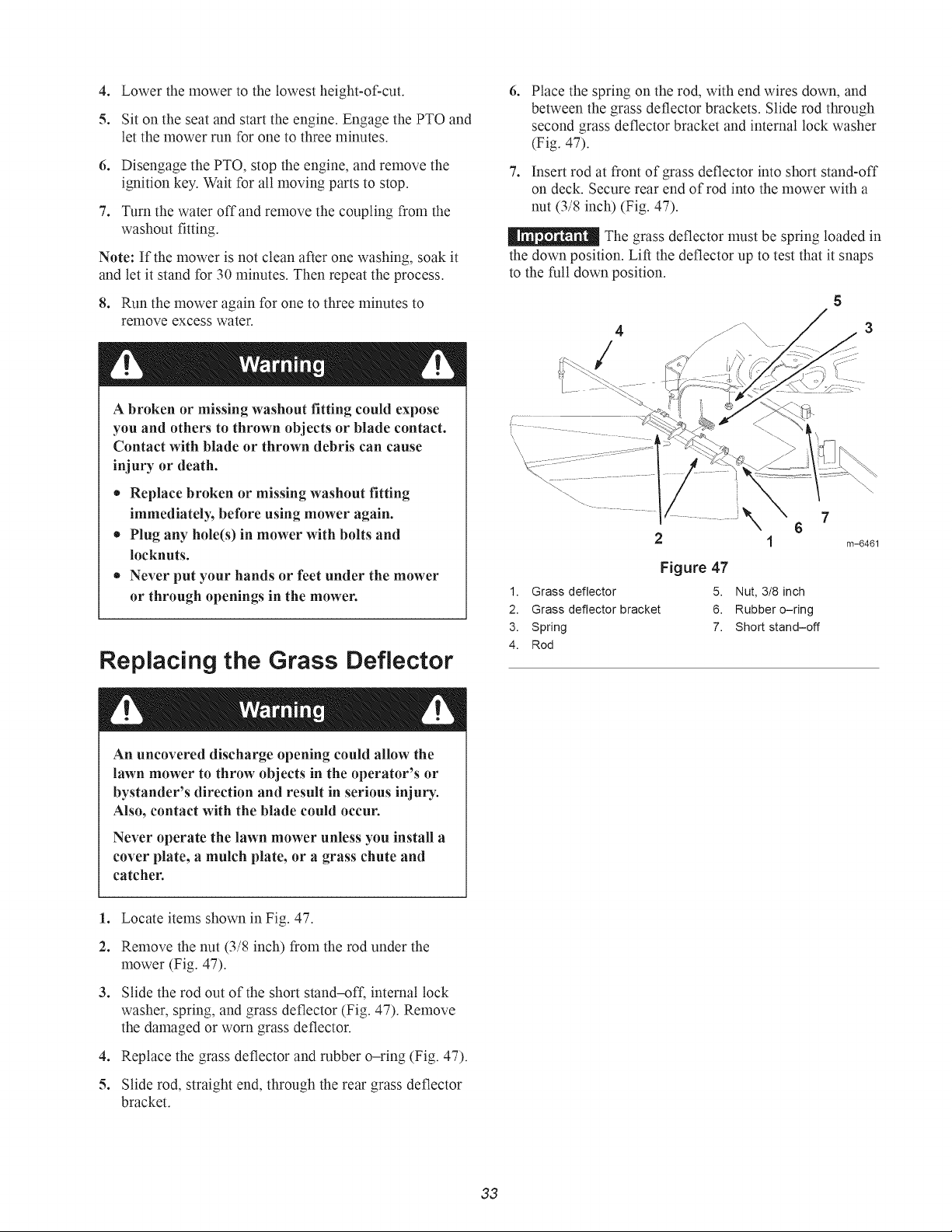
Place the spring on the rod, with end wires down, and
between the grass deflector brackets. Slide rod through
second grass deflector bracket and internal lock washer
(Fig. 47).
7. Insert rod at front of grass deflector into short stand-off
on deck. Secure rear end of rod into the mower with a
nut (3/8 inch) (Fig. 47).
The grass deflector must be spring loaded in
the down position. Lift the deflector up to test that it snaps
to the full down position.
6
x
2 1
Figure 47
1. Grass deflector 5. Nut, 3/8 inch
2. Grass deflector bracket 6. Rubber o-ring
3. Spring 7. Short stand-off
4. Rod
m-6461
1.
2.
3.
Locate items shown in Fig. 47.
Remove the nut (3/8 inch) from the rod under the
mower (Fig. 47).
Slide the rod out of the short stand-off, internal lock
washer, spring, and grass deflector (Fig. 47). Remove
the damaged or worn grass deflector.
4. Replace the grass deflector and rubber o-ring (Fig. 47).
5. Slide rod, straight end, through the rear grass deflector
bracket.
33
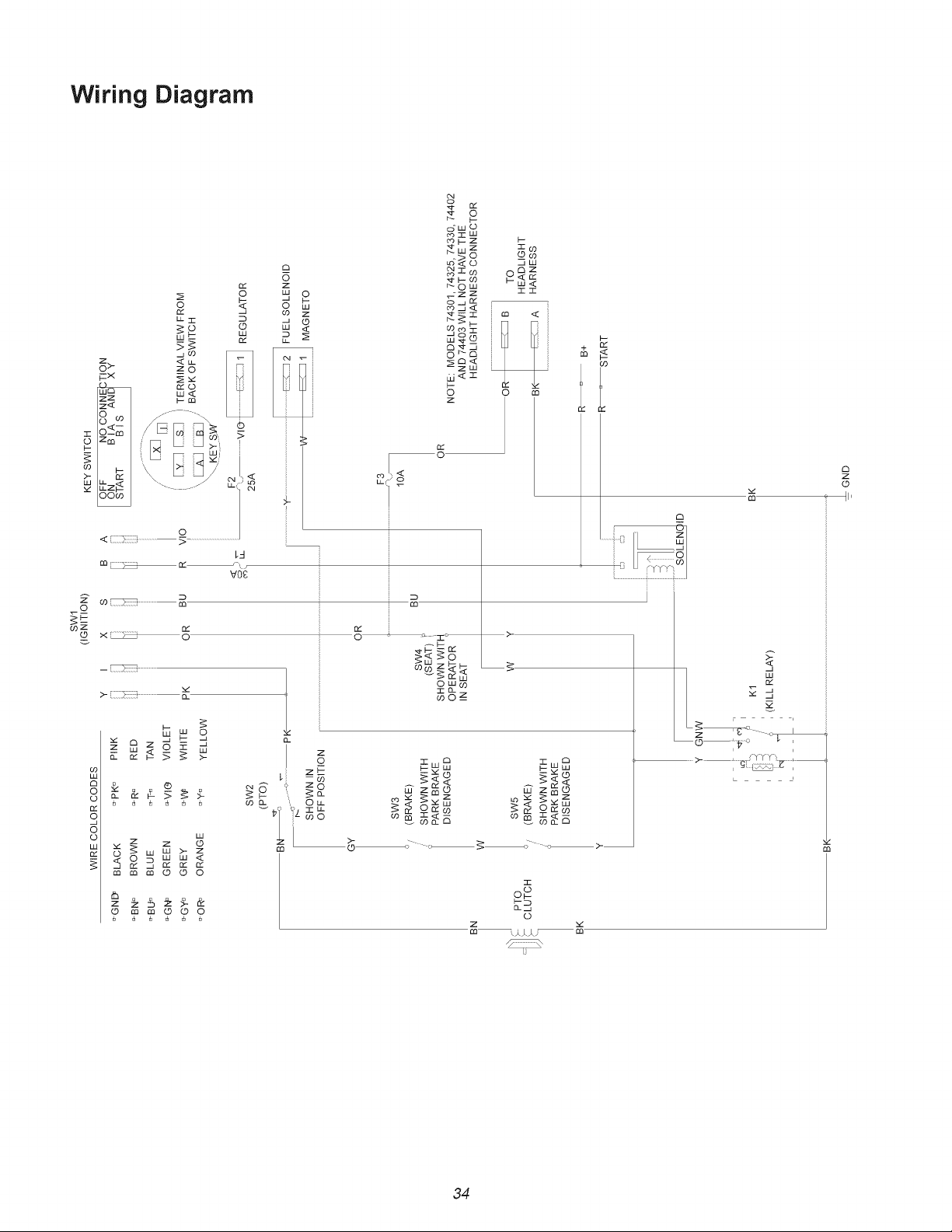
Wiring Diagram
_×__
................
8z _'_- q
8_
© w
m m m 0 © 0
r_
0
z
_, o
0
z
i z
o_
z _-
_i -co
m
_ o
cO!
co F-
_zco
,__zz
(D
ii <!
0
z
r_
0
ro ,<
i,.cS _
_w
w
<
]iI
<
0
>
oo
S _sS
_<o_ _ _<o_
_,- __,- >_
I
o_
©
z
ca A_A7 _a
, TY_"
L
Z
©
II,
34
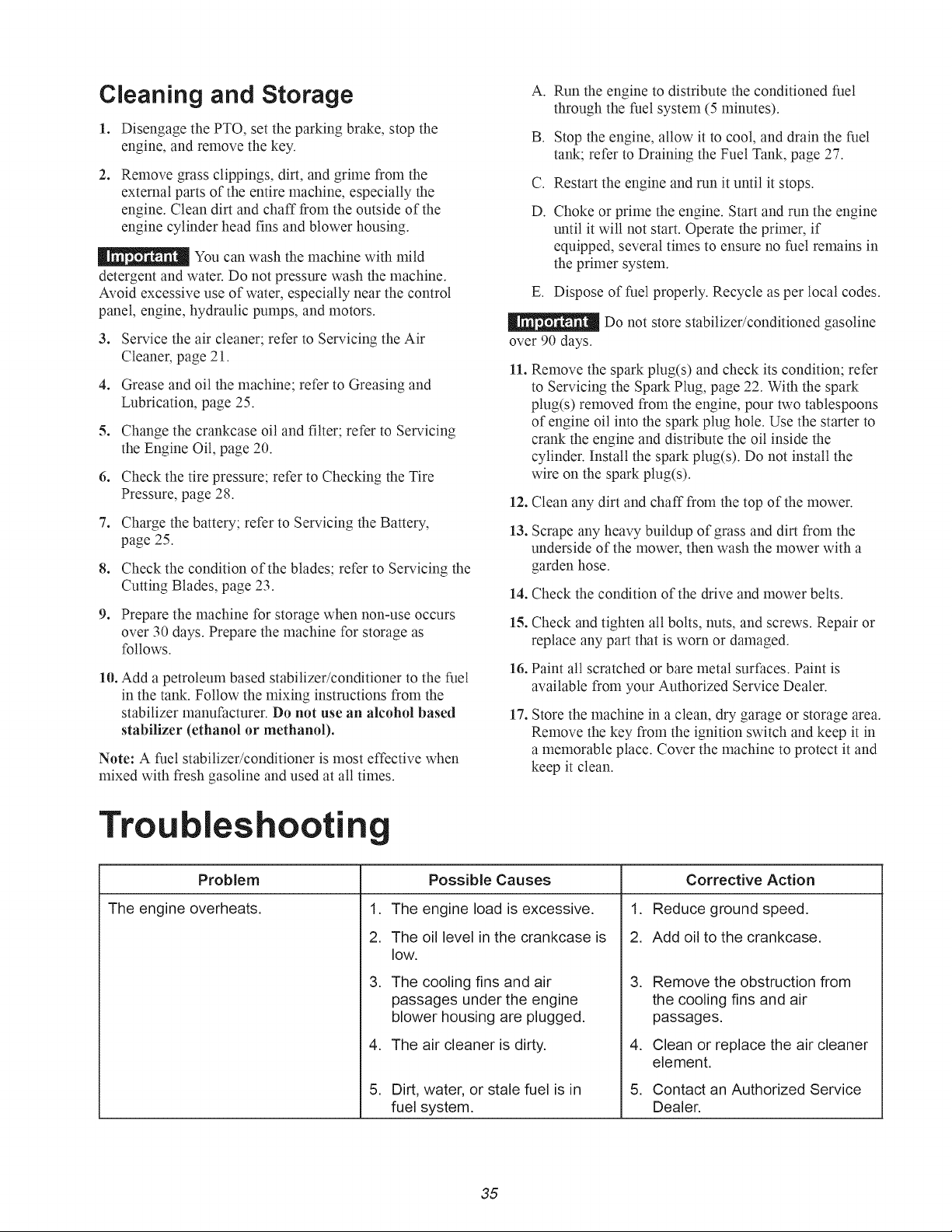
Cleaning and Storage
1.
2.
Disengage the PTO, set the parking brake, stop the
engine, and remove the key.
Remove grass clippings, dirt, and grime from the
external parts of the entire machine, especially the
engine. Clean dirt and chaff from the outside of the
engine cylinder head fins and blower housing.
You can wash the machine with mild
detergent and water. Do not pressure wash the machine.
Avoid excessive use of water, especially near the control
panel, engine, hydraulic pumps, and motors.
3.
4.
5.
6.
Service the air cleaner; refer to Servicing the Air
Cleaner, page 21.
Grease and oil the machine; refer to Greasing and
Lubrication, page 25.
Change the crankcase oil and filter; refer to Servicing
the Engine Oil, page 20.
Check the tire pressure; refer to Checking the Tire
Pressure, page 28.
7. Charge the battery; refer to Servicing the Battery,
page 25.
8. Check the condition of the blades; refer to Servicing the
Cutting Blades, page 23.
9. Prepare the machine for storage when non-use occurs
over 30 days. Prepare the machine for storage as
follows.
10. Add a petroleum based stabilizer/conditioner to the fuel
in the tank. Follow the mixing instructions from the
stabilizer manufacturer. Do not use an alcohol based
stabilizer (ethanol or methanol).
Note: A fuel stabilizer/conditioner is most effective when
mixed with fresh gasoline and used at all times.
A. Run the engine to distribute the conditioned fuel
through the fuel system (5 minutes).
B. Stop the engine, allow it to cool, and drain the fuel
tank; refer to Draining the Fuel Tank, page 27.
C. Restart the engine and run it until it stops.
D. Choke or prime the engine. Start and run the engine
until it will not start. Operate the primer, if
equipped, several times to ensure no fuel remains in
the primer system.
E. Dispose of fuel properly. Recycle as per local codes.
Do not store stabilizer/conditioned gasoline
over 90 days.
11. Remove the spark plug(s) and check its condition; refer
to Servicing the Spark Plug, page 22. With the spark
plug(s) removed from the engine, pour two tablespoons
of engine oil into the spark plug hole. Use the starter to
crank the engine and distribute the oil inside the
cylinder. Install the spark plug(s). Do not install the
wire on the spark plug(s).
12. Clean any dirt and chaff from the top of the mower.
13. Scrape any heavy buildup of grass and dirt from the
underside of the mower, then wash the mower with a
garden hose.
14. Check the condition of the drive and mower belts.
15.
16.
17.
Check and tighten all bolts, nuts, and screws. Repair or
replace any part that is worn or damaged.
Paint all scratched or bare metal surfaces. Paint is
available from your Authorized Service Dealer.
Store the machine in a clean, dry garage or storage area.
Remove the key from the ignition switch and keep it in
a memorable place. Cover the machine to protect it and
keep it clean.
Troubles
ooting
Problem
The engine overheats.
Possible Causes
1. The engine load is excessive.
2. The oil level in the crankcase is
low.
.
The cooling fins and air
passages under the engine
blower housing are plugged.
4. The air cleaner is dirty.
.
Dirt, water, or stale fuel is in
fuel system.
Corrective Action
1. Reduce ground speed.
2. Add oil to the crankcase.
3. Remove the obstruction from
the cooling fins and air
passages.
4. Clean or replace the air cleaner
element.
5. Contact an Authorized Service
Dealer.
35

Problem
The starter does not crank. 1. 1.
The engine will not start, starts
hard, or fails to keep running.
The engine loses power.
Possible Causes
The blade control (PTO)is
engaged.
2. The motion control levers are
not in the brake position.
3. The operator is not seated.
4. The battery is dead.
5. The electrical connections are
corroded or loose.
6. A fuse is blown.
7. A relay or switch is damaged.
1. The fuel tank is empty.
2. The fuel valve turned off.
3. The choke is not on.
4. The air cleaner is dirty.
5. The spark plug wire(s) is loose
or disconnected.
6. The spark plug(s) is pitted,
fouled, or the gap is incorrect.
7. There is dirt in fuel filter.
,
Dirt, water, or stale fuel is in
fuel system.
9. There is incorrect fuel in the
fuel tank.
10.The oil level in the crankcase is
low.
1. The engine load is excessive.
2. The air cleaner is dirty.
3. The oil level in the crankcase is
low.
,
,
The cooling fins and air
passages under the engine
blower housing are plugged.
The spark plug(s) is pitted,
fouled, or the gap is incorrect.
6. The vent in the fuel cap is
closed.
7. There is dirt in the fuel filter.
,
Dirt, water, or stale fuel is in the
fuel system.
9. There is incorrect fuel in the
fuel tank.
Corrective Action
Move the PTO to Disengaged.
2. Move the motion control levers
to the brake position.
3. Sit on the seat.
4. Charge the battery.
5. Check the electrical
connections for good contact.
6. Replace the fuse.
7. Contact an Authorized Service
Dealer.
1. Fill the fuel tank.
2. Open the fuel valve.
3. Move the choke lever to On.
4. Clean or replace the air cleaner
element.
5. Install the wire(s) on the spark
plug.
6. Install a new, correctly gapped
spark plug(s).
7. Replace the fuel filter.
8. Contact an Authorized Service
Dealer.
9. Drain the tank and replace the
fuel with the proper type.
10.Add oil to the crankcase.
1. Reduce ground speed.
2. Clean the air cleaner element.
3. Add oil to the crankcase.
4. Remove the obstruction from
the cooling fins and air
passages.
5. Install a new, correctly gapped
spark plug(s).
6. Open the vent in the fuel cap.
7. Replace the fuel filter.
8. Contact an Authorized Service
Dealer.
9. Drain the tank and replace the
fuel with the proper type.
36
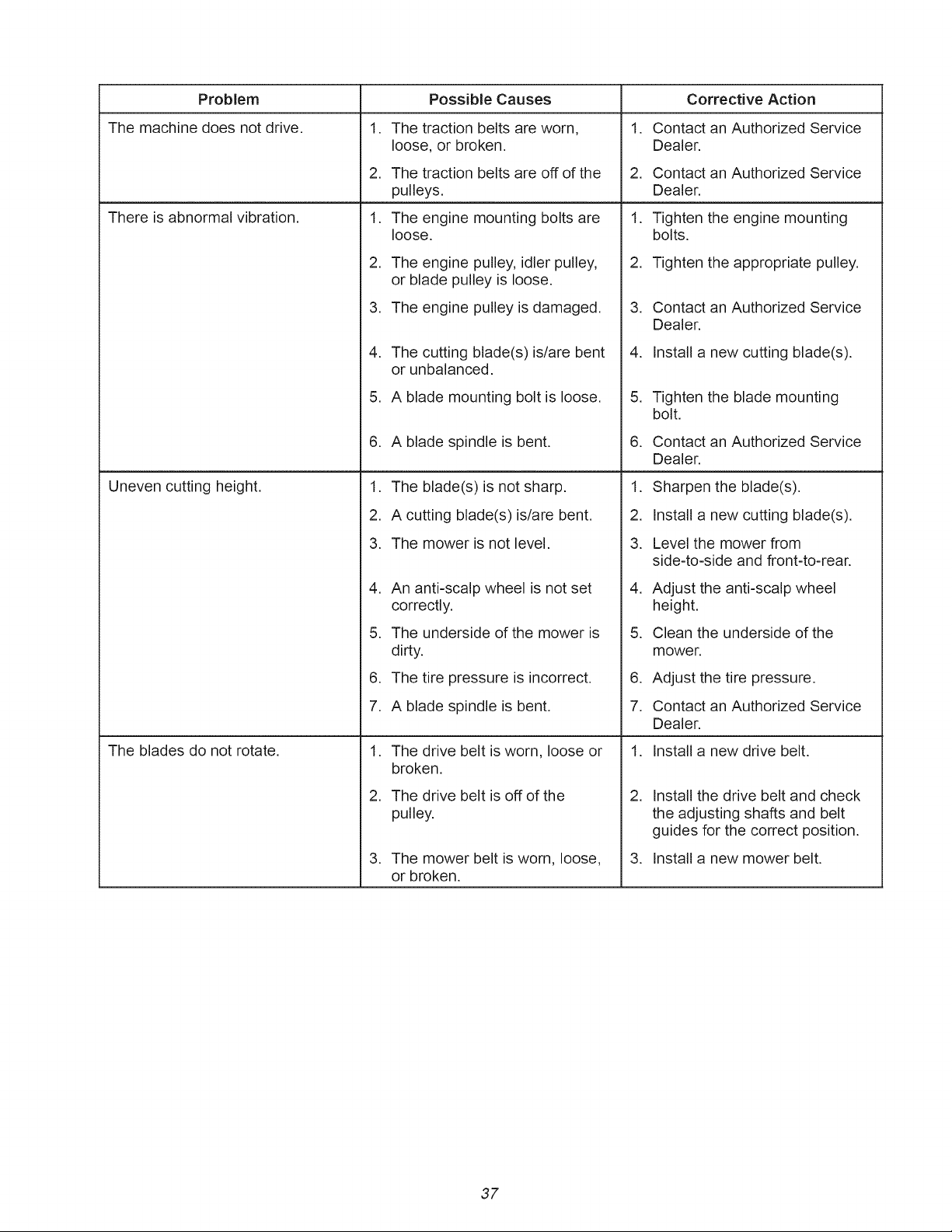
Problem Possible Causes
The machine does not drive. 1. 1.
There is abnormal vibration.
Uneven cutting height.
The blades do not rotate.
The traction belts are worn,
loose, or broken.
2. The traction belts are off of the
pulleys.
1. The engine mounting bolts are
loose.
,
The engine pulley, idler pulley,
or blade pulley is loose.
3. The engine pulley is damaged.
,
The cutting blade(s)is/are bent
or unbalanced.
5. A blade mounting bolt is loose.
6. A blade spindle is bent.
1. The blade(s) is not sharp.
2. A cutting blade(s) is/are bent.
3. The mower is not level.
4. An anti-scalp wheel is not set
correctly.
5. The underside of the mower is
dirty.
6. The tire pressure is incorrect.
7. A blade spindle is bent.
1. The drive belt is worn, loose or
broken.
2. The drive belt is off of the
pulley.
,
The mower belt is worn, loose,
or broken.
Corrective Action
Contact an Authorized Service
Dealer,
2. Contact an Authorized Service
Dealer.
1. Tighten the engine mounting
bolts.
2. Tighten the appropriate pulley.
3. Contact an Authorized Service
Dealer.
4. Install a new cutting blade(s).
5. Tighten the blade mounting
bolt.
6. Contact an Authorized Service
Dealer.
1. Sharpen the blade(s).
2. Install a new cutting blade(s).
3. Level the mower from
side-to-side and front4o-rear.
4. Adjust the anti-scalp wheel
height.
5. Clean the underside of the
mower.
6. Adjust the tire pressure.
7. Contact an Authorized Service
Dealer.
1. Install a new drive belt.
2. Install the drive belt and check
the adjusting shafts and belt
guides for the correct position.
3. Install a new mower belt.
37
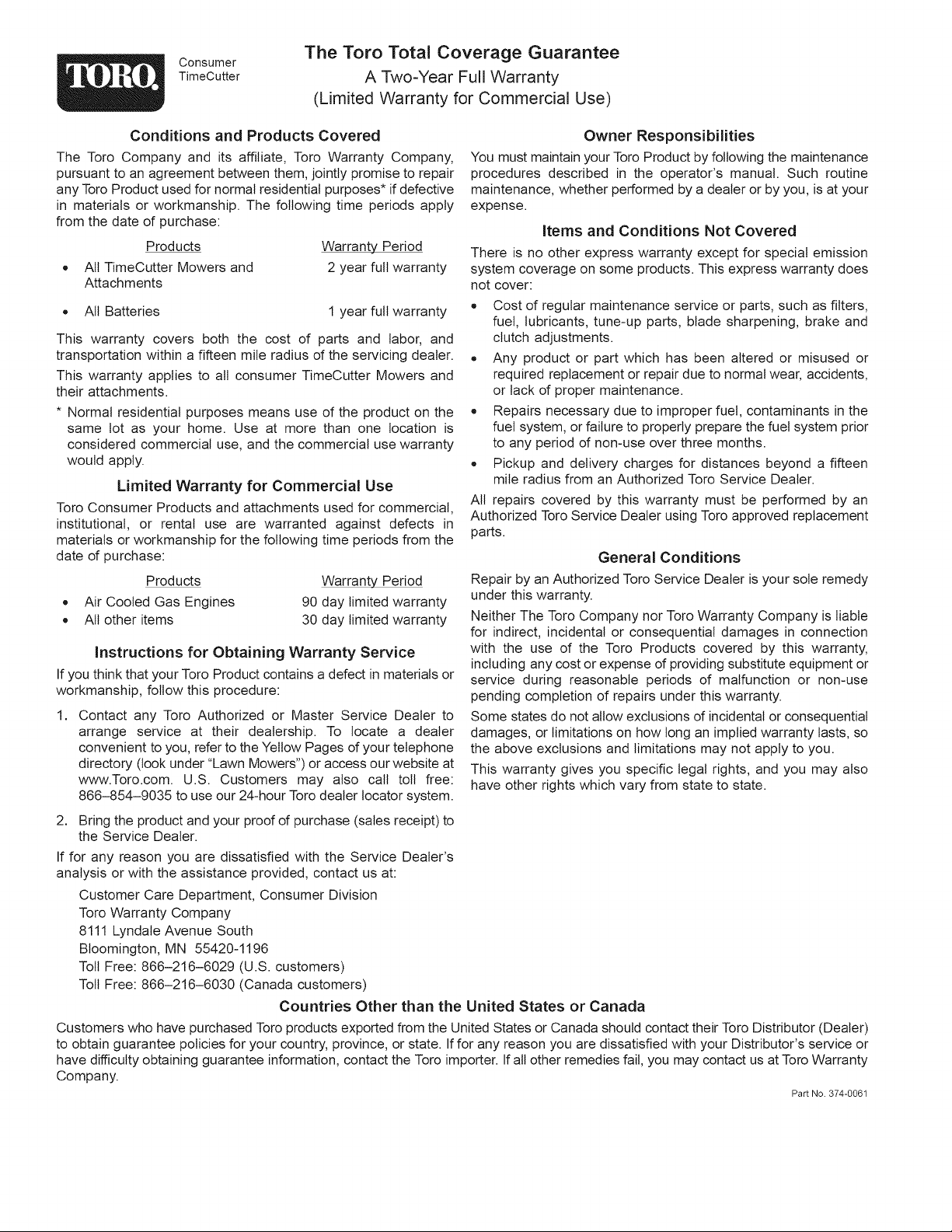
Consumer
TimeCutter
The Toro Total Coverage Guarantee
A Two-Year Full Warranty
(Limited Warranty for Commercial Use)
Conditions and Products Covered
The Toro Company and its affiliate, Toro Warranty Company,
pursuant to an agreement between them, jointly promise to repair
any Toro Product used for normal residential purposes* if defective
in materials or workmanship. The following time periods apply
from the date of purchase:
Products
, All TimeCutter Mowers and
Attachments
Warranty Period
2 year full warranty
, All Batteries 1 year full warranty
This warranty covers both the cost of parts and labor, and
transportation within a fifteen mite radius of the servicing dealer.
This warranty applies to all consumer TimeCutter Mowers and
their attachments.
* Normal residential purposes means use of the product on the
same lot as your home. Use at more than one location is
considered commercial use, and the commercial use warranty
would apply.
Limited Warranty for Commercial Use
Toro Consumer Products and attachments used for commercial,
institutional, or rental use are warranted against defects in
materials or workmanship for the following time periods from the
date of purchase:
Products
Air Cooled Gas Engines
All other items
Warranty Period
90 day limited warranty
30 day limited warranty
Instructions for Obtaining Warranty Service
If you think that your Toro Product contains a defect in materials or
workmanship, follow this procedure:
1.
Contact any Toro Authorized or Master Service Dealer to
arrange service at their dealership. To locate a dealer
convenient to you, refer to the Yellow Pages of your telephone
directory (took under "Lawn Mowers") or access our website at
www.Toro.com. U.S. Customers may also call toll free:
866-854-9035 to use our 24-hour Toro dealer locator system.
Owner Responsibilities
You must maintain your Toro Product by following the maintenance
procedures described in the operator's manual. Such routine
maintenance, whether performed by a dealer or by you, is at your
expense.
Items and Conditions Not Covered
There is no other express warranty except for special emission
system coverage on some products. This express warranty does
not cover:
, Cost of regular maintenance service or parts, such as filters,
fuel, lubricants, tune-up parts, blade sharpening, brake and
clutch adjustments.
, Any product or part which has been altered or misused or
required replacement or repair due to normal wear, accidents,
or tack d proper maintenance.
, Repairs necessary due to improper fuel, contaminants in the
fuel system, or failure to properly prepare the fuel system prior
to any period d non-use over three months.
, Pickup and delivery charges for distances beyond a fifteen
mite radius from an Authorized Toro Service Dealer.
All repairs covered by this warranty must be performed by an
Authorized Toro Service Dealer using Toro approved replacement
parts.
General Conditions
Repair by an Authorized Toro Service Dealer is your sole remedy
under this warranty.
Neither The Toro Company nor Toro Warranty Company is liable
for indirect, incidental or consequential damages in connection
with the use of the Toro Products covered by this warranty,
including any cost or expense d providing substitute equipment or
service during reasonable periods of malfunction or non-use
pending completion of repairs under this warranty.
Some states do not allow exclusions of incidental or consequential
damages, or limitations on how long an implied warranty lasts, so
the above exclusions and limitations may not apply to you.
This warranty gives you specific legal rights, and you may also
have other rights which vary from state to state.
2. Bring the product and your proof d purchase (sales receipt) to
the Service Dealer.
If for any reason you are dissatisfied with the Service Dealer's
analysis or with the assistance provided, contact us at:
Customer Care Department, Consumer Division
Toro Warranty Company
8111 Lyndale Avenue South
Bloomington, MN 55420-1196
Toll Free: 866-216-6029 (U.S. customers)
Toll Free: 866-216-6030 (Canada customers)
Countries Other than the United States or Canada
Customers who have purchased Toro products exported from the United States or Canada should contact their Toro Distributor (Dealer)
to obtain guarantee policies for your country, province, or state. If for any reason you are dissatisfied with your Distributor's service or
have difficulty obtaining guarantee information, contact the Toro importer. If all other remedies fail, you may contact us at Toro Warranty
Company.
Part No. 374-0061