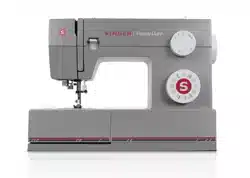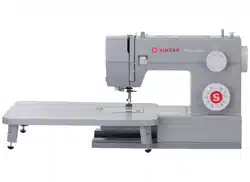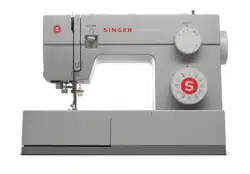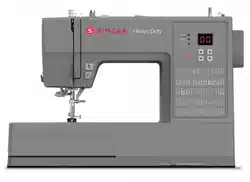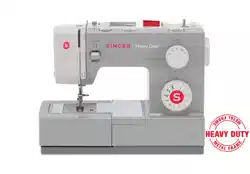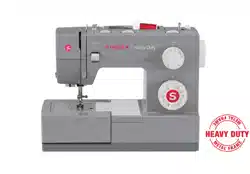
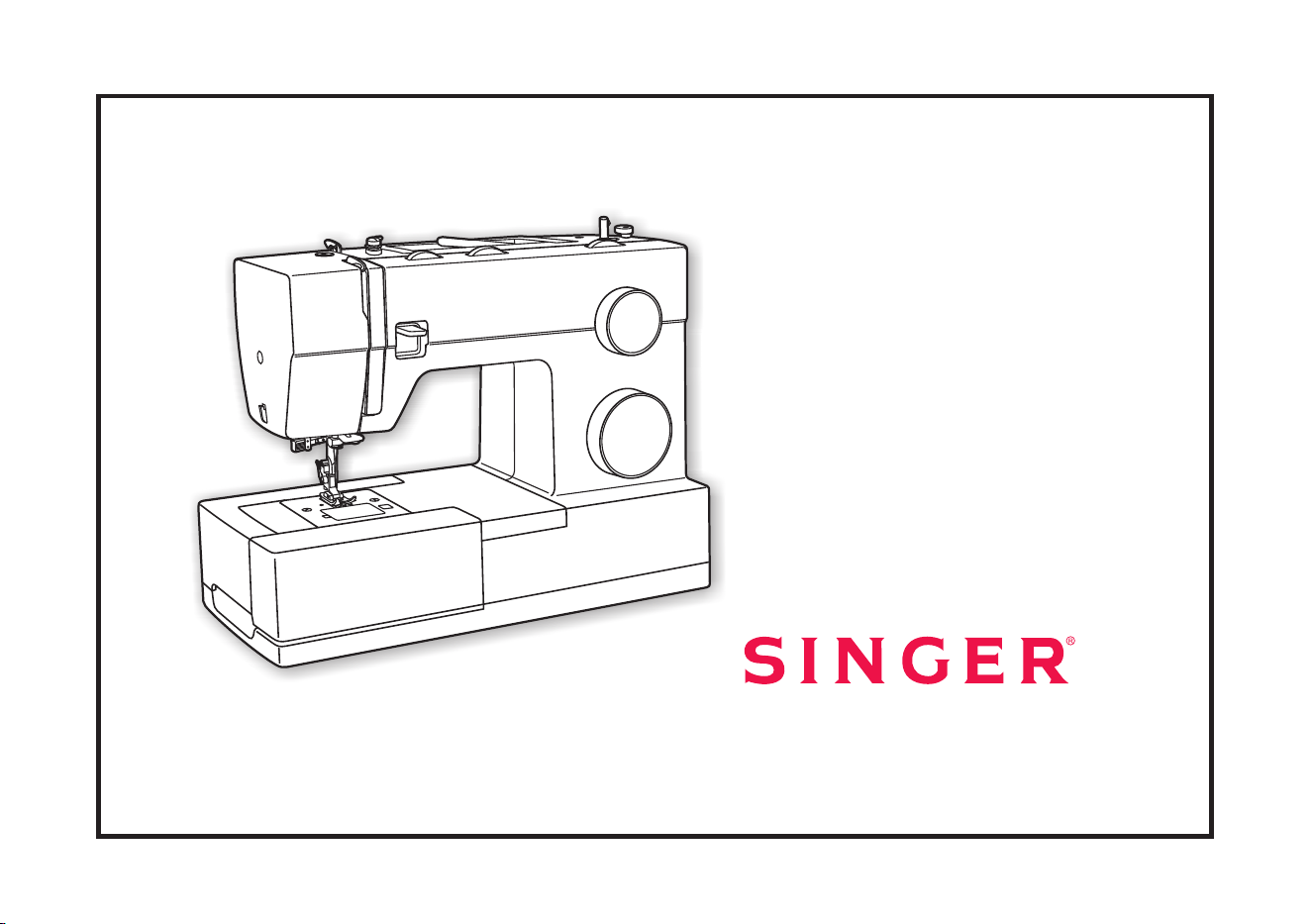
4432 Instruction Manual


l
This household sewing machine is designed to comply with IEC/EN 60335-2-28 and UL1594.
When using an electrical appliance, basic safety precautions should always be followed,
including the following:
Read all instructions before using this household sewing machine. Keep the instructions in a
suitable place close to the machine. Make sure to hand them over if the machine is given to a
third party.
- A sewing machine should never be left unattended when plugged in. Always unplug this sewing
machine from the electric outlet immediately after using and before cleaning, removing covers,
lubricating or when making any other user servicing adjustments mentioned in the instruction
manual.
- Do not allow to be used as a toy. Close attention is necessary when this sewing machine is
used by or near children.
- Use this sewing machine only for its intended use as described in this manual. Use only
attachments recommended by the manufacturer as contained in this manual.
- Never operate this sewing machine if it has a damaged cord or plug, if it is not working properly,
IMPORTANT SAFETY INSTRUCTIONS
DANGER
WARNING
-
-
To reduce the risk of electric shock :
To reduce the risk of burns, fire, electric shock, or injury to
person :
IMPORTANT SAFETY INSTRUCTIONS

if it has been dropped or damaged, or dropped into water. Return the sewing machine to the
nearest authorized dealer or service center for examination, repair, electrical or mechanical
adjustment.
- Never operate the sewing machine with any air openings blocked. Keep ventilation openings of
the sewing machine and foot control free from the accumulation of lint, dust, and loose cloth.
- Keep fingers away from all moving parts. Special care is required around the sewing machine
needle.
- Always use the proper needle plate. The wrong plate can cause the needle to break.
- Do not use bent needles.
- Do not pull or push fabric while stitching. It may deflect the needle causing it to break.
- Wear safety glasses.
- Switch the sewing machine off (" ") when making any adjustment in the needle area, such as
threading needle, changing needle, threading bobbin, or changing presser foot, etc.
- Never drop or insert any object into any opening.
- Do not use outdoors.
- Do not operate where aerosol (spray) products are being used or where oxygen is being
administrated.
- To disconnect, turn all controls to the off (" ") position, then remove plug from outlet.
- Do not unplug by pulling on cord. To unplug, grasp the plug, not the cord.
- The foot control is used to operate the machine. Avoid placing other objects on the foot control.
- Do not use the machine if it is wet.
- If the LED lamp is damaged or broken, it must be replaced by the manufacturer or its service
agent or a similarly qualified person, in order to avoid a hazard.
- If the supply cord connected with the foot control is damaged, it must be replaced by the
manufacturer or its service agent or a similarly qualified person, in order to avoid a hazard.
O
O
II

- This sewing machine is provided with double insulation. Use only identical replacement parts.
See instructions for Servicing of Double-Insulated Appliances.
This appliance can be used by children aged from 8 years and above and persons with reduced
physical, sensory or mental capabilities or lack of experience and knowledge if they have been
given supervision or instruction concerning use of the appliance in a safe way and understand
the hazards involved. Children shall not play with the appliance. Cleaning and user maintenance
shall not be made by children without supervision.
The noise level under normal operating conditions is less than 75dB(A).
The machine must only be used with foot control of type
This sewing machine is not intended for use by persons (including children) with reduced
physical, sensory or mental capabilities, or lack of experience and knowledge, unless they
have been given supervision or instruction concerning use of the sewing machine by a person
responsible for their safety. Children should be supervised to ensure that they do not play with
the sewing machine.
The noise level under normal operating conditions is less than 75dB(A).
The machine must only be used with foot control of type
SAVE THESE INSTRUCTIONS
For Europe only
For outside Europe :
:
FC-1902A (110-120V area) / FC-2902A,
FC-2902C, FC-2902D (220-240V area) manufactured by ZHEJIANG FOUNDER MOTOR
CORPORATION LTD.
FC-1902A (110-120V area) / FC-2902A,
III

FC-2902C, FC-2902D (220-240V area) manufactured by ZHEJIANG FOUNDER MOTOR
CORPORATION LTD.
SERVICING OF DOUBLE INSULATED PRODUCTS
In a double-insulated product, two systems of insulation are provided instead of grounding. No
ground means is provided on a double-insulated product, nor should a means for grounding be
added to the product. Servicing of a double-insulated product requires extreme care and
knowledge of the system and should be done only by qualified service personnel.
Replacement parts for a double-insulated product must be identical to those parts in the
product. A double-insulated product is marked with the words "DOUBLE INSULATION" or
"DOUBLE INSULATED".
IV

Congratulations
As the owner of a new Singer sewing machine, you are about to begin an exciting adventure in
creativity. From the moment you first use your machine, you will know you are sewing on one
of the easiest to use sewing machines ever made.
May we recommend that, before you start to use your sewing machine, you discover the many
features and the ease of operation by going through this instruction book, step by step, seated
at your machine.
To ensure that you are always provided with the most modern sewing capabilities, the
manufacturer reserves the right to change the appearance, design or accessories of this
sewing machine when considered necessary.
SINGER is the exclusive trademark of The Singer Company Limited S.à.r.l. or its Affiliates.
©2016 The Singer Company Limited S.à.r.l. or its Affiliates. All rights reserved.
V

List of Contents
VI
Machine Basics
Sewing
General Information
Maintenance and Troubleshooting
Principle Parts of the Machine ....................................................................................................................................................2/3
Connecting Machine to Power Source...........................................................................................................................................4
Two Step Presser Foot Lifter/ ....................................................................................................5
Accessories....................................................................................................................................................................................6
Winding the Bobbin ........................................................................................................................................................................7
Inserting the Bobbin .......................................................................................................................................................................8
Threading the Upper Thread..........................................................................................................................................................9
Raising the Bobbin Thread...........................................................................................................................................................11
How to Choose Your Pattern........................................................................................................................................................13
Sewing Straight Stitch ..................................................................................................................................................................16
Reverse Sewing/ ..........................................................................................................17
Choosing Stretch Stitch Patterns .................................................................................................................................................18
Blind Hem.....................................................................................................................................................................................19
...............................................................................................................................................................20
Sewing on Buttons .......................................................................................................................................................................22
Installing the Removable Extension Table ...................................................................................................................................23
Attaching the Presser Foot Shank ...............................................................................................................................................24
Needle/ Fabric/ Thread Chart.......................................................................................................................................................25
................................................................................................................................................................26
Inserting & Changing Needle .......................................................................................................................................................27
Troubleshooting Guide .................................................................................................................................................................28
Adjusting Presser Foot Pressure
Automatic Needle Threader ........................................................................................................................................................10
Thread Tension ............................................................................................................................................................................12
Stitch Width Dial & Stitch Length Dial ..........................................................................................................................................15
Removing the Work/ Cutting the Thread
Sew 1-step Buttonholes
Threading the Machine
Three Needle Position Dial ..........................................................................................................................................................14
Left and Right Side Balance for Buttonhole .................................................................................................................................21
How To Drop Feed Dog

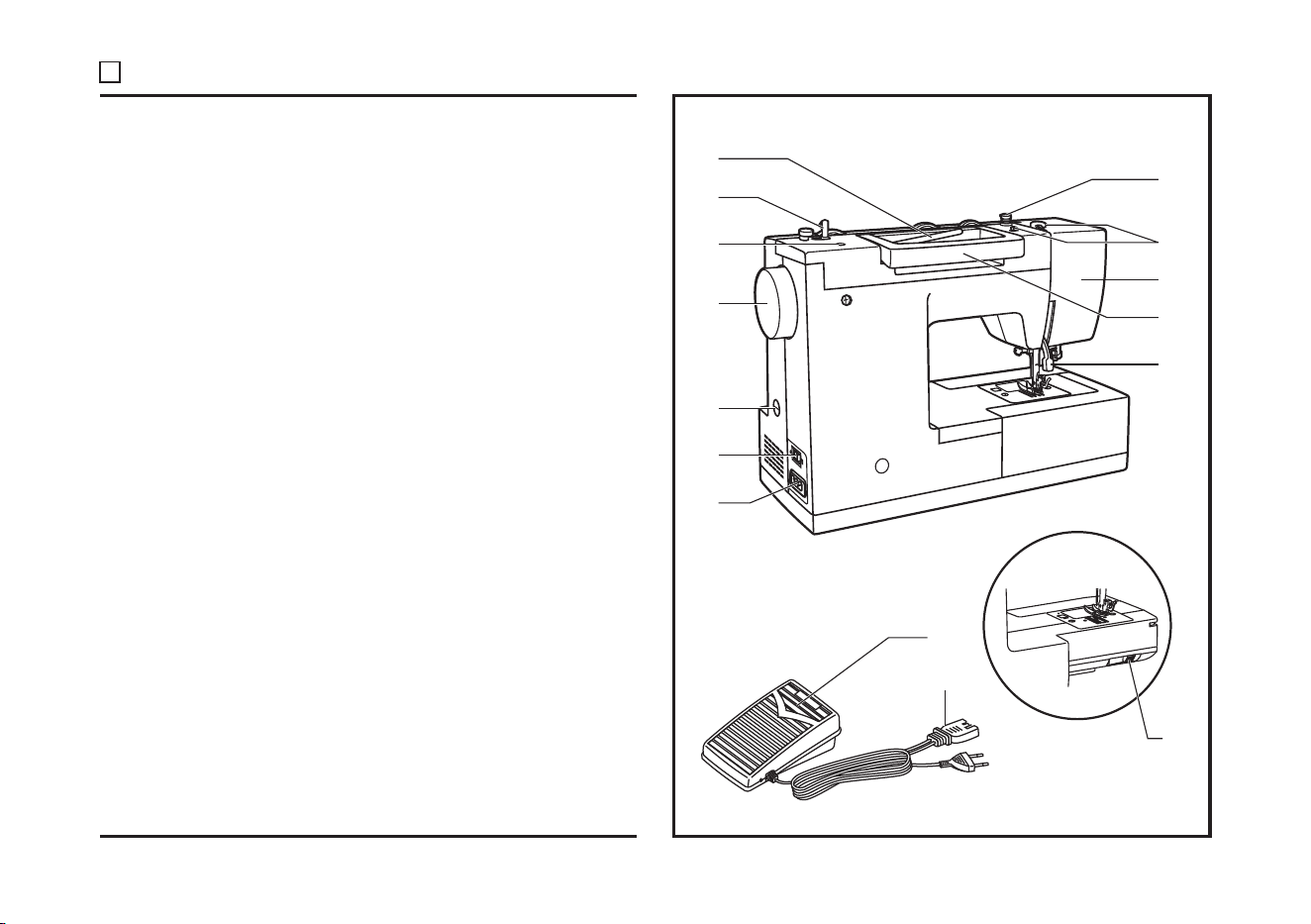
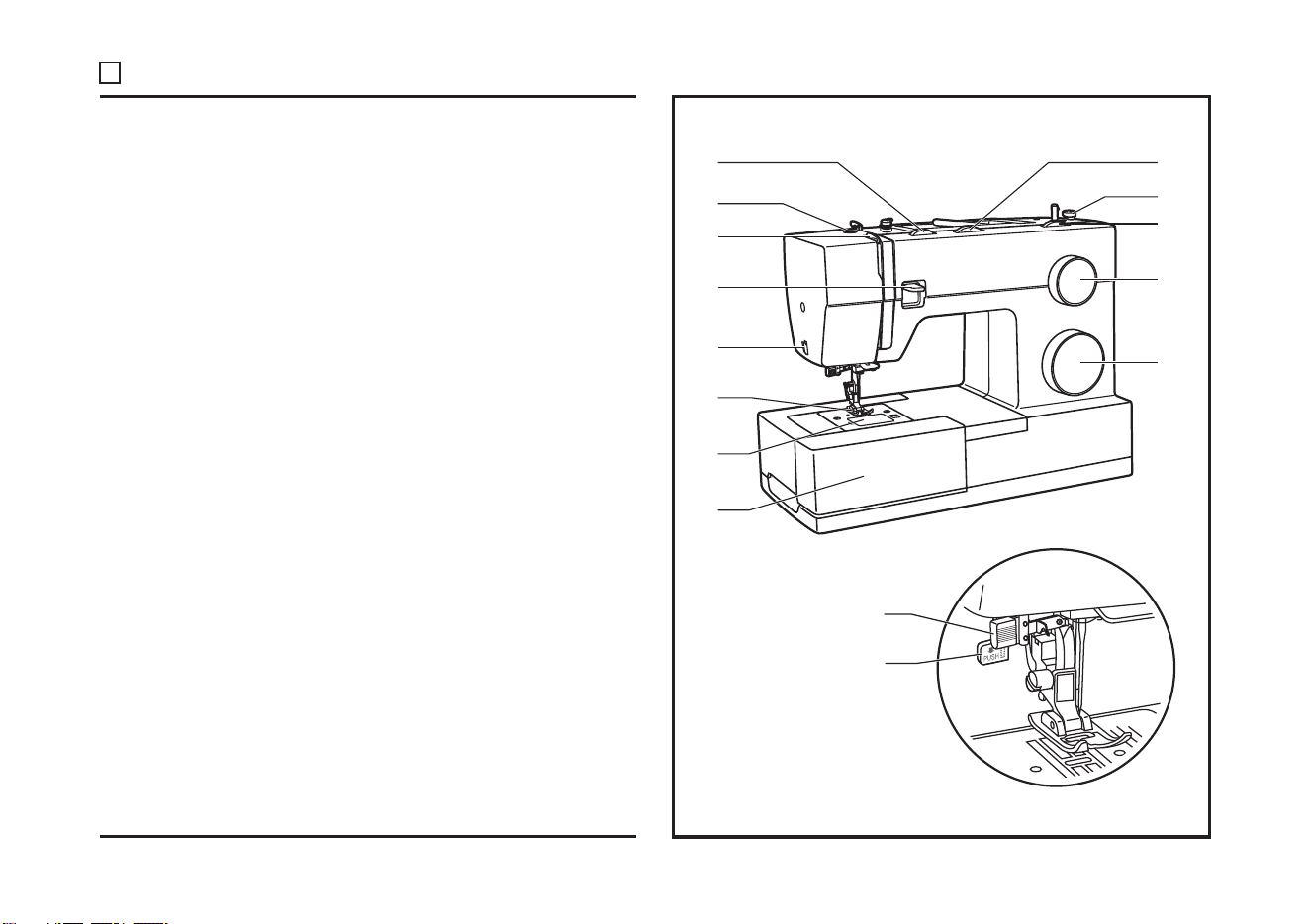
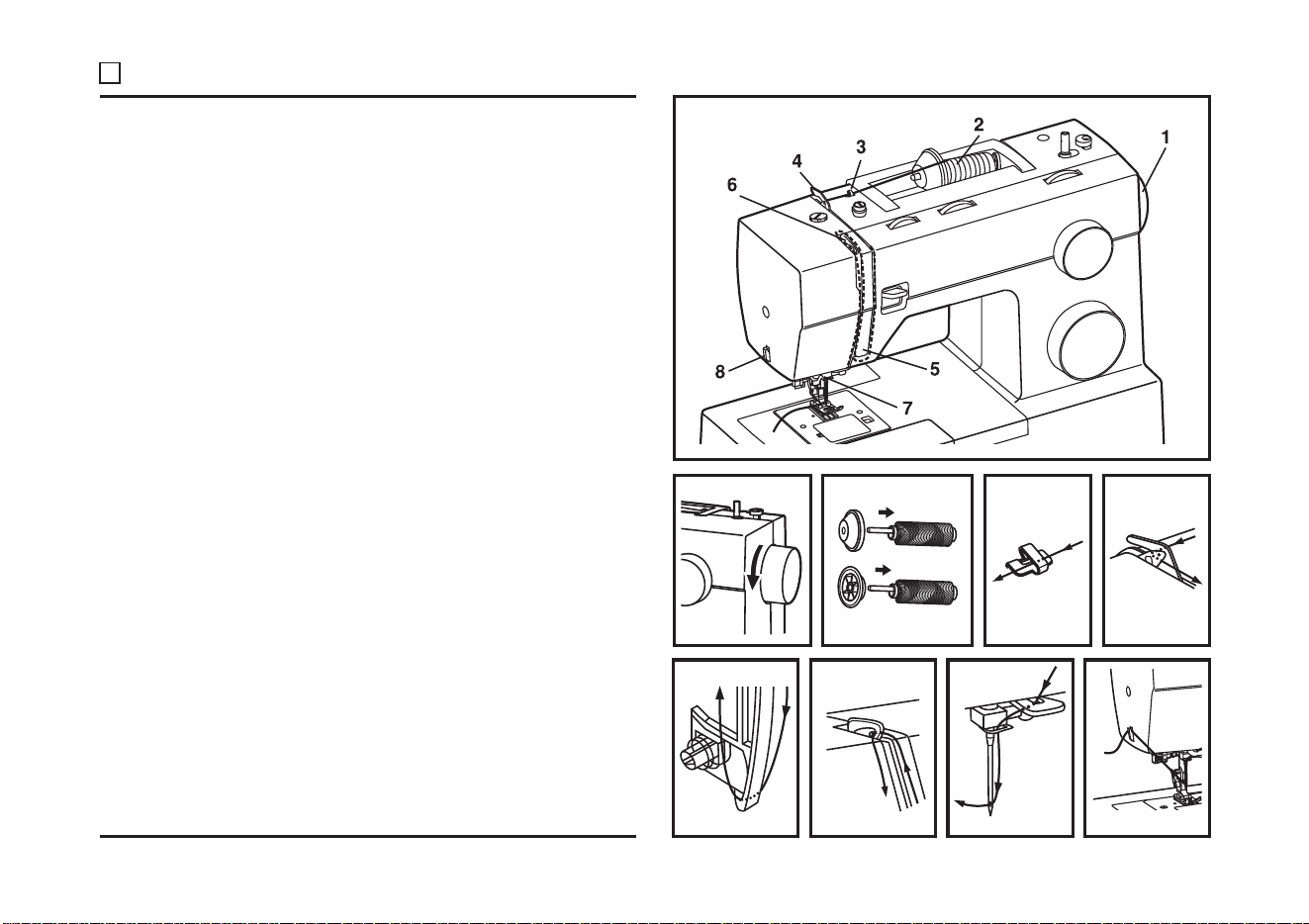
2
1. Thread tension dial
2. Presser foot pressure adjustment
3. Thread take-up lever
4. Reverse sewing lever
5. Thread cutter
6. Presser foot
7. Needle plate cover
8. Removable extension table/ accessory storage
9. Three needle position dial
10. Bobbin stopper
11. Stitch width dial
12. Stitch length dial
13. Pattern selector dial
14. Automatic threader
15. One step buttonhole lever
14
15
1
2
3
5
6
8
7
13
11
12
10
4
9
Principal Parts of the Machine
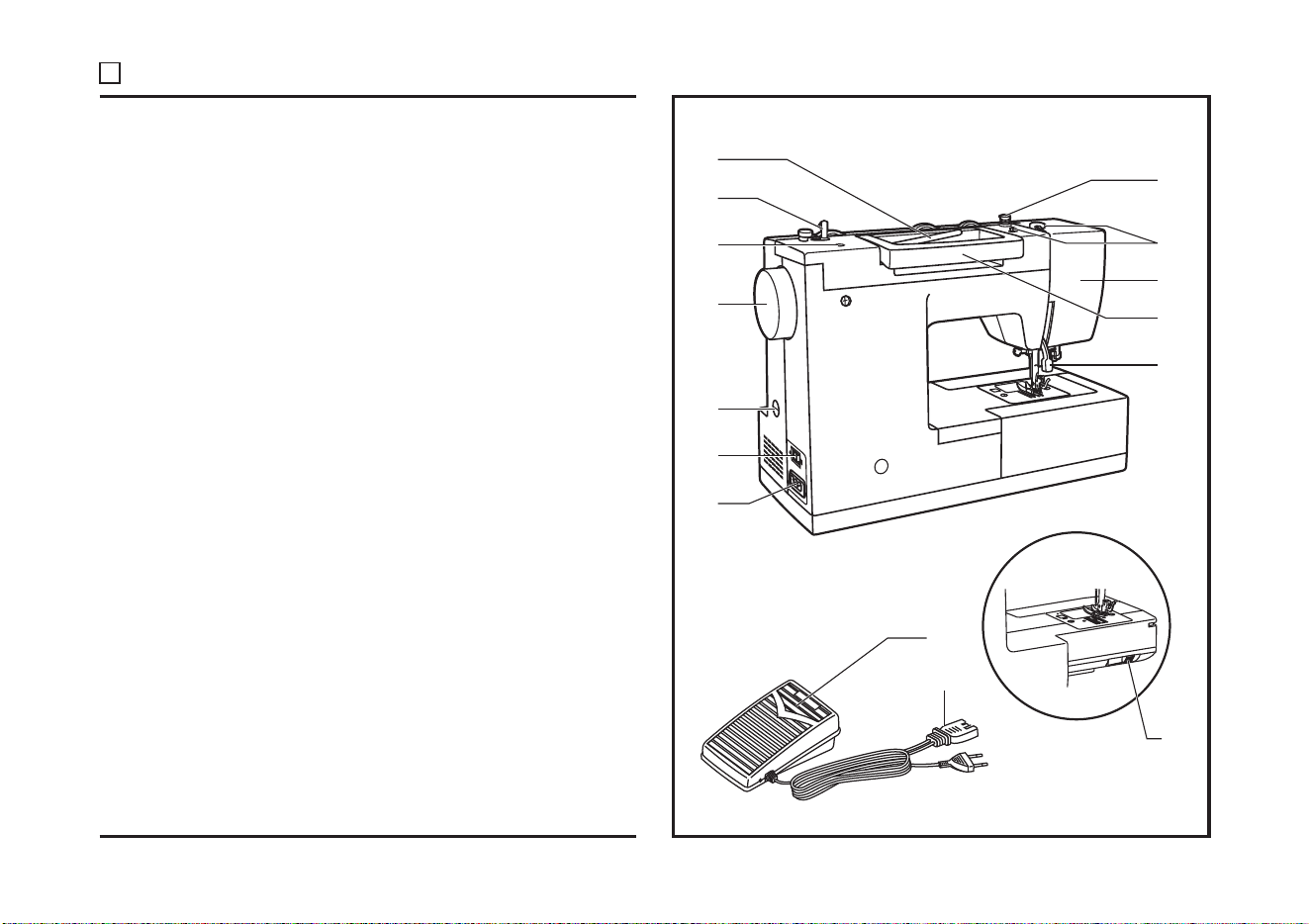
3
16. Horizontal spool pin
17. Bobbin winding spindle
18. Hole for second spool pin
19. Handwheel
20. Buttonhole stitch balance adjustment slot
21. Power and light switch
22. Main plug socket
23. Bobbin thread guide
24. Upper thread guide
25. Face plate
26. Handle
27. Presser foot lifter
28.
29. Foot speed control
30. Power cord
Drop feed control
29
30
25
26
28
23
24
27
20
21
22
16
17
19
18
Principal Parts of the Machine

2
4
1
A
Connecting Machine to Power Source
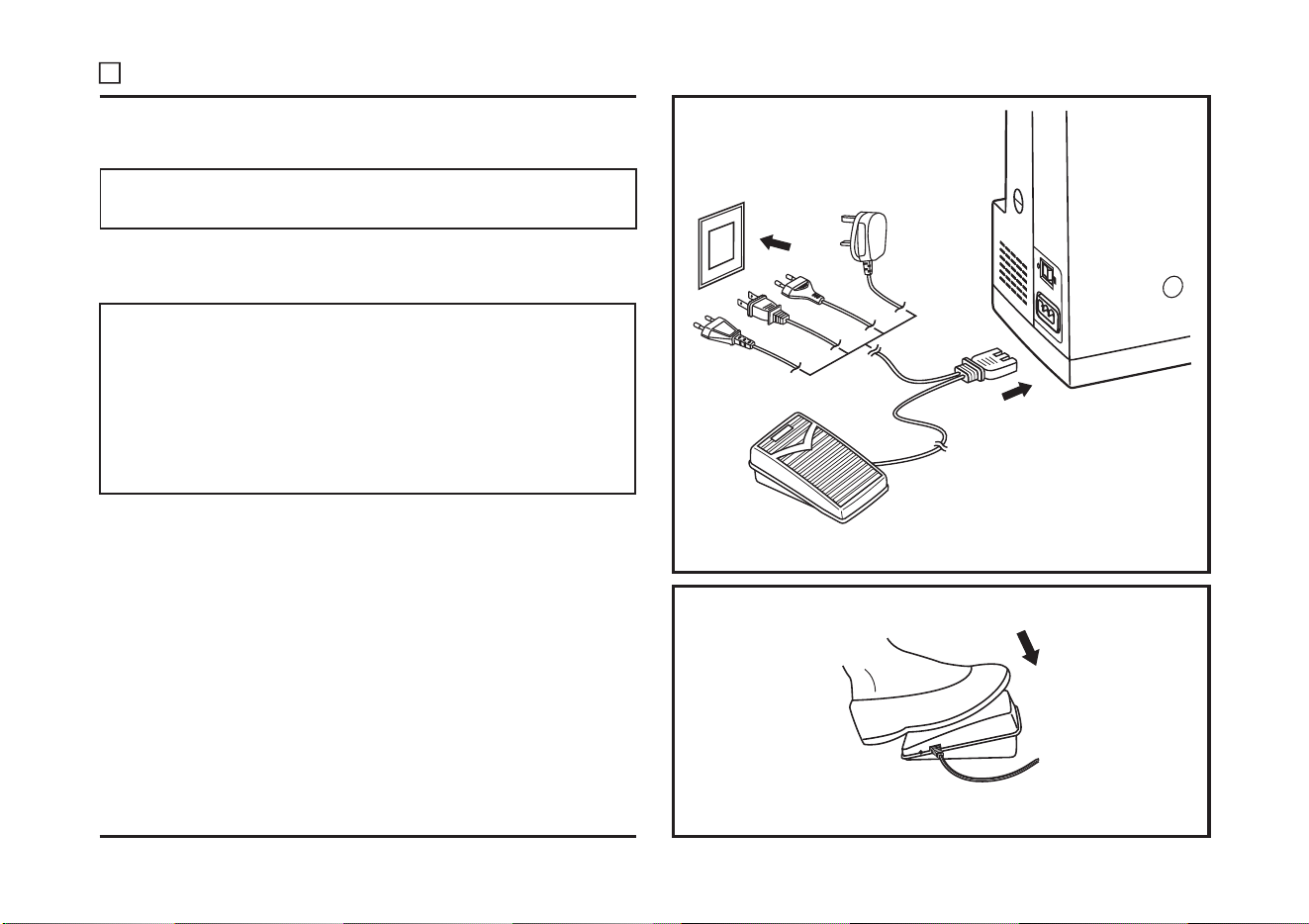
Connect the machine to a power source as illustrated. (1)
Unplug power cord when machine is not in use.
The foot control pedal regulates the sewing speed. (2)
Consult a qualified electrician if in doubt of how to connect
machine to power source.
Unplug power cord when machine is not in use.
Press main switch (A) to"l"forpower and light.
Attention:
Foot control
Attention:
Sewing light

5
When sewing several layers or thick fabrics, the presser foot
can be raised for easy positioning of the
work. (A)
to a higher position
A
The presser foot pressure of the machine has been pre-set
and requires no particular readjustment according to the type
of fabric (light-or-heavy weight).
However, if you need to adjust the presser foot pressure,
turn the presser adjusting screw with a coin.
For sewing very thin fabric, loosen the pressure by turning
the screw counter clockwise, and for heavy fabric, tighten by
turning it clockwise.
Two Step Presser Foot Lifter
Adjusting Presser Foot Pressure
006918008
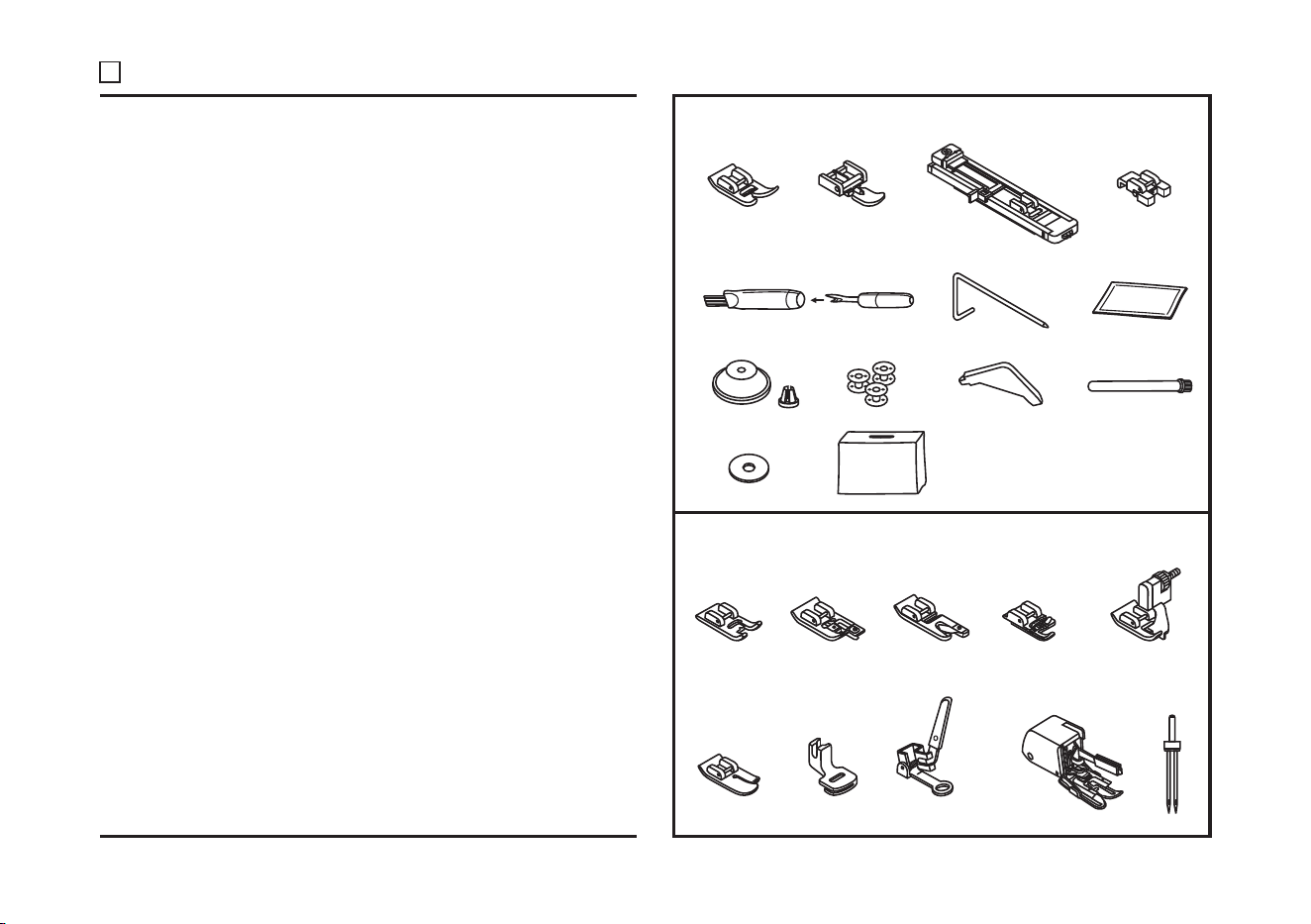
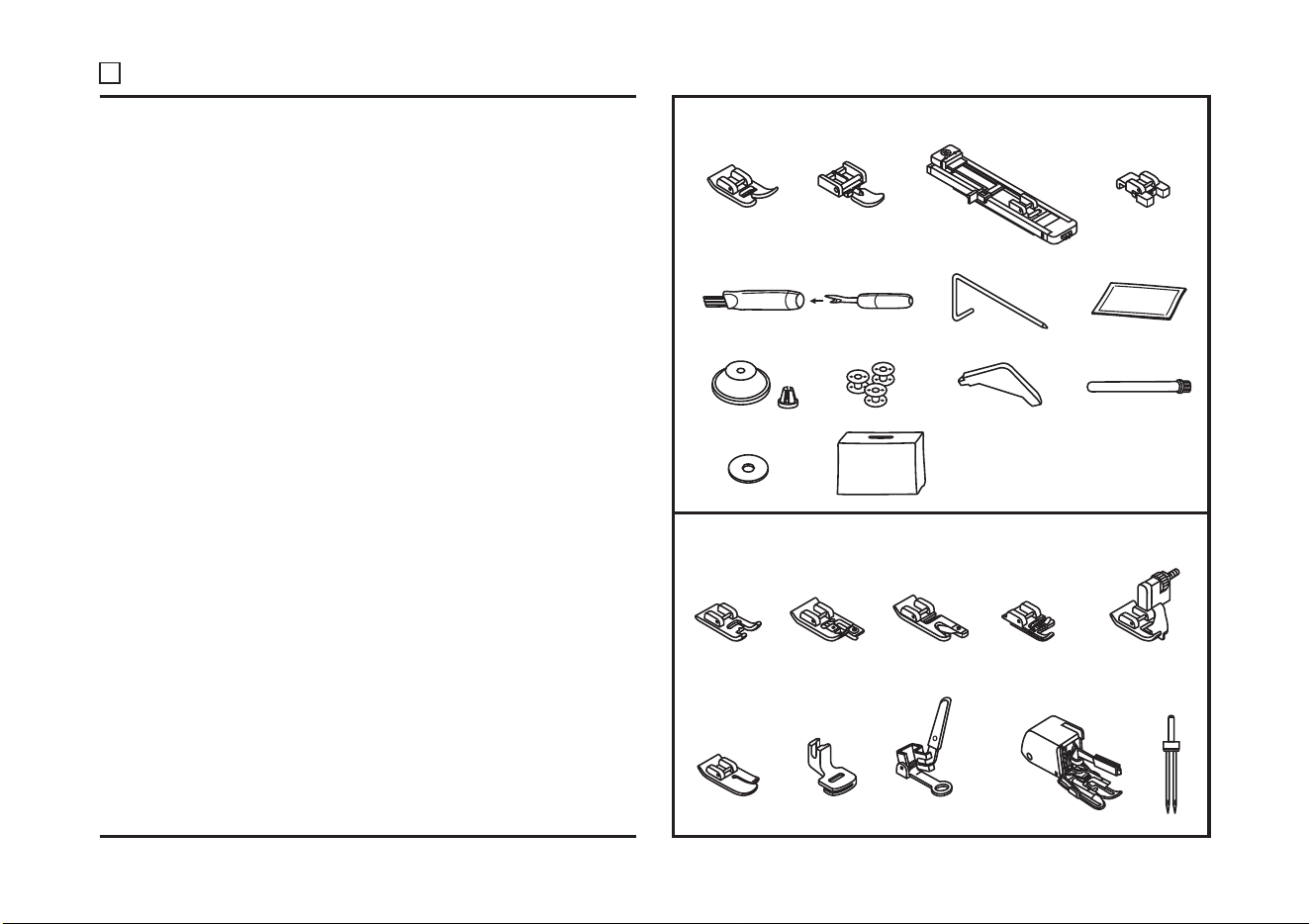
1 Standard accessories
2 Optional accessories
Standard accessories (1)
Optional accessories (2)
a. All purpose foot
b. Zipper foot
c. Buttonhole foot
d. Button sewing foot
e. Seam ripper/ brush
f. Edge/ quilting guide
g. Pack of needles
h. Spool holders
i. Bobbin (3x)
j. L-screwdriver
k. Auxiliary Spool Pin
l. Spool pin felt
m. Soft cover
(These 10 accessories are not supplied with this machine;
they are, however, available for purchase from your authorized
retailer.)
n. Satin stitch foot
o. Overcasting foot
p. Hemmer foot
q. Cording foot
r. Blind hem foot
s. Quilting/ straight stitch foot
t. Gathering foot
u. Darning/ embroidery foot
v. Even Feed foot
w. Twin needle
onpqr
s
t
u
vw
006916008 006016008006917008 0061850081
006904008006172008 006907008 006900008
006813008
m
h
g
e
f
i
j
l
k
a
b
c
d
006905008 006914008
006Q6A0150
Accessories
6

1
2
4
7
8
9
5
6
3
10
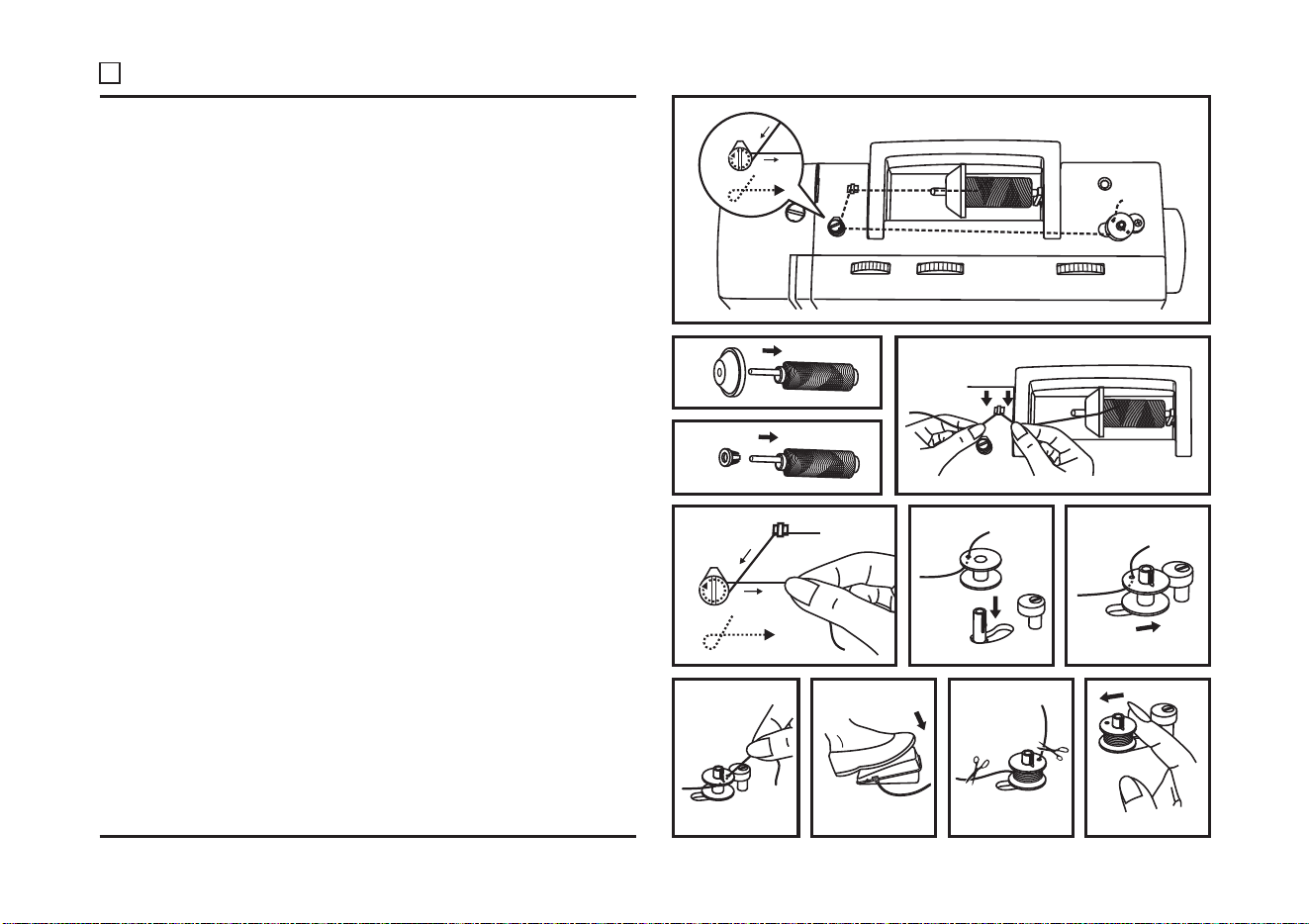
- corresponding
. (1/2)
- Snap thread into thread guide. (3)
- Wind thread clockwise around bobbin winder tension discs. (4)
- Thread bobbin as illustrated and place on spindle. (5)
- Push bobbin spindle to right. (6)
- Hold thread end. (7)
- Step on foot control pedal. (8)
- Cut thread. (9)
- Push bobbin spindle to left (10) and remove.
When the bobbin winder spindle is in "bobbin winding"
position, the machine will not sew and the .
To start sewing, push the bobbin winder spindle to the left
(sewing position).
Please Note:
Place thread and spool holder on to spool
pin
handwheel turn
Winding the Bobbin
7
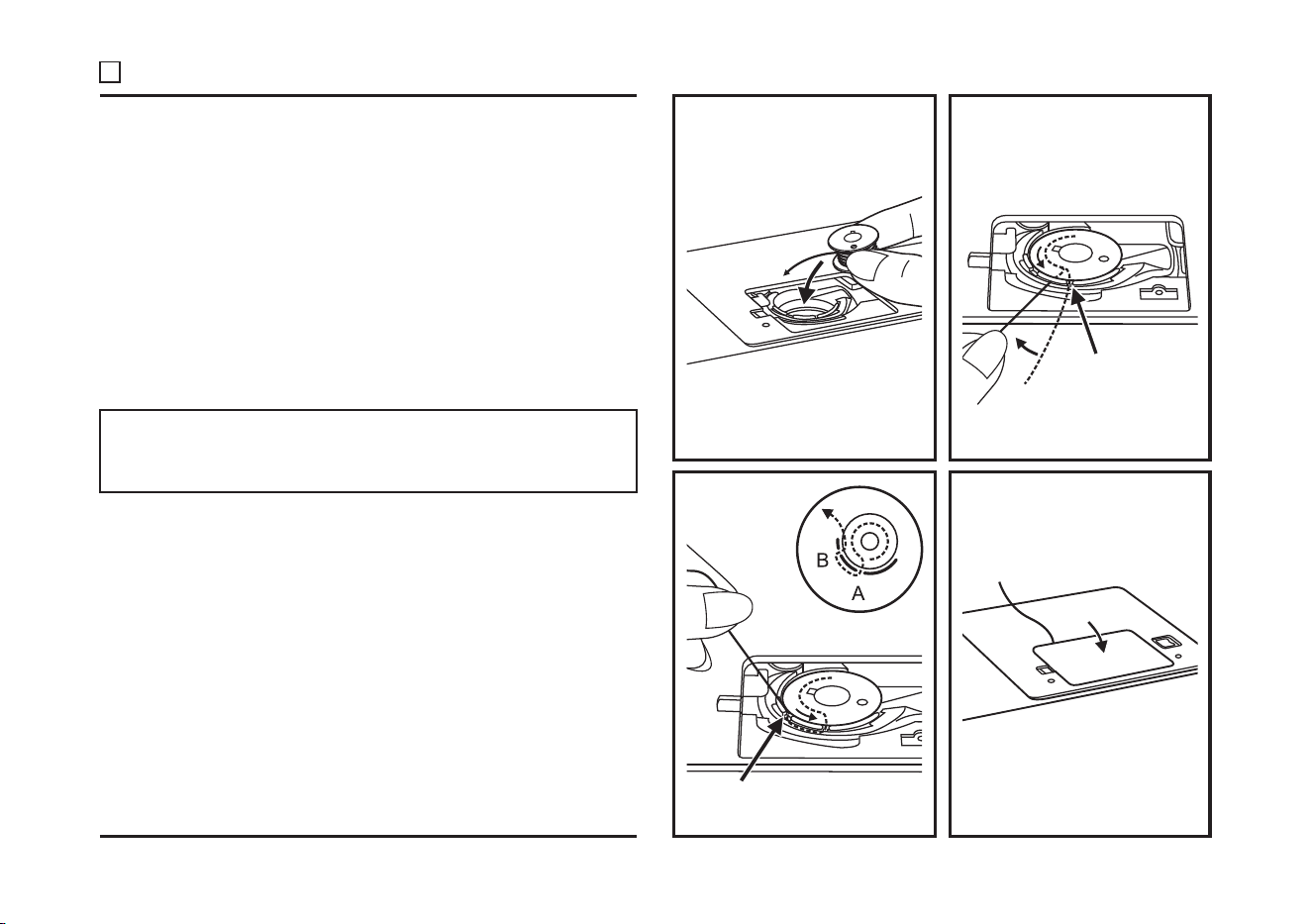
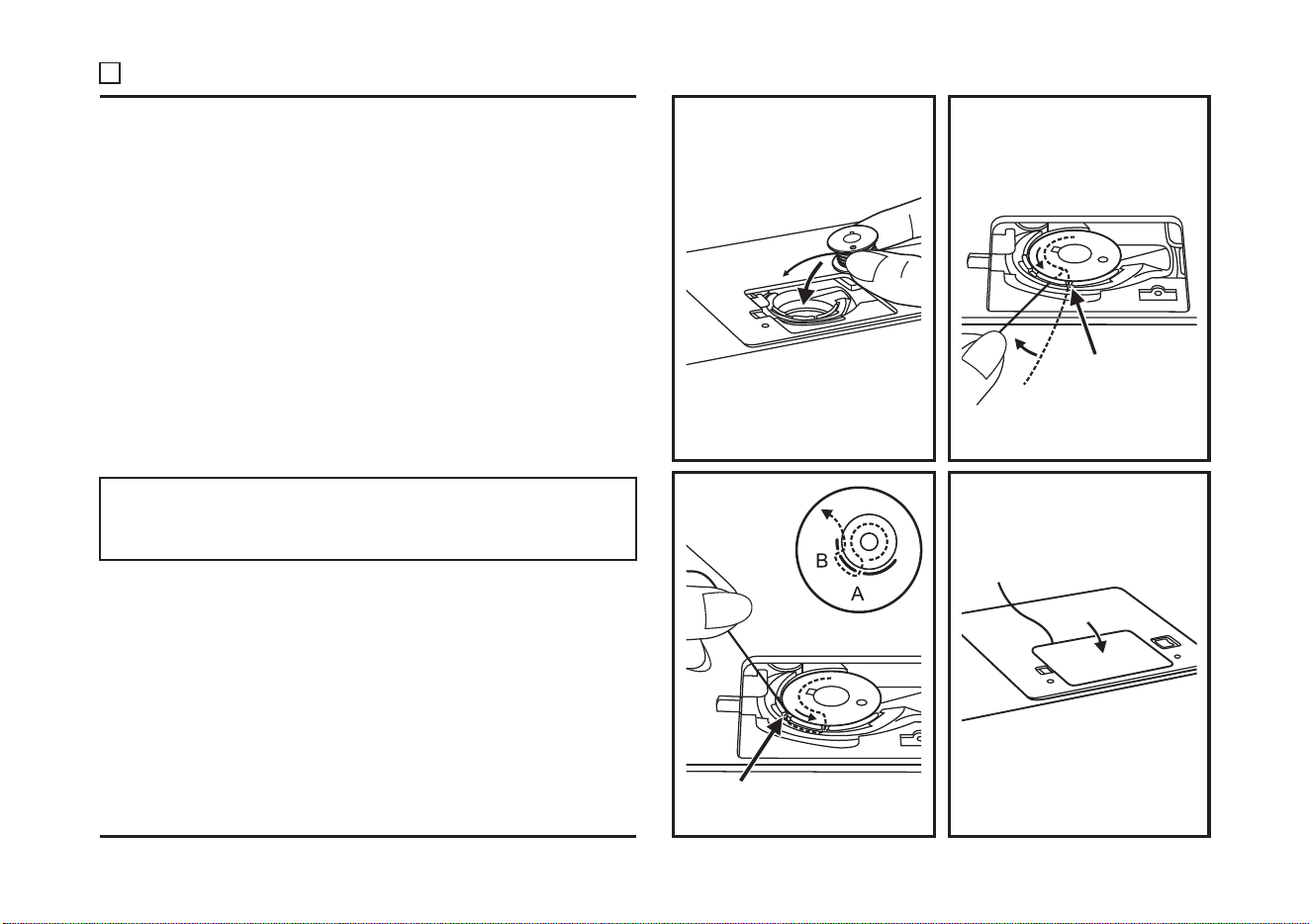
When inserting or removing the bobbin, the needle must
be fully raised.
Attention:
1. Insert the bobbin in the bobbin case with the thread
running counterclockwise direction (arrow).
2. Pull the thread through the slit (A).
3. Draw the thread clockwise until it slips into the notch (B).
4. Pull out about 15 cm (6 inches) of thread and attach the
bobbin cover plate. (C)
Turn power switch to off ("O") before inserting or
removing the bobbin.
A
B
C
1
3
4
2
Inserting the Bobbin
8

2
1
6
8
7
5
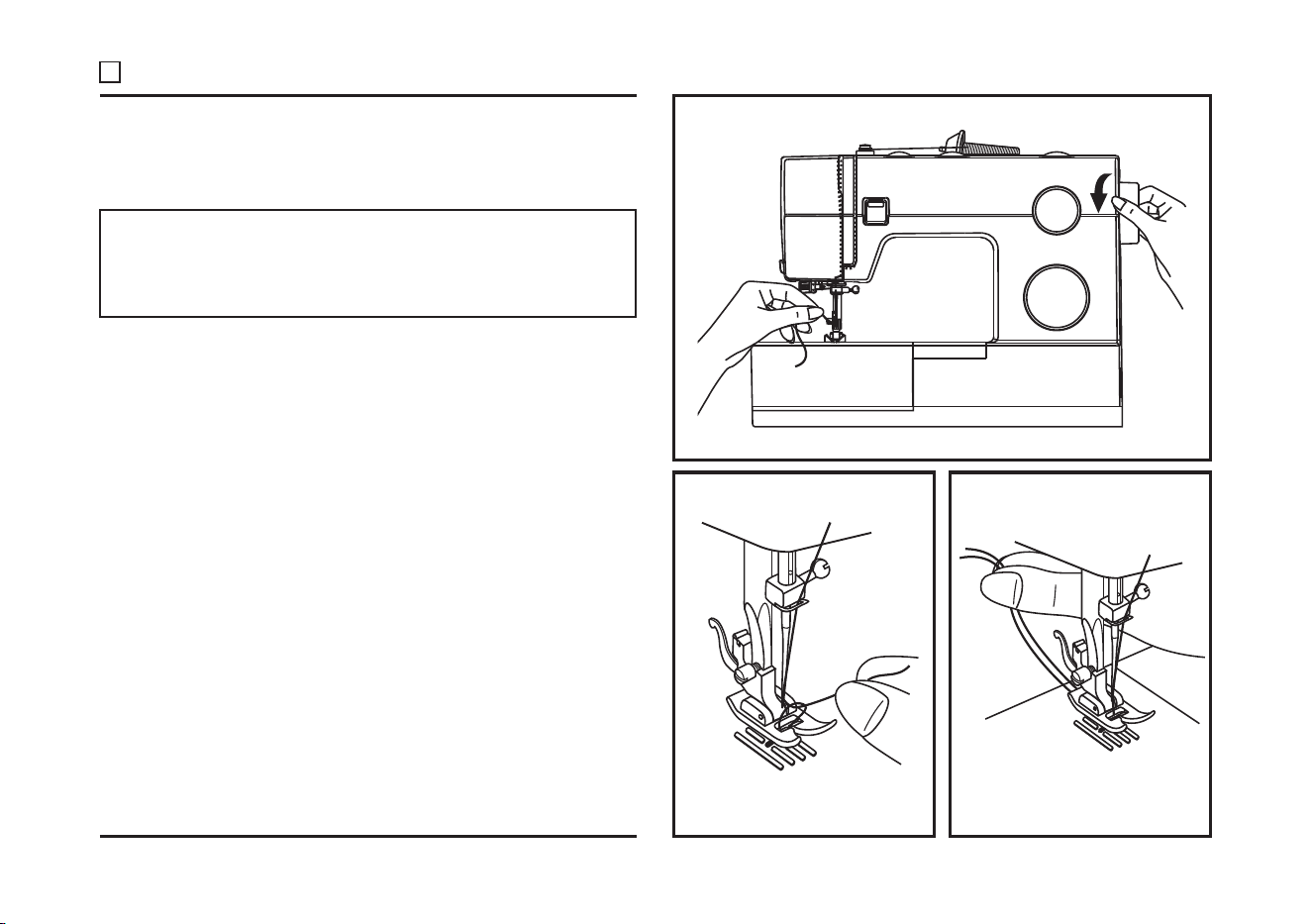
This is a simple operation but it is important to carry out correctly
as by not doing so .
- Start by raising the needle to its highest point (1), and
continue turning the handwheel counterclockwise until the
needle just slightly begins to descend. Raise the presser
foot to release the tension discs.
For safety, it is strongly suggested you turn off the
power before threading.
- Lift up the spool pin. Place the spool of thread on the
holder with the thread coming off the spool as shown. For
small thread spools, place small side of spool holder next
to spool. (2)
- Draw thread from spool through the upper thread guide (3)
and pulling thread through pre-tension spring as illustrated.
(4)
- Thread tension module by leading thread down right
channel and up left channel. (5) During this process it is
helpful to hold the thread between the spool and thread
guide.
- At the top of this movement pass thread from right to left
through the slotted eye of the take-up lever and then
downwards again. (6)
-
several sewing problems could result
Note:
Now pass the thread behind the horizontal thread guide,
and then behind the thin wire needle clamp guide (7) and
then down to the needle which should be threaded from
front to back.
- Pull about 6-8 inches of thread to the rear beyond the needle
eye. Trim thread to length with built in thread cutter. (8)
3 4
Threading the Upper Thread
9

- Raise the needle to its highest position.
- Press lever (A) down as far as it will go.
- The threader automatically swings to the threading position
(B).
- Pass thread around thread guide (C).
- Pass the thread in front of the needle around the hook (D)
from bottom to top.
- Release lever (A).
- Pull the thread through the needle eye.
Turn power switch to off ("O")!
Attention:
1
2
A
B
C
D
A
10
Automatic Needle Threader
1
2
3
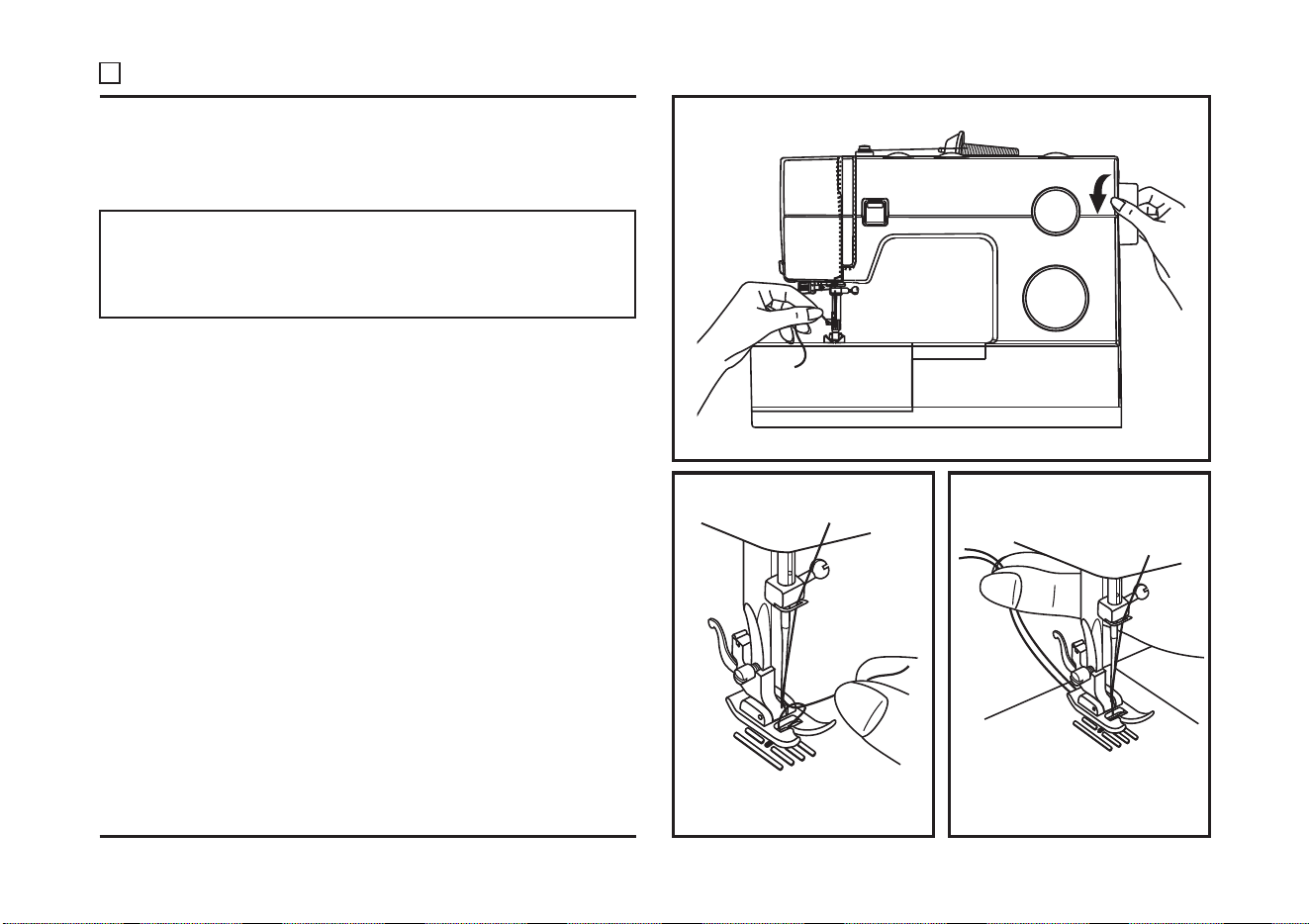
Hold the upper thread with the left hand. Turn the handwheel
(1) towards you (counterclockwise) lowering, then raising
needle.
If it is difficult to raise the bobbin thread, check to make sure
the thread is not trapped by the hinged cover or the
Removable Extension Table.
Gently pull on the upper thread to bring the bobbin thread up
through the needle plate hole. (2)
Lay both threads to the back under the presser foot. (3)
Note:
11
Raising the Bobbin Thread

12
BA
C
D
1
Upper thread tension
Lower thread tension
Please note:
Basic thread tension setting: "4". (1)
To increase the tension, turn the dial to the next number up.
To reduce the tension, turn the dial to the next number down.
A. Normal thread tension for straight stitch sewing.
B. Thread tension too loose for straight stitch sewing. Turn
dial to higher number.
C. Thread tension too tight for straight stitch sewing. Turn
dial to lower number.
D. Normal thread tension for zig zag and decorative sewing.
Correct thread tension is when a small amount of the
upper thread appears on the bottom side of fabric.
-.
- There is no single tension setting appropriate for all stitch
functions, thread or fabric.
- A balanced tension (identical stitches both top and bottom) is
usually only desirable for straight stitch construction sewing.
- 90% of all sewing will be between "3" and "5".
- For zig zag and decorative sewing stitch functions, thread
tension should generally be less than for straight stitch
sewing.
- For all decorative sewing you will always obtain a nicer
stitch and less fabric puckering when the upper thread
appears on the bottom side of your fabric.
The bobbin tension has been set correctly at the factory, so
you do not need to adjust it.
Proper tension setting is important for strong seams
Thread Tension

13
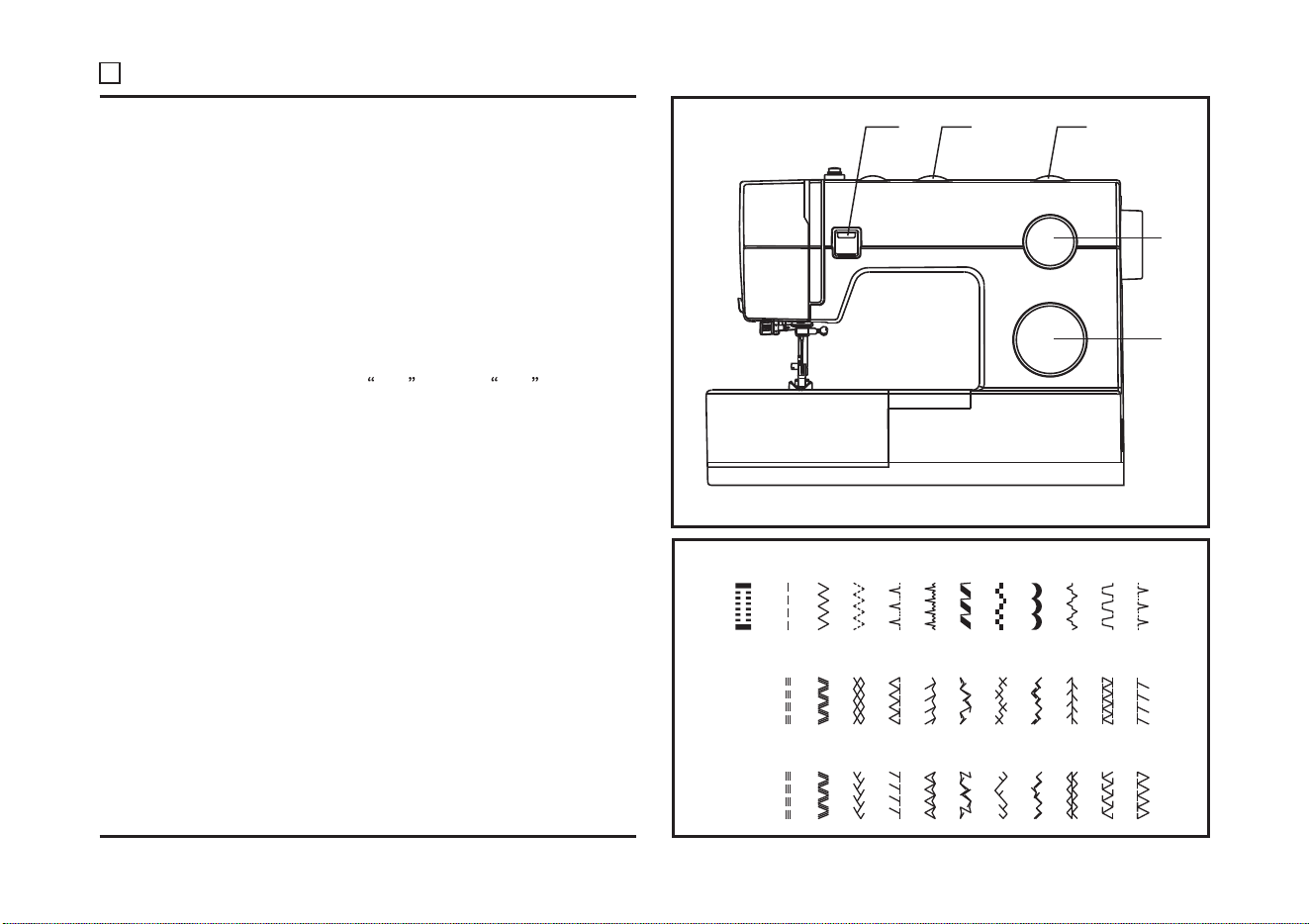
How to Choose Your Pattern
The diagram on this page display the stitch patterns available
on the machine.
Stitches in the top of the diagram are indicated on the
Pattern Selector Dial in gray. To select the patterns indicated
with the gray color, turn the Pattern Selector Dial. (e) Use the
Stitch Length Dial (d) to adjust the stitch length as desired for
the project. Use the Stitch Width Dial (c) to adjust the width
of the stitch as desired.
To obtain the other patterns, turn the stitch length dial to
"S1" or "S2", select the pattern desired with pattern selector
dial, and adjust the stitch width with the stitch width dial.
The Pattern Selector Dial may be turned in either direction.
a. Reverse Sewing Lever
b. Three Needle Position Dial
c. Stitch Width Dial
d. Stitch Length Dial
e. Pattern Selector Dial
c
e
d
a b
BAIKDC
J
EGFH
S1
BAIKD
C
JE
G
FH
S2
BAIKD
C
JE
G
FH
14
The needle position can be altered with the "Three needle
position dial". For normal work, the needle position is middle.
For edge stitching or sewing parallel lines of top stitch, select
needle position left or right. For twin needle stitching, needle
position is middle.
a. Straight
b. Zig-zag
L. Left Needle Position
M. Middle Needle Position
R. Right Needle Position
L M R
a
b
Three Needle Position Dial
15
1
2
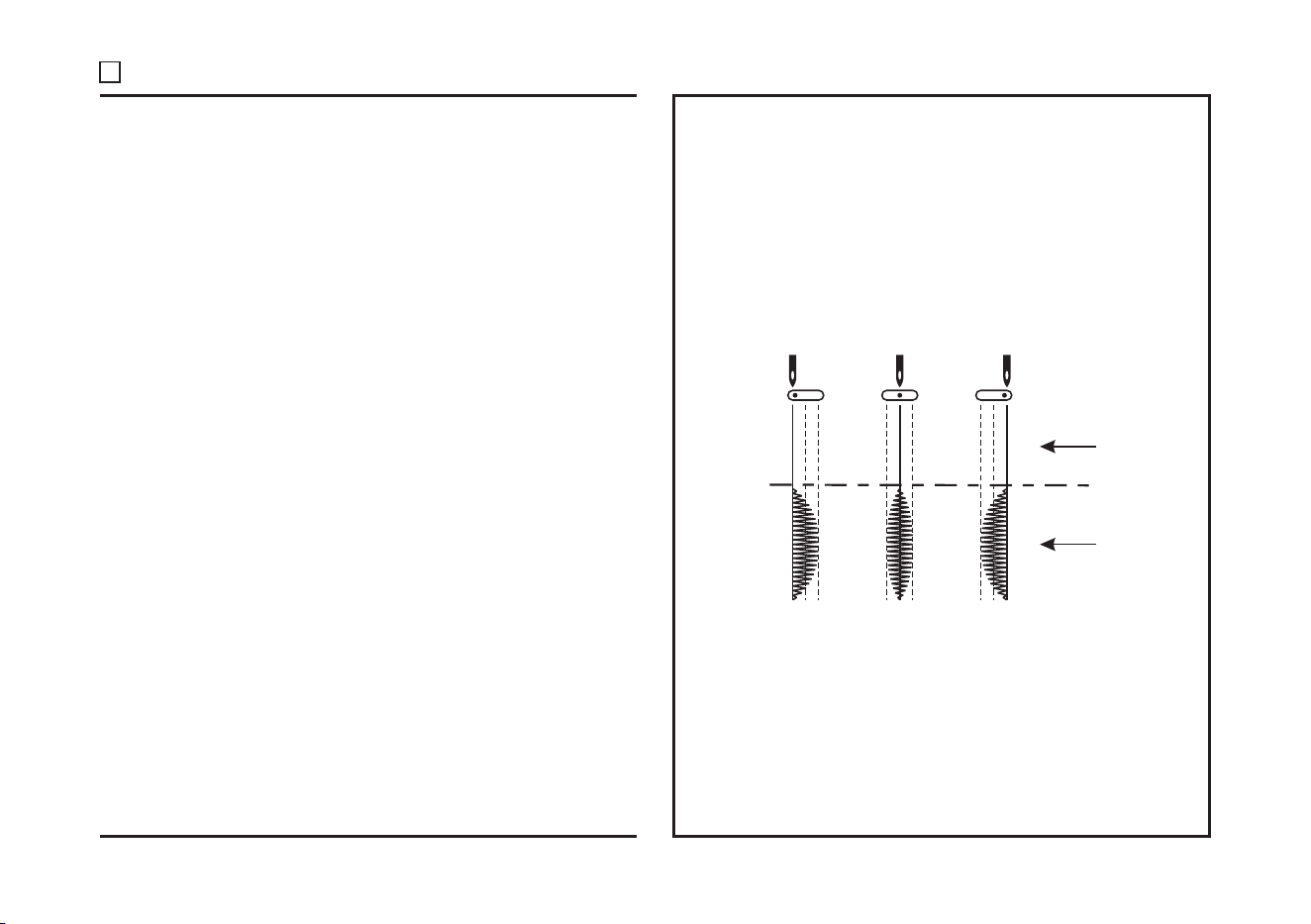
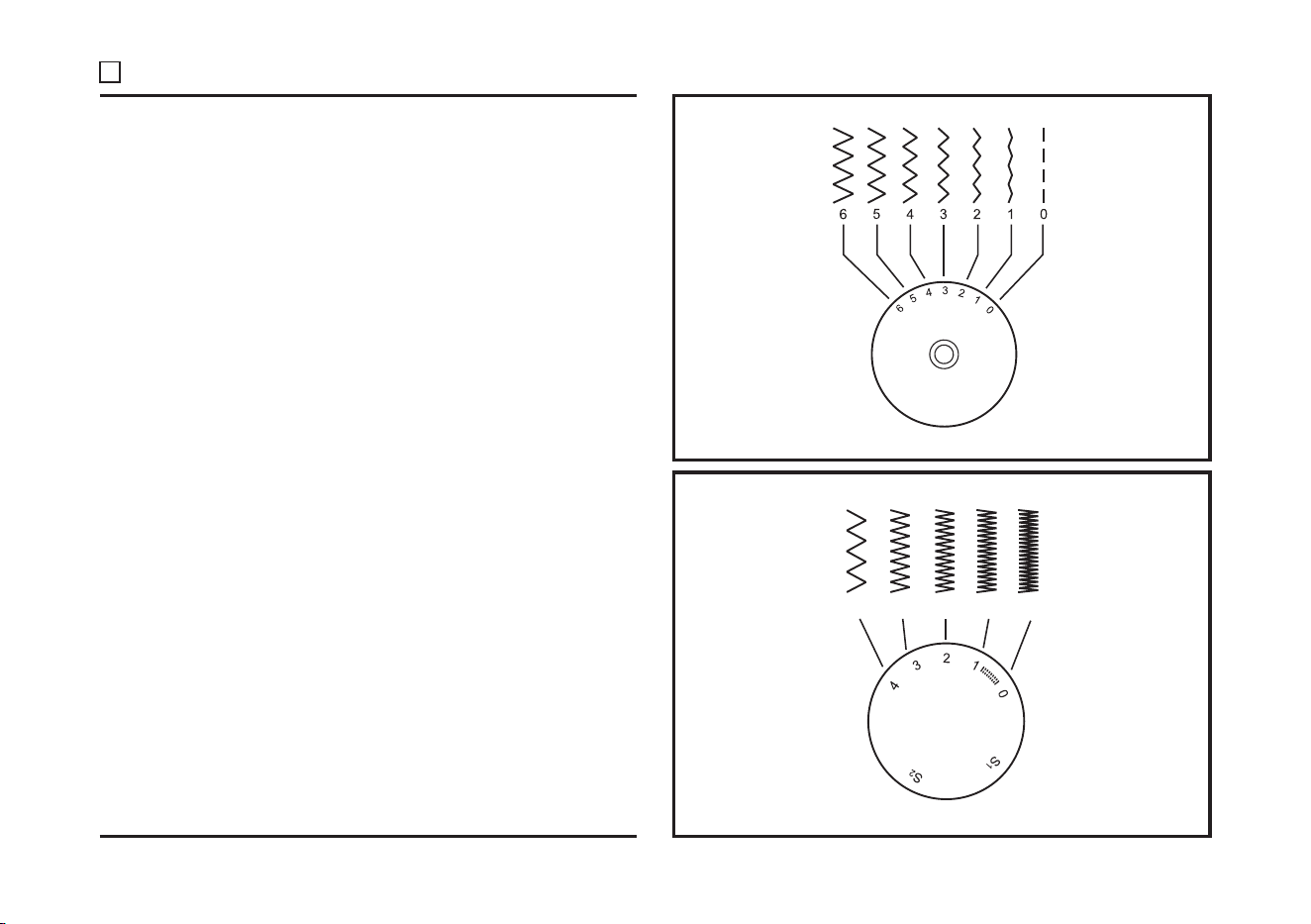
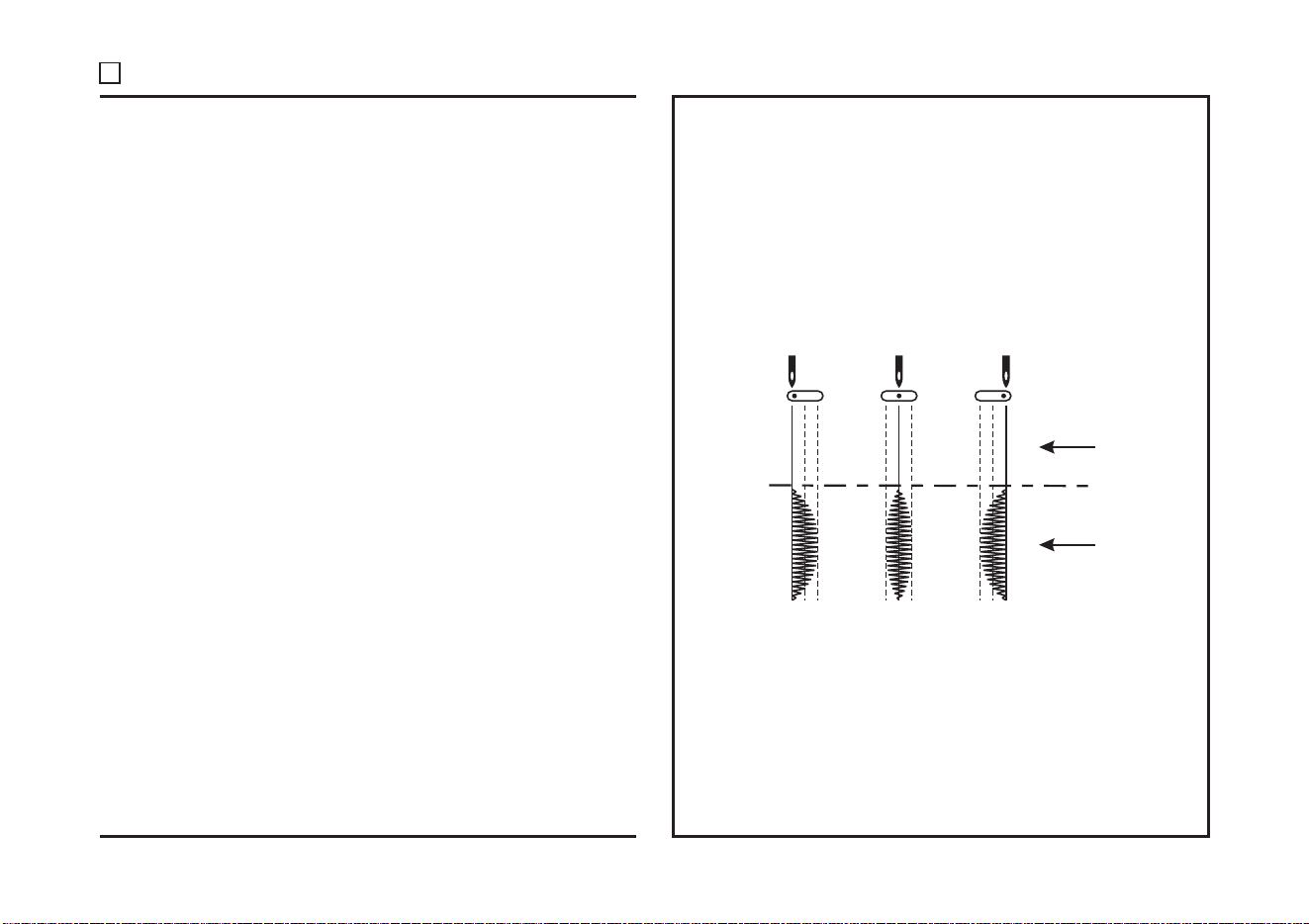
Function of stitch width dial
Function of stitch length dial while zig-zag stitching
Function of stitch length dial for when straight stitching
The maximum zigzag stitch width for zigzag stitching is 6mm;
however, the width can be reduced on any patterns. The
width increases as you move zigzag dial from "0" - "6". (1)
Set the Pattern Selector Dial to zig-zag.
The density of zig-zag stitches increase as the setting of stitch
length dial approaches "0".
.(2)
Dense zig-zag stitches are called satin stitches. (2)
For straight stitch sewing, turn the Pattern Selector Dial to
the straight stitch setting. Turn the Stitch Length Dial, and the
length of the individual stitches will decrease as the dial
approached "0". The length of the individual stitches will
increase as the dial approaches "4". Generally speaking, use
a longer stitch length when sewing heavier weight fabrics or
when using a thicker needle or thread. Use a shorter stitch
length when sewing lighter weight fabrics or when using a
finer needle or thread.
Standard zigzag stitches are usually achieved at "3" or below
Stitch Width Dial & Stitch Length Dial
4
3
2
1
0.5

16
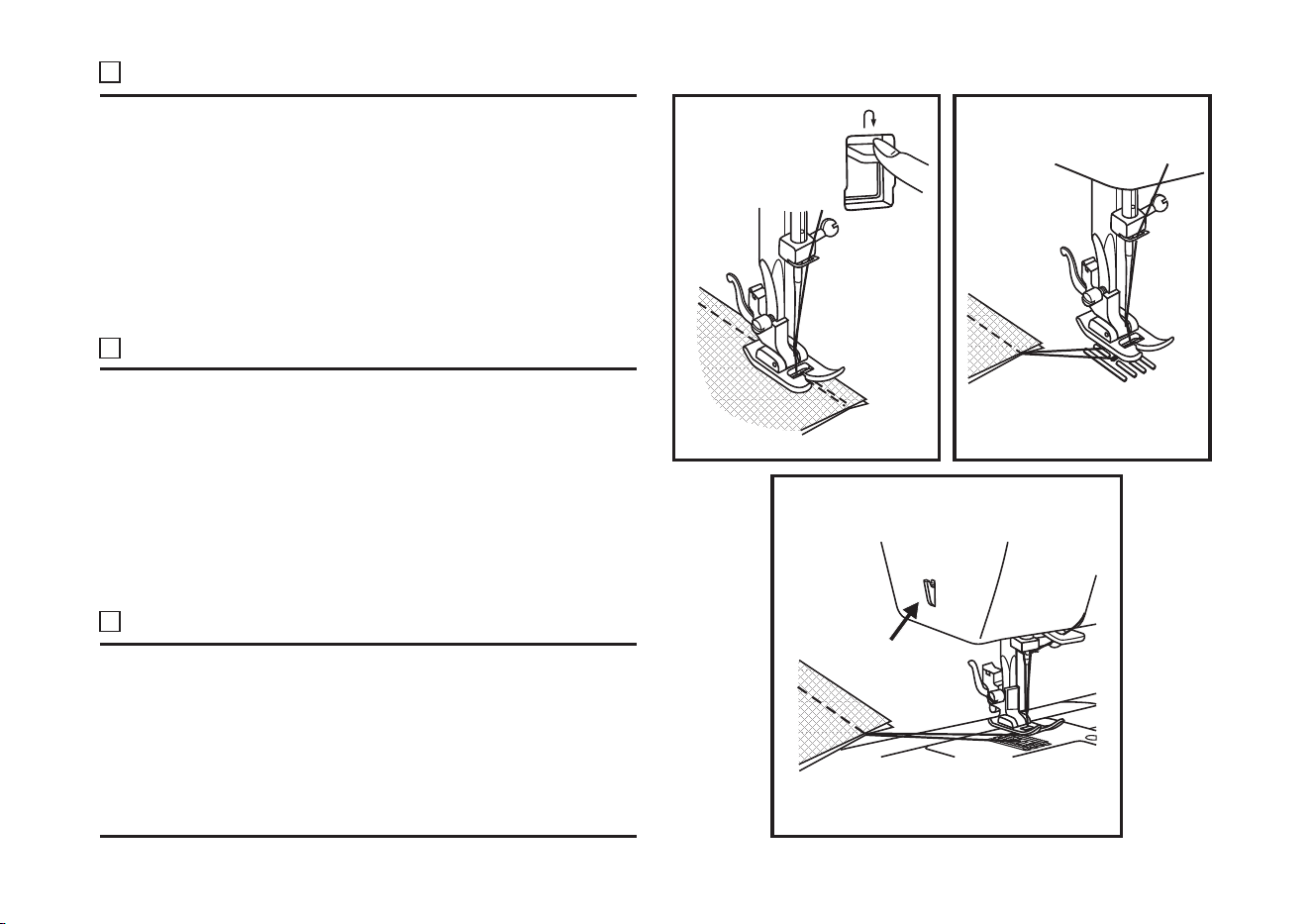
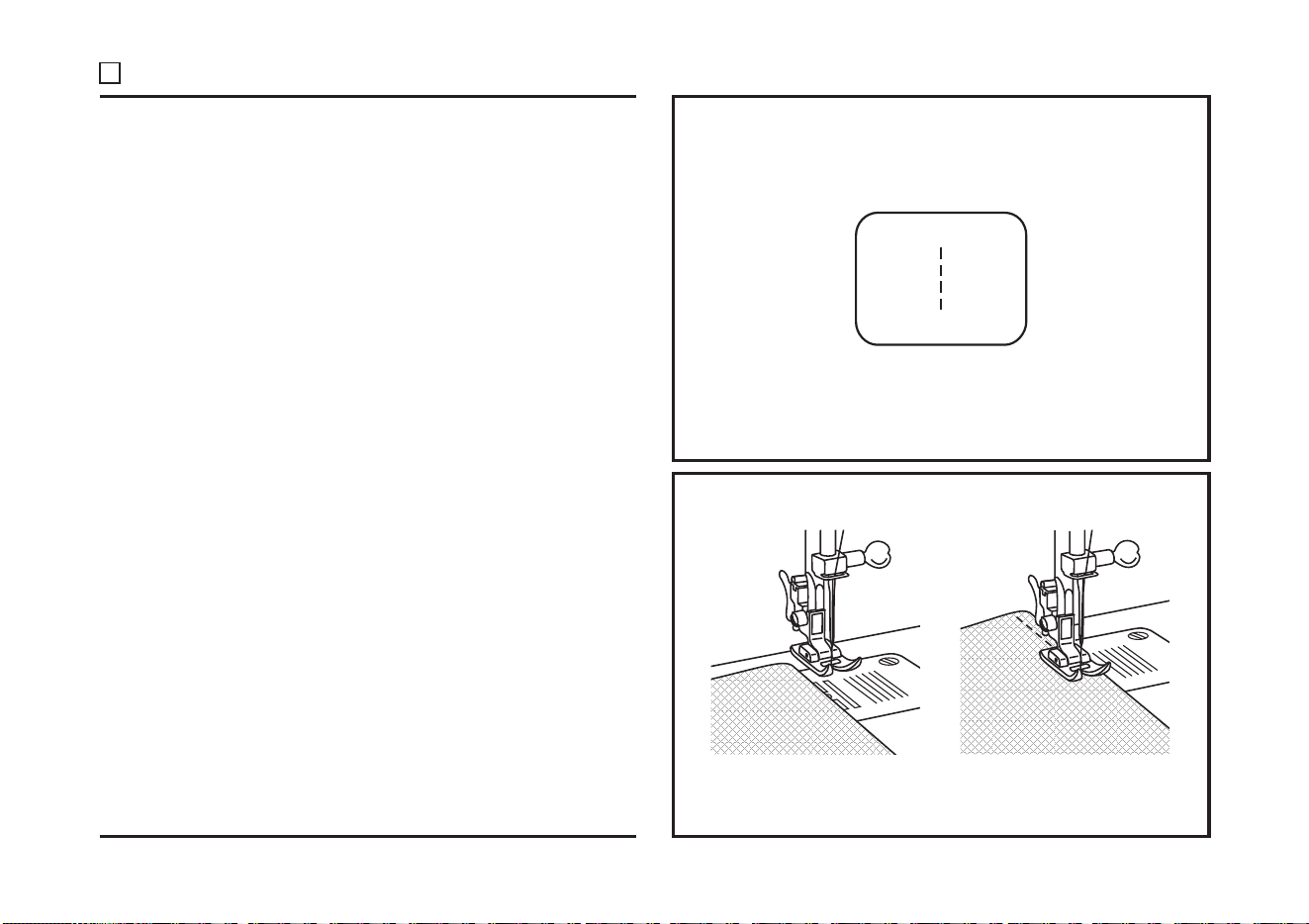
To begin sewing, set the machine for straight stitch. (1)
Place the fabric under the presser foot with the fabric edge
lined up with the desired seam guide line on the needle plate.
(2)
Lower the presser foot lifter, and then step on the foot
controller to start sewing. (3)
1
2
3
Sewing Straight Stitch
17
Turn the handwheel toward you (counterclockwise) to bring
the thread take up lever to its highest position, raise the
presser foot and remove work behind
(2)
the needle and presser
foot.
Pull the threads under and behind the presser foot. Guide
the threads to the side of the face plate and into thread cutter
(B). Pull threads down to cut. (3)
To secure the beginning and the end of a seam, press down
the reverse sewing lever (A). Sew a few reverse stitches.
Release the lever and the machine will sew forward again. (1)
1
3
2
A
B
Removing the Work
Cutting the Thread
Reverse Sewing

18
Choosing Stretch Stitch Patterns
1
2
M
M
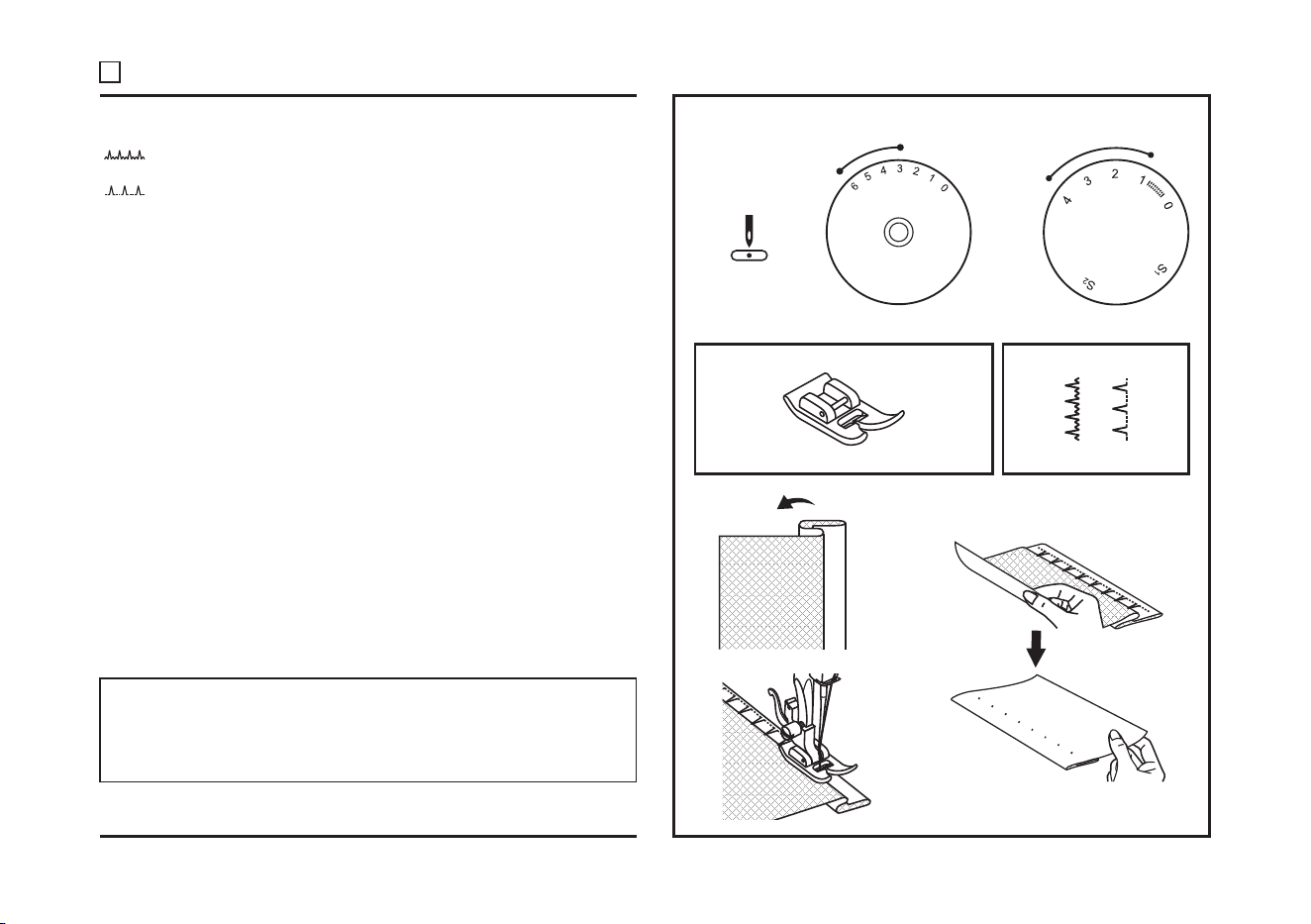
The stretch stitch patterns are indicated with blue and red
colors on the pattern selector dial. To select these stitches,
turn the pattern selector dial to the desired pattern. Then,
turn the stitch length dial to the indicator marked "S1" or "S2".
Though there are several stretch patterns, here are two
examples:
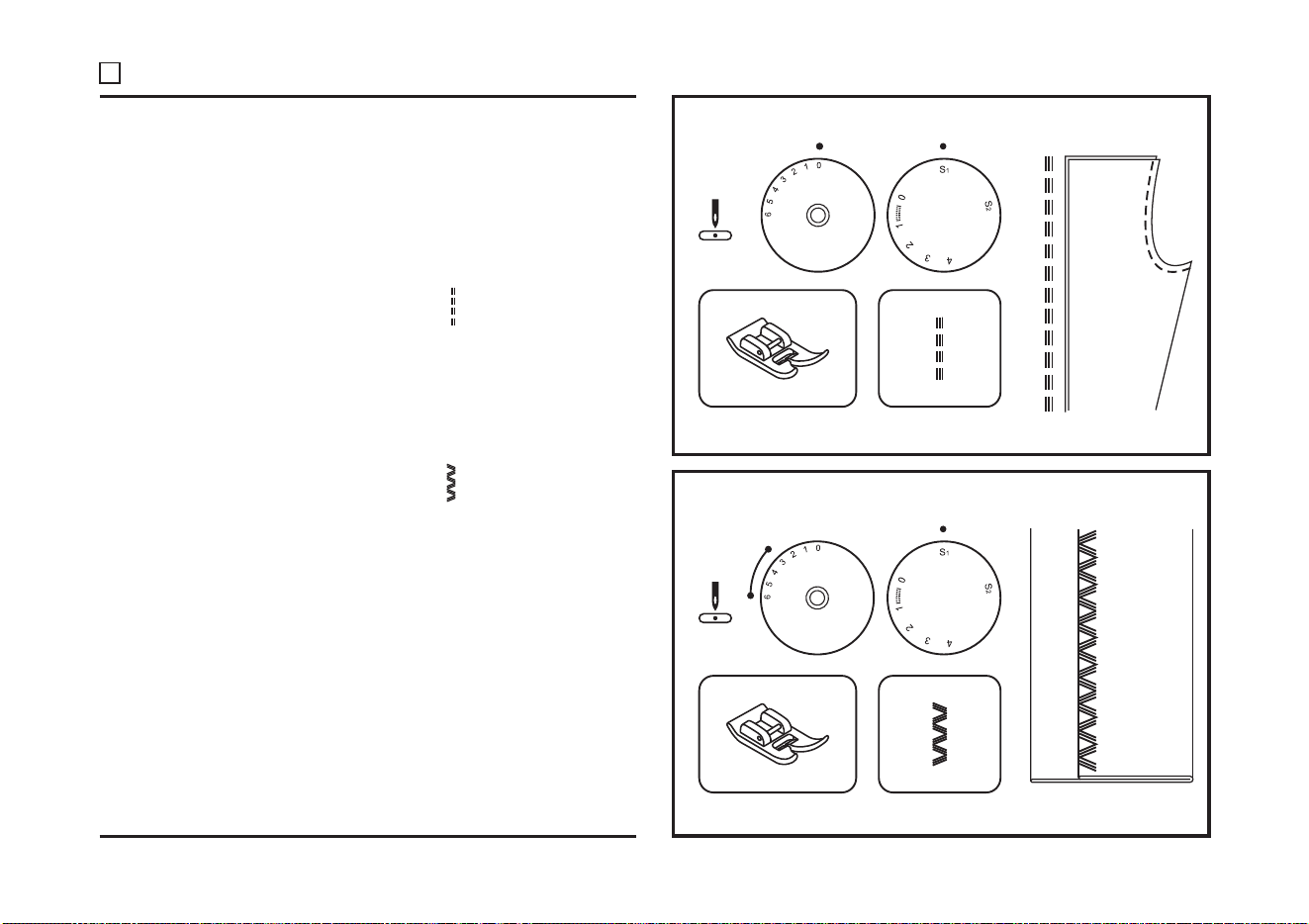
Set the pattern selector dial to " ".
Set the stitch width dial to "1".
Used to add triple reinforcement to stretch and hardwearing
seams.
The machine sews two stitches forward and one stitch
backwards.
Set the pattern selector dial to " ".
Set the stitch length dial to "S1" or "S2".
Adjust the stitch width dial to between "3" and "6".
Ric rac stitch is suitable for firm fabrics like denim, corduroy,
poplin, duck, etc.
Straight Stretch Stitch (1)
Ric Rac (2)
19
2
1
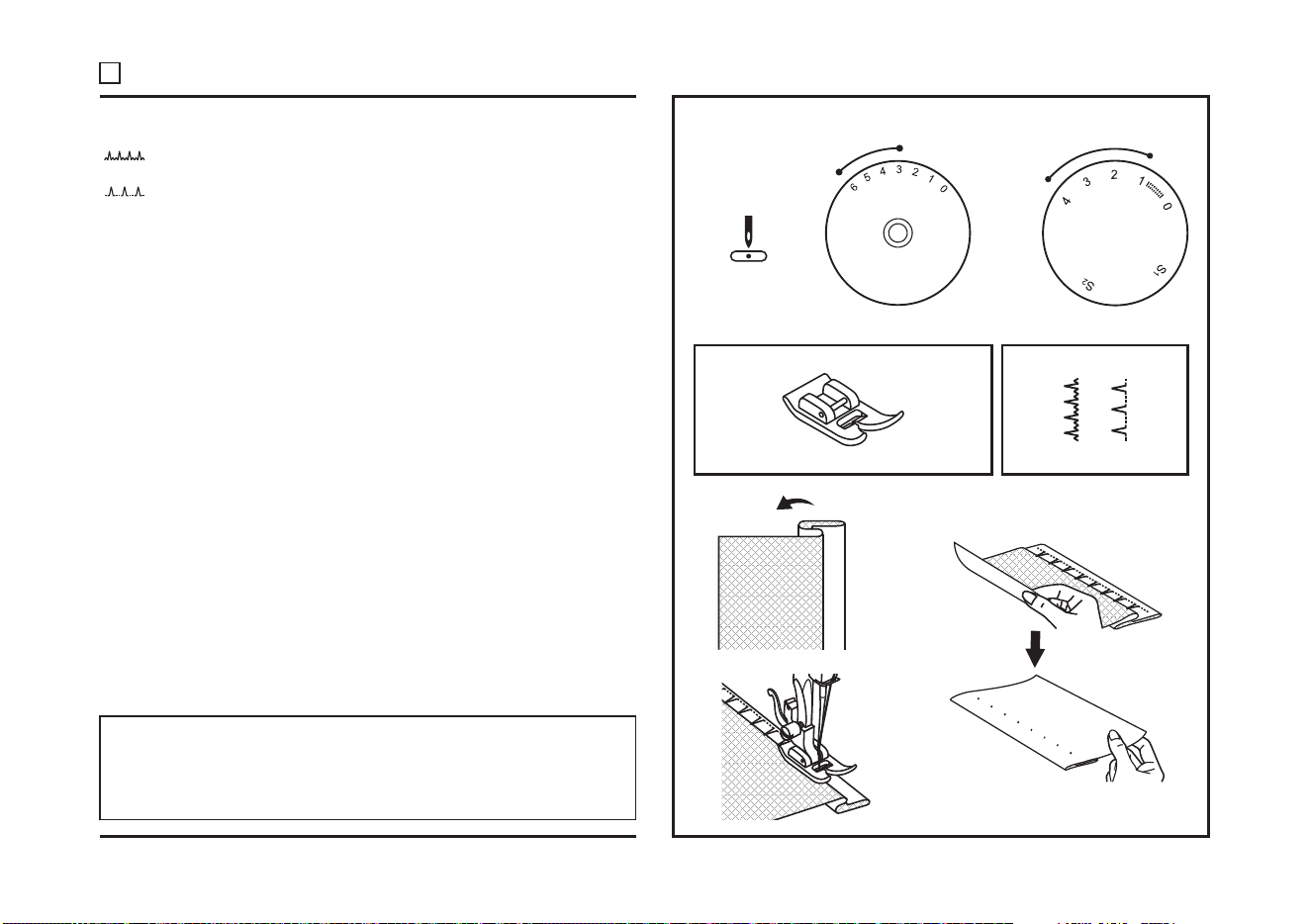
For hems on curtains, trousers, skirts, etc.
Blind hem for stretch fabrics.
Blind hem for firm fabrics.
Set the Stitch Width Dial at
a setting appropriate for the weight/type of fabric being sewn,
within the range shown in the diagram on the right of the
page. Generally, a narrower stitch is used for lighter weight
fabrics, and a wider stitch is used for heavier weight fabrics.
Sew a test first to make sure the machine settings are
appropriate for the fabric.
Blind Hem:
Set the Stitch Length Dial with the range shown on the
diagram at the right. Blind hems, however, are normally sewn
with a longer stitch length setting.
Turn up the hem to the desired width and press. Fold back
(as shown in Fig. 1) against the right side of the fabric with
the top edge of the hem extending about 7 mm (1/4") to the
right side of the folded fabric.
Start to sew slowly on the fold, making sure the needle
touches slightly the folded top to catch one or two fabric
threads. (2)
Unfold the fabric when hemming is completed and press.
To make blind hem sewing even easier, use a blind hem
foot, available from your SINGER retailer. (See page 6
for part number)
Note:
®
M
Blind Hem
20
2
1
4
3
A
D
a
b
E
B
C
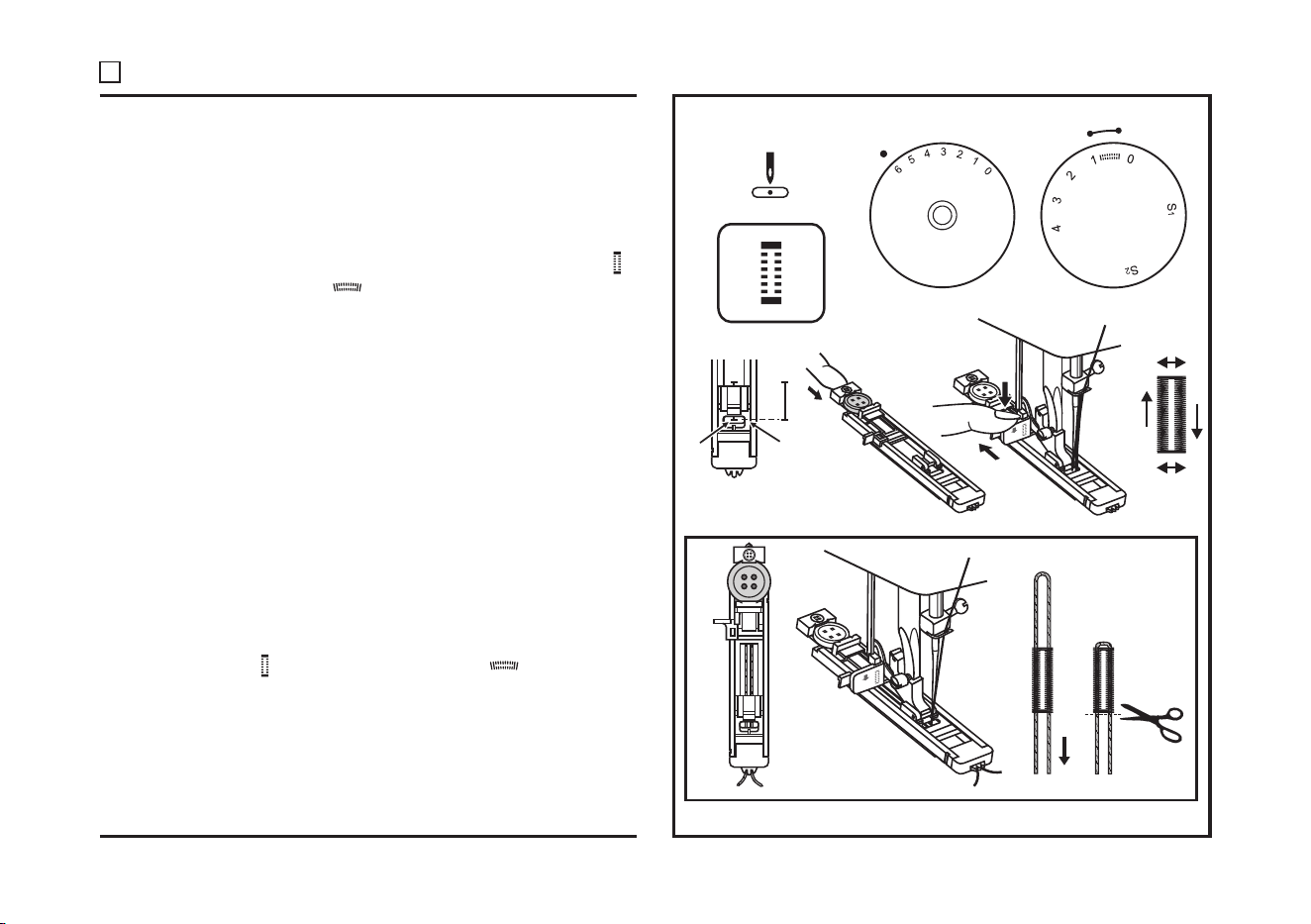
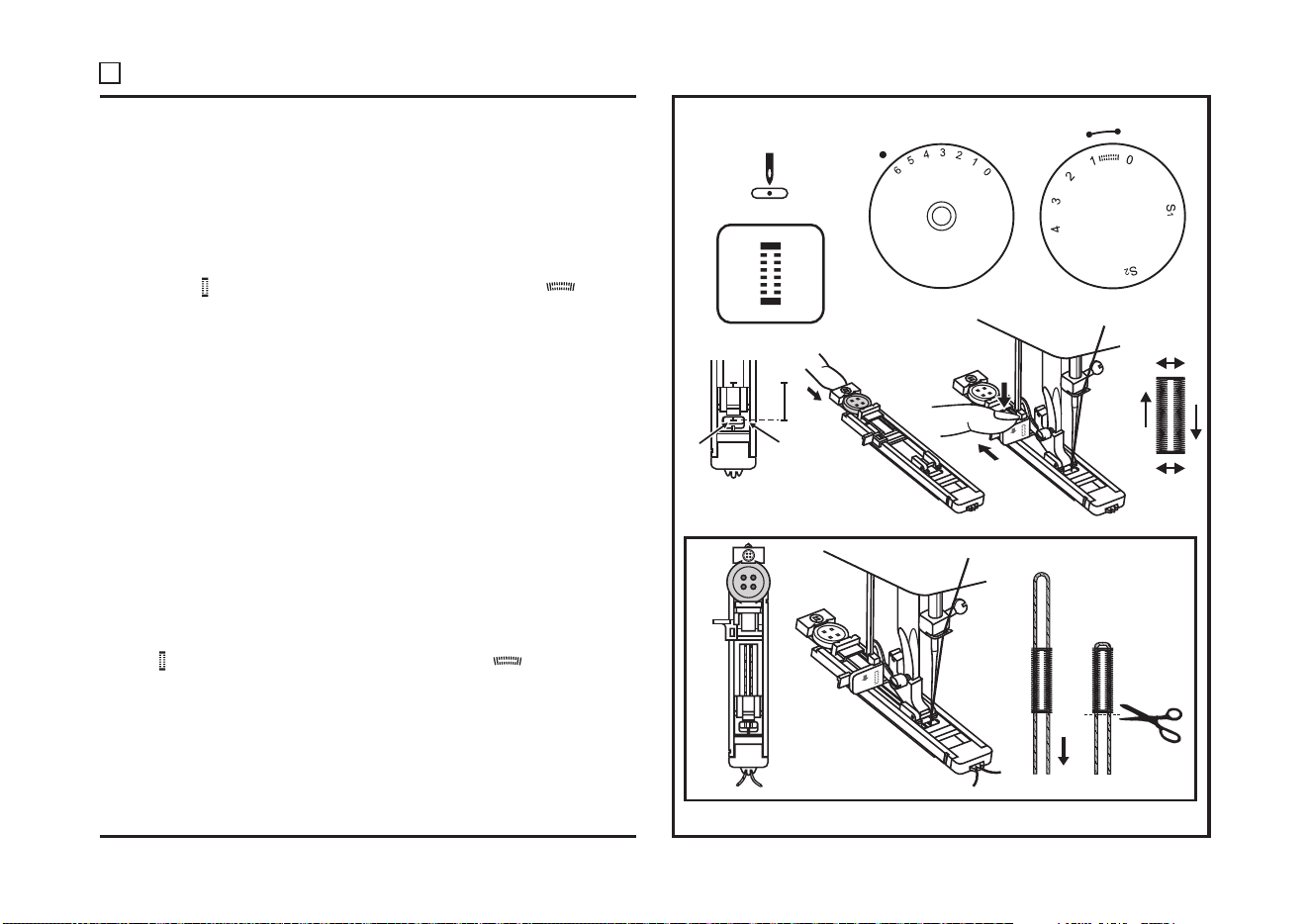
Buttonhole sewing is a simple process that provides reliable
results. However, it is strongly suggested to always make a
practice buttonhole on a sample of your fabric and stabilizer.
Making a Buttonhole
Making a Buttonhole on Stretch Fabrics (E)
1. Using tailor's chalk, mark the position of the buttonhole on the
fabric.
2. Attach the buttonhole foot and set the Pattern Selector Dial to " ".
Set stitch length dial to " ". Set the stitch width at "6". The
width however may need to be adjusted according to the
project. Sew a test first to determine this.
3. Lower the presser foot aligning the marks on foot with the
marks on the fabric (A). (The front bar tack will be sewn first.)
(Align the mark on the fabric (a) with the mark on the foot (b).)
4. Open the button plate and insert the button (B).
5. Lower the buttonhole lever and gently push it back (C).
6. While lightly holding the upper thread, start the machine.
7. Buttonhole stitching is done in the order (D).
8. Stop the machine when the buttonhole cycle has completed.
When sewing buttonholes on stretch fabric, hook heavy thread or
cord under the buttonhole foot. When the buttonhole is sewn the
legs will overcast the cord.
1. Mark the position of the buttonhole on the fabric with the
tailor's chalk, attach the buttonhole foot, and set the pattern
selector dial to " ". Set stitch length dial to " ".
2. Hook the heavy thread onto the back end of the buttonhole foot,
then bring the two heavy thread ends to the front of the foot,
insert them into the grooves and temporarily tie them there.
3. Lower the presser foot and start sewing.
*Set the stitch width to match the diameter of the gimp thread.
4. Once sewing is completed, gently pull the heavy thread to
remove any slack, then trim off the excess.
P
U
S
H
P
U
SH
M
Sew 1-step Buttonholes

21
Stitch density on right and left sides of buttonhole can be
adjusted by buttonhole balance control dial.
This dial should usually be in a neutral position (between "+"
and " ")
If the stitches on the left side of buttonhole are too close
together, turn the dial to the left (+).
* Turning dial to the left opens left side.
If the stitches on the left side of the buttonhole are too open,
turn the dial to the right ( ).
* Turning dial to right closes left side.
–
–
Left and Right Side Balance for Buttonhole
22
4
3
1
2
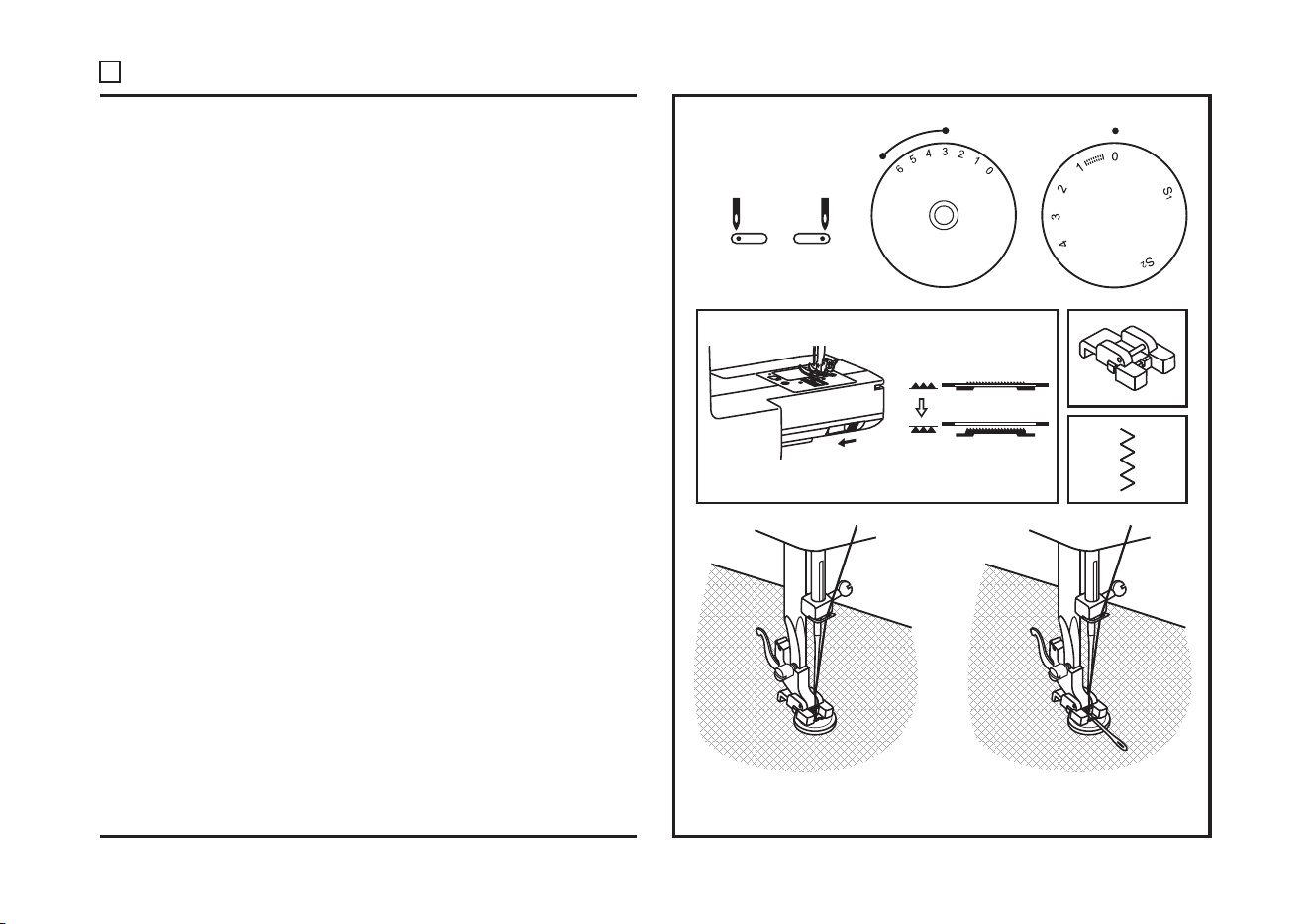
Move the drop feed control to right side to lower the feed
dogs. (1)
Change the all purpose foot to the button sewing foot. (2)
Set the stitch length to "0".
Set the machine for zig-zag stitch, then set the width to
number "3" - "6". Turn the handwheel to check that the
needle goes cleanly into the left and right holes of the button.
Adjust the stitch width, as needed, according to the distance
between the holes of the button. Slowly sew on the button
with about 10 stitches.
Raise the needle out of the fabric. Set the machine for straight
If a shank is required, place a darning needle on top of the
button and sew. For buttons with 4 holes, sew through the
front two holes first, push the work forward and then sew
through the back two holes.
Place the button and fabric under the Button Sewing foot, as
illustrated in (3).
stitch again, then sew a few securing stitches to finish.
L R
a
b
a
b
Sewing on Buttons
1
2
23
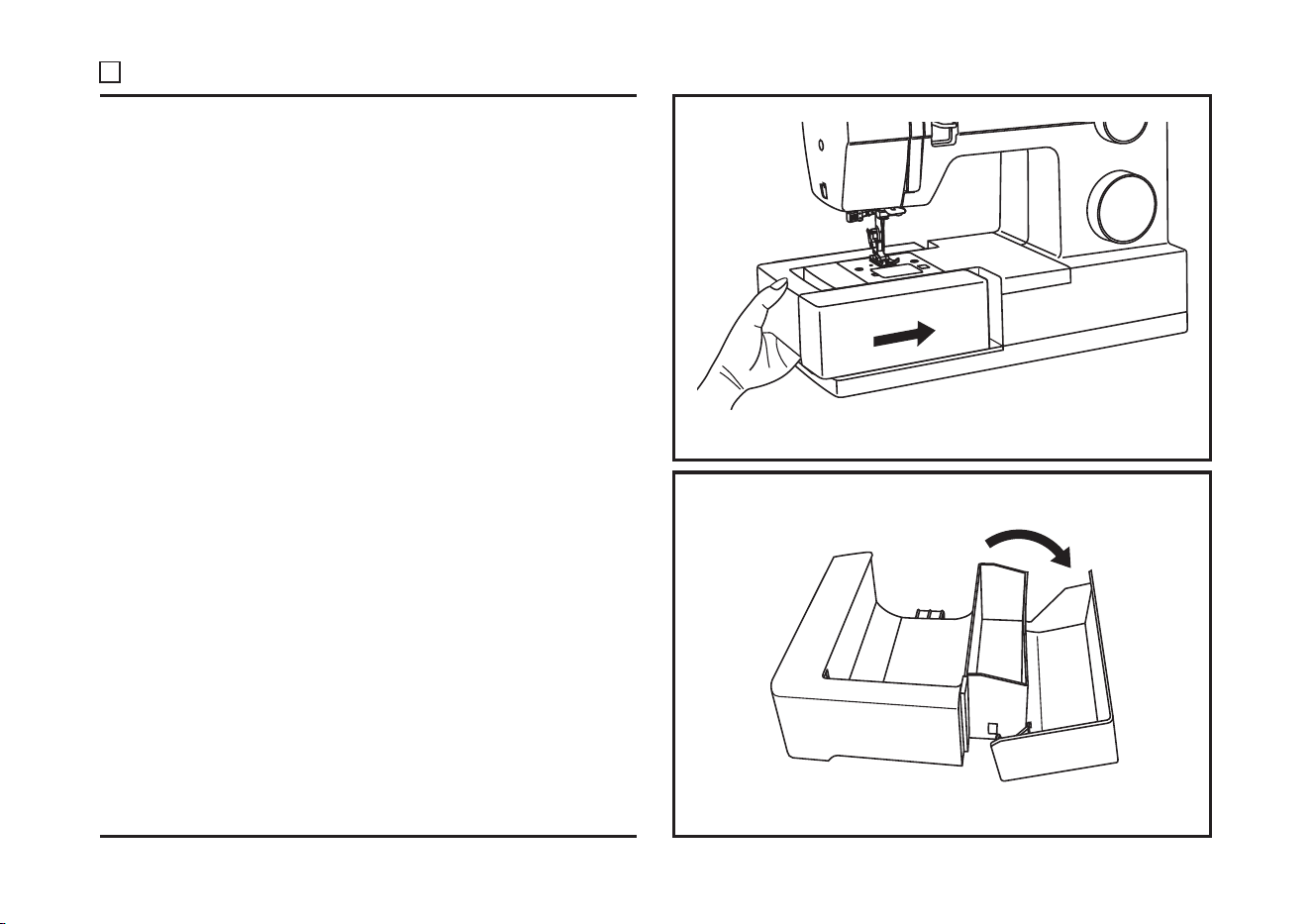
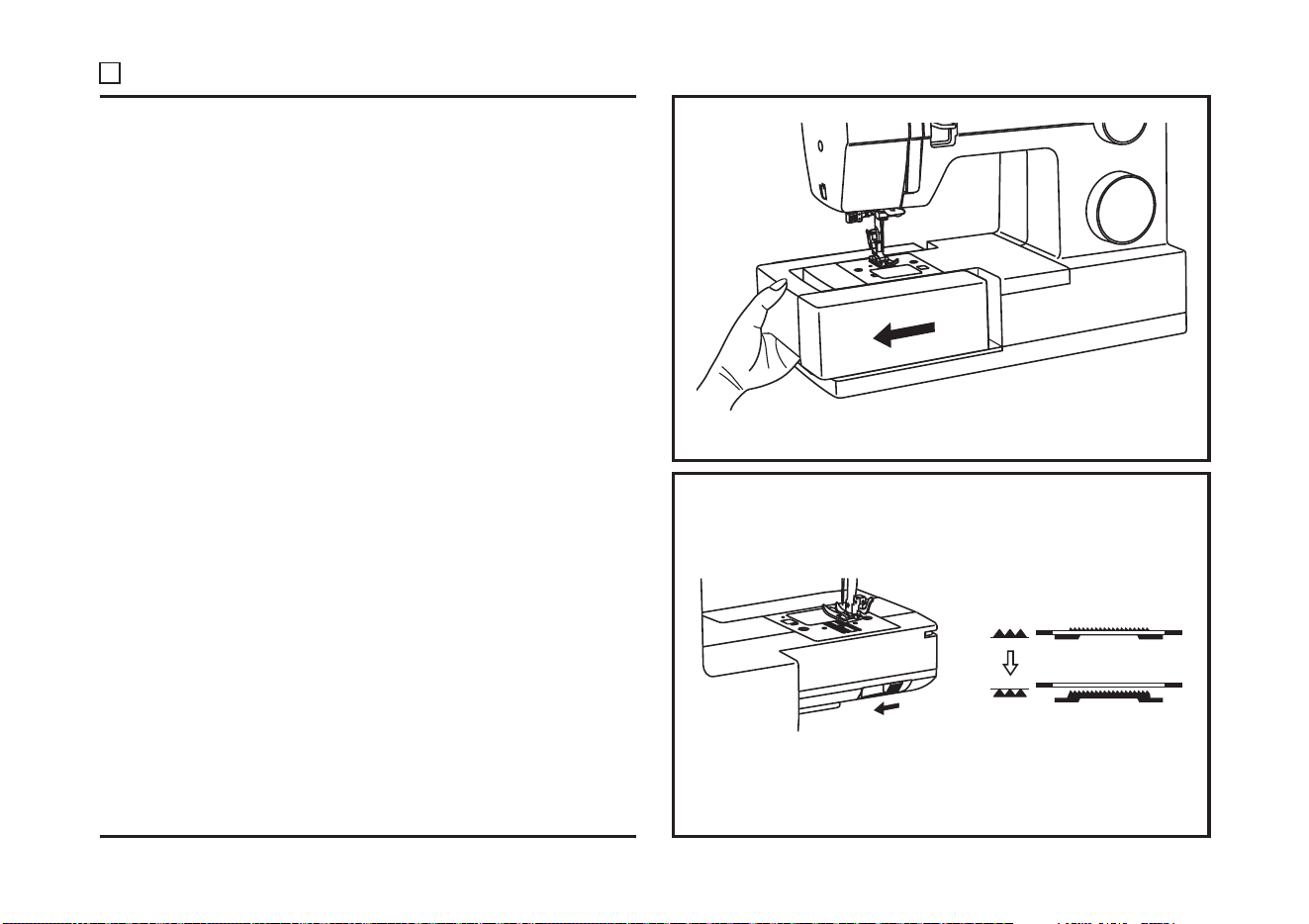
Hold the removable extension table horizontally, and push it
in the direction of the arrow. (1)
To remove the extension table, pull it toward the left.
The inside of the removable extension table can be utilized
as an accessory box.
To open, flip cover down as shown. (2)
Installing the Removable Extension Table
12
3
4
a
c
d
e
f
b
b
a
e
g
24
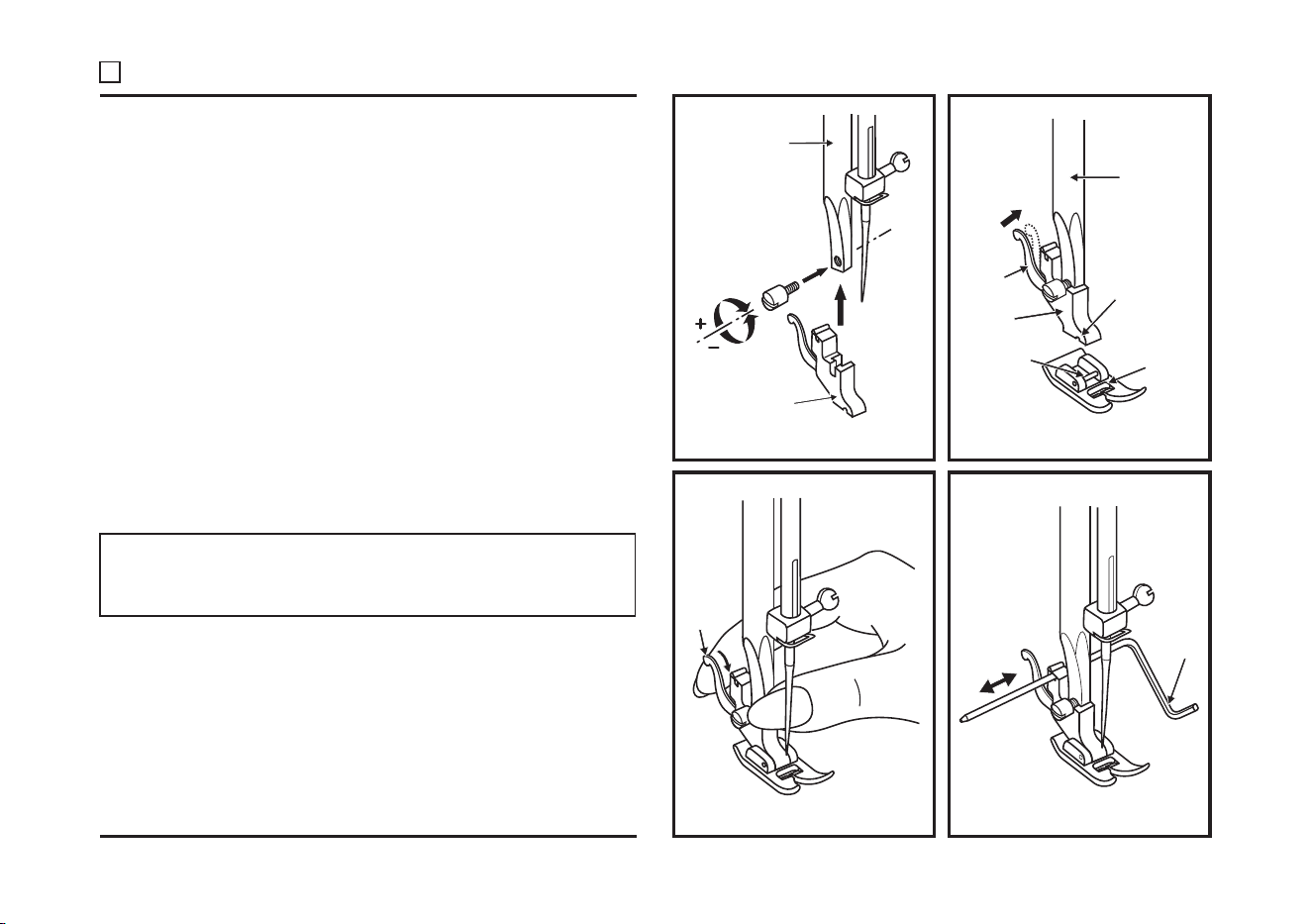
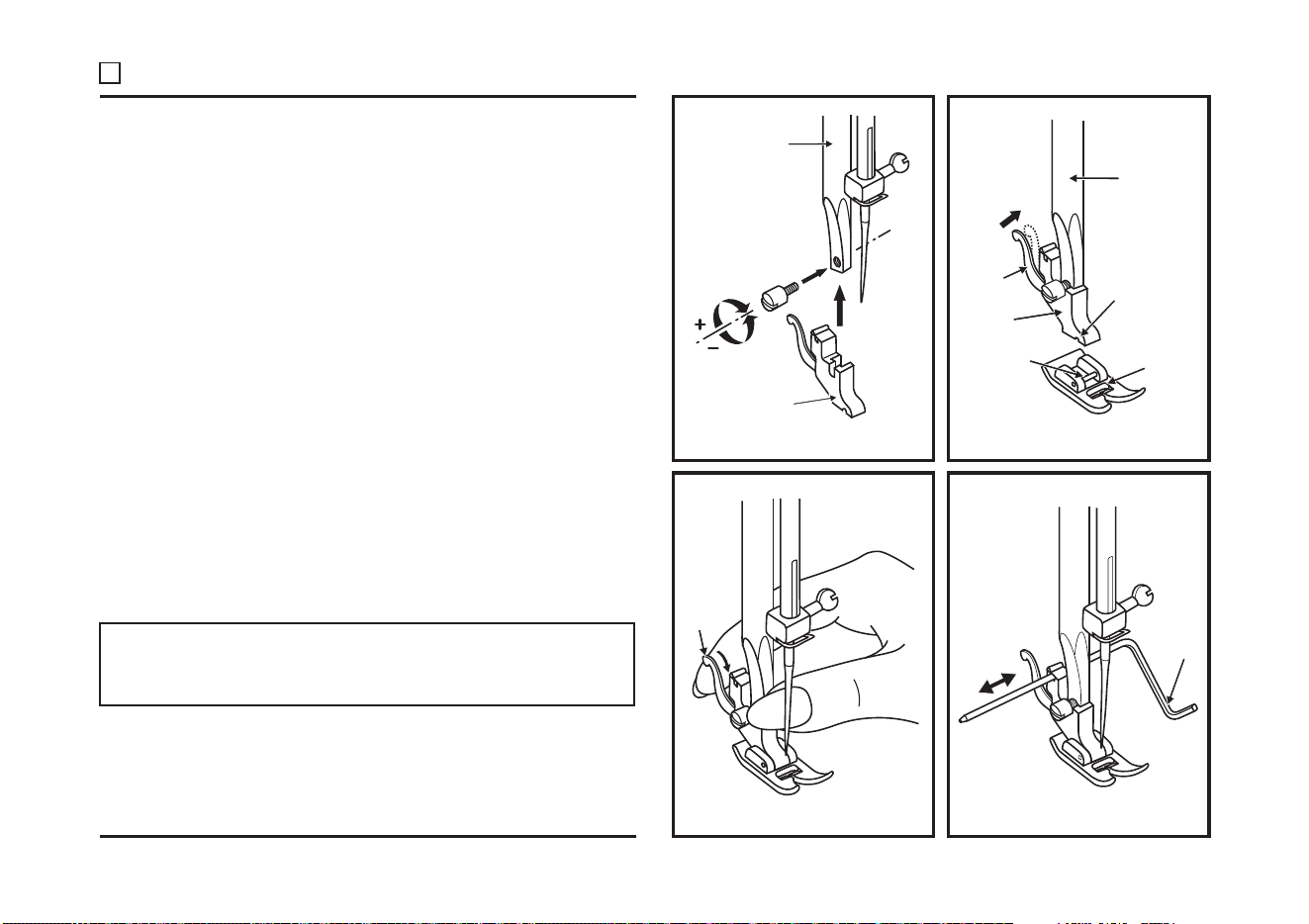
Raise the presser bar
dge/ quilting
dge/ quilting
(a) with the presser foot lifter. Attach
the presser foot shank (b) as illustrated. (1)
Lower the presser foot shank (b) using the presser foot lifter,
until the cut-out (c) is directly above the pin (d). (2) The
presser foot (f) will engage automatically.
Raise the presser foot using the presser foot lifter. (3)
Raise the lever (e) and the foot disengages.
Attach the e guide (g) in the slot as illustrated.
Adjust as needed for hems, pleats, quilting, etc. (4)
Turn power switch to off ("O") when carrying out any of
the above operations!
Attaching the presser foot
Removing the presser foot
Attaching the e guide
Attention:
Attaching the Presser Foot Shank
25
Heavy woolen, overcoat fabrics, upholstery fabrics, some
leathers and vinyls.
EXPLANATION
Standard sharp needles. Sizes range
thin to large. 9 (70) to 18 (110).
Semi-ball point needle, scarfed.
9 (70) to 18 (110).
Leather needles. 12 (80) to 18 (110).
SINGER
®
2020
SINGER
®
2045
SINGER
®
2032
9-11 (70-80)
11-14 (80-90)
14 (90)
16 (100)
18 (110)
NEEDLE, FABRIC, THREAD SELECTION GUIDE
NEEDLE SIZE
FABRICS
THREAD
NEEDLE, FABRIC SELECTION
IMPORTANT: Match needle size to thread size and weight of fabric.
Lightweight fabrics-thin cottons, voile, silk, muslin,
interlocks, cotton knits, tricots, jerseys, crepes, woven
polyester, shirt & blouse fabrics.
Light-duty thread in cotton, nylon, polyester or
cotton wrapped polyester.
Medium weight fabrics-cotton duck, woolen, heavier knits,
terrycloth, denims.
Heavyweight fabrics-canvas, woolens, outdoor tent and
quilted fabrics, denims, upholstery material (light to medium).
Heavy duty thread, carpet thread.
Most threads sold are medium size and suitable
for these fabrics and needle sizes.
Use polyester threads on synthetic materials
and cotton on natural woven fabrics for best
results.
Always use the same thread on top and bottom.
Medium weight fabrics-cotton, satin, kettlecloth, sailcloth,
double knits, lightweight woolens.
NEEDLES TYPE OF FABRIC
Natural woven fabrics-wool, cotton, silk, etc.
Not recommended for double knits.
Natural and synthetic woven fabrics, polyester blends.
Knits-polyesters, interlocks, tricot, single and double knits.
Also sweater knits, Lycra , swimsuit fabric, elastic.
®
Leather, vinyl, upholstery. (Leaves smaller hole than standard
large needle.)
Note :
1. For best sewing results always use genuine SINGER needles.
2. Replace needle often (approximately every other garment ) and/ or at first thread breakage or skipped stitches.
®
N Charteedle/ Fabric/ Thread

26
For ordinary sewing, keep the feed dog up, for freehand
embroidery, sewing on buttons and darning, drop the feed
dog.
To raise (a) and lower (b) feed dog. (2)
1
2
a
b
a
b
How To Drop Feed Dog
27
A
C
B
A
B
C
D
1
2
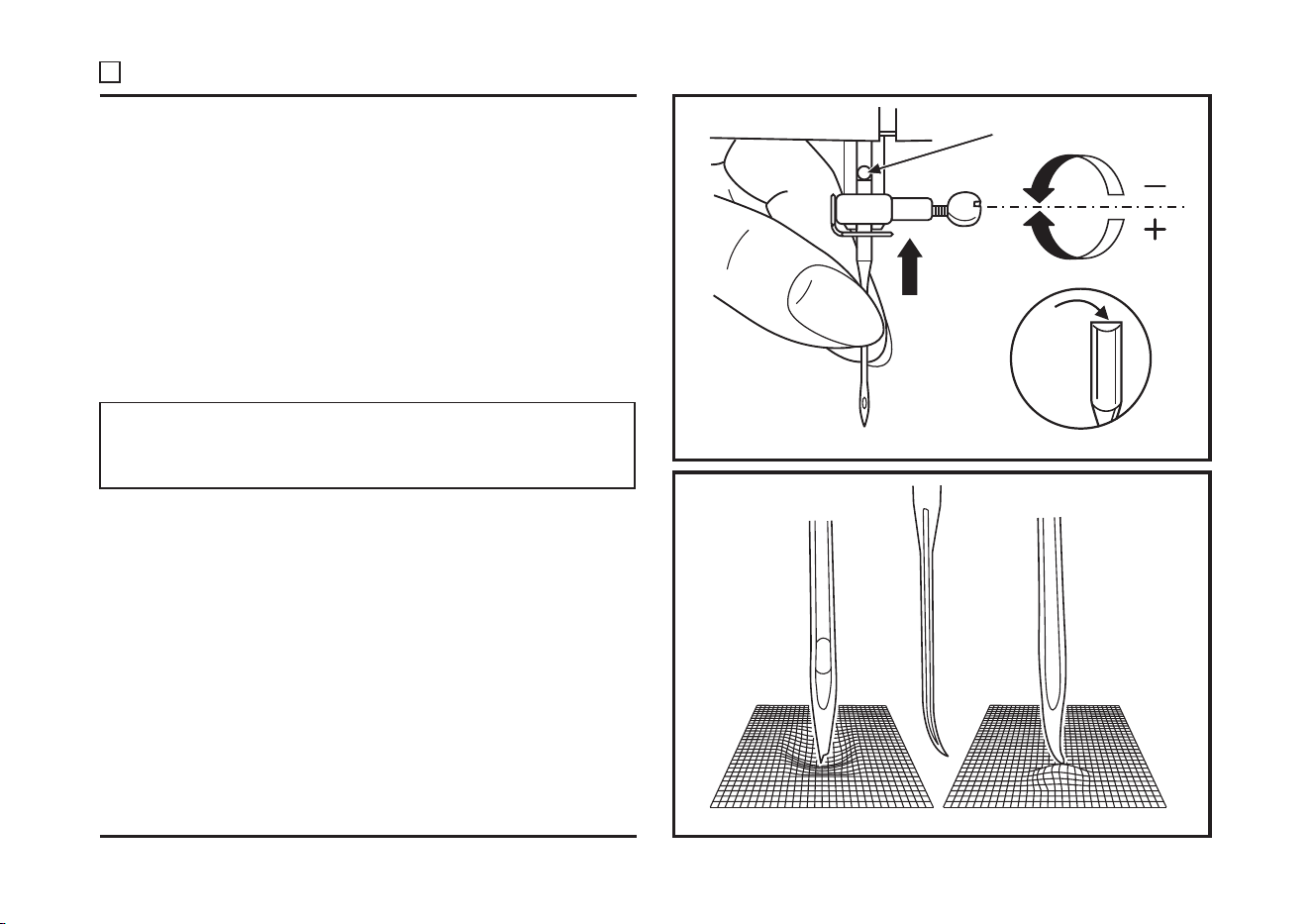
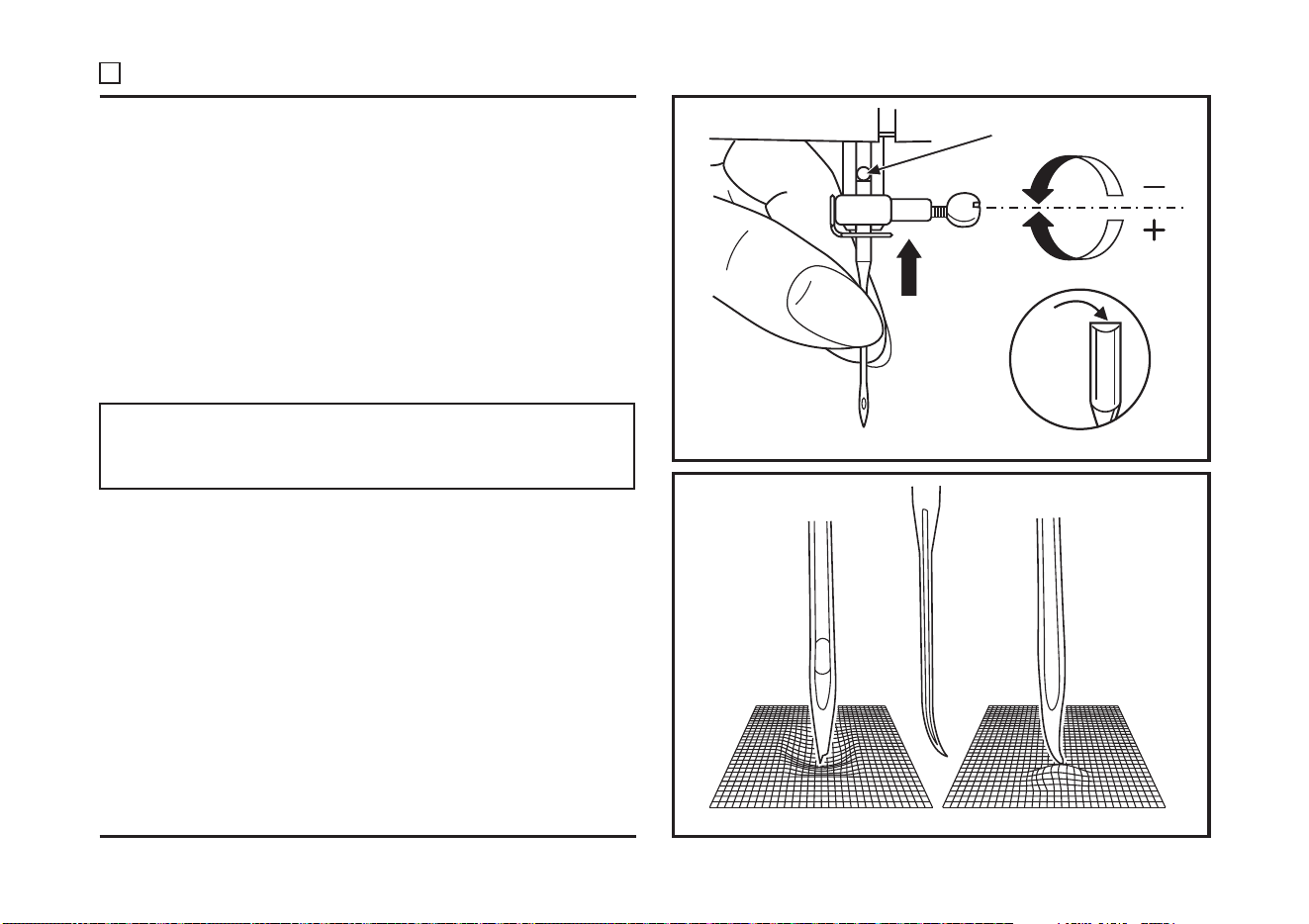
Change the needle regularly, especially if it is showing signs
of wear and causing problems. For best sewing results
always use SINGER Brand Needles.
Insert the needle
A. Loosen the needle clamp screw and tighten again after
inserting the new needle. (1)
B. The flat side of the shaft should be towards the back.
C/D.Insert the needle as far up as it will go.
Turn power switch to off ("O") before inserting or removing
the needle.
Needles must be in perfect condition. (2)
Problems can occur with:
A. Bent needles
B. Damaged points
C. Blunt needles
®
Attention:
as illustrated as follows:
Inserting & Changing Needles

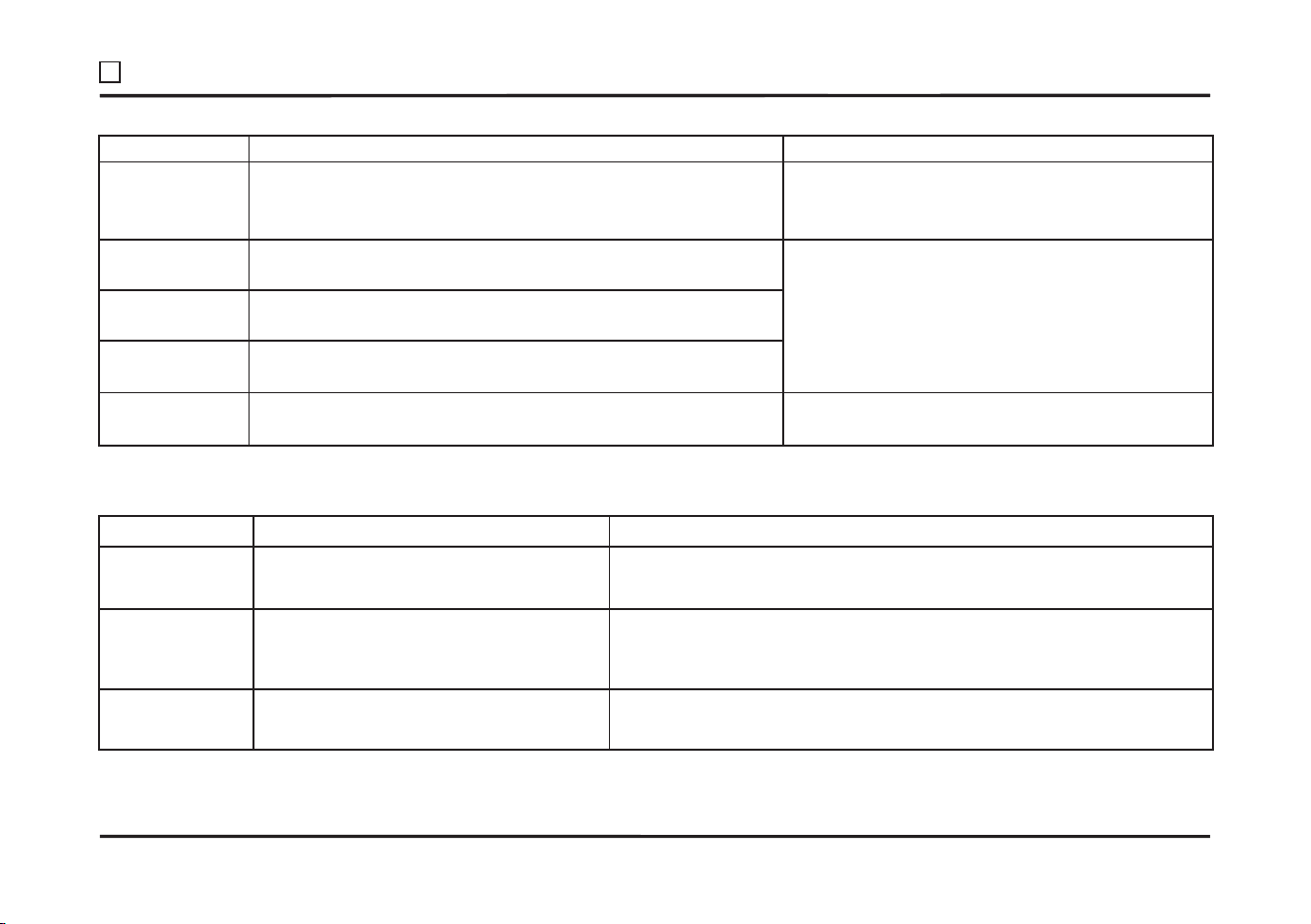
Problem Cause Correction
Upper thread
breaks
Lower thread
breaks
Skipped stitches
Needle breaks
Loose stitches
Seams gather or
pucker
Uneven stitches,
uneven feed
The machine is
noisy
The machine
jams
1. The machine is not threaded correctly.
2. The thread tension is too tight.
3. The thread is too thick for the needle.
4. The needle is not inserted correctly.
5. The thread is wound around the spool holder pin.
6. The needle is damaged.
1. The bobbin case is not inserted correctly.
2. The bobbin case is threaded wrong.
3. The lower thread tension is too tight.
1. The needle is not inserted correctly.
2. The needle is damaged.
3. The wrong size needle has been used.
4. The foot is not attached correctly.
1. The needle is damaged.
2. The needle is not correctly inserted.
3. Wrong needle size for the fabric.
4. The wrong foot is attached.
1. The machine is not correctly threaded.
2. The bobbin case is not correctly threaded.
3. Needle/ fabric/ thread combination is wrong.
4. Thread tension wrong.
1. The needle is too thick for the fabric.
2. The stitch length is adjusted wrong.
3. The thread tension is too tight.
1. Poor quality thread.
2. The bobbin case is threaded wrong.
3. Fabric has been pulled.
1. Lint or oil have collected on the hook or needle bar.
2. The needle is damaged.
Thread is caught in the hook.
1. Rethread the machine.
2. Reduce the thread tension. (lower number)
3. Select a larger needle.
4. Remove and reinsert the needle. (flat side towards the back)
5. Remove the reel and wind thread onto reel.
6. Replace the needle.
1. Remove and reinsert the bobbin case and pull on the thread.
The thread should pull easily.
2. Check both bobbin and bobbin case.
3. Loosen lower thread tension as described.
1. Remove and reinsert needle. (flat side towards the back)
2. Insert a new needle.
3. Choose a needle to suit the thread and fabric.
4. Check and attach correctly.
1. Insert a new needle.
2. Insert the needle correctly. (flat side towards the back)
3. Choose a needle to suit the thread and fabric.
4. Select the correct foot.
1. Check the threading.
2. Thread the bobbin case as illustrated.
3. The needle size must suit the fabric and thread.
4. Correct the thread tension.
1. Select a finer needle.
2. Readjust the stitch length.
3. Loosen the thread tension.
1. Select a better quality thread.
2. Remove bobbin case, thread and insert correctly.
3. Do not pull on the fabric while sewing, let the feed dogs pull
the fabric under the foot.
1. Clean the hook and feed dog as described.
2. Replace the needle.
Remove the upper thread and bobbin case, turn the handwheel
backwards and forwards by hand and remove the thread.
28
Troubleshooting Guide




Please note that on disposal, this product must be safely recycled in accordance with relevant
National legislation relating to electrical/electronic products. Do not dispose of electrical appliances
as unsorted municipal waste, use separate collection facilities. Contact your local government for
information regarding the collection systems available. When replacing old appliances with new
ones, the retailer may be legally obligated to take back your old appliance for disposal free of
charge.
If electrical appliances are disposed of in landfills or dumps, hazardous substances can leak into the
groundwater and get into the food chain, damaging your health and well-being.
4432 Petunjuk Penggunaan
021Q6D0111(EN.ID)


-l-
PETUNJUK KESELAMATAN PENTING
Ketika menggunakan peralatan listrik, tindakan keselamatan dasar harus
selalu dijalankan, termasuk berikut ini:
Baca semua petunjuk sebelum menggunakan mesin jahit ini.
BAHAYA
PERINGATAN
- Untuk mengurangi risiko kejutan listrik:
- Untuk mengurangi risiko luka bakar,
kebakaran, kejut listrik, atau cedera:
1.
""
""
Harap matikan mesin atau cabut steker jika mesin tidak bekerja
dengan baik.
18. Jangan letakkan apapun diatas pedal/trap (injakan dinamo).
19. Jika kabel listrik yang terpasang pada pedal/trap (injakan dinamo)
rusak, maka kabel ini harus diganti oleh produsen atau service agent-
nya atau orang yang memenuhi syarat agar tidak timbul bahaya.
20.Peralatan ini tidak dimaksudkan untuk dipakai oleh orang (termasuk
anak-anak) yang mempunyai keterbatasan fisik, sensorik atau
mental, atau tidak mempunyai pengalaman atau pengetahuan,
kecuali jika mereka diawasi atau diajari mengenai penggunaan
peralatan ini oleh orang yang bertanggung jawab terhadap
keselamatan mereka.
21. Anak-anak harus diawasi untuk memastikan mereka tidak bermain
dengan peralatan ini.
Mesin jahit ini tidak boleh ditinggalkan tanpa sengaja dalam kondisi
tersambung aliran listrik.
2. Selalu cabut steker mesin jahit ini dari stopkontak segera sesudah
penggunaan atau sebelum pembersihan.
3.
1. Jangan biarkan mesin jahit ini dipakai sebagai mainan. Diperlukan
perhatian seksama ketika mesin jahit ini digunakan oleh anak-anak
atau digunakan di dekat anak-anak.
2. Gunakan mesin jahit ini hanya untuk keperluan sebagaimana
dijelaskan dalam buku petunjuk ini. Hanya gunakan alat tambahan
yang direkomendasikan oleh produsen sebagaimana termuat dalam
buku petunjuk ini.
3. Jangan pakai mesin jahit ini jika kabel atau stekernya rusak, jika
mesin jahit ini tidak bekerja sebagaimana mestinya, jika mesin jahit ini
pernah jatuh atau rusak, atau jatuh ke air. Kembalikan mesin jahit ke
dealer resmi atau service center terdekat untuk diperiksa, diperbaiki,
atau disetel kelistrikan atau mekaniknya.
4. Jangan operasikan mesin jahit jika ada lubang udara yang tersumbat.
Bersihkan lubang ventilasi mesin jahit dan pedal/trap (injakan dinamo)
dari timbunan kain tiras, debu, dan kain lepas.
5. Jauhkan jari dari semua bagian mesin yang bergerak. Berhati-hatilah
di dekat jarum mesin jahit.
6. Selalu gunakan plat jarum yang tepat. Plat yang salah dapat
menyebabkan jarum patah.
7. Jangan gunakan jarum bengkok.
8. Jangan tarik atau dorong kain saat menjahit. Ini bisa
membengkokkan jarum sehingga dapat patah.
9. Matikan mesin jahit ( O ) ketika menyetel di sekitar jarum, misalnya
memasukkan benang ke jarum, mengganti jarum, memasang benang
ke spul, atau mengganti sepatu, dan lain-lain.
10. Selalu cabut steker dari stopkontak ketika melepas penutup, melumasi,
atau menyetel sendiri mesin seperti disebutkan pada buku petunjuk ini.
11. Jangan jatuhkan atau masukkan benda apapun ke lubang apapun.
12. Jangan digunakan di tempat terbuka.
13. Jangan operasikan mesin jahit bila produk aerosol (semprot) sedang
digunakan atau bila oksigen sedang disalurkan.
14. Untuk memutus sambungan listrik, putar saklar ke posisi mati ( O ),
kemudian cabut steker dari stopkontak.
15. Jangan cabut steker dengan menarik kabel. Untuk mencabut, pegang
stekernya, bukan kabelnya.
Produk ini hanya untuk penggunaan rumah tangga.
Kekuatan maksimum dari Lampu LED adalah 0.3W , voltase maksimum
adalah DC 9V. Jika lampu mengalami kerusakan sebaiknya tidak
digunakan lagi, kirim lampu itu kepada SINGER atau agen servis untuk
diganti.
SIMPAN PETUNJUK INI
16. Tingkat tekanan yang baik dalam kondisi operasi normal adalah 75dB
(A).
17.

-ll-
Sebagai pemilik mesin jahit Singer baru, anda akan memulai petualangan kreativitas yang
mengasyikkan. Sejak pertama kali anda menggunakan mesin jahit ini, anda akan tahu bahwa anda
sedang menjahit dengan salah satu mesin jahit paling mudah digunakan yang pernah dibuat.
Kami menyarankan agar sebelum mulai menggunakan mesin jahit ini anda melihat-lihat banyak
fitur dan kemudahan penggunaan yang terdapat pada mesin jahit anda dalam buku petujuk ini
sedikit demi sedikit.
Untuk memastikan anda selalu memperoleh kemampuan menjahit paling modern, produsen
memberikan hak untuk mengubah tampilan, desain atau aksesori mesin jahit ini jika dianggap perlu.
SINGER adalah merek dagang terdaftar dari The Singer Company Ltd atau afiliasinya
2016 The Singer Company Limited atau afiliasinya. Semua Hak Dilindungi
®
S.à.r.l.
S.à.r.l.©
Selamat

Dasar-dasar mesin
Memasang Benang ke Mesin
Menjahit
Informasi Umum
Pemeliharaan dan Troubleshooting
Suku cadang Pokok Mesin ...................................................................................................................................................2/3
Menghubungkan Mesin ke Catu Daya ....................................................................................................................................4
Tuas Sepatu Penindas Dua Langkah / Menyesuaikan tekanan sepatu penindas ..................................................................5
Aksesoris.................................................................................................................................................................................6
Menggulung Benang Pada Spul..............................................................................................................................................
....................................................................................................................................................8
Memasang Benang Atas .........................................................................................................................................................
Pemasang Benang Otomatis ................................................................................................................................................10
Menaikkan Benang Spul........................................................................................................................................................
Keketatan Benang.................................................................................................................................................................12
..............................................................................................................................................
Tombol Tiga Posisi Jarum .....................................................................................................................................................14
Tombol Panjang & Lebar Jahitan ..........................................................................................................................................15
Menjahit Jahitan Lurus ..........................................................................................................................................................16
Menjahit mundur / Mengeluarkan kain / Memotong Benang.................................................................................................
Memilih Pola Jahitan Stretch
Kelim Buta .............................................................................................................................................................................
Satu Langkah Menjahit Lubang Kancing
...............................................................................21
Menjahit Kancing Baju...........................................................................................................................................................
Memasang Meja Perpanjangan ............................................................................................................................................
Memasang Palang Sepatu Penindas ....................................................................................................................................
...................................................................................................................................................25
Bagaimana Memindah Pengatur Gigi ...................................................................................................................................26
Memasukkan dan Mengganti Jarum .....................................................................................................................................
Pedoman Pemecahan Masalah ............................................................................................................................................
7
9
11
13
17
.................................................................................................................................................18
19
...............................................................................................................................20
22
23
24
27
28
Memasang Benang Ke Spul
Keseimbangan Sisi Kiri Dan Kanan Pada Pembuatan Lubang Kancing
Tabeljarum / Kain / Benang
Bagaimana Cara Memilih Pola
-lll-
Daftar Isi
-2-
1. Cakram angka keketatan benang
2. Penekan sepatu penindas
3. Tuas pengencang benang
4. Tuas menjahit mundur
5. Pemotong benang
6. Sepatu penindas
7. Plat jarum
8. Meja perpanjangan/Kotak aksesori
9. Tombol Tiga Posisi Jarum
10. Penghenti spul
11. Cakram angka lebar jahitan
12. Cakram angka panjang jahitan
13. Cakram angka selektor pola
14. Pemasang benang otomatis
15. Tuas lubang kancing satu langkah
14
15
1
2
3
5
6
8
7
13
11
12
10
4
9
Suku Cadang Pokok Mesin
16. Pasak (tiang benang) horizontal
17. Spindel penggulung spul
18. Lubang pasak (tiang benang) kedua
19. Roda tangan
20. Posisikan jarak jahitan untuk lubang kancing pada
posisi yang benar
21. Saklar listrik dan lampu
22. Soket steker utama
23. Pengantar benang spul
24. Pengantar benang atas
25. Plat depan
26. Handel
27. Tuas sepatu penindas
28. Turunkan tuas lubang kancingnya
29. Pedal/trap (injakan dinamo)
30. Kabel listrik
29
30
25
26
28
23
24
27
20
21
22
16
17
19
18
-3-
Suku Cadang Pokok Mesin
2
-4-
1
A
Menghubungkan Mesin Ke Catu Daya
Sambungkan mesin ke catu daya seperti ditunjukkan pada
gambar. (1)
Cabut steker listrik jika mesin tidak digunakan.
Pedal/trap mengatur kecepatan menjahit. (2)
Hubungi montir listrik yang memenuhi syarat jika anda
tidak mengetahui cara untuk menghubungkan mesin ke
catu daya. Cabut steker listrik jika mesin tidak digunakan.
Pedal/trap (injakan dinamo) harus digunakan dengan
peralatan FC-1902A (110-120V) / FC-2902A , FC-2902C,
FC-2902D (220-240V) yang dibuat oleh ZHEJ IANG
FOUNDER MO TOR CORPORATION LTD.
Tekan saklar utama (A) ke I .
Perhatian:
Pedal/trap (injakan dinamo)
Perhatian:
Lampu Menjahit
""

-5-
A
Ketika menjahit beberapa lapis kain tebal, sepatu penindas
dapat diangkat ke posisi lebih tinggi agar kain mudah
diletakkan. (A)
Tekanan sepatu penindas pada mesin jahit ini telah
disesuaikan sebelumnya dan tidak memerlukan adanya
penyesuaian ulang pada penggunaan kain tertentu (tipis
atau tebal).
Tetapi, jika Anda merasa perlu menyesuaikan tekanan
sepatu penindas, maka silahkan menyetel sekrup pengatur
tekanan dengan menggunakan alat bantu koin.
Untuk proses menjahit dengan media kain yang sangat tipis,
kurangi tekanan nya dengan memutar sekrup pengatur
tekanan ke arah kiri (melawan arah jarum jam), sedangkan
untuk proses menjahit dengan media kain yang sangat tebal,
tambahkan tekanan dengan memutar sekrup pengatur
tekanan ke arah kanan (searah jarum jam).
Tuas Sepatu Penindas Dua Langkah
Menyesuaikan tekanan sepatu penindas
006918008
onpqr
s
t
u
vw
006916008 006016008006917008 0061850081
006904008006172008 006907008 006900008
006813008
m
h
g
e
f
i
j
l
k
a
b
c
d
006905008 006914008
006Q6A0150
-6-
1 Aksesoris standar
2 Aksesoris tambahan
Aksesoris standar (1)
Aksesoris tambahan (2)
a. Sepatu kegunaan umum
b. Sepatu resliting
c. Sepatu lubang kancing
d. Sepatu pemasang kancing
e. Penyobek kelim / sikat
f. Pengantar pinggiran / quilting
g. Kotak jarum
h. Penggulung spul
i. Spul (3x)
j. Obeng L
k. Pasak (tiang benang) kedua
l. Bulu kempa pasak (tiang benang)
m.
(10 aksesoris ini tidak disediakan di mesin; aksesoris pilihan
initersedia khusus di dealer lokal anda.)
n. Sepatu jahitan satin
o. Sepatu overcasting
p. Sepatu kelim
q. Sepatu bilur
r. Sepatu kelim buta
s. Sepatu quilting
t. Sepatu kerutan
u. Sepatu bordir
v. Sepatu gigi rata
w. Jarum kembar
Penutup mesin
Aksesoris
1
2
4
7
8
9
5
6
3
10
-7-
- Pasang benang dan penahan spul yang sesuai ke pasak
(tiang benang). (1/2)
- Sangkutkan benang ke pengantar benang. (3)
- Gulung benang arah jarum jam dan pasang ke spindel. (4/5)
- Dorong spindel spul ke kanan. (6)
- Pegang ujung benang. (7)
- Injak pedal/trap (injakan dinamo). (8)
- Potonglah benang. (9)
- Dorong spindel benang ke kiri (10) dan lepaskan.
Jika spindel penggulung spul sedang pada posisi
menggulung spul , mesin tidak akan menjahit dan roda
tangan tidak akan berputar. Untuk mulai menjahit, dorong
spindel penggulung spul ke kiri (posisi menjahit).
Harap Perhatikan:
""
Menggulung Benang Pada Spul
A
B
C
1
3
4
2
-8-
Pada waktu memasukkan atau mengambil spul, tuas
penindas harus di angkat.
Perhatian:
1. Masukkan spul ke dalam tempatnya, dengan
memastikan spul berputar berlawanan dengan arah
jarum jam (arah panah).
2. Tarik benang melewati celah. (A)
3. Dengan satu jari pelan-pelan memegang bagian atas
spul, tarik benang sampai terhenti pada celah. (B)
4. Tarik benang keluar sebanyak 15 cm dan pasang
kembali tutup spul. (C)
Putar saklar listrik ke mati ( O ) sebelum memasukkan
atau mengeluarkan spul.
""
Memasang Benang Ke Spul
2
1
6
8
7
5
3 4
Ini merupakan operasi yang mudah namun penting untuk
dilakukan dengan benar kerena kalau tidak benar akan timbul
beberapa masalah dalam menjahit.
- Mulailah dengan menaikkan jarum ke posisi tertingginya (1),
dan juga naikkan sepatu untuk melepaskan cakram
tegangan.
Demi keamanan, sangat disarankan agar anda
mematikan listrik sebelum memasang benang.
- Angkat pin spul. Letakkan spul benang pada pemegang
dengan benang keluar dari spul seperti ditunjukkan. Untuk
spul benang kecil, letakkan sisi kecil pemegang spul
didekat spul. (2)
- Tarik benang dari spul melewati pengantar benang atas (3)
dan tarik benang melewati per sebelum tegangan seperti
diilustrasikan. (4)
- Pasang benang pada modul tegangan dengan membawa
benang ke kanan bawah saluran dan kiri atas saluran. (5)
Selama proses ini sebaiknya anda memegang benang
diantara spul dan pengantar benang.
- Di puncak pergerakn ini sisipkan benang dari kanan ke kiri
melalui lubang tuas pengungkit dan kemudian kebawah
lagi. (6)
- Kini bawa benang melewati pengantar klem jarum kawat
tipis (7) dan kemudian kebawah menuju jarum yang akan
dimasuki benang dari depan ke belakang.
- Tarik kira-kira 6-8 inci benang ke belakang melewati lubang
jarum. Potong benang yang terlalu panjang dengan
pemotong benang yang sudah terpasang. (8)
Catatan:
Memasang Benang Atas
-9-

- Naikkan jarum ke posisi paling tinggi.
- Tekan tuas (A) kebawah sejauh-jauhnya.
- Pemasang benang akan secara otomatis mengayun ke
posisi pemasangan benang. (B)
- Masukkan benang disekeliling pengantar benang. (C)
- Masukkan benang di depan jarum di sekeliling pengait (D)
dari bawah ke atas.
- Lepaskan tuas. (A)
- Tarik benang melewati lubang jarum.
Putar saklar listrik ke mati ("O")!
Perhatian:
1
2
A
B
C
D
A
-10-
Pemasang Benang Otomatis
1
2
3
-11-
Pegang benang atas dengan tangan kiri. Putar roda tangan
(1) kearah anda (berlawanan arah jarum jam), turunkan, lalu
naikkan jarum.
Jika benang spul sukar dinaikkan, periksalah untuk
memastikan apakah benang tidak tersangkut di engsel
penutup atau Meja Perpanjangan.
Pelan-pelan tarik benang atas agar benang spul naik
melewati lubang plat jarum. (2)
Letakkan kedua jarum ke belakang di bawah sepatu
penindas. (3)
Perhatian:
Menaikkan Benang Spul

-12-
BA
C
D
1
Menaikkan Tension benang
Keketatan benang bawah
Harap perhatikan:
Setingan dasar keketatan benang atas: "4". (1)
Untuk meningkatkan keketatan, putar cakram angka ke angka
lebih tinggi berikutnya.
Untuk mengurangi keketatan, putar cakram angka ke angka
lebih rendah berikutnya.
A. Keketatan benang normal untuk menjahit jahitan lurus.
B. Keketatan benang terlalu longgar untuk menjahit jahitan
lurus. Putar cakram angka ke angka lebih tinggi.
C. Keketatan benang terlalu ketat untuk menjahit jahitan
lurus. Putar cakram angka ke angka lebih rendah.
D. Keketatan benang normal untuk jahitan dekoratif zigzag.
Keketatan benang tepat jika benang atas sedikit timbul
pada sisi bawah kain.
Tension spul sudah di set tepat oleh pabrik, jadi kita tidak
perlu menyetelnya.
- Pengaturan keketatan yang tepat diperlukan untuk
memperoleh jahitan yang baik.
- Tidak ada satu pengaturan keketatan yang tepat untuk
semua fungsi jahitan, benang atau kain.
- Keketatan yang seimbang (jahitan atas dan bawah sama)
biasanya hanya diperlukan untuk menjahit konstruksi jahitan
lurus.
- 90% dari semua jahitan akan terletak antara "3" dan "5".
- Untuk fungsi menjahit jahitan zigzag dan dekoratif, keketatan
benang pada umumnya harus lebih longgar untuk menjahit
jahitan lurus.
- Untuk semua jahitan dekoratif, anda akan selalu
memperoleh jahitan lebih indah dan kain sedikit mengkerut
jika benang atas timbul pada sisi bawah kain anda.
Keketatan Benang
-13-
Diagram pada halaman ini memperlihatkan pola ahitan yang
tersedia pada mesin.
Jahitan dibagian atas diagram di tunjukan selektor warna
abu-abu. Untuk memilih pola yang di tunjukan oleh selector
warna abu-abu, putar selector. (e) Gunakan selector panjang
(d) untuk menyesuaikan panjang jahitan yang diinginkan
untuk suatu proyek. Gunakan selector lebar (c) untuk
menyesuaikan lebar jahitan yang diinginkan.
Untuk mendapatkan jenis-jenis jahitan lainnya, putar tombol
pengatur panjang jahitan ke S1 atau S2 dan pilih
jenis jahitan yang diinginkan dengan tombol pengatur jenis
jahitan.
Cakram Angka Selektor Pola bisa diputar ke kedua arah.
a. Tuas menjahit mundur
b. Tombol tiga posisi jarum
c. Cakram angka lebar jahitan
d. Cakram angka panjang jahitan
e. Cakram angka selektor pola
Bagaimana cara Memilih Pola
c
e
d
a b
BAIKDC
J
EGFH
S1
BAIKD
C
JE
G
FH
S2
BAIKD
C
JE
G
FH
-14-
L M R
a
b
Posisi Jarum dapat diubah dengan menggunakan "Tombol
tiga posisi jarum". Untuk jahitan normal maka posisi jarum
berada pada posisi tengah. Sedangkan untuk jahitan tepi
atau jahitan garis paralel atas, posisi jarum diseuaikan ke
posisi kiri atau kanan. Untuk jahitan jarum ganda/kembar,
posisi jarum disesuaikan d posisi tengah.
a. Jahitan lurus
b. Jahitan zig-zag
L. Posisi Jarum Kiri
M. Posisi Jarum Tengah
R. Posisi Jarum Kanan
Tombol Tiga Posisi Jarum

-15-
1
2
Fungsi Cakram Angka Lebar Jahitan
Fungsi cakram angka panjang jahitan ketika menjahit
zigzag
Fungsi cakram angka panjang jahitan ketika menjahit
lurus
Lebar jahitan zigzag maksimum untuk menjahit zigzag
adalah 6mm; tetapi, lebar dapat dikurangi pada semua pola.
Lebar bertambah jika anda memutar cakram angka zigzag
dari "0" - "6". (1)
Setel Cakram Angka Selektor Pola ke zigzag.
Kepadatan jahitan zigzag meningkat jika setingan cakram
angka panjang jahitan mendekati "0".
Standar jahitan zig-zag biasanya disesuaikan pada tingkatan "3"
atau di bawahnya. (2)
Jahitan zigzag padat disebut jahitan satin. (2)
Untuk menjahit jahitan lurus, putar Cakram Angka Selektor
Pola ke pengaturan jahitan lurus. Putar Cakram Angka
Panjang Jahitan, dan panjang tiap jahitan akan memendek
ketika cakram angka mendekati "0". Panjang tiap jahitan
akan meningkat ketika cakram angka mendekati "4". Pada
umumnya, gunakan panjang jahitan lebih panjang ketika
menjahit kain lebih berat atau ketika menggunakan jarum
atau benang lebih tebal. Gunakan panjang jahitan lebih
pendek ketika menjahit kain lebih ringan atau ketika
menggunakan jarum atau benang lebih halus.
Tombol Panjang & Lebar Jahitan
4
3
2
1
0.5
-16-
1
2 3
Untuk mulai menjahit, setel mesin untuk jahitan lurus. (1)
Letakkan kain dibawah sepatu penindas dengan pinggiran
kain melipat keatas pada garis pedoman kelim yang
diinginkan pada plat jarum. (2)
Turunkan tuas sepatu penindas, dan kemudian injak
pedal/trap (injakan dinamo) untuk mulai menjahit. (3)
Menjahit Jahitan Lurus

-17-
1
3
2
A
B
Putar roda tangan kearah anda (berlawanan arah jarum jam)
agar tuas pengencang benang naik ke posisi paling tinggi,
naikkan sepatu penindas dan keluarkan kain di belakang
jarum dan sepatu penindas. (2)
Tarik benang di bawah dan di belakang sepatu penindas.
Antar benang ke samping plat depan dan memasuki
pemotong benang (B). Tarik benang kebawah untuk
memotong. (3)
Untuk memperkuat awal dan akhir kelim, tekan tuas menjahit
mundur kebawah (A). Jahitlah beberapa jahitan mundur.
Lepaskan tuas dan mesin akan menjahit maju kembali. (1)
Mengeluarkan Kain
Memotong Benang
Menjahit Mundur
-18-
1
2
Pola Jahitan Stretch ditunjukkan dengan warna biru pada
Cakram Angka Selektor Pola. Untuk memilih jahitan ini, putar
Cakram Angka Selektor Pola ke pola yang diinginkan. Lalu,
putar Cakram Angka Panjang Jahitan ke indikator yang
bertanda "S1" atau "S2". Meski terdapat beberapa pola
jahitan, inilah dua contohnya:
Setel Cakram Angka Selektor Pola ke " ".
Jahitan ini digunakan untuk menambah tiga jahitan penguat
pada kelim stretch dan pakaian ketat.
Mesin akan menjahit dua jahitan maju dan satu jahitan
mundur.
Setel cakram angka selektor pola ke " ".
Setel Cakram Angka Lebar Jahitan antara "3" dan "6".
Jahitan Ric Rac cocok untuk kain rapat seperti denim,
corduroy, popelin, linen, dan lain-lain.
Jahitan Stretch Lurus (1)
Ric Rac (2)
M
M
Memilih Pola Jahitan Stretch
-19-
2
1
M
Untuk kelim pada gorden, celana panjang, rok dan lain-lain.
Kelim buta untuk kain stretch.
Kelim buta untuk kain rapat.
Kelim buta (sum):
Setel Cakram Angka Panjang Jahitan dengan kisaran yang
ditunjukkan pada diagram dikanan. Tetapi, kelim buta
biasanya dijahit dengan pengaturan panjang jahitan lebih
panjang. Setel Cakram Angka Lebar Jahitan dengan
pengaturan yang tepat untuk berat/jenis kain yang dijahit,
dalam kisaran yang ditunjukkan pada diagram di kanan
halaman ini. Jahitan lebih sempit biasanya digunakan untuk
kain lebih ringan dan jahitan lebih lebar digunakan untuk kain
lebih berat. Lakukan percobaan menjahit terlebih dulu untuk
memastikan pengaturan mesin cocok dengan kain.
Balikkan kelim keatas dengan lebar yang diinginkan dan
tekan. Lipat kebelakang (seperti ditunjukkan pada Gambar 1)
ke sisi kanan kain dengan pinggiran atas kelim melebar kira-
kira 7 mm (1/4 ) ke sisi kanan lipatan kain.
Mulailah menjahit perlahan diatas lipatan, pastikan jarum
sedikit menyentuh lipatan atas untuk menangkap satu atau
dua benang kain. (2)
Bentangkan kain jika pengeliman sudah selesai dan tekan.
Untuk mempermudah menjahit kelim buta(sum), gunakan
sepatu kelim buta(sum), yang tersedia di dealer
anda. (Lihat halaman 6 untuk nomor sukucadang)
Catatan:
SINGER
"
®
Kelim Buta
-20-
2
1
4
3
A
D
a
b
E
B
C
Menjahit lubang kancing merupakan proses mudah yang
memberikan hasil yang andal. Tetapi, anda disarankan untuk
melakukan percobaan menjahit lubang kancing terlebih dulu
pada contoh kain anda dan stabilizer.
Membuat Lubang Kancing
Membuat Lubang Kancingpada Kain Stretch (E)
1. Dengan menggunakan kapur penjahit, tandai posisi lubang
kancing diatas kain.
2. Pasang sepatu lubang kancing dan setel Cakram Angka Selektor
Pola ke " ". Setel cakram angka panjang jahitan ke " ". Setel
lebar jahitan pada "6". Tetapi lebar mungkin harus disesuaikan
dengan bahan/pakaian yang akan dijahit. Lakukam percobaan
menjahit terlebih dulu untuk mengetahui hal ini.
3. Turunkan sepatu penindas dengan meluruskan tanda pada sepatu
dengan tanda pada kain (A). (Tisikan depan akan dijahit terlebih
dulu.) (Luruskan tanda pada kain (a) dengan tanda pada sepatu (b).)
4. Buka plat kancing dan masukkan kancing. (B)
5. Turunkan tuas lubang kancing danpelan-pelan dorong ke belakang.
(C)
6. Dengan sedikit memegang benang atas, nyalakan mesin.
7. Menjahit lubang kancing dilakukan sesuai urutan. (D)
8. Hentikan mesin jika lingkaran lubang kancing selesai.
Ketika menjahit lubang kancing pada kain stretch, sangkutkan benang
tebal atau tali dibawah sepatu lubang kancing. Ketika lubang kancing
dijahit, kaki akan mengobras tali.
1. Tandai posisi lubang kancing pada kain dengan kapur penjahit,
pasang sepatu lubang kancing, dan setel cakram angka selektor
ke " ". Setel cakram angka panjang jahitan ke " ".
2. Sangkutkan benang tebal ke ujung belakang sepatu lubang
kancing, lalu bawa kedua ujung benang tebal ke depan sepatu,
masukkan kelim ke alur dan ikatkan kedua benang tersebut disana
untuk sementara.
3. Turunkan sepatu penindas dan mulailah menjahit.
*Setel lebar jahitan sampai cocok dengan diameter benang tisikan.
4. Sesudah selesai menjahit, pelan-pelan tarik benang tebal agar
tidak ada yang longgar, lalu potong kelebihannya.
PUS
H
P
U
SH
M
Satu Langkah Menjahit Lubang Kancing

-21-
Kerekatan jahitan sisi kiri dan kanan lubang kancing dapat
disesuaikan dengan menggunakan tombol pengatur
keseimbangan lubang kancing.
Tombol ini semestinya diposisikan pada posisi netral (antara
"+" dan "-").
Apabila jahitan sebelah kiri dari lubang kancing terlalu rekat,
maka ubah posisi tombol ke kiri (+).
* Mengubah posisi tombol ke arah kiri akan membuka sisi
kiri.
Apabila jahitan sebelah kiri dari lubang kancing terlalu
renggang, maka ubah posisi tombol ke kanan (-).
* Mengubah posisi tombol ke arah kanan akan membuka sisi
kanan.
Keseimbangan Sisi Kiri Dan Kanan Pada
Pembuatan Lubang Kancing

-22-
4
3
1
2
L R
a
b
a
b
Pindahkan posisi pengatur gigi ke arah kanan untuk
menurunkan posisi pengatur gigi. (1)
Ganti sepatu serbaguna dengan sepatu menjahit kancing. (2)
Setel panjang jahitan ke "0".
Tempatkan tombol dan kain di bawah sepatu jahit, seperti
yang di gambarkan pada gambar. (3)
Atur mesin untuk jahitan zig-zag, kemudian atur lebar ke
nomor "3" - "6". Putar roda tangan untuk memeriksa bahwa
jarum berjalan bersih ke dalam lubang kiri dan kanan.
Sesuaikan lebar jahitan yang diperlukan, sesuai dengan
jarak lubang yang diinginkan. Jahit sebanyak 10 jahitan
pertama. Angkat jarum keluar dari kain. Atur mesin untuk
menjait lurus lagi, kemudian jahit beberapa jahitan untuk
menyelesaikannya.
Jika diperlukan palang, pasang jarum tisik di atas
kancingdan menjahitlah. Untuk kancing dengan 4
lubang,menjahitlah diatas dua lubang depan dahulu, dorong
kainkedepan dan kemudian menjahit diatas dua lubang
belakang.
Menjahit Kancing Baju

1
2
-23-
Pegang meja perpanjangan secara horizontal, dan dorong
kearah panah. (1)
Untuk melepas meja perpanjangan, tarik ke kiri.
Bagian dalam meja perpanjangan dapat digunakan sebagai
kotak aksesori.
Untuk membuka, balikkan tutup kebawah seperti ditunjukkan
pada gambar. (2)
Memasang Meja Perpanjangan
12
3
4
a
c
d
e
f
b
b
a
e
g
-24-
Naikkan gagang sepatu penindas (a) dengan tuas sepatu
penindas. Pasang palang sepatu penindas (b) seperti
ditunjukkan pada gambar. (1)
Memasang sepatu penindas
Melepas sepatu penindas
Memasang siku/pengantar quilt
Perhatian:
Turunkan palang sepatu penindas (b) menggunakan tuas
sepatu penindas, sampai ceruk/pengait (c) terletak tepat
diatas pasak (d). (2) Sepatu penindas (f) akan mengunci
secara otomatis.
Naikkan sepatu penindas menggunakan tuas sepatu
penindas. (3)
Naikkan tuas (e) maka sepatu akan lepas.
Pasang siku/pengantar quilt (g) pada lubang seperti
ditunjukkan pada gambar. Sesuaikan seperlunya untuk kelim,
lipatan, quilting, dan lain-lain. (4)
Putar saklar listrik ke mati ("O") ketika melakukan semua
operasi diatas!
Memasang Palang Sepatu Penindas

-25-
Wol tebal, kain mantel, kain pelapis, beberapa kulut dan
vinyl.
KETERANGAN
Jarum tajam standar . Ukuran berkisar
tipis hingga besar . 9 (70) hingga 18 (110).
Jarum semi-ballpoint, bertakik 9 (70)
hingga 18(110).
Jarum kulit. 12 (80) hingga 18 (110).
SINGER
®
2020
SINGER
®
2045
SINGER
®
2032
9-11 (70-80)
11-14 (80-90)
14 (90)
16 (100)
18 (110)
PEDOMAN PEMILIHAN JARUM, KAIN, DANBENANG
UKURAN JARUM
KNIA
BGNANE
PEMILIHAN JARUM DAN KAIN
PENTING: Cocokkan ukuran jarum dengan ukuran benang dan berat kain.
Kain tipis - katun tipis, pual, sutera, muslin, interlock,
rajutan katun, tricot, jersey, krep, polyester tenun, kain kaos
dan blus.
Benang tipis pada katun, nylon, polyester
atau polyester berselubung katun.
Kain sedang - cotton duck, wol, raju ttebal, terrycloth,
denim.
Kain tebal - canvas, wol, kain tenda dan selimut luar ruang,
denim, bahan pelapis (tipis hingga sedang).
Benang tebal, benang karpet.
Sebagian besar benang yang dijual berukuran
medium dan cocok untuk kain dan ukuran
jarum ini. Gunakan benang polyester pada
bahan sintetis dan katun pada kain tenun alam
untuk memperoleh hasil terbaik Selalu gunakan
benang yang sama di atas dan bawah.
Kain sedang - katun, satin, kettlecloth, sailcloth, rajut
ganda, wol tipis.
JARUM JENIS BENANG
Kain tenun alam - wol, katun, sutera, dan lain-lain.
Tidak direkomendasikan untuk rajutan ganda.
Kain tenun alam dan sintetis, campuran polyester.
Rajutan-polyester, interlocks, tricot, rajutan tunggal dan ganda.
Kulit, vinyl, bahan pelapis. (Meninggalkan lubang lebih kecil
dibanding jarum besar standar.)
Catatan:
1. Untuk memperoleh hasil jahitan terbaik, selalu gunakan jarum SINGER asli.
2. Sering lakukan penggantian jarum (tiap/per pakaian) dan atau tiap kali benang putus atau jahitan loncat-loncat.
®
Tabeljarum / Kain / Benang
-26-
1
2
a
b
a
b
Untuk proses menjahit biasa/normal, posisikan pengatur gigi
ke atas, sedangkan untuk proses pembordiran, menjahit
kancing baju dan menisik, posisikan pengatur gigi ke bawah.
Cara mengubah posisi pengatur gigi ke atas (a) dan ke
bawah (b). (2)
Bagaimana Memindah Pengatur Gigi
-27-
A
C
B
A
B
C
D
1
2
Gantilah jarum secara teratur, terutama jika jarum
menunjukkan tanda-tanda aus dan menyebabkan masalah.
Untuk memperoleh jahitan terbaik, selalu gunakan Jarum
Merek SINGER .
Masukkan jarum seperti ditunjukkan pada gambar berikut ini:
A. Kendurkan sekrup klem jarum dan kecangkan kembali
sesudah memasukkan jarum baru. (1)
B. Sisi rata batang jarum harus menghadap belakang.
C/D. Masukkan jarum keatas setinggi-tingginya.
Putar saklar listrik ke mati ("O") sebelum memasukkan
atau melepas jarum.
Jarum harus dalam kondisi sempurna. (2)
Masalah dapat terjadi karena:
A. Jarum bengkok
B. Ujung jarum rusak
C. Jarum tumpul
®
Perhatian:
Memasukkan Dan Mengganti Jarum

-28-
Pedoman Pemecahan Masalah
Masalah Penyebab Perbaikan
Benang atas
putus
Benang bawah
putus
Jahitan loncat -
loncat
Jarum patah
Jahitan longgar
Kelim mengumpul
atau mengkerut
Jahitan dan
tarikan tidak rata
Mesin bising
Mesin macet
1. Mesin tidak terpasang dengan benar
2. Keketatan benang terlalu kencang
3. Benang terlalu tebal untuk jarum
4. Benang tidak dimasukkan dengan benar
5. Benang tergulung disekeliling pasak penahan spul
6. Jarum rusak
1. Rumah spul (sekoci) tidak dimasukkan dengan benar
2. Rumah spul (sekoci) tidak terpasang dengan benar
3. Keketatan benang terlalu kencang
1. Jarum tidak terpasang dengan benar
2. Jarum rusak
3. Ukuran dan jenis jarum salah
4. Sepatu tidak terpasang dengan benar
1. Jarum rusak
2. Jarum tidak terpasang dengan benar
3. Ukuran jarum tidak cocok dengan kain
4. Sepatu yang dipasang salah
1. Mesin tidak terpasang dengan benar
2. Rumah spul (sekoci) tidak terpasang dengan benar
3. Kombinasi jarum/benang/kain salah
4. Keketatan benang tidak tepat.
1. Jarum terlalu tebal untuk kain
2. Panjang jahitan tidak disesuaikan dengan benar
3. Keketatatn benang terlalu kencang
1. Benang berkualitas buruk
2. Rumah spul (sekoci) tidak terpasang dengan benar
3. Kain terarik
1. Kain tiras dan minyak terkumpul pada pengait atau
gagang jarum
2. Jarum rusak
Benang tersangkut dipengait
1. Pasang benang kembali
2. Kurangi keketatan benang (Angka lebih rendah)
3. Pilih jarum lebih besar
4. Lepas & masukkan kembali jarum (sisi rata dibelakang)
5. Lepaskan rol dan gulung benang ke rol.
6. Ganti jarum
1. Lepas dan masukkan kembali rumah spul (sekoci) dan tarik
keluar benang
2. Periksa spul maupun rumah spul (sekoci)
3. Kendurkan keketatan benang bawah seperti dijelaskan
1. Lepas & masukkan kembali jarum (sisi rata dibelakang)
2. Masukkan jarum baru
3. Pilih jarum yang cocok dengan benang dan kain
4. Periksa dan pasang dengan benar
1. Masukkan jarum baru
2. Masukkan banang dengan benar (sisi rata dibelakang)
3. Pilih jarum yang cocok dengan benang dan kain
4. Pilih sepatu yang benar
1. Periksa pasangan benang
2. Pasang benang ke spul seperti dijelaskan
3. Ukuran jarum harus cocok dengan kain dan benang
4. Betulkan keketatan benang
1. Pilih jarum lebih tipis
2. Sesuaikan kembali panjang jahitan
3. Kendurkan keketatan benang
1. Pilih benang berkualitas lebih baik
2. Keluarkan rumah spul (sekoci), pasang & masukkan benang
dengan benar
3. Jangan tarik kain saat menjahit, biarkan kain ditarik oleh mesin
1. Bersihkan pengait dan gigi seperti dijelaskan.
2. Ganti jarum
Lepaskan benang atas dan rumah spul (sekoci), putar roda
tangan mundur maju dan minyaki seperti dijelaskan


Pembuangan yang Benar untuk produk ini
Tanda ini menunjukkan bahwa produk ini tidak boleh dibuang bersama sampah rumah tangga
lainnya di seluruh Uni Eropa. Untuk mencegah kemungkinan bahaya terhadap lingkungan atau
kesehatan manusia akibat pembuangan sampah yang tidak terkontrol, daur ulang secara
bertanggung jawab untuk meningkatkan penggunaan ulang berkelanjutan sumber daya material.
Untuk kembali perangkat digunakan, gunakan kembali dan sistem pengumpulan atau hubungi
pengecer dimana produk tersebut dibeli. Mereka dapat mengambil produk ini untuk daur ulang yang
aman lingkungan.