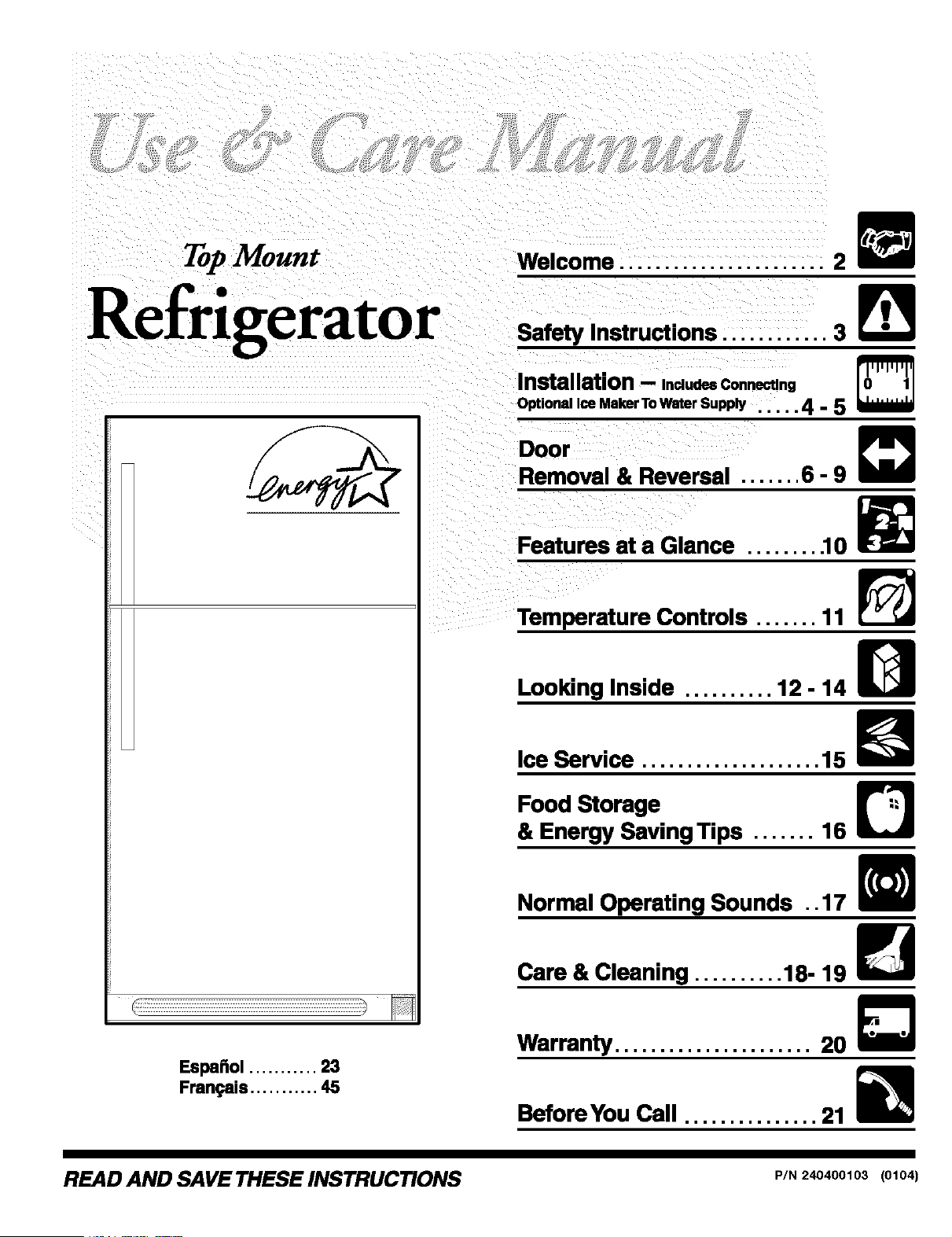
TopMount Welcome ....................... 2
Safety Instructions ............ 3
Espa6ol ........... 23
Frangais ........... 45
Installation - ,.dude_Connecting
OptionalIce MakerToWaterSupply ..... 4 - 5
Door
Removal & Reversal ....... 6 - 9
Features at a Glance ........ .10
Temperature Controls ....... 11
n
Looking Inside .......... 12 - 14 U
Ice Service .................... 15 U
Food Storage D
& Energy Saving Tips ....... 16
Normal Operating Sounds .. 17
Care & Cleaning .......... 18- 19 r_
m
Warranty ...................... 20 W
Before You Call ............... 21
READ AND SAVE THESE INSTRUCTIONS p/r_240400103(0104)
Congratulations on your purchase of a new refrigerator! We
here at Electrelux Home Products are very proud of our
product and we are completly committed to providing you
with the best service possible. Your satisfaction is our #1
priority.
Please read this Use & Care Manual very carefully. It contains
valuable information on how to properly maintain your new
refrigerator.
We know you'll enjoy your new refrigerator and Thank You
for choosing our product. We hope you consider usfor future
purchases.
PLEASE READ AND SAVE THESE INSTRUCTIONS
This Use & Care Manual provides specific operating
instructions for your model. Use your refrigerator only as
instructed in this manual. These instructions are not meant
to cover every possible condition and situation that may
occur. Common sense and caution must be practiced when
installing, operating and maintaining any appliance.
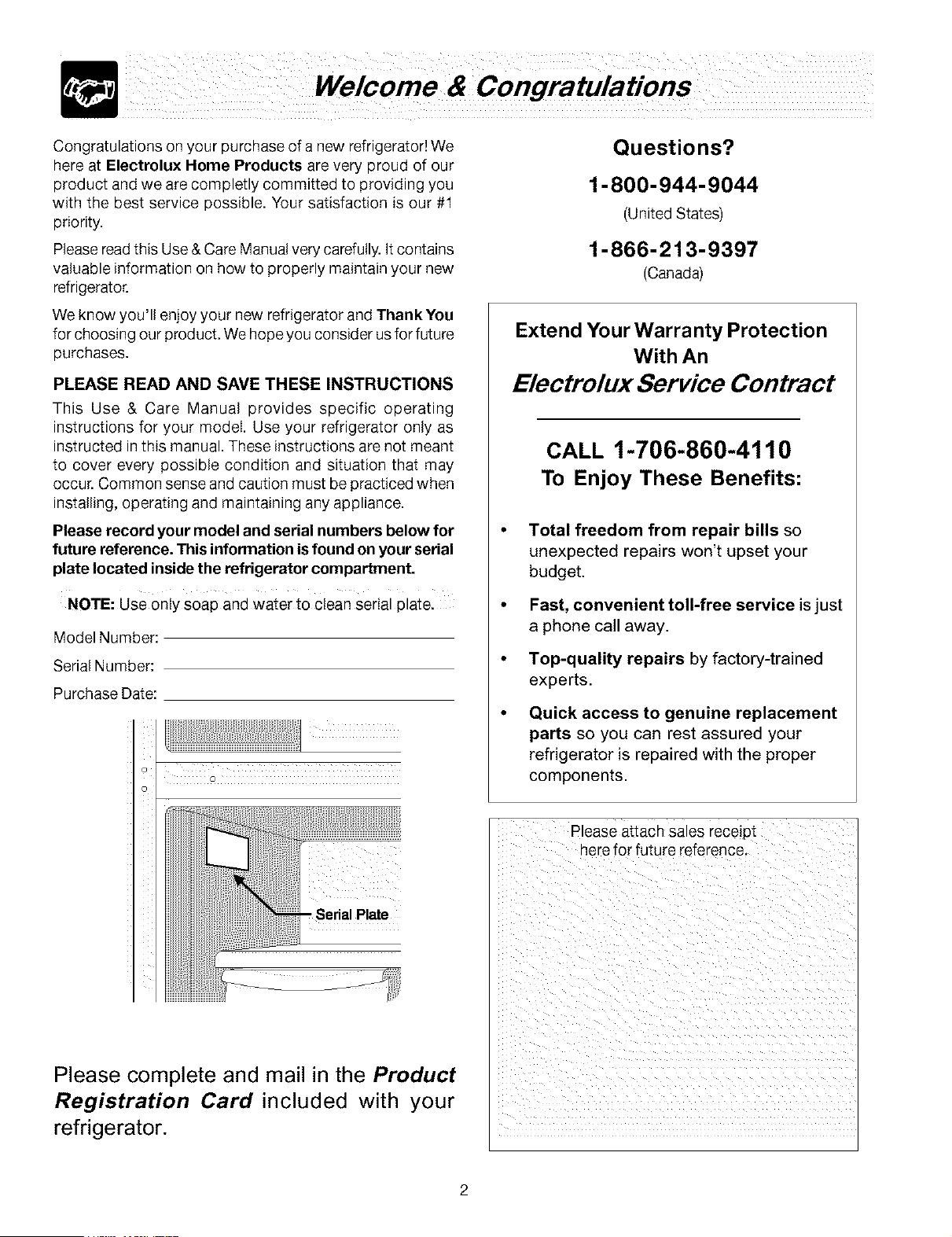
Please record your model and serial numbers below for
future reference. This information isfound on your serial
plate located inside the refrigerator compartment.
NOTE: use only Soap and water to Clean Serial plate.
Model Number:
Serial Number:
Purchase Date:
Questions?
1-800-944-9044
(United States)
1-866-213-9397
(Canada)
Extend Your Warranty Protection
With An
Electrolux Service Contract
CALL 1-706-860-4110
To Enjoy These Benefits:
Total freedom from repair bills so
unexpected repairs won't upset your
budget.
Fast, convenient toll-free service is just
a phone call away.
Top-quality repairs by factory-trained
experts.
Quick access to genuine replacement
parts so you can rest assured your
refrigerator is repaired with the proper
components.
SerialPlate
Please complete and mail in the Product
Registration Card included with your
refrigerator.
Please attach sales receipt
nere for future reference.
2
Please Read All Instructions Before Using This Refrigerator.
FOR YOUR SAFETY
• Do not store or use gasoline, or other flammable liquids
in the vicinity of this or any other appliance. Read pro-
duct labels for warnings regarding flammability and other
hazards.
• Do not operate the refrigerator in the presense of
explosive fumes.
• Avoid contact with any moving parts of automatic ice
maker.
• Remove all stables from the carton. Staples can cause
severe cuts, and also destroy finishes if they come in
contact with other appliances or furniture.
CHILD SAFETY
Destroy or recycle the carton, plastic bags, and any exterior
wrapping material immediately after the refrigerator is
unpacked. Children should NEVER use these items to play.
Cartons covered with rugs, bedspreads, plastic sheets or
stretch wrap may become airtight chambers, and can
quickly cause suffocation.
PROPER DISPOSAL OF YOUR REFRIGERATOR
OR FREEZER
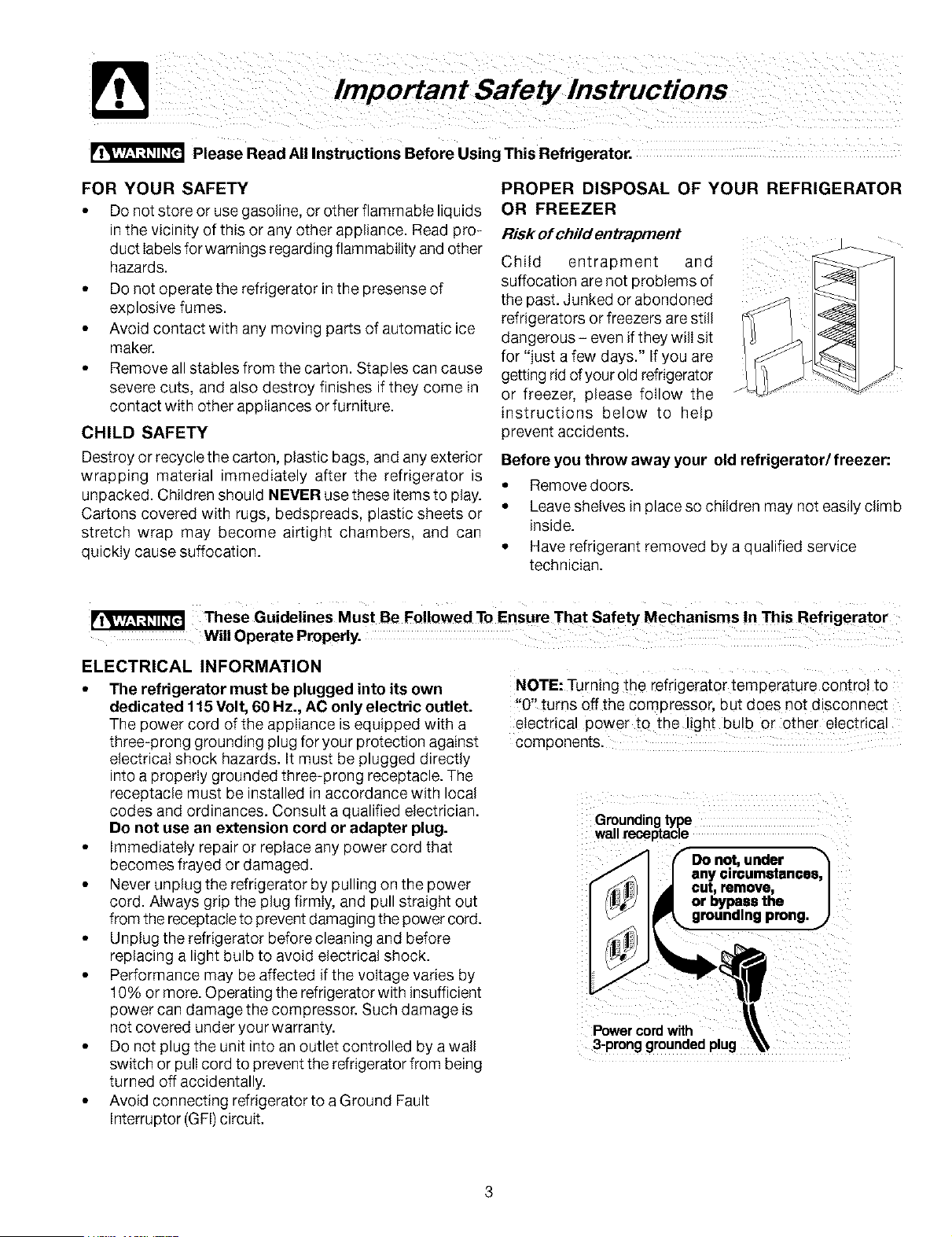
Risk of child entrapment
Child entrapment and
suffocation are not problems of
the past. Junked or abondoned
refrigerators or freezers are still
dangerous - even if they will sit
for "just a few days." Ifyou are
getting rid ofyour old refrigerator
or freezer, please follow the
instructions below to help
prevent accidents.
Before you throw away your old refrigerator/freezer:
• Remove doors.
• Leave shelves in place so children may not easily climb
inside.
• Have refrigerant removed by a qualified service
technician.
ELECTRICAL INFORMATION
• The refrigerator must be plugged into its own NOTE: Turning the refrigerator temperature control to
dedicated f 15 Volt, 60 Hz., AC only electric outlet ................................... but does not disconnect
The power cord of the appliance is equipped with a
three-prong grounding plug for your protection against
electrical shock hazards. It must be plugged directly
into a properly grounded three-prong receptacle. The
receptacle must be installed in accordance with local
codes and ordinances. Consult a qualified electrician.
Do not use an extension cord or adapter plug.
• Immediately repair or replace any power cord that
becomes frayed or damaged.
• Never unplug the refrigerator by pulling on the power
cord. Always grip the plug firmly, and pull straight out
from the receptacle to prevent damaging the power cord.
• Unplug the refrigerator before cleaning and before
replacing a light bulb to avoid electrical shock.
• Performance may be affected if the voltage varies by
10% or more. Operating the refrigerator with insufficient
power can damage the compressor. Such damage is
not covered under your warranty.
• Do not plug the unit into an outlet controlled by a wall
switch or pull cord to prevent the refrigerator from being
turned off accidentally.
• Avoid connecting refrigerator to a Ground Fault
Interruptor (GFI) circuit.
etectrica! power to the light bu!b or other e!ectrica !
x ¸ ill ¸¸
Groundingtype
wallreceptacle
Do not, under _'_
any circumstances, I
cut, remove, /
or bypass the /
grounding prong, j)
Power cordwith
3-pronggroundedplu_
This Use & Care Manual provides specific operating
instructions for your model. Use the refrigerator only as
instructed in this Use & Care Manual. Before starting the
refrigerator, follow these important first steps.
LOCATION
• Choose a place that is near a grounded electrical outlet.
Do Not use an extension cord or an adapter plug.
• If possible, place the refrigerator out of direct sunlight
and away from the range, dishwasher or other heat
sources.
• The refrigerator must be installed on a floor that is level
and strong enough to support a fully loaded refrigerator.
• Considerwater supply availability for models equipped
with an automatic ice maker.
INSTALLATION
• Do Not install the refrigerator where the temperature
will drop below 55°F (13°C) or rise above 110°F (43°C).
The compressor will not be able to maintain proper
temperatures inside the refrigerator.
DO Not block the toe grille on the
lower fron t of your refrigerator. Sufficient air
circulation is essential for the proper operation of
your refrigerator.
Installation Clearances
• Allow the following clearances for ease of installation,
proper air circulation, and plumbing and electrical
connections:
Sides & Top 3/8"
Back 1"
NOTE: If you see black c0i!s/tubing on the back Ofyour
refrigerator (air-cooled condenser) leave 3' clearance at
top of refrigerator,
DOOR OPENING
NOTE: If your refrigerator is placed with the door hinge
side against a wall, you may have to allow additional
space so the door can be opened wider.
Your refrigerator should be positioned to allow easy access
to a counter when removing food. To make this possible,
the direction in which the doors open can be reversed. See
Door Removal & Reversal Instructions on page 6.
LEVELING
All four corners of your refrigerator must rest firmly on a
solid floor. Your refrigerator is equipped with adjustable front
rollers to help level your unit.
ToLevel Your Refrigerator:
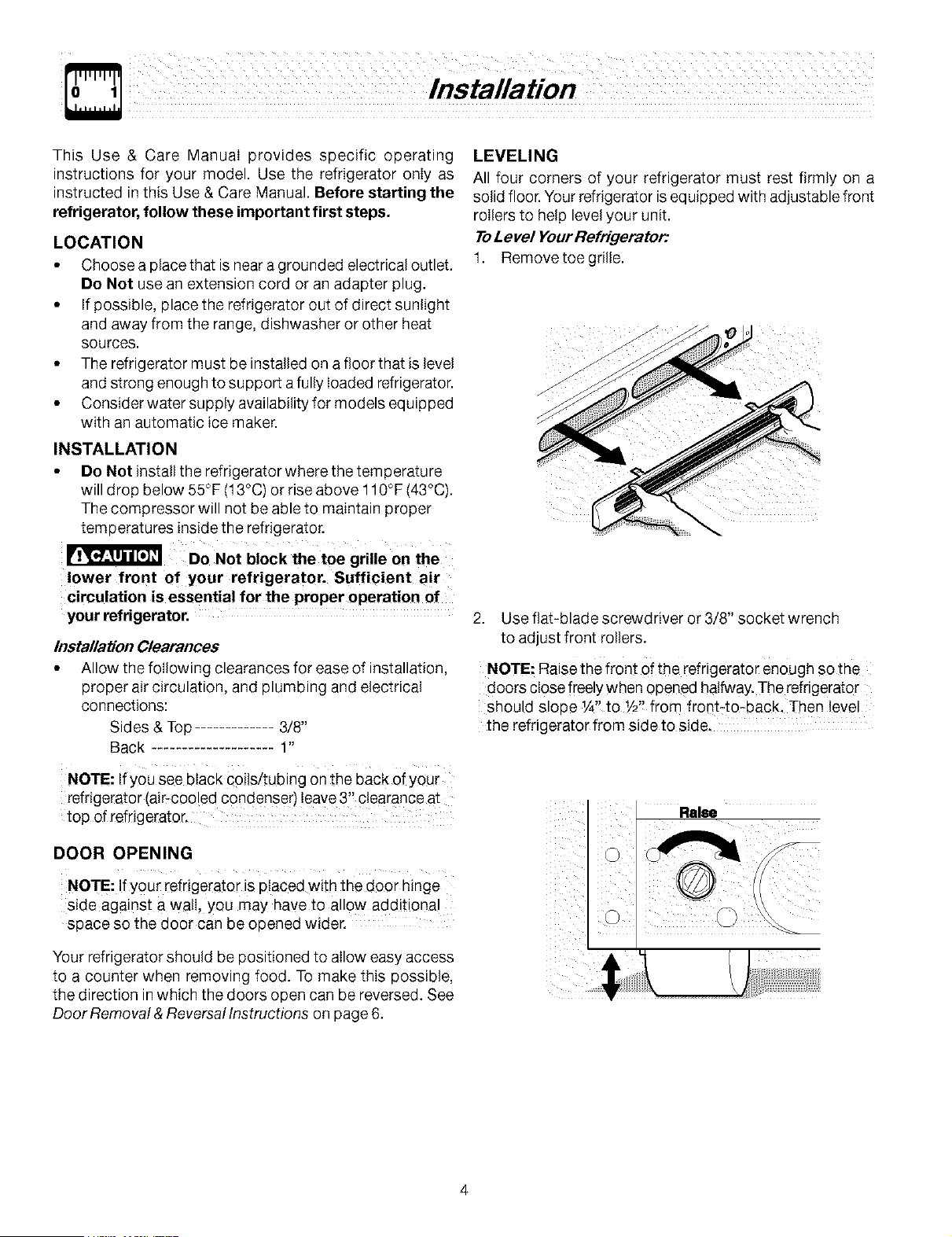
1. Remove toe grille.
2. Use flat-blade screwdriver or 3/8" socket wrench
to adjust front rollers.
NOTE: Raise the front of the refrigerator enough SOthe
doors close freely when opened halfway. The refrigerator
should slope 1/4,to 1/2'from front-to-back, Then level
the refrigerator from side to side,
Raise
4
Installation - Connecting Optional Ice Maker To Water Supply
To avoid electric shock, which can cause death or severe personal injury, disconnect the
refrigerator from electrical power before connecting a water supply line to the refrigerator.
To Avoid Property Damage:
Copper tubing is recommended for the water supply line. Water supply tubing made of 1/4"plastic is no1
recommended since it greatly increases the potential for water leaks. Manufacturer will not be responsible for
any damage if plastic tubing is used for supply line.
DO NOT install water supply tubing in areas where temperatures fall below freezing.
Chemicals from a malfunctioning softener can damage the ice maker. Ifthe ice maker is connected to soft
water, ensure that the softener ismaintained and working properly.
IMPORTANT: Ensure that your wa[er supply line connections comply with all local plumbing coaes.
Before Installing The Water Supply Line, You Will Need
• Basic Tools: adjustable wrench, fiat=blade screwdriver, and Phillips TM screwdriver
• Access to a household cold water line with water pressure between 20 and 120 psi.
• A water supply line made of 1¼inch (6.4 mm) QD, copper tubing. To determine the length of copper tubing needed,
you will need to measure the distance from the ice maker inlet valve at the back of the refrigerator to your cold water
pipe. Then add approximately 7 feet (2.1 meters), so the refrigerator can be moved out for cleaning (as shown).
• A shutoff valve to connect the water supply line to your household water system. DO NOT use a self=piercing type
shutoff valve.
• A compression nut and ferrule (sleeve) for connecting the water supply line to the ice maker inlet valve.
NOTE: Water line kit number 5303917950, available from your appliance dealer at additional cost, Contains 25 feet
1
(7.6 meters) of 1/4inch OD copper tubing, a saddle type shutoff valve (nonpiercing), (2) V4inch brass compression
nuts, (2) ferrules/sleeves, and instructions for installing a water supply line.
ToConnect Water Supply Line ToIce Maker Inlet Valve
1. Disconnect refrigerator from electric power source.
2. Place end of water supply line into sink or bucket. Turn QN water supply
and flush supply line until water is clear. Turn OFF water supply at shut
off valve.
3. Unscrew plastic cap from water valve inlet and discard cap.
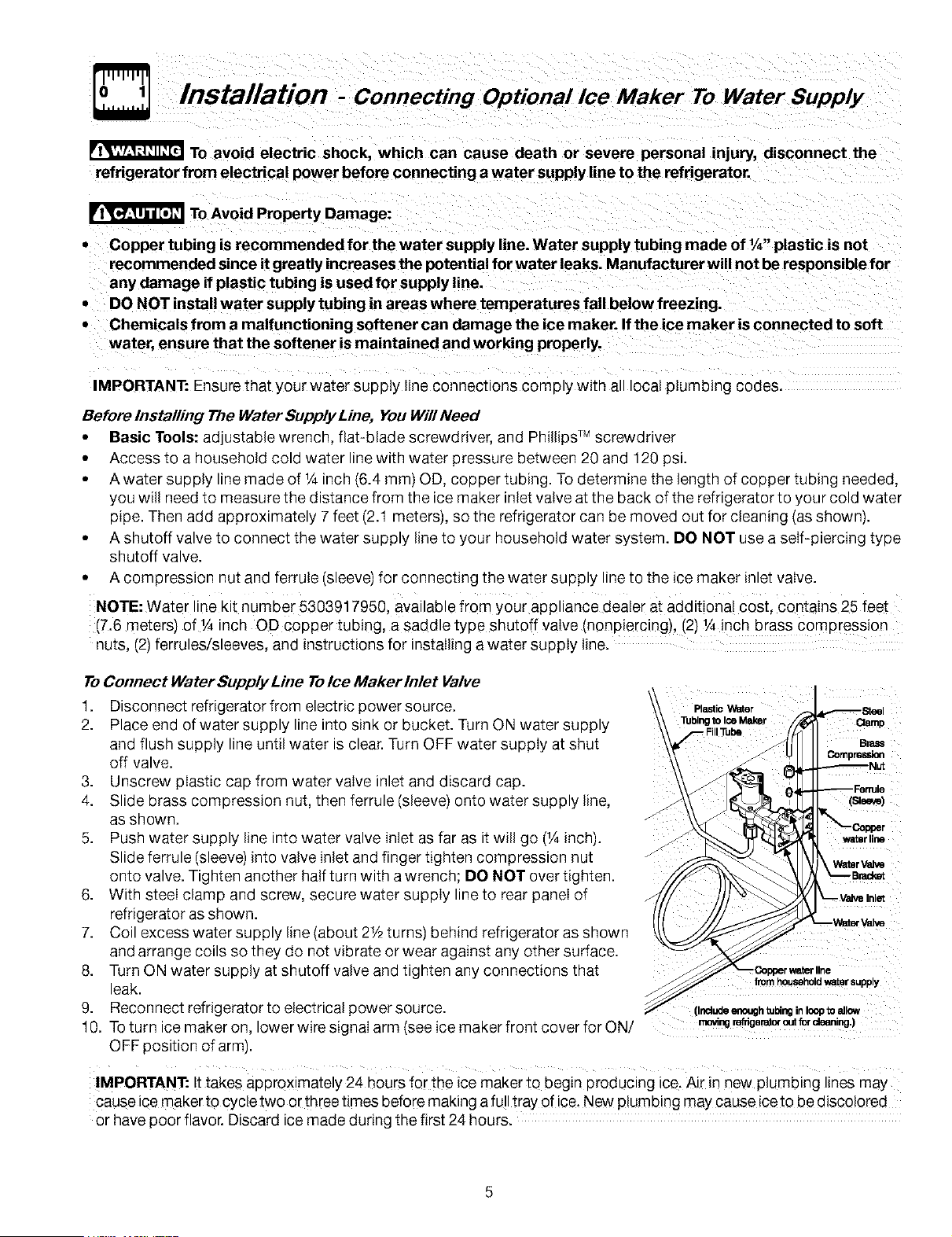
4. Slide brass compression nut, then ferrule (sleeve) onto water supply line,
as shown.
5. Push water supply line into water valve inlet as far as it will go (1¼inch).
Slide ferrule (sleeve) into valve inlet and finger tighten compression nut
onto valve. Tighten another half turn with a wrench; DO NOT over tighten.
6. With steel clamp and screw, secure water supply line to rear panel of
refrigerator as shown.
7. Coil excess water supply line (about 21/2turns) behind refrigerator as shown
and arrange coils so they do not vibrate or wear against any other surface.
8. Turn QN water supply at shutoff valve and tighten any connections that
leak.
9. Reconnect refrigerator to electrical power source.
10. To turn ice maker on, lower wire signal arm (see ice maker front cover for ON/
OFF position of arm).
_8teal
Clamp
Brass
Compression
Nut
water line
IMPORTANT: It takes approximately 24 hours for the ice maker to begin producing ice. Air in new Plumbing lines may
cause ice maker to cycle two or three times before making a fulltray of ice, New plumbing may cause iceto be disco!ored
or have poor flavor. Discard ice made during the first 24 hours.
Door Removal and Reversal Instructions
Screw
Hinge
Phllllp6 neaa
or.
Quadre_ neaa
screwanver
V_3nChSet
AdJustal_e
W_'_ch
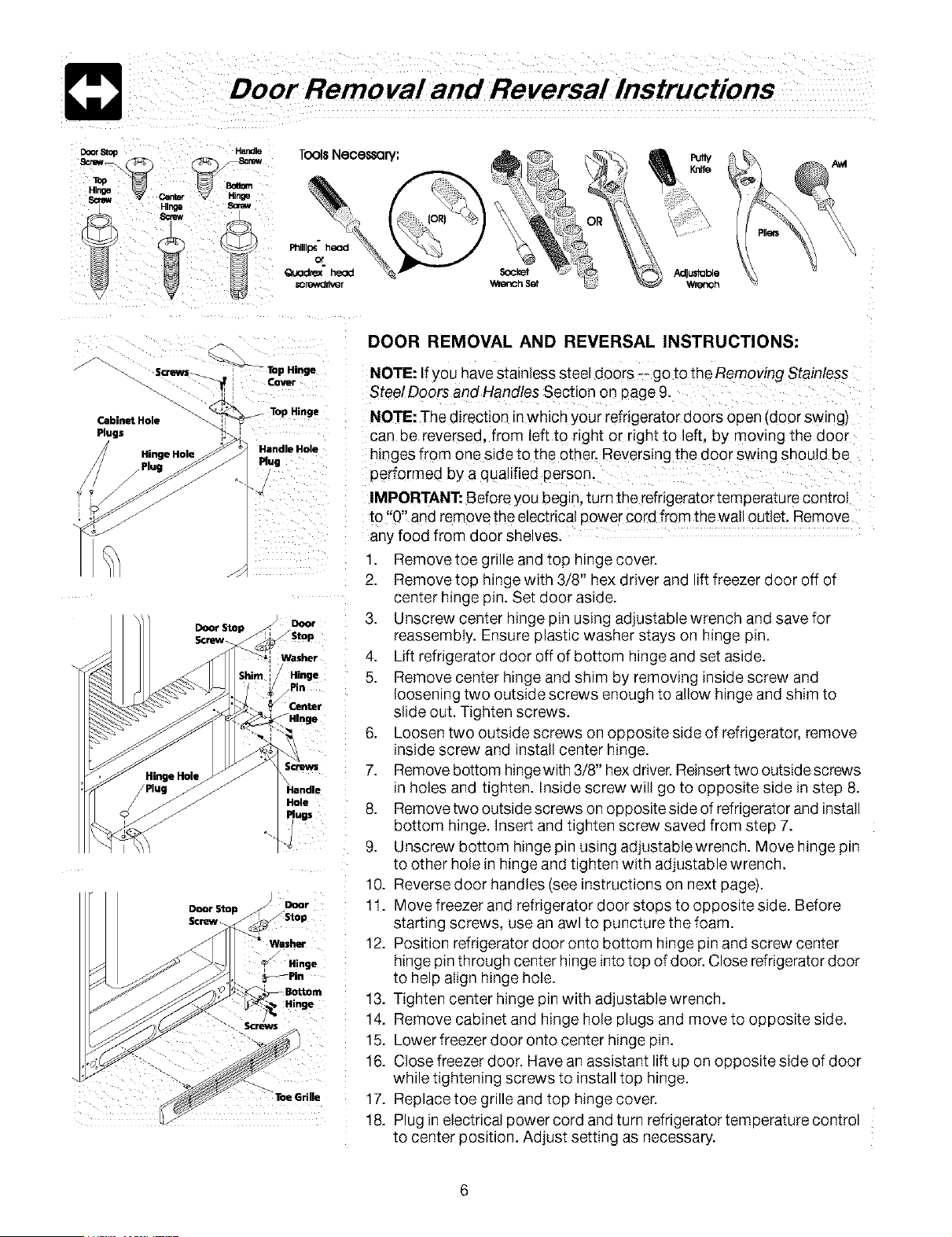
DOOR REMOVAL AND REVERSAL INSTRUCTIONS:
_Top Hinge
s=_,,_ co,,= NOTE: If you have stainless steel doors -_ go to the Removing Stainless
, Steel Doors and Handles Section on page 9.
CabinetHole _"" TopHinge NOTE: ]-he direction inwn_cn your refrigerator doors open [ooor sw_ng)
P_ugs % can oe reversee, from left to right or right to left. by moving me ooor
HingeHole_ HandleHole hinges from one sloe to tne omer. Reversing the moor swing snouta oe
Plug M.g 3erformed by a qualified persor
?
IMPORTANT: Before you begin, turn the refrigerator temperature control
to "0" and remove the electrical Dower cord from me wa_ ouuet. Remove
any food from door shelves.
Hinge Hole
Plug
Door Stop Door
Screw StOl
Door 3.
Stop
Washer 4.
Hinge 5.
_Pin
Center
_Hlnge
6.
7,
Handle
Hole 8.
1. Removetoe gnHeann top hinge cover.
2. Remove top n_ngew_tn 3/8" hex driver and ft freezer door off of
center Hnge p{n. Set moor as_ae.
Unscrew center n"qge p_n using aajustable wrench and save for
reassembIy. Ensure Plastic washer stays on nlnge n{n.
Lift refrigerator door off of bottom hinge ann set as_ae.
Remove center hinge ann sn_m oy remowng ns_aescrew ann
loosening two outsiae screws enough to allow hinge ann snim to
slide out. Tignten screws.
Loosen two outs_ae screws on ODOOSiteside of refrigerator, remove
inside screw ann install center nlnge.
Remove bottom hinge with 3/8" hex driver.Reinsert two outside screws
q holes ann _lgmen. Inside screw will go _oopposite sloe in step 8.
Remove two outside screws on ODDOSiteside of refr gerator ann _nsta_
oottom n_nge.Insert and t_ghten screw saved from steD 7.
9. Unscrew bottom hinge pin using aa Jstable wrench. Move hinge pin
[o otner no_ein nlnge and _ghten with adjustaDle wrencn.
10. Reverse door handles see _ns_ruct_onson next page).
11. Move freezer and refr geratoraoorstopstooppositeside. Before
starling screws, use an awl to Duncture the foam.
12. Position refr gera_or moor onto DO[tom r_'ngepin and screw center
hinge pin mrougn center nlnge into top of door. Close refrigerator moor
[o held align nlnge hole.
13. Tighten cen_er nlnge pin wltn aa.ustaole wrencn.
14. Remove cabinet and hinge no_e p_ugsann move to opposite s_ae.
15. Lower freezer door onto center hinge Din.
16. Close freezer door. Have an assistant ft UDon opposite side of door
wh e tlgmenlng screws to install top nlnge.
17. Replace _oegnHeann ton n{nge cover.
18. Plug n e_ecmca_Dower corn ann _urnrefrigerator _emDerature centre
[o center oosition. Ad!ust setung as necessary.
6
m
Door Removal and Reversal Instructions (continued)
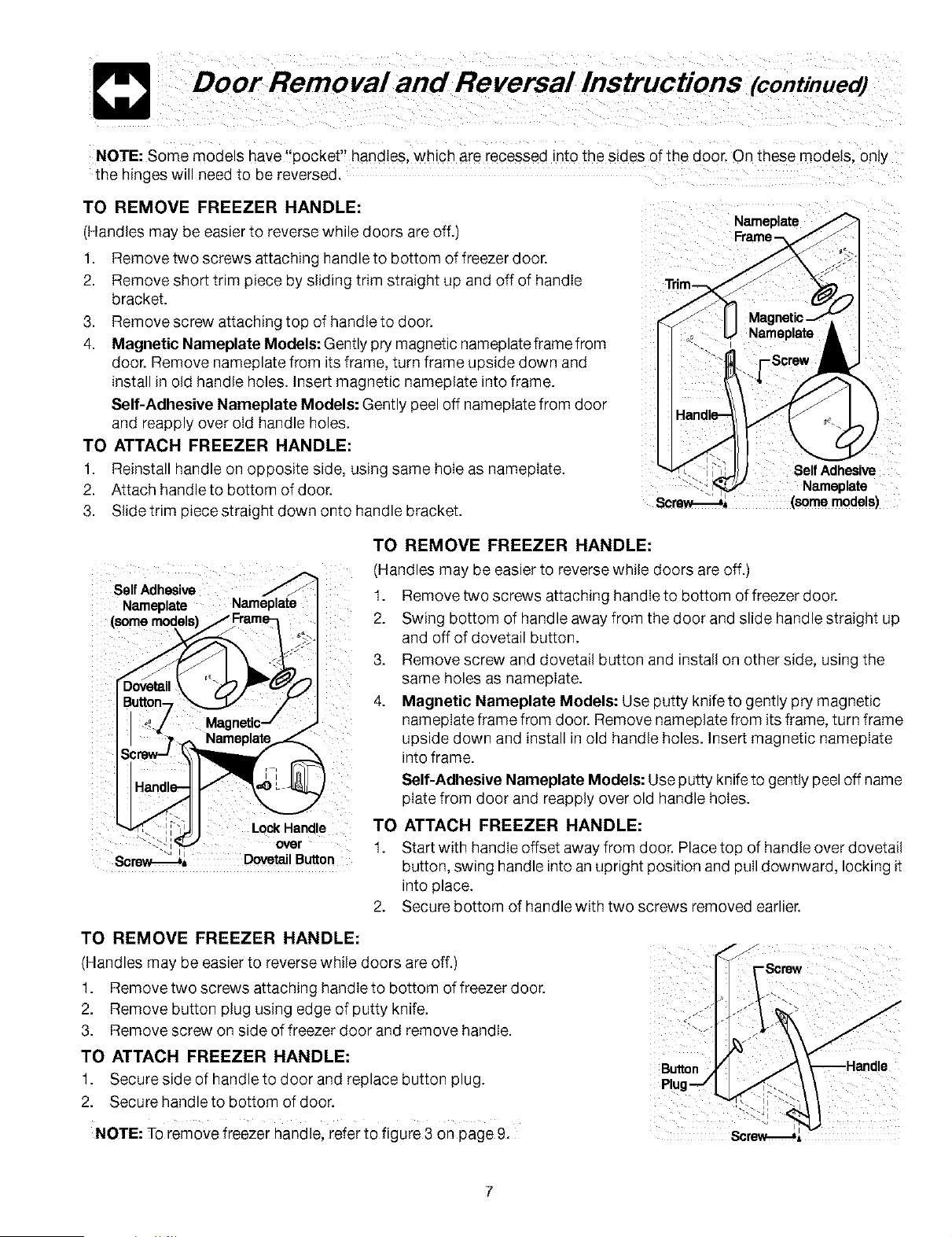
NOTE: Some moae_s nave "pocket" handles, which are recessed into the sides o" the door. On these models, on*y
me nlnges Will neea to oe reversea.
TO REMOVE FREEZER HANDLE:
{Handles may be eas_erto reverse wnHe aoors are off.
1. Remove two screws attaching handle to bottom of freezer door.
2. Remove short trim piece oy sllalng trim stra grit UDand off of handle
aracket.
3. Remove screw attaching lop of nanaleto aoor.
4. Magnetic Nameplate Models: Gently pry magnetic nameplate frame from
door. Remove nameplate from its frame, turn frame uos_ae aown ana
install in old handle holes. Insert magnetic nameplate into frame.
Self-Adhesive Nameplate Models: Gent y peel off nameplate from door
ana reapply over old handle holes.
TO ATTACH FREEZER HANDLE:
1. Reinstall handle on OPPOSites_ae. UsHlgsame hole as nameoIate.
2. Attach handle to bottom of door
3. Slide trim D_eoes[ra_gn[ aown onto nana_e oracKe[.
Trim_
Nameplate
Self Adhesive
Nameplate
Scr_ (some models)
Nameplate Nameplate J
over
Screw_=i D_tad Button
TO REMOVE FREEZER HANDLE:
(Handles may be easier to reverse while doors are off.)
1. Remove two screws attaching handle to bottom of freezer door.
2. Swing bottom of handle away from the door and slide handle straight up
and off of dovetail button.
3. Remove screw and dovetail button and install on other side, using the
same holes as nameplate.
4. Magnetic Nameplate Models: Use putty knife to gently pry magnetic
nameplate frame from door. Remove nameplate from its frame, turn frame
upside down and install in old handle holes. Insert magnetic nameplate
into frame.
Self-Adhesive Nameplate Models: Use putty knife to gently peel off name
plate from door and reapply over old handle holes.
TO ATTACH FREEZER HANDLE:
f. Start with handle offset away from door. Place top of handle over dovetail
button, swing handle into an upright position and pull downward, locking it
into place.
2. Secure bottom of handle with two screws removed earlier.
TO REMOVE FREEZER HANDLE:
(Handles may be easier to reverse while doors are off.)
f. Remove two screws attaching handle to bottom of freezer door.
2. Remove button plug using edge of putty knife.
3. Remove screw on side of freezer door and remove handle.
TO ATTACH FREEZER HANDLE:
f. Secure side of handle to door and replace button plug.
2. Secure handle to bottom of door.
NOTE: To iem0ve freezer handlel refer to figure 3 Onpage 9.
Button
P!ug
Door Removal and Reversal Instructions (continued)
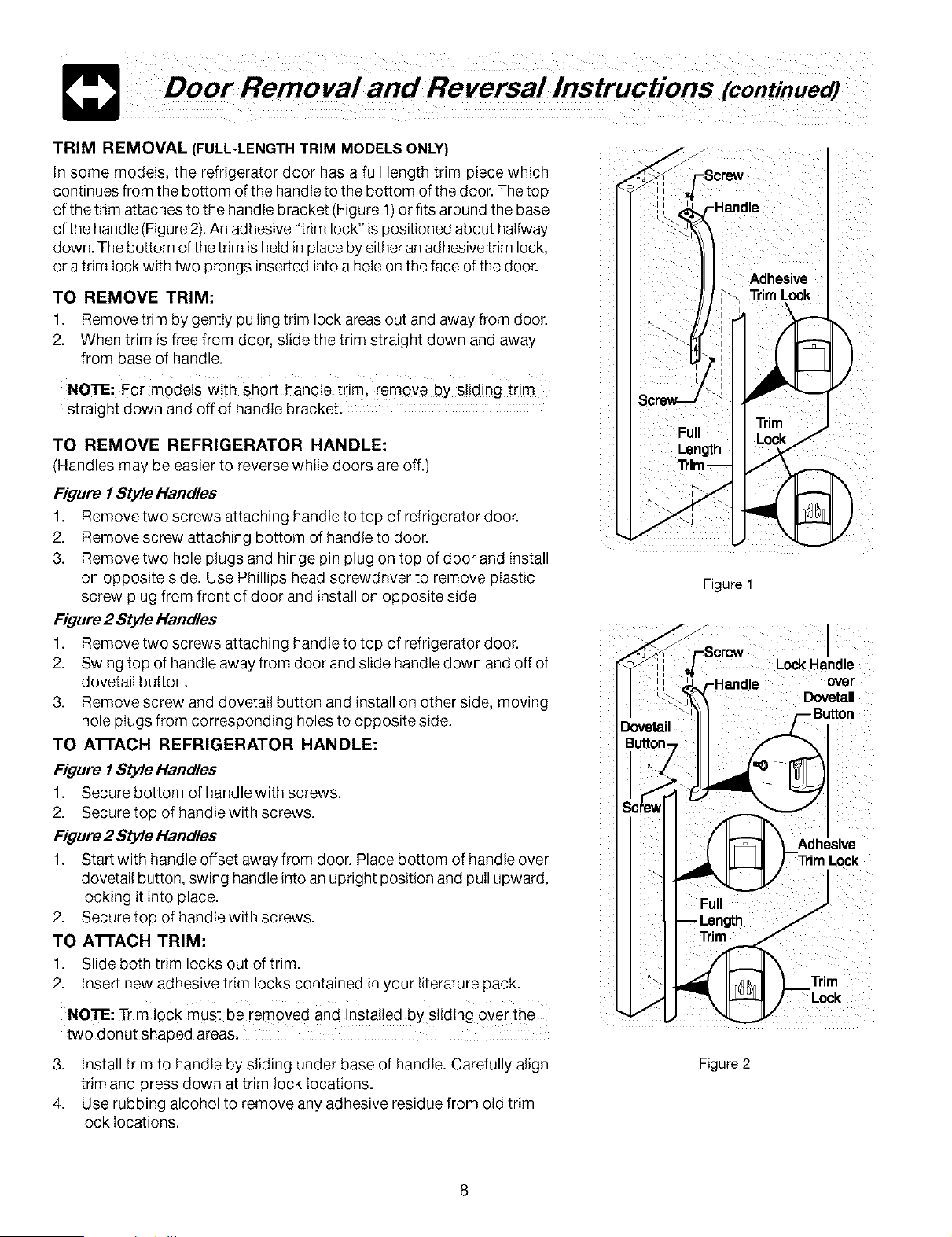
TRIM REMOVAL (FULL-LENGTH TRIM MODELS ONLY)
h7some moaels, the refrigerator aoor nasa fu ength trim piece wnlcn
continues from the bottom of the handle to the bottom of the door. The top
of the trim attaches to the handle bracket Fgure 1 or fits arouna me base
of the handle F gure 2t An adhesive "trim lock" is oositioned about halfway
down. The bottom of the trim is held in p_aceoy eEner an aoneswe _nm_OCK.
or atrim lOCKw*m two prongs _nsenea nto a hole on the face of the door.
TO REMOVE TRIM:
1. Remove trim by gently pulling _nm_OCKareas out ana away from door.
2. When trim is free from door. sHae me _nm s[ra_ght down and away
from base of handle.
NOTE: For models with snort handle trim, remove by sliding trim
stralgnt down and off of handle bracket.
TO REMOVE REFRIGERATOR HANDLE:
(Handles may oe easier _o reverse wn_e coors are off./
Figure 1Style Handles
1. Remove two screws a[_acnlng qanale to _ODof refr gera[or aoor
2. Remove screw attaching bottom of handle to aoor.
3. Remove two no_eD_ugsana _'_ge p_np_ug on _op of door and install
on opposite side. Use Phillips head screwdriver to remove plastic
screw plug from front of door and install on opposite side
Figure 2 Style Handles
1. Remove two screws attaching handle to top of refrigerator door.
2. Swing top of handle away from door and slide handle down and off of
dovetail button.
3. Remove screw and dovetail button and install on other side, moving
hole plugs from corresponding holes to opposite side.
TO ATTACH REFRIGERATOR HANDLE:
Figure 1Style Handles
1. Secure bottom of handle with screws.
2. Secure top of handle with screws.
Figure 2 Style Handles
1. Start with handle offset away from door. Place bottom of handle over
dovetail button, swing handle into an upright position and pull upward,
locking it into place.
2. Secure top of handle with screws.
TO ATTACH TRIM:
1. Slide both trim locks out of trim.
2. Insert new adhesive trim locks contained in your literature pack.
NOTE: Trim lock must be removed and installed by sliding over the
two donut shaped areas.
3. Install trim to handle by sliding under base of handle. Carefully align
trim and press down at trim lock locations.
4. Use rubbing alcohol to remove any adhesive residue from old trim
lock locations.
Adhesive
Trim
Full
Length
Figure 1
LockHandle
over
Dovetail
rl
Adhesive
Lock
Trim
Lock
Figure 2
8
Door Removal and Reversal Instructions (continued)
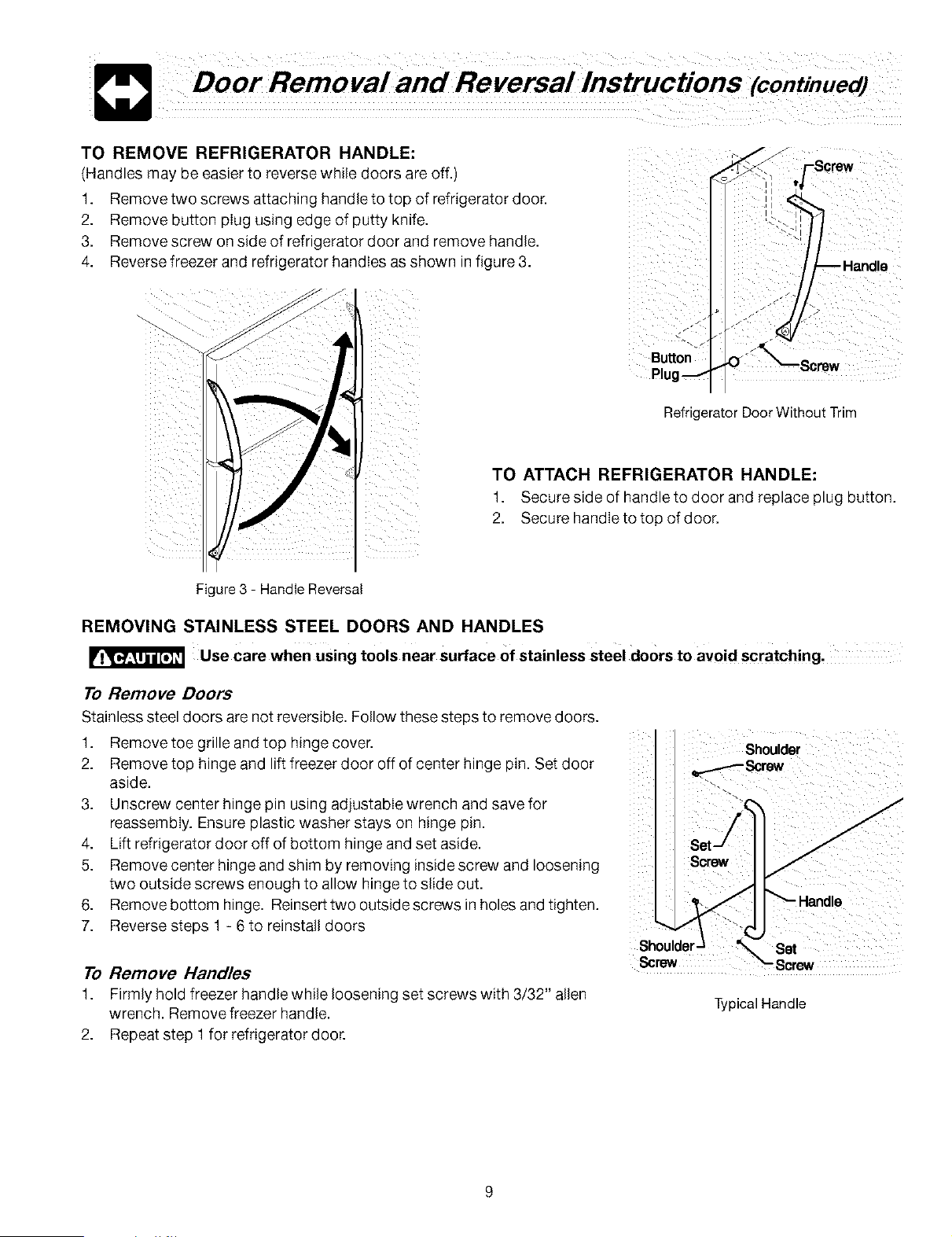
TO REMOVE REFRIGERATOR HANDLE:
(Handles may be easier to reverse while doors are off.)
1. Remove two screws attaching handle to top of refrigerator door.
2. Remove button plug using edge of putty knife.
3. Remove screw on side of refrigerator door and remove handle.
4. Reverse freezer and refrigerator handles as shown in figure 3.
Bu_on
,i-Screw
-- Handle
.Screw
Refrigerator Door Without Trim
TO ATTACH REFRIGERATOR HANDLE:
1. Secure side of handle to door and replace plug DuIton.
2. Secure handle to top of door.
Figure 3 - Handle Reversal
REMOVING STAINLESS STEEL DOORS AND HANDLES
Use care when using tools near surface Of stainless steel doors to avoid scratching.
To Remove Doors
Stainless steel doors are not reversible. Follow these steps to remove doors.
1. Remove toe grille and top hinge cover.
2. Remove top hinge and liftfreezer door off of center hinge pin. Set door
aside.
3. Unscrew center hinge pin using adjustable wrench and save for
reassembIy. Ensure plastic washer stays on hinge pin.
4. Lift refrigerator door off of bottom hinge and set aside.
5. Remove center hinge and shim by removing inside screw and loosening
two outside screws enough to allow hinge to slide out.
6.
7.
Remove bottom hinge. Reinsert two outside screws in holes and tighten.
Reverse steps 1 =6 to reinstall doors
To Remove Handles
1. Firmly hold freezer handle while loosening set screws with 3/32" allen
wrench. Remove freezer handle.
2. Repeat step 1for refrigerator door.
Shoulder
Screw
Shoulder, _Set
Screw Screw
Typical Handle
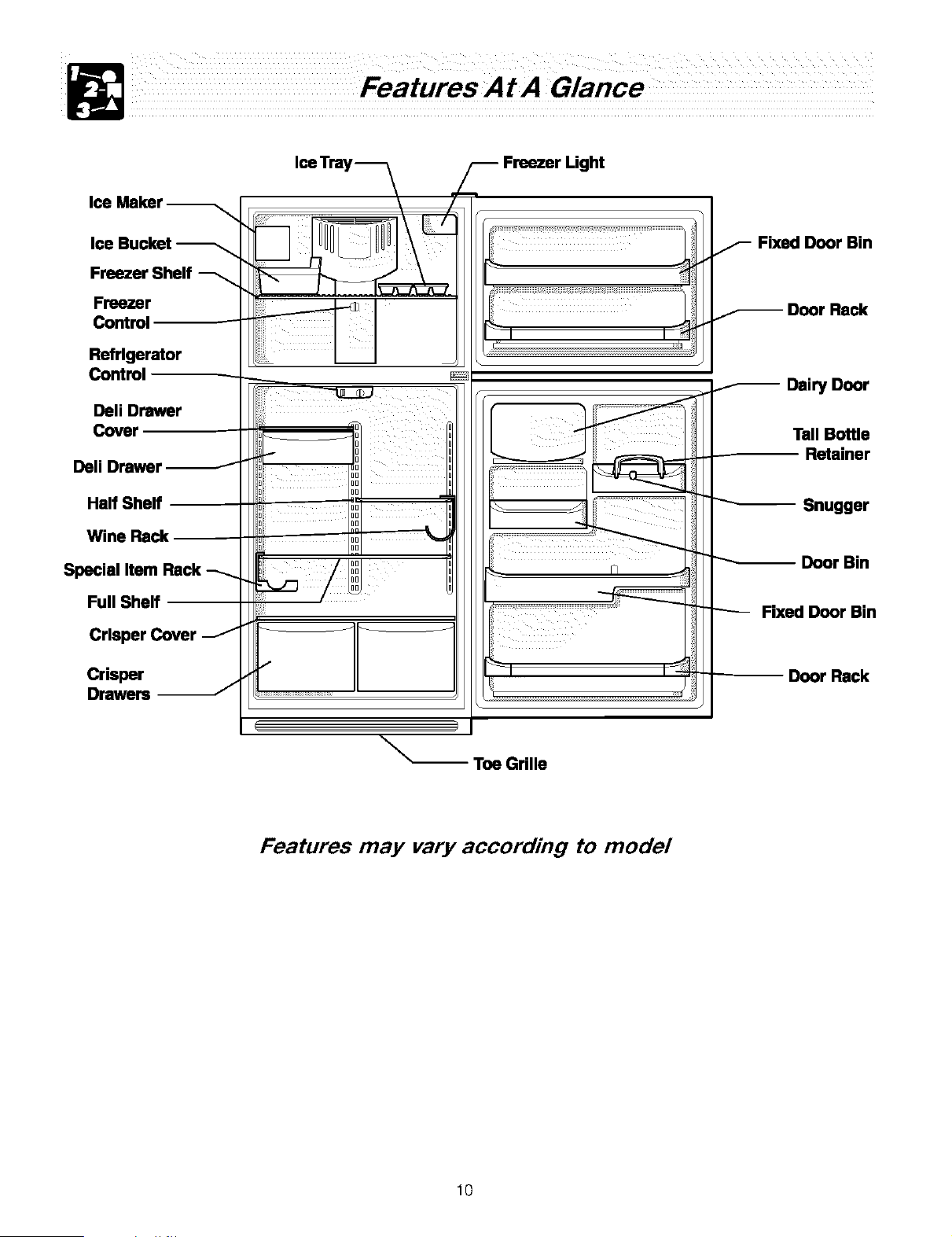
Freezer Light
Ice Bucket
Freezer
Control
Retrlgerator
Control
Dell Drawer
Covet
Dell Drawer
Half Shelf
Wine Rack
Special Item
Full Shelf
Crisper
Drawers
_ToeGrille
Fixed Door Bin
_Door Rack
Dairy Door
Tall Bottle
Retainer
Snugger
Door Bin
Fixed Door Sin
Door Rack
Features may vary according to model
lo
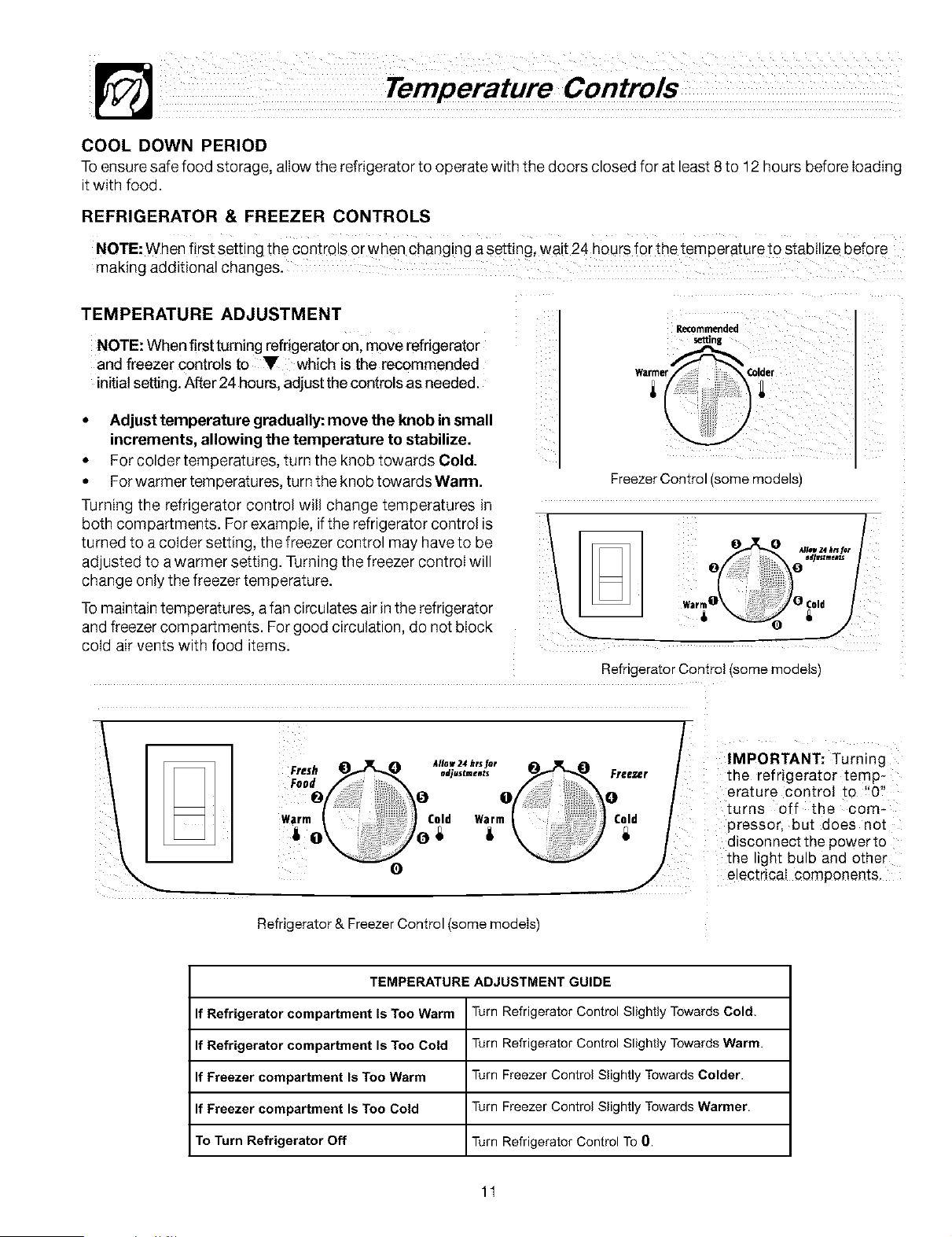
COOL DOWN PERIOD
To ensure safe food storage, allow the refrigerator to operate with the doors closed for at least 8 to 12 hours before loading
it with food.
REFRIGERATOR & FREEZER CONTROLS
NOTE: When first settl ngthe comrols orw nell chang ing a setting, wait 24 hours for the tem Derature to staBiliZe before
making additional changes.
TEMPERATURE ADJUSTMENT
NOTE: When first turningrefrigerator on. move refdgerator
and freezer controls to Y which is the recommended
initial setting. After 24 hours, adjust the controls as needed.
o Adjust temperature gradually: move the knob in small
increments, allowing the temperature to stabilize.
- For colder temperatures, turn the knob towards Cold.
o For warmer ten- 3eratures. turn the knob towards Warn1.
Turning the refrigerator contro w change temperatures -
both compartments. For example, if the refrigerator contro_ is
turned to a colder setting, the freezer control may nave to De
adjusted to awarmer setting. Turning the freezer control w
change on_ythe freezer terr oerature.
To maintain temperatures, a fan circulates air in the refrigerator
and freezer compartments. For good circulation, do not block
cold air vents with food items.
\
Recommended
setting
Freezer Control some models
J
Refrigerator Control ,some moaels
/
/
/
o
/
/
J
IMPORTANT: Turning
the refrigerator temp-
erature control to "0"
turns off the corn
oressor, but does not
disconnect the Dower to
me ght bulb ana other
electrical components.
Refrigerator & Freezer Control some models"
TEMPERATURE ADJUSTMENT GUIDE
If Refrigerator compartment Is Too Warm Turn Refrigerator Control Slightly Towards Cold.
If Refrigerator compartment Is Too Cold Turn Refrigerator Control Slightly Towards Warm.
If Freezer compartment Is Too Warm Turn Freezer Control Slightly Towards Colder.
If Freezer compartment Is Too Cold Turn Freezer Control Slightly Towards Warmer.
To Turn Refrigerator Off Turn Refrigerator Control To 0.
11
TOavoid personal injury Or property damage, handle
tempered glass Shelves carefully. Shelves may break suddenly if
nicked, scratched, or exposed to Sudden temperature change.
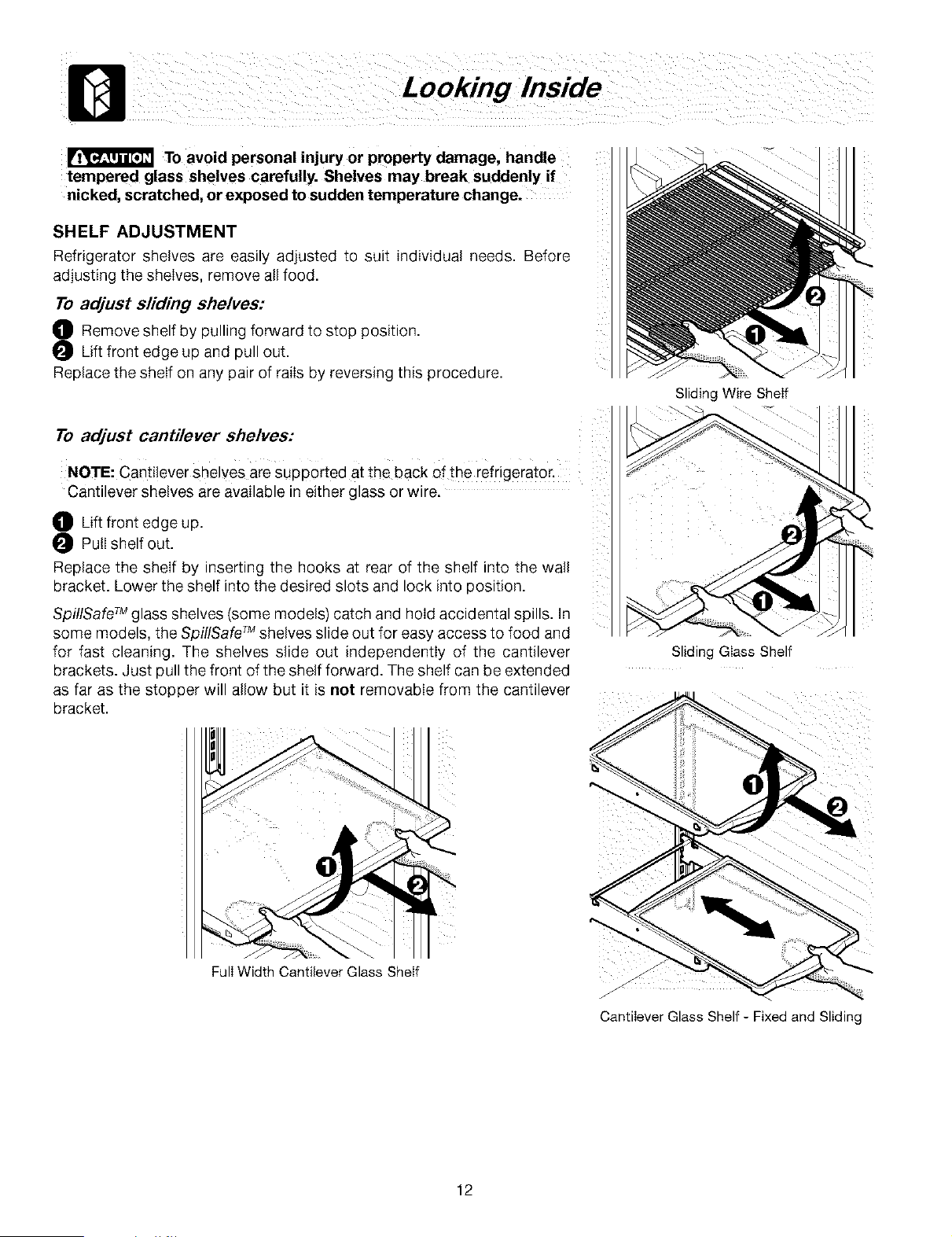
SHELF ADJUSTMENT
Refrigerator shelves are easily adjusted to suit individual needs. Before
adjusting the shelves, remove all food.
To adjust sliding shelves:
O Remove shelf by pulling forward to stop position.
O Lift front edge up and pull out.
Replace the shelf on any pair of rails by reversing this procedure.
Sliding Wire Shelf
To adjust cantilever shelves:
NOTE: Cantilever shelves are Supported at the back of the refrigerator.
Cantilever shelves are available in either glass or wire.
Lift front edge up.
Pull shelf out.
Replace the shelf by inserting the hooks at rear of the shelf into the wall
bracket. Lower the shelf into the desired slots and lock into position.
SpillSafe TM glass shelves (some models) catch and hold accidental spills. In
some models, the SpillSafe TM shelves slide out for easy access to food and
for fast cleaning. The shelves slide out independently of the cantilever
brackets. Just pull the front of the shelf forward. The shelf can be extended
as far as the stopper will allow but it is not removable from the cantilever .....
bracket.
Full Width Cantilever Glass Shelf
Sliding Glass Shelf
Cantilever Glass Shelf - Fixed and Sliding
12
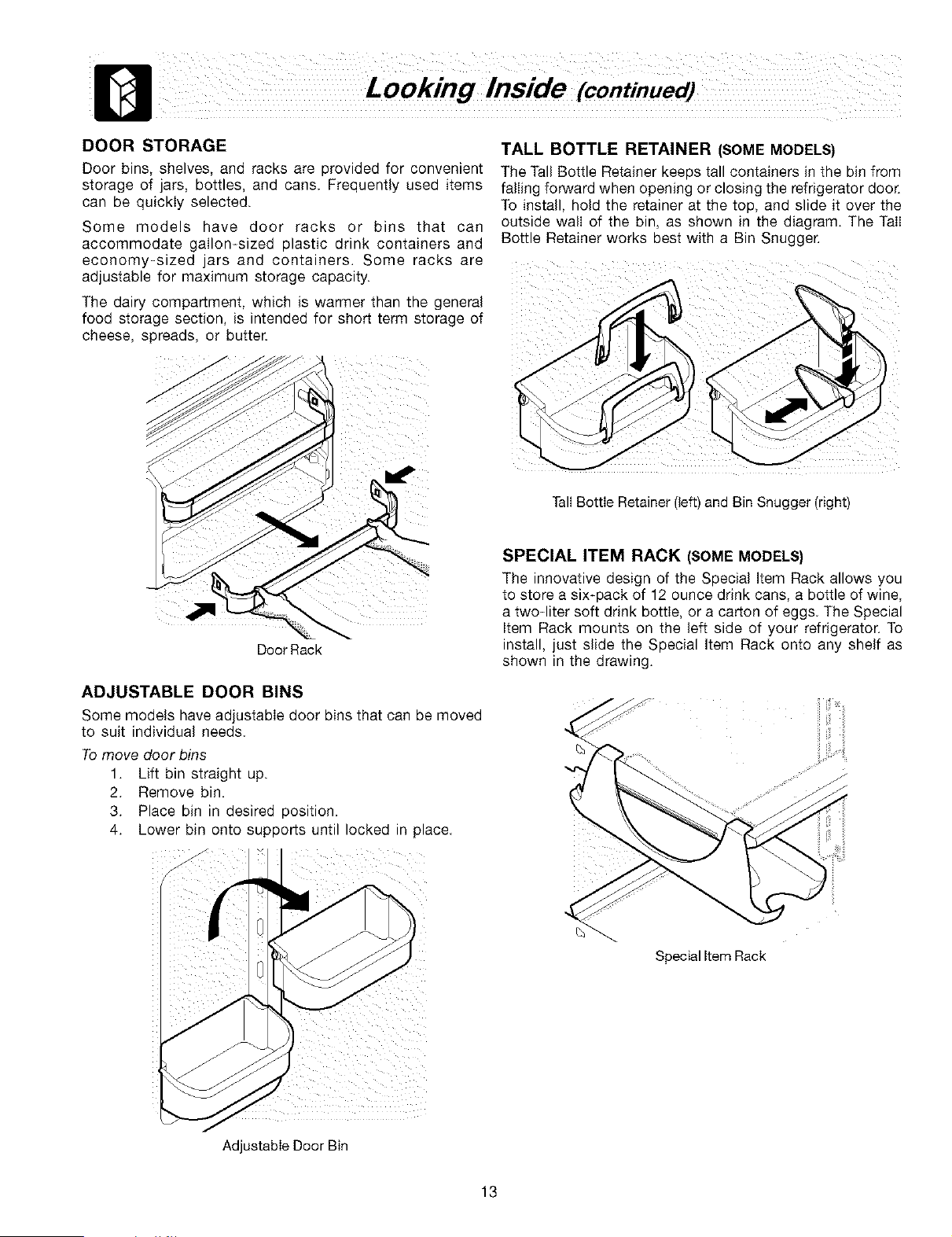
DOOR STORAGE
Door bins, shelves, and racks are provided for convenient
storage of jars, bottles, and cans. Frequently used items
can be quickly selected.
Some models have door racks or bins that can
accommodate gaIIon-sized plastic drink containers and
economy-sized jars and containers. Some racks are
adjustable for maximum storage capacity.
The dairy compartment, which is warmer than the genera
food storage section, is intended for short term storage of
cheese, spreads, or butter.
Door Rack
ADJUSTABLE DOOR BINS
Some models have adjustable door bins that can be moved
to suit individual needs.
Tomove door bins
1. Lift bin straight up.
2. Remove bin.
3. Place bin in desired position.
4. Lower bin onto supports until locked in place.
TALL BOTTLE RETAINER (SOME MODELS)
The Tall Bottle Retainer keeps tall containers in the bin from
falling forward when opening or closing the refrigerator door.
To install, hold the retainer at the top, and slide it over the
outside wall of the bin, as shown in the diagram. The Tail
Bottle Retainer works best with a Bin Snugger.
Tall Bottle Retainer eft_ and Bin SnL jger (right)
SPECIAL ITEM RACK (SOME MODELS)
The innovative design of the SDecla Item Rack allows you
_ostore a s_x-Dack of 12 ounce drink cans. a bottle of wine
a two-liter soft drink bottle or a carton of eggs. The Specla
Item Rack mounts on the eft sK]e of your refrigerator. To
install, just slide the Special Item Rack onto any shelf as
shown in the drawing.
Special Item Rack
Adjustable Door Bin
13
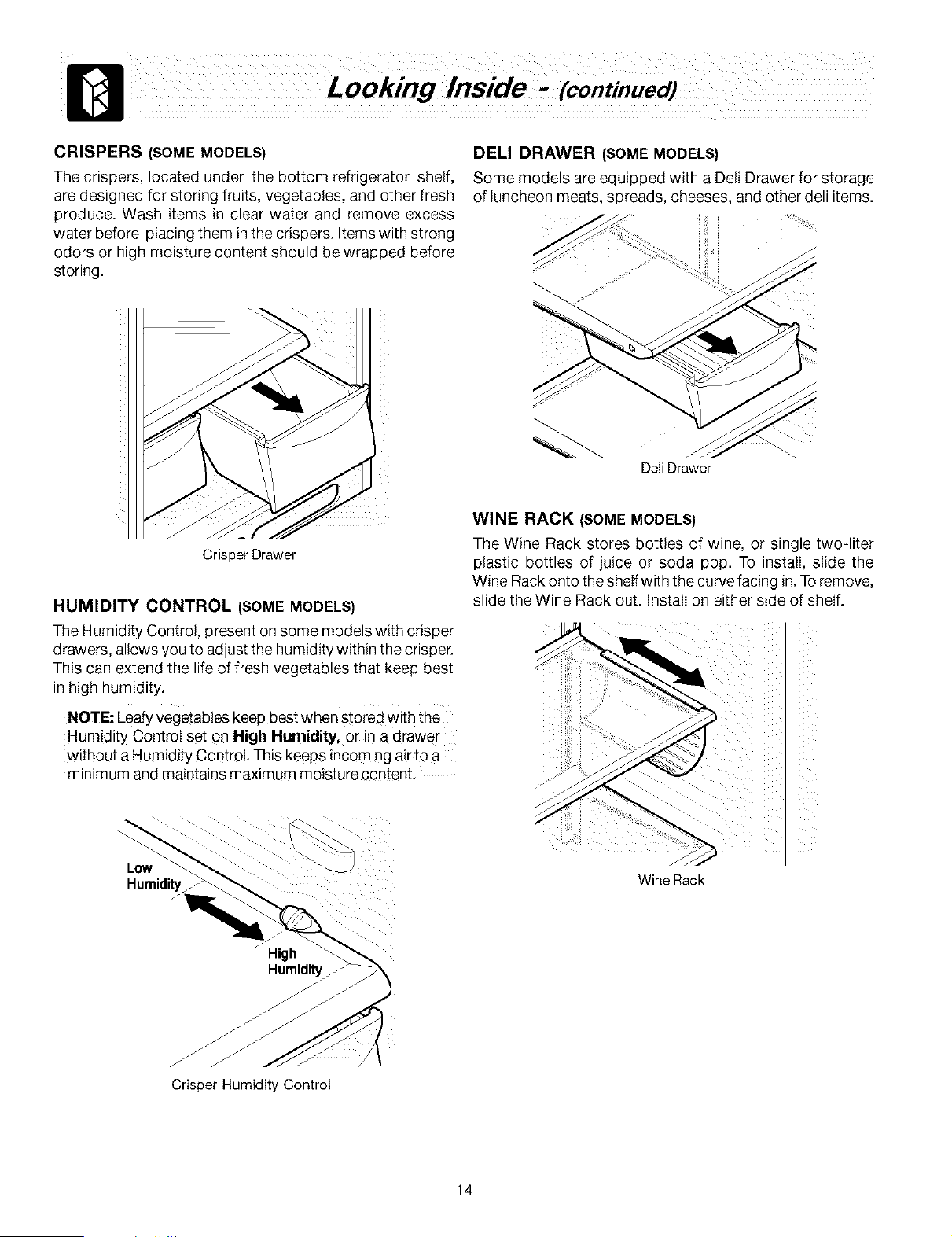
CRISPERS (SOME MODELS)
The crispers, located under the bottom refrigerator shelf,
are designed for storing fruits, vegetables, and other fresh
produce. Wash items in clear water and remove excess
water before placing them in the crispers. Items with strong
odors or high moisture content should be wrapped before
storing.
DELl DRAWER (SOME MODELS)
Some models are equipped with a Dell Drawer for storage
of luncheon meats, spreads, cheeses, and other dell items.
DellDrawer
Crisper Drawer
HUMIDITY CONTROL (SOME MODELS)
The Humidity Control, present on some models with crisper
drawers, allows you to adjust the humidity within the crisper.
This can extend the life of fresh vegetables that keep best
in high humidity.
NOTE: Leafy vegetables keep best when stored With the
Humidity Control set _n High Humidity, or ill a drawer
without a Humidity Control. This keeps incoming air to a
minimum and maintains maximum moisture content.
Low
High
Humidih
WINE RACK (SOME MODELS)
The Wine Rack stores bottles of wine, or single two-liter
plastic bottles of juice or soda pop. To install, slide the
Wine Rack onto the shelf with the curve facing in.Toremove,
slide the Wine Rack out. Install on either side of shelf.
Wine Rack
Crisper Humidity Control
14
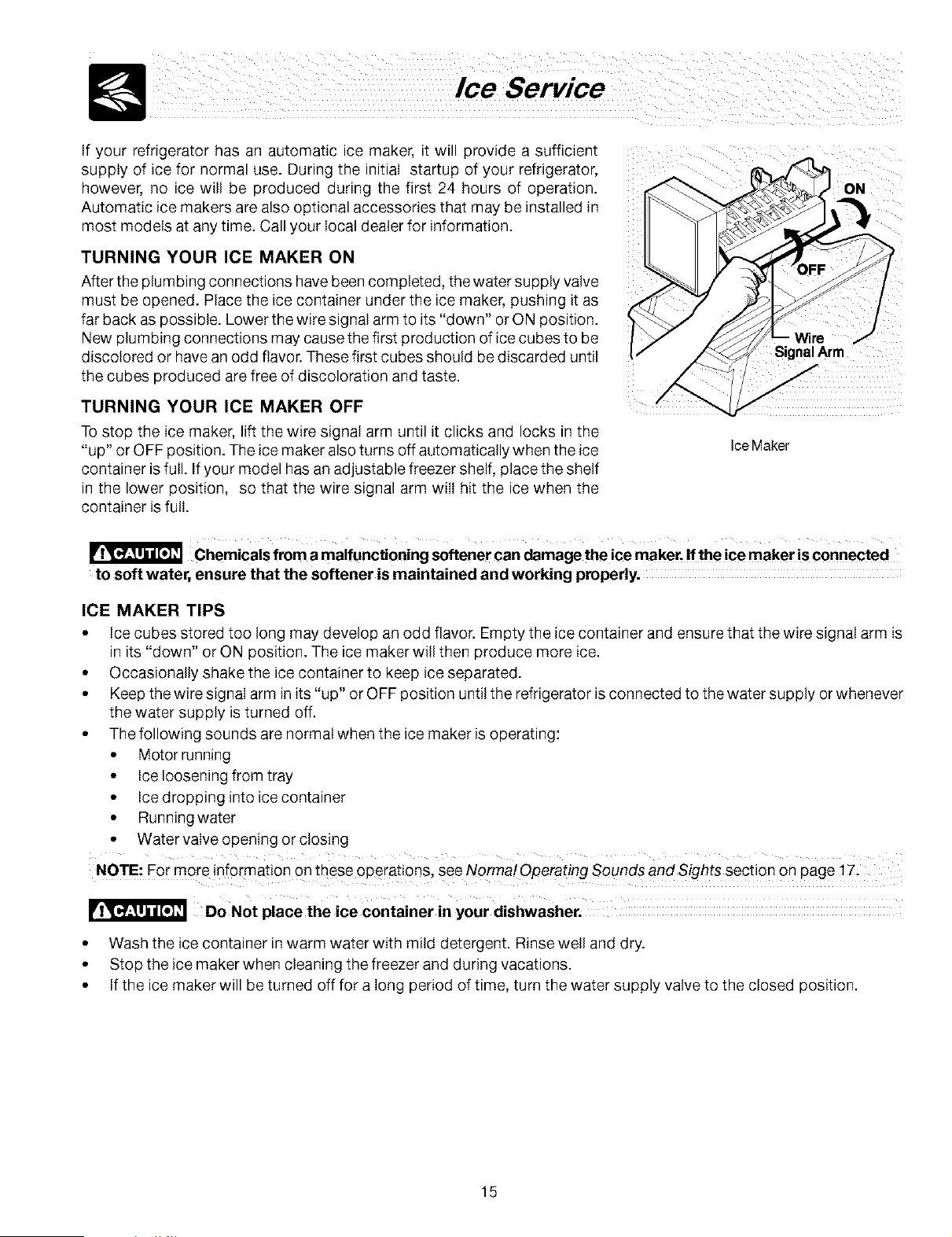
Ice Service
If your refr gerator nas an automatic ice maKer it Wl provlee a sufficient
supply of ice for norma use. During the initial startup of your refrigerator.
however, no ce w De Droouceo curing the first 24 hours of opera,ion.
Automatic ice makers are also optlona accessories that may De nstalleO In
most models at any time. Cal your local dealer for information.
TURNING YOUR ICE MAKER ON
After the p_umo_ngconnections nave oeen comp_etee, mewa_er supply vawe
must be openee. Place the ice container under the ice maker, pushing it as
far back as oossible. Lower the wire s gnal arm _o i_s"down" or ON posEion.
New 31umDing connections may cause the first production of ice cubes to be
discolored or have an odd flavor. These first cubes should be discarded unti
the cubes produced are free of discoloration and taste
TURNING YOUR ICE MAKER OFF
To stop the ice maker, lift the wire signal arm until it clicks and locks in the
"up" or OFF position. The ice maker also turns off automatically when the ice
container is full. If your model has an adjustable freezer shelf, place the shelf
in the lower position, so that the wire signal arm will hit the ice when the
container is full.
SignalArm
IceMaker
Chemicals from a malfunc_oning softener can damage the ice maker. Ifthe ice maker is connected
to soft water, ensure that the softener is maintained and working properly.
ICE MAKER TIPS
• Ice cubes stored too long may develop an odd flavor. Empty the ice container and ensure that the wire signal arm is
in its "down" or ON position. The ice maker will then produce more ice.
• Occasionally shake the ice container to keep ice separated.
• Keep the wire signal arm in its "up" or OFF position until the refrigerator is connected to the water supply or whenever
the water supply is turned off.
• The following sounds are normal when the ice maker is operating:
• Motor running
• Iceloosening from tray
• Ice dropping into ice container
• Running water
• Water vaIveopening or closing
NOTE: For more information Onthese operations, see Norma! Operating Sounds and Sights section on page 17.
• Wash the ice container in warm water with mild detergent. Rinse well and dry.
• Stop the ice maker when cleaning the freezer and during vacations.
• If the ice maker will be turned off for a long period of time, turn the water supply valve to the closed position.
15
Food Storage& Energy Saving Ideas
FOOD STORAGE IDEAS
Fresh Food Storage
• The fresh food compartment should be kept between 34° F and 40 ° F with an optimum temperature of 37° R
• Avoid overcrowding the refrigerator shelves. This reduces the circulation of air around the food and results in uneven
cooling.
Fruits and Vegetables
• Storage in the crisper drawers traps moisture to help preserve the fruit and vegetable quality for longer time periods.
Meat
• Raw meat and poultry should be wrapped securely so leakage and contamination of other foods or surfaces does not
Occur.
Frozen Food Storage
• The freezer compartment should be kept at 0° F or lower.
• A freezer operates most efficiently when it is at least 2/3 full.
Packaging Foods for Freezing
• To minimize dehydration and quality deterioration, use aluminum foil, freezer wrap, freezer bags or airtight containers.
Force as much air out of the packages as possible and seal them tightly. Trapped air can cause food to dry out,
change color, and develop an off-flavor (freezer burn).
• Wrap fresh meats and poultry with suitable freezer wrap prior to freezing.
• Do not refreeze meat that has completely thawed.
Loading the Freezer
• Avoid adding too much warm food to the freezer at one time. This overloads the freezer, slows the rate of freezing,
and can raise the temperature of frozen foods.
• Leave a space between the packages, so cold air can circulate freely, allowing food to freeze as quickly as possible.
• Avoid storing hard=to=freeze foods such as ice cream and orange juice on the freezer door shelves. These foods are
best stored in the freezer interior where the temperature varies less.
ENERGY SAVING IDEAS
• Locate the refrigerator in the coolest part of the room, out of direct sunlight,
and away from heating ducts or registers. Do not place the refrigerator
next to heat=producing appliances such as a range, oven, or dishwasher.
If this is not possible, a section of cabinetry or an added layer of insulation
between the two appliances will help the refrigerator operate more
efficiently.
Level the refrigerator so that the doors close tightly.
Refer to this Use & Care Manual for the suggested temperature control
settings.
Periodic cleaning of the condenser will help the refrigerator run more
efficiently. See the Care and Cleaning Chart on page 18.
Do not overcrowd the refrigerator or block cold air vents. Doing so causes
the refrigerator to run longer and use more energy.
• Cover foods and wipe containers dry before placing them in the
refrigerator. This cuts down on moisture build=up inside the unit.
Organize the refrigerator to reduce door openings. Remove as many
items as needed at one time and close the door as soon as possible.
16
Normal Operating Sounds& Sights
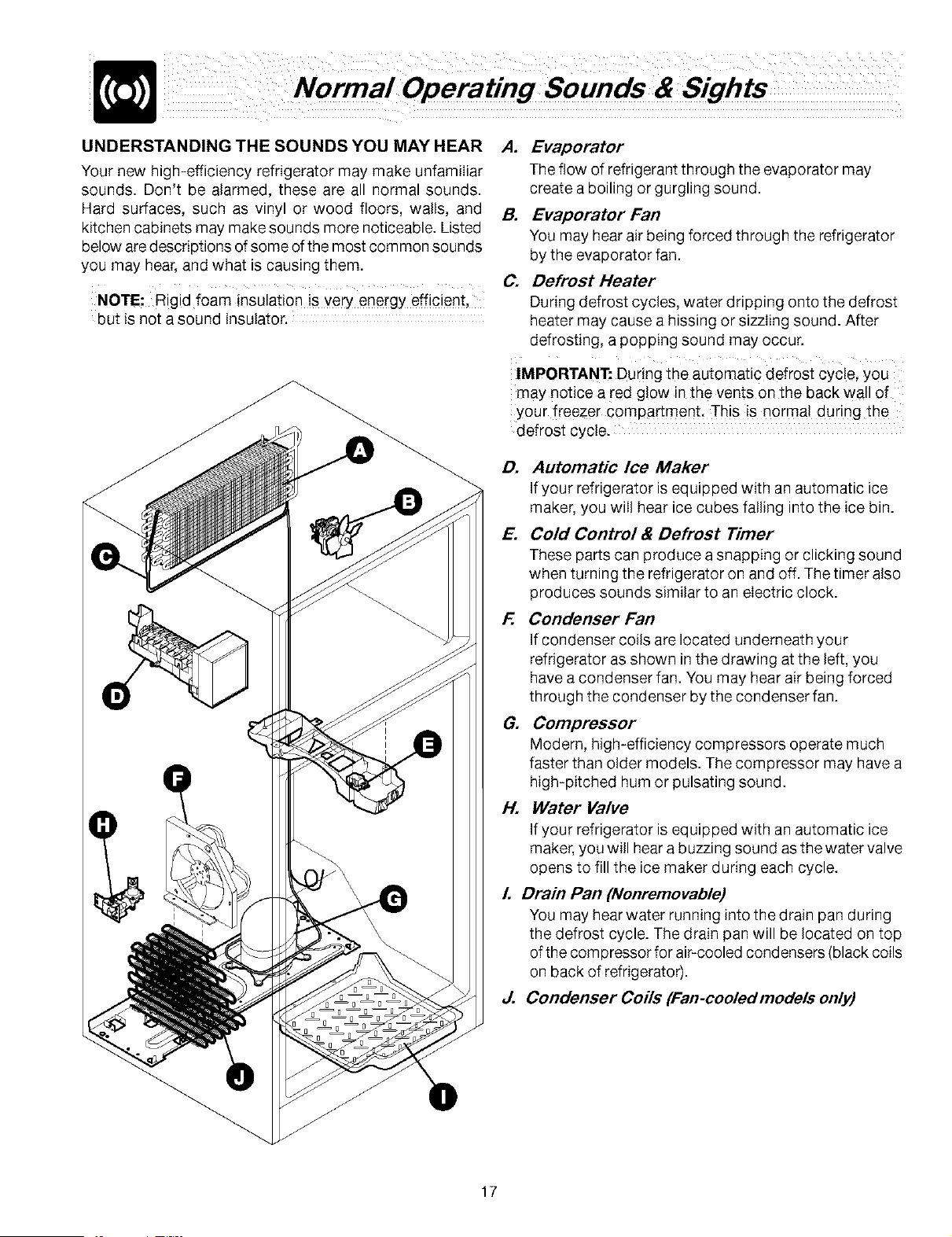
UNDERSTANDING THE SOUNDS YOU MAY HEAR
Your new high-efficiency refrigerator may make unfamiliar
sounds. Don't be alarmed, these are all normal sounds.
Hard surfaces, such as vinyl or wood floors, walls, and
kitchen cabinets may make sounds more noticeable. Listed
below are descriptions of some of the most common sounds
you may hear, and what is causing them.
NOTE: Rigid foam insulation is very energy efficient,
but is not a sound insulator.
A, Evaporator
The flow of refrigerant through the evaporator may
create a boiling or gurgling sound.
B. Evaporator Fan
You may hear air being forced through the refrigerator
by the evaporator fan.
C. Defrost Heater
During defrost cycles, water dripping onto the defrost
heater may cause ahissing or sizzling sound. After
defrosting, a popping sound may occur.
IMPORTANT: During the automatic defrost cycle, you
may notice a red g!ow in the vents on the back wa!l of
your freezer compartment, This is normal during the
defrost cycle.
D. Automatic Ice Maker
If your refrigerator is equipped with an automatic ice
maker, you will hear ice cubes falling into the ice bin.
E Cold Control & Defrost Timer
These parts can produce a snapping or clicking sound
when turning the refrigerator on and off. The timer also
produces sounds similar to an electric clock.
F. Condenser Fan
If condenser coils are located underneath your
refrigerator as shown in the drawing at the left, you
have a condenser fan. You may hear air being forced
through the condenser by the condenser fan.
G. Compressor
Modern, high-efficiency compressors operate much
faster than older models. The compressor may have a
high=pitched hum or pulsating sound.
H. Water Valve
If your refrigerator is equipped with an automatic ice
maker, you will hear a buzzing sound as the water valve
opens to fill the ice maker during each cycle.
L Drain Pan (Nonremovable)
You may hear water running into the drain pan during
the defrost cycle. The drain pan will be located on top
of the compressor for air=cooled condensers (black coils
on back of refrigerator).
J. Condenser Coils (Fan-cooled models only)
17
Keep your refrigerator and freezer clean to prevent odor build-up. Wipe up any spills immediately and clean both sections
at least twice a year. Never use metallic scouring pads, brushes, abrasive cleaners or strong alkaline solutions on any
surface. Do not wash any removable parts in a dishwasher. Always unplug the electricalpower cord from the wall
outlet before cleaning.
• When moving the refrigerator, pull straight out. Do not shift the refrigerator from side to side as this may
tear or gouge the floor covering. If the refrigerator has an automatic ice maker, be careful not to move the
refrigerator beyond the plumbing connections.
• Damp objects stick to cold metal surfaces. Do not touch refrigerated surfaces with wet or damp hands.
• To avoid damage and help the refrigerator run as efficiently as possible, clean the condenser periodically.
NOTES:
• Turning the refrigerator temperature control to "0" turns o_ the compressor, but does 1ot oisconnect eleotrioa
cower to the hgnt ou_o or 3ther electrical comoonents.
• Do not use razor olaoes or other shard instruments wnlcn can scratch the appliance surface when remowng
adhesive labels, Any gIue left from tape oF labels can oe remove(] wltn a mixture of warm water an(] mild
oetergent, or, Louch tne gIue res_oue wen tne S[_OKyside of tapeyou have already removed. Do not remove the
serial plate.
Part
Interior/Door
o
Liner
o
Door Gaskets •
Drawers/Bins •
Glass Shelves •
o
o
Toe Grille
o
o
Exterior and •
Handles
Exterior and
Handles •
o
(Stainless •
Steel Models
Only)
Condenser •
Coils
(Fan-cooled
models only) •
Condenser
Coils
(Air-cooled
models only)
Defrost Water •
Pan
Care & Cleaning Chart
What To Use Tips and Precautions
Soap and water
Baking soda and water
Soap and water
Soap and water
Soap and water
Glass cleaner
Mild liquid sprays
Soap and water
Mild liquid sprays
Vacuum attachment
Soap and water
Soap and water
Ammonia
Stainless Steel
Cleaners
Condenser Cleaning
Brush is available from
your dealer.
Vacuum Cleaner
Vacuum Cleaner
Use 2 tablespoons of baking soda in 1 quart of warm water. Be sure to
wring excess water out of sponge or cloth before cleaning around
controls, light bulb or any electrical part.
Wipe gaskets with a clean soft cloth.
Do not wash any removable items (bins, drawers, etc.) in dishwasher.
Allow glass to warm to room temperature before immersing in warm
water.
Vacuum dust from front of toe grille. Remove toe grille (See illustration on
page 4). Vacuum backside and wipe with sudsy cloth or sponge. Rinse
and dry.
Do not use commercial household cleaners, ammonia, or alcohol to clean
handles.
Clean stainless steel front and handles with soapy water. Use ammonia
on stubborn spots. Use a non-abrasive stainless steel cleaner. These
cleaners can be purchased at most home improvement or major
department stores.
No need to clean unless operating refrigerator under particularly dusty or
greasy conditions, or if there is significant pet traffic in your home. If
cleaning is necessary, remove toe grille and use extended vacuum
attachment and condenser cleaning brush to remove dust build-up from
condenser coils (see item "J" in illustration on page 17 for location).
Use the dusting tool attachment on your vacuum to remove dust build-up
on the condenser coils (black tubes and wires) attached to the back of air-
cooled refrigerators only.
Soap and water Some models have defrost water pan located on top of compressor at
bottom rear of refrigerator (see illustration on next page). Wipe water pan
with damp cloth. NOTE: The defrost water pan is NOT removable.
18
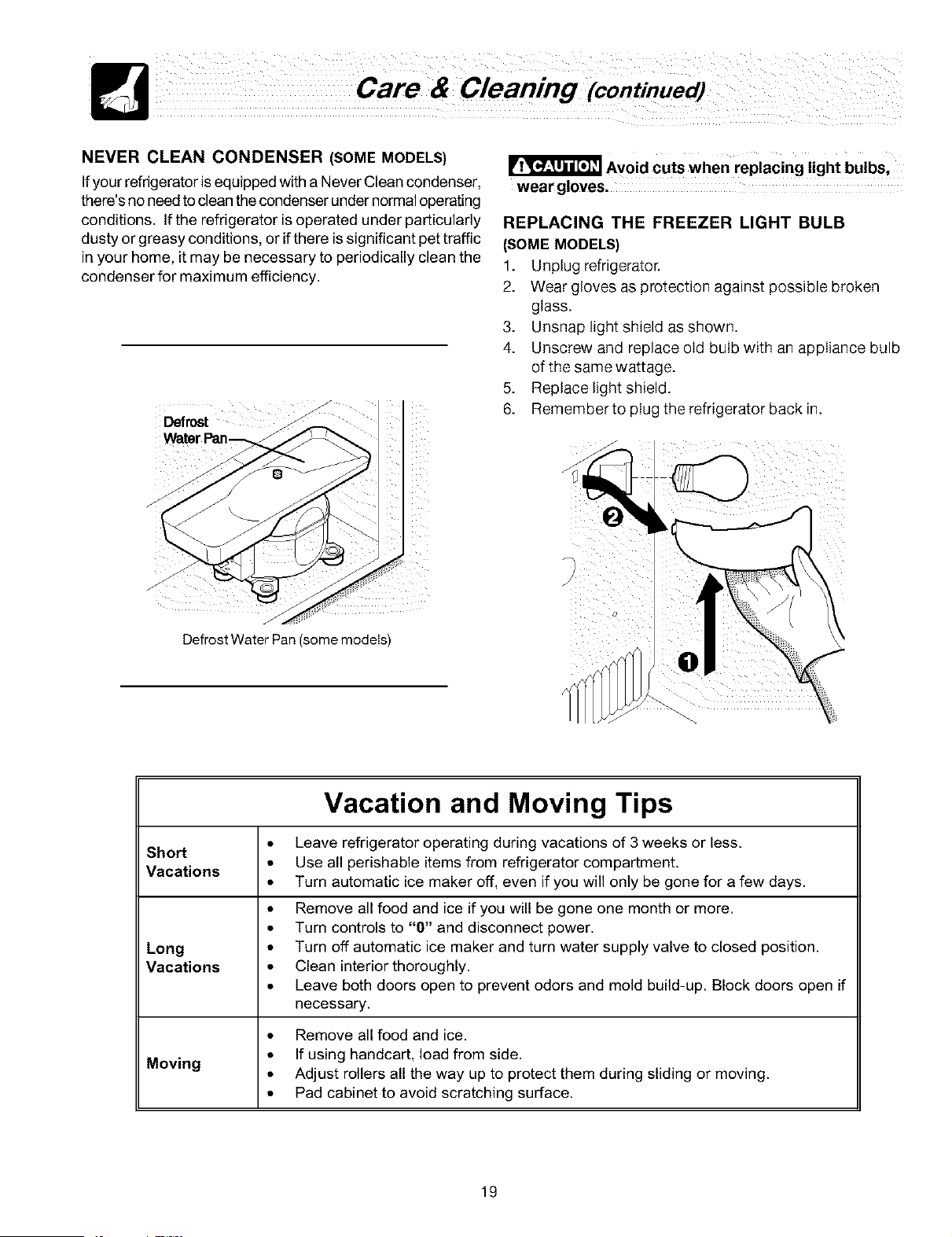
NEVER CLEAN CONDENSER (SOME MODELS)
Ifyour refrigerator is equipped with a Never Clean condenser,
there's no need to cleanthe condenser under normal operating
conditions. If the refrigerator is operated under particularly
dusty or greasy conditions, or ifthere is significant pet traffic
inyour home, itmay be necessary to periodically clean the
condenser for maximum efficiency.
Defrost Water Pan (some models)
Avoid cutS when replacing light bulbs,
wear gloves.
REPLACING THE FREEZER LIGHT BULB
(SOME MODELS)
1. Unplug refrigerator.
2. Wear gloves as protection against possible broken
glass.
3. Unsnap light shield as shown.
4. Unscrew and replace old bulb with an appliance bulb
of the same wattage.
5. Replace light shield.
6. Remember to plug the refrigerator back n,
\
\
Y/
\
Vacation and Moving Tips
• Leave refrigerator operating during vacations of 3 weeks or less.
Short
• Use all perishable itemsfrom refrigerator compartment.
Vacations
• Turn automatic ice maker off, even if you will only be gone for a few days.
• Remove all food and ice if you will be gone one month or more.
• Turn controls to "0" and disconnect power.
Long • Turn off automatic ice maker and turn water supply valve to closed position.
Vacations • Clean interior thoroughly.
• Leave both doors open to prevent odors and mold build-up. Block doors open if
necessary.
• Remove all food and ice.
• If using handcart, load from side.
Moving
• Adjust rollers all the way up to protect them during sliding or moving.
• Pad cabinet to avoid scratching surface.
19
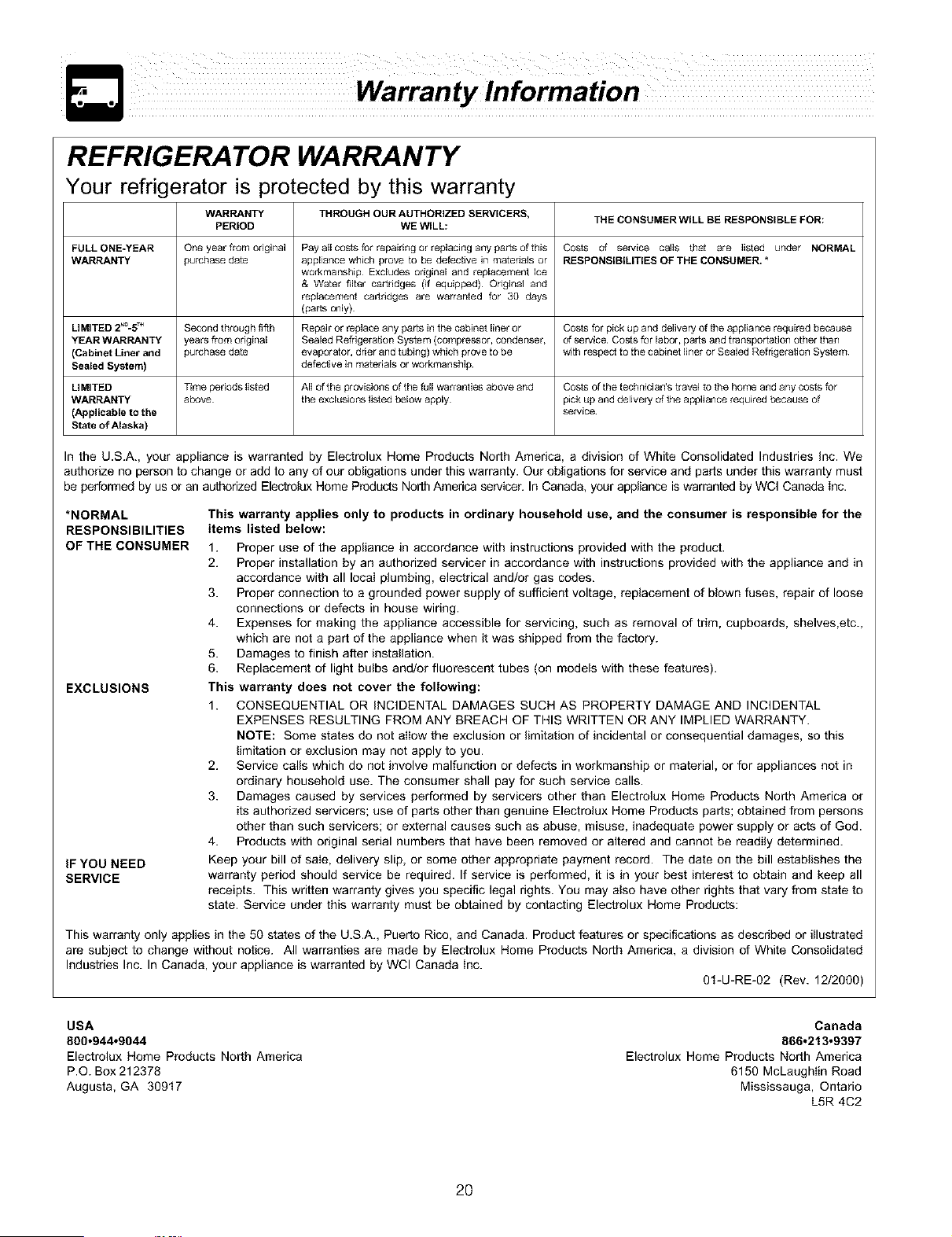
REFRIGERATOR WARRANTY
Your refrigerator is protected by this warranty
WARRANTY THROUGHOURAUTHORIZEDSERVICERS, THECONSUMERWILLBERESPONSIBLEFOR:
PERIOD WEWILL:
FULLONE-YEAR Oneyearfrombeginal Payallcosts for repairingorreptscinganypartsofthis Costs of service calls that are listed under NORMAL
WARRANTY purchasedate appliancewhichproveto be defectivein materialsor RESPONSIBILITIESOFTHECONSUMER,*
workmanshipExcludesbeginalandreplacementIce
& Waterfilter cartridges(if equipped) Originaland
replacement cartridges are warranted for 30 days
(pads only)
LIMITED2"_-5TM Secondthroughfifth Repairor replaceanypartsinthe cabinetlineror Costsforpickupand deliveryoftheappliancerequiredbecause
YEARWARRANTY yearsfromoriginal SealedRefrigerationSystem(compressor,condenser, ofservice Costsforlabor,partsandtransportationotherthan
(Cabinet Liner and purchasedate evaporator,drierandtubing)whichprovetobe withrespectto thecabinetline_or SealedRefrigerationSystem
SealedSystem) defectiveinmaterialsorworkmanship
LIMITED Timeperiodslisted Alloftheprov[sionsofthe fullwarrantiesaboveand Costsofthetechnician'straveltothe homeandanycostsfor
WARRANTY above theexclusionslistedbelowapply pickupanddeliveryoftheappliancerequiredbecauseof
(Applicable tothe service
StateofAlaska)
In the U.S.A., your appliance is warranted by Electrolux Home Products NoAh America, a division of White Consolidated Industries Inc. We
authedze no person to change or add to any of our obligations under this warranty. Our obligations for service and pads under this warranty must
be performed by us or an authorized Electrolux Home Products North America servicer. In Canada, your appliance is warranted by WCI Canada inc.
*NORMAL
RESPONSIBILITIES
OF THE CONSUMER
EXCLUSIONS
IF YOU NEED
SERVICE
This warranty applies only to products in ordinary household use, and the consumer is responsible for the
items listed below:
1. Proper use of the appliance in accordance with instructions provided with the product.
2. Proper installation by an authorized servicer in accordance with instructions provided with the appliance and in
accordance with all local plumbing, electrical and/or gas codes.
3. Proper connection to a grounded power supply of sufficient voltage, replacement of blown fuses, repair of loose
connections or defects in house wiring.
4. Expenses for making the appliance accessible for servicing, such as removal of trim, cupboards, shelves,etc.,
which are not a part of the appliance when it was shipped from the factory.
5. Damages to finish after installation.
6. Replacement of light bulbs and/or fluorescent tubes (on models with these features).
This warranty does not cover the following:
1. CONSEQUENTIAL OR INCIDENTAL DAMAGES SUCH AS PROPERTY DAMAGE AND INCIDENTAL
EXPENSES RESULTING FROM ANY BREACH OF THIS WRITTEN OR ANY IMPLIED WARRANTY.
NOTE: Some states do not aIIow the exclusion or limitation of incidental or consequential damages, so this
limitation or exclusion may not apply to you.
2. Service calls which do not involve malfunction or defects in workmanship or material, or for appliances not in
ordinary household use. The consumer shall pay for such service calls.
3. Damages caused by services performed by servicers other than Electrolux Home Products NoAh America or
its authorized servicers; use of parts other than genuine Electrolux Home Products parts; obtained from persons
other than such servicers; or external causes such as abuse, misuse, inadequate power supply or acts of God.
4. Products with odginal sedal numbers that have been removed or altered and cannot be readily determined.
Keep your bill of saIe, delivery slip, or some other appropriate payment record. The date on the bill establishes the
warranty period should service be required. If service is performed, it is in your best interest to obtain and keep all
receipts. This written warranty gives you specific legal rights. You may also have other rights that vary from state to
state. Service under this warranty must be obtained by contacting Electrolux Home Products:
This warranty only applies in the 50 states of the U.S.A., Puerto Rico, and Canada. Product features or specifications as descnbed or illustrated
are subject to change without notice. All warranties are made by Electrolux Home Products North America, a division of White Consolidated
Industries Inc. In Canada, your appliance is warranted by WCl Canada Inc.
0f-U-RE-02 (Rev. 12/2000)
USA
800°944°9044
Electrolux Home Products NoAh America
P.O. Box 212378
Augusta, GA 30917
Canada
866°213o9397
Electrolux Home Products NoAh America
6150 McLaughIin Road
Mississauga, Ontario
L5R 4C2
20
ATTENTION
See
ToProperly Install Your Refrigerator
See "Installation" Section On Pages 4-5
OR
To Reverse The Doors
"Door Removal & Reversal" Section On Pages 6-9
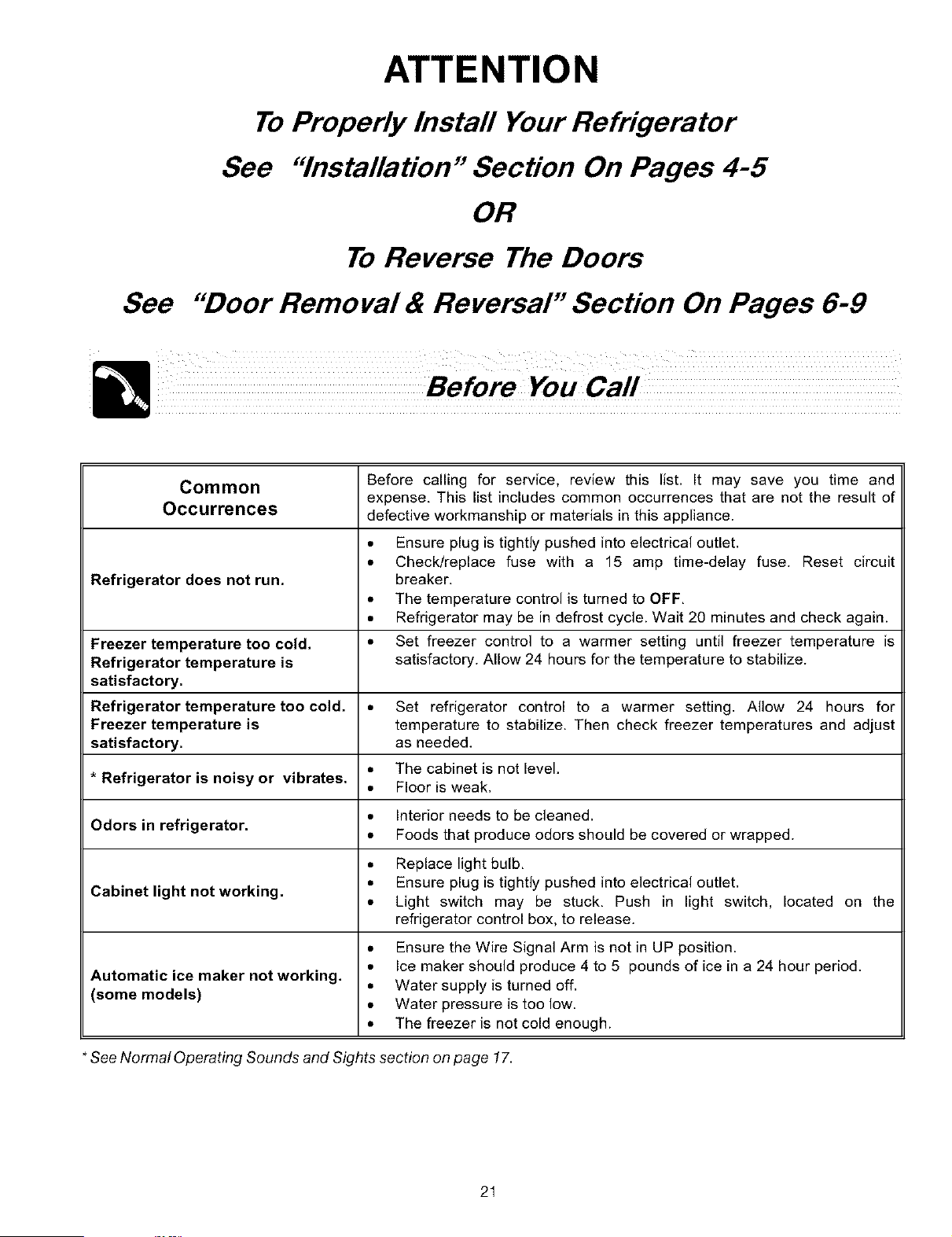
Common Before calling for service, review this list. It may save you time and
expense. This list includes common occurrences that are not the result of
Occurrences defective workmanship or materials in this appliance.
* Ensure plug is tightly pushed into electrical outlet.
* Check/replace fuse with a 15 amp time-delay fuse. Reset circuit
Refrigerator does not run. breaker.
* The temperature control is turned to OFF.
* Refrigerator may be in defrost cycle. Wait 20 minutes and check again.
Freezer temperature too cold. * Set freezer control to a warmer setting until freezer temperature is
Refrigerator temperature is satisfactory. Allow 24 hours for the temperature to stabilize.
satisfactory.
Refrigerator temperaturetoo cold. * Set refrigerator control to a warmer setting. Allow 24 hours for
Freezer temperature is temperature to stabilize. Then check freezer temperatures and adjust
satisfactory, as needed.
* The cabinet is not level.
* Refrigerator is noisy or vibrates.
* Floor is weak.
* Interior needs to be cleaned.
Odors in refrigerator.
* Foods that produce odors should be covered or wrapped.
* Replace light bulb.
* Ensure plug is tightly pushed into electrical outlet.
Cabinet light not working.
* Light switch may be stuck. Push in light switch, located on the
refrigerator control box, to release.
* Ensure the Wire Signal Arm is not in UP position.
* Ice maker should produce 4 to 5 pounds of ice in a 24 hour period.
Automatic ice maker not working,
* Water supply is turned off.
(some models)
* Water pressure is too low.
* The freezer is not cold enough.
*See NormalOperating Sounds and Sights section on page 17.
21