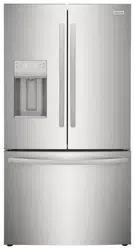
User Manual Frigidaire FRS23F4DW2 Refrigerator
Installation
This Owners Guide provides specific operating instructions for your model, Use the refrigerator only as instructed in this Use & Care Manual. Before starting the refrigerator, follow these important first steps.
LOCATION
- Choose a place that is near a grounded electrical outlet. Do Not use an extension cord or an adapter plug,
- If possible, place the refrigerator out of direct sunlight and away from the range, dishwasher or other heat sources,
- The refrigerator must be installed on a floor that is level and strong enough to support a fully loaded refrigerator.
- Consider water supply availability for models equipped with an automatic ice maker.
INSTALLATION

DOOR OPENING

Your refrigerator should be positionedto allow easy access to a counter when removing food. For best use of drawers and freezer baskets, the refrigerator should be in a position where both the refrigerator and freezer doors can be fully opened.
TOE GRILLE INSTALLATION / REMOVAL
To Remove Toe Grille:
- Open freezer and fresh food compartment doors.
- Working from left side of toe grille, slip your fingers between top of toe grille and cabinet. Gently pull forward until first set of tabs are free. Slide your hand down past the free tabs and pull forward again until the second set of tabs are free. Continue this process until all tabs are free and the toe grille can be removed. (See graphic at top of page in right column.)

To Install Toe Grille:
- Open freezer and fresh food compartment doors.
- Line up toe grille at base of refrigerator, making sure the four bottom tabs are resting through holes at base of cabinet.
- Starting fromleft side of toe grille, press in on first top tab using your thumb and pushtoe grille forward until it snaps in place. Continue this process until all tabs aresnapped in place and toe grille is secured to refrigerator.

LEVELING
All four corners of your refrigerator must rest firmly on a solid floor. Your refrigerator is equipped with adjustable front rollers to help level your unit. To ensure proper be or seal and assist door closing, the refrigerator should be tilted 1/4"(6 mm), front to beck.
To Level Your Refrigerator:
1. Remove toe grille.(See "To Remove Toe Grille".)
2. Use flat-blade screwdriver or 3/8"socket wrench to adjust front rollers.


3. Check both doors to be sure seals touch cabinet on all four sides.
Installation - Connecting Ice Maker To Water Supply

Before Installing The Water Supply LIne, You Will Need
- Basic Tools: adjustable wrench, flat-blede screwdriver, and PhillipsTM screwdriver
- Access to a household cold water line with water pressure between 20 and 100 psL
- A water supply line made of 'A inch (6.4 mm) OD. copper tubing.To determine the length of copper tubing needed. you will need to measure the distance from the ice maker inlet valve at the back of the refrigerator to your cold water pipe.Then add approximately 7 feet (2.1 meters), so the refrigerator can be moved out for cleaning (as shown).
- A shutoff valve to connect the water supply line to your household water system. DO NOT use a self-piercing type shutoff valve.
- A compression nut and ferrule (sleeve) for connecting the water supply line to the ice maker inlet valve.

To Connect Water Supply Line To Ice Maker Inlet Valve

- Disconnect refrigerator from electric power source.
- Piece end of water supply line into sink or bucket. Turn ON water supply and flush supply line until water is clear. Turn OFF water supply at shut off valve.
- Unscrew plastic cap from water valve inlet and discard cap.
- Slide brass compression nut, then ferrule (sleeve) onto water supply line. as shown.
- Push water supply line into water valve inlet as far as it will go ('A inch). Slide ferrule (sleeve) into valve inlet and finger tighten compression nut onto valve. Tighten another half turn with a wrench; DO NOT over tighten.
- With steel clamp and screw, secure water supply line to rear panel of refrigerator as shown.
- Coil excess water supply line (about 2_/2turns) behind refrigerator as shown and arrange coils so they do not vibrate or wear against any other surface.
- Turn ON water supply at shutoff valve end tighten any connections that leak,
- Reconnect refrigerator to electrical power source.
- Make sure ice maker power switch is turned On (See page f 3 for location of power switch).

Door Removal Instructions

DOOR REMOVAL INSTRUCTIONS:
If it is necessary to move the refrigerator through narrow doorways, follow these steps to remove the doors.

- Disconnect electrical supply.
- Open both doors, then remove toe grille.
- Close doors.

To Remove Refrigerator Door:
- Remove top hinge cover screw on refrigerator door and remove cover.
- Trace around hinge with soft lead pencil This will make it easier to realign doors when they are replaced.
- Remove top hinge and lift refrigerator door off bottom hinge pin. Set door aside.
- Remove bottom hinge, if necessary.
- Reverse this procedure to reinstall refrigerator door.

To Remove Freezer Door:
- Disconnect water line coming from lower hinge of freezer door at connection located under front of freezer: Press outer ring against face of fitting, then pull to remove tube.
- Remove top hinge cover screw on freezer door and remove cover.
- Disconnect wiring harness connector plug at top hinge: place your thumbs on flat sides of each connector and bend both parts back and forth, then with firm grasp, pull both pieces apart.
- Trace around hinge with soft lead pencil. This will make it easier to realign doors when they are replaced.
- Remove top hinge, alowing wiring harness to pull through hinge and lift freezer door off of bottom hinge pin. Lay door down flat to avoid kinking water line.
- Remove bottom hinge, if necessary.
- Reverse this procedure to reinstall freezer door.

When both doors have been reinstalled, connect water line by inserting tube and push until mark touches face of fitting, replace toe grille and plug in electrical power cord. Turn both temperature controls to center position. Adjust settings as necessary.

Feature At A Glance

Features may vary according to model
Temperature Controls
COOL DOWN PERIOD
To ensure safe food storage, allow the refrigerator to operate with the doors closed for at least 8 to 12 hours before loading it with food.
REFRIGERATOR & FREEZER CONTROLS

TEMPERATURE ADJUSTMENT
- After 24 hours, adjust the controls as needed. Adjust temperatures gradually: move the knob in small increments, allowing the temperature to stabilize.
- For colder temperatures, turn the knob towards Colder.
- For warmer temperatures, turn the knob towards Cold.

To maintain temperatures, a fan circulates air in the refrigerator and freezer compartments. For good circulation, do not block cold air vents with food items.
Looking Inside
PIZZA SHELF (SOME MODELS)

ICE CREAM SHELF (SOME MODELS)
This shelf attaches to the top of the ice dispenser container. It allows storage of both round and rectangular cartons of your favorite ice cream.

TIP-UP SHELF (SOME MODELS)
A Tip-Up shelf in the freezer section allows tall items to be easily stored.

CANTILEVER SHELF ADJUSTMENT
Refrigerator shelves are easily adjusted to suit individual needs, Before adjusting the shelves, remove all food, Cantilever shelves are supported at the back of the refrigerator.
To adjust cantilever shelves:
- Lift front edge up
- Pull front shelf out
Replace the shelf by inserting the hooks at rear of the shelf into the wall bracket. Lower the shelf into the desired slots and lock into position.


*SpillSafe TM glass shelves (some models) catch and hold accidental spills, In some mode is, the *SpillSafe TM shelves slide out for easy access to food and for fast cleaning. The shelves side out independently of their mounting brackets,
Just pull the front of the shag forward, Shelves can be extended as far as the stopper will allow but are not removable from their mounting brackets.
DOOR STORAGE
Door bins and she{ves are provided for convenient storage of jars, bottles, and cans. Frequently used items can be quickly selected.
Some models have door bins that can accommodate gallon- sized plastic drink containers and economy-sized jars and containers. Some bins are adjustable for maximum storage capacity.
The dairy compartment, which is warmer than the general food storage section, is intended for short term storage of cheese, spreads, or butter.

ADJUSTABLE DOOR BINS
Some models have adjustable door bins that can be moved to suit individual needs.
To move door bins
- Lift bin straight up,
- Remove bin.
- Place bin in desired position.
- Lower bin onto supports until locked in place.

TALL BOTTLE RETAINER (SOME MODELS)
The Tall Bottle Retainer keeps tall containers in the bin from falling forward when opening or closing the refrigerator door.
To install, hold the retainer at the top, and slide it over the outside wall of the bin, as shown in the diagram. The Tall Bottle Retainer works best with a Bin Snugger.

SPECIAL ITEM RACK (SOME MODELS)
The innovative design of the Special [tam Rack allows you to store a six-pack of 12 ounce drink cans, a bottle of wine, a two liter soft d rink bottle, or a carton of eggs, The Special
Item Rack mounts on the left side of your refrigerator. To install, just slide the Special Item Rack onto any shelf as shown in the drawing.

Looking Inside - Special Storage Areas
CRISPERS (SOME MODELS)
The crispers, located under the bottom refrigerator shelf, are designed for storing fruits, vegetables, and other fresh produce. Wash items in clear water and remove excess water before placing them in the crispers. Items with strong odors or high moisture content should be wrapped before storing.

HUMIDITY CONTROL (SOME MODELS)
The Humidity Control, present on some models with crisper drawers, allows you to adjust the humidity within the crisper.
This can extend the life of fresh vegetables that keep best in high humidity.


DELl DRAWER (SOME MODELS)
Some models are equipped with a Deli Drawer for storage of luncheon meats, spreads, cheeses, and other deli items.
MEAT KEEPER (SOME MODELS)
Some models are equipped with a Meat Keeper. Meat Keeper temperatures can be adjusted by sliding the Meat Keeper
Temperature Control ineither direction. Use thispan for short term storage of bulk meat items, if meats are to be kept longer than one or two days, they should be frozen. The Meat Keeper is fixed and cannot be moved up or down. If fruits or vegetables are to be stored in the Meat Keeper, set the Meat Keeper Temperature Control to a warmer setting to prevent freezing.

WINE RACK (SOME MODELS)
The wine rack stores bottles of wine, or single two-liter plastic bottles of juice or soda pop. To install, slide the Wine Rack onto the shelf with the curve facing in. To remove, slide the Wine Rack out. Install on either side of shelf.

Automatic Ice and Water Dispenser
AUTOMATIC ICE & WATER DISPENSER OPERATING INSTRUCTIONS

ICE AND WATER DISPENSER FEATURES
The ice and water dispenser conveniently dispenses chilled water, and ice cubes or crushed ice, depending on the model.
To operate the ice dispenser, select the ice option desired using the touchped. Press a glass against the dispensing paddle as far up as possible to catch all ice.To stop dispensing ice, pull glass away from dispensing paddle. Do not remove the glass until the ice has completely dispensed. (Complete instructions for the dispenser operation are attached to the inside of the freezer door.)
How the Water Dispenser Works
The water tank, located behind the drawers in the refrigerator compartment, automatically fills as water is dispensed. For proper dispenser operation, the recommended supply water pressure should fall between 20 psi and 100 psi.

After the refdge rator is connected to the water supply, fill the water tank by drawing one glass of water. It may take about minutes after activating the dispenser peddle before water begins to fill this first glass. Continue flushing the system for 3 minutes to rid the tank and plumbing con nections of any impurities.The water dispenser has a built in shutoff device that will stop the water flow after 3 minutes of continuous use. Simply release the dispenser paddle to reset the shutoff mechanism.

How the Ice Dispenser Works

The ice maker and container are located in the top of the freezer compartment. After the refrigerator is installed properly and has cooled for several hours, the ice maker can begin making ice within 24 hours. Air in new plumbing lines may cause the ice maker to cycle two or three times before making a full tray of ice. Ice production is controlled by the ice maker's
On/Off power switch. Press the switch to the "O" position to turn it Off and press it to the "1" position to turn it On. With no usage it will take approximately 2 days to fill the ice container.
The ice maker also has a built-in wire signal arm,which automatically stops ice production when the ice bin is full.This signal arm should not be used to manually stop the ice maker.
The ice maker produces 4 to 6 pounds of ice every 24 hours depending on usage conditions.
Ice is produced at a rate of 8 cubes every 75 to 90 minutes. Because of new plumbing connections, the first production of ice cubes may be discolored or have an odd flavor.These should be discarded until the cubes made are free of discoloration and taste.
ICE DISPENSER TIPS
- Ice cubes stored too long may develop an odd flavor. Empty the ice container and ensure that the ice maker's On/Oft power switch is turned On (set to the "r' position). The ice maker will then produce more ice.
- Occasionally shake the ice container to keep ice separated.
- Keep the ice maker's On/Off power switch turned Off (set to the "O" position) until the refrigerator is connected to the water supply or whenever the water supply is turned off.

- If a large quantity of ice is needed at one time. it is best to remove cubes directly from the ice container.
- The following sounds are normal when the ice maker is operating:
- Motor running
- Ice loosening from tray
- Ice dropping into ice container
- Running water
- Water valve opening or closing
- Turn Off the ice maker when cleaning the freezer and during vacations.
- If the ice maker will be turned off for a long period of time, you should also turn off the water supply valve.

CLEANING THE ICE DISPENSER
Clean the dispenser and ice container at regular intervals, particularly before you take a vacation or move, or it the ice dispenser sticks.
- Turn off ice production by pressing the ice maker's On/Off switch.
- Remove ice container by liftiog up and out. Empty and carefully clean the container with mild detergent. Rinse with clear water. Do not use harshor abrasive cleaners. Allow cecontainer to dry completely before replacing in the freezer.
- Remove ice chips and clean the shelf and chute that supports the ice container.
- Replace the ice container. Press the ice maker's On/Off switch to resume ice production.

Remove and empty the ice storage bin if:

- An extended power failure (one hour or longer) causes ice cubes in the ice storage bin to melt and freeze together and jam the dispenser mechanism.
- The ice dispenser is not used frequently. Ice cubes will freeze together in the bin and jam the dispenser mechanism. Remove the ice storage bin and shake to loosen the cubes.
NEVER use an ice pick or similar sharp instrument to break up the ice. This could damage the ice storage bin and dispenser mechanism.
PureSource *Ice and Water Filter (some models)
NOTE: If you purchased a refrigerator with a PureSource TM * Ice and Water filter, please read the following use and care information. This ice and water filter system filters water to your ice maker and water dispenser, It is located inthe upper right back corner of the fresh food compartment.
System Start up:
Water supply does not need to be turned off, however, do not use ice and water dispenser while installing filter. The filter cartridge has already been installed in the filter housing at the factory. Refer to the How The Water Dispenser Works section to properly fill the system with water.
Changing the Filter:
Water conditions vary throughout the world, but changing the water filter every months normally will ensure the highest possible water quality. The Filter Status light wl!l turn red after 400 gallons of water has flowed through the ice and water dispenser (some models). Also, if the filter has been in a refrigerator that has not been in use for awhile (during moving for example), change the filter before reinstalling the refrigerator. The dispenser system will also operate without filtration (with filter cartridge removed).
To change filter:

It is not necessary to turn the water supply off to change the filter.
- Open freezer door and leave open until filter change is complete.
- Turn the ice maker's power switch to the Off ("O") position (See illustration on page 13).
- Hold filter cup firmly, and unscrew towards left (Some water could leak out as you remove cup. This is normal.). Filter cartridge should come down with cup. If cartridge remains in housing, pull down gently, while twisting filter back and forth.
- Rinse out cup under running water.
- The large o-ring that seals the filter system sets in the o-ring groove down inside the cup. Should the o-ring fall out during filter cartridge replacement, simply place it back in the groove prior to screwing the cup back in place. If the o-ring becomes damaged, you will need to order one from the Customer Care Center.
- Discard old filter cartridge.
- Remove new filter cartridge from packaging and place in cup. The end with the small o-ring should be up, out of the cup.
- Screw cup, with filter, back onto housing. DO Not Use Wrench To Reinstall Cup. Filter cartridge will self-align as cup is tightened. Be sure cup is completely tightened with PureSource TM logo facing outward. Do Not Tighten Past Stop.
- Turn the ice maker's power switch to the On (1") position.
- Check for leaks. Open refrigerator door. Wipe any water drop fate from the filter cup. Fill a glass with water, if there is a leak, unscrew filter cup, and reinsert the filter cartridge. Check placement of large O-ring. Re in still filter cup, making certain it is tightened completely.
- To condition filter system and purge air from water line, fill a glass with water. Continue flushing the system for approximately 3 minutes to assure that the purest water possible is stored in the water tank.

PureSource2 TM * Ice and Water Front Filter (some models)
NOTE: If you purchased a refrigerator with a PureSource2 TM'Ice and Water front filter, please read the following use and care information. This ice and water filter system fibers water to your ice maker and water dispenser, it is located in the upper right front corner of the fresh food compartment.
System Startup:
Water supply does not need to be turned off, however, do not use ice and water dispenser while installing filter.
The filter cartridge has already been installed in the filter housing at the factory. Refer to the How The Water Dispenser Works section to properly fill the system with water.
Changing the Filter:

Water conditions vary throughout the world, but changing the water filter every months normally will ensure the highest possible water quality. The Filter Status light wilt turn red after approximately 400 gallons of water has flowed through the ice and water dispenser. Also, if the filter has been in a refrigerator that has not been in use for awhile (during moving for example), change the filter before reinstalling the refrigerator. The dispenser system will also operate without filtration (with filter cartridge removed and bypass installed).
To change filter:
It is not necessary to turn the water supply off to change the filter.
1. Turn the ice maker's power switch to the Off ("O") position (See illustration on page 13).
2. Push the Filter Release Button, located to the right of the filter cartridge, to release the filter from the housing. To minimize the possibility of the filter failing out of the housing during removal, it would be best to hoedthe filter as it moves out toward you.

3. Pull the old filter cartridge straight out of the housing.
4. Discard the old filter.
5. Remove the new filter cartridge from the packaging and insert into the filter housing the same way the old one came out.
6. When the cartridge is almost in, you will feelit stop against the clip assembly in the back of the housing. The clip assembly holds the filter cartridge firmly in place. At this point, you will need to push firmly until the cartridge snaps fully in place. When completely in place, the front of the filter cartridge will be flush with the front of the housing.
7. Turn the ice maker's power switch to the On (1") position.
8. Fill a glass with water. As you are doing this, check for leaks at the filter housing. There will be noticeable spurts and sputters as the system pushes the air out through the system and out the dispenser nozzle. This is normal
9. After you have run one glass of water, continue to flush the system for approximately 3 minutes to assure that the purest water possible is stored in the water storage tank.

Food Storage & Energy Saving Ideas
FOOD STORAGE IDEAS
Fresh Food Storage
- The fresh food compartment should be kept between 34° F and 40 ° F with an optimum temperature of 37° F.
- Avoid overcrowding the refrigerator shelves.This reduces the circulation of air around the food and results in uneven cooling.
Fruits and Vegetables
- Storage in the crisper drawers traps moisture to help preserve the fruit and vegetable quality for longer time periods.
Meat
- Raw meat and poultry should be wrapped securely so leakage and contamination of other foods or surfaces does not occur.
Frozen Food Storage
- The freezer compartment should be kept at O° F or lower.
- A freezer operates most efficiently when it is at least 2/3 full
Packaging Foods for Freezing
- To minimize dehydration and quality deterioration use aluminum foil , freezer wrap freezer bags or airtight containers. Force as much air out of the packages as possible and seal them tightly. Trapped air can cause food to dry out, change color, and develop an off-flavor (freezer burn).
- Wrap fresh meats and poultry with suitable freezer wrap prior to freezing.
- Do not refreeze meat that has completely thawed.
Loading the Freezer
- Avoid adding too much warm food to the freezer at one time. This overloads the freezer, slows the rate of freezing, and can raise the temperature of frozen foods.
- Leave a space between the packages, so cold air can circulate freely, allowing food to freeze as quickly as possible.
- Avoid storing hard-to-freeze foods such as ice cream and orange juice on the freezer door shelves.These foods are best stored in the freezer interior where the temperature varies less.
ENERGY SAVING IDEAS
- Locate the refdgerato r in the coolest part ofthe room, oat of direct suniight, and away from heating ducts or registers. Do not place the refrigerator next to heat-producing appliances such as a range, oven, or dishwasher.
- If this is not possible, a section of cabinetry or an added layer of insulation between the two appliances will help the refrigerator operate more efficiently.
- Level the refrigerator so that the doors close tightly.
- Refer to this Use & Care Manual for the suggested temperature control settings.
- Periodic cleaning of the condenser will help the refrigerator run more efficiently. See the Care and Cleaning Chart on page 19.
- Do not overcrowd the refrigerator or block cold air vents. Doing so causes the refrigerator to run longer and use more energy.
- Cover foods and wipe containers dry before placing them in the refrigerator. This cuts down on moisture build-up inside the unit.
- Organize the refrigerator to reduce door openings. Remove as many items as needed at one time and close the door as soon as possible.
Normal Operating Sounds & Sights
UNDERSTANDING THE SOUNDS YOU MAY HEAR
Your new high-efficiency refrigerator may make unfamiliar sounds. These are all normal sounds and soon will become familiar to you. They also indicate your refrigerator is operating as designed. Hard surfaces, such as vinyl or wood floors, wails, and kitchen cabinets may make sounds more noticeable. Listed below are descriptions of some of the most common sounds you may hear, and what is causing them.

A. Evaporator
The flow of refrigerant through the evaporator may create a boiling or gurgling sound.
B. Evaporator Fan
You may hear air being forced through the refrigerator by the evaporator fan.
C. Defrost Heater
During defrost cycles, water dripping onto the defrost heater may cause a hissing or sizzling sound, After defrosting, a popping sound may occur.

D. Automatic Ice Maker
If your refrigerator is equipped with an automatic ice maker, you wil hear ice cubes falling into the ice bin.
E. Cold Control & Automatic Defrost Control
These parts can produce a snapping or clicking sound when turning the refrigerator on and off.
F. Condenser Fan
You may hear air being forced through the condenser by the condenser fan,
G. Compressor
Modern, high-efficiency compressors operate much faster than older models. The compressor may have a high-pitched hum or pulsating sound,
H. Water Valve
It your refrigerator is equipped with an automatic ice maker, you will hear a buzzing sound as the water valve opens to fill the ice maker during each cycle.

I. Drain Pan (not removable)
You may hear water running into the drain pan during the defrost cycle.
J. Condenser
May create minimal sounds from forced air.
K. Motorized Damper
May produce a light humming or clicking du ring operation.
Care & Cleaning
Keep your refrigerator and freezer clean to prevent odor build-up. Wipe up any spills immediately and clean both sections at least twice a year. Never use any type of scouring pads, brushes, abrasive cleaners or strong alkaline solutions on any surface.DO not wash any removable parts in a dishwasher. Always unplug the electrical power cord from the wall outlet before cleaning.
Care & Cleaning Chart
Interior Door Liner
- Soap and water
- Baking soda and water
Use 2 tablespoons of baking soda in 1 quart of warm water. Be sure to wring excess water out of sponge or cloth before cleaning around controls, light bulb or any electrical part.
Door Gaskets
- Soap and water
Wipe gaskets with a clean soft cloth,
Drawers/Bins
- Soap and water
Do not wash any removable items (bins, drawers, etc.) in dishwasher.
Glass Shelves
- Soap and water
- Glass cleaner
- Mild liquid sprays
Allow glass to warm to room temperature before immersing in warm water.
Toe Grille
- Soap and water
- Mild liquid sprays
- Vacuum attachment
Vacuum dust from front of toe grille. Remove toe grille (See illustration on page 4). Vacuum backside and wipe with sudsy cloth or sponge. Rinse and dry.
Exterior and Handles
- Soap and water
Do not use commercial household cleaners, ammonia, or alcohol to clean handles.
Exterior and Handles (Stainless Steel Models Only)
- Soap and water
- Ammonia
- Stainless Steel Cleaners
Caution : Never us CHLORIDE to clean stainless steel.

REPLACING LIGHT BULBS
- Unplug refrigerator.
- Wear gloves as protection against possible broken glass,
- Remove light cover, if necessary.
- Unscrew and replace old bulb with an appliance bulb of the same wattage.
- Replace light cover, if necessary.
- Remember to plug the refrigerator back in.


Vacation and Moving Tips
Short Vacations
- Leave refrigerator operating during vacations of 3 weeks or less.
- Use all perishable items from refrigerator compartment.
- Turn automatic ice maker off, even if you will only be gone for a few days
Long Vacations
- Remove all food and ice if you will be gone one month or more.
- Turn controls to "O" ( the OFF position) and disconnect power.
- Turn off automatic ice maker and turn water supply valve to closed position.
- Clean interior thoroughly.
- Leave both doors open to prevent odors and mold build up. Block doors open if necessary.
Moving
- Remove all food and ice.
- If using handcart, load from side.
- Adjust rollers all the way up to protect them during sliding or moving.
- Pad cabinet to avoid scratching surface.

Warranty Information
REFRIGERATOR WARRANTY
Your refrigerator is protected by this warranty

In the USA., your appliance is warranted by Electrolux Home Products, Inc We authorize no person to change or add to any of our obligations under this warranty. Our obligations for service and parts under this warranty must be performed by s or an authorized Electrolux Home Products Eric service, in Canada, your appliance is warranted by Electrolux Canada Corp.
NORMAL RESPONSIBILITIES OF THE CONSUMER
This warranty applies only to products in ordinary household use_ and the consumer is responsible for the items listed below:
- Proper use of the appliance in accordance with instructions provided with the product.
- Proper installation by an authorized servicer in accordance with instructions provided with the appliance and in accordance with all local plumbing, electrical and or gas codes ̧
- Proper connection to a grounded power supply of sufficient voltage, replacement of brown fuses of loose connections or defect in house wiring
- Expenses for making the appliance accessible for servicing such as removal of trim, cupboards, shelves, etc., which are not a get of the appliance when it was shipped from the factory
- Damages to finish after installation.
- Replacement of light bulbs and/or fluorescent tubes (on models with these features)
EXCLUSIONS
This warranty does not cover the following:
- CONSEQUENTIAL OR INCIDENTAL DAMAGES SUCH AS PROPERTY DAMAGE AND INCIDENTAL EXPENSES RESULTENG FROM ANY BREACH OF THIS WRITTEN OR ANY IMPLIED WARRANTY ̧. NOTE: Some states do not allow the exclusion or limitation of incidental or consequent all damages, so this limitation or exclusion may not apply to you
- Service calls which do not involve malfunction or defects in workmanship or material or for appliance not in ordinary household use The consumer shall pay for such service calls
- Damages caused by services performed by servicers other than EIectrolux Home Products, Enc., Electrolux Canada Corp or its authorized servicers; use of other than genuine Electrolux Home Produce Inc parts; obtained from persons other than such servicers; or extremal causes such as abuse, misuse, inadequate power supply or acts of God.
- Products with original split numbers that have been removed or altered and cannot be readily determined.
IF YOU NEED SERVICE
Keep your bill of sale, delivery slip, or some other appropriate payment record ̧ The date on the bill establishes the warranty period should service be required. If service is performed, it is in your best interest to obtain and keep receipts ̧ This written warranty gives you specific legal rights. You may also have other rights that vary from state to state ̧ Service under this warranty must be obtained by contacting Electrolux Home Products, Inc or Electrolux Canada Corp
This warranty only applies in the 50 States of the U.SA, in Puerto Rico, and in Canada ̧ Product features or specifications as described or illustrated are subject to change without notice. All warranties are made by Electrolux Home Products, Inc in Canada, your appIiance is warranted by Electrolux Canada Corp