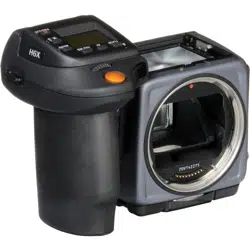
1
Version 170201 v1.0
User Guide

2
INTRODUCTION

3
www.hasselblad.comH6X
The Hasselblad H series of cameras consists of
building new developments on the shoulders of the
previous generations of cameras. In this way all the
previous work-experience based and branch-demanding
features are automatically included. So, just when you
think things can't get much better, they do.
The H6X heralds a step up that is noticeably greater than
before. The changes are many and 'from the ground up'.
The H spirit thrives but has now matured to reinforce
further its position in the rapidly changing world of digital
imaging. Future proofing is key to a secure placing for
working photographers. The H6X provides a reliable
connection to the fleeting environment of digital imaging
technology so when the wind changes direction, the H6X
remains as the safeguarding companion to provide
support.
True to Hasselblad philosophy, interchangeability and
versatility is integral in the H6X regarding lenses and
accessories with minimal restrictions. In addition, there is
now the the opportunity of exploiting HCD 24mm, HCD
28mm and the HCD 35-90mm lenses together with film
magazines and 3rd party digital backs. Although aimed
primarily at current H1, H2, H2F and H4F users wishing to
upgrade to H5 capabilities, the H6X can naturally act as a
backup for H5 users too. In short, you have access to a
more comprehensive world to apply medium format
quality
Hasselblad's best kept secret is knowing that every link in
the chain that leads to the page in the magazine has to
reach a certain standard; it is that simple. That's why
Hasselblad spends so much time and energy into checking
those almost endless behind-the-scenes details and
standards because they understand this simple concept.
There is no magical formula to Hasselblad success other
than an understanding of what is required to produce the
best results available in the world today and an acceptance
that there are no short cuts in this process. Hasselblad does
its best to produce the best; there is no other way to
achieve the Hasselblad star quality.
The H6X uses stainless steel and aluminium to endure
the treatment handed out in professional use – and that
can be pretty tough.
The sturdy but ergonomic integral grip incorporates not
only the battery but the user interface too. It is here, by
way of the surrounding buttons, that you enter the
‘control room’. Customization is a very prominent concept
that you experience in the Hasselblad world that ensures it
is the photographer that controls the camera, not vice
versa. Accessed through the grip alone, there are 34
separate custom options.
The H6X incorporates a list of quality enhancing features.
True Focus, for example, is used by some on a daily basis
while Digital Lens Correction is used by others for every
single shot.
True Focus is the pet feature for many fashion
photographers who work fast and by instinct. They don’t
have the time to double check focus for every single split
second shot and neither do they have the time to get it
wrong. True Focus delivers the sharpness in an intuitive
manner, at speed.
Digital Lens Correction, applied in Phocus at the file
editing stage, takes a discerning look at any colour
aberration, distortion and light fall off however minor
(which is inherent in any lens, anywhere) and resolves the
situation automatically.
We hope you will enjoy taking advantage of all the new
photographic opportunies that your new H6X camera
offers you.
Medium format photography is about
professionalism. Camera systems have to be
professional, handling has to be professional and
captures have to be professional in quality.
Hasselblad knows it and delivers it; professionals
know that too.

4
www.hasselblad.comH6X
Film length/number of frames 25
Data imprint setting 26
Frame counter setting 26
Low-battery symbol 26
Film loading 27
Film wind on and off 27
Unloading a film 27
Digital 28
Formatting CF cards 29
Hasselblad workflow 29
Phocus 30
Lenses & focus modes 31
Attaching/removing a lens 32
Lens cap 32
Lens shades 32
Shutter and aperture control 32
Filters 32
Focusing distance calculation 32
Depth-of-field preview 33
Infrared focus settings 33
Focus assist 33
Manual focus 35
Autofocus 35
Single shot 36
Continuous 36
True Focus 36
True Focus, Absolute position lock 37
True Focus and camera handling 38
Focus checking 38
True Focus, four methods 39
Exposure Control 41
ISO & white balance 42
Light metering modes 42
Exposure setting modes 43
Manual exposure mode 43
Automatic exposure mode 44
Mark overexposure 44
AE-L button 45
Exp compensation/Quick Adjust 46
Fixed Exposure compensation 46
Menu 47
Navigating menu and settings 48
Overview of menu 49
Self Timer 50
Bracketing 52
Interval 54
Settings 55
Custom Options 55
Image Info 60
Image info text setting 61
Date & Time 61
System status 62
Drive 63
Profiles 64
Making a profile 65
Using profiles 66
Changing a profile name 66
Flash /strobe 67
General 68
Integral flash 69
Flash measure 70
Accessories 71
Appendix 76
Technical Specifications 77
Default settings 78
Light metering sensitivity 78
True Exposure 79
P & Pv modes 79
Problems, Equipment care and service 80
Index 81
CONTENTS
Introduction 3
System requirements 5
Warnings & restrictions 5
General overview –
controls and displays 6
Parts, components, buttons 6
Grip buttons & controls 7
Camera body buttons & controls 8
Viewfinder 9
Display overview 9
Grip display 10
Viewfinder display 11
Reassignable grip buttons 12
Shortcuts 13
General 15
Carrying strap 15
Rechargeable battery grip 15
Battery charger 15
Charging the battery 16
Battery grip − precautions 16
Battery life 17
Battery warning 17
Battery status 17
Power modes 17
Viewfinder screen 18
Attaching /removing sensor unit 18
Protective baseplate 18
Attaching /removing the viewfinder 19
Eyepiece adjustment 19
Rubber eyecup 19
Accessory connection 19
PC-connector 19
HM 16-32 Film Magazine 20
Parts & Components 21
LCD panel 21
LCD Illumination button 21
Change up / down button 22
Function selector 22
Film plane index 22
Darkslide key 22
Darkslide indicator 22
Film tab holder 23
Magazine settings lock 23
Databus interface 23
Battery 23
Battery replacement 23
Attaching / removing the magazine 23
Settings 23
Film speed setting/barcode 25

5
www.hasselblad.comH6X
• If you want to power the H6X from a PC laptop (as opposed to a Macintosh laptop), you must ensure that the FireWire port
on the computer is capable of supplying power. Please note the following:
Most recent Macintosh computers are compatible, both desktops and laptops.
Most recent desktop PC computers are compatible.
Most laptop PC computers are not compatible (but can be modified in many cases).
• Keep the H6X and computer equipment away from moisture wherever possible. If your camera becomes wet, disconnect
from power and allow it to dry before attempting to operate again.
• Always take great care when you remove the sensor unit for cleaning as the exposed CCD sensor protective filter is
vulnerable to damage.
• Keep all cables connected to or from your camera and computer out of the way where they will not be tripped over.
• Your new Hasselblad camera may have been supplied in kit form or as separate items. There are a number of possible
combinations depending on factors such as offers, bundles etc. Please ensure that all the items noted on the
accompanying packing information have been supplied and are correct.
• Contact your Hasselblad dealer or distributor immediately if anything is missing or seems faulty in any way, quoting the
serial numbers and purchase details where appropriate.
• Please keep purchase details and the warranty in a safe place.
• Become familiar with the various parts and components. Leave protective covers on as much as possible and avoid
touching glass surfaces and inserting fingers into the camera body. Hasselblad cameras have a robust construction and are
capable of withstanding fairly rough treatment but nevertheless are precision instruments and will serve you longer if
treated with respect from the beginning.
Image-storage and editing requires a certain minimum standard regarding computer capabilities. Large images require a rea-
sonably high-performance computer with plenty of memory, advanced graphics capabilities and a recent operating system. In
most cases, the computer should include a FireWire connector, which will enable you to load images directly from the camera.
To load captures stored on the removable compact-flash card, you could instead use a USB CF-card reader, but FireWire is rec-
ommended for optimum speed and flexibility.
COMPUTER SYSTEM REQUIREMENTS
WARNINGS, RESTRICTIONS AND RECOMMENDATIONS
FIRMWARE UPDATES
USER MANUAL
If you have registered your camera you should automatically receive e-mail informing you of the latest developments. Other-
wise you are advised to make regular checks regarding firmware updates to the camera body, the sensor unit and the view-
finder.
The aim is to ensure you have the latest firmware updates for camera body, sensor unit and viewfinder, which naturally en-
sures the optimum in performance. When updating you should also study the accompanying ‘Release Notes’ or ‘Read Me’ files
where you will find details about improvements, developments and changes.
This user manual is primarily designed for on-screen PDF reading to exploit search tools etc. However, there is a sufficiently
wide left margin to allow one-sided print outs to fit an ISO standard ring binder if required.
Please note that the format is A4 to conform with the most common standard. Therefore if printing out to US Letter format or
similar please ensure you select “Fit to Printable Area” in the page scaling dialogue.
Register your camera for regular news about the latest developments, updates, news, tips, and much else!
– www.hasselblad.com –

6
www.hasselblad.comH6X
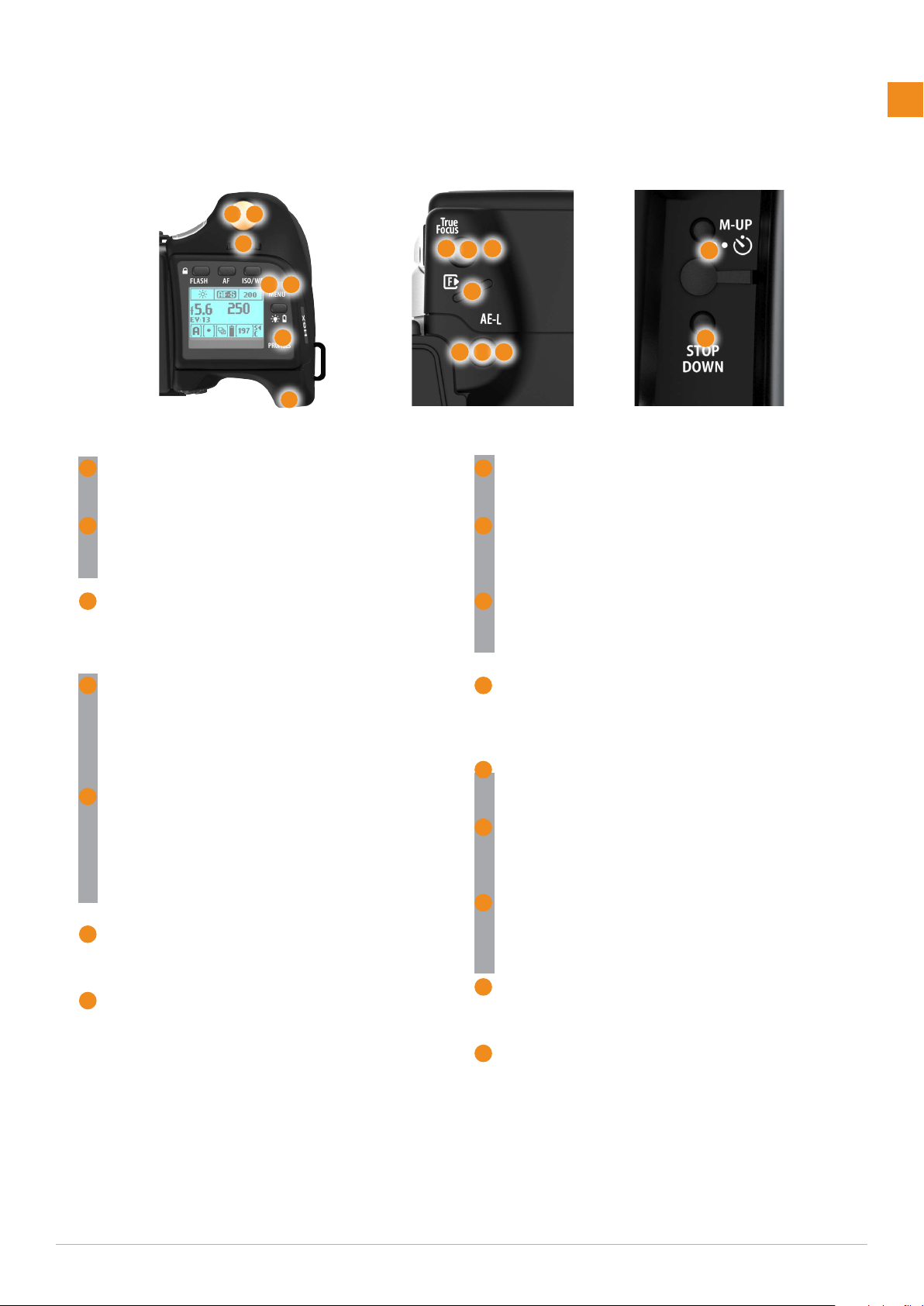
PARTS, COMPONENTS, BUTTONS AND CONTROLS – OVERVIEW
Focus Assist illuminator
Mirror Up button
Remote release port
Stop Down button
Battery grip
True Focus button
Card format button
AE-L button button
Camera strap lug
Grip lever release button
Battery grip locking lever
Retaining bar
Grip buttons: Flash, AF, ISO/WB
(with H5D sensor units only),
MENU, Battery check, Profiles
Camera strap lug
Rear scroll wheel
Shutter release button
Front scroll wheel
Sensor unit release button
Camera strap lug
PC connector port
Accessory port cover
Lens release button
7
www.hasselblad.comH6X
Note that some of the buttons are modal and so
have multiple functions according to the setting be-
ing made.
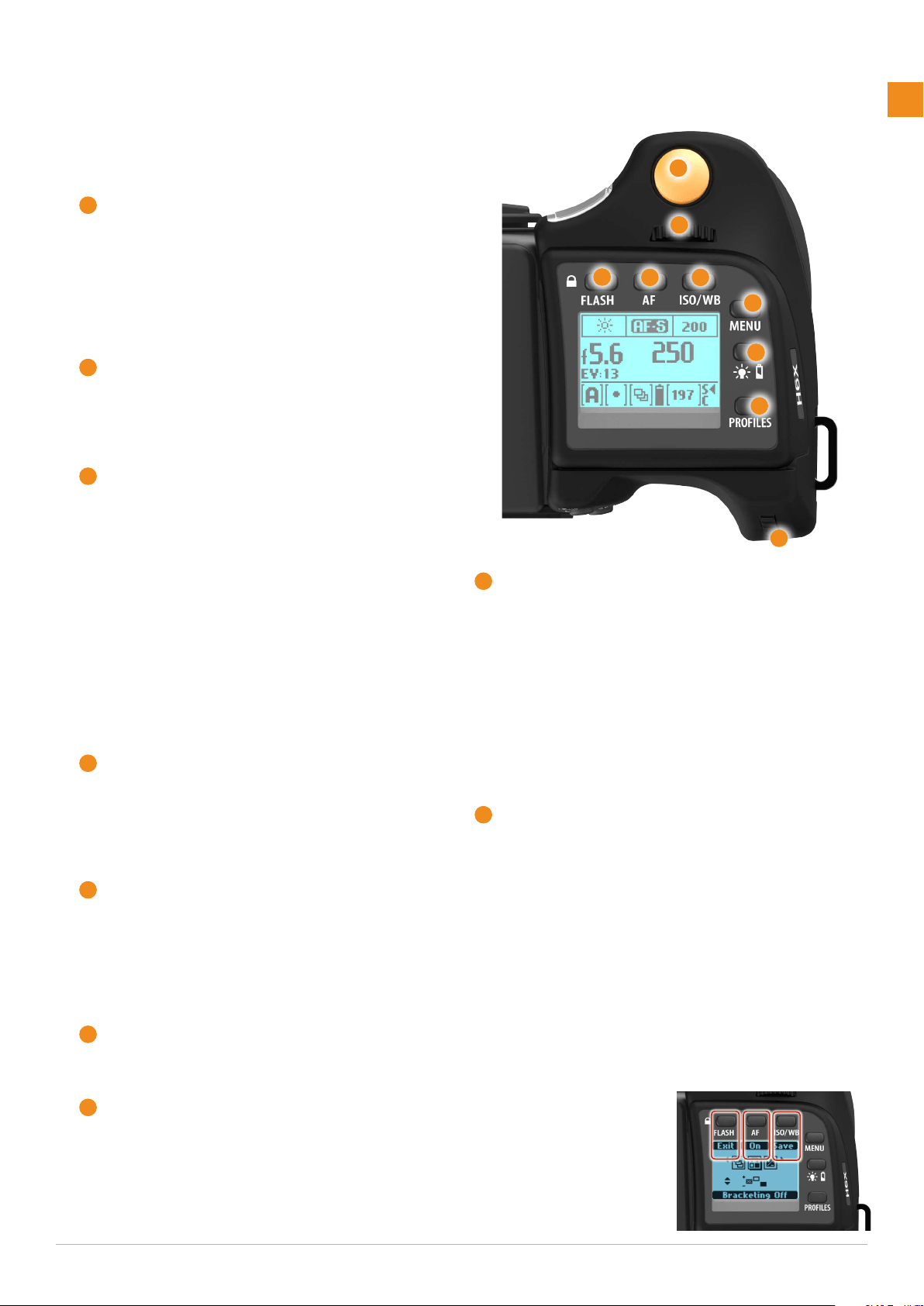
1
Shutter release button
This button has half-press and full-press positions.
By pressing half-way (or softly) the camera, auto focus
function and exposure meter can be activated. By
pressing all the way down (or more firmly) the shutter
will be released (or the chosen exposure procedure
for example, the self timer is activated with this but-
ton).
2
Front scroll wheel
The front and rear scroll wheels are used to make
changes in exposure settings and provide access to
the grip menu for settings. The effect of the wheels’
direction is customizable.
3
FLASH / (Control Lock) button) / (EXIT)
This is a triple function button. If you press the button
for one second, the beeper will sound (if set) and a key
symbol will appear on the grip display signifying that
the controls (except the shutter release) have been
locked and therefore cannot be altered unintention-
ally in use. Press the button for one second again to
unlock (this function can be altered to lock all controls
or scroll wheels only in Custom Options #18 on grip).
Quickly clicking the button will access the flash set-
tings information on the display from the main screen.
See under Flash /Strobe - controls and displays for full
details.
This button also acts as the EXIT button for many
settings.
4
AF button / (ON) / (SEL.)
This is a triple function button. Press this button to
directly access the autofocus/manual focus choice
screen from the main screen. See under Lenses for full
details. It also acts as the ON and SEL. (= select) but-
tons for many other settings.
5
ISO/WB button / (SAVE) / (ENTER)
This is a triple function button. It provides direct ac-
cess to the ISO and White Balance settings – with H5D
sensor units only. See under Light Metering & Exposure
Control for full details.
It also acts as the SAVE and ENTER buttons for many
other settings.
6
MENU button
Accesses the first level of the menu for settings
changes.
7
Illumination/Battery status button
Press to illuminate the display. Remains active until
camera enters Display Off mode. Hold down to access
battery status/general information screen.
8
ON / OFF (Profiles) button
Press the button for 1 second to activate the camera.
The H6X start-up logo will appear and then the main
screen. After a few seconds (customizable) the camera
will enter Display Off mode.
A long press of the button will turn the camera off
completely (even from Display Off mode) signified by
an audible signal (if set).
A quick ‘click’ on the button will access the Profiles
feature (see later section for details).
Note the difference in results between a long press
and a quick click of this button.
9
Rear scroll wheel
The front and rear scroll wheels are used to make
changes in exposure settings and provide access to
the grip menu for settings. The effect of the wheels’
direction is customizable.
EXAMPLE
In this example of making a Bracketing setting, the
top three buttons – Flash, AF and ISO/WB – will tem-
porarily function according to the description on the
screen – Exit, On and Save.
The buttons return to the standard function when
you exit from the setting.
GRIP BUTTONS AND CONTROLS DESCRIPTION
1
3
4 5
6
7
8
2
9
8
www.hasselblad.comH6X
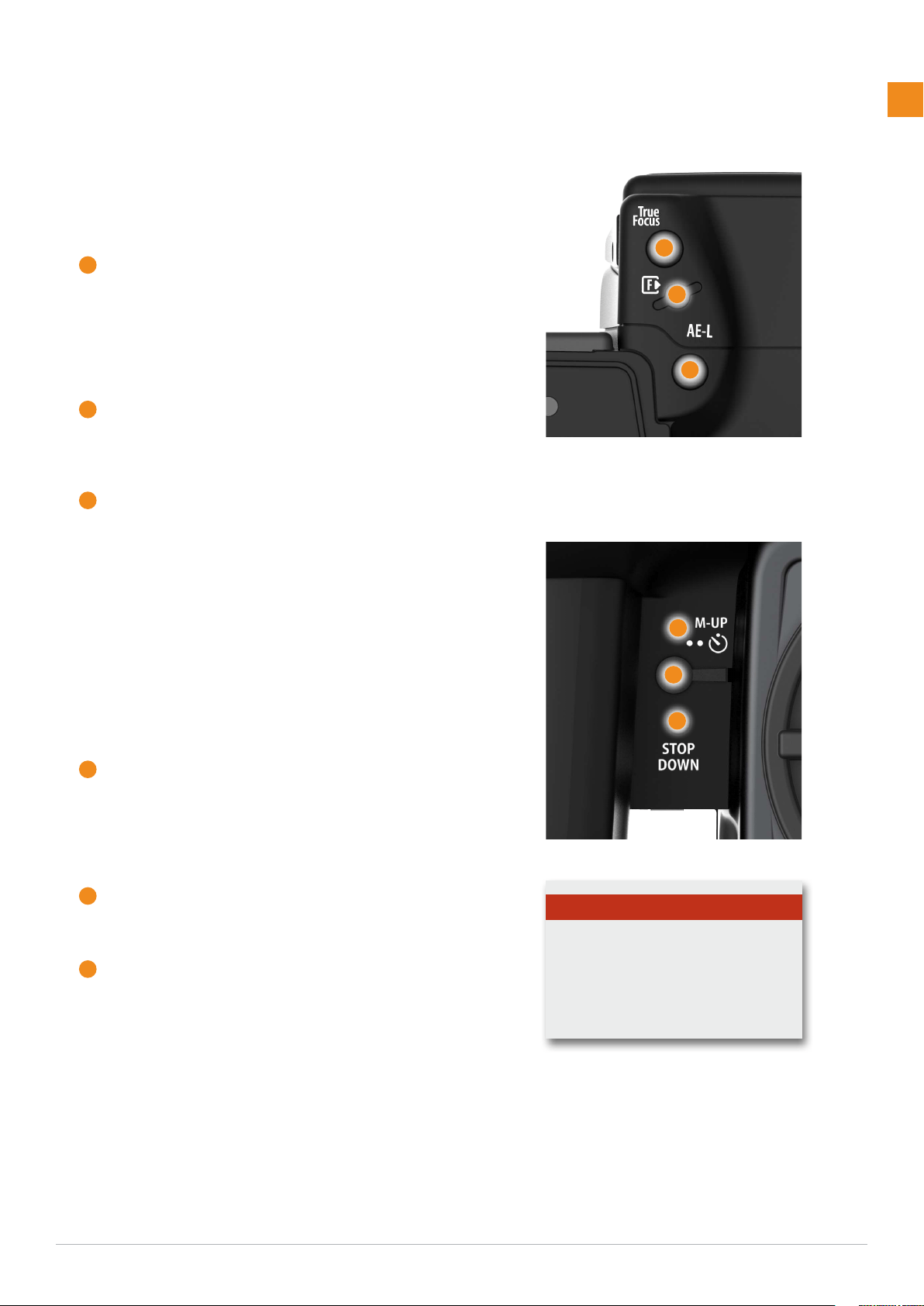
Note that some of the buttons can be re-assigned to
another function.
There are three control buttons on the rear of the
grip.
1
True Focus button
At default setting, activates True Focus (see separate
section for description) but also acts as a Zoom-in
button when browsing or Selector button when
making a setting change on the sensor unit, according
to mode.
Can be reassigned in Custom Options to another function.
2
CF Card format button
Re-formats a CF card. Purposefully recessed to pre-
vent unintentional use. Dialogue appears for confir-
mation – for use with H5D sensor units only.
3
AE-L button
At default setting, activates AE-L that can lock a light
reading made in both automatic and manual expo-
sure modes. Also acts as a Zoom-out button when
browsing or Selector button when making a setting
change on the sensor unit, according to mode.
Can be reassigned in Custom Options to another function.
See under Light Metering & Exposure Control /
AE-L button for full details.
There are three control buttons on the front of the
grip.
4
M.UP button
Press to raise the mirror and press again to lower it
(toggle function). A quick double press of the button
(two within a half second) will immediately access the
Self timer function.
Can be reassigned in Custom Options to another function.
5
Remote release cord port
For attaching a remote release cord (electrical). The
jack plug socket is protected by a captive rubber plug.
6
STOP DOWN button
Press to make a visual check of the depth-of-field on
the viewfinder screen at the chosen aperture. The ap-
erture will close according to the setting and remain
closed as long as the pressure is maintained. You can
alter the aperture at the same time to see the changes
taking place.
Can be reassigned in Custom Options to another function.
Note
Customizable buttons are parti cularly
useful and can save you a great deal of
time and effort. You are advised to inves-
tigate their potential fully!
See separate section for full details.
CAMERA BODY BUTTONS AND CONTROLS DESCRIPTION
1
2
3
5
6
4

9
www.hasselblad.comH6X
1
Hot shoe
Connection for automatic flash unit (with SCA 3902
adapter) or for wireless flash connection.
2
Rubber eye cup
Can be exchanged for another model.
3
Eyesight adjustment wheel
The personal eyesight adjustment facility has a diop-
ter range of -5 to +3.5, to suit most users.
4
Exposure compensation button
Press this button to access the EV compensation
screen. Settings are made with either the front or rear
scroll wheels. An EV correction symbol appears on
the grip and viewfinder display as confirmation.
5
Exposure mode / metering mode
button
The EXP (Exposure) button accesses the exposure and
metering mode options screen. Settings are made with
the front and rear scroll wheels and the appropriate sym-
bols appear on the grip and viewfinder displays accord-
ingly.
6
Integral flash unit
Guide number 12.
7
Integral flash unit release button
Slide the button towards the rear of the camera to raise
the flash. Activation is automatic.
8
Viewfinder release button
VIEWFINDER – NOT INCLUDED
1
2
3
4
5
6
7
8
VIEWFINDER INFORMATION
• Metering method
• Aperture setting
• Shutter speed
• Exposure method
• Capture counter
• Exposure compensation
• Focus assist
• Warning triangle
• Flash warning
• Spirit level
DISPLAY INFORMATION – OVERVIEW
GRIP LCD INFORMATION
• Metering method
• Aperture setting
• Shutter speed
• Exposure method
• Capture counter
• ISO
• White Balance
• Flash indication
• Focus
• Drive
• EV
• Battery status
.....optional.....
• Histogram
PHOCUS / PHOCUS MOBILE INFORMATION
• Metering method
• Aperture setting
• Shutter speed
• Exposure method
• ISO
• White Balance
• Flash indication
• Focus
• Drive
• EV
for use with H5D sensor units only
10
www.hasselblad.comH6X
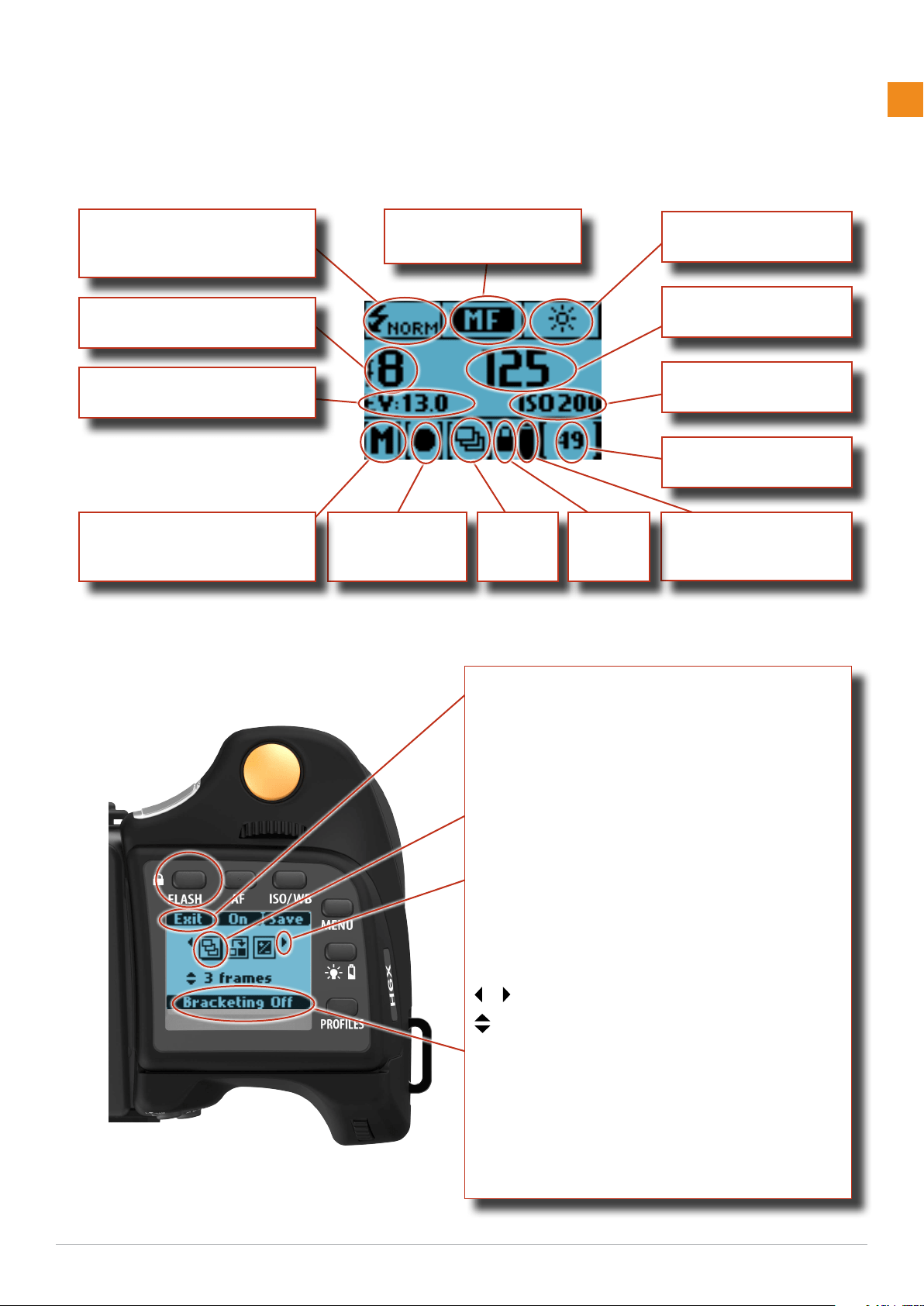
Typical camera grip display when changing
settings.
TYPICAL GRIP DISPLAY
GRIP DISPLAY – OVERVIEW
Focus setting
(Manual setting)
White balance
(Daylight)
Shutter speed setting
(1/125s)
ISO setting
(200 ISO)
Capture counter
Battery symbols
Metering method
indication
(Centre weighted)
Drive
condition
Key lock
Flash condition indication
(No exposure compensation,
normal flash synchronisation)
Aperture setting
(f/8)
Exposure mode indication
(Manual setting)
Exposure Value display
(EV 13.0)
Command indication
The upper row on the screens describes commands (that
change according to the setting). The button immediately
above each command effects the change. So in this case, for
example, you would press the FLASH button to Exit from the
screen. See note below.
Settings symbols
Symbolize the options available when settings are changed.
The active symbol is depicted by a drop shadow.
Scroll wheel description and direction
Arrowheads symbolize which scroll wheel should be used to
change the setting they are beside. In this case, the Bracket-
ing option is chosen by the front scroll wheel and the num-
ber of captures in that option is chosen by the rear scroll
wheel.
. . .
= front scroll wheel
= rear scroll wheel
Setting information
The lower row on the screen displays information about the
current state of the setting. In other words, the upper row
displays what you can do, and the lower row displays the
current state of settings or what you have done.

11
www.hasselblad.comH6X
Typical viewfinder display. Note the LEDs will only be visible when activated (by the camera or a setting).
Standard settings
SOME EXAMPLES OF VARIOUS VIEWFINDER DISPLAYS
Flash LED
Exposure method indication
(‘aperture priority’ mode)
Aperture setting
(f/5.6)
Warning triangle
LED
Exposure compensation
setting reminder symbol
Metering method
setting
(Centre weighted)
Focus Assist LED
Exposure compensation
setting (+0.7 EV)
Shutter speed setting
(1/30 second)
Capture
counter
True Focus (all mod-
els) and HCD crop (60
Mpix only) icons
appear on right
hand side of display
when functions are
activated.
Normal screen with True Focus
activated
Normal screen with AE lock
activated
Display when scroll wheels and navigation button is used or when Browse
mode is activated.
Normal screen with exposure
compensation set
When activated, the integral spirit level replaces normal display.
VIEWFINDER DISPLAY – OVERVIEW
VIEWFINDER DISPLAY ACCORDING TO
SETTING
EXPOSURE INFO ON VIEWFINDER DISPLAY
Flash mode AF mode Exposure compensation
mode
A
=
Aperture priority
S
=
Shutter priority
P
=
Program
Pv
=
Program (variable)
M
=
Manual
Centre Weighted =
CentreSpot =
Spot =
Exposure and metering
mode examples
Menu mode

12
www.hasselblad.comH6X
SHORTCUT ACCESS TO
BUTTON SETTING SCREENS
1) Press the MENU button fol-
lowed by the button you want
to reassign (True Focus, AE-L,
M.UP or Stop Down).
This directly accesses the par-
ticular button you chose at the
Custom options level in the
menu.
2) Rotate the
REAR scroll wheel to
select the function you want the
button to activate.
3) Press
SAVE (or the shutter release
button). The selected button will
now activate the newly assigned
function directly.
These four grip buttons by de-
fault are assigned according to
name but can be reassigned (in
Custom Options #4, #5, #6 and
#7 or by using the Camera Con-
figuration tool in Phocus) to var-
ious other functions listed here.
1
True Focus
2
AE-L
3
M.UP
4
STOP DOWN
· True Focus
Temporarily activates True Focus
function.
· AE-lock
Temporarily locks a light reading
in auto or manual modes. Also
used in Zone metering.
· Mirror up
Locks mirror up for vibration
reduced captures. Also lowers
mirror.
· Stop down
Activates stop down function for
depth-of-field checking.
· AF
Temporarily activates Autofocus
function.
· Self timer
Sets self timer mode. Provides
a timed remote shutter release
function with the option of a
change in sequence of the mirror
movement (to reduce vibration).
· Bracketing
Sets Bracketing mode. This func-
tion provides an automatic series
of captures; one at the standard
exposure setting (Manual or
Auto) and the others with prede-
termined deviations in EV from
the standard exposure.
· B mode
Sets B mode shutter setting.
Shutter stays open as long a
pressure is maintained on shut-
ter release button.
· T mode
Sets T mode shutter setting.
Shutter stays open after first
press of shutter release button
(toggle function to close again).
· Flash Measure
Activates manual flash measure
function.
· Interval timer
Activates interval function start
screen.
· Cycle Light Meter mode
Selects next light metering mode.
· Expose
Provides alternative to shutter
release button.
· Display Off
Activates Display Off mode im-
mediately.
· Histogram
Provides a histogram on the grip
display for the last capture.
REASSIGNABLE GRIP BUTTONS FUNCTION OPTIONS
· Focus Conf.
Provides a 100% preview on
display for focus checking.
Not available for True Focus and
AE-L buttons.
· Delete
Direct access to delete dialogue.
· Grey balance exp.
Provides selective capture for
grey balance calculations.
· Spirit Level
Activates spirit level on back (but
not in viewfinder).
· Rear Info Screen
Activates grip information on
sensor unit display.
1
2
3
4
SAVE
(ISO/WB button)
MENU
Rear scroll
wheel
13
www.hasselblad.comH6X
Some buttons access shortcuts if used in different ways or contexts.
1
Shutter release button – Camera activation
Re-activates camera from Display Off mode.
2
Shutter release button – Quick save
Half-press shutter release button to make a quick save
when making settings adjustments.
3
Front scroll wheel – Menu navigator / Browser
Functions as a horizontal navigator on sensor unit
menu as well as a capture browser in Browse mode.
4
Menu button – Custom Options access
Press MENU button twice on the grip to access the lat-
est setting made in Custom Options. After making any
changes, press the shutter release button to save the new
setting.
5
Menu button – Customizable Button access
Press MENU on the grip and then the desired custom-
izable button (True Focus, AE-L, M.UP, Stop Down)
to access the choices available in Custom Options.
After making any changes, press SAVE or the shutter
release button to save the new setting.
6
Profiles button – Camera activation
Re-activates camera from Display Off mode.
7
Rear scroll wheel – Menu navigator
Functions as a vertical navigator on sensor unit menu.
8
True Focus button – Camera activation
Re-activates camera from Display Off mode.
9
True Focus button – Zoom-in button
Automatically acts as Zoom-in button when in
Browse mode.
10
True Focus button – Selection button
Automatically acts as value selector on sensor unit
menu when in Menu mode.
11
CF Card format button –
Formats the current inserted CF card (requires
confirmation) – for use with H5D sensor units only.
12
AE-L button – Camera activation
Re-activates camera from Display Off mode.
13
AE-L button – Zoom-out button
Automatically acts as zoom-in button when in Browse
mode.
14
AE-L button – Selection button
Automatically acts as value selector on sensor unit
menu when in Menu mode.
15
Mirror Up button – Camera activation
Re-activates camera from Display Off mode.
16
Stop Down button – Camera activation
Re-activates camera from Display Off mode.
SHORTCUTS
10
9
8
11
13 1412
15
16
1 2
3
4 5
6
7
14
Photo: Ken Hermann © / Hasselblad Masters
GENERAL
15
www.hasselblad.comH6X
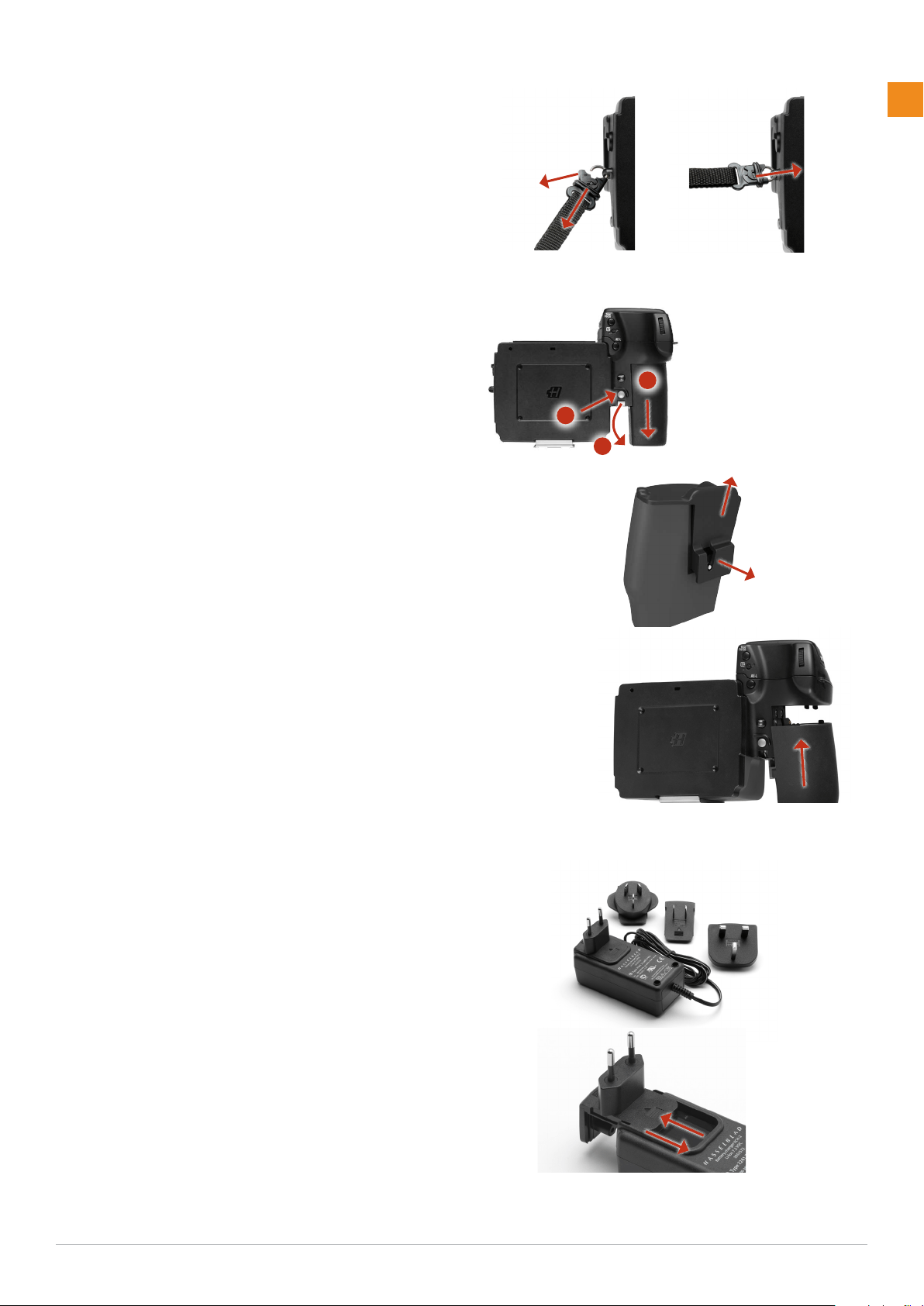
CARRYING STRAP
The carrying strap is attached by firstly withdrawing the
safety collar. The hook is then freed and can be attached to
the strap lug. Slide back the safety collar to ensure the hook
remains in the locked position between the small protruding
lugs. The collar is purposely a tight fit to avoid unintention-
ally slipping back and therefore might need some effort to
slide.
RECHARGEABLE BATTERY GRIP
The environmentally approved Battery grip Li-ion (3043356)
is the standard power source for the H6X camera. The
H6X requires a power supply for all actions as there is no
mechanical reserve facility. When working untethered, it is
therefore advisable to keep a reserve rechargeable battery
grip at hand. As is the case with most batteries, problems
might be encountered when used in very low temperatures.
In this situation it is advisable to keep the reserve battery
in an inside pocket, for example, to maintain it near body
temperature.
FITTING AND REMOVING A BATTERY
The fitting and removing procedure is the same for both
types of battery grip.
Remove the battery from the camera by depressing the bat-
tery holder button (A) and simultaneously swinging the bat-
tery holder retaining lever (B) down until it stops. Pull the
battery downwards (C).
If you intend to store the battery separately from the camera
you should ensure that the safety cover is in place (to pre-
vent short-circuiting). It snaps into place and is removed by
pulling outwards and upwards on the locking clip.
To fit, hold the battery flat against the camera body and
aligning the two upper lugs with the slot, slide it back into
position as far as it will go. Swing back the battery holder
retaining lever until it clicks back into place.
BATTERY CHARGER
The battery charger is supplied with a number of plug at-
tachments to suit various types of domestic electrical sock-
ets available worldwide. Other types of socket will require a
domestic socket converter.
Attach the chosen plug by sliding it into position as in the
diagram. Removal is by the reverse procedure.
Please note that the Battery charger Li-ion 2900 (3053572)
is designed for use with Battery grip Li-ion 2900 (3043356)
but can also be used together with the Battery grip re-
chargeable 7.2V Li-Ion (3043348) intended for H4D use.
Likewise, the older Battery charger for Li-Ion battery
(3053568) also can also be used together with the Battery
grip Li-ion 2900 (3043356) but requires 50% longer charg-
ing times.
A
B
C
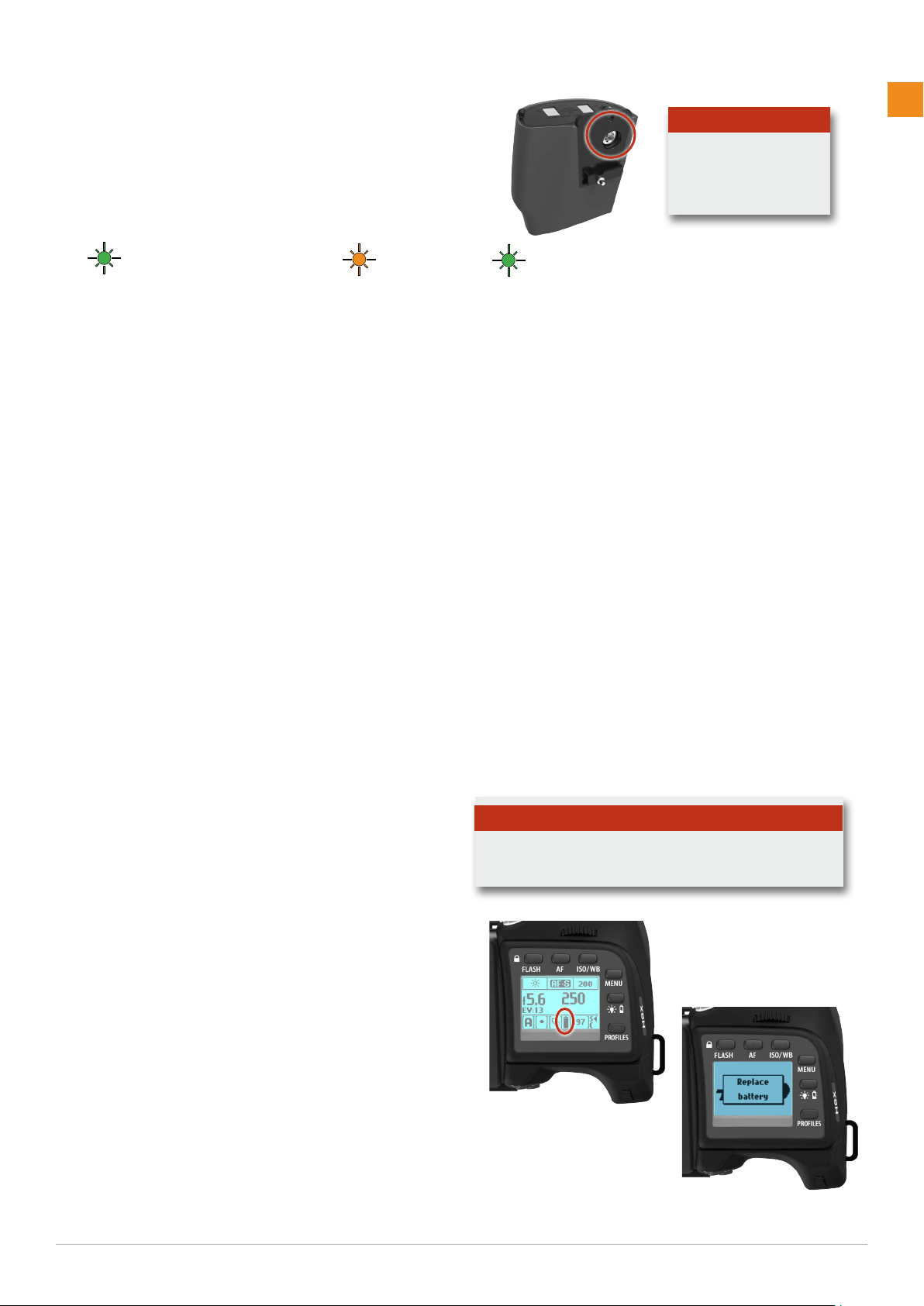
16
www.hasselblad.comH6X
CHARGING THE BATTERY
With the battery removed from the camera, insert the jack
plug from the battery charger into the socket on the battery
grip. Insert the battery charger into a standard (100–240V~
/50–60 Hz) domestic socket.
During the charging procedure, the lamp on the charger
signifies the following:
• The battery should be charged for approximately 6 hours
before first time use.
• The battery must be charged at room temperature.
• Maximum battery capacity is reached only after the bat-
tery has been charged and discharged several times.
• Avoid frequent full discharges (a full discharge is signalled
by the appearance of the Replace battery warning on
the grip display). As the battery is a Li-ion type, it has no
‘memory effect’ of practical importance and therefore fre-
quent recharges will cause no problems such as loss of ca-
pacity or poor performance. It is therefore better policy to
recharge the battery at very regular intervals, regardless
of use.
• Remove the battery if you intend to store the camera
for some while as it will eventually become completely
drained, even though the camera is turned off.
• The battery has an integrated ‘fuel gauge’ capability that
supports the Replace battery and Battery status functions
on the grip display. As with most Li-ion batteries, this ca-
pability should be occasionally calibrated, depending on
how much the battery is used. To do this, leave the camera
on (or use it), until the Replace battery warning appears.
Then, recharge the battery for 6 hours. This will improve
the accuracy of the measurements.
• When removing a battery from the charger and imme-
diately replacing it with another, allow a few seconds to
elapse so that the charger can automatically reset for the
next charging procedure.
• It is perfectly normal for the battery to become warm
when being charged.
• A slight temporary loss of battery performance might
be noticed at very high or low temperat ures. Take the
appropriate measures if this is the case.
• If you do not intend to use the battery for a while, it is best
to store it at room temperature with an approximate 30
to 40% charge. You can check the percentage level on the
status screen.
• The battery should have a usable service life of around
400 recharge/discharge cycles.
• Connect the battery grip to the camera correctly.
• Keep the protective cover in place when not in use. (Short-
circuiting across keys in a pocket, for example, could cause
a fire risk).
• Do not immerse the battery grip in liquids.
• Do not incinerate the battery grip. Please recycle or dis-
card in an environmentally approved manner.
• Use indoors only (protect against moisture).
• Do not short-circuit the jack plug.
• Do not alter the charger in any way other than changing
the plug attachment.
RECHARGEABLE BATTERY GRIP LI-ION/ BATTERY CHARGER LI-ION 2900
– PRECAUTIONS & GENERAL
Standby (no battery connected) Charging Ready
Note
It can take about 6 hours
to charge the battery
completely the first time.
Tip
You can save battery consumption by changing the Power
mode setting.
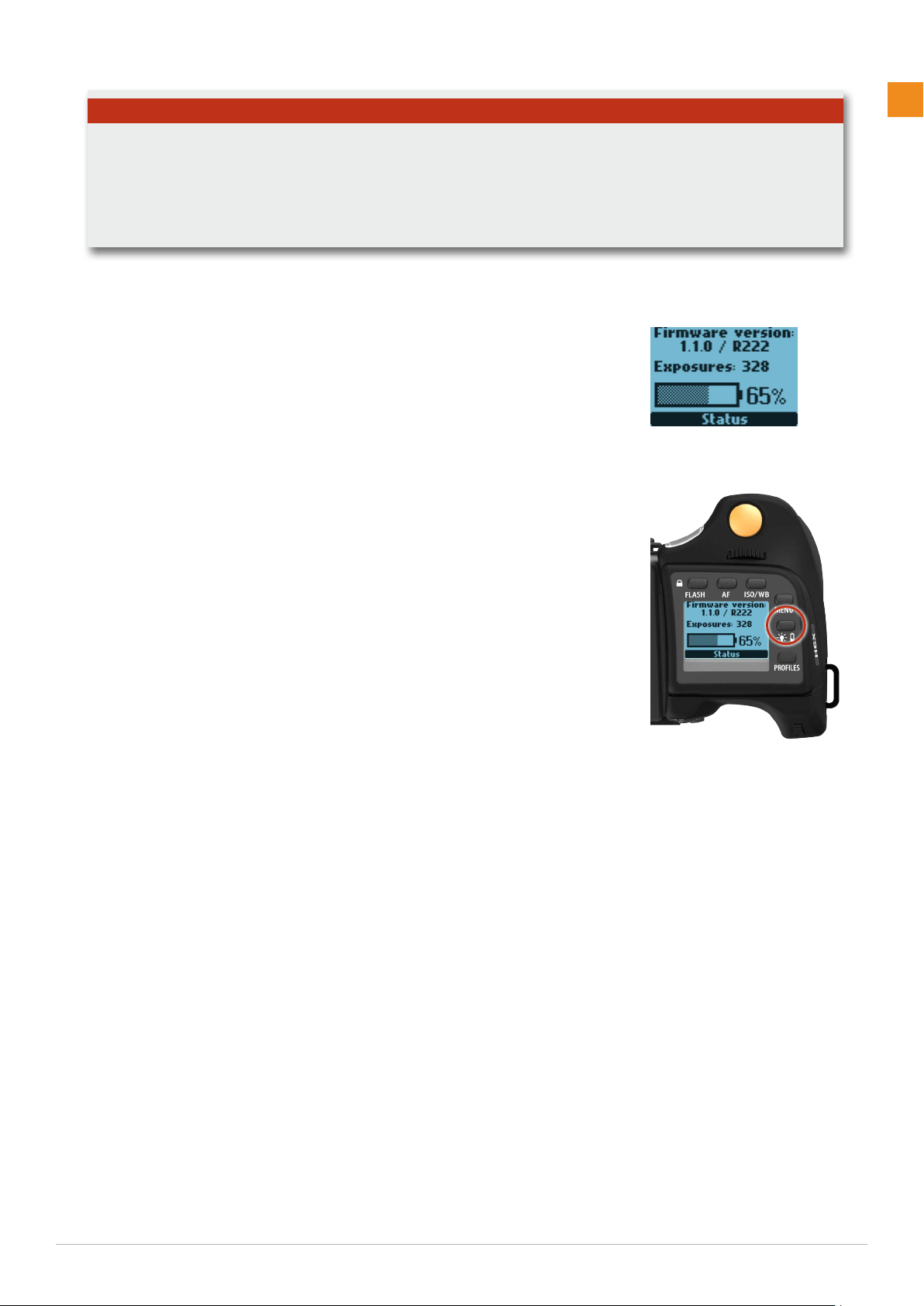
BATTERY LIFE & BATTERY WARNING
Battery life is dependent on a number of variable factors
and therefore cannot be exactly predicted. If the camera is
left in the active state instead of Display Off or Sleep modes
for long periods, for example, then the battery will become
exhausted much faster. A low camera battery state is indi-
cated by a symbol on the grip display, in the viewfinder as
well as on the sensor unit display. In addition, an audible sig-
nal sounds.
When the battery is almost completely exhausted, a warn-
ing message Replace battery will appear on the grip dis-
play.
Quick visual check
Exhausted battery warning
17
www.hasselblad.comH6X
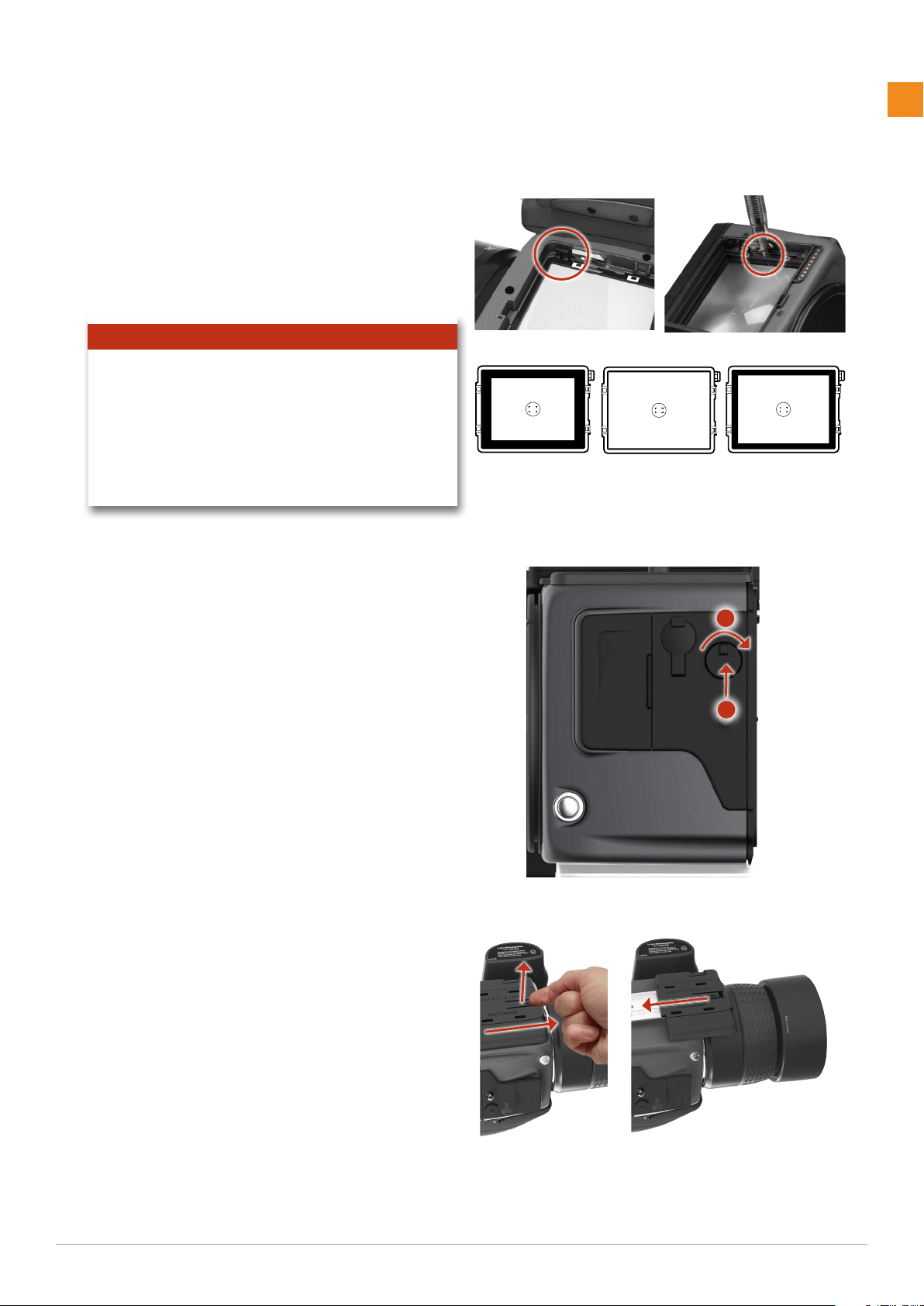
BATTERY STATUS
An immediate full-screen information and battery status check appears on the
grip display by holding down the illumination/battery status button. This screen
displays:
• the firmware version
• the number of captures taken since the last battery recharge / change.
• a rechargeable-battery status icon that provides a quick visual check as well as a
figure estimate in percent.
The information regarding the number of captures taken is intended to help you
make an estimate of the number of possible remaining captures according to your
way of working. For example, if you regularly browse a great deal when shooting
or you leave the camera in ON-mode instead of Display Off or Sleep modes, you
would naturally expect to drain the battery sooner than others who don’t. You
should soon be able to build up a picture of how you usually work and can there-
fore estimate that after X number of captures, you normally expect to be able to
take Y captures before the battery is exhausted (when working in a similar manner
in similar conditions).
The percentage information, however, provides another kind of estimate based
more on the amount of charge left in the battery rather than on your normal way
of working.
Remember that these are only estimates and that there are a number of factors
affecting remaining battery charge, ambient temperature for example, as well as
general practice.
Note
When the low-battery message in the viewfinder appears,
the camera automatically enters a temporary power-saving
mode. This is recognizable by a slower pace for all the ac-
tions in a capture sequence. The camera actions also sound
differently.
This mode is designed so that you can continue working for
a while, even though the power remaining in the battery is
too low for working in the normal manner. Normal action
automatically returns with a refreshed battery.
POWER MODES
The H6X can be set at three active modes − ON, Display
Off and Sleep. In these active modes, battery consumption
is least in Sleep mode and most in ON mode. Both the grip
and the sensor unit displays are dimmed accordingly. How-
ever, after a set number of minutes of complete inactivity,
the whole camera can automatically enter another mode
(custom setting) to conserve power (indicated by no visible
logos on either display).
ON
To activate the camera press the red ON.OFF button until
you see the start-up H6X logo appear on the grip display.
The logo is automatically followed by the main screen.
OFF
From the active screen, press (not click !) the red ON.OFF
button for a half second. All buttons (except the ON.OFF
button) remain ineffective, producing virtually no demand
on the battery. This is the normal mode when transporting
or storing the camera or where there might be a risk of inad-
vertently activating the camera. (However, remove the bat-
tery grip if you are going to store the camera for a period of
more than a few weeks).
In this mode neither the viewfinder display nor grip display
information is available.
RE-ACTIVATION FROM DISPLAY OFF
OR SLEEP MODES
• press the shutter release button half way
• press the Stop down button
• click the ON.OFF button
• press the Mirror up button.
18
www.hasselblad.comH6X
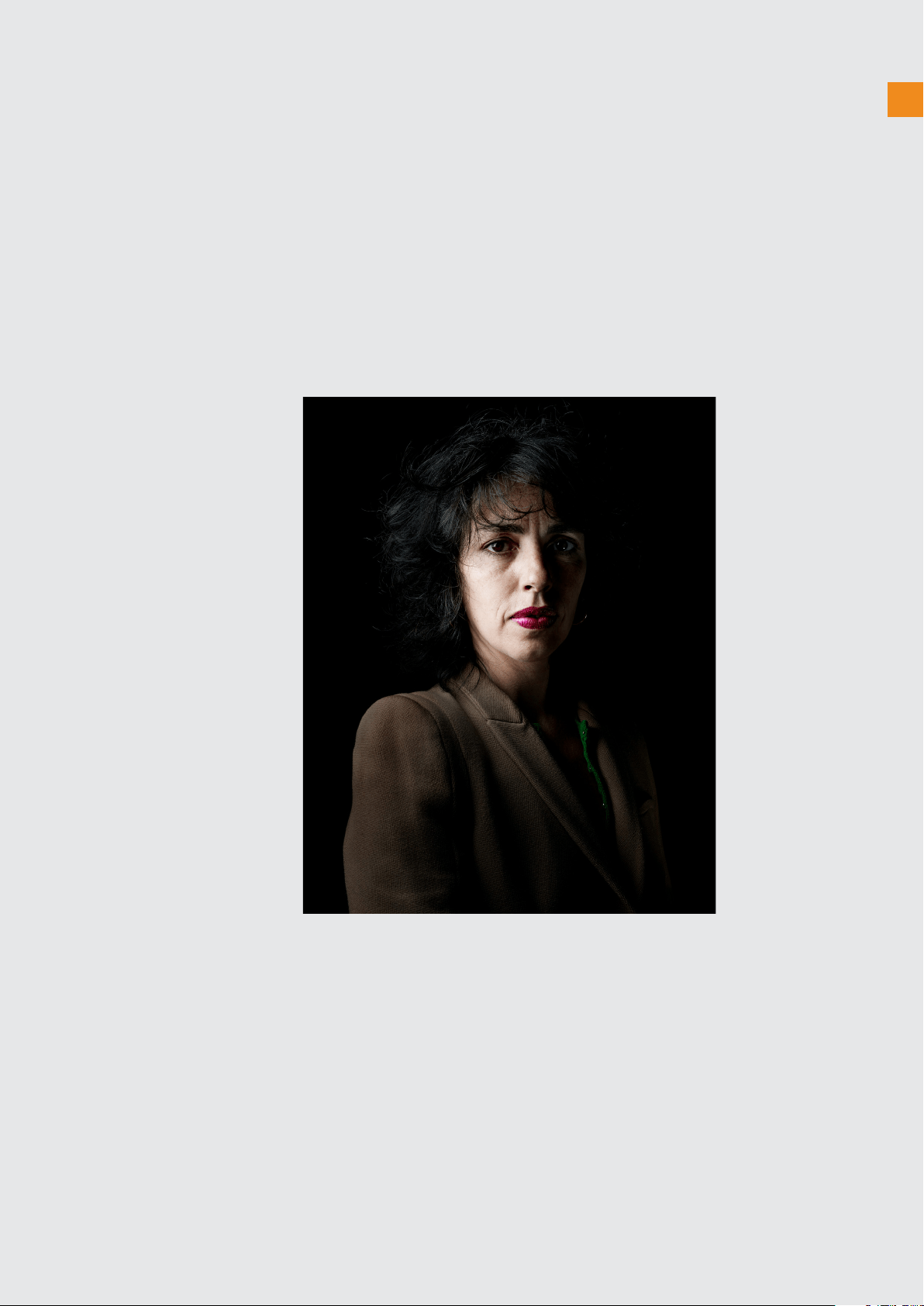
VIEWFINDER SCREEN
The H6X is fitted with a Spherical Acute-Matte D viewfinder
screen for extreme brightness, clarity and even illumina-
tion. An optional accessory screen with a grid pattern is also
available.
To change a viewfinder screen, remove the viewfinder to ac-
cess the viewfinder screen. To remove the screen, place the
tip of a ballpoint pen or similar in the viewfinder screen re-
moval lug and pull upwards. To replace the screen, position
the right side of the screen in place so that it sits correctly
in the recess. Place the tip of a ballpoint pen or similar in
Viewfinder screens showing the difference in masking and composition
frame marking. Type varies according to sensor size. See under Accesso-
ries for other types (with grid pattern, for example).
Note
Do not attempt to clean the screen by immersing it in wa-
ter, or use any kind of cleaning fluid. If the screen becomes
damp, do not use hot air to dry it. Use a soft cloth on the up-
per surface only. Seek advice from an Authorized Hasselblad
Service Center if the screen becomes particularly soiled. Re-
member that particles or greasy marks on the screen might
impair the viewfinder image but have no effect whatsoever
on the recorded image
the viewfinder screen replacement indentation and press
downwards until the screen snaps into position. Try to avoid
touching either surface of the screen with bare fingers.
PROTECTIVE BASEPLATE
To remove the protective base plate, lift the securing catch
while pushing the plate towards the lens. To attach it again,
slip it over the camera foot until it stops and the securing
catch snaps into place.
REMOVING AND ATTACHING A
SENSOR UNIT
Attachment
1. Remove a FireWire cable if connected.
2. Position the retention groove on the sensor unit onto the
retention bar on the camera body ensuring that they
are correctly positioned. Swing the sensor unt towards
the camera body and firmly press into place with a click.
If there is resistance, the magazine retaining catch on
the camera has probably been inadvertently released.
In that case, push the release button again to reset the
catch.
Removal
1. Rotate the sensor unit release button A to the right, and
while maintaining that position press the centre of the
button firmly inwards towards the camera body B to
release the sensor unit.
A
B

19
www.hasselblad.comH6X
PC-CONNECTOR
A PC connector for non TTL-
flash synchronisation is located
on the left side of the body. It is
protected by a captive rubber
plug.
ACCESSORY CONNECTION
There are two accessory-
retaining screw threads (M5) as
well as a databus connector on
the left hand side of the cam-
era body, protected beneath a
cover.
The cover can be removed by
firstly lifting the left hand edge
a little and then sliding the cov-
er to the left, as in the illustra-
tion.
REMOVING AND ATTACHING A
VIEWFINDER OPTIONAL ACCESSORY
To remove, grasp the viewfinder in the right hand and while
depressing the viewfinder release button, lift the rear of the
viewfinder up and away from the camera body.
To attach, hold the viewfinder at a slight angle and rest it
on the top of the camera. Slide the viewfinder forward until
the front locating pin is in position in the recess in the front
edge of the viewfinder screen aperture on camera body.
Press the rear part of the viewfinder firmly downwards until
it clicks into place.
Ensure that both sides of the viewfinder are seated correctly
and that it has been firmly attached and locked into posi-
tion. Failure to do so could cause an intermittent malfunc-
tion if the databus interface connections between the view-
finder and camera body are not positively secured. Avoid
lifting the camera by the viewfinder alone.
EYEPIECE ADJUSTMENT
No corrective lenses are needed to adjust the eyepiece to suit most requirements.
The diopter range is from -5 to +3.5D. Eyeglass wearers can rapidly and accurately
change the settings according to whether they wish to wear eyeglasses for view-
ing or not.
Personal eyepiece adjustments can be carried out by pointing the camera at the
sky or similar smoothly toned area. While holding the camera in your left hand, you
can with your right thumb turn the adjustment wheel until the markings on the
viewfinder screen reach the optimum sharpness for your eyesight.
If you normally wear eyeglasses for distance viewing and intend to wear them for
camera use then do not remove them for the above procedure. If, on the other
hand, you prefer to remove your eyeglasses for camera work, then repeat the
above procedure without wearing your eyeglasses.
RUBBER EYE CUP
Two rubber eye cups are available for the H6X. The one
supplied is suitable for users who do not intend to use eye-
glasses when photographing. The second shorter eye cup is
for those who either prefer to position their eye further from
the viewfinder and those who wish to wear eyeglasses.
The eye cups can be rapidly changed by a Hasselblad Autho-
rized Service Center.
2
1
Lift this edge of the cover first
20
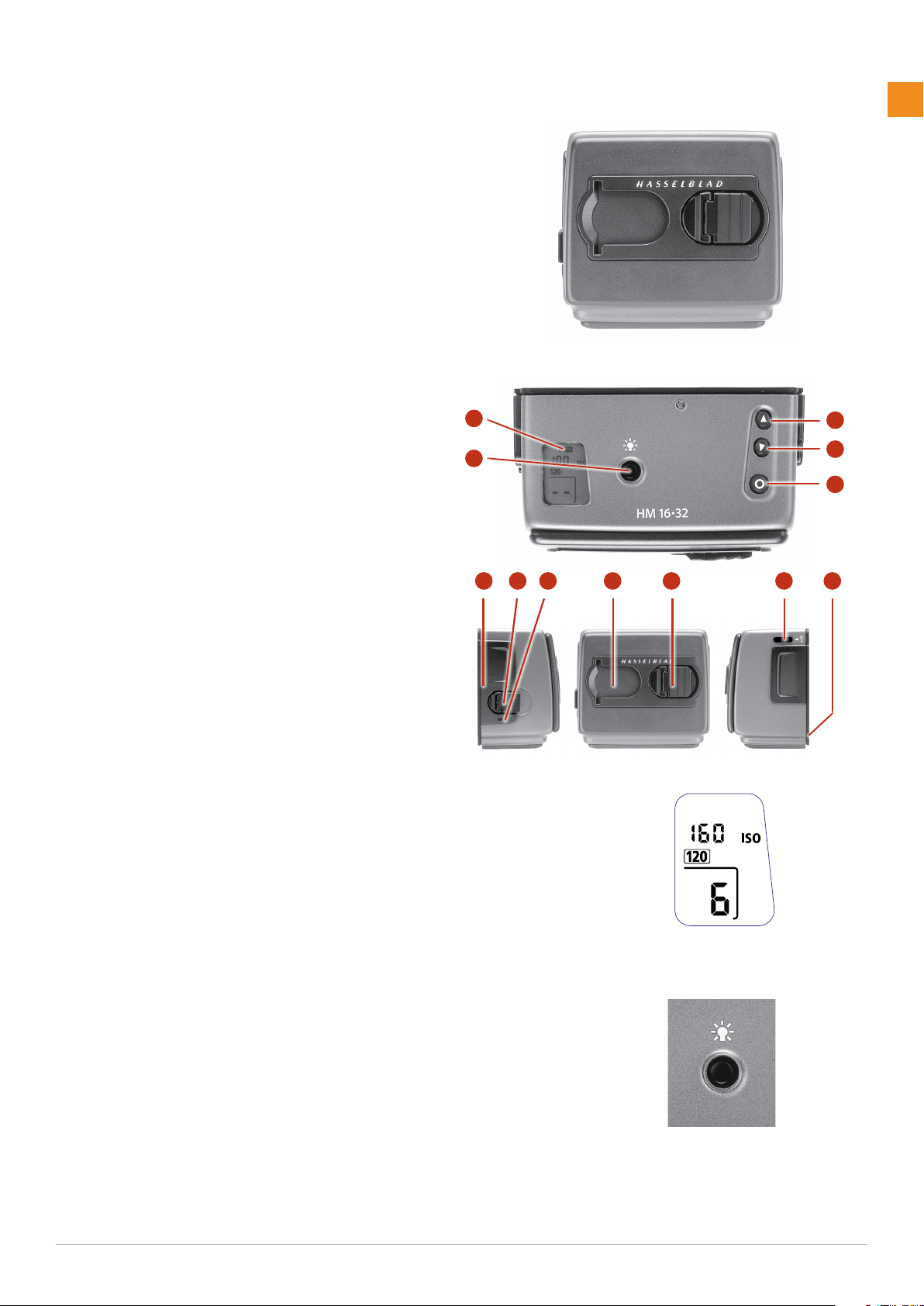
HM 16-32 FILM MAGAZINE
OPTIONAL ACCESSORY
Photo: Denis Rouvre © / Hasselblad Masters
21
www.hasselblad.comH6X
HM 16-32 FILM MAGAZINE
The Hasselblad HM 16-32 film magazine is a sophisticated
semi-independent unit within the H system. It has its own
power supply for individual information storage, LCD panel,
illumination, etc. It features: automatic 120/220 compatibility,
automatic wind on/wind off, automatic film advance, LCD in-
formation panel, integral darkslide, customizable data imprint-
ing, illuminated LCD, barcode recognition, count-up or count-
down film frame reminder choice and multi shot option.
Much information is transmitted and received between the
magazine and the camera body, so ensure the databus connec-
tion is kept clean and not damaged in any way. It is advisable to
fit the magazine protective cover when storing a film magazine
to protect both the databus connection and the darkslide.
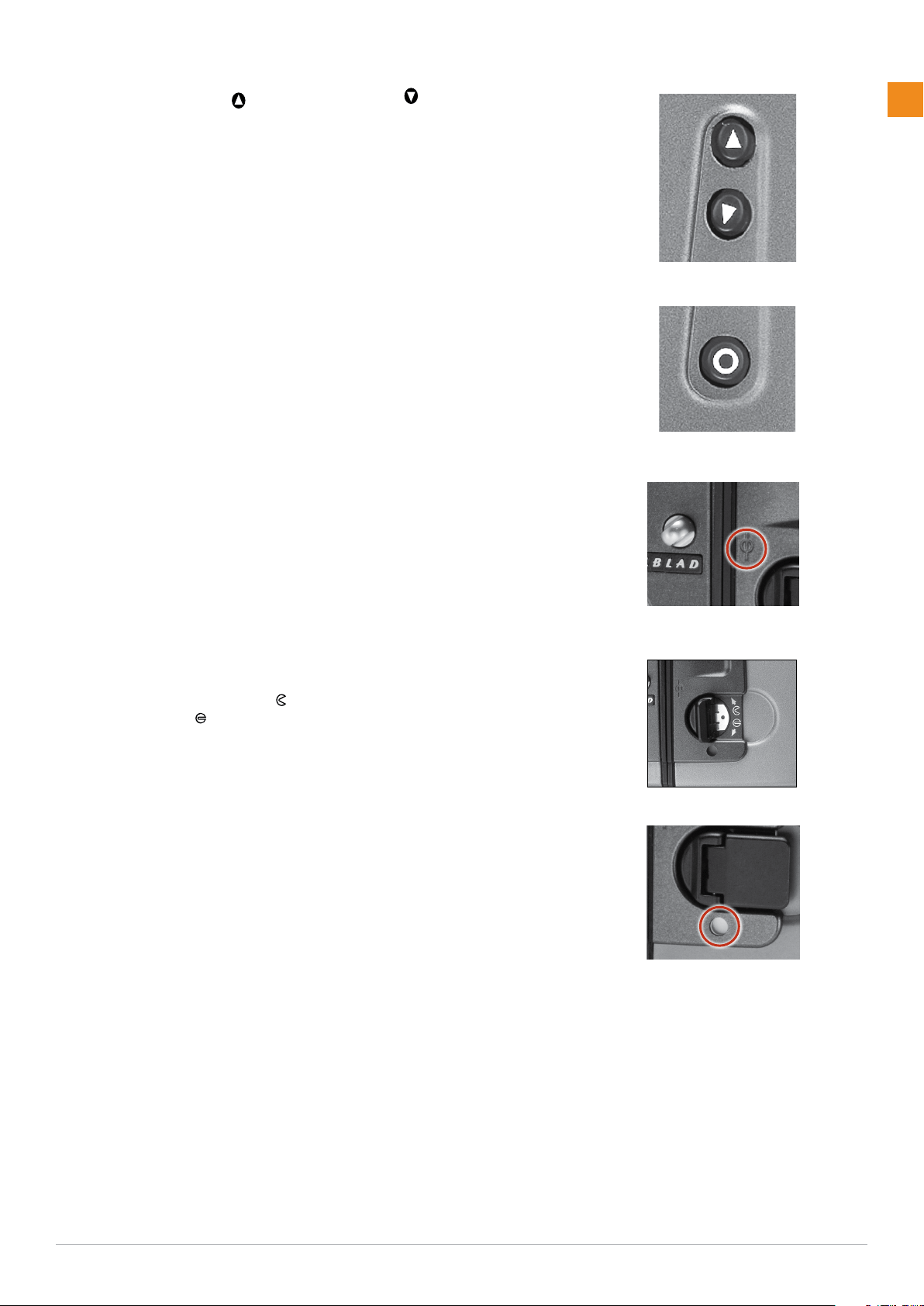
PARTS AND COMPONENTS
1. LCD panel
2. LCD illumination button
3. Change up button
4. Change down button
5. Function selector
6. Film plane index
7. Darkslide key
8. Darkslide indicator
9. Film tab holder
10. Film holder key
11. Magazine settings lock
12. Databus interface
3
4
5
1
2
6 7 8 9 10 11 12
LCD PANEL
The various functions are accessed by repeatedly pressing the function selector
button (loop menu) and changes made by the ‘change-up’ and ‘change-down’
buttons. Any settings are automatically saved. At very low temperatures the LCD
will require a few seconds to display new settings.
LCD ILLUMINATION BUTTON
The LCD can be illuminated by pressing the display illumination button, which is
accessible when the magazine is not attached to the camera. The LCD will remain
illuminated all the time you keep the button depressed, up to a maximum of 10
seconds. After 10 seconds has expired, you must release the pressure on the but-
ton and press again to obtain a further 10 second period of illumination. Remem-
ber that using the illumination function very often will noticeably shorten the life
of the battery in the magazine.
When the magazine is attached to the camera, the button on the magazine is in-
accessible but you can still illuminate the LCD by pressing the illumination button
on the grip instead.
(OPTIONAL ACCESSORY)
22
www.hasselblad.comH6X
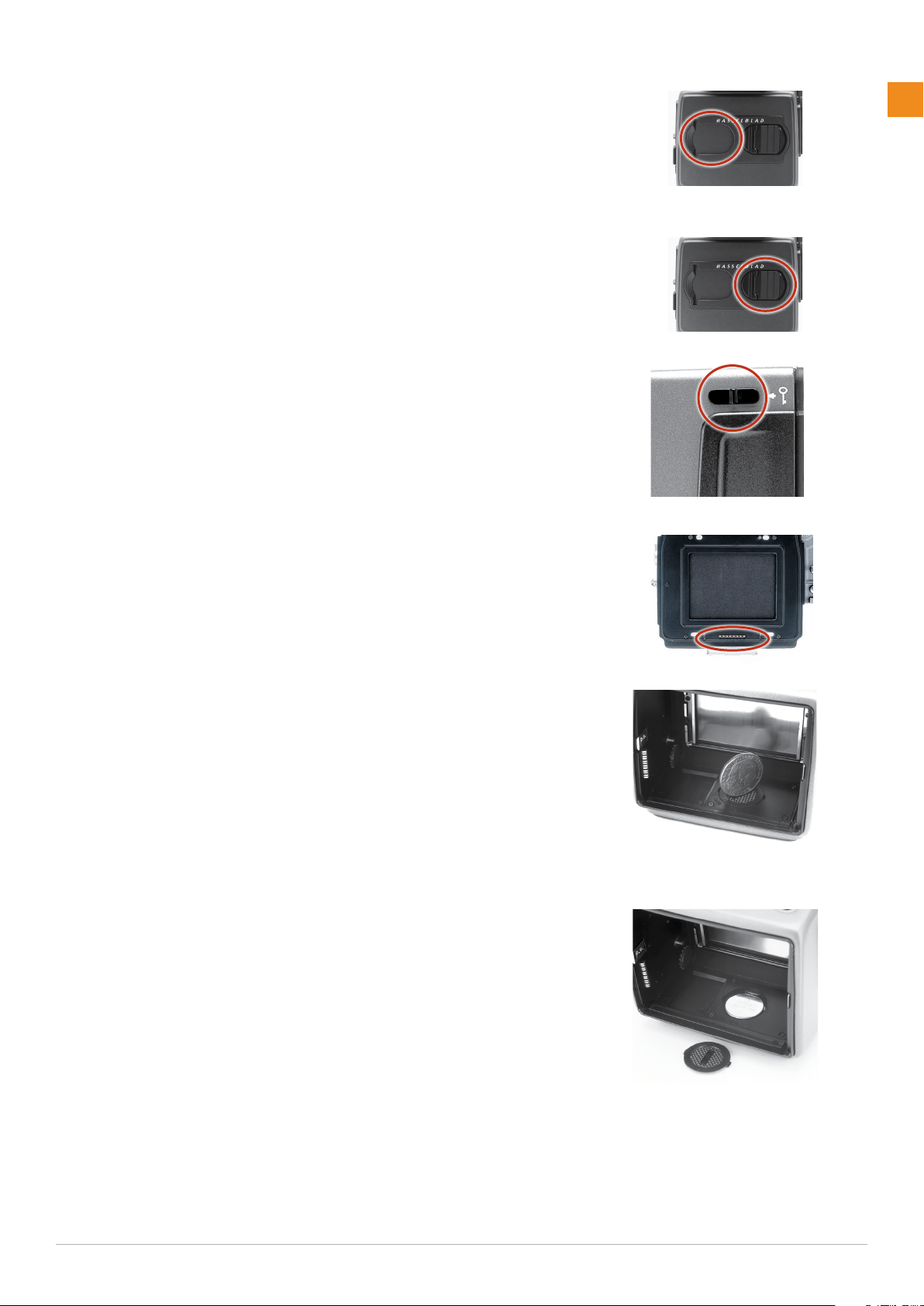
CHANGE UP /CHANGE DOWN BUTTON
Can alter the settings ‘upwards’. For example, to increase the film speed setting.
Toggle action.
Can alter the settings ‘downwards’. For example, to decrease the film speed set-
ting. Toggle action.
FUNCTION SELECTOR
Selects the four functions that can be changed on the magazine. The functions
are on a menu loop so that repeated pressing of the selector button will succes-
sively access all functions in turn. After a time-out of five seconds of non-activity,
the display returns to the main screen.
NOTE: Changes can only be made when the settings lock switch is in the unlocked
position.
FILM PLANE INDEX
Provides a measuring point for the actual position of the film plane in the maga-
zine. Used for calculations in critical applications.
DARKSLIDE KEY
Withdraws and replaces the darkslide. Fold out the key and turn it counter-clock-
wise 360° (towards the open symbol) to withdraw it and clockwise 360° (to-
wards the closed symbol) to replace it.
NOTE: The darkslide can only be withdrawn when the magazine is attached to the
camera.
DARKSLIDE INDICATOR
Indicates whether the darkslide is in place or withdrawn:
RED = stop ! = exposure CANNOT be made
(magazine can be removed from camera)
WHITE = ok ! = exposure CAN be made
(magazine cannot be removed from camera)
If you attempt to make an exposure when the darkslide is closed, however, you
will receive a warning message in the viewfinder and grip LCDs – ‘The darkslide
is closed’.
23
www.hasselblad.comH6X
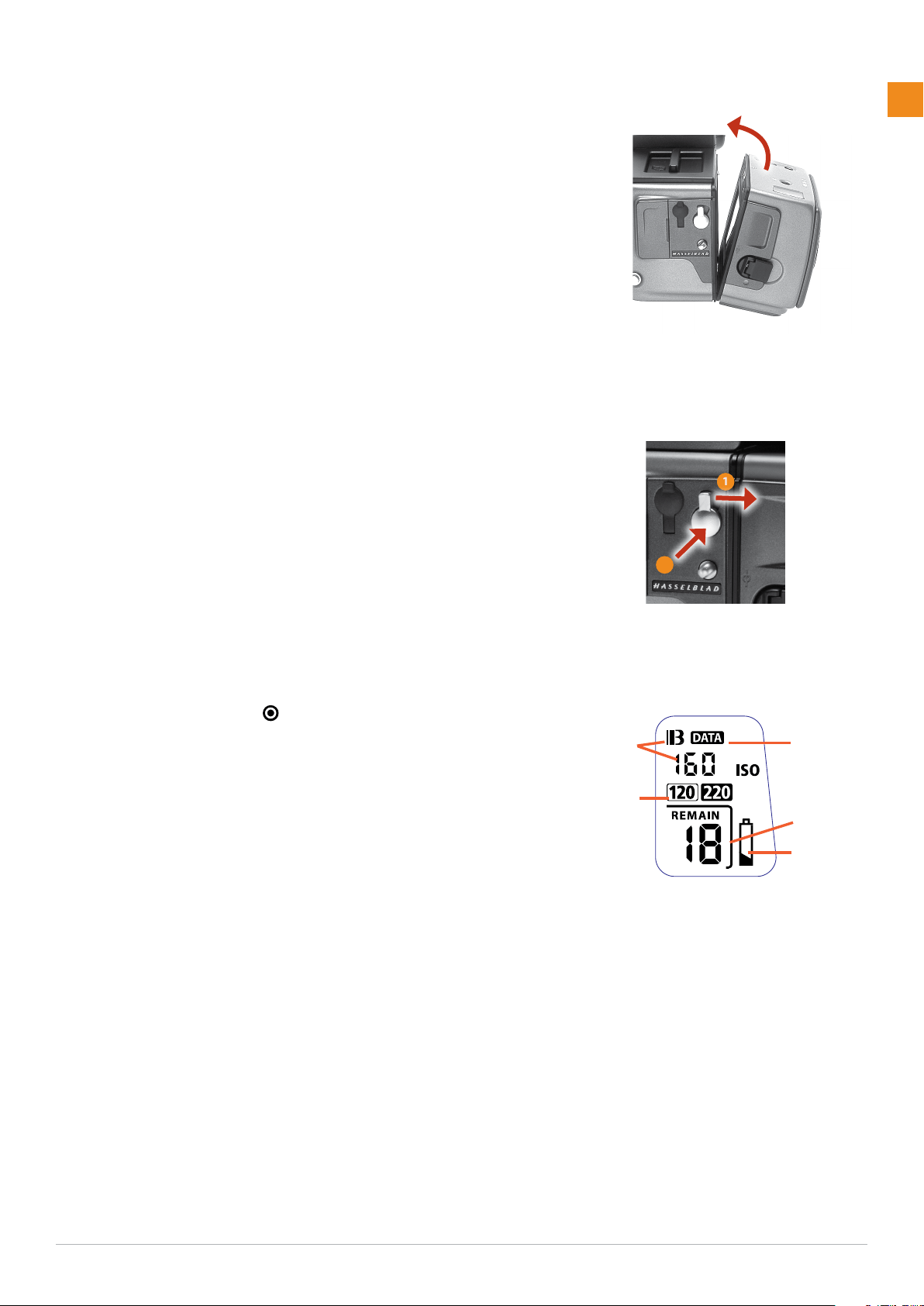
DATABUS INTERFACE
Data interface between magazine and camera. Ensure the contacts are kept clean
and protected from damage. Keep the protective cover on when the magazine is
being stored or transported.
FILM TAB HOLDER
Holds an ID tab from the film roll pack as a reminder of the type of film loaded.
Remember to change it if you change film type!
FILM HOLDER KEY
Secures the film holder in the magazine. Fold out the key and turn counter-clock-
wise 90° to remove the film holder and turn clockwise 90˚ to lock the film holder
in place.
MAGAZINE SETTINGS LOCK
All settings can be locked to avoid inadvertent changes. To change the settings,
slide the settings lock (see illus) to the right until it stops. After the changes have
been made, slide the settings lock to the left (see symbol on magazine) again to
secure the new settings.
BATTERY REPLACEMENT
Release the film holder by folding out the film holder key and rotating it 90° in a
counter-clockwise direction. Withdraw the film holder completely. On the bottom
plate on the inside of the film magazine housing you will find a slotted circular
battery cover. Insert a small coin or similar into the slot and rotate the cover about
20° in a counter-clockwise direction. The cover will be freed and the battery can
be removed. Replace with a fresh CR2032 / 3V lithium (or equivalent) battery. Ob-
serve the polarity and ensure the positive (+) face is uppermost and replace the
cover (ensure the retaining lugs are inserted in the battery compartment slots),
locking it into place by rotating it in a clockwise direction until it stops. If you in-
advertently insert the battery incorrectly, the film magazine will not be damaged
though it will not function. Try to avoid touching the surface of the battery with
your bare fingers as sweat residue can decrease the electrical conductivity of the
battery casing and might cause corrosion.
After battery replacement, the magazine’s parameters return to the default set-
tings (Barcode, 120, Data-on, Count up).
BATTERY
The magazine uses a battery to retain information and settings when unattached
from the camera. When attached to the camera body, the magazine takes its pow-
er requirements from the camera batteries. The magazine battery will normally
be effective for 1-2 years depending on use (off camera illumination, for example).
When the battery is in a very low condition, (approx. 1 month of use left), a low-
battery symbol appears on the magazine LCD as a warning. The magazine will
continue to function with no battery power left as long as it remains attached to
the camera body. However, when detached, the settings will not be stored.
24
www.hasselblad.comH6X
AT TACHING AND REMOVING THE MAGAZINE
You cannot remove a magazine from the camera body if the magazine darkslide
is not in place, (when the magazine darkslide indicator on the magazine shows
white). Neither can you withdraw the magazine darkslide when the magazine is
not attached to the camera. Both these restrictions therefore prevent accidental
film loss caused by fogging.
Attachment
Position the magazine retention groove onto the magazine support on the cam-
era body ensuring that they are correctly positioned. Swing the magazine towards
the camera body and firmly press into place with a click. If there is resistance, the
magazine retaining catch on the camera has probably been inadvertently re-
leased. In that case, push the release button again to reset the catch.
You can attach and remove the magazine with or without the film holder in place.
If you just want to change to a new film, you can remove and reload the film hold-
er without having to remove the whole magazine.
Removal
Ensure that the darkslide indicator on the magazine shows red (signifying that the
darkslide is closed). Firstly push the lever of the magazine release button to the
right (fig. 4/1) and while maintaining that position press the centre of the button
firmly inwards towards the camera body (fig. 4/2) to finally release the magazine.
Ensure you press on the centre of the button, not on the lever.
You cannot remove a magazine if the darkslide is not closed.
If the film holder is inadvertently removed mid-film, then exposed frames
will naturally be lost due to light fogging. However, if the film holder is re-
inserted, the film will automatically be advanced by three frames to position
fresh unexposed film. The film counter will also correspondingly add on three
frames to the original number recorded before the film holder was removed.
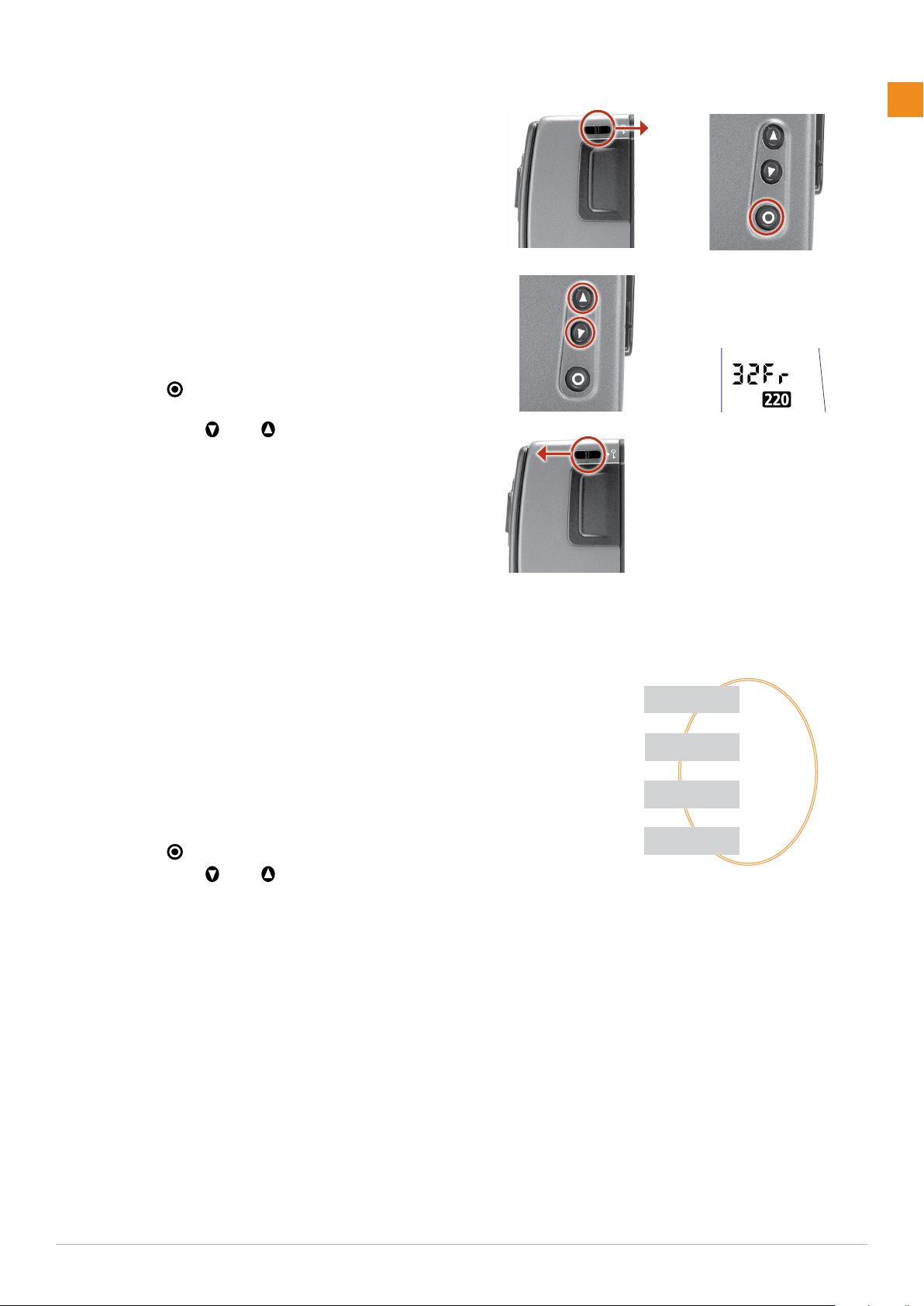
SETTINGS
Press the function selector ( button ) repeatedly to successively access:
A. Film speed (ISO / Bar Code)
B. Film length (120/220/ Number of frames)
C. Data (on/off)
D. Frame counter (count down / count up)
E. Low-battery warning symbol
A
B
C
D
E
2
1
25
www.hasselblad.comH6X
FILM SPEED SETTING / BARCODE
The film speed (ISO / ASA) can be set automatically or manu-
ally. Automatic setting uses a Barcode (only some films have
this feature, notably Fujifilm). This is the default setting.
Film settings (ISO / film length) are automatic only if the
magazine is set at Barcode automatic. That is, a bar-
coded film cannot override a manual film speed setting
but a manual setting can override the film speed of a
barcoded film.
Films without a barcode must have their speed set man-
ually. A manual setting must also be made if you want
to override the speed setting of a barcoded film.
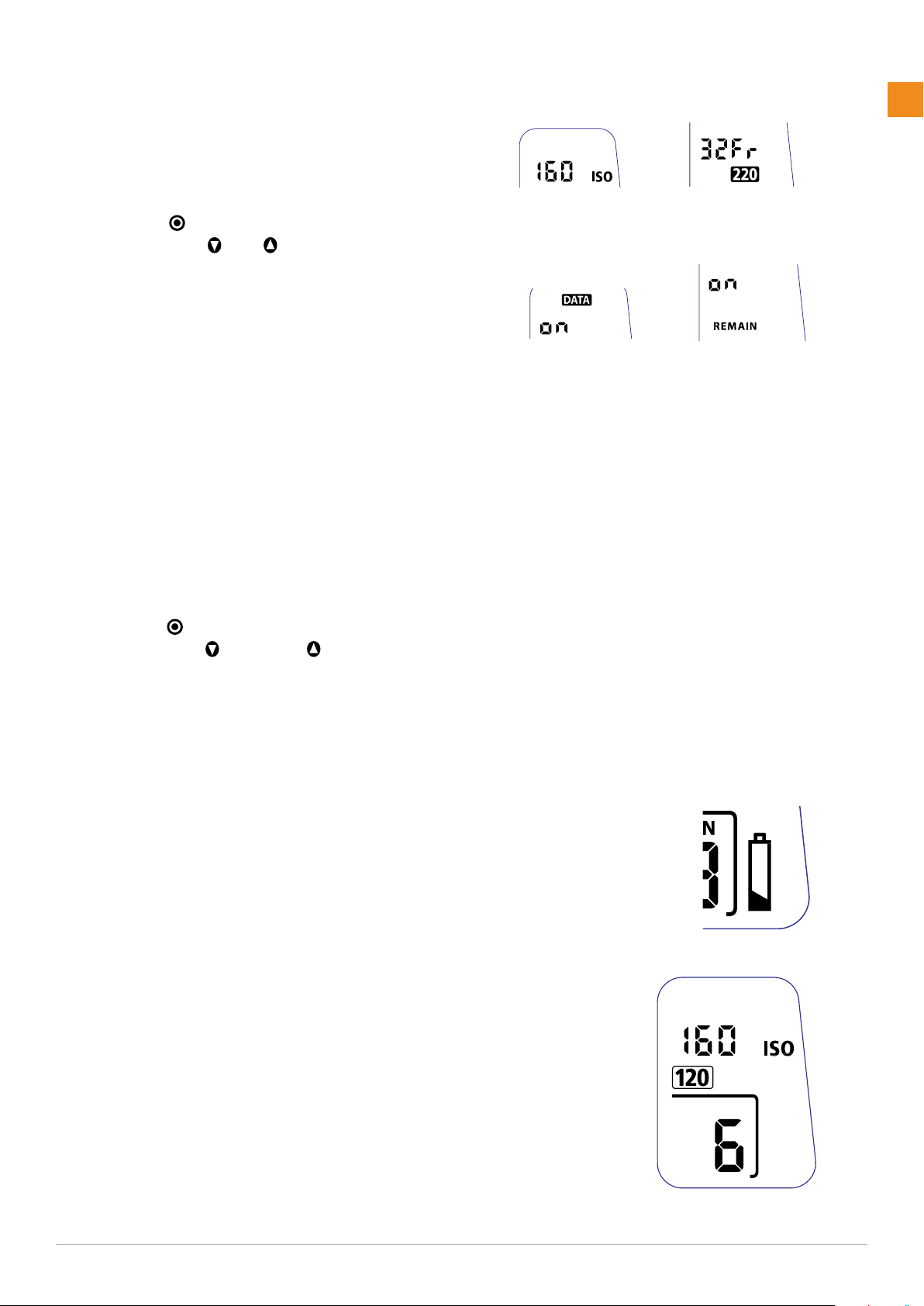
To access Manual setting:
1) Ensure the magazine settings lock is in the unlocked
position.
2) Press the
button until a figure (or barcode symbol)
appears together with ISO.
3) Press either the
or the button to reach the required
setting.
4) The new setting will be saved automatically after a time
out of five seconds.
5) Return the LCD settings lock to the locked position.
NOTE: If you use both standard and barcoded films (or over-
ridden barcoded films), check that you have changed the
settings accordingly.
FILM LENGTH/NUMBER OF FRAMES
Both 120 and 220 films can be used. 120 film will produce 8 (for use with ‘half-
length’ 120 films only) or 16 frames and 220 film will produce 32 frames.
If the film has a barcode, then film length setting (and film speed setting) is auto-
matic. The LCD will automatically show the barcode symbol and the appropriate
film length. (Note that film speed can be overridden with barcoded films, but not
film length).
If, however, the film has no barcode then proceed as follows:
To access film type setting:
1) Ensure the magazine settings lock is in the unlocked position.
2) Press the
button until the 120 or 220 symbol appears.
3) Press either the
or the button to change the desired
setting.
4) The new setting will be saved automatically after timeout.
5) Return the magazine settings lock to the locked position.
EXAMPLE
Film speed
Film length
Data
Frame counter
26
www.hasselblad.comH6X
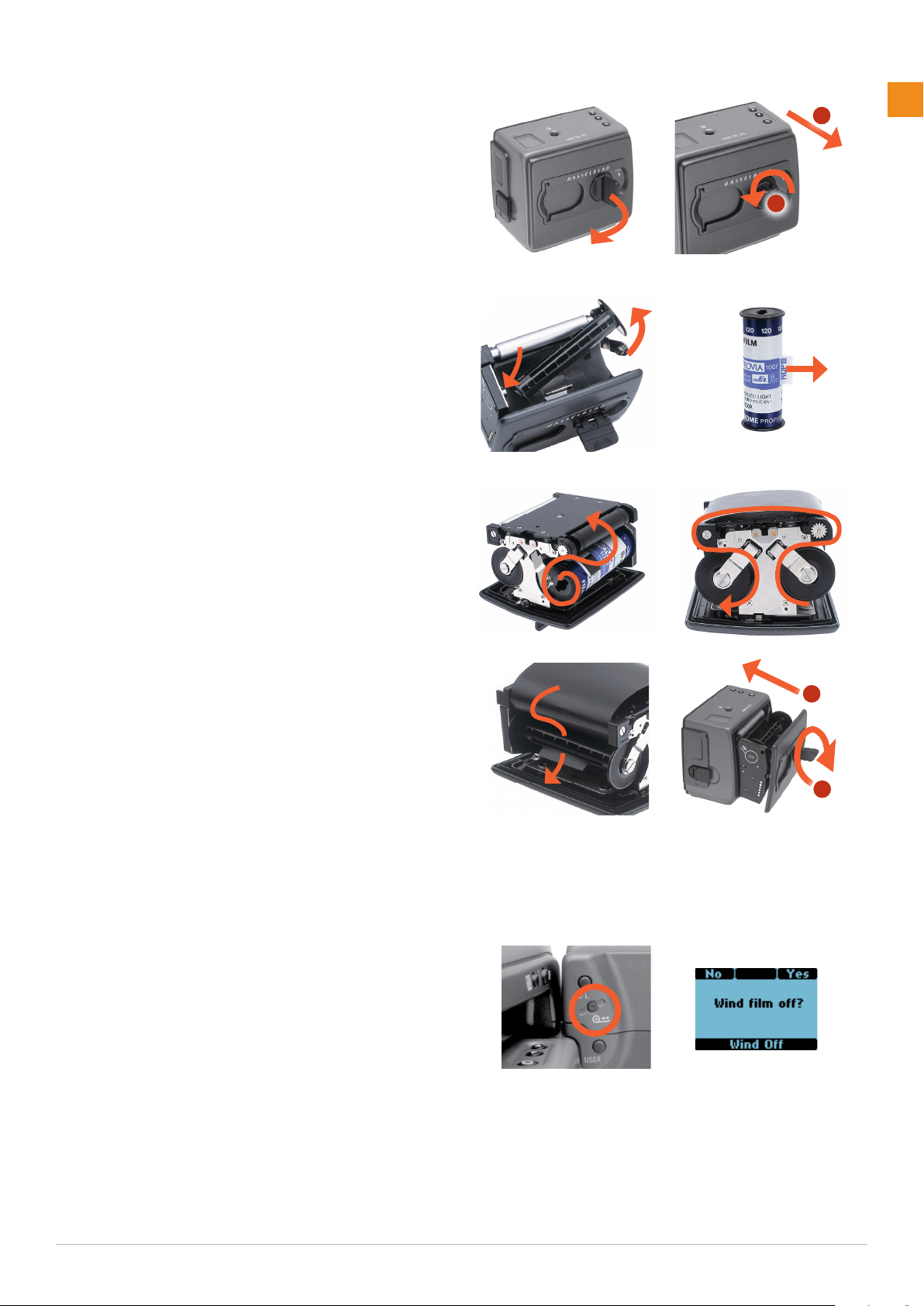
EXAMPLE
In the example shown here:
120 film length set manually
the film speed (ISO160) has been set manually
5 frames have already been exposed (therefore with regular 120 film, 11 frames
remain)
the battery is functional
LOW-BATTERY SYMBOL
The low-battery symbol only appears on the magazine LCD when the battery
needs changing.
FRAME COUNTER SETTING
The frame counter can be set to show either how many unexposed frames remain on a film or how many frames have
already been exposed. The LCD shows your choice of setting by adding the word Remain as a reminder of the number of
frames remaining or ‘countdown’. Absence of this word implies the opposite, namely, ‘count-up’, so it denotes the number
of the next frame to be used (for example, the figure 4 means three frames have already been exposed). This information is
also automatically displayed on the grip LCD and viewfinder LCD though only as a figure above a symbol.
To access frame counter setting:
1) Ensure the magazine settings lock is in the unlocked position.
2) Press the
button until Remain appears.
3) Press either the
button or the button to reach the desired setting (toggle function).
•‘on’ will show the number of frames remaining on the roll.
•‘oFF’ will show the number of the next frame in the series.
4) The new setting will be saved automatically after a time out of five seconds.
5) Return the magazine settings lock to the locked position.
DATA IMPRINT SETTING
Data imprinting can be activated or deactivated through
the magazine menu.
To access data setting:
1) Ensure the magazine settings lock is in the unlocked
position.
2) Press the
button until the Data symbol appears.
3) Press either the
or the button to reach On or Off.
4) The new setting will be saved automatically after a time
out of five seconds.
5) Return the magazine settings lock to the locked posi-
tion.
NOTE: Operation and changes made to the data imprinting
function are accessed through the camera menu. Please see
separate section for full details.
Manual film speed setting.
220 film length setting.
Data imprinting setting.
‘Frames remaining’
counter setting.
27
www.hasselblad.comH6X
FILM LOADING
The film magazine can be loaded either on or off the cam-
era. Regularly check the interior of the magazine and re-
move dust, particles or any scraps of paper from previous
rolls of film. Load and unload film magazines away from di-
rect light sources.
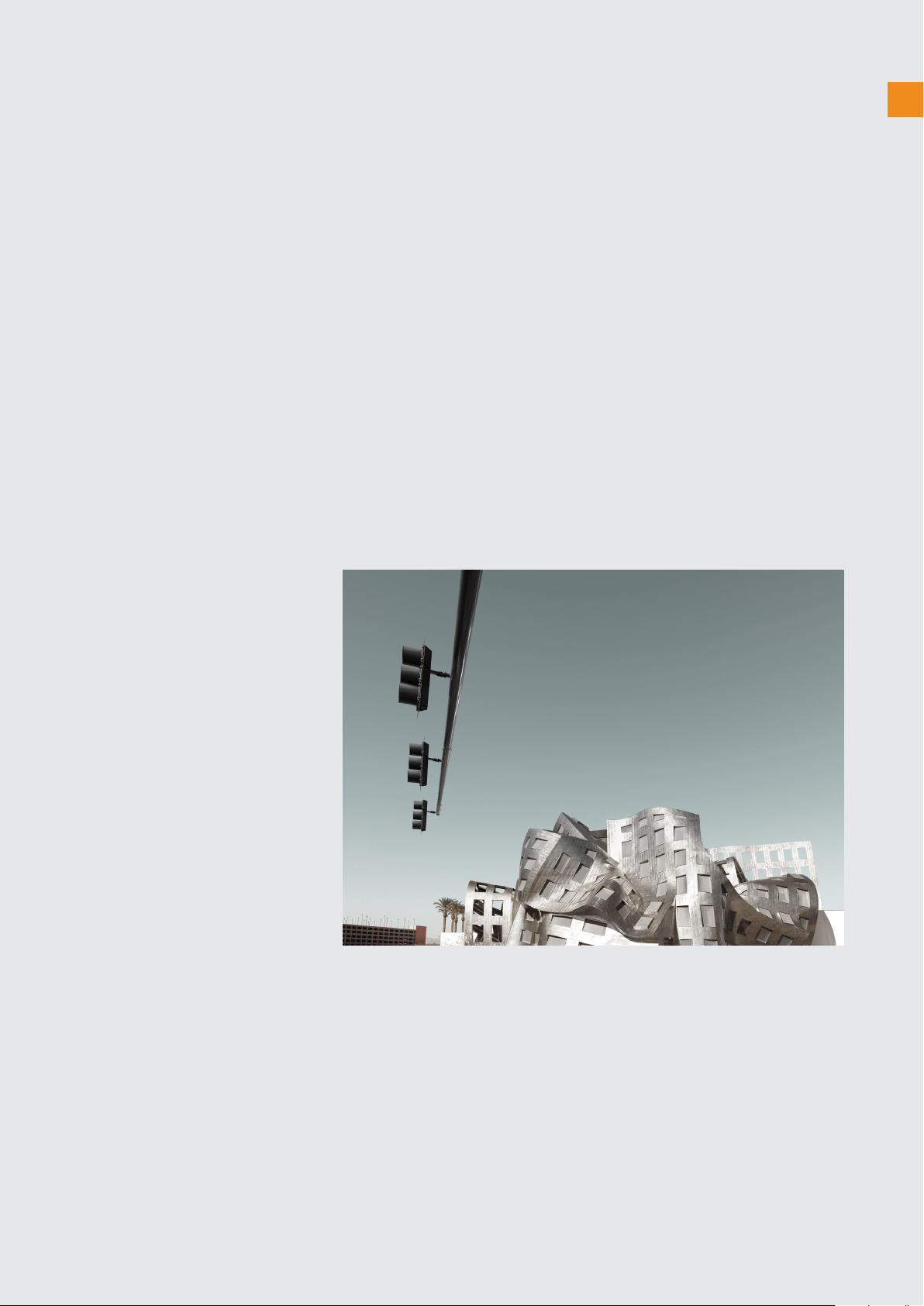
1) Fold out the film holder key and turn it counter-clock-
wise 90° A. Withdraw the film holder com pletely B.
2) Place an empty take-up spool in the upper spool holder
by placing one end over the fixed stud in the holder and
the other end underneath the sprung spool retaining
arm. Rotate the spool a little if necessary until it clicks
into position.
3) Completely remove the retaining paper band from a
new roll of film and place it in the lower spool holder.
See diagram for correct orientation. Ensure you do not
place the film spool the wrong way around!
4) Pull 8–10 cm (3–4 in.) of paper backing from the film roll
and insert the tongue of the backing paper into the slot
in the take-up spool. Turn the spool one complete turn
to ensure the tongue is firmly held in place by the overly-
ing paper backing.
5) Re-insert the film holder into the main body of the film
magazine ensuring the correct orientation. Press firmly
inwards towards the magazine and pay particular
attention to see that both sides are level with the maga-
zine body
A before turning the film holder key clockwise
90˚ to lock the film holder in place and fold the key back
into its stored position B. You might find that increased
pressure on the left hand side of the film holder will
more easily ensure a positive and correct positioning in
the magazine.
If the camera is active or in standby mode the film will be
wound automatically by the camera to position the first
frame (this function can be changed in ‘Custom options’ so
that the film is advanced only when the shutter release but-
ton is pressed the first time).
Beeper
The beeper sounds immediately after the last-but-one
frame has been exposed. This function can be turned off in
Custom Options.
3
1
2
5
2
4
1
1
2
FILM WIND ON AND OFF
Wind on: See ‘Film wind-on’ under Custom Options for a
setting choice.
Wind off: When the last frame has been exposed, the film
will automatically be wound off. However, to wind off a film
sooner, press the film wind off button (fig. 6). Use a ballpoint
pen or similar to activate it. You must also confirm the mes-
sage on the grip LCD (fig. 7) before the film winds off.
UNLOADING A FILM
To remove a film, remove the film holder in the same manner as when loading a film. Grip the exposed roll of
film firmly and remove. Ensure the paper backing is wound tightly and that it is sealed with the band proper-
ly (the band may need to be moistened to activate the adhesive depending on type). Store exposed films away
from strong light sources and contact with sharp objects. Move the remaining empty spool to the take-up spool
compartment.
A
B
A
B
1
2
3
4 5
28
Photo: Frank Meyl © / Hasselblad Masters
DIGITAL

29
www.hasselblad.comH6X
NOTE
This section is only about the workflow with compatible Hasselblad digital backs. (CFH, ixpress
CF and H5D sensor unit)
FORMATTING CARDS
New cards sometimes have no formatting, or you might want to convert a card that is currently
using a format that the sensor unit cannot read. In either case, you should reformat a CF card in
the sensor unit for H6X use.
FORMAT BUTTON – for use with H5D sensor units only
Press the Format button on the camera grip. It is purposely recessed to avoid unintentional
use, so use a ball-point pen or similar. A prompt is displayed on the sensor unit for confirmation.
HASSELBLAD CAPTURE FILES, PHOCUS & ADOBE/APPLE SOFTWARE WORKFLOWS
Hasselblad RAW files are initially stored in the 3FR format which is a proprietary Hasselblad format for the temporary storage
of captures. A 3FR file contains the complete digitized raw image exactly as it was captured by the camera. 3FR information
requires further computing power (typically by way of Phocus) to obtain complete development. If developed in Phocus,
3FR files become Hasselblad 3F files – denoted by each file now bearing the suffix “.fff”. If developed by other RAW proces-
sors, the 3FR files are not converted to 3F but can be exported directly to TIFF, PSD etc according to requirements.
However, when working tethered – which necessitates using Phocus – 3FR files are automatically processed and stored in
the background on a computer appearing as 3F files on the hard disk ready for selective adjustment and export. 3FR files
stored on a CF card can be processed to completion using:
• Hasselblad Phocus
• Adobe Camera Raw / Lightroom
• Apple Aperture
To sum up, capture files can be stored as 3FR files (from a CF card) for later processing in Phocus or other software, or they
can be stored as 3F files (as a result of tethered shooting or 3FR files processed and converted in Phocus). In all cases if you
keep the original 3FR/3F files, you will also retain the possibility of reprocessing them in the future in later versions of Phocus
or other software to take advantage of eventual improvements and developments.
Note that using Phocus is the most comprehensive method. The Phocus and Adobe methods can produce almost identical
results (in most cases, but not all) regarding RAW conversion so it is a matter of personal choice regarding which method
would best suit your preferred ways of working. Alternatively you can use Apple Aperture though you should take note that
the benefits of DAC and HNCS etc, will be lost in this case.
Mixed formats
Phocus can also process most other capture formats, generic and proprietary. This means you can include other formats in
your normal Phocus workflow if you choose. Or if you prefer, you can include Hasselblad files in Adobe / Apple workflows
as stated above.
TIFF
JPEG
PSD
DNG
etc.
.nef
.dng
.cr2
.tiff
.mos
.jpeg
etc.
3FR
.fff
.jpeg
With Hasselblad
digital back

30
www.hasselblad.comH6X
Phocus is the capture processing and file manage-
ment application aimed primarily at Hasselblad 3F
file handling. Phocus Mobile offers remote viewing
and control when shooting tethered while Phocus
Quick offers a very rapid and simplified file process-
ing capability.
Phocus allows the extraction of the most detailed files from
the world’s most advanced cameras to your desktop in a pro-
fessional and efficient manner.
Phocus works the way that photographers work and provide
serious photographers with a well thought out, and intuitive
workflow, designed to provide maximum power and options
with a minimum of effort. Phocus produces ground-breaking
new levels of image quality and technical precision and when
combined with the world’s finest optics and image sensors
the result is exactly what you would expect from Hasselblad –
simply stunning image quality.
FEATURES IN PHOCUS
Ultimate Image Quality
· Hasselblad Natural Color Solution (HNCS)
· Sophisticated lens corrections for H and V system lenses
(DAC)
Specialized Tools
· Advanced Tethered Camera Controls
· Phocus Mobile *
· Live Video
· Scene calibration & reproduction tools
· Leading edge Moiré removal
· Highlight recovery, shadow fill, clarity and dust spot
removal tools
· Camera Configuration and Capture Sequencer
plus:
· Easy-to-use interface
· Extensive customization options for individual work-
flow scenarios
· Import/Export of Image Adjustments, Keywords, Work-
flow settings etc.
· High quality printing
· Slide show
· RAW file support from more than 150 DSLR cameras
· License free software (unlimited installations - no regis-
tration issues)
Any File from Anywhere!
Phocus allows you to import your files, RAW or otherwise and
work in the same powerful and intuitive processing environ-
ment, no matter where your files are coming from. This means
that you can browse, handle, adjust, and process all kinds of
RAW and non-RAW formats.
Phocus supports RAW files from more than 150 cameras, in-
cluding Canon, Nikon, Leica, Sony, Fuji, Olympus, and so on**,
as well as the most common file formats such as TIFF, JPEG,
DNG, and PNG, making it easier than ever to work as you see
fit, not as your camera dictates.
Ultimate Image Quality
Phocus combines with Hasselblad Natural Color Solution
(HNCS) and Digital Auto Correction (DAC) to provide ultimate
image quality in every image you create. With Phocus, the
moiré that can occur on even extremely high-resolution im-
ages is effectively removed automatically and directly on the
raw data, leaving image quality intact and saving hours of te-
dious post-production work.
Tethered shooting is also very smooth with Phocus Remote
camera controls providing a number of remote functions,
such as remote focusing, live view, aperture and exposure
time controls, etc.
PHOCUS
Phocus Mobile
Phocus Mobile is available for the iPhone®, iPad® and
iPod Touch®. It enables you to connect wirelessly to a
computer running Phocus and to remotely browse your
high-resolution RAW, JPEG and TIFF images.
This provides a handy solution for working with clients
in the studio, enabling each person to view images on an
individual iOS device, rather than all gathering around a
single computer.
Phocus Mobile also allows users to remotely operate
and trigger a tethered camera, giving control of many
parameters, all neatly presented in a virtual camera dis-
play. This feature is very convenient for remote control
of the camera when it’s located in a difficult-to-access
position. Phocus Mobile is available for free download
at the App Store.
* Phocus Mobile is available for download on the App Store.
** Full list available at http://www.apple.com/aperture/specs/raw.html

31
Photo: Joachim Schmeisser © / Hasselblad Masters
LENSES &
FOCUS MODES
32
www.hasselblad.comH6X
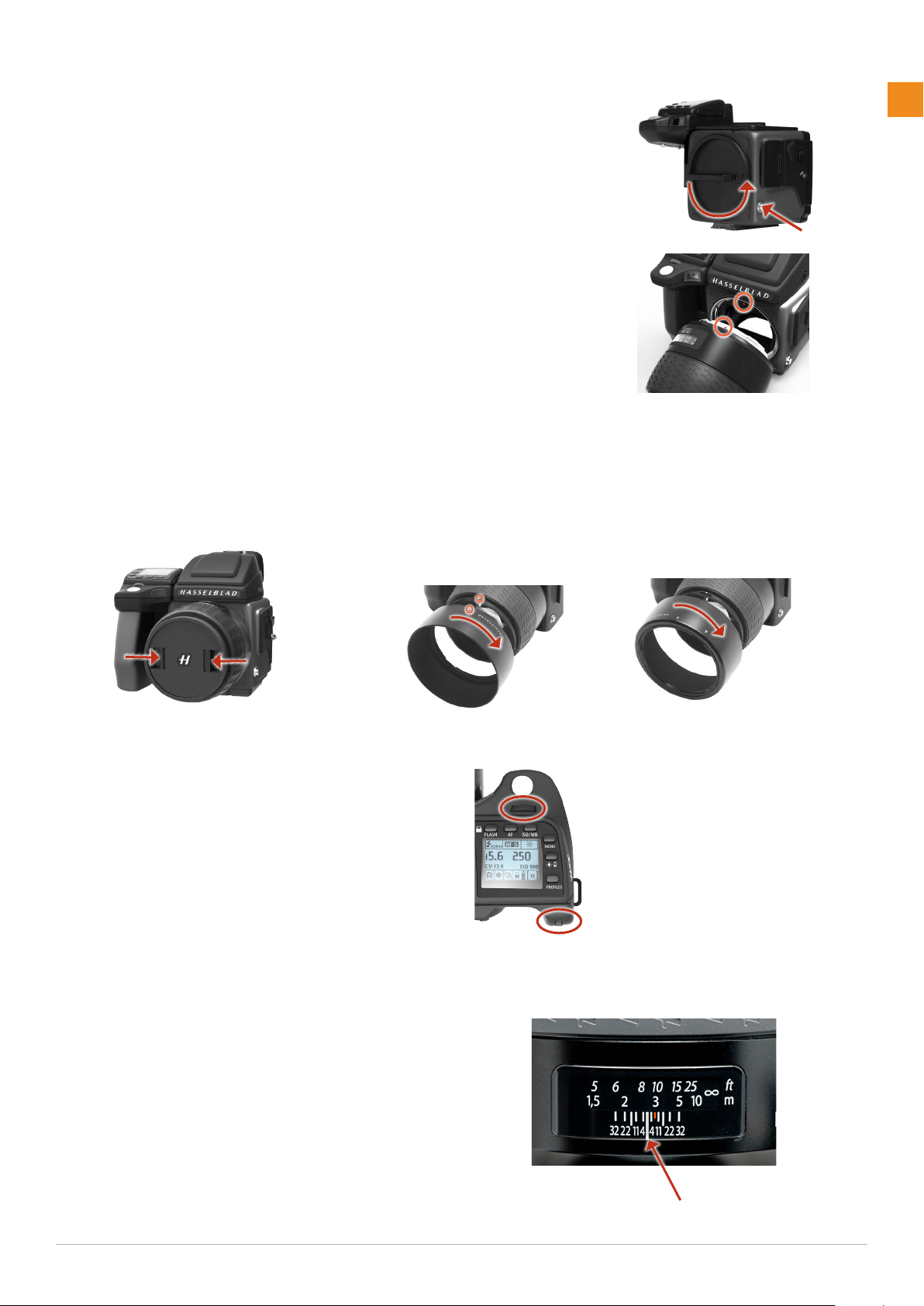
ATTACHING A LENS
Remove the front protective cover
on the camera body by depressing
the lens release button and keep-
ing it depressed while turning the
cover counter-clockwise. Remove
the rear lens cap by unscrewing it in
a counter-clockwise direction. Align
the index on the lens with the index
on the camera body and rotate the
lens clockwise (bayonet fitting) until
it clicks into place.
FRONT LENS CAP
Front lens caps are released for re-
moval and attachment by inserting
a thumb and index finger into the
recesses and pinching in the direc-
tion of the arrows.
LENS SHADES
All lenses are supplied with lens shades that additionally provide extra protection
for transport and storage when mounted in reverse. Lens shades have a bayonet
fitting and are turned clockwise into place after ensuring the index on the lens
shade aligns with the index on the front of the lens. When mounted in reverse,
they are attached by matching the indexes and turning clockwise.
SHUTTER AND APERTURE CONTROL
In manual mode both the shutter and aperture are elec-
tronically controlled and are adjusted by the scroll wheels
on the grip. There are no separate manual setting rings on
the lenses or camera body.
The chosen settings are displayed both on the grip display
and in the viewfinder display. See under Light Metering &
Exposure Control / Exposure Method for a complete expla-
nation.
FOCUSING DISTANCE CALCULATION
There are two distance scales (in feet and metres) visible
through the window on the upper part of the lens barrel.
The focusing distance is read off the chosen scale from the
central lens index.
REMOVING A LENS
Depress the lens release button and
keep it depressed while rotating the
lens counter-clockwise until it stops and
lift it out. Replace protective caps on the
lens immediately and on the camera
body if necessary.
If you try to rotate the lens before you
press the lens release button, it might
lock. In this case, rotate the lens clock-
wise a little first and then re-attempt re-
moval with the correct procedure: but-
ton first, then lens.
FILTERS
Filters have a screw thread fitting
(67 / 77 / 95 mm, according to lens)
and are screwed clockwise into
place. As there is no rotation of the
front section of the lens when focus
is changed, filters do not rotate ei-
ther. This is particularly useful when
using polarizing or graduated filters
where the orientation is normally
critical.
Central lens index

33
www.hasselblad.comH6X
STOP DOWN / DEPTH-OF-FIELD PREVIEW
A visual depth-of-field preview can be made by depressing the STOP DOWN but-
ton while viewing the image in the viewfinder.
Depth-of-field can be calculated as follows:
1. Focus the lens as required.
2. Make an exposure reading (auto or manual) and note the aperture setting.
3. Find the markings on either side of the central index that correspond to the
chosen aperture.
4. From these two markings, read off on the required lens distance scale the two
corresponding distances.
5. The depth-of-field (at that particular aperture and focus setting) will be the
area included between these two distances.
In the example given here, the focusing distance is set at nearly 3 metres. At an
aperture of f/22, the depth-of-field would therefore extend from just over 2 m to
approximately 4.5 m. Note that depth of field is not an absolute. Perception of it
depends on several factors and so it should be seen only as a rough guide.
Lens focus setting too
far beyond the distance
of the subject framed by
the central section in the
viewfinder
Focus setting too close
for the distance of the
subject framed by the
central section in the
viewfinder
Focus setting correct
FOCUS ASSIST
As well as the conventional view on the focusing screen to ensure a sharp image,
the H6X also features an LED focus assist capability appearing as two arrowheads
to the right of the viewfinder display (except for lenses with a maximum aperture
of f/6.7 or smaller). The arrowheads provide confirmation of a precision focus set-
ting and are a useful aid when making a setting with eyesight alone.
Manual focus setting
When the left arrowhead alone appears it means the focus setting is too far be-
yond the chosen distance (the area framed within the central zone in the view-
finder) and when the right arrowhead alone appears it means the focus setting
is too close. Focus is correct when both arrowheads appear together. If the focus
cannot be established, then both arrowheads flash.
Automatic focus setting
Focus is correct when both arrowheads are visible together. Focus is incorrect if
only one arrowhead is visible. If the focus cannot be established, then both ar-
rowheads flash.
INFRARED FOCUS SETTINGS
As infrared rays form an image at a different plane to that formed by visible light,
the normal focus settings do not apply. Proceed as follows in manual focus mode:
1. Focus the lens in the conventional manner until satisfied.
2. Note the distance setting against the central lens index.
3. Re-align this distance setting against the infrared mark (coloured red) instead
of the central lens index.
Alternatively if you have already calculated the required distance, you can make
a manual distance setting by using the distance scales together with the infrared
mark instead of the central lens index.
For specialists, please contact your Hasselblad dealer for information about sensor
units adapted solely for infrared photography.
34
www.hasselblad.comH6X
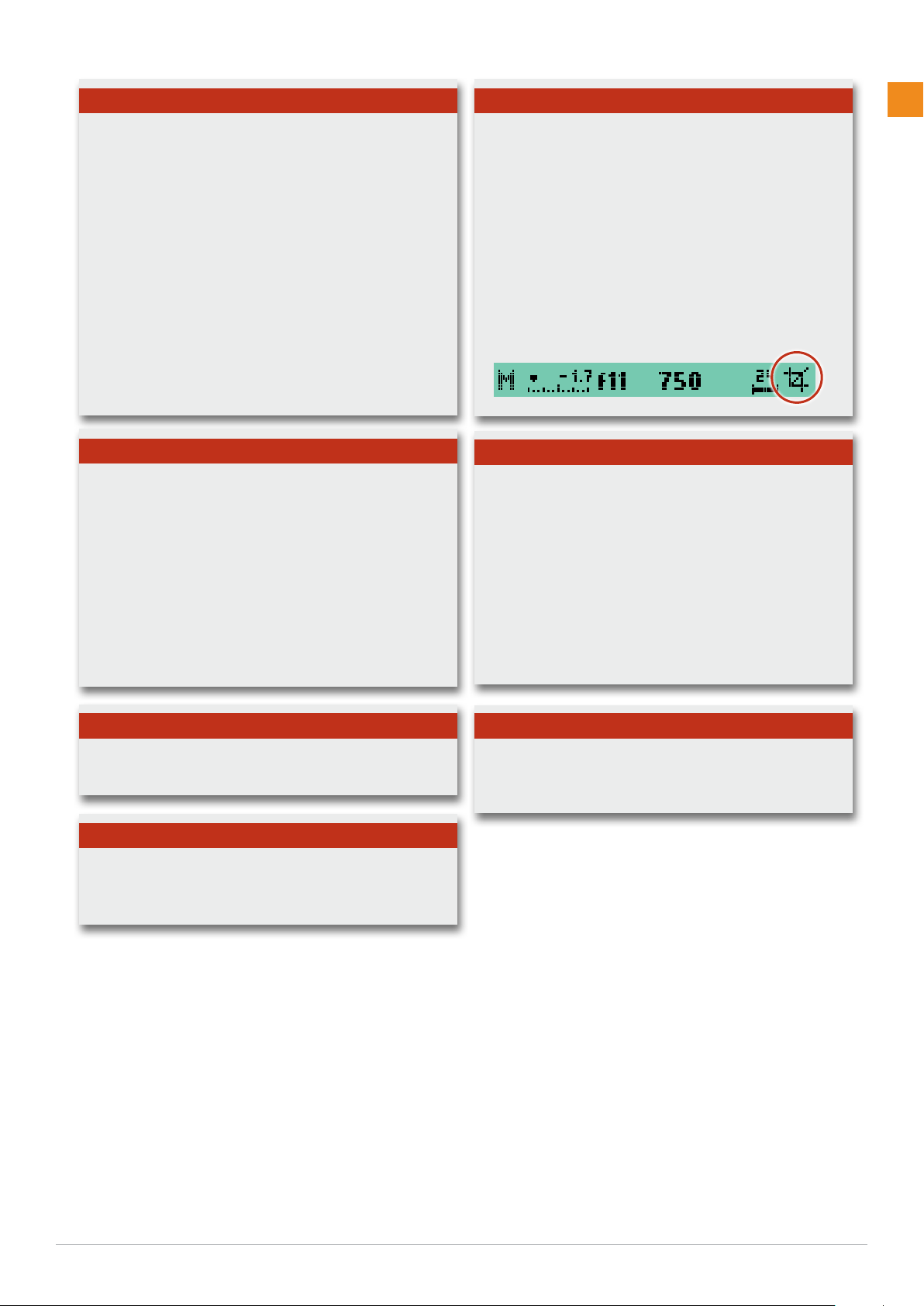
Note
Some lenses have extra characteristics that require further
explanation. For example, the autofocus range on the HC
4/120 Macro lens can be limited by a specific setting on the
camera allowing for near range, far range or full range. This
only appears on the grip display together with that particular
lens.
Further information can be found in the "H-system Lenses &
H-system Lens Accessories" booklet that accompanies each
lens. The booklet can also be downloaded from the Hassel-
blad website.
Also, see note here regarding HCD lenses!
Note
Lens corrections can be applied when captures are import-
ed into Phocus. Guided by the information in the metadata
included with each individual capture, the DAC (digital lens
correction) tool uses lens-model specific calculations to adjust
for chromatic aberration, distortion and vignetting. Not only
model specifications but also capture parameters are taken
into consideration for analysis.
This extremely capable refinement of captures should not be
overlooked when processing files! See Phocus user manual for
details.
Note
The autofocus function is not possible with certain combi-
nations of lenses and accessories. However, a warning is dis-
played which disappears after confirmation.
Tip
The True Focus function can also be combined with other
autofocus modes for specific situations.
Tip
To expand your range of lenses, consider using a CF adapter
to allow you to use most of the lenses from the Hasselblad V-
system.
Tip
For users who prefer manual focus control but would like the
benefits of autofocus, one method is to set the AE-L button (or
any customizable button) to AF (Single) drive.
The main subject can then be centered and the AE-L pressed,
to ensure correct focus. The camera reverts immediately to
manual focus control when the button is released.
Therefore, you can recompose the picture without having to
maintain pressure on the release button in order to retain the
newly automatically made focus setting (AF-T can also be
used).
Note
HCD lenses were formulated for use with the smaller size
sensors in the H-series, resulting in a reduced coverage for
the larger sensors used in 60 Mpix models. So, if you use HCD
lenses, be aware of the restrictions (vignetting and diminished
quality at the edges).
***
H5D 60 sensor unit only: As notification of this situation, an
auto crop function is employed and an HCD crop icon appears
on the right hand side of the viewfinder display when an HCD
lens is fitted.
When in Phocus, however, the auto crop function can be
turned off in Preferences if you wish.
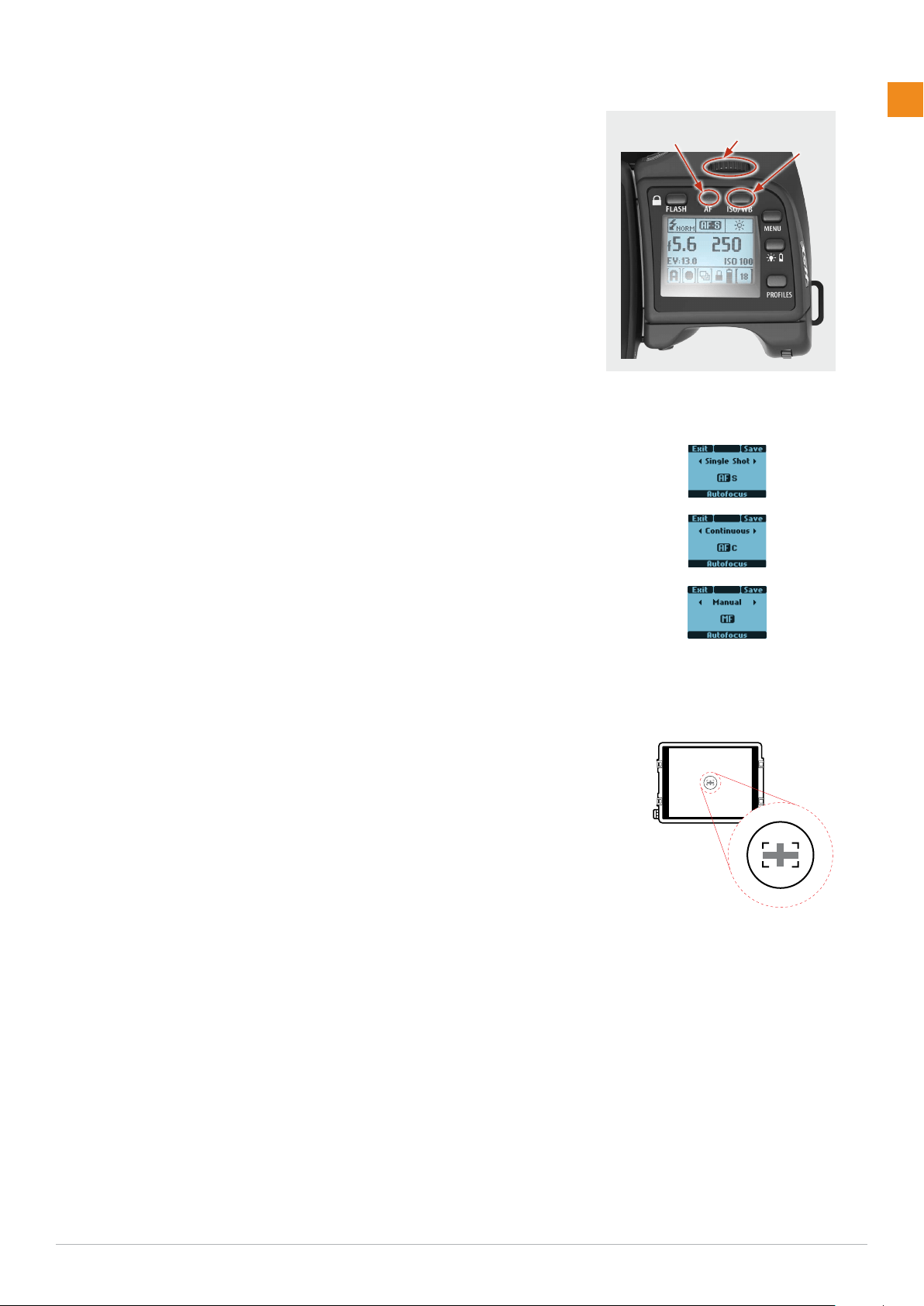
35
www.hasselblad.comH6X
MANUAL FOCUS
There is both a Manual focus mode setting and a manual override capability.
Manual focus is a specific setting that you actively make, whereas manual over-
ride is always available as a temporary override of an autofocus setting.
In Manual focus mode, focusing is carried out by rotating the focusing ring in the
conventional manner. The focus setting remains until changed as with a conven-
tional non-autofocus lens. This means that pressing the shutter release button
will not activate a focus setting change as it does in autofocus. To change back to
autofocus, you must make a new setting (by pressing the AF button and choosing
AF S or AF C).
With manual override in autofocus mode you can manually alter a focus setting
that has been made, by rotating the lens barrel in the conventional manner and
without having to change modes. As long as the shutter release button is kept at
the half-press position, the new focus setting is maintained. By releasing the pres-
sure on the shutter release button and pressing again, the autofocus function is
immediately reactivated.
AUTOFOCUS
Autofocus mode can be either Single Shot or Continuous and is activated by
pressing the shutter release to the half-press position. Its operative range is from
EV1–19 at ISO100. The point of focus is determined according to the vertical and
horizontal areas (see illus) within the central rectangular zone on the focusing
screen. When light levels are too low or the contrast of the subject is too low,
auxiliary illumination (situated on the top of the grip) is automatically activated
if desired. The operative distance is approximately six metres from the camera.
Alternatively, a suitable attached flash unit that has a similar facility (a Metz 54/70,
for example) can also be used instead. This feature can be altered in settings (Cus-
tom options #16/AF assist light).
True Focus is also classified as an autofocus function and is normally activated by
its own button on the grip. See later section.
MANUAL OVERRIDE IN AUTOFOCUS
MODE
Manual override is always possible in automatic focus mode
without any need to make a new setting; just rotate the fo-
cusing ring in the conventional manner. As the lens barrel
does not rotate in autofocus mode, you can hold the focus-
ing ring for instant manual adjustments as you would with a
conventional lens. However, to retain the new manual focus
adjustments, you must maintain the pressure on the shut-
ter release button. You can instantly return to the automatic
focusing mode by releasing the pressure on the shutter re-
lease button first and then pressing the release button half-
way again.
The instant manual override function produces a convenient
way of working. You can take advantage of autofocus while
retaining an instantly adjustable manual focus check if pre-
ferred for pin-point accuracy without making any changes
in the settings.
AUTOFOCUS OVERRIDE IN MANUAL
MODE
See the following section for a description of how to use the
advantages of a rapid autofocus check while remaining in
Manual mode.
AUTO / MANUAL FOCUS SETTING
1) Press AF.
2) Turn the
FRONT scroll wheel to select Single Shot, Continuous, True
Focus or Manual as required.
3) Press
SAVE.
Natural friction is inherent in the design to purposely reproduce the secure feel of a
com pletely manual lens.
Please note that when focusing manually, the infinity and closest distance marks
on the lens scale can appear to be positioned beyond the central index. This is
only an apparent effect and does not change the focusing range of the lens.
SAVE
AF
Front scroll
wheel

36
www.hasselblad.comH6X
SINGLE SHOT
At Single Shot setting (AF S), the shutter release will be blocked until the camera
finds the optimum focus setting. This ensures that no captures can be made that are
not finely focused. However, this delay will normally be only a fraction of a second in
good lighting conditions with a clear focusing pattern.
Note though that in this mode the lens will focus at a distance and will remain fo-
cused at that distance while pressure remains on the shutter release button. In this
way, you can focus on a nearby object for example, temporarily positioned within
the focusing zone on the viewing screen and then without releasing pressure on the
shutter release button, recompose knowing that the focus remains on the object cho-
sen even though it is now outside the focusing zone. Releasing the pressure on the
shutter release button and pressing again half way would now change the focus set-
ting to the distance of the object within the focusing zone.
See Manual override in autofocus mode for a useful way of working with manual and
autofocus settings in a combined manner.
CONTINUOUS
At Continuous setting (AF C), the shutter can be released rapidly before the lens
is focused in order to capture a split-second shot (in Single Shot, a capture cannot
be made until the camera has had time to focus). However, the camera will continue
to focus if a moving subject is within the focusing zone or if you recompose, even
though the shutter release button is half pressed.
One method to exploit this feature when photographing in a rapidly changing situa-
tion is to keep the shutter release button pressed down. In this way the lens focuses
constantly (according to the focusing zone) and by momentarily releasing the pres-
sure on the shutter release and then immediately pressing again, you minimize the
amount of time needed for the lens to check focus, thus ensuring a split-second shot
at optimum focus.
TRUE FOCUS
The True Focus setting (AF T) is generally used in specific
circumstances to automatically correct for camera angle/fo-
cus setting discrepancies but it can also be combined with
other autofocus settings.
To be able to exploit True Focus correctly, a few impor-
tant points should be studied in order to obtain a full un-
derstanding of how and when to use it. Basically, there are
four variables to pay attention to listed below: (a) proxim-
ity of camera to subject, (b) focal length of lens, (c) aperture
setting and (d) movement of camera and/or subject after
setting. The closer you remain to the ideal situation with
regard to these variables, the more noticeable the effect of
True Focus will be.
• The closer you are to the subject, the worse the original
problem becomes. Consequently, the need for True Fo-
cus solution becomes greater and its application thereby
becomes more noticeable.
• Short focal length (wide-angle) lenses naturally decrease
camera to subject distances and therefore, following the
point in (a), produce a greater need for True Focus adjust-
ments.
• Smaller apertures increase the depth of field and there-
fore would lessen the need for a True Focus solution.
However, smaller apertures produce a different visual ef-
fect, so True Focus therefore allows the exploitation of
the shallow depth
of field (produced
by larger apertures)
without the fear of
unwanted focus re-
strictions.
• The calculations in-
volved in True Focus use, amongst other things, camera
to subject distances to calculate the required amount of
adjustment. It therefore follows that if the camera or the
subject move after the initial setting has been made, the
calculations will not be applicable anymore. So, to ensure
the optimum correction, both the photographer and the
subject should restrict movement as much as possible.
Please note that with some lenses (particularly longer
length lenses) just a few centimeters movement can essen-
tially ruin the result.
True Focus can be used with longer lenses, smaller aper-
tures etc but the further you come from situations similar to
the ‘ideal’ as described above, the less the effect will be until
it has no visible effect at all. Please remember that although
True Focus can noticeably improve a demanding shoot it will
only work effectively in the specific circumstances it was de-
signed for.
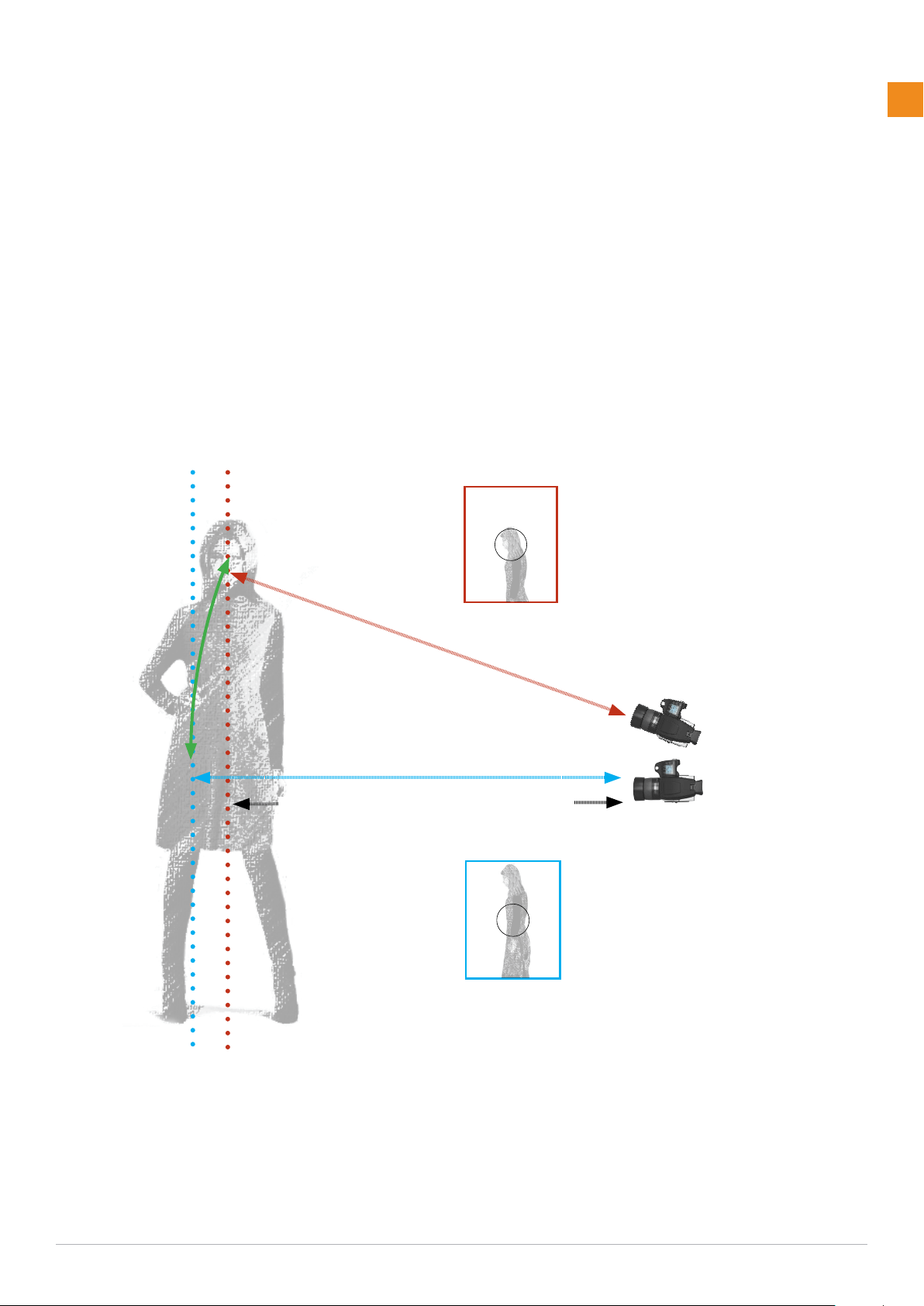
37
www.hasselblad.comH6X
TRUE FOCUS AND ABSOLUTE POSITION LOCK
The obvious situation that would most benefit from using True Focus would be a fashion shoot with a fairly wide angle
lens at a large aperture setting and where the central area of the image is clothing while retaining focus on the model's
face. Ideally, a fairly controlled and static flow should be planned on (this means a change of pose by the model should take
place only after captures and the photographer must resist crouching down, or leaning forwards or backwards too much
before capture).
With the lens at its widest aperture setting, a normal autofocus setting is made on the model's face (
A), and the camera
focus locked. The composition is then changed to include more of the clothing (B), but the locked focus setting now extends
beyond the model's face at (B) according to the laws of geometry. This will naturally result in an image where much of the
subject closest to the camera and the model's face will be unsharp. Solutions involving manual focus/focus lock/ resetting of
multi-point sensors are distracting to workflow and prone to error. Making a True Focus setting at (A) will ensure that focus
is automatically adjusted in accordance with the change of camera angle.
True Focus uses yaw rate technology and by way of the Absolute Position Lock (APL) processor, logs camera movement
as the basis for an extremely rapid compensatory focus reset without any shutter lag. The H6X’s firmware then further
perfects the focus using the precise data retrieval system found on all HC/HCD lenses.
A - ca. 2.5 m
B - ca.2.5 m
Distance when camera perpendicular ca. 2.4 m
A normal autofocus setting is made on the
model's face and locked.
The focus setting is approximately 2.5m.
When the camera is swung back down,
B,
the locked focusing distance of 2.5m, ac-
cording to the laws of geometry, extends
beyond a perpendicular line drawn down
from the face, creating unsharpness.
A
A
B
B
If a True Focus setting instead of a normal autofocus setting is now made at A and
the composition changed back to B again, the camera will automatically calculate
and adjust the focus of 2.5m to approximately 2.4m, which is the actual camera to
perpendicular distance. The model's face is now sharp again.
B
A

38
www.hasselblad.comH6X
TRUE FOCUS AND CAMERA HANDLING
To obtain the maximum benefit from True Focus you should
try to work within the requirements of the system. This
might need a little practice but it will improve the accuracy
of the measurements and thereby provide better results.
Firstly, try to remain as still as possible when making the first
True Focus measurement and wait for the audio signal or
ready light to show green again before continuing. This will
not only speed up the process but also increase accuracy.
Secondly, when recomposing the shot you should try to
stay in the same position as closely as possible. That is, try to
avoid moving your head or body forwards or backwards as
this will move the camera away from the measured position.
In the upper example to the right, the photographer has
swung the camera from the first measurement to recom-
pose the shot as normal. But you can see that the camera
has now moved away from the original position.
The lower example illustrates essentially the same situation
except this time the camera is more or less rotated around
its central axis, rather than swung. The difference might
seem slight but practice has shown that this method does
retain the original position more accurately and therefore
results in better focusing accuracy.
A very effective way of checking the
focus of individual captures is to as-
sign the P1 or P2 (or Mirror Up or Stop
Down) button to Focus Confirm.
In browse mode or after capture,
press the P button. A cursor appears
on the display which can be navi-
gated via the scroll wheels or Naviga-
tion button to pinpoint the required
area. Another press of the P button
will zoom onto that particular part of
the image for focus confirmation. The
control wheels (or the Navigator) can
now be used if areas close by are to
be also checked. Otherwise, press it
again to return to cursor view to be
able to make a rapid new placement
of the cursor for more checking.
In True Focus mode, instead of being
located in the centre of the display,
the cursor is automatically located
near the original area chosen by you
for the True Focus setting. This meth-
od provides a very convenient and
rapid method for checking when us-
ing True Focus.
✘
✔
FOCUS CHECKING IN BROWSE, PREVIEW OR TRUE FOCUS MODE
In True Focus, make a True Focus set-
ting focused on the model’s ear, for ex-
ample. After recomposition, press the
assigned P button which automatically
positions the cursor over the chosen
area. One more press of the P button
produces a zoomed in close-up of the
chosen area for focus checking without
the need for extra navigation.
While browsing, press the assigned P button to activate the cursor which appears in the
middle of the frame. Use the front and rear scroll wheels to move the cursor to the eye, for
example. Press the P button again to produce a zoomed in close-up of the chosen area for
focus checking.
Correct ‘rotation’ of camera.
Incorrect ‘swinging’ of camera away from
original position.
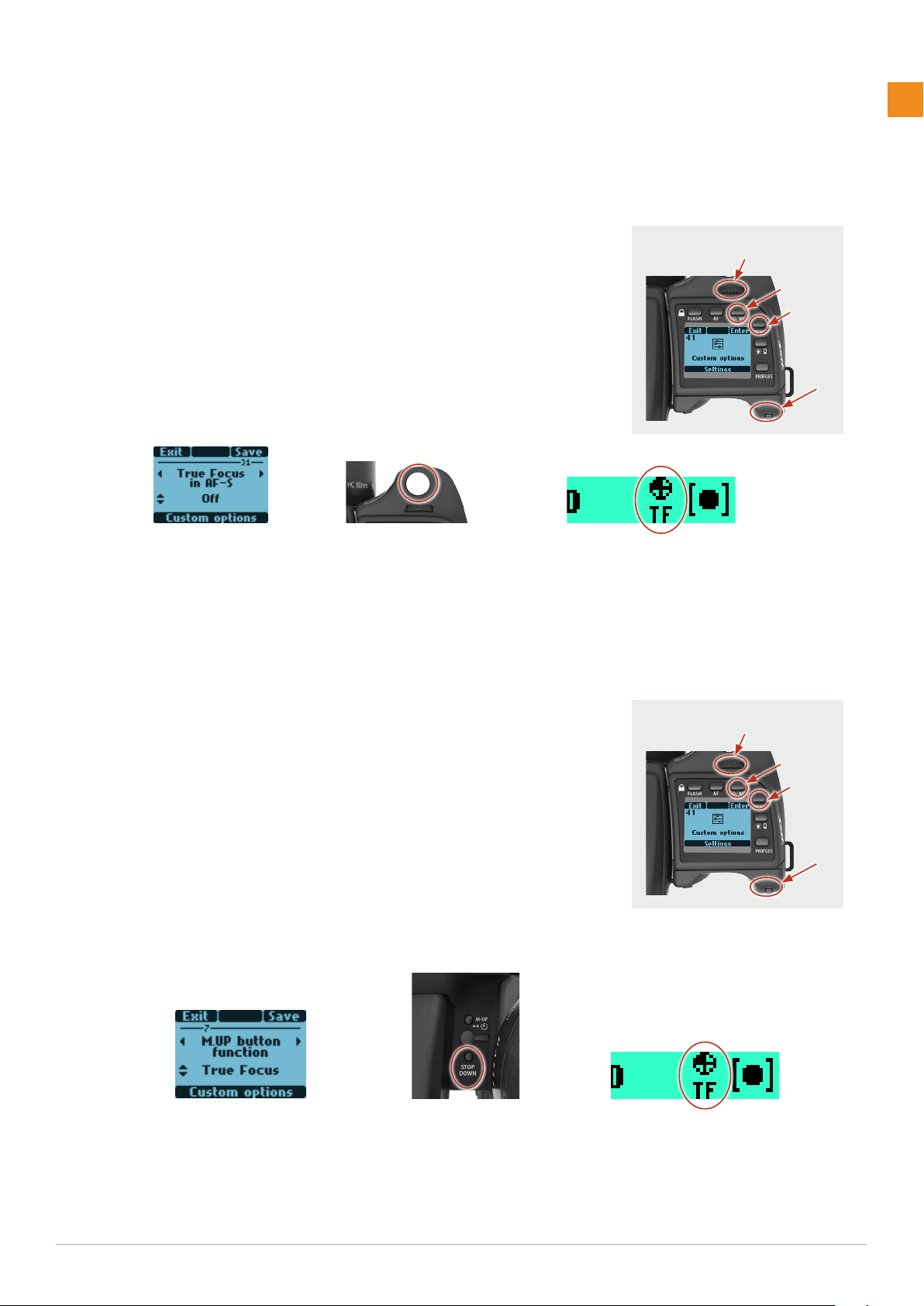
39
www.hasselblad.comH6X
1. Press MENU button on grip and select Settings or press MENU twice.
2. Select Custom Options and select #31 (True Focus in AF-S) with the
Front
scroll wheel. Select ON with the Rear scroll wheel. Save.
3. Aim camera at important area in subject and half-press the shutter release
button.
4. Wait for the
True Focus icon to appear (in the viewfinder) and the audio con-
firmation signal.
5. Maintain the half-press and recompose the picture. Press fully to capture.
The True Focus icon disappears from the viewfinder. True Focus function is
retained.
1. Press
MENU button on grip and select Settings or press MENU twice.
2. Select Custom Options and the desired button to reassign with the
Front
scroll wheel (M.UP button in this example). Select True Focus with the Rear
scroll wheel. Save.
2. Aim camera at important area in subject and press the selected button (the
grip display now indicates AF-T mode).
3. Wait for the True Focus icon to appear (in the viewfinder) and the audio con-
firmation signal.
4. Recompose the picture and press shutter release button (camera does not re-
focus because it is temporarily in AF-T mode). The True Focus icon disappears
from the viewfinder. Camera reverts to AF-S.
Note that camera reverts to AF-S if the focusing ring on the lens is moved.
TEMPORARILY ACTIVATED BY A SELECTED CUSTOMIZABLE BUTTON AUTOFOCUS RETAINED
MENU > SETTINGS > CUSTOM OPTIONS
In this mode the True Focus function is activated by pressing an assigned button. This produces a ‘one-shot’ setting where
the camera reverts to its original Autofocus setting after capture. Useful if you want to quickly switch back and forth be-
tween True Focus and normal Autofocus. Works with or without a Custom Options #31 setting.
FOUR TRUE FOCUS METHODS
1
/2 !
ACTIVATED BY SHUTTER RELEASE BUTTON TRUE FOCUS RETAINED
MENU > SETTINGS > CUSTOM OPTIONS > # 31
In this mode the autofocus function is effectively converted into the True Focus function. That is, focus is set by half-pressing
the shutter release button. Remember, though, that the True Focus function is retained until turned off in Custom Options.
SAVE
MENU
Front scroll
wheel
Rear
scroll
wheel
SAVE
MENU
Front scroll
wheel
Rear
scroll
wheel
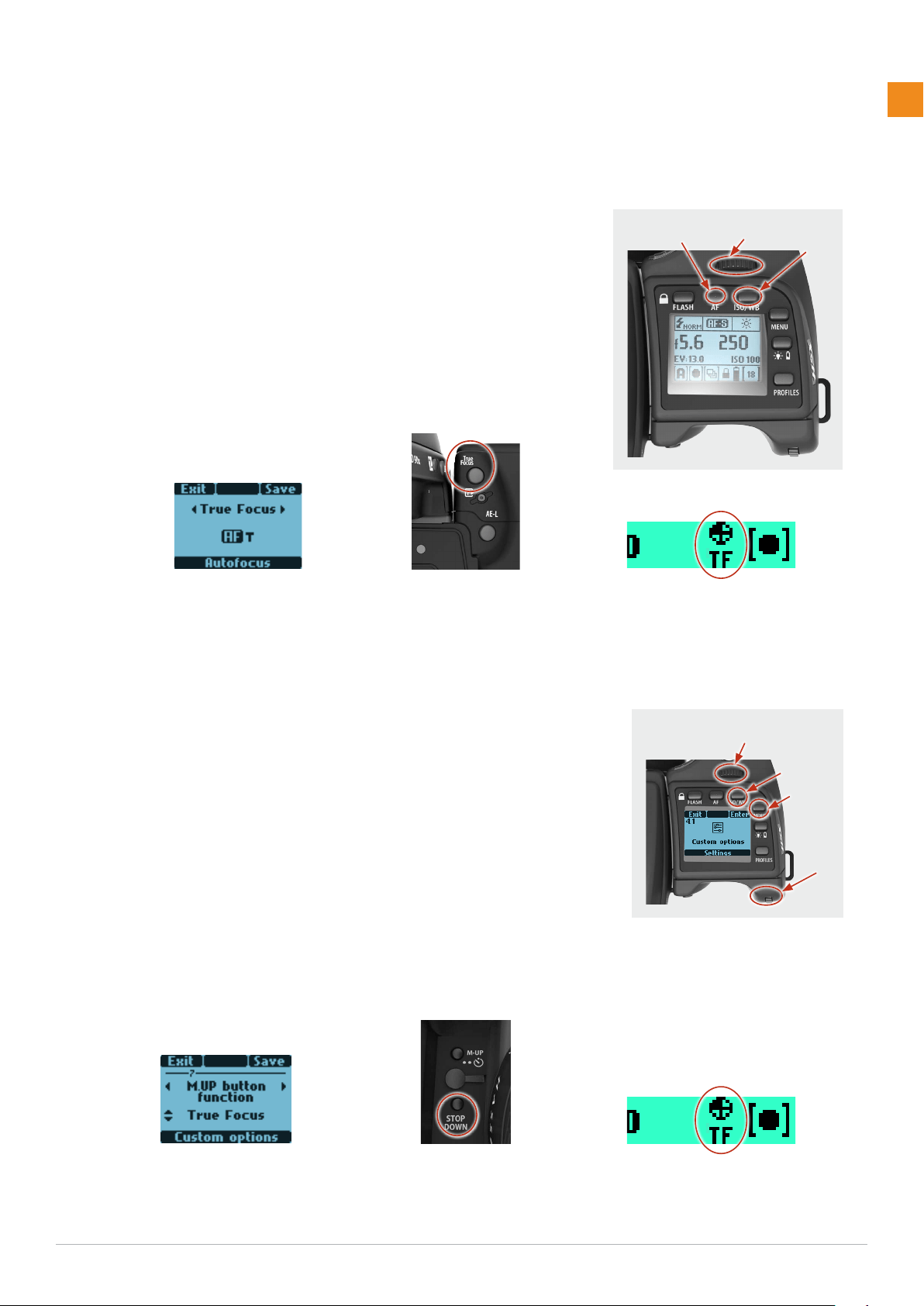
40
www.hasselblad.comH6X
ACTIVATED BY TRUE FOCUS BUTTON AUTOFOCUS DEACTIVATED
In this mode the True Focus function is activated by pressing the True Focus button. Normal autofocus is de-activated,
therefore, pressing the shutter release button will not reset the focus. Useful when many shots are required with the same
focus setting.
1. Press AF button. Select True Focus with the Front scroll wheel. Save.
2. Aim camera at important area in subject and press True Focus button.
3. Wait for the True Focus icon to appear (in the viewfinder) and the audio con-
firmation signal. Recompose the picture and press shutter release button.
Note that the True Focus adjustment is applied to all following captures until True
Focus button is pressed again (when a new adjustment is made).
FOUR TRUE FOCUS METHODS – CONT
1. Press MENU, select Custom Options, select the desired button to reassign
with the Front scroll wheel (M.UP button in this example). Select True
Focus with the Rear scroll wheel. Save.
2. Aim camera at important area in subject and press the selected button.
3. Ensure that the True Focus icon appears in the viewfinder.
Recompose the picture and press shutter release button. The True Focus icon
disappears from the viewfinder. Camera reverts to Manual focus setting.
Note that the True Focus adjustment is applied to all following captures until the
True Focus button is pressed again (when a new adjustment is made).
ACTIVATED BY AN ASSIGNED BUTTON MANUAL FOCUS RETAINED
In this mode the True Focus function is activated by pressing an assigned button. This produces a ‘one-shot’ setting where
the camera reverts to its original Manual focus setting after capture. Pressing the shutter release button will not reset the
focus. Useful when many shots are required with the same focus setting.
SAVE
AF
Front scroll
wheel
SAVE
MENU
Front scroll
wheel
Rear
scroll
wheel
41
Photo: Joe Felzman © / Hasselblad Masters
EXPOSURE CONTROL
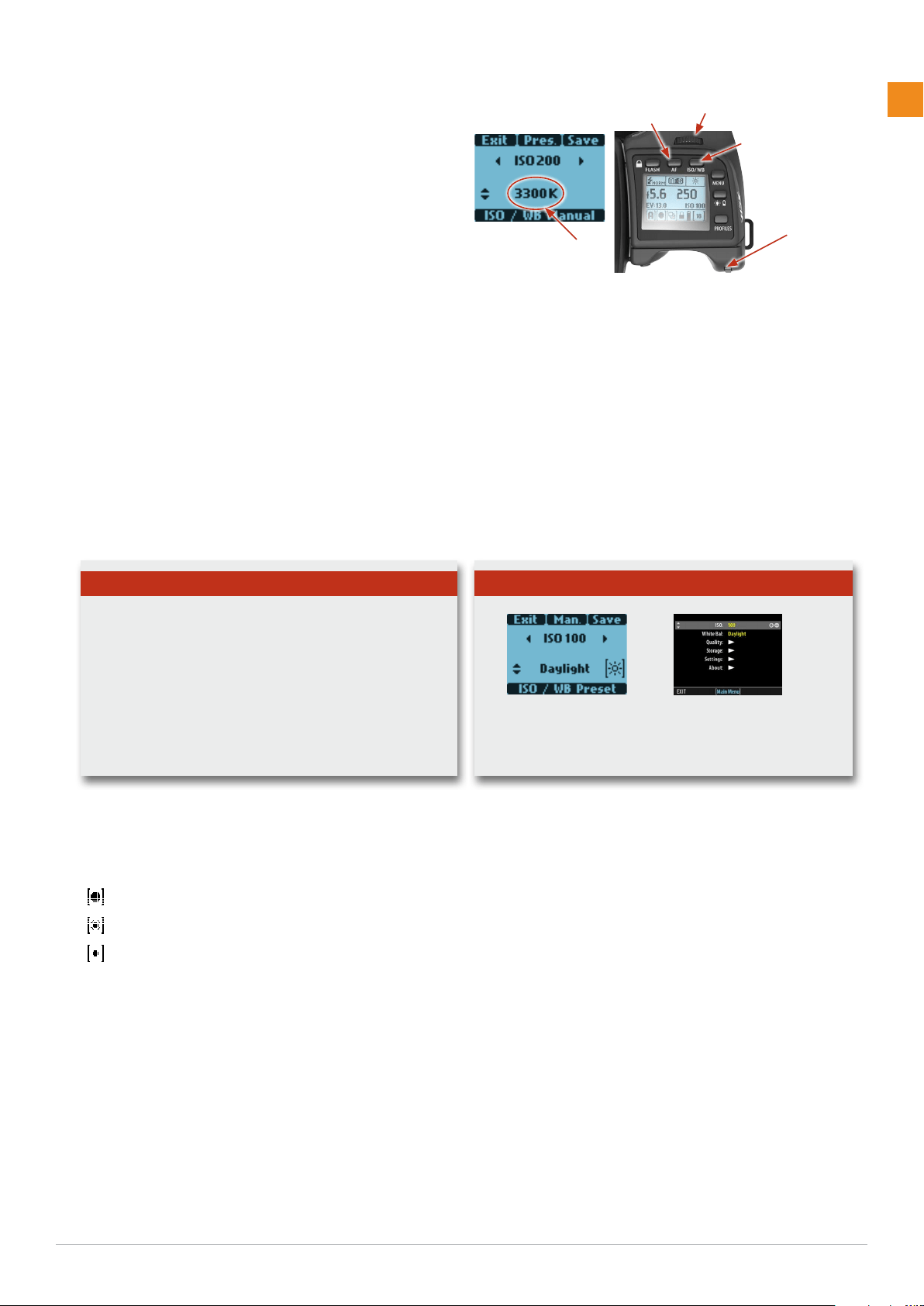
42
www.hasselblad.comH6X
ISO & WHITE BALANCE
– presets and manual
1. Press ISO/WB.
2. Turn the
FRONT scroll wheel to select ISO setting.
3. Turn the
REAR scroll wheel to select WB (Daylight,
Shade, Cloudy, Flash, Fluorescent and Tungsten).
4. To make a Manual White Balance setting (not a
White balance test exposure), press the
Man. (AF)
button and then turn the REAR scroll wheel to choose
a color temperature in figures (degrees Kelvin): 2000 –
10000 K
5. Press
SAVE.
ISO/WB
&
SAVE
MAN.
Front scroll
wheel
Rear scroll
wheel
Custom white balance
setting in degrees K.
Note
H5D Sensor Units Only: White Balance settings are techni-
cally not necessary for 3F/3FR files because raw format files
contain all the information required for correction in Phocus
and/or other software, regardless of the original color tem-
perature of the light source or color temperature setting of the
camera at the time of exposure. However, if you intend to use
Phocus / Phocus Quick for JPEG production, for example, and
plan to deliver or print the JPEG files directly, then you should
make a White Balance setting.
LIGHT METERING MODES
There are three reflective metering modes available. These
have the following designations on the grip display:
– Centre Weighted
– CentreSpot
– Spot
Centre Weighted: Commonly used for ‘average’ light situa-
tions where there is no particular dominance of light or dark
areas across the tonal range. Takes into account approxi-
mately 25% of the image seen in the viewfinder.
CentreSpot: Emphasizes the central section of the focus-
ing screen equivalent to approximately 25% of the image.
This provides a balanced assessment and is a typical choice
where the main subject is in the centre of the image.
Spot: The sensitive area is equivalent to approximately
2.5% of the image area (the central spot on the viewfinder
screen). Any parts of the image outside of this area will not
affect the exposure reading. This provides a very accurate
measurement of specific tones. Typically used in the zone
system and similar light measuring situations where maxi-
mum control is required. Also excellent for tonal comparison
measurements. The spot mode can display ‘zones’ instead
of EVs in the viewfinder display (see Custom Options #14).
Tip
H5D Sensor Units Only: ISO and White Balance settings can
be made either on the grip or the sensor unit. Settings are au-
tomatically updated on each other.
ISO & WHITE BALANCE – WITH H5D SENSOR UNITS ONLY
Both ISO and White Balance can be set either via the grip, the sensor unit or, when tethered, via Phocus.
On the grip, the ISO/WB button provides immediate access to ISO and White Balance settings. The front and rear scroll
wheels are used to make the desired changes. On the back, settings are changed with the zoom button. In Phocus there is
a specific tool to control camera settings.
The settings are automatically and simultaneously transferred from the grip to the sensor unit. Likewise all changes on the
sensor unit are automatically transferred to the grip display. Please note that the changes are only displayed on the sensor
unit when the settings have been saved.

43
www.hasselblad.comH6X
EXPOSURE SETTING MODES
Exposure can be controlled either manually or by using one
of four automatic modes. These have the following designa-
tions on the grip display:
M – Manual
A – Aperture (priority)
S – Shutter (priority)
P – Program
Pv – Program variable
In each mode you can see both the aperture and the shut-
ter speed information on the grip display, viewfinder display
and if set, the sensor unit display.
In manual mode, aperture is set by the front scroll wheel and
the shutter speed by the rear scroll wheel unless set other-
wise in Custom Options #26.
In the automatic modes, the aperture and shutter speed set-
tings are controlled by the camera, either partially or com-
pletely according to setting. Within this mode there are four
choices.
(Please see the Appendix for P and Pv mode charts that de-
scribe the aperture and shutter speed setting combinations.
SELECTING METERING / EXPOSURE
SETTING MODES
Proceed as follows with the camera in active mode:
1. Press the EXP button on the viewfinder.
2. Turn the
Front scroll wheel to make a Metering
method selection and the Rear scroll wheel to make
an Exposure method selection.
3. Press Save to retain the setting.
EXP
SAVE
Front scroll
wheel
Rear scroll
wheel
MANUAL EXPOSURE – M
Manual mode will provide total user scroll of the shutter
and aperture settings. In this mode the shutter speed and
aperture settings are manually chosen by turning the front
and rear scroll wheels.
The standard exposure setting is obtained when the point-
er over the exposure scale is positioned above the central
index (in the viewfinder display).
Any deviation from this standard setting is displayed by:
• the pointer appearing elsewhere than above the central
index
and
• by figures above the scale representing the amount of
adjustment in EVs.
A ‘+ 0.7’ above the scale in the display, as in illustration
4 for example, would indicate a ‘0.7 EV overexposure’ set-
ting. Conversely, a ‘-2’ , for example, would indicate a ‘2EV
under exposure’ setting. Note that the appearance of a
+/- symbol on the grip and viewfinder displays in manual
mode means that a change has been made to the expo-
sure compensation setting. See later section on Exposure
compensation.
The actual aperture settings and shutter speeds are indi-
cated to the right of the exposure scale in the conventional
manner. (Note: ‘full-stops’, ‘half-stops’ and ‘third-stops’ are
also displayed, according to setting (see ‘increment set-
ting). For example, a setting between f/8 and f/11 will ap-
pear as f/9,5 if ‘half-stop’ is chosen).
Tip
Access to the B and T shutter speed settings can be tempo-
rarily hidden. See Custom Options #34.
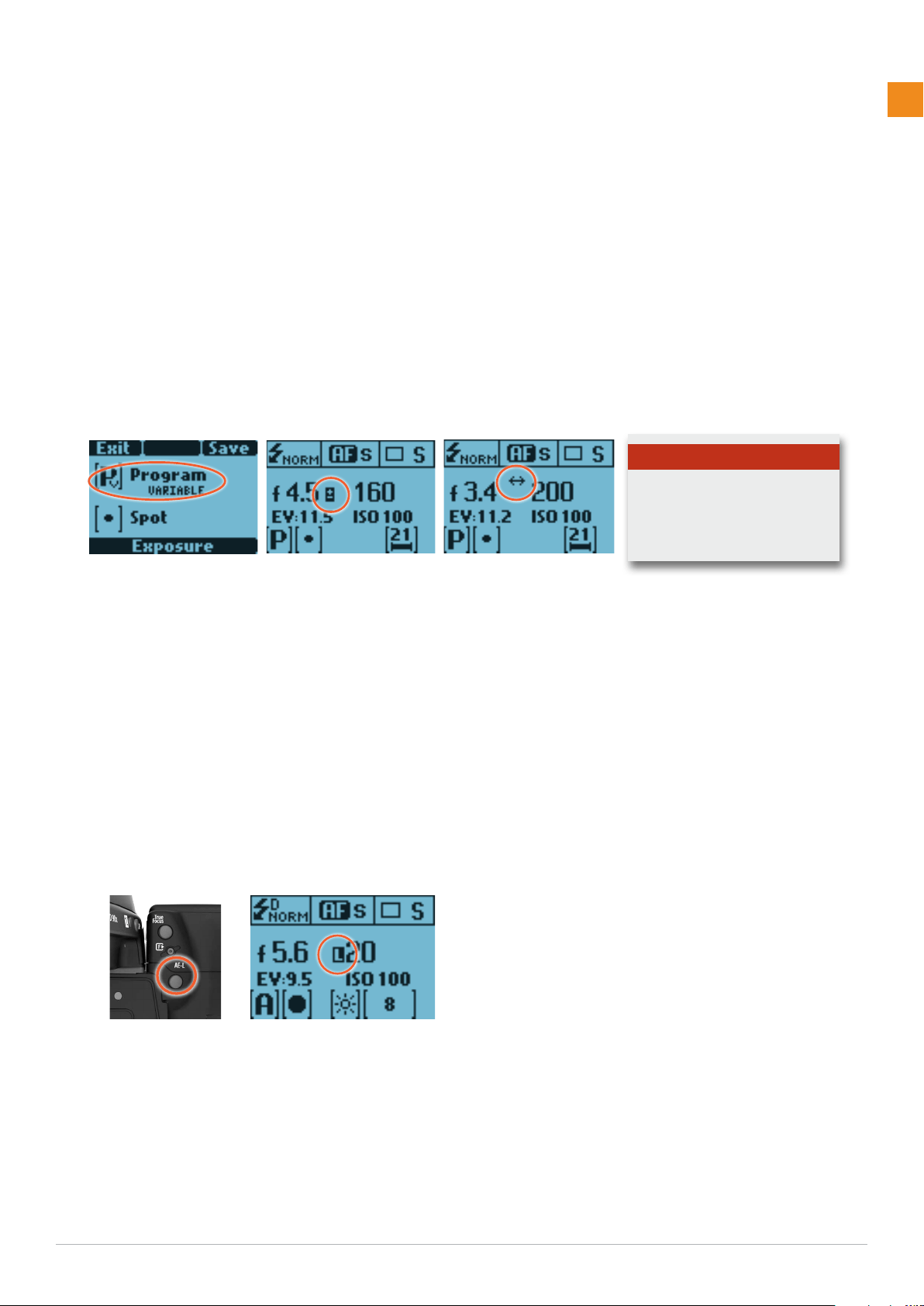
44
www.hasselblad.comH6X
AUTOMATIC EXPOSURE – A, S, P, PV
Automatic exposure provides a choice of two ways of con-
trolling shutter speed and aperture settings semi-auto-
matically and two ways fully automatically:
Aperture priority: A - The aperture is manually chosen
by you by turning the front scroll wheel, and the shutter
speed is automatically chosen by the camera.
Shutter priority: S - The shutter speed is manually cho-
sen by you by turning the front scroll wheel, and the aper-
ture is automatically chosen by the camera.
Programmed: P - In this mode, an aperture / shutter
combination is chosen by the camera according to the
EV measured (metering method remains as your choice),
though only within pre-set appropriate limitations to suit
various requirements and applications.
Programmed variable: Pv - This mode is very similar to
Programmed, except with the additional parameters of lens
focal length being automatically taken into account. For ex-
ample, long shutter speeds will automatically be avoided
with a long focal length lens.
In Automatic mode the front scroll wheel selects alternative
aperture /shutter combinations while maintaining the same
EV and the rear scroll wheel alters the amount of exposure
compensation. The compensation appears as a +/- symbol
on the grip display and viewfinder display (illus. 4).
Variations (chosen by using the front scroll wheel) from the
specific combination selected by the P or Pv mode are sig-
nified by a double arrow symbol appearing between the ap-
erture and speed settings (illus. 5) on the grip display. These
new variations provide the correct exposure but in different
combinations.
Tip
Aperture and shutter speed set-
tings can both be changed even
while the busy light on sensor
unit is flashing.
AE- L BUTTON
This button has two main functions that can be incorporat-
ed in various working methods involving exposure locking.
It also has an extra function for the flash measure capability
(see AE-L section under Flash). The AE-L button can:
a) lock an EV setting in manual and automatic modes.
b) be used as a Zone System placement button.
a) When the button is pressed, the light metering facility
is locked to the EV setting at that moment. An L (= locked)
symbol appears between the shutter speed and the aper-
ture indication on the grip display and viewfinder display to
confirm the status. Press the AE-L button again to unlock
(toggle function).
In the locked setting, the aperture and shutter speed be-
come interlocked. In this way, a new aperture/shutter com-
bination that still represents the same EV, can be rapidly
chosen. For example, if you set the shutter at 1/125s and the
aperture at f/8 and lock them together, you can access new
EV-equivalent combinations of, for example, 1/30s a f/16 or
1/500s at f/4 just by moving the front scroll wheel.
In practice this means you could, for example, in auto mode,
position the metering area (spot setting) over an area in the
subject that you determine to be equivalent to a mid-grey
and lock it with the AE-L button. You can then recompose
the picture with the metering zone positioned over an area
much brighter or darker while still retaining the original ex-
posure setting and choose a new combination of aperture
and shutter speed settings.
b) The AE-L button also allows the spot metering function
to make zone placements. When the AE-L button is pressed,
the metered area is saved as a mid-grey (Zone 5). When the
spot area is then placed over another part of the scene, the
new area is then compared to the saved area and the dif-
ference can be read off the scale seen in the viewfinder.
For example, in a landscape situation you could meter the
foreground, lock the reading with the AE-L button (thereby
locking that area to be reproduced as the equivalent to a
mid-grey 18%), point the camera at some rocks to see by
how much darker they are compared to the foreground by
the EV difference read off the scale (illus 3).
If you have chosen Spot together with Zone display (see
Custom options #14 for settings) as well as one of the au-
tomatic modes A, S, P or Pv, point the spot marking at an
area that you decide should be a Zone 5 and click the AE-L
button (illus 4). The meter will now display different parts of
the subject as zone values (illus 5) in the viewfinder display,
instead of EV deviations, as you move the spot marking over
the subject. (Included are Lo and Hi (illus 6) to signify areas
beyond the range of the sensor).
Alternatively you can choose to re-classify an area as anoth-
er zone and then check the rest of the subject to see how
other areas fall on the zone scale. Do this by following the
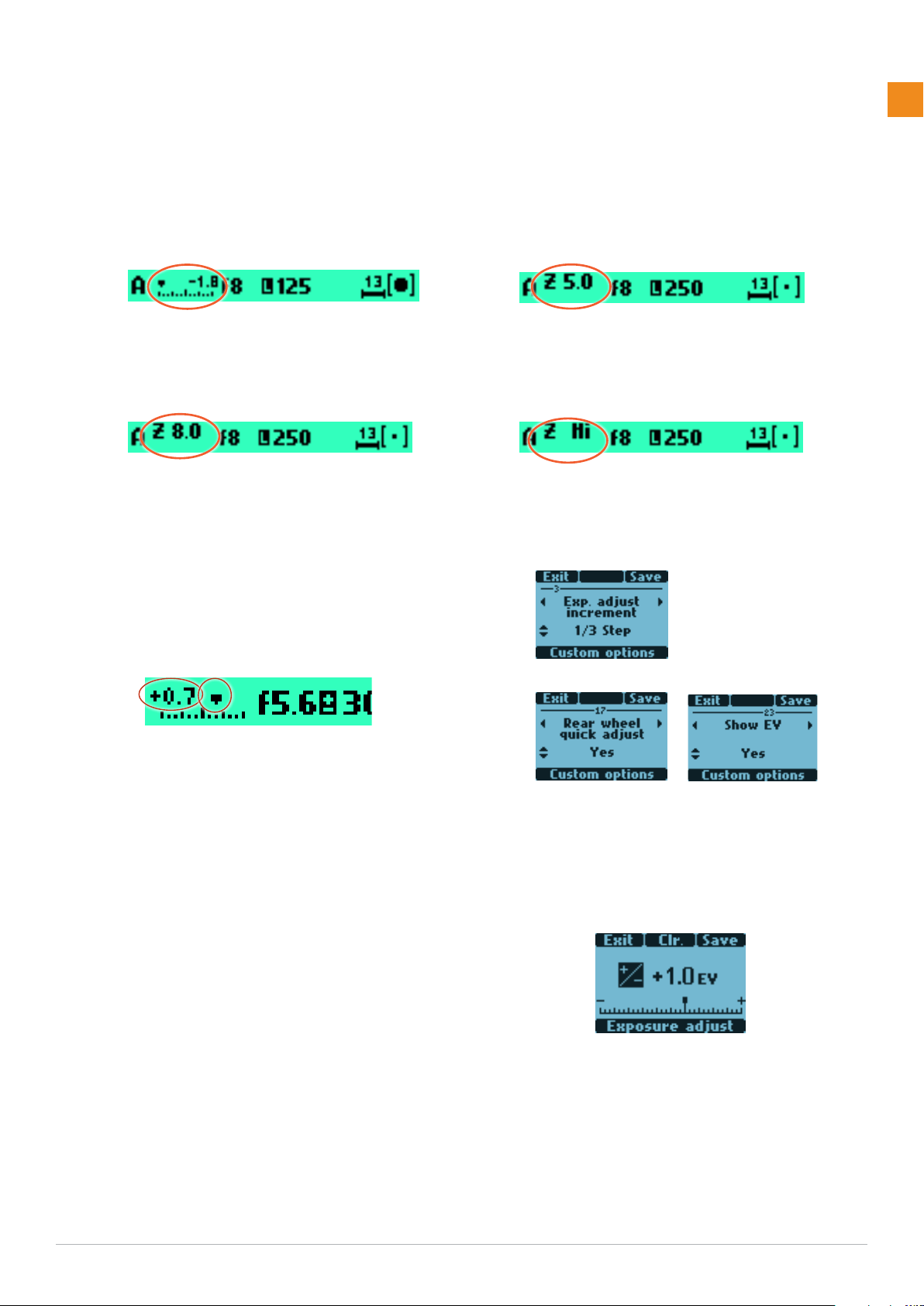
45
www.hasselblad.comH6X
New metered area is 1.8 EV lower than the area
metered when the AE-L button was pressed.
AE-L button pressed to call the metered area
‘Zone 5’.
Metered area reads ‘Zone 8’.
Metered area above ‘Zone 10’.
above procedure and then turning the rear scroll wheel until
you see the new desired zone value in the viewfinder dis-
play. You will also see the new exposure that will now pro-
duce that new zone. For example, you might have measured
a rock at zone 5 but wish to make it darker. By moving the
rear scroll wheel you could re-classify it as zone 4. You will
then be able to see, for example, whether white clouds are
now falling within the exposure range by their new zone
classification.
Alternatively, you can also pre-set the initial zone reading in
order to save time and effort where there is no freely avail-
able ‘zone 5’ subject for light measuring. For example, you
might be on a sandy beach where you know that sand is
normally classified as zone 6. You can pre-programme the
zone placement by holding down the AE-L button while
choosing the new zone value and turning the front scroll
wheel until zone 6 appears. All new placements will then be
zone 6.
EXPOSURE COMPENSATION /
QUICK ADJUST
The exposure compensation function, for both manual and
automatic modes can be set from -5 to +5 EV, in 1/3, 1 or
1/2 EV increments (Custom Option #3) and is visible above
the scale in the viewfinder and as a ± symbol on the grip
display.
The quickest way to make an adjustment in auto-exposure
mode is use the rear scroll wheel.
Temporary compensation setting in an auto- exposure
mode using the Quick Adjust function:
1) Select chosen auto exposure mode.
2) Turn the rear scroll wheel to select the chosen amount
of compensation.
The amount is displayed in the viewfinder as both an EV
figure complete with a ‘minus’ or ‘plus’ prefix and as a
marker above a ‘minus’ to ‘plus’ scale.
Default settings provide 1/3 EV compensation and an im-
mediate clearing of the setting after capture.
However, in Custom Options #3 you can select 1/3, 1 or
1/2 EV increment changes, in Custom Options #23 you can
choose to retain the setting after capture and in Custom
Options #17 you can deactivate the function.
Custom Options #3,
#17 and #23 used to
deactivate and alter
the settings for the
rear scroll wheel/
Quick Adjust func-
tion.
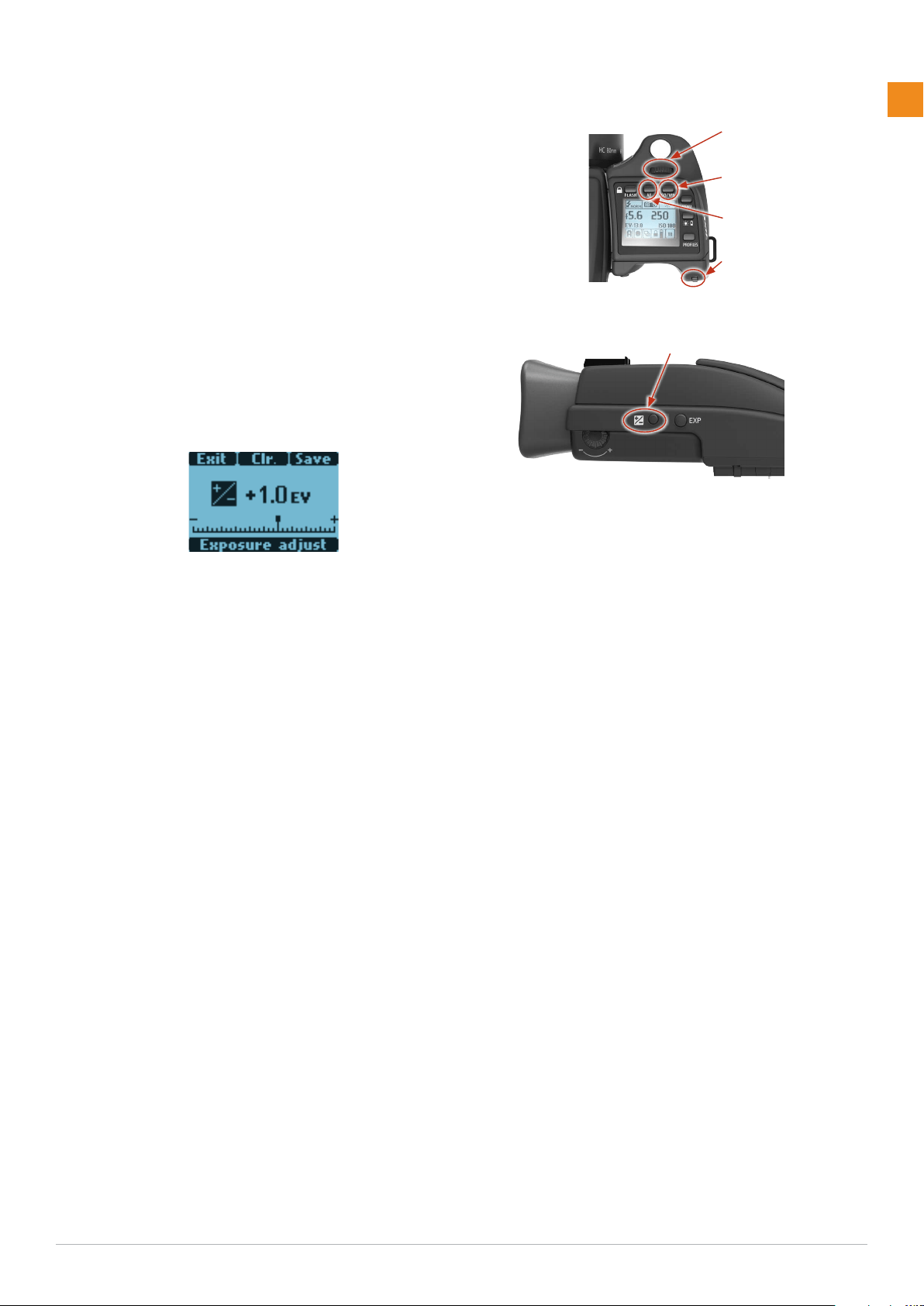
46
www.hasselblad.comH6X
FIXED EXPOSURE COMPENSATION
SETTING
1) Press the ‘±’ button on the viewfinder.
2) Turn either the
Front scroll wheel or
Rear scroll
wheel on the grip to increase or decrease the amount
of compensation in 1/3 EV steps.
3) The amount is displayed in the viewfinder as both an EV
figure complete with a ‘minus’ or ‘plus’ prefix (A in illus-
tration), and as a marker above a ‘minus’ to ‘plus’ scale
(B in illustration).
4) Press
Clr
(AF button) to reset any compensation back to
zero.
5) Press
Save
(ISO / WB button) to retain the setting.
6) A ‘±’ symbol is then displayed between the aperture and
shutter speed setting as confirmation of the setting.
+/–
Clr
Save
Front scroll
wheel
Rear scroll
wheel

47
Photo: Tom D. Jones © / Hasselblad Masters
MENU

48
www.hasselblad.comH6X
OVERVIEW OF NAVIGATING MENU AND SETTINGS
Navigating the menu and accessing the settings on the grip is achieved by pressing the buttons surrounding the display and
turning the scroll wheels. Note that some of the buttons are modal and so have several functions which is indicated by the
designation that appears closest to that particular button when navigating. For example, the ISO/WB button also acts as a
SAVE button.
Here is an example of the necessary steps to take to make a setting change, in this case Bracketing. The actions are illustrated
in full here to clearly describe the procedure. The procedures later on in this manual are described and illustrated in an abbrevi-
ated manner so it wise to study this full description first.
Press the MENU button to access
the menu from the regular info
display.
Turn the Front Scroll Wheel until
Settings appears.
1
4 5
2
Press Save (ISO/WB
button) or make a ‘quick
save’ by half-pressing
the shutter release but-
ton. To escape press ESC
(Profiles button).
When finished, press
Exit
(FLASH button).
6
Number of Captures (the number of captures required in the se-
quence)
Sequence (the sequential order of the over- or underexposures)
Step (the amount of EV variation from the standard exposure setting)
In
turn the rear wheel to choose the number of frames
required: 2, 3, 5, 7 or 9.
In turn the rear wheel to choose one of the four
sequences.
In turn the rear wheel to choose the amount of EV
variation required: 3, 2, 1, 1/2, 1/3 EV.
Turn the front scroll wheel
to access the options.
The following is a list of the various terms describing the
various actions that appear on the grip display:
Enter: navigates down one level on the menu.
Exit: navigates back up one level on the menu. Does not save any settings.
Off: deactivates the particular function being set.
On: activates the particular function being set.
Sel.: (Select) - selects the character marked for image info and profile name
ESC: (Escape) - terminates an action and returns to the main screen. Does
not save any settings.
Save: saves a setting and also moves screen back up one level on the menu.
Can save many changes made in a setting sequence.
SAVE
ACTIONS
Remember the follow-
ing groupings of ‘saved’
and ‘not-saved’ actions
when making settings
changes.
SAVED
‘Quick save’ - half-
press shutter release
button
Save - press save but-
ton (ISO/WB button)
NOT SAVED
Escape - press ESC button
(PROFILES /ESC button)
Exit - press exit button
(FLASH button)
Press Enter (ISO/WB button).
3

49
www.hasselblad.comH6X
Settings optionsSelf timer options Bracketing options
GENERAL OVERVIEW
OF MENU
Text setting
Drive
Custom Options
System status
Interval
options
Note
At very low temperatures the
displays might require a few sec-
onds to present new settings.
These arrows signify the FRONT scroll
wheel is used to select these options.
These arrows signify the REAR scroll
wheel is used to make settings changes.

50
www.hasselblad.comH6X
SETTINGS
Apart from the more regularly used ISO/WB, AF, Flash but-
tons and features accessible on the grip there are a number
of other features available. These provide the integral finess-
es that make the H6X a powerful and sophisticated tool to
satisfy a variety of professional demands.
There are five functions: Self timer, Bracketing, Interval,
Settings and Drive.
Regular use can be simplified by using the shortcuts and
button reassignment to access the menus.
One point to remember when making settings is that cer-
tain options are only available when the relevant screen
has been accessed. For example, in Self Timer the choice of
‘delay/mirror up’ or ‘mirror up/ delay’ is only available (by
turning the rear scrollwheel - lower row on display) when
the relevant function has been chosen (by turning the front
scroll wheel - upper row on display)
The self timer allows a delay in the activation of the shut-
ter and a change in sequence of the mirror movement. Nor-
mally the mirror is raised before the shutter is tripped creat-
ing a pause between the two actions to minimize camera
vibration. However, during this pause there will be no image
in the viewfinder and no light metering available for any
eventual exposure change. Therefore the Self timer func-
tion can be set to a sequence where the delay is followed
by the mirror being raised instead. Normally the mirror will
instantly return after a capture but you can also choose a
setting where the mirror remains raised.
2 – 60 s
options available
options available
options available
DELAY / MIRROR UP
or
MIRROR UP / DELAY
MIRROR GOES DOWN
MIRROR REMAINS UP
or
SELF TIMER
As it provides a timed, remote shutter release function it
can be used instead of a remote release cable/cord/device
when split-second timing is not critical. The camera’s expo-
sure settings (Manual or Auto) will be according to the light
metering requirements just prior to the mirror being raised
so, in very changeable lighting conditions, choose the mode
most suitable if using long delays.
continued over

51
www.hasselblad.comH6X
Mirror sequence highlighted.
‘Delay first, then mirror raised’
chosen as option.
‘Delay’ highlighted with drop
shadow. 10 seconds chosen.
SELF TIMER SETTING
1) Press MENU on grip.
2) Turn
Front scroll wheel until Self Timer appears.
3) Press
ENTER.
4) Turn
Front scroll wheel to access the options, that are:
Delay
Mirror sequence
Mirror Up / Mirror Goes Down
(A drop shadow will be displayed beneath the selected sym-
bol, for example
)
5) When Delay is highlighted – – turn the Rear scroll
wheel to choose a delay range from 2 - 60s in 1s inter-
vals.
6) Turn the
Front scroll wheel again to choose Delay /
Mirror Up, Mirror Up/ Delay sequence –
. When
highlighted turn the Rear scroll wheel to choose.
Delay / Mirror Up sequence =
Delay for set amount of time – mirror raised – cap-
ture made.
Mirror Up/ Delay sequence =
Mirror raised – delay for set amount of time – cap-
ture made.
7) Turn the
Front scroll wheel again for
Mirror goes down / Mirror remains up –
–
choice. Turn the Rear scroll wheel to choose.
Mirror goes down =
Mirror returns to its normal position and the camera
is made ready for the next capture.
Mirror raised =
Mirror remains in raised position. No image is visible
in the viewfinder until M UP button pressed.
8) Press
On. Note that this now reads Off and the line of
text at the bottom of the screen reads ‘Self timer on’.
9) Press
SAVE.
10) Press
ENTER again from the Self Timer screen to acti-
vate the function.
11) Press
On.
12) Half-press the shutter release button to standby mode
for this function (press the shutter release button again
(full press) for activation) or full-press the shutter release
for immediate activation.
MENU
ON
Front scroll
wheel
ENTER
or
SAVE
Rear scroll
wheel
Mirror down /up highlighted.
‘Mirror down after capture’
chosen as option.
Note
You can halt the sequence by
clicking the ON / OFF ( ESC)
button.
Tip
Press the Mirror Up button
twice within 0.5s to access the
self timer mode directly.
– continued
Tip
Check the lower text-row
on the screen for ON or OFF
status.

52
www.hasselblad.comH6X
The bracketing function provides an automatic series of cap-
tures; one at the standard exposure setting (Manual or Auto)
and the others with pre-determined deviations in EV from the
standard exposure. This is particularly useful for images con-
taining a very wide tonal range, for example.
Firstly you make an assessment concerning the number of ex-
tra frames required, the order in which they should be taken,
and by how much the EV deviation there should be and the
setting made accordingly. The first metered exposure (Manu-
al or Auto) is the EV that determines the calculations for the
bracketing sequence.
BRACKETING
2 frames
or
3 frames
or
5 frames
1/3 EV
or 1/2 EV or
1 EV or 2 EV or 3 EV
Note the difference in operation between Single and Con-
tinuous drive settings:
• At the Single setting you must press the shutter release but-
ton separately for every separate capture until the sequence
is finished.
• At the Continuous setting you can either maintain the pres-
sure on the button to take all frames without stopping or you
can release the pressure on the button and press again to
continue to the end of the sequence without losing any frames
within the set sequence.
BRACKETING SETTING
1) Press MENU on grip.
2) Turn the
Front
scroll wheel until Bracketing appears
3) Press
ENTER
.
4) Turn the
Front
scroll wheel to access the options, that are:
Number of Captures (the number of captures required in the se-
quence)
Sequence (the sequential order of the over- or underexposures)
Step (the amount of EV variation from the standard exposure setting)
(A drop shadow will be displayed beneath the selected symbol,
for example
)
5) In
turn the
Rear
scroll wheel to choose the number of
frames required: 2, 3, 5, 7 or 9.
6) In turn the Rear scroll wheel
to choose one of four
sequences:
A: Standard, Over, Under
B: Standard, Under, Over
C: Over, Standard, Under
D: Under, Standard, Over
– continued
Number of captures
highlighted. 3 cap-
tures chosen as op-
tion.
A B C D
options available
options available
options available
continued over
MENU
ON
Front scroll
wheel
ENTER
or
SAVE
Rear scroll
wheel

53
www.hasselblad.comH6X
7) In turn the
Rear
scroll wheel to choose the amount of
EV variation required: 3, 2, 1, 1/2, 1/3 EV.
8) Press
SAVE
.
9) Press
ENTER
again from the Bracketing screen to activate
the function. Press
On
. Note that this now reads Off and
the line of text at the bottom of the screen reads ‘Bracket-
ing on’.
Half-press the shutter release button to standby mode for
this function (press the shutter release button again (full
press) for activation) or full-press the shutter release for im-
mediate activation.
To escape from this mode press
MENU
, then
Enter
on the
Bracketing screen, then Off (AF button).
Note
The default setting is a shutter speed change in a
bracketing sequence. However, if the camera is set in
Manual mode, you can choose an aperture change
instead (Custom Options > Bracket param. in Manu-
al #25 on grip).
Note
As an example, a 5 frame sequence with an EV 1
variation setting at ‘Standard, Over, Under’ would
produce: Standard (O EV variation), +1EV, -1EV, +2EV,
-2E V.
Tip
A bracketing sequence can be stopped mid-se-
quence by pressing the ESC (ON.OFF) button.
Tip
Check the lower text-row on the screen for ON or
OFF status.
Note
See note at the beginning of this section regarding
the difference between Single and Continuous drive
settings. In both cases, the bracketing function is
automatically reset for a new sequence.
Viewfinder display indicating
no adjustment to next frame
and three frames left in the
sequence.
E X A MPL E
Screen after Bracket-
ing setting activated
indicating 3 frames re-
maining in a Standard,
Over, Under, sequence
with no adjustment to
the next frame.
EXAMPLE
Sequence highlighted.
‘Standard, over, under’
chosen as option.
Step highlighted.
1/3 EV variation chosen as option.

54
www.hasselblad.comH6X
2 frames –
255 frames
2 seconds −
1 hour
INTERVAL
By using the interval setting, you can allow the camera to
take a series of captures automatically over a set period. This
is often required for time and motion studies, security surveil-
lance, nature study, etc. The exposure and focus settings (Man-
ual or Auto) will be according to the camera settings at the time
of capture.
INTERVAL SETTING
1) Press MENU on grip.
2) Turn the
Front scroll wheel until Interval appears.
3) Press
ENTER
.
4) Turn the Front scroll wheel to access the options, that
are:
Number of captures (the number of captures required)
Interval duration (the time interval between each capture)
(The selected feature symbol is indicated by a drop shadow)
5) In Number of captures, turn the Rear scroll wheel to
choose the number of captures required: 2 – no limit
6) In Interval duration, turn the
Rear scroll wheel to
choose:
2 seconds – 1 hour
7) Press
SAVE.
8) Press
ENTER again from the Interval screen to activate
the function. Press On. Note that this now reads Off
and the line of text at the bottom of the screen reads
‘Interval on’.
Half-press the shutter release button to standby mode
for this function (press the shutter release button
again (full press) for activation) or full-press the shutter
release for immediate activation.
Tip
Check the lower text-row
on the screen for ON or OFF
status.
Number of captures
highlighted. 2 frames
variation chosen as
option.
Interval duration high-
lighted.
5 seconds variation
chosen as option.
options available
options available
EXAMPLE
Screen after Interval
setting activated indi-
cating 3 shots remain-
ing at 30 second inter-
vals.
Tip
An Interval setting can be
stopped mid-sequence by
pressing the ESC button.
Note
In Custom Options #28 on grip
you can select an initial delay
of None, 2, 10, 60 seconds or
the interval time.
MENU
ON
Front scroll
wheel
ENTER
or
SAVE
Rear scroll
wheel
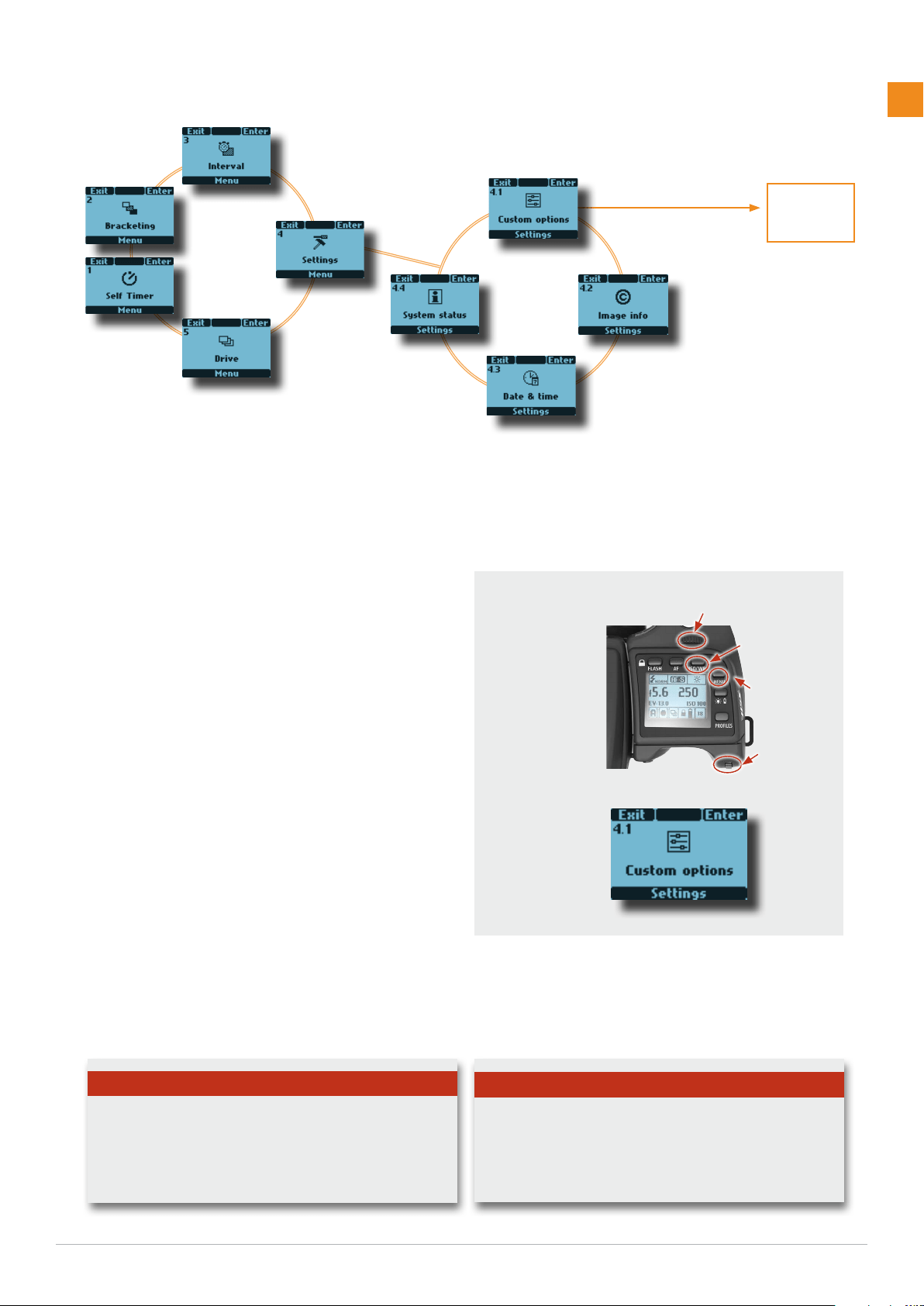
55
www.hasselblad.comH6X
SETTINGS > CUSTOM OPTIONS
CUSTOM OPTIONS
From the Settings screen you can access four main sub-set-
tings: Custom options, Image info, Date & Time and System
status by turning the front scroll wheel. From each of these
CUSTOM OPTIONS
1) Press MENU on grip.
2) Turn the
Front scroll wheel until Settings appears.
3) Press
Enter.
4) Turn the
Front scroll wheel to access 4.1 Custom
options.
5) Press
Enter to access the 34 choices available.
6) Turn the
Front scroll wheel to the desired option.
7) Turn the
Rear scroll wheel to the desired setting.
8) Press
SAVE.
If you want to reset the camera to the default setting for all
options, press the ON.OFF button quickly to enter Profiles,
select Standard and then press Load.
Tip
As a shortcut to Custom Options level, press the MENU but-
ton twice with camera in active mode. The latest setting will
auto matically appear. After making any changes, press the
shutter release button to save the new setting.
Tip
As a shortcut to a specific customizable button (True Focus,
AE-L, M.UP, Stop Down) setting in Custom Options, press
MENU and then the desired button with camera in active
mode. After making any changes, press the shutter release
button to save the new setting.
sub- settings you can access further items for setting chang-
es. Look at the main menu chart to get an idea of where all
the options are on the menu tree.
options available
MENU
Front scroll
wheel
ENTER
or
SAVE
Rear scroll
wheel
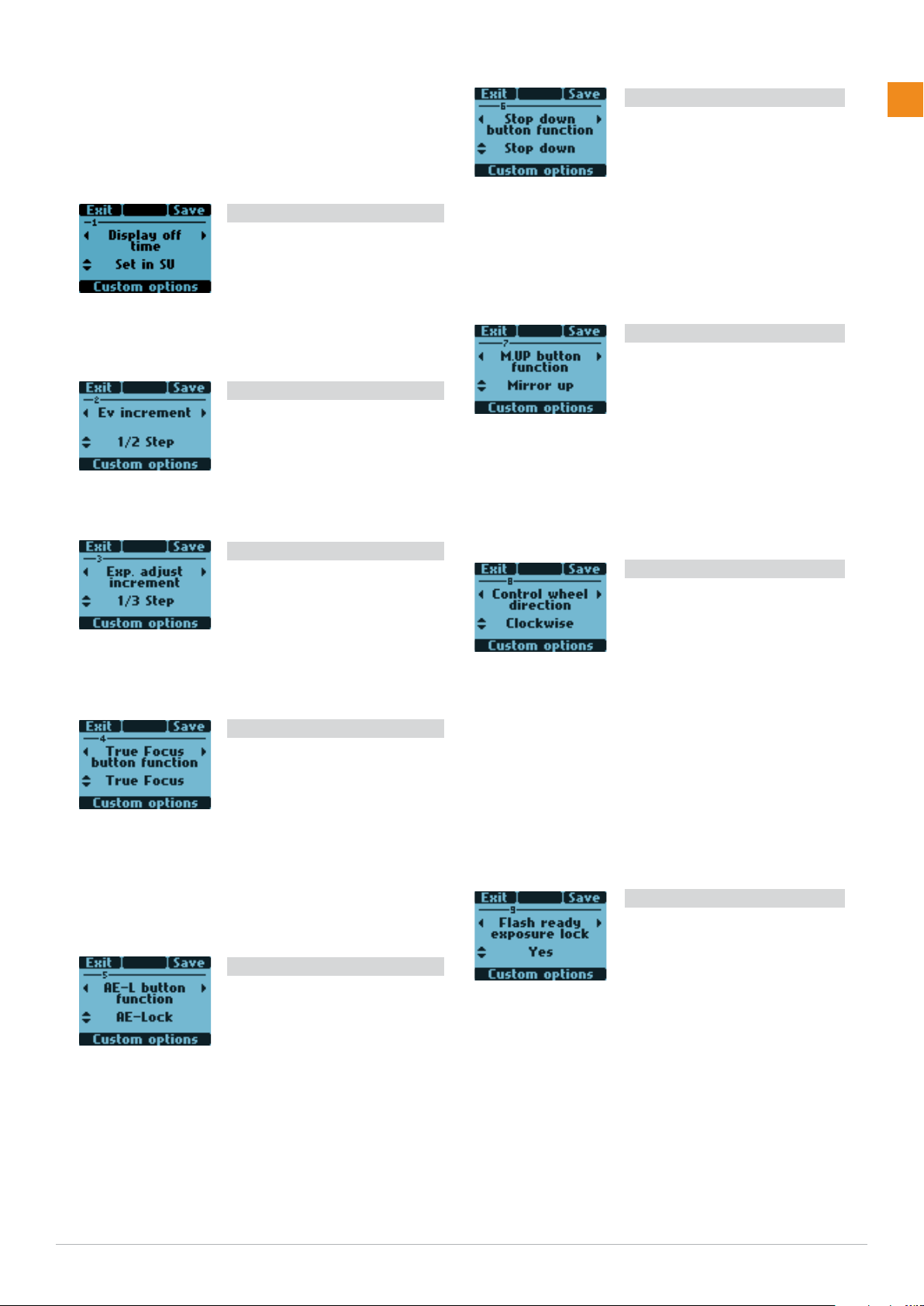
56
www.hasselblad.comH6X
Display off time 1
• 10s • 20s • 30s • 60s
Determines the amount of time
elapsing before the display auto-
matically turns off. Set on the sen-
sor unit> Menu > Settings > Custom
Options > Display Off.
EV increment 2
• 1/2 Step • 1 Step • 1/3 Step
Determines the amount of EV
change applied (per click of either
the front or rear scroll wheels) to ei-
ther aperture or shutter speed.
Exp adjust increment 3
•
1/3 Step • 1 Step • 1/2 Step
Determines the amount of EV
change applied (per click of the
rear scroll wheels) when making
fixed exposure adjustment set-
tings.
True Focus button function 4
•
True Focus
but can be reassigned to:
AF Drive • AE-lock • Self Timer •
Bracketing • Mirror up • Stop Down
• B mode • T mode • Flash Measure
• Interval timer • Cycle LM mode •
Expose • Display Off • Histogram •
Delete • Grey bal ex • Spirit Level •
Rear Info Screen • None
AE-Lock button function 5
• AE-lock
but can be reassigned to:
AF Drive • Self Timer • Bracketing •
Mirror up • Stop Down • B mode •
T mode • Flash Measure • Interval
timer • Cycle LM mode • Expose •
Display Off • Histogram • Delete •
Grey bal ex • Spirit Level • Rear Info
Screen • None
CUSTOM OPTIONS
The following is a description of all the Custom Options ac-
cessible through the grip display. They are accessed by Menu
> Settings > Custom Options. The words and figures in red
signify the default setting for that option.
Stop down function 6
• Stop Down
but can be reassigned to:
AF Drive • AE-lock • Self Timer •
Bracketing • Mirror up • B mode •
T mode • Flash Measure • Interval
timer • Cycle LM mode • Expose •
Display Off • Histogram • Focus conf
• Delete • Grey bal ex • Spirit Level •
Rear Info Screen • None
M.UP button function 7
•
Mirror up
but can be reassigned to:
AF Drive • AE-lock • Self Timer •
Bracketing • Stop Down • B mode •
T mode • Flash Measure • Interval
timer • Cycle LM mode • Expose •
Display Off • Histogram • Focus conf
• Delete • Grey bal ex • Spirit Level •
Rear Info Screen • None
Scroll wheel direction 8
•
Clockwise • Counter clockwise
Determines the effect the direction
of the controls wheels have on a
setting.
For example, by moving the front
scroll wheel to the left you can alter
the aperture setting from f/8 to f/6.8
to f/5.6 and so on. By changing the
wheel direction setting however,
the same action of turning the wheel
to the left would then produce the
opposite effect, that is, the aperture
settings would change from f/ 8 to
f/ 9.5 to f/ 11, and so on.
Flash ready exposure lock 9
•
Yes • No
Allows you to make a capture be-
fore the flash is fully charged. For
use with integral flash unit or other
TTL compatible flash units con-
nected to the hot-shoe. Not valid
for flash units connected by the PC
connector.
Yes blocks the shutter until flash is
ready.
No allows shutter release before flash
is ready.
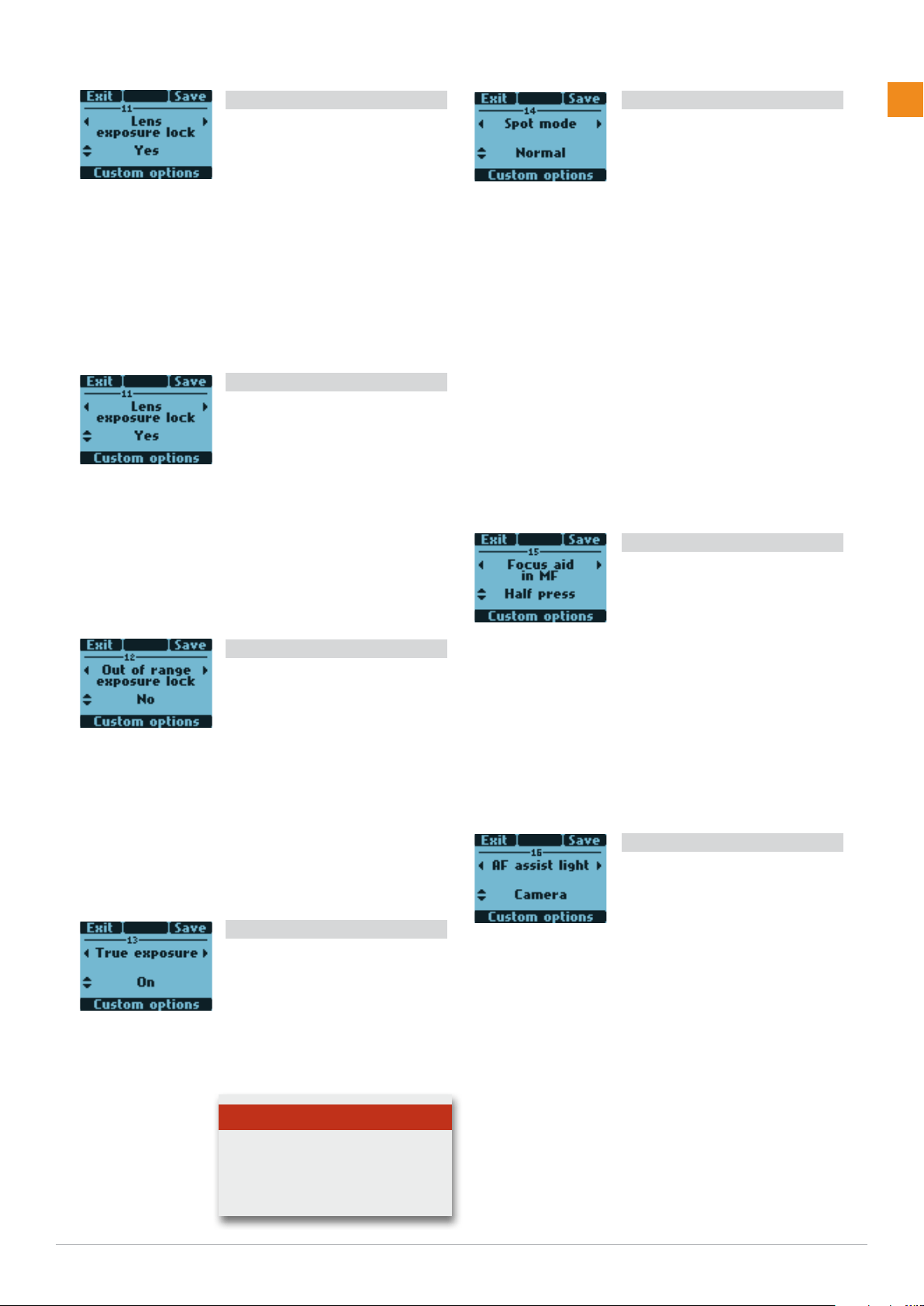
57
www.hasselblad.comH6X
Note
If using flash/strobe as the main light
source and 1/800s shutter speed, re-
member to turn off the True Exposure
option.
Magazine exposure lock 10
• Yes • No
Allows you to release the lens and
auxiliary shutter in camera body
without a sensor unitattached.
Yes blocks the lens shutter and aux-
iliary shutter in camera body if the
sensor unitis not attached. Generates
message on grip display if attempted.
No allows the lens shutter and auxiliary
shutter in camera body to be released
without the sensor unit attached.
Lens exposure lock 11
•
Yes • No
Allows you to release the auxiliary
shutter in camera body without a
lens attached.
Yes blocks the release of auxiliary
shutter in camera body if there is no
lens attached. Generates message on
grip display if attempted.
No allows a release of auxiliary shutter
in camera body without a lens attached.
Out of range exposure lock 12
•
No • Yes
Allows you to release the camera
when either the aperture or shutter
speed setting is beyond the work-
ing range (indicated on the displays
by “–”).
Yes blocks the shutter if beyond the
working range.
No allows the shutter to be released
(1/800s or 32s) if beyond the working
range.
True exposure 13
•
On • Off
Determines whether the exposure
is automatically adjusted to create a
true exposure setting. (See Appen-
dix for full explanation).
On allows the adjustment.
Off retains the normal setting.
Spot mode 14
• Normal • Zone
Determines how the camera be-
haves when set to Spot Mode.
Normal makes the camera behave in
the same fashion as when set to Aver-
age or Centre Weighted.
Zone makes the camera behave in
the same fashion as the Hasselblad
205FCC. That is, the central spot
is placed over a particular area of
the subject and the AE-L button is
pressed. The exposure is then calcu-
lated assuming that the metered area
is 18% grey or Zone 5 and is indicated
on the display as Zone 5. Alternatively,
the area can be reassigned to another
zone by turning the rear scroll wheel.
Then, when the camera is moved, the
areas within the central spot are indi-
cated by their zone values.
Focus aid in MF 15
•
Half press • Always • Off
Sets how the focus aid arrowhead
LED symbols appear in the view-
finder display in manual focus
mode.
Half press makes them visible when
the shutter release button is pressed
half way.
Always makes them visible all of the
time when camera is active.
Off disables them completely.
AF assist light 16
•
Ext flash • Camera • Off
Allows projection of light pattern to
assist the autofocus system in poor
light or low contrast situations.
Camera sets the integral AF assist il-
lumination to be always active.
External flash activates the AF assist
illumination projected by a suitable
attached external flash unit. When
detached, however, the integral sys-
tem is automatically used.
Off sets the AF assist illumination to
remain always inactive.
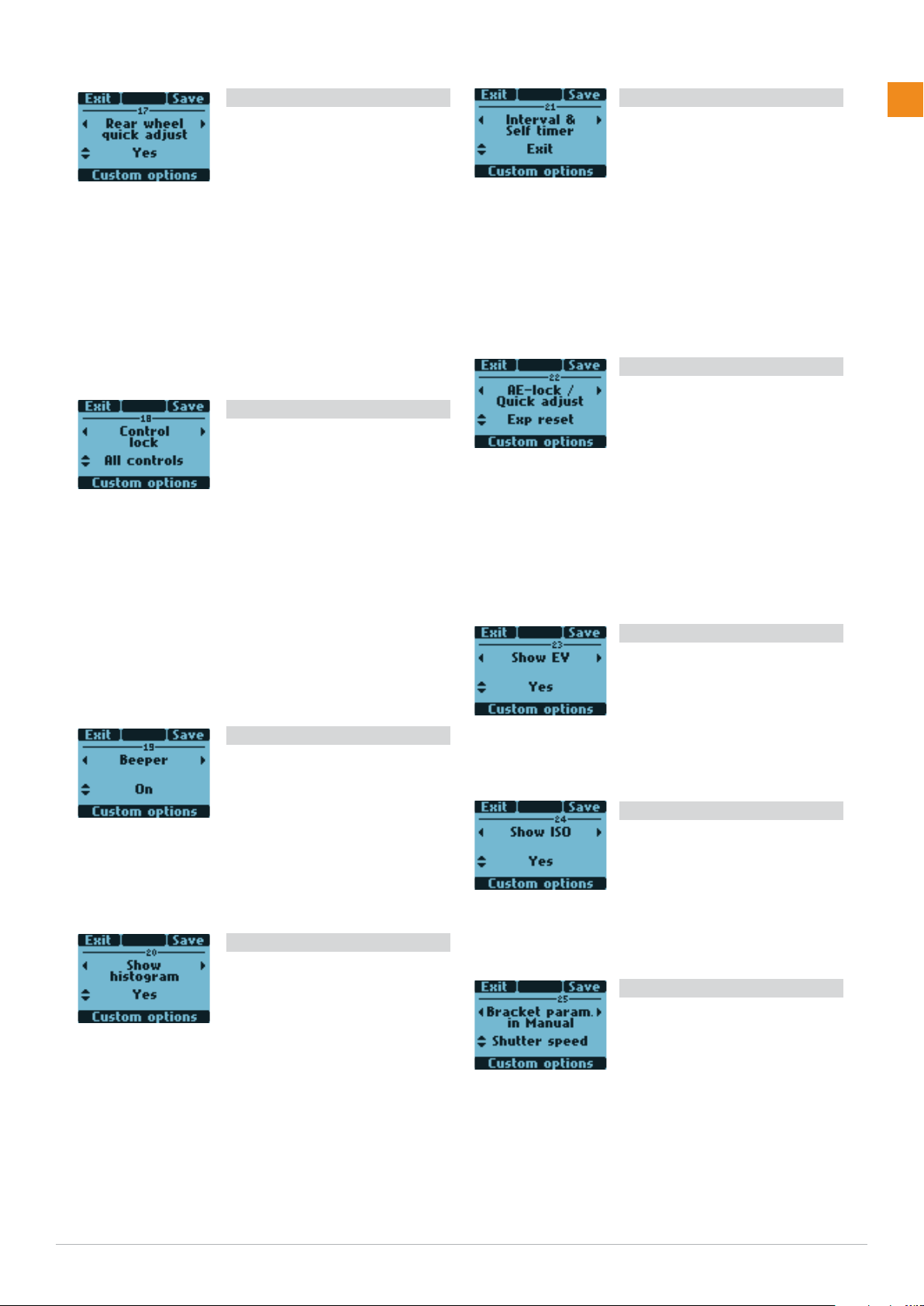
58
www.hasselblad.comH6X
Rear wheel quick adjust 17
• Yes • No
Allows rear scroll wheel to make a
rapid EV adjustment (or EV compen-
sation) in auto-exposure mode.
Yes turns the setting on. By turning
the rear scroll wheel, the adjustment is
made and appears on both displays as
a ± symbol between the shutter speed
and aperture values. The amount
of deviation also appears above the
scale to the left of the aperture value
on the viewfinder display.
No turns the function off completely.
Control lock 18
•
All controls • All but TrueFoc. •
Wheels • Off
Sets the amount of locking used
when the Control Lock (FLASH) but-
ton is pressed.
All controls locks scroll wheels and
buttons.
All but TrueFoc. locks scroll wheels
and buttons except True Focus.
Wheels locks only scroll wheels. They
remain operable in any setting mode,
however.
Off disables lock function.
Beeper 19
•
On • Off
Sets the audible beeper signal.
On enables the signal.
Off disables the signal.
Show histogram 20
•
Yes • No
Sets whether a histogram of a cap-
ture appears on the display after ex-
posure.
Yes enables the setting.
No disables the setting.
Interval & Self Timer 21
• Exit • Stay
Allows either the Interval or Self
Timer mode to remain active after
a capture or immediately return to
standard setting.
Exit clears the setting and produces an
automatic return to standard setting
after a capture.
Stay retains the setting after a cap-
ture.
AE lock / Quick adjust 22
• Exp reset • Saved
Allows either the AE-Lock or Quick
adjust mode to remain active after
a capture or immediately return to
standard setting.
Exp Reset clears the settings and
produces an automatic return to stan-
dard setting after a capture.
Saved retains the AE-Lock or Quick
adjust settings after a capture.
Show EV 23
•
Yes • No
Allows the display of EV settings on
the grip display.
Yes enables the display.
No disables the display.
Show ISO 24
•
Yes • No
Allows the display of ISO settings on
the grip display
Yes enables the display.
No disables the display.
Bracket param. in Manual 25
•
Shutter speed • Aperture
Selects either the shutter speed or
the aperture as the parameter which
changes in a bracketing sequence
when in Manual exposure mode.
Shutter speed selects changes in
shutter speed.
Aperture selects changes in aperture
settings.
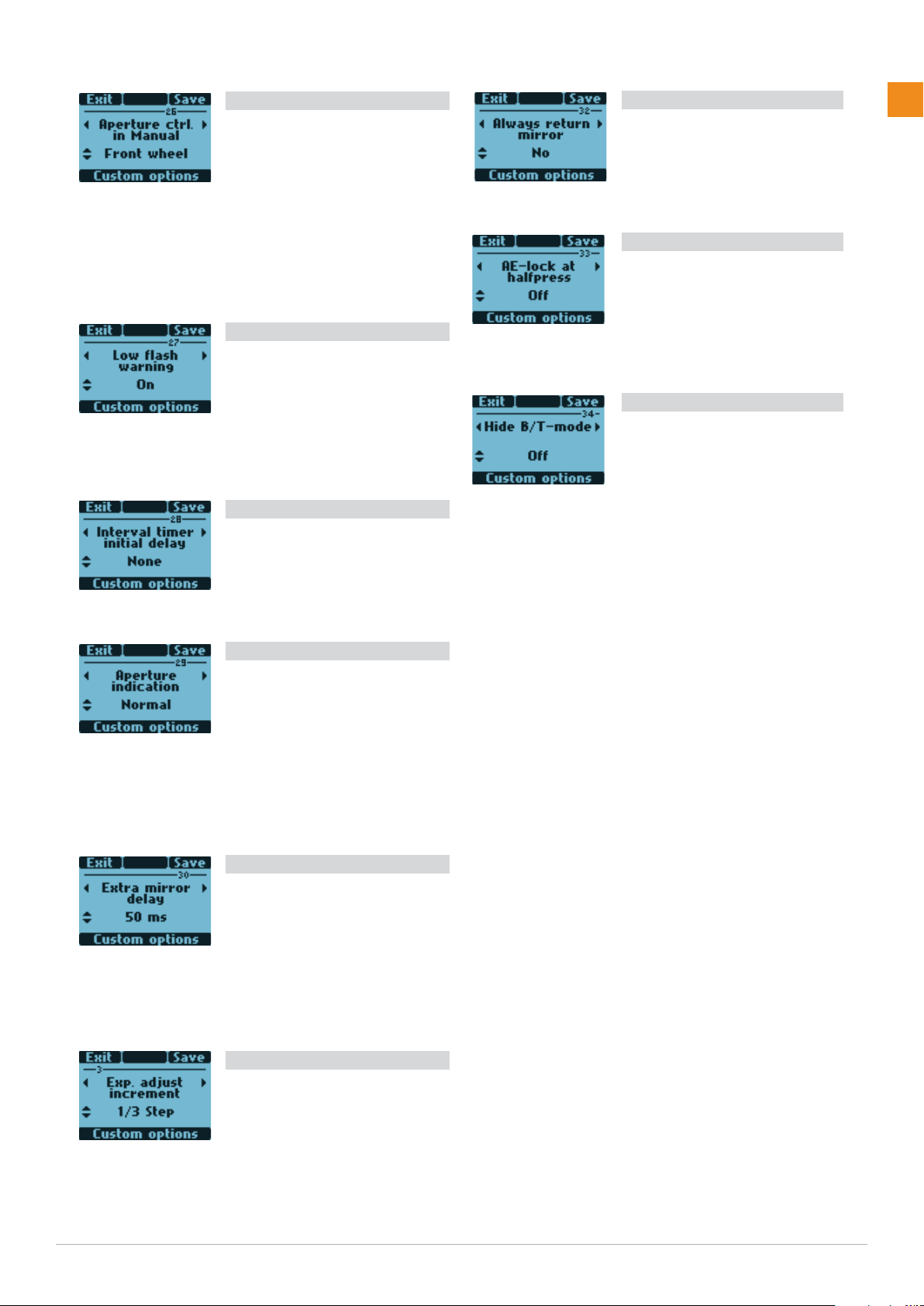
59
www.hasselblad.comH6X
Aperture control in Manual 26
•
Front wheel • Rear wheel
Selects which scroll wheel changes
the aperture setting when in Manual
exposure mode.
Front wheel selects the front scroll
wheel to change the aperture setting.
Rear wheel selects the rear scroll
wheel to change the aperture setting.
Low flash warning 27
•
On • Off
Controls the display of the ‘Low
flash’ warning message and triangle.
ON enables the function.
OFF disables the function.
Interval timer initial delay 28
•
None • 2s •10s • 60s • Interval time
Allows an initial delay before the first
capture of an interval timer function
operation.
Aperture indication 29
•
Normal • Light meter
Allows choice of aperture indication
display (in Manual mode only).
Normal selects conventional display
(f5.6, f8, etc)
Light meter selects ‘light meter’ type
display (f5.6⁰, f8.⁵, etc)
Extra mirror-delay 30
50 ms • 100 ms • 200 ms • None • 25
ms
Extends the delay period between
the mirror being raised and the
opening of the lens shutter thereby
reducing the negative effect of vi-
bration on longer exposure times.
True Focus in AF-S 31
• Off • on
Re-assigns half press of shutter re-
lease button to activate True Focus
function instead of standard auto-
matic focus (single)
Always return mirror 32
• No • Yes
Automatically lowers mirror again
for viewing at the end of every mir-
ror-up sequence.
AE lock at half press 33
•
Off • On
Allows access to AE-lock without
having to use customizable button
assigned to other required func-
tions.
Hide B/T mode 34
• Off • On
Hides access to B and T shutter
speeds allowing smoother transi-
tion from 1s to 1.4s when making
shutter speed changes.

60
www.hasselblad.comH6X
In Image info you can compose your own combination of letters, words, symbols, etc to be included in the metadata. The same
procedure is also used to change a Profile name.
SETTINGS > IMAGE INFO
IMAGE INFO SETTING
1) Press MENU.
2) Turn the
Front scroll wheel until Settings appears.
3) Press
ENTER.
4) Turn the
Front scroll wheel to access 4.2 Image info.
5) Press
ENTER to access the list of characters and figures
available.
6) By turning the
Front scroll wheel, the character selec-
tor cursor will move to the left and right in the available
characters while the rear scroll wheel moves it up and
down. The chart of characters will automatically scroll to
reveal the whole set. The space character is top left in the
list.
On the left side of the screen there is a small box frame
containing two arrow symbols and an X symbol. By
selecting the arrows you can position the cursor in the
line of text you have created. The X symbol deletes the
selected character.
To create a line of text, select the desired character and
press then Sel (AF button). That character is then auto-
matically added to the line of text below the character
chart. Press Save (ISO/WB button) to store the new
setting.
MENU
Front scroll
wheel
ENTER
or
SAVE
AF
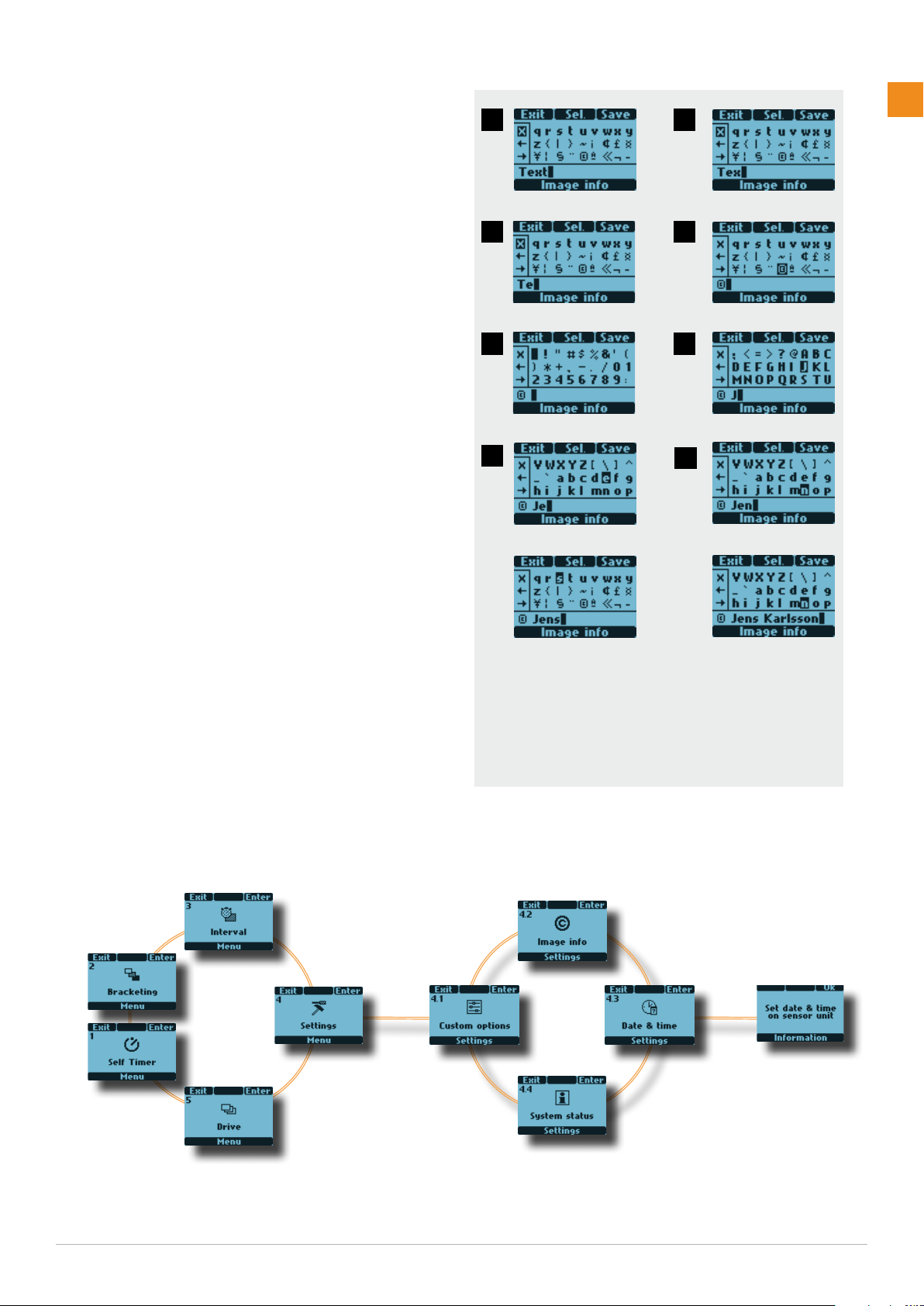
61
www.hasselblad.comH6X
IMAGE INFO SETTING
Here is an example of how to change existing text (in this
case the word ‘Text’ to a copyright symbol plus a photogra-
pher’s name -’Jens Karlsson’). See previous section 4.2 Im-
age info for procedure description.
1) Start by accessing the Image info screen. On the text
row towards the bottom of the screen, the text line cur-
sor is automatically placed to the right of the character
that is to be changed. Turn the front and rear scroll
wheels to move the selector cursor until the X symbol is
highlighted.
2) Press Sel. (AF button) and the character will be erased.
3) Repeated pressing of Sel. will progressively erase all the
characters in the line.
4) After erasing unwanted text, turn the front and rear
scroll wheels until the desired character is highlighted
by the selector cursor (in this case the copyright symbol)
and press Save. Note that more symbols have automati-
cally appeared as you scrolled down the screen.
5) Choose the next character in the same manner
(in this case a space) and press Save.
6) The capital letter ‘J’ has been highlighted and saved in
this example.
7) Repeat the procedure until all the letters and characters
you want appear. As you progress with more characters,
those to the left will temporarily disappear from the
screen so that you can see what you are adding. Don’t
forget there is a maximum of approximately 40 charac-
ters.
If you make a mistake you must remove each character
singly (see steps 1-3 above) until you reach where you
want to make a change and then return to the ‘Adding
text’ procedure again.
8) This example shows a completed 15 character text line
with symbols, spaces, upper and lower case (large and
small) letters.
SETTINGS > DATE & TIME
1
3
5
7
2
4
6
8
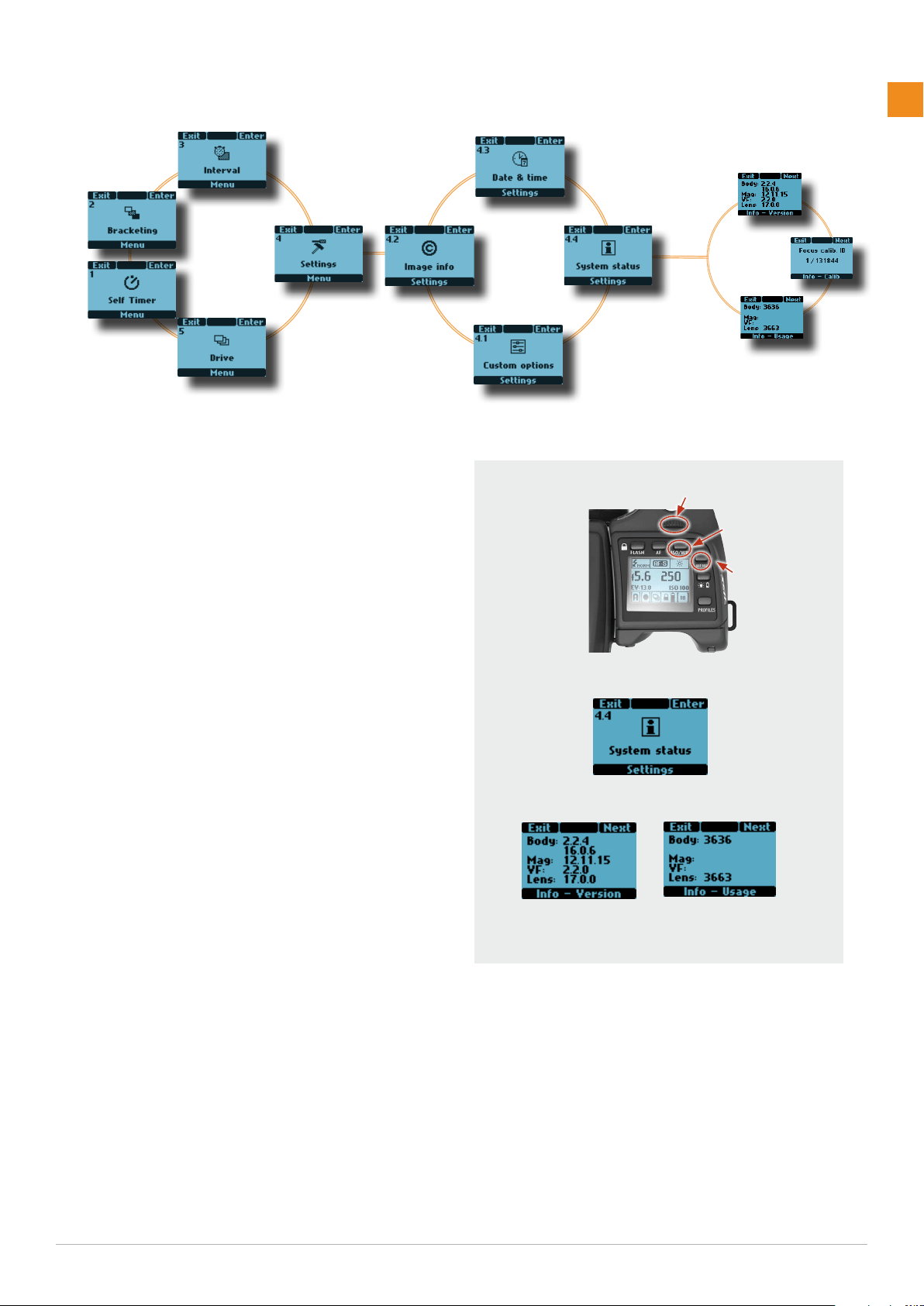
62
www.hasselblad.comH6X
Check component usage and general servicing information as follows:
SYSTEM STATUS DISCLOSURE
1) Press MENU on grip.
2) Turn the
Front scroll wheel until Settings appears.
3) Press
ENTER.
4) Turn the
Front scroll wheel to access System Status.
5) Press
ENTER.
6) The display now shows a list of camera components
Info-Usage and to the right of each individual com-
ponent a figure that represents the number of actions
taken by that component. Please note that even a com-
pletely new camera will have registered actions as these
occur during testing before delivery.
7) Press
NEXT to display Info-Version to display the soft-
ware version for each item. Press the Next (ISO/WB)
button again to display Info-Calib for focus calibration
information.
NOTE: Firmware version for film magazine only dis-
played with film magazine or H5D sensor unit.
SETTINGS > SYSTEM STATUS
MENU
Front scroll
wheel
ENTER
or
SAVE

63
www.hasselblad.comH6X
DRIVE
There are two drive modes: Single and Continuous. In
Single
mode, a capture is made when the shutter release button is
pressed and the camera is made ready for the next capture.
To make the next capture however, you must first release the
shutter release button and then press again.
SINGLE AND CONTINUOUS SETTING
In camera active mode:
1) Press MENU on grip.
2) Turn the
Front scroll wheel until Drive appears.
3) Press
ENTER.
4) Turn the
Front scroll wheel to Single or Continuous.
5) Press
SAVE.
In
Continuous
mode, the camera automatically makes cap-
tures and makes ready for the next capture in a continuous
manner as long as you maintain pressure on the shutter re-
lease. Please note the speed is dependent on the time taken
to save the capture according to equipment.
MENU
Front scroll
wheel
ENTER
or
SAVE
64
PROFILES
Photo: Vicente Ansola © / Hasselblad Masters

65
www.hasselblad.comH6X
The profiles feature allows rapid access to pre-determined
combinations of settings that increase the speed and secu-
rity of workflow. One example might be in a social situation
where there might be a need for formal outdoor portraiture
followed by informal indoor handheld flash-assisted wide-
angle shots, both situations requiring very different settings
in a stressful environment. By predetermining the relevant
settings required beforehand for each situation, they can be
saved collectively as a profile. By calling up the profile, you
can then be assured that all the settings are correct at the
press of one button.
For example, you might choose – autofocus single, brack-
eting, programmed exposure, etc – for outdoors. Once set,
you would click on the red PROFILES button, select a profile
name and press SAVE. A new name can be entered for the
new profile - ‘Outdoors’, for instance - and saved again. New
settings are made for the indoor shots changing to flash,
Pv setting, etc and the procedure repeated. By simply ac-
cessing ‘Outdoors’ or ‘Indoors’ in the profile list, all the rel-
evant settings will be instantly and correctly implemented
to match the situation.
There are eight profiles: Default, Full auto, Studio, Fill
flash. two Action and two Spare reserved for customiza-
tion. All except Default can be changed and renamed.
The pre-set profiles feature the following:
Default: normal flash sync, autofocus (single), single drive,
auto exposure (aperture priority), average metering, -None
Note
All settings, including those made on the sensor unit, are stored when a profile is created. This includes the ISO, white balance, color
temperature and color tint settings that were current at the time the profile was created. These profile settings will override the
settings in use at the time the profile button was pressed. In other words, remember to check for unintentional ISO, white balance
or color temperature changes when using profiles. (Color tint is not a user setting but is stored after a manual white balance has
been made).
MAKING A PROFILE
1) Activate the camera and go through the various settings
(for example, autofocus, aperture priority, fill flash expo-
sure compensation, etc.) you require for the particular
purpose and save them as you go.
2) When all the required settings have been made, click (not
press!) the
PROFILES
button (ON.OFF button) to access
the profiles screen.
3) Use the scroll bar
to go through the list of profiles. Choose a
Spare profile or a named profile (except Default). You can
either save the new profile under the original name or you
can change it
4) Press
Save
(ISO/WB button). The Profile name screen is
then displayed where you can rename the profile to what
suits you (see under Image Info 4.2 for procedure details).
To use a profile from the main screen, press the PROFILES
button to reach the profiles screen again. Scroll down the
list to the profile you want and then press the Load (AF) but-
ton. All the saved settings will then be automatically imple-
mented.
Full auto: normal flash sync, autofocus (single), single drive,
programmed exposure, centre weighted metering, -None
Studio: normal flash sync, manual focus, single drive, manu-
al exposure, spot metering, - AF
Fill flash: normal flash sync (adjusted output -1.7EV), auto-
focus (single), single drive, auto exposure, average metering.
Spare: customized profiles.
The default setting is highlighted on the display for easy and
rapid access. Access to profiles lower on the list is via a scroll
bar visible on the right of the display. Rotate the rear scroll
wheel to bring them into view.
All user profiles can be restored to default values again sim-
ply by removing the battery and holding down the MENU
and ISO/WB buttons on the grip together and while keeping
them depressed, replace the battery. There will be an audible
signal that denotes the restoration.
There are two ways of making, saving and managing Profiles:
1) Using the buttons on the grip
or
2) via the Camera Configuration tool in Phocus (with H5D
sensor units only).
Note
If you decided to change the settings but nevertheless keep
the Profile name on the list, the new set of parameters will
be retained under that name. That is to say, the settings will
not be the same as listed here, despite the name. It might be
safer practice therefore to always change the profile name
to avoid later confusion.
PROFILES
SAVE
(ISO/WB)
LOAD
(AF)
PROFILES
(On/Off)
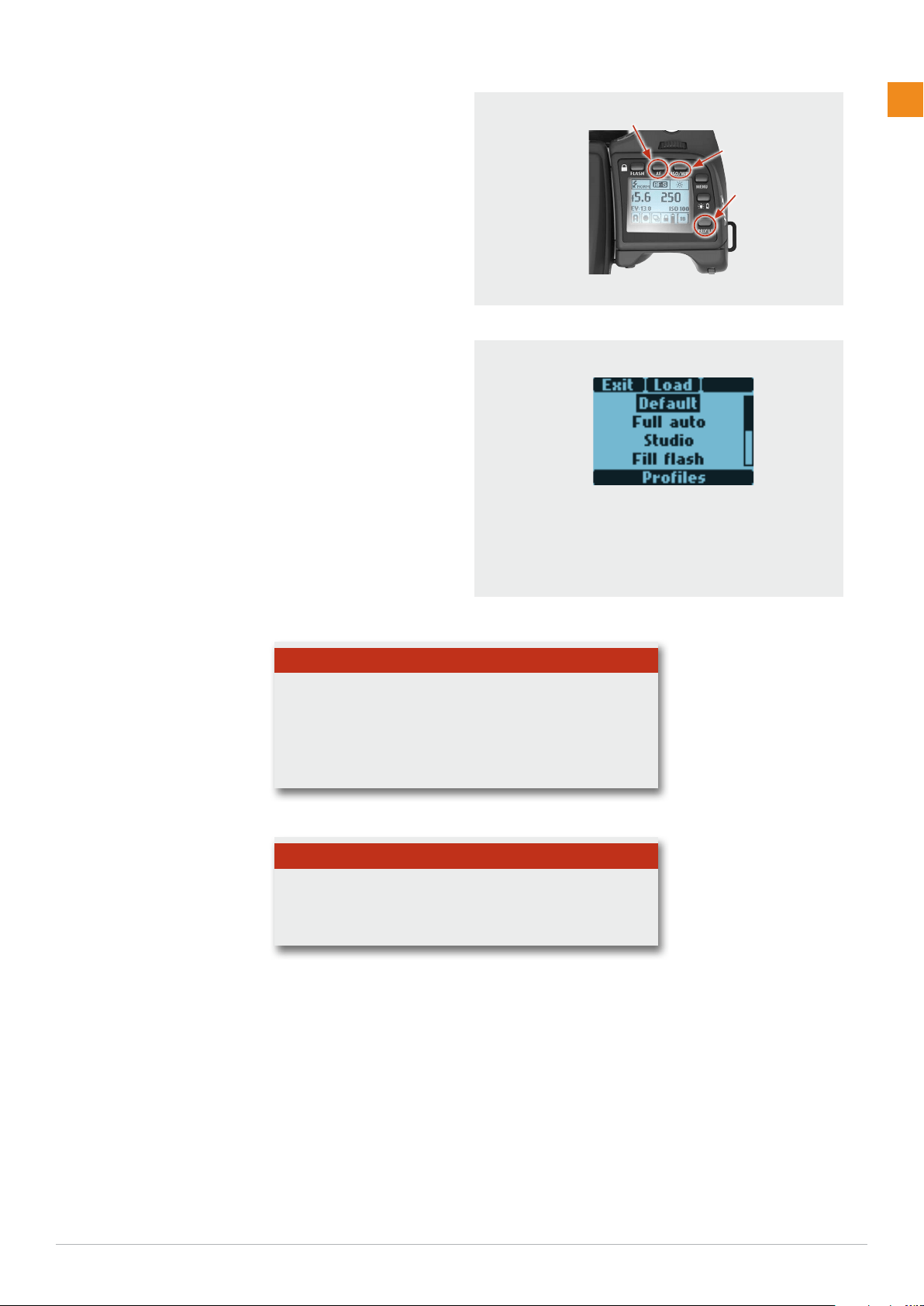
66
www.hasselblad.comH6X
USING PROFILES
1) From the main screen, click
PROFILES
on the grip and the
profile screen will appear.
2) Use the scroll bar to go through the list and highlight the
desired profile.
3) Press
Load
(AF button). The camera is now set according to
all the parameters stored according to the name.
CHANGING A PROFILE NAME
You can change a profile name (except ‘Default’) at any time.
1) From the main screen, click
PROFILES
(ON.OFF button)
on the grip and the profile screen will appear.
2) Scroll through the list (front or rear scroll wheels) and
highlight the desired profile.
3) Press
Load
(AF button).
4) Click
PROFILES
(ON.OFF button) again.
5) Press
Save
(ISO/WB button) The Profile name screen is
then displayed where you can rename the profile to what
suits you (see under Image Info 4.2).
Tip
To quickly reset all profiles back to the original factory settings:
1. Remove battery.
2. Wait 5–10 seconds.
3. Replace the battery while keeping both the Menu and IS0/
WB buttons pressed.
Tip
Profiles and profile creation can be handled in Phocus in a very
intuitive way. The Camera Configuration is found in the menu:
Window / Camera Configuration
– for use with H5D sensor units only
.
ENTER
or
SAVE
AF
PROFILES
67
Photo: Olivier Valsecchi © / Hasselblad Masters
FLASH / STROBE
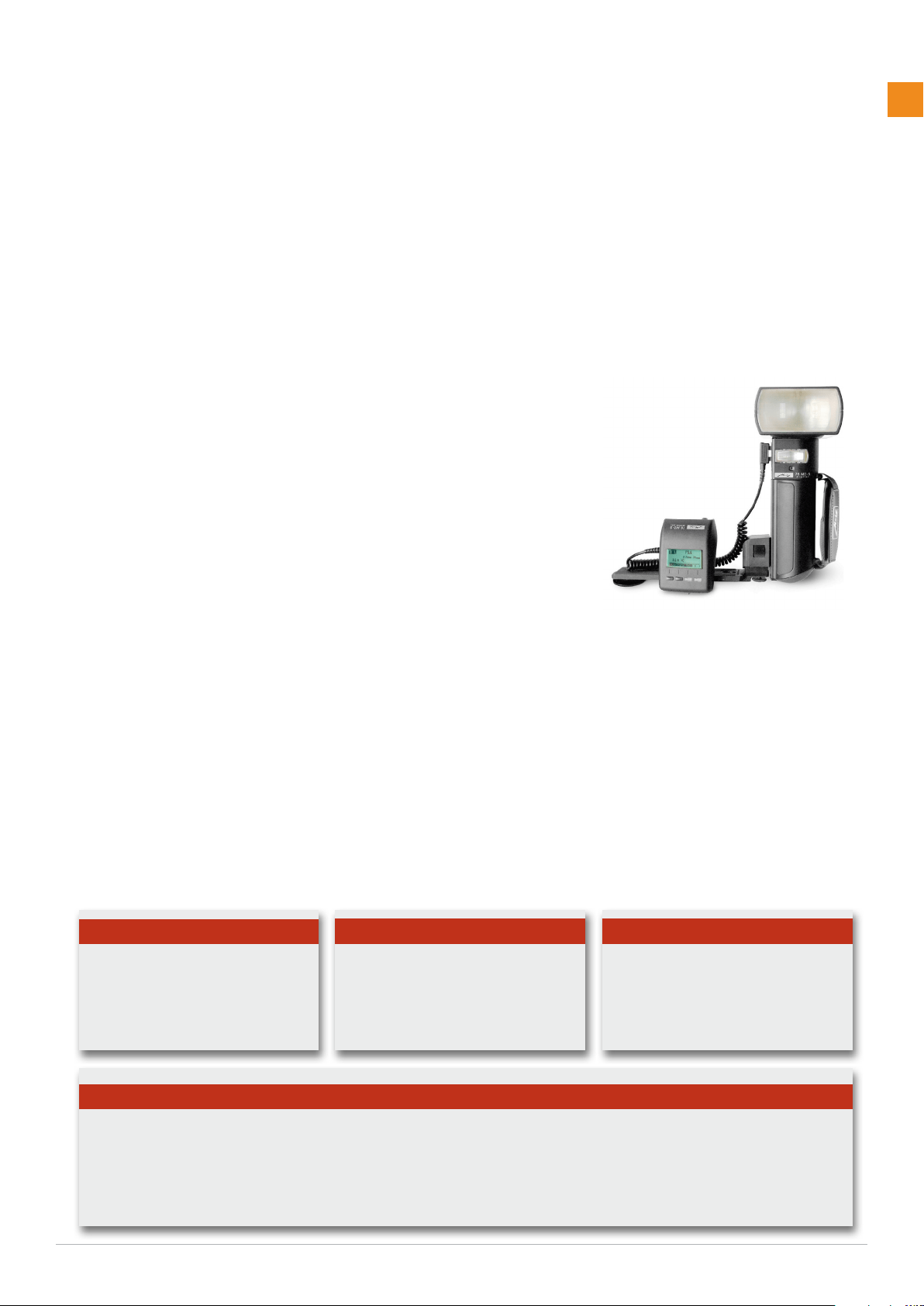
68
www.hasselblad.comH6X
Note
As with all strobe/studio flash use, very particular attention should be taken to ensure correct connections and general handling
practice. Potential dangers might increase when cameras are also connected to electronic peripherals (computers, lighting backs,
etc) and should diminish when IR and similar wireless flash release devices are used.
Victor Hasselblad AB can accept no responsibility whatsoever for accidents that might occur or damage caused when Hasselblad
equipment is used in combination with third-party backs of any description.
Note
Do not attempt to connect a flash unit
dedicated for use with another camera
brand via the hot shoe. The flash unit
and / or camera could be damaged.
Note
Only flash units specially adapted for
use with the H6X should be connected
to the hot shoe on the camera.
Note
If using flash/strobe as the main light
source and 1/800s shutter speed,
remember to turn off the True Exposure
function (Custom Option #13 on grip).
The H6X can be used together with most flash units in man-
ual mode. However, to make use of a TTL automatic function,
you must ensure the flash unit is compatible with the SCA
3002 system. Connection is either by the PC socket or by the
hot shoe (see warning note below).
The viewfinder houses an integral fill-flash with a guide
number of 12 and features OTF/TTL flash control. This back is
capable of providing enough illumination for many fill flash
functions outdoors as well as simple indoor shots at shorter
distances.
Flash output can be adjusted separately from ambient ex-
posure for optimum control.
Separate flash units can be used in dedicated mode when
connected to the hot shoe if the back is compatible with the
SCA3002 (Metz) system using a Hasselblad SCA3902 adapt-
er. This provides a cable free link up for information transfer.
Flash synchronisation can be set to normal or rear (the be-
ginning or end of a capture).
Please see the relevant user manuals for information regard-
ing separate flash units.
GENERAL
When using the A or S setting together with flash, the exposure requirements of
the camera will dominate which might produce slow shutter speeds indoors, for
example, requiring the use of a tripod. If, on the other hand, you select P or Pv in-
stead, then a shutter speed of 1/60 or faster is automatically chosen by the camera
enabling you to hand hold.
When using flash close up or when using larger aperture settings, remember that
the flash unit’s output has a specific minimum duration which might still be too
great for correct exposure. Read the back’s output specifications for further infor-
mation regarding any potential restrictions.
You can use the flash metering capability with external flash units of all kinds (TTL
flashes must be set to Manual mode).
Rear sync is a useful feature used either for effect or to produce a more ‘natural’
look when combining long exposures involving light trails and flash.
When using suitable dedicated backs (compatible with SCA3002), adjustments
are made automatically and governed by the settings on the camera. This applies
to whether the flash unit is set to TTL or whether it is set to its own integral meter-
ing system (A).
Control of either the integral flash unit or separate SCA3002 compatible flash unit
regarding the two functions, exposure compensation and shutter sync, is via the
grip. The flash measure function can be used for flash units that are not SCA 3002
compatible or for SCA 3002 compatible backs at manual setting.
To change the balance between flash output and camera exposure requirements
to produce a variety of effects, use the exposure compensation function. For vari-
ous long exposure effects use the sync function. To make flash exposure tests use
the flash measure function.
FLASH / STROBE
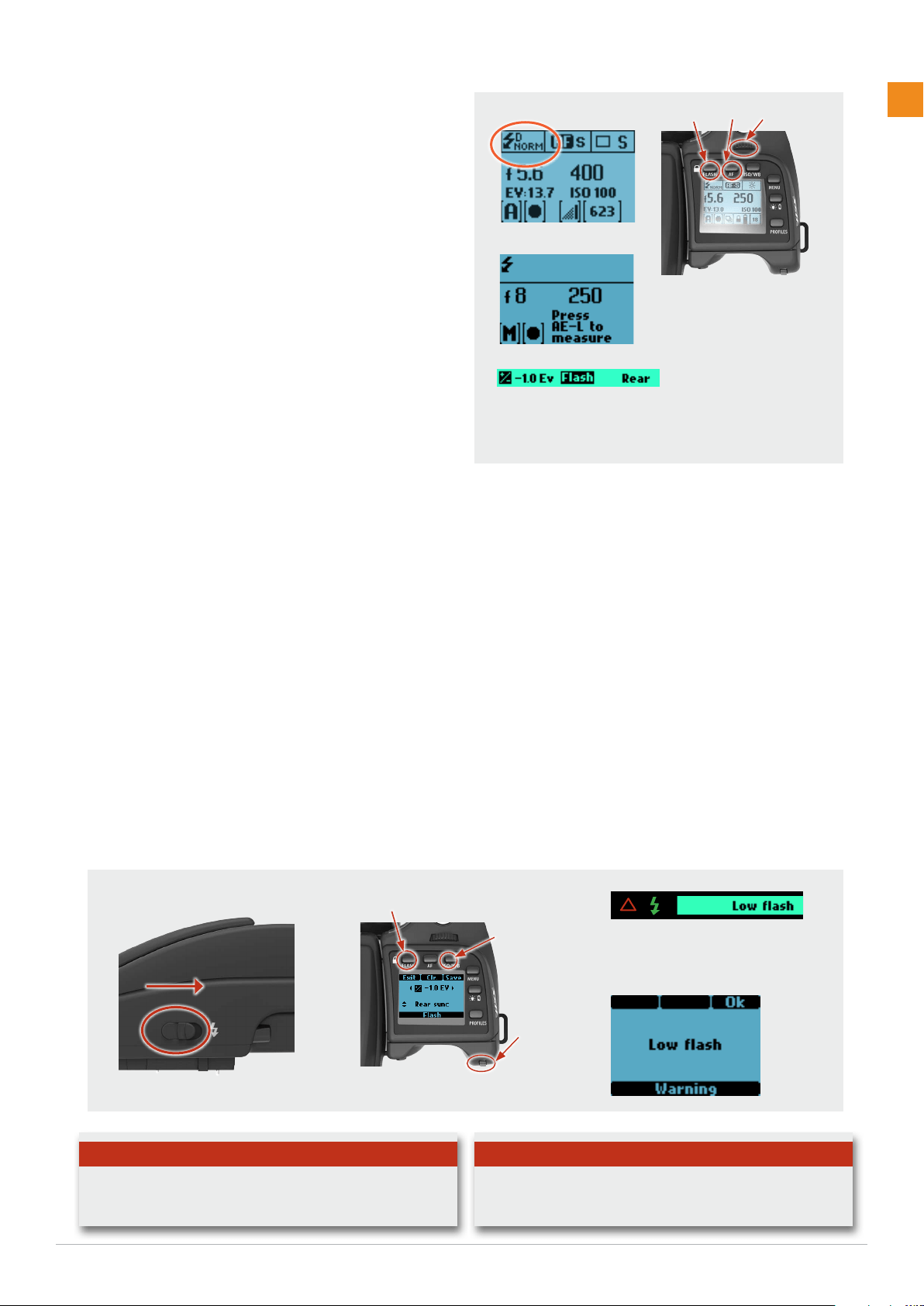
69
www.hasselblad.comH6X
INTEGRAL FLASH
The integral flash unit features the following specifications:
Guide no. 12
Coverage 56º horizontal,
44º vertical
Maximum light fall-off at side centres - 1EV (50%)
Color temperature (full flash) 5,000 – 5,600º K
To raise the flash unit into its operative position, slide the
flash-back catch backwards in the direction of the flash sym-
bol. To return the flash unit into its closed position, push
down on the top of the back until it clicks back into place.
The flash unit is automatically activated when it is in the
operative position and de-activated when returned to its
stored position.
The green LED flash symbol blinks in the viewfinder when
the flash unit is charging and remains stationary when fully
charged. The flash output can also be adjusted for optimum
light balance in fill-flash situations.
ACCESS TO CONTROLS
1. Activate the camera and press the FLASH button once.
2. Turn the
Front scroll wheel to set the amount of com-
pensation required:
• from +3EV through -3EV
• press
Clr to clear the setting quickly if required.
3. Turn the rear scroll wheel to set:
• normal sync (flash triggered just after the shutter
opens)
• rear sync (flash triggered just before the shutter
closes)
• flash measure (with non-TTL flash units or TTL
backs in Manual mode)
4. The grip display shows the flash mode – Normal or Rear
– in the standard display.
5. When set to Flash Measure, a specific screen requests
you to press the AE-L button in order to make a read-
ing. See below for details.
Example of viewfinder display
showing Flash set to Rear sync
as well as '- 1EV' exposure com-
pensation.
Note
For full coverage with the integral flash, use 80mm or longer
lenses (without a lens shade).
Note
Do not use the integral flash together when another external
TTL flash unit is connected (and used in TTL or A mode).
Using the integral flash:
1) Slide the flash-back catch backwards in the direction of
the flash symbol.
2) Press
FLASH.
3) Choose between Normal or Rear sync by turning the
Rear scroll wheel and the amount of compensation (if
required) by turning the front scroll wheel.
4) Press
Save. Make an exposure.
5) If the settings were incorrect to match the output of the
flash unit, the viewfinder display shows a red triangle
alongside a flashing green ‘flash’ symbol plus a warning
message - ‘Low flash’. The grip display will also show a
warning message - ‘Low flash’.
Conventional measures should then be taken to correct
the situation. (That is: move closer to the main subject,
use a larger aperture setting or use a higher ISO setting).
Red warning triangle and green LED
flash symbol to left of viewfinder LCD
display.
FLASH
SAVE
Rear scroll
wheel
Front scroll
wheel
Clr
FLASH
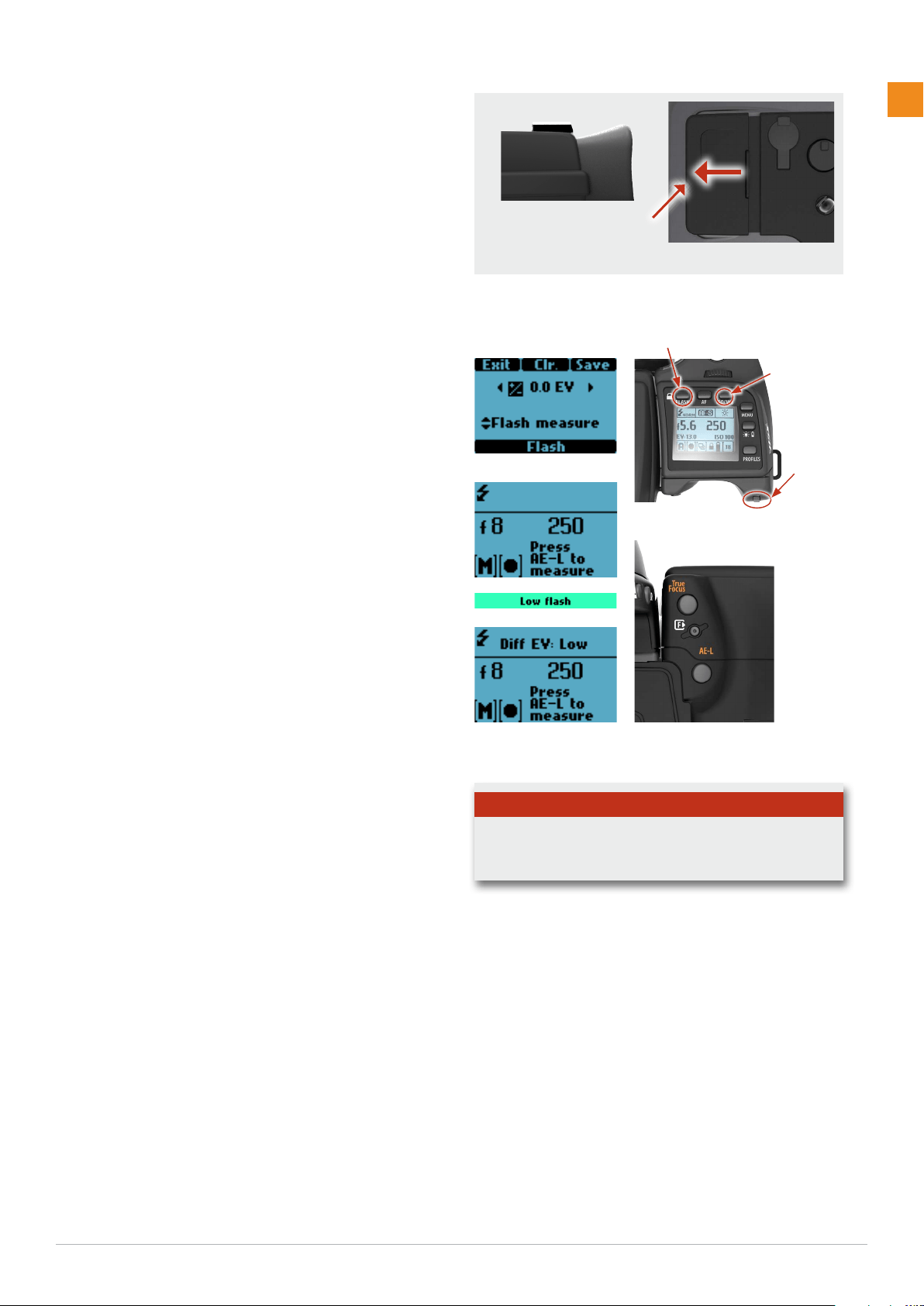
70
www.hasselblad.comH6X
SEPARATE FLASH UNIT CONNECTION
Separate flash units can be electrically connected either by
way of the hot shoe accessory holder (see previous warn-
ings) on the top of the viewfinder or via a cord to the PC con-
nection port on the left hand side of the camera body. Slave
unit switches/ transmitters can also be connected similarly
dependant on unit (see specific user manuals for details).
Keep the plastic safety cover in place in the hot shoe when
not in use.
FLASH MEASURE OF SEPARATE
FLASH UNIT
You can measure the effect of an attached flash unit (with PC
connected flash units and SCA3902 compatible flash units
set to M mode), where the camera acts much as a flash me-
ter would. The aperture setting can be adjusted and more
trial exposures made until the information on the grip dis-
play is satisfactory.
To use flash measure:
1) Press the FLASH button on the grip to access the flash
option screen.
2) Turn the
Rear control wheel until Flash measure
appears.
3) Press Save (
ISO/WB button) to access the flash expo-
sure screen.
4) Make preliminary required aperture setting by turning
the front control wheel.
5) Press the
AE-L button. The camera will close the aper-
ture, raise the mirror and fire the flash. Light reflected
from the flash lit subject will be reflected off a white spot
on the auxiliary shutter to the meter sensor.
6) Deviations from a normal exposure are displayed as
differences in EV on the grip display and the viewfinder
display. If ‘high’ or ‘low’ appears, change the aperture
accordingly and make a new test reading.
Change the aperture until Diff EV: 0 appears, or the
desired amount of deviation from the normal exposure.
Diff EV: Low signifies more than 2 EV under
Diff EV: High signifies more than 2 EV over
Tip
The ‘Low Flash’ warning can be turned off in Custom Option
#26 if preferred.
FLASH
SAVE
Rear scroll
wheel
Lift this edge of the cover first
71
ACCESSORIES
Photo: Milosz Wozaczynski © / Hasselblad Masters
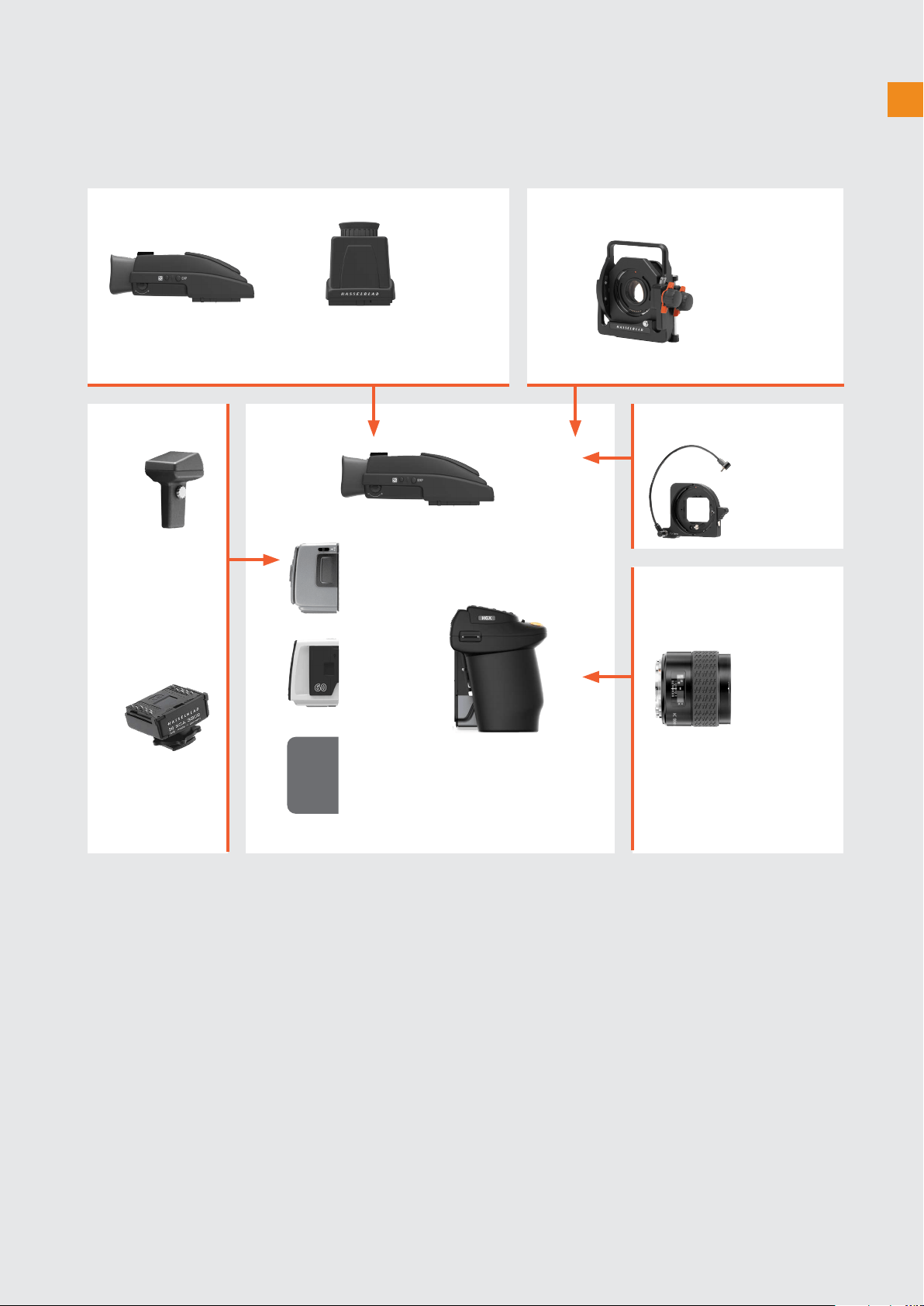
72
CONNECTIVITY DIAGRAM
Optional V system lenses
Tilt/Shift
Lenses
HVM waist-level
viewnder
HV 90x / HVD 90x viewnders
Optional viewnders
H6X Camera
All HC/HCD
lenses, including
extension tubes
and converters
CF lens adapter
HTS 1.5.
For use with HCD28,
HC35, HC50, HC80
and HC100 (including
extension tubes)
HV 90x-II viewnder (not included)
Accessories
GIL GPS receiver
– for use with H5D sensor
units only
SCA3902 TTL Flash
Adapter
Camera body
Film magazine
H4D/H5D Sensor units
3rd party digital backs *
* Same functionality as H5X Cameras
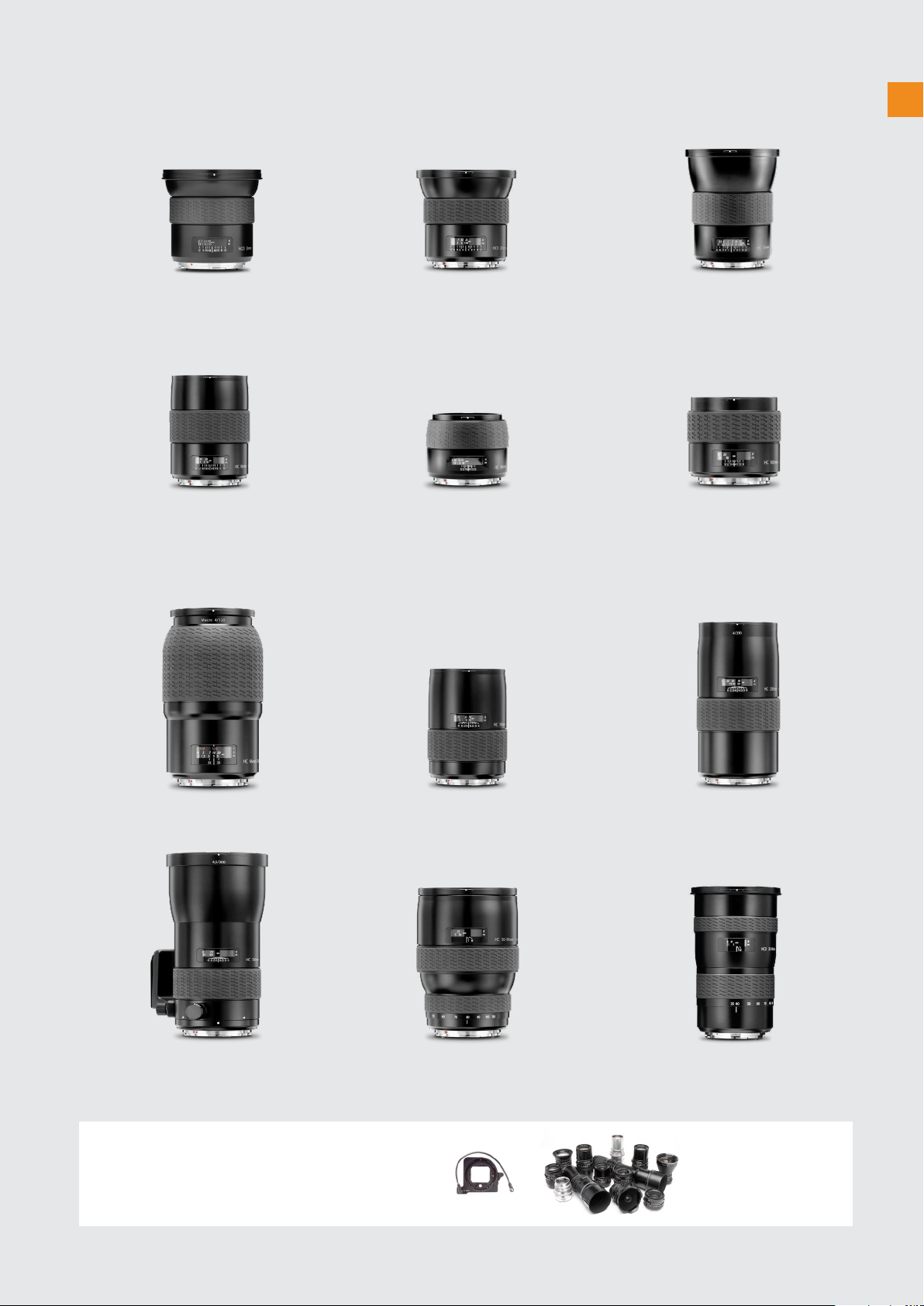
73
HCD 4/28mm
HCD 4.8/24mm
HC 3.5/35mm
HC 2.8/80mm HC 2.2/100mm
HC 3.2/150mm
HC 4/210mm
HC 3.5–4.5/50–110mm HCD 4.0–5.6/35–90mm
HC 3.5/50-IImm
HC 4.5/300mm
HC Macro 4/120-IImm
HC LENS RANGE
Most V system C type lenses with
optional CF lens adapter
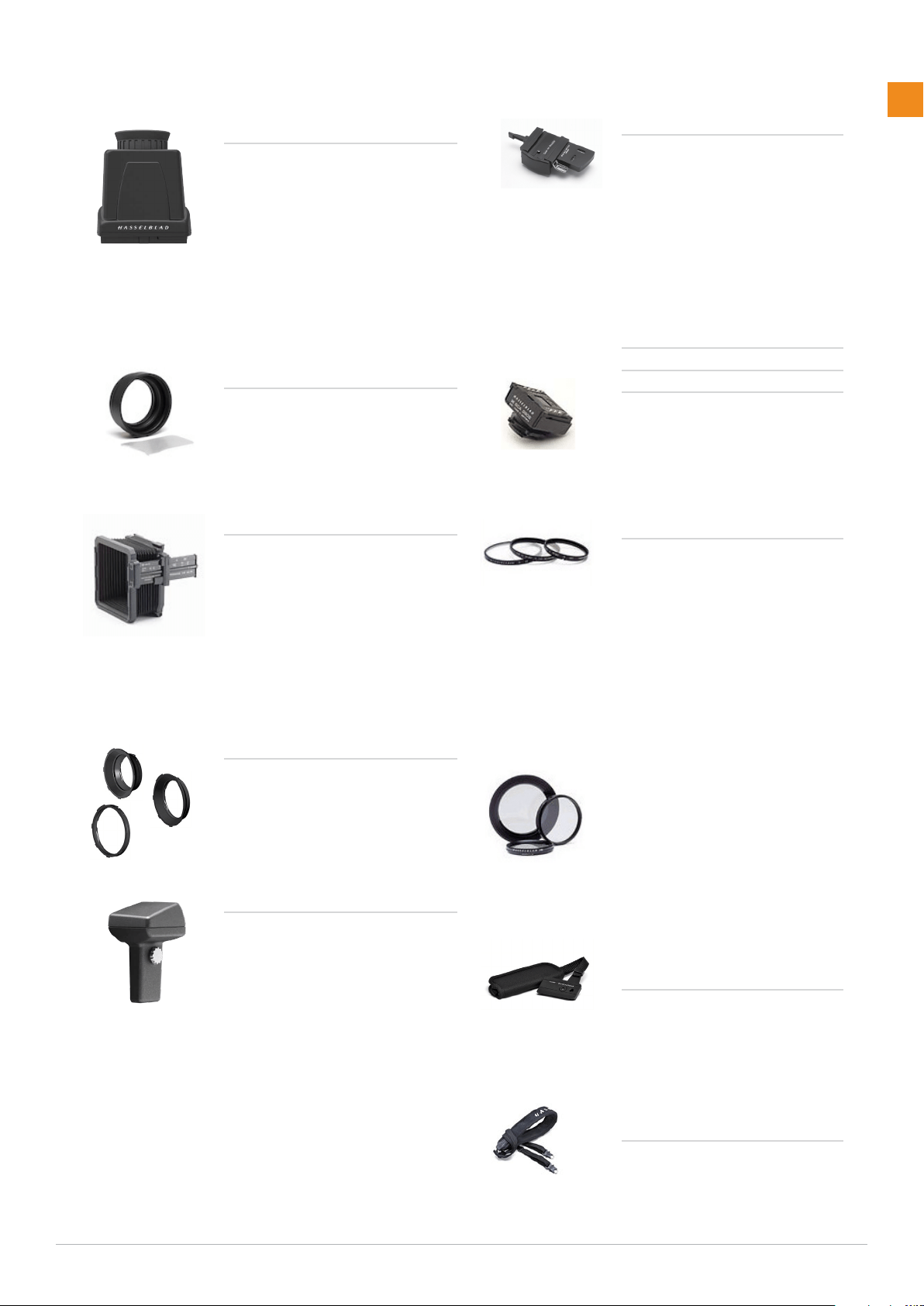
74
www.hasselblad.comH6X
HVM waist level viewfinder
(3053328)
The HVM waist level viewfinder al-
lows a comfortable lower viewing
angle either for effect or where eye
contact with the subject is desirable
in portrait photo graphy, for example.
Autofocus function of all lenses fully
retained. Optimized for horizontal
format shooting and not suitable for
vertical format use.
HVM correction lens holder
(3053348)
Lens holder for custom made eyesight
correction (lenses available from opti-
cians). To be used for optimal viewing
comfort and accuracy.
Proshade V/H 60 – 95
(3040740)
An adjustable bellows lens shade
that provides highly efficient protec-
tion against stray light. Its compact,
flat folding design saves space in the
equipment case. With adapters fits all
HC lenses and virtually all V system
lenses. Also features a filter holder for
glass, gelatin, or plastic filters.
Proshade adapters
(3043415, 3043417, 3043419)
67mm, 77mm and 95mm adapters
with bayonet mount for HC lenses.
Features lock to provide positive and
secure attachment.
GIL (Global Image Locator)
(3053300)
The Hasselblad GIL (3053300 ) pro-
vides automatic creation and storage
of GPS information for all H-system
digital cameras. The data is tagged
to each individual image file and can
be read directly by Phocus. The back
requires no extra external battery or
power source and works seamlessly in
the background for ease of use
– for use
with H5D sensor units only
.
Tripod quick coupling H
(3043326)
Mounted on a tripod, this acces-
sory facilitates rapid attachment
and removal of the camera. The
camera is firmly held in an exact
and repeatable position. Two inte-
grated spirit levels make horizontal
positioning of the camera easy. The
Tripod quick-coupling H fits 1/4”
and 3/8” tripod threads and has a
safety catch.
Flash adapter SCA 3902
(3053393)
For connecting flashes compatible
with the SCA 3002 system to the
Hasselblad H6X.
UV-sky filters
(3053470, 3053474 and 3053478)
Absorbs UV radiation and reduces
blue haze without affecting colors.
Also protects the front lens surface.
Particularly recommended when
the camera is used in harsh condi-
tions. Available in three sizes to
suit various lenses: UV-sky 67mm
(3053470), UV-sky 77mm (3053474)
and UV-sky 95mm (3053478).
Pola filters
(3053482, 3053486 and 3053490)
Reduces non-specular reflections
and glare. Increases color saturation
in general. Can intensify a blue sky.
Available in three sizes.
Support strap with
Quickplate H
(3045154)
Improves comfort and security with
hand-held photography. Complete
with quick plate H.
Camera strap H
(3053616)
Extra wide camera strap with anti-
slip backing.
OPTIONAL ACCESSORIES
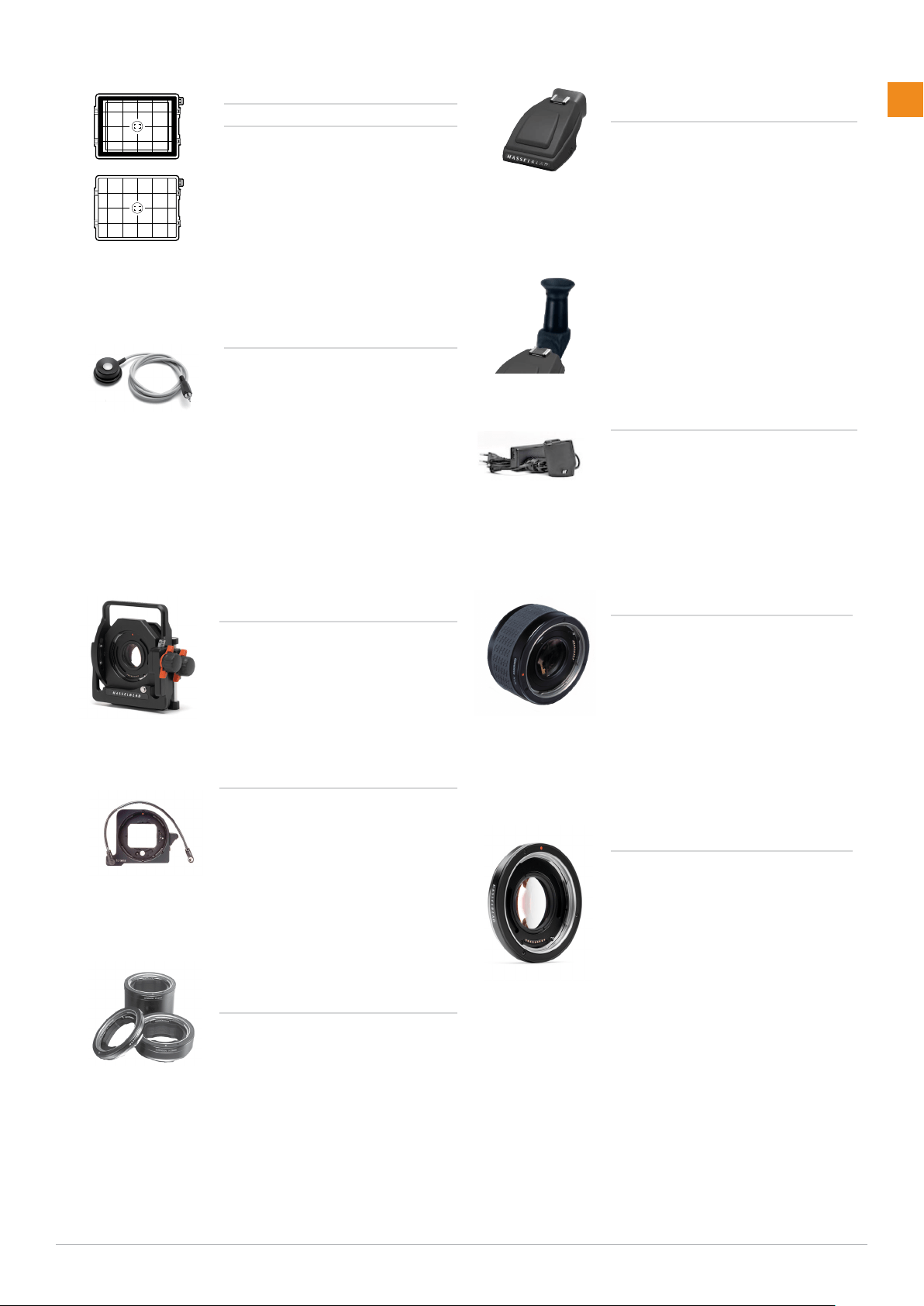
75
www.hasselblad.comH6X
HTS 1.5
(3043400)
The HTS 1.5 is a shift and tilt adapt-
er designed for the HCD28mm,
HC35mm, HC50mm, HC80mm and the
HC100mm lenses. It not only solves
technical challenges but also provides
exciting opportbackies for creative
solutions.
CF Adapter
(3043500)
The CF adapter allows virtually all lens-
es from the V-system to be used on H-
system camera bodies. This automati-
cally expands the potential lens range
for H cameras by more than a dozen
different focal lengths.
H 13, 26 and 52 Extension
tubes
(3053513, 3053526 and 3053542)
The Extension tubes attach between
the lens and the body to reduce the
close focusing distance for close up
photo graphy. They are available in
three sizes: 13 mm, 26 mm and 52 mm.
As the H6X has a TTL light metering
system, exposure compensation is au-
tomatic.
Focusing screens
All focusing screens are of the Spheri-
cal Acute-Matte D type with or with-
out grid and central markings for spot
(Ø 7.5) and AF metering area. Grid
patterns provide aid in technical,
architectural, documentation and
other similar fields.
Available with or without masking for
the sensor format.
Release cord H
(3043370)
Remote release cord with a cable
length of 0.5 m.
Converter H 1.7X
(3023717)
The Converter attaches between the
lens and the body to increase the focal
length by a factor of 1.7. This provides
a convenient way to expand your
range of lenses. The Converter H 1.7 X
features the same outstanding opti-
cal and mechanical quality as all the
lenses in the Hasselblad H system. The
optical design consists of 6 elements in
4 groups.
Macro Converter H
(5023720)
The Macro Converter is designed to im-
prove the close range performance of
wide angle H system lenses. Although
primarily aimed for use in conjunction
with the HC 50-II lens for optimum
performance, it can also be used with
any of the other H system wide angle
lenses.
HVD 90x / HV 90x & 90x-ll view-
finders
(3053330, 3053326, 3053334)
90 degrees reflex viewfinder, providing
100% field of view even when wearing
eyeglasses. Includes built-in fill flash and
multi-mode light metering system.
Angle finder H
(S100A12359A00)
Angle finder for the HV 90x and the HVD
90x viewfinders. Enables vertical view-
ing angle regardless of camera position.
Requires a minor modification to the
viewfinder eyepiece.
DC power grip
(3043350)
Removable H-camera grip with AC
power adapter for supplying camera
power from domestic mains supplies.
Check www.hasselblad.com for further details about lens shades, endcaps, lens pouches etc or news of new accessories.
OPTIONAL HC LENS ACCESSORIES
76
APPENDIX
Photo: Jon Lowenstein © / Hasselblad Masters

77
www.hasselblad.comH6X
Camera Type Auto-focus, auto-exposure SLR camera with interchangeable viewfinders and lenses.
Construction One piece stainless steel shell. Die-cast aluminium internal structure. Tripod sockets (1/4 and 3/8”) and quick
coupling tripod plate for rapid mounting.
Lenses Hasselblad HC/HCD lenses with built-in electronically controlled shutter and aperture. Automatic or manual
focusing with instant manual focus override. All HC/HCD lenses meet the exacting requirements of digital photo-
graphy. Lens shades can be mounted in reverse for transport. V- system lenses can be used with a CF adapter.
Viewfinder (HV 90x-II) A 90° reflex viewfinder, providing 100% field of view even when wearing eyeglasses, and built-in multi-mode light
metering system. Image magnification 3.1x. Integrated fill-in flash with guide number 12. Hot-shoe for automatic
flash (Metz SCA3002 system / adapter SCA3902). Dot matrix display with presentation of all relevant information.
Built-in diopter adjustment from -5 to + 3.5D. Interchangeable.
Focusing Automatic and manual focusing with electronic focus aid in manual mode. Instant manual focus override. Automatic
focusing using passive central cross type phase detection sensor. AF metering range EV 1 to 19 (ISO 100).
Shutter Electronically controlled lens shutter with speeds up to 1/800. Flash sync at all speeds.
Flash control TTL centre-weighted system. Can be used with the built-in flash or a wide variety of flashes compatible with the
SCA3002 (Metz) system using adapter SCA3902. ISO range 16 to 6400. Flash output can be adjusted (-3 to +3EV)
for fill-in purposes independent of ambient light. Synch at all shutter speeds.
Flash measurement The H6X has a built-in measurement system that measures flash light from non-TTL flashes, such as studio flashes.
Exposure metering Multi-mode exposure metering using 90° reflex viewfinder. Metering options are: Spot (diameter 7.5 mm),
Centre Weighted, and CentreSpot. Metering range at f/2.8 and ISO100: Spot: EV2 to 21, Centre-weighted: EV1 to 21,
CentreSpot: EV1 to 21.
Auto bracketing Bracketing using predetermined number of captures (2, 3, 5, 7 or 9) in 1/3, 1/2, or 1 EV step difference intervals.
Interval timer Number of captures from 2 to ‘no limit’ and interval from 1 second to 1 hour.
ISO range Dependent on sensor unit.
Displays The camera features two dot-matrix displays that provide clear and easy-to-understand information to the user. One is
located on the grip and the other in the 90° viewfinder.
Focusing screen Bright Spherical Acute-Matte type D with sensor format markings. Grid marked type also available as option.
Compatibility All H System lenses and accessories. V system C type lenses with optional CF lens adapter.
Accessory connection Provided with two M5 threads and an electrical connector for accessories.
Customization A large number of the H6X’s functions can be customized by the user to suit specific styles or situations through
the built-in menu system.
User interface Both basic and advanced functions are set using buttons and scroll wheels in conjunction with the grip display and
viewfinder display.
Rechargeable battery grip Li-ion 3200 mAh output.
External dimensions Camera body: 154 x 114 x 89 mm [W x H x L].
Weight Camera body with battery grip and viewfinder: 1170g.
TECHNICAL SPECIFICATIONS

78
www.hasselblad.comH6X
DEFAULT SETTINGS DEFAULT PROFILE
Exp.mode
LM mode
Exp. adjust
Focus mode
Drive mode
Flash sync
Flash adjust
Delay
Sequence
Mirror mode
Frames
Sequence
EV diff
Frames
Interval
1
2
3
4
5
6
7
8
9
10
11
12
13
14
15
16
17
18
19
20
21
22
23
24
25
26
27
28
29
30
31
32
33
34
A (Aperture priority)
Centre weighted
0
AF-S
S
Normal (beginning of exp.)
0
10 sec
Mirror up / Delay
Mirror goes down
3
Normal - over - under
0,5 EV
3
0 min 30 sec
Display Off 30 sec
EV increment 1/2 step (0.5 EV)
Exp adjust increment 1/3 step (0.3 EV)
True Focus button function True Focus
AE-Lock button function AE-lock
Stop Down button function Stop down
M.UP button function Mirror up
Control wheel direction CW
Flash ready exposure lock Yes
Magazine exposure lock Yes
Lens exposure lock Yes
Out of range exposure lock No
True exposure On
Spot mode Normal
Focus aid in MF Half press
AF assist light Ext. Flash
Rear wheel quick adjust Yes
Control lock All controls
Beeper On
Show histogram Yes
Interval & Self timer Exit
AE-lock & Quick adjust Exp. reset
Show EV Yes
Show ISO Yes
Bracket param. in Manual Shutter speed
Aperture control in Manual Front wheel
Low flash warning On
Interval timer initial delay None
Aperture indicator Normal
Extra mirror-delay 50ms
True Focus in AF-S Off
Always return mirror No
AE lock at half press Off
Hide B/T mode Off
GENERAL
SELF TIMER
BRACKETING
INTERVAL TIMER
CUSTOM OPTIONS
LIGHT METERING METHOD SENSITIVITY DISTRIBUTION

79
www.hasselblad.comH6X
TRUE EXPOSURE
P Mode
8
Shutterspeed
1000
500
250
125
60
30
15
8
42
1s
2s
4s
8s
16s
32s64s
2. 0
2. 8
4. 0
5. 6
11
16
22
32
45
64
90
1. 4
Aperture
1
0-1-2-3-4-5 23 45 6 7891011EV
12
23
22
21
20
19
18
17
16
15
14
13
210
80
35
150
120
50
50-110 @ 50
50-110 @ 110
8
1000
500
250
125
60
30
15
8
42
1s
2s
4s
8s
16s
32s64s
2. 0
2. 8
4. 0
5. 6
11
16
22
32
45
64
90
1. 4
1
0-1-2-3-4-5 23 45 6 7891011EV
12
23
22
21
20
19
18
17
16
15
14
13
210
80
35
150
120
50
50-110 @ 50
50-110 @ 110
Shutter speed
Aperture
Pv Mode
Shutter speed
Aperture
AUTOMATIC EXPOSURE P & PV MODE
Light level at
image plane
T
fully open
Time
Maximum aperture
Stopped down one stop with True Exposure mode ON
Stopped down one stop with True Exposure mode OFF
T
stopped down =
T
fully open
(using True Exposure)
T
stopped down >
T
fully open
(without True Exposure)
True Exposure is an HC/HCD lens function that allows the
shutter speed to remain un-affected when stopping down.
This effect is perhaps not so commonly understood as it is
restricted specifically to integral lens shutters as opposed to
focal plane shutters.
When a lens is stopped down, the effective shutter speed
becomes longer, consequently affecting the set exposure.
At slow shutter speeds the effect is minimal but at faster
speeds, e.g. 1/500s, the effect becomes clearly visible. As
Hasselblad knows exactly how the shutters behave in HC
lenses, automatic compensatory measures in speed setting
adjustments are therefore employed.
As compensation can only be put into effect where speeds
can be adjusted, this prevents the possibility of adjusting
the fastest speed of 1/800s. To counter this, compensatory
adjustments are therefore made to the aperture instead to
retain the set exposure.
However, this compensation is not always required and
when using flash/strobe as the main light source it is actually
undesirable because compensation will result in underex-
posure. Therefore, when using flash/strobe as the main light
source, you should set True Exposure to OFF in Custom
Options #13 on grip.
You can download a fuller explanation of this situation from
www. hasselblad.com.

80
www.hasselblad.comH6X
The H6X is a very sophisticated camera that relies on much information
being passed and processed to and from each modular back to produce
the correct behavior. It is therefore essential that reasonable care is tak-
en in attaching, detaching and storing the viewfinder, lenses, extension
tubes, etc to ensure that the databus connections are not damaged or
soiled in any way. Also when lifting or handling the camera try to always
use the grip or strap and avoid holding the camera just by a sensor unit/
film magazine or viewfinder.
Warning messages are normally easily addressed and remedied but ‘Er-
ror’ messages require further attention as they denote a fault, temporary
or otherwise. You should methodically investigate the situation to see
for example whether the recent attachment of an accessory has coin-
cided with the appearance of an error message. Standard procedure is
to detach and re-attach the viewfinder, lens etc ensuring that they are
positioned firmly and correctly to see whether the problem disappears.
Failing that, removal of the battery grip for about ten seconds or so will
reset the camera’s processors. Persistent error messages might well sig-
nify a more complex problem and you are advised to contact your near-
est Hasselblad Authorized Service Center for advice. You may receive a
feedback report on either the grip display or a digital back display. Please
note this message carefully as it can facilitate support response greatly,
as well as improve on firmware updates . As well as the error message,
a description of the camera’s behavior and an account of what action
you were trying to take when it happened could be also beneficial. Also,
please remember that if a hardware check is to be made, the Center will
almost certainly want to inspect all of the items that were involved when
the error message first appeared.
In certain situations, it is possible that the camera can be affected by a
discharge of static electricity particularly if the area around the control
buttons on the grip comes into contact with a conductive cord or mate-
rial that is connected to earth, directly or indirectly (a lighting stand, for
example). This might temporarily deactivate the camera though it does
not cause any damage. Press the red ON.OFF button on the grip again to
reactivate the camera.
If a problem does occur you are advised not to attempt any repairs your-
self. Some service operations require very sophisticated instruments to
check, measure and adjust and there is a real danger of creating more
problems than solving them if such attempts are made in any other way.
EQUIPMENT CARE
A Hasselblad camera is designed to withstand the rigors of professional
use in most environments. To avoid the possibility of damage however,
it should be protected from harsh conditions and in particular avoid oil
fumes, steam, humid conditions and dust.
Extremes of temperature: High temperatures can have an adverse ef-
fect equipment. Avoid frequent and severe temperature changes and be
particularly careful in humid environments. If entering damp or humid
conditions from dry and cold conditions, seal all equipment in a plastic
bag or similar first before entering and then wait until the equipment has
acclimatized to the new temperature before removing. Failure to do so
can cause condensation internally as well as externally which can lead to
problems particularly in regard to sensor units. Try to ensure the environ-
ment or conditions are as dry as possible when storing.
Dust and grit: Take care to prevent dust and grit from getting into your
equipment. In coastal areas take measures to protect your equipment
from sand and salt water spray. Dust on the lens glass and focusing
screen can be removed with a blower brush or very soft lens brush if
necessary. Smears on the lens glass should be treated with great caution.
In some cases they may be removed with a high quality lens cleaning
solution on a tissue but be careful not to scratch the lens or touch any
of the glass surfaces with your fingers. If in any doubt, do not attempt
to clean lens glass surfaces yourself but allow a Hasselblad Authorized
Service Center to treat them.
Impact: Your equipment can be damaged by severe physical shocks so
practical protective precautions should be taken. Some form of protec-
tive case or camera bag is advised for transportation.
Loss: Hasselblad equipment is much sought after and you should take
obvious steps to prevent theft. Never leave it visible in an unattended
car, for example. Separate and specific camera insurance cover should be
con sidered by professional users.
SERVICE
Return your equipment to a service centre for occasional checking and
preventive maintenance to ensure optimal reliability. You can easily keep
a check on service intervals by looking under ‘Info’ in the menu. If your
camera is used constantly and intensively, regular periodic check-ups
are recommended at one of the Hasselblad Authorized Service Centers.
They have the expert staff and specialised equipment necessary to en-
sure that your equipment remains in perfect working order.
CAUTION
• Keep all equipment and accessories out of the reach of small
children.
• Do not place heavy objects on the equipment.
• Do not use the batteries except as specified.
• Use only the batteries specified for use with the camera.
• Remove the batteries when cleaning the camera or if you intend
to leave the camera unused for a long period.
• If you use spare (standard or rechargeable) battery packs be par-
ticularly careful to use the supplied protective cap when stor-
ing. There is a potential fire risk if the contacts are short circuited
across a conductive object (such as keys in a pocket, for example).
• Take particular care when working with strobe / studio flash units
to prevent damage to equipment and personal injury.
• Do not attempt to open the sensor unit.
• Keep the sensor unit and all other computer equipment away
from moisture. If the sensor unit becomes wet, disconnect from
power and allow it to dry before attempting to operate again.
• Never cover the ventilation openings on the sensor back.
• Always replace the protective CCD/filter cover when the sensor
unitis not connected to the camera.
• Never try to remove the glass IR filter from the front of the CCD;
this will probably ruin the CCD. If dust manages to get between
the CCD and IR filter, please contact your Hasselblad dealer for
assistance.
Disposal of Waste Equipment by Users in Private Households in the
European Union
This symbol on the product or on its packaging indicates that
this product must not be disposed of with your other house-
hold waste. Instead, it is your responsibility to dispose of your waste
equipment by handing it over to a designated collection point for the
recycling of waste electrical and electronic equipment. The separate
collection and recycling of your waste equipment at the time of dispos-
al will help to conserve natural resources and ensure that it is recycled in
a manner that protects human health and the environment. For more
information about where you can dispose of your waste equipment for
recycling, please contact your local city office, your household waste
disposal service or the retailer where you purchased the product.
PROBLEMS, EQUIPMENT CARE & SERVICE

81
www.hasselblad.comH6X
A
Accessories 71
Accessory connection 19
AE-L button 45
Appendix 76
Attaching /removing sensor unit 18
Attaching /removing the viewfinder 19
Attaching/removing a lens 32
Autofocus 35
Automatic exposure mode 44
B
Battery charger 16
Battery grip − precautions 16
Battery life 17
Battery status 17
Battery warning 17
Bracketing 52
Buttons, parts, components 6
C
Carrying strap 15
CF cards 29
Continuous 36
Controls and displays 9
Custom Options 55
D
Date & Time 61
Default settings 78
Depth-of-field preview 33
Display 9
Drive 36
E
Equipment care 80
Exp compensation/Quick Adjust 46
Exposure control 41
Exposure setting modes 43
Eyepiece adjustment 19
F
Fixed Exposure compensation 46
Flash /strobe 67
Flash measure 70
Focus assist 33
Focus checking 38
Focusing distance calculation 32
Focus modes 31
Formatting CF cards 29
G
Grip buttons & controls 7
I
Infrared focus settings 33
Integral flash 69
Interval 54
ISO & WB 42
L
Lens cap 32
Lens shades 32
Light metering modes 42
Light metering sensitivity 78
M
Manual exposure mode 48
Manual focus 35
N
Navigating the Menus 48
P
PC-connector 19
Phocus 30
Problems 80
Profiles 64
Protective baseplate 18
Power modes 17
R
Reassignable grip buttons 12
Recommended CF cards (H5D only) 29
Removing a lens 32
Removing/attaching sensor unit 18
Rubber eyecup 19
S
Self Timer 50
Settings 55
Shortcuts 13
Shutter and aperture control 41
Single shot 36
Strobe 67
System requirements 5
System status 62
T
Technical Specifications 77
Text setting - image info 60
True Exposure 79
True Focus 36
True Focus and camera handling 38
True Focus, Absolute position lock 37
True Focus, four methods 39
V
Viewfinder 19
Viewfinder display 18
Viewfinder screen 18
W
Warnings & restrictions 5
ISO & white balance 42
INDEX

82
The information in this manual is furnished for informational use
only, is subject to change without notice, and should not be con-
strued as a commitment by Victor Hasselblad AB.
The images in this manual were not taken with a Hasselblad H6X.
They are used for illustrative purposes only and are not intended
to represent the image quality produced by a Hasselblad H6X.
The text in this manual cannot be reprinted or reused without the
express permission of Victor Hasselblad AB.
The images in this manual cannot be reprinted or reused without
the express permission of the photographers who took them.
All text in this manual : © Victor Hasselblad AB.
All images in this manual not credited to a specific photographer:
© Victor Hasselblad AB.
Victor Hasselblad AB assumes no responsibility or liability for any
errors or inaccuracies that may appear in this manual.
Victor Hasselblad AB assumes no responsibility or liability for loss
or damage incurred during or as a result of using Hasselblad soft-
ware or products.
Hasselblad, Imacon, Ixpress, Phocus, Phocus Mobile, Phocus
Quick and FlexColor are trademarks of Victor Hasselblad AB. Ado-
be and Adobe Photoshop are trademarks of Adobe Systems, Inc.
Macintosh, Mac OS, iPhone®, iPad® and iPod Touch® and FireWire
are registered trademarks of Apple Computer, Inc. InfoLithium is
a registered trademark of Sony Corporation. Canon, Nikon, Leica,
Sony, Fuji and Olympus are trademarks of their respective corpo-
rations. Qp Card is a trademark of Qp Card AB. E-Wipe is a trade-
mark of Photosol Inc.
Copyright © 2016
Victor Hasselblad AB
All rights reserved.

83
H6X • UM • ENG • v1 • 2017 • Copyright © 2017 Victor Hasselblad AB