IMPORTANT MANUAL Do Not Throw Away
J _/AJRS
Operator's
Manual
Model No
358.351240
ASSISTANCE
WARNING:
READ THE OPERATOR'S
MANUAL AND FOLLOW
ALL WARNINGS AND
SAFETY INSTRUCTIONS,
FAILURE TO DO SO CAN
RESULT IN SERIOUS
INJURY.
CRAFTSMAN"
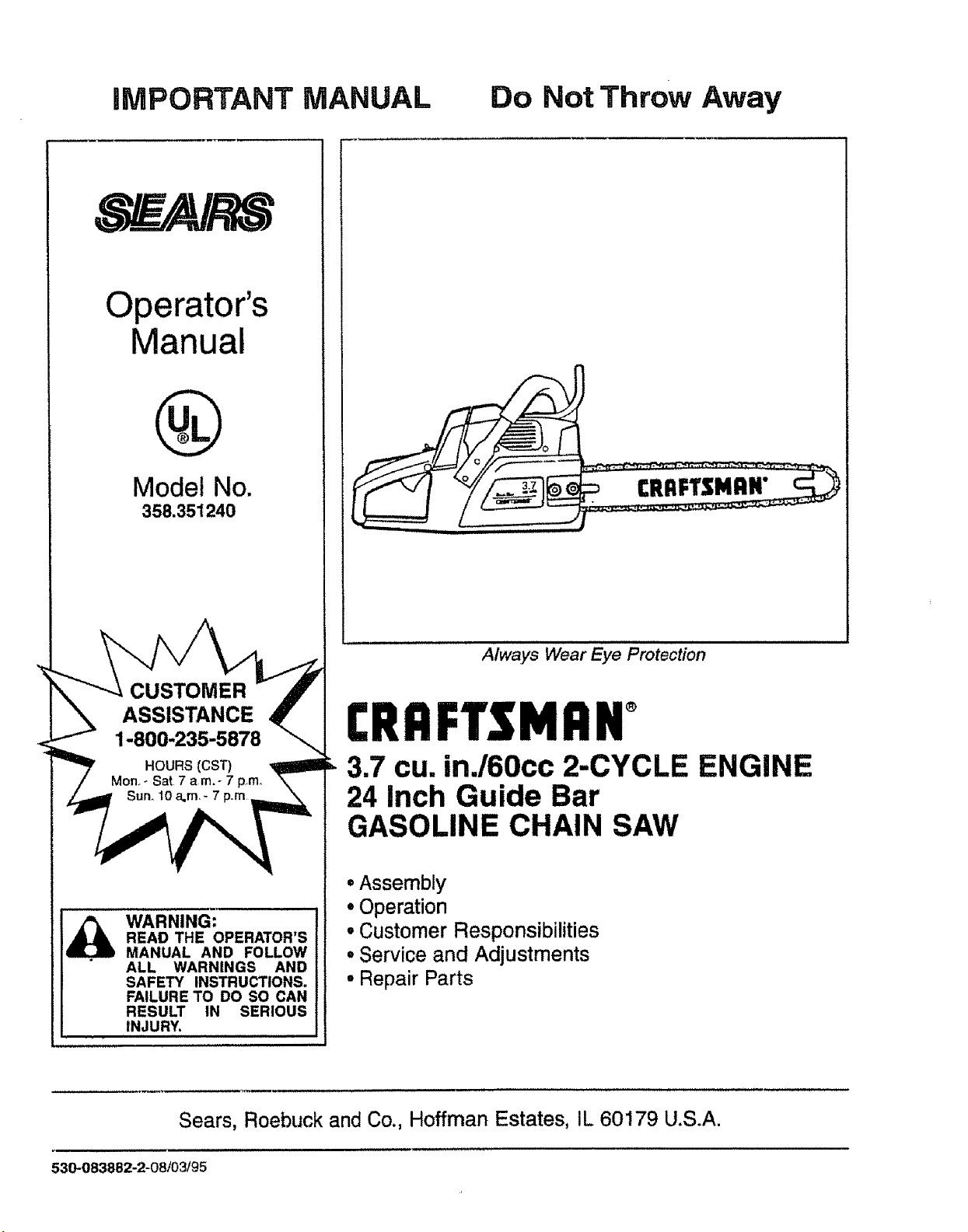
Always Wear Eye Protection
(:RAFTSMANo
3.7 cu. in./60cc 2-CYCLE ENGINE
24 Inch Guide Bar
GASOLINE CHAIN SAW
• Assembly
• Operation
• Customer Responsibilities
° Service and Adjustments
• Repair Parts
Sears, Roebuck and Co, Hoffman Estates, IL 60179 USA
530-083882-2-08/03/95
SAFETY RULES
r
WARNING:
ALWAYS DISCONNECT SPARK PLUG WIRE AND PLACE WIRE WHERE IT CANNOT CONTACT SPARK
PLUG TO PREVENT ACCIDENTAL STARTING WHEN SETTING UP, TRANSPORTING, ADJUSTING OR
MAKING REPAIRS EXCEPT CARBURETOR ADJUSTMENTS.
BECAUSE A CHAIN SAW IS A HIGH-SPEED WOOD-CUTTING TOOL, SPECIAL SAFETY PRECAUTIONS
MUST BE OBSERVEDTO REDUCETHE RISK OF ACCIDENTS. CARELESS OR IMPROPER USE OFTHtS
TOOL CAN CAUSE SERIOUS INJURY.
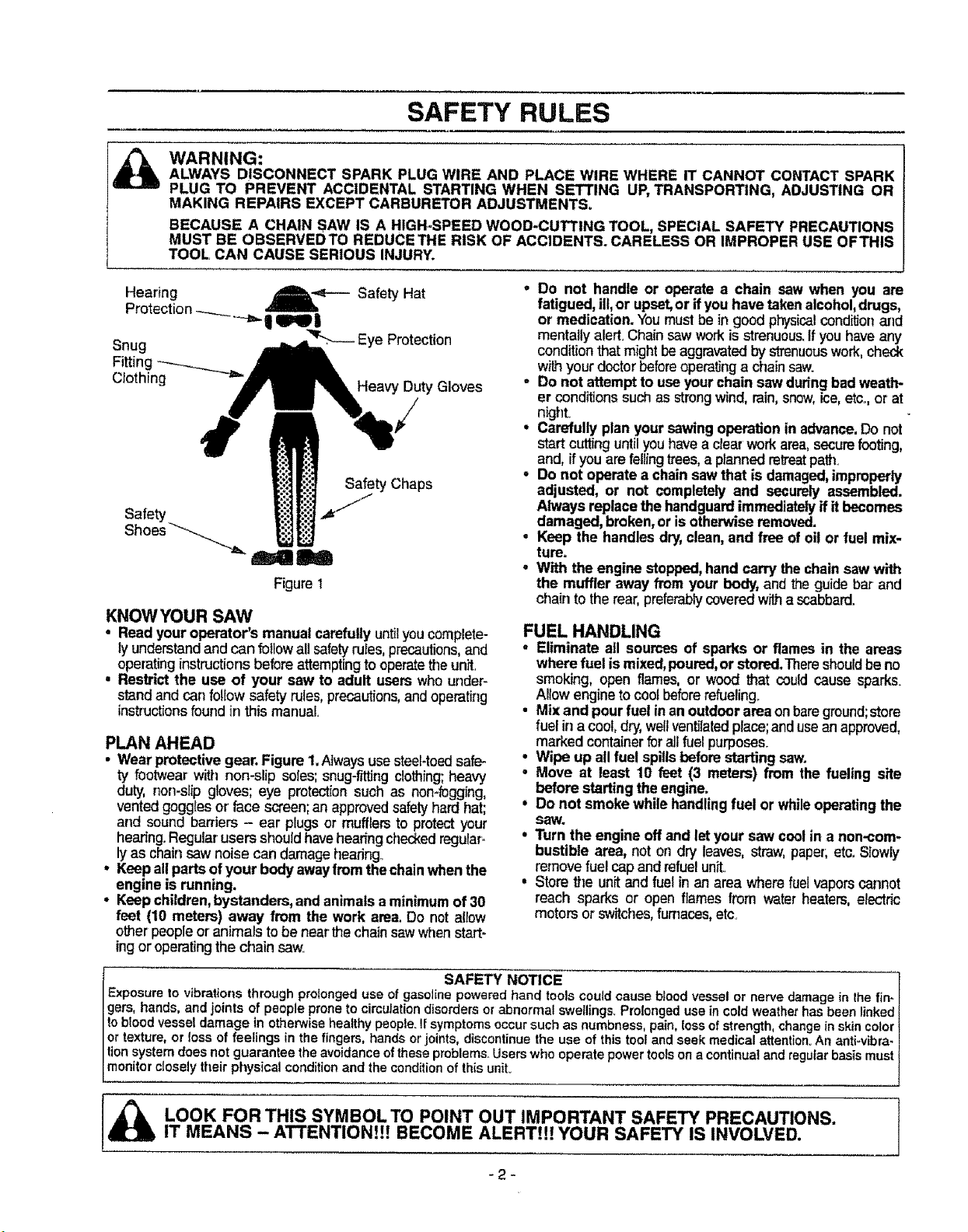
Hearing Safety Hat
Protection _..___. | _ !1
Snug ,J_/_'_"--- Eye Protection
Fitting
Clothing ,_F I'_k Heavy Duty Gloves
€.- .,,i
Safety Chaps
Safety
Shoes
Figure 1
KNOW YOUR SAW
- Read your operator's manual carefully untilyoucomplete-
lyunderstandandcan followall safetyrules,precautions,and
operating instructions beforeattemptingto operatethe unit
• Restrict the use of your saw to adult users who under-
stand and can fo!low safety rules, precautions,andoperating
instructionsfound in this manual
PLAN AHEAD
• Wear protective gear.Figure 1.Alwaysusesteel.toedsafe-
ty footwear with non-slip soles; snug-F_tingclothing;heavy
duty, non-slip gloves; eye protection such as non-fogging,
vented goggles or face screen;an approvedsafetyhard hat;
and sound barriers - ear plugs or mufflers to protectyour
hearing.Regularusers shouldhavehearingcheckedregular
lyas chainsaw noise can damagehearing_
• Keep all parts ofyour bodyawayfrom thechainwhen the
engine is running.
• Keep children,bystanders, andanimals a minimumof 30
feet (10 meters) away from the work area. Do not atlow
other people or animals tobe near thechain sawwhen start-
ing or operatingthe chain saw.
• Do not handle or operate a chain saw when you are
fatigued,ill,or upset,or ifyou have takenalcohol,drugs,
or medication. You mustbe in good physicalcond_onand
mentally alert Chain sawwork isstrenuous.If you have any
condition that might beaggravatedby strenuouswork, check
with your doctor beforeoperatinga chainsaw.
• Do not attemptto useyourchain saw duringbad weath-
er conditions such as strongwind,rain,snow,ice,etc. or at
night
• Carefully plan your sawing operation in advance.Do not
start cutting until youhavea cleat work area,securefooting,
and, if you are fellingtrees,a planned retreatpath
, Do not operatea chainsaw that is damaged,improperly
adjusted, or not completely and securely assembled.
Always replacethe handguardimmediatelyif itbecomes
damaged, broken,or isotherwise removed.
, Keep the handles dry,clean,and free of oil or fuel mix-
lure.
o With the engine stopped,hand carry thechain saw with
the muffler away from your body, and the guide bat and
chain to therear,preferablycovered witha scabbard.
FUEL HANDLING
- Eliminate all sources of spar'Ksor flames in the areas
where fuel is mixed, poured,or stored.Thereshouldbeno
smoking, open flames, or wood that could cause sparks.
Allow engine to cool beforerefueling.
• Mix and pour fuel in an outdoorarea on bareground;store
fuel in a cool, dry, wellventilatedplace;and usean approved,
marked containerforattfuel purposes.
• Wipe up all fuel spills beforestarting saw.
° Move at least 10 feet (3 meters) from the fueling site
before startingthe engine.
• Do not smokewhile handlingfuel or whileoperatingthe
saw.
° Turn the engine offand letyour saw coolin a non-com-
bustible area, not on dry leaves, straw,paper;etc,Stowly
remove fuel capand refuel unit.
, Store the unit and fuel in an area where fuel vaporscannot
reach sparks or open flames from water heaters, electdc
motors or switches,furnaces,etc.
SAFETY NOTICE
Exposureto vibrations through prolonged use of gasoline powered hand tools could cause b_oodvessel or nerve damage in Ihe fin-
gers, hands, and joints of people prone to circulationdisordersor abnormal sweIlings_ Prolongeduse in cold weather has been linked
toblood vessel damage in otherwise healthy people,if symptomsoccursuch as numbness, pain loss ofstrength changein skincolor
ortexture, or loss of fee ngs n the f ngers, hands orjoints, discontinuethe use of this tootand seek medical attention. An anti-vibra.
lionsystem does not guarantee the avoidance of these problems..Users who operate powertoolsona continualand regularbasis must
monitorclosely their physical conditionand the conditionofthis unit.
LOOK FOR THIS SYMBOLTO POINT OUT IMPORTANT SAFETY PRECAUTIONS.
IT MEANS - ATTENTION!!! BECOME ALERT!!! YOUR SAFETY IS INVOLVED.
SAFETY RULES
OPERATEYOUR SAW SAFELY
. Do not operate a chain saw with onehand.Seriousinjury
to the operator, helpers, bystanders or anycombination of
these persons may result from one-handed operation.A
chain saw is intended for two-handed use.
- Operate the chain saw only in well-ventilated outdoor
areas,
- Do not operate saw from a ladder or in a tree, unless
specifically trainedto do soo
• Position all parts of your body to the left of cut and
away from the chain when the engine is running,
. Cut wood only. Do not useyoursawtopryorshoveaway
limbs,roots,or other objects,
• Make sure the chain will not make contact with any
object while starting the engine. Nevertry to start the
saw when the guide bar isin a cutor keff,
. Useextreme caution when cuttingsmall size brush and
saplings. Slender material can catchthe chain and be
whippedtoward you or pull you off balance..
- Be alert for springbeck when cutting a limb that is under
tension so you wilt not be struck by the limb or saw when
the tension inthe wood fibersis released.
• Do not put pressure on the saw at the end of a cuL
Applying pressurecan cause you tolose control whenthe
cut iscompleted.
Stop the engine before settingthe saw down.
, Keep fuel and oil caps, screws,and fasteners securely
tightened,
MAINTAIN YOUR SAW IN GOOD WORKING
ORDER
• Have all chain saw service performed by your Sears
Service Center withtheexceptionofthe itemslistedinthe
"Customer Responsibilities" section of this manua!.. For
example, ifimproper tools are used to remove or hold the
flywheelwhen servicing theclutch, structural damage tothe
flywheel can occur and cause the flywheel to burst.
. Make certain the chain stops moving when the throttle
trigger is released. For correction, refer to "Carburetor
Adjustments:'
. Stop the saw if the chain strikes a foreign object.
Inspectunitand repairor replace partsas necessary,
• Disconnectthe spark plug before performing any main-
tenance exceptfor carburetor adjustments.
- Never modify your saw in any way. Use only SEARS
accessories and replacement partsas recommended
TRANSPORTING AND STORAGE
o Stop the unit before transporting.
• Allow engine to cool, cover the guide bar and chain, and
secure the unit before storing or transporting in a vehicle.
• Empty fuel tank before storing or transportingthe unit..Use
up any fuel leftin the carburetor by starting the engine and
letting the engine run untilit stops.
• Store unit and fuel in an area where fuel vapors cannot
reach sparks or open flames from water heaters, electric
motors or switches, furnaces, etc.
• Store unit so the chain cannot accidentallycause iniury.
. Store the unit out of the reachof children°
GUARD AGAINST KICKBACK - Kickback is a dangerous reaction that can lead to serious injury.
KICKBACK WARNING:
KICKBACK CAN OCCUR WHEN THE
MOVING CHAIN CONTACTS AN OBJECT AT
THE UPPER PORTION OF THE TIP OF THE
GUIDE BAR OR WHEN THE WOOD CLOSES
IN AND PINCHES THE CHAIN IN THE CUT.
CONTACT ATTHE UPPER PORTION OFTHE
TIP OF THE GUIDE BAR CAN CAUSE THE
CHAIN TO DIG INTO THE OBJECT, WHICH
STOPS THE CHAIN FOR AN INSTANT. THE
RESULT IS A LIGHTNING FAST, REVERSE
REACTION WHICH KICKS THE GUIDE BAR
UP AND BACK TOWARDTHE OPERATOR. IF
THE CHAIN IS PINCHED ALONG THE TOP
OF THE GUIDE BAR, THE GUIDE BAR CAN
BE DRIVEN RAPIDLY BACK TOWARD THE
OPERATOR. EITHER OFTHESE REACTIONS
CAN CAUSE LOSS OF SAW CONTROL
WHICH CAN RESULT IN SERIOUS INJURY.
DO NOT RELY ONLY ON THE SAFETY
DEVICES PROVIDED WITH YOUR SAW.AS A
CHAIN SAW USER, YOU MUST TAKE SPE-
CIAL SAFETY PRECAUTIONS TO HELP
KEEP YOUR CUTTING JOBS FREE FROM
ACCIDENT OR INJURY_
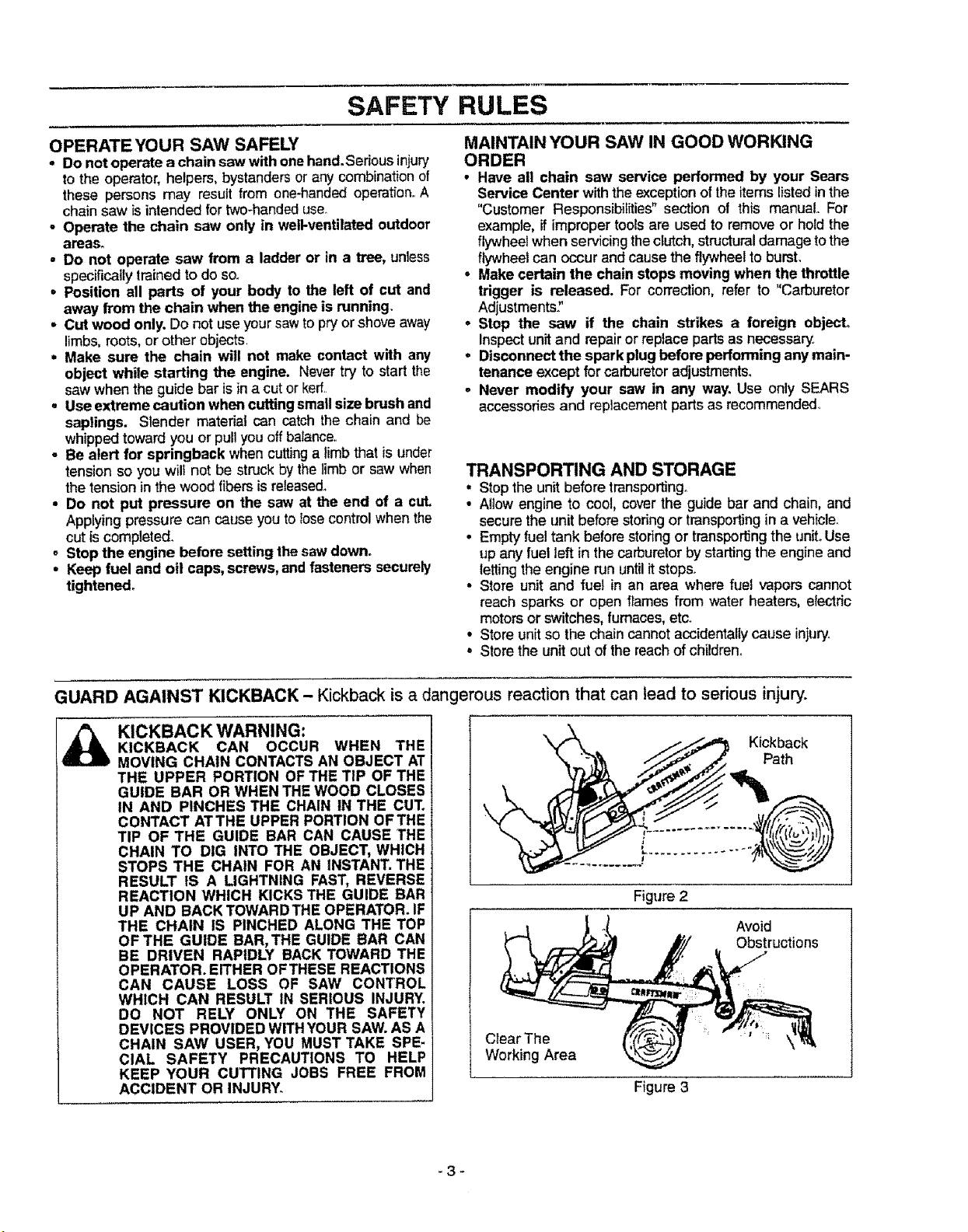
Clear The
Working Area
Kickback
Path
Figure 2
Avoid
Obstructions
Figure 3
SAFETY RULES
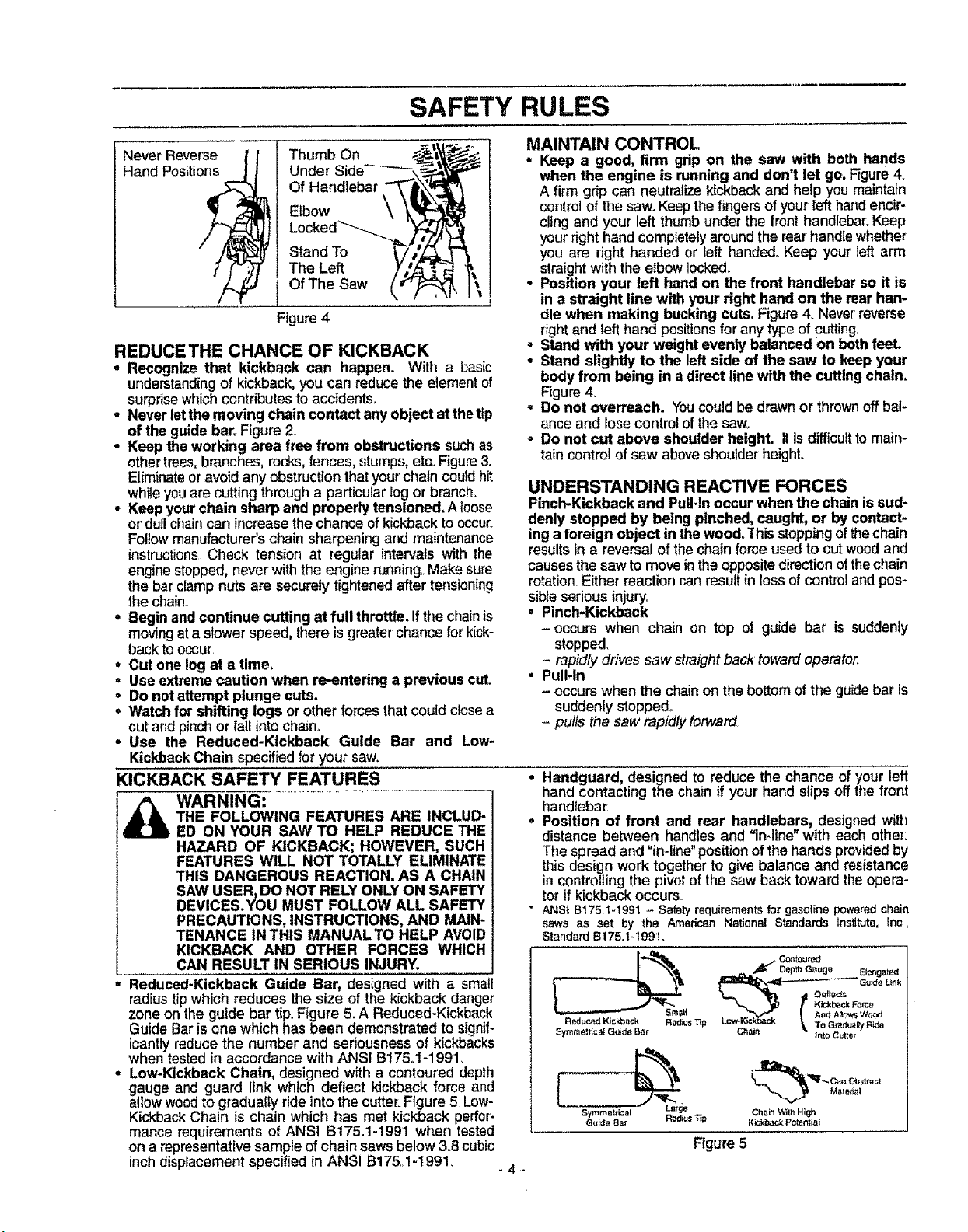
Never Reverse
Hand Positi_
/4
Thumb On
Under Si
Of Handlebar
| Elbow \
11
Stand To
The Left
Of The Saw
Figure4
REDUCETHE CHANCE OF KICKBACK
° Recognize that kickback can happen. With a basic
understandingof kickback, you can reduce the element of
surprise which contributes to accidents,,
• Never letthe moving chain contact anyobject at thetip
of the guide bar. Figure2.
. Keep the working area free from obstructions such as
othertrees,branches, rocks, fences,stumps,etc.Figure3.
Eliminateoravoid any obstruction thatyourchaincouldhit
whileyouare cuttingthrougha particularlog or branch_
- Keep yourchain sharp and properly tensioned. A loose
or'dutlchaincan increasethe chance ofkickback to occur.
Followmanufacturer's chainsharpeningand maintenance
instructionsCheck tension at regular intervalswith the
enginestopped, never withthe enginerunning_Makesure
the bar clampnutsare securely tightenedaftertensioning
the chain_
• Begin andcontinue cutting at full throttle. Ifthe chainis
moving ata slower speed,there isgreaterchance forkick-
back to occur,
• Cut one log at a time.
• Use extremecaution when re-entering a previous cut,
= Do not attempt plunge cuts.
• Watch for shifting logs orother forcesthatcouldclosea
cutand pinchor fat!intochain,.
- Use the Reduced-Kickback Guide Bar and Low-
KickbackChain specifiedfor your saw.
KICKBACK SAFETY FEATURES
l_ WARNING:
THE FOLLOWING FEATURES ARE INCLUD-
ED ON YOUR SAW TO HELP REDUCE THE
HAZARD OF KICKBACK; HOWEVER, SUCH
FEATURES WILL NOT TOTALLY ELIMINATE
THIS DANGEROUS REACTION. AS A CHAIN
SAW USER, DO NOT RELY ONLYON SAFETY
DEVICES.YOU MUST FOLLOW ALL SAFETY
PRECAUTIONS, INSTRUCTIONS, AND MAIN-
TENANCE IN THIS MANUALTO HELP AVOID
KICKBACK AND OTHER FORCES WHICH
CAN RESULT IN SERIOUS INJURY.
Reduced-Kickback Guide Bar, designed with a small
radiustip which reduces the size of the kickback danger
zone on the guide bar tip. Figure 5. A Reduced-Kickback
Guide Bar is one which has been demonstrated to signif-
icantly reduce the number and seriousness of kickbacks
when tested in accordance with ANSI BI75,1-199l.
• Low-Kickback Chain, designed with a contoured depth
gauge and guard link which deflect kickback force and
allow woodto gradually rideintothe cutter:Figure5. Low-
KickbackChain is chain which has met kickback perfor-
mance requirements of ANSI B175,,1-1991 when tested
on a representativesample ofchainsaws below3.8 cubic
inchdisplacement specified in ANSI B175_1-1991.
MAINTAIN CONTROL
. Keep a good, firm grip on the saw with both hands
when the engine is running and don't let go. Figure4.
A firm gdp can neutralizekickback and help you maintain
control ofthe saw. Keepthe fingers of your left hand encir-
cling and your left thumb under the front handlebar:Keep
your right hand completely around the rear handle whether
you are right handed or left handed_Keep your left arm
straight with the elbow locked.
° Position your left hand on the front handlebar so it is
in a straight line with your right hand on the rear han-
dle when making bucking cuts, Figure4. Never'reverse
right and left hand positions forany typeof cutting.
o Stand with your weight evenly balanced on bothfeet.
, Stand slightly to the left side of the saw to keep your
body from being in a direct line with the cutting chain.
Figure 4.
• Do not overreach. Youcould be drawn or thrown off bal-
ance and losecontrol of the saw.
o Do not cut above shoulder height. It isdifficult to main-
talncontrolofsaw above shoulder height.
UNDERSTANDING REACTIVE FORCES
Pinch-Kickback and PulHn occur when the chain issud-
denly stopped by being pinched, caught, or by contact-
ing a foreign object in the wood_Thisstoppingofthechain
results ina reversalof the chainforce usedto cut woodand
causes the saw to move in the opposite direction ofthe chain
rotation,.Either reaction can result in loss of control and pos-
sible serious injury.
• Pinch-Kickback
-occurs when chain on top of guide bar is suddenly
stopped.
- rapidly drives saw straight back toward operator.
• Puff-In
- occurs when the chain on the bottom of the guide bar is
suddenly stopped,.
- pulls the saw rapidly forward
• Handguard, designed to reduce the chance ofyour left
hand contactingthe chainif your hand slips offthe front
handlebar_
• Position of front and rear handlebars, designed with
distance between handlesand "in-line" with each other:
The spread and "imline" positionof thehands providedby
thisdesign work togetherto give balance and resistance
in controllingthe pivotof the saw back towardthe opera-
tot if kickbackoccurs
• ANSI B175 1-199! _ Safety requirements for gasotine powered chain
saws as set by the American National Standards Insl_tute, Inc,
Standard B175.1-1991.
Reduc_ Kickba_k R_dius T_p
Symt_elt_c_ Guido B_r
G_t_e Bat Radiu_ "_p
'_ Can C_struct
ChtJ_ With High
K_k_ck ForintS!
Figure 5
_4_
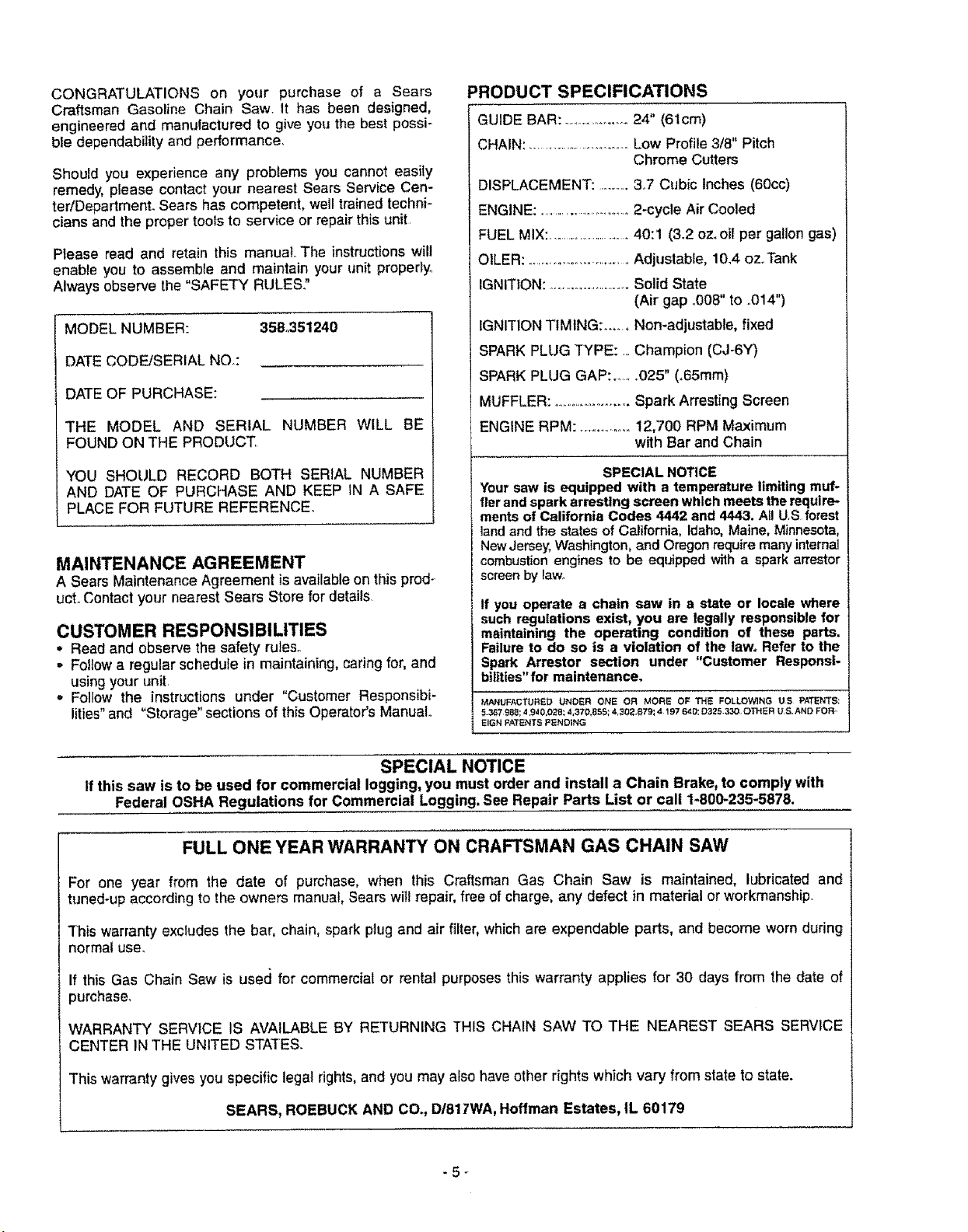
CONGRATULATIONS on your purchase of a Sears
Craftsman Gasoline Chain Saw. It has been designed,
engineered and manufactured to give you the best possi-
bte dependability and pefformance_
Should you experience any problems you cannot easily
remedy, please contact your nearest Sears Service Cen-
ter/Department° Sears has competent, well trained techni-
cians and the proper tools to service or repair this unit
Please read and retain this manual,.The instructions will
enabte you to assemble and maintain your unit properly.
Always observe the "SAFETY RULES."
MODEL NUMBER: 358.351240
DATE CODE/SERIAL NOD:
DATE OF PURCHASE:
THE MODEL AND SERIAL NUMBER WILL BE
FOUND ON THE PRODUC_
YOU SHOULD RECORD BOTH SERIAL NUMBER
AND DATE OF PURCHASE AND KEEP tN A SAFE
PLACE FOR FUTURE REFERENCE°
MAINTENANCE AGREEMENT
A Sears Maintenance Agreement isavailable on thisprod-
uct. Contact your nearest Sears Store for details
CUSTOMER RESPONSIBILITIES
° Read and observe the safety ruleso
- Follow a regular schedule in maintaining, caring for, and
usingyour unit.
o Follow the instructions under "Customer Responsibi-
lities"and =Storage" sections of this Operator's Manual..
PRODUCT SPECIFICATIONS
GUIDE BAR: .................. 24" (61cm)
CHAIN: ..............................Low Proffie 3/8" Pitch
Chrome Cutters
DISPLACEMENT: ........ 3..7 Cubic Inches (60cc)
ENGINE: .................................2-cycle Air Cooled
FUEL MIX: .............................40:1 (3.2 oz.,oil per gallon gas)
OILER: .................................Adjustable, 10.4 oz.,Tank
IGNITION: .........................Solid State
(Air gap .008" to .014")
IGNITION TIMING: .......Non-adjustable, fixed
SPARK PLUG TYPE: .,.Champion (CJ-6Y)
SPARK PLUG GAP:..... 025" (,65mm)
MUFFLER: .........................Spark Arresting Screen
ENGINE RPM: ...............12,700 RPM Maximum
with Bar and Chain
SPECIAL NOTICE
Your saw is equipped with a temperature limiting muf-
fler and spark arresting screen which meets the require-
ments of California Codes 4442 and 4443. All US forest
land and the states of California, Idaho, Maine, Minnesota,
New Jersey, Washington, and Oregon require many intema]
combustion engines to be equipped wilh a spark arrestor
screen by law.
If you operate a chain saw in a state or locale where
such regulations exist, you are legally responsible for
maintaining the operating condition of these parts.
Failure to do so is a violation of the law. Refer to the
Spark Arrestor section under "Customer Respons|-
bilities"for maintenance.
MANUFACTURED UNDER ONE OR MORE OF THE FOLLOWING U5 PATENTS:
5.367 988; 4,940.028; 4,370,855; 4302.879; 4 197 6_0; D325.330 OTHER US. AND FOR e
EIGN PATENTS PENDING
SPECIAL NOTICE
If this saw is to be used for commercial logging, you must order and install a Chain Brake, to comply with
Federal OSHA Regulations for Commercial Logging. See Repair Parts List or call 1-800-235-5878.
FULL ONE YEAR WARRANTY ON CRAFTSMAN GAS CHAIN SAW
For one year from the date of purchase, when this Craftsman Gas Chain Saw is maintained, lubricated and
tuned-up according to the owners manual, Sears will repair, free of charge, any defect in material or workmanship.
This warranty excludes the bar, chain, spark plug and air filter, which are expendable parts, and become worn during
normal use.
If this Gas Chain Saw is usecl for commercial or rental purposes this warranty applies for 30 days from the date of
purchase.
WARRANTY SERVICE IS AVAILABLE BY RETURNING THIS CHAIN SAW TO THE NEAREST SEARS SERVICE
CENTER IN THE UNITED STATES.
This warranty gives you specific legal rights, and you may also have other rights which vary from state to state.
SEARS, ROEBUCK AND CO. D/817WA, Hoffman Estates, IL 60179
-5 _
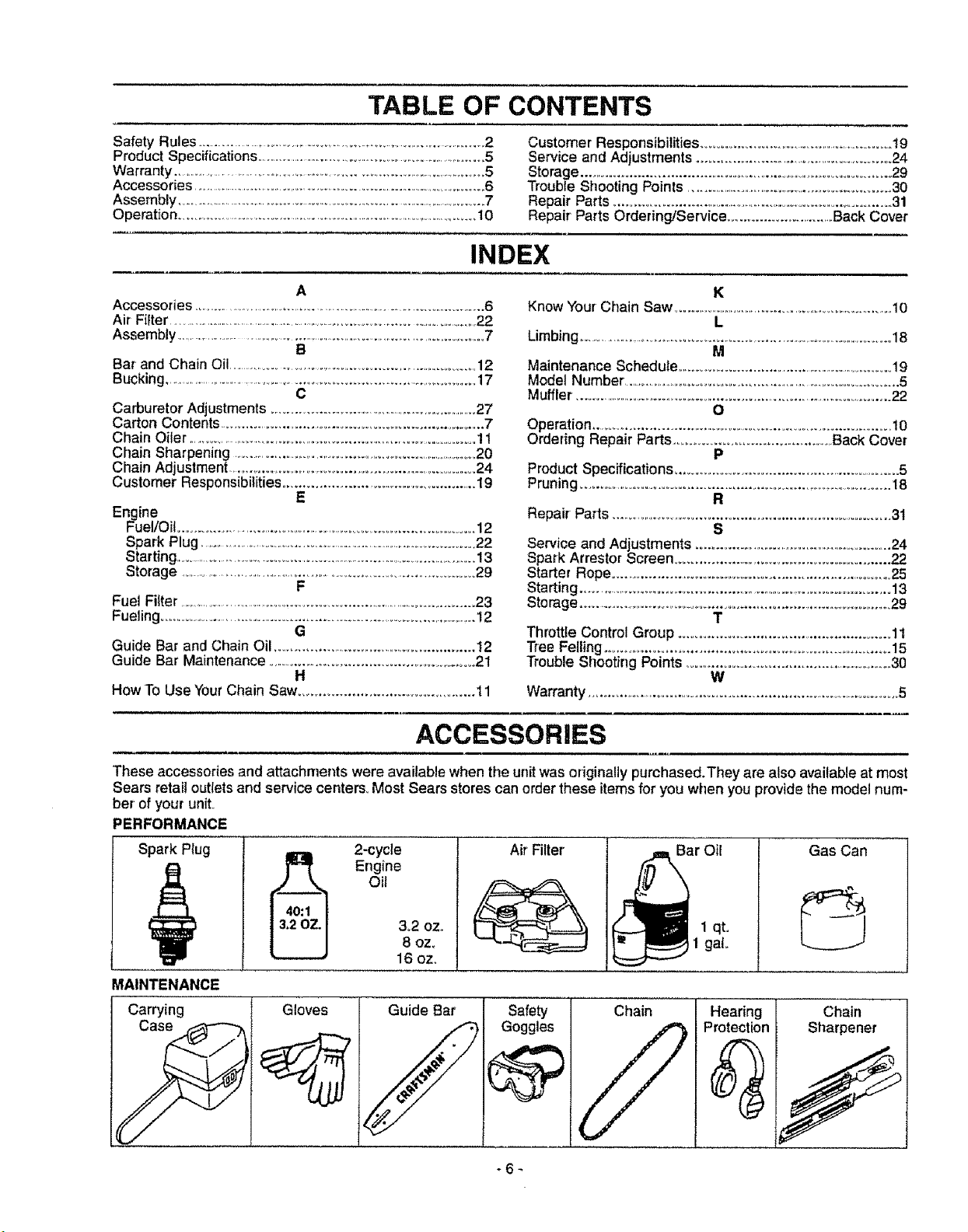
TABLE OF CONTENTS
Safety Rules ...........................................................................................2
Product Specifications ...................................................................................... 5
Warranty ..............................................................................................5
Accessories................................................................................................6
Assembly ....................................................................................................7
Operation ................................................................................................10
Customer Responsibilities ..............................................................19
Service and Adjustments ...........................................................24
Storage .................................................................................... 29
Trouble Shooting Points ..................................................................30
Repair Parts ......................................................................................31
Repair' Parts Ordering/Service ..................................Back Cover
INDEX
A
Accessories ............................................................................................. 6
Air Filter...................................................................................................22
Assembly ...................................................................................................7
B
Bar and Chain Oil ............................................................................ 12
Bucking.......................................................................................17
C
Carburetor Adjustments .................................................................27
Carton Contents ...............................................................................7
Chain Oiler ...........................................................................................! 1
Chain Sharpening ..................................................................................20
Chain Adjustment ........................................................................24
Customer Responsibilities .....................................................19
E
Engine
Fuel/Oil.......................................................................................12
Spark Plug .........................................................................................22
Starting .....................................................................................................!3
Storage ...........................................................................................29
F
Fuel Filter.........................................................................................23
Fueling......................................................................................................12
G
Guide Bar and Chain Oil .......................................................I2
Guide Bar Maintenance ............................................................ 21
H
HowTo Use Your Chain Saw............................................ 11
K
Know Your Chain Saw .......................................................................10
L
Limbing..................................................................................................18
M
Maintenance Schedule .................................................................19
Model Number.....................................................................................5
Muffler ..............................................................................................22
O
Operation ...............................................................................10
Ordering Repair Parts ...........................................Back Cover
P
Product Specifications ............................................................5
Pruning....................................................................................18
R
Repair Parts...........................................................................3t
S
Service and Adjustments .............................................................24
Spark Arrestor Screen .......................................................22
Starter Rope............................................................................25
Starting ........................................................................................ 13
Storage .........................................................................................29
T
Throttle Control Group ..................................................... 11
Tree Felling.............................................................................15
Trouble Shooting Points .......................................................30
W
Warranty..................................................................................5
ACCESSORIES
These accessories and attachments were availablewhen the unit was originallypurchased.They are also available at most
Sears retailoutletsand service centers°Most Sears stores canorderthese itemsfor you when you providethe modelnum-
ber'ofyour unit.
PERFORMANCE
Spark Plug
2-cycle
Engine
Oil
&2 oz,
8 oz_
16 oz_
Air Filter' Bar Oil
1 qt.
1 gaL
Gas Can
MAINTENANCE
Carrying
Gloves
Guide Bar'
/
Safety
Goggles
Chain
2'
Hearing
Protection
Chain
Sharpener
f
-6-
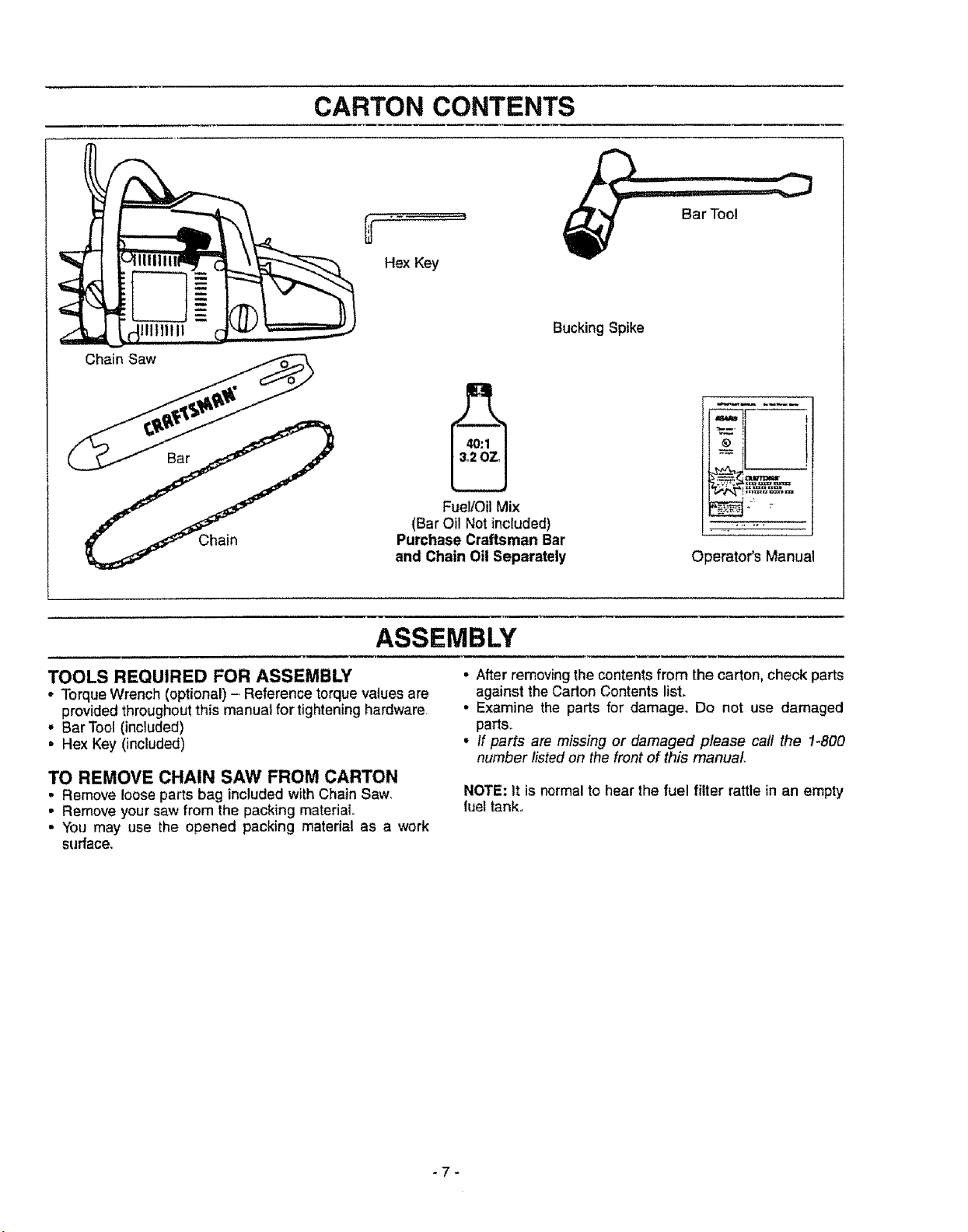
CARTON CONTENTS
_J
Illllllll
Chain Saw
_Chain
Hex Key
FueI/Oil Mix
(Bar Oil Not included)
Purchase Craftsman Bar
and Chain Oil Separately
Bucking Spike
_,.m+ !
Operator's Manual
ASSEMBLY
TOOLS REQUIRED FOR ASSEMBLY
• Torque Wrench (optional) - Reference torque values are
provided throughout this manual for tightening hardware
• BarTool (included)
• Hex Key (included)
TO REMOVE CHAIN SAW FROM CARTON
• Remove looseparts bag included with Chain Saw_
• Remove your saw from the packing material
• You may use the opened packing material as a work
surface,,
• After removing the contents from the carton, check parts
against the Carton Contents list.
• Examine the parts for damage. Do not use damaged
parts+
• If parts are missing or damaged please carl the 1+800
number listed on the front of this manual
NOTE: tt is normal to hear the fuel filter rattle in an empty
fueltank.
-7-
ASSEMBLY
DANGER:
DO NOT START THE ENGINE WITHOUT THE
GUIDE BAR AND CHAIN COMPLETELY
ASSEMBLED° OTHERWISE, THE CLUTCH
CAN COME OFF AND SERIOUS INJURY
CAN RESULT.
ALWAYS WEAR GLOVES WHEN HANDLING
THE CHAIN, THE CHAIN CAN BE SHARP
ENOUGH TO CUT YOU EVEN THOUGH W IS
TOO DULL TO CUTWOOD.
HOWTO ASSEMBLEYOUR CHAIN SAW
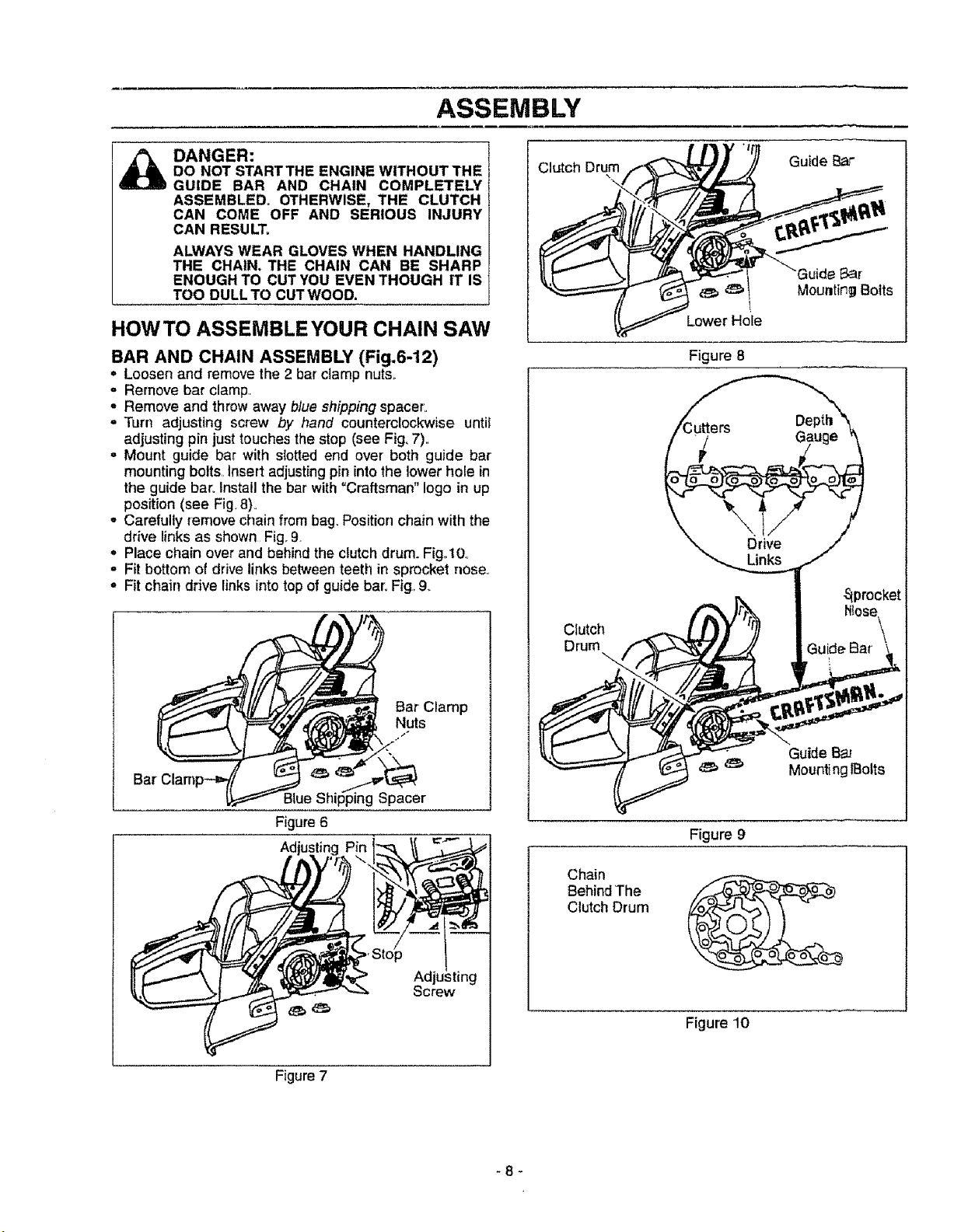
BAR AND CHAIN ASSEMBLY (Fig.6-12)
, Loosen and remove the 2 bar clamp nuts°
= Remove bar clamp.
° Remove and throw away blue shipping spacer:
= Turn adjusting screw by hand counterclockwise untii
adjusting pin just touches the stop (see Fig.7)..
= Mount guide bar with slotted end over both guide bar
mounting bolts. Insert adjusting pin into the lower hole in
the guide bar. Install the bar with "Craftsman" logo in up
position(see Fig. 8)_
- Carefully remove chain from bag. Position chain with the
drive linksas shown Fig,.9.
° Place chain over and behind the clutch drum. Fig..10..
= Fit bottom of drive links between teeth in sprocket nose.
o Fit chain drive links into top of guide bar: Fig. 9.
Bar Clamp
Nuts
Bar
Blue Shi Spacer
Figure6
Clutch Drum
Clutch
Drum
Lower Hole
Figure 8
Guide Bar
Mourltin_;Bolts
Figure 9
Screw
Chain
Behind The
Clutch Drum
Figure 10
Figure7
ASSEMBLY
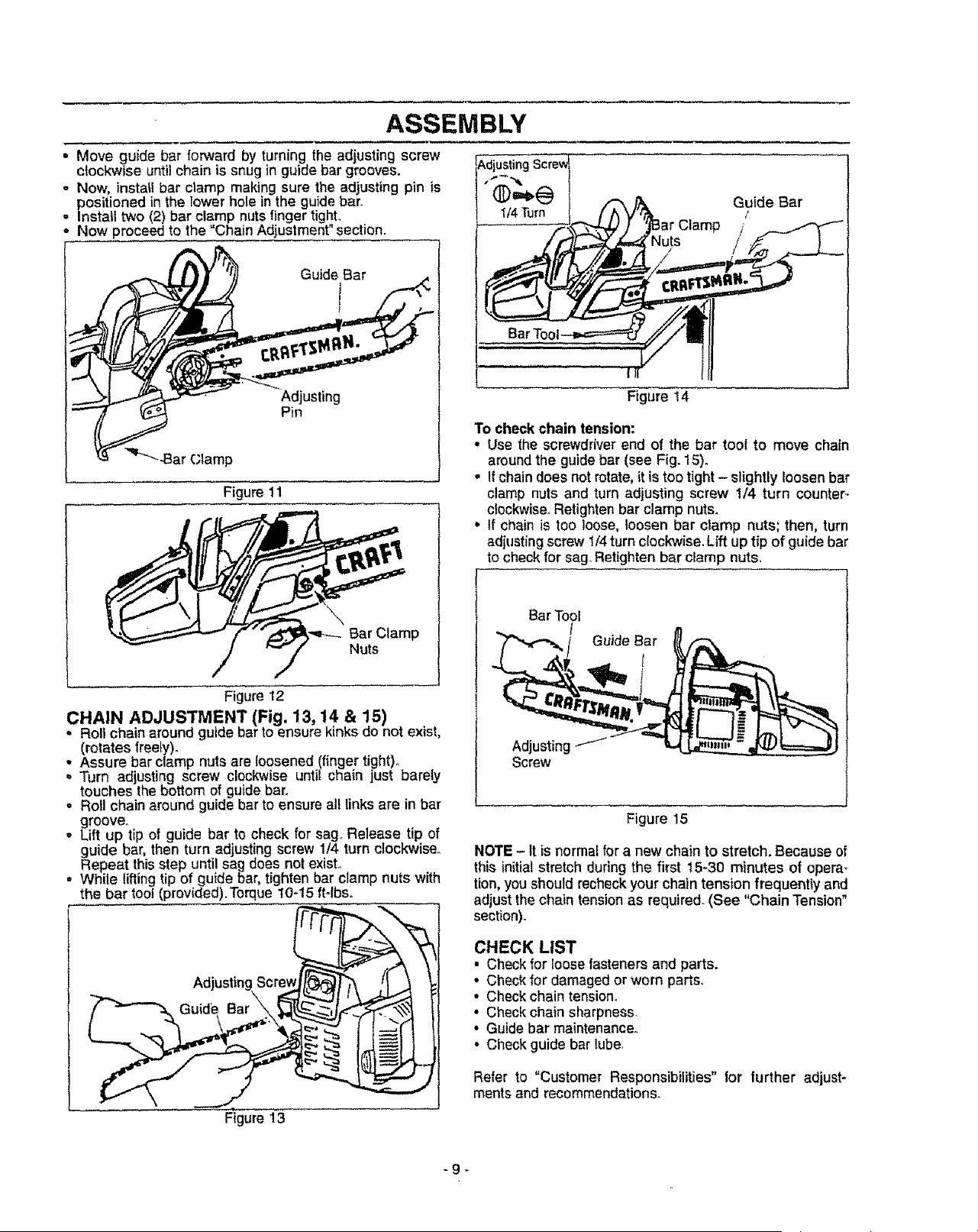
• Move guide bar forward by turning the adjusting screw
clockwise until chain is snug in guide bar grooves.
o Now, install bar clamp making sure the adjusting pin is
positioned inthe lower hole in the guide bar,
Install two (2) bar clamp nuts finger tight
,_Now proceed to the "Chain Adjustment section.
Guide Bar
t
Adjusting
Pin
"__ -Bar Clamp
Figure 11
Bar Clamp
Nuts
Figure 12
CHAIN ADJUSTMENT (Fig, 13, 14 8= 15)
Roll chainaround guide bar toensure kinks do not exist,
(rotates freely).
Assure bar clamp nuts are loosened (fingertight).
Turn adjusting screw clockwise until chain just barely
touches the bottom ot guide bar.
= Roll chainaround guide bar to ensureall links are in bar
groove..
• Lift up tip of guide bar to check for sag.,Release tip of
guide bar, then turn adjustingscrew 1/4 turn clockwise.
Repeat thisstep untilsag does not exist..
• While lifting tip of guide bar, tighten bar clamp nuts with
the bar tool(provided). Torque 10-15 ft-lbs.
Figure 13
Figure t4
Guide Bar
/
To check chain tension:
• Use the screwdriver end of the bar tool to move chain
around the g[,tidebar (see Fig. 15)_
• Ifchain does not rotate, it is too tight - slightly loosen bar
clamp nuts and turn adjusting screw 1/4 turn counter-
clockwise. Retighten bar clamp nuts.
• If chain is too loose, loosen bar clamp nuts; then, turn
adjusting screw 1/4turn clockwise, Lift up tip of guide bar
to check for sag Retighten bar clamp nuts,
Bar Tool
/
Guide Bar
t
Figure 15
Adjusting
Screw
NOTE- It is normal for a new chain to stretch, Because of
this initial stretch during the first 15-30 minutes of opera.
lion,you should recheck your chain tension frequently and
adjust the chain tension as required. (See "Chain Tension"
section).
CHECK LIST
• Check for loosefasteners and parts.
• Check for damaged or worn parts°
• Check chain tension,
• Check chain sharpness_
• Guide bar maintenance.
• Check guide bar lube,
Refer to "Customer Responsibilities" for further adjust-
ments and recommendations_
-9_
OPERATION
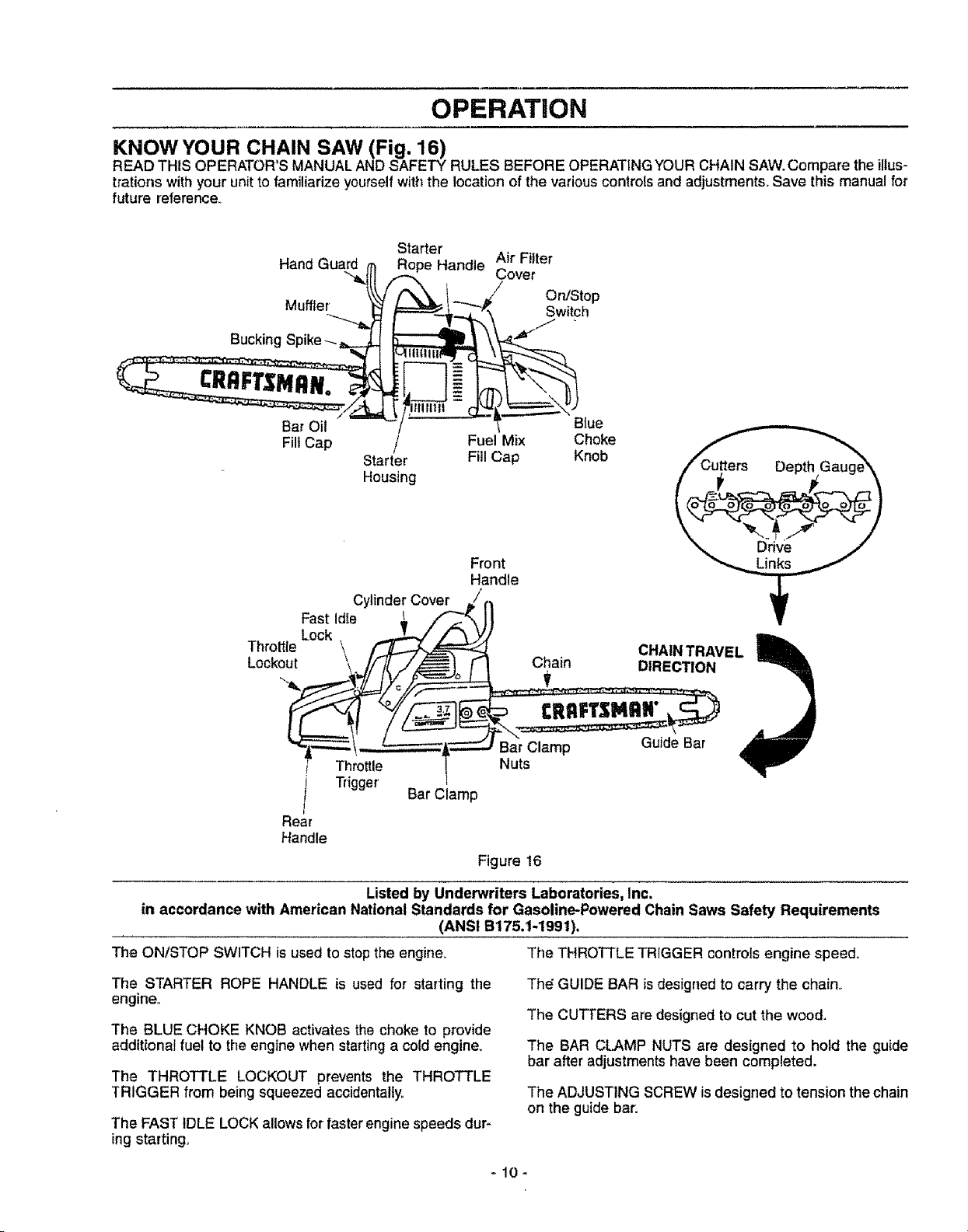
KNOWYOUR CHAIN SAW (Fig. 16)
READ THIS OPERATOR'S MANUAL ANDSAFETY RULES BEFORE OPERATING YOUR CHAIN SAW.Compare the illus-
trations with your unit to familiarize yourself with the location of the various controls and adjustments_ Save this manual for
future reference
Hand Guam/
Bucking Spike __
Bar Oil
Filf Cap /
Starter
Housing
Starter
Rope Handte Air Fi}ter
Cover
Fuel Mix
Fill Cap
OrVStop
Switch
Blue
Choke
Knob
Front
Handle
CHAINTRAVEL
DIRECTION
Rear
Handle
Throttle
Trigger
Bar Clamp
Nuts
Bar Clamp
Guide Bar
Figure 16
Listed by Underwriters Laboratories, Inc.
in accordance with American National Standards for Gasoline-Powered Chain Saws Safety Requirements
(ANSI B175.1-1991).
The ON/STOP SWITCH is used to stopthe engine. The THROTTLE TRIGGER controts engine speed,
The STARTER ROPE HANDLE is used for starting tile
engine.
The BLUE CHOKE KNOB activates the choke to provide
additional fuel to the engine when starting a cold engine.
The THROTTLE LOCKOUT prevents the THROTTLE
TRIGGER from being squeezed accidentally_
The FAST IDLE LOCKallows for faster engine speeds dur-
ing starting,
Th_ GUIDE BAR is designed to carry the chain_,
The CUTTERS are designed to cutthe wood.
The BAR CLAMP NUTS are designed to hold the guide
bar after adjustments have been completed.
The ADJUSTING SCREW is designed to tension the chain
on the guide bar:
-10-
OPERATION
HOW TO USE YOUR CHAIN SAW
STOPPING YOUR ENGINE
. Move on/stop switch to the "Stop" position,.
• If engine does not stop, pul_btue choke knob out fully_
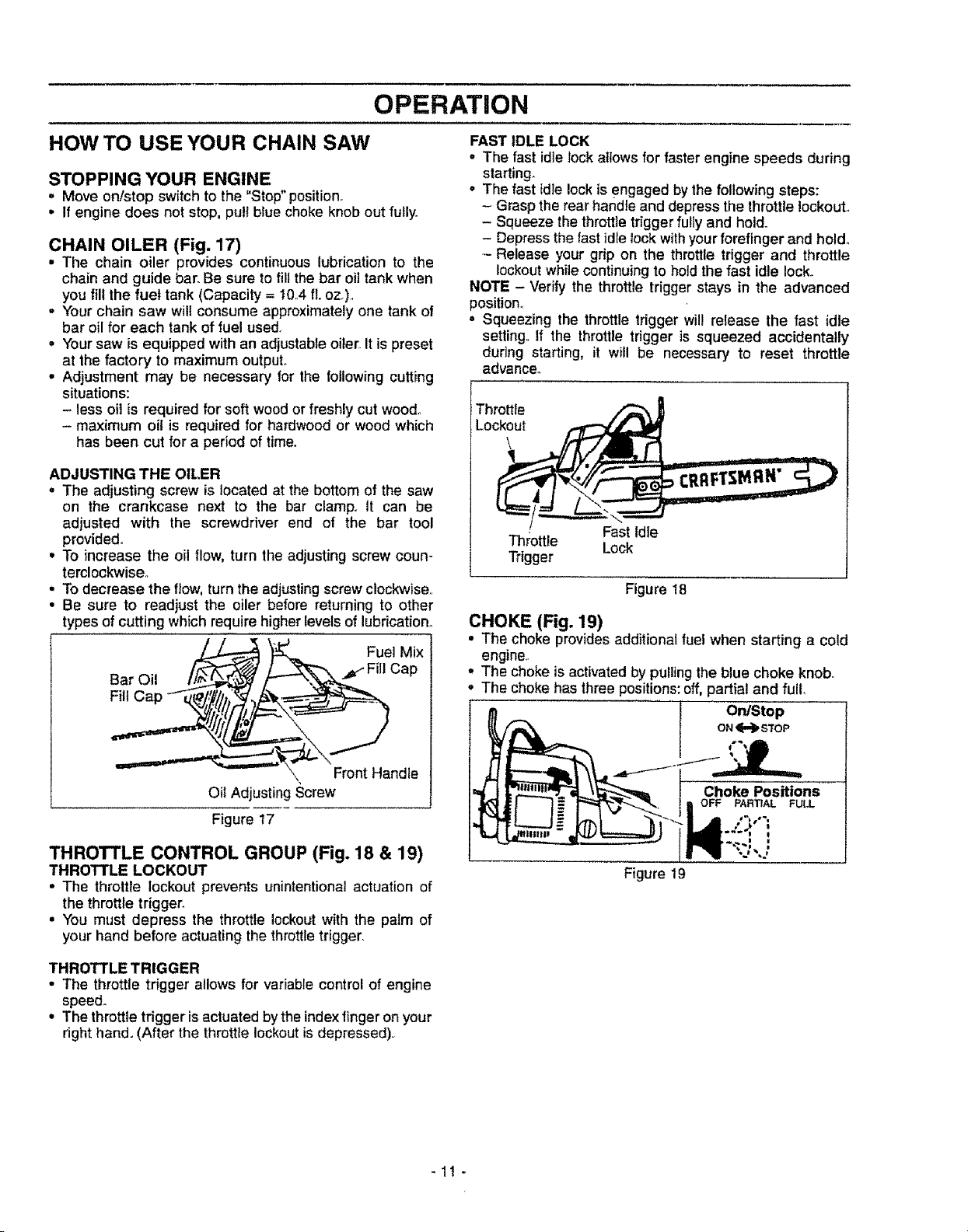
CHAIN OILER (Fig. 17)
• The chain oiler provides continuouslubrication to the
chainand guide bar_Be sure tofill the bar oi]tank when
you fillthe fuel tank (Capacity = !0o4fL oz.),,
• Your chain saw will consume approximately one tank of
bar oil for each tank of fuel used
• Your saw isequipped with an adjustable oiler. It ispreset
at the factory, to maximum output,.
• Adjustment may be necessary for the following cutting
situations:
- less oil is required for soft wood or freshly cut wood.
- maximum oil is required for hardwood or wood which
has been cut for a period of time.
ADJUSTING THE OILER
• The adjusting screw is located at the bottom of the saw
on the crankcase next to the bar clamp° It can be
adjusted with the screwdriver end of the bar tool
provided.
. To increase the oil flow, turn the adjusting screw coun-
terclockwise.
• Todecrease the flow, turn the adjusting screw clockwise,,
• Be sure to readjust the oiler before returning to other
types of cutting which require higher Ievels of lubrication,,
Bar Oil _ /_ Fue! Mix
Front Handle
Oil Adjusting Screw
Figure 17
THROTTLE CONTROL GROUP (Fig. 18 & 19)
THROTTLE LOCKOUT
• The throttle lockout prevents unintentional actuation of
the throttle trigger.
• You must depress the throttle lockout with the palm of
your hand before actuating the throttle trigger.
FAST IDLE LOCK
- The fast idle lock atlows for faster engine speeds during
starting_
• The fast idle lock is engaged by the following steps:
- Grasp the rear handle and depress thethrottle lockout.
- Squeeze thethrottletrigger fully and hold.
- Depress the fast idle lock with your forefinger and holdo
- Release your grip on the throttle trigger and throttle
lockout while continuing to hold the fast idle lock,.
NOTE - Verify the throttle trigger stays in the advanced
position.
= Squeezing the throttle trigger wiU release the fast idle
setting,, If the throttle trigger is squeezed accidentally
during starting, it will be necessary to reset throttle
advance,,
Throttle
Lockout
Throttle Fast Idle
Lock
Trigger
Figure 18
CHOKE (Fig. 19)
• The choke provides additional fuel when starting a cold
engine,,
. The choke isactivated by pulling the blue choke knob°
• The choke has three positions: off, partial and full,
On/Stop
_;N _._sToP
Choke Positions
OFF PARTIAL FULL
J b _' 1
r
Figure 19
THROTTLE TRIGGER
• The throttle trigger allows for variable control of engine
speed.
• The throttletrigger isactuated bytheindexfinger onyour
righthand. (After the throttlelockoutis depressed)
-11 -
OPERATION
BEFORE STARTING ENGINE
WARNING:
BE SURE TO READ THE FUEL HANDLING
INFORMATION INTHE SAFETY RULES SEC-
TION ON PAGE20FTHtS MANUAL BEFORE
YOU BEGIN,
IF YOU DO NOT UNDERSTAND THE FUEL
HANDUNG SECTION DO NOT ATTEMPTTO
FUEL YOUR UNIT; SEEK HELP FROM
SOMEONE THAT DOES UNDERSTAND THE
FUEL HANDLING SECTION OR CALL THE
CUSTOMER ASSISTANCE HOTLtNE AT
1_800--235-5878.
GUIDE BAR AND CHAIN OIL
For maximum guide bar and chain life, we recommendyou
use Craftsman chain saw bar oil, If Craftsman bar oil is not
available, you may use a good grade SAE30 oil until you
are able to obtain Craftsman brand.The oil output is auto-
matically metered during operation_ Your saw will use
approximately one tank of bar oil for every tank of fuel mix°
Always fill the bar oil tank when you fill the fuel tank.
GASOLINE
The two-cycle engine on this product requires a fuel mix-
ture of regular unleaded gasoline and a high quality 40:1
2-cycle engine oil (AIR-COOLED) for lubrication of the
bearings and other moving parts.The correct fuetloit mix-
ture is 40:1 (see Fuel Mixture Chart). Too little oil or the
incorrect oil type will cause poor performanceand may
cause the engine to overheat and seize.
Gasoline and oil must be premixed in a clean approvedfuel
container, Always use fresh regular unleaded gasoline°
This engine iscertified to operate on unleaded gasoline.,
IMPORTANT: Experience indicates that alcohol blended
fuels called gasohol (or using ethanol or methanol) car!
attract moisture, which leads to oittgas separation and for-
mation of acids during storage.Acidic gas can damagethe
fuel system of an engine while in storage.To avoid engine
problems, the fuel system should be emptied before stor-
age for 30 days or longer° Drainthe gas tank, then runthe
fuel out of the carburetor and fuel lines by starting the
engine and letting it run until it stops..Use fresh fuel next
season. See STORAGE instructionsfor additional informa.-
tion. Never use engine or carburetor cleaner products in
the fuel tank or permanent damage may occur_
FUEL STABILIZER
Fuel stabilizer is an acceptable alternative in minimizing
the formation of fuel gum deposits during storage, Add sta-
bilizer' to gasoline in fuel tank or storage container,. Always
follow the fuel mix ratio found on the stabilizer container,
Run engine at least 5 minutes after adding stabiIizer to
allow the stabilizer' to reach the carburetor.You do not have
to drain the fuel tank for storage if you are using fuel stabi-
lizer.
CRAFTSMAN 40:1 2-cycte engine oil (AIR-COOLED) is
specially blended with fuel stabilizers° If you do not use
this Sears oil, you can add a fuel stabilizer to your fuel tank.,
40:1 2-CYCLE AIR-COOLED ENGINE OIL
CRAFTSMAN 40:1 2-cycle engine oil (AIR-COOLED) is
strongly recommended.This oil is specially blended with
fuel stabilizers for increased fuet stability (extends fuel life
up to 5 times longer) and reduced smoke,.
If CRAFTSMAN 40:1 2*cycle engine oil (AIR-COOLED) is
not available, use a good quality 2-cycle engine oil (AIR..
COOLED) that has a recommended fuel mix ratio of 40:1.
IMPORTANT! Do not use:
- AUTOMOTIVE OIL.
o BOAT OILS (NMMA, BIA, etc.)
These oils do not have proper additives for 2-cycle (AIR-
COOLED) engines and can cause engine damage
GASOLINE AND OIL MIXTURE
Mix gasoline and oiias follows:
.Consuft chart for correctquantities.
° Do not mix gasolineand oildirectly inthe unit'sfuel tank°
FOR ONE GALLON:
• Pour 3.2 ounces of high quality, 40:1 2-cycle engine oil
(AIR-COOLED) into an empty, approved one gallon
gasoline container.
• Add one gallon of regular unleaded gasoline to the gallon
container, then securely replace the cap.
- Shake the container momentarily.
• The mixture is now ready for use. Fuel stabilizer can be
added at this time if desired;follow mixing instructions on
the label.,
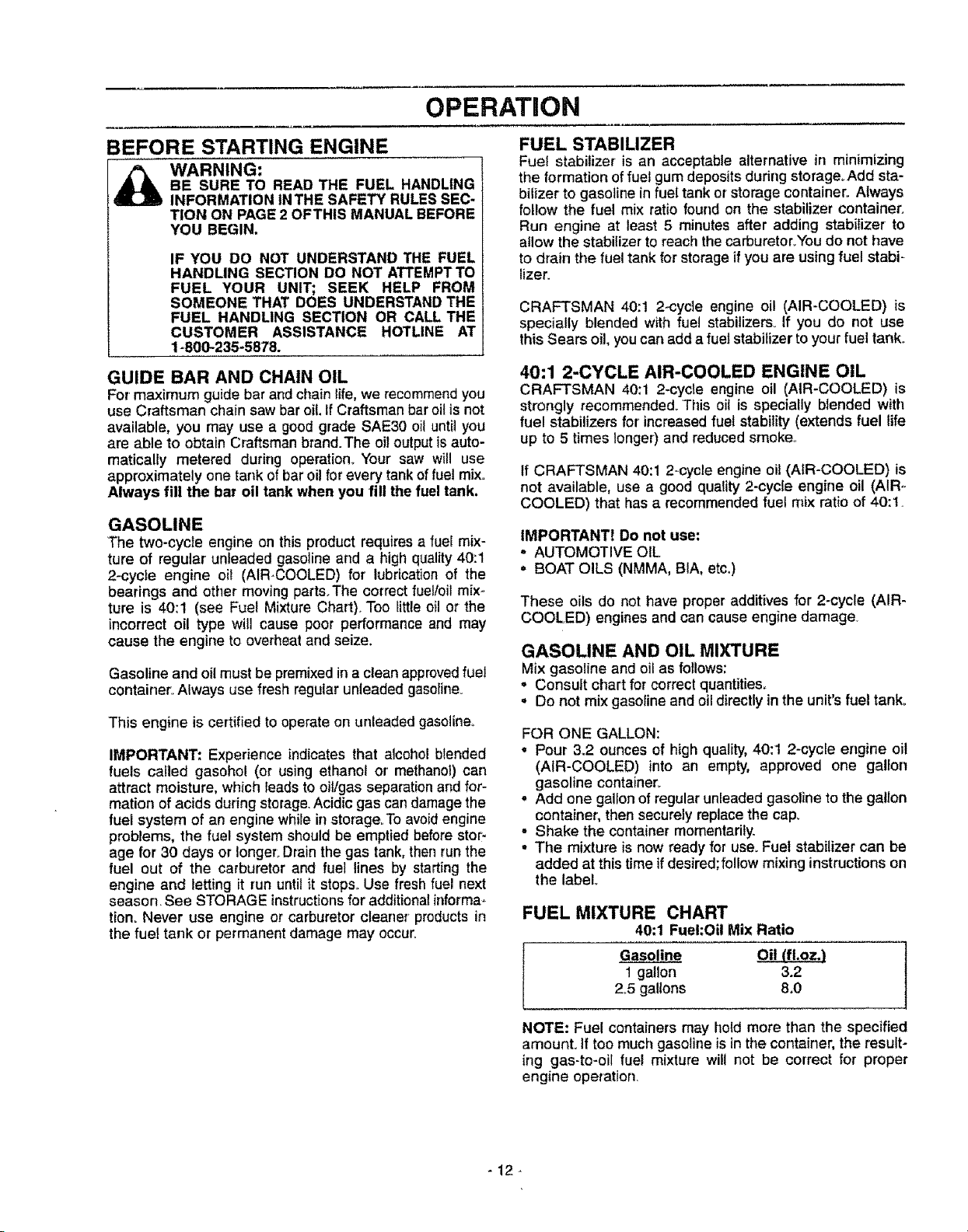
FUEL MIXTURE CHART
40:1 Fue!:Oil Mix Ratio
l Gasoline Oi! (fl,oz,)
1 gallon 3.2
2.5 gallons 8,0
NOTE: Fuel containers may hold more than the specified
amount, If too much gasoline isinthe container, the result-
ing gas-to-oil fuel mixture will not be correct for proper
engine cperation_
-12-
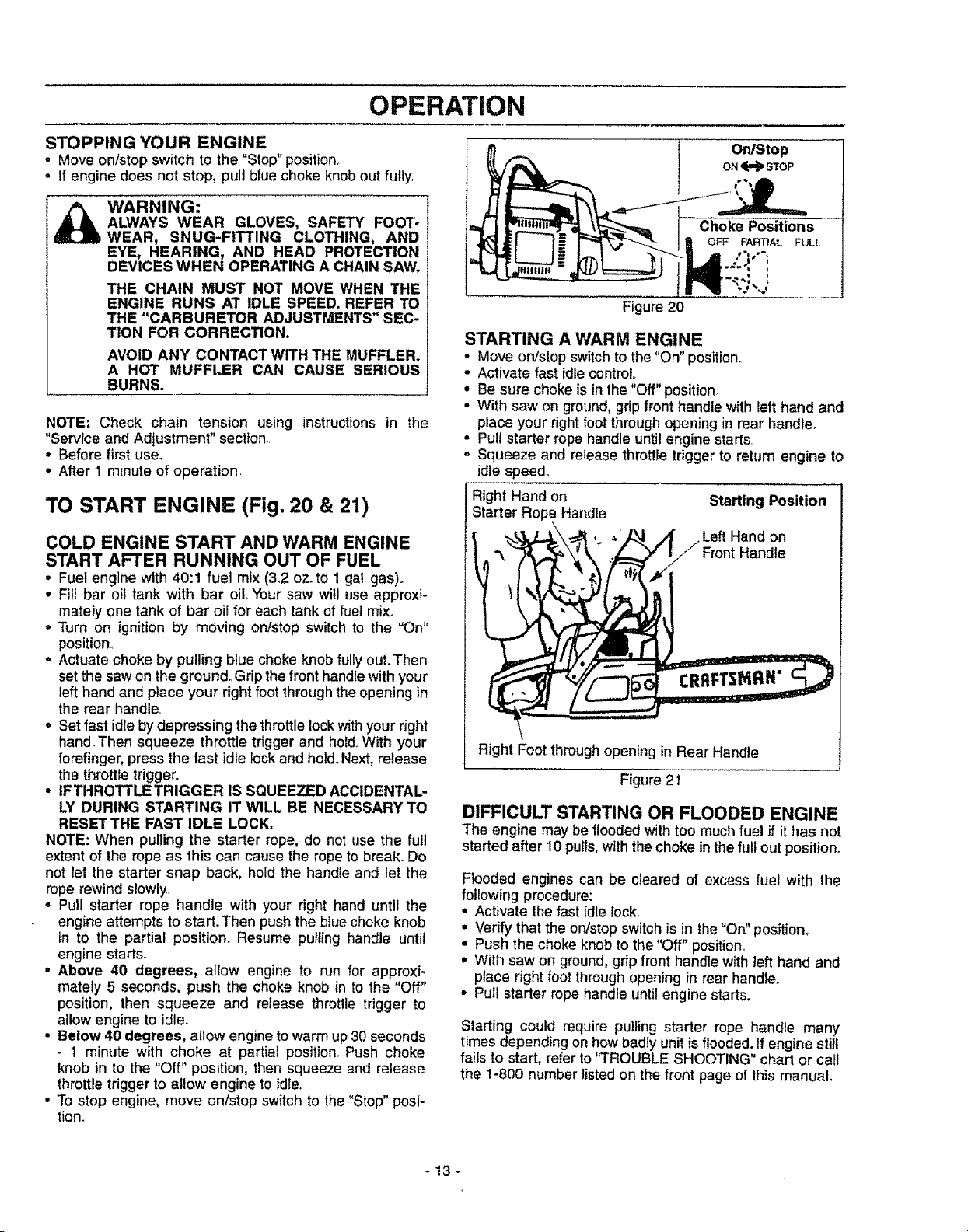
OPERATION
STOPPING YOUR ENGINE
• Move on/stop switch to the "Stop" position_
° If engine does not stop, pull blue choke knob out fuily.
On/Stop
ON_ STOP
_lh WARNING:
ALWAYS WEAR GLOVES, SAFETY FOOT-
WEAR, SNUG-FITTING CLOTHING, AND
EYE, HEARING, AND HEAD PROTECTION
DEVICES WHEN OPERATING A CHAIN SAWn
THE CHAIN MUST NOT MOVE WHEN THE
ENGINE RUNS AT IDLE SPEED. REFER TO
THE "CARBURETOR ADJUSTMENTS" SEC-
TION FOR CORRECTION.
AVOID ANY CONTACT WITH THE MUFFLER.
A HOT MUFFLER CAN CAUSE SERIOUS
BURNS,
NOTE: Check chain tension using instructionsin the
"Service and Adjustment" section,
• Before first use.
• After 1 minute of operation
TO START ENGINE (Fig. 20 & 21)
COLD ENGINE START AND WARM ENGINE
START AFTER RUNNING OUT OF FUEL
• Fuel engine with 40:1 fuel mix (3.2 oz. to 1 ga!, gas).
• Fill bar oil tank with bar oil.Your saw will use approxi-
mately one tank of bar oil for each tank of fuet mix.
- Turn on ignitionby moving on/stop switch to the "On"
position,
• Actuate choke by pulling blue choke knob fully out.Then
set the saw on the ground. Grip the front handle with your
left hand and place your right foot throughthe opening in
the rear handle
= Setfast idle by depressing the throttle lock with your right
hand. Then squeeze throttle trigger and hold.With your
forefinger, press the fast idle lock and hold_Next, release
the throttle trigger.
• IFTHROTTLETRIGGER IS SQUEEZED ACCIDENTAL-
LY DURING STARTING IT WILL BE NECESSARY TO
RESET THE FAST IDLE LOCK.
NOTE: When pulling the starter rope, do not use the full
extent of the rope as this can cause the rope to break. Do
not let the starter snap back, hold the handle and let the
rope rewind slowly
° Pull starter rope handle with your right hand until the
engine attempts to start, Then push the blue choke knob
in to the partial position. Resume pulling handle until
engine starts.
• Above 40 degrees, allow engine to run for approxi-
mately 5 seconds, push the choke knob in to the "Off"
position, then squeeze and release throttle trigger to
allow engine to idle.
• Below 40 degrees, allow engine to warm up 30 seconds
- 1 minute with choke at partial position. Push choke
knob in to the "Off" position, then squeeze and release
throttle trigger to allow engine to idle,
• To stop engine, move on/stop switch to the "Stop" posi-
tiono
Choke Positions
OFF PARTIAL FULL
•J _'.j
Figure 20
STARTING A WARM ENGINE
• Move on/stopswitch to the "On" position
" Activate fast idlecontrol
, Be sure choke is inthe "Off" position_
• With saw on ground, grip front handle with lefthand and
place your right foot through opening in rear handle°
- Pull starter rope handle until engine starts,
- Squeeze and release throttle trigger to return engine to
idle speed.
Right Hand on , Starting Position
Starter Rope Handle
_._k,L-,_"_ , LkJ .4" LeftHand on
", k".Z2YI/Front.andle
Right Foot through opening in Rear Handle
Figure 21
DIFFICULT STARTING OR FLOODED ENGINE
The engine may be floodedwith too muchfuel if ithas not
started after 10 pulls,with thechoke inthe fullout position,
Flooded engines can be cleared of excess fuel with the
following procedure:
• Activate the fast idte Iock
= Verify that the on/stop switch is in the "On" position,
• Push the choke knob to the "Off" position.
= With saw on ground, grip front handle with left hand and
place right foot through opening in rear handle.
- Pull starter rope handle until engine starts.
Starting could require pullingstarter rope handle many
times depending on how badly unit is flooded. If engine still
fails to start, refer to 'q'ROUBLE SHOOTING" chart or call
the 1-800 number listed on the front page of this manual
OPERATION
GENERAL OPERATION TIPS
• Cut wood only. Do not cut metal; plastics; masonry; non-
wood building materials; etc.
° Stop the saw if the chain strikes a foreign object. Inspect
the saw and repair' or replace parts as necessary.
• Keep the chain out of dirt and sand.,Even a small amount
of dirt wilt quickly dull a chain and thus increase the pos-
sibility of kickback_
To get the "feel" of using your saw before you begin a major
sawing operation, practice cutting a few small logs using
the following technique:
• Accelerate engine to full throttle by squeezing the throttle
trigger' before entering cut.
* Never cut with engine at partial speeds.
• Begin cutting with the saw chassis against the logo
* Keep engine at full throttle during cutting procedure_
° Allow the chain to cut for you; exert only light downward
pressure If you force the cut, damage to the bar, chain,
or engine can result.
o Release the throttle trigger as soon as the cut is com-
pleted, allowing the engine to idle. If you run the unit at
full throttle without cutting, unnecessary wear' can occur
to the chain, bar',and engine.
° To avoid losing control when completing the cut, do not
put pressure on the saw during the end of the cuL
o Stop engine before setting unit down after cperationo
OPERATION SAFETY
WARNING:
IF SAW BECOMES PINCHED OR HUNG IN A
LOG, DO NOT TRY TO FORCE IT OUT. YOU
CAN LOSE CONTROL OF THE SAW
RESULTING IN INJURY AND/OR DAMAGE
TO THE SAW. STOP THE SAW, DRIVE A
WEDGE OF PLASTIC OR WOOD INTO THE
CUT UNTIL THE SAW CAN BE REMOVED
EASILY. RESTARTTHE SAW AND CAREFUL-
LY REENTER THE CUT. TO AVOID KICK-
BACK AND CHAIN DAMAGE, DO NOT USE A
METAL WEDGE. DO NOT ATTEMPT TO
RESTART YOUR SAW WHEN IT IS PINCHED
OR HUNG IN A LOG.
KICKBACK CAN OCCUR WHEN THE MOV-
ING CHAIN CONTACTS AN OBJECT AT THE
UPPER PORTION OFTHE TIP OFTHE GUIDE
BAR OR WHENTHE WOOD CLOSES IN AND
PINCHES THE SAW CHAIN IN THE CUT.
CONTACT ATTHE UPPER PORTION OFTHE
TIP OF THE GUIDE BAR CAN CAUSE THE
CHAIN TO DIG tNTOTHE OBJECT AND STOP
THE CHAIN FOR AN INSTANT.THE RESULT
IS A LIGHTNING FAST,REVERSE REACTION
WHICH KICKS THE GUIDE BAR UP AND
BACK TOWARD THE OPERATOR. IF THE
SAW CHAIN IS PINCHED ALONG THE TOP
OF THE GUIDE BAR, THE GUIDE BAR CAN
BE DRIVEN RAPIDLY BACK TOWARD THE
OPERATOR. EITHER OFTHESE REACTIONS
CAN CAUSE LOSS OF SAW CONTROL
WHICH CAN RESULT IN SERIOUS INJURY.
AVOID REACTIVE PINCH FORCES
Pinch-Kickback and Pull-In occur when the chain is sud-
denly stopped by being pinched, caught, or by contacting
a foreign object in the wood, This sudden stopping of the
chain results in a reversal of the chain force used to cut
wood and causes the saw to move in the opposite direction
of the chain rotation. Pinch-Kickback drives the saw
straight back toward the operator. Pull-in pulls the saw
away from the operator: Either reaction can result in loss of
control and possibty serious injury°
TO AVOID PINCH-KICKBACK:
• Be extremely aware of situations or obstructions that can
cause material to pinch the top of cr otherwise stop the
chain_
= Do not cut more than one log at a time
= Do not twist the saw as the bar is withdrawn from an
under.cut when bucking°
TO AVOID PULL-IN:
,, Always begin cutting withthe engine at full throttle and
the saw housing against wood.
= Use wedges made of plastic or wood, (never'of metal) to
hold the cut open,
14-
OPERATION
TREE FELLING
WARNING:
IF THE TRUNK OR LIMBS ARE ROTTING,
THEY CAN FALL UNEXPECTEDLY AND
CAUSE SERIOUS INJURY.
AS YOU MAKE YOUR FELLING CUT, IF THE
SAW APPEARS TO BE BINDING, THE TREE
IS STARTING TO FALL IN THE WRONG
DIRECTION. IMMEDIATELY STOP THE SAW
AND USE A FELLING WEDGE AND MAUL
(HAMMER) TO FORCE THE FELLING CUT
OPEN. THE WEDGE WILL HOLD THE
FELLING CUT OPEN ALLOWING YOU TO
REMOVETHE SAW. KEEP EVERYONE AWAY
FROM THE TREE IN ALL DIRECTIONS.
DETERMINETHE NATURAL FALL DIRECTION
• Wind - A tree evenly balanced will fall in the same direc-
tion the wind is blowing.
• Lean - Use a carpenter's level or plumb bob to deter-
mine if tree has a natural leanoA leaning tree will tend to
fall in direction of leano
• Shape - A tree will tend to fall towards side that is more
heavily branched.
• Other Factors - Contacting or nearby trees, buildings, or
wires can influencethe direction the tree will fall.
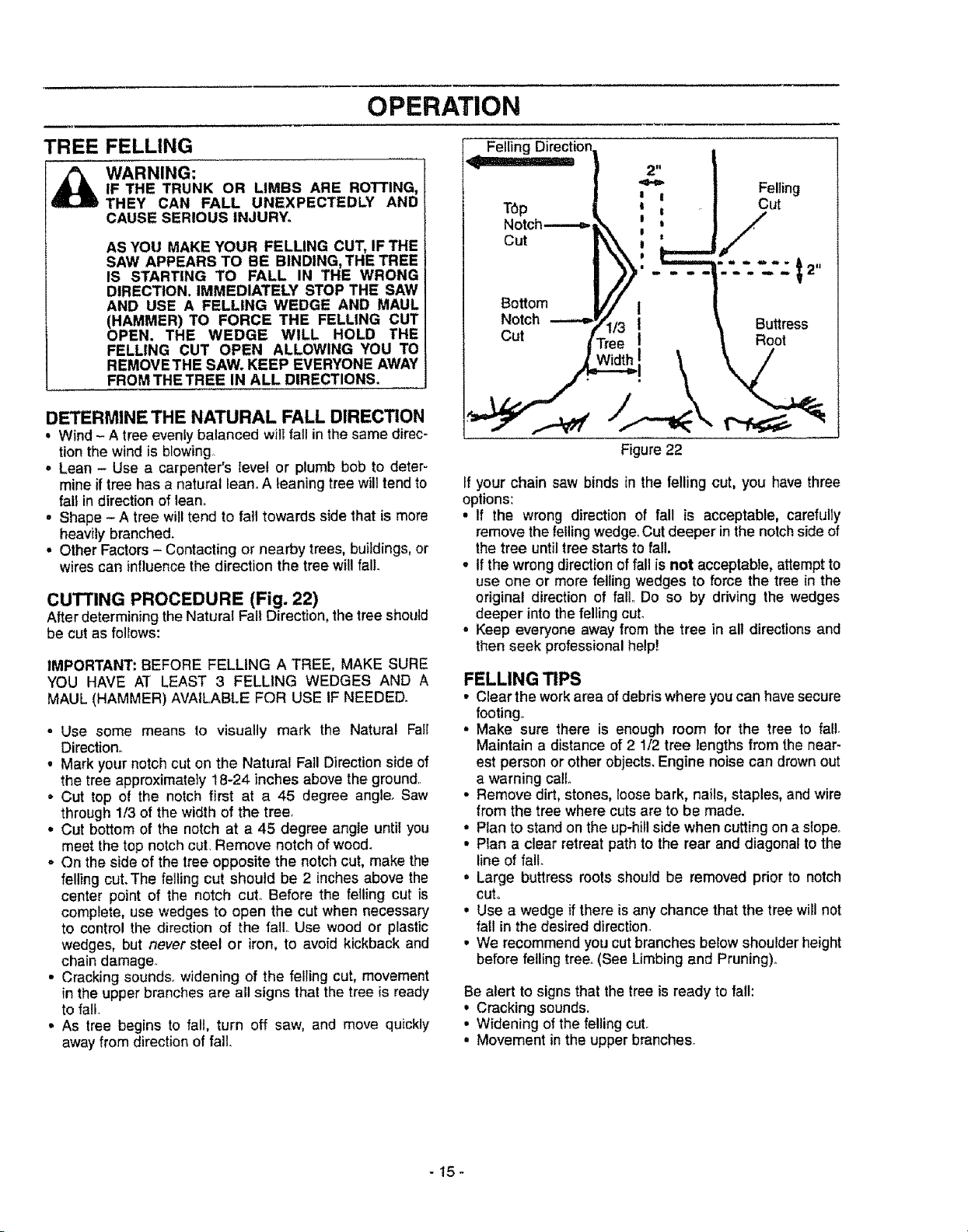
CUTTING PROCEDURE (Fig. 22)
After determining theNatural Fall Direction, the tree should
be cut as follows:
IMPORTANT: BEFORE FELLING A TREE, MAKE SURE
YOU HAVE AT LEAST 3 FELLING WEDGES AND A
MAUL (HAMMER) AVAILABLE FOR USE IF NEEDED°
• Use some means to visually mark the Natural Fail
Direction,
• Mark your notch cut on the Natural Fall Direction side of
the tree approximately 18-24 inches above the ground,r
• Cut top of the notch first at a 45 degree angle° Saw
through 1/3 of the width of the tree,
• Cut bottom of the notch at a 45 degree angle until you
meet the top notch cuL Remove notch of wood.
• On the side of the tree opposite the notch cut, make the
felling cut.The foiling cut should be 2 inches above the
center point of the notch cuL Before the felling cut is
complete, use wedges to open the cut when necessary
to control the direction of the fall..Use wood or plastic
wedges, but never steel or iron, to avoid kickback and
chain damager
• Cracking sounds, widening of the felling cut, movement
inthe upper branches are all signs that the tree is ready
to fall,
• As tree begins to fall, turn off saw, and move quickly
away from direction of fall.
Felling Direction
Bottom
Notch
Cut
I
I
I
Buttress
Root
Figure 22
If your chain saw binds in the felling cut, you have three
options:
• If the wrong direction of fall is acceptable, carefully
remove the felling wedge°Cut deeper in the notchside of
the tree until tree starts to fall.
. If the wrong direction of fall isnot acceptable, attempt to
use one or more felling wedges to force the tree in the
original direction of fall Do so by driving the wedges
deeper into the felling cut°
• Keep everyone away from the tree in all directions and
then seek professional help!
FELLING TiPS
• Clear the workarea ofdebris where you can havesecure
footing,.
. Make sure there is enough room for the tree to fall,
Maintain a distance of 2 1/2 tree lengths from the near-
est person or other objects. Engine noise can drown out
a warning call
• Remove dirt, stones, loose bark, nails, staples, and wire
from the tree where cuts are to be made.
° Plan to stand on the up-hill side when cutting on a sloper
• Plan a clear retreat path to the rear and diagonalto the
line of fall.
* Large buttress roots should be removed prior to notch
cut.
. Use a wedge ifthere isany chance that the tree will not
fall in the desired direction.
. We recommendyou cut branches below shoulder height
before felling tree,,(See Limbing and Pruning).
Be alert to signs that the tree is ready to fall:
• Cracking sounds.
• Widening of the felling cut.
• Movement in the upper branches_
-15-
OPERATION SAFETY
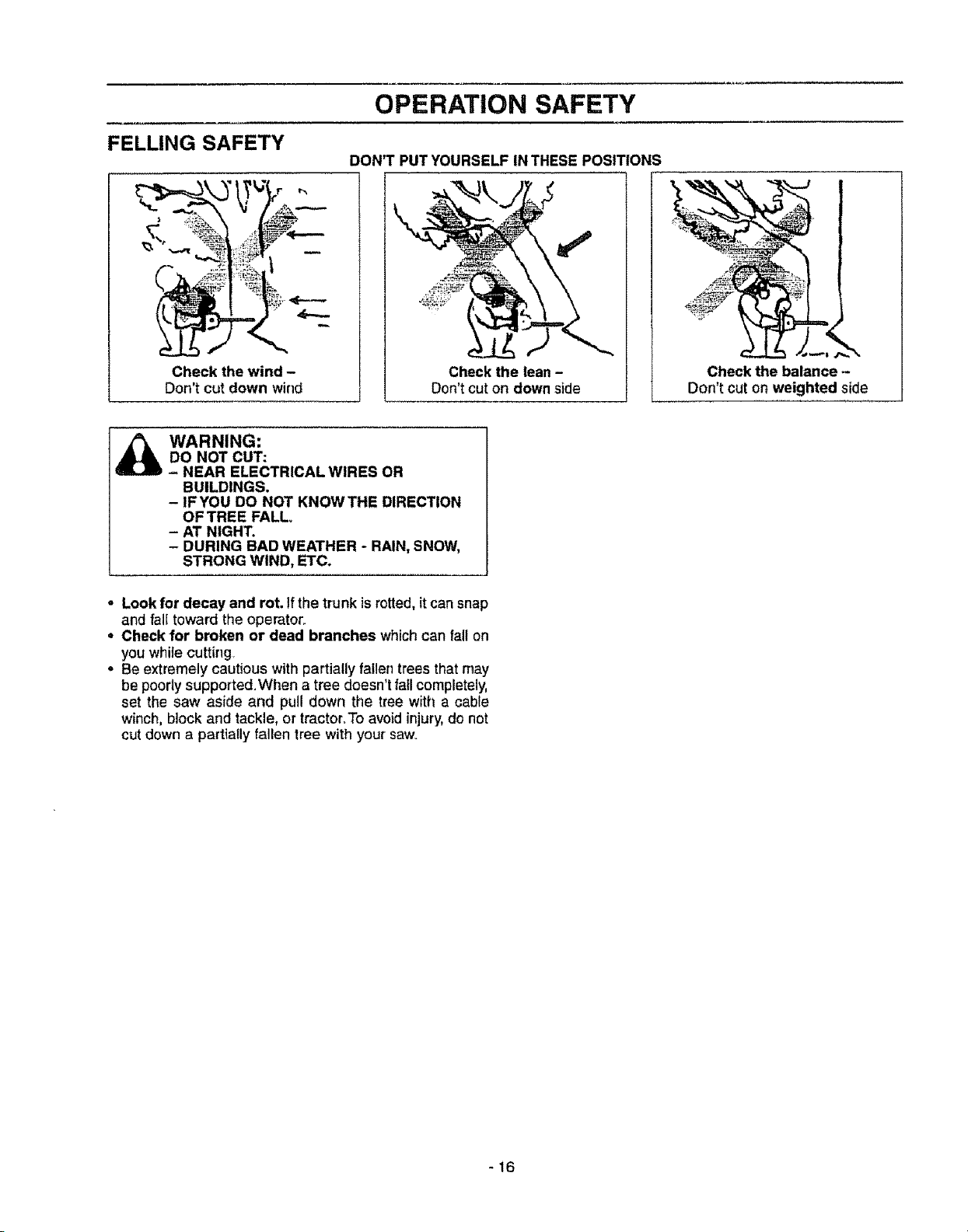
FELLING SAFETY
Check the wind -
Don't cut down wind
DON'T PUT YOURSELF INTHESE POSITIONS
Check the lean -
Don't cut on down side
U
Check the balance -
Don't cut on weighted side
_hb ARNING:
DO NOT CUT:
- NEAR ELECTRICAL WIRES OR
BUILDINGS.
- IFYOU DO NOT KNOW'THE DIRECTION
OF TREE FALL°
- AT NIGHT.
- DURING BAD WEATHER - RAIN,SNOW,
STRONG WIND, ETC.
- Look for decay and rot. If the trunk isrotted,itcan snap
and fall towardthe operator..
• Check for broken or dead branches whichcan fal! on
youwhile cutting
• Be extremely cautious with partially fallen trees that may
be poorly supported. When a tree doesn't fatlcompletely,
set the saw aside and pull down the tree with a cable
winch, block and tackle, or tractorr,TOavoid injury, do not
cut down a partiallyfallen tree with your saw.
-16
OPERATION
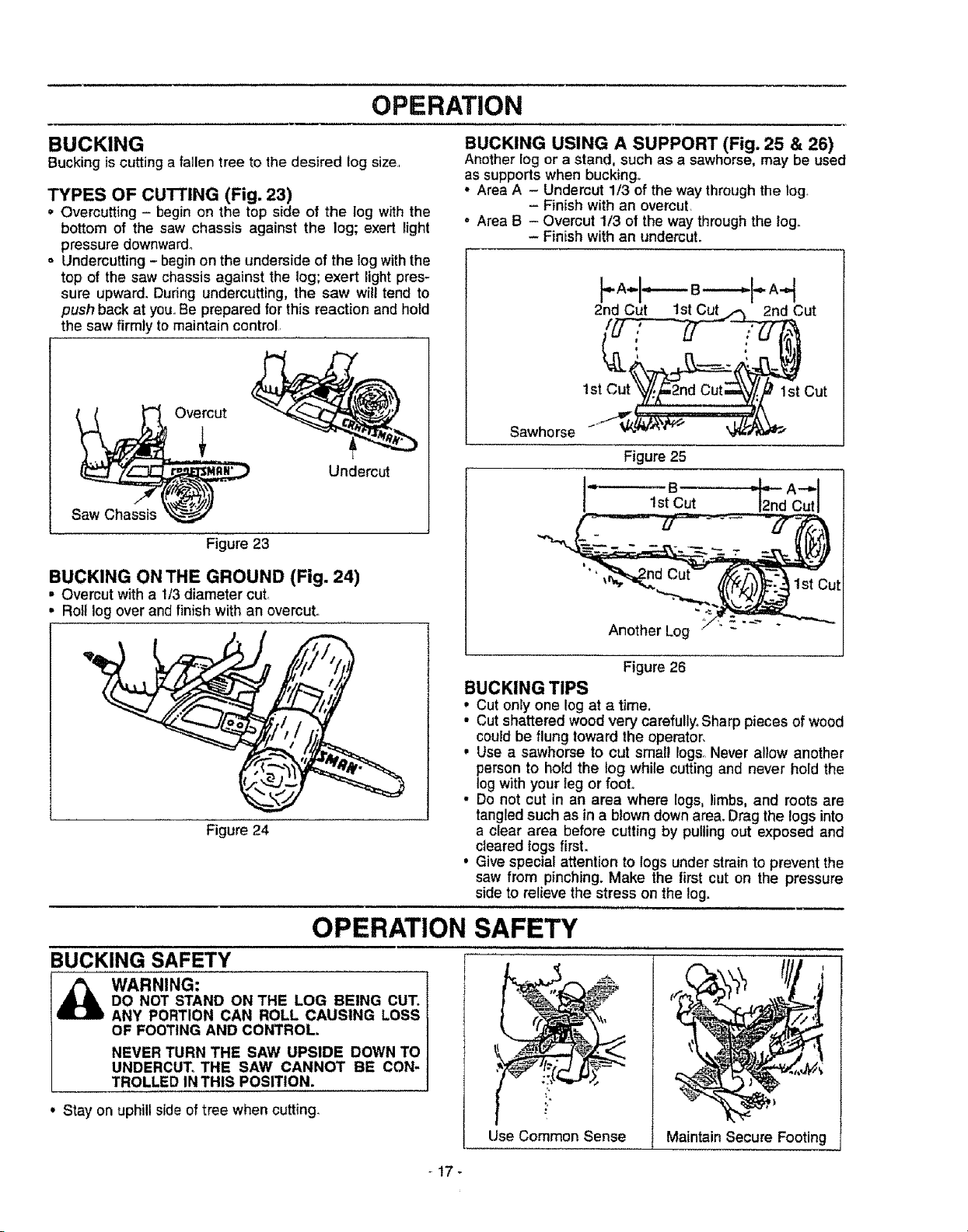
BUCKING
Buckingis cutting a fallen tree to the desired log size,,
TYPES OF CUTTING (Fig. 23)
. Overcutting - begin on the top side of the log with the
bottom of the saw chassis against the log; exert light
pressure downward.
,, Undercutting - begin on the underside of the logwiththe
top of the saw chassis against the log;exert light pres-
sure upward. Dudng undercutting, the saw will tend to
push back at you,,Be prepared for this reaction and hotd
the saw firmly to maintain control,
Overcut
Undercut
Saw Chassis
Figure 23
BUCKING ON THE GROUND (Fig. 24)
• Overcut with a 1/3 diameter cut.
Roll logover and finish with an overcuL
Figure 24
BUCKING USING A SUPPORT (Fig. 25 & 26)
Another log or a stand, such as a sawhorse, may be used
as supports when bucking,,
• Area A - Undercut 1/3 of the way through the log,
- Finish with an overcut,
• Area B - Overcut 1/3 of the way through the log,,
- Finish with an undercut.
Sawhorse
Figure 25
FA--I------B-----I--A--t
27, ut
1st _2nd Cuti_it_ l 1st Cut
1st Cut
Figure 26
BUCKING TIPS
* Cut only one log at a time.
• Cut shattered wood very carefully. Sharp pieces of wood
could be flung toward the operator.
, Use a sawhorse to cut small Iogs. Never allow another
person to hold the log while cutting and never hold the
log with your leg or foot.
, Do not cut in an area where logs, limbs, and roots are
tangled such as in a blown down area. Drag the logs into
a clear area before cutting by pulling out exposed and
cleared logs first.
, Give special attention to logs under strain to prevent the
saw from pinching. Make the first cut on the pressure
side to relieve the stress on the log.
OPERATION SAFETY
BUCKING SAFETY
WARNING:
DO NOT STAND ON THE LOG BEING CUT.
ANY PORTION CAN ROLL CAUSING LOSS
OF FOOTING AND CONTROL.
NEVER TURN THE SAW UPSIDE DOWN TO
UNDERCUT, THE SAW CANNOT BE CON-
TROLLED INTHIS POSITION.
• Stay on uphill side oftree when cutting.
Use Common Sense
"<_:_P_'_ _t_
Maintain Secure Footing
17-
OPERATION
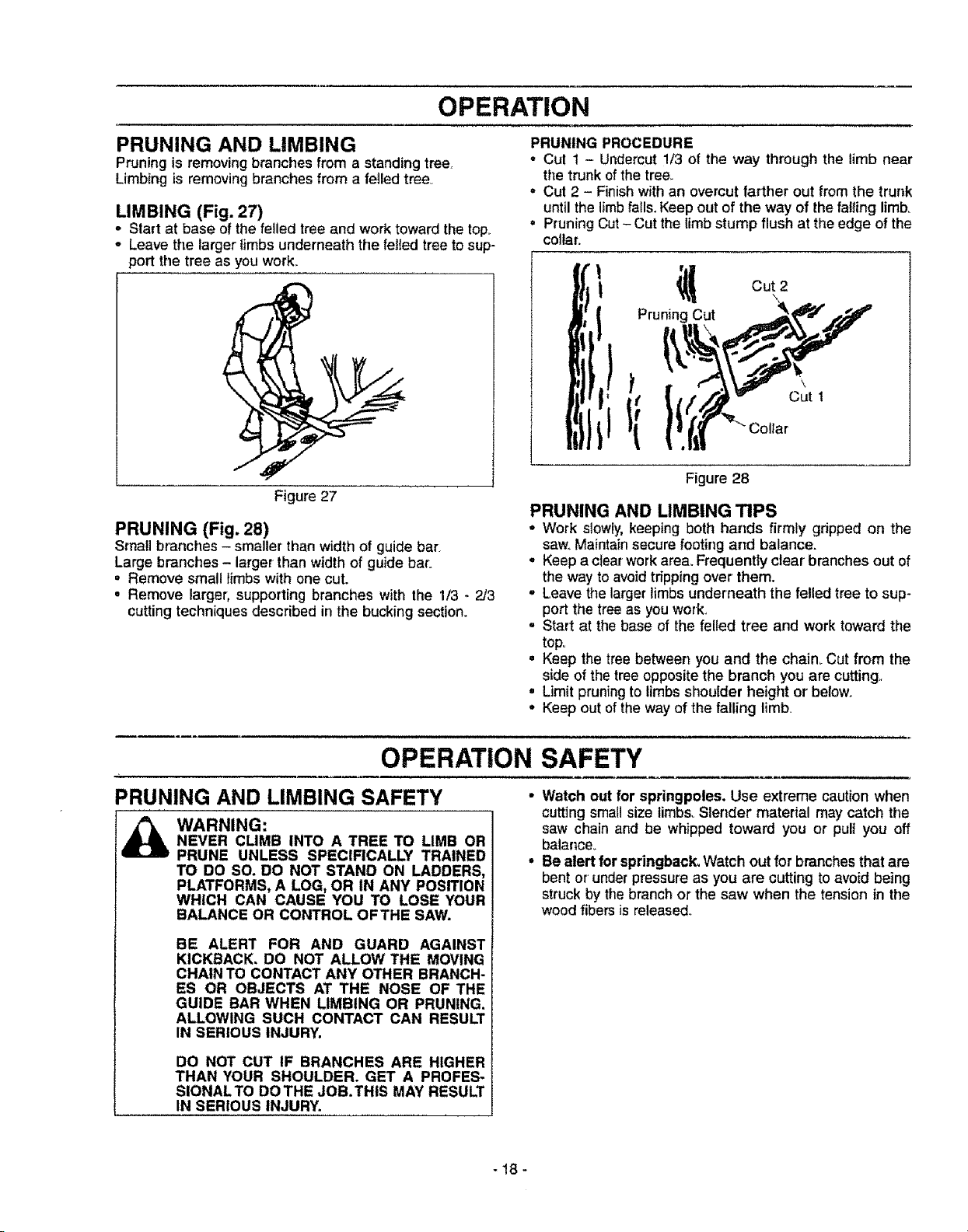
PRUNING AND LIMBING
Pruning is removing branches from a standing tree,
Limbing is removing branches from a felled tree°
LIMBING (Fig. 27)
o Start at base of the felledtree and work toward the top_
- Leave the larger limbs underneath the felled tree to sup-
port the tree as you work_
Figure 27
PRUNING (Fig. 28)
Small branches - smaller than widthof guide bar
Large branches - larger than width of guide bar:
• Remove small limbs with one cut.
= Remove larger;supporting branches with the 1/3 - 2/3
cutting techniques described in the bucking section.
PRUNING PROCEDURE
- Cut 1 - Undercut 1/3 of the way through the limb near
the trunk ofthe tree.
• Cut 2 - Finish with an overcut farther out from the trunk
until the limbfalls.Keep out of the way of thefalling limb,
= Pruning Cut - Cut the limb stump flush at the edge of the
collar.
!
I _l Cut 2
\
Pruning Cut _k,
Cut t
Figure 28
PRUNING AND LIMBING TiPS
° Work slowly, keeping both hands firmly gdpped on the
saw. Maintainsecure footing and balance.
° Keep a ctearworkarea. Frequently clear branches out of
the way to avoid trippingover them.
• Leave the largerlimbsunderneath the felled tree to sup-
portthe tree as youwork.
• Start at the base of the felled tree and work toward the
top°
= Keep the tree between you and the chain_Cut from the
side of thetree opposite the branch you are cutting..
° Limitpruningto limbsshoulder height or betow.
• Keep out ofthe way of the falling limb.
OPERATION SAFETY
PRUNING AND LIMBING SAFETY
l_ WARNING:
NEVER CUMB INTO A TREE TO LIMB OR
PRUNE UNLESS SPECIFICALLY TRAINED
TO DO SO. DO NOT STAND ON LADDERS,
PLATFORMS, A LOG, OR tN ANY POSITION
WHICH CAN CAUSE YOU TO LOSE YOUR
BALANCE OR CONTROL OFTHE SAW.
BE ALERT FOR AND GUARD AGAINST
KICKBACK. DO NOT ALLOW THE MOVING
CHAIN TO CONTACT ANY OTHER BRANCH-
ES OR OBJECTS AT THE NOSE OF THE
GUIDE BAR WHEN LIMBING OR PRUNING.
ALLOWING SUCH CONTACT CAN RESULT
IN SERIOUS INJURY.
DO NOT CUT IF BRANCHES ARE HIGHER
THAN YOUR SHOULDER. GET A PROFES-
SIONAL TO DO THE JOB. THIS MAY RESULT
IN SERIOUS INJURY.
Watch out for springpoles. Use extreme cautionwhen
cutting small size limbs, Slender material may catch the
saw chain and be whipped toward you or pull you off
balance_
Be alert for springback, Watch out for branches that are
bent or'under pressure as you are cutting to avoid being
struck by the branch or the saw when the tension in the
wood fibers isreleased.,
CUSTOMER RESPONSIBiLITiES
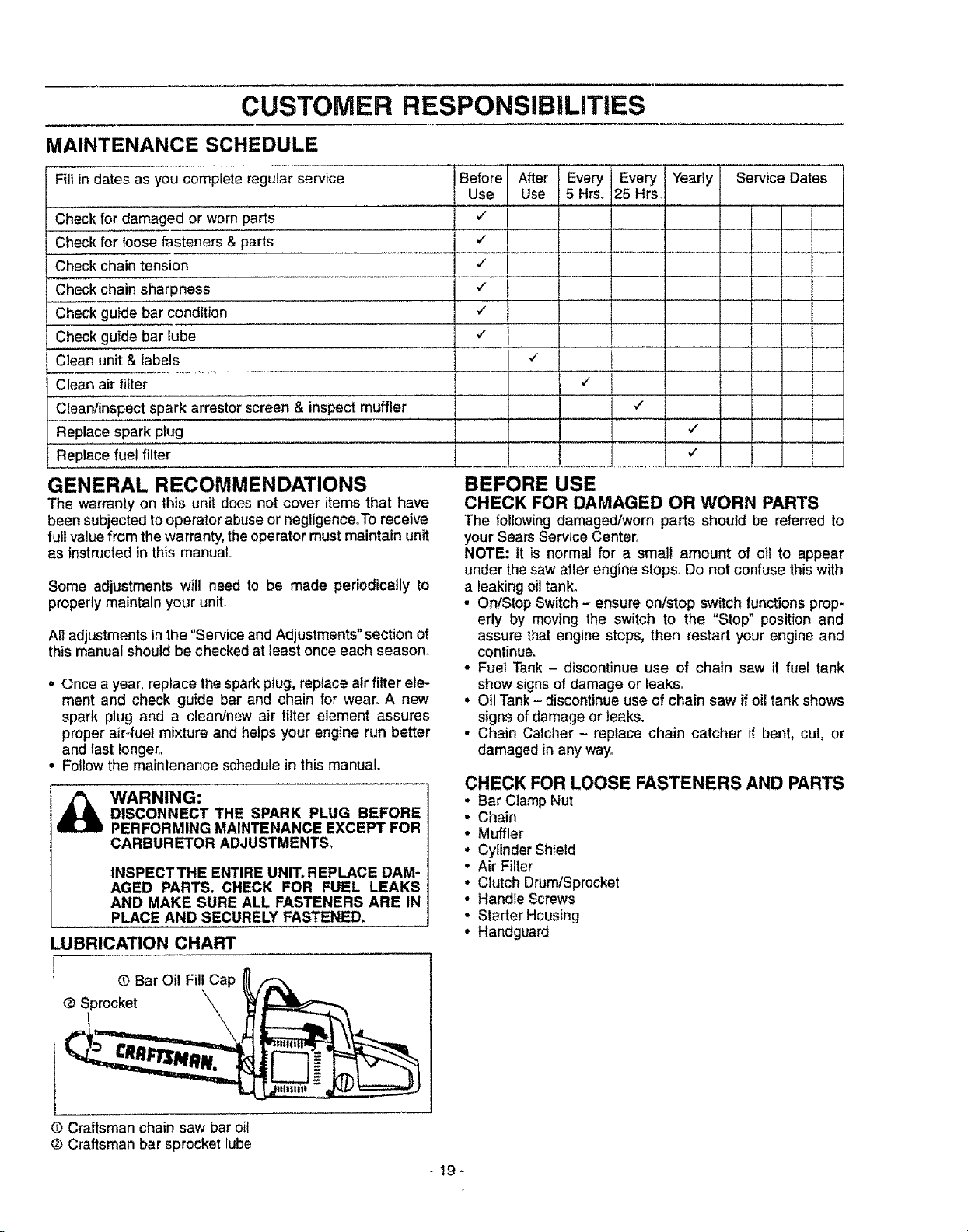
MAINTENANCE SCHEDULE
Filt in dates as you complete regular service
Check for damaged or worn parts
Check for loose fasteners & parts
Check chain tension
Check Chai'n"sharpness
....Ciqeck guide bar condition
Check guide bar lube
Clean unit & labels
Clean air filter
Clean/inspect spark arrestor screen & inspect muffler
Replace spark plug
Replace fuel filter
GENERAL RECOMMENDATIONS
The warrantyon this unit does not cover items that have
been subjected to operator abuse or negligence° To receive
full value from the warranty, the operator must maintain unit
as instnJctedin this manual
Some adjustments will need to be made periodically to
properly maintain your unit.
All adjustments in the "Service and Adjustments" section of
this manual should be checked at least once each season.
. Once a year, replace the spark plug,replace air filter ele-
ment and check guide bar and chain for wear. A new
spark plug and a clean/new air filter element assures
proper air4uel mixture and helps your engine run better
and last longer.
• Follow the maintenance schedule in this manual
WARNING:
DISCONNECT THE SPARK PLUG BEFORE
PERFORMING MAINTENANCE EXCEPT FOR
CARBURETOR ADJUSTMENTS,
INSPECTTHE ENTIRE UNIT. REPLACE DAM-
AGED PARTS. CHECK FOR FUEL LEAKS
AND MAKE SURE ALL FASTENERS ARE IN
PLACE AND SECURELY FASTENED.
LUBRICATION CHART
Before After Every Every Yearly
Use Use 5 Hrs,r 25 Hrs ,,
..... i ,
v"
v"
v"
v"
v"
Service Dates
I
!
'1 ....... ....
BEFORE USE
CHECK FOR DAMAGED OR WORN PARTS
The following damaged!worn parts should be referred to
your Sears Service Center,
NOTE: It is normal for a small amount of oil to appear
under the saw after engine stops. Do not confuse this with
a leakingoil tank.
• On/Stop Switch - ensure on/stop switch functions prop-
erly by moving the switch to the "Stop" position and
assure that engine stops, then restart your engine and
continue,
• Fuel Tank - discontinue use of chain saw if fuel tank
show signs of damage or leaks_
• Oil Tank - discontinue use of chain saw ifoil tank shows
signs of damage or leaks.
• Chain Catcher - replace chain catcher if bent, cut, or
damaged in any way,
CHECK FOR LOOSE FASTENERS AND PARTS
• Bar Clamp Nut
• Chain
• Muffler
• Cylinder Shield
• Air Filter
• Clutch Drum/Sprocket
• Handle Screws
• Starter Housing
• Handguard
(£ Bar Oil Fill Cap
@Sprocket \
O Craftsman chain saw bar oil
® Craftsman bar sprocket lube
-19-
CUSTOMER RESPONSIBILITIES
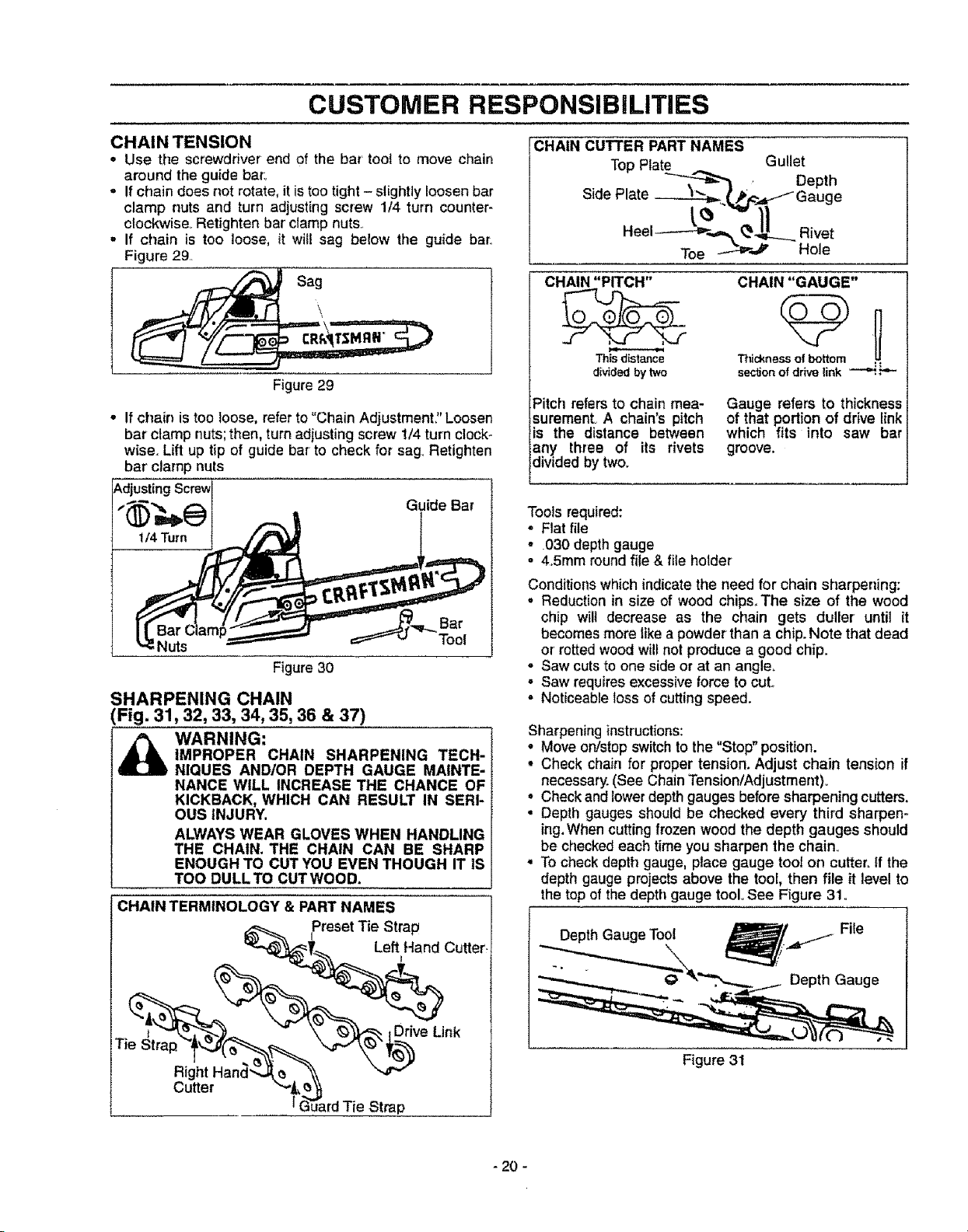
CHAIN TENSION
o Use the screwdriver end of the bar tool to move chain
around the guide bat:
° If chain does not rotate, it istoo tight - slightly loosen bar
clamp nuts and turn adjusting screw 1/4 turn counter-
clockwise+ Retighten bar clamp nuts.
, If chain is too loose, it wilf sag below the guide ban
Figure 29.
Sag
\
Figure 29
• If chain is too loose, refer to "Chain Adjustment." Loosen
bar clamp nuts; then, turn adjusting screw 1/4 turn clock+
wise. Lift up tip of guide bar to check for sag. Retighten
bar clamp nuts
CHAIN CUTTER PARTNAMES
Top Plate Gullet
_--_ ' Depth
Side Plate 't ., "_ _- e
Toe --'-_"#" Hole
CHAIN "PITCH" CHAIN "GAUGE"
This distance Thickness of bottom
divided by two section of drive link _
Pitch refers to chain mea-
surement A chain's pitch
is the distance between
any three of its rivets
divided by two+
Gauge refers to thickness
of that portion of drivelink
which fits into saw bar
groove.
Guide Bar
Bar
Tool
Figure 30
SHARPENING CHAIN
(Fig. 31,32, 33, 34, 35, 36 & 37)
WARNING:
IMPROPER CHAIN SHARPENING TECH-
NIQUES AND/OR DEPTH GAUGE MAINTE-
NANCE WILL INCREASE THE CHANCE OF
KICKBACK, WHICH CAN RESULT IN SERI-
OUS INJURY.
ALWAYS WEAR GLOVES WHEN HANDLING
THE CHAIN. THE CHAIN CAN BE SHARP
ENOUGH TO CUT YOU EVEN THOUGH IT IS
TOO DULL TO CUT WOOD.
CHAIN TERMINOLOGY & PART NAMES
Preset Tie Strap
Left Hand CutteF
+
Ti___ +_ve Link
Right Hana_-_ _
Cutter "_k e &
l G"_'ardTie Strap
Tools required:
o Flat file
- 030 depth gauge
- 4+5mmround file & file holder'
Conditions whichindicatethe need for chain sharpening:
o Reduction in size of wood chips+The size of the wood
chip wilt decrease as the chain gets duller' until it
becomes more like a powderthan a chip. Note that dead
or' rotted wood wilt not produce a good chip.
o Saw cuts to one side or at an angle+
° Saw requires excessive force to cut+
- Noticeable loss of cutting speed.
Sharpening instructions:
° Move on/stop switch to the "Stop" position.
• Check chain for propertension.Adjust chain tension if
necessary. (See Chain Tension/Adjustment)+
• Check and lowerdepth gauges before sharpeningcutters.
° Depth gauges shouldbe checked every third sharpen=
ing.Whencuttingfrozen wood the depth gauges should
be checkedeach timeyou sharpen the chain.
• To checkdepth gauge, place gauge tooton cutter+If the
depth gauge projectsabove the tool, then file it level to
the top of thedepth gaugetool.,See Figure 31+
Depth Gauge Tool
File
Figure 31
- 20 -
CUSTOMER RESPONSiBILITiES
.030"
Rounded
f====_r_" Corner
Right Way
Squared
Off Corner
Wrong Way
Figure 32
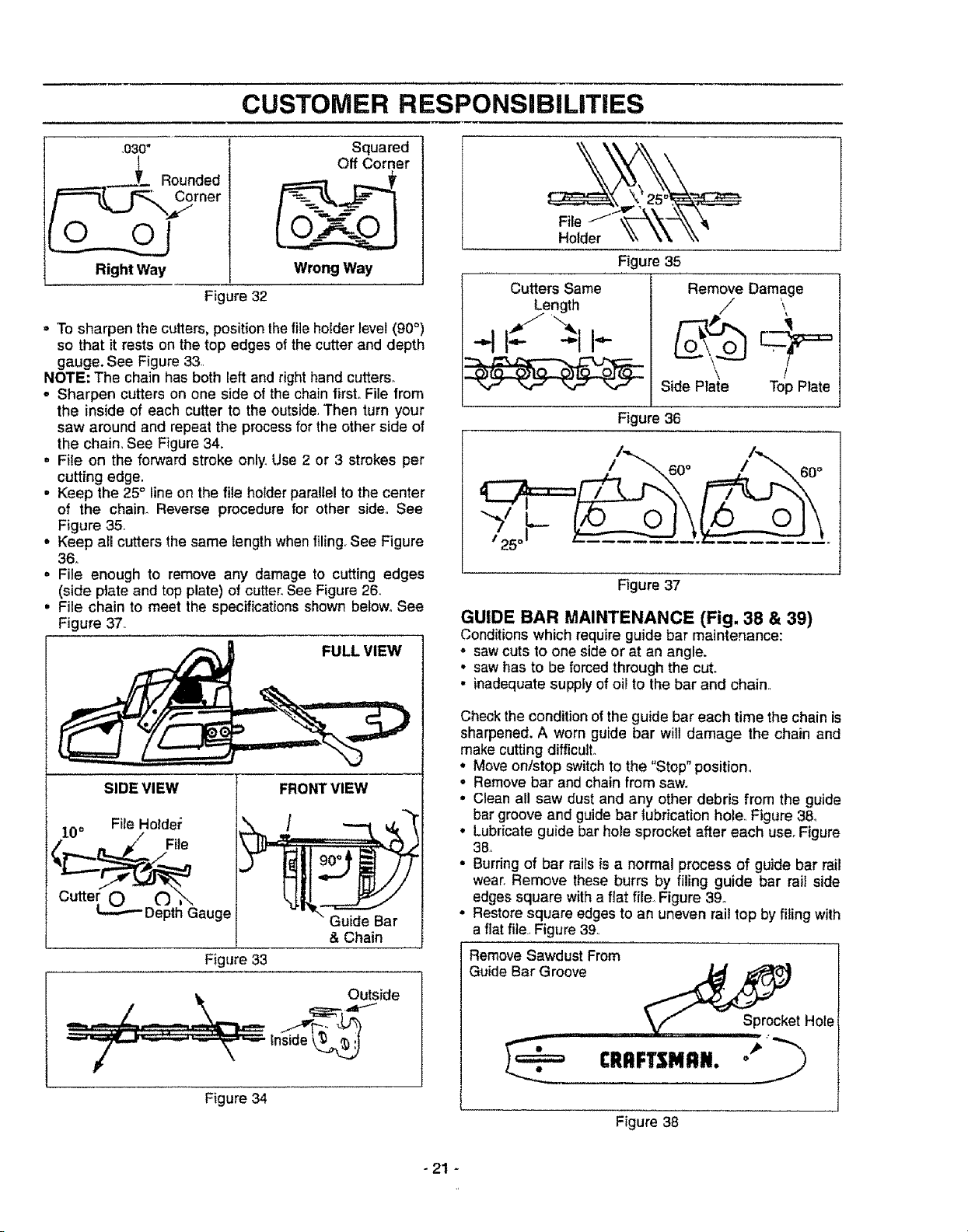
. To sharpen the cutters, position thefile holder level (90°)
so that it rests on the top edges ofthe cutter and depth
gauge. See Figure 33
NOTE: The chain has both left and right hand cutters.
- Sharpen cutters on one side of the chain first.,File from
the inside of each cutter to the outside.Then turn your
saw around and repeat the process for the other side of
the chain. See Figure 34.
, File on the forward stroke only..Use 2 or 3 strokes per
cutting edge.
• Keep the 25° line on the file holder parallelto the center
of the chain. Reverse procedure for other side.. See
Figure 35.
° Keep all cutters the same length when filingr See Figure
3&
, File enough to remove any damage to cutting edges
(side plate and top plate) of cutter_See Figure 26.
• File chain to meet the specifications shown below° See
Figure 37.
FULL VIEW
SIDE VIEW
File Holde_
10° /
File
Cutter O
Depth Gauge
FRONT VIEW
& Chain
Figure 33
Outside
tnside _
Figure 34
Holder
Figure 35
Cutters Same
Length
Remove Damage
J-F
/
Side Plate Top Plate
Figure 36
Figure 37
GUIDE BAR MAINTENANCE (Fig. 38 & 39)
Conditions which requireguide bar maintenance:
* saw cuts to one side or at an angle.
. saw has to be forced through the cut.
• inadequate supply ofoil to the bar and chain,
Check the condition of the guide bar each time the chain is
sharpened. A worn guide bar will damage the chain and
make cutting difficult..
• Move on/stop switch to the "Stop" position_
• Remove bar and chain from saw°
° Clean all saw dust and any other debris from the guide
bar groove and guide bar lubrication hole..Figure 38.
° Lubricate guide bar hole sprocket after each use. Figure
38.
• Burring of bar rails isa normal process of guide bar rail
wear. Remove these burrs by filing guide bar rail side
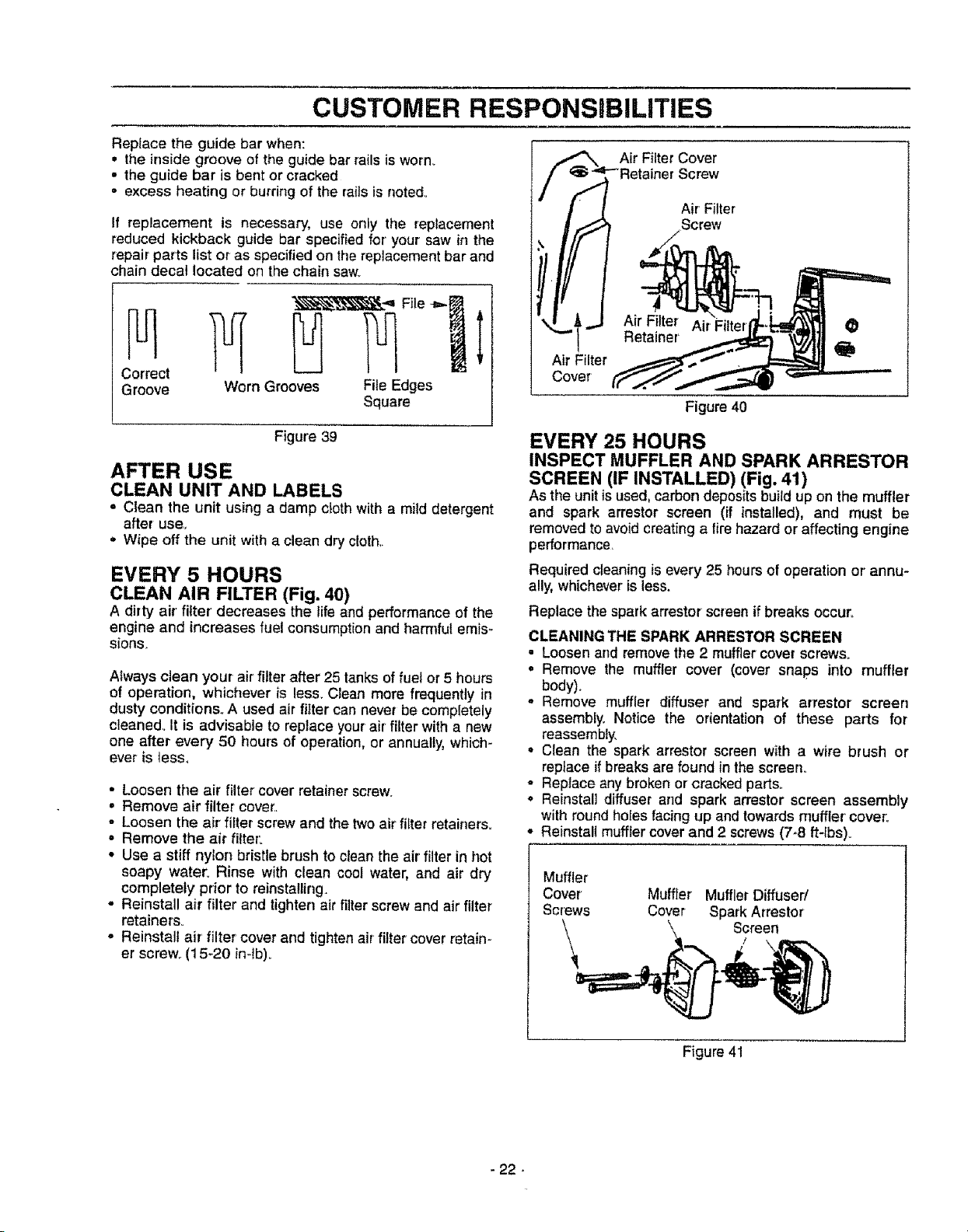
edges square with a flat file_Figure 39.
• Restore square edges to an uneven rail top by filing with
a flat file. Figure 394
Remove Sawdust From
Guide Bar Groove __et
Hole
Figure 38
- 21 -
CUSTOMER RESPONSIBILITIES
Replace the guide bar when:
. the inside groove of the guide bar rails is worn.
• the guide bar is bent or cracked
- excess heating or burring of the rails is noted°
If replacement is necessary, use only the replacement
reduced kickback guide bar specified for your saw in the
repair parts list or as specified on the replacement bar and
chain decal located on the chain saw_
_-,,= File _==-_
Correct
Groove Worn Grooves File Edges
Square
_.,=_ Air Filter Cover
Retainer Screw
/_ Air Filter
I_ ,Screw
Air Filter
Cover
Figure 40
Figure 39
AFTER USE
CLEAN UNIT AND LABELS
= Clean the unit using a damp cloth with a mild detergent
after use.
° Wipe off the unit with a clean dry cloth..
EVERY 5 HOURS
CLEAN AIR FILTER (Fig. 40)
A dirty air' filter decreases the life and performanceof the
engine and increases fuel consumption and hamrful emis-
sions.
Always clean your air filter after 25 tanksof fuel or 5 hours
of operation, whichever is less. Clean more frequently in
dusty conditions.. A used air filter can never be completely
cleaned.. It is advisable to replace your' air filter with a new
one after every 50 hours of operation,or annually, which-
ever is tess,
• Loosen the air filter cover retainer screw.
. Remove air filter cover,.
• Loosen the air' fiiter screw and the two air fitter retainers.
° Remove the air filter
• Use a stiff nylon bristle brush to clean the air filter in hot
soapy water_ Rinse with clean cool water, and air dry
completely prior to reinstalling.
• Reinstall air filter and tighten air filter screw and air filter
retainers°
o Reinstall air' filter' cover and tighten air filter cover retain-
er screw..(15-20 in-lb).
EVERY 25 HOURS
INSPECT MUFFLER AND SPARK ARRESTOR
SCREEN (IF INSTALLED) (Fig. 41)
As the unit is used, carbon deposits build up on the muffler
and spark arrestor screen (if installed), and must be
removed to avoid creating a fire hazard or affecting engine
performance.
Required cleaning is every 25 hours of operation or' annu-
ally, whichever is less,
Replace thespark arrestor screen ifbreaks occur°
CLEANING THE SPARK ARRESTOR SCREEN
- Loosen and remove the 2 mufflercovet screws=
, Remove the muffler cover (cover snaps into muffler
body),
° Remove muffler diffuser and spark arrestor screen
assembly. Notice the orientation of these parts for
reassembiy,
° Clean the spark arrestor screen with a wire brush or
replace if breaks are found inthe screen..
-Repiace any broken or cracked parts..
° Reinstall diffuser and spark arrestor screen assembly
with round holes facing up and towardsmuffler cover.
Reinstall muffler cover and 2 screws (7_8ft4bs)_
Muffler
Cover Muffler Muffler Diffuser/
Screws Cover Spark Arrestor
\ Screen
Figure 41
- 22 -
CUSTOMER RESPONSIBaLITIES
YEARLY
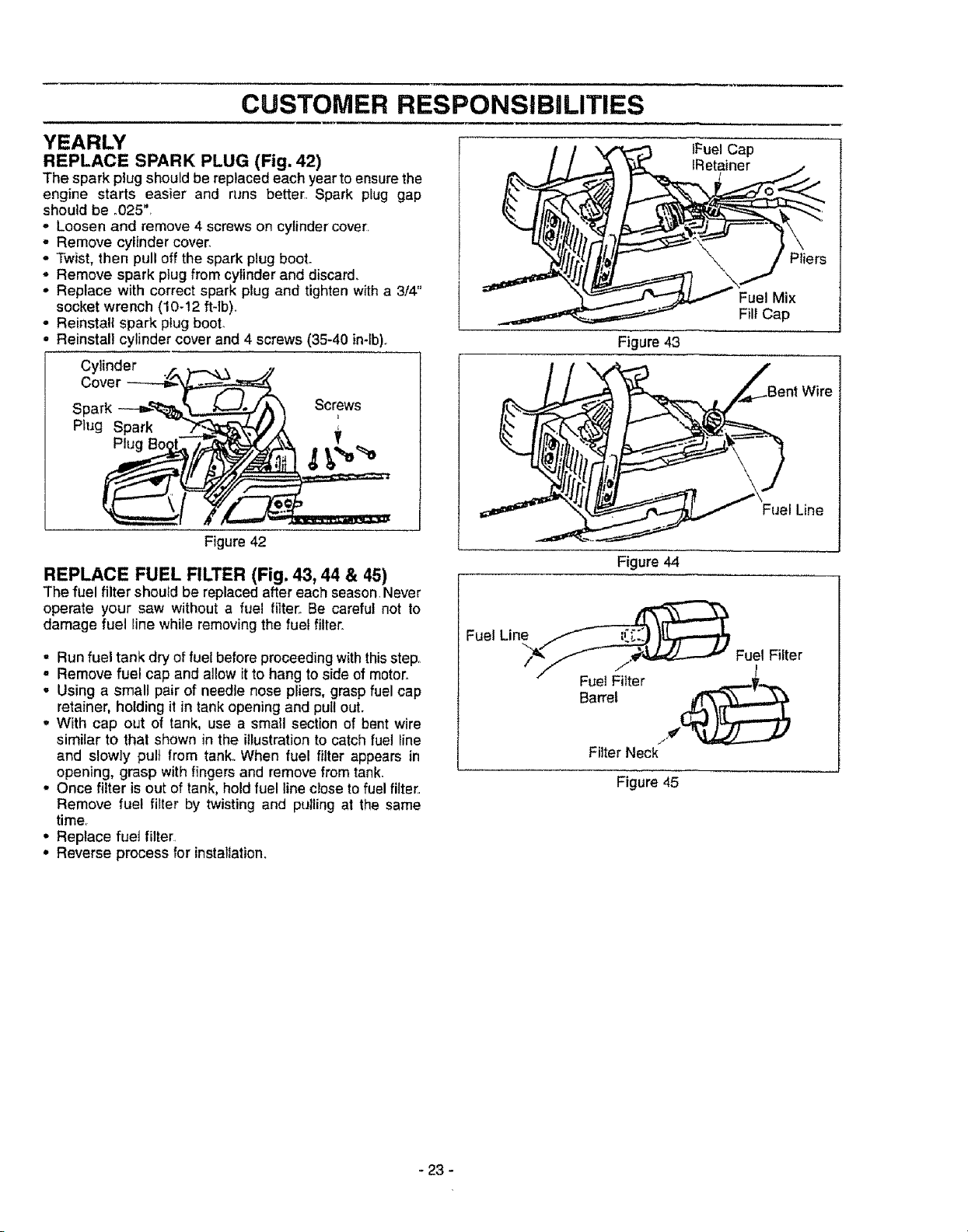
REPLACE SPARK PLUG (Fig. 42)
The spark plugshouldbe replacedeach yeartoensurethe
engine starts easier and runs better. Spark plug gap
should be .025".
= Loosen and remove 4 screws on cylinder cove[.
- Remove cylinder cover.
• Twist, then pull off the spark plug boot.
• Remove spark plug from cylinder and discard.
• Replace with correct spark plug and tighten with a 3/4"
socket wrench (10-12 ft-tb)..
• Reinstall spark plug boot.
o Reinstall cylinder cover and 4 screws (35-40 in-tb).r
Cylinder
Cover
Plug Spark
Screws
v
Figure 42
REPLACE FUEL FILTER (Fig. 43, 44 & 45)
The fuel filter shouidbe replacedafter each season Never
operate your saw without a fuel filter Be careful not to
damage fuel line while removing the fuel filter.
° Run fuel tank dry of fuel before proceeding with this step.
, Remove fuel cap and allow it to hang to side of motor.
° Using a small pair of needle nose pliers, grasp fuel cap
retainer, holding it in tank opening and pull out.
,, With cap out of tank, use a small section of bent wire
similar to that shown in the illustration to catch fuel fine
and slowly pull from tank_When fuel filter appears in
opening, grasp with fingers and remove from tank.
• Once filter is out of tank, hold fuel line close to fuel filter..
Remove fuel filter by twisting and pulling at the same
time.
• Replace fuel filter,
• Reverse process for installation.
IFuel Cap
IRetainer
Fuel Mix
Fill Cap
Figure43
Figure 44
Fuel Line
/'__--_'f__ Fuel Filter
Fuel Filter _,_
Barrel
j_
Filter Neck
Figure 45
- 23 -
SERVICE AND ADJUSTMENTS
CHAIN Now proceed to the "Chain Adjustment"section,
REPLACEMENT (Fig. 46, 47, 48 & 49)
CAUTION: Wear protective gloves when han-
dling chain.The chain issharp and cancut you
even when it is not moving.
It is normal for a new chain to stretch.Because
of this initial stretch during the first 15-30
minutes of operation you should recheckyour
chain tension frequently and adjust the chain
tension as required. See chaintension section.
o Move on/stop switch to the "Stop" position,
- Replace the old chain when it becomes worn or dam-
aged.
• Use only the Low-Kickback replacement chain specified
in the repair parts list or as specified on the replacement
bar and chain decal located on the chain saw,
• See your Sears Service Center to replace and sharpen
individual cutters for matching your chain.
. Loosen and remove the 2 bar clamp nuts,,
= Remove bar clamp.
• Remove the old chain.
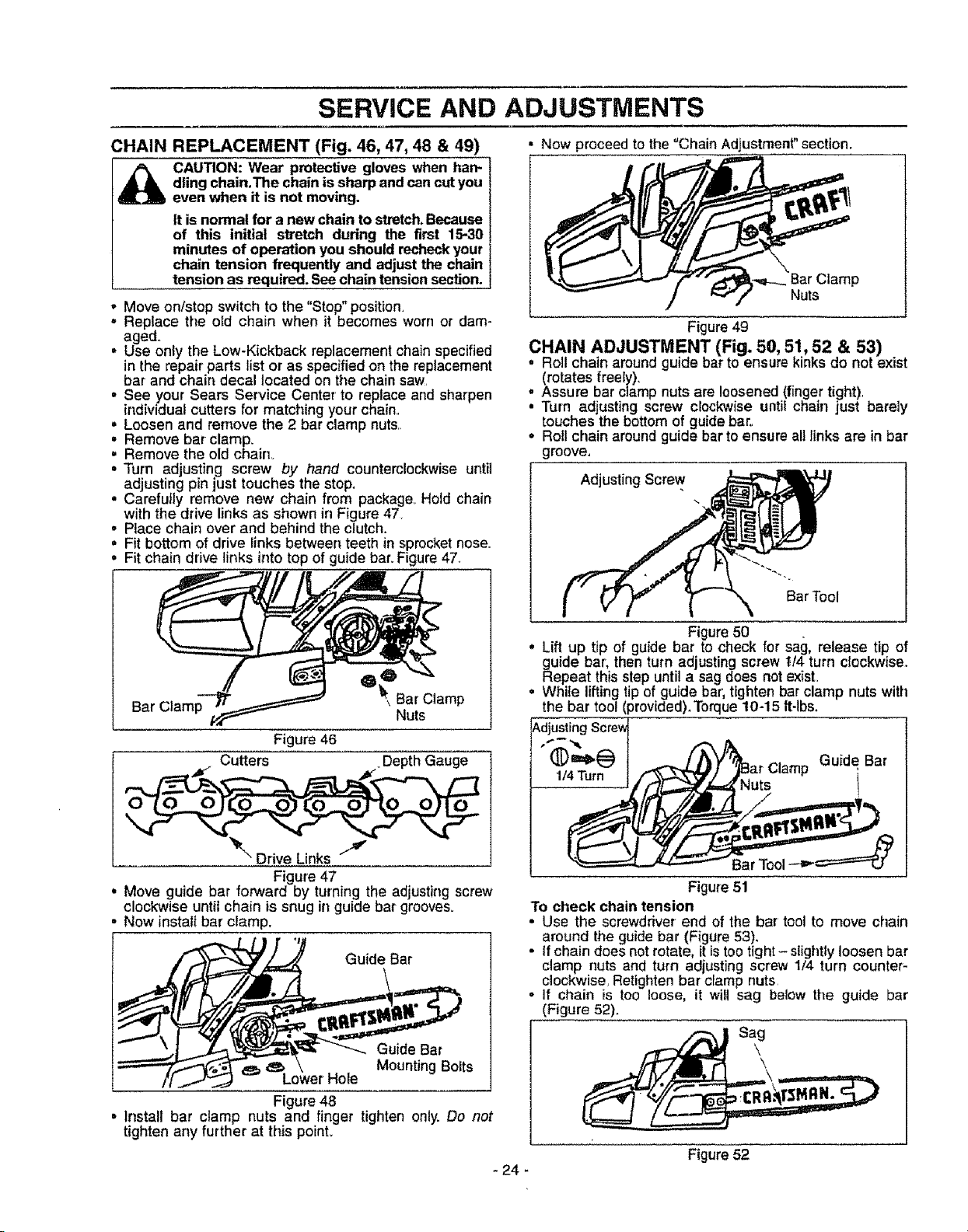
i urn adjusting screw by hand counterclockwiseuntil
adjusting pinjust touches the stop.
Carefutly remove new chain from package,,Hold chain
with the drive links as shown in Figure 47,
Place chain over and behind the clutch.
Fit bottom of drive linksbetween teeth in sprocketnose.
Fit chain drive linksinto top of guide bar. Figure47.
Bar Clamp
Figure 46
I ,_" Cutters __" Depth Gauge l
Figure 47
• Move guide bar fonNard by turning the adjusting screw
clockwise untit chain issnug in guide bar grooves°
° Now instaltbar clamp,
Guide Bar
Guide Bar
,_ _ Mounting Botts
Lower Hole
Figure 48
• Install bar clamp nuts and finger tighten only. Do not
tighten any further at this point.
Bar Clamp
Nuts
Figure 49
CHAIN ADJUSTMENT (Fig. 50, 51, 52 & 53)
Roll chain aroundguide bar to ensurekinks do not exist
(rotates freely),
° Assure bar clamp nuts are loosened(fingertight),
• Turn adjusting screw clockwise untitchain just barely
touches the bottom of guide bar,,
o Roll chain aroundguide bartoensure all linksare in bar
groove,
AdjustingScrew
Bar Tool
Figure 50
• Lift up tip of guide bar to check for sag, release tip of
guide bar',then turn adjusting screw t/4 turn clockwise..
Repeat this step untila sag does not exist.
° While liftingtip of guide bar;tighten bar clamp nuts with
the bar tool (provided).Torque 10-15 lt-tbs.
_,djustingScrew
.'_-- _ .,'_ t_
® JhY' Gu,d Bar
,,,To,°j j.. 1
Figure 51
To check chain tension
° Use the screwdriver end of the bar toolto move chain
around the guide bar (Figure 53),
° if chain does not rotate, itistoo tight - slightly loosen bar
clamp nuts and turn adjusting screw 1/4 turn counter-
clockwise, Retighten bar clamp nuts,
• If chain is too loose, it will sag below the guide bar
(Figure 52).
Sag
Figure 52
- 24 -
SERVICE AND ADJ USTM ENTS
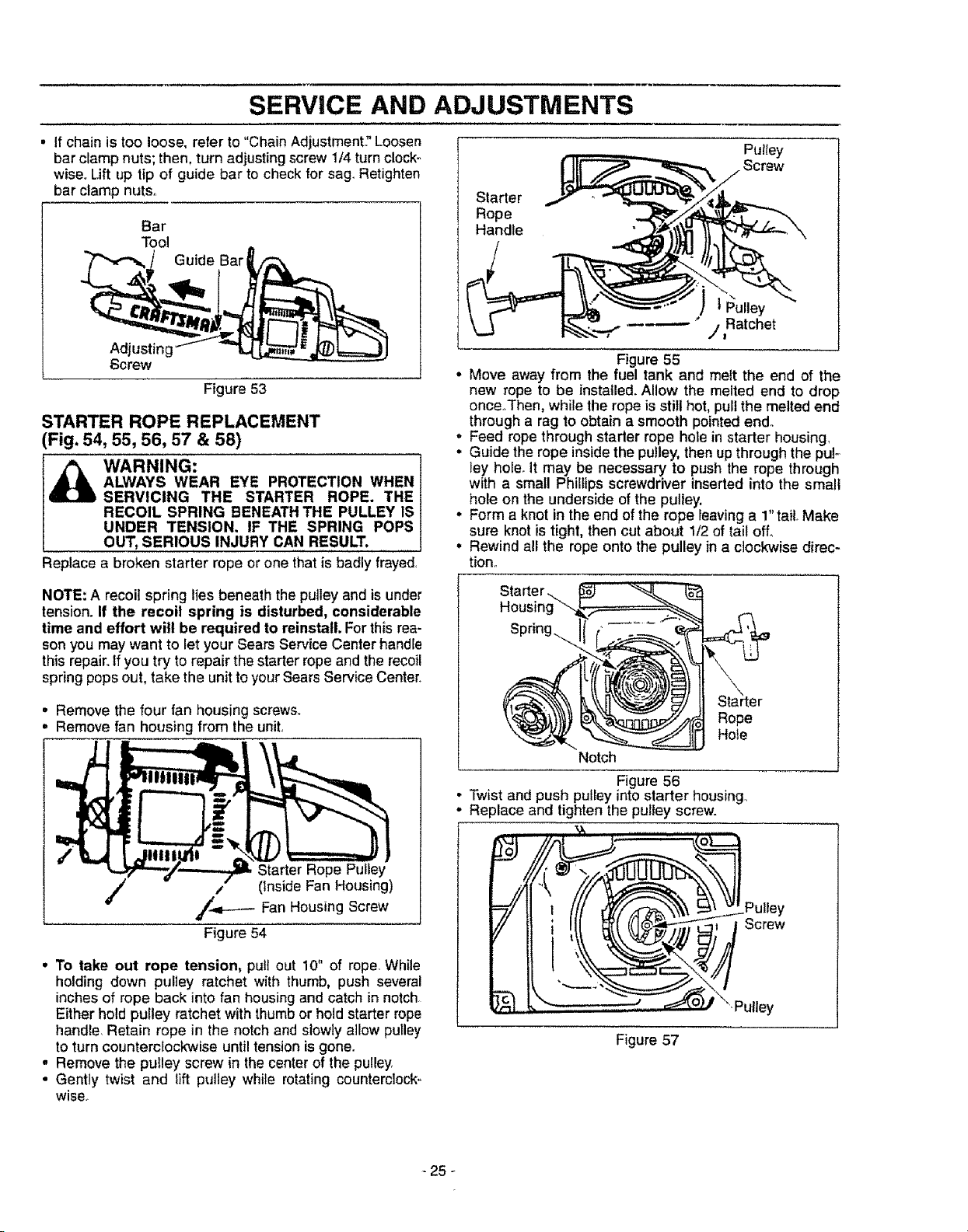
• If chain is too loose, refer to "Chain Adjustment? Loosen
bar clamp nuts; then, turn adjusting screw 1/4 turn clock-
wise, Lift up tip of guide bar to check for sag.,Retighten
bar clamp nuts.
Bar
Tool
Guide Bar
Adjusting
Screw
Figure 53
STARTER ROPE REPLACEMENT
(Fig. 54, 55, 56, 57 & 58)
WARNING:
ALWAYS WEAR EYE PROTECTION WHEN
SERVICING THE STARTER ROPE. THE
RECOIL SPRING BENEATH THE PULLEY IS
UNDER TENSION, IF THE SPRING POPS
OUT, SERIOUS INJURY CAN RESULT.
Replace a broken starter rope or one that is badly frayed
NOTE: A recoil spring lies beneath the pulley and isunder
tension. If the recoil spring is disturbed, considerable
time and effort will be required to reinstall. Forthis rea-
son you may want to let yourSears Service Center handle
this repair,,If you try to repair the starter rope and the recoil
spring pops out, take the unit to your Sears Service Center.
• Remove the four fan housing screws,
. Remove fan housing from the unit,
/
Starter Rope Pulley
/ (inside Fan Housing)
..4---- Fan Housing Screw
Figure 54
• To take out rope tension, pull out 10" of rope, While
holding down pulley ratchet with thumb, push several
inches of rope back into fan housing and catch in notch,
Either hold pulley ratchet with thumbor hold starter rope
handte, Retain rope in the notch and slowly allow pulley
to turn counterclockwise until tension is gone.
• Remove the pulley screw in the center of the pulley,
•Gentty twist and lift pulley while rotating counterclock-
wiser
Starter
Rope
Handle
Pultey
•Screw
t I_ulley
--..-----" ,/Ratchet
Figure 55
• Move away from the fuel tank and melt the end of the
new rope to be installed. Allow the melted end to drop
once.Then, while the rope is still hot, pull the melted end
through a rag to obtain a smooth pointed end,
° Feed rope through starter rope hote in starter housing,
• Guide the rope inside the pulley, then up through the pul-
ley hole, It may be necessary to push the rope through
with a small Phillips screwdriver inserted into the small
hole on the underside of the pulley.
• Form a knot in the end of the rope leaving a 1"tail, Make
sure knot istight, then cut about 1/2 of tail off,
• Rewind all the rope onto the pulley in a clockwise direc-
tion.
Housin{
Rope
Hoie
Notch
Figure 56
• Twist and push pulley into starter housing_
• Replace and tighten the pulley screw.
Pulley
Screw
Pulley
Figure 57
- 25 °
SERVICE AND ADJUSTMENTS
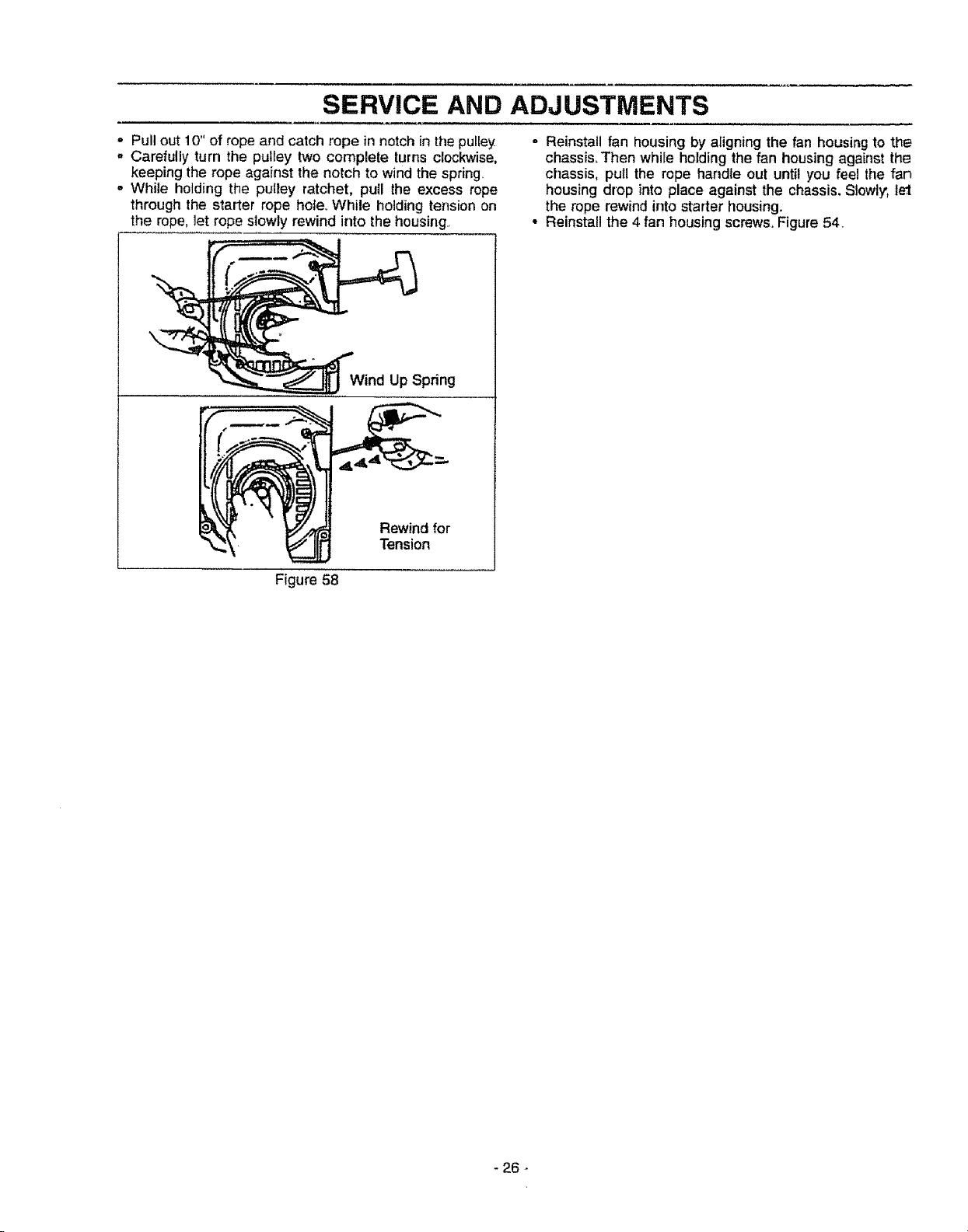
- Pullout 10" of rope and catch rope in notch in the pulley
• Carefully turn the pulley two complete turns clockwise,
keeping the rope against the notch to wind the spring.
o While holding the pulley ratchet, pull the excess rope
through the starter rope hote. While holding tension on
the rope, let rope slowly rewind into the housing
- Reinstall fan housing by aligning the fan housing to the
chassis_Then while holding the fan housing againstthe
chassis, pull the rope handle out until you feel the fan
housing drop into place against the chassis. Stcwly', le:t
the rope rewind into starter housing.
• Reinstall the 4 fan housing screws. Figure 54.
Wind Up Spring
Figure 58
- 26 -
SERVICE AND ADJUSTMENTS
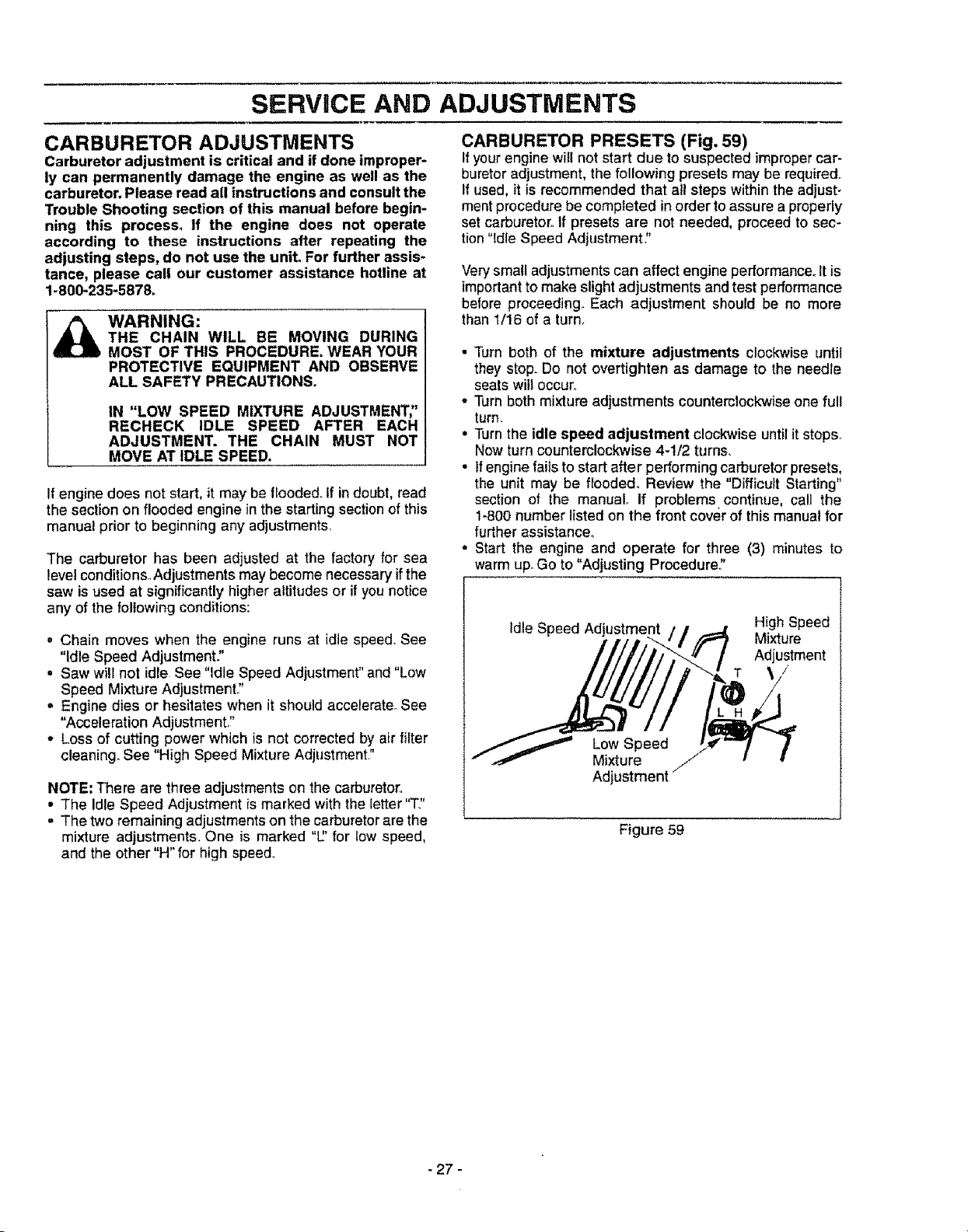
CARBURETOR ADJUSTMENTS
Carburetor adjustment is critical and if done improper-
ly can permanently damage the engine as well as the
carburetor. Please read all instructions and consult the
Trouble Shooting section of this manual before begin-
ning this process° If the engine does not operate
according to these instructions after repeating the
adjusting steps, do not use the unit. For further assis-
tance, please call our customer assistance hotline at
1-800-235=5878_
WARNING:
THE CHAIN WILL BE MOVING DURING
MOST OF THIS PROCEDURE. WEAR YOUR
PROTECTIVE EQUIPMENT AND OBSERVE
ALL SAFETY PRECAUTIONS.
IN"LOW SPEED MIXTURE ADJUSTMENT,"
RECHECK IDLE SPEED AFTER EACH
ADJUSTMEN% THE CHAIN MUST NOT
MOVE ATIDLESPEED.
If engine does not start, it may be flooded° If in doubt, read
the section on flooded engine inthe starting section of this
manual prior to beginning any adjustments.
The carburetor has been adjusted at the factory for sea
level conditions,,Adjustments may become necessary ifthe
saw is used at significantly higher altitudes or ifyou notice
any of the following conditions:
° Chain moves when the engine runs at idle speed. See
"Idle Speed Adjustment."
= Saw will not idle See "Idle Speed Adjustment" and "Low
Speed Mixture AdjustmenV'
- Engine dies or hesitates when it should accelerate° See
"Acceleration AdjustmenU'
• Loss of cutting power which is not corrected by air filter
cleaning. See "High Speed Mixture Adjustment,"
NOTE=There are three adjustments on the carburetor,,
= The Idle Speed Adjustment ismarked with theletter "1"."
• The two remaining adjustments on the carburetor are the
mixture adjustments. One is marked "L_'for low speed,
and the other "H"for high speed°
CARBURETOR PRESETS (Fig. 59)
If your engine will not start due to suspected improper car-
buretor adjustment, the following presets may be required,
If used, it is recommended that all steps within the adjust-
ment procedurebe completed in order to assure a properly
set carburetor,,If presets are not needed, proceed to sec-
tion "ldte Speed AdjustmenU'
Very smatl adjustmentscan affect engine performance. It is
important to make slight adjustments and test performance
before proceeding. Each adjustment should be no more
than 1/16 of a turn,
• Turn both of the mixture adjustments clockwise until
they stop.Do not overtighten as damage to the needle
seats willoccur
• Turn both mixture adjustments counterclockwiseone full
turn_
, Turn the idle speed adjustment clockwise until it stops_
Now turn counterclockwise 4-1/2 turns,
• Ifengine fails to start after performing carburetor presets,
the unit may be flooded° Review the "Difficuft Starting"
section of the manual, tf problems, continue, call the
1-800 number listed on the front cover of this manual for
further assistance.
= Start the engine and operate for three (3) minutes to
warm upoGo to "Adjusting Procedure?
Idle Speed Adjustment
High Speed
Mixture
Adjustment
/
Mixture
Adjustment
Figure 59
27 -
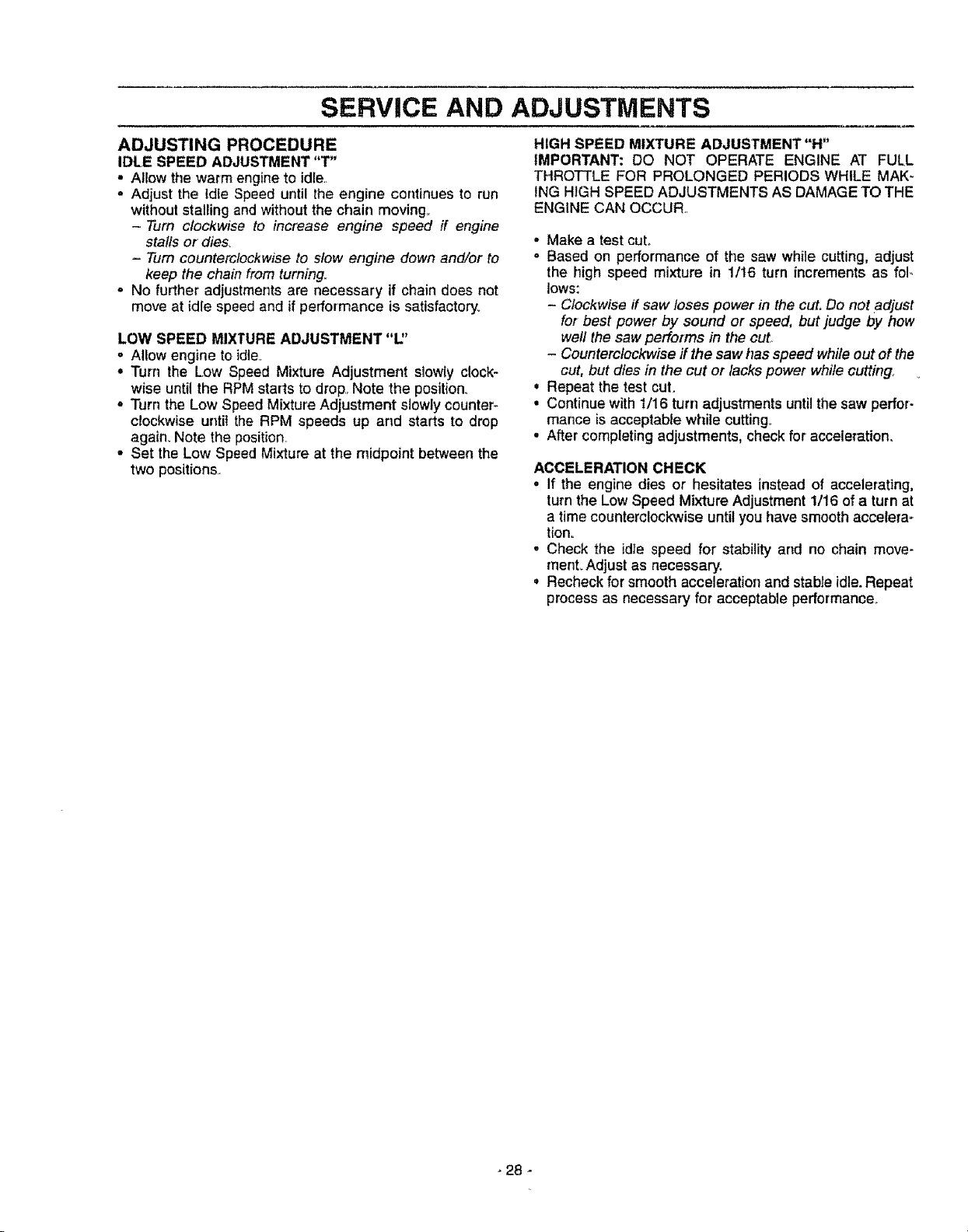
SERVICE AND ADJUSTMENTS
ADJUSTING PROCEDURE
IDLE SPEED ADJUSTMENT "T"
• Allow the warm engine to idle._
• Adjust the Idle Speed until the engine continues to run
without stalling and without the chain moving.,
- Turn clockwise to increase engine speed if engine
stalls or dies.
- Turn counterclockwise to slow engine down and/or to
keep the chain from turning.
• No furlher adjustments are necessary if chain does not
move at idle speed and ifperformance is satisfactory..
LOW SPEED MIXTURE ADJUSTMENT "U'
• Allow engine to idle.
° Turn the Low Speed Mixture Adjustment slowly clock-
wise until the RPM starts to drop,,Note the position_
• Turn the Low Speed Mixture Adjustment slowly counter-
clockwise untitthe RPM speeds up and starts to drop
again. Note the position.
• Set the Low Speed Mixture at the midpoint between the
two positions,.
HIGH SPEED MIXTURE ADJUSTMENT "H"
IMPORTANT: DO NOT OPERATE ENGINE AT FULL
THROTI'LE FOR PROLONGED PERIODS WHILE MAK-
ING HIGH SPEED ADJUSTMENTS AS DAMAGE TO THE
ENGINE CAN OCCUR,,
o Make a test cut°
° Based on performance of the saw while cutting, adjust
the high speed mixture in 1/16 turn increments as fol,
lows:
- Clockwise if saw loses power in the cut, Do not adjust
for best power by sound or speed, but judge by how
well the saw performs in the cut.
- Counterclockwise if the saw has speed while out of the
cut, but dies in the cut ot lacks power while cutting_
• Repeat the test cut.
• Continue with t/16 turn adjustments until the saw perfor-
mance isacceptable while cutting,_
= After completingadjustments, checkfor acceleration.
ACCELERATION CHECK
• If the engine dies or hesitates instead of accelerating,
turnthe Low Speed Mixture Adjustment 1/16 ofa turnat
a timecounterclockwiseuntilyou havesmoothacceletm
tiono
• Check the idle speed for stabilityand no chain move-
menL Adjust as necessary.
o Recheck for smooth acceleration and stable idle.Repeat
processas necessary for acceptable performances
28 -
STORAGE
Immediately prepare your unit for storage at the end ofthe
season or if itwill not be used for 30 days or more
WARNING:
ALLOWTHE ENGINETO COOL, AND SECURE
THE UNIT BEFORE STORING OR TRANS-
PORTING IN AVEHICLE.
STORE UNIT AND FUEL IN AN AREAWHERE
FUEL VAPORS CANNOT REACH SPARKS OR
OPEN FLAMES FROM WATER HEATERS,
ELECTRIC MOTORS OR SWITCHES, FUR-
NACES, ETC.
STORE UNIT WITH ALL GUARDS IN PLACE.
POSITION SO THAT ANY SHARP OBJECT
CANNOT ACCIDENTALLY CAUSE INJURY TO
PASSERS BYo
STORE THE UNIT OUT OF THE REACH OF
CHILDREN.
WEAR PROTECTIVE GLOVES WHEN
HANDLING CHAIN. THE CHAIN IS SHARP
AND CAN CUT YOU EVEN WHEN IT IS NOT
MOVING. ,..........................j
GAS CHAIN SAW STORAGE INSTRUCTIONS
If your chain is to be stored for a period of time, clean it
thoroughly prior to storage. Remove any dirt, sawdust,
Ieaves, oil, grease, etcoStore in a clean dry area°
• Clean the entire unit.
•CIean air filter. Refer to"Customer Responsibilities?
• Inspect the bar clamp area and clean any dirt, sawdust,
grass, or debris that has collected. Inspect the guide bar
and chain; replace a guide bar that is bent, warped,
cracked, broken, or damaged in any other way.Replace
a damaged or worn chain.
= Lightly oil external metal surfaces to prevent rust from
forming.
• Apply a coating of oil to the entire surface of the guide
bar and chain; wrap itin heavy paper or cloth.
° Be sure all handles and guards are in place and are
securely fastened. Replace any damaged parts.
FUEL SYSTEM
Never use engine or carburetor cleaner products in the fuel
tank or permanent damage may occur to fuel system com-
ponents. Follow these instructions:
• Drain the fuel from the unit into an approved fuel con-
tainer
• Drain the fuel lines and carburetor by starting theengine
and letting it rununtil it stops.
° Allow the engine to cool before storage.
IMPORTANT: it is importantto prevent gum deposits from
forming in essentialfuel system parts such as the carbure-
tor,fuel filter,fuel hose or tank during storage.. Also, expe-
rience indicatesthatalcohol blended fuels, those that use
ethanol or methanol (called gasohol or oxygenated fuel),
canattract moistureand form acidic gaswhichwilldamage
your engine°To avoid engine problems, the fuel system
should be emptiedbefore storage of 30 days or longer.
Fuel stabilizer is an acceptable alternative in minimizing
the formation of fuel gum deposits during storage. Add sta-
bilizer to the gasoline in the fuel tank or fuel storage con-
tainer.Always follow the mix instructionsfound on stabilizer
containers. Run engine at least 5 minutes after adding sta-
bilizer to allow the stabilizer to reach the carburetor°
CRAFTSMAN 40:1 2-cycle engine oil (AIR-COOLED) is
specially blended with fuel stabilizer.r If you do not use this
Sears oil, you can add a fuel stabilizer to your fuel tank.
INTERNAL ENGINE
• Remove spark plug and pour I teaspoon of 40:1 2_cycle
engine oil (AIR-COOLED) through the spark plug open-
ing_Slowly pull the starter rope 8 to 10 times to distribute
oil to inner engine surfaces.
• Replace spark plug with a new one of the recommended
type and heat range. Refer to "Product Specifications°"
• Ctean air filter.Refer to "Customer Responsibilities_"
• Re-install all covers and hardware removed for access;
tighten all screws and fasteners.
= Check entire unit for loose screws, nuts, and bolts.
Replace anydamaged, broken, or worn parts.
• t.ightly oif external meta! surface to prevent rust from
forming,.
• Use fresh fuel having the proper gasoline to oil ratio at
the beginning of the next season,
OTHER
• Do not store gasoline from one season to another,
• Replace your gasoline can if your can starts to rust. Rust
and/or dirt in your fuel system will cause problems.
, Store your unit in a wel! ventilated area and covered, if
possible, topreventdust and dirt accumulation. Do not
cover with plastic, Plastic cannot breathe and will induce
condensation and eventual rust or corrosion.
IMPORTANT: NEVER COVER UNIT WHILE ENGINE
AND EXHAUST AREAS ARE STILL WARM.
- 29 -
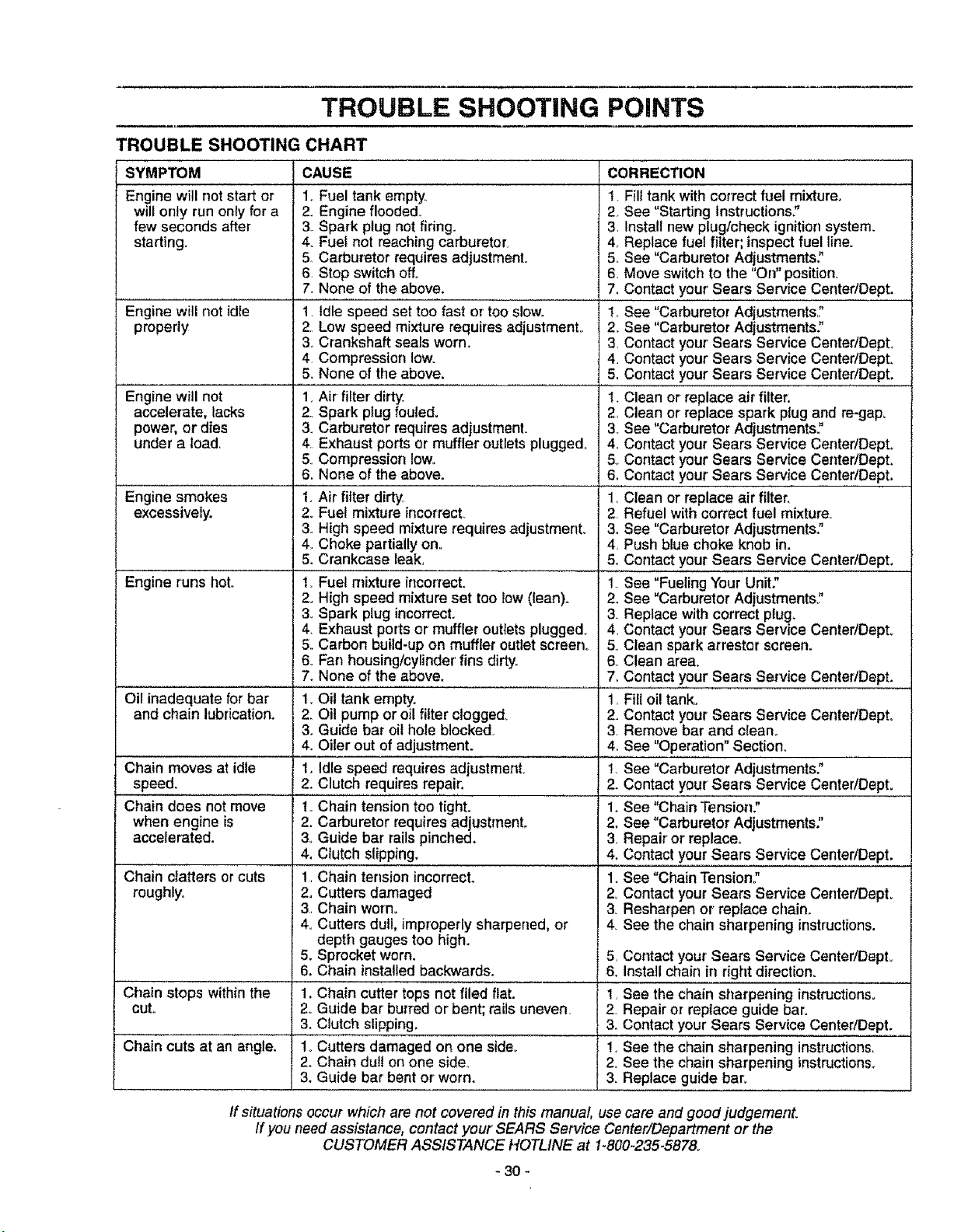
TROUBLE SHOOTING POINTS
TROUBLE SHOOTING CHART
SYMPTOM CAUSE
Engine will not start or 1._Fuel tank empty.
will only run only for a 2_Engine flooded.
few seconds after 3. Spark plug notfiring.
starting. 4. Fuel not reaching carburetor.
5 Carburetor requires adjustment.
6 Stop switch off..
7. None of the above.
Engine will not idle 1. Idle speed set too fast or'too SLOW.
properly 2 Low speed mixture requires adjustmenL
3. Crankshaft seals worn.
4 Compression low.
5. None of the above.
Engine will not 1. Air filter dirty.
accelerate, lacks 2. Spark plugfouled.
power, or dies & Carburetor requiresadjustment.,
under a load 4 Exhaust portsor muffleroutletsplugged_
5. Compression low.
6. None of the above.
Engine smokes 1. Air filter dirty.
excessively. 2. Fuel mixture incorrect_
3. High speed mixture requires adjustment.
4..Choke partially on.
5. Crankcase leak.
Engine runs hot° I. Fuel mixture incorrect.
2. High speed mixture set too low (lean).
3. Spark plug incorrect_
4. Exhaust ports or muffler outlets plugged.
5. Carbon build-up on muffler outletscreen°
6. Fan housing/cylinder fins dirty..
7. None of the above.
Oil inadequate for bar 1 Oil tank empty.
and chain lubrication. 2. Oil pump or oil filter clogged.
3. Guide bar oil hole blocked.
4. Oiler out of adjustment.
Chain moves at idle 1. Idle speed requires adjustment.
speed. 2. Clutch requires repair.
I. Chain tension too tighL
Chain does not move
when engine is
accelerated,
Chain clatters or cuts
roughly.
Chain stops withinthe
out.
Chain cuts at an angle.
2. Carburetor requires adjustment.
3. Guide bar railspinched.
4, Clutch slipping.
1.Chain tension incorrecL
2, Cutters damaged
3. Chain worn.
4. Cutters dull, improperlysharpened, or
depth gauges too high.
5. Sprocket worn.
6. Chain installed backwards.
1, Chain cutter tops not filed flat.
2. Guide bar' burred or bent; railsuneven.
3, Clutch slipping.
'"ioCutters damaged on one side,
2. Chain dull on one side,
3. Guide bar' bent or worn.
CORRECTION
t Fill tank with correct fuel mixture,
2. See "Starting Instructions`"
3. Install new plug/check ignition system.
4,.Replace fuel filter; inspect fuel line.
5. See "Carburetor Adjustments."
6. Move switch to the "Or]" position
7. Contact your'Sears Service CentedDept.
t ,.See "Carburetor Adjustments,."
2. See "Carburetor Adjustments."
3. Contact your'Sears Service CentedDept,
4. Contact your Sears Service CentedDept,
....5, Contact your Sears Service CentedDept.
1. Clean or replace air filter:
2, Clean or' replace spark plug and re-gap.
3. See "Carburetor Adjustments."
4. Contact your Sears Service CentedDepL
5..Contact your Sears Service CentedDepL
6. Contact your Sears Service CenterlDept.
1 Clean or replace air filter.
2 Refuel with correct fuel mixture°
3. See "Carburetor Adjustments."
4 Push blue choke knob in.
5. Contact yourSears Service Center/Dept,
1 See "Fueling Your Unit."
2. See "Carburetor Adjustments_"
3. Replace with correct plug,
4. Contact your Sears Service CentedDepL
& Clean spark atrester screen.
6 Clean are&
.......... 7' Contact your Sears Service CenterlDept.
1. Fill oi! tank,
2. Contact your Sears Service Center/Depto
3. Remove bar and cleam
4. See "Operation" Section.
t. See "Carburetor Adjustments,"
2. Contact your Sears Service Center/Dept.
1. See "Chain Tension."
2, See "Carburetor Adjustments:'
3. Repair or'replace.
4, Contact your Sears Service Center/Dept.
1. See "Chain Tensions"
2. Contact your Sears Service CentedDept.
3. Resharpen or replace chain.
4. See the chain sharpening instructions.
5. Contact your Sears Service CentedDepto
6. Install chain in right direction.
1. See the chain sharpening instructions°
2 Repair or replace guide bar:
3. Contact your Sears Service CentedDept.
!. See the chain sharpening instructions.
2. See the chain sharpening instructions..
3. Replace guide bar,
If situations occur whichare not covered in this manual, use care and go,d judgement.
If you need assistance, contact your SEARS Service Center/Department or the
CUSTOMER ASSISTANCE HOTLtNE at 1-800..235-587&
30 -

