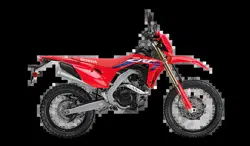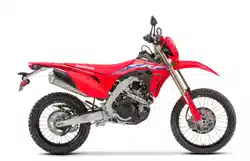
Owner’s Manual
2022
2022
CRF300L/LA

Welcome
●
●
●
2
2
Canada
A Few Words About Safety
●
●
3DANGER
You WILL be KILLED or SERIOUSLY
HURT if you don’t follow instructions.
3WARNING
You CAN be KILLED or SERIOUSLY
HURT if you don’t follow instructions.
3CAUTION
You CAN be HURT if you don’t follow
instructions.
Other important information is
provided under the following titles:
NOTICE

Safety Guidelines.................................................
Safety Labels.........................................................
Safety Precautions...............................................
Riding Precautions ............................................
Accessories & Modifications...........................
Off-Road Safety .................................................
Loading ................................................................
This section contains important information for safe riding of your vehicle.
Please read this section carefully.
Vehicle Safety

Safety Guidelines
●
●
●
Always Wear a Helmet
2
Before Riding
Take Time to Learn & Practice
Safety Guidelines
Vehicle Safety
3
Continued
USA
Ride Defensively
Make Yourself Easy to See
Be Alert for Off-road Hazards
Ride within Your Limits
Safety Guidelines
Vehicle Safety
4
Don't Drink or Use Drugs and Ride
Keep Your Honda in Safe Condition
2
2
If You are Involved in a Crash
Safety Guidelines
Vehicle Safety
5
Continued
Carbon Monoxide Hazard
3WARNING
Running the engine of your vehicle
while in an enclosed or even partially
enclosed area can cause a rapid build-
up of toxic carbon monoxide gas.
Breathing this colorless, odorless gas
can quickly cause unconsciousness and
lead to death.
Only run your vehicle's engine when it
is located in a well ventilated area
outdoors.
Safety Guidelines
Vehicle Safety
6
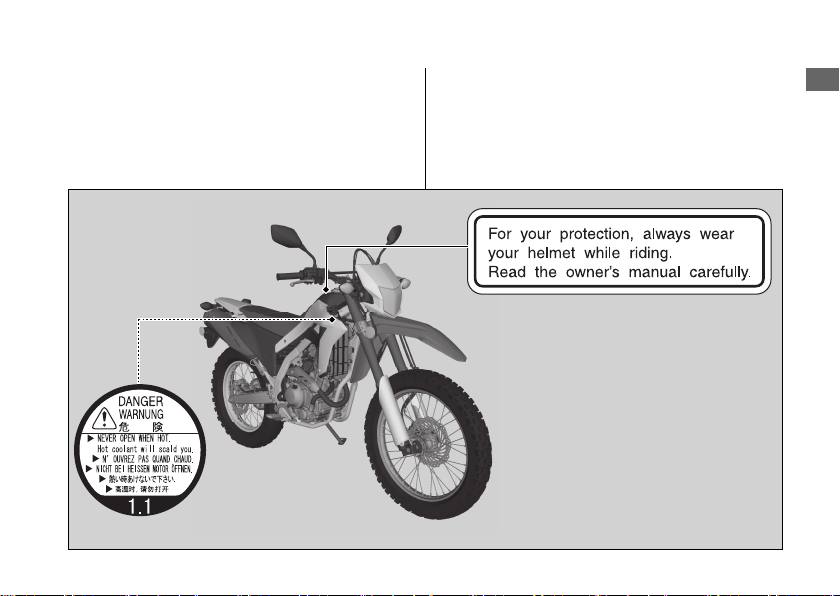
Safety Labels
Safety Labels
Vehicle Safety
7
Continued
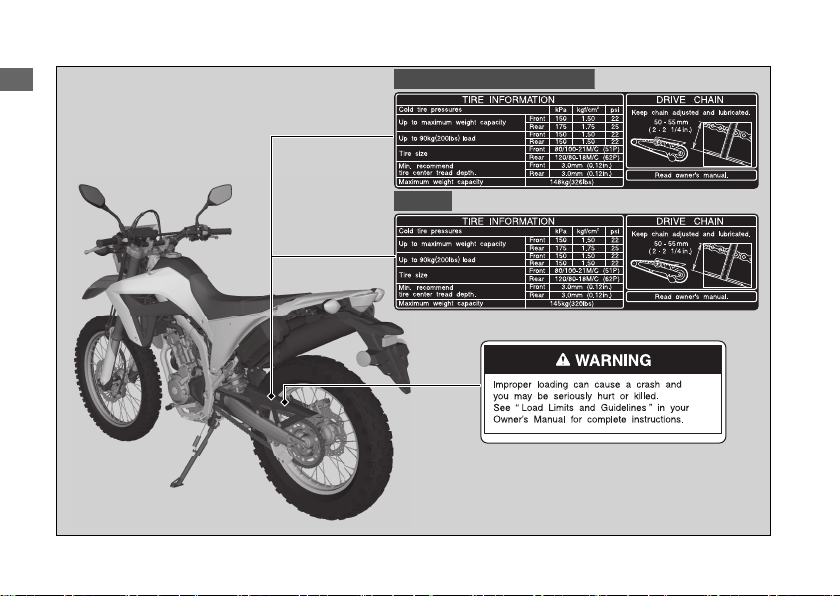
Safety Labels
Vehicle Safety
8
50 STATE (meets California)
Canada
Safety Precautions
●
●
●
Protective Apparel
#
Helmet
●
●
USA
3WARNING
Not wearing a helmet increases the
chance of serious injury or death in a
crash.
Make sure that you and any passenger
always wear an approved helmet and
protective apparel.
Safety Precautions
Vehicle Safety
9
Continued

#
Gloves
#
Boots or Riding Shoes
#
Jacket and Pants
#
Additional Off-road Gear
Safety Precautions
Vehicle Safety
10
Riding Precautions
Break-in Period
●
●
●
Brakes
●
u
u
●
u
●
u
●
Riding Precautions
Vehicle Safety
11
Continued

#
Anti-lock Brake System (ABS)
CRF300LA
●
●
●
●
#
Engine Braking
#
Wet or Rainy Conditions
Riding Precautions
Vehicle Safety
12
Parking
●
●
●
●
●
#
Parking with the Side Stand
1.
2.
3.
4.
u
5.
2
Riding Precautions
Vehicle Safety
13
Continued

Refueling and Fuel Guidelines
●
●
●
2
●
●
Riding Precautions
Vehicle Safety
14

Accessories &
Modifications
3WARNING
Improper accessories or modifications
can cause a crash in which you can be
seriously hurt or killed.
Follow all instructions in this owner's
manual regarding accessories and
modifications.
Accessories & Modifications
Vehicle Safety
15

Off-Road Safety
●
●
●
●
●
●
●
Off-Road Safety
Vehicle Safety
16
Loading
●
●
Maximum weight capacity 2
●
●
●
●
3WARNING
Overloading or improper loading can
cause a crash and you can be seriously
hurt or killed.
Follow all load limits and other loading
guidelines in this manual.
Loading
Vehicle Safety
17
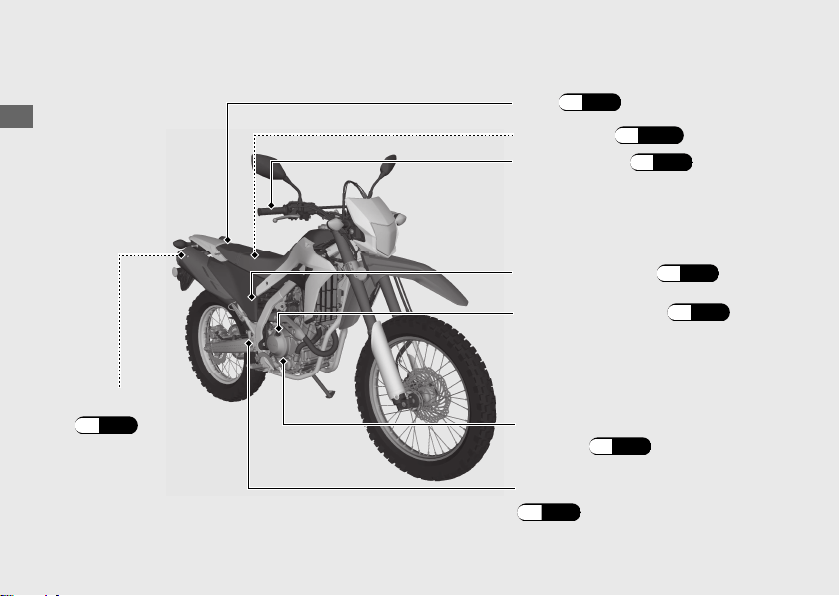
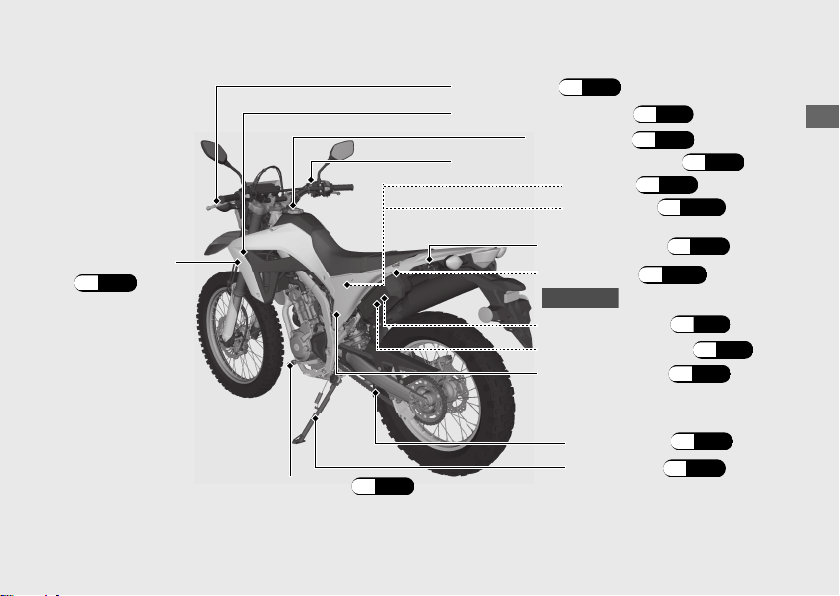
Operation Guide
19
Left shroud
(P.75)
Front brake fluid reservoir(P.83)
Fuel fill cap(P.49)
Clutch lever(P.90)
Coolant reserve tank(P.81)
Helmet holder (P.50)
Tool box/Tool kit(P.51)
Document bag(P.51)
Left side cover (P.76)
Main fuse (P.105)
Battery (P.72)
Shift lever
(P.48)
Side stand(P.86)
Drive chain(P.87)
Fuse box B
(P.106)
CRF300LA
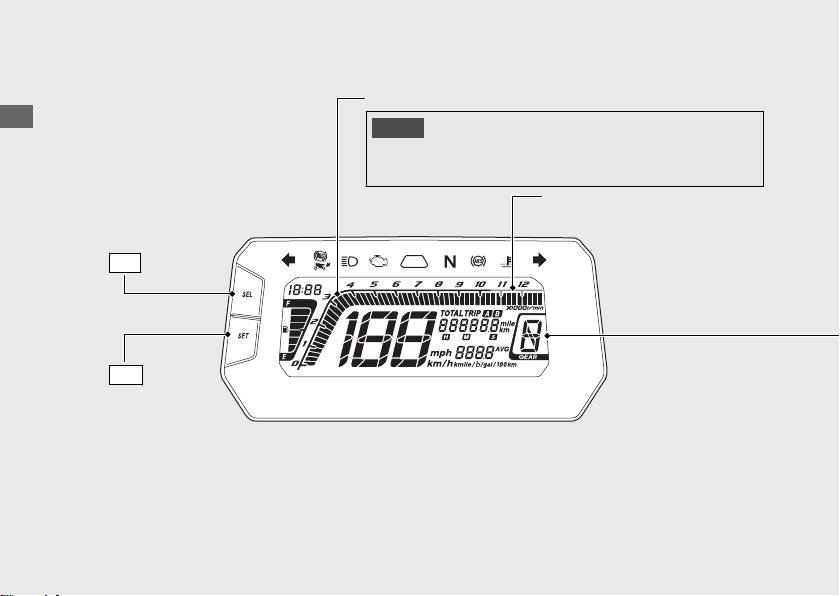
Instruments
Operation Guide
20
Tachometer
NOTICE
Tachometer red zone
SET
button
Display Check
SEL
button
Operation Guide
21
Continued
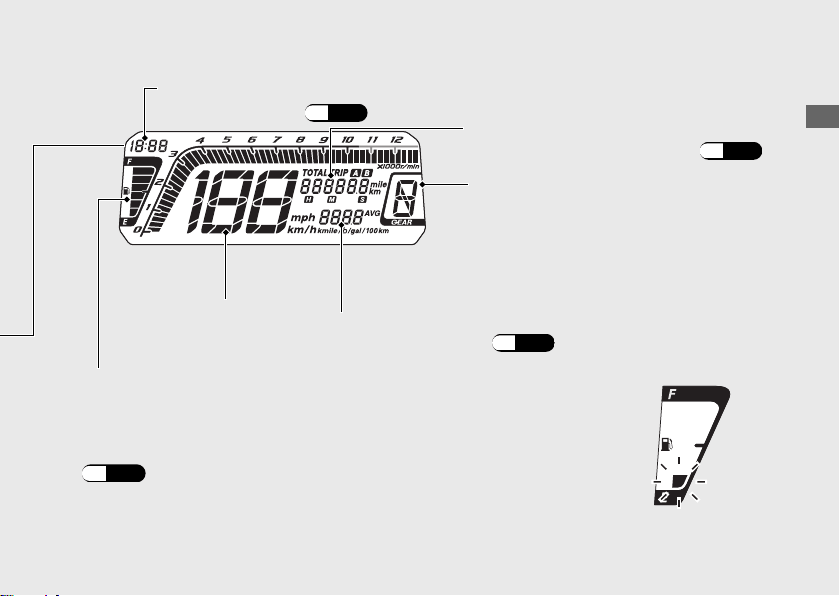
Fuel gauge
If the fuel gauge indicator flashes in a repeat pattern or turns off:
(P.98)
Clock (12-hour display)
Speedometer
Gear position indicator
u
To set the clock:
(P.30)
Average fuel mileage [AVG], Fuel consumption, and
Average speed [AVG] (P.26)
Odometer [TOTAL], Tripmeter
[TRIP A/B], and Stopwatch (P.22)
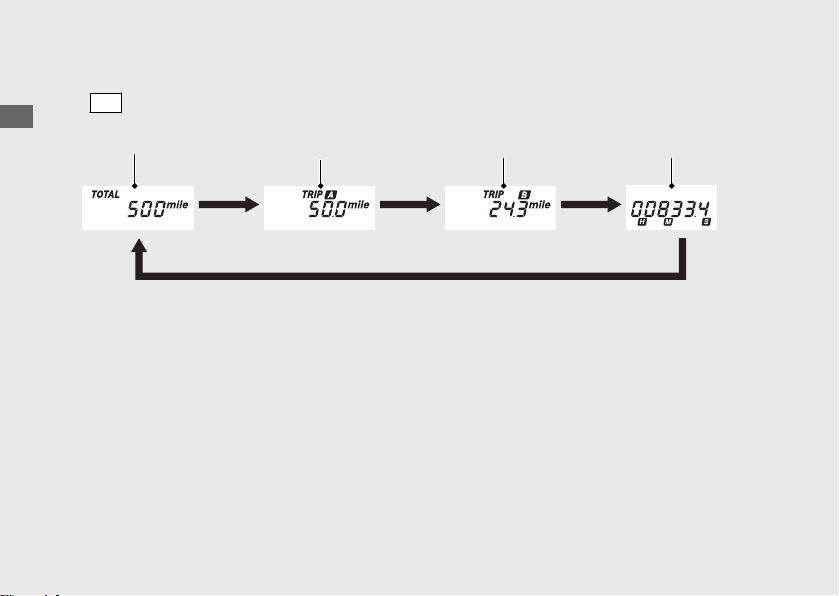
Odometer [TOTAL], Tripmeter [TRIP A/B], and Stopwatch
SEL
Operation Guide
22
Instruments (Continued)
Odometer Tripmeter A Tripmeter B
Stopwatch

#
Odometer [TOTAL]
#
Tripmeter [TRIP A/B]
To reset the tripmeter:(P.24)
#
Stopwatch
SET
•
To use the stopwatch:
(P.25)
Operation Guide
23
Continued
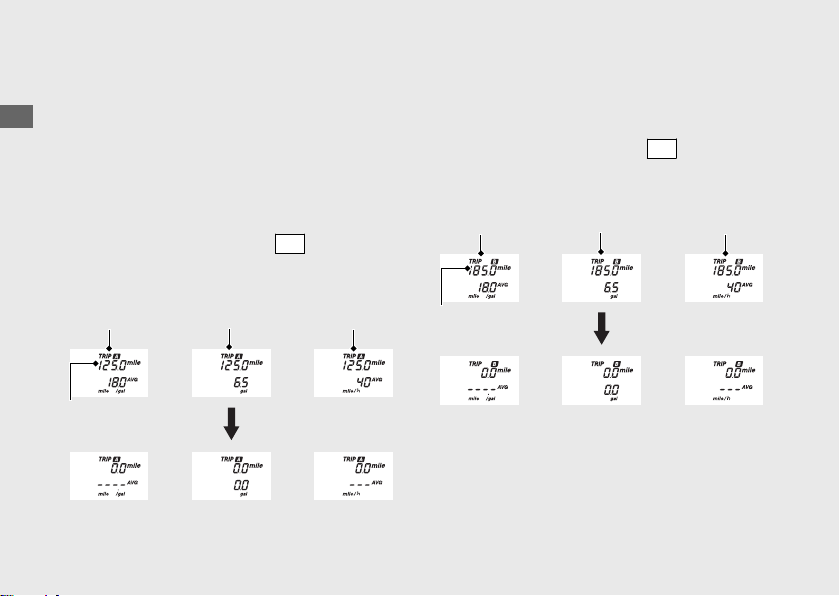
#
To reset the tripmeter [TRIP A/B],
average fuel mileage [AVG], fuel
consumption, and average speed
[AVG]
SEL
SEL
Operation Guide
24
Instruments (Continued)
Average fuel
mileage A
or or
Fuel
consumption A
Average
speed A
Tripmeter A
oror
Average fuel
mileage B
or or
Fuel
consumption B
Average
speed B
Tripmeter B
oror
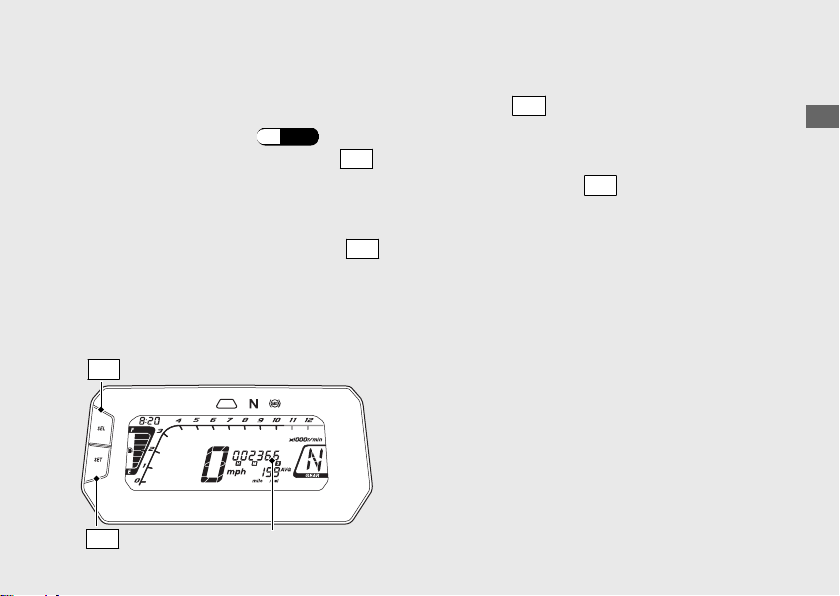
Stopwatch
#
To Measure the Time
1.
(P.22)
2.
SET
u
3.
SET
u
#
To Restart the Measurement
SET
#
To Reset the Measured value
SEL
Operation Guide
25
Continued
Stopwatch
SET
button
SEL
button
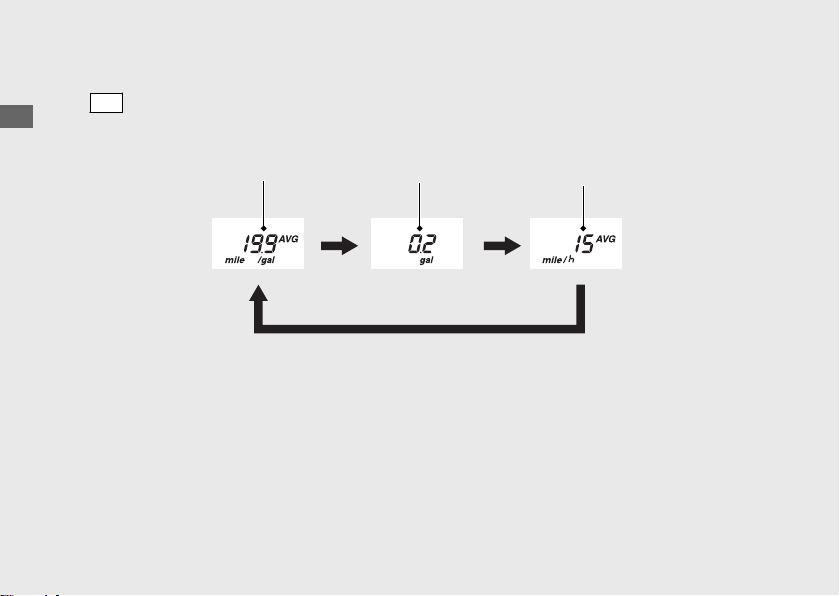
Average fuel mileage [AVG], Fuel consumption, and Average speed [AVG]
SET
Operation Guide
26
Instruments (Continued)
Average fuel mileage
Fuel consumption
Average speed

#
Average fuel mileage [AVG]
50 STATE (meets California)
Canada
•
•
To reset the average fuel mileage:
(P.24)
Operation Guide
27
Continued

#
Fuel consumption
•
To reset the fuel consumption:
(P.24)
#
Average speed [AVG]
•
•
•
To reset the average speed:(P.24)
Operation Guide
28
Instruments (Continued)
Display Setting
Setting Mode A
(P.30)
•
•
•
•
Setting Mode B
(P.33)
•
•
Operation Guide
29
Continued
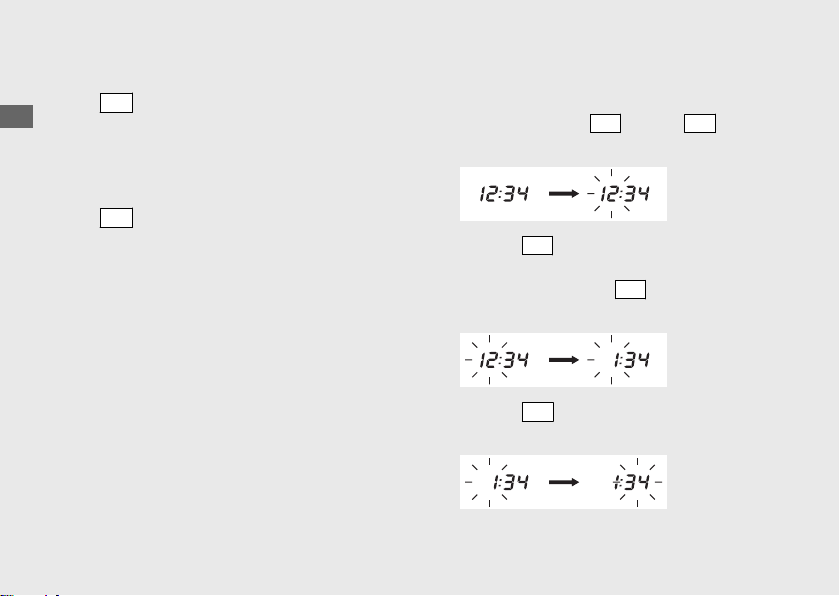
Setting Mode A
SET
SET
1 Clock setting:
a
b
SEL
SET
c
SEL
u
SEL
d
SET
Operation Guide
30
Instruments (Continued)

e
SEL
u
SEL
f
SET
2 Backlight brightness adjustment:
a
SEL
b
SET
Operation Guide
31
Continued
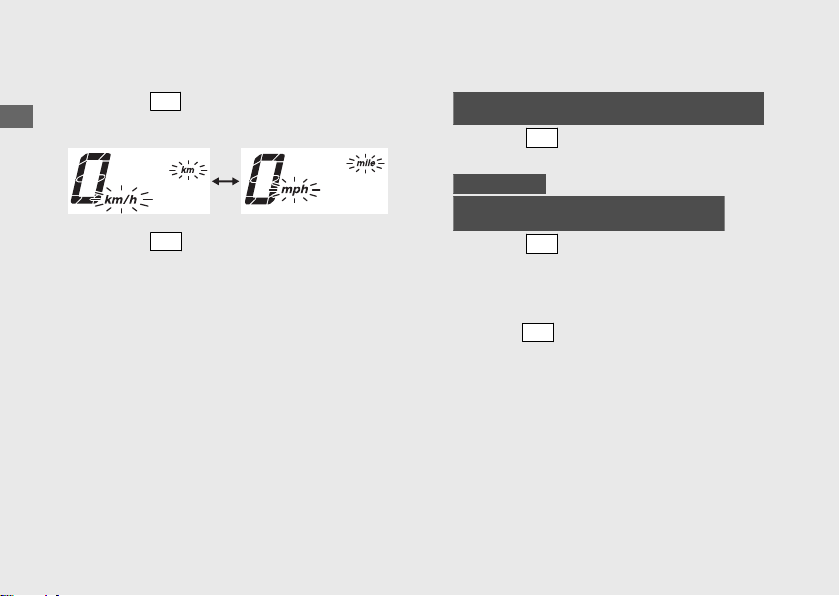
3 Changing the speed and mileage unit:
a
SEL
b
SET
4 Changing the fuel mileage meter unit:
a
When “km/h” for speed and “km” for mileage
are selected
SEL
Canada only
When “mph” for speed and “mile” for
mileage are selected
SEL
u
b
SET
Operation Guide
32
Instruments (Continued)
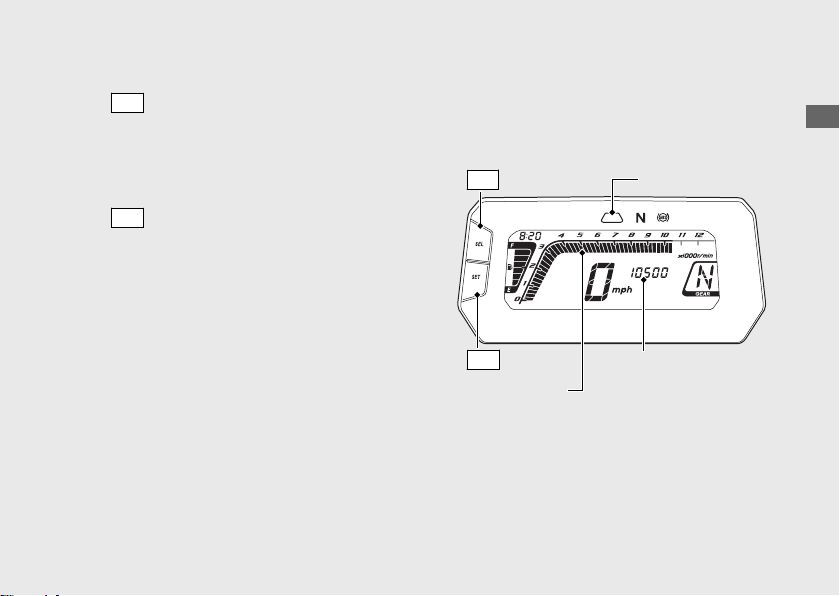
Setting Mode B
SET
SET
1 Setting of REV indicator:
Operation Guide
33
Continued
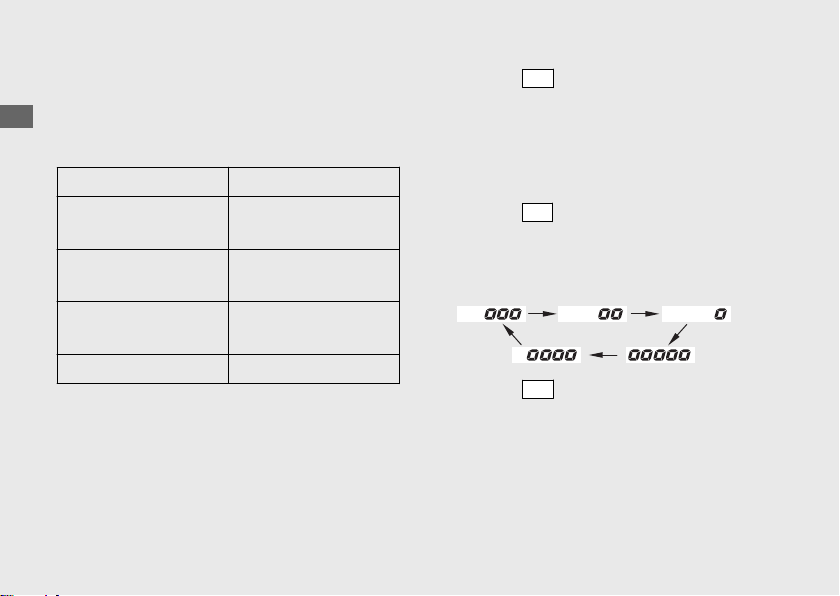
Numerical
tachometer display
SET
button
SEL
button
Tachometer
REV indicator

a
SEL
u
b
SEL
u
SEL
Operation Guide
34
Instruments (Continued)
c
SET
d
SEL
Operation Guide
35
Continued
Numerical tachometer
display
Tachometer
e
SET
f
SEL
u
g
SET
Operation Guide
36
Instruments (Continued)

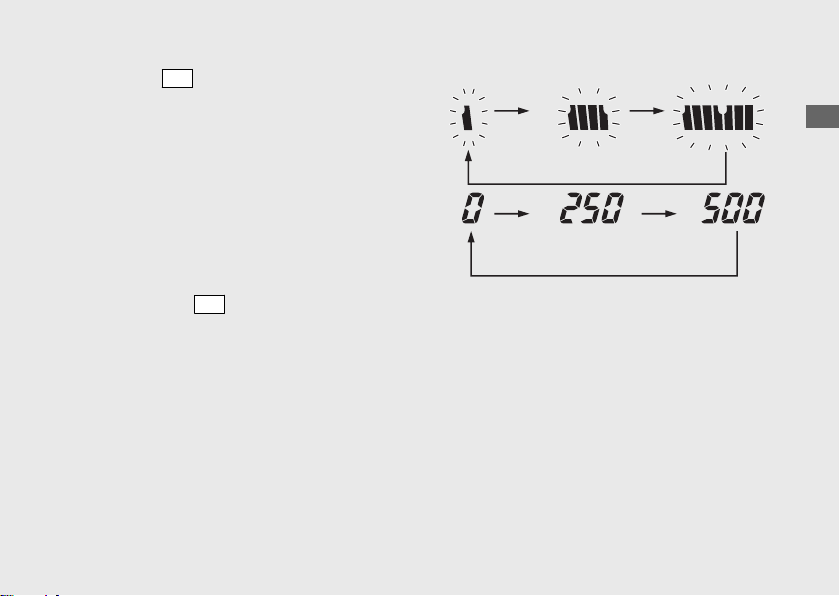
2 Changing of tachometer display
mode:
a
SEL
b
SET
Conventionaldisplay
Peak hold display
Operation Guide
37
Conventional
display
Peak hold
display
Tachometer bar
segment
Peak hold
segment
Tachometer bar
segment
Indicators
Operation Guide
38
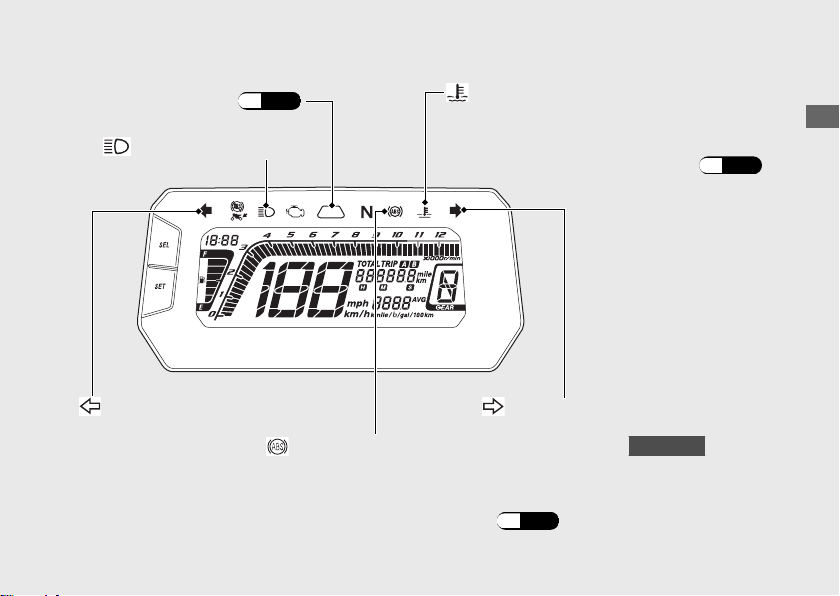
If it comes on while engine is running: (P.97)
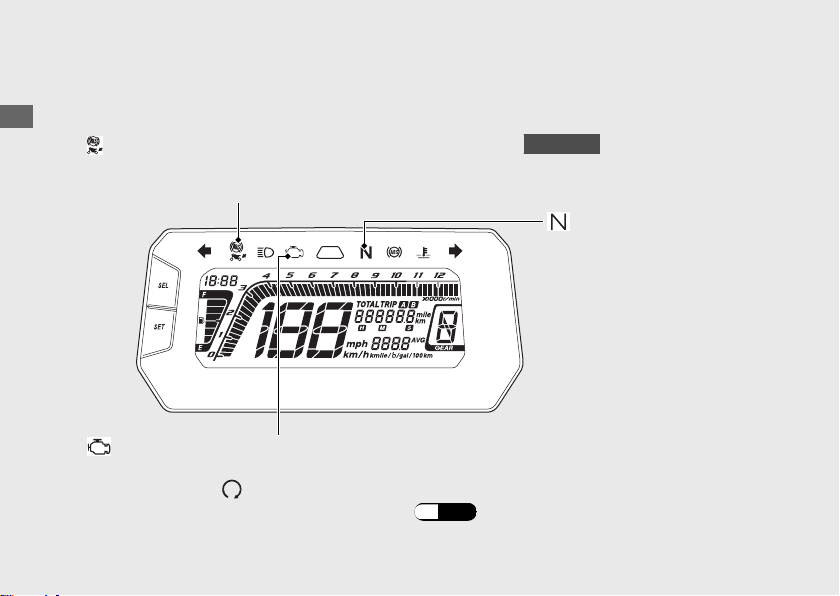
Neutral indicator
PGM-FI (Programmed Fuel Injection)malfunction indicator lamp (MIL)
Rear ABS (Anti-lock Brake System) OFF indicator
CRF300LA
Operation Guide
39
Continued
High beam indicator
Left turn signal indicator Right turn signal indicator
High coolant temperature indicator
If it comes on while running:(P.96)
If it comes on while riding:
(P.97)
ABS (Anti-lock Brake System) indicator
CRF300LA
REV indicator (P.40)
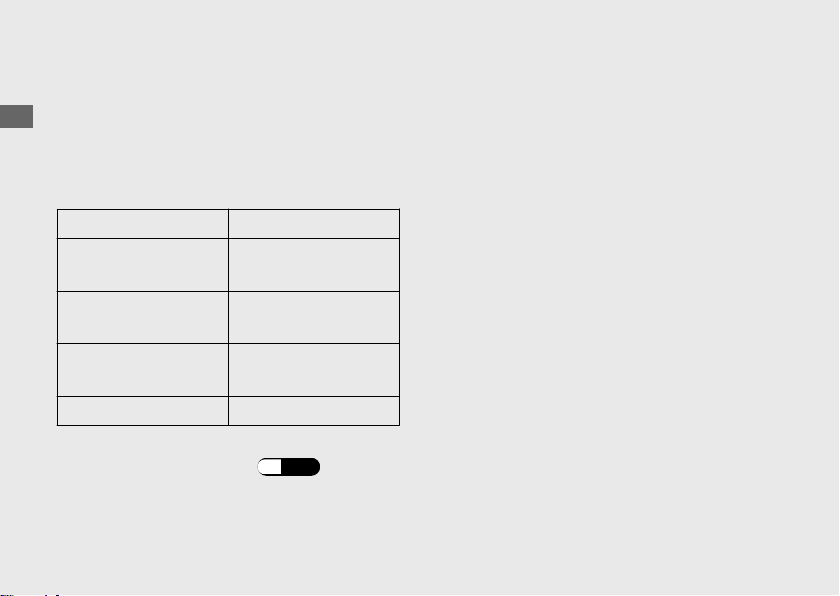
REV Indicator
•
Initial setting
u (P.33)
Operation Guide
40
Indicators (Continued)

Operation Guide
41
This page intentionally left blank.

Operation Guide
43
Continued
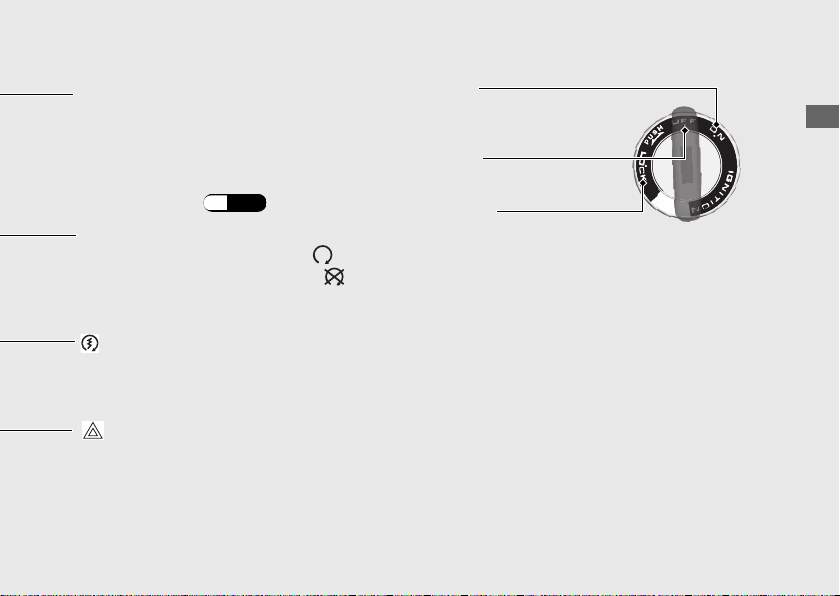
Ignition switch
u
Steering Lock:
(P.44)
Engine stop switch
u
Start button
ON
LOCK
OFF
Hazard switch
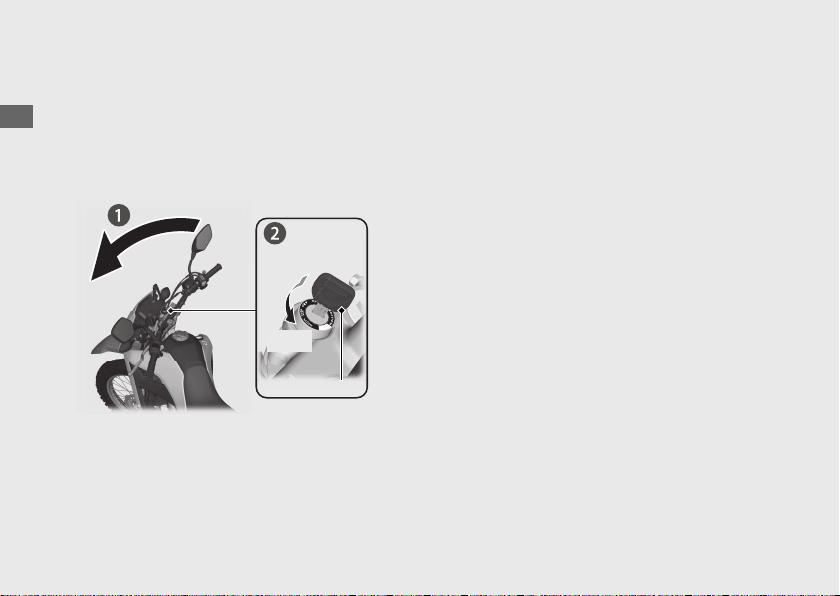
Steering Lock
#
Locking
a
b
u
c
#
Unlocking
Operation Guide
44
Switches (Continued)
Push
Ignition key
Turn
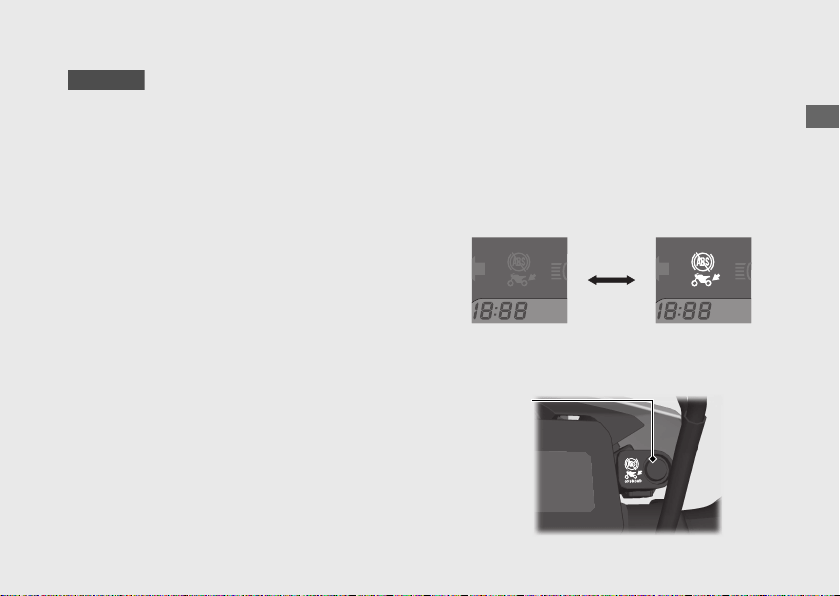
ABS function on the rear wheel
CRF300LA
u
To turn off the ABS function on the rear
wheel
a
b
u
u
To turn on the ABS function on both
wheels
a
b
Operation Guide
45
ABS function on
both wheels is on.
ABS function on
rear wheel is off.
Rear ABS
switch
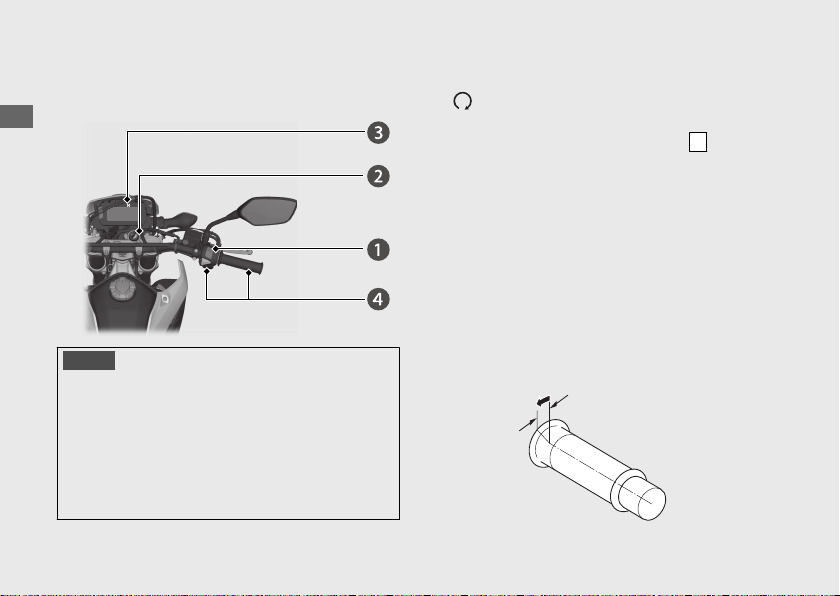
Starting the Engine
NOTICE
•
•
•
a
b
c
N
d
u
Operation Guide
46
About 1/8 in (3 mm), without
freeplay

If the engine does not start:
a
b
c
d
ab
#
If Engine Will Not Start (P.95)
Operation Guide
47
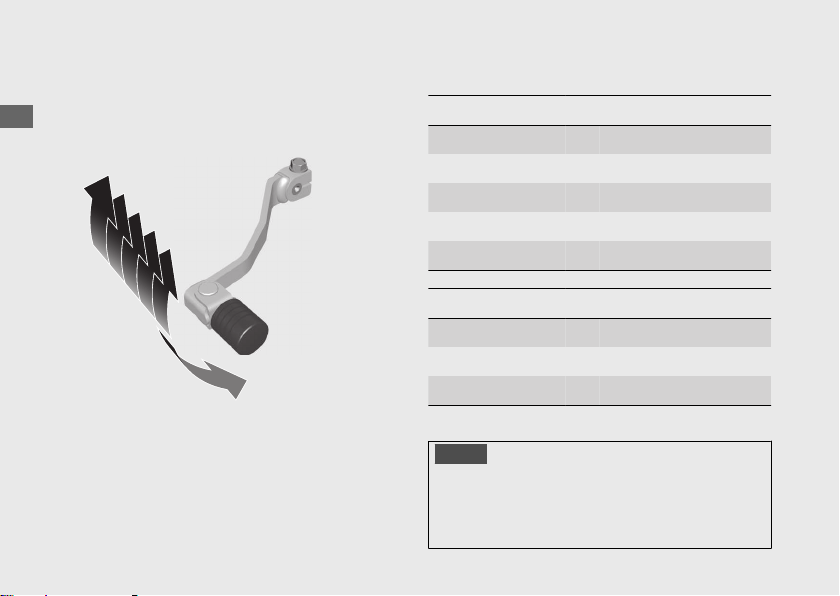
Shifting Gears
#
Recommended Shift Points
Shifting Up
Shifting Down
NOTICE
Operation Guide
48
2
3
4
5
6
1
N
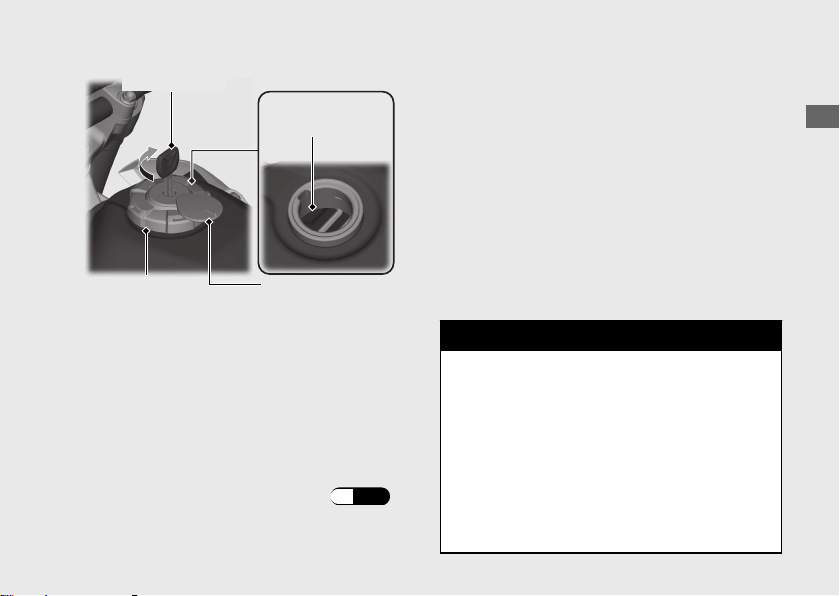
Refueling
Fuel type:
Recommended fuel octane number:
Tank capacity:
#
Refueling and Fuel Guidelines (P.14)
Opening the Fuel Fill Cap
Closing the Fuel Fill Cap
a
b
c
u
3WARNING
Gasoline is highly flammable and
explosive. You can be burned or
seriously injured when handling fuel.
• Stop the engine, and keep heat,
sparks, and flames away.
• Only handle fuel outdoors.
• Wipe up spills immediately.
Operation Guide
49
Ignition key
Lower edge
of filler neck
Fuel fill cap Lock cover
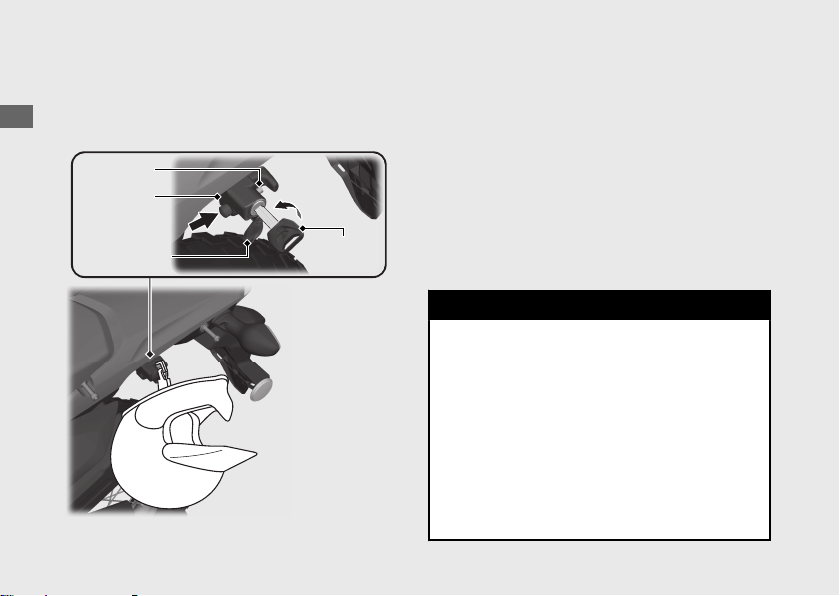
Storage Equipment
Helmet Holder
#
Unlocking
#
Locking
a
b
u
3WARNING
Riding with a helmet attached to the
holder can interfere with the rear wheel
or suspension and could cause a crash
in which you can be seriously hurt or
killed.
Use the helmet holder only while
parked. Do not ride with a helmet
secured by the holder.
Operation Guide
50
Pin
Ignition
key
Helmet
holder
Lock cover
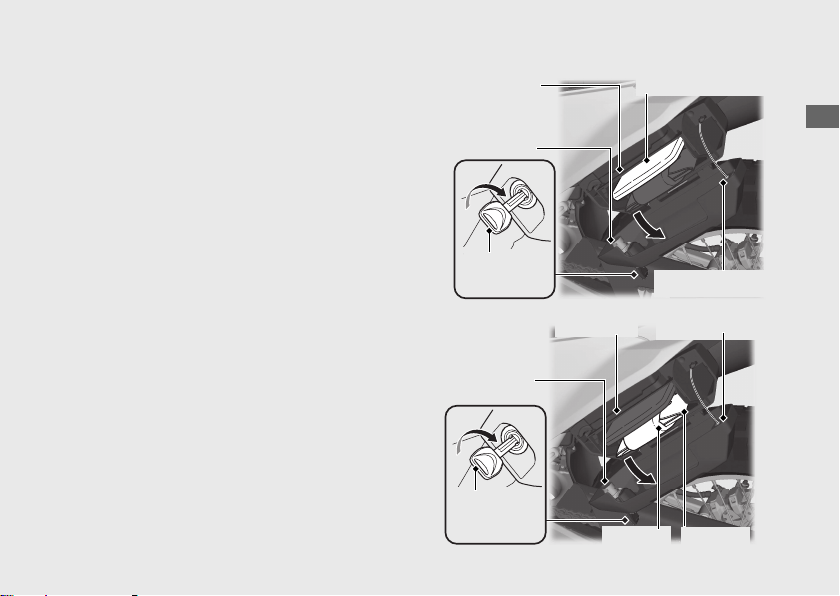
Document Bag and Tool Kit
#
Open
#
Close
u
u
Operation Guide
51
Document bag
Ignition
key
Tool box
Lock
position
Lock position
Tool box
Tool kit
Ignition
key
Sponge
Lock position
Lock
position

Importance of Maintenance ...........................
Maintenance Schedule.....................................
Maintenance Record.........................................
Maintenance Fundamentals ...........................
Removing & Installing Body Components..
Spark Arrester ....................................................
Engine Oil ............................................................
Coolant.................................................................
Brakes...................................................................
Side Stand ...........................................................
Drive Chain..........................................................
Wheels..................................................................
Clutch ...................................................................
Throttle ................................................................
Please read “Importance of Maintenance” and “Maintenance Fundamentals” carefully
before attempting any maintenance. Refer to “Specifications” for service data.
An optional larger tool kit may be available.
Check with your Honda dealer's parts department.
Maintenance
Importance of Maintenance
Importance of Maintenance
2
3WARNING
Improperly maintaining your vehicle or
failing to correct a problem before you
ride can cause a crash in which you can
be seriously hurt or killed.
Always follow the inspection and
maintenance recommendations and
schedules in this owner's manual.
2
USA
Maintenance, replacement or repair of the
emission control devices and systems may
be performed by any vehicle repair
establishment or individual using parts
that are certified to EPA standards.
Maintenance
53
Maintenance Safety
●
●
●
●
Importance of Maintenance
Maintenance
54

Maintenance Schedule
2
Maintenance
55
Continued
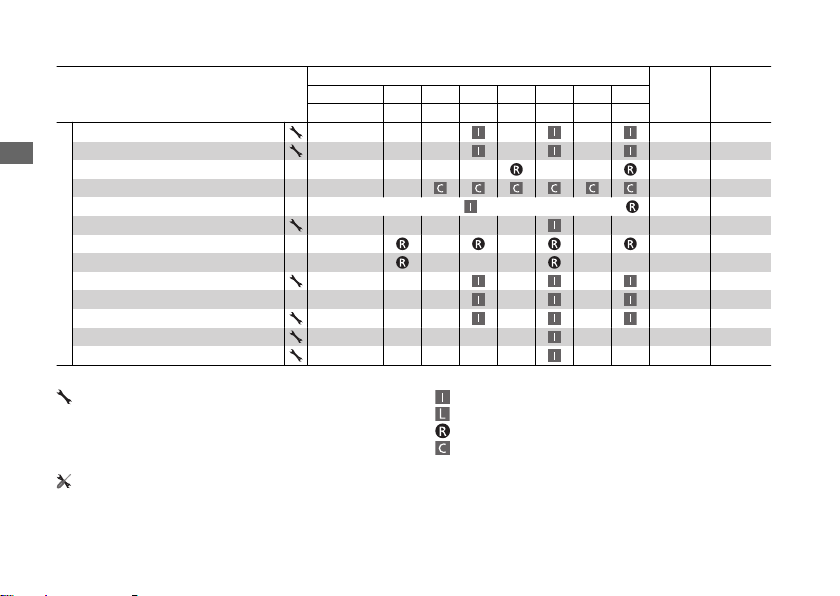
Items
Frequency
*1
Regular
Replace
Refer to
page
× 1,000 mi 0.6 4 8 12 16 20 24
× 1,000 km 1.0 6.4 12.8 19.2 25.6 32.0 38.4
Emission-related Items
Fuel Line –
Throttle Operation 93
Air Cleaner
*2
–
Crankcase Breather
*3
–
Spark Plug
Every 16,000 mi (25,600 km): Every 32,000 mi (51,200 km):
–
Valve Clearance –
Engine Oil 1 Year –
Engine Oil Filter –
Engine Idle Speed –
Radiator Coolant
*7
3 Years 81
Cooling System –
Secondary Air Supply System –
Evaporative Emission Control System
*4
–
Maintenance Level Maintenance Legend
2
Maintenance Schedule
Maintenance
56
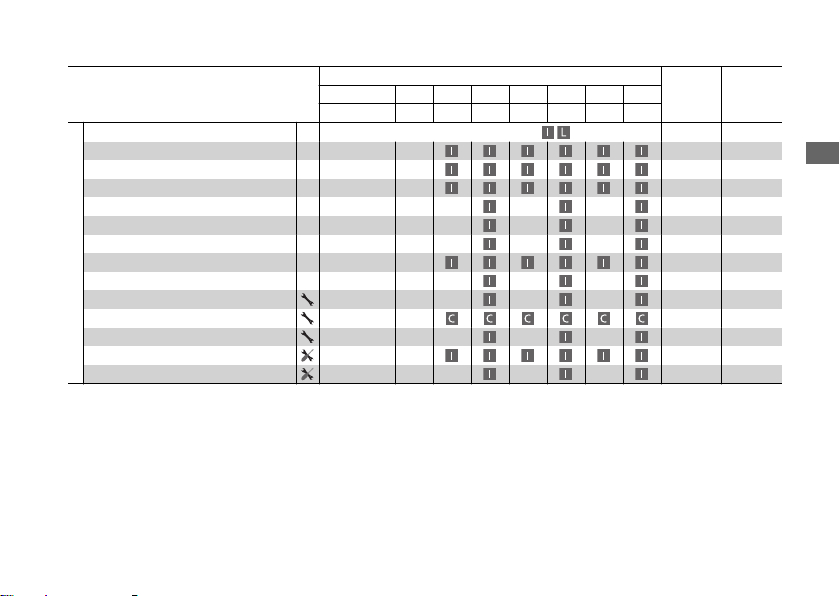
Items
Frequency
*1
Regular
Replace
Refer to
page
× 1,000 mi 0.6 4 8 12 16 20 24
× 1,000 km 1.0 6.4 12.8 19.2 25.6 32.0 38.4
Non-Emission-Related Items
Drive Chain
*5
Every 600 mi (1,000 km):
87
Drive Chain Slider –
Brake Fluid
*7
2 Years 83
Brake Pads Wear 84
Brake System 59
Brake light Switch 85
Headlight Aim –
Clutch System 90
Side Stand 86
Suspension –
Spark Arrester
*6
77
Nuts, Bolts, Fasteners
*5
–
Wheels/Tires
*5
69, 89
Steering Head Bearings –
Notes:
Maintenance Schedule
Maintenance
57
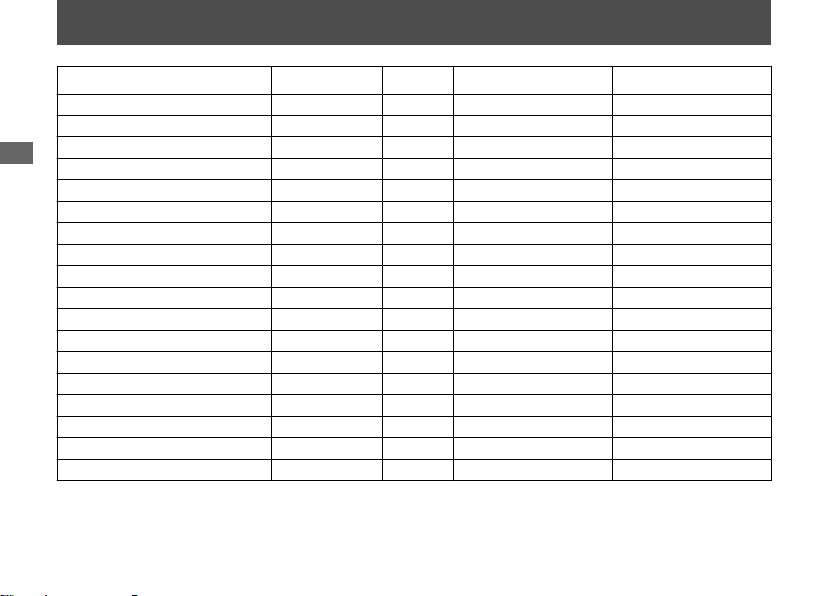
Maintenance Record
Distance Odometer Date Performed By: Notes
Maintenance
58

Maintenance Fundamentals
Pre-ride Inspection
●
2
●
●
2
●
2
●
●
2
●
●
2 2
●
2
Maintenance
59
Continued

●
2
●
2
2
●
2
● 2
●
2
●
2
●
2 2
●
2
●
2
●
●
Maintenance Fundamentals
Maintenance
60
2
2
2 2
2
2
2
2 2
Periodic Checks
2
Maintenance Fundamentals
Maintenance
61
Replacing Parts
3WARNING
Installing non-Honda parts may make
your vehicle unsafe and cause a crash in
which you can be seriously hurt or
killed.
Always use Honda Genuine Parts or
equivalents that have been designed
and approved for your vehicle.
Maintenance Fundamentals
Maintenance
62
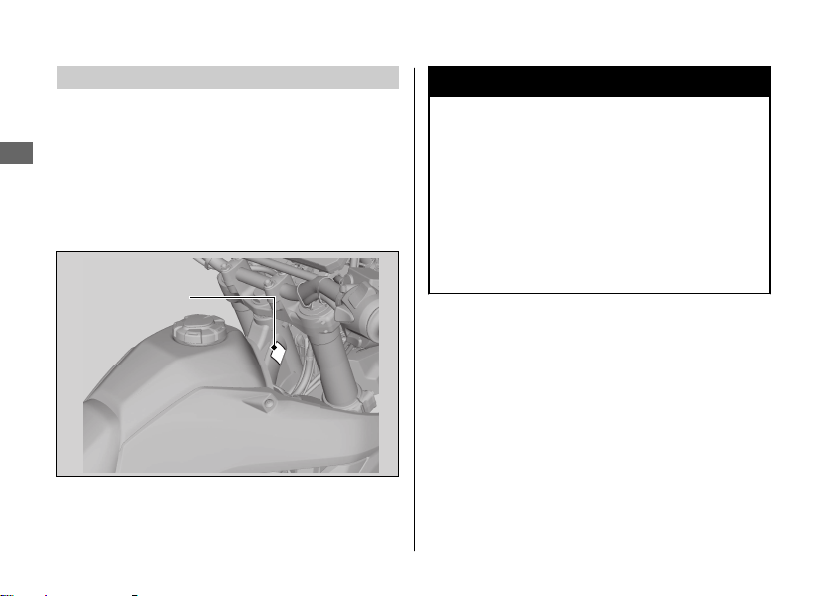
Color label
Battery
NOTICE
#
What to do in an emergency
●
u
●
u
●
u
3WARNING
The battery gives off explosive
hydrogen gas during normal operation.
A spark or flame can cause the battery
to explode with enough force to kill or
seriously hurt you.
Wear protective clothing and a face
shield, or have a skilled mechanic do
the battery servicing.
WARNING:
Wash your hands after handling.
Maintenance Fundamentals
Maintenance
63
Continued
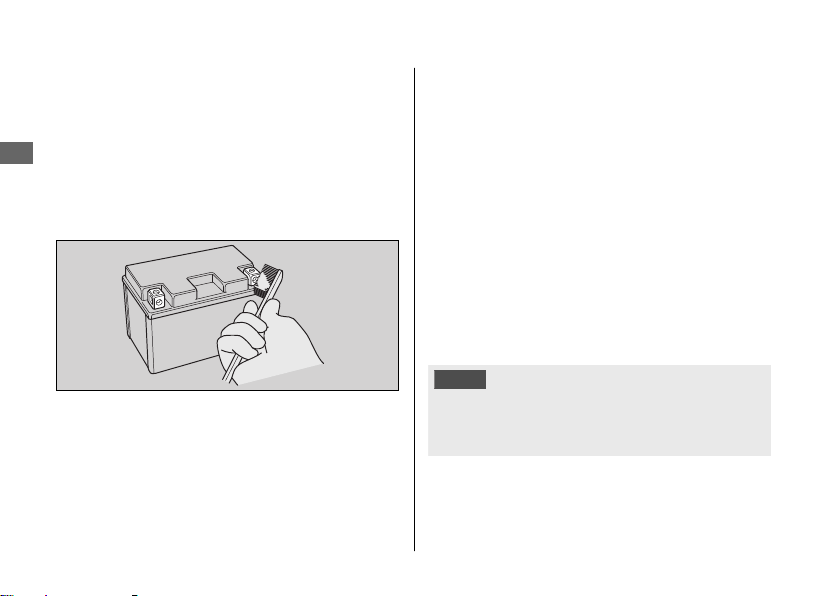
#
Cleaning the Battery Terminals
1.
2
2.
3.
4.
#
Charging
NOTICE
Maintenance Fundamentals
Maintenance
64
NOTICE
NOTICE
Fuses
2
#
Inspecting and Replacing Fuses
2
NOTICE
Maintenance Fundamentals
Maintenance
65
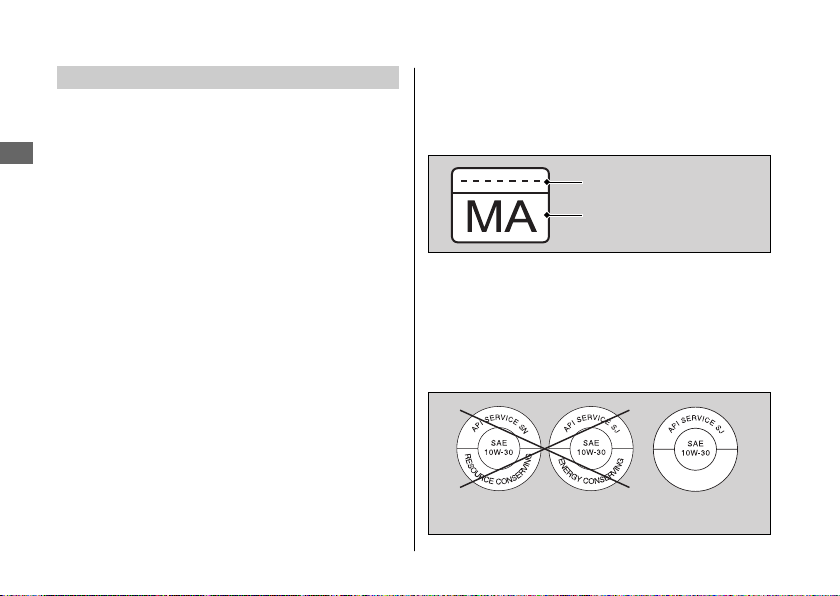
Blown fuse
Engine Oil
#
Selecting the Engine Oil
2
●
●
●
Maintenance Fundamentals
Maintenance
66
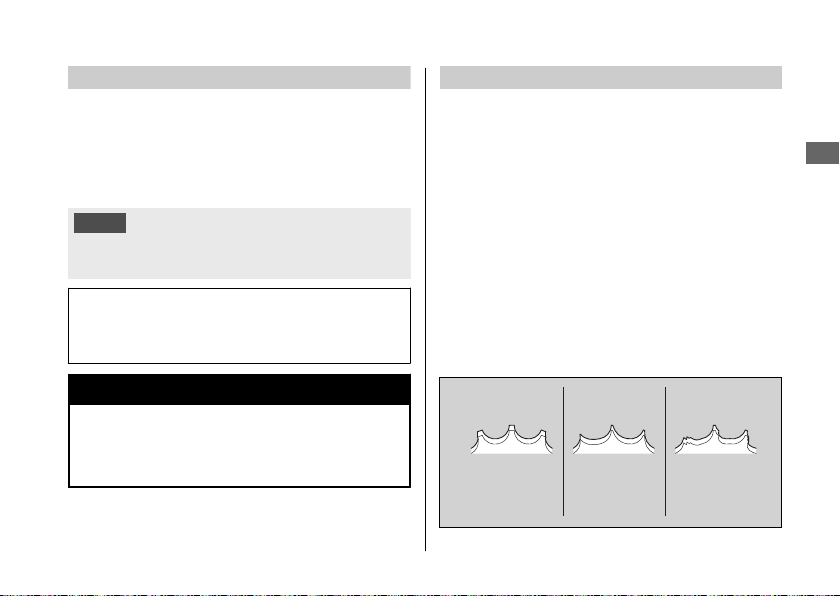
Oil code
Oil classification
Not recommended Recommended
Brake Fluid
NOTICE
Recommended brake fluid:
3WARNING
Clean filler cap before removing. Use
only DOT 3 or DOT 4 fluid from a
sealed container.
Drive Chain
2
Maintenance Fundamentals
Maintenance
67
Continued
Normal
(GOOD)
Worn
(REPLACE)
Damaged
(REPLACE)

NOTICE
#
Cleaning and Lubricating
Recommended lubricant:
Recommended Coolant
Concentration:
Maintenance Fundamentals
Maintenance
68
NOTICE
Crankcase Breather
Tires (Inspecting/Replacing)
#
Checking the Air Pressure
#
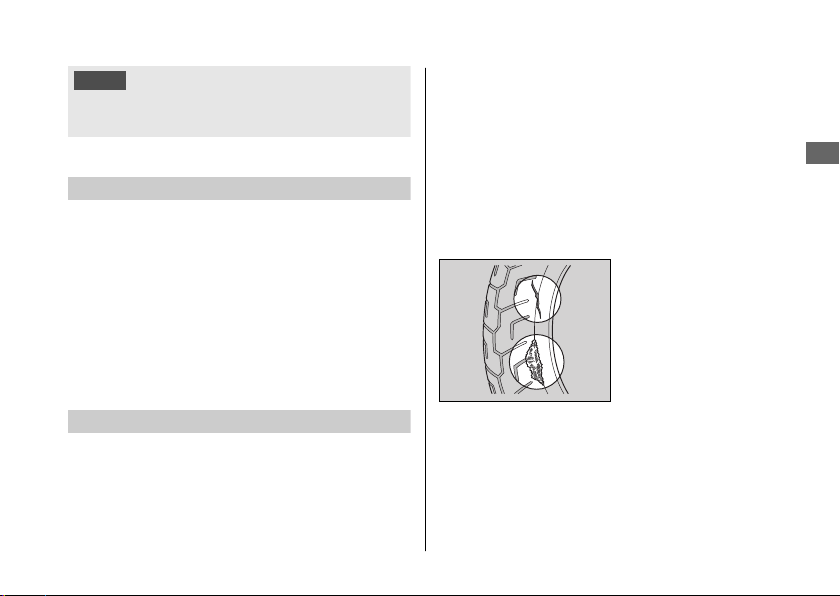
Inspecting for Damage
Maintenance Fundamentals
Maintenance
69
Continued
#
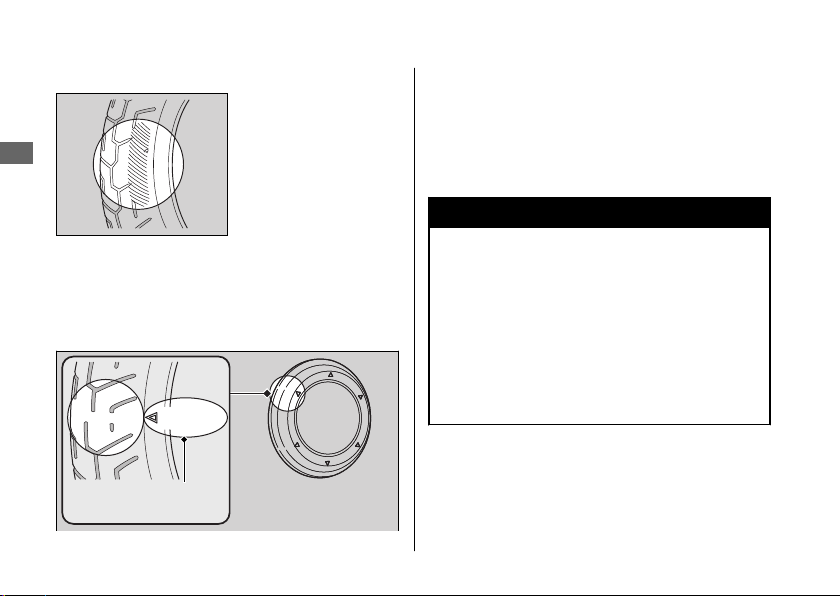
Inspecting for Abnormal Wear
#
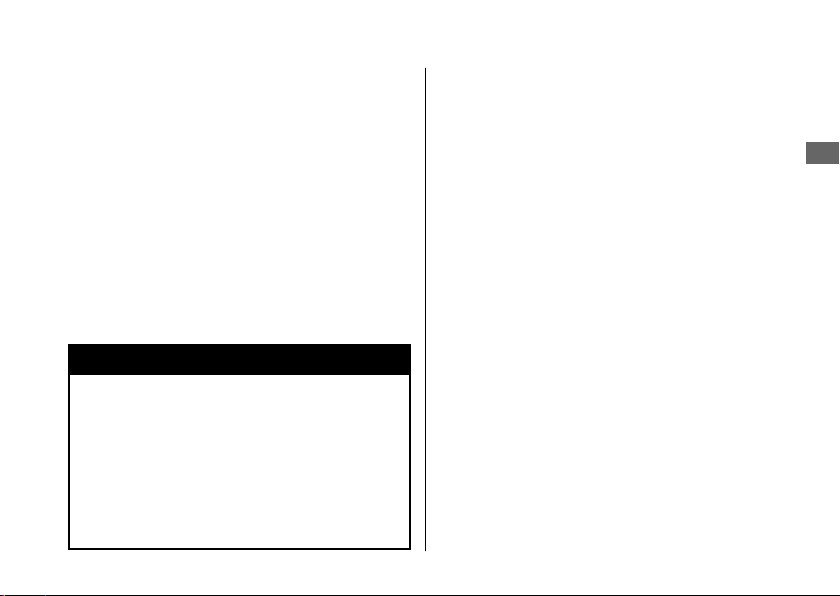
Inspecting Tread Depth
#
Inspecting Rims and Valve Stems
3WARNING
Riding on tires that are excessively worn
or improperly inflated can cause a crash
in which you can be seriously hurt or
killed.
Follow all instructions in this owner's
manual regarding tire inflation and
maintenance.
Maintenance Fundamentals
Maintenance
70
Wear indicator
location mark
or TWI
2
●
●
3WARNING
Installing improper tires on your vehicle
can adversely affect handling and
stability, and can cause a crash in which
you can be seriously hurt or killed.
Always use the size and type of tires
recommended in this owner's manual.
Maintenance Fundamentals
Maintenance
71
Removing & Installing Body Components
Battery
#
Removal
1.
2
2.
3.
-
4.
+
5.
#
Installation
+
2
2
2
Maintenance
72
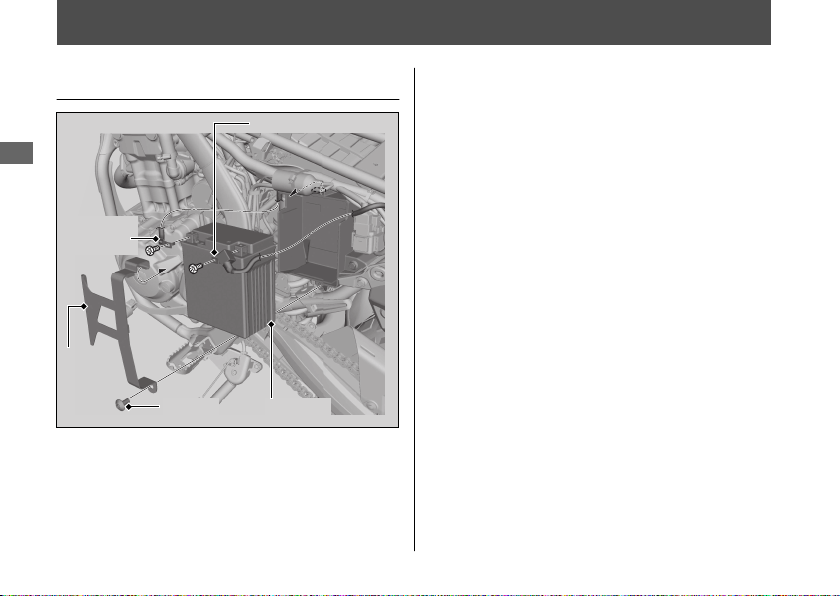
Negative
terminal
Positive terminal
Battery
Battery
holder
Bolt
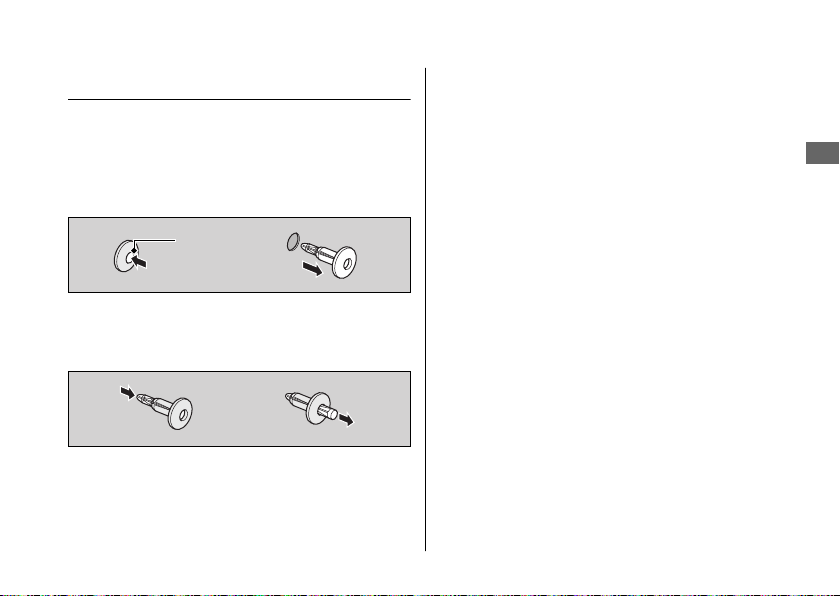
Clip
#
Removal
1.
2.
#
Installation
1.
2.
3.
Removing & Installing Body Components u Clip
Maintenance
73
Center pin
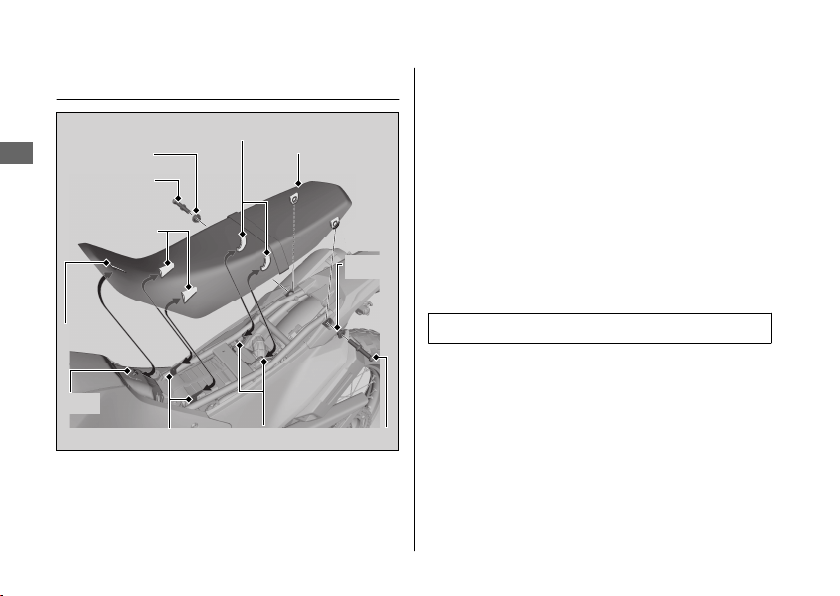
Seat
#
Removal
1.
2.
#
Installation
1.
2.
Torque:
Removing & Installing Body Components u Seat
Maintenance
74
Hook bolt
Rear prongs
Hook bolt
Collar
Tab
Front stays
Front prongs
Seat
Rear stays
Collar
Recess
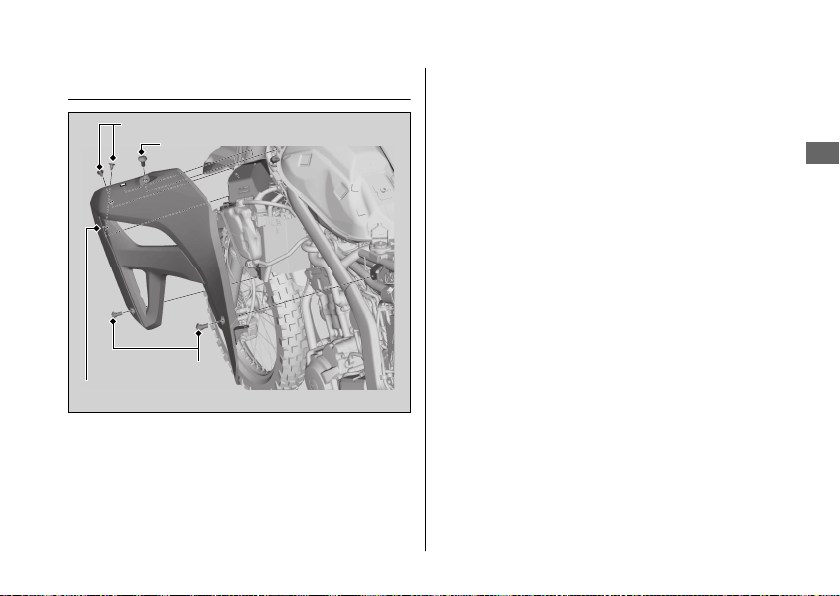
Left Shroud
#
Removal
1.
2
2.
2
3.
4.
#
Installation
1.
2.
3.
4.
Removing & Installing Body Components u Left Shroud
Maintenance
75
Bolts
Bolt
Clips
Left shroud
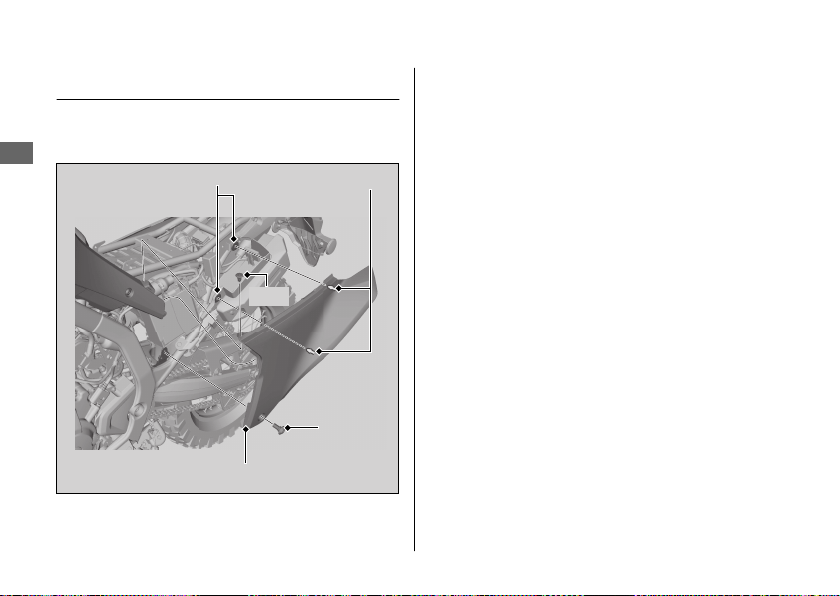
Side Cover
#
Removal
1.
2
2.
2
3.
4.
5.
#
Installation
Removing & Installing Body Components u Side Cover
Maintenance
76
Bolt
Side cover
Grommets Prongs
Clip
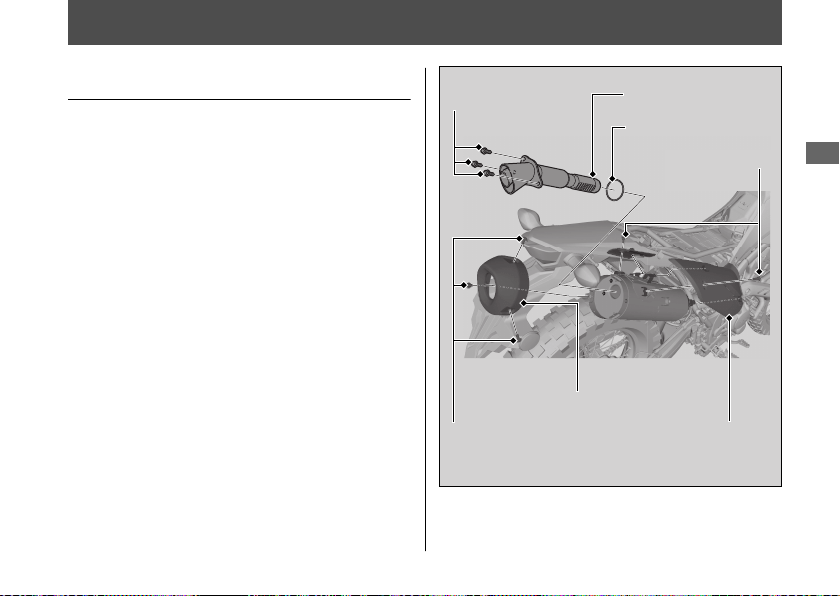
Spark Arrester
Cleaning the Spark Arrester
1.
2.
2
3.
4.
Maintenance
77
Continued
Spark arrester
Gasket
Spark arrester
mounting bolts
Tail cap cover
screws
Tail cap cover
Muffler cover
bolts
Muffler cover
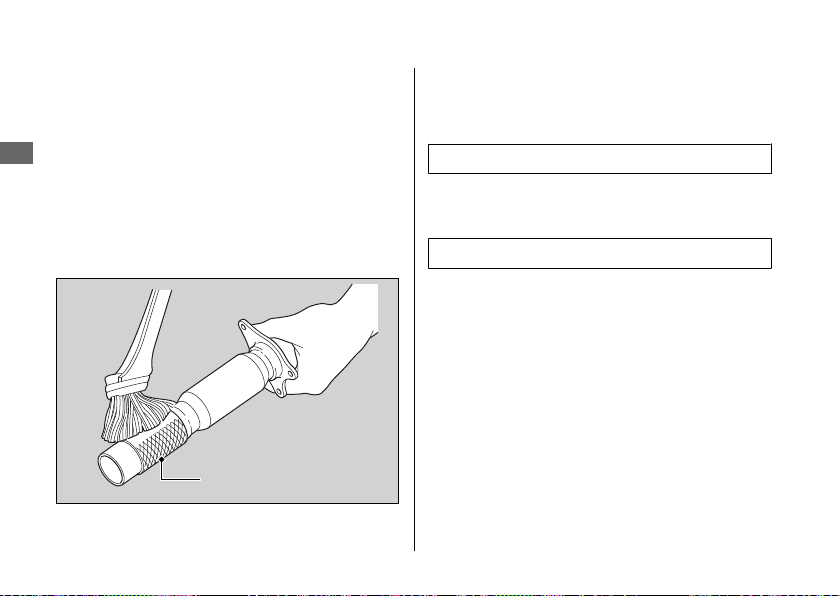
5.
6.
7.
Torque:
8.
Torque:
9.
10.
Spark Arrester u Cleaning the Spark Arrester
Maintenance
78
Spark arrester screen
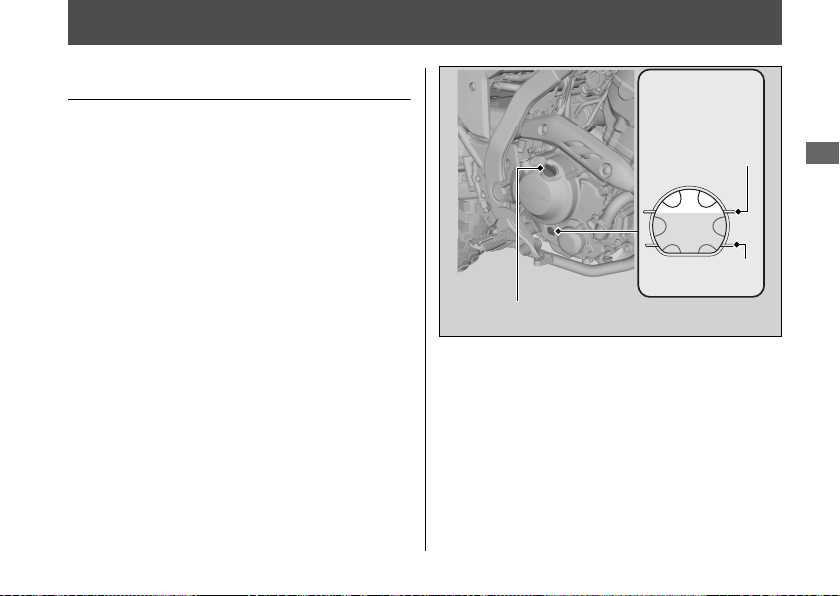
Engine Oil
Checking the Engine Oil
1.
2.
3.
4.
Maintenance
79
Oil fill cap
Oil level
inspection
window
Upper level
mark
Lower level
mark
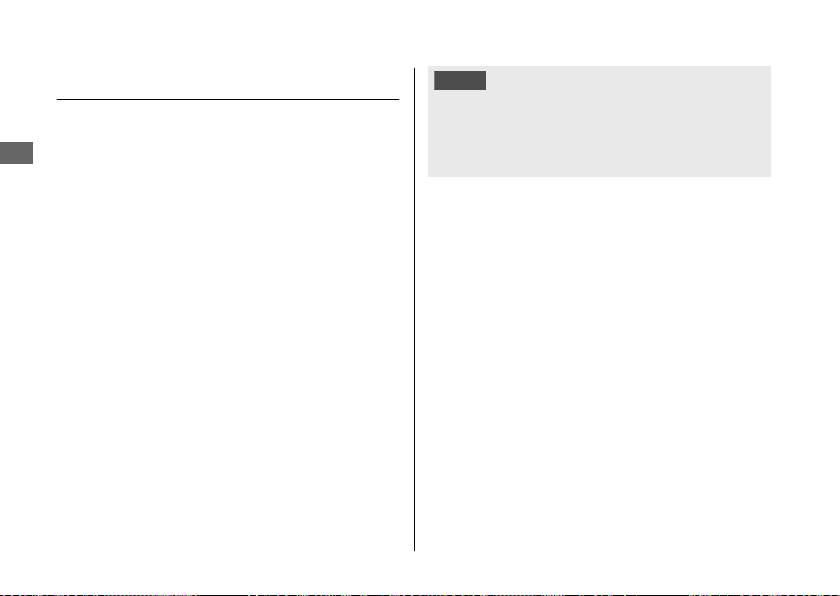
Adding Engine Oil
2 2
1.
u
u
u
u
2.
NOTICE
2
Engine Oil u Adding Engine Oil
Maintenance
80
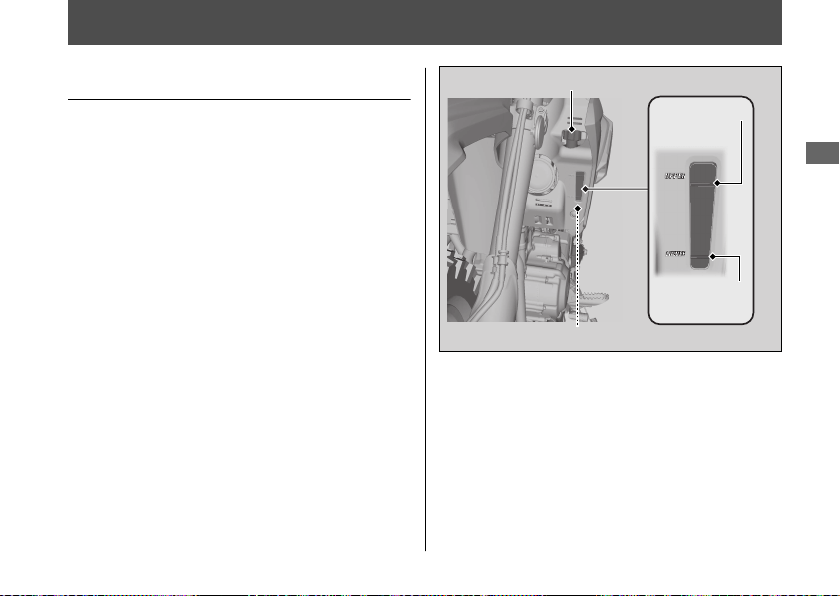
Coolant
Checking the Coolant
1.
2.
3.
Maintenance
81
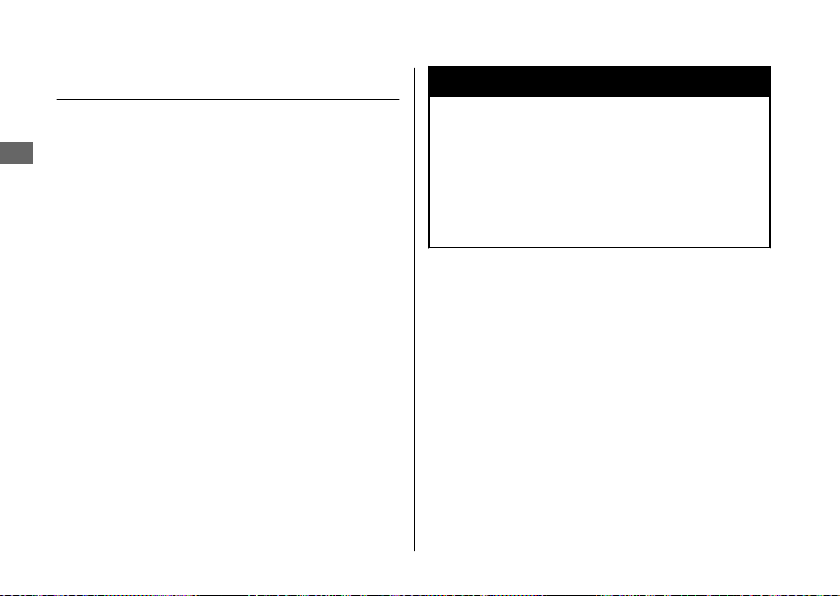
UPPER level
mark
LOWER level
mark
Reserve tank
Reserve tank cap
Adding Coolant
2
1.
u
u
2.
3WARNING
Removing the radiator cap while the
engine is hot can cause the coolant to
spray out, potentially scalding you.
Always let the engine and radiator cool
down before removing the radiator cap.
Coolant u Adding Coolant
Maintenance
82
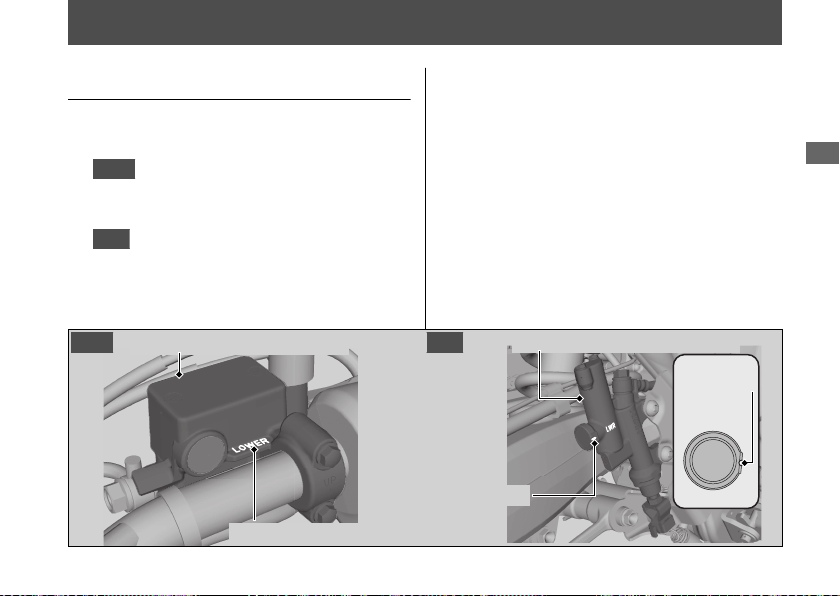
Brakes
Checking Brake Fluid
1.
2.
Front
Rear
Maintenance
83
Front brake fluid reservoir
LOWER level mark
LWR mark
Rear brake fluid reservoir
Front Rear
LWR mark
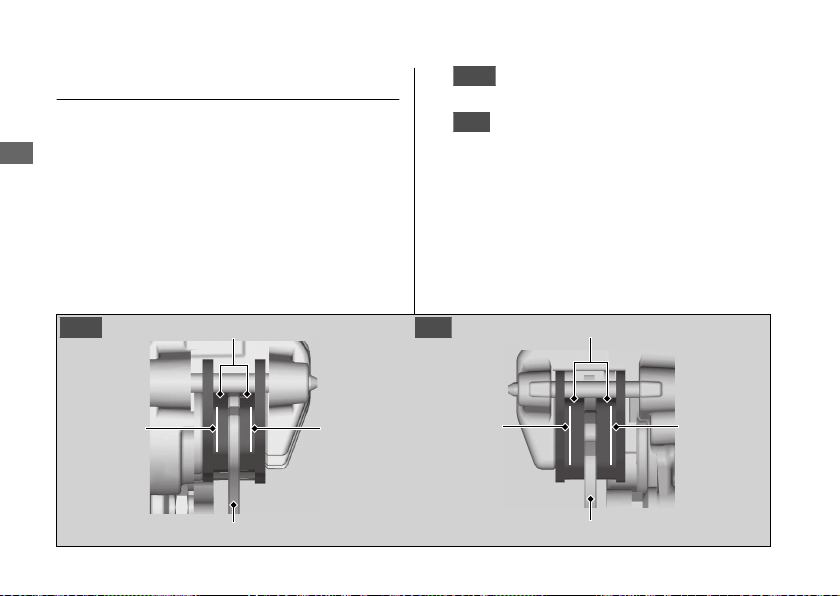
Inspecting the Brake Pads
1.
Front
2.
Rear
Brakes u Inspecting the Brake Pads
Maintenance
84
Front Rear
Pads
Wear
indicator
Disc
Pads
Wear
indicator
Disc
Wear
indicator
Wear
indicator
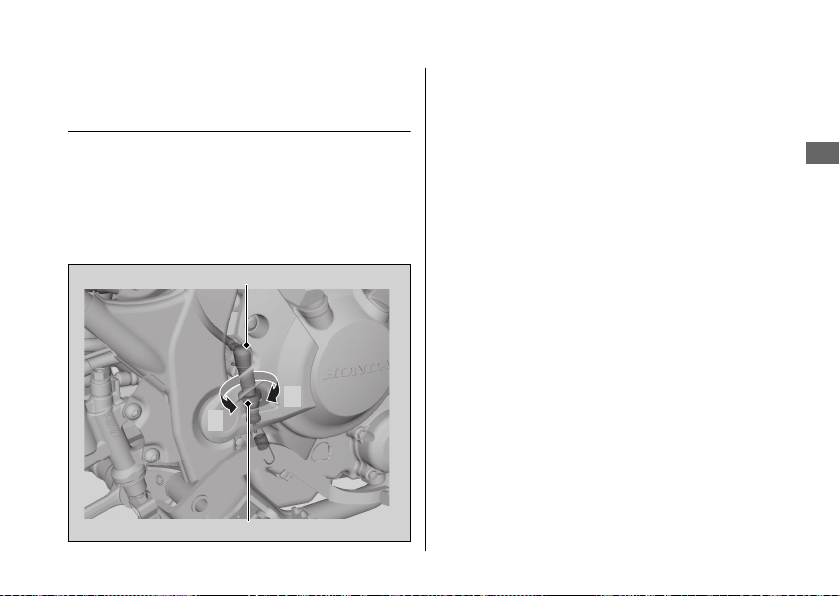
Adjusting the Brake Light
Switch
Brakes u Adjusting the Brake Light Switch
Maintenance
85
Brake light switch
Adjusting nut
B
A

Side Stand
Checking the Side Stand
1.
2.
3.
4.
5.
Maintenance
86
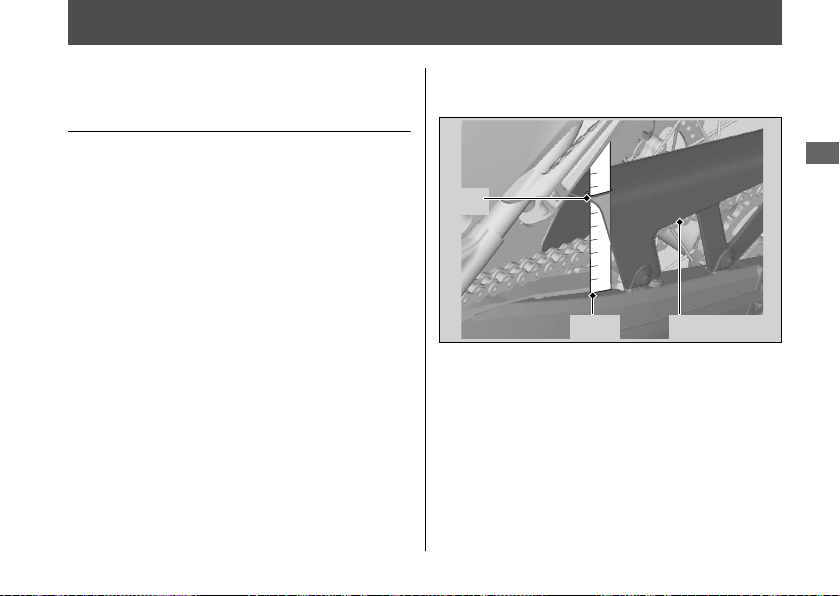
Side stand
spring
Drive Chain
Inspecting the Drive Chain
Slack
1.
2.
3.
Maintenance
87
Continued
Chain case
Slit
Scale
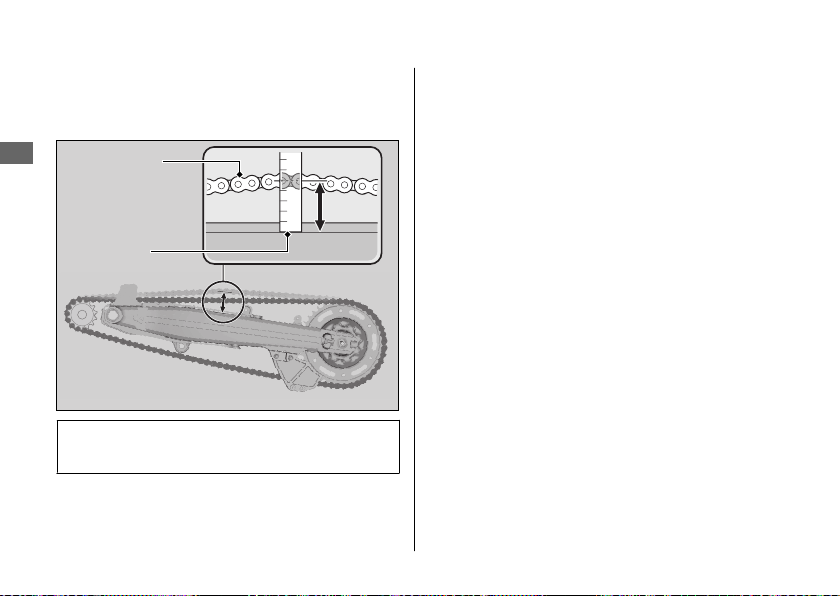
4.
Drive chain slack:
u
5.
6.
2
7.
2
Drive Chain u Inspecting the Drive Chain Slack
Maintenance
88
Top of
swingarm
Drive chain
Wheels
Wheels Rims & Spokes
2
1.
2.
3.
Maintenance
89
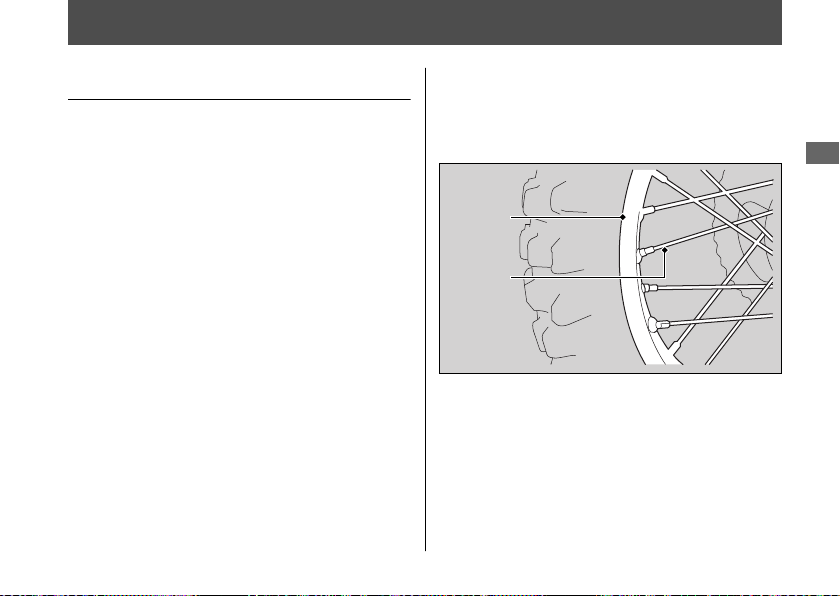
Wheel
rim
Spoke
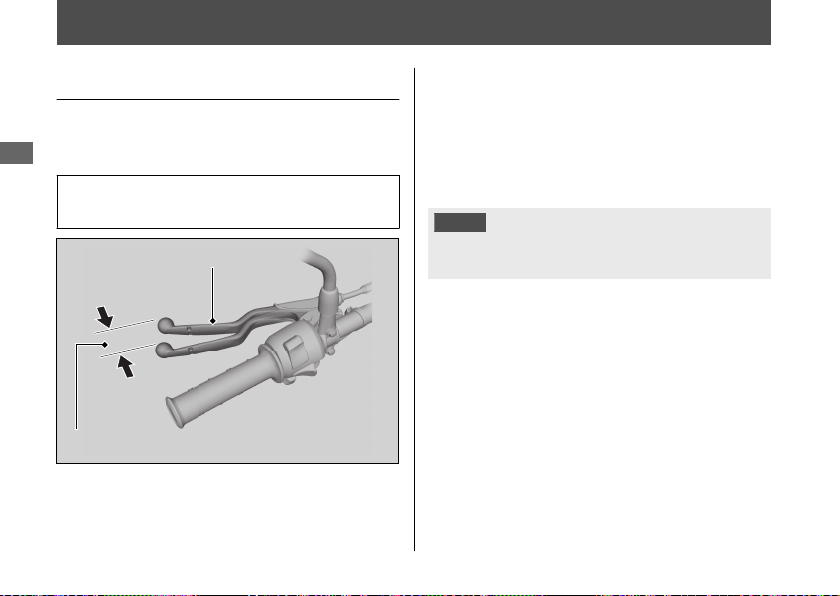
Clutch
Checking the Clutch
#
Checking the Clutch Lever Freeplay
Freeplay at the clutch lever:
NOTICE
Maintenance
90
Clutch lever
Freeplay
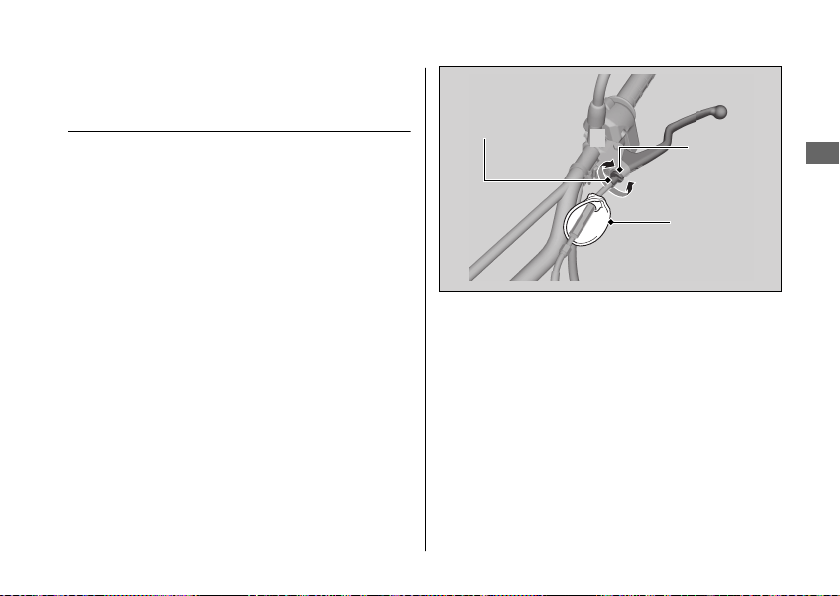
Adjusting the Clutch Lever
Freeplay
#
Minor Adjustment
1.
2.
3.
4.
5.
Clutch u Adjusting the Clutch Lever Freeplay
Maintenance
91
Continued
Rubber dust
cover
Minor
lock nut
Minor clutch
cable
adjuster
–
+
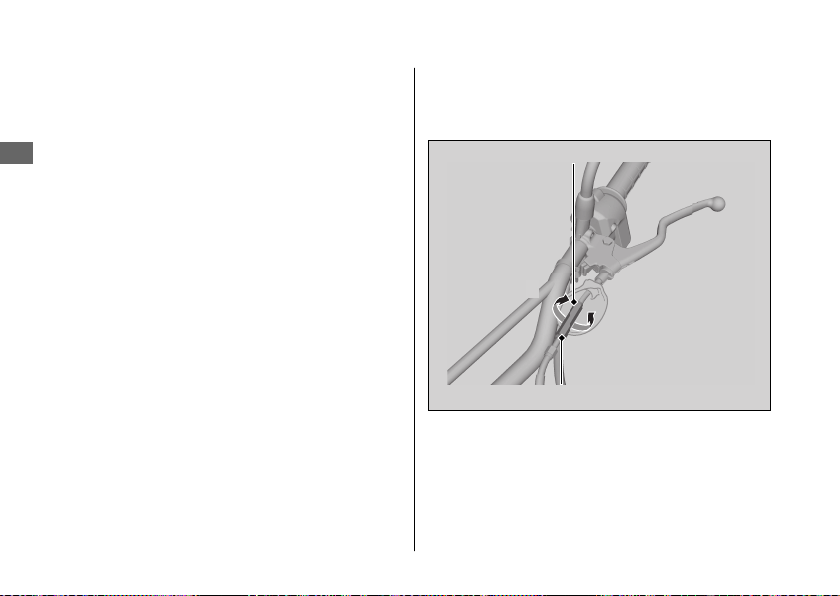
#
Major Adjustment
1.
2.
3.
4.
5.
Clutch u Adjusting the Clutch Lever Freeplay
Maintenance
92
Major clutch cable adjuster
Major lock nut
–
+
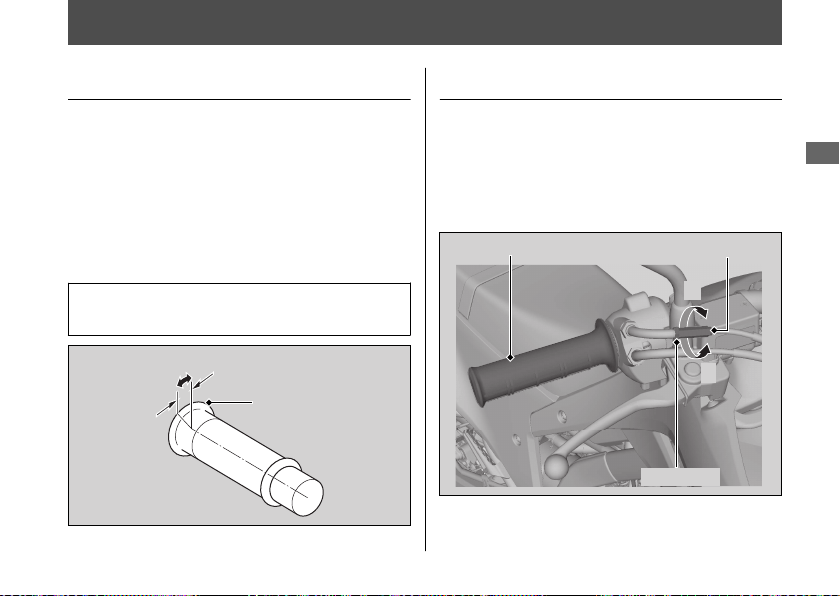
Throttle
Checking the Throttle
Freeplay at the throttle grip flange:
Adjusting the Throttle Freeplay
1.
2.
3.
Maintenance
93
Freeplay
Flange
Throttle grip Adjuster
Lock nut
+
–

Engine Will Not Start........................................
Overheating (High coolant temperature
indicator is on) .................................................
Warning Indicators On or Flashing...............
Other Warning Indications..............................
Tire Puncture ......................................................
Electrical Trouble.............................................
Unstable Engine Operation Occurs
Intermittently .................................................
Troubleshooting

Engine Will Not Start
Starter Motor Operates But
Engine Does Not Start
●
2
●
●
u
Starter Motor Does Not
Operate
●
2
●
2
● 2
●
2
2
●
2
Troubleshooting
95
Overheating (High coolant temperature indicator is on)
●
●
NOTICE
1.
2.
If the fan is not operating:
If the fan is operating:
3.
2
If there is a leak:
4.
2
u
5.
Troubleshooting
96
Warning Indicators On or Flashing
PGM-FI (Programmed Fuel
Injection) Malfunction
Indicator Lamp (MIL)
ABS (Anti-lock Brake System)
Indicator
CRF300LA
●
●
●
Troubleshooting
97
Other Warning Indications
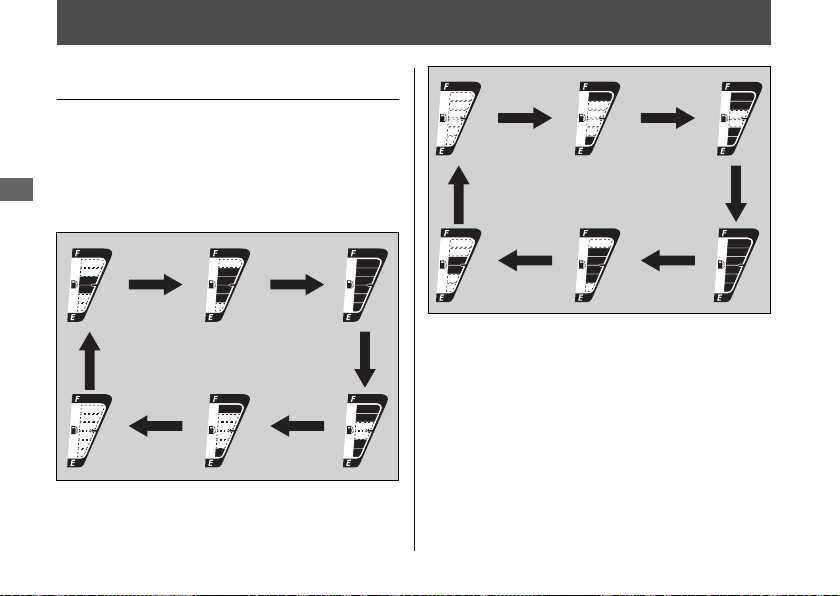
Fuel Gauge Failure Indication
Troubleshooting
98
Tire Puncture
Tube Repair and Replacement
3WARNING
Riding your vehicle with a temporary
tire or tube repair can be risky. If the
temporary repair fails, you can crash
and be seriously injured or killed.
If you must ride with a temporary tire or
tube repair, ride slowly and carefully
and do not exceed 30 mph (50 km/h)
until the tire or tube is replaced.
Troubleshooting
99
Electrical Trouble
Battery Goes Dead
NOTICE
Burned-out Light Bulb
2
Troubleshooting
100
#
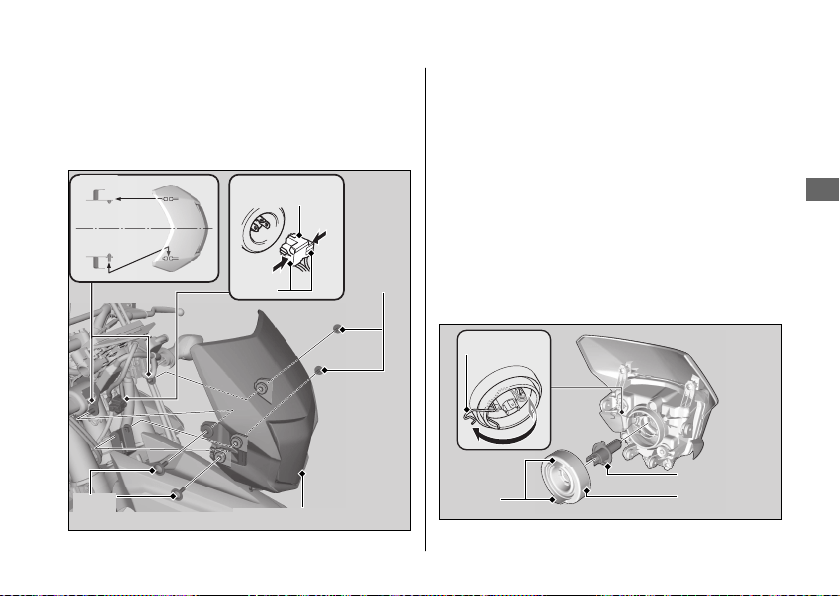
Headlight Bulb
1.
2.
3.
4.
5.
6.
u
Electrical Trouble u Burned-out Light Bulb
Troubleshooting
101
Continued
Headlight assembly
Bolts
Bolts
Tabs
Socket
Pin
Tabs
Bulb
Dust cover
#
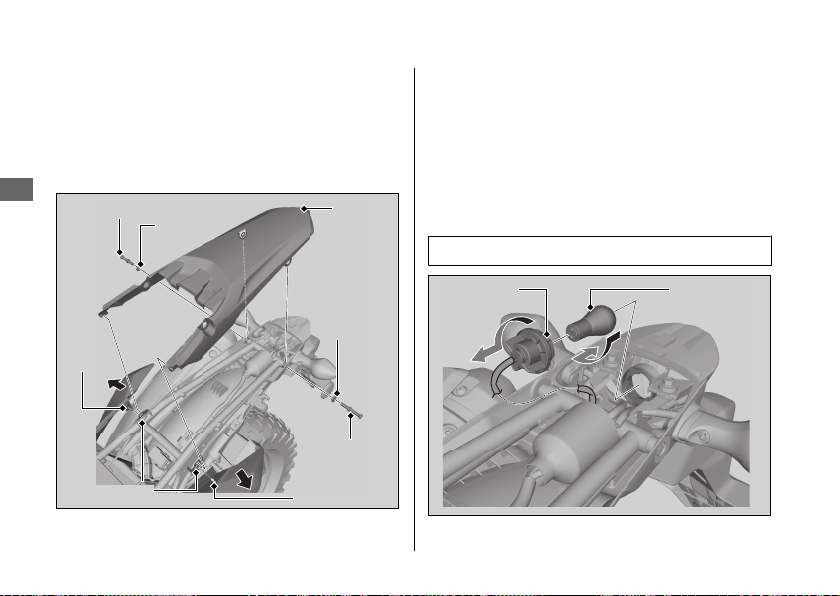
Brake light/Taillight Bulb
1.
2
2.
3.
4.
5.
6.
7.
8.
Torque:
Electrical Trouble u Burned-out Light Bulb
Troubleshooting
102
Hook bolt Rear
fender
Collar
Collar
Hook bolt
Grommets
Prong
Prong
BulbSocket
#
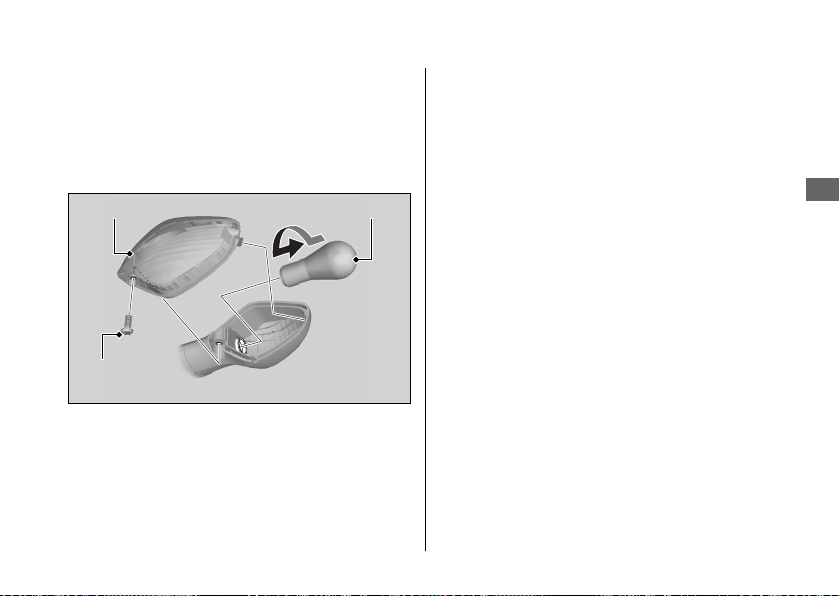
Front/Rear Turn Signal Bulb
1.
2.
3.
4.
Electrical Trouble u Burned-out Light Bulb
Troubleshooting
103
Turn signal lens
Screw
Bulb
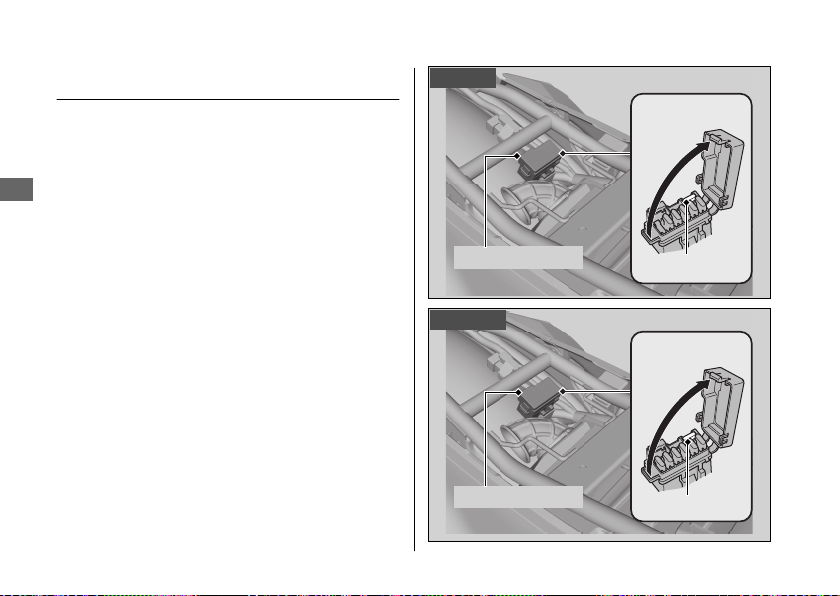
Blown Fuse
2
#
Fuse Box A
1.
2
2.
3.
4.
5.
Electrical Trouble u Blown Fuse
Troubleshooting
104
Fuse box cover
Spare fuse
CRF300L
Fuse box cover
Spare fuse
CRF300LA
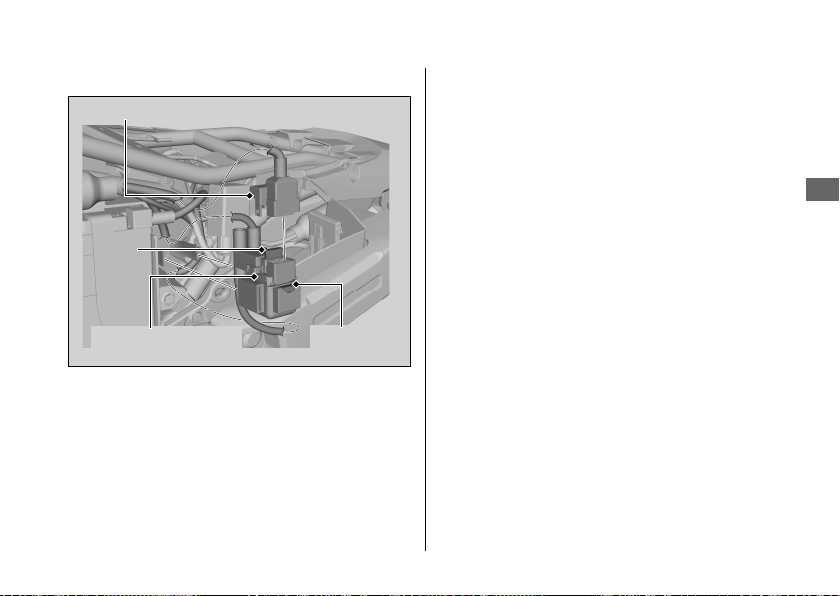
#
Main Fuse
1.
2
2.
3.
4.
u
5.
Electrical Trouble u Blown Fuse
Troubleshooting
105
Continued
Starter magnetic
switch
Main
fuse
Spare
main fuse
Wire connector
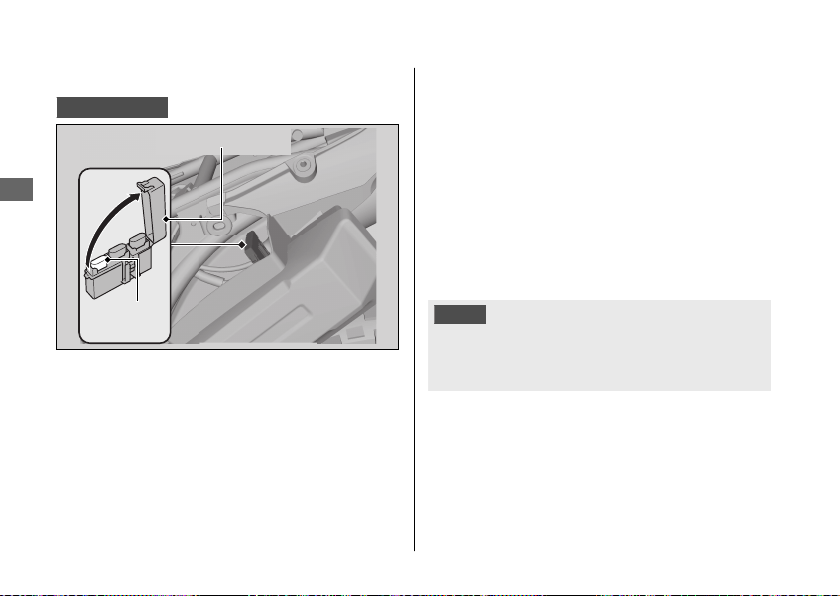
#
Fuse Box B
CRF300LA only
1.
2
2.
3.
4.
5.
NOTICE
Electrical Trouble u Blown Fuse
Troubleshooting
106
Spare
fuse
Fuse box cover
Unstable Engine Operation Occurs Intermittently
Troubleshooting
107

Keys.....................................................................
Instruments, Controls, & Other Features...
Caring for Your Vehicle..................................
Storing Your Vehicle.......................................
Transporting Your Vehicle ............................
You & the Environment .................................
Vehicle Identification Number.....................
Emission Control Systems .............................
Catalytic Converter .........................................
Oxygenated Fuels............................................
Authorized Manuals .......................................
Warranty Coverage and Service ..................
Honda Contacts ...............................................
Reporting Safety Defects ..............................
Information
Keys
Ignition Key
Keys
Information
109
Instruments, Controls, &
Other Features
Ignition Switch
Engine Stop Switch
Odometer
Tripmeter
Document Bag
Ignition Cut-off System
Instruments, Controls, & Other Features
Information
110

Assist-slipper Clutch System
Caring for Your Vehicle
Washing
1.
2.
u
Caring for Your Vehicle
Information
111
Continued

3.
4.
u
5.
6.
u
u
#
Washing Precautions
●
u
u
●
u
●
u
●
u
●
u
Caring for Your Vehicle
Information
112
●
u
u
●
u
Aluminum Components
●
●
Panels
●
●
●
Caring for Your Vehicle
Information
113
Continued
Exhaust Pipe and Muffler
Storing Your Vehicle
●
● 2
●
●
● 2
u
-
Storing Your Vehicle
Information
114
USA
Honda Winter Storage Guide
Canada
Transporting Your Vehicle
NOTICE
Transporting Your Vehicle
Information
115
You & the Environment
Choose Sensible Cleaners
Recycle Wastes
You & the Environment
Information
116
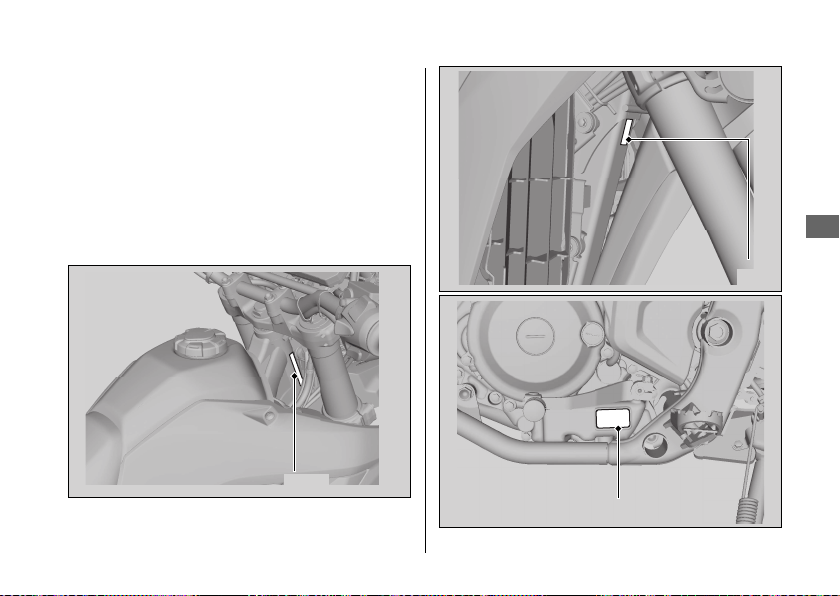
Vehicle Identification
Number
Vehicle Identification Number
Information
117
VIN
VIN
Engine number
Emission Control Systems
Exhaust Emission Requirements
USA
Emission Control Systems
Information
118
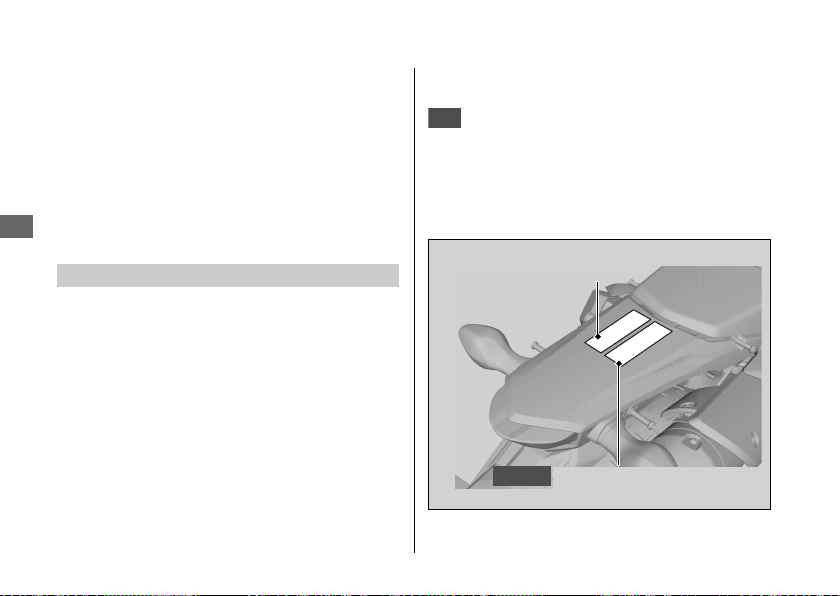
Vehicle emission control
information label
Canada
Vehicle emission control
information label
Noise Emission Requirements
Exhaust Emission Control System
#
PGM-FI System
#
Ignition Timing Control System
#
Secondary Air Injection System
#
Catalytic Converters
Emission Control Systems
Information
119
Continued
Evaporative Emission Control System
50 STATE (meets California)
Crankcase Emissions Control System
Fuel Permeation Emission Control
Noise Emission Control System
#
TAMPERING WITH THE NOISE CONTROL
SYSTEM IS PROHIBITED:
Emission Control Systems
Information
120
#
AMONG THOSE ACTS PRESUMED TO
CONSTITUTE TAMPERING ARE THE
FOLLOWING ACTS:
●
●
●
●
Problems Affecting Vehicle Exhaust
Emissions
●
●
●
●
Emission Control Systems
Information
121

Catalytic Converter
●
●
●
Catalytic Converter
Information
122
Oxygenated Fuels
●
u
●
NOTICE
Oxygenated Fuels
Information
123
Description
USA
Authorized Manuals
USA
Canada
USA
USA
Order online: www.helminc.com
Order Toll Free: 1-888-CYCLE93
Authorized Manuals
Information
124
Warranty Coverage and
Service
Coverage
●
●
●
USA
Canada
USA
Warranty Coverage and Service
Information
125
Continued

Statement on Warranty Coverage for
Aftermarket and Recycled Parts
Warranty Coverage and Service
Information
126
Service
Warranty Coverage and Service
Information
127
Honda Contacts
American Honda Motor Co., Inc.
https://powersports.honda.com/
contact-us
Canada
●
●
●
●
Honda Contacts
Information
128
Your Honda Dealer
USA
Honda Contacts
Information
129

Reporting Safety Defects
USA
https://www.safercar.gov
https://www.safercar.gov
Reporting Safety Defects
Information
130

Canada
www.tc.canada.ca/recalls
www.tc.canada.ca/rappels
https://www.tc.gc.ca/roadsafety
Reporting Safety Defects
Information
131
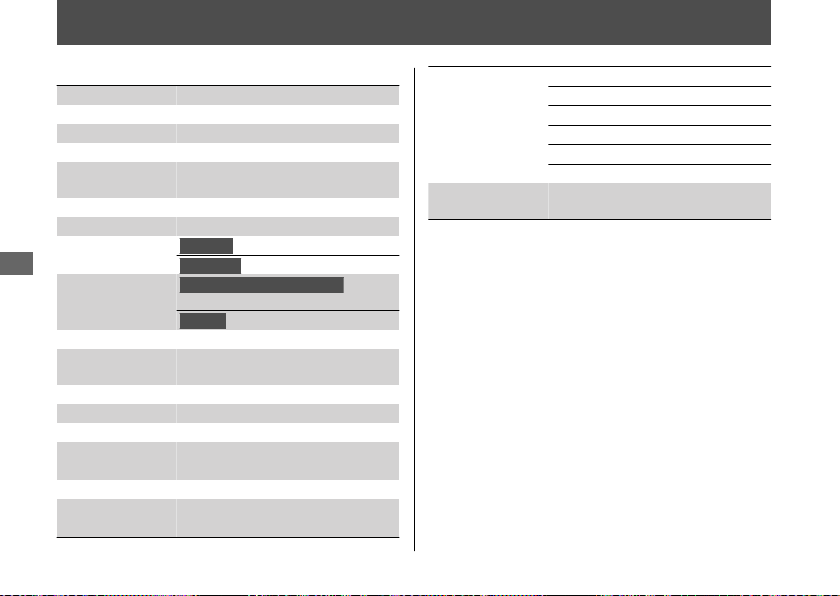
Specifications
■ Main Components
Overall length 87.8 in (2,230 mm)
Overall width 32.3 in (820 mm)
Overall height 47.2 in (1,200 mm)
Wheelbase 57.3 in (1,455 mm)
Minimum ground
clearance
11.2 in (285 mm)
Caster angle 27.5°
Trail 4.3 in (109 mm)
Curb weight
CRF300L
306 lb (139 kg)
CRF300LA
311 lb (141 kg)
Maximum weight
capacity
*1
50 STATE (meets California)
326 lb (148 kg)
Canada
320 lb (145 kg)
Passenger capacity Rider and 1 passenger
Minimum turning
radius
7.5 ft (2.3 m)
Displacement 17.4 cu-in (286 cm
3
)
Bore x stroke 2.99 x 2.48 in (76.0 x 63.0 mm)
Compression ratio 10.7:1
Fuel
Unleaded gasoline
Recommended: 86 PON or higher
Tank capacity 2.06 US gal (7.8 L)
Battery
YTZ8V
12 V-7.0 Ah (10 HR)
Gear ratio
1st 3.538
2nd 2.250
3rd 1.650
4th 1.346
5th 1.115
6th 0.925
Reduction ratio
(primary / final)
2.807 / 2.857
Specifications
132
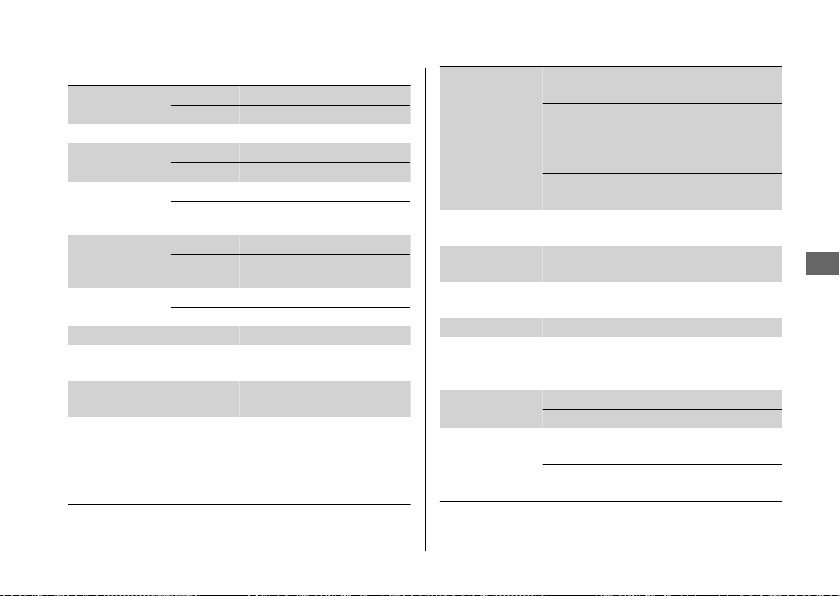
■ Service Data
Tire size
Front 80/100-21M/C (51P)
Rear 120/80-18M/C (62P)
Tire type Bias-ply, tube
Recommended
Tire
Front IRC GP-21F
Rear IRC GP-22R
Tire air pressure
Up to 90 kg (200
lbs) load
Front 22 psi (150 kPa, 1.50 kgf/cm
2
)
Rear 22 psi (150 kPa, 1.50 kgf/cm
2
)
Tire air pressure
Up to Maximum
weight capacity
Front 22 psi (150 kPa, 1.50 kgf/cm
2
)
Rear 25 psi (175 kPa, 1.75 kgf/cm
2
)
Minimum tread
depth
Front 0.12 in (3.0 mm)
Rear 0.12 in (3.0 mm)
Spark plug (standard) SIMR8A9 (NGK)
Spark plug gap
(non-
adjustable)
0.03 - 0.04 in (0.8 - 0.9 mm)
Idle speed
(non-
adjustable)
1,450 ± 100 rpm
Recommended
engine oil
Honda 4-stroke motorcycle oil API Service
Classification SJ or higher, excluding oils
marked as “Energy Conserving” or
“Resource Conserving” SAE 10W-30, JASO T
903 standard MA
Engine oil
capacity
After
draining
1.5 US qt (1.4 L)
After
draining &
filter
change
1.6 US qt (1.5 L)
After
disassembly
1.9 US qt (1.8 L)
Recommended
brake fluid
Honda DOT 3 or DOT 4 Brake Fluid
Cooling system
capacity
0.91 US qt (0.86 L)
Recommended
coolant
Pro Honda HP Coolant
Drive chain slack 2 - 2 1/4 in (50 - 55 mm)
Recommended
drive chain
lubricant
Pro Honda HP Chain Lube or equivalent
Standard drive
chain
DID 520VF
No. of links 106
Standard sprocket
size
Drive
sprocket
14T
Driven
sprocket
40T
Specifications
Specifications
133
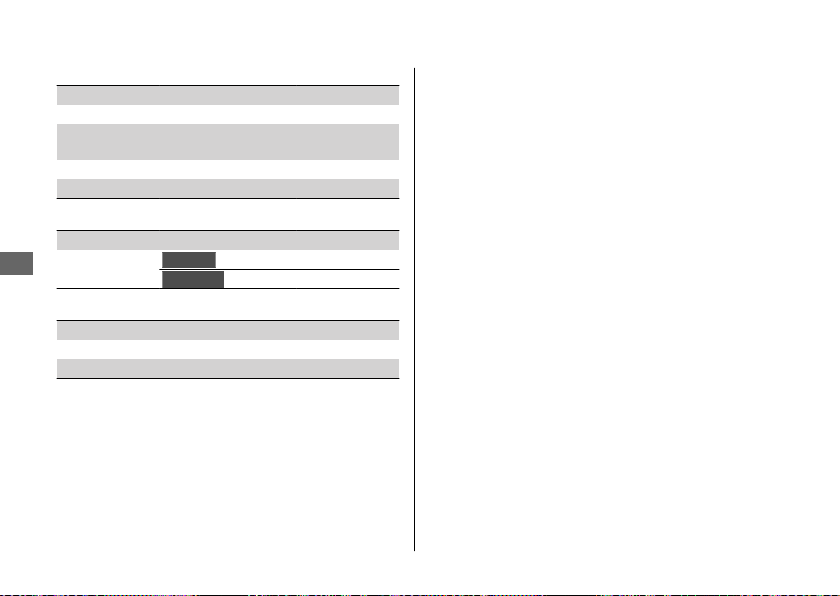
■ Bulbs
Headlight 12 V-60 / 55 W
Brake light / Taillight 12 V-21 / 5 W
Front turn signal / Position
light
12 V-21 / 5 W x 2
Rear turn signal 12 V-21 W x 2
License plate light LED
■ Fuses
Main fuse 30 A
Other fuse
CRF300L
10 A
CRF300LA
30 A, 10 A
■ Torque Specifications
Hook bolt 15 lbf·ft (21 N·m, 2.1 kgf·m)
Tail cap cover screw 3.9 lbf·ft (5.25 N·m, 0.5 kgf·m)
Spark arrester mounting bolt 6.6 lbf·ft (9.0 N·m, 0.9 kgf·m)
Specifications
Specifications
134
Information Record
135
WARNING:
PRINTED IN USA
31K1TA10
00X31-K1T-A100