Instructions for Use
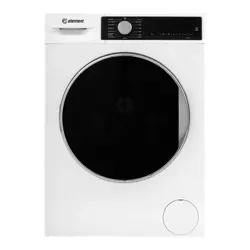
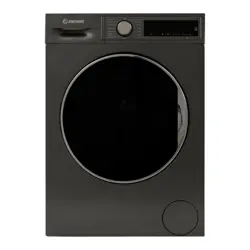
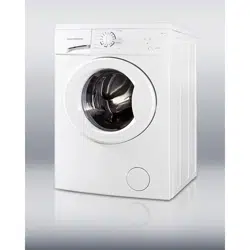
Washing Machine
188635
Thank you for your condence in purchasing our
washing machine, and congratulations on the
excellent choice.
Our appliances are friendly to the environment.
Your new washing machine meets the requirements
of modern clothes care. It consumes less energy,
water and washing detergent.
Description of washing machine ..................... 3
Cautions ............................................................. 4
Important safety instructions .......................... 6
Installation and connection .............................. 8
Operation.......................................................... 12
Tips for washing and energy saving ............. 19
Cleaning and maintenance ............................. 21
Troubleshooting .............................................. 24
Tables ............................................................... 27
Ownership Registration .................................. 29
Warranty ........................................................... 31
Consumer Support .......................................... 32
2
188635
Dimensions (w x d x h):
600 mm x 600 mm x 850 mm
Dimensions (w x d x h):
600 mm x 440 mm x 850 mm
Depth with door open:
106 cm / 88 cm (depending on model)
Weight (net): 174 lbs (79 kg)
Nominal voltage: 120 V, 60 Hz
Power: 1500 W
Max. load: 15 lbs (7kg)
Power socket: 120 V, 15 A, 60 Hz
Water pressure:
min. 7 psi (0,05 MPa, max. 116 psi (0,8 MPa)
Fuse: 15 A
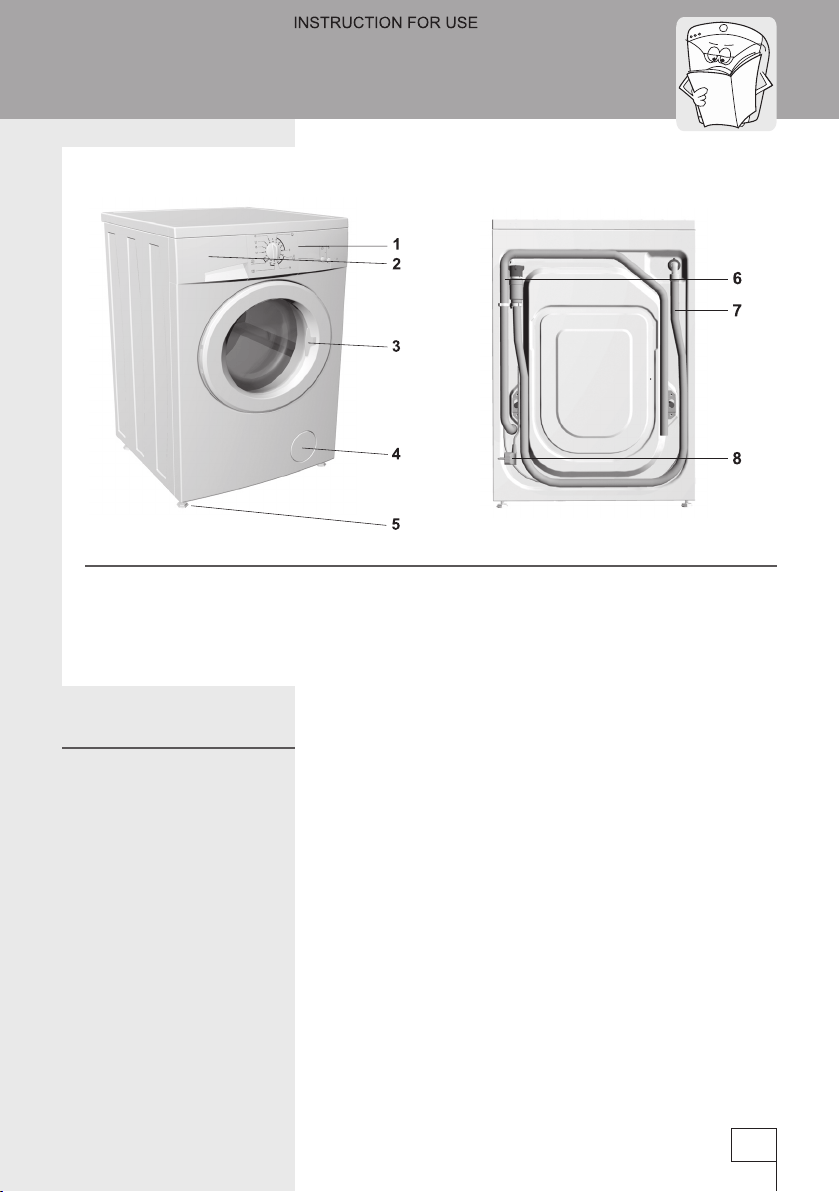
1. Front panel
2. Detergent dispenser
3. Door
4. Filter lid
5. Adjustable legs
6. Water outlet hose
7. Water inlet hose
8. Main power cable
3
Description of washing machine
Technical information
188635
•
BE SURE TO REMOVE SHIPPING RODS PRIOR
TO THE FIRST USE OF THE APPLIANCE.
ATTEMPTING TO OPERATE THE MACHINE
WITHOUT REMOVING THE SHIPPING RODS
MAY RESULT IN IRREPARABLE DAMAGE
WHICH IS NOT COVERED UNDER WARRANTY.
•
When connecting your washing machine to
the water supply, be sure to use the brand new
water inlet hose and appropriate sealing gaskets
(included).
•
Do not locate the machine in a room with
temperature below 0°C. Parts of the machine may
be damaged if frozen.
•
Install the washing machine in a perfectly
horizontal position, on solid at concrete oor.
•
Follow the instructions for correct installation and
water and main connections.
•
Never immerse the end of the drain hose into the
draining water.
•
Prior to starting the wash cycle, ensure the door is
closed properly.
•
Door may not be open during the washing cycle.
•
Use only detergents and softeners for
machine wash. Manufacturer may not assume
responsibility for any damage and eventual
discoloring of gaskets and plastic components as
a consequence of incorrect use of bleach and/or
coloring agents.
•
High Efciency (“HE”) detergent recommended.
•
For removal of lime residues use such agents
with added anti-corrosion agents. Follow the
manufacturer’s instructions. Finish the lime
removal by multiple rinsing to completely remove
eventual acid residues.
•
Never use detergents containing solvents, since
there is a danger of creating toxic gasses which
may damage the machine and result in ignition or
explosion.
•
Upon completion of washing operation close the
water faucet.
4
Cautions
188635
•
Before any transport insert at least one shipping
rod. Prior to this operation disconnect the
appliance from the main power!
•
Rating plate with basic information is located on
the edge of the door opening.
•
The appliance is manufactured in compliance
with all relevant safety standards; however, it
is recommended that persons with impaired
physical, motional, or mental abilities, or persons
with inadequate experience and knowledge, do
not use the appliance without due supervision.
The same recommendation applies to minors
using the appliance.
Before connecting the appliance read
these instructions carefully. Repairing
any failure arising from inappropriate
connections or use of the appliance is not
covered by the guarantee.
The symbol on the product or on its
packaging indicates that this product
may not be treated as household
waste. Instead it shall be handed over
to the applicable collection point for the
recycling of electrical and electronic
equipment. By ensuring this product
is disposed of correctly, you will help
prevent potential negative consequences
for the environment and human health,
which could otherwise be caused by
inappropriate waste handling of this
product. For more detailed information
about recycling of this product, please
contact your local city ofce, your
household waste disposal service or the
shop where you purchased the product.
5
188635
To reduce the risk of re, electric shock, or
injury when using your appliance, follow
basic precautions, including the following:
1. Read all instructions before using the appliance.
2. Do not wash articles that have been previously
cleaned in, washed in, soaked in or spotted
with gasoline, dry-cleaning solvents, and other
ammable or explosive substances as they give
off vapors that could ignite or explode.
3. Do not add gasoline, dry-cleaning solvents, or
other ammable or explosive substances to the
wash water. These substances give off vapors
that could ignite or explode.
4. Under certain conditions, hydrogen gas may
be produced in a hot water system that has not
been used for 2 weeks or more. HYDROGEN
GAS IS EXPLOSIVE, if the hot water system
has not been used for such a period, before
using a washing machine, turn on all hot
water faucets and let the water ow from
each for several minutes. This will release
any accumulated hydrogen gas. As the gas is
ammable do not smoke or use an open ame
during this time.
5. Do not allow children to play on or in the
appliance. Close supervision of children is
necessary when the appliance is used near
children.
6. Before the appliance is removed from service or
discarded, remove the door.
7. Do not reach into the appliance if the tub or
agitator is moving.
8. Do not install or store this appliance where it will
be exposed to the weather.
9. Do not tamper with controls.
10. Do not repair or replace any part of the
appliance or attempt any servicing unless
specically recommended in the user-
maintenance instructions or in published user-
6
Important safety instructions
188635
repair instructions that you understand and have
the skills to carry out.
11. To reduce the risk of electric shock, disconnect
the appliance from the power supply before
attempting any user maintenance. Turning
the control to the »OFF« position does not
disconnect the appliance from the power supply.
DANGER
Risk of child entrapment
Before you throw away your old appliance,
take off the door so that children cannot
easily get trapped inside.
Grounding instructions
This appliance must be grounded. In the event of
malfunction or breakdown, grounding will reduce
the risk of electric shock by providing a path of
least resistance for electric current. This appliance
is equipped with a cord having an equipment-
grounding conductor and a grounding plug. The
plug must be plugged into an appropriate outlet that
is properly installed and grounded in accordance
with all local codes and ordinances.
Improper connection of the equipment-
grounding conductor can result in a risk
of electric shock. Check with a qualied
electrician or serviceman if you are in
doubt as to whether the appliance is
properly grounded.
Do not modify the plug provided with the appliance-
if it will not t the outlet; have a proper outlet
installed by a qualied electrician.
Save these instructionsSave these instructions
7
188635
When removing the wrapping be careful not
to damage the appliance with a sharp object.
Before connecting the appliance, let it warm
up to room temperature (wait for two hours).
•
Our appliances are packed in environmentally
friendly materials which may be recycled,
deposited or decomposed without any threat to
the environment.
•
To this end all packaging is marked accordingly.
•
Move the hoses to allow access to the transport
brackets.
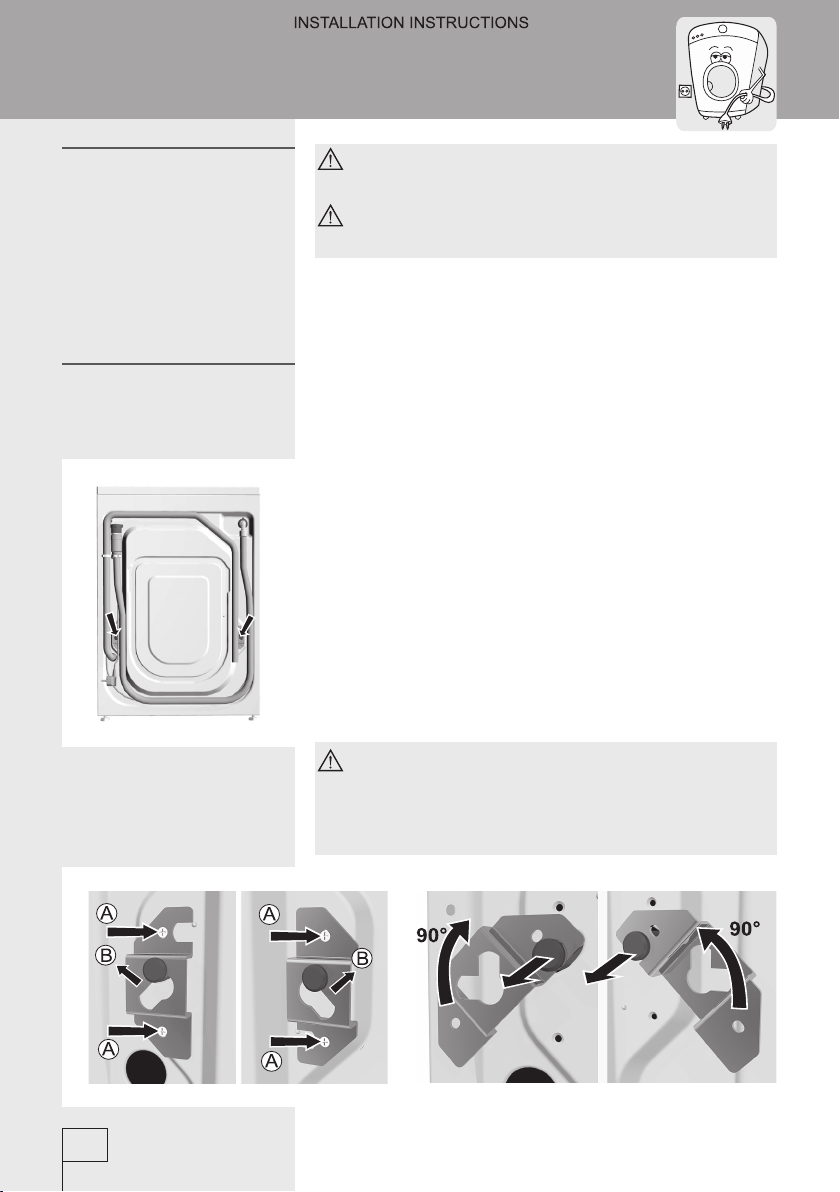
•
Loosen screws A at the rear of the machine
(Fig. 1).
•
Remove the brackets B (Fig. 1) by sliding them off
the shipping rod (Fig. 1).
•
Use the brackets to remove the shipping rods by
inserting the notched end of the bracket around
the shipping rod (Fig. 2).
•
Rotate the bracket 90° in an upward motion to
release the shipping rod (Fig. 2).
•
Pull the shipping rod out.
•
Save bracket and rods for later use.
Be sure to remove the transport brackets
prior to use, otherwise the appliance may
be permanently damaged. In such cases
the warranty conditions are void.
Fig. 1
Fig. 2
Fig. 2
8
Installation and connection
Package removal
Removal of transport
brackets and shipping
rods
188635
•
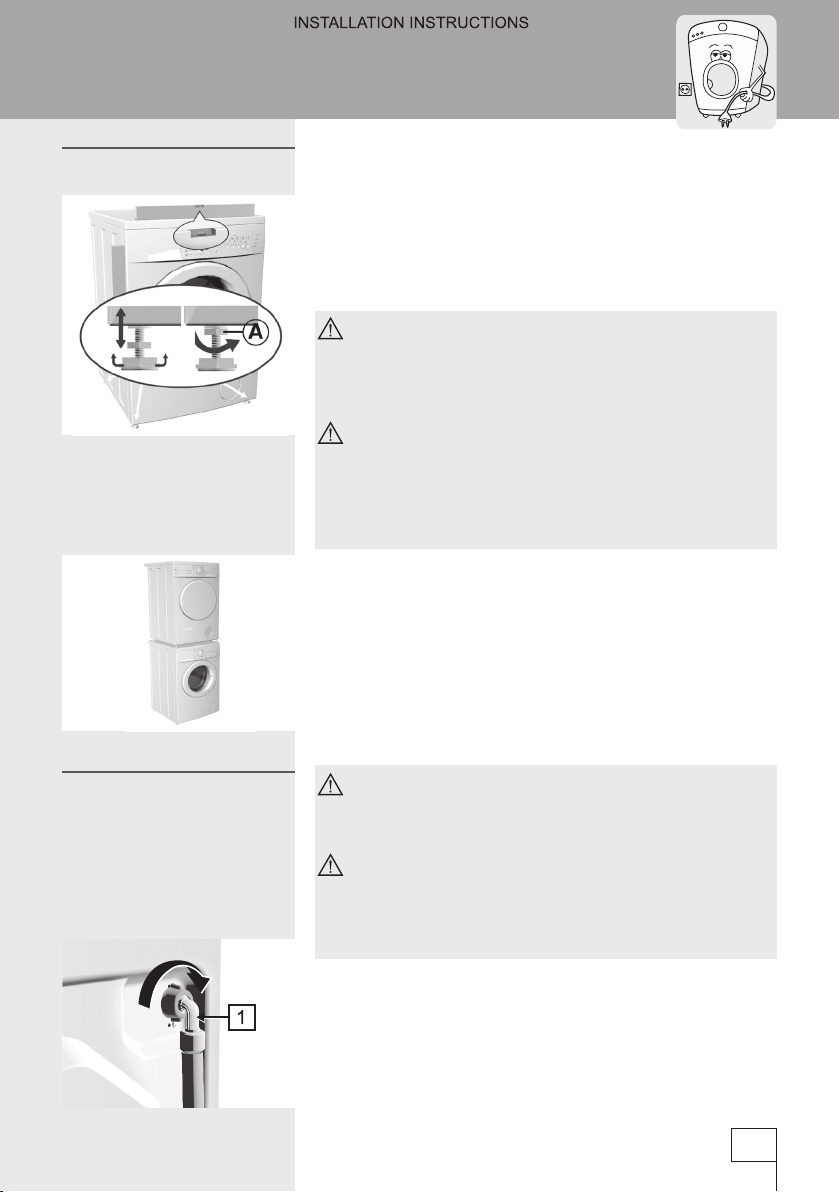
Level the appliance by turning the adjustable legs.
Placing a “bubble” level on the washer may assist
you.
The legs are adjustable up to +/- 0,39 inch (1 cm).
After the adjustment tighten the nuts rmly (A)
- towards the bottom of the machine!
The oor must be a hard surface with a
maximum slope of ½˝ per foot (1,27 cm per 30
cm). To make sure the washer does not vibrate
or move, you may have to reinforce the oor.
The appliance should be placed on a surface
with concrete base; the surface should be
dry and clean in order to prevent slipping.
The adjustable feet should also be cleaned
before installation.
•
If you have a tumble dryer of the same
dimensions, you can place it on top of the
washing machine.
To ensure correct operation of the appliance,
inlet water pressure must be between 7 psi to
116 psi (0,05 MPa and 0,8 MPa).
Minimum water pressure can be established by
measuring the quantity of poured out water.
0,8 gal (3 litres) of water must be poured out
from a completely opened tap in 15 seconds.
•
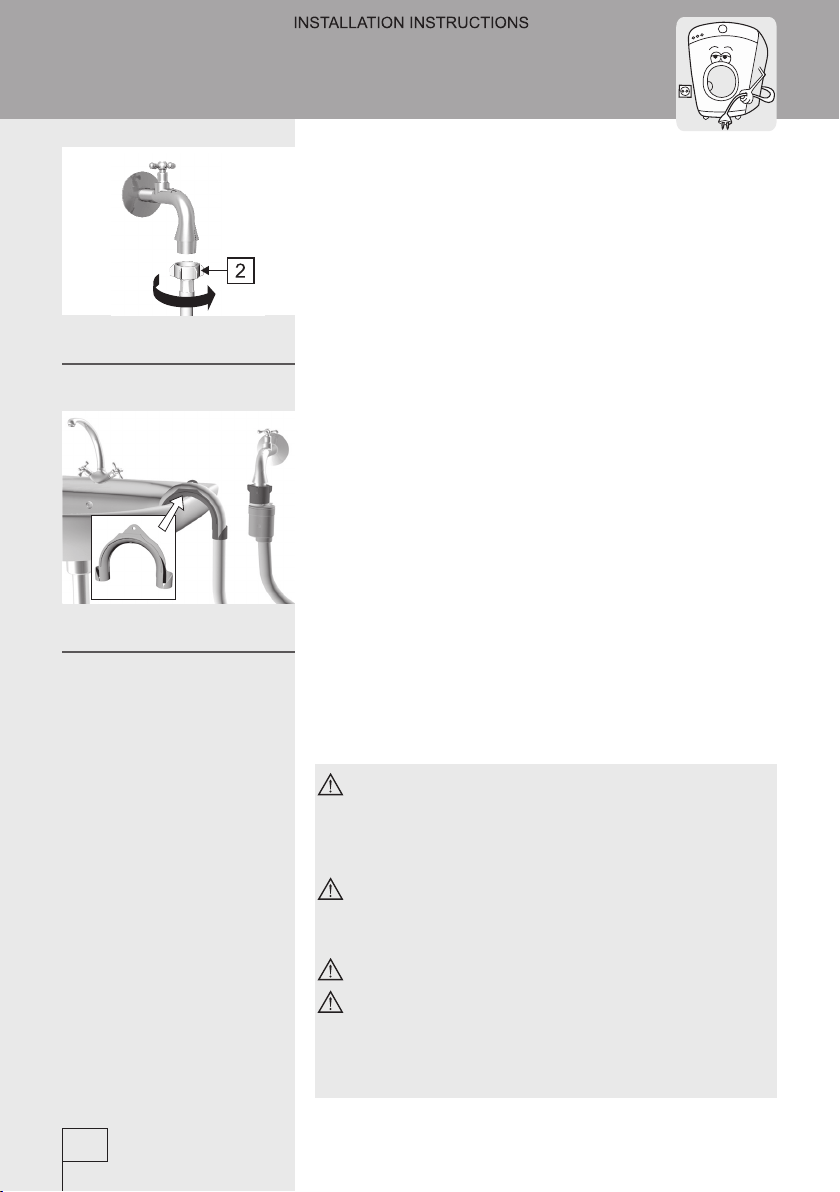
Take the water inlet hose from the drum and
attach the inlet hose angle extension (1) to the
washing machine by screwing it onto the provided
thread (certain models only).
•
Insert the gasket with a lter net into the straight
inlet hose attachment nut (2) and screw the nut
9
Water inlet connection
Leveling the appliance
188635
onto the water tap. (If your washing machine is
tted with an inlet hose with a partial or complete
Aqua-Stop system, the gasket with the lter net is
already tted).
•
For hot and cold water connections, connect to
the hot and cold faucets as marked at the rear of
the appliance (letters C and H) (C - cold; H - hot)
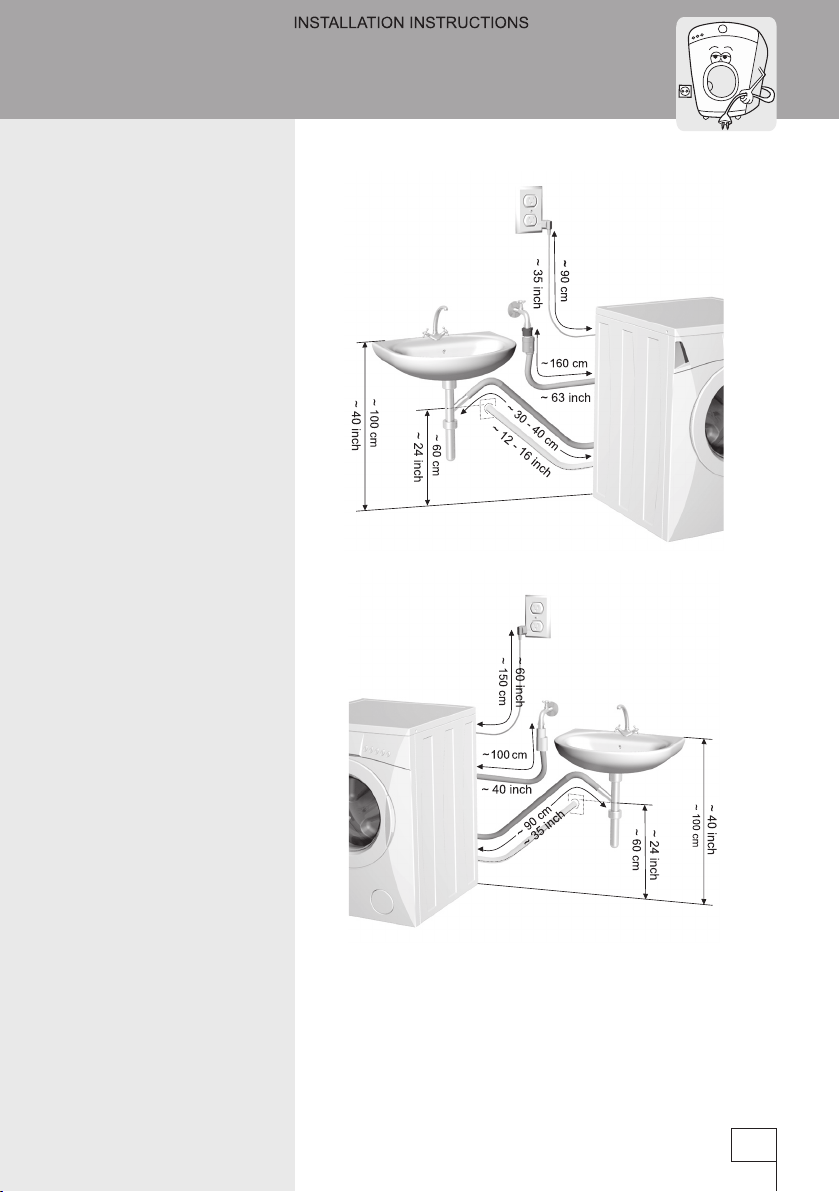
•
Fix the outlet hose to drain into the sink or the
standpipe (diameter min. 1,6 inch - 4 cm).
•
Standpipe must be installed properly and must
enable occasional cleaning.
•
Fasten the drain hose support with a piece of
string or cable tie led through the hose elbow, to
prevent the hose from slipping to the oor.
The end of drain hose should be placed between
minimum 24 inch (60 cm) and maximum 40 inch
(100 cm) above the oor level.
•
Plug the main power cable to the wall socket.
•
Required voltage and other information are written
on the rating plate above the door opening of the
machine.
The wall socket must be accessible at all
times and must be equipped with a ground
lead (in accordance with the local safety
regulations).
Damaged main power cable may be
replaced only by the manufacturer or
authorized servicer.
Connect to individual branch circuit.
WHEN THE WASHING PROGRAM IS
OVER, SWITCH THE MACHINE OFF BY
DISCONNECTING THE APPLIANCE FROM
THE MAIN SUPPLY.
10
Connect the appliance
to the mains supply
Water outlet connection
188635
11
188635
•
Open the door of the machine
•
Load the laundry into the drum
•
Close the door
•
Open the water inlet faucet
•
Push the Start/Pause button and select the
program
•
Add detergent (and softener) into dispenser. See
page 16 for instructions about the dispenser.
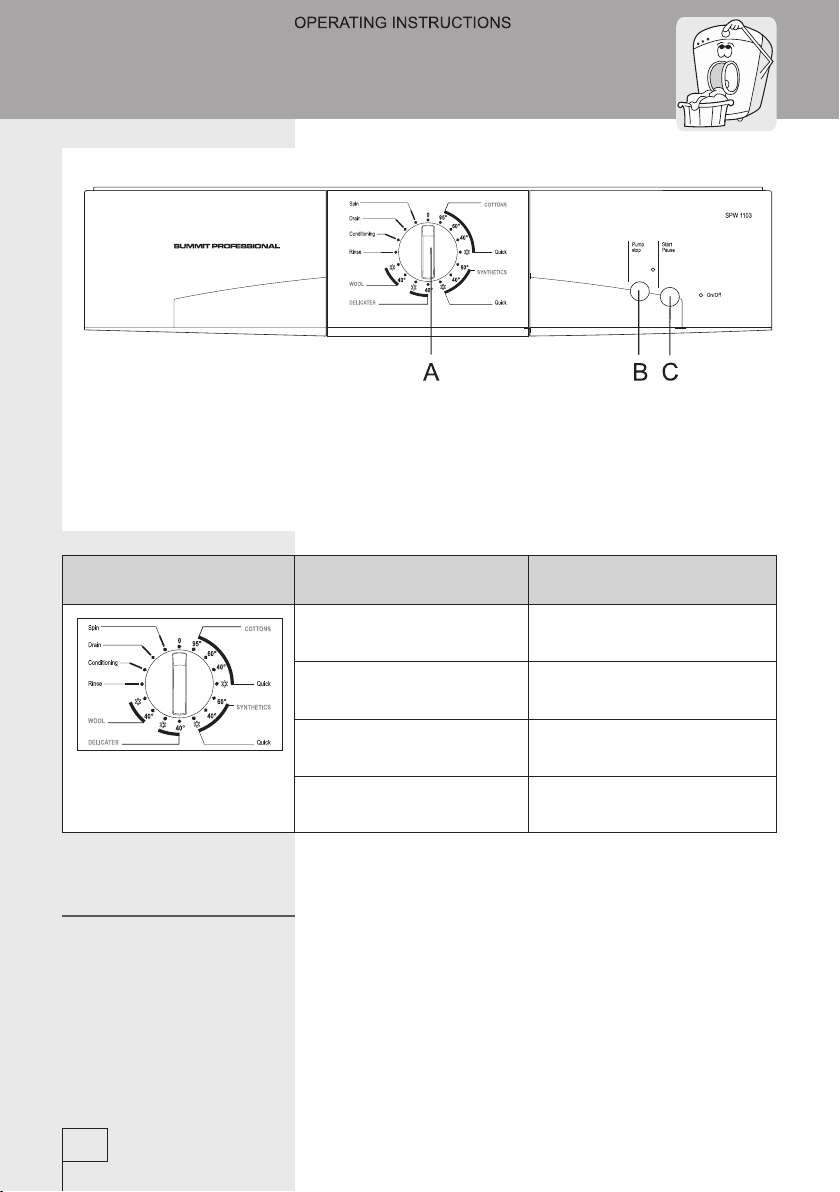
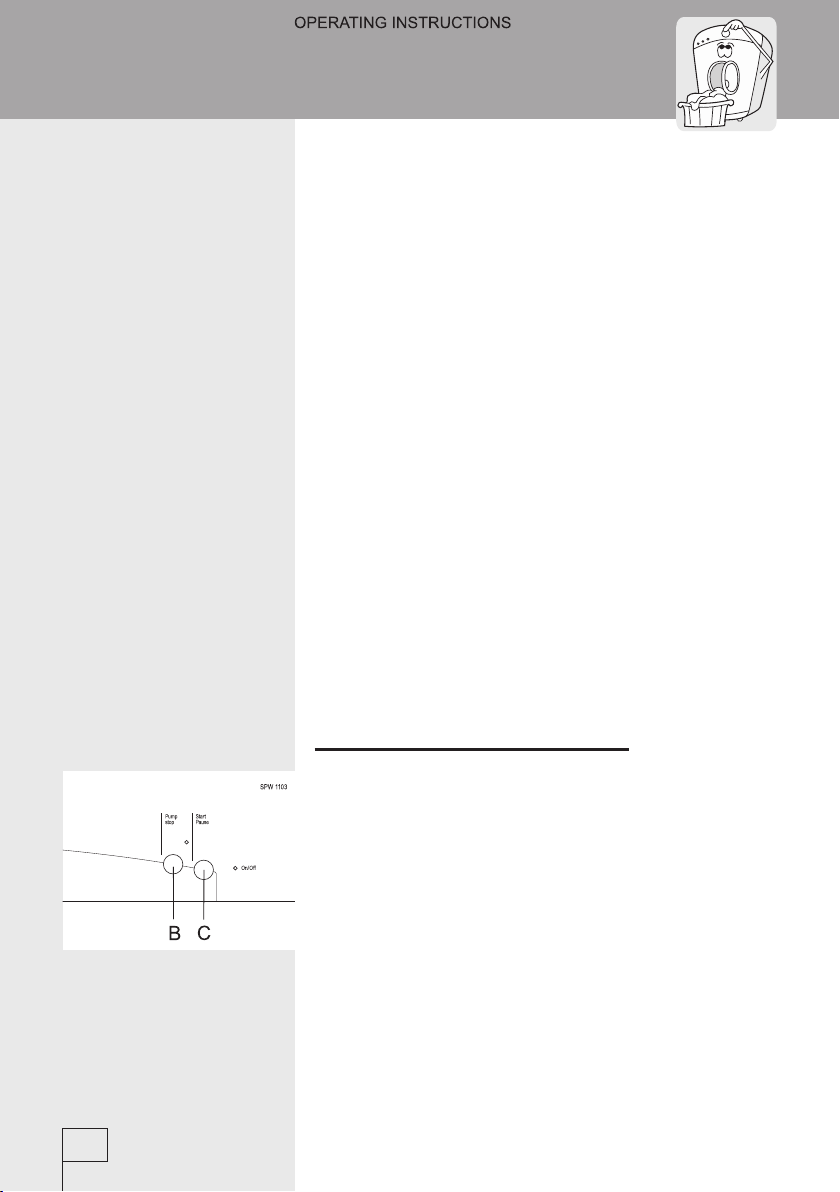
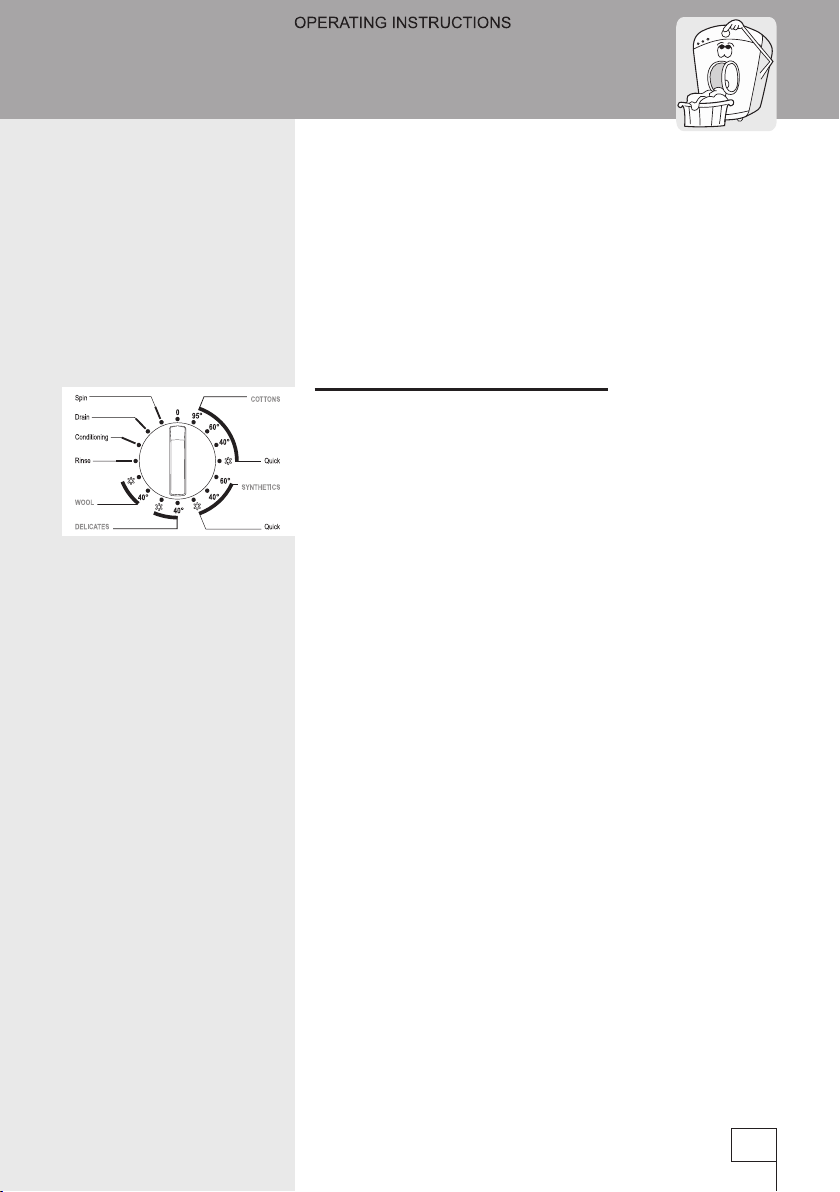
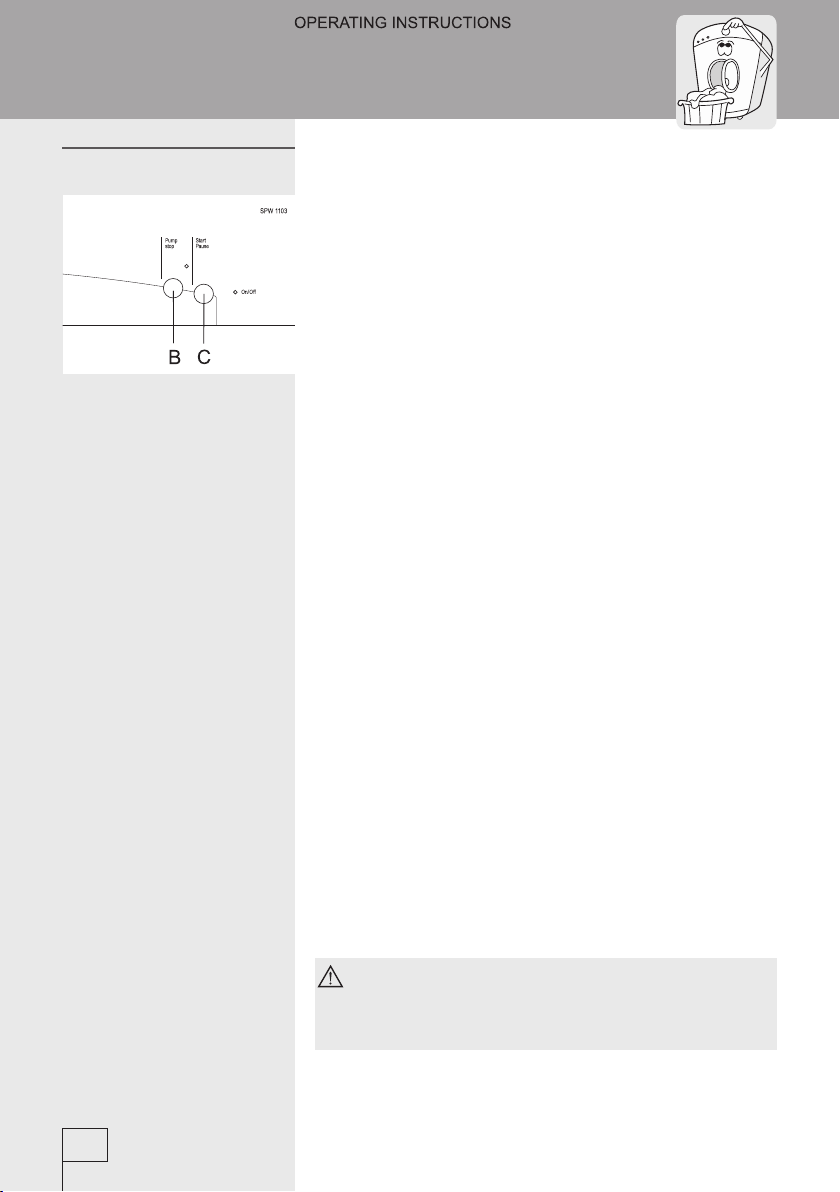
A - program selector
B - Pump stop button
C - START/PAUSE button
Signal LED’s: - On/Off (orange)
- Pump stop (green)
12
Program selector Basic programs Partial programs
Cottons Rinse
Synthetics Conditioning
Delicates Drain
Wool Spin
Operation
Washing procedure
188635
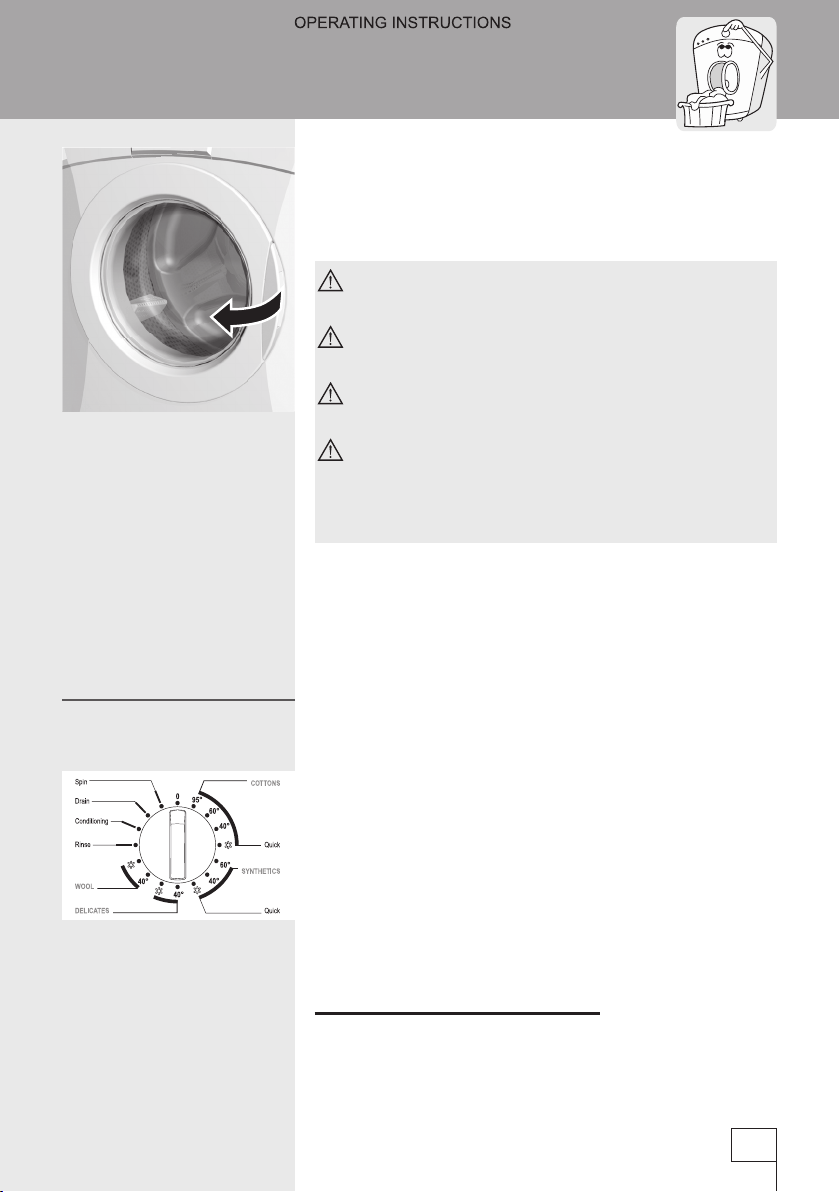
- Open the door of the machine.
Door is opened by pulling the handle (lever) on
the right hand side of the door towards you.
- Sort the laundry by the type of fabric.
Fasten buttons and zippers, tie any strings
and pull out the pockets.
Very delicate laundry should be put in a
special protective sack.
It is recommended to load the drum with
items of different sizes.
Pay attention to the labels on the clothes,
indicating the recommended washing mode
(see table of textile treatment symbols on the
last page of these instructions).
- Load the laundry into the drum.
- Close the door of the appliance.
- Open the water inlet faucet.
- Push the Start/Pause button and select washing
program.
Program is selected by turning the program selector
(A) from the “0” position to the desired washing
program. The Start/Pause signal LED starts
ashing. The program selector (A) may be turned
in both directions. Choose the appropriate program
according to the type of laundry and desired
temperature. For example, cottons and 95°C (Refer
to the Program Chart on page 27). You may select
basic or partial programs.
Selected program may be changed at random prior
pushing the START button (C).
- Selection of basic programs
Basic programs include all washing stages, softening
and spinning (see Program Chart). They are selected
by turning the program selector to the appropriate
position, including temperature selection.
13
Washing machine
operation
188635
Cottons: whites/colored
Normally stained cotton: bed linen and underwear,
table cloth, bathroom towels, top garments, etc.
For less stained laundry of this type, select a cooler
wash temperature. It saves energy and washing
time.
Synthetics
Normally stained shirts, blouses and other polyester
and polyamide garments, or a mixture of these
fabrics with cotton.
For less stained laundry of this type, select a cooler
wash temperature. It saves energy and washing
time.
Delicates
This is a program for delicate fabrics (dresses,
skirts, blouses) and curtains.
Wool
Especially gentle program for washing wool and
garments made from mixture of other fabrics with
wool, appropriately marked for machine washing.
- Selection of additional function
Pump stop
•
This function is switched on after the selection of
a basic program by pressing the knob (B). It may
also be switched on during the operation, prior
last rinse. Indicator LED above the washing cycle
symbol is lit.
•
The function is switched off by pressing the same
knob again - signal LED is off.
•
The program stops at the end of last rinse, prior
spinning: laundry remains soaked in water and
prevents crease, if you are unable to remove
it from the drum immediately after the end of
washing cycle. Indicator LED above the knob is
ashing.
14
188635
•
The selected program is completed by pushing
the START button (C), but you may also apply
additional programs (pumping or spinning), but
you must rst return the program selector to the
“0” position for at least one second, prior selecting
any of the additional programs.
When program continues, indicator LED above
the knob goes off.
- Selection of partial programs
These are independent programs and may be used
when you do not need the entire washing program.
In case you would like to use more additional
programs in a sequence, you must turn off the
appliance prior to any new program selection (turn
the program selector (A) to “0” for at least one
second). Refer to Program Chart page 27.
Rinse
This program is intended for softening or bleaching
washed laundry. It nishes with spinning at 1000
RPM.
Conditioning
Independent program for rinsing delicate laundry,
without intermediate spinning and with short nal
spin. You may use it for rinsing manually washed
delicate laundry or for extra rinsing for people with
skin sensitive to detergents.
Drain
Use it when the washing program was interrupted
or if rinse hold function was engaged, and you only
wish to pump the water out of the drum, without
spinning.
Spin
Aggressive spinning for non-delicate laundry at high
spin RPM.
15

188635
- Adding detergent and fabric softener
(see Tips for washing and energy saving)
•
pre-wash compartment
•
main wash compartment
•
softener compartment
Washing detergent may be added directly into the
drum.
When adding softener, be careful to ll the
dispenser only up to the marked level.
Be sure to close the detergent dispenser
when opening/closing the appliance door.
•
Push the START button (C). The Start/Pause LED
stops ashing, the machine starts operating after
a few seconds. If the door is not properly closed
after starting the operation, the Start/Pause LED
starts ashing again after a few seconds. When
you close the door, the machine initiates the
selected program.
•
In case you would like to alter the washing
program after the initiated washing operation,
turn the program selector for one second to the
position “0”, followed by the selection of a new
program. Switching the machine off deletes any
previously selected additional functions (i.e.
PUMP STOP), so they have to be reactivated.
If a power failure occurs during the
washing program, when the power is
restored the machine will resume the
execution of a program where it had been
interrupted.
16
Start the operation

188635
- End of operation
Flashing On/off LED indicates that the program was
completed.
•
Extract the laundry from the drum and remove
any foreign objects from the door gasket.
•
Leave the door ajar to allow the interior to dry.
•
Close the water inlet faucet.
SWITCH THE MACHINE OFF BY
DISCONNECTING THE APPLIANCE FROM
MAINS SUPPLY.
17
188635
•
By the user
Selecting Pump stop function
Program is stopped when it comes to the ‘PUMP
STOP’ stage (if this function had been previously
selected). Drum door remains closed all the time.
Indicator LED above the ‘Pump stop’ function
starts ashing. Washing procedure is continued by
pressing the START knob (C).
Own (physical) interruption
You may also stop the program by turning the
program selector to the position “0”. If there is
water in the drum select one of additional programs
(draining, spinning) to empty the water and
terminate the program.
Pause button
By pressing the PAUSE button, (C) the program
may be suspended at any time. After certain time
you may open the door if there is no water in the
drum, otherwise this is not possible. Program is
continued by pressing the START button (C).
•
Failures
Program is suspended in case a failure occurs.
Signal LED’s are ashing (see Troubleshooting).
•
Power failure
At electric cutout the program is interrupted,
however, after the power supply has been re-
established, the program operation automatically
proceeds.
If a power failure occurs when the drum is
still full of water, be careful not to open the
door before you drain the water out.
18
Interruptions
188635
•
Before washing sort out the laundry according to
the type, degree of dirtiness and color fastness.
•
Prior to selecting the washing program consult the
sewn tab with information on a particular piece
of laundry (see Maintenance chart on the last
page).
•
Wash separately new colored textile products for
the rst time.
•
Wash heavily soiled laundry in small quantities
and add more detergent.
•
Treat stubborn stains with special stain remover, it
will save energy.
•
With lightly stained laundry use short program and
select lower washing temperature. This way you
may save up to 50% of energy.
•
Avoid washing very small quantities of laundry
to save energy and for better performance of the
appliance.
•
The largest allowed quantity of dry laundry is
indicated in the Program chart on page 27.
•
Before washing, empty the pockets, close zip
fasteners, and remove any metal fasteners or
badges that might clog the drain or damage the
laundry or drum interior.
•
Loosen stacked laundry prior to inserting it into
the drum.
•
Use only detergents for machine wash.
•
Add powder or liquid detergents according to the
manufacturer’s instructions.
•
Chlorine-based whitening agents are not
recommended, as it can damage the heater.
19
Tips for washing and energy saving
188635
In the case of hard water, add appropriate amounts
of detergent and water softener according to
manufacturer’s suggestions.
•
You may add washing detergent directly into the
drum.
•
If you use thick liquid softener it is recommended
to dilute it with water, to prevent clogging of
dispenser compartment ducts.
•
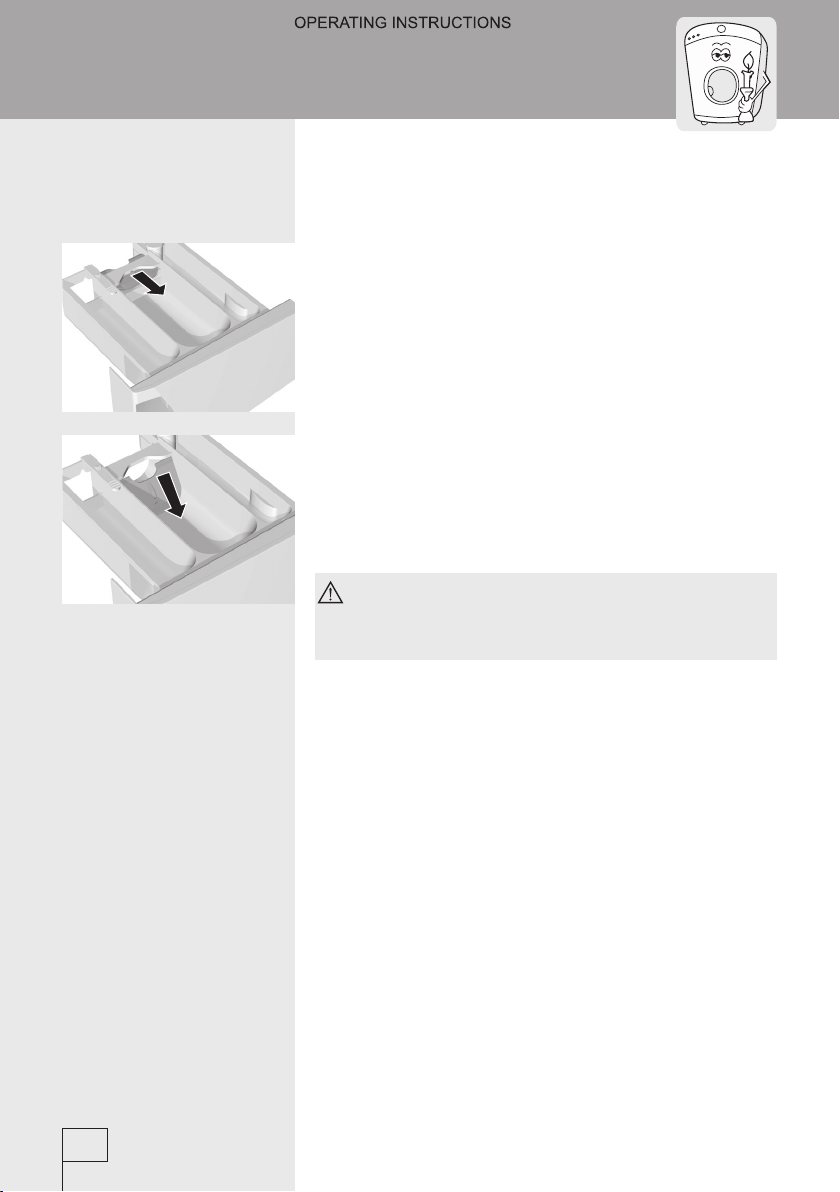
Washing machine is equipped with the dispenser
partition gate, so you may pour liquid detergent
also into the central compartment. If you use
powder detergent the gate is lifted up, and in case
of liquid detergent it is slid down.
•
Insert particularly delicate linen (stockings,
delicate female underwear, etc.) into protective
wash bags.
Do not put clods of detergent into the
soap dispenser as the tube in the washing
machine may clog.
20

188635
Disconnect the washing machine from the
main power supply before cleaning!
•
The cabinet should be cleaned with soft cloth and
mild detergent.
•
The interior of the drum and the door gasket
is cleaned by washing at 140°F (60°C) without
laundry and adding half quantity of detergent.
•
Frequent use of low-temperature programs in
combination with liquid detergents can lead to
development of germs which cause odor in the
washing machine.
To prevent this, it is recommended to run the
Cotton 95°C program without any laundry at least
once per month, using powder detergent.
•
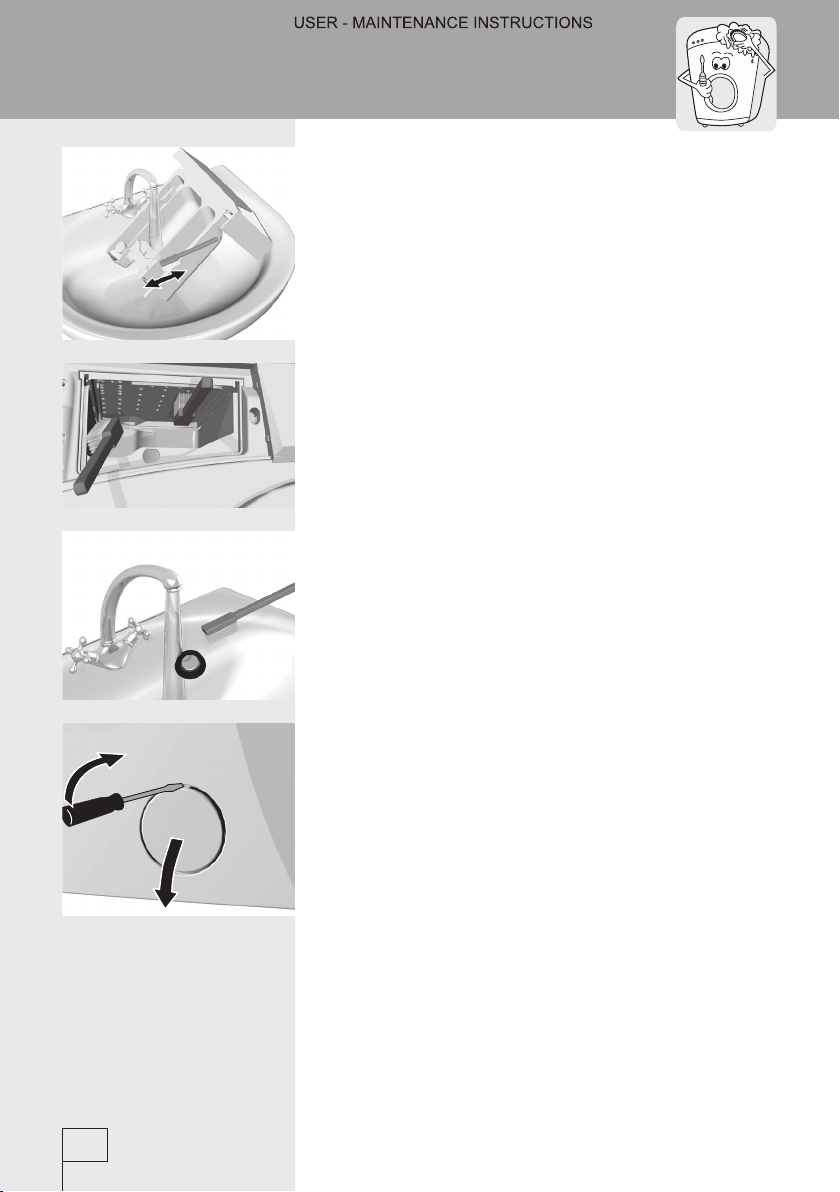
If necessary, clean the detergent dispenser. Pull it
out from its casing completely by pressing the ap
(see Fig.).
•
If necessary, clean the cover of the bung under
running water.
21
Cleaning and maintenance
188635
•
Wash it under running water using a brush, and
dry it. Remove any leftover dried detergent from
the bottom of the casing.
•
Clean the entire rinsing area of the washing
machine with a brush, especially the nozzles on
the upper side of the rinsing chamber.
•
Clean the water inlet hose screen under running
water regularly.
•
After each wash wipe the door rubber gasket. This
will prolong its useful life.
•
Open the lter lid using at screwdriver or similar
tool.
22
188635
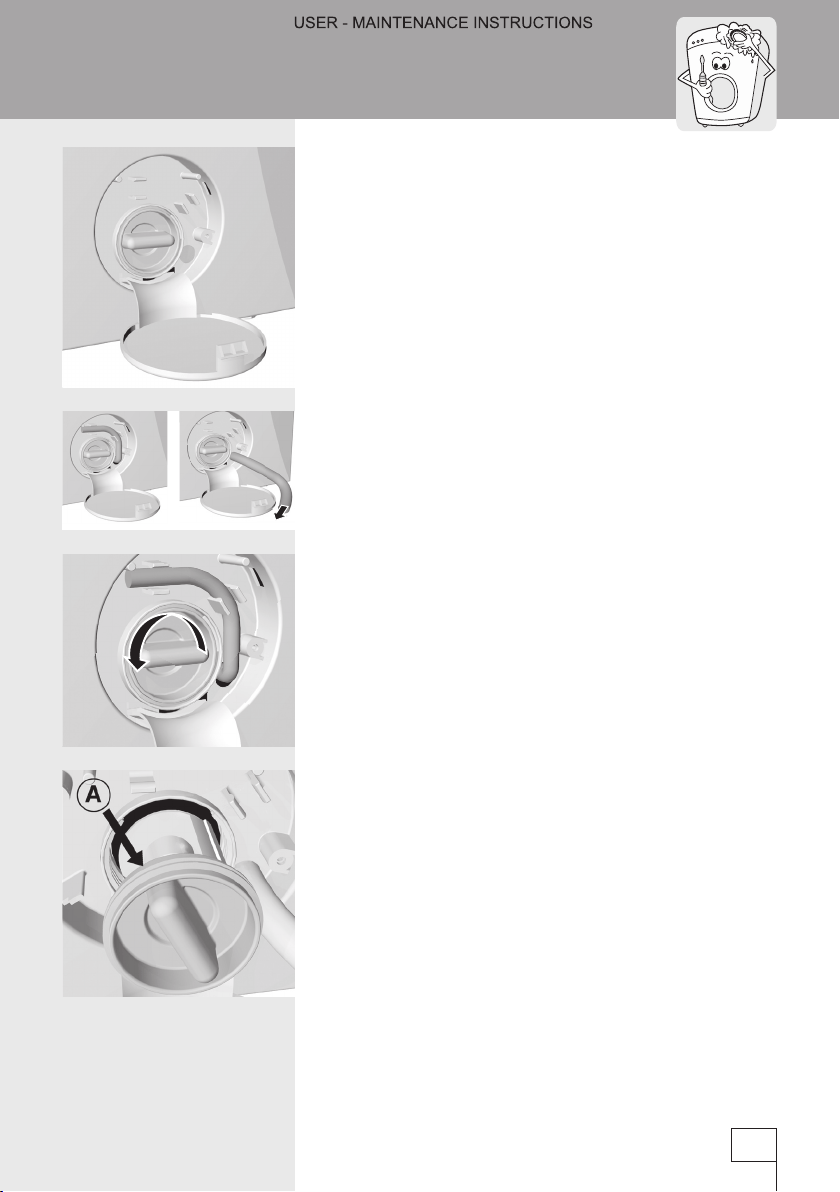
•
Filter needs occasional cleaning, especially
following heavily shaggy or old laundry.
•
Before cleaning, drain any water from the
machine via drain pipe (certain models only).
•
Turn it counter-clockwise, pull it out and clean
under running water.
•
Insert the lter back as shown on the picture,
and tighten by turning it in clockwise direction. To
ensure good sealing the gasket surface (A) must
be dirt free.
23
188635
The washing machine automatically monitors
the execution of particular functions during the
operation, and reports any detected failures. In
such cases both signal LED’s start ashing in
certain sequence. Flashing sequence changes in
accordance with the nature of the detected failure.
In some cases you may attempt correcting certain
failures yourself, so count the number of ashes
which repeat after a pause.
The machine signals failures immediately after
detecting them and stops the program, except for
heater failure, where the machine completes the
washing program without heating water.
Failures:
In certain cases you may remove the failure yourself
(Refer to chart on page 25):
2 - two ashes: door is not correctly closed;
3 - three ashes: water inlet problem;
7 - seven ashes: water outlet problem.
In all other instances mark the number of ashes
indicating the failure, switch off the machine and call
nearest authorized service center (LED’s continue
ashing until you switch the machine off).
Environmental interference (for example electrical
wiring) could induce signalization of different faults.
In such cases:
- switch the appliance off, and wait for a few
seconds;
- switch the appliance back on and repeat the
washing program.
If the fault repeats, call authorized service shop.
24
Troubleshooting
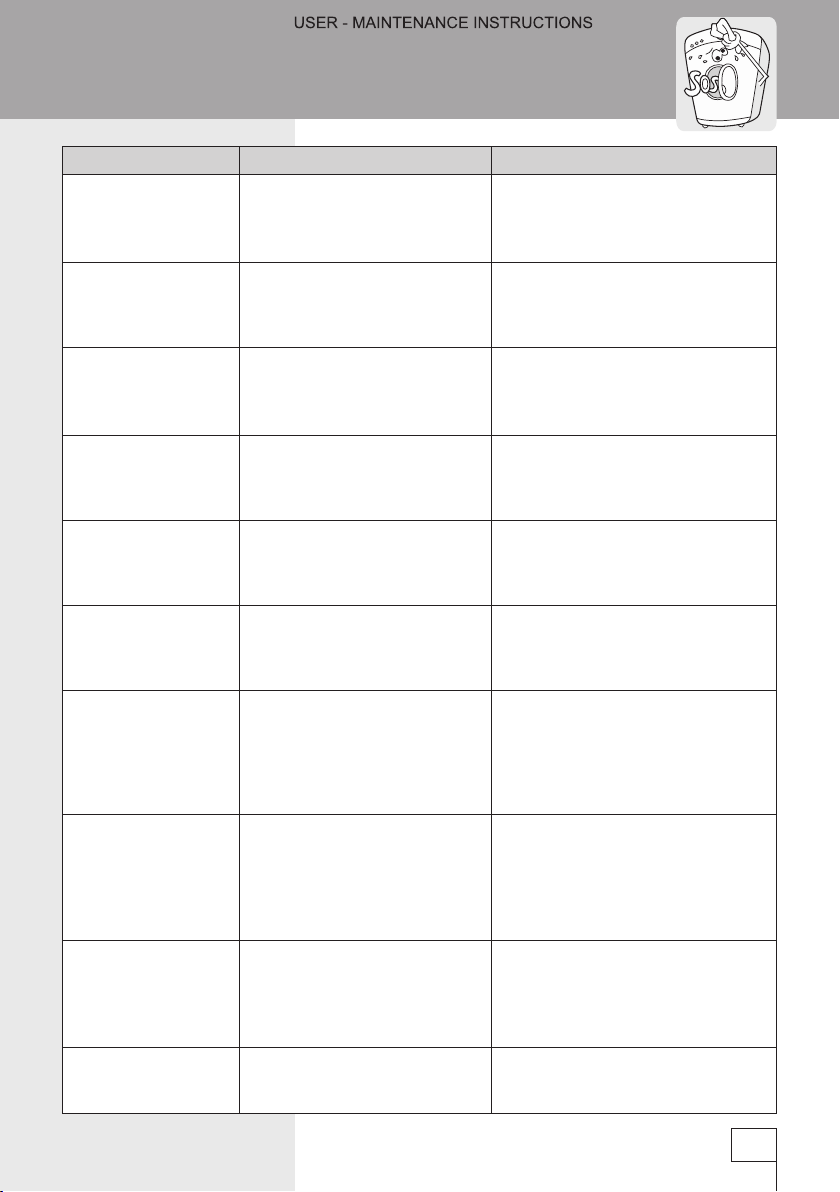
188635
25
Failure Possible cause Remedy
The machine does not
work (symbols are not
illuminated).
Machine is not powered. Check if:
• power in the socket,
• the fuse is OK,
• plug is in the socket.
Washing program
does not start
(Start/Pause LED is
ashing).
Door is not properly closed. Close door rmly.
Water does not enter the
machine (after approx. 4
min the machine reports
failure -3 ashes).
Water inlet failure. Check if:
• the water faucet is open,
• inlet hose screen lter is clean.
Push the START button.
Water is leaking from
the machine.
Filter is not tightly screwed in.
Inlet pipe is not tightly screwed to
the machine or to the water faucet.
Outlet hose fell to the oor.
Tighten the lter properly.
Tighten the inlet pipe.
Afx the outlet pipe to the drain.
The machine moves
during operation.
The machine is not properly
leveled.
Transport brackets and shipping
rods are not removed.
Level the machine with the adjustable
legs.
Remove transport brackets and
shipping rods.
The machine vibrates
during the spin.
Unevenly distributed laundry,
especially with very small
quantities (for ex. only the
bathrobe).
This is normal, the machine will
reduce the RPM if vibrations are too
strong.
Wash larger quantity of laundry.
Excessive foaming
during washing.
Excessive measure of detergent. Use detergent according to the
instructions by the producer and
according to the water hardness and
soiled laundry. Use only detergents
• for machine washing
• use “HE” detergent.
Water is poorly
pumped out or not at
all (machine reports
failure - seven ashes
of LED).
Water outlet is clogged. Check if:
• the lter is clean,
• outlet hose is not jammed,
• outlet hose is positioned higher than
1m.
Push START again.
Laundry is not
properly spun.
No failure is reported.
The machine switched on the
UKS function. Because of bad
laundry balance, the machine
has automatically reduced spin
RPM.
The machine operates normally.
Wash large and small pieces of
laundry together.
Greasy wads appear
on the laundry.
Too little detergent (laundry was
very greasy).
Wash the laundry again.
Add more detergent for such soiled
laundry, or use liquid detergent.
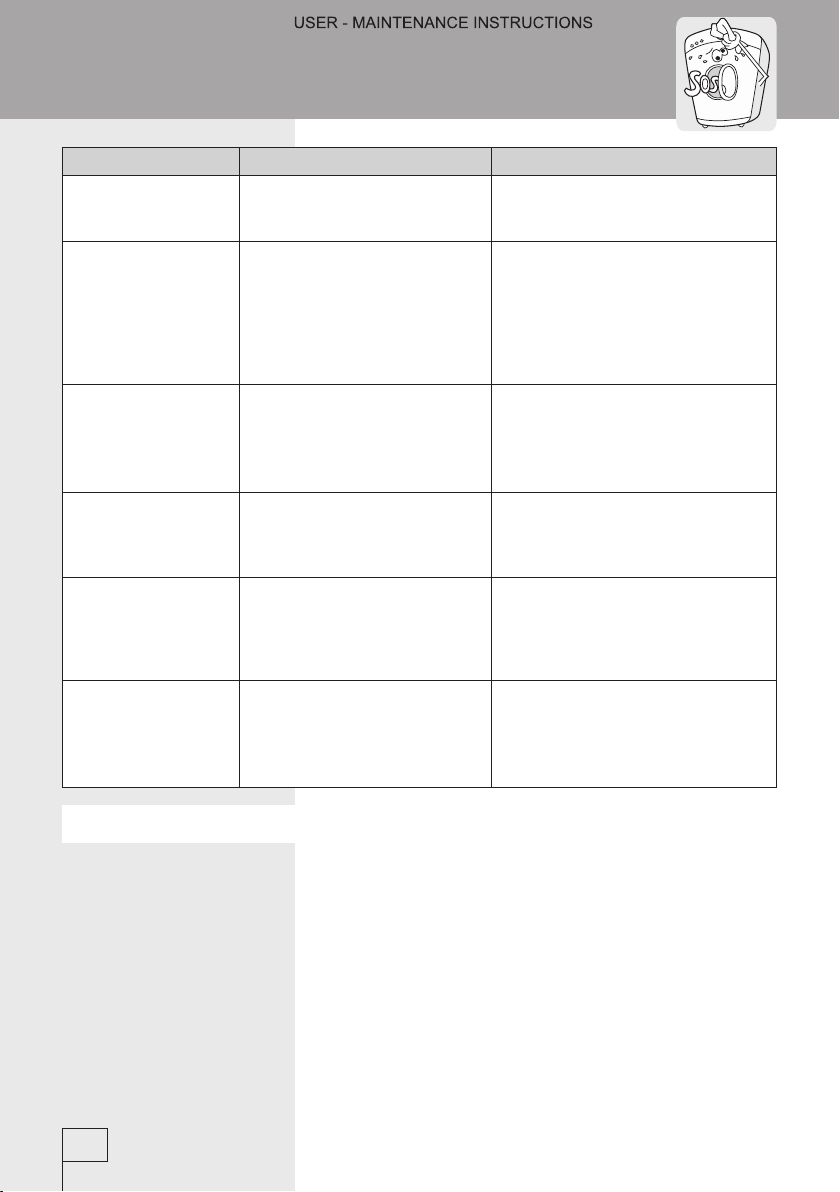
188635
* UKS: universal stability control - this function prevents excessive vibrations during spinning.
26
Failure Possible cause Remedy
Laundry is stained
after washing.
You used liquid detergent or
detergent for colored laundry
which does not contain whitener.
Use the detergent containing
whitener.
White powdery
residues on the
laundry.
It is not the consequence of bad
rinsing, but because of neo-
phosphate detergents containing
non soluble components
(zeolites) for water softening.
Such substances may be
deposited upon the laundry.
Immediately rinse the laundry once
again.
• Use liquid detergents which do not
contain zeolites.
• Try removing the residues with the
brush.
Detergent residues in
the dispenser.
Low water ow pressure.
Some detergents may stick to
the dispenser rather hard if it is
wet.
• Clean the inlet hose lter screen.
• In case of low water pressure
increase water level.
• Wipe the dispenser prior loading
detergent.
Softener is not
completely rinsed,
or water is left in the
dispenser dish.
Syphon cover is not correctly
positioned or is clogged.
Clean the dispenser and rmly x the
cover to its place.
Unpleasant smell in the
washing machine drum.
• Remains of fabrics, washing
agent and softener in the lter.
• Development of germs
• Check whether the lter is clean.
• Run the Cotton 95°C program
without any laundry, using a powder
detergent.
Washing time is
longer than usual.
• The machine switched on
the UKS* system because of
uneven laundry load.
• Power failure occurred.
• Washing program time may be up to
60% longer; however, this does not
imply a fault in the machine.
• Time is prolonged for the power
failure period.
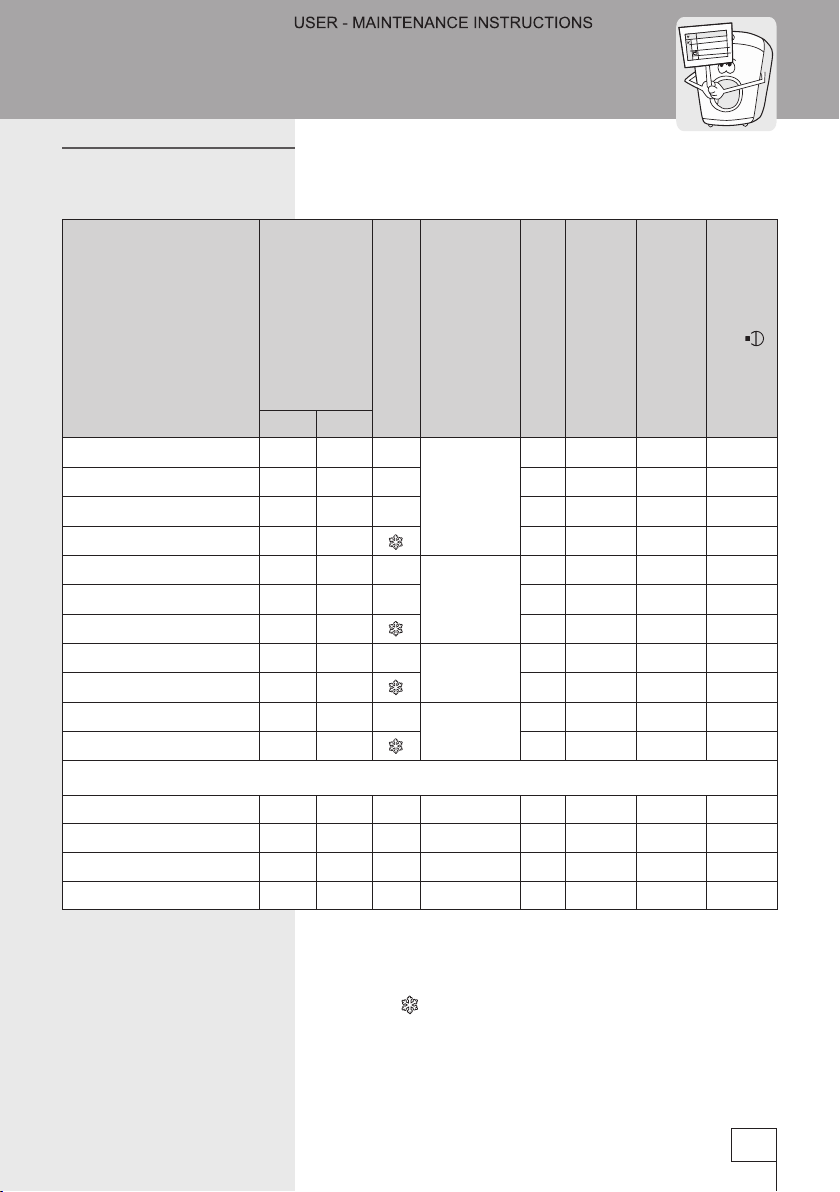
188635
possible
* NOTE: represents the inlet water temperature
of the cold faucet.
27
Basic program
Max. load
Temp. (°C)
Spin (RPM)
Duration (min.)
Water consumption
L
Energy consumption
kWh
Additional function
Rinse hold
lbs kg
Cotton - white 15 7 95
1000
139 55 2.10
Cotton - color 15 7 60 140 52
1.14
Cotton - color 15 7 40 116 52 0.66
Cotton - quick 15 7 69 52 0.18
Synthetic 7,7 3,5
60
1000
112 43 0.93
Synthetic 7,7 3,5 40 100 40 0.52
Synthetic - quick 7,7 3,5 52 40 0.10
Delicates 5,5 2,5 40
700
59 58 0.45
Delicates 5,5 2,5 48 58 0.07
Wool 4,4 2 40
600
51 42 0.32
Wool 4,4 2 40 42 0.02
Partial programs
Rinse 7,7 3,5 700 25 28 0.01
Conditioning 15 7 1000 13 9 0.01
Drain 15 7 - 2 -
Spin 15 7 1000 10 - 0.02
Tables
Program chart
- 15 lbs (7 kg)
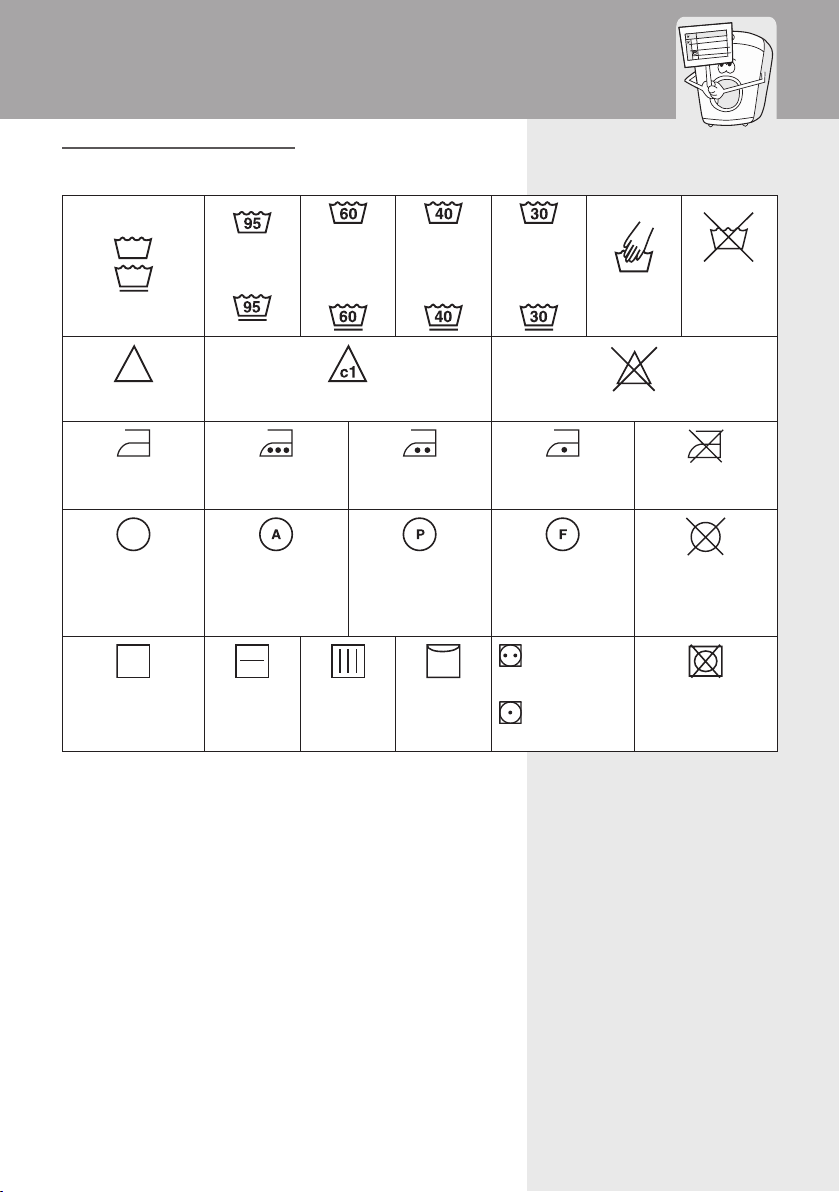
PS PG1 OEM SUMMIT 188635/en/ (10-09)
We reserve the rights to make any changes or mistakes in these operation
instructions.
Normal wash
Delicate wash
Max.
washing
temp. 95°C
Max.
washing
temp.
60°C
Max.
washing
temp.
40°C
Max.
washing
temp.
30°C
Manual
washing
Washing
not
allowed
Whitening
Whitening in cold water
Whitening not allowed
Ironing Hot iron max.
200°C
Hot iron max.
150°C
Hot iron max.
110°C
Ironing not
allowed
Dry cleaning Dry cleaning in all
solvents
Perchlorin-
etyhlene
R11, R113,
Kerosene
Dry cleaning in
kerosene, in pure
alcohol and in
R 113
Dry cleaning not
allowed
Drying Place on
at surface
Hang wet Hang
High
temperature
Low
temperature
Tumble drying
not allowed
Maintenance chart