Instructions and Recipes
2015 National Presto Industries, Inc.
Visit us on the web at www.GoPresto.com
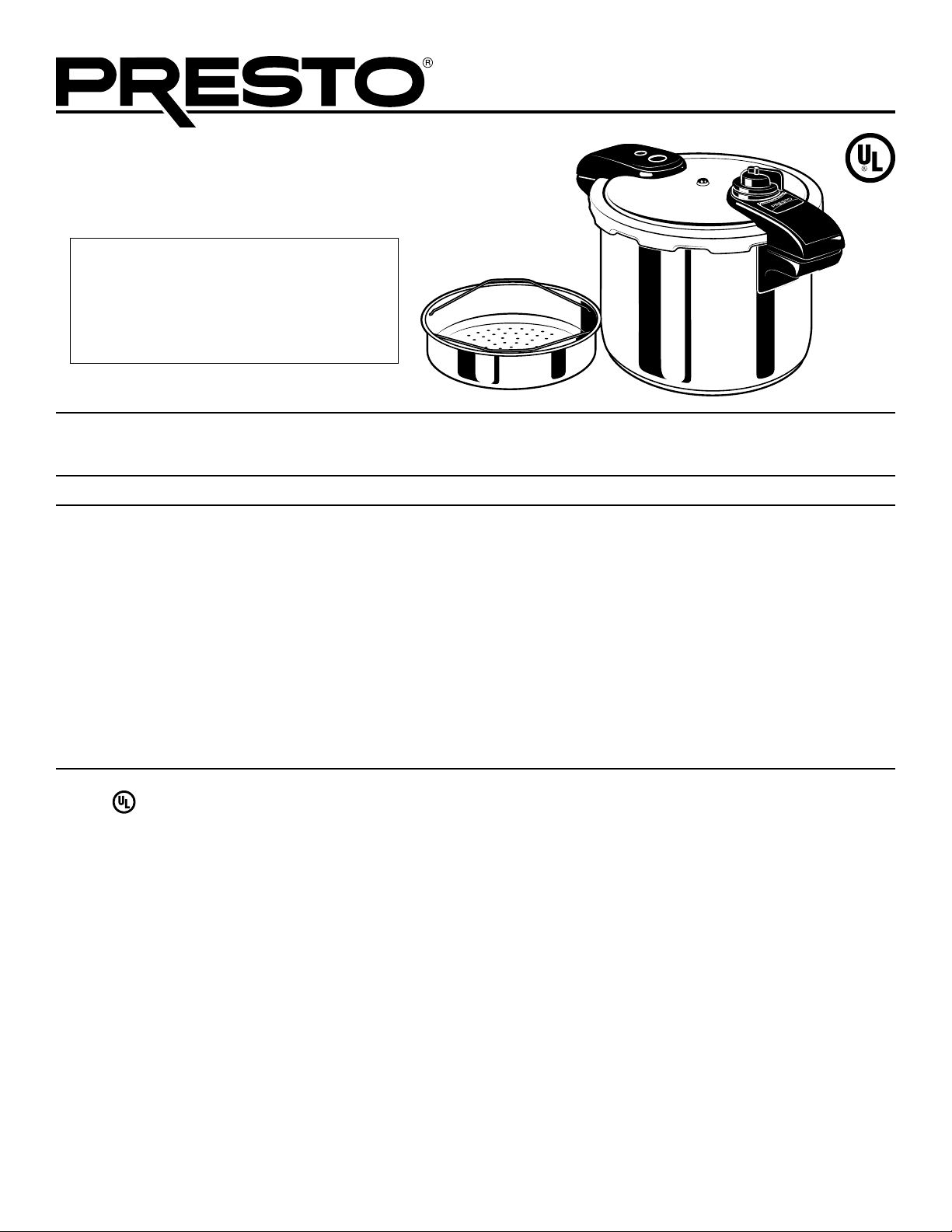
8-Quart Stainless Steel
Pressure Cooker
Estas instrucciones también están disponibles en español.
Para obtener una copia impresa:
• Descargue en formato PDF en:
www.GoPresto.com/espanol.
• Envíe un mensaje de correo electrónico a:
• Llame al 1-800-877-0441, oprima 2 y deje un mensaje.
TABLE OF CONTENTS
Important Safeguards ............................. 1
Introduction ..................................... 2
Getting Acquainted ............................... 3
How to Use ..................................... 3
Important Safety Information ....................... 4
Cleaning ....................................... 6
Care and Maintenance ............................. 6
Helpful Hints .................................... 7
Questions and Answers ............................ 8
Soups and Stocks ................................. 9
Seafood ....................................... 11
Poultry ........................................ 13
Meats ......................................... 16
Vegetables ..................................... 19
Dry Beans and Peas .............................. 22
Grains ........................................ 23
Desserts ....................................... 25
Recipe Index ................................... 27
Service and Parts Information ...................... 28
Warranty ...................................... 28
This is a
Listed appliance. The following Important Safeguards are recommended by most portable appliance manufacturers.
IMPORTANT SAFEGUARDS
To reduce the risk of personal injury or property damage, basic safety precautions should always be followed, including the following:
1. Read all instructions.
2. Always check the vent pipe before use. Hold cover up to light and look through vent pipe to be certain it is clear.
3. Always check the air vent/cover lock to be sure it moves freely before use.
4. Donotfillpressurecookerover⅔full.Forsoup,grains,anddrybeansandpeaswhichexpandduringcooking,donotfillpressure
cooker over ½ full. Overfilling may cause a risk of blocking the vent pipe and developing excess pressure; see food preparation
instructions.
5. Do not pressure cook applesauce, cranberries, rhubarb, cereals, pasta, split peas, dried soup mixes, or any dry beans and peas which
are not listed on the chart on page 22. These foods tend to foam, froth, and sputter and may block the vent pipe and air vent/cover
lock.
6. This appliance cooks under pressure. WARNING! Improper use may result in scalding injury. Make certain pressure cooker is
properly closed before operating; cover handles must be directly above the body handles. See “How To Use” instructions.
7. Do not place the pressure cooker or attempt to pressure cook in a heated oven.
2
8. Extreme caution must be used when moving a pressure cooker containing hot liquids. Do not touch hot surfaces. Use handles or
knobs.
9. Do not open pressure cooker until the unit has cooled and all internal pressure has been released, air vent/cover lock has dropped,
and no steam escapes when the pressure regulator is removed. If the handles are difficult to push apart, this indicates that the
cooker is still pressurized —do not force it open. Any pressure in the cooker can be hazardous. See “How To Use” instructions.
10. To ensure safe operation and satisfactory performance, replace the overpressure plug every time you replace the sealing ring or
sooner if it becomes hard, deformed, cracked, worn, or pitted. It is recommended that the sealing ring and overpressure plug be
replaced at least every two years. Use only genuine Presto
replacement parts.
11. Close supervision is necessary when the pressure cooker is used near children. It is not recommended that children use the pressure
cooker.
12. When normal operating pressure is reached, you will hear and/or see a steady flow of steam releasing from the pressure regulator.
Lower the heat as necessary to maintain a very slow, steady flow of steam from the pressure regulator. If the heat is not lowered,
excess steam will escape, liquid will be evaporated, food may scorch, and the cooker may be damaged.
13. WARNING! Do not use pressure cooker on an outdoor LP gas burner or gas range over 12,000 BTU’s.
14. Do not use this pressure cooker for other than intended use.
15. Do not use this pressure cooker for pressure frying with oil.
SAVE THESE INSTRUCTIONS
THIS PRODUCT IS FOR HOUSEHOLD USE ONLY.
INTRODUCTION
Welcome to the world of pressure cooking. With your new Presto
Pressure Cooker, you’ll discover how fast and easy it is to prepare a
wide variety of delicious foods—especially foods that emphasize good health and nutrition along with good taste.
The pressure cooker is perfect for the way we live and eat today. It’s ideal for preparing many of the lighter foods that help keep us healthy
and fit. It preserves flavors and nutrients, tenderizes leaner cuts of meat and, best of all, it cooks foods three to ten times faster than ordinary
cooking methods. And, it’s even possible to cook several foods in the pressure cooker at the same time without the flavors intermingling.
We have included recipes for some traditional family favorites that are especially well suited to the many advantages of pressure cook-
ing. For your convenience, we have also provided nutritional information for all of the recipes in this book. To help get started with your
new pressure cooker, be sure to read the “Getting Acquainted” section beginning on page 3.
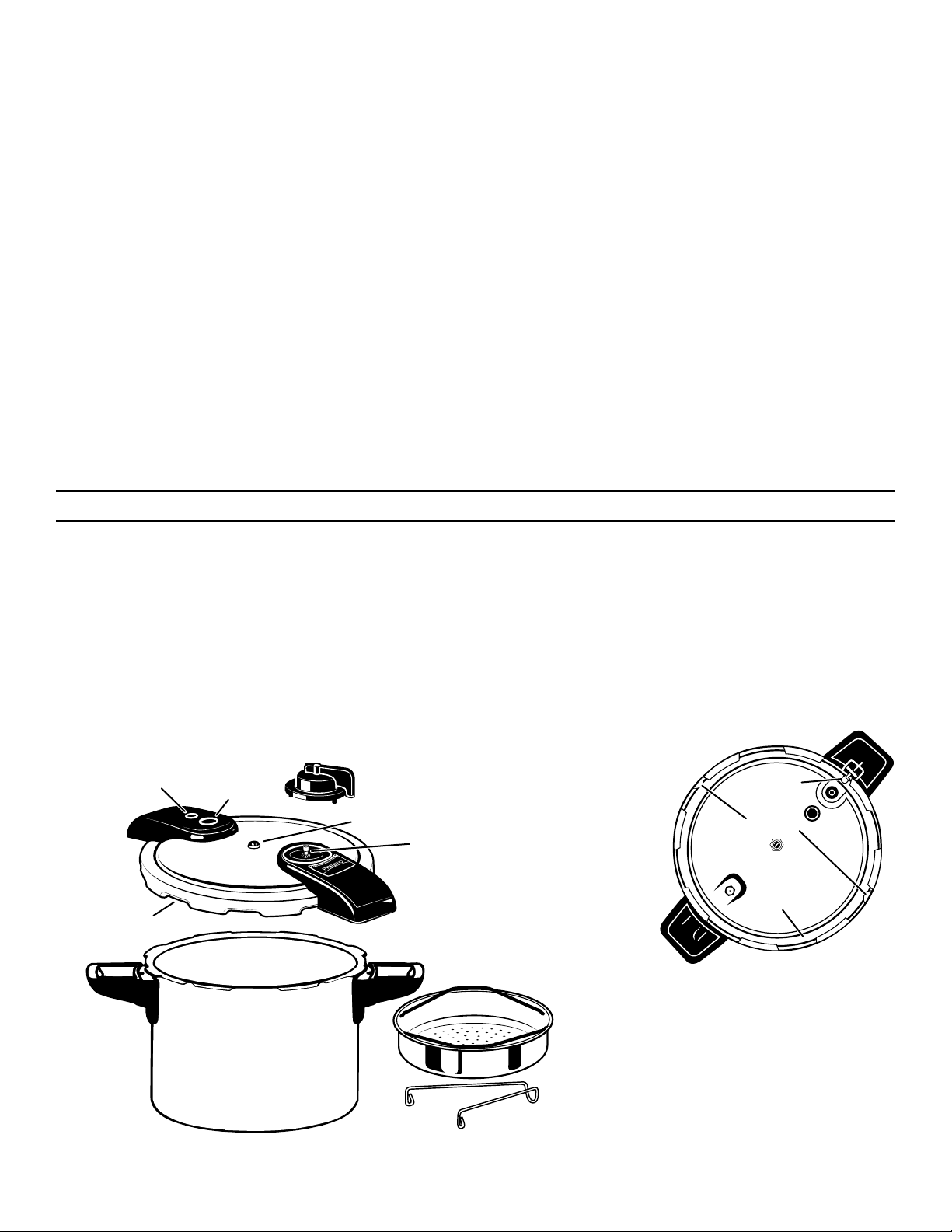
Stainless Steel
Steamer Basket
Primary
Cover Handle
Pressure Regulator/
Steam Release Valve
Vent Pipe
Air Vent/
Cover Lock
Stainless
Steel Cover
Overpressure
Plug
Trivet
Stainless Steel Body
Sealing Ring
(in cover groove)
Secondary
Cover Handle
Pressure Relief Valve
Fig. A
Stop Tabs
Lock Pin
Sealing Ring
in Sealing
Ring Groove
Fig. B
3
GETTING ACQUAINTED
Your pressure cooker is like a saucepan with a very special cover that locks in place. Air is automatically exhausted and steam is sealed
inside creating pressure within the unit. Under pressure, internal temperatures in the cooker are raised above the normal boiling point
of water, causing foods to cook faster. At 15 pounds of pressure, a temperature of 250°F (121°C) is reached inside the pressure cooker.
These higher temperatures speed cooking and the moist steam atmosphere tenderizes meats naturally.
It is important to become familiar with the various parts of the pressure cooker (Fig. A, page 2) and to read the “How To Use” section
below before using the unit for the first time.
Before the first use, remove the sealing ring (Fig. B, page 2) by simply pulling it out of the inside rim of the cover. Wash sealing ring,
cover, body, trivet, and steamer basket (Fig. A) in hot, sudsy water to remove any packaging material and white manufacturing lubricant.
Rinse all parts with warm water and dry. Replace the sealing ring, being careful to fit it under the stop tabs and the lock pin (Fig. B)
which are located on the inside rim of the cover.
HOW TO USE
To assure the very best results every time, carefully follow these step-by-step instructions for pressure cooking. You may find it helpful
to refer back to Fig. A on page 2.
1. Prepare ingredients according to the directions in the pressure cooking recipe you have selected. If a larger quantity is desired, you
may double ingredients. Be sure not to overfill the pressure cooker
(see page 4 for guidance on filling).
Pour liquid into the cooker body, as specified in the recipe or time-
table. This liquid is usually water. However, some recipes will call
for other liquids, such as broth, juice, or wine.
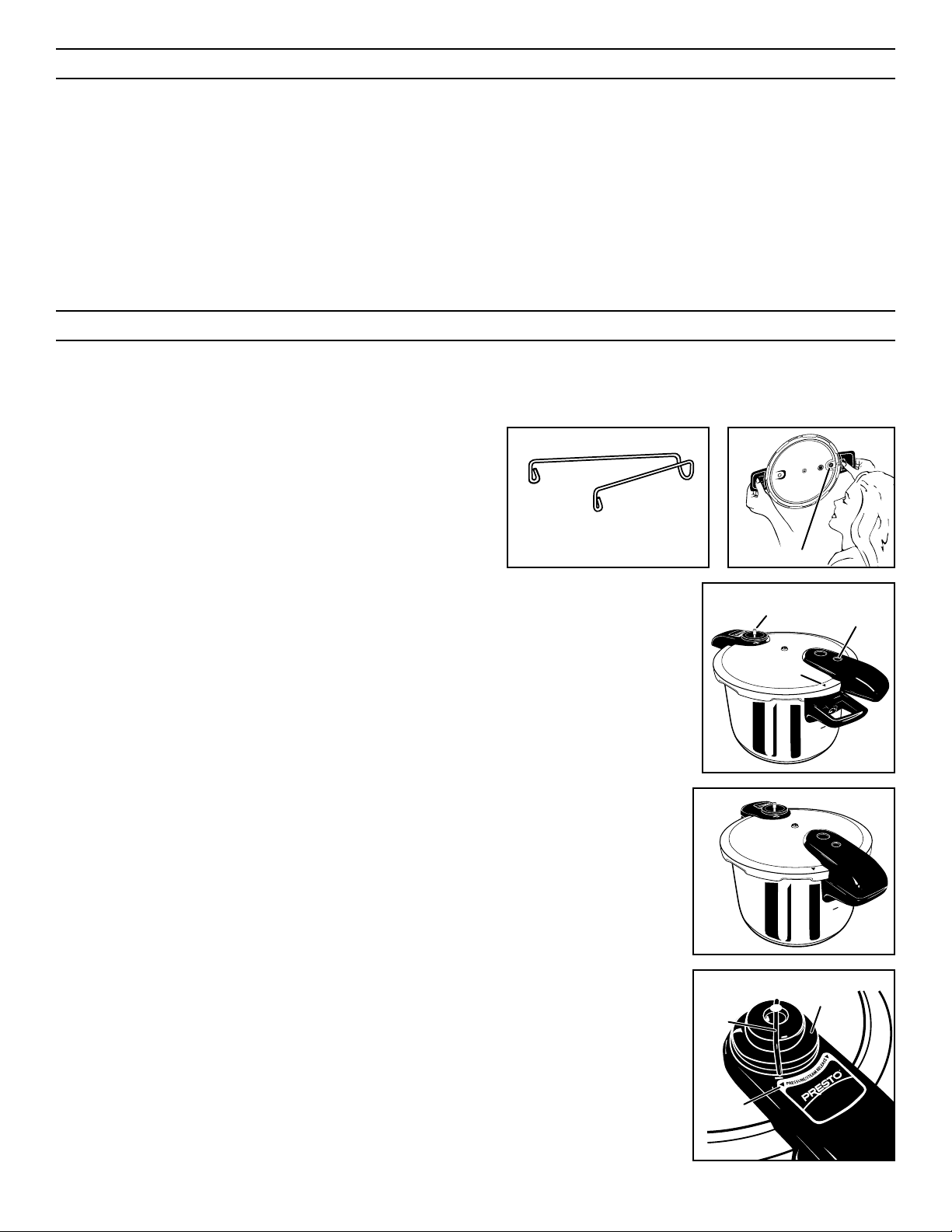
2. Place the trivet and steamer basket into the cooker, if called for in
the recipe (see “Helpful Hints” on page 7 for guidance on when to
use). If using the trivet, position it in the cooker so the loop ends
are towards the bottom of the cooker (Fig. C).
3. IMPORTANT: Look through the vent pipe to make certain that it is clear before placing the cover
on the cooker body (Fig. D). See safety information on page 5. If blocked, clean as described on
page 6, step 4.
Placethecoveroverthebody(Fig.E),aligningthe▼markonthecoverwiththearrowoneither
of the body handles. Move the cover handle slightly until the cover drops into position.
4. Close the cover securely by rotating it clockwise until the cover handles are directly above the
body handles. The pressure cooker is completely closed when the cover handles are directly
above the body handles (Fig. F). Do not try to rotate it beyond this point.
5. Place the pressure regulator on the vent pipe and rotate clockwise until the lever on the regulator
is aligned with the pressure arrow (Fig. G). NOTE: It may be necessary to apply slight pressure
when positioning the regulator on the vent pipe to seat it properly.
6. Position the pressure cooker on your stove. If your stove is electric coil or smooth top, use the
largest element, making sure the element does not extend more than one inch out from the cooker
bottom.
Using a high heat setting on your stove, begin heating the pressure cooker. As pressure is building,
a small amount of steam will be released from the pressure regulator. You will know your cooker
has reached 15 pounds pressure when you hear and/or see a steady flow of steam releasing from
the pressure regulator.
NOTE: The air vent/cover lock may move up and down a few times when cooking first begins as
it automatically exhausts air from the pressure cooker. Steam will be noticeable. This is normal.
When pressure begins to build, it slides up, locking the cover on. Once the cooker has sealed,
the air vent/cover lock will remain in the up position until pressure is released (Fig. H, page 4).
7. Cooking time begins when you hear and/or see a steady flow of steam releasing from the pres-
sure regulator. Lower the heat as necessary to maintain a very slow, steady flow of steam and
cook for the length of time indicated in the recipe or cooking chart. If excess steam is allowed to
escape, too much liquid will evaporate and food may scorch. Never leave your pressure cooker
unattended at high heat settings. It could boil dry, overheat, and cause damage to the pressure
cooker.
Vent Pipe
Fig. D
Loop Ends
Fig. C
Position the trivet in the cooker so the
loop ends are towards the bottom of
the cooker.
Air Vent/
Cover Lock
Vent Pipe
Fig. E
▼Mark
Fig. F
Pressure
Regulator
Fig. G
Lever
Pressure
Arrow
4
8. When cooking time is complete, turn off burner. If using an electric stove,
remove pressure cooker from burner. NOTICE: Lift pressure cooker to
remove it from burner. Sliding cookware can leave scratches on stovetops.
9. Reduce pressure according to the recipe or timetable instructions. If the
instructions say “Let the pressure drop of its own accord,” set the pressure
cooker aside to cool until pressure is completely reduced.
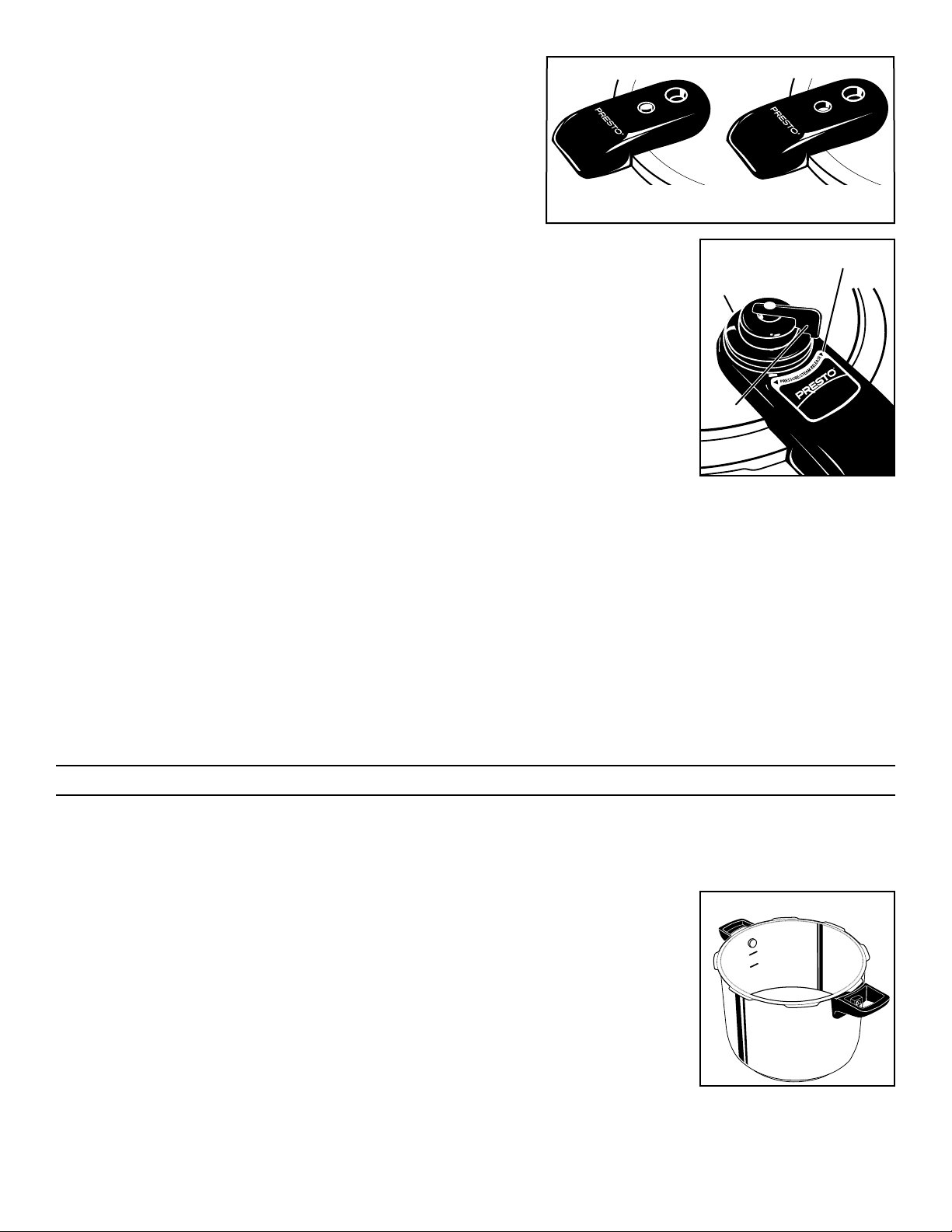
If the instructions state, “Cool cooker at once,” you can release pressure
safely using either of the following quick cool methods:
A) Turn the pressure regulator/steam release valve counter-clockwise
until the lever on the regulator is aligned with the steam release arrow (Fig. I). Steam will
be rapidly released.
WARNING! Misuse of the cooker (such as overfilling, failing to follow procedures for soak-
ing dry beans and peas, failure to use a covered bowl when preparing rice, or quick cooling
when the recipe calls for letting the pressure drop of its own accord) can result in liquid
and/or food particles being simultaneously released with the steam.
If this occurs, turn the pressure regulator/steam release valve clockwise until the lever on
the regulator is aligned with the pressure arrow. Steam, liquid, and food will no longer be
released. Finish reducing pressure quickly by cooling cooker under a running water faucet
or pouring cold water over it until pressure is completely reduced. Pressure is completely
reduced when the air vent/cover lock has dropped.
After removing cover, look through the vent pipe to make sure it is clear. If it is blocked or
partially blocked, clean it with a small brush or pipe cleaner (see page 6).
B) Cool cooker under a running water faucet or pour cold water over it until pressure is completely reduced. NOTICE: Do not set
hot cooker in a sink that is not heat resistant as it could damage the sink. Pressure is completely reduced when the air vent/
cover lock has dropped. If the air vent/cover lock remains in its raised position, there is still pressure inside the pressure cooker.
Continue to cool until the air vent/cover lock drops.
10.Afterpressurehasbeencompletelyreduced,removethecover.Toopenthecover,turnitcounterclockwiseuntilthe▼onthecover
aligns with the arrow on either of the body handles. Then, lift the cover toward you to keep any steam away from you. If the cover
turns hard, there still may be some pressure in the unit. Do not force the cover off. Continue to cool the pressure cooker until the
air vent/cover lock has dropped and the cover turns easily. Remove the pressure regulator.
11. If you have used the steamer basket, use pot holders to grab the two handles on the sides of the steamer basket and carefully lift the
basket out of the cooker. Food is ready to serve.
12. Your pressure cooker is now ready to clean. Follow the cleaning instructions on page 6.
IMPORTANT SAFETY INFORMATION
Cooking under pressure enables you to prepare food both quickly and deliciously. If used properly, your pressure cooker is one of the
safest appliances in your kitchen. To ensure safe operation, make sure you always observe the following simple rules whenever you use
the pressure cooker:
1. Never overfill the pressure cooker. The pressure regulator is designed to maintain cooking pressures at a safe level. It relieves excess
pressure through the vent pipe as a very slow, steady flow of steam escapes. Many foods tend
to expand when cooked. If the cooker is overfilled, expansion of food may cause the vent pipe
to become blocked or clogged. In the event that the vent pipe becomes blocked, there are two
backup safety devices which are intended to release excess pressure: the pressure relief valve and
the overpressure plug. It is possible, however, to block them as well if the cooker is overfilled.
Donotfillthecookermorethan⅔fullwhencookingmostfoods.Whencookingfoodsthatfoam,
froth, or expand, such as rice, grains, dry beans and peas, or foods that are mostly liquid, such
as soups, never fill the cooker more than ½ full.
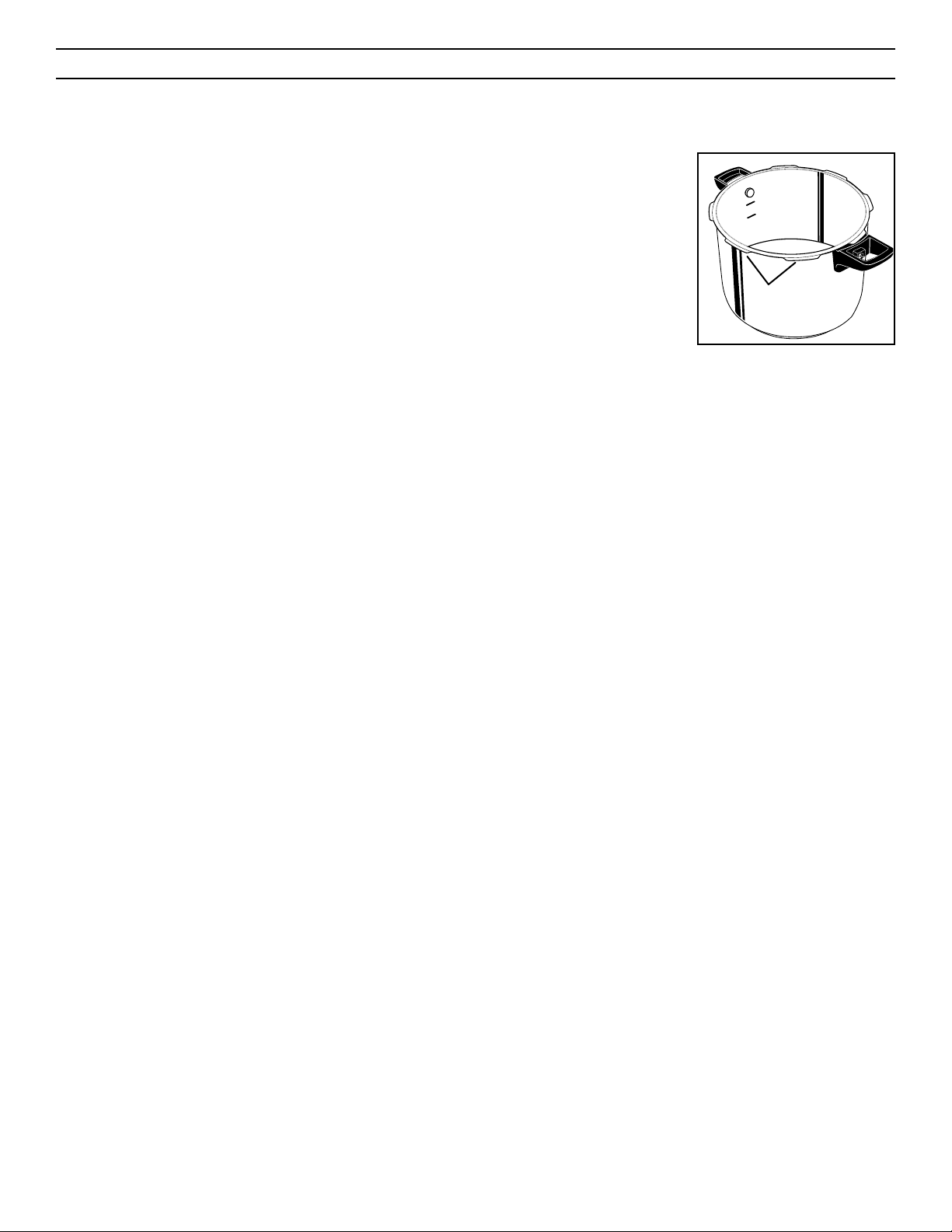
Foryourconvenience,boththe⅔and½fulllevelsaremarkedbyindentationsonthesideofthe
pressurecookerbody(Fig.J).Theuppermarkingindicatesthe⅔fulllevelandthelowerthe½
full level. In addition, in each section of the recipes you will find instructions on the maximum
fill level for each type of food.
REMINDER: When cooking any food, do not let any portion extend above the maximum fill mark. When cooking rice, grains, dry
beans and peas, soups, and stews, the cooker should never be more than ½ full.
Air Vent/Cover Lock in UP
Position. Pressure in Unit.
Air Vent/Cover Lock in DOWN
Position. No Pressure in Unit.
Fig. H
Pressure Regulator/
Steam Release Valve
Lever
Quick Steam
Release Position
Fig. I
Fig. J
⅔FillLine
½ Fill Line

5
2. Never pressure cook applesauce, cranberries, rhubarb, cereals, pasta, split peas, dried soup mixes, or dry beans and peas
which are not listed in the chart on page 22. These foods expand so much as a result of foaming and frothing that they should
never be cooked under pressure.
3. Always add cooking liquid. If an empty pressure cooker is left on a hot burner or if a cooker boils dry and is left on a heated burner,
the cooker will overheat excessively causing possible discoloration and/or damage to the cooker.
4. Always look through the vent pipe before using the cooker to make sure it is clear. If the vent pipe is blocked, it cannot function
as it should and thus cannot relieve excess pressure. Pressure may then build to unsafe levels. To clean the vent pipe, see page 6.
5. Always fully close the pressure cooker. The cooker is fully closed when the cover handles are directly above the body handles. Your
pressure cooker has specially designed lugs on the cover and body which lock the cover in place when the cooker is fully closed.
However, if the cooker is not fully closed, the lugs cannot lock the cover onto the body. It’s possible that pressure could build inside
the cooker and cause the cover to come off and result in bodily injury or property damage. Always be sure the cover handles are
directly above the body handles (see Fig. F, page 3). Do not turn past handle alignment.
6. WARNING! Never open the cooker when it contains pressure. The air vent/cover lock provides a visual indication of pressure
inside the cooker. When it is up, there is pressure. When it is down, there is no pressure in the cooker and it can be opened. If the
pressure cooker is opened before all of the pressure is released, the contents of the cooker will erupt and could cause bodily injury
or property damage.
7. Respond to a warning from the pressure relief valve. The pressure relief valve is a warning device that is designed to provide
both visual (the cap lifts and steam comes out the sides) and audio (a fast, steady release of steam, often times accompanied by a
continuous unpleasant sound) signals to indicate that the vent pipe has been blocked and is no longer regulating pressure and there
is excessive pressure in the cooker.
If you see and/or hear either of these signals, immediately turn off the burner. Do not move the cooker. Instead, allow pressure to
drop of its own accord. When there is no pressure in the cooker (see #6 above), remove the pressure regulator from the cover, open
the cooker, and clean the vent pipe (see page 6).
NOTE: Do not operate the cooker again until you have replaced the pressure relief valve. The high pressure which triggered the
release may have contaminated the valve with food particles, which could prevent it from acting as a warning and a backup pressure
relief valve if the vent pipe is plugged again.
Remember a plugged vent pipe is a result of user error.
• Never overfill the cooker (see page 4, #1).
• Never cook the foods listed in #2 above in a pressure cooker.
• Always follow the special procedures when cooking rice, grains, and dry beans and peas (see #11 below).
8. Never tamper with the internal components of the pressure relief valve. The pressure relief valve is a very sensitive part and can
be easily damaged. When replacing the pressure relief valve, the entire part must be replaced.
9. Replace the sealing ring if it becomes hard, deformed, cracked, worn, pitted, or soft and sticky. The sealing ring provides a
pressure tight seal between the cover and stainless steel body. The sealing ring needs to be in good condition to function properly.
WARNING! Failure to replace the sealing ring when it is hard, deformed, cracked, worn, pitted, or soft and sticky could result in
bodily injury or property damage. It is recommended that the sealing ring be replaced every two years.
10. Replace the overpressure plug if it is hard, deformed, cracked, worn or pitted, or when replacing the sealing ring. The overpres-
sure plug is designed to relieve excess pressure by releasing from the cooker cover in the event that both the vent pipe and pressure
relief valve are blocked.
The overpressure plug is made of rubber, and when new, is soft and pliable. Over time, depending on the frequency and type of use,
rubber becomes hard and inflexible. When hard and inflexible, the overpressure plug loses its ability to act as a secondary pressure
relief valve. It should be replaced immediately. It is recommended that the overpressure plug be replaced every two years.
Should the overpressure plug ever be forced out of the cover due to excess pressure while cooking, it is important to call the Test
Kitchen at 1-800-368-2194. Do not attempt to use the released overpressure plug.
11. Always follow special procedures found in the instruction book when pressure cooking rice, grains, and dry beans and peas.
During cooking, dry beans and peas tend to froth and foam which could cause the vent pipe to become blocked. Therefore, dry beans
and peas need to be soaked and cooked according to instructions on page 22.
Using this method will minimize foam during cooking. Like dry beans and peas, rice and grains tend to froth and foam during cook-
ing; therefore, to contain foaming and frothing during the cooking period, rice and grains must be prepared in a bowl in the pressure
cooker according instructions on page 23.
6
CLEANING
1. All parts of your pressure cooker, except the pressure regulator, are fully immersible
for easy cleaning in hot, sudsy water. When washing the unit, remove the sealing ring
to allow easy cleaning of the inside rim of the cover. Wash the sealing ring separately.
The pressure regulator can be wiped clean with a damp cloth, if necessary.
2. We do not recommend washing the pressure cooker in an automatic dishwasher
because of the harsh nature of the detergent and its effect on the various pressure
cooker parts.
3. If food residue adheres to the pressure cooker body, clean with a stainless steel scour-
ing pad, nylon mesh pad, or a powdered cleanser without chlorine or bleach, such
as Bar Keepers Friend* cleanser and polish or Cameo* copper, brass & porcelain
cleaner.
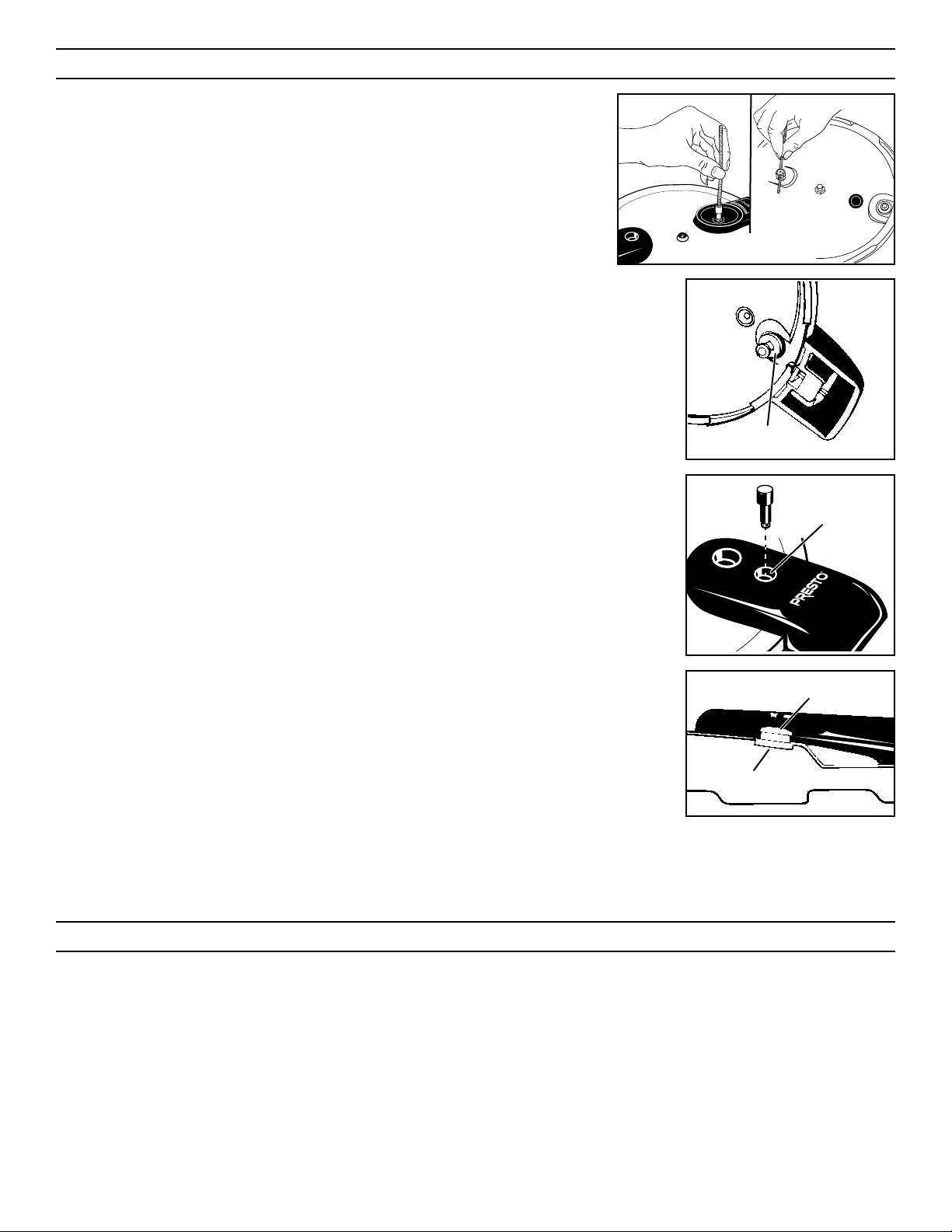
4. To be sure the vent pipe is clear, hold the cover up to the light and look through the vent pipe.
Clean it with a small brush or pipe cleaner if it is blocked or partially blocked (Fig. K). Also
clean the vent pipe nut as shown.
5. Occasionally remove the air vent/cover lock in the pressure cooker cover handle for cleaning. To
remove the air vent/cover lock, place your finger over the hole in the cover handle and remove
the rubber gasket from the air vent/cover lock on the underside of the cover (Fig. L).
Push the air vent/cover lock through the top of the cover and wash it and the gasket in hot, sudsy
water. The metal shaft of the air vent/cover lock may be cleaned with a nylon mesh pad. Clean
the hole in the cover handle with a small brush.
After cleaning, reinsert the metal shaft of the air vent/cover lock from the top side of the cover
down through the cover handle hole (Fig. M). Place a finger over the handle hole (to keep the
cover lock from falling out) and turn the cover over. Wet the rubber gasket and push onto the
end of the metal shaft until it snaps into the groove on the shaft. The gasket should fit loosely
in the groove.
6. The overpressure plug can also be removed for cleaning by pushing it out of its opening from
the top of the cover handle.
After cleaning, reinsert it by pushing the domed side of the plug, marked “TOP”, into the open-
ing from the underside of the cover, until the bottom edge is fully and evenly seated against the
underside of the cover (Fig. N).
When the overpressure plug is properly installed, the word “TOP” will be visible on the over-
pressure plug when viewing the outside of the cover.
7. The pressure relief valve should not be disassembled for cleaning or repair. Clean the exposed
surface of the valve when cleaning the underside of the cover.
8. To bring out its luster, the outside surface of your stainless steel pressure cooker can be cleaned
occasionally with a silver polish or any other fine, non-abrasive polish.
Take care not to overheat your stainless steel pressure cooker. Very high heat can sometimes cause varicolored stains, called heat tints,
in stainless steel. Heat tints can usually be removed by using a powdered cleanser without chlorine or bleach, such as Bar Keepers
Friend* cleanser and polish.
CARE AND MAINTENANCE
1. When not in use, store your pressure cooker in a dry place with the cover inverted on the body. If the cover is locked on, unpleasant
odors may form inside the unit and the sealing ring could be damaged.
2. As is the case of all cookware, avoid chopping or cutting food inside the cooker with a knife or other sharp utensil.
3. If the body or cover handles become loose, tighten them with a screwdriver. NOTICE: Overtightening can result in stripping of screws
or cracking of handles.
4.Periodicallychecktheventpipenutforlooseness.Retighten,ifnecessary,usinga7/16″wrench.
5.Periodicallycheckthepressurereliefvalvenutforlooseness.Retighten,ifnecessary,usingan11/16″wrench.
* Bar Keepers Friend is a registered trademark of SerVaas Laboratories, Inc.; Cameo is a registered trademark of Church & Dwight Co., Inc. Presto is not affiliated with
these companies.
Fig. K
Cover
Handle Hole
Fig. M
Overpressure Plug
Top
Fig. N
Rubber
Gasket
Fig. L

7
6. The sealing ring, overpressure plug, and rubber gasket of the air vent/cover lock may shrink, become hard, deformed, cracked, worn,
or pitted with normal use. Exposure to high heat, such as a warm burner or oventop, will cause these parts to deteriorate rapidly. When
this happens, replace the sealing ring, overpressure plug, and small rubber gasket of the air vent/cover lock. Replace the sealing ring
and overpressure plug at least every two years.
Leakage between the cover and body is usually caused by shrinkage of the sealing ring after prolonged use. Replace the sealing ring.
Whenever you replace the sealing ring, replace the overpressure plug also.
7. Each time you clean or use your pressure cooker, check to be sure the bottom has not been damaged. Nicks and scratches may leave
sharp edges that can damage ceramic stovetops or other smooth surfaces. Lift pressure cooker to remove it from burner. Sliding
cookware could leave scratches on stovetops.
8. The formation of a small amount of moisture under the pressure regulator is normal when cooking first begins. It is the result of the
temperature of the regulator being lower than the rest of the unit.
A small amount of steam or moisture may also be visible around the overpressure plug and air vent/cover lock as cooking begins.
It should stop when pressure begins to build and the overpressure plug and air vent/cover lock seal. If leakage continues, clean or
replace the overpressure plug and/or air vent/cover lock assembly. The pressure cooker will not seal if the gasket for the air vent/
cover lock is cracked.
Do not operate your pressure cooker with continual leakage. If the preceding steps do not correct the problem, call the Consumer
Service Department at 1-800-877-0441. If unable to resolve the problem, you may be asked to return the entire unit to the Presto
Factory Service Department (see page 28).
9. If the pressure cooker becomes difficult to open or close, the sealing ring should be replaced. If for any reason the pressure cooker
cannot be opened, contact the Consumer Service Department in Eau Claire, WI at 1-800-877-0441.
Any maintenance required for this product, other than normal household care and cleaning, should be performed by the Presto Fac-
tory Service Department (see page 28).
HELPFUL HINTS
♦ Your favorite recipes may be adjusted for cooking in the pressure cooker by following the general directions in this book for the par-
ticulartypeoffoodbeingcooked.Decreasethecookingtimeforyourrecipeby⅔sincepressurecookingismuchfasterthanordinary
cooking methods. For example, if your ordinary cooking method requires 45 minutes, in the pressure cooker the cooking time will be
15 minutes.
Because there is very little evaporation, the amount of liquid used should be decreased. Use about 1 cup more liquid than you’ll desire
in your finished dish. But, remember, there must always be water or some other liquid (broth, juice, or wine) in the pressure cooker to
produce the necessary steam.
♦ Use the trivet and steamer basket when it is desirable to cook foods out of the cooking liquid. When foods are pressure cooked out of
the liquid, flavors will not intermingle. Therefore, it is possible to cook several foods at once, as long as they have similar cooking
times. If it is desirable to blend flavors, do not use the trivet and steamer basket.
♦ Many different cooking liquids can be used in a pressure cooker. Wine, beer, bouillon, fruit juices, and of course water all make excel-
lent cooking liquids in the pressure cooker.
♦ If a recipe says to cook 0 minutes, release pressure immediately after pressure cooker reaches cooking pressure.
♦ Beautiful desserts and side dishes can be prepared in the pressure cooker using individual or small metal molds or glass custard cups,
whichareovenproof.Fillmolds⅔fulltoallowforexpansionoffoodandfitthemlooselyintothepressurecookerinthesteamer
basket.Donotfillthepressurecookerover⅔full.
♦ Release pressure quickly after cooking delicate foods such as custards and fresh vegetables. For other foods, like meats, soups, and
grains, let the pressure drop of its own accord.
♦ When pressure cooking at high altitudes, the cooking time needs to be increased 5% for every 1,000 feet above the first 2,000 feet.
Following this rule, the times should be increased as follows:
3,000 ft. ... 5% 4,000 ft. ... 10% 5,000 ft. ... 15% 6,000 ft. ... 20% 7,000 ft. ... 25% 8,000 ft. ... 30%
Because pressure cooking times are increased at altitudes above 2,000 feet, an additional ½ cup cooking liquid will be needed.
♦ If you have any questions on recipes, time charts, or the operation of your pressure cooker, call or write: Test Kitchen, National Presto
Industries, Inc., 3925 North Hastings Way, Eau Claire, Wisconsin 54703-3703, phone 1-800-368-2194. You may also contact us at our
website www.GoPresto.com. When writing, please include a phone number and a time when you can be reached during weekdays, if
possible. Written inquiries will be answered promptly by letter or telephone.
8
QUESTIONS AND ANSWERS
Occasionally the cover is hard to open or close. What causes this? What should I do?
In order for pressure to build inside your pressure cooker, the unit has a special cover which provides an airtight fit. Because of this, you
may find that on occasion the cover may be difficult to open or close. The following suggestions will help if this happens:
Ifthecoverseemshardtoclose,besureyouhavealignedthe▼markonthecoverwiththearrow
on either of the body handles. Move the cover until it drops into position. Then, press down firmly
on the cover handles and rotate the cover clockwise until the cover handles are directly above the
body handles.
If after browning meat or poultry the cover is difficult to close, it may be due to expansion of the
pressure cooker body from heating. Remove the cover and allow the pressure cooker body to cool
slightly and try again. Do not place the pressure cooker back on the burner until it is fully closed.
If necessary, to help make the cover easier to open and close, a very light coating of cooking oil may
be applied to the underside of the lugs on the pressure cooker body (Fig. O). Use a pastry brush, a
piece of cloth, or your fingertips and be sure to wipe off any excess oil.
What can be done if the food prepared in the pressure cooker has more liquid than desired?
With the cover removed, simmer to evaporate the excess liquid. Next time you prepare the same recipe, you may want to use less liquid.
How does one prevent overcooking?
Remember to begin timing as soon as you hear and/or see a steady flow of steam escaping from the pressure regulator. Reduce heat to
maintain a very slow, steady flow of steam. It is very important to accurately time the cooking period. A Presto
kitchen timer is very
helpful for this purpose. Also be sure to follow the recipe instructions for cooling the pressure cooker.
What if the food is not completely done after the recommended cooking time?
Simply bring the cooker back up to pressure and cook the food a minute or two longer.
How do I know my pressure cooker is operating properly?
When a steady flow of steam escapes from the pressure regulator, you will know your cooker is functioning correctly.
Can I use my stainless steel pressure cooker on all types of ranges?
Your pressure cooker will work on gas, electric coil, and ceramic glass (smooth-top) ranges (see page 3, #6 for correct burner size). In
addition, current stainless steel pressure cookers will work on induction ranges.
When cooking first begins, is it normal for steam to escape and moisture to form on the cover and between the handles?
It is normal for steam to escape and a slight amount of moisture leakage to form on the cover and between the handles when cooking first
begins. If leakage continues, the cover handles may not be fully aligned with the body handles and, therefore, the cover lock cannot engage.
My cooker is making a loud, unpleasant sound. The cap in the middle of the cover is also lifting up and emitting steam. What is
causing this?
The pressure relief valve is a warning device that is designed to provide both visual (the cap lifts and steam comes out the sides) and
audible (a fast, steady release of steam, often times accompanied by a continuous unpleasant sound) signals to indicate that the vent pipe
has been blocked and is no longer regulating pressure. If you see and/or hear either of these signals, immediately turn off the burner. Do
not move the cooker. Instead, allow pressure to drop of its own accord. When there is no pressure in the cooker (see page 5, #6), remove
the pressure regulator from the cover, open the cooker, and clean the vent pipe (see page 6).
NOTE: Do not operate the cooker again until you have replaced the pressure relief valve. The high pressure which triggered the release
may have contaminated the valve with food particles, which could prevent it from acting as a warning and a backup pressure relief valve
if the vent pipe is plugged again. Remember a plugged vent pipe is a result of user error.
• Never overfill the cooker (see page 4, #1).
• Never cook the foods listed on page 5, #2 in a pressure cooker.
• Always follow the special procedures when cooking rice, grains, and dry beans and peas (see page 5, #11).
Is it normal for the air vent/cover lock to rise up partially and drop back down when cooking first begins?
It is possible that the air vent/cover lock will move up and down slightly when cooking first begins. Do not be concerned. The air vent/
cover lock will remain in the up position once the cooker has sealed. However, if the air vent/cover lock continues to move up and down
or rises partially, tap it lightly with the tip of a knife. If it does not rise once you have tapped it, the following may be occurring:
1. The burner is not hot enough.
2. The cooker is not fully closed (see page 3, #4).
3. There is insufficient liquid to form steam.
4. The gasket for the air vent/cover lock needs to be replaced (see page 7, #6).
Apply Cooking
Oil Here
Fig. O

9
SOUPS AND STOCKS
The pressure cooker is perfect for preparing delicious, nourishing soups and stocks in minutes instead of the hours taken by ordinary
methods. Stocks form the base for most great soups and sauces, and you can even substitute a stock for water in many recipes to add
extra flavor. Traditionally, stocks are made by simmering bones and scraps for hours to extract all their flavor. With the pressure cooker,
you can do the same thing in just minutes by following the simple directions on the following pages.
We’ve also included a few favorite soup recipes and, if you have a favorite recipe of your own, try it in the pressure cooker using one
of the recipes in this book as your guide. If adding dry beans and peas, they must first be soaked according to directions on page 22. Do
not pressure cook soups containing barley, rice, pasta, grains, split peas, dry beans and peas which are not listed in the chart on
page 22, and dried soup mixes because they have a tendency to foam, froth, and sputter and could block the vent pipe. Cooked barley,
rice, grains, pasta, dry beans and peas which are not listed in the chart on page 22, and dried soup mixes should be added to the soup
after pressure cooking.
For soups and stocks, do not fill pressure cooker over ½ full!
Operating the cooker without cooking liquid or allowing the cooker to boil dry will damage the cooker.
Chicken Soup
1½ pounds chicken, cut into serving pieces
4 cups water
½ cup sliced carrots
½ cup chopped onion
¼ cup chopped celery
1 teaspoon salt
¼ teaspoon black pepper
Place all ingredients in cooker. Close cover securely. Place pressure regulator on vent pipe and cook 12 minutes with a very slow, steady
owofsteamescapingfromthepressureregulator.Letpressuredropofitsownaccord.Removepiecesofchickenfromcookerandlet
cool. Remove meat from bones and return meat to cooker. Heat through.
Nutrition Information Per Serving 4 servings
160 Calories, 8 g Fat, 54 mg Cholesterol
Delicious Soups From Chicken Soup...
Chicken Soup Stock
Strain Chicken Soup to make stock.
Chicken Noodle Soup
Bringsouptoaboil.Addnenoodlesandsimmer,uncovered,10to15minutes.Saltandpeppertotaste. 6 servings
Chicken Dumpling Soup
Mixtogether1beatenegg,½cupmilk,and½teaspoonsalt.Stirin1⅛cupsour.DropmixturefromteaspoonintobubblingChickenSoupincooker.
Simmer dumplings uncovered 6 minutes. 6 servings
Chicken Rice Soup
Add 1 cup cooked rice to Chicken Soup. Heat through. Salt and pepper to taste. 6 servings
Brown Beef Soup
1½ pounds lean beef, cut into 1-inch cubes
4 cups water
½ cup chopped onion
½ cup sliced carrots
¼ cup chopped celery
1 bay leaf
1 teaspoon parsley flakes
1 teaspoon salt
¼ teaspoon black pepper
Place all ingredients in cooker. Close cover securely. Place pressure regulator on vent pipe and cook 12 minutes with a very slow, steady
owofsteamescapingfromthepressureregulator.Letpressuredropofitsownaccord.
Nutrition Information Per Serving 4 servings
295 Calories, 15 g Fat, 110 mg Cholesterol
Delicious Soups From Brown Beef Soup...
Brown Beef Soup Stock
Strain Brown Beef Soup to make stock.
Onion Soup
Heat 2 tablespoons vegetable oil in cooker over medium heat. Sauté 1½ cups thinly sliced onions. Add 6 cups Brown Beef Soup Stock to cooker. Season
with¼teaspoonpepper.Closecoversecurely.Placepressureregulatoronventpipeandcook2minuteswithaveryslow,steadyowofsteamescaping
from the pressure regulator. Let pressure drop of its own accord. Ladle into soup bowls. Top with Parmesan cheese. If desired, garnish with croutons or
toasted French bread. 6 servings
Beef Tomato Soup
Add 2 cups tomato juice and 1 cup cooked rice to Brown Beef Soup. Heat through. 8 servings

10
Black Bean Soup
2 cups dry black beans
1 tablespoon olive or vegetable oil
1 cup chopped onion
3 cloves garlic, minced
1–2 jalapeño chilies, seeded, deveined, minced
1 tablespoon chili powder
1½ teaspoons oregano
½ teaspoon allspice
4 cups chicken stock or broth
2 cups sliced carrots, ¾ inch thick
1 tablespoon packed brown sugar
2 teaspoons white wine vinegar
• • • • • • •
1 cup loosely packed fresh cilantro, chopped
Salt to taste
Soak beans according to instructions on page 22. Heat oil in pressure cooker over medium heat. Sauté onion, garlic, chilies, chili powder,
oregano, and allspice for 2 minutes. Stir in beans, chicken stock, carrots, brown sugar, and vinegar. Close cover securely. Place pressure
regulatoronventpipeandcook12minuteswithaveryslow,steadyowofsteamescapingfromthepressureregulator.Letpressure
drop of its own accord. Remove 1 cup of bean mixture, place in blender, and purée until smooth. Return to pressure cooker and stir in
fresh cilantro.
Nutrition Information Per Serving 8 servings
231 Calories, 3 g Fat, 0 mg Cholesterol
Saffron Fish Stew
1 can (14½ ounces) chicken broth
¼ cup dry white wine
4 new red potatoes, quartered
3 carrots, cut into ½-inch chunks
1 medium onion, finely chopped
2 cloves garlic, minced
¼ cup chopped parsley
1 bay leaf
Pinch of saffron threads or ¼ teaspoon turmeric
• • • • • • •
1 pound firm fish (halibut, haddock, cod, pollack) fresh
or thawed, cut into 8 pieces
1 small red pepper, cut into chunks
1 cup frozen peas, thawed
Place broth, wine, potatoes, carrots, onion, garlic, parsley, bay leaf, and saffron in pressure cooker. Close cover securely. Place pressure
regulatoronventpipeandcook2minuteswithaveryslow,steadyowofsteamescapingfromthepressureregulator.Coolcookerat
once.Addsh,pepper,andpeas.Closecoversecurely.Placepressureregulatoronventpipeandcook1minutewithaveryslow,steady
owofsteamescapingfromthepressureregulator.Coolcookeratonce.Discardbayleaf.
Nutrition Information Per Serving 8 servings
174 Calories, 1 g Fat, 40 mg Cholesterol
Minestrone
1 pound lean beef, cut into 1-inch cubes
5 cups water
1 can (14–15 ounces) diced tomatoes
½ cup chopped onion
1 cup sliced carrots
¼ cup chopped celery
1 clove garlic, minced
2 tablespoons parsley flakes
1½ teaspoons basil
1 teaspoon salt
1 bay leaf
¼ teaspoon black pepper
• • • • • • •
1 can (16 ounces) Great Northern beans
1 can (15 ounces) cut green beans, drained
2 ounces fine noodles
Place beef, water, tomatoes, onions, carrots, celery, garlic, parsley, basil, salt, bay leaf, and pepper in cooker. Close cover securely. Place
pressureregulatoronventpipeandcook10minuteswithaveryslow,steadyowofsteamescapingfromthepressureregulator.Let
pressure drop of its own accord. Add Great Northern beans, green beans, and noodles. Simmer uncovered 10 minutes. Garnish with
Parmesan cheese, if desired.
Nutrition Information Per Serving 10 servings
234 Calories, 6 g Fat, 44 mg Cholesterol
Potato Soup
1 tablespoon vegetable oil
1 cup finely chopped onions
½ cup finely sliced celery
3 cups chicken broth
4 cups peeled, diced potatoes
¼ teaspoon white pepper
¼ teaspoon basil
• • • • • • •
1 can (12 ounces) evaporated skim milk
Salt to taste
Heat oil in pressure cooker over medium heat. Sauté onion and celery until soft. Add broth, potatoes, pepper, and basil to pressure
cooker.Closecoversecurely.Placepressureregulatoronventpipeandcook5minuteswithaveryslow,steadyowofsteamescaping
from the pressure regulator. Let pressure drop of its own accord. Remove 2 cups of potato mixture; place in blender or food processor
and process until smooth. Return to pressure cooker and stir in evaporated milk.
Nutrition Information Per Serving 6 servings
160 Calories, 2 g Fat, 2 mg Cholesterol

11
Zesty Homemade Chili
1½ pounds ground beef
1 can (8 ounces) tomato sauce
½ cup water
1 cup chopped onion
¾ cup chopped green pepper
2 cloves garlic, finely chopped
1 tablespoon chili powder
1 teaspoon salt
1 teaspoon ground cumin
½ teaspoon black pepper
½ teaspoon oregano
¼ teaspoon cayenne pepper
• • • • • • •
1 can (15 ounces) kidney beans, drained and rinsed
Brown meat in cooker over medium heat. Add remaining ingredients except kidney beans. Close cover securely. Place pressure regulator
onventpipeandcook5minuteswithaveryslow,steadyowofsteamescapingfromthepressureregulator.Letpressuredropofits
own accord. Stir in kidney beans and heat through.
Nutrition Information Per Serving 4 servings
432 Calories, 17 g Fat, 111 mg Cholesterol
SEAFOOD
Seafood is the basis of some of the healthiest and most nutritious meals you can make. It is an excellent source of protein, a good source
of minerals, and some vitamins, and it’s low in fat and sodium. Steaming in the pressure cooker brings out the finest, fullest flavors of
seafood. The cooking time required is directly related to the thickness of the seafood. To be safe, if the fish you are cooking seems thin
for its weight or if it weighs less than the recipe specifies, reduce the cooking time. Overcooking tends to toughen seafood.
For fish and seafood, do not fill pressure cooker over ⅔ full!
Operating the cooker without cooking liquid or allowing the cooker to boil dry will damage the cooker.
Salmon Steaks Moutarde
4 small salmon steaks, 1 inch thick
4 tablespoons Dijon-style mustard
3–4 sprigs fresh thyme or ½ teaspoon dried thyme
1 tablespoon olive or vegetable oil
1 small onion, chopped
1 clove garlic, minced
1 cup dry white wine or chicken broth
1 bay leaf
• • • • • • •
2 tablespoons Dijon-style mustard
1 tablespoon cornstarch
Spread each steak with 1 tablespoon mustard. Press 1 thyme sprig into mustard on each steak or sprinkle with dried thyme. Heat oil in
cooker over medium heat. Sauté onion and garlic until tender. Stir in wine and bay leaf. Position trivet in cooker. Place steaks in steamer
basketontrivet.Closecoversecurely.Placepressureregulatoronventpipeandcook2minuteswithaveryslow,steadyowofsteam
escaping from the pressure regulator. Cool cooker at once. Carefully remove steaks and basket. Keep steaks warm. Discard bay leaf. Mix
2 tablespoons mustard with cornstarch. Stir into liquid in pressure cooker. Heat until sauce boils and thickens, stirring constantly. Serve
sauce with salmon steaks. VARIATION: Substitute halibut for salmon steaks.
Nutrition Information Per Serving 4 servings
218 Calories, 9 g Fat, 20 mg Cholesterol
Lemon ’n Dill Cod and Broccoli
1 pound frozen cod fillets, 1 inch thick
Dill weed
Lemon pepper
Salt
1 cup water
2 cups broccoli, cut into bite size pieces
Cutshinto4pieces.Sprinklewithdillweed,lemonpepper,andsalt.Pour1cupwaterintocooker.Positiontrivetincooker.Arrange
shandbroccoliinsteamerbasketontrivet.Closecoversecurely.Placepressureregulatoronventpipeandcook2minuteswithavery
slow,steadyowofsteamescapingfromthepressureregulator.Coolcookeratonce.
Nutrition Information Per Serving 4 servings
103 Calories, 1 g Fat, 49 mg Cholesterol
“Scampi-Style” Shrimp
1 pound medium, raw shrimp, peeled and deveined
3 tablespoons butter
2 tablespoons minced green onion
6 cloves garlic, minced
2 teaspoons lemon juice
¼ teaspoon salt
1 cup water
• • • • • • •
2 tablespoons minced parsley
¼ teaspoon grated lemon peel
Pat shrimp dry with paper towels. Place butter in cooker. Melt butter over medium heat. Sauté onion and garlic. Stir in lemon juice and
salt.Cookuntilbubbly.Pourintometalbowlwhichwilltlooselyincooker.Stirinshrimp.Coverbowlrmlywithaluminumfoil.
Pour water into cooker. Place bowl in steamer basket in cooker. Close cover securely. Place pressure regulator on vent pipe and cook 3
minuteswithaveryslow,steadyowofsteamescapingfromthepressureregulator.Coolcookeratonce.Stirinparsleyandlemonpeel.
Nutrition Information Per Serving 4 servings
205 Calories, 11 g Fat, 196 mg Cholesterol

12
Shrimp Jambalaya
1 cup long-grain white rice
1½ cups water
1 cup water
• • • • • • •
1 can (14–15 ounces) stewed tomatoes
½ cup chicken broth
½ pound precooked ham, diced
½ cup chopped onion
½ cup chopped celery
½ cup chopped green pepper
2 cloves garlic, minced
1 bay leaf
1 teaspoon basil
½ teaspoon thyme
½ teaspoon chili powder
¼ teaspoon black pepper
¼ teaspoon salt
¼ teaspoon hot sauce
• • • • • • •
1 pound precooked shrimp, peeled and deveined
Combinericeand1½cupswaterinametalbowlwhichwilltlooselyincooker.Coverthebowlrmlywithaluminumfoil.Pour1
cup water into cooker. Place bowl in steamer basket in cooker. Close cover securely. Place pressure regulator on vent pipe and cook 5
minuteswithaveryslow,steadyowofsteamescapingfromthepressureregulator.Letpressuredropofitsownaccord.Opencooker
and set rice aside to steam. Remove steamer basket and water.
Add remaining ingredients, except shrimp, to cooker; stir well. Close cover securely. Place pressure regulator on vent pipe and cook 3
minuteswithaveryslow,steadyowofsteamescapingfromthepressureregulator.Coolcookeratonce.
Stir in shrimp; cook uncovered over medium heat until shrimp is heated through, 2 to 3 minutes. Serve over rice.
Nutrition Information Per Serving 6 servings
252 Calories, 3 g Fat, 157 mg Cholesterol
Seafood Gumbo
1 cup long-grain white rice
1½ cups water
1 cup water
• • • • • • •
2½ cups chicken broth
1 pound medium, fresh shrimp, peeled and deveined
1 pound sole fillets, cut into 2-inch pieces
1 can (14–15 ounces) diced tomatoes
1 cup chopped onion
¾ cup chopped green pepper
2 cloves garlic, minced
2 bay leaves
2 tablespoons parsley
1 teaspoon basil
½ teaspoon thyme
¼ teaspoon ground red pepper
¼ teaspoon salt
• • • • • • •
¼ cup cold water
2 tablespoons cornstarch
1 package (10 ounces) frozen sliced okra, thawed
Combinericeand1½cupswaterinametalbowlwhichwilltlooselyincooker.Coverthebowlrmlywithaluminumfoil.Pour1
cup water into cooker. Place bowl in steamer basket in cooker. Close cover securely. Place pressure regulator on vent pipe and cook 5
minuteswithaveryslow,steadyowofsteamescapingfromthepressureregulator.Letpressuredropofitsownaccord.Opencooker
and set rice aside to steam. Remove steamer basket and water.
Add broth, shrimp, sole, tomatoes, onion, green pepper, garlic, bay leaves, parsley, basil, thyme, red pepper, and salt to cooker. Close
coversecurely.Placepressureregulatoronventpipeandcook1minutewithaveryslow,steadyowofsteamescapingfromthepres-
sure regulator. Cool cooker at once.
Combine water and cornstarch. Stir into hot mixture. Heat until sauce thickens, stirring constantly. Stir in okra. Heat for 3 to 4 minutes.
Discard bay leaf. Serve over rice.
Nutrition Information Per Serving 9 servings
224 Calories, 2 g Fat, 101 mg Cholesterol
Marinated Tuna
1 pound tuna steak, 1 inch thick
¼ cup lemon juice
2 tablespoons olive oil
1 tablespoon soy sauce
2 cloves garlic, minced
1 teaspoon ginger
½ teaspoon black pepper
½ cup water
Place tuna steaks in a shallow glass dish. Combine remaining ingredients except water; pour over tuna. Marinate for 30 minutes, turning
shonce.Removetunafrommarinadeandplacetunainsteamerbasket.Positiontrivetincooker.Pourmarinadeandwaterintocooker.
Place tuna steaks in steamer basket on trivet. Close cover securely. Place pressure regulator on vent pipe and cook 2 minutes with a very
slow,steadyowofsteamescapingfromthepressureregulator.Coolcookeratonce.
Nutrition Information Per Serving 4 servings
170 Calories, 6 g Fat, 52 mg Cholesterol

13
Seafood Timetable
Pour1cupwaterintocooker.Positiontrivetincooker.Placeseafoodinsteamerbasketontrivet.Donotfillcookerover⅔full.Closecoversecurely.
Place pressure regulator on vent pipe and cook according to chart with a very slow, steady flow of steam escaping from the pressure regulator.
Cool cooker at once.
Seafood Cooking Time Seafood Cooking Time
(fresh or thawed) (minutes) (fresh or thawed) (minutes)
Crab Legs 0–1
Fish Fillets (1 inch thick) 2
Salmon Fillets (1 inch thick) 2
Scallops Large 1
Shrimp
Medium to Large (36 to 40 count) 0–1
Large (21 to 25 count) 1
Tuna Fillets (1 inch thick) 2
POULTRY
A host of great, light meals can evolve from chicken and other poultry when prepared in the pressure cooker. Be it a tender fillet with a
delightful, light sauce or a savory casserole with a host of nutritious vegetables, you’ll find the pressure cooker is perfect for preparing
your favorites in a hurry. Try the following recipes and enjoy tasty poultry in a variety of ways or prepare your own favorite poultry
dishes. It’s not necessary to brown poultry before pressure cooking, but you may do so if you like. Searing tends to seal in the natural
juices, while cooking without browning lets the flavor of the various ingredients intermingle for some spectacular taste combinations.
For crispier chicken, you may want to put the chicken under the broiler for a few minutes after pressure cooking.
For poultry, do not fill pressure cooker over ⅔ full!
No portion of the poultry should extend above the ⅔ full mark (see page 4).
Operating the cooker without cooking liquid or allowing the cooker to boil dry will damage the cooker.
Soy Chicken
4 boneless, skinless chicken breast halves
½ cup water
¼ cup low sodium soy sauce
½ cup sliced mushrooms
½ onion, sliced
½ cup sliced celery
3 tablespoons brown sugar
Place all ingredients in cooker. Close cover securely. Place pressure regulator on vent pipe and cook 4 minutes with a very slow, steady
owofsteamescapingfromthepressureregulator.Letpressuredropofitsownaccord.
Nutrition Information Per Serving 4 servings
169 Calories, 2 g Fat, 69 mg Cholesterol
Chicken Breasts Tarragon
1 tablespoon vegetable oil
4 boneless, skinless chicken breast halves
½ cup white wine Worcestershire sauce
½ cup white wine
¼ cup chopped onion
¼ cup sliced celery
¼ cup sliced carrot
1 teaspoon tarragon
1 teaspoon salt
¼ teaspoon black pepper
• • • • • • •
¼ cup water
1 tablespoon cornstarch
Heat oil in cooker over medium heat. Brown chicken. Add remaining ingredients except cornstarch and water. Close cover securely.
Placepressureregulatoronventpipeandcook4minuteswithaveryslow,steadyowofsteamescapingfromthepressureregulator.
Cool cooker at once. Remove chicken and keep warm. Combine water and cornstarch. Stir into sauce. Heat until sauce thickens, stirring
constantly.
Nutrition Information Per Serving 4 servings
219 Calories, 5 g Fat, 69 mg Cholesterol
California Chicken
2 tablespoons vegetable oil
6 boneless, skinless chicken breast halves
1 teaspoon rosemary
3 cloves garlic, peeled and sliced
½ cup white wine
½ cup chicken broth
¼ cup chopped parsley
• • • • • • •
½ lemon, thinly sliced
Salt and pepper to taste
Heat oil in cooker over medium heat. Brown chicken. Season chicken with rosemary. Place chicken in cooker. Cover chicken with garlic.
Combine wine, broth, and parsley; pour over chicken. Close cover securely. Place pressure regulator on vent pipe and cook 4 minutes
withaveryslow,steadyowofsteamescapingfromthepressureregulator.Coolcookeratonce.Garnishchickenwithlemonslices.
Nutrition Information Per Serving 6 servings
191 Calories, 6 g Fat, 69 mg Cholesterol

14
Chutney Chicken
6 boneless, skinless chicken breast halves
1 can (14–15 ounces) diced tomatoes
1 can (4 ounces) chopped green chilies
½ cup raisins
⅓ cupmangochutney
1 tablespoon vinegar
1 tablespoon brown sugar
¼ teaspoon allspice
• • • • • • •
¼ cup water
1 tablespoon cornstarch
Place all ingredients except cornstarch and water in cooker. Close cover securely. Place pressure regulator on vent pipe and cook 4 min-
uteswithaveryslow,steadyowofsteamescapingfromthepressureregulator.Letpressuredropofitsownaccord.Removechicken
and keep warm. Combine water and cornstarch. Stir into sauce. Heat until sauce thickens, stirring constantly.
Nutrition Information Per Serving 6 servings
258 Calories, 3 g Fat, 73 mg Cholesterol
Sweet ’n Sour Chicken Wings
Note: Do not increase this recipe.
18 chicken wings
1 can (8 ounces) pineapple chunks, undrained
1 red pepper, cut into 1-inch pieces
1 medium onion, cut into 1-inch pieces
½ cup sliced celery
⅓ cupvinegar
¼ cup brown sugar
2 tablespoons soy sauce
1 tablespoon catsup
½ teaspoon Worcestershire sauce
¼ teaspoon ground ginger
• • • • • • •
2 tablespoons cold water
2 tablespoons cornstarch
Place chicken wings, pineapple chunks and juice, pepper, onion, and celery in cooker. Mix vinegar, brown sugar, soy sauce, catsup,
Worcestershire sauce, and ginger in small bowl; pour into cooker. Close cover securely. Place pressure regulator on vent pipe and cook
3minuteswithaveryslow,steadyowofsteamescapingfromthepressureregulator.Coolcookeratonce.
Remove chicken, pineapple, and vegetables to a warm platter. Mix cold water and cornstarch. Stir into hot liquid. Heat until sauce thick-
ens, stirring constantly. Pour sauce over chicken, pineapple, and vegetables. Serve with steamed rice, if desired, see page 23.
Nutrition Information Per Serving 6 servings
418 Calories, 24 g Fat, 113 mg Cholesterol
Chicken Cacciatore
1 (3-pound) chicken, cut into serving pieces
1 cup diced tomatoes
⅓ cupwhitewine
1½ cups sliced onions
½ cup chopped carrots
½ cup chopped celery
2 cloves garlic, minced
2 tablespoons minced parsley
1 teaspoon oregano
1 teaspoon salt
¼ teaspoon black pepper
• • • • • • •
1 can (6 ounces) tomato paste
Place all ingredients except tomato paste in pressure cooker. Close cover securely. Place pressure regulator on vent pipe and cook 8
minuteswithaveryslow,steadyowofsteamescapingfromthepressureregulator.Coolcookeratonce.
Place chicken on warm platter. Stir tomato paste into sauce in cooker. Simmer until thickened. Pour over chicken.
Nutrition Information Per Serving 6 servings
291 Calories, 14 g Fat, 90 mg Cholesterol
Herbed Chicken
1 tablespoon vegetable oil
1 cup chopped onion
1 tablespoon chopped garlic
3 pounds chicken thighs, skinned
1 cup chicken broth
1 tablespoon chopped parsley
½ cup chopped celery leaves
1 teaspoon oregano
1 teaspoon basil
• • • • • • •
1 can (4 ounces) sliced black olives
2 tablespoons cold water
2 tablespoons flour
Salt and pepper to taste
Heat oil in cooker over medium heat. Sauté onion and garlic; remove. Brown chicken. Add onion, garlic, broth, parsley, celery leaves,
oregano,andbasil.Closecoversecurely.Placepressureregulatoronventpipeandcook8minuteswithaveryslow,steadyowofsteam
escaping from the pressure regulator. Cool cooker at once.
Removechickentoawarmdish.Addolivestoliquidandheat.Mixcoldwaterwithour.Stirintohotbroth.Heatuntilsaucethickens,
stirring constantly. Pour sauce over chicken.
Nutrition Information Per Serving 6 servings
250 Calories, 8 g Fat, 115 mg Cholesterol

15
Bayou Bounty Chicken
1 (3-pound) chicken, cut into serving pieces
1 can (28 ounces) whole tomatoes, undrained, cut up
1½ cups chopped onion
½ cup chopped green pepper
½ cup chopped celery
2 cloves garlic, minced
1 tablespoon extra-spicy seasoning blend
• • • • • • •
Hot cooked rice (see page 23)
Add all ingredients except rice to pressure cooker. Close cover securely. Place pressure regulator on vent pipe and cook 8 minutes with
averyslow,steadyowofsteamescapingfromthepressureregulator.Letpressuredropofitsownaccord.Servechickenandsauce
over rice.
Nutrition Information Per Serving 6 servings
394 Calories, 14 g Fat, 90 mg Cholesterol
Turkey Breast
1 (3- to 4-pound) turkey breast
1 tablespoon vegetable oil
1½ cups water
1 onion, chopped
½ cup chopped celery
½ teaspoon poultry seasoning
Salt and pepper to taste
Heat oil in cooker over medium heat. Brown turkey on all sides. Add remaining ingredients. Close cover securely. Place pressure regula-
toronventpipeandcook35minuteswithaveryslow,steadyowofsteamescapingfromthepressureregulator.Letpressuredropof
its own accord. Thicken gravy, if desired.
Nutrition Information Per Serving 6 to 8 servings
197 Calories, 8 g Fat, 76 mg Cholesterol
Arroz con Pollo
1 (3 to 3½-pound) chicken, cut into serving pieces
Paprika
Salt and pepper
2 tablespoons olive oil
2 medium onions, chopped
1 clove garlic, minced
1 cup chicken broth
1 bay leaf
½ teaspoon crushed red pepper
¼ teaspoon crushed saffron threads
• • • • • • •
1 package (10 ounces) frozen green peas
1 cup sliced green olives
1 tomato, peeled, chopped
1 jar (4 ounces) pimientos, drained, sliced
• • • • • • •
Hot cooked rice (see page 23)
Sprinkle chicken with paprika, salt, and pepper. Heat oil in cooker over medium heat. Brown chicken a few pieces at a time and remove.
Add onions and garlic to pressure cooker. Sauté until tender. Return chicken to pressure cooker. Add broth, bay leaf, red pepper, and
saffron.Closecoversecurely.Placepressureregulatoronventpipeandcook8minuteswithaveryslow,steadyowofsteamescaping
from the pressure regulator. Cool cooker at once.
Stir in peas, olives, tomato, and pimientos. Close cover securely. Place pressure regulator on vent pipe and cook 0 minutes. Let pressure
drop of its own accord. Stir in cooked rice.
Nutrition Information Per Serving 6 servings
462 Calories, 19 g Fat, 93 mg Cholesterol
Poultry Timetable
It is not necessary to brown poultry before pressure cooking, but you may do so if you like. After browning, remove poultry from cooker and pour liquid
into cooker. Position trivet in cooker. Place poultry in steamer basket on trivet
§
.
Note: If the amount of poultry is increased, it is not necessary to increase the cooking time or liquid.
Do not fill pressure cooker over ⅔ full! No portion of the poultry should extend above the ⅔ full mark (see page 4).
Liquid Cooking Time Liquid Cooking Time
Poultry (cups) (minutes) Poultry (cups) (minutes)
Whole Chicken (2½ to 3 pounds) 1 13–15
Chicken (cut into serving pieces) 1 8
Chicken Breast (boneless) 1 3–4
‡
Turkey Breast (3 to 4 pounds) 1½ 35
§Omittrivetifmeatextendsabovethe⅔fullmark.
‡ Cool cooker at once (see page 4).

16
MEATS
When it comes to creating juicy, tender, flavorful meat dishes, the pressure cooker has no equal. Even budget cuts of meat that usually
require slow, moist-heat cooking will turn out succulent and savory—in very little time in the pressure cooker. An important step when
preparing meat in the pressure cooker is to sear meat to a crispy brown on all sides to seal in natural juices. This can be done right in the
pressure cooker.
The following recipes were written for fresh or completely thawed meats. To cook frozen meats, thaw one half hour or more so that the
surface of the meat will sear crispy brown. Then increase the cooking times given in the recipes. Frozen beef, veal, and lamb should be
cooked 25 minutes per pound. Frozen pork should be cooked 30 minutes per pound. Cooking time will vary depending on the size and
thickness of the cut, the distribution of fat and bone, the grade and cut of the meat, and the degree of doneness desired.
After cooking, if gravy is desired, stir 1 to 2 tablespoons of flour or cornstarch into ¼ cup cold water. Heat cooking liquid in pressure
cooker and slowly pour in flour mixture, stirring to blend. Heat to boiling, stirring constantly for 1 minute or until thickened. Season
with salt and pepper.
For meat, do not fill pressure cooker over ⅔ full!
No portion of the meat should extend above the ⅔ full mark (see page 4).
Operating the cooker without cooking liquid or allowing the cooker to boil dry will damage the cooker.
Beef Pot Roast
3 pounds beef pot roast
1 tablespoon vegetable oil
2 cups water
Salt and pepper
1 small onion, chopped
1 bay leaf
Heat oil in cooker over medium heat. Brown roast well on all sides; remove roast. Pour water into cooker. Position trivet in cooker. Place
roast in steamer basket on trivet
§
. Season roast with salt, pepper, onions, and bay leaf. Close cover securely. Place pressure regulator on
ventpipeandcook45minuteswithaveryslow,steadyowofsteamescapingfromthepressureregulator.Letpressuredropofitsown
accord. Thicken gravy, if desired.
Nutrition Information Per Serving 6 servings
297 Calories, 20 g Fat, 72 mg Cholesterol
Porcupine Meatballs
1 pound lean ground beef
⅓ cupuncookedlong-grainwhiterice
2 tablespoons tomato paste
1 teaspoon salt
¼ teaspoon pepper
½ cup chopped onion
¼ cup sliced celery
¼ cup chopped green pepper
1 cup tomato sauce
½ cup water
1 tablespoon sugar
½ teaspoon dry mustard
Combine ground beef, rice, tomato paste, salt, and pepper; mix well. Form into 8 balls. Place meatballs in cooker. Add onion, celery,
and green pepper. Combine tomato sauce, water, sugar, and mustard. Pour over meatballs. Close cover securely. Place pressure regula-
toronventpipeandcook12minuteswithaveryslow,steadyowofsteamescapingfromthepressureregulator.Coolcookeratonce.
Nutrition Information Per Serving 4 servings
350 Calories, 17 g Fat, 77 mg Cholesterol
Beef Stew
1 pound lean beef, cut into 1-inch cubes
1 cup water
1 large onion, sliced
• • • • • • •
4 small potatoes, quartered
1 cup frozen green beans
1 cup sliced carrots
1 cup diced tomatoes
1 teaspoon salt
¼ teaspoon black pepper
• • • • • • •
¼ cup cold water
1 tablespoon flour
Place beef, water, and onion in cooker. Close cover securely. Place pressure regulator on vent pipe and cook 8 minutes with a very
slow,steadyowofsteamescapingfromthepressureregulator.Coolcookeratonce.Addpotatoes,greenbeans,carrots,tomatoes,salt,
andpeppertocooker.Closecoversecurely.Placepressureregulatoronventpipeandcook3minuteswithaveryslow,steadyowof
steamescapingfromthepressureregulator.Coolcookeratonce.Mixwaterandour;stirintostew.Heatuntilstewthickens,stirring
constantly.
Nutrition Information Per Serving 4 servings
347 Calories, 7 g Fat, 73 mg Cholesterol
§Omittrivetifmeatextendsabovethe⅔fullmark.

17
Spaghetti Meat Sauce
1 pound lean ground beef
1 can (14–15 ounces) diced tomatoes
½ cup water
1 cup chopped onion
½ cup chopped celery
½ cup diced green pepper
1 clove garlic, minced
2 teaspoons sugar
1 teaspoon salt
1 teaspoon parsley flakes
½ teaspoon oregano
½ teaspoon basil
¼ teaspoon thyme
⅛ teaspoonredpepper
3 drops hot pepper sauce
• • • • • • •
1 can (6 ounces) tomato paste
Brown beef in cooker over medium heat. Stir in remaining ingredients except tomato paste. Close cover securely. Place pressure regula-
toronventpipeandcook8minuteswithaveryslow,steadyowofsteamescapingfromthepressureregulator.Coolcookeratonce.
Stir in tomato paste and simmer, uncovered, to desired thickness. Serve sauce over spaghetti. Sprinkle with Parmesan cheese, if desired.
Nutrition Information Per Serving 6 servings
229 Calories, 12 g Fat, 51 mg Cholesterol
Swiss Steak
2 pounds round steak, 1 inch thick
1 can (8 ounces) tomato sauce
½ cup water
1 cup chopped onion
½ cup chopped green pepper
½ cup sliced celery
½ teaspoon salt
¼ teaspoon pepper
Place all ingredients in cooker. Close cover securely. Place pressure regulator on vent pipe and cook 18 minutes with a very slow, steady
owofsteamescapingfromthepressureregulator.Coolcookeratonce.Thickensauce,ifdesired.
Nutrition Information Per Serving 6 servings
251 Calories, 9 g Fat, 98 mg Cholesterol
Apricot Barbecue Pork Roast
1 (3-pound) boneless rolled pork roast
½ cup catsup
½ cup teriyaki sauce
⅓ cupapricotpreserves
¼ cup cider vinegar
¼ cup packed dark brown sugar
1 teaspoon crushed red pepper
1 teaspoon dry mustard
¼ teaspoon black pepper
1 large onion, sliced
2 cups water
Place pork roast in a large plastic bag or glass dish. Combine catsup, teriyaki sauce, preserves, vinegar, brown sugar, red pepper, mus-
tard, and pepper. Mix thoroughly and pour over pork. Refrigerate overnight. Remove pork; reserve marinade. Brown pork on all sides
in pressure cooker over medium heat; remove.
Position trivet, half of sliced onion, and water in cooker. Place pork roast in steamer basket on trivet and arrange remaining onion evenly
ontopofroast.Closecoversecurely.Placepressureregulatoronventpipeandcook60minuteswithaveryslow,steadyowofsteam
escaping from the pressure regulator. Let pressure drop of its own accord.
Place reserved marinade in saucepan and simmer until thickened, stirring occasionally. Remove roast and onions from pressure cooker.
Add onions to thickened marinade and serve with sliced pork. Onions may be puréed before adding to sauce and served with rice, if
desired.
Nutrition Information Per Serving 8 servings
332 Calories, 13 g Fat, 77 mg Cholesterol
Barbecue Spareribs
3 pounds spareribs, cut into serving pieces
1 cup water
• • • • • • •
1 cup catsup
½ cup water
½ cup vinegar
¼ cup chopped onion
¼ cup sugar
1 teaspoon salt
1 teaspoon chili powder
1 teaspoon celery seed
Place ribs and water in cooker. Close cover securely. Place pressure regulator on vent pipe and cook 5 minutes with a very slow, steady
owofsteamescapingfromthepressureregulator.Coolcookeratonce.Drainoffliquid.Mixremainingingredients;pouroverribsin
cooker.Stirtocoatribs.Closecoversecurely.Placepressureregulatoronventpipeandcook10minuteswithaveryslow,steadyow
of steam escaping from the pressure regulator. Let pressure drop of its own accord. Remove ribs. Simmer sauce, uncovered, to desired
thickness.
Nutrition Information Per Serving 6 servings
427 Calories, 27 g Fat, 107 mg Cholesterol

18
Corned Beef
3 pounds corned beef
2 cups water
1 tablespoon garlic powder
1 bay leaf
Pour 2 cups water into cooker. Position trivet in cooker. Rub garlic powder into all surfaces of corned beef. Place corned beef in steamer
basket on trivet§. Add bay leaf. Close cover securely. Place pressure regulator on vent pipe and cook 60 minutes with a very slow, steady
owofsteamescapingfromthepressureregulator.Letpressuredropofitsownaccord.Note:Ifseasoningpacketisprovidedwithcorn
beef, use packet and omit bay leaf.
Nutrition Information Per Serving 6 servings
295 Calories, 18 g Fat, 103 mg Cholesterol
Stuffed Pork Chops
2 tablespoons vegetable oil
4 1 inch thick boneless pork chops, with deep pocket
cut in each
1 cup chopped onion
¾ cup chopped celery
½ cup corn
1 cup bran flakes, crushed
2 tablespoons water
½ teaspoon dried sage
1½ cups water
Salt and pepper to taste
Heat oil in cooker over medium heat. Brown pork chops. Remove from cooker. Sauté onions and celery in cooker. Stir in corn, bran
akes,2tablespoonswater,andsage;removefromcooker.Stuffporkchopswithmixture.Pour1½cupswaterintocooker.Position
trivet in cooker. Place pork chops in steamer basket on trivet. Close cover securely. Place pressure regulator on vent pipe and cook 16
minuteswithaveryslow,steadyowofsteamescapingfromthepressureregulator.Coolcookeratonce.
Nutrition Information Per Serving 4 servings
430 Calories, 20 g Fat, 133 mg Cholesterol
Pork Loin Roast
1 (3-pound) pork loin roast
1 tablespoon vegetable oil
2 cups water
Salt and pepper
1 onion, sliced
Heat oil in cooker over medium heat. Brown roast well on all sides. Remove roast from cooker. Pour water into cooker. Position trivet in
cooker. Place roast in steamer basket on trivet§. Season with salt, pepper, and sliced onion. Close cover securely. Place pressure regulator
onventpipeandcook55minuteswithaveryslow,steadyowofsteamescapingfromthepressureregulator.Letpressuredropofits
own accord.
Nutrition Information Per Serving 6 servings
483 Calories, 27 g Fat, 171 mg Cholesterol
Stuffed Flank Steak
1 tablespoon butter
½ cup chopped onion
½ cup chopped celery
1 clove garlic, minced
6 tablespoons beef broth, divided
1 cup bread crumbs
½ teaspoon salt
¼ teaspoon marjoram
¼ teaspoon thyme
⅛ teaspoonblackpepper
1 pound flank steak, cut into 2 equal pieces
1 cup diced tomatoes
Heat butter in cooker over medium heat. Sauté onion, celery, and garlic. Mix in 2 tablespoons of the broth, bread crumbs, salt, marjoram,
thyme,andpepper.Spreadstufngmixtureononesteak;topwithremainingsteak.Securewithtoothpicksormetalskewers.Placesteak
in cooker; stir in remaining 4 tablespoons broth and tomatoes. Close cover securely. Place pressure regulator on vent pipe and cook 18
minuteswithaveryslow,steadyowofsteamescapingfromthepressureregulator.Letpressuredropofitsownaccord.
Nutrition Information Per Serving 4 servings
237 Calories, 12 g Fat, 56 mg Cholesterol
Lamb Stew
1 pound lamb stew meat, cut into 1-inch cubes
1 cup water
1 large onion, sliced
1 tablespoon Worcestershire sauce
1 large clove garlic, minced
• • • • • • •
4 small potatoes, quartered
1 cup baby-cut carrots
1 teaspoon salt
¼ teaspoon black pepper
• • • • • • •
¼ cup cold water
1 tablespoon flour
Place lamb, water, onion, Worcestershire sauce, and garlic in cooker. Close cover securely. Place pressure regulator on vent pipe and
cook6minuteswithaveryslow,steadyowofsteamescapingfromthepressureregulator.Coolcookeratonce.
§Omittrivetifmeatextendsabovethe⅔fullmark.

19
Add potatoes, carrots, salt, and pepper. Close cover securely. Place pressure regulator on vent pipe and cook 3 minutes with a very slow,
steadyowofsteamescapingfromthepressureregulator.Coolcookeratonce.Mixwaterandourthoroughly;stirintostew.Heat
until stew thickens, stirring constantly.
Nutrition Information Per Serving 4 servings
315 Calories, 6 g Fat, 74 mg Cholesterol
Meat Timetable
Brown meat well and remove from cooker. Pour liquid into cooker. Position trivet in cooker. Place meat in steamer basket on trivet
§
. Note: If the amount
of meat is increased, it is not necessary to increase the cooking time or liquid.
Do not fill pressure cooker over ⅔ full! No portion of the meat should extend above the ⅔ full mark (see page 4).
Liquid Cooking Time Liquid Cooking Time
Meat (cups) (minutes) Meat (cups) (minutes)
Beef
Chuck Roast 3 pounds 2 45–50
Corned Beef 3 pounds 2 60
Rolled Rib Roast 3 pounds 1½ 30–35
Round Steak 1 inch thick 1 18
‡
Round Steak ½ inch thick 1 10
‡
Short Ribs 1½ 25
Ham
Slice 3 pounds 1½ 30–35
Picnic 3 pounds 1½ 30–35
Lamb
Chops 1 inch thick 1 12
‡
Chops ½ inch thick 1 5
‡
Leg of Lamb 3 pounds 2 35–45
Pork
Chops 1 inch thick 1 15
‡
Chops ½ inch thick 1 8
‡
Butt Roast 3 pounds 2 55
Loin Roast 3 pounds 2 55
Steak 1 inch thick 1 12
‡
Steak ½ inch thick 1 5
‡
Veal
Chops 1 inch thick 1 12
‡
Chops ½ inch thick 1 5
‡
Roast 3 pounds 2 45–50
Steak 1 inch thick 1 10
‡
VEGETABLES
Vegetables have assumed new importance and prominence on the menu. Health-conscious cooks feature an abundance of vegetables on
the family meal plan, while restaurants increasingly cater to a more “vegetable-conscious” clientele. Pressure cooking is the preferred
method for preparing vegetables. Because of the fast cooking time and super-heated steam, vegetables retain most of their natural color,
texture, flavor, and nutrients. And pressure cooking offers an additional health advantage; because so much more natural taste is retained,
vegetables require much less salt and seasonings. A garden variety of fresh or frozen vegetables can be cooked at the same time in the
pressure cooker. By using the trivet and steamer basket to keep them out of the cooking liquid, each vegetable retains its own distinctive
flavor and appearance. Just be sure that all vegetables cooked together require the same cooking time. It is important to accurately time
the cooking period because vegetables cook very quickly in the pressure cooker. If you wish to blend the vegetable flavors, place them
in the steamer basket and omit the trivet.
For fresh and frozen vegetables, do not fill pressure cooker over ⅔ full!
Operating the cooker without cooking liquid or allowing the cooker to boil dry will damage the cooker.
Artichokes ’n Sauce
1 cup water
1 tablespoon vegetable oil
3 artichokes
Pour water and oil into cooker. Position trivet in cooker. Place artichokes upside down in steamer basket on trivet. Close cover securely.
Placepressureregulatoronventpipeandcook10minuteswithaveryslow,steadyowofsteamescapingfromthepressureregulator.
Cool cooker at once. Serve with your choice of the following sauces.
Nutrition Information Per Serving 3 servings
60 Calories, 0 g Fat, 0 mg Cholesterol
Garlic Sauce
Combine ¼ cup melted butter and 2 cloves minced garlic. Serve warm.
Herb Yogurt
Combine 1 cup plain yogurt, ¼ cup finely chopped carrots, ½ teaspoon dill weed, and ¼ teaspoon salt. Serve chilled.
Italian Sauce
Combine ½ cup mayonnaise and ¼ cup Italian style salad dressing. Serve chilled.
§Omittrivetifmeatextendsabovethe⅔fullmark.
‡ Cool cooker at once (see page 4).

20
Cabbage with Apples
½ small head cabbage, shredded
1 small onion, thinly sliced
1 small tart apple, peeled, cored, and chopped
½ cup chicken broth
2 tablespoons frozen apple juice concentrate, thawed
Salt and pepper to taste
Add all ingredients to cooker. Close cover securely. Place pressure regulator on vent pipe and cook 4 minutes with a very slow, steady
owofsteamescapingfromthepressureregulator.Coolcookeratonce.
Nutrition Information Per Serving 6 servings
50 Calories, 0 g Fat, 0 mg Cholesterol
Glazed Root Vegetables
2 tablespoons butter
2 medium turnips, peeled, cut into eighths
8 ounces baby carrots
2 medium parsnips, peeled, sliced ½ inch thick
1 cup chicken broth
2 tablespoons sugar
2 teaspoons ground ginger
• • • • • • •
¼ cup cold water, optional
1 tablespoon cornstarch, optional
Salt and pepper to taste
Heat butter in pressure cooker over medium heat; add turnip wedges and carrots and sauté for 3 minutes. Add parsnips, chicken broth,
ginger,andsugar.Closecoversecurely.Placepressureregulatoronventpipeandcook1minutewithaveryslow,steadyowofsteam
escaping from the pressure regulator. Cool cooker at once. Combine water and cornstarch. Stir into sauce. Heat until sauce thickens,
stirring constantly.
Nutrition Information Per Serving 8 servings
77 Calories, 3 g Fat, 8 mg Cholesterol
Garlic Mashed Potatoes
2 pounds russet potatoes, peeled and diced
4 large cloves garlic
1½ cups chicken broth
• • • • • • •
1 tablespoon butter
Salt and pepper to taste
Place all ingredients except butter, salt, and pepper in cooker. Close cover securely. Place pressure regulator on vent pipe and cook 5
minuteswithaveryslow,steadyowofsteamescapingfromthepressureregulator.Coolcookeratonce.Allowpotatoes,garlic,and
broth to remain in cooker. Mash potatoes using a potato masher or hand mixer until desired consistency is reached. Add butter. Season
with salt and pepper.
Nutrition Information Per Serving 6 servings
127 Calories, 4 g Fat, 5 mg Cholesterol
Maple Glazed Sweet Potatoes
3 sweet potatoes, peeled, cut into
1- to 1½-inch chunks
¾ cup maple flavored syrup
½ cup water
1 tablespoon melted butter
½ teaspoon salt
Place sweet potatoes in pressure cooker. Combine remaining ingredients and pour over potatoes. Close cover securely. Place pressure
regulatoronventpipeandcook5minuteswithaveryslow,steadyowofsteamescapingfromthepressureregulator.Coolcookerat
once.
Nutrition Information Per Serving 6 servings
125 Calories, 2 g Fat, 5 mg Cholesterol
Fresh and Frozen Vegetable Timetables
When using the vegetable timetables on page 21, cook the vegetables the minimum amount of time indicated if you prefer your vegetables crisp. If you
prefer your vegetables soft, cook them the maximum amount of time indicated.
TO PREVENT OVERCOOKING, COOL COOKER AT ONCE AFTER COOKING VEGETABLES, EXCEPT WHEN NOTED.
If the timetable says to cook 0 minutes, this means to cook food until you hear and/or see a steady flow of steam escaping from the pressure regulator,
then cool cooker at once.
Quantity of vegetables does not change pressure cooking times. More mature vegetables may require longer pressure cooking times than given in chart.
To assure even heating, separate a block of frozen vegetables.
For fresh and frozen vegetables, pour liquid into cooker. Position trivet in cooker. Place vegetables in steamer basket on trivet.
For fresh and frozen vegetables, do not fill pressure cooker over ⅔ full!

21
Fresh Vegetable Timetable
Vegetable Size Cups of Liquid Cooking Time (minutes)
Artichoke Whole, 6 to 8 ounces 1 10
Asparagus Stems cut into 1-inch pieces 1 0–1
Beans (green, wax) Whole or sliced 1 1–3
Beets Whole, 2½-inch diameter 1½ 15–16
Broccoli Flowerets 1 0–2
Brussels Sprouts Small, 1-inch diameter 1 1–3
Cabbage (red, green) Wedges, 2 inches thick 1 3–5
Thinly sliced 1 2–3
Carrots Baby cut 1 3–5
½-inch slices 1 3–5
Cauliflower Flowerets 1 0–2
Collards
§
Leaves coarsely chopped, stems thinly sliced 1 3–4
Corn-on-the-Cob Whole, 2½-inch diameter 1 3
Eggplant Cubed, 1 to 1½ inches thick 1 2–3
Sliced, ½ inch thick 1 2
Kale Leaves coarsely chopped, stems thinly sliced 1 1–2
Parsnips Sliced, ½ inch thick 1 0–2
Peas Shelled 1 0–2
Peppers Whole 1 0–3
Potatoes (sweet) Sliced, 1 to 1½ inches thick 1 6–8
Sliced, ½ inch thick 1 4–5
Potatoes (white) Whole, 2½-inch diameter 1½ 15
Whole, 1½-inch diameter 1 10
Sliced, ¾ inch thick 1 5
Sliced, ½ inch thick 1 3
Rutabaga Cubed or sliced, 1 inch thick 1 3
Spinach Whole leaves 1 0
Squash (winter) acorn
†
Quartered 1 12
Squash (winter) spaghetti
†
Halved 1 12
Squash (yellow, zucchini) Sliced, 1 inch thick 1 1
Sliced, ¼ to ½ inch thick 1 0–1
Swiss Chard Whole leaves 1 0–1
Turnips Sliced or cubed, ¾ inch thick 1 3–5
Frozen Vegetable Timetable
Cups of Cooking Time Cups of Cooking Time
Vegetable Liquid (minutes) Vegetable Liquid (minutes)
Asparagus (cut, spears) 1 2
Beans (green, wax, french style) 1 1–2
Broccoli 1 1–2
Brussels Sprouts 1 2–3
Cauliflower 1 1–2
Corn, Cut 1 1–2
Corn-on-the-Cob 1 2–3
Lima Beans 1 1–2
Mixed Vegetables 1 1–2
Peas 1 1–2
Peas and Carrots 1 1–2
Spinach 1 2–4
† Let pressure drop of its own accord.
§ Do not use trivet; place in steamer basket.

22
DRY BEANS AND PEAS
The pressure cooker is ideal for preparing dry beans and peas quickly. However, dry beans and peas have a tendency to froth and foam
during cooking, which could cause the vent pipe to become blocked.
Therefore, it is necessary to use the following cautions when pressure cooking dry beans and peas:
(1) Never fill the cooker over the ½ full line (this includes beans, ingredients, and water).
(2) Add 1 tablespoon vegetable oil for cooking.
(3) Allow pressure to drop of its own accord.
Soaking Beans and Peas
Soaking is strongly recommended for all beans and peas, except lentils and black-eyed peas, for even cooking and to remove water-
soluble, gas-producing starches. Soaking can be done using the traditional or the quick-soak method.
Traditional Method: Clean and rinse beans; cover with three times as much water as beans. Soak 4 to 8 hours. Drain.
Quick Method: Clean and rinse beans; cover with three times as much water as beans. Bring beans to a boil and boil for 2 minutes.
Remove from heat, cover, and let stand for 1 to 2 hours. Drain.
Cooking Beans and Peas
After soaking, rinse beans and remove any loose skins. Place beans in pressure cooker. Add fresh water to just cover the beans and add 1
tablespoon vegetable oil. Close cover securely. Place pressure regulator on vent pipe and cook according to the times in the timetable below.
For more firm beans for salads and side dishes and when cooking less than 2 cups of beans or peas, use the shorter time.
For soups and stews, use the longer time. After cooking is complete, allow pressure to drop of its own accord.
For dry beans and peas, do not fill pressure cooker over ½ full!
Operating the cooker without cooking liquid or allowing the cooker to boil dry will damage the cooker.
Dry Beans and Peas Timetable
Soak beans and peas, except lentils and black-eyed peas, according to the information above. Add 1 tablespoon vegetable oil to cooking liquid. DO
NOT COOK SPLIT PEAS.
Cooking Time Cooking Time Cooking Time
Beans/Peas (minutes) Beans/Peas (minutes) Beans/Peas (minutes)
Adzuki 1–3
Anasazi 1–3
Black Beans 2–4
Black-Eyed Peas 2–4
ǂ
Chickpeas (garbanzo)
+
7–10
Great Northern Beans 2–5
Kidney Beans 1–3
Lentils (brown, green) 3–5
ǂ
Lima Beans (large)
+
0–1
Lima Beans (baby)
+
1–3
Navy Beans (pea) 1–3
Peas (whole yellow, green) 6–9
Pinto Beans 3–6
Red Beans 3–6
Soybeans (beige) 8–11
Lentil Curry
1 tablespoon vegetable oil
1½ cups chopped onion
6 cups water
2 cups lentils
1 tablespoon coriander
1 tablespoon curry powder
1 teaspoon ground ginger
• • • • • • •
1 teaspoon salt
Heat oil in cooker over medium heat. Sauté onions. Add water, lentils, coriander, curry powder, and ginger. Close cover securely. Place
pressureregulatoronventpipeandcook3minuteswithaveryslow,steadyowofsteamescapingfromthepressureregulator.Let
pressure drop of its own accord. Stir in salt.
Nutrition Information Per Serving 8 servings
190 Calories, 2 g Fat, 0 mg Cholesterol
+ Add ½ to 1 teaspoon salt to soaking and cooking water to keep bean skins intact.
ǂ Cooking time is for unsoaked beans.

23
Baked Beans
2 cups navy beans
3 cups water
¼ cup catsup
¼ cup molasses
1 8-ounce slice uncooked ham, diced
1 medium onion, minced
⅓ cupbrownsugar
½ teaspoon dry mustard
¼ teaspoon black pepper
• • • • • • •
Salt to taste
Soak beans according to instructions on page 22. Drain. Add drained navy beans and remaining ingredients except salt to cooker. Close
coversecurely.Placepressureregulatoronventpipeandcook35minuteswithaveryslow,steadyowofsteamescapingfromthe
pressure regulator. Let pressure drop of its own accord.
Nutrition Information Per Serving 6 servings
264 Calories, 4 g Fat, 5 mg Cholesterol
Savory White Beans
2 cups navy beans
3 cups chicken broth
1 cup chopped onion
1 cup sliced carrots
1 tablespoon minced garlic
1 tablespoon vegetable oil
1 small bay leaf
½ teaspoon thyme
¼ teaspoon rosemary
¼ teaspoon black pepper
• • • • • • •
Salt to taste
Soak beans according to instructions on page 22; drain. Add all ingredients except salt to cooker. Close cover securely. Place pressure
regulatoronventpipeandcook2minuteswithaveryslow,steadyowofsteamescapingfromthepressureregulator.Letpressuredrop
of its own accord.
Nutrition Information Per Serving 7 servings
254 Calories, 3 g Fat, 0 mg Cholesterol
GRAINS
Grains are an important, but often little recognized, part of a healthy diet. They contribute complex carbohydrates, soluble and insoluble
fiber, and other nutrients. Yet with all these benefits, grains are low in fat. Grains can be prepared quickly and conveniently with the
pressure cooker. With a pressure cooker it is not necessary to soak or simmer grains for several hours.
During cooking many grains tend to froth, foam, and sputter and could cause the vent pipe to become blocked. Therefore, to
contain frothing and foaming during the cooking period, grains must be prepared in a bowl covered with aluminum foil in the
pressure cooker.
Preparing grains in a bowl also minimizes cleanup which can be difficult if the grains stick to the bottom of the cooker. The bowl can
be metal, such as stainless steel, or oven-safe glass. If using glass, increase cooking time by 1 to 5 minutes depending on the length of
the recommended cooking time.
For grains, do not fill pressure cooker over ½ full!
Operating the cooker without cooking liquid or allowing the cooker to boil dry will damage the cooker.
Grain Timetable
Combine the desired grain and the amount of water or broth indicated in the table below in a bowl which fits loosely in the pressure
cooker. Cover bowl firmly with aluminum foil. Pour two cups water into cooker. Place bowl in steamer basket in cooker. Close cover
securely. Place pressure regulator on vent pipe and cook for the time indicated in the table below with a very slow, steady flow of
steam escaping from the pressure regulator. After pressure cooking, allow pressure to drop of its own accord.
Using tongs or hot pads, carefully remove bowl from cooker. Remove foil. Before serving, separate the grains by lifting gently with a
fork while steaming. It may be necessary to allow excess moisture to evaporate from some grains. If excessive moisture remains, drain
before using grains.
Grain Liquid in Cook Time Grain Liquid in Cook Time Grain Liquid in Cook Time
(1 cup) Bowl (cups) (minutes) (1 cup) Bowl (cups) (minutes) (1 cup) Bowl (cups) (minutes)
Amaranth 1¾ 4–5
Barley (Hulled) 2½ 25–28
Barley (Pearl) 2½ 9–12
Buckwheat 2 3–4
Bulgar 1½ 2–3
Millet 2 9–10
Oats (whole groats) 1½ 20–25
Oats (steel cut) 2 4–5
Quinoa 1½ 1
Rice (brown) 1½ 10–12
Rice (white) 1½ 5–8
Rye Berries 1½ 20–25
Spelt 2 25–30
Wheat Berries 2 25–30
Wild Rice 1½ 20–25

24
Brown Rice with Veggies
1 cup natural brown rice
1½ cups chicken stock or broth
1 large tomato, peeled, seeded, chopped
½ cup diced carrot
½ cup diced celery
½ cup diced green pepper
½ cup sliced green onion
1 package (2 ounces) sliced blanched almonds
2 cups water
• • • • • • •
¼ cup chopped parsley
Combinericeandchickenstockinametalbowlwhichtslooselyincooker.Stirinvegetablesandalmonds.Coverbowlrmlywith
aluminum foil. Pour 2 cups water into cooker. Place bowl in steamer basket in cooker. Close cover securely. Place pressure regulator on
ventpipeandcook10minuteswithaveryslow,steadyowofsteamescapingfromthepressureregulator.Letpressuredropofitsown
accord. Open cooker, remove foil, and set rice aside to steam. Stir in parsley.
Nutrition Information Per Serving 4 servings
290 Calories, 10 g Fat, 0 mg Cholesterol
Risotto with Artichoke Hearts and Sun-Dried Tomatoes
1 tablespoon olive oil
1 cup arborio rice
2 cloves garlic, minced
2 cups chicken broth
⅓ cupwhitewine
⅓ cupdriedtomatoes,chopped
2 cups water
• • • • • • •
1 can (13¾ ounces) artichoke hearts, drained and
coarsely chopped
¼ cup grated Parmesan cheese
1½ tablespoons fresh thyme or 1½ teaspoons dried thyme
Salt and pepper to taste
Heat oil in cooker over medium heat; add rice and stir for 2 minutes until coated and slightly translucent. Add garlic; cook for 1 minute.
Combinerice,garlic,broth,whitewine,andtomatoesinametalbowlwhichtslooselyincooker.Coverbowlrmlywithaluminum
foil. Pour water into cooker. Place bowl in steamer basket in cooker. Close cover securely. Place pressure regulator on vent pipe and
cook8minuteswithaveryslow,steadyowofsteamescapingfromthepressureregulator.Letpressuredropofitsownaccord.Open
cooker and remove foil. Stir artichoke hearts, Parmesan cheese, and thyme into rice.
Nutrition Information Per Serving 4 servings
220 Calories, 5 g Fat, 4 mg Cholesterol
Seasoned Rice Pilaf
2 tablespoons butter
1 small onion, chopped
2 cups long-grain white rice
2 cups chicken broth
1¾ cups water
½ teaspoon salt
½ teaspoon oregano
¼ teaspoon pepper
2 cups water
Heat butter in cooker over medium heat. Sauté onions until tender. Combine onion with rice, broth, 1¾ cups water, salt, oregano, and
pepperinametalbowlwhichwilltlooselyincooker.Coverbowlrmlywithaluminumfoil.Pour2cupswaterintocooker.Placebowl
insteamerbasketincooker.Closecoversecurely.Placepressureregulatoronventpipeandcook5minuteswithaveryslow,steadyow
of steam escaping from the pressure regulator. Let pressure drop of its own accord. Open cooker, remove foil, and set rice aside to steam.
Nutrition Information Per Serving 8 servings
210 Calories, 4 g Fat, 8 mg Cholesterol
Variation: Grecian Rice Pilaf
After pressure has dropped of its own accord, combine rice, ¾ cup peas, ½ cup sliced ripe olives, and 1 red pepper, coarsely chopped. Allow rice to
steam uncovered 5 minutes.
Wild Rice with Raisins and Pecans
1 tablespoon vegetable oil
1 medium onion, finely chopped
1½ cups wild rice
2 cups beef broth
2 cups water
• • • • • • •
¾ cup golden raisins
⅓ cuppecans,toasted
Heatoilincookerovermediumheat.Sautéonion.Combineonionwithwildriceandbeefbrothinametalbowlwhichtslooselyin
cooker.Coverbowlrmlywithaluminumfoil.Pourwaterintocooker.Placebowlinsteamerbasketincooker.Closecoversecurely.
Placepressureregulatoronventpipeandcook25minuteswithaveryslow,steadyowofsteamescapingfromthepressureregulator.
Let pressure drop of its own accord. Open cooker and remove aluminum foil; add raisins and allow to steam for 5 minutes. Remove
bowl from cooker; stir in pecans.
Nutrition Information Per Serving 8 servings
167 Calories, 5 g Fat, 0 mg Cholesterol

25
DESSERTS
Add a fabulous finale to any meal with desserts prepared in your pressure cooker. Pressure cooking gives an even texture to pudding
and a satiny feel to custards.
Desserts may be prepared in oven-safe custard cups or any metal mold which will fit loosely in the steamer basket in the pressure cooker.
Fillmoldsonly⅔fulltoallowforexpansionoffood.Coversecurelywithaluminumfoilshapedtothesidesofthemold.Placethesteamer
basket in the cooker. Then place the mold or custard cups in the steamer basket. Up to four custard cups of dessert can be pressure cooked
at a time. Place two custard cups in the steamer basket. Then, stack the other two custard cups opposite the bottom two custard cups.
To test custards for doneness, insert a knife into the center. If the knife comes out clean, it is done. If not, it will be necessary to bring the
cooker back up to pressure and cook the custard a minute or two longer.
Do not cook applesauce, cranberries, or rhubarb in the pressure cooker.
For desserts, do not fill pressure cooker over ⅔ full!
Operating the cooker without cooking liquid or allowing the cooker to boil dry will damage the cooker.
Stuffed Apples
¼ cup golden raisins
½ cup dry red wine
¼ cup chopped nuts
2 tablespoons sugar
½ teaspoon grated orange rind
½ teaspoon ground cinnamon
4 cooking apples
1 tablespoon butter
1 cup water
Soak raisins in wine for at least 30 minutes. Drain, reserving wine. Combine raisins, nuts, sugar, orange rind, and cinnamon. Core apples,
cutting to but not through bottoms. Peel top one-third of apples. Place each apple on square of aluminum foil that is large enough to
completelywrapapple.Fillcenterswithraisinmixture.Topeachwithone-fourthofthebutter.Wrapfoilaroundapple,pinchingrmly
together at top. Place reserved wine, water, and apples in cooker. Place pressure regulator on vent pipe and cook 10 minutes with a very
slow,steadyowofsteamescapingfromthepressureregulator.Coolcookeratonce.
Nutrition Information Per Serving 4 servings
224 Calories, 8 g Fat, 8 mg Cholesterol
Rice Pudding
1 cup long-grain white rice
1½ cups water
1 cup water
• • • • • • •
1 cup whole milk
½ cup sugar
½ cup raisins
½ teaspoon cinnamon
Combinericeand1½cupswaterinametalbowlwhichtslooselyincooker.Coverbowlrmlywithaluminumfoil.Pour1cupwater
into cooker. Place bowl in steamer basket in cooker. Close cover securely. Place pressure regulator on vent pipe and cook 10 minutes
withaveryslow,steadyowofsteamescapingfromthepressureregulator.Coolcookeratonce.Stirmilk,sugar,raisins,andcinnamon
intorice.Coverbowlrmlywithaluminumfoil.Placebowlinsteamerbasketincooker.Closecoversecurely.Placepressureregulator
onventpipeandcook3minuteswithaveryslow,steadyowofsteamescapingfromthepressureregulator.Letpressuredropofits
own accord.
Nutrition Information Per Serving 6 servings
238 Calories, 2 g Fat, 24 mg Cholesterol
Vanilla Custard
2 cups low-fat milk
2 eggs, slightly beaten
¼ cup sugar
¼ teaspoon salt
½ teaspoon vanilla
Nutmeg
1 cup water
Combinemilk,eggs,sugar,salt,andvanilla.Pourintoindividualcustardcups.Sprinklenutmegoncustards.Covereachcuprmlywith
aluminum foil. Pour water into cooker. Place custard cups in steamer basket in cooker. Close cover securely. Place pressure regulator on
ventpipeandcook5minuteswithaveryslow,steadyowofsteamescapingfromthepressureregulator.Coolcookeratonce.Chill.
Nutrition Information Per Serving 4 servings
137 Calories, 4 g Fat, 118 mg Cholesterol
Variation: Coconut Custard
Sprinkle 1 tablespoon coconut over top of each vanilla custard before cooking.

26
Petite Pumpkin Custard
1 can (16 ounces) solid-pack pumpkin
1 can (14 ounces) sweetened condensed milk
3 eggs, beaten
1 teaspoon ground cinnamon
1 teaspoon finely chopped candied ginger, optional
¼ teaspoon ground cloves
1 cup water
• • • • • • •
Whipped cream, optional
Mixpumpkin,milk,eggs,cinnamon,ginger,andcloves.Pourintoindividualcustardcups.Covereachcuprmlywithaluminumfoil.
Pour water into cooker. Place custard cups in steamer basket in cooker. Close cover securely. Place pressure regulator on vent pipe and
cook10minuteswithaveryslow,steadyowofsteamescapingfromthepressureregulator.Coolcookeratonce.Refrigerateuntil
chilled. Serve with whipped cream, if desired.
Nutrition Information Per Serving 8 servings
207 Calories, 6 g Fat, 97 mg Cholesterol
Tapioca Pudding
2 cups low-fat milk
2 tablespoons quick cooking tapioca
2 eggs, slightly beaten
⅓ cupsugar
½ teaspoon vanilla
1 cup water
Scald milk and tapioca. Remove from heat and let stand 15 minutes. Combine eggs, sugar, and vanilla. Add milk and tapioca, stirring
constantly.Pourintoindividualcustardcups.Coverrmlywithaluminumfoil.Pourwaterintocooker.Placecustardcupsinsteamer
basketincooker.Closecoversecurely.Placepressureregulatoronventpipeandcook5minuteswithaveryslow,steadyowofsteam
escaping from the pressure regulator. Cool cooker at once. Chill.
Nutrition Information Per Serving 6 servings
113 Calories, 3 g Fat, 75 mg Cholesterol
Oatmeal Apple Crisp
4 cups apples, peeled and sliced
1 tablespoon lemon juice
½ cup quick cooking oats
¼ cup brown sugar
2 tablespoons flour
1 teaspoon cinnamon
2 tablespoons butter, softened
1 cup water
Sprinkleappleswithlemonjuice.Combineoats,brownsugar,our,andcinnamon.Cutinbutteruntilcoarsemealforms.Placeapplesin
agreasedbowlthatwilllooselytincooker.Sprinkleoatmixtureevenlyoverapples.Coverbowlrmlywithaluminumfoil.Pourwater
into cooker. Place bowl in steamer basket in cooker. Close cover securely. Place pressure regulator on vent pipe and cook 20 minutes
withaveryslow,steadyowofsteamescapingfromthepressureregulator.Coolcookeratonce.
Nutrition Information Per Serving 4 servings
209 Calories, 7 g Fat, 16 mg Cholesterol
Cheesecake
1 8-ounce package cream cheese
1 3-ounce package cream cheese
½ cup sugar
2 eggs
½ cup vanilla wafer crumbs
2½ cups water
Beat cream cheese until smooth. Add sugar and beat in eggs. Pour mixture into buttered custard cups. Top with vanilla wafer crumbs.
Covereachcuprmlywithaluminumfoil.Pourwaterintocooker.Placecustardcupsinsteamerbasketincooker.Closecoversecurely.
Placepressureregulatoronventpipeandcook15minuteswithaveryslow,steadyowofsteamescapingfromthepressureregulator.
Cool cooker at once. Cool cheesecake. Cut around inside of cups to loosen and invert onto serving dish. Chill. If desired, top with one
of the following sauces.
Nutrition Information Per Serving 6 servings
305 Calories, 23 g Fat, 157 mg Cholesterol
Caramel Sauce
Combine ¼ cup soft cream cheese, ¼ cup brown sugar, 1 tablespoon granulated sugar, and ¼ teaspoon vanilla. Mix thoroughly. Spoon over cheesecake.
Garnish with pecans. Refrigerate until serving.
Fruit Sauce
Spooncannedfruitpiellingofyourchoiceovercheesecake.Refrigerateuntilserving.

27
RECIPE INDEX
DESSERTS ..................................... 25
Cheesecake ...................................... 26
Coconut Custard .................................. 25
Oatmeal Apple Crisp ............................... 26
Petite Pumpkin Custards ............................ 26
Rice Pudding ..................................... 25
Stuffed Apples .................................... 25
Tapioca Pudding .................................. 26
Vanilla Custard ................................... 25
DRY BEANS AND PEAS .......................... 22
Baked Beans ..................................... 23
Dry Beans and Peas Timetable ....................... 22
Lentil Curry ...................................... 22
Savory White Beans ............................... 23
GRAINS ........................................ 23
Brown Rice with Veggies ........................... 24
Grain Timetable .................................. 23
Grecian Rice Pilaf ................................. 24
Risotto with Artichoke Hearts and Sun-Dried Tomatoes ... 24
Seasoned Rice Pilaf ................................ 24
Wild Rice with Raisins and Pecans .................... 24
MEATS ......................................... 16
Apricot Barbecue Pork Roast ........................ 17
Barbecue Spareribs ................................ 17
Beef Pot Roast .................................... 16
Beef Stew ....................................... 16
Corned Beef ..................................... 18
Lamb Stew ...................................... 18
Meat Timetable ................................... 19
Porcupine Meatballs ............................... 16
Pork Loin Roast .................................. 18
Spaghetti Meat Sauce .............................. 17
Stuffed Flank Steak ................................ 18
Stuffed Pork Chops ................................ 18
Swiss Steak ...................................... 17
POULTRY ...................................... 13
Arroz con Pollo ................................... 15
Bayou Bounty Chicken ............................. 15
California Chicken ................................ 13
Chicken Breasts Tarragon ........................... 13
Chicken Cacciatore ................................ 14
Chutney Chicken .................................. 14
Herbed Chicken .................................. 14
Poultry Timetable ................................. 15
Soy Chicken ..................................... 13
Sweet ’n Sour Chicken Wings ....................... 14
Turkey Breast .................................... 15
SEAFOOD .......................................11
Lemon ’n Dill Cod and Broccoli ..................... 11
Marinated Tuna ................................... 12
Salmon Steaks Moutarde ........................... 11
“Scampi-Style” Shrimp ............................. 11
Seafood Gumbo .................................. 12
Seafood Timetable ................................ 13
Shrimp Jambalaya ................................. 12
SOUPS AND STOCKS ............................. 9
Beef Tomato Soup .................................. 9
Black Bean Soup .................................. 10
Brown Beef Soup .................................. 9
Brown Beef Soup Stock ............................. 9
Chicken Dumpling Soup ............................. 9
Chicken Noodle Soup ............................... 9
Chicken Rice Soup ................................. 9
Chicken Soup ..................................... 9
Chicken Soup Stock ................................ 9
Minestrone ...................................... 10
Onion Soup ....................................... 9
Potato Soup ...................................... 10
Saffron Fish Stew ................................. 10
Zesty Homemade Chili ............................. 11
VEGETABLES .................................. 19
Artichokes ’n Sauce ............................... 19
Cabbage with Apples .............................. 20
Fresh Vegetable Timetable .......................... 21
Frozen Vegetable Timetable ......................... 21
Garlic Mashed Potatoes ............................ 20
Glazed Root Vegetables ............................ 20
Maple Glazed Sweet Potatoes ........................ 20
28
SERVICE AND PARTS INFORMATION
If you have any questions regarding the operation of your PRESTO
cooker or need parts for your cooker, contact us by any of these
methods:
• Call 1-800-877-0441 weekdays 8:00 AM to 4:00 PM (Central Time)
• Email us through our website at www.GoPresto.com/contact
• Write: National Presto Industries, Inc.
Consumer Service Department
3925 N. Hastings Way
Eau Claire, WI 54703-3703
When contacting the Consumer Service Department or when ordering replacement parts, please specify the model number and series
code found stamped on the side of the cooker body. Please record this information:
Model Number _____________________ Series Code ______________ Date Purchased ____________
Inquiries will be answered promptly by telephone, email, or letter. When emailing or writing, please include a phone number and a time
when you can be reached during weekdays, if possible.
Any maintenance required for this cooker, other than that described in the “Cleaning” and “Care and Maintenance” sections of this book
(pages 6 and 7), should be performed by our Factory Service Department. Note: We do recommend that you call our Consumer Service
Department at 1-800-877-0441 prior to sending your cooker in for repair. Be sure to indicate date of purchase and a description of the
problem when sending a cooker for repair. Send cookers for repair to:
Canton Sales and Storage Company
Presto Factory Service Department
Attn: Repair
555 Matthews Drive
Canton, MS 39046-3251
The Presto Factory Service Department is equipped to service all PRESTO
appliances and supply genuine PRESTO
parts. Genuine
PRESTO
replacement parts are manufactured to the same exacting quality standards as PRESTO
appliances and are engineered specifi-
cally to function properly with its appliances. Presto can only guarantee the quality and performance of genuine PRESTO
parts. “Look-
alikes” might not be of the same quality or function in the same manner. To ensure that you are buying genuine PRESTO
replacement
parts, look for the PRESTO
trademark.
Replacement parts are available at hardware stores and other retail outlets. Parts may also be ordered online at www.GoPresto.com.
(Applies Only in the United States and Canada)
This quality PRESTO
appliance is designed and built to provide many years of satisfactory performance under normal household use. Presto pledges to the
original owner that should there be any defects in material or workmanship during the first twelve (12) years after purchase, we will repair or replace it at our
option. Our pledge does not apply to normal wear and tear including scratches, dulling of the polish, or staining; the repair or replacement of moving and/or
perishable parts such as the sealing ring, overpressure plug, pressure relief valve, or air vent/cover lock gasket; or for any damage caused by shipping. Outside
the United States and Canada, this limited warranty does not apply.
To obtain service under the warranty, please call our Consumer Service Department at 1-800-877-0441. If unable to resolve the problem, you will be instructed
to send your PRESTO
appliance to the Presto Factory Service Department for a quality inspection; shipping costs will be your responsibility. When return-
ing an appliance, please include your name, address, phone number, and the date you purchased the appliance as well as a description of the problem you are
encountering with the appliance.
We want you to obtain maximum enjoyment from using this PRESTO
appliance and ask that you read and follow the instructions enclosed. Failure to follow
instructions, damage caused by improper replacement parts, abuse, misuse (including overheating and boiling the unit dry), or neglect will void this pledge.
This warranty gives you specific legal rights, and you may also have other rights which vary from state to state. This is Presto’s personal pledge to you and is
being made in place of all other express warranties.
NATIONAL PRESTO INDUSTRIES, INC.
EAU CLAIRE, WISCONSIN 54703-3703
Form 76-173B
PRESTO
Limited Warranty