6-
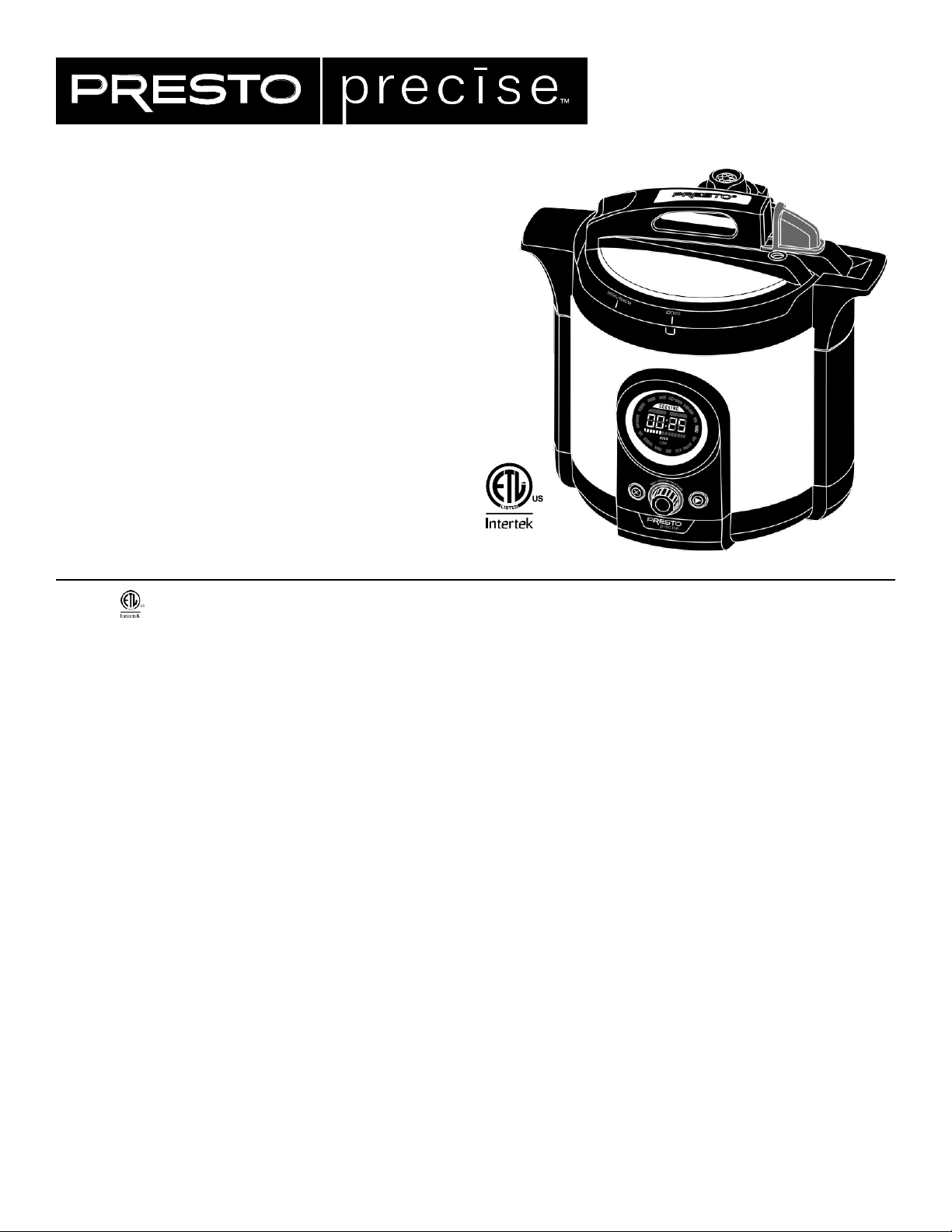
quart multi-use programmable
Pressure Cooker Plus
Slow Cooker • Rice Cooker • Steamer • and More
INSTRUCTIONS AND RECIPES
Estas instrucciones también están disponibles en español. Para
obtener una copia impresa:
• Descargue en formato PDF en www.GoPresto.com/espanol.
• Envíe un correo electrónico a contact@GoPresto.com.
• Llame al 1-800-877-0441, oprima 2 y deje un mensaje.
Visit www.PrestoPrecise.com ©2018 National Presto Industries, Inc.
Form 4017-004B
This is an Listed appliance. The following important safeguards are recommended by most portable appliance manufacturers.
IMPORTANT SAFEGUARDS
To reduce the risk of personal injury or property damage, basic safety precautions should always be followed, including the following:
1. Read all instructions. Improper use may result in bodily injury or property damage.
2. Before each use, check both the vent pipe (Fig. A, page 3) and vent filter (Fig. E, page 4) to be certain they are free of any blockage.
Remove the filter and clean any debris from both the vent pipe and filter (see cleaning instructions on page 8).
3. Always check the air vent/cover lock to be sure it moves freely before use.
4. To protect against electrical shock, do not immerse cord, plug, or cooker body in water or other liquid.
5. Do not let children handle or put electrical cords or plugs in their mouths.
6. Always attach plug to appliance first, then plug cord into the wall outlet. To disconnect, press cancel, then remove plug from wall
outlet.
7. Unplug cord from unit and outlet when not in use and before cleaning. Allow unit to cool before putting on or taking off parts
and before cleaning.
8. Do not operate any appliance with a damaged cord or plug or in the event the appliance malfunctions or has been damaged in
any manner. Return the appliance to the Presto Factory Service Department for examination, repair, or electrical or mechanical
adjustment.
9. WARNING! Spilled food can cause serious burns. Keep appliance and cord away from children. Never drape cord over edge of
counter or table. Never plug cord into outlet below counter or use an extension cord. Do not let cord touch hot surfaces.
10. To guard against electrical shock, cook only in the removable cooking pot provided.
11. The use of accessory attachments not recommended by the appliance manufacturer may cause injuries. Use only genuine Presto
™
accessories and replacement parts.
12. Intended for countertop use only.
13. Do not place on or near a hot gas or electric burner or in a heated oven.

2
14. Do not fill above the ⅔ fill line. However, the cooking pot should never be filled above the ½ fill line when cooking foods that
foam, froth, or expand, such as rice, grains, dry beans, peas, and lentils, or foods that are mostly liquids, such as soups. Overfilling
may cause a risk of blocking the vent pipe and developing excess pressure. See food preparation instructions.
15. Do not pressure cook applesauce, cranberries, rhubarb, cereals, pasta, split peas, and soup mixes containing split peas, pasta, or
grains. These foods tend to foam, froth, and sputter and may block the vent pipe, vent filter, and air vent/cover lock.
16. This appliance cooks under pressure. Improper use may result in scalding injury. Make certain pressure cooker is properly closed
before operating. See “How to Use” instructions.
17. Air bubbles may form when cooking certain foods (see the warning information on page 5). After cooking these foods, disperse
any air bubbles by rocking the cooker from side to side as described on page 5.
18. Do not attempt to open pressure cooker until all internal pressure has been released, the air vent/cover lock has dropped, and no
steam escapes when the quick pressure release valve is rotated to the STEAM OUT position. The cover should open as easily as
it closed. If the cover is difficult to open, the instructions have not been followed correctly (air vent/cover lock is still up) and the
cooker may still be pressurized. Any pressure in the cooker can be hazardous. Never force open the cover of any pressure cooker.
See “How to Use for Pressure Cooking” instructions.
19. Extreme caution must be used when moving a pressure cooker containing hot liquids. Do not touch hot surfaces. Always use
appliance handles.
20. To ensure safe operation and satisfactory performance, replace the sealing ring if it shrinks, becomes hard, deformed, cracked, or
torn. Use only genuine Presto
™
replacement parts.
21. Close supervision is necessary when the pressure cooker is used near children. It is not recommended that children use the pressure
cooker.
22. Do not use this appliance for other than intended use.
23. Do not use this appliance for deep fat frying.
24. Do not use outdoors.
SAVE THESE INSTRUCTIONS
THIS APPLIANCE IS FOR HOUSEHOLD USE ONLY.
Important Cord Information
To reduce the risk of electric shock, this appliance has a 3-prong grounded plug. If the plug on this appliance does not fit into your outlet,
contact a qualified electrician. Do not attempt to modify the plug in any way. A short detachable power supply cord is provided to reduce
the risk of becoming entangled in or tripping over a longer cord. Do not use with an extension cord. Connect the power supply cord
to a 120VAC electrical outlet only.
Table of Contents
Important Safeguards ............................................................... 1
Introduction .............................................................................. 3
Before First Use ....................................................................... 3
Cooker Parts ............................................................................. 3
Important Information .............................................................. 4
How to Operate the Digital Control Panel ............................... 5
How to Use for Pressure Cooking ............................................ 7
Pressure Release Methods ........................................................ 8
How to Use for Slow Cooking ................................................. 8
Cleaning ................................................................................... 8
Care and Maintenance .............................................................. 9
Helpful Hints ............................................................................ 9
Questions and Answers .......................................................... 10
Pressure Cooking Recipes
Soups and Stews ................................................................. 11
Fish and Seafood.................................................................12
Meat, Poultry, and Eggs ......................................................13
Vegetables ..........................................................................16
Dry Beans, Peas, and Lentils ..............................................18
Grains .................................................................................19
Desserts...............................................................................20
Slow Cooking Recipes ...........................................................21
Recipe Index ..........................................................................22
Consumer Service Information ..............................................22
Warranty.................................................................................22
3
frame
Grommet
Introduction
With your new Presto
®
Multi-use Programmable Pressure Cooker Plus, you’ll discover how fast and easy it is to prepare a wide variety
of delicious meals. The unit is pre-programmed for pressure cooking. It automatically maintains the proper temperature while cooking
then reduces pressure and switches to the keep warm mode when cooking is complete. In addition to pressure cooking, this appliance
can be used to brown, sauté, slow cook, and keep cooked foods warm.
The innovative technology senses the temperature inside the cooker to assure the exact pressure is maintained for precise cooking no
matter where you live. No altitude adjustments are needed. There are 9 built-in safety features, including a cover locking system that
allows pressure to build only when the cover is closed. It also prevents the cover from being opened until pressure is safely reduced.
Before First Use
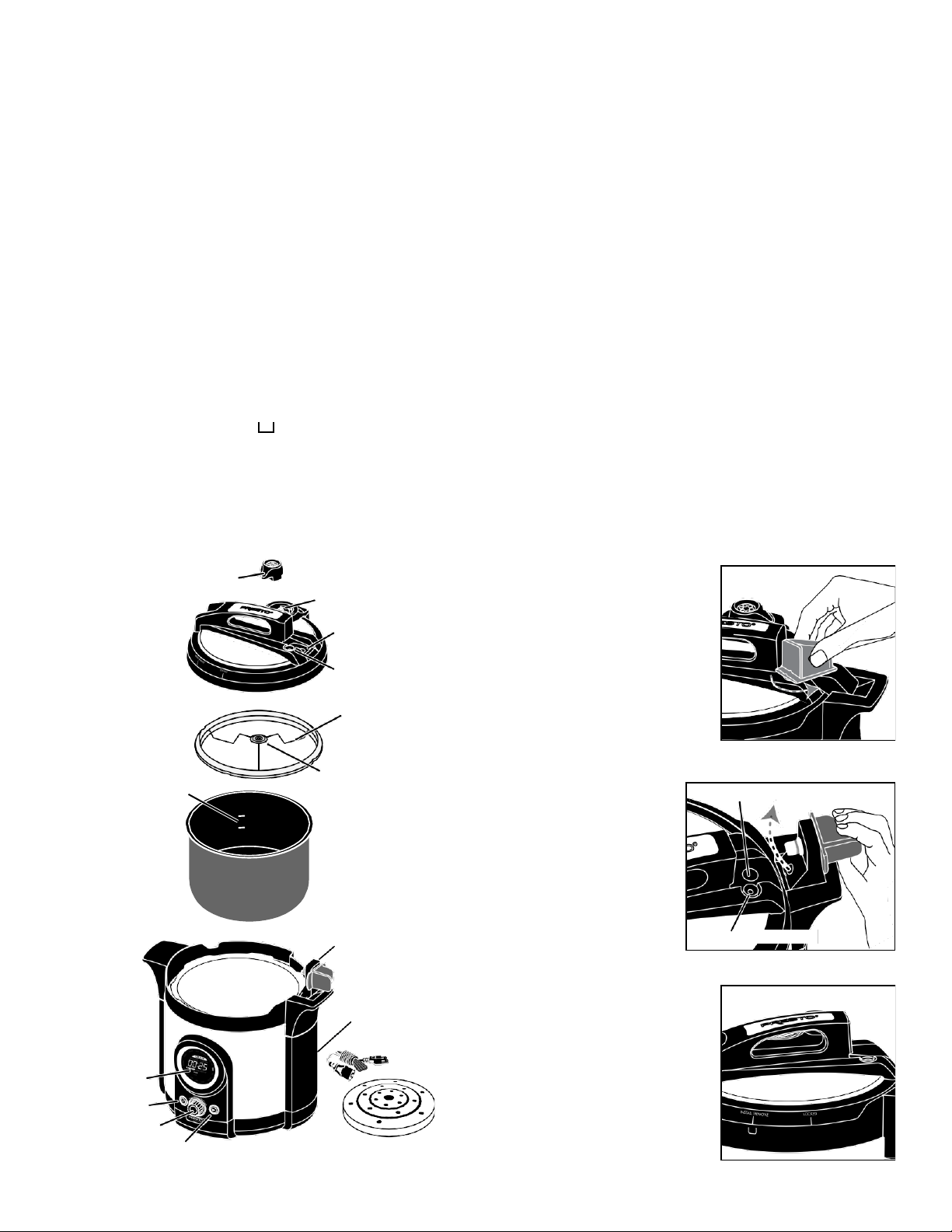
As received, your pressure cooker will be fully assembled. Before removing the cover, you will need to unlock the green locking latch
according to the instructions below. Before use, disassemble the cooker parts and clean them as directed on page 4. Become familiar with
the various parts (Fig. A) and read all instructions carefully.
Remove the Cooker Cover
1. Before removing the cover, you will need to unlock the green locking latch. Begin by positioning the cooker so the digital display
faces you. To unlock the latch, grasp the sides of the latch and turn it towards you until it stops (Fig. B). Lift the temperature sensor
arm out of the sensor hole in the cover (Fig. C).
2. Once you have released the temperature sensor arm from the cover, rotate the cover counterclockwise until the INSTALL/REMOVE
vertical mark is within the mark on the cooker body (Fig. D). Then lift the cover straight up off the cooker body.
Fig. A
Cooker Parts
Valve lever
Cover handle
Locking cover
Sealing ring
Fill lines
Quick pressure
release valve
Vent pipe
Sensor hole
Green air vent/cover lock
Sealing ring
Fig. B
Turn locking
latch
Fig. C
Lift temperature
sensor arm
Removable
cooking pot
Carrying
handle
Temperature sensor arm
Cooker body
Digital display
Cancel button
Control knob
Start button
Green locking latch
Cord receptacle
Detachable power cord
Cooking rack
Fig. D
Rotate cover
Sensor hole
Green air vent/cover lock
4
Disassemble Cooker Parts for Cleaning
It is recommended that the pressure cooker be thoroughly washed before first use to remove
any manufacturing lubricants.
1. Lift the cooking rack and removable cooking pot out of the cooker body. Remove all
packaging.
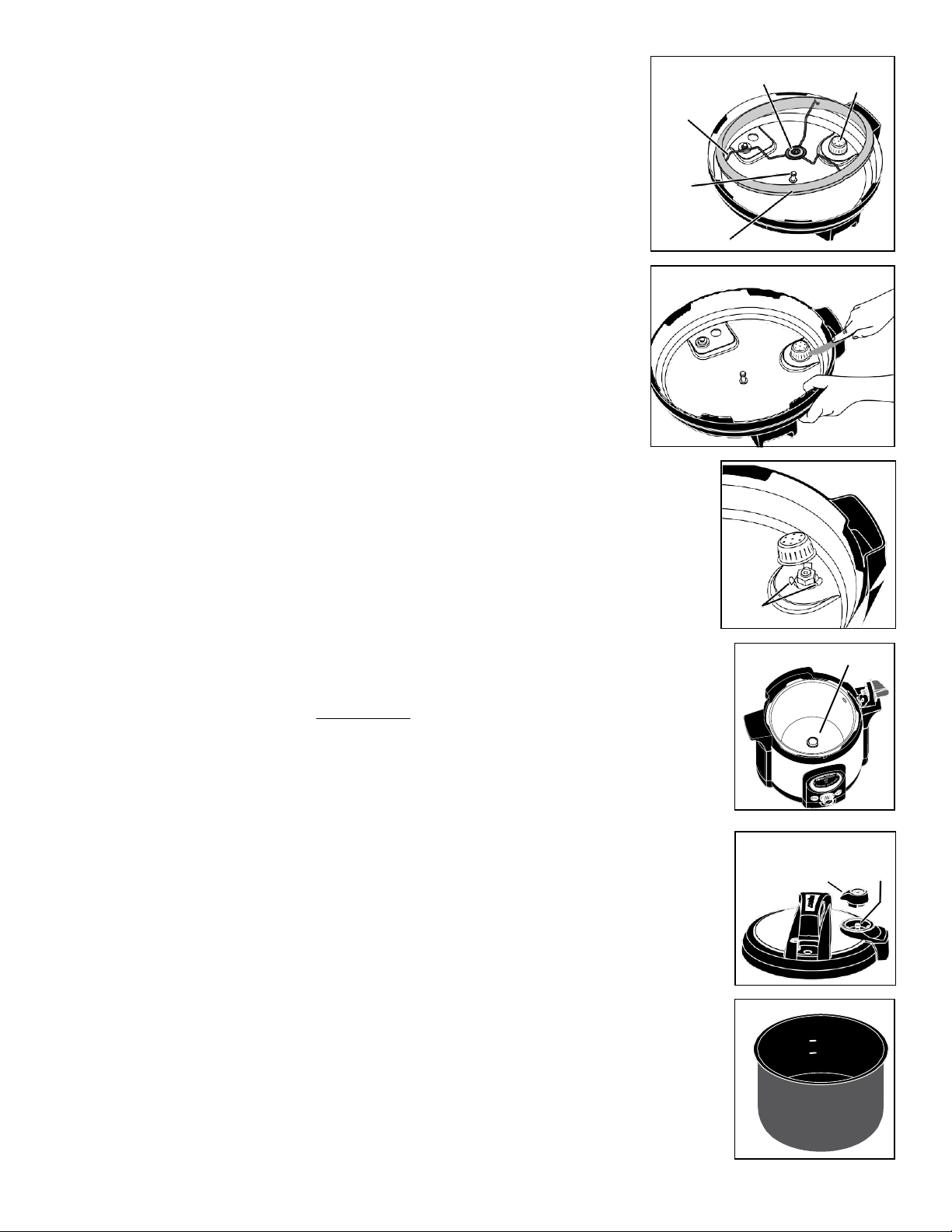
2. Invert the cover and pull the sealing ring frame out from the cover (Fig. E).
Then remove the vent filter for cleaning. To remove, place the inverted cover on the
counter, then rest a table knife on the rim of the cover and insert the tip into one of the
filter slots (Fig. F); lift the filter up.
NOTE: Although you will not need to remove the filter after every use, you should
periodically remove it for cleaning.
3. Remove the sealing ring from the sealing ring frame. Wash the sealing ring, sealing
ring frame, vent filter, cooking rack, and removable cooking pot in warm, soapy water.
Rinse and dry thoroughly.
4. Clean the cooker cover with a damp, soapy cloth. Do not immerse the cooker cover
in water.
CAUTION!
To prevent electrical shock, never pour water into the cooker body or immerse
it or the power cord in water. Always be sure the cooking pot is COMPLETELY DRY
before placing it back in the cooker body.
5. After cleaning, reassemble the cover. Be sure the filter is placed over all 3 clips (Fig. G)
when reattaching the vent filter. Then push it in place. You will hear a snap when it is in the proper
position. It should fit tightly.
Place the sealing ring back onto the sealing ring frame and reattach the sealing ring frame to the
cover. Fit the grommet over the cover post (Fig. E) and push it down until the frame is securely
positioned in the cover.
Important Information
In order for the unit to function properly, always follow these instructions:
♦ Be sure the bottom of the removable cooking pot and the heating plate (Fig. H) within the cooker
body are free of debris before placing the cooking pot in the cooker body.
CAUTION!
To prevent electrical shock, never use the unit without the removable cooking pot. Also, be
sure the outside of the cooking pot is completely dry before placing it into the cooker body.
♦ Check both the vent pipe and vent filter to be sure they are clear. In order to check the vent pipe, you
will need to remove the quick pressure release valve from the cover (Fig. I). Then hold the cover up
to the light and make sure you can see light coming through the vent pipe. If you cannot, remove the
sealing ring frame and vent filter and clean the vent pipe with a small brush or pipe cleaner to remove
the blockage. Reattach the sealing ring frame to the cover.
♦ Always verify that the sealing ring frame is attached to the pressure cooker cover before cooking.
♦ Make sure you have not overfilled the cooking pot. Do not fill above the ⅔ fill line when cooking
most foods. When cooking foods that foam, froth, or expand, such as rice, grains, dry beans, peas, and
lentils, or foods that are mostly liquids, such as soups, never fill the cooking pot above the ½ fill line.
For your convenience, both the ⅔ and ½ fill lines are marked inside of the cooking pot (Fig. J). In
addition, in each section of the recipes you will find instructions on the maximum fill level for each
type of food.
♦ Always make sure cooking liquid has been added to the cooking pot. One cup of liquid is the minimum
amount.
♦ Always follow special procedures found in the instruction book when pressure cooking dry beans,
peas, and lentils (page 18). During cooking, these foods tend to froth and foam which could cause the
vent pipe to become blocked.
♦ Never pressure cook applesauce, cranberries, rhubarb, cereals, pasta, split peas, and soup mixes con-
taining split peas, pasta, or grains. These foods expand so much as a result of foaming and frothing that
they should never be cooked under pressure.
♦ Always follow the special procedures found on page 19 when pressure cooking rice and grains.
Fig. E
Sealing ring
frame
Grommet
Vent filter
Cover
post
Sealing ring
Fig. F
Fig. H
Heating plate
Fig. J
⅔ line
½ line
Fig. G
Clips
Fig. I
Quick pressure
release valve
Vent
pipe
5
♦ Do NOT use the quick pressure release method after cooking dry beans, peas, lentils, grains, or foods that are mostly liquid, such
as soup, sauces, and stews (page 8).
♦ Always verify that the green air vent/cover lock is down before attempting to open the cooker (Fig. Q, page 7). If it is up, the cooker
contains pressure which, if released, may result in burns and/or property damage. Then check that no steam is emitted when the
pressure release valve is rotated to the steam out position.
♦
WARNING!
Air bubbles may form when pressure cooking foods with a higher fat content (such as meats with visible fat or poultry
with skin and visible fat) or thicker foods (such as stews, sauces, heavy soups, dried beans, lentils, and grains such as rice and barley).
Even after all pressure has been released, those air bubbles can rise to the surface when the cover is opened, unless they are dispersed
beforehand. If the air bubbles are not dispersed, hot food may erupt out of
the cooker, which could cause serious burn injuries.
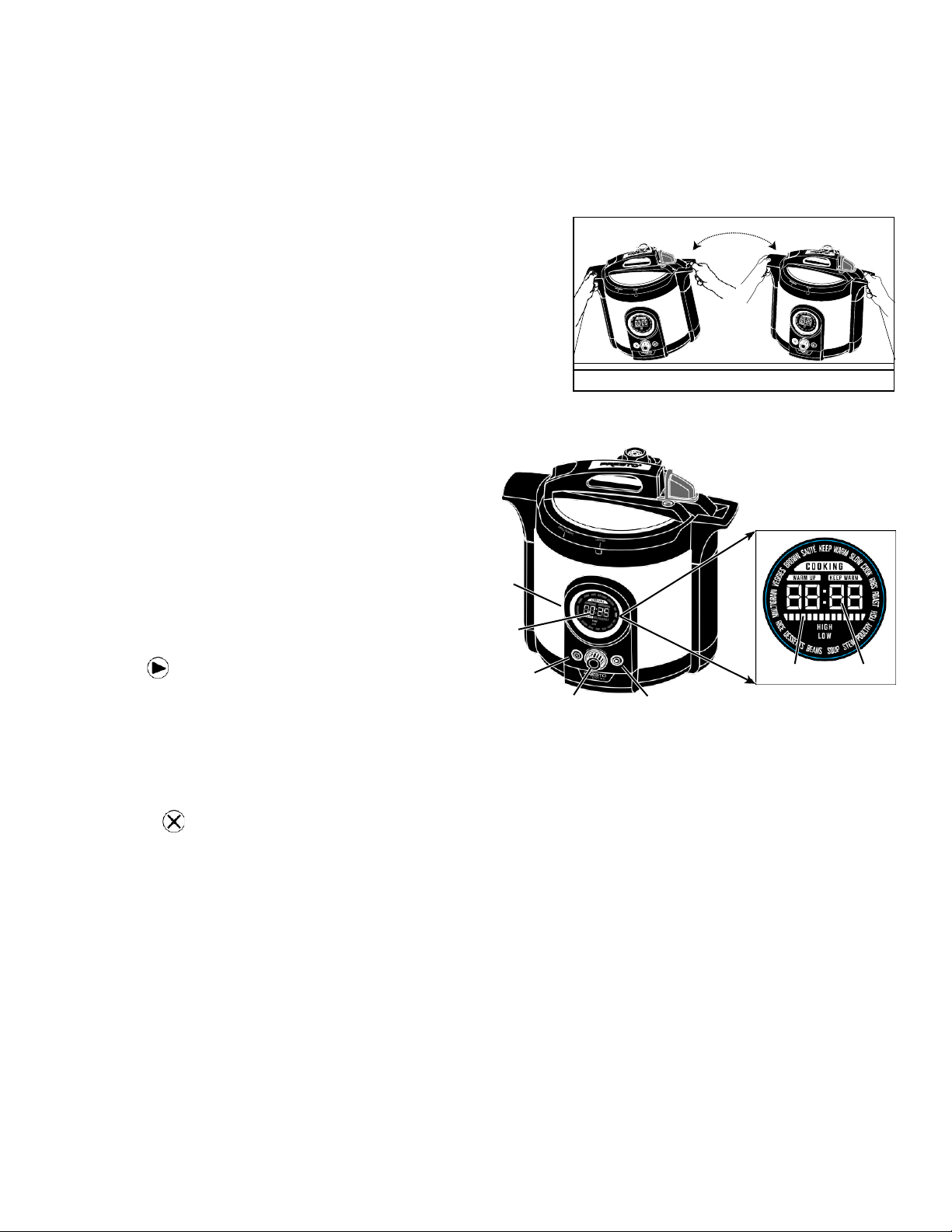
To disperse the air bubbles, follow these steps: First, verify the pressure has
been released (the green air vent/cover lock will be in the down position).
Next, prior to opening the cover, gently rock the cooker from side to side.
To rock, grasp the handles and tilt the cooker to the left, so the right side of
the cooker lifts 2 inches off the counter. Then rock to the right so the left
side of the cooker lifts 2 inches off the counter (Fig. K). Repeat once. Verify
the air vent/cover lock is still down before attempting to open the cover.
How to Operate the Digital Control Panel
Whenever you plug in the unit, it will beep once and all of the
program options will appear in the display window on the digital
control panel. The KEEP WARM setting will be flashing. This is
the “Ready State” (Fig. L). The following information describes
how the control panel buttons and preset programs function.
Control Knob
The control knob is used to select the preset programs that
appear around the perimeter of the display window as well as
adjust the time and cook settings. As you turn the knob, each
preset program will flash.
Fig. L
Digital
control
panel
Display
window
Preset programs
(entire perimeter)
Start Button
The start button activates the unit once the cooking function
and time have been selected.
Current Mode Indicators
Cancel
button
Control knob Start button
Progress bar
Timer
Once the start button is pressed, the mode the unit is currently in will illuminate. There are three modes: WARM UP, COOKING, and
KEEP WARM.
Cancel Button
The cancel button allows you to end the cooking or keep warm function at any time. Simply press the cancel button once. When you
press cancel, the unit will return to the “Ready State.”
Timer
When pressure cooking, the timer will not start counting down until the cooker reaches operating pressure. When slow cooking, the timer
immediately starts counting down once the slow cooking function is activated. When the unit is in the KEEP WARM mode, the timer
will count up to indicate how much time the unit has been in this mode.
Progress Bar
During the warmup period, the progress bar will scroll from side to side to indicate the unit is heating. Once cooking begins, the progress
bar will start to light up. It will increase in length as cooking progresses to correspond with the cooking time (e.g., if 15 minutes of a 20
minute program have elapsed, 75% of the bars will be illuminated).
Pressure/Slow Cook Setting Indicator
Both pressure cooking and slow cooking have a HIGH and LOW setting. Whatever setting is being used will be illuminated in the lower
half of the display window.
Fig. K
Rock the cooker from side to side to disperse air bubbles.

6
Keep Warm Mode
When the cooking time has expired, the unit will automatically switch to the keep warm mode. When in the keep warm mode, KEEP
WARM will illuminate and the timer will begin to count up. The unit will remain on for 4 hours and then shut off automatically, unless
the cancel button is pressed. The keep warm mode can also be manually selected. Turn the control knob until KEEP WARM flashes on
the perimeter of the display. Then press the start button.
Brown/Sauté Functions
Use these functions to brown or sauté foods prior to pressure cooking or slow cooking. Browning is typically used for meats and poultry.
Sautéing is used for vegetables and to reduce liquid after pressure cooking to make a flavorful sauce for your food. Turn the control knob
to the desired function, BROWN or SAUTÉ. Then press the start button. COOKING will illuminate and the progress bar will continuously
scroll to indicate the function is active. Allow unit to preheat for 3 to 4 minutes before browning or sautéing your food.
Slow Cook Function
For slow cooking, turn the control knob to SLOW COOK. Note as you continue to turn the control knob, the unit will change between
the LOW and HIGH settings. The default cook time is 4 hours on high and 8 hours on low. You can manually adjust the slow cooking
time in 30-minute increments by pressing the control knob once and then turning the knob to the desired time.
The maximum slow cooking time at both settings is 9 hours and 30 minutes; the minimum is 30 minutes. When the time is set, press the
start button to activate the unit. COOKING will illuminate and the timer will immediately begin counting down. As cooking progresses,
the number of bars lit on the progress bar will increase.
Pressure Cooking Preset Programs
The digital control panel includes 12 pressure cooking presets. Turn the control knob to select the desired program. NOTE: VEGGIES
has two presets, HIGH and LOW. Simply turn the knob to select one or the other.
Once the program is selected, it will flash and the time and pressure for that program will be displayed, unless you have selected KEEP
WARM, BROWN, or SAUTÉ. Press the start button to activate the unit.
Because of the great variety of foods within a food grouping, the preset time may need to be adjusted manually. If you desire a time
different than that displayed for the program, press the control knob and the default cook time will begin to flash. Then turn the control
knob to increase or decrease the time. Once the time you desire is displayed, press the start button to activate the unit.
NOTE: If you fail to change the time, press the cancel button and try again. Use the cooking charts included in the recipe section as a
guide for recommended cooking times.
Preset Programs
Preset Time
Preset Pressure
Preset Programs
Preset Time
Preset Pressure
BEANS
8 minutes
HIGH
RICE
10 minutes
HIGH
DESSERTS
10 minutes
HIGH
ROAST
45 minutes
HIGH
FISH
2 minutes
LOW
SOUP
15 minutes
HIGH
MULTIGRAIN
25 minutes
HIGH
STEW
12 minutes
HIGH
POULTRY
10 minutes
HIGH
VEGGIES (HIGH)
10 minutes
HIGH
RIBS
25 minutes
HIGH
VEGGIES (LOW)
1 minute
LOW
For all pressure cooking presets, the maximum cooking time is 2 hours and the minimum is 1 minute.
NOTE: While pressure is building, the time will not change. The unit begins counting down when the correct pressure is reached for
the food selected.
Adjusting Pressure Manually
You can manually set the pressure instead of using the preset programs, if you prefer. Simply press and hold the control knob for a few
seconds. All of the preset cooking programs will disappear in the display window and the unit will reset to 00:00 and HIGH pressure.
The cook time will be flashing to indicate the unit is in adjustment mode. Turn the control knob to adjust the time.
Once you have set the desired time, if you want to adjust the pressure from HIGH to LOW, press the control knob again. HIGH will
flash. Turn the control knob until LOW is flashing. Press the start button to activate the unit. If you accidentally select the wrong pressure
setting or time, simply press cancel to reset the cooker and try again.
High pressure is suitable for most foods. Use low pressure for delicate foods such as fish and some vegetables.
7
Fig. P
Green locking latch
aligned with handle
Green air vent/
cover lock in up
position.
How to Use for Pressure Cooking
Before you begin cooking, review the “Important Information” instructions on pages 4 and 5 and always
verify that the unit is properly assembled.
1. Place the pressure cooker on a dry, level surface. To avoid steam damage to cabinets, position the
cooker so the air vent/cover lock and quick pressure release valve are not directly under cabinets.
2. Place the removable cooking pot into the cooker body. NEVER USE THE UNIT WITHOUT THE
REMOVABLE COOKING POT.
3. Attach power cord to cooker and then plug into a 120VAC wall outlet.
4. Prepare ingredients according to the directions in the recipe you have selected. If the recipe states to
brown or sauté food, select the BROWN or SAUTÉ function (page 6) and press the start button to
activate the unit. Preheat the unit for 3 to 4 minutes and brown or sauté food according to recipe. When
browning/sautéing is complete, press the cancel button so you can select another cooking function.
5. If recipe calls for using the cooking rack, place cooking rack into the cooking pot. See “Helpful
Hints” on page 9 for guidance on when to use rack. Add ingredients to the cooking pot, being sure
not to overfill (see page 4 for information on filling).
6. Pour liquid into the cooking pot, as specified in the recipe or timetable.
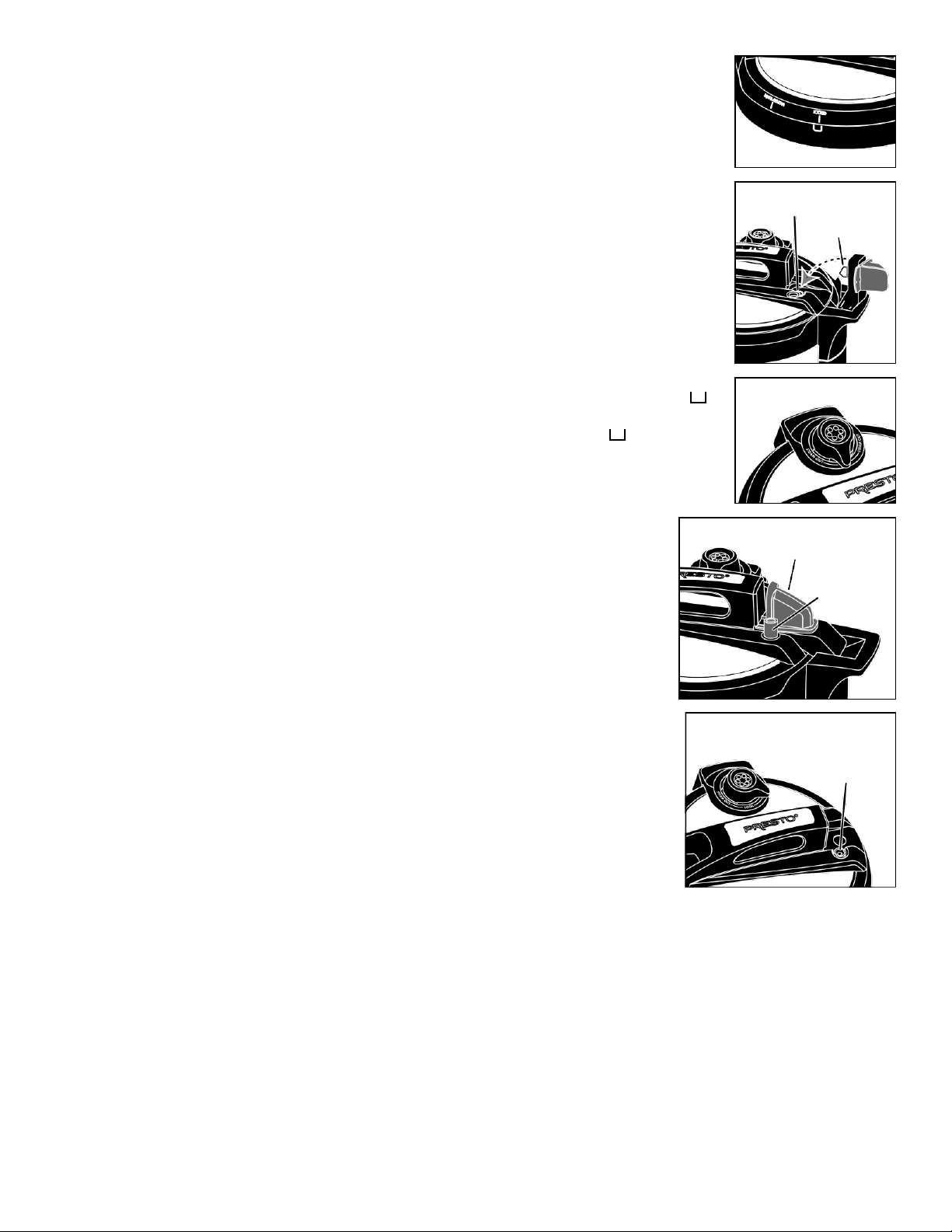
7. Place the cover on the cooker body, aligning the INSTALL/REMOVE vertical mark within the
mark on the cooker body (Fig. D, page 3). Rotate the cover clockwise until it stops. The pressure
cooker cover is properly installed when the LOCKED vertical mark is within the mark on the
cooker body (Fig. M).
8. With the digital display facing you, lower the temperature sensor arm and insert the sensor into its
hole in the cover (Fig. N). It may be necessary to rotate the cover slightly so the hole aligns with the
sensor. Lock the cover by grasping the green latch. Using a slight downward pressure, turn
the latch clockwise until it is aligned with the handle (Fig. P).
9. Push the quick pressure release valve onto the vent pipe and point the lever to the COOK
position (Fig. O).
10. Using the control knob, scroll to select the appropriate preset for the desired function and/
or type of food. Adjust the cooking time as necessary. Or, if preferred, manually set the
pressure and time (page 6).
11. Press the start button to activate the unit. WARM UP will illuminate. As the unit is heating,
air will automatically exhaust around the air vent/cover lock. You will hear this venting.
When pressure begins to build, the green air vent/cover lock will slide up (Fig. P), so the
locking latch cannot be turned and the cover cannot be opened.
Once the unit is at pressure, COOKING will illuminate and the timer will start to count down.
During cooking you may notice some steam releasing from the quick pressure release valve.
This is normal. NOTE: Occasionally you may hear a ticking sound. This is the unit cycling
on and off during cooking to maintain the pressure or heat.
12. When the cook time has expired, the unit will beep 10 times and automatically switch to the
keep warm mode. KEEP WARM will be illuminated.
13. Reduce pressure according to the recipe or timetable instructions (quick pressure release or
drop pressure of its own accord). See instructions on page 8. Do not open the cooker until all
internal pressure has been released. You will know the pressure is completely reduced when
the green air vent/cover lock drops and no steam is emitted when the pressure release valve is in the STEAM OUT position (Fig. Q).
WARNING!
Never attempt to open the cooker when the green air vent/cover lock is up. Doing so could result in severe burns and/
or property damage from the release of pressurized contents.
Next, if cooking thicker or higher fat foods as described on page 5, rock the cooker from side to side as illustrated to ensure all
air bubbles are dispersed. Verify the air vent/cover lock is still down before attempting to open the cover.
14. After pressure is completely reduced and potential air bubbles dispersed, unlock the cover as described on page 3. When removing
the cover, lift it toward you to keep any steam away from you. Place cover upside down on counter.
CAUTION!
Steam may escape and hot liquid may drip from the cooker cover when removing it. Steam and hot liquid can cause burns.
15. Remove food from cooker using a heat-resistant plastic, nylon, rubber, or wooden utensil. Do not use metal utensils as they may
scratch the nonstick surface.
16. When cooking is complete, unplug power cord from wall outlet and then from pressure cooker. Allow cooker to cool completely
before cleaning.
Fig. O
COOK position
Fig. Q
STEAM OUT position
Green air vent/cover
lock in down position.
No pressure in unit.
Fig. N
Sensor hole
Sensor
Fig. M

8
Pressure Release Methods
1.
Quick Pressure Release.
This method is used when cooking vegetables, seafood, and other delicate foods.
WARNING!
To prevent
the risk of severe personal injury and property damage, DO NOT USE the quick pressure release method after cooking dry beans,
peas, lentils, grains, or foods that are mostly liquid, such as soup, sauces, and stews.
When cooking time is up, press the cancel button and immediately move the lever on the quick pressure release valve to the STEAM
OUT position (Fig. Q, page 7). You will hear sputtering and steam will release for approximately 2 to 3 minutes. Pressure is com-
pletely reduced when the green air vent/cover lock has dropped (Fig. Q).
CAUTION!
To prevent steam burns, keep hands and face away from the top of the pressure cooker as pressure is being released.
2. Let pressure drop of its own accord. This method is used when cooking foods such as meats, soups, and grains. When cooking
time is up, keep the quick pressure release valve in the COOK position. Let the pressure cooker cool until the green air vent/
cover lock drops. Then move the pressure release valve to the STEAM OUT position.
NOTE: If desired, the food may be left in the cooker, which automatically switches to the keep warm mode. Prior to opening the
cooker, be sure to disperse any air bubbles by rocking it from side to side (see instructions on page 5).
How to Use for Slow Cooking
1. Follow steps 1 through 8 of the “How to Use for Pressure Cooking” instructions on page 7.
2. Push the quick pressure release valve onto the vent pipe. IMPORTANT: Point the lever to the STEAM OUT position.
3. Using the control knob, scroll to select SLOW COOK-LOW or SLOW COOK-HIGH. Adjust the slow cooking default time, if
desired (page 6). Press the start button to activate the unit. COOKING will illuminate and the timer will begin counting down.
4. When the cook time has expired, the unit will beep 10 times and automatically switch to the keep warm mode.
5. Press the cancel button. Unlock the cover as described on page 3. When removing the cover, lift it toward you to keep any steam
away from you. Place cover upside down on counter.
CAUTION!
Steam may escape and hot liquid may drip from the cooker cover when removing it. Steam and hot liquid can cause burns.
6. Remove food from cooker. Use a heat-resistant plastic, nylon, rubber, or wooden utensil. Do not use metal utensils as they may
scratch the nonstick surface.
7. When cooking/keep warm are complete, unplug power cord from wall outlet and then from pressure cooker. Allow cooker to cool
completely before cleaning.
Cleaning
After every use
1. After the cooker has cooled completely, remove the quick pressure release valve from the cover. Then detach the sealing ring frame
from the cover (Fig. E, page 4). Remove the sealing ring from the frame. Do not remove the center grommet on the sealing ring frame.
If the vent filter appears dirty or contains debris, remove it from the underside of the cover, following the instructions on page 4.
2. Clean the cooker cover with a damp, soapy cloth and then dry completely. Do not immerse the cooker cover in water.
Wash the sealing ring, sealing ring frame, and vent filter in warm, soapy water. Do NOT wash these parts in the dishwasher. Thor-
oughly dry all cover parts after cleaning.
3. To be sure the vent pipe is clear, hold the cover up to the light and look through the vent pipe. Clean it with a small brush or pipe
cleaner if it is blocked or partially blocked. If necessary, clean the vent filter with a small brush to remove any food particles from
the slots and holes. Rinse and dry all parts thoroughly and reassemble.
4. Wash the cooking rack in warm, soapy water. Do NOT wash in the dishwasher.
5. Remove the cooking pot from the cooker body. Wash the pot in the dishwasher or in warm water and a mild detergent.
The nonstick surface may be cleaned with a non-metal cleaning pad, such as Scotch-Brite* Multi-Purpose Scrub Sponge or
Scotch-Brite* Dobie* Cleaning Pad. Do not use steel wool or abrasive cleaners on the cooking pot or the cooker body.
Soaking the cooking pot to loosen food residue is not necessary. If, however, soaking the pot is desired, do not soak for more than
2 hours as this may damage the nonstick finish.
CAUTION!
To prevent electrical shock, never pour water into the cooker body or immerse it or the power cord in water. Always
be sure the pot is COMPLETELY DRY before placing it back in the cooker body.
6. Clean the sensor, sensor arm, and plastic rim of the cooker body with a damp cloth. Avoid getting water inside of the cooker body.
* Scotch-Brite and Dobie are registered trademarks of 3M Company. Presto is not affiliated with this company.
9
Occasionally
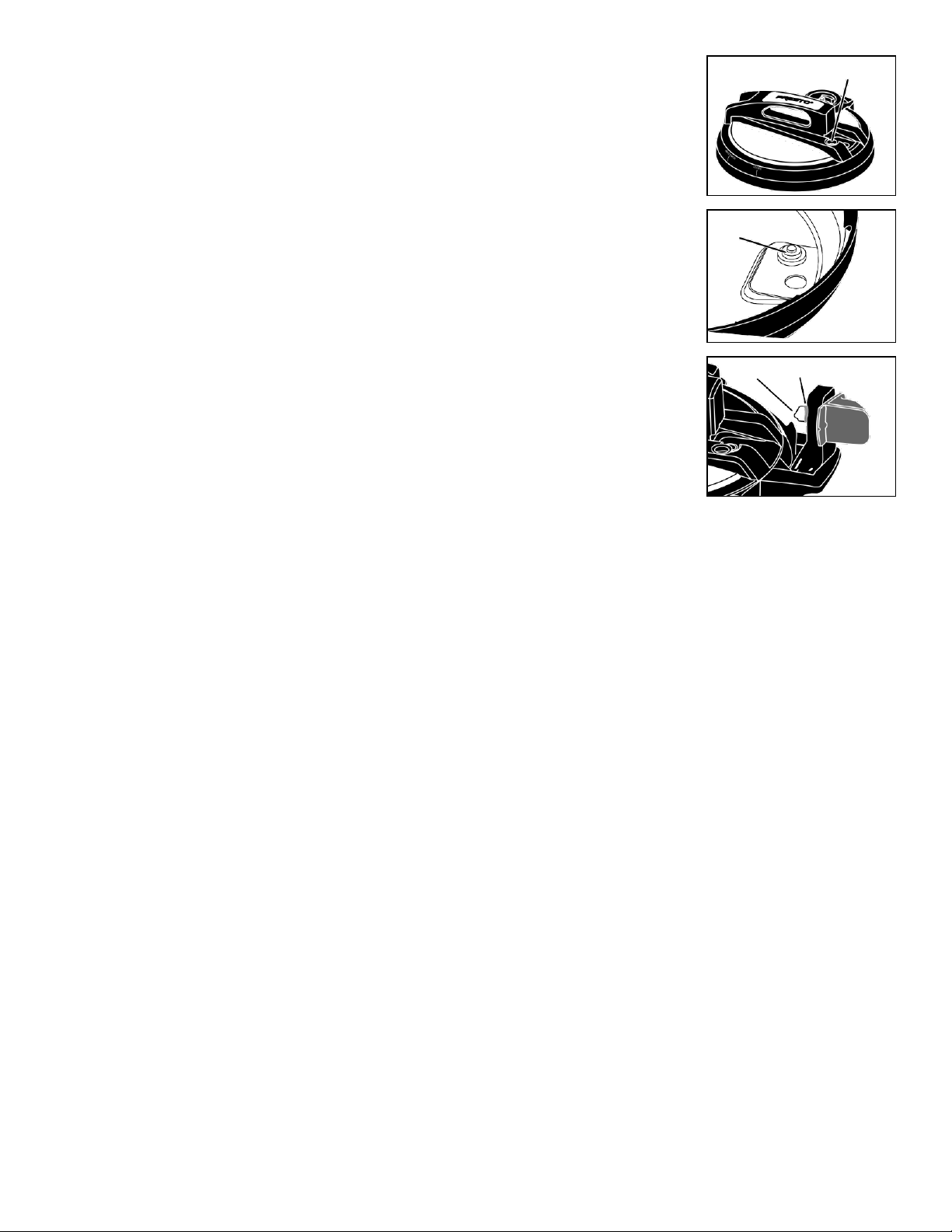
1. Remove the air vent/cover lock for cleaning. Place your finger over the top of the air vent/cover
lock on the cover (Fig. R) and remove the gasket from the underside of the cover (Fig. S). Push
the air vent/cover lock through the top of the cover. Wash it and the gasket in warm, soapy water.
The metal shaft may be cleaned with a nylon mesh pad. Clean the cover hole with a small brush.
After cleaning, reinsert the metal shaft from the top side of the cover down through the cover
hole. Place a finger over the top of the air vent/cover lock and push the gasket onto the end of
the metal shaft, fitting it into the groove.
2. Remove the gasket on the sensor (Fig. T) and wash it in warm, soapy water. Clean the sensor
with a damp cloth and place the gasket back on the sensor.
3. Wipe the outside of the cooker body with a damp cloth.
Care and Maintenance
♦ When not in use, store your pressure cooker in a dry place. To prevent unpleasant odors from
lingering, store the unit with the cover inverted on the cooker body.
♦ As is the case with all cookware, avoid chopping or cutting food inside the cooking pot with a
knife or other sharp utensil. Do not use metal utensils as they may scratch the nonstick surface.
♦ Do not strike the rim of the cooking pot with any cooking utensil. This could cause nicks in the
rim which may allow steam to escape and prevent the pressure cooker from sealing.
♦ The sealing ring and gasket for the air vent/cover lock may shrink, become hard, deformed,
cracked, or torn with normal use. When this happens, replace the sealing ring and/or the air vent/
cover lock gasket.
Leakage between the cover and cooker body is usually caused by deterioration of the sealing ring after prolonged use.
♦ Periodically check the vent pipe nut for looseness. If necessary, retighten with a ½ʺ wrench.
♦ If for any reason the pressure cooker cannot be opened, contact the Consumer Service Department in Eau Claire, WI at 1-800-877-0441.
♦ Any maintenance required for this product, other than normal household care and cleaning, should be performed by the Presto
Factory Service Department (page 22).
Helpful Hints
♦ Your favorite recipes may be adjusted for cooking in the pressure cooker by following the general directions in this manual. Use the
included timetables and recipes as a guide for specific foods and cooking times.
There is very little evaporation during pressure cooking, so the amount of liquid used should be decreased. A minimum of 1 cup of
water or cooking liquid should always be used for pressure cooking.
Of course, the easiest way to adapt your favorite conventional recipe is to find a similar recipe for pressure cooking in this book
and use it as a guide.
♦ Use the cooking rack when it is desirable to cook foods out of the cooking liquid. When foods are pressure cooked out of the liquid,
flavors will not intermingle. Therefore, it is possible to cook several foods at once, as long as they have similar cooking times. If it
is desirable to blend flavors, do not use the cooking rack.
♦ Many different cooking liquids can be used in a pressure cooker. Wine, beer, broth, fruit juices, and of course water all make excellent
cooking liquids in the pressure cooker.
♦ It is the size and shape of the food pieces, rather than the quantity, that affects pressure cooking time. For example, one potato will
have the same cooking time as six potatoes of similar size. It is important to note the size of the food specified in the cooking time-
tables; if the pieces of food being cooked are of a size different than those noted, it will be necessary to adjust the cooking time.
♦ If you have any questions on recipes, cooking times, or the operation of your pressure cooker, the Test Kitchen can be reached at
1-800-368-2194 or send an email via www.GoPresto.com.
Fig. R
Air vent/cover lock
Sensor Gasket
Fig. T
Gasket
Fig. S

10
Questions and Answers
1.
Sometimes when pressure cooking, I notice beads of moisture forming in the area of the pressure release valve and hear what
sounds like escaping steam before the timer begins to count down. Is there something I am doing wrong?
No. Both are normal and can be expected as part of pressure cooking.
2.
I accidentally selected the wrong program and pressed the start button and the cooker is not allowing me to select the right
program. What can I do?
Press the cancel button. This will enable you to start over and select the correct program.
3.
When I try to adjust the time, nothing happens. What should I do?
Press the cancel button and begin again by selecting the desired program. Then press the control knob once and adjust the time as
needed.
4.
I can see steam escaping from around the cover. Why?
The sealing ring was not positioned on the sealing ring frame or the sealing ring frame was not installed in the cooker cover.
NOTICE:
If either of these parts are not in place during cooking, the cooker will leak, pressure will not build, and you may damage
the unit.
Leakage may also occur if the sealing ring needs to be replaced. The sealing ring may shrink, become hard, deformed, cracked, or
torn with normal use. When this happens, replace the sealing ring before using the unit again for pressure cooking.
5.
I can hear steam venting from the quick pressure release valve and pressure is not building. Why?
The quick pressure release valve is in the STEAM OUT position. The quick pressure release valve must be in the COOK position
in order for pressure to build and the cooker to seal.
6.
It appears from the display that cooking is taking place, but the air vent/cover lock is not up and I can hear steam venting. Why?
The gaskets are either missing or improperly positioned on the air vent/cover lock and/or the sensor. This will prevent the pressure
cooker from building pressure. Refer to page 9 for instructions on positioning the gaskets. If one of the gaskets is missing, contact
our Consumer Service Department. Call weekdays 8:00 AM to 4:00 PM (Central Time) at 1-800-877-0441 or email us through our
website at www.GoPresto.com/contact.
7.
Sometimes when I’m pressure cooking a larger volume of food, the time doesn’t change. Why?
The pressure cooker has not yet reached operating pressure. Countdown will begin as soon as the cooker reaches operating pressure.
8.
What does it mean when E3 appears in the display window and the unit stops working?
The cooker has overheated. You likely operated the unit in pressure cooking mode with insufficient or no liquid. If this occurs,
unplug the unit and allow it to cool. Then remove the cover and add liquid to the cooker. Plug the unit back in, place the cover on,
and reprogram the cooker.
9.
What does it mean when E1, E2, E4, or E5 appear in the display window and the unit stops working?
Something internally has become damaged, been tampered with, or is defective. The unit will be inoperable if you get one of these
codes. You should unplug the unit and contact our Consumer Service Department. Call weekdays 8:00 AM to 4:00 PM (Central
Time) at 1-800-877-0441 or email us through our website at www.GoPresto.com/contact.
10.
Occasionally the cover is hard to open. What causes this? What should I do?
If the cover seems difficult to open, there may still be pressure in the cooker. Verify the air vent/cover lock has dropped before
trying to open the cooker.
Be sure you have unlocked the green locking latch and lifted the temperature sensor arm away from the cover. The cover will not
open if the temperature sensor arm is still positioned in the cover.
If the cover rotates but it seems to catch on the rim of the body, you are not lifting the cover straight up off the cooker body.
11.
Sometimes my food is not completely done after the recommended cooking time. When I try to put the cover back on the cooker,
so I can cook it longer, the cover will not close. How can I get the cover closed?
Allow the pressure cooker to cool slightly. When the cooker is still hot, the air vent/cover lock will lift, preventing you from closing
the cover. Before placing the cover back on, be sure the quick pressure release valve is in the STEAM OUT position. Once the
cover is closed, move the lever to the COOK position.

11
12.
What can be done after pressure cooking if the food has more liquid than desired?
With the cover removed, select SAUTÉ, press the start button, and allow the excess liquid to evaporate. Next time you prepare the
same recipe, you may want to use less liquid.
13.
I believe I am thoroughly cleaning my cooker, but sometimes I notice the odor of my last meal remains in the cooker. What can
I do to remove the odor?
The sealing ring is made of silicone. Silicone has many wonderful properties but it does tend to retain odors. Unfortunately, there
is no good way to remove the odors, but over time they will dissipate.
14.
I live at a high altitude and normally need to adjust my pressure cooking times. What adjustments should I make with this
pressure cooker?
No adjustments are needed. The temperature sensor automatically assures the exact pressure is maintained for precise cooking no
matter where you live.
Pressure Cooking Recipes
Soups and Stews
This pressure cooker is perfect for preparing delicious soups and stews. Included are a few favorite recipes. If you have a favorite recipe
of your own, try it using one of the recipes in this book as your guide. If adding dry beans and peas, they first must be soaked according
to the directions on page 18.
CAUTION! Do not pressure cook soups or soup mixes containing barley, rice, pasta, grains, or split peas because they have a tendency
to foam, froth, and sputter and could block the vent pipe. These foods should be added to the soup AFTER pressure cooking.
FOR SOUPS AND STEWS, DO NOT FILL COOKING POT OVER ½ FULL!
Classic Chicken Soup
1½ pounds bone-in chicken breasts, skinned
1 cup celery, cut into 2-inch pieces
1 cup coarsely chopped onion
3 cloves garlic, halved
1 teaspoon dried thyme
¾ teaspoon salt
½ teaspoon black pepper
4 cups water
• • • • • • •
1½ cups sliced carrots
1 cup sliced celery
2 green onions, thinly sliced
Add chicken, celery, onion, garlic, thyme, salt, pepper, and water to cooking pot. Close and secure cover. Place quick pressure release
valve on vent pipe. Select SOUP, adjust time to 10 minutes, and press start. When time is up, allow pressure to drop of its own accord.
Remove chicken to a cutting board and allow to cool. Strain stock by pouring through a large sieve; discard solids. Return stock to
cooking pot; add carrots and celery. Press cancel. Close and secure cover. Place quick pressure release valve on vent pipe. Select
VEGGIES–HIGH, adjust time to 3 minutes, and press start.
Meanwhile, remove chicken from bones and cut into bite-size pieces. When cooking time is up, quickly release pressure. Return
chicken to cooking pot and add onions; allow to heat through.
7 servings
1 pound beef stew meat, cut into 1-inch cubes
1 tablespoon vegetable oil
2 cups beef broth
Hearty Vegetable Beef Soup
1 cup frozen whole kernel corn
½ cup chopped onion
1 teaspoon dried oregano
1 can (14½ ounces) diced tomatoes, undrained
2 cups chopped cabbage
1½ cups sliced carrots
1 cup sliced celery
½ teaspoon dried thyme
½ teaspoon black pepper, coarsely ground
Salt
With cooking pot in cooker body, select BROWN, press start, and preheat cooker. Add oil; brown one-half pound of beef at a time,
removing each batch from pot when done. Press cancel.
Return all beef, including juices, to cooker. Add broth, tomatoes, cabbage, carrots, celery, corn, onion, oregano, thyme, and pepper.
Close and secure cover. Place quick pressure release valve on vent pipe. Select SOUP, adjust time to 12 minutes, and press start. When
time is up, allow pressure to drop of its own accord. Season to taste with salt.
8 servings

12
Tuscan Bean Soup
1
cup dry Great Northern beans
½
teaspoon dried rosemary
½
tablespoon olive oil
¼
teaspoon dried thyme
1
cup chopped onion
¼
teaspoon black pepper
2
large garlic cloves, minced
• • • • • • •
5
cups chicken broth
2
tablespoons tomato paste
2
cups kale, coarsely chopped
Salt
1
cup sliced carrots
Soak beans according to instructions on page 18. With cooking pot in cooker body, select SAUTÉ, press start, and preheat cooker. Add
oil, onion, and garlic. Sauté until onions are translucent. Press cancel.
Add drained beans, broth, kale, carrots, rosemary, thyme, and pepper. Close and secure cover. Place quick pressure release valve on
vent pipe. Select BEANS and press start. When time is up, allow pressure to drop of its own accord. Stir in tomato paste until well
blended. Season to taste with salt.
7 servings
2 slices thick-sliced bacon, diced
⅓ cup all-purpose flour
1 teaspoon salt, divided
1½ pounds beef stew meat, cut into 1-inch cubes
2 cups beef broth
1 cup chopped onion
1 cup sliced fresh mushrooms
Traditional Beef Stew
1 cup sliced carrot
½ pound small red potatoes
1 large clove garlic, minced
2 tablespoons tomato paste
¾ teaspoon dried thyme
1 bay leaf
With cooking pot in cooker body, select BROWN, press start, and preheat cooker. Add bacon; fry until crisp. Remove bacon from
cooker, leaving drippings in pot. Combine flour and ½ teaspoon of the salt in a large bowl. Add beef and toss to coat; shake off excess
flour mixture. Brown one-third of beef at a time, removing each batch from pot when done. Press cancel.
Return all beef, including juices, and bacon to cooker. Add broth, onion, mushrooms, carrot, potatoes, garlic, tomato paste, thyme, and
bay leaf. Close and secure cover. Place quick pressure release valve on vent pipe. Select STEW, adjust time to 10 minutes, and press
start. When time is up, allow pressure to drop of its own accord.
6 servings
1 cup dry Great Northern beans
1 tablespoon olive oil
½ cup chopped onion
½ cup sliced carrot
2 cloves garlic, minced
Chicken and White Bean Chili
¼ teaspoon ground allspice
4 cups chicken broth
1 pound boneless, skinless chicken breasts, cut into ¾-inch
pieces
1½ teaspoons packed brown sugar
½–1 jalapeño pepper, seeded, deveined, minced
2 teaspoons chili powder
1 teaspoon dried oregano
1 teaspoon white wine vinegar
• • • • • • •
Salt and pepper
Soak beans according to instructions on page 18. With cooking pot in cooker body, select SAUTÉ, press start, and preheat cooker. Add
oil, onion, carrot, garlic, jalapeño, chili powder, oregano, and allspice. Sauté for 2 minutes. Press cancel.
Stir in drained beans, broth, chicken, brown sugar, and vinegar. Close and secure cover. Place quick pressure release valve on vent
pipe. Select BEANS and press start. When time is up, allow pressure to drop of its own accord. Season to taste with salt and pepper.
4 servings
Fish and Seafood
Fish and seafood are the basis of some of the healthiest and most nutritious meals you can make.
Steaming them in the pressure cooker brings out their finest, fullest flavors. Fish and seafood cook very quickly under pressure, and the
cooking time required is directly related to the thickness of the seafood. To prevent overcooking, do not cook fish or seafood that is less
than ¾ inch thick.
For fish or seafood more than 1 inch thick, cook for the suggested time in the timetable below and then allow the cover to remain on the
pressure cooker for another minute after the air vent/cover lock has dropped.
FOR FISH AND SEAFOOD, DO NOT FILL COOKING POT OVER ⅔ FULL!

13
Fish and Seafood Timetable
To cook, pour 1 cup of water or other cooking liquid into the cooking pot. If using the cooking rack, position it in the cooking pot and then place
fish or seafood on the rack. Close and secure cover. Place quick pressure release valve on vent pipe. Select FISH, adjust time as necessary, and press
start. To prevent overcooking, use the quick pressure release method after cooking fish and seafood.
Seafood
(fresh or thawed)
Size
Cooking Time
Fish Fillets
1 inch thick
1 minute
Salmon Fillets
1 inch thick
1–2 minutes
Shrimp
Medium to Large (36–42 count) 1 minute
Jumbo (21–25 count) 2 minutes
Tuna Fillets 1 inch thick 1–2 minutes
1 tablespoon olive oil
1 small onion, chopped
½ small orange or yellow pepper, chopped
1 clove garlic, minced
1 cup water
1 pound tomatoes, peeled and chopped
1 tablespoon minced fresh parsley
Fish in Salsa Ranchero
1 tablespoon minced fresh cilantro
½ teaspoon salt
½ teaspoon ground cumin
½ teaspoon dried oregano
1 pound of cod fillets, 1 inch thick
• • • • • • •
Corn or flour tortillas
With cooking pot in cooker body, select SAUTÉ, press start, and preheat cooker. Add oil; sauté onion, pepper, and garlic until tender.
Press cancel. Add water, tomatoes, parsley, cilantro, salt, cumin, and oregano. Place cod fillets in sauce. Close and secure cover. Place
quick pressure release valve on vent pipe.
Select FISH, adjust time to 1 minute, and press start. When time is up, use quick pressure release method. Cut 2 or 3 tortillas into thin
strips. Stir into mixture. Serve in bowls with additional warm tortillas.
4 servings
Salmon Moutarde
2
salmon steaks or fillets, 1 inch thick
1
cup dry white wine or chicken broth
2
tablespoons Dijon mustard
1
bay leaf
2
sprigs fresh thyme
• • • • • • •
1
tablespoon olive oil
2
tablespoons Dijon mustard
1
small onion, chopped
1
tablespoon cornstarch
1
clove garlic, minced
Spread each steak with 1 tablespoon mustard. Press 1 thyme sprig into the mustard on each steak. With cooking pot in cooker body,
select SAUTÉ, press start, and preheat cooker. Add oil; sauté onion and garlic until tender. Press cancel.
Add wine or broth and bay leaf. Place salmon on cooking rack in pot. Close and secure cover. Place quick pressure release valve on
vent pipe. Select FISH, adjust time to 1 minute, and press start. When time is up, use quick pressure release method.
Carefully remove salmon and rack. Keep salmon warm. Discard bay leaf. Press cancel. Mix 2 tablespoons mustard with cornstarch.
Select SAUTÉ and press start. Stir mustard mixture into hot liquid in pot. Heat until sauce boils and thickens, stirring constantly. Serve
sauce over salmon.
2 servings
Meat, Poultry, and Eggs
A host of great meals can evolve from meat and poultry when prepared in the pressure cooker. Keep the following tips in mind when
pressure cooking meat and poultry.
♦ Although not necessary, you may want to brown meat and poultry before pressure cooking to add a different flavor and provide color
to the finished dish. Browning is easily done in the pressure cooker. Select BROWN and press start. Allow unit to preheat for 3 to
4 minutes and brown meat or poultry as desired.
♦ You may also place meat and poultry on the grill or under the broiler after pressure cooking to give it last minute browning.
♦ Cooking time, especially for meat, will vary depending on the size and thickness of the cut, the distribution of fat and bone, and the
grade and cut of meat. Because of this variability, the timetable on page 14 should be used as a general guide only.
♦ When cooking larger pieces of meat, such as roasts, keep in mind that thickness rather than weight is the most important factor in
determining cooking time. The cooking times found in the meat and poultry timetable are for roasts that are 2 to 3 inches thick. If
the roast is thicker than 3 inches, add 5 additional minutes to the cooking time.

14
Beef
Oxtail
Roast
45–50 minutes
Own Accord
Lamb
Butt Roast (2½–3 pounds)
Roast
60–65 minutes
Own Accord
Spareribs
Ribs
25 minutes
Quick Release
Chicken (pieces with bone)
Poultry
10 minutes
Own Accord
†
Turkey Breast (boneless, rolled roast, 2 pounds)
Poultry
36–39 minutes
Own Accord
♦ To cook, pour 1 to 1½ cups of water or other liquid into the cooking pot. If using the cooking rack, position it in the cooking pot and
then place meat or poultry on rack. Close and secure cover. Place quick pressure release valve on vent pipe. Cook using the RIBS,
ROAST, or POULTRY preset and the time indicated in the timetable on page 14. Release pressure as indicated in the timetable.
♦ If desired, cooking liquid or sauce can be thickened after pressure cooking. Select SAUTÉ and press start. Allow liquid to simmer for
5 to 10 minutes with the cover removed. Another option is to add a thickening agent to the liquid. Stir 1 to 2 tablespoons of flour or
cornstarch into ¼ cup cold water. Select SAUTÉ, press start, and slowly add this mixture to the hot liquid. Stir and heat to boiling.
Allow to boil for 1 minute or until desired consistency.
♦ Cooking meat and poultry from a frozen state should be reserved only for emergencies and considered only for smaller cuts of meat,
such as chops, ribs, and steak. When cooking from frozen, add about 50% more time than indicated in the timetable.
FOR MEAT, POULTRY, AND EGGS DO NOT FILL COOKING POT OVER ⅔ FULL!
NO PORTION OF THE MEAT OR POULTRY SHOULD EXTEND ABOVE THE ⅔ FILL LINE (SEE PAGE 4).
Meat, Poultry, and Egg Timetable
With cooking pot in cooker body, select BROWN, press start, and preheat cooker. Brown meat or poultry. Remove from cooker and press cancel.
Pour liquid into cooking pot. Place meat or poultry on rack in cooker. Close and secure cover. Place quick pressure release valve on vent pipe. Select
RIBS, ROAST, or POULTRY. Adjust the time, if necessary, according to the following timetable and press start.
Meat/Poultry/eggs Preset program Cooking Time Pressure Release Method
Brisket* or Corned Beef (2–3 pounds) Roast 55–65 minutes Own Accord
Rump Roast (2½–3 pounds) Roast 55–65 minutes Own Accord
Shank Ribs 25–30 minutes Own Accord
Stew Meat (1-inch cubes) Ribs 12–13 minutes Quick Release
Lamb Shoulder Roast (2½ pounds) Roast 45–50 minutes Own Accord
Pork
Shoulder Arm Roast (2½–3 pounds) Roast 60–65 minutes Own Accord
Steak, ¾–1 inch thick Ribs 8 minutes
Own Accord
†
Stew Meat (1-inch cubes) Ribs 6 minutes Quick Release
Chicken (whole, 2½–3 pounds) Poultry 22–24 minutes Own Accord
Chicken Breast (boneless) Poultry 6–7 minutes
Own Accord
†
Turkey (pieces with bone) Poultry 13–15 minutes Own Accord
Eggs Poultry 5–6 Minutes Quick Release
* Use lowest time for flat cut brisket. Use longest time for point cut brisket.
† Let pressure drop of its own accord for 10 minutes, then use the quick pressure release method.
Cornish Game Hen
Poultry
12–14 minutes
Own Accord
Poultry
Chops, ¾–1 inch thick
Ribs
8 minutes
Own Accord
†
Stew Meat (1-inch cubes)
Ribs
6 minutes
Quick Release
Short Ribs
Ribs
30 minutes
Own Accord
Chuck Roast (2½–3 pounds)
Roast
45–50 minutes
Own Accord

15
1 tablespoon vegetable oil
1 2½- to 3-pound boneless beef chuck roast
1 small onion, sliced
1 cup water
Pot Roast Royale
1 tablespoon cider vinegar
1 tablespoon packed brown sugar
9 whole peppercorns
1 bay leaf
1 can (2 ounces) anchovy fillets, drained and chopped
With cooking pot in cooker body, select BROWN, press start, and preheat cooker. Add oil; brown roast on all sides. Remove from
cooker and press cancel. Add onion to pot; select SAUTÉ, press start, and stir until onion is slightly softened. Remove from pot. Press
cancel.
Combine water, anchovies, vinegar, brown sugar, peppercorns, and bay leaf in pot. Place roast on cooking rack in pot. Arrange onions
evenly on top of roast. Close and secure cover. Place quick pressure release valve on vent pipe. Select ROAST, adjust time to 55 min-
utes, and press start. When time is up, allow pressure to drop of its own accord. Press cancel. If desired, select SAUTÉ, press start, and
reduce cooking liquid to make sauce to serve with roast.
6 to 8 servings
2 slices bacon, diced
Pork Chops with Red Cabbage and Apples
3 tablespoons country-style Dijon mustard
2 bone-in pork chops, about 1 inch thick
⅓ cup water
3 tablespoons balsamic vinegar
¼ cup packed brown sugar
1 teaspoon caraway seeds
2 cups sliced red cabbage
1 cup cored, chopped red cooking apple
½ cup sliced red onion
With cooking pot in cooker body, select BROWN, press start, and preheat cooker. Add bacon; fry until crisp. Remove bacon from
cooker, leaving drippings in pot. Add pork chops and brown on both sides. Press cancel.
Whisk water, vinegar, brown sugar, mustard, and caraway seeds in a small bowl. Pour into pot. Return bacon to cooker; add cabbage,
apple, and onion. Close and secure cover. Place quick pressure release valve on vent pipe. Select RIBS, adjust time to 8 minutes, and
press start. When time is up, allow pressure to drop of its own accord for 10 minutes, then use quick pressure release method.
2 servings
Barbecued Spare Ribs
1
tablespoon dry mustard
¼
cup lemon juice
1
tablespoon chili powder
¼
cup light molasses
½
teaspoon cayenne pepper
½
cup chopped onion
1
clove garlic, cut in half
1
teaspoon dried oregano
1
tablespoon vegetable oil
½
teaspoon salt
3
pounds boneless spare ribs*
¼
teaspoon freshly ground black pepper
⅓
cup water
2
drops liquid smoke
⅔
cup ketchup
* Short ribs can be used in place of spare ribs. For short ribs, select RIBS, adjust time for 30 minutes, and press start.
Trim excess fat from ribs. Combine mustard, chili powder, and cayenne pepper in a small bowl. Sprinkle over ribs. Rub seasoning
into ribs using cut surface of garlic clove. With cooking pot in cooker body, select BROWN, press start, and preheat cooker. Add oil;
brown ribs on 2 sides. Press cancel.
Mince garlic clove and whisk together with water, ketchup, lemon juice, molasses, onion, oregano, salt, pepper, and liquid smoke in a
small bowl. Pour over ribs in cooker. Close and secure cover. Place quick pressure release valve on vent pipe. Select RIBS and press
start. When time is up, allow pressure to drop of its own accord.
8 servings
½ tablespoon olive oil
4 boneless, skinless chicken breasts
3 cloves garlic, sliced
½ cup white wine
½ cup chicken broth
California Chicken
¼ cup minced, fresh Italian parsley
1 teaspoon dried rosemary
• • • • • • •
Salt and pepper
½ small lemon, thinly sliced
With cooking pot in cooker body, select BROWN and preheat cooker. Add oil; brown chicken. Press cancel. Cover chicken with garlic
slices. Add wine, broth, parsley, and rosemary. Close and secure cover. Place quick pressure release valve on vent pipe.
Select POULTRY, adjust time to 7 minutes, and press start. When time is up, allow pressure to drop of its own accord for 10 minutes,
then use quick pressure release method. Season to taste with salt and pepper. Garnish with lemon slices.
4 servings

16
½ tablespoon olive oil
4 chicken thighs, skinned
½ cup chicken broth
½ cup chopped onion
¼ cup chopped celery leaves
3 cloves garlic, minced
Herbed Chicken Thighs
1 tablespoon minced, fresh Italian parsley
½ teaspoon dried oregano
½ teaspoon dried basil
• • • • • • •
3 tablespoons sliced black olives
Salt and pepper
With cooking pot in cooker body, select BROWN and preheat cooker. Add oil; brown chicken. Press cancel. Add broth, onion, celery
leaves, garlic, parsley, oregano, and basil to pot. Close and secure cover. Place quick pressure release valve on vent pipe.
Select POULTRY and press start. When time is up, allow pressure to drop of its own accord for 10 minutes, then use quick pressure
release method. Remove chicken to a warm dish. Press cancel. Select SAUTÉ, add olives to liquid, and press start. Simmer for 5 min-
utes until liquid is reduced. Season to taste with salt and pepper. Serve sauce over chicken.
4 servings
Hard-cooked Eggs
Pour 1 cup water into cooking pot. Place 10-12 large eggs on cooking rack in pot. Close and secure cover. Place quick pressure release
valve on vent pipe. Select POULTRY, adjust time to 6 minutes, and press start. When time is up, use quick pressure release method.
Immediately remove eggs and allow to cool completely before peeling. If not using immediately, refrigerate until ready to use.
Vegetables
Pressure cooking is a preferred method for preparing vegetables. Because of the fast cooking time and super-heated steam, vegetables
retain most of their natural color, texture, flavor, and nutrients.
FOR FRESH VEGETABLES, DO NOT FILL COOKING POT OVER ⅔ FULL!
Fresh Vegetable Timetable
When using the following vegetable timetable, cook the vegetables the minimum amount of time indicated if you prefer your vegetables crisp. If you
prefer your vegetables soft, cook them the maximum amount of time indicated.
To prevent overcooking, use the quick pressure release method after cooking vegetables.
Quantity of vegetables does not change pressure cooking times. More mature vegetables may require longer pressure cooking times than given in
timetable.
For fresh vegetables, pour 1 cup liquid into cooking pot. Place vegetables on rack in cooking pot. Close and secure cover. Place quick pressure
release valve on vent pipe. Select VEGGIES-LOW or VEGGIES-HIGH. Adjust time, if necessary, according to the timetable and press start.
Vegetable
Preparation
Preset Program
Cooking Time
Artichoke
Whole, 6–8 ounces
VEGGIES-HIGH
12–14 minutes
Asparagus
Stems, cut into 1-inch pieces
VEGGIES-LOW
1–2 minutes
Beans (green, wax)
Whole or sliced
VEGGIES-LOW
2–3 minutes
Beets
Whole, 2½-inch diameter
VEGGIES-HIGH
22–23 minutes
Broccoli
Florets
VEGGIES-LOW
1–2 minutes
Brussels Sprouts
Small, 1-inch diameter
VEGGIES-LOW
5–6 minutes
Cabbage (red, green)
Wedges, 1 inch thick VEGGIES-HIGH 6–7 minutes
Coarsely shredded VEGGIES-HIGH 4–6 minutes
Carrots
Baby cut
½-inch slices
VEGGIES-HIGH
VEGGIES-HIGH
4–6 minutes
4–6 minutes
Cauliflower
Florets
VEGGIES-LOW
3–5 minutes
Collards*
Leaves coarsely chopped, stems thinly sliced
VEGGIES-HIGH
5–7 minutes
Corn-on-the-cob
Whole, 2½-inch diameter
VEGGIES-HIGH
6 minutes
Eggplant
Cubed, 1–1½ inches thick
VEGGIES-LOW
4–5 minutes
* Do not use rack; place in cooking liquid. Use 2 cups of water.
Sliced, ½ inch thick
VEGGIES-LOW
4–5 minutes
Kale*
Leaves coarsely chopped, stems thinly sliced
VEGGIES-HIGH
4–5 minutes
Parsnips
Sliced, ½ inch thick
VEGGIES-LOW
5–6 minutes
Peppers
Whole
VEGGIES-HIGH
3–4 minutes

17
Turnips
Sliced or cubed, ½ inch thick
VEGGIES-HIGH
5–8 minutes
Vegetable Preparation Preset Program Cooking Time
Potatoes (sweet)
Sliced, 1–1½ inches thick
Sliced, ½ inch thick
Whole, 2½-inch diameter
VEGGIES-HIGH
VEGGIES-HIGH
VEGGIES-HIGH
9–10 minutes
6–7 minutes
20–22 minutes
Potatoes (white)
Whole, 1½-inch diameter
Sliced, ¾ inch thick
Sliced, ½ inch thick
VEGGIES-HIGH
VEGGIES-HIGH
VEGGIES-HIGH
14–15 minutes
7–8 minutes
5 minutes
Rutabaga Cubed or sliced, 1 inch thick VEGGIES-HIGH 7–9 minutes
Spinach Whole leaves VEGGIES-LOW 1 minute
Squash, summer (yellow, zucchini) Sliced, ½ inch thick VEGGIES-LOW 1–2 minutes
Squash, winter (acorn) Halved VEGGIES-HIGH 13–16 minutes
Squash, winter (buttercup) Cut into 3- to 4-inch chunks VEGGIES-HIGH 15–17 minutes
Squash, winter (spaghetti) Halved VEGGIES-HIGH 16–18 minutes
Swiss Chard Whole leaves VEGGIES-LOW 4 minutes
3 slices bacon, diced
1 cup chopped onion
2 cups chicken broth
1 bunch kale, about 20 ounces
Braised Kale with Bacon
• • • • • • •
1 tablespoon red wine vinegar
¼ teaspoon black pepper
With cooking pot in cooker body, select BROWN, press start, and preheat cooker. Add bacon; fry until crisp. Remove bacon from
cooker, leaving drippings in pot. Press cancel. Select SAUTÉ, press start, and add onion; sauté until translucent. Press cancel.
Return bacon to pot and add broth and kale. Close and secure cover. Place quick pressure release valve on vent pipe. Select VEGGIES–
HIGH, adjust time to 5 minutes, and press start. When time is up, use quick pressure release method. Stir in vinegar and pepper.
4 servings
2 tablespoons butter
¾ pound carrots, peeled, cut into ½-inch slices
1 clove garlic, minced
¾ pound parsnips, peeled, cut into ¾-inch slices
½ cup vegetable or chicken broth
Carrots and Parsnips
1 teaspoon lemon juice
¼ teaspoon ground ginger
¼ teaspoon onion powder
¼ teaspoon salt
Seasoning options: Instead of ground ginger, use ¼ teaspoon dried sage or ¼ teaspoon dried rosemary.
With cooking pot in cooker body, select SAUTÉ, press start, and preheat cooker. Add butter and melt. Add carrots and sauté for 3
minutes. Add garlic and sauté for 30 seconds. Press cancel.
Add parsnips, broth, lemon juice, ginger, onion powder, and salt. Close and secure cover. Place quick pressure release valve on vent
pipe. Select VEGGIES-LOW, adjust time to 5 minutes, and press start. When time is up, use quick pressure release method.
5 servings
6 medium beets, 2½-inch diameter
1 cup water
• • • • • • •
⅓ cup red wine vinegar
Ginger Vinaigrette Beets
¼ cup sugar
½ teaspoon ground ginger
¼ teaspoon black pepper
Cut tops off beets, leaving at least 2 inches of stems. Scrub beets with soft vegetable brush, being careful to leave skin intact. Pour
water into cooking pot. Place beets on cooking rack in pot. Close and secure cover. Place quick pressure release valve on vent pipe.
Select VEGGIES–HIGH, adjust time to 22 minutes, and press start. When time is up, use quick pressure release method.
Remove beets to a cutting board and allow to cool. When beets are cool enough to handle, peel off skins and cut off root end. Cut
beets into wedges. Press cancel. Remove cooking rack and discard all but ½ cup of cooking liquid. Add vinegar and sugar. Select
SAUTÉ, press start, and bring mixture to a boil. Allow to boil for 2 to 3 minutes. Stir in ginger and pepper. Return beet wedges to the
cooker and allow to heat through.
6 to 8 servings

18
Black Beans 6–9 minutes
Lima Beans (baby) 5–8 minutes
Kidney Beans 5–8 minutes
Red Beans 7–10 minutes
Dry Beans, Peas, and Lentils
The pressure cooker is ideal for preparing dry beans, peas, and lentils quickly. However, these foods have a tendency to froth and foam
during cooking, which could cause the vent pipe to become blocked. Therefore, it is necessary to follow these procedures:
Soaking
Soaking before pressure cooking is strongly recommended for dry beans and peas, except lentils and black-eyed peas. Benefits of soaking
include eliminating some of the water soluble starches that produce gas and create froth and foam during cooking, decreasing the cooking
time, and producing beans and peas that are more evenly cooked. Soaking can be done using the traditional or the quick-soak method.
After soaking, rinse and remove any loose skins.
Traditional method: Clean and rinse beans and peas; cover with three times as much water as beans or peas. Soak 4 to 8 hours. Drain.
Quick method: Clean and rinse beans and peas; cover with three times as much water as beans or peas. Bring beans or peas to a boil
and boil for 2 minutes. Remove from heat, cover, and let stand for 1 to 2 hours. Drain.
Cooking
Place beans, peas, or lentils in cooking pot in cooker body. Cover with fresh water and add 1 tablespoon vegetable oil to help minimize
the amount of froth and foam during cooking. The cooking pot should never be more than ½ full with beans, peas, lentils, water, and
other ingredients. After cooking is complete, allow pressure to drop of its own accord.
FOR DRY BEANS, PEAS, AND LENTILS, DO NOT FILL COOKING POT OVER ½ FULL!
Dry Beans, Peas, and Lentils Timetable
Soak beans and whole peas, according to information above. Lentils and black-eyed peas do not require soaking. Add 1 tablespoon vegetable oil
to cooking liquid. Do not cook split peas. Close and secure cover. Place quick pressure release valve on vent pipe. Select BEANS. Adjust time, if
necessary, according to the times indicated in the timetable below and press start. After cooking is complete, allow pressure to drop of its own accord.
NOTE: The timetable is meant to be a guide. Adjust time as necessary to produce beans you and your family prefer.
Beans, Peas, and Lentils Cooking Time Beans, Peas, and Lentils Cooking Time
Black-Eyed Peas* 6–9 minutes Navy Beans (pea) 5–8 minutes
Great Northern Beans 6–9 minutes Pinto Beans 7–10 minutes
Lentils (brown, green)* 6–9 minutes Soy Beans (beige) 12–15 minutes
* It is not necessary to soak.
† Do not cook split peas.
1 tablespoon vegetable oil
1 cup chopped onion
4½ cups chicken broth
1½ cups lentils
Lentil Curry
½ tablespoon ground coriander
½ tablespoon curry powder
½ teaspoon ground ginger
1 teaspoon salt
With cooking pot in cooker body, select SAUTÉ, press start, and preheat cooker. Add oil and onion; sauté onion until translucent.
Press cancel. Add broth, lentils, coriander, curry powder, ginger, and salt. Close and secure cover. Place quick pressure release valve
on vent pipe. Select BEANS and press start. When time is up, allow pressure to drop of its own accord.
6 servings
2 cups Great Northern beans
3 cups chicken broth
1 cup chopped onion
1 cup sliced carrots
1 tablespoon minced garlic
1 tablespoon extra virgin olive oil
Savory White Beans
1 small bay leaf
½ teaspoon dried thyme
¼ teaspoon dried rosemary
¼ teaspoon black pepper
• • • • • • •
Salt
Soak beans according to instructions above. Add all ingredients except salt to cooking pot. Close and secure cover. Place quick pres-
sure release valve on vent pipe. Select BEANS and press start. When time is up, allow pressure to drop of its own accord. Season to
taste with salt.
7 servings
Lima Beans (large) 2–5 minutes
Peas (whole yellow, green)
†
14–17 minutes
Chickpeas (garbanzo) 14–17 minutes

19
Grains
Grains are an important, but often little recognized, part of a healthy diet. They contribute complex carbohydrates, soluble and insoluble
fiber, and other nutrients. Grains are low in fat and can be prepared quickly and conveniently with no soaking required. However, some
grains foam and froth during cooking, so the following precautions should be observed.
• Do not cook more than 3 cups of grains at one time. For pearl barley, cook no more than 2 cups at one time.
• After pressure cooking, allow pressure to drop of its own accord.
FOR GRAINS, DO NOT FILL COOKING POT OVER ½ FULL!
Grains Timetable
Combine the desired grain and the amount of liquid (water or broth) indicated in the timetable below in the cooking pot. Close and secure cover.
Place quick pressure release valve on vent pipe. Select RICE or MULTIGRAIN, adjust time as necessary, and press start. Before serving, separate
the grains by lifting gently with a fork while steaming. It may be necessary to allow excess moisture to evaporate from some grains. If excessive
moisture remains, drain before using grains.
Grain (1 cup)
Liquid per
Cup Grain
Preset Button
Cooking
Time
Liquid per
Grain (1 cup) Cup Grain
Preset Button
Cooking
Time
Amaranth
2½ cups
MULTIGRAIN
4–5 min.
Oats (steel cut) 2 cups
MULTIGRAIN
5–6 min.
Barley (hull-less)
2½ cups
MULTIGRAIN
25–28 min.
Quinoa 1½ cups
MULTIGRAIN
1–2 min.
Barley (pearl)
2½ cups
MULTIGRAIN
11–13 min.
Rice (brown) 1½ cups
RICE
16–18 min.
Buckwheat
2½ cups
MULTIGRAIN
4–6 min.
Rice (white) 1½ cups
RICE
8–10 min.
Bulgar
1¾ cups
MULTIGRAIN
4–5 min.
Spelt 2 cups
MULTIGRAIN
25–28 min.
Farro
2 cups
MULTIGRAIN
25–28 min.
Wheat Berries 2 cups
MULTIGRAIN
28–30 min.
Millet
2 cups
MULTIGRAIN
9–10 min.
Wild Rice 1½ cups
MULTIGRAIN
28–30 min.
1 cup uncooked wheat berries
2 cups water
• • • • • • •
½ cup orange juice (1 large orange)
2 teaspoons grated orange zest (1 large orange)
¼ cup apple cider vinegar
Wheat Berry Fruit Salad
2 tablespoons vegetable oil
½ teaspoon ground cinnamon
¼ teaspoon salt, or to taste
1 small green apple, chopped
½ cup dried cranberries
½ cup chopped walnuts
Add wheat berries and water to cooking pot. Close and secure cover. Place quick pressure release valve on vent pipe. Select MULTI-
GRAIN, adjust time to 28 minutes, and press start. When time is up, allow pressure to drop of its own accord. Cool wheat berries to room
temperature. If necessary, drain excess liquid. Whisk together orange juice, orange zest, vinegar, oil, cinnamon, and salt in a small bowl.
Pour over cooled wheat berries and toss to coat. Allow to set for 15 minutes. Stir in apple, cranberries, and walnuts.
9 servings
1 tablespoon vegetable oil
1 medium onion, finely chopped
1½ cups wild rice
2 cups beef broth
Wild Rice with Raisins and Pecans
• • • • • • •
¾ cup golden raisins
⅓ cup pecans, toasted
With cooking pot in cooker body, select SAUTÉ, press start, and preheat cooker. Add oil and onion; sauté onion until translucent.
Press cancel. Add wild rice and broth. Close and secure cover. Place quick pressure release valve on vent pipe. Select MULTIGRAIN,
adjust time to 23 minutes, and press start. When time is up, allow pressure to drop of its own accord. Stir in raisins and pecans; allow
to steam for 5 minutes.
8 servings
1 tablespoon butter
¼ cup chopped onion
1 cup jasmine rice
¼ teaspoon dried marjoram
¼ teaspoon dried thyme
Herbed Jasmine Rice
⅛ teaspoon dried rosemary
1½ cups chicken broth
• • • • • • •
¼ cup chopped walnuts
With cooking pot in cooker body, select SAUTÉ, press start, and preheat cooker. Add butter and melt. Add onion; sauté until tender.
Add rice, marjoram, thyme, and rosemary; stir to coat the rice. Press cancel. Add broth. Close and secure cover. Place quick pressure
release valve on vent pipe. Select RICE and press start. When time is up, allow pressure to drop of its own accord. Stir in walnuts.
8 servings

20
Desserts
There are some desserts that the pressure cooker does remarkably well: custards, puddings (especially bread pudding), and cheesecake.
These desserts may be prepared in oven-safe custard cups, ramekins, or any metal mold or form which will fit loosely in the cooking
pot. Fill molds ⅔ full and cover the top securely with aluminum foil. Place the mold or ramekins on the cooking rack in the cooking pot.
The pressure cooker will hold up to 6 ramekins, depending on the shape and size. To position more than 3 ramekins in the cooking pot,
you will need to place 3 of the ramekins on the cooking rack and then position the remaining ramekins on top of the first layer, making
sure to stagger the top layer.
Do not cook applesauce, cranberries, or rhubarb in the pressure cooker.
FOR DESSERTS, DO NOT FILL COOKING POT OVER ⅔ FULL!
Custard
2 eggs, beaten
3 tablespoons sugar
½ teaspoon vanilla extract
¼ teaspoon salt
1½ cups milk
1 cup water
Mix eggs, sugar, vanilla, and salt in a medium bowl. Add milk and mix well. Pour ½ cup of the custard mixture into each of four
5-ounce ramekins. Cover the top of each ramekin securely with aluminum foil. Add water and cooking rack to cooking pot. Place
three of the ramekins on the cooking rack and then place the remaining ramekin in the center on top of the first layer of ramekins.
Close and secure cover. Place quick pressure release valve on vent pipe. Select DESSERTS, adjust time to 5 minutes, and press start.
When time is up, use quick pressure release method. Remove ramekins to cool on a wire rack. Refrigerate until chilled.
4 servings
Variations:
Coconut Custard
Follow the custard directions above but, before pouring custard mixture into ramekins, place 1 tablespoon of shredded coconut into
each of the ramekins.
Chocolate Custard
Follow the custard directions, mixing eggs, sugar, vanilla, and salt. Then heat milk and one square (one ounce) of grated baking choc-
olate just until chocolate is melted. Allow to cool slightly and then add to the egg mixture. Follow the rest of the custard directions.
Ruby Pears
4 medium Bosc pears, peeled
1 bottle (750 ml) dry red wine, such as Cabernet or Merlot,
OR 26 ounces of grape juice
1 jar (12 ounces) red currant jelly
1 small lemon
2 sprigs fresh rosemary
½ vanilla bean
4 whole cloves
4 whole peppercorns
Core pears from the bottom, keeping top and stem intact. Combine wine and jelly in cooking pot. With cooking pot in cooker body,
select SAUTÉ, press start, and heat until jelly is melted. Press cancel. Peel thin strip of rind and squeeze juice from lemon; add to pot.
Add rosemary, vanilla bean, cloves, and peppercorns to the liquid and then place pears in the liquid.
Close and secure cover. Place quick pressure release valve on vent pipe. Select DESSERTS, adjust time to 8 to 10 minutes, and press
start. When time is up, use quick pressure release method. Carefully remove pears and place into a deep container. Cover pears with
hot wine mixture and allow to cool. Refrigerate for 24 hours.
4 servings
¼ cup golden raisins
½ cup dry red wine
¼ cup chopped nuts
2 tablespoons sugar
½ teaspoon grated orange rind
Stuffed Apples
½ teaspoon ground cinnamon
4 medium cooking apples
1 tablespoon butter
1 cup water
Soak raisins in wine for at least 30 minutes. Drain, reserving wine. Combine raisins, nuts, sugar, orange rind, and cinnamon in a small
bowl. Core apples, cutting to but not through bottoms. Peel top one-third of each apple. Fill each apple center with an equal amount of
raisin mixture. Top each with one-fourth of the butter.
Place reserved wine, water, and cooking rack in cooking pot. Place apples on cooking rack. Close and secure cover. Place quick pres-
sure release valve on vent pipe. Select DESSERTS and press start. When time is up, allow pressure to drop of its own accord.
4 servings

21
Slow Cooking Recipes
Due to the nature of slow cooking, meat does not brown as it would if cooked in a skillet or oven. It is not necessary to brown meat or
poultry before slow cooking, but you may prefer the flavor and appearance of browned meat.
Browning ground beef, bacon, and sausage before slow cooking may be desirable to remove excess fat.
Avoid removing the cover during slow cooking because it will result in significant loss of heat and steam. If you must open the cover to
check on cooking progress, do so quickly.
Some dense and crisp vegetables like carrots, potatoes, and turnips take longer to cook than meat, so cut vegetables into smaller pieces
when adding to meat dishes.
IMPORTANT: When slow cooking, place the quick pressure release valve on the vent pipe in the STEAM OUT position.
Southwest Chicken Soup
4 boneless, skinless chicken breasts, cooked and shredded
2 cups vegetable broth
1 can (28 ounces) enchilada sauce
1 can (16 ounces) pinto beans, drained
1 can (14 to 15 ounces) diced tomatoes
1 cup fresh whole kernel corn
1 can (4 ounces) chopped green chilies
1 cup chopped onion
1 red pepper, cut into ½-inch pieces
1 jalapeño pepper, chopped
2 cloves garlic, minced
1 tablespoon chili powder
1 teaspoon cumin
Avocado slices for serving
Tortillas chips for serving
Add chicken, broth, enchilada sauce, beans, tomatoes, corn, chilies, onion, peppers, garlic, chili powder, and cumin to cooking pot.
Close and secure cover. Place quick pressure release valve on vent pipe. Turn lever to STEAM OUT position for slow cooking.
Select SLOW COOK–LOW, press start, and cook for 7 to 8 hours. Or select SLOW COOK–HIGH, press start, and cook for 3 to 5
hours. Serve with avocado slices and tortilla chips.
12 servings
Chicken Thighs with Wild Rice
1
tablespoon vegetable oil
½
teaspoon dried marjoram
6
boneless, skinless chicken thighs
½
teaspoon dried thyme
1
cup wild rice
½
teaspoon black pepper
1
cup chopped onion
1
cup slivered almonds, divided
1
cup sliced mushrooms
2
cups chicken broth
1
cup sliced carrots
• • • • • • •
½
cup chopped celery
Salt
¼
cup chopped pimento
With cooking pot in cooker body, select BROWN, press start, and preheat cooker. Add oil; brown chicken on all sides. Press cancel.
Add wild rice, onion, mushrooms, carrots, celery, pimento, marjoram, thyme, pepper, and ½ cup of the almonds. Pour broth over
mixture. Top with remaining almonds. Close and secure cover. Place quick pressure release valve on vent pipe. Turn lever to STEAM
OUT position for slow cooking.
Select SLOW COOK–HIGH and press start. Cook for 3½ to 4 hours. Season to taste with salt.
6 servings
1 tablespoon vegetable oil
1 cup chopped onion
¼ cup teriyaki sauce
¼ cup ketchup
¼ cup apricot preserves
2 tablespoons cider vinegar
Apricot Barbecue Pork Chops
2 tablespoons packed brown sugar
½ teaspoon crushed red pepper
½ teaspoon dry mustard
¼ teaspoon black pepper
4 boneless pork chops, 1 inch thick
With cooking pot in cooker body, select SAUTÉ, press start, and preheat cooker. Add oil; sauté onion until translucent. Press cancel.
Combine teriyaki sauce, ketchup, preserves, vinegar, brown sugar, red pepper, mustard, and black pepper in a small bowl. Place pork
chops in the cooking pot on top of the onions. Pour barbecue sauce over chops. Close and secure cover. Place quick pressure release
valve on vent pipe. Turn lever to STEAM OUT position for slow cooking.
Select SLOW COOK–LOW and press start. Cook for 5 to 7 hours.
4 servings

(Applies only in the United States)
This quality Presto
®
appliance is designed and built to provide many years of satisfactory performance under normal household use. Presto pledges to the original owner that should there be
any defects in material or workmanship during the first year after purchase, we will repair or replace it at our option. Our pledge does not apply to normal wear and tear including scratches,
dulling of the polish, or staining; the repair or replacement of moving and/or perishable parts such as the sealing ring, quick pressure release valve, or air vent/cover lock gasket; or for any
damage caused by shipping. Outside the United States, this limited warranty does not apply.
To obtain service under the warranty, please call our Consumer Service Department at 1-800-877-0441. If unable to resolve the problem, you will be instructed to send your Presto
®
appliance
to the Presto Factory Service Department for a quality inspection; shipping costs will be your responsibility. When returning an appliance, please include your name, address, phone number,
and the date you purchased the appliance as well as a description of the problem you are encountering with the appliance.
We want you to obtain maximum enjoyment from using this Presto
®
appliance and ask that you read and follow the instructions enclosed. Failure to follow instructions, damage caused by
improper replacement parts, abuse, misuse, disassembly, alterations, or neglect will void this pledge. This warranty gives you specific legal rights, and you may also have other rights which
vary from state to state. This is Presto’s personal pledge to you and is being made in place of all other express warranties.
National Presto Industries, Inc., Eau Claire, WI 54703-3703
Presto
®
Limited Warranty
Recipe Index
Pressure Cooking
Desserts
Chocolate Custard................................................................. 20
Coconut Custard ................................................................... 20
Custard.................................................................................. 20
Ruby Pears ............................................................................ 20
Stuffed Apples ...................................................................... 20
Dry Beans, Peas, and Lentils
Dry Beans, Peas, and Lentils Timetable ............................... 18
Lentil Curry .......................................................................... 18
Savory White Beans ............................................................. 18
Fish and Seafood
Fish and Seafood Timetable.................................................. 13
Fish in Salsa Ranchero .......................................................... 13
Salmon Moutarde ................................................................. 13
Grains
Herbed Jasmine Rice ............................................................ 19
Grains Timetable .................................................................. 19
Wheat Berry Fruit Salad ....................................................... 19
Wild Rice with Raisins and Pecans ...................................... 19
Slow Cooking
Apricot Barbecue Pork Chops .................................................. 21
Chicken Thighs with Wild Rice ................................................ 21
Meat, Poultry, and Eggs
Barbecued Spareribs ............................................................. 15
California Chicken ............................................................... 15
Hard-cooked Eggs ................................................................ 16
Herbed Chicken Thighs ........................................................ 16
Meat, Poultry, and Egg Timetable ........................................ 14
Pork Chops with Red Cabbage and Apples .......................... 15
Pot Roast Royale .................................................................. 15
Soups and Stews
Chicken and White Bean Chili ............................................. 12
Classic Chicken Soup ........................................................... 11
Hearty Vegetable Beef Soup ................................................. 11
Traditional Beef Stew ........................................................... 12
Tuscan Bean Soup ................................................................ 12
Vegetables
Braised Kale with Bacon ...................................................... 17
Carrots and Parsnips ............................................................. 16
Fresh Vegetable Timetable ................................................... 17
Ginger Vinaigrette Beets ...................................................... 16
Southwest Chicken Stew .......................................................... 21
Consumer Service Information
If you have any questions regarding the operation of your Presto
®
appliance or need parts for your appliance, contact us by any of these methods:
• Call 1-800-877-0441 weekdays 8:00 AM to 4:00 PM (Central Time)
• Email us through our website at www.GoPresto.com/contact
• Write: National Presto Industries, Inc., Consumer Service Department, 3925 North Hastings Way, Eau Claire, WI 54703-3703
Inquiries will be answered promptly by email, telephone, or letter. When emailing or writing, please include a phone number and a time when you can
be reached during weekdays if possible. When contacting the Consumer Service Department or when ordering replacement parts, please indicate the
model and series numbers for the pressure cooker. The model number can be found on the back of the cooker body and the series number can be found
on the bottom of the cooker body. Please record this information:
Model Series Date Purchased
The Presto Factory Service Department is equipped to service Presto
®
appliances and supply genuine Presto
™
parts. Genuine Presto
™
replacement parts
are manufactured to the same exacting quality standards as Presto
®
appliances and are engineered specifically to function properly with its appliances.
Presto can only guarantee the quality and performance of genuine Presto
™
parts. “Look-alikes” might not be of the same quality or function in the same
manner. To ensure that you are buying genuine Presto
™
replacement parts, look for the Presto
®
trademark.
Canton Sales and Storage Company, Presto Factory Service Department, 555 Matthews Dr., Canton, MS 39046-3251
Product Registration
IMPORTANT: Please go online and register this product within ten days of purchase. Proper registration will serve as proof of purchase in
the event your original receipt becomes misplaced or lost. Registration will not affect warranty coverage, but may expedite the processing of
warranty claims. The additional information requested will help us develop new products that best meet your needs and desires. To register
the product, visit www.GoPresto.com/registration or simply scan this QR code. If you do not have computer access, contact the Consumer
Service Department at 1-800-877-0441.