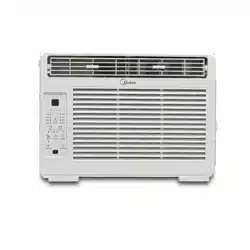
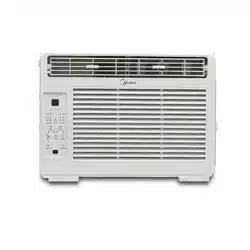
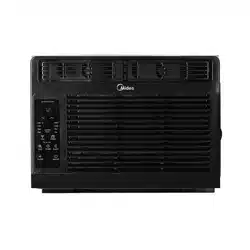
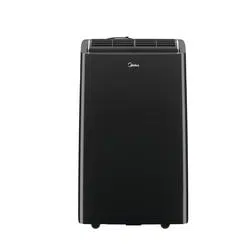
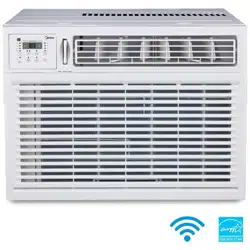
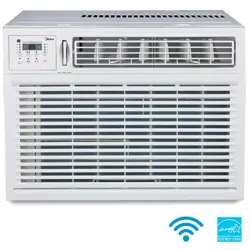
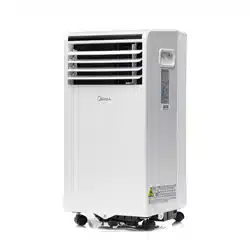
User manual Room Air Conditioner
Operation of Current Device
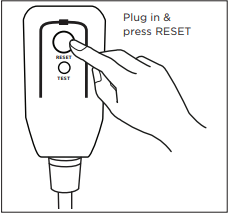
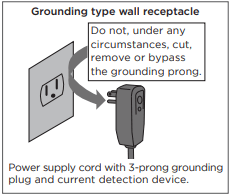
The power supply cord contains a current device that senses damage to the power cord. Test your power supply cord as follows:
- Plug in the air conditioner.
- The power supply cord will have TWO buttons on the plug head. Press the TEST button. You will notice a click as the RESET button pops out.
- Press the RESET Button. You will notice a click as the button engages.
- The power supply cord is now supplying electricity to the unit. (On some products this is also indicated by a light on the plug head.)
NOTICE
- The power supply cord with this air conditioner contains a current detection device designed to reduce the risk of fire.
- In the event that the power supply cord is damaged, it can not be repaired. It must be replaced with a cord from the manufacturer.
NOTICE
- Do not use this device to turn the unit on or off.
- Always make sure the RESET button is pushed in for correct operation.
- The power supply must be replaced if it fails to reset when either the TEST button is pushed, or it can not be reset. Please contact Customer Service.
Operating Instructions
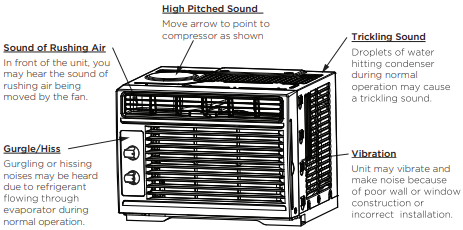
Normal Sounds
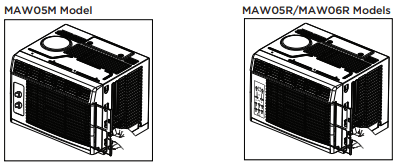
MAW05M Model
MAW05R/MAW06R Models
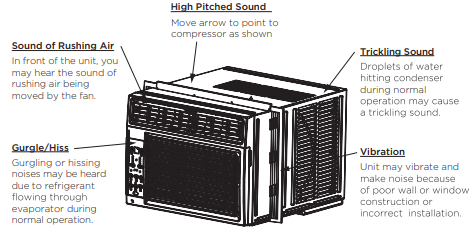
NOTICE All the pictures in this manual are for illustrative purposes only. The actual appearance of the air conditioner you purchased may vary slightly, but its operation and functions will be similar.
Air Conditioner Operation
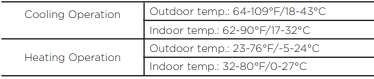
This air conditioner is designed to be operated under the following conditions:
WARNING To reduce the risk of fire, electrical shock, personal injury or property, read the SAFETY PRECAUTIONS before operating this appliance.
NOTE Always wait 3 minutes when turning the unit off and then on again,or when changing from cool to fan and back to cool. This prevents compressor from overheating and possible tripping.
TO BEGIN OPERATING THE AIR CONDITIONER, FOLLOW THESE STEPS:
- Set the temperature to the coldest setting.
- Set the control to HIGH COOL.
- Adjust the louver for comfortable air flow (see Air Directional Louvers).
- Once the room feels cool, adjust to the temperature you find most comfortable.
- Make sure that the air flow inside and outside are not obstructed by anything.
NOTICE
- The relative humidity of room should be less than 80%. If the unit is used in a condition with a relative humidity over 80%, there will be condensed water on the surface of the unit.
- Performance may be reduced outside of these operating temperatures.
Before you begin, thoroughly familiarize yourself with the control panel as shown below and all its functions, then follow the symbol for the functions you desire. The unit can be controlled by the unit control panel alone or with the remote control.
Air Conditioner Features - MAW05M Model
NOTICE: The controls featured in this manual are representative of many available models. Your model’s features and appearance may vary slightly.
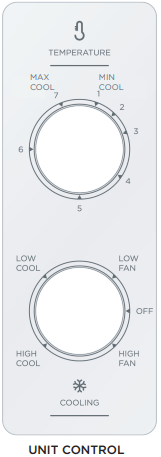
THERMOSTAT
The thermostat is used to set the desired room temperature when the unit is being operated in the COOL MODE.
To set the desired room temperature, rotate the thermostat switch to the desired setting. After the set temperature is achieved the thermostat will automatically start and stop the compressor in order to maintain the desired set temperature.
Rotate the thermostat selector clockwise for higher cool settings. Higher cool settings will provide lower room temperature. Rotate the thermostat selector counter clockwise for lower cool settings. Lower cool settings will provide higher room temperature.
COOL MODE
The desired cool setting is selected by rotating the knob clockwise to the desired position.
- High Cool has maximum cooling effect and airflow.
- Low Cool has minimum cooling effect and airflow.
FAN MODE
Rotate the knob counter clockwise to select your choice of fan speeds for air circulation.
NOTICE When selecting a fan speed, the compressor will not run.
Air Conditioner Features - MAW05R/MAW06R Models
ELECTRONIC CONTROL OPERATING INSTRUCTIONS
Before you begin, thoroughly familiarize yourself with the control panel as shown below and all its functions, then follow the symbol for the functions you desire. The unit can be controlled by the unit control alone or with the remote controller.
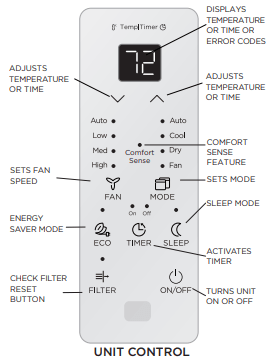
TO TURN UNIT ON OR OFF:
Press ON/OFF button to turn unit on or off.
NOTICE
The unit will automatically initiate the Energy Saver function under Cool, Dry, Auto (only Auto-Cooling and AutoFan) modes.
TO CHANGE TEMPERATURE SETTING:
Press Power button to turn unit on or off.
NOTICE
Press or hold either UP/DOWN button until the desired temperature is seen on the display.
This temperature will be automatically maintained anywhere between 62°F (17°C) and 86°F (30°C). If you want to display the actual room temperature, see To Operate on Fan Only section.
TO ADJUST FAN SPEEDS:
Press to select the Fan Speed in four steps-Auto, Low, Med or High. Each time the button is pressed, the fan speed mode is changed. On Dry mode, the fan operates on Low speed automatically
SLEEP FEATURE:
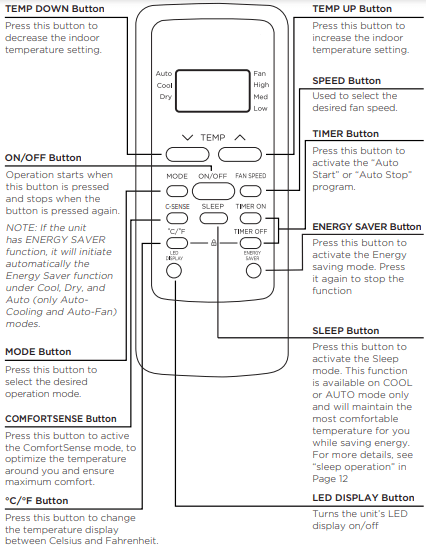
Press Sleep button to initiate the sleep mode. In this mode the selected temperature will increase by 2°F/1 (or 2)°C 30 minutes after the mode is selected. The temperature will then increase by another 2°F/1 (or 2)°C after an additional 30 minutes. This new temperature will be maintained for 7 hours before it returns to the originally selected temperature. The Sleep mode program can be cancelled at any time during operation by pressing the Sleep button again.
CHECK FILTER FEATURE:
The Check Filter feature is a reminder to clean the air filter for a more efficient operation. The light will illuminate after 250 hours of operation. After cleaning the filter, press the Filter button to reset the Check Filter function turning the light off.
ENERGY SAVER FEATURE:
Press Energy Saver button to initiate this function. This function is available on COOL, DRY, AUTO (only AUTO-COOLING and AUTO-FAN) modes. The fan will continue to run for 3 minutes after the compressor shuts off. The fan then cycles on for 2 minutes at 10 minute intervals until the room temperature is above the set temperature, at which time the compressor turns back on and Cooling resumes.
COMFORTSENSE FEATURE:
The ComfortSense function enables the remote control to measure the temperature at its current location. When using AUTO, COOL, or HEAT functions, measuring ambient temperature from the remote control (instead of from the indoor unit itself) will enable the air conditioner to optimize the temperature around you and ensure maximum comfort.
This feature can be activated from the remote control ONLY.
The remote control will send this signal to the air conditioner every 3 minutes interval until press the ComfortSense button again. If the unit does not receive the ComfortSense signal during any 7 minutes interval, the unit will beep to indicate the ComfortSense mode has ended.
TO SELECT THE OPERATING MODE:
To choose the operating mode, press the Mode button the unit cycles through the modes, Auto, Cool, Dry, and Fan. The adjacent indicator light will remain on once the mode is selected.
The unit will automatically initiate the Energy Saver function under Cool, Dry, Auto (only Auto-Cooling and Auto-Fan) modes.
To operate on Auto mode:
- The fan speed is automatically controlled based on the temperature setting and room temperature and cannot be adjusted.
- The air conditioner will control room temperature automatically according to the temperature you’ve set.
- In this mode, the fan speed cannot be adjusted, as it’s automatically controlled according to the temperature setting and room temperature.
To operate on Fan Only:
- Use this function only when cooling is not desired, such as for room air circulation or to exhaust stale air (on some models). (Remember to open the vent during this function, but keep it closed during cooling for maximum cooling efficiency.) You can choose any fan speed you prefer.
- During this function, the display will show the actual room temperature, not the set temperature as in the cooling mode.
- In Fan Only mode, the temperature is not adjusted.
To operate on Dry mode:
In this mode, the air conditioner will generally function as a dehumidifier. Since the conditioned space is a closed or sealed area, some degree of cooling will occur.
TIMER: AUTO START/STOP FEATURE:
- When the unit is on or off, first press the Timer button. The TIMER ON indicator light illuminates indicating the Auto Start program has initiated.
- When the time of TIMER ON is displayed, press the Timer button again. The TIMER OFF indicator light illuminates. It indicates the Auto Stop program has initiated.
- Press or hold the UP or DOWN button to change the Auto time by 0.5 hour increments, up to 10 hours, then at 1 hour increments up to 24 hours. The control will count down the time remaining until start.
- The selected time will register in 5 seconds, and the system will automatically revert back to display the previous temperature setting or room temperature when the unit is on. (when the unit is off, there is no display.)
- Turning the unit ON or OFF at any time or adjusting the timer setting to 0.0 will cancel the Auto Start/Stop timed program.
- If setting ON 0.5 and OFF 1 at the same time, the unit will be activated in 0.5 hour, operates for 0.5 hour and then stops.
Displays:
Shows the set temperature in “°C” or “°F” and the Auto-timer settings. While on Fan Only mode, it shows the room temperature.
Error codes:
AS
Room temperature sensor error - Unplug the unit and plug it back in. If error repeats, call for service.
NOTE: In Fan only mode, if the room temperature too low or too high, it will display “LO” or “HI”
ES
Evaporator temperature sensor error
Unplug the unit and plug it back in. If error repeats, call for service.
NOTICE If the unit shuts off unexpectedly due to the power outage, it will restart with the previous function setting automatically when the power resumes.
Additional Information
Now that you understand the operating procedure, here are more features in your control that you should become familiar with.
- The Cool circuit has an automatic 3 minute time delayed start if the unit is turned off and on quickly. This prevents overheating of the compressor and possible circuit breaker tripping. The fan will continue to run during this time.
- The control can display temperature in Fahrenheit or Celsius. To convert from one to the other, press and hold the UP/DOWN Temp/Timer buttons at the same time, for 3 seconds.
AIR DIRECTIONAL LOUVERS
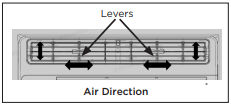
The louvers will allow you to direct the air flow Up or Down and Left or Right throughout the room as needed.
Pivot horizontal louvers until the desired Up/Down direction is obtained. Move the Lever(s) from side to side until the desired Left/Right direction is obtained.
Installation Instructions
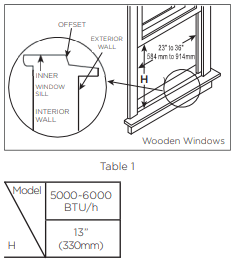
Your air conditioner is designed to install in standard double hung windows with opening widths of 23 to 36 inches (584mm to 914mm)
1. PREPARE THE WINDOW
Lower sash must open sufficiently to allow a clear vertical opening (see dimension H in Table 1). Side louvers and the rear of the AC must have clear air space to allow enough airflow through the condenser for heat removal. The rear of the unit must be outdoors, not inside a building or garage.
CAUTION When handling unit, be careful to avoid cuts from sharp metal edges and aluminum fins on front and rear coils.
2. PREPARE THE AIR CONDITIONER
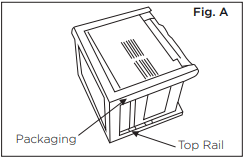
Before installing the unit, the top rail must be assembled on the unit.
A: Remove the air conditioner from the carton and place on a flat surface.
B: Remove top rail from the packaging material as shown in Fig. A.
C: Align the hole in the top rail with those in the top of the unit as shown in Fig. B.
D: Secure the top rail to the unit with the 3/8” (9.5mm) screws as shown in Fig. C.
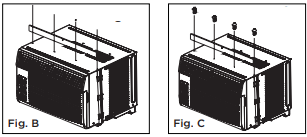
WARNING For safety reasons, all four (4) screws MUST be securely fastened.
3. INSTALL THE ACCORDION PANELS
NOTICE The Top rail and Sliding Panels on each side are offset to provide the proper pitch to the rear of 5/16” (8mm). This is necessary for proper condensate management and drainage. If you are not using the side panels for any reason, this pitch to the rear must be maintained.
1. Place unit on the floor, a bench or a table. There is a left and right side accordion panel; be sure to use the proper panel for each side. When installed, the flange for securing the panel in place to the window sill will be facing into the room.
A. Hold the side panel in one hand and gently pull back the center to free the open end. See Fig. 1.
B. Slide the free and “I” section of the panel directly into the cabinet as shown in Fig. 2. Slide the panel down. Be sure to leave enough space to slip the top and bottom of the frame into the rails on the cabinet.
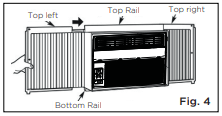
C. Once the panel has been installed on the side of the cabinet, make sure it sits securely inside the frame channel by making slight adjustments. Slide the top and bottom ends of the frame into the top and bottom rails of the cabinet. Fig. 3.
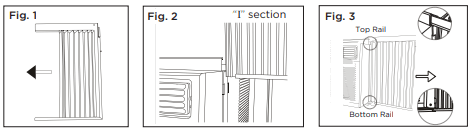
D. Slide the panel all the way in and repeat on the other side.
NOTICE If storm window blocks AC, see Fig. 11.
4. INSTALL AIR CONDITIONER
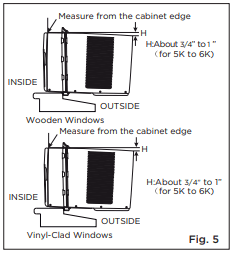
2. While keeping a firm grip on the air conditioner, carefully place the unit into the window opening so the bottom of the air conditioner frame is against the window sill (Fig. 5). Carefully close the window behind the top rail of the unit.
NOTICE Check that air conditioner is tilted back per dimension H (Fig. 5) (tilted about 3° to 4° downward to the outside). After proper installation, condensate should not drain from the overflow drain hole during normal use. Adjust the slope if otherwise.
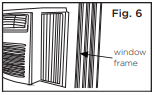
3. Extend the side panels out against the window frame (Fig. 6).
5. SECURE AIR CONDITIONER
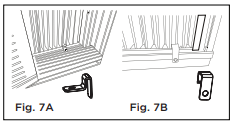
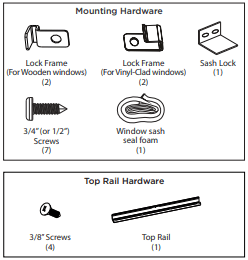
A. Place the frame lock between the frame extensions and the window sill as shown (Fig. 7A for Wooden windows), (Fig. 7B for Vinyl-Clad windows).
Drive 3/4” (19 mm) or 1/2” (12.7 mm) locking screws through the frame lock and into the sill.
NOTE: To prevent window sill from splitting, drill 1/8” (3 mm) pilot holes before driving screws.
B1: For wooden windows:
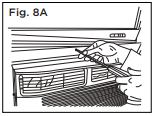
Drive 1/2” (12.7 mm) locking screws through the frame lock and into the sill (Fig. 8A).
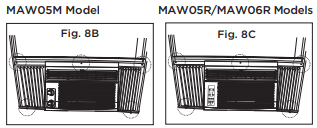
NOTE: To prevent window sill from splitting, drill 1/8” (3mm) pilot holes before driving screws. Drive 1/2” (12.7mm) locking screws through frame holes into window sash (Fig. 8B/8C).
B2: For Vinyl-Clad windows:
Drive 1/2” (12.7 mm) locking screws through the top rail and into the window sash (Fig. 8B/8C).
NOTE: Before driving the screws, drill 5 holes into the window through the holes of the top rail and side panel frames as shown (Fig. 8B/8C).
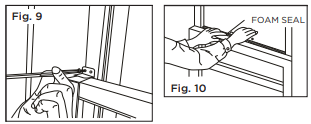
C. Secure lower sash in place by attaching the sash lock with the 3/4” (19 mm) or 1/2” (12.7 mm) screw as shown (Fig. 9).
D. Cut Window sash seal foam and insert it in the space between the upper and lower sashes (Fig. 10).
If AC is Blocked by Storm Window
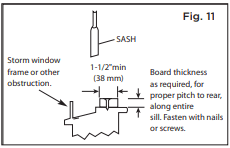
Add wood as shown in Fig. 11, or remove storm window before air conditioner is installed.
If storm window frame must remain, be sure the drain holes or slots are not caulked or painted shut. Accumulated rain water or condensation must be allowed to drain out.
Removing AC From Window
- Turn AC off, and disconnect power cord.
- Remove sash seal from between windows, and unscrew sash lock.
- Remove screws installed through top rail and side panel frames.
- Close (slide) the side panels into the rails.
- Keeping a firm grip on the air conditioner, raise the sash and carefully remove.
- Be careful not to spill any condensate while lifting unit form window. Store parts WITH air conditioner
Care and Cleaning
CAUTION Clean your air conditioner occasionally to keep it looking new. Be sure to unplug the unit before cleaning to prevent shock or fire hazards.
Air Filter Cleaning
The air filter should be checked at least once a month to see if cleaning is necessary. Trapped particles in the filter can build up and cause an accumulation of frost on the cooling coils.
- Push the vent handle to the closed position (where applicable). Open the front panel.
- Take the filter by the center and pull up and out.
- Wash the filter using liquid dishwashing detergent and warm water. Rinse filter thoroughly.
- Gently shake excess water from the filter. Be sure the filter is thoroughly dry before replacing.
- You may also vacuum the filter clean rather than washing.
NOTICE Never use hot water over 104°F (40°C) to clean the air filter. Never attempt to operate the unit without the air filter.
Cabinet Cleaning
- Be sure to unplug the air conditioner to prevent shock or fire hazard. The cabinet and front may be dusted with an oil-free cloth or washed with a cloth dampened in a solution of warm water and mild liquid dishwashing detergent. Rinse thoroughly and wipe dry.
- Never use harsh cleansers, wax or polish on the cabinet front.
- Be sure to wring excess water from the cloth before wiping around the controls. Excess water in or around the controls may cause damage to the air conditioner.
- Plug in air conditioner.
Winter Storage
If you plan to store the air conditioner during the winter, remove it carefully from the window according to the installation instructions. Cover it with plastic or return it to the original carton.
Troubleshooting Tips
Before calling for service, review this list. It may save you time and expense. This list includes common occurrences that are not the result of defective workmanship or materials in this appliance.
Air conditioner does not start.
- Wall plug disconnected. Push plug firmly into wall outlet.
- Circuit breaker tripped. Reset circuit breaker.
- Check if the light on the plug is on. If it is off , press the RESET button.
- Power is OFF. Turn power ON.
- Unit turned off and then on quickly. Turn unit off and wait 3 minutes before restarting.
Air from unit does not feel cold enough.
- Room temperature below 62°F (17°C). Cooling may not occur until room temperature rises above 62°F (17°C).
- Temperature sensor behind the air fi lter is touching the cold coil. Try to move it so it does not contact the cold coil.
- Reset to a lower temperature.
- Compressor shut-off by changing modes. Wait approximately 3 minutes and listen for compressor to restart when set in the COOL mode.
- Check for potential obstructions blocking the outdoor intake/exhaust. Clear any obstructions.
Air conditioner cooling, but room is too warm- ice forming on cooling coil behind air filter
- Outdoor temperature below 64°F (18°C). To defrost the coil, set to FAN ONLY mode.
- Air filter may be dirty. Clean filter. Refer to Care and Cleaning section. To defrost, set to FAN ONLY mode.
- Thermostat set too cold for night-time cooling. To defrost the coil, set to FAN ONLY mode. Then, set temperature to a higher setting.
Air conditioner cooling, but room is too warm- NO ice forming on cooling coil behind air filter.
- Dirty or restricted air fi lter. Clean fi lter. Refer to Care and Cleaning section. To defrost, set to FAN ONLY mode.
- Temperature is set too high, set temperature to a lower setting.
- Air directional louvers positioned improperly. Position louvers for better air distribution.
- Front of unit is blocked by drapes, blinds, furniture, etc. - restricts air distribution. Clear obstruction in front of unit.
- Any open doors, windows, or registers may allow cold air to escape. Close any doors, windows, or registers.
- The room may be too warm. Allow additional time to remove “stored heat” from walls, ceiling, fl oor and furniture.
Air conditioner turns on and off rapidly
- Dirty air filter - air restricted. Clean air filter.
- Outside temperature extremely hot. Set FAN speed to a higher setting to bring air past cooling coils more frequently.
- Check for potential obstructions blocking the outdoor intake/exhaust. Clear any obstructions.
Noise when unit is cooling.
- Air movement sound. This is normal. If too loud, set to a slower FAN setting.
- Window vibration - poor installation. Refer to installation instructions or check with installer.
Water dripping INSIDE when unit is cooling.
- Improper installation. Tilt air conditioner slightly to the outside to allow water drainage.
- Refer to installation instructions - check with installer.
Water dripping OUTSIDE when unit is cooling.
- Unit removing large quantity of moisture from humid room. This is normal during excessively humid days.
Remote sensing deactivating prematurely (some models).
- Remote control not located within range. Place remote control within 26.2 feet & 180°, radius of the front of the unit, and pointed in the general direction of the air conditioner unit.
- Remote control signal obstructed. Remove obstruction.
Room too cold.
- Temperature setting too low. Increase temperature setting.
Noise when unit starts.
- A “da-da” sound may occur for thirty seconds when the unit is turned on due to the compressor starting. It is normal.
Remote Control Instructions
Handling the Remote Controller
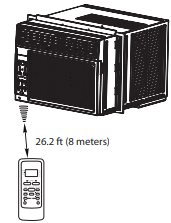
LOCATION OF THE REMOTE CONTROLLER
Use the remote controller within a distance of 26.2 ft (8 meters) from the air conditioner, pointing it towards the receiver. Reception is confirmed by a beep.
CAUTION
- The air conditioner will not operate if curtains, doors or other materials block the signals from the remote controller to the unit.
- Prevent any liquid from spilling onto the remote controller. Do not expose the remote controller to direct sunlight or heat.
- If the infrared signal receiver on the indoor unit is exposed to direct sunlight, the air conditioner may not function properly. Use curtains to prevent the sunlight from falling on the receiver.
- If other electrical appliances react to the remote controller, either move these appliances or consult your local dealer.
NOTES
- Button design is based on typical model and may vary slightly from the actual one you purchased.
- All the functions described are accomplished by the unit. If the unit is without a feature, the unit will not respond if the corresponding button on the remote is pressed.
- When there are significant differences between features or operation implied by the remote control illustration and the actual functions described in the USER’S MANUAL, the descriptions in the USER’S MANUAL shall prevail.
Function Buttons
Remote Screen Indicators
Information are displayed when the remote controller is power up.
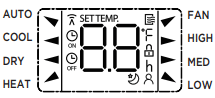
Mode display

 Displayed when data transmitted.
 Appears when the remote is enabled and can send a signal to the unit. If you would like to turn the remote off without affecting the unit, point the remote away from the unit and press the ON/OFF button. To turn the remote on, point the remote away from the unit and press the ON/OFF button. The unit will not receive commands from the remote if this indicator is not illuminated.
 Displayed when TIMER ON time is set
 Displayed when TIMER OFF time is set
 Shows set temperature or room temperature, or time under TIMER setting
 Indicated all the current settings are locked
 Displayed when ComfortSense feature is activated(some units)
 Displayed when SLEEP feature is activated
Fan speed indication
 High speed
 Medium speed
 Low speed
NO display Auto fan speed
Note: All indicators shown in the figure are for the purpose of clear presentation. But during the actaul operation, only the relative function signs are shown on the display window.
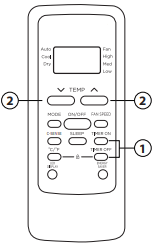
TIMER OPERATION
Press the TIMER button to initiate the Auto-start and Auto-stop setting program of the unit.
To set the Auto-start/stop time.
- Press the TIMER button, when the TIMER ON indicator is displayed on the LED window of the air conditioner, it indicates the Auto Start setting program is initiated. When the TIMER OFF indicator is displayed on the LED window of the air conditioner, it indicates the Auto Stop setting program is initiated.
- Press or hold the TEMP UP (
 )/DOWN (
 ) to change the Auto time. The control will count down the time remaining until start/stop.
- The selected time will register in 5 seconds and the air conditioner will automatically revert back to display the previous temperature setting.
- Turning the unit ON or OFF at any time will cancel the Auto Start/stop function.
NOTES To cancel the TIMER setting, push the TIMER button and press or hold the TEMP UP ()/ DOWN () until 0 hour is displayed on the LCD window of the air conditioner.
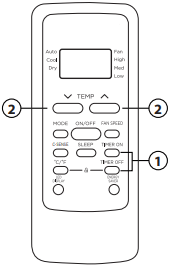
COMBINED TIMER
(Setting both ON and OFF timers simultaneously)
AUTO STOP >AUTO START
(On > Stop > Start operation)
This feature is useful when you want to stop the air conditioner after you go to bed, and start it again in the morning when you wake up or when you return home.
Example:
To stop the air conditioner 2 hours after setting and start it again 10 hours after setting.
- Press the TIMER button until the TIMER OFF indicator is displayed on the LED display of the air conditioner.
- Use the TEMP UP ()/DOWN () button to display “2.0” on the LED display of the air conditioner.
- Press the TIMER button again to display the TIMER OFF on the LED display of the unit.
- Use the TEMP UP ()/DOWN () button to display “10” on the LED display of the unit.
- Wait for 5 seconds until the previous display appears in LED window.
AUTO START > AUTO STOP
(Off > Start > Stop operation)
This feature is useful when you want to start the air conditioner before you wake up and stop it after you leave the house.
Example:
To start the air conditioner 5 hours after setting, and stop it 8 hours after setting.
- Press the TIMER button until the TIMER ON indicator is displayed on the LED display of the air conditioner.
- Use the TEMP UP ()/DOWN () button to display “5.0” on the LED display of the air conditioner.
- Press the TIMER button again to display the TIMER OFF on the LED display of the unit.
- Use the TEMP UP ()/DOWN () button to display “8.0” on the LED display of the unit.
- Wait for 5 seconds until the previous display appears in LED window.
NOTES
- Button design is based on a typical model and may slightly vary from the actual one you purchased.
- This device complies with part 15 of the FCC Rules. Operation is subject to the following two conditions: (1) This device may not cause harmful interference, and (2) this device must accept any interference received, including interference that may cause undesired operation.
- This equipment has been tested and found to comply with the limits for a Class B digital device, pursuant to part 15 of the FCC Rules. These limits are designed to provide reasonable protection against harmful interference in a residential installation. This equipment generates, uses and can radiate radio frequency energy and, if not installed and used in accordance with the instructions, may cause harmful interference to radio communications. However, there is no guarantee that interference will not occur in a particular installation. If this equipment does cause harmful interference to radio or television reception, which can be determined by turning the equipment off and on, the user is encouraged to try to correct the interference by one or more of the following measures:
- Reorient or relocate the receiving antenna.
- Increase the separation between the equipment and receiver.
- Connect the equipment to an outlet on a circuit different from that to which the receiver is connected.
- Consult the dealer or an experienced radio/TV technician for help.
- Changes or modifications not approved by the party responsible for compliance could void users authority to operate the equipment.
Battery Warning: Do not mix old and new batteries and Do not mix alkaline, standard (carbon-zinc) or rechargeable (ni-cad, ni-mh, etc.) batteries