Use & Care Guide
Manual de Uso y Cuidado
English / Espa_ol
Models/Modelos: 148.16154210
Item / Articulo: 640-03838917-7
I(enmore
@ @ @
??rill?
@
P/N 2818-2T-Manual
Sears Brands Management Corporation
Hoffman Estates, IL 60179 U.S.A.
www.kenmore.com
www.sears.com
www.kmart.com

If you smell gas:
1. Shut off gas to the appliance.
2. Extinguish any open flame.
3. Open lid.
4. If odor continues, keep away from the
appliance and immediatelycall your gas
supplier or your fire department.
1. Do not store or use gasoline or other
flammable liquids or vapors in the vicinity
of this or any other appliance.
2. An LP cylinder not connected for use shall
not be stored in the vicinity of this or any
other appliance.
CALIFORNIA PROPOSITION 65
This productcontains chemicals,includinglead and
leadcompoundsin brassfittings. Italso produces
combustionby-productswhen used.These substances
are knownto the Stateof Californiato cause cancer,
birth defectsor other reproductiveharm.
Wash your hands after using this product.
Call Grill Service Center For Help And Parts
If you have questions or need assistance during assembly,
please call 1-800-482-0131. You will be speaking to a
representative of the grill manufacturer and not a Sears
employee. To order new parts call Sears at
1-800-4-MY-HOME.
Product Record
IMPORTANT: Fill out the product record information
below.
Model Number: 148.16154210
Serial Number:
See rating label on grill for serial number.
Date Purchased:
For residential use only. Do not use for
commercial cooking.
Installation Safety Precautions
• Use grill, as purchased, only with LP (propane) gas and the
regulator/valve assembly supplied. A conversion kit must
be purchased for use with natural gas.
• Grill installation must conform with local codes, or in their
absence of local codes, with either the National Fuel Gas
Code,ANSI Z223. 1/NFPA 54, Natural Gas and Propane
Installation Code, CSA B149. 1,or Propane Storage and
Handling Code, B149.2, or the Standard for Recreational
Vehicles,ANSI A 119.2/NFPA 1192,and CSA Z240 RV
Series, Recreational Vehicle Code, as applicable.
• All electrical accessories (such as rotisserie) must be
electrically grounded in accordance with local codes, or
National Electrical Code, ANSI / NFPA 70 or Canadian
Electrical Code, CSA C22, 1, Keep any electrical cords
and/or fuel supply hoses away from any hot surfaces.
• This grill is safety certified for use in the United States
and/or Canada only. Do not modify for use in any other
location. Modification will result in a safety hazard.
Safety Symbols
The symbols and boxes shown below explain what each
heading means. Read and follow all of the messages found
throughout the manual.
DANGER: Indicates an imminently hazardous
situation which, if not avoided, will result in death or
serious injury.
WARNING: Indicates an potentially hazardous
situation which, if not avoided, could result in death
or serious injury.
..............................................CAUTION ...............................................
CAUTION: Indicates a potentially hazardous
situation or unsafe practice which, if not avoided,
may result in minor or moderate injury.
© 2012 KCD IP, LLC
For Your Safety .................................. 2
Grill Service Center............................... 2
Product Record Information ........................ 2
Safety Symbols.................................. 2
Installation Safety Precautions ....................... 2
Kenmore Grill Warranty ........................... 3
Use and Care ................................ 4-10
Natural Gas Conversion Box ...................... 11
Notes.......................................... 11
Parts List ...................................... 13
Parts Diagram................................... 14
Assembly .................................... 15-22
Conversion Instructions for 16154 ................. 23-25
Troubleshooting............................... 26-27
Repair Protection Agreements
Congratulations on making a smart purchase. Your new
Kenmore ®productis designed and manufactured for years of
dependable operation. But like all products, it may require
repair from time to time. That's when having a Repair
Protection Agreement can save you money and aggravation.
Purchase a Repair Protection Agreement now and protect
yourself from unexpected hassle and expense.
Here's what the Repair Protection Agreement includes:
[] Expert service by our 10,000 professional repair
specialists
[] Unlimited service and no charge for parts and labor on
all covered repairs
[] Product replacement up to $1500 if your covered
product can't be fixed
[] Discount of 25% from regular price of service and
related installed parts not covered by the agreement; also,
25% off regular price of preventive maintenance check
[] Fast help by phone -we call it Rapid Resolution -
phone support from a Sears representative. Think of us
as a "talking owner's manual."
Once you purchase the Repair Protection Agreement, a simple
phone call is all that it takes for you to schedule service. You
can call anytime day or night, or schedule a service
appointment online.
The Repair Protection Agreement is a risk-free purchase. If you
cancel for any reason during the productwarranty period, we
will provide a full refund. Or, a prorated refund anytime after
the product warranty period expires. Purchase your Repair
Protection Agreement today!
Some limitations and exclusions apply.
For prices and additional information call 1-800-827-6655.
Sears Installation Service
For Sears professional installation of home appliances, garage
door openers, water heaters, and other major home items, in
the U.S.A. call 1-800-4-MY-HOME®
Kenmore Full Warranty
If this grill fails due to a defect in material or workmanship
within one year from the date of purchase, call 1-800-4-MY-
HOME® to arrange for free repair (or replacement if repair
proves impossible).
Limited Warranty on Burners
For ten years from the date of purchase, any stainless steel
burner that rusts through will be replaced free of charge. After
the first year from the date of purchase, you pay for labor if
you wish to have it installed.
All warranty coverage excludes ignitor batteries and grill part
paint loss, discoloration or rusting, which are either
expendable parts that can wear out from normal use within
the warranty period, or are conditions that can be the result
of normal use, accident or improper maintenance.
All warranty coverage is void if this grill is ever used for
commercial or rental purposes.
All warranty coverage applies only if this grill is used in the
United States.
This warranty gives you specific legal rights, and you may
also have other rights which vary from state to state.
Sears Brands Management Corporation,
Hoffman Estates, IL 60179
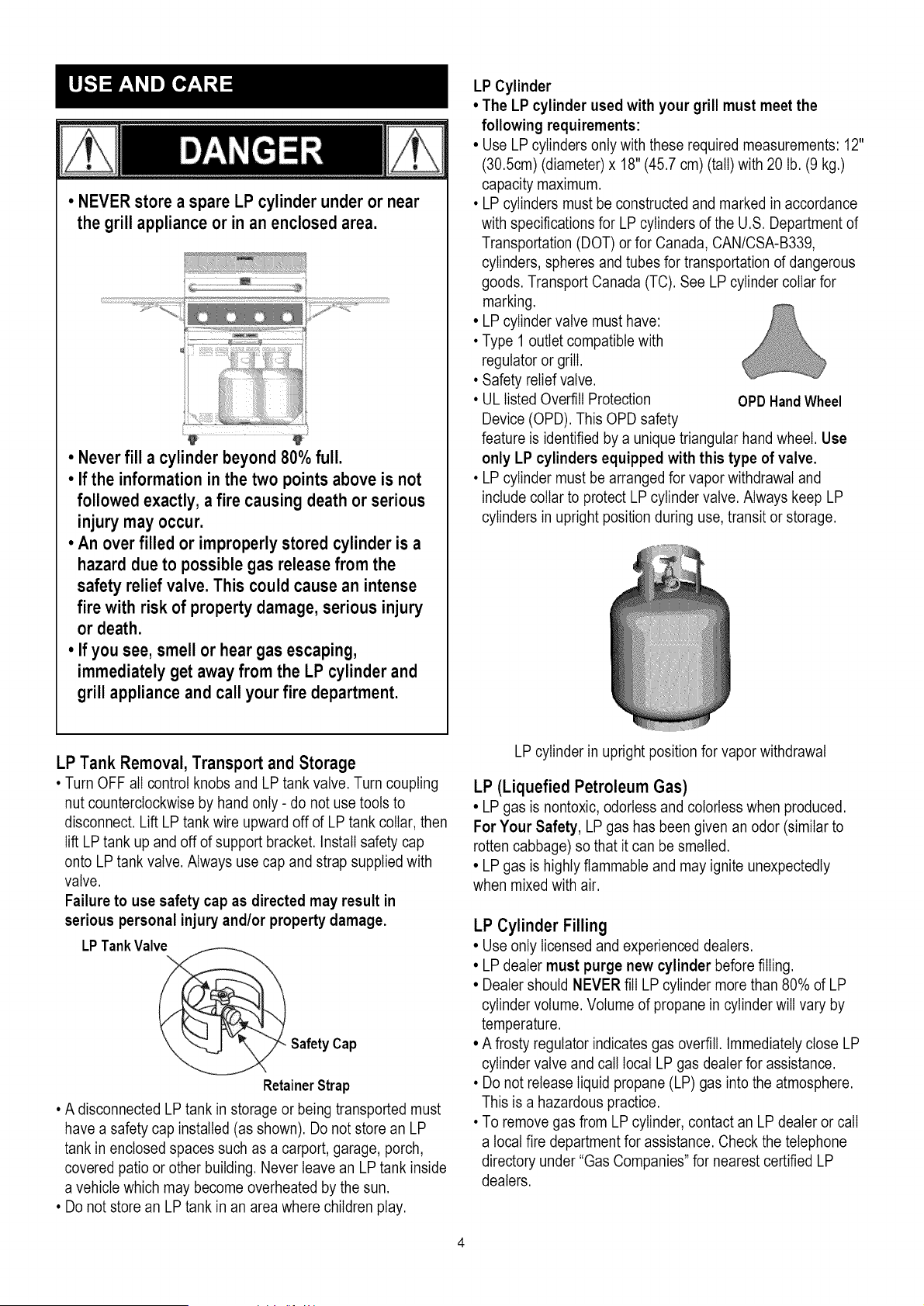
• NEVER store a spare LP cylinder under or near
the grill appliance or in an enclosed area.
• Never fill a cylinder beyond 80% full.
• If the informationin the two points above is not
followed exactly, a fire causing death or serious
injury may occur.
• An over filled or improperly stored cylinder is a
hazard due to possible gas release from the
safety relief valve. This could cause an intense
fire with risk of property damage, serious injury
or death.
° If you see, smell or hear gas escaping,
immediately get away from the LP cylinder and
grill appliance and call your fire department.
LP Cylinder
• The LP cylinder used with your grill must meet the
following requirements:
• Use LP cylinders only with these required measurements: 12"
(30.5cm) (diameter) x 18" (45.7 cm) (tall) with 20 lb. (9 kg.)
capacity maximum.
• LP cylinders must be constructed and marked in accordance
with specifications for LP cylinders of the U.S. Department of
Transportation (DOT) or for Canada, CAN/CSA-B339,
cylinders, spheres and tubes for transportation of dangerous
goods. Transport Canada (TC). See LP cylinder collar for
marking.
• LP cylinder valve must have:
• Type 1 outlet compatible with
regulator or grill.
• Safety relief valve.
• UL listed Overfill Protection OPD HandWheel
Device (OPD). This OPD safety
feature is identified by a unique triangular hand wheel. Use
only LP cylinders equipped with this type of valve.
• LP cylinder must be arranged for vapor withdrawal and
include collar to protect LP cylinder valve. Always keep LP
cylinders in upright position during use, transit or storage.
LP Tank Removal, Transport and Storage
• Turn OFF all control knobs and LP tank valve. Turn coupling
nut counterclockwise by hand only - do not use tools to
disconnect. Lift LP tank wire upward off of LP tank collar, then
lift LP tank up and off of support bracket. Install safety cap
onto LP tank valve. Always use cap and strap supplied with
valve.
Failure to use safety cap as directed may result in
serious personal injury and/or property damage.
LPTankValve
@_ Safety Cap
RetainerStrap
• A disconnected LP tank in storage or being transported must
have a safety cap installed (as shown). Do not store an LP
tank in enclosed spaces such as a carport, garage, porch,
covered patio or other building. Never leave an LP tank inside
a vehicle which may become overheated by the sun.
• Do not store an LP tank in an area where children play.
LP cylinder in upright position for vapor withdrawal
LP (Liquefied Petroleum Gas)
• LP gas is nontoxic, odorless and colorless when produced.
For Your Safety, LP gas has been given an odor (similar to
rotten cabbage) so that it can be smelled.
• LP gas is highly flammable and may ignite unexpectedly
when mixed with air.
LP Cylinder Filling
• Use only licensed and experienced dealers.
• LP dealer must purge new cylinder before filling.
• Dealer should NEVER fill LP cylinder more than 80% of LP
cylinder volume. Volume of propane in cylinder will vary by
temperature.
• A frosty regulator indicates gas overfill. Immediately close LP
cylinder valve and call local LP gas dealer for assistance.
• Do not release liquid propane (LP) gas into the atmosphere.
This is a hazardous practice.
• To remove gas from LP cylinder, contact an LP dealer or call
a local fire department for assistance. Check the telephone
directory under "Gas Companies" for nearest certified LP
dealers.
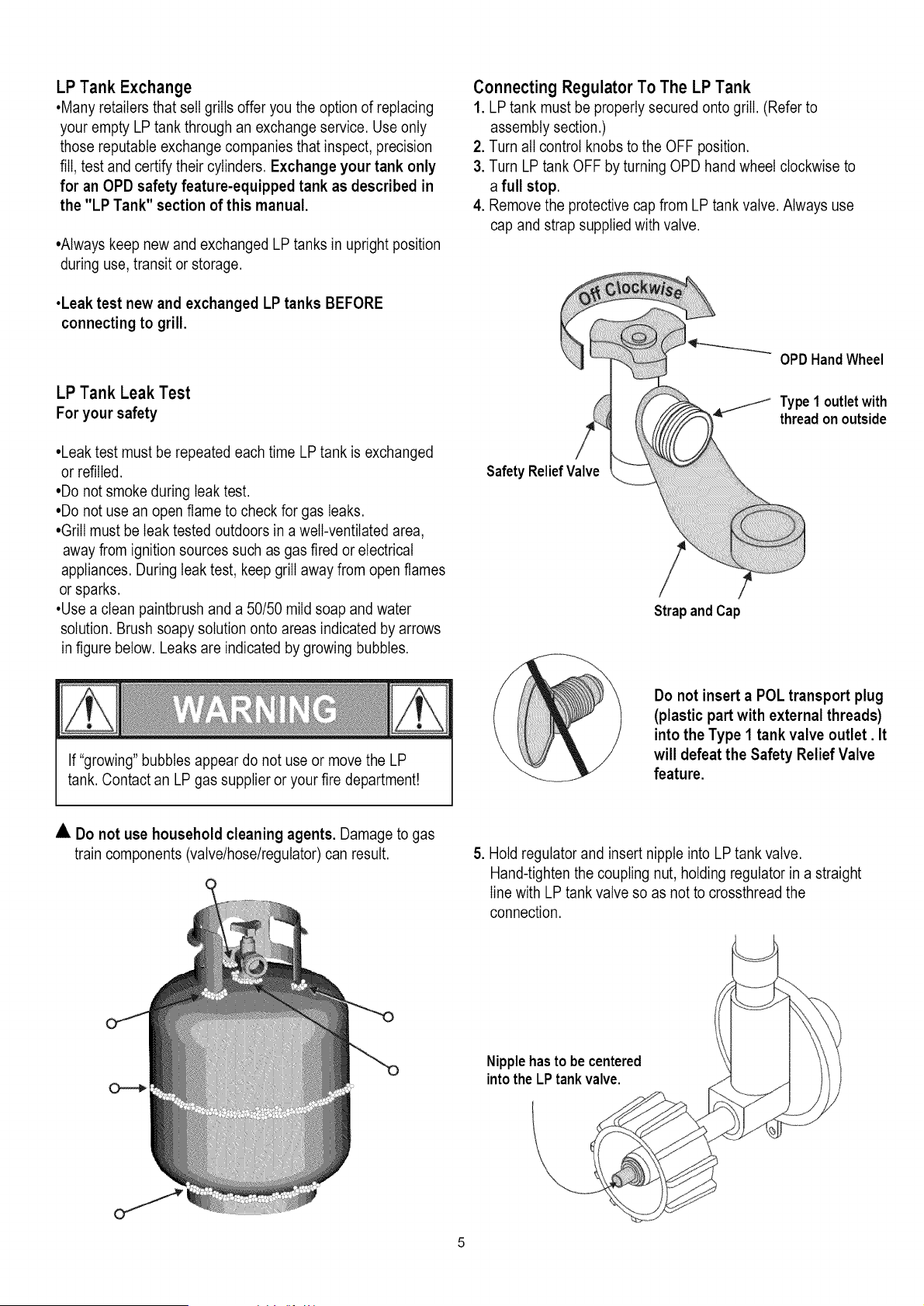
LP Tank Exchange
•Many retailers that sell grills offer you the option of replacing
your empty LP tank through an exchange service. Use only
those reputable exchange companies that inspect, precision
fill, test and certify their cylinders. Exchange your tank only
for an OPD safety feature-equipped tank as described in
the "LP Tank" section of this manual.
•Always keep new and exchanged LP tanks in upright position
during use, transit or storage.
,Leak test new and exchanged LP tanks BEFORE
connecting to grill.
LP Tank Leak Test
Foryoursafety
•Leak test must be repeated each time LP tank is exchanged
or refilled.
•Do not smoke during leak test.
•Do not use an open flame to check for gas leaks.
•Grill must be leak tested outdoors in a well-ventilated area,
away from ignition sources such as gas fired or electrical
appliances. During leak test, keep grill away from open flames
or sparks.
•Use a clean paintbrush and a 50/50 mild soap and water
solution. Brush soapy solution onto areas indicated by arrows
in figure below. Leaks are indicated by growing bubbles.
Connecting Regulator To The LP Tank
1. LP tank must be properly secured onto grill. (Refer to
assembly section.)
2. Turn all control knobs to the OFF position.
3. Turn LP tank OFF by turning OPD hand wheel clockwise to
a full stop.
4. Remove the protective cap from LP tank valve. Always use
cap and strap supplied with valve.
OPDHand Wheel
Safety Relie // _ Type; °°utl°ettsW_;
Strap and Cap
If "growing" bubbles appear do not use or move the LP
tank. Contact an LP gas supplier or your fire department!
Do not insert a POL transport plug
(plastic part with external threads)
into the Type 1 tank valve outlet. It
will defeat the Safety Relief Valve
feature.
• Do not use household cleaning agents. Damage to gas
train components (valve/hose/regulator) can result.
5. Hold regulator and insert nipple into LP tank valve.
Hand-tighten the coupling nut, holding regulator in a straight
line with LP tank valve so as not to crossthread the
connection.
Nipplehasto be centered
into the LP tank valve.
J
S
s
,f
J
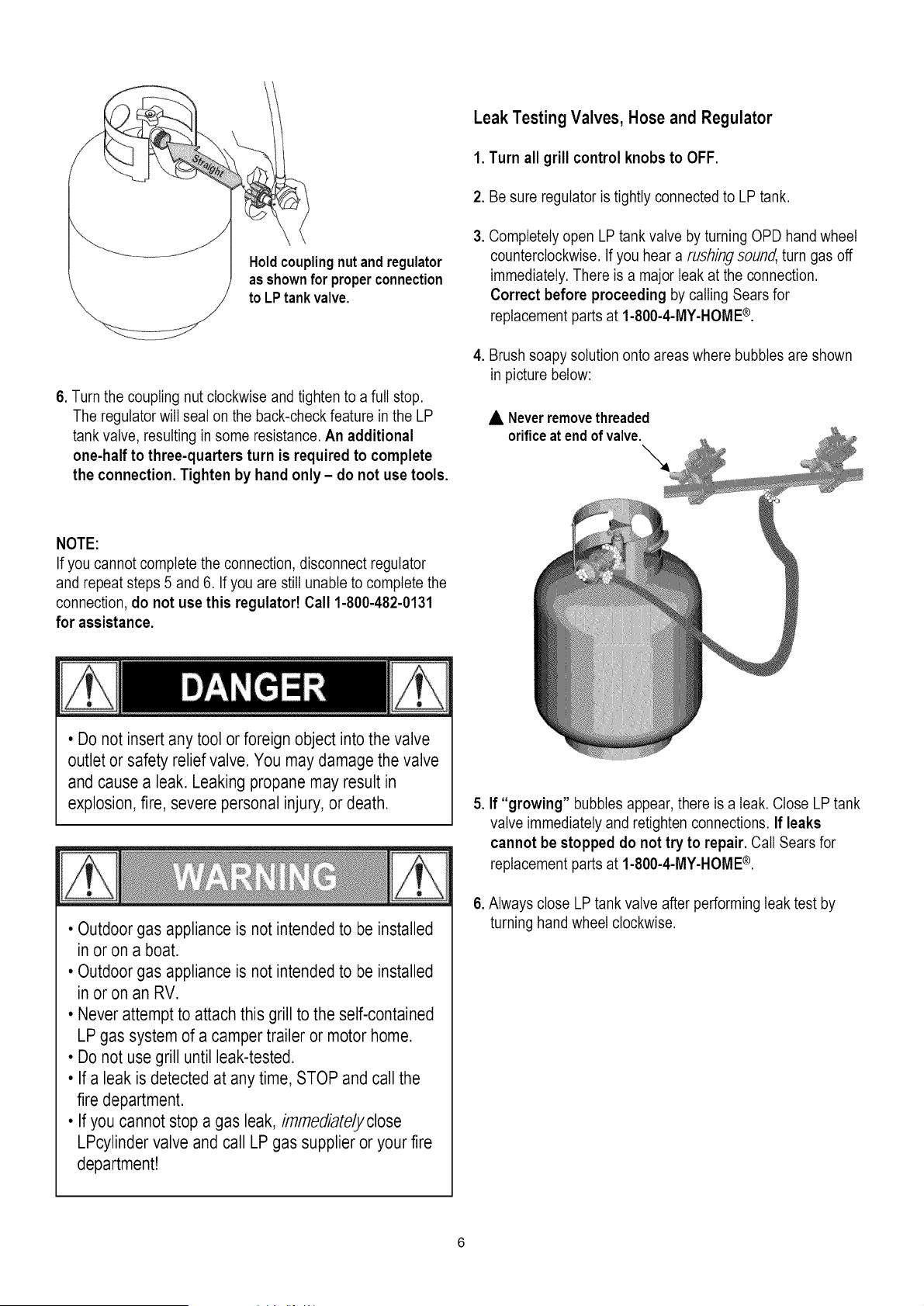
Holdcouplingnutandregulator
asshownfor properconnection
to LP tankvalve.
6. Turn the coupling nut clockwise and tighten to a full stop.
The regulator will seat on the back-check feature in the LP
tank valve, resulting in some resistance. An additional
one-half to three-quarters turn is required to complete
the connection. Tighten by hand only - do not use tools.
Leak Testing Valves, Hose and Regulator
1. Turnall grillcontrolknobsto OFF.
2. Be sure regulator is tightly connected to LP tank.
.
Completely open LP tank valve by turning OPD hand wheel
counterclockwise. If you hear a rushing sound, turn gas off
immediately. There is a major leak at the connection.
Correct before proceeding by calling Sears for
replacement parts at 1-800-4-MY-HOME®.
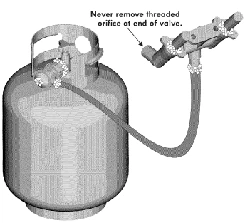
4. Brush soapy solution onto areas where bubbles are shown
in picture below:
• Neverremovethreaded
orificeatendof valve.
NOTE:
If you cannot complete the connection, disconnect regulator
and repeat steps 5 and 6. If you are still unable to complete the
connection, do not use this regulatod Call 1-800-482-0131
for assistance.
• Do not insert any tool or foreign object into the valve
outlet or safety relief valve. You may damage the valve
and cause a leak. Leaking propane may result in
explosion,fire, severe personal injury, or death.
• Outdoor gas appliance is not intended to be installed
in or on a boat.
• Outdoor gas appliance is not intended to be installed
in or on an RV.
• Never attempt to attach this grill to the self-contained
LP gas system of a camper trailer or motor home.
• Do not use grill until leak-tested.
• If a leak is detected at any time, STOP and call the
fire department.
• If you cannot stop a gas leak, immediate/yclose
LPcylinder valve and call LP gas supplier or your fire
department!
5. If "growing" bubbles appear, there is a leak. Close LP tank
valve immediately and retighten connections. If leaks
cannot be stopped do not try to repair. Call Sears for
replacement parts at 1-800-4-MY-HOME®.
6. Always close LP tank valve after performing leak test by
turning hand wheel clockwise.
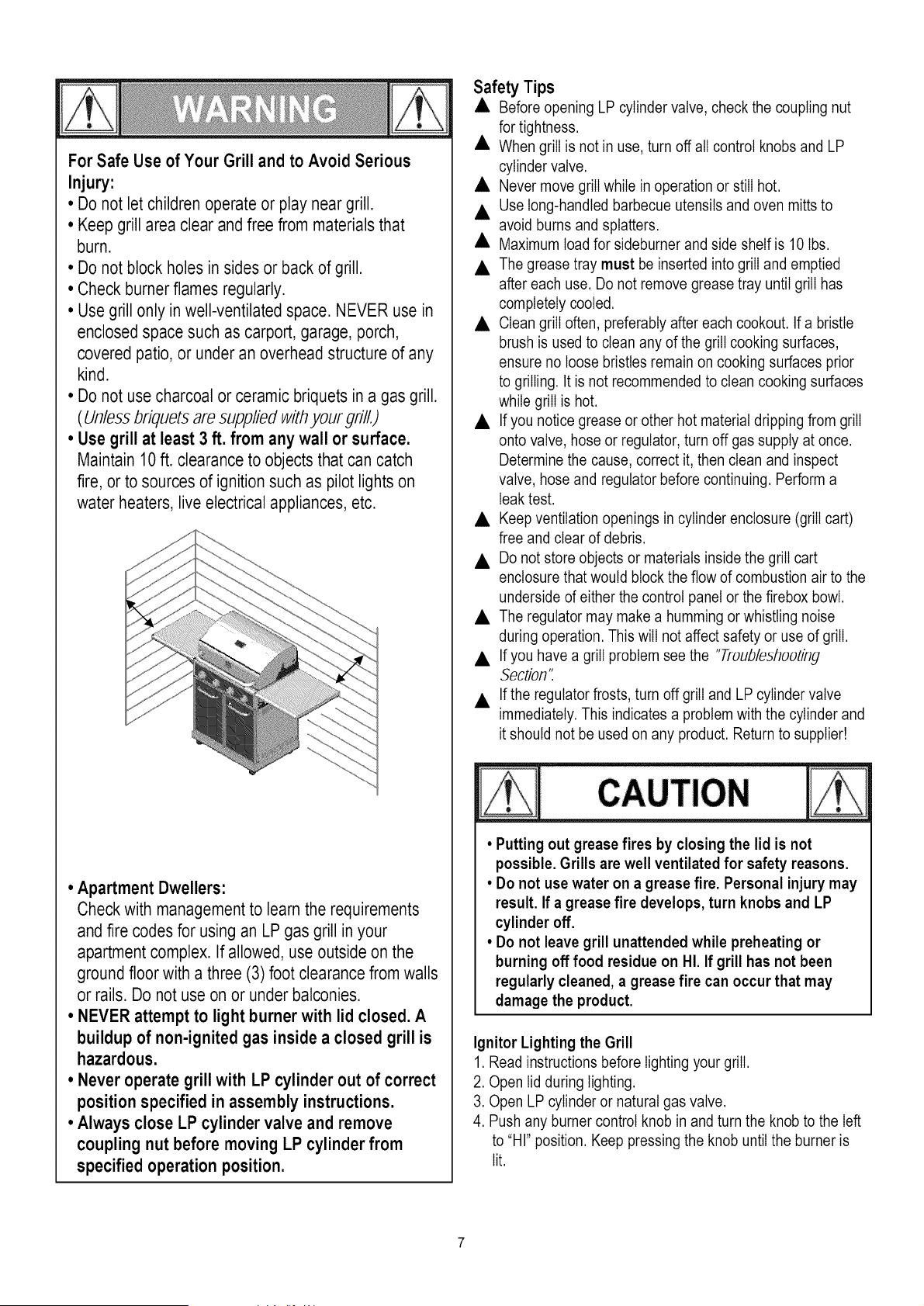
For Safe Use of Your Grill and to Avoid Serious
Injury:
• Do not let children operate or play neargrill.
• Keep grill area clear and free from materials that
burn.
• Do not block holes in sides or back of grill.
• Check burnerflames regularly.
• Use grill only in well-ventilated space. NEVER use in
enclosedspace such as carport, garage, porch,
covered patio, or under an overhead structure of any
kind.
• Do not use charcoal or ceramic briquets in a gas grill.
(Unless briquets are supplied withyour grill.)
• Use grill at least 3 ft. from any wall or surface.
Maintain 10 ft. clearance to objects that can catch
fire, or to sources of ignition such as pilot lights on
water heaters, live electrical appliances, etc.
• Apartment Dwellers:
Check with managementto learn the requirements
and fire codes for using an LP gas grill in your
apartment complex. If allowed, use outside on the
ground floor with a three (3) foot clearance from walls
or rails. Do not use on or under balconies.
° NEVER attempt to light burner with lid closed. A
buildup of non-ignited gas inside a closed grill is
hazardous.
• Never operate grill with LP cylinder out of correct
position specified in assembly instructions.
• Always close LP cylinder valve and remove
coupling nut before moving LP cylinder from
specified operation position.
Safety Tips
• Before opening LP cylinder valve, check the coupling nut
for tightness.
• When grill is not in use, turn off all control knobs and LP
cylinder valve.
• Never move grill while in operation or still hot.
• Use long-handled barbecue utensils and oven mitts to
avoid burns and splatters.
• Maximum load for sideburner and side shelf is 10 Ibs.
• The grease tray must be inserted into grill and emptied
after each use. Do not remove grease tray until grill has
completely cooled.
• Clean grill often, preferably after each cookout. If a bristle
brush is used to clean any of the grill cooking surfaces,
ensure no loose bristles remain on cooking surfaces prior
to grilling. It is not recommended to clean cooking surfaces
while grill is hot.
• If you notice grease or other hot material dripping from grill
onto valve, hose or regulator, turn off gas supply at once.
Determine the cause, correct it, then clean and inspect
valve, hose and regulator before continuing. Perform a
leak test.
• Keep ventilation openings in cylinder enclosure (grill cart)
free and clear of debris.
• Do not store objects or materials inside the grill cart
enclosure that would block the flow of combustion air to the
underside of either the control panel or the firebox bowl.
• The regulator may make a humming or whistling noise
during operation. This will not affect safety or use of grill.
• If you have a grill problem see the "Trouble_hooflhLl
Section't
• If the regulator frosts, turn off grill and LP cylinder valve
immediately. This indicates a problem with the cylinder and
it should not be used on any product. Return to supplier!
CAUTION
• Putting out grease fires by closing the lid is not
possible. Grills are well ventilated for safety reasons.
• Do not use water on a grease fire. Personal injury may
result. If a grease fire develops, turn knobs and LP
cylinder off.
• Do not leave grill unattended while preheating or
burning off food residue on HI. If grill has not been
regularly cleaned, a grease fire can occur that may
damage the product.
Ignitor Lighting the Grill
1. Read instructions before lighting your grill.
2. Open lid during lighting.
3. Open LP cylinder or natural gas valve.
4. Push any burner control knob in and turn the knob to the left
to "HI" position. Keep pressing the knob until the burner is
lit.
5.Ifignitiondoesnotoccurin5seconds,turntheburner
controloff,wait5 minutesforgastoclearaway,andrepeat
thelightingprocedure.
6.Tolightotherburners,repeatstep4.
NOTE:Ifignitordoesnotwork,followMatchLighting
instructions.
Burner Flame Check
•Remove cooking grates and heat diffusers. Light burners,
rotate knobs from HIGH to LOW. You should see a smaller
flame in LOW position than seen on HIGH. Perform burner
flame check on sideburner, also. Always check flame prior to
each use.
3H
Turn controls and gas source or tank OFF when
not in use.
If ignitiondoesnot occurin5 seconds,turnthe burner
controloff,wait5 minutes,and repeatthe lighting
procedure.If the burner does not ignite with
the valve open, gas will continue to flow out of the
burner and could accidently ignite with risk of
injury.
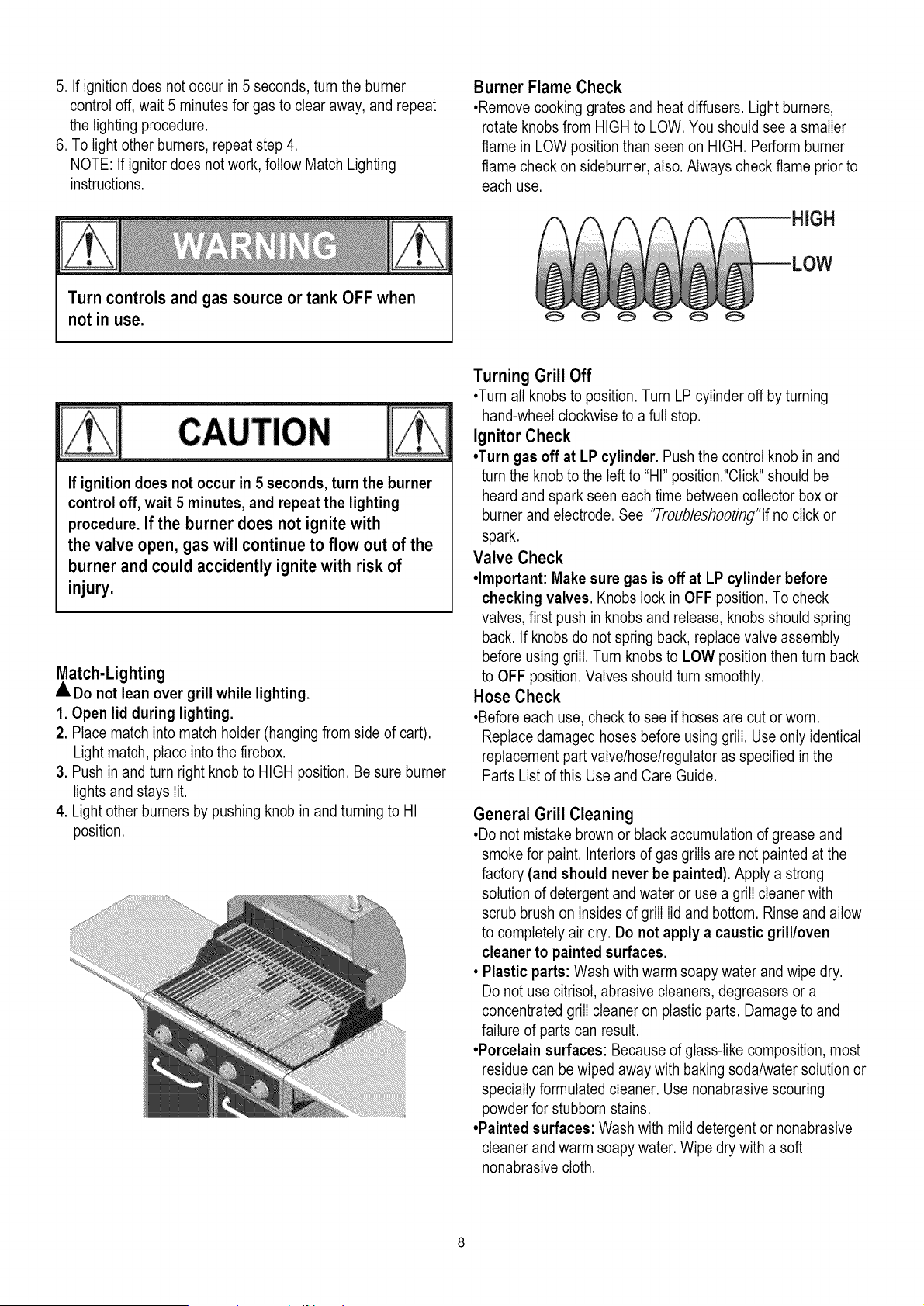
Match-Lighting
• Do not lean over grill while lighting.
1. Open lid during lighting.
2. Place match into match holder (hanging from side of cart).
Light match, place into the firebox.
3. Push in and turn right knob to HIGH position. Be sure burner
lights and stays Iit.
4. Light other burners by pushing knob in and turning to HI
position.
Turning GrillOff
•Turn all knobs to position. Turn LP cylinder off by turning
hand-wheel clockwise to a full stop.
Ignitor Check
•Turn gas off at LP cylinder. Push the control knob in and
turn the knob to the left to "HI" position?Click" should be
heard and spark seen each time between collector box or
burner and electrode. See "Troub/eshooting"if no click or
spark.
Valve Check
•Important: Make sure gas is off at LP cylinder before
checking valves. Knobs lock in OFF position. To check
valves, first push in knobs and release, knobs should spring
back. If knobs do not spring back, replace valve assembly
before using grill. Turn knobs to LOW position then turn back
to OFF position. Valves should turn smoothly.
Hose Check
•Before each use, check to see if hoses are cut or worn.
Replace damaged hoses before using grill. Use only identical
replacement part valve/hose/regulator as specified in the
Parts List of this Use and Care Guide.
General Grill Cleaning
•Do not mistake brown or black accumulation of grease and
smoke for paint. Interiors of gas grills are not painted at the
factory (and should never be painted). Apply a strong
solution of detergent and water or use a grill cleaner with
scrub brush on insides of grill lid and bottom. Rinseand allow
to completely air dry. Do not apply a caustic grill/oven
cleaner to painted surfaces.
• Plastic parts: Wash with warm soapy water and wipe dry.
Do not use citrisot, abrasive cleaners, degreasers or a
concentrated grill cleaner on plastic parts. Damage to and
failure of parts can result.
•Porcelain surfaces: Because of glass-like composition, most
residue can be wiped away with baking soda/water solution or
specially formulated cleaner. Use nonabrasive scouring
powder for stubborn stains.
•Painted surfaces: Wash with mild detergent or nonabrasive
cleaner and warm soapy water. Wipe dry with a soft
nonabrasive cloth.
•Stainless steel surfaces: To maintain your grill's high quality
appearance, wash with mild detergent and warm soapy water
and wipe dry with a soft cloth after each use. Baked-on
grease deposits may require the use of an abrasive plastic
cleaning pad. Use only in direction of brushed finish to avoid
damage. Do not use abrasive pad on areas with graphics.
• Cooking surfaces: If a bristle brush is used to clean any of
the grill cooking surfaces, ensure no loose bristles remain on
cooking surfaces prior to grilling. It is not recommended to
clean cooking surfaces while grill is hot.
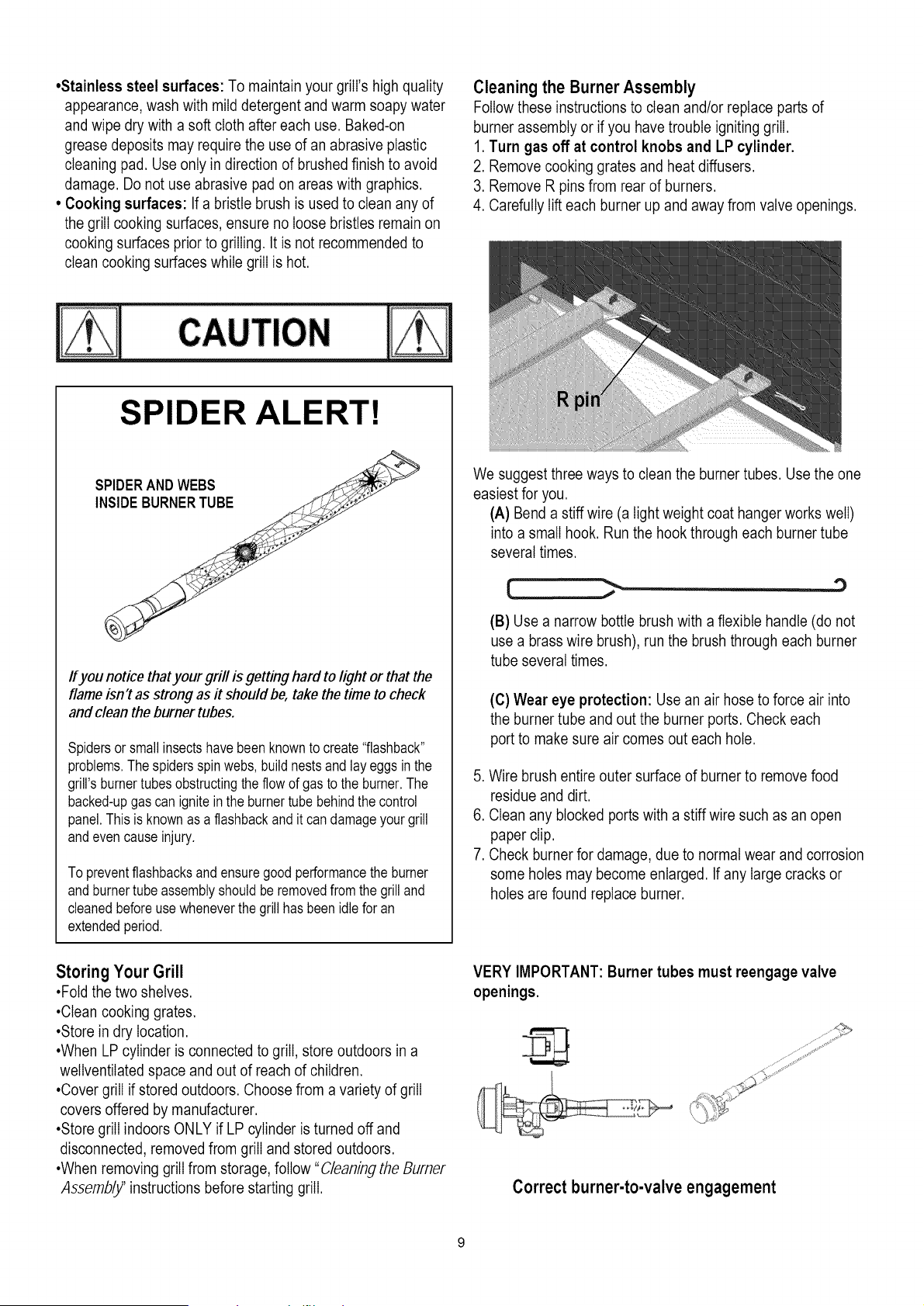
Cleaning the Burner Assembly
Follow these instructions to clean and/or replace parts of
burner assembly or if you have trouble igniting grill.
1. Turn gas off at control knobs and LP cylinder.
2. Remove cooking grates and heat diffusers.
3. Remove R pins from rear of burners.
4. Carefully lift each burner up and away from valve openings.
SPIDER ALERT!
Ifyou notice thatyour grill is getting hard to light or that the
flame isn't as strong as it should be, take the time to check
and clean the burner tubes.
Spidersor smallinsectshavebeenknownto create"flashback"
problems.Thespidersspinwebs,buildnestsandlay eggsin the
grill's burnertubes obstructingtheflow of gasto the burner.The
backed-upgascan igniteinthe burnertube behindthe control
panel.This is knownas a flashbackandit candamageyour grill
andevencauseinjury.
To preventflashbacksandensuregoodperformancethe burner
and burnertubeassemblyshouldbe removedfrom the grilland
cleanedbeforeusewheneverthe grill has beenidlefor an
extendedperiod,
We suggest three ways to clean the burner tubes. Use the one
easiest for you.
(A) Bend a stiff wire (a light weight coat hanger works well)
into a small hook. Run the hook through each burner tube
several times.
(B) Use a narrow bottle brush with a flexible handle (do not
use a brass wire brush), run the brush through each burner
tube several times.
(C) Wear eye protection: Use an air hose to force air into
the burner tube and out the burner ports. Check each
port to make sure air comes out each hole.
5. Wire brush entire outer surface of burner to remove food
residue and dirt.
6. Clean any blocked ports with a stiff wire such as an open
paper clip.
7. Check burner for damage, due to normal wear and corrosion
some holes may become enlarged. If any large cracks or
holes are found replace burner.
Storing Your Grill
•Fold the two shelves.
•Clean cooking grates.
•Store in dry location.
•When LP cylinder is connected to grill, store outdoors in a
wellventilated space and out of reach of children.
•Cover grill if stored outdoors. Choose from a variety of grill
covers offered by manufacturer.
•Store grill indoors ONLY if LP cylinder is turned off and
disconnected, removed from grill and stored outdoors.
•When removing grill from storage, follow "C/eaning the Burner
Assembly' instructions before starting grill.
VERY IMPORTANT: Burner tubes must reengage valve
openings.
Correct burner-to-valve engagement
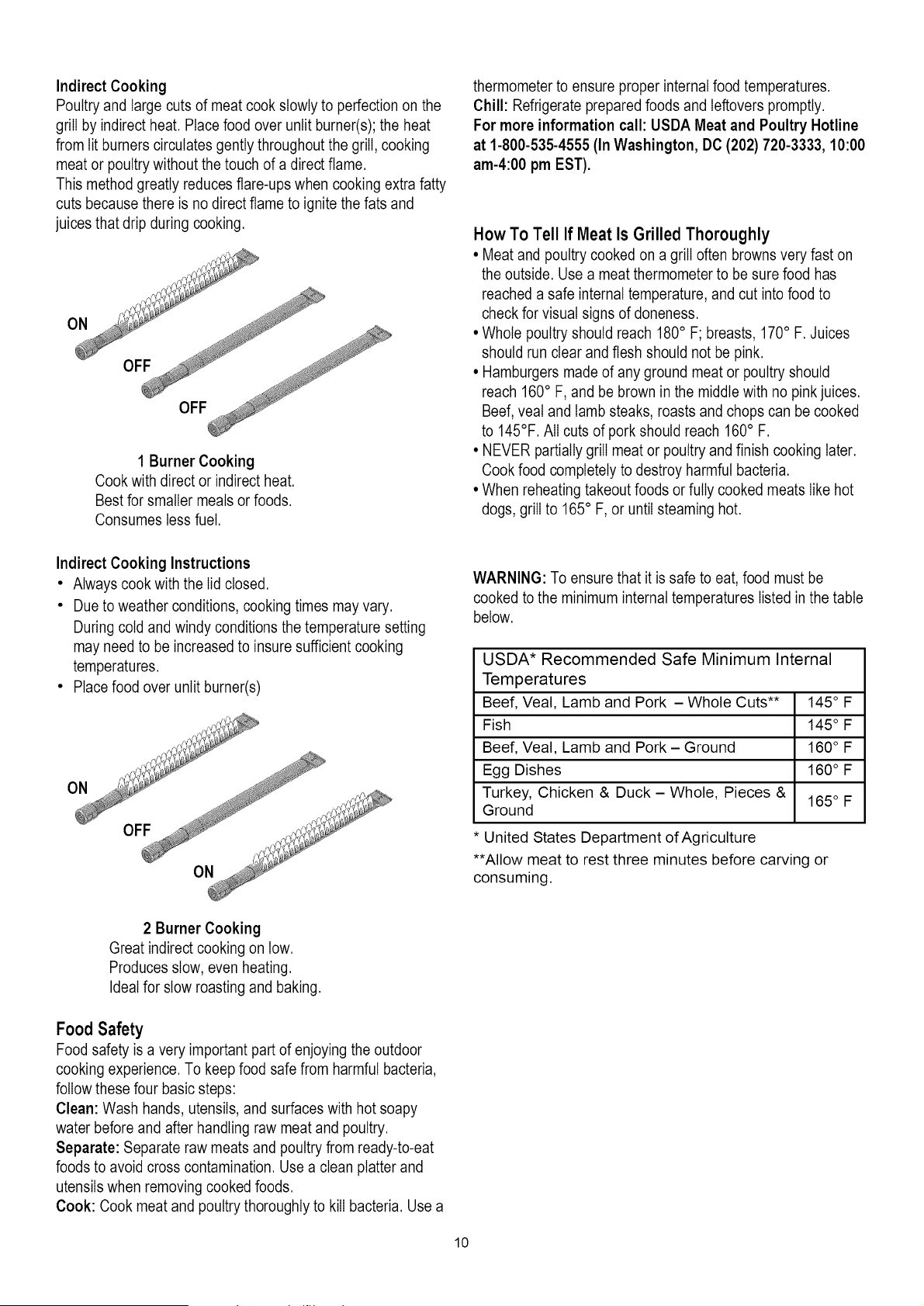
Indirect Cooking
Poultry and large cuts of meat cook slowly to perfection on the
grill by indirect heat. Place food over unlit burner(s); the heat
from lit burners circulates gently throughout the grill, cooking
meat or poultry without the touch of a direct flame.
This method greatly reduces flare-ups when cooking extra fatty
cuts because there is no direct flame to ignite the fats and
juices that drip during cooking.
1 Burner Cooking
Cook with direct or indirect heat.
Best for smaller meals or foods.
Consumes less fuel.
thermometer to ensure proper internal food temperatures.
Chill: Refrigerate prepared foods and leftovers promptly.
For more information call: USDA Meat and Poultry Hotline
at 1-800-535-4555 (In Washington, DC (202) 720-3333, 10:00
am-4:00 pm EST).
How To Tell If Meat Is Grilled Thoroughly
• Meat and poultry cooked on a grill often browns very fast on
the outside. Use a meat thermometer to be sure food has
reached a safe internal temperature, and cut into food to
check for visual signs of doneness.
• Whole poultry should reach 180° F; breasts, 170° F. Juices
should run clear and flesh should not be pink.
• Hamburgers made of any ground meat or poultry should
reach 160° F, and be brown in the middle with no pink juices.
Beef,veal and lamb steaks, roasts and chops can be cooked
to 145°F. All cuts of pork should reach 160° F.
• NEVER partially grill meat or poultry and finish cooking later.
Cook food completely to destroy harmful bacteria.
• When reheating takeout foods or fully cooked meats like hot
dogs, grill to 165° F, or until steaming hot.
Indirect Cooking Instructions
• Always cook with the lid closed.
• Due to weather conditions, cooking times may vary.
During cold and windy conditions the temperature setting
may need to be increased to insure sufficient cooking
temperatures.
• Place food over unlit burner(s)
WARNING: To ensure that it is safe to eat, food must be
cooked to the minimum internal temperatures listed in the table
below.
USDA* Recommended Safe Minimum Internal
Temperatures
Beef, Veal, Lamb and Pork - Whole Cuts** 145 ° F
Fish 145° F
Beef, Veal, Lamb and Pork - Ground 160° F
Egg Dishes 160° F
Turkey, Chicken & Duck - Whole, Pieces &
165° F
Ground
United States Department of Agriculture
**Allow meat to rest three minutes before carving or
consuming.
2 Burner Cooking
Great indirect cooking on tow.
Produces slow, even heating.
Ideal for slow roasting and baking.
Food Safety
Food safety is a very important part of enjoying the outdoor
cooking experience. To keep food safe from harmful bacteria,
follow these four basic steps:
Clean: Wash hands, utensils, and surfaces with hot soapy
water before and after handling raw meat and poultry.
Separate: Separate raw meats and poultry from ready-to-eat
foods to avoid cross contamination. Use a clean platter and
utensils when removing cooked foods.
Cook: Cook meat and poultry thoroughly to kill bacteria. Use a
10
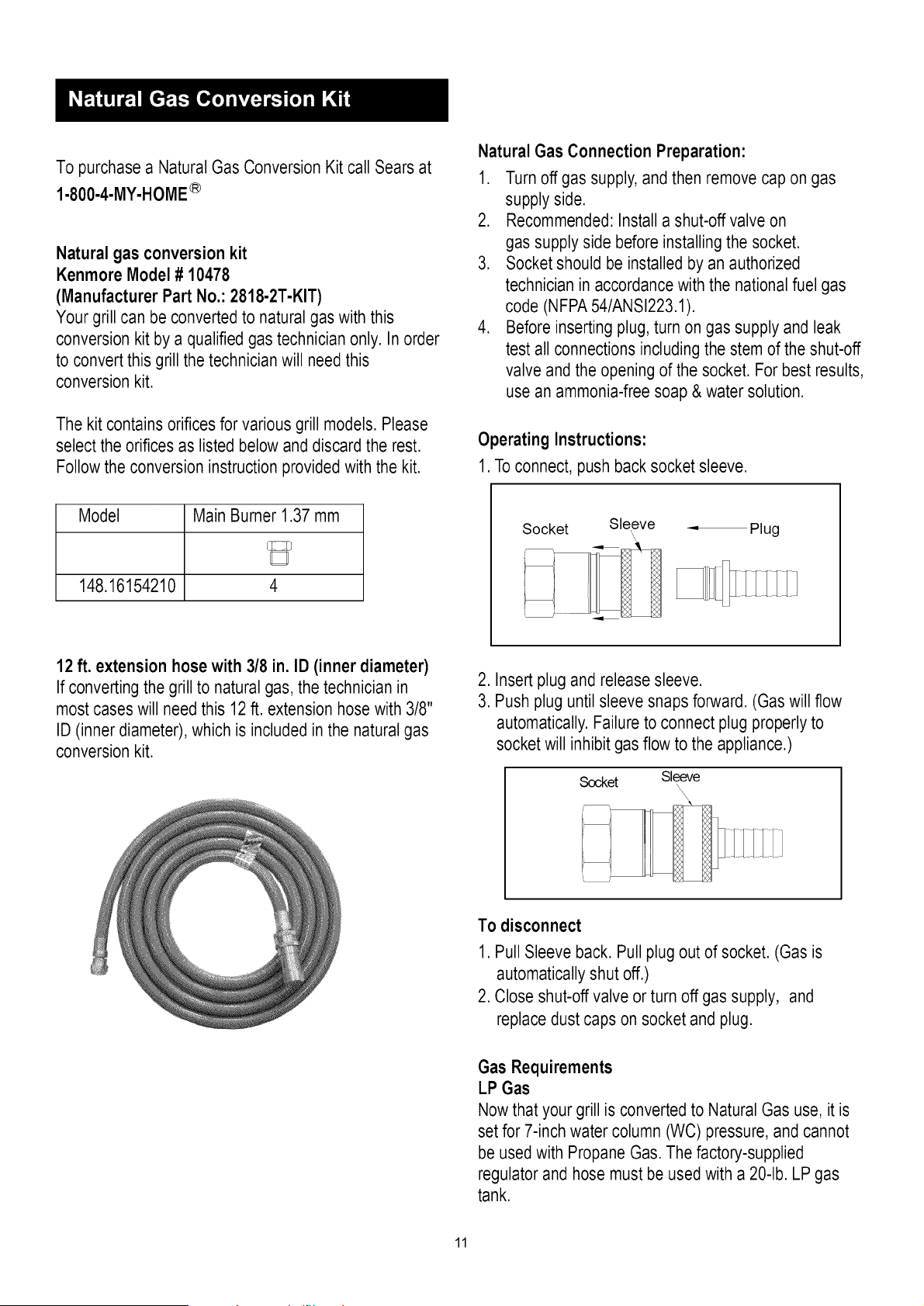
To purchase a Natural Gas Conversion Kit call Sears at
1.800.4.MY.HOME ®
Natural gas conversion kit
Kenmore Model# 10478
(Manufacturer Part No.: 2818-2T-KIT)
Your grill can be converted to natural gas with this
conversion kit by a qualified gas technician only. In order
to convert this grill the technician will need this
conversion kit.
The kit contains orifices for various grill models. Please
select the orifices as listed below and discard the rest.
Follow the conversion instruction provided with the kit.
Natural Gas Connection Preparation:
1. Turn off gas supply, andthen remove cap on gas
supply side.
2. Recommended: Install a shut-off valve on
gas supply side before installing the socket.
3. Socket should be installed by an authorized
technician in accordance with the national fuel gas
code (NFPA54/ANSI223.1).
4. Before inserting plug, turn on gas supply and leak
test all connections including the stem of the shut-off
valve and the opening of the socket. For best results,
use an ammonia-free soap & water solution.
Operating Instructions:
1. To connect, push back socket sleeve.
Model Main Burner 1.37 mm
148.16154210 4
Socket Sleeve _- Plug
12 ft. extension hose with 3/8 in. ID (inner diameter)
If converting the grill to natural gas, the technician in
most cases will need this 12 ft. extension hose with 3/8"
ID (inner diameter), which is included in the natural gas
conversion kit.
2. Insert plug and release sleeve.
3. Push plug until sleeve snaps forward. (Gas will flow
automatically.Failure to connect plug properly to
socket will inhibit gas flow to the appliance.)
Socket Sleeve
\\\\
To disconnect
1. Pull Sleeve back. Pull plug out of socket. (Gas is
automaticallyshut off.)
2. Close shut-off valve or turn off gas supply, and
replacedust caps on socket and plug.
Gas Requirements
LP Gas
Now that your grill is converted to Natural Gas use, it is
set for 7-inch water column (WC) pressure, and cannot
be used with Propane Gas. The factory-supplied
regulator and hose must be used with a 20-lb. LP gas
tank.
11
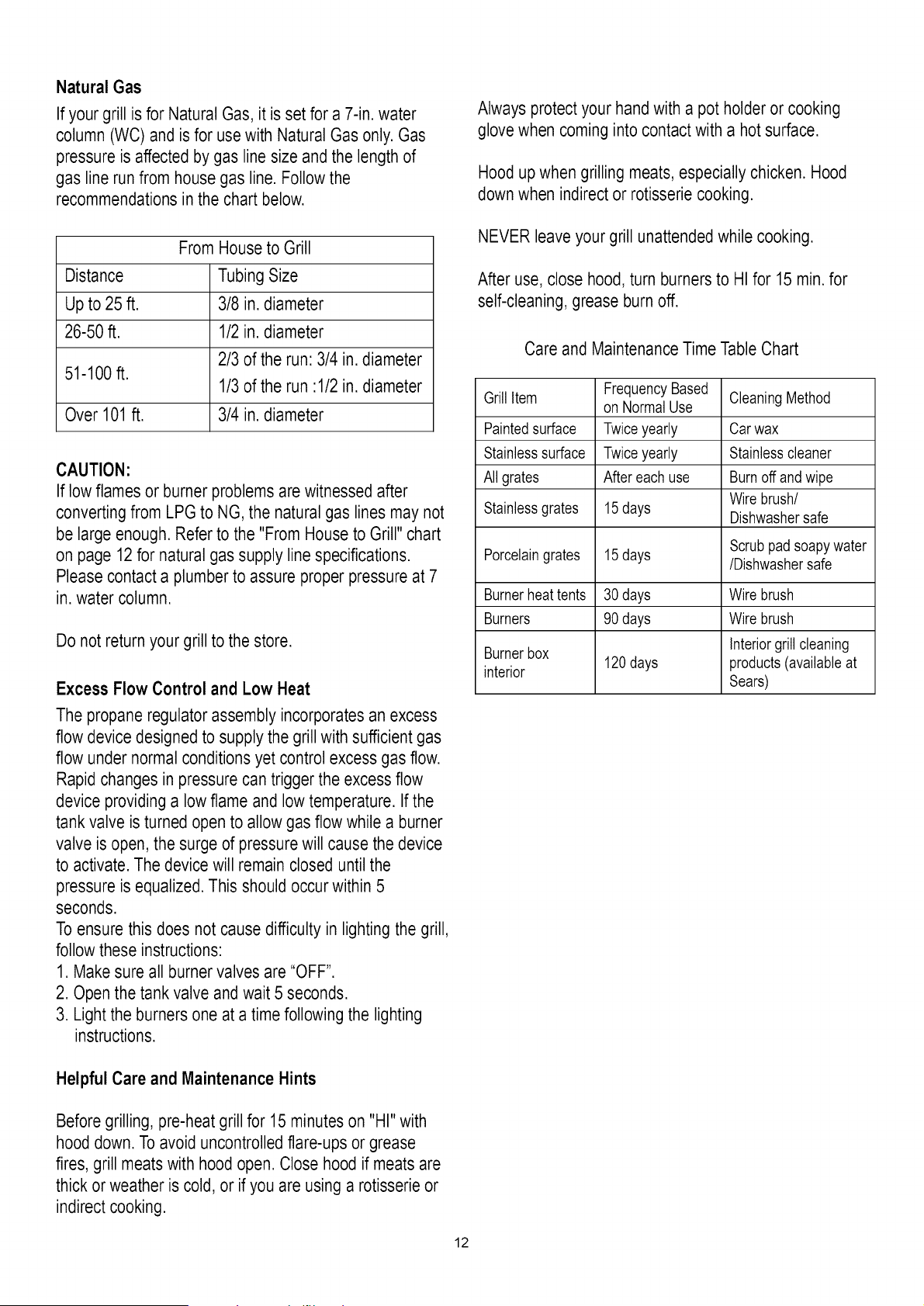
Natural Gas
If your grill is for Natural Gas, it is set for a 7-in. water
column (WC) and is for usewith Natural Gas only. Gas
pressure is affected by gas line size and the length of
gas line run from house gas line. Follow the
recommendations in the chart below.
From Houseto Grill
Distance Tubing Size
Upto 25 ft. 3/8 in. diameter
26-50 ft. 1/2 in. diameter
2/3 of the run: 3/4 in. diameter
51-100ft.
1/3of the run :1/2 in. diameter
Over 101 ft. 3/4 in. diameter
CAUTION:
If low flames or burner problems are witnessed after
converting from LPG to NG, the natural gas lines may not
be large enough. Refer to the "From House to Grill" chart
on page 12 for natural gas supply line specifications.
Please contact a plumber to assure proper pressureat 7
in. water column.
Do not return your grill to the store.
Excess Flow Control and Low Heat
The propane regulator assembly incorporates an excess
flow device designed to supply the grill with sufficient gas
flow under normal conditions yet control excess gas flow.
Rapid changes in pressure can trigger the excessflow
device providing a low flame and low temperature. If the
tank valve is turned open to allow gas flow while a burner
valve is open, the surge of pressurewill cause the device
to activate. The device will remain closed until the
pressure is equalized. This should occur within 5
seconds.
To ensure this does not cause difficulty in lighting the grill,
follow these instructions:
1. Make sure all burner valves are "OFF".
2. Open the tank valve and wait 5 seconds.
3. Light the burners one at a time following the lighting
instructions.
Always protect your hand with a pot holder or cooking
glove when coming into contact with a hot surface.
Hood up when grilling meats, especially chicken. Hood
down when indirect or rotisserie cooking.
NEVER leave your grill unattendedwhile cooking.
After use, close hood, turn burnersto HIfor 15 rain. for
self-cleaning, grease burn off.
Care and MaintenanceTime Table Chart
GrillItem FrequencyBased
on NormalUse CleaningMethod
Paintedsurface Twiceyearly Car wax
Stainlesssurface Twiceyearly Stainlesscleaner
All grates After each use Burnoff andwipe
Wire brush/
Stainlessgrates 15 days Dishwashersafe
Scrub padsoapy water
Porcelaingrates 15 days /Dishwashersafe
Burnerheat tents 30 days Wire brush
Burners 90 days Wire brush
Burnerbox Interiorgrill cleaning
120days products(availableat
interior Sears)
Helpful Care and Maintenance Hints
Before grilling, pre-heat grill for 15 minutes on "HI" with
hood down. To avoid uncontrolled flare-ups or grease
fires, grill meats with hood open. Close hood if meats are
thick or weather is cold, or if you are using a rotisserie or
indirect cooking.
12
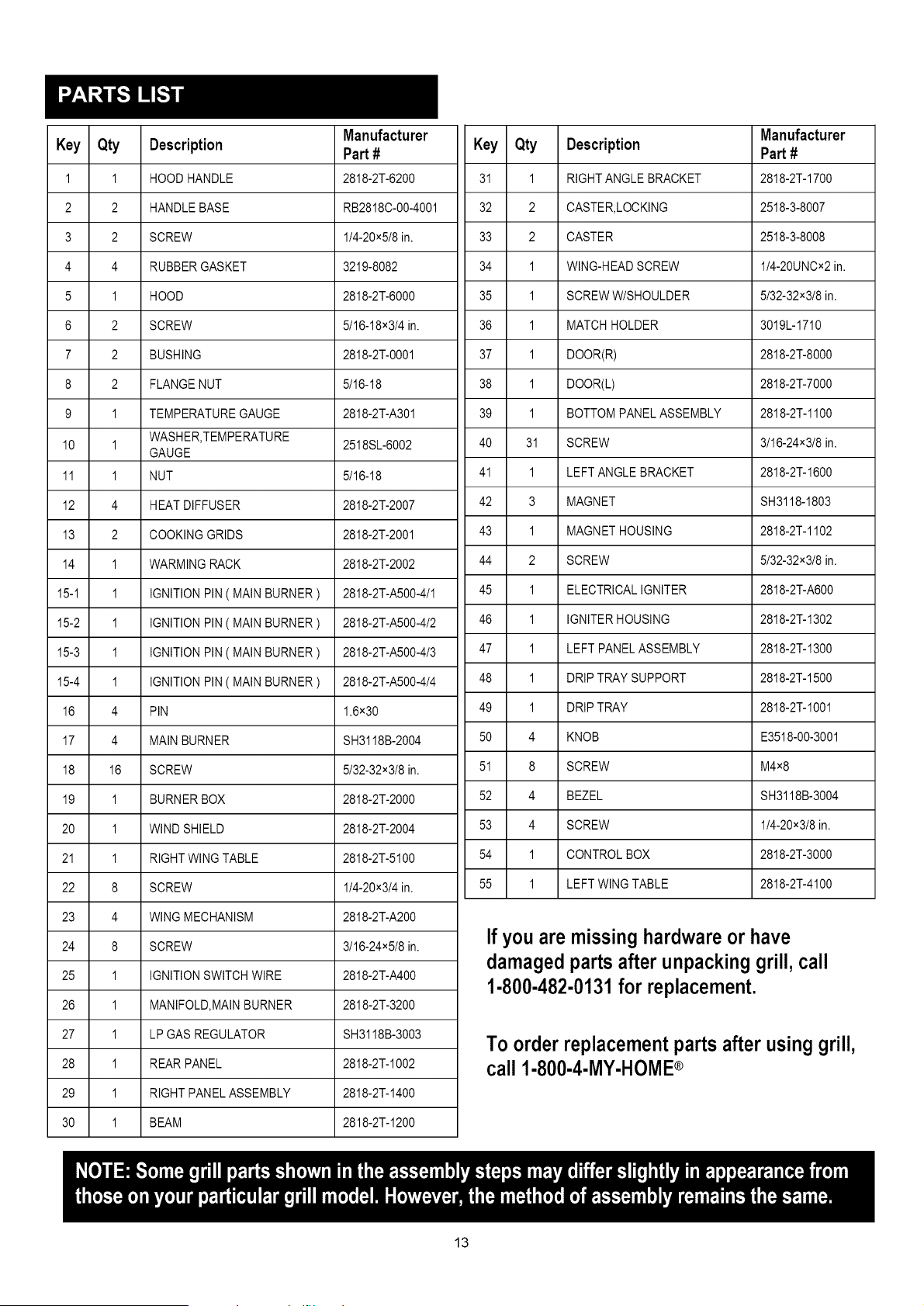
Key
1
2
3
4
5
6
7
8
9
lO
11
12
13
14
15-1
15-2
15-3
15-4
16
17
18
19
20
21
22
23
24
25
26
27
28
29
30
Qty
1
2
2
4
1
2
2
2
1
1
1
4
2
1
1
1
1
1
4
4
16
1
1
1
8
4
8
1
1
1
1
1
1
Description
HOODHANDLE
HANDLEBASE
SCREW
RUBBERGASKET
HOOD
SCREW
BUSHING
FLANGENUT
TEMPERATUREGAUGE
WASHER,TEMPERATURE
GAUGE
NUT
HEATDIFFUSER
COOKINGGRIDS
WARMINGRACK
IGNITIONPIN( MAINBURNER)
IGNITIONPIN( MAINBURNER)
IGNITIONPIN( MAINBURNER)
IGNITIONPIN( MAINBURNER)
PIN
MAIN BURNER
SCREW
BURNERBOX
WINDSHIELD
RIGHTWINGTABLE
SCREW
WINGMECHANISM
Manufacturer
Part #
2818-2T-6200
RB28180-00-4001
1t4-20x518in.
3219-8082
2818-2T-6000
5116-18x314in.
2818-2T-0001
5116-18
2818-2T-A301
2518SL-6002
5116-18
2818-2T-2007
2818-2T-2001
2818-2T-2002
2818-2T-A500-4/1
2818-2T-A500-4/2
2818-2T-A500-4/3
2818-2T-A500-4/4
1.6x30
SH3118B-2004
5132-32x318in.
2818-2T-2000
2818-2T-2004
2818-2T-5100
1t4-20x314in.
2818-2T-A200
Key Qty Description
31 1 RIGHTANGLEBRACKET
32 2 CASTER,LOCKING
33 2 CASTER
34 1 WING-HEADSCREW
35 1 SCREWW/SHOULDER
36 1 MATCHHOLDER
37 1 DOOR(R)
38 1 DOOR(L)
39 1 BOTTOMPANELASSEMBLY
40 31 SCREW
41 1 LEFTANGLEBRACKET
42 3 MAGNET
43 1 MAGNETHOUSING
44 2 SCREW
45 1 ELECTRICALIGNITER
46 1 IGNITERHOUSING
47 1 LEFTPANELASSEMBLY
48 1 DRIPTRAYSUPPORT
49 1 DRIPTRAY
50 4 KNOB
51 8 SCREW
52 4 BEZEL
53 4 SCREW
54 1 CONTROLBOX
55 1 LEFTWINGTABLE
Manufacturer
Part#
2818-2T-1700
2518-3-8007
2518-3-8008
1t4-20UNCx2in.
5132-32x318in.
3019L-1710
2818-2T-8000
2818-2T-7000
2818-2T-1100
3116-24x318in.
2818-2T-1600
SH3118-1803
2818-2T-1102
5132-32x318in.
2818-2T-A600
2818-2T-1302
2818-2T-1300
2818-2T-1500
2818-2T-1001
E3518-00-3001
M4x8
SH3118B-3004
1t4-20x318in.
2818-2T-3000
2818-2T-4100
If you are missinghardwareor have
SCREW 3/16-24x5/8in.
IGNITIONSWITCHWIRE 2818-2T-A400 damaged parts after unpacking grill, call
1-800-482-0131 for replacement.
MANIFOLD,MAINBURNER 2818-2T-3200
LPGASREGULATOR SH3118B-3003 TOorder replacement parts after using grill,
REARPANEL 2818-2T-1002 call 1-800-4-MY-HOME®
RIGHTPANELASSEMBLY 2818-2T-1400
BEAM 2818-2T-1200
13
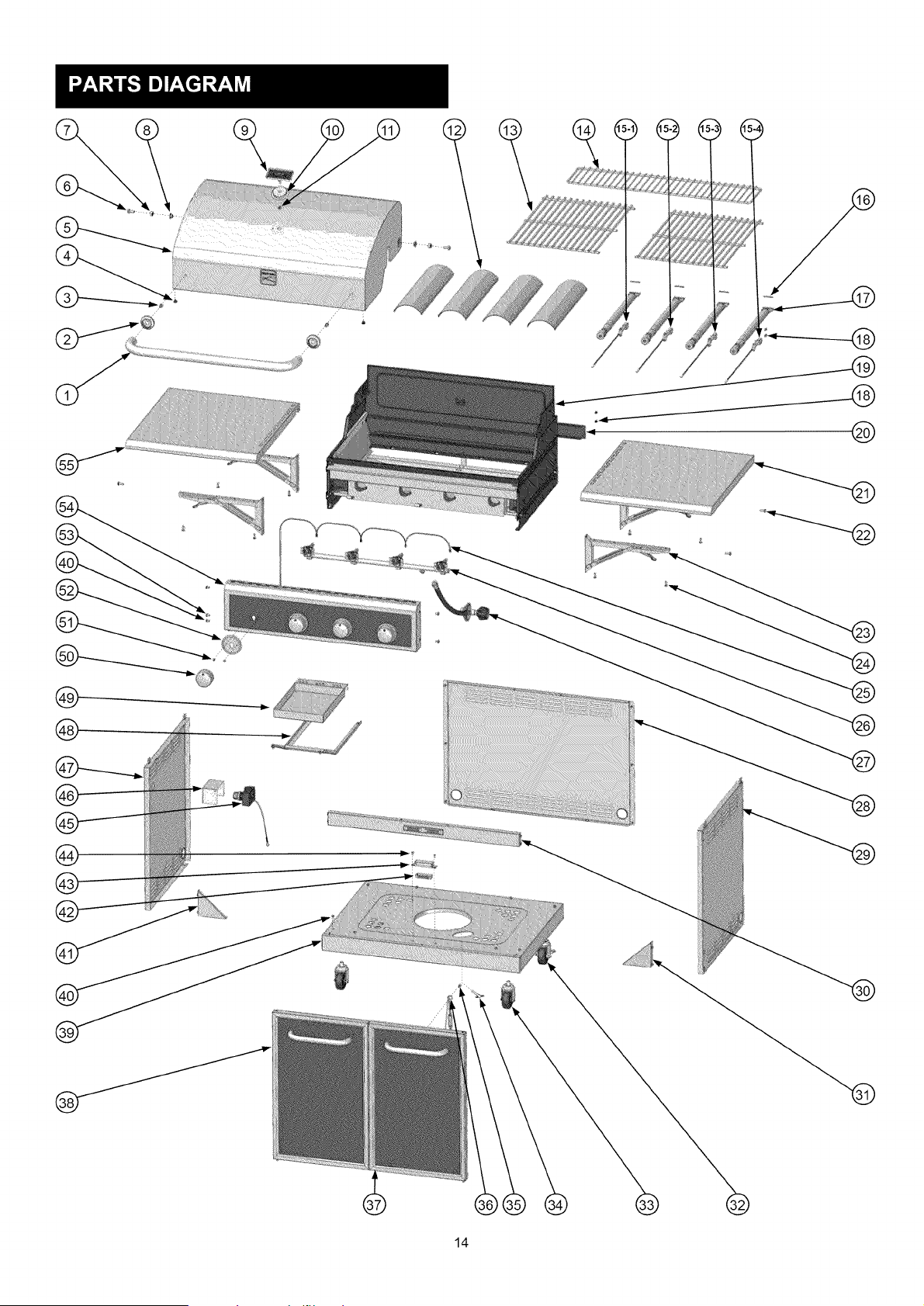
@
14
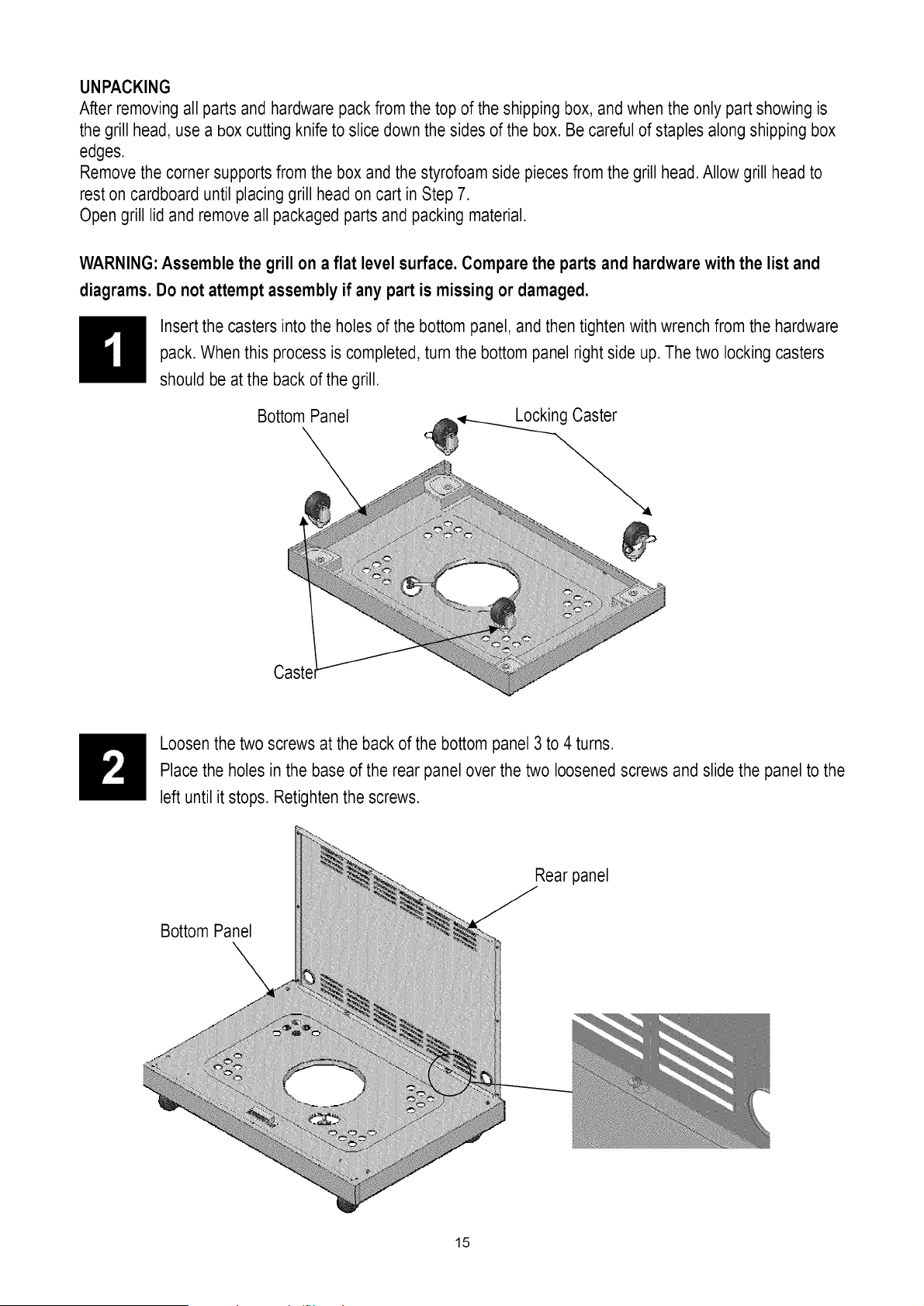
UNPACKING
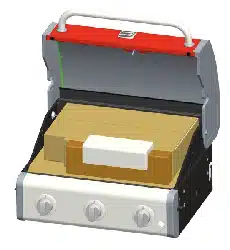
After removing all parts and hardware pack from the top of the shipping box, and when the only part showing is
the grill head, use a bOXcutting knife to slice down the sides of the box. Be careful of staples along shipping box
edges.
Remove the corner supports from the box and the styrofoam side piecesfrom the grill head.Allow grill head to
rest on cardboard until placinggrill head on cart in Step 7.
Open grill lid and remove all packaged parts and packing material.
WARNING: Assemble the grill on a flat level surface. Compare the parts and hardwarewith the list and
diagrams. Do not attempt assembly if any part is missing or damaged.
Insert the casters into the holes of the bottom panel, and then tighten with wrench from the hardware
pack. When this process is completed,turn the bottom panel right side up. The two locking casters
should be at the back of the grill.
Bottom Panel
Caste
Loosen the two screws at the back of the bottom panel 3 to 4 turns.
Place the holes in the base of the rear panel over the two loosened screws and slide the panel to the
left until it stops. Retighten the screws.
Rear panel
Bottom Panel
15
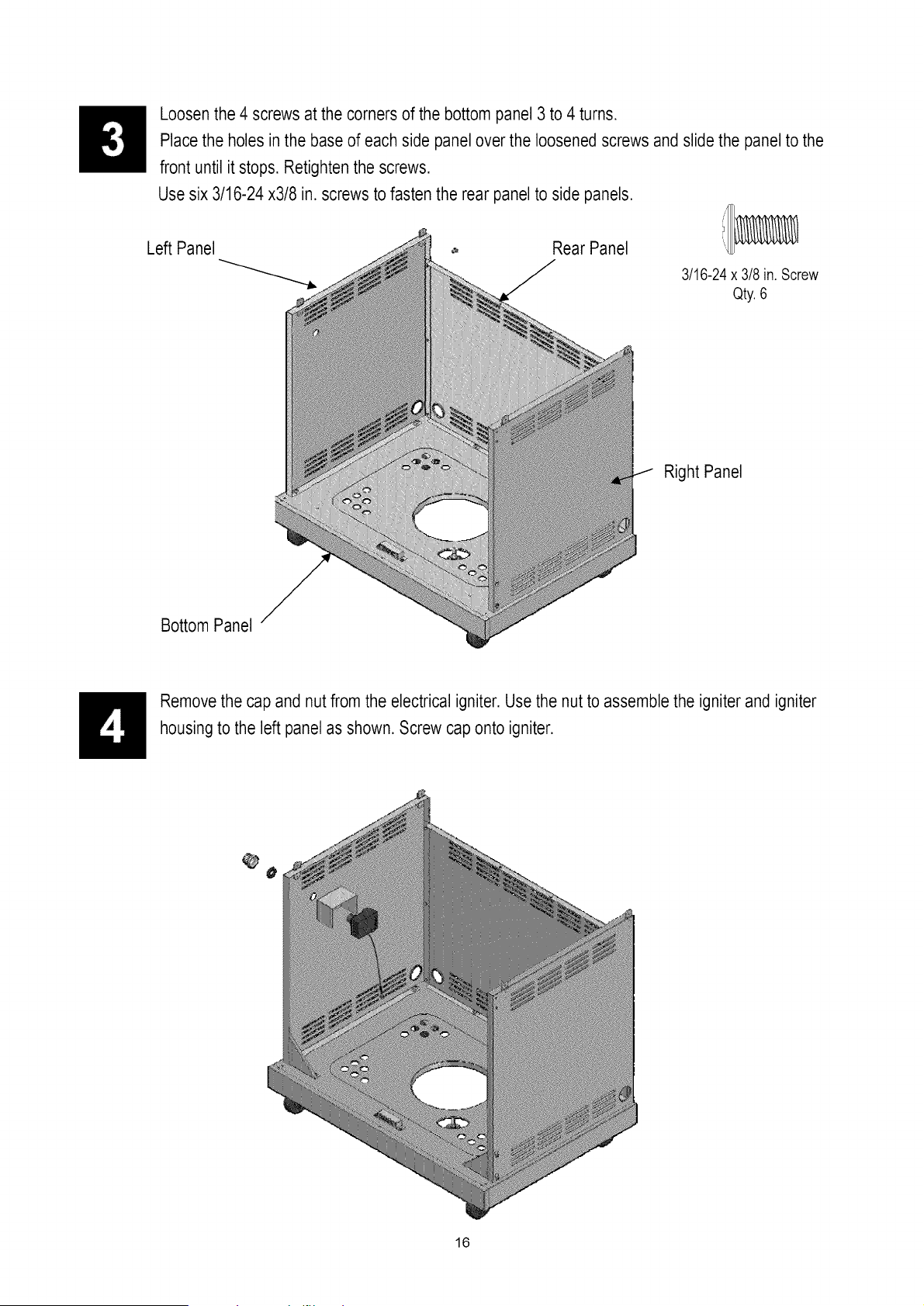
Loosen the 4 screws at the corners of the bottom panel 3 to 4 turns.
Place the holes in the base of each side panel over the loosened screws and slide the panel to the
front until it stops. Retighten the screws.
Usesix 3/16-24x3/8 in. screws to fasten the rear panel to side panels.
Left Panel
Bottom Panel
Rear Panel
3/16-24x 3/8 in. Screw
Qty.6
Right Panel
Remove the cap and nutfrom the electrical igniter.Use the nut to assemblethe igniter and igniter
housing to the left panel as shown. Screw cap onto igniter.
@
@
16

Loosen the two screws in the right and left angle brackets 3 to 4 turns.
Insert the screws through the 2 holes at the base of each side panel and slide the bracket down until
it stops. Attach each bracket to the bottom panel with one 3/16-24 x 3/8 in. screw. Retighten the 4
loosened screws.
3/16-24 x 3/8 in. Screw
Qty.2
Attach the beam to side panels with four 3/16-24 x 3/8 in. screws as shown.
Beam
Left Panel
Rear Panel 3/16-24x 3/8 in. Screw
Qty.4
Right Panel
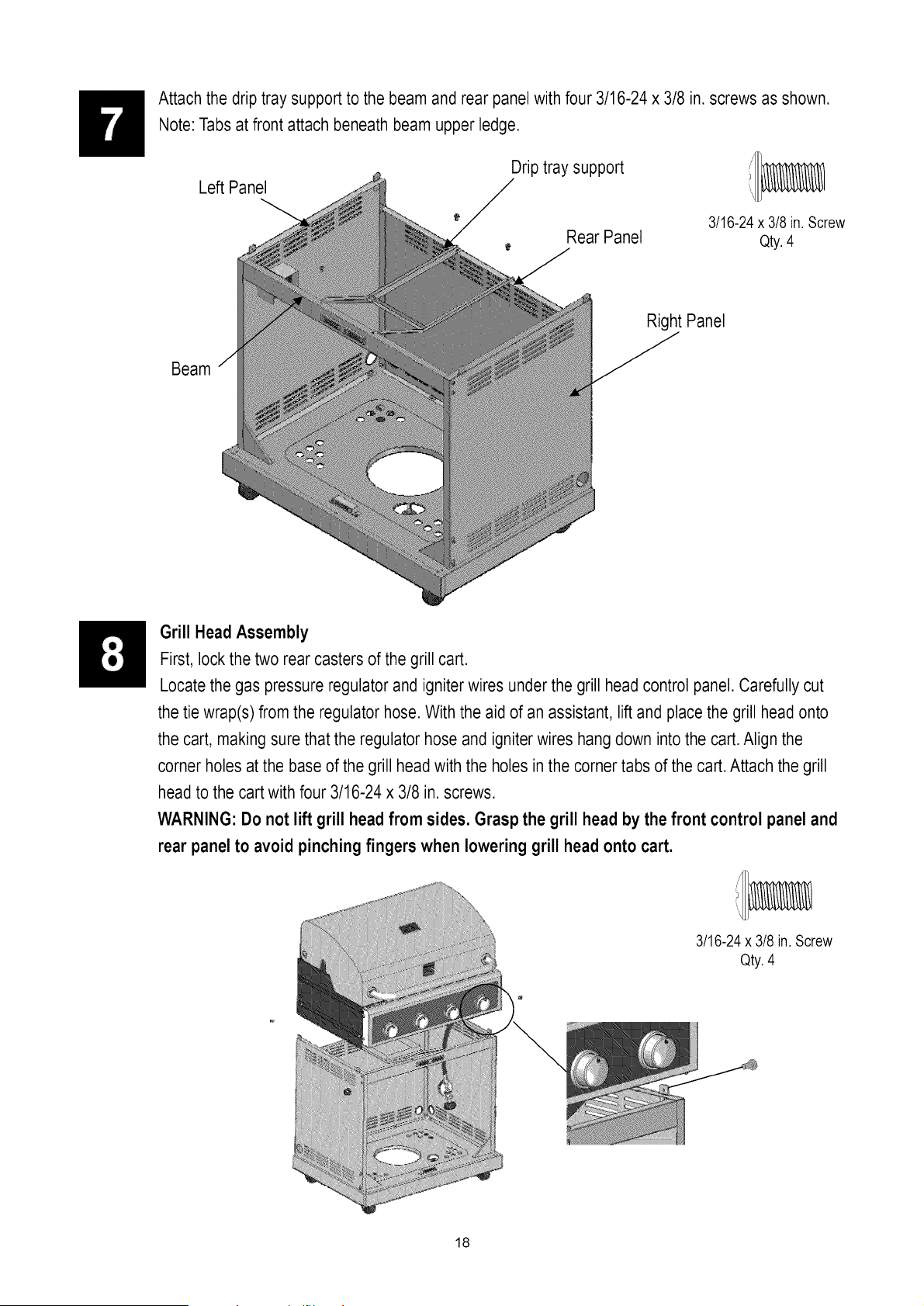
Attachthedriptraysupporttothebeamandrearpanelwithfour3/16-24x3/8in.screwsasshown.
Note:Tabsatfrontattachbeneathbeamupperledge.
LeftPanel
Driptraysupport
RearPanel
3/16-24x3/8in.Screw
Qty.4
Beam
RightPanel
Grill HeadAssembly
First,lockthetworearcastersofthegrillcart.
Locatethegaspressureregulatorandigniterwiresunderthegrillheadcontrolpanel.Carefullycut
thetiewrap(s)fromtheregulatorhose.Withtheaidofanassistant,liftandplacethegrillheadonto
thecart,makingsurethattheregulatorhoseandigniterwireshangdownintothecart.Alignthe
cornerholesatthebaseofthegrillheadwiththeholesinthecornertabsofthecart.Attachthegrill
headtothecartwithfour3/16-24x 3/8in.screws.
WARNING:Donotlift grill headfromsides.Graspthe grill headbythefrontcontrolpaneland
rearpanelto avoidpinchingfingerswhenloweringgrill headontocart.
3/16-24 x 3/8 in. Screw
Qty.4
18
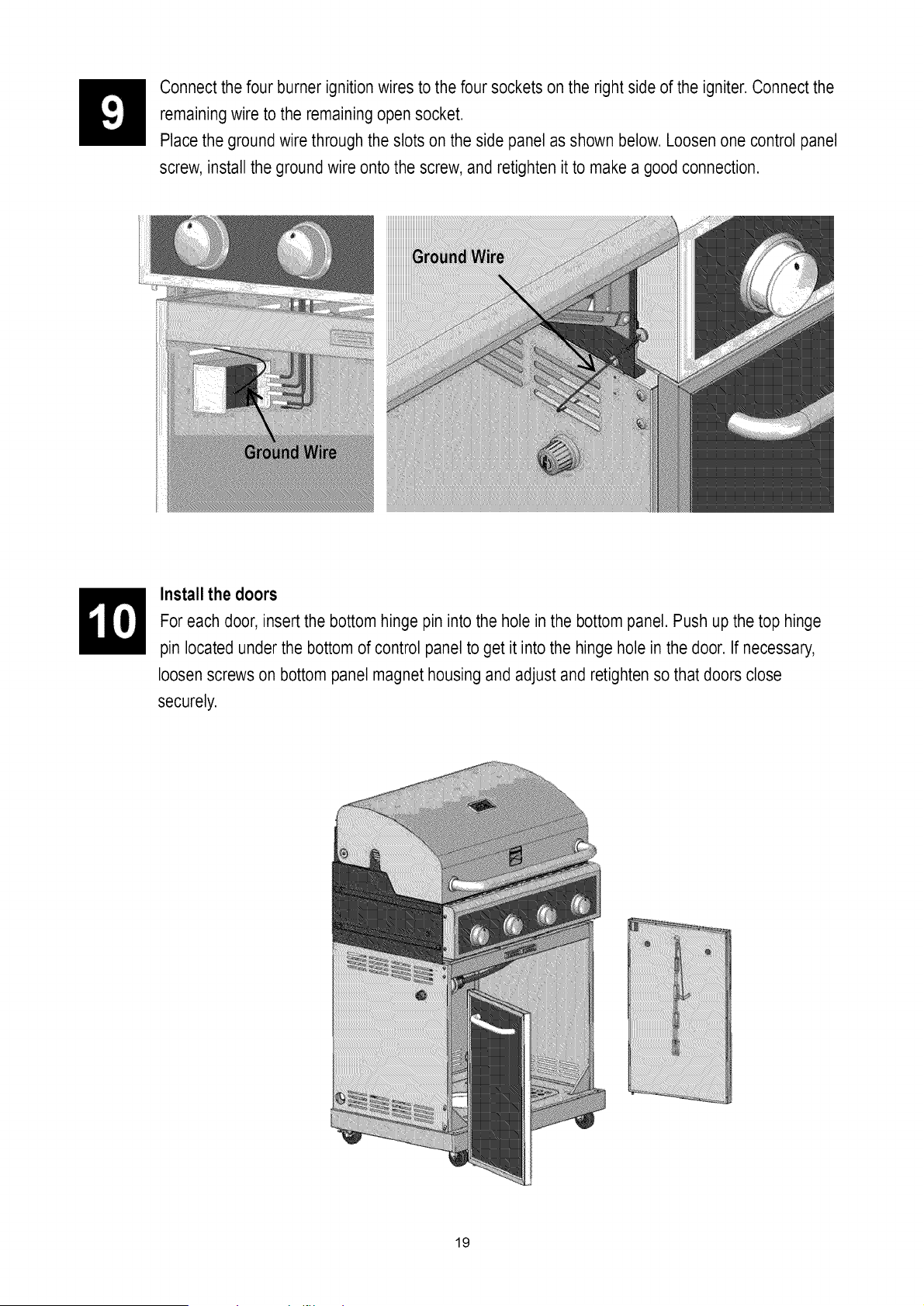
Connect the four burner ignition wires to the four sockets on the right side of the igniter. Connect the
remainingwire to the remaining open socket.
Place the ground wire through the slots on the side panel as shown below. Loosen one control panel
screw, install the ground wire onto the screw,and retighten it to make a good connection.
Install the doors
For each door, insert the bottom hinge pin into the hole in the bottom panel. Push up the top hinge
pin located under the bottom of control panel to get it into the hinge hole in the door. If necessary,
loosen screws on bottom panel magnet housingand adjust and retighten so that doors close
securely.
19
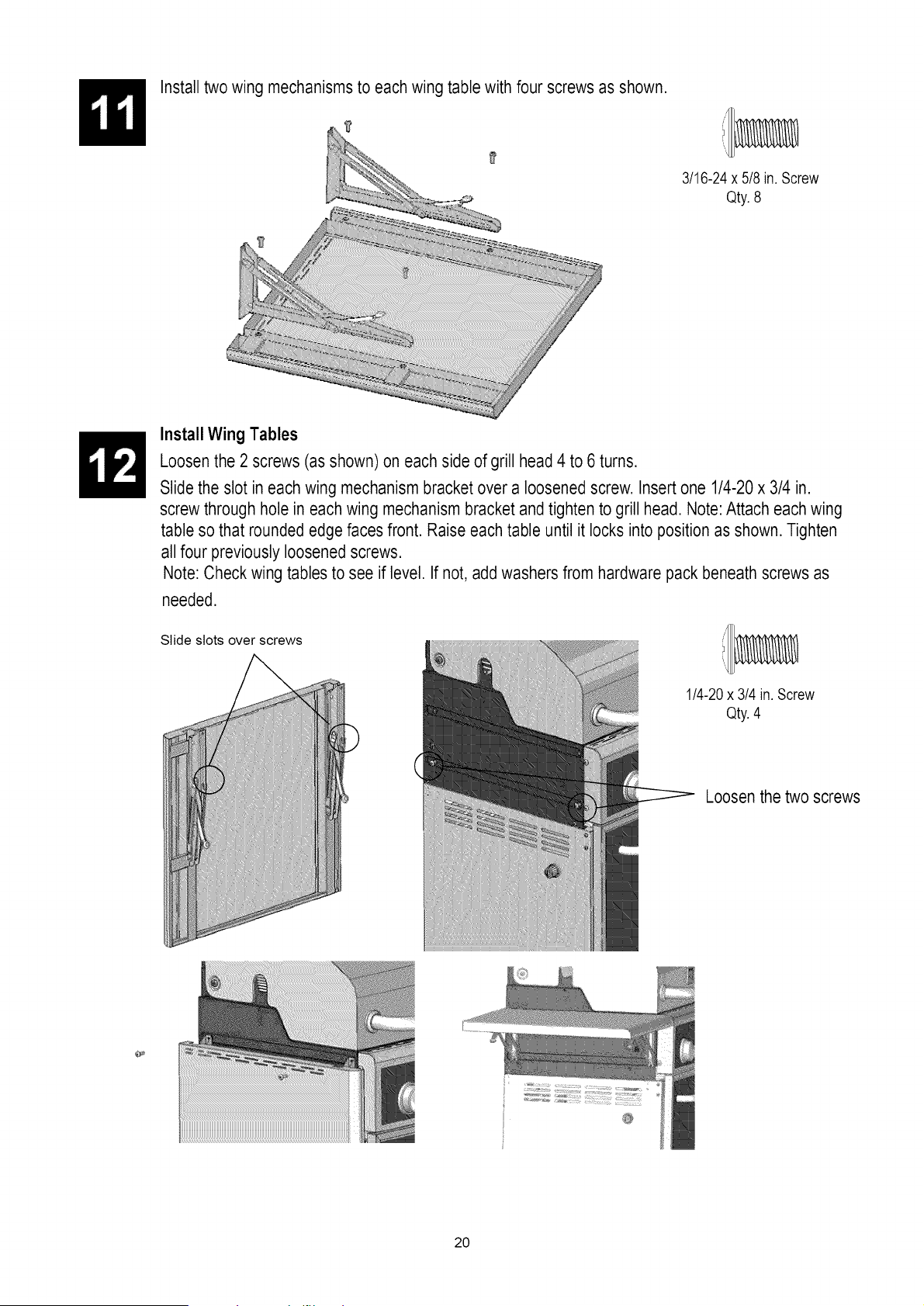
Install two wing mechanisms to each wing table with four screws as shown.
3/16-24 x 5/8 in. Screw
Qty.8
Install Wing Tables
Loosen the 2 screws (as shown) on each side of grill head 4 to 6 turns.
Slide the slot in each wing mechanism bracket over a loosened screw. Insert one 1/4-20 x 3/4 in.
screw through hole in each wing mechanism bracket and tighten to grill head. Note: Attach each wing
table so that rounded edge faces front. Raise eachtable until it locks into position as shown. Tighten
all four previously loosened screws.
Note: Check wing tables to see if level. If not, add washers from hardware pack beneath screws as
needed.
Slide slots over screws
1/4-20x 3/4 in. Screw
Qty.4
Loosenthe two screws
20
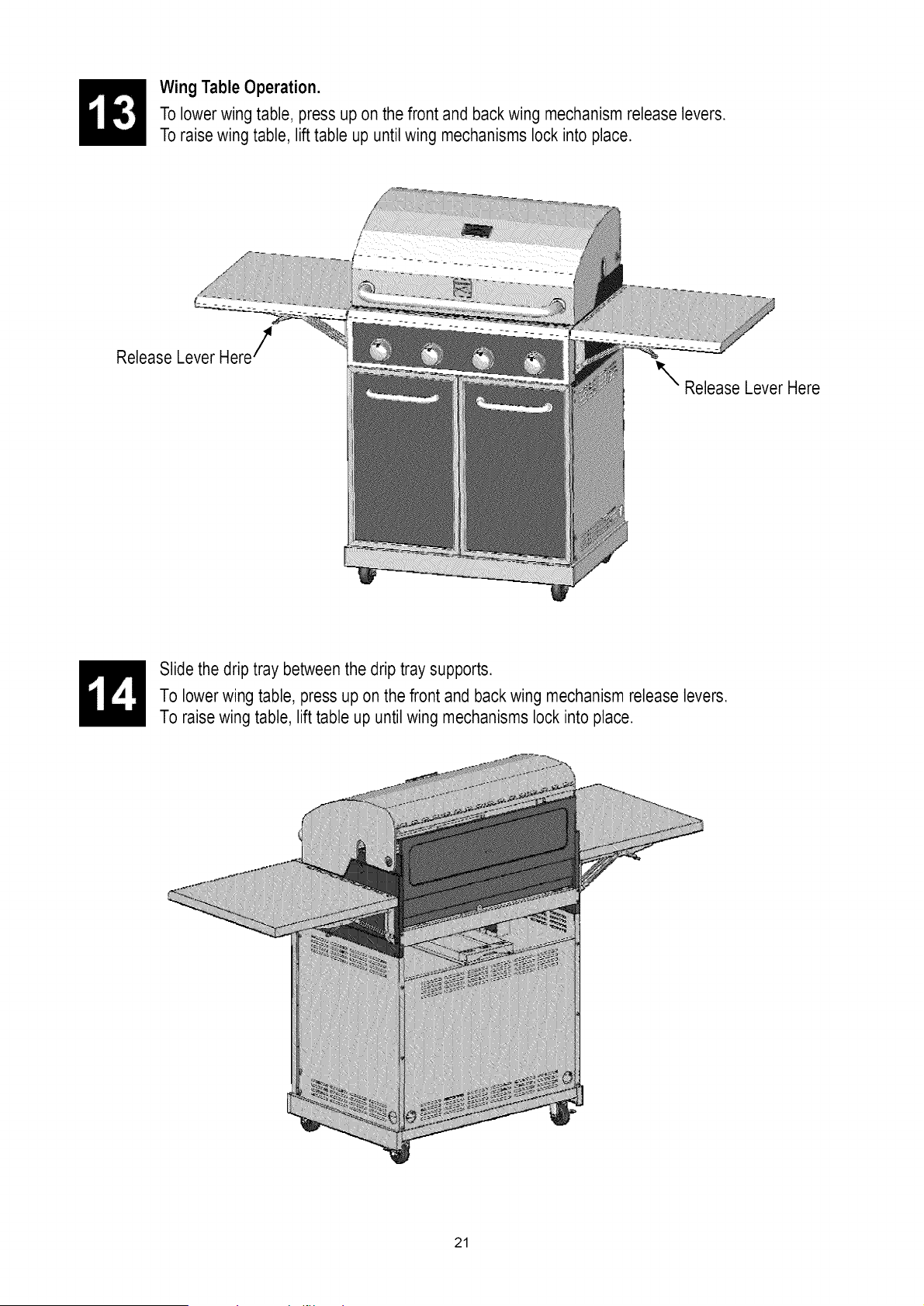
Wing Table Operation.
To lower wing table, press up on the front and back wing mechanism release levers.
To raise wing table, lift table up until wing mechanisms lock into place.
Release Lever Here/
Release Lever Here
Slide the drip tray between the drip tray supports.
To lower wing table, press up on the front and backwing mechanism release levers.
To raise wing table, lift table up until wing mechanisms lock into place.
21
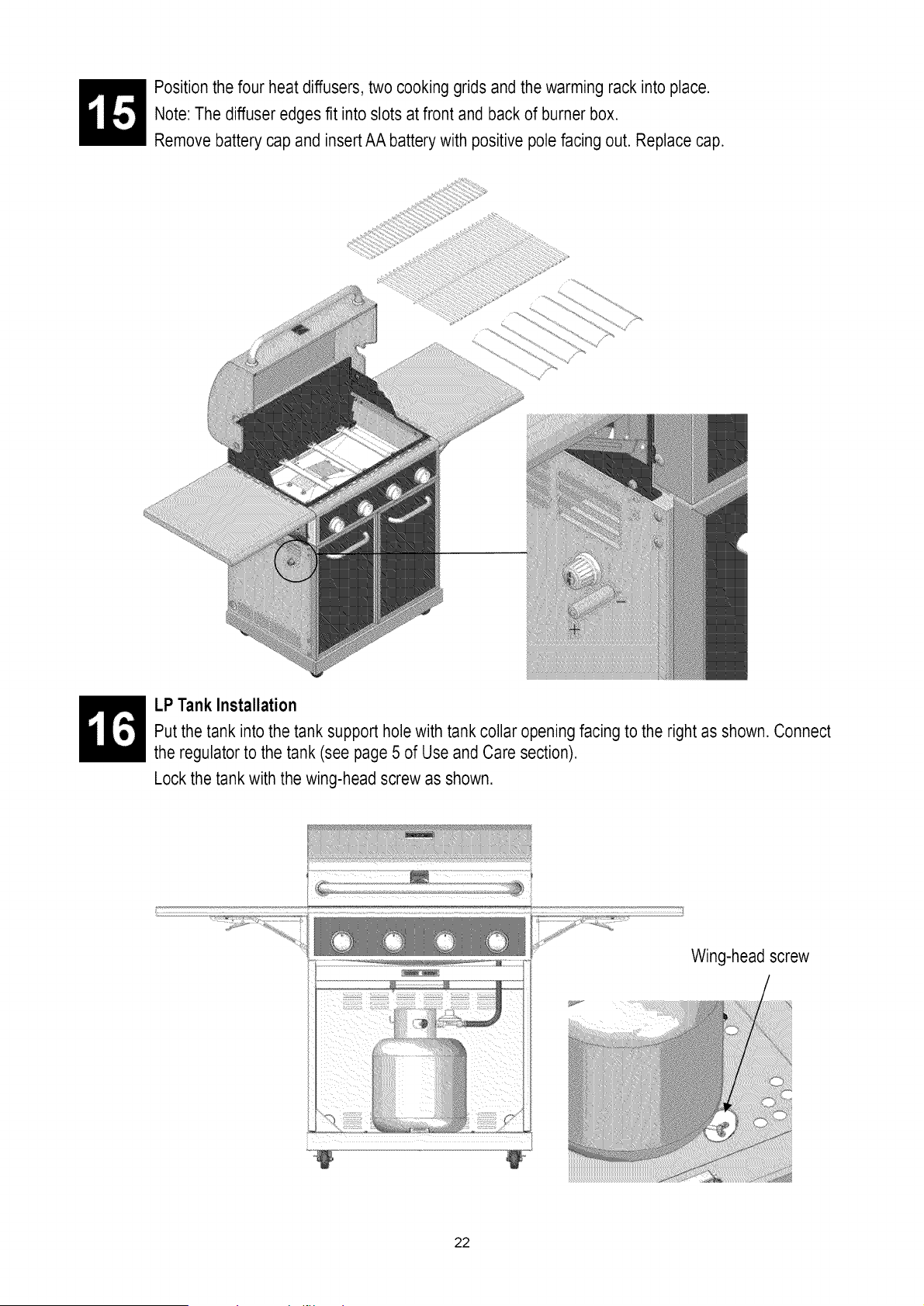
Position the four heat diffusers, two cooking grids and the warming rack into place.
Note:The diffuser edges fit into slots at front and back of burner box.
Remove battery cap and insert AA battery with positive pole facing out. Replace cap.
LP Tank Installation
Put the tank into the tank support hole with tank collar opening facing to the right as shown. Connect
the regulator to the tank (see page 5 of Use and Care section).
Lock the tank with the wing-head screw as shown.
Wing-head screw
22
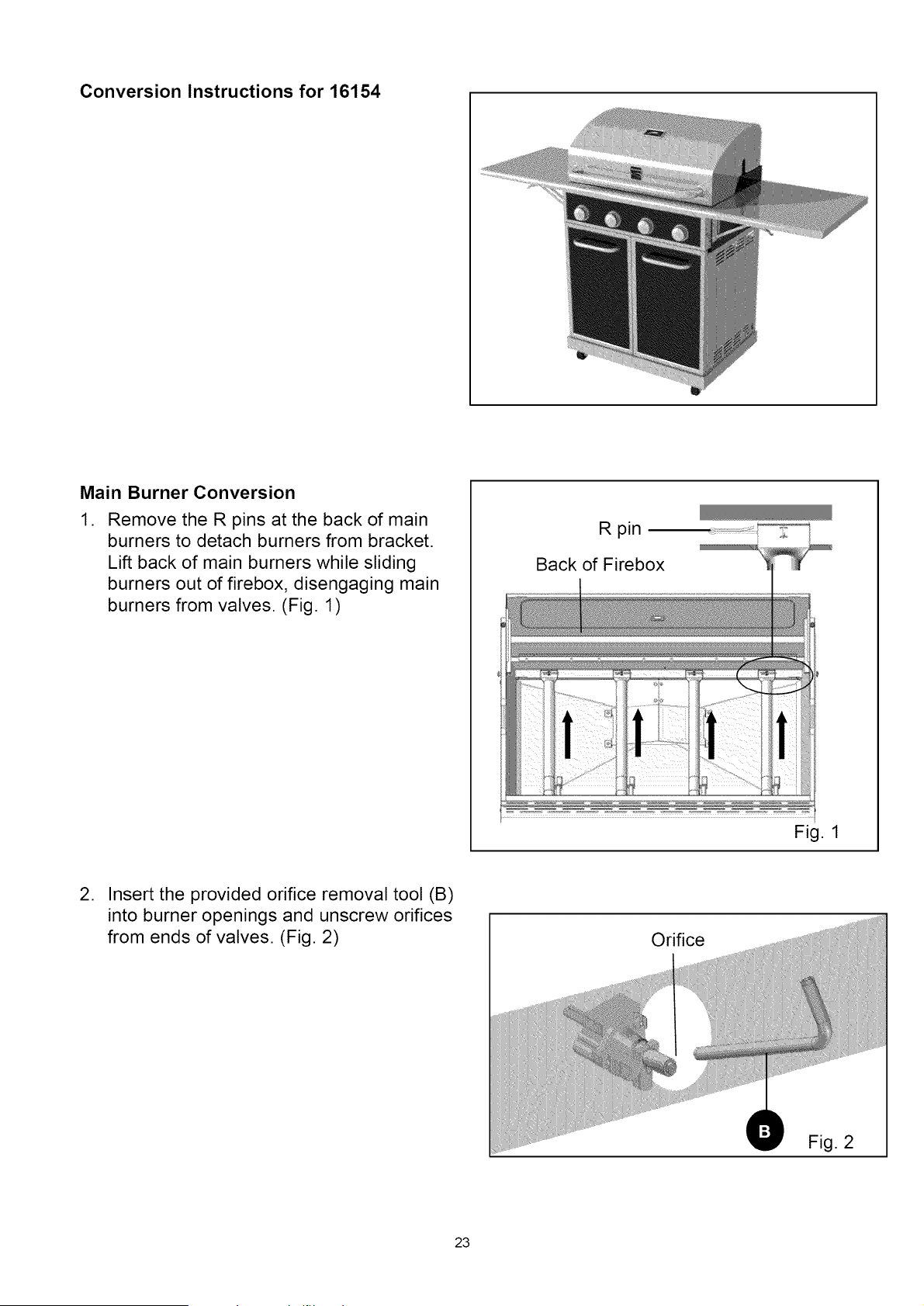
Conversion Instructions for 16154
Main Burner Conversion
,
Remove the R pins at the back of main
burners to detach burners from bracket.
Lift back of main burners while sliding
burners out of firebox, disengaging main
burners from valves. (Fig. 1)
R pin
Back of Firebox
Fig. 1
Orifice
,
Insert the provided orifice removal tool (B)
into burner openings and unscrew orifices
from ends of valves. (Fig. 2)
23
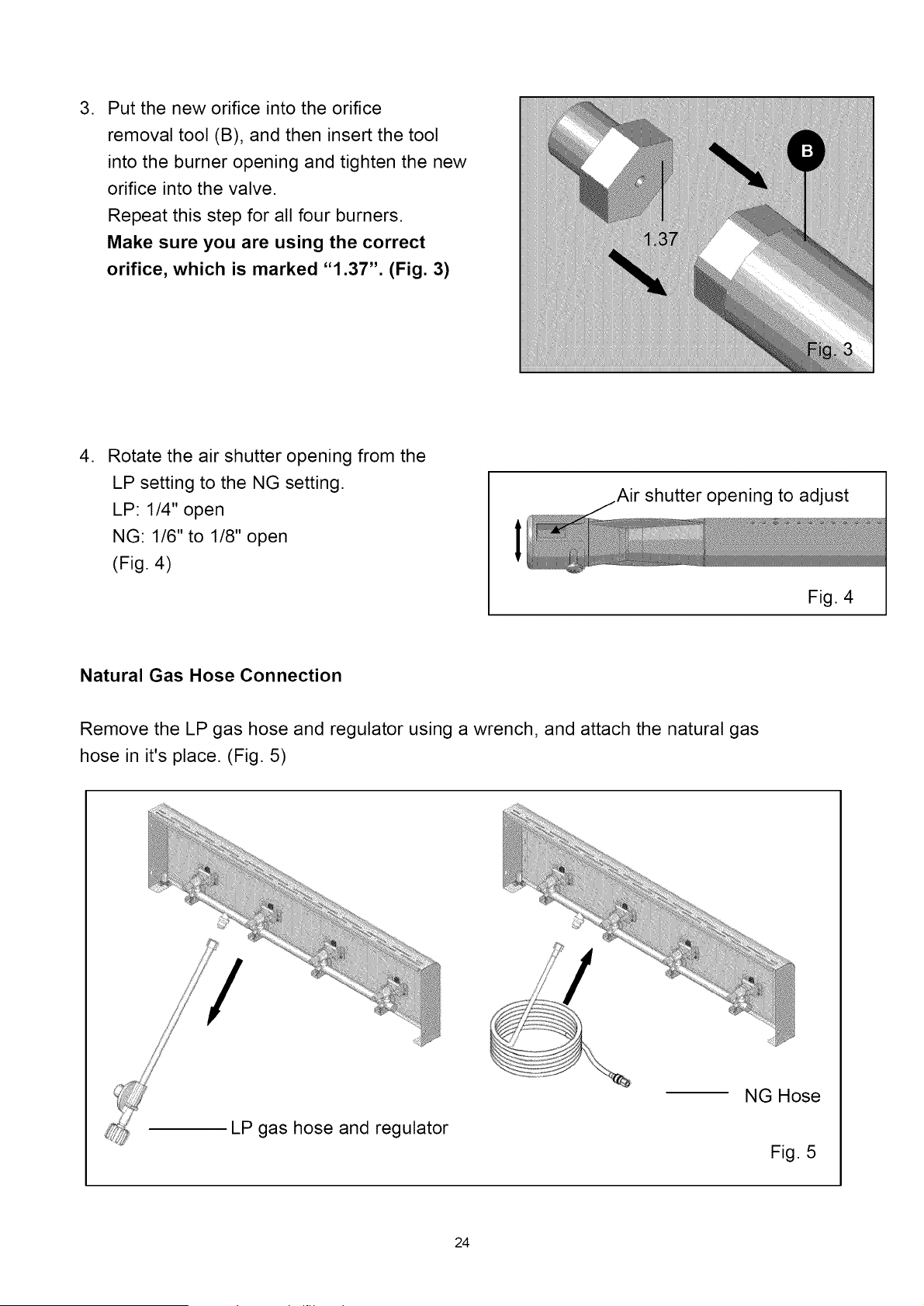
, Put the new orifice into the orifice
removal tool (B), and then insert the tool
into the burner opening and tighten the new
orifice into the valve.
Repeat this step for all four burners.
Make sure you are using the correct
orifice, which is marked "1.37". (Fig. 3)
,
Rotate the air shutter opening from the
LP setting to the NG setting.
LP: 1/4" open
NG: 1/6" to 1/8" open
(Fig. 4)
I
Air shutter opening to adjust
Fig. 4
I
Natural Gas Hose Connection
Remove the LP gas hose and regulator using a wrench, and attach the natural gas
hose in it's place. (Fig. 5)
LP gas hose and regulator
NG Hose
Fig. 5
24
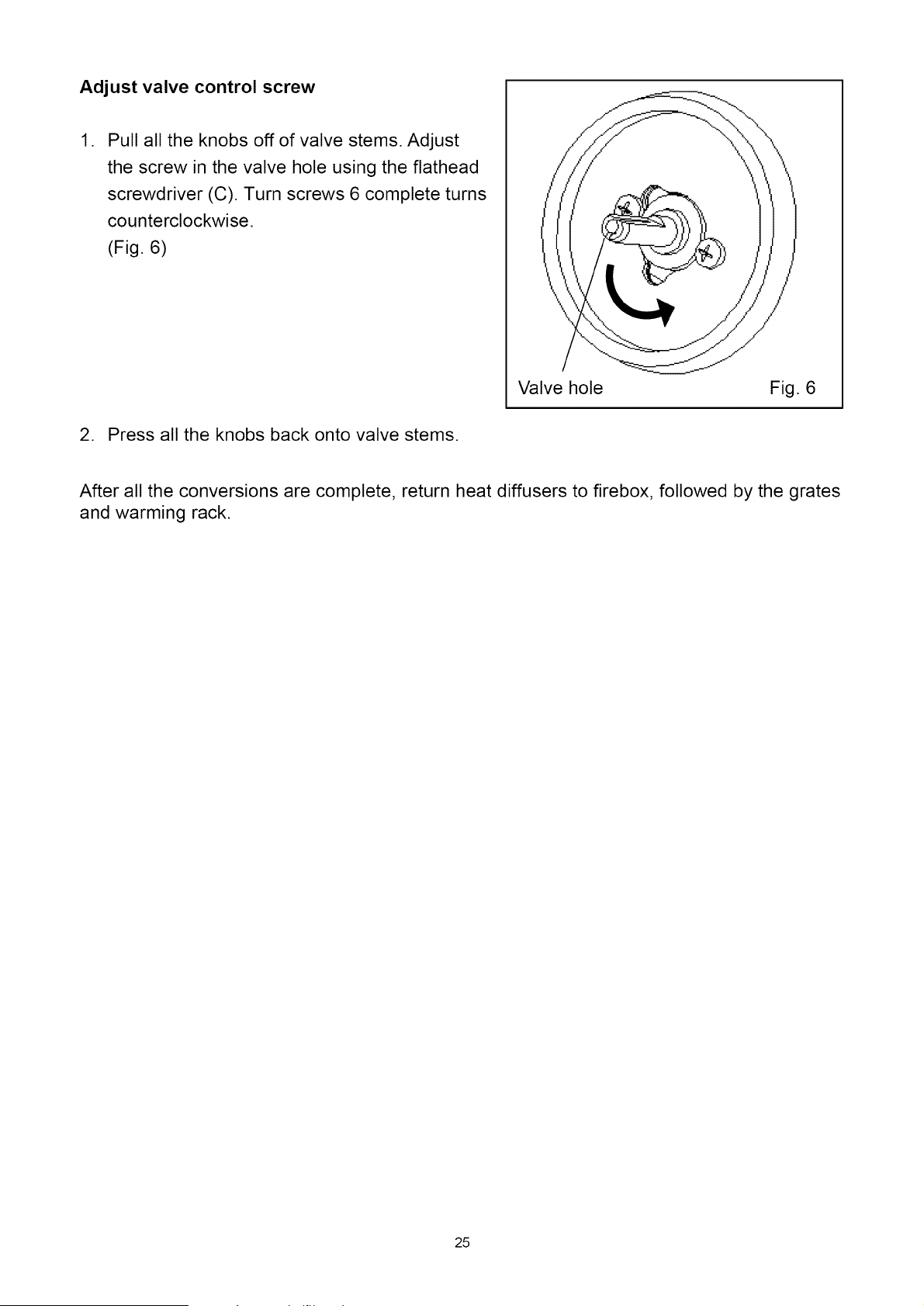
Adjust valve control screw
,
Pull all the knobs off of valve stems. Adjust
the screw in the valve hole using the flathead
screwdriver (C). Turn screws 6 complete turns
counterclockwise.
(Fig. 6)
2. Press all the knobs back onto valve stems.
Valve hole Fig. 6
After all the conversions are complete, return heat diffusers to firebox, followed by the grates
and warming rack.
25
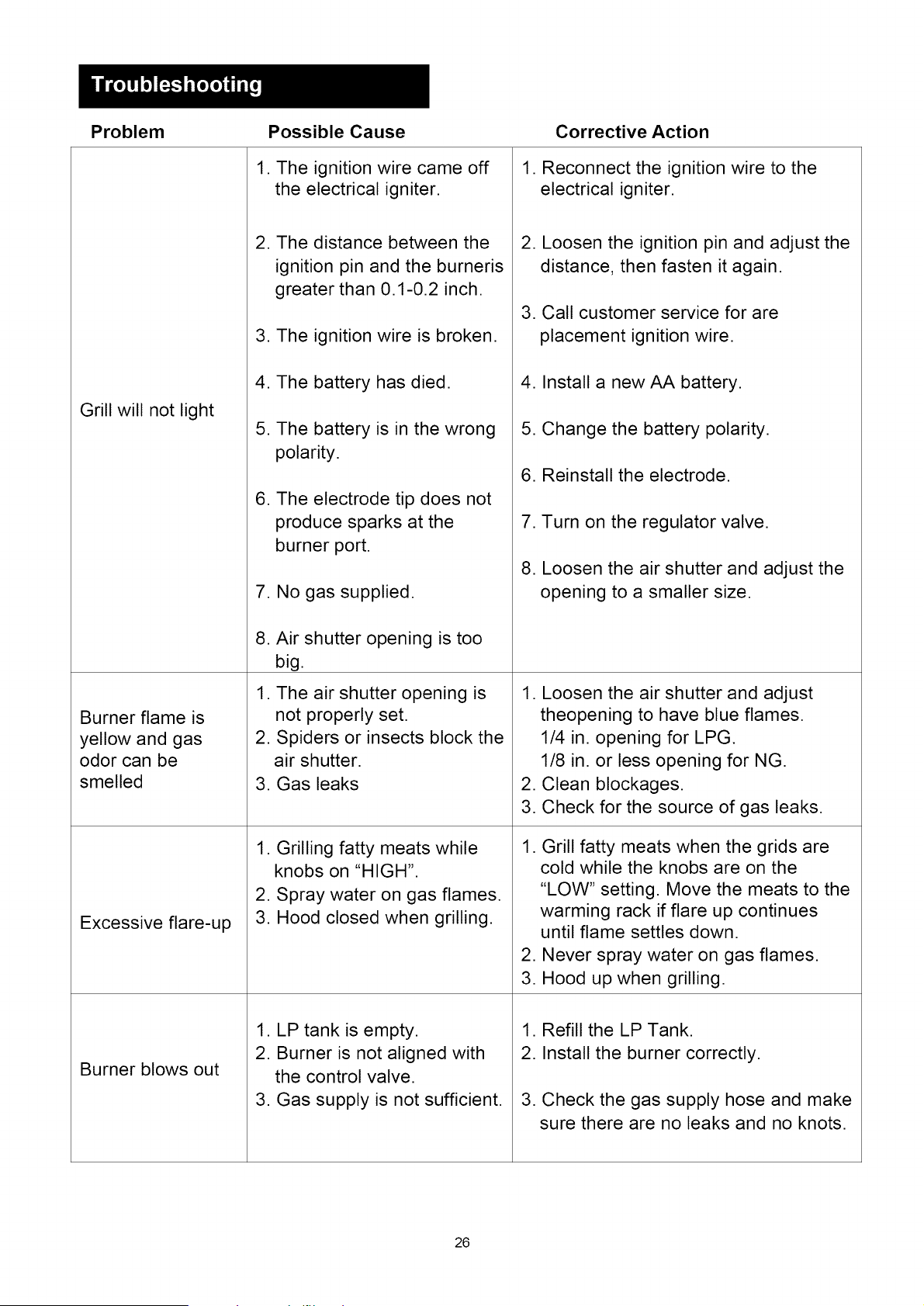
Problem Possible Cause Corrective Action
Grill will not light
Burner flame is
yellow and gas
odor can be
,
2.
smelled 3.
Excessive flare-up
Burner blows out
1. The ignition wire came off
the electrical igniter.
2. The distance between the
ignition pin and the burneris
greater than 0.1-0.2 inch.
3. The ignition wire is broken.
4. The battery has died.
5. The battery is in the wrong
polarity.
6. The electrode tip does not
produce sparks at the
burner port.
7. No gas supplied.
8. Air shutter opening is too
big.
The air shutter opening is
not properly set.
Spiders or insects block the
air shutter.
Gas leaks
1. Grilling fatty meats while
knobs on "HIGH".
2. Spray water on gas flames.
3. Hood closed when grilling.
1. LP tank is empty.
2. Burner is not aligned with
the control valve.
3. Gas supply is not sufficient.
1. Reconnect the ignition wire to the
electrical igniter.
2. Loosen the ignition pin and adjust the
distance, then fasten it again.
3. Call customer service for are
placement ignition wire.
4. Install a new AA battery.
5. Change the battery polarity.
6. Reinstall the electrode.
7. Turn on the regulator valve.
8. Loosen the air shutter and adjust the
opening to a smaller size.
1. Loosen the air shutter and adjust
theopening to have blue flames.
1/4 in. opening for LPG.
1/8 in. or less opening for NG.
2. Clean blockages.
3. Check for the source of gas leaks.
1. Grill fatty meats when the grids are
cold while the knobs are on the
"LOW" setting. Move the meats to the
warming rack if flare up continues
until flame settles down.
2. Never spray water on gas flames.
3. Hood up when grilling.
1. Refill the LP Tank.
2. Install the burner correctly.
3. Check the gas supply hose and make
sure there are no leaks and no knots.
26
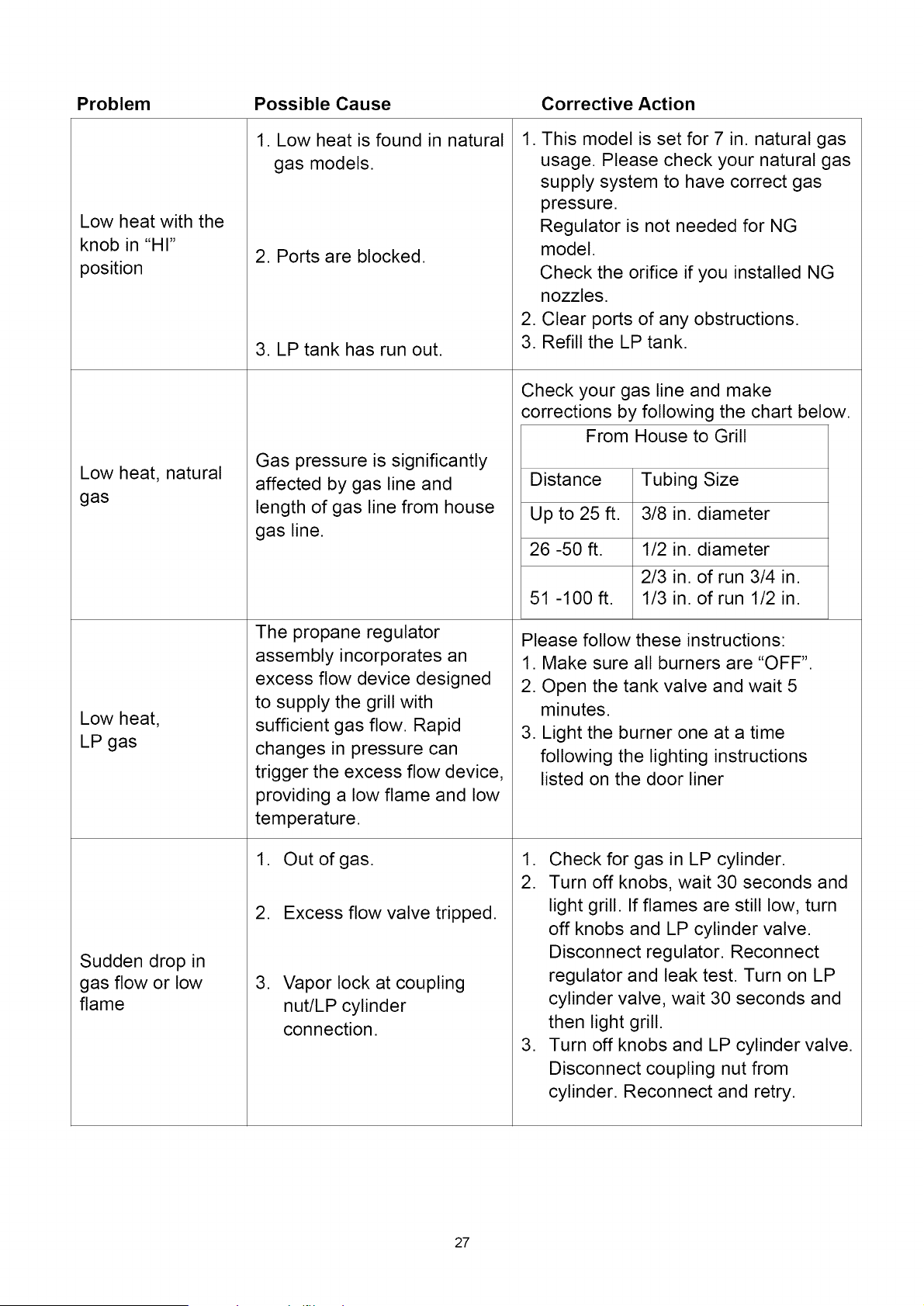
Problem Possible Cause Corrective Action
Low heat with the
knob in "HI"
position
Low heat, natural
gas
Low heat,
LP gas
Sudden drop in
gas flow or low
flame
1. Low heat is found in natural
gas models.
2. Ports are blocked.
3. LP tank has run out.
Gas pressure is significantly
affected by gas line and
length of gas line from house
gas line.
The propane regulator
assembly incorporates an
excess flow device designed
to supply the grill with
sufficient gas flow. Rapid
changes in pressure can
trigger the excess flow device,
providing a low flame and low
temperature.
1. Out of gas.
2. Excess flow valve tripped.
,
Vapor lock at coupling
nut/LP cylinder
connection.
1. This model is set for 7 in. natural gas
usage. Please check your natural gas
supply system to have correct gas
pressure.
Regulator is not needed for NG
model.
Check the orifice if you installed NG
nozzles.
2. Clear ports of any obstructions.
3. Refill the LP tank.
Check your gas line and make
corrections by following the chart below.
From House to Grill
Distance Tubing Size
Up to 25 ft.
26 -50 ft.
51 -100 ft.
3/8 in
1/2 in
2/3 in
1/3 in
diameter
diameter
of run 3/4 in.
of run 1/2 in.
Please follow these instructions:
1. Make sure all burners are "OFF".
2. Open the tank valve and wait 5
minutes.
3. Light the burner one at a time
following the lighting instructions
listed on the door liner
1. Check for gas in LP cylinder.
2. Turn off knobs, wait 30 seconds and
light grill. If flames are still low, turn
off knobs and LP cylinder valve.
Disconnect regulator. Reconnect
regulator and leak test. Turn on LP
cylinder valve, wait 30 seconds and
then light grill.
3. Turn off knobs and LP cylinder valve.
Disconnect coupling nut from
cylinder. Reconnect and retry.
27
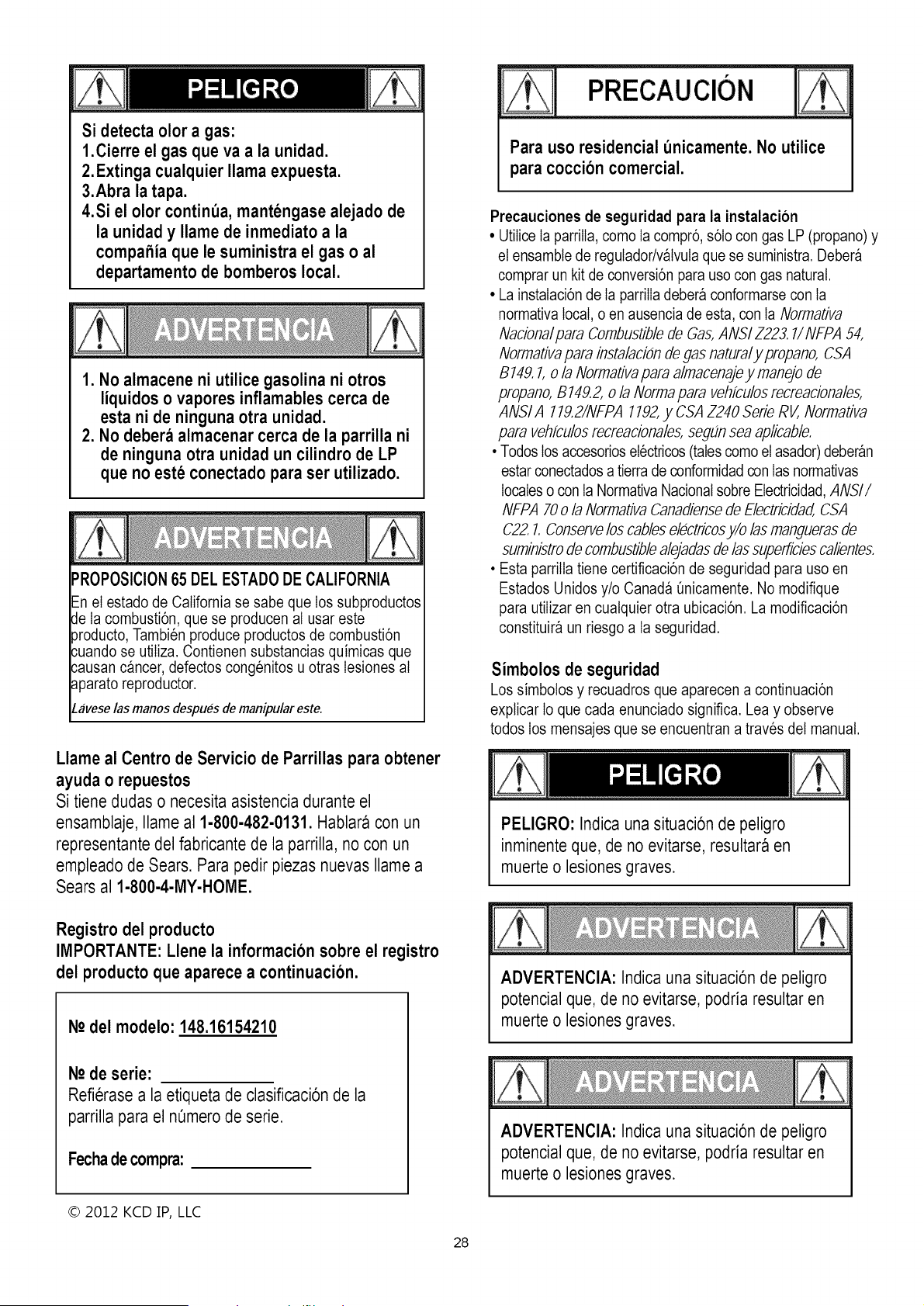
Si detecta olor a gas:
1.¢ierre el gas que va a la unidad.
2. Extinga cualquier llama expuesta.
3.Abra la tapa.
4.Si el olor contint)a,mantengase alejado de
la unidady Ilame de inmediato a la
compahia que le suministra el gas o al
departamentode bomberos local.
1. No almacene ni utilice gasolina ni otros
liquidos o vapores inflamables cerca de
esta ni de ninguna otra unidad.
2. No debera almacenar cerca de la parrilla ni
de ninguna otra unidad un cilindro de LP
que no este conectado para ser utilizado.
PROPOSICION65 DELESTADODE CALIFORNIA
En el estado de California se sabe que los subproductos
de Ia combusti6n, que se producen al usar este
producto, Tambien produce productos de combusti6n
cuando se utiliza. Contienen substancias quimicas que
causan cancer, defectos congenitos u otras Iesiones at
aparato reproductor.
Lavese /asmanos despu#s de manipular este.
Llame al Centro de Servicio de Parrillas para obtener
ayuda o repuestos
Si tiene dudas o necesita asistencia durante el
ensamblaje, Ilame al 1-800-482-0131.Hablara con un
representante del fabricante de la parrilla, no con un
empleado de Sears. Para pedir piezas nuevas Ilame a
Sears al 1-800-4-MY-HOME.
Registro del producto
IMPORTANTE: Llene la informacionsobre el registro
del producto que aparece a continuacion.
N_odel modelo: 148.16154210
N_ode serie:
Refierase a la etiqueta de clasificaci6n de la
parrilla para el nemerode serie.
Fechade compra:
© 2012 KCD IP, LLC
PRECAUCl0N
Para uso residencial unicamente. No utilice
para coccion comercial.
Precauciones de seguridad para la instalacion
• Utilice Ia parriIIa,como Ia compr6, s61ocon gas LP (propano) y
el ensambtede regulador/valvutaque se suministra. Debera
comprarun kit de conversi6n para uso con gas natural.
• La instalaci6n de Ia parriIIadebera conformarse con ta
normativa local, o en ausencia de esta, con ta Normativa
Naciona/para Combustible de Gas, ANSI Z223. 1/NFPA 54,
Normativapara insta/acidndegas natural y propano, CSA
B 149.1,o/a Normativapara almacenajey manejo de
propano, B149.2,o/a Normapara vehfcu/osrecreaciona/es,
ANSI A 119.2/NFPA 1192,y CSA Z240 Serie RV, Normativa
para vehfcu/osrecreaciona/es,segfin sea aplicab/e.
• Todoslos accesorioselectricos (talescomoel asador)deberan
estarconectadosa tierra de conformidadcon las normativas
localeso con la NormativaNacionalsobre Electricidad,ANSI/
NFPA 70 o/a Normativa Canadiensede E/ectricidad,CSA
C22.1. Conservelos cableselectficosy/o /asmanguerasde
suministrode combustiblealejadasde/as superficies calientes.
• Esta parrilla tiene certificaci6n de seguridad para uso en
Estados Unidos y/o Canada Onicamente.No modifique
para utilizar en cuatquier otra ubicaci6n. La modificaci6n
constituira un riesgo a la seguridad.
Simbolos de seguridad
Los simbotos y recuadros que aparecen a continuaci6n
expticar Io que cada enunciado significa. Lea y observe
todos los mensajes que se encuentran a traves del manual.
PELIGRO: Indica una situaci6n de peligro
inminente que, de no evitarse, resultara en
muerte o lesiones graves.
ADVERTENClA: Indica una situaci6n de peligro
potencial que, de no evitarse, podria resultar en
muerte o lesiones graves.
ADVERTENClA: Indica una situaci6n de peligro
potencial que, de no evitarse, podria resultar en
muerte o lesiones graves.
28
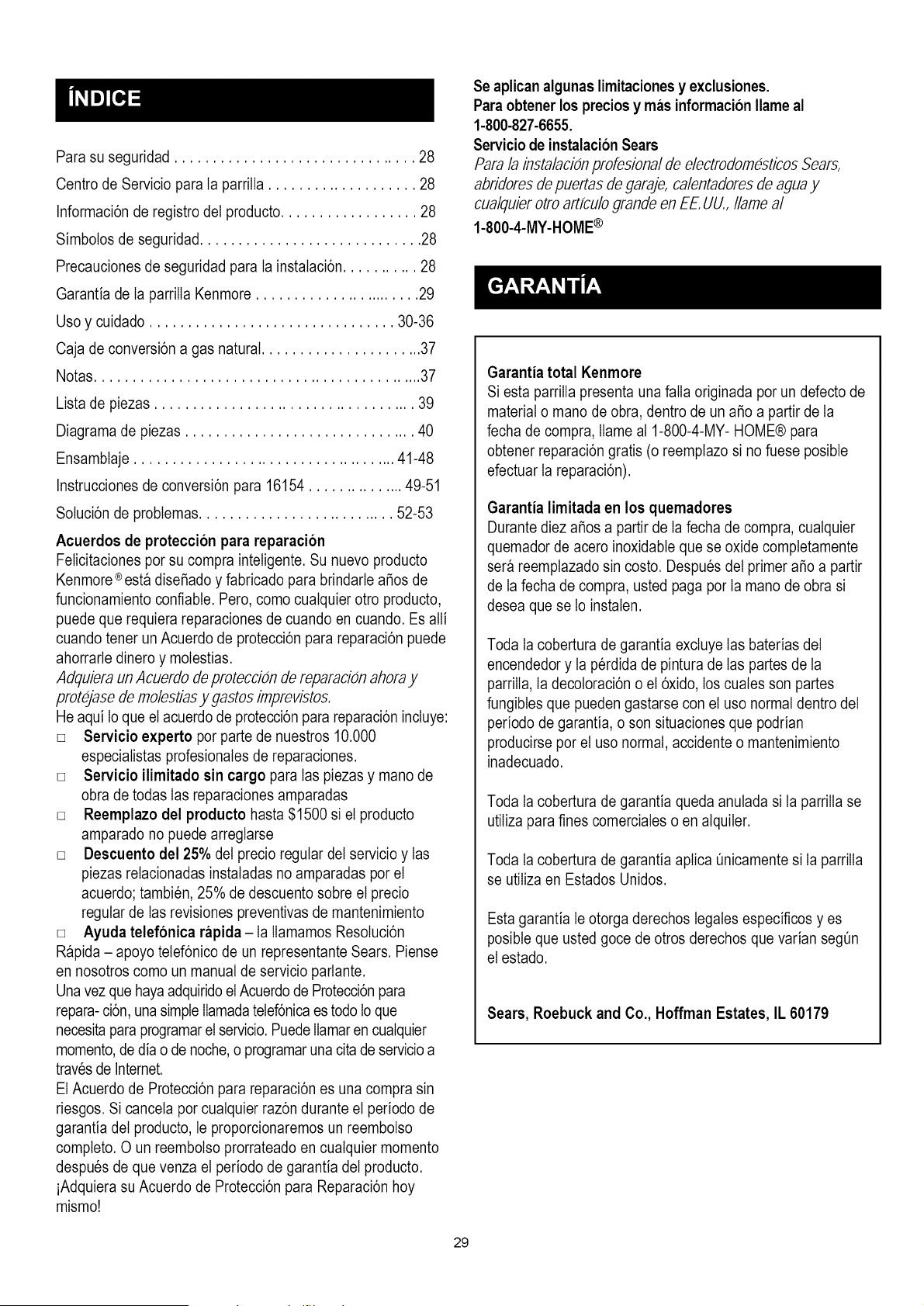
Para su seguridad ................................ 28
Centre de Servicio para ta parriIIa .................... 28
Informaci6n de registro del producto.................. 28
Simbotos de seguridad............................. 28
Precauciones de seguridad para la instataci6n........... 28
Garantia de Ia parriIIa Kenmore ........................ 29
Uso y cuidado ................................ 30-36
Caja de conversi6n a gas natural...................... 37
Notas............................................. 37
Lista de piezas .................................... 39
Diagrama de piezas ............................... 40
Ensambtaje ..................................... 41-48
Instrucciones de conversi6n para 16154 ............... 49-51
Sotuci6n de probtemas........................... 52-53
Acuerdos de proteccion para reparacion
Felicitaciones por su compra inteligente. Su nuevo producto
Kenmore ®est_ disefiado y fabricado para brindade a_os de
funcionamiento confiabte. Pero, como cuatquier otto producto,
puede que requiera reparaciones de cuando en cuando. Es afli
cuando tener un Acuerdo de protecci6n para reparaci6n puede
ahorrarIe dinero y motestias.
Adquiera un Acuerdo deprotection de reparation ahoray
protejase de mo/estias y gastos impre vistos.
He aqui io que el acuerdo de protecci6n para reparaci6nincluye:
[] Servicio experto por parte de nuestros 10.000
especiatistas profesionales de reparaciones.
[] Servicio ilimitado sin cargo para tas piezas y mano de
obra de todas ias reparaciones amparadas
[] Reemplazo del producto hasta $1500 si el producto
amparado no puede arreglarse
[] Descuento del 25% del precio regular del servicio y ias
piezas relacionadas instaladas no amparadas por el
acuerdo; tambien, 25% de descuento sobre el precio
regular de ias revisiones preventivas de mantenimiento
[] Ayuda telefonica rapida-ia tiamamos Resotuci6n
Rgpida - apoyo telef6nico de un representante Sears. Piense
en nosotros como un manual de servicio parlante.
Una vez que haya adquiridoel Acuerdo de Protecci6npara
repara-ci6n,una simple Ilamadatelef6nica es todo Io que
necesitapara programarel servicio.Puede Ilamaren cualquier
momento,de dia o de noche, o programaruna cita de servicioa
travesde Internet.
El Acuerdo de Protecci6n para reparaci6n es una compra sin
riesgos. Si cancela por cuatquier raz6n durante el periodo de
garantia del producto, Ie proporcionaremos un reembotso
compteto. O un reembotso prorrateado en cuatquier momento
despues de que venza et periodo de garantia del producto.
iAdquiera su Acuerdo de Protecci6n para Reparaci6n hoy
mismo!
Se aplicanalgunas limitaciones y exclusiones.
Para obtenerlos preciosy mas informacionIlame al
1-800-827-6655.
Serviciode instalacionSears
Para /a insta/acion profesiona/ de electrodomesticos Sears,
abridores de puertas de garaje, calentadores de affuay
cualquier otro artfculo grande en EE.UU., /lame al
1-800-4-MY-HOME®
Garantia total Kenmore
Si esta parriiia presenta una fatia originada por un defecto de
material o mano de obra, dentro de un a_o a partir de ia
fecha de compra, iiame al 1-800-4-MY- HOME® para
obtener reparaci6n gratis (o reemplazo si no fuese posibte
efectuar Ia reparaci6n).
Garantia limitada en los quemadores
Durante diez aSos a partir de Ia fecha de compra, cuatquier
quemador de acero inoxidabte que se oxide comptetamente
ser_ reemptazado sin costo. Despues del primer aSo a partir
de Ia fecha de compra, usted paga por Ia mano de obra si
desea que se Io instaten.
Toda la cobertura de garantia excluye ias baterias del
encendedor y ia perdida de pintura de ias partes de ia
parrilIa, Ia decotoraci6n o el 6xido, los cuates son partes
fungibtes que pueden gastarse con el uso normal dentro del
periodo de garantia, o son situaciones que podrian
producirse por el uso normal, accidente o mantenimiento
inadecuado.
Toda la cobertura de garantia queda anutada si Ia parrilIa se
utiliza para fines comerciates o en atquiler.
Toda la cobertura de garantia aplica Onicamentesi ia parriiia
se utiiiza en Estados Unidos.
Esta garantia te otorga derechos iegates especificos yes
posibteque usted goce de otros derechos que varian segQn
el estado.
Sears, Roebuck and Co., Hoffman Estates, IL 60179
29
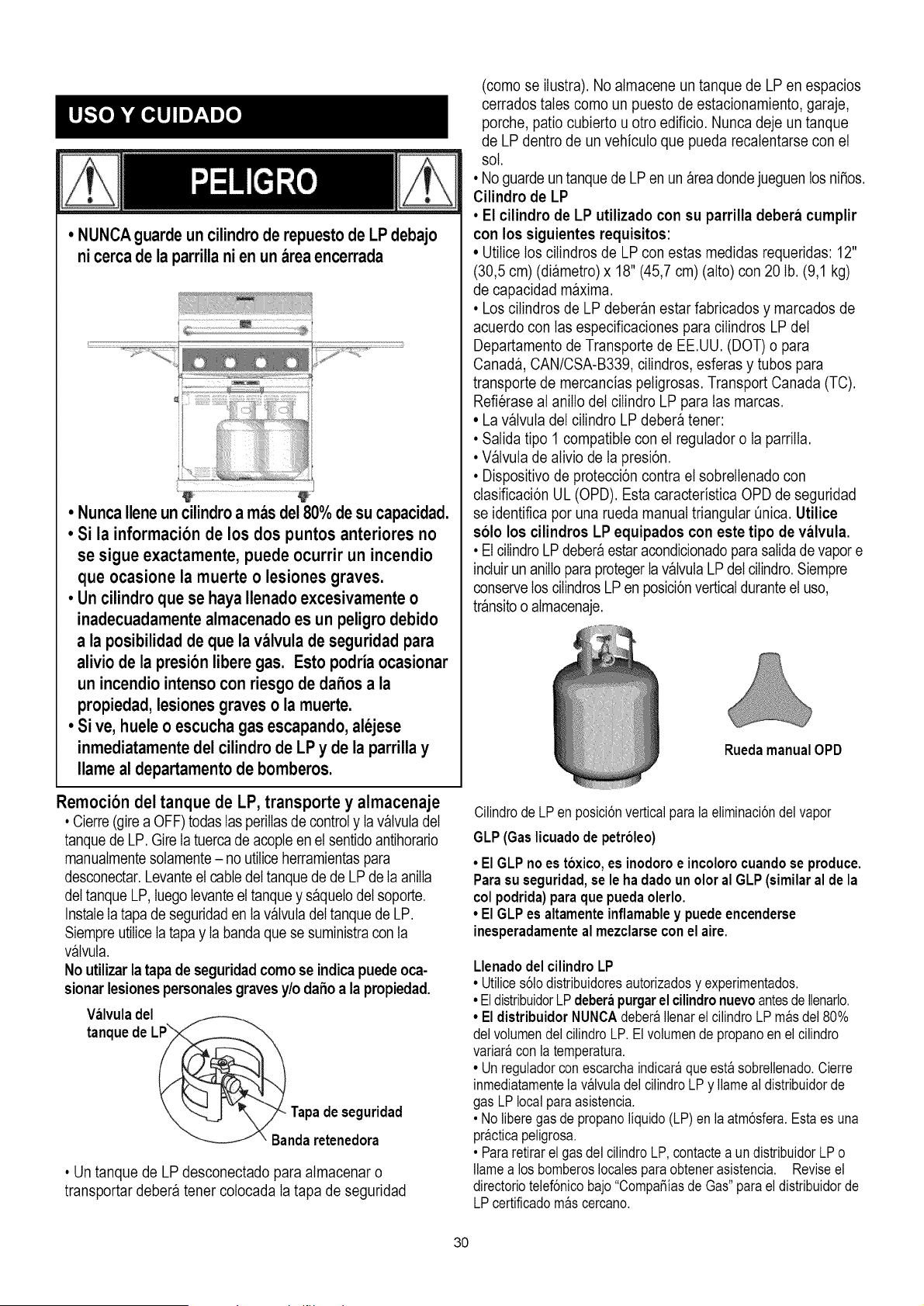
• NUNCAguardeuncilindroderepuestodeLPdebajo
nicercadela parrillanienunareaencerrada
• NuncaIleneun cilindroa masde180%de su capacidad.
• Si la informacion de los dos puntos anteriores no
se sigue exactamente, puede ocurrir un incendio
que ocasione la muerte o lesiones graves.
• Un cilindroque se hayaIlenadoexcesivamenteo
inadecuadamentealmacenadoes un peligrodebido
a la posibilidadde que la valvula de seguridadpara
alivio de la presionliberegas. Esto podria ocasionar
un incendiointensocon riesgo de dahos a la
propiedad,lesionesgraveso la muerte.
• Si ve, hueleo escuchagas escapando,alejese
inmediatamentedel cilindrode LP y de la parrillay
Ilame al departamentode bomberos.
Remocion del tanque de LP, transporte y almacenaje
• Cierre(gire a OFF)todas IasperilIasde control y Ia valvuladel
tanque de LP. Gire Ia tuercade acople enel sentidoantihorario
manualmentesotamente- no utiliceherramientaspara
desconectar.Levante el cable deltanque de de LPde Ia aniIIa
del tanque LP, Iuego Ievanteel tanque y saquelodel soporte.
InstaleIa tapa de seguridaden ta valvutadel tanque de LP.
SiempreutiIiceIa tapa y Ia bandaquese suministracon ta
valvula.
Noutilizarla tapa de seguridadcomose indicapuede oca-
sionarlesionespersonalesgravesy/odafio a la propiedad.
Valvuladel
tanquede L_
°a°
• Un tanque de LP desconectado para atmacenar o
transportar debera tener cotocada ta tapa de seguridad
(como se iIustra). No atmacene un tanque de LP en espacios
cerrados tales como un puesto de estacionamiento, garaje,
porche, patio cubierto u otro edificio. Nunca deje un tanque
de LP dentro de un vehicuto que pueda recatentarse con el
sot.
• No guarde untanque de LP en un area dondejueguen los ni_os.
Cilindro de LP
• El cilindro de LP utilizado con su parrilla debera cumplir
con los siguientes requisitos:
• UtiIicelos ciIindros de LP con estas medidas requeridas: 12"
(30,5 cm) (diametro) x 18" (45,7 cm) (alto) con 20 lb. (9,1 kg)
de capacidad maxima.
• Los cilindros de LP deberan estar fabricados y marcados de
acuerdo con tas especificaciones para ciIindros LP del
Departamento de Transporte de EE.UU. (DOT) o para
Canada, CAN/CSA-B339, ciIindros, esferas y tubos para
transporte de mercancias petigrosas. Transport Canada (TC).
Refierase at anilIo det cilindro LP para tas marcas.
• La valvuta del ciIindro LP debera tener:
• Salida tipo 1 compatible con el regutador o Ia parriIIa.
• Valvuta de ativio de Ia presi6n.
• Dispositivo de protecci6n contra el sobrelIenado con
clasificaci6n UL (OPD). Esta caracteristica OPD de seguridad
se identifica por una rueda manual triangular Onica. Utilice
solo los cilindros LP equipados con este tipo de valvula.
• El cilindroLP deberaestar acondicionadoparasalida de vapor e
incluirun aniIIopara protegerIa valvula LPdel ciIindro.Siempre
conservelos ciIindrosLP en posici6nvertical duranteel uso,
transitoo almacenaje.
RuedamanualOPD
Cilindrode LPen posici6nverticalpara laeliminaci6ndel vapor
GLP(Gaslicuadode petroleo)
• El GLPno es toxico,es inodoroe incolorocuandose produce.
Parasuseguridad,se le ha dadoun oloral GLP(similaral de la
colpodrida)paraquepuedaolerlo.
• El GLPesaltamenteinflamabley puedeencenderse
inesperadamenteal mezclarseconel aire.
LlenadodelcilindroLP
• Utilices61odistribuidoresautorizadosy experimentados.
• EldistribuidorLPdeberapurgarel cilindronuevoantesde Ilenarlo.
• El distribuidor NUNCAdeber_IlenarelcilindroLPrn_sdel 80%
delvolumendelcilindroLP. El volumende propanoenel cilindro
variar_con latemperatura.
• Un reguladorconescarchaindicar_que est_sobrellenado.Cierre
inmediatamentela v_lvuladelcilindroLP y Ilamealdistribuidorde
gas LPlocalparaasistencia.
• No liberegasde propanoliquido (LP)en laatm6sfera.Estaes una
pr_cticapeligrosa.
• Pararetirarel gasdelcilindroLP,contactea undistribuidorLP o
Ilamea losbomberoslocalesparaobtenerasistencia. Reviseel
directoriotelef6nicobajo"CompafiiasdeGas"para eldistribuidorde
LPcertificadom_scercano.
3O
Intercambio del tanque LP
• Muchosdistribuidoresque venden parrilIasofrecenla opci6nde
reemplazarsu tanque vacio de LP a travesde unservicio de
intercambio.Utilices61oIasempresasde intercambiocon repu-
taci6nque inspeccionan,Ilenancon precisi6n,pruebany
certificansus cilindros.Intercambie su tanque s61opot un
tanque equipado con la caracteristica de seguridad OPD
segun se describe en la secci6n "Tanque LP" de este
manual.
• Siempre conserve los tanques LP nuevos e intercambiados
en posici6n vertical durante el uso, transporte o atmacenaje.
• Haga la prueba de fugas en los tanques LP
intercambiados ANTES de conectarlo a la parrilla.
Prueba de fuga del tanque LP
Parasu seguridad
• La prueba de fuga debera repetirse cada vez que se
intercambia o se rellena un tanque de LP.
• No fume durante Ia prueba de fugas.
• No utilice una llama expuesta para revisar Ias fugas de gas.
• La parrilIa debera probarse en busca de fugas en exteriores,
en un area bien ventilada, atejada de las fuentes de ignici6n
tales como los aparatos de encendido a gas o electrico.
Durante Ia prueba de fugas, mantenga la parrilIa alejada de
Iasllamas expuestas o chispas.
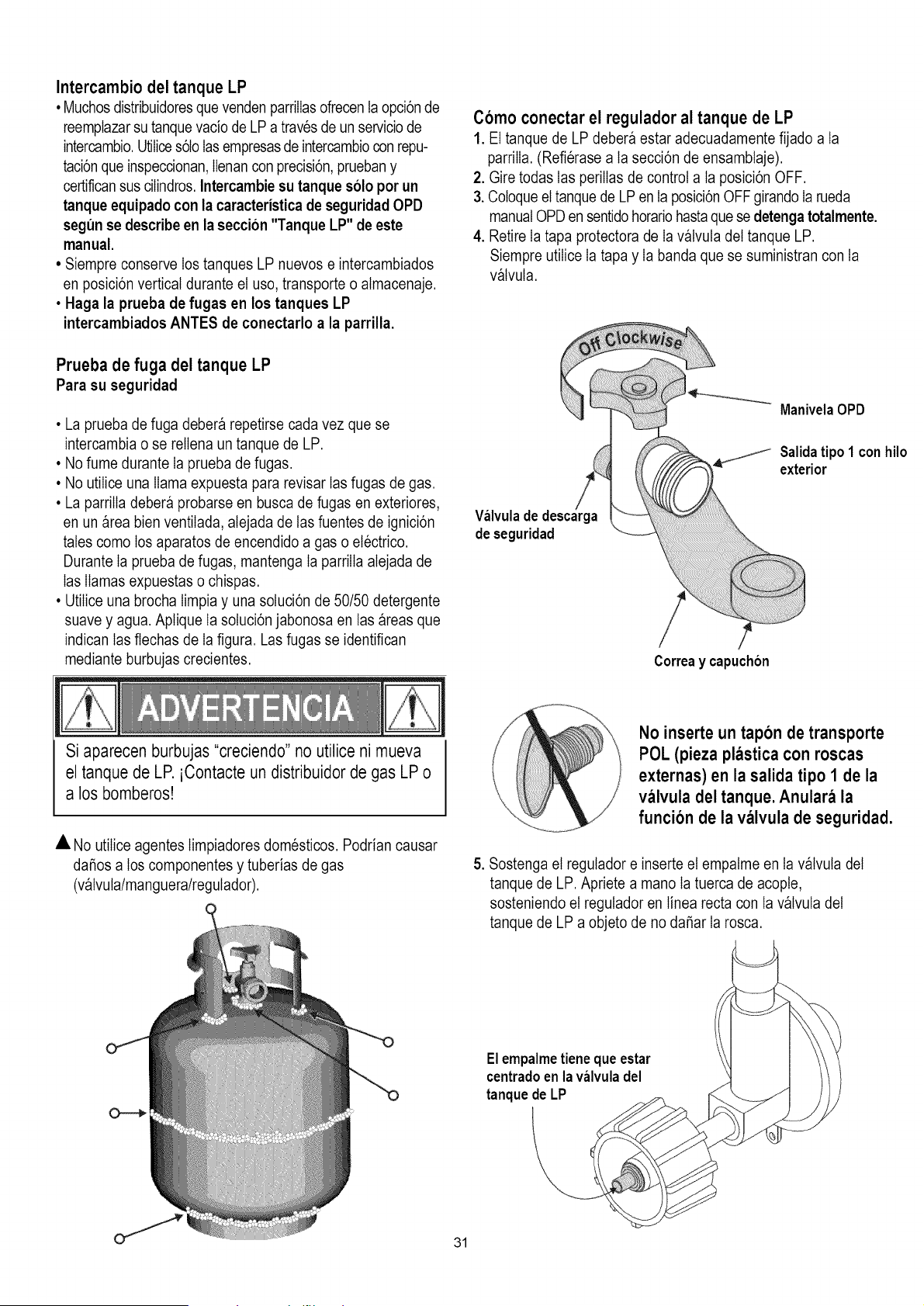
• Utilice una brocha limpia y una sotuci6n de 50/50 detergente
suave y agua. Aptique Ia sotuci6n jabonosa en las areas que
indican las flechas de Ia flgura. Las fugas se identifican
mediante burbujas crecientes.
Como conectar el regulador al tanque de LP
1. El tanque de LP debera estar adecuadamente fijado a ta
parrilIa. (Refierase a ta secci6n de ensambtaje).
2. Gire todas Ias perilIas de control a la posici6n OFF.
3. Cotoqueel tanque de LP en la posici6n OFFgirando Ia rueda
manualOPD en sentidohoratiohastaque se detenga totalmente.
4. Retire Ia tapa protectora de Ia valvula del tanque LP.
Siempre utilice Ia tapa y Ia banda que se suministran con ta
valvula.
ManivelaOPD
_--_- Salidatipo 1 con hilo
exterior
de seguridad
/
Correa y capuch6n
Si aparecen burbujas "creciendo" no utilice ni mueva
el tanque de LP. iContacte un distribuidor de gas LP o
a los bomberos!
• No utiIice agentes Iimpiadores domesticos. Podrian causar
dafios a los componentes y tuberias de gas
(valvuta/manguera/regulador).
No inserte un tapon de transporte
POL (pieza plastica con roscas
externas) en la salida tipo 1 de la
valvula del tanque. Anulara la
funcion de la valvula de seguridad.
5. Sostenga el regutador e inserte el empatme en ta valvuta del
tanque de LP. Apriete a mano Ia tuerca de acopte,
sosteniendo el regutador en linea recta con la valvuta del
tanque de LP a objeto de no dafiar Ia rosca.
El empalmetiene que estar
centradoen la valvuladel
tanquede LP
31
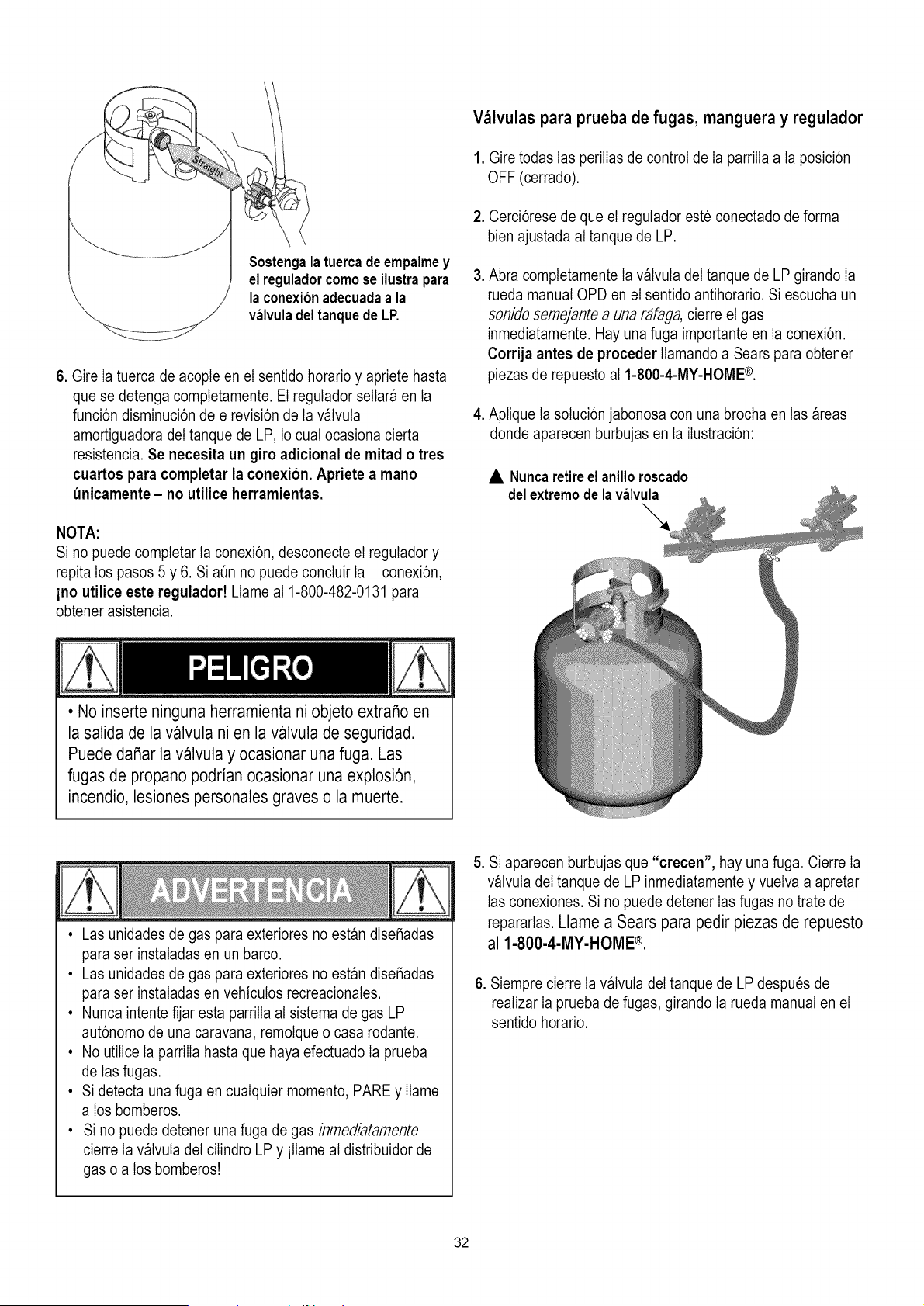
Sostengalatuercade empalmey
el reguladorcomose ilustrapara
laconexionadecuadaa la
valvuladel tanquede LP.
6. Gire Ia tuerca de acople en el sentido horario y apriete hasta
que se detenga completamente. El regutador sellar_ en ta
funci6n disminuci6n de e revisi6n de Ia v_lvuta
amortiguadora del tanque de LP, Io cuat ocasiona cierta
resistencia. Se necesita un giro adicional de mitad o tres
cuartos para completar la conexi6n. Apriete a mano
unicamente - no utilice herramientas.
NOTA:
Si no puede completar Ia conexi6n, desconecte el regutador y
repita los pasos 5 y 6. Si a_n no puede concluir Ia conexi6n,
ino utilice este reguladort Llame at 1-800-482-0131 para
obtener asistencia.
Valvulas para prueba de fugas, manguera y regulador
1. Gire todas Ias periIIas de control de Ia parriIIa a la posici6n
OFF (cerrado).
2. Cerci6rese de que el regulador este conectado de forma
bien ajustada at tanque de LP.
3. Abra comptetamente Ia v_lvuta del tanque de LP girando Ia
rueda manual OPD en el sentido antihorario. Si escucha un
sonido sernejante a una rafaga, cierre el gas
inmediatamente. Hay una fuga importante en ta conexi6n.
Corrija antes de proceder Ilamandoa Sears para obtener
piezas de repuesto al 1-800-4-MY-HOME®.
4. Aplique Ia sotuci6n jabonosa con una brocha en tas areas
donde aparecen burbujas en ta iIustraci6n:
• Nuncaretireel anilloroscado
delextremode lavalvula
• No inserte ninguna herramienta niobjeto extraSo en
la salida de la valvula ni en la valvula de seguridad.
Puede daSar la valvula y ocasionar una fuga. Las
fugas de propano podrian ocasionar una explosi6n,
incendio, lesiones personales graves o la muerte.
• Las unidades de gas para exteriores no est_n dise_adas
para ser instatadas en un barco.
• Las unidades de gas para exteriores no est_n dise_adas
para ser instatadas en vehicutos recreacionates.
• Nunca intente fijar esta parriIIa at sistema de gas LP
aut6nomo de una caravana, remotqueo casa rodante.
• No utiIice Ia parriIIahasta que haya efectuado Ia prueba
de Ias fugas.
• Si detecta una fuga en cualquier momento, PARE y IIame
a los bomberos.
• Si no puede detener una fuga de gas inmediatamente
cierre Ia v_lvuta del ciIindro LP y ilIame at distribuidor de
gas o a los bomberos!
5. Si aparecen burbujas que "crecen", hay una fuga. Cierre Ia
v_lvuta del tanque de LP inmediatamente y vuelva a apretar
Ias conexiones. Si no puede detener Ias fugas no trate de
repararlas. Llame a Sears para pedir piezas de repuesto
al 1-800-4-MY-HOME ®.
6. Siempre cierre Ia v_lvuta del tanque de LP despues de
reatizar Ia prueba de fugas, girando Ia rueda manual en el
sentido horario.
32
Para el uso seguro de su parrilla y para evitar
lesiones graves:
• No permita que los ni_os haganfuncionar la parrilla
ni deje que jueguen cerca de ella.
• Conserve el area de la parrilla despejada y sin
materiales que pudiesen arder.
• No obstruya los agujeros de los costadoso la parte
posteriorde la parrilla.
• Revise las llamas del quemador regularmente.
• Utilice la parrilla s61oen un espacio bien ventilado.
NUNCA la utilice en un espacio cerrado tal como un
puesto de estacionamiento, garaje, porche, patio
cubierto o bajo una estructura de cualquier tipo.
• No use carb6n ni briquetas de ceramica en una
parrilla de gas. (A menos que las briquetas se
suministren con su parrilla.)
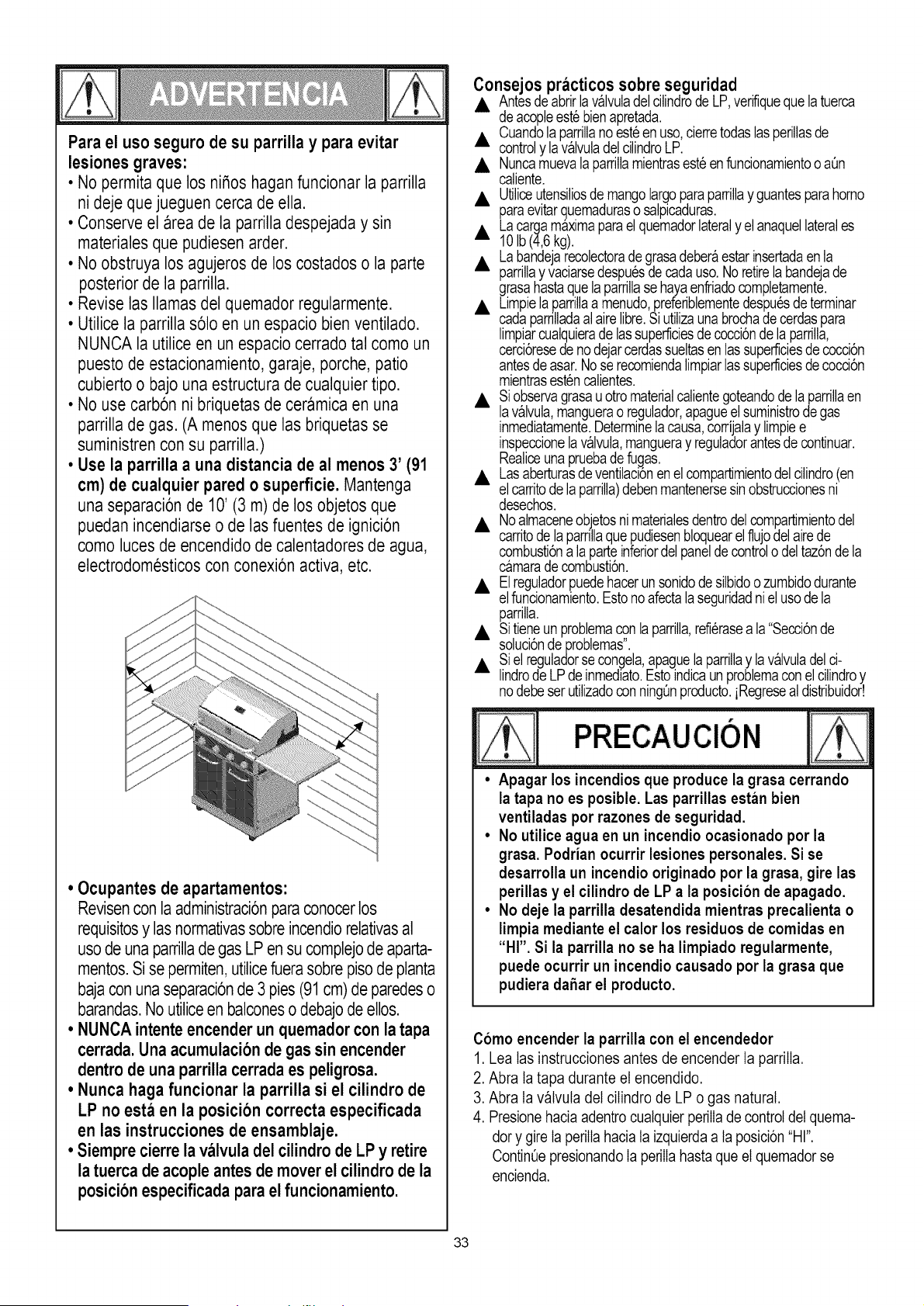
• Use la parrilla a una distancia de al menos 3' (91
cm) de cualquier pared o superficie. Mantenga
una separaci6n de 10' (3 m) de los objetos que
puedan incendiarseo de las fuentes de ignici6n
como luces de encendido de calentadores de agua,
electrodomesticos con conexi6n activa, etc.
• Ocupantes de apartamentos:
Revisenconla administraci6nparaconocerlos
requisitosy las normativassobreincendiorelativasal
usode una parrillade gas LP ensu complejode aparta-
mentos.Si se permiten,utilicefuerasobrepisode planta
bajaconuna separaci6nde 3 pies (91cm) de paredeso
barandas.No utiliceen balconeso debajode ellos.
• NUNCA intente encender un quemador con la tapa
cerrada. Una acumulaci6n de gas sin encender
dentro de una parrilla cerrada es peligrosa.
• Nunca haga funcionar la parrilla si el cilindro de
LP no est,_en la posici6n correcta especificada
en las instrucciones de ensamblaje.
• Siempre cierre la valvula del cilindro de LP y retire
la tuerca de acople antes de mover el cilindro de la
posici6n especificada para el funcionamiento.
Consejos practicos sobre seguridad
• Antesdeabrirlavalvuladelcilindrode LP,verifiquequelatuerca
D de acopleest6bienapretada.
Cuandola parrillanoest6enuso,cierretodaslasperillasde
• controly lavalvuladel cilindroLP.
• Nuncamuevala parrillamientrasest6 enfuncionamientooa0n
caliente.
• Utiliceutensiliosde mangolargoparaparrillay guantesparahomo
paraevitarquemadurasosalpicaduras.
• Lacargamaximaparael quemadorlateraly elanaquellaterales
10Ib (4,6kg).
Labandejarecolectoradegrasadeberaestarinsertadaenla
• parrillay vaciarsedespu6sdecarlauso.No retirela bandejade
grasahastaque laparrillase hayaenfriadocompletamente.
• Limpiela parrillaa menudo,preferiblementedespu6sde terminar
carlaparrilladaal airelibre.Siutilizaunabrochadecerdaspara
limpiarcualquierade lassuperficiesdecocci6ndela parrilla,
cerci6resede nodejarcerdassueltasen lassuperficiesdecocci6n
antesdeasar.Nose recomiendalimpiarlassuperficiesde cocci6n
mientrasest6ncalientes.
• Siobservagrasau otromaterialcalientegoteandode laparrillaen
lavalvula,manguerao regulador,apagueelsuministrode gas
inmediatamente.Determinelacausa,corrijalay limpiee
inspeccionela valvula,mangueray reguladorantesde continuar.
Realiceunapruebade fugas.
• Lasaberturasdeventilaci6nenel compartimientodel cilindro(en
elcarritode la parrilla)debenmantenersesinobstruccionesni
desechos.
• Noalmaceneobjetosnimaterialesdentrodelcompartimientodel
carritodela parrillaque pudiesenbloquearel flujodelaire de
combusti6na laparteinferiordelpaneldecontrolo del taz6nde la
c&maradecombusti6n.
• Elreguladorpuedehacerunsonidodesilbidoo zumbidodurante
elfuncionamiento.Estonoafectalaseguridadniel usode la
parrilla.
• Sitieneunproblemacon laparrilla,refi6rasea la "Secci6nde
sohci6nde problemas".
• Siel reguladorse congela,apaguela parrillay lavalvuladel ci-
lindrode LPdeinmediato.Estoindicaun problemaconelcilindroy
nodebeser utilizadocon ning0nproducto,iRegresealdistribuidor!
• Apagar los incendios que produce la grasa cerrando
la tapa no es posible. Las parrillas estan bien
ventiladas por razones de seguridad.
• No utilice agua en un incendio ocasionado por la
grasa. Podrian ocurrir lesiones personales. Si se
desarrolla un incendio originado por la grasa, gire las
perillas y el cilindro de LP a la posicion de apagado.
• No deje la parrilla desatendida mientras precalienta o
limpia mediante el calor los residuos de comidas en
"HI". Si la parrilla no se ha limpiado regularmente,
puede ocurrir un incendio causado por la grasa que
pudiera daSar el producto.
Como encender la parrilla con el encendedor
1. Lea tas instrucciones antes de encender Ia parrilIa.
2. Abra ta tapa durante el encendido.
3. Abra ta v_lvuta del cilindro de LP o gas natural.
4. Presionehacia adentro cualquierperilIade controldel quema-
dory gire Ia perilIahacia la izquierdaa la posici6n"HI".
ContinOepresionandoIa perilIahastaque el quemador se
encienda.
33
5. Si no enciende en 5 segundos, apague el control del
quemador, espere 5 minutos para que se disipe el gas y
repita el procedimiento de encendido.
6. Para encender otros quemadores, repita el paso 4.
NOTA: Si el encendedor no funciona, siga tas instrucciones
de encendido con f6sforos.
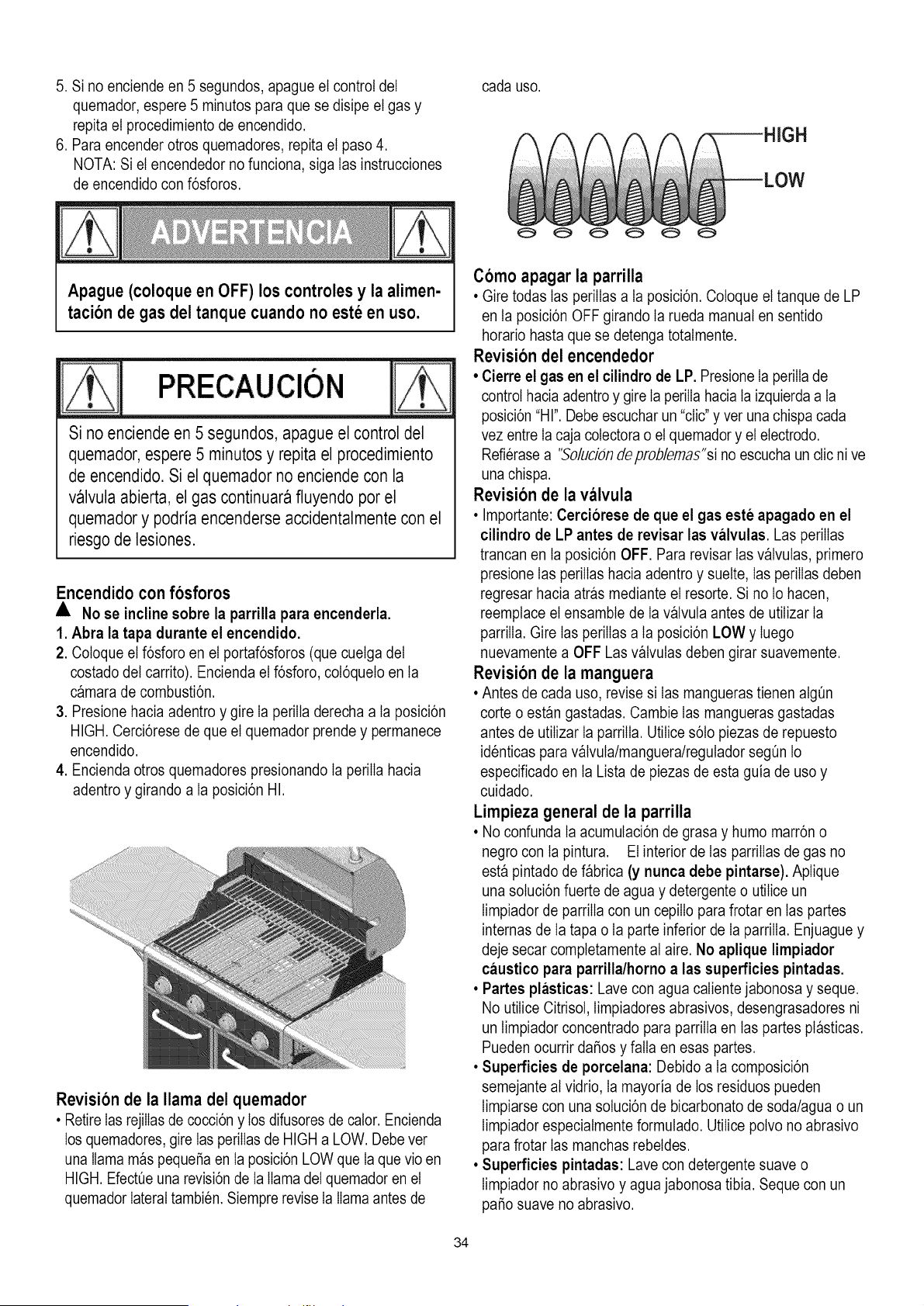
cada uso.
Apague (coloque en OFF) los controles y la alimen-
tacion de gas del tanque cuando no este en uso.
PRECAUClON
Si no enciende en 5 segundos, apague el control del
quemador, espere 5 minutos y repita el procedimiento
de encendido. Si el quemador no enciende con la
valvula abierta, el gas continuara fluyendo por el
quemador y podria encenderse accidentalmente con el
riesgo de lesiones.
Encendido con fosforos
• No se incline sobre la parrilla para encenderla.
1. Abra la tapa durante el encendido.
2. Coloque et f6sforo en et portaf6sforos (que cuetgadet
costado det carrito). Encienda el f6sforo, cot6quelo en ta
c_mara de combusti6n.
3. Presione hacia adentro y gire Ia periIla derecha a ta posici6n
HIGH. Cerci6rese de que el quemador prende y permanece
encendido.
4. Encienda otros quemadores presionando Ia periIIa hacia
adentro y girando a la posici6n HI.
Revision de la llama del quemador
• RetireIas rejilIasde cocci6n y los difusores de calor. Encienda
los quemadores, gire Ias perilIasde HIGH a LOW. Debe ver
una llama m_s pequefia en ta posici6n LOW que Ia que vio en
HIGH. EfectQeuna revisi6nde Ia llama del quemador en el
quemador lateral tambien. Siempre revise Ia llama antes de
Como apagar la parrilla
• Gire todas Ias perilIas a ta posici6n. Cotoque el tanque de LP
en ta posici6n OFF girando Ia rueda manual en sentido
horario hasta que se detenga totalmente.
Revision del encendedor
• Cierre el gas en el cilindro de LP. Presione Ia perilIade
control hacia adentro y gire Ia periIIahacia ta izquierda a ta
posici6n "HI". Debe escuchar un "clic" y ver una chispacada
vez entre Ia caja cotectorao el quemador y el electrodo.
Refierase a "So/udondeprob/emas"si no escucha un clic nive
una chispa.
Revisi6n de la valvula
• Importante: Cerciorese de que el gas este apagado en el
cilindro de LP antes de revisar las valvulas. Las periIIas
trancan en la posici6n OFF. Para revisar Ias v_lvutas, primero
presione Ias periIIas hacia adentro y suelte, Ias periIIas deben
regresar hacia atr_s mediante el resorte. Si no Io hacen,
reemptace el ensambte de Ia v_lvula antes de utiIizar Ia
parrilIa. Gire Ias perilIas a ta posici6n LOW y Iuego
nuevamente a OFF Las v_Ivulas deben girar suavemente.
Revisi6n de la manguera
• Antes de cada uso, revise si Ias mangueras tienen atgQn
corte o est_n gastadas. Cambie Ias mangueras gastadas
antes de utiIizar Ia parriIIa. UtiIices6to piezas de repuesto
identicas para v_lvuta/manguera/regulador segQn1o
especificado en ta Lista de piezas de esta guia de uso y
cuidado.
Limpieza general de la parrilla
• No confunda ta acumulaci6n de grasa y humo marr6n o
negro con la pintura. El interior de Ias parriIIas de gas no
est_ pintado de f_brica (y nunca debe pintarse). Aplique
una sotuci6n fuerte de agua y detergente o utiIice un
Iimpiador de parriIIacon un cepiIIo para frotar en tas partes
internas de Ia tapa o Ia parte inferior de Ia parriIIa. Enjuague y
deje secar comptetamente at aire. No aplique limpiador
caustico para parrilla/horno a las superficies pintadas.
• Partes plasticas: Lave con agua caliente jabonosa y seque.
No utiIice Citrisot, Iimpiadores abrasivos, desengrasadores ni
un timpiador concentrado para parriIIa en tas partes pl_sticas.
Pueden ocurrir dafios y fatIa en esas partes.
• Superficies de porcelana: Debido a ta composici6n
semejante at vidrio, Ia mayoria de los residuos pueden
Iimpiarse con una sotuci6n de bicarbonato de soda/agua o un
Iimpiador especiatmente formulado. UtiIice potvo no abrasivo
para ffotar Ias manchas rebeldes.
• Superficies pintadas: Lave con detergente suave o
Iimpiador no abrasivo y agua jabonosa tibia. Seque con un
patio suave no abrasivo.
34
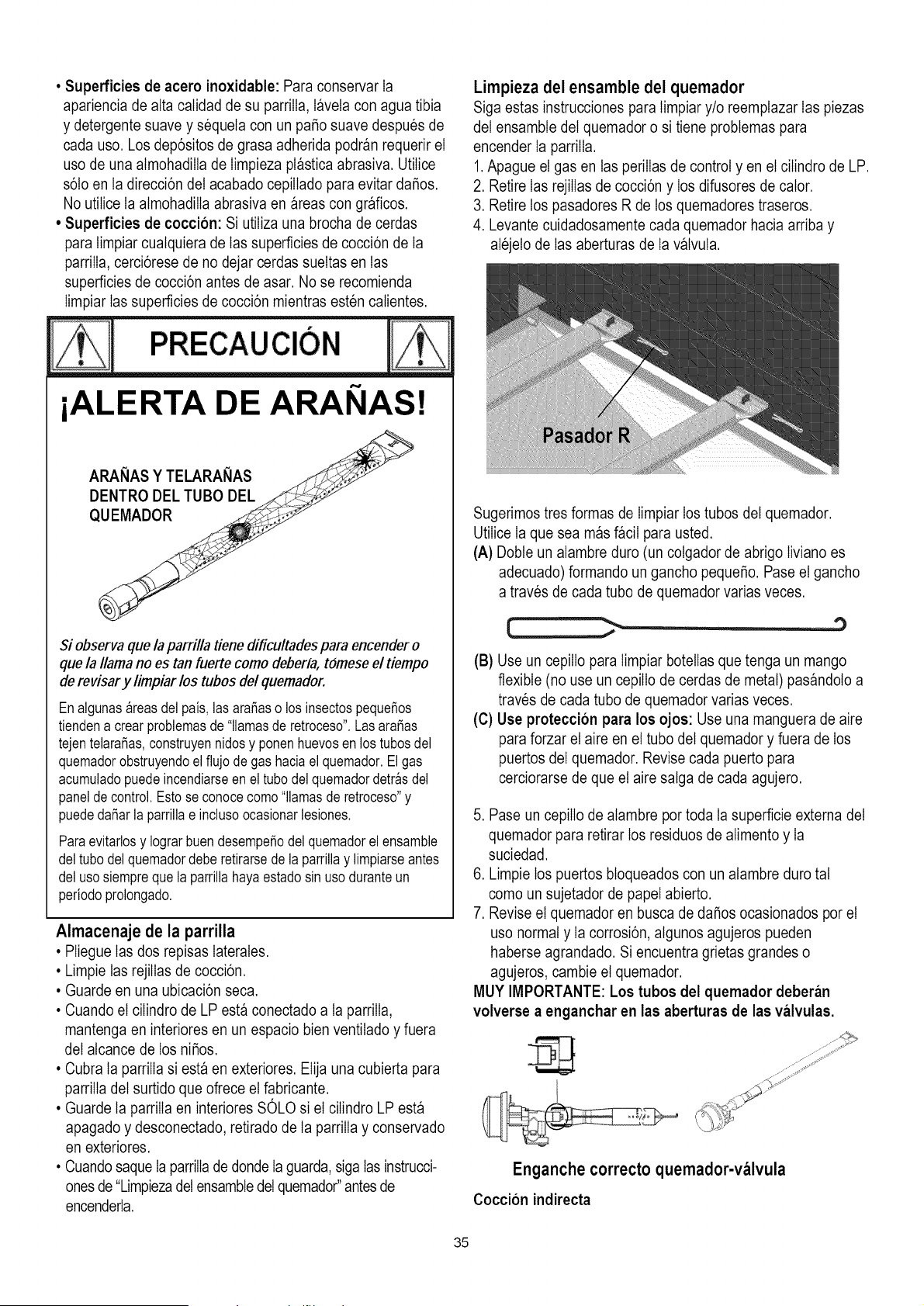
• Superficies de acero inoxidable: Para conservar Ia
apariencia de atta calidad de su parrilIa, Dvela con agua tibia
y detergente suave y sequeta con un paso suave despues de
cada uso. Los dep6sitos de grasa adherida podr_n requerir el
uso de una atmohadilla de Iimpieza pDstica abrasiva. Utilice
s6to en ta direcci6n del acabado cepilIado para evitar daSos.
No utilice Ia atmohadilIa abrasiva en areas con graficos.
• Superficies de coccion: Si utiliza una brocha de cerdas
para timpiar cuatquiera de Ias superficies de cocci6n de Ia
parrilIa,cerci6rese de no dejar cerdas sueltas en tas
superficies de cocci6n antes de asar. No se recomienda
Iimpiar Iassuperficies de cocci6n mientras esten catientes.
PRECAUClON
iALERTA DE ARANAS!
Si observa que la parrilla tiene dificultades para encender o
que la llama no es tan fuerte como deberia, tomeseel fiempo
derevisar y limpiar los tubos del quemador.
Enalgunas_reasdel pals,las araSaso los insectospequeSos
tiendena crear problemasde "llamasde retroceso".LasaraSas
tejentelaraSas,construyennidosy ponenhuevosen lostubosdel
quemadorobstruyendoelflujo de gas haciaelquemador.Elgas
acumuladopuedeincendiarseen eltubodel quemadordetr&sdel
paneldecontrol.Estose conocecomo"llamasde retroceso"y
puededaSarla parrillae inclusoocasionarlesiones.
Paraevitarlosy IograrbuendesempeSodelquemadorel ensamble
del tubodelquemadordebe retirarsede laparrillay limpiarseantes
del usosiemprequela parrillahayaestadosin usoduranteun
periodoprolongado.
Almacenaje de la parrilla
• Pliegue Ias dos repisas Iaterates.
• Limpie las rejilIas de cocci6n.
• Guarde en una ubicaci6n seca.
• Cuando el ciIindro de LP est_ conectado a la parriIIa,
mantenga en interiores en un espacio bien ventiIado y fuera
del alcance de los niSos.
• Cubra ta parriIIa si esta en exteriores. EIija una cubierta para
parriIIadel surtido que ofrece el fabricante.
• Guarde la parriIIaen interiores SOLO si el ciIindro LP esta
apagado y desconectado, retirado de Ia parriIIa y conservado
en exteriores.
• Cuandosaque Ia parriIIade donde ta guarda, siga tas instrucci-
ones de"Limpiezadetensambtedet quemador"antesde
encenderta.
Lirnpieza del ensamble del quemador
Siga estas instrucciones para timpiar y/o reemplazar Ias piezas
del ensambte del quemador o si tiene probtemas para
encender Ia parrilIa.
1.Apague el gas en las periIIas de control yen el ciIindro de LP.
2. Retire Ias rejiIIas de cocci6n y los difusores de cator.
3. Retire los pasadores R de los quemadores traseros.
4. Levante cuidadosamente cada quemador hacia arriba y
atejelo de Ias aberturas de Ia v_lvuta.
Sugerimos tres formas de Iimpiar los tubos del quemador.
UtiIice Ia que sea m_s DciI para usted.
(A) Dobte un alambre duro (un cotgador de abrigo Iiviano es
adecuado) formando un gancho pequeSo. Pase el gancho
a traves de cada tubo de quemador varias veces.
(B) Use un cepilIo para timpiar botelIas que tenga un mango
flexible (no use un cepiIIo de cerdas de metal) pas_ndoto a
traves de cada tubo de quemador varias veces.
(C) Use protecci6n para los ojos: Use una manguera de aire
para forzar el aire en el tubo del quemador y fuera de los
puertos del quemador. Revise cada puerto para
cerciorarse de que el aire satga de cada agujero.
5. Pase un cepiIIo de atambre por toda la superficie externa del
quemador para retirar los residuos de atimento y Ia
suciedad.
6. Limpie los puertos btoqueados con un atambre duro tat
como un sujetador de papel abierto.
7. Revise el quemador en busca de daSos ocasionados por el
uso normal y Ia corrosi6n, atgunos agujeros pueden
haberse agrandado. Si encuentra grietas grandes o
agujeros, cambie el quemador.
MUY IMPORTANTE: Los tubos del quemador deberan
volverse a enganchar en las aberturas de las valvulas.
Enganche correcto quemador-valvula
Coccionindirecta
35
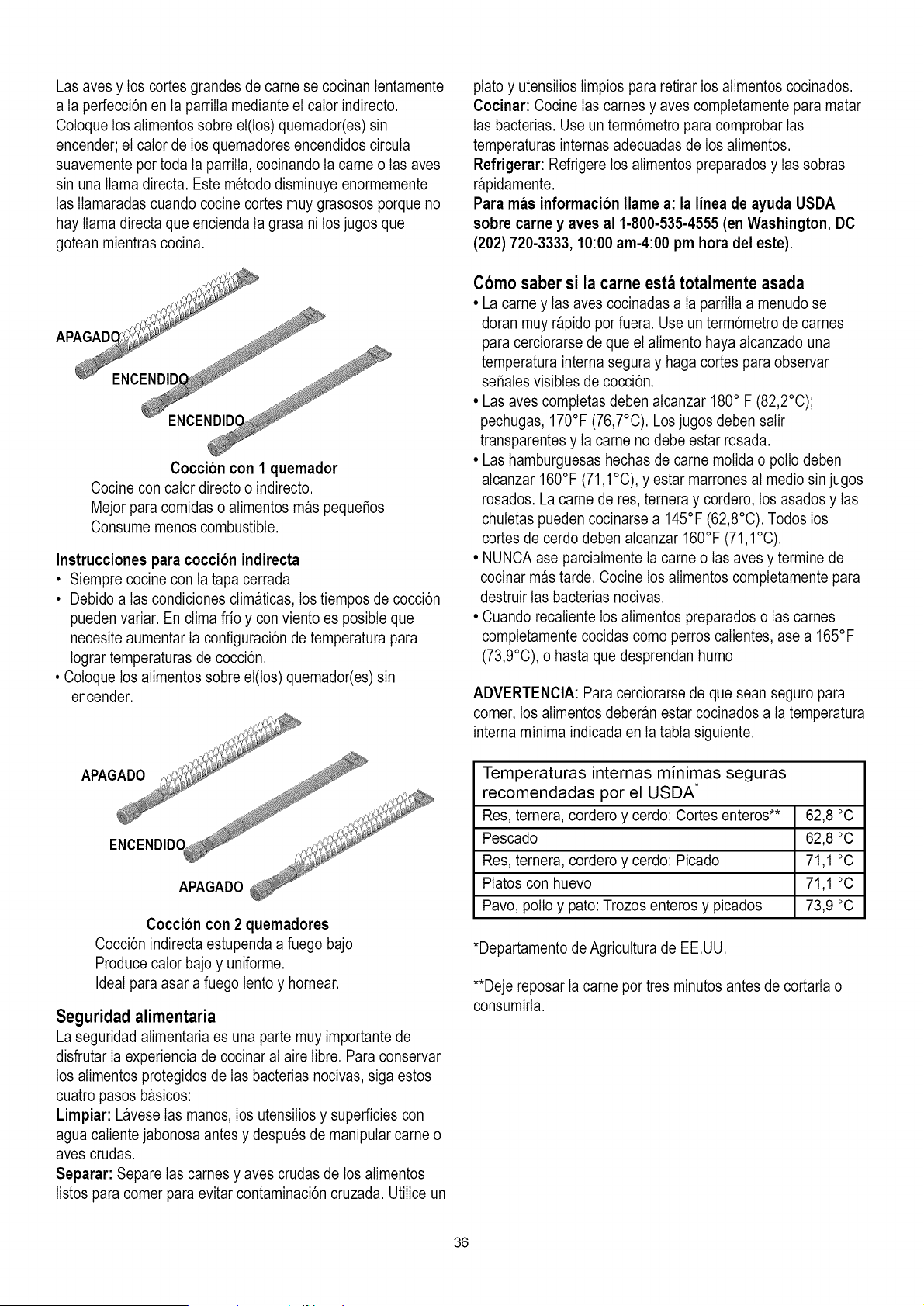
Las aves y los cortes grandes de came se cocinan tentamente
a ta perfecci6n en ta parrilIa mediante el cator indirecto.
Cotoque los atimentos sobre el(los) quemador(es) sin
encender; el cator de los quemadores encendidos circuta
suavemente por toda ta parrilIa, cocinando Ia came o Iasaves
sin una llama direct& Este metodo disminuye enormemente
Ias IIamaradas cuando cocine cortes muy grasosos porque no
hay llama directa que encienda ta grasa ni los jugos que
gotean mientras cocina.
Coccion con 1 quemador
Cocine con cator directo o indirecto.
Mejor para comidas o atimentos m_s pequeSos
Consume menos combustible.
Instrucciones para coccion indirecta
• Siempre cocine con ta tapa cerrada
• Debido a tas condiciones clim_ticas, los tiempos de cocci6n
pueden variar. En clima frio y con viento es posibte que
necesite aumentar Ia conflguraci6n de temperatura para
Iograr temperaturas de cocci6n.
• Cotoque los atimentos sobre el(los) quemador(es) sin
encender.
Coccion con 2 quemadores
Cocci6n indirecta estupenda a fuego bajo
Produce cator bajo y uniforme.
Ideal para asar a fuego lento y hornear.
Seguridad alirnentaria
La seguridad atimentaria es una parte muy importante de
disfrutar Ia experiencia de cocinar at aire Iibre. Para conservar
los alimentos protegidos de Ias bacterias nocivas, siga estos
cuatro pasos b_sicos:
Limpiar: L_vese Ias manos, los utensilios y superficies con
agua catiente jabonosa antes y despues de manipular came o
aves crudas.
Separar: Separe Ias carnes y aves crudas de los atimentos
Iistos para comer para evitar contaminaci6n cruzada. Utilice un
plato y utensilios Iimpios para retirar los atimentos cocinados.
Cocinar: Cocine Ias carnes y aves comptetamente para matar
Ias bacterias. Use un term6metro para comprobar Ias
temperaturas internas adecuadas de los atimentos.
Refrigerar: Refrigere los atimentos preparados y Ias sobras
r_pidamente.
Para mas informaci6n flame a: la linea de ayuda USDA
sobre came y ayes al 1-800-535-4555 (en Washington, DC
(202) 720-3333, 10:00 am-4:00 pm hora del este).
Como saber si la carne esta totalmente asada
• La came y Ias aves cocinadas a la parriIIa a menudo se
doran muy r_pido por fuera. Use un term6metro de cames
para cerciorarse de que el atimento haya atcanzado una
temperatura interna segura y haga cortes para observar
se_ates visibtes de cocci6n.
• Las aves completas deben atcanzar 180° F (82,2°C);
pechugas, 170°F (76,7°C). Los jugos deben salir
transparentes y Ia came no debe estar rosada.
• Las hamburguesas hechas de came motida o polio deben
alcanzar 160°F (71,1°C), y estar marrones at medio sin jugos
rosados. La came de res, ternera y cordero, los asados y Ias
chutetas pueden cocinarse a 145°F (62,8°C). Todos los
cortes de cerdo deben atcanzar 160°F (71,1°C).
• NUNCA ase parciatmente Ia came o Ias aves y termine de
cocinar m_s tarde. Cocine los atimentos completamente para
destruir las bacterias nocivas.
• Cuando recatiente los atimentos preparados o Ias carnes
completamente cocidas como perros calientes, ase a 165°F
(73,9°C), o hasta que desprendan humo.
ADVERTENCIA: Para cerciorarse de que sean seguro para
comer, los alimentos deber_n estar cocinados a la temperatura
intema minima indicada en ta tabta siguiente.
Temperaturas internas minimas seguras
recomendadas por el USDA*
Res, temera, cordero y cerdo: Cortes enteros** 62,8 °C
Pescado 62,8 °C
Res, temera, cordero y cerdo: Picado 71,1 °C
Platos con huevo 71,1 °C
Pavo, polto y pato: Trozos enteros y picados 73,9 °C
*Departamento deAgricuttura de EE.UU.
**Deje reposar Ia came por tres minutos antes de cortarla o
consumirta.
36
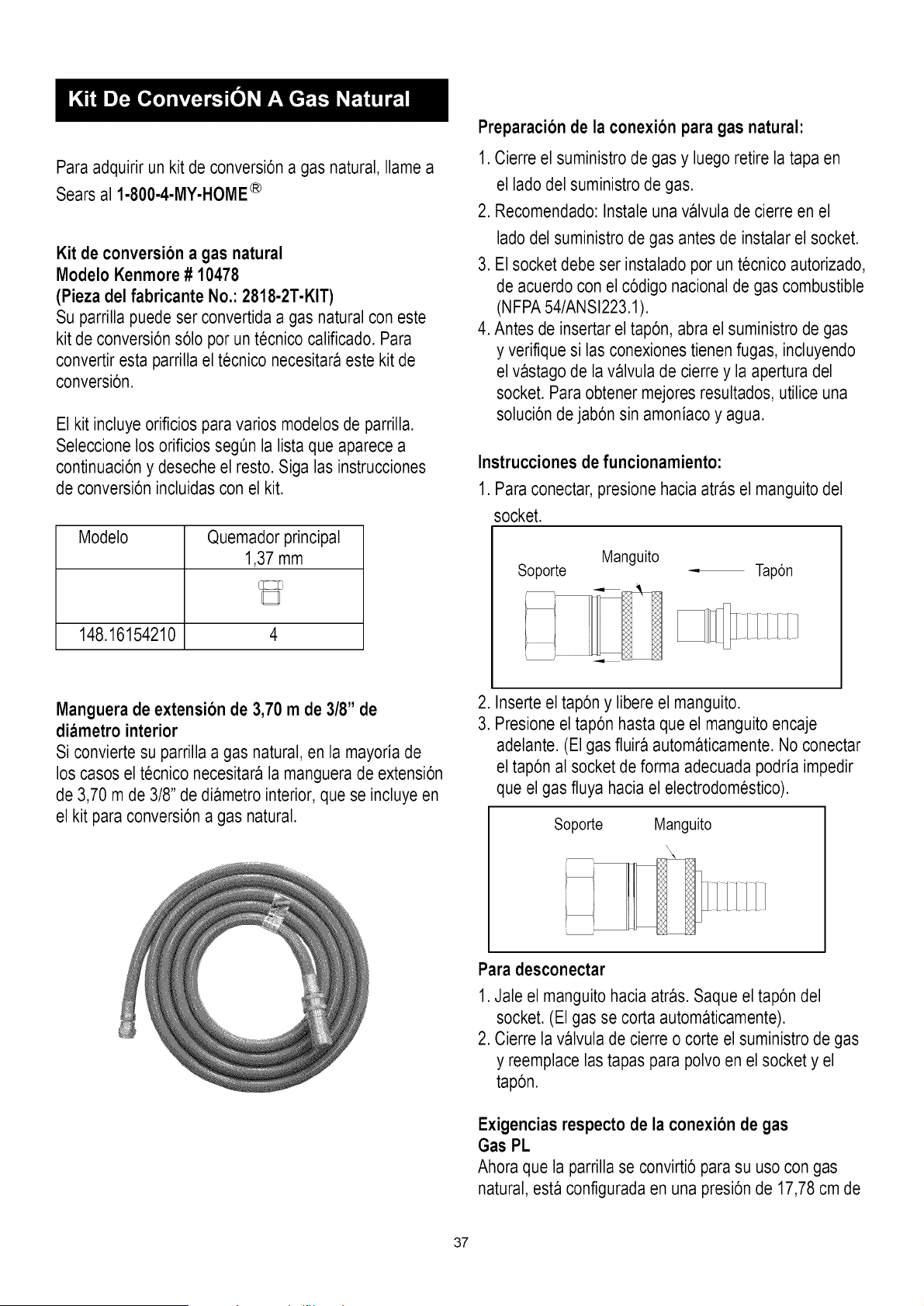
Para adquirir un kit de conversi6n a gas natural, Ilame a
Sears al 1-800-4-MY-HOME®
Kit de conversion a gas natural
Modelo Kenmore # 10478
(Pieza del fabricante No.: 2818-2T-KIT)
Su parrilla puede ser convertida a gas natural con este
kit de conversi6n s61opor un tecnico calificado. Para
convertir esta parrilla el tecnico necesitaraeste kit de
conversi6n.
El kit incluye orificios para varios modelos de parrilla.
Seleccione los orificios segen la lista que aparece a
continuaci6n y deseche el resto. Siga las instrucciones
de conversi6n incluidas con el kit.
Modelo Quemador principal
1,37 mm
148.16154210 4
Preparacion de la conexion para gas natural:
1. Cierre el suministro de gas y luego retire la tapa en
el lado del suministro de gas.
2. Recomendado: Instale una valvula de cierre en el
lado del suministro de gas antes de instalar el socket.
3. El socket debe ser instalado por un tecnico autorizado,
de acuerdo con el c6digo nacional de gas combustible
(NFPA54/ANSI223.1).
4. Antes de insertar el tap6n, abra el suministro de gas
y verifique si las conexiones tienen fugas, incluyendo
el vastago de la valvula de cierre y la apertura del
socket. Para obtener mejores resultados, utilice una
soluci6n de jab6n sin amoniaco y agua.
Instrucciones de funcionamiento:
1. Para conectar, presione hacia atras el manguitodel
socket.
Manguito
Soporte _ Tap6n
Manguera de extension de 3,70 m de 3/8" de
diametro interior
Si convierte su parrilla a gas natural, en la mayoria de
los casos el tecnico necesitara la manguerade extensi6n
de 3,70 m de 3/8" de diametro interior, que se incluye en
el kit para conversi6n a gas natural.
2. Inserte el tap6n y libere el manguito.
3. Presione el tap6n hasta que el manguitoencaje
adelante. (El gas fluira automaticamente. No conectar
el tap6n al socket de forma adecuada podria impedir
que el gas fluya hacia el electrodomestico).
Soporte Manguito
Para desconectar
1. Jale el manguito hacia atras. Saque el tap6n del
socket. (El gas se corta automaticamente).
2. Cierre la valvula de cierre o corte el suministro de gas
y reemplace las tapas para polvo en el socket y el
tap6n.
Exigencias respecto de la conexion de gas
Gas PL
Ahora que la parrilla se convirti6 para su uso con gas
natural, esta configurada en una presi6n de 17,78 cm de
37
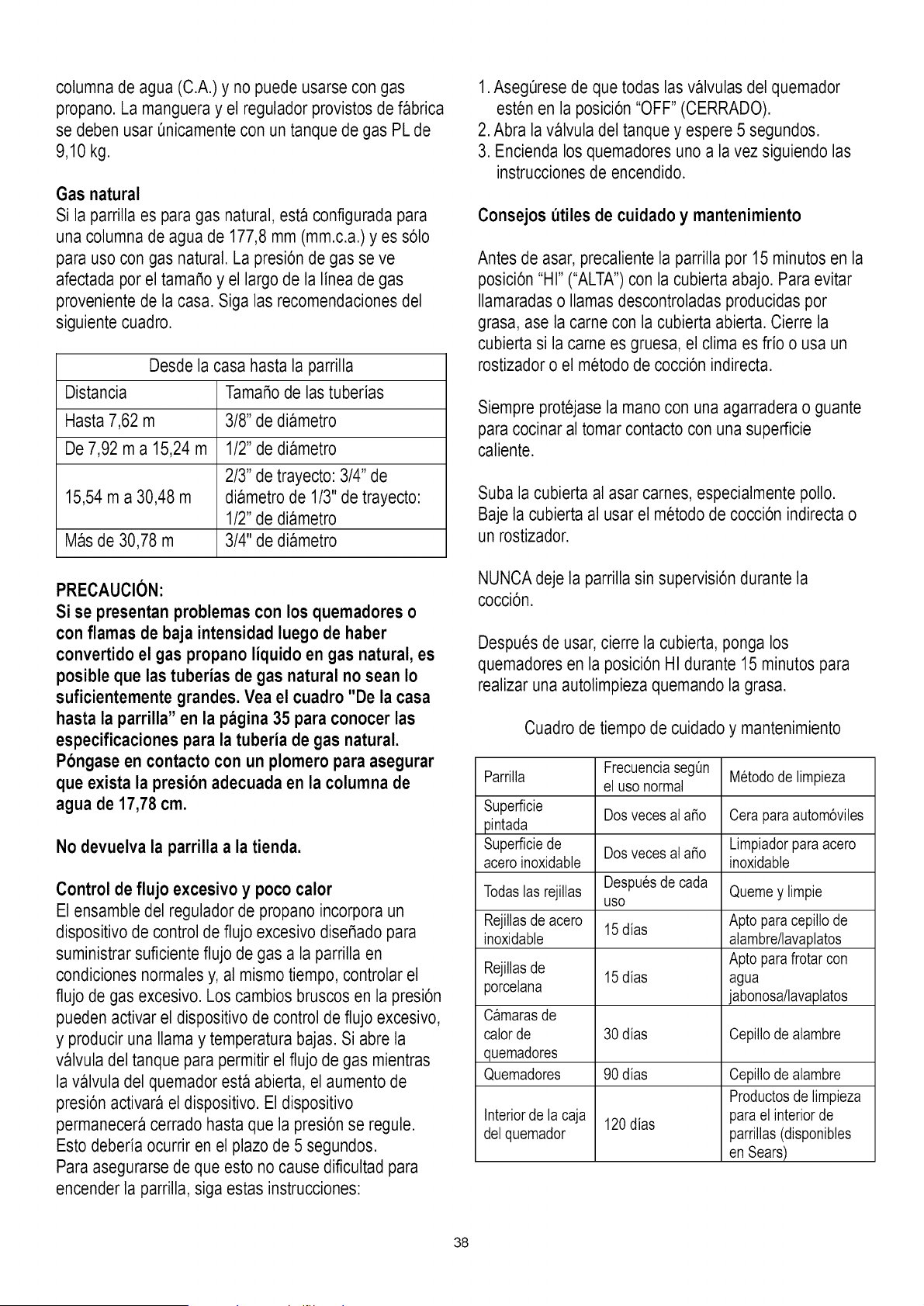
columna de agua (C.A.) y no puede usarse con gas
propano. La manguera y el regulador provistosde fabrica
se deben usar 0nicamente con un tanque de gas PL de
9,10 kg.
Gas natural
Si la parrilla es para gas natural, esta configurada para
una columna de agua de 177,8 mm (mm.c.a.) y es s61o
para uso con gas natural. La presi6nde gas se ve
afectada por el tamaSoy el largo de la linea de gas
proveniente de la casa. Siga las recomendacionesdel
siguiente cuadro.
Desde la casa hasta la parrilla
Distancia TamaSode lastuberias
Hasta 7,62 m 3/8" de diametro
De 7,92 m a 15,24 m 1/2" de diametro
2/3" de trayecto: 3/4" de
15,54 m a 30,48 m diametro de 1/3" de trayecto:
1/2" de diametro
Masde 30,78 m 3/4" de diametro
PRECAUCION:
Si se presentan problemas con los quemadores o
con llamas de baja intensidad luego de haber
convertido el gas propano liquido en gas natural, es
posible que las tuberias de gas natural no sean Io
suficientemente grandes. Vea el cuadro "De la casa
hasta la parrilla" en la pagina 35 para conocer las
especificaciones para la tuberia de gas natural.
Pongase en contacto con un plomero para asegurar
que exista la presion adecuada en la columna de
agua de 17,78 cm.
No devuelva la parrilla a la tienda.
Control de flujo excesivo y poco calor
El ensamble del regulador de propano incorpora un
dispositivo de control de flujo excesivo diseSado para
suministrar suficiente flujo de gas a la parrilla en
condiciones normales y, al mismo tiempo, controlar el
flujo de gas excesivo. Los cambios bruscos en la presi6n
pueden activar el dispositivo de control de flujo excesivo,
y producir una llama y temperatura bajas. Si abre la
valvula del tanque para permitir el flujo de gas mientras
la valvula del quemador esta abierta, el aumento de
presi6n activara el dispositivo. El dispositivo
permanecera cerrado hasta que la presi6n se regule.
Esto deberia ocurrir en el plazode 5 segundos.
Para asegurarsede que esto no cause dificultad para
encender la parrilla, siga estas instrucciones:
1. AsegOresede que todas las valvulas del quemador
esten en la posici6n "OFF" (CERRADO).
2. Abra la valvula del tanque y espere 5 segundos.
3. Enciendalos quemadores uno a la vez siguiendo las
instruccionesde encendido.
Consejos utiles de cuidado y mantenimiento
Antes de asar, precaliente la parrilla pot 15 minutos en la
posici6n "HI" ("ALTA")con la cubierta abajo. Para evitar
Ilamaradaso llamas descontroladas producidaspor
grasa, ase la came con la cubierta abierta. Cierre la
cubierta si la came es gruesa, el clima es frio o usa un
rostizadoro el metodo de cocci6n indirecta.
Siempre protejase la mano con una agarraderao guante
para cocinar al tomar contacto con una superficie
caliente.
Suba la cubierta al asar carnes, especialmente polio.
Baje la cubierta al usar el metodo de cocci6n indirecta o
un rostizador.
NUNCA deje la parrillasin supervisi6n durante la
cocci6n.
Despues de usar, cierre la cubierta, ponga los
quemadores en la posici6n HI durante 15 minutos para
realizar una autolimpieza quemando la grasa.
Cuadrode tiempo de cuidado y mantenimiento
FrecuenciasegOn M6todode limpieza
Parrilla el uso normal
Superficie
pintada Dosveces al afio Cera para autom6viles
Superficiede Dosveces al afio Limpiadorpara acero
acero inoxidable inoxidable
Todaslas rejillas Despu6sde cada Quemey limpie
uso
Rejillasde acero 15 dias Apto paracepillo de
inoxidable alambre/lavaplatos
Apto parafrotar con
Rejillasde 15 dias agua
porcelana jabonosa/lavaplatos
Camarasde
calor de 30 dias Cepillode alambre
quemadores
Quemadores 90 dias Cepillode alambre
Productosde limpieza
Interiorde la caja 120dias parael interior de
del quemador parrillas(disponibles
en Sears)
38
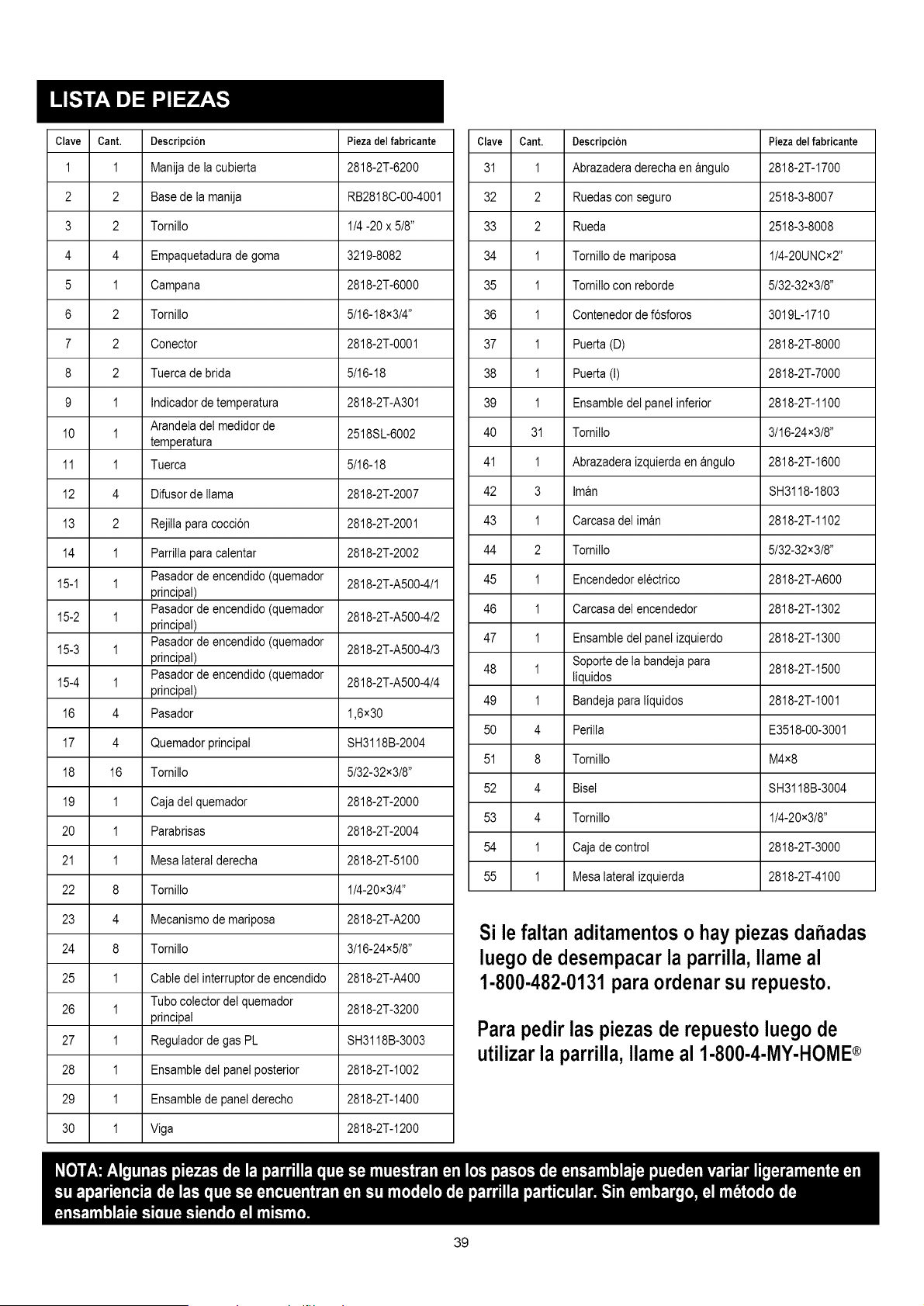
Clave Cant. Descripcion Piezadelfabricante
1 1 Manija de la cubierta 2818-2T-6200
2 2 Base de la manija RB2818C-00-4001
3 2 Tornillo 1/4 -20 x 5/8"
4 4 Empaquetadura de goma 3219-8082
5 1 Campana 2818-2T-6000
8 2 Tornillo 5/18-18x3/4"
7 2 Conector 2818-2T-0001
8 2 Tuerca de brida 5/18-18
9 1 Indicador de temperatura 2818-2T-A301
Arandela del medidor de
10 1 2518SL-6002
temperatura
11 1 Tuerca 5/18-18
12 4 Difusor de llama 2818-2T-2007
13 2 Rejilla para cocci6n 2818-2T-2001
14 1 Parrilla para calentar 2818-2T-2002
15-1 1 Pasador de encendido (quemador 2818-2T-A500-4/1
principal)
15-2 1 Pasador de encendido (quemador 2818-2T-A500-4/2
principal)
15-3 1 Pasador de encendido (quemador 2818-2T-A500-4/3
principal)
15-4 1 Pasador de encendido (quemador 2818-2T-A500-4/4
principal)
18 4 Pasador 1,6x30
17 4 Quemador principal SH3118B-2004
18 18 Tornillo 5/32-32x3/8"
19 1 Caja del quemador 2818-2T-2000
20 1 Parabrisas 2818-2T-2004
21 1 Mesa lateral derecha 2818-2T-5100
22 8 Tornillo 1/4-20x3/4"
23 4 Mecanismo de mariposa 2818-2T-A200
24 8 Tornillo 3/18-24x5/8"
25 1 Cable del interruptor de encendido 2818-2T-A400
26 1 Tubo colector del quemador 2818-2T-3200
principal
27 1 Regulador de gas PL SH3118B-3003
28 1 Ensamble del panel posterior 2818-2T-1002
29 1 Ensamble de panel derecho 2818-2T-1400
30 1 Viga 2818-2T-1200
Clave Cant. Descripcion Piezadel fabricante
31 1 Abrazadera derecha en _lngulo 2818-2T-1700
32 2 Ruedas con seguro 2518-3-8007
33 2 Rueda 2518-3-8008
34 1 Tornillo de mariposa 1/4-2OUNCx2"
35 1 Tomillo con reborde 5/32-32x3/8"
36 1 Contenedor de f6sforos 3019L-1710
37 1 Puerta (D) 2818-2T-8000
38 1 Puerta (I) 2818-2T-7000
39 1 Ensamble del panel inferior 2818-2T-1100
40 31 Tornillo 3/18-24x3/8"
41 1 Abrazadera izquierda en _lngulo 2818-2T-1800
42 3 Iman SH3118-1803
43 1 Carcasa del im_ln 2818-2T-1102
44 2 Tornillo 5/32-32x3/8"
45 1 Encendedor electrico 2818-2T-A600
46 1 Carcasa del encendedor 2818-2T-1302
47 1 Ensamble del panel izquierdo 2818-2T-1300
48 1 Soporte de la bandeja para 2818-2T-1500
liquidos
49 1 Bandeja para liquidos 2818-2T-1001
50 4 Perilla E3518-00-3001
51 8 Tornillo M4x8
52 4 Bisel SH3118B-3004
53 4 Tornillo 1t4-20x318"
54 1 Caja de control 2818-2T-3000
55 1 Mesa lateral izquierda 2818-2T-4100
Si le faltan aditamentoso hay piezas dahadas
luego de desempacarla parrilla, Ilame al
1-800-482-0131para ordenarsu repuesto.
Para pedir las piezas de repuesto luego de
utilizar la parrilla, Ilame al 1-800-4-MY-HOME®
39
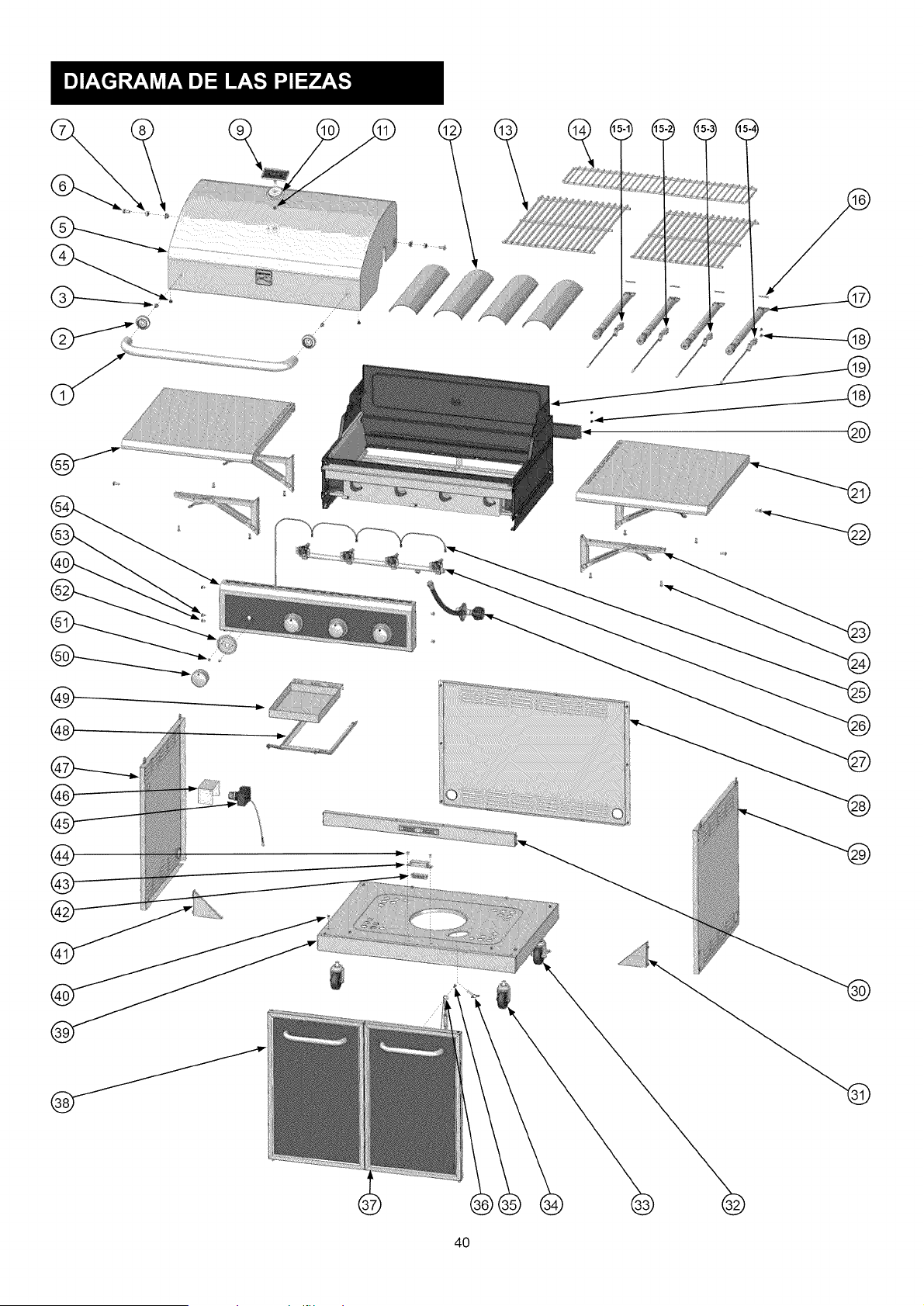
@
40
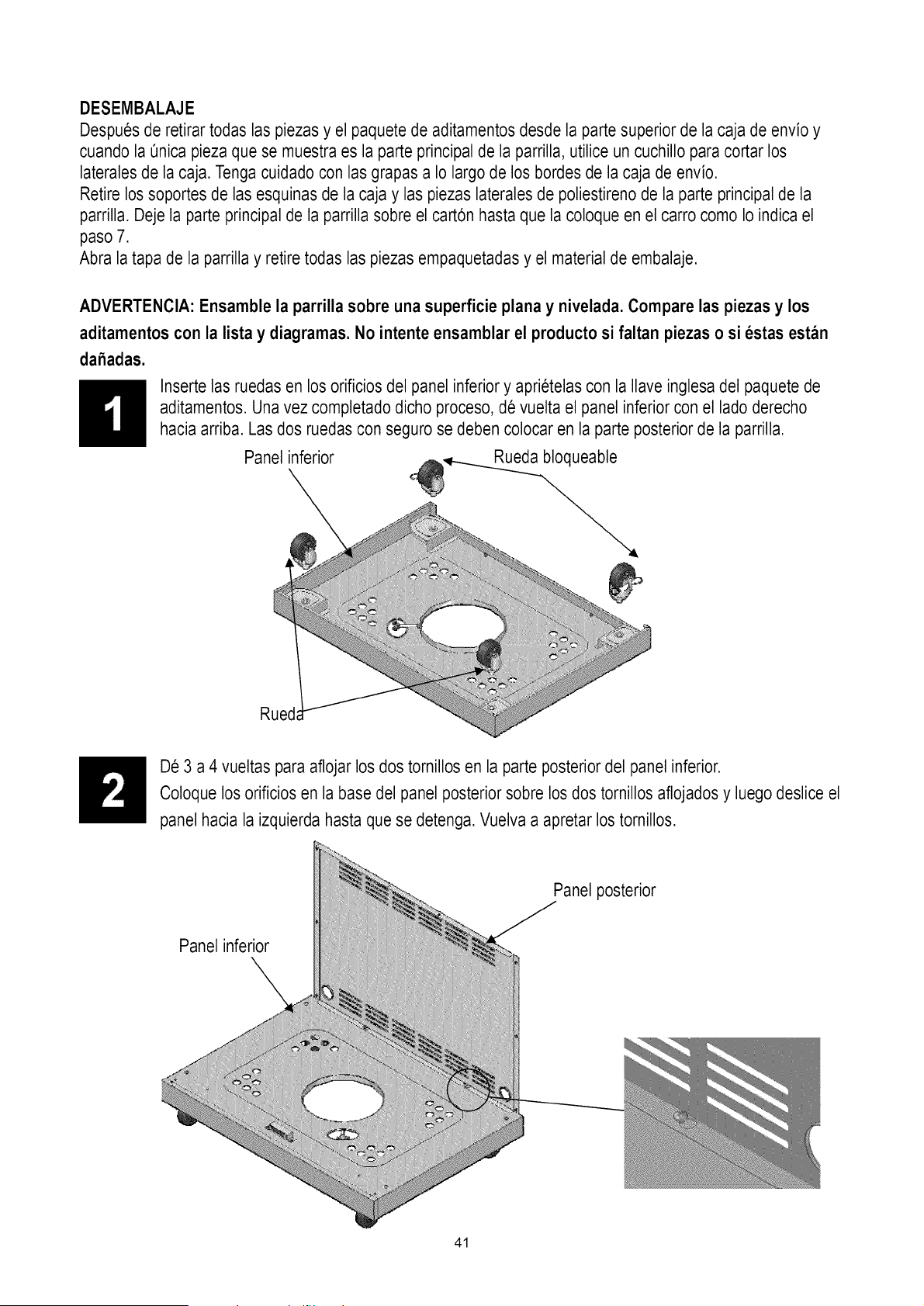
DESEMBALAJE
Despues de retirar todas las piezas y el paquete de aditamentos desde la parte superior de la caja de envio y
cuando la enica pieza que se muestra es la parte principal de la parrilla, utilice un cuchillo para cortar los
laterales de la caja. Tenga cuidado con las grapas a Io largo de los bordes de la caja de envio.
Retire los soportes de las esquinas de la caja y las piezas laterales de poliestireno de la parte principal de la
parrilla. Deje la parte principal de la parrilla sobre el cart6n hasta que la coloque en el carro como Io indica el
paso 7.
Abra la tapa de la parrilla y retire todas las piezas empaquetadas y el material de embalaje.
ADVERTENCIA: Ensamble la parrilla sobre una superficie plana y nivelada.Compare las piezas y los
aditamentos con la lista y diagramas. No intente ensamblar el producto si faltan piezas o si estas estan
dahadas.
Inserte las ruedas en los orificios del panel inferior y aprietelas con la Ilave inglesa del paquetede
aditamentos. Una vez completado dicho proceso, de vuelta el panel inferior con el lado derecho
hacia arriba. Las dos ruedas con seguro se deben colocar en la parte posterior de la parrilla.
Panel inferior _i_,__bloqueable
Rued
De 3 a 4 vueltas para aflojar los dos tornillos en la parte posteriordel panel inferior.
Coloque los orificios en la base del panel posteriorsobre los dos tornillos aflojados y luego deslice el
panel hacia la izquierda hasta que se detenga. Vuelva a apretar los tornillos.
Panel posterior
Panel inferior
41
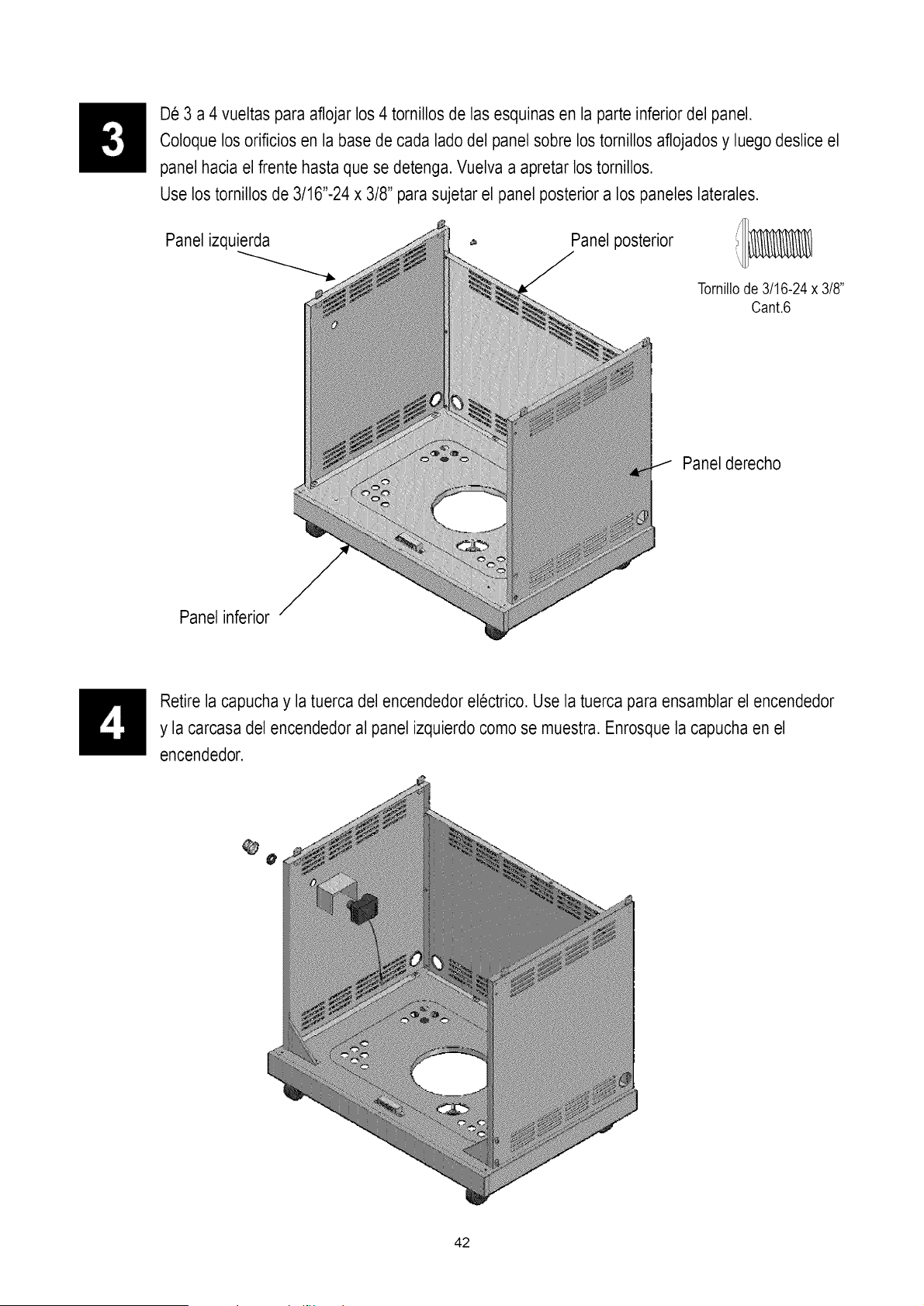
De 3 a 4 vueltas para aflojar los 4 tornillos de las esquinas en la parte inferior del panel.
Coloque los orificios en la base de cada ladodel panel sobre los tornillos aflojados y luego deslice el
panel hacia el frente hasta que se detenga. Vuelva a apretar los tornillos.
Use los tornillos de 3/16"-24 x 3/8" para sujetar el panel posteriora los paneles laterales.
Panel izquierda _, Panel posterior i1_
Tomillode 3/16-24x 3/8"
Cant.6
Panel derecho
Panel inferior
Retire la capucha y la tuerca del encendedor electrico. Use la tuerca para ensamblar el encendedor
y la carcasa del encendedor al panel izquierdo como se muestra. Enrosque la capucha en el
encendedor.
42
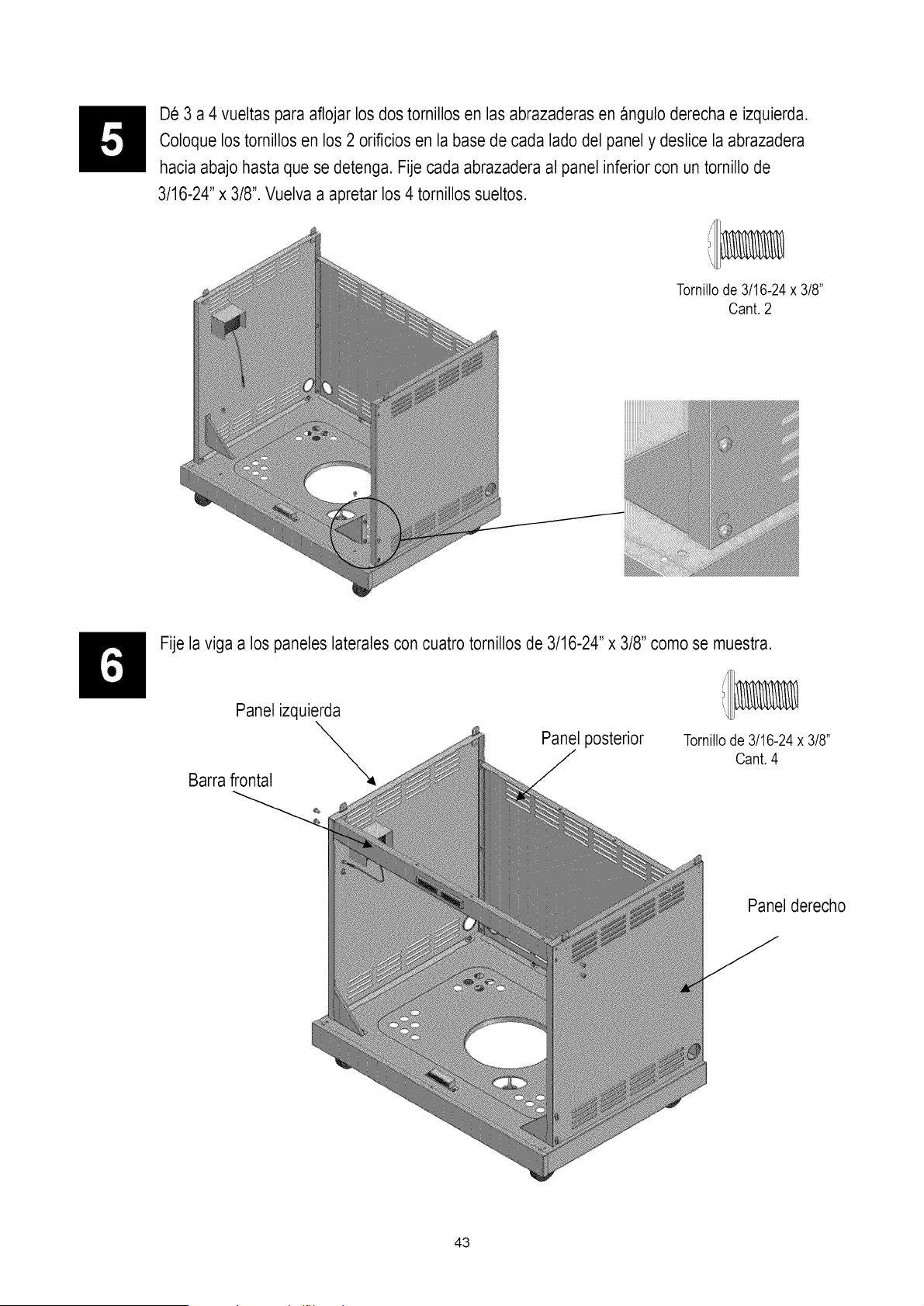
De 3 a 4 vueltas para aflojar los dos tornillos en las abrazaderas en angulo derecha e izquierda.
Coloque los tornillos en los 2 orificios en la base de cada lado del panel y deslice la abrazadera
hacia abajo hasta que se detenga. Fije cada abrazadera al panel inferior con un tornillo de
3/16-24" x 3/8".Vuelva a apretar los 4 tornillos sueltos.
Tornillode 3/16-24 x 3/8"
Cant. 2
Fije la viga a los paneles laterales con cuatro tornillos de 3/16-24" x 3/8" como se muestra.
Panel izquierda i_
"_ Panel posterior Tornillode 3/16-24x 3/8"
Cant.4
Barra frontal
Panel derecho
43
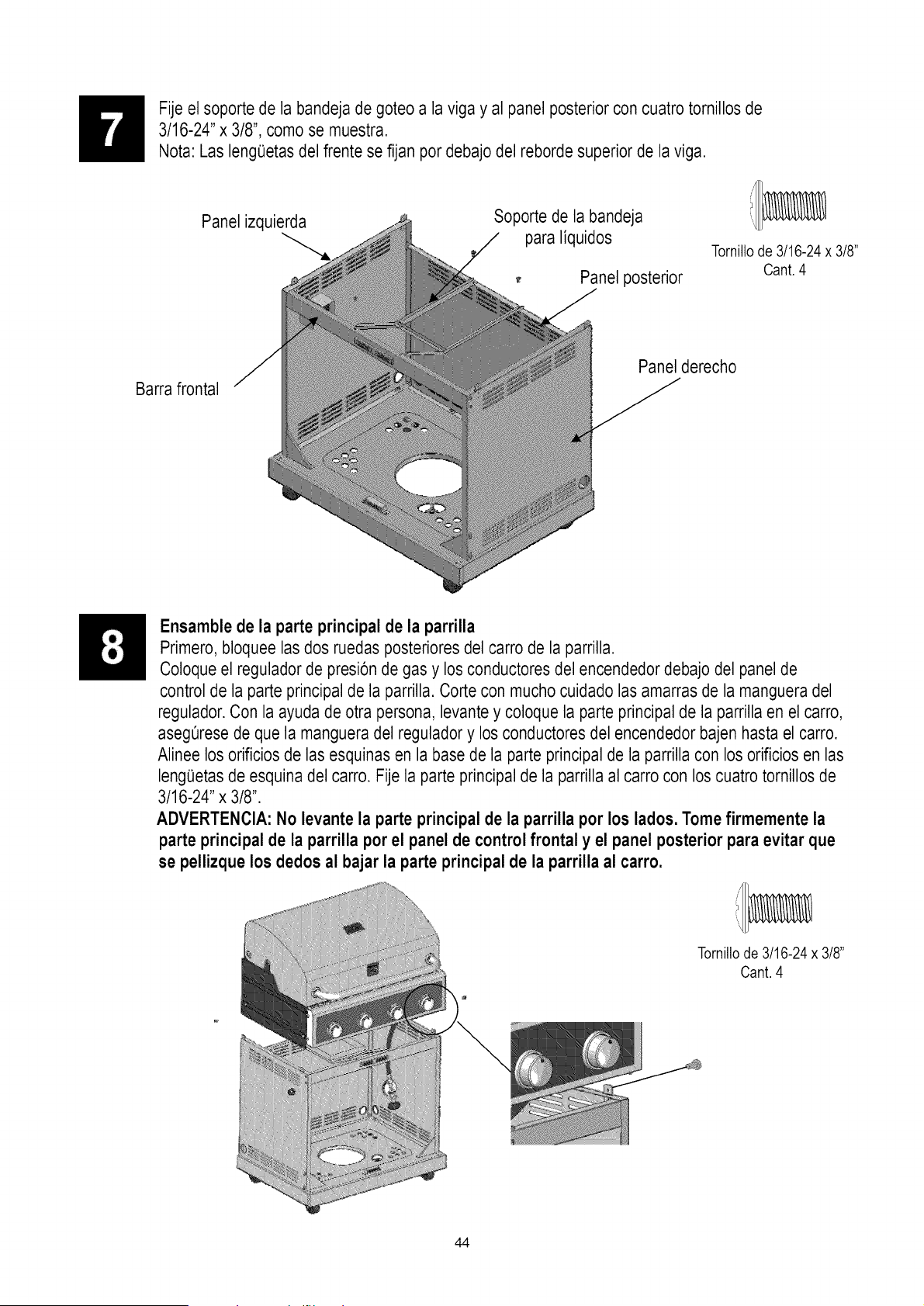
Fije el soporte de la bandeja de goteo a la viga y al panel posterior con cuatro tornillos de
3/16-24" x 3/8", como se muestra.
Nota: Las leng_Jetasdel frente se fijan por debajo del reborde superior de la viga.
Panel izquierda
Soporte de la bandeja
para liquidos
Panel posterior
Tornillode3/16-24x 3/8"
Cant.4
Barra frontal
Panel derecho
Ensamble de la parte principal de la parrilla
Primero, bloquee las dos ruedas posteriores del carro de la parrilla.
Coloque el regulador de presi6n de gas y los conductores del encendedor debajo del panel de
control de la parte principal de la parrilla. Corte con muchocuidado las amarras de la manguera del
regulador.Con la ayuda de otra persona, levante y coloque la parte principal de la parrilla en el carro,
asegOresede que la mangueradel reguladory los conductores del encendedor bajen hasta el carro.
Alinee los orificios de las esquinas en la base de la parte principal de la parrilla con los orificios en las
lengOetasde esquina del carro. Fije la parte principal de la parrillaal carro con los cuatro tornillos de
3/16-24" x 3/8".
ADVERTENOIA: No levante la parte principal de la parrilla pot los lados. Tome firmemente la
parte principal de la parrilla pot el panel de control frontal y el panel posterior para evitar que
se pellizque los dedos al bajar la parte principal de la parrilla al carro.
Tornillode 3/16-24x 3/8"
Cant.4
44
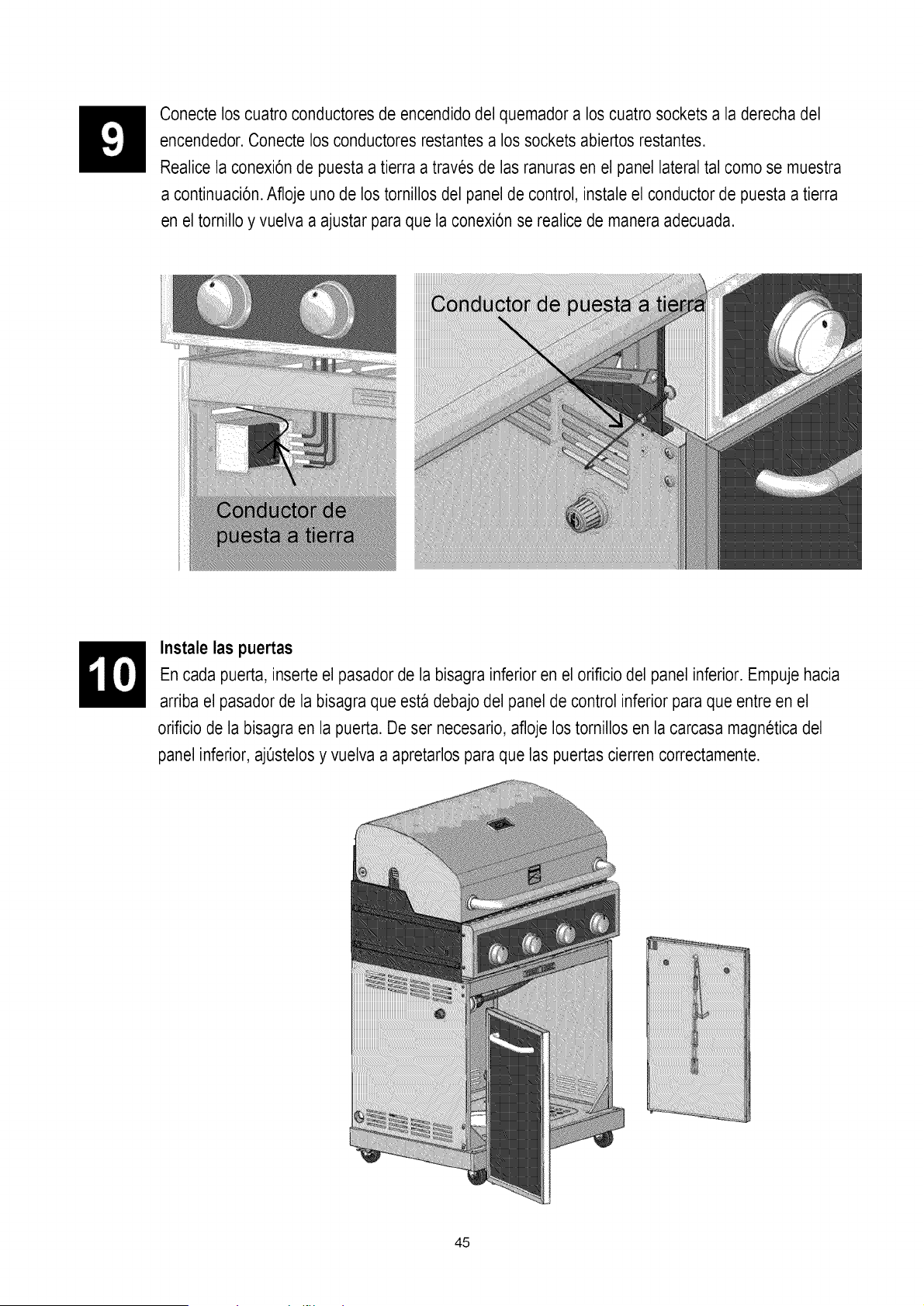
Conecte los cuatro conductores de encendido del quemador a los cuatro sockets a la derecha del
encendedor. Conecte los conductores restantes a los sockets abiertos restantes.
Realice la conexi6n de puesta a tierra a traves de las ranuras en el panel lateral tal como se muestra
a continuaci6n.Afloje uno de los tornillos del panel de control, instale el conductor de puesta a tierra
en el tornillo y vuelva a ajustar para que la conexi6n se realice de manera adecuada.
Instale las puertas
En cada puerta, inserte el pasador de la bisagra inferior en el orificio del panel inferior. Empujehacia
arriba el pasador de la bisagra que esta debajo del panel de control inferior para que entre en el
orificio de la bisagra en la puerta. De ser necesario, afloje los tornillos en la carcasa magneticadel
panel inferior, ajQstelosy vuelva a apretarlos para que las puertas cierren correctamente.
45
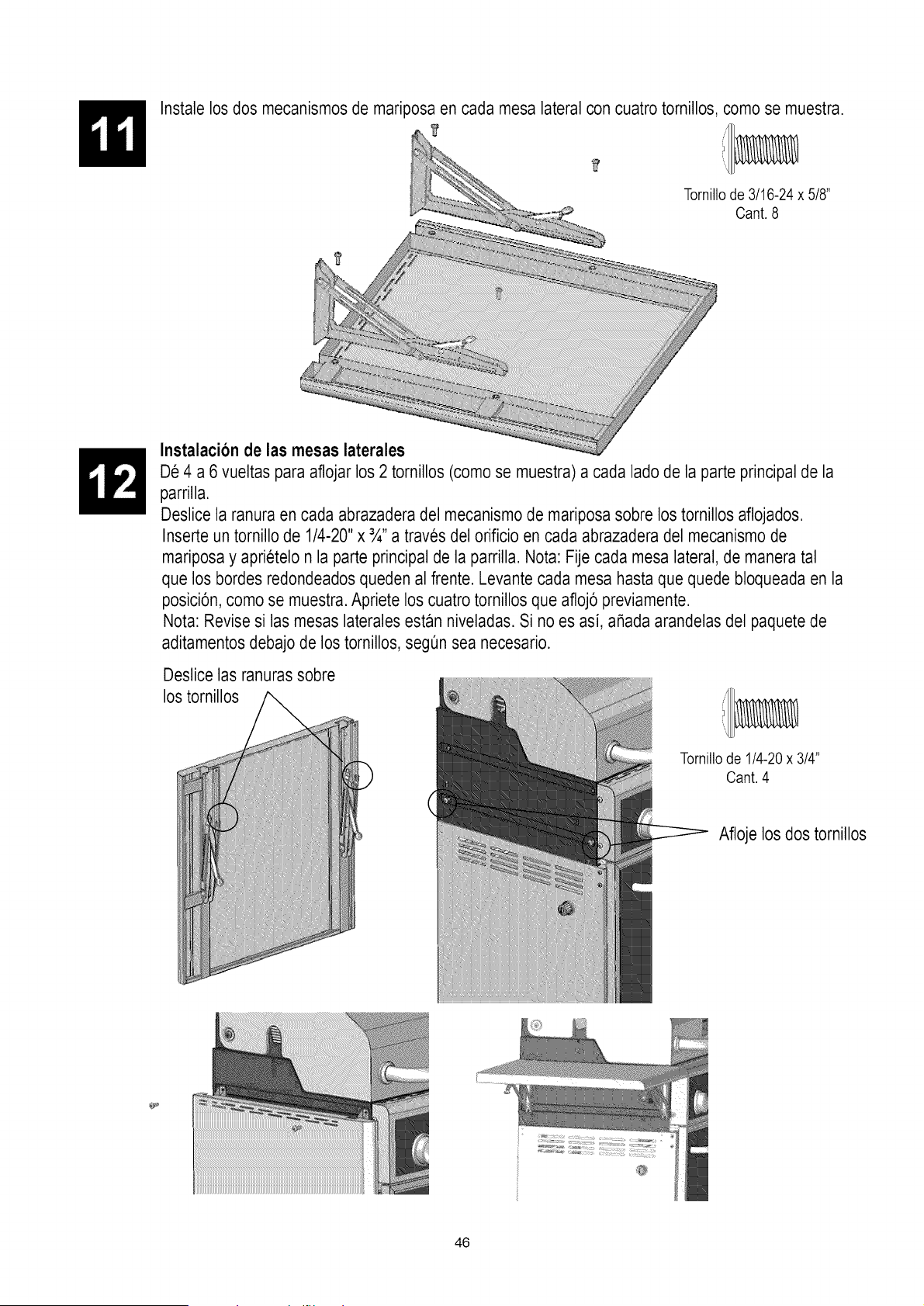
Instale los dos mecanismosde mariposa en cada mesa lateral con cuatro tornillos, como se muestra.
Tomillode 3/16-24x 5/8"
Cant. 8
Instalacion de las mesas laterales
De 4 a 6 vueltas para aflojar los 2 tornillos (como se muestra) a cada lado de la parte principal de la
parrilla.
Deslicela ranura en cada abrazadera del mecanismo de mariposa sobre los tornillos aflojados.
Inserte un tornillo de 1/4-20"x ¾" a traves del orificio en cada abrazadera del mecanismo de
mariposa y aprietelo n la parte principal de la parrilla. Nota: Fije cada mesa lateral, de manera tal
que los hordes redondeadosqueden al frente. Levante cada mesa hasta que quede bloqueada en la
posici6n, como se muestra. Apriete los cuatrotornillos que afloj6 previamente.
Nota: Revise si las mesas laterales estan niveladas. Si no es asi, aSada arandelas del paquetede
aditamentos debajo de los tornillos, segen sea necesario.
Deslice las ranurassobre
los tornillos
Tornillode1/4-20x 3/4"
Cant.4
Afloje los dos tornillos
46
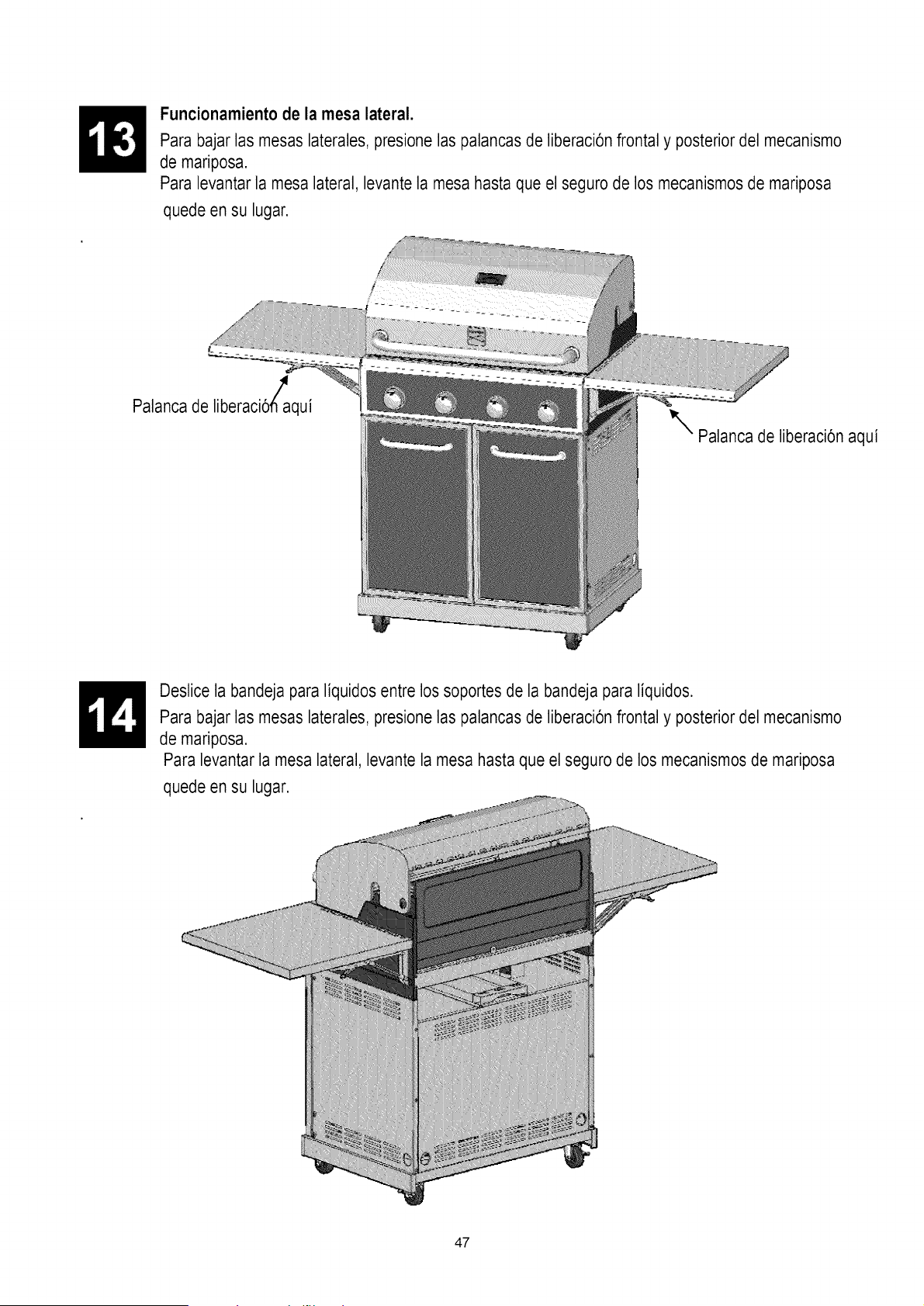
Funcionamiento de la mesa lateral.
Para bajar las mesas laterales, presione las palancasde liberaci6n frontal y posterior del mecanismo
de mariposa.
Para levantar la mesa lateral, levante la mesa hasta que el seguro de los mecanismosde mariposa
quede en su lugar.
Palanca de liberaci'o_aqui
_'_ Palanca de liberaci6n aqui
Deslice la bandeja para liquidos entre los soportes de la bandeja para liquidos.
Para bajar las mesas laterales, presione las palancasde liberaci6n frontal y posterior del mecanismo
de mariposa.
Para levantar la mesa lateral, levante la mesa hasta que el seguro de los mecanismosde mariposa
quede en su lugar.
47
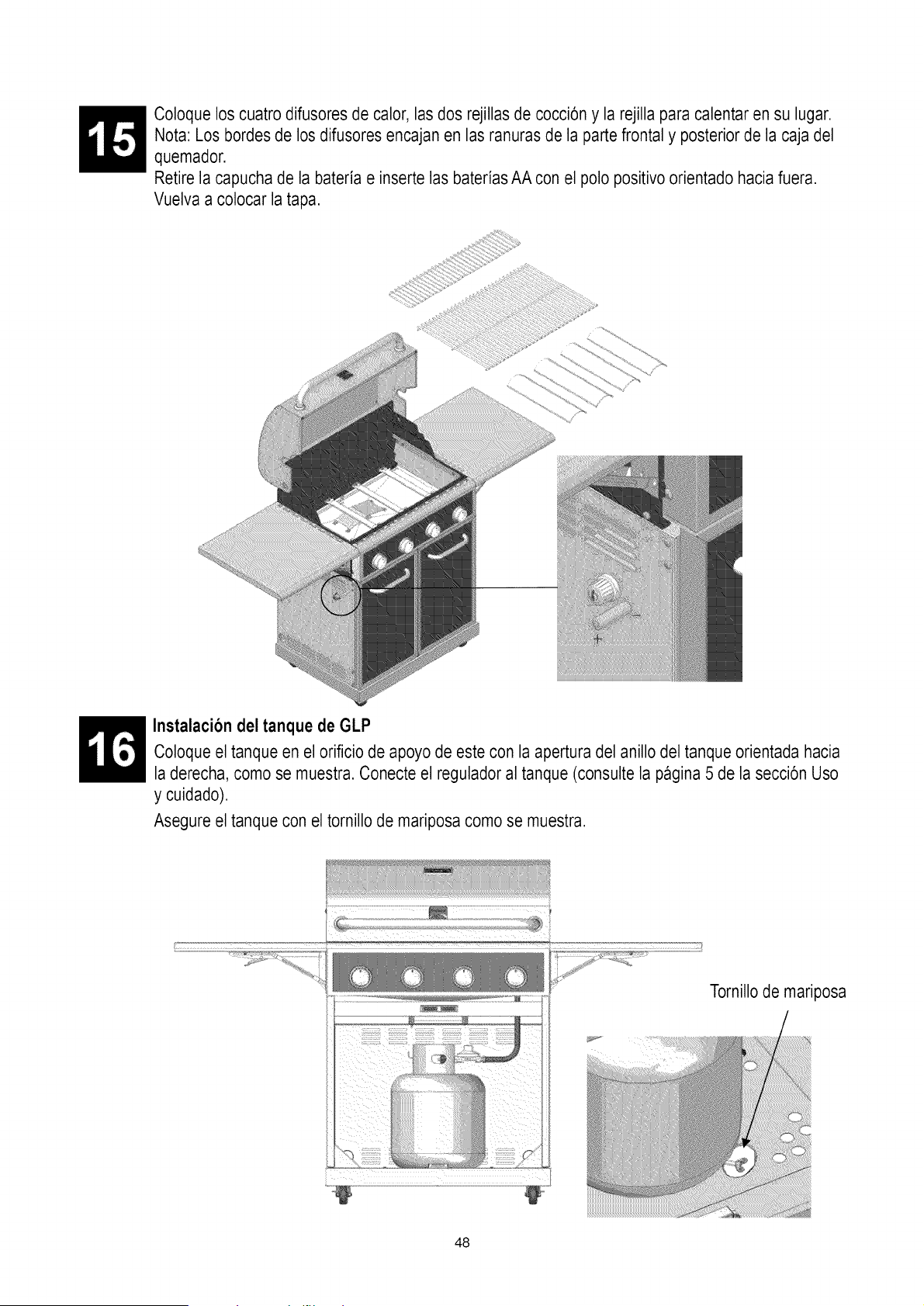
Coloque los cuatro difusores de calor, las dos rejillas de cocci6n y la rejilla para calentar en su lugar.
Nota: Los bordes de los difusores encajan en las ranuras de la parte frontal y posterior de la caja del
quemador.
Retire la capucha de la bateria e inserte las baterias AA con el polo positivo orientado hacia fuera.
Vuelva a colocar la tapa.
Instalaci6n del tanque de GLP
Coloque el tanque en el oriflcio de apoyo de este con la apertura del anillo del tanque orientada hacia
la derecha, como se muestra. Conecte el reguladoral tanque (consulte la pagina 5 de la secci6n Uso
y cuidado).
Asegure el tanque con el tornillo de mariposa como se muestra.
Tornillode mariposa
48
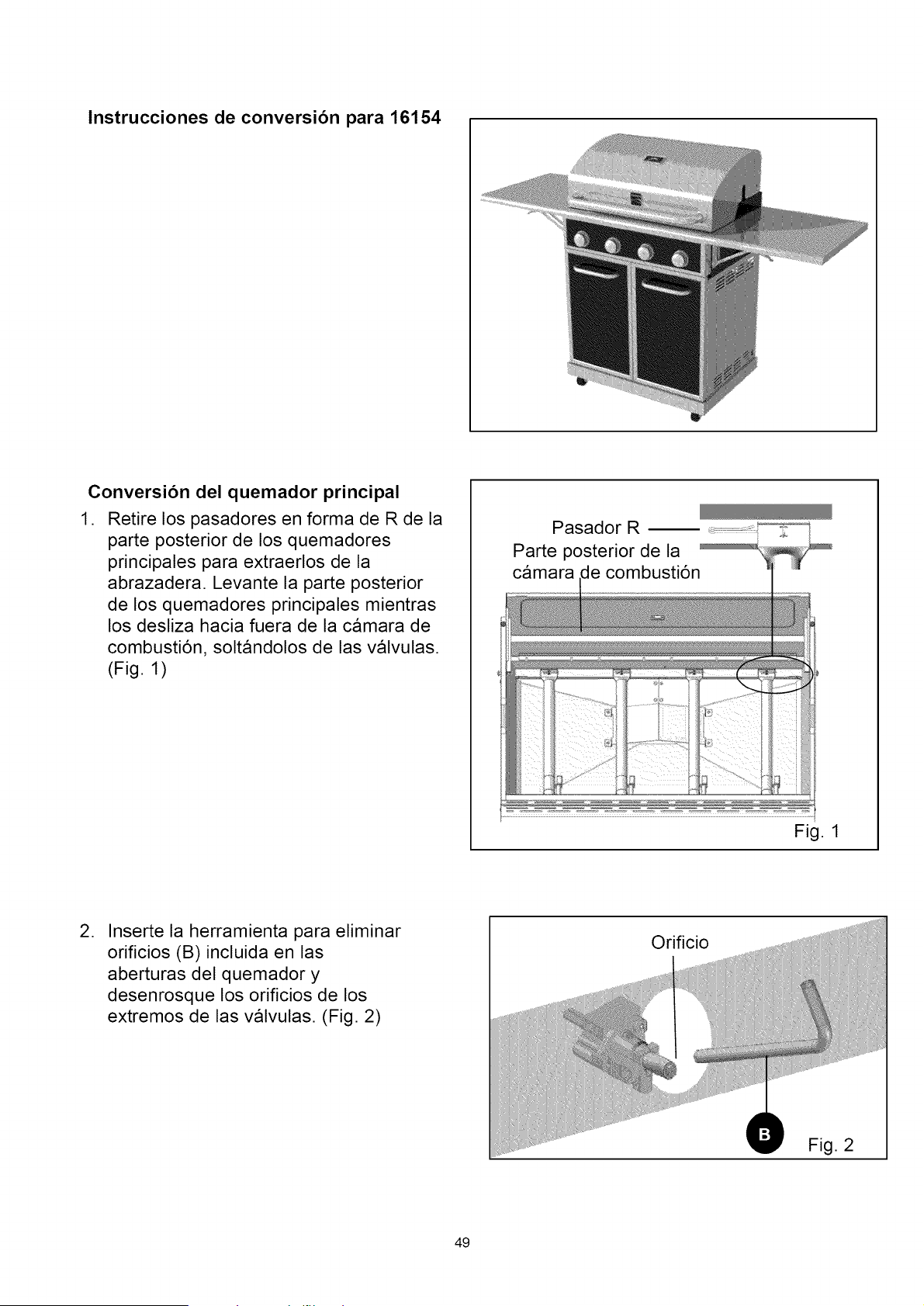
Instrucciones de conversibn para 16154
Conversibn del quemador principal
1. Retire los pasadores en forma de R de la
parte posterior de los quemadores
principales para extraerlos de la
abrazadera. Levante la parte posterior
de los quemadores principales mientras
los desliza hacia fuera de la c&mara de
combusti6n, solt&ndolos de las v&lvulas.
(Fig. 1)
Pasador R
Parte posterior de la
c&mara
Fig. 1
Orificio
.
Inserte la herramienta para eliminar
orificios (B)incluida en las
aberturas del quemador y
desenrosque los orificios de los
extremos de las v&lvulas. (Fig. 2)
Fig. 2
49
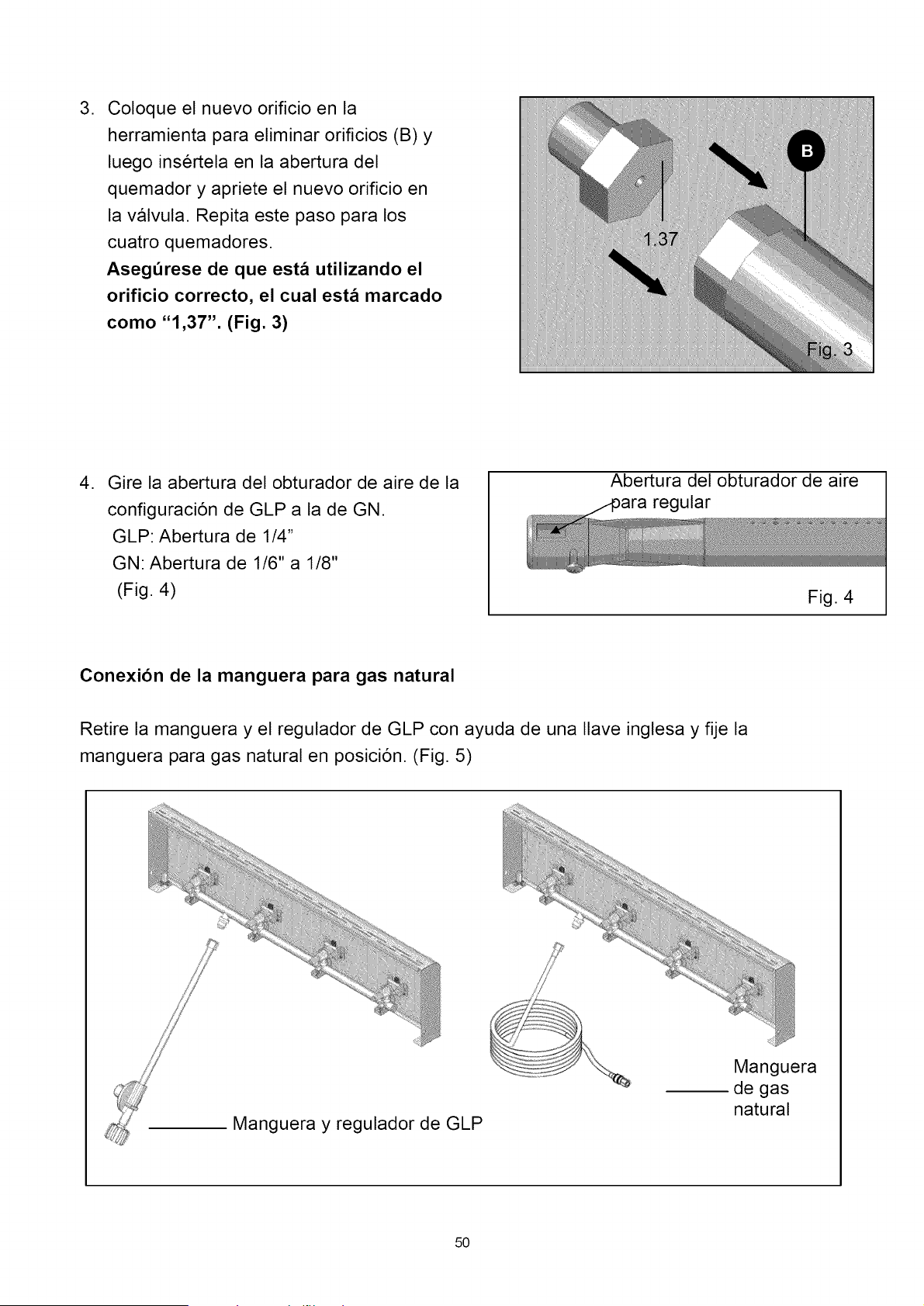
.
Coloque el nuevo orificio en la
herramienta para eliminar orificios (B) y
luego insertela en la abertura del
quemador y apriete el nuevo orificio en
la v&lvula. Repita este paso para los
cuatro quemadores.
Aseg_rese de que est& utilizando el
orificio correcto, el cual est& marcado
como "1,37". (Fig. 3)
. Gire la abertura del obturador de aire de la
configuraci6n de GLP a la de GN.
GLP: Abertura de 1/4"
GN: Abertura de 1/6" a 1/8"
(Fig. 4)
Abertura del obturador de aire
regular
Fig. 4
I
Conexibn de la manguera para gas natural
Retire la manguera y el regulador de GLP con ayuda de una Ilave inglesa y fije la
manguera para gas natural en posici6n. (Fig. 5)
Manguera y regulador de GLP
Manguera
de gas
natural
50
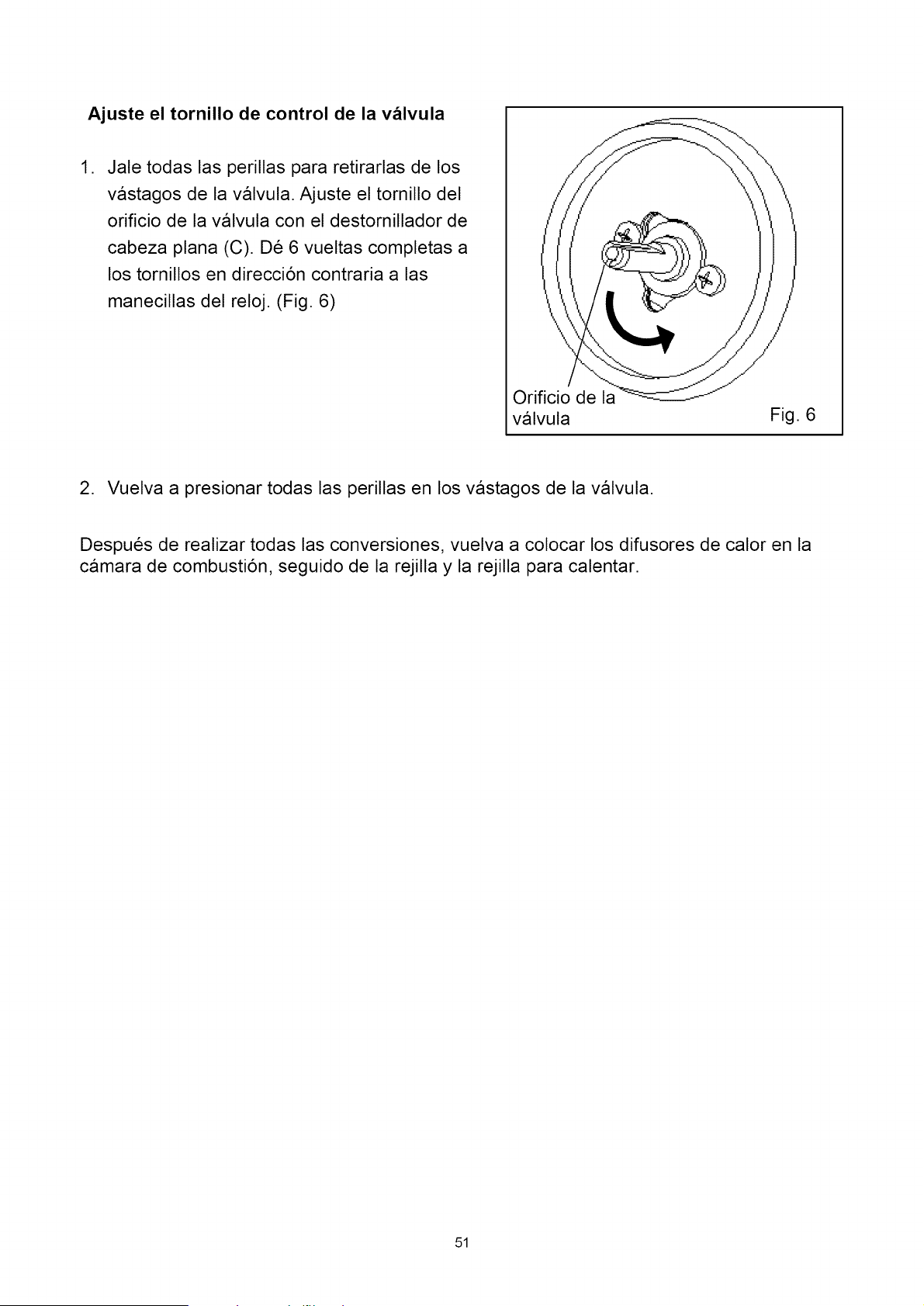
Ajuste el tornillo de control de la v_lvula
,
Jale todas las perillas para retirarlas de los
v&stagos de la v&lvula. Ajuste el tornillo del
orificio de la v&lvula con el destornillador de
cabeza plana (C). De 6 vueltas completas a
los tornillos en direcci6n contraria alas
manecillas del reloj. (Fig. 6)
Orificio de la"_-_ _-
valvula Fig. 6
2. Vuelva a presionar todas las perillas en los v&stagos de la v&lvula.
Despues de realizar todas las conversiones, vuelva a colocar los difusores de calor en la
c&mara de combusti6n, seguido de la rejilla y la rejilla para calentar.
51
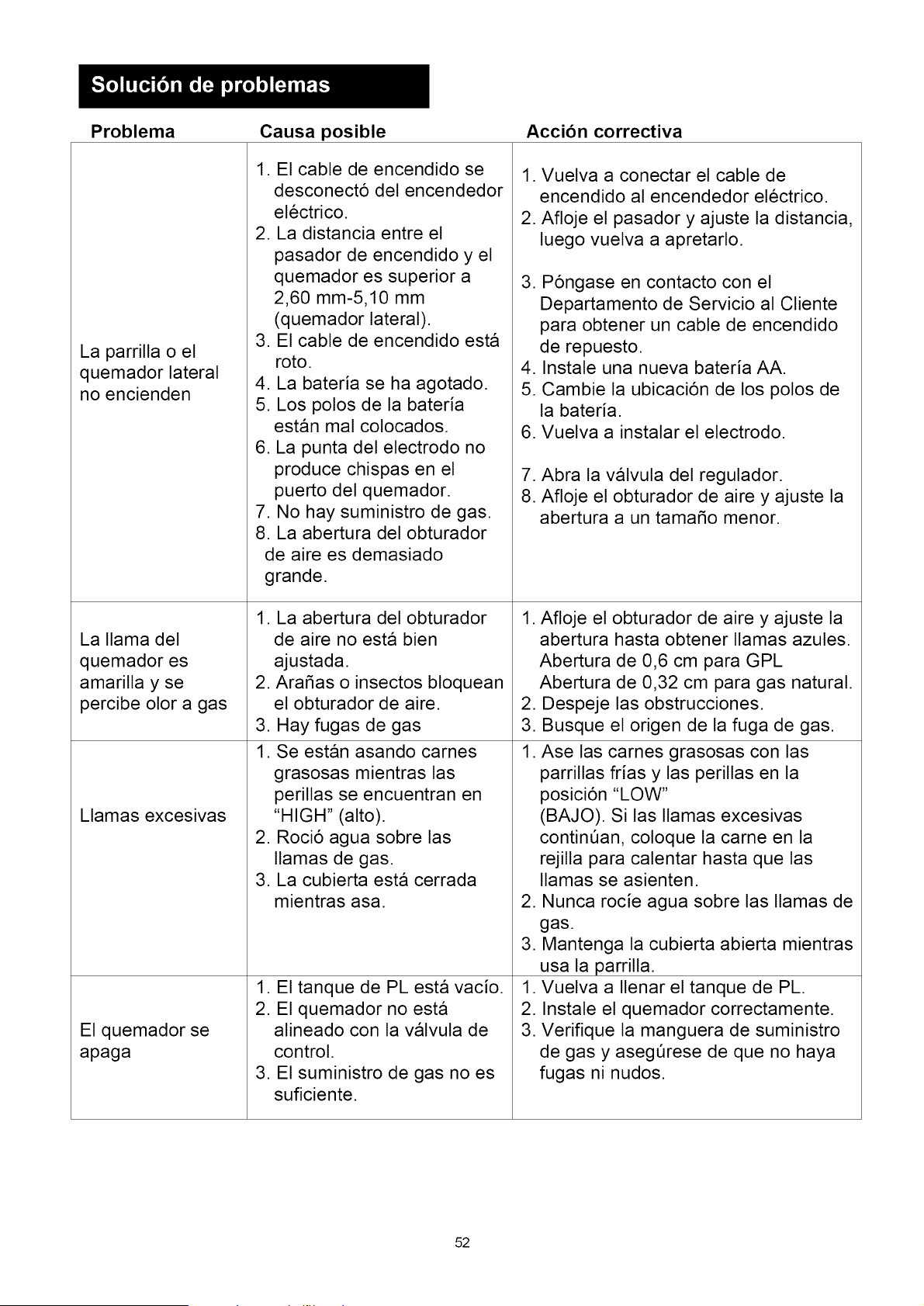
Problema Causa posible Accibn correctiva
La parrilla o el
quemador lateral
no encienden
La llama del
quemador es
amarilla y se
percibe olor a gas
Llamas excesivas
El quemador se
apaga
1. El cable de encendido se
desconect6 del encendedor
electrico.
2. La distancia entre el
pasador de encendido y el
quemador es superior a
2,60 mm-5,10 mm
(quemador lateral).
3. El cable de encendido est&
roto.
4. La bateria se ha agotado.
5. Los polos de la bateria
est&n mal colocados.
6. La punta del electrodo no
produce chispas en el
puerto del quemador.
7. No hay suministro de gas.
8. La abertura del obturador
de aire es demasiado
grande.
1. La abertura del obturador
de aire no est& bien
ajustada.
2. Arafias o insectos bloquean
el obturador de aire.
3. Hay fugas de gas
1. Se est&n asando carnes
grasosas mientras las
perillas se encuentran en
"HIGH" (alto).
2. Roci6 agua sobre las
llamas de gas.
3. La cubierta est& cerrada
mientras asa.
1. El tanque de PL est& vacio.
2. El quemador no est&
alineado con la v&lvula de
control.
3. El suministro de gas no es
suficiente.
1. Vuelva a conectar el cable de
encendido al encendedor electrico.
2. Afloje el pasador y ajuste la distancia,
luego vuelva a apretarlo.
,
,
5.
6.
7.
8.
P6ngase en contacto con el
Departamento de Servicio al Cliente
para obtener un cable de encendido
de repuesto.
Instale una nueva bateria AA.
Cambie la ubicaci6n de los polos de
la bateria.
Vuelva a instalar el electrodo.
Abra la v&lvula del regulador.
Afloje el obturador de aire y ajuste la
abertura a un tamafio menor.
1. Afloje el obturador de aire y ajuste la
abertura hasta obtener llamas azules.
Abertura de 0,6 cm para GPL
Abertura de 0,32 cm para gas natural.
2. Despeje las obstrucciones.
3. Busque el origen de la fuga de gas.
1. Ase las carnes grasosas con las
parrillas frias y las perillas en la
posici6n "LOW"
(BAJO). Si las llamas excesivas
continQan, coloque la carne en la
rejilla para calentar hasta que las
llamas se asienten.
2. Nunca rocie agua sobre las llamas de
gas.
3. Mantenga la cubierta abierta mientras
usa la parrilla.
1. Vuelva a Ilenar el tanque de PL.
2. Instale el quemador correctamente.
3. Verifique la manguera de suministro
de gas y asegQrese de que no haya
fugas ni nudos.
52
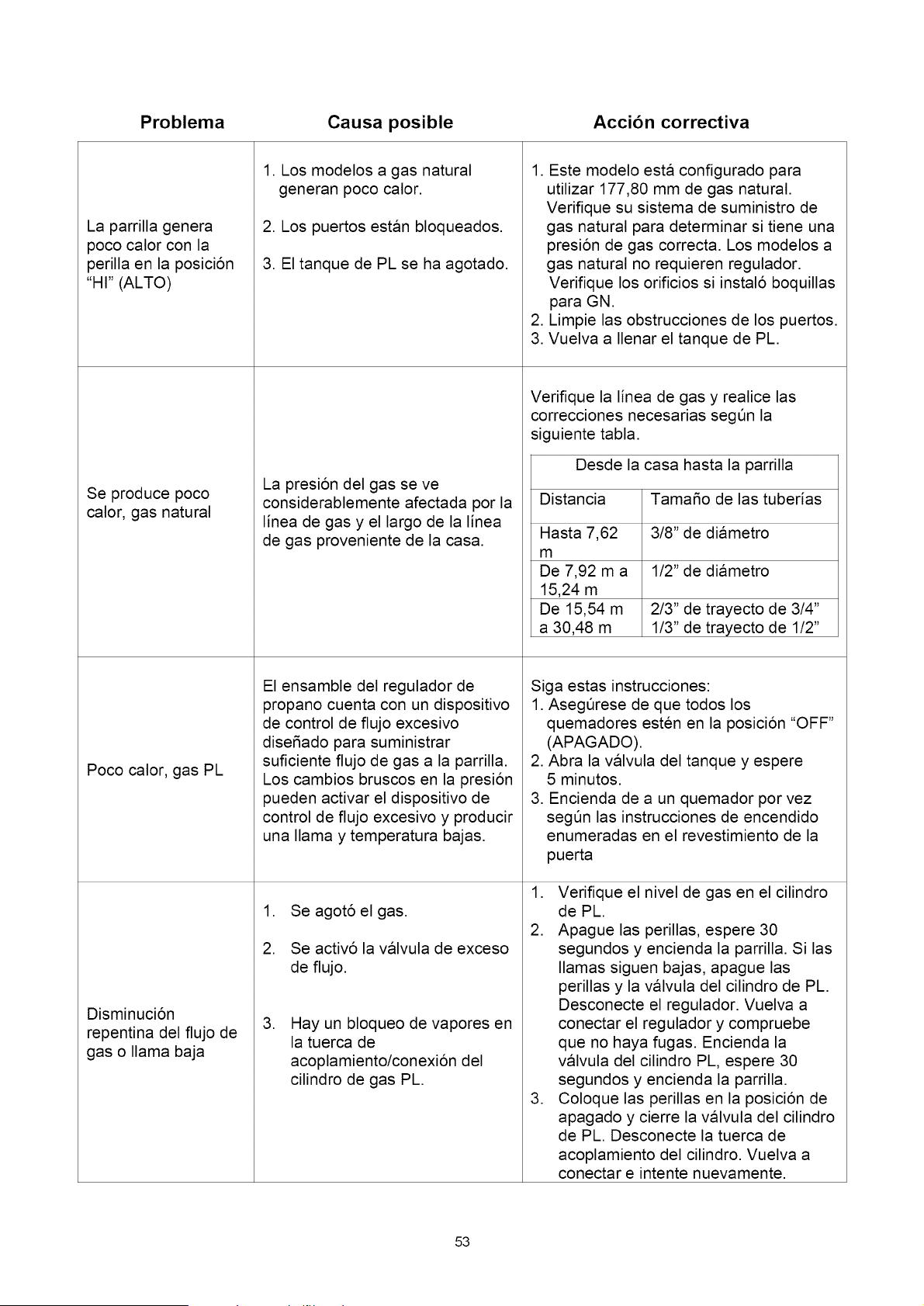
Problema Causa posible Accibn correctiva
La parrilla genera
poco calor con la
perilla en la posici6n
"HI" (ALTO)
Se produce poco
calor, gas natural
Poco calor, gas PL
Disminuci6n
repentina del flujo de
gas o llama baja
1. Los modelos a gas natural
generan poco calor.
2. Los puertos estan bloqueados.
3. El tanque de PL se ha agotado.
La presi6n del gas se ve
considerablemente afectada por la
linea de gas y el largo de la linea
de gas proveniente de la casa.
El ensamble del regulador de
propano cuenta con un dispositivo
de control de flujo excesivo
diseSado para suministrar
suficiente flujo de gas a la parrilla.
Los cambios bruscos en la presi6n
pueden activar el dispositivo de
control de flujo excesivo y producir
una llama y temperatura bajas.
1. Se agot6 el gas.
2. Se activ6 la valvula de exceso
de flujo.
,
Hay un bloqueo de vapores en
la tuerca de
acoplamiento/conexi6n del
cilindro de gas PL.
1. Este modelo esta configurado para
utilizar 177,80 mm de gas natural.
Verifique su sistema de suministro de
gas natural para determinar si tiene una
presi6n de gas correcta. Los modelos a
gas natural no requieren regulador.
Verifique los orificios si instal6 boquillas
para GN.
2. Limpie las obstrucciones de los puertos.
3. Vuelva a Ilenar el tanque de PL.
Verifique la linea de gas y realice las
correcciones necesarias segQn la
siguiente tabla.
Desde la casa hasta la parrilla
Distancia
Hasta 7,62
m
De 7,92 m a
15,24 m
De 15,54 m
a 30,48 m
TamaSo de las tuberias
3/8" de diametro
1/2" de diametro
213" de trayecto de 314"
113" de trayecto de 112"
Siga estas instrucciones:
1. AsegQrese de que todos los
quemadores esten en la posici6n "OFF"
(APAGADO).
2. Abra la valvula del tanque y espere
5 minutos.
3. Encienda de a un quemador por vez
segQn las instrucciones de encendido
enumeradas en el revestimiento de la
puerta
1. Verifique el nivel de gas en el cilindro
de PL.
2. Apague las perillas, espere 30
segundos y encienda la parrilla. Si las
llamas siguen bajas, apague las
perillas y la valvula del cilindro de PL.
Desconecte el regulador. Vuelva a
conectar el regulador y compruebe
que no haya fugas. Encienda la
valvula del cilindro PL, espere 30
segundos y encienda la parrilla.
3. Coloque las perillas en la posici6n de
apagado y cierre la valvula del cilindro
de PL. Desconecte la tuerca de
acoplamiento del cilindro. Vuelva a
conectar e intente nuevamente.
53
Your Home
For troubleshooting, product manuals and expert advice:
managemylife
v_,,.m anag emy life. com
For repair- in your home - of all major brand appliances,
lawn and garden equipment, or heating and cooling systems,
no matter who made it, no matter who sold it!
For the replacement parts, accessories and
owner's manuals that you need to do-it-yourself.
For Sears professional installation of home appliances
and items like garage door openers and water heaters.
1-800-4-MY-HOME ® (1-800-469-4663)
Call anytime, day or night(U.S.A, and Canada)
www.sears.com www.sears.ca
Our Home
For repair of carry-in items like vacuums, lawn equipment,
and electronics, call anytime for the location of your nearest
Sears Parts & Repair Service Center
1-800-488-1222 (USA) 1-800-469-4663 (Canada)
www. sea rs.com www. sears, ca
To purchase a protection agreement on a product serviced by Sears:
1-800-827-6655 (U.S.A.) 1-800-361-6665 (Canada)
Para pedir servicio de reparaci6n Au Canada pour service en frangais:
a domicilio, y para ordenar piezas: 1-800-LE-FOYER Mc
1-888-S U-H O GA R® (1-800-533-6937)
(1-888-784-6427) www.sears.ca
www.sears.com sears
TM
® Registered Trademark / Trademark of KCD IP, LLC in the United States, or Sears Brands, LLC in other countries
® Marca Registrada / TMMarca de Fabrica de KCD IP, LLC en Estados Unidos, o Sears Brands, LLC in otros pa[ses
MD ue
Mc Marque de commerce / Marq depos@e de Sears Brands, LLC
54
®