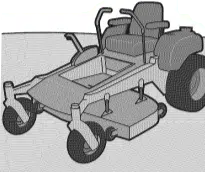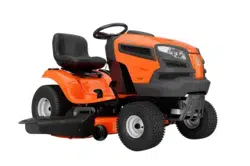
Operat_ Manua|
MZ5425S ! 250212

Toimplementimprovements,specificationsanddesignscanbealteredwithoutprior notification.
Notethatno legaldemandscanbeplacedbasedon theinformationcontainedin theseinstructions.
Useonlyoriginalpartsfor repairs. The use of other parts voids the warranty.
Do not modify or install non-standard equipment to the unit without consent from the manufacturer.
Modifications to the unit may cause unsafe operations or damage the unit.
I hen this product is worn out and no longer used, it shouldbe returned to the reseller or other party for recycling.
@2012 All rights reserved,
Orangeburg,SC, Printed in U,S,A,
CONTENTS
INTRODUCTION ...................................................... 5
Driving and Transport on Public Roads ............. 5
Towing ................................................................ 5
Operating ........................................................... 5
Good Service ..................................................... 6
Manufacturing Number ................................. 6
SYMBOLS AND DECALS ......................................... 7
SAFETY .................................................................... 9
Safety Instructions .............................................. 9
Personal Safety Equipment .............................. 11
Slope Operation ............................................... 11
Safe Handling of Gasoline ............................... 13
General Maintenance ....................................... 14
Transport .......................................................... 16
Towing .............................................................. 16
Spark Arrestor .................................................. 16
CONTROLS ............................................................ 17
Control Locations ............................................. 17
Motion Control Levers ...................................... 18
Parking Brake ................................................... 19
Throttle Control ................................................. 19
Blade Switch .................................................... 19
Ignition Switch .................................................. 20
Choke Control .................................................. 20
Fuses ................................................................ 20
Fuel Tank .......................................................... 21
Fuel Shut Off Valve ........................................... 22
Cutting Height Adjuster .................................... 22
Bypass Linkages .............................................. 22
Seat Adjustment Lever ..................................... 23
Hour Meter ....................................................... 23
Tracking Knob .................................................. 23
OPERATION ........................................................... 24
Training ............................................................. 24
Steering ............................................................ 24
Before Starting ................................................. 25
Starting the Engine ........................................... 26
Jumper Cables Use .................................... 29
Running ............................................................ 30
Operating on Hills ............................................ 31
Stopping the Engine ......................................... 32
Mowing Tips ..................................................... 33
Moving Machine By Hand ................................ 34
MAINTENANCE ...................................................... 35
Maintenance Schedule .................................... 35
Battery .............................................................. 37
Safety System ................................................... 38
Tire Pressures ................................................... 38
Parking Brake ................................................... 38
Deck Belt .......................................................... 39
Pump Belt ......................................................... 40
V-belts .............................................................. 40
Cutting Blades .................................................. 41
Blade replacement ...................................... 41
Adjusting the Mower Deck ............................... 42
Leveling deck .............................................. 42
Anti-scalp rollers ............................................... 43
Caster Wheels .................................................. 44
Hardware .......................................................... 44
Cleaning ........................................................... 44
LUBRICATION ........................................................ 45
Lubrication Schedule ....................................... 45
Wheel and Deck Zerks ..................................... 46
Front Wheel Mount ...................................... 46
Front Wheel Bearings .................................. 46
Deck Spindles ............................................. 46
Transaxle (Transmission) Fluid Change ........... 47
TROUBLESHOOTING GUIDE ................................ 48
STORAGE .............................................................. 50
Winter Storage .................................................. 50
Service ............................................................. 50
WIRING DIAGRAMS .............................................. 51
TECHNICAL DATA ................................................. 52
Torque Specifications ....................................... 54
CONFORMITY CERTIFICATES ............................... 55
SERVICE JOURNAL ............................................... 56
_ WARNINGt
Failure to follow cautious operating practices can result in serious injury to the operator
or other persons. The owner must understand these instructions, and must allow only
trained persons who understand these instructions to operate the mower.
Each person operating the mower must be of sound mind and body and must not be
under the influence of any mind altering substance.
WARNINGt
Engine exhaust, some of its constituents, and certain vehicle components contain or
emit chemicals known to the State of California to cause cancer and birth defects or other
reproductive harm.
_ WARNINGt
Battery posts, terminals and related accessories contain lead and lead compounds,
chemicals known to the State of California to cause cancer and birth defects or other
reproductive harm. Wash hands after handling.
INTRODUCTION
Congratulations
Thank you for purchasing a Husqvarna ride-on mower.
This machine is built for superior efficiency to rapidly
mow primarily large areas. A control panel that is
easily accessible to the operator and a hydrostatic
transmission regulated by steering controls both
contribute to the machine's performance,
This manual is a valuable document, Read the
contents carefully before using or servicing the
machine, The following of instructions (use, service,
maintenance) by all who operate this machine is
important for the safety of the operator and others,
It can also considerably increase the life span of the
machine and increase its resale value,
If you sell your machine, be sure to give the operator's
manual to the new owner,
The final chapter of this operator's manual provides a
Service Journal. Ensure that service and repair work
are documented. A well-kept service journal reduces
service costs for the maintenance and affects the
machine's resale value. Please contact your dealer for
more information. Take the operator's manual along
when the machine is taken to your dealer for service,
General
In this operator's manual, left and right, backward and
forward are used in relation to the machine's normal
driving direction,
Continuous dedication to improve our products
require that specifications and design are subject to
change without notice,
Driving and Transport on Public Roads
Check applicable road traffic regulations before
transporting on public roads, If the machine is
transported, you must always use approved fastening
equipment and ensure that the machine is well
anchored, DO NOT operate this machine on public
roadways,
Towing
If machine is equipped with a tow hitch, use extreme
caution when towing, Never allow children or others in
or on the towed equipment, Make wide turns to avoid
jack-knifing. Travel slowly and allow extra distance to
stop.
Do not tow on sloped ground. The weight of the towed
equipment may cause loss of traction and loss of
control,
Follow the manufacturer's recommendation for weight
limits for towed equipment, Do not tow near ditches,
canals, and other hazards,
Operating
This machine is constructed only for mowing grass
on lawns and even ground without obstacles such
as stones, tree stumps, etc. The machine can also
be used for other tasks when equipped with special
accessories provided by the manufacturer, Operating
instructions for the accessories are provided with
delivery. All other types of uses are incorrect, The
manufacturer's directions concerning operation,
maintenance, and repairs must be carefully followed,
Lawn mowers and all power equipment can be
potentially dangerous if used improperly, Safety
requires good judgment, careful use in accordance
with these instructions and common sense,
The machine must only be operated, maintained,
and repaired by persons familiar with the
machine's special characteristics and who are also
knowledgeable about the safety instructions, Use only
approved repair parts to maintain this machine,
Accident prevention regulations, other general safety
regulations, occupational safety rules, and traffic
regulations must be followed without fail,
Unauthorized modifications to the design of the
machine may absolve the manufacturer from liability
for any resulting personal injury or property damage,
INTRODUCTION
Good Service
Husqvarna's products are sold only in specialized
retail stores with complete service. This ensures that
you as a customer receive only the best support and
service, Before the product is delivered, the machine
has, for example, been inspected and adjusted by
your retailer, See the certificate in the Service Journal
in this operator's manual,
When you need spare parts or support in service
questions, warranty issues, etc., please consult
the following professional:
This Operator Manual belongs to the machine with Engine
the manufacturing number:
Manufacturing Number
The machine's manufacturing number can be
found on the printed plate affixed to the engine
compartment.
Stated on the plate, from the top are:
• The machine's type designation (I.D.).
The manufacturer's type number (Model).
• The machine's serial number (Serial no.)
Please have the type designation and serial number
available when ordering spare parts,
The engine's manufacturing number is stamped on
one of the valve covers,
The plate states:
The engine's model.
The engine's type.
Code
Please have these available when ordering spare
parts,
The wheel motors and hydrostatic pumps have a
barcode decal affixed at the rear,
6
SYMBOLS AND DECALS
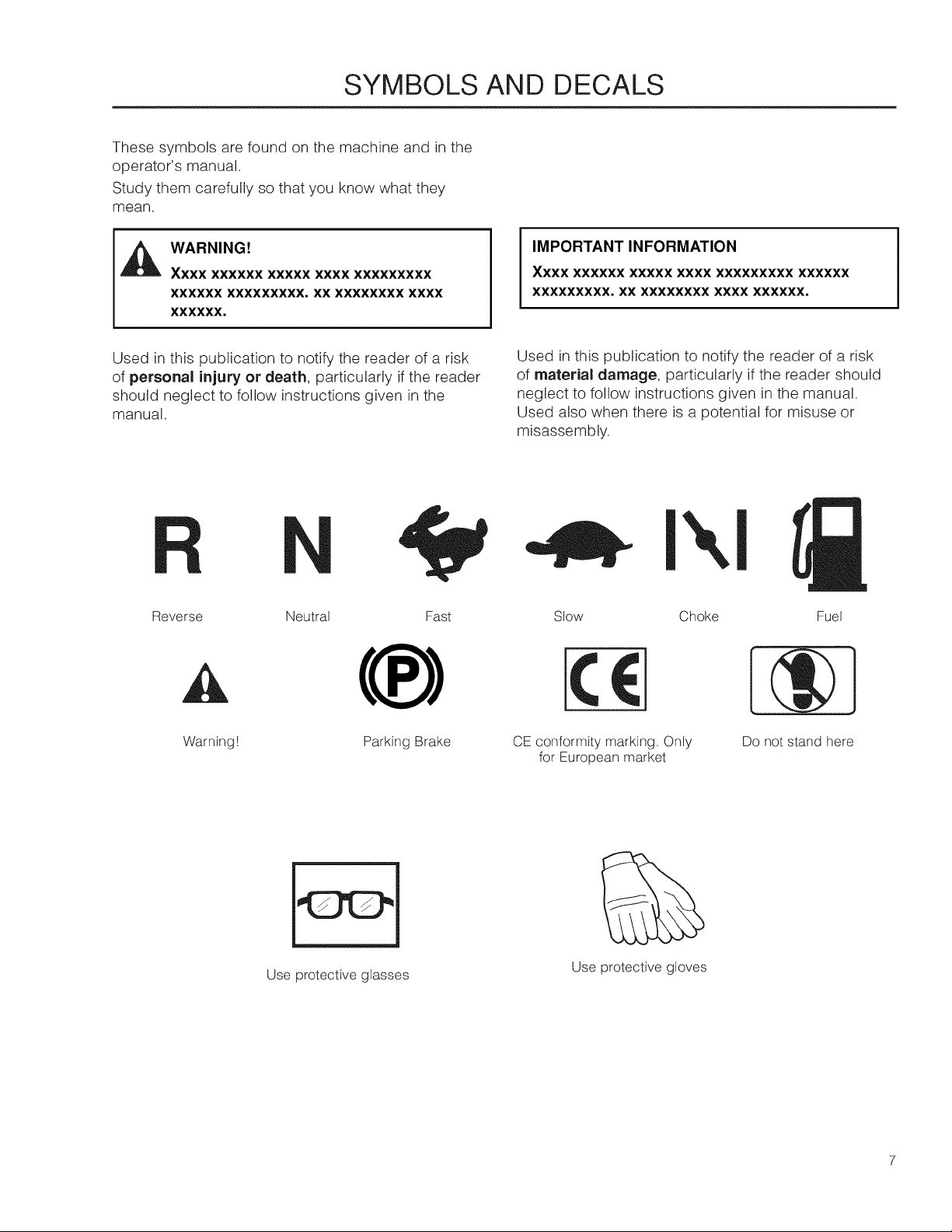
These symbols are found on the machine and in the
operator's manual.
Study them carefully so that you know what they
mean.
WARNINGt
Xxxx xxxxxx xxxxx xxxx xxxxxxxxx
xxxxxx xxxxxxxxx, xx xxxxxxxx xxxx
xxxxxx.
IMPORTANT INFORMATION
Xxxx xxxxxx xxxxx xxxx xxxxxxxxx xxxxxx
xxxxxxxxx, xx xxxxxxxx xxxx xxxxxx.
Used in this publication to notify the reader of a risk
of personal injury or death, particularly if the reader
should neglect to follow instructions given in the
manual.
Used in this publication to notify the reader of a risk
of material damage, particularly if the reader should
neglect to follow instructions given in the manual.
Used also when there is a potential for misuse or
misassembly.
Reverse Neutral
Warning!
Fast
Parking Brake
Slow
CE conformity marking. Only
for European market
Choke Fuel
Do not stand here
Use protective glasses
Use protective gloves
SYMBOLS AND DECALS
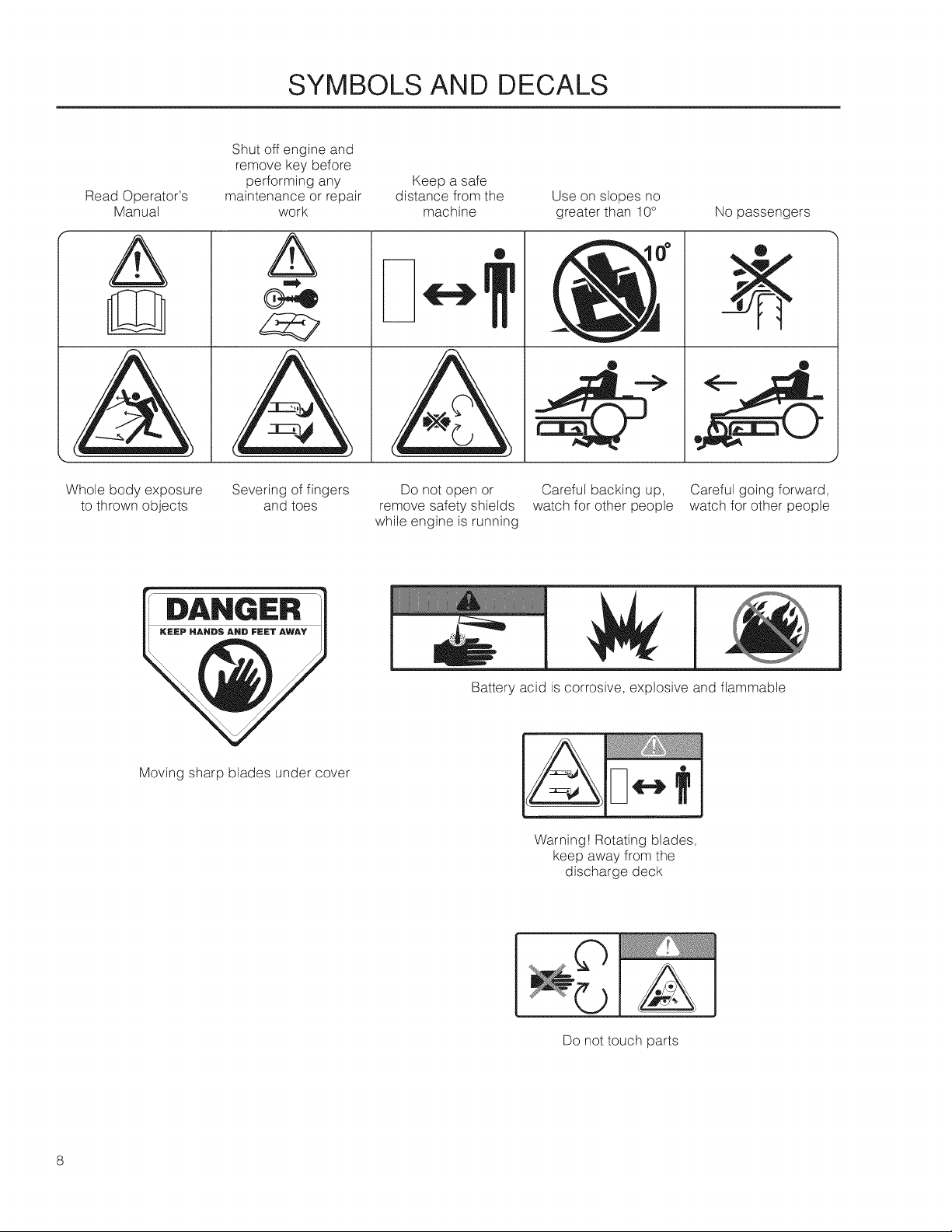
Read Operator's
Manual
Whole body exposure
to thrown objects
Shut off engine and
remove key before
performing any
maintenance or repair
work
Keep a safe
distance from the
machine
Use on slopes no
greater than 10°
A
®
!
Severing of fingers
and toes
Do not open or Careful backing up,
remove safety shields watch for other people
while engine is running
No passengers
Careful going forward,
watch for other people
DANGER i1
: KEEP HANDS AND FEET AWAY
Moving sharp blades under cover
Battery acid is corrosive, explosive and flammable
Warning! Rotating blades,
keep away from the
discharge deck
£
Do not touch parts
8
SAFETY
Safety Instructions
These instructions are for your safety, Read them
carefully,
_ WARNINGt
THIS CUTTING MACHINE IS CAPABLE
OF AMPUTATING HANDS AND FEET
AND THROWING OBJECTS. FAILURE
TO OBSERVE THE FOLLOWING SAFETY
INSTRUCTIONS COULD RESULT IN
SERIOUS INJURY OR DEATH.
,_ WARNINGt
This symbol means that important safety
instructions need to be emphasized. It
concerns your safety.
General Operation
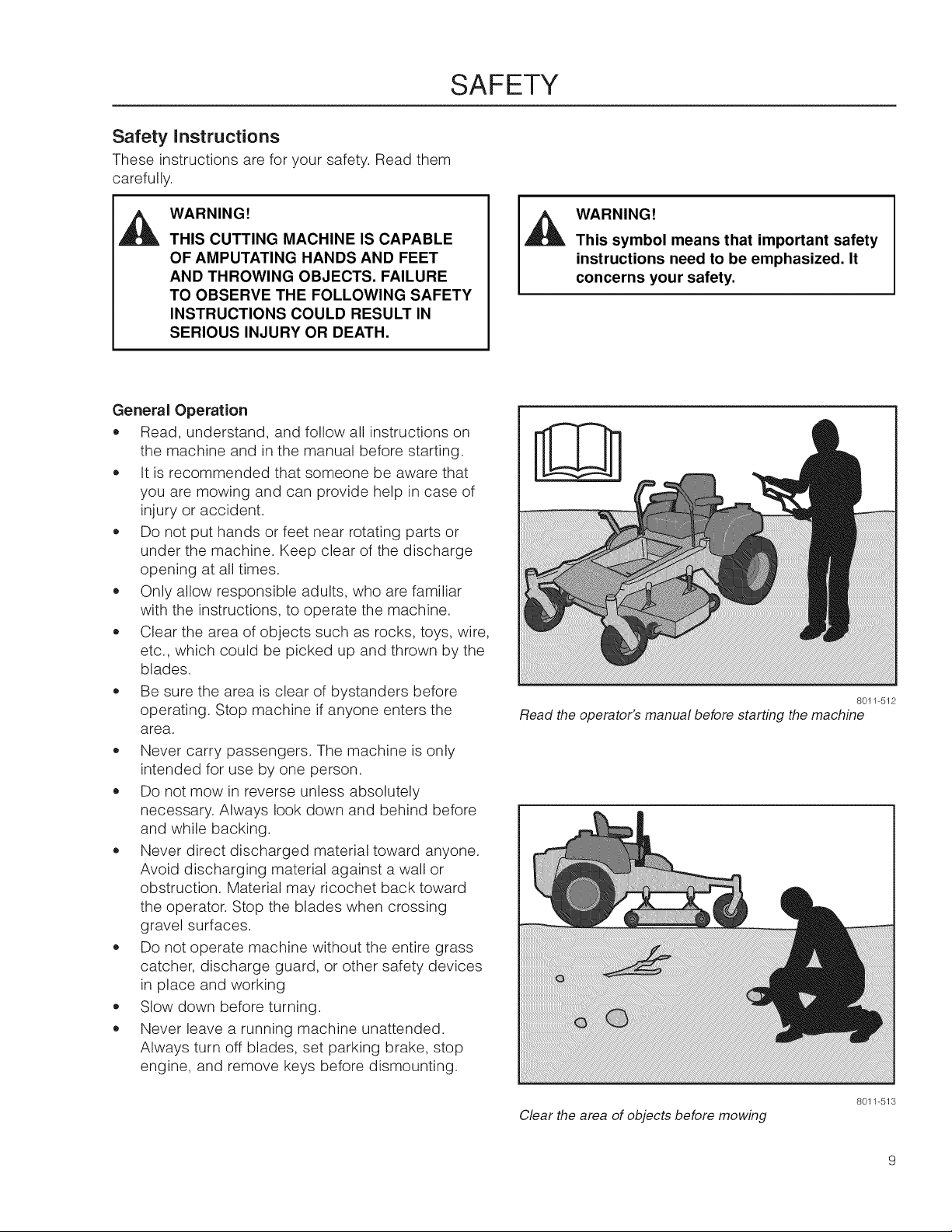
• Read, understand, and follow all instructions on
the machine and in the manual before starting,
• It is recommended that someone be aware that
you are mowing and can provide help in case of
injury or accident,
• Do not put hands or feet near rotating parts or
under the machine, Keep clear of the discharge
opening at all times,
• Only allow responsible adults, who are familiar
with the instructions, to operate the machine,
Clear the area of objects such as rocks, toys, wire,
etc,, which could be picked up and thrown by the
blades,
• Be sure the area is clear of bystanders before
operating, Stop machine if anyone enters the
area,
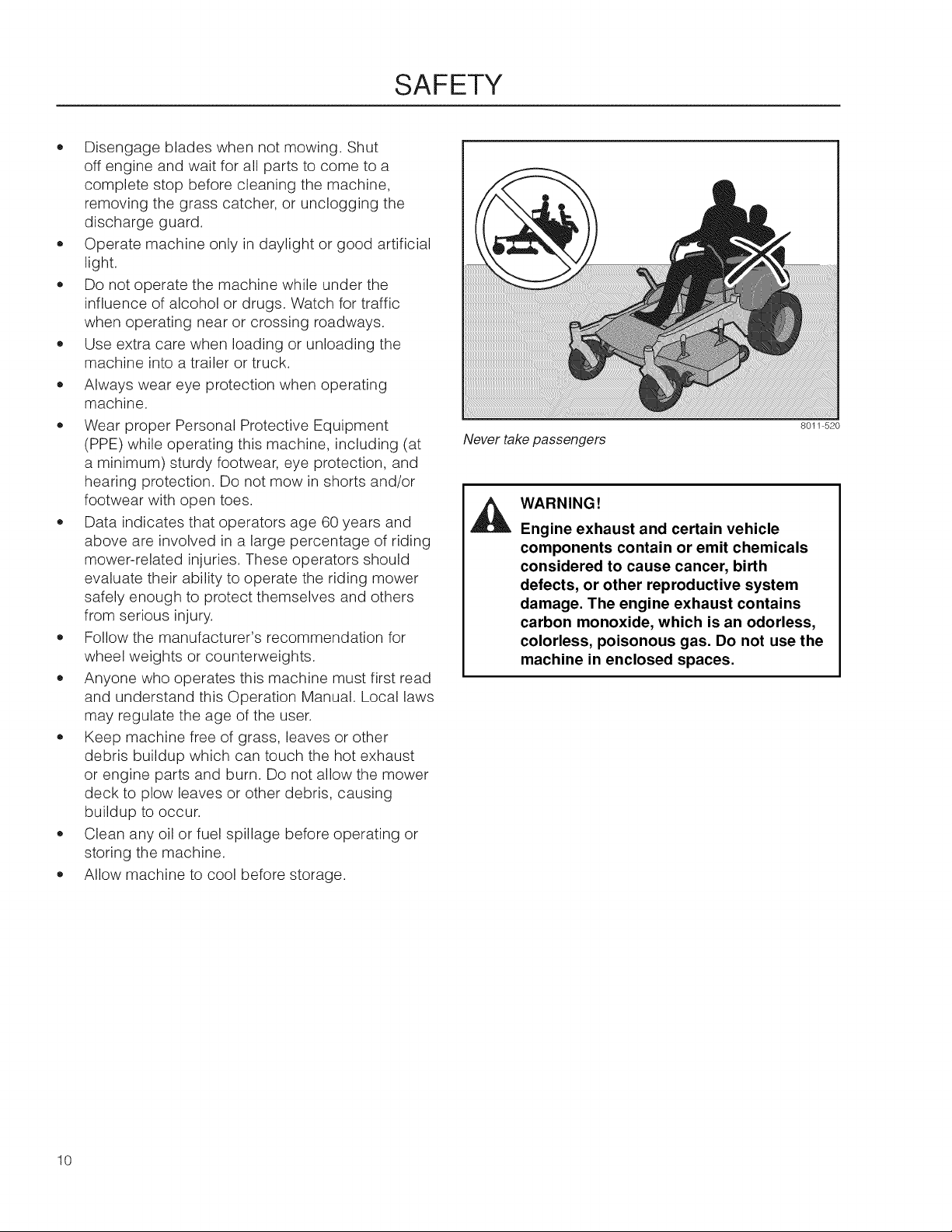
Never carry passengers. The machine is only
intended for use by one person,
• Do not mow in reverse unless absolutely
necessary, Always look down and behind before
and while backing.
• Never direct discharged material toward anyone,
Avoid discharging material against a wall or
obstruction, Material may ricochet back toward
the operator. Stop the blades when crossing
gravel surfaces.
• Do not operate machine without the entire grass
catcher, discharge guard, or other safety devices
in place and working
Slow down before turning,
• Never leave a running machine unattended,
Always turn off blades, set parking brake, stop
engine, and remove keys before dismounting,
8011-512
Read the operator's manual before starting the machine
Clear the area of objects before mowing
8011-513
SAFETY
• Disengage blades when not mowing. Shut
off engine and wait for all parts to come to a
complete stop before cleaning the machine,
removing the grass catcher, or unclogging the
discharge guard.
Operate machine only in daylight or good artificial
light.
• Do not operate the machine while under the
influence of alcohol or drugs. Watch for traffic
when operating near or crossing roadways.
• Use extra care when loading or unloading the
machine into a trailer or truck.
• Always wear eye protection when operating
machine.
Wear proper Personal Protective Equipment
(PPE) while operating this machine, including (at
a minimum) sturdy footwear, eye protection, and
hearing protection. Do not mow in shorts and/or
footwear with open toes.
• Data indicates that operators age 60 years and
above are involved in a large percentage of riding
mower-related injuries. These operators should
evaluate their ability to operate the riding mower
safely enough to protect themselves and others
from serious injury.
• Follow the manufacturer's recommendation for
wheel weights or counterweights.
• Anyone who operates this machine must first read
and understand this Operation Manual. Local laws
may regulate the age of the user.
• Keep machine free of grass, leaves or other
debris buildup which can touch the hot exhaust
or engine parts and burn. Do not allow the mower
deck to plow leaves or other debris, causing
buildup to occur.
Clean any oil or fuel spillage before operating or
storing the machine.
• Allow machine to cool before storage.
Never take passengers
8011-520
_ WARNINGt
Engine exhaust and certain vehicle
components contain or emit chemicals
considered to cause cancer, birth
defects, or other reproductive system
damage. The engine exhaust contains
carbon monoxide, which is an odorless,
colorless, poisonous gas. Do not use the
machine in enclosed spaces.
10
SAFETY
Personal Safety Equipment
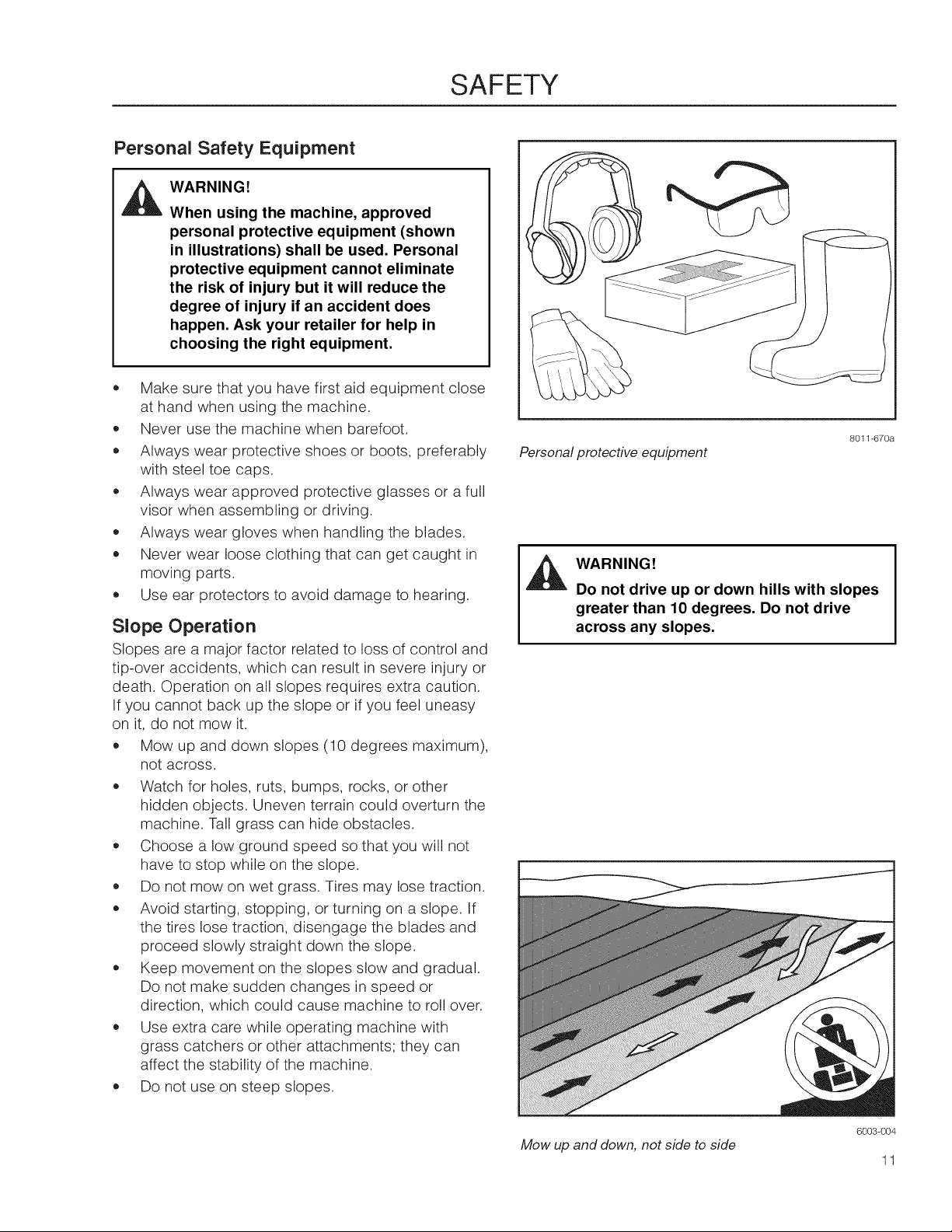
_ WARNINGt
When using the machine, approved
personal protective equipment (shown
in illustrations) shall be used. Personal
protective equipment cannot eliminate
the risk of injury but it will reduce the
degree of injury if an accident does
happen. Ask your retailer for help in
choosing the right equipment.
• Make sure that you have first aid equipment close
at hand when using the machine.
• Never use the machine when barefoot.
• Always wear protective shoes or boots, preferably
with steel toe caps.
• Always wear approved protective glasses or a full
visor when assembling or driving.
Always wear gloves when handling the blades.
• Never wear loose clothing that can get caught in
moving parts.
• Use ear protectors to avoid damage to hearing.
Slope Operation
Slopes are a major factor related to loss of control and
tip-over accidents, which can result in severe injury or
death. Operation on all slopes requires extra caution.
If you cannot back up the slope or if you feel uneasy
on it, do not mow it.
Mow up and down slopes (10 degrees maximum),
not across.
Watch for holes, ruts, bumps, rocks, or other
hidden objects. Uneven terrain could overturn the
machine. Tall grass can hide obstacles.
Choose a low ground speed so that you will not
have to stop while on the slope.
• Do not mow on wet grass. Tires may lose traction.
Avoid starting, stopping, or turning on a slope. If
the tires lose traction, disengage the blades and
proceed slowly straight down the slope.
Keep movement on the slopes slow and gradual.
Do not make sudden changes in speed or
direction, which could cause machine to roll over.
• Use extra care while operating machine with
grass catchers or other attachments; they can
affect the stability of the machine.
Do not use on steep slopes.
Personal protective equipment
8011-670a
_IL ARNINGt
Do not drive up or down hills with slopes
greater than 10 degrees. Do not drive
across any slopes.
Mow up and down, not side to side
6003-004
11
SAFETY
Do not try to stabilize the machine by putting a
foot on the ground.
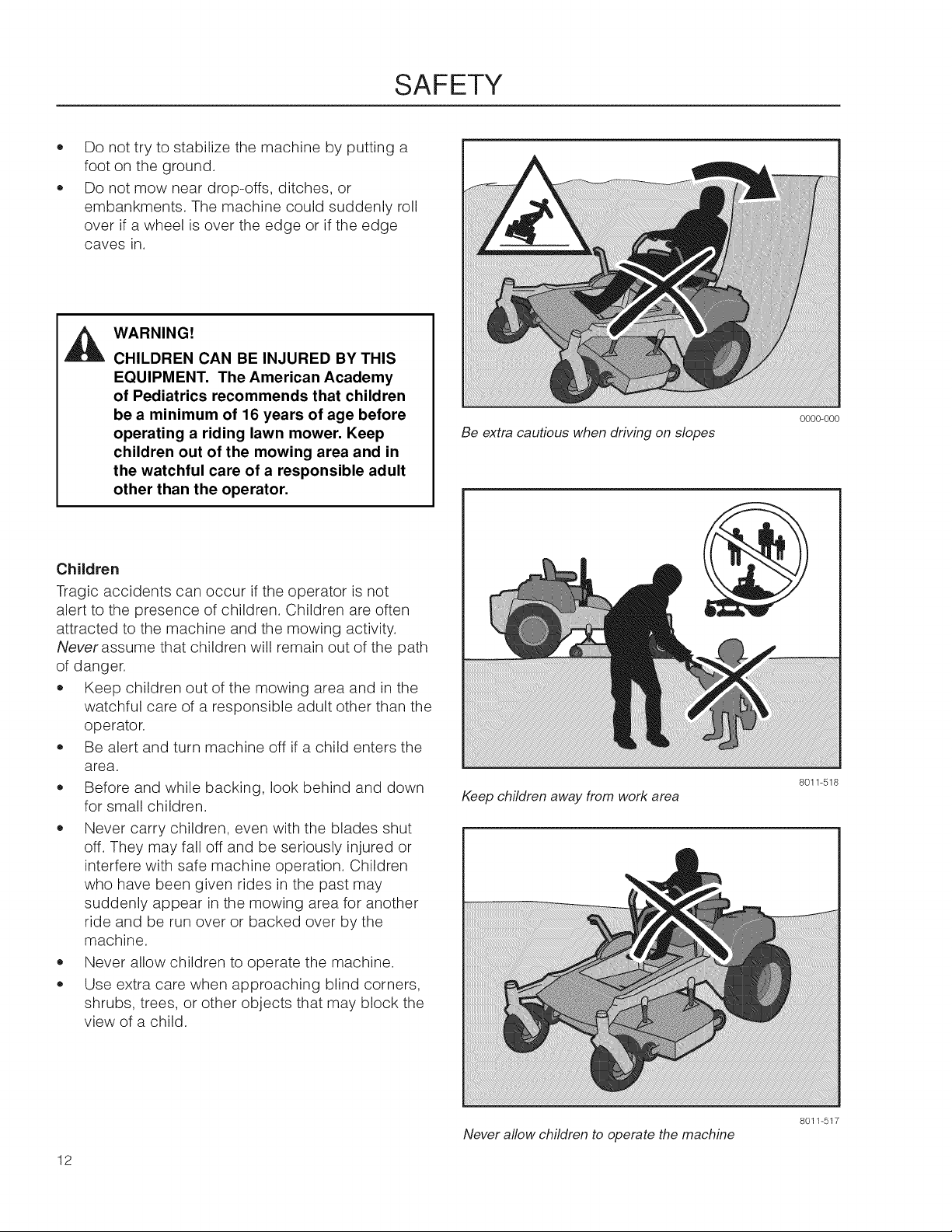
Do not mow near drop-offs, ditches, or
embankments. The machine could suddenly roll
over if a wheel is over the edge or if the edge
caves in.
WARNING!
CHILDREN CAN BE INJURED BY THIS
EQUIPMENT. The American Academy
of Pediatrics recommends that children
be a minimum of 16 years of age before
operating a riding lawn mower. Keep
children out of the mowing area and in
the watchful care of a responsible adult
other than the operator.
Be extra cautious when driving on slopes
0000-000
Children
Tragic accidents can occur if the operator is not
alert to the presence of children. Children are often
attracted to the machine and the mowing activity.
Never assume that children will remain out of the path
of danger.
• Keep children out of the mowing area and in the
watchful care of a responsible adult other than the
operator.
• Be alert and turn machine off if a child enters the
area.
• Before and while backing, look behind and down
for small children.
• Never carry children, even with the blades shut
off. They may fall off and be seriously injured or
interfere with safe machine operation. Children
who have been given rides in the past may
suddenly appear in the mowing area for another
ride and be run over or backed over by the
machine.
• Never allow children to operate the machine.
Use extra care when approaching blind corners,
shrubs, trees, or other objects that may block the
view of a child.
Keep children away from work area
8011-518
12
Never allow children to operate the machine
8011-517
SAFETY
Safe Handling of Gasoline
_h_ ARNINGt
The engine and the exhaust system
become very hot during operation.
There is risk for burns if touched.
Allow engine and exhaust system to cool
before refueling.
To avoid personal injury or property damage, use
extreme care in handling gasoline. Gasoline is
extremely flammable and the vapors are explosive.
• Extinguish all cigarettes, cigars, pipes, and other
sources of ignition.
• Use only approved gasoline container.
• Never remove gas cap or add fuel with the engine
running. Allow engine to cool before refueling.
• Never fuel the machine indoors.
• Never store the machine or fuel container where
there is an open flame, spark, or pilot light such
as on a water heater or other appliance.
• Before beginning to refuel, minimize the risk of
static electricity by touching a metal surface.
• Never fill containers inside a vehicle or on a truck
or trailer bed with plastic liner. Always place
containers on the ground away from the vehicle
when filling.
• Remove gas-powered equipment from the truck
or trailer and refuel it on the ground. If this is not
possible, refuel such equipment with a portable
container, rather than from a gasoline dispenser
nozzle.
• Keep the nozzle in contact with the rim of the fuel
tank or container opening at all times until fueling
is complete. Do not use a nozzle lock-open
device.
• If fuel is spilled on clothing, change clothing
immediately.
• Never overfill fuel tank. Replace gas cap and
tighten securely.
• Do not start the engine near spilled fuel.
Never use gasoline as a cleaning agent.
• If leaks arise in fuel system, engine must not be
started until problem has been resolved.
Check the fuel level before each use and leave
space for the fuel to expand, as the heat from the
engine and the sun may otherwise cause the fuel
to expand and overflow.
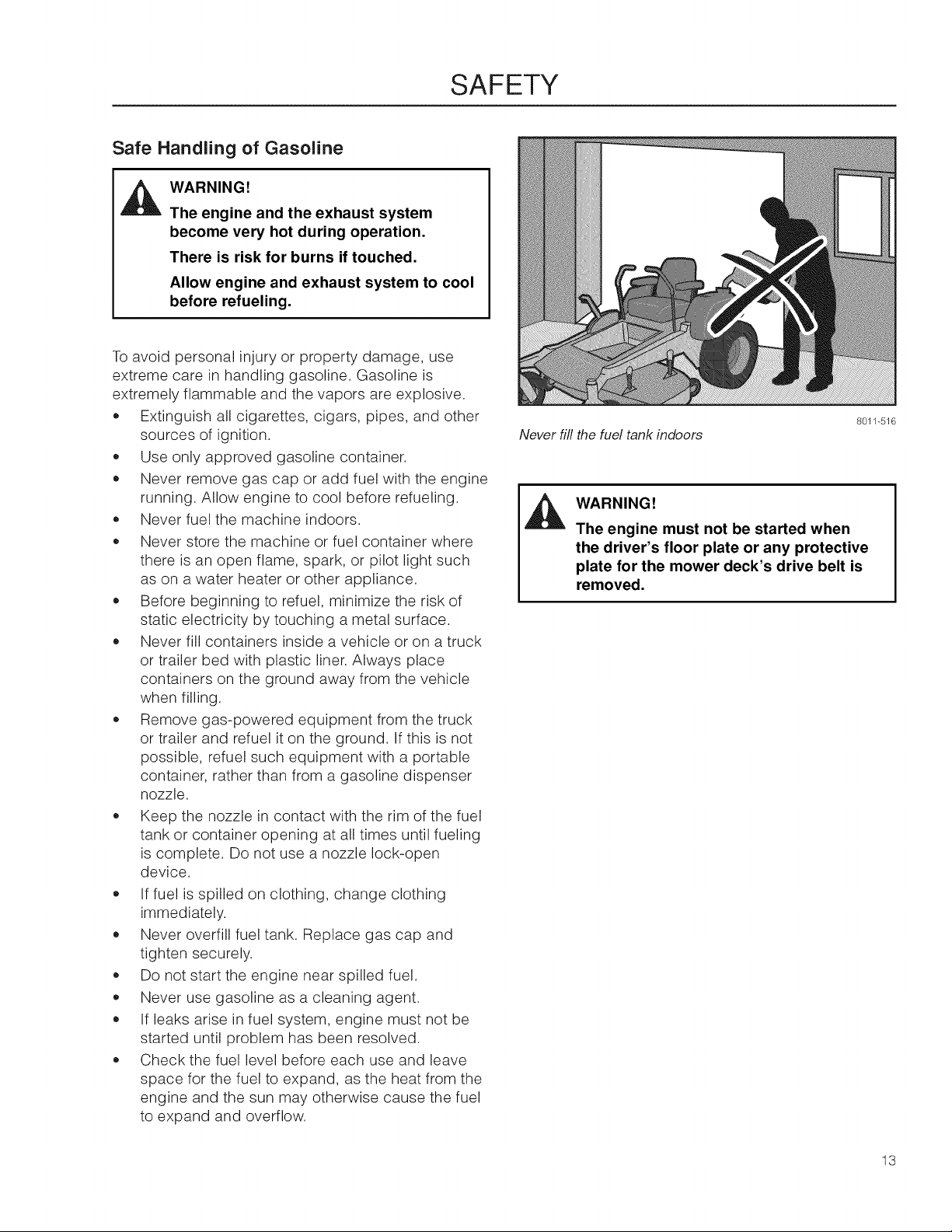
Never fill the fuel tank indoors
WARNINGt
The engine must not be started when
the driver's floor plate or any protective
plate for the mower deck's drive belt is
removed.
8011-516
13
SAFETY
General Maintenance
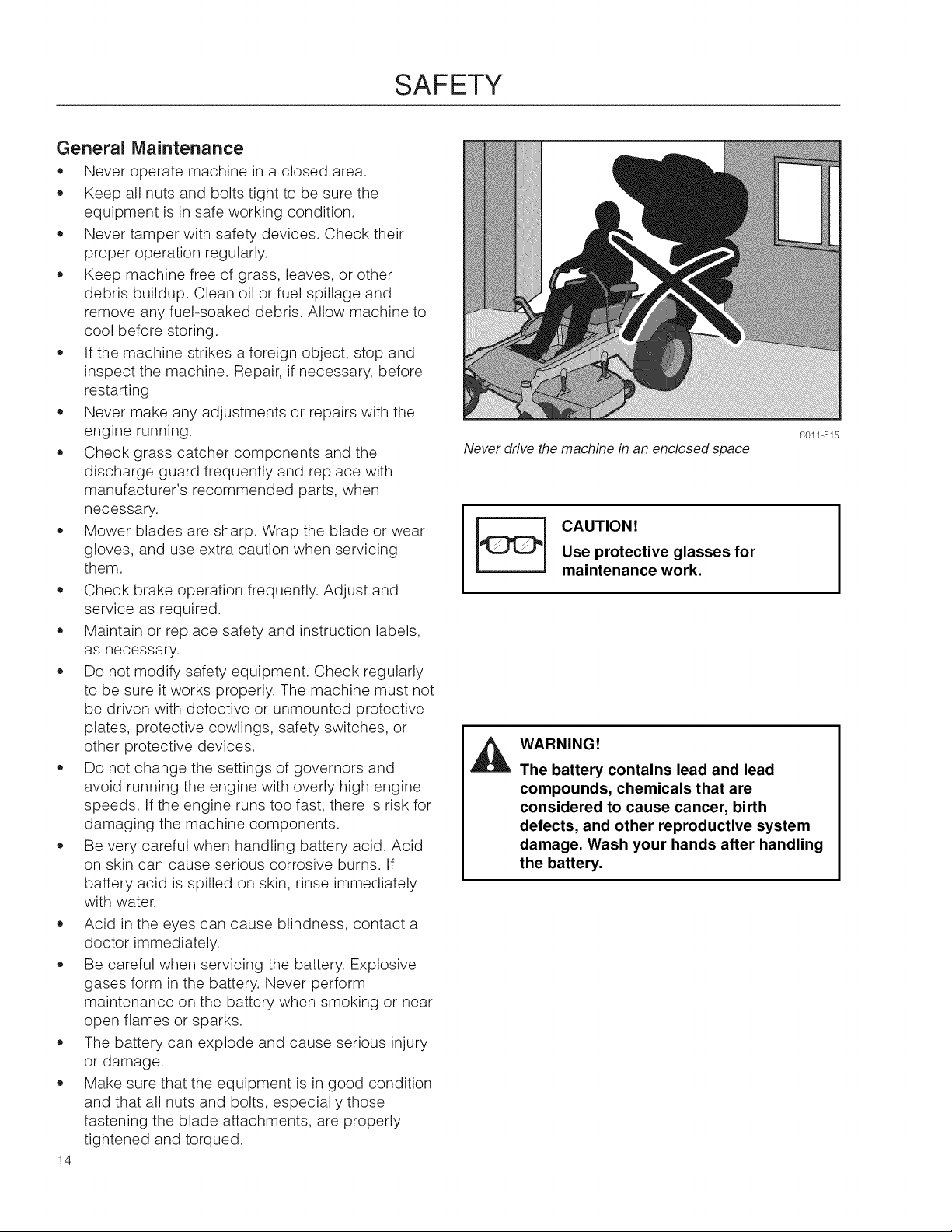
= Never operate machine in a closed area,
• Keep all nuts and bolts tight to be sure the
equipment is in safe working condition.
• Never tamper with safety devices, Check their
proper operation regularly,
• Keep machine free of grass, leaves, or other
debris buildup, Clean oil or fuel spillage and
remove any fuel-soaked debris, Allow machine to
cool before storing,
• If the machine strikes a foreign object, stop and
inspect the machine, Repair, if necessary, before
restarting,
Never make any adjustments or repairs with the
engine running,
• Check grass catcher components and the
discharge guard frequently and replace with
manufacturer's recommended parts, when
necessary,
Mower blades are sharp, Wrap the blade or wear
gloves, and use extra caution when servicing
them,
Check brake operation frequently, Adjust and
service as required,
• Maintain or replace safety and instruction labels,
as necessary,
Do not modify safety equipment. Check regularly
to be sure it works properly, The machine must not
be driven with defective or unmounted protective
plates, protective cowlings, safety switches, or
other protective devices,
• Do not change the settings of governors and
avoid running the engine with overly high engine
speeds, If the engine runs too fast, there is risk for
damaging the machine components,
• Be very careful when handling battery acid, Acid
on skin can cause serious corrosive burns, If
battery acid is spilled on skin, rinse immediately
with water,
• Acid in the eyes can cause blindness, contact a
doctor immediately,
• Be careful when servicing the battery. Explosive
gases form in the battery, Never perform
maintenance on the battery when smoking or near
open flames or sparks,
The battery can explode and cause serious injury
or damage.
• Make sure that the equipment is in good condition
and that all nuts and bolts, especially those
fastening the blade attachments, are properly
tightened and torqued,
14
Never drive the machine in an enclosed space
8011-515
i_}_ CAUTIONt
Use protective glasses for
maintenance work.
,_ WARNINGt
The battery contains lead and lead
compounds, chemicals that are
considered to cause cancer, birth
defects, and other reproductive system
damage. Wash your hands after handling
the battery.
SAFETY
Sparking can occur when working with the battery
and the heavy cables of the starter circuit. This can
cause battery explosion, fire or eye injury. Sparking
in this circuit can not occur after the chassis cable
(normally negative, black) is removed from the battery.
WARNING t
Avoid electrical sparking and its
consequences by the following routines:
• Use protective goggles.
• Ensure that the fuel filler cap is mounted tightly
and no flammable substances are stored in an
open vessel.
• Never work with the starter circuit if there is spilled
fuel.
• Disconnect the chassis cable from the battery first
and reconnect it last.
• Do not make a bridge short circuit across the
starter relay to run the starter.
6003-009
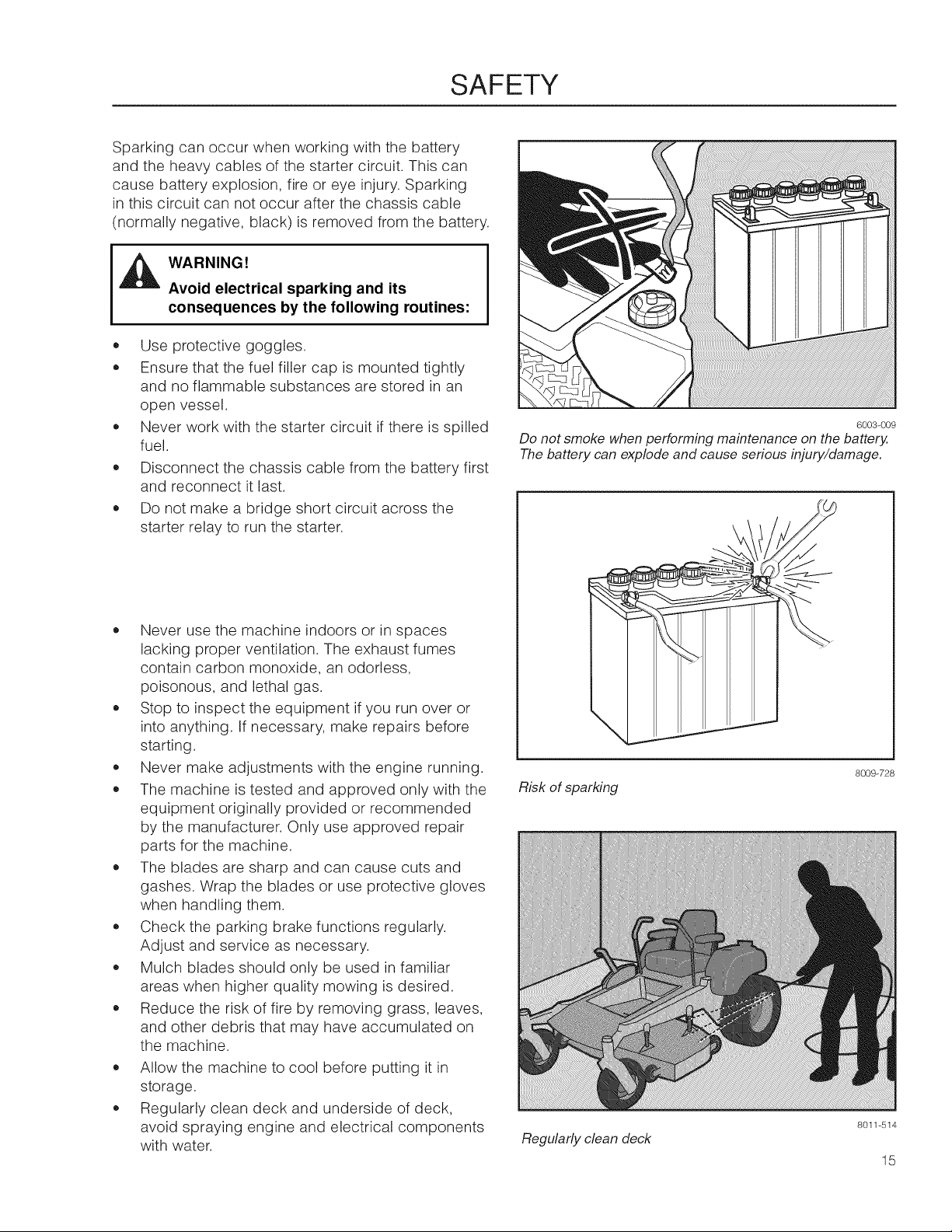
Do not smoke when performing maintenance on the battery.
The battery can explode and cause serious injury/damage.
• Never use the machine indoors or in spaces
lacking proper ventilation. The exhaust fumes
contain carbon monoxide, an odorless,
poisonous, and lethal gas.
Stop to inspect the equipment if you run over or
into anything. If necessary, make repairs before
starting.
Never make adjustments with the engine running.
• The machine is tested and approved only with the
equipment originally provided or recommended
by the manufacturer. Only use approved repair
parts for the machine.
• The blades are sharp and can cause cuts and
gashes. Wrap the blades or use protective gloves
when handling them.
Check the parking brake functions regularly.
Adjust and service as necessary.
Mulch blades should only be used in familiar
areas when higher quality mowing is desired.
Reduce the risk of fire by removing grass, leaves,
and other debris that may have accumulated on
the machine.
• Allow the machine to cool before putting it in
storage.
Regularly clean deck and underside of deck,
avoid spraying engine and electrical components
with water.
Risk of sparking
8009-728
Regularly clean deck
8011-514
15
SAFETY
Transport
= The machine is heavy and can cause serious
crushing injuries. Be extra cautious when it is
loaded on or unloaded from a vehicle or trailer.
• Use an approved trailer to transport the machine.
Activate the parking brake, turn off the fuel supply,
and fasten the machine with approved fastening
devices, such as bands, chains, or straps, when
transporting.
• Do not operate this machine on public roadways.
• Check and abide by local traffic regulations
before transporting the machine on any road.
• Do not tow this machine: it may cause damage to
the drive system.
• Load the unit onto truck or trailer by driving up
ramps of suitable strength using a slow speed. Do
not lift! The machine is not intended to be lifted by
hand.
• When loading or unloading this machine, do not
exceed the maximum recommended operation
angle of 10° .
WARNINGt
Use extreme caution when loading the
machine into a truck or trailer using
ramps. There is the possibility of serious
injury or death if the machine falls off the
ramps.
IMPORTANT INFORMATION
The parking brake is not sufficient to lock the
machine in place during transport. Ensure that
the machine is well fastened to the transport
vehicle. Always reverse the machine onto the
transport vehicle to avoid tipping it over.
Towing
If machine is equipped with a tow hitch, use extreme
caution when towing. Never allow children or others in
or on towed equipment..
Make wide turns to avoid jack-knifing. Travel slowly
and allow extra distance to stop. Do not tow on sloped
ground. The weight of the towed equipment may
cause loss of traction and loss of control.
Follow the manufacturer's recommendation for weight
limits for towed equipment. Do not tow near ditches,
canals, and other hazards.
Spark Arrestor
This mower is equipped with an internal combustion
engine and should not be used on or near any
unimproved forested, bush covered or grassy lands
unless the engine's system is equipped with a spark
arrestor meeting applicable local or state laws (if any).
In the state of California the above is required by
law (Section 4442 of the California Public Resources
Code).
Other states may have similar laws. Federal laws
apply on federal lands.
A spark arrestor for the muffler is available through
any authorized Husqvarna dealer.
_ WARNINGt
Escaping hydraulic oil under pressure
can have sufficient force to penetrate the
skin, causing serious injury. If injured
by escaping fluid, see a doctor at once.
Serious infection or reaction can develop
if proper medical treatment is not
administered immediately.
_b_ WARNINGt
This mower is equipped with an internal
combustion engine and should not
be used on or near any unimproved
forested, bush covered or grassy lands
unless the engine's system is equipped
with a spark arrester meeting applicable
local or state laws (if any). If a spark
arrestor is used, it should be maintained
in effective working order by the
operator.
16
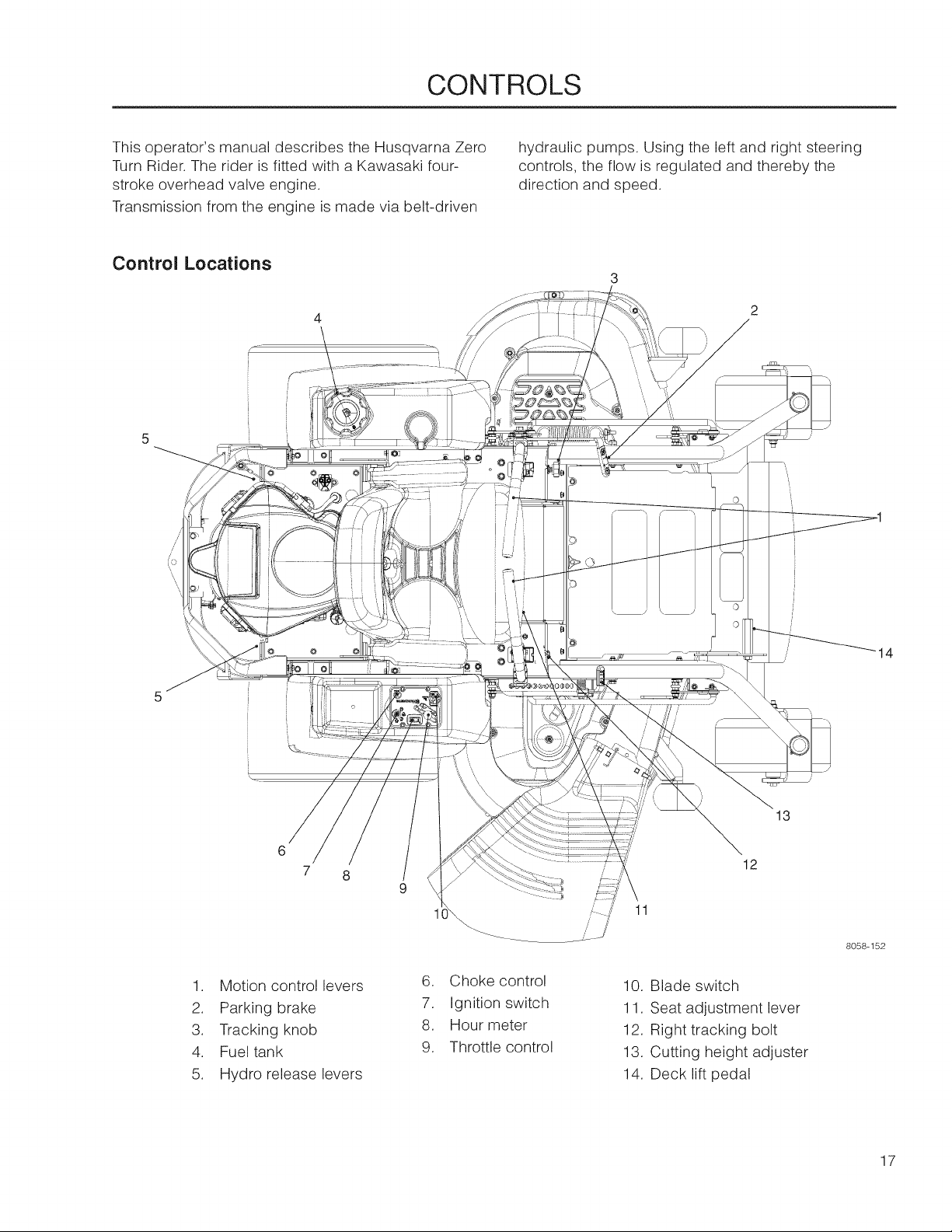
CONTROLS
This operator's manual describes the Husqvarna Zero
Turn Rider. The rider is fitted with a Kawasaki four-
stroke overhead valve engine.
Transmission from the engine is made via belt-driven
hydraulic pumps. Using the left and right steering
controls, the flow is regulated and thereby the
direction and speed.
Control Locations
I
!
14
6
7 8
1. Motion control levers
2. Parking brake
3. Tracking knob
4. Fuel tank
5. Hydro release levers
6. Choke control
7. Ignition switch
8. Hour meter
9. Throttle control
13
12
11
10. Blade switch
11. Seat adjustment lever
12. Right tracking bolt
13. Cutting height adjuster
14. Deck lift pedal
8058-152
17
CONTROLS
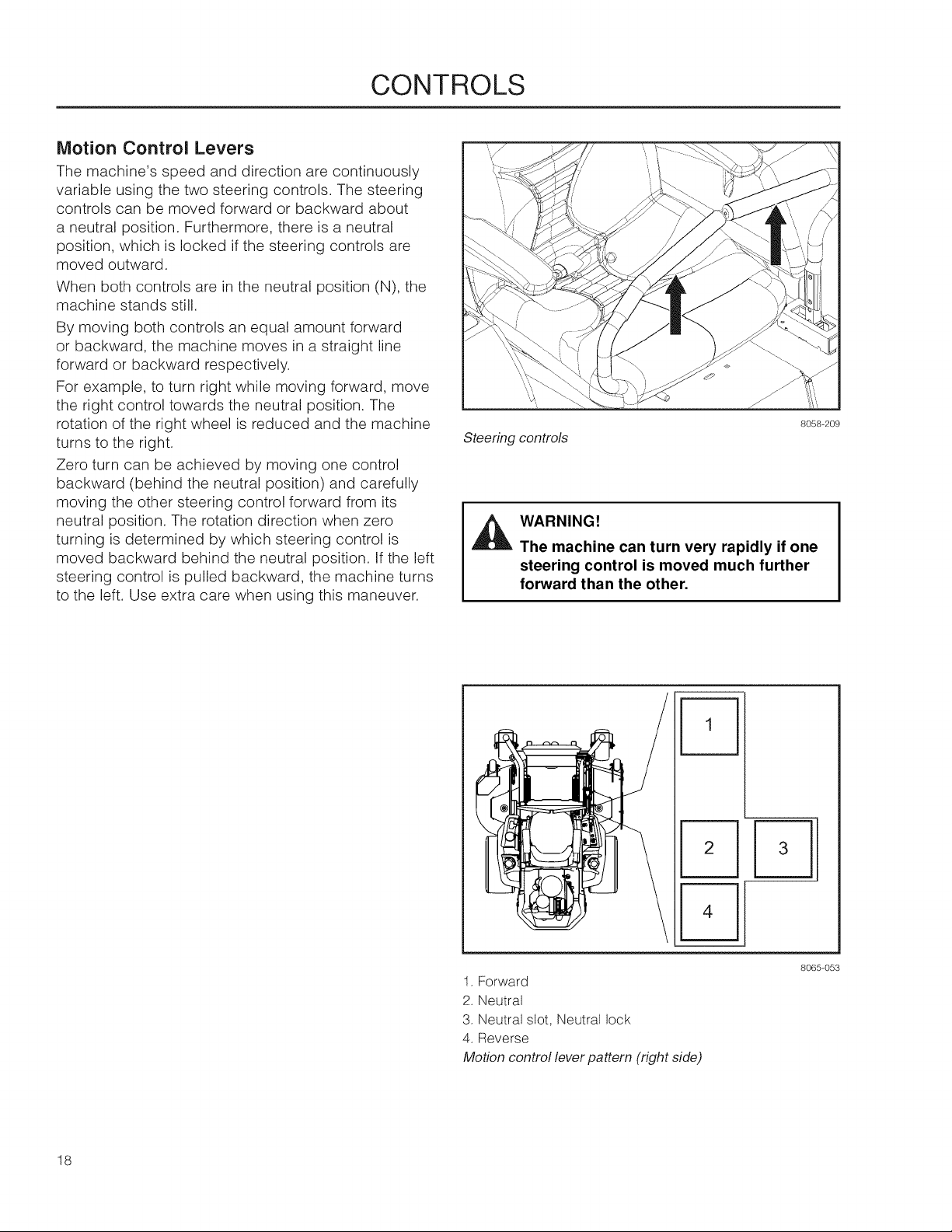
Motion Control Levers
The machine's speed and direction are continuously
variable using the two steering controls, The steering
controls can be moved forward or backward about
a neutral position, Furthermore, there is a neutral
position, which is locked if the steering controls are
moved outward,
When both controls are in the neutral position (N), the
machine stands still.
By moving both controls an equal amount forward
or backward, the machine moves in a straight line
forward or backward respectively,
For example, to turn right while moving forward, move
the right control towards the neutral position. The
rotation of the right wheel is reduced and the machine
turns to the right,
Zero turn can be achieved by moving one control
backward (behind the neutral position) and carefully
moving the other steering control forward from its
neutral position, The rotation direction when zero
turning is determined by which steering control is
moved backward behind the neutral position, If the left
steering control is pulled backward, the machine turns
to the left, Use extra care when using this maneuver,
Steering controls
8058-209
_kl_ ARNINGt
The machine can turn very rapidly if one
steering control is moved much further
forward than the other.
\
1. Forward
2. Neutral
3. Neutral slot, Neutral lock
4. Reverse
Motion control lever pattern (right side)
m
1
2
4
8065-053
18
CONTROLS
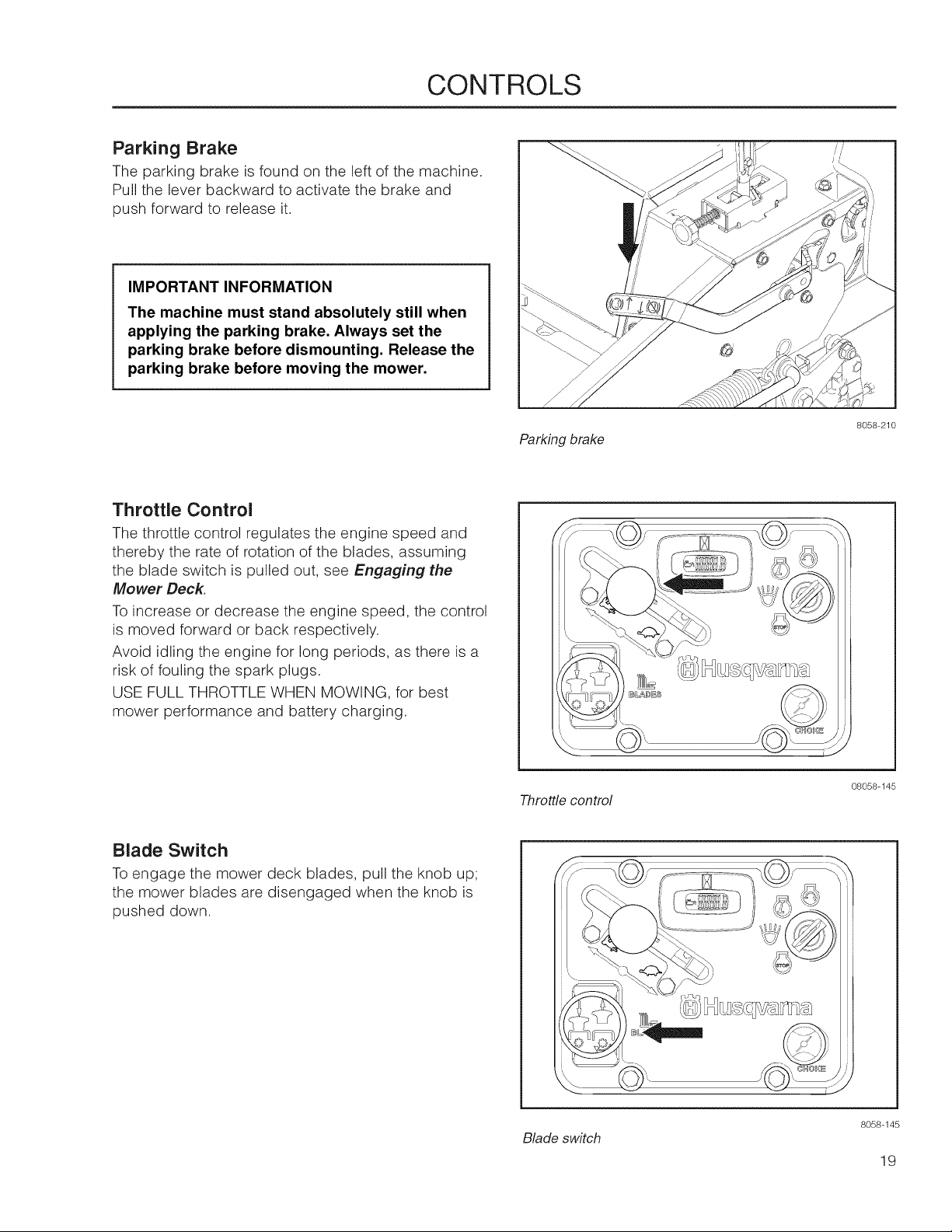
Parking Brake
The parking brake is found on the left of the machine.
Pull the lever backward to activate the brake and
push forward to release it.
IMPORTANT INFORMATION
The machine must stand absolutely still when
applying the parking brake. Always set the
parking brake before dismounting. Release the
parking brake before moving the mower.
Parking brake
8058-210
Throttle Control
The throttle control regulates the engine speed and
thereby the rate of rotation of the blades, assuming
the blade switch is pulled out, see Engaging the
Mower Deck,
To increase or decrease the engine speed, the control
is moved forward or back respectively.
Avoid idling the engine for long periods, as there is a
risk of fouling the spark plugs.
USE FULL THROTTLE WHEN MOWING, for best
mower performance and battery charging.
Throttle control
08058-145
Blade Switch
To engage the mower deck blades, pull the knob up;
the mower blades are disengaged when the knob is
pushed down.
Blade switch
8058-145
19
CONTROLS
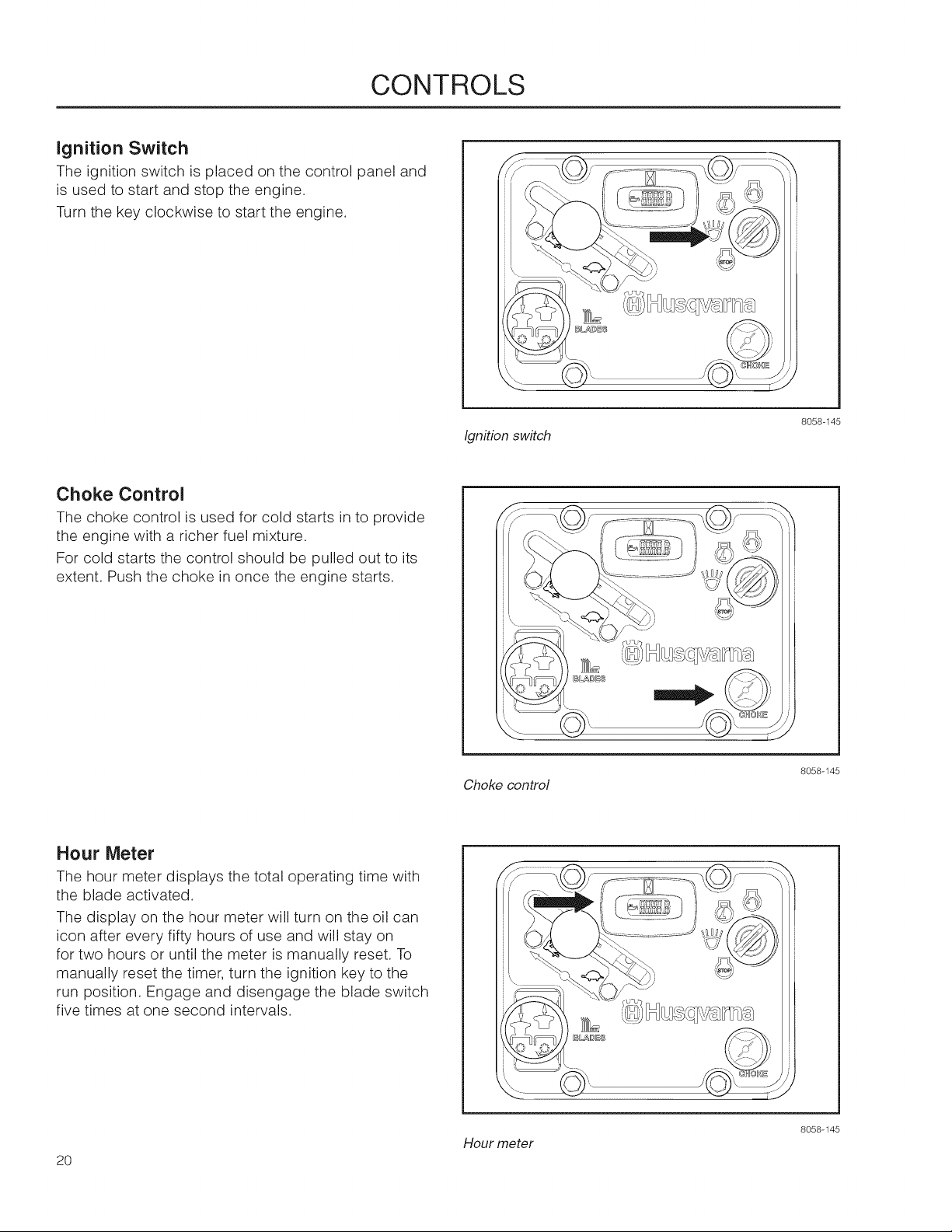
Ignition Switch
The ignition switch is placed on the control panel and
is used to start and stop the engine.
Turn the key clockwise to start the engine.
Ignition switch
8058-145
Choke Control
The choke control is used for cold starts in to provide
the engine with a richer fuel mixture.
For cold starts the control should be pulled out to its
extent. Push the choke in once the engine starts.
Choke control
8058-145
Hour Meter
The hour meter displays the total operating time with
the blade activated.
The display on the hour meter will turn on the oil can
icon after every fifty hours of use and will stay on
for two hours or until the meter is manually reset. To
manually reset the timer, turn the ignition key to the
run position. Engage and disengage the blade switch
five times at one second intervals.
2O
Hour meter
8058-145
CONTROLS
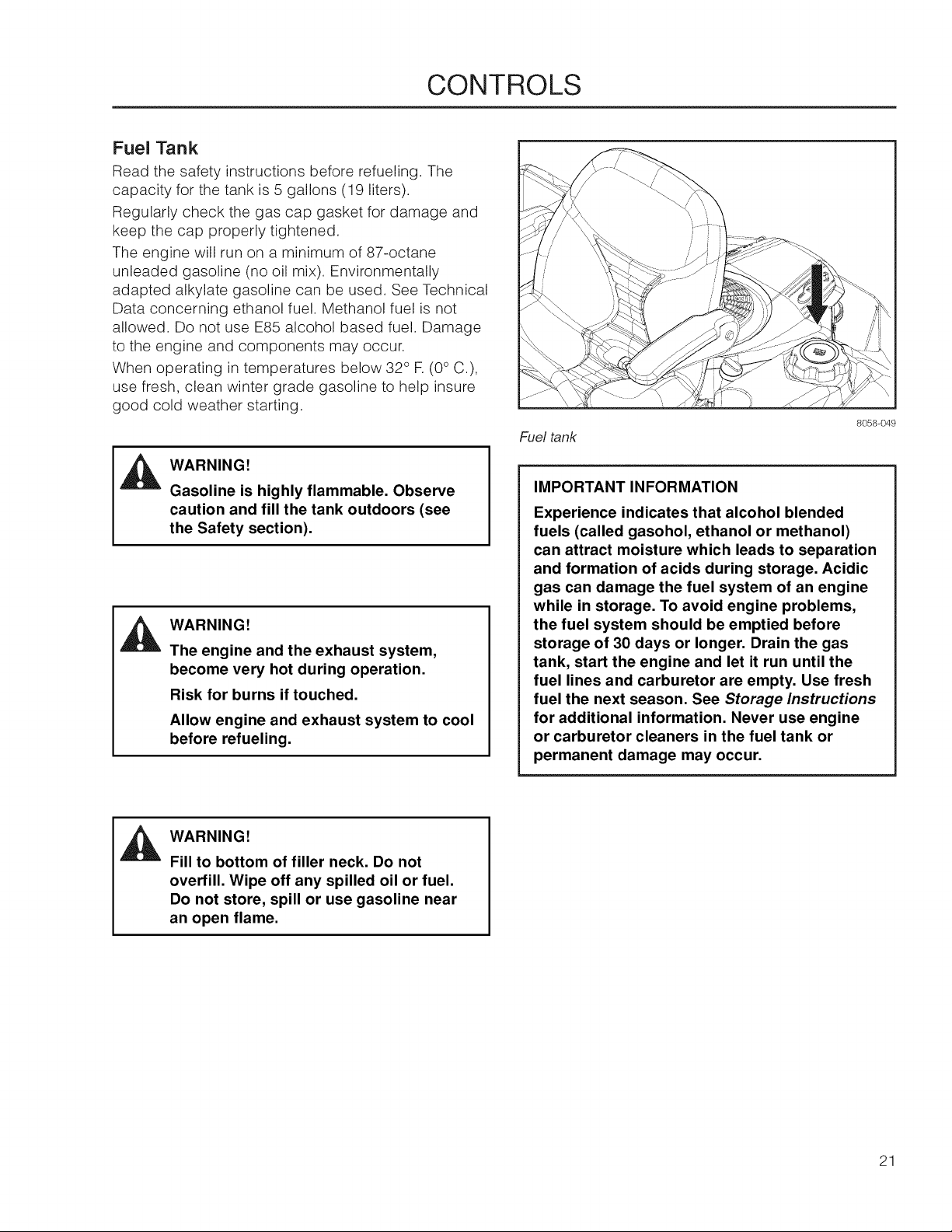
Fuel Tank
Read the safety instructions before refueling. The
capacity for the tank is 5 gallons (19 liters).
Regularly check the gas cap gasket for damage and
keep the cap properly tightened.
The engine will run on a minimum of 87-octane
unleaded gasoline (no oil mix). Environmentally
adapted alkylate gasoline can be used. See Technical
Data concerning ethanol fuel. Methanol fuel is not
allowed. Do not use E85 alcohol based fuel. Damage
to the engine and components may occur.
When operating in temperatures below 32 ° R (0 ° C.),
use fresh, clean winter grade gasoline to help insure
good cold weather starting.
_ WARNINGt
Gasoline is highly flammable. Observe
caution and fill the tank outdoors (see
the Safety section).
WARNINGt
The engine and the exhaust system,
become very hot during operation.
Risk for burns if touched.
Allow engine and exhaust system to cool
before refueling.
Fuel tank
IMPORTANT INFORMATION
Experience indicates that alcohol blended
fuels (called gasohol, ethanol or methanol)
can attract moisture which leads to separation
and formation of acids during storage. Acidic
gas can damage the fuel system of an engine
while in storage. To avoid engine problems,
the fuel system should be emptied before
storage of 30 days or longer. Drain the gas
tank, start the engine and let it run until the
fuel lines and carburetor are empty. Use fresh
fuel the next season. See Storage Instructions
for additional information. Never use engine
or carburetor cleaners in the fuel tank or
permanent damage may occur.
8058-049
_ WARNINGt
Fill to bottom of filler neck. Do not
overfill. Wipe off any spilled oil or fuel.
Do not store, spill or use gasoline near
an open flame.
21
CONTROLS
Fuel Shut Off Valve
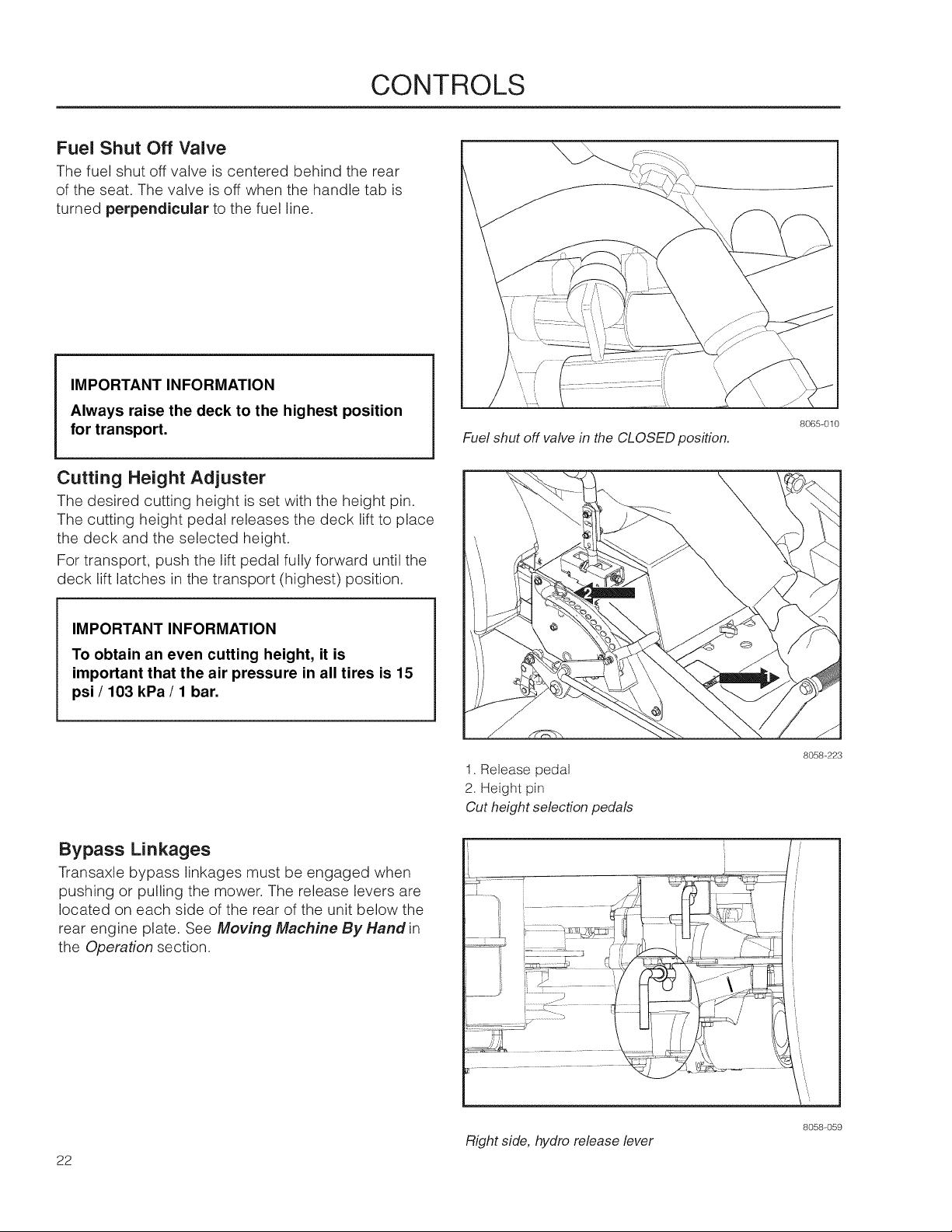
The fuel shut off valve is centered behind the rear
of the seat. The valve is off when the handle tab is
turned perpendicular to the fuel line.
IMPORTANT INFORMATION
Always raise the deck to the highest position
for transport.
Cutting Height Adjuster
The desired cutting height is set with the height pin.
The cutting height pedal releases the deck lift to place
the deck and the selected height.
For transport, push the lift pedal fully forward until the
deck lift latches in the transport (highest) position.
Fuel shut off valve in the CLOSED position.
8065-010
IMPORTANT INFORMATION
To obtain an even cutting height, it is
important that the air pressure in all tires is 15
psi / 103 kPa / 1 bar.
Bypass Linkages
Transaxle bypass linkages must be engaged when
pushing or pulling the mower. The release levers are
located on each side of the rear of the unit below the
rear engine plate. See Moving Machine By Hand in
the Operation section.
22
1. Release pedal
2, Height pin
Cut height selection pedals
I....
Right side, hydro release lever
8058-223
L
8058-059
CONTROLS
Seat Adjustment Lever
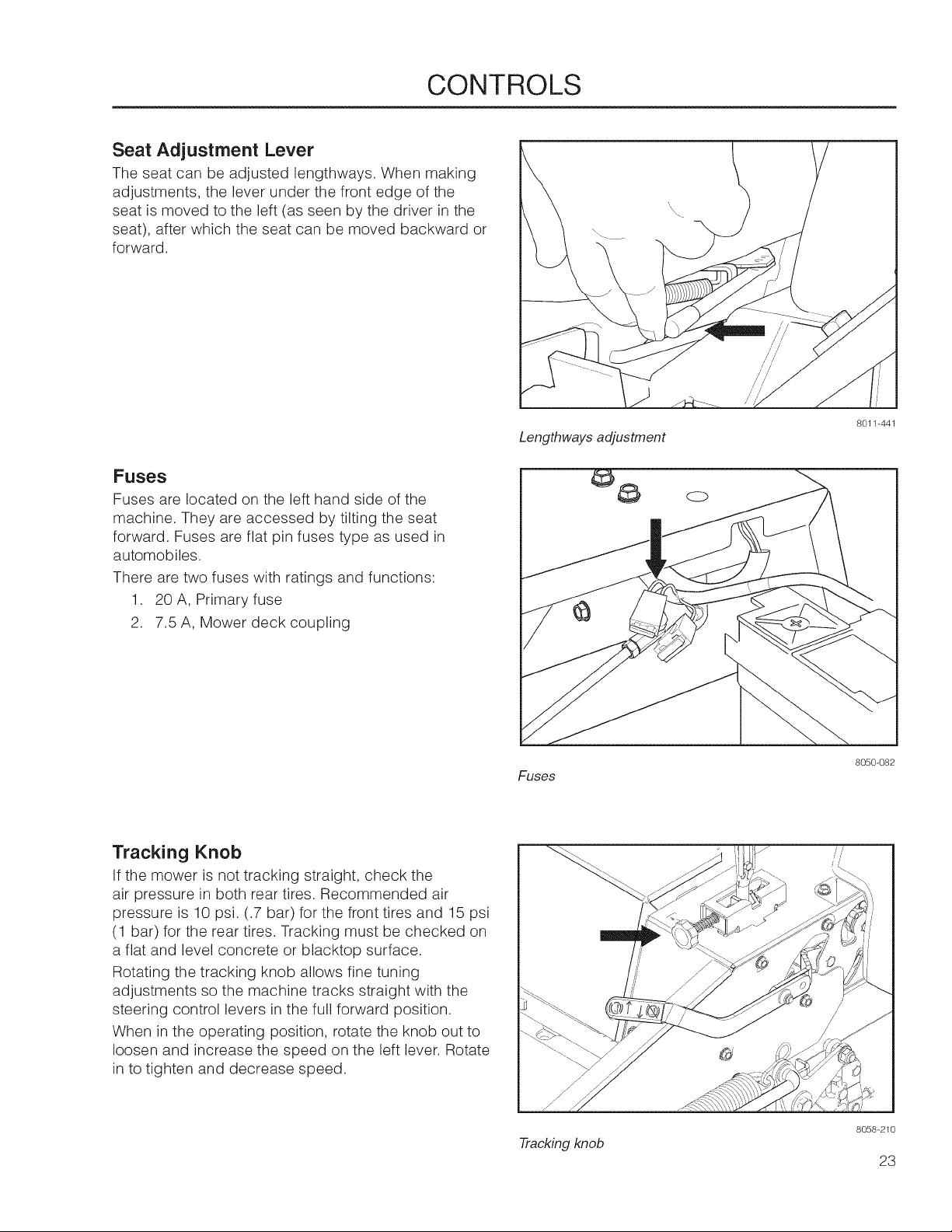
The seat can be adjusted lengthways. When making
adjustments, the lever under the front edge of the
seat is moved to the left (as seen by the driver in the
seat), after which the seat can be moved backward or
forward.
\
Fuses
Fuses are located on the left hand side of the
machine. They are accessed by tilting the seat
forward. Fuses are flat pin fuses type as used in
automobiles.
There are two fuses with ratings and functions:
1. 20 A, Primary fuse
2. 7.5 A, Mower deck coupling
Lengthways adjustment
8011-441
Fuses
8050-082
Tracking Knob
If the mower is not tracking straight, check the
air pressure in both rear tires. Recommended air
pressure is 10 psi. (.7 bar) for the front tires and 15 psi
(1 bar) for the rear tires. Tracking must be checked on
a flat and level concrete or blacktop surface.
Rotating the tracking knob allows fine tuning
adjustments so the machine tracks straight with the
steering control levers in the full forward position.
When in the operating position, rotate the knob out to
loosen and increase the speed on the left lever. Rotate
in to tighten and decrease speed.
Tracking knob
8058-210
23
OPERATION
Read the Safety section and the following pages if
you are unfamiliar with the machine,
Training
Due to unique steering capabilities, zero turn mowers
are far more maneuverable than typical riding
mowers.
This section should be reviewed in its entirety prior to
attempting to move the mower under its own power,
When first operating the mower or until becoming
comfortable with controls, use a reduced throttle
speed and reduced ground speed, DO NOT move
control levers to the furthest forward or reverse
positions during initial operation,
First time users should become familiar with the
mower's movement on a hard surface, such as
concrete or blacktop PRIOR to attempting to operate
on turf, Until the operator becomes comfortable with
the mower controls and zero turning capability, overly
aggressive maneuvers may damage turf,
Steering
To move forward and backward
The direction and speed of the mower's movements
are effected by the movement of the control lever(s)
on each side of mower, The left control lever controls
the left wheel, The right control lever controls the right
wheel,
First time users should push the mower (see Manual
Transport in the Operation section) to an open, flat
area without other people, vehicles or obstacles
nearby. To move the unit under its own power, the
operator must sit in the seat and start the engine (see
Before Starting in the Operation section). Adjust the
engine speed to idle, disengage the parking brake
but do not engage the blades at this time, Rotate
control levers inward. As long as the control levers
have not been moved forward or backwards, the
mower will not move,
Slowly move both control levers forward slightly, This
will allow mower to start moving forward in a straight
line, Pull the control levers back to the neutral position
and the mower should stop moving,
Pull back slightly on control levers, allowing the mower
to move backwards, Push the control levers forward to
the neutral position and mower should stop moving,
To turn to the right
While moving in a forward direction, pull the right lever
back towards the neutral position while maintaining
the position of the left lever, this will slow the rotation
of the right wheel and cause the machine to turn in
that direction,
To turn to the left
While moving in a forward direction pull the left lever
back towards the neutral position while maintaining
the position of the right lever, this will slow the rotation
of the left wheel and cause the machine to turn in that
direction,
To zero turn
While moving in a forward direction, first pull both
control levers back until the mower stops or slows
dramatically,
Then by alternating one lever slightly to the forward
position and the other in the reverse position, the
mower turns to the direction of the reverse position
lever,
24
OPERATION
Before Starting
1. Read the sections on Safety and Controls before
starting the machine,
2. Perform the daily maintenance before starting
(see Maintenance Schedule in the Maintenance
section).
3. Check that there is sufficient fuel in the fuel tank,
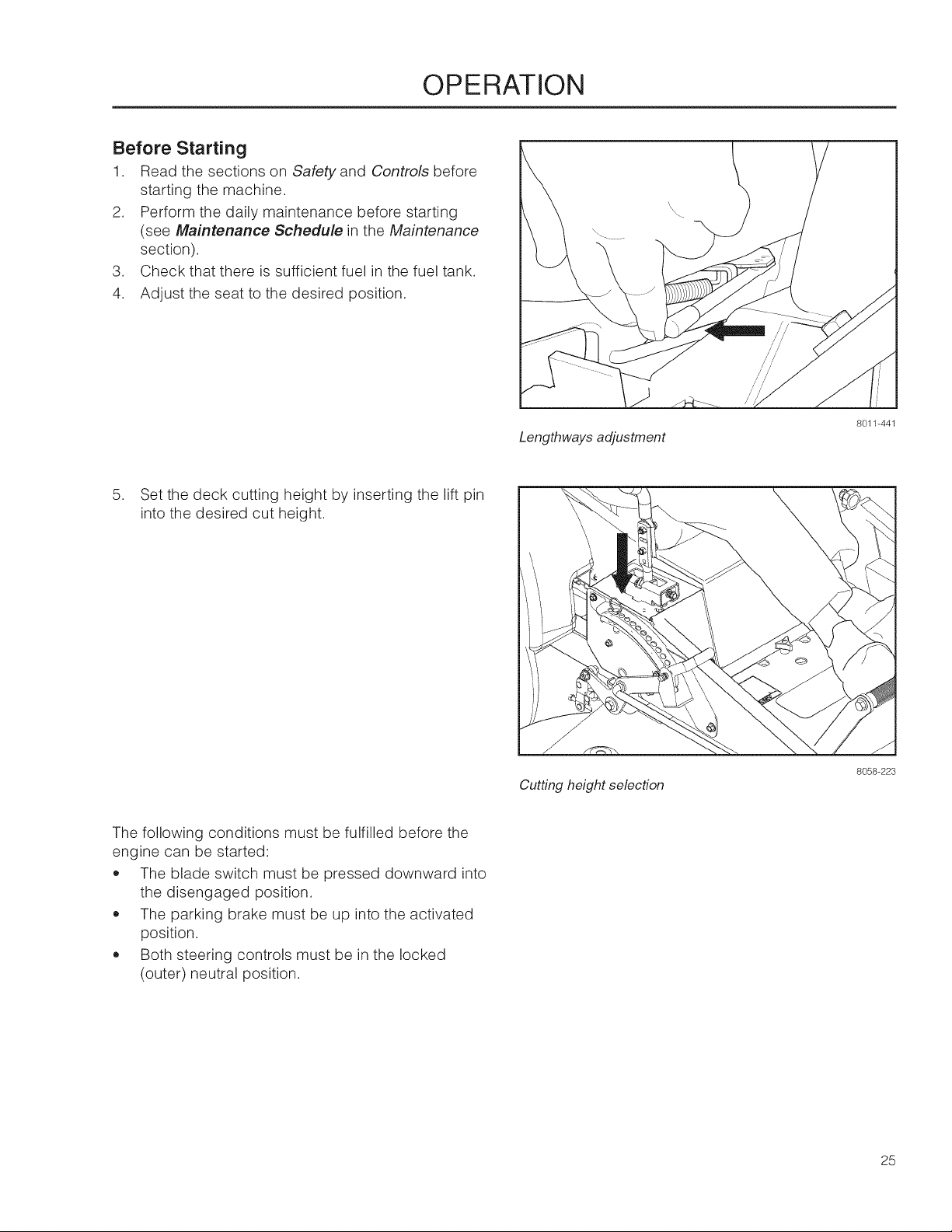
4. Adjust the seat to the desired position,
\
Lengthways adjustment
8011-441
5. Set the deck cutting height by inserting the lift pin
into the desired cut height,
Cutting height selection
8058-223
The following conditions must be fulfilled before the
engine can be started:
• The blade switch must be pressed downward into
the disengaged position,
• The parking brake must be up into the activated
position,
• Both steering controls must be in the locked
(outer) neutral position,
25
OPERATION
Starting the Engine
1. Sit on the seat.
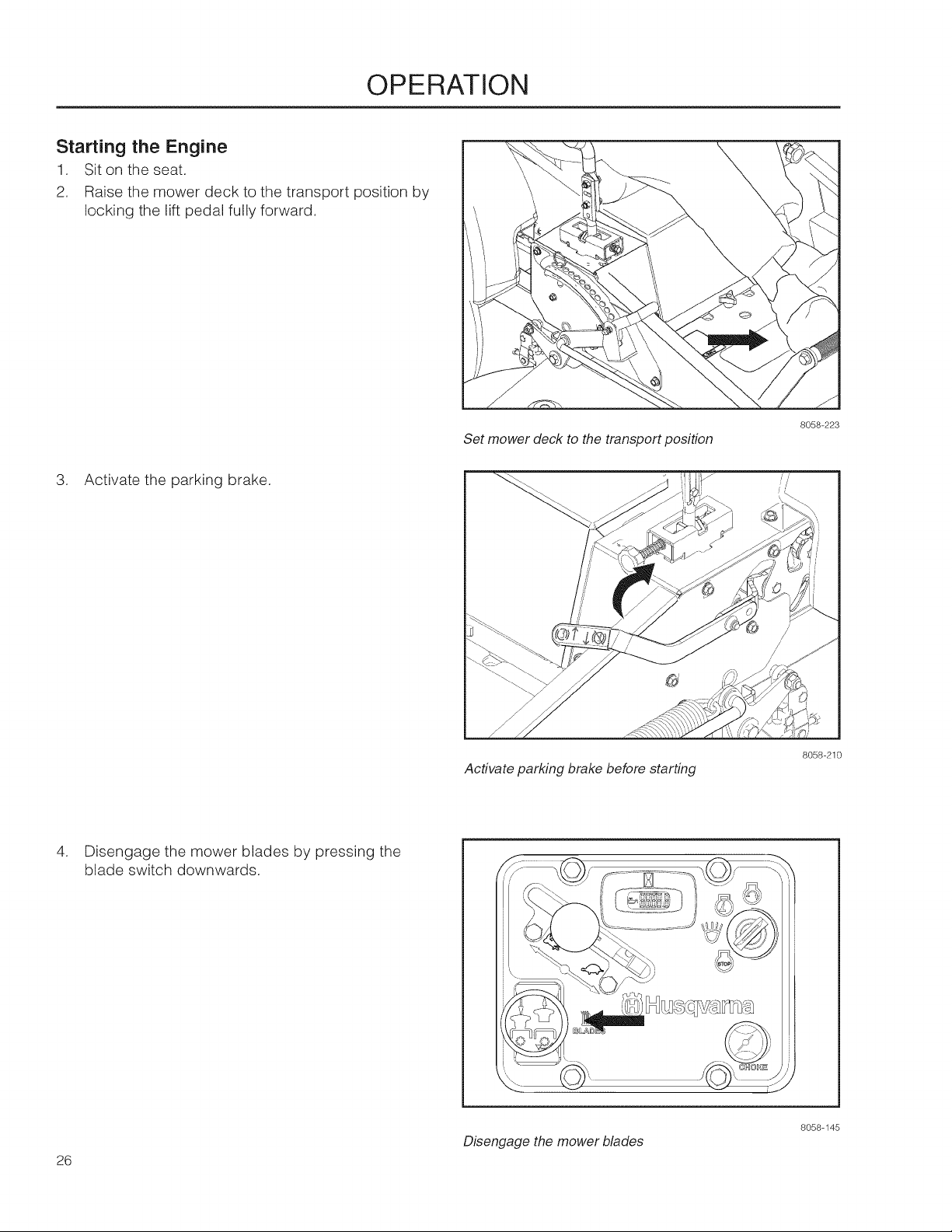
2. Raise the mower deck to the transport
locking the lift pedal fully forward,
3osition by
3. Activate the parking brake,
Set mower deck to the transport position
/'
/
/
8058-223
Activate parking brake before starting
8058-210
4. Disengage the mower blades by pressing the
blade switch downwards,
26
Disengage the mower blades
8058-145
OPERATION
,
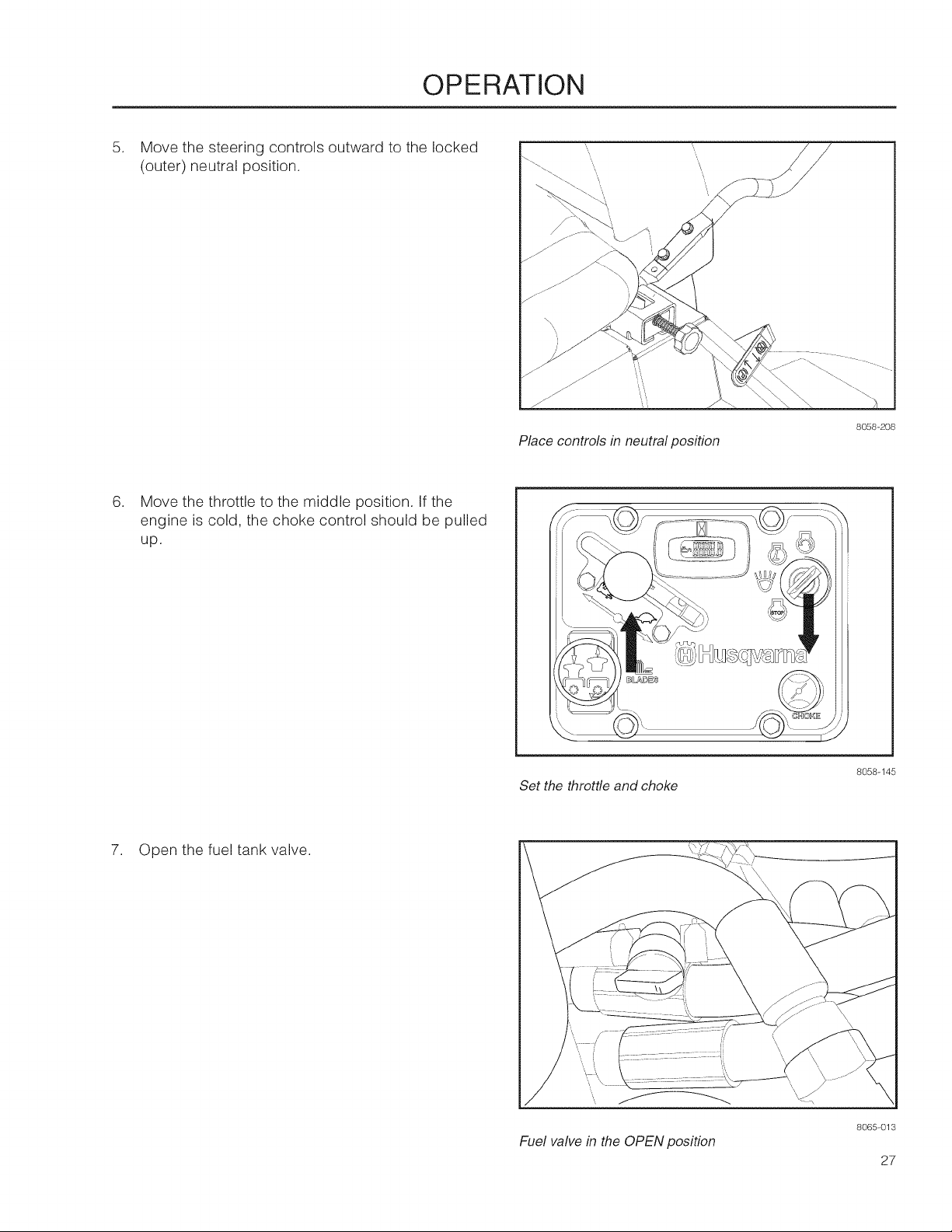
Move the steering controls outward to the locked
(outer) neutral position.
Place controls in neutral position
8058-208
6. Move the throttle to the middle position. If the
engine is cold, the choke control should be pulled
up.
Set the throttle and choke
8058-145
7. Open the fuel tank valve.
Fuel valve in the OPEN position
8065-013
27
OPERATION
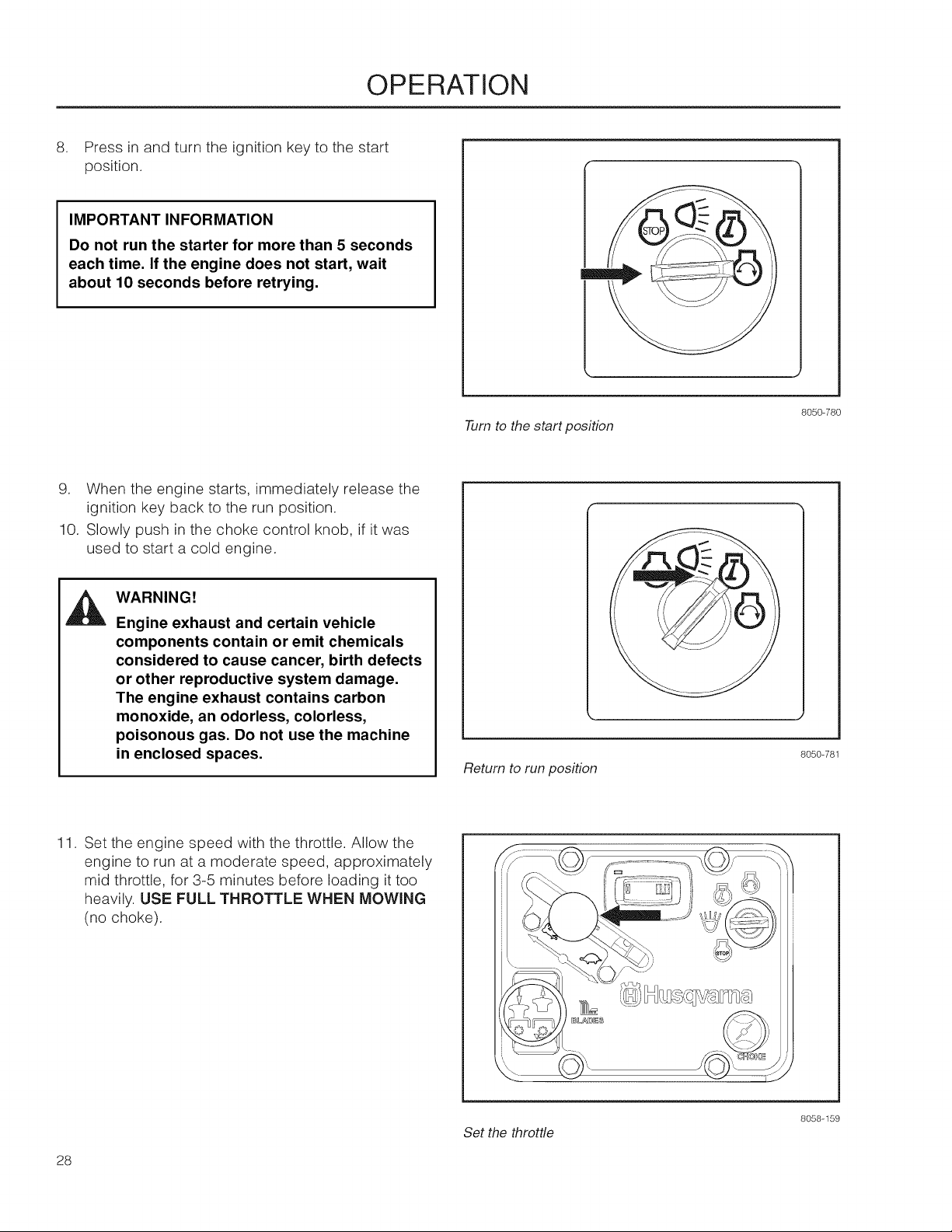
8. Press in and turn the ignition key to the start
position.
IMPORTANT INFORMATION
Do not run the starter for more than 5 seconds
each time. If the engine does not start, wait
about 10 seconds before retrying.
Turn to the start position
8050-780
9. When the engine starts, immediately release the
ignition key back to the run position.
10. Slowly push in the choke control knob, if it was
used to start a cold engine.
_ WARNINGt
Engine exhaust and certain vehicle
components contain or emit chemicals
considered to cause cancer, birth defects
or other reproductive system damage.
The engine exhaust contains carbon
monoxide, an odorless, colorless,
poisonous gas. Do not use the machine
in enclosed spaces.
Return to run position
8050W81
11. Set the engine speed with the throttle. Allow the
engine to run at a moderate speed, approximately
mid throttle, for 3-5 minutes before loading it too
heavily. USE FULL THROTTLE WHEN MOWING
(no choke).
28
Set the throttle
8058-159
OPERATION
Weak Battery
WARNING[
Lead-acid batteries generate
explosive gases. Keep sparks, flame
and smoking materials away from
batteries. Always wear eye protection
when around batteries.
IMPORTANT INFORMATION
The mower is equipped with a 12-volt negative
grounded system. The other vehicle must also
be a 12-volt negative grounded system, Do not
use the mower to start other vehicles,
IMPORTANT INFORMATION
Refer to the EFM Information Sheet from the
unit literature packet for specific jump starting
instructions.
If the battery is too weak to start the engine, it should
be recharged. (See Battery in the Maintenance
section.)
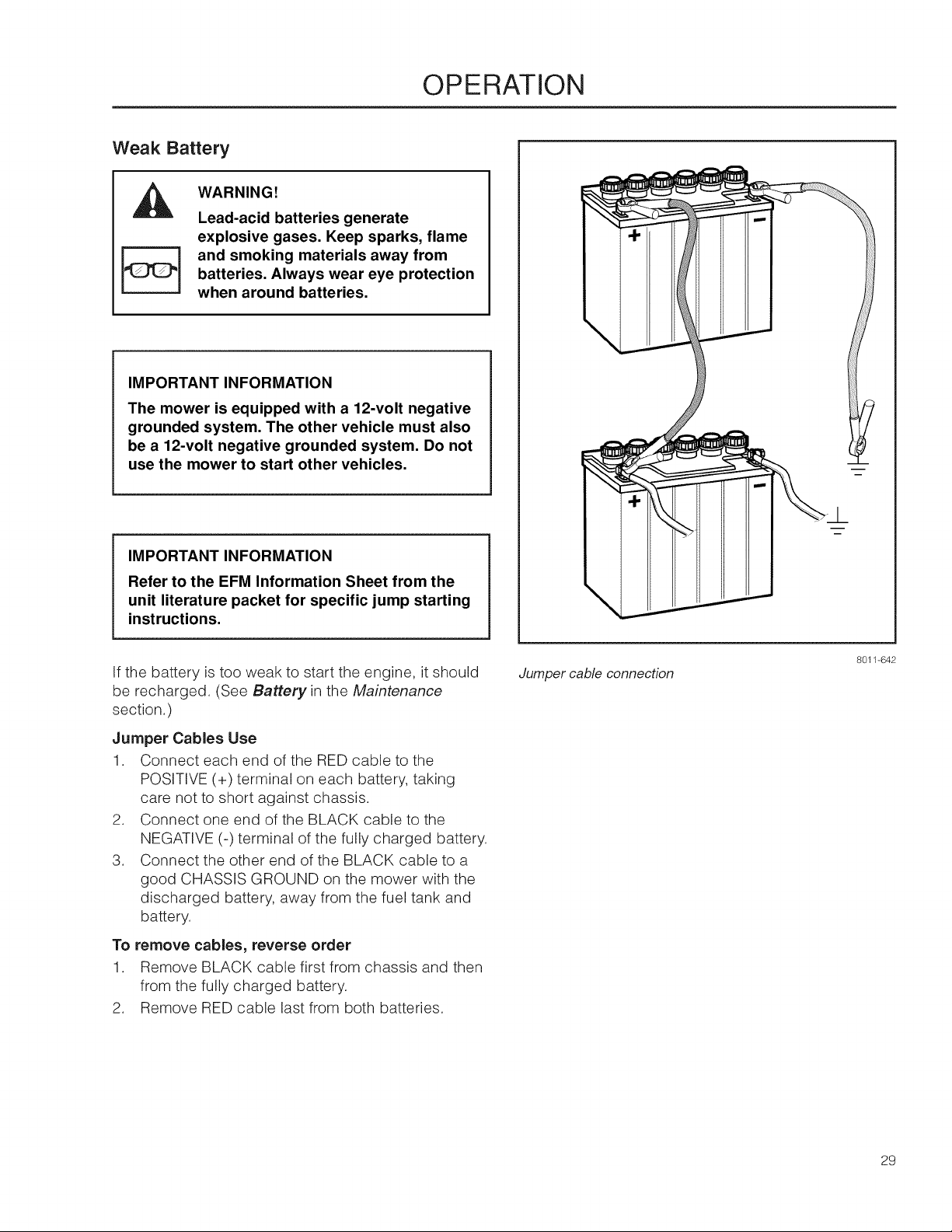
Jumper Cables Use
1. Connect each end of the RED cable to the
POSITIVE (+) terminal on each battery, taking
care not to short against chassis.
2. Connect one end of the BLACK cable to the
NEGATIVE (-) terminal of the fully charged battery.
3. Connect the other end of the BLACK cable to a
good CHASSIS GROUND on the mower with the
discharged battery, away from the fuel tank and
battery.
To remove cables, reverse order
1. Remove BLACK cable first from chassis and then
from the fully charged battery.
2. Remove RED cable last from both batteries.
Jumper cable connection
8011-642
29
OPERATION
Running
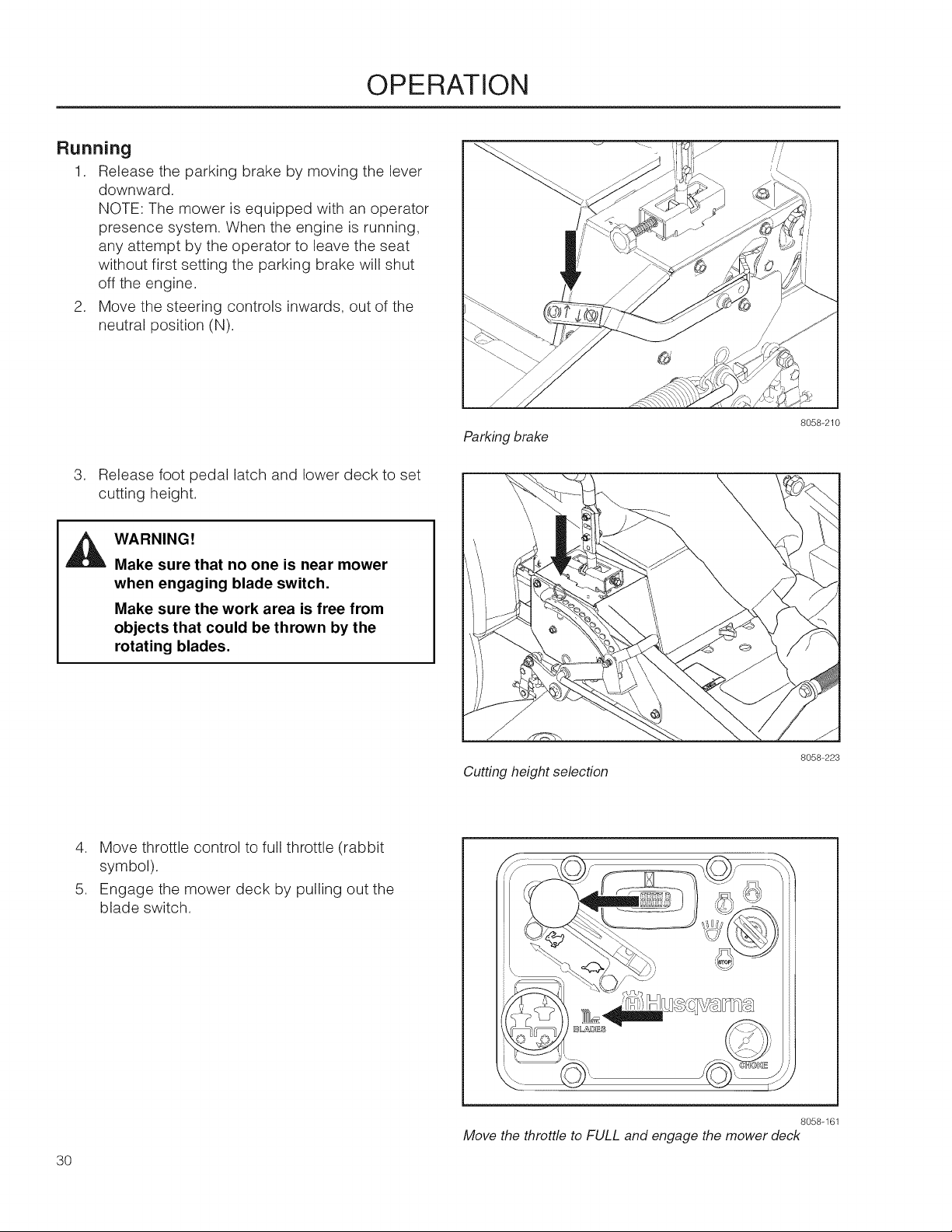
1. Release the parking brake by moving the lever
downward.
NOTE: The mower is equipped with an operator
presence system. When the engine is running,
any attempt by the operator to leave the seat
without first setting the parking brake will shut
off the engine.
2. Move the steering controls inwards, out of the
neutral position (N).
,
Release foot pedal latch and lower deck to set
cutting height.
Parking brake
8058-210
_ WARNINGt
Make sure that no one is near mower
when engaging blade switch.
Make sure the work area is free from
objects that could be thrown by the
rotating blades.
Cutting height selection
8058-223
4. Move throttle control to full throttle (rabbit
symbol).
5. Engage the mower deck by pulling out the
blade switch.
3O
8058-161
Move the throttle to FULL and engage the mower deck
OPERATION
Operating on Hills
Read the Safety Instructions Driving on Slopes in the
Safety section.
• The slowest speed possible should be used
before starting up or down hills.
Avoid stopping or changing speed on hills.
_ WARNINGt
Do not drive up or down hills with slopes
greater than 10 degrees. Do not drive
across slopes.
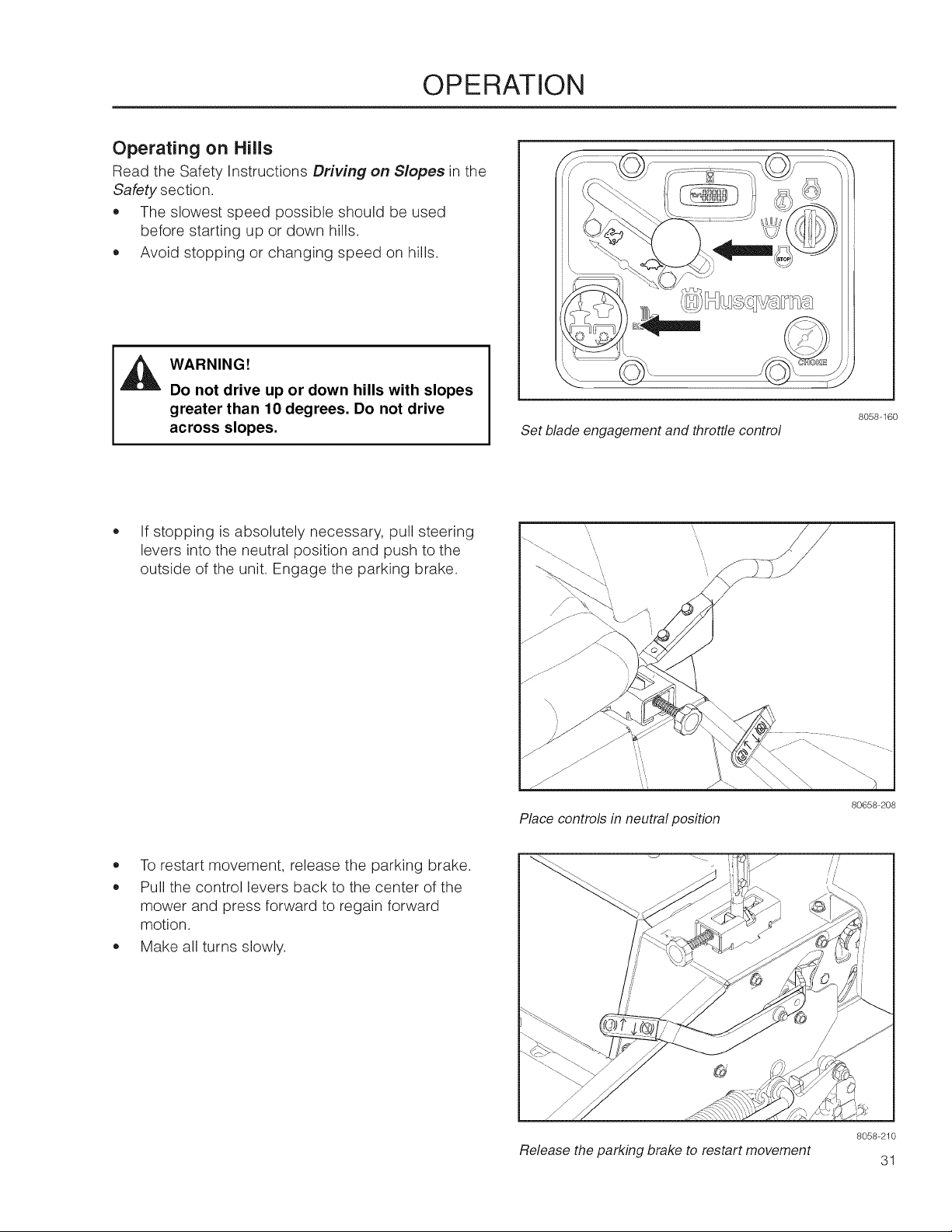
Set blade engagement and throttle control
8058-160
If stopping is absolutely necessary, pull steering
levers into the neutral position and push to the
outside of the unit. Engage the parking brake.
Place controls in neutral position
80658-208
• To restart movement, release the parking brake.
• Pull the control levers back to the center of the
mower and press forward to regain forward
motion.
Make all turns slowly.
/ /
/ /
Release the parking brake to restart movement
8058-210
31
OPERATION
Stopping the Engine
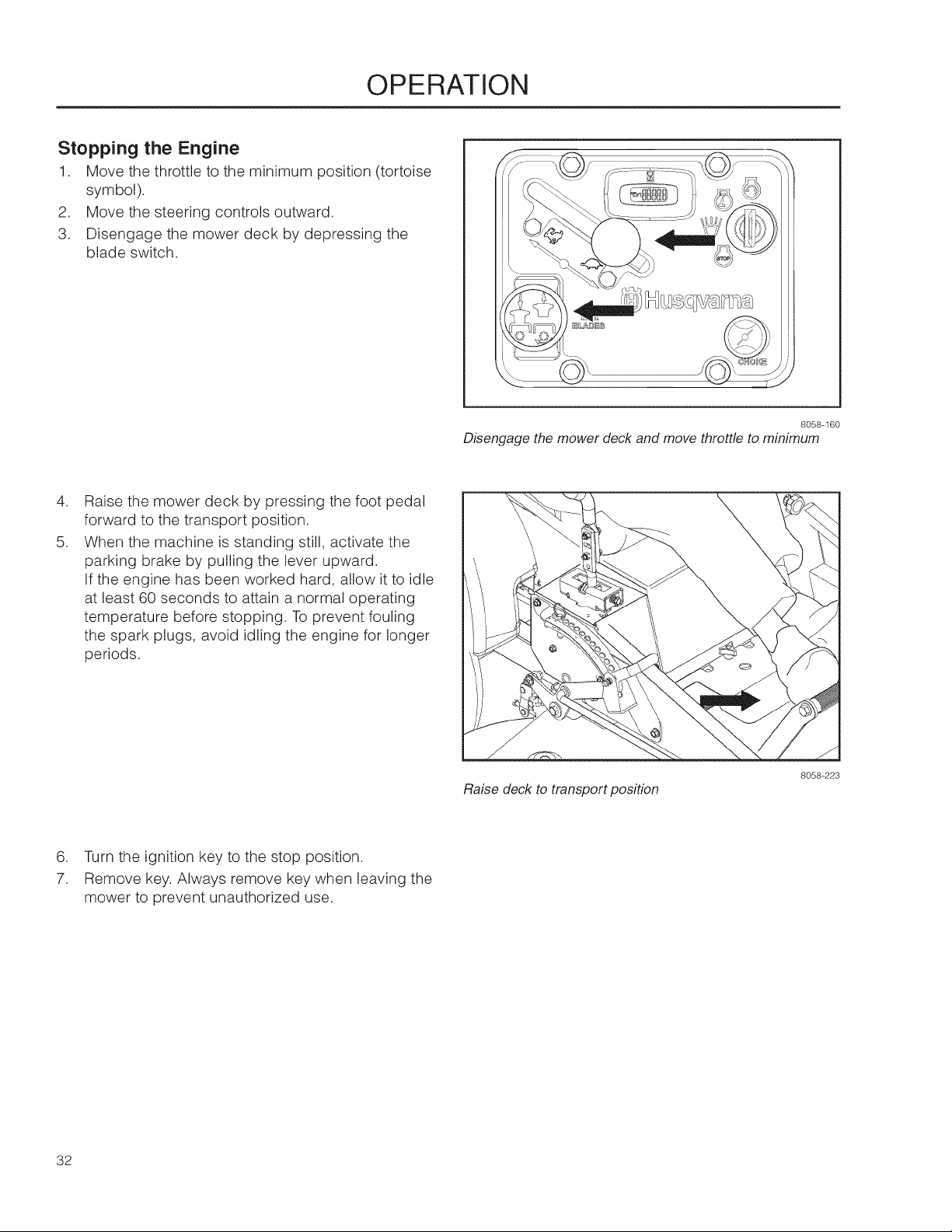
1. Move the throttle to the minimum position (tortoise
symbol).
2. Move the steering controls outward.
3. Disengage the mower deck by depressing the
blade switch.
8058-160
Disengage the mower deck and move throttle to minimum
,
5.
Raise the mower deck by pressing the foot pedal
forward to the transport position.
When the machine is standing still, activate the
parking brake by pulling the lever upward.
If the engine has been worked hard, allow it to idle
at least 60 seconds to attain a normal operating
temperature before stopping. To prevent fouling
the spark plugs, avoid idling the engine for longer
periods.
Raise deck to transport position
8058-223
6. Turn the ignition key to the stop position.
7. Remove key. Always remove key when leaving the
mower to prevent unauthorized use.
32
OPERATION
Mowing Tips
= Observe and flag rocks and other fixed objects to
avoid collisions,
• Begin with a high cutting height and reduce it
until the desired mowing result is attained, The
average lawn should be cut to 21/2'' (64 mm)
during the cool season and over 3" (76 mm)
during the hot months. For healthier and better
looking lawns, mow often after moderate growth,
• For best cutting performance, grass over 6" (15
cm) in height should be mowed twice, Make the
first cut relatively high; the second to the desired
height,
• The mowing result will be best with a high engine
speed (the blades rotate rapidly) and low speed
(the rider moves slowly). If the grass is not
too long and dense, the driving speed can be
increased without negatively affecting the mowing
result,
• The finest lawns are obtained by mowing often.
The lawn becomes more even and the grass
clippings more evenly distributed over the mown
area. The total time taken is not increased as a
higher operating speed can be used without poor
mowing results,
Avoid mowing wet lawns. The mowing result is
poorer because the wheels sink into the soft lawn,
clumps build, and the grass clippings fasten
under the cowling,
• Hose the mower deck underside with water after
each use. When cleaning, the mower deck shall
be raised into the transport position. Make sure
the mower is cooled and the engine is off.
• Use compressed air to clean top surface of the
deck, Avoid flooding water on top surface, engine
and electrical components,
• When the mulching kit is used, it is important that
the mowing interval is frequent and that the deck
is cleaned more often,
_l_ ARNINGt
Clear the lawn of stones and other
objects that can be thrown out by the
blades,
¢
A
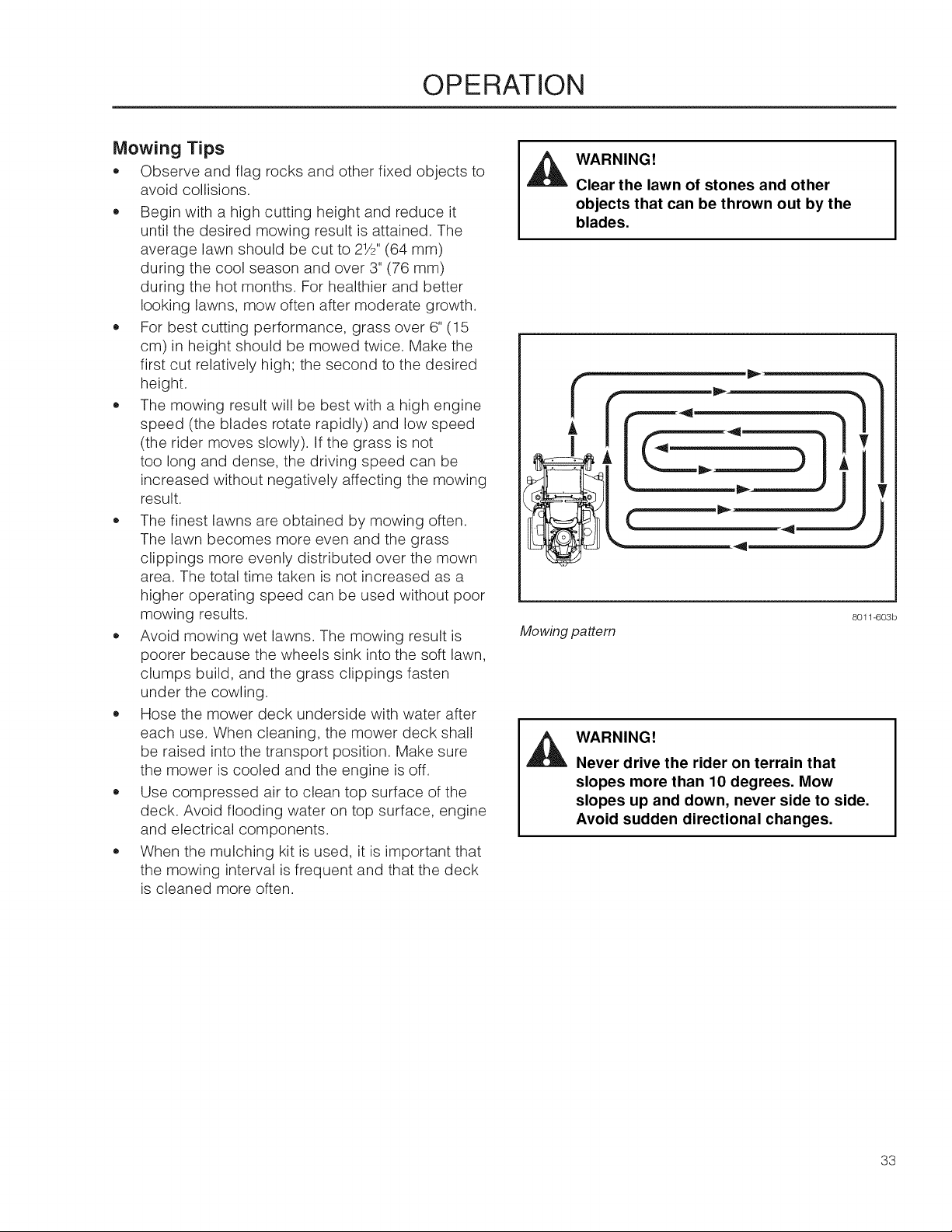
Mo wing pattem
8011-603b
_ WARNINGt
Never drive the rider on terrain that
slopes more than 10 degrees, Mow
slopes up and down, never side to side,
Avoid sudden directional changes,
33
OPERATION
Moving Machine By Hand
When pushing or pulling the mower, engage the IZT
(integrated Zeroturn Transaxle) bypass linkages. The
release levers are located on each side of the rear of
the unit below the rear engine plate.
1. Raise the deck to the highest (transport) position.
2. Pull the release levers up and out of the keyhole
slots. Release the levers with the head outside the
bracket and held into the bypass setting.
3. To reengage the IZTs to drive, reverse the above
procedure.
Load the machine into truck or trailer by driving up
ramps in low gear. DO NOT LIFT! The machine is not
intended to be lifted by hand.
WARNINGt
Use extreme caution when loading the
machine into a truck or trailer using
ramps. There is the possibility of serious
injury or death if the machine falls off the
ramps.
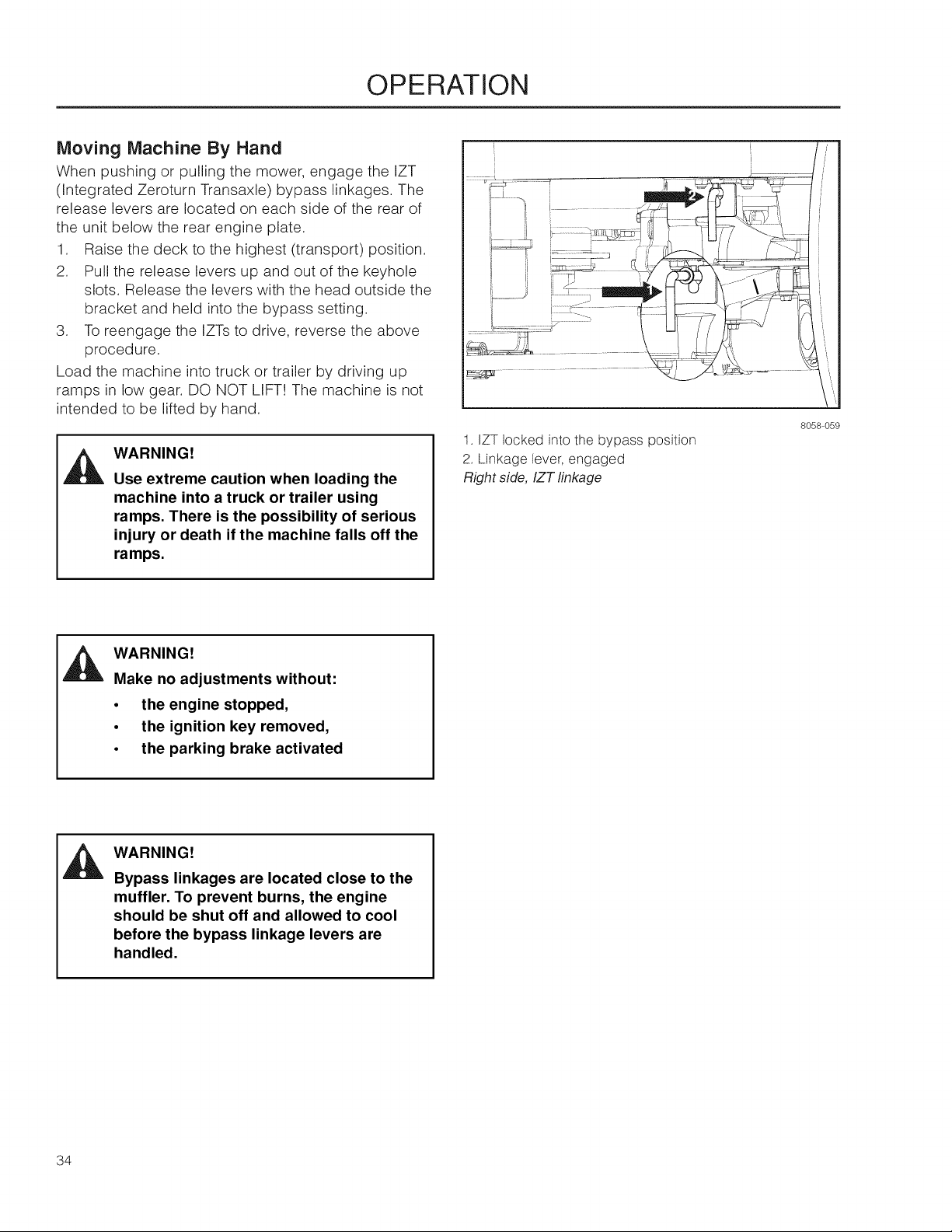
1, IZT locked into the bypass position
2, Linkage lever, engaged
Right side, IZT linkage
8058-059
WARNINGt
Make no adjustments without:
• the engine stopped,
• the ignition key removed,
• the parking brake activated
WARNINGt
Bypass linkages are located close to the
muffler. To prevent burns, the engine
should be shut off and allowed to cool
before the bypass linkage levers are
handled.
34
MAINTENANCE
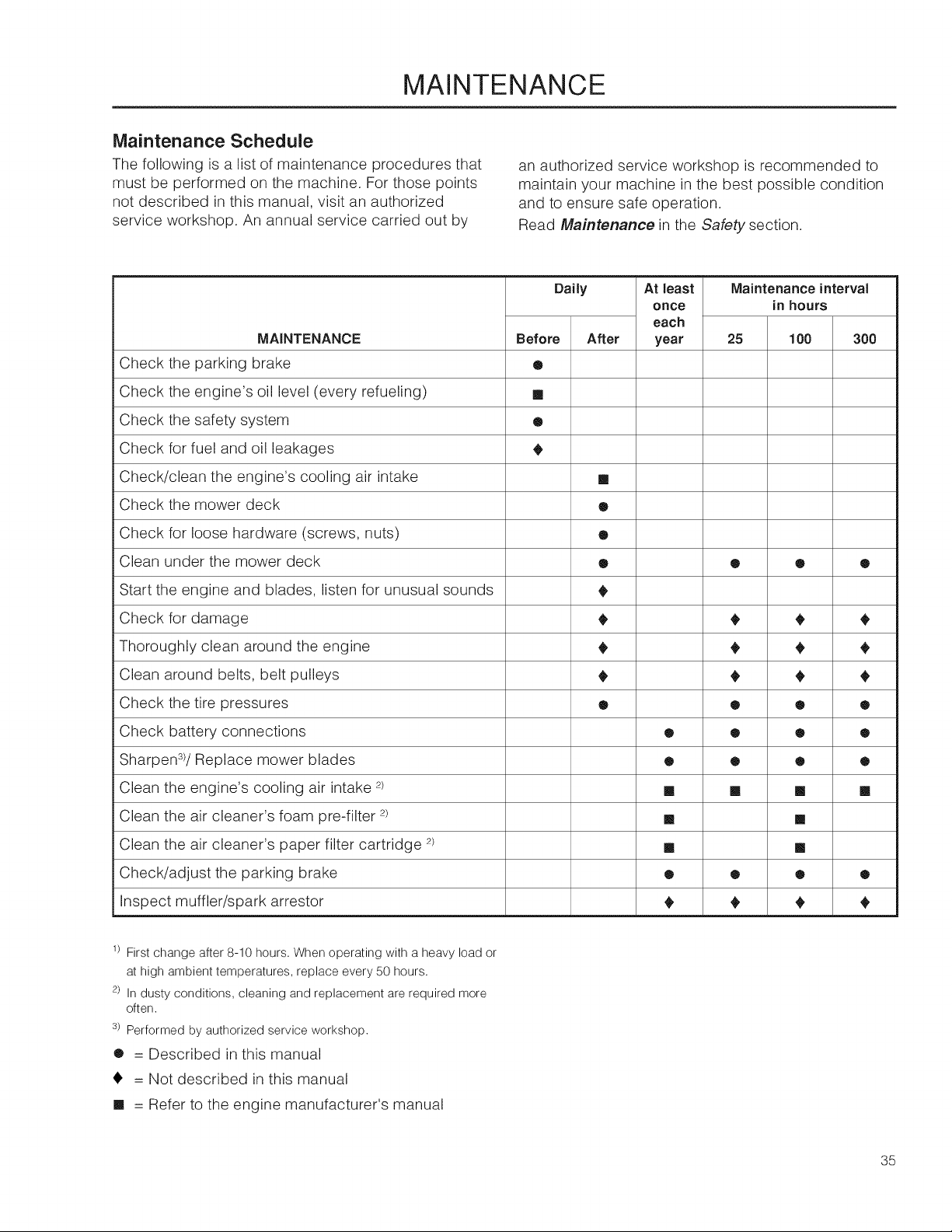
Maintenance Schedule
The following is a list of maintenance procedures that
must be performed on the machine. For those points
not described in this manual, visit an authorized
service workshop. An annual service carried out by
an authorized service workshop is recommended to
maintain your machine in the best possible condition
and to ensure safe operation.
Read Maintenance in the Safety section.
MAINTENANCE
Check the parking brake
Check the engine's oil level (every refueling)
Check the safety system
Check for fuel and oil leakages
Check/clean the engine's cooling air intake
Check the mower deck
Check for loose hardware (screws, nuts)
Clean under the mower deck
Start the engine and blades, listen for unusual sounds
Check for damage
Thoroughly clean around the engine
Clean around belts, belt pulleys
Check the tire pressures
Check battery connections
Sharpen3//Replace mower blades
Clean the engine's cooling air intake 2)
Clean the air cleaner's foam pre-filter 2)
Clean the air cleaner's paper filter cartridge 2)
Check/adjust the parking brake
Inspect muffler/spark arrestor
Daily
Before After
O
[]
O
[]
o
o
o
O
Atleast
once
each
year
O
O
[]
[]
[]
o
Maintenance interval
in hours
25
O
O
O
O
[]
O
100 300
• •
• •
• •
• •
[] []
[]
[]
• •
1) First change after 8-10 hours. When operating with a heavy load or
at high ambient temperatures, replace every 50 hours.
2) In dusty conditions, cleaning and replacement are required more
often.
s) Performed by authorized service workshop.
• _- Described in this manual
• -- Not described in this manual
[] -- Refer to the engine manufacturer's manual
35
MAINTENANCE
Daily At least Maintenance interval
once
each
year
in hours
25MAINTENANCE Before After 100 300
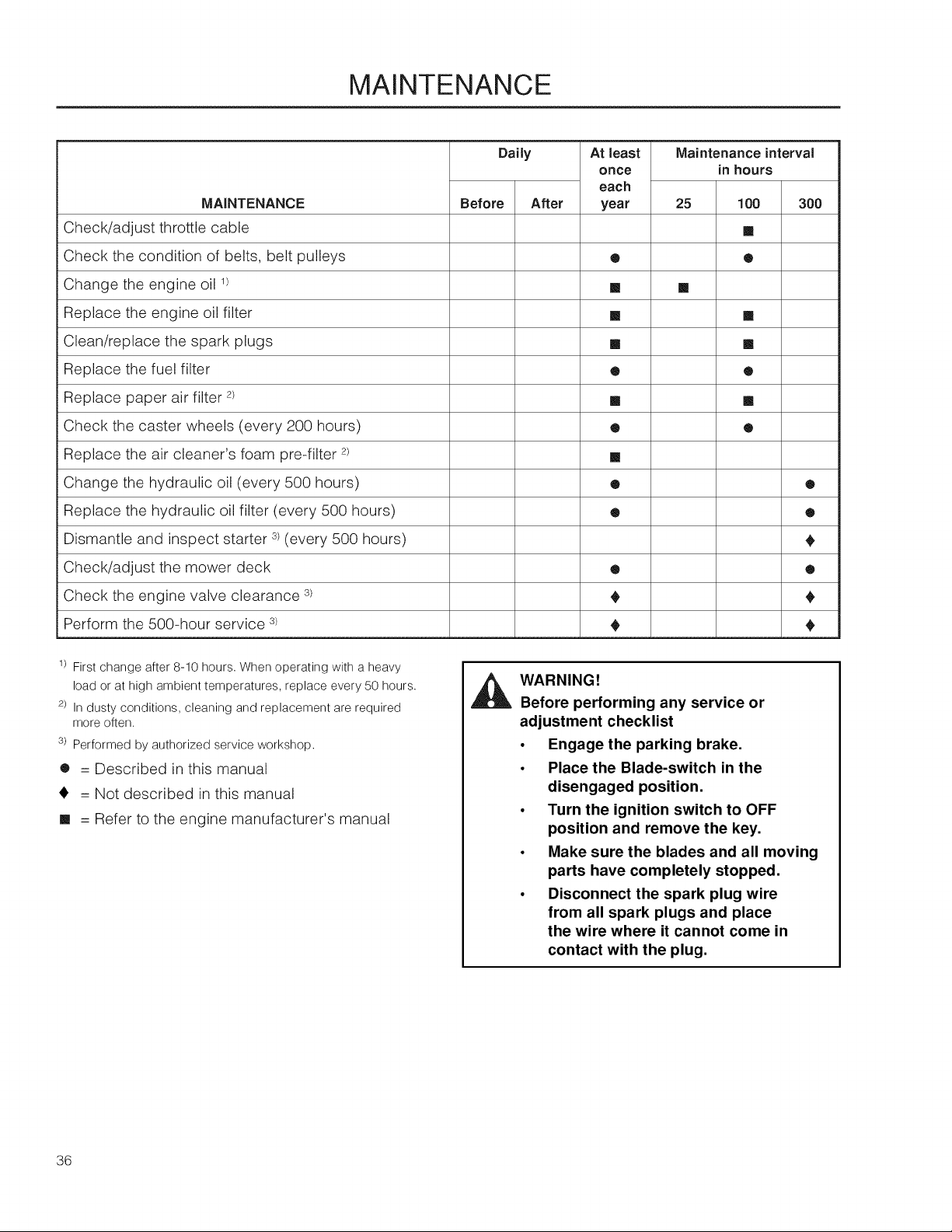
Check/adjust throttle cable []
Check the condition of belts, belt pulleys • •
Change the engine oil 1) [] []
Replace the engine oil filter [] []
Clean/replace the spark plugs [] []
Replace the fuel filter • •
Replace paper air filter 2) [] []
Check the caster wheels (every 200 hours) • •
Replace the air cleaner's foam pre-filter 2) []
Change the hydraulic oil (every 500 hours) • •
Replace the hydraulic oil filter (every 500 hours) • •
Dismantle and inspect starter 3) (every 500 hours) •
Check/adjust the mower deck • •
Check the engine valve clearance 3/ • •
Perform the 500-hour service 3) • •
_b_ ARNINGt
Before performing any service or
adjustment checklist
• Engage the parking brake.
• Place the Blade-switch in the
disengaged position.
• Turn the ignition switch to OFF
position and remove the key.
• Make sure the blades and all moving
parts have completely stopped.
• Disconnect the spark plug wire
from all spark plugs and place
the wire where it cannot come in
contact with the plug.
1) First change after 8-10 hours. When operating with a heavy
load or at high ambient temperatures, replace every 50 hours.
2) In dusty conditions, cleaning and replacement are required
more often.
3) Performed by authorized service workshop.
• _-Described in this manual
• -- Not described in this manual
[] -- Refer to the engine manufacturer's manual
36
MAINTENANCE
Battery
Your mower is equipped with a maintenance free
battery and does not need servicing. However,
periodic charging of the battery with an automotive
type battery charger will extend its life.
• Keep battery and terminals clean.
Keep battery bolts tight.
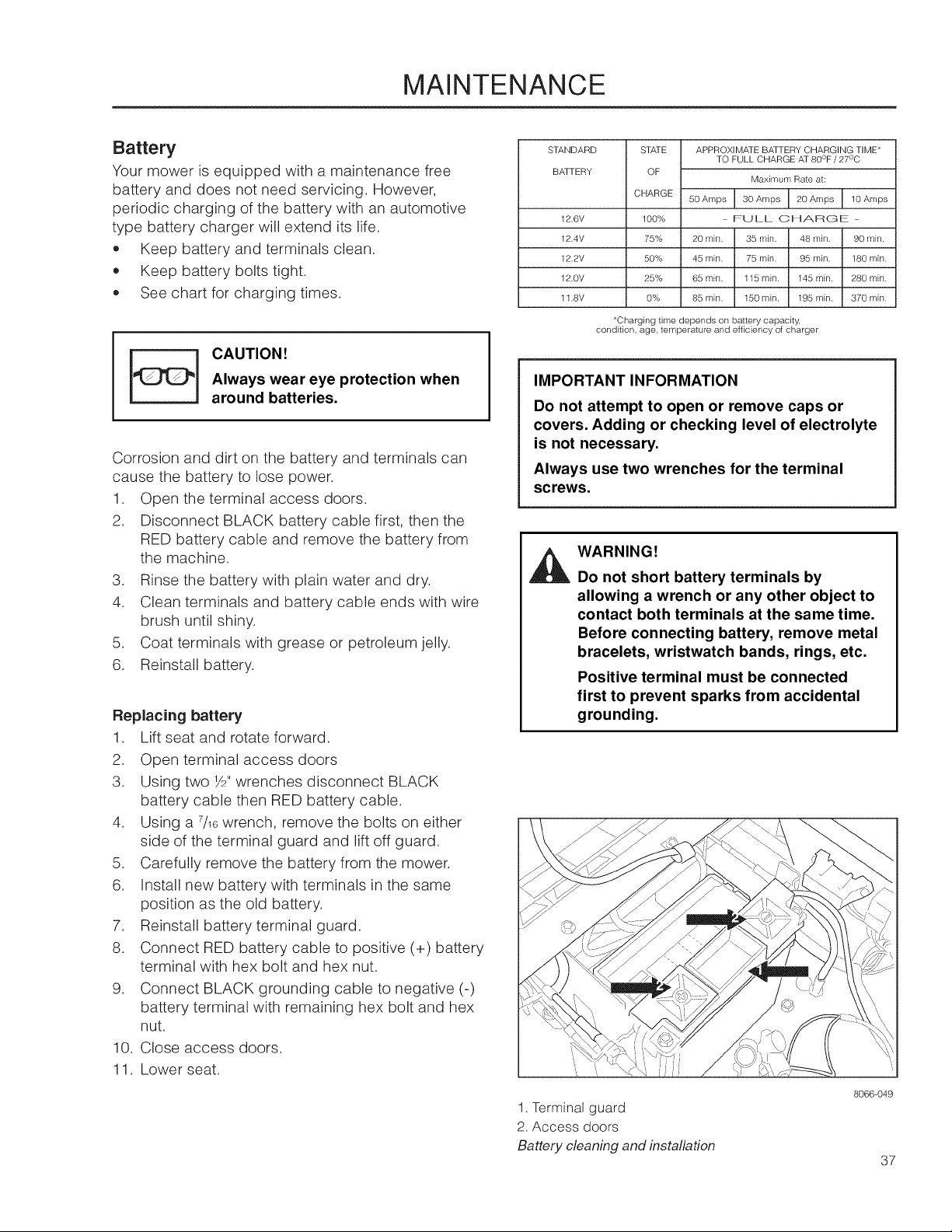
See chart for charging times.
_j CAUTIONt
Always wear eye protection when
around batteries.
Corrosion and dirt on the battery and terminals can
cause the battery to lose power.
1. Open the terminal access doors.
2. Disconnect BLACK battery cable first, then the
RED battery cable and remove the battery from
the machine.
3. Rinse the battery with plain water and dry.
4. Clean terminals and battery cable ends with wire
brush until shiny.
5. Coat terminals with grease or petroleum jelly.
6. Reinstall battery.
Replacing battery
1. Lift seat and rotate forward.
2. Open terminal access doors
3. Using two 1/2"wrenches disconnect BLACK
battery cable then RED battery cable.
4. Using a 7/18wrench, remove the bolts on either
side of the terminal guard and lift off guard.
5. Carefully remove the battery from the mower.
6. Install new battery with terminals in the same
position as the old battery.
7. Reinstall battery terminal guard.
8. Connect RED battery cable to positive (+) battery
terminal with hex bolt and hex nut.
9. Connect BLACK grounding cable to negative (-)
battery terminal with remaining hex bolt and hex
nut.
10. Close access doors.
11. Lower seat.
STANDARD
BATTERY
STATE
OF
CHARGE
12.6V 100%
12.4V 75% 20 min. 35 min. 48 min.
12.2V 50% 45 min. 75 min. 95 min.
12.0V 25% 65 min. 115 rain. 145 min.
11.8V 0% 85 min. 150 rain. 195 min.
*Charging time depends on battery capacity,
condition, age, temperature and efficiency of charger
APPROXIMATE BATTERY CHARGING TIME*
TO FULL CHARGE AT 80°F / 27°C
Maximum Rate at:
50Amps I 30Amps I 20Amps I 10Amps
FULL CHARGE
90 min.
180 rain.
280 rain.
370 min.
IMPORTANT INFORMATION
Do not attempt to open or remove caps or
covers. Adding or checking level of electrolyte
is not necessary.
Always use two wrenches for the terminal
screws.
_ WARNINGt
Do not short battery terminals by
allowing a wrench or any other object to
contact both terminals at the same time.
Before connecting battery, remove metal
bracelets, wristwatch bands, rings, etc.
Positive terminal must be connected
first to prevent sparks from accidental
grounding.
1, Terminal guard
2, Access doors
Battery cleaning and installation
8066-049
37
MAINTENANCE
Safety System
This machine is equipped with a safety system
that prevents starting or driving under the following
conditions.
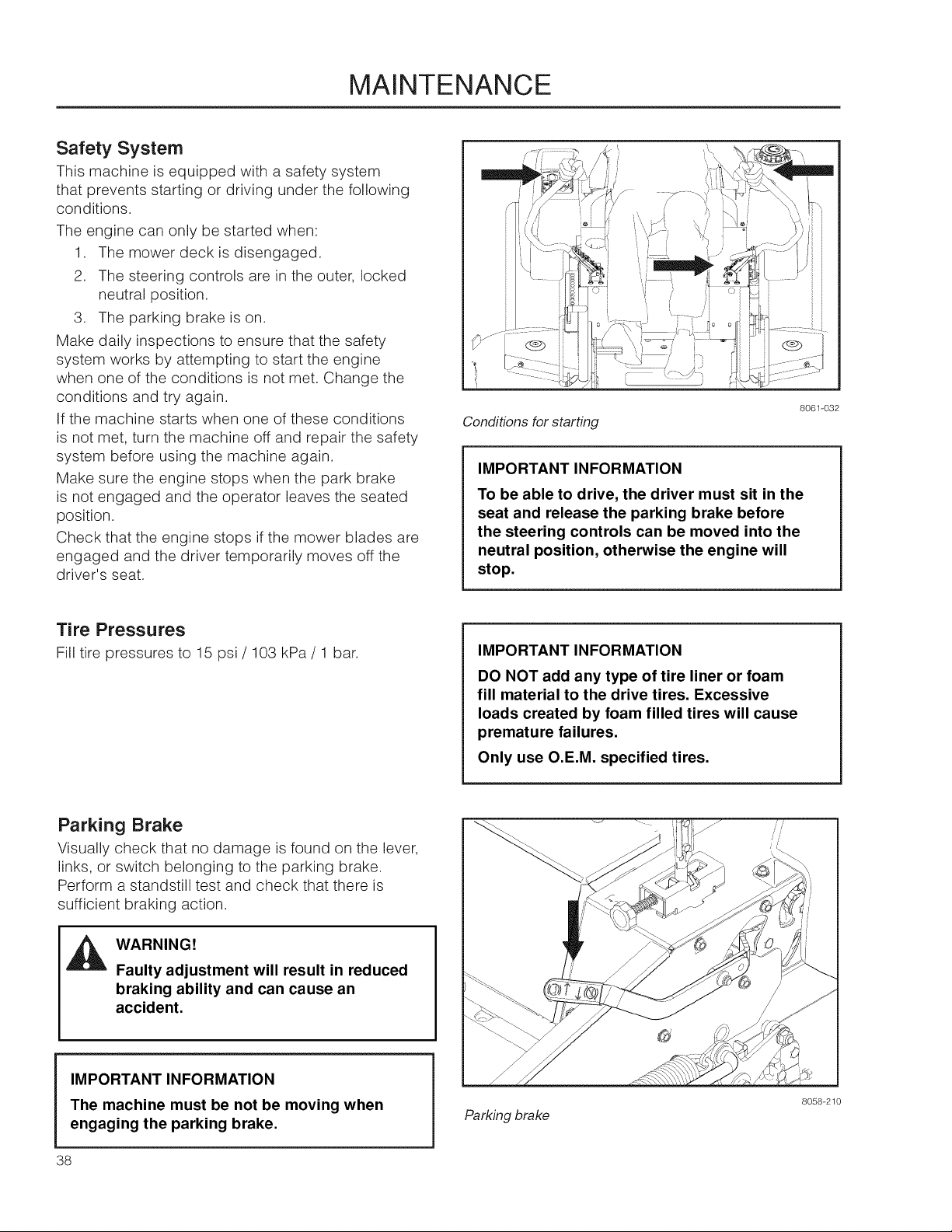
The engine can only be started when:
1. The mower deck is disengaged.
2. The steering controls are in the outer, locked
neutral position.
3. The parking brake is on.
Make daily inspections to ensure that the safety
system works by attempting to start the engine
when one of the conditions is not met. Change the
conditions and try again.
If the machine starts when one of these conditions
is not met, turn the machine off and repair the safety
system before using the machine again.
Make sure the engine stops when the park brake
is not engaged and the operator leaves the seated
position.
Check that the engine stops if the mower blades are
engaged and the driver temporarily moves off the
driver's seat.
Conditions for starting
8061-032
IMPORTANT INFORMATION
To be able to drive, the driver must sit in the
seat and release the parking brake before
the steering controls can be moved into the
neutral position, otherwise the engine will
stop.
Tire Pressures
Fill tire pressures to 15 psi / 103 kPa / 1 bar.
IMPORTANT INFORMATION
DO NOT add any type of tire liner or foam
fill material to the drive tires. Excessive
loads created by foam filled tires will cause
premature failures.
Only use O.E.M. specified tires.
Parking Brake
Visually check that no damage is found on the lever,
links, or switch belonging to the parking brake.
Perform a standstill test and check that there is
sufficient braking action.
_k ARNING!
Faulty adjustment will result in reduced
braking ability and can cause an
accident.
IMPORTANT INFORMATION
The machine must be not be moving when
engaging the parking brake.
Parking brake
8058-210
38
MAINTENANCE
Deck Belt
Deck Belt Removal
Park on a level surface. Apply park brake. Lower the
deck into the lowest cutting position.
1. Remove foot plate and belt shields.
2. Using a ratchet or breaker bar with a 9/16"socket
on the spring idler bolt, relieve the tension on the
belt.
3. Remove any dirt or grass that may have
accumulated around the cutter housings and
entire deck surface.
4. Carefully slip the belt over the top of the cutter
housing pulleys.
5. Remove the belt from around the electric clutch on
the engine shaft and off the mower deck.
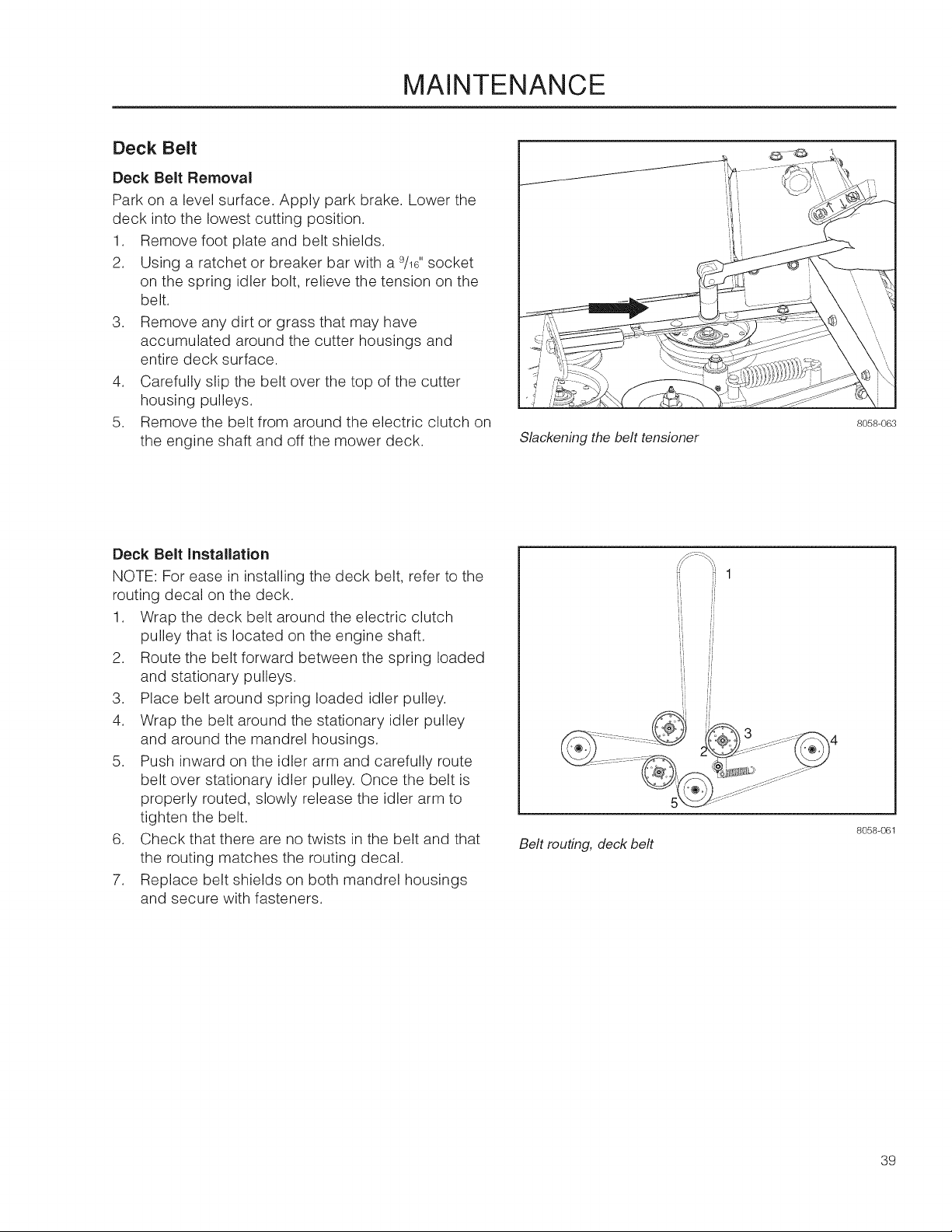
Slackening the belt tensioner
8058-063
Deck Belt Installation
NOTE: For ease in installing the deck belt, refer to the
routing decal on the deck.
1. Wrap the deck belt around the electric clutch
pulley that is located on the engine shaft.
2. Route the belt forward between the spring loaded
and stationary pulleys.
3. Place belt around spring loaded idler pulley.
4. Wrap the belt around the stationary idler pulley
and around the mandrel housings.
5. Push inward on the idler arm and carefully route
belt over stationary idler pulley. Once the belt is
properly routed, slowly release the idler arm to
tighten the belt.
6. Check that there are no twists in the belt and that
the routing matches the routing decal.
7. Replace belt shields on both mandrel housings
and secure with fasteners.
_J
_J
i]
H
_J
_J
iJ
_J
Belt routing, deck belt
8058-061
39
MAINTENANCE
Pump Belt
The belts are not adjustable. Replace belts if they
begin to slip from wear,
Replacing Pump Belt
Park the mower on a level surface. Engage the
parking brake,
Belt Removal
From the top side of the deck:
1. Remove the deck belt (see Deck Belt Removal in
this section of the manual).
2. Tilt seat forward to access fan covers. Remove
both fan covers.
From the underside of the mower:
3. Remove clutch stop to access the belt.
4. With a 1/2"breaker bar and using the square
opening in the pump idler arm, shift the arm to
create slack in the belt.
5. With the idler arm in the slack position, slip a
screwdriver, clevis pin or similar into the 3/8"hole
in the plate that sits between the two fan covers.
This will keep the idler in the extended position
and allow removal of the breaker bar.
6. Remove belt from the engine and pump pulleys
over the top of the fans.
Belt Installation
7. If the pump is not locked in the extended position,
repeat Steps 4 and 5 from the above instructions.
8. Slip the belt over the fans and route it between the
idler pulleys.
9. Place the belt over the right and left idler pulleys.
10. Place the belt on the engine pulley.
11. Use the breaker bar to hold the tension off the belt
while removing the implement used as a brace in
the plate.
12. Replace and secure clutch stop.
13. Reinstall the fan shields.
14. Reinstall the deck belt. (See Deck Belt Installation
in this section of the manual).
V-belts
Check every 100 hours of operation. Check for severe
cracking and large nicks.
NOTE: The belt will show some small cracks in normal
operation.
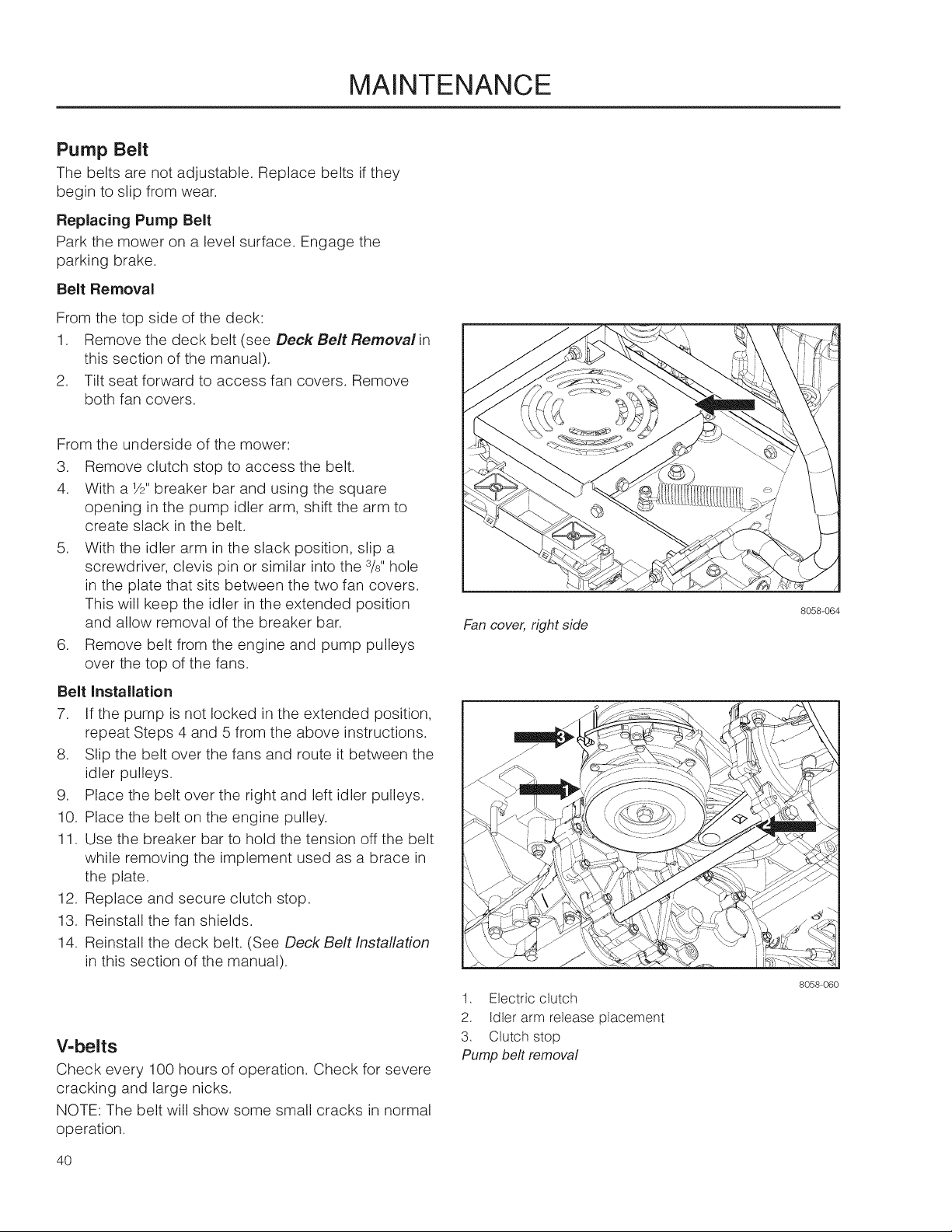
Fan cover, right side
8058-064
m
1. Electric clutch
2. Idler arm release placement
3. Clutch stop
Pump belt removal
8058-060
4O
MAINTENANCE
Cutting Blades
For the best moving results, it is important that blades
are well sharpened and not damaged.
Replace blades that have been bent or cracked by
hitting obstacles.
Let the service workshop decide whether a blade
with large nicks can be repaired/ground or must be
replaced. Balance the blades after sharpening.
Check the blade mounts.
WARNINGt
Blades are sharp. Protect your hands
with gloves and/or wrap blades with a
heavy cloth when handling.
The sharpening of blades should be
carried out by an authorized service
workshop.
Blade replacement
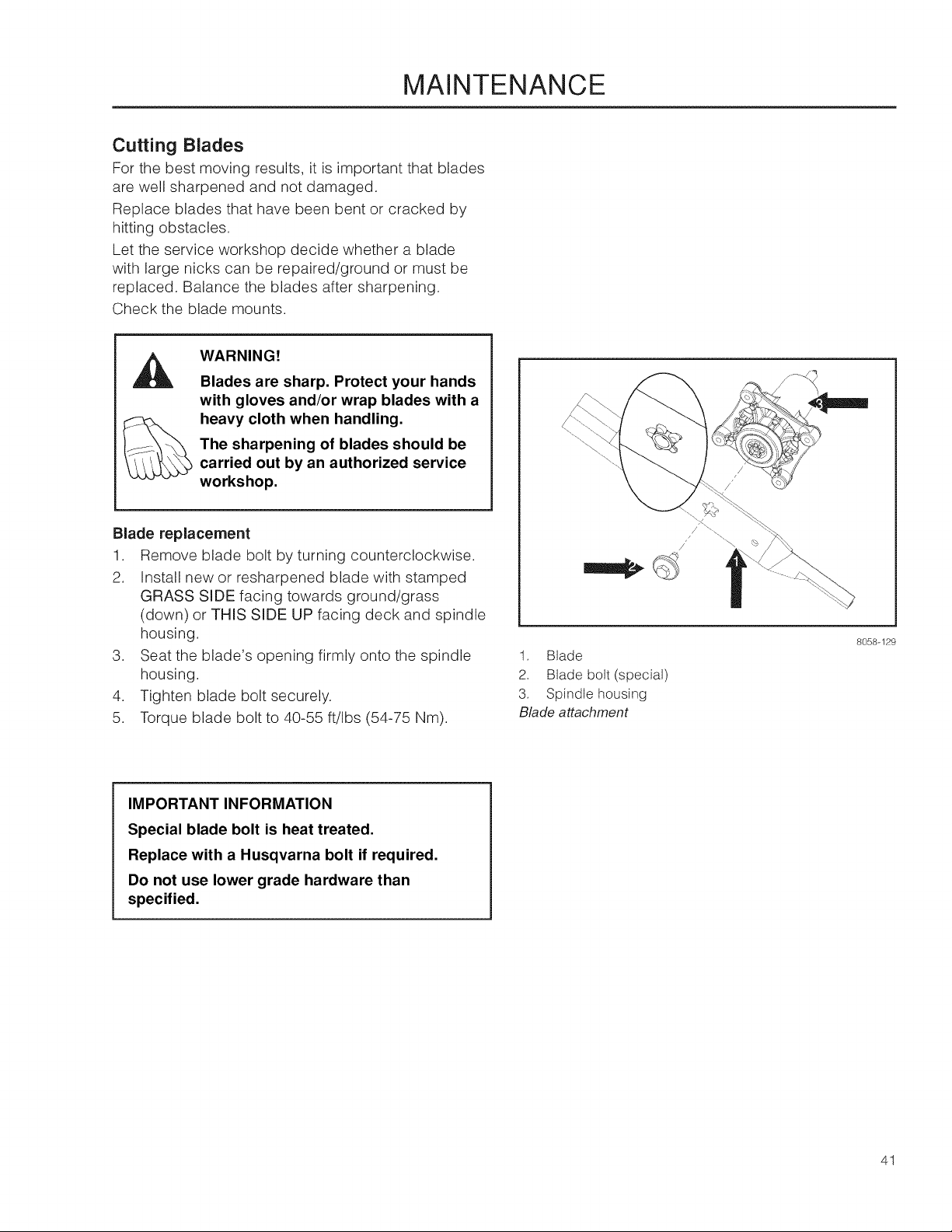
1. Remove blade bolt by turning counterclockwise.
2. Install new or resharpened blade with stamped
GRASS SIDE facing towards ground/grass
(down) or THIS SIDE UP facing deck and spindle
housing.
3. Seat the blade's opening firmly onto the spindle
housing.
4. Tighten blade bolt securely.
5. Torque blade bolt to 40-55 ft/Ibs (54-75 Nm).
1, Blade
2, Blade bolt (special)
3, Spindle housing
Blade attachment
8058-129
IMPORTANT INFORMATION
Special blade bolt is heat treated.
Replace with a Husqvarna bolt if required.
Do not use lower grade hardware than
specified.
41
MAINTENANCE
Adjusting the Mower Deck
Check the tire pressure before adjustment of the
mower deck. See Tire Pressures in Maintenance
section. Faulty mower deck adjustments will cause an
uneven mowing result.
Leveling deck
Adjust the deck while the mower is on a level
surface. Make sure the tires are inflated to the correct
pressure. See Technical Data /Transmission. If the
tires are under or over inflated, the deck cannot be
properly adjusted.
Four slots control the height and pitch of the mower
deck. The deck should be adjusted slightly higher in
the rear.
NOTE: To insure accuracy of leveling procedure,
mower deck drive belt must be installed prior to
leveling deck.
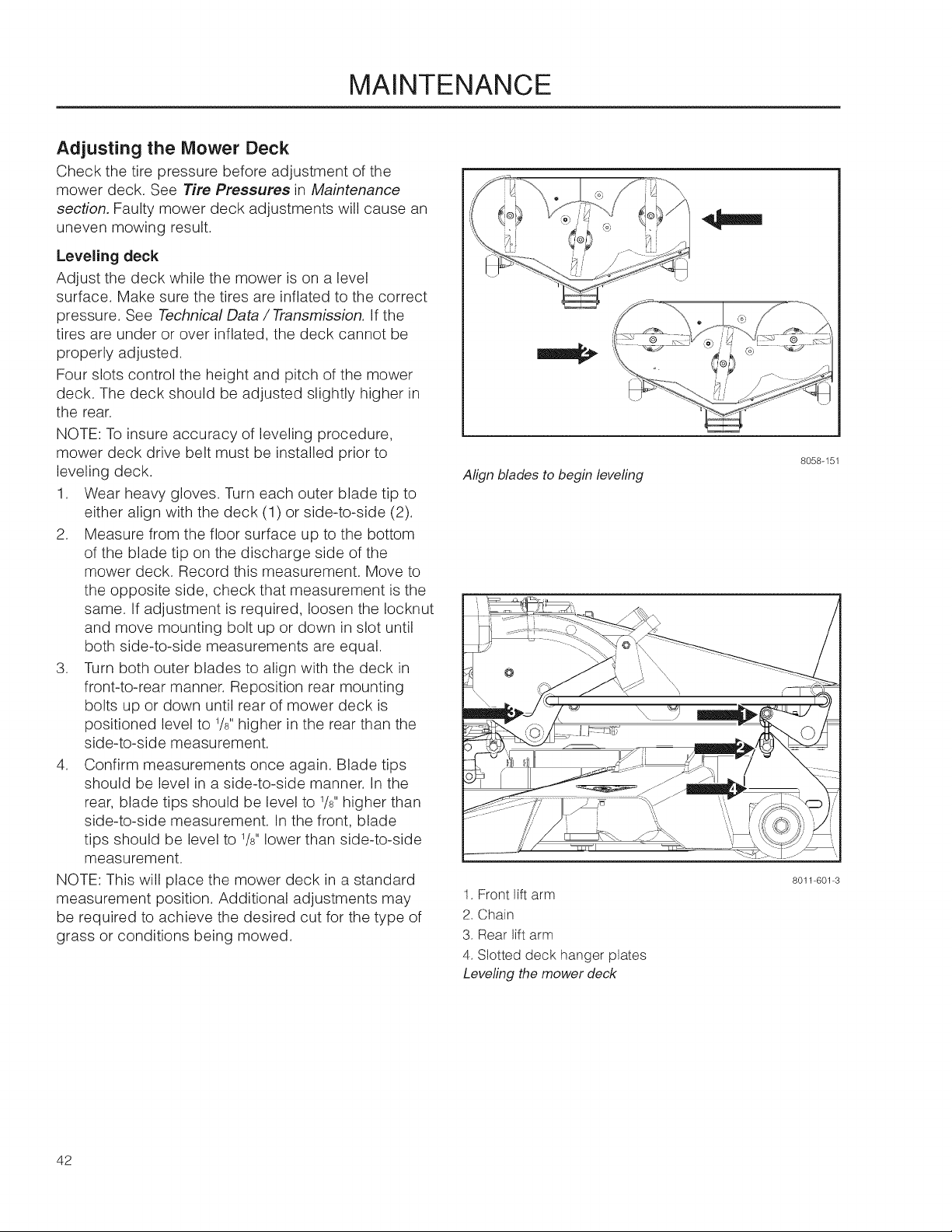
1. Wear heavy gloves. Turn each outer blade tip to
either align with the deck (1) or side-to-side (2).
2. Measure from the floor surface up to the bottom
of the blade tip on the discharge side of the
mower deck. Record this measurement. Move to
the opposite side, check that measurement is the
same. If adjustment is required, loosen the Iocknut
and move mounting bolt up or down in slot until
both side-to-side measurements are equal.
3. Turn both outer blades to align with the deck in
front-to-rear manner. Reposition rear mounting
bolts up or down until rear of mower deck is
positioned level to 1/8"higher in the rear than the
side-to-side measurement.
4. Confirm measurements once again. Blade tips
should be level in a side-to-side manner. In the
rear, blade tips should be level to 1/8"higher than
side-to-side measurement. In the front, blade
tips should be level to 1/8"lower than side-to-side
measurement.
NOTE: This will place the mower deck in a standard
measurement position. Additional adjustments may
be required to achieve the desired cut for the type of
grass or conditions being mowed.
Align blades to begin leveling
1. Front lift arm
2, Chain
3. Rear lift arm
4. Slotted deck hanger plates
Leveling the mower deck
8058-151
8011-601-3
42
MAINTENANCE
Anti=scalp rollers
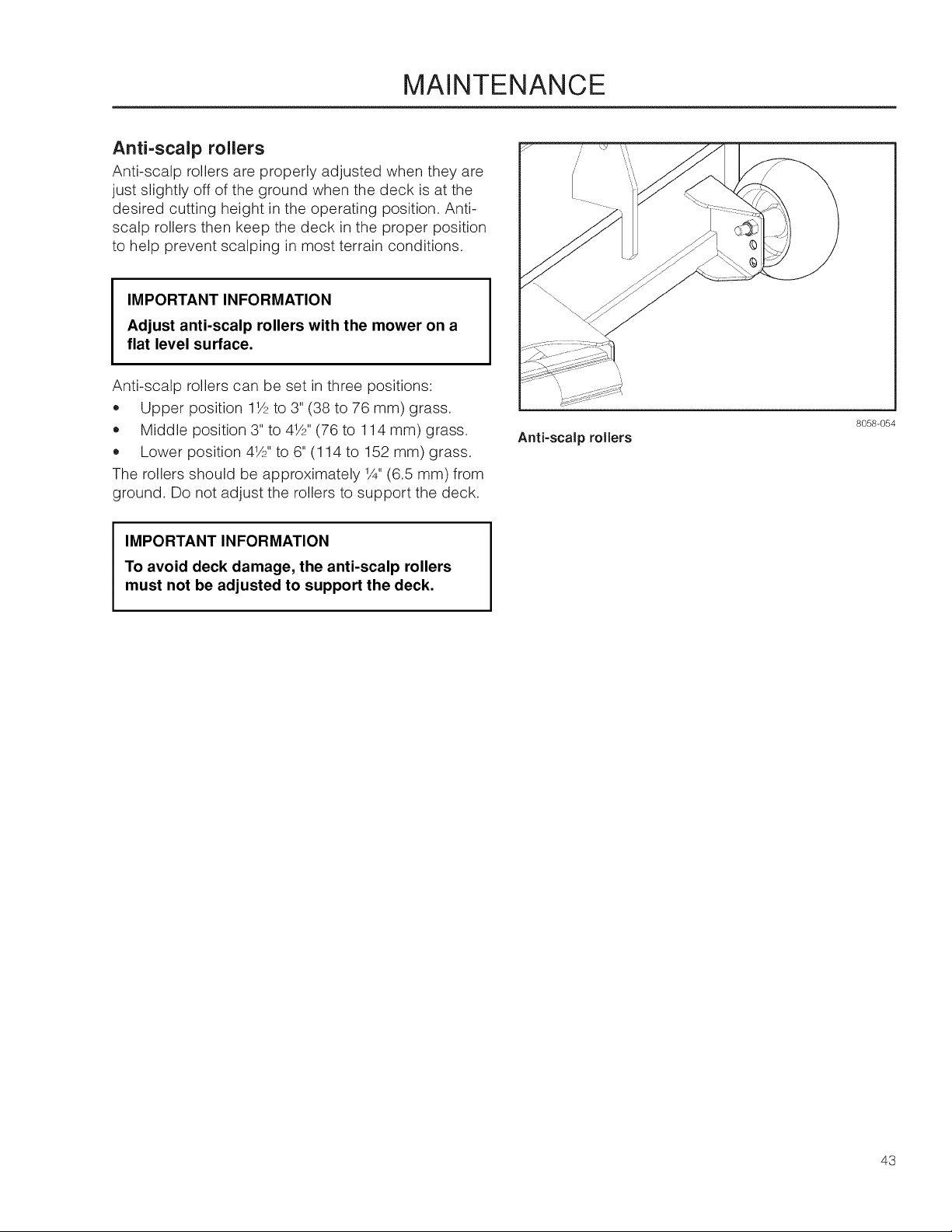
Anti-scalp rollers are properly adjusted when they are
just slightly off of the ground when the deck is at the
desired cutting height in the operating position. Anti-
scalp rollers then keep the deck in the proper position
to help prevent scalping in most terrain conditions,
IMPORTANT INFORMATION
Adjust anti-scalp rollers with the mower on a
flat level surface.
Anti-scalp rollers can be set in three positions:
• Upper position 11/2to 3" (38 to 76 mm) grass.
• Middle position 3" to 41/2'' (76 to 114 mm) grass.
• Lower position 41/2'' to 6" (114 to 152 mm) grass.
The rollers should be approximately 1/4"(6.5 mm) from
ground, Do not adjust the rollers to support the deck,
Anti-scalp rollers
8058-054
IMPORTANT INFORMATION
To avoid deck damage, the anti-scalp rollers
must not be adjusted to support the deck.
43
MAINTENANCE
Caster Wheels
Check every 200 hours. Check that wheels rotate
freely,
IMPORTANT INFORMATION
DO NOT add any type of tire liner or foam fill
material to the tires. Excessive loads created
by foam tires will cause premature failures.
Use only O.E.M. specified tires.
Removal and Installation
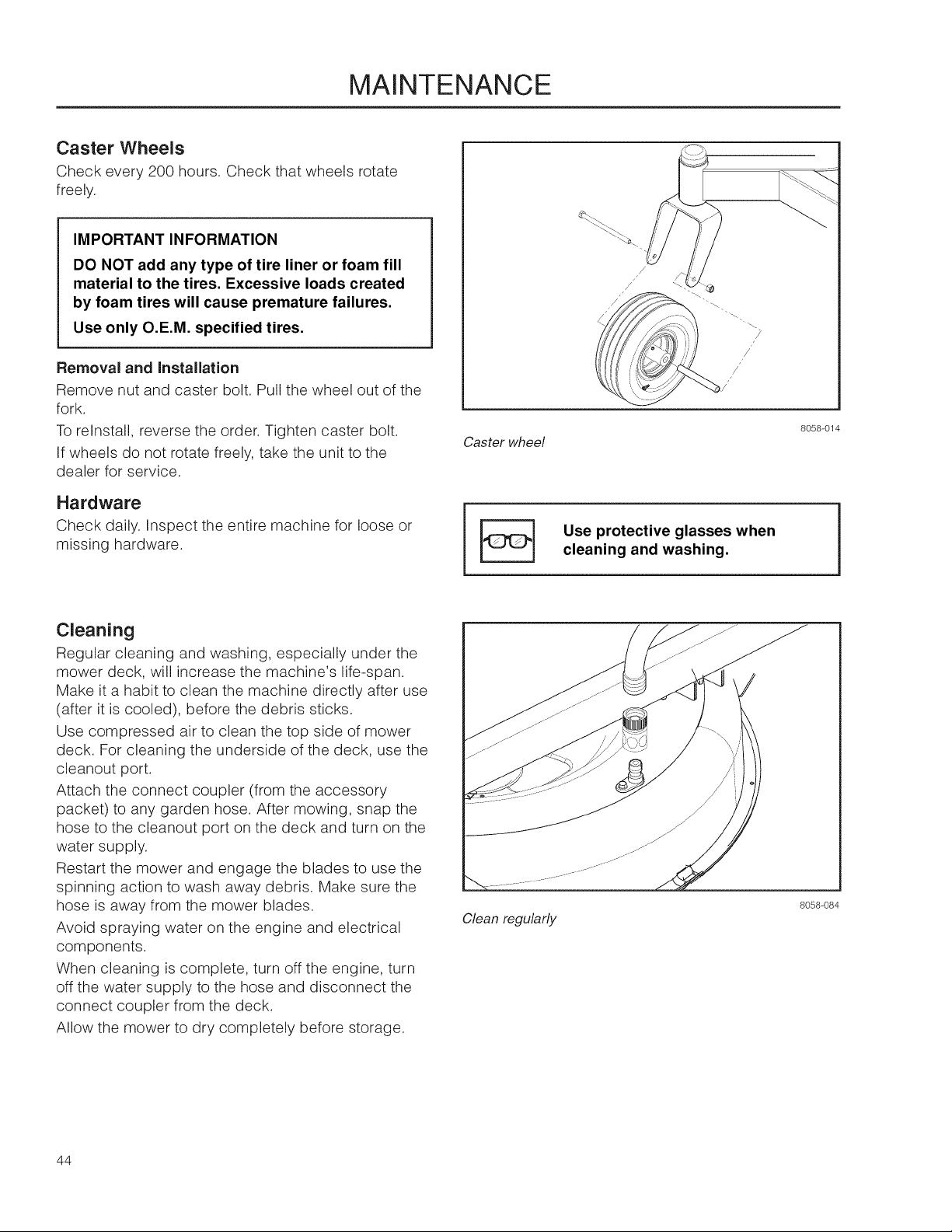
Remove nut and caster bolt. Pull the wheel out of the
fork,
To reinstall, reverse the order. Tighten caster bolt.
If wheels do not rotate freely, take the unit to the
dealer for service,
Hardware
Check daily. Inspect the entire machine for loose or
missing hardware,
/
//
///
Caster wheel
8058-014
Use protective glasses when
cleaning and washing.
Cleaning
Regular cleaning and washing, especially under the
mower deck, will increase the machine's life-span.
Make it a habit to clean the machine directly after use
(after it is cooled), before the debris sticks,
Use compressed air to clean the top side of mower
deck. For cleaning the underside of the deck, use the
cleanout port,
Attach the connect coupler (from the accessory
packet) to any garden hose. After mowing, snap the
hose to the cleanout port on the deck and turn on the
water supply,
Restart the mower and engage the blades to use the
spinning action to wash away debris, Make sure the
hose is away from the mower blades,
Avoid spraying water on the engine and electrical
components.
When cleaning is complete, turn off the engine, turn
off the water supply to the hose and disconnect the
connect coupler from the deck,
Allow the mower to dry completely before storage,
Clean regularly
8058-084
44
LUBRICATION
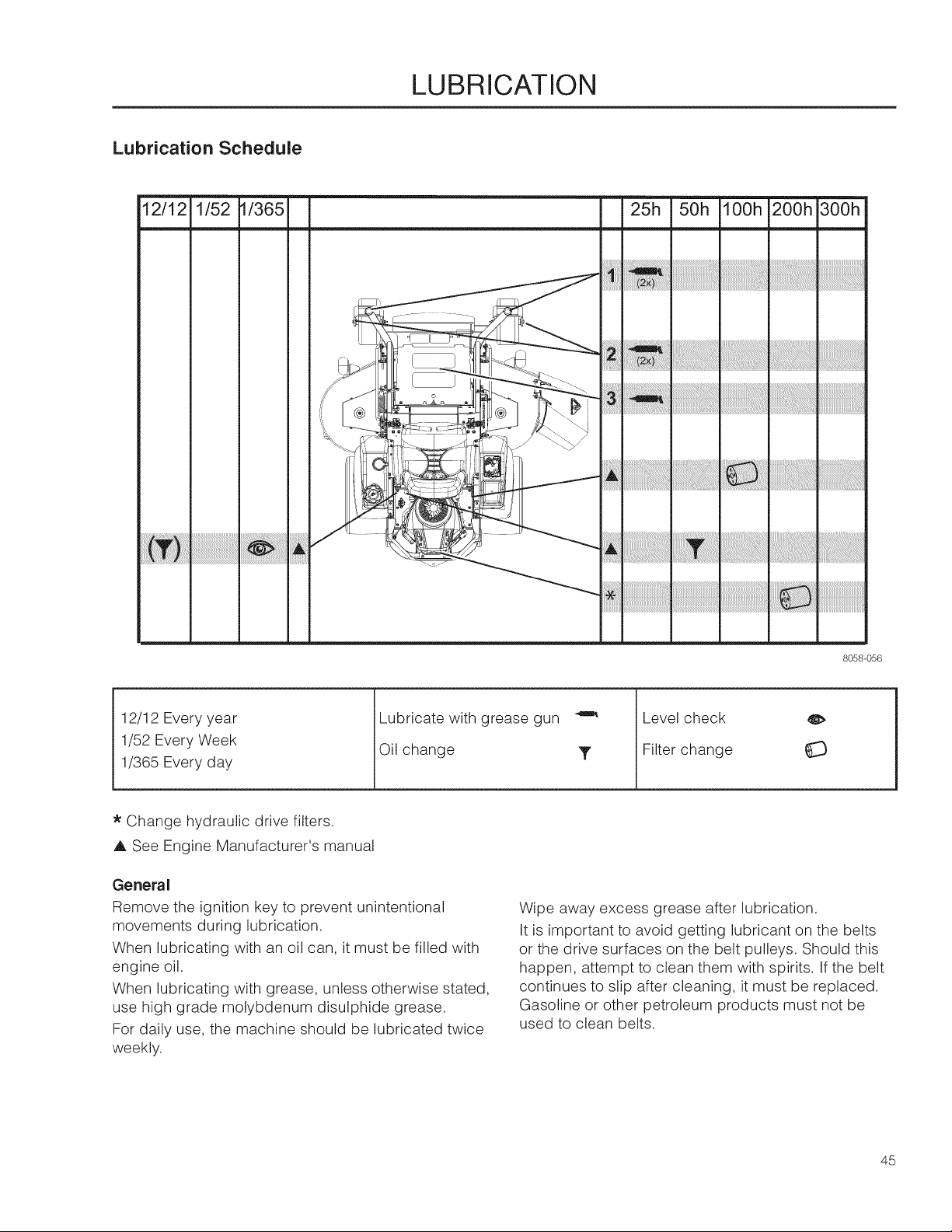
Lubrication Schedule
12/12 1/52 /365 25h 50h 100h 200h 300h
8058-056
12/12 Every year
1/52 Every Week
1/365 Every day
Lubricate with grease gun
Oil change '_
Level check
Filter change
Change hydraulic drive filters,
A See Engine Manufacturer's manual
General
Remove the ignition key to prevent unintentional
movements during lubrication,
When lubricating with an oil can, it must be filled with
engine oil,
When lubricating with grease, unless otherwise stated,
use high grade molybdenum disulphide grease,
For daily use, the machine should be lubricated twice
weekly,
Wipe away excess grease after lubrication,
It is important to avoid getting lubricant on the belts
or the drive surfaces on the belt pulleys, Should this
happen, attempt to clean them with spirits. If the belt
continues to slip after cleaning, it must be replaced,
Gasoline or other petroleum products must not be
used to clean belts,
45
LUBRICATION
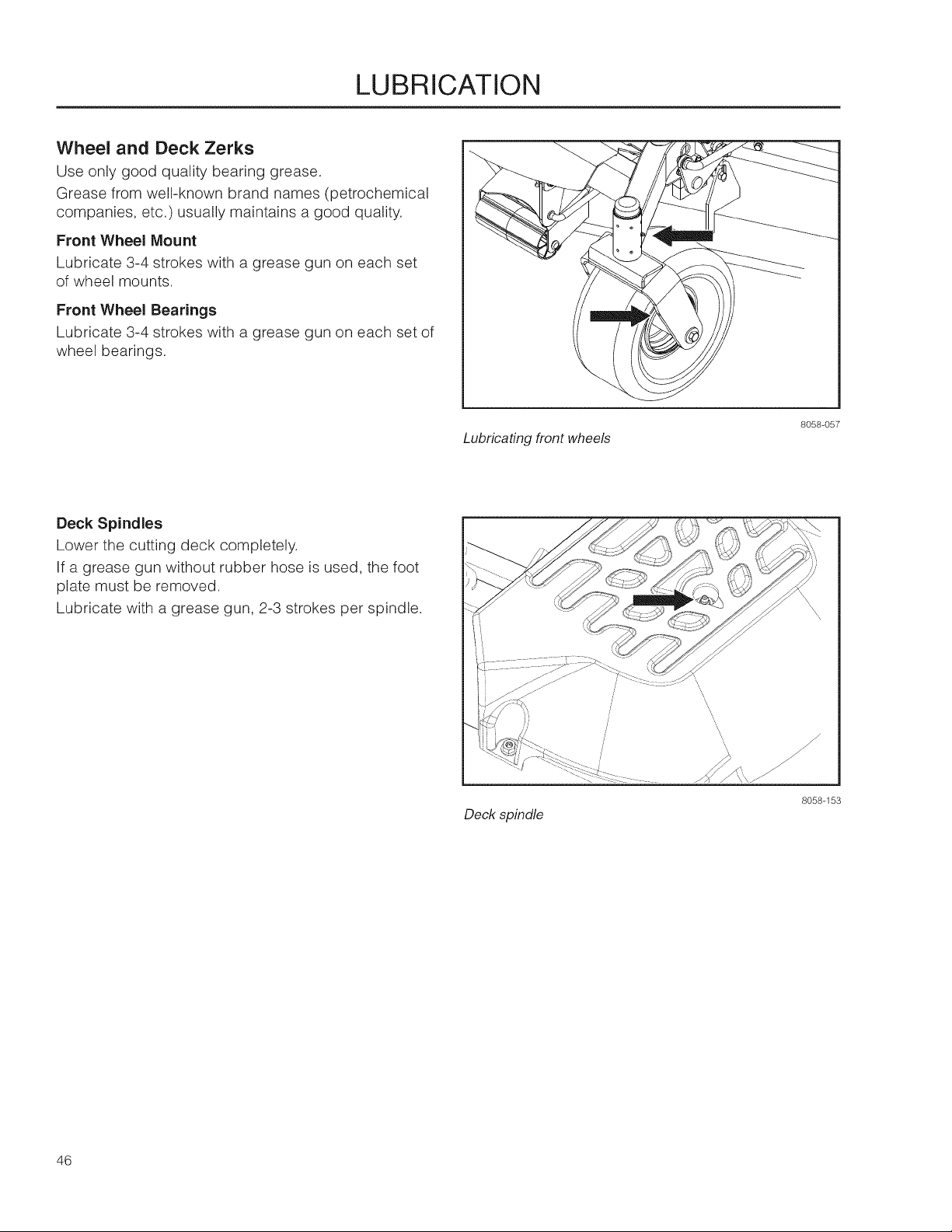
Wheel and Deck Zerks
Use only good quality bearing grease,
Grease from well-known brand names (petrochemical
companies, etc,) usually maintains a good quality,
Front Wheel Mount
Lubricate 3-4 strokes with a grease gun on each set
of wheel mounts,
Front Wheel Bearings
Lubricate 3-4 strokes with a grease gun on each set of
wheel bearings,
J
Lubricating front wheels
8058-057
Deck Spindles
Lower the cutting deck completely,
If a grease gun without rubber hose is used, the foot
plate must be removed,
Lubricate with a grease gun, 2-3 strokes per spindle,
Deck spindle
8058-153
46
LUBRICATION
Transaxle (Transmission) Fluid Change
This transaxle is designed with an external filter for
ease of maintenance. To ensure constant fluid quality
levels and longer life, an oil filter change interval of
every 200 hours is recommended.
The following procedure is performed with the
transaxles installed in the mower and the mower on
level ground. Apply the pump release valve for each
transaxle and set the parking brake.
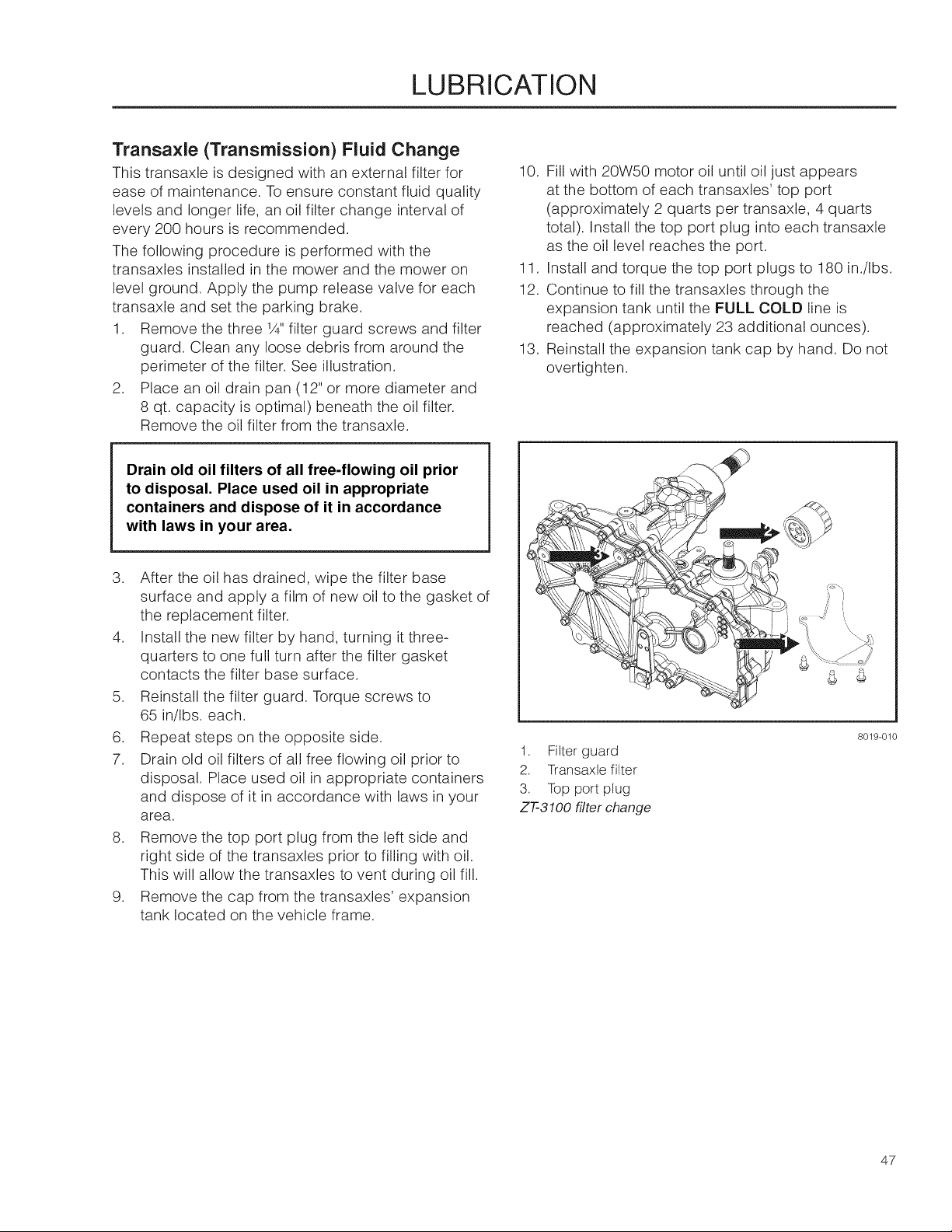
1. Remove the three 1/4"filter guard screws and filter
guard. Clean any loose debris from around the
perimeter of the filter. See illustration.
2. Place an oil drain pan (12" or more diameter and
8 qt. capacity is optimal) beneath the oil filter.
Remove the oil filter from the transaxle.
10. Fill with 20W50 motor oil until oil just appears
at the bottom of each transaxles' top port
(approximately 2 quarts per transaxle, 4 quarts
total). Install the top port plug into each transaxle
as the oil level reaches the port.
11. Install and torque the top port plugs to 180 in./Ibs.
12. Continue to fill the transaxles through the
expansion tank until the FULL COLD line is
reached (approximately 23 additional ounces).
13. Reinstall the expansion tank cap by hand. Do not
overtighten.
Drain old oil filters of all free-flowing oil prior
to disposal. Place used oil in appropriate
containers and dispose of it in accordance
with laws in your area.
3. After the oil has drained, wipe the filter base
surface and apply a film of new oil to the gasket of
the replacement filter.
4. Install the new filter by hand, turning it three-
quarters to one full turn after the filter gasket
contacts the filter base surface.
5. Reinstall the filter guard. Torque screws to
65 in/Ibs, each.
6. Repeat steps on the opposite side.
7. Drain old oil filters of all free flowing oil prior to
disposal. Place used oil in appropriate containers
and dispose of it in accordance with laws in your
area.
8. Remove the top port plug from the left side and
right side of the transaxles prior to filling with oil.
This will allow the transaxles to vent during oil fill.
9. Remove the cap from the transaxles' expansion
tank located on the vehicle frame.
1, Filter guard
2, Transaxle filter
3, Top port plug
ZT-3100 filter change
8019-010
47
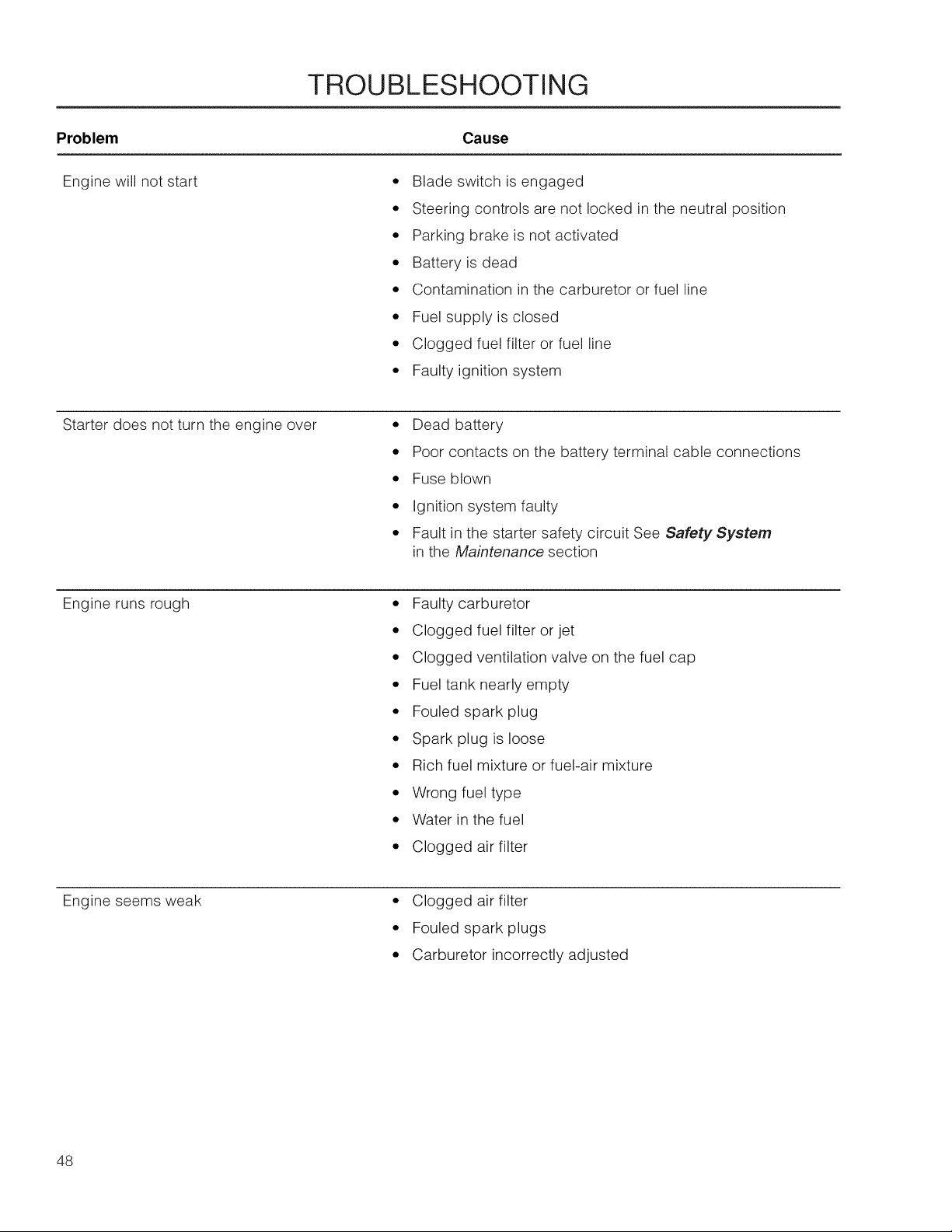
TROUBLESHOOTING
CauseProblem
Engine will not start • Blade switch is engaged
• Steering controls are not locked in the neutral position
• Parking brake is not activated
• Battery is dead
• Contamination in the carburetor or fuel line
• Fuel supply is closed
• Clogged fuel filter or fuel line
• Faulty ignition system
Starter does not turn the engine over
• Dead battery
• Poor contacts on the battery terminal cable connections
• Fuse blown
• Ignition system faulty
• Fault in the starter safety circuit See Safety System
in the Maintenance section
Engine runs rough • Faulty carburetor
• Clogged fuel filter or jet
• Clogged ventilation valve on the fuel cap
• Fuel tank nearly empty
• Fouled spark plug
• Spark plug is loose
• Rich fuel mixture or fuel-air mixture
• Wrong fuel type
• Water in the fuel
• Clogged air filter
Engine seems weak
• Clogged air filter
• Fouled spark plugs
• Carburetor incorrectly adjusted
48
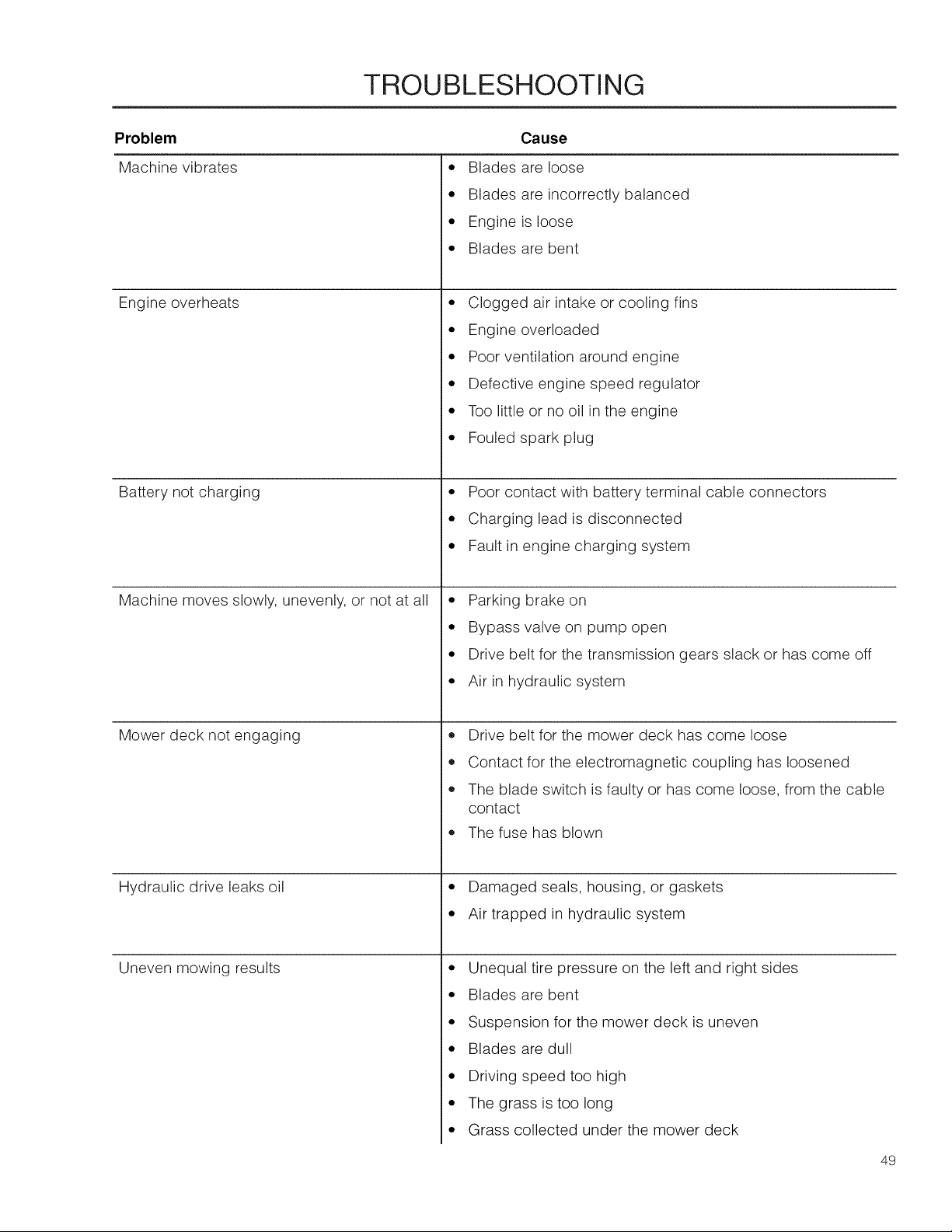
TROUBLESHOOTING
Problem
Machine vibrates
Engine overheats
Battery not charging
Machine moves slowly, unevenly, or not at all
Mower deck not engaging
Hydraulic drive leaks oil
Uneven mowing results
Cause
• Blades are loose
• Blades are incorrectly balanced
• Engine is loose
• Blades are bent
• Clogged air intake or cooling fins
• Engine overloaded
• Poor ventilation around engine
• Defective engine speed regulator
• Too little or no oil in the engine
• Fouled spark plug
• Poor contact with battery terminal cable connectors
• Charging lead is disconnected
• Fault in engine charging system
• Parking brake on
• Bypass valve on pump open
• Drive belt for the transmission gears slack or has come off
• Air in hydraulic system
• Drive belt for the mower deck has come loose
• Contact for the electromagnetic coupling has loosened
• The blade switch is faulty or has come loose, from the cable
contact
• The fuse has blown
• Damaged seals, housing, or gaskets
• Air trapped in hydraulic system
• Unequal tire pressure on the left and right sides
• Blades are bent
• Suspension for the mower deck is uneven
• Blades are dull
• Driving speed too high
• The grass is too long
• Grass collected under the mower deck
49
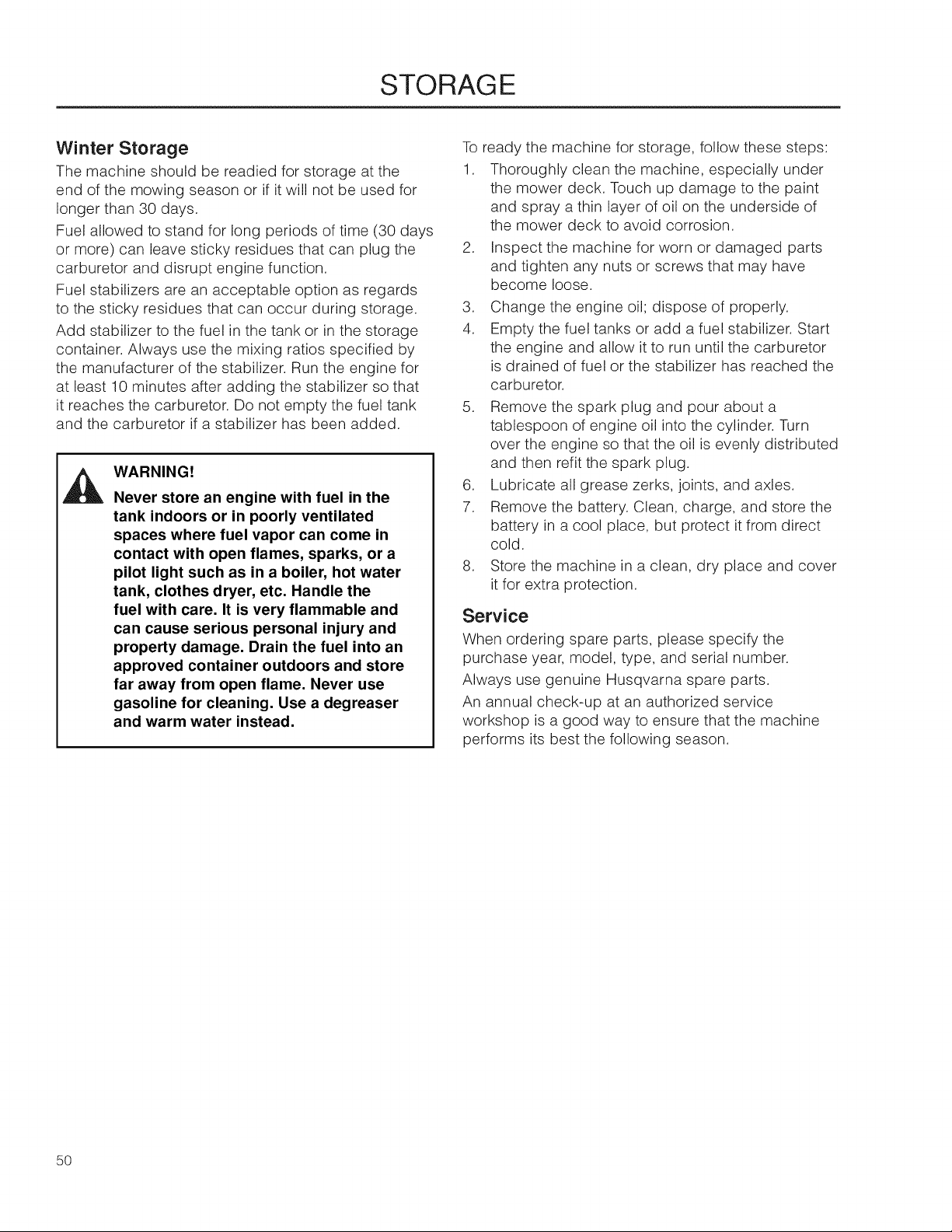
STORAGE
Winter Storage
The machine should be readied for storage at the
end of the mowing season or if it will not be used for
longer than 30 days.
Fuel allowed to stand for long periods of time (30 days
or more) can leave sticky residues that can plug the
carburetor and disrupt engine function.
Fuel stabilizers are an acceptable option as regards
to the sticky residues that can occur during storage.
Add stabilizer to the fuel in the tank or in the storage
container. Always use the mixing ratios specified by
the manufacturer of the stabilizer. Run the engine for
at least 10 minutes after adding the stabilizer so that
it reaches the carburetor. Do not empty the fuel tank
and the carburetor if a stabilizer has been added.
WARNINGt
Never store an engine with fuel in the
tank indoors or in poorly ventilated
spaces where fuel vapor can come in
contact with open flames, sparks, or a
pilot light such as in a boiler, hot water
tank, clothes dryer, etc. Handle the
fuel with care. It is very flammable and
can cause serious personal injury and
property damage. Drain the fuel into an
approved container outdoors and store
far away from open flame. Never use
gasoline for cleaning. Use a degreaser
and warm water instead.
To ready the machine for storage, follow these steps:
1. Thoroughly clean the machine, especially under
the mower deck. Touch up damage to the paint
and spray a thin layer of oil on the underside of
the mower deck to avoid corrosion.
2. Inspect the machine for worn or damaged parts
and tighten any nuts or screws that may have
become loose.
3. Change the engine oil; dispose of properly.
4. Empty the fuel tanks or add a fuel stabilizer. Start
the engine and allow it to run until the carburetor
is drained of fuel or the stabilizer has reached the
carburetor.
5. Remove the spark plug and pour about a
tablespoon of engine oil into the cylinder. Turn
over the engine so that the oil is evenly distributed
and then refit the spark plug.
6. Lubricate all grease zerks, joints, and axles.
7. Remove the battery. Clean, charge, and store the
battery in a cool place, but protect it from direct
cold.
8. Store the machine in a clean, dry place and cover
it for extra protection.
Service
When ordering spare parts, please specify the
purchase year, model, type, and serial number.
Always use genuine Husqvarna spare parts.
An annual check-up at an authorized service
workshop is a good way to ensure that the machine
performs its best the following season.
5O
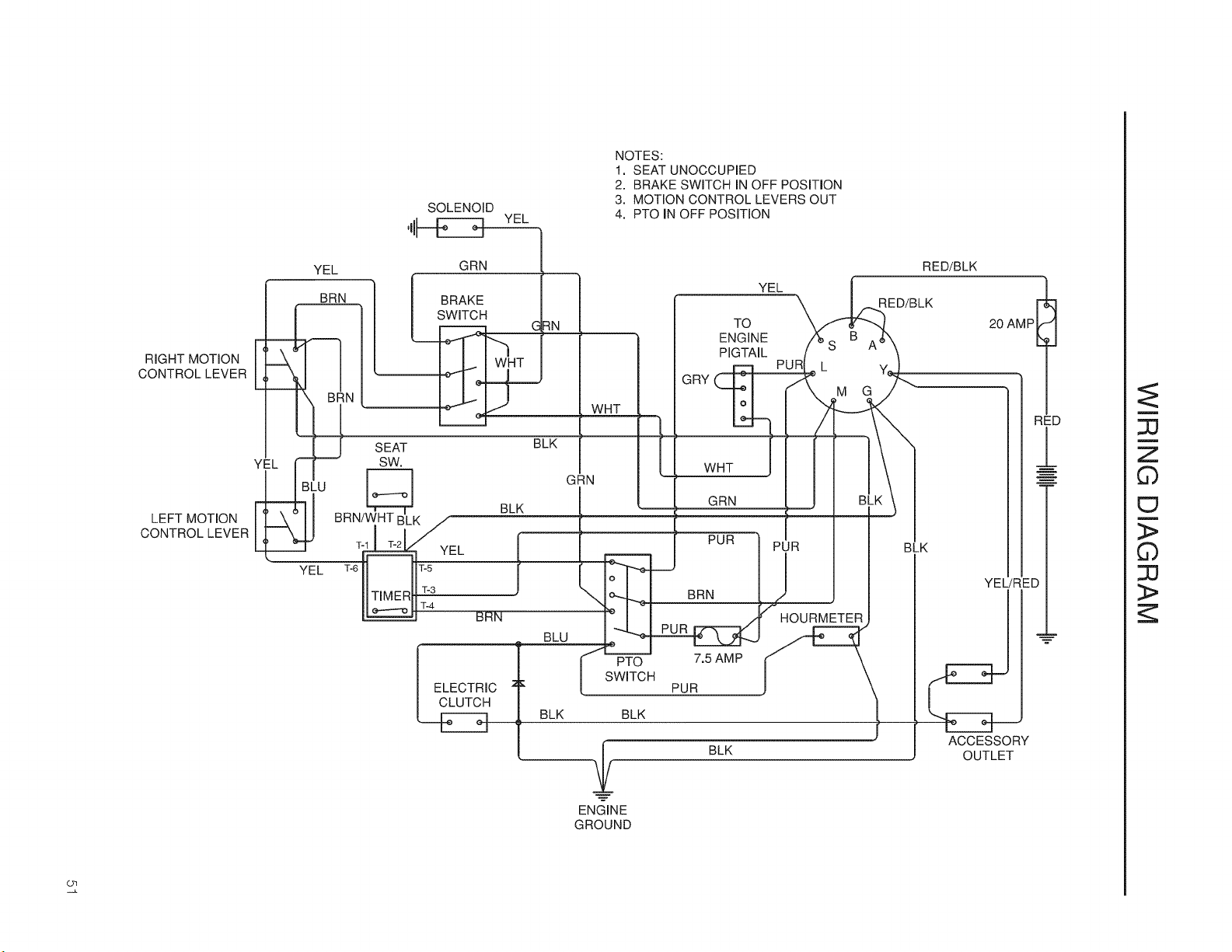
O7
RIGHT MOTION
CONTROL LEVER
LEFT MOTION
CONTROL LEVER
SOLENOID
'"iREI3 YEL
NOTES:
1. SEAT UNOCCUPIED
2. BRAKE SWITCH IN OFF POSITION
3. MOTION CONTROL LEVERS OUT
4. PTO IN OFF POSITION
YEL
YEL GRN __
YEL
BRN BRAKE
SWITCH G :IN TO
ENGINE
PIGTAIL
L
GRY
M G
WH____!___T___
j[__j SEAT BLK I
BLU [_ GRN L WriT
_-_ T-5 ' O
-- BRN
N-- J \
/ I SWITCH I
I ELECTRIC L PUR J
I CLUTCH
_ BLK BLK
[k BLK ,
ENGINE
GROUND
RED/BLK
RED/BLK
20 AMP
BLK
YEL/RED
ACCESSORY
OUTLET
RED
1
Z
©
>
©
>
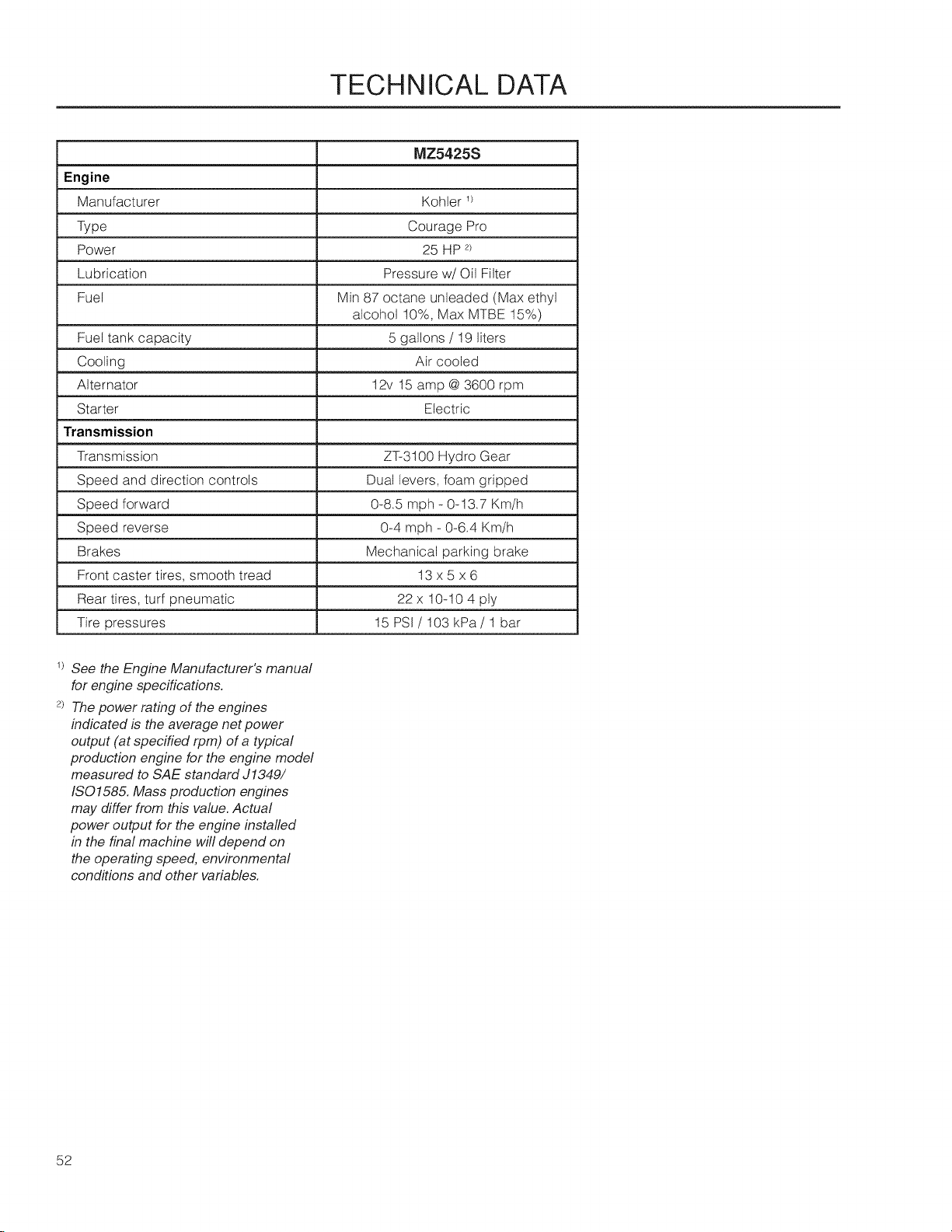
TECHNICAL DATA
MZ5425S
Engine
Manufacturer Kohler 1_
Type Courage Pro
Power 25 HP 2/
Lubrication Pressure w/Oil Filter
Fuel Min 87 octane unleaded (Max ethyl
alcohol 10%, Max MTBE 15%)
Fuel tank capacity 5 gallons / 19 liters
Cooling Air cooled
Alternator 12v 15 amp @ 3600 rpm
Starter Electric
Transmission
Transmission ZT-3100 Hydro Gear
Speed and direction controls Dual levers, foam gripped
Speed forward 0-8,5 mph - 0-13,7 Km/h
Speed reverse 0-4 mph - 0-6,4 Km/h
Brakes Mechanical parking brake
Front caster tires, smooth tread 13 x 5 x 6
Rear tires, turf pneumatic 22 x 10-10 4 ply
Tire pressures 15 PSi/103 kPa/1 bar
1) See the Engine Manufacturer's manual
for engine specifications.
2) The power rating of the engines
indicated is the average net power
output (at specified rpm) of a typical
production engine for the engine model
measured to SAE standard J1349/
IS01585. Mass production engines
may differ from this value. Actual
power output for the engine installed
in the final machine will depend on
the operating speed, environmental
conditions and other variables.
52
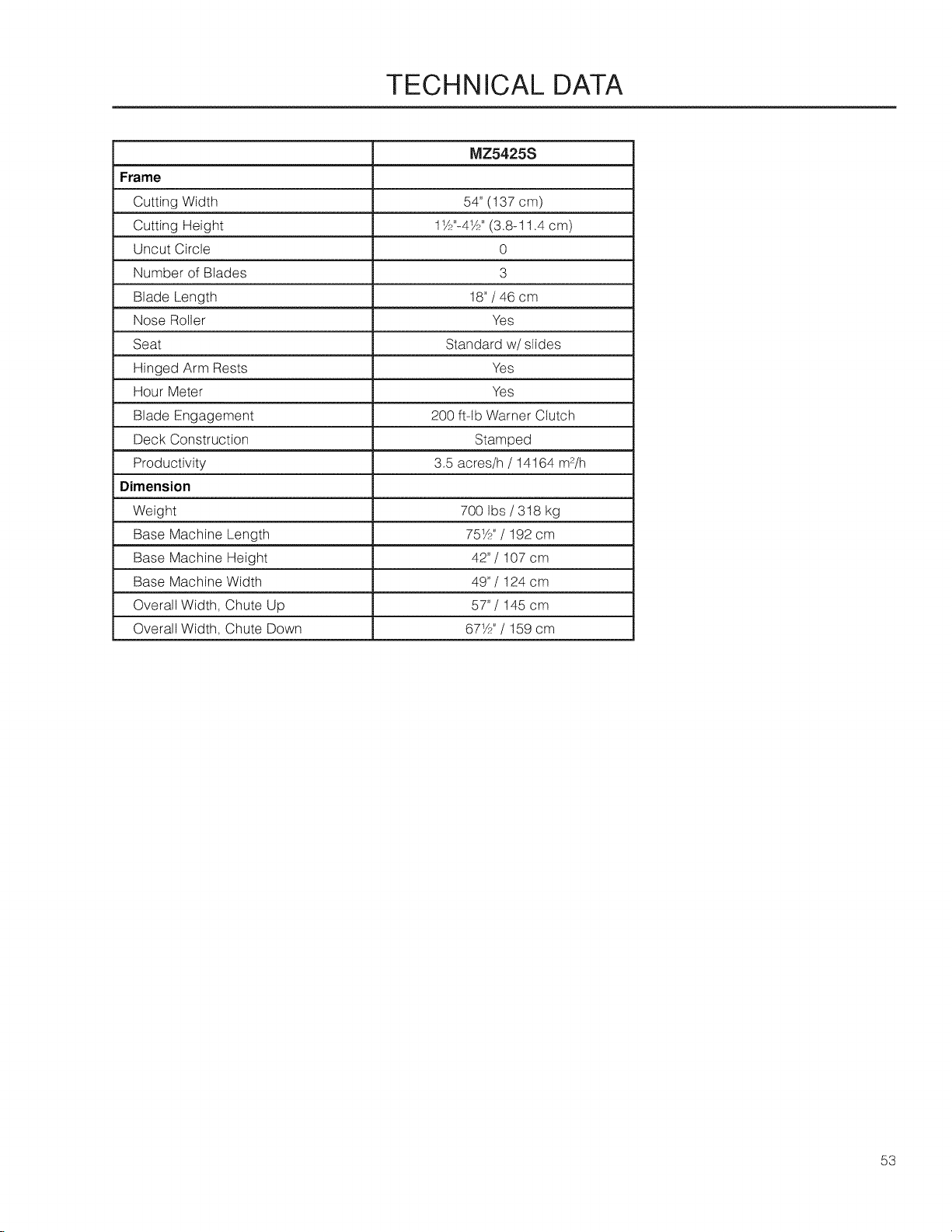
TECHNICAL DATA
MZ5425S
J
Frame
Cutting Width 54" (137 cm)
• Cutting Height _ 11/2"-41/2"(3,8-11,4 cm)
Uncut Circle 0
Number of Blades 3
• Blade Length 18"/46cm
Nose Roller Yes
Seat Standard w/slides
Hinged Arm Rests , Yes
Hour Meter Yes
Blade Engagement 200 ft-lb Warner Clutch
Deck Construction Stamped
Productivity 3,5 acres/h / 14164 m2/h
Dimension
Weight 700 Ibs / 318 kg
Base Machine Length 751/J / 192 cm
Base Machine Height 42"/107 cm
Base Machine Width 49"/124 cm
Overall Width, Chute Up 57"/145 cm
Overall Width, Chute Down 671/J / 159 cm
53
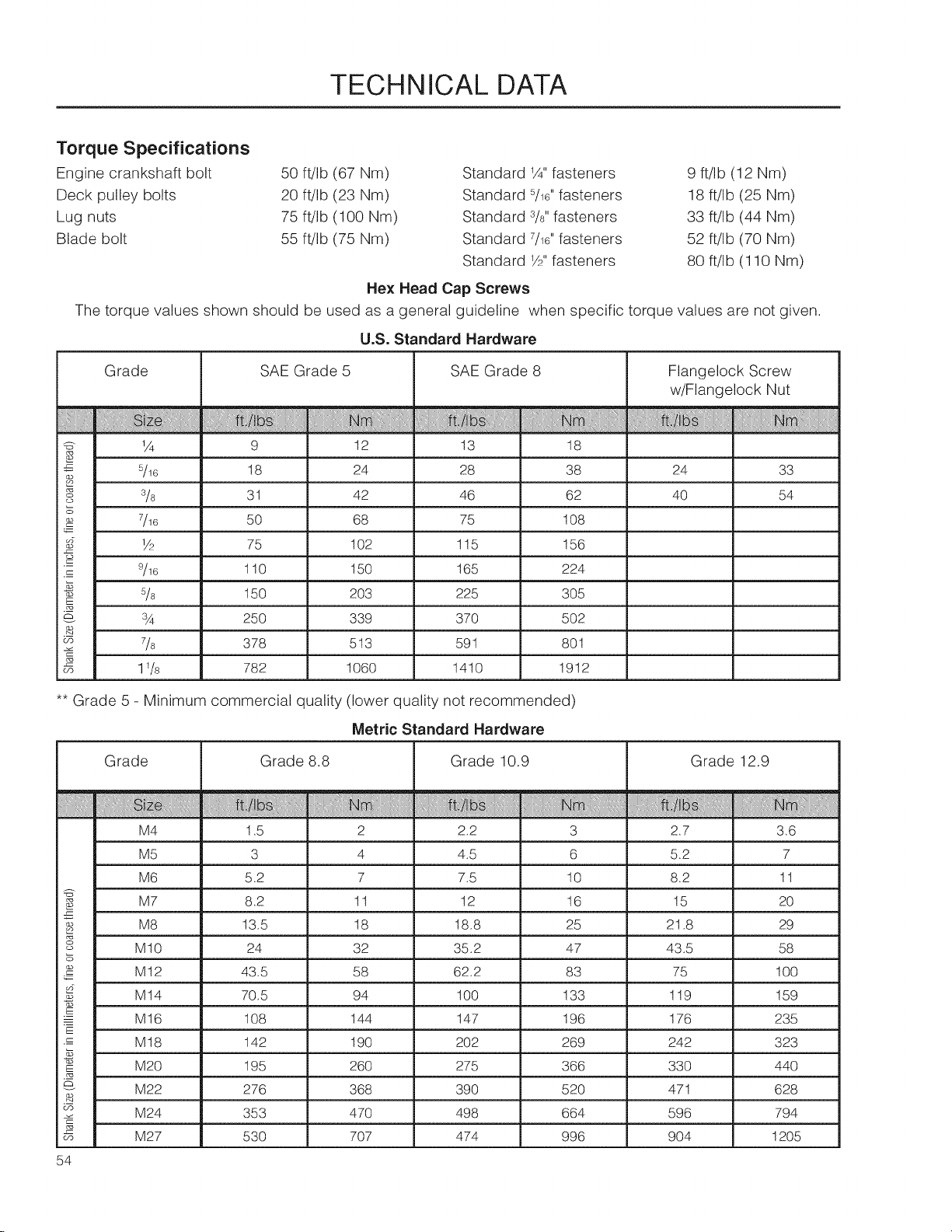
TECHNICAL DATA
Torque Specifications
Engine crankshaft bolt
Deck pulley bolts
Lug nuts
Blade bolt
50 ft/Ib (67 Nm)
20 ft/Ib (23 Nm)
75 ft/Ib (100 Nm)
55 ft/Ib (75 Nm)
Standard 1/4"fasteners
Standard 5/16"fasteners
Standard 3/6"fasteners
Standard 7/16"fasteners
Standard 1/2"fasteners
Hex Head Cap Screws
9 ft/Ib (12 Nm)
18 ft/Ib (25 Nm)
33 ft/Ib (44 Nm)
52 ft/Ib (70 Nm)
80 ft/Ib (110 Nm)
The torque values shown should be used as a general guideline when specific torque values are not given,
U.S. Standard Hardware
Grade SAE Grade 5 SAE Grade 8 Flangelock Screw
w/Flangelock Nut
÷ ¼
5/16
8
s/6
o
7/16
1/2
=o
z
Go
9
18
31
5O
75
12
24
42
68
102
13
28
46
75
115
18
38
62
108
156
24
4O
33
54
9/16 . 110 L 150 . 165 _ 224 _
5/6 150 203 225 305
sA 250 339 370 502
7/8 378 513 591 801
11/s 782 1060 1410 1912
** Grade 5 - Minimum commercial quality (lower quality not recommended)
Metric Standard Hardware
Grade Grade 8,8 Grade 10,9 Grade 12,9
m
M4 1,5 2 2,2 3 2,7 3,6
M5 3 4 4,5 6 5,2 7
M6 5,2 7 7,5 10 8,2 11
M7 8,2 11 12 16 15 20
M8 13,5 18 18,8 25 21,8 29
MI0 24 32 35,2 47 43,5 58
M12 43,5 58 62,2 83 75 100
_ M14 70,5 94 100 133 119 159
E
_ M16 108 144 147 196 176 235
-_ M18 142 190 202 269 242 323
M20 195 260 275 366 330 440
M22 276 368 390 520 471 628
M24 353 470 498 664 596 794
Z
M27 530 707 474 996 904 1205
54

CONFORMITY CERTIFICATES
USA requirements
Labels are placed on the engine and/or in the engine
compartment stating that the machine will fulfill the
requirements, This is also applicable to special
requirements for any of the states, (California emission
rules etc,), Do not remove any of these labels,
Certificates can also be supplied with the machine at
delivery or written in the Engine manual, Take care of
these valuable documents,
55
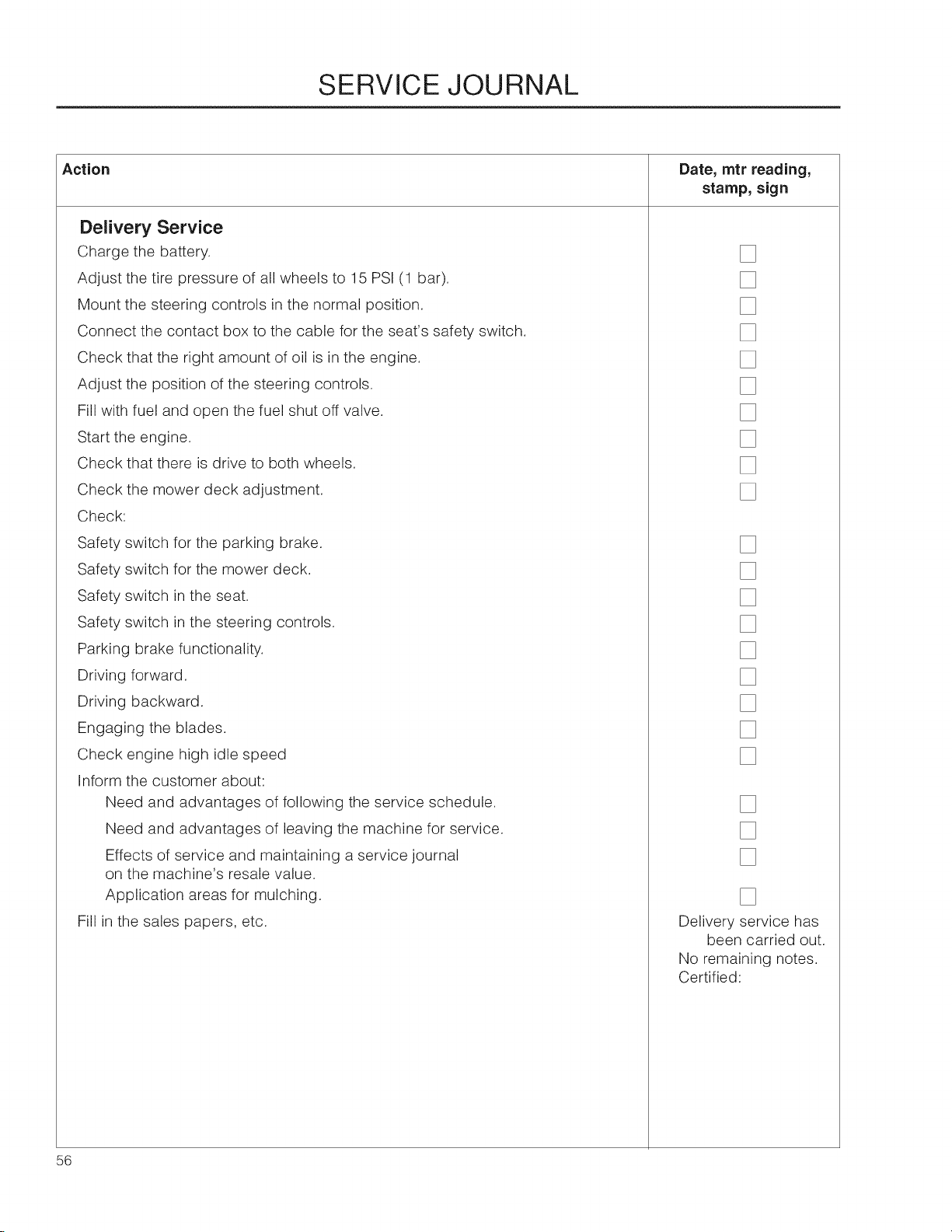
SERVICE JOURNAL
Action Date, mtr reading,
stamp, sign
Delivery Service
Charge the battery.
Adjust the tire pressure of all wheels to 15 PSi (1 bar).
Mount the steering controls in the normal position.
Connect the contact box to the cable for the seat's safety switch.
Check that the right amount of oil is in the engine.
Adjust the position of the steering controls.
Fill with fuel and open the fuel shut off valve.
Start the engine.
Check that there is drive to both wheels.
Check the mower deck adjustment.
Check:
Safety switch for the parking brake.
Safety switch for the mower deck.
Safety switch in the seat.
Safety switch in the steering controls.
Parking brake functionality.
Driving forward.
Driving backward.
Engaging the blades.
Check engine high idle speed
Inform the customer about:
Need and advantages of following the service schedule.
Need and advantages of leaving the machine for service.
Effects of service and maintaining a service journal
on the machine's resale value.
Application areas for mulching.
Fill in the sales papers, etc.
[]
[]
[]
[]
[]
[]
[]
[]
[]
[]
[]
[]
[]
[]
[]
[]
[]
[]
[]
[]
[]
[]
[]
Delivery service has
been carried out.
No remaining notes.
Certified:
56
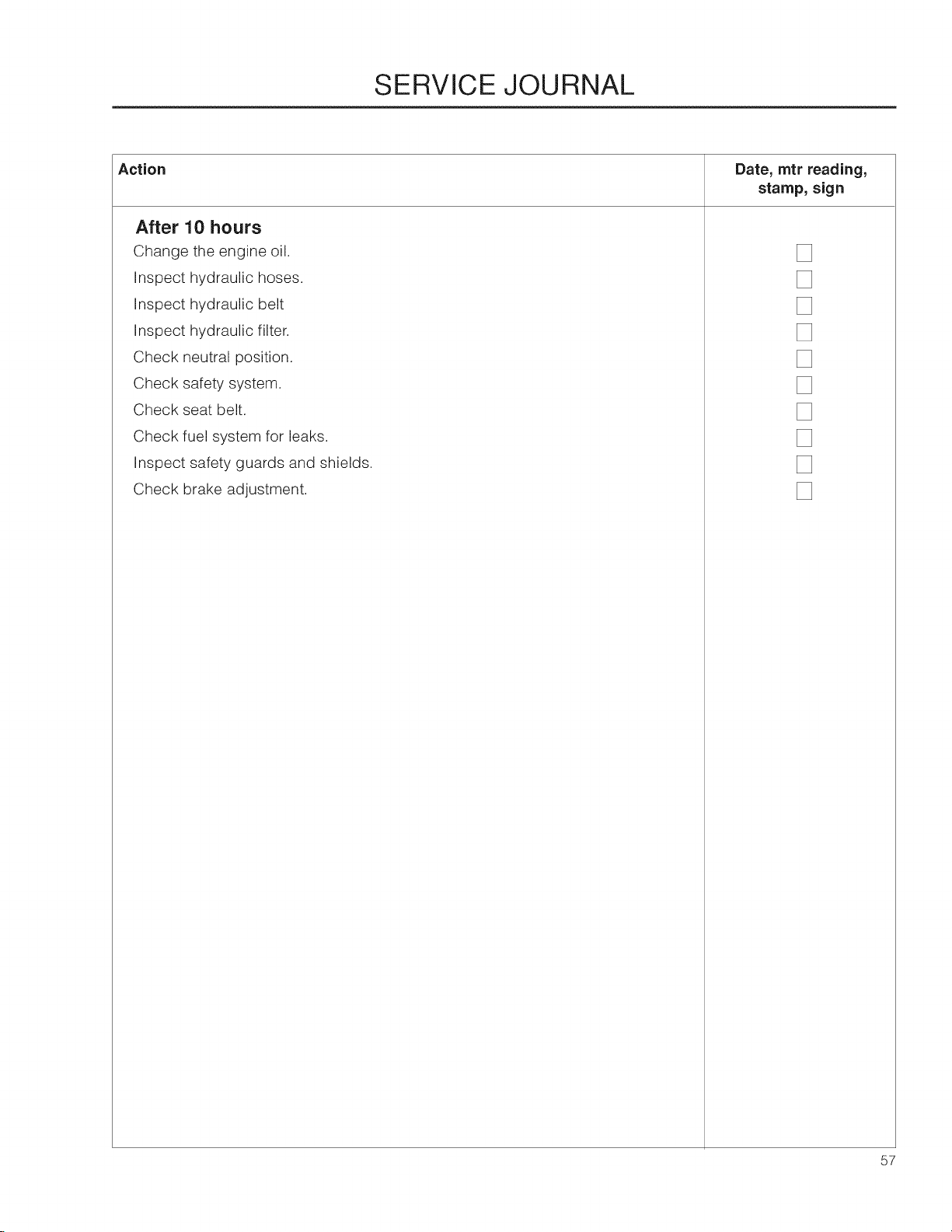
SERVICE JOURNAL
Action Date, mtr reading,
stamp, sign
After 10 hours
Change the engine oil,
Inspect hydraulic hoses,
Inspect hydraulic belt
Inspect hydraulic filter,
Check neutral position,
Check safety system,
Check seat belt,
Check fuel system for leaks,
Inspect safety guards and shields,
Check brake adjustment,
[]
[]
[]
[]
[]
[]
[]
[]
[]
[]
57
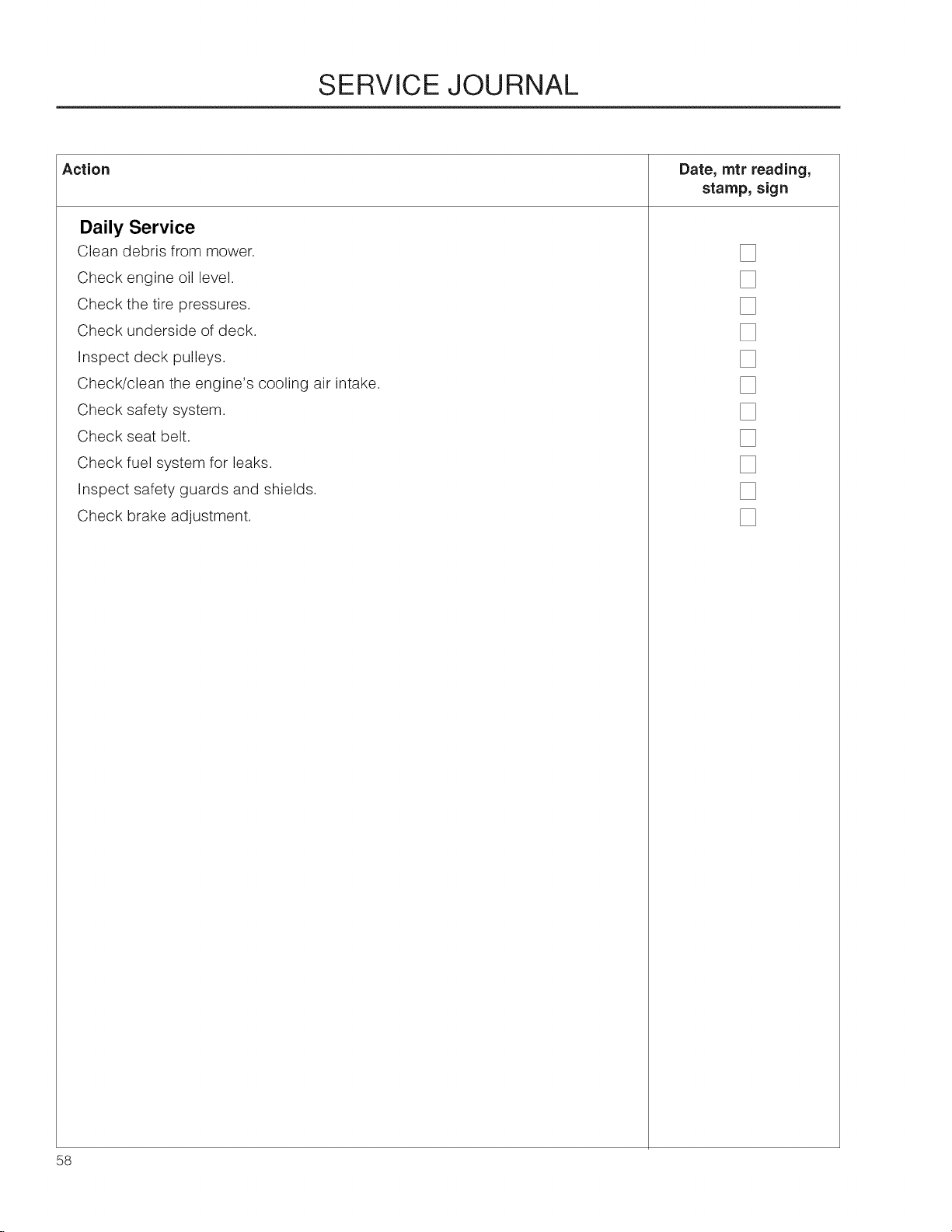
SERVICE JOURNAL
Action Date, mtr reading,
stamp, sign
Daily Service
Clean debris from mower,
Check engine oil level,
Check the tire pressures,
Check underside of deck,
Inspect deck pulleys,
Check/clean the engine's cooling air intake.
Check safety system,
Check seat belt,
Check fuel system for leaks,
Inspect safety guards and shields,
Check brake adjustment,
[]
[]
[]
[]
[]
[]
[]
[]
[]
[]
[]
58
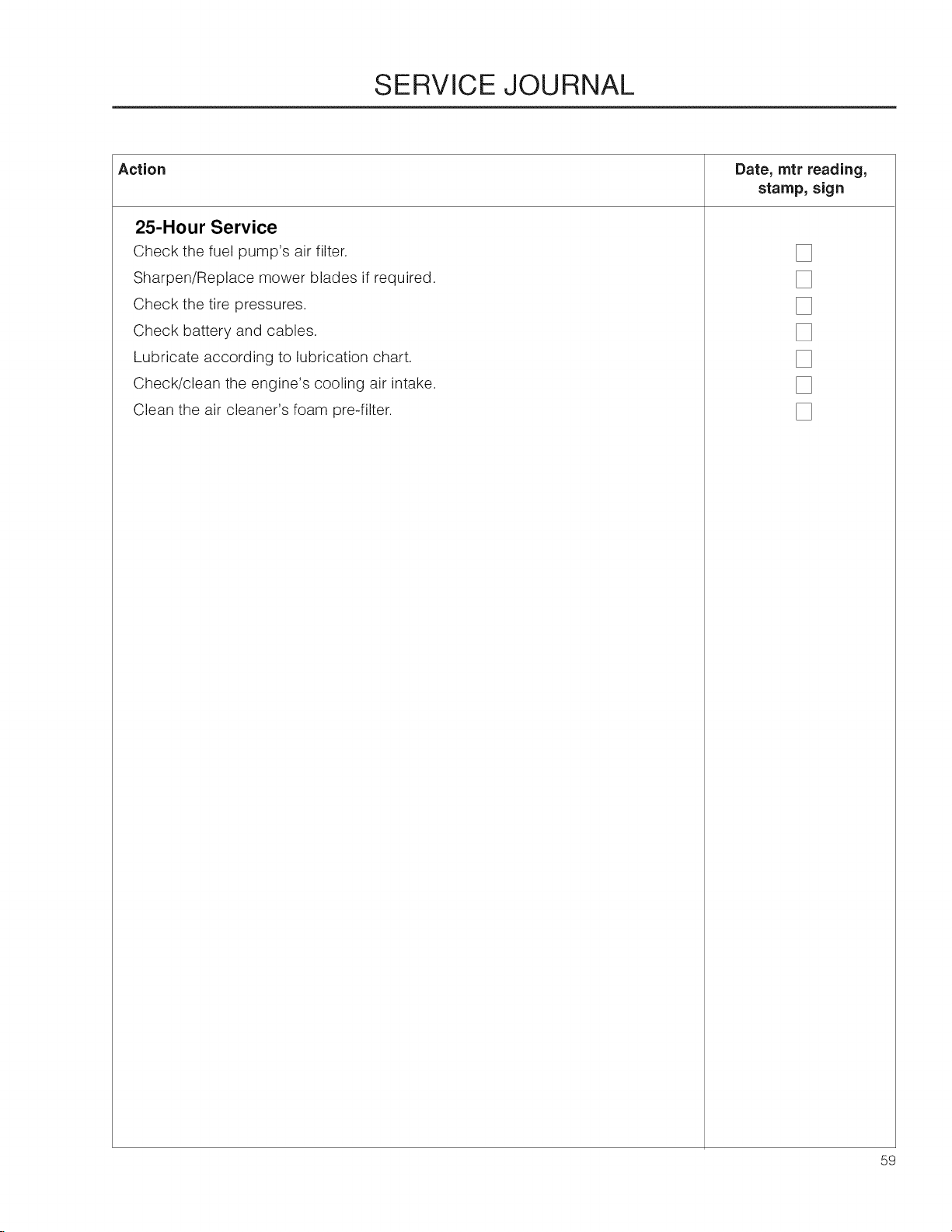
SERVICE JOURNAL
Action Date, mtr reading,
stamp, sign
25-Hour Service
Check the fuel pump's air filter,
Sharpen/Replace mower blades if required,
Check the tire pressures,
Check battery and cables,
Lubricate according to lubrication chart,
Check/clean the engine's cooling air intake.
Clean the air cleaner's foam pre-filter.
[]
[]
[]
[]
[]
[]
[]
59
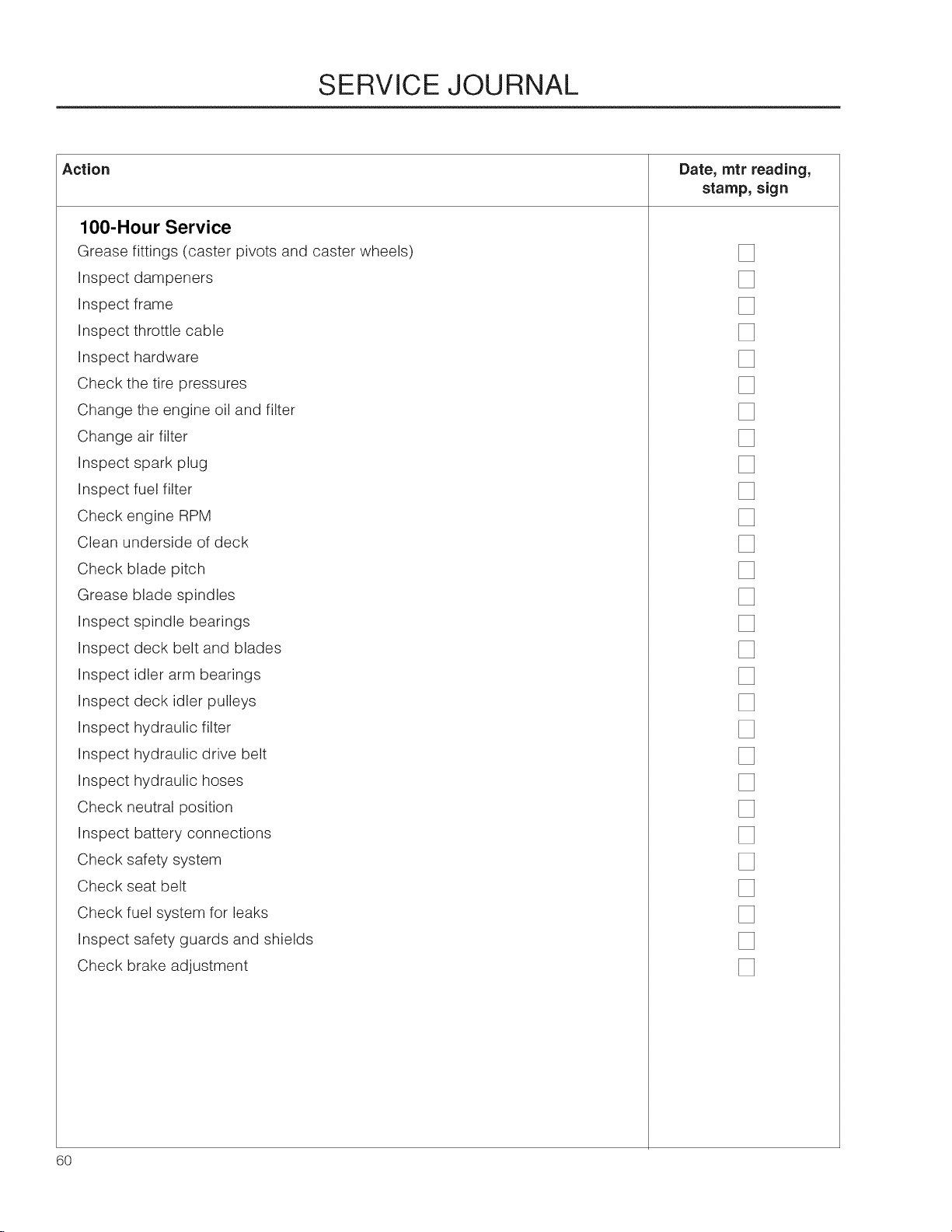
SERVICE JOURNAL
Action Date, mtr reading,
stamp, sign
lO0-Hour Service
Grease fittings (caster pivots and caster wheels)
Inspect dampeners
Inspect frame
Inspect throttle cable
Inspect hardware
Check the tire pressures
Change the engine oil and filter
Change air filter
Inspect spark plug
Inspect fuel filter
Check engine RPM
Clean underside of deck
Check blade pitch
Grease blade spindles
Inspect spindle bearings
Inspect deck belt and blades
Inspect idler arm bearings
Inspect deck idler pulleys
Inspect hydraulic filter
Inspect hydraulic drive belt
Inspect hydraulic hoses
Check neutral position
Inspect battery connections
Check safety system
Check seat belt
Check fuel system for leaks
Inspect safety guards and shields
Check brake adjustment
[]
[]
[]
[]
[]
[]
[]
[]
[]
[]
[]
[]
[]
[]
[]
[]
[]
[]
[]
[]
[]
[]
[]
[]
[]
[]
[]
[]
6O
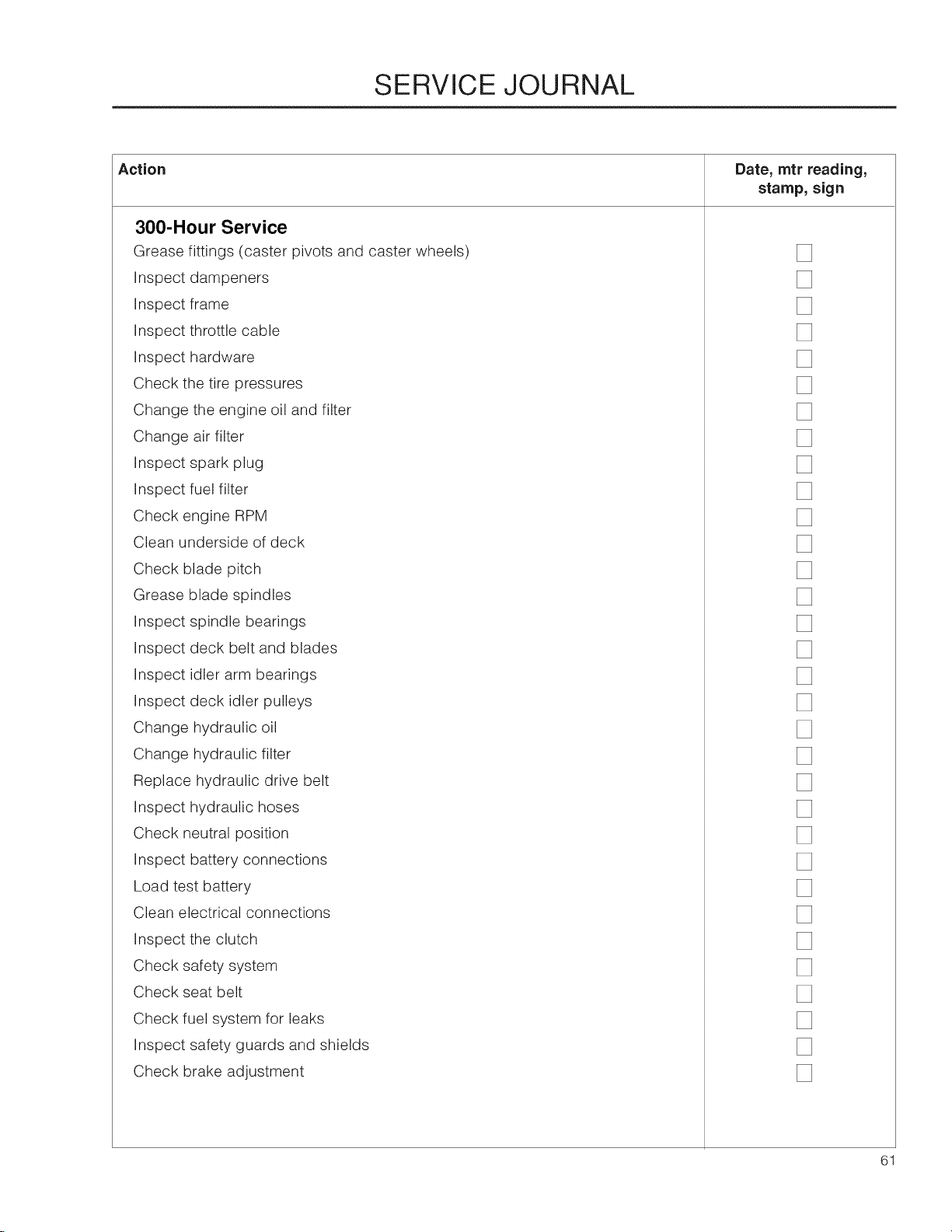
SERVICE JOURNAL
Action Date, mtr reading,
stamp, sign
300-Hour Service
Grease fittings (caster pivots and caster wheels)
Inspect dampeners
Inspect frame
Inspect throttle cable
Inspect hardware
Check the tire pressures
Change the engine oil and filter
Change air filter
Inspect spark plug
Inspect fuel filter
Check engine RPM
Clean underside of deck
Check blade pitch
Grease blade spindles
Inspect spindle bearings
Inspect deck belt and blades
Inspect idler arm bearings
Inspect deck idler pulleys
Change hydraulic oil
Change hydraulic filter
Replace hydraulic drive belt
Inspect hydraulic hoses
Check neutral position
Inspect battery connections
Load test battery
Clean electrical connections
Inspect the clutch
Check safety system
Check seat belt
Check fuel system for leaks
Inspect safety guards and shields
Check brake adjustment
[]
[]
[]
[]
[]
[]
[]
[]
[]
[]
[]
[]
[]
[]
[]
[]
[]
[]
[]
[]
[]
[]
[]
[]
[]
[]
[]
[]
[]
[]
[]
[]
61
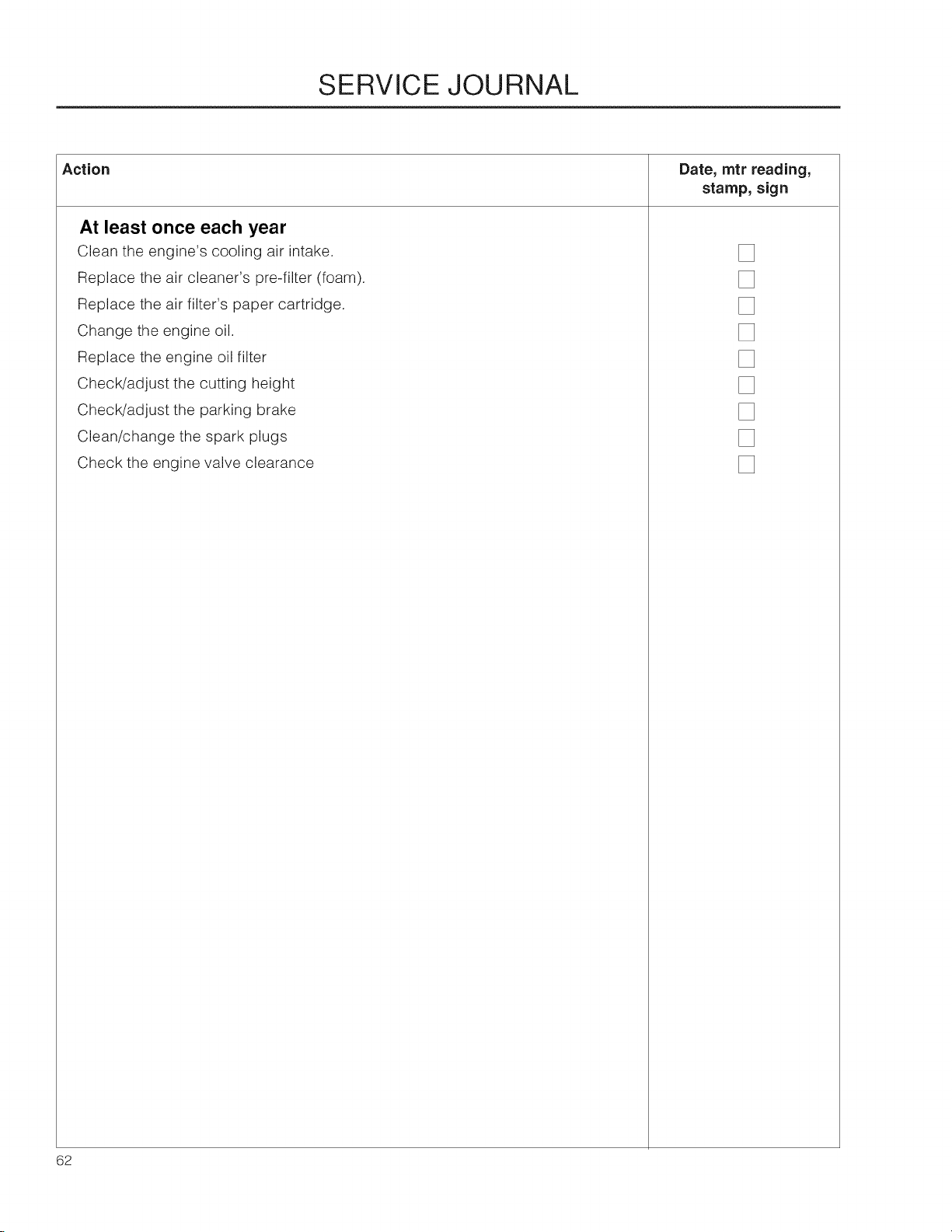
SERVICE JOURNAL
Action Date, mtr reading,
stamp, sign
At least once each year
Clean the engine's cooling air intake,
Replace the air cleaner's pre-filter (foam).
Replace the air filter's paper cartridge,
Change the engine oil,
Replace the engine oil filter
Check/adjust the cutting height
Check/adjust the parking brake
Clean/change the spark plugs
Check the engine valve clearance
[]
[]
[]
[]
[]
[]
[]
[]
[]
62

®
115 522927 Rev A 2012-11-01