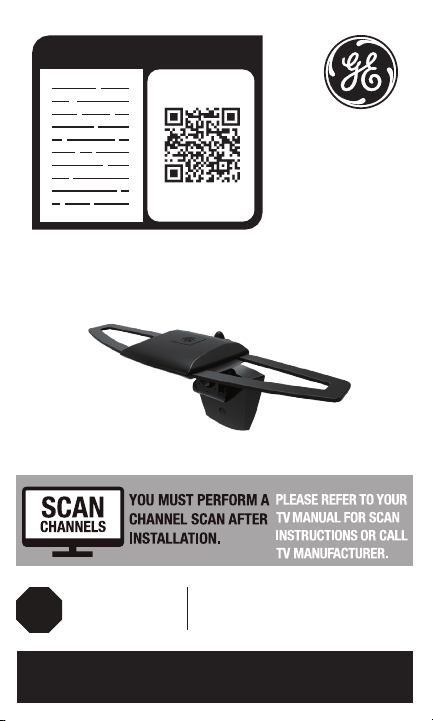
READ IT OR WATCH IT
Read instructions or watch
easy-to-follow video. Scan QR code
or visit https://goo.gl/o9HfBq
Questions? Contact our U.S.-based
Consumer Care at 1-800-654-8483
between 7AM-8PM, M-F, Central Time.
See reverse for easy-to-follow instructions
and exclusive deals.
Please call before
returning to store
CALL

2
WARNING: INSTALLATION OF
THIS PRODUCT NEAR POWER
LINES IS DANGEROUS. FOR
YOUR SAFETY, FOLLOW THE
INSTALLATION DIRECTIONS.
WATCH FOR WIRES! YOU CAN
BE KILLED IF THIS ANTENNA
COMES NEAR ELECTRIC POWER
LINES. READ INSTRUCTIONS!

3
TABLE OF CONTENTS
IMPORTANT SAFETY INSTRUCTIONS ....................................................4
SELECT YOUR INSTALLATION SITE .........................................................5
CHOOSE A MOUNT TYPE ............................................................................ 6
ANTENNA ASSEMBLY & INSTALLATION ................................................7
ANTENNA GROUNDING & CONNECTION ........................................10
ANTENNA HELPFUL TIPS .........................................................................13

4
IMPORTANT SAFETY INSTRUCTIONS:
• NEVER touch ANYTHING or ANYONE in contact with a
power line. You can be electrocuted. In case of an accident
or emergency, call 911 immediately for help.
• INSPECT your installation site carefully for power lines.
Make sure there is no possibility the antenna, its mounting
structure or your ladder can come into contact power
lines. Consider what can go wrong during installation.
• KEEP the distance between power lines and the antenna
and its mounting structure at least twice the combined
height of the antenna and mounting structure added. In
the event the antenna falls during or after assembly, there
must be sucient distance to ensure it does not contact
power lines.
• KEEP your ladder, antenna and antenna mounting
structure (such as mast, pole, mount) far away from power
lines at all times.
• GROUND the antenna and the antenna mounting
structure in accordance with the NEC electrical
code, all state and local electrical code requirements
• COMPLETE the antenna assembly on the ground.
• DO NOT use a metal ladder or install the antenna on a
windy day. If the antenna or mast starts to fall.
Do not attempt to catch the antenna.
• EXERCISE caution when working on a roof.
• INFORM others of the danger of touching power lines or
touching other objects in contact with power lines.
• CONTACT a professional installer to install the
antenna if you are unsure how to safely install
and ground this antenna.

5
SELECT YOUR INSTALLATION SITE
Key things to consider in choosing the antenna
installation site:
1) Choose a SAFE location far away from power lines. Keep
the distance between power lines and the antenna and
its mounting structure at least twice the combined height
of the antenna and its mounting structure Refer to the
Important Safety Instructions.
2) Determine the location of the broadcast towers in your
area. Aim the antenna toward those towers. Online
resources such as www.antennaweb.org, can help you
identify the location of local broadcast towers and the
channels you can expect to receive.
3) Check your local, and state building and electrical
codes. Make sure your planned installation is safe and in
compliance with all applicable codes, rules and regulations.

6
CHOOSE A MOUNT TYPE:
Some examples of common mounting options are
shown below.
1) Outdoor/Attic Wall Mount
2) Outdoor Mount (under eave)
3) Indoor Wall Mount:
IF YOU ARE UNSURE OR DO NOT FEEL CAPABLE
OF INSTALLING THIS ANTENNA, CONTACT
A PROFESSIONAL INSTALLER IN YOUR AREA.

7
ANTENNA ASSEMBLY & INSTALLATION:
Thank you for purchasing the Indoor/Outdoor Stealth
Antenna HD. This antenna is a sturdy, high-performance
antenna designed to receive UHF and VHF broadcasted
signals. The small, compact design allows you to install the
antenna almost anywhere on the inside or outside of your
house.
PARTS LIST:
1) Antenna – 1 ea.
2) Antenna Base – 1 ea.
3) Wood Screw – 2 ea.
4) Screw Cover – 2 ea.
5) Rubber Boot – 1 ea.
6) Rubber Foot Pad – 4 ea.
7) Coax Cable 6ft. – 1 ea.
8) Zip Tie – 1 ea.
9) M5 Bolt – 1 ea.

8
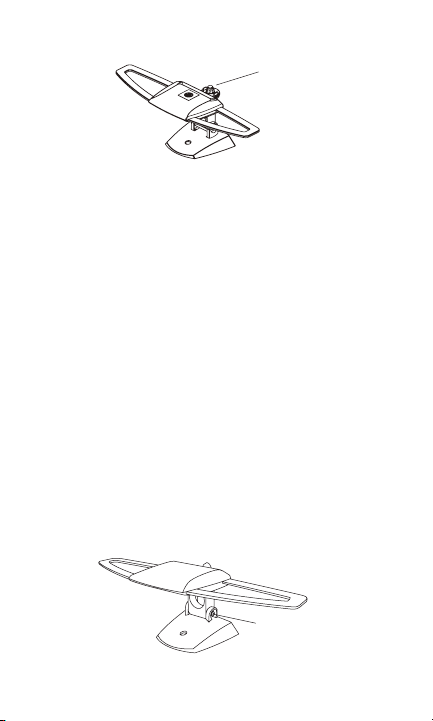
ASSEMBLING THE ANTENNA:
1) Rotate the Antenna Base into upright position.
2) Remove the Thumb Screw and Mounting Bracket from
the Antenna Base.
3) Attach the Mounting Bracket to the antenna using the
M5 Bolt.
Antenna
Mounting Bracket
Thumb Screw
M5 Bolt
Mounting Bracket
Base
9
4) Attach the antenna to the Antenna Base with the Thumb
Screw.
5) Select the mounting method you prefer and place the
antenna in the desired location.
a) Outdoor wall mount
b) Outdoor under eave
c) Attic mount
d) Indoor wall mount
e) Table mount
Note: Wood screws are provided. Rubber foot pads are
also provided for table mounting.
6) Connect the coax cable from the antenna to your TV.
Note: For outdoor installations, the National Electric
Code requires your antenna to be properly grounded.
Refer to the Antenna Grounding & Connection section
for detailed instructions.
7) Tighten the screw shown below to secure the antenna.
Use the Screw Covers to block the holes on the
Antenna Base.
Mounting Bracket
Thumb Screw
Screw

10
8) SCAN FOR CHANNELS ON YOUR TV. This step is very
important. Your TV will NOT receive signals from the
antenna without doing a channel scan. See your TV’s
menu screen for this process or refer to the instruction
manual that came with your TV.
Note: Scan for channels anytime you move the
antenna. It is also a good practice to repeat this
process from time to time in case there are changes to
the available TV signals in your area. If you ever lose
a channel, a scan may be all that is needed to pick up
that station again.
9) For further assistance, call 1-800-654-8483.
Antenna Grounding & Connection
The National Electric Code (NEC) requires your outdoor
antenna installation to be properly grounded. This involves
grounding the antenna. It helps protect you and your property
in the event of static build up on the antenna or lightning near
your home.
Note: If you had a satellite or cable system installed at your
home, you may be able to use some of the parts from this
system for your antenna installation.
1) Connect one end of a coax cable to the antenna and
the other end to a 75ohm grounding block (not provided).
Below (Fig. 1a) is an example of a 75ohm grounding
block.
Fig. 1a

11
If you make your own coax cable, be sure to slide the
Rubber Boot over the cable before you place the
connectors on the cable. Once you attach the
cable to the antenna, slide the Rubber Boot into the
round channel on the antenna.
2) If you use a pre-built cable with connectors, follow
these steps.
i) Cut four slits spaced evenly at the narrow tip of the
Rubber Boot approximately ¼ in length. (Fig. 1b)
Fig. 1b
ii) Run the coax cable through the narrow end of the
Rubber Boot and attach the cable to the antenna.
iii) Slide the Rubber Boot into the round channel on the
antenna.
iv) Wrap the Zip Tie, around the slits in the narrow end of
the Rubber Boot and pull it tight.
3) Connect one end of a second coax cable to the mating
port of the rst coax cable on the 75ohm grounding
block and attach the other end to your TV. The grounding
block needs to be placed as close as possible to the point
where the second coax cable enters your home.
Note: Leave enough slack in the coax cable to create a
drip loop so moisture cannot enter the house. Seal the
coax cable entry point into your house with an exterior
caulk.

12
4) Ground the 75 ohm Grounding Block:
Connect an 8 AWG aluminum or 10 AWG grounding wire
to a screw terminal provided on the grounding block.
Connect the other end of the wire to an acceptable
building ground location.
Examples of acceptable building grounding locations are:
• The building or structure grounding electrode system
as covered in 250.50 in the NEC.
• Grounded interior metal water piping system, within
5ft. from its point of entrance to the building.
• Grounded, nonexible metallic power service raceway.
• Service equipment enclosure, the grounding electrode
conductor or the grounding electrode conductor metal
enclosure of the power service.
• An 8ft. grounding rod driven into the ground can be
used as long as it is connected to the central building
ground by a 6 AWG or heavier bonding wire.
Double check all connections after installation is complete.
Ensure there are good electrical connections of your
grounding wires and coax cables. See Fig. 2 below for an
example of a properly grounded antenna installation.
Example of Antenna Grounding
as per NEC - National Electrical Code
ELECTRIC SERVICE METER PANEL
POWER SERVICE GROUNDING ELECTRODE
SYSTEM (NEC ART 250. PART H)
GROUNDING CONDUCTOR
(NEC SECTION 810-21 )
GROUND CLAMP
75 OHM GROUNDING BLOCK
(NEC SECTION 810-20)
ANTENNA COAX
RAIN DRIP LOOP FOR THE COAX TO TV
Fig. 2
If you are unsure how to properly ground your antenna
installation, contact a professional installer in your area.

13
ANTENNA REMOVAL
Inspect the area carefully for power lines. Look for any new
power lines that may have been installed. Make sure there
is no possibility the antenna, its mounting structure or your
ladder can come in contact with power lines. Be sure to
consider what can go wrong during the antenna removal.
Repeat the steps for antenna installation but in reverse order.
ANTENNA HELPFUL TIPS
Maximize the number of channels you receive by aiming the
antenna in dierent directions to determine which position
provides the best reception. Run a channel scan for each
position. Refer to the instruction manual with your TV if you
are not sure how to do this.
Position or mount the antenna as high as possible or near a
window for the best performance. Point the antenna toward
the broadcast towers in your area.
Visit www.antennaweb.org or www.dtv.gov for the DTV
reception maps to determine the available television stations
and location of the broadcast towers in your area.
FOR FURTHER ASSISTANCE, CALL 1-800-654-8483.


16
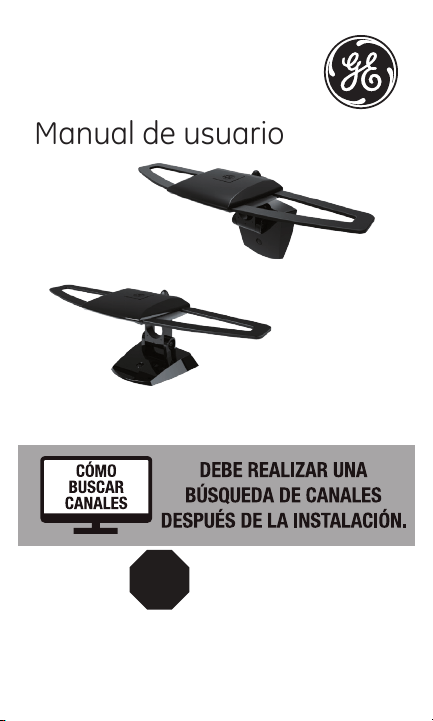
Antena GE para
interiores y
exteriores.
Manual de usuario
¿Tiene preguntas? Comuníquese con nuestro
Servicio al consumidor con sede en EE. UU.
al 1-800-654-8483 entre las 7 a. m. y 8 p. m.
de lunes a viernes, hora del centro
Llame antes de de-
volver a la tienda
LLAMADA

18
ADVERTENCIA: INSTALAR ESTE
PRODUCTO CERCA DE CABLES
ELÉCTRICOS ES PELIGROSO.
POR SU SEGURIDAD, SIGA
LAS INDICACIONES DE
INSTALACIÓN.
¡PRESTE ATENCIÓN A LOS
CABLES ELÉCTRICOS! EL
CONTACTO DE ESTA ANTENA
CON ALGÚN CABLE ELÉCTRICO
PUEDE CAUSARLE LA MUERTE.
¡LEA LAS INSTRUCCIONES!

19
ÍNDICE
INSTRUCCIONES DE SEGURIDAD IMPORTANTES ...........................20
SELECCIONE EL SITIO DE LA INSTALACIÓN ......................................21
ELIJA UN TIPO DE MONTAJE ..................................................................22
INSTALACIÓN Y ARMADO DE LA ANTENA:
CÓMO ENSAMBLAR LA ANTENA ........................................................... 23
INSTRUCCIONES DE ENSAMBLADO:
CONEXIÓN A TIERRA DEL MONTAJE DE LA ANTENA .................... 26
SUGERENCIAS ÚTILES RELACIONADAS CON LA ANTENA ..........30

20
INSTRUCCIONES DE SEGURIDAD IMPORTANTES:
• NUNCA toque NADA ni a NADIE que esté en contacto
con un cable eléctrico. Podría electrocutarse. En caso de
accidente o emergencia, llame al 911 de inmediato para
obtener ayuda.
• INSPECCIONE el sitio de la instalación cuidadosamente
para ver si hay cables eléctricos. Asegúrese de que no
haya ninguna posibilidad de que la antena, la estructura
sobre la que está montada o su escalera puedan tomar
contacto con algún cable eléctrico. Piense en todo aquello
que posiblemente pudiera salir mal durante la instalación.
• MANTENGA distancia entre los cables eléctricos y la
antena y su estructura de montaje. Tal distancia debe ser
igual a por lo menos dos veces la altura combinada de la
antena y la estructura de montaje sumadas. En caso de
que la antena se caiga durante la instalación o después,
debe haber distancia suciente para garantizar que no
tome contacto con ningún cable eléctrico.
• MANTENGA la escalera, la antena y la estructura de
montaje de la antena (como el mástil, el poste, el montaje)
lejos de los cables eléctricos en todo momento.
• CONECTE A TIERRA la antena y la estructura de
montaje de la antena de conformidad con el Código
Estadounidense de Normas de Electricidad (NEC) y todos
los requisitos de los códigos eléctricos estatales y locales.
• COMPLETE el montaje de la antena en el suelo antes de
montarla.
• NO use una escalera de metal ni instale la antena un
día ventoso. Si la antena o el mástil comienzan a caerse,
déjelos caer. No intente agarrar la antena.
• TENGA cuidado al trabajar sobre un techo.
• INFORME a otras personas de los peligros de tocar los
cables eléctricos u otros objetos que puedan estar en
contacto con una línea eléctrica.
• LLAME a un instalador profesional de su zona para que
instale la antena si no está seguro de cómo instalar y
conectar a tierra esta antena de manera segura.

21
SELECCIONE EL SITIO DE LA INSTALACIÓN:
Aspectos clave que debe tener en cuenta al elegir el lugar en
donde instalará la antena:
1) Seleccione un lugar SEGURO que esté alejado de los cables
eléctricos. La distancia entre los cables eléctricos y la
antena con su estructura debe ser, por lo menos, igual a
dos veces la altura combinada de la antena y la estructura
sumadas. Consulte las Instrucciones de seguridad
importantes.
2) Establezca la ubicación de las torres de transmisión de su
zona. Deberá apuntar la antena hacia esas torres. Puede
consultar recursos en línea, como www.antennaweb.org,
para saber cómo identicar la ubicación de las torres de
transmisión locales y los canales que puede recibir.
3) Consulte los códigos eléctricos y de construcción de su
área, ciudad y estado. Asegúrese de que la instalación
que planica hacer es segura y que cumpla con todos los
códigos y todas las normas y reglamentos.

22
ELIJA UN TIPO DE MONTAJE:
A continuación, se muestran algunos ejemplos de las
opciones de montaje más comunes.
1) Montaje sobre pared de ático o
pared en exteriores:
2) Montaje en exteriores (debajo del alero):
3) Montaje sobre pared en interiores:
SI NO ESTÁ SEGURO DE CÓMO INSTALAR ESTA ANTENA O
CREE QUE NO PUEDE HACERLO USTED MISMO, CONTACTE A
UN INSTALADOR PROFESIONAL DE SU ZONA.

23
INSTALACIÓN Y ARMADO DE LA ANTENA:
Gracias por adquirir la antena para interiores y exteriores.
Esta antena es resistente y de alto rendimiento, diseñada
para recibir las señales transmitidas de UHF y VHF. Su
diseño pequeño y compacto permite instalar la antena en
prácticamente cualquier parte en el exterior o interior
de su casa.
LISTA DE PARTES:
1) Antena (1)
2) Base de la antena (1)
3) Tornillos para madera (2)
4) Cubre tornillo (2)
5) Manga de goma (1)
6) Almohadillas de goma cubre base (4)
7) Cable coaxial de 6ft 1.82m (1)
8) Presilla (1)
9) Tuerca M5 (1)

24
Soporte de montaje
Tornillo de cabeza estriada
Tuerca M5
Base
CÓMO ENSAMBLAR LA ANTENA:
1) Gire la base de la antena en posición vertical.
2) Quite el tornillo de cabeza estriada y el soporte de
montaje de la base de la antena.
3) Fije el soporte de montaje a la antena por medio de la
tuerca M5.
Antena
Soporte de montaje

25
4) Fije la antena a la base de la antena con el tornillo de
cabeza estriada.
5) Elija el método de montaje que preera y coloque la
antena en el lugar deseado.
a) Montaje sobre pared en exteriores
b) Exteriores debajo del alero
c) Montaje en el ático
d) Montaje sobre pared en interiores
e) Montaje sobre mesa
Nota: Se incluyen los tornillos para madera.
Se incluyen las almohadillas de goma cubre base para
montaje sobre mesa.
6) Conecte el cable coaxial de la antena al TV.
Nota: para instalaciones en exteriores, el Código
de Normas de Electricidad exige que la antena esté
debidamente conectada a tierra. Consulte la sección
Conexión y Puesta a tierra de la antena para obtener
instrucciones detalladas.
7) Ajuste el tornillo que se muestra a continuación para
asegurar la antena. Use los cubre tornillos para cubrir
los oricios de los tornillos en la base de la antena.
Tornillo de cabeza estriada
Tornillo

26
8) EXPLORE LOS CANALES EN SU TV. Este paso es muy
importante. Su TV NO recibirá señales de la antena si no
se realiza una exploración de canales. Consulte el menú
en pantalla de su TV para ver este proceso o el manual de
instrucciones que viene con el TV.
Nota es importante repetir este proceso y volver a
explorar los canales cada vez que traslade o cambie
de posición la antena. Es ideal repetir este proceso
periódicamente por los posibles cambios en las señales
de TV disponibles en su área. En caso de no recibir la
señal de un canal, solo es necesario volver a explorar
los canales para volver a captarla.
9) Llámenos al 1-800-654-8483 si necesita asistencia.
Puesta a tierra y conexión de la antena:
El Código Estadounidense de Normas de Electricidad (NEC)
exige que la antena exterior esté debidamente conectada
a tierra. Esto involucra la puesta a tierra de la antena. Eso
ayuda a protegerlo a usted y a proteger su propiedad en caso
de que haya acumulación de estática en la antena o de que
caiga un rayo cerca de su casa.
Nota: si ya tiene un sistema satelital o de cable instalado
en su casa, quizás pueda utilizar algunas partes de ese
sistema para la instalación de esta antena.
1) Conecte un extremo del cable coaxial a la antena y el
otro extremo a un bloque de conexión a tierra de 75 ohm
(no se incluye). A continuación (Fig. 1a), se muestra un
ejemplo de un bloque de conexión a tierra de 75 ohm.
Fig. 1a

27
Si construye su propio cable coaxial, asegúrese de
deslizar la manga de goma sobre el cable antes de
colocar los conectores sobre el cable. Una vez que haya
conectado el cable de la antena, deslice la manga de
goma dentro del canal redondo de la antena.
2) Si emplea un cable preconstruido con conectores, haga
lo siguiente:
i) Corte cuatro ranuras a una distancia uniforme en el
extremo estrecho de la manga de goma suministrada de
aproximadamente ¼in (6 mm) de largo. (Fig. 1b)
Fig. 1b
ii) Pase el cable coaxial por el extremo estrecho de la
manga de goma y conecte el cable a la antena.
iii) Deslice la manga de goma dentro del canal redondo
de la antena.
iv) Tome la presilla y enrósquela alrededor del extremo
estrecho de la manga de goma, alrededor de las cuatro
ranuras y ajústela bien.
3) Emplee otro cable coaxial, conecte un extremo al oricio
del primer cable coaxial que coincide en el bloque de
conexión a tierra de 75 ohm y tienda el otro extremo
hasta el interior de la casa para conectarlo a la TV. Debe
colocar el bloque de conexión a tierra de 75 ohm tan
cerca como le sea posible del punto de entrada a la casa,
del segundo cable coaxial.
Nota: El cable coaxial debe tener holgura suficiente
para formar un lazo de goteo a fin de que la humedad
no entre en la casa. Deberá sellar la entrada del cable
coaxial en su casa con una masilla para exteriores.
4) Conecte a tierra el bloque de conexión a tierra de 75

28
ohm: conecte un cable de conexión a tierra N.º 10 o de
aluminio N.º 8 a un terminal roscado en el bloque de
conexión a tierra de 75 ohm. Conecte el otro extremo
del cable a un lugar de conexión a tierra aceptable de la
construcción.
Los siguientes son ejemplos de puntos de conexión a tierra
aceptables de una construcción:
• El sistema de electrodos con conexión a tierra de la
estructura, la construcción o el edicio, tal como se
detalla en 250.50 del Código NEC.
• El sistema de tuberías de agua interior conectado a
tierra, dentro de los 5 pies (1.5m) del punto de entrada
al edicio.
• Un conducto eléctrico metálico no exible con
conexión a tierra.
• El gabinete del equipo de servicio, el conductor
de electrodos con conexión a tierra o el gabinete
metálico del conductor de electrodos con conexión a
tierra del servicio eléctrico.
• Puede utilizarse una varilla de conexión a tierra
de 8 pies (2.4m) enterrada siempre y cuando esté
conectada a la masa del edicio central mediante un
cable de conexión N.º 6 o de un calibre mayor.
Compruebe todas las conexiones una vez nalizada la
instalación. Asegúrese de que haya buena conexión eléctrica
entre los cables de conexión a tierra y los cables coaxiales.
La Fig. 2 continuación muestra un ejemplo de una antena
debidamente conectada a tierra.

29
Ejemplo de conexión a tierra de la antena
conforme al Código Nacional Eléctrico (NEC)
Panel medidor del servicio eléctrico
Sistema de electrodos con conexión a tierra
del servicio eléctrico (Art. 250, Parte H del NEC)
Conductor de puesta a tierra
(Sección 810-21 del NEC)
Abrazadera de conexión a tierra
Bloque de conexión a tierra de
75 ohm (Sección 810-21 del NEC)
Cable coaxial de la antena
Lazo de goteo de lluvia para el cable
coaxial al televisor
Fig. 2
Si no está seguro de cómo conectar la antena a tierra,
contacte a un instalador profesional de su zona.
DESINSTALACIÓN DE LA ANTENA:
Inspeccione el sitio cuidadosamente para ver si hay cables
eléctricos. Verique que no se hayan instalados nuevas
líneas de alta tensión. Asegúrese de que no haya ninguna
posibilidad de que la antena, la estructura sobre la que
está montada o su escalera puedan tomar contacto con
alguna línea de alta tensión. Piense en todo aquello que
posiblemente pudiera salir mal durante la desinstalación.
Repita los pasos indicados para la instalación de la antena,
pero en orden inverso.
Fig. 2

30
SUGERENCIAS ÚTILES RELACIONADAS CON LA ANTENA
Maximice la cantidad de canales que recibe colocando la
antena en distintas direcciones para ver qué posición le
brinda la mejor recepción y la mayor cantidad de canales.
Asegúrese de realizar una nueva búsqueda de canales en
cada posición. Consulte el manual de instrucciones que viene
con su televisor si no está seguro de cómo realizar esto.
Posicione o instale la antena lo más alto posible para un
rendimiento óptimo. Apunte la antena hacia las torres de
transmisión de su zona.
Visite www.antennaweb.org o www.dtv.gov y busque los
mapas de recepción DTV para determinar las estaciones
de televisión disponibles y la ubicación de las torres de
transmisión en su área.
PARA OBTENER MÁS AYUDA, LLAME AL (1-800) -654-8483 Y
PÓNGASE EN CONTACTO CON EL SERVICIO TÉCNICO.

HECHO EN TAIWAN
GE es una marca registrada de la companía General Electric Company
y es utilizada bajo licencia a la companía Jasco Prodcucts Company
LLC, 10 E. Memorial Rd., Oklahoma City, OK 73114.
Este producto de Jasco tiene una garantía limitada de por
vida. Visite www.byjasco.com para detalles.
¿Preguntas? Comuníquese al 1-800-654-8483 entre las
7AM y las 8PM CST (hora central estándar).

34140 V6 02/21
MADE IN TAIWAN
GE is a trademark of General Electric
Company and is under license by
Jasco Products Company LLC, 10 E.
Memorial Rd., Oklahoma City, OK 73114.
This Jasco product comes with a
limited-lifetime warranty. Visit
www.byjasco.com for warranty details.
Questions? Contact our U.S.-based
Consumer Care at 1-800-654-8483
between 7AM-8PM, Central Time.