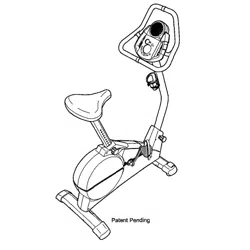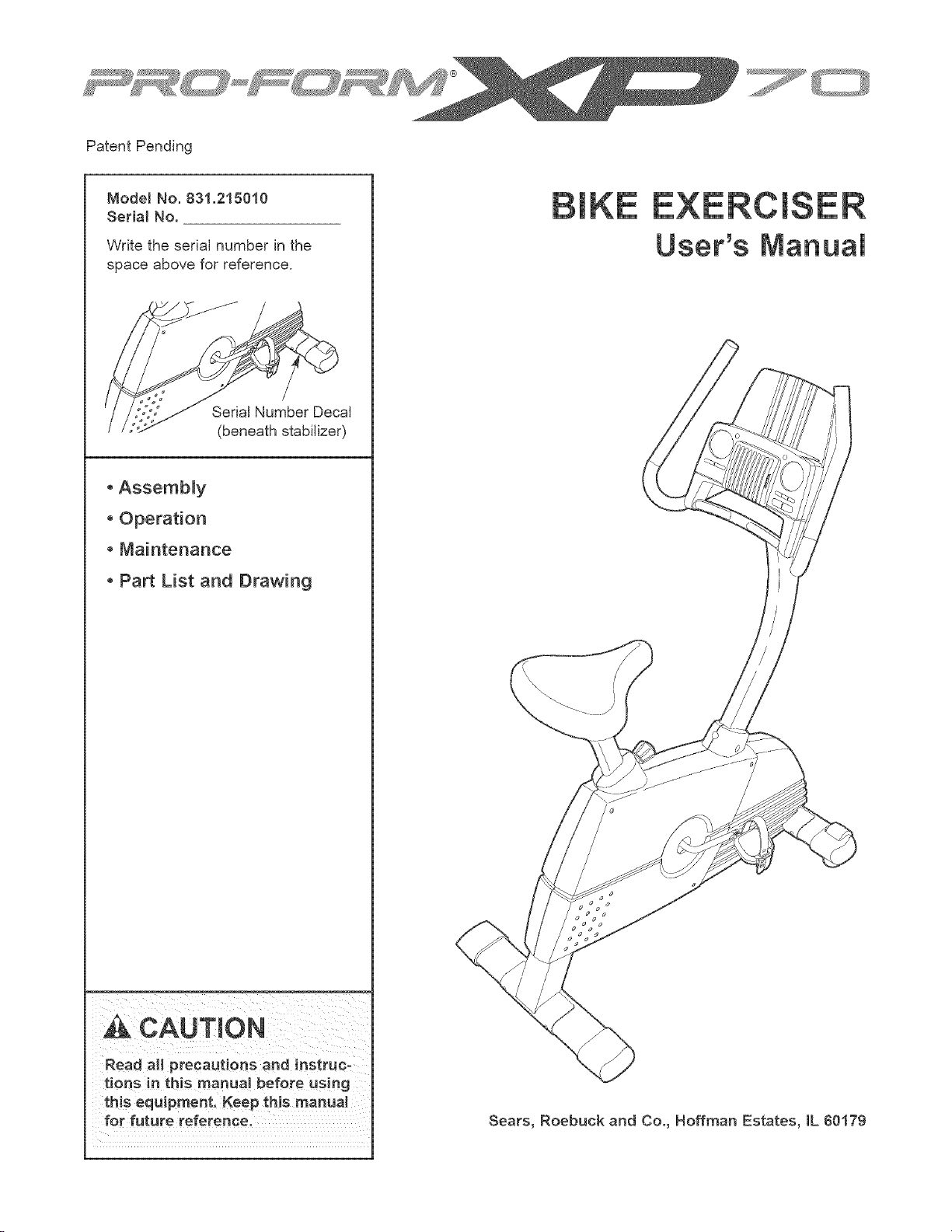
Patent Pending
Model No. 831.215010
Seria! No.
Write the serial number in the
space above for reference.
Serial Number Decal
(beneath stabilizer)
o Assembly
o Operation
o Maintenance
o Part List and Drawing
,_ CAUTION
Read all precautions and instruc-
tions in this manual before using
this equipment. Keep this manual
for future reference,
User's Manual
Y
/
Sears, Roebuck and Co., Hoffman Estates, IL 60179
TABLE OF CONTENTS
_MPORTANT PRECAUTIONS
AWARNIN G: Toreducethe.sk of se.ous_nju_,readthefo.ow_ngimportantprecau-
tions before using the exercise cycle.
1. Read all instructions in this manual before
readings. The pulse sensor is intended only
using the exercise cycle, as an exercise aid in determining heart rate
trends in general.
Use the exercise cycle only as described in
this manual. 11. Always keep your back straight when using
the exercise cycle; do not arch your back.
It is the responsibility of the owner to ensure
that aH users of the exem ise cycle are ado- 12. If you feel pain or dizziness while exercising,
quately informed of all precautions, stop immediately and cooJ down.
4. The exercise cycle is intended for home use 13.The exercise cycle does not have a free-
only. Do not use the exercise cycle in wheel; the pedals wilJ continue to move until
a commercial rental, or institutionaJ setting, the flywheel stops.
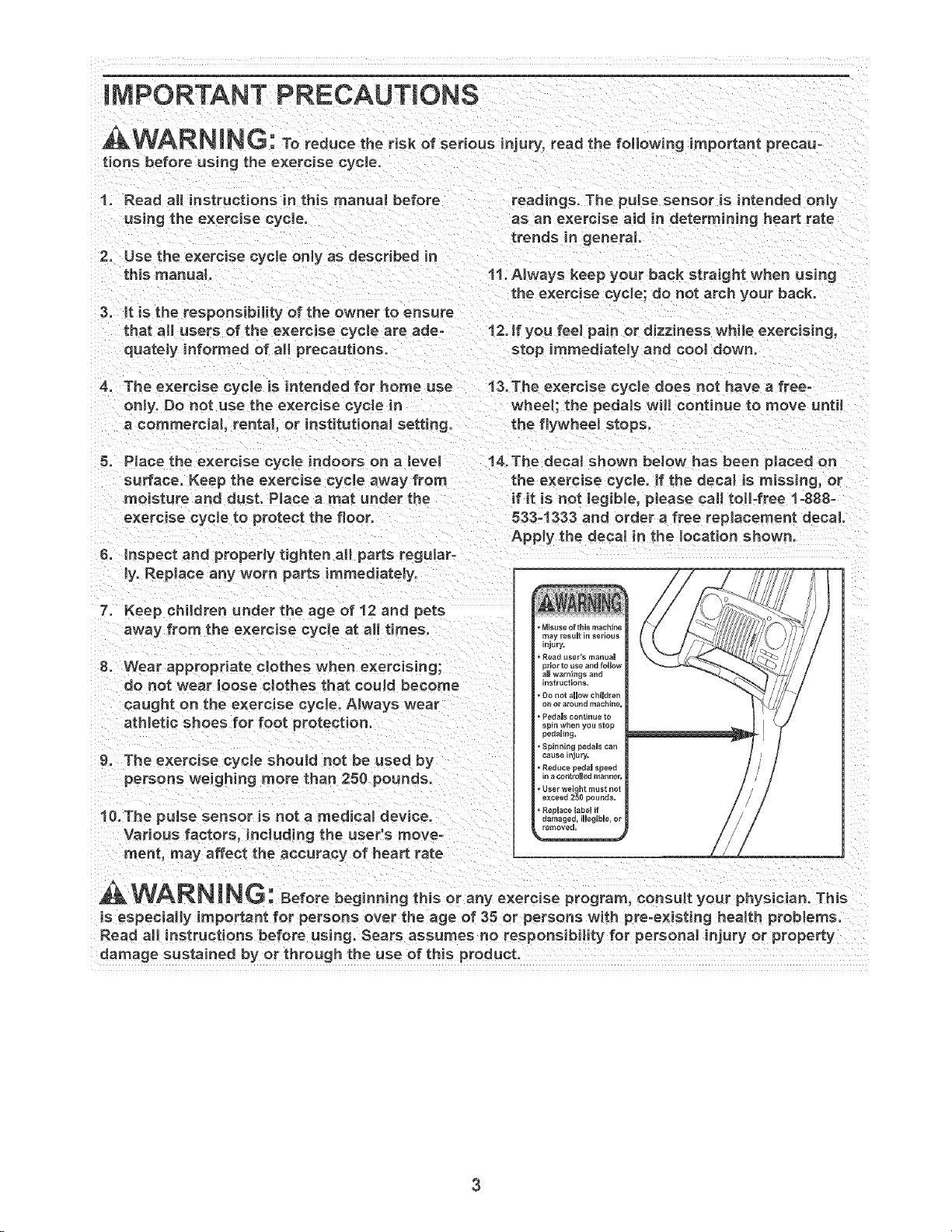
5. Place the exercise cycle indoors on a level 14.The decal shown below has been placed on
su trace. Keep the exercise cycle away from the exercise cycle, if the de cal is missing_ or
moisture and dust. PJace a mat under the if it is not legibJe, please caJl toll-free 1-888-
exercise cycle to protect the floor. 533-1333 and order a free replacement decal
AppJy the decal in the location shown.
6. Inspect and property tighten aH parts regular-
ly. Replace any worn parts immediately.
7. Keep children under the age of 12 and pets
away from the exercise cycle at all times.
8. Wear appropriate clothes when exercising;
do not wear loose clothes that could become
caught on the exercise cycle. Always wear
athletic shoes for foot protection.
9. The exercise cycle should not be used by
persons weighing more than 250 pounds.
10.The pulse sensor is not a medicaJ device.
Various factors, including the user's move-
merit, may affect the accuracy of heart rate
'_,_WARN ING: _eforebeginningtHsoranyexerciseprogram,consultyou,phys_o_an.Th_s
is especially important for persons over the age of 35 or persons with pre-existing hea_th problems.
Read aH instructions before using. Sears assumes no responsibility for persona_ injury or property
damage sustained by or through the use of this product.
BEFORE YOU BEGIN
Congratulations for selecting the new PROFORM _'XP
70 exercise cycle. Cycling is one of the most effective
exercises for increasing cardiovascular fitness, building
endurance, and toning the entire body. The PRO-
FORM _'XP 70 exercise cycle offers an impressive
array of features to let you enjoy this healthful exer-
cise in the convenience and privacy of your home.
For your benefit, read this manuam carefully before
you use the exercise cycle, if you have questions
after reading this manual, please call 1-800-4-MY-
HOME ('_(1-800-469-4663). To help us assist you,
please note the product model number and serial
number before calling. The model number is
831.215010. The serial number can be found on a
decal attached to the exercise cycle (see the front
cover of this manual).
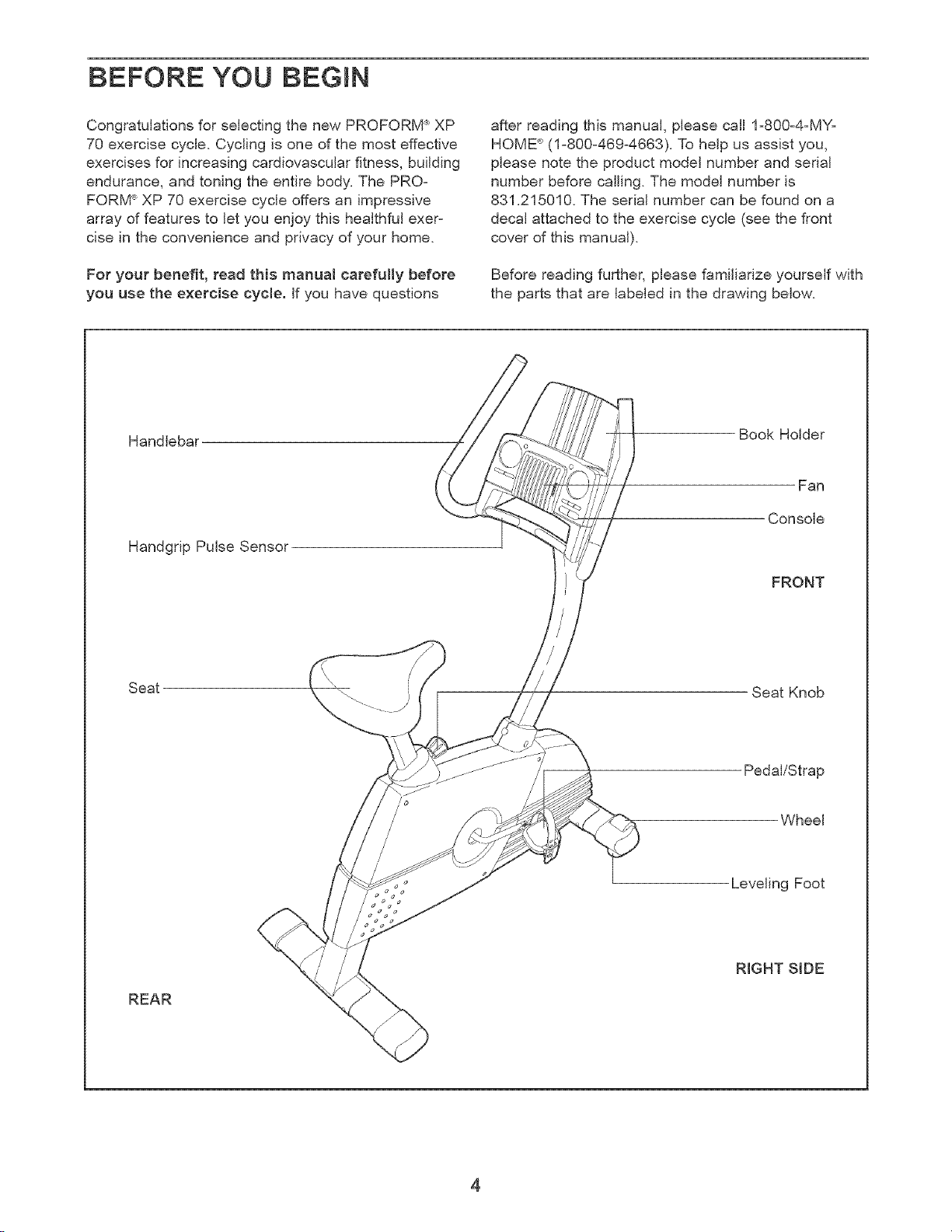
Before reading further, please familiarize yourself with
the parts that are labeled in the drawing below.
Handlebar
Handgrip Pulse Sensor
Book Holder
Fan
Console
FRONT
Seat
REAR
Seat Knob
Pedal/Strap
Wheel
Leveling Foot
RIGHT SIDE
Assemblyrequires two persons. Place all parts of the exercise cycle in a cleared area and remove the packing
materials. Do not dispose of the packing materials until assembly is completed.
#___ _ Phillips
Assembly requires the inctuded tools and your own adjustable wrench _ and
screwdriver _C_.
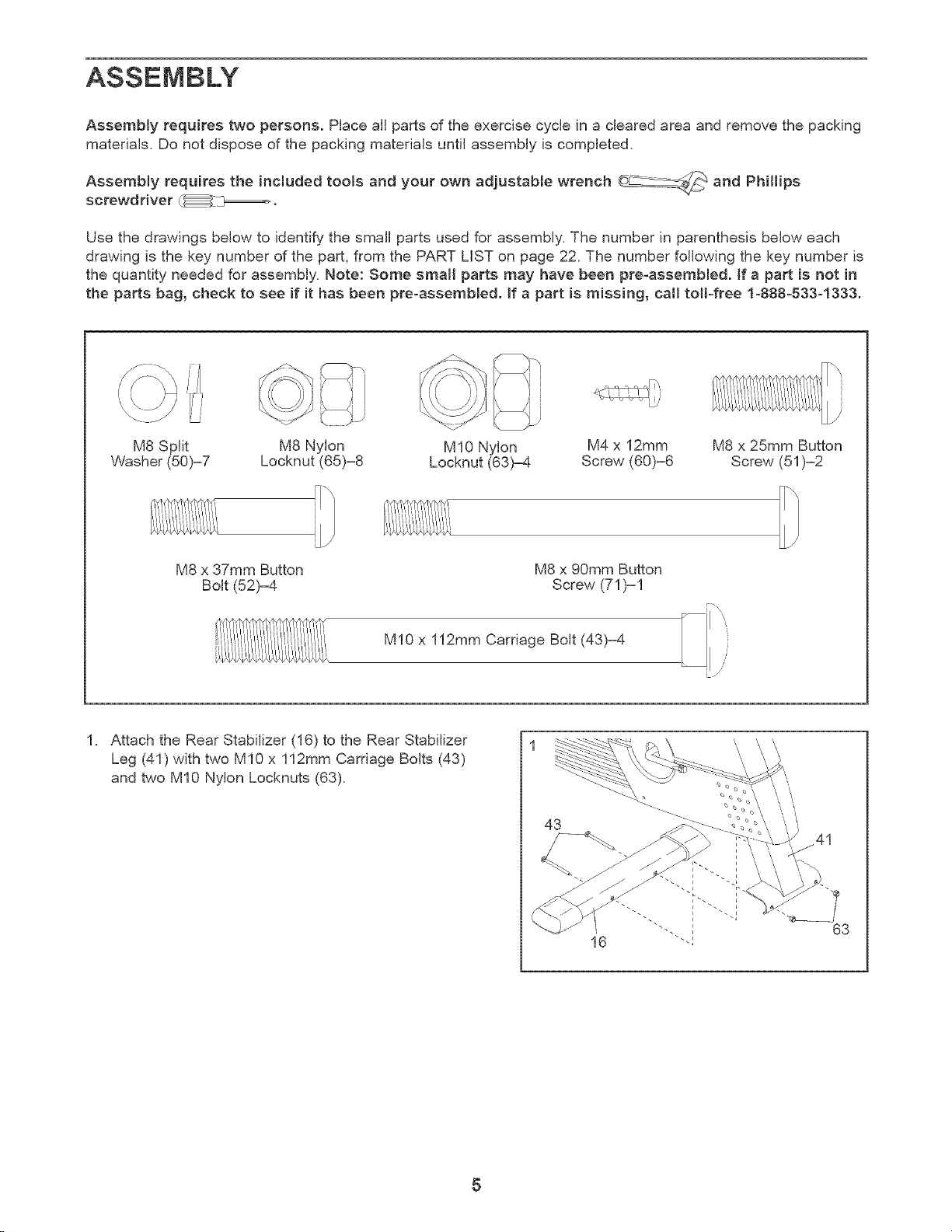
Use the drawings below to identify the small parts used for assembly. The number in parenthesis below each
drawing is the key number of the part, from the PART LiST on page 22. The number following the key number is
the quantity needed for assembly. Note: Some smatl parts may have been pre-assembled. If a part is not in
the parts bag, check to see if it has been pre=assembled, if a part is missing, catl toll=free 1=888-533-1333.
M8 Split M8 Nylon MI0 Nylon M4 x 12mm M8 x 25mm Button
Washer (50)-7 Locknut (65)-8 Locknut (63)-4 Screw (60)-6 Screw (51)=2
M8 x 37mm Button
Bolt (52)-4
M8 x 90mm Button
Screw (71)-1
M10 x 112mm Carriage Bolt (43)-4
1. Attach the Rear Stabilizer (16) to the Rear Stabilizer
Leg (41) with two MI0 x 112mm Carriage Bolts (43)
and two M10 Nylon Locknuts (63).
43
16
63
5
.
.
.
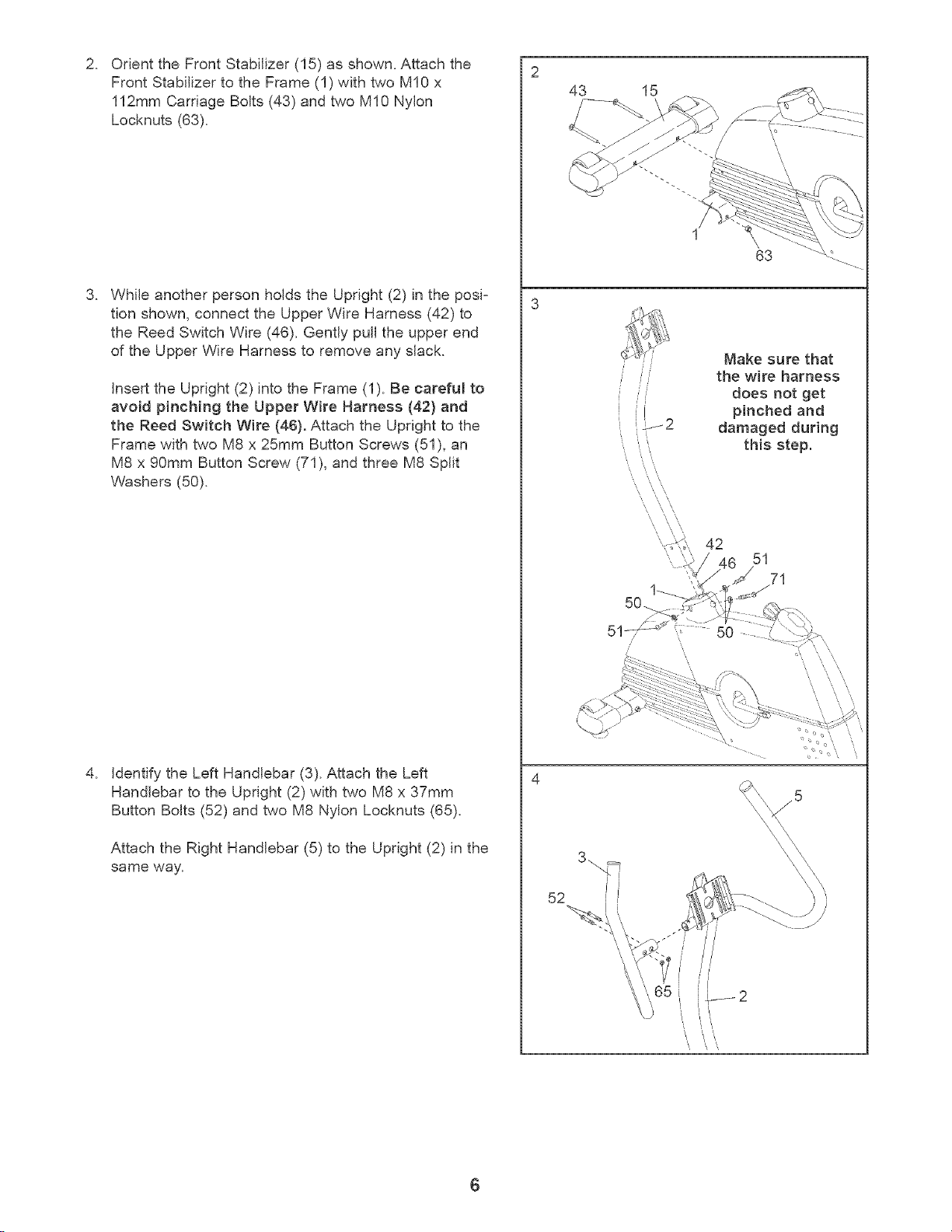
Orient the Front Stabilizer (15) as shown. Attach the
Front Stabilizer to the Frame (1) with two MI0 x
112mm Carriage Bolts (43) and two M10 Nylon
Locknuts (63).
While another person holds the Upright (2) in the posi-
tion shown, connect the Upper Wire Harness (42) to
the Reed Switch Wire (46). Gently pull the upper end
of the Upper Wire Harness to remove any slack.
insert the Upright (2) into the Frame (1). Be careful to
avoid pinching the Upper Wire Harness (42} and
the Reed Switch Wire (46}. Attach the Upright to the
Frame with two M8 x 25mm Button Screws (51), an
M8 x 90mm Button Screw (71), and three M8 Split
Washers (50).
identify the Left Handlebar (3). Attach the Left
Handlebar to the Upright (2) with two M8 x 37mm
Button Bolts (52) and two M8 Nylon Locknuts (65).
Attach the Right Handlebar (5) to the Upright (2) in the
same way.
2
43 15
63
Make sure that
the wire harness
does not get
pinched and
damaged during
this step.
42
51
//
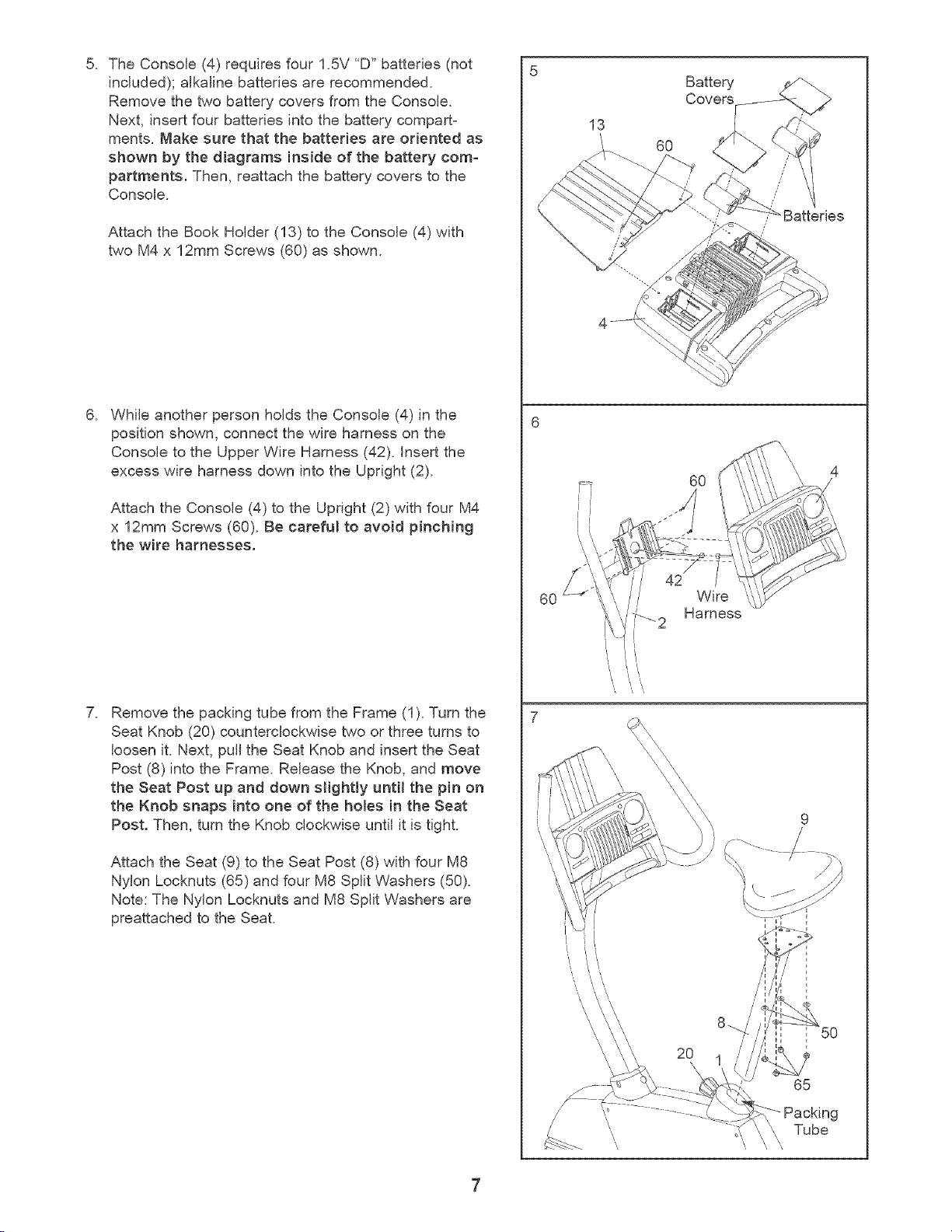
5. The Console (4) requires four 1.5V "D" batteries (not
included); alkaline batteries are recommended.
Remove the two battery covers from the Console.
Next, insert four batteries into the battery compart=
ments. Make sure that the batteries are oriented as
shown by the diagrams inside of the battery com-
partments. Then, reattach the battery covers to the
Console.
Attach the Book Holder (13) to the Console (4) with
two M4 x 12mm Screws (60) as shown.
.
While another person holds the Console (4) in the
position shown, connect the wire harness on the
Console to the Upper Wire Harness (42). Insert the
excess wire harness down into the Upright (2).
Attach the Console (4) to the Upright (2) with four M4
x 12mm Screws (60). Be carefuJ to avoid pinching
the wire harnesses.
.
Remove the packing tube from the Frame (1). Turn the
Seat Knob (20) counterclockwise two or three turns to
loosen it. Next, pulJthe Seat Knob and insert the Seat
Post (8) into the Frame. Release the Knob, and move
the Seat Post up and down siightJy until the pin on
the Knob snaps into one of the hoJes in the Seat
Post. Then, turn the Knob clockwise until it is tight.
Attach the Seat (9) to the Seat Post (8) with four M8
Nylon Locknuts (65) and four M8 Split Washers (50).
Note: The Nylon Locknuts and M8 Split Washers are
preattached to the Seat.
Battery
Covers
13
6O
6O
42
Wire
Harness
Batteries
65
Jg
Tube
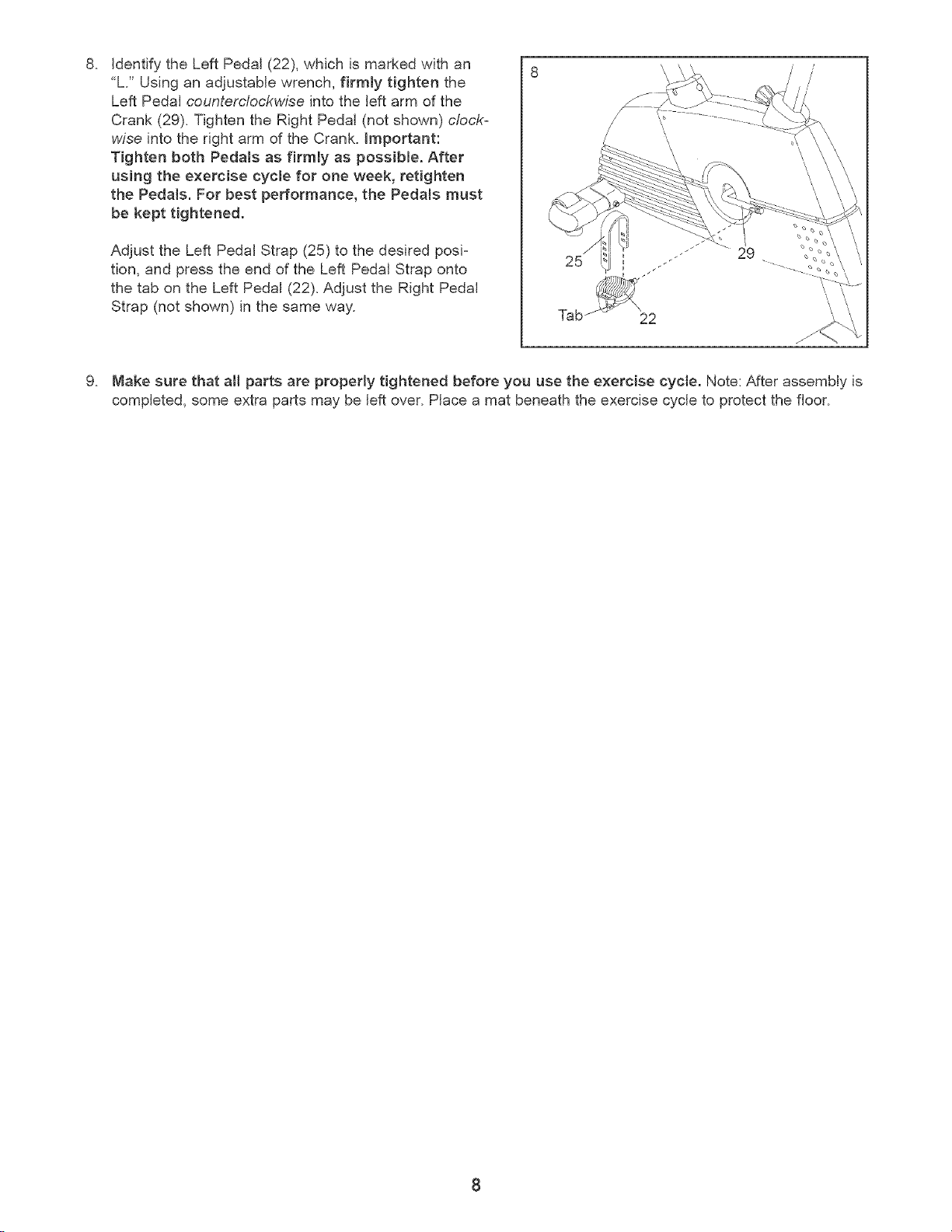
8. 8
identify the Left Pedal (22), which is marked with an
"L" Using an adjustable wrench, firmly tighten the
Left Pedal counterclockwise into the left arm of the
Crank (29). Tighten the Right Pedal (not shown) clock=
wise into the right arm of the Crank. Imporfant:
Tighten both Pedals as firmly as possible. After
using the exercise cycle for one week, retighten
the Pedals. For best performance, the Pedals must
be kept tightened.
Adjust the Left Pedal Strap (25) to the desired posi=
tion, and press the end of the Left Pedal Strap onto
the tab on the Left Pedal (22). Adjust the Right Pedal
Strap (not shown) in the same way.
25 / 29
Tab 22
9. Make sure that all parts are properly tightened before you use the exercise cycte. Note: After assembly is
completed, some extra parts may be left over. Place a mat beneath the exercise cycle to protect the floor.
HOW TO OPERATE THE EXERCmSE CYCLE
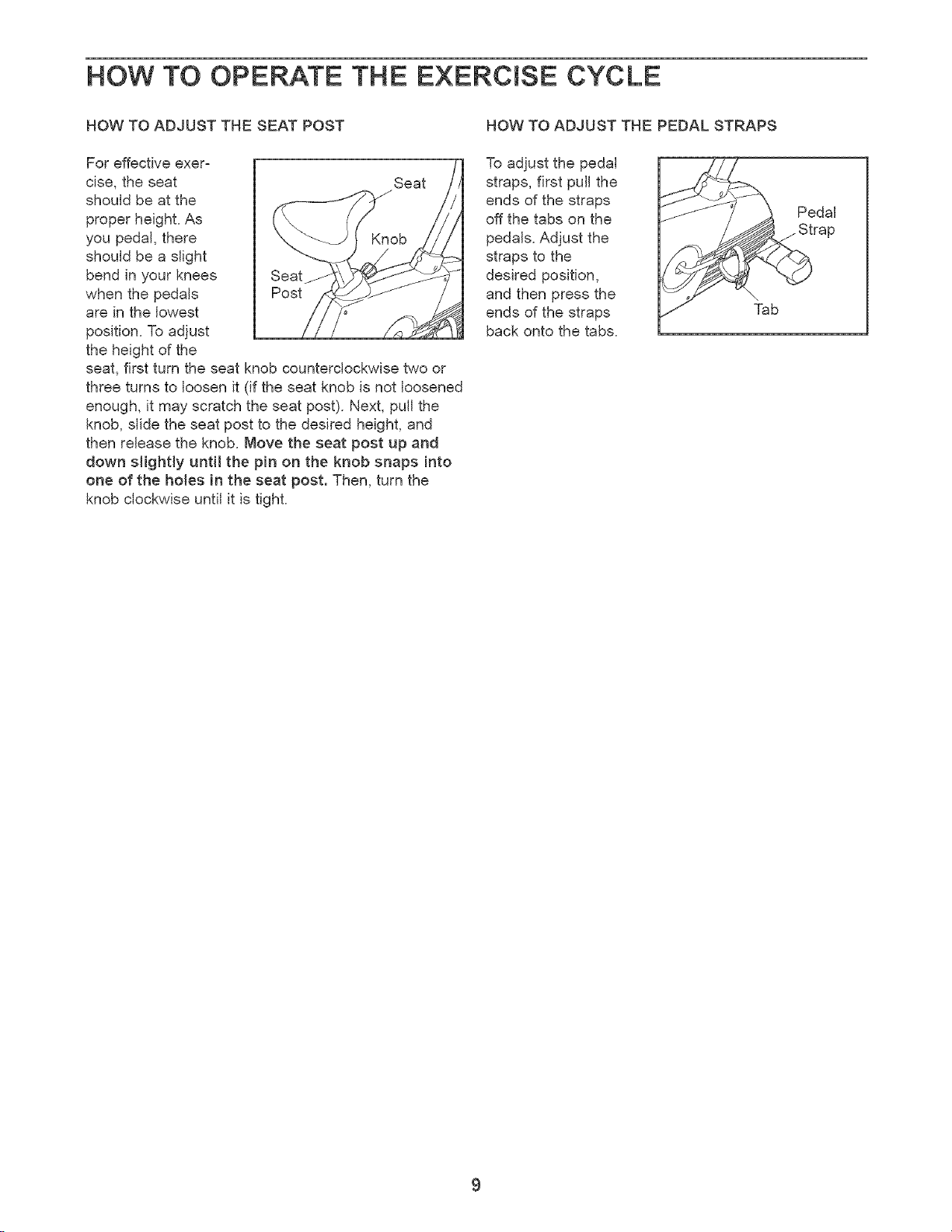
HOW TO ADJUST THE SEAT POST HOW TO ADJUST THE PEDAL STRAPS
For effective exerz
cise, the seat Seat
should be at the
proper height. As
you pedal, there
should be a slight
bend in your knees
when the pedals Post
are in the lowest
position. To adjust
the height of the
seat, first turn the seat knob counterclockwise two or
three turns to loosen it (if the seat knob is not loosened
enough, it may scratch the seat post). Next, pull the
knob, slide the seat post to the desired height, and
then release the knob. Move the seat post up and
down slightly until the pin on the knob snaps into
one of the homes in the seat post. Then, turn the
knob clockwise until it is tight.
To adjust the pedal
straps, first pull the
ends of the straps
off the tabs on the
pedals. Adjust the
straps to the
desired position,
and then press the
ends of the straps
back onto the tabs.
Pedal
rap
CONSOLE DIAGRAM
I
I
I
I
I
I
I
I
I
I
I
I
I
I
I
I
I
I
I
I
I
I
I
I
I
i
age / rate
RESISTANCE
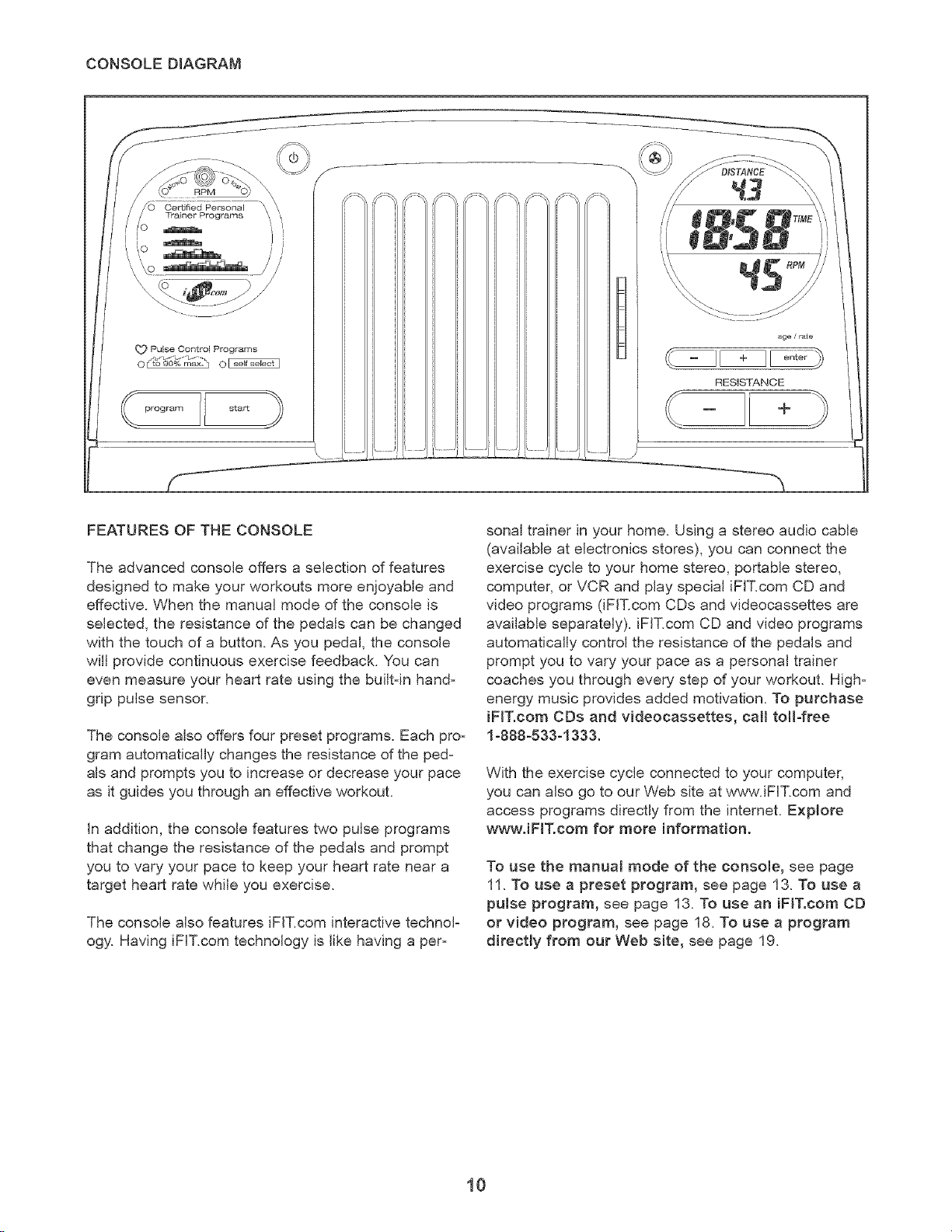
FEATURES OF THE CONSOLE
The advanced console offers a selection of features
designed to make your workouts more enjoyable and
effective. When the manual mode of the console is
selected, the resistance of the pedals can be changed
with the touch of a button. As you pedal, the console
will provide continuous exercise feedback. You can
even measure your heart rate using the built-in hand-
grip pulse sensor.
The console also offers four preset programs. Each pro-
gram automatically changes the resistance of the ped-
als and prompts you to increase or decrease your pace
as it guides you through an effective workout.
in addition, the console features two pulse programs
that change the resistance of the pedals and prompt
you to vary your pace to keep your heart rate near a
target heart rate while you exercise.
The console also features iFIT.com interactive technol-
ogy. Having iFIT.com technology is like having a per-
sonal trainer in your home. Using a stereo audio cable
(available at electronics stores), you can connect the
exercise cycle to your home stereo, portable stereo,
computer, or VCR and play special iFIT.com CD and
video programs (iFIT.com CDs and videocassettes are
available separately), iFIT.com CD and video programs
automatically control the resistance of the pedals and
prompt you to vary your pace as a personal trainer
coaches you through every step of your workout. High-
energy music provides added motivation. To purchase
iFIT.com CDs and videocassettes, ca!l toll-free
1-888-533-1333.
With the exercise cycle connected to your computer,
you can also go to our Web site at www.iFF.com and
access programs directly from the internet. Explore
www.iF_T.com for more information.
To use the manual mode of the console, see page
11. To use a preset program, see page 13. To use a
pulse program, see page 13. To use an iFIT.com CD
or video program, see page 18. To use a program
directly from our Web site, see page 19.
10
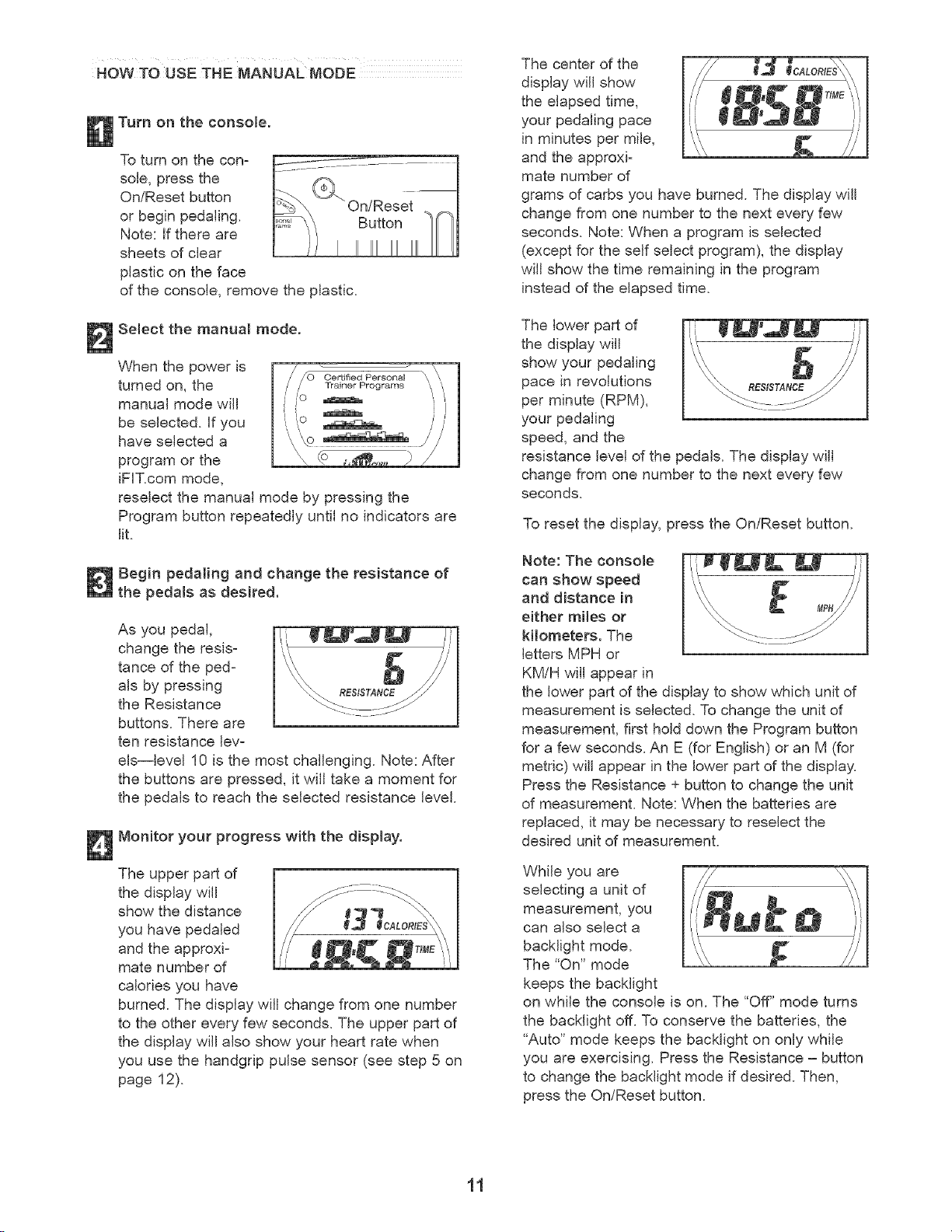
HOW TO USE THE MANUAL MODE
Turn on the console.
To turn on the con-
sole, press the
On/Reset button
or begin pedaling.
Note: if there are
sheets of clear
plastic on the face
of the console, remove the plastic.
Select the manual mode.
When the power is
turned on, the
manual mode will
be selected, if you
have selected a
program or the
iFF com mode,
reselect the manual mode by pressing the
Program button repeatedly until no indicators are
lit.
Begin pedaling and change the resistance of
the pedals as desired.
As you pedal,
change the resis-
tance of the ped-
als by pressing
the Resistance
buttons. There are
ten resistance lev-
els-level 10 is the most challenging. Note: After
the buttons are pressed, it will take a moment for
the pedals to reach the selected resistance level.
Monitor your progress with the display.
The upper part of
the display will
show the distance
you have pedaled
and the approxi-
mate number of
calories you have
burned. The display will change from one number
to the other every few seconds. The upper part of
the display will also show your heart rate when
you use the handgrip pulse sensor (see step 5 on
page 12).
The center of the
display will show
the elapsed time,
your pedaling pace
in minutes per mile,
and the approxi-
mate number of
grams of carbs you have burned. The display will
change from one number to the next every few
seconds. Note: When a program is selected
(except for the self select program), the display
win show the time remaining in the program
instead of the elapsed time.
The lower part of
the display will
show your pedaling
pace in revolutions
per minute (RPM),
your pedaling
speed, and the
resistance level of the pedals. The display will
change from one number to the next every few
seconds.
To reset the display, press the On/Reset button.
Note: The console
can show speed
and distance in
either miles or
kilometers. The
letters MPH or
KM/H will appear in
the lower part of the display to show which unit of
measurement is selected. To change the unit of
measurement, first hold down the Program button
for a few seconds. An E (for English) or an M (for
metric) will appear in the lower part of the display.
Press the Resistance + button to change the unit
of measurement. Note: When the batteries are
replaced, it may be necessary to reselect the
desired unit of measurement.
While you are
selecting a unit of
measurement, you D-_
can also select a _
backlight mode.
The "On" mode
keeps the backlight
on while the console is on. The "Off" mode turns
the backlight off. To conserve the batteries, the
"Auto" mode keeps the backlight on only while
you are exercising. Press the Resistance - button
to change the backlight mode if desired. Then,
press the On/Reset button.
11
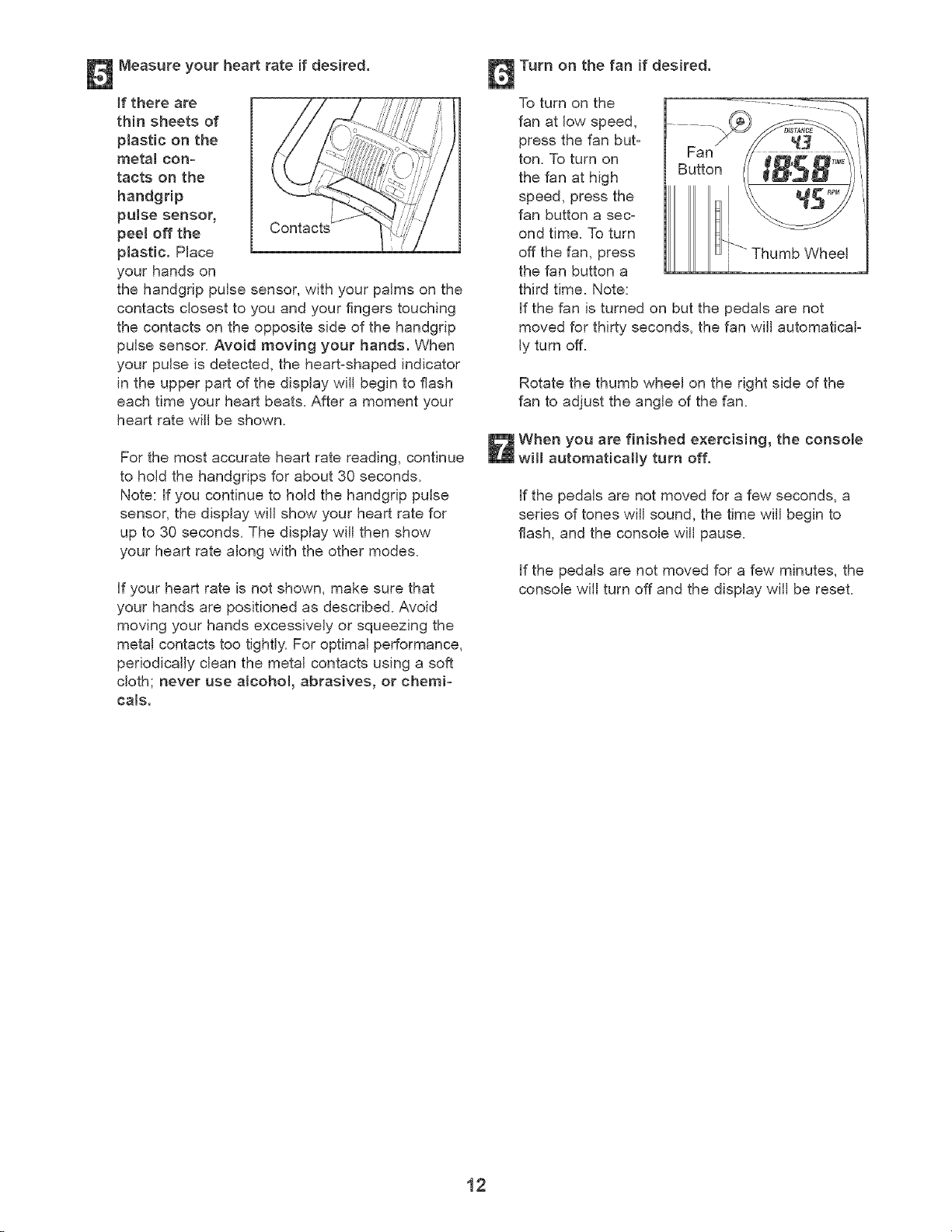
Measure your heart rate if desired.
If there are
thin sheets of
plastic on the
metal con=
tacts on the
handgrip
pulse sensor,
peel off the
plastic, Place
your hands on
the handgrip pulse sensor, with your palms on the
contacts closest to you and your fingers touching
the contacts on the opposite side of the handgdp
pulse sensor. Avoid moving your hands. When
your pulse is detected, the heart=shaped indicator
in the upper part of the display will begin to flash
each time your heart beats. After a moment your
heart rate will be shown.
For the most accurate heart rate reading, continue
to hold the handgdps for about 30 seconds.
Note: if you continue to hold the handgrip pulse
sensor, the display will show your heart rate for
up to 30 seconds. The display will then show
your heart rate along with the other modes.
if your heart rate is not shown, make sure that
your hands are positioned as described. Avoid
moving your hands excessively or squeezing the
metal contacts too tightly. For optimal performance,
periodically clean the metal contacts using a soft
cloth; never use alcohol, abrasives, or chemi-
cals.
Turn on the fan if desired.
To turn on the .......... :
fan at low speed,
press the fan but=
ton. To turn on
the fan at high
speed, press the
fan button a sec=
end time. To turn
off the fan, press
the fan button a
third time. Note:
If the fan is turned on but the pedals are not
moved for thirty seconds, the fan will automatical=
ly turn off.
Rotate the thumb wheel on the right side of the
fan to adjust the angle of the fan.
When you are finished exercising, the console
automatically turn off.
If the pedals are not moved for a few seconds, a
series of tones wiJJsound, the time will begin to
flash, and the console wiJJpause.
If the pedals are not moved for a few minutes, the
console will turn off and the display will be reset.
12
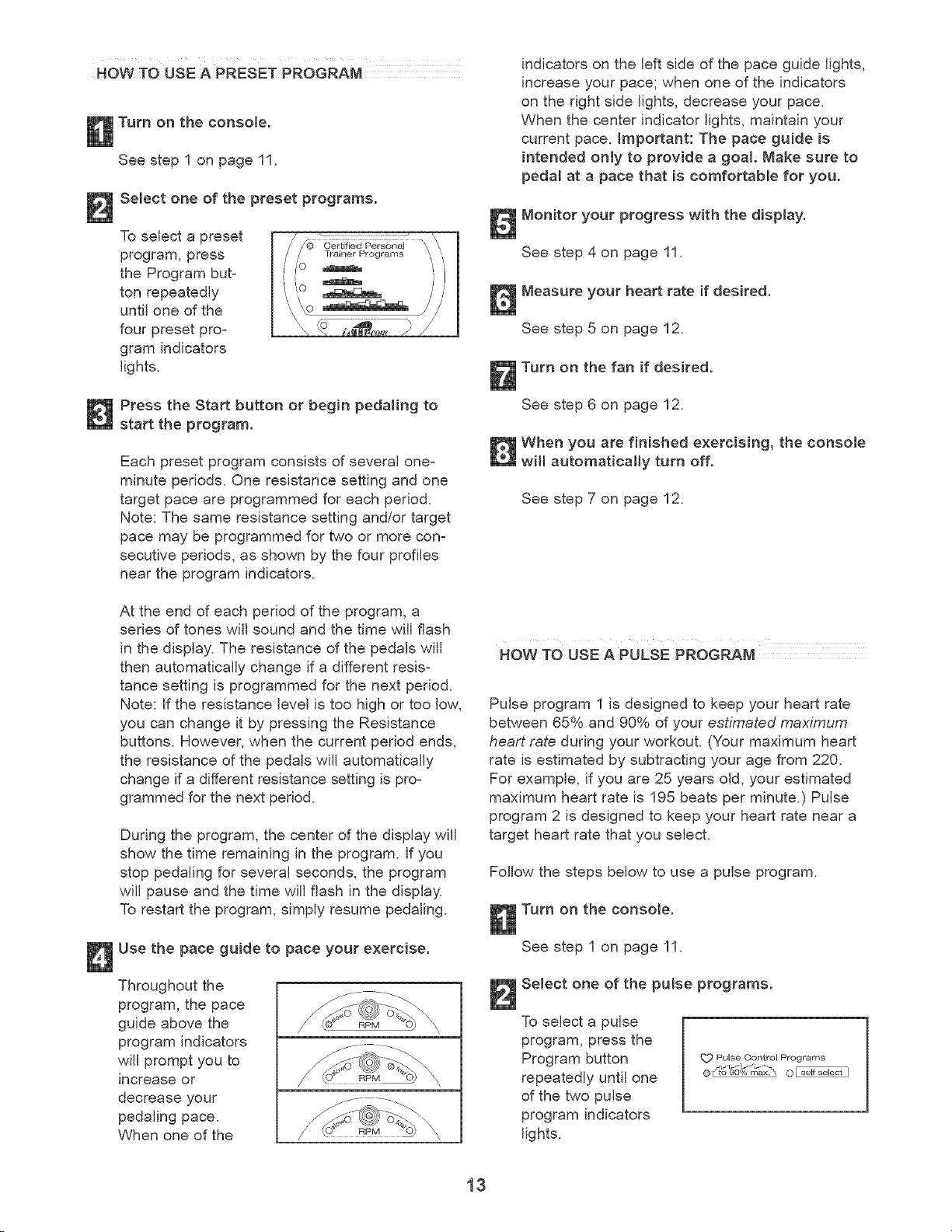
HOW TO USE A PRESET PROGRAM
Turn on the console.
See step 1 on page 11.
Se{ect one of the preset programs.
To select a preset
program, press
the Program but=
ton repeatedly
until one of the
four preset pro=
gram indicators
lights.
Press the Start button or begin pedating to
start the program.
Each preset program consists of several one=
minute periods. One resistance setting and one
target pace are programmed for each period.
Note: The same resistance setting and/or target
pace may be programmed for two or more con=
secutive periods, as shown by the four profiles
near the program indicators.
At the end of each period of the program, a
series of tones will sound and the time will flash
in the display. The resistance of the pedals will
then automatically change if a different resis-
tance setting is programmed for the next period.
Note: if the resistance level is too high or too low,
you can change it by pressing the Resistance
buttons. However, when the current period ends,
the resistance of the pedals will automatically
change if a different resistance setting is pro=
grammed for the next period.
During the program, the center of the display will
show the time remaining in the program. If you
stop pedaling for several seconds, the program
will pause and the time will flash in the display.
To restart the program, simply resume pedaling.
Use the pace guide to pace your exercise.
Throughout the
program, the pace
guide above the
program indicators
will prompt you to
increase or
decrease your
pedaling pace.
When one of the
RPM
/
indicators on the left side of the pace guide lights,
increase your pace; when one of the indicators
on the right side lights, decrease your pace.
When the center indicator lights, maintain your
current pace. Umpottant: The pace guide is
intended only to provide a goal [Wake sure to
pedamat a pace that is comfortable for you.
Monitor your progress with the display.
See step 4 on page 11.
Measure your heart rate if desired.
See step 5 on page 12.
Turn on the fan if desired.
See step 6 on page 12.
When you are finished exercising, the console
witl automaticaiiy turn off.
See step 7 on page 12.
How-r0uSEAPuLsEPROGRAM
Pulse program 1 is designed to keep your heart rate
between 65% and 90% of your estimated maximum
heart rate during your workout. (Your maximum heart
rate is estimated by subtracting your age from 220.
For example, if you are 25 years old, your estimated
maximum heart rate is 195 beats per minute.) Pulse
program 2 is designed to keep your heart rate near a
target heart rate that you select.
Follow the steps below to use a pulse program.
Turn on the console.
See step 1 on page 11.
Select one of the pulse programs.
To select a pulse
program, press the
Program button
repeatedly until one
of the two pulse
program indicators
lights.
(_ Pulse Control Programs
@r_to 9o% ma x. O_
13
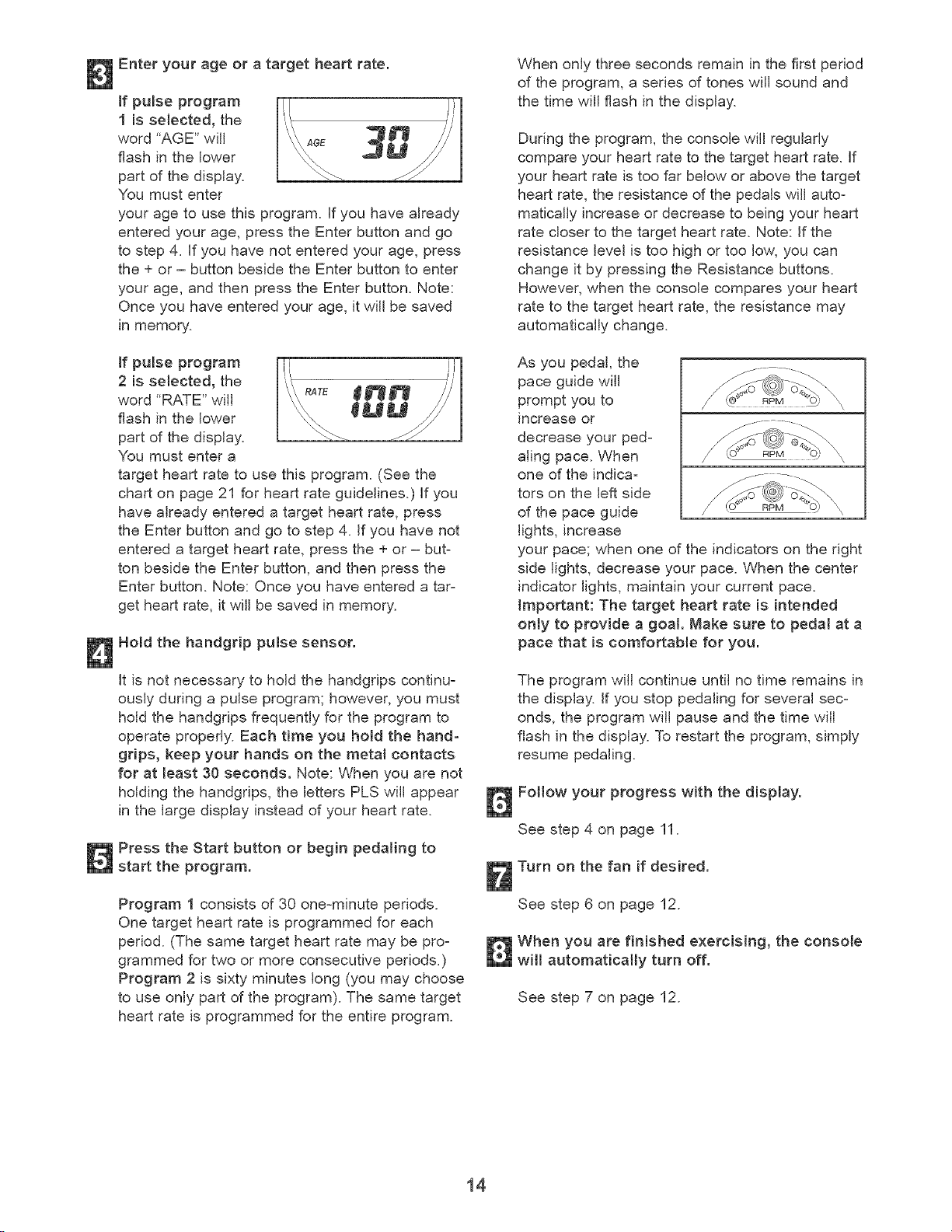
Enter your age or a target heart rate.
if pulse program
1 is selected, the
word "AGE" will Ao_
flash in the lower
part of the display.
You must enter
your age to use this program. If you have already
entered your age, press the Enter button and go
to step 4. If you have not entered your age, press
the + or = button beside the Enter button to enter
your age, and then press the Enter button. Note:
Once you have entered your age, it will be saved
in memory.
if pulse program
2 is selected, the
word "RATE" wJJJ
flash in the lower
part of the display.
You must enter a
target heart rate to use this program. (See the
chart on page 21 for heart rate guidelines.) If you
have already entered a target heart rate, press
the Enter button and go to step 4. If you have not
entered a target heart rate, press the + or = but-
ton beside the Enter button, and then press the
Enter button. Note: Once you have entered a tar-
get heart rate, it will be saved in memory.
Hold the handgrip pulse sensor.
It is not necessary to hold the handgrips continu=
ousiy during a pulse program; however, you must
hold the handgrips frequently for the program to
operate properly. Each time you hold the hand-
grips, keep your hands on the metal contacts
for at least 30 seconds. Note: When you are not
holding the handgdps, the letters PLS will appear
in the large display instead of your heart rate.
Press the Start button or begin pedaling to
start the program.
Program 1 consists of 30 one=minute periods.
One target heart rate is programmed for each
period. (The same target heart rate may be pro=
grammed for two or more consecutive periods.)
Program 2 is sixty minutes long (you may choose
to use only part of the program). The same target
heart rate is programmed for the entire program.
When only three seconds remain in the first period
of the program, a series of tones will sound and
the time will flash in the display.
During the program, the console will regularly
compare your heart rate to the target heart rate. If
your heart rate is too far below or above the target
heart rate, the resistance of the pedals will auto-
maticaJJyincrease or decrease to being your heart
rate closer to the target heart rate. Note: If the
resistance level is too high or too low, you can
change it by pressing the Resistance buttons.
However, when the console compares your heart
rate to the target heart rate, the resistance may
automatically change.
As you pedal, the
pace guide will
prompt you to
increase or
decrease your ped-
aling pace. When
one of the indica-
tors on the left side
of the pace guide
lights, increase
your pace; when one of the indicators on the right
side lights, decrease your pace. When the center
indicator lights, maintain your current pace.
important: The target heart rate is intended
only to provide a goal Make sure to pedal at a
pace that is comfortable for you.
The program will continue until no time remains in
the display. If you stop pedaling for several sec=
onds, the program will pause and the time will
flash in the display. To restart the program, simply
resume pedaling.
Follow your progress with the display.
See step 4 on page 11.
Turn on the fan if desired.
See step 6 on page 12.
When you are finished exercising, the console
witl automatically turn off.
See step 7 on page 12.
14
NOWTO CONNECT YOUR CD PLAYER, VCR_
OR COMPUTER
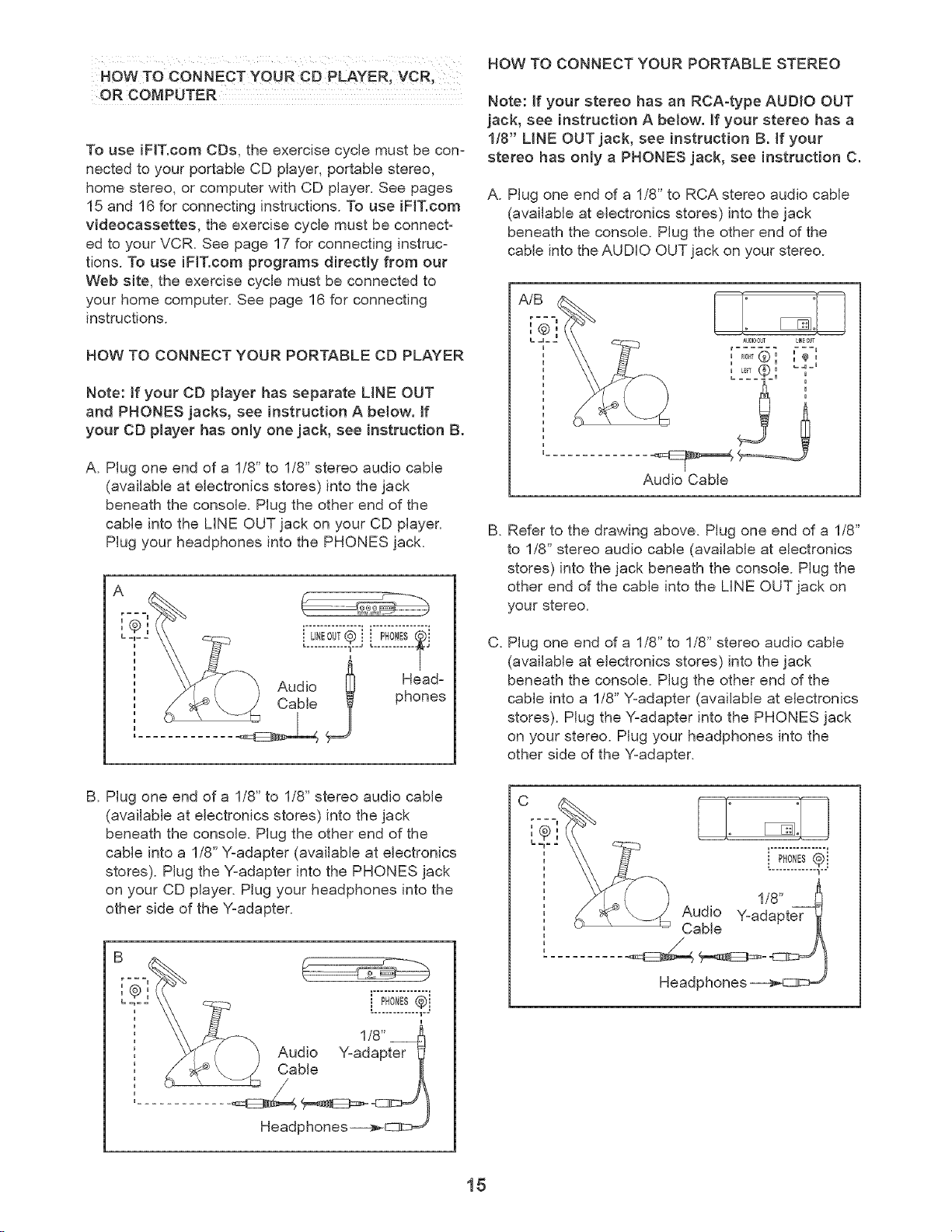
To use iF_T.com CDs, the exercise cycle must be con-
nected to your portable CD player, portable stereo,
home stereo, or computer with CD player. See pages
15 and 16 for connecting instructions. To use iHT.com
videocassettes, the exercise cycle must be connect-
ed to your VCR. See page 17 for connecting instruc-
tions. To use iFJT.com programs directly from our
Web site, the exercise cycle must be connected to
your home computer. See page 16 for connecting
instructions.
HOW TO CONNECT YOUR PORTABLE CD PLAYER
Note: _fyour CD player has separate LiNE OUT
and PHONES jacks, see instruction A below, if
your CD player has only one jack, see instruction B.
A. Plug one end of a 1/8" to 1/8" stereo audio cable
(available at electronics stores) into the jack
beneath the console. Plug the other end of the
cable into the LiNE OUT jack on your CD player.
Plug your headphones into the PHONES jack.
B. Plug one end of a 1/8" to 1/8" stereo audio cable
(available at electronics stores) into the jack
beneath the console. Plug the other end of the
cable into a 1/8" Y-adapter (available at electronics
stores). Plug the Y-adapter into the PHONES jack
on your CD player. Plug your headphones into the
other side of the Y-adapter.
HOW TO CONNECT YOUR PORTABLE STEREO
Note: if your stereo has an RCA-type AUDIO OUT
jack, see instruction A beBow. If your stereo has a
1/8" UNE OUT jack, see instruction B. If your
stereo has only a PHONES jack, see instruction C.
A. Plug one end of a 1/8" to RCA stereo audio cable
(available at electronics stores) into the jack
beneath the console. Plug the other end of the
cable into the AUDIO OUT jack on your stereo.
Audio Cable
B.
C.
Refer to the drawing above. Plug one end of a 1/8"
to 1/8" stereo audio cable (available at electronics
stores) into the jack beneath the console. Plug the
other end of the cable into the LINE OUT jack on
your stereo.
Plug one end of a 1/8" to 1/8" stereo audio cable
(available at electronics stores) into the jack
beneath the console. Plug the other end of the
cable into a 1/8" Y-adapter (available at electronics
stores). Plug the Y-adapter into the PHONES jack
on your stereo. Plug your headphones into the
other side of the Y-adapter.
C
15
HOW TO CONNECT YOUR HOME STEREO HOW TO CONNECT YOUR COMPUTER
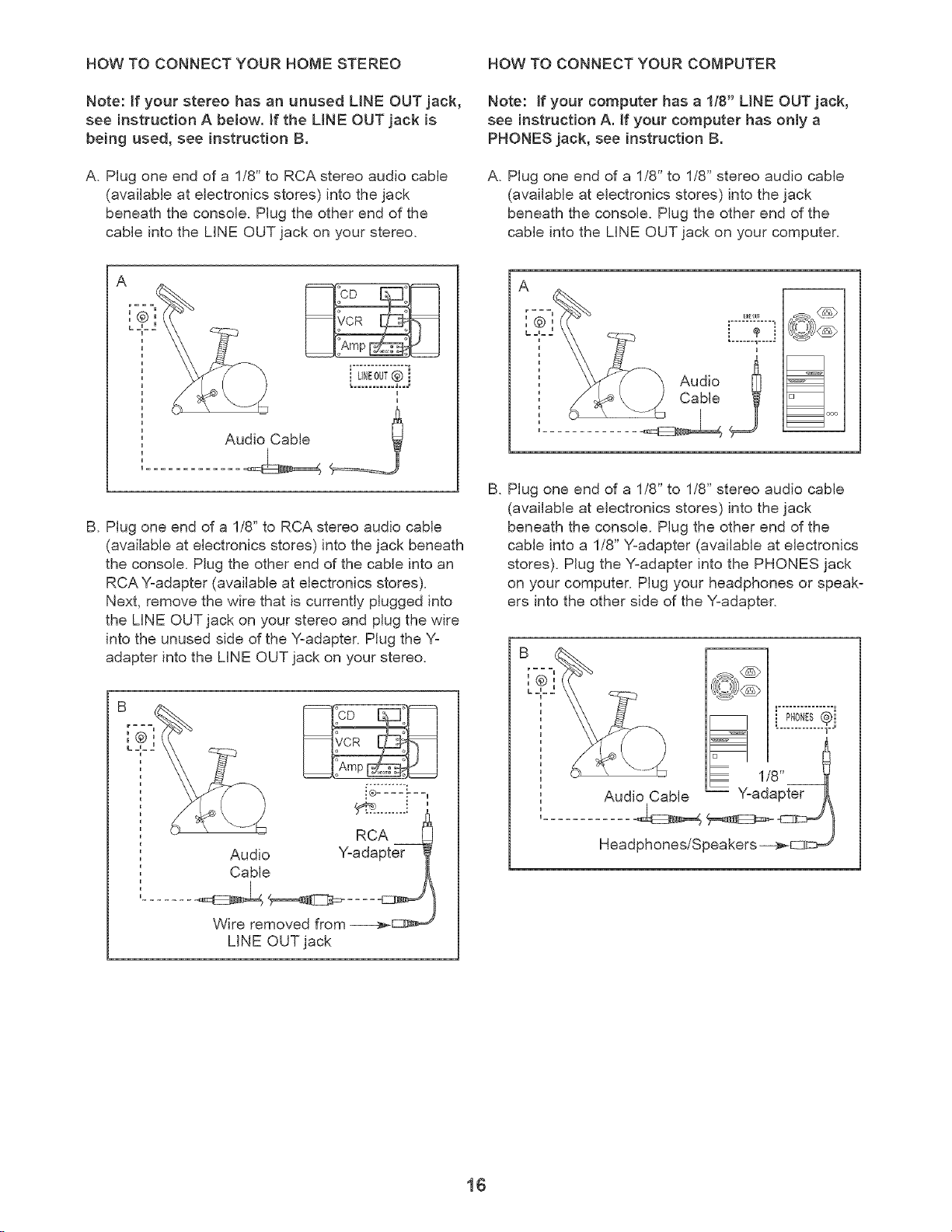
Note: If your stereo has an unused LiNE OUT jack,
see instruction A below. Jf the LINE OUT jack is
being used, see instruct{on B.
A. Plug one end of a 1/8" to RCA stereo audio cable
(available at electronics stores) into the jack
beneath the console. Plug the other end of the
cable into the LiNE OUT jack on your stereo.
Note: If your computer has a 1/8" MNE OUT jack,
see instruction A. If your computer has only a
PHONES jack, see instruction B.
A. Plug one end of a 1/8" to 1/8" stereo audio cable
(available at electronics stores) into the jack
beneath the console. Plug the other end of the
cable into the LiNE OUT jack on your computer.
i LINEOUT_) i
u
u
Audio Cable ___._
B. Plug one end of a 1/8" to RCA stereo audio cable
(available at electronics stores) into the jack beneath
the console. Plug the other end of the cable into an
RCA Y-adapter (available at electronics stores).
Next, remove the wire that is currently plugged into
the LiNE OUT jack on your stereo and plug the wire
into the unused side of the Y-adapter. Plug the Y-
adapter into the LINE OUT jack on your stereo.
Audio
Cable
i®.... -==
RCA
Y-adapter
Wire removed from _E::Z_
LINE OUT jack
Icc_W_@
i
=1
=1 ooo
B. Plug one end of a 1/8" to 1/8" stereo audio cable
(available at electronics stores) into the jack
beneath the console. Plug the other end of the
cable into a 1/8" Y-adapter (available at electronics
stores). Plug the Y-adapter into the PHONES jack
on your computer. Plug your headphones or speak-
ers into the other side of the Y-adapter.
16
HOW TO CONNECT YOUR VCR
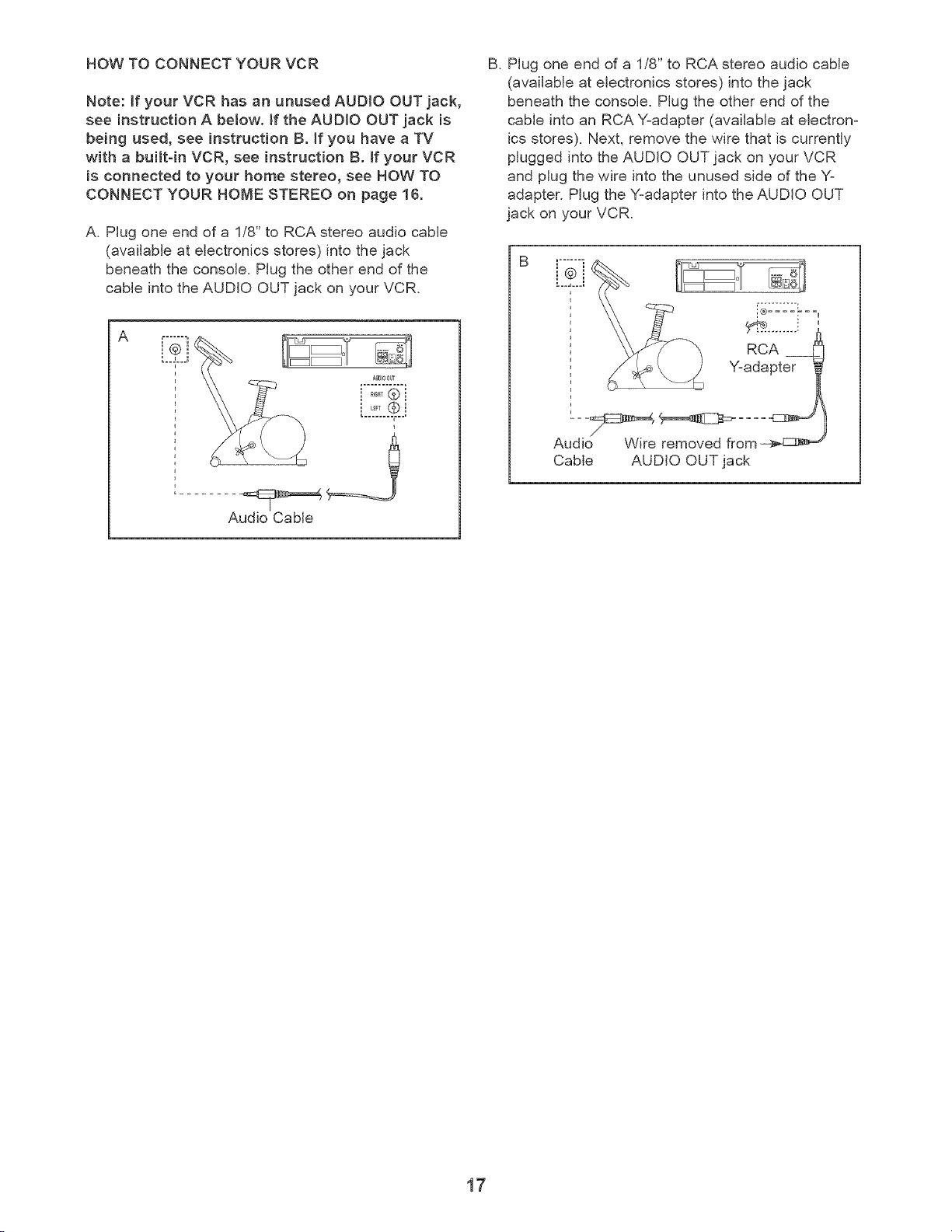
Note: If your VCR has an unused AUDIO OUT jack,
see instruction A below. Jf the AUDIO OUT jack is
being used, see instruction B. if you have a TV
with a built-{n VCR, see instruction B. if your VCR
is connected to your home stereo, see HOW TO
CONNECT YOUR HOME STEREO on page 16.
A. Plug one end of a 1/8" to RCA stereo audio cable
(available at electronics stores) into the jack
beneath the console. Plug the other end of the
cable into the AUDIO OUT jack on your VCR.
A
B. Plug one end of a 1/8" to RCA stereo audio cable
(available at electronics stores) into the jack
beneath the console. Plug the other end of the
cable into an RCA Y-adapter (available at electron-
ics stores). Next, remove the wire that is currently
plugged into the AUDIO OUT jack on your VCR
and plug the wire into the unused side of the Y-
adapter. Plug the Y-adapter into the AUDIO OUT
jack on your VCR.
Cable AUDIO OUT jack
17
HOW TO USE AN IFIT.COM CD AND VIDEO
PROGRAM
To use iFIT.com CDs or videocassettes, the exercise
cycle must be connected to your portable CD player,
portable stereo, home stereo, computer with CD play-
er, or VCR. See HOW TO CONNECT YOUR CD
PLAYER, VCR, OR COMPUTER on pages 15 to 17.
To purchase iF_T.com CDs and videocassettes catl
toll=free 1=833=533=1333.
Follow the steps below to use an iFIT.com CD or
video program.
Turn on the console.
See step 1 on page 11.
Se{ect the iF_T.com mode.
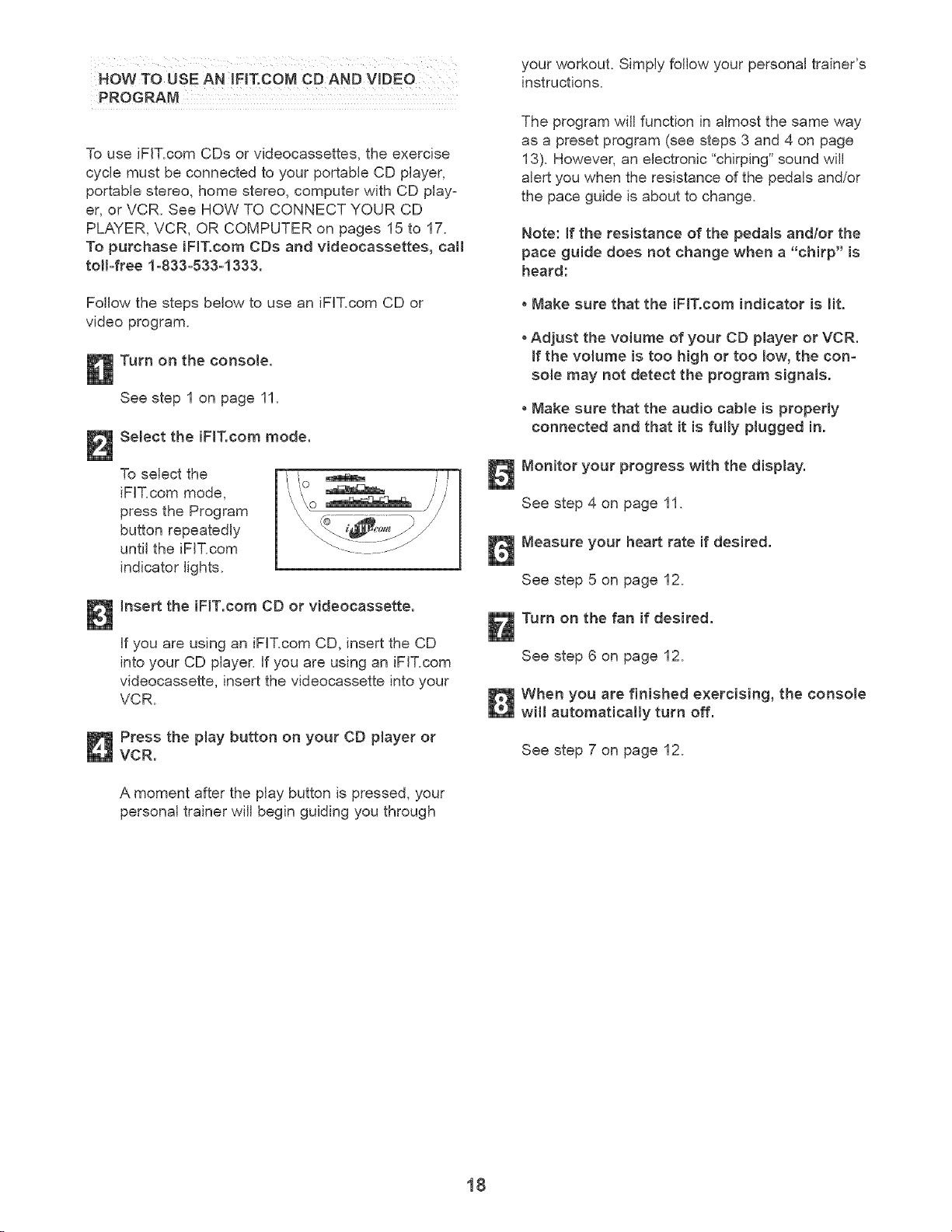
To select the
iFF.com mode,
press the Program
button repeatedly
until the iFF.com
indicator lights.
Insert the iF_T.com CD or videocassette.
if you are using an iFF.com CD, insert the CD
into your CD player, if you are using an iFIT.com
videocassette, insert the videocassette into your
VCR.
Press the play button on your CD player or
VCR.
A moment after the play button is pressed, your
personal trainer will begin guiding you through
your workout. Simply follow your personaJ trainer's
instructions.
The program will function in almost the same way
as a preset program (see steps 3 and 4 on page
13). However, an electronic "chirping" sound will
alert you when the resistance of the pedals and/or
the pace guide is about to change.
Note: If the resistance of the pedals and/or the
pace guide does not change when a "chirp" is
heard:
Make sure that the iFIT.com indicator is lit.
, Adjust the volume of your CD player or VCR.
If the volume is too high or too !ow, the con=
sole may not detect the program signais.
, Make sure that the audio cable is properly
connected and that it is fully plugged in.
Monitor your progress with the display.
See step 4 on page 11.
Measure your heart rate if desbed.
See step 5 on page 12.
Turn on the fan if desired.
See step 6 on page 12.
When you are finished exercising, the console
witl automatically turn off.
See step 7 on page 12.
18
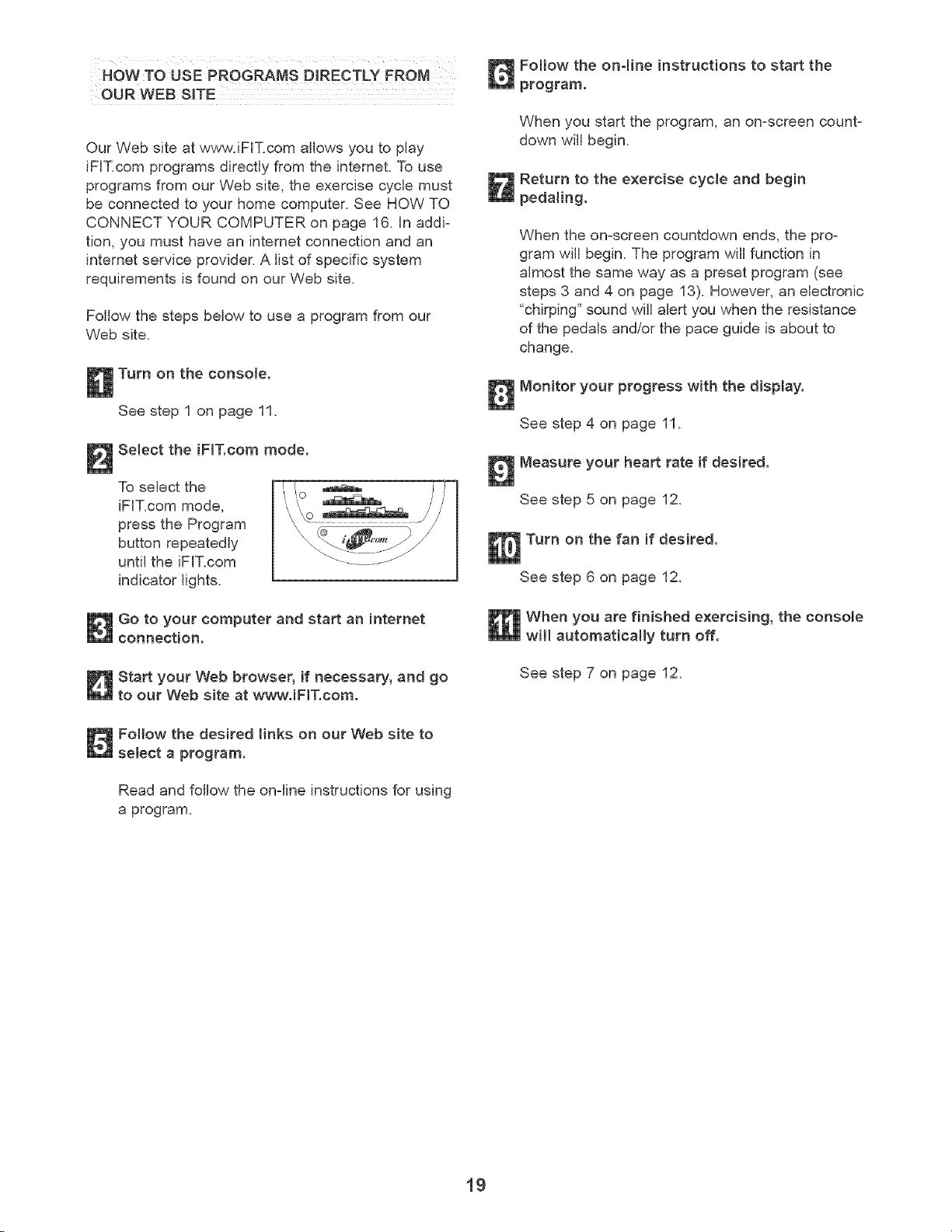
HOWTO USE PROGRAMS DIRECTLY FROM
OUR WEB SITE
Our Web site at www.iFIT.com allows you to play
iFF.com programs directly from the internet. To use
programs from our Web site, the exercise cycle must
be connected to your home computer. See HOW TO
CONNECT YOUR COMPUTER on page 16. In addi=
tion, you must have an internet connection and an
internet service provider. A list of specific system
requirements is found on our Web site.
Follow the steps below to use a program from our
Web site.
Turn on the console.
See step 1 on page 11.
Select the iF_T.com mode.
To select the
iFF.com mode,
press the Program
button repeatedly
until the iFIT.com
indicator lights.
Go to your computer and start an internet
connection.
Start your Web browser, if necessary, and go
to our Web site at www.iF_T.com.
Follow the desired linkson our Web site to
select a program.
Read and follow the on=line instructionsfor using
a program.
Follow the on=line instructions to start the
program.
When you start the program, an on-screen count-
down will begin.
Return to the exercise cycle and begin
pedaling.
When the on=screen countdown ends, the pro=
gram will begin. The program will function in
almost the same way as a preset program (see
steps 3 and 4 on page 13). However, an electronic
"chirping" sound will alert you when the resistance
of the pedals and/or the pace guide is about to
change.
Monitor your progress with the display.
See step 4 on page 11.
Measure your heart rate if desired.
See step 5 on page 12.
Turn on the fan if desired.
See step 6 on page 12.
When you are finished exercising, the console
automatically turn off.
See step 7 on page 12.
19
MAINTENANCE AND TROUBLESHOOTUNG
inspect and tighten all parts of the exercise cycle reg-
ularly. Replace any worn parts immediately.
To clean the exercise cycle, use a damp cloth and a
small amount of mild soap. Important: To avoid
damage to the console, keep liquids away from
the console and keep the console out of direct
sunlight.
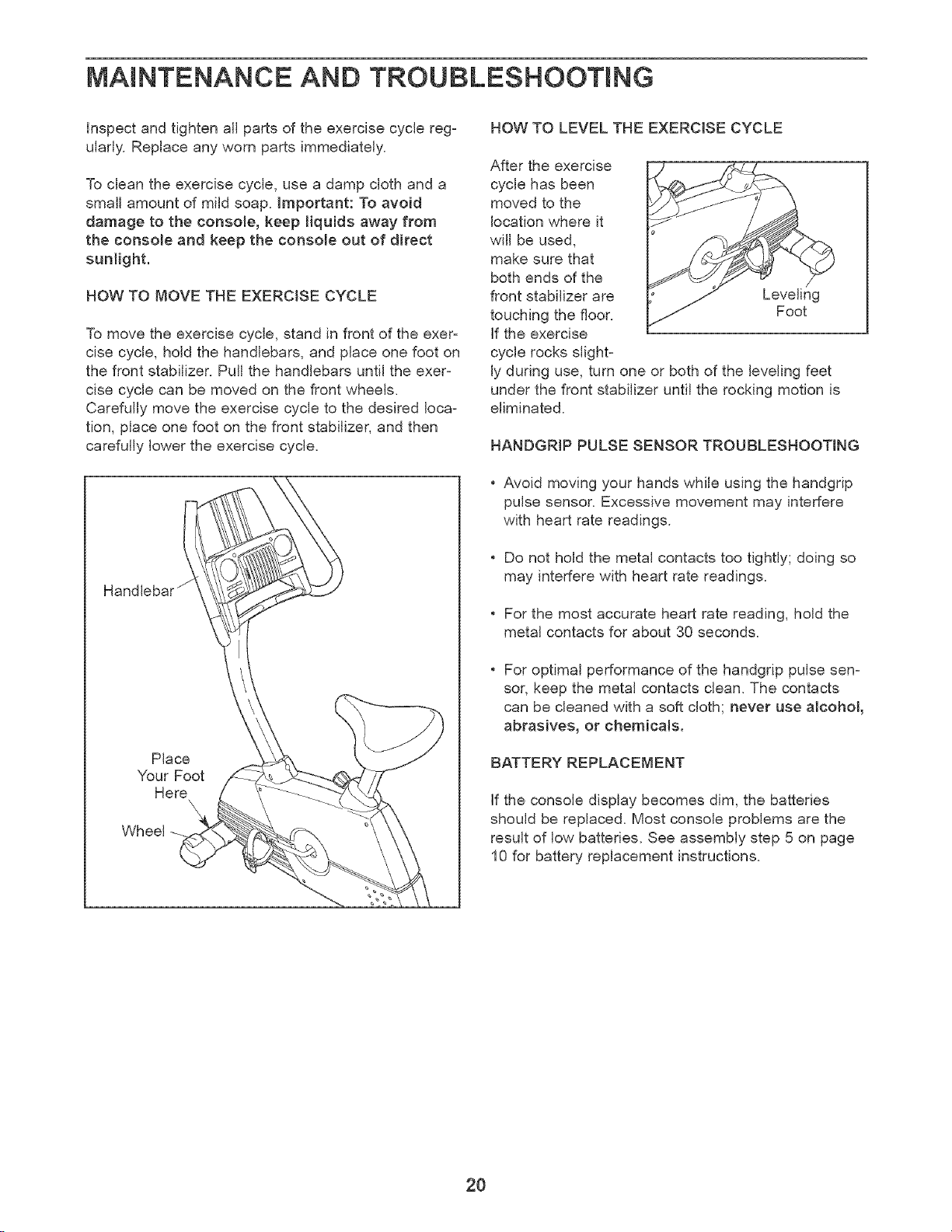
HOW TO MOVE THE EXERCISE CYCLE
To move the exercise cycle, stand in front of the exer-
cise cycle, hold the handlebars, and place one foot on
the front stabilizer. Pull the handlebars until the exer-
cise cycle can be moved on the front wheels.
Carefully move the exercise cycle to the desired loca-
tion, place one foot on the front stabilizer, and then
carefully lower the exercise cycle.
Place
Your Foot
Here
Wheel
HOW TO LEVEL THE EXERCISE CYCLE
After the exercise
cycle has been
moved to the
location where it
will be used,
make sure that
both ends of the
front stabilizer are Leveling
touching the floor. Foot
if the exercise
cycle rocks slight-
ly during use, turn one or both of the leveling feet
under the front stabilizer until the rocking motion is
eliminated.
HANDGRIP PULSE SENSOR TROUBLESHOOTING
• Avoid moving your hands while using the handgdp
pulse sensor. Excessive movement may interfere
with heart rate readings.
• Do not hold the metal contacts too tightly; doing so
may interfere with heart rate readings.
For the most accurate heart rate reading, hold the
metal contacts for about 30 seconds.
• For optimal performance of the handgdp pulse sen-
sor, keep the metal contacts clean. The contacts
can be cleaned with a soft cloth; never use alcohol,
abrasives, or chemicals.
BATTERY REPLACEMENT
If the console display becomes dim, the batteries
should be replaced. Most console problems are the
result of low batteries. See assembly step 5 on page
10 for battery replacement instructions.
2O
CONDmONJNG GUHDELJNES
The following guidelines will help you to plan your
exercise program. Remember that proper nutrition
and adequate rest are essential for successful results.
WARN ING: Beforebeginning
this or any exercise program, consult your
physician, This is especially important for
persons over the age of 35 or persons with
preoexisting health problems,
The pulse sensor is not a medical device.
Various factors may affect the accuracy of
heart rate readings. The pulse sensor is
intended only as an exercise aid in determin-
ing heart rate trends in general
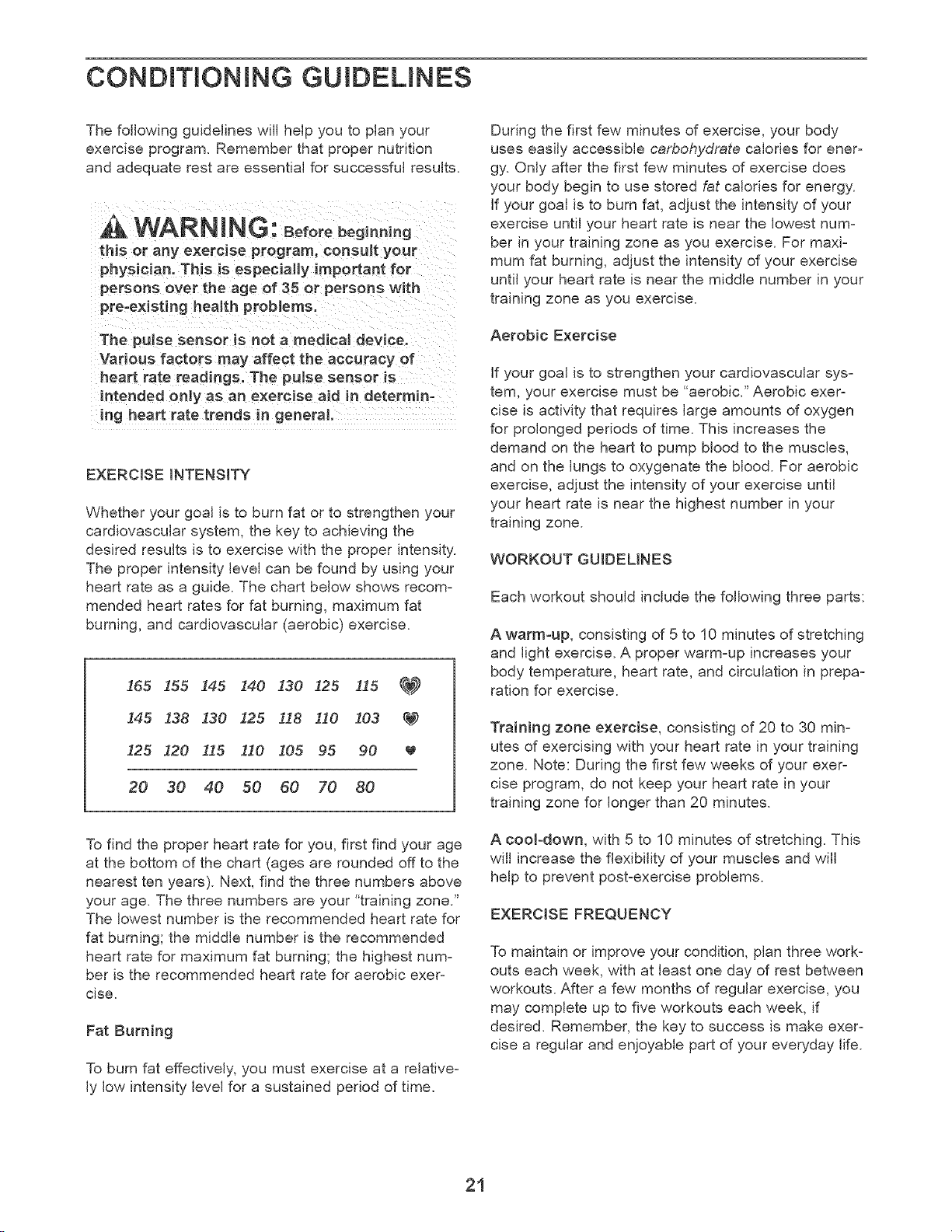
EXERCISE iNTENSiTY
Whether your goal is to burn fat or to strengthen your
cardiovascular system, the key to achieving the
desired results is to exercise with the proper intensity.
The proper intensity level can be found by using your
heart rate as a guide. The chart below shows recom-
mended heart rates for fat burning, maximum fat
burning, and cardiovascular (aerobic) exercise.
165 155 145 140 130 125 115 _
145 138 130 125 118 110 103 C_
125 120 115 110 105 95 90
20 30 40 50 60 70 80
To find the proper heart rate for you, first find your age
at the bottom of the chart (ages are rounded off to the
nearest ten years). Next, find the three numbers above
your age. The three numbers are your "training zone."
The lowest number is the recommended heart rate for
fat burning; the middle number is the recommended
heart rate for maximum fat burning; the highest num-
ber is the recommended heart rate for aerobic exer-
cise.
Fat Burning
To burn fat effectively, you must exercise at a relative-
ly low intensity level for a sustained period of time.
During the first few minutes of exercise, your body
uses easily accessible carbohydrate calories for ener-
gy. Only after the first few minutes of exercise does
your body begin to use stored fat calories for energy.
If your goal is to burn fat, adjust the intensity of your
exercise until your heart rate is near the lowest num-
ber in your training zone as you exercise. For maxi-
mum fat burning, adjust the intensity of your exercise
until your heart rate is near the middle number in your
training zone as you exercise.
Aerobic Exercise
If your goal is to strengthen your cardiovascular sys-
tem, your exercise must be "aerobic." Aerobic exer-
cise is activity that requires large amounts of oxygen
for prolonged periods of time. This increases the
demand on the heart to pump blood to the muscles,
and on the lungs to oxygenate the blood. For aerobic
exercise, adjust the intensity of your exercise until
your heart rate is near the highest number in your
training zone.
WORKOUT GUIDELINES
Each workout should include the following three parts:
A warm-up, consisting of 5 to 10 minutes of stretching
and light exercise. A proper warm-up increases your
body temperature, heart rate, and circulation in prepa-
ration for exercise.
Training zone exercise, consisting of 20 to 30 min-
utes of exercising with your heart rate in your training
zone. Note: During the first few weeks of your exer-
cise program, do not keep your heart rate in your
training zone for longer than 20 minutes.
A cool-down, with 5 to 10 minutes of stretching. This
will increase the flexibility of your muscles and will
help to prevent post-exercise problems.
EXERCISE FREQUENCY
To maintain or improve your condition, plan three work°
outs each week, with at least one day of rest between
workouts. After a few months of regular exercise, you
may complete up to five workouts each week, if
desired. Remember, the key to success is make exer-
cise a regular and enjoyable part of your everyday life.
21
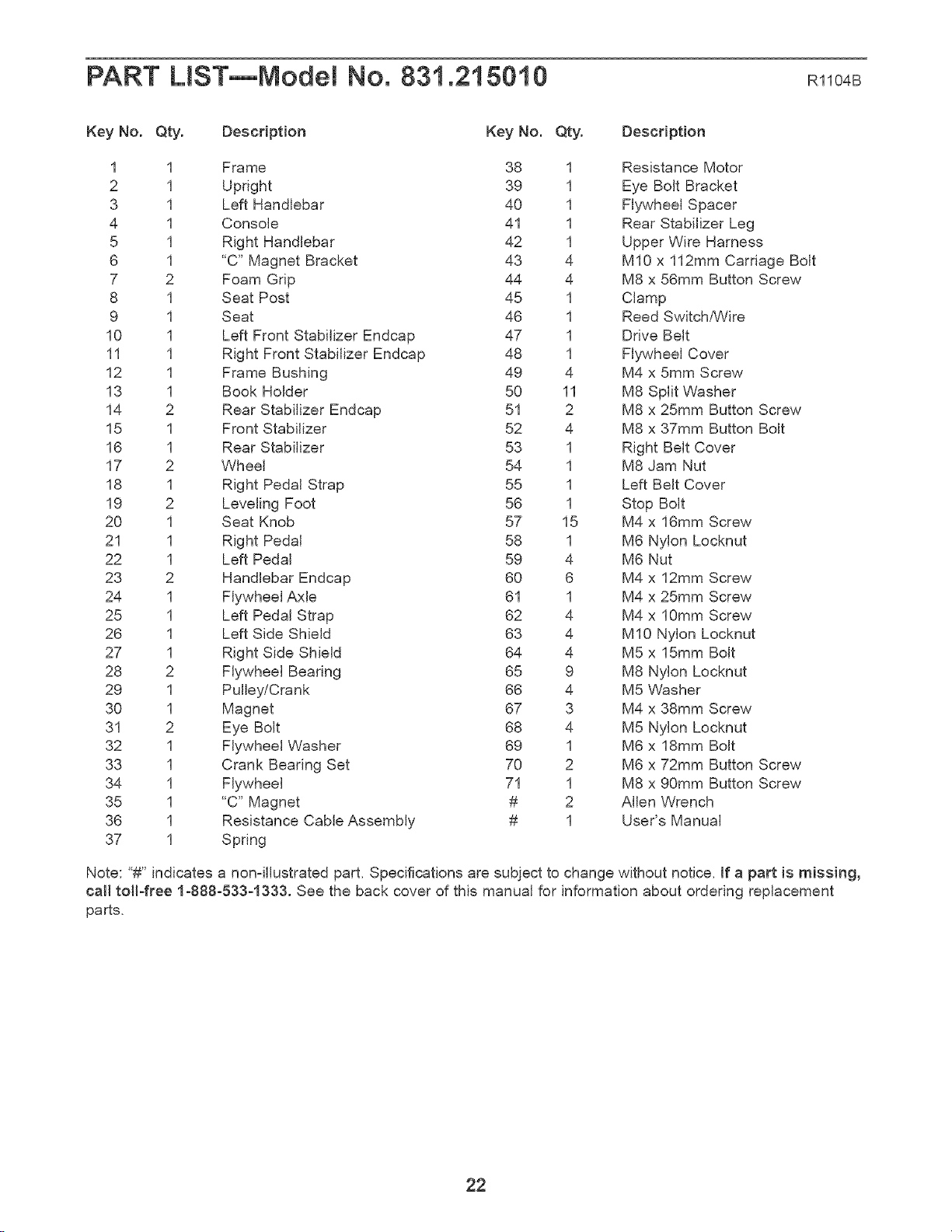
PART LiST--Model No. 831.215010
Key No. Qty. Description Key No. Qty. Description
1 1 Frame 38 1 Resistance Motor
2 1 Upright 39 1 Eye Bolt Bracket
3 1 Left Handlebar 40 1 Flywheel Spacer
4 1 Console 41 1 Rear Stabilizer Leg
5 1 Right Handlebar 42 1 Upper Wire Harness
6 1 "C" Magnet Bracket 43 4 MI0 x 112mm Carriage Bolt
7 2 Foam Grip 44 4 M8 x 56mm Button Screw
8 1 Seat Post 45 1 Clamp
9 1 Seat 46 1 Reed Switch/Wire
10 1 Left Front Stabilizer Endcap 47 1 Drive Belt
11 1 Right Front Stabilizer Endcap 48 1 Flywheel Cover
12 1 Frame Bushing 49 4 M4 x 5mm Screw
13 1 Book Holder 50 11 M8 Split Washer
14 2 Rear Stabilizer Endcap 51 2 M8 x 25mm Button Screw
15 1 Front Stabilizer 52 4 M8 x 37mm Button Bolt
16 1 Rear Stabilizer 53 1 Right Belt Cover
17 2 Wheel 54 1 M8 Jam Nut
18 1 Right Pedal Strap 55 1 Left Belt Cover
19 2 Leveling Foot 56 1 Stop Bolt
20 1 Seat Knob 57 15 M4 x 16mm Screw
21 1 Right Pedal 58 1 M6 Nylon Locknut
22 1 Left Pedal 59 4 M6 Nut
23 2 Handlebar Endcap 60 6 M4 x 12mm Screw
24 1 Flywheel Axle 61 1 M4 x 25mm Screw
25 1 Left Pedal Strap 62 4 M4 x 10mm Screw
26 1 Left Side Shield 63 4 MI0 Nylon Locknut
27 1 Right Side Shield 64 4 M5 x 15mm Bolt
28 2 Flywheel Bearing 65 9 M8 Nylon Locknut
29 1 Pulley/Crank 66 4 M5 Washer
30 1 Magnet 67 3 M4 x 38mm Screw
31 2 Eye Bolt 68 4 M5 Nylon Locknut
32 1 Flywheel Washer 69 1 M6 x 18mm Bolt
33 1 Crank Bearing Set 70 2 M6 x 72mm Button Screw
34 1 Flywheel 71 1 M8 x 90mm Button Screw
35 1 "C" Magnet # 2 Allen Wrench
36 1 Resistance Cable Assembly # 1 User's Manual
37 1 Spring
Note: "#" indicates a non-illustrated part. Specifications are subject to change without notice. _fa part is missing,
call toll4ree 1-888-533-1333. See the back cover of this manual for information about ordering replacement
parts.
22
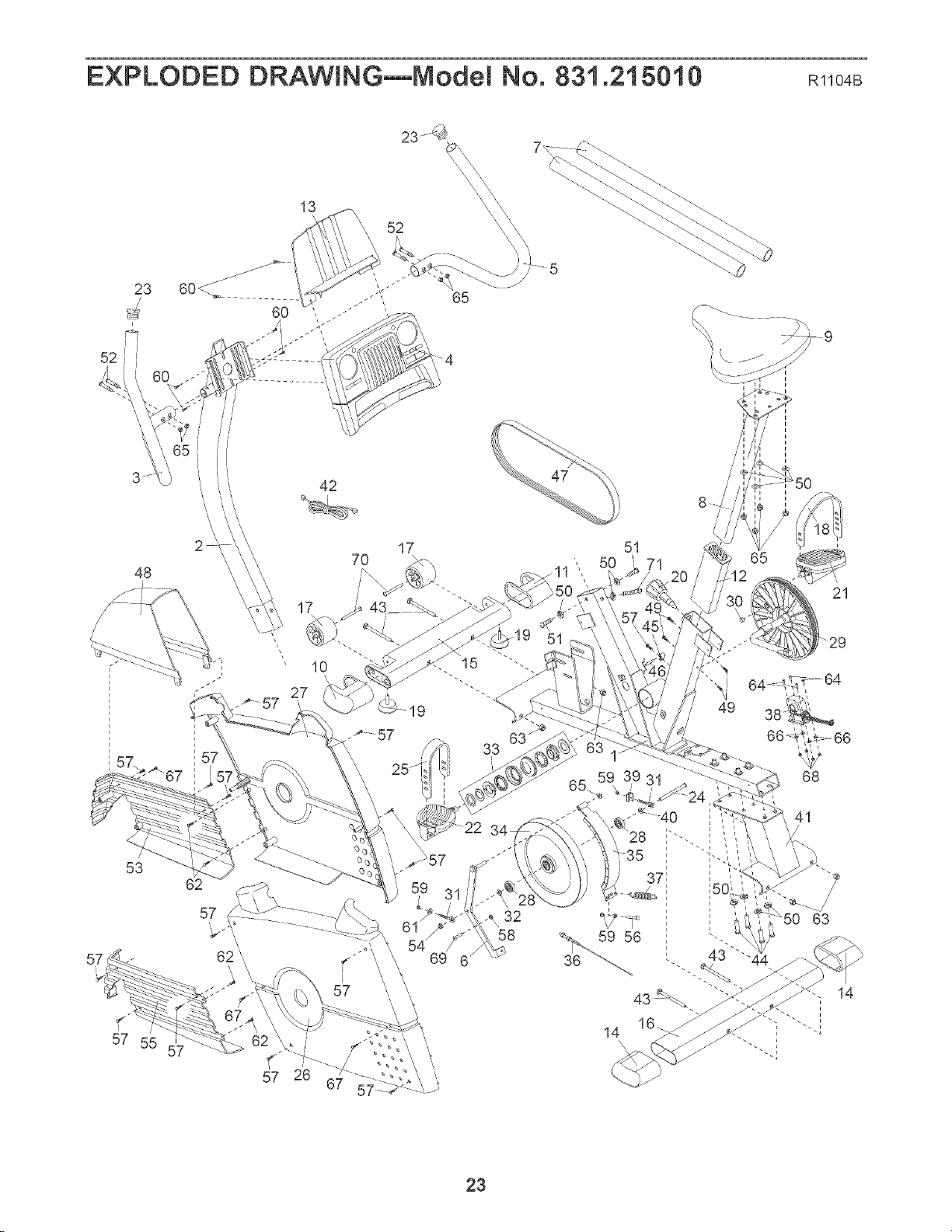
EXPLODED DRAWING--Model No. 831.215010 R_o4s
13
52
52
23
\
48
53
57 5i
42
17
7O
/
17 _ 43__
_- /
10 15
19
'\
57 26
6:
33
34
58
51
51
59 39
65.
I
%
49 38-
68
63
14
23

Your Home
For repair - in your home - of aH major brand appliances, lawn and garden equipment.
or heating and cooling systems, no matter who made it, no matter who somd it!
For the replacement parts, accessories, and user's manuals that you need to do-it-yourself.
For Sears professional installation of nome appliances
and items like garage door openers and water heaters.
1-800o4oraY-HOME ® Anytime, day or nFght
,1-800-469-4663_ ,'U.S.A. and Canada,
WWW._;eaFs.COr_! www.sears=ca
Our Home
For repair of carryon products like vacuums Jawn equipment,
and electronics, call or go on-line for the location of your nearest
Sears Parts and Repair Center,
1-800o488-1222 Anytime, day or night €U.S.A. onmy)
www.sears.com
To purchase a protection agreement (U.S.A.}
or maintenance agreement (Canada) on a product serviced by Sears:
1-800-827o6655 (U.S.A._ 1o800o361o6665 _'Canada_
Para pedir servicio de reparacion a domicilio y para ordenar piezas:
1-888oSU-HOGAR sM 1o888o784o6427,
n TM SM
(¢ Registered Trademark / Trademark / Service Mark of Sears, Roebuck and Co.
TM SM
® Marca Registrada / Marca de F#,brica / " Marca de Servicio de Sears, Roebuck and Co.
f
FULL 90 DAY WARRANTY
For 90 days from the date of purchase, if failure occurs due to defect in material or workmanship in this
Sears Bike Exerciser, contact the nearest Sears Service Center throughout the United States and
Sears will repair or replace the Bike Exerciser, free of charge.
This warranty does not apply when the Bike Exerciser is used commercially or for rental purposes.
This warranty gives you specific legal rights, and you may also have other rights which vary from state
to state.
Sears, Roebuck and Co., Dept. 817WA, Hoffman Estates, JL60179
Y
Part No. 218855 R1104B Printed in USA @2004 Sears, Roebuck and Co.