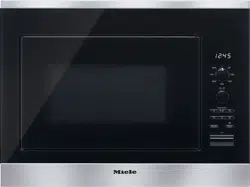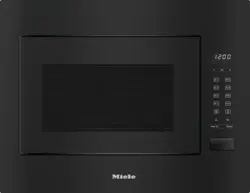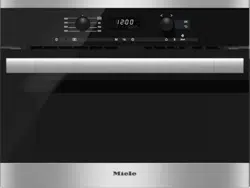
Operating and Installation
Instructions
Microwave Oven
To prevent accidents and machine damage, read these instructions
before installation or use.
en-US, CA M.-Nr. 12 003 570
PRECAUTIONS TO AVOID POSSIBLE EXPOSURE TO
EXCESSIVE MICROWAVE ENERGY
2
PRECAUTIONS TO AVOID POSSIBLE EXPOSURE TO EXCESSIVE
MICROWAVE ENERGY
(a) Do not attempt to operate this oven with the door open since
open-door operation can result in harmful exposure to microwave
energy. It is important not to defeat or tamper with the safety
interlocks.
(b) Do not place any object between the oven front face and the
door or allow soil or cleaner residue to accumulate on sealing
surfaces.
(c) Do not operate the oven if it is damaged. It is particularly
important that the oven door close properly and that there is no
damage to the: (1) Door (bent), (2) hinges and latches (broken or
loosened), (3) door seals and sealing surfaces.
(d) The oven should not be adjusted or repaired by anyone except
properly qualified service personnel.

Contents
3
PRECAUTIONS TO AVOID POSSIBLE EXPOSURE TO EXCESSIVE
MICROWAVE ENERGY ...................................................................................... 2
IMPORTANT SAFETY INSTRUCTIONS ............................................................ 5
Before using for the first time .......................................................................... 16
Installation.......................................................................................................... 17
Installation dimensions........................................................................................ 17
Installation in a tall or base cabinet................................................................ 17
Side view ........................................................................................................ 18
Connections and ventilation........................................................................... 19
Installing the microwave oven............................................................................. 20
Electrical connection ........................................................................................... 22
Caring for the environment .............................................................................. 24
Overview............................................................................................................. 25
Control panel ..................................................................................................... 26
Display................................................................................................................. 27
Symbols.......................................................................................................... 27
Sensor buttons.................................................................................................... 28
Microwave operation ........................................................................................ 30
How it works........................................................................................................ 30
Suitable dishware................................................................................................ 30
Suitable dishware........................................................................................... 31
Unsuitable dishware....................................................................................... 32
Testing dishware............................................................................................. 33
Cover.............................................................................................................. 33
Before first use .................................................................................................. 34
Setting the time of day ........................................................................................ 34
Settings .............................................................................................................. 35
Settings overview ................................................................................................ 35
Changing settings ............................................................................................... 37

Contents
4
Operation............................................................................................................ 38
Tips for cooking with the microwave .................................................................. 38
Using the turntable.............................................................................................. 38
Starting a cooking process ................................................................................. 38
Changing the microwave power level ................................................................. 39
Changing the cooking duration........................................................................... 39
Interrupting and resuming a cooking process..................................................... 40
Canceling a cooking process .............................................................................. 40
Automatic keeping warm function – ..............................................................
40
Oven compartment query – ........................................................................
40
Reheat drinks................................................................................................ 41
Switching the system lock on and off ................................................................. 41
Timer................................................................................................................... 42
Quick MW and Popcorn .................................................................................... 43
Automatic Programs ......................................................................................... 45
Using automatic programs .................................................................................. 45
Overview of automatic programs ........................................................................ 46
Using automatic program for vegetables ......................................................
47
Recipes................................................................................................................ 47
Potatoes in a curry sauce............................................................................... 47
Salmon in white wine sauce........................................................................... 48
Carrots in a chervil cream sauce.................................................................... 48
Additional applications ..................................................................................... 49
Defrost................................................................................................................. 49
Reheat ................................................................................................................. 50
Cooking ............................................................................................................... 53
Canning ............................................................................................................... 54
Cleaning and care ............................................................................................. 56
Unsuitable cleaning agents ................................................................................. 56
Removing soiling ................................................................................................. 57
Frequently Asked Questions ............................................................................ 59
Customer Service.............................................................................................. 62
Contact in the event of a fault ............................................................................. 62
Appliance warranty and product registration ...................................................... 62
IMPORTANT SAFETY INSTRUCTIONS
5
When using the appliance, follow basic safety precautions, including the
following:
Read all instructions before installation and use of the oven to prevent
accidents and machine damage.
WARNING - To reduce the risk of burns, electric shock, fire, injury to persons,
or exposure to excessive microwave energy:
This appliance complies with current safety requirements.
Improper use of the appliance can lead to personal injury and
material damage.
Read all instructions before installing or using the oven for the first
time. Only use the appliance for its intended purpose.
Keep these operating instructions in a safe place and pass them
on to any future user.
Read and follow the specific “PRECAUTIONS TO AVOID
POSSIBLE EXPOSURE TO EXCESSIVE MICROWAVE ENERGY”
found at the beginning of this manual.
Only use the appliance for its intended purpose. Install or locate
this appliance only in accordance with the provided installation
instructions and all local codes.
Appropriate use
This microwave oven is intended for domestic use and use in
other similar environments.
This microwave oven must not be used at altitudes exceeding
6562ft. (2000m).
The microwave oven is not intended for outdoor use.
The microwave oven is intended to cook, defrost, reheat and can
food in domestic settings only.
All other types of use are not permitted.
IMPORTANT SAFETY INSTRUCTIONS
6
Risk of fire due to flammable materials.
If flammable items are dried in the microwave oven, the moisture in
the items will evaporate. This could cause the materials to dry out
and possibly self-ignite.
Never use the microwave oven to store or dry items which could
ignite easily.
This microwave oven can only be used by people with reduced
physical, sensory, or mental capabilities or lack of experience and
knowledge if they are supervised while using it.
They may only use it unsupervised if they have been shown how to
do so in a safe manner. They must be able to understand and
recognize the possible dangers caused by incorrect operation.
The oven compartment is equipped with special bulbs to cope
with particular conditions (e.g., temperature, moisture, chemical
resistance, abrasion resistance, and vibration). These special bulbs
must only be used for the purpose for which they are intended. They
are not suitable for room lighting. Replacement bulbs should only be
installed by a Miele authorized technician or by Miele Customer
Service.
Safety with children
Children should be supervised in the vicinity of the microwave
oven. Never allow children to play with the microwave oven.
Burn Hazard - Do not allow children to use the microwave oven.
Risk of suffocation from packaging material. While playing, children
may become entangled in packaging material (such as plastic
wrapping) or pull it over their head, presenting the risk of suffocation.
Keep packaging material away from children.
Risk of injury caused by hot surfaces. Children’s skin is far more
sensitive to high temperatures than that of adults. External parts of
the microwave oven such as the control panel and the vent become
quite hot.
Do not let children touch the microwave oven when it is in operation.
IMPORTANT SAFETY INSTRUCTIONS
7
Technical safety
This appliance must be installed and connected in compliance
with the installation instructions.
Unauthorized installation, maintenance, and repairs can cause
considerable danger for the user. Installation, maintenance, and
repairs should only be carried out by a Miele authorized technician.
Maintenance by the user: Never repair or replace any part of the
appliance unless the instructions specifically recommend doing so.
Service work should only be performed by a qualified technician.
Damage to the microwave oven can compromise your safety.
Check the microwave oven for visible signs of damage. Do not use a
damaged microwave oven.
Temporary or permanent operation on an autonomous power
supply system or a power supply system that is not synchronized
with the grid power supply (e.g., island networks, back-up systems)
is possible. A prerequisite for operation is that the power supply
system complies with the specifications of EN50160 or an
equivalent standard.
The function and operation of the protective measures provided in
the domestic electrical installation and in this Miele product must
also be maintained in isolated operation or in operation that is not
synchronized with the grid power supply, or these measures must be
replaced by equivalent measures in the installation. As described, for
example, in the current version of VDE-AR-E 2510-2.
Operating a damaged microwave oven can result in microwave
leakage and present a hazard to the user. Do not use the microwave
oven if:
- The door is warped.
- The door hinges are loose.
- Holes or cracks are visible in the casing, the door, or the oven
compartment walls.
IMPORTANT SAFETY INSTRUCTIONS
8
The electrical safety of this appliance can only be guaranteed
when correctly grounded. It is essential that this basic safety
requirement is fulfilled. If in doubt, the electrical installation should
be checked by a qualified electrician.
Proper installation: Make sure that your appliance has been
installed correctly and that it has been grounded by a qualified
technician.
The connection data (voltage and frequency) on the data plate of
the microwave oven must match the domestic electrical supply in
order to avoid the risk of damage to the microwave oven. Compare
this before connecting the appliance to the domestic electrical
supply. If in any doubt, consult a qualified electrician.
Power bars and extension cords do not guarantee the required
safety of the appliance. Do not use these to connect the microwave
oven to the power supply.
For safety reasons, only use the microwave oven when it has been
fully installed.
This appliance must not be used in a non-stationary location (e.g.,
on a ship).
Risk of injury due to electric shock. Any contact with live
connections or tampering with the electrical or mechanical
components of the microwave oven will endanger your safety and
may lead to appliance malfunctions.
Do not open the microwave oven housing under any circumstances.
While the appliance is under warranty, repairs should only be
undertaken by a service technician authorized by Miele Customer
Service. Otherwise the warranty will be invalidated.
Miele can only guarantee the safety of the appliance when original
Miele parts are used. Faulty components must only be replaced with
genuine Miele parts.
IMPORTANT SAFETY INSTRUCTIONS
9
If the power cord is damaged, it must be replaced with a special
power cord by a Miele authorized technician (see “Installation –
Electrical connection”).
During installation, maintenance, and repair work, the microwave
oven must be completely disconnected from the power supply. To
ensure this:
- The circuit breakers have been switched off, or
- the fuses of the electrical installation have been completely
removed, or
- the plug (if present) is removed from the outlet. To do this, pull the
plug not the cord.
The microwave oven requires a sufficient supply of cool air for
efficient operation. Make sure that the supply of cool air is not
hindered in any way (e.g., by installing heat insulation strips in the
cabinet niche). In addition, the required supply of cool air must not
be excessively heated by other heat sources.
If the microwave oven is built in behind a cabinet door front, do
not close the cabinet door while the microwave oven is in use. Heat
and moisture can build up behind the cabinet door when closed.
This can result in damage to the microwave oven, cabinet niche, and
floor. Leave the cabinet door front open until the microwave oven
has cooled down completely.
Correct use
Do not let food sit in the oven for an extended period of time
before or after cooking. Doing so can result in food poisoning or
sickness.
Smother the fire or flames, or use a dry chemical extinguishing
agent or foam fire extinguisher.
Never store flammable liquids and materials in, above or under the
microwave oven.
IMPORTANT SAFETY INSTRUCTIONS
10
Do not obstruct the flow of combustion and ventilation air.
This microwave oven must only be used for cooking food.
Corrosive chemicals and vapors as well as fumes, vapors or heat
given off by glues, plastics or flammable liquids and materials could
be hazardous. Do not use it as a dryer, kiln, dehumidifier, etc.
To avoid fueling any flames, do not open the microwave oven
door if smoke occurs inside the appliance. Interrupt the process by
turning the appliance off and disconnecting it from the power. Do not
open the door until the smoke has dissipated.
Due to the high temperatures radiated, objects left near the
microwave oven could catch fire. Do not use the microwave oven to
heat up the room.
Oils and fats are a fire hazard if allowed to overheat. Never leave
the microwave oven unattended when cooking with oil or fats. Never
attempt to put out oil or fat fires with water. Turn the microwave oven
off and extinguish the flames by leaving the door closed.
Fire hazard. If using alcohol in your recipes, please be aware that
high temperatures can cause the alcohol to evaporate. The vapor
can catch fire on hot surfaces.
Do not heat undiluted alcohol in the appliance.
Food which is stored in the oven interior or left there to be kept
warm can dry out, and the moisture released can lead to corrosion
damage in the microwave oven. The control panel, countertop and
surrounding cabinetry can also be damaged.
Always cover food that is left in the appliance.
The microwave oven is not suitable for cleaning or disinfecting
items. Items can get extremely hot. There is a risk of burning when
items are removed from the microwave oven.
IMPORTANT SAFETY INSTRUCTIONS
11
Always ensure that food is sufficiently heated.
Many factors will affect the overall cooking time, including the type,
amount and nature of the food, its initial temperature, and changes
to the recipe. Some foods may contain microorganisms which are
only destroyed by thorough cooking. Therefore, when cooking or
reheating food, it is particularly important that food is heated at
adequate temperatures for a sufficient amount of time. When in
doubt, select a longer cooking or reheating time.
It is important that the temperature in the food being cooked is
evenly distributed and sufficiently high.
You can ensure this by stirring or turning the food, and observing a
sufficiently long standing time (see charts), which should be added
to the time needed for reheating, defrosting, or cooking.
During the standing time, the temperature is distributed evenly in the
food.
Always remember that times for cooking, reheating and defrosting
in a microwave oven are usually considerably shorter than in the
case of traditional methods of food preparation. Excessively long
cooking times can lead to food drying out and burning, or may even
cause it to catch fire.
Do not dry bread, rolls, flowers, herbs, etc., in the microwave oven
as these could also catch fire.
When heating food, and in particular liquids, using microwave
power, the boiling point may be reached without the typical bubbles
being produced. The liquid does not boil evenly throughout. This
boiling delay can result in the liquid boiling over explosively. Take
care when taking the container out of the microwave oven, as the
hot liquid can cause severe scalding. Under certain circumstances,
the pressure can be so high that the door opens automatically.
Stir liquids well before heating or cooking. After heating, wait at least
20seconds before removing the container from the microwave oven.
In addition, you can place a glass rod or similar item, if available, in
the container during the heating process.
IMPORTANT SAFETY INSTRUCTIONS
12
Risk of injury caused by hot food. When you heat food up, the
heat is created directly in the food itself. For this reason, the
dishware will remain cooler than the food (except when you use
ovenproof stoneware). The dishware is only warmed by the heat of
the food.
Before serving, always check the temperature of the actual food
itself after taking it out of the oven. The temperature of the container
is not an indication of the temperature of the food or liquid in it. This
is particularly important when preparing food for babies,
children, and the elderly or infirm. After heating food, especially
food for babies and small children, stir the food or shake the
container and check that the temperature does not pose any danger
of burning. Double check after it has been left to stand.
Risk of injury from increased pressure in sealed containers or
bottles. Pressure can build up when reheating food or drinks in
sealed containers or bottles, which can cause them to explode.
Never cook or reheat food or liquids in sealed containers or bottles.
Open containers beforehand and with baby bottles, the screw top
and nipple must be removed.
If you cook eggs without their shells, the yolks could explode due
to the resulting pressure.
Prick the yolk several times before cooking to avoid this.
Eggs heated in their shell can burst, even after they have been
removed from the microwave oven.
Eggs can only be cooked in their shells in a specially designed egg-
boiling device. Do not reheat hard-boiled eggs in the microwave
oven.
Food with a thick skin or peel, such as tomatoes, sausage,
potatoes, and eggplant can burst when heated or cooked.
Pierce or score the skin of these foods several times to allow steam
to escape.
IMPORTANT SAFETY INSTRUCTIONS
13
Do not use a thermometer containing mercury or liquid as these
are not suitable for use with very high temperatures and break very
easily.
To check food temperature, first interrupt the cooking process. Only
use a thermometer specifically approved for food use to measure the
temperature of the food.
Cushions or pads filled with cherry kernels, gel, etc., such as
those used in aromatherapy, can ignite when heated, even after they
have been removed from the microwave oven.
Do not heat these up in the microwave oven.
Moisture can collect in the hollow spaces on dishware and lids
with hollow handles or knobs. When the moisture evaporates,
pressure can build up and the item can explode. If the hollow recess
is sufficiently ventilated, the item can be used.
Do not use dishware with hollow knobs or handles.
Non-microwave-safe plastic dishes can suffer damage or damage
the microwave oven.
Do not use any containers or cutlery made from or containing metal,
aluminum foil, lead crystal glassware, temperature-sensitive plastics,
wooden utensils or cutlery, metal clips, or plastic or paper-covered
wire ties. Do not use bowls with milled rims, or plastic pots with the
foil lid only partially removed (see the requirements specified for
dishware in the section on microwave operation).
Fire hazard due to containers made of flammable materials.
Plastic disposable containers must meet the requirements specified
for dishware in the section on microwave operation.
Do not leave the oven unattended when heating or cooking food in
disposable containers made of plastic, paper, or other flammable
materials.
IMPORTANT SAFETY INSTRUCTIONS
14
Heat-retaining bags usually contain a thin layer of aluminum foil
that reflects microwave radiation. As a result, the paper surrounding
the aluminum foil can become so hot that it combusts.
Do not use heat-retaining packaging, such as bags for roasted
chicken, for warming food.
If the microwave oven is used without food or the food is loaded
incorrectly, the appliance can become damaged.
Do not use the microwave oven to preheat dishware or to dry herbs.
Risk of injury from the open door. You could bang into the open
door. Do not leave the door open unnecessarily.
The following applies to stainless steel surfaces:
Adhesives will damage the coated stainless steel surface and
cause it to lose its dirt-repellent protective coating. Do not use sticky
notes, adhesive tape, or other types of adhesive on the stainless
steel surface.
Magnets can cause scratches. Do not use the stainless steel
surface as a magnetic notice board.
IMPORTANT SAFETY INSTRUCTIONS
15
Cleaning and care
Risk of injury due to electric shock. The steam from a steam
cleaning appliance could reach live electrical components and cause
a short circuit. Never use a steam cleaner for cleaning.
Risk of burns. The appliance interior can get hot during use.
Clean the appliance interior and accessories as soon as they have
cooled down. Waiting too long can make cleaning unnecessarily
difficult and, in extreme cases, impossible.
Risk of fire. Under certain conditions, strong grease and gunk
buildup can damage the appliance and even be dangerous.
Follow the instructions on cleaning in "Cleaning and care".
Only clean parts listed in these operating and installation
instructions.
Scratches on the door glass can cause the glass to break. Do not
use abrasive cleaners, hard sponges, brushes, or sharp metal tools
to clean the door glass.
Try to prevent the interior walls being splashed with food
containing salt. If this does happen, wipe it away thoroughly to avoid
corrosion to stainless steel surfaces inside the oven compartment.
In warm, moist environments, there is a higher probability of pest
infestations. Ensure the oven and the area surrounding it are always
kept clean.
Damage caused by pests is not covered by the warranty.
Accessories
Only use original Miele accessories. Using parts or accessories
from other manufacturers will invalidate the warranty, and Miele
cannot accept liability.
KEEP THE OPERATING AND INSTALLATION INSTRUCTIONS IN A SAFE
PLACE AND REVIEW THEM PERIODICALLY.
Before using for the first time
16
It is important to allow the
temperatures of the microwave oven
and the room to equalize. Otherwise,
the appliance electronics may not
function correctly.
After transportation, let the unpacked
microwave oven stand for approx.
2hours at room temperature before
using it.
Risk of suffocation from
packaging material
While playing, children may become
entangled in packaging material (such
as plastic wrapping) or pull it over their
head, presenting the risk of suffocation.
Keep packaging material away from
children.
Remove all packaging material when
unpacking the microwave oven.
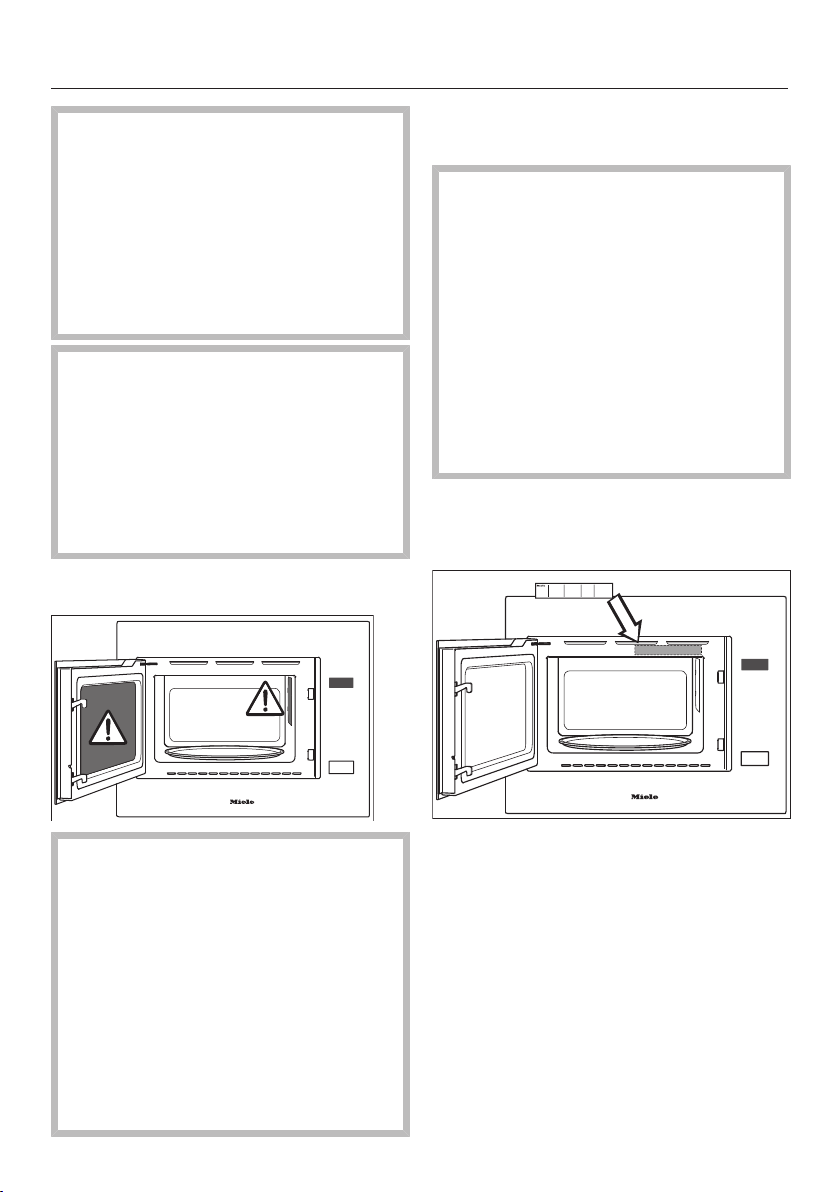
There is a cover protecting the
microwave outlet on the right-hand
side of the oven compartment and a
layer of film protecting the inside of
the door, both of which are
susceptible to damage.
Never remove the cover from the
microwave outlet and never remove
the film from the inside of the door.
Do not use the abrasive side of the
dishwashing sponge to clean the
cover or inside of the door.
Check the microwave oven for any
damage.
Health risk posed by a faulty
microwave oven
Operating a damaged microwave
oven can result in microwave
leakage and present a hazard to the
user.
Do not use the microwave oven if:
–The door is warped.
–The door hinges are loose.
–Holes or cracks are visible in the
casing, the door, or the oven
compartment walls.
Clean the oven compartment and all
accessories with a soft sponge and
warm water.
Attach the enclosed quick guide to
the frame behind the door (as
illustrated), making sure it does not
block any of the vents.
Installation
*INSTALLATION*
17
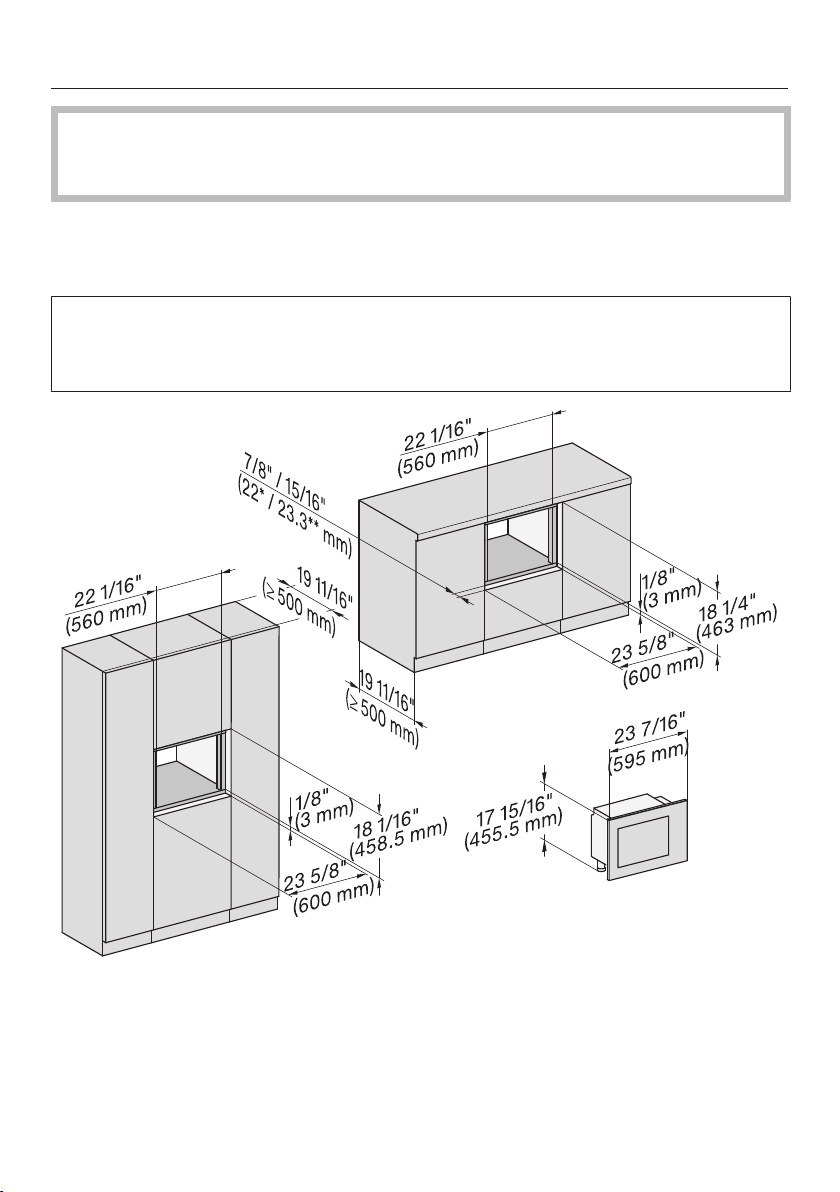
When installing the microwave oven, ensure that there is unhindered ventilation
at the front of the appliance.
Do not block the ventilation slots with any objects.
Installation dimensions
Installation in a tall or base cabinet
Miele microwave ovens can be installed flush or proud. Discuss your
requirements with your architect, kitchen designer, and installer.
More installation drawings are available on the Miele website.
Installation
*INSTALLATION*
18
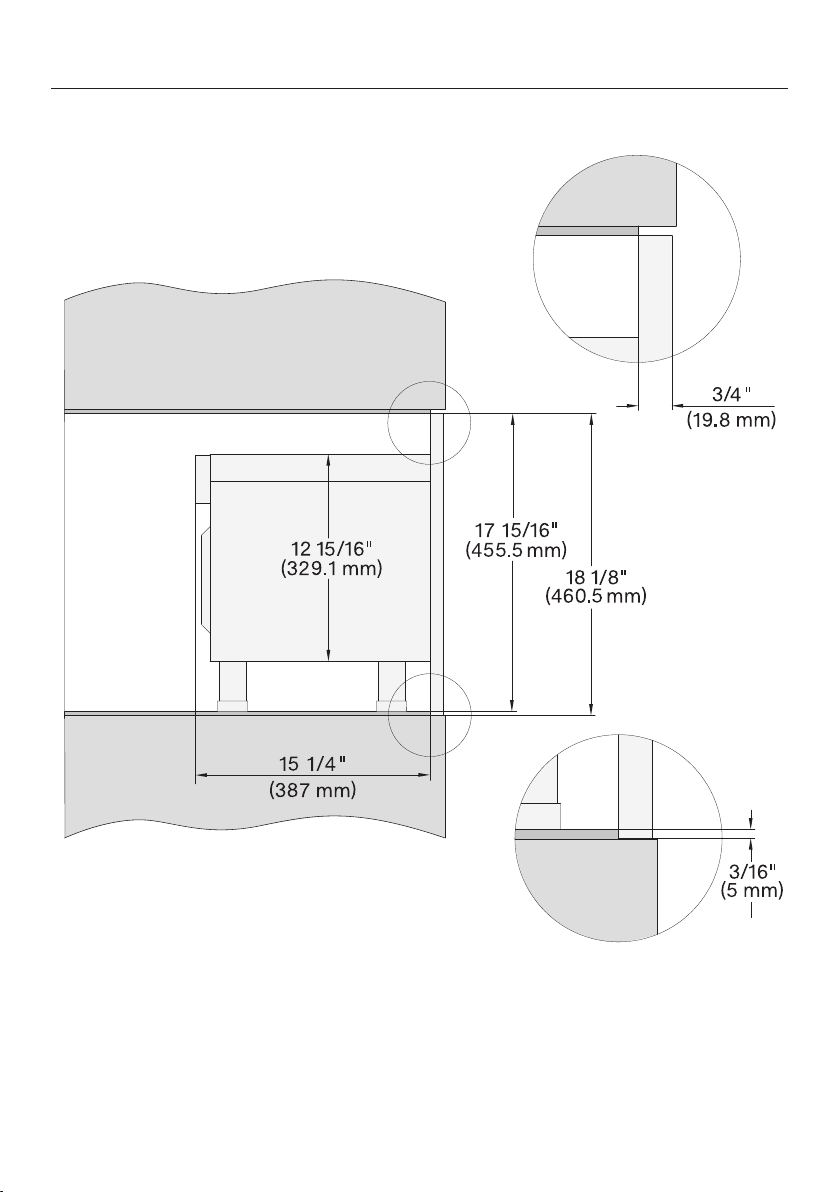
Side view
Installation
*INSTALLATION*
19
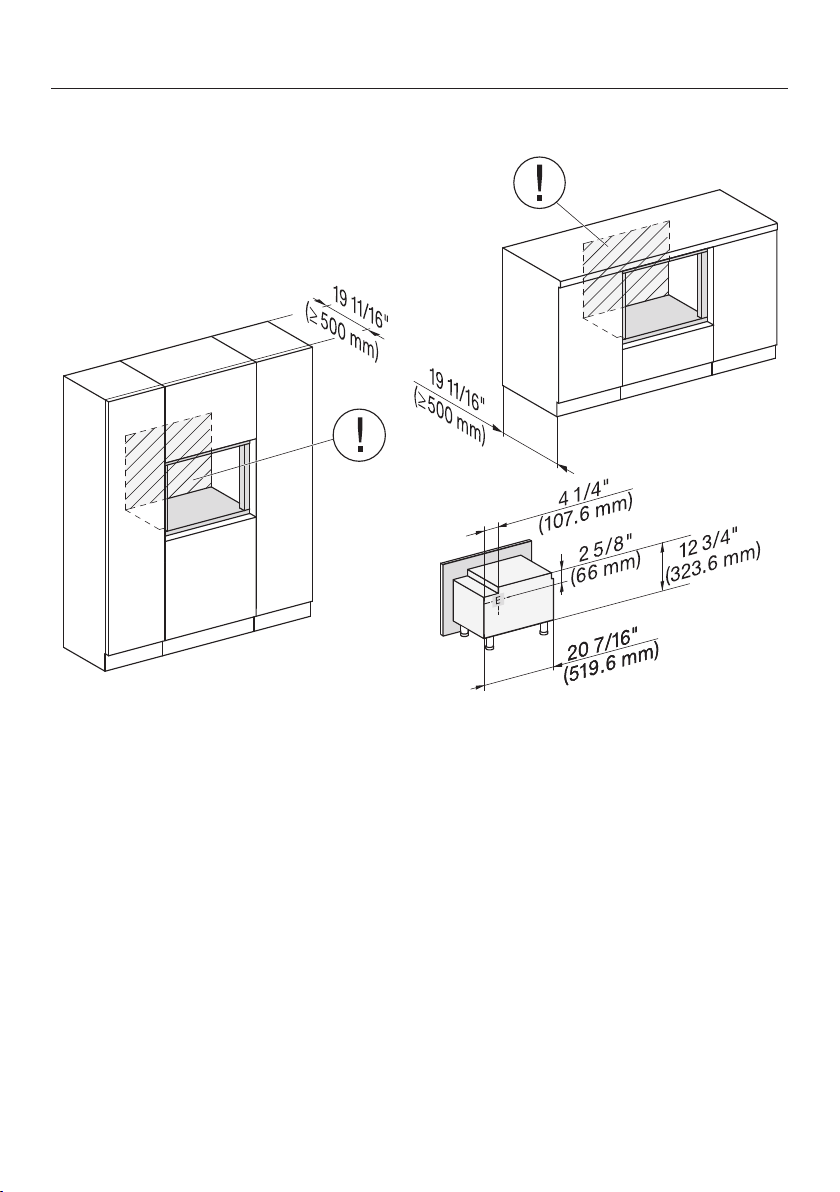
Connections and ventilation
The outlet for the electrical connection should be accessible, e.g., in an
adjacent kitchen cabinet. If the electrical connection is behind the microwave
oven, the kitchen cabinet needs to be deeper than specified.
E Electrical connection
Installation
*INSTALLATION*
20
Installing the microwave oven
For safety reasons, only use the
microwave oven when it has been
fully installed.
Securing the microwave oven in the
cabinet niche
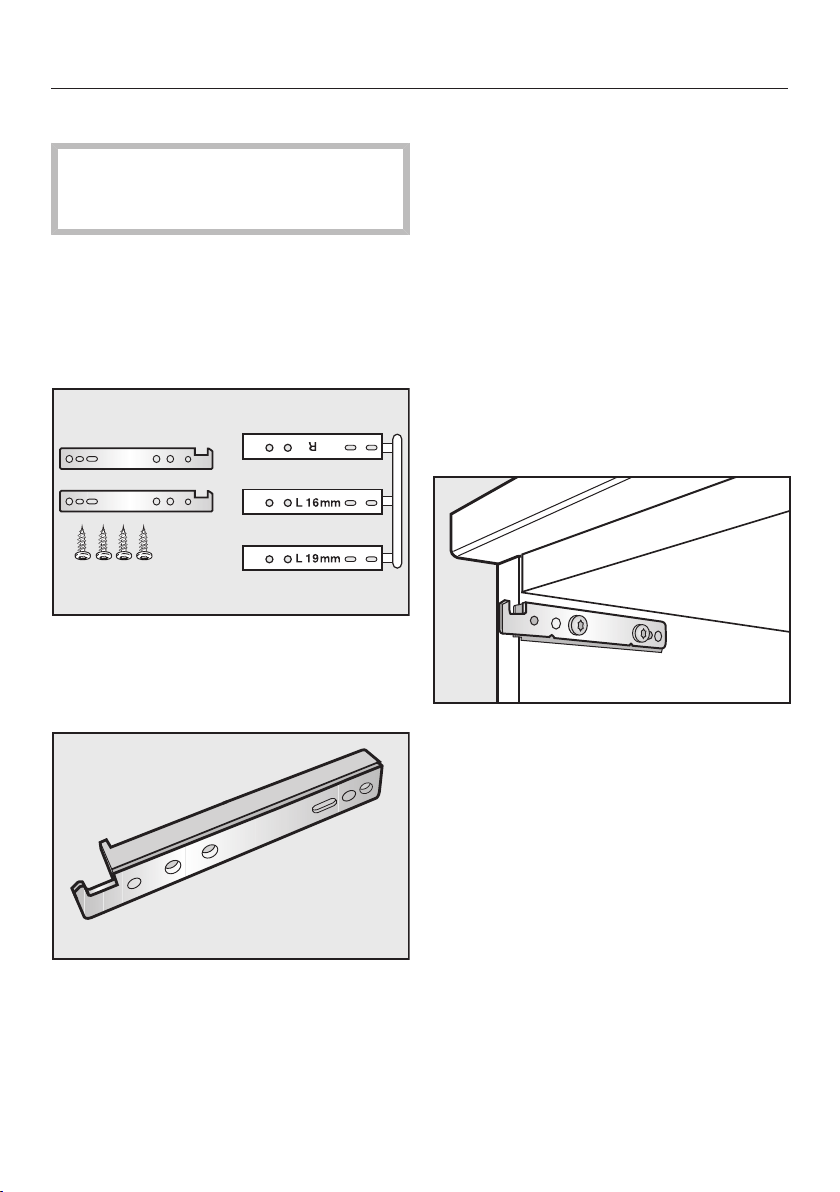
The following items are supplied in the
accessory pack for installing the
appliance:
You only need to use one of the two
spacers (L) (depending on whether the
cabinet wall is 5/8" or 3/4" / 16 or
19mm thick).
Attach the correct left-hand spacer
(L) applicable to the thickness of the
cabinet wall to one of the hooks
supplied.
Attach the other hook to the right-
hand spacer (R).
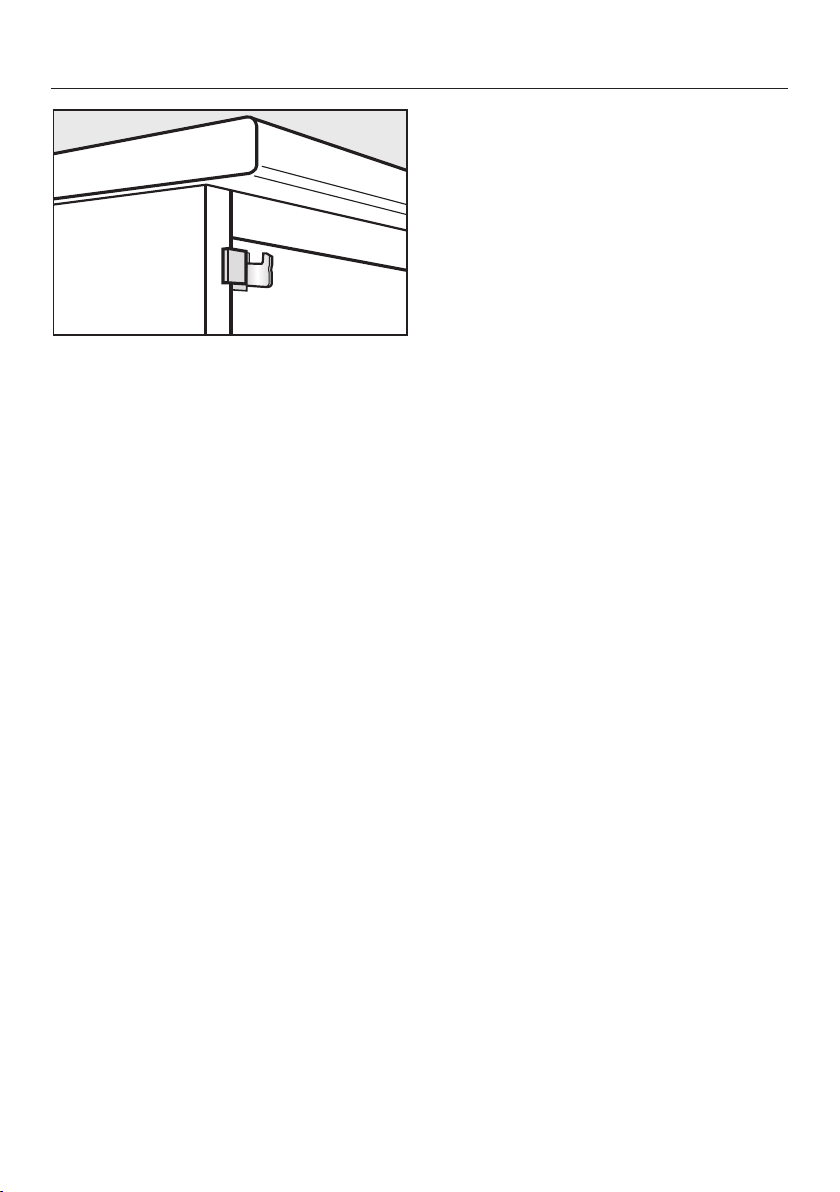
Before securing the hooks, make sure
that the screws are inserted where
the cabinet wall is at least
5/8" (16mm) thick.
Draw a line on both sides of the
cabinet 16 9/16" (420 mm) above the
floor of the cabinet to mark the
distance between the bottom of the
cabinet and the lower edge of the
spacer.
Position the lower edge of the spacer
on this line and align the stopper at
the front of the spacer with the front
of the cabinet wall.
To secure the spacers and hooks,
place a screw in one of the front two
holes and another in the middle of the
long hole at the back.
The long hole allows the position to
be adjusted. The two additional holes
are in case additional screws are
required.
Slide the microwave oven into the
cabinet niche. Guide the power cord
through the cabinet niche with the
plug.
Installation
*INSTALLATION*
21
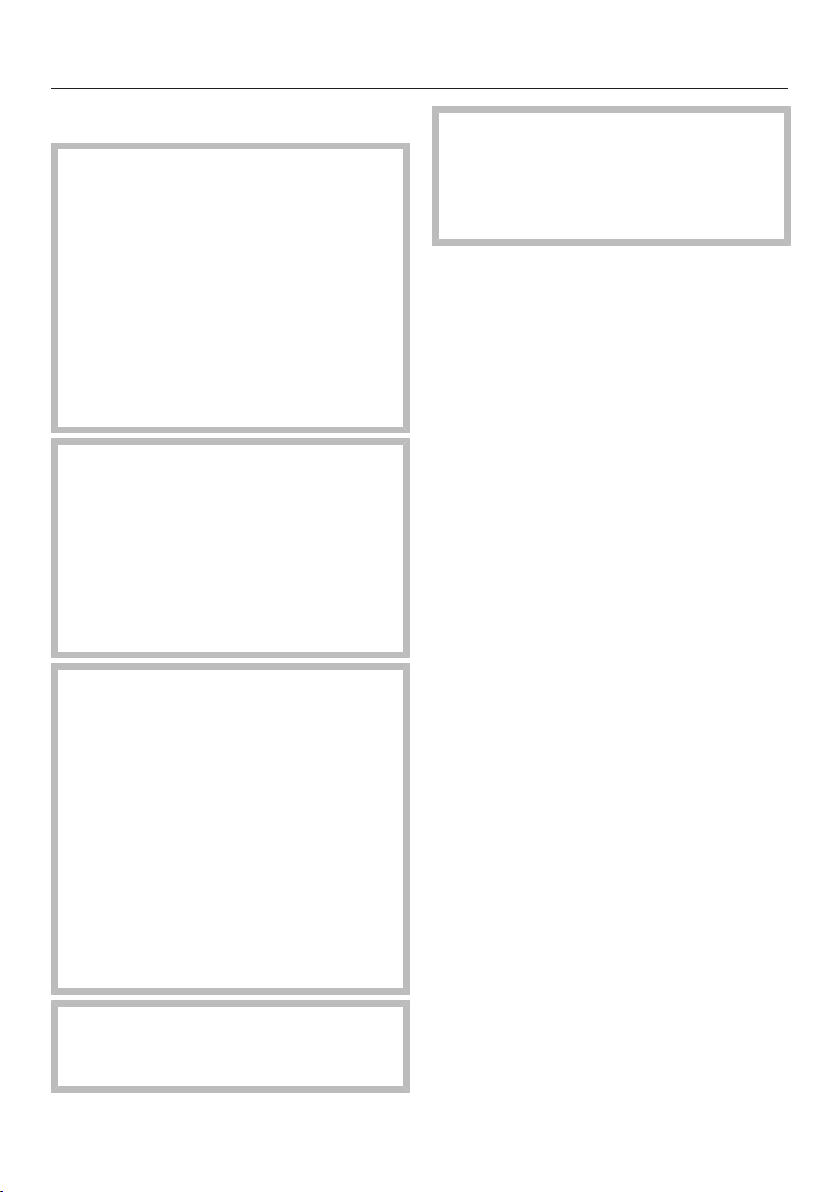
Secure the microwave oven at the
front by lifting it over the hooks and
lowering it into position.
Check that the appliance is secure by
pushing lightly on the upper edge of
the front frame.
Check that it is correctly aligned.
Connect the microwave oven to the
electrical supply.
Installation
*INSTALLATION*
22
Electrical connection
Risk of injury due to electric
shock.
During installation, maintenance, and
repair work, the microwave oven
must be completely disconnected
from the power supply:
Disconnect the microwave oven from
the power supply by tripping the
breakers, or unplugging the power
cord from the outlet. To do this, pull
the plug not the cord.
Risk of injury.
Installation, repairs, and other work
by unqualified persons could be
dangerous. Miele cannot be held
liable for unauthorized work.
Installation, maintenance, and repairs
must only be carried out by a Miele
authorized technician.
The connection data (voltage,
frequency and max. rated load) on
the data plate of the microwave oven
must match the power supply in
order to avoid the risk of damage to
the microwave oven.
The connection data can be found
on the data plate, which is visible on
the front frame or at the back of the
microwave oven. Compare this
before connecting the appliance to
the power supply. If in any doubt,
consult a qualified electrician.
For safety reasons, the microwave
oven may only be used when it has
been fully installed.
The power cord plug must be
inserted into a suitable outlet that
has been installed and grounded in
compliance with all applicable local
codes.
WARNING: THIS APPLIANCE MUST
BE GROUNDED
Installer: Please pass these
instructions on to the customer.
Installation
*INSTALLATION*
23
Risk of injury caused by a
damaged microwave oven.
Damage to the microwave oven can
compromise your safety.
Check the microwave oven for visible
signs of damage. Do not use a
damaged microwave oven.
The microwave oven is supplied with a
plug for connection to a dedicated line
and junction box.
Install the microwave oven so that the
outlet is accessible. If the outlet is not
accessible, make sure that a suitable
means of disconnection is provided on
site for each pole.
Risk of fire by overheating.
Installing the appliance with a power
bar or an extension cord can
overload the cords.
Do not use power bars and
extension cords to connect the
microwave oven to the power supply.
If the power cord is damaged, it must
be replaced with a special power cord
of the same type (available from Miele).
For safety reasons, the power cord
must only be replaced by a Miele
authorized technician.
The max. rated load and the fuse
protection can be found in these
operating and installation instructions or
on the data plate. Compare this with the
data of the domestic electrical supply.
If in any doubt, consult a qualified
electrician.
Temporary or permanent operation on
an autonomous power supply system or
a power supply system that is not
synchronized with the grid power
supply (e.g., island networks, back-up
systems) is possible. A prerequisite for
operation is that the power supply
system complies with the specifications
of EN50160 or an equivalent standard.
The function and operation of the
protective measures provided in the
domestic electrical installation and in
this Miele product must also be
maintained in isolated operation or in
operation that is not synchronized with
the grid power supply, or these
measures must be replaced by
equivalent measures in the installation.
As described, for example, in the
current version of VDE-AR-E 2510-2.
Do not connect the appliance to energy
saving plugs or outlets. The reduction
of power to the appliance caused by
these devices will cause the appliance
to run hot and may damage it and/or
shorten its usable life.
Electrical connection
The microwave oven is equipped with a
7ft. (2.1m) long power cord with a
NEMA 5-15P molded plug for
connection to a 120V, 15A, 60Hz
power supply.
KEEP THE OPERATING AND
INSTALLATION INSTRUCTIONS IN A
SAFE PLACE.
Caring for the environment
24
Disposal of the packing
material
The cardboard box and packing
materials protect the appliance during
shipping. They have been designed to
be biodegradable and recyclable.
Ensure that any plastic wrappings,
bags, etc. are disposed of safely and
kept out of the reach of children.
Danger of suffocation!
Disposal of your old appliance
Electrical and electronic appliances
contain valuable materials. They also
contain certain substances, compounds
and components which were essential
for the proper functioning and safe use
of the equipment. Handling these
materials improperly by disposing of
them in your household waste can be
harmful to your health and the
environment. Therefore, please do not
dispose of your old appliance with
regular household waste and follow
local regulations on proper disposal.
Consult with local authorities, dealers or
Miele in order to dispose of and recycle
electrical and electronic appliances.
Miele assumes no responsibility for
deleting any personal data left on the
appliance being disposed. Please
ensure that your old appliance is kept
away from children until removal.
Observe safety requirements for
appliances that may tip over or pose an
entrapment hazard.
Overview
25
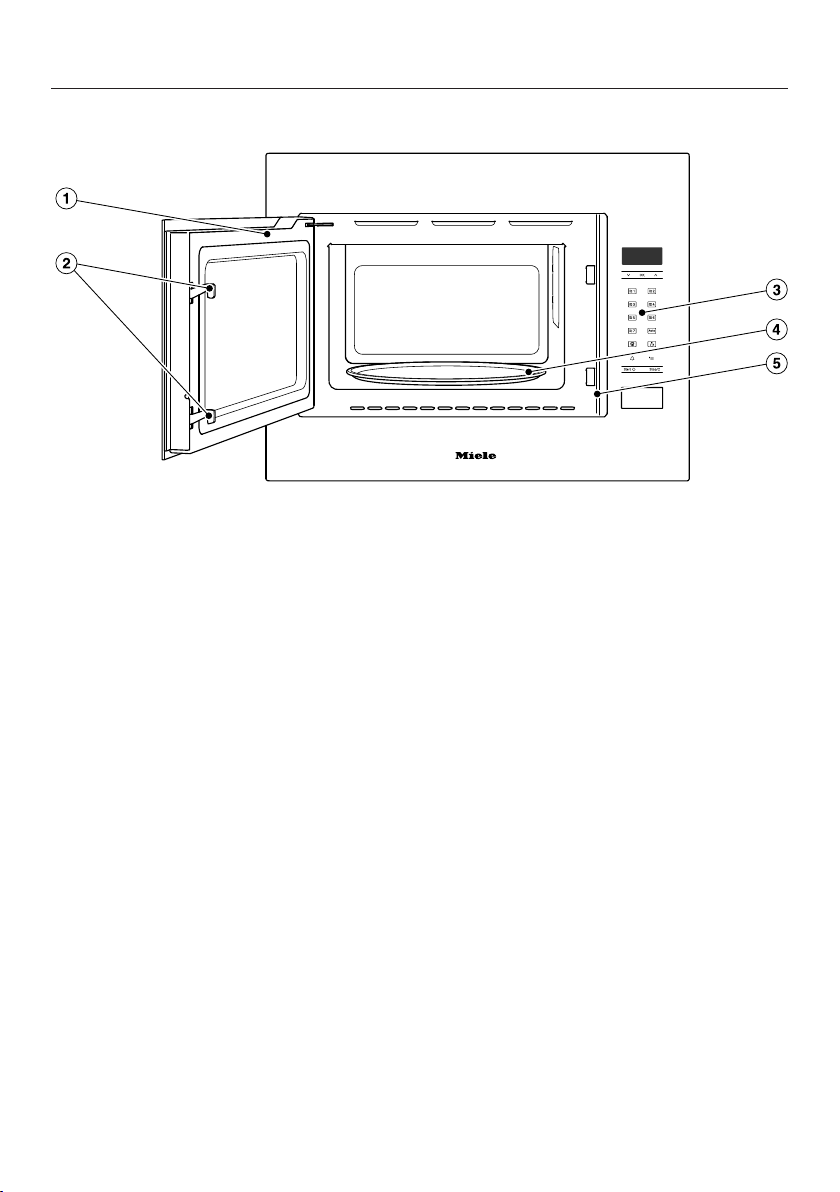
Microwave oven
a
Door
b
Door lock
c
Controls
d
Turntable
e
Front frame with data plate
Control panel
26
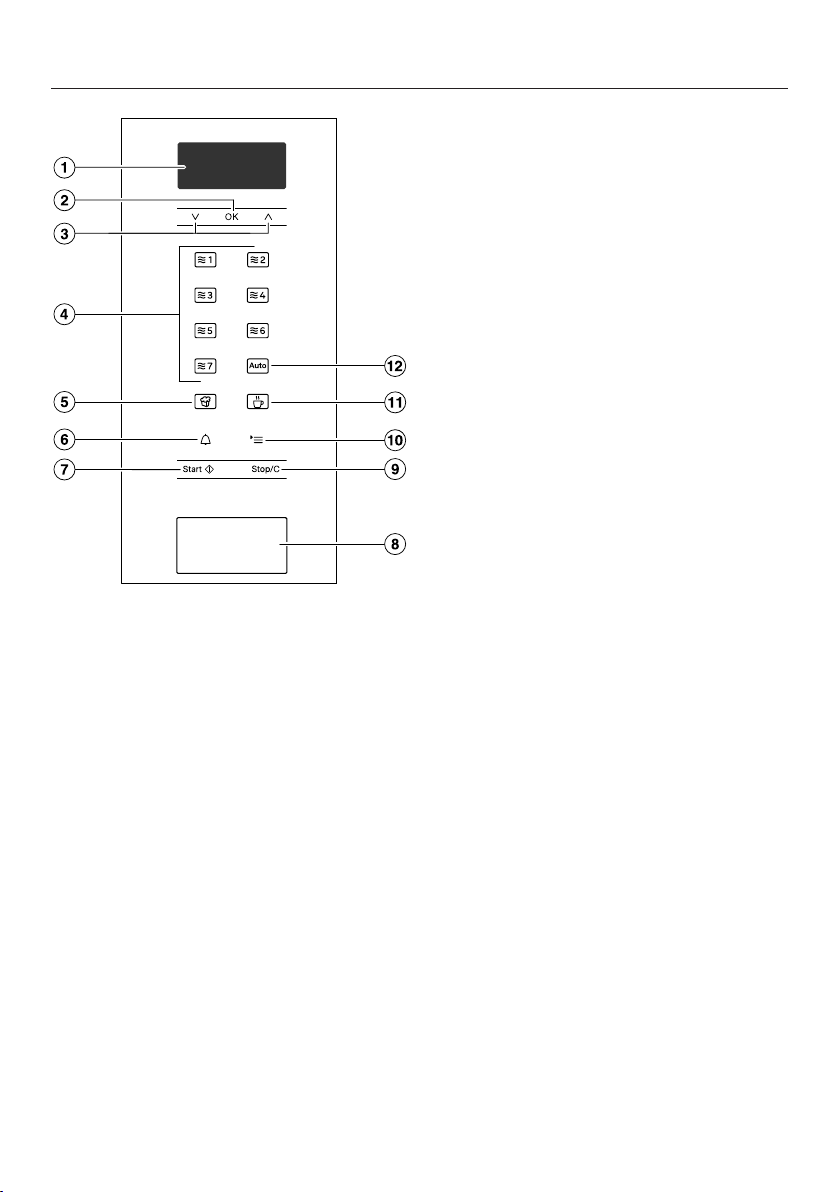
a
Display
For displaying the time of day and
information on operation
b
OKsensor button
For accessing functions and saving
settings
c
Arrow buttons and
For changing values and settings
d
to sensor buttons
For setting the microwave power
level
e
sensor button
For starting the Popcorn function
f
sensor button
To activate or deactivate a timer
g
sensor button
For starting a cooking process, for
increasing the cooking duration by
implements and for starting the
Quick MW function
h
Door release
i
/Csensor button
For interrupting a cooking process
and for deleting cooking times and
settings
j
sensor button
To access settings
k
sensor button
For heating beverages
l
sensor button
For selecting automatic programs
Control panel
27
Display
W
g
lb
Symbols
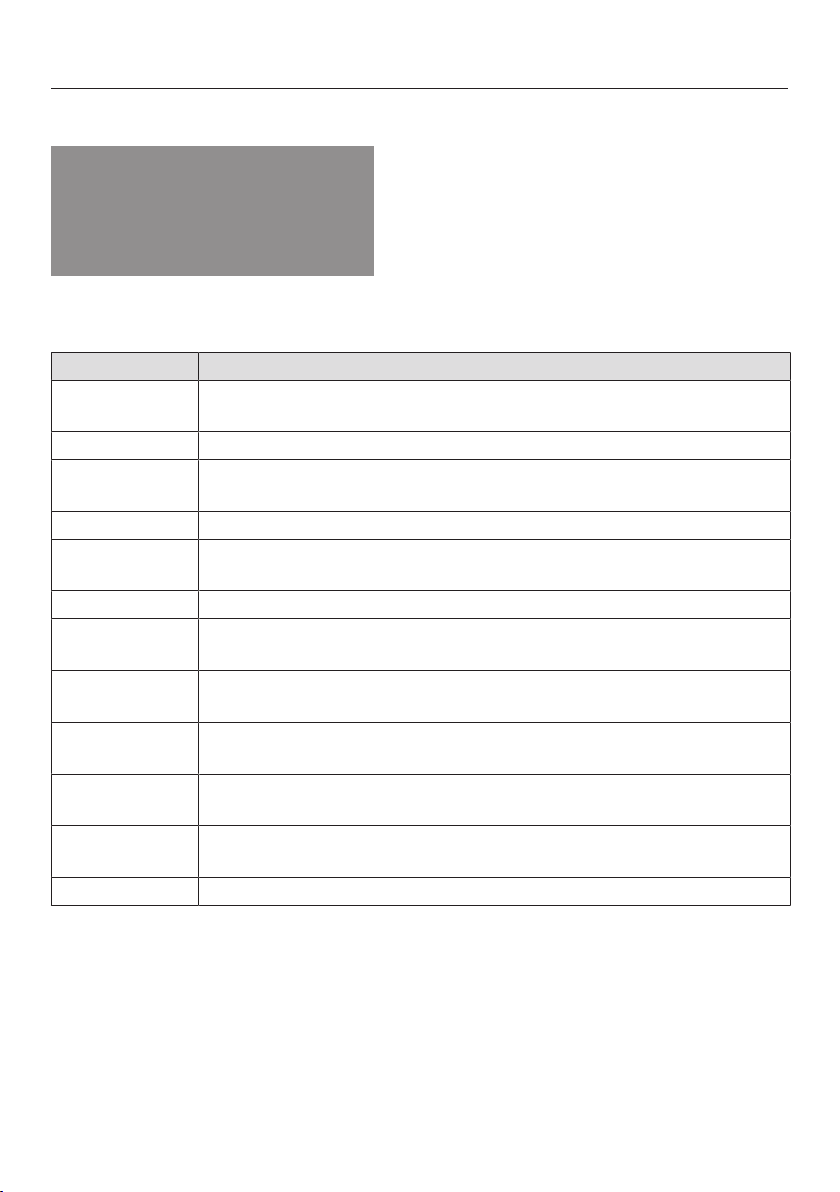
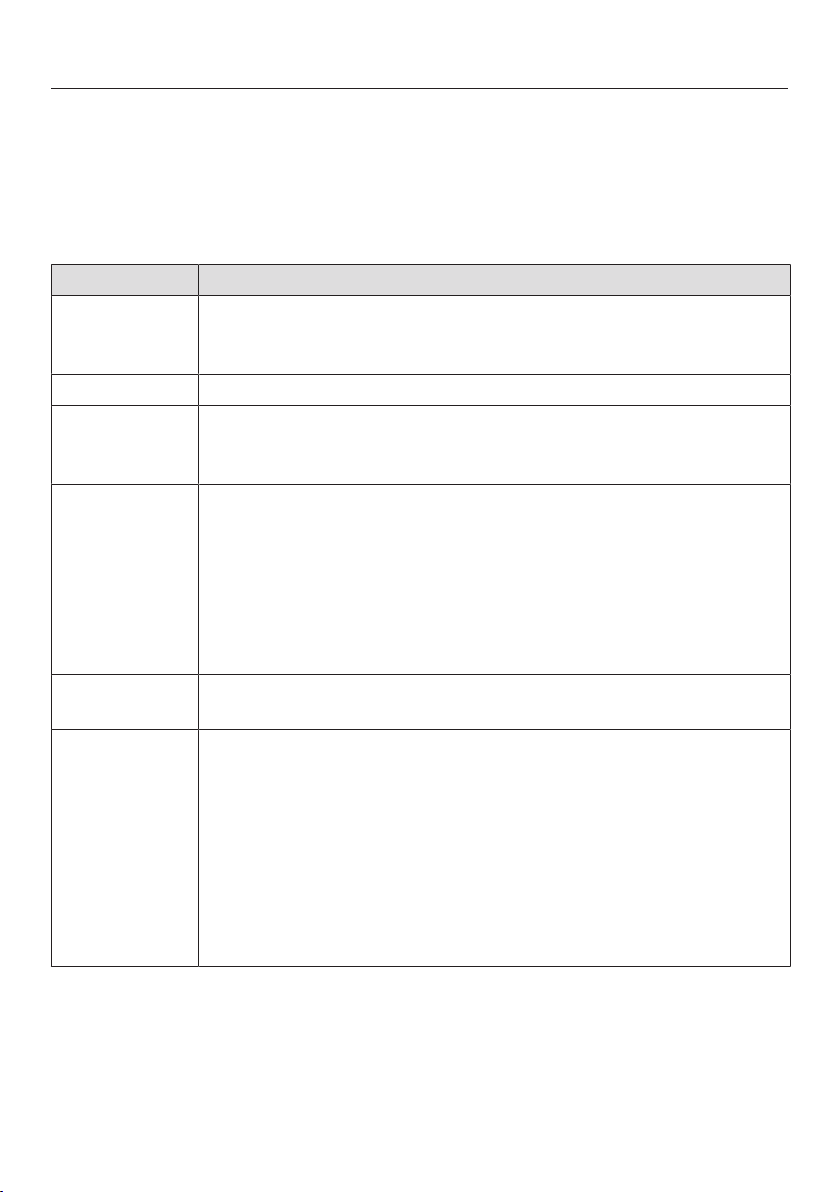
The following symbols may appear on the display:
Symbol Meaning
This symbol appears when setting the time of day (see
“Settings”).
Timer
This symbol appears when a cooking process is running (see
“Operation”).
Settings
lb
g
The unit of weight used for food in the context of automatic
programs and other modes (see “Settings”).
W The unit used for the microwave power level
This symbol flashes as soon as the appliance is ready for you to
start a cooking process (see “Operation”).
Setting
Status of the setting (see “Settings”)
Automatic keep-warm function “Heat and Hold” (see
“Operation”)
This message appears if the door has been closed for 20minutes
or longer. You cannot start a program (see “Operation”).
The system lock prevents the microwave oven being switched on
by mistake (see “Operation – System lock”).
Demo mode (see “Settings”)
Control panel
28
Sensor buttons
The sensor buttons react to touch. Every tap of a sensor button is confirmed with
an audible keypad tone. You can turn this keypad tone off using | .
For information on the functions and operating modes, see “Operation”, “Settings”,
“Automatic Programs” and “Further applications”.
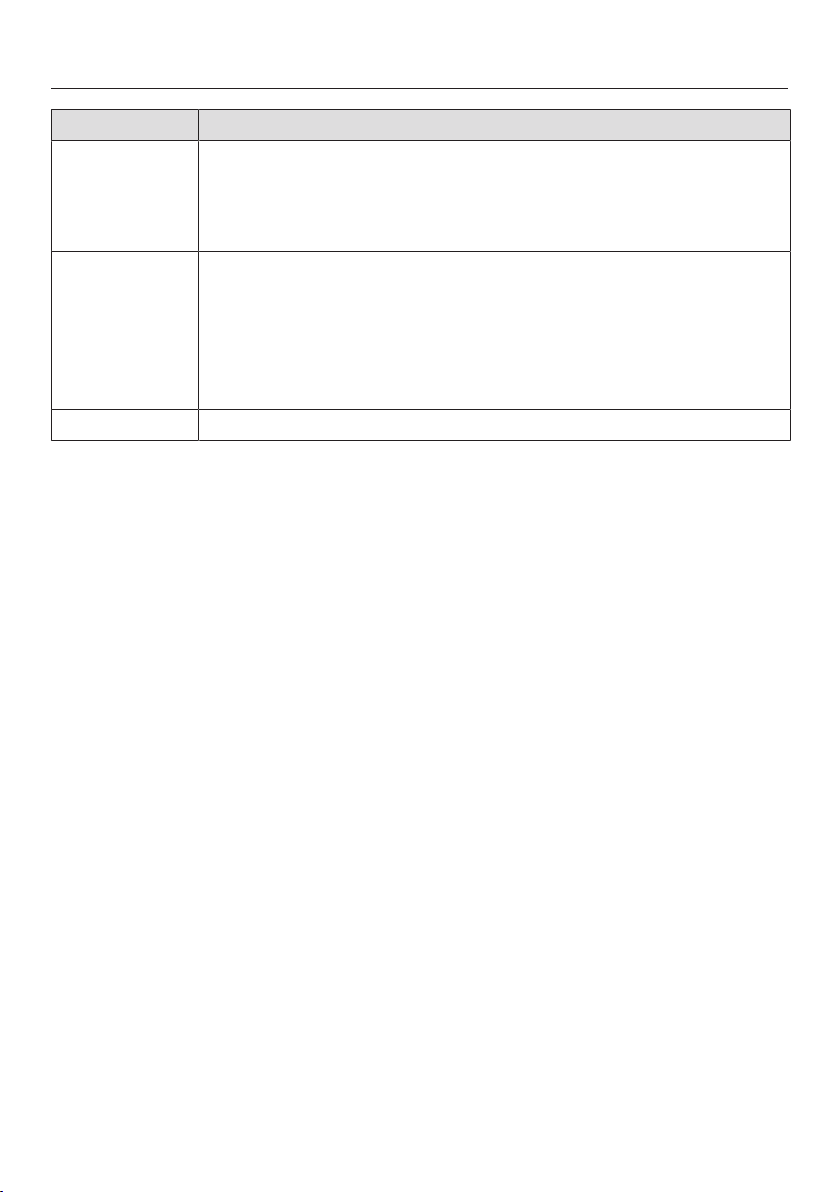
Sensor button Function
OK By selecting this sensor button you can access functions such
as the timer, save changes to values or settings, or confirm
instructions.
Use the arrow buttons to change values and settings.
to Use these sensor controls to select the required microwave
power level. The power for each level appears on the display in
watts.
Use this sensor control to start the Popcornfunction. The
cooking process runs at microwave power level power level
(900W) for a cooking duration of :minutes (see section
“Popcorn”).
To set the cooking duration, select | .
This function can only be used when no other cooking processes
are in use.
You can use this sensor button at any point to set a timer (e.g.,
when boiling eggs) (see “Timer”).
Use this sensor button to start a cooking process and to
increase the cooking duration by 30or 60seconds (depending
on the microwave power level).
You can also start the Quick MW function. The cooking process
runs with maximum power level (900W) and a cooking
duration of 1minute (see „Quick MW“). Touching the sensor
button repeatedly increases the cooking duration in increments.
This function can only be used when no other cooking processes
are in use.
Control panel
29
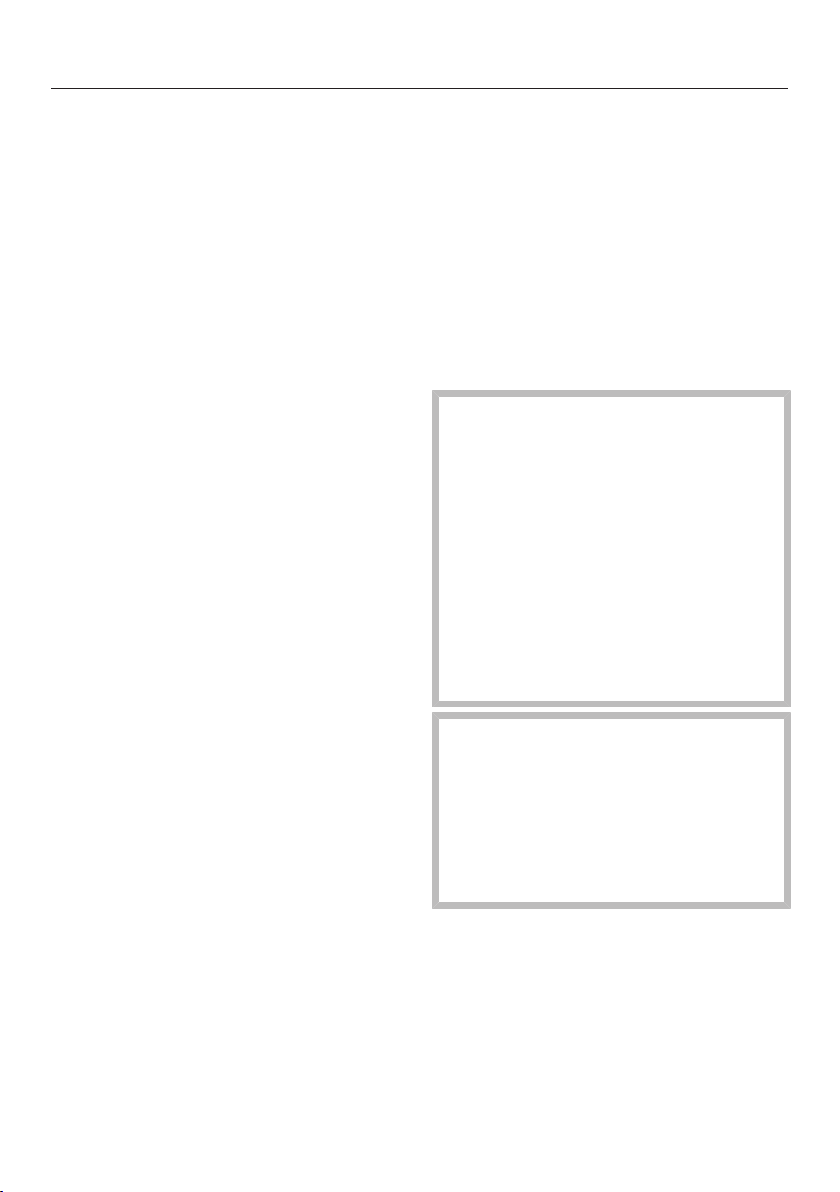
Sensor button Function
/C Use this sensor button to interrupt a program and to stop the
signal after a cooking process is completed.
You can also delete a timer, leave the settings menu or switch off
the microwave oven.
This sensor control allows you to reheat the contents of up to
6cups. The cooking process runs at the maximum microwave
power level of (900W). The actual duration depends on the
number of cups set and is adjusted automatically (see
“Operation” – “Reheat drinks”).
To set the quantity of liquid inside each cup, select | .
Use this sensor button to access the settings.
Microwave operation
30
How it works
The microwave oven contains a
magnetron that converts electrical
energy into electromagnetic waves
(microwaves). These microwaves are
distributed evenly throughout the oven
compartment and are also reflected by
the metal walls inside the oven.
The microwaves penetrate the food
from all sides. Food consists of many
molecules. When subjected to
microwave energy, these molecules
(particularly the water molecules) start
to oscillate. This heats the food from
the outside to the inside. The more
water a food contains, the faster it is
reheated or cooked.
Advantages of the microwave oven
- Food can generally be cooked with
little or no liquid or cooking oil.
- The times for defrosting, reheating, or
cooking are shorter than with a
cooktop or oven.
- Vitamins, minerals, natural color, and
taste of the food are generally
retained.
Suitable dishware
In order for microwaves to reach the
food, they must be able to penetrate the
dishware being used. Microwaves can
pass through porcelain, glass,
cardboard, and plastics, but not metal.
Therefore, do not use metal containers
or dishware that contains metal. Metal
reflects the microwaves which can
create sparks and the microwaves are
not absorbed by the metal.
Danger of injury from increased
pressure in sealed containers or
bottles
Pressure can build up when
reheating food or drinks in sealed
containers or bottles, which can
cause them to explode.
Never cook or reheat solid or liquid
food in sealed containers or bottles.
Open containers beforehand and,
with baby bottles, remove the screw
top and teat.
Risk of fire due to unsuitable
dishware
Dishware that is not microwave-safe
can be destroyed and may damage
the microwave oven.
Only use microwave-safe dishware in
the microwave oven.
The material and shape of dishware
used affect reheating and cooking
durations.
Heat distribution is more even in round
and oval-shaped flat containers. Food is
reheated more evenly in these
containers than in square ones.
Microwave operation
31
Suitable dishware
Fire hazard due to flammable
materials
Disposable containers made out of
plastic, paper, or other flammable
materials can ignite, causing damage
to the microwave oven.
Do not leave the microwave oven
unattended when reheating or
cooking food in disposable
containers made of plastic, paper, or
other flammable materials.
You can use the following dishware and
materials:
- Heat-resistant glass and ceramic
glass
Exception: crystal glass as it contains
lead and may crack.
- Porcelain
– Without metallic decoration
Metallic decoration (e.g., gold rims
or cobalt blue) can cause sparking.
– Without hollow knobs and handles
Moisture can gather in hollow
knobs and handles. When the
moisture evaporates, pressure can
build up and the item can explode.
- Unpainted stoneware and stoneware
with underglaze paints
Danger of injury caused by hot
dishware.
Stoneware can get hot.
Use pot holders when using
stoneware.
- Plastic dishware and disposable
plastic containers
Tip: To protect the environment, avoid
the use of disposable containers.
Plastic dishware and bags that are
not heat-resistant may melt and fuse
with the food inside.
Only use plastic dishware or bags that
are heat-resistant. Plastic dishware
and bags must be heat-resistant to a
minimum of 230°F (110°C).
- Microwave-safe plastic dishware
Special plastic dishware designed for
use in microwave ovens is available
from retail outlets.
- Styrofoam dishware
For briefly heating food.
- Plastic boiling bags
For cooking and reheating. They
should be pierced before use. The
holes allow the steam to escape. This
prevents a build-up of pressure from
forming and the bag from bursting.
There are also special bags available
for steam cooking which do not need
to be pierced. Please follow
instructions given on the packet.
- Roasting bags and tubes
Please follow the manufacturer’s
instructions.
Risk of fire due to metal parts.
Metal parts such as metal clips or
plastic and paper ties that have wire
running through them can heat
flammable materials until they burn.
Do not use metal clips or plastic and
paper ties containing wire.
Microwave operation
32
Tip: Metallic dishes are not very
suitable for use in the microwave oven.
Metal reflects microwaves and
obstructs the cooking process.
Using aluminum foil trays and
aluminum foil can cause crackling
and sparks.
Place aluminum foil trays on the
turntable.
Aluminum foil and aluminum foil
trays must not touch the oven
compartment walls and must remain
at least 3/4" (2cm) from the walls at
all times.
- Aluminum foil trays without lids for
defrosting and reheating TV dinners
The food is only heated from the top.
If you remove the food from the
aluminum foil container and transfer it
to dishware suitable for use in a
microwave oven, the heat distribution
will generally be more even.
- Metal skewers or clips
The size of the cut of meat must be
much larger than the metal skewers
and clips.
Unsuitable dishware
Moisture can collect in the hollow
spaces on dishware and lids with
hollow handles or knobs. When the
moisture evaporates, pressure can
build up and the item can explode. If
the hollow recess is sufficiently
ventilated, the item can be used.
Do not use dishware with hollow
knobs or handles for cooking.
Do not use the following dishware and
material:
- Wire racks are not at all suitable for
use in the microwave.
- Metal containers
- Aluminum foil
Exception: in the case of unevenly
shaped cuts of meat – e.g., poultry –
small pieces of aluminum foil may be
used to cover thin parts for the last
few minutes of the process to ensure
even defrosting, reheating, or
cooking.
- Metal clips, or plastic or paper ties
containing wire
- Plastic containers where the
aluminum lid has not been
completely removed
- Crystal glass
- Utensils and dishware with metallic
decoration (e.g., gold rims, cobalt
blue)
- Dishware with hollow handles
- Plastic dishware made of melamine
Melamine absorbs microwave energy
and gets hot.
Microwave operation
33
When purchasing plastic dishware,
make sure that it is suitable for use in
a microwave oven.
- Wooden dishes
Water contained in wood evaporates
during the cooking process. This
causes the wood to dry and crack.
Testing dishware
Unsuitable dishware can cause sparks
or crackling noises during microwave
operation. If you are not sure whether
glass, porcelain, or stoneware dishware
is suitable, test it.
This test cannot be used to check
whether items with hollow grips or
handles are suitable for use.
Place the empty dishware on the
turntable.
Close the door.
Set the microwave power level to
(900W) and the cooking duration to
30seconds.
Start the process.
Observe the dishware during the
entire duration.
Immediately open the door if there
are sparks or crackling noises.
If there are sparks or if you can hear
crackling noises, the tested dishware is
not suitable for microwave use.
Cover
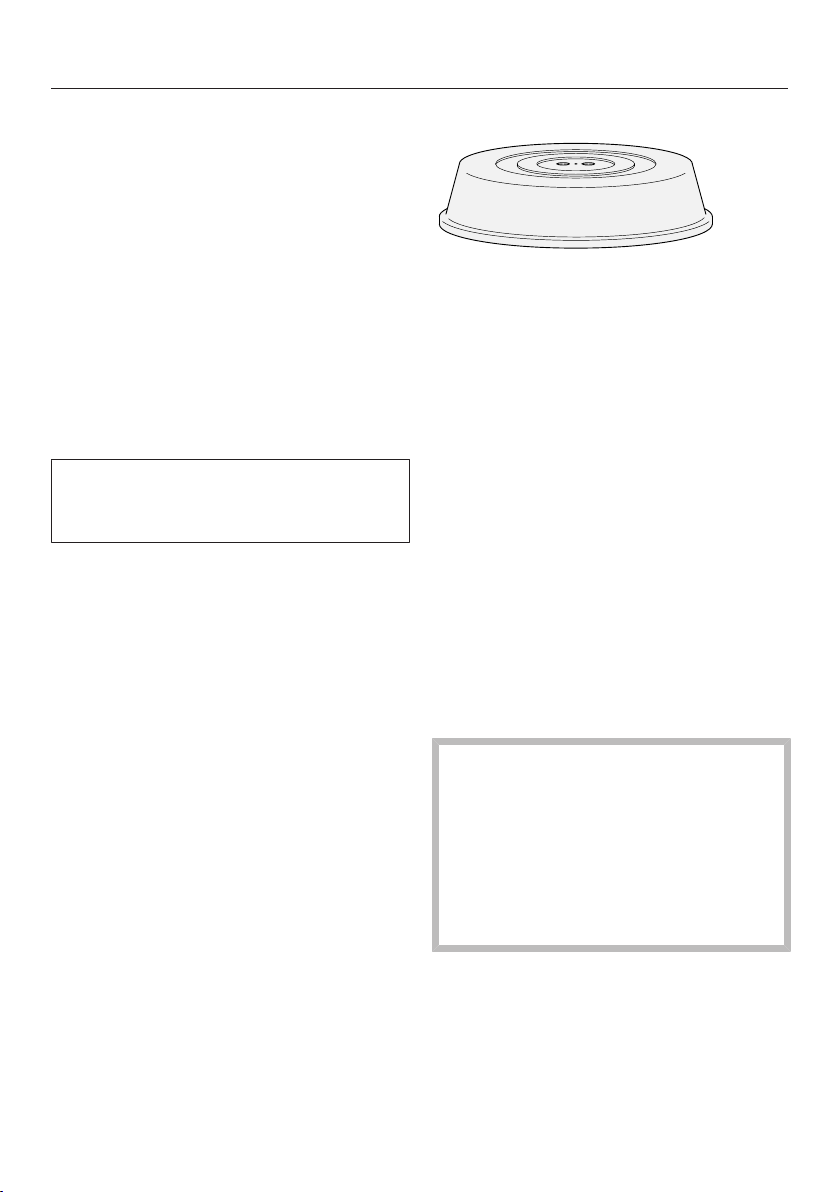
Tip: Covers are available from retail
outlets.
- A cover prevents too much steam
escaping, especially when cooking
foods which need longer to cook.
- It speeds up the process of heating
the food.
- It prevents food from drying out.
- It helps keep the oven compartment
clean.
When cooking in the microwave, use
a microwave-safe cover made of
glass or plastic.
Tip: Alternatively, use a cling film
suitable for use in a microwave oven.
Heat can cause normal cling film to
melt and fuse with the food.
The cover should not form a seal
with the container. If the container
has a narrow diameter, the steam
may not be able to escape. The
cover could get too hot and start to
melt.
Use containers with a sufficiently
large diameter.
Do not use a cover for heating or
reheating the following types of food:
- Food coated in breadcrumbs
- Food which requires a crisp finish,
e.g., toast
Before first use
34
Danger of injury caused by hot
surfaces
The microwave oven gets hot during
operation.
For safety reasons, the microwave
oven may only be used when it has
been fully installed.
The microwave oven will switch on
automatically when it is connected to
the electrical supply.
Setting the time of day
The time of day is shown in 12-hour
clock format.
When you connect the appliance to the
electrical supply, the symbol and
will flash on the display.
Use the and arrow keys to set
the hour.
Confirm with OK.
Use the and arrow keys to set
the minutes.
Confirm with OK.
The set time is now applied.
You can also display the time of day in
24-hour format by going to the
setting and selecting (see
“Settings – Changing settings”).
Settings
35
Settings overview
Setting Status
Time of day
:* Use the arrow keys to set the hour and then the
minutes.
Audible signal
The audible signal is switched off.
* The audible signal is switched on.
Keypad tone
The keypad tone is switched off.
* The keypad tone is switched on.
Clock format
The time of day is shown in the 24-hour
format.
* The time of day is shown in the 12-hour
format.
If you change the clock from a 12-hour clock to
a 24-hour clock after 1:00pm, you will need to
update the hour accordingly.
Night dimming
* Night dimming is switched off.
Night dimming is switched on. The time of day
display is switched off between the hours of
11pm and 5am.
Unit of weight
* Food weight is displayed in pounds (lb).
Food weight is displayed in grams (g).
Automatic keeping
warm function
The automatic keeping warm function is
switched off.
* The automatic keeping warm function is
switched on (see “Operation – Automatic
keeping warm function – ”).
* Factory default
Settings
36
Setting Status
Quick MW
W* The maximum power can be changed from
W up to W.
:* The cooking duration of :minutes can be
increased up to a maximum of :minutes,
depending on what power level has been set
(see “Quick MW”).
Oven compartment
query
The message will not appear on the
display.
* The message will appear on the display if
the door has not been opened for about
20minutes. You will not be able to start the
cooking process (see “Operation – Oven
compartment query – ”).
Popcorn
:* The cooking duration of :minutes can be
adjusted within the range of :–:minutes
(see “Popcorn”).
Cup size
:* The cup size of :liquid oz can be adjusted
within the range of :–:liquid oz (see
“Operation – Reheat drinks”).
Demo mode
* Select and press OK for approx. 4seconds.
appears briefly to indicate that Demo
mode has been deactivated.
Select and press OK for approx. 4seconds.
appears briefly to indicate that Demo mode
has been activated.
The microwave oven cannot be operated. Do
not activate this setting for domestic use.
Factory default
settings
The settings will not be reset.
* Any settings that have been altered will be reset
to the factory default settings.
* Factory default
Settings
37
Changing settings
You can personalize your microwave
oven by adapting the factory default
settings to suit your requirements.
To access the settings, select the
sensor control (see “Settings
overview”).
You cannot change settings while a
cooking process is in progress.
Select the sensor control.
will appear on the display.
If you want to change another setting,
select the appropriate number with
the or arrow keys.
Confirm with OK.
The setting is selected and the current
status appears, e.g., .
To switch from the currently selected
setting to a different one, press OK
and then select the setting you want.
Set the desired status using the or
arrow keys.
Confirm with OK.
The status is saved and the setting
appears again.
To change additional settings,
proceed in the same way.
If you do not want to change any
further settings, select .
The settings will remain in the memory
in the event of a power failure.
Operation
38
Tips for cooking with the
microwave
- You can choose from 7different
microwave power levels. The higher
the power level, the more microwaves
reach the food.
- When heating up foods that cannot
be stirred or turned during cooking,
or foods with very different
consistencies, it is best to use a
lower microwave power level. This
ensures that the heat is distributed
evenly.
Extend the cooking duration
accordingly to cook the food
properly.
- Food taken straight from the
refrigerator takes longer to defrost,
reheat, and cook than food which has
been kept at room temperature.
- Fresh vegetables contain more water
and cook more quickly than stored
vegetables.
- Frequent stirring or turning heats the
food more evenly, and it is therefore
ready in less time.
- The more food you place inside the
oven, the longer it will take to cook
(twice the amount = almost twice as
long). Reducing the quantity of food
shortens the cooking duration.
- The shape of the dishware and
material from which it is made may
affect the cooking duration (see
“Microwave operation – Suitable
dishware”).
Using the turntable
Placing food directly on the floor of
the oven can cause damage to the
microwave oven.
Always use the turntable, placing the
dishware on top.
The turntable begins turning
automatically whenever you start a
process. This ensures that the food
gets defrosted, reheated, or cooked
evenly.
Tips
- Do not place food directly on the
turntable when cooking, reheating, or
defrosting.
- Make sure that the dishware is
smaller than the turntable.
- Turn or stir food during cooking so
that it heats up evenly.
Starting a cooking process
Place the dishware containing the
food on the turntable.
Press the door shut.
If the door has not been shut properly,
you will not be able to start a cooking
process.
Select the required microwave power
level.
The symbol will appear on the
display together with the set microwave
power level.
will appear on the display and the
minutes will flash.
Use the and arrow keys to set
the minutes.
Operation
39
Confirm with OK.
The minutes set are saved and the
seconds flash.
Use the and arrow keys to set
the seconds.
Confirm with OK.
With microwave power level
(900W), the cooking duration is
limited to 15minutes.
The other microwave power levels
allow you to set a cooking duration of
up to 90minutes.
Operating the microwave continuously
at full power may result in the power
level being reduced by the overheating
protection (see “Frequently Asked
Questions”).
Select the sensor control.
The cooking process starts.
At the end of the cooking duration, an
audible signal will sound. If you do not
respond, the appliance will emit another
audible signal after 5, 10, 15, and
20minutes to remind you.
At the end of the cooking process,
select the /Csensor control.
You can also keep the food warm at
the end of the cooking process (see
“Automatic keeping warm function
”).
Take the food out of the oven.
Changing the microwave
power level
You can use sensor controls
through to change the microwave
power level during a cooking process.
Select the required microwave power
level.
The cooking process continues running
without interruption for the remainder of
the cooking duration with the new
microwave power level.
Changing the cooking duration
Select the or arrow key.
The minutes will flash.
Adjust the cooking duration by using
the and arrow keys to change
the minutes and then the seconds.
Confirm each with OK.
Press the sensor control to
resume the cooking process.
Operation
40
Interrupting and resuming a
cooking process
You can interrupt a cooking process
(and resume it) at any time.
Open the door during the cooking
process or select the /Csensor
control.
The cooking process is interrupted and
the cooking duration is paused.
To resume the cooking process, close
the door and select the
sensor control.
The cooking process resumes and the
cooking duration continues to count
down.
Canceling a cooking process
Press the /Csensor control twice
in a row.
Automatic keeping warm
function –
At the end of a cooking process at
microwave power level (450W) or
higher, the automatic keeping warm
function will switch on automatically
if the door remains closed and no
sensor controls are pressed.
This will happen after approx. 2minutes
and will keep the food warm for up to
15minutes by using microwave power
level (80W). The appliance will emit
an audible signal after 5, 10, and
15minutes.
, W, and (Heat and Hold)
appear on the display.
You can adjust this function with the
setting.
The automatic keeping warm function
cannot be combined with the Popcorn
and Reheat drinks functions.
Oven compartment query –
Operating the microwave oven while
empty can damage it.
Make sure that some food has
actually been placed inside the oven
before starting a cooking process.
The message appears to remind
you that the microwave oven must not
be used without any food inside it.
If you attempt to start a cooking
process without opening the door first,
the message will appear on the
display.
There may not be any food inside the
oven, given that you have not opened
the door for a long time (approx.
20minutes).
Open and close the door, and then
select the sensor control.
You can adjust this function with the
setting.
Operation
41
Reheat drinks
This function allows you to reheat the
contents of up to 6cups. The cooking
process runs at the maximum
microwave power level of (900W).
The actual duration depends on the
number of cups set and is adjusted
automatically. The microwave power
level is set and cannot be modified.
You can use the setting to adjust
the cup size of :liquid oz to a value
within the range of :–:liquid oz.
Place the cup or cups containing the
liquid inside the oven.
Select the sensor control.
and will appear on the display.
The will flash.
To reheat several cups of liquid at
once, use the and arrow keys or
the sensor control to select the
relevant number of cups.
Select the sensor control.
The cooking process starts.
You can interrupt the cooking process
at any time with the /Csensor
control.
Select the sensor control to
resume the cooking process or the
/Csensor control to cancel it.
Switching the system lock on
and off
The system lock prevents the
microwave oven from being switched
on inadvertently.
The timer can still be used when the
system lock is active. If you attempt to
start a cooking process, the key
symbol will appear on the display.
In the event of a power failure, you will
have to reactivate the system lock.
Press and hold OK for approx.
6seconds.
The seconds will count down to zero.
You will then hear an audible signal and
the key symbol will appear on the
display.
The key symbol will go out after a
short time.
All appliance functions are now locked.
When the system lock is activated, the
only function you can use is the timer
(see “Timer”).
To deactivate the system lock, press
and hold OK for approx. 6seconds
until you hear an audible signal.
You can now use all the functions
available on the microwave oven.
Timer
42
Using the Timerfunction
The timer can be used to time other
activities in the kitchen, e.g.,boiling
eggs.
The timer can also be used at the same
time as a cooking process for which
automatic start and finish times have
been set (e.g., as a reminder to stir the
food or add seasoning, etc.).
The maximum timer duration that can
be set is 90minutes and 00seconds.
Setting the timer
Example: you want to boil some eggs
and set a timer of 6minutes and
20seconds.
Select the sensor control.
The symbol and will appear on
the display. The minutes will flash.
Use the and arrow keys to set
the minutes to .
Confirm with OK.
The minutes set are saved and the
seconds flash.
Use the and arrow keys to set
the seconds to .
Confirm with OK.
The timer duration is now saved.
If no cooking process is taking place at
the same time, the symbol will be
shown together with the running timer
instead of the time of day.
If a cooking process is taking place at
the same time, the timer will count
down in the background.
To see how much time has elapsed
so far, select the sensor control
while the cooking process is running.
At the end of the timer duration, will
flash, the time will start counting up,
and an audible signal will sound.
Select the sensor control.
The audible signal will stop and the
symbols on the display will go out.
Changing the timer duration
Select the sensor control.
The symbol will appear on the
display together with the timer duration.
Use the and arrow keys to
change the timer duration.
Confirm with OK.
The altered timer duration is now saved.
Deleting the timer
If a cooking process is running at the
same time, select the sensor
control.
The symbol will appear on the
display together with the timer duration.
Select the /Csensor control.
The timer is deleted.
If no cooking process is running at the
same time, press the/Csensor
control to delete the timer directly.
Quick MW and Popcorn
43
These functions can only be used
when no other cooking processes are
in use.
Quick MW
If you select the sensor control,
the microwave starts with a set
microwave power level and cooking
duration, e.g., to reheat a drink.
The maximum microwave power level
of (900W) and a cooking duration
of 1minute are set by default.
You can change the microwave power
level and the cooking duration with the
setting. The maximum cooking
duration that can be set depends on the
microwave power level selected:
- The following microwave power
levels can be selected: 80W, 150W,
300W, 450W, 600W, 750W, or
900W.
- The maximum cooking duration that
can be set depends on the
microwave power level selected:
80–300W: maximum 10minutes
450–900W: maximum 5minutes
Select the sensor control.
Touching it repeatedly increases the
cooking duration in increments.
The time left will appear on the display.
You can interrupt the cooking process
at any time with the /Csensor
control.
Select the sensor control to
resume the cooking process or the
/Csensor control to cancel it.
At the end of the cooking process, an
audible signal will sound.
Popcorn
This function is suitable for making
microwave popcorn.
If you select the sensor control, the
microwave starts with a set microwave
power level and cooking duration.
Microwave popcorn is commercially
available in packs of various sizes. This
function is designed for a pack size of
approx.3.5oz (100g). A microwave
power level of (900W) and a
cooking duration of :minutes are
set by default.
To accommodate different pack sizes,
you can use the setting to adjust
the cooking duration within the range of
:–:minutes. The microwave
power level is set and cannot be
modified.
This function is not suitable for
making popcorn from kernels.
Only use this function with products
that are specifically labeled as
microwave popcorn.
If the pack containing the popcorn
comes into contact with the wall of
the oven interior and gets stuck
there, there is a risk of heat building
up.
Place the pack centrally on the
turntable so that it has enough room
to expand.
Quick MW and Popcorn
44
Place the microwave popcorn on the
turntable according to the
instructions on the packaging.
Select the sensor control.
The time left will appear on the display.
You will be able to hear the corn
popping.
Stop the cooking process before the
end if the popping noises become
infrequent. Follow the instructions on
the pack.
Risk of injury caused by hot
popcorn
The pack containing the microwave
popcorn will be very hot at the end of
the cooking process.
Use pot holders to remove the
popcorn.
Automatic Programs
45
With the wide range of automatic
programs, you can achieve excellent
results with ease.
The automatic programs are weight-
dependent. The setting allows you
to set the unit of weight to either
pounds (lb) or grams (g) (see
“Settings”).
If you select pounds (lb) as the unit of
weight, the weight of the food will be
shown on the display in the format
“lb:oz” (e.g., : for 1lb 2oz).
Using automatic programs
Select the sensor control.
The symbol and will appear on
the display.
Use the and arrow keys to
select the required automatic
program (see “Overview of automatic
programs”).
Confirm with OK.
The display will show the lowest food
weight supported by the automatic
program.
The start symbol will flash together
with either lb or g.
Use the and arrow keys to set
the weight.
Select the sensor control.
The cooking process starts. The
cooking duration depends on which
automatic program is selected and the
weight that is set.
About halfway through the cooking
duration, an audible signal will sound to
remind you to turn or stir the food.
Open the door to interrupt the
cooking process.
Turn or stir the food.
Close the door and select
thesensor control.
The cooking process will resume.
To increase the cooking duration of
the automatic program in increments,
press the sensor control
repeatedly until the required time
appears on the display.
At the end of the cooking duration, an
audible signal will sound.
At the end of the cooking process,
allow the food to stand at room
temperature for approx. 2minutes.
This standing time allows the heat to
spread more evenly throughout the
food.
Automatic Programs
46
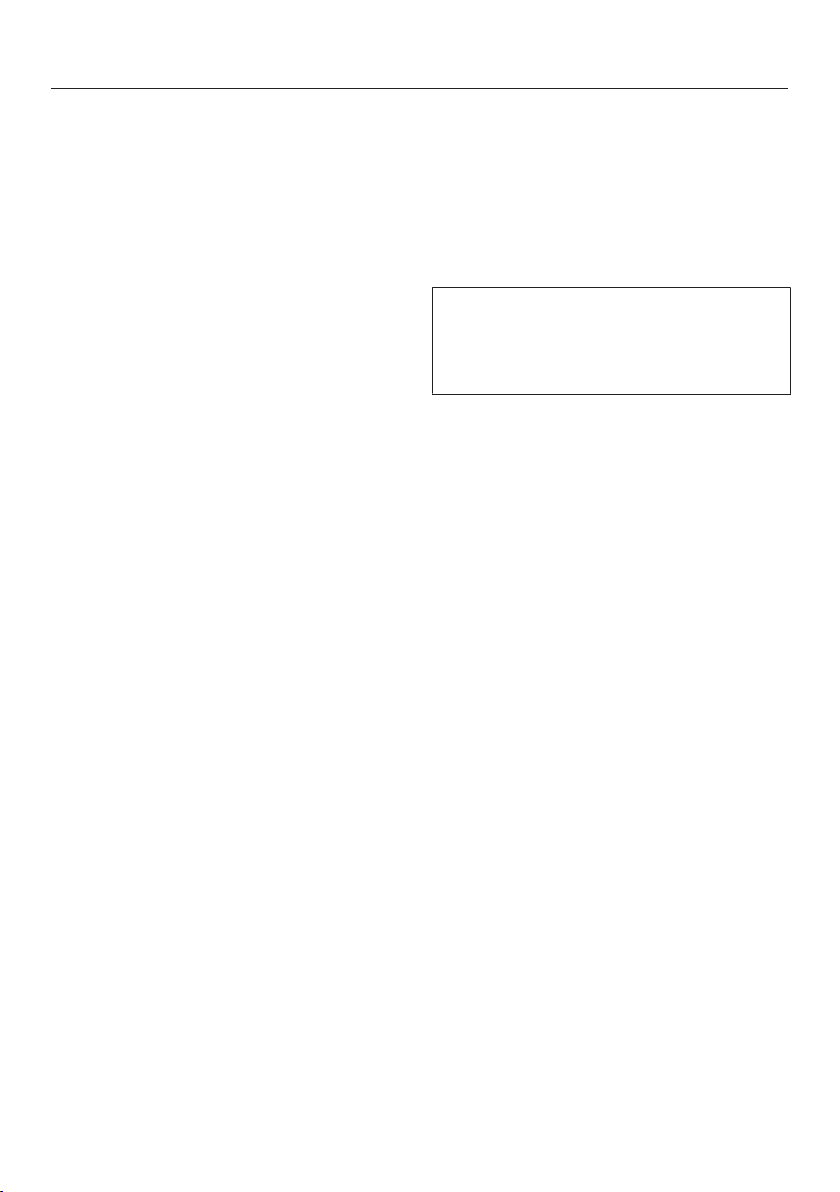
Overview of automatic programs
Category Food Weight
[lb:oz]
Weight
[g]
Minim
um
Maxi
mum
Minim
um
Maxi
mum
Defrost
Steak, chops : :
Ground meat : :
Chicken : :
Cake : :
Bread : :
Defrost and
Cook
Vegetables : :
TV dinners
that can be
stirred
: :
Bakes/gratin : :
Cook
Vegetables : :
Potatoes : :
Fish in sauce : :
Automatic Programs
47
Using automatic program
for vegetables
Automatic program is suitable for
cooking fresh vegetables.
Select |.
Follow the instructions on the display.
About halfway through the cooking
duration, an audible signal will sound to
prompt you to turn or stir the food.
Tips
- Wash the vegetables and prepare
them as per the recipe.
- Place the vegetables and other
ingredients inside a cooking container
and add 3–4tbsp water.
- Season the vegetables as per the
recipe or to taste.
- Enter the weight of the food,
including the water. When cooking
vegetables in sauce, the weight
entered must include the sauce.
- Place the food on the turntable,
ensuring it is covered. For this, use a
cover or microwavable film, for
example.
Recipes
Here are some recipes for you to try
with the automatic programs.
For best results, we recommend using
the exact quantities and accessories
listed in the recipes.
If the weights given for the relevant
programs are exceeded, the food will
not be sufficiently cooked, so please
observe the guidelines.
Potatoes in a curry sauce
Serves 3
Ingredients
1onion | diced
1tbsp butter
1 lb (500g) potatoes, waxy | diced
1–2tbsp curry powder
1 cup (250ml) vegetable stock
1/4 cup (50ml) heavy cream
1/4 lb (125g) peas, frozen
Salt
Pepper
Accessories
Bowl, microwave-safe
Total time required: 35minutes
Method
Mix together all the ingredients in a
bowl.
Place the food on the turntable,
ensuring it is covered, and cook.
When a signal sounds, stir the
vegetables immediately.
Setting
Program: |
Weight: 1 3/4 lb (800g)

Automatic Programs
48
Salmon in white wine sauce
Serves 4
Ingredients
1.5lb (700g) salmon fillet | cut into four
fillets and ready to cook
1lemon | juiced and sliced
3garlic cloves | minced
2oz (50g) butter | cubed
1cup (200ml) white wine
1bunch dill | chopped coarsely
1bunch parsley | chopped coarsely
Accessories
Casserole dish, microwave-safe
Total time required: 25minutes
Method
Place all ingredients in the casserole
dish.
Place the food on the turntable,
ensuring it is covered, and cook.
Setting
Program: |
Weight: 2.4 lb (1,100g)
Carrots in a chervil cream
sauce
Serves 2
Ingredients
3/4 lb (350g) carrots | sliced
1tsp butter
1/4 cup (50ml) vegetable stock
1/4 lb (75g) crème fraîche
1tbsp white wine
½tsp sugar
½tsp salt
1tbsp cornstarch
½tsp mustard
1–2tbsp chervil, fresh, chopped
Pepper
Accessories
Bowl, microwave-safe
Total time required: 35minutes
Method
Place the carrots in a bowl along with
the butter and vegetable stock.
Mix together the crème fraîche, white
wine, sugar, salt, cornstarch, mustard,
and chervil. Season with pepper to
taste. Add the sauce to the vegetables
and stir.
Place the food on the turntable,
ensuring it is covered, and cook.
When a signal sounds, stir the
vegetables immediately.
Setting
Program: |
Weight: 1.2 lb (525g)
Additional applications
49
This section provides information on the
following applications:
- Defrost
- Reheat
- Cooking
- Canning
Defrost
Gentle defrosting of frozen food means
that the vitamins and minerals are
generally retained.
Select an automatic program from
to (see “Automatic programs –
Overview of automatic programs”) or
use the following microwave power
levels:
- Microwave power level (80W)
For defrosting very delicate food,
e.g., cream, butter, gateau,
buttercream cake, and cheese
- Microwave power level (150W)
For defrosting everything else
When using this mode, enter the
weight or – if you have selected a
microwave power level – the
defrosting duration.
Always observe USDA/CFIA food
safety guidelines.
Risk of infection from bacteria.
Bacteria such as salmonella can
cause life-threatening food
poisoning.
It is particularly important to observe
food hygiene rules when defrosting
fish and meat, and in particular when
defrosting poultry.
Do not use the liquid produced
during defrosting.
Process the food as required as soon
as it has been defrosted.
Tips for defrosting
- Only use dishware that is microwave
safe.
- Remove the frozen food from its
packaging and defrost uncovered.
- Place frozen meat on an upturned
plate inside a glass or porcelain
container. This way the frozen food
will not be lying in the defrosted
liquid.
- Turn, separate, or stir the food about
halfway through the defrosting time.
- Meat, poultry, or fish does not need
to be fully defrosted before cooking.
Defrost until the food has started to
thaw. The surface will then be
sufficiently thawed to take herbs and
seasoning.
Additional applications
50
Tips for combining the Defrost
function with subsequent reheating/
cooking
Frozen food can be defrosted and
then reheated or cooked in the
microwave as well.
The time required depends on the
nature of the food, its initial
temperature, and the amount to be
cooked.
- Take the food out of its packaging
and place it inside a microwave-safe
dish.
- Cover the food.
Exception: chopped steak should be
left uncovered during cooking.
- Select microwave power level
(900W) first, followed by microwave
power level (450W).
- If the food has a high water content
(e.g., soups and vegetables), stir it
several times during cooking.
- Carefully separate and turn slices of
meat halfway through.
- Turn pieces of fish at the halfway
stage.
- Allow food to stand at room
temperature after defrosting and then
reheating/cooking it. This standing
time allows the heat to spread more
evenly throughout the food.
Reheat
It is essential that the information in
“IMPORTANT SAFETY INSTRUCTIONS
– Correct use” is observed.
Always observe USDA/CFIA food
safety guidelines.
Danger of injury caused by hot
food.
If food for babies and children is
heated at too high a temperature,
they can burn themselves.
Only heat food for babies and
children for 30–60seconds at
microwave power level (450W).
After heating food – especially food
for babies and small children – stir
the food or shake the container, and
then taste the food to make sure it
will not burn the mouths of the
children.
Danger of injury from increased
pressure in sealed containers or
bottles
Pressure can build up when
reheating food or drinks in sealed
containers or bottles, which can
cause them to explode.
Never cook or reheat food or liquids
in sealed containers or bottles. Open
containers beforehand and, with
baby bottles, remove the screw top
and teat.
Additional applications
51
Danger of injury caused by hot
liquids.
When using the microwave oven to
heat food, particularly liquids, the
boiling point may be reached without
the typical bubbles being produced.
The liquid does not boil evenly
throughout.
This boiling delay can result in the
liquid boiling over explosively. Take
care when taking the container out of
the oven, as the hot liquid can cause
severe scalding. Under certain
circumstances, the pressure can be
so high that the door bursts open.
Stir liquids well before heating or
cooking.
After heating, wait at least
20seconds before removing the
container from the oven.
In addition, you can place a glass
rod or similar item, if available, in the
container during the heating process.
Food with a thick skin or peel, such
as tomatoes, sausages, potatoes,
and eggplant can burst when heated
or cooked.
Pierce or score the skin of these
foods several times to allow steam to
escape.
Eggs heated in their shell can burst,
even after they have been removed
from the oven.
Eggs can only be cooked in their
shells in a specially designed egg-
boiling device. Do not reheat hard-
boiled eggs in the microwave oven.
Danger of burning due to hot
surfaces.
The microwave oven gets hot during
operation. There is a risk of burning
yourself on the hot oven
compartment, dishware, or food.
Spots of condensation may form on
the bottom of the dishware.
Wear oven gloves when reaching into
the hot oven compartment and when
removing the dishware.
Tips on reheating
- Only use dishware that is microwave
safe.
- Always cover food when reheating it,
except when reheating food coated in
breadcrumbs.
- The time required depends on the
nature of the food, its initial
temperature, and the amount to be
cooked. For example, food taken
straight from the refrigerator takes
longer to reheat than food which has
been kept at room temperature. Take
note of the standing times.
- Turn, separate, or stir the food several
times. Stir the food from the outside
toward the middle, as food heats up
more quickly at the edges.
- The purpose of the standing time is
to allow the food to develop a more
even temperature.
- After reheating, allow the food to
stand at room temperature for a few
minutes to enable the heat to spread
more evenly throughout the food.
To reheat drinks, use the sensor
control (see “Operation – “Reheat
drinks”).
Additional applications
52
Examples of heating food
The information provided in this chart is intended as a guide only.
Food Quantity
[min]
Comment
Melting butter/
margarine
1/4lb (100g)
:–:
Do not cover
Melting
chocolate
1/4lb (100g)
:–:
Do not cover, stir halfway
through melting
Dissolving
gelatin
1packet + 5tbsp
water
:–:
Do not cover, stir halfway
through dissolving
Preparing flan
topping/fruit
glaze
1packet + 1cup
(250ml) liquid
:–:
Do not cover, stir halfway
through heating
Yeast dough Starter made with
1/2cup (100g)
flour
:–:
Cover and leave to proof
Chocolate
marshmallows
0.7oz (20g)
:–:
Place on a plate, do not
cover
Salad dressings
1/2 cup (125ml)
:–:
Heat uncovered at low
power to bring out flavor
Tempering
citrus fruits
1/3lb (150g)
:–:
Place on a plate, do not
cover
Bacon 1/4lb (100g)
:–:
Place on paper towel, do
not cover
Softening ice
cream
1lb (500g)
:–:
Place inside oven,
uncovered
Skinning
tomatoes
3tomatoes
:–:
Cut a cross into the top of
each tomato, cover, and
heat in a little water. The
skins will slip off easily.
The tomatoes can get very
hot.
Making
strawberry jam
1lb (300g)
strawberries,
1½cups (300g)
gelling sugar
:–:
Mix the fruit and sugar in a
deep bowl, cover and
cook.
microwave power level, cooking duration
Additional applications
53
Cooking
It is essential that the information in
“IMPORTANT SAFETY INSTRUCTIONS
– Correct use” is observed.
Risk of infection due to
insufficient cooking
Highly perishable foods – e.g., fish –
must be cooked thoroughly.
Otherwise, they can pose a health
risk.
It is essential to cook highly
perishable foods for a sufficient
length of time.
Danger of burning due to hot
surfaces.
The microwave oven gets hot during
operation. There is a risk of burning
yourself on the hot oven
compartment, dishware, or food.
Spots of condensation may form on
the bottom of the dishware.
Wear oven gloves when reaching into
the hot oven compartment and when
removing the dishware.
Food with a thick skin or peel, such
as tomatoes, sausages, potatoes,
and eggplant can burst when heated
or cooked.
Pierce or score the skin of these
foods several times to allow steam to
escape.
Eggs heated in their shell can burst,
even after they have been removed
from the oven.
Eggs can only be cooked in their
shells in a specially designed egg-
boiling device. Do not reheat hard-
boiled eggs in the microwave oven.
If you cook eggs without their shells,
there is a risk of the yolks exploding
due to the resulting pressure.
Prick the yolk several times before
cooking to avoid this.
Tips for cooking
- Only use dishware that is microwave
safe.
- Always use a cover.
- The time required depends on the
nature of the food, its initial
temperature, and the amount to be
cooked. For example, food taken
straight from the refrigerator takes
longer to cook than food which has
been kept at room temperature. Take
note of the standing times.
- Fresh vegetables contain more water
than vegetables which have been
stored, and usually cook more
quickly. Add 3–4tbsp of water to
vegetables which have been stored.
- Turn, separate, or stir the food several
times. Stir the food from the outside
toward the middle, as food heats up
more quickly at the edges.
Additional applications
54
- The purpose of the standing time is
to allow the food to develop a more
even temperature.
- After cooking, allow the food to stand
at room temperature for a few
minutes to enable the heat to spread
more evenly throughout the food.
- If possible, use the automatic
programs for cooking.
- Select microwave power level
(900W) to start cooking and then
continue cooking at power level
(450W).
- When cooking foods that swell, such
as rice pudding or semolina, start
with microwave power level
(900W) and then switch to power
level (150W).
Canning
Risk of infection from bacteria.
The spores of the botulinum
bacterium are not sufficiently killed
by canning pulses and meat only
once. Toxins may form which can
lead to serious poisoning. These
spores are only destroyed by
canning the food again.
After they have cooled down, always
reheat pulses and meat a second
time within 2days.
If unsuitable materials are used,
there is a risk of generating sparks
and damaging the microwave oven
as a result.
Use microwave-safe canning jars
and seal them with clear adhesive
tape or clips suitable for microwave
use.
Do not use metal clips, jars with
screw-top lids, or cans, as these will
generate sparks.
Always observe USDA/CFIA food
safety guidelines.
Additional applications
55
Preparing fruit and vegetables
The instructions are for a maximum of
4jars with a capacity of 2cups (0.5l)
each.
Only use special jars from a specialist
retailer (microwave-safe canning jars
with glass lids, sealed with clear
adhesive tape).
Only use undamaged jars.
Rinse the jars with hot water before
canning and fill them up to a
maximum of 3/4" (2cm) below the
rim.
Seal the jars with clear adhesive tape
only.
Do not use metal clips, jars with
screw-top lids, or cans, as these will
generate sparks.
Place the jars on the turntable.
Canning fruit and vegetables
Select microwave power level
(900W).
Wait until bubbles rise evenly in the
jars. This takes about 3minutes per
jar. With 4jars, therefore, it takes
12minutes.
This is sufficient time for canning fruit
and cucumbers.
When canning other vegetables,
reduce the microwave power level to
microwave power level (450W)
as soon as bubbles become visible in
the jars.
Continue cooking at microwave
power level (450W) for approx.
15minutes if canning carrots and for
approx. 25minutes if canning peas.
Removing the jars after canning
Danger of injury caused by hot
surfaces
The jars will be very hot after
canning.
Use oven gloves when removing the
jars from the oven.
Take the jars out of the oven.
Cover the jars with a towel and leave
to stand for approx. 24hours in a
draft-free area.
After they have cooled down, always
reheat pulses and meat a second
time within 2days.
Remove the clips or the adhesive
tape and then make sure that all jars
are sealed properly.
Either boil open jars again or store
them in a cool place and consume the
canned fruit or vegetables
immediately.
Check the jars during storage. If jars
have opened during storage or if the
screw cap is bulging and does not
make a popping noise when opened,
destroy the contents.
Cleaning and care
56
Danger of injury caused by hot
surfaces
The microwave oven gets hot during
operation. There is a risk of burning
yourself on the hot oven
compartment or accessories.
Allow the oven compartment and
accessories to cool before manual
cleaning.
Risk of injury due to electric
shock
The steam from a steam cleaner
could reach live electrical
components and cause a short
circuit.
Never use a steam cleaner for
cleaning.
Fire hazard due to excessive
soiling
Under certain circumstances heavy
soiling can catch fire, damaging the
the microwave oven.
Clean the oven compartment and
inside of the door as soon as they
have cooled. Waiting too long to
clean the oven will make it much
more difficult to clean.
All surfaces could become
discolored or damaged if unsuitable
cleaning agents are used. The front
of the microwave oven is particularly
susceptible to damage from oven
cleaners.
All surfaces are susceptible to
scratching. Scratches on glass can
lead to breakage in some
circumstances.
Remove all cleaning agent residues
immediately.
Operating a damaged microwave
oven can result in microwave
leakage and present a hazard to the
user.
Check the door for damage. If any
damage is seen, the microwave oven
should not be used again until it has
been repaired by a service
technician. Contact Miele.
Unsuitable cleaning agents
To avoid damaging the surfaces of your
appliance, do not use:
- Cleaning agents containing soda,
ammonia, acids, or chlorides
- Cleaning agents containing descaling
agents on the front
- Abrasive cleaning agents
(e.g.,powder cleaners and cream
cleaners)
- Solvent-based cleaning agents
- Stainless-steel cleaners
- Dishwasher cleaning agents
- Oven cleaners
- Glass cleaners
Cleaning and care
57
- Cleaning agents for ceramic-glass
cooktops
- Hard, abrasive brushes or sponges
(e.g.,pot scourers, brushes, or
sponges which have been previously
used with abrasive cleaning agents)
- Eraser sponges
- Sharp metal scrapers
- Steel wool
- Spot cleaning with mechanical
cleaning agents
- Stainless-steel spiral pads
If soiling is allowed to sit for any
length of time, it may become
impossible to remove. If the
appliance is used frequently without
being cleaned, it may become very
difficult to clean.
It is therefore best to remove any
soiling immediately.
Removing soiling
Moisture inside the microwave oven
can cause damage.
Do not use too much water on the
cloth or sponge and do not let water
or any other liquid find its way into
any internal oven openings.
Remove soiling immediately with
warm water, liquid dish soap, and a
clean sponge or a clean, damp
microfiber cloth.
Remove all cleaning agent residues
thoroughly with clean water.
After cleaning, wipe the surfaces dry
using a soft cloth.
- For heavier soiling, heat a glass of
water inside the oven compartment
for 2–3minutes until the water begins
to boil. The steam will collect on the
oven compartment walls and soften
the soiling. You will then be able to
remove the soiling (using a little dish
detergent if necessary).
- To neutralize odors in the oven
compartment, put a container of
water with some lemon juice inside
the microwave oven and heat for a
few minutes.
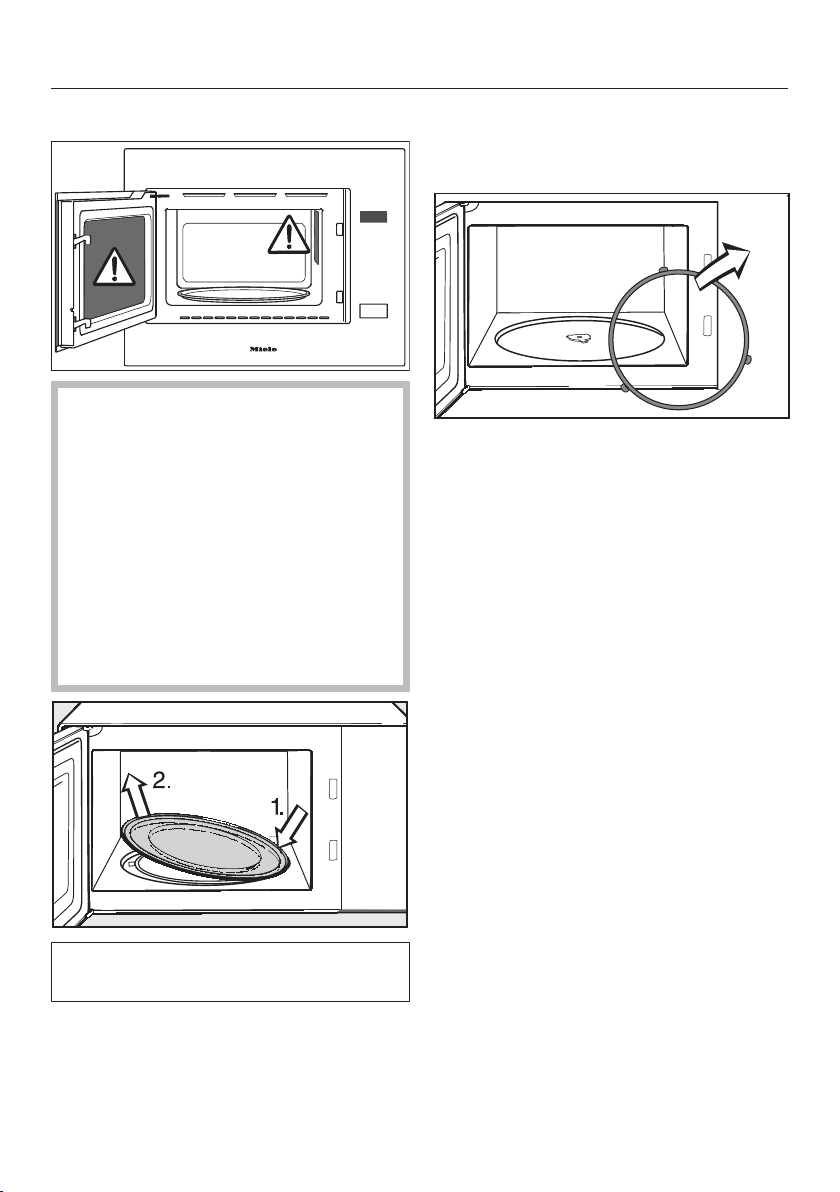
Cleaning and care
58
Cleaning the oven compartment
There is a cover protecting the
microwave outlet on the right-hand
side of the oven compartment and a
layer of film protecting the inside of
the door, both of which are
susceptible to damage.
Never remove the cover from the
microwave outlet and never remove
the film from the inside of the door.
Do not use the abrasive side of the
dishwashing sponge to clean the
cover or inside of the door.
Do not turn the turntable manually, as
this could damage the drive motor.
To remove the turntable, press down
on one side (1.) and lift it up by the
other (2.).
Wash the turntable in the dishwasher
or by hand with a weak solution of
dish detergent.
Remove the roller ring on which the
turntable normally rotates.
Clean the roller ring and the floor of
the oven. Otherwise the turntable will
not rotate smoothly.
Clean the contact surfaces between
the turntable and the roller ring.
Put the roller ring back inside and
place the turntable on top.
Frequently Asked Questions
59
With the help of the following guide minor faults in the performance of the
machine, some of which may result from incorrect operation, can be remedied
without contacting the Service Department.
This guide may help you to find the reason for the fault, and how to correct it.
Problem Possible cause and solution
You cannot start a
cooking process.
The door is still open.
Check whether the door is closed properly.
The message appears on the display. There
may not be any food inside the oven, given that you
have not opened the door for a long time (approx.
20minutes).
Open the door and, if necessary, place the food in
the oven.
Close the door and then select the sensor
control.
The system lock is activated. The key symbol
appears on the display.
You can deactivate the system lock by touching
the OKsensor control for at least 6seconds.
There is no power running to the microwave oven.
Check that the electrical plug of the microwave
oven is correctly inserted in the outlet.
Check if the breaker has tripped. If it has, contact
a qualified electrician or Miele Customer Service.
The display is dark. It is between 11:00pm and 5:00am and night
dimming is activated. As a result, the display remains
dark when the microwave is switched off.
As soon as you switch on the microwave oven, the
main menu will appear. If you want the time of day
to be displayed constantly, select the | |
setting (see “Settings”).
There is no power running to the microwave oven.
Check that the electrical plug of the microwave
oven is correctly inserted in the outlet.
Check if the breaker has tripped. If it has, contact
a qualified electrician or Miele Customer Service.
Frequently Asked Questions
60
Problem Possible cause and solution
appears on the
display.
This prompt reminds you that the microwave oven
must not be used without any food inside it. There
may not be any food inside the microwave oven yet,
given that you have not opened the door for a long
time (approx. 20minutes).
Make sure that some food has actually been
placed inside the oven.
Confirm the prompt with OK or by opening and
closing the door and selecting the sensor control.
The key symbol
appears on the display.
The system lock is activated.
You can deactivate the system lock by touching
the OKsensor control for at least 6seconds.
The symbol and the
time of day display both
flash.
There has been a power failure.
Reset the time of day.
If a cooking process was interrupted, restart it
from the beginning.
The turntable is very
jerky.
The turntable, roller ring, or floor of the oven may be
dirty.
Clean the turntable, the roller ring, and the floor of
the oven.
Clean the contact surfaces between the turntable
and the roller ring.
Put the roller ring back inside and place the
turntable on top.
A noise is heard after
the cooking process is
complete.
After the cooking process the cooling fan will
continue to run for a while after a program is
complete to prevent moisture from building up in
the oven, on the control panel or surrounding
cabinetry.
The cooling fan will turn off automatically.
An abnormal sound can
be heard during a
cooking process.
A metal dish has been used during a cooking
process.
Check if the metal dishes you have been using
generate sparks (see “Microwave operation –
Suitable dishware”).
The food was covered with aluminum foil during a
cooking process.
Remove the foil, if applicable.
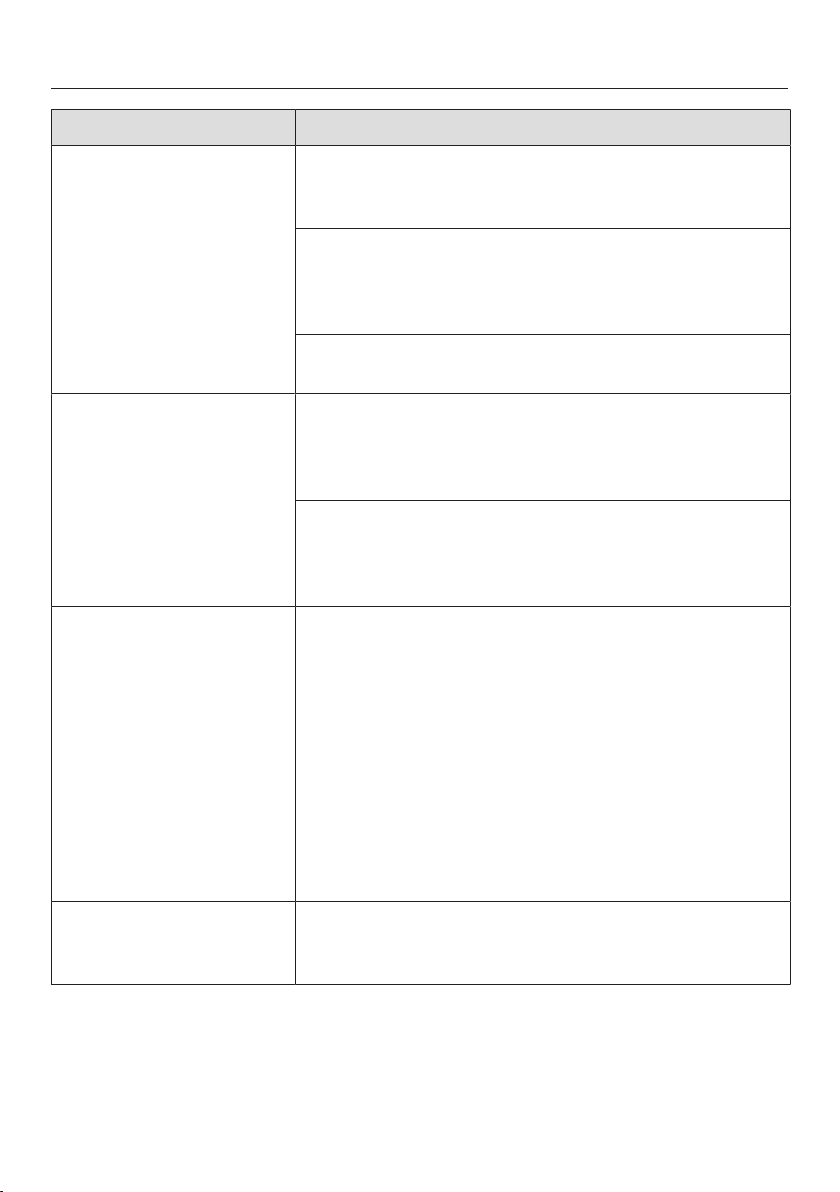
Frequently Asked Questions
61
Problem Possible cause and solution
The microwave oven
has switched itself off.
There is insufficient air circulation.
Check whether the vents are blocked.
Remove the obstructions, if applicable.
For safety reasons, the microwave oven is designed
to switch off if it overheats.
Resume the cooking process once the oven has
cooled down.
The microwave oven keeps switching itself off.
Contact Miele Customer Service.
The food has not been
defrosted, heated, or
cooked sufficiently on
completion of the
cooking process.
Check whether the cooking process was interrupted
without restarting it.
Restart the cooking process to ensure the food
gets defrosted, heated, or cooked properly.
The cooking duration you set was too short.
Check that the correct duration is selected for the
microwave power level. The lower the microwave
power level, the longer the duration required.
Food has cooled down
too quickly after being
reheated or cooked
using microwave power.
In the microwave, food begins to cook from the
outside first, the inside of the food relying on the
slower conduction of heat. If food is cooked at a high
microwave power level, it is possible that the heat
may not have reached the center of the food, so it is
hot on the outside but cold in the centre. During the
standing time, the heat is transferred to the center of
the food.
When reheating food with different densities, such
as with menu cooking, it is sensible to start with a
low microwave power level and select a longer
reheating duration.
The oven interior
lighting does not switch
on.
The lamp is faulty. You can operate the appliance as
usual, but the lamp has blown.
Contact Miele Customer Service.
Customer Service
62
Contact in the event of a fault
In the event of a fault which you cannot
remedy yourself, please contact your
Miele dealer or Miele Customer Service.
You can book a Miele Service Call
online at www.miele.com/service.
Contact information for Miele
Customer Service can be found at the
end of this document.
Please quote the model identifier and
serial number of your appliance (SN)
when contacting Miele Customer
Service. Both pieces of information can
be found on the data plate.
This information is given on the data
plate, which is visible on the front frame
of the oven when the door is fully open.
Appliance warranty and
product registration
You can register your product and/or
view the manufacturer´s warranty terms
and conditions for Miele appliances and
vacuum cleaners at
www.mieleusa.com.

9 Independence Way
Princeton, NJ 08540
www.mieleusa.com
U.S.A.
Miele, Inc.
National Headquarters
Please have the model and serial number
of your appliance available when
contacting Customer Service.
Canada
Importer
Miele Limited
Headquarters and Miele Centre
Customer Support
Phone: 888-99-MIELE (64353)
161 Four Valley Drive
Vaughan, ON L4K 4V8
www.miele.ca
Customer Care Centre
Phone:
800-565-6435
905-532-2272
International Headquarters
Miele & Cie. KG
Carl-Miele-Straße 29
33332 Gütersloh
Germany

M.-Nr. 12 003 570 / 00en-US, CA
M 2241 SC