Introduction
6
Before your begin
7
System requirements
7
Network requirements
7
Controller requirements
8
Getting to know your DHT-S716H
9
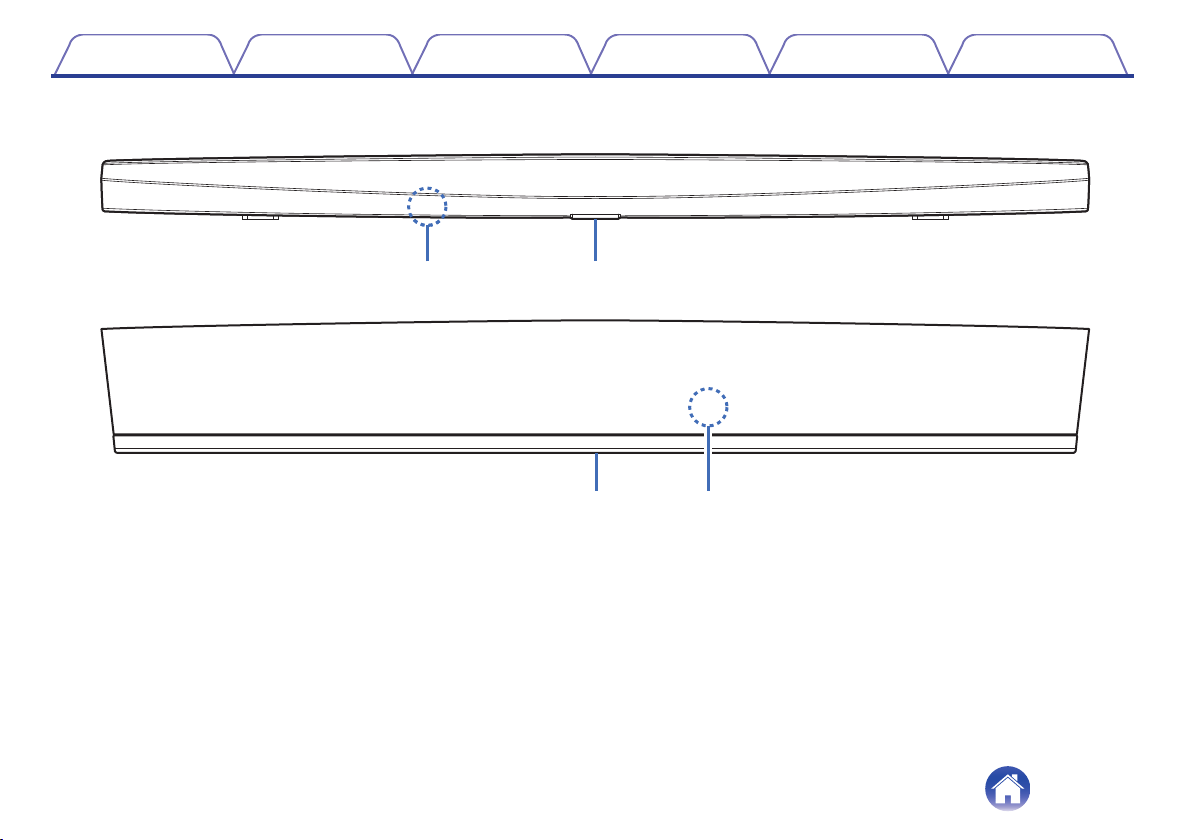
Front panel
11
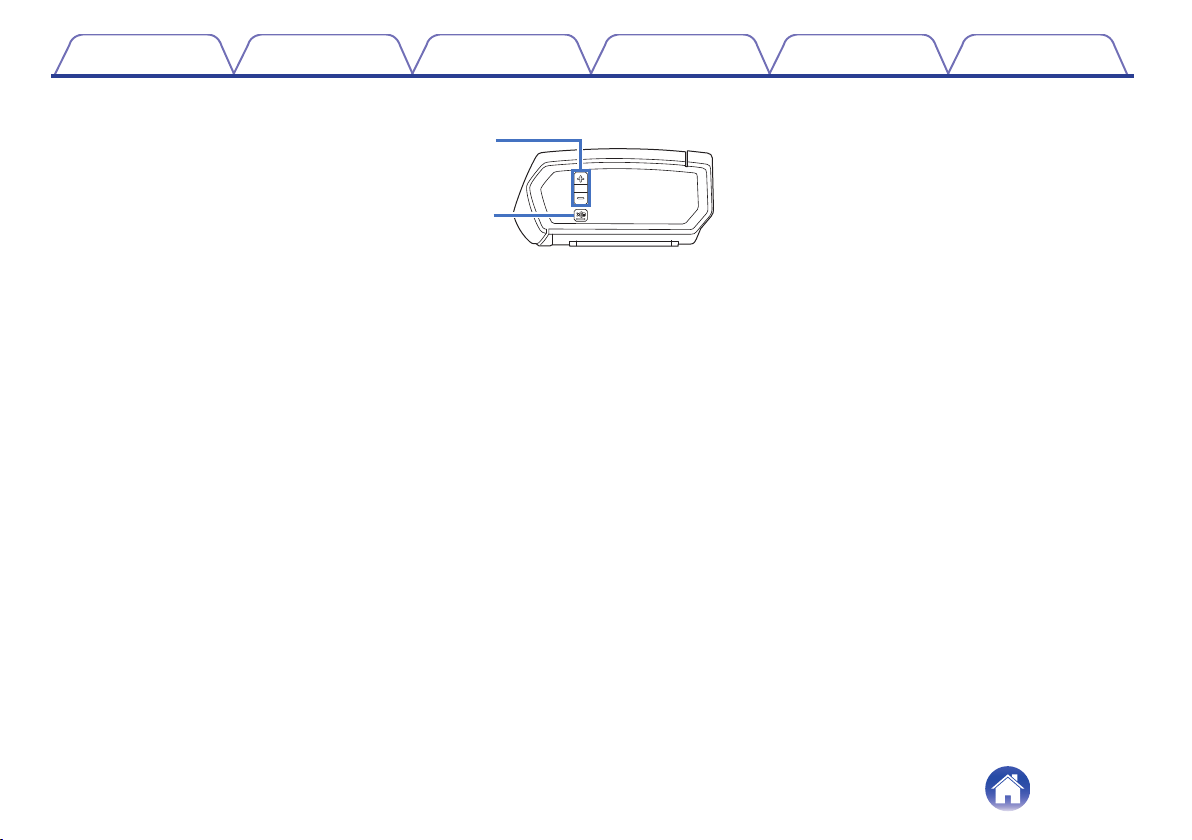
Controls
12
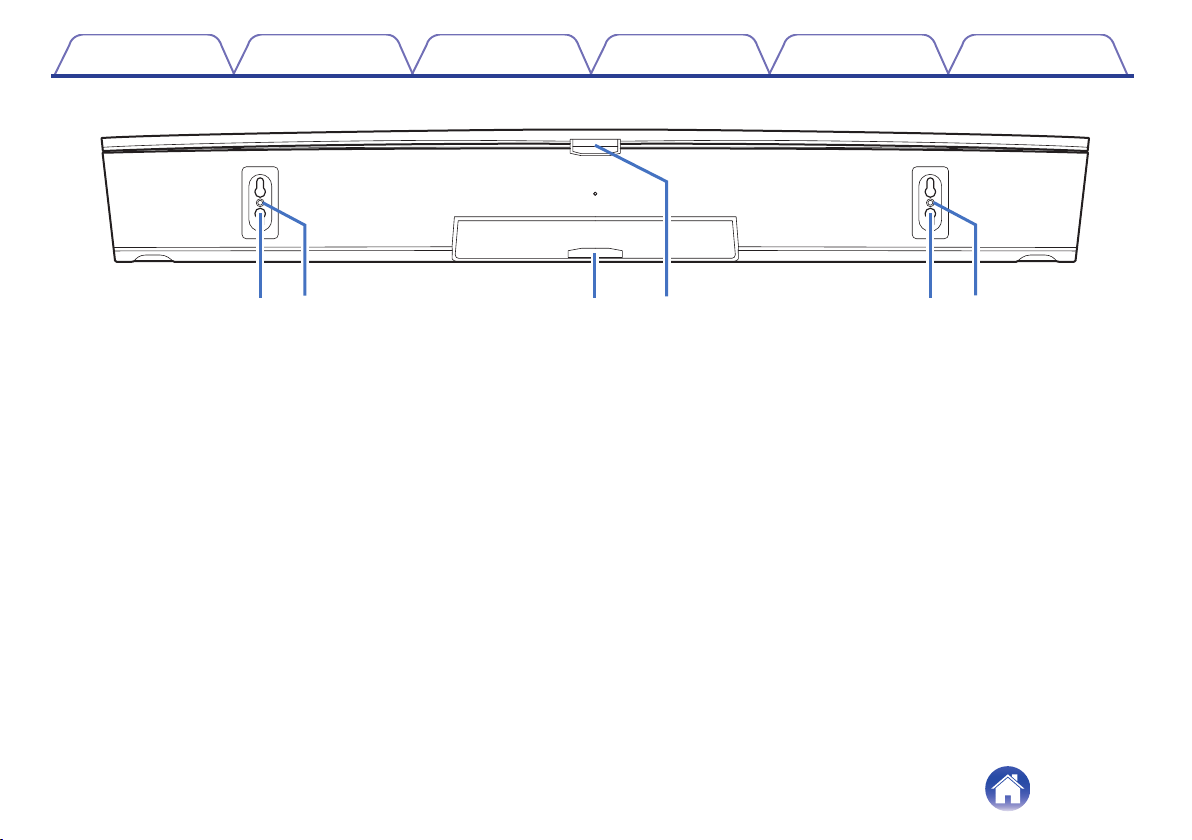
Bottom
13
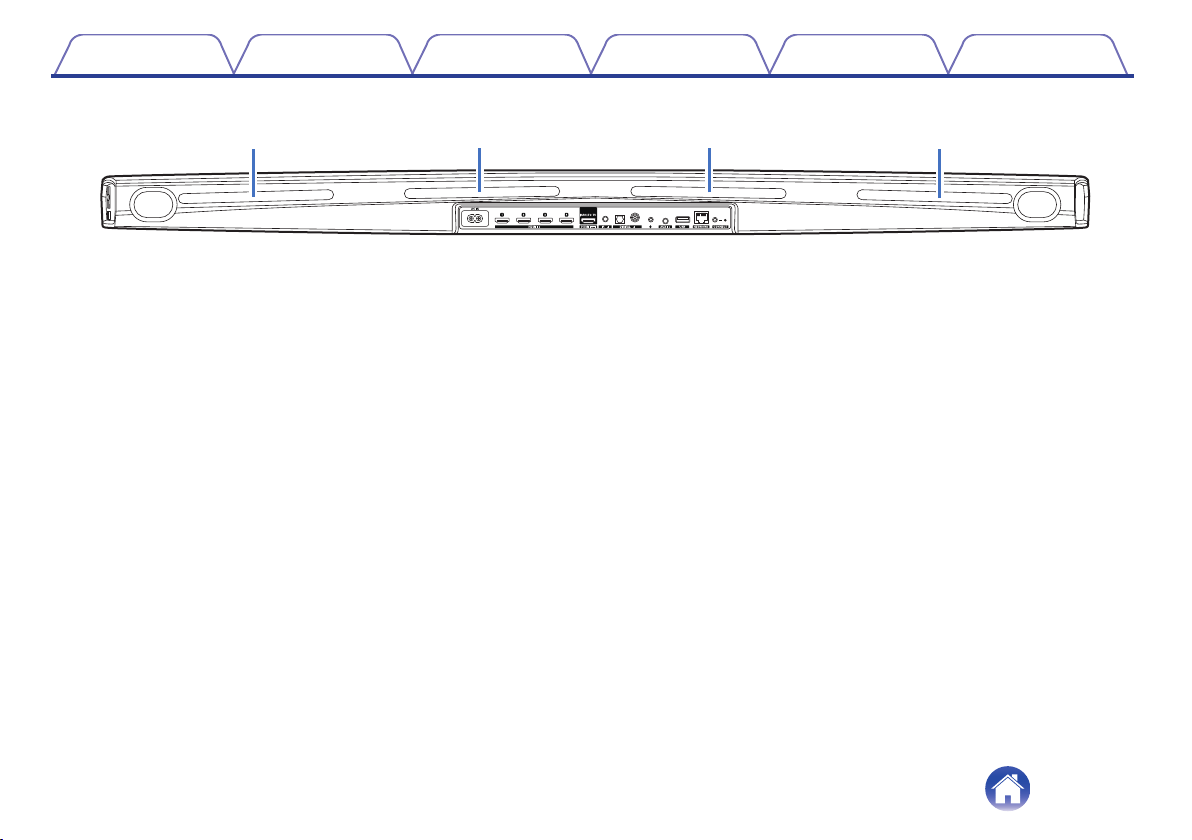
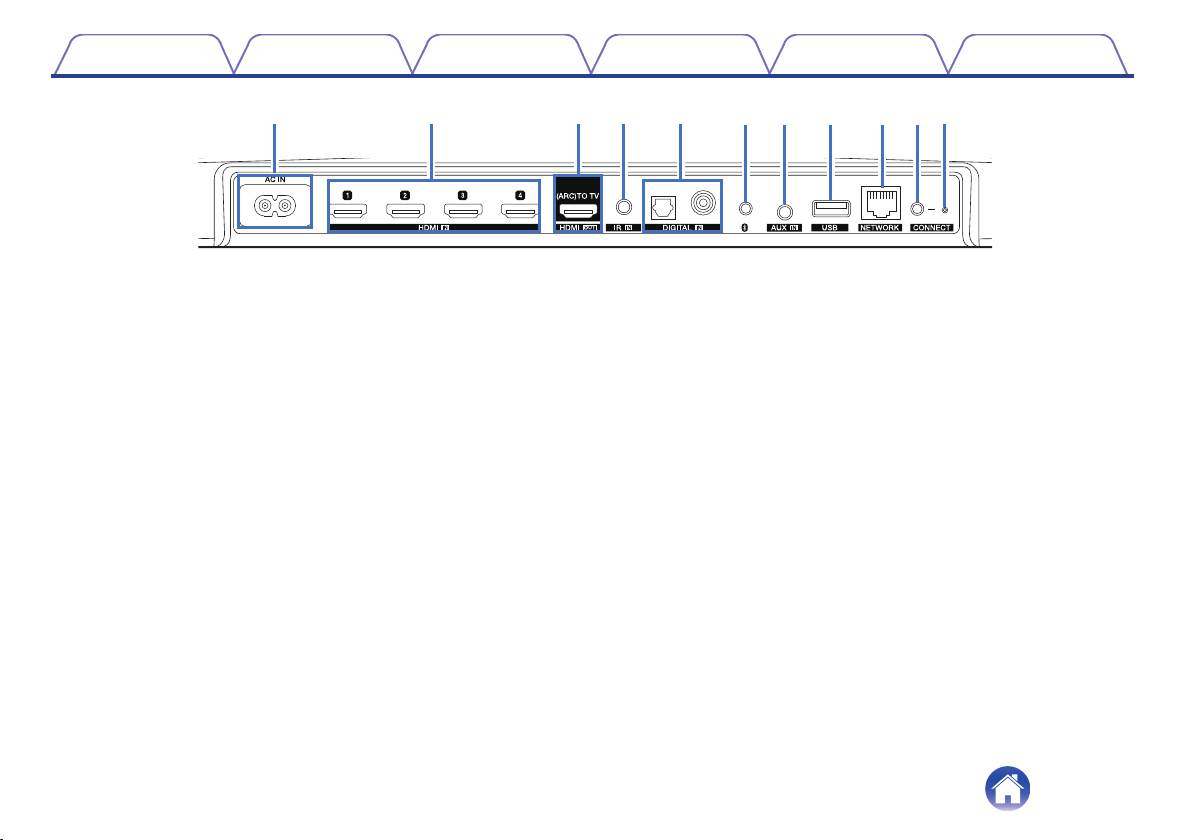
Back panel
14
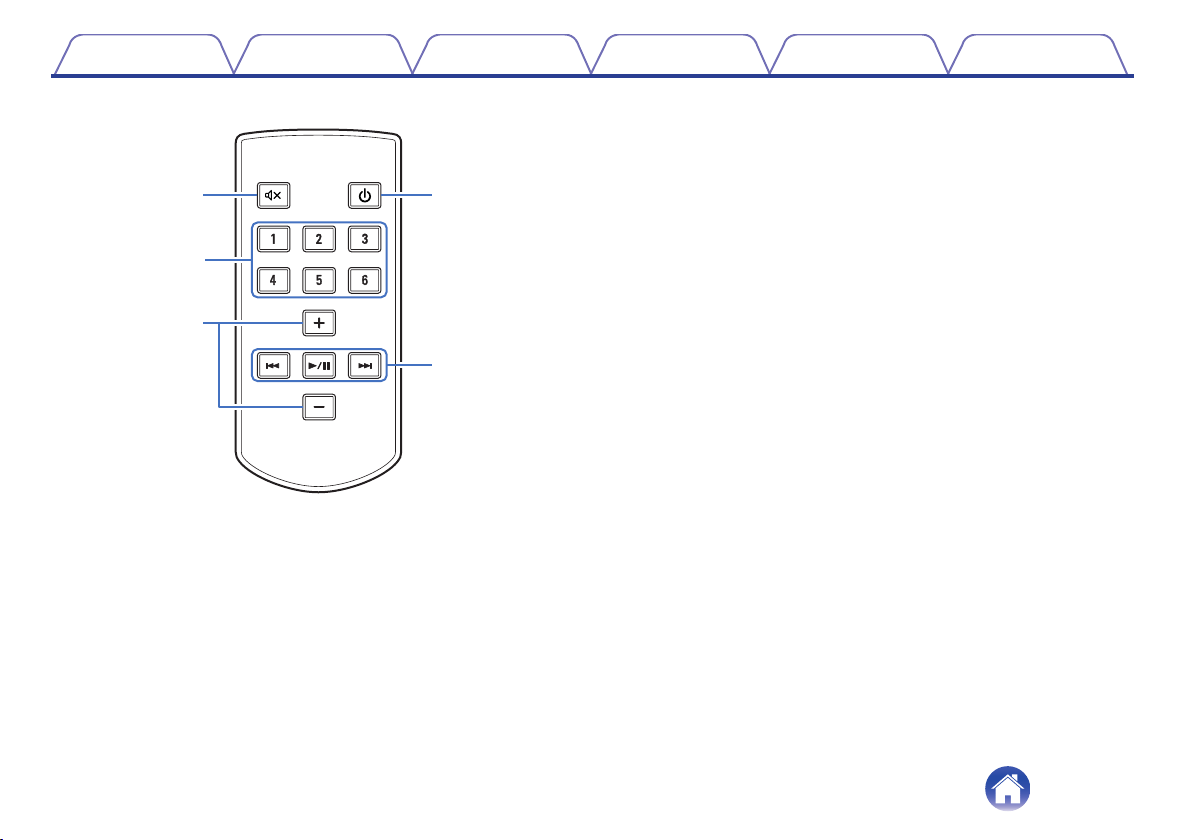
Remote control unit
16
Placing your DHT-S716H
17
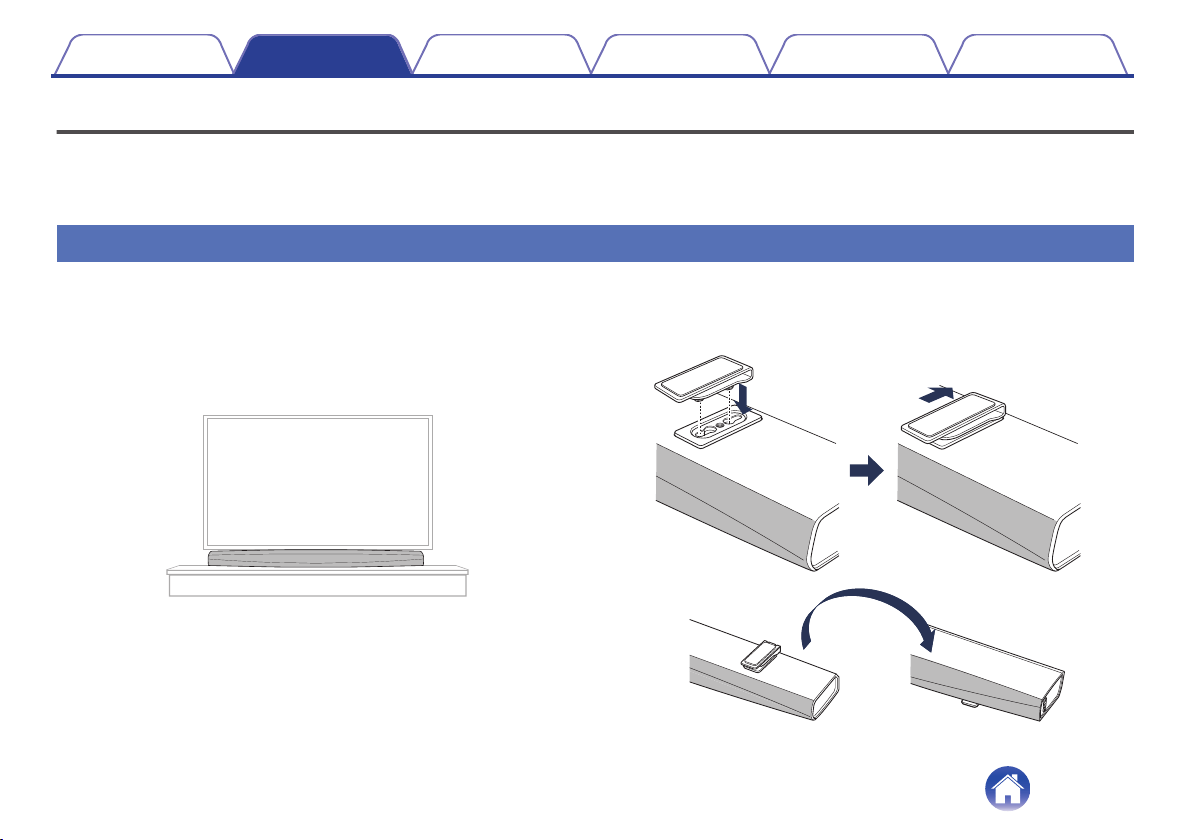
Tabletop
17
How to attach the feet
17
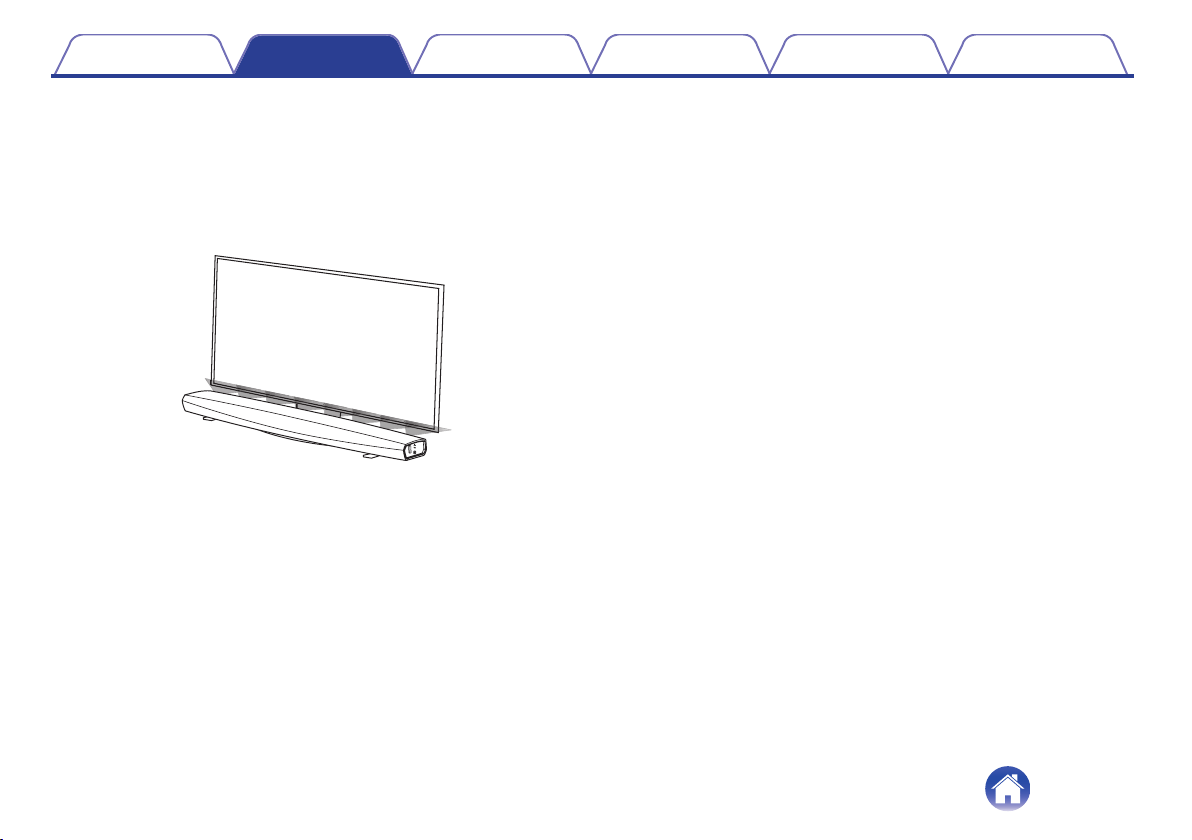
IR repeater
18
Wall-Mounting
19
Before using the remote control unit
20
Replacing the battery
20
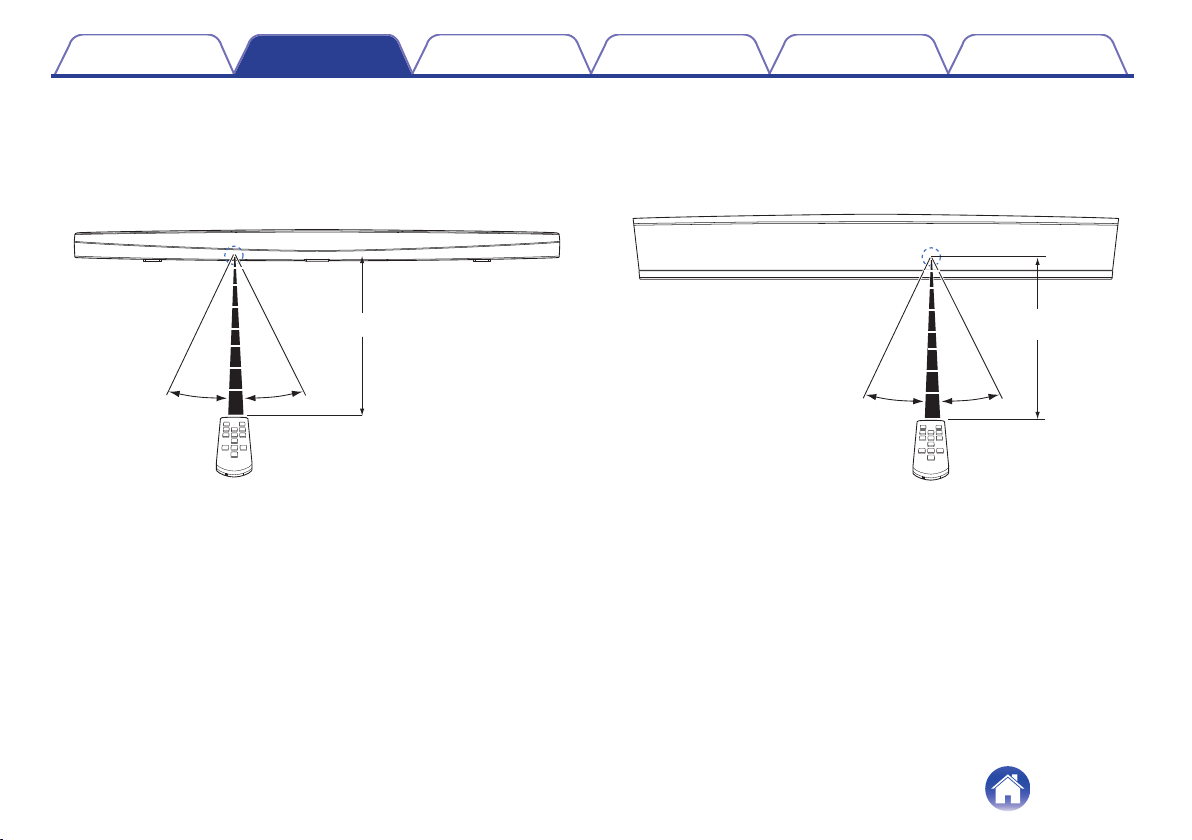
Operating range of the remote control unit
21
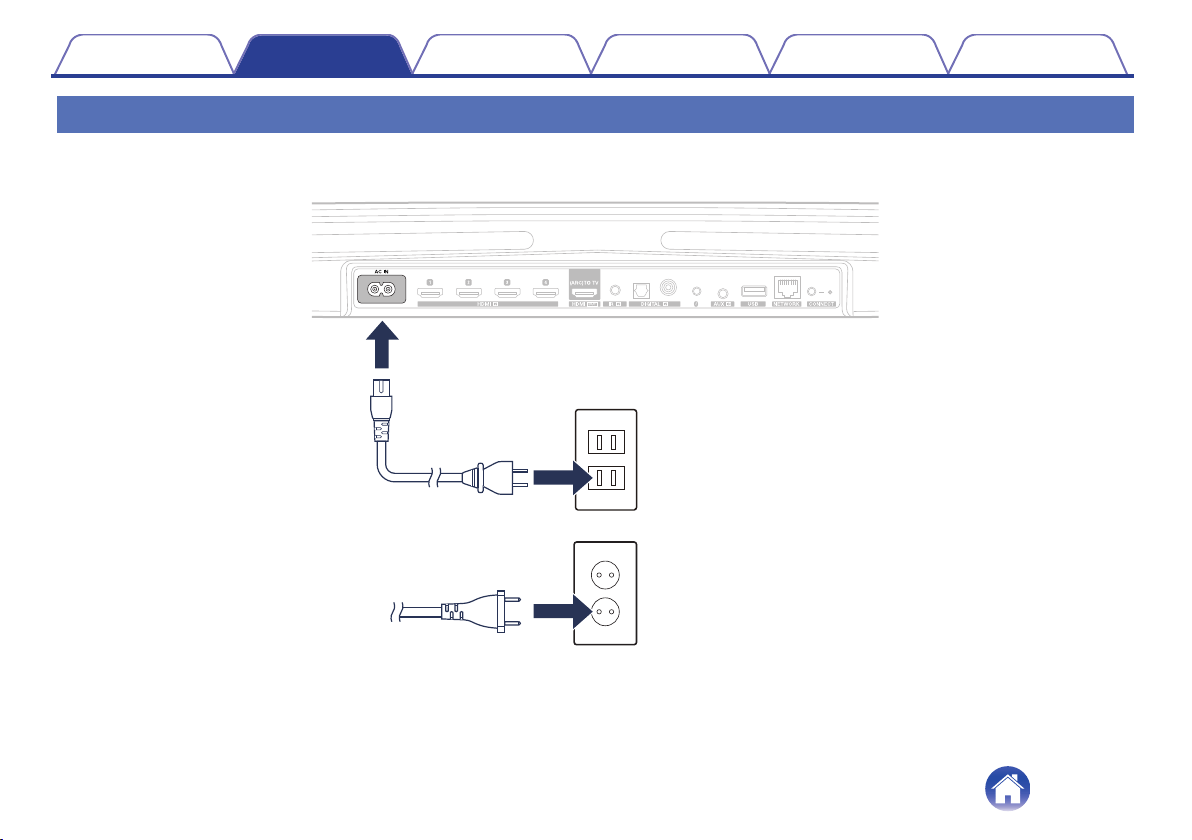
Powering your DHT-S716H
22
Getting the HEOS app
23
Setting up your first DHT-S716H
24
Adding more HEOS devices
25
Adding wired HEOS devices
25
Adding wireless HEOS devices
25
Connecting devices
26
Connecting to your TV
26
HDMI connection
26
Setting the HDMI control function
26
Disable your television’s speakers
27
Playing HDMI (ARC) - Best choice
28
Playing HDMI (without ARC) - Better choice
29
Connectiong an other devices
30
Connecting to your HDMI equipment
30
Connecting an audio playback device
30
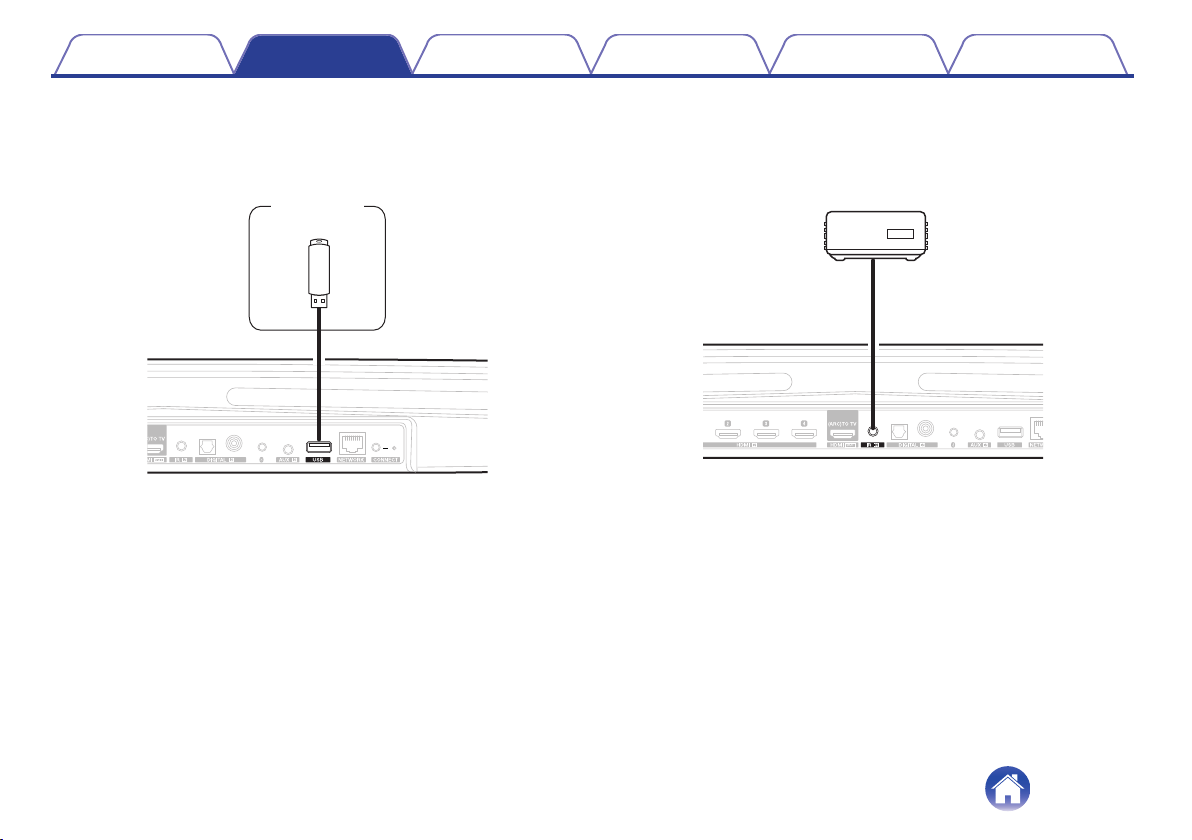
Connecting a USB storage device
31
IR repeater
31
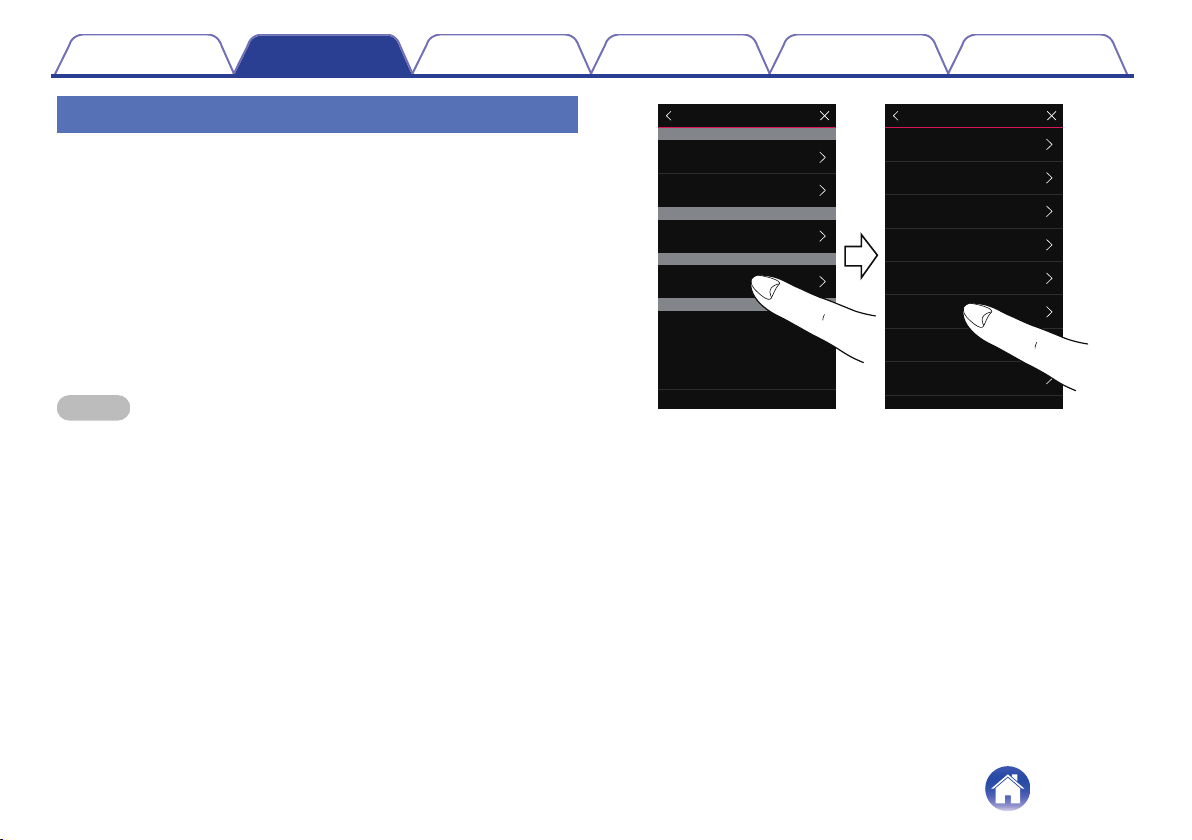
Pairing a DSW-1H and Surrounds
32
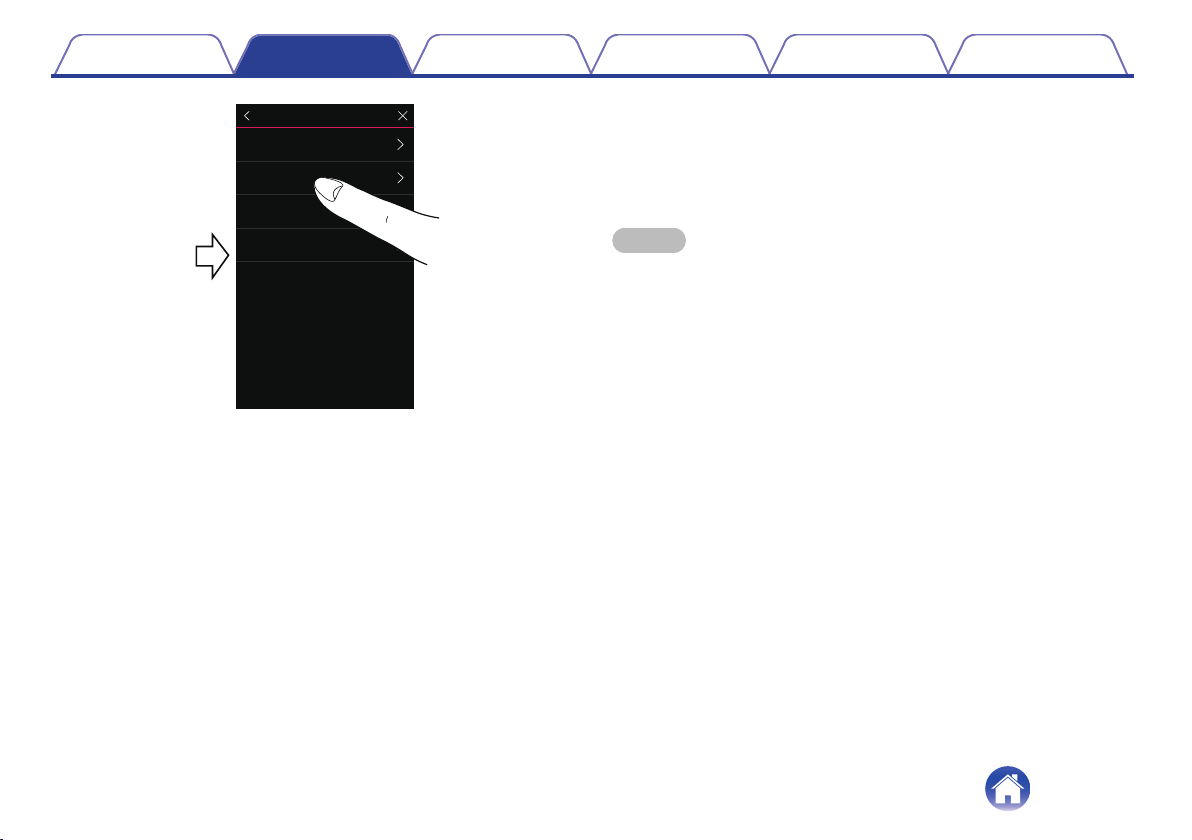
Pairing the DSW-1H
33
Adding surround speakers
33
Unpairing DSW-1H and Surrounds
34
Contents Setup Use Troubleshooting Status LED Appendix
Contents
2
Using your DHT-S716H
35
HEOS account
35
What is a HEOS account?
35
Why do I need a HEOS account?
35
Signing up for a HEOS account
35
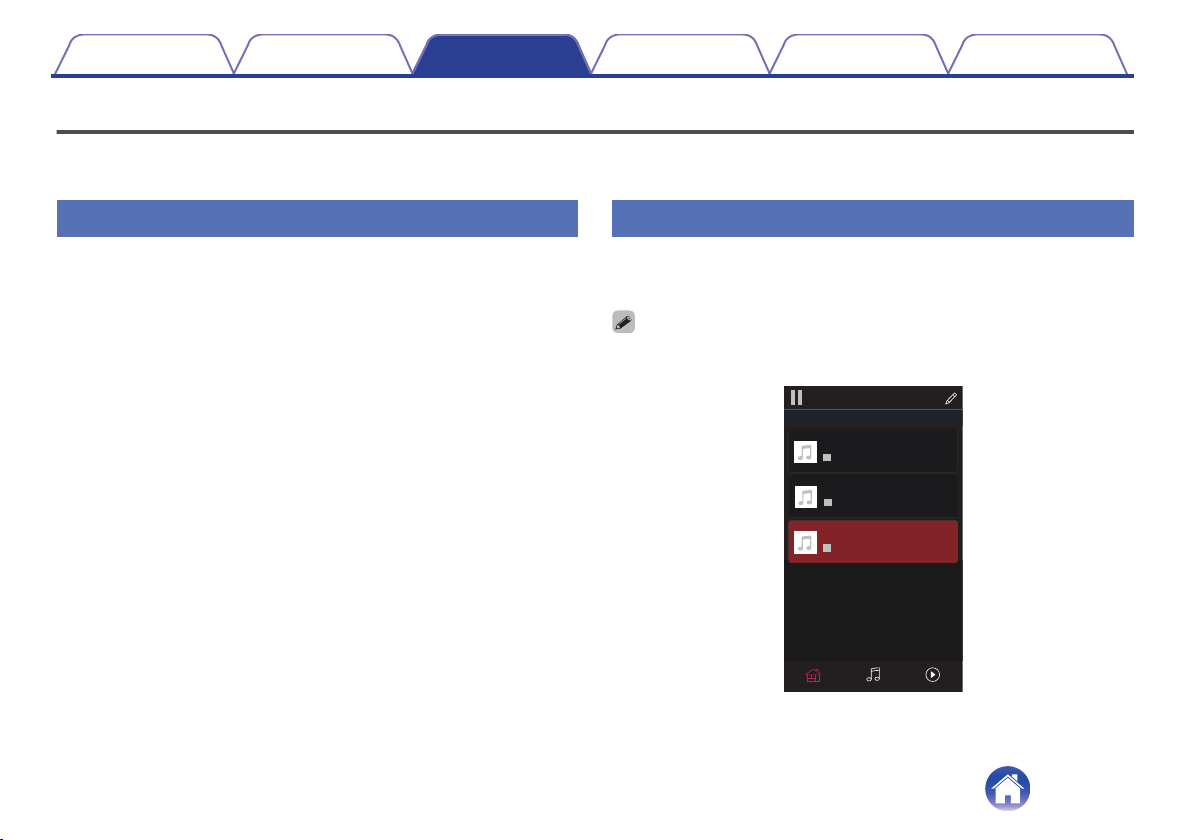
Selecting a room/device
35
Listening to the same music in multiple rooms
36
Grouping rooms
36
Ungrouping rooms
37
Grouping all rooms (party mode)
38
Ungrouping all rooms
39
Selecting the music track or station from music sources
40
Rearranging the now playing queue
42
Deleting songs from the play queue
42
Deleting all songs from the play queue
43
Saving playlists
43
Quick Select function
44
Watching TV
45
Watching other device
46
Listening to radio
47
Playing music stored on your mobile device
48
Playing music from your networked PC or NAS
49
Streaming an external audio device to any HEOS device
50
Playing music from a USB device
51
Playing music from Bluetooth device
52
Pairing the HEOS device with your Bluetooth devices
52
Playing from streaming music services
53
Adding a music service
53
Changing music service settings
53
Managing inputs
54
Changing the name of the inputs
54
Hiding an input
54
Managing your phone
55
Using the favorite
55
Adding to HEOS favorite
55
Deleting station from the HEOS favorite
55
Contents Setup Use Troubleshooting Status LED Appendix
3
Making adjustments
56
Adjusting the audio quality
56
Changing the TV connection
57
Adjusting the TV input
57
TV Sound Grouping
57
Changing the name of Quick Select
58
Adjusting the status light brightness
58
Updating your system
59
Advanced features
60
Wireless performance
60
Power management
61
Power modes
61
Quick Start Mode
61
Deep Standby
62
Off
62
Basic troubleshooting
63
My HEOS device won’t connect to my network using the audio
cable
63
If the TV remote control does not work
63
Cannot pair a Bluetooth mobile device with the HEOS device
64
Cannot hear Bluetooth music
64
My HEOS device turns off and the status LED flashes in red
65
Music cuts out or delays sometimes
65
I hear a delay when using the external input with my TV
65
I hear distortion when using the AUX input
66
Connecting to a WPS network
66
Resetting your HEOS device
67
Contents Setup Use Troubleshooting Status LED Appendix
4
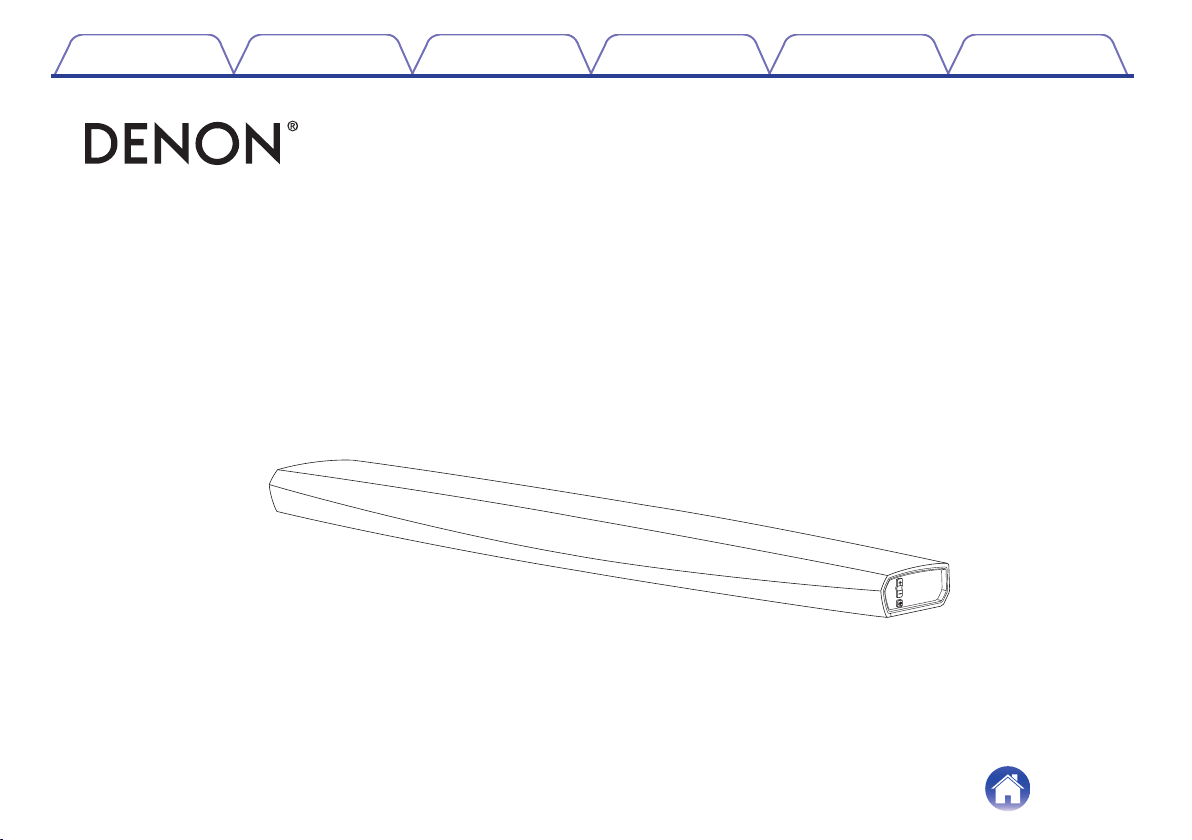
Thank you for purchasing this Denon product. To ensure proper operation, please read this owner’s manual carefully before using the product.
NOTE
0
THIS DOCUMENT CONTAINS INFORMATION THAT IS SUBJECT TO CHANGE WITHOUT NOTICE.
Introduction
The DHT-S716H is part of the HEOS wireless multi-room sound system that enables you to enjoy your favorite music anywhere and everywhere around
your home. By utilizing your existing home network and the HEOS app on your iOS or Android™ device, you can explore, browse, and play music from
your own music library or from many online streaming music services.
0
True multi-room audio - play different songs in different rooms or the same song in every room
0
Utilizes your existing home wireless network for quick and easy setup
0
Industry leading microsecond audio synchronization between HEOS device
0
Legendary Denon audio quality
0
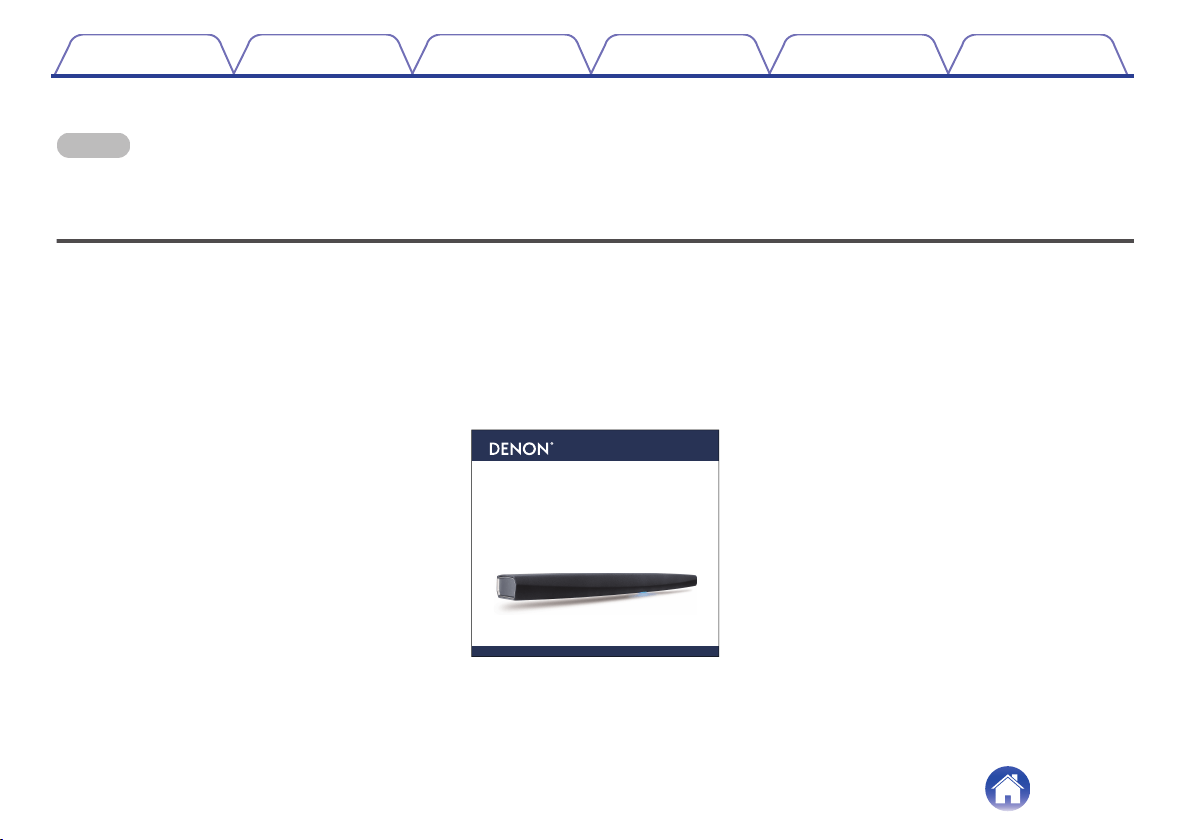
If you are in a hurry, you can be enjoying great sounding music in no time by following the steps outlined in the Quick Start Guide (supplied).
.
DHT-S716H
Wireless Full-Range Sound Bar
Quick Start Guide
Please continue reading this Owner’s Manual for more detailed information about the features and benefits of your DHT-S716H.
Contents
Setup Use Troubleshooting Status LED Appendix
6
Before your begin
NOTE
0
If you have already installed at least one HEOS device, please skip to the section “Adding more HEOS devices” (v p. 25).
System requirements
Before you begin installing your first HEOS device, please make sure you understand and meet a few basic requirements.
o
Network requirements
Wireless Router - In order to use your HEOS music system, you must have a working wireless (Wi-Fi) or ethernet network in your home. Even when
connected to an Ethernet network, a Wi-Fi connection to the router is required to control the system using the HEOS Control app. If you do not have a
wireless network, please contact your local Denon dealer or electronics retailer to assist you with purchasing and installing a wireless network in your
home.
High Speed Internet Connection - HEOS accesses the Internet to stream music to your home from many popular online music services. HEOS is
also designed to provide you with software updates, which are delivered via your home Internet connection. DSL, Cable, and Fiber services will
provide the best experience and reliability. You may experience performance issues with slower Internet connections like satellite based services.
Contents
Setup Use Troubleshooting Status LED Appendix
7
o
Controller requirements
You can control your HEOS wireless multi-room sound system using the free HEOS app on any iOS or Android mobile device that meets these
minimum requirements:
.
iOS Minimum Requirements
0
iOS version 8.0 or later
0
iPhone
®
4S or newer
0
iPad
®
2 or newer
0
iPod touch
®
(5th generation) or newer
.
Android Minimum Requirements
0
Android OS version 4.0 or later
0
All resolutions
Contents Setup Use Troubleshooting Status LED Appendix
8
Getting to know your DHT-S716H
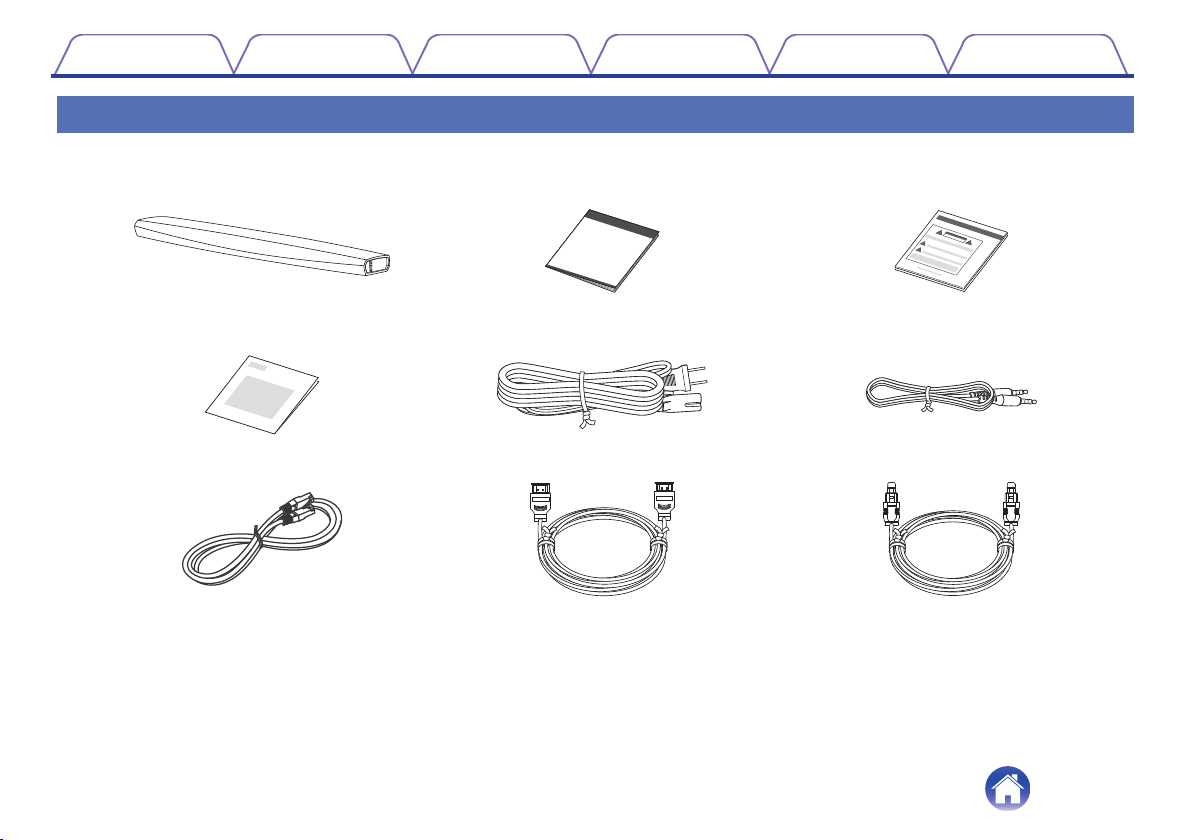
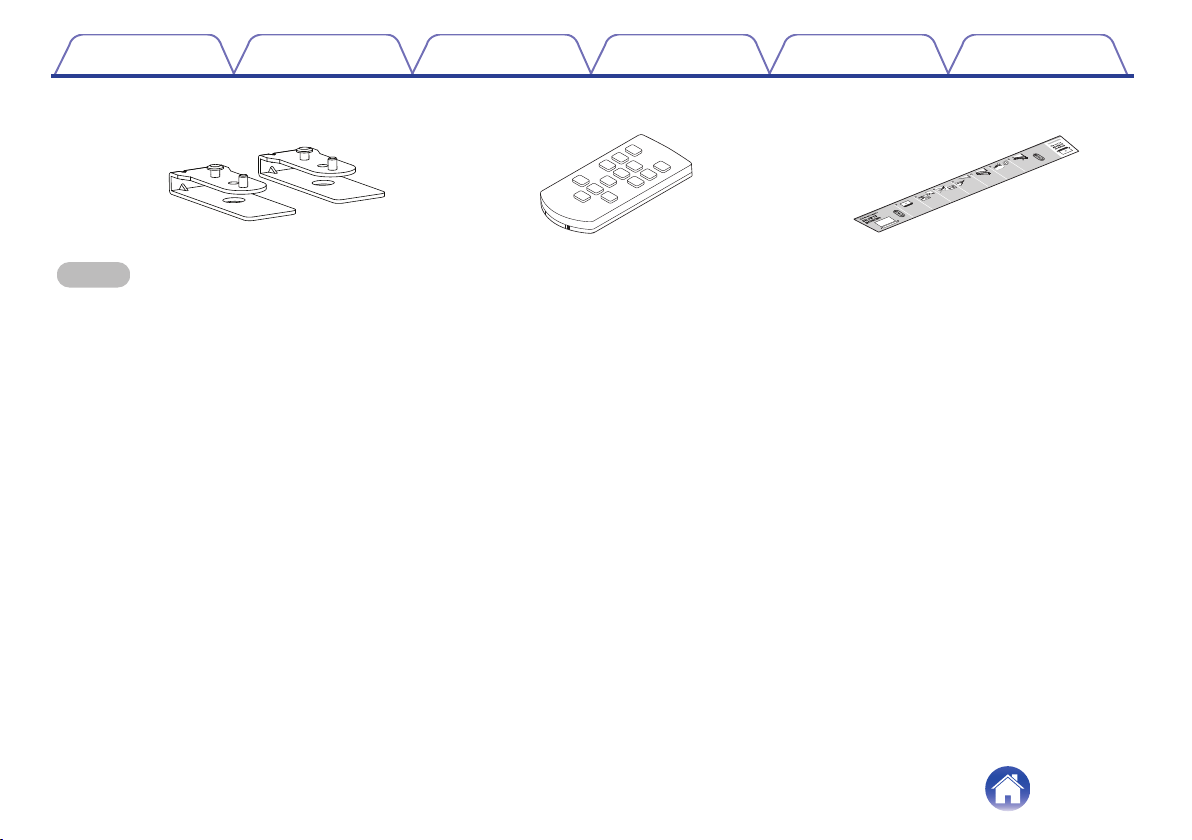
Unpack your DHT-S716H from the box and verify that the following items are included:
.
DHT-S716H Quick Start Guide
Safety instructions
Power cord 1/8 inch (3.5 mm) setup cableWarranty
(North America model only)
Ethernet cable
HDMI cable
Optical cable
Contents
Setup Use Troubleshooting Status LED Appendix
9
o
Bottom
.
e
qq
wr
w
A
Keyhole (for wall mount)
B
Threaded mounting hole (for wall mount)
Used to mount this unit on a wall or ceiling.
C
Status LED (for wall mount)
Please refer to the “Status LED table” for LED color and state meaning. (v p. 68)
D
Status LED (for tabletop)
Please refer to the “Status LED table” for LED color and state meaning. (v p. 68)
Contents Setup Use Troubleshooting Status LED Appendix
13
.
e r t yi
oQ1wuQ0 Q2
B
AC inlet (AC IN)
Used to connect the power cord. (v p. 22)
C
HDMI connectors (HDMI IN)
Used to connect to the HDMI equipment with an HDMI cable.
(v p. 30)
D
HDMI connector to TV (HDMI OUT)
Used to connect to the TV with an HDMI cable. (Compatible with
the ARC function) (v p. 26)
E
REMOTE CONTROL jack (IR IN)
Used to connect infrared receivers/transmitters in order to operate
this unit and external devices from a different room. (v p. 31)
F
Digital audio connectors (DIGITAL IN)
Used to connect devices equipped with digital audio outputs.
(v p. 30)
G
Bluetooth button (V)
Used in the Bluetooth pairing settings. (v p. 52)
H
AUX jack (AUX IN)
Used to connect audio devices with a 1/8 inch (3.5 mm) cable.
(v p. 30)
Used to add the HEOS device to your wireless network.
(v p. 24)
I
USB port
Used to connect USB storage devices. (v p. 31)
J
NETWORK connector
Used to connect this unit to a wired Ethernet network. (v p. 24)
K
CONNECT button
Used for Wi-Fi setup.
L
Connect in status LED
Indicates the status of this unit. (v p. 68)
Contents
Setup Use Troubleshooting Status LED Appendix
15
o
Remote control unit
.
q
w
r
t
e
A
Mute button (:)
This mutes the output audio.
B
Quick Select buttons (1 – 6)
These call up settings registered to each button, such as input source,
volume level and sound mode settings. (v p. 44)
C
Volume up/down buttons (+, -)
These adjusts the volume level.
D
Power button (X)
This toggles the power mode of this unit.
E
System buttons
These perform playback related operations.
0
Reverse-skip / Forward-skip buttons (8, 9)
0
Play/pause button (1/3)
Contents
Setup Use Troubleshooting Status LED Appendix
16
Placing your DHT-S716H
The DHT-S716H is designed to enhance the sound of your TV and allow you to enjoy HEOS Wireless Multi-Room Sound. Place the DHT-S716H at a
convenient location near the TV.
0
The DHT-S716H must be within range of your wireless network.
Tabletop
The DHT-S716H should be place as close as possible to the TV screen. It
should be centered left-to-right with the screen, and ideally no more than a
few inches above or below. The most common location is below the
screen. Sometimes this location can be difficult, because the base of the
TV gets in the way. The DHT-S716H has set of feet that raise the DHT-
S716H, for a more stable and attractive installation when used with this
type of TV.
.
o
How to attach the feet
Attach the supplied feet if you need to raise the DHT-S716H over your
TV stand base.
.
Front (Grille)
Contents
Setup Use Troubleshooting Status LED Appendix
Setup
17
o
IR repeater
Depending on your TV model or installation location, the remote
control receiver on the TV may be hidden by the DHT-S716H,
preventing the remote control from being used because the remote
control signals cannot reach the TV.
Remote control signal DHT-S716H has been received, will be re-sent
from the back of the DHT-S716H.
.
Contents
Setup Use Troubleshooting Status LED Appendix
18
Wall-Mounting
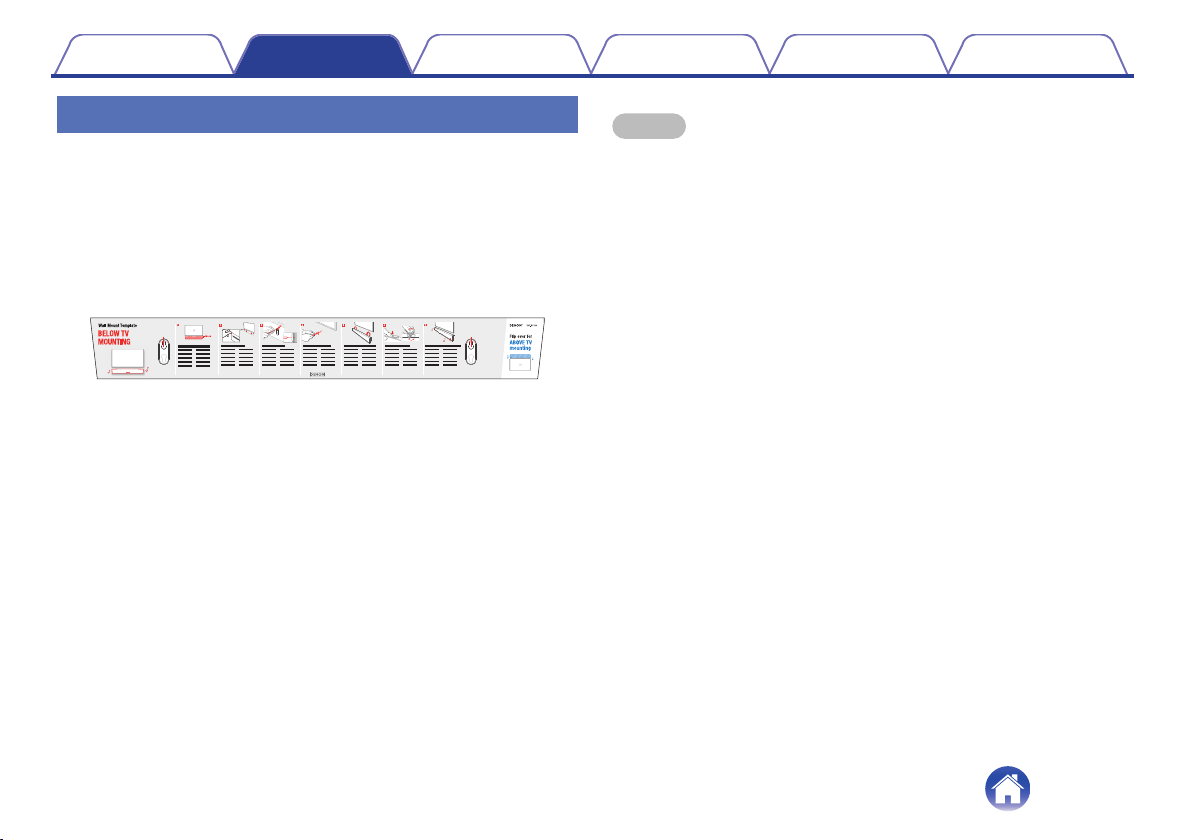
The DHT-S716H can be wall-mounted using the integrated keyhole
mounts. A mounting template can be found in the product carton. Using a
level, position and tape the template to the wall in the desired location.
Install hardware* using the template as a guide and then remove the
mounting template from the wall. Connect the audio and power cables
prior to mounting the DHT-S716H on the wall.
z
Consult a person knowledgeable about your wall type to recommend suitable
hardware for hanging the speaker.
.
NOTE
0
To ensure safety, request a contractor perform the mounting work when mounting
onto a wall.
0
In order to use the unit safely, do not place items on or hang items from the unit.
0
Be sure to fix connection cables to the wall to ensure that cannot be pulled or
tripped over causing the unit to fall. Check that the unit is mounted safely after the
mounting work is complete. Recommend installing a safety wire (not included) at
the safety wiring hole on the bottom of the DHT-S716H in order to prevent injury to
the user and others or damage to property should the DHT-S716H fall for some
reason.
0
Also, periodically check the safety of the unit and whether there is a possibility that
the unit may fall.
0
Denon cannot accept any responsibility for damage, injury or accidents caused by
problems with the mounting location or mounting method.
Contents Setup Use Troubleshooting Status LED Appendix
19
Before using the remote control unit
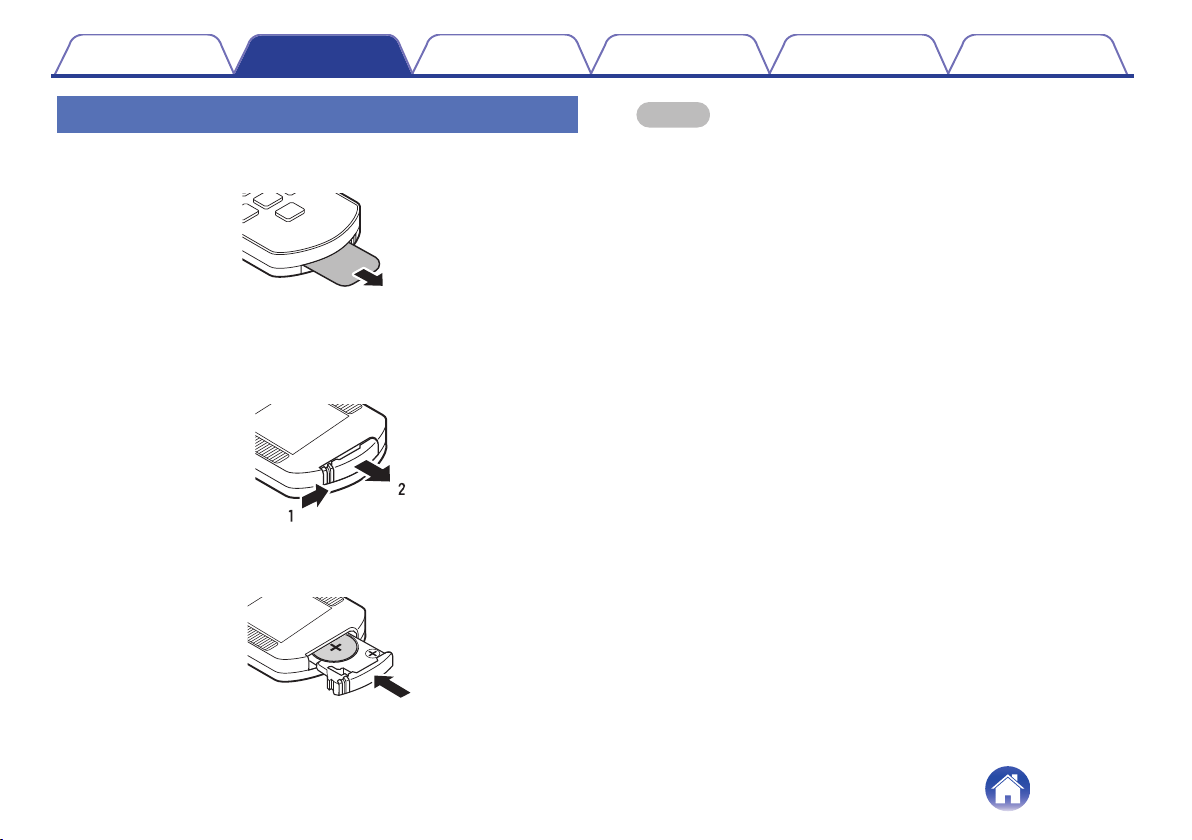
The remote control unit has a built-in lithium battery.
Pull out the insulation sheet before use.
.
o
Replacing the battery
1. Pull the groove on the left side of the battery case at the bottom of
the reverse side of the remote control unit to the right.
2. In this state, pull the battery case downwards.
.
3. Insert the lithium battery (CR2025) correctly into the battery
compartment as indicated.
4. Replace the battery case in the original position.
.
NOTE
0
When inserting the lithium battery, be sure to do so in the proper direction,
following the q and w marks in the battery compartment.
0
If the battery should have a leakage, immediately replace and dispose of the
battery. In this case, there is a risk of burn when the liquid comes in contact
with skins or clothes, so a great care should be taken. If the liquid accidentally
comes in contact, wash with tap water and consult a doctor.
0
Remove the battery from the remote control unit if it will not be in use for long
periods.
Contents Setup Use Troubleshooting Status LED Appendix
20
Getting the HEOS app
The HEOS app is the heart of the HEOS experience. Using your mobile device and the HEOS app, you can setup, browse, explore, and control your
HEOS system right in the palm of your hand, from anywhere in your home.
Download the HEOS app for iOS or Android by searching App Store
®
, Google Play™ store or Amazon for “HEOS”.
.
For the purpose of improvement, the specifications and design are subject to change without notice.
Contents Setup Use Troubleshooting Status LED Appendix
23
Setting up your first DHT-S716H
Once you have placed your DHT-S716H in your listening room and have downloaded the HEOS app, you are ready to configure your DHT-S716H for
music playback. This involves following a few simple steps to get the DHT-S716H connected to your existing home network:
Caution
0
DO NOT connect the Ethernet cable if you are connecting your DHT-S716H to a wireless network. If you are connecting the DHT-S716H to a wired
network, use an Ethernet cable to connect the DHT-S716H to your network or router.
1
Make sure your mobile device is connected to your
wireless network (the same network you want your
DHT-S716H connected to).
You can check this in the Settings - Wi-Fi menu of your iOS or
Android device.
NOTE
0
If your wireless network is secure, make sure you know the password to join
your network.
2
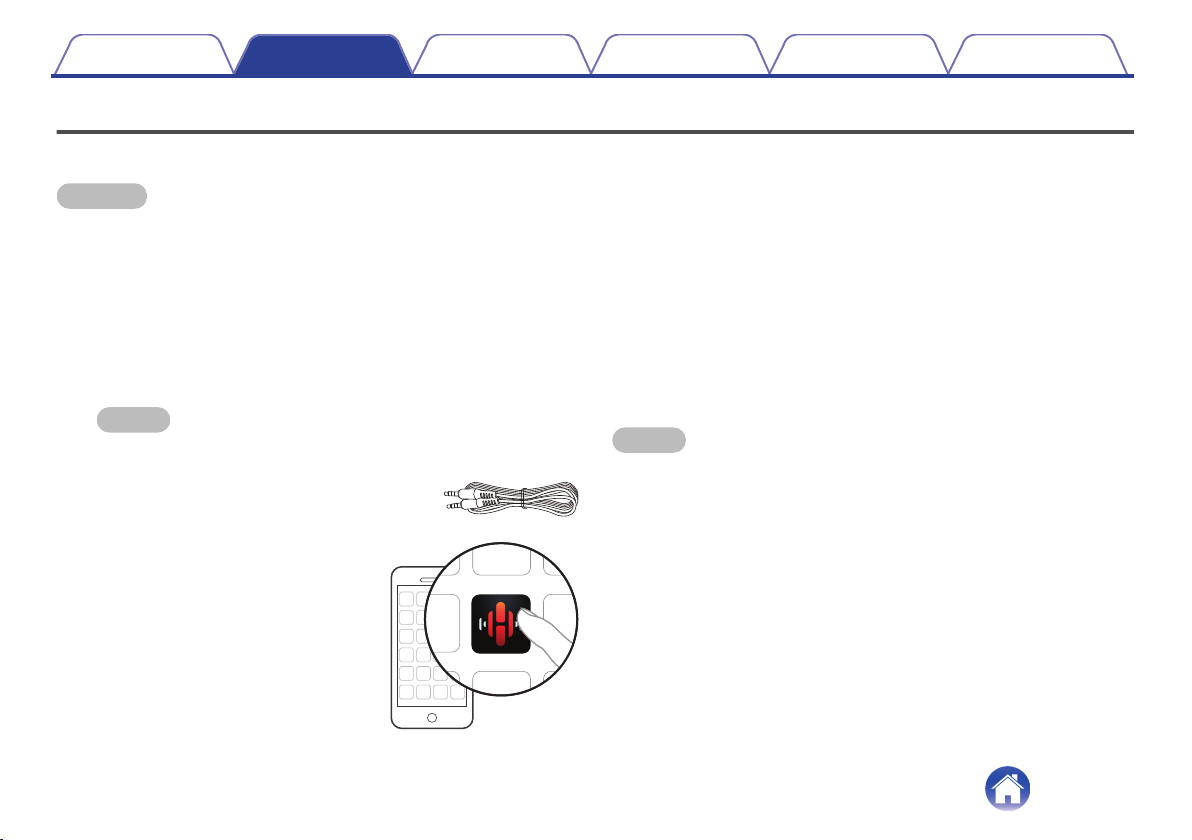
Make sure you have the included 1/8
inch (3.5 mm) setup cable handy.
3
Launch the HEOS app on your
mobile device.
4
Tap the “Setup Now” button at the top of the screen.
5
Follow the instructions to add the DHT-S716H to your
wireless network.
The Wi-Fi settings from your mobile device will be copied to the
DHT-S716H via the audio cable.
NOTE
0
If you have any problems connecting your HEOS device, jump to the
Troubleshooting section. (v p. 63)
Contents Setup Use Troubleshooting Status LED Appendix
24
Adding more HEOS devices
The HEOS wireless multi-room sound system is a true multiroom audio system that automatically synchronizes audio playback between multiple HEOS
devices so that the audio coming from different rooms is perfectly in sync and always sounds amazing! You can easily add up to 32 devices to your HEOS
system.
Adding wired HEOS devices
Just connect the HEOS devices to your home network using an Ethernet cable and the HEOS devices will appear on your HEOS app as a new room in
the “Rooms” screen.
At your convenience, you can assign a name to the HEOS devices to indicate which room you have it placed in.
0
Use only a shielded STP or ScTP LAN cable which is easily available at electronics stores (CAT-5 or greater recommended).
0
Do not connect a Network Connector directly to the LAN port/Ethernet connector on your computer.
Adding wireless HEOS devices
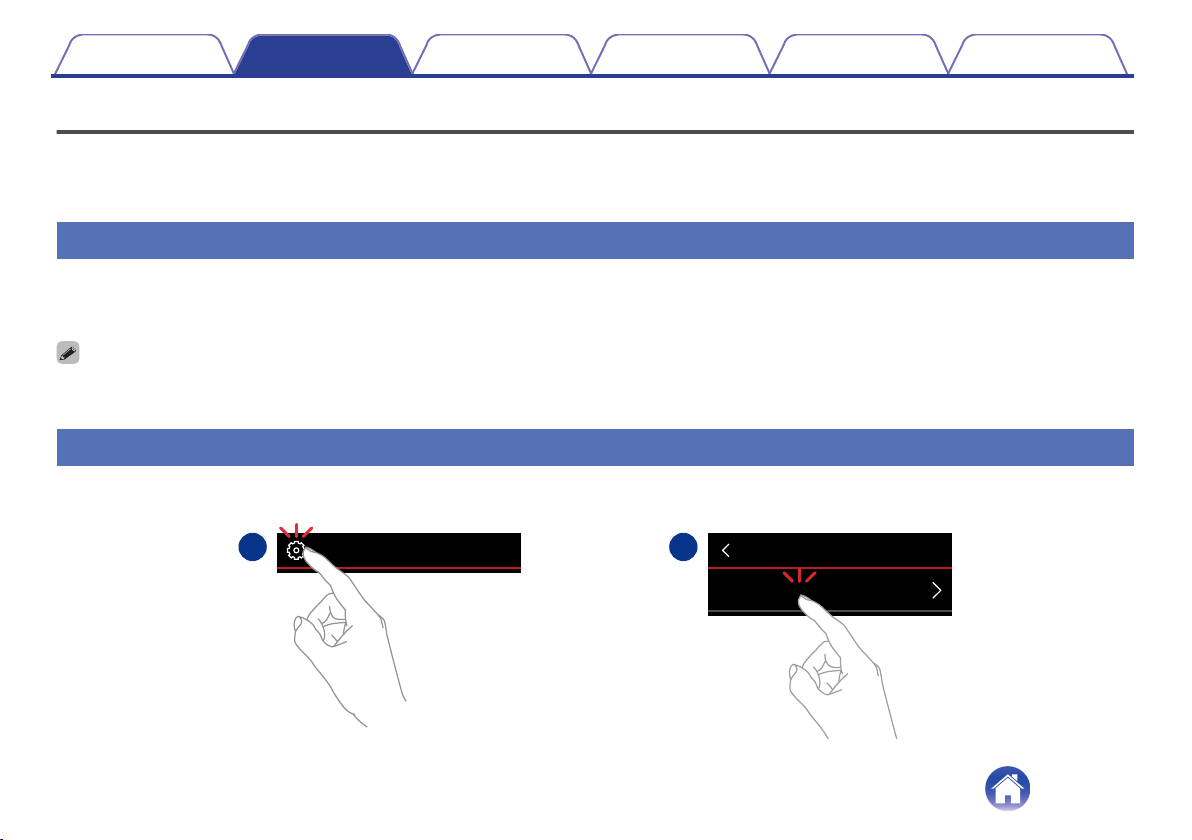
You can add additional wireless HEOS devices to your HEOS system by selecting “Add Device” from the HEOS app’s settings menu and follow the
instructions:
.
1
2
Add Device
SettingsMusic
Contents
Setup Use Troubleshooting Status LED Appendix
25
Connecting devices
When you run DHT-S716H for the first time, "Setup Assistant" will be started automatically to guide you setup connections.
You can start "Setup Assistant" anytime from setup menu,when you want to change the configurations. “Changing the TV connection” (v p. 57)
Connecting to your TV
o
HDMI connection
You can enjoy high quality audio and video playback by connecting
this unit and a TV or this unit and a device such as a Blu-ray Disc
recorder or game console using a HDMI cable to transmit high
resolution digital video signals and Blu-ray Disc audio signals.
0
ARC (Audio Return Channel) function
The TV audio can be played back through this unit using the HDMI
cable used to connect this unit to the TV (*).
z
The TV also needs to be compatible with the ARC function.
o
Setting the HDMI control function
Enable the HDMI control function on the TV.
If the TV is compatible with the ARC function, enable the ARC function
on the TV.
(See the TV Owner’s Manual for details.)
Contents
Setup Use Troubleshooting Status LED Appendix
26
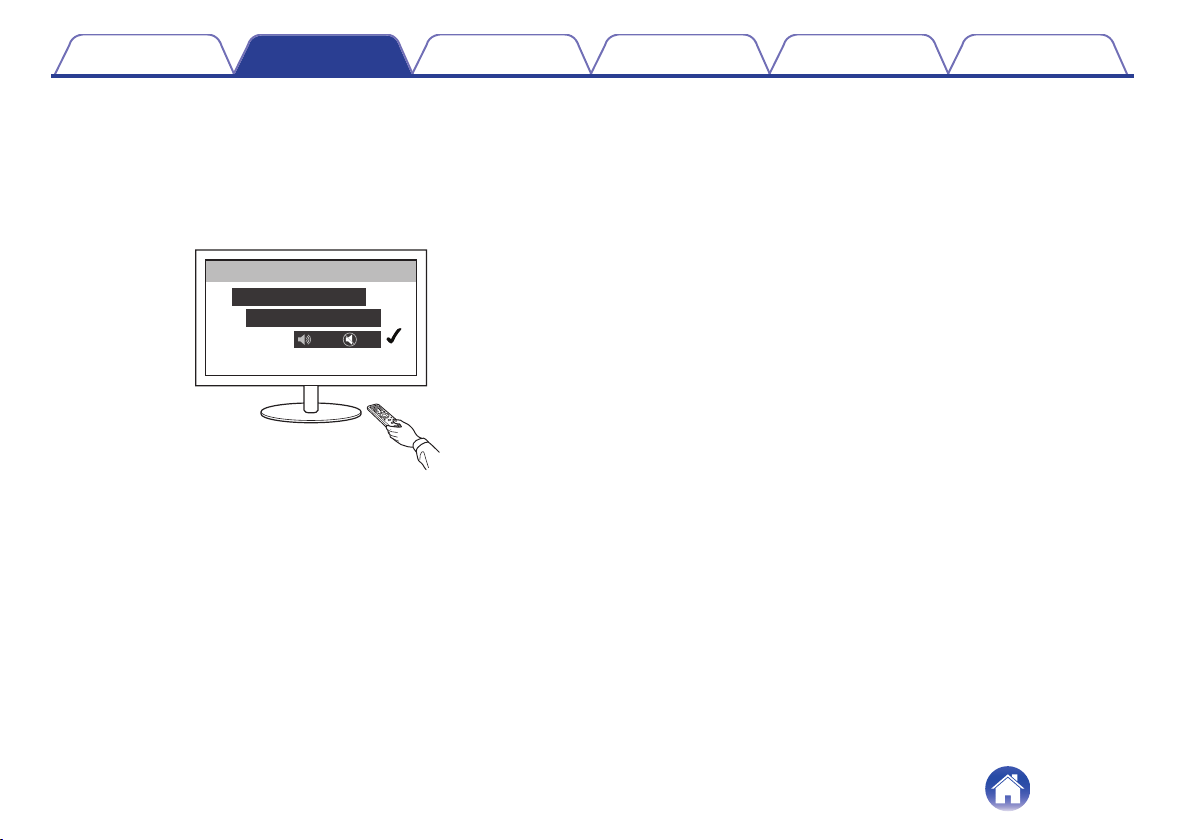
o
Disable your television’s speakers
Disable your television’s built-in speakers when using DHT-S716H.
Usually, this is done with an on-screen setup menu on your television.
Look for an “Audio” or “Sound” sub-menu, and a “Speakers Off”,
“Disable Speakers”, “External Speakers” or similar menu item. Some
televisions have a switch on the rear panel to disable the built-in
speakers.
.
Setup
Audio
TV Speaker
On Off
Contents
Setup Use Troubleshooting Status LED Appendix
27
o
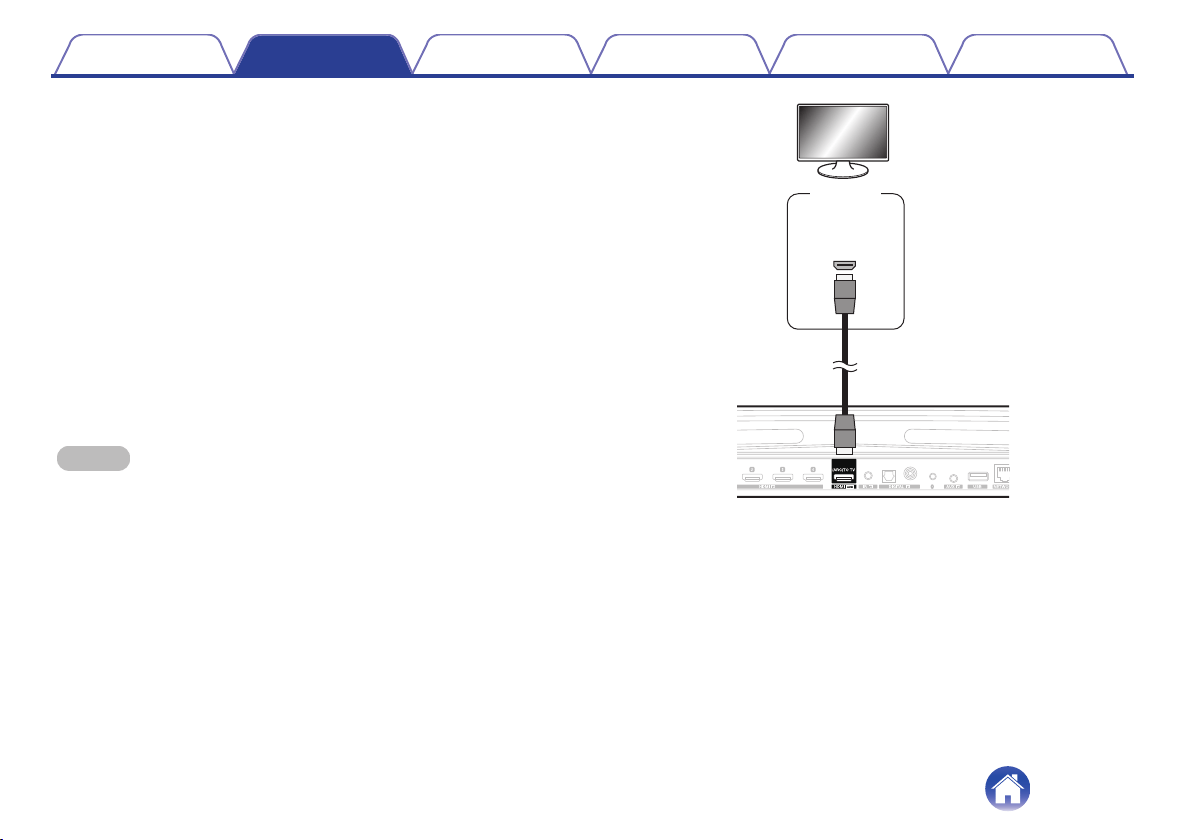
Playing HDMI (ARC) - Best choice
If your TV has an ARC (Audio Return Channel) HDMI connector,
connect it to the HDMI output of the DHT-S716H. This will provide the
best sound and several other benefits.
1
Connect your TV with an ARC (Audio Return Channel)
HDMI connector to the HDMI OUT (ARC) connector on
your DHT-S716H using the included HDMI cable.
2
Select “TV” from the music tab.
3
Select the name of the DHT-S716H to which you
connected the TV in step 1.
4
The sound from your TV can be played directly on the
DHT-S716H.
NOTE
0
The TV also needs to be compatible with the ARC function.
Turn the TV HDMI control function on. See the TV Owner’s Manual for details.
0
To change the input automatically, you can set the default TV input in the setup
menu. “Adjusting the TV input” (v p. 57)
.
HDMI INPUT
(ARC)
TV
Contents
Setup Use Troubleshooting Status LED Appendix
28
o
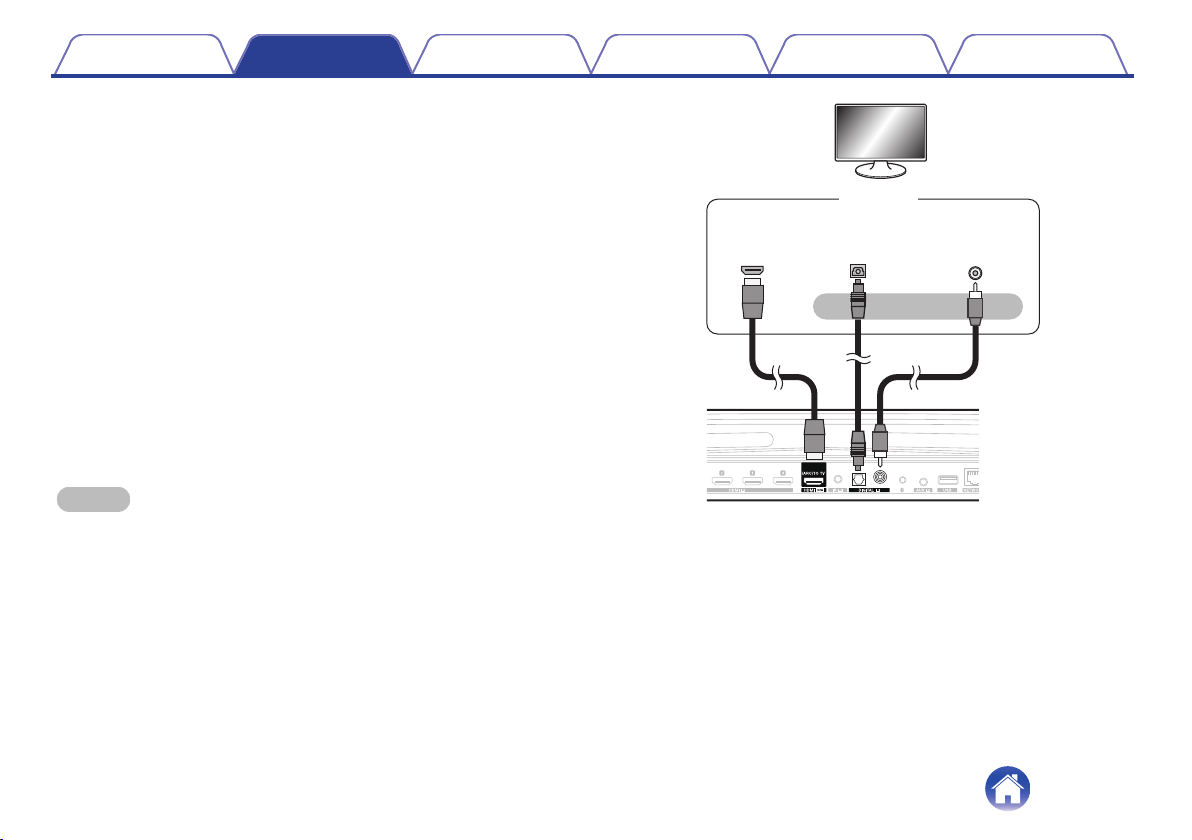
Playing HDMI (without ARC) - Better choice
Connect to a TV that is not compatible with the ARC (Audio Return
Channel) function using the HDMI cable and audio input cable.
1
Connect your TV with an HDMI connector to HDMI OUT
(ARC) connector on your DHT-S716H using the
included HDMI cable.
2
Connect your TV to your DHT-S716H using either an
included optical cable or a coaxial cable (not included).
3
Select “TV” from the music tab.
4
Select the name of the DHT-S716H to which you
connected the TV in step 1 and 2.
5
The sound from your TV can be played directly on the
DHT-S716H.
NOTE
0
The TV audio cannot be played back on this unit when it is only connected with the
HDMI cable.
0
To change the input automatically, you can set the default TV input in the setup
menu. “Adjusting the TV input” (v p. 57)
.
HDMI INPUT
(ARC)
or
TV
DIGITAL AUDIO
COAXIAL OUTPUT
DIGITAL AUDIO
OPTICAL OUTPUT
Contents
Setup Use Troubleshooting Status LED Appendix
29
Connectiong an other devices
o
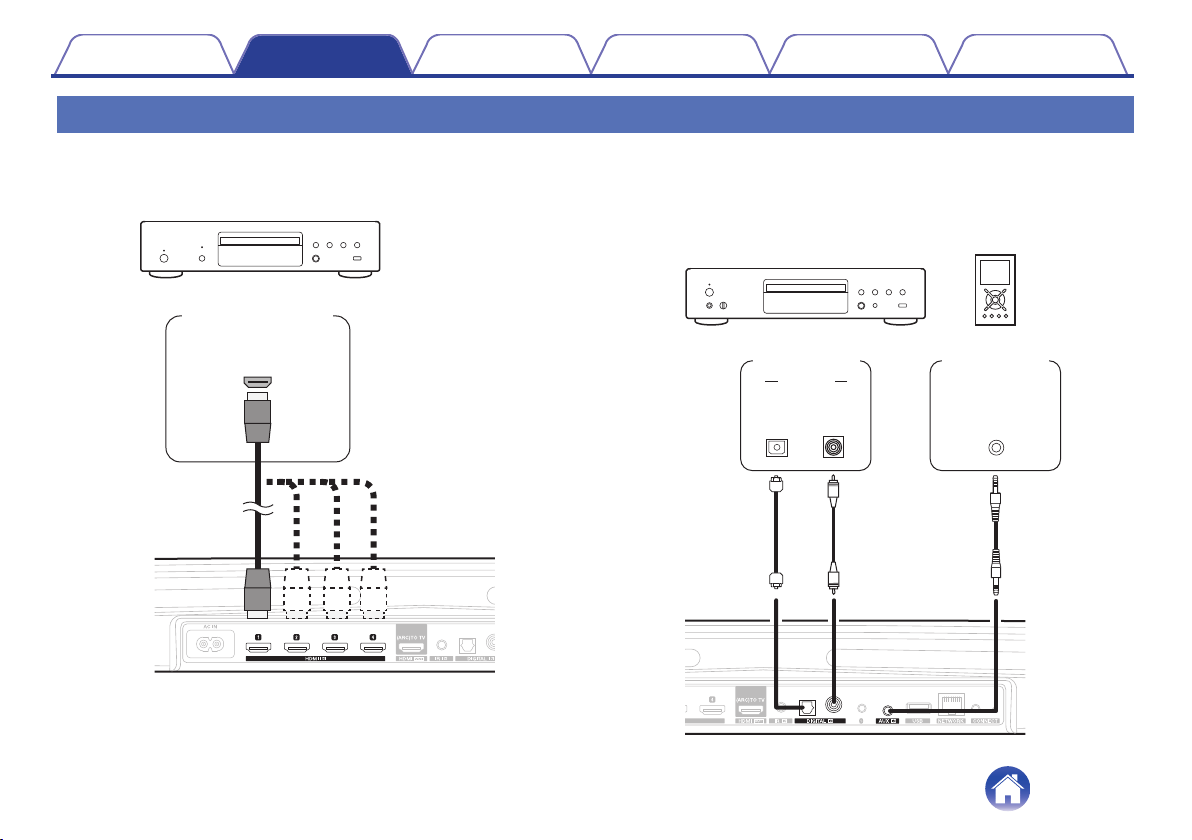
Connecting to your HDMI equipment
You can play back from a device that has a HDMI terminal, such as a
Bluray disc recorder or game console.
.
HDMI OUTPUT
HDMI equipment
o
Connecting an audio playback device
Connect the COAXIAL IN, OPTICAL IN or AUX IN input to an audio
playback device (CD player, portable music player, etc...) using the
appropriate cables.
OUT
OPTICAL
AUDIO
HEADPHONE
OUT
COAXIAL
Digital
device
Portable
audio device
Contents Setup Use Troubleshooting Status LED Appendix
30
o
Connecting a USB storage device
Connect a FAT32 formatted USB storage device containing digital
music files to any available USB port.
.
USB storage
device
o
IR repeater
It can still be controlled by the remote control by connecting a remote
control receiver unit (sold separately).
.
AUX
OUT
External IR
Remote Sensor
Contents
Setup Use Troubleshooting Status LED Appendix
31
Pairing a DSW-1H and Surrounds
DHT-S716H can be used as a multi-channel system by pairing with HEOS
speakers or our subwoofer DSW-1H (sold separately).
1
Select the Settings a icon located in the upper left
corner of the main “Music” menu to display the
Settings menu.
2
Select “Denon DHT-S716H” from "My Devices".
3
Launch Setup Assistant.
Setup assistant guides the DHT-S716H to pair.
NOTE
0
A DSW-1H and surround speakers need to connect your wireless network before
pairing.
.
HEOS 3 Left
HEOS 3 Right
HEOS Link
Denon DHT-S716H
Denon DSW-1H
Speakers
Links
Soundbars
Subwoofers
My Devices
Denon DHT-S716H
xxxxxxxx
Normal
On Table
Name
Network
EQ
Quality
Status Light
Setup Assistant
Placement
TV Input
Denon DHT-S716H
Contents
Setup Use Troubleshooting Status LED Appendix
32
.
TV Connection
Subwoofer
Surrounds
Inputs
Setup Assistant
o
Pairing the DSW-1H
1
Select “Subwoofer”.
2
Select “Denon DSW-1H”, then tap NEXT.
NOTE
0
Configure the DSW-1H settings after pairing is complete. Select “Optimized for
DHT-S716H” for normal configuration. Settings are optimized for the DHT-S716H.
o
Adding surround speakers
1
Select “Surrounds”.
2
Select “Wireless HEOS Speakers” or “HEOS Amp” and
tap NEXT.
Select the device that you want to add and tap NEXT.
Contents Setup Use Troubleshooting Status LED Appendix
33

o
Unpairing DSW-1H and Surrounds
1
Tap the pencil e icon in the upper right from the
"Rooms" menu.
2
Select “Denon DHT-S716H”.
3
Select the device that you want to disconnect from the
list.
.
HDMI InMusicDenon DHT-S716H
Denon DHT-S716H
Drag one room into another to group them
Rooms
HEOS 3 Left
HEOS 3 Right
HEOS Link
Disconnect Wireless Subwoofers
Name
Denon DHT-S716H
Edit Group
Disconnect Wireless Surrounds
Contents
Setup Use Troubleshooting Status LED Appendix
34
Using your DHT-S716H
Once you have your HEOS device connected to your network and the HEOS app installed on your mobile device, it’s easy to start enjoying your favorite
music. You can listen to something different in every room or the same music perfectly synchronized in all rooms. It’s up to you!
HEOS account
o
What is a HEOS account?
A HEOS account is master account or “keychain” for managing all of
your HEOS music services with one single username and password.
o
Why do I need a HEOS account?
With the HEOS account you just have to enter your music services
login names and passwords one time. This allows you to easily and
quickly use multiple controller apps on different devices. You just log
into your HEOS account on any device and you will have access to all
of your associated music services, play history and custom playlists,
even if you are at a friend’s house listening to music on their HEOS
system.
o
Signing up for a HEOS account
You will be instructed to signup for a HEOS account the first time you
try to access any music service from the main “Music” menu of the
HEOS app.
Selecting a room/device
1
Tap the “Rooms” tab, and select DHT-S716H if there
are multiple HEOS devices.
0
Tap the pencil icon at the top right to switch edit mode. You can change the
displayed name.
.
Rooms
Drag one room into another to group them
Rooms
Now PlayingMusic
Song Name 3
Denon DHT-S716H
Song Name 1
Dining L + Dining R
Song Name 2
Kitchen
Contents
Setup Use Troubleshooting Status LED Appendix
Use
35
Listening to the same music in multiple
rooms
The HEOS system is a true multiroom audio system that automatically
synchronizes audio playback between multiple HEOS devices so that the
audio coming from different rooms is perfectly in sync and always sounds
amazing!
You can easily add up to 32 HEOS devices to your HEOS system.
You can join or group up to 16 individual HEOS devices into a group of
HEOS devices that function as if they were a single HEOS device.
o
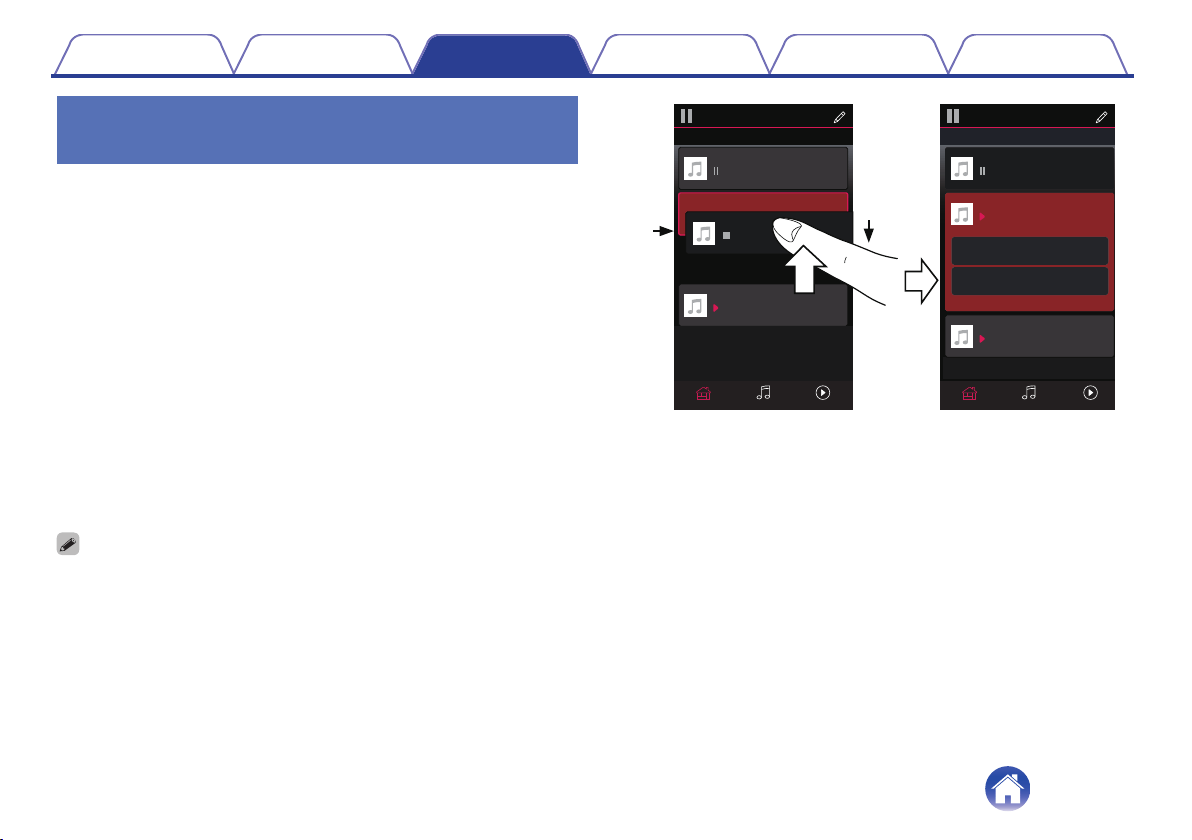
Grouping rooms
1
Press and hold your finger on room that is not playing
music.
2
Drag it into the room that is playing music (indicated by
the red outline) and lift your finger.
The two rooms will be grouped together into a single device group
and both rooms will be playing the same music in perfect sync.
0
When audio from the device connected to this unit is played back in a group, only
2-channel PCM input from the HDMI, digital or analog terminals can be played
back.
0
Grouping cannot be used when this unit is playing TV audio or external input
audio. Enable “TV Sound Grouping” to use grouping. (v p. 57)
.
2
1
Now PlayingMusicRooms
Song Name 1
Dining
Kitchen
Drag one room into another to group them
Rooms
Now PlayingMusicRooms
Song Name 3
Song Name 3
Song Name 2
Song Name 2
Song Name 1
Bedroom
Bedroom
Dining
Living
Kitchen
Drag one room into another to group them
Rooms
Living
Drag a room out of this group to ungroup it
Living+Kitchen
Contents
Setup Use Troubleshooting Status LED Appendix
36
o
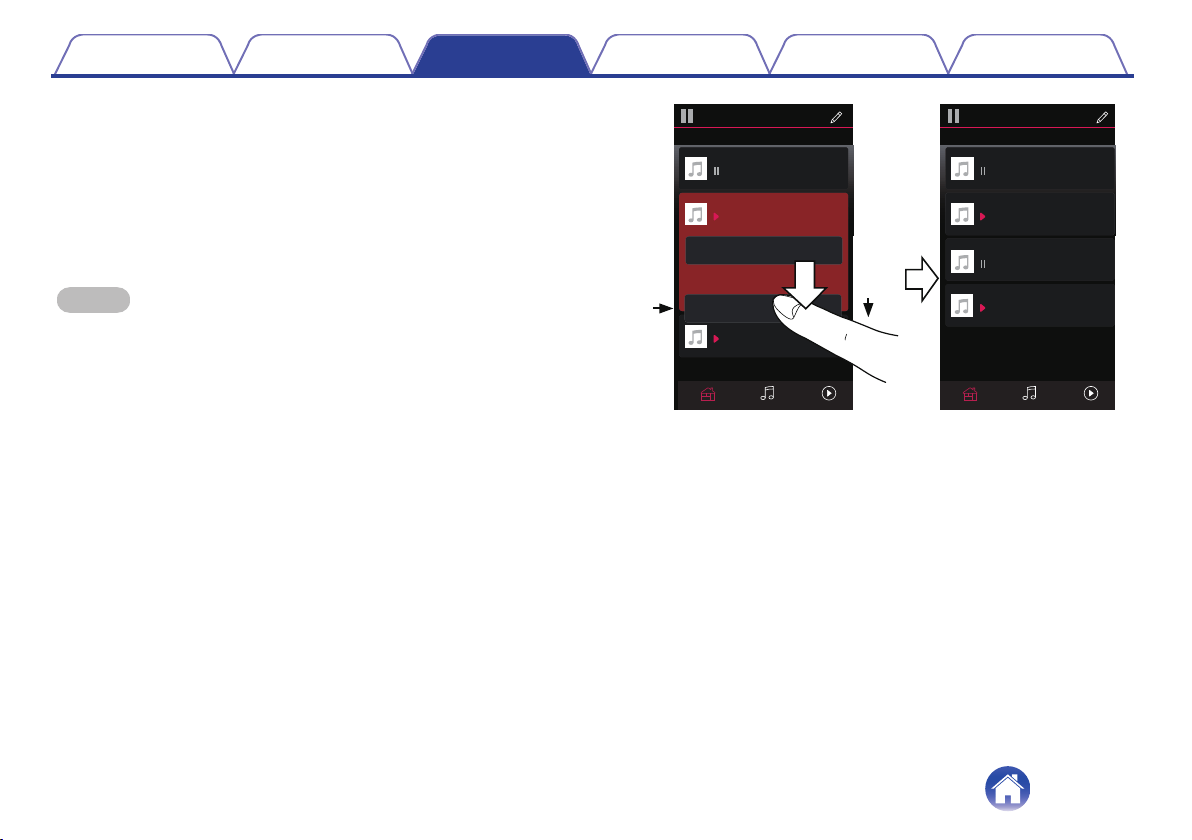
Ungrouping rooms
1
Press and hold your finger on room that you want to
remove from the group.
2
Drag it out of the group and lift your finger.
Music will stop playing in the room you dragged out of the group but
will continue playing in any remaining rooms.
NOTE
0
You can not remove the first room that started playing the music before grouping.
.
2
1
Song Name 3
Song Name 2
Song Name 1
Bedroom
Dining
Living
Kitchen
Drag one room into another to group them
Rooms
Song Name 4
Song Name 3
Song Name 2
Song Name 1
Bedroom
Dining
Living
Kitchen
Drag one room into another to group them
Rooms
Living
Now PlayingMusicRoomsNow PlayingMusicRooms
Contents
Setup Use Troubleshooting Status LED Appendix
37
o
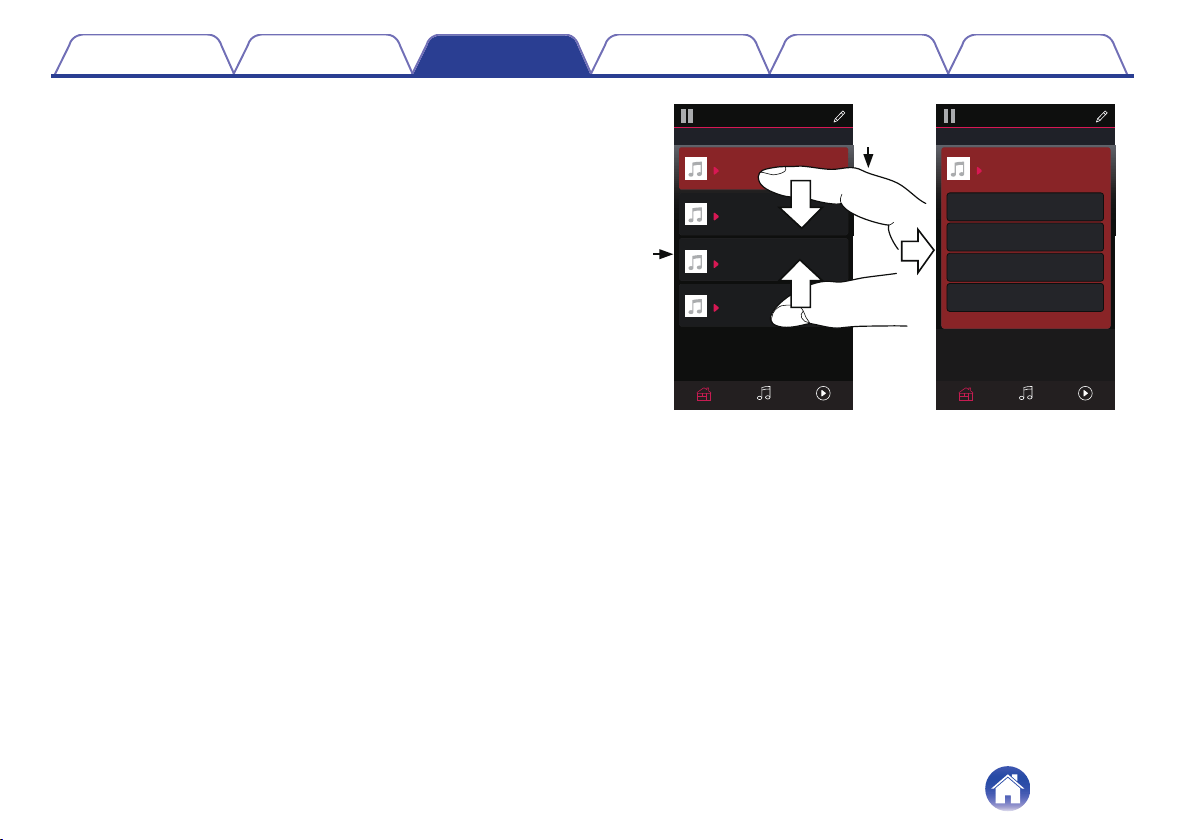
Grouping all rooms (party mode)
You can easily group 16 rooms together into Party Mode by using a
“pinch” gesture.
1
Place two fingers on the screen over the list of rooms.
2
Quickly pinch your two fingers together and release.
All of your rooms will be joined together and begin playing the same
music in perfect sync.
.
1
2
Song Name 1
Bedroom
Dining
Kitchen
Drag one room into another to group them
Rooms
Song Name 4
Song Name 3
Song Name 2
Song Name 1
Bedroom
Dining
Living
Kitchen
Drag one room into another to group them
Rooms
Living
Now PlayingMusicRooms Now PlayingMusicRooms
Drag a room out of this group to ungroup it
Dining+Living+...
Contents
Setup Use Troubleshooting Status LED Appendix
38
o
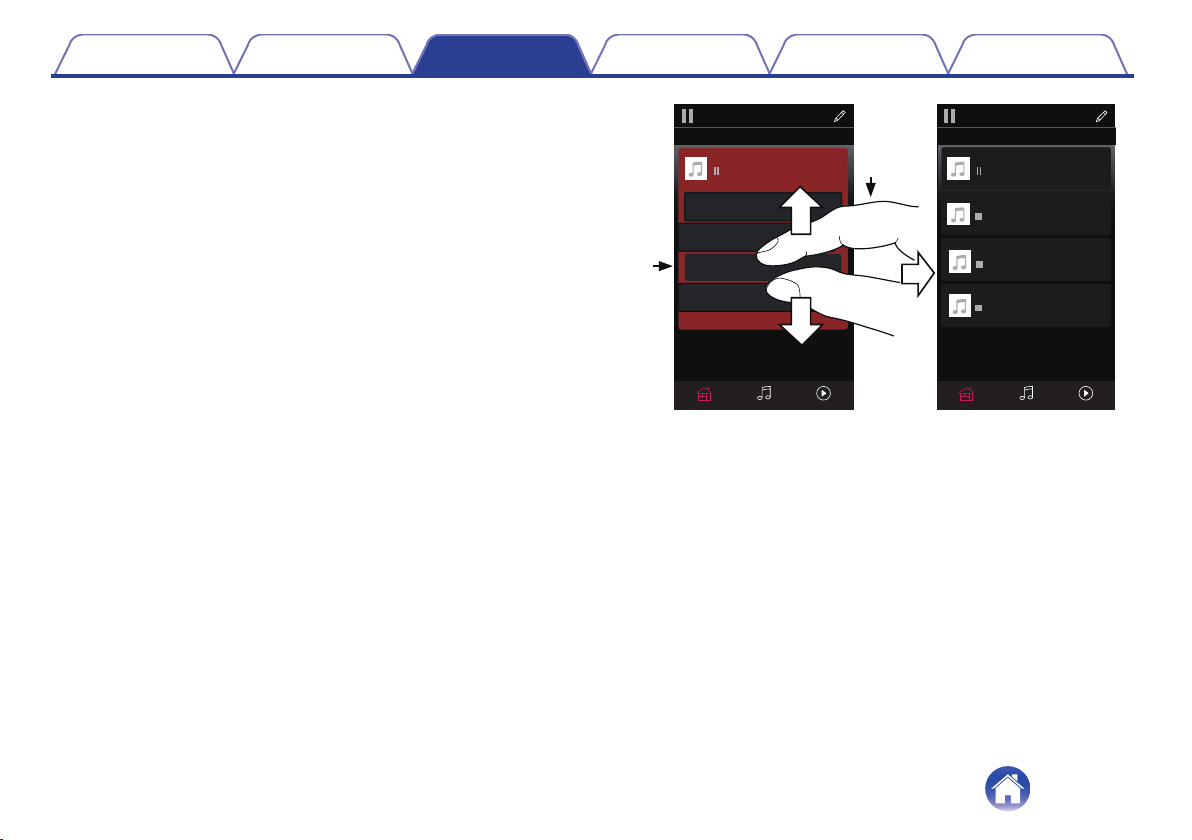
Ungrouping all rooms
You can easily ungroup all of your rooms and exit Party Mode by using
a “spread” gesture.
1
Place two fingers close together on the screen over list
of rooms.
2
Quickly spread your two fingers apart from each other
and release.
All of your rooms will be ungrouped.
.
1
2
Song Name 1
Bedroom
Dining
Dining
Kitchen
Drag one room into another to group them
Rooms
Song Name 4
Song Name 3
Song Name 2
Song Name 1
Bedroom
Dining
Living
Kitchen
Drag one room into another to group them
Rooms
Living
Now PlayingMusicRooms
Now PlayingMusicRooms
Drag a room out of this group to ungroup it
Contents
Setup Use Troubleshooting Status LED Appendix
39
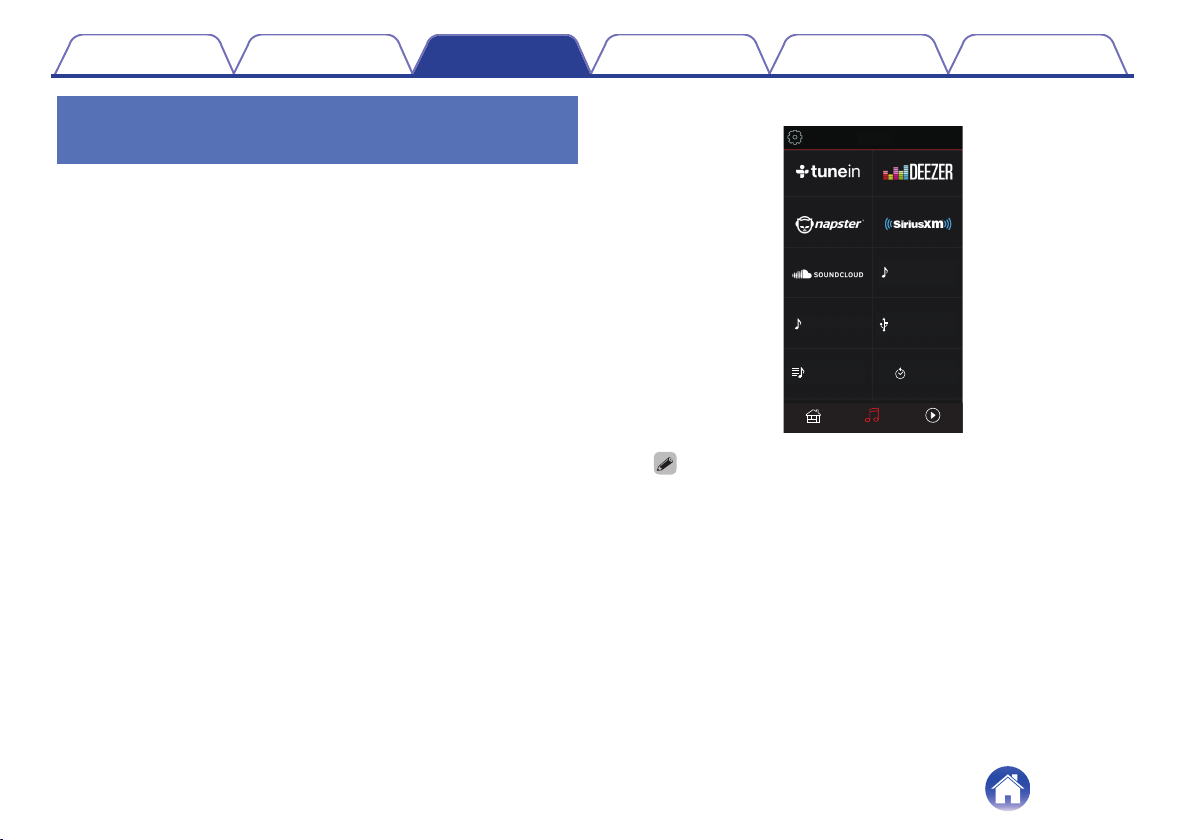
Selecting the music track or station
from music sources
1
Tap the “Music” tab and select a music source.
.
Now PlayingMusicRooms
This Phone
Music
Music Servers
USB Music
Playlists
History
0
All music services displayed may not be available in your location.
Contents Setup Use Troubleshooting Status LED Appendix
40
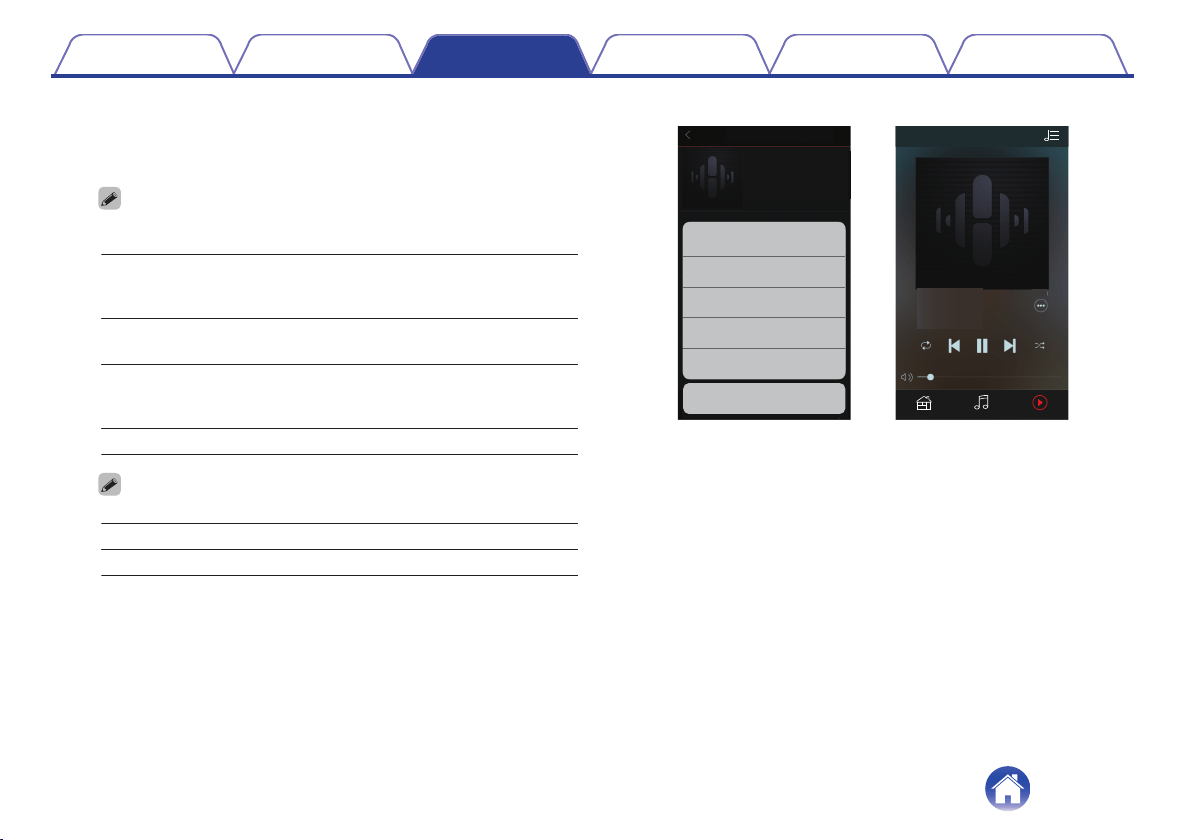
2
Browse the music to play.
After selecting a music track or radio station the app will
automatically change to the “Now Playing” screen.
0
When you select a music track to play you will be asked how you want to
queue up your music.
Play Now:
Inserts the item into the queue after the
currently playing track and plays the
selected item immediately.
Play Now & Replace
Queue:
Clears the queue and plays the
selected item immediately.
Play Next:
Inserts the item into the queue after the
current song and plays it when the
current song ends.
Add to End of Queue: Adds the item to the end of the queue.
0
When you select a radio station the following items are displayed.
Play Now: Plays the selected item immediately.
Add to HEOS Favorites: Adds to HEOS Favorites.
.
Music
Rooms Now Playing
Album
Album
Play Now
Cancel
Play Now & Replace Queue
Play Next
Add to End of Queue
Track 01
Rooms
10 Tracks,60 Mins.,2014
Artist
MusicRooms Now Playing
Track 01
Album
0:50
-
2:51
Artist
Now Plaing
Contents
Setup Use Troubleshooting Status LED Appendix
41
Rearranging the now playing queue
Once you have songs lined up in your queue, you might want to rearrange
the order or remove some songs:
1
Tap the “Now Playing” tab.
2
Tap the Queue d icon in the upper right corner of the
screen.
3
Tap the Pencil e icon to enter Edit mode.
4
Rearrange the order of your queue by dragging the list
f icon (on the right side of each track row) up or
down.
Deleting songs from the play queue
You can remove songs one at a time from the Now Playing Queue:
1
Tap the “Now Playing” tab.
2
Tap the Queue d icon in the upper right corner of the
screen.
3
Tap the Pencil e icon to enter Edit mode.
4
Tap the track(s) that you want to delete.
5
Tap the Delete g icon to delete all of the selected
tracks from the play queue.
Contents Setup Use Troubleshooting Status LED Appendix
42
Deleting all songs from the play queue
You can remove all of the songs from the Now Playing Queue:
1
Tap the “Now Playing” tab.
2
Tap the Queue d icon in the upper right corner of the
screen.
3
Tap the Delete g icon to confirm that you want to
delete all songs from the queue.
Saving playlists
You can save the Now Playing Queue as a HEOS Playlist that you can
recall later. The new playlist will be available from the Playlists button on
the “Music” tab on every controller app connected to your HEOS system.
1
Tap the “Now Playing” tab.
2
Tap the Queue d icon in the upper right corner of the
screen.
3
Tap on the Save h icon.
4
Enter a name for your Playlist and tap the Save h icon.
Contents Setup Use Troubleshooting Status LED Appendix
43
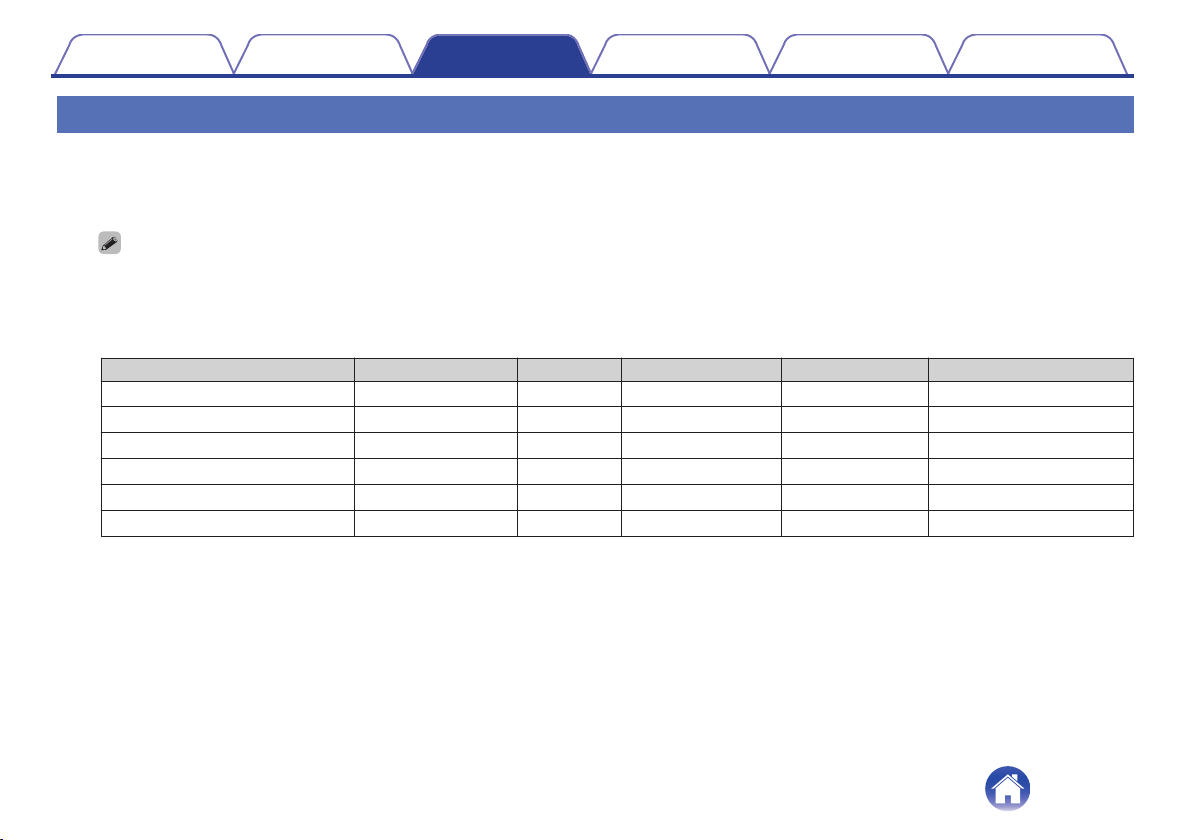
Quick Select function
Input source, volume level and surround mode settings can be registered to the Quick select buttons (1 - 6).
1
To register the current setting, point the remote control unit at this unit and then press and hold the Quick Select button
you want to register (1-6) for 3 seconds.
0
The status LED on the main unit flashes once when registration is complete.
0
You can also register using the HEOS app.
0
You can change the Quick Select name of the HEOS app. (v p. 58)
[Default settings]
Button/Default Name Input Source Volume Sound Mode Night Mode Dialog Enhancer
Quick Select 1 HDMI 1 35 MOVIE OFF OFF
Quick Select 2 HDMI 2 35 MOVIE OFF OFF
Quick Select 3 HDMI 3 35 MOVIE OFF OFF
Quick Select 4 HDMI 4 35 MOVIE OFF OFF
Quick Select 5 HDMI ARC 35 MOVIE OFF OFF
Quick Select 6 OPT 35 MOVIE OFF OFF
Contents Setup Use Troubleshooting Status LED Appendix
44
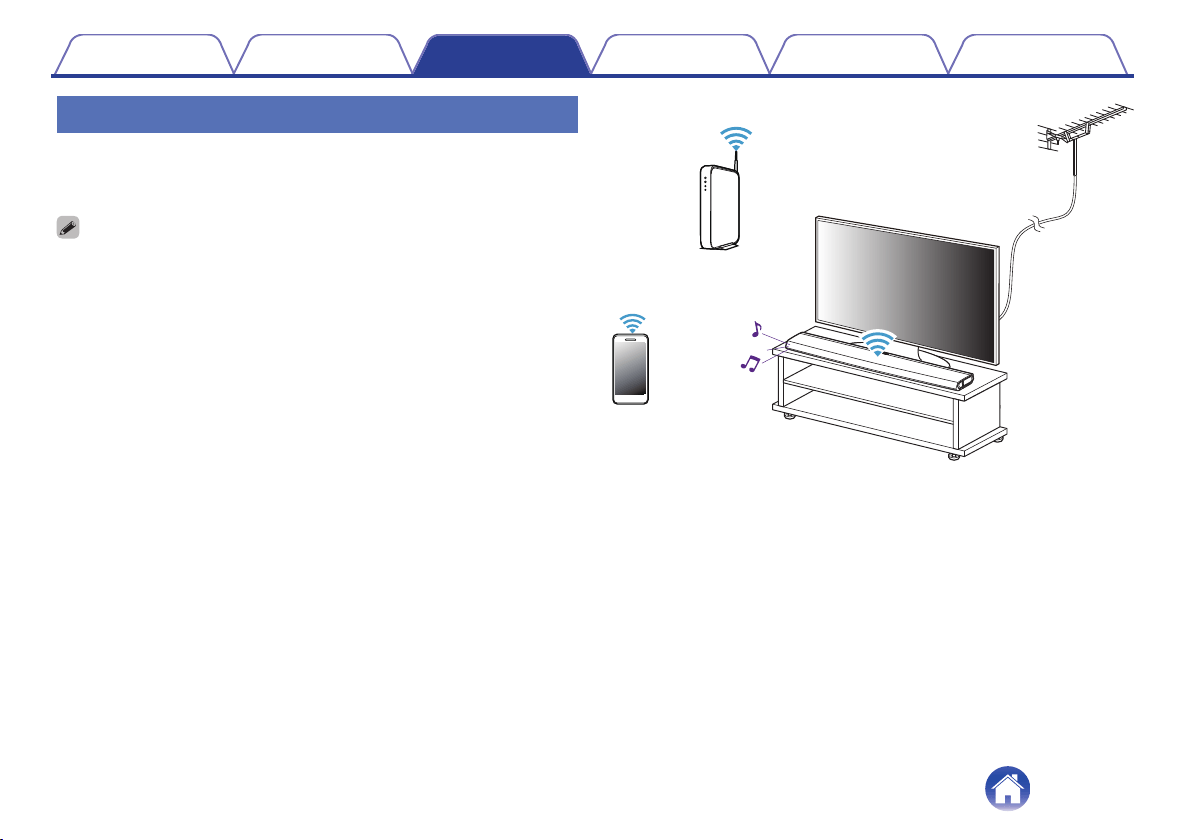
Watching TV
1
Turn on the TV.
Automatically DHT-S716H changes the input to TV.
0
If you can not hear the audio on DHT-S716H, please tap the "Inputs" in Music tab,
then select the input which you want to enjoy.
0
To change the input automatically, you can set the default TV input in the setup
menu. “Adjusting the TV input” (v p. 57)
.
Contents
Setup Use Troubleshooting Status LED Appendix
45
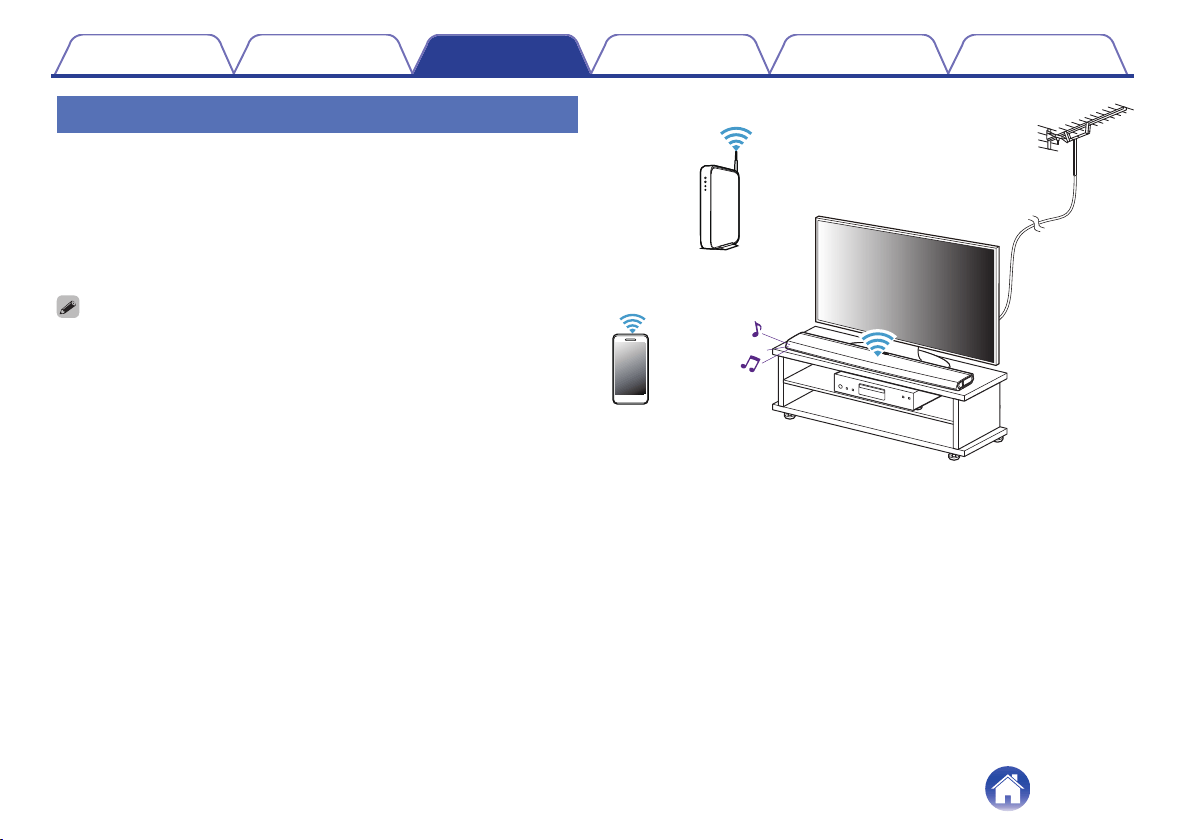
Watching other device
1
Turn on the TV.
2
Turn on the power of the HDMI device, such as a Bluray
player or game console.
Automatically the input of the DHT-S716H switches to the HDMI
device.
0
If DHT-S716H does not switch the input automatically, please tap the "Inputs" in
Music tab, then select the input which you want to enjoy.
0
Set the HDMI control on the TV to On to enable automatic switching of the DHT-
S716H input. (v p. 26)
.
Contents
Setup Use Troubleshooting Status LED Appendix
46
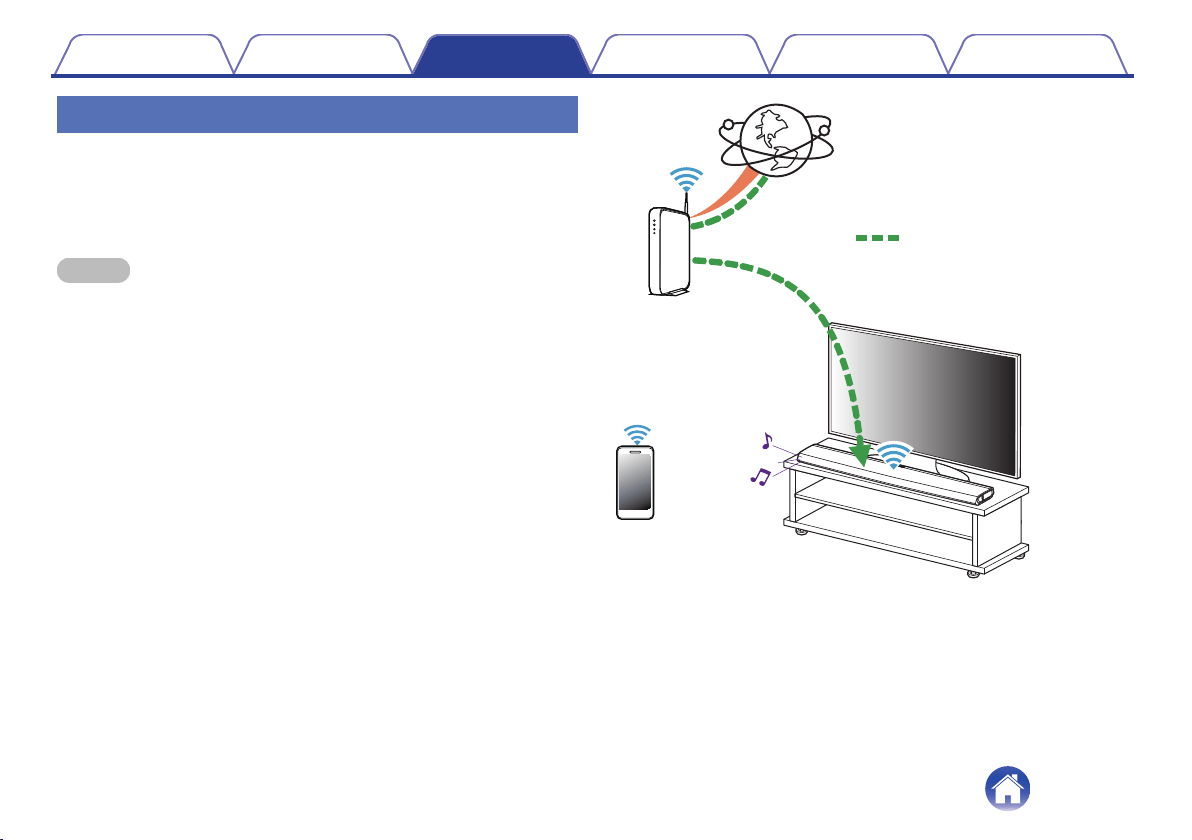
Listening to radio
The HEOS system includes access to more than 100,000 free internet
radio streams from all corners of the globe via the TuneIn radio service.
Just select the TuneIn logo from the main “Music” menu and browse
among the 100,000 stations neatly organized into popular categories and
select a station that appeals to your mood.
NOTE
0
If you have a TuneIn account, you can sign into the TuneIn service under
“Settings” - “Music Sources” - TuneIn, and access all of your “My Favorites” TuneIn
stations.
.
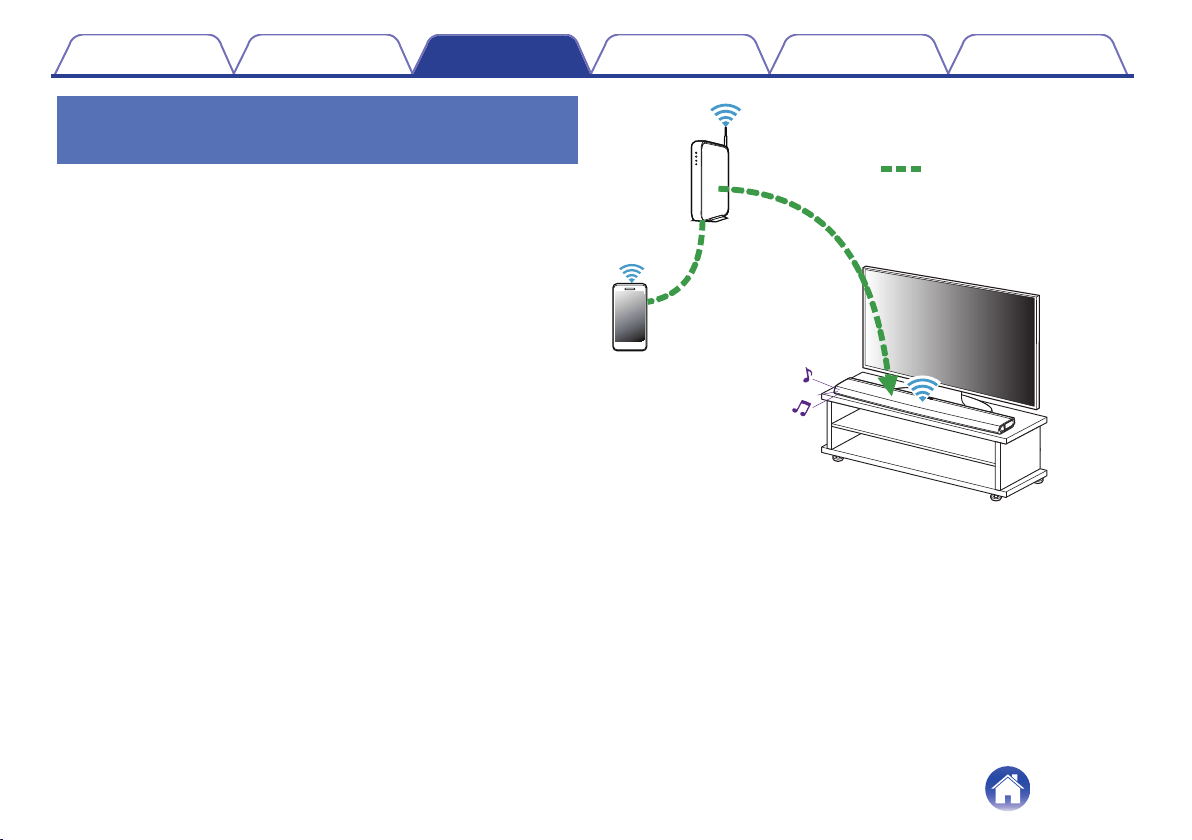
Audio signal
Contents
Setup Use Troubleshooting Status LED Appendix
47
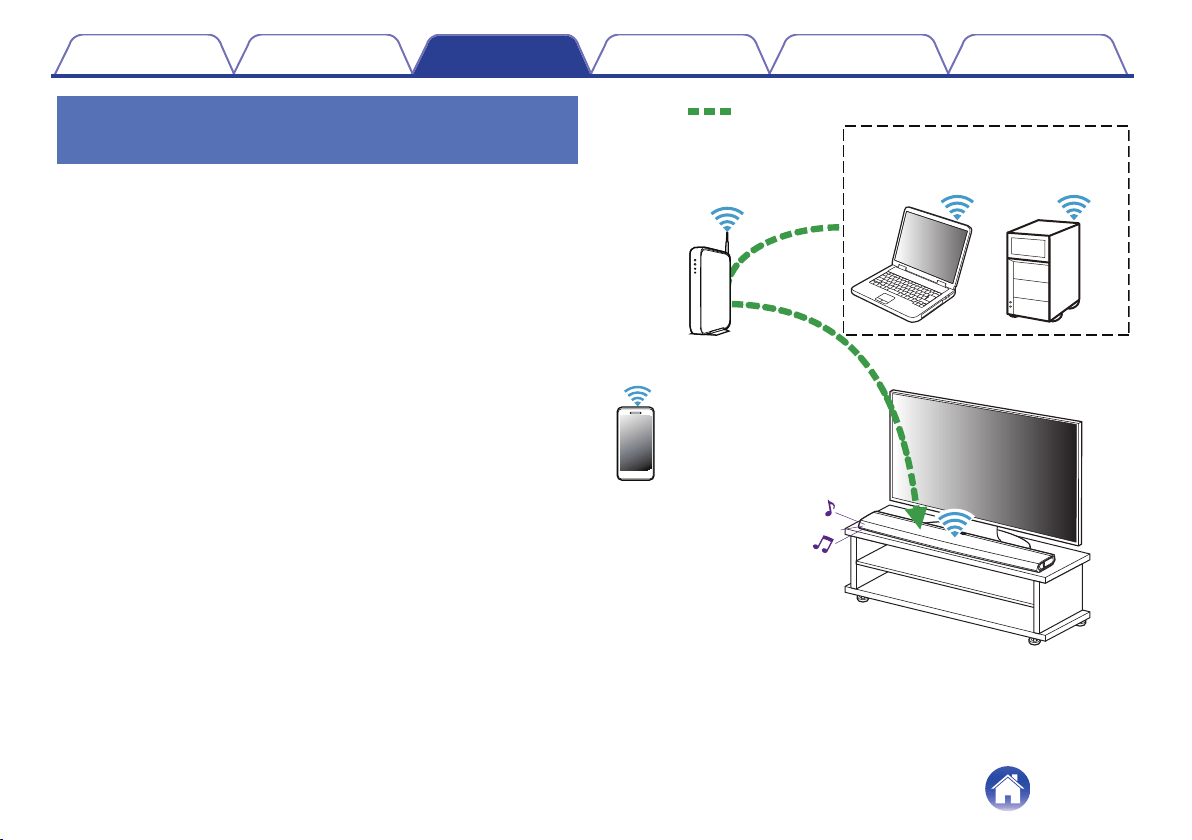
Playing music from your networked PC
or NAS
1
Select “Music Servers” from the “Music” tab.
2
Select the name of your networked PC or NAS
(Network Attached Storage) server.
3
Browse the music on your PC/NAS and select
something to play.
.
Audio signal
NAS
(Network Attached
Storage)
PC
Contents
Setup Use Troubleshooting Status LED Appendix
49
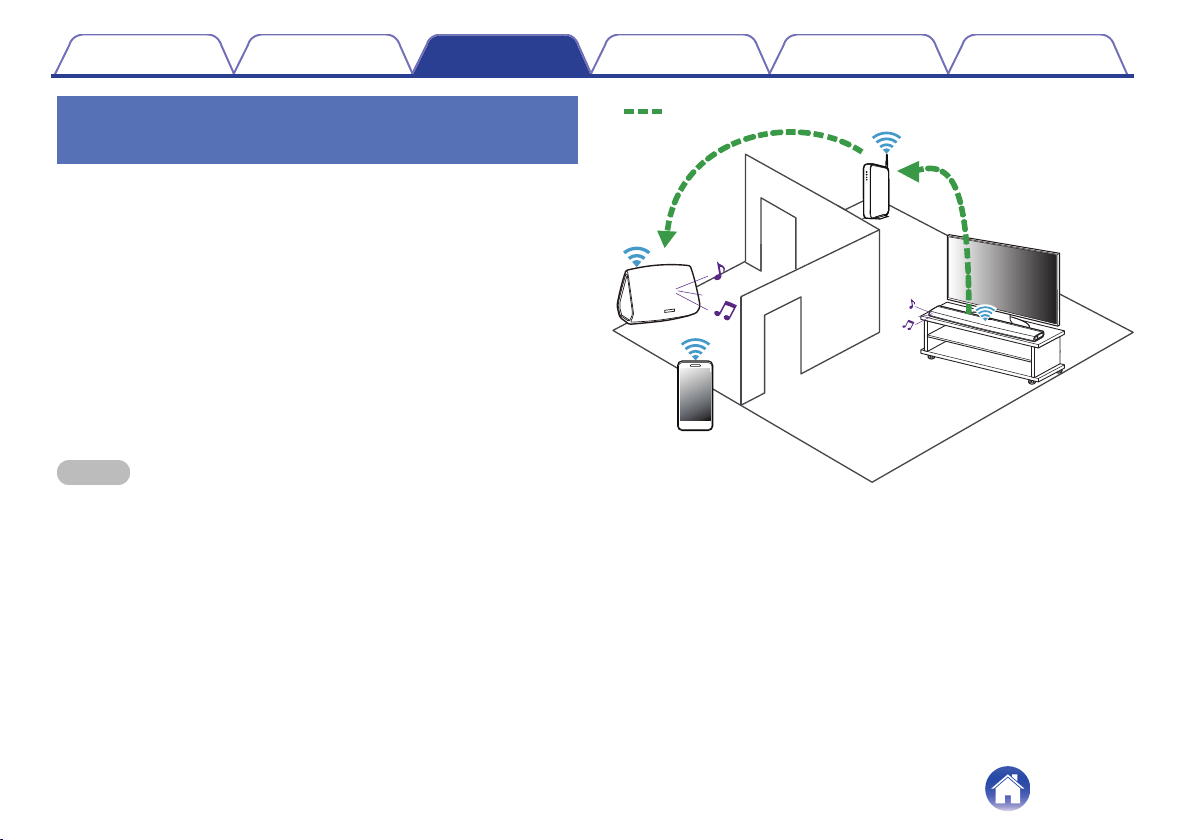
Streaming an external audio device to
any HEOS device
The sound from the audio device can be played directly on the selected
device or digitized and sent over your network to other HEOS devices.
1
Connect an external audio device to the digital optical,
analog RCA stereo or analog 1/8 inch (3.5 mm) stereo
inputs on the back of the DHT-S716H.
2
Select “Inputs” from the “Music” tab.
3
Select the name of the DHT-S716H and which input to
which you connected the audio device in step 1.
4
Initiate playback on the audio device.
NOTE
0
When a stereo audio cable is connected to AUX IN, the source automatically
switches to Inputs.
.
Audio signal
Contents
Setup Use Troubleshooting Status LED Appendix
50
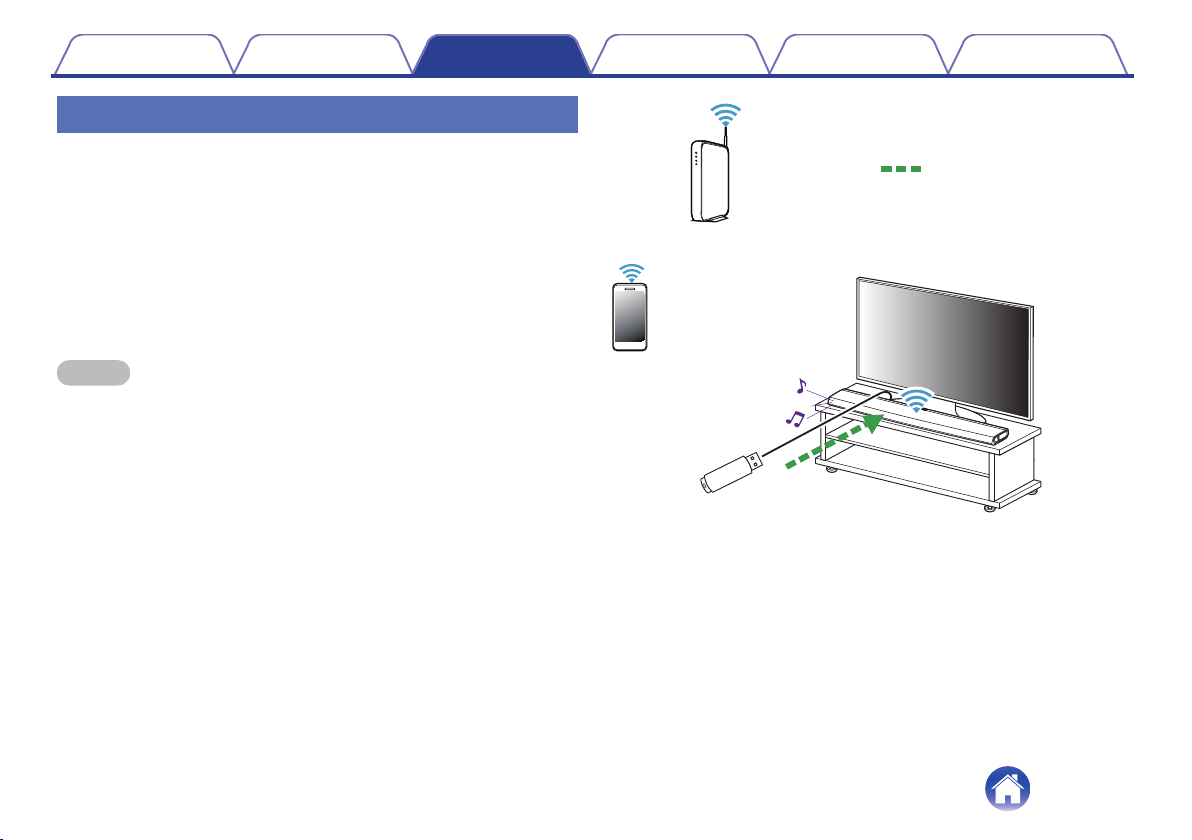
Playing music from a USB device
1
Insert a FAT32 formatted USB device into the USB port
on the back of the DHT-S716H.
2
Select “USB Music” from the “Music” tab.
3
Select the name of your HEOS device.
4
Browse the music on your USB device and select
something to play.
NOTE
0
It may take several minutes for the name of your HEOS device to appear in the
“USB Music” list if you have a large number of files on your USB device.
0
It is not possible to connect and use a computer via the USB port of this unit using
a USB cable.
.
Audio signal
Contents
Setup Use Troubleshooting Status LED Appendix
51
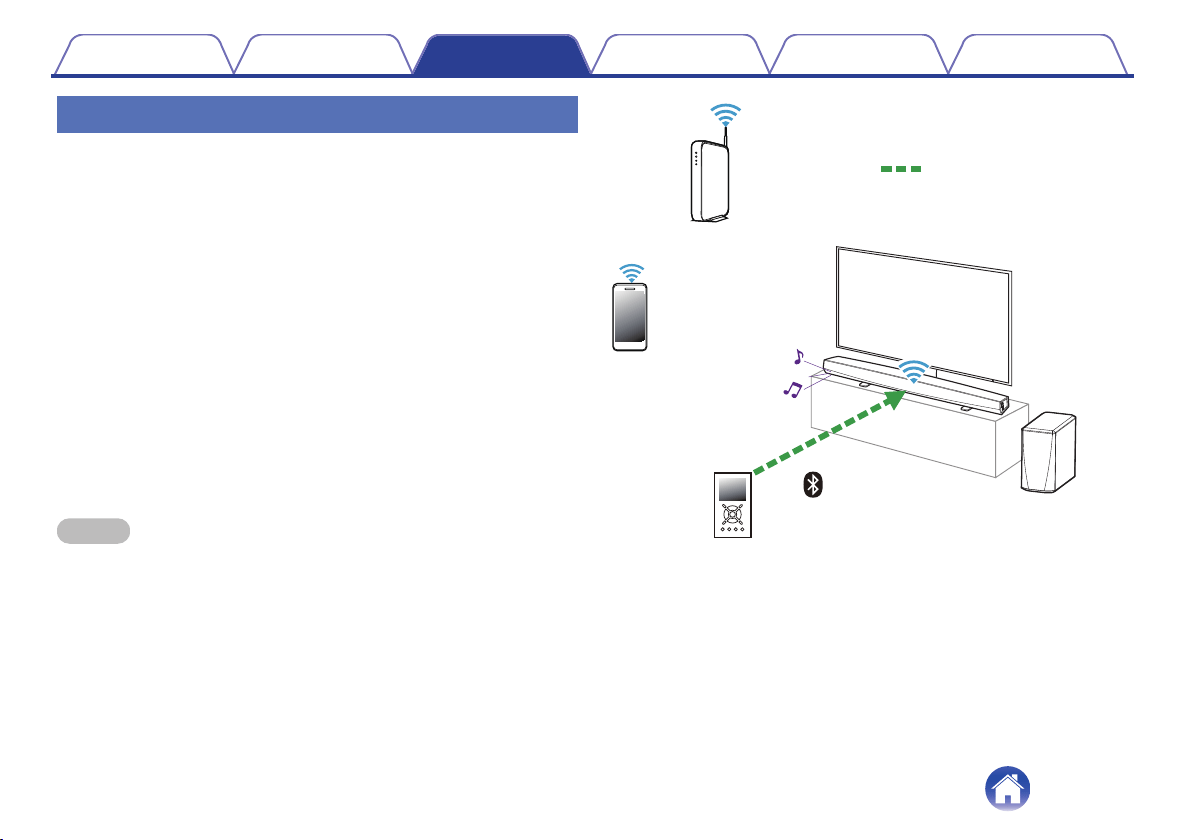
Playing music from Bluetooth device
o
Pairing the HEOS device with your Bluetooth
devices
1
Activate the Bluetooth setting on your mobile device.
2
Press and hold the Play/Pause button located on the
remote control unit for 3 seconds and release the
button when you see a pattern of two green flashes on
the status LED.
3
Select “DHT-S716H” from the list of available Bluetooth
devices.
In a few seconds your mobile device will indicate that it is connected
to your DHT-S716H.
4
Play music using any app on your device. The sound
will now play from the DHT-S716H.
NOTE
0
Disconnect and reconnect Bluetooth connections from your Bluetooth device.
0
You can also pair devices by pressing and holding the Bluetooth button on the
back of the DHT-S716H.
.
Audio signal
Contents
Setup Use Troubleshooting Status LED Appendix
52
Playing from streaming music services
A music service is an online music company that provides access to vast
music collections via free and/or paid subscriptions. Depending upon your
geographical location, there are several options to choose from.
NOTE
0
The HEOS app and brand is not affiliated with any manufacturer of any mobile
device. Availability of music services may vary by region. Not all services may be
available at time of purchase. Some services may be added or discontinued from
time to time based on decisions of the music service providers or others.
o
Adding a music service
Once you’ve setup your HEOS account, you can add supported music
services to your HEOS system by tapping on the music service logo in
the “Music” tab.
Follow the instructions on the screen to add your username and
password for the selected music service. You only have to enter your
account information once as the HEOS account service will securely
remember your login information so you don’t have to enter it each
time you want to play music from the music service.
Additional music services may be available under “Settings” - “Music
Sources” - “Online Music”.
o
Changing music service settings
1
Tap the “Music” tab.
2
Select the Settings a icon in the upper left corner of
the screen.
3
Select “Music Sources”.
4
Select “Online Music”.
5
Select the name of the online music service you want
to edit.
6
Sign out, then sign in again to associate your
username and password with your HEOS account.
7
Select “Hide for Now” to prevent the service logo from
appearing on the main “Music” menu.
Contents Setup Use Troubleshooting Status LED Appendix
53
Managing inputs
If you connected external audio source components to any of your HEOS
devices inputs, you can rename the default input names to describe the
actual source or hide any inputs that are not being used.
1
Select the Settings a icon located in the upper left
corner of the main “Music” menu to display the
Settings menu.
2
Select “Music Sources”.
3
Select “Inputs”.
4
Select the HEOS devices which you connect your
external audio source device to.
o
Changing the name of the inputs
1
Select the name of the input you want to edit.
2
Select “Name”.
3
Select or enter a new name to describe the source that
you connected.
4
Select the Save button to save your changes.
o
Hiding an input
1
Select the name of the input you want to edit.
2
Toggle “Hide Input” to ON to prevent this input from
appearing under the Inputs tile on the main “Music”
menu.
Contents Setup Use Troubleshooting Status LED Appendix
54
Managing your phone
Your smartphone or tablet can be hidden if it does not need to be in the
“Music Sources” menu.
1
Select the Settings a icon located in the upper left
corner of the main “Music” menu to display the
Settings menu.
2
Select “Music Sources”.
3
Select “This iPhone/iPod/iPad/Phone”.
4
Toggle “This iPhone/iPod/iPad/Phone” to OFF to
prevent the service logo from appearing on the main
“Music” menu.
Using the favorite
HEOS uses a "HEOS Favorites" to line up station you want to start play
quickly the favorite stations.
Station can be selected from online music sources such as "Radio" or
"Station" type streams. "HEOS Favorites" will display a list of the stations
of various services.
o
Adding to HEOS favorite
Select a station of an online music source. When the action menu
screen is displayed, select “Add Station to HEOS Favorites”.
NOTE
0
This can also be done by selecting “Add Station to HEOS Favorites” from the
station menu of the station being played.
o
Deleting station from the HEOS favorite
1
Tap the “Music” tab.
2
Select “Favorites”.
3
Tap the Pencil e icon to enter Edit mode.
4
Tap the "Delete" that you want to delete station.
Contents Setup Use Troubleshooting Status LED Appendix
55
Making adjustments
You can adjust specific settings for each of your HEOS device in your
system:
1
Select the Settings a icon located in the upper left
corner of the main “Music” menu to display the
Settings menu.
2
Select “My Devices” to display a list of your HEOS
devices.
3
Select the HEOS device you want to adjust.
Adjusting the audio quality
Selects the transcoding option for rebroadcasting audio from one HEOS
device to another HEOS device (or group of devices) across the network.
When set to high bit rate audio sources originating from the first device
(such as Analog input, WAV, FLAC and PCM) will be transcoded to
ensure the highest level of reliability for the audio stream. (v p. 50)
1
Select “Quality”.
2
Select “Normal” (default) or “High”.
0
If you have selected High and you experience audio dropouts when streaming
sources from one device to other devices, please select Normal (default).
Contents Setup Use Troubleshooting Status LED Appendix
56

Changing the TV connection
"Setup Assistant" can be re-executed when changing the TV connection.
1
Select "Setup Assistant".
2
Turn on your TV.
Select which input you want to use to connect your TV.
Adjusting the TV input
It will be able to automatically switch to TV mode once the TV is turned on.
1
Select "TV Input".
n
Default Input
Select the input to use when the TV tile is selected from the
Music Tab.
n
Auto-Play
Enabled to automatically switch to the default input when a signal
is detected on the default input line
TV Sound Grouping
Set when you want to play TV audio or external input audio from this unit
through a different HEOS device.
1
Select “TV Sound Grouping”.
n
Enable
Enables grouping.
n
Audio Delay
Sets the delay for the audio.
NOTE
0
The audio may cut out if the amount of delay is too short. Lengthen the amount of
delay if the audio cuts out.
Contents Setup Use Troubleshooting Status LED Appendix
57
Changing the name of Quick Select
1
Select "Quick Select Names".
2
Select or enter a new name to describe the registered
Quick Select.
3
Tap the Save i button to save your changes.
Adjusting the status light brightness
1
Select “Status Light”.
Adjust the brightness up or down or set the slider to the OFF position
to completely disable the status light.
Contents Setup Use Troubleshooting Status LED Appendix
58
Updating your system
HEOS has the ability to add enhancements and updated functionality via your high speed Internet connection. Follow the instructions on the screen to
update the HEOS device and/or your controller App.
1
Select the Settings a icon located in the upper left
corner of the main “Music” menu to display the
Settings menu.
2
Select “Software Update”.
n
Check for Update
Follow the instructions on screen to install any available updates
to your HEOS system.
n
Auto-Update
ON
(Default):
Valid updates are performed
automatically.
OFF:
You will be notified of valid updates on
the HEOS app.
Contents Setup Use Troubleshooting Status LED Appendix
59
Advanced features
There are a few advanced features of the HEOS system that you may want to explore once you become familiar with the basic operations. You can
access the advanced features of the HEOS system by following these steps:
1
Select the Settings a icon located in the upper left
corner of the main “Music” menu to display the
Settings menu.
2
Select “Advanced Settings” to display a list the
available settings.
Wireless performance
You can check the wireless connection status of your HEOS device.
n
Quality
Excellent / Good / Poor
NOTE
0
If the quality level of your HEOS device is ”Poor”, make sure your HEOS devices
are not located near other electronic devices that could interfere with it’s wireless
connectivity (like microwave ovens, cordless phones, TVs, etc…)
n
Signal
Excellent / Good / Poor
NOTE
0
If the signal level of your HEOS device is ”Poor”, make sure your HEOS devices
are within range of your wireless network.
Contents Setup Use Troubleshooting Status LED Appendix
60
Power management
Power modes
o
Quick Start Mode
HEOS device automatically enters "Quick Start Mode" to save power
in the following cases. This unit will automatically resume to full power
whenever the device is selected and playing music.
The status LED dims when the mode is switched to Quick Start Mode.
n
Ethernet
After around 20 minutes of no operation and no network access after
playing music via Ethernet.
n
Wi-Fi
After around 20 minutes of no operation and no network access after
playing music via Wi-Fi.
n
USB
After around 20 minutes of no operation and no network access after
playing music from a USB memory device.
n
Bluetooth
After the Bluetooth connection is disconnected and there is around 20
minutes of no operation and no network access after playing music via
Bluetooth.
n
AUX IN
After around 20 minutes of no operation after AUX cable is
disconnected.
n
OPT IN
After around 20 minutes of no operation after optical device is put into
standby.
n
COAX IN
After around 20 minutes of no operation after coaxial device is put into
standby.
n
HDMI IN
Play the HDMI device, such as a Blu-ray player, connected to this unit.
Around 20 minutes after HDMI device and TV are put into standby.
n
HDMI OUT (ARC)
Connect this unit and the ARC compatible TV with HDMI cable and
play TV. Around 20 minutes after TV is put into standby.
0
Press the Power button on the remote control unit to switch to Quick Start
Mode.
Contents Setup Use Troubleshooting Status LED Appendix
61

o
Deep Standby
The device also has the ability to automatically enter “Deep Standby”
whenever the wired and wireless network connections are removed for
more than 60 minutes in Quick Start Mode. Status LED will turn off
during Deep Standby.
To “wake” a HEOS device from Deep Standby, you must press the
power button on the remote control unit which will immediately turn on
status LED.
The Device may need to "find" the network before it can operate
properly.
NOTE
0
Please note that the HEOS cannot be operated as intended when in Deep
Standby as there is no network connection.
0
Press and hold the Power button on the remote control unit for more than 3
seconds to switch to Deep Standby.
o
Off
To completely turn off the power to the device you must remove the
mains plug from the power outlet.
Contents
Setup Use Troubleshooting Status LED Appendix
62
Basic troubleshooting
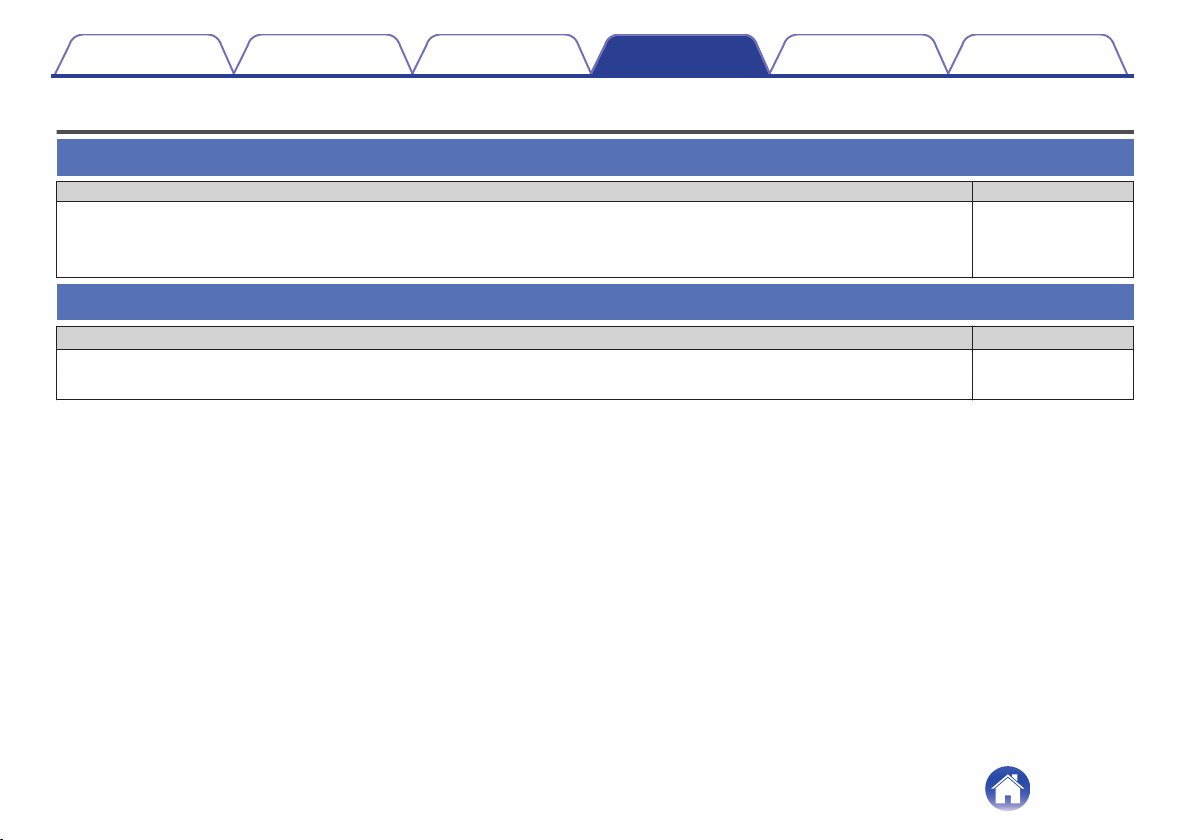
My HEOS device won’t connect to my network using the audio cable
Solution Refer to Page
0
Make sure your mobile device is connected to your wireless network before setting up your device. 24
0
Alternatively, you can connect your device to your network router using the included Ethernet cable. Once connected via
Ethernet, the HEOS App should recognize the device and you can manually move it to your wireless network using Settings/My
Devices/Device_Name/Advanced/Network Settings.
25
If the TV remote control does not work
Solution Refer to Page
0
Remove any items that may block the transmission of signals between the TV and DHT-S716H. 31
0
If the TV and DHT-S716H are too close, move the DHT-S716H more than 2 inches (50 mm) from the TV. -
Contents Setup Use Troubleshooting Status LED Appendix
Troubleshooting
63
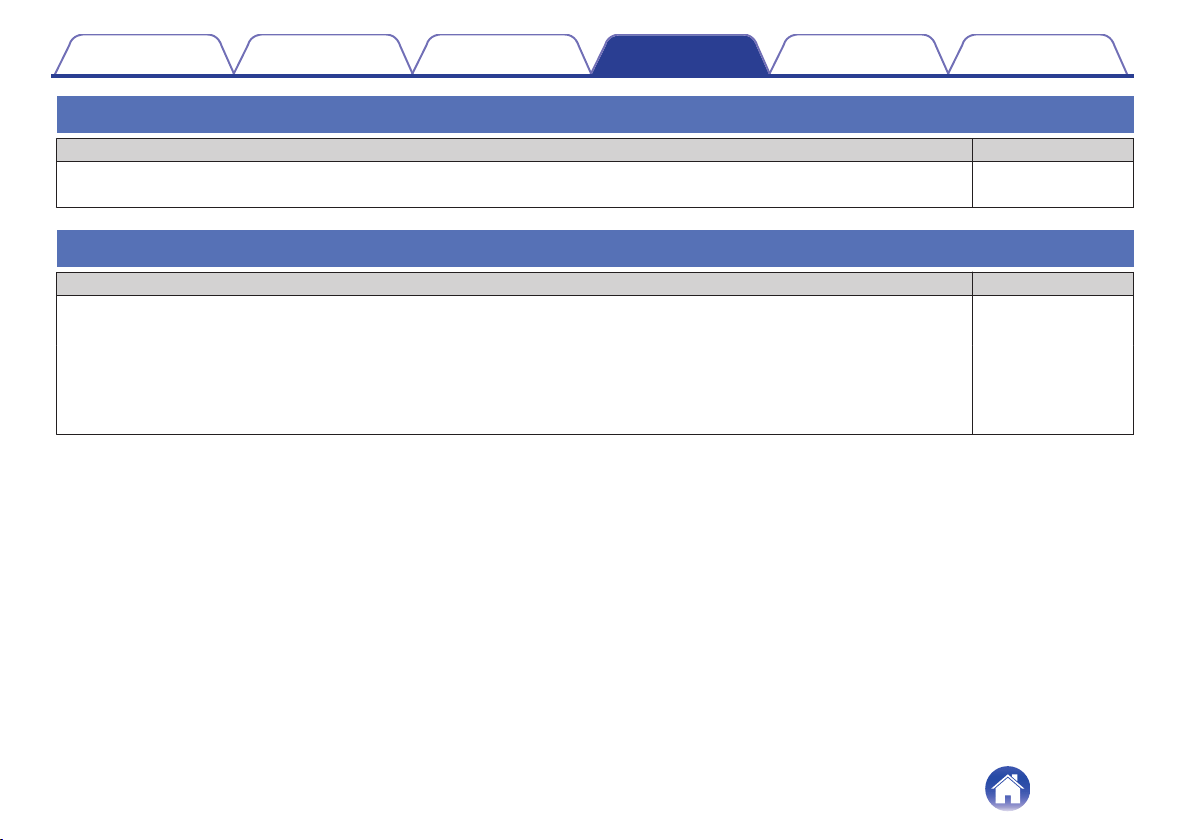
Cannot pair a Bluetooth mobile device with the HEOS device
Solution Refer to Page
0
The connection from the Bluetooth mobile device is malfunctioning. Power cycle the mobile device, remove the pairing
information and re-pair the DHT-S716H to the mobile device.
–
Cannot hear Bluetooth music
Solution Refer to Page
0
Your Bluetooth mobile device is not paired with HEOS device. Re-pair the HEOS device to the mobile device. 52
0
The HEOS device is Wi-Fi mode or Aux-in mode etc. Pair and connect Bluetooth device to HEOS device. -
0
The Bluetooth mobile device is connected to another audio device. Make sure your Bluetooth device is connected to HEOS
device.
-
0
The volume on Bluetooth mobile device is too low. Check the volume on the Bluetooth mobile device. Check the volume on the
HEOS device.
-
Contents Setup Use Troubleshooting Status LED Appendix
64
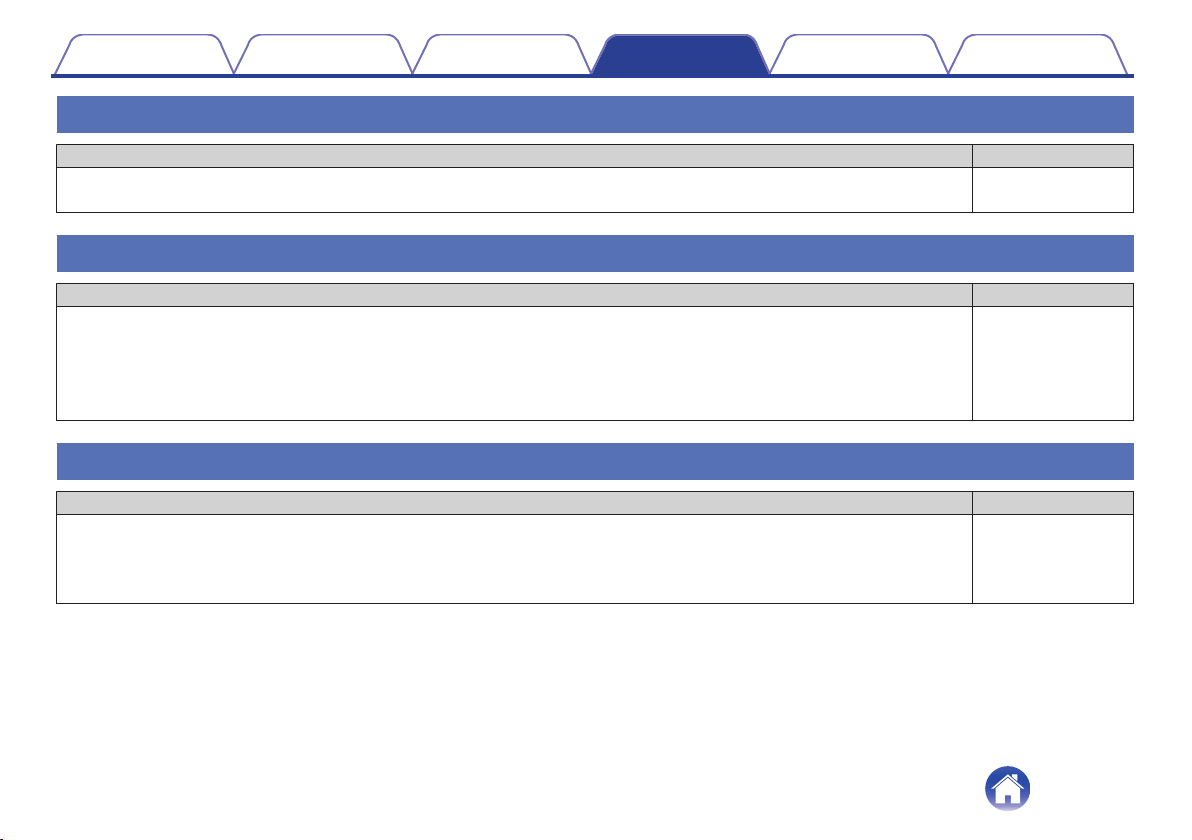
My HEOS device turns off and the status LED flashes in red
Solution Refer to Page
0
The protection circuit has been activated due to a rise in temperature within your HEOS device. Turn the power off, wait about
an hour until this device cools down sufficiently, and then turn the power on again.
–
Music cuts out or delays sometimes
Solution Refer to Page
0
Make sure your Internet connection is operating correctly. If you are sharing your network with other users or devices, they may
be using most of your bandwidth (especially if they are streaming video).
7
0
Make sure your HEOS devices are within range of your wireless network. 60
0
Make sure your HEOS devices are not located near other electronic devices that could interfere with it’s wireless connectivity
(like microwave ovens, cordless phones, TVs, etc…).
60
I hear a delay when using the external input with my TV
Solution Refer to Page
0
If you are connecting the External input with your cable or satellite box for enjoying TV audio through multiple HEOS devices,
you may hear a delay between when you see someone speak and when you hear the audio. This is because the HEOS system
must buffer the audio before it sends it out to the HEOS devices so that it arrives at all devices at the same time.
-
0
You can avoid this delay by listening only to the device which is directly connected to the set top box. -
Contents Setup Use Troubleshooting Status LED Appendix
65
I hear distortion when using the AUX input
Solution Refer to Page
0
The analog output signals from some sources can be fairly strong. If the input level of the source device is turned up high, it
could overload the inputs of the HEOS device. This is unlikely to cause damage, but can cause distorted sound. Initially, set the
volume of the source to a medium – low level, then turn it up as needed. If you hear distortion, turn down the device’s volume
control.
-
Connecting to a WPS network
Solution Refer to Page
0
If your wireless router support WPS (Wi-Fi Protected Setup™) your HEOS wireless device can optionally connect to your
network using the “Push Button” method by following these steps:
Wi-Fi Protected Setup™ is trademarks of Wi-Fi Alliance.
1. Press the WPS button on your router.
2. Within 2 minutes, press and hold the Connect button on the rear panel of the HEOS device for 3 seconds.
3. The LED on the front of the device will flash green for several seconds as it connects to your WPS router.
4. When the connection is complete, the LED on the front of the device will turn solid blue.
7
Contents Setup Use Troubleshooting Status LED Appendix
66
Resetting your HEOS device
Solution Refer to Page
0
Resetting your HEOS device will clear out the wireless network info, EQ, and name but retain it’s current software. You will have
to use Settings - Add Device to reconnect the HEOS device to your home network before it can be used.
To reset your HEOS device, press and hold the Connect and Bluetooth buttons located on the back of the HEOS device for 5
seconds until the front LED begins to flash amber.
–
Contents Setup Use Troubleshooting Status LED Appendix
67
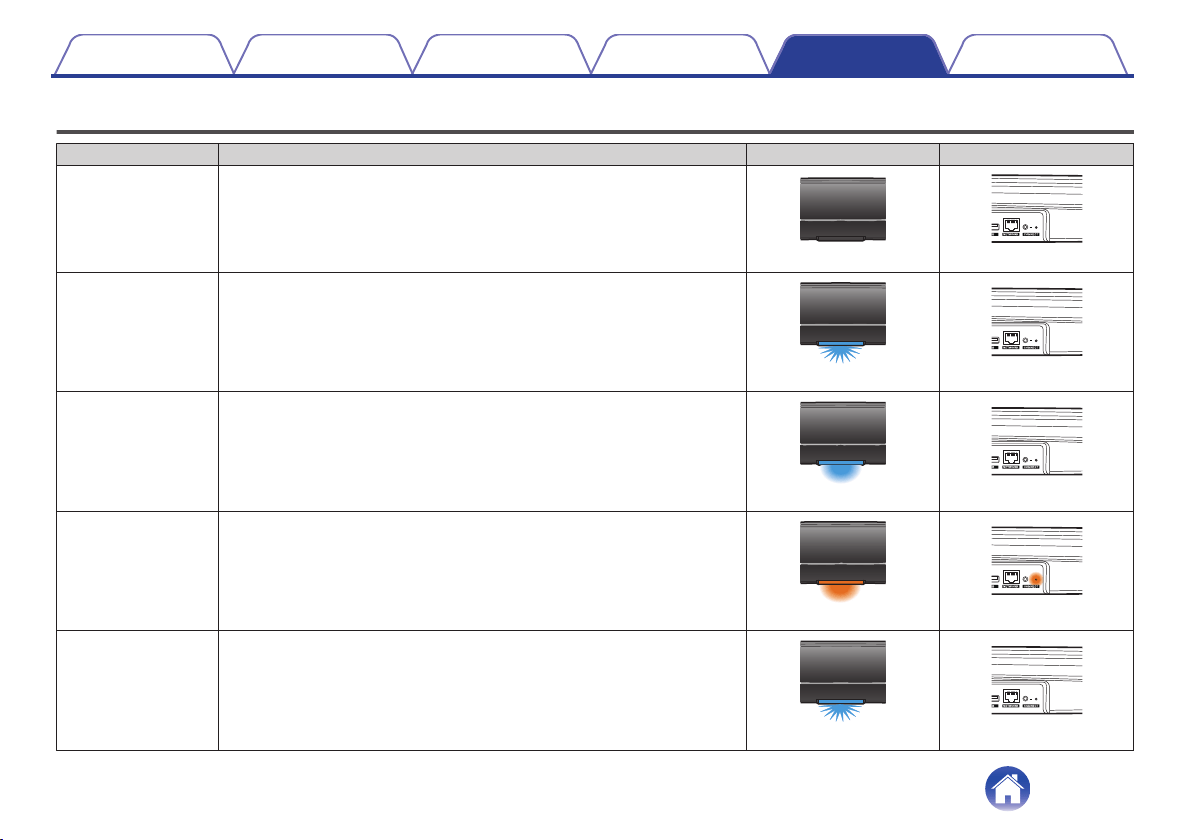
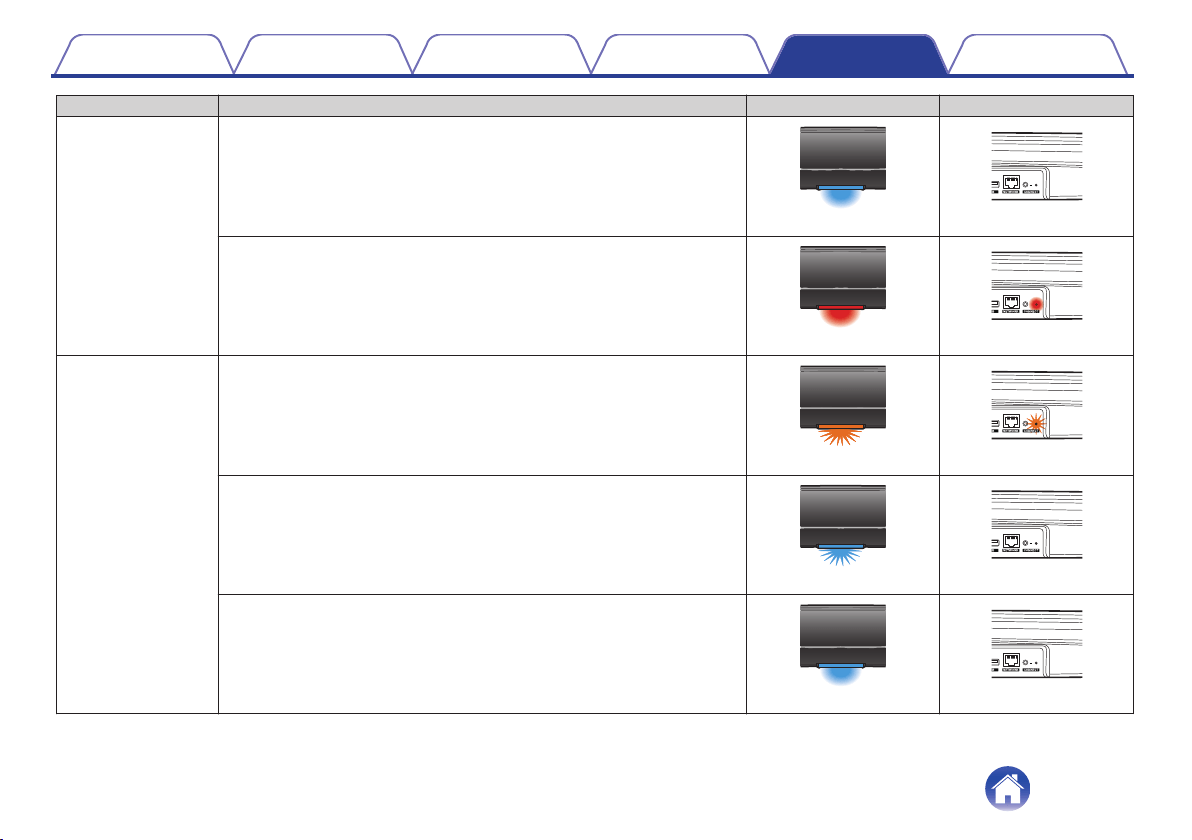
Status LED table
Device Operation Description Front LED Action Rear LED Action
Off No AC power or Deep Standby
.
(off)
.
(off)
Plug in Booting
.
(blink)
.
(off)
On Ready-Configured and connected to your network
.
(solid)
.
(off)
On Not Connected to your network
.
(solid)
.
(solid)
Change Network Connecting to your network
.
(blink)
.
(off)
Contents
Setup Use Troubleshooting Status LED Appendix
Status LED
68
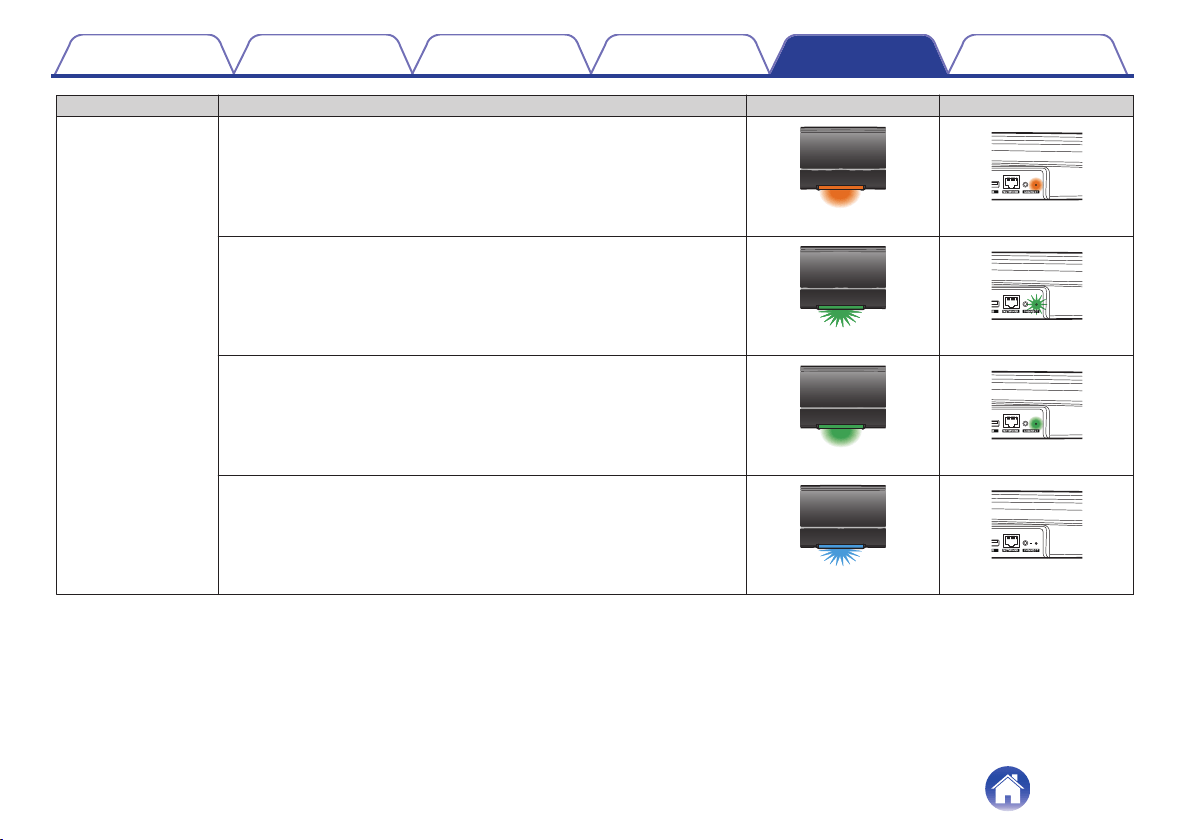
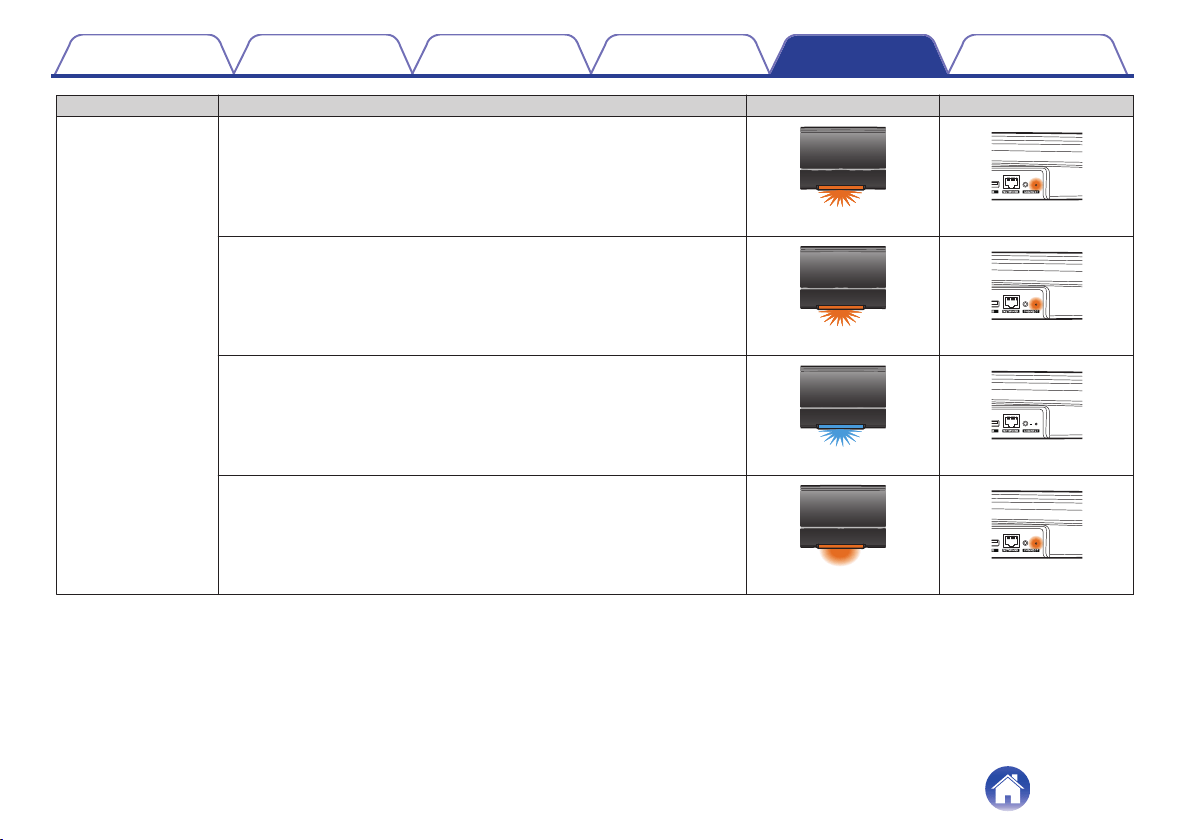
Device Operation Description Front LED Action Rear LED Action
Setup
Configured and connected to your network
.
(solid)
.
(off)
Error
.
(solid)
.
(solid)
Update
Updating
.
(blink)
.
(blink)
Rebooting
.
(blink)
.
(off)
Ready-Configured and connected to your network
.
(solid)
.
(off)
Contents
Setup Use Troubleshooting Status LED Appendix
70
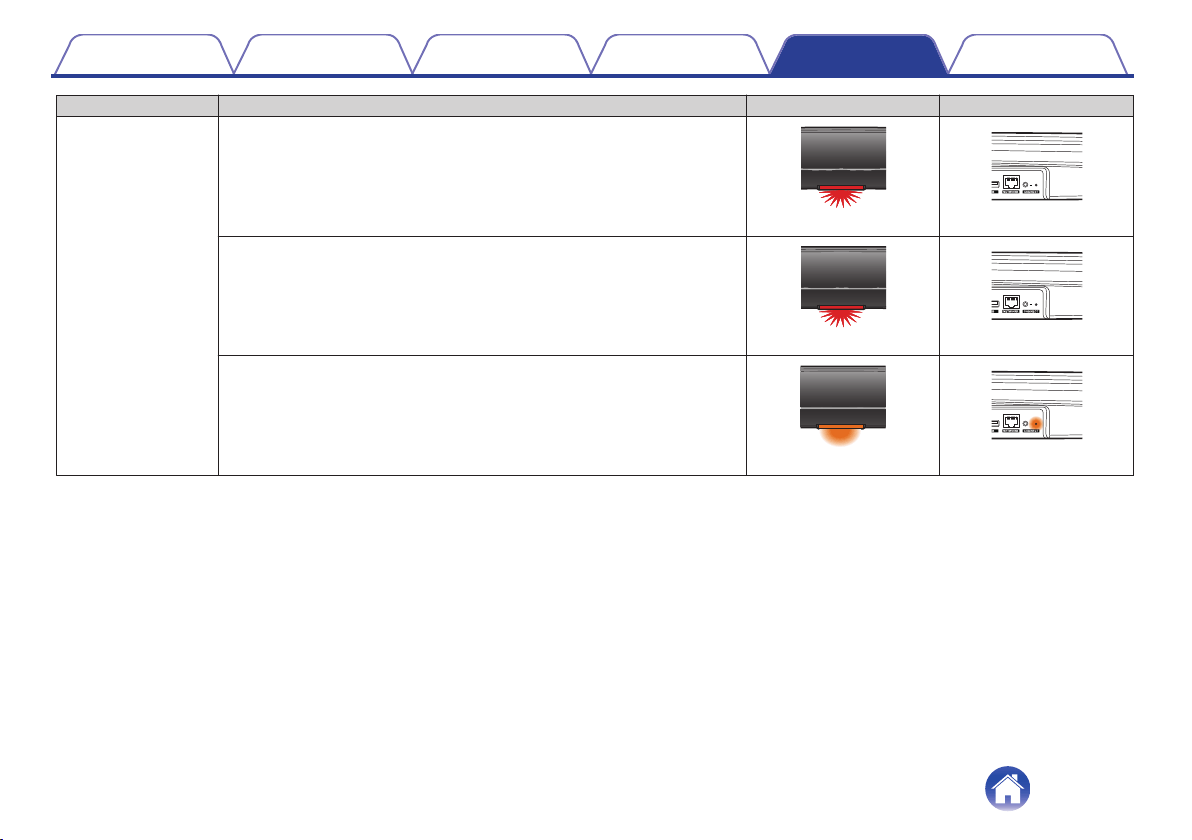
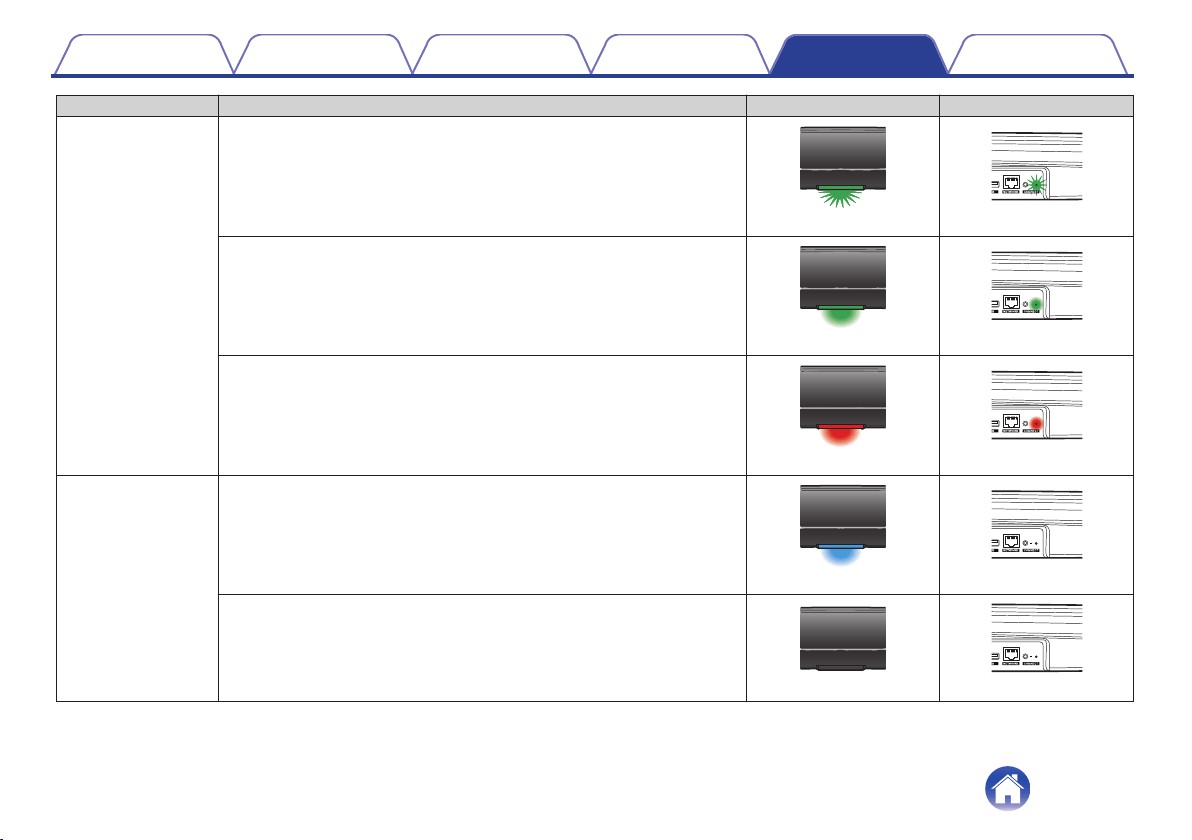
Device Operation Description Front LED Action Rear LED Action
WPS
a WPS session is active
.
(fast blink)
.
(fast blink)
WPS connected
.
(for 3 sec. solid)
.
(solid)
WPS time-out
.
(for 3 sec. solid)
.
(solid)
Power Management
Quick Start Mode
.
(dimmed solid)
.
(off)
Deep Standby
.
(off)
.
(off)
Contents
Setup Use Troubleshooting Status LED Appendix
73

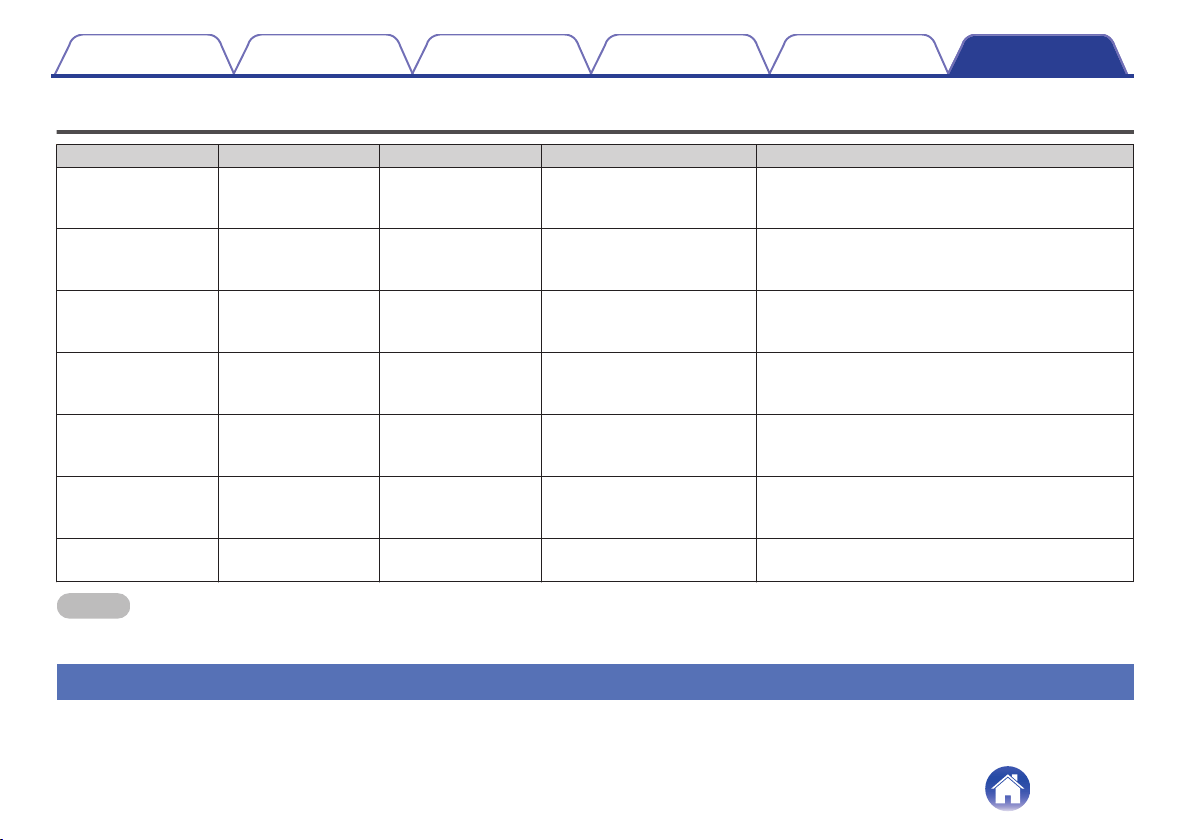
Supported file types and codecs
Frequency Sample Rate File Extension Codec Bit Rates
32/44.1/48
88.2/96/176.4
192 kHz
16/24 bit wav PCM ---
32 kHz
44.1 kHz
48 kHz
16 bit mp3
MPEG-1 Audio Layer 3
CBR/VBR
32 - 320 kbps
32 kHz
44.1 kHz
48 kHz
16 bit
m4a
aac
AAC-LC 48 - 320 kbps
32 kHz
44.1 kHz
48 kHz
16 bit wma
wma9
CBR
CBR:48 - 192 kbps
44.1/48
88.2/96/176.4
192 kHz
16/24 bit flac flac ---
44.1/48
88.2/96/176.4
192 kHz
16/24 bit m4a ALAC ---
2.8/5.6 MHz 1 bit
dff
dsf
DSDIFF
DSF
---
NOTE
0
Files protected by DRM such as Apple’s Fairplay DRM, are not supported.
0
The ALAC decoder is distributed under the Apache License, Version 2.0 (http://www.apache.org/licenses/LICENSE-2.0)
Supported audio formats (Coaxial/Optical)
2-channel Linear PCM:2-channel, 32 kHz – 192 kHz, 16/20/24 bit
Contents
Setup Use Troubleshooting Status LED Appendix
Appendix
75
Specifications
o
Wireless LAN section
Network type: Conforming to IEEE 802.11a/b/g/n/ac
Used frequency range: 2.4 GHz, 5 GHz
o
General
Operating temperature: 41 °F - 95 °F (5 °C - 35 °C)
Power supply: AC 100 - 240 V, 50/60 Hz
Power consumption: 50 W
Power consumption in Quick Start Mode: * 4.9 W (Wi-Fi)
3.7 W (Ethernet)
4.1 W (USB)
3.7 W (Bluetooth)
4.3 W (HDMI IN)
3.8 W (HDMI OUT(ARC))
Power consumption in Deep Standby Mode: * 0.4 W
*Cable to AUX IN must be disconnected to enter Quick Start Mode and Deep Standby Mode.
Contents
Setup Use Troubleshooting Status LED Appendix
76
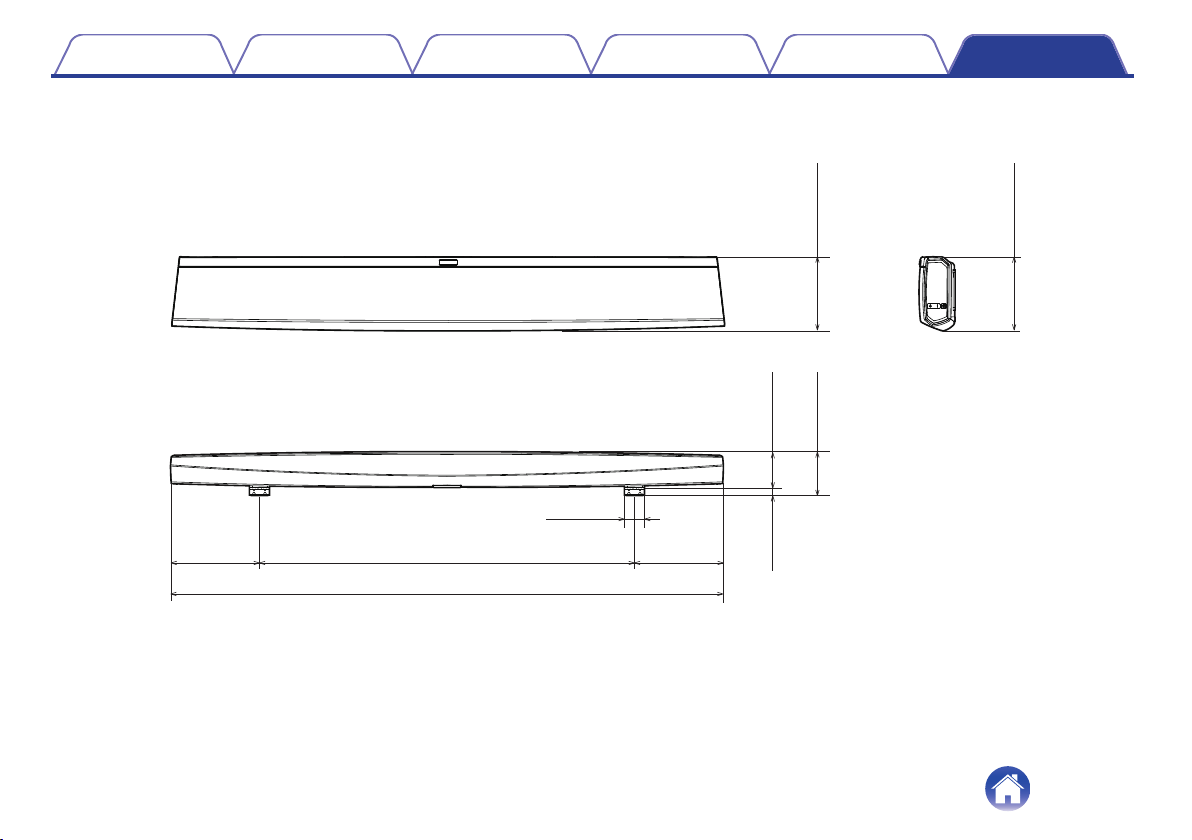
o
Dimensions (Unit : in. (mm))
.
5 7/8 (148)
5 7/8 (148)
3 1/2 (87)
2 7/8 (72)
5/8
(15)
1 5/8 (40)
7
(177.5)
29 3/8 (745)
7
(177.5)
43 3/8 (1100)
o
Weight : 10 lbs 9 oz (4.8 kg)
For the purpose of improvement, the specifications and design are subject to change without notice.
Contents
Setup Use Troubleshooting Status LED Appendix
77
Information
Trademarks
.
Manufactured under license from Dolby Laboratories. Dolby, Dolby
Audio, Pro Logic, and the double-D symbol are trademarks of Dolby
Laboratories.
.
For DTS patents, see http://patents.dts.com. Manufactured under license
from DTS Licensing Limited. DTS, DTS-HD, the Symbol, & DTS and the
Symbol together are registered trademarks of DTS, Inc. © DTS, Inc. All
Rights Reserved.
.
The terms HDMI, HDMI High-Definition Multimedia Interface, and the
HDMI Logo are trademarks or registered trademarks of HDMI Licensing
Administrator, Inc.
.
Google Play and the Google Play logo are trademarks of Google LLC.
.
Apple, the Apple logo, iPad, iPhone, and iPod touch are trademarks of
Apple Inc., registered in the U.S. and other countries. App Store is a
service mark of Apple Inc.
.
Amazon, Kindle, Echo, Alexa, Dash, Fire and all related logos are
trademarks of Amazon.com, Inc. or its affiliates.
Contents Setup Use Troubleshooting Status LED Appendix
78
License
o
License information for the software used in
the unit
About GPL (GNU-General Public License), LGPL (GNU Lesser
General Public License) License
This product uses GPL/LGPL software and software made by other
companies.
After you purchase this product, you may procure, modify or distribute
the source code of the GPL/LGPL software that is used in the product.
Denon provides the source code based on the GPL and LPGL
licenses at the actual cost upon your request to our customer service
center. However, note that we make no guarantees concerning the
source code. Please also understand that we do not offer support for
the contents of the source code.
This section describes software license used for this unit. To maintain
the correct content, the original (English) is used.
n
GPL
Open Source Used Version
bridge-utils 2.8
busybox 1.21.1
ebtables 2.0.10-4
Linux kernel 3.10.74
mtd-utils 1.4.3
ntfs-3g_ntfsprogs 2011.4.12
ntpclient 2007
u-boot 2015.01
wireless-tools version 29
n
LGPL
Open Source Used Version
ffmpeg 0.8.3
glibc 2.9
libmms 0.6.2
n
curl-7.24.0
COPYRIGHT AND PERMISSION NOTICE
Copyright (c) 1996 - 2014, Daniel Stenberg, <
All rights reserved.
Permission to use, copy, modify, and distribute this software for any
purpose with or without fee is hereby granted, provided that the above
copyright notice and this permission notice appear in all copies.
THE SOFTWARE IS PROVIDED "AS IS", WITHOUT WARRANTY OF
ANY KIND, EXPRESS OR IMPLIED, INCLUDING BUT NOT LIMITED
TO THE WARRANTIES OF MERCHANTABILITY, FITNESS FOR A
PARTICULAR PURPOSE AND NONINFRINGEMENT OF THIRD
PARTY RIGHTS. IN NO EVENT SHALL THE AUTHORS OR
COPYRIGHT HOLDERS BE LIABLE FOR ANY CLAIM, DAMAGES
OR OTHER LIABILITY, WHETHER IN AN ACTION OF CONTRACT,
TORT OR OTHERWISE, ARISING FROM, OUT OF OR IN
CONNECTION WITH THE SOFTWARE OR THE USE OR OTHER
DEALINGS IN THE SOFTWARE.
Except as contained in this notice, the name of a copyright holder shall
not be used in advertising or otherwise to promote the sale, use or
other dealings in this Software without prior written authorization of the
copyright holder.
Contents
Setup Use Troubleshooting Status LED Appendix
80

n
e2fsprogs-libs-1.40.8/lib/uuid
Redistribution and use in source and binary forms, with or without
modification, are permitted provided that the following conditions are
met:
1. Redistributions of source code must retain the above copyright
notice, and the entire permission notice in its entirety, including the
disclaimer of warranties.
2. Redistributions in binary form must reproduce the above copyright
notice, this list of conditions and the following disclaimer in the
documentation and/or other materials provided with the distribution.
3. The name of the author may not be used to endorse or promote
products derived from this software without specific prior written
permission.
THIS SOFTWARE IS PROVIDED "AS IS" AND ANY EXPRESS OR
IMPLIED WARRANTIES, INCLUDING, BUT NOT LIMITED TO, THE
IMPLIED WARRANTIES OF MERCHANTABILITY AND FITNESS
FOR A PARTICULAR PURPOSE, ALL OF WHICH ARE HEREBY
DISCLAIMED. IN NO EVENT SHALL THE AUTHOR BE LIABLE FOR
ANY DIRECT, INDIRECT, INCIDENTAL, SPECIAL, EXEMPLARY, OR
CONSEQUENTIAL DAMAGES (INCLUDING, BUT NOT LIMITED TO,
PROCUREMENT OF SUBSTITUTE GOODS OR SERVICES; LOSS
OF USE, DATA, OR PROFITS; OR BUSINESS INTERRUPTION)
HOWEVER CAUSED AND ON ANY THEORY OF LIABILITY,
WHETHER IN CONTRACT, STRICT LIABILITY, OR TORT
(INCLUDING NEGLIGENCE OR OTHERWISE) ARISING IN ANY
WAY OUT OF THE USE OF THIS SOFTWARE, EVEN IF NOT
ADVISED OF THE POSSIBILITY OF SUCH DAMAGE.
n
expat-2.0.1
Copyright (c) 1998, 1999, 2000 Thai Open Source Software Center Ltd
and Clark Cooper
Copyright (c) 2001, 2002, 2003, 2004, 2005, 2006 Expat maintainers.
Permission is hereby granted, free of charge, to any person obtaining a
copy of this software and associated documentation files (the
"Software"), to deal in the Software without restriction, including
without limitation the rights to use, copy, modify, merge, publish,
distribute, sublicense, and/or sell copies of the Software, and to permit
persons to whom the Software is furnished to do so, subject to the
following conditions:
The above copyright notice and this permission notice shall be
included in all copies or substantial portions of the Software.
THE SOFTWARE IS PROVIDED "AS IS", WITHOUT WARRANTY OF
ANY KIND, EXPRESS OR IMPLIED, INCLUDING BUT NOT LIMITED
TO THE WARRANTIES OF MERCHANTABILITY, FITNESS FOR A
PARTICULAR PURPOSE AND NONINFRINGEMENT.
IN NO EVENT SHALL THE AUTHORS OR COPYRIGHT HOLDERS
BE LIABLE FOR ANY CLAIM, DAMAGES OR OTHER LIABILITY,
WHETHER IN AN ACTION OF CONTRACT, TORT OR OTHERWISE,
ARISING FROM, OUT OF OR IN CONNECTION WITH THE
SOFTWARE OR THE USE OR OTHER DEALINGS IN THE
SOFTWARE.
Contents
Setup Use Troubleshooting Status LED Appendix
81

n
getopt
http://cvsweb.netbsd.org/bsdweb.cgi/src/lib/libc/stdlib/
Copyright (c) 1987, 1993, 1994 The Regents of the University of
California. All rights reserved.
Redistribution and use in source and binary forms, with or without
modification, are permitted provided that the following conditions are
met:
1. Redistributions of source code must retain the above copyright
notice, this list of conditions and the following disclaimer.
2. Redistributions in binary form must reproduce the above copyright
notice, this list of conditions and the following disclaimer in the
documentation and/or other materials provided with the distribution.
3. Neither the name of the University nor the names of its contributors
may be used to endorse or promote products derived from this
software without specific prior written permission.
THIS SOFTWARE IS PROVIDED BY THE REGENTS AND
CONTRIBUTORS "AS IS" AND ANY EXPRESS OR IMPLIED
WARRANTIES, INCLUDING, BUT NOT LIMITED TO, THE IMPLIED
WARRANTIES OF MERCHANTABILITY AND FITNESS FOR A
PARTICULAR PURPOSE ARE DISCLAIMED. IN NO EVENT SHALL
THE REGENTS OR CONTRIBUTORS BE LIABLE FOR ANY DIRECT,
INDIRECT, INCIDENTAL, SPECIAL, EXEMPLARY, OR
CONSEQUENTIAL DAMAGES (INCLUDING, BUT NOT LIMITED TO,
PROCUREMENT OF SUBSTITUTE GOODS OR SERVICES; LOSS
OF USE, DATA, OR PROFITS; OR BUSINESS INTERRUPTION)
HOWEVER CAUSED AND ON ANY THEORY OF LIABILITY,
WHETHER IN CONTRACT, STRICT LIABILITY, OR TORT
(INCLUDING NEGLIGENCE OR OTHERWISE) ARISING IN ANY
WAY OUT OF THE USE OF THIS SOFTWARE, EVEN IF ADVISED
OF THE POSSIBILITY OF SUCH DAMAGE.
n
jQuery
Copyright 2014 jQuery Foundation and other contributors
http://jquery.com/
Permission is hereby granted, free of charge, to any person obtaining a
copy of this software and associated documentation files (the
"Software"), to deal in the Software without restriction, including
without limitation the rights to use, copy, modify, merge, publish,
distribute, sublicense, and/or sell copies of the Software, and to permit
persons to whom the Software is furnished to do so, subject to the
following conditions:
The above copyright notice and this permission notice shall be
included in all copies or substantial portions of the Software.
THE SOFTWARE IS PROVIDED "AS IS", WITHOUT WARRANTY OF
ANY KIND, EXPRESS OR IMPLIED, INCLUDING BUT NOT LIMITED
TO THE WARRANTIES OF MERCHANTABILITY, FITNESS FOR A
PARTICULAR PURPOSE AND NONINFRINGEMENT. IN NO EVENT
SHALL THE AUTHORS OR COPYRIGHT HOLDERS BE LIABLE FOR
ANY CLAIM, DAMAGES OR OTHER LIABILITY, WHETHER IN AN
ACTION OF CONTRACT, TORT OR OTHERWISE, ARISING FROM,
OUT OF OR IN CONNECTION WITH THE SOFTWARE OR THE USE
OR OTHER DEALINGS IN THE SOFTWARE.
Contents
Setup Use Troubleshooting Status LED Appendix
82

n
libpcap-1.4.0
License: BSD
Redistribution and use in source and binary forms, with or without
modification, are permitted provided that the following conditions are
met:
1. Redistributions of source code must retain the above copyright
notice, this list of conditions and the following disclaimer.
2. Redistributions in binary form must reproduce the above copyright
notice, this list of conditions and the following disclaimer in the
documentation and/or other materials provided with the distribution.
3. The names of the authors may not be used to endorse or promote
products derived from this software without specific prior written
permission.
THIS SOFTWARE IS PROVIDED "AS IS" AND WITHOUT ANY
EXPRESS OR IMPLIED WARRANTIES, INCLUDING, WITHOUT
LIMITATION, THE IMPLIED WARRANTIES OF MERCHANTABILITY
AND FITNESS FOR A PARTICULAR PURPOSE.
n
libtar-1.2.11
Copyright (c) 1998-2003 University of Illinois Board of Trustees
Copyright (c) 1998-2003 Mark D. Roth
All rights reserved.
Developed by: Campus Information Technologies and Educational
Services, University of Illinois at Urbana-Champaign
Permission is hereby granted, free of charge, to any person obtaining a
copy of this software and associated documentation files (the "Software"),
to deal with the Software without restriction, including without limitation
the rights to use, copy, modify, merge, publish, distribute, sublicense,
and/or sell copies of the Software, and to permit persons to whom the
Software is furnished to do so, subject to the following conditions:
z
Redistributions of source code must retain the above copyright
notice, this list of conditions and the following disclaimers.
z
Redistributions in binary form must reproduce the above copyright
notice, this list of conditions and the following disclaimers in the
documentation and/or other materials provided with the distribution.
z
Neither the names of Campus Information Technologies and
Educational Services, University of Illinois at Urbana-Champaign,
nor the names of its contributors may be used to endorse or promote
products derived from this Software without specific prior written
permission.
THE SOFTWARE IS PROVIDED "AS IS", WITHOUT WARRANTY OF
ANY KIND, EXPRESS OR IMPLIED, INCLUDING BUT NOT LIMITED TO
THE WARRANTIES OF MERCHANTABILITY, FITNESS FOR A
PARTICULAR PURPOSE AND NONINFRINGEMENT.
IN NO EVENT SHALL THE CONTRIBUTORS OR COPYRIGHT
HOLDERS BE LIABLE FOR ANY CLAIM, DAMAGES OR OTHER
LIABILITY, WHETHER IN AN ACTION OF CONTRACT, TORT OR
OTHERWISE, ARISING FROM, OUT OF OR IN CONNECTION WITH
THE SOFTWARE OR THE USE OR OTHER DEALINGS WITH THE
SOFTWARE.
Contents
Setup Use Troubleshooting Status LED Appendix
83

n
mDNS 320.10.80
The majority of the source code in the mDNSResponder project is licensed
under the terms of the Apache License, Version 2.0, available from:
<http://www.apache.org/licenses/LICENSE-2.0>
To accommodate license compatibility with the widest possible range
of client code licenses, the shared library code, which is linked at
runtime into the same address space as the client using it, is licensed
under the terms of the "Three-Clause BSD License".
The Linux Name Service Switch code, contributed by National ICT
Australia Ltd (NICTA) is licensed under the terms of the NICTA Public
Software Licence (which is substantially similar to the "Three-Clause BSD
License", with some additional language pertaining to Australian law).
n
mongoose
https://github.com/cesanta/mongoose/
Copyright (c) 2004-2013 Sergey Lyubka
Permission is hereby granted, free of charge, to any person obtaining a
copy of this software and associated documentation files (the
"Software"), to deal in the Software without restriction, including
without limitation the rights to use, copy, modify, merge, publish,
distribute, sublicense, and/or sell copies of the Software, and to permit
persons to whom the Software is furnished to do so, subject to the
following conditions:
The above copyright notice and this permission notice shall be
included in all copies or substantial portions of the Software.
THE SOFTWARE IS PROVIDED "AS IS", WITHOUT WARRANTY OF
ANY KIND, EXPRESS OR IMPLIED, INCLUDING BUT NOT LIMITED
TO THE WARRANTIES OF MERCHANTABILITY, FITNESS FOR A
PARTICULAR PURPOSE AND NONINFRINGEMENT. IN NO EVENT
SHALL THE AUTHORS OR COPYRIGHT HOLDERS BE LIABLE FOR
ANY CLAIM, DAMAGES OR OTHER LIABILITY, WHETHER IN AN
ACTION OF CONTRACT, TORT OR OTHERWISE, ARISING FROM,
OUT OF OR IN CONNECTION WITH THE SOFTWARE OR THE USE
OR OTHER DEALINGS IN THE SOFTWARE.
Contents
Setup Use Troubleshooting Status LED Appendix
84

n
openssl-1.0.0d
Copyright (c) 1998-2011 The OpenSSL Project. All rights reserved.
Redistribution and use in source and binary forms, with or without
modification, are permitted provided that the following conditions are
met:
1. Redistributions of source code must retain the above copyright
notice, this list of conditions and the following disclaimer.
2. Redistributions in binary form must reproduce the above copyright
notice, this list of conditions and the following disclaimer in the
documentation and/or other materials provided with the distribution.
3. All advertising materials mentioning features or use of this software
must display the following acknowledgment:
"This product includes software developed by the OpenSSL Project
for use in the OpenSSL Toolkit. (
http://www.openssl.org/)”
4. The names "OpenSSL Toolkit" and "OpenSSL Project" must not be
used to endorse or promote products derived from this software
without prior written permission. For written permission, please
contact
5. Products derived from this software may not be called "OpenSSL"
nor may "OpenSSL" appear in their names without prior written
permission of the OpenSSL Project.
6. Redistributions of any form whatsoever must retain the following
acknowledgment:
"This product includes software developed by the OpenSSL Project
for use in the OpenSSL Toolkit (
http://www.openssl.org/)”
THIS SOFTWARE IS PROVIDED BY THE OpenSSL PROJECT "AS
IS" AND ANY EXPRESSED OR IMPLIED WARRANTIES,
INCLUDING, BUT NOT LIMITED TO, THE IMPLIED WARRANTIES
OF MERCHANTABILITY AND FITNESS FOR A PARTICULAR
PURPOSE ARE DISCLAIMED. IN NO EVENT SHALL THE OpenSSL
PROJECT OR ITS CONTRIBUTORS BE LIABLE FOR ANY DIRECT,
INDIRECT, INCIDENTAL, SPECIAL, EXEMPLARY, OR
CONSEQUENTIAL DAMAGES (INCLUDING, BUT NOT LIMITED TO,
PROCUREMENT OF SUBSTITUTE GOODS OR SERVICES; LOSS
OF USE, DATA, OR PROFITS; OR BUSINESS INTERRUPTION)
HOWEVER CAUSED AND ON ANY THEORY OF LIABILITY,
WHETHER IN CONTRACT, STRICT LIABILITY, OR TORT
(INCLUDING NEGLIGENCE OR OTHERWISE) ARISING IN ANY
WAY OUT OF THE USE OF THIS SOFTWARE, EVEN IF ADVISED
OF THE POSSIBILITY OF SUCH DAMAGE.
This product includes cryptographic software written by Eric Young
(
[email protected]). This product includes software written by Tim
Hudson ([email protected]).
Contents
Setup Use Troubleshooting Status LED Appendix
85

n
portmap-6.0
Copyright (c) 1990 The Regents of the University of California.
z
All rights reserved.
z
Redistribution and use in source and binary forms, with or without
modification, are permitted provided that the following conditions are met:
1. Redistributions of source code must retain the above copyright
notice, this list of conditions and the following disclaimer.
2. Redistributions in binary form must reproduce the above copyright
notice, this list of conditions and the following disclaimer in the
documentation and/or other materials provided with the distribution.
3. A ll advertising materials mentioning features or use of this software
must display the following acknowledgement:
This product includes software developed by the University of
California, Berkeley and its contributors.
4. Neither the name of the University nor the names of its contributors
may be used to endorse or promote products derived from this
software without specific prior written permission.
z
THIS SOFTWARE IS PROVIDED BY THE REGENTS AND
CONTRIBUTORS "AS IS" AND ANY EXPRESS OR IMPLIED
WARRANTIES, INCLUDING, BUT NOT LIMITED TO, THE IMPLIED
WARRANTIES OF MERCHANTABILITY AND FITNESS FOR A
PARTICULAR PURPOSE ARE DISCLAIMED. IN NO EVENT SHALL
THE REGENTS OR CONTRIBUTORS BE LIABLE FOR ANY DIRECT,
INDIRECT, INCIDENTAL, SPECIAL, EXEMPLARY, OR
CONSEQUENTIAL DAMAGES (INCLUDING, BUT NOT LIMITED TO,
PROCUREMENT OF SUBSTITUTE GOODS OR SERVICES; LOSS OF
USE, DATA, OR PROFITS; OR BUSINESS INTERRUPTION)
HOWEVER CAUSED AND ON ANY THEORY OF LIABILITY, WHETHER
IN CONTRACT, STRICT LIABILITY, OR TORT (INCLUDING
NEGLIGENCE OR OTHERWISE) ARISING IN ANY WAY OUT OF THE
USE OF THIS SOFTWARE, EVEN IF ADVISED OF THE POSSIBILITY
OF SUCH DAMAGE.
n
pstdint.h-0.1.12
z
BSD License:
z
Copyright (c) 2005-2011 Paul Hsieh
z
All rights reserved.
z
Redistribution and use in source and binary forms, with or without
modification, are permitted provided that the following conditions are
met:
1. Redistributions of source code must retain the above copyright
notice, this list of conditions and the following disclaimer.
2. Redistributions in binary form must reproduce the above copyright
notice, this list of conditions and the following disclaimer in the
documentation and/or other materials provided with the distribution.
3. The name of the author may not be used to endorse or promote
products derived from this software without specific prior written
permission.
z
THIS SOFTWARE IS PROVIDED BY THE AUTHOR "AS IS" AND
ANY EXPRESS OR IMPLIED WARRANTIES, INCLUDING, BUT
NOT LIMITED TO, THE IMPLIED WARRANTIES OF
MERCHANTABILITY AND FITNESS FOR A PARTICULAR
PURPOSE ARE DISCLAIMED.
z
IN NO EVENT SHALL THE AUTHOR BE LIABLE FOR ANY
DIRECT, INDIRECT, INCIDENTAL, SPECIAL, EXEMPLARY, OR
CONSEQUENTIAL DAMAGES (INCLUDING, BUT NOT LIMITED
TO, PROCUREMENT OF SUBSTITUTE GOODS OR SERVICES;
LOSS OF USE, DATA, OR PROFITS; OR BUSINESS
INTERRUPTION) HOWEVER CAUSED AND ON ANY THEORY OF
LIABILITY, WHETHER IN CONTRACT, STRICT LIABILITY, OR
TORT (INCLUDING NEGLIGENCE OR OTHERWISE) ARISING IN
ANY WAY OUT OF THE USE OF THIS SOFTWARE, EVEN IF
ADVISED OF THE POSSIBILITY OF SUCH DAMAGE.
Contents
Setup Use Troubleshooting Status LED Appendix
86

n
rl78flash 2000.3.1
License
=======
The MIT License (MIT)
Copyright (c) 2012 Maxim Salov
Permission is hereby granted, free of charge, to any person obtaining a
copy of this software and associated documentation files (the
"Software"), to deal in the Software without restriction, including
without limitation the rights to use, copy, modify, merge, publish,
distribute, sublicense, and/or sell copies of the Software, and to permit
persons to whom the Software is furnished to do so, subject to the
following conditions:
The above copyright notice and this permission notice shall be
included in all copies or substantial portions of the Software.
THE SOFTWARE IS PROVIDED "AS IS", WITHOUT WARRANTY OF
ANY KIND, EXPRESS OR IMPLIED, INCLUDING BUT NOT LIMITED
TO THE WARRANTIES OF MERCHANTABILITY, FITNESS FOR A
PARTICULAR PURPOSE AND NONINFRINGEMENT. IN NO EVENT
SHALL THE AUTHORS OR COPYRIGHT HOLDERS BE LIABLE FOR
ANY CLAIM, DAMAGES OR OTHER LIABILITY, WHETHER IN AN
ACTION OF CONTRACT, TORT OR OTHERWISE, ARISING FROM,
OUT OF OR IN CONNECTION WITH THE SOFTWARE OR THE USE
OR OTHER DEALINGS IN THE SOFTWARE.
n
sqlite 2003.5.7
SQLite Copyright
SQLite is in the
Public Domain
All of the code and documentation in SQLite has been dedicated to the
public domain by the authors. All code authors, and representatives of
the companies they work for, have signed affidavits dedicating their
contributions to the public domain and originals of those signed
affidavits are stored in a firesafe at the main offices of Hwaci. Anyone
is free to copy, modify, publish, use, compile, sell, or distribute the
original SQLite code, either in source code form or as a compiled
binary, for any purpose, commercial or non-commercial, and by any
means.
The previous paragraph applies to the deliverable code and
documentation in SQLite - those parts of the SQLite library that you
actually bundle and ship with a larger application. Some scripts used
as part of the build process (for example the "configure" scripts
generated by autoconf) might fall under other open-source licenses.
Nothing from these build scripts ever reaches the final deliverable
SQLite library, however, and so the licenses associated with those
scripts should not be a factor in assessing your rights to copy and use
the SQLite library.
All of the deliverable code in SQLite has been written from scratch. No
code has been taken from other projects or from the open internet.
Every line of code can be traced back to its original author, and all of
those authors have public domain dedications on file. So the SQLite
code base is clean and is uncontaminated with licensed code from
other projects.
Contents
Setup Use Troubleshooting Status LED Appendix
87

n
strlcpy.c , v1.11
z
Copyright (c) 1998 Todd C. Miller <[email protected]>
z
Permission to use, copy, modify, and distribute this software for any
purpose with or without fee is hereby granted, provided that the
above copyright notice and this permission notice appear in all
copies.
z
THE SOFTWARE IS PROVIDED "AS IS" AND THE AUTHOR
DISCLAIMS ALL WARRANTIES WITH REGARD TO THIS
SOFTWARE INCLUDING ALL IMPLIED WARRANTIES OF
MERCHANTABILITY AND FITNESS. IN NO EVENT SHALL THE
AUTHOR BE LIABLE FOR ANY SPECIAL, DIRECT, INDIRECT, OR
CONSEQUENTIAL DAMAGES OR ANY DAMAGES
WHATSOEVER RESULTING FROM LOSS OF USE, DATA OR
PROFITS, WHETHER IN AN ACTION OF CONTRACT,
NEGLIGENCE OR OTHER TORTIOUS ACTION, ARISING OUT OF
OR IN CONNECTION WITH THE USE OR PERFORMANCE OF
THIS SOFTWARE.
n
taglib-1.5
copyright : (C) 2002 - 2008 by Scott Wheeler
email :
"The contents of this file are subject to the Mozilla Public License
Version 1.1 (the "License"); you may not use this file except in
compliance with the License. You may obtain a copy of the License at
http://www.mozilla.org/MPL/
Software distributed under the License is distributed on an "AS IS"
basis, WITHOUT WARRANTY OF ANY KIND, either express or
implied. See the License for the specific language governing rights and
limitations under the License.
n
tinyxml 2002.4.3
www.sourceforge.net/projects/tinyxml
Original file by Yves Berquin.
This software is provided 'as-is', without any express or implied
warranty. In no event will the authors be held liable for any damages
arising from the use of this software.
Permission is granted to anyone to use this software for any purpose,
including commercial applications, and to alter it and redistribute it
freely, subject to the following restrictions:
1. The origin of this software must not be misrepresented; you must
not claim that you wrote the original software. If you use this
software in a product, an acknowledgment in the product
documentation would be appreciated but is not required.
2. Altered source versions must be plainly marked as such, and must
not be misrepresented as being the original software.
3. This notice may not be removed or altered from any source
distribution.
Contents Setup Use Troubleshooting Status LED Appendix
88

n
Tremor
http://wiki.xiph.org/index.php/Tremor
Copyright (c) 2002, Xiph.org Foundation
Redistribution and use in source and binary forms, with or without
modification, are permitted provided that the following conditions are
met:
1. Redistributions of source code must retain the above copyright
notice, this list of conditions and the following disclaimer.
2. Redistributions in binary form must reproduce the above copyright
notice, this list of conditions and the following disclaimer in the
documentation and/or other materials provided with the distribution.
3. Neither the name of the Xiph.org Foundation nor the names of its
contributors may be used to endorse or promote products derived
from this software without specific prior written permission.
THIS SOFTWARE IS PROVIDED BY THE COPYRIGHT HOLDERS
AND CONTRIBUTORS "AS IS" AND ANY EXPRESS OR IMPLIED
WARRANTIES, INCLUDING, BUT NOT LIMITED TO, THE IMPLIED
WARRANTIES OF MERCHANTABILITY AND FITNESS FOR A
PARTICULAR PURPOSE ARE DISCLAIMED. IN NO EVENT SHALL
THE FOUNDATION OR CONTRIBUTORS BE LIABLE FOR ANY
DIRECT, INDIRECT, INCIDENTAL, SPECIAL, EXEMPLARY, OR
CONSEQUENTIAL DAMAGES (INCLUDING, BUT NOT LIMITED TO,
PROCUREMENT OF SUBSTITUTE GOODS OR SERVICES; LOSS
OF USE, DATA, OR PROFITS; OR BUSINESS INTERRUPTION)
HOWEVER CAUSED AND ON ANY THEORY OF LIABILITY,
WHETHER IN CONTRACT, STRICT LIABILITY, OR TORT
(INCLUDING NEGLIGENCE OR OTHERWISE) ARISING IN ANY
WAY OUT OF THE USE OF THIS SOFTWARE, EVEN IF ADVISED
OF THE POSSIBILITY OF SUCH DAMAGE.
n
zlib
http://www.zlib.net/
zlib.h -- interface of the 'zlib' general purpose compression library
version 1.2.3, July 18th, 2005
Copyright (C) 1995-2004 Jean-loup Gailly and Mark Adler
This software is provided 'as-is', without any express or implied
warranty. In no event will the authors be held liable for any damages
arising from the use of this software.
Permission is granted to anyone to use this software for any purpose,
including commercial applications, and to alter it and redistribute it
freely, subject to the following restrictions:
1. The origin of this software must not be misrepresented; you must
not claim that you wrote the original software. If you use this
software in a product, an acknowledgment in the product
documentation would be appreciated but is not required.
2. Altered source versions must be plainly marked as such, and must
not be misrepresented as being the original software.
3. This notice may not be removed or altered from any source
distribution.
Jean-loup Gailly [email protected], Mark Adler
Contents
Setup Use Troubleshooting Status LED Appendix
89


.
www.denon.com
3520 10714 00AD
Copyright © 2019 D&M Holdings Inc. All Rights Reserved.
91