IT
Soffiatore portatile da giardino alimentato a batteria
MANUALE DI ISTRUZIONI
ATTENZIONE: prima di usare la macchina, leggere attentamente il presente libretto.
EN
Portable battery-powered garden blower
OPERATOR’S MANUAL
WARNING: read thoroughly the instruction booklet before using this machine.
171506799/3EN 03/2023
BL 20 Li S
BL 20 Li A

ITALIANO - Istruzioni Originali ...................................................................................................
IT
ENGLISH - Translation of the original instruction ..........................................................................
EN
B
IMPORTER FOR UK
4
E
A
D
A
C
B
1
dB
L
WA
1
2
7
6
3
4
8
5
Art.N.
Max Voltage:
- s/n
V
Rated Voltage:
Type
V
/min
9
2
BL 20 Li A
BL 20 Li S
I
II
III
A
B
C
D
E
E
F
3
4
5
A
A .1
A . 2
A . 3
A
A
6
BL 20 Li A
BL 20 Li S
7
A . 2
A . 3
8
9
A . 1
10
BL 20 Li A
I
11 12
13
BL 20 Li S
14
II
III
15 16
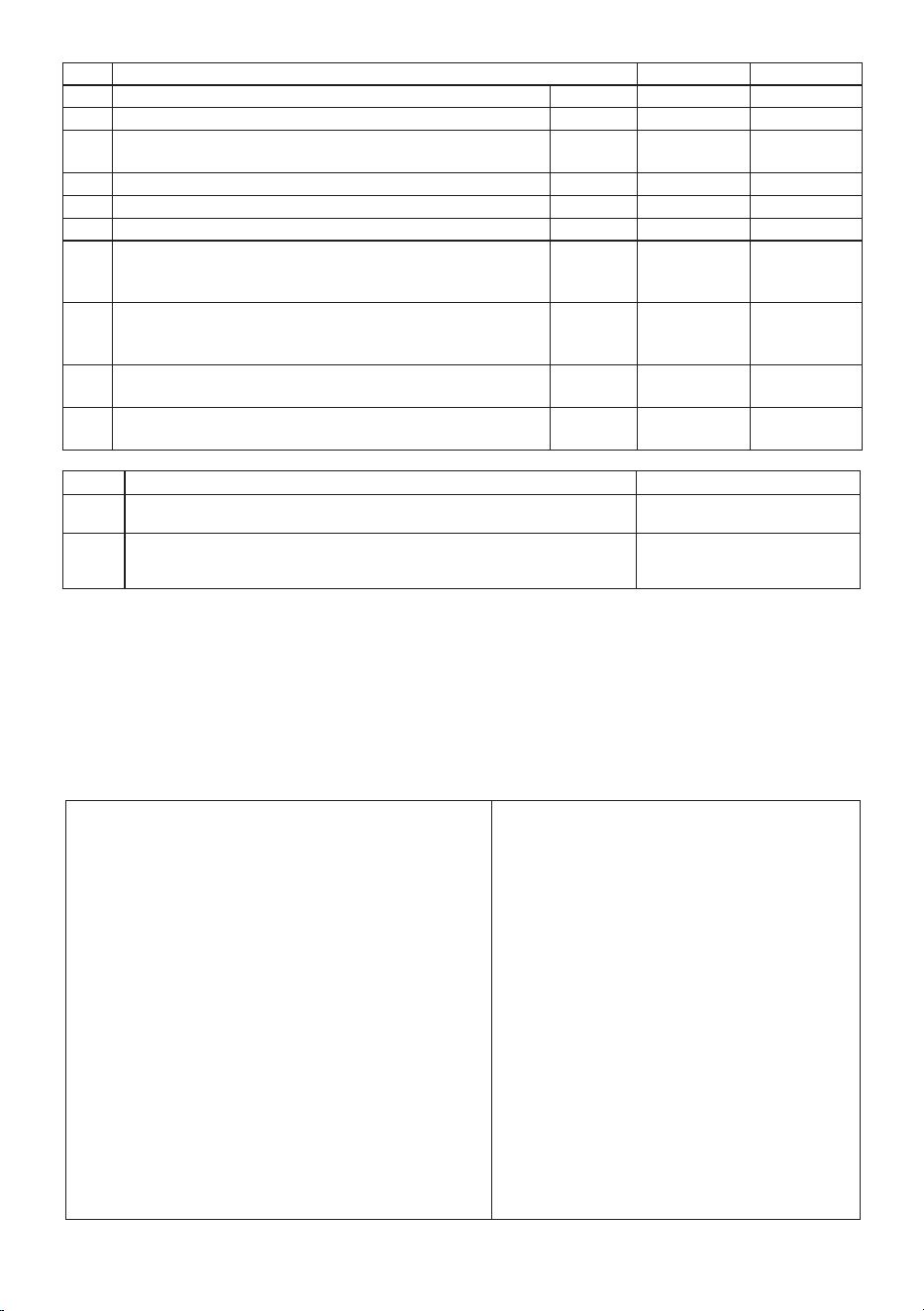
�1� DATI TECNICI BL 20 Li S BL 20 Li A
�2� Tensione di alimentazione MAX V / d.c. 20 20
�3� Tensione di alimentazione NOMINAL V / d.c. 18 18
�4�
Velocità senza carico (tensione di alimentazione
NOMINAL)
/min 13000 13000
�5� Velocità massima dell’aria km/h 115,2 115,2
�6� Flusso d’aria m
3
/s 0,15 0,15
�7� Peso senza gruppo batteria kg 1,7 1,6
�8�
�9�
Livello di pressione acustica misurato (in base alla EN
50636-2-100)
Incertezza di misura
dB(A)
dB(A)
77,2
3
77,2
3
�10�
�9�
Livello di potenza acustica misurato (in base alla EN
50636-2-100)
Incertezza di misura
dB(A)
dB(A)
90,6
0,89
90,6
0,89
�11�
Livello di potenza acustica garantito (in base alla
2000/14/EC)
dB(A) 92 92
�12�
�19�
Livello di vibrazioni (in base alla EN 50636-2-100)
Incertezza di misura
m/s
2
m/s
2
0,83
1,5
0,83
1,5
�13� ACCESSORI A RICHIESTA
�14� Gruppo batteria, mod.
BT 20 Li 2.0 S
BT 20 Li 4.0 S
�15� Carica batteria, mod.
CG 20 Li
CGD 20 Li
CGW 20 Li
a) NOTA: il valore totale dichiarato delle vibrazioni è stato misurato attenendosi ad un metodo normalizzato di prova e
può essere utilizzato per fare un paragone tra un utensile e l’altro. Il valore totale delle vibrazioni può essere
utilizzato anche in una valutazione preliminare dell’esposizione.
b) AVVERTENZA: l’emissione di vibrazioni nell’uso eettivo dell’utensile può essere diversa dal valore totale dichiarato
a seconda dei modi in cui si utilizza l’utensile. Pertanto è necessario, durante il lavoro, adottare
le seguenti misure di sicurezza volte a proteggere l’operatore: indossare guanti durante l’uso,
limitare i tempi d’utilizzo della macchina e accorciare i tempi in cui si tene premuta la leva comando
acceleratore.
[1] EN - TECHNICAL DATA
[2] Power supply voltage MAX
[3] Power supply voltage NOMINAL
[4] No load speed
(Power supply voltage NOMINAL)
[5] Maximum air speed
[6] Flow of air
[7] Weight without battery pack
[8] Measured sound pressure level
(according to EN 50636-2-100)
[9] Uncertainty of measure
[10] Measuered sound power level
(according to EN 50636-2-100)
[11] Guaranteed sound power level
(according to 2000/14/EC)
[12] Vibration level
(according to EN 50636-2-100)
[13] Accessories available on request
[14] Battery pack
[15] Battery charger
a) NOTE: the declared total vibration value was
measured using a normalised test method and can
be used to conduct comparisons between one tool
and another. The total vibration value can also be
used for a preliminary exposure evaluation.
b) WARNING: the vibrations emitted during actual
use of the tool can dier from the declared total
value according to how the tool is used. Whilst
working, therefore, it is necessary to adopt the
following safety measures designed to protect the
operator: wear protective gloves whilst working,
use the machine for limited periods at a time and
decrease the time during which the throttle control
lever is pressed.
IT - 1
ATTENZIONE!: PRIMA DI USARE LA MACCHINA, LEGGERE ATTENTAMENTE
IL PRESENTE LIBRETTO. Conservare per ogni futura necessità.
IT
1. GENERALITÀ
1.1 COME LEGGERE IL MANUALE
NOTA oppure IMPORTANTE fornisce
precisazioni o altri elementi a quanto già
precedentemente indicato, nell’intento di non
danneggiare la macchina, o causare danni.
Il simbolo evidenzia un pericolo.
Il mancato rispetto dell’avvertenza
comporta possibilità di lesioni
personali o a terzi e/o danni.
I paragra evidenziati con un riquadro con
bordo a punti grigio indicano caratteristiche
opzionali non presenti in tutti i modelli
documentati in questo manuale. Vericare se
la caratteristica è presente nel proprio modello.
Tutte le indicazioni “anteriore”, “posteriore”,
“destro” e “sinistro” si intendono riferite
alla posizione di lavoro dell’operatore.
2. NORME DI SICUREZZA
2.1 ADDESTRAMENTO
Leggere attentamente le
presenti istruzioni prima di
usare la macchina. Prendere
familiarità con i comandi e
con un uso appropriato del-
la macchina. L’inosservanza
delle avvertenze e delle istru-
zioni può causare scosse
elettriche, incendi e/o gravi
lesioni. Conservare tutte le
avvertenze e le istruzioni per
consultarle in futuro.
• Non permettere mai che la
macchina venga utilizzata
da bambini o da persone
con ridotte capacità siche,
sensoriali o mentali, o prive di
esperienza o della necessaria
INDICE
1. GENERALITÀ ......................................................... 1
2. NORME DI SICUREZZA ......................................... 1
3. CONOSCERE LA MACCHINA ............................... 6
3.1 Descrizione macchina e uso previsto ............. 6
3.2 Componenti principali (Fig. 1) ......................... 7
3.3 Etichetta di identicazione prodotto (Fig. 1) .... 7
3.4 Segnaletica di sicurezza (Fig. 2) ..................... 7
4. MONTAGGIO .......................................................... 8
4.1 Disimballaggio ................................................ 8
4.2 Montaggio / smontaggio del tubo soatore .... 8
5. COMANDI DI CONTROLLO ................................... 8
5.1 INTERRUTTORE AVVIO/ARRESTO .............. 8
6. USO DELLA MACCHINA ........................................ 9
6.1 Operazioni preliminari .................................... 9
6.2 Controlli di sicurezza ...................................... 9
6.3 Avviamento .................................................... 9
6.4 Lavoro ............................................................ 9
6.5 Arresto ......................................................... 10
6.6 Dopo l’utilizzo ............................................... 10
7. MANUTENZIONE ORDINARIA ............................ 10
7.1 Generalità ..................................................... 10
7.2 Batteria ......................................................... 10
7.3 Pulizia della macchina .................................. 11
7.4 Dadi e viti di ssaggio ................................... 11
8. RIMESSAGGIO..................................................... 11
8.1 Rimessaggio della macchina ....................... 11
8.2 Rimessaggio della batteria ........................... 11
9. MOVIMENTAZIONE E TRASPORTO .................... 11
10. ASSISTENZA E RIPARAZIONI ............................. 12
11. COPERTURA DELLA GARANZIA ........................ 12
12. IDENTIFICAZIONE INCONVENIENTI ................. 12
13. ACCESSORI A RICHIESTA ................................. 13
13.1 Batterie ......................................................... 13
13.2 Carica batteria .............................................. 13

IT - 2
conoscenza o da persone che
non abbiano la necessaria
dimestichezza con le istruzioni.
Le leggi locali possono ssare
un’età minima per l’utilizzatore.
• Non utilizzare mai la
macchina con persone,
in particolare bambini, o
animali nelle vicinanze. È
necessario che i bambini
vengano sorvegliati da un altro
adulto.I bambini non devono
giocare con l’apparecchio.
• Non utilizzare mai la macchina
se l’utilizzatore è in condizione
di stanchezza o malessere,
oppure ha assunto farmaci,
droghe, alcool o sostanze
nocive alle sue capacità
di riessi e attenzione.
• Ricordare che l’operatore o
utilizzatore è responsabile di
incidenti e imprevisti che si
possono vericare ad altre
persone o alle loro proprietà.
Rientra nella responsabilità
dell’utilizzatore la valutazione
dei rischi potenziali del terreno
su cui si deve lavorare, nonché
prendere tutte le precauzioni
necessarie per garantire
la sua e altrui sicurezza, in
particolare sui pendii, terreni
accidentati, scivolosi o instabili.
• Nel caso si voglia cedere o
prestare ad altri la macchina,
assicurarsi che l’utilizzatore
prenda visione delle
istruzioni d’uso contenute
nel presente manuale.
2.2 OPERAZIONI
PRELIMINARI
Dispositivi protezione
individuale (DPI)
• Indossare indumenti adeguati,
calzature da lavoro resistenti
con suole antiscivolo e
pantaloni lunghi. Non azionare
la macchina a piedi scalzi o
con sandali aperti. Indossare
cue di protezione dell’udito,
guanti antivibrazione,
occhiali protettivi,
mascherine antipolvere.
• L’impiego di protezioni
acustiche può ridurre la
capacità di sentire eventuali
avvertenze (grida o allarmi).
Prestare la massima
attenzione a quanto accade
attorno all’area di lavoro.
• Non indossare sciarpe,
camici, collane, braccialetti,
indumenti con parti svolazzanti,
o provvisti di lacci o cravatte e
comunque accessori pendenti
o larghi che potrebbero
impigliarsi nella macchina
o in oggetti e materiali
presenti sul luogo di lavoro.
• Tenere lontani i capelli dalla
griglia di ingresso dell’aria
perché potrebbero impigliarsi
nella girante e causare
gravi infortuni. Raccogliere
adeguatamente i capelli lunghi.
Area di lavoro / Macchina
• Ispezionare a fondo tutta
l’area di lavoro e utilizzare
un rastrello o una scopa per
districare manualmente i
detriti e rimuovere tutto ciò
che potrebbe venire scagliato
dalla macchina ( nell’uso
come soatore) o intasare il
tubo di aspirazione (nell’uso
come aspiratore) o essere
fonte di pericolo (sassi, rami,
li di ferro, ossi, ecc.).
• In condizioni di terreno
polveroso, è consigliato
inumidire leggermente
la supercie.
• Per evitare il rischio di
incendio, non lasciare la

IT - 3
macchina a motore caldo
fra le foglie o l’erba secca.
2.3 DURANTE L’UTILIZZO
Area di Lavoro
• Non usare la macchina
in ambienti a rischio di
esplosione, in presenza di
liquidi inammabili, gas o
polvere. Gli utensili elettrici
generano scintille che possono
incendiare la polvere o i vapori.
• Lavorare solamente alla
luce del giorno o con buona
luce articiale e in condizioni
di buona visibilità.
• Vericare che altre persone
si trovino ad almeno 15
metri dal raggio di azione
della macchina.
• Evitare di lavorare
nell’erba bagnata, sotto
la pioggia e con rischio di
temporali, specialmente
con probabilità di lampi.
• Evitare per quanto possibile
di lavorare con suolo bagnato
o scivoloso o comunque su
terreni troppo accidentati o
ripidi che non garantiscono
la stabilità dell’operatore
durante il lavoro.
• Non esporre la macchina
alla pioggia o ambienti
bagnati. L’acqua che penetra
in un utensile aumenta il
rischio di scossa elettrica.
• Prestare particolare
attenzione alle irregolarità
del terreno (dossi, cunette),
ai pendii, ai pericoli nascosti
e alla presenza di eventuali
ostacoli che potrebbero
limitare la visibilità.
• Prestare molta attenzione
in prossimità di dirupi,
fossi o argini.
• Quando si utilizza la
macchina vicino alla strada,
fare attenzione al traco.
• Valutare sempre la
direzione del vento e non
lavorare mai controvento.
• Non utilizzare la macchina in
prossimità di nestre aperte.
• Eettuare l’avviamento su
una supercie piana e solida.
• Non utilizzare la macchina su
una supercie pavimentata
o di ghiaia per evitare
che il materiale rimosso
possa provocare lesioni.
• Evitare che il materiale
rimosso si accumuli nella zona
di scarico perché potrebbe
ostacolare la corretta rimozione
e può causare contraccolpi
di materiale attraverso le
aperture di aspirazione.
Comportamenti
• Durante il lavoro, nell’utilizzo
come soatore, la macchina
deve essere sempre tenuta
saldamente con la mano destra
sull’impugnatura superiore.
• Durante il lavoro, nell’utilizzo
come aspiratore (se previsto),
la macchina deve essere
sempre tenuta saldamente a
due mani, con la mano destra
sull’impugnatura superiore e la
mano sinistra sull’impugnatura
inferiore, in modo che la
sacca di raccolta si trovi alla
sinistra dell’operatore.
• Evitare il contatto del corpo
con superci a massa o a
terra, come tubi, radiatori,
cucine, frigoriferi. Il rischio
di scossa elettrica aumenta
se il corpo viene a trovarsi
a massa o a terra.
• Assumere una posizione
ferma e stabile e mantenere
un atteggiamento prudente.
IT - 4
• Non sbilanciarsi.
• Non sporgersi.
• Fare molta attenzione al
punto di appoggio del piede
quando si lavora su pendii.
• Non correre mai,
ma camminare.
• Fare attenzione a non
urtare violentemente contro
corpi estranei e alle possibili
proiezioni di materiale e
polvere causato dall’aria.
• Non orientare il getto d’aria
verso persone o animali.
• Nell’uso come soatore
prestare sempre la massima
attenzione per evitare che il
materiale rimosso o la polvere
sollevata possano causare
lesioni a persone o animali
e danni alle loro proprietà.
• Non inserire manualmente
degli oggetti nella bocca di
aspirazione (nell’uso come
aspiratore, se previsto).
• Non aspirare pezzi di metallo,
rocce, bottiglie, lattine, altri
corpi estranei e oggetti
voluminosi che possono
danneggiare la girante (nell’uso
come aspiratore, se previsto).
• Non stare mai ad un livello
superiore rispetto alla base
della macchina quando si
aspirano gli oggetti (nell’uso
come aspiratore, se previsto).
• Tenere sempre il viso,
mani e corpo lontani dalla
griglia di aspirazione e
dalla bocca di espulsione
dell’aria e non ostruire i
passaggi dell’aria sia durante
l’avviamento sia durante
l’utilizzo della macchina.
• Le parti rotanti possono
provocare gravi lesioni,
evitare il contatto con
queste parti quando stanno
ancora ruotando.
In caso di rotture o
incidenti durante il lavoro,
arrestare immediatamente
il motore e allontanare la
macchina in modo da non
provocare ulteriori danni;
nel caso di incidenti con
lesioni personali o a terzi,
attivare immediatamente le
procedure di pronto soccorso
più adeguate alla situazione
in atto e rivolgersi ad una
Struttura Sanitaria per le
cure necessarie. Rimuovere
accuratamente eventuali
detriti che potrebbero
arrecare danni o lesioni a
persone o a animali qualora
rimanessero inosservati.
L’esposizione prolungata
alle vibrazioni può
causare lesioni e disturbi
neurovascolari (conosciuti
anche come «fenomeno di
Raynoud» o «mano bianca»)
specialmente a chi sore
di disturbi circolatori. I
sintomi possono riguardare
le mani, i polsi e le dita e si
manifestano con perdita di
sensibilità, torpore, prurito,
dolore, decolorazione
o modiche strutturali
della pelle. Questi eetti
possono essere ampliati
dalle basse temperature
ambientali e/o da una presa
eccessiva sulle impugnature.
All’insorgere dei sintomi,
occorre ridurre i tempi di
utilizzo della macchina e
consultare un medico.
Limitazioni all’uso
• La macchina non deve
essere utilizzata da persone
che non siano in grado di

IT - 5
tenerla saldamente con
due mani e/o di rimanere
stabilmente in equilibrio sulla
gambe durante il lavoro.
• Non utilizzare mai la
macchina con protezioni
danneggiate, mancanti o non
correttamente posizionate.
• Non utilizzare mai la
macchina senza aver
montato tutti gli accessori
previsti per ciascun utilizzo
(soatura o aspirazione).
• Non disinserire, disattivare,
rimuovere o manomettere
i sistemi di sicurezza/
microinterruttori presenti.
• Non utilizzare l’utensile
elettrico se l’interruttore
non è in grado di avviarlo
o arrestarlo regolarmente.
Un utensile elettrico che
non può essere azionato
dall’interruttore è pericoloso
e deve essere riparato.
• Non sottoporre la macchina
a sforzi eccessivi e non usare
una macchina piccola per
eseguire lavori pesanti; l’uso
di una macchina adeguata
riduce i rischi e migliora
la qualità del lavoro.
2.4 MANUTENZIONE,
RIMESSAGGIO
Eettuare una regolare
manutenzione ed un corretto
rimessaggio preserva la
sicurezza della macchina ed il
livello delle sue prestazioni.
Manutenzione
• Non usare mai la macchina
con parti usurate o
danneggiate. I pezzi guasti
o deteriorati devono essere
sostituiti e mai riparati.Usare
solo ricambi originali.
Il livello di rumorosità e di
vibrazioni riportato nelle presenti
istruzioni, sono valori massimi
di utilizzo della macchina.
E’ necessario adottare delle
misure preventive atte ad
eliminare possibili danni dovuti
ad un rumore elevato e alle
sollecitazioni da vibrazioni;
utilizzare la macchina ad
una velocità costante, tenere
saldamente l’impugnatura
con una forza adeguata,
utilizzare la macchina al
regime minimo necessario per
compiere il lavoro, indossare
cue antirumore, eettuare
delle pause frequenti e
adeguate durante il lavoro.
Rimessaggio
• Per ridurre il rischio di
incendio, non lasciare
contenitori con i materiali di
risulta all’interno di un locale.
2.5 BATTERIA / CARICA
BATTERIA
IMPORTANTE Le seguenti
norme di sicurezza integrano
le prescrizioni di sicurezza
presenti nello specico libretto
della batteria e del carica
batteria allegato alla macchina.
• Per caricare la batteria
utilizzare solo carica batteria
raccomandati dal produttore.
Un carica batteria inadeguato
può provocare una scossa
elettrica, un surriscaldamento
o una fuoriuscita di liquido
corrosivo della batteria.
• Utilizzare soltanto le batterie
speciche previste per il
vostro utensile. L’uso di
altre batterie può provocare
lesioni e rischio di incendio.

IT - 6
2.6 TUTELA AMBIENTALE
• Seguire scrupolosamente le
norme locali per lo smaltimento
di imballi, parti deteriorate
o qualsiasi elemento a forte
impatto ambientale; questi
riuti non devono essere
gettati nella spazzatura, ma
devono essere separati e
conferiti agli appositi centri di
raccolta, che provvederanno
al riciclaggio dei materiali.
• Seguire scrupolosamente le
norme locali per lo smaltimento
dei materiali di risulta
• Al momento della messa fuori
servizio, non abbandonare
la macchina nell’ambiente,
ma rivolgersi a un centro
di raccolta, secondo le
norme locali vigenti.
Non gettare le
apparecchiature elettriche
tra i riuti domestici.
Secondo la Direttiva
Europea 2012/19/UE sui riuti di
apparecchiature elettriche ed
elettroniche e la sua attuazione
in conformità alle norme
nazionali, le apparecchiature
elettriche esauste devono
essere raccolte separatamente,
al ne di essere reimpiegate in
modo eco-compatibile. Se le
apparecchiature elettriche
vengono smaltite in una
discarica o nel terreno, le
sostanze nocive possono
raggiungere la falda acquifera ed
entrare nella catena alimentare,
danneggiando la vostra salute e
benessere. Per informazioni più
approfondite sullo smaltimento
di questo prodotto, contattare
l’Ente competente per lo
smaltimento dei riuti domestici
o il vostro Rivenditore.
Alla ne della loro vita utile,
smaltire le batterie con la
dovuta attenzione per il
nostro ambiente. La
batteria contiene materiale che è
pericoloso per voi e per
l’ambiente. Essa deve essere
rimossa e smaltita
separatamente in una struttura
che accetta le batterie agli ioni di
litio.
La raccolta dierenziata di
prodotti e imballaggi usati,
consente il riciclaggio dei
materiali e la riutilizzazione.
Il riutilizzo dei materiali riciclati
aiuta a prevenire l’inquinamento
ambientale e riduce la domanda
di materie prime.
2.7 RISCHI RESIDUI
Nonostante tutte le prescrizioni
di sicurezza siano rispettate,
possono ancora sussistere
certi rischi residui che non
possono essere esclusi. Dalla
tipologia e costruzione della
macchina, i potenziali prevedibili
pericoli possono essere:
• Proiezioni di materiali che
possono lesionare gli occhi;
• Lesione dell’udito, se non
viene indossata nessuna
protezione acustica.
3. CONOSCERE LA MACCHINA
3.1 DESCRIZIONE MACCHINA
E USO PREVISTO
Questa macchina è un'attrezzatura da
giardinaggio e precisamente un soatore
portatile da giardino alimentato a batteria.

IT - 7
La macchina si compone essenzialmente di
un motore che aziona una girante in grado di
produrre un usso d’aria ad alta velocità.
3.1.1 Uso previsto
Questa macchina è progettata e costruita
per lo spostamento e l’accumulo, mediante
soatura, di foglie, erba, detriti vari di
peso contenuto e modeste dimensioni.
3.1.2 Uso improprio
Qualsiasi altro impiego, diorme da quelli
sopra citati, può rivelarsi pericoloso e causare
danni a persone e/o cose. Rientrano nell’uso
improprio (come esempio, ma non solo):
• l’accumulo o la raccolta di prodotti
inammabili o a rischio di esplosione, braci
calde o materiale in combustione senza
amma, sigarette accese, pezzi di vetro,
frammenti taglienti, oggetti metallici, pietre
e quant’altro possa rivelarsi pericoloso per
la sicurezza dell’operatore e degli altri;
• dirigere il soo dell’aria verso
persone e/o animali;
• introdurre oggetti dalla griglia di aspirazione;
• utilizzare la macchina in più di una persona.
IMPORTANTE L’uso improprio della
macchina comporta il decadimento della
garanzia e il declino di ogni responsabilità del
Costruttore, riversando sull’utilizzatore gli oneri
derivanti da danni o lesioni proprie o a terzi.
3.1.3 Tipologia di utente
Questa macchina è destinata all’utilizzo da
parte di consumatori, cioè operatori non
professionisti. È destinata ad un “uso hobbistico”.
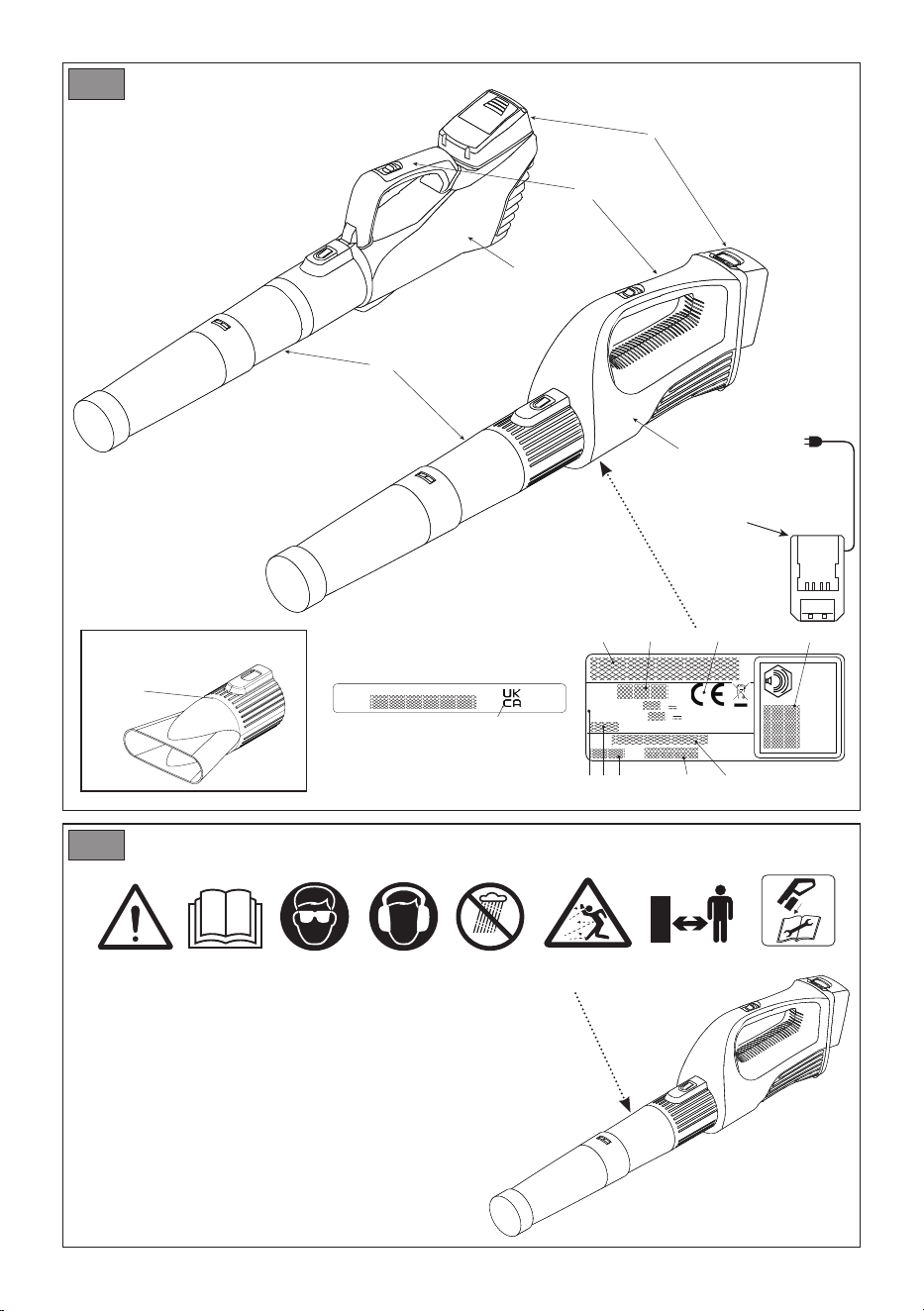
3.2 COMPONENTI PRINCIPALI (Fig. 1)
A. Unità motrice: fornisce il
movimento alla girante.
B. Tubo soatore: è l’elemento preposto
all’espulsione del usso d’aria.
C. Impugnatura: permette il
governo della macchina.
D. Batteria (se non fornita con la
macchina, vedi cap. 13 “accessori
a richiesta): dispositivo che fornisce
corrente elettrica all’utensile; le sue
caratteristiche e norme d’uso sono
descritte in uno specico manuale.
E. Carica batteria (se non fornito con
la macchina, vedi cap. 13 “accessori
a richiesta): dispositivo che si utilizza
per ricaricare la batteria; le sue
caratteristiche e norme d’uso sono
descritte in uno specico manuale.
3.3 ETICHETTA DI IDENTIFICAZIONE
PRODOTTO (Fig. 1)
1. Nome e indirizzo del Costruttore
2. Tipo di macchina
3. Livello potenza sonora
4. Marchio di conformità
5. Tensione e frequenza di alimentazione
6. Anno di fabbricazione
7. Numero di matricola
8. Codice articolo
9. Velocità senza carico
Trascrivere i dati di identicazione della
macchina negli appositi spazi dell’etichetta
riportata nel retro della copertina.
IMPORTANTE Utilizzare i dati di
identicazione riportati sull’etichetta di
identicazione prodotto ogni volta che
si contatta l’ocina autorizzata.
IMPORTANTE L’esempio della
dichiarazione di conformità si trova
nelle ultime pagine del manuale.
3.4 SEGNALETICA DI SICUREZZA (Fig. 2)
Sulla macchina compaiono vari simboli.
Signicato dei simboli:
ATTENZIONE! PERICOLO!
Questa macchina, se non usata
correttamente, può essere
pericolosa per sé e per gli altri.
ATTENZIONE! Prima di usare
questa macchina leggere
il ma nuale di istruzioni.
Usare protezioni
acustiche, occhiali.
Non esporre alla pioggia
(o all’umidità).
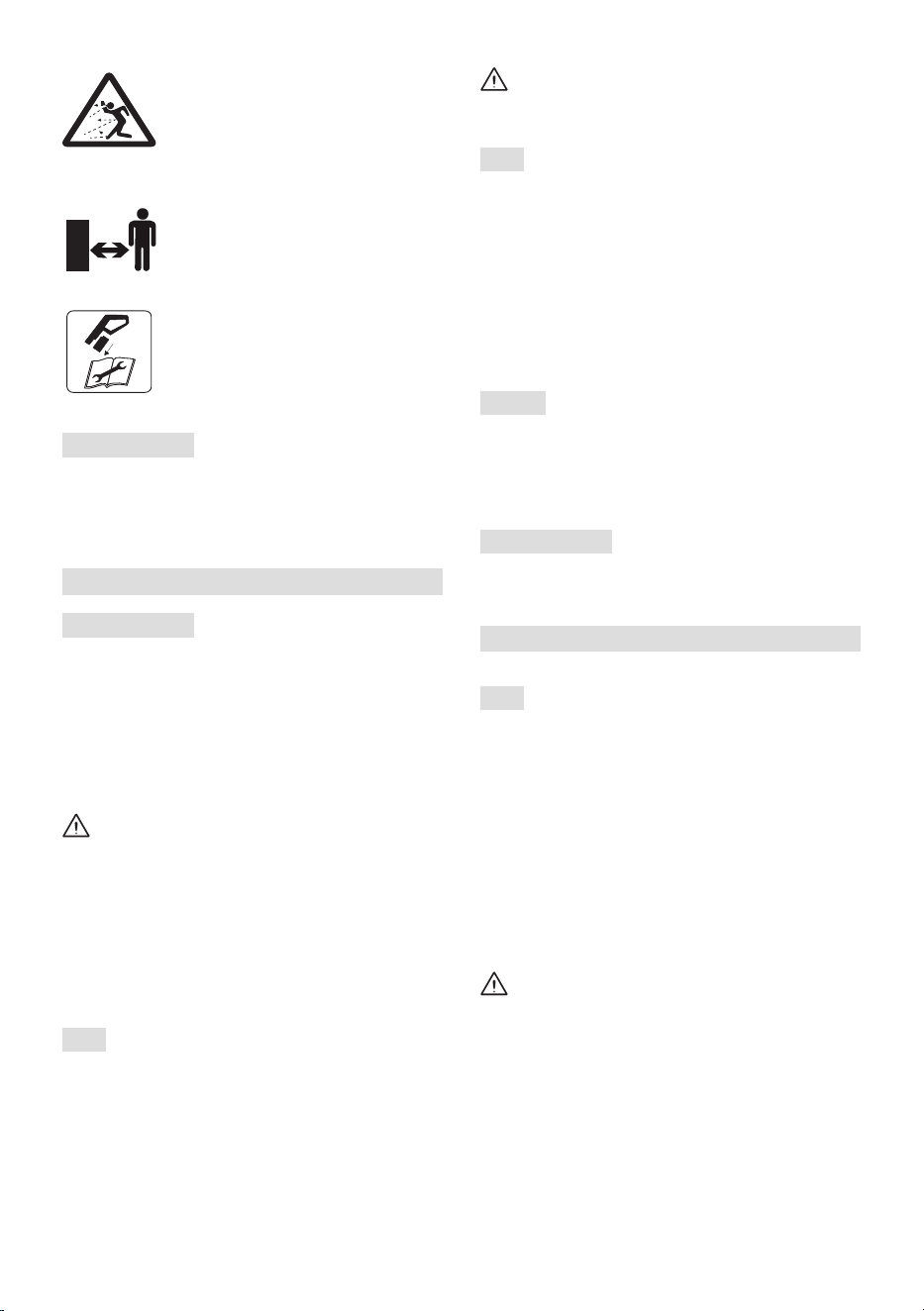
IT - 8
PERICOLO DI PROIEZIONI!
Fare attenzione alle possibili
proiezioni di materiale,
causate dal usso dell’aria,
che possono causare gravi
lesioni a persone o cose.
PERICOLO DI PROIEZIONI!
Allontanare qualunque
persona o animale domestico
ad almeno 15 m durante
l’impiego della macchina.
Rimuovere la batteria prima
di eettuare qualsiasi
controllo, pulizia o intervento
di manutenzione/regolazione
sulla macchina.
IMPORTANTE Le etichette adesive
rovinate o divenute illeggibili devono essere
sostituite. Richiedere le nuove etichette al
proprio centro di assistenza autorizzato.
4. MONTAGGIO
IMPORTANTE Le norme di sicurezza da
seguire sono descritte al cap. 2. Rispettare
scrupolosamente tali indicazioni per non
incorrere in gravi rischi o pericoli.
Per motivi di magazzinaggio e trasporto,
alcuni componenti della macchina non sono
assemblati direttamente in fabbrica, ma
devono essere montati dopo la rimozione
dall’imballo, seguendo le istruzioni seguenti.
Lo sballaggio e il completamento del
montaggio devono essere eettuati su
una supercie piana e solida, con spazio
suciente alla movimentazione della
macchina e degli imballi, avvalendosi
sempre degli attrezzi appropriati.
Non utilizzare la macchina prima di
aver portato a termine le indicazioni
della sezione “MONTAGGIO”.
4.1 DISIMBALLAGGIO
1. Aprire l’imballo con cautela, con
attenzione a non smarrire i componenti.
2. Consultare la documentazione inclusa nella
scatola, comprese le presenti istruzioni.
3. Estrarre dalla scatola tutti i
componenti non montati.
4. Estrarre la macchina dalla scatola.
5. Smaltire la scatola e gli imballi nel
rispetto delle normative locali.
Prima di eettuare il montaggio,
assicurarsi che la batteria non sia
inserita nel suo alloggiamento.
4.2 MONTAGGIO / SMONTAGGIO
DEL TUBO SOFFIATORE
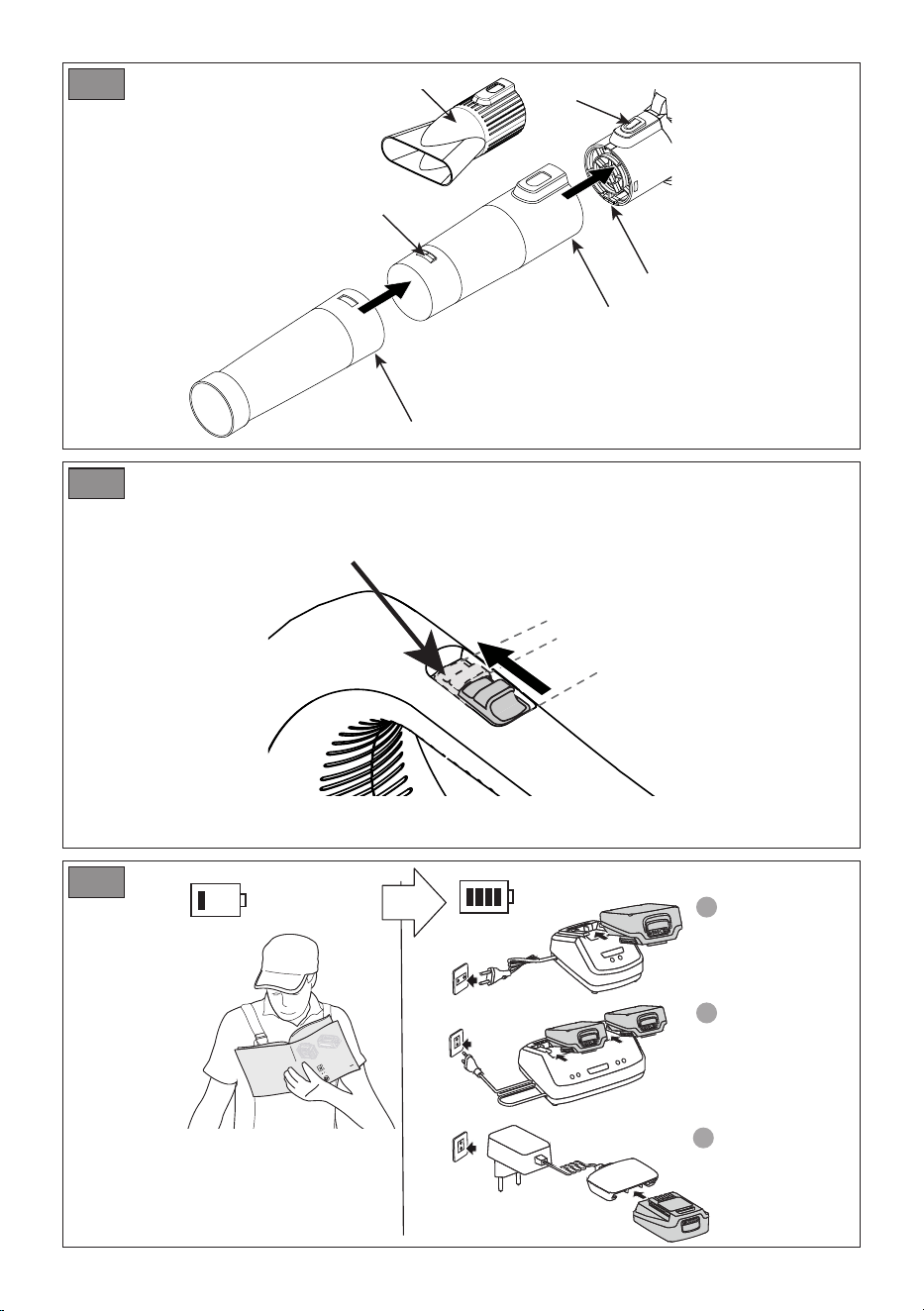
1. Allineare il tubo soatore (Fig. 3.A) (o Fig.
3.F se previsto) alla bocca di uscita dell’aria
dell’unità motrice (Fig. 3.B) e spingerlo a
fondo in modo da agganciarlo stabilmente.
2. Applicare il terminale del tubo soatore (Fig.
3.C) al tubo soatore (Fig. 3.A) e spingerlo a
fondo in modo da agganciarlo stabilmente.
NOTA Il montaggio risulta corretto quando
le linguette (Fig. 3.D, Fig. 3.E) si bloccano
nelle rispettive sedi dei tubi soatori.
– Per rimuovere i tubi soatori premere sulle
rispettive linguetta (Fig. 3.D, Fig. 3.E ).
IMPORTANTE Arrestare la macchina e
rimuovere sempre la batteria (par. 7.2.2) ogni
qualvolta si rimuove il tubo di soatura.
5. COMANDI DI CONTROLLO
5.1 INTERRUTTORE AVVIO/ARRESTO
L'interruttore avvio/arresto (Fig. 4.A)
esplica una duplice funzione:
1. avvia/arresta la macchina e
contemporaneamente innesta/
disinnesta la rotazione della girante;
2. consente di regolare la velocità
di rotazione della girante.
Per avviare la macchina, spostare l'interruttore
dalla posizione di arresto (Fig. 4.A.1)
alla posizione di avvio (Fig. 4.A.2).
L’avviamento della macchina provoca
la rotazione contemporanea della girante.
Per arrestare la macchina, spostare l'interruttore
in posizione di arresto (Fig. 4.A.1).
La velocità di rotazione della girante deve
essere rapportata al tipo di lavoro (cap.
6.4.1) e può essere regolata spostando
l'interruttore nella posizione desiderata:
– posizione di avvio (Fig. 4.A.2) per
una velocità di soatura media;
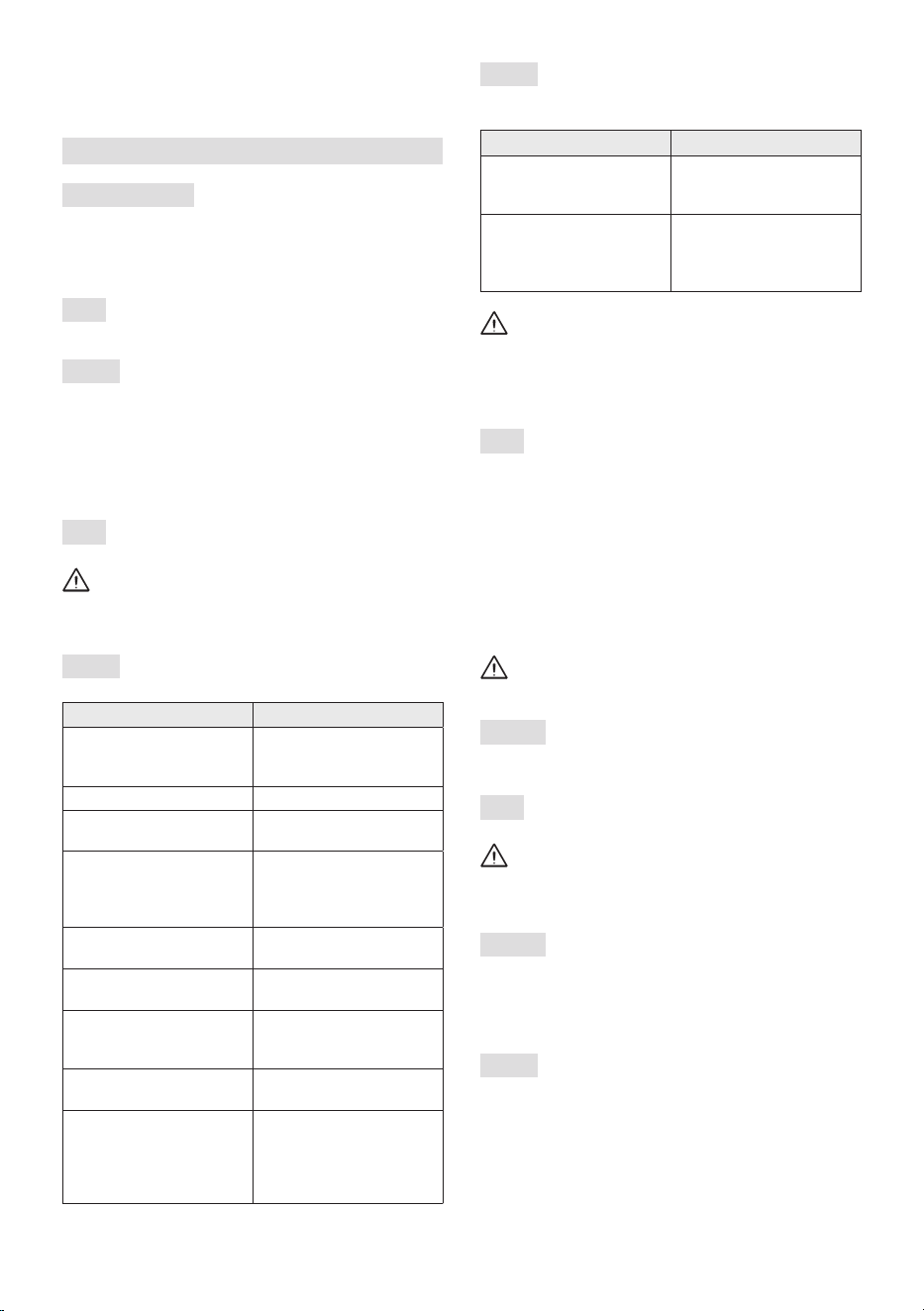
IT - 9
– posizione alta velocità (Fig. 4.A.3) per
una velocità di soatura massima.
6. USO DELLA MACCHINA
IMPORTANTE Le norme di sicurezza da
seguire sono descritte al cap. 2. Rispettare
scrupolosamente tali indicazioni per non
incorrere in gravi rischi o pericoli.
6.1 OPERAZIONI PRELIMINARI
6.1.1 Controllo e ricarica della
batteria (Fig. 5)
Prima di ogni utilizzo vericare lo stato di
carica della batteria e ricaricarla seguendo le
indicazioni contenute nel libretto della batteria.
6.2 CONTROLLI DI SICUREZZA
Eettuare sempre i controlli
di sicurezza prima dell’uso.
6.2.1 Controllo generale
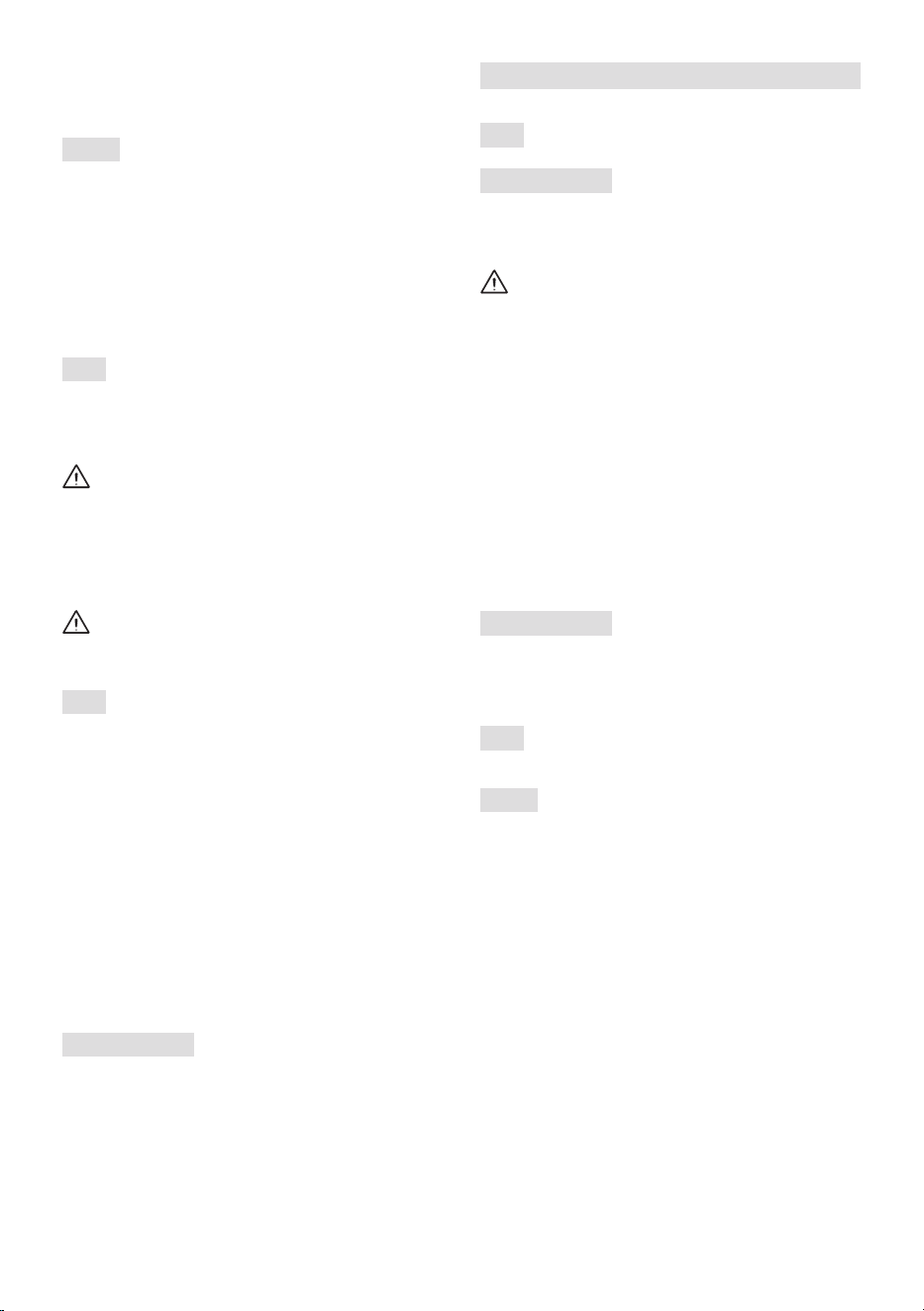
Oggetto Risultato
Impugnature (Fig. 1.C) Pulite, asciutte, ssate
correttamente e
saldamente alla macchina
Viti sulla macchina Ben ssate (non allentate)
Passaggi dell’aria di
rareddamento
Non ostruiti
Tubo soatore (Fig. 1.B) Correttamente installato.
Nessun segno di
danneggiamento.
Non ostruito.
Girante Nessun segno di
danneggiamento
Protezioni Nessun segno di
danneggiamento
Batteria (Fig. 1.D) Nessun danno al suo
involucro, nessun
tralamento di liquido
Interruttore avvio/
arresto (Fig. 4.A)
Deve spostarsi facilmente
da una posizione all'altra
Macchina Nessun segno di
danneggiamento o usura.
Nessuna vibrazione
anomala.
Nessun suono anomalo.
6.2.2 Test di funzionamento
della macchina
Azione Risultato
1. Avviare la macchina
(par. 6.3 )
La macchina si avvia
e la girante ruota.
1. Spostare l'interruttore
in posizione di
arresto (Fig. 4.A.1 )
1. L'interruttore si deve
spostare facilmente
e la macchina si
deve arrestare.
Se uno qualsiasi dei risultati si discosta
da quanto indicato nelle seguenti tabelle,
non utilizzare la macchina! Consegnare la
macchina ad un centro di assistenza per
i controlli del caso e per la riparazione.
6.3 AVVIAMENTO
1. Assumere una posizione ferma e stabile;
2. Assicurarsi che il tubo soatore non sia
rivolto verso eventuali osservatori o detriti;
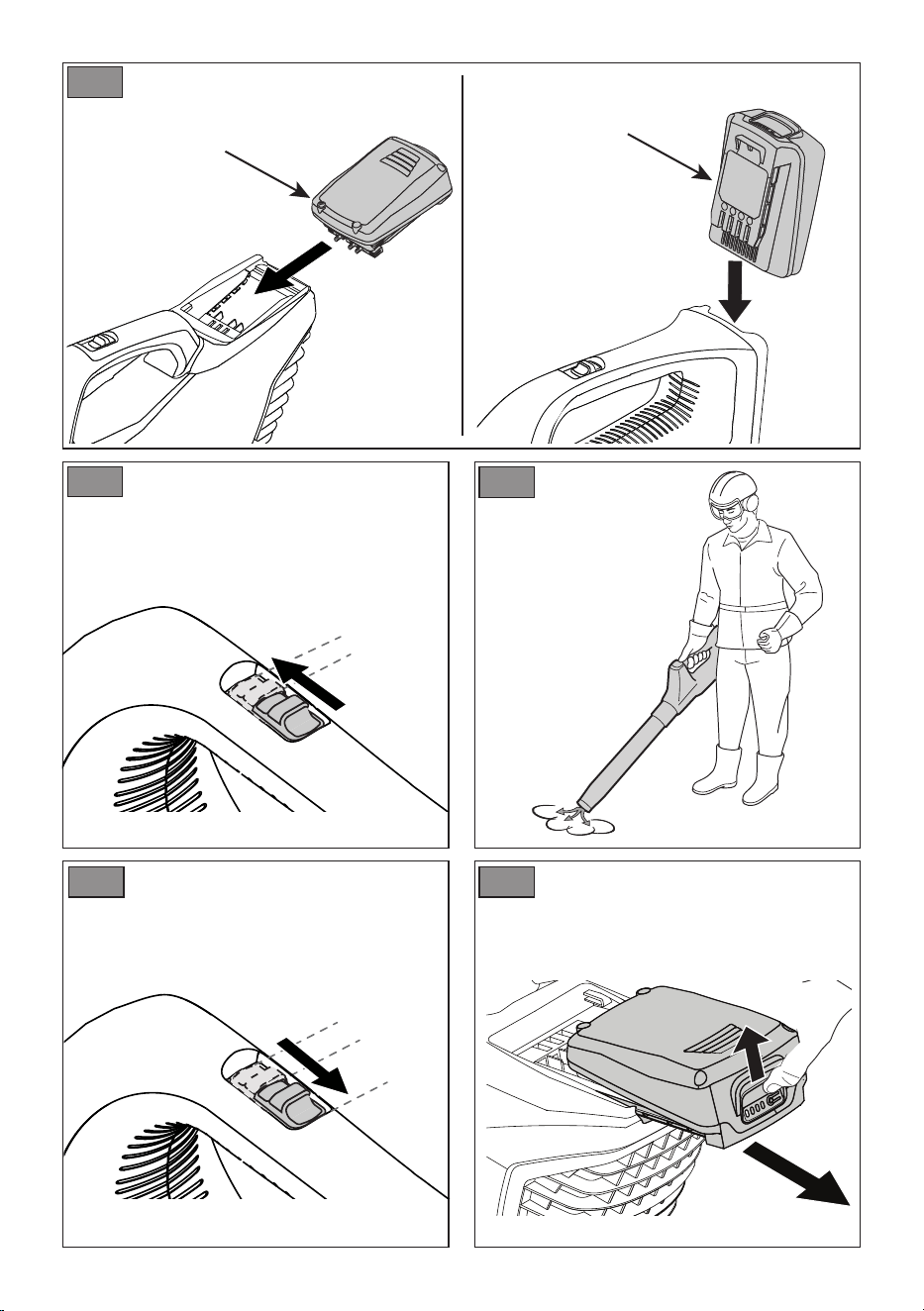
3. Inserire la batteria (Fig. 6.A) nel suo
alloggiamento spingendola a fondo
no ad avvertire il “clic” che la blocca in
posizione e assicura il contatto elettrico;
4. Spostare l'interruttore in posizione
di avvio (Fig. 7.A.2/ Fig. 7.A.3).
L’avviamento della macchina provoca
la rotazione contemporanea della girante.
NOTA Eettuare l’avviamento su
una supercie piana e solida.
6.4 LAVORO
Durante il lavoro, la macchina deve
essere sempre tenuta saldamente con
la mano sull’impugnatura (Fig. 8).
NOTA Durante il lavoro la batteria è
protetta contro lo scaricamento totale tramite
un dispositivo di protezione che spegne la
macchina e ne blocca il funzionamento.
6.4.1 Regolazione della velocità
È sempre opportuno regolare la velocità
di rotazione della girante in rapporto alla
tipologia del materiale da rimuovere:
– velocità di soatura media (Fig. 7.A.2)
per materiali leggeri e piccoli arbusti
sul prato, per muovere erba e foglie
leggere su asfalto o terreno solido;
IT - 10
– velocità di soatura massima (Fig. 7.A.3)
per foglie bagnate, materiali più pesanti,
come neve fresca o sporcizia voluminosa.
6.4.2 Consigli per l’utilizzo
Avanzare lentamente tenendo la parte
terminale del tubo soatore ad un’adeguata
distanza dal terreno (Fig. 8).
Per evitare di disperdere il materiale da
rimuovere, dirigere il soo di aria attorno ai bordi
esterni del cumulo del materiale. Non dirigere
mai il soo di aria al centro dell’accumulo.
6.5 ARRESTO
Per arrestare la macchina, spostare l'interruttore
in posizione di arresto (Fig. 9.A.1).
La girante continua a ruotare
per qualche secondo anche dopo
l'arresto della macchina.
Arrestare sempre la macchina durante
gli spostamenti fra zone di lavoro.
Durante gli spostamenti non tenere
mai la mano sul comando acceleratore
per evitare avviamenti accidentali.
6.6 DOPO L’UTILIZZO
• Rimuovere la batteria dalla sua sede e
provvedere alla sua ricarica (par. 7.2.2).
• Lasciare rareddare il motore
prima di collocare la macchina
in un qualsiasi ambiente.
• Eettuare la pulizia (par. 7.3).
• Controllare che non ci siano componenti
allentati o danneggiati. Se necessario,
sostituire i componenti danneggiati e
serrare eventuali viti e bulloni allentati o
contattare il centro di assistenza autorizzato.
• Verica di eventuali danni presenti sulla
macchina. Se necessario, contattare
il centro di assistenza autorizzato.
IMPORTANTE Rimuovere sempre la
batteria (par. 7.2.2) ogni qualvolta si lascia
la macchina inutilizzata o incustodita.
7. MANUTENZIONE ORDINARIA
7.1 GENERALITÀ
IMPORTANTE Le norme di sicurezza da
seguire sono descritte al cap. 2. Rispettare
scrupolosamente tali indicazioni per non
incorrere in gravi rischi o pericoli.
Prima di eettuare qualsiasi controllo,
pulizia o intervento di manutenzione/
regolazione sulla macchina:
• Arrestare la macchina (par. 6.5);
• Rimuovere la batteria e provvedere alla
sua ricarica (par. 7.2.2) (non lasciare
mai la batteria inserita o alla portata
di bambini o persone non idonee);
• Accertarsi che tutte le parti in movimento
si siano completamente arrestate.
• Lasciare rareddare il motore
prima di collocare la macchina
in un qualsiasi ambiente.
• Indossare indumenti adeguati, guanti
da lavoro e occhiali di protezione;
• Leggere le relative istruzioni.
IMPORTANTE Tutte le operazioni di
manutenzione e di regolazione non descritte
in questo manuale devono essere eseguite dal
vostro Rivenditore o da un Centro specializzato.
7.2 BATTERIA
7.2.1 Autonomia della batteria
L’autonomia della batteria (e quindi la
supercie lavorabile prima della ricarica) è
principalmente condizionata da comportamenti
dell’operatore, che dovrebbe evitare:
– accensioni e spegnimenti
frequenti durante il lavoro;
– una velocità di rotazione della
girante non adatta alla tipologia di
materiale da rimuovere (par. 6.4.1).
Per ottimizzare l’autonomia della batteria è
sempre opportuno impostare una velocità
di rotazione della girante adeguata alla
tipologia di materiale da rimuovere.
Nel caso si volesse utilizzare la macchina in
sessioni di lavoro più lunghe rispetto a quanto
consentito dalla batteria standard, è possibile:
• acquistare una seconda batteria standard per
sostituire immediatamente la batteria scarica,
senza pregiudicare la continuità di utilizzo;

IT - 11
• acquistare una batteria con
autonomia maggiorata rispetto alla
batteria standard (par. 13.1).
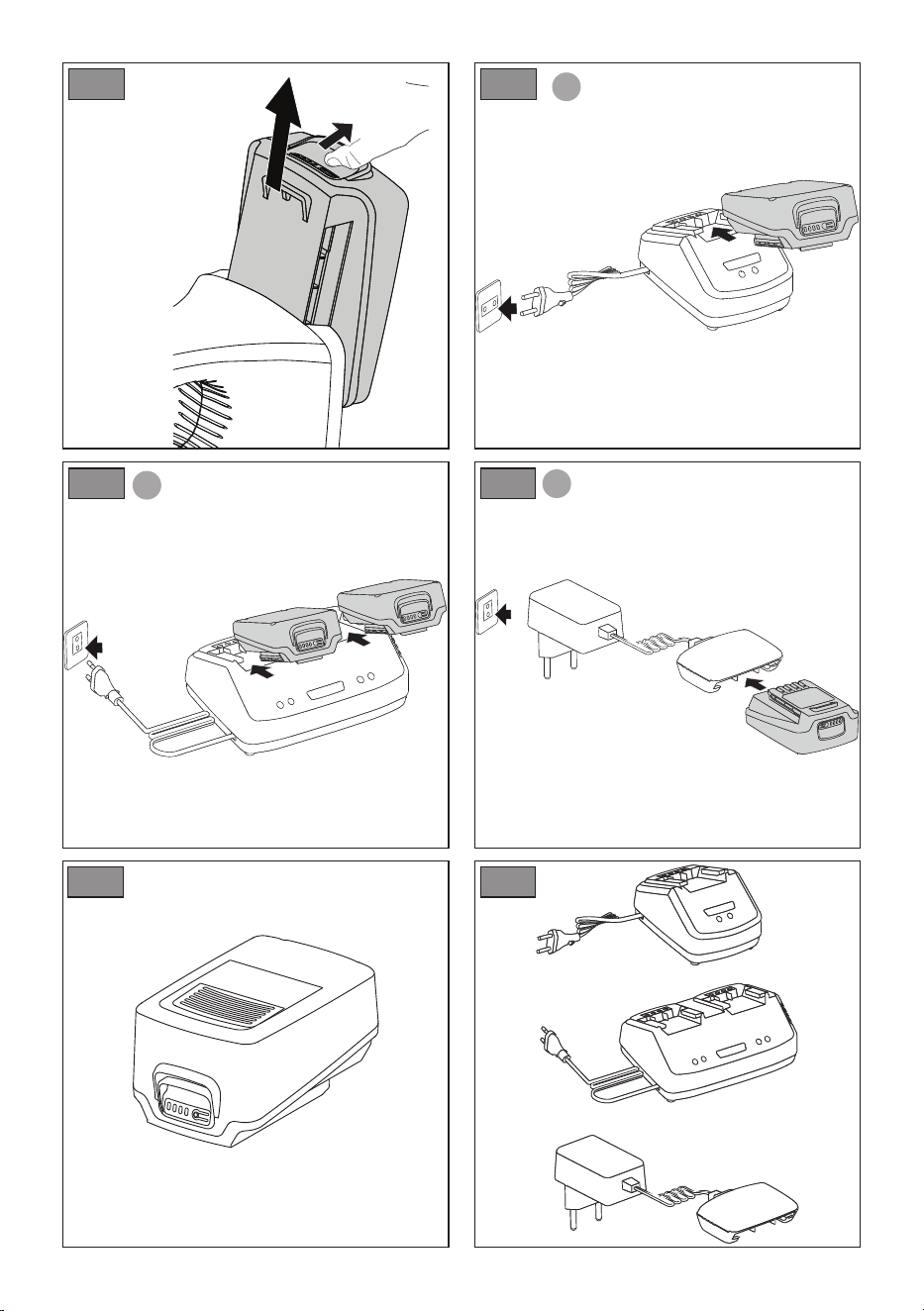
7.2.2 Rimozione e ricarica della
batteria (Fig.10÷14)
NOTA La batteria è dotata di una protezione
che impedisce la ricarica se la temperatura
ambiente non è compresa fra 0 e +45 °C.
NOTA La batteria può essere ricaricata
in ogni momento, anche parzialmente,
senza il rischio di danneggiarla.
7.3 PULIZIA DELLA MACCHINA
• Per ridurre il rischio di incendio mantenere
la macchina libera da residui di foglie, rami.
• Pulire sempre la macchina dopo l’uso
utilizzando un panno pulito e umido
imbevuto di detergente neutro.
• Rimuovere qualsiasi traccia di umidità
servendosi di un panno morbido e
asciutto. L’umidità può dare luogo
a rischi di scosse elettriche.
• Non utilizzare detergenti aggressivi o solventi
per pulire le parti in plastica o le impugnature.
• Non usare getti d’acqua ed evitare di
bagnare il motore e componenti elettrici.
• Mantenere la girante sempre pulita e
libera da polvere e detriti, soando con
aria compressa attraverso la griglia.
Non spruzzare la girante con acqua.
• Per evitare il surriscaldamento e danni al
motore o alla batteria, assicurarsi sempre
che le griglie di aspirazione dell’aria di
rareddamento siano pulite e libere da detriti.
7.4 DADI E VITI DI FISSAGGIO
• Mantenere serrati dadi e viti, per essere
certi che la macchina sia sempre in
condizioni sicure di funzionamento.
• Controllare regolarmente che le
impugnature siano saldamente ssate.
8. RIMESSAGGIO
IMPORTANTE Le norme di sicurezza da
seguire durante le operazioni di rimessaggio
sono descritte al par. 2.4. Rispettare
scrupolosamente tali indicazioni per non
incorrere in gravi rischi o pericoli.
8.1 RIMESSAGGIO DELLA MACCHINA
Quando la macchina deve essere rimessata:
1. Rimuovere la batteria dalla sua sede e
provvedere alla sua ricarica (par. 7.2.2).
2. Lasciare rareddare il motore
prima di collocare la macchina
in un qualsiasi ambiente.
3. Eettuare la pulizia (par. 7.3).
4. Controllare che non ci siano componenti
allentati o danneggiati. Se necessario,
sostituire i componenti danneggiati e serrare
eventuali viti e bulloni allentati o contattare
il centro di assistenza autorizzato.
5. Rimessare la macchina:
– in un ambiente asciutto
– al riparo dalle intemperie
– in un luogo inaccessibile ai bambini.
– assicurandosi di aver rimosso chiavi
o utensili usati per la manutenzione.
8.2 RIMESSAGGIO DELLA BATTERIA
Se la batteria non viene caricata per un
lungo periodo di tempo, è necessario
conservarla sempre all’ombra, al fresco
e in ambienti privi di umidità con una
temperatura ambiente tra 0~45°C.
IMPORTANTE In caso di prolungata
inattività, ricaricare la batteria ogni due
mesi per prolugarne la durata.
9. MOVIMENTAZIONE E TRASPORTO
Ogni volta che è necessario movimentare,
trasportare la macchina occorre:
1. Arrestare la macchina (par. 6.5);
2. Accertarsi che tutte le parti in movimento
si siano completamente arrestate;
3. Rimuovere la batteria dalla sua sede e
provvedere alla sua ricarica (par. 7.2.2);
4. Aerrare la macchina unicamente
dalle impugnature e orientare i tubi in
modo da non costituire intralcio.
5. Assicurarsi che la movimentazione della
macchina non causi danni o lesioni.
Quando si trasporta la macchina
con un automezzo, occorre:
1. Rimuovere i tubi;
2. Posizionarla in modo da non
costituire pericolo per nessuno.
IT - 12
10. ASSISTENZA E RIPARAZIONI
Questo manuale fornisce tutte le indicazioni
necessarie per la conduzione della macchina
e per una corretta manutenzione di base
eseguibile dall’utilizzatore. Tutti gli interventi di
regolazione e manutenzione non descritti in
questo manuale devono essere eseguiti presso
il vostro Rivenditore o un Centro specializzato.
Operazioni eseguite presso strutture inadeguate
o da persone non qualicate comportano in
decadimento di ogni forma di Garanzia e di
ogni obbligo o responsabilità del Costruttore.
• I ricambi e gli accessori non originali
non sono approvati; l’impiego di ricambi
ed accessori non originali compromette
la sicurezza della macchina e solleva il
Costruttore da ogni obbligo o responsabilità.
• I ricambi originali vengono forniti dalle ocine
di assistenza e dai rivenditori autorizzati.
11. COPERTURA DELLA GARANZIA
Le condizioni di garanzia sono
destinate solamente ai consumatori,
cioè operatori non professionisti.
La garanzia copre tutti i difetti di qualità
dei materiali e di fabbricazione, accertati
durante il periodo della garanzia dal vostro
Rivenditore o da un Centro specializzato.
L’applicazione della garanzia si limita
alla riparazione o alla sostituzione del
componente ritenuto difettoso.
L’applicazione della garanzia è subordinata ad
una manutenzione regolare della macchina.
La garanzia non copre i danni conseguenti a:
• Mancata familiarizzazione con la
documentazione di accompagnamento
(Manuali di Istruzioni).
• Uso professionale.
• Disattenzione, negligenza.
• Causa esterna (fulmine, urti,
presenza di corpi estranei all’interno
della macchina) o incidente.
• Uso e montaggio impropri o non
consentiti dal costruttore.
• Scarsa manutenzione.
• Modica della macchina.
• Utilizzo di pezzi di ricambio non
originali (pezzi adattabili).
• Utilizzo di accessori non forniti o
non approvati dal costruttore.
La garanzia non copre inoltre:
• Le operazioni di manutenzione
(descritte nel manuale di istruzioni).
• La normale usura di materiali di consumo.
• Normale usura.
• Deterioramento estetico della
macchina dovuto al suo utilizzo.
• Le spese accessorie eventualmente
connesse all’attivazione della garanzia,
quali il trasferimento presso l’utilizzatore,
il trasposto della macchina verso il
Rivenditore, noleggio di attrezzature per la
sostituzione o la chiamata ad una società
esterna per tutti i lavori di manutenzione.
L’utilizzatore è protetto dalle proprie leggi
nazionali. I diritti dell’utilizzatore previsti dalle
proprie leggi nazionali non sono in alcun
modo limitati dalla presente garanzia.
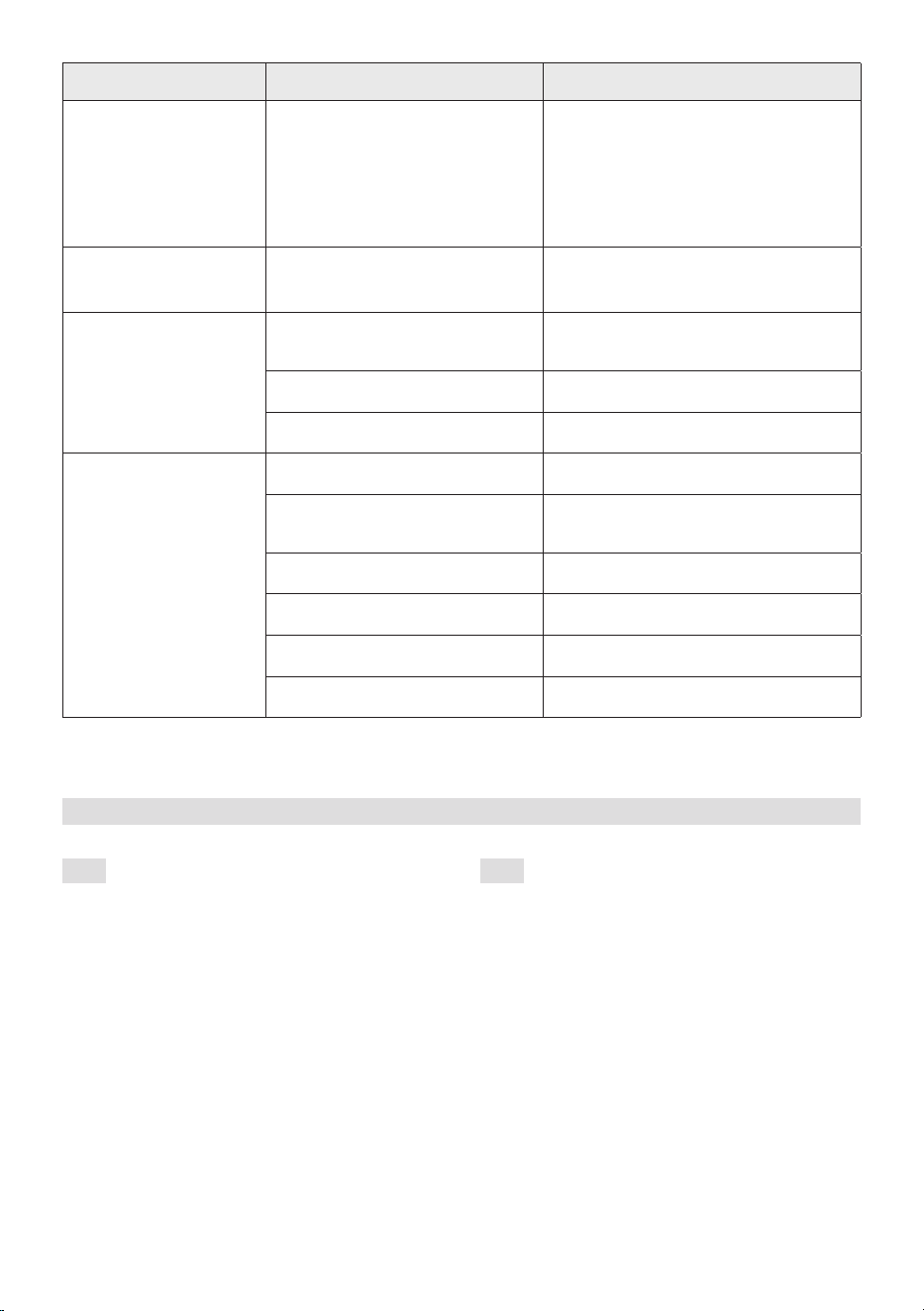
12. IDENTIFICAZIONE INCONVENIENTI
INCONVENIENTE CAUSA PROBABILE RIMEDIO
1. Azionando l'interruttore
la macchina non si avvia
Batteria mancante o non
inserita correttamente
Assicurarsi che la batteria sia
ben alloggiata (par. 7.2.3)
Batteria scarica Controllare lo stato di carica e
ricaricare la batteria (par. 7.2.2)
Interruttore di avvio/arresto difettoso
o soatore danneggiato
Non utilizzare la macchina. Arrestare
immediatamente la macchina, togliere la
batteria e Contattare un Centro Assistenza.
2. Il motore si arresta
durante il lavoro
Batteria non inserita correttamente Assicurarsi che la batteria sia
ben alloggiata (par. 7.2.3)
Batteria scarica Controllare lo stato di carica e
ricaricare la batteria . (par. 7.2.2)
3. La girante ruota ma
l’aria non esce dal
tubo soatore
Tubo soatore bloccato o intasato Arrestare la macchina, togliere la batteria
e rimuovere eventuali ostruzioni.
IT - 13
INCONVENIENTE CAUSA PROBABILE RIMEDIO
4. Si avvertono rumori e/o
vibrazioni eccessive
durante il lavoro
Parti allentate o danneggiate Arrestare la macchina,
rimuovere la batteria e:
– controllare i danni;
– controllare se vi sono parti
allentate e serrarle;
– provvedere a sostituire o riparare
le parti danneggiate con parti di
equivalenti caratteristiche.
5. La macchina emette
fumo durante il suo
funzionamento
Soatore danneggiato. Non utilizzare la macchina. Arrestare
immediatamente la macchina, togliere la
batteria e Contattare un Centro Assistenza.
6. L’autonomia della
batteria è scarsa
Condizioni di utilizzo
gravose con maggiore
assorbimento di corrente
Ottimizzare l’utilizzo (par. 7.2.1)
Batteria insuciente per
le esigenze operative
Utilizzare una seconda batteria o una
batteria maggiorata (par. 13.1)
Degrado della capacità della batteria Acquistare una nuova batteria
7. Il carica batteria non
eettua la ricarica
della batteria
Batteria non inserita correttamente
nel carica batteria
Controllare che l’inserimento
sia corretto (par. 7.2.2)
Condizioni ambientali non idonee Eseguire la ricarica in ambiente con
temperatura adeguata (vedi libretto
istruzioni della batteria/carica batteria)
Contatti sporchi Pulire i contatti
Mancanza di tensione al carica batteria Controllare che la spina sia inserita e che
vi sia tensione alla presa di corrente
Carica batteria difettoso Sostituire con un ricambio originale
Se l’inconveniente perdura consultare il
manuale della batteria / carica batteria
Se gli inconvenienti perdurano dopo aver applicato i rimedi descritti, contattare il vostro Rivenditore.
13. ACCESSORI A RICHIESTA
13.1 BATTERIE
Sono disponibili batterie di diverse capacità, per
adattarsi alle speciche esigenze operative (Fig.
15). L’elenco delle batterie omologate per questa
macchina si trova nella tabella “Dati Tecnici”.
13.2 CARICA BATTERIA
Dispositivo che si utilizza per
ricaricare la batteria (Fig. 16).

EN - 1
WARNING!: READ THIS MANUAL CAREFULLY BEFORE
USING THE MACHINE. Keep safe for future use.
EN
1. GENERAL INFORMATION
1.1 HOW TO READ THIS MANUAL
NOTE or IMPORTANT These give details
or further information on what has been
previously indicated and aim to prevent damage
to the machine or cause other damage.
The symbol highlights danger.
Failure to observe the warning can
lead to possible personal and/or
third party injury and/or damage.
The paragraphs highlighted in a dotted grey
square indicate optional characteristics
not available on all models documented
in this manual. Check if the characteristics
are available on this model.
Whenever reference is made to a position on the
machine "front", "back", "left" or "right" hand side,
this refers to the operator's working position.
2. SAFETY REGULATIONS
2.1 TRAINING
Read this manual
carefully before using the
machine. Become familiar
with the controls and the
proper use of the machine.
Failure to follow the
warnings and instructions
may result in re and/
or serious injury. Save all
warnings and instructions
for future reference.
• Never allow the machine
to be used by children or
individuals with reduced
physical, sensory or mental
abilities, or without experience
and know-how, or individuals
INDEX
1. GENERAL INFORMATION ..................................... 1
2. SAFETY REGULATIONS ........................................ 1
3. ABOUT THE MACHINE .......................................... 6
3.1 Machine description and intended use ........... 6
3.2 Main components (Fig.1 ) ............................... 6
3.3 Product identication label (Fig.1 ) .................. 7
3.4 Safety signs (Fig.2 ) ........................................ 7
4. ASSEMBLY ............................................................. 7
4.1 Unpacking ...................................................... 7
4.2 Assembly / disassembly of the blower tube .... 8
5. CONTROLS ............................................................ 8
5.1 START/STOP SWITCH .................................. 8
6. USING THE MACHINE ........................................... 8
6.1 Preliminary operations.................................... 8
6.2 Safety checks ................................................. 8
6.3 Start-up .......................................................... 9
6.4 Operation ....................................................... 9
6.5 Stop................................................................ 9
6.6 After use ......................................................... 9
7. ROUTINE MAINTENANCE ................................... 10
7.1 General Information ...................................... 10
7.2 Battery.......................................................... 10
7.3 Cleaning the machine................................... 10
7.4 Nuts and bolts .............................................. 10
8. STORAGE ............................................................. 10
8.1 Storing .......................................................... 10
8.2 Storing the battery ........................................ 11
9. HANDLING AND TRANSPORT ............................ 11
10. ASSISTANCE AND REPAIRS ............................... 11
11. WARRANTY COVERAGE ..................................... 11
12. TROUBLESHOOTING ......................................... 12
13. ATTACHMENTS ON REQUEST .......................... 13
13.1 Batteries ....................................................... 13
13.2 Battery charger............................................. 13

EN - 2
who do not have the necessary
familiarity with the instructions.
Local regulations may restrict
the age of the operator.
• Never use the machine while
people, especially children, or
pets are nearby. Get another
adult to keep the children under
supervision. Children shall
not play with the appliance.
• Never use the machine if
the user is tired or unwell,
or has taken medication,
drugs, alcohol or substances
that impair reexes
and concentration.
• Remember that the operator
or user is responsible for
accidents and unexpected
events that can occur to other
people or property. It is the
user’s responsibility to assess
the potential risk of the area
where work is to be carried out
and to take all the necessary
precautions to ensure his
own safety and that of others,
particularly on slopes or rough,
slippery and unstable ground.
• If the machine is sold or
lent to others, make sure
that the operator looks
over the user instructions
contained in this manual.
2.2 PRELIMINARY
OPERATIONS
Personal Protective
Equipment (PPE)
• Wear suitable work attire,
hard-wearing safety footwear
with non-slip soles and long
trousers. Do not operate
the machine barefoot or
wearing open sandals. Wear
ear-protection devices,
anti-vibration gloves,
protective goggles, and
a half mask respirator.
• Use of hearing protections can
reduce the ability to hear any
warnings (shouting or alarms).
Be careful of what occurs
around you in the work area.
• Never wear scarves, shirts,
necklaces, bracelets, loose
owing clothing, laces or ties
or any hanging or apping
accessory that could catch in
the machine or in any objects
or materials in the work area.
• Keep hair away from the
air intake grille, as it could
get tangled in the rotor and
cause serious injuries. Tie
your hair back if it is long.
Work / Machine Area
• Thoroughly inspect the
whole work area and use
a rake or yard brush to
manually untangle debris,
remove anything that could
be projected by the machine
(when used as a blower), block
the vacuum tube (when the
machine is used as vacuum
collector), or be a source of
hazard (stones, branches,
steel wire, bones etc.).
• When operating in dry
dusty soil conditions, it is
recommended to moisten
the surface slightly.
• To avoid the risk of re,
do not leave the machine
with the motor hot on
leaves or dry grass.
2.3 DURING OPERATION
Work area
• Do not use the machine
in environments that pose
the risk of explosion, in the
presence of ammable liquids,

EN - 3
gases or powders. Power
tools create sparks which may
ignite the dust or fumes.
• Work only in daylight or
with good articial light in
good visibility conditions.
• Check that there is nobody
within at least 15 metres of the
machine's range of operation.
• Avoid working with wet grass,
in the rain and when there
is a risk of a thunderstorm,
especially lightening.
• Where possible, avoid working
on wet, slippery ground or
on uneven or steep ground
that does not guarantee
stability for the operator.
• Do not expose the machine
to rain or wet environments.
Water entering a power
tool will increase the risk
of electric shock.
• Pay careful attention to uneven
ground (hills, dips), slopes,
hidden hazards and obstacles
that could limit visibility.
• Be very careful near ravines,
ditches or embankments.
• Look out for trac when using
the machine near the road.
• Always assess wind
direction and never work
against the wind.
• Do not use of the machine
near open windows.
• Operate the machine only
on a rm, level surface.
• Do not use the machine
on paved or gravel-
covered surfaces, to
avoid that the removed
material causes injuries.
• Do not allow processed
material to build up in the
discharge zone; this may
prevent proper discharge
and can result in kickback
of material through the
intake opening.
Conduct
• When performing work utilising
the machine as blower, the
machine must always be
held rmly with the right hand
on the upper handgrip.
• When performing work
utilising the machine as
vacuum collector (if foreseen),
the machine must always be
held rmly with both hands,
with the right hand on the
upper handgrip and the left
hand on the lower handgrip,
so that the collection bag
is on the operator’s left.
• Avoid body contact with
earthed or grounded surfaces,
such as pipes, radiators,
cookers and refrigerators.
There is an increased risk of
electric shock if your body
is earthed or grounded.
• Always use caution and
take on a rm and well-
balanced position.
• Do not lose your balance.
• Do not overreach.
• Make sure you have
rm footing when
working on slopes.
• Never run, always walk.
• Make sure to avoid violent
impacts against foreign bodies
and prevent the air low from
throwing any material and dust.
• Do not direct the air jet
towards persons or animals.
• When used as a blower always
pay the utmost attention to
prevent removed material or
dust from injuring people or
animals or damaging property.
• Never insert objects into
the vacuum inlet (when
EN - 4
being used as vacuum
collector, if foreseen).
• Avoid the intake of pieces of
metal, rocks, bottles, cans,
other foreign obejcts and large
objects that could damage
the rotor (when being used as
vacuum collector, if foreseen).
• Never stand at a higher level
than the base of the machine
when feeding material into it
(when being used as vacuum
collector, if foreseen).
• Always keep your face,
hands, and body away from
the intake grille and air outlet
and do not obstruct the
airways both when starting
and utilising the machine.
• The rotating parts can
cause serious injuries; avoid
contact with these parts
while they are still rotating.
If something breaks or
an accident occurs during
work, turn o the motor
immediately and move the
machine away to prevent
further damage; if an accident
occurs with injuries or third
parties are injured, carry out
the rst aid measures most
suitable for the situation
immediately and contact
the medical authorities
for any necessary health
care. Carefully remove any
debris which could cause
damage or injury to persons
or animals if ignored.
Prolonged exposure to
vibrations can cause injuries
and neurovascular disorders
(also called “Raynaud’s
syndrome” or “white
nger”), especially to people
suering from circulation
disorders. The symptoms
can regard the hands, wrists
and ngers and are shown
through loss of sensitivity,
torpor, itching, pain and
discolouring of or structural
changes to the skin. These
eects can be worsened by
low ambient temperatures
and/or by gripping the hand
grips excessively tightly. If
the symptoms occur, the
length of time the machine
is used must be reduced
and a doctor consulted.
Restrictions of use
• Do not use the machine if
you are unable to hold it with
both hands or keep steady
on your legs whilst working.
• Never use the machine
with damaged, missing or
incorrectly positioned guards.
• Never use the machine
without having installed all
the attachments required
for each use (as blower
or vacuum collector).
• Never disengage, deactivate,
remove or tamper with
the safety systems/micro
switches installed.
• Do not use the power tool
if the switch does not turn it
on and o. Any power tool
that cannot be controlled
with the switch is dangerous
and must be repaired.
• Do not strain the machine
too much and do not use a
small machine for heavy-
duty work; if you use the right
machine, you will reduce the
risk of hazards and improve
the quality of your work.
EN - 5
2.4 MAINTENANCE,
STORAGE
Ensure regular maintenance
and correct storage to
maintain machine safety and
high performance levels.
Maintenance
• Never use the machine with
worn or damaged parts.
Faulty or worn-out parts
must always be replaced and
never repaired. Use original
replacement parts only.
The noise and vibration
levels shown in these
instructions are the maximum
levels for use of the machine.
Suitable preventive measures
must be adopted to eliminate
possible harm caused by high
noise levels and vibration-
induced stresses; utilise the
machine at constant speed,
rmly hold the handgrip with
adequate strength, utilise the
machine at the minimum speed
required to perform the work,
wear ear-protection devices,
make frequent and adequate
pauses during the work.
Storage
• To reduce re risks, do
not leave containers with
debris inside a room.
2.5 BATTERY / BATTERY
CHARGER
IMPORTANT The following
safety instructions are in addition
to the safety requirements
provided in the specic battery
and battery charger manual
delivered with this machine.
• Only use battery chargers
recommended by the
manufacturer to recharge
batteries. An inadequate
battery charger may cause
electric shock, overheating
or corrosive liquid to
leak from the battery.
• Use only batteries specically
designed for your power tool.
The use of other batteries may
cause injuries and re risks.
2.6 ENVIRONMENTAL
PROTECTION
• Scrupulously comply with local
regulations for the disposal of
packaging, deteriorated parts
or any elements with a strong
environmental impact; this
waste must not be disposed
of with regular waste, but
must be separated and taken
to collection centres, which
will recycle the materials.
• Scrupulously comply with
local regulations for the
disposal of waste materials
• When the machine is
withdrawn from service, do not
dispose of it in the environment,
but take it to a waste disposal
facility in accordance with the
local regulations in force.
Do not throw electrical
equipment away with
domestic waste. In
observance of European
Directive 2012/19/EU on
electrical and electronic
equipment waste and its
implementation, in observance
of UK Regulation “The waste
electrical and electronic
equipment regulations 2013 (as
amended)” and in accordance
with national regulations, old
EN - 6
electrical equipment must be
collected separately, for eco-
compatible recycling. If electrical
equipment is disposed of in a
landll or in the ground, the
harmful substances can reach
the water table and enter the
food chain, damaging your
health and well-being. For further
information on the disposal of
this product, contact your dealer
or a domestic waste collection
service.
At the end of their working
life, dispose of batteries
paying due attention to the
environment. Batteries
contain material classied as
hazardous for you and the
environment. They must be
removed and disposed of
separately at a facility that
accepts lithium-ion batteries.
Separate waste collection
of the products and
packaging used allows the
materials to be recycled
and reused. Reuse of recycled
materials help to prevent
environmental pollution and
reduces the demand for raw
materials.
2.7 RESIDUAL RISKS
Even when all safety rules are
observed, there may still be
certain residual risks which
cannot be excluded. From the
kind and construction of the
tool the foreseeable potential
endangerments can be:
• Hurled materials that
may injure the eyes;
• Damage of the hearing, if no
protection of the ears is carried.
3. ABOUT THE MACHINE
3.1 MACHINE DESCRIPTION
AND INTENDED USE
This machine is a garden tool, specically a
portable battery-powered garden blower.
It basically consists in a motor that
activates a rotor which is able to
produce a high-speed air ow.
3.1.1 Intended use
This machine was designed
and manufactured for:
• the movement and accumulation, by
blowing, of leaves, grass, debris of various
limited weight and modest dimensions.
3.1.2 Improper use
Any other use that does not comply with the
above, can be dangerous and cause damage to
people and/or property. Examples of improper
use may include, but are not limited to:
• accumulation and collection of inammable or
explosive products, hot embers or combustion
material without a ame, lit cigarettes, pieces
of glass, sharp objects, metal objects,
stones and any other object that could be
dangerous to the operator and others;
• aiming the air shot towards
persons and/or animals;
• allowing object to enter the suction grid;
• using of the machine by more
than one person.
IMPORTANT Improper use of the
machine will void the warranty and relieves
the Manufacturer of any liability, placing all
responsibility for damage or injury, to him/
herself or third parties, on the user.
3.1.3 Type of users
This machine is intended for use by
consumers, i.e. non-professional operators.
It is intended for "hobby-related activities".
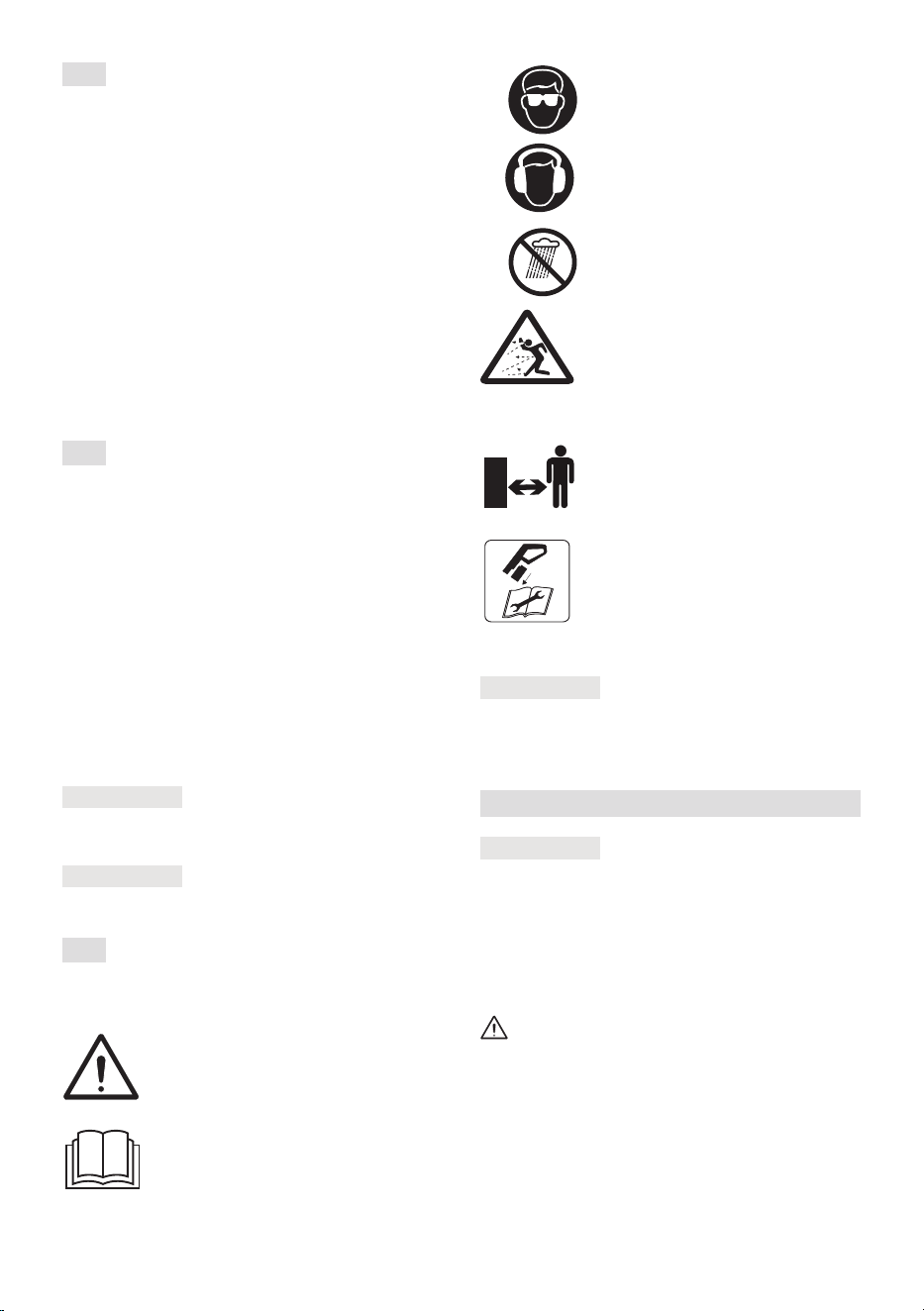
EN - 7
3.2 MAIN COMPONENTS (Fig.1 )
A. Power unit: it drives the rotor.
B. Blower tube: it is the component through
which the air ow is discharged.
C. Handgrip: it makes it possible
to control the machine.
D. Battery (if it is not supplied with the machine,
see chapter 13 “accessories on request”):
device that supplies electric current to the
tool; its specications and regulations for
use are described in a specic manual.
E. Battery charger (if it is not supplied with
the machine, see chapter 13 “accessories
on request”): device used to recharge the
battery; its specications and regulations
for use are described in a specic manual.
3.3 PRODUCT IDENTIFICATION
LABEL (Fig.1 )
1. Name and address of Manufacturer
2. Type of machine
3. Sound power level
4. Conformity marking
5. Power supply frequency and voltage
6. Year of manufacture
7. Serial number
8. Article code
9. No load speed
Write the identication data of the
machine in the specic space on the
label on the back of the cover page.
IMPORTANT Quote the information on
the product identication label whenever you
contact an Authorised Service Centre.
IMPORTANT An example of the
Declaration of Conformity is provided
on the last pages of this manual.
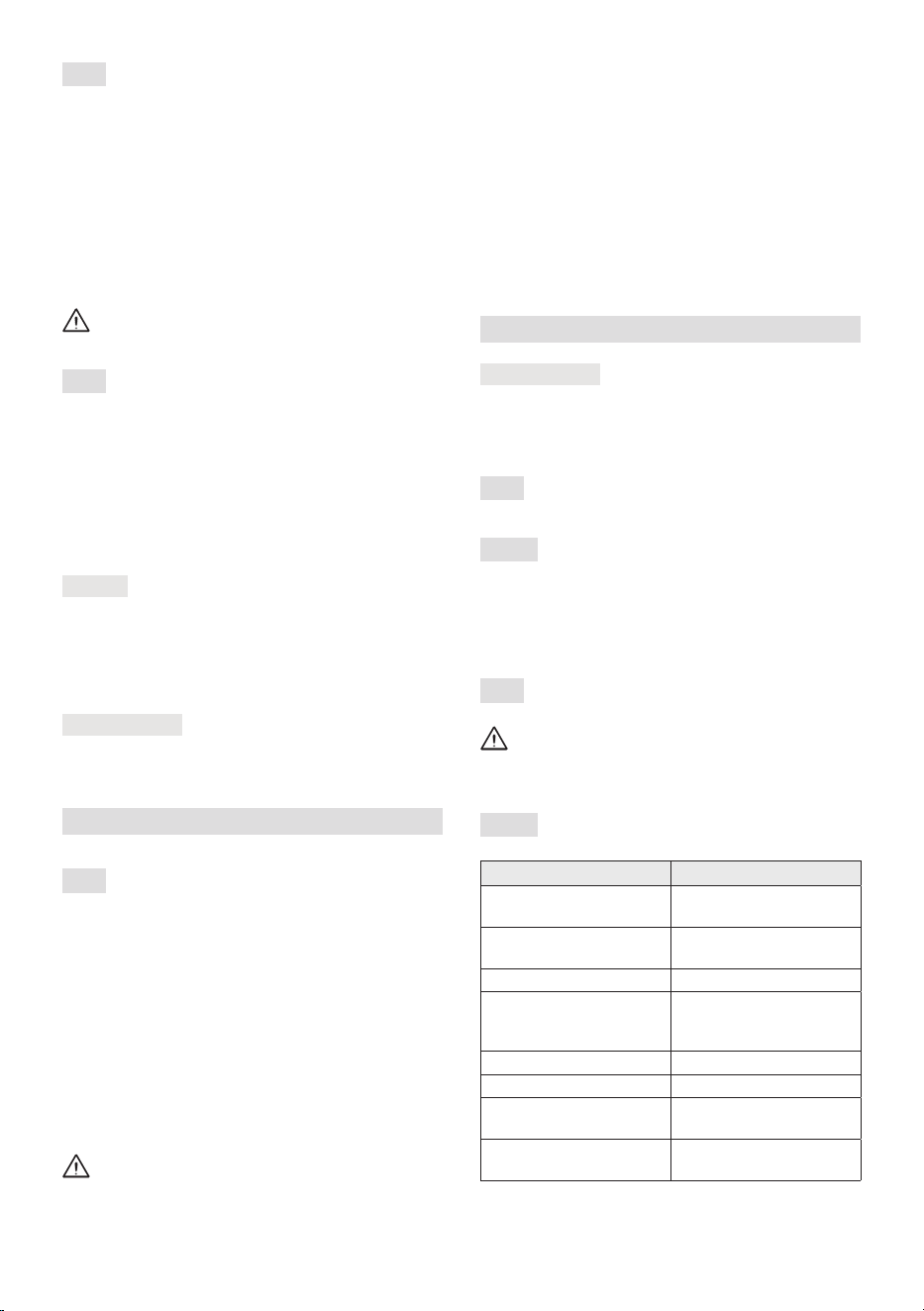
3.4 SAFETY SIGNS (Fig.2 )
The machine has various symbols on it.
Meanings of the symbols:
WARNING! DANGER! The
failure to use this machine
correctly can be hazardous
for oneself and others.
WARNING! Read the
owner's manual before
using the machine.
Use ear protection
devices and goggles.
Do not leave the machine in the
rain (or in damp conditions).
PROJECTION HAZARD!
Pay attention to possible
ying debris projected by the
air ow: which may cause
serious injuries to persons
or damage to objects.
PROJECTION HAZARD! People
or pets must be kept at least 15m
away when using the machine!
Remove the battery before
any inspection, cleaning or
maintenance/adjustment
operation on the machine.
IMPORTANT Any damaged or illegible
decals must be replaced. Order replacement
decals from an Authorised Service Centre.
4. ASSEMBLY
IMPORTANT The safety regulations
to follow are described in chap. 2. Strictly
comply with these instructions to avoid
serious risks or dangers.
For storage and transport purposes, some
components of the machine are not installed
in the factory and have to be assembled after
unpacking. Follow the instructions below.
Unpacking and completing the
assembly should be done on a at and
stable surface, with enough space for
machine handling and its packaging,
always making use of suitable equipment.
Do not use the machine until all the
instructions provided in the “ASSEMBLY”
section have been carried out.
EN - 8
4.1 UNPACKING
1. Carefully open the packaging, paying
attention not to lose components.
2. Consult the documentation in the
box, including these instructions.
3. Remove all the unassembled
parts from the box.
4. Remove the machine from the box.
5. Dispose of the box and packaging in
compliance with local regulations.
Before assembling, make sure the
battery is not inserted in its housing.
4.2 ASSEMBLY / DISASSEMBLY
OF THE BLOWER TUBE
6. Align the blower tube (Fig. 3.A) (or Fig. 3.F,
if foreseen) to the power unit outlet (Fig.
3.B) and fully push it to securely connect it.
7. Apply the end of the blower tube (Fig.
3.C) to the blower tube (Fig. 3.A) and
fully push it to securely connect it.
NOTE Assembly is correct when
the tabs (Fig. 3.D, Fig. 3.E) locks in
their housing on the blower tubes.
– Press the tabs to remove the blower
tubes (Fig. 3.D, Fig. 3.E).
IMPORTANT Stop the machine and
always remove the battery (paragraph 7.2.2)
whenever the blower tube is removed.
5. CONTROLS
5.1 START/STOP SWITCH
The start/stop switch (Fig. 4.A)
performs two functions:
1. it starts/stops the machine and, at the
same time, it engages/disengages
the rotation of the rotor;
2. it makes it possible to control
the speed of the rotor.
To start the machine, move the switch
from the stop position (Fig. 4.A.1) to
the start position (Fig. 4.A.2).
Starting the machine causes the
simultaneous rotation of the rotor.
To stop the machine, move the switch
to the stop position (Fig. 4.A.1).
The rotor’s speed must be adapted to the
type of work being performed (chapter
6.4.1) and can be adjusted by moving
the switch to the required position:
– start position (Fig. 4.A.2) for
average blowing speed;
– high speed position (Fig. 4.A.3)
for maximum blowing speed.
6. USING THE MACHINE
IMPORTANT The safety regulations
to follow are described in chap. 2. Strictly
comply with these instructions to avoid
serious risks or dangers.
6.1 PRELIMINARY OPERATIONS
6.1.1 Checking and recharging
the battery (Fig. 5)
Before each use check the battery
charge status following the instructions
provided in the battery booklet.
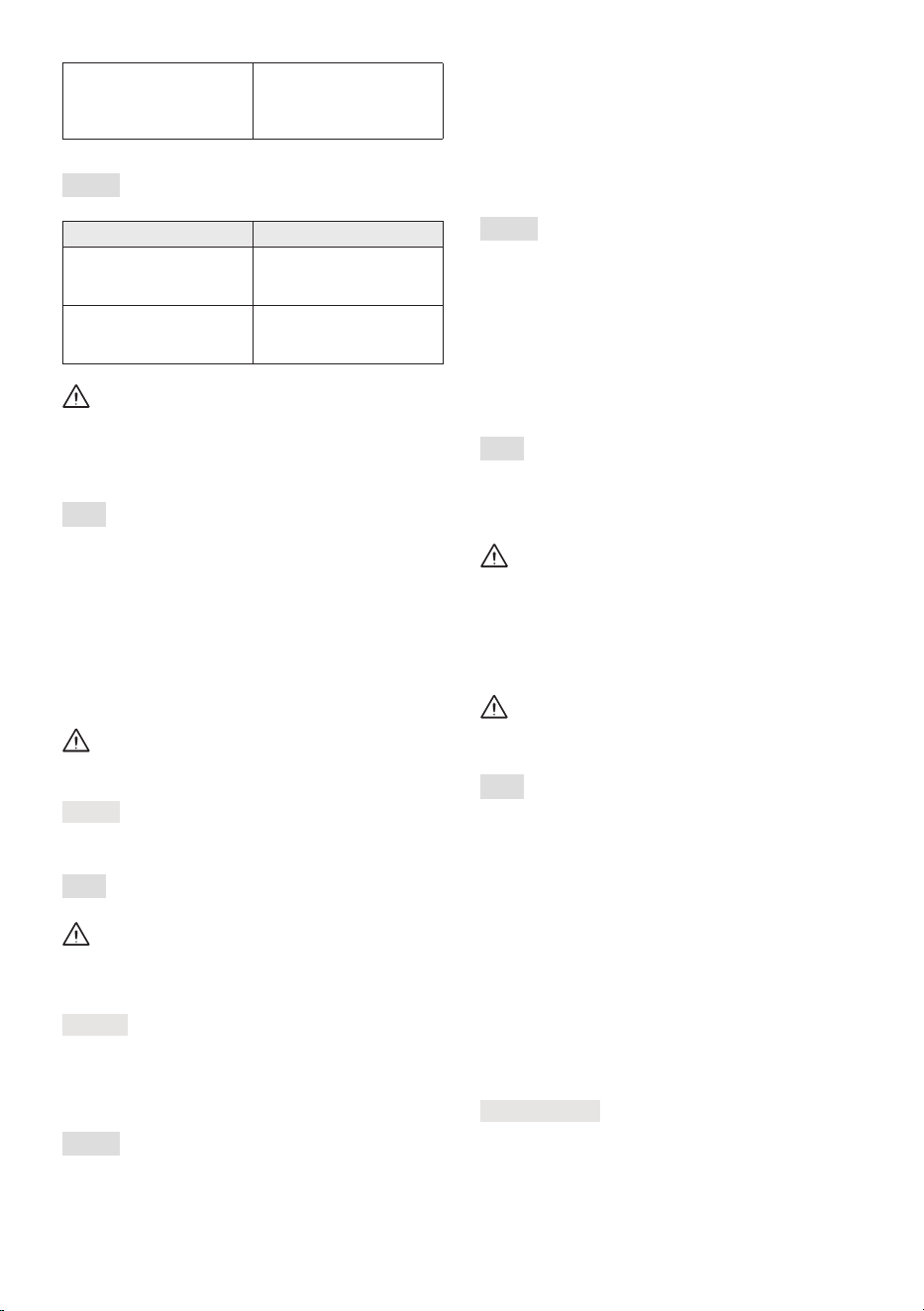
6.2 SAFETY CHECKS
Always carry out the safety
checks before use.
6.2.1 General check
Object Result
Hand grips (Fig. 1.C.) Are clean, dry and xed
rmly to the machine
Screws on the machine Correctly tightened
(not loose)
Cooling air ducts Not clogged
Blower tube (Fig. 1.B) Correctly installed.
No signs of damage
No obstruction.
Rotor No signs of damage
Guards No signs of damage
Battery (Fig. 1.D.) No damage to the casing,
no liquid leakage
Start/stop switch (Fig. 4.A) It must easily move from
one position to the other.
EN - 9
Machine No signs of damage
or wear.
No abnormal vibrations.
No abnormal sound
6.2.2 Machine operating test
Action Result
1. Start the machine
(para. 6.3
The machine starts and
the rotor starts rotating.
1. Move the switch to
the stop position
(Fig. 4.A.1 )
1. The switch should
move easily and the
machine should stop.
If any of the results fail to match
the indications provided in the tables
below, do not use the machine! Take
it to a service centre to be checked
and repaired if necessary.
6.3 START-UP
1. Adopt a rm and well-balanced position;
2. Make sure that the blower tube is not
directed towards any bystanders or debris;
3. Fit the battery (Fig. 6.A) inside its housing
pressing down until you hear it clicks rmly
into position and assure the electrical contact;
4. Move the switch to the start position
(Fig. 7.A.2, Fig. 7.A.3).
Starting the machine causes the
simultaneous rotation of the rotor.
NOTE Operate the machine
only on a rm, level surface.
6.4 OPERATION
While working, the machine
must always be held rmly with the
hand on the handgrip (Fig. 8).
NOTE During use, the battery is
protected against total drainage with a
protective device that switches o the
machine and stops it from working.
6.4.1 Adjusting the speed
It is always advisable to set the rotor speed in
relation to the type of material to be removed:
– average blowing speed (Fig. 7.A.2)
for light materials and small shrubs
on the lawn, to move light grass and
leaves on pavement or solid ground;
– high blowing speed (Fig. 7.A.3) ) for
wet leaves, heavier material, such
as fresh snow or bulky rubbish.
6.4.2 Operating suggestions
Proceed slowly keeping the end of
the blower tube at a suitable distance
from the ground (Fig. 8).
To avoid dispersing the material to be
removed, direct the air ow towards the
outer edges of the pile of material. Never
direct the air ow to the middle of the pile.
6.5 STOP
To stop the machine, move the switch
to the stop position (Fig. 9.A.1).
The rotor will continue to
rotate for a few seconds after you
have switched o the motor.
Always stop the machine when moving
between dierent work areas.
While moving the machine, never
keep the hand on the throttle control to
avoid starting the machine accidentally.
6.6 AFTER USE
• Remove the battery from its housing
and recharge it (para. 7.2.2).
• Allow the engine to cool before
storing in an enclosed space.
• Clean (para. 7.3).
• Check there are no loose or damaged
components. If necessary, replace
the damaged components and tighten
any screws and loose bolts or contact
the authorised service centre.
• Check there are no damages on
the machine. If necessary contact
the authorised service centre.
IMPORTANT Always remove the
battery (para. 7.2.2) whenever the
machine is unused or left unattended.

EN - 10
7. ROUTINE MAINTENANCE
7.1 GENERAL INFORMATION
IMPORTANT The safety regulations
to follow are described in chap. 2. Strictly
comply with these instructions to avoid
serious risks or dangers.
Before performing any inspections,
cleaning or maintenance/adjustment
interventions on the machine:
• Stop the machine (para. 6.5);
• Remove the battery and recharge it
(para. 7.2.2) (never leave the battery
inserted or within the reach of
children or unauthorised persons);
• Make sure that all moving parts
have come to a complete stop;
• Allow the engine to cool before
storing in an enclosed space.
• Wear suitable clothing, protective
gloves and goggles;
• Read the relevant instructions.
IMPORTANT Any maintenance and
adjustment operations not described in
this manual must be carried out by your
dealer or Authorised Service Centre.
7.2 BATTERY
7.2.1 Battery power reserve
Battery power reserve (and therefore
the cuttable area before recharging is
required) mainly depends on how the
operator works. who should avoid::
– switching the machine on and o
frequently whilst working;
– a rotor speed not suited to the type of
material to be removed (para. 6.4.1).
To optimise battery power reserve
it is always recommended to:
• set a rotor speed suited to the type
of material to be removed.
If the need arises to use the machine for
sessions which exceed the capability of
a standard battery, it is possible to:
• purchase a second standard battery
to immediately replace the discharged
battery, without compromising
the continuity of operations;
• purchase a battery with an extended
power reserve compared to the
standard version (para. 13.1).
7.2.2 Battery removal and
recharging (Fig.10÷14)
NOTE The battery is equipped with a guard
that inhibits recharging if the environmental
temperature is not between 0 and +45°C.
IMPORTANT The battery can be
charged at any time, even partially,
with no risk of damaging it.
7.3 CLEANING THE MACHINE
To reduce the risk of re, keep the
machine free of leaves and twigs.
• Always clean the machine after use with a
damp cloth dipped in neutral detergent.
• Remove all traces of humidity using
a soft damp cloth. Humidity can
generate risks of electric shocks.
• Do not use aggressive detergents or solvents
to clean the plastic parts or hand grips.
• Do not spray water onto the motor
and electrical components and
prevent them from getting wet.
• Always keep the rotor clean and
free of dust and debris, by blowing
compressed air through the grille.
Do not spray water on the rotor.
• To avoid overheating and damage to the
motor or the battery, always keep the
cooling air vents clean and free of debris.
7.4 NUTS AND BOLTS
• Keep all nuts, bolts and screws tight to be sure
the equipment is in safe working condition.
• Check regularly that the
handles are xed rmly.
8. STORAGE
IMPORTANT The safety regulations to
follow for putting into storage are described
in paragraph 2.4. Strictly comply with these
instructions to avoid serious risks or hazards.
8.1 STORING
When the machine is to be stored away:

EN - 11
1. Remove the battery from its housing
and recharge it (para. 7.2.2).
2. Allow the engine to cool before
storing in an enclosed space.
3. Clean (para. 7.3).
4. Make sure there are no loose or
damaged components. If necessary,
replace the damaged components and
tighten any screws and loose bolts or
contact the authorised service centre.
5. Store the machine:
– in a dry place
– protected from inclement weather
– in a place where children cannot get to it
– making sure that keys or tools used
for maintenance are removed.
8.2 STORING THE BATTERY
If the battery is not chargerd for a long period
of time, it must be kept in a cool, shaded
place without humidity, with environmental
temperature between 0~45°C.
NOTE If unused for any length of
time, recharge the battery every two
months to prolong its working life.
9. HANDLING AND TRANSPORT
Whenever the machine is to be
handled or transported you must:
– Stop the machine (para. 6.5);
– Make sure that all moving parts
have come to a complete stop;
– Remove the battery from its housing
and recharge it (para. 7.2.2);
– Only take hold the machine using the
handgrips and position the pipes so
that they do not case obstruction.
– Make sure that machine movements
do not cause damage or injuries.
When transporting the machine
on a vehicle, always:
– remove the tubes;
– position it so that it does not
cause a hazard to anyone.
10. ASSISTANCE AND REPAIRS
This manual provides all the necessary
information to run the machine and for
correct basic maintenance operations
which can be performed by the user. Any
regulations and maintenance operations
not described herein must be carried out by
your Dealer or Authorised Service Centre.
Any operations performed in unauthorised
centres or by unqualied persons will totally
invalidate the Warranty and all obligations
and responsibilities of the Manufacturer.
• Non-original parts and attachments are
not approved; use of non-original spare
parts and attachments will jeopardise
the safety of the machine and relieve the
Manufacturer from all obligations or liabilities.
• Original spare parts are supplied
by authorised Dealers and by
Authorised Service Centres.
11. WARRANTY COVERAGE
The warranty conditions are intended for
consumers only, i.e. non-professional operators.
The warranty covers all material quality
and manufacturing defects recognised
during the warranty period by your
Dealer or Authorised Service Centre.
The warranty is restricted to the repair or
replacement of components recognised as faulty.
The warranty only applies to machines
subjected to regular maintenance.
The warranty does not cover
damages resulting from:
• Failure to become familiar with the
documentation accompanying the
machine (Instruction manuals).
• Professional use.
• Carelessness, negligence.
• External causes (lightning, impact, presence of
foreign bodies inside the machine) or incidents.
• Incorrect use or assembly are
prohibited by the manufacturer.
• Poor maintenance.
• Modication to the machine.
• Use of non-genuine spare
parts (adaptable parts).
• Use of accessories not supplied or
approved by the manufacturer.
The warranty does not cover:
• The maintenance operations (described
in the instruction manual).
• Normal wear and tear of consumables.
• Normal wear and tear.
• Deterioration in the appearance
of the machine due to use.
• Any ancillary expenses related to the
enforcement of the warranty, such as
costs incurred to travel to the user’s
location, transfer of the machine to the
Dealer, rental of replacement equipment
or calling of independent enterprises
to perform maintenance work.
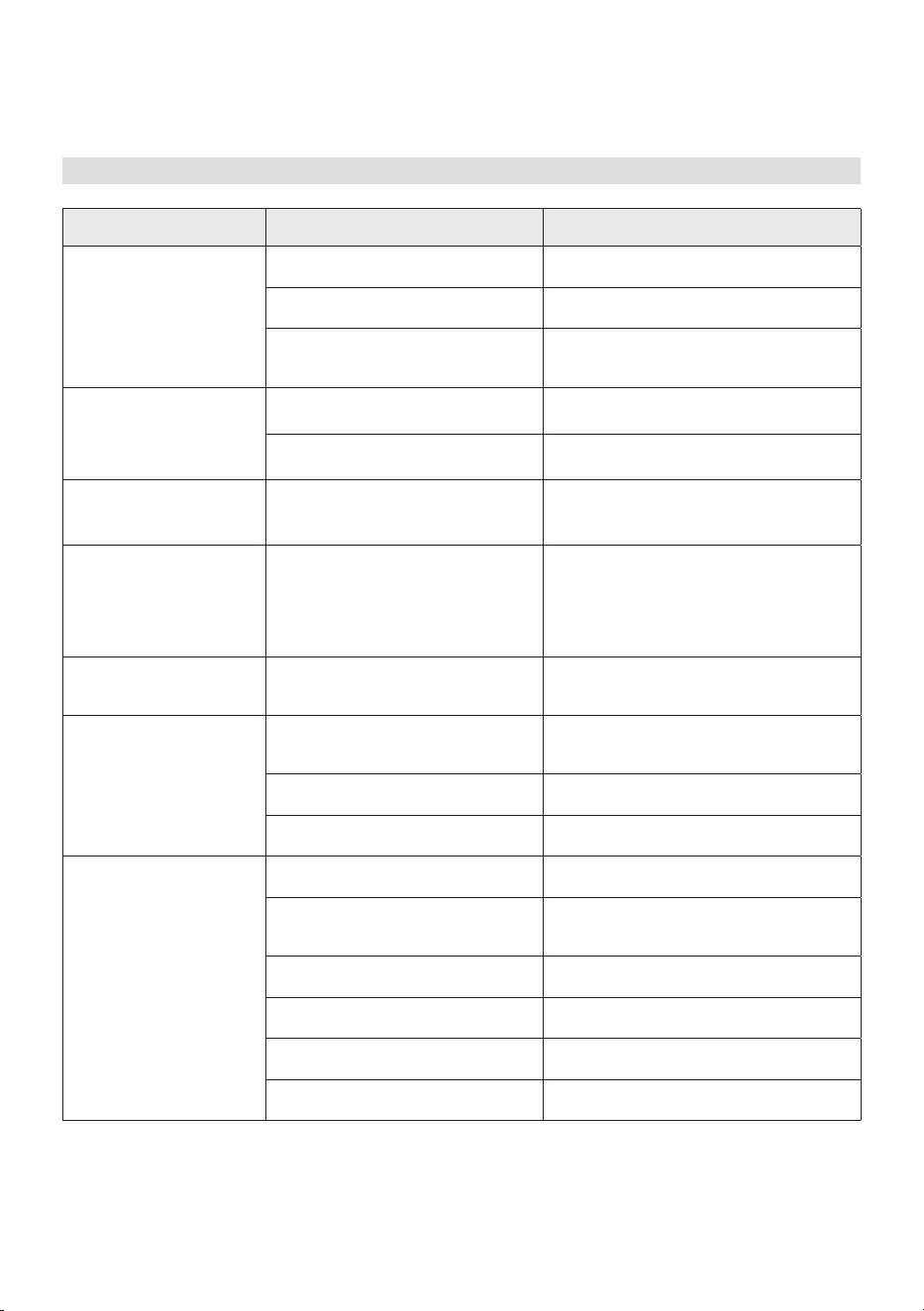
EN - 12
The user is protected by his or her own national legislation. The user’s rights under the
national laws or his or her own country are not in any way restricted by this warranty.
12. TROUBLESHOOTING
PROBLEM PROBABLE CAUSE SOLUTION
1. The machine does
not start when the
switch is moved
Battery is not inserted or
is inserted incorrectly
Make sure that the battery is
inserted correctly (para. 7.2.3)
Low battery Check the battery status and recharge
if necessary (para. 7.2.2)
Defective start/stop switch
or damaged blower
Do not use the machine. Immediately
turn o the machine, remove the battery
and contact a service centre.
2. The motor shuts
down whilst working
Battery is not inserted correctly Make sure that the battery is
inserted correctly (para. 7.2.3)
Low battery Check the battery status and recharge
if necessary. (para. 7.2.2)
3. The rotor rotates, but
the air does not come
out from the blower tube
Blocked or clogged blower tube Stop the machine, remove the battery
and remove any obstructions.
4. Excessive noise and/or
vibration is experienced
whilst working
Loose or damaged parts Turn o the machine remove the battery and:
– inspect for damage;
– check for and tighten any loose parts;
– have any damaged parts replaced
or repaired with parts having
equivalent specications.
5. The machine gives o
smoke whilst working
Damaged blower. Do not use the machine. Immediately
turn o the machine, remove the battery
and contact a service centre.
6. Battery power
reserve is low
Severe working conditions
requiring greater
current absorption
Optimise operations
(para. 7.2.1)
Battery is insucient for
operating requirements
Use a second battery or extended
battery (para. 13.1)
Decrease in battery capacity Purchase a new battery
7. The battery charger
is not recharging
the battery
Battery is not correctly inserted
in the battery charger
Check it is correctly inserted (para. 7.2.2)
Unsuitable environmental conditions Recharge the battery in places with
suitable temperatures (see battery/
battery charger instruction manual)
Dirty contacts Clean the contacts
The battery charger is not energised Check it is plugged in and the
power socket is energised
Faulty battery charger Replace with an original spare part
If the problem persists, refer to the battery/
battery charger manual
If problems persist after implementing the solution, contact your Dealer.

EN - 13
13. ATTACHMENTS ON REQUEST
13.1 BATTERIES
Dierent capacity batteries are available to
suit specic operating requirements (Fig. 15).
The list of approved batteries for this machine
can be found in the "Technical Data" table.
13.2 BATTERY CHARGER
Device used to recharge the battery (Fig.16).

DICHIARAZIONE CE DI CONFORMITÁ (Istruzioni Originali)
(Direttiva Macchine 2006/42/CE, Allegato II, parte A)
1. La Società: ST. S.p.A. – Via del Lavoro, 6 – 31033 Castelfranco Veneto (TV) – Italy
2. Dichiara sotto la propria responsabilità, che la macchina:
Soffiatore portatile da giardino
g) Livello di potenza sonora misurato:
h) Livello di potenza sonora garantito:
k) Flusso d’aria:
n) Persona autorizzata a costituire il
FascicoloTecnico:
o) Castelfranco Veneto, 01/03/2023
CEO Stiga Group
Sean Robinson
171516228/2
90.6 dB(A)
92 dB(A)
0.15
ST. S.p.A.
Via del Lavoro, 6
31033 Castelfranco Veneto (TV) - Italia
3. É conforme alle specifiche delle direttive:
a) Tipo / Modello Base: BL 20 Li S - BL 20 Li A
c) Numero di Serie: 23A••BLO000001 ÷ 99L••BLO999999
d) Motore: a batteria
• MD: 2006/42/EC
• OND: 2000/14/EC, ANNEX V - 2005/88/EC
• EMCD: 2014/30/EU
• RoHs II : 2011/65/EU - 2015/863/EU
4. Riferimento alle Norme armonizzate:
EN 60335-1:2012+A11:2014+A13:2017+A1:2019+A2:2019+A14:2019
EN 50636-2-100:2014
EN 62233:2008
EN IEC 55014-1:2021
EN IEC 55014-2:2021
EN IEC 63000:2018
m³/s

UK DECLARATION OF CONFORMITY
(Supply of Machinery (Safety) Regulations 2008, S.I. 2008 No. 1597, Annex II, part A)
1. The company: ST. S.p.A. – Via del Lavoro, 6 – 31033 Castelfranco Veneto (TV) – Italy
2. Hereby declares under its own responsibility that the machine (function):
Hand-held garden Blower
3. Conforms to UK Regulations:
• S.I. 2008/1597 - Supply of Machinery (Safety) Regulations 2008
• S.I. 2001/1701 - Schedule 8 - Noise Emission in the Environment by Equipment for use Outdoors Regulations 2001
• S.I. 2016/1091 - Electromagnetic Compatibility Regulations 2016
• S.I. 2012/3032 - The Restriction of the Use of Certain Hazardous Substances in Electrical and Electronic Equipment
Regulations 2012
4. Reference to harmonised standards:
g) Measured sound power level:
h) Guaranteed sound power level:
k) Flow of air:
n) Person authorised to compile the technical file:
o) Castelfranco Veneto, 01/03/2023 CEO Stiga Group
Sean Robinson
171516228/2
ST. S.p.A.
Via del Lavoro, 6
31033 Castelfranco Veneto (TV) - Italia
EN 60335-1:2012+A11:2014+A13:2017+A1:2019+A2:2019+A14:2019
EN 50636-2-100:2014
EN 62233:2008
EN IEC 55014-1:2021
EN IEC 55014-2:2021
EN IEC 63000:2018
a) Homologation type:
c) Serial number:
d) Engine: battery-operated
STIGA LTD
Unit 8, Bluewater Estate Plympton,
Devon, PL7 4JH, England
UK Importer:
BL 20 Li S - BL 20 Li A
23A••BLO000001 ÷ 99L••BLO999999
0.15
m³/s
90.6 dB(A)
92 dB(A)

© by ST. S.p.A.
IT • Il contenuto e le immagini del presente manuale d’uso sono stati realizzati per conto di ST. S.p.A. e sono tutelati da diritto d’autore – E’
vietata ogni riproduzione o alterazione anche parziale non autorizzata del documento.
EN • The content and images in this User Manual were produced expressly for ST. S.p.A. and are protected by copyright – any
unauthorised reproduction or modication to the document, either partially or in full, is prohibited.

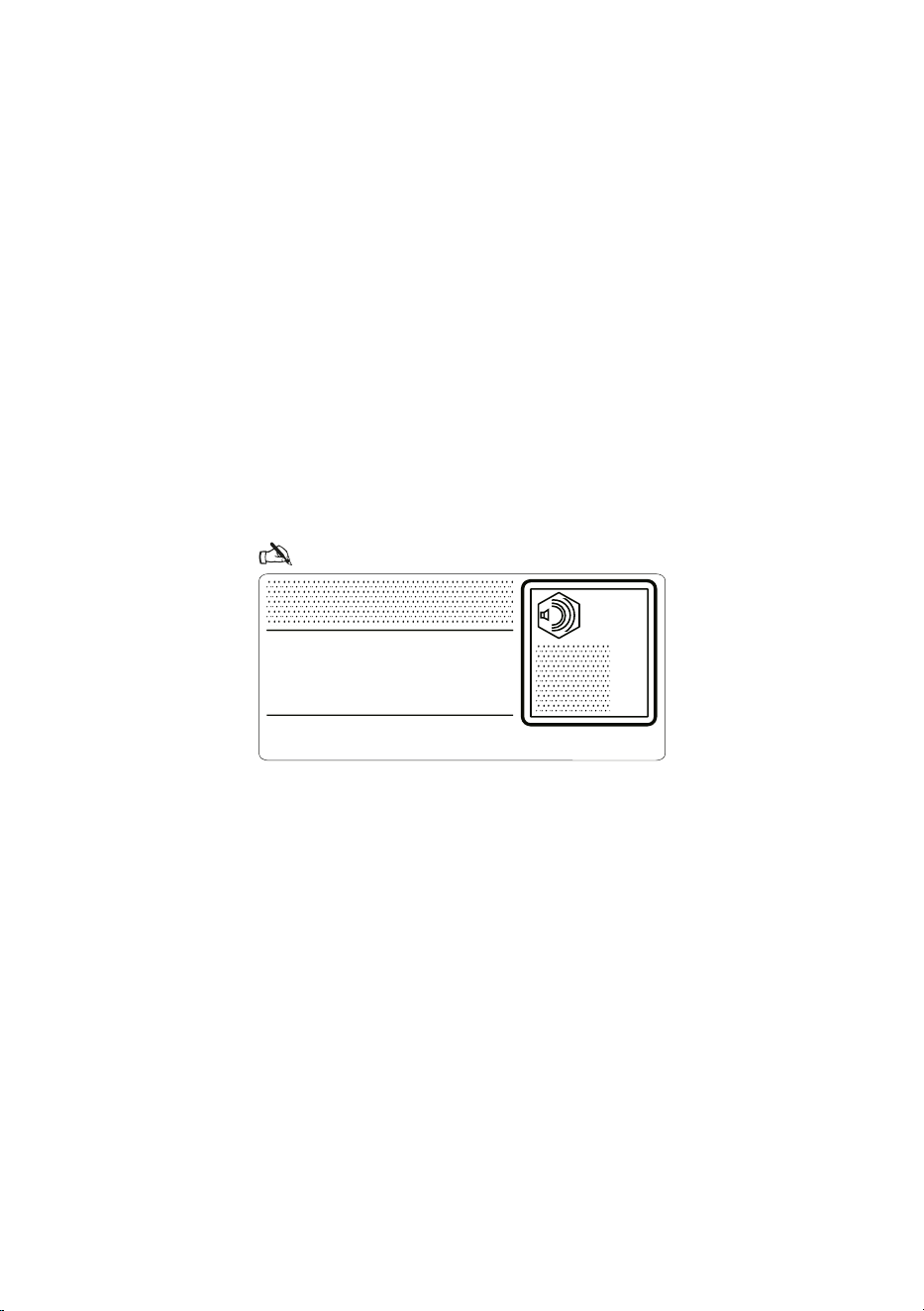
ST. S.p.A.
Via del Lavoro, 6
31033 Castelfranco Veneto (TV) ITALY
STIGA LTD (UK Importer)
Unit 8, Bluewater Estate Plympton,
Devon, PL7 4JH, England
dB
L
WA
Type:
................................
.................. -s/n ........................................
Art.N .......................................................