
For questions about features, operation/performance, parts or service, call:
1-877-465-3566
0RGHO
:060;%(
Refrigerator Use & Care Guide
Table of Contents
ImportantSafetyInstruction……………………………………………………..1
Installation………………………………………………………………………….......3
DescriptionoftheAppliance……………………………………………………..4
TemperatureControl…………………………………………………………………6
CleaningandCare………………………………………………………….………….7
EnergySavingTips………………………………………………..……………………8
TroubleShooting……………………………………………………….………………8
Disposaloftheappliance…………………………….....………………………10
1
For your safety and correct usage,
please read these instructions carefully
before using your new appliance to
avoid unnecessary mistakes and
accidents. Please ensure that all
people using this appliance are familiar
with its operation and safety features.
Keep these instructions in a safe place
for future reference and be sure that
they are kept with the appliance in the
event that it is moved or sold, so that
everyone using it through its life will be
properly informed on its correct
appliance usage and safety. The
manufacturer is not responsible for
damages caused by misuse. The
appliance is for indoor and domestic
use only.
Electrical Information
The appliance must be plugged into
its own dedicated 115 Volt, 60 Hz.,
15 Amp, AC only electrical outlet.
The power cord of the appliance is
equipped with a three-prong
grounding plug for your protection
against electrical shock hazards. It
must be plugged directly into a
properly grounded three prong
receptacle. The receptacle must be
installed in accordance with local
codes and ordinances. Consult a
qualified electrician. Avoid
connecting refrigerator to a Ground
Fault Interruptor (GFI) circuit. Do not
use an extension cord or adapter plug.
/ĨƚŚĞ^hWW>zKZŝƐĚĂŵĂŐĞĚŝƚ
ŵƵƐƚďĞƌĞƉůĂĐĞĚďLJƚŚĞ
ŵĂŶƵĨĂĐƚƵƌĞƌŝƚƐƐĞƌǀŝĐĞĂŐĞŶƚŽƌ
ƐŝŵŝůĂƌůLJƋƵĂůŝĨŝĞĚƉĞƌƐŽŶŝŶŽƌĚĞƌƚŽ
ĂǀŽŝĚĂŚĂnjĂƌĚ
Never unplug the refrigerator by
pulling on the power cord. Alwaysgrip
the plug firmly, and pull
straight out from the receptacle to
prevent damaging the power cord.
Unplug the refrigerator before
cleaning and before replacing a
light bulb to avoid electrical shock.
Performance may be affected if the
voltage varies by 10% or more.
Such damage is not covered under
your warranty.
Do not plug the unit into anelectrical
outlet controlled by a wallswitch or
pull cord to prevent therefrigerator
from being turned offaccidentally.
Fire Hazard
The appliance contains a small
quantity of refrigerant (R600a)
which is environmentally friendly but
potentially flammable in the refrigerant
circuit.
Table of Contents
*NQPSUBOUTBGFUZJOTUSVDUJPOT

Safety for Children and Others
Who are Vulnerable
This appliance is not intended for
use by persons (including children)
with reduced physical, sensory or
mental capabilities, or lack of
experience and knowledge, unless
they have been given supervision or
instruction concerning the use of the
appliance by a person responsible for
their safety. Children should be
supervised to ensure that they do
not play with the appliance.
Keep all packaging away from
children to avoid risk of suffocation.
If you are discarding your old
appliance, pull the plug out of the
socket, cut the connection cable
(as close to the appliance as you
can).Cut off the main plug and
discard. Break off any old locks or
latches as a safeguard and remove
the door to prevent children playing
from suffering an electric shock or
from closing themselves inside it.
This appliance is intended to be used
in household and similar applications
such as:
- staff kitchen areas in shops, offices
and other working environments;
- farm houses and by clients in hotels,
motels and other residential type
environments;
- bed and breakfast environments;
- catering and similar non-retail
applications.
Do not store flammable gases or
liquids inside the appliance. There
is a risk of an explosion.
Do not operate any electrical
appliances within the appliance
(e.g. electric ice cream makers,
mixers, etc.).
When unplugging, always pull the
Proper Disposal of your
Refrigerator
Risk of Child Entrapment
Child entrapment and suffocation are
not only problems of the past. Junked
or abandoned refrigerators are still
dangerous - even if they are sitting
“for just a few days”.If you are getting rid
of your old refrigerator, please follow
the instructions below to help prevent
accidents.
Before you throw away your
old refrigerator:
Remove doors.
Leave shelves in place so children
may not easily climb inside.
Have refrigerant removed by a
qualified service technician.
2
General safety and Daily use
plug from the main outlet. Do not
pull on the cord.
Do not place hot items near the
plastic components of this appliance.
Do not place food products directly
against the air outlet on the rear wall.
Frozen food must not be refrozen
once it has been thawed out.
Store pre-packaged frozen food in
accordance with the frozen food
manufacturer’s instructions.
The appliance’s manufacturer
storage recommendations should
be strictly adhered to. Refer to the
relevant instructions for storage.
Do not place carbonated or fizzy
drinks in the freezer compartment
as it creates pressure on the container,
which may cause it to explode,
resulting in damage to the appliance.
Ice lollies (popsicles) can cause
frost burns if consumed straight
from the freezer compartment.
Do not place food directly against
the air outlet inside the refrigerator.
Do not place the appliance in direct
sunlight.
ŽŶŽƚƐƚŽƌĞĞdžƉůŽƐŝǀĞƐƵďƐƚĂŶĐĞƐ
ƐƵĐŚĂƐĂĞƌŽƐŽůĐĂŶƐǁŝƚŚĂĨůĂŵŵĂďůĞ
ƉƌŽƉĞůůĂŶƚŝŶƚŚŝƐĂƉƉůŝĂŶĐĞ
Before installing, follow these
important first steps.
Location
Position the appliance away from
sources of heat such as stoves,
radiators, direct sunlight etc. Maximum
performance and safety are guaranteed
by maintaining the correct indoor
temperature for the class of unit
concerned, as specified on the rating
plate. This appliance performs well
oo
from 12.8 to 43.3 C (55-110 F ). The
appliance may not work properly if it is
left for a longer period at a temperature
above or below the indicated range.
IMPORTANT!
There is a need of good ventilation
around the fridge for easy dissipation
of heat, high efficiency of refrigeration
and low power consumption. For this
purpose, sufficient clear space should
be available around the fridge. It is
advisable for there to be 75 mm (3 inch)
separating the back of the fridge to the
wall, at least 100 mm (4 inch) of
space at its two sides, and a minimum
of 100 mm (4 inch) from its top and a
clear space up front to allow the doors
o
to open 1ϯϱ.
Appliances must not be exposed to rain.
Sufficient air must be allowed to
circulate in the lower rear section of
appliance, as poor air circulation can
affect performance.
tZE/E'dŚĞĨŽĂŵƉĂĚĂďŽǀĞƚŚĞ
ĐŽŵƉƌĞƐƐŽƌŝƐŽŶůLJƐƵŝƚĂďůĞĨŽƌ
ƚƌĂŶƐƉŽƌƚĂŶĚŵƵƐƚďĞƌĞŵŽǀĞĚďĞĨŽƌĞ
ƵƐĞ
Wash any removable parts of the
refrigerator interior, and exterior
with mild detergent and warm
water. Wipe dry. Do not use harsh
cleaners on these surfaces.
Do not use razor blades or other
sharp instruments, which can
scratch the appliance surface when
removing adhesive labels. Any glue left
from the tape can be removed with a
mixture of warm water and mild
detergent, or touch the residue with
the sticky side of tape already
removed. Do not remove the serial
plate.
Caution: flammable refrigerant used!
When handing, moving and use of the
refrigerator, make sure to avoid either
damaging the refrigerant tubing,
or increasing the risk of a leak.
WARNING: Keep ventilation openings,
in the appliance enclosure or in the
built-in structure, clear of obstruction.
WARNING: Do not use mechanical
devices or other means to accelerate
the defrosting process, other than
those recommended by the
manufacturer.
WARNING: Do not damage the
refrigerant circuit.
WARNING: Do not use electrical
appliances inside the food storage
compartments of the appliance, unless
they are of the type recommended
by the manufacturer.
Cleaning
3
Table of Contents
*OTUBMMBUJPO
State of California Proposition 65 Warnings:
WARNING: This product contains one or more chernicals known to the State of California to cause cancer.
WARNING: This product contains one or more chernicals known to the State of California to cause birth
defects or other reproductive harm.
California (U.S.A.) Residents
WARNING: Cancer and Reproductive Harm - www.P65Warnings.ca.gov
4
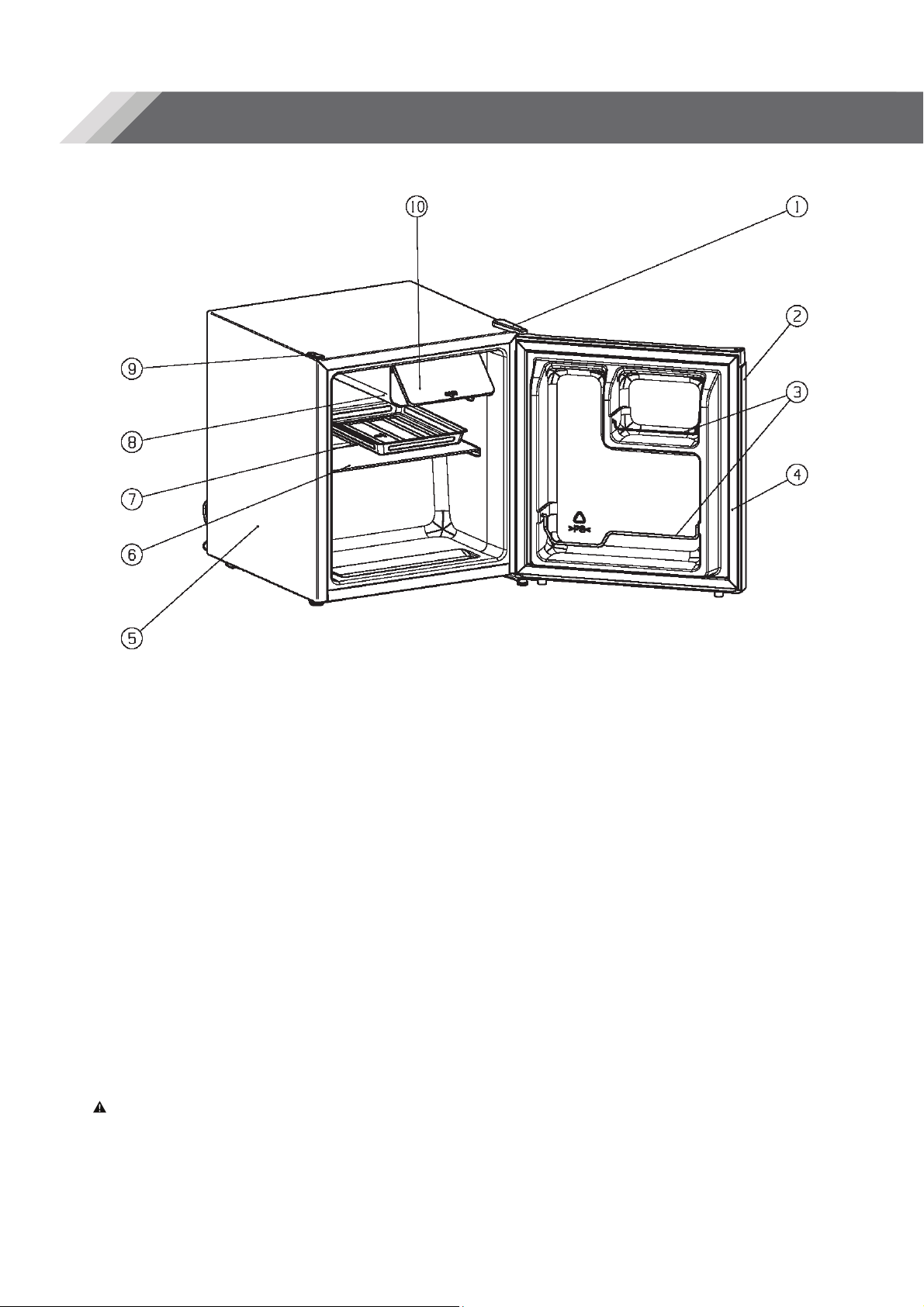
EKddŚŝƐĨŝŐƵƌĞŝƐŽŶůLJĂƐŬĞƚĐŚŽĨƚŚĞƌĞĨƌŝŐĞƌĂƚŽƌƚŚĞĂĐƚƵĂů
ƉƌŽĚƵĐƚŵĂLJĚŝĨĨĞƌĨƌŽŵŝƚ
༃upperhingecover
༅doorrack
༇caďŝŶĞƚ
༉waterdrainƚƌĂLJ
་screwholecover
༄refrigeratŽƌdoor
༆gasketpart
༈glassshelf
༊rollbondevaporator
༌ĐŚŝůůĞƌƌŽŽŵĐŽǀĞƌ
Table of Contents
%FTDSJQUJPOPGUIF"QQMJBODF
Reversing the Door
5
The side at which the door opens can be
changed from the right side (as supplied) to the
left side, if the installation site requires.
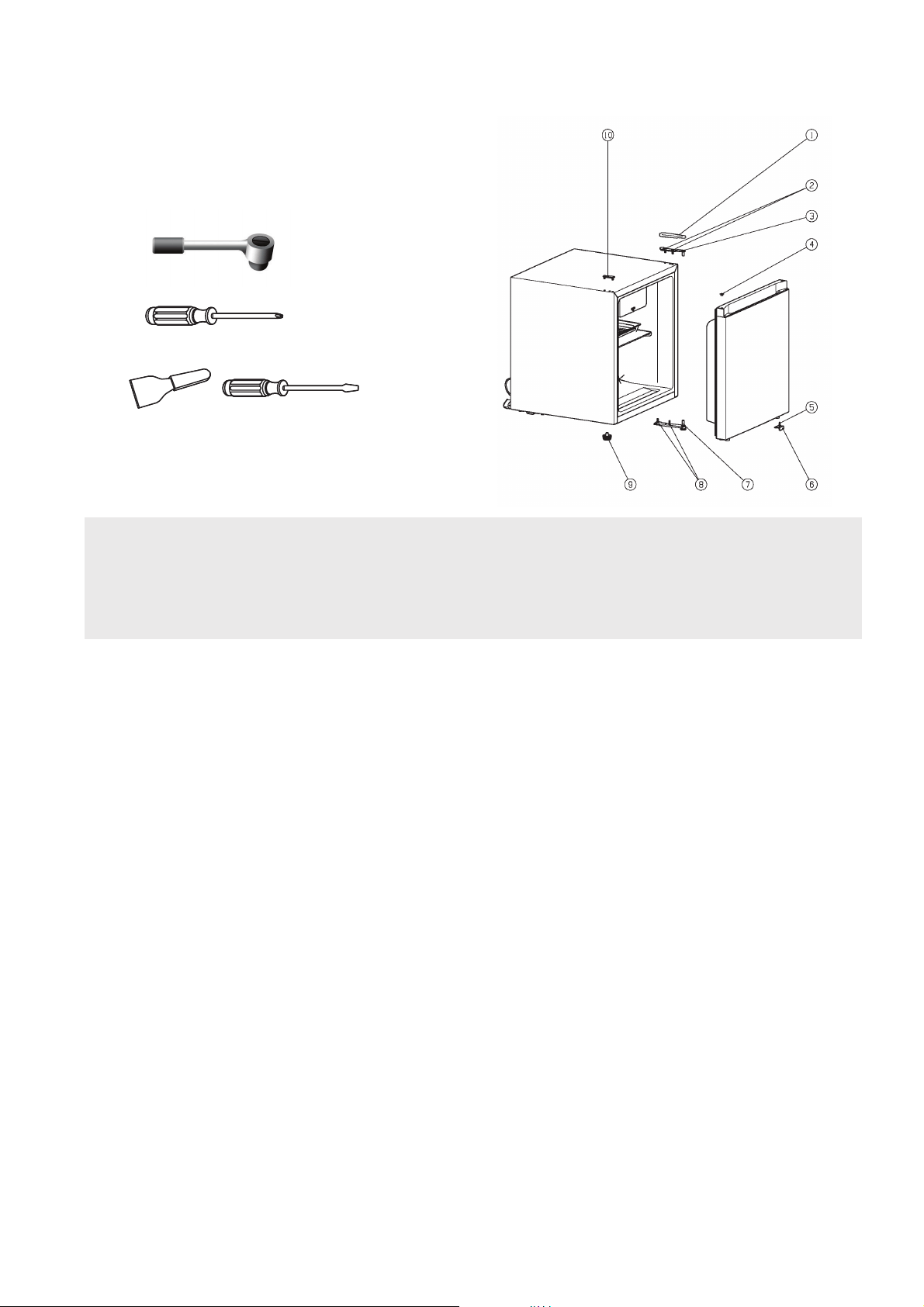
Tools you will need:
1. 8SFODINN
2. 1IJMJQT4DSFXESJWFS
3. Putty knife or thin-blade screwdriver
Before you start lay the refrigerator on it’s back in
order to gain access to the base, you should rest
it on soft foam packaging or similar material to
avoid damaging the cooling pipes at the rear of
the refrigerator.
༃
ƵƉƉĞƌŚŝŶŐĞĐŽǀĞƌ
༆
ŚŝŶŐĞŚŽůĞĐĂƉ
༉
ůŽǁĞƌŚŝŶŐĞ
༄
ƐƉĞĐŝĂůĨůĂŶŐĞƐĞůĨͲƚĂƉƉŝŶŐƐĐƌĞǁ
༇
ƐĐƌĞǁ
༊
ƐƉĞĐŝĂůĨůĂŶŐĞƐĞůĨͲƚĂƉƉŝŶŐƐĐƌĞǁ
༅
ƵƉƉĞƌŚŝŶŐĞ
༈
ĚŽŽƌƐƚŽƉƉĞƌ
་
ďŽƚƚŽŵĨĞĞƚ
༌
ƐĐƌĞǁŚŽůĞĐŽǀĞƌ
Ɣ Open the refrigerator door and remove all fittings inside the door.
Ɣ Remove the upper hinge cover ǐ.
Ɣ
Remov
e the two screws Ǒ that connect the upper hinge ǒ on the right side of the caELQHW top.
Ɣ Carefully lift the door and place it on a padded surface to prevent scratching.
Ɣ Remove the screw hole cover Ǚ and hinge hole cap Ǔ and transfer it to the uncovered hole on the right
side of the unit. Be sure to press the button firmly into the hole.
Ɣ Remove the screw ǔ attached to the door stopper Ǖ, then remove the door stopper, replace the door
stopper to the other side of the door, and fix it with screw.
Ɣ Remove the two screws Ǘ that hold the lower hinge ǖ on the right side of the cabinet.
Ɣ Remove the bottom feet ǘ and transfer it to the right side of the cabinet.
Ɣ Set the door into its new place making sure the pin enters the bushing at the lower frame section (hole).
Ɣ Secure the upper hinge ǒ previously removed in step 4 on the left side of the unit. Make sure the pin enters
the bushing on the upper frame section (hole).
Ɣ Loosely secure the lower hinge ǖ and do not tighten the bolts until the door is in the closed position and
leveled.
Ɣ Replace the upper hinge cover ǐ.
Ɣ Turn the door upright again.
Ɣ Open the door and attach all fittings.
Remove all food.
Unplug the power cord.
Clean and dry thoroughly.
Leave the door open slightly to
prevent odour and mould growth .
Insert the plug of the connection lead
into an outlet with pr
otective earth
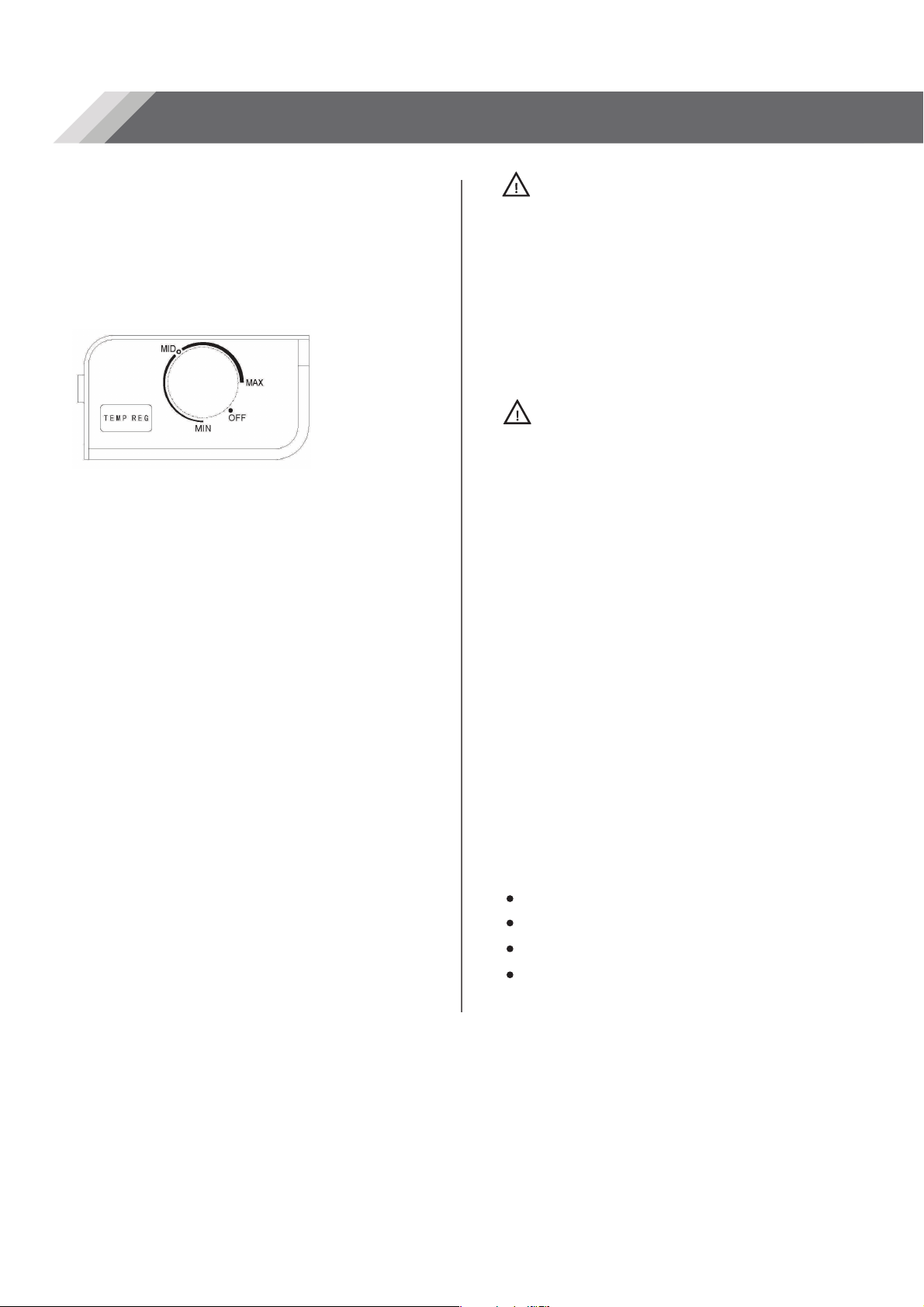
contact.
The temperature selector knob is located
on the right side of the fridge.
Setting OFF means
Turning the temperature control “OFF”
position stops the cooling cycle, but
does not shut off the power to the
refrigerator.
Turn the knob clockwise to turn the
refrigerating unit on. Coldest setting is
all the way to “MAX” position. The unit
operates automatically at the set
position. If the unit is unplugged , power
lost, or turned off, you must wait 3 to
5 minutes before restarting the unit. If
you attempt to restart before this time
delay, the refrigerator will not start.
Setting MIN means:
Highest temperature, warmest setting.
Setting MAX means:
Lowest temperature, coldest setting.
^ĞƚƚŝŶŐD/ŵĞĂŶƐ
DŝĚĚůĞƚĞŵƉĞƌĂƚƵƌĞŵŝĚĚůĞƐĞƚƚŝŶŐ
IMPORTANT !
Normally we advise you select setting
of “MID”, if you want the temperature
warmer or colder please turn the knob
to lower or higher setting accordingly.
Though the unit is energy efficient, it is
more efficient at lower position
settings.
IMPORTANT !
High ambient temperatures (e.g. on
hot summer days) and a cold setting on
the temperature regulator (position
“MAX” ) can cause the compressor to
run continuously or even non-stop!
When the refrigerator is in use, the
compressor needs being on and off
normally to ensure its defrosting.
Therefore, we should avoid setting the
refrigerator’s notch too high(MAX). If
you find the refrigerator frosts too
much, please set the refrigerator’s
notch lower.
Vacation Tips: lf the appliance
will not be used for several
months:
6
7HPSHUDWXUH
&RQWURO
5FNQFSBUVSF$POUSPM
For hygienic reasons the appliance
interior, including interior accessories,
should be cleaned regularly. The fridge
should be cleaned and maintained at
least every two months.
Warning! Danger of
electrical shock!
The appliance may not be
connected to the outlet during
cleaning! Before cleaning switch
the appliance off and remove the
plug from the mains, or switch off
the circuit breaker or fuse.
Remove the food from the
appliance before cleaning. Store
food in a cool place and keep well
covered.
Never clean the appliance with a
steam cleaner. Moisture could
accumulate in electrical
components.
Hot vapors can lead to the
damage of plastic parts.
The appliance must be dry before it
is placed back into service.
IMPORTANT!
Ethereal oils and organic solvents
can attack plastic parts, e.g. lemon
juice or the juice from orange peel,
butyric acid, and cleansers that
contain acetic acid. Do not allow
such substances to come into
contact with appliance parts.
Do not use any abrasive cleansers.
Clean the appliance and the
interior accessories with a cloth
and lukewarm water. Commercially
available dish washing detergents
may also be used.
After cleaning, wipe with fresh
water and a clean dish cloth.
Accumulation of dust at the
condenser increases energy
consumption. For this reason
carefully clean the condenser at the
back of the appliance once a year
with a soft brush or a vacuum
cleaner.
Check the water drain hole on the
rear wall of the refrigerator
compartment.
Clear a blocked drain hole with the
aid of something like a soft peg. Be
careful not to create any damage to
the cabinet by sharp objects.
After everything is dry, place
appliance back into service.
Defrosting Your Refrigerator
Defrosting process is automatic.
Me
lted fros
t flows into drip tray
and automatically evaporates.
7
$MFBOJOHBOE$BSF
Do not place warm foods into the
appliance. Allow warm foods to cool
first. Do not install the appliance
near cookers, radiators or other
sources of warmth. High ambient
temperatures cause longer, more
frequent operation of the compressor.
In order to make the cooling system
work efficiently, please make sure
the side plates and back plate of the
product are with some distance from
the wall. It is strongly recommended
that its back is 75 mm (3 inch) away
from the wall, its sides are at least
have a space of 100 mm (4 inch)
separately and the height from over its
top is no less than 100 mm (4 inch) .
During the defrost cycle, water will
accumulate in the drip tray. The
drip tray may need to be emptied
during the defrost cycle. Do not
leave unattended.
After defrosting is complete, empty
When the product works, please do
not
open the door too often or leave
the door open any longer than
necessary.
Do not set temperature any colder
than necessary.
The direct cooling refrigerator (with
a freezer) needs to be defrosted
when necessary. This will improve
the cold transfer and reduce energy
consumption.
The sketch map shows the right
combination of the shelves which
can lead to more energy efficiency.
If users adjust the combination, it
may result in more
energy-consumption.
Store food logically. Do not exceed
the storage period specified.
and wipe down the drip tray, as
well as the interior of the
refrigerator. You may now reset
the refrigerator to the desired
temperature and put the food back
in.
Correcting Malfunctions
A malfunction may be caused by only a
minor fault that you can rectify yourself
using the following instructions. Do not
perform any other work on the
appliance if the following information
does not provide assistance in your
specific case.
Please keep upright at least 2 hours
before use to prevent damage of
compressor.
IMPORTANT!
Repairs to refrigerators/freezers should
only be performed by qualified service
technician. Improper repairs can give
rise to significant hazards for the user.
If your appliance needs repairing,
please contact your specialist dealer or
your local Service Center.
8
&OFSHZ4BWJOH5JQT
5SPVCMF4IPPUJOH
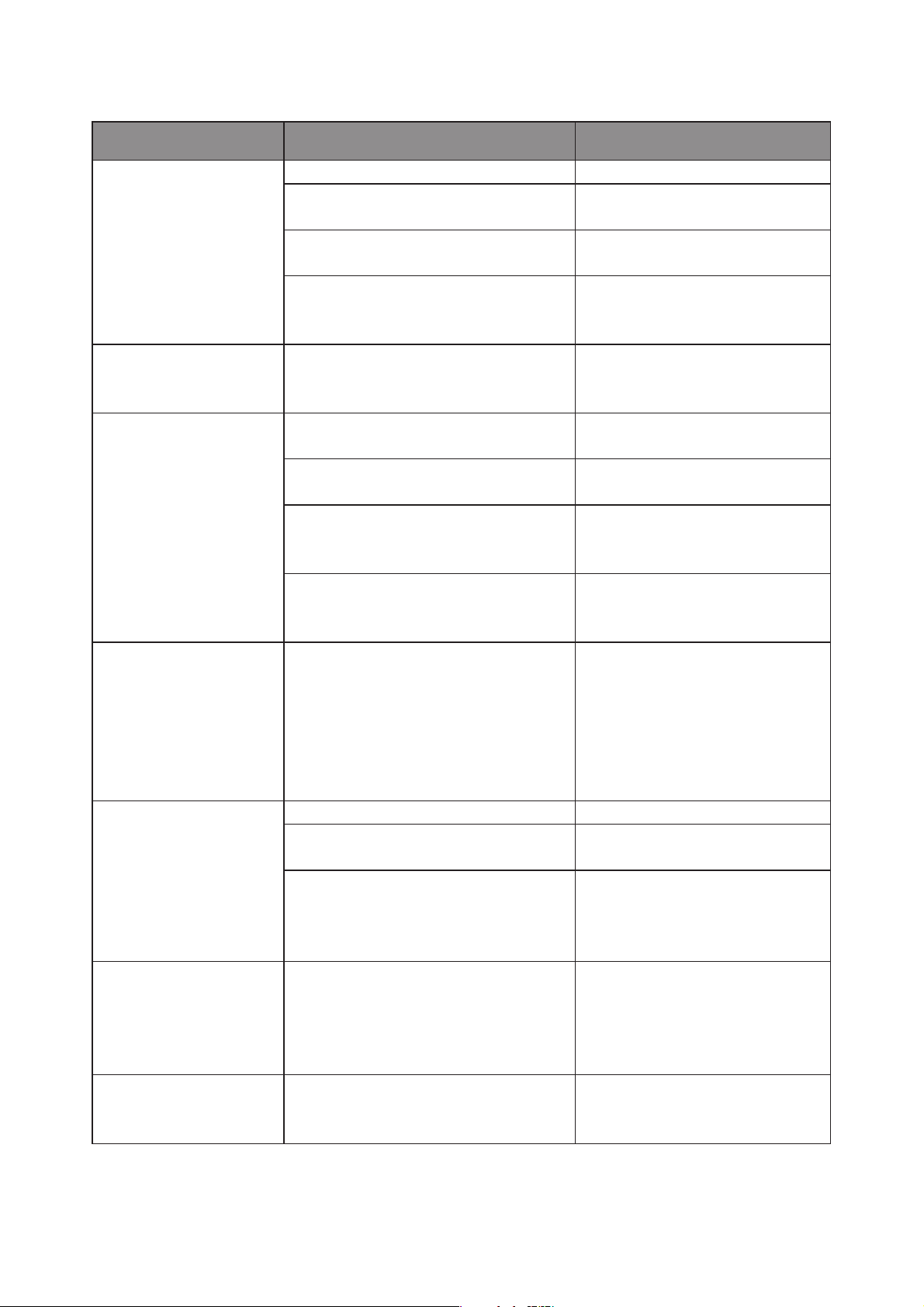
Problem Possible Cause Solution
Appliance does not
work.
Appliance cools too
much.
The food is too
warm.
Heavy build-up of
frost, possibly also
on the door seal.
Unusual noises
The compressor
does not start
immediately after
changing the
temperature setting.
Water on the floor or
storage shelves.
Appliance is not switched on.
Main plug is not plugged in or is
loose.
Fuse has blown or is defective.
Socket is defective.
Temperature is set too cold.
Temperature is not properly
adjusted.
Door was open for an extended
period.
A large quantity of warm food
was placed in the appliance
within the last 24 hours.
The appliance is near a heat
source.
Door seal is not air-tight
(possibly after reversing the
door).
Appliance is not level.
The appliance is touching the
wall or other objects.
A component, e.g. a pipe, on the
rear of the appliance is touching
another part of the appliance or
the wall.
This is normal, no error has
occurred.
Check that the drip tray is
housed properly.
Drip tray is full of water.
Switch on the appliance.
Insert main plug.
Check fuse, replace if
necessary.
Electrical malfunctions are
to be corrected by an
electrician.
Turn the temperature
regulator to a warmer
setting temporarily.
Please look in the
“temperature control”section.
Open the door only as long
as necessary.
Turn the temperature
regulation to a colder setting
temporarily.
Please look in the
“installation” section.
Carefully warm the leaking
sections of the door seal
with a hair dryer (on a cool
setting). At the same time
shape the warmed door seal
by hand such that it sits
correctly.
Re-adjust the feet.
If necessary, carefully bend
the component out of the
way.
Move the appliance slightly.
The compressor starts after
a period of time.
See the “cleaning and care”
section.
9
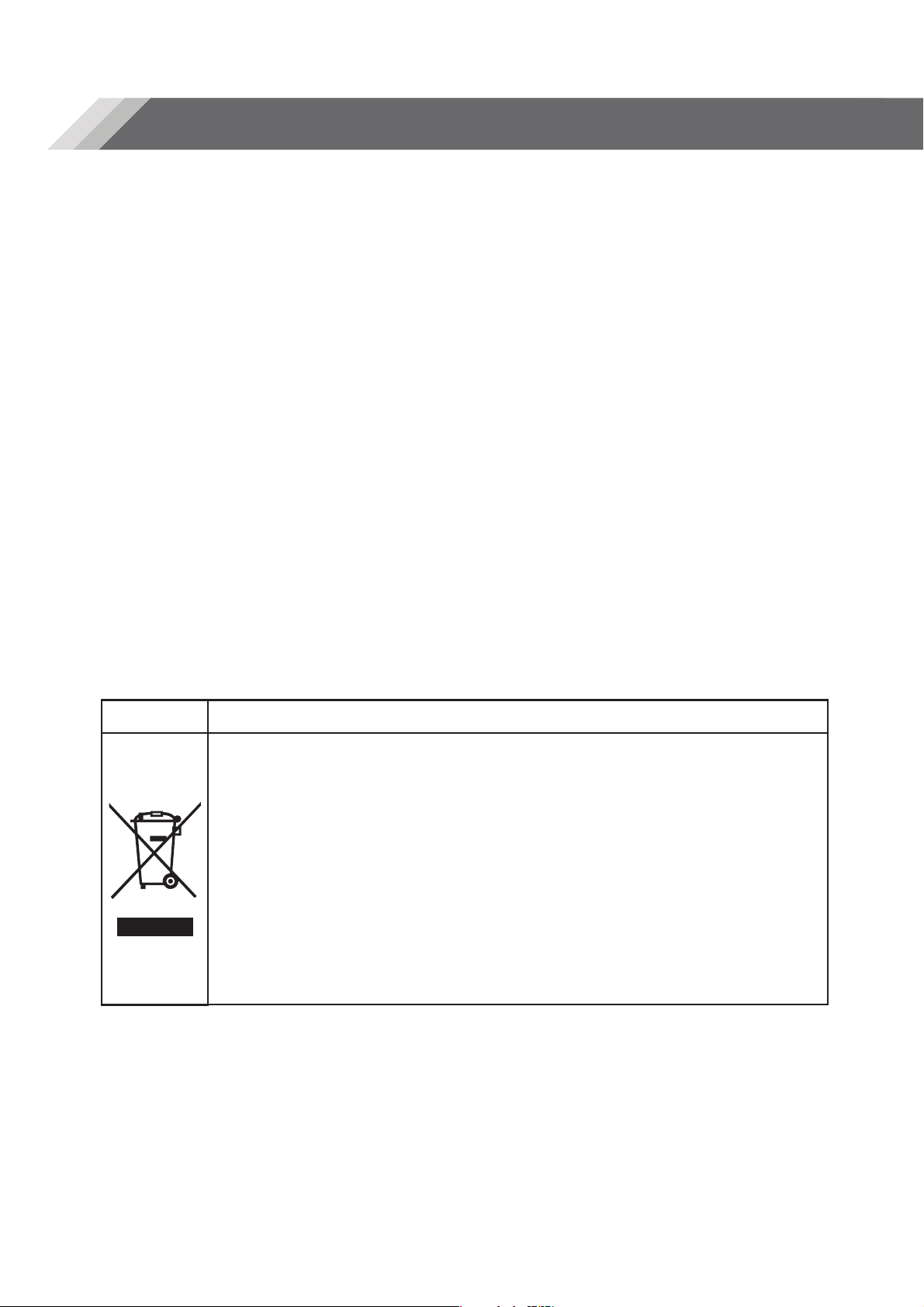
It is prohibited to dispose of this appliance as household waste.
Packaging materials:
Packaging materials with the recycle symbol are recyclable. Dispose of the
packaging into a suitable waste collection container to recycle it.
Before disposal of the appliance:
1. Pull out the main plug from the main socket.
2. Cut off the power cord and discard with the main plug.
Warning! Refrigerators contain refrigerant and gases in the insulation.
Refrigerant and gases must be disposed of professionally as they may cause
eye injuries or ignition. Ensure that tubing of the refrigerant circuit is not
damaged prior to proper disposal.
This symbol on the product or in its packing indicates that this
product may not be treated as household waste. Instead, it should
be taken to the appropriate waste collection point for the recycling of
electrical and electronic equipment. By ensuring this product is
disposed of correctly, you will help prevent potential negative
consequences for the environment and human health, which could
otherwise be caused by the inappropriate waste handling of this
product. For more detailed information about the recycling of this
product, please contact your local council, your household waste
disposal service, or the shop where you purchased the product.
Correct Disposal of this product
10
%JTQPTBMPGUIFBQQMJBODF