French version is available for download from the Vogelzang website: http://www.usstove.com/
Version française est disponible pour téléchargement à partir du site Vogelzang: http://www.usstove.com
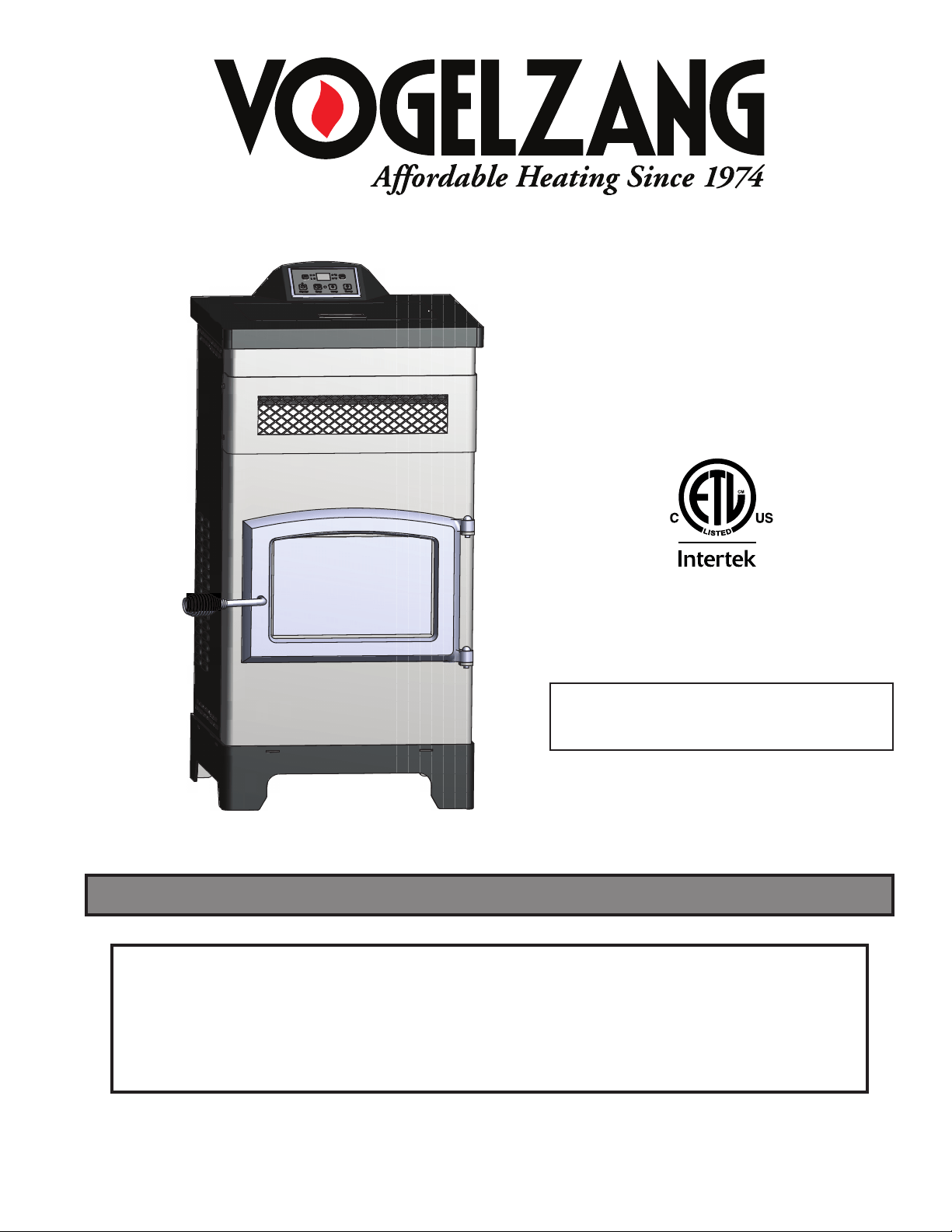
MODEL: VG5770/VG5770I
OWNER’S MANUAL
852050D-1903E
PLEASE READ THIS ENTIRE MANUAL BEFORE INSTALLATION AND USE OF THIS APPLIANCE.
FAILURE TO FOLLOW THESE INSTRUCTIONS COULD RESULT IN PROPERTY DAMAGE, BODILY
INJURY, OR EVEN DEATH.
CONTACT YOUR LOCAL BUILDING OR FIRE OFFICIALS ABOUT OBTAINING PERMITS, RE-
STRICTIONS AND INSTALLATION INSPECTION REQUIREMENTS IN YOUR AREA.
SAVE THESE INSTRUCTIONS.
U.S. Stove Company
227 Industrial Park Road, South Pittsburg, TN 37380
FOR TECHNICAL ASSISTANCE: Phone 800-750-2723 www.usstove.com
Certifi ed for installations in the USA
and Canada.
This unit is not intended to be used as a primary source of heat.
U.S. Environmental Protection Agency
Certified to comply with 2015 particulate
emissions standards.

2
This manual describes the installation and operation of the Vogelzang, VG5770, VG5770I wood heater. This heater meets the 2015
U.S. Environmental Protection Agency’s crib wood emission limits for wood heaters sold after May 15, 2015. Under specifi c test
conditions this heater has been shown to deliver heat at rates ranging from 10,898 to 24,335 Btu/hr.
This manual describes the installation and operation of the Vogelzang, VG5770, VG5770I wood heater. This heater meets the 2015
U.S. Environmental Protection Agency’s crib wood emission limits for wood heaters sold after May 15, 2015. Under specifi c test
conditions this heater has been shown to deliver heat at rates ranging from 10,898 to 24,335 Btu/hr.
IMPORTANT: Read this entire manual before installing and
operating this product. Failure to do so may result in property
damage, bodily injury, or even death. Proper installation of
this stove is crucial for safe and efficient operation.
Install vent at clearances specified by the vent manufacturer.
Do not connect the pellet vent to a vent serving any other
appliance or stove.
Do not install a flue damper in the exhaust venting system
of this unit.
Use of outside air is not required for this unit.
Contact your local building officials to obtain a permit and
information on any additional installation restrictions or inspec-
tion requirements in your area.
Do not throw this manual away. This manual has important
operating and maintenance instructions that you will need at
a later time. Always follow the instructions in this manual.
This appliance is designed for the use of pelletized fuel
that meet or exceed the standard set by the Pellet Fuel
Institute(PFI), The use of other fuels will void warranty.
Never use gasoline, gasoline-type lantern fuel, kerosene,
charcoal lighter fluid, or similar liquids to start or ’freshen up’
a fire in this stove. Keep all such liquids well away from the
stove while it is in use.
A working smoke detector must be installed in the same room
as this product.
Install a smoke detector on each floor of your home; incase of
accidental fire from any cause it can provide time for escape.
The smoke detector must be installed at least 15 feet (4,57
M) from the appliance in order to prevent undue triggering of
the detector when reloading.
Do not unplug the stove if you suspect a malfunction. Turn
the ON/OFF SWITCH to ”OFF’ and contact your dealer.
Your stove requires periodic maintenance and cleaning (see
”MAINTENANCE ”). Failure to maintain your stove may lead
to improper and/or unsafe operation.
Disconnect the power cord before performing any mainte-
nance! NOTE: Turning the ON/OFF Switch to ”OFF” does not
disconnect all power to the electrical components of the stove.
Never try to repair or replace any part of the stove unless
instructions for doing so are given in this manual. All other
work should be done by a trained technician.
Do not operate your stove with the viewing door open. The
auger will not feed pellets under these circumstances and
a safety concern may arise from sparks or fumes entering
the room.
Allow the stove to cool before performing any maintenance or
cleaning. Ashes must be disposed in a metal container with
a tight fitting lid. The closed container of ashes should be
placed on a non-combustible surface or on the ground, well
away from all combustible materials, pending final disposal.
The exhaust system should be checked monthly during the
burning season for any build-up of soot or creosote.
Do not touch the hot surfaces of the stove. Educate all
children on the dangers of a high-temperature stove. Young
children should be supervised when they are in the same
room as the stove.
The hopper and stove top will be hot during operation; there-
fore, you should always use some type of hand protection
when refueling your stove.
A power surge protector is required. This unit must be plugged
into a 110 - 120V, 60 Hz grounded electrical outlet. Do not
use an adapter plug or sever the grounding plug. Do not route
the electrical cord underneath, in front of, or over the heater.
Do not route the cord in foot traffic areas or pinch the cord
under furniture.
The heater will not operate during a power outage. If a power
outage does occur, check the heater for smoke spillage and
open a window if any smoke spills into the room.
The feed door must be closed and sealed during operation.
Never block free airflow through the open vents of the unit.
Keep foreign objects out of the hopper
.
The moving parts of this stove are propelled by high torque
electric motors. Keep all body parts away from the auger
while the stove is plugged into an electrical outlet. These
moving parts may begin to move at any time while the stove
is plugged in.
Do not place clothing or other flammable items on or near
this stove.
When installed in a mobile home, the stove must be grounded
directly to the steel chassis and bolted to the floor. WARN-
ING—THIS UNIT MUST NOT BE INSTALLED IN THE BED-
ROOM (per HUD requirements). CAUTION—THE STRUC-
TURAL INTEGRITY OF THE MOBILE HOME FLOOR, WALL,
AND CEILING/ROOF MUST BE MAINTAINED.
This appliance is not intended for commercial use.
CAUTION: Burning fuel creates carbon monoxide and can be
hazardous to your health if not properly vented.
* This appliance is a freestanding heater. It is not intended to be attached to any type of ducting. It is not a furnace.
Safety Precautions
CUT HERE CUT HERE
WARRANTY INFORMATION CARD
Name__________________________________________ Telephone #: (_____)_____________
City____________________________________________ State_______ Zip_________________
Email Address __________________________________________________________________
Model # of Unit________________________________ Serial #___________________________
Fuel Type:
Wood Coal Pellet Gas Other _________________________
Place of Purchase (Retailer)______________________________________________________
City____________________________________________ State_______ Zip_________________
If internet purchase, please list website address___________________________________
Date of Purchase _______________________________________________________________
Reason for Purchase: Alternative Heat Main Heat Source
Decoration Cost Other _________________________
What was the determining factor for purchasing your new USSC appliance?_______
I have read the owner’s manual that accompanies this unit and fully understand the:
Installation
Operation
and Maintenance
of my new USSC appliance.
Print Name Signature Date
Please attach a copy of your purchase receipt.
Warranty not valid without a Proof of Purchase.
Warranty information must be received within 30 days of original purchase.
Detach this page from this manual, fold in half with this page to the inside and tape together. Apply a
stamp and mail to the address provided. You may use an envelope if you choose.
You may register online by going to www.usstove.com
All information submitted will be kept strictly con dential. Information provided will not be sold for advertising purposes.
Contact information will be used solely for the purpose of product noti cations.
CUT HERE CUT HERE
Fold Here Fold Here
United States Stove Company
P.O. Box 151
South Pittsburg, TN 37380
Fold Here
PLACE
STAMP
HERE
5
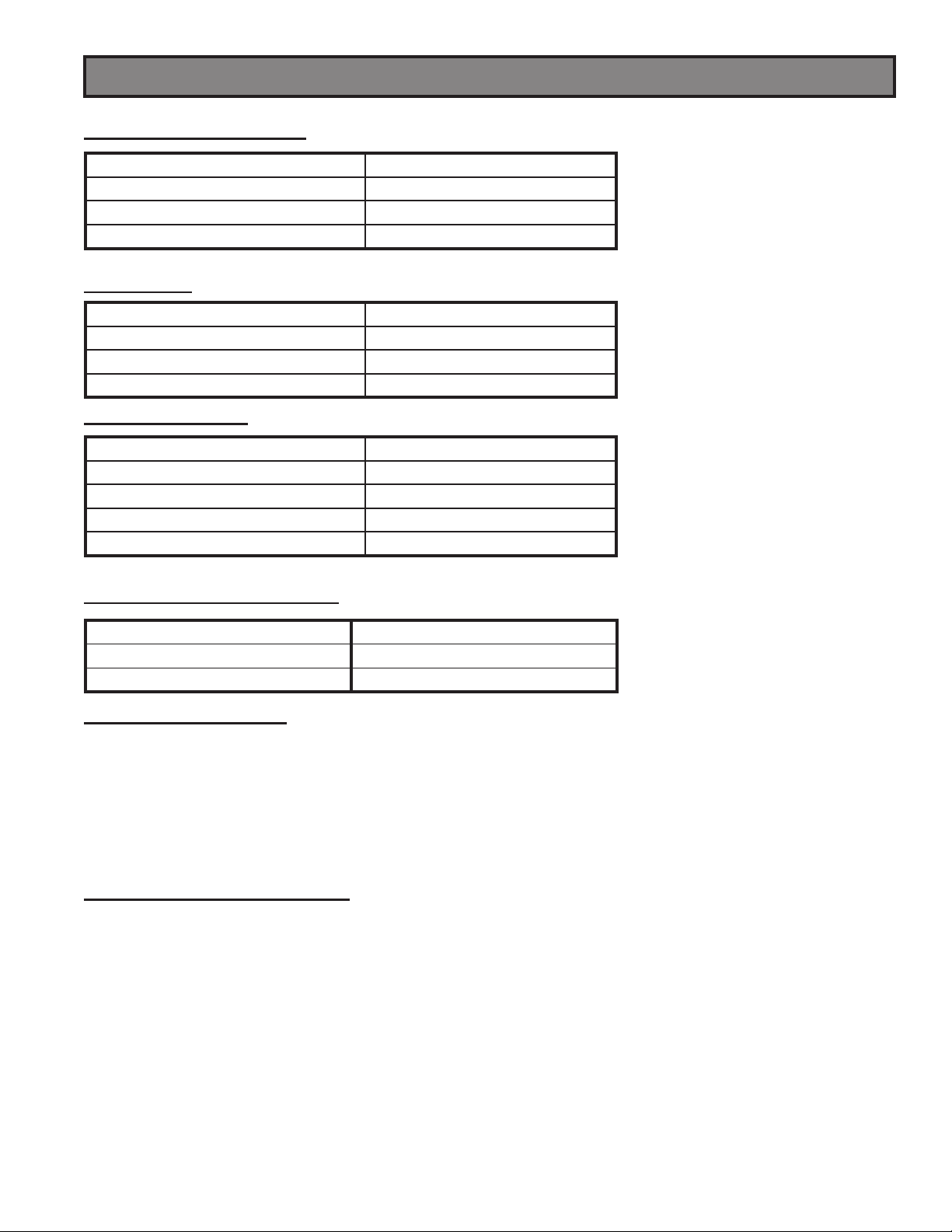
Fuel Burn Rate* (lowest setting) 1.5 lbs./hr. (0.5 kg/hr)
Burn Time (lowest setting) 40 hrs. (approximate)
Hopper Capacity 60 lbs. (55kg)
BTU up to 48,000
HEATING SPECIFICATIONS
Height 44.5 in. (1130mm)
Width 23 in. (584mm)
Depth 23.5 in. (597mm)
Weight 245 lbs. (111.1kg)
DIMENSIONS
FIREPLACE INSERT
Electrical Rating 110-120 volts, 60 HZ, 3.0 Amps
Watts (operational) 180
Watts (igniter running) 346
ELECTRICAL SPECIFICATIONS
FUEL CONSIDERATIONS
Your pellet stove is designed to burn premium hardwood pellets that comply with Association of Pellet Fuel Industries
standards. (Minimum of 40 lbs density per cubic ft, 1/4” to 5/16” diameter, length no greater than 1.5”, not less than
8,200 BTU/lb, moisture under 8% by weight, ash under 1% by weight, and salt under 300 parts per million). Pellets
that are soft, contain excessive amounts of loose sawdust, have been, or are wet, will result in reduced performance.
Store your pellets in a dry place. DO NOT store the fuel within the installation clearances of the unit or within the space
required for refueling and ash removal. Doing so could result in a house fi re.
Do not over fi re or use volatile fuels or combustibles, doing so may cause a personal and property damage hazards.
SAFETY AND EPA COMPLIANCE
Your pellet stove has been approved for installation in the USA and Canada. It may also be installed in a
manufactured or mobile home. Your stove conforms to ASTM E 1509, and Certifi ed to ULC S627, and(UM) 84-HUD
by INTERTEK Testing Services in Fairview, Oregon USA.
* Pellet size may effect the actual rate of fuel feed and burn times. Fuel feed rates may vary by as much as 20%. Use PFI listed fuel for best results.
SPECIFICATIONS
Height 24” (With Flashing: 32”)
Width 22” (With Flashing: 44”)
Depth 8.5”
Weight 182.5 Lbs. (Flashing 15.5 Lbs)
Flue Size 3” to 4”
* Approved installations: zer0-clearance, masonry, as a built-in.
6
INSTALLATION OPTIONS
Read this entire manual before you install and use your pellet stove. Failure to follow instructions may result
in property damage, bodily injury, or even death!
(See specifi c installation details for clearances and other installation requirements)
A Freestanding Unit—supported by pedestal/legs and placed on a non-combustible fl oor surface in compliance with
clearance requirements for a freestanding stove installation.
An Alcove Unit—supported by pedestal/legs and placed on a non-combustible fl oor surface in compliance with clearance
requirements for an alcove installation.
An Insert Unit— is inserted directly into an existing fi re place.
Your pellet stove may be installed to code in either a conventional or mobile home (see SPECIAL MOBILE HOME RE-
QUIREMENTS). The installation must comply with the Manufactured Home and Safety Standard (HUD), CFR3280, Part
24.
It is recommended that only a authorized technician install your pellet stove, preferably an NFI certifi ed specialist.
DO NOT CONNECT THIS UNIT TO ANY AIR DISTRIBUTION DUCT OR SYSTEM.
The use of other components other than stated herein could cause bodily harm, heater damage, and void your warranty.
IMPROPER INSTALLATION: The manufacturer will not be held responsible for damage caused by the mal-
function of a stove due to improper venting or installation. Call (800) 750-2723 and/or consult a professional
installer if you have any questions.
INSTALLATION
CLEARANCES
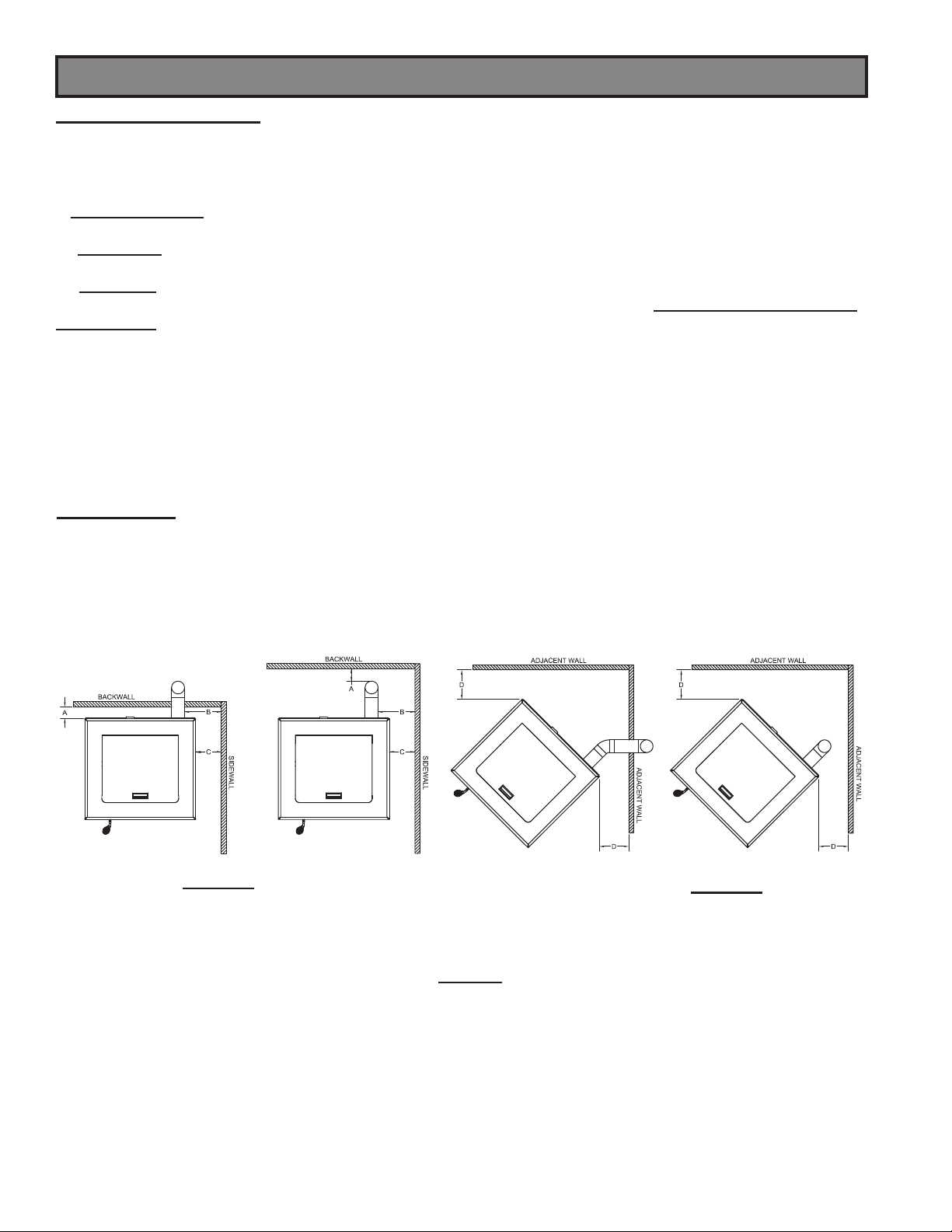
Your pellet stove has been tested and listed for installation in residential, mobile home, and alcove applications in
accordance with the clearances given in FIGURES 1-2 and TABLE 1. For safety reasons, please adhere to the installation
clearances and restrictions. Any reduction in clearance to combustibles may only be done by means approved by a
regulatory authority.
FIGURE 1
SIDEWALL CLEARANCES
PARALLEL INSTALLATION
FIGURE 2
SIDEWALL CLEARANCES
CORNER INSTALLATION
PARALLEL A - Backwall to unit 3.00 / 76mm
B - Sidewall to fl ue 11.00 / 280mm
C - Sidewall to top edge of unit 8.00 / 203mm
CORNER D - Adjacent wall to unit 8.00 / 203mm
TABLE 1
CLEARANCES
7
INSTALLATION
U.S. 6.00
Canada 450mm (18”)
U.S. 6.00
Canada 450mm (18”)
U.S. 6.00
Canada
203mm (8”)
U.S. 6.00
Canada
203mm (8”)
U.S. 6.00
Canada
203mm (8”)
U.S. 6.00
Canada
203mm (8”)
FLOOR PROTECTION
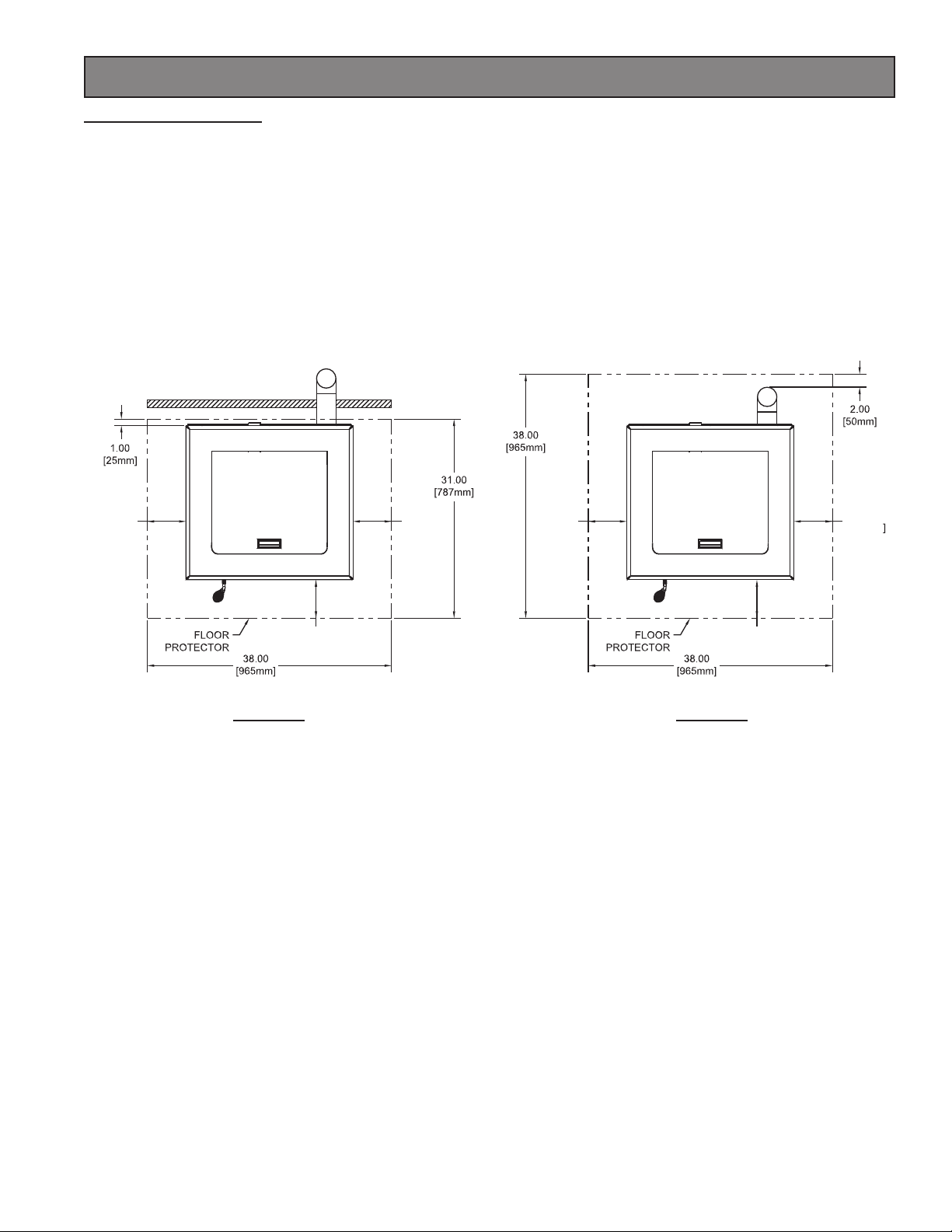
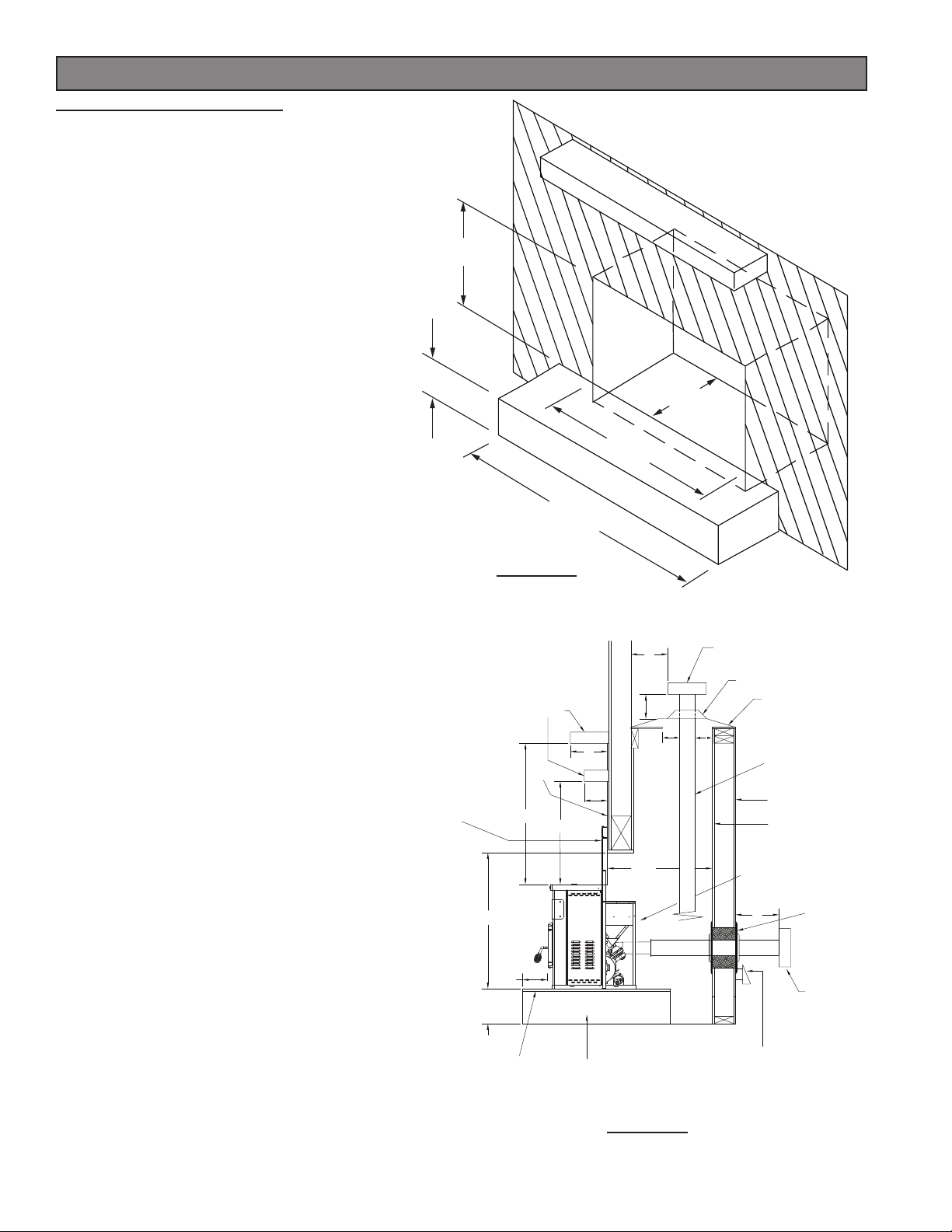
This heater must have a non-combustible fl oor protector (UL1618 ember protection) installed beneath it if the fl oor is of
combustible material. The fl oor pad or non-combustible surface should be large enough to cover at least the area under
the product and 6 in. (152 mm) beyond the front and beyond each side of the fuel loading and ash removal openings.
Your heater will need a minimum 31” X 38” fl oor protector. Floor protection must extend under and 2 in. (50.8 mm) to
each side of the chimney tee for an interior vertical installation (see FIGURE 4) This applies to both freestanding heaters
and insert heaters.
Canadian Installations require a minimum of 475 mm [18”] beyond the front of the unit and 203 mm [8”] beyond each
side of the unit. A Floor Protector of 1/4 inch thick is recommended for this installation.
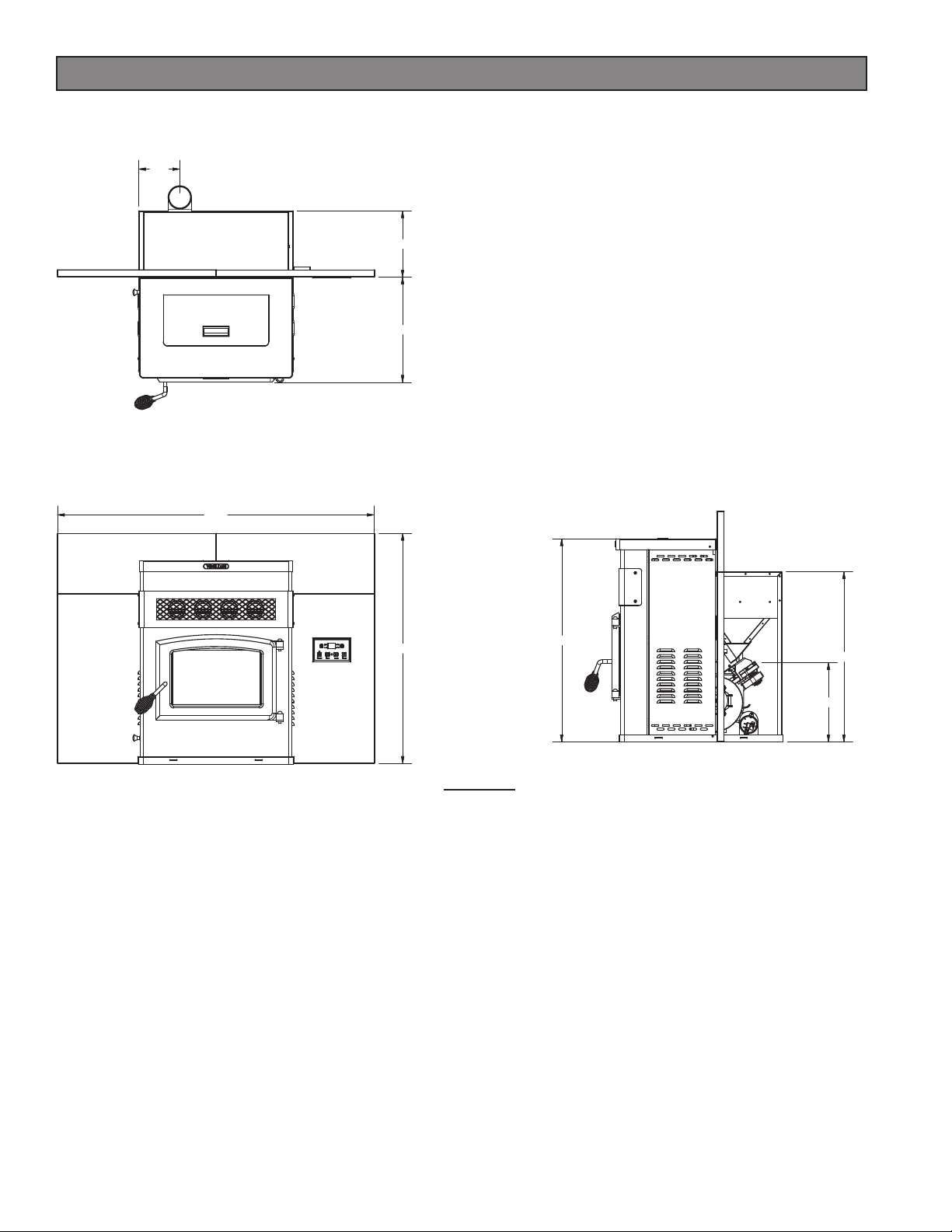
FIGURE 3
THROUGH THE WALL INSTALLATION
FIGURE 4
INTERIOR VERTICAL INSTALLATION
8
INSTALLATION
The minimum installation dimensions, of the insert opening, are:
22” (558.8 mm) wide x 24” (609.6 mm) high x 9.17” (233 mm) deep.
43.93
31.92
5.72
9.17
14.59
28.17
23.60
11.00
FIGURE 5
INSERT DIMENSIONS

9
IMPORTANT! This unit is equipped with a negative draft system that pulls air through the burn pot and
pushes the exhaust out of the dwelling. If this unit is connected to a fl ue system other than the way ex-
plained in this manual, it will not function properly.
MAXIMUM VENTING DISTANCE
Installation MUST include at least 3-feet of vertical pipe outside the home. This will create some natural draft to reduce the
possibility of smoke or odor during appliance shutdown and keep exhaust from causing a nuisance or hazard by exposing
people or shrubs to high temperatures. The maximum recommend vertical venting height is 12-feet for 3-inch type “PL”
vent. Total length of horizontal vent MUST NOT exceed 4-feet. This could cause back pressure. Use no more than 180
degrees of elbows (two 90-degree elbows, or two 45-degree and one 90-degree elbow, etc.) to maintain adequate draft.
IMPORTANCE OF PROPER DRAFT
Draft is the force which moves air from the appliance up through the chimney. The amount of draft in your chimney
depends on the length of the chimney, local geography, nearby obstructions and other factors. Too much draft may
cause excessive temperatures in the appliance. Inadequate draft may cause backpuffi ng into the room and ‘plugging’
of the chimney.
Inadequate draft will cause the appliance to leak smoke into the room through appliance and chimney connector joints.
An uncontrollable burn or excessive temperature indicates excessive draft.
Take into account the chimney’s location to insure it is not too close to neighbors or in a valley which may cause unhealthy
or nuisance conditions.
PELLET VENT TYPE
A UL listed 3-inch or 4-inch type “PL” pellet vent exhaust system must be used for installation and attached to the pipe
connector provided on the back of the stove (use a 3-inch to 4-inch adapter for 4-inch pipe). Connection at back of
stove must be sealed using Hi-Temp RTV. Use 4-inch vent if the vent height is over 12-feet or if the installation is over
2,500 feet above sea level.
We recommend the use of Simpson Dura-Vent
®
or Metal-Fab
®
pipe (if you use other pipe, consult your local building
codes and/or building inspectors). Do not use Type-B Gas Vent pipe or galvanized pipe with this unit. The pellet vent
pipe is designed to disassemble for cleaning and should be checked several times during the burning season. Pellet
vent pipe is not furnished with the unit and must be purchased separately.
PELLET VENT INSTALLATION
The installation must include a clean-out tee to enable collection of fl y ash and to permit periodic cleaning of the exhaust
system. 90-degree elbows accumulate fl y ash and soot thereby reducing exhaust fl ow and performance of the stove.
Each elbow or tee reduces draft potential by 30% to 50%.
All joints in the vent system must be fastened by at least 3 screws, and all joints must be sealed with Hi-Temp RTV
silicone sealant to be airtight. The area where the vent pipe penetrates to the exterior of the home must be sealed with
silicone or other means to maintain the vapor barrier between the exterior and the interior of the home.
Vent surfaces can get hot enough to cause burns if touched by children. Noncombustible shielding or guards may be
required.
PELLET VENT TERMINATION
Do not terminate the vent in an enclosed or semi-enclosed area, such as; carport, garage, attic, crawl space, under
a sundeck or porch, narrow walkway, or any other location that can build up a concentration of fumes. Termination in
one of these areas can also lead to unpredictable pressure situations with the appliance, and could result in improper
performance and/or malfunction
The termination must exhaust above the outside air inlet elevation.
The termination must not be located where it will become plugged by snow or other materials.
Do not terminate the venting into an existing steel or masonry chimney.
INSTALLATION
VENTING REQUIREMENTS
Install vent at clearances specified by the vent manufacturer.
Do not connect the pellet vent to a vent serving any other appliance or stove.
Do not install a flue damper in the exhaust venting system of this unit.
The following installation guidelines must be followed to ensure conformity with both the safety listing of this stove and
to local building codes. Do not use makeshift methods or compromise in the installation.
10
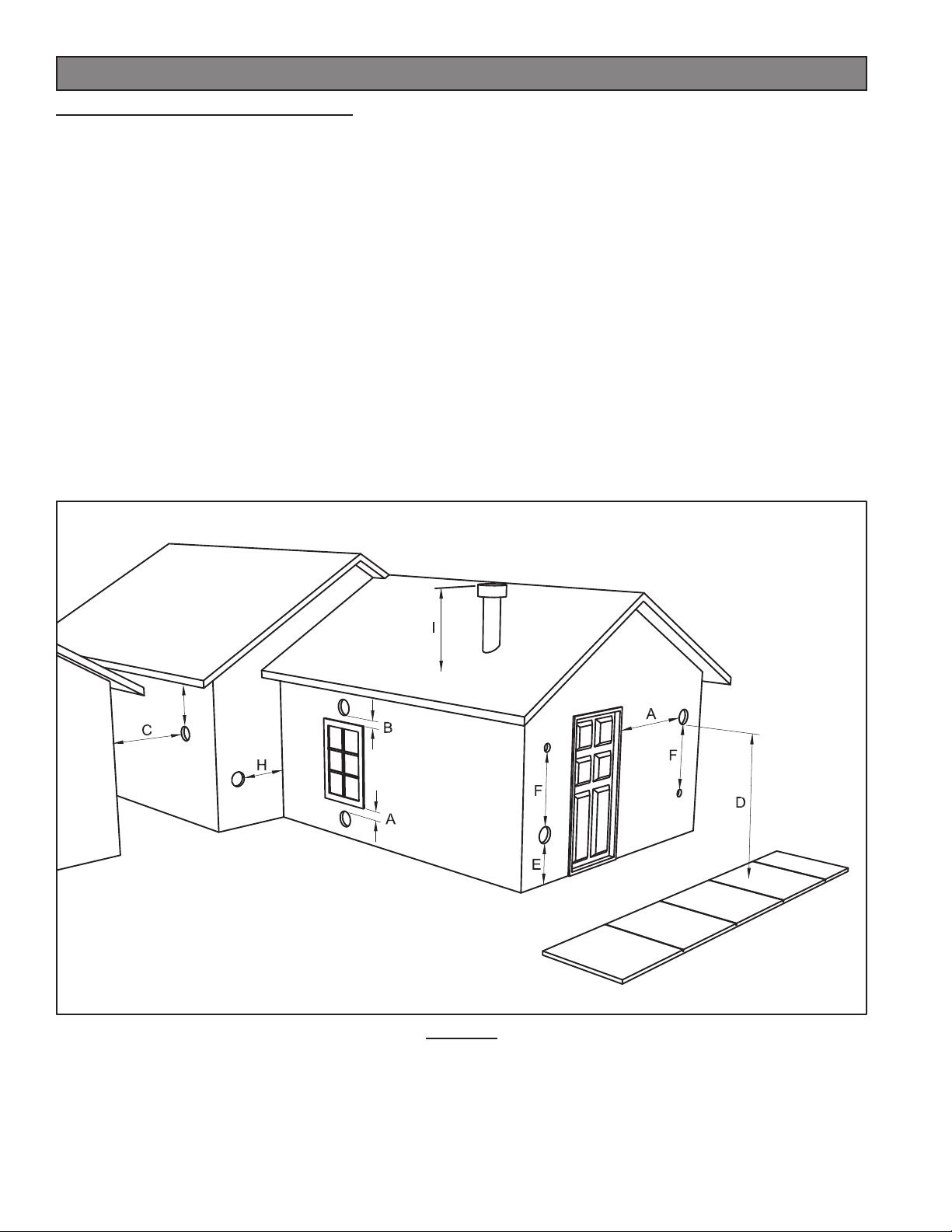
G
VENT TERMINATION CLEARANCES:
A) Minimum 4-foot (1.22m) clearance below or beside any door or window that opens.
B) Minimum 1-foot (0.3m) clearance above any door or window that opens.
C) Minimum 3-foot (0.91m) clearance from any adjacent building.
D) Minimum 7-foot (2.13m) clearance from any grade when adjacent to public walkways.
E) Minimum 2-foot (0.61m) clearance above any grass, plants, or other combustible materials.
F) Minimum 3-foot (0.91m) clearance from an forced air intake of any appliance.
G) Minimum 2-foot (0.61m) clearance below eves or overhang.
H) Minimum 1-foot (0.3m) clearance horizontally from combustible wall.
I) Must be a minimum of 3 foot (0.91m) above the roof and 2 foot (0.61m) above the highest point or the roof within
10 feet (3.05m).
FIGURE 6
VENT TERMINATION CLEARANCES
INSTALLATION

11
FIGURE 7
TYPICAL THROUGH THE WALL INSTALLATION
THROUGH THE WALL INSTALLATION (RECOMMENDED INSTALLATION)
Canadian installations must conform to CAN/CSA-B365.
To vent the unit through the wall, connect the pipe adapter
to the exhaust motor adapter. If the exhaust adapter is at
least 18 in.(457mm) above ground level, a straight section
of pellet vent pipe can be used through the wall.
Your heater dealer should be able to provide you with
a kit that will handle most of this installation, which will
include a wall thimble that will allow the proper clearance
through a combustible wall. Once outside the structure,
a 3 in.(76mm) clearance should be maintained from the
outside wall and a clean out tee should be placed on the
pipe with a 90-degree turn away from the house.
At this
point, a 3ft (0.91m) (minimum) section of pipe should be
added with a horizontal cap, which would complete the
installation (see FIGURE 7).
A support bracket should be placed just below the
termination cap or one every 4ft (1.22m) to make the
system more stable. If you live in an area that has heavy
snowfall, it is recommended that the installation be taller
than 3ft (0.91m) to get above the snowdrift line. This same
installation can be used if your heater is below ground level
by simply adding the clean-out section and vertical pipe
inside until ground level is reached. With this installation
you have to be aware of the snowdrift line, dead grass, and
leaves. We recommend a 3ft (0.91m) minimum vertical
rise on the inside or outside of the house.
The “through the wall” installation is the least expensive and simplest installation. Never terminate the end vent under a
deck, in an alcove, under a window, or between two windows. We recommend Simpson Dura-Vent
®
or Metal-Fab
®
kits.
THROUGH THE ROOF/CEILING INSTALLATION
When venting the heater through the ceiling, the pipe is connected the same as through the wall, except the clean-out
tee is always on the inside of the house, and a 3 in.(76mm) adapter is added before the clean-out tee.
You must use the proper ceiling support fl anges and roof fl ashing (supplied by the pipe manufacturer; follow the pipe
manufacturer’s directions). It is important to note that if your vertical run of pipe is more than 12ft (3.7m), the pellet vent
pipe size should be increased to 4 in. (102mm) in diameter.
Do not exceed more than 4ft (1.22m) of pipe on a horizontal run and use as few elbows as possible. If an offset is
required, it is better to install 45-degree elbows rather than 90-degree elbows.
INSTALLATION
12
NOTE: Dimensions from the fl oor to your stoves
inlet/exhaust pipes are approximate and may vary
depending on your installation.
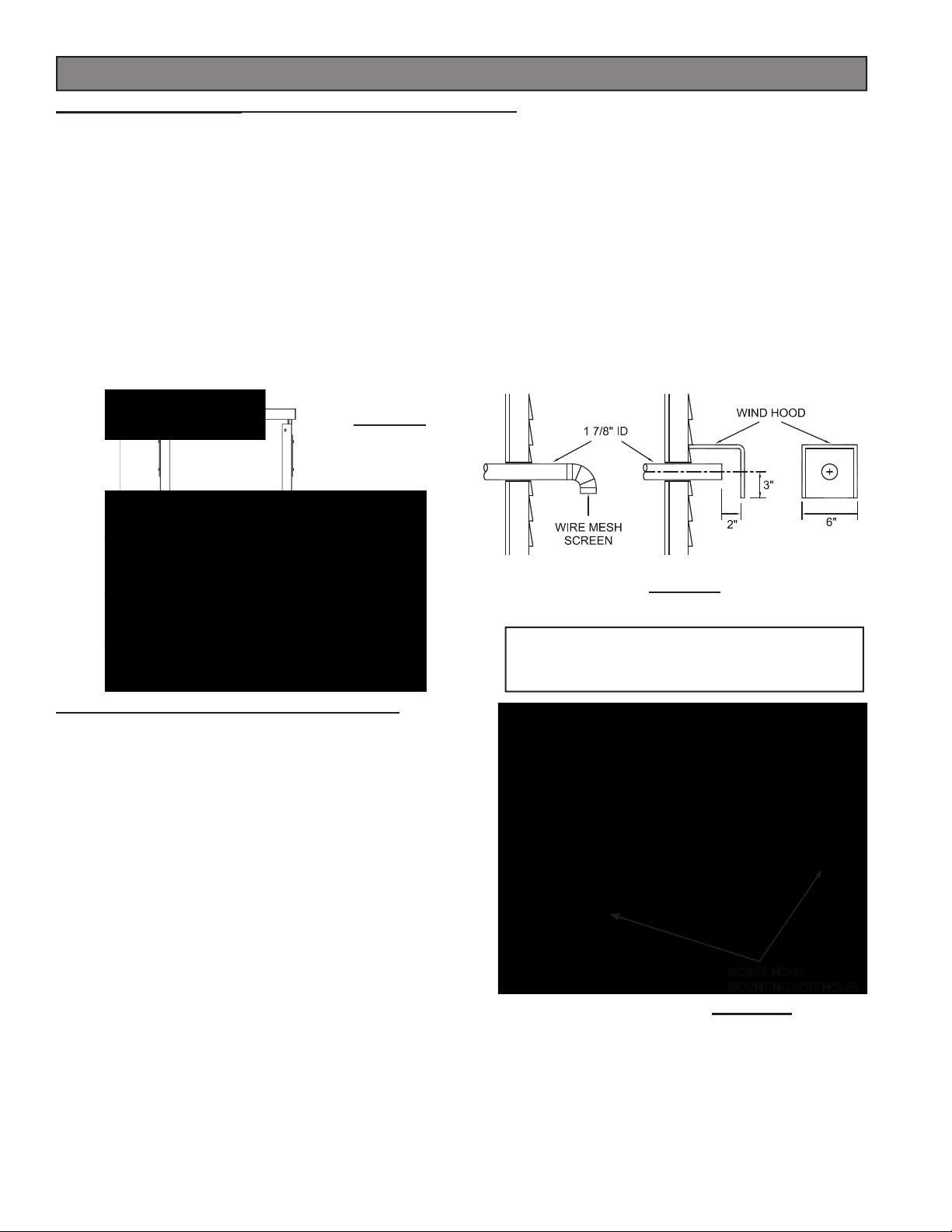
FIGURE 9
TYPICAL FRESH AIR TERMINATION
FIGURE 10
FIGURE 8
EXHAUST/INLET LOCATIONS
OUTSIDE AIR SUPPLY (optional, unless installing in a mobile home)
Adequate ventilation air is required to operate this heater. During operation, the heater draws air for combustion which
can be assisted by the installation of outside combustion air inlets. However, certain weather conditions such as icing
or use of kitchen exhaust fans may impact and reduce the effectiveness of vents. It is important to note that room air
starvation will negatively impact the operation of the heater.
Depending on your location and home construction, outside air may be necessary for optimal performance.
Metal pipe (solid or fl exible) must be used for the outside air installation. PVC pipe is NOT approved and should NEVER
be used.
A wind shield over the termination of the outside air pipe or a 90-degree elbow or bend away from the prevailing winds
MUST be used when an outside air pipe is installed through the side of a building. The outside air termination MUST
be at least 1ft (0.305m) away from the exhaust system termination.
The outside air pipe on your heater is 2” (50.8mm) OD. The outside air connecting pipe must be at least 2” (50.8mm) ID.
The outside air connection used MUST NOT restrict the amount of air available to your heater. The outside air connecting
pipe must be as short and free of bends as possible, and it must fi t over, not inside, the outside air connection to the heater.
SPECIAL MOBILE HOME REQUIREMENTS
WARNING! - DO NOT INSTALL IN A SLEEPING ROOM
CAUTION! - THE STRUCTURAL INTEGRITY OF THE
MOBILE HOME FLOOR, WALL, AND CEILING/ROOF
MUST BE MAINTAINED.
NOTE: Installation should be in accordance with the Manu-
factured Home and Safety Standard (HUD), CFR 3280, Part
24.
In addition to the previously detailed installation requirements,
mobile home installations must meet the following requirements:
• This stove must be securely fastened to the fl oor of the mobile
home through the two holes in the rear of the stove using 2,
¼” lag bolts that are long enough to go through both a hearth
pad, if used, and the fl oor of the home.
• The heater must be electrically grounded to the steel chassis
of the mobile home with 8 GA copper wire using a serrated
or star washer to penetrate paint or protective coating to ensure grounding.
• Vent must be 3 or 4-inch “PL” Vent and must extend a minimum or 36 in.(914mm) above the roof line of the mobile
home and must be installed using a UL listed ceiling fi re stop and rain cap.
• When moving your mobile home, all exterior venting must be removed while the mobile home is being relocated.
After relocation, all venting must be reinstalled and securely fastened.
• Outside Air is mandatory for mobile home installation. See Outside Air Supply section and your dealer for purchasing.
• Check with your local building offi cials as other codes may apply.
INSTALLATION
MOBILE HOME
MOUNTING BOLT HOLES
13
INSTALLATION
PREPARATION
Factory packaging must be removed, and some minor assembly work is required prior to installation. Access to the rear
of the stove is necessary.
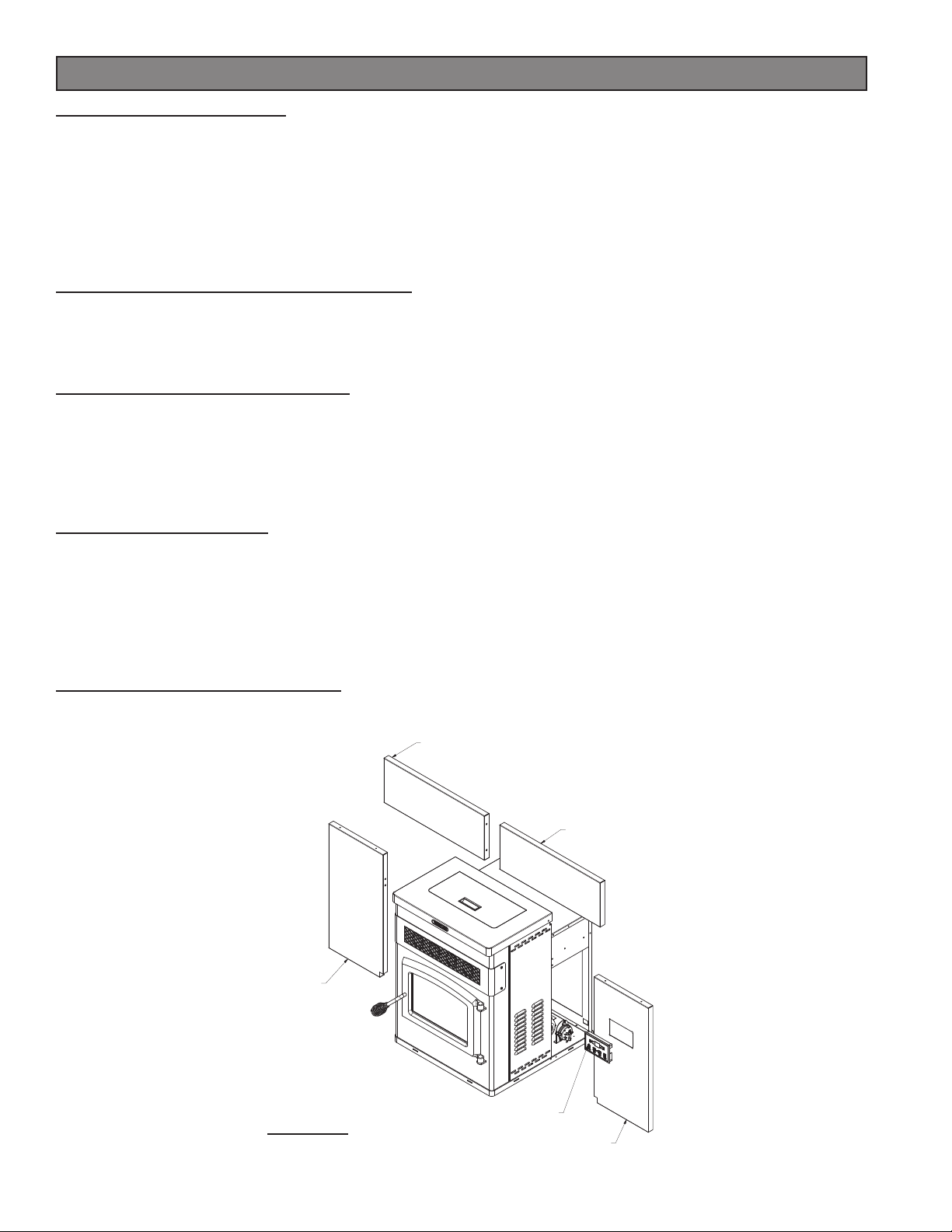
The circuit board/control panel must be unpacked and installed in the side fl ashing on the insert or side panel on the
freestanding. (See installation instructions provided with the circuit board)
CLEARANCES
This Insert is approved for installation into code complying masonry fi replaces. It is also approved for use in listed factory
built fi replaces (UL 127) and standard residential built-ins, including Mobile Home built-in installations, of the following
description: all brands at least 34” wide and 20 ½” high.
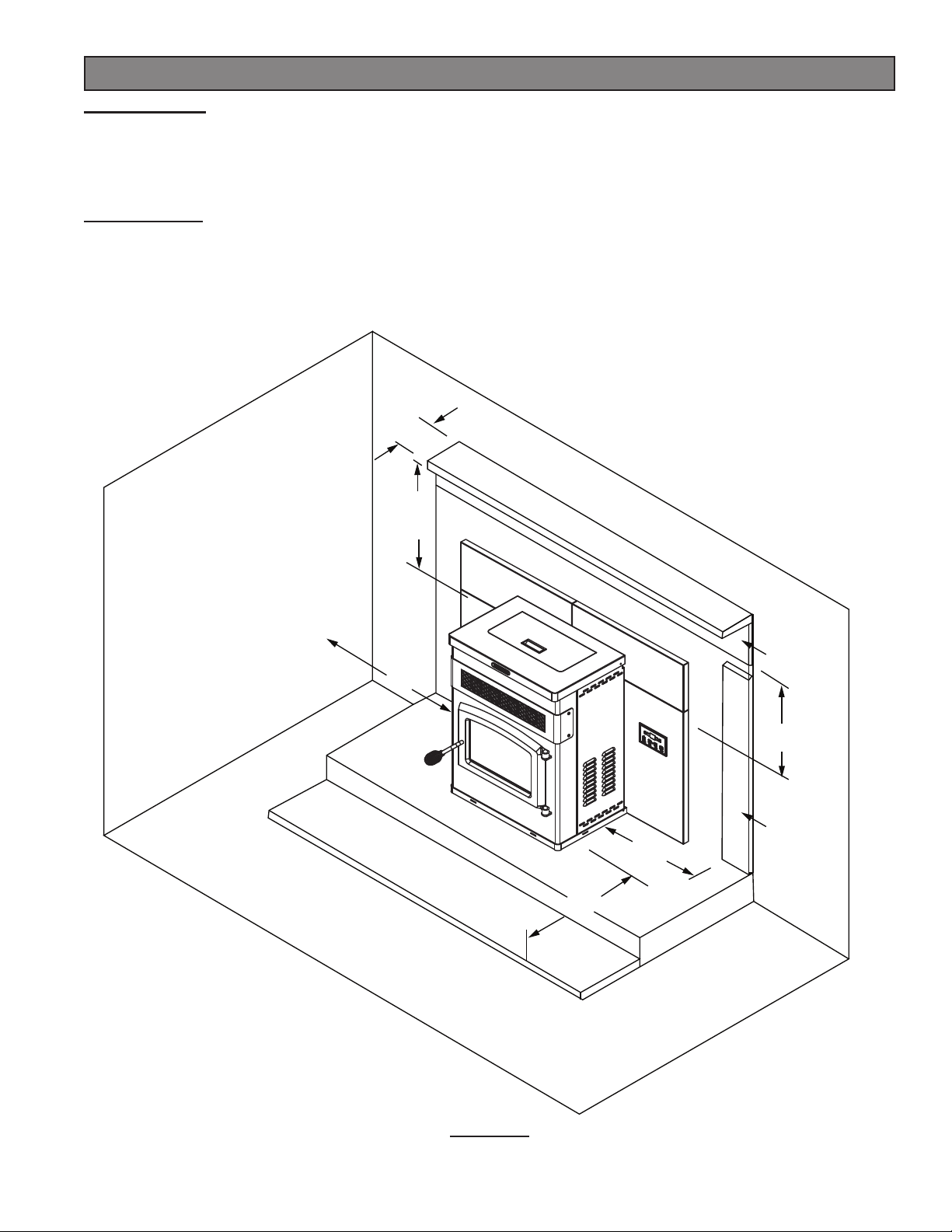
COMBUSTIBLE WALL
MANTLE
6”
UP TO
12”
12”
8.25”
6”
10”
NONCOMBUSTIBLE HEARTH
HEARTH EXTENSION
COMBUSTIBLE FLOOR
TOP
FACING
SIDE
FACING
FIGURE 11
CLEARNACES
14
COMBUSTION AIR SUPPLY
If outdoor combustion air is supplied the heater must be attached to the structure.
For a mobile home installation the stove must be connected to an outside source of combustion air. A 2” inside diameter
metallic pipe, either fl exible or rigid, may be attached to the inlet at the stove’s rear.
A rodent guard (minimum ¼” wire
mesh)/wind hood must be used at the terminus.
All connections must be secured and airtight by either using the appro-
priately sized hose clamp and/or UL-181-AP foil tape.
For mobile home installations only: 2” inside diameter pipe may be used for the fi rst 5 feet of combustion air supply
run. From 5 to 10 feet use 2 ¾” inside diameter pipe. No combustion air supply may exceed 10 feet.
SOURCES OF OUTSIDE COMBUSTION AIR
In fi replaces
• Chimney top.
• Ash clean out door.
WHEN OUTSIDE AIR IS NOT USED
If outside air is not used, it is important that combustion air is easily available to the air inlet. A closeable outs
ide air reg-
ister can be used in tightly insulated homes.
In insert installations, fl ashing vents should not be restricted. The fl ashing
should not necessarily seal the fi replace face.
DO NOT CONNECT THIS UNIT TO A CHIMNEY FLUE SERVING ANOTHER APPLIANCE.
INSERT INSTALLATIONS
Insert installations must be vented with 3” or 4” pipe. Pipe may be single wall stainless steel fl exible pipe. Vent may termi-
nate within chimney beyond a blanking plate or extend to the chimney top. See “COMBUSTION AIR SUPPLY” for outside
air access information.
The fi replace and chimney should be cleaned thoroughly before starting the installation. We suggest painting the
interior of particularly old and dirty fi replaces to seal any odors.
ASSEMBLING THE FLASHING SET
Follow the instructions packaged with this stoves Flashing.
INSTALLATION
LEFT SIDE TOP
SURROUND PANEL
RIGHT SIDE
TOP SURROUND PANEL
LEFT SIDE
SURROUND PANEL
RIGHT SIDE
SURROUND PANEL
CIRCUIT BOARD
FIGURE 12
INSERT INSTALLATION

15
INSTALLATION
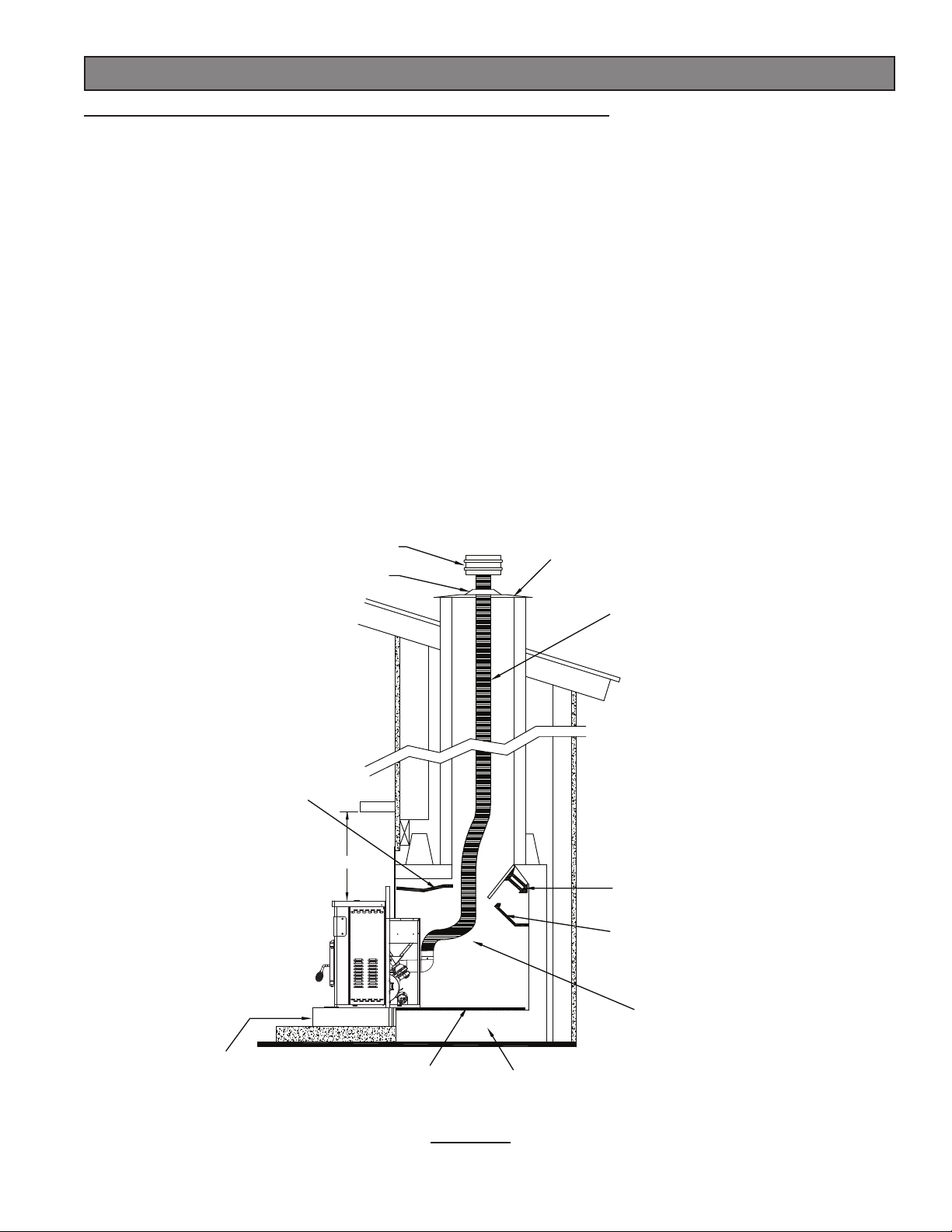
WHEN VENT PIPE EXTENDS TO CHIMNEY TOP
1.
You will need a pipe length equal to the chimney height (from hearth) plus 6 inches. If outside combustion air is to be used,
you will need a pipe length equal to the chimney height plus 12 inches.
2. Attach cerablanket wrap (not included) to the end of vent pipe that will connect to the stove. Use 12-inch lengths of light
gauge metal wire (not included) or metallic tape (not included). This is to protect interior components from excess heat.
3.
Set the insert on the hearth and slide it in far enough to attach the vent pipe (and combustion pipe if used).
4. Attach fl ashing (refer to Figure 13), route power cord out the side nearest a 120V receptacle. Slide in insert.
5. Measure and build chimney top. Cut out hole for vent pipe (and combustion air intake pipe, if used). Install and seal with
a non-hardening mastic to prevent water leakage. Install the vent cap.
6”
6”
MAX
15”
12”
HEARTH
NOTE:
FOLLOW METAL
CHIMNEY INSTALLATION
INSTRUCTIONS
TOP PLATE
(SEAL TO CHIMNEY TOP
WITH NON-HARDENING
MASTIC)
EXTENSION TO CHIMNEY TOP OPTIONAL.
(REQUIRED IN MOBILE HOME AND ZERO-
CLEARANCE FIREPLACES.
RECOMMENDED IN ALL FIREPLACES).
3 OR 4 INCH STAINLESS STEEL
SINGLE WALL PIPE.
BLANKING PLATE (SEAL WITH
NON-HARDENING MASTIC).
CHIMNEY NEED ONLY EXTEND
12” ABOVE BLANKING PLATE.
3 OR 4 INCH STAINLESS STEEL
FLEX PIPE.
FIREPLACE INSERT
SIDE ELEVATION
1” CERIBLANKET
NOTE:
WHEN MANTLE EXTENDS
MORE THAN 6” FROM
FIREPLACE FACE, A 15”
MINIMUM DIMENSION
MUST BE MAINTAINED
FROM STOVE TOP TO
BOTTOM OF MANTLE.
FIGURE 13
EXHAUST PIPE INSTALLATION
16
INSTALLATION
AS A BUILT-IN FIREPLACE
The fi gures on this page describe this stoves
installation vented into either a special chase
built outside an outer wall or a false inside wall.
This is especially suited for new construction or
remodeling.
The equipment compartment (sides and rear of
the stove in fi replace) must be enclosed per the
applicable electrical standards.
NOTE: Floor protection for Built-in raised
hearths requires a continuous
sheet
beneath to
prevent the possibility of embers
falling through
to the combustible fl oor if cracks or separation
should occur in the fi nished surface.
This fi replace insert must be installed with a
continuous chimney liner of 3” or 4” diameter
extending from the fi replace insert to the top of
the chimney. The chimney liner must conform
to the Class 3 requirements of CAN/ULC-S635,
Standard for Lining Systems for Extending Ma-
sonry or Factory-Built Chimneys and Vents, or
CAN/ULC-S640, Standard for Lining Systems
for New Masonry Chimneys.
The existing fi replace damper may be removed
or locked into the open position.
The chase dimensions shown are minimums
and must be maintained.
IF THE FIREPLACE HAS BEEN MODIFIED
TO ACCOMMODATE THE FIREPLACE IN-
SERT A METAL TAG SHALL BE ATTACHED
TO THE FIREPLACE.
DO NOT USE MAKESHIFT COMPROMISES
DURING INSTALLATION.
23.75 min”
8”
MIN
MANTLE
FACADE
OPENING
214.15” min
20.”12 min.
46” MIN
RAISED HEARTH
SEE “INSERT INSTALLATIONS” FOR
PANEL SURROUND INSTALLATION
6”
MIN.
6”
MIN.
3”
MIN.
3”
MIN.
LISTED
CHIMNEY
CAP
STORM
COLLAR
CHASE CAP
MANTLE
12”
FACING
6”
MAX
10”
THE PANEL SURROUND KIT
D)
ATTACH THE PANEL SURROUND
TO THE PANEL SURROUND TO
THE FACE OF THE FIREPLACE
WITH ONE SCREW.
2.25”
23.75”
6”
MIN.
8”
MIN.
FLOOR PROTECTOR MUST BE
CONTINUOUS WITH NO JOINTS
RAISED HEARTH MUST BE BUILT
OF 8” HOLLOW CONCRETE BLOCKS.
IF CHOOSING TO VENT HORIZONTALLY THROUGH THE WALL, WE RECOMMEND
TERMINATING VERTICALLY WITH AN ADDITIONAL RUN OF AT LEAST 5 FEET.
*
MAY BE DRAWN FROM
ATED CRAWL SPACE.
OUTSIDE AIR
LISTED
CHIMNEY
CAP
*
LISTED
THIMBLE
6”
15.75”
EQUIPMENT
COMPARTMENT
(OPTIONAL VERTICAL INSTALLATION)
L-VENT ONLY
SIDING
5/8” SHEETROCK
(ENTIRE FACADE)
A 1/4” (OR SMALLER) WIRE MESH
SCREEN MUST BE INSTALLED IN
THIS INSTALLATION TO COVER
THE EQUIPMENT COMPARTMENT.
FIGURE 14
FIGURE 15
17
INSTALLATION
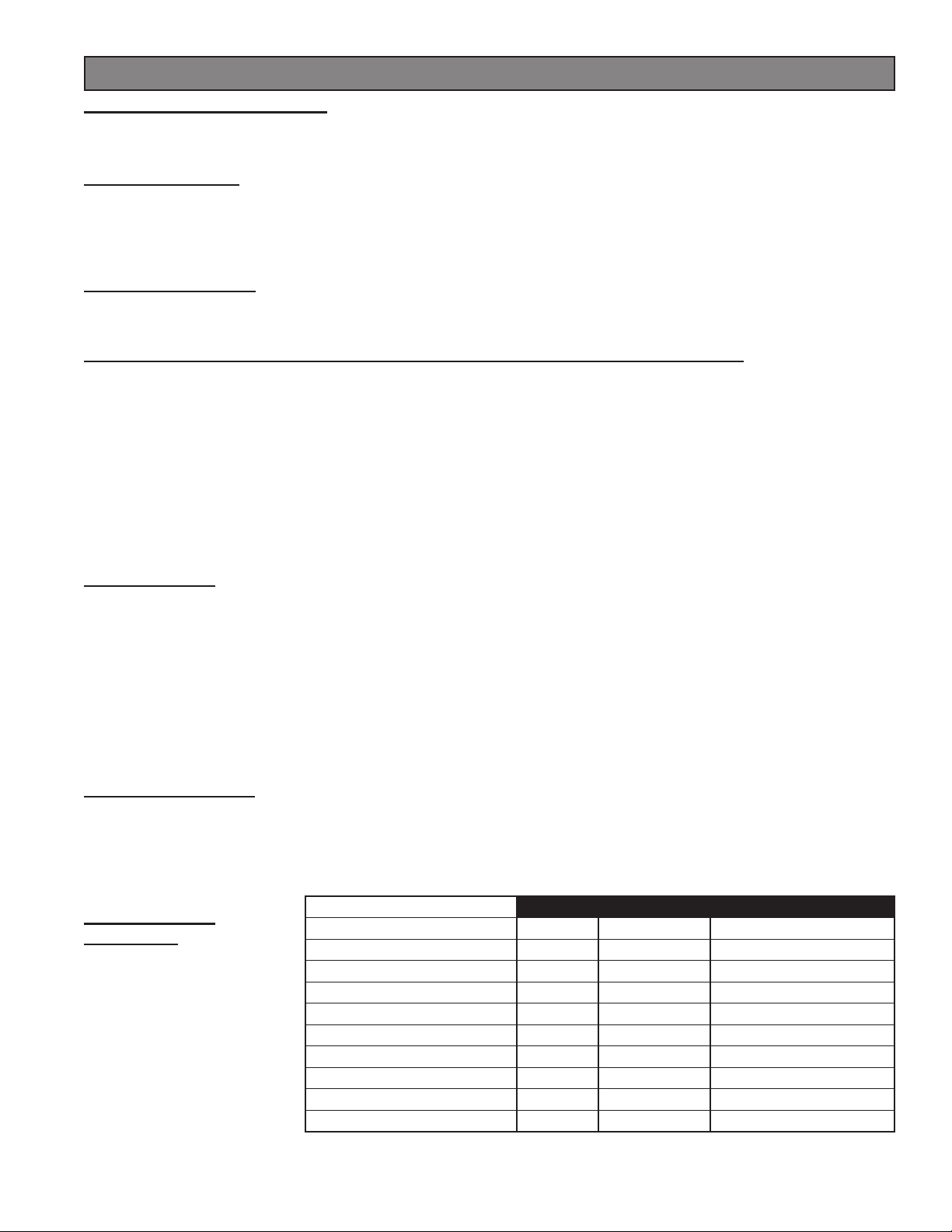
INSTALLATION IN TO A FACTORY BUILT (METAL) FIREPLACE
When installing into a factory built fi replace, the fi rebox must accept the insert without modifi cation other than re-
moving bolted or screwed together pieces such as smoke shelf/defl ectors, ash lips, screen or door tracks and damper
assemblies. These items must be reinstalled to restore the fi replace to its original operating condition if the insert is
removed and not replaced. The removal of any part must not alter the integrity of the listed fi replace in any way.
The factory built fi replace must be listed per UL 127. Installation must include a full height listed chimney liner meet-
ing type HT requirements (2100
o
F) per 1777 (U.S.). The liner must be securely attached to the insert fl ue col
lar and
the chimney top. The damper area must be sealed to prevent room air passage to chimney cavity.
Alteration of the fi replace in any manner is not permitted except with the following exceptions:
• External trim pieces, which do not affect the operation of the fi replace, may be removed proving they can be stored
on or within, the fi replace for re-assembly if the insert is removed.
• The fi replace damper may be removed to install the chimney liner.
Circulating air chambers, louvers or cooling air inlet or outlet ports (i.e. in a steel fi replace liner or metal heat circulator)
shall not be blocked.
Means must be provided for removal of the insert to clean the chimney fl ue.
A permanent metal warning label must be attached to the back wall of the fi replace opening stating the following:
• “This fi replace has been altered to accommodate a fi replace insert and should be inspected by a qualifi ed person
prior to re-use as a conventional fi replace.”
• This label is available upon request.
Final approval is contingent on the authority having jurisdiction.
VERTICAL CAP
STORM COLLAR
COVER PLATE
(NON-COMBUSTIBLE)
SEAL WITH SILICONE.
3 OR 4 INCH L-VENT
OR STAINLESS STEEL
FLEXIBLE OR SINGLE
WALL PIPE
THE SMOKE SHELF
MAY BE REMOVED
10”
THE DAMPER MAY
BE REMOVED
INTERNAL BAFFLES
MAY BE REMOVED
TO PREVENT FIREPLACE
ODORS FROM ENTERING
THE HOME, PAINT THE
INTERIOR OF THE FIREPLACE
WITH LATEX PAINT
THE METAL SIDES, FRAME MEMBERS, OR OTHER
STRUCTURAL COMPONENTS OF THE FACTORY BUILT
FIREPLACE MAY NOT BE REMOVED OR ALTERED
USE THE ZERO-CLEARANCE
SKIRT TO SUPPORT THE
INSERT ON RAISED FIREPLACES
THE MASONRY LINING
MAY NOT BE REMOVED
NOTE:
THE LOG SHELF, SCREEN,
AND DOORS (IF PRESENT)
MUST BE REMOVED
FIGURE 16

18
PANEL CONTROLS
The blowers and automatic fuel supply are controlled from a panel on the top of the VG5770. The control panel func-
tions are a follows.
A. ON/OFF SWITCH (“POWER” BUTTON)
• When pushed, the stove will automatically ignite. No other fi re starter is necessary. The igniter will stay on for
at least 10 and up to 12 minutes, depending on when Proof of Fire is reached. The fi re should start in approxi-
mately 5 minutes.
• The red light located above the “POWER” button will turn green when pressed and remain green until the
stove is turned off.
• After pushing “POWER”, the auger motor is on for 3.5 minutes, off for 1 minute. During the remainder of the
start-up period, the auger motor operates on the heat range “1” setting.
• During start up the heat level advance (Up and Down keys) will change the heat range indicator level accord-
ingly, but there is no change in the stoves operating conditions until start-up is completed.
• During start-up ignition must occur within 12 minutes or the stove will error out and show E4.
• During the start-up phase, the Mode key does not function.
CONTROL PANEL
B. LEVEL / TEMP ARROW BUTTONS
• These buttons when pushed will set the pellet feed rate, hence the heat output or heat range of your stove.
• The levels of heat output will incrementally change on the bar graph starting from heat range “1” to heat range
“5”.
C. °C / °F Button
• The °C / °F button changes the two digit display from degrees Celsius to degrees Fahrenheit.
D. MODE (M/T) BUTTON
• The Mode of the stove can be switched between manual and controlled with a Thermostat. Separate LEDs
to the left of the two digit display indicate the mode of operation – Manual or T-Stat. The stove has to be in
normal operation to be switched from Manual to T-Stat mode.
• Manual mode operates according to the 5 set levels of feed on the bar graph from heat range “1” to heat
range “5”.
• T-Stat mode works as follows:
• The stove has a built in Thermostat into the controls of the appliance. The temperature sensor for the T-Stat is
located on the back of the stove behind the display board.
• Once the stove has gone into run mode the stove can be switch into T-Stat mode.
• The Up and Down Level / Temp Arrow buttons are used to change the desired set-point temperature. Once
the desired temperature is reached the two digit display will fl ash for four seconds and reset to the actual
room temperature.
• Once the stove reaches within 3°F of the desired temperature set point, it returns to the heat range that the
stove was set on before it was switched to T-Stat mode (if the stove was running on heat range “5” when
switched to T-stat mode when it gets within 3°F of the set point it will return to heat range “5”).
• Once the stove reaches the desired set-point, the stove will drop to heat range “1”.
• When room temperature drops below desired set-point the stove will ramp back up until it reaches the desired
temperature.
FIGURE 17
CONTROLS

19
PROPER FUEL
THIS STOVE IS APPROVED FOR BURNING PELLETIZED WOOD FUEL ONLY ! Factory-approved pellets
are those 1/4” or 5/16” in diameter and not over 1” long. Longer or thicker pellets sometimes bridge the auger fl ights,
which prevents proper pellet feed. Burning wood in forms other than pellets is not permitted. It will violate the building
codes for which the stove has been approved and will void all warranties. The design incorporates automatic feed of
the pellet fuel into the fi re at a carefully prescribed rate. Any additional fuel introduced by hand will not increase heat
output but may seriously impair the stoves performance by generating considerable smoke. Do not burn wet pellets.
The stove’s performance depends heavily on the quality of your pellet fuel. Avoid pellet brands that display these
characteristics:
1. Excess Fines – “Fines” is a term describing crushed pellets or loose material that looks like sawdust or sand. Pel-
lets can be screened before being placed in hopper to remove most fi nes.
2. Binders – Some pellets are produced with materials to hold the together, or “bind” them.
3. High ash content – Poor quality pellets will often create smoke and dirty glass. They will create a need for more
frequent maintenance. You will have to empty the burn pot plus vacuum the entire system more often. Poor quality
pellets could damage the auger. We cannot accept responsibility for damage due to poor quality pellet.
PRE-START-UP CHECK
Remove burn pot, making sure it is clean and none of the air holes are plugged. Clean the fi rebox, and then reinstall
burn pot. Clean door glass if necessary (a dry cloth or paper towel is usually suffi cient). Never use abrasive cleaners
on the glass or door. Check fuel in the hopper, and refi ll if necessary.
NOTE: The VG5770 Hopper can hold up to 60 lbs. of pellets.
BUILDING A FIRE
Never use a grate or other means of supporting the fuel. Use only the burn pot supplied with this heater.
Hopper lid must be closed in order for the unit to feed pellets.
During the start-up period:
1. Make sure burn pot is free of pellets.
2. DO NOT open the viewing door.
3. DO NOT open the damper, the damper needs to be closed during start up.
4. DO NOT add pellets to the burn pot by hand.
NOTE: During the fi rst few fi res, your stove will emit an odor as the high temperature paint cures or becomes sea-
soned to the metal. Maintaining smaller fi res will minimize this. Avoid placing items on stove top during this period
because paint could be affected.
Attempts to achieve heat output rates that exceed heater design specifi cations can result in permanent damage to the
heater.
OPERATION
1. Garbage;
2. Lawn clippings or yard waste;
3. Materials containing rubber, including tires;
4. Materials containing plastic;
5. Waste petroleum products, paints or paint thinners,
or asphalt products;
6. Materials containing asbestos;
7. Construction or demolition debris;
8. Railroad ties or pressure-treated wood;
9. Manure or animal remains;
10. Salt water driftwood or other previously salt water
saturated materials;
11. Unseasoned wood; or
12. Paper products, cardboard, plywood, or particle-
board. The prohibition against burning these materi-
als does not prohibit the use of fi re starters made
from paper, cardboard, saw dust, wax and similar
substances for the purpose of starting a fi re in an af-
fected wood heater.
This heater is designed to burn only PFI Premium grade pellets. This appliance can also burn pellets rated as stan-
dard after May 16, 2015.
DO NOT BURN:
Burning these materials may result in release of toxic fumes or render the heater ineffective and cause smoke.
DO NOT USE CHEMICALS OR FLUIDS TO START THE FIRE - NEVER USE GASOLINE, GASOLINE-TYPE
LANTERN FUEL, KEROSENE, CHARCOAL LIGHTER FLUID, OR SIMILAR LIQUIDS TO START OR “FRESHEN
UP” A FIRE IN THIS STOVE. KEEP ALL SUCH LIQUIDS WELL AWAY FROM THE STOVE WHILE IT IS IN USE.
HOT WHILE IN OPERATION. KEEP CHILDREN, CLOTHING AND FURNITURE AWAY. CONTACT MAY
CAUSE SKIN BURNS.

20
OPERATION
AUTOMATIC IGNITOR
Fill hopper and clean burn pot.
1. Press “On/Off” button. Make sure green light comes on.
2. The damper should be completely closed or open no more than ¼ of the way during start-up. This will vary de-
pending on your installation and elevation. Once fi re is established adjust for desired fl ame increasing the amount
the damper is open as the heat setting is increased. (See “DAMPER CONTROL”)
3. Adjust feed rate to desired setting by pressing “Heat Level Advance” button.
If fi re doesn’t start in 12 minutes, press “On/Off”, wait a few minutes, clear the burn pot, and start procedure again.
DAMPER CONTROL
The damper control lever is located on the back of the stove on the lower left side. The dampener adjusts the com-
bustion air. This control is necessary due to the varied burn characteristics of individual installations, different pellet
brands and pellet feed rates. It allows you to improve the effi ciency of your stove. Providing correct combustion air
will reduce the frequency of cleaning your glass door and prevent the rapid buildup of creosote inside your stove and
chimney.
You should adjust the damper based on the fi re’s appearance. A low, reddish, dirty fi re can be improved by turning the
dampener slightly to the right. A “blow torch” fi re can be improved by turning the dampener to the left a little bit.
As a general rule, on lower feed rate settings, the damper should be farther to the left closing it off. On higher feed
rates, the damper should be open more by having it set more towards the right. Through trial and error, you will fi nd
the best setting. Consult your dealer if you need help.
NOTE: On heat range “1”, damper should be either completely closed or open no more than a ¼ of the way. If damper
is open to far, it can cause the fi re to go out.
OPENING DOOR
If the door is opened while the stove is in operation it must be closed within 30 seconds or the stove will shut down. If
the stove shuts down push the “On/Off” button to re-start your stove. The stove will have to fully shut down and turn
off before you will be able to restart the stove.
ROOM AIR FAN
When starting your stove the Room Air Fan will not come on until the stove’s heat exchanger warms up. This usually
takes about 10 minutes from start-up.
IF STOVE RUNS OUT OF PELLETS
The fi re goes out and the auger motor and blowers will run until the stove cools. This will take 30 minutes or longer
depending on the heat remaining in the appliance. After the stove components stop running all lights on the display
will go out and the two digit display will begin fl ashing “E3”
REFUELING
• The hopper and stove top will be hot during operation; therefore, you should always use some type of hand pro-
tection when refueling your stove.
• Never place your hand near the auger while the stove is in operation.
We recommend that you not let the hopper drop below ¼ full.
TAMPER WARNING
This wood heater has a manufacturer-set minimum low burn rate that must not be altered. It is against federal regula-
tions to alter this setting or otherwise operate this wood heater in a manner inconsistent with operating instructions in
this manual.

21
KEEP HOPPER LID CLOSED AT ALL TIMES EXCEPT WHEN REFILLING.
DO NOT OVERFILL HOPPER.
SHUTDOWN PROCEDURE
Turning your stove off is a matter of pressing the “POWER” button on the display board. The green light will turn back
to red when the “POWER” button is pushed. The auger motor will stop, and the blowers will continue to operate until
the internal fi rebox temperatures have fallen to a preset level.
1. Your stove is equipped with a high temperature thermodisc. This unit has a manual reset thermodisc. This safety
switch has two functions.
A. To recognize an overheat situation in the stove and shut down the fuel feed or auger system.
B. In case of a malfunctioning convection blower, the high-temperature thermodisc will automatically shut
down the auger, preventing the stove from overheating.
NOTE: On some units, once tripped, like a circuit breaker, the reset button will have to be pushed before restarting
your stove. On other units the thermodisc has no reset button and will reset itself once the stove has cooled. The
manufacturer recommends that you call your dealer if this occurs as this may indicate a more serious problem. A ser-
vice call may be required.
2. If the combustion blower fails, an air pressure switch will automatically shut down the auger.
NOTE: Opening the stove door for more than 30 seconds during operation will cause enough pressure change to
activate the air switch, shutting the fuel feed off. The stove will shut down and show “E2” on the two digit display. The
stove has to fully shut down before restarting.
WARNING: Never shut down this unit by unplugging it from the power source.
OPERATION

22
Failure to clean and maintain this unit as indicated can result in poor performance, safety hazards,
fire, and even death.
Unplug your stove’s electrical cord prior to removing the back panel or opening the exhaust system
for any inspection, cleaning, or maintenance work.
Never perform any inspections, cleaning, or maintenance on a hot stove.
Do not operate stove with broken glass, leakage of flue gas may result.
EXHAUST SYSTEM
Creosote Formation – When any wood is burned slowly, it produces tar and other organic vapors, which combine
with expelled moisture to form creosote. The creosote vapors condense in the relatively cool chimney fl ue or a newly
started fi re or from a slow-burning fi re. As a result, creosote residue accumulates on the fl ue lining. When ignited, this
creosote makes an extremely hot fi re, which may damage the chimney or even destroy the house. Despite their high
effi ciency, pellet stoves can accumulate creosote under certain conditions.
Fly Ash – This accumulates in the horizontal portion of an exhaust run. Though non-combustible, it may impede the
normal exhaust fl ow. It should therefore be periodically removed.
Inspection and Removal – The chimney connector and chimney should be inspected by a qualifi ed person annually
or per ton of pellets to determine if a creosote or fl y ash build-up has occurred. If creosote has accumulated, it should
be removed to reduce the risk of a chimney fi re. Inspect the system at the stove connection and at the chimney top.
Cooler surfaces tend to build creosote deposits quicker, so it is important to check the chimney from the top as well as
from the bottom. The creosote should be removed with a brush specifi cally designed for the type of chimney in use. A
qualifi ed chimney sweep can perform this service. It is also recommended that before each heating season the entire
system be professionally inspected, cleaned and, if necessary, repaired. To clean the chimney, disconnect the vent
from the stove.
INTERIOR CHAMBERS
• Burn Pot: Periodically remove and clean the burn pot and the area inside the burn pot housing. In particular, it is
advisable to clean out the holes in the burn pot to remove any build up that may prevent air from moving through
the burn pot freely.
• Heat Exchanger: There is a clean out plate on both sides of the heat exchanger that need to be removed to clean
fl y ash out of the heat exchanger. The cleanouts are located inside the cabinet doors, on the lower front corners of
the heat exchanger.
If a vacuum is used to clean your stove, we suggest using a vacuum designed for ash removal. Some regular vacuum
cleaner (i.e. shop vacs) may leak ash into the room.
DO NOT VACUUM HOT ASH
ASH DISPOSAL
Remove ashes when unit has cooled. Ashes should be placed in a metal container with a tight fi tting lid. The closed
container of ashes should be placed on a noncombustible fl oor or on the ground, well away from all combustible ma-
terials, pending fi nal disposal. If the ashes are disposed of by burial in soil or otherwise locally dispersed, they should
be retained in the closed container until all embers have been thoroughly cooled. The container shall not be used for
other trash or waste disposal. If combined with combustible substances, ashes and embers may ignite.
SMOKE AND CO MONITORS
Burning wood naturally produces smoke and carbon monoxide(CO) emissions. CO is a poisonous gas when exposed
to elevated concentrations for extended periods of time. While the modern combustion systems in heaters drastically
reduce the amount of CO emitted out the chimney, exposure to the gases in closed or confi ned areas can be dan-
gerous. Make sure you stove gaskets and chimney joints are in good working order and sealing properly to ensure
unintended exposure. It is recommended that you use both smoke and CO monitors in areas having the potential to
generate CO.
CHECK AND CLEAN THE HOPPER
Check the hopper periodically to determine if there is any sawdust (fi nes) that is building up in the feed system or
pellets that are sticking to the hopper surface. Clean as needed.
MAINTENANCE
23
MAINTENANCE
DOOR AND GLASS GASKETS
Inspect the main door and glass window gaskets periodically. The main door may need to be removed to have frayed, broken, or
compacted gaskets replaced by your authorized dealer. This unit’s door uses a 5/8” diameter rope gasket.
BLOWER MOTORS
Clean the air holes on the motors of both the exhaust and distribution blowers annually. Remove the exhaust blower from the
exhaust duct and clean out the internal fan blades as part of your fall start-up. If you have indoor pets your power motors should be
inspected monthly to make sure they are free of animal hair build up. Animal hair build up in blowers can result in poor performance
or unforeseen safety hazards.
PAINTED SURFACES
Painted surfaces may be wiped down with a damp cloth. If scratches appear, or you wish to renew your paint, contact your autho-
rized dealer to obtain a can of suitable high-temperature paint.
GLASS - CLEANING, REMOVAL AND REPLACEMENT OF BROKEN DOOR GLASS
Cleaning - We recommend using a high quality glass cleaner. Should a buildup of creosote or carbon accumulate, you may wish to
use 000 steel wool and water to clean the glass. DO NOT use abrasive cleaners. DO NOT perform the cleaning while the glass is
HOT. ,
In the event you need to replace the glass, remove the four (4) screws and glass retainers. While wearing leather gloves (or any
other gloves suitable for handling broken glass), carefully remove any loose pieces of glass from the door frame. Dispose of all
broken glass properly. ONLY high temperature ceramic glass of the correct size and thickness may be used. DO NOT substitute
alternative materials for the glass. Contact your authorized dealer to obtain this glass. Re-install the new glass by re-attaching the
retainers and screws, be careful not to over tighten the screws for this could damage the glass.
DO NOT abuse the door glass by striking, slamming or similar trauma. Do not operate the stove with the glass removed, cracked or
broken.
FALL START UP
Prior to starting the fi rst fi re of the heating season, check the outside area around the exhaust and air intake systems for obstruc-
tions. Clean and remove any fl y ash from the exhaust venting system. Clean any screens on the exhaust system and on the
outside air intake pipe. Turn all of the controls on and make sure that they are working properly. This is also a good time to give the
entire stove a good cleaning throughout.
SPRING SHUTDOWN
After the last burn in the spring, remove any remaining pellets from the hopper and the auger feed system. Scoop out the pellets
and then run the auger until the hopper is empty and pellets stop fl owing (this can be done by pressing the “ON” button with the
viewing door open). Vacuum out the hopper. Thoroughly clean the burn pot, and fi rebox. It may be desirable to spray the inside of
the cleaned hopper with an aerosol silicone spray if your stove is in a high humidity area. The exhaust system should be thoroughly
cleaned.
SPRING SHUTDOWN
After the last burn in the spring, remove any remaining pellets from the hopper and the auger feed system. Scoop out the pellets
and then run the auger until the hopper is empty and pellets stop fl owing (this can be done by pressing the “ON” button with the
viewing door open). Vacuum out the hopper. Thoroughly clean the burn pot, and fi rebox. It may be desirable to spray the inside of
the cleaned hopper with an aerosol silicone spray if your stove is in a high humidity area. The exhaust system should be thoroughly
cleaned.
MAINTENANCE
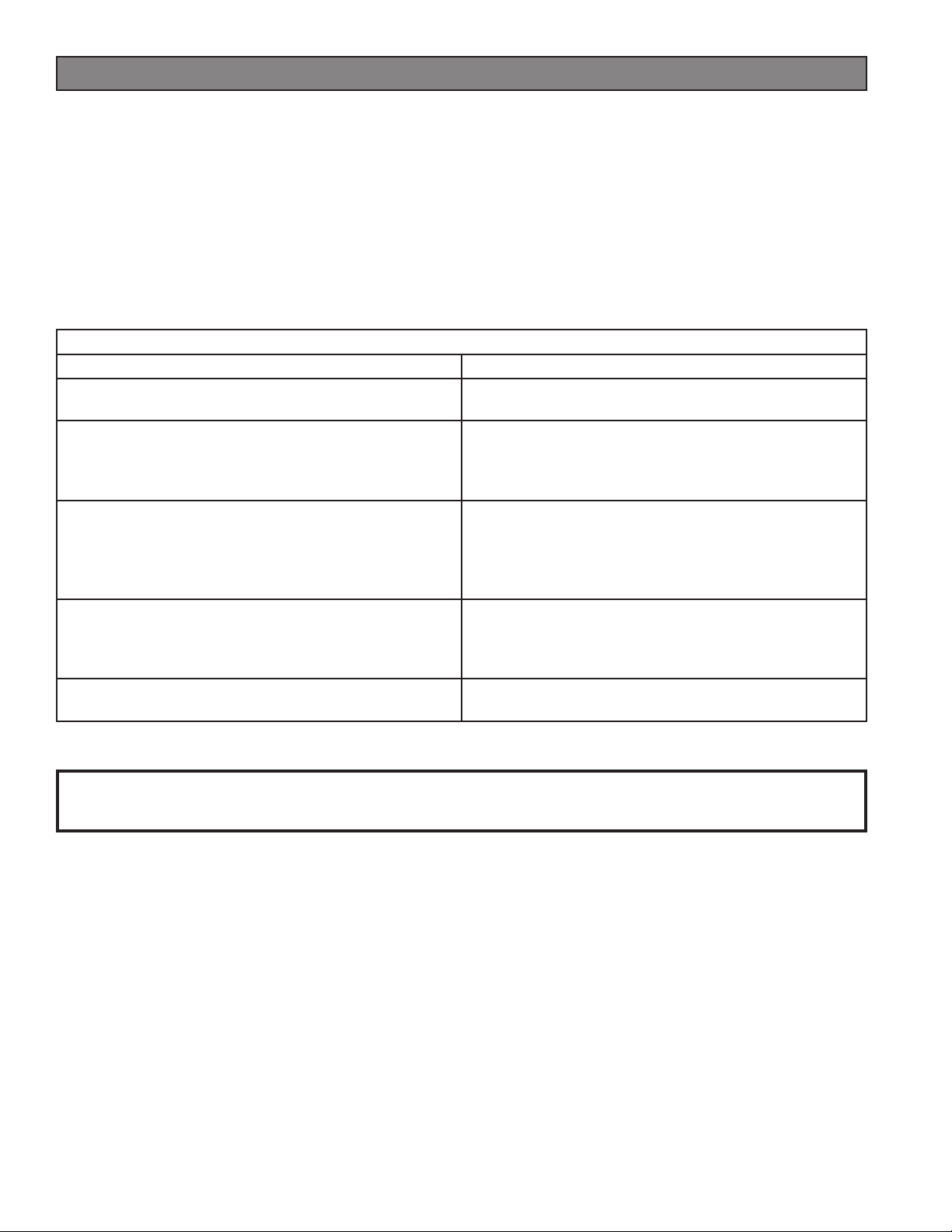
SCHEDULE
Use the following as a guide under
average use conditions.
Gaskets around door and door
glass should be inspected and
repaired or replaced when
necessary.
Daily Weekly Monthly or as needed
Burn Pot Stirred Empty
Combustion Chamber
Brushed
Ashes Check Empty
Interior Chambers Vacuumed
Combustion Blower Blades Vacuumed / Brushed
Convection Blower Impeller Vacuumed / Brushed
Vent System Cleaned
Gaskets Inspected
Glass Wiped Cleaned
Hopper (end of season) Emptied and vacuumed
24
When your stove acts out of the ordinary, the fi rst reaction is to call for help. This guide may save time and money by
enabling you to solve simple problems yourself. Problems encountered are often the result of only fi ve factors: 1) poor
fuel; 2) poor operation or maintenance; 3) poor installation; 4) component failure; 5) factory defect. You can usually solve
those problems related to 1 and 2. Your dealer can solve problems relating to 3, 4 and 5. Refer to diagrams on page 25
to help locate indicated parts.
For the sake of troubleshooting and using this guide to assist you, you should look at your heat level setting to see which
light is fl ashing.
Disconnect the power cord before performing any maintenance! NOTE: Turning the ON/OFF Switch to ”OFF”
does not disconnect all power to the electrical components of the stove.
Never try to repair or replace any part of the stove unless instructions for doing so are given in this manual.
All other work should be done by a trained technician.
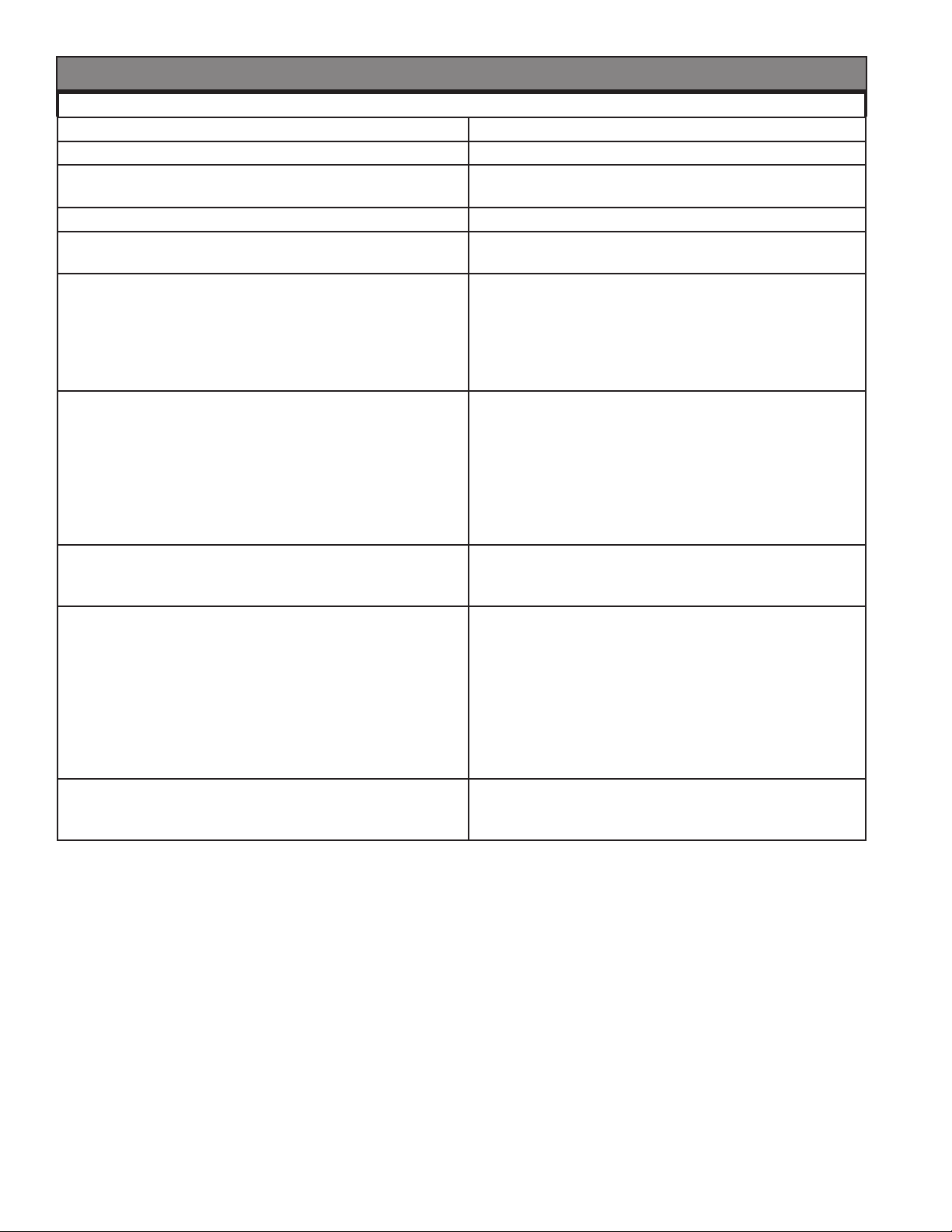
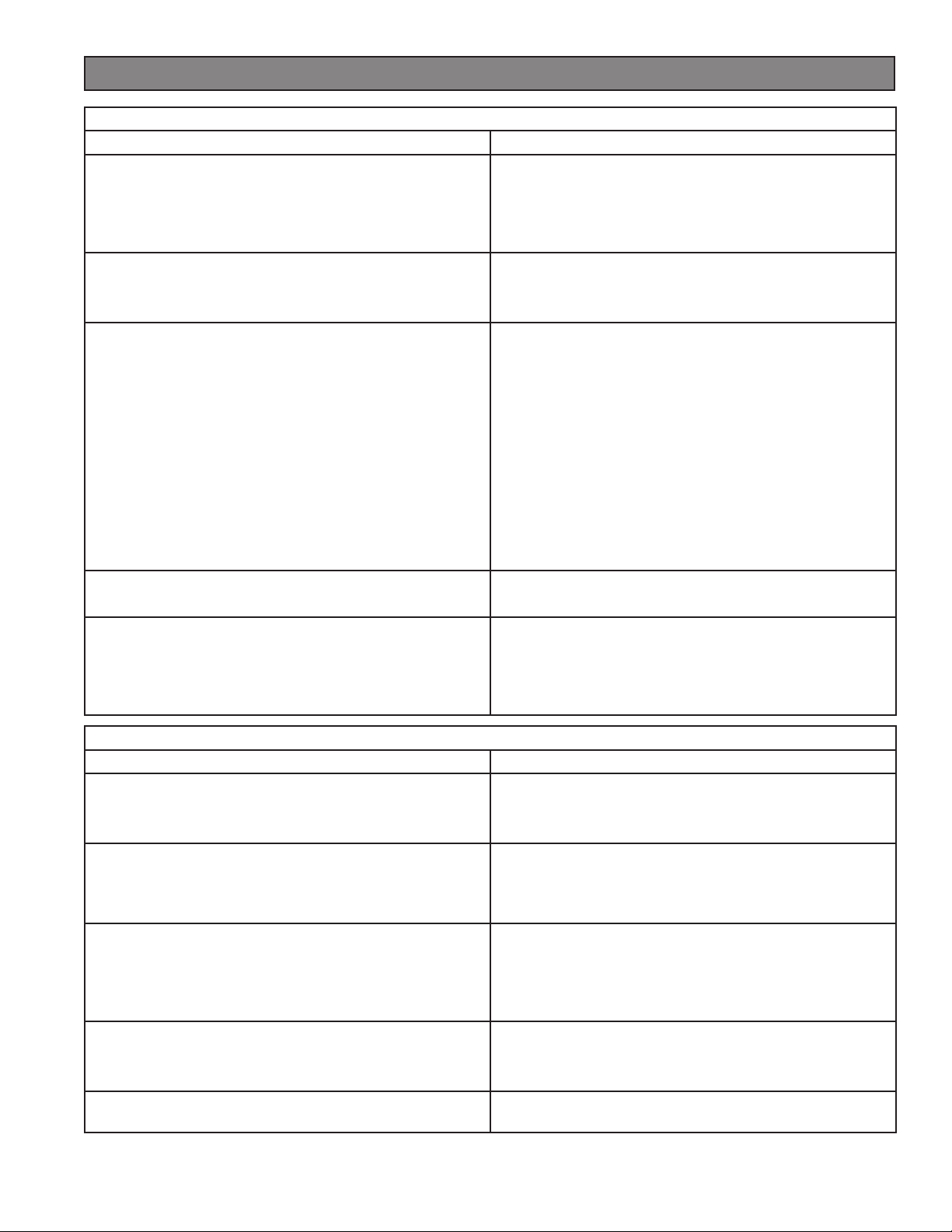
TROUBLE SHOOTING GUIDE
Display is Flashing “E1”
Possible Causes Possible Remedies: (Unplug stove fi rst when possible)
1. The convection blower is overheating and tripping the
internal temperature shutoff.
Clean any dust off of the windings and fan blade. If oiling
the blower does not help, the blower may be bad.
2. The stove is being left on the highest setting for ex-
tended periods of time.
If operating the heater on the highest heat setting, the
room temperature could increase enough and lead to
potential overheating situations. If this happens try oper-
ating at a lower heat setting.
3. Fuel other than wood pellets is being burned in the
stove.
This pellet stove is designed and tested to use wood
pellets. Check for signs of fuel other than wood pellets.
No other types of fuel have been approved for this pellet
stove. If there are signs of other types of fuel being used,
stop using them immediately.
4. Power surge or brown out situation.
A power surge, spike, or voltage drop could cause the
high limit switch to trip. Check to see if a surge protector
is being used on the stove. If not, recommend one to the
customer.
5. High Limit Switch is malfunctioning.
If the other items check out OK, replace the high limit
switch.
ATTENTION: This wood heater needs periodic inspection and repair for proper operation. It is against federal regula-
tions to operate this wood heater in a manner inconsistent with operating instructions in this manual.

25
TROUBLE SHOOTING GUIDE
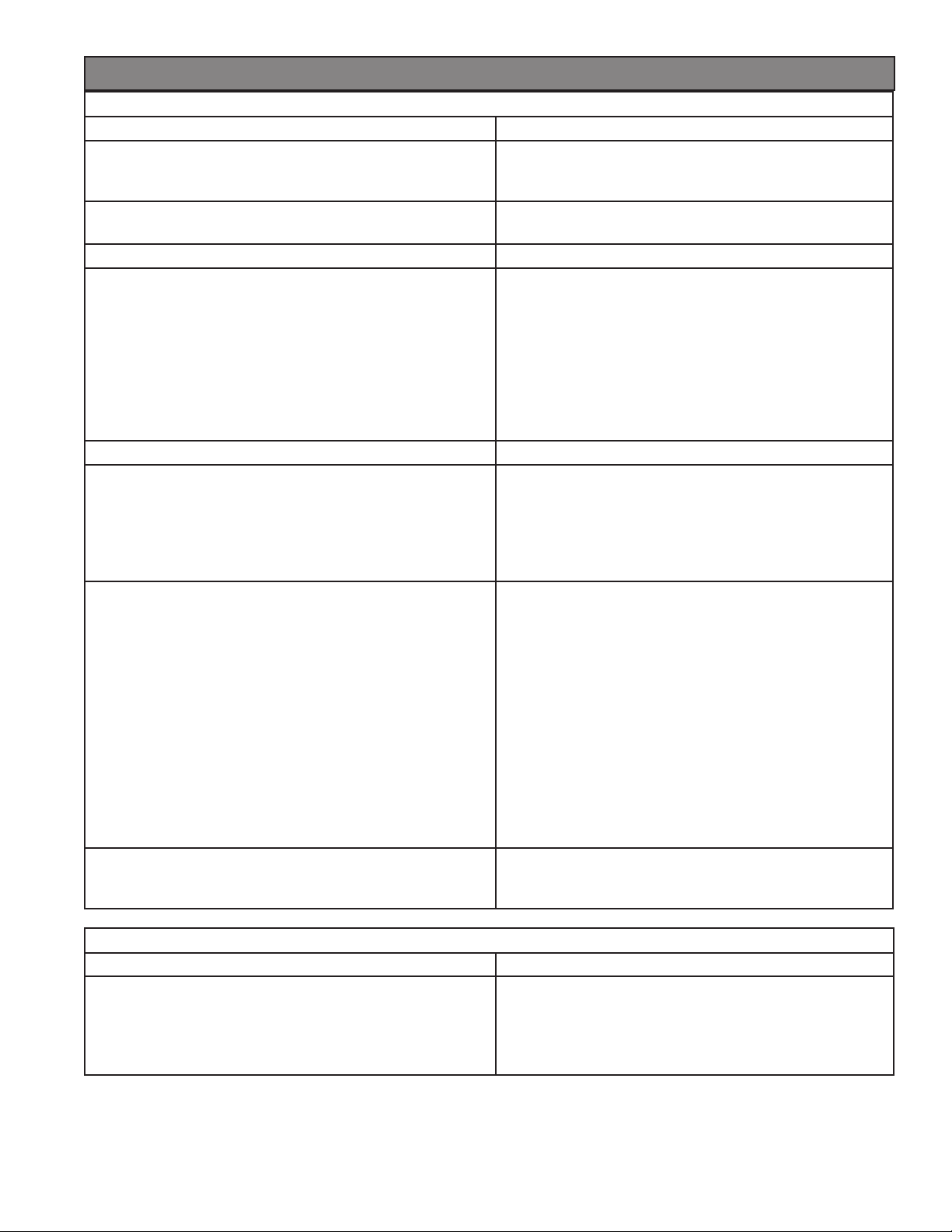
Display is Flashing “E2”
Possible Causes Possible Remedies: (Unplug stove fi rst when possible)
1. Airfl ow switch hose or stove attachment pipes for hose
are blocked.
Unhook air hose from the air switch and blow through it.
If air fl ows freely, the hose and tube are fi ne. If air will not
fl ow throw the hose, use a wire coat hanger to clear the
blockage.
2. The air inlet, burnpot, interior combustion air cham-
bers, combustion blower, or exhaust pipe are blocked
with ash or foreign material.
Follow all cleaning procedures in the maintenance sec-
tion of the owner’s manual.
3. The fi rebox is not properly sealed.
Make sure the door is closed and that the gasket is in
good shape.
4. Vent pipe is incorrectly installed.
Check to make sure vent pipe installation meets criteria
in owner’s manual.
5. The airfl ow switch wire connections are bad.
Check the connectors that attach the gray wires to the
air switch.
6. Combustion blower failure.
With the stove on, check to see if the combustion blower
is running. If it is not, you will need to check for power
going to the combustion blower. It should be a full cur-
rent. If there is power, the blower is bad. If there is not,
see #8.
7. Control board not sending power to combustion
blower.
If there is no current going to the combustion blower,
check all wire connections. If all wires are properly con-
nected, you have a bad control board.
8. Control board not sending power to air switch.
There should be a 5-volt current (approximately) go-
ing to the air switch after the stove has been on for 30
seconds.
9. Air switch has failed.
To test the air switch, you will need to disconnect the air
hose from the body of the stove. With the other end still
attached to the air switch, very gently suck on the loose
end of the hose (you may want to remove the hose en-
tirely off the stove and the air switch fi rst and make sure
it is clear). If you hear a click, the air switch is working.
BE CAREFUL TOO MUCH VACUUM CAN DAMAGE
THE AIR SWITCH.
26
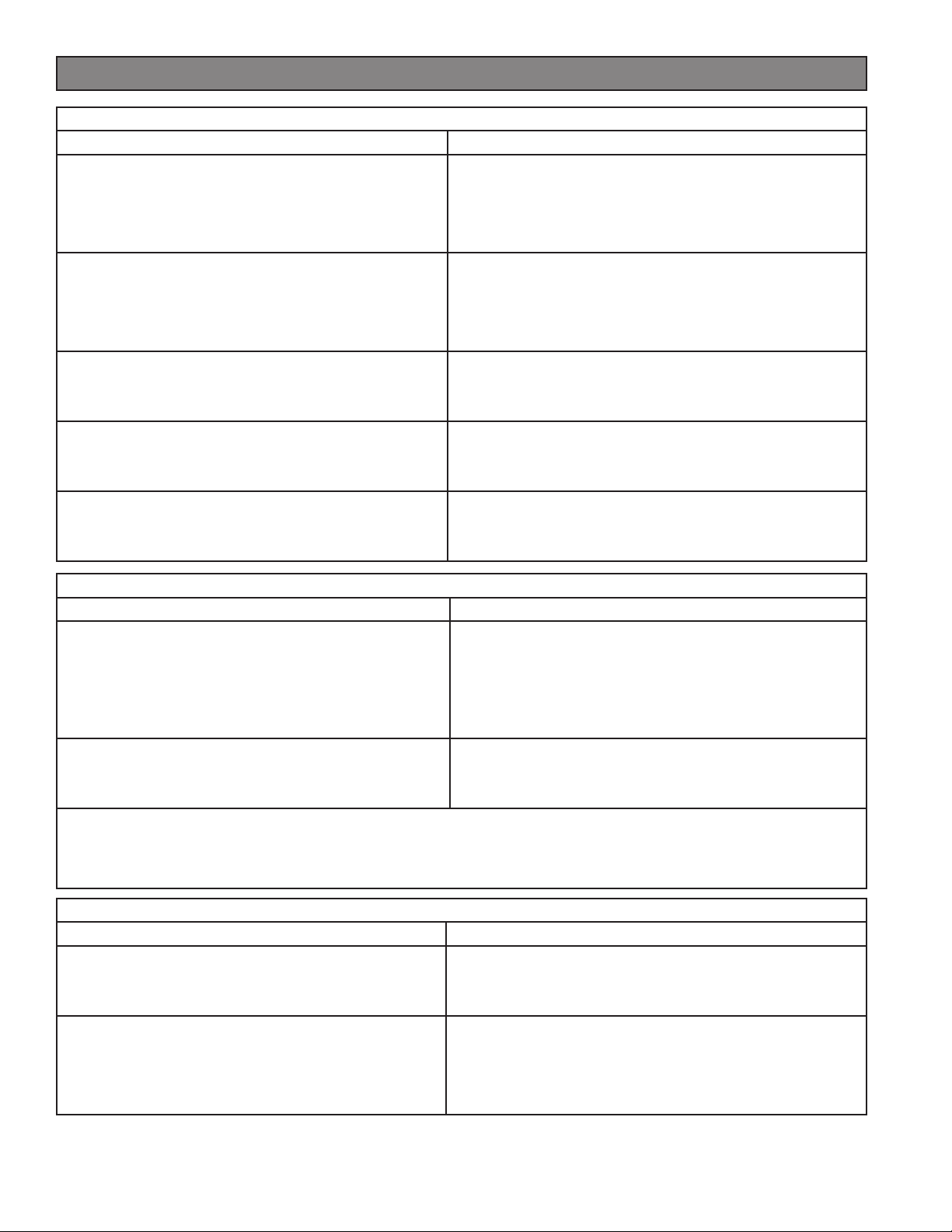
TROUBLE SHOOTING GUIDE
Display is Flashing “E3”
Possible Causes Possible Remedies: (Unplug stove fi rst when possible)
1. The hopper is out of pellets Refi ll the hopper.
2. The air dampener is too far open for a low feed setting
If on the low setting, you may need to close the damp-
ener all the way.
3. The burnpot holes are blocked. Remove the burnpot and thoroughly clean it.
4. The air inlet, the interior chambers, or exhaust system
has a partial blockage.
Follow all cleaning procedures in the maintenance sec-
tion of the owner's manual
5. The hopper safety switch has failed or hopper is open.
When operating the unit, be sure the hopper lid is
closed so that the hopper safety switch will activate.
Check the wires leading from the hopper safety switch
to the control panel and auger motor for secure connec-
tions. Use a continuity tester to test the hopper safety
switch; replace if necessary.
6. The auger shaft is jammed.
"Start by emptying the hopper. Then remove the auger
motor by removing the auger pin, then remove the two
bolts that hold the auger bracket to the auger tube. The
auger bracket will now be able to be removed form the
auger tube. Remove the two bolts on the side of the
auger tube to remove the lower bearing of the auger.
Pull the auger out of the tube to free the jam.
"
7. The auger motor has failed.
Remove the auger motor from the auger shaft and try to
run the unit. If the motor will turn the shaft is jammed on
something. If the motor will not turn, the motor is bad.
8. The Proof of Fire (POF) thermodisc has malfunctioned.
Temporarily bypass the POF thermodisc by discon-
necting the two wires and connecting them with a short
piece of wire. Then plug the stove back up. If the stove
comes on and works, you need to replace the POF
thermodisc. This is for testing only. DO NOT LEAVE
THE THERMODISC BYPASSED. Your blowers will
never shut off and if the fi re went out the auger will
continue to feed pellets until the hopper is empty if you
leave the POF thermodisc bypassed.
9. The control board is not sending power to the POF
thermodisc or other auger system components.
There should be a 5-volt (approximately) current going
to the POF thermodisc after the stove has been on for
10 minutes.
27
TROUBLE SHOOTING GUIDE
Display is Flashing “E4”
Possible Causes Possible Remedies: (Unplug stove fi rst when possible)
1. The air inlet, burnpot, interior combustion air chambers,
combustion blower, or exhaust pipe are blocked with ash
or foreign material.
Follow all cleaning procedures in the maintenance sec-
tion of the owner’s manual.
2. The Proof of Fire (POF) thermodisc has came un-
pluged
Check the (POF) thermodisc to see if the wires are con-
nected properly.
3. The Proof of Fire (POF) thermodisc has malfunctioned.
Temporarily bypass the POF thermodisc by discon-
necting the two wires and connecting them with a short
piece of wire. Then plug the stove back up. If the stove
comes on and works, you need to replace the POF
thermodisc. This is for testing only. DO NOT LEAVE
THE THERMODISC BYPASSED. Your blowers will
never shut off and if the fi re went out the auger will
continue to feed pellets until the hopper is empty if you
leave the POF thermodisc bypassed.
4. The hopper is out of Pellets. Refi ll the hopper.
5. The hopper safety switch has failed or hopper is open.
When operating the unit, be sure the hopper lid is
closed so that the hopper safety switch will activate.
Check the wires leading from the hopper safety switch
to the control panel and auger motor for secure connec-
tions. Use a continuity tester to test the hopper safety
switch; replace if necessary.
6. The auger shaft is jammed.
Start by emptying the hopper. Then remove the auger
motor by removing the auger pin. Remove the auger shaft
inspection plate in the hopper so that you can see the
auger shaft. Gently lift the auger shaft straight up so that
the end of the auger shaft comes up out of the bottom
auger bushing. Next, remove the two nuts that hold the
top auger biscuit in. Then rotate the bottom end of the
auger shaft up towards you until you can lift the shaft out
of the stove. After you have removed the shaft, inspect
it for bent fl ights, burrs, or broken welds. Remove any
foreign material that might have caused the jam. Also,
check the auger tube for signs of damage such as burrs,
rough spots, or grooves cut into the metal that could have
caused a jam.
7. The auger motor has failed.
Remove the auger motor from the auger shaft and try to
run the unit. If the motor will turn the shaft is jammed on
something. If the motor will not turn, the motor is bad.
Display is Flashing “E5”
Possible Causes Possible Remedies: (Unplug stove fi rst when possible)
1. The stove automaticaly fl ashes "E5" when turned on
The T-stat sensor has come unpluged form the control
board. Check to see if the sensor is unpluged. If the
sensor is not unpluged then the sensor is damaged or
has a short. If the sensor is damaged or has a short it
will need to be replaced.
28
TROUBLE SHOOTING GUIDE
STOVE FEEDS PELLETS, BUT WILL NOT IGNITE
Possible Causes Possible Remedies: (Unplug stove fi rst when possible)
1. Air damper open too far for ignition. Push the air damper in closer to the side of the stove for
startup. In some situations it may be necessary to have the
damper completely closed for ignition to take place. After
there is a fl ame, the damper can then be adjusted for the
desired feed setting.
2. Blockage in igniter tube or inlet for igniter tube. Find the igniter housing on the backside of the fi rewall. The
air intake hole is a small hole located on bottom side of the
housing. Make sure it is clear. Also, look from the front of
the stove to make sure there is not any debris around the
igniter element inside of the igniter housing.
3. The burnpot is not pushed completely to the rear of
the fi rebox.
Make sure that the air intake collar on the burnpot is touching
the rear wall of the fi rebox.
4. Bad igniter element. Put power directly to the igniter element. Watch the tip of the
igniter from the front of the stove. After about 2 minutes the
tip should glow. If it does not, the element is bad.
5. The control board is not sending power to the igniter. Check the voltage going to the igniter during startup. It should
be a full current. If the voltage is lower than full current, check
the wiring. If the wiring checks out good, the board is bad.
SMOKE SMELL COMING BACK INTO THE HOME
Possible Causes Possible Remedies: (Unplug stove fi rst when possible)
1. There is a leak in the vent pipe system. Inspect all vent pipe connections. Make sure they are
sealed with RTV silicone that has a temperature rating on
500 degree F or higher. Also, seal joints with UL-181-AP foil
tape. Also, make sure the square to round adapter piece
on the combustion blower has been properly sealed with
the same RTV.
2. The gasket on the combustion blower has gone bad. Inspect both gaskets on the combustion blower to make sure
they are in good shape.
Because it is a wood-burning device, your pellet heater may emit a faint wood-burning odor. If this increases beyond
normal, or if you notice an unusual soot build-up on walls or furniture, check your exhaust system carefully for leaks.
All joints should be properly sealed. Also clean your stove, following instructions in “MAINTENANCE”. If problem
persists, contact your dealer.
CONVECTION BLOWER SHUTS OFF AND COMES BACK ON
Possible Causes Possible Remedies: (Unplug stove fi rst when possible)
1. The convection blower is overheating and tripping
the internal temperature shutoff.
Clean any dust off of the windings and fan blades. If cleaning
the blower does not help, the blower may be bad.
2. Circuit board malfunction. Test the current going to the convection blower. If there is
power being sent to the blower when it is shut off, then the
control board is fi ne. If there is NOT power being sent to the
blower when it shuts off during operation, then you have a
bad control board.
29
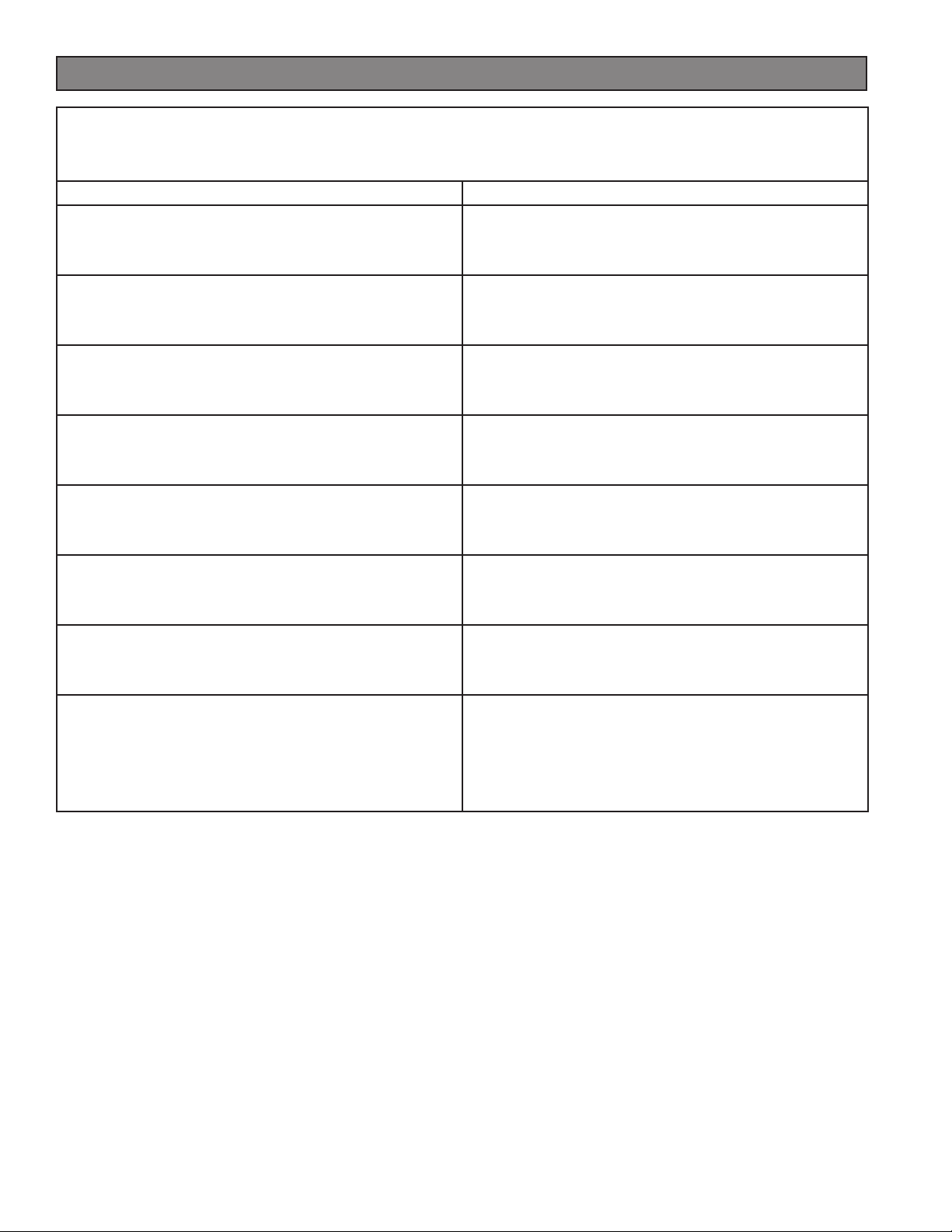
TROUBLE SHOOTING GUIDE
STOVE WILL NOT FEED PELLETS, BUT FUEL FEED LIGHT COMES ON AS DESIGNED
Possible Causes Possible Remedies: (Unplug stove fi rst when possible)
1. High limit switch has tripped or is defective. Wait for the stove to cool for about 30 - 45 minutes. Locate
the High Limit thermodisc and press the reset button on the
back of it. If the heater will not restart, check the thermodisc
to see if it’s bad. To test if the thermodisc is bad, you can
bypass it as described previously for the POF thermodisc.
2. Bad Auger Motor. Remove the auger motor from the auger shaft and try to
run the unit. If the motor will turn the shaft is jammed on
something. If the motor will not turn, the motor is bad.
3. Auger Jam. Start by emptying the hopper. Then remove the auger
motor by removing the auger pin. Remove the auger shaft
inspection plate in the hopper so that you can see the auger
shaft. Gently lift the auger shaft straight up so that the
end of the auger shaft comes up out of the bottom auger
bushing. Next, remove the two nuts that hold the top auger
biscuit in. Then rotate the bottom end of the auger shaft
up towards you until you can lift the shaft out of the stove.
After you have removed the shaft, inspect it for bent fl ights,
burrs, or broken welds. Remove any foreign material that
might have caused the jam. Also, check the auger tube for
signs of damage such as burrs, rough spots, or grooves
cut into the metal that could have caused a jam.
4. Loose wire or connector. Check all wires and connectors that connector to the auger
motor, high limit switch, and the Molex connector.
5. Bad control board. If the fuse is good, the wires and connectors check out
good, and the high limit switch did not trip, test for power
going to the auger motor. If there is not a full current going
to the auger motor when the fuel feed light is on, you have
a bad control board.
HIGH LIMIT SWITCH KEEPS TRIPPING
Possible Causes Possible Remedies: (Unplug stove fi rst when possible)
1. The convection blower is overheating and tripping the
internal temperature shutoff.
Clean any dust off of the windings and fan blades. If oiling
the blower does not help, the blower may be bad.
2. The stove is being left on the highest setting for
extended periods of time.
If operating the heater on the highest heat setting, the room
temperature could increase enough and lead to potential
overheating situations. If this happens, try operating at a
lower heat setting.
3. Fuel other than wood pellets is being burned in the
stove.
This pellet stove is designed and tested to use wood pellets.
Check for signs of fuel other than wood pellets. No other
types of fuel have been approved for this pellet stove. If
there are signs of other types of fuel being used, stop using
them immediately.
4. Power surge or brown out situation. A power surge, spike, or voltage drop could cause the high
limit switch to trip. Check to see if a surge protector is being
used on the stove. If not, recommend one to the consumer.
5. High limit switch is malfunctioning. If the other items check out OK, replace the high limit switch.
30
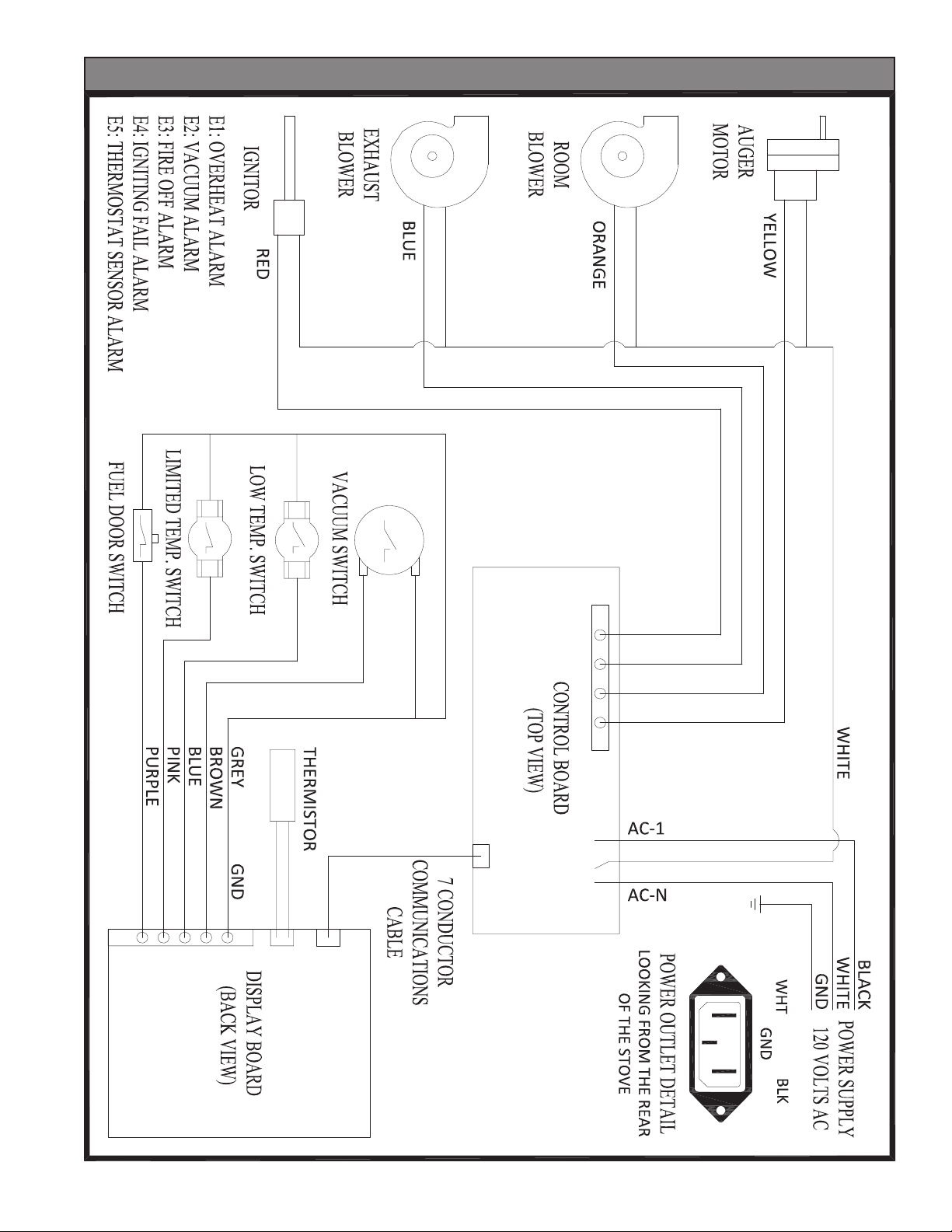
TROUBLE SHOOTING GUIDE
• GLASS “SOOT’S” UP AT A VERY FAST RATE
• FLAME IS LAZY, DARK, AND HAS BLACK TIPS
• AFTER STOVE HAS BEEN ON FOR A WHILE, THE BURNPOT OVERFILLS
Possible Causes Possible Remedies: (Unplug stove fi rst when possible)
1. Stove or vent pipe is dirty, which restricts airfl ow through
the burnpot.
Follow all cleaning procedure in the maintenance section
of the owner’s manual.
2. Vent pipe installed improperly. Check to make sure the vent pipe has been installed
according to the criteria in the owner’s manual.
3. Air damper is set too far in (closed) for a higher setting. Pull the damper knob farther out away from the side of the
stove and try to burn the unit again.
4. Burnpot holes are blocked. Remove the burnpot and thoroughly clean it.
5. Air damper is broken. Visually inspect the damper assembly. Make sure the
damper plate is attached to the damper rod. When the
damper rod is moved the plate should move with it.
6. Blockage in air intake pipe. Visually inspect the air intake pipe that leads into the
burnpot for foreign material.
7. Combustion blower is not spinning fast enough. Test the RPM on the blower after the blades have been
cleaned. The RPM should be approximately 3000 RPM.
8. Bad Pellets.
(Applies to GLASS “SOOT’S” UP AT A VERY FAST
RATE Only)
The brand of pellets or the batch of pellets that are being
used may be of poor quality. If possible, try a different brand
of pellets. You might also want to try a brand that is made
from a different type of wood (softwood vs. hardwood).
Different woods have different characteristics when being
burned.
31
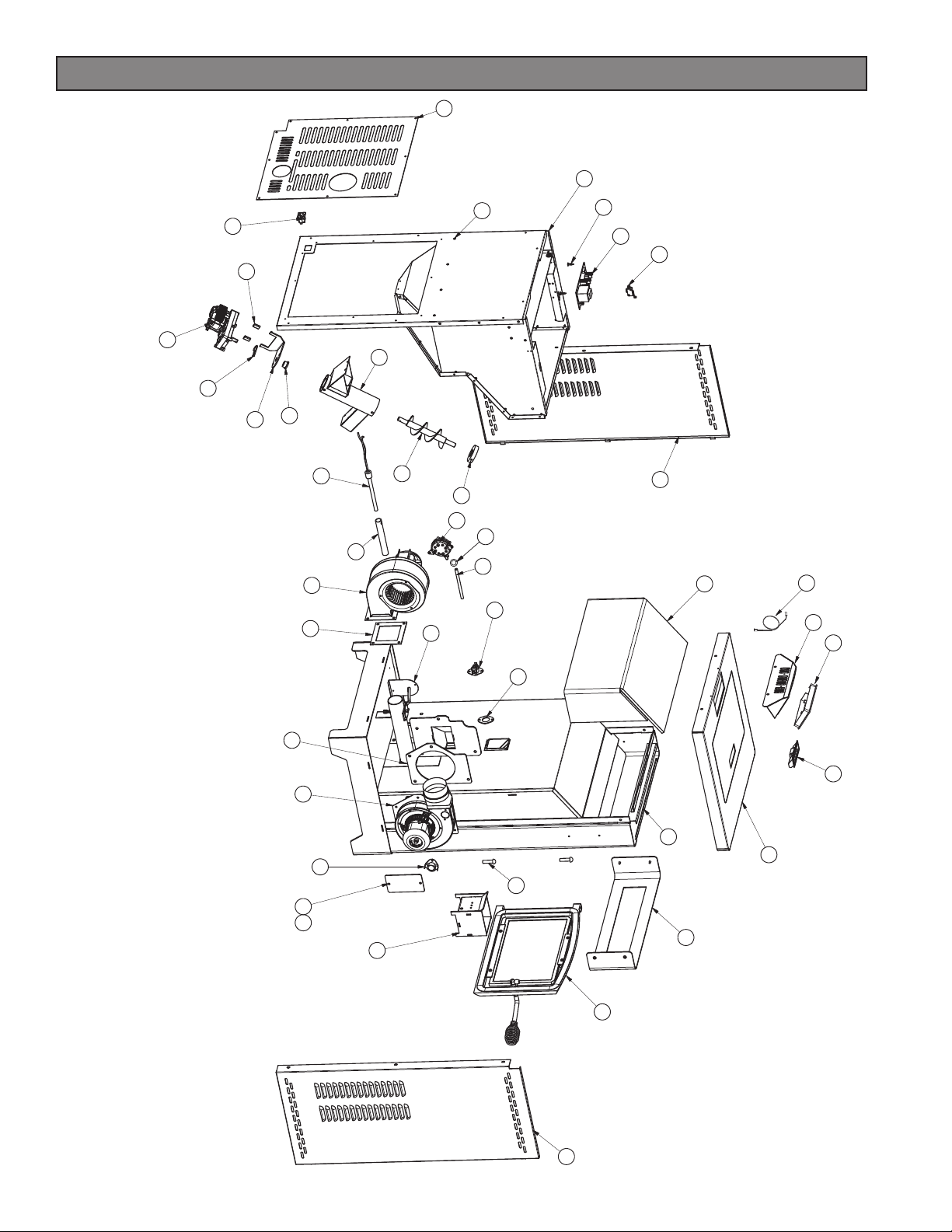
WIRING DIAGRAM
32
PARTS DIAGRAM
1
2
3
4
8
9
15
17
19
34
20
21
22
23
27
28
29
30
35
36
37
38
40
41
24
25
5
6
7
43
18
26
33
14
1
16
18
39
42
12
13
31
32
33
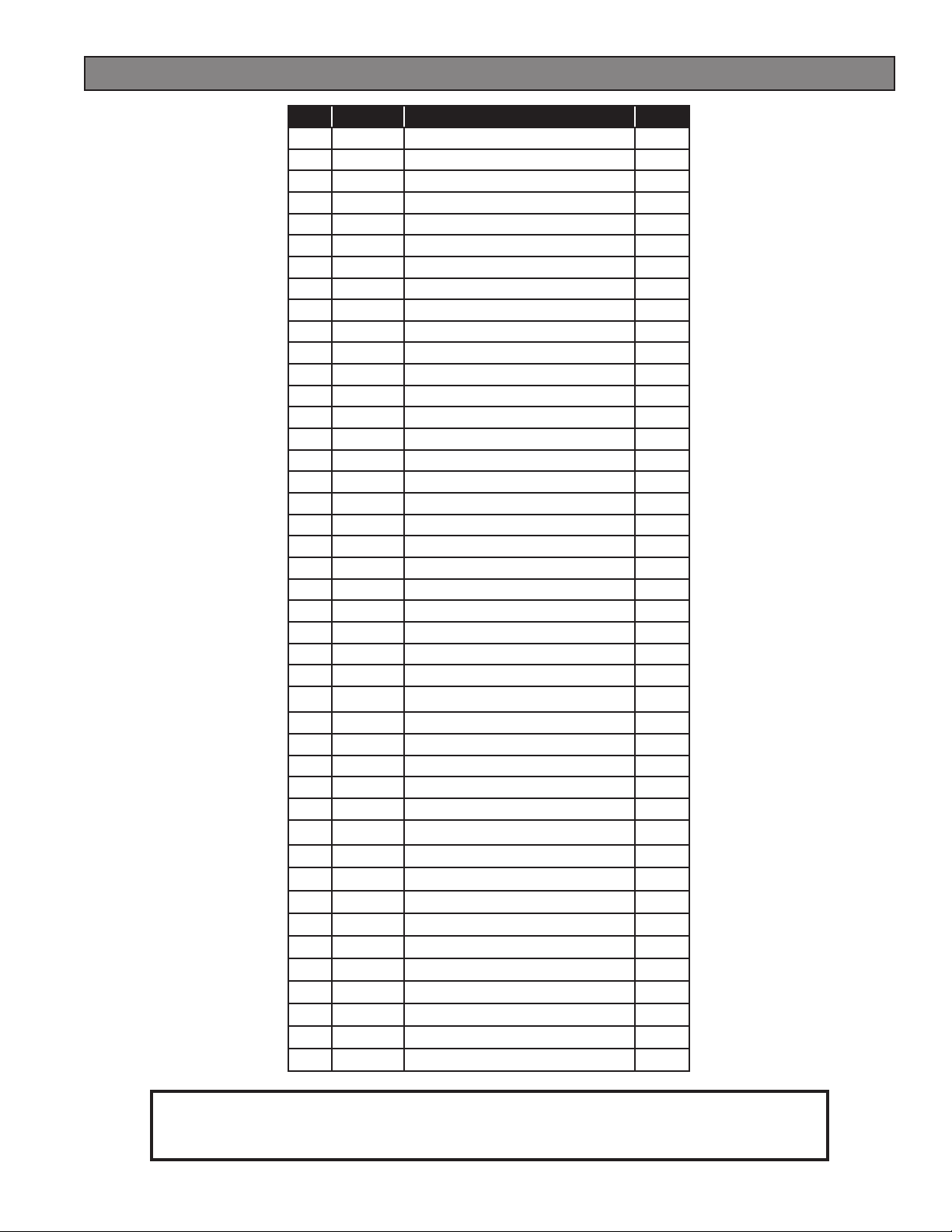
PARTS LIST
Key Part No. Description Qty.
1 892183 Main Weldment 1
2
83538 Shaft Collar - Ignitor Tube 1
3 892184 Hopper 1
4 892185 Auger Housing Weld. 1
5 892186 Plate, Auger Bushing 1
6 892187 Auger 1
7 891132 Agitator Bushing 1
8 892188 Auger Motor Mounting Bracket 1
9 892189 Auger Motor Shock Absorber 2
10 83917 Plastic Grommet 1
11 892190 Rubber Grommet 1
12 80631 PCBA 1
13 83918 PCBA Standoff 1
14 80488 Auger Motor 1
15 83529 Auger Motor Hair Pin 1
16 80462 AC Electrical Connector 1
17 80491 Lid Switch 1
18 80660 Thermistor 1
19 892191 Ash Clean-Out Covers 2
20 892192 Top Weldment 1
21 891148 Lid Latch 1
22 892193 Door Assembly 1
23 892198 Warm Air Outlet Grill 1
24 80599 T-Disc, Exhaust 1
25 892203 Hinge Pin 2
26 80630 PCBA, Controller 1
27 892200 Vented Side Panel, Right 1
28 892201 Vented Side Panel, Left 1
29 892202 Vented Back Panel 1
30 86624 Burnpot 1
31 891121 Hose, Silicon 1
32 83537 Hose Clamp 1
33 88176 Insulating Blanket 1
34 88177 Gasket, Ash Clean-out 2
35 88175 Gasket, T-disc 2
36 80601 T-Disc, Room Air 1
37 88167 Gasket, Room Blower 1
38 80604 Igniter 1
39 80622 Room Blower 1
40 80549 Vacuum Switch 1
41 88166 Gasket, Exhaust Blower 1
42 80602 Exhaust Blower 1
43 892199 Housing, PCBA Controller 1
IN ORDER TO MAINTAIN WARRANTY, COMPONENTS MUST BE REPLACED
USING ORIGINAL MANUFACTURERS PARTS PURCHASED THROUGH YOUR
DEALER OR DIRECTLY FROM THE APPLIANCE MANUFACTURER.
USE OF THIRD PARTY COMPONENTS WILL VOID THE WARRANTY.
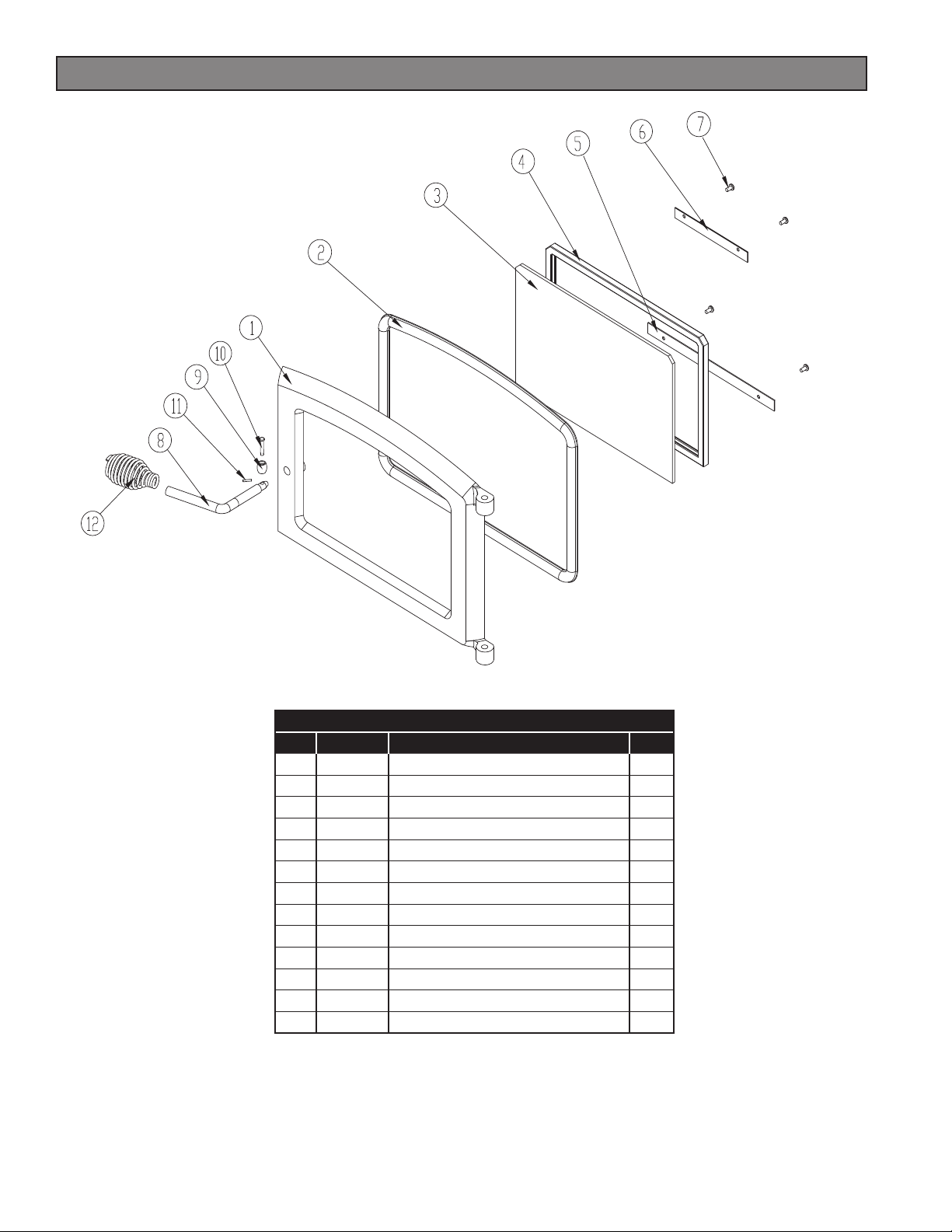
34
Door Parts List
Key Part No. Description Qty.
1 40586 Feed Door 1
2 88066 3/4” Round Rope Gasket-Black 55 in
3 892197 Door Glass 1
4 88087 1/8 x 1 Window Gasket w/Adhesive 39 in
5 892194 Retainer, Bottom, Glass 1
6 892195 Retainer, Top,. Glass 1
7 83202 Glass Retainer Screw 4
8 892196 Door Handle Arm 1
9 891085 Handle Bearing 1
10 891086 Handle Bearing 1
11 891087 Roll Pin 1
12 891135 Spring Handle 1
13 89284 Silicone Sealant A/R
PARTS DIAGRAM / PARTS LIST

NOTES

THIS MANUAL WILL HELP YOU OBTAIN EFFICIENT, DEPENDABLE SERVICE
FROM YOUR PELLET STOVE, AND ENABLE YOU TO ORDER REPAIR PARTS COR
RECTLY.
KEEP THIS MANUAL IN A SAFE PLACE FOR FUTURE REFERENCE.
WHEN WRITING, ALWAYS GIVE THE FULL MODEL NUMBER WHICH IS ON THE
NAMEPLATE ATTACHED TO THE HEATER.
WHEN ORDERING REPAIR PARTS, ALWAYS GIVE THE FOLLOWING INFORMA
TION AS SHOWN IN THIS LIST:
227 Industrial Park Road, South Pittsburg, TN 37380
www.usstove.com
Phone 1-800-750-2723
HOW TO ORDER REPAIR PARTS
1. THE PART NUMBER
2. THE PART DESCRIPTION
3. THE MODEL NUMBER: ___________________________
4. THE SERIAL NUMBER: ____________________________