FAMILIARISATION
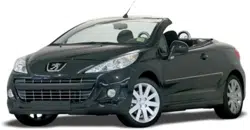
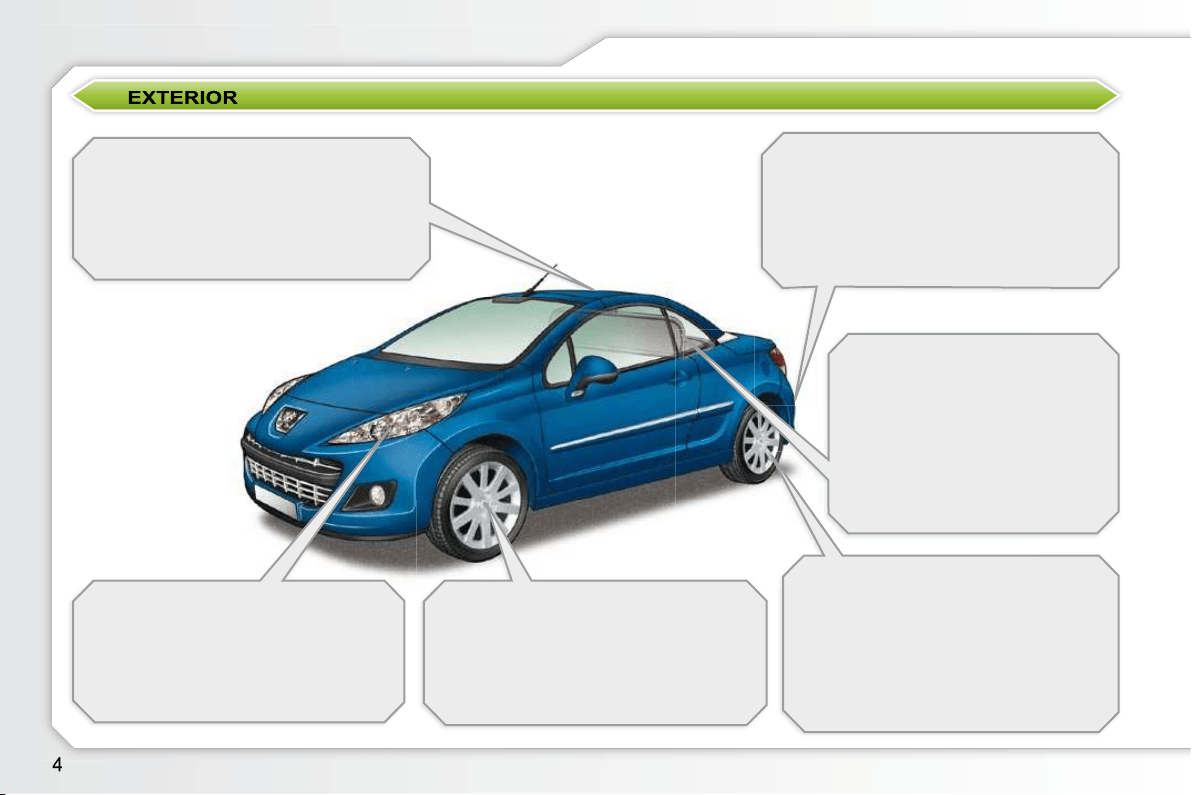
Retractable roof
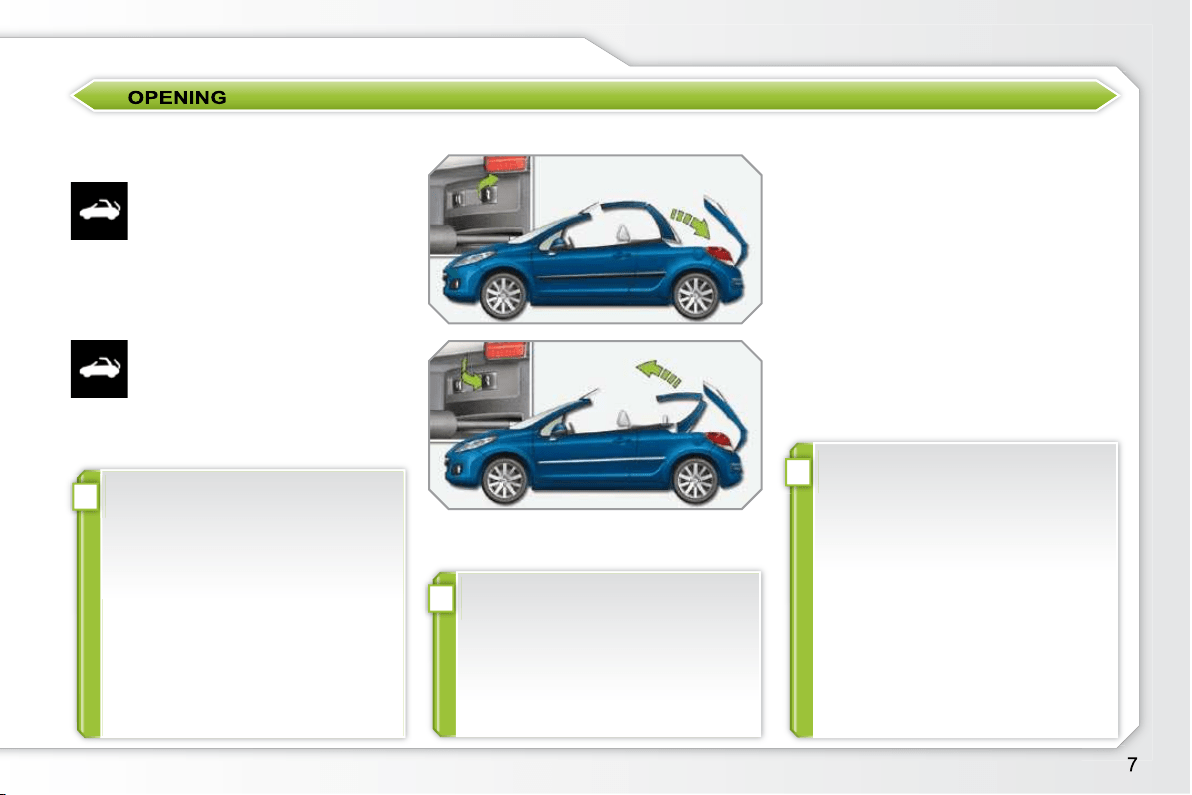
This system enables you to change from
a "coupé" confi guration to a "cabriolet"
confi guration and vice versa with a sin-
gle action.
6
Directional lighting
This additional lighting automatically
provides extended visibility when
turning.
80
Visual and audible rear parking
sensors
This system provides a warning when
reversing by detecting obstacles locat-
ed behind the vehicle.
111
Tyre under-infl ation detection
This system monitors the pressure in
each tyre and warns you of a punc-
ture or drop in pressure.
92
Windstop
In the "cabriolet" confi guration,
this system reduces wind turbu-
lence in the front seats.
60
Temporary tyre repair kit
This kit is a complete system, consist-
ing of a compressor and an integral
sealant, for the temporary repair of a
tyre.
120
i
i
FAMILIARISATION
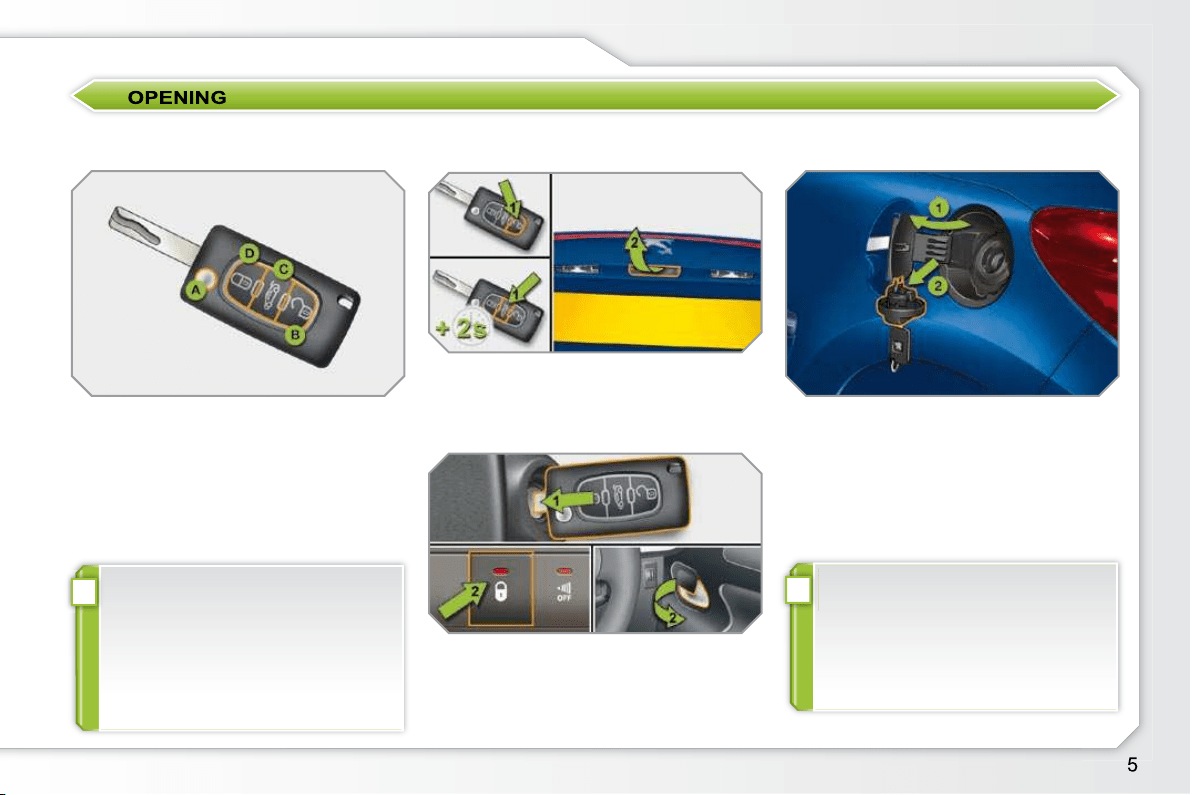
Remote control key
A. Unfolding/Folding the key.
B. Unlocking the vehicle.
C. Unlocking and partially opening the
boot.
63
Also...
D. Normal locking
or
Deadlocking the vehicle.
Fuel tank
1. Opening the fuel fi ller fl ap.
2. Opening and hooking the fuel fi ller
cap.
Capacity of the tank: approximately
50 litres (petrol) or 48 litres (Diesel).
75
Boot
From outside
From inside
1. Unlocking the vehicle or unlocking
the boot.
2. Opening the tailgate.
1. Key in the ignition switch.
2. Unlocking using the manual cen-
tralised control or the door opening
control.
74
On Diesel vehicles, the fuel tank
opening incorporates a misfuel
prevention device which prevents
fi lling with petrol.
76
!!
i
FAMILIARISATION
Retractable roof
When washing your vehicle:
- lock the vehicle,
- avoid spraying the upper part
of the windows,
- keep the end of the high-pres-
sure nozzle at least 1 metre
from the windows and door
seals.
After washing the vehicle or fol-
lowing rain, wait until the roof has
dried before opening it.
The roof is operated under the
sole responsibility of the driver.
During operation of the roof, to
avoid the risk of injury, ensure that
no one is in the vicinity of the mov-
ing parts.
You are strongly advised not to op-
erate the roof in strong winds.
It is preferable to operate the roof
with the engine running.
The roof can be operated at
speeds below 6 mph (10 km/h).
It is only possible to carry out the
operation twice with the engine
off, to prevent discharging of the
battery.
Preliminary conditions
Switch on the ignition.
Ensure that:
- the vehicle is not in energy economy
mode (refer to the corresponding
section),
- the battery voltage is suffi cient
(switching on of the indicator lamp
on the roof control),
-
the roof fuse is in good condition (refer
to the corresponding section),
- the electric windows are initialised
(refer to the corresponding section),
- the ambient temperature is above
-15 °C.
Precautions to be taken before
operating the roof
Park the vehicle on level ground.
Check that no object could hinder
the operation of the roof:
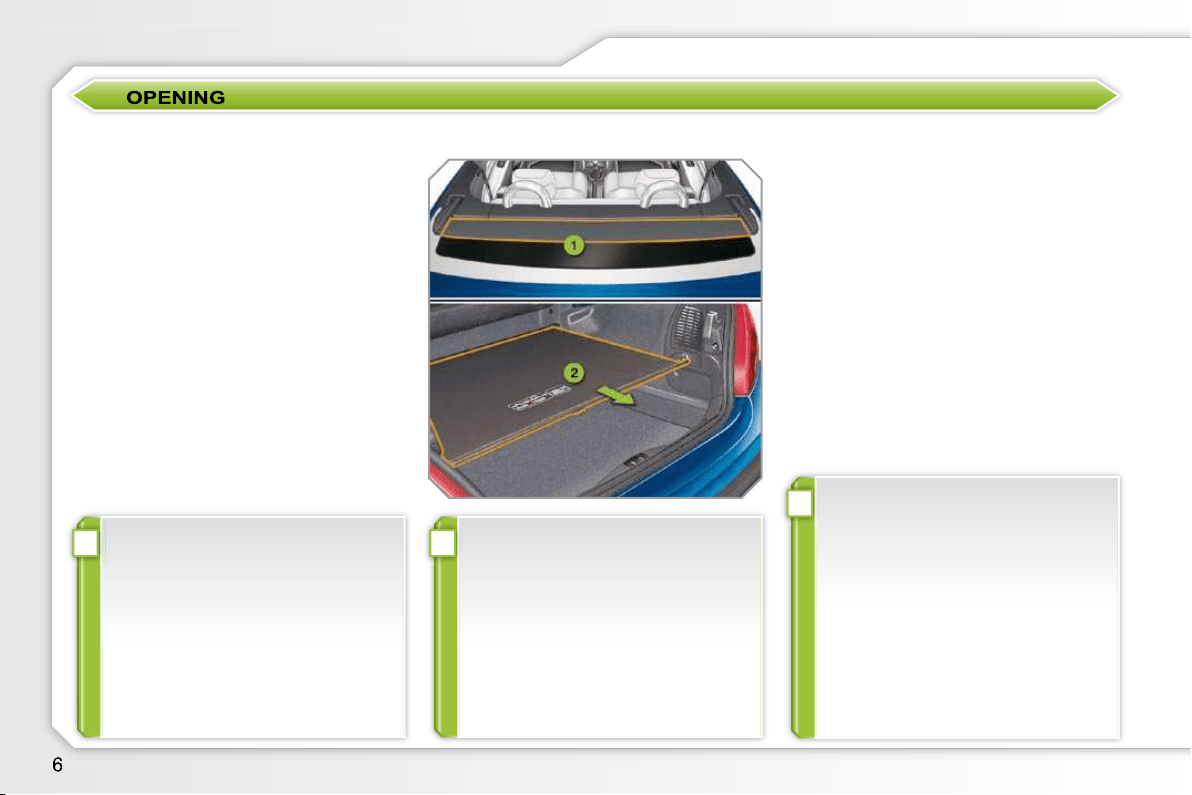
- nothing should be placed on the
moving rear shelf 1 or on the
net 2 ,
- if luggage is being carried in the
boot, it must not raise the net,
Ensure that the net 2 is secure.
Close the boot correctly.
Maintenance
Carry out a complete roof opera-
tion at least once a month to keep
it in good working order.
!
i
!
FAMILIARISATION
Operating the retractable roof
Opening the roof
Pull this control until the
roof is fully open.
Closing the roof
Press this control until the
roof is fully closed.
The end of the operation is
confi rmed by an audible signal
and a message on the multifunction
screen.
If you continue to pull or press this but-
ton after the end of the operation, the
four windows close.
Do not release the roof control during a
roof operation.
However, in the event of danger, re-
lease the control, the roof stops; then,
when the danger is no longer present,
complete the required operation.
If the operation has not been com-
pleted, you will be warned by an au-
dible signal and a message on the
multifunction screen. These will be
repeated when the vehicle reaches a
number of speed thresholds.
Changing to "cabriolet"
confi guration:
- the four windows lower,
- the boot opens,
- the roof folds into the boot,
- the boot closes.
The electric window controls and
the control for the four windows
are deactivated during roof opera-
tions.
The roof electronic control unit
may stop the current operation
as a precaution (example: door
movement and roof operation in
quick succession). In this case,
release the control then activate
it again to complete the required
operation.
Operating fault
If a malfunction of the roof occurs,
apply the parking brake, switch
off the ignition, restart the engine,
then start the required operation
again.
If the problem persists, contact a
PEUGEOT dealer.
Changing to "coupé" confi guration:
- the four windows lower,
- the boot opens,
- The roof opens out and locks auto-
matically,
- the boot closes.
The end of the operation is confi rmed
by an audible signal and a message on
the multifunction screen.
FAMILIARISATION
Dual-zone digital air conditioning
This system allows different levels of com-
fort for the driver and front passenger. It
then controls these levels automatically,
according to the ambient conditions.
48
Automatic gearbox
This system provides perfect driving by
combining a fully automatic mode, as-
sociated with two special programmes,
and a manual mode.
104
Audio and communication systems
These systems benefi ts from the latest tech-
nology: MP3 compatible Peugeot Connect
Sound, Peugeot Connect USB with Blue-
tooth hands-free system, Peugeot Connect
Navigation with 16/9 colour screen, JBL
audio system, auxiliary sockets.
Peugeot Connect
Navigation 149
Peugeot Connect
Sound 179
Peugeot Connect
Plug 186
Electric windows
On the driver's side, control of
the electric windows is auto-
matic when opening and when
closing.
69
FAMILIARISATION
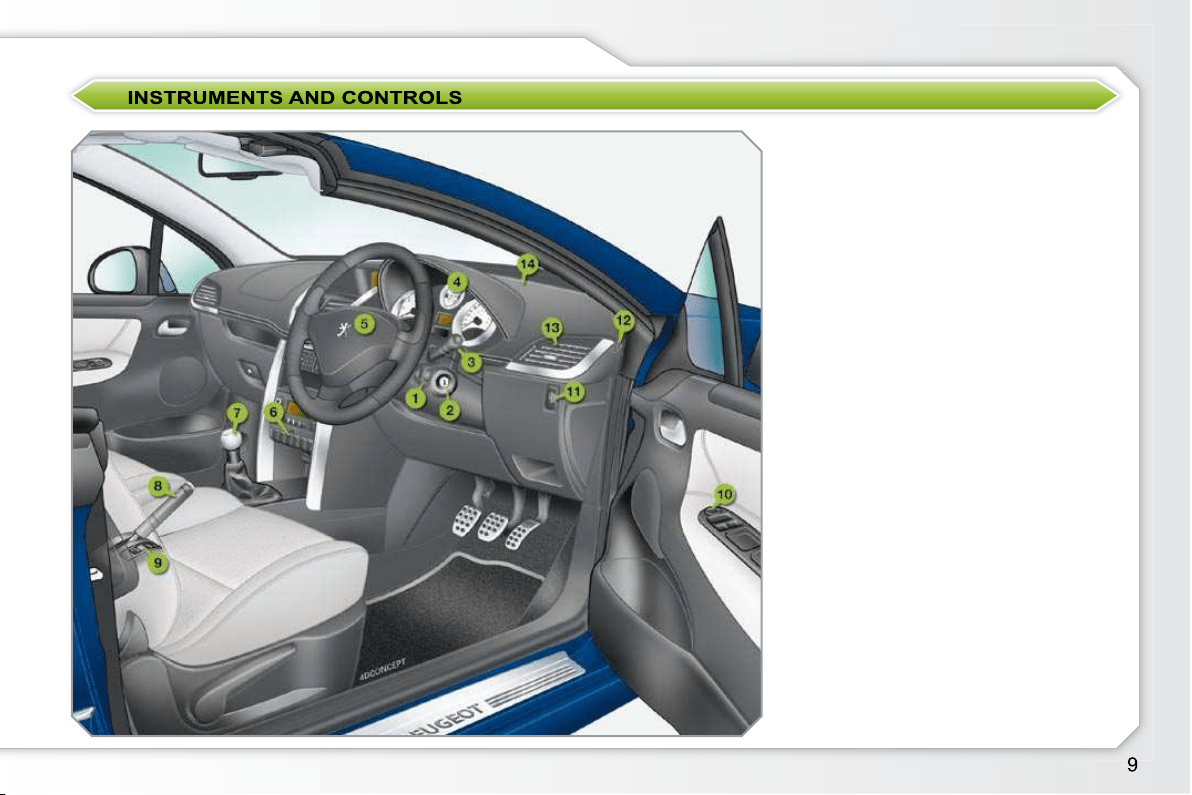
1. Audio equipment steering mounted
control.
2. Steering lock and ignition.
3. Wipers/screenwash/trip computer
control stalk.
4. Instrument panel.
5. Driver’s airbag.
Horn.
6. Dynamic stability control (ESP/
ASR) button.
Central locking button.
Alarm button.
7. Gear lever.
8. Parking brake.
9. Retractable roof control.
Control for the four windows.
10. Door mirror controls.
Electric window controls.
11. Headlamp height adjustment.
12. Door window demist/defrost vent.
13. Side adjustable air vent.
14. Windscreen demist/defrost vent.
FAMILIARISATION
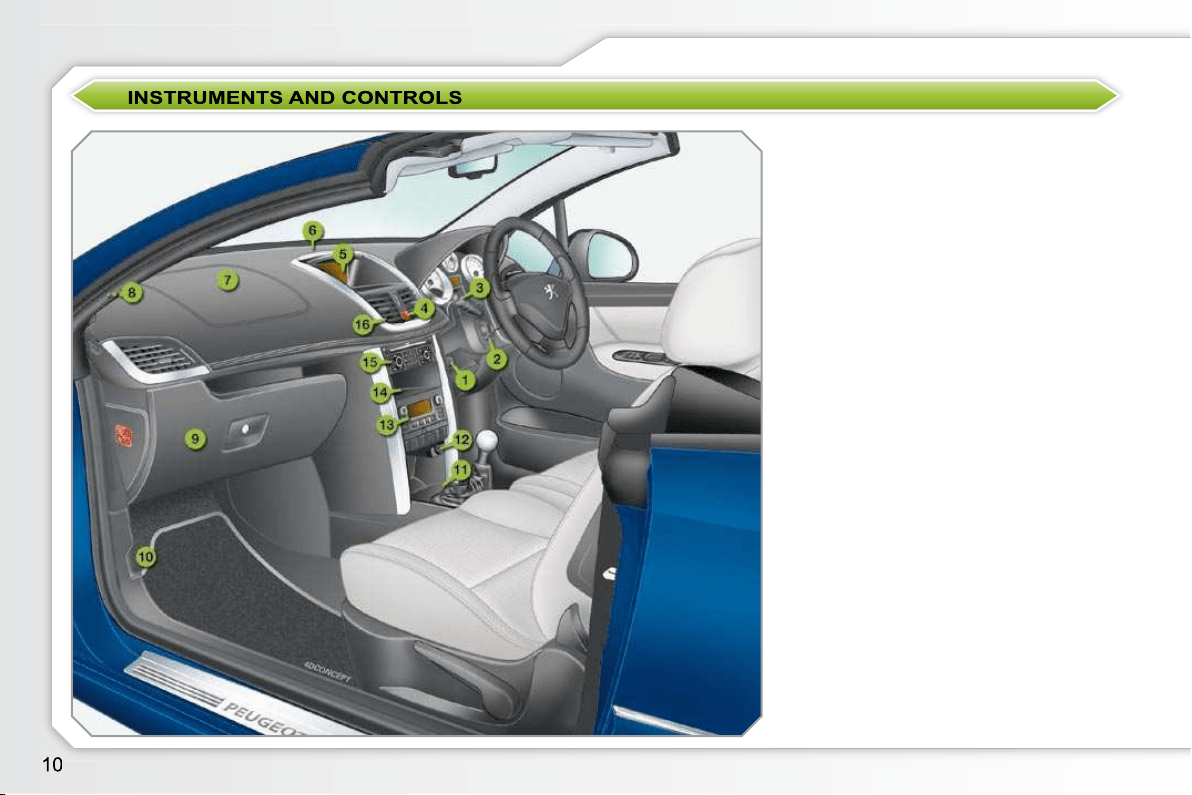
1. Steering wheel adjustments control.
2. Cruise control/speed limiter switches.
3. Lighting and direction indicators
control stalk.
4. Hazard warning lamps switch.
5. Multifunction screen.
Seat belt fastening status warning
lamps.
6. Sunshine sensor.
7. Passenger's airbag.
8. Speaker (medium tweeter).
9. Glove box/Passenger's airbag
deactivation/Audio/video sockets/
Fusebox.
10. Bonnet release lever.
11. 12 V accessories socket.
12. USB port.
13. Heating/air conditioning controls.
14. Storage compartment.
15. Audio and telematics system.
16. Central adjustable air vents.
i
!
FAMILIARISATION
Also...
5. Access to the rear seats.
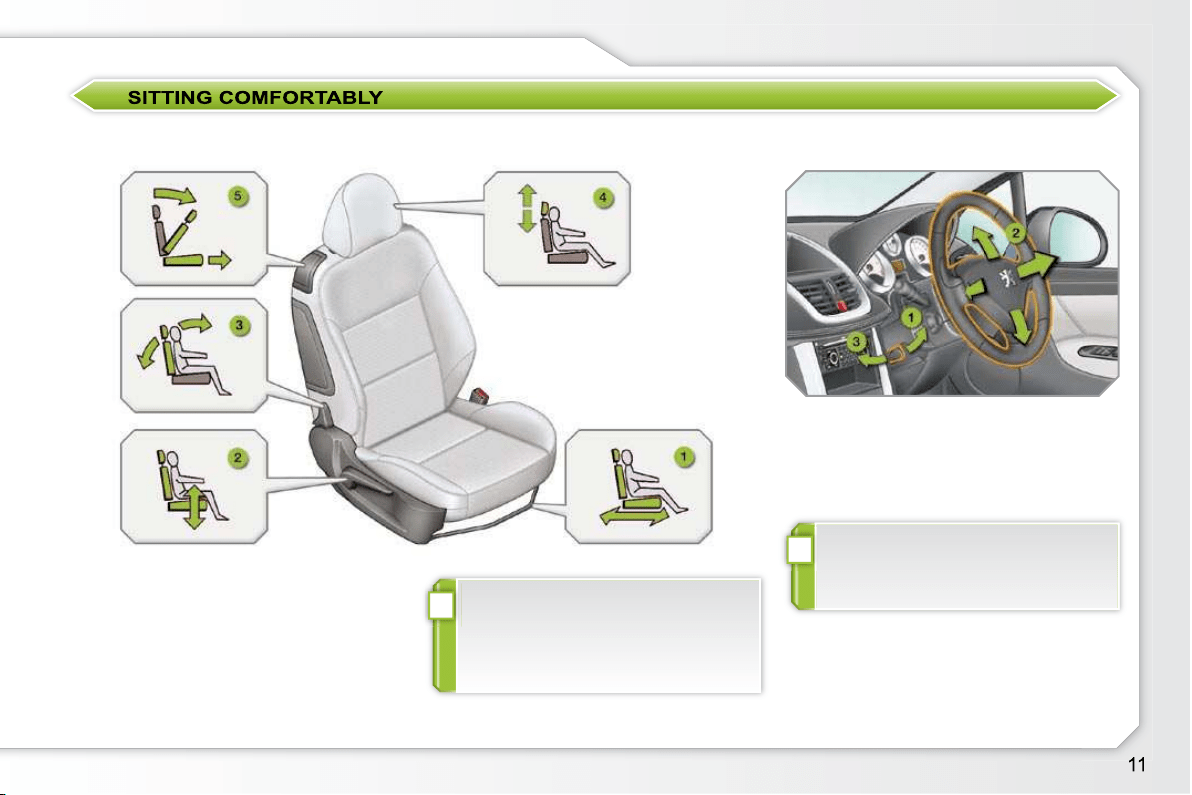
Front seat adjustment Steering wheel adjustment
1. Forwards-backwards adjustment.
2. Height adjustment.
3. Seat back angle adjustment.
4. Head restraint height adjustment.
50
1.
Unlocking the steering wheel adjustment.
2. Height and reach adjustment.
3.
Locking the steering wheel adjustment.
As a safety precaution, it is im-
perative that these operations are
carried out when stationary.
52
i
FAMILIARISATION
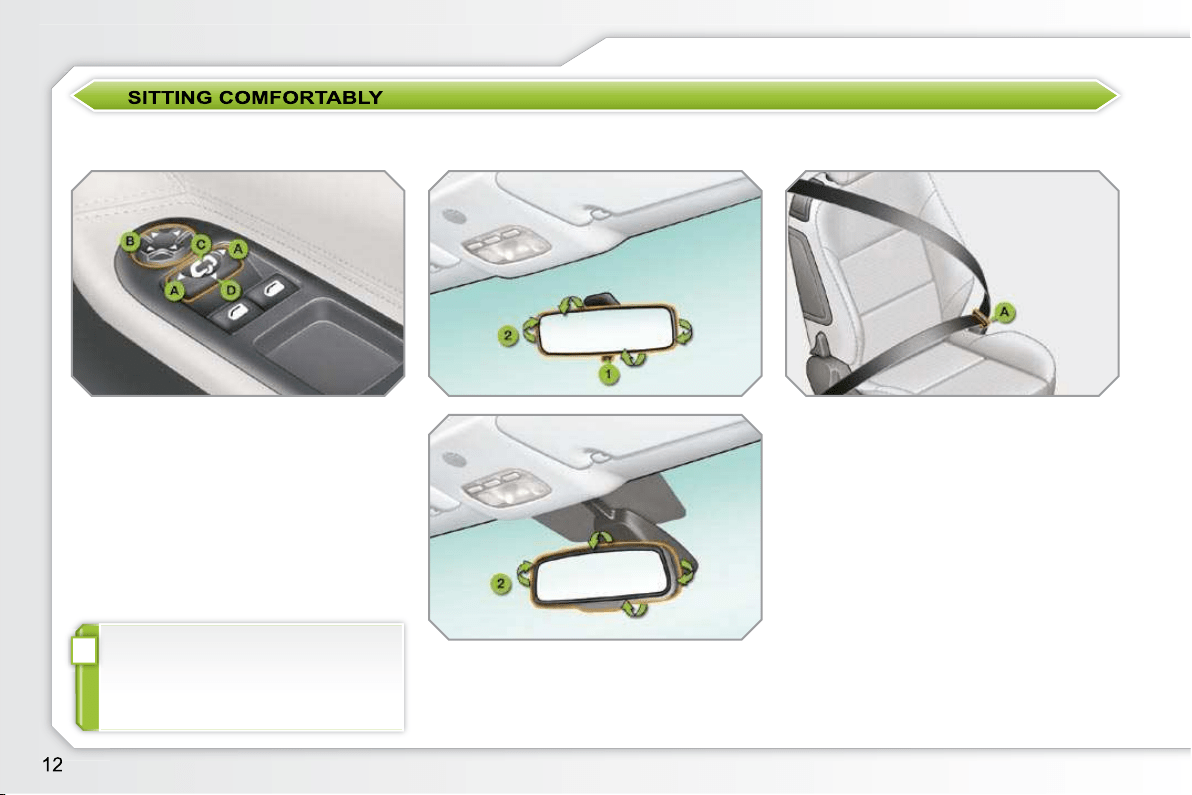
Door mirror adjustment
A. Selecting the mirror.
B. Adjusting the position of the mirror.
C. De-selecting the mirror.
53
Also...
D. Folding/Unfolding.
Rear view mirror adjustment
1. Selecting the "day" position of the
mirror.
2. Adjustment of the mirror.
54
Front seat belts
A. Installing the strap.
B. Fastening the buckle.
C. Checking the fastening by pulling
the strap.
95
i
FAMILIARISATION
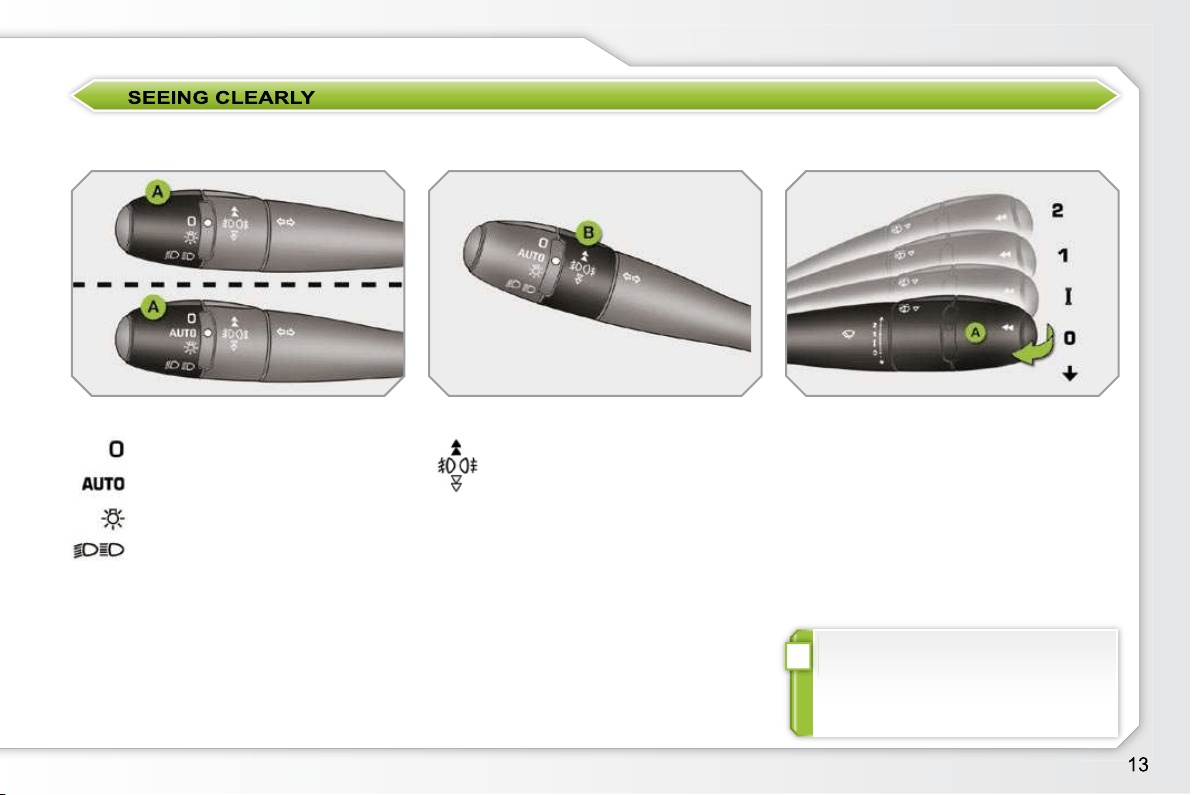
Lighting Wipers
Ring B
78
Front and rear foglamps.
Ring A
Lighting off.
Automatic illumination of head-
lamps.
Sidelamps.
Dipped/main beam headlamps.
77
Stalk A: windscreen wipers
2. Fast wipe.
1. Normal wipe.
I. Intermittent wipe.
0. Park.
Single wipe.
Screenwash: pull the stalk towards you.
81
The automatic wiper function is
not available on the 207CC at
present.
–
FAMILIARISATION
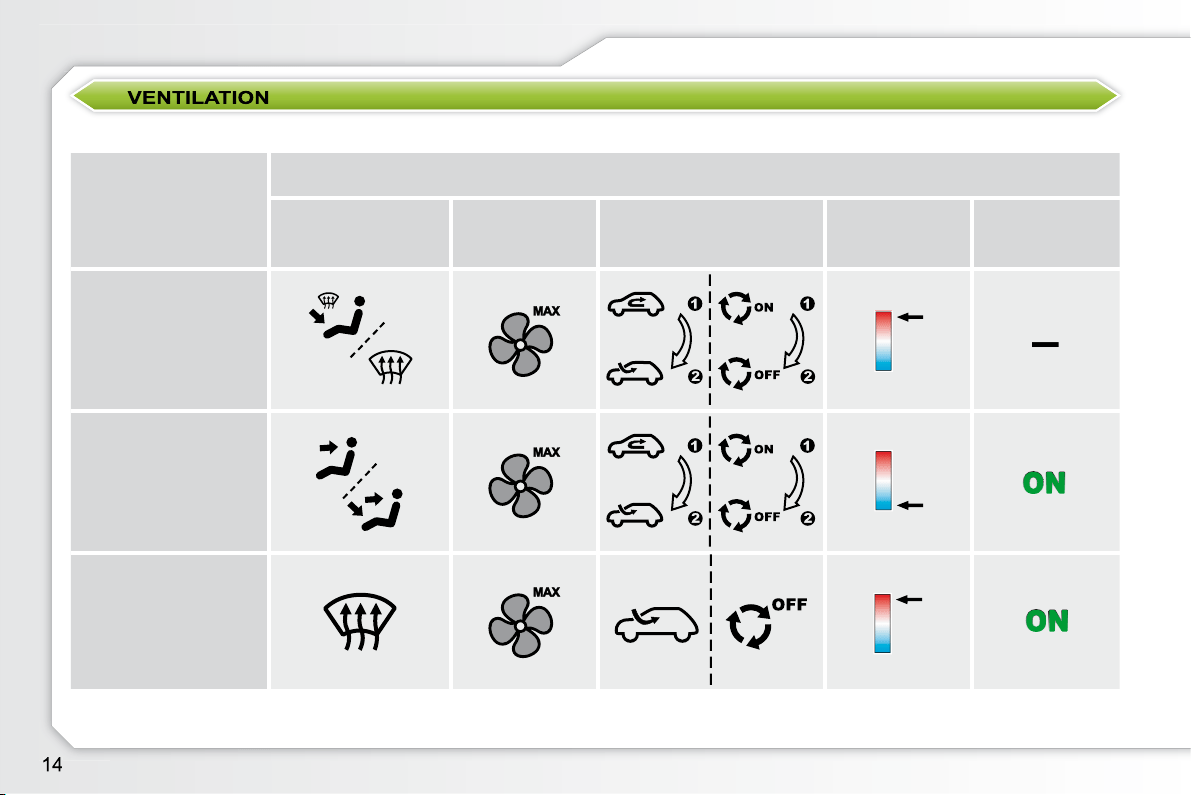
Digital air conditioning: use of the fully automatic mode by pressing the "AUTO" button is recommended.
Heating or Manual air conditioning
I require... Air distribution Air fl ow
Air recirculation/
Exterior air intake
Temperature Manual A/C
HEAT
COOL
DEMISTING
DEFROSTING
Advice on interior settings
FAMILIARISATION
Instrument panel Switch panel
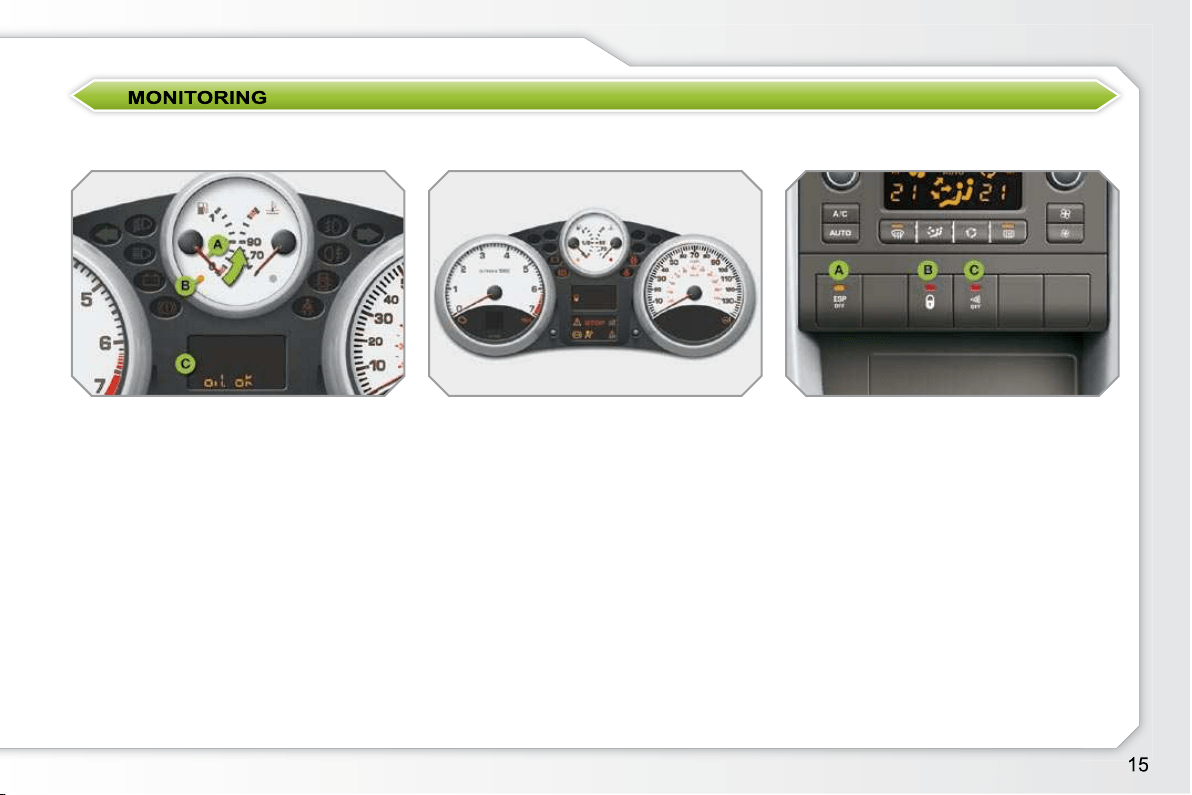
A. With the ignition on, the fuel gauge
needle should rise.
B. With the engine running, the associ-
ated low level warning lamp should
switch off.
C. With the ignition on, the oil level in-
dicator should display "OIL OK" for
a few seconds.
If the levels are not correct, top up the
level which is low.
18
Lighting of the indicator lamp indicates
the status of the corresponding function.
A. Deactivation of the ESP/ASR system.
94
B. Central locking.
72
C. Deactivation of the interior volumetric
protection alarm.
67
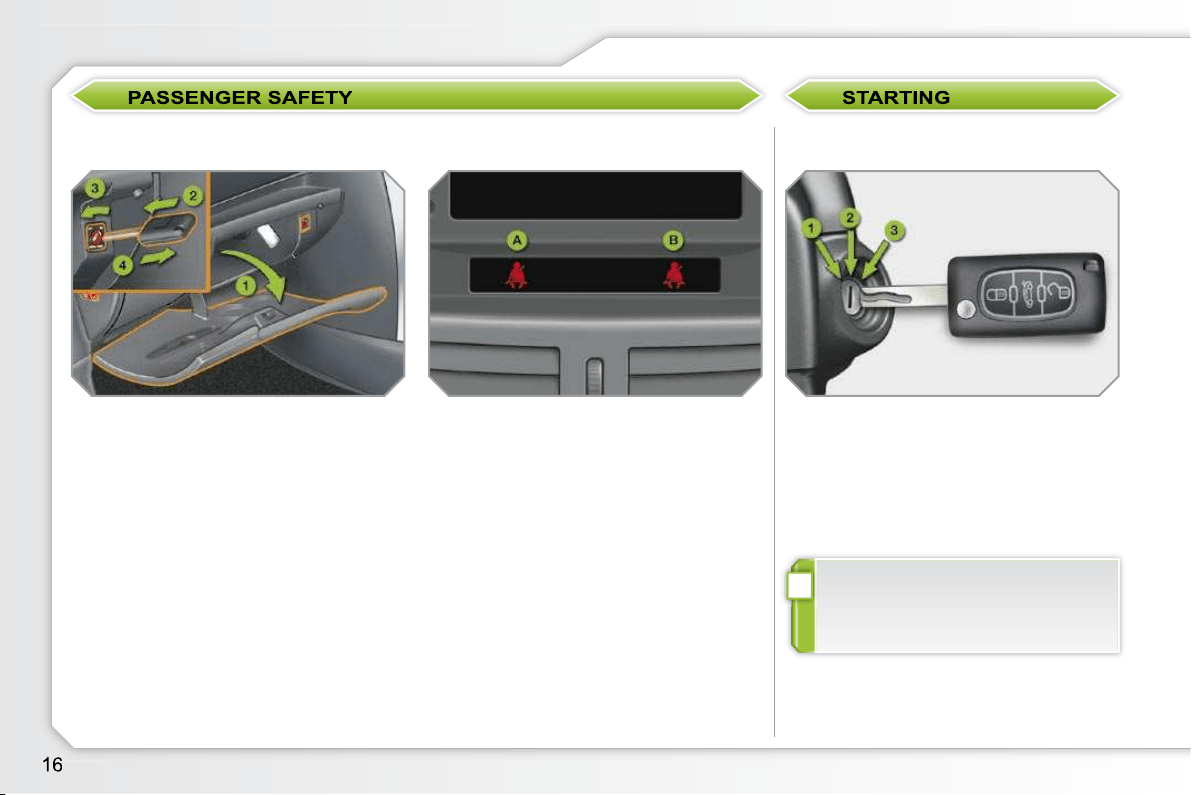
1. With the ignition on, the orange and
red warning lamps come on.
2. With the engine running, these
warning lamps should switch off.
If a warning lamp remains on, refer to
the page concerned.
19
Warning lamps
!
FAMILIARISATION
Front passenger's airbag Ignition switch
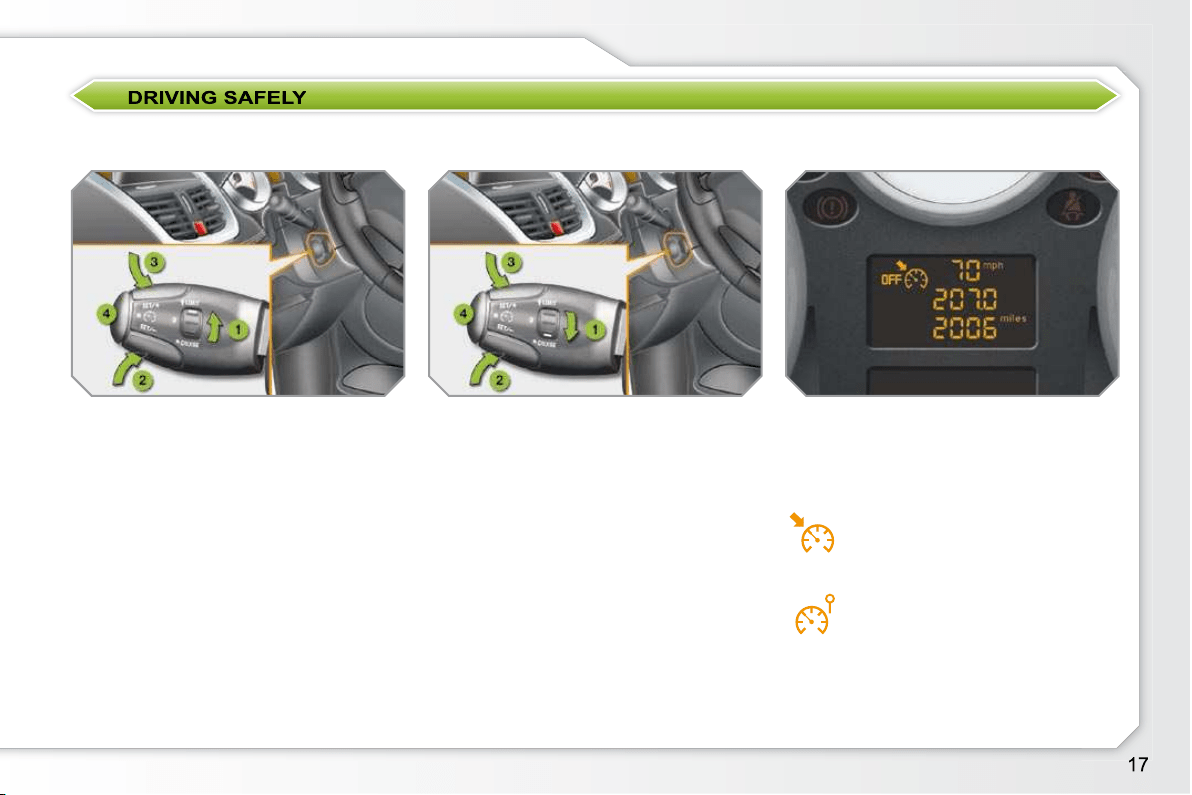
1. Open the glove box.
2. Insert the key.
3. Select position:
"ON" (activation), with front passenger
or "forwards facing" child seat,
"OFF" (deactivation), with "rear fac-
ing" child seat.
4. Remove the key keeping the switch
in the new position.
99
1. Stop position.
2. Ignition position.
3. Starting position.
65
A. Front left seat belt not fastened or
unfastened warning lamp lit in red.
B. Front right seat belt not fastened or
unfastened warning lamp lit in red.
95
Front seat belts
A heavy object (key fob...), attached
to the key and weighing down on
its shaft in the ignition switch, could
cause a malfunction.
FAMILIARISATION
Speed limiter "LIMIT" Instrument panel display
1. Selecting/Switching off speed limiter
mode.
2. Decrease the programmed value.
3. Increase the programmed value.
4. Speed limiter on/off.
The values must be set with the engine
running.
107
The cruise control or speed limiter mode
appears on the instrument panel when
it is selected.
1. Selecting/Switching off cruise control
mode.
2. Decrease the programmed value.
3. Increase the programmed value.
4. Cruise control off/resume.
In order to be programmed or activated,
the vehicle speed must be higher than
25 mph (40 km/h), with at least fourth
gear engaged on the manual gearbox
(second gear on the automatic gear-
box).
109
Cruise control "CRUISE"
Cruise control
Speed limiter
INSTRUMENTS and CONTROLS
18
PETROL - DIESEL, MANUAL OR AUTOMATIC GEARBOX,
INSTRUMENT PANELS
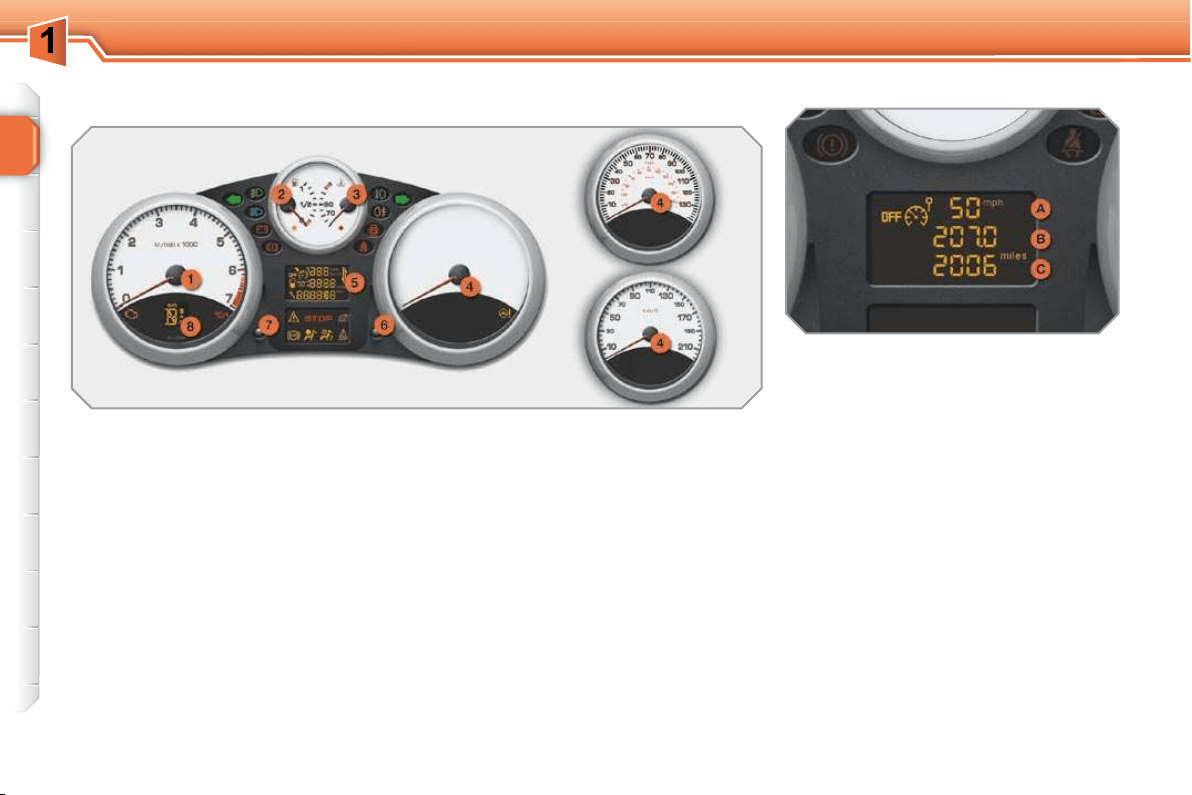
Panel which groups together the vehicle
operation dials and indicator lamps.
5. Screen.
6. Display zero reset button.
Resets the selected function to zero
(trip distance recorder or service in-
dicator).
7. Instrument panel lighting button.
Adjusts the brightness of the lighting
of the instruments and controls.
8. Automatic gearbox.
Indicates the programme selected
and the gear engaged.
Dials
1. Rev counter.
Indicates the speed of rotation of the
engine (x 1 000 rpm).
2. Fuel gauge.
Indicates the quantity of fuel remain-
ing in the tank.
3. Coolant temperature.
Indicates the temperature of the en-
gine coolant (°Celsius).
4. Speedometer.
Indicates the current speed of the
moving vehicle (mph or km/h).
A. Speed limiter
or
Cruise control.
(mph or km/h)
B. Trip distance recorder.
(miles or km/h)
C. Service indicator.
(miles or km/h) then,
Engine oil level indicator.
then
Distance recorder.
(km or miles)
These three functions are displayed
in succession when the ignition is
switched on.
For more information, refer to the section
which corresponds to the function and to
the display associated with it.
Screen
!
INSTRUMENTS and CONTROLS
19
Indicator and warning lamps
Visual indicators informing the driver that a system is in operation (operation or
deactivation indicator lamps) or of the occurrence of a fault (warning lamp).
When the ignition is switched on
Certain warning lamps come on for a few seconds when the vehicle's ignition is
switched on.
When the engine is started, these same warning lamps should switch off.
If they remain on, before moving off, refer to the information on the warning lamp
concerned.
Associated warnings
The switching on of certain warning lamps may be accompanied by an audible
signal and a message on the multifunction screen.
The warning lamps may come on
continuously (fi xed) or fl ash.
Certain warning lamps may come
on in two different modes. Only by
relating the type of lighting to the
operating status of the vehicle can
it be ascertained whether the situa-
tion is normal or whether a fault has
occurred.
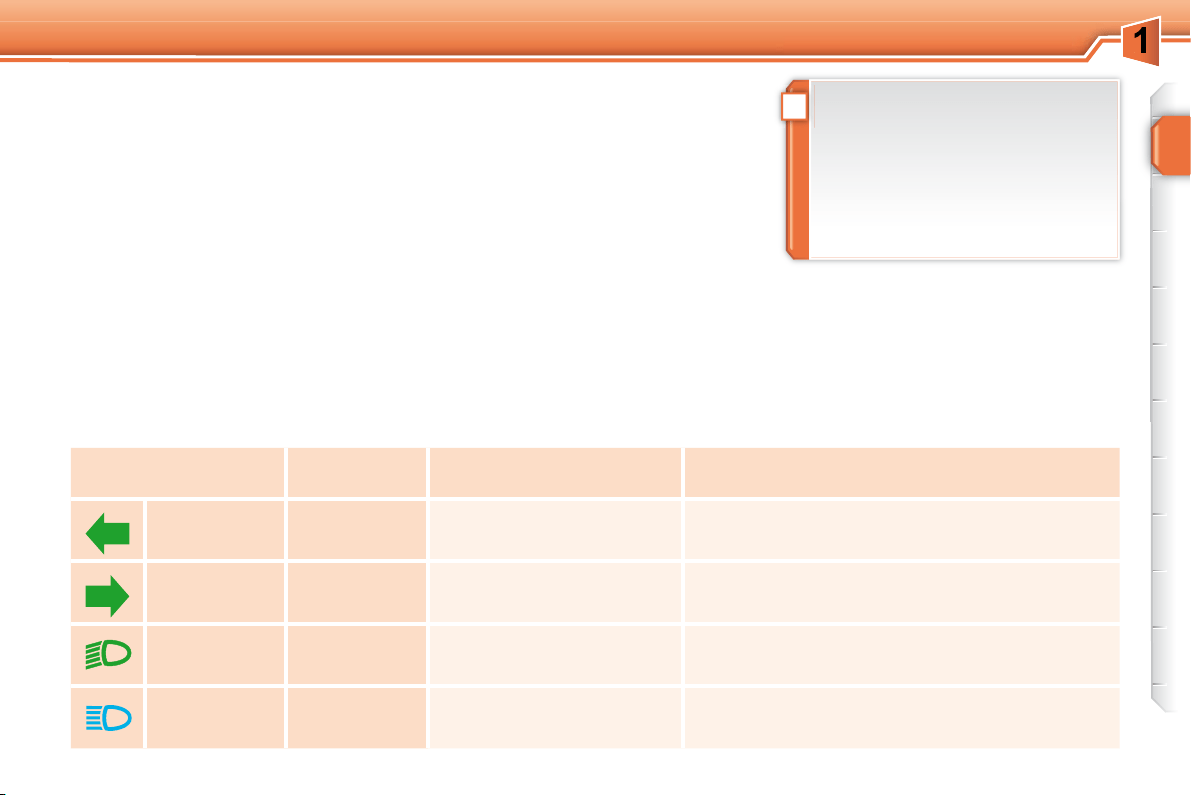
Operation indicator lamps
If one of the following indicator lamps comes on, this confi rms that the corresponding
system has come into operation.
Warning lamp is on Cause Action/Observations
Left-hand
direction
indicato r
fl ashing with
buzzer.
The lighting stalk is pushed
down.
Right-hand
direction
indicator
fl ashing with
buzzer.
The lighting stalk is pushed
up.
Dipped beam
headlamps
fi xed.
The lighting stalk is in the
"Dipped beam headlamps"
position.
Turn the control to the desired position.
Main beam
headlamps
fi xed.
The lighting stalk is pulled
towards you.
Pull the stalk to return to dipped beam
headlamps.
INSTRUMENTS and CONTROLS
20
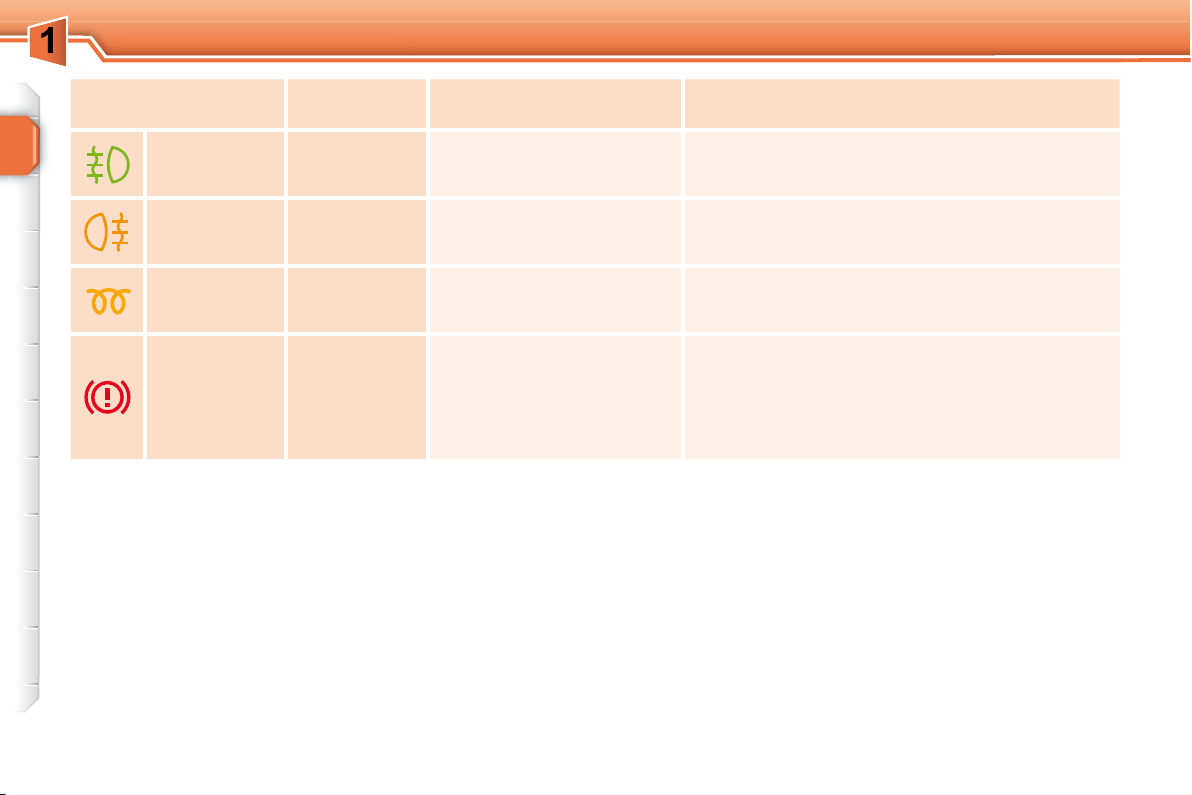
Warning lamp is on Cause Action/Observations
Front
foglamps
fi xed.
The front foglamps are
switched on.
Turn the ring on the stalk rearwards twice to
switch off the front foglamps.
Rear
foglamps
fi xed.
The rear foglamps are
switched on.
Turn the ring on the stalk rearwards to switch off
the rear foglamps.
Diesel engine
pre-heating
fi xed.
The ignition switch is at the
2nd position (ignition on).
Wait until the warning lamp has switched off before starting.
The duration for which the warning lamp is on is
determined by the climatic conditions.
Parking brake fi xed.
The parking brake is
applied or not properly
released.
Release the parking brake to switch off the
warning lamp, keeping your foot on the brake
pedal.
Observe the safety recommendations.
For further information on the parking brake, refer
to the "Driving" section.
INSTRUMENTS and CONTROLS
21
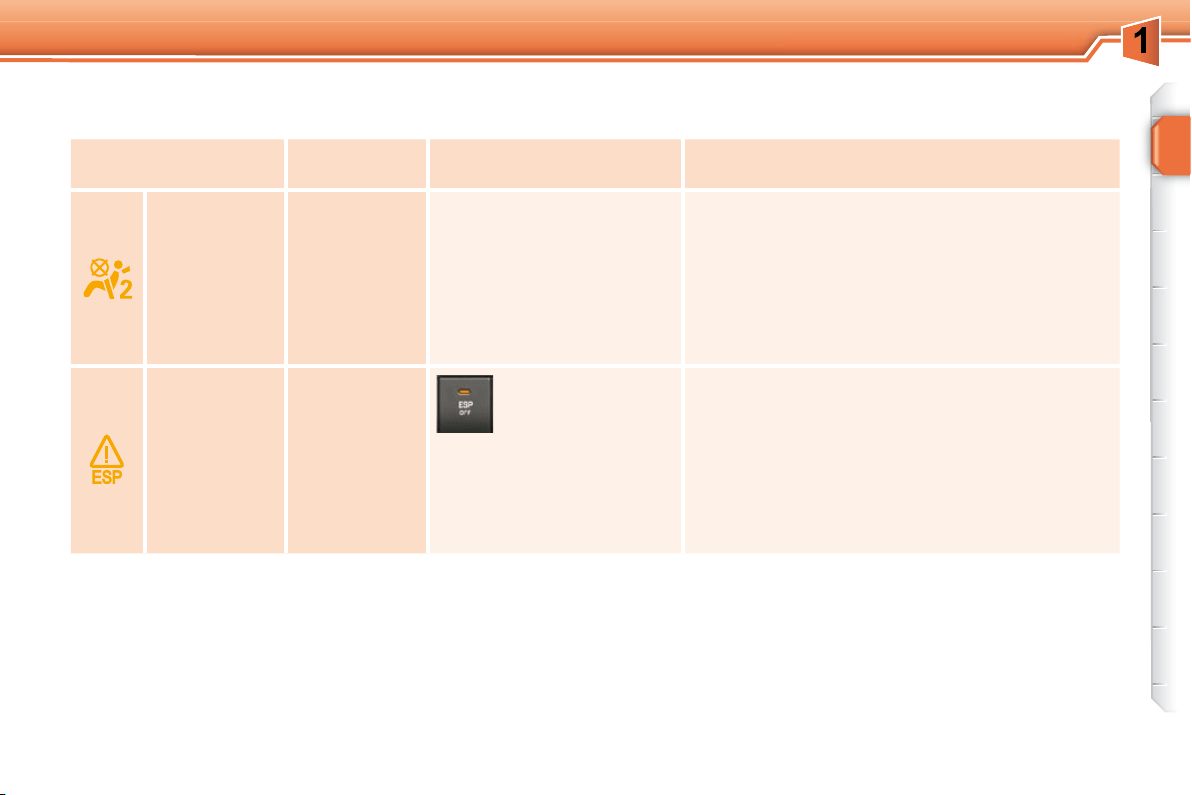
Deactivation warning lamps
If one of the following warning lamps comes on, this confi rms that the corresponding system has been switched off intentionally.
Warning lamp is on Cause Action/Observations
Passenger's
airbag
system
fi xed.
The control, located in the
glove box, is set to the OFF
position.
The passenger's front
airbag is deactivated.
In this case you can install
a "rear facing" child seat.
Set the control to the ON position to activate the
passenger's front airbag. In this case, do not fi t a
child seat in the rear-facing position.
The passenger's airbag system is put into service
automatically when the vehicle is started ( ON
position).
ESP/ASR fi xed.
The button, located
in the centre of
the dashboard,
is pressed. Its
indicator lamp is on.
The ESP/ASR is
deactivated.
ESP: electronic stability
programme.
ASR: anti-skid regulation.
Press the button to activate the ESP/ASR. Its
indicator lamp switches off.
From approximately 30 mph (50 km/h), the
system is reactivated automatically.
The ESP/ASR system is activated automatically
when the vehicle is started.
!
INSTRUMENTS and CONTROLS
22
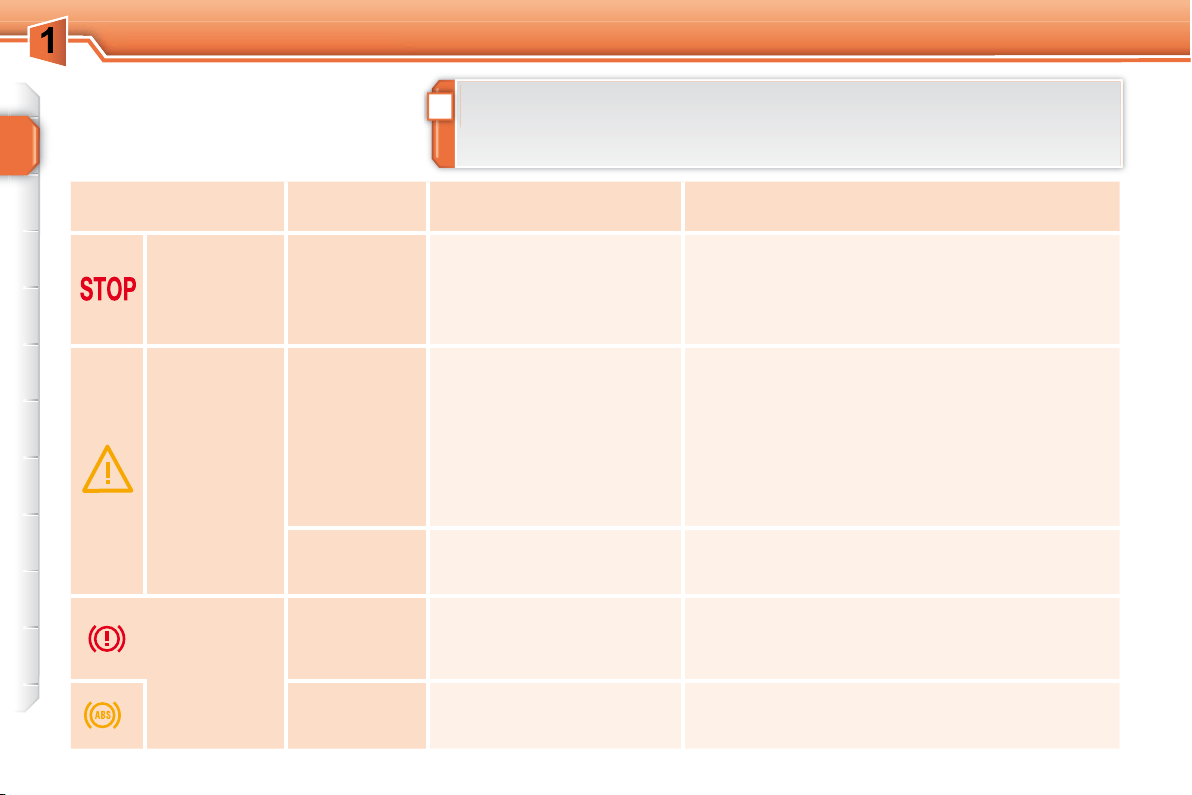
Warning lamps
When the engine is running or the vehicle is
being driven, the switching on of one of the fol-
lowing warning lamps indicates a fault which
requires action on the part of the driver.
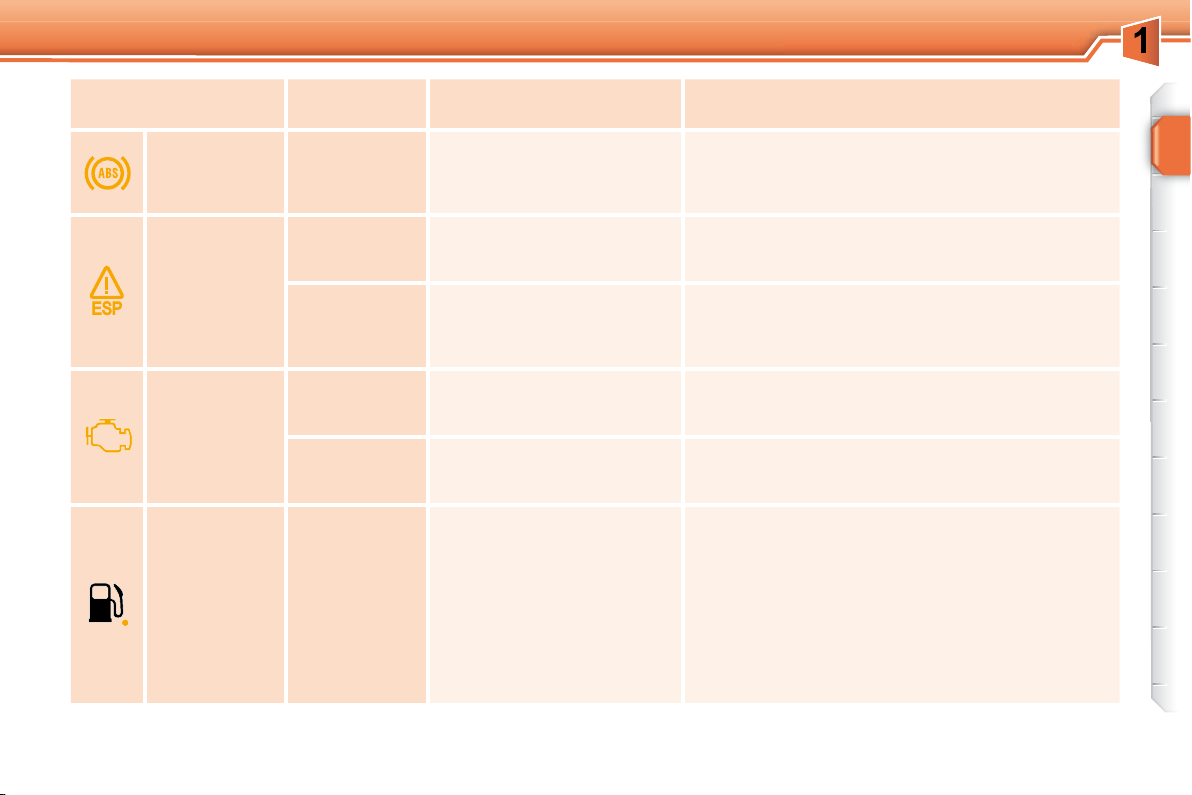
Any fault resulting in the switching on of a warning lamp must be investigated
further by reading the associated message on the multifunction screen.
If you encounter any problems, do not hesitate to contact a PEUGEOT dealer.
Warning lamp is on Cause Action/Observations
STOP
fi xed, associated
with another
warning lamp and
accompanied by
an audible signal.
It is associated with the
braking system or the
engine coolant temperature.
Stop as soon as it is safe to do so.
Park, switch off the ignition and call a PEUGEOT
dealer.
Service
temporarily.
A minor fault has occurred
for which there is no
specifi c warning lamp.
Identify the fault by reading the message shown
on the screen, such as, for example:
- the engine oil level,
- the screenwash level,
- the remote control battery,
- saturation of the particle emission fi lter
(Diesel).
For any other faults, contact a PEUGEOT dealer.
fi xed.
A major fault has occurred
for which there is no specifi c
warning lamp.
Identify the fault by reading the message shown
on the screen and contact a PEUGEOT dealer.
Braking
fi xed.
The braking system
fl uid level has dropped
signifi cantly.
Top up with brake fl uid recommended by
PEUGEOT.
If the problem persists, have the system checked
by a PEUGEOT dealer.
+
fi xed, associated
with the ABS
warning lamp.
The electronic brake force
distribution (EBFD) system
has a fault.
Have it checked by a PEUGEOT dealer.
INSTRUMENTS and CONTROLS
23
Warning lamp is on Cause Action/Observations
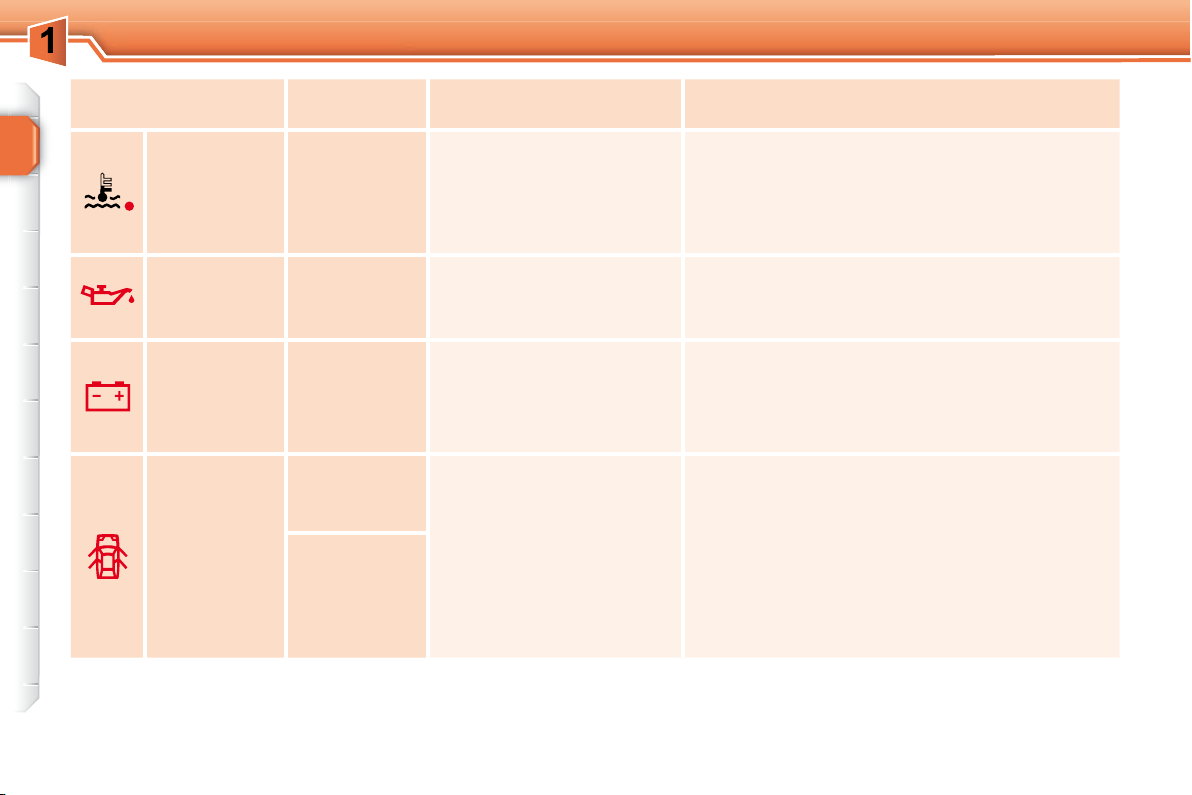
Anti-lock
Braking
System
(ABS)
fi xed.
The anti-lock braking
system has a fault.
The vehicle retains conventional braking.
Drive carefully at reduced speed and contact a
PEUGEOT dealer without delay.
Dynamic
stability
control
(ESP/ASR)
fl ashing.
The ESP/ASR regulation is
active.
The system optimises traction and improves the
directional stability of the vehicle.
fi xed.
Unless it has been
deactivated with the indicator
lamp on the button on, the
ESP/ASR system is faulty.
Have it checked by a PEUGEOT dealer.
Engine
autodiagnosis
system
fi xed.
The emission control
system has a fault.
This lamp should switch off when the engine is started.
If it does not switch off, contact a PEUGEOT dealer
urgently.
fl ashing.
The engine management
system has a fault.
Risk of destruction of the catalytic convertor.
Have it checked by a PEUGEOT dealer.
Low fuel level fi xed.
When it fi rst comes on there
remains approximately
5 litres of fuel in the tank.
You must refuel as soon as possible to avoid
running out of fuel.
This warning lamp will come on every time the
ignition is switched on, until a suffi cient addition
of fuel is made.
Fuel tank capacity: approximately 50 litres
(petrol) or 48 litres (Diesel).
Never continue to drive until you run out of fuel
as this could damage the emission control and
injection systems.
INSTRUMENTS and CONTROLS
24
Warning lamp is on Cause Action/Observations
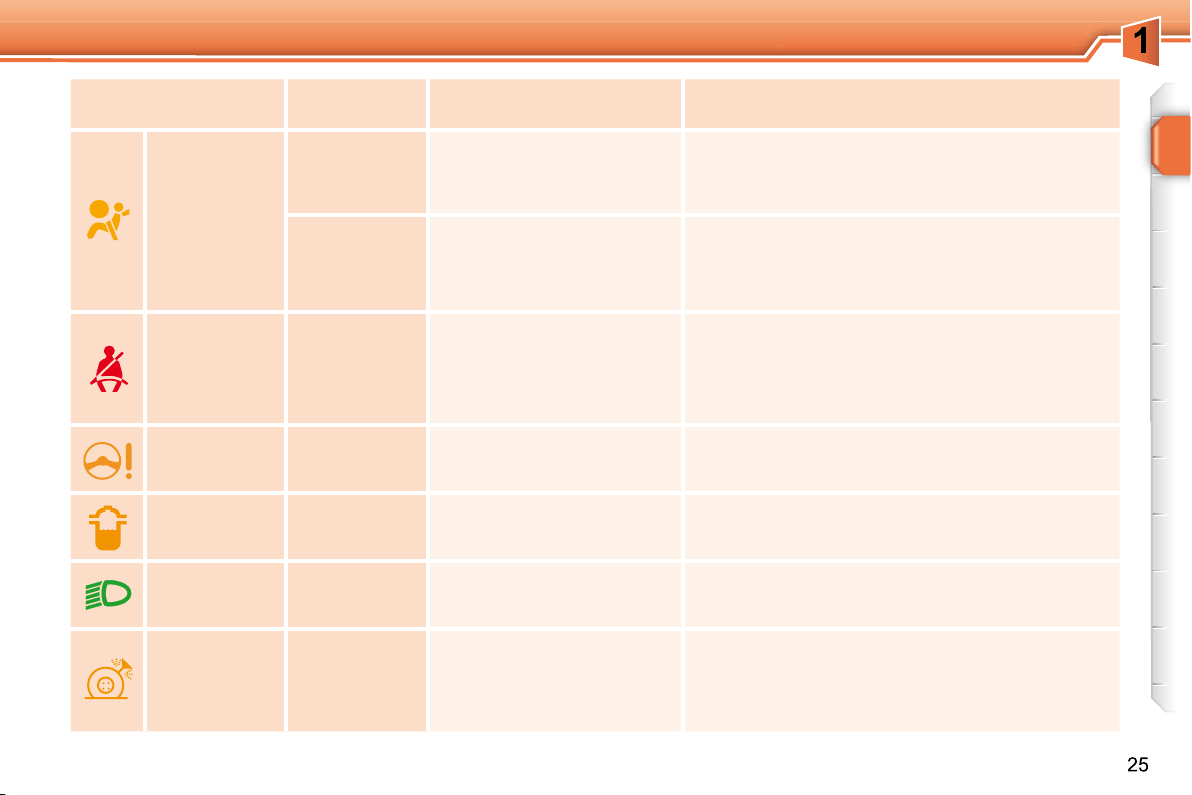
Maximum
coolant
temperature
fi xed red.
The temperature of the
cooling system is too high.
Stop as soon as it is safe to do so.
Wait until the engine has cooled down before
topping up the level, if necessary.
If the problem persists, contact a PEUGEOT
dealer.
Engine oil
pressure
fi xed.
There is a fault with the
engine lubrication system.
Stop as soon it is safe to do so.
Park, switch off the ignition and contact a
PEUGEOT dealer.
Battery
charge
fi xed.
The battery charging circuit
has a fault (dirty or loose
terminals, slack or cut
alternator belt, ...).
This lamp should switch off when the engine is
started.
If it does not switch off, contact a PEUGEOT
dealer.
Door(s) open
fi xed if the
speed is
below 6 mph
(10 km/h).
A door, the boot or the rear
screen is still open.
Close the door or boot.
fi xed and
accompanied
by an audible
signal if the
speed is
above 6 mph
(10 km/h).
INSTRUMENTS and CONTROLS
Warning lamp is on Cause Action/Observations
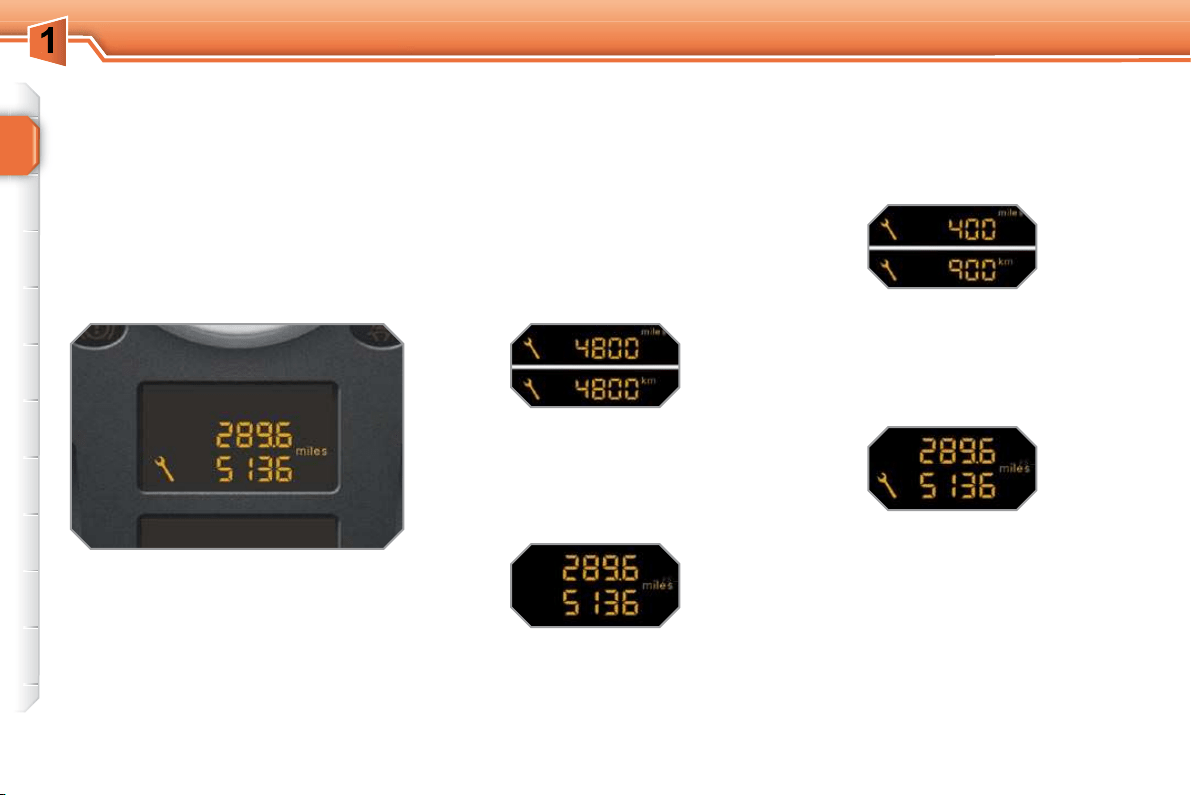
Airbags
temporarily.
This lamp comes on for
a few seconds when you
turn on the ignition, then
switches off.
This lamp should switch off when the engine is
started.
If it does not switch off, contact a PEUGEOT
dealer.
fi xed.
One of the airbag or seat
belt pretensioner systems
has a fault.
Have it checked by a PEUGEOT dealer.
Seat belt not
fastened/
unfastened
fi xed then
fl ashing
accompanied
by an
increasing
audible signal.
The driver and/or the front
passenger has not fastened
or has unfastened their seat
belt.
Pull the strap then insert the tongue in the
buckle.
Power
steering
fi xed.
The power steering has a
fault.
Drive carefully at reduced speed.
Have it checked by a PEUGEOT dealer.
Water in
Diesel
fi xed.
The diesel fi lter contains
water.
Risk of damage to the injection system on Diesel
engines.
Contact a PEUGEOT dealer without delay.
Directional
headlamps
fl ashing.
The directional headlamps
system is faulty.
Have it checked by a PEUGEOT dealer.
Punctured
wheel
fi xed.
One or more wheels are
punctured or seriously
defl ated.
Stop immediately avoiding any sharp action on
the steering wheel or the brakes.
Repair or change the damaged wheel and have
the pressure of the tyres checked as soon as
possible.
INSTRUMENTS and CONTROLS
26
Service indicator
System which informs the driver when
the next service is due, in accordance
with the manufacturer's servicing
schedule.
The point at which the service is due is
calculated from the last indicator zero re-
set. It is determined by two parameters:
- the distance travelled,
-
the time elapsed since the last service.
More than 620 miles (1 000 km) remain
before the next service is due
For 5 seconds after the ignition is
switched on, the spanner symbolising
the service operations comes on. The
distance recorder display line indicates
the distance remaining before the next
service is due.
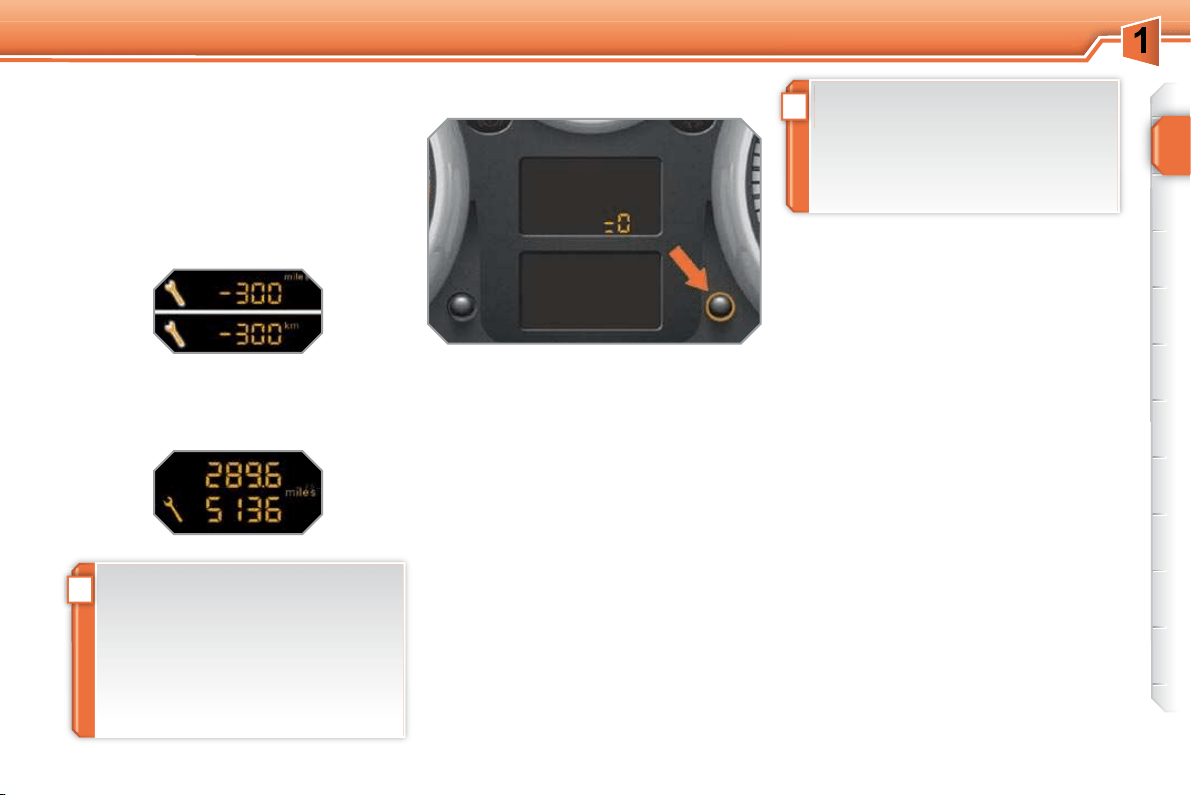
Example: 4 800 miles/km remain be-
fore the next service is due.
For 5 seconds after the ignition is
switched on, the display indicates:
5 seconds after the ignition is switched
on, the spanner is switched off ; the
distance recorder resumes its normal
operation. The display then indicates
the total and trip distances.
Less than 620 miles (1 000 km)
remain before the next service is due
Examples: 400 miles/900 km remain
before the next service is due.
For 5 seconds after the ignition is
switched on, the display indicates:
5 seconds after the ignition is switched
on, the distance recorder resumes its
normal operation. The spanner re-
mains on to indicate that a service
must be carried out soon.
i
i
INSTRUMENTS and CONTROLS
27
Following this operation, if you wish
to disconnect the battery, lock the
vehicle and wait at least fi ve minutes
for the zero reset to be taken into
account.
Service indicator zero reset
After each service, the service indicator
must be reset to zero.
The procedure for resetting to zero is as
follows:
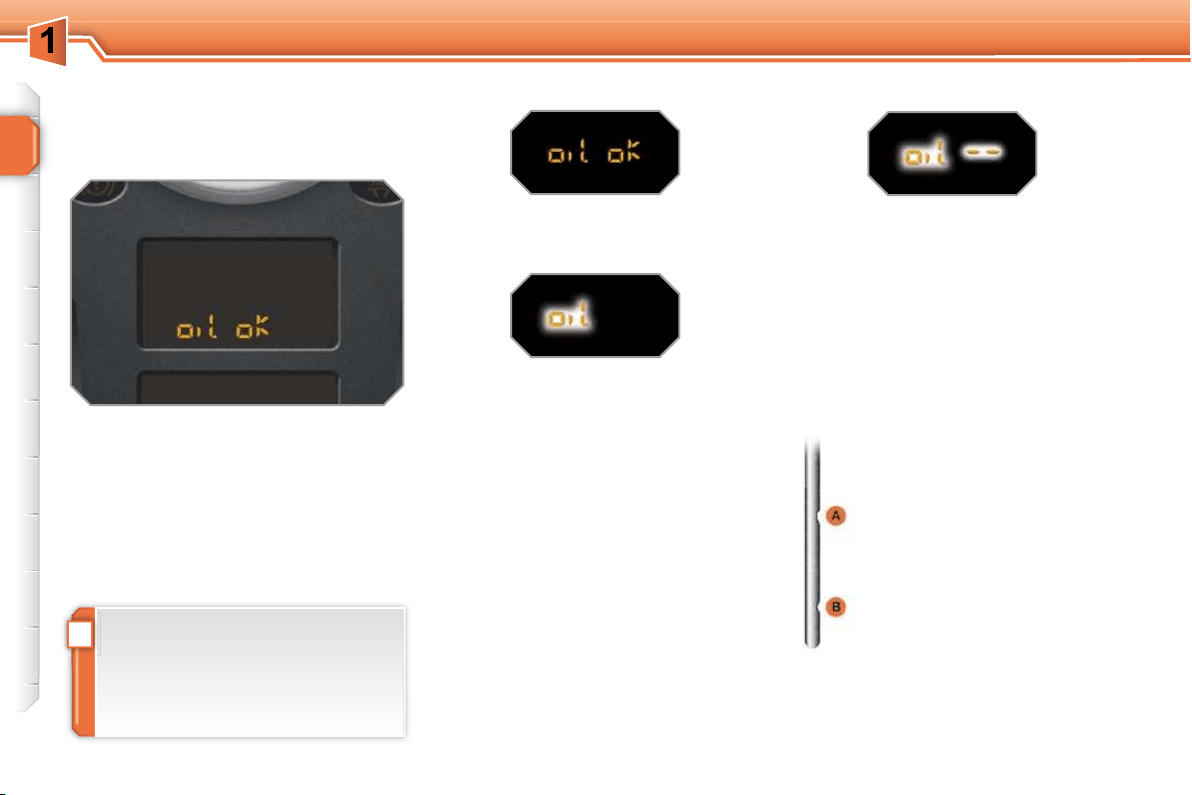
switch off the ignition,
press and hold the trip distance
recorder zero reset button,
switch on the ignition; the distance
recorder display begins a countdown,
when the display indicates "=0" , re-
lease the button; the spanner disap-
pears.
The distance remaining may be
weighted by the time factor, depend-
ing on the driver's driving habits.
Therefore, the spanner may also
come on if you have exceeded the
two year service interval.
Service overdue
For 5 seconds after the ignition is
switched on, the spanner fl ashes to
indicate that the service must be carried
out as soon as possible.
Example: the service is overdue by
300 miles/km.
For 5 seconds after the ignition is
switched on, the display indicates:
5 seconds after the ignition is switched
on, the distance recorder resumes its nor-
mal operation. The spanner remains lit .
i
INSTRUMENTS and CONTROLS
28
The level read will only be correct if
the vehicle is on level ground and
the engine has been off for more
than 15 minutes.
Engine oil level indicator
System which informs the driver whether
the engine oil level is correct or not.
This information is indicated for a few
seconds when the ignition is switched
on, after the service information.
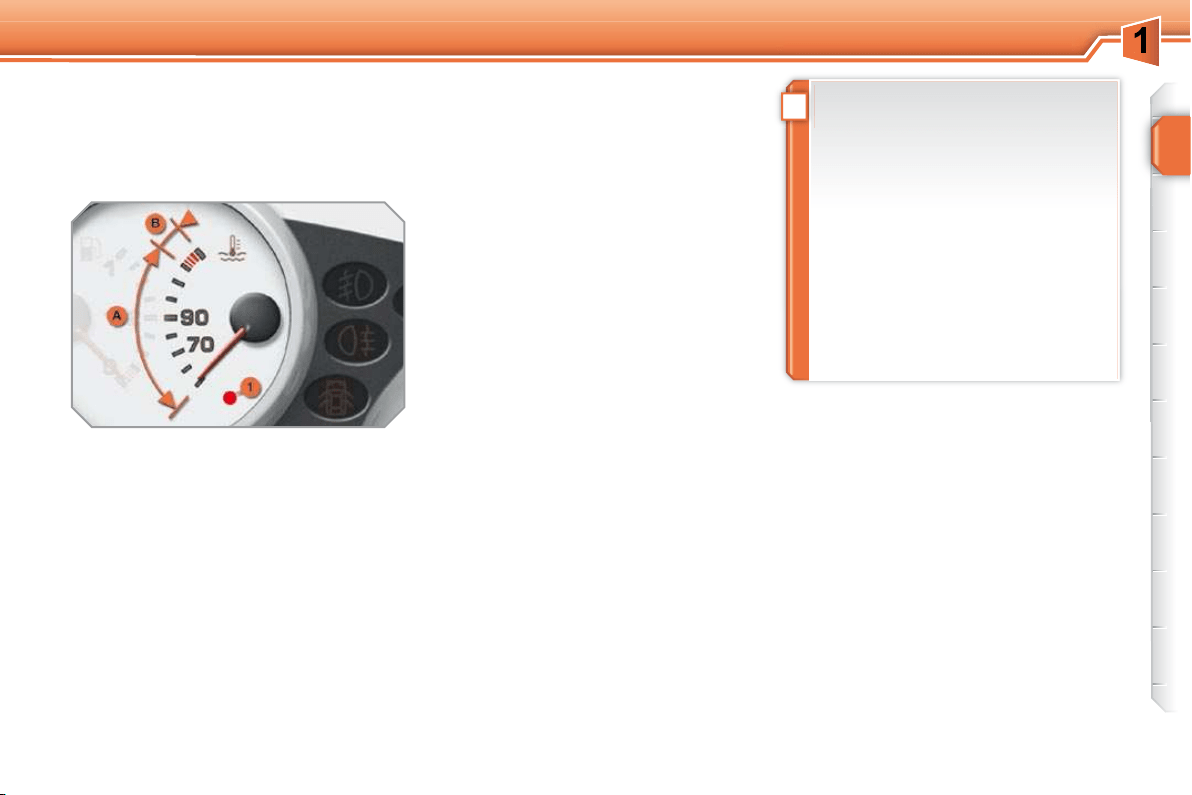
Oil level correct
Lack of oil
Oil level indicator fault
Dipstick
This is indicated by the fl ashing of
"OIL" , linked with the service warning
lamp, accompanied by an audible sig-
nal and a message on the multifunction
screen.
If the lack of oil is confi rmed by a check
using the dipstick, it is essential that the
level is topped up to prevent damage to
the engine.
This is indicated by the fl ashing of
"OIL --" . Consult a PEUGEOT dealer.
Refer to the "Checks" section to locate
the dipstick and the oil fi ller cap on your
engine.
There are 2 marks on the
dipstick:
- A = max; never exceed
this level (risk of dam-
age to the engine),
- B = min; top up the level
via the oil fi ller cap, us-
ing the grade of oil suit-
ed to your engine.
i
INSTRUMENTS and CONTROLS
29
Coolant temperature indicator
System which informs the driver of the
changes in the temperature of the en-
gine coolant while driving.
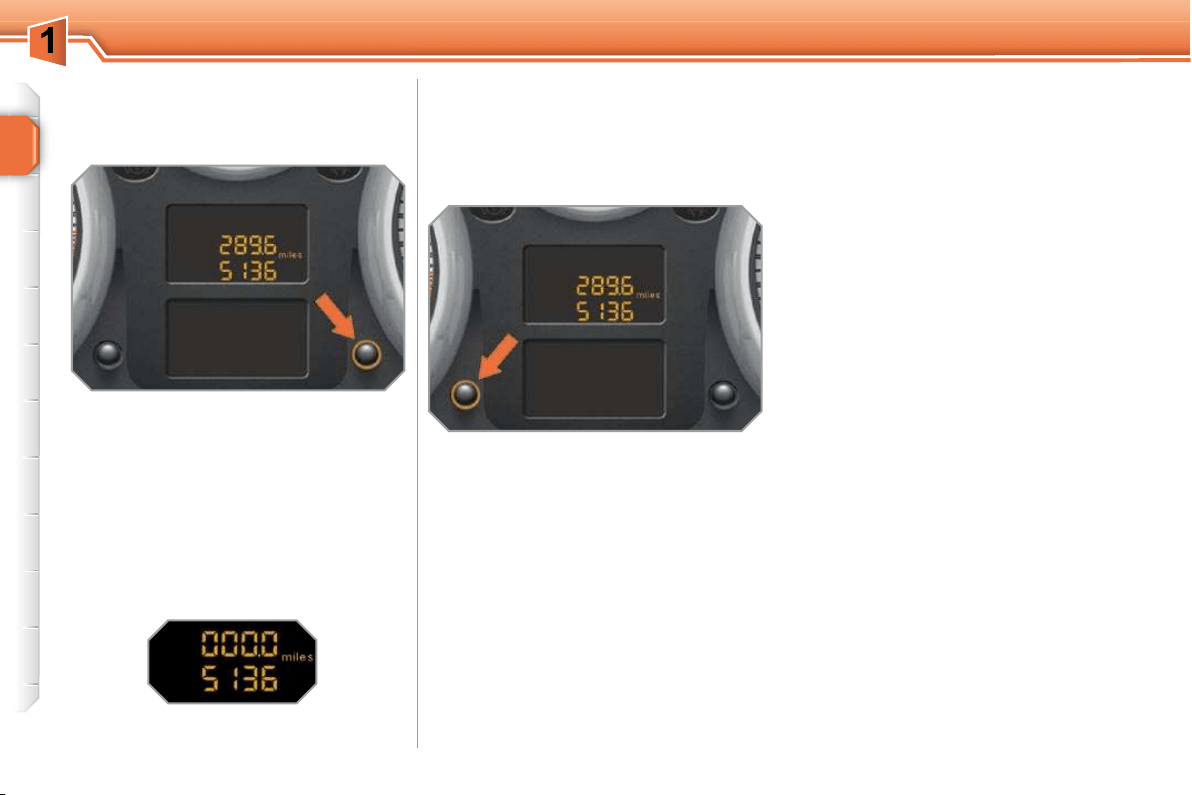
With the engine running, when the nee-
dle is:
- in zone A , the temperature is correct,
- in zone B , the temperature is too
high; the max temperature warning
lamp 1 and the central STOP warn-
ing lamp come on, accompanied by
an audible signal and a message on
the multifunction screen.
You MUST stop as soon as it is safe
to do so.
Consult a PEUGEOT dealer.
After driving for a few minutes, the tem-
perature and pressure in the cooling
system increase.
To top up the level:
wait for the engine to cool,
unscrew the cap by two turns to allow
the pressure to drop,
when the pressure has dropped, re-
move the cap,
top up the level to the "MAX" mark
(circular line).
On petrol engines, the cooling of the
engine is managed electronically to
reduce fuel consumption. Conse-
quently, the coolant temperature
levels are no longer simply linked
with the external ambient conditions
and the use of the vehicle.
For example, in town, it is normal
for the coolant temperature to be
slightly higher in cold weather than
in hot weather.
INSTRUMENTS and CONTROLS
30
Total distance recorder
System which measures the total distance
travelled by the vehicle during its life.
Lighting rheostat
Permits manual adjustment of the bright-
ness of the instruments and controls in
relation to the exterior brightness. Only
operates when the vehicle lighting is on,
with the exception of the daytime run-
ning lamps.
The total and trip distances are dis-
played for thirty seconds when the ig-
nition is switched off, when the driver's
door is opened and when the vehicle is
locked or unlocked.
Trip distance recorder
System which measures a distance
travelled during a day or other period
since it was reset to zero by the driver.
With the ignition on, press the button
until zeros appear.
Activation
Press the button to change the
brightness of the instruments and
controls.
When the lighting reaches the mini-
mum setting, release the button,
then press again to increase it.
or
When the lighting reaches the maxi-
mum setting, release the button,
then press again to reduce it.
When the lighting reaches the level
of brightness required, release the
button.
Deactivation
When the vehicle lighting is off, or in
day mode on vehicles fi tted with day-
time running lamps, pressing the button
does not have any effect.
INSTRUMENTS and CONTROLS
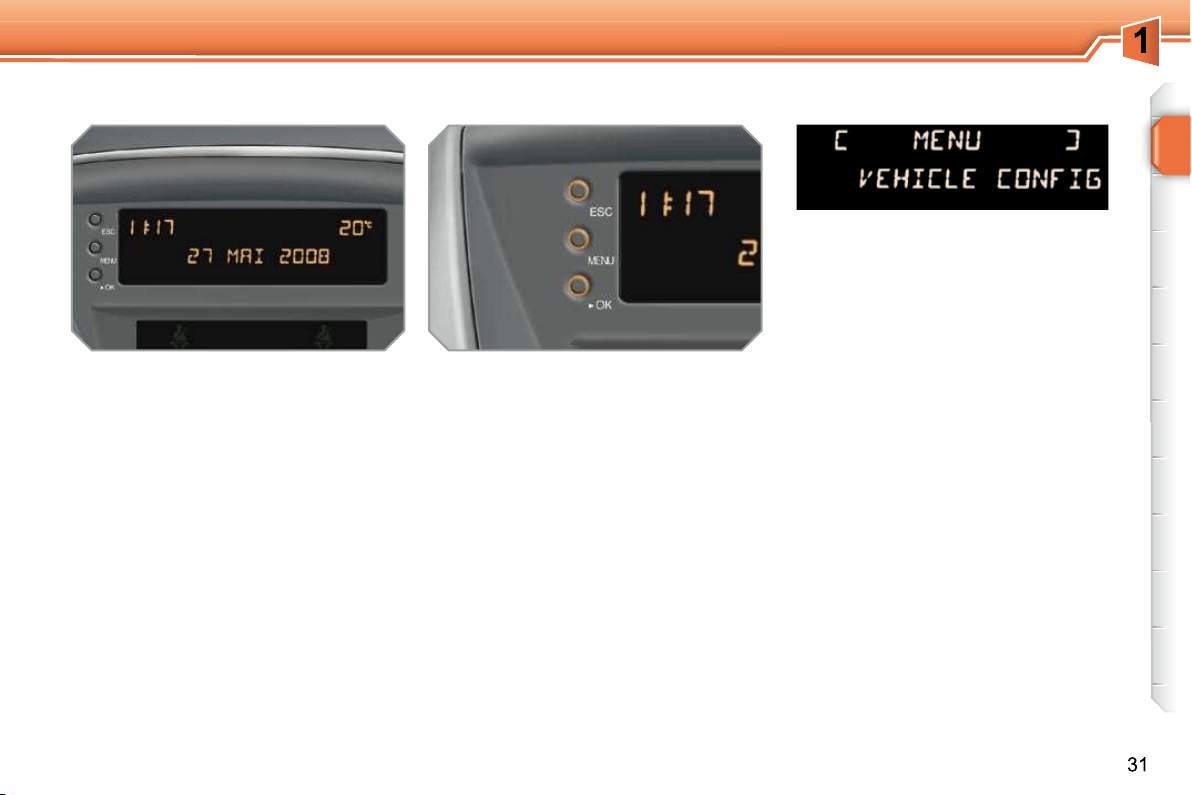
MONOCHROME SCREEN A (WITHOUT
PEUGEOT CONNECT SOUND)
Controls Main menu
There are three display control buttons:
- "ESC" to abandon the operation in
progress,
- "MENU" to scroll through the menus
or sub-menus,
- "OK" to select the menu or sub-
menu required.
Press the "MENU" button to scroll
through the various menus of the
main menu :
- vehicle confi guration,
- options,
- display settings,
- language,
- units.
Press the "OK" button to select the
menu required.
* With air conditioning only.
Displays on the screen
This displays the following information:
- time,
- date,
- ambient temperature * (this fl ashes if
there is a risk of ice),
-
status of the openings (doors, boot...),
- trip computer (refer to the end of the
section).
Warning messages (e.g.: "Emission
control system faulty") or information
messages (e.g.: "Boot open") may ap-
pear temporarily. These can be cleared
by pressing the "ESC" button.
!
INSTRUMENTS and CONTROLS
32
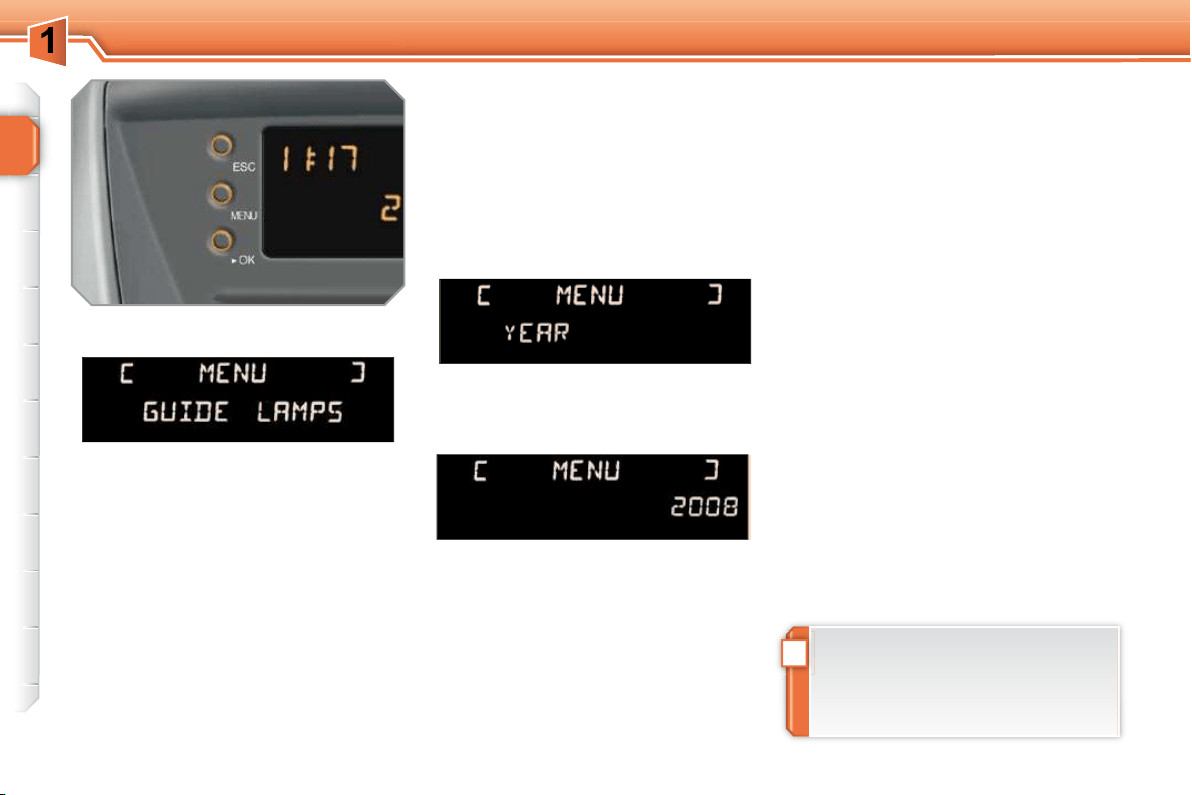
Vehicle confi guration
Options
Once the "Options" menu has been select-
ed, you can start diagnostics of the status of
the equipment (active, not active, faulty).
Language
Once the "Language" menu has been
selected, you can change the language
used by the display (Français, Italiano,
Nederlands, Portugues, Portugues-Brasil,
Deutsch, English, Espanol).
Display settings
Once the "Display settings" menu has
been selected, you can gain access to
the following settings:
- year,
- month,
- day,
- hour,
- minutes,
- 12 or 24 hour mode.
Units
Once the "Units" menu has been se-
lected, you can change the units of the
following parameters:
- temperature (°C or °F),
- fuel consumption (l/100 km, mpg or
km/l).
Once you have selected a setting,
press the "OK" button to change its
value.
Wait for approximately ten seconds
without any action to allow the changed
data to be recorded or press the "ESC"
button to cancel.
The screen then returns to the normal
display.
Once the "Vehicle confi guration" menu
has been selected, you can activate or
deactivate the following equipment:
- directional headlamps (refer to the
"Visibility" section),
- "guide-me-home" lighting (refer to
the "Visibility" section),
For safety reasons, confi guration
of the multifunction screen by the
driver must only be done when sta-
tionary.
INSTRUMENTS and CONTROLS
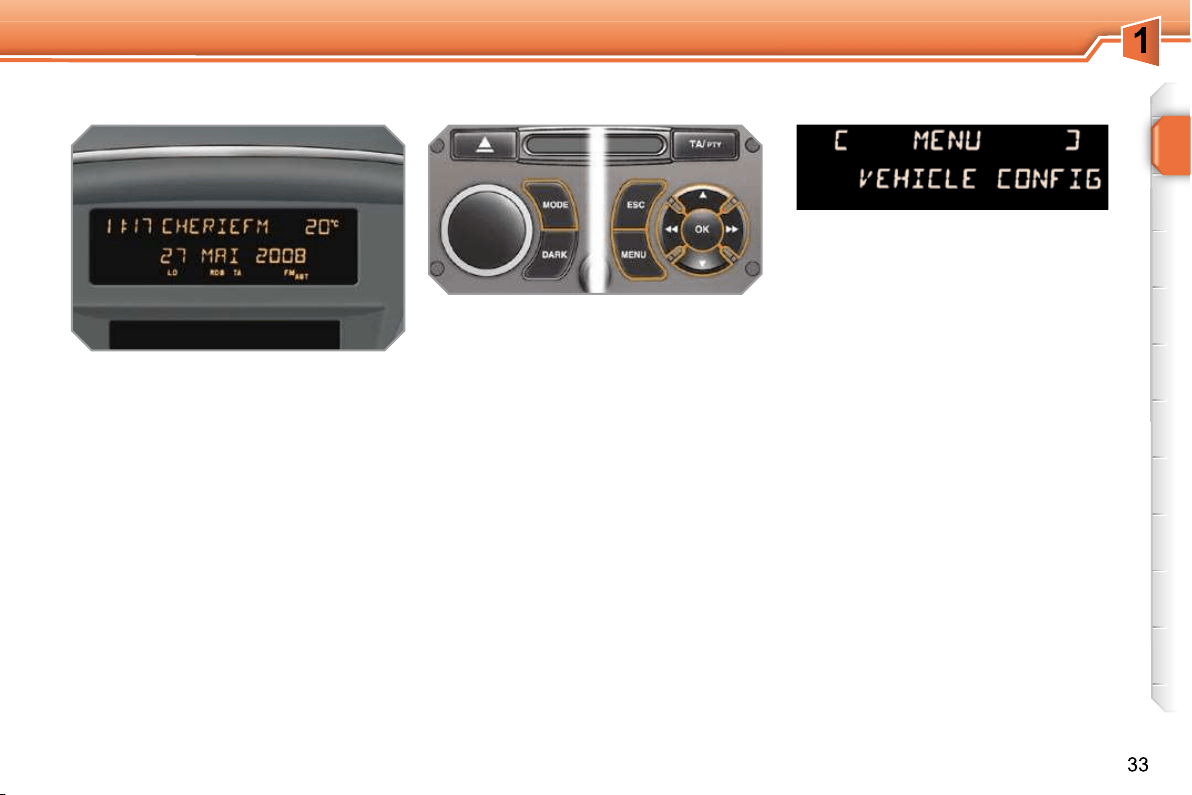
MONOCHROME SCREEN A
Controls
Displays on the screen
This displays the following information:
- time,
- date,
- ambient temperature * (this fl ashes if
there is a risk of ice),
- status of the openings (doors,
boot...),
- audio sources (radio, CD...),
- trip computer (refer to the end of the
section).
Warning messages (e.g.: "Emission
control system faulty") or information
messages (e.g.: "Boot open") may ap-
pear temporarily. These can be cleared
by pressing the "ESC" button.
Main menu
Press the "MENU" button to gain
access to the main menu , then
press the " " or " " buttons to
scroll through the various menus:
- radio-CD,
- vehicle confi guration,
- options,
- display settings,
- language,
- units.
Press the "OK" button to select the
menu required.
From your Peugeot Connect Sound
control panel, you can:
press the "MENU" button to gain
access to the main menu,
press the " " or " " buttons to scroll
through the items on the screen,
press the "MODE" button to change
the permanent application (trip com-
puter, audio source...),
press the " " or " " buttons to
change a setting value,
press the "OK" button to confi rm,
or
press the "ESC" button to abandon
the operation in progress.
Radio-CD
With the Peugeot Connect Sound
switched on, once the "Radio-CD"
menu has been selected you can acti-
vate or deactivate the functions linked
with use of the radio (RDS, REG) or the
CD (introscan, shuffl e, CD repeat).
For more information on the "Radio-
CD" application, refer to the Peugeot
Connect Sound part of the "Audio and
Telematics" section.
* With air conditioning only.
!
INSTRUMENTS and CONTROLS
34
For safety reasons, confi guration
of the multifunction screen by the
driver must only be done when sta-
tionary.
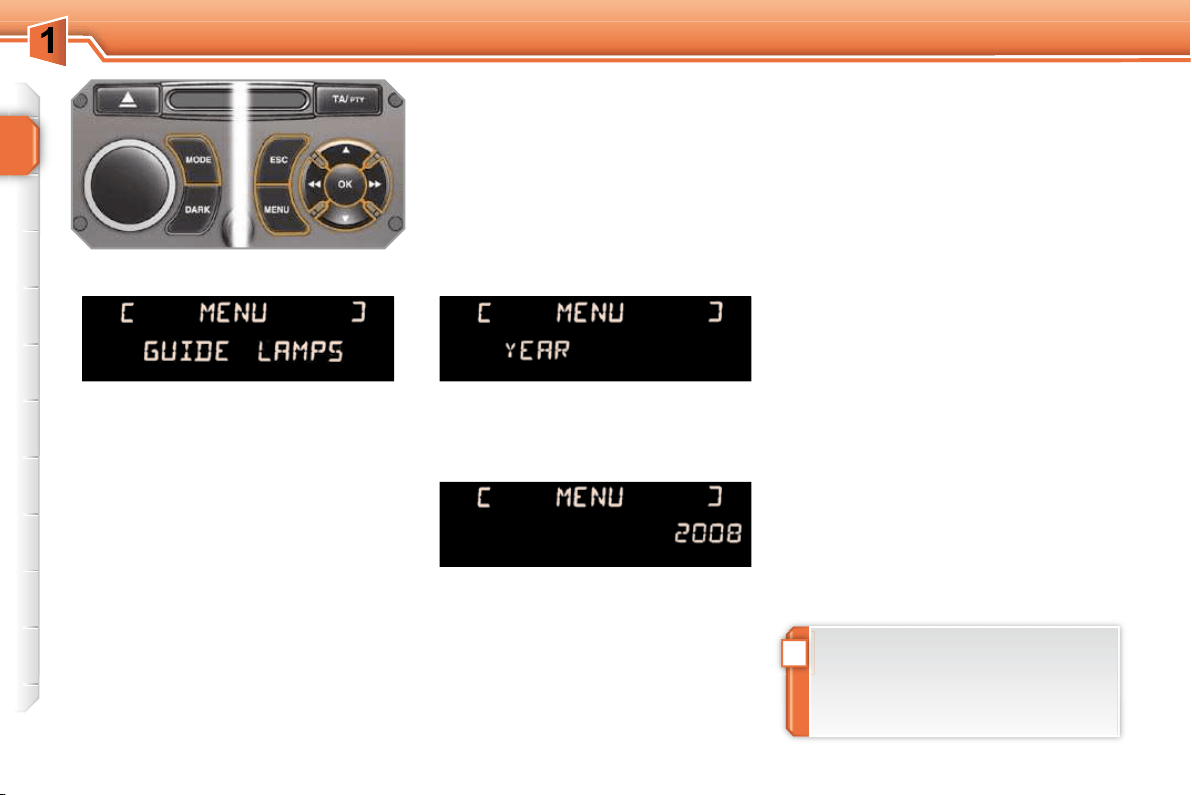
Display settings
Once the "Display settings" menu has
been selected, you can gain access to
the following settings:
- year,
- month,
- day,
- hour,
- minutes,
- 12 or 24 hour mode.
Language
Once the "Language" menu has been
selected, you can change the language
used by the display (Français, Italiano,
Nederlands, Portugues, Portugues-Brasil,
Deutsch, English, Espanol).
Units
Once the "Units" menu has been selected,
you can change the units of the following
parameters:
- temperature (°C or °F),
- fuel consumption (l/100 km, mpg or
km/l).
Once you have selected a setting,
press the " " or " " buttons to
change its value.
Press the " " or " " buttons to
switch respectively to the previous
or next setting.
Press the "OK" button to record
the change and return to the normal
display or press the "ESC" button to
cancel.
Vehicle confi guration
Options
Once the "Options" menu has been select-
ed, you can start diagnostics of the status of
the equipment (active, not active, faulty).
Once the "Vehicle Confi guration" menu
has been selected, you can activate or
deactivate the following equipment:
- directional headlamps (refer to the
"Visibility" section),
- "guide-me-home" lighting (refer to
the "Visibility" section).
INSTRUMENTS and CONTROLS
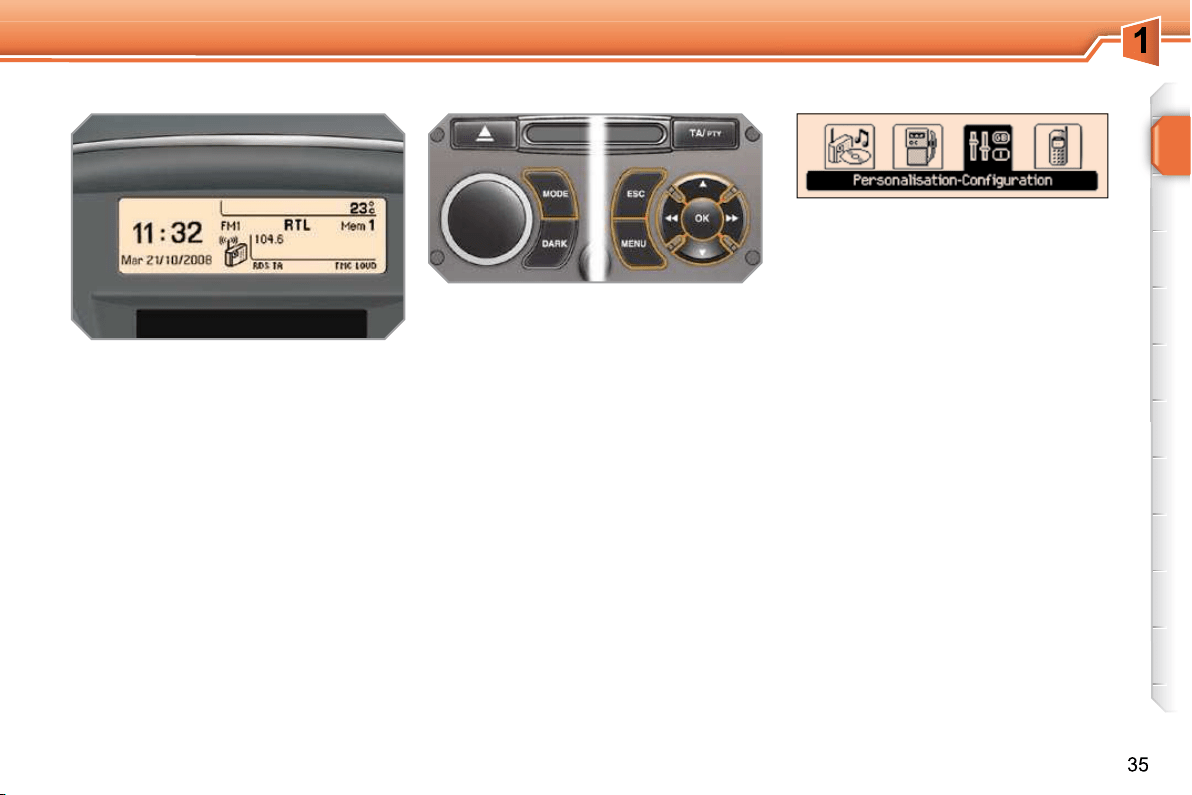
MONOCHROME SCREEN C
Main menu
Displays on the screen
This displays the following information:
- time,
- date,
- ambient temperature * (this fl ashes if
there is a risk of ice),
- status of the openings (doors, boot...),
- audio sources (radio, CD...),
- trip computer (refer to the end of the
section).
Warning messages (e.g.: "Emission
control system faulty") or information
messages (e.g.: "Automatic headlamp
lighting activated") may appear tempo-
rarily. These can be cleared by pressing
the "ESC" button.
"Audio functions" menu
With the Peugeot Connect Sound
switched on, once this menu has been
selected you can activate or deactivate
the functions linked with use of the ra-
dio (RDS, REG, RadioText) or the CD
(introscan, shuffl e, CD repeat).
For more information on the "Audio func-
tions" application, refer to the Peugeot
Connect Sound part of the "Audio and
Telematics" section.
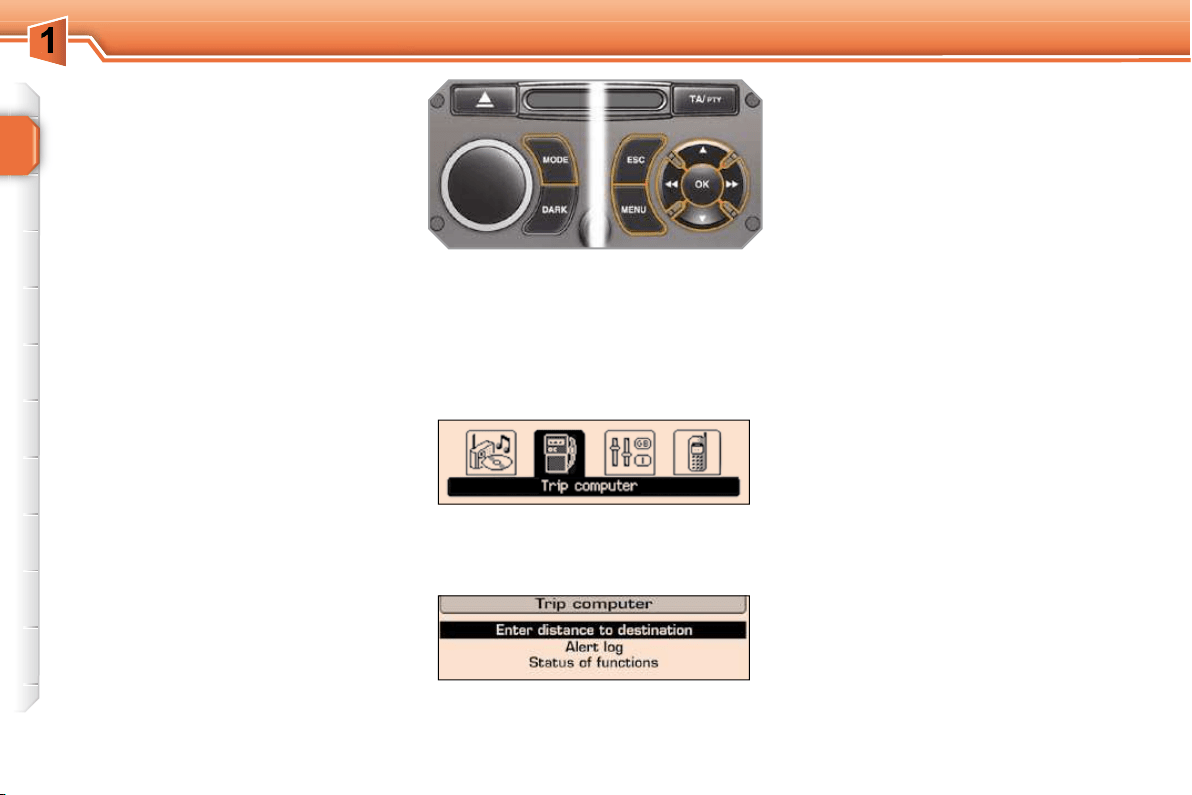
Controls
From your Peugeot Connect Sound
control panel, you can:
press the "MENU" button to gain
access to the main menu ,
press the " " or " " buttons to scroll
through the items on the screen,
press the "MODE" button to change
the permanent application (trip com-
puter, audio source...),
press the " " or " " buttons to
change a setting value,
press the "OK" button to confi rm,
or
press the "ESC" button to abandon
the operation in progress.
Press the "MENU" button to gain
access to the main menu :
- audio functions,
- trip computer
- personalisation-confi guration,
- telephone (hands-free kit).
Press the " " or " " buttons to select
the menu required, then confi rm by
pressing the "OK" button.
* With air conditioning only.
INSTRUMENTS and CONTROLS
36
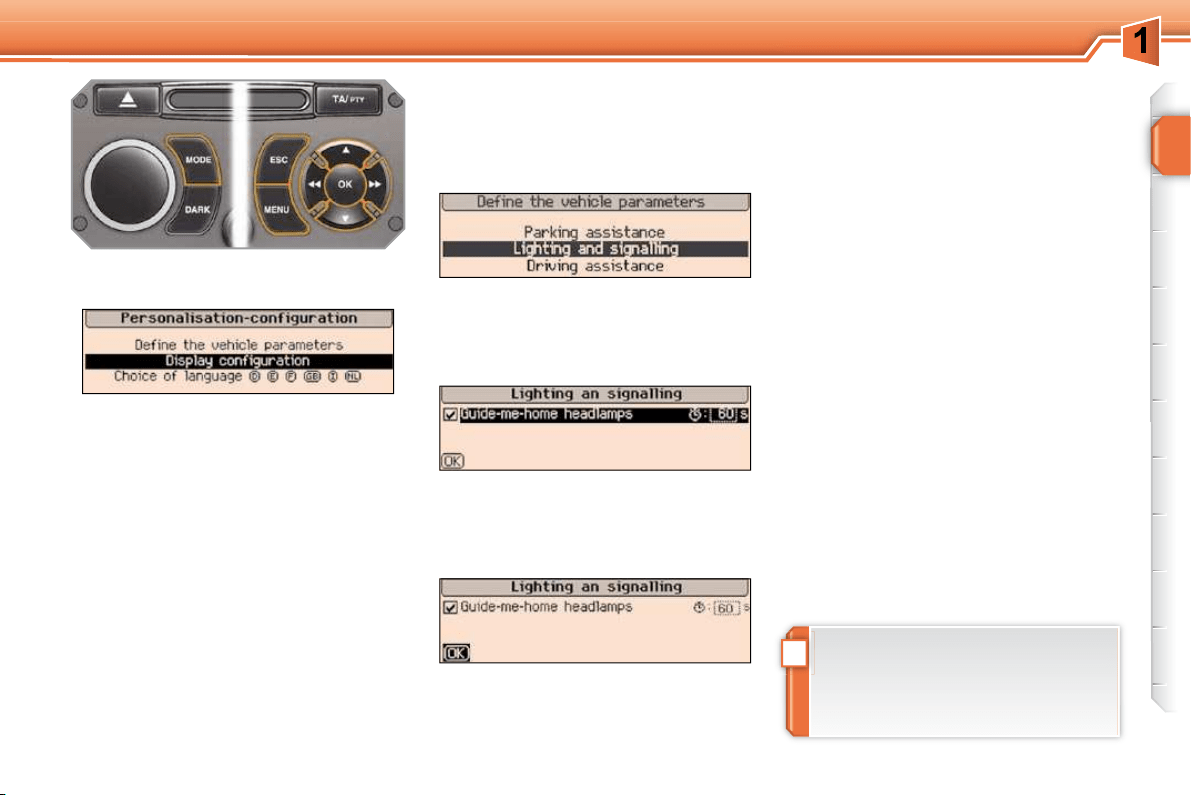
"Trip computer" menu
Once this menu has been selected, you
can consult information concerning the
status of the vehicle (alert log, status of
the functions...).
Press the "MENU" key to access
the main menu.
Press the arrows, then the "OK"
key to select the "Trip computer"
menu.
In the "Trip computer" menu, select
one of the following applications:
Alert log
This summarises the active warning
messages, displaying them succes-
sively on the multifunction screen.
Status of functions
This summarises the active or inactive
status of the functions present on the
vehicle.
Enter the distance to the destination
This allows you to enter an approximate
distance value to the fi nal destination.
!
INSTRUMENTS and CONTROLS
37
For safety reasons, confi guration
of the multifunction screen by the
driver must only be done when sta-
tionary.
Defi ne the vehicle parameters
Once this menu has been selected, you
can activate or deactivate the following
equipment:
- directional headlamps (refer to the
"Visibility" section),
- "guide-me-home" lighting (refer to
the "Visibility" section).
- rear parking sensors (refer to the
"Driving" section).
"Telephone" menu
With the Peugeot Connect Sound
switched on, once this menu has been
selected you can confi gure your Blue-
tooth hands-free system (pairing), con-
sult the various telephone directories
(calls log, services...) and manage your
communications (pick up, hang up, call
waiting, secret mode...).
For further details concerning the "Tele-
phone" application, refer to the Peugeot
Connect Sound part of the "Audio and
Telematics" section.
Display confi guration
Once this menu has been selected, you
can gain access to the following set-
tings:
- brightness-video setting,
- date and time setting,
- selection of the units.
Choice of language
Once this menu has been selected,
you can change the language used by
the display (Deutsch, English, Espanol,
Français, Italiano, Nederlands,
Portugues, Portugues-Brasil, Türkçe ** ).
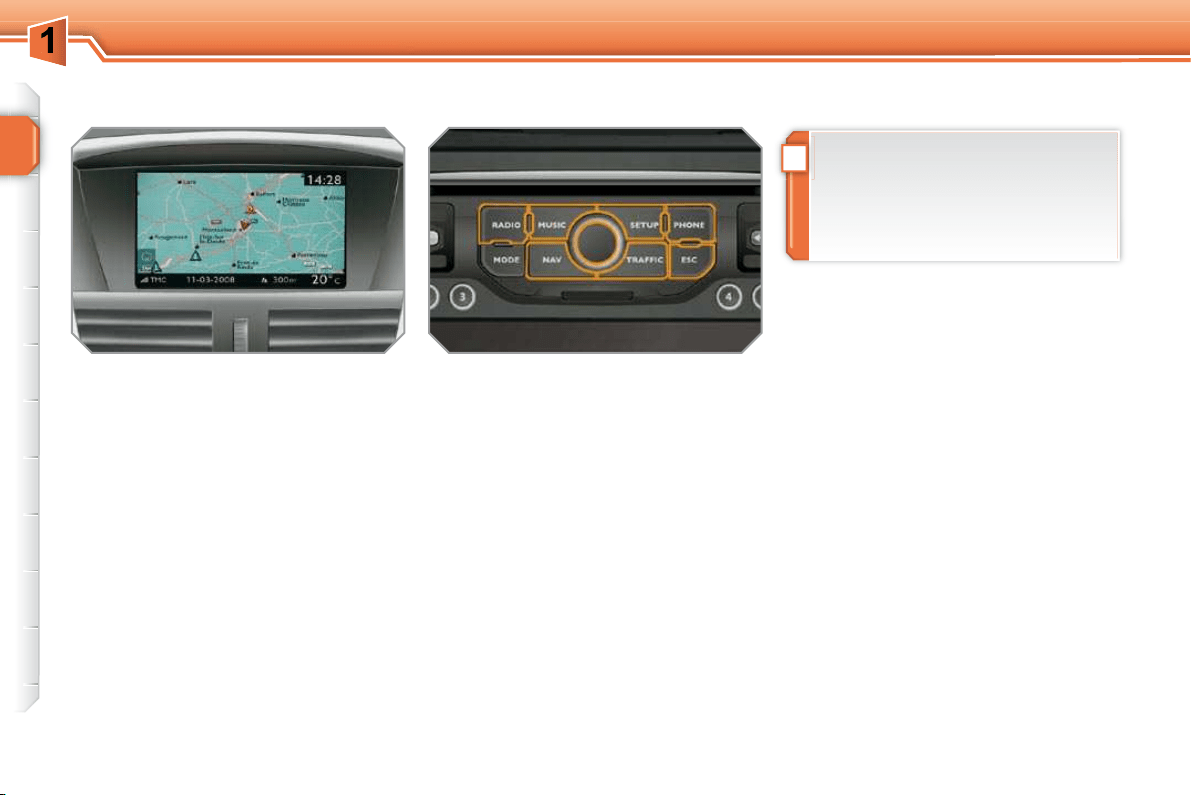
Example: setting of the duration of the
"guide-me-home" lighting
"Personalisation-Configuration"
menu
Once this menu has been selected, you
can gain access to the following func-
tions:
- defi ne the vehicle parameters,
- display confi guration,
- choice of language.
Press the " " or " " buttons, then
the "OK" button to select the menu
required.
Press the " " or " " buttons,
then the "OK" button to select the
"Guide-me-home headlamps" line.
Press the " " or " " buttons to set
the value required (15, 30 or 60 sec-
onds), then press the "OK" button
to confi rm.
Press the " " or " " buttons, then
the "OK" button to select the "OK"
box and confi rm or press the "ESC"
button to cancel.
** According to country.
i
INSTRUMENTS and CONTROLS
38
16/9 COLOUR SCREEN (WITH
PEUGEOT CONNECT NAVIGATION)
Displays on the screen
This displays the following information
automatically and directly:
- time,
- date,
- altitude,
- ambient temperature (the value dis-
played fl ashes if there is a risk of ice),
- openings check,
- warning and vehicle function status
messages, displayed temporarily,
- audio functions,
- trip computer information,
-
satellite navigation system information.
Controls
From the Peugeot Connect Navigation
control panel, to select one of the ap-
plications:
press the dedicated "RADIO" ,
"MUSIC" , "NAV" , "TRAFFIC" ,
"SETUP" or "PHONE" button for
access to the corresponding menu,
turn the navigator to move the se-
lection,
press the navigator to confi rm the
selection,
or
press the "ESC" button to abandon
the current operation and return to
the previous display.
For more information on these ap-
plications, refer to the "Audio and
Telematics" section or to the spe-
cifi c user guide given to you with
the other owner's documents.
!
INSTRUMENTS and CONTROLS
39
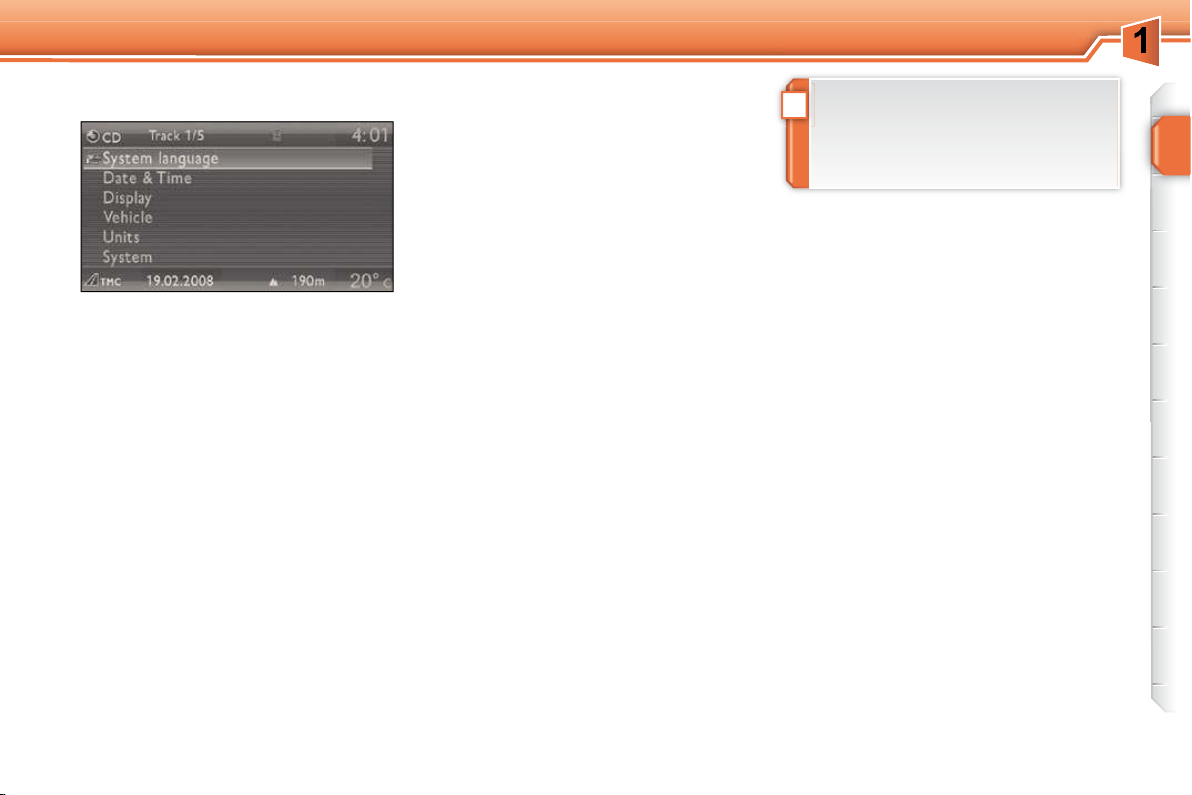
"SETUP" menu
Press the "SETUP" button to gain
access to the "SETUP" menu. This
allows you to select from the follow-
ing functions:
- "System language",
- "Date and time",
- "Display",
- "Vehicle",
- "Units",
- "System".
System language
This menu allows you to select the lan-
guage used by the display: Deutsch,
English, Espanol, Français, Italiano,
Nederlands, Polski, Portugues, Türkçe * .
Date and time
This menu allows you to set the date
and time, the format of the date and the
format of the time (refer to the "Audio
and Telematics" section or to the specif-
ic user guide given to you with the other
owner's documents).
Display
This menu allows you to set the bright-
ness of the screen, the screen colour
scheme and the colour of the map (day/
night or auto mode).
Vehicle
This menu allows you to activate or
deactivate certain driving and comfort
equipment:
- guide-me-home lighting and dura-
tion (refer to the "Visibility" section),
- directional headlamps (refer to the
"Visibility" section).
Units
This menu allows you to select the
units: temperature (°C or °F) and fuel
consumption (km/l, l/100 or mpg).
System
This menu allows you to restore the fac-
tory confi guration, display the software
version and activate scrolling text.
* According to country.
For safety reasons, confi guration
of the multifunction screen by the
driver must only be done when
stationary.
INSTRUMENTS and CONTROLS
40
TRIP COMPUTER
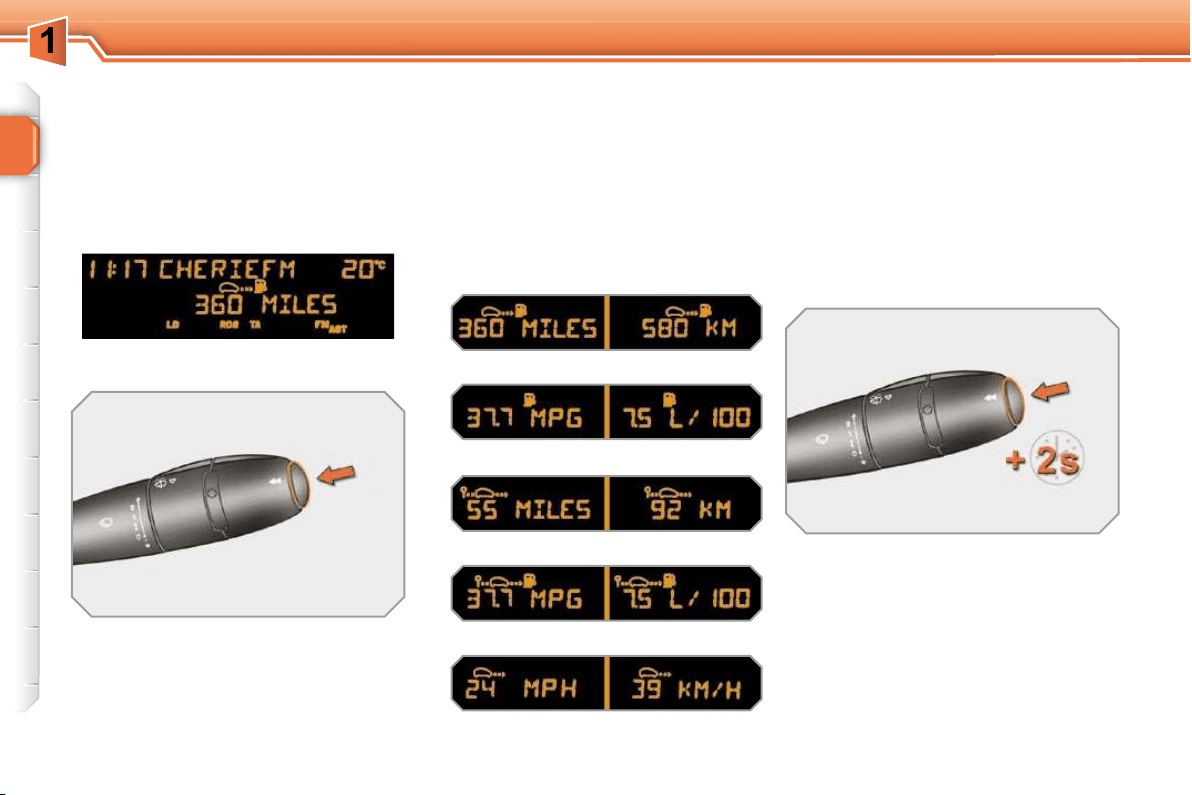
Press the button, located at the end
of the wiper stalk , to display the
various items of trip computer data
in succession.
The trip computer provides the following
information:
System which provides current informa-
tion concerning the trip travelled (range,
fuel consumption...).
Zero reset
Monochrome screen A
The next press then returns you to
the normal display.
Information displays
- range,
- current fuel consumption,
- distance travelled,
- average fuel consumption,
- average speed.
Press the control for more than two
seconds to reset to zero the distance
travelled, the average fuel consump-
tion and the average speed.
!
i
i
INSTRUMENTS and CONTROLS
42
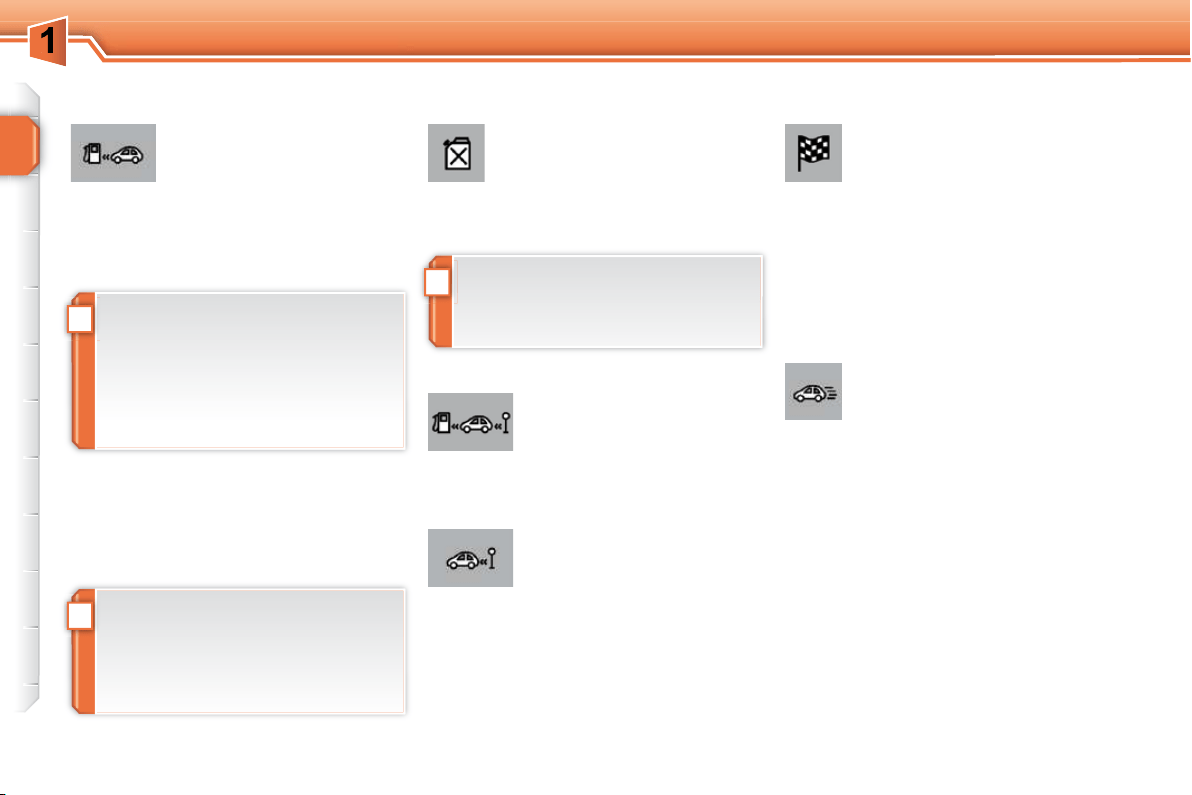
Distance remaining to be
travelled
(miles or km)
This is the distance remaining
to be travelled to the fi nal destination. It
is either calculated instantly by the navi-
gation system if guidance is activated,
or entered by the user.
If the distance is not entered, dashes
are displayed in place of the digits.
Average speed
(mph or km/h)
This is the average speed calcu-
lated since the last trip computer
zero reset (ignition on).
Range
(miles or km)
This indicates the number of
miles (or kilometres) which
can still be travelled with the fuel remain-
ing in the tank based on the average
fuel consumption over the last few miles
(kilometres) travelled.
Current fuel consumption
(l/100 km or km/l or mpg)
This is the average quantity of
fuel consumed over the last few
seconds.
Average fuel consumption
(l/100 km or km/l or mpg)
This is the average quantity
of fuel consumed since the
last trip computer zero reset.
Distance travelled
(miles or km)
This indicates the distance
travelled since the last trip
computer zero reset.
A few definitions…
When the range falls below 20 miles
(30 m), dashes are displayed. After fi ll-
ing with at least 5 litres of fuel, the range
is recalculated and is displayed when it
exceeds 60 miles (100 km).
If dashes are displayed continu-
ously while driving in place of the
digits, contact a PEUGEOT dealer.
This function is only displayed from
20 mph (30 km/h).
This fi gure may increase following
a change of driving style or relief,
resulting in a signifi cant change in
the current fuel consumption.
INSTRUMENTS and CONTROLS
41
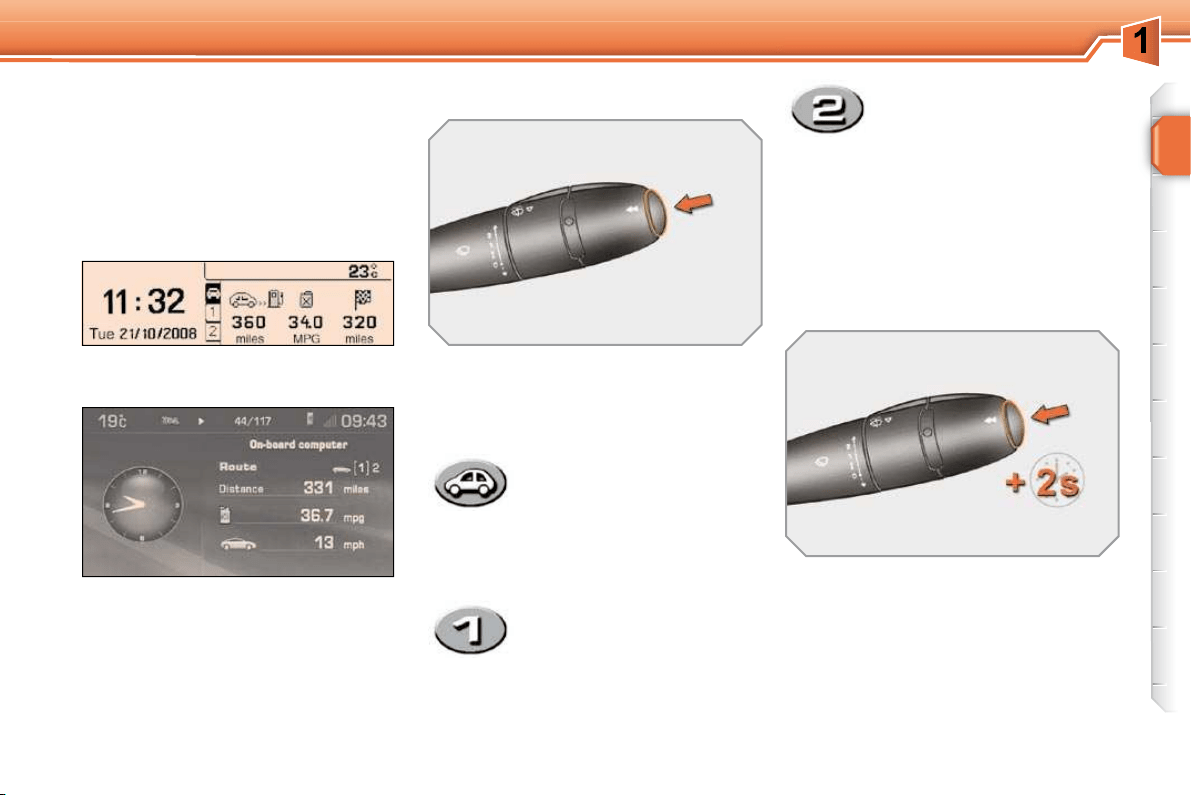
- the current information
tab with:
the range,
the current fuel con-
sumption,
the distance remaining
to be travelled,
Colour screen 16/9
Press again to return to the normal
display.
Monochrome screen C
Press the button on the end of the
wiper stalk , to display the various
trip computer tabs in succession:
Information displays
Trip zero reset
- the trip "1" tab with:
the distance travelled,
the average fuel con-
sumption,
the average speed,
for the fi rst trip.
- the trip "2" tab with:
the distance travelled,
the average fuel con-
sumption,
the average speed,
for the second trip.
When the trip required is displayed,
press the control for more than
two seconds.
Trips "1" and "2" are independent but
their use is identical.
Trip "1" permits, for example, daily calcu-
lations, and trip "2" monthly calculations.
TRIP COMPUTER
System which provides current infor-
mation concerning the route travelled
(range, fuel consumption…).
!
i
i
INSTRUMENTS and CONTROLS
42
Distance remaining to be
travelled
(miles or km)
This is the distance remaining
to be travelled to the fi nal destination. It
is either calculated instantly by the navi-
gation system if guidance is activated,
or entered by the user.
If the distance is not entered, dashes
are displayed in place of the digits.
Average speed
(mph or km/h)
This is the average speed calcu-
lated since the last trip computer
zero reset (ignition on).
Range
(miles or km)
This indicates the number of
miles (or kilometres) which
can still be travelled with the fuel remain-
ing in the tank based on the average
fuel consumption over the last few miles
(kilometres) travelled.
Current fuel consumption
(l/100 km or km/l or mpg)
This is the average quantity of
fuel consumed over the last few
seconds.
Average fuel consumption
(l/100 km or km/l or mpg)
This is the average quantity
of fuel consumed since the
last trip computer zero reset.
Distance travelled
(miles or km)
This indicates the distance
travelled since the last trip
computer zero reset.
A few definitions…
When the range falls below 20 miles
(30 m), dashes are displayed. After fi ll-
ing with at least 5 litres of fuel, the range
is recalculated and is displayed when it
exceeds 60 miles (100 km).
If dashes are displayed continu-
ously while driving in place of the
digits, contact a PEUGEOT dealer.
This function is only displayed from
20 mph (30 km/h).
This fi gure may increase following
a change of driving style or relief,
resulting in a signifi cant change in
the current fuel consumption.
COMFORT
43
VENTILATION
Air treatment
The incoming air follows various routes
depending on the controls selected by
the driver:
- direct arrival in the passenger com-
partment (air intake),
- passage through a heating circuit
(heating),
- passage through a cooling circuit
(air conditioning).
The temperature control enables you to
obtain the level of comfort required by
mixing the air of the various circuits.
The air distribution control enables you
to diffuse the air in the passenger com-
partment combining several air vents.
The air fl ow control enables you to increase
or reduce the speed of the ventilation blower.
Air intake
The air circulating in the passenger com-
partment is fi ltered and originates either
from the outside via the grille located at
the base of the windscreen or from the
inside in air recirculation mode.
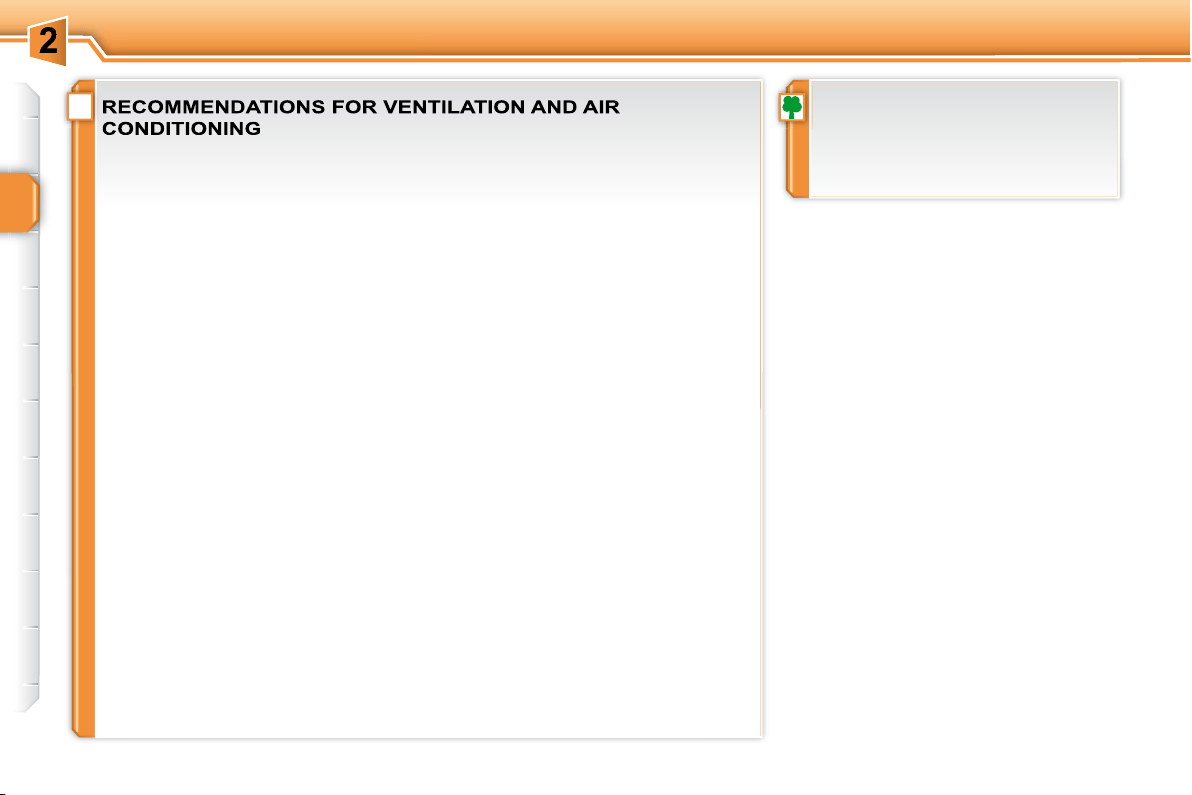
Control panel
The controls of this system are grouped
together on control panel A on the cen-
tre console. Depending on the model,
the functions offered are:
- the level of comfort required,
- air fl ow,
- air distribution,
- demisting-defrosting,
- manual or digital air conditioning
controls.
Air distribution
1.
Windscreen demisting-defrosting vents.
2.
Front side window demisting-defrosting
vents.
3. Side adjustable air vents.
4. Central adjustable air vents.
5. Air outlets to the front footwells.
6. Air outlets to the rear footwells.
i
COMFORT
44
The air conditioning system does
not contain chlorine and does not
present any danger to the ozone
layer.
In order for these systems to be fully effective, follow the operation and main-
tenance guidelines below:
To obtain an even air distribution, take care not to obstruct the exterior air
intake grilles located at the base of the windscreen, the nozzles, the vents
and the air outlets, as well as the air extractor located in the boot.
Do not cover the sunshine sensor, located on the dashboard; this is used
for regulation of the air conditioning system.
Operate the air conditioning system for at least 5 to 10 minutes, once or
twice a month to keep it in good working order.
Ensure that the passenger compartment fi lter is in good condition and
have the fi lter elements replaced regularly (refer to the "Checks" section).
We recommend the use of a combined passenger compartment fi lter.
Thanks to its special active treatment, it contributes to the purifi cation of
the air breathed by the occupants and the cleanness of the passenger
compartment (reduction of allergic symptoms, bad odours and greasy de-
posits).
To ensure correct operation of the air conditioning system, you are also
advised to have it checked as recommended in the Warranty and Mainte-
nance Record.
If the system does not produce cold air, deactivate it and contact a
PEUGEOT dealer.
In the "cabriolet" confi guration, the performance of the air conditioning system
may be reduced. However, installing the windstop improves comfort.
When towing the maximum load on a steep gradient in high temperatures,
switching off the air conditioning increases the available engine power and so
improves towing performance.
If after a prolonged stop in sunshine the interior temperature is high, fi rst ven-
tilate the passenger compartment for a few moments.
Set the air blower control fast enough to quickly change the air in the passenger
compartment.
The condensation created by the air conditioning results in a discharge of
water under the vehicle which is perfectly normal.
COMFORT
45
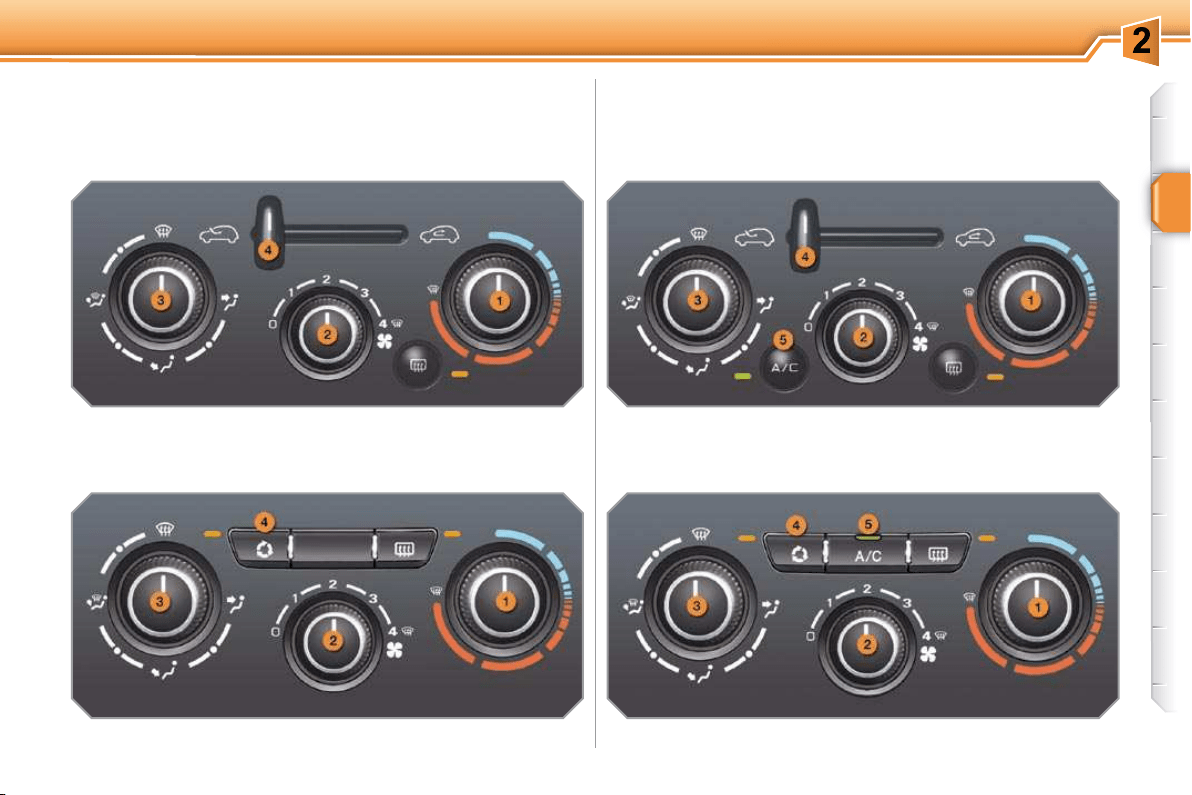
HEATING/VENTILATION
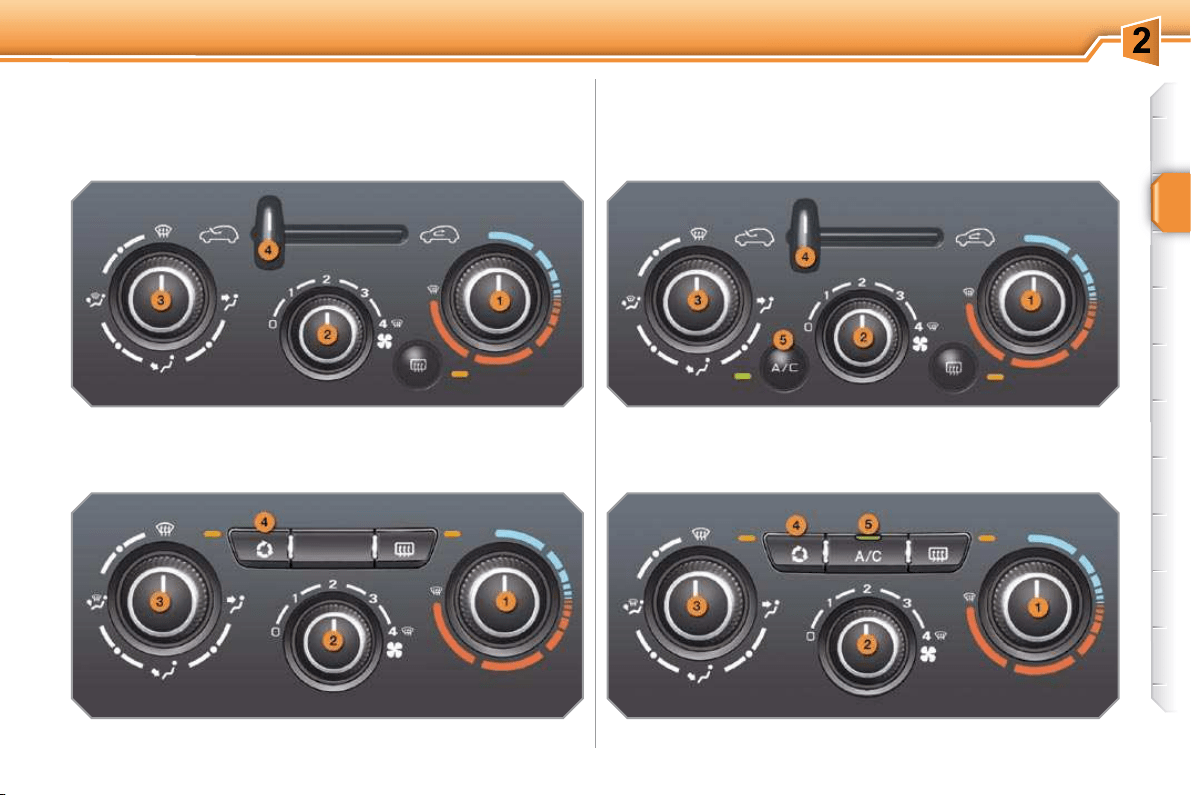
Manual control panel
Electric control panel
MANUAL AIR CONDITIONING
Manual control panel
Electric control panel
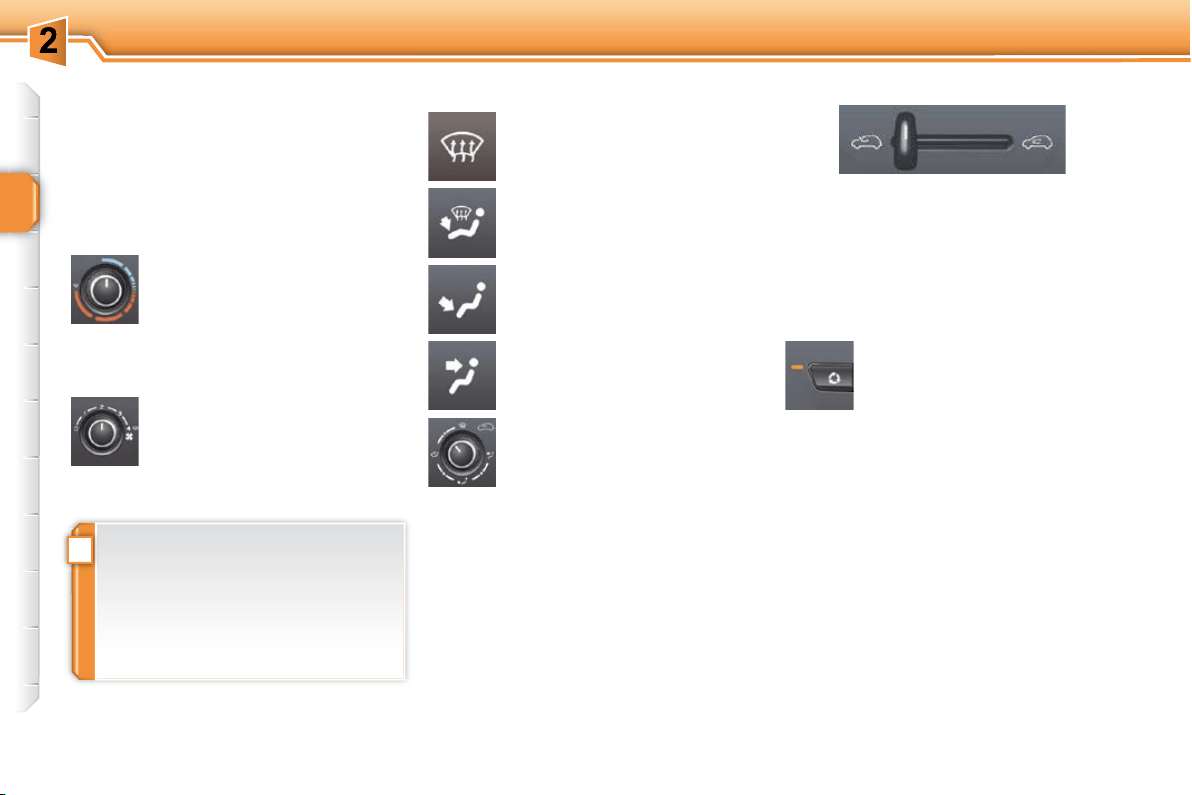
i
COMFORT
46
2. Air fl ow adjustment
Turn the dial from position 1
to position 4 to obtain an air
fl ow suffi cient to ensure your
comfort.
Windscreen, side windows and
footwells.
Footwells.
(vents closed)
Central and side vents.
Turn the dial from blue
(cold) to red (hot) to ad-
just the temperature to suit
your requirements.
Windscreen and side windows.
1. Temperature adjustment
The air distribution can be
adapted by placing the dial
in an intermediate position,
marked by a dot "".
The heating/ventilation or air conditioning
systems can only operate when the en-
gine is running.
HEATING
Manual control panel
4. Air intake/Air recirculation
The intake of exterior air prevents the
formation of mist on the windscreen and
side windows.
The recirculation of interior air prevents
exterior odours and smoke from enter-
ing the passenger compartment.
Return to exterior air intake mode as
soon as possible to avoid deterioration
of the air quality and prevent misting.
Electric control panel
Demisting/defrosting
To quickly demist or defrost the wind-
screen and side windows:
place the air intake control 4 in the
"Exterior air intake" position,
place the air distribution dial 3 in the
"Windscreen" position,
place the temperature dial 1 and the
air fl ow dial 2 in the maximum posi-
tion,
close the central vents,
switch on the air conditioning by
pressing the "A/C" button.
If you place the air fl ow control
in position 0 (deactivation of the
system), the temperature is no
longer maintained at a comfort-
able level. However, a slight
fl ow of air, due to the movement
of the vehicle, can still be felt.
3. Air distribution adjustment
Move the manual control to the right to
the "Interior air recirculation" position.
Move the manual control to the left
to return to the "Exterior air intake"
position.
Press the button to recir-
culate the interior air. This
is displayed by lighting of
the indicator lamp.
Press the button again to permit the
intake of exterior air. This is con-
fi rmed by the indicator lamp going
off.
COMFORT
45
HEATING/VENTILATION
Manual control panel
Electric control panel
MANUAL AIR CONDITIONING
Manual control panel
Electric control panel
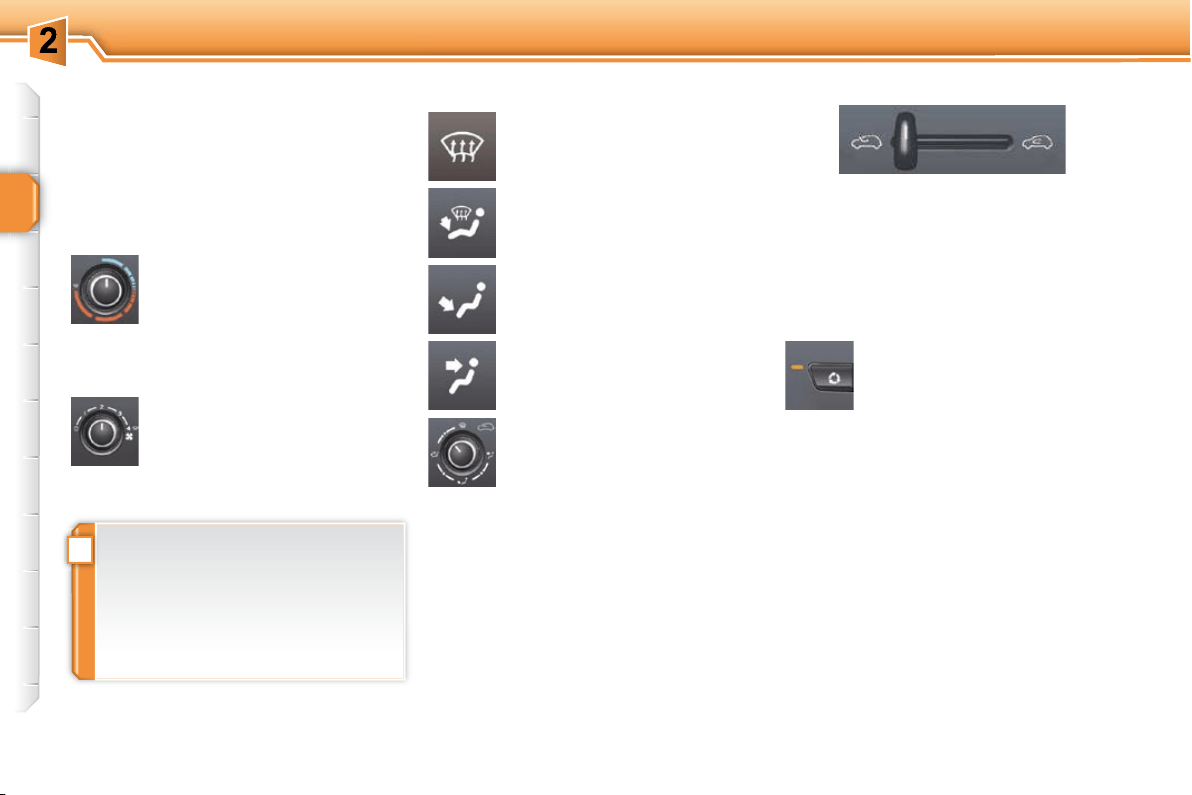
i
COMFORT
46
2. Air fl ow adjustment
Turn the dial from position 1
to position 4 to obtain an air
fl ow suffi cient to ensure your
comfort.
Windscreen, side windows and
footwells.
Footwells.
(vents closed)
Central and side vents.
Turn the dial from blue
(cold) to red (hot) to ad-
just the temperature to suit
your requirements.
Windscreen and side windows.
1. Temperature adjustment
The air distribution can be
adapted by placing the dial
in an intermediate position,
marked by a dot "".
The heating/ventilation or air conditioning
systems can only operate when the en-
gine is running.
HEATING
Manual control panel
4. Air intake/Air recirculation
The intake of exterior air prevents the
formation of mist on the windscreen and
side windows.
The recirculation of interior air prevents
exterior odours and smoke from enter-
ing the passenger compartment.
Return to exterior air intake mode as
soon as possible to avoid deterioration
of the air quality and prevent misting.
Electric control panel
Demisting/defrosting
To quickly demist or defrost the wind-
screen and side windows:
place the air intake control 4 in the
"Exterior air intake" position,
place the air distribution dial 3 in the
"Windscreen" position,
place the temperature dial 1 and the
air fl ow dial 2 in the maximum posi-
tion,
close the central vents,
switch on the air conditioning by
pressing the "A/C" button.
If you place the air fl ow control
in position 0 (deactivation of the
system), the temperature is no
longer maintained at a comfort-
able level. However, a slight
fl ow of air, due to the movement
of the vehicle, can still be felt.
3. Air distribution adjustment
Move the manual control to the right to
the "Interior air recirculation" position.
Move the manual control to the left
to return to the "Exterior air intake"
position.
Press the button to recir-
culate the interior air. This
is displayed by lighting of
the indicator lamp.
Press the button again to permit the
intake of exterior air. This is con-
fi rmed by the indicator lamp going
off.
i
COMFORT
47
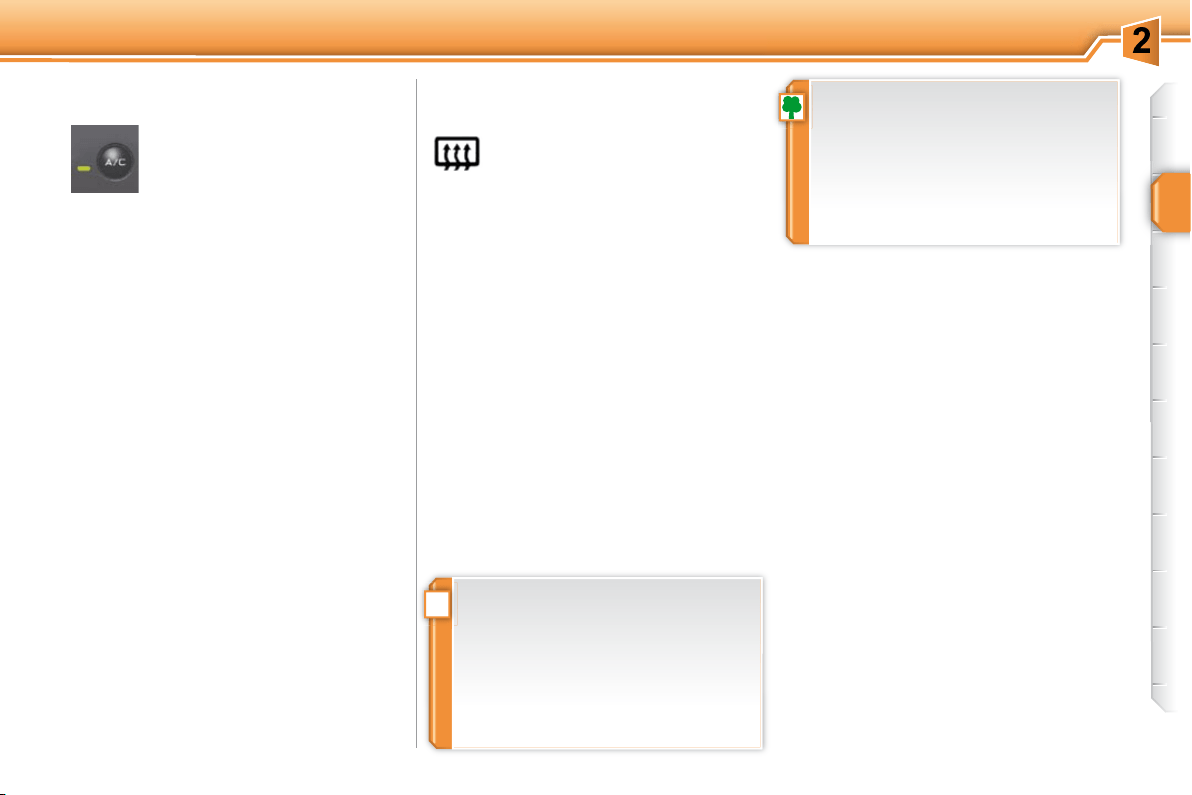
5. Air conditioning On/Off
The air conditioning is de-
signed to operate effectively in
all seasons, with the windows
closed.
The control button is located on
the heating or air conditioning
system control panel.
REAR SCREEN DEMIST/
DEFROST
Switch off the demist/defrost of
the rear screen and door mir-
rors as soon as it is no longer
needed as lower current con-
sumption results in reduced
fuel consumption.
If the engine is switched off before the
demist/defrost is switched off auto-
matically, demist/defrost will resume
next time the engine is switched on.
The demist/defrost is deactivated
when the retractable roof is stored in
the boot.
Switching on
The rear screen demist/defrost can only
operate when the engine is running.
Press this button to demist/defrost
the rear screen and the exterior mir-
rors. The indicator lamp associated
with the button comes on.
Switching off
The demist/defrost switches off auto-
matically to prevent an excessive con-
sumption of current.
It is possible to stop the demist/de-
frost operation before it is switched off
automatically by pressing the button
again. The indicator lamp associated
with the button switches off.
It enables you to:
- lower the temperature, in summer,
- increase the effectiveness of the
demisting, in winter above 0 °C.
Switching on
Press the "A/C" button, the associ-
ated indicator lamp comes on.
The air conditioning does not operate
when the air fl ow adjustment dial 2 is
in position "0".
Switching off
Press the "A/C" button again, the as-
sociated indicator lamp switches off.
i
COMFORT
47
5. Air conditioning On/Off
The air conditioning is de-
signed to operate effectively in
all seasons, with the windows
closed.
The control button is located on
the heating or air conditioning
system control panel.
REAR SCREEN DEMIST/
DEFROST
Switch off the demist/defrost of
the rear screen and door mir-
rors as soon as it is no longer
needed as lower current con-
sumption results in reduced
fuel consumption.
If the engine is switched off before the
demist/defrost is switched off auto-
matically, demist/defrost will resume
next time the engine is switched on.
The demist/defrost is deactivated
when the retractable roof is stored in
the boot.
Switching on
The rear screen demist/defrost can only
operate when the engine is running.
Press this button to demist/defrost
the rear screen and the exterior mir-
rors. The indicator lamp associated
with the button comes on.
Switching off
The demist/defrost switches off auto-
matically to prevent an excessive con-
sumption of current.
It is possible to stop the demist/de-
frost operation before it is switched off
automatically by pressing the button
again. The indicator lamp associated
with the button switches off.
It enables you to:
- lower the temperature, in summer,
- increase the effectiveness of the
demisting, in winter above 0 °C.
Switching on
Press the "A/C" button, the associ-
ated indicator lamp comes on.
The air conditioning does not operate
when the air fl ow adjustment dial 2 is
in position "0".
Switching off
Press the "A/C" button again, the as-
sociated indicator lamp switches off.
i
i
COMFORT
48
When the engine is cold, to prevent
too great a distribution of cold air,
the air fl ow will only reach its opti-
mum level gradually.
In cold weather, it favours the dis-
tribution of warm air to the wind-
screen, the side windows and the
footwells only.
On entering the vehicle, if the in-
terior temperature is much colder
or warmer than the comfort value,
there is no need to alter the value
displayed in order to obtain the re-
quired level of comfort. The system
corrects the temperature differ-
ence automatically and as quickly
as possible.
The air conditioning can only operate
with the engine running.
The driver and his front passen-
ger can each set the temperature
to suit their requirements.
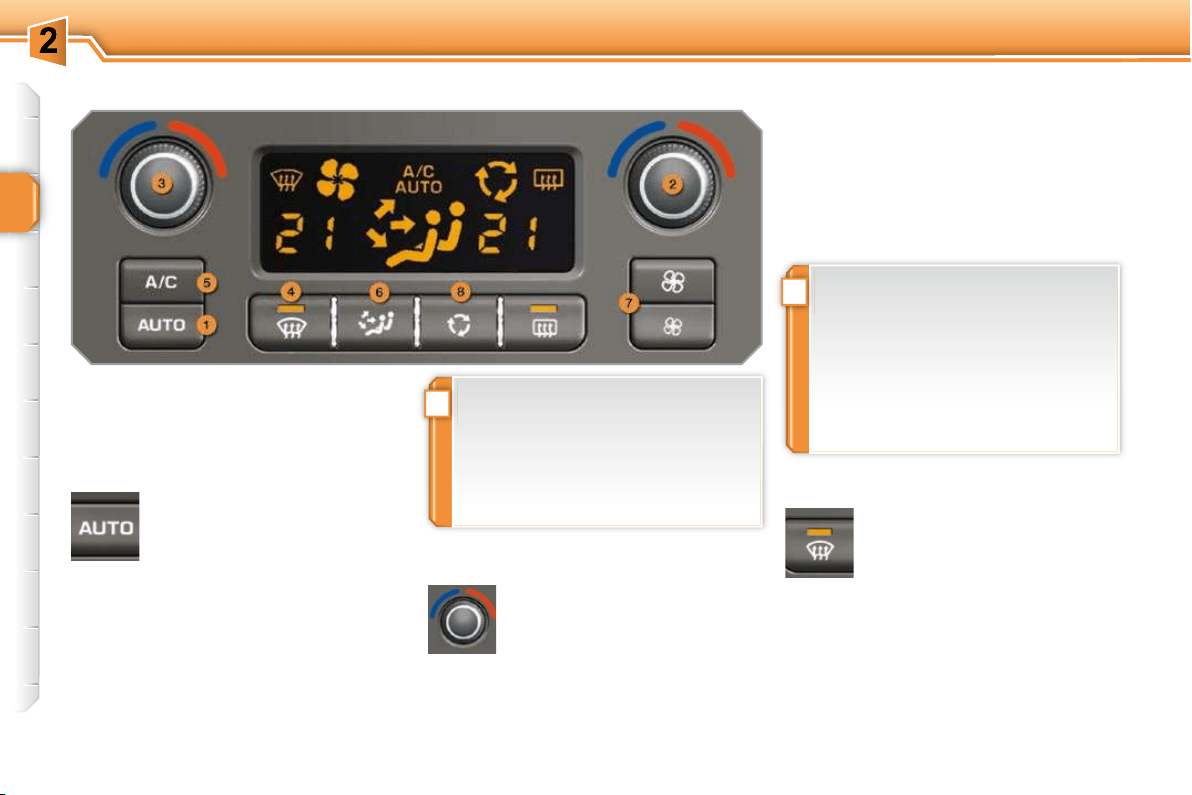
Turn dial 2 or 3 to the left to reduce
the value or to the right to increase it.
A setting around 21 enables you to ob-
tain an optimum level of comfort. De-
pending on your requirements, a setting
between 18 and 24 is usual.
In addition, it is recommended that you
avoid a left/right setting difference of
more than 3.
4. Automatic visibility programme
The automatic comfort pro-
gramme may not be suffi cient
to quickly demist or defrost the
windscreen and side windows
(humidity, several passengers,
ice...).
In this case, select the automatic
visibility programme.
The system automatically controls the
air conditioning, the air fl ow and the air
intake and provides optimum distribu-
tion of the ventilation to the windscreen
and side windows.
Automatic operation
Press the "AUTO" button.
The "AUTO" symbol is
displayed.
2. Driver's side adjustment
DUAL-ZONE DIGITAL AIR CONDITIONING
We recommend that you use this mode:
it provides optimised automatic control of
all of the functions, passenger compart-
ment temperature, air fl ow, air distribu-
tion and air recirculation, in accordance
with the comfort value that you have se-
lected.
This system is designed to operate ef-
fectively in all seasons, with the win-
dows closed.
The value indicated on the display cor-
responds to a level of comfort and not
to a temperature in degrees Celsius or
Fahrenheit.
1. Automatic comfort programme
3. Passenger's side adjustment
!
!
i
COMFORT
49
To exit this programme, press the "vis-
ibility" button again or the "AUTO"
button, the indicator lamp on the button
switches off and "AUTO" is displayed.
Press this button to switch
the air conditioning off.
6. Air distribution adjustment
Press this button several
times in succession to direct
the air fl ow in turn towards:
7. Air fl ow adjustment
Press the "small fan" but-
ton to reduce the air fl ow.
8. Air intake/Air recirculation
Deactivation of the system
Press the "small fan" button until
the fan symbol disappears.
This action deactivates all of the func-
tions of the air conditioning system.
The temperature is no longer main-
tained at a comfortable level. However,
a slight fl ow of air, due to the movement
of the vehicle, can still be felt.
Press the "large fan" button again
or the "AUTO" button to reactivate
the system with the values which
were set before it was deactivated.
Press this button to recir-
culate the interior air. The
air recirculation symbol is
displayed.
5. Air conditioning On/Off
Avoid driving for too long with the
air conditioning deactivated.
Avoid prolonged operation in inte-
rior air recirculation mode (risk of
condensation and of deterioration
of the air quality).
- the windscreen, the side windows
and the footwells,
- the windscreen and side windows
(demisting or defrosting),
- the central and side vents,
- the central vents, the side vents
and the footwells,
- the footwells.
Press the "large fan"
button to increase the air
fl ow.
The air fl ow symbol, the fan, is fi lled in
progressively in relation to the value re-
quired.
Air recirculation prevents exterior odours
and smoke from entering the passenger
compartment.
As soon as possible, press this button
again to permit the intake of exterior
air and prevent misting.
For maximum cooling or heating of
the passenger compartment, you
can exceed the minimum value of
14 or the maximum value of 28.
Turn dial 2 or 3 to the left until
"LO" is displayed or to the right
until "HI" is displayed.
Resuming manual control
Depending on your requirements, you
can make a different selection from that
offered by the system by changing a
setting. The other functions will still be
controlled automatically.
Press the "AUTO" button to return
to fully automatic operation.
Switching the system off may result in
discomfort (humidity, condensation).
Press the button again to return to
automatic operation of the air con-
ditioning. The symbol " A/C " is dis-
played.
COMFORT
50
FRONT SEATS
Seat consisting of a seat cushion, seat
back and head restraint which can all
be adjusted to adapt your position for
maximum ease of driving and comfort.
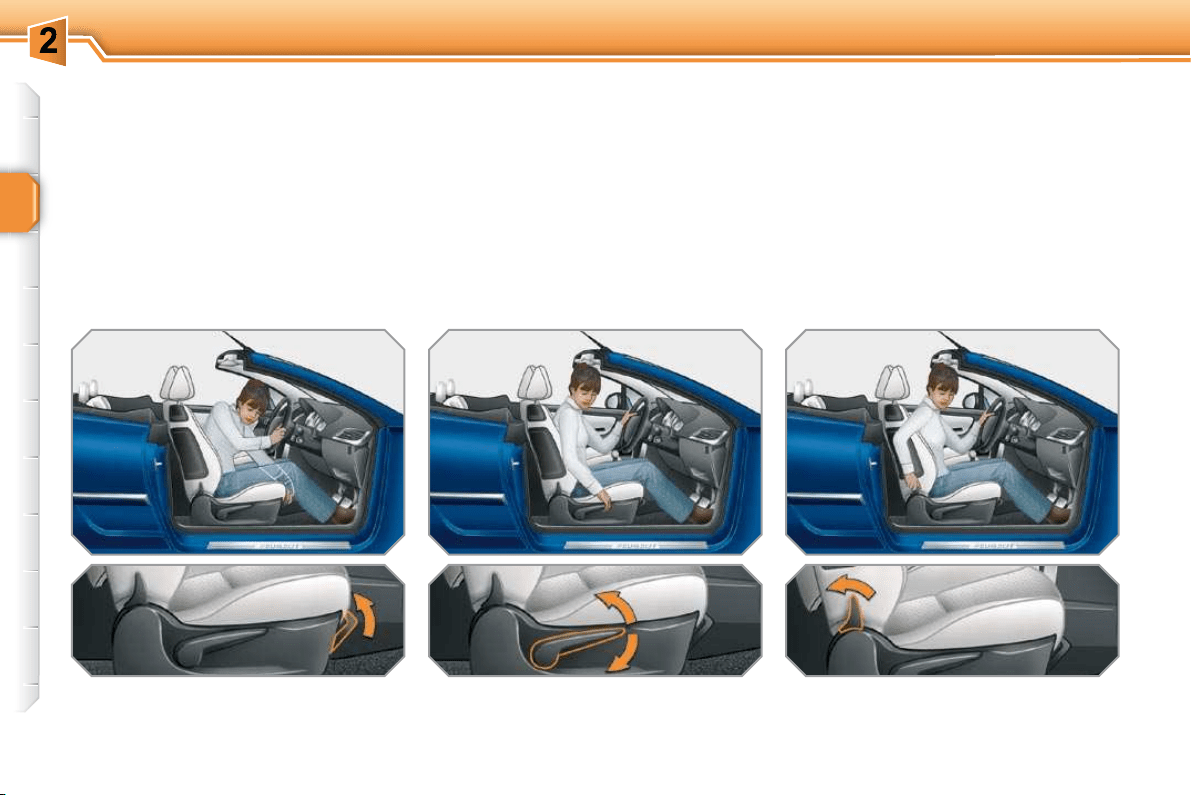
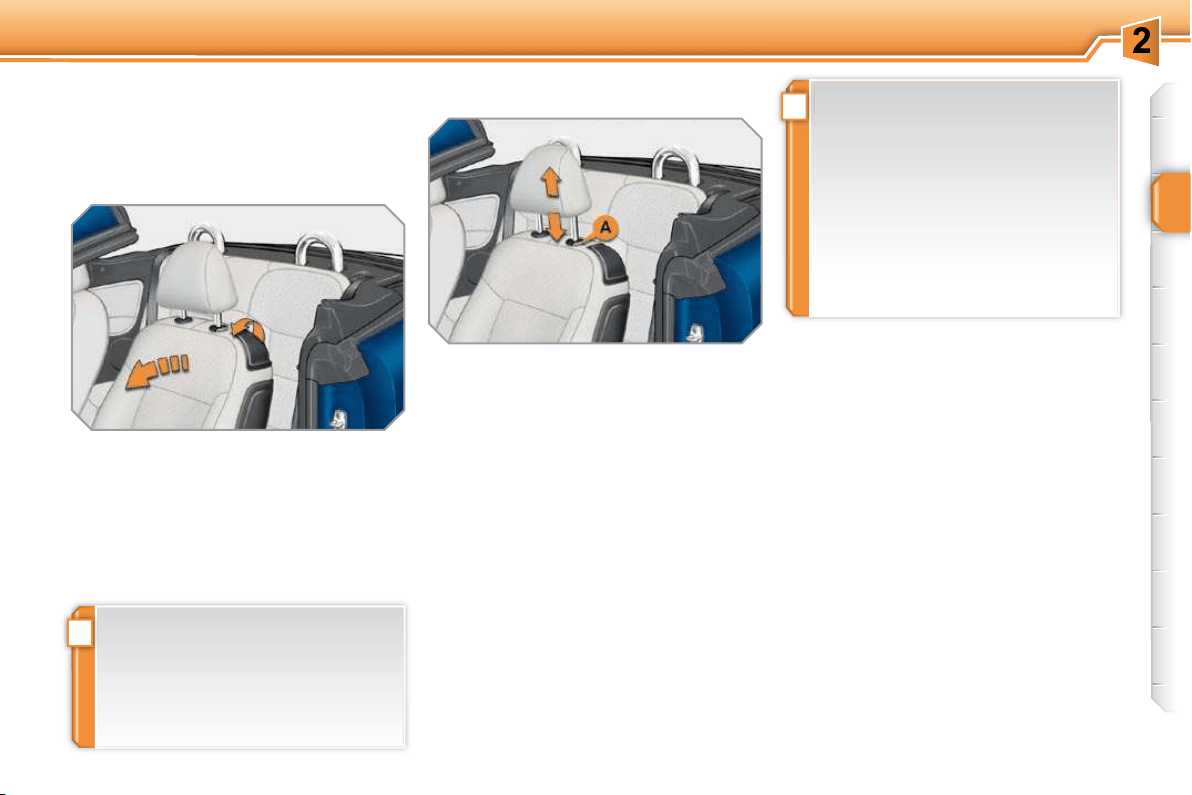
1. Forwards-backwards adjustment
Lift the control and slide the seat for-
wards or backwards.
2. Driver’s or passenger’s seat
height adjustment
Pull the lever upwards or push it
downwards as many times as neces-
sary to obtain the required position.
3. Seat back angle adjustment
Push the lever towards the rear.
!
!
COMFORT
51
No person or object must prevent
the seat runner from returning to
its initial position; return to this po-
sition is necessary for the seat to
lock in place.
4. Access to rear seats
Pull the lever to fold the seat back
and move the seat forwards.
On repositioning, the seat returns to
its initial position.
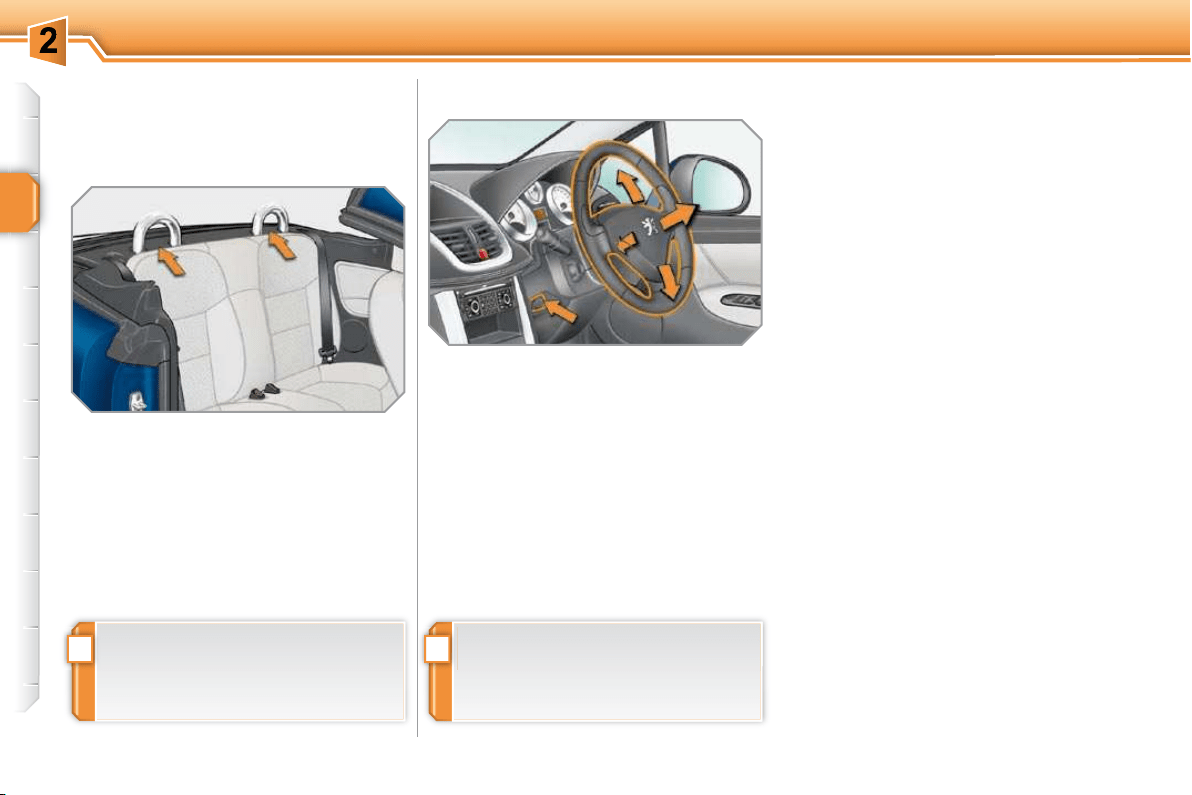
5. Head restraint height adjustment
To raise the head restraint, pull it up-
wards.
To remove the head restraint, press
the lug A and pull the head restraint
upwards.
To put the head restraint back in po-
sition, locate the stems of the head
restraint in the holes, taking care to
keep them in line with the seat back.
To lower the head restraint, press
the lug A and the head restraint at
the same time.
The head restraint has a frame with
a notch which prevents the head
restraint from lowering; this is a
safety device which provides pro-
tection in the event of an impact.
The adjustment is correct when
the upper edge of the head re-
straint is level with the top of the
head.
Never drive with the head restraints
removed; they must be in place and
correctly adjusted.
! !
COMFORT
52
REAR SEATS
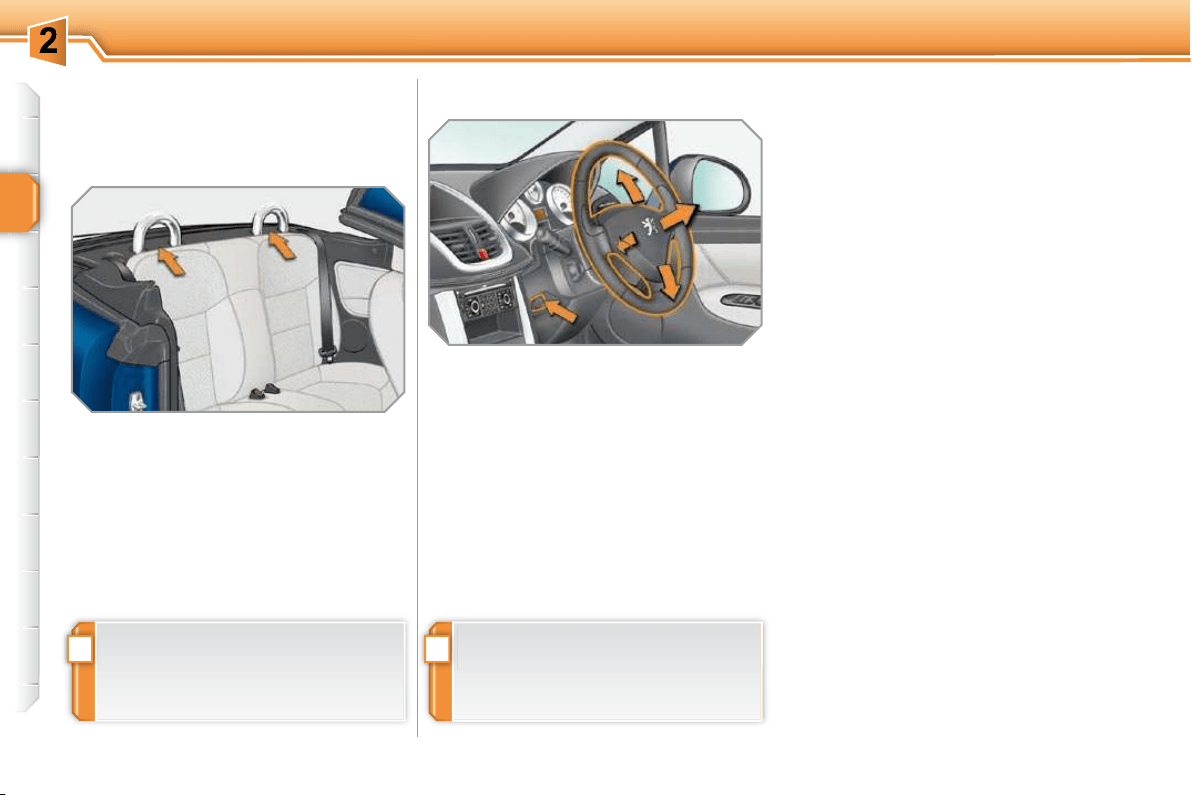
Fixed two-seat bench fi tted with roll-
over bars to ensure your protection
should the vehicle roll over.
Following an accident, have
the roll-over bars checked by a
PEUGEOT dealer.
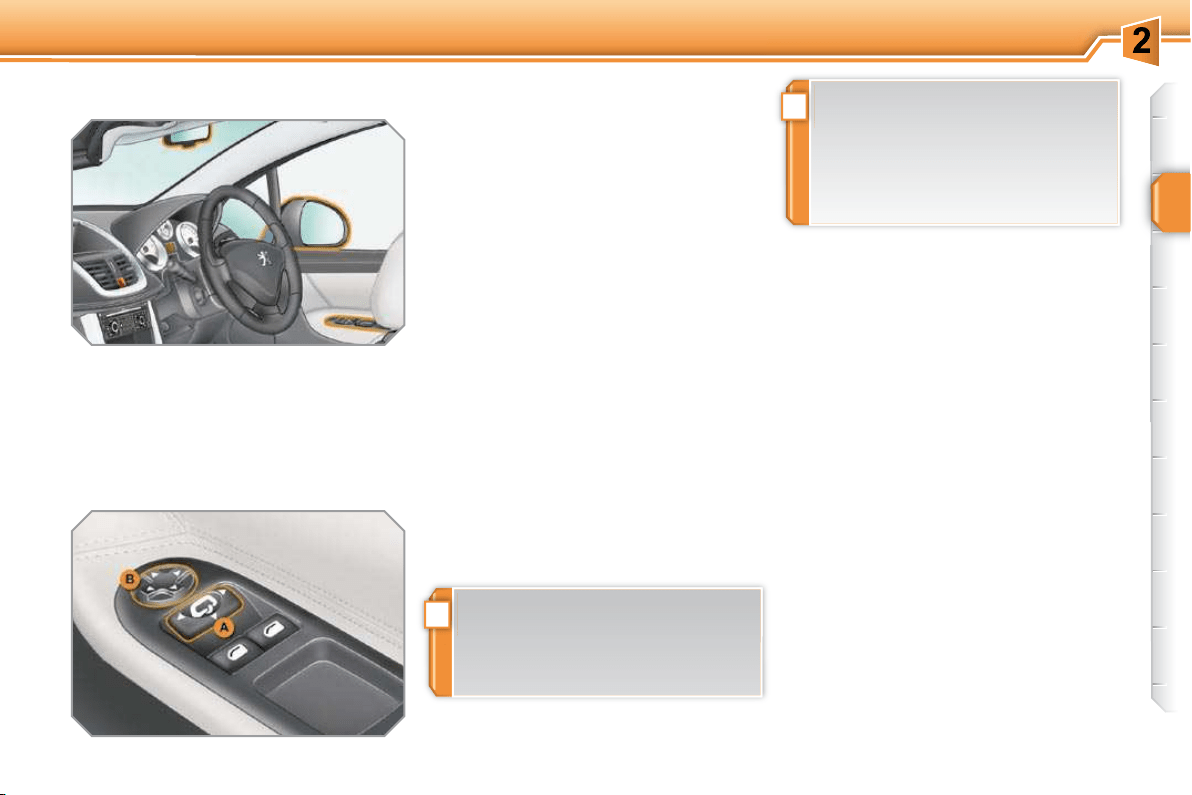
STEERING WHEEL ADJUSTMENT
When stationary , pull the control
lever to release the steering wheel.
Adjust the height and reach to suit
your driving position.
Push the control lever to lock the
steering wheel.
As a safety precaution, these op-
erations should only be carried out
while the vehicle is stationary.
! !
COMFORT
52
REAR SEATS
Fixed two-seat bench fi tted with roll-
over bars to ensure your protection
should the vehicle roll over.
Following an accident, have
the roll-over bars checked by a
PEUGEOT dealer.
STEERING WHEEL ADJUSTMENT
When stationary , pull the control
lever to release the steering wheel.
Adjust the height and reach to suit
your driving position.
Push the control lever to lock the
steering wheel.
As a safety precaution, these op-
erations should only be carried out
while the vehicle is stationary.
i
!
COMFORT
53
MIRRORS
Door mirrors
Adjustable mirror permitting the lateral
rearward vision necessary when over-
taking or parking.
Adjustment
Slide switch A to the right or to the
left to select the corresponding mirror.
Move knob B in all four directions to
adjust.
Return switch A to the centre position.
The folding and unfolding of the
door mirrors can be deactivated by
a PEUGEOT dealer.
Folding
From outside: lock the vehicle using
the remote control or the key.
From inside: with the ignition on, pull
switch A rearwards.
Unfolding
From outside: unlock the vehicle using
the remote control or the key.
From inside: with the ignition on, pull
switch A rearwards.
The objects observed are, in real-
ity, closer than they appear.
Take this into account to correctly
judge the distance of vehicles ap-
proaching from behind.
!
i
COMFORT
54
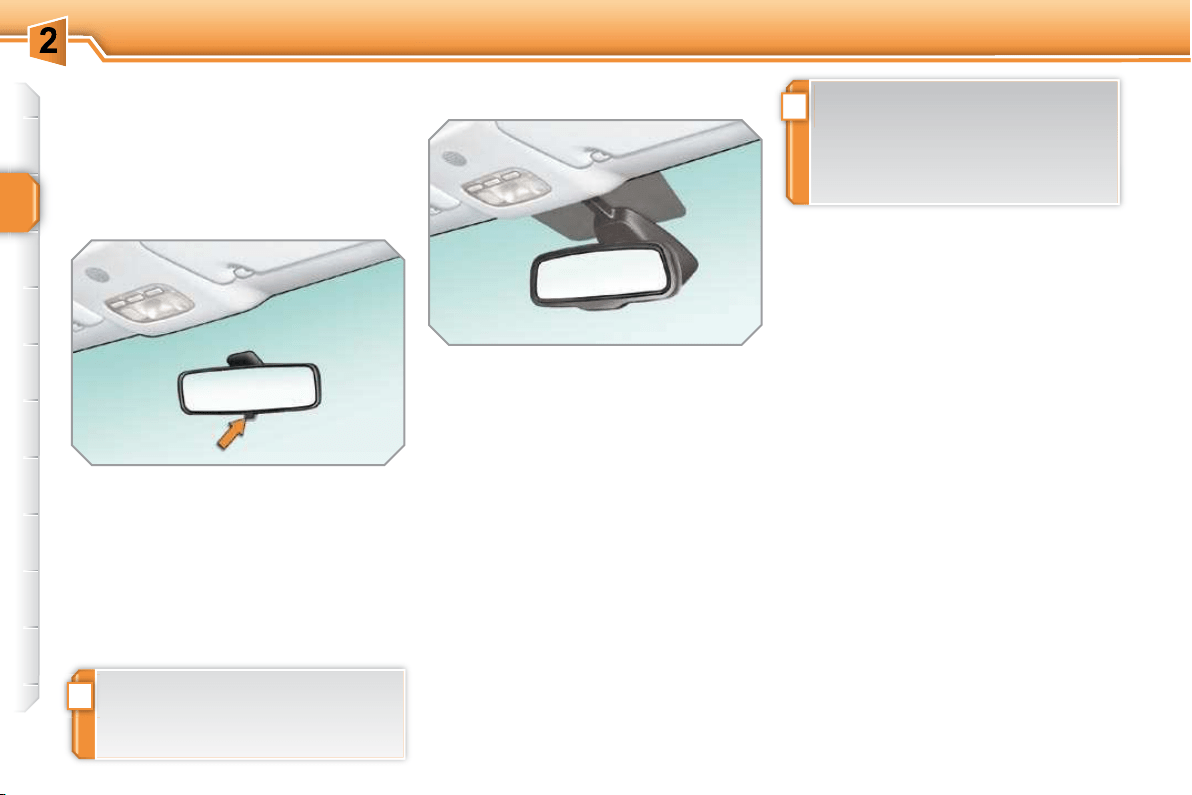
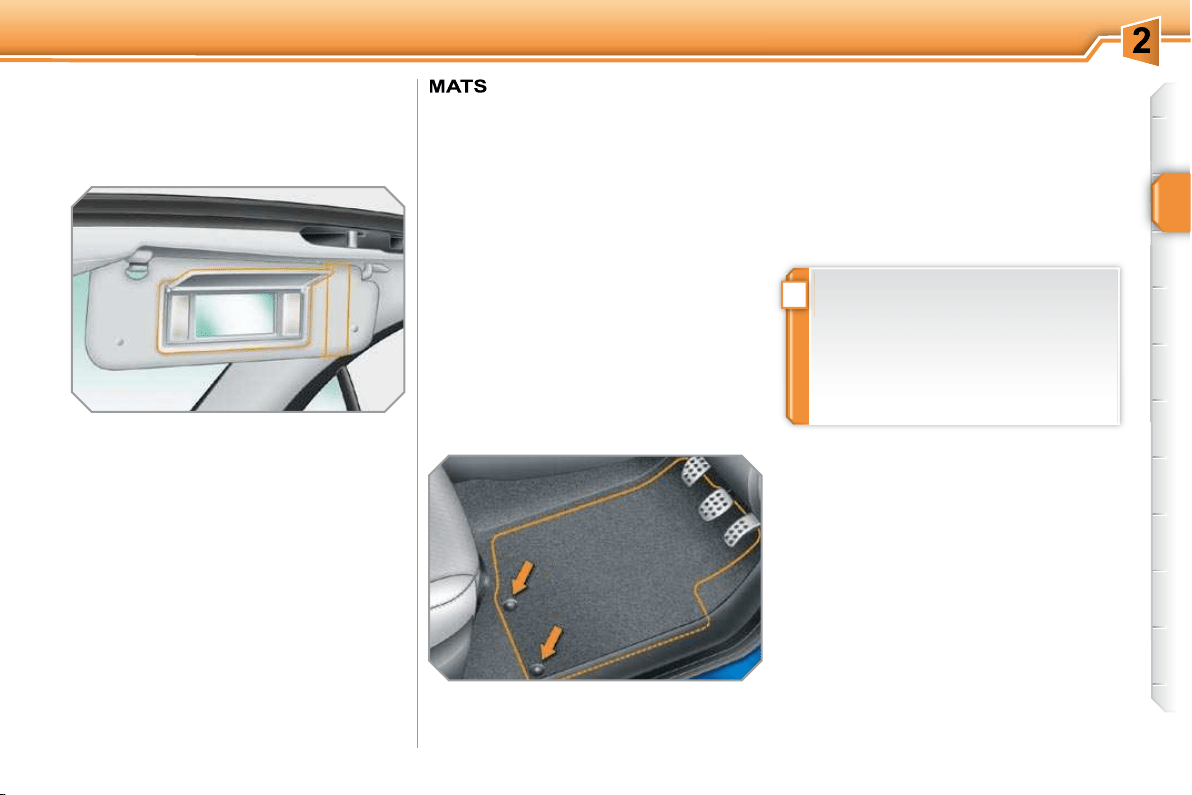
Rear view mirror
Adjustable mirror providing a central
rearward view.
Equipped with an anti-dazzle system,
useful in poor light.
Adjustment
Adjust the mirror so that the glass is
directed correctly in the "day" position.
As a safety precaution, the mirrors
must be adjusted to reduce the
"blind spot".
In order to guarantee optimum vis-
ibility during your manoeuvres, the
mirror lightens automatically when
reverse gear is engaged.
Automatic day/night model
Manual day/night model
Day/night position
Pull the lever to change to the "night"
anti-dazzle position.
Push the lever to change to the nor-
mal "day" position.
By means of a sensor, which measures
the light from the rear of the vehicle, this
system automatically and progressively
changes between the day and night
uses.
It has an anti-dazzle system which dark-
ens the mirror glass: this reduces any
driver discomfort caused by the light
beam of following vehicles, the sun...
!
COMFORT
55
SUN VISOR
Component which protects against sunlight
from the front or the side, also equipped
with an illuminated courtesy mirror.
With the ignition on, raise the conceal-
ing fl ap; the mirror is lit automatically.
This sun visor is also equipped with a
ticket holder.
To avoid any risk of jamming of the
pedals:
- only use mats which are suited
to the fi xings already present in
the vehicle; it is imperative that
these are used,
- never fi t one mat on top of an-
other.
Removable carpet protection.
Refitting
To refi t the mat on the driver's side:
position the mat correctly,
refi t the fi xings by pressing,
check that the mat is secured correctly.
Fitting
When fi tting the mat for the fi rst time,
on the driver's side use only the fi xings
provided in the wallet attached.
The other mats are simply placed on
the carpet.
Removal
To remove the mat on the driver's side:
move the seat as far back as possible,
unclip the fi xings,
remove the mat.
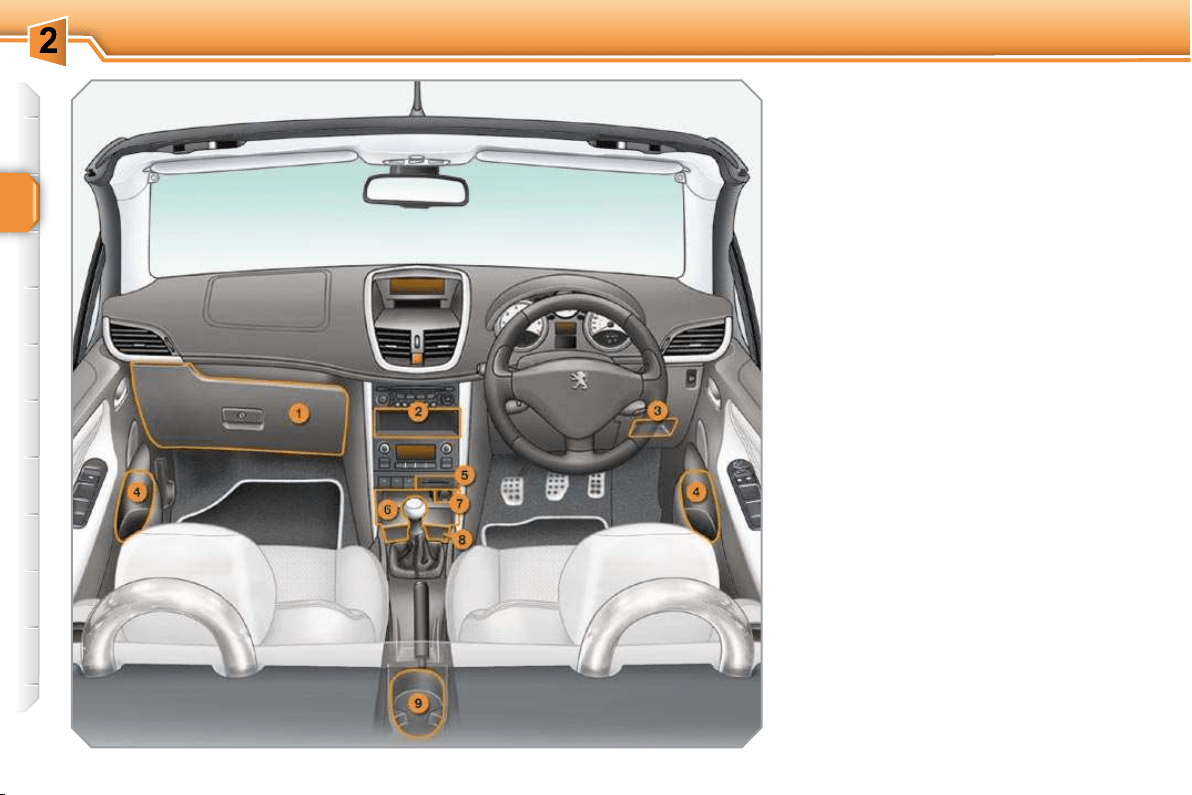
COMFORT
56
INTERIOR FITTINGS
1. Illuminated glove box
(see details on following page)
2. Storage compartment with
non-slip mat
3. Storage compartment
4. Door tray
5. Card /ticket holder
6. Storage compartment with
non-slip mat
7. USB port
(see details on following page)
8. 12 V accessories socket
(see details on following page)
9. Cup holder
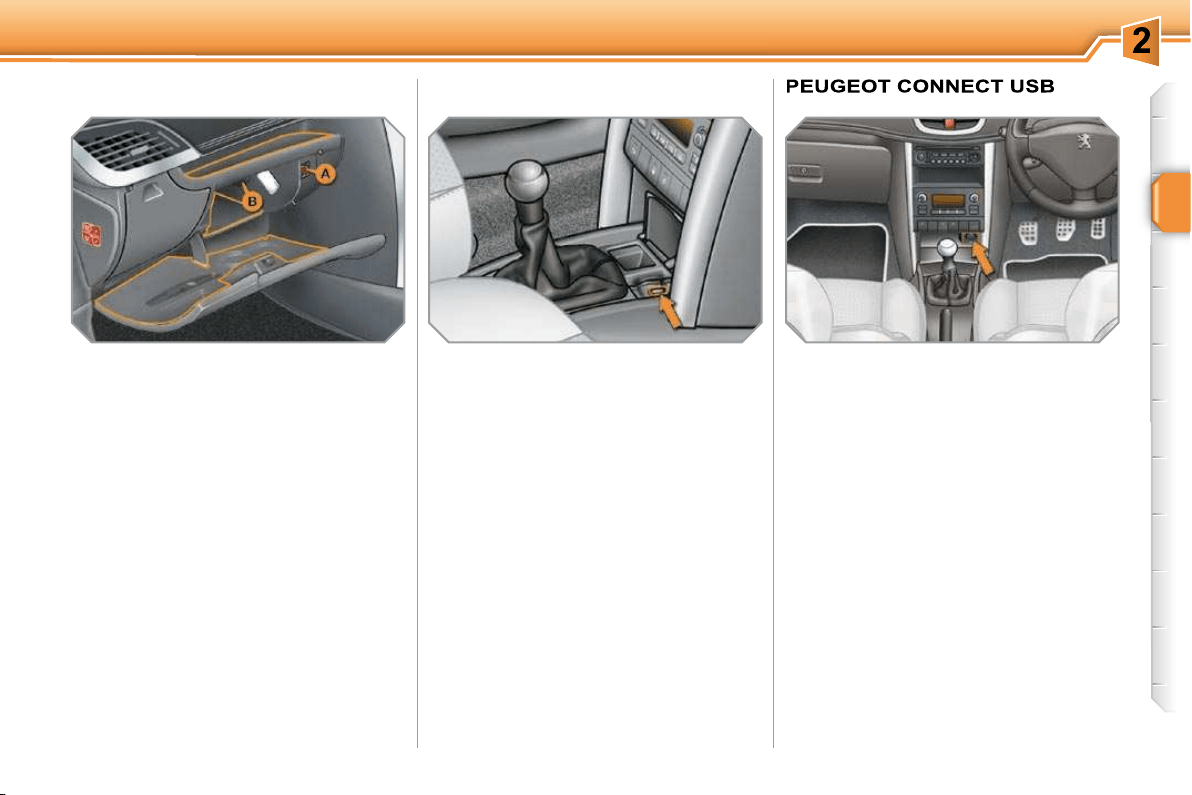
COMFORT
57
Illuminated glove box
This has an upper open storage compart-
ment and locations for storing a small bottle
of water, the vehicle’s handbook, ...
Its lid has locations for storing a pen, to-
kens, cards, cans, ...
It is fi tted with a lock.
To open the glove box, raise the
handle.
It is illuminated when the lid is opened.
It houses the front passenger airbag de-
activation switch A .
If the vehicle is fi tted with air condi-
tioning, it provides access to the ven-
tilation nozzle B , which can be opened
or closed, distributing the same condi-
tioned air as the vents in the passenger
compartment.
It also provides access to the dashboard
fusebox (refer to the section "Practical
information - § Changing a fuse").
12 V accessories socket
To connect a 12 V accessory (max
power: 120 Watts), lift the cover and
connect a suitable adaptor.
This connection box, consisting of an
auxiliary JACK socket and a USB port,
is located on the centre console.
It permits the connection of portable
equipment, such as a digital audio player
of the iPod
®
or USB memory stick type.
It reads the audio fi le formats (mp3,
ogg, wma, wav...) which are transmitted
to your audio equipment and played via
the vehicle's speakers.
You can manage these fi les using the
steering wheel controls or the audio
equipment control panel and display
them on the multifunction screen.
When it is in use, the portable equip-
ment charges automatically.
For more information on the use of
this equipment, refer to the Peugeot
Connect Sound part of the "Audio and
Telematics" section.
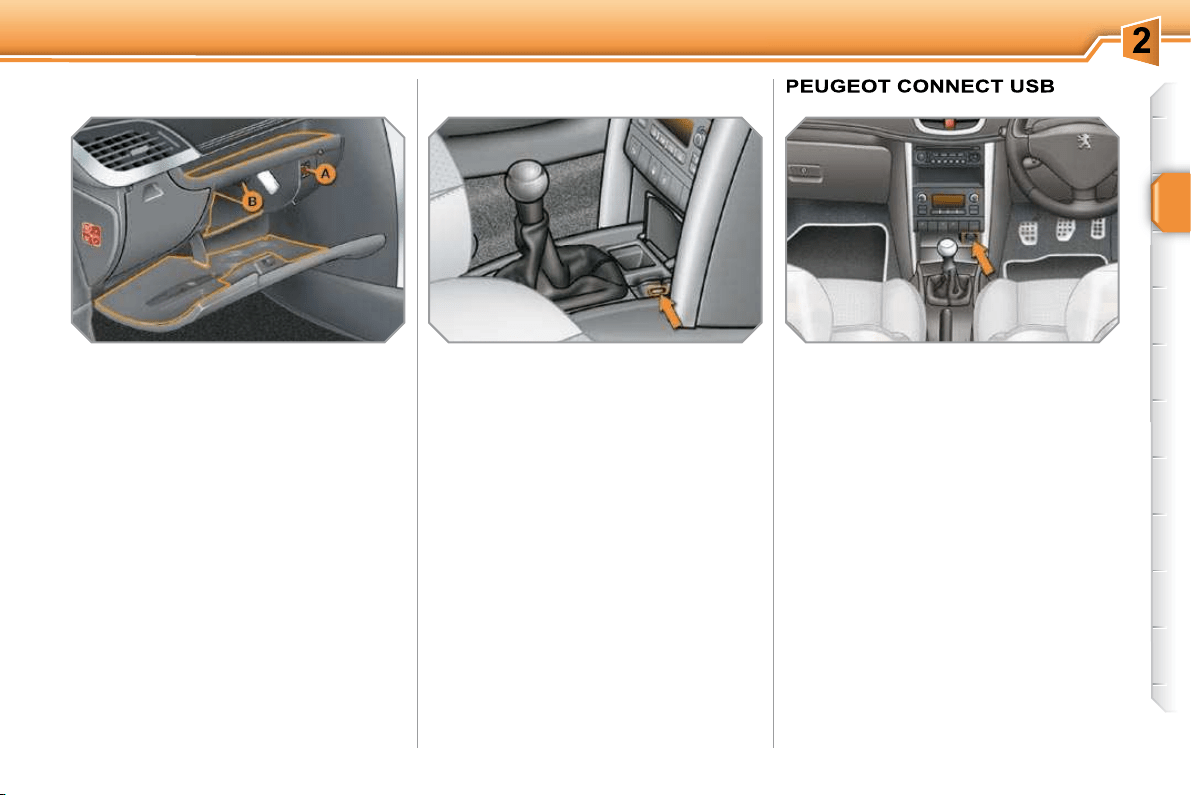
COMFORT
57
Illuminated glove box
This has an upper open storage compart-
ment and locations for storing a small bottle
of water, the vehicle’s handbook, ...
Its lid has locations for storing a pen, to-
kens, cards, cans, ...
It is fi tted with a lock.
To open the glove box, raise the
handle.
It is illuminated when the lid is opened.
It houses the front passenger airbag de-
activation switch A .
If the vehicle is fi tted with air condi-
tioning, it provides access to the ven-
tilation nozzle B , which can be opened
or closed, distributing the same condi-
tioned air as the vents in the passenger
compartment.
It also provides access to the dashboard
fusebox (refer to the section "Practical
information - § Changing a fuse").
12 V accessories socket
To connect a 12 V accessory (max
power: 120 Watts), lift the cover and
connect a suitable adaptor.
This connection box, consisting of an
auxiliary JACK socket and a USB port,
is located on the centre console.
It permits the connection of portable
equipment, such as a digital audio player
of the iPod
®
or USB memory stick type.
It reads the audio fi le formats (mp3,
ogg, wma, wav...) which are transmitted
to your audio equipment and played via
the vehicle's speakers.
You can manage these fi les using the
steering wheel controls or the audio
equipment control panel and display
them on the multifunction screen.
When it is in use, the portable equip-
ment charges automatically.
For more information on the use of
this equipment, refer to the Peugeot
Connect Sound part of the "Audio and
Telematics" section.
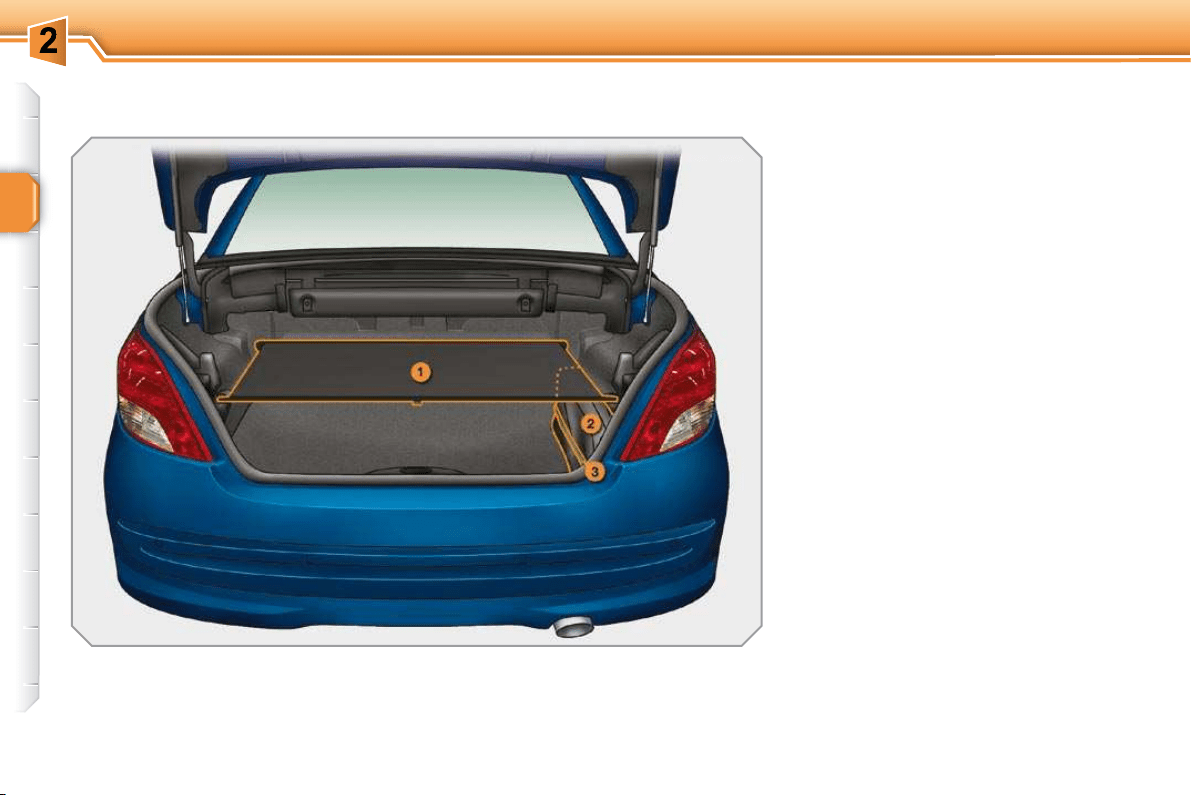
COMFORT
58
BOOT FITTINGS
1. Load space cover net
(see details on following page)
2. Windstop storage case
(see details on following page)
3. Luggage retaining strap

i
!
i
COMFORT
59
In the "cabriolet" confi guration, this de-
fi nes the luggage space in the boot.
Load space cover net
When it has been removed and folded,
the windstop should be stored in its pro-
tective case.
This case can be stored by means of a
strap on the right-hand side of the boot.
Windstop storage case
When the load space cover net is
in place, the following conditions
must be observed:
- the luggage must not raise the
cover net,
- luggage must not be placed on
top of the cover net.
The load space cover net must
always be in place before a roof
opening operation is started (refer
to the "Familiarisation - § Opening"
section).
For installation of the windstop, re-
fer to the following pages "Fitting/
removing the windstop".
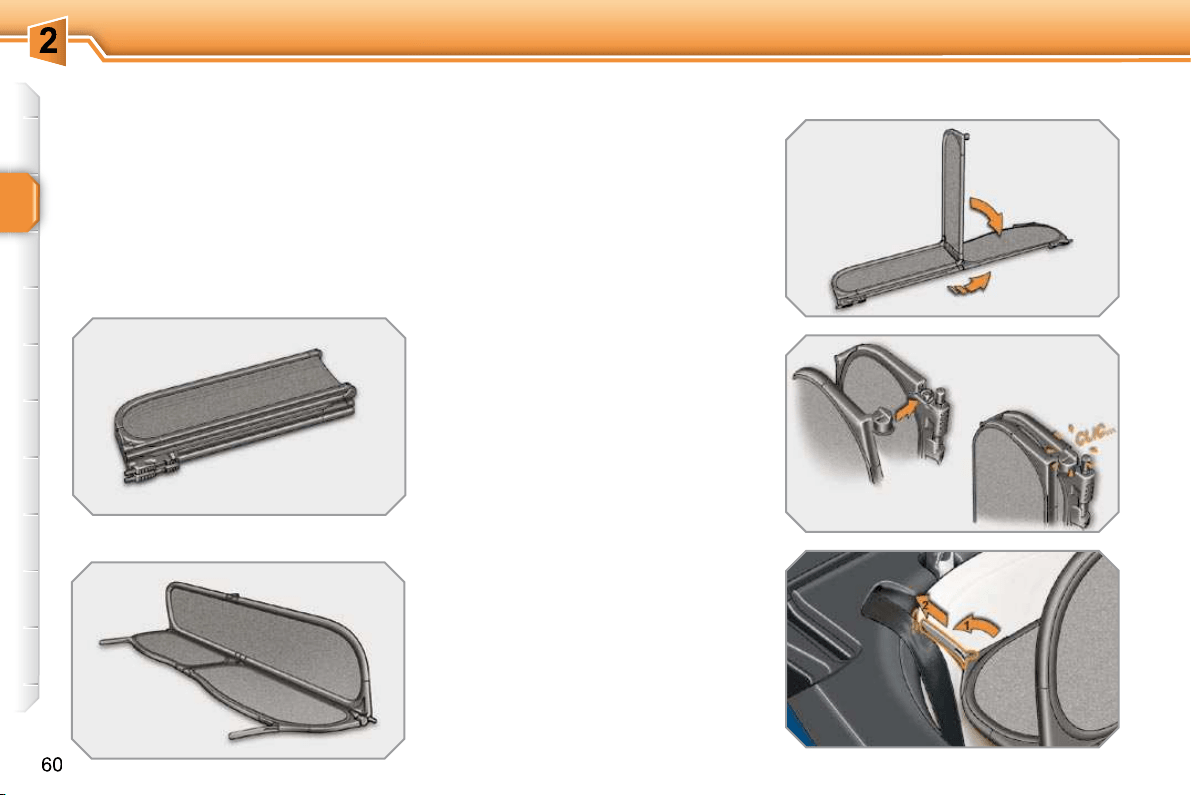
COMFORT
Windstop folded
FITTING/REMOVING THE
WINDSTOP
In the "cabriolet" confi guration, the
windstop improves comfort in the pas-
senger compartment.
The vertical part of the windstop can be
folded down to improve visibility when
reversing.
It is supplied folded in four in its protec-
tive case.
Windstop unfolded
Fitting
Clip the ends of the assembly until a
click is heard.
Unfold the windstop by opening
the two parts to 90° until a click is
heard.
Unfold the windstop frame guides.
Engage the guides in the points lo-
cated behind the rear seat belts.
Unfold each of the two parts fully.
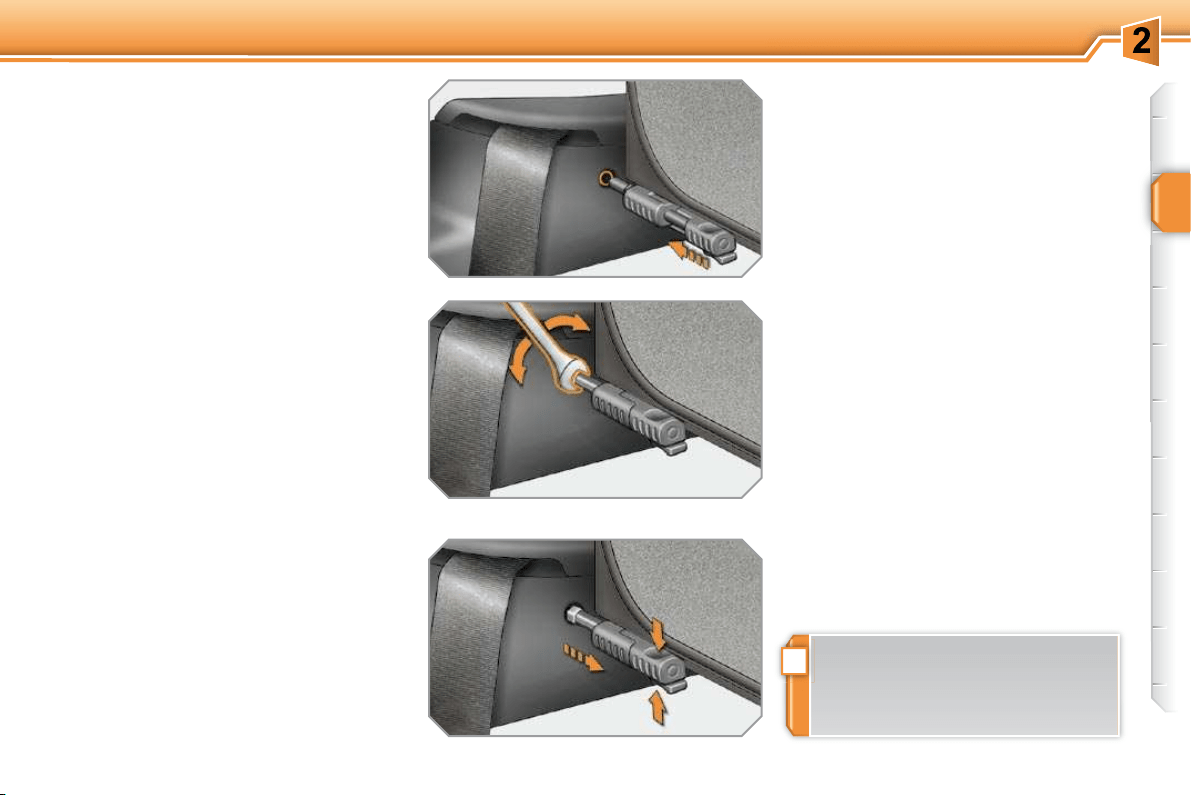
i
COMFORT
61
Engage the shafts of the windstop
frame in the openings in the rear
side trim.
When installing the windstop for the fi rst
time:
position a 10 mm open-ended span-
ner on the hexagonal part of the
shaft,
tighten or slacken without forcing on
each side to adjust the depth setting.
Lastly, always check that the windstop
is retained securely before using it in
the "cabriolet" confi guration.
Removal
Press and pull on the shaft supports to
release the shafts from the openings in
the rear side trim.
It is not necessary to remove the
windstop when changing to the
"coupé" confi guration.
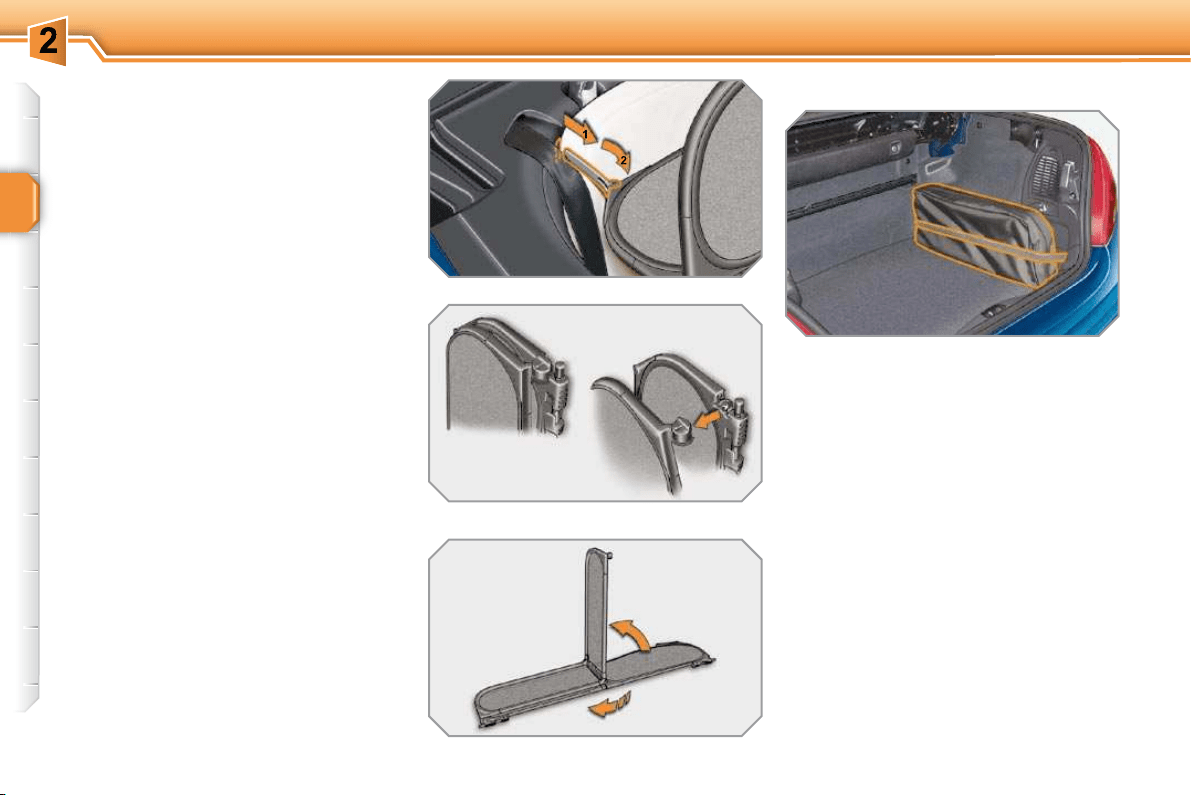
COMFORT
62
Pull the windstop forwards to release
the guides from the points located be-
hind the rear seat belts.
Fold the windstop frame guides.
Fold the windstop closing the two
large parts on themselves.
Unclip each end individually.
Fold each of the two parts on them-
selves.
Storing
Store the windstop folded in its pro-
tective case.
Use the strap intended to secure the
case on the right-hand side of the boot
(refer to the "Boot fi ttings" section).
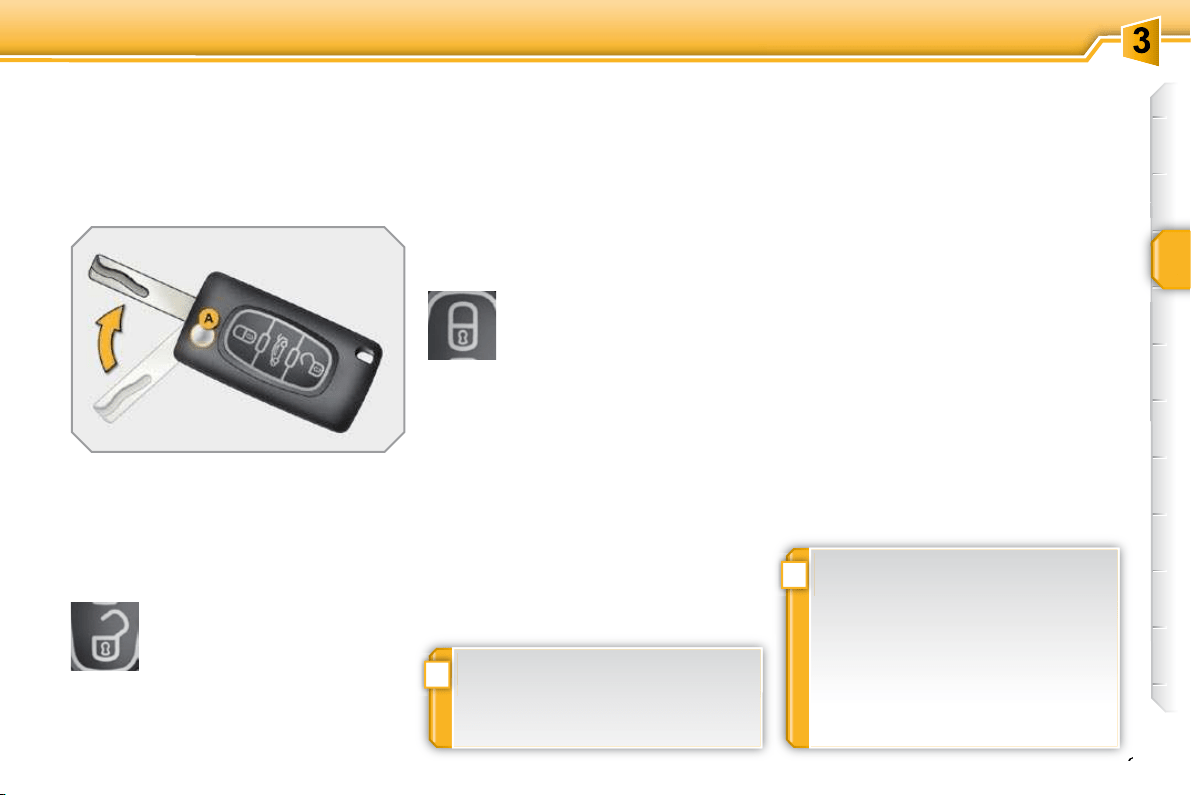
!
i
ACCESS
63
Deadlocking renders the exterior and
interior door controls inoperative.
It also deactivates the manual cen-
tralised control button.
Therefore, do not leave anyone
inside the vehicle when it is dead-
locked.
If one of the doors or the boot is still
open, the central locking does not
take place.
REMOTE CONTROL KEY
System which permits central unlocking
or locking of the vehicle using the lock
or remotely. It also locates and starts
the vehicle, as well as providing protec-
tion against theft.
Unfolding the key
First press button A to unfold the
key.
Unlocking the vehicle
Unlocking is confi rmed by rapid fl ashing
of the direction indicators for approxi-
mately two seconds.
According to version, the door mirrors
unfold at the same time.
Locking the vehicle
Deadlocking using the remote
control
Press the closed padlock to lock the
vehicle.
Press the closed padlock again
within fi ve seconds to deadlock the
vehicle.
Press the open padlock to
unlock the vehicle.
Unlocking using the key
Turn the key to the left in the driver's
door lock to unlock the vehicle.
Press the closed padlock
to lock the vehicle.
Normal locking using the key
Turn the key to the right in the driv-
er's door lock to lock the vehicle.
Locking is confi rmed by fi xed lighting of
the direction indicators for approximate-
ly two seconds.
According to version, the door mirrors
fold at the same time.
Unlocking using the remote control
Deadlocking using the key
Turn the key to the right in the driv-
er's door lock to lock the vehicle.
Turn the key to the right again within
fi ve seconds to deadlock the vehicle.
Deadlocking is confi rmed by fi xed
lighting of the direction indicators for
approximately two seconds.
According to version, the door mirrors
fold at the same time.
Normal locking using the remote
control
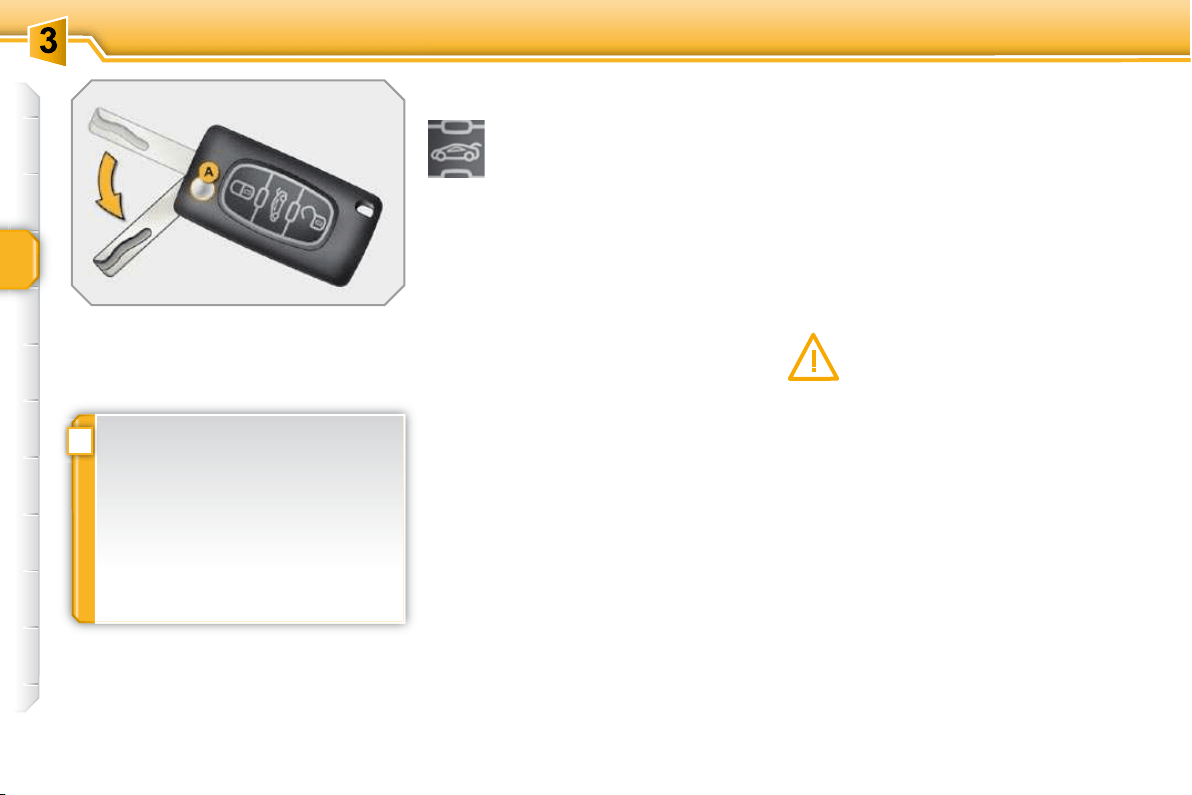
i
ACCESS
64
The vehicle will relock automati-
cally after thirty seconds unless
a door is opened. This system
prevents unintentional unlocking.
The folding and unfolding of the
door mirrors can be deactivated by
a PEUGEOT dealer.
Folding the key
First press button A to fold the key.
Locating your vehicle
Press the closed padlock to locate
your locked vehicle in a car park.
This is indicated by lighting of the cour-
tesy lamp and fl ashing of the direction
indicators for a few seconds.
Electronic engine immobiliser
The key contains an electronic chip
which has a special code. When the
ignition is switched on, this code must
be recognised in order for starting to be
possible.
This electronic engine immobiliser locks
the engine management system a few
minutes after the ignition is switched off
and prevents starting of the engine by
anyone who does not have the key.
Anti-theft protection
In the event of a malfunction,
you are informed by lighting of
this warning lamp, an audible
signal and a message on the
multifunction screen.
In this case, your vehicle does not start;
contact a PEUGEOT dealer as soon as
possible.
Press the boot unlocking but-
ton on the remote control for
more than 2 seconds. The
boot opens slightly.
Unlocking and partially opening
the boot
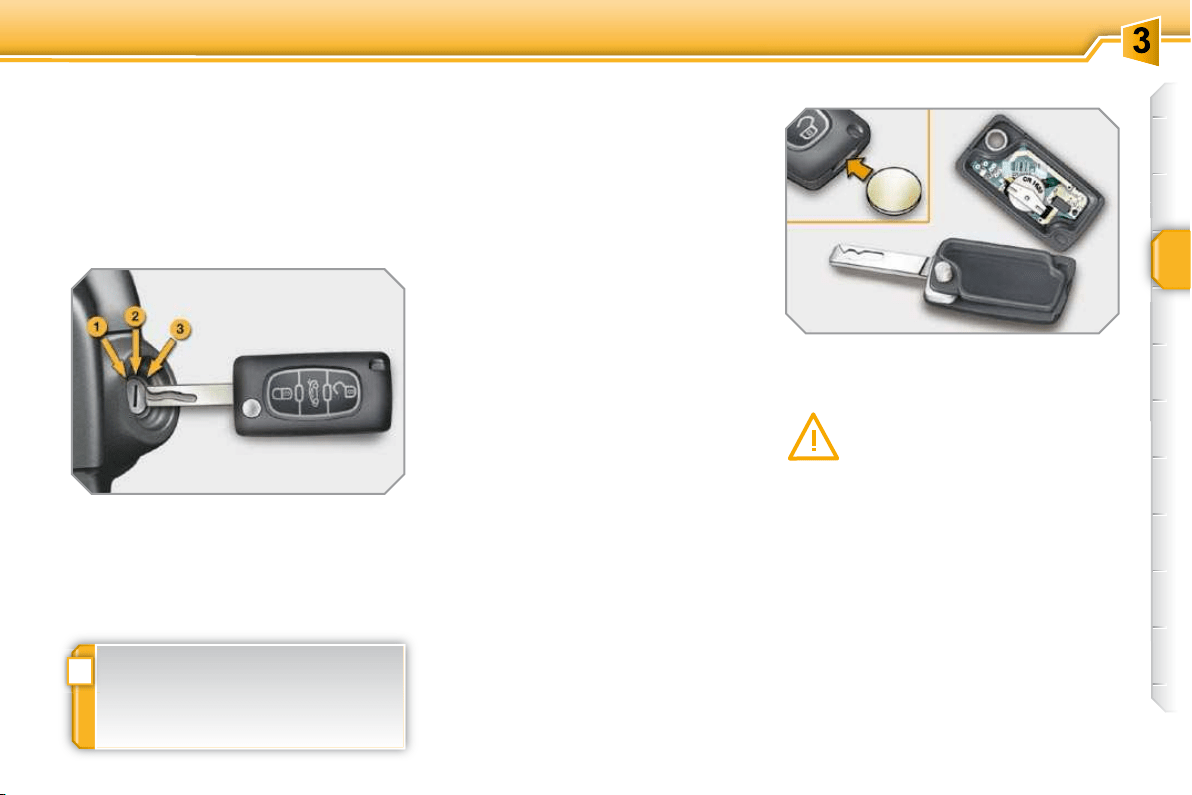
i
ACCESS
65
Starting the vehicle
Insert the key in the ignition switch.
The system recognises the starting
code.
Turn the key fully towards the dash-
board to position 3 (Starting) .
When the engine starts, release the
key.
Switching the vehicle off
Immobilise the vehicle.
Turn the key fully towards you to po-
sition 1 (Stop) .
Remove the key from the ignition
switch.
Remote control problem
Following disconnection of the vehicle
battery, replacement of the remote con-
trol battery or in the event of a remote
control malfunction, you can no longer
unlock, lock or locate your vehicle.
First of all, use the key in the lock to
unlock or lock your vehicle.
Then, reinitialise the remote control.
If the problem persists, contact a
PEUGEOT dealer as soon as possible.
Changing the battery
Battery ref.: CR1620/3 volts.
Reinitialisation
Switch off the ignition.
Turn the key to position 2 (Ignition) .
Press the closed padlock immedi-
ately for a few seconds.
Switch off the ignition and remove
the key from the ignition switch.
The remote control is fully operational
again.
Unclip the casing using a coin at the
notch.
Slide the fl at battery out of its location.
Slide the new battery into its loca-
tion observing the original direction.
Clip the casing.
Reinitialise the remote control.
This replacement battery is available
from PEUGEOT dealers.
If the battery is fl at, you are in-
formed by lighting of this warning
lamp, an audible signal and a mes-
sage on the multifunction screen.
Key in ignition
If the key has been left in the igni-
tion, an audible signal is heard on
opening the driver's door.
!
ACCESS
66
Lost keys
Visit a PEUGEOT dealer with the vehicle's V5 registration document and your
personal identifi cation documents.
The PEUGEOT dealer will be able to retrieve the key code and the transponder
code required to order a replacement key.
Do not throw the remote control bat-
teries away, they contain metals which
are harmful to the environment.
Take them to an approved collection
point.
Remote control
The high frequency remote control is a sensitive system; do not operate it
while it is in your pocket as there is a possibility that it may unlock the vehicle,
without you being aware of it.
Do not repeatedly press the buttons of your remote control out of range and
out of sight of your vehicle. You run the risk of stopping it from working and the
remote control would have to be reinitialised.
The remote control does not operate when the key is in the ignition, even
when the ignition is switched off, except for reinitialisation.
Locking the vehicle
Driving with the doors locked may make access to the passenger compart-
ment by the emergency services more diffi cult in an emergency.
As a safety precaution (with children on board), remove the key from the ignition
when you leave the vehicle, even for a short time.
Anti-theft protection
Do not make any modifi cations to the electronic engine immobiliser system;
this could cause malfunctions.
When purchasing a second-hand vehicle
Have the key codes memorised by a PEUGEOT dealer, to ensure that the
keys in your possession are the only ones which can start the vehicle.
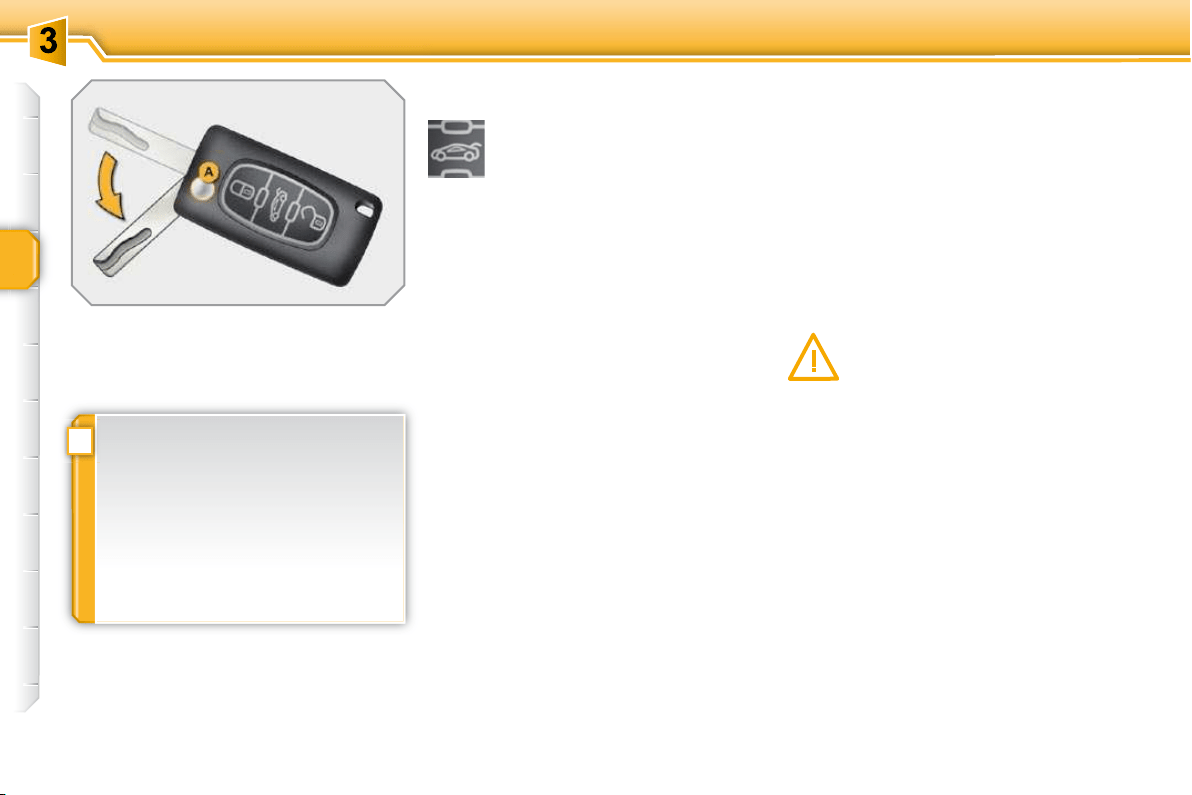
i
ACCESS
64
The vehicle will relock automati-
cally after thirty seconds unless
a door is opened. This system
prevents unintentional unlocking.
The folding and unfolding of the
door mirrors can be deactivated by
a PEUGEOT dealer.
Folding the key
First press button A to fold the key.
Locating your vehicle
Press the closed padlock to locate
your locked vehicle in a car park.
This is indicated by lighting of the cour-
tesy lamp and fl ashing of the direction
indicators for a few seconds.
Electronic engine immobiliser
The key contains an electronic chip
which has a special code. When the
ignition is switched on, this code must
be recognised in order for starting to be
possible.
This electronic engine immobiliser locks
the engine management system a few
minutes after the ignition is switched off
and prevents starting of the engine by
anyone who does not have the key.
Anti-theft protection
In the event of a malfunction,
you are informed by lighting of
this warning lamp, an audible
signal and a message on the
multifunction screen.
In this case, your vehicle does not start;
contact a PEUGEOT dealer as soon as
possible.
Press the boot unlocking but-
ton on the remote control for
more than 2 seconds. The
boot opens slightly.
Unlocking and partially opening
the boot
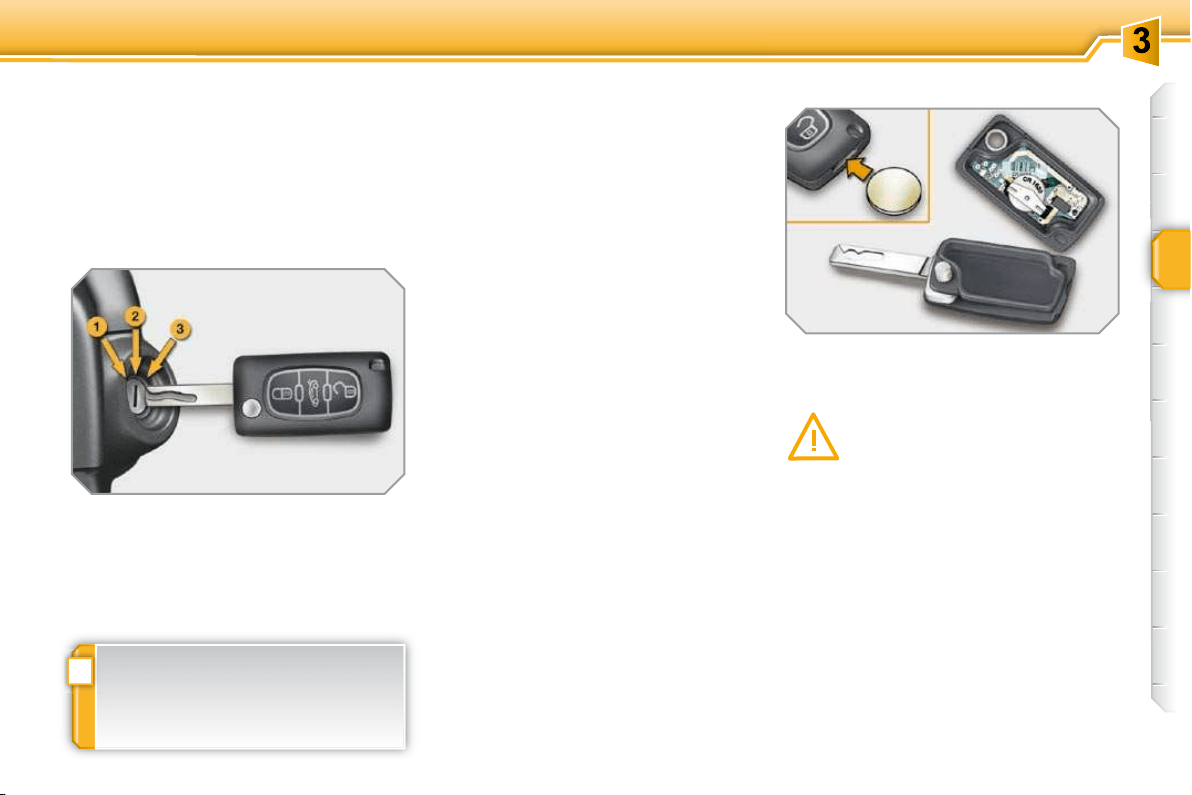
i
ACCESS
65
Starting the vehicle
Insert the key in the ignition switch.
The system recognises the starting
code.
Turn the key fully towards the dash-
board to position 3 (Starting) .
When the engine starts, release the
key.
Switching the vehicle off
Immobilise the vehicle.
Turn the key fully towards you to po-
sition 1 (Stop) .
Remove the key from the ignition
switch.
Remote control problem
Following disconnection of the vehicle
battery, replacement of the remote con-
trol battery or in the event of a remote
control malfunction, you can no longer
unlock, lock or locate your vehicle.
First of all, use the key in the lock to
unlock or lock your vehicle.
Then, reinitialise the remote control.
If the problem persists, contact a
PEUGEOT dealer as soon as possible.
Changing the battery
Battery ref.: CR1620/3 volts.
Reinitialisation
Switch off the ignition.
Turn the key to position 2 (Ignition) .
Press the closed padlock immedi-
ately for a few seconds.
Switch off the ignition and remove
the key from the ignition switch.
The remote control is fully operational
again.
Unclip the casing using a coin at the
notch.
Slide the fl at battery out of its location.
Slide the new battery into its loca-
tion observing the original direction.
Clip the casing.
Reinitialise the remote control.
This replacement battery is available
from PEUGEOT dealers.
If the battery is fl at, you are in-
formed by lighting of this warning
lamp, an audible signal and a mes-
sage on the multifunction screen.
Key in ignition
If the key has been left in the igni-
tion, an audible signal is heard on
opening the driver's door.
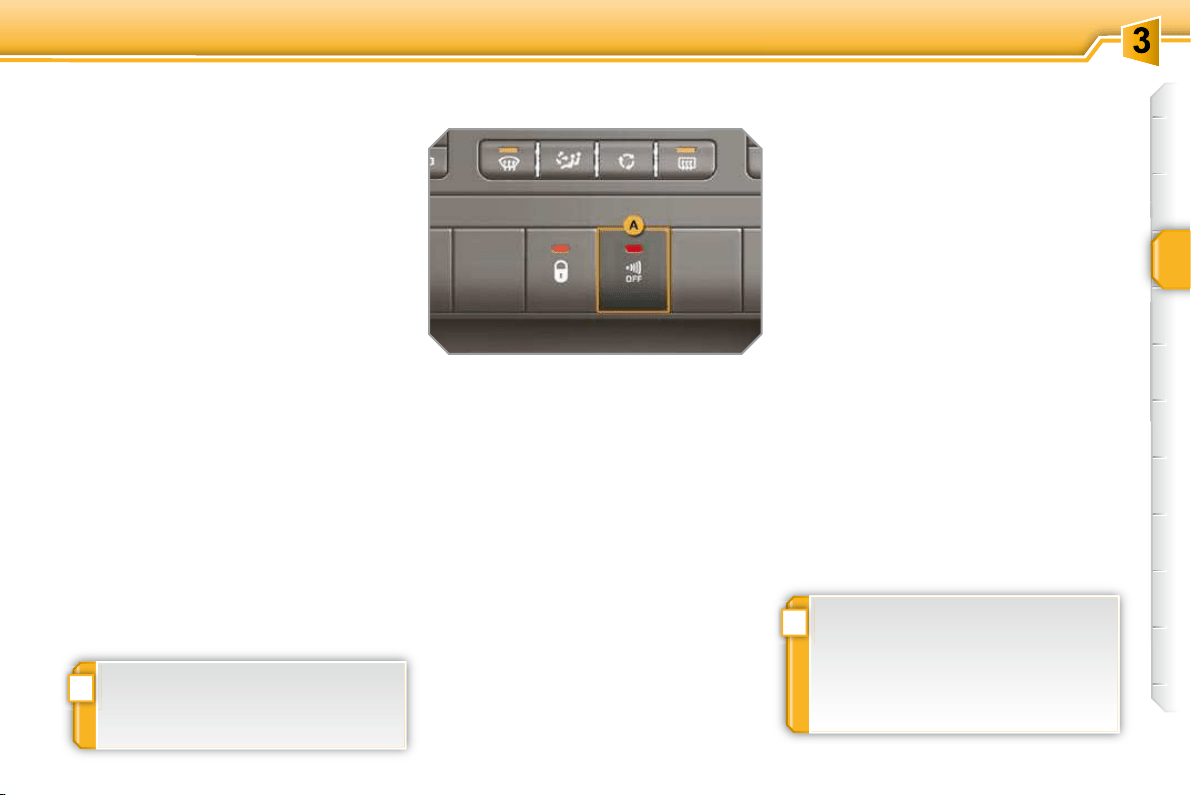
!
i
ACCESS
67
ALARM
System which protects and dissuades
against the theft of your vehicle. It pro-
vides two types of protection, exterior
and interior, as well as an anti-tamper
function.
Locking the vehicle with full
alarm
Do not make any modifi cations to
the alarm system, this could cause
malfunctions.
In order to be taken into account,
this deactivation must be car-
ried out each time the ignition is
switched off.
In the "cabriolet" confi guration, the
interior protection is deactivated
automatically.
Locking the vehicle with
perimiter protection only
Activation
Switch off the ignition and get out of
the vehicle.
Lock or deadlock the vehicle using
the locking button on the remote
control.
The alarm is activate; the indicator lamp
on button A fl ashes once per second.
The perimiter protection is activated
5 seconds after pressing the locking
button on the remote control.
The volumetric protection is activated
45 seconds after pressing the locking
button on the remote control.
If a door or the boot is open or not proper-
ly closed, the vehicle is not locked, but
the perimiter protection will be activated
after 45 seconds at the same time as
the volumetric protection.
Exterior perimeter protection
The system detects opening of the
vehicle.
The alarm is triggered if anyone tries to
enter the vehicle by forcing a door, the
boot or the bonnet.
Interior volumetric protection
The system detects any variation in the
volume in the passenger compartment.
The alarm is triggered if anyone breaks
a window or moves inside the vehicle.
If you wish to leave a pet in the vehicle
or a window partially open, deactivate
the interior protection.
Anti-tamper function
The system detects the putting out of
service of its components.
The alarm is triggered if anyone tries
to put the wires of the siren, the central
control or the battery out of service.
Deactivation
Unlock the vehicle using the unlock-
ing button on the remote control.
The alarm is deactivated; the indicator
lamp on button A switches off.
Deactivation of the interior
volumetric protection
Switch off the ignition.
Within ten seconds, press button A
until the indicator lamp is lit continu-
ously.
Get out of the vehicle.
Quickly lock or deadlock the vehicle
using the locking button on the re-
mote control.
The exterior perimeter protection alone
remains activated; the indicator lamp on
button A fl ashes once per second.
!
ACCESS
68
Triggering of the alarm
This is indicated by sounding of the siren
and fl ashing of the direction indicators for
approximately thirty seconds.
After it has been triggered, protection is
again operational.
If the alarm is triggered ten times in
succession, the eleventh time will
result in it becoming inactive.
If the indicator lamp on button A
fl ashes rapidly, this indicates that
the alarm was triggered during
your absence. When the ignition is
switched on, this fl ashing stops im-
mediately.
To avoid triggering the alarm when
washing your vehicle, lock it using
the key in the driver's door lock.
Failure of the remote control
Unlock the vehicle using the key in
the driver's door lock.
Open the door; the alarm is triggered.
Switch on the ignition; the alarm stops.
* According to country.
Malfunction
When the ignition is switched on, light-
ing of the indicator lamp on button A for
ten seconds indicates a siren fault.
Have it checked by a PEUGEOT dealer.
Locking the vehicle without
activating the alarm
Lock or deadlock the vehicle using
the key in the driver's door lock.
Automatic operation *
Depending on the legislation in force in
your country, one of these cases may
occur:
- 45 seconds after the vehicle is
locked using the remote control, the
alarm is activated, regardless of the
status of the doors and boot.
- 2 minutes after the last door or the
boot is closed, the alarm is activated.
To avoid triggering the alarm on en-
tering the vehicle, fi rst press the un-
locking button on the remote control.
Reactivation of the interior
protection
Unlock the vehicle using the unlock-
ing button on the remote control.
Lock the vehicle again using the re-
mote control.
The alarm is activate again with both
types of protection; the indicator lamp
on button A fl ashes once per second.
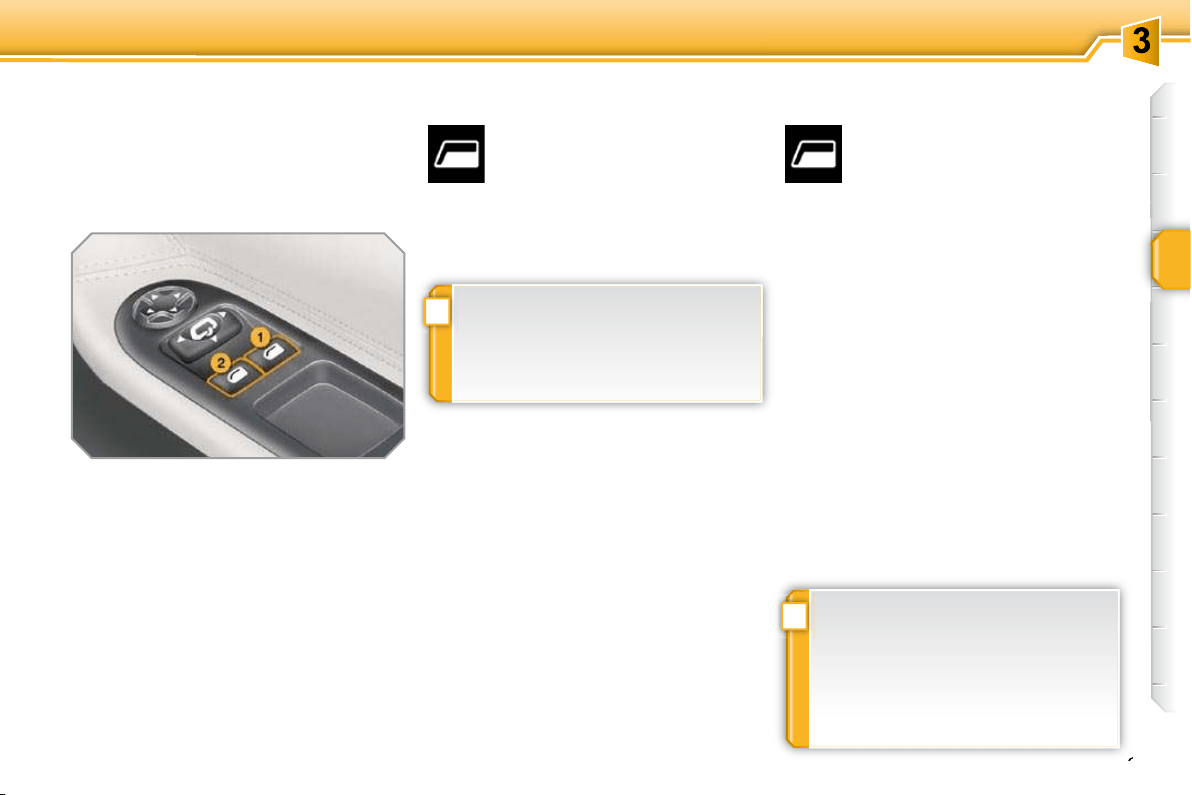
!
i
ACCESS
69
WINDOW CONTROLS
System which opens or closes a window
manually or automatically. It is fi tted with
a system which controls all four windows
on all models.
1. Driver's electric windows switch.
2.
Passenger's electric windows switch.
Each window switch controls, on its
own side, the front window and the rear
quarter light.
One-touch electric windows
You have two options:
The windows (except the driver’s
window) do not have an automatic
mode or safety anti-pinch function
for closing.
For your safety, the windows rise
in several stages; however, always
be vigilant.
The window control switches re-
main operational for approximate-
ly 45 seconds after the ignition
is switched off or until a door is
opened.
Press or pull switch 1 . The
window stops as soon as the
switch is released.
The rear quarter light only opens once the
front window has opened completely.
Electric windows
- manual mode
Press or pull switch 1 gently. The
window stops as soon as the switch
is released.
The rear quarter light only opens once the
front window has opened completely.
- automatic mode
Press switch 1 fully. The window
opens or closes completely when
the switch is released.
Pressing the switch again stops the
movement of the window.
If you continue to press the switch,
the rear quarter light will open or
close.
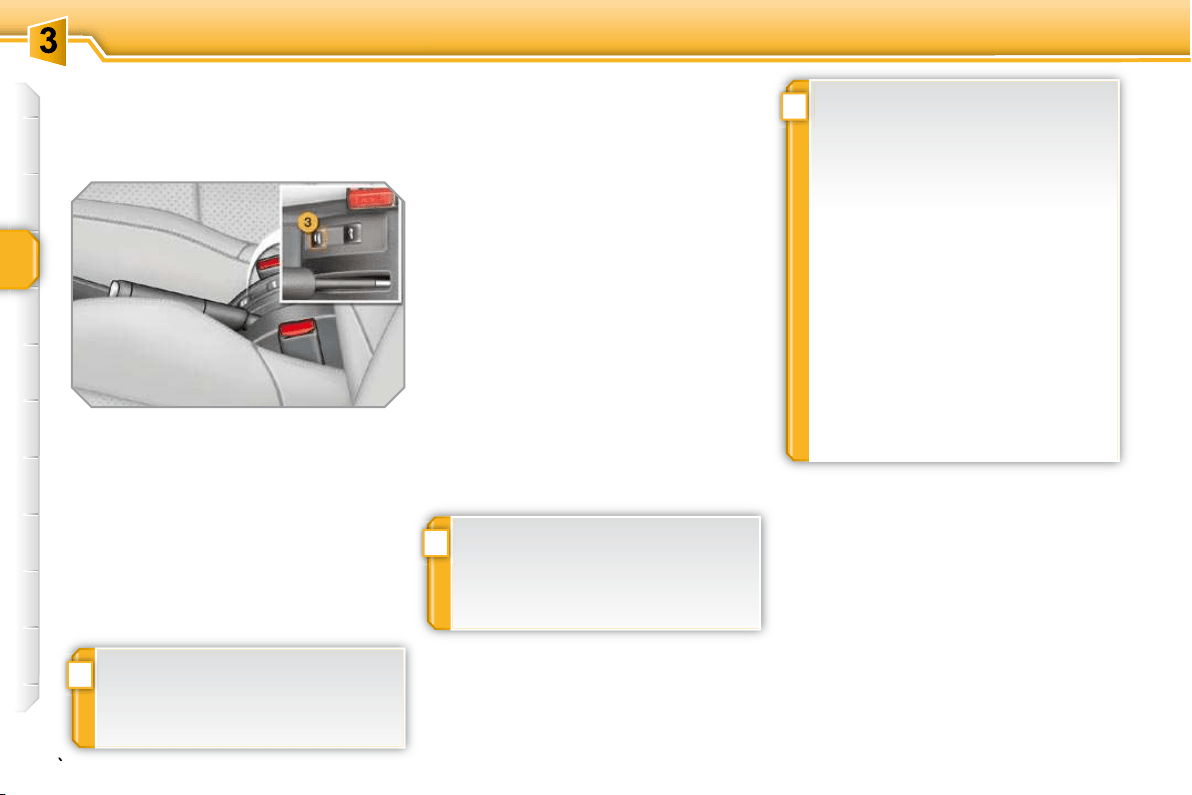
!
i
i
ACCESS
70
Switch for all four windows
This switch opens or closes all of the
windows.
Reinitialisation
Following reconnection of the battery or
in the event of a malfunction you must
reinitialise the operation of the electric
windows:
release the switch and pull it again
until it closes completely,
hold the switch for approximately
one second after closing,
press the switch to lower the win-
dow automatically,
when the window has reached the
low position, press the switch again
for approximately one second.
Always remove the key from the
ignition when leaving the vehicle,
even for a short time.
In the event of contact during
operation of the windows, you must
reverse the movement of the win-
dow. To do this, press the switch
concerned.
When the driver operates the pas-
senger electric window switches,
they must ensure that no one is
preventing correct closing of the
windows.
The driver must ensure that the
passengers use the electric win-
dows correctly.
Be aware of children when operating
the windows.
Press switch 3 and release it. The
windows open completely.
Pressing the switch again stops the
movement of the windows.
or
Pull switch 3 and hold it in this posi-
tion. The windows close completely.
If you release the switch before the
windows have closed completely,
the windows stop.
This switch is operated under the
full responsibility of the driver.
This procedure reinitialises the op-
eration of the electric windows and
the automatic partial opening of the
door windows
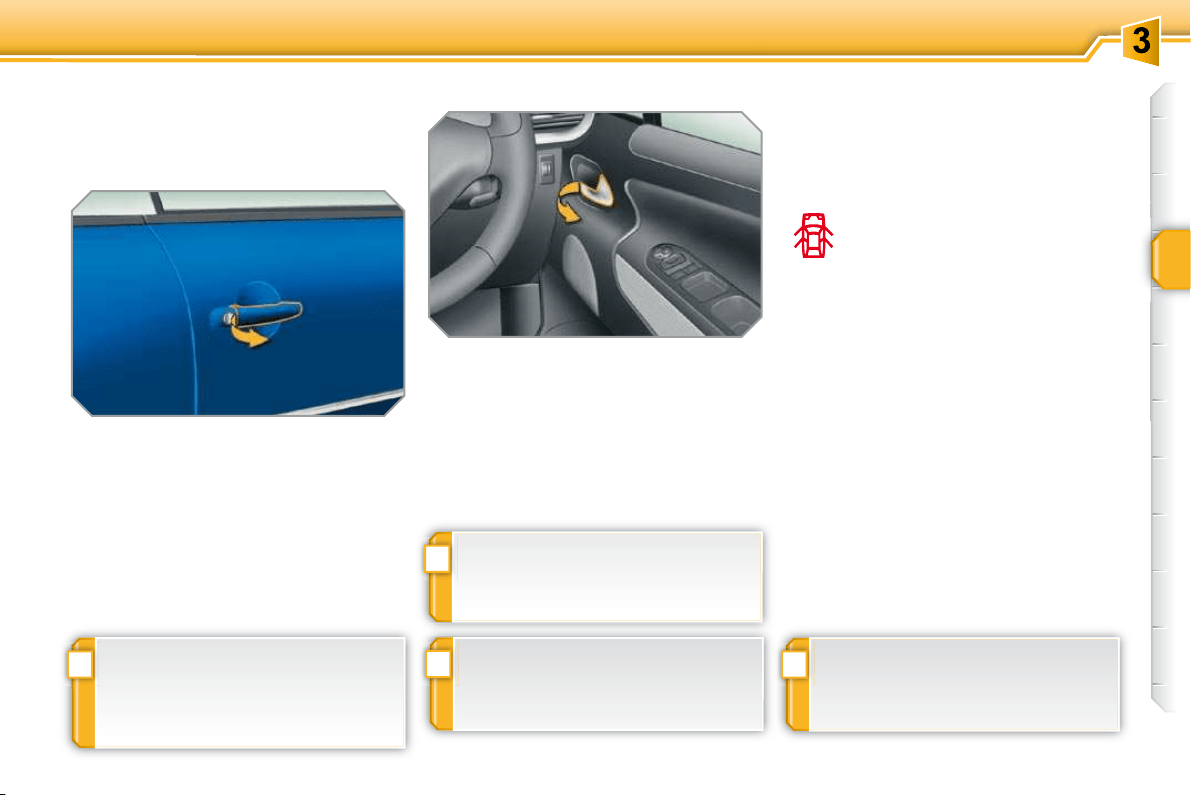
!
i
i
!
ACCESS
71
DOORS
After unlocking the vehicle using the
remote control or the key, pull the
door handle.
The window lowers automatically by
a few millimetres when the door is
opened.
From inside
Pull the door control to open the
door; this unlocks the doors only.
The window lowers automatically by
a few millimetres when the door is
opened.
The interior door controls do not
operate when the vehicle is dead-
locked.
Closing
The window rises automatically after a
few seconds and adjusts to ensure per-
fect sealing on closing.
If a door is not closed correctly:
- when the engine is running ,
this warning lamp comes on,
accompanied by a message
on the multifunction screen
for a few seconds,
- when the vehicle is moving (speed
above 6 mph (10 km/h)), this warn-
ing lamp comes on, accompanied
by an audible signal and a message
on the multifunction screen for a few
seconds.
If you leave the door open for more
than one minute, the window rises
again.
Pull the handle again to reactivate
the system.
The boot does not unlock at the
same time as the doors (refer to
the "Boot" section).
When washing your vehicle, avoid
spraying the upper part of the windows.
Opening
From outside
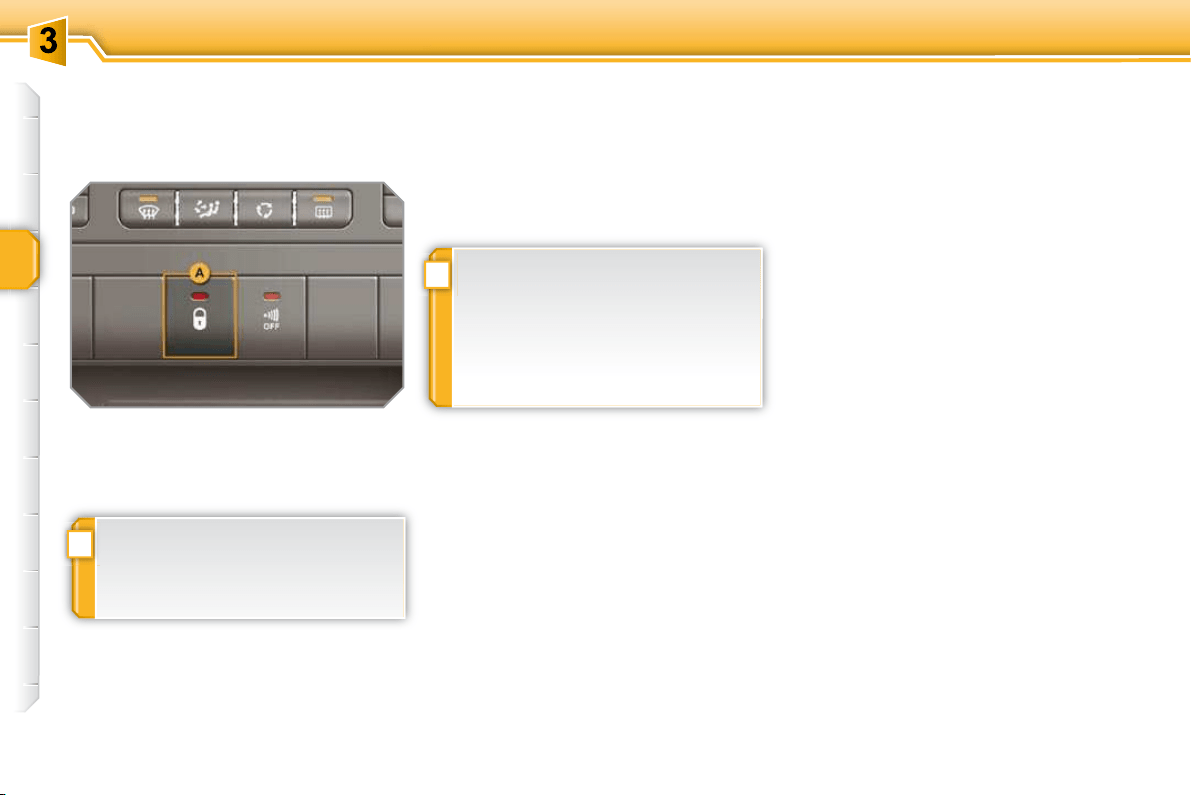
i
i
ACCESS
72
If the vehicle is locked or dead-
locked from the outside, the red
indicator lamp fl ashes and button A
is inactive.
In this case, use the remote
control or the key to unlock the
vehicle.
Manual centralised control
System which provides full manual lock-
ing or unlocking of the doors and boot
from the inside.
Locking
Press button A to lock the vehicle.
The red indicator lamp on the button
comes on.
If one of the doors is open, the cen-
tral locking from the inside does not
take place.
Unlocking
With the key in the ignition, press
button A again to unlock the vehicle.
The red indicator lamp on the button
switches off.
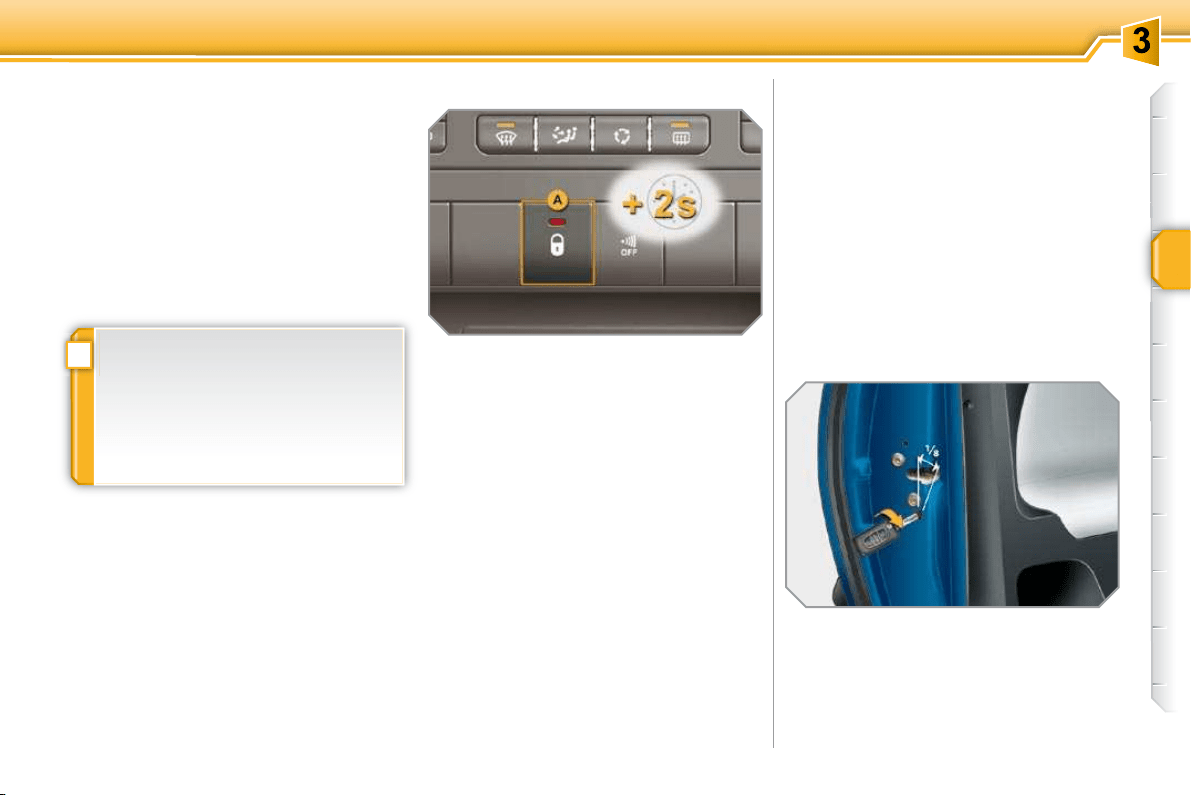
!
ACCESS
73
Emergency control
System which locks or unlocks the doors
mechanically in the event of a malfunc-
tion of the central locking.
Insert the key in the lock, located on
the edge of the door, then turn it one
eighth of a turn .
Locking the driver's door
Insert the key in the lock, then turn it
to the right.
Unlocking the driver's door
Insert the key in the lock, then turn it
to the left.
Locking the passenger door
Unlocking the passenger door
Pull the interior door opening control.
If one of the doors is open, the au-
tomatic central locking does not
take place.
If the boot is open, the automatic
central locking of the doors is
active.
Central automatic control
System which provides full automatic
locking or unlocking of the doors and
boot while driving.
You can activate or deactivate this function.
Activation
Press button A for more than
two seconds.
A confi rmation message appears on the
multifunction screen.
Unlocking
Above 6 mph (10 km/h), press but-
ton A to unlock the doors and boot
temporarily.
Locking
When the speed exceeds 6 mph (10 km/h),
the doors and boot lock automatically.
Deactivation
Press button A again for more than
two seconds.
A confi rmation message appears on the
multifunction screen.
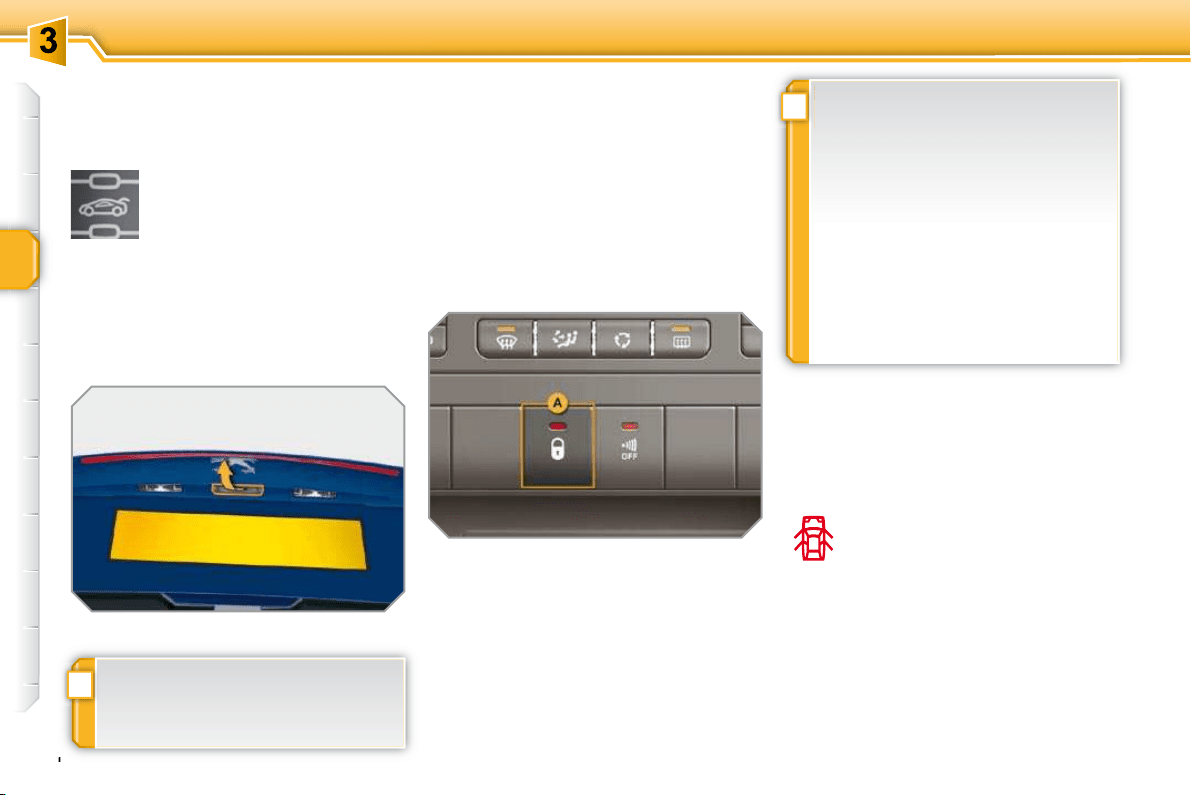
i
i
ACCESS
74
BOOT
Opening
After unlocking the boot or the ve-
hicle using the remote control or the
key, pull the handle and raise the
boot lid.
Unlocking and partially opening
the boot
Press the boot unlocking
button on the remote control
for more than two seconds.
The boot opens slightly.
If a battery failure occurs, the boot
is locked. Contact a PEUGEOT
dealer.
Boot anti-theft protection
The boot is designed to remain secure,
even in the "cabriolet" confi guration.
So, when the vehicle is locked and the
roof is open, the boot cannot be un-
locked:
- by means of the interior door open-
ing control, when the key is not in
the ignition switch,
- by pressing the manual centralised
control A , when the key is not in the
ignition switch.
- when the engine is running ,
this warning lamp comes on,
accompanied by a message
on the multifunction screen
for a few seconds,
- when the vehicle is moving (speed
above 6 mph (10 km/h)), this warn-
ing lamp comes on, accompanied
by an audible signal and a message
on the multifunction screen for a few
seconds.
Closing
Lower the boot lid using the interior
grab handle.
If the boot lid is not closed correctly:
Automatic locking of the boot
In the "cabriolet" confi guration, with
the vehicle locked, if you unlock the
boot by pressing the boot unlock-
ing button on the remote control,
it will lock automatically when you
close it again.
In this case, if you inadvertently
leave the key in the boot, press the
manual centralised control A im-
mediately to unlock the boot and
retrieve the key.
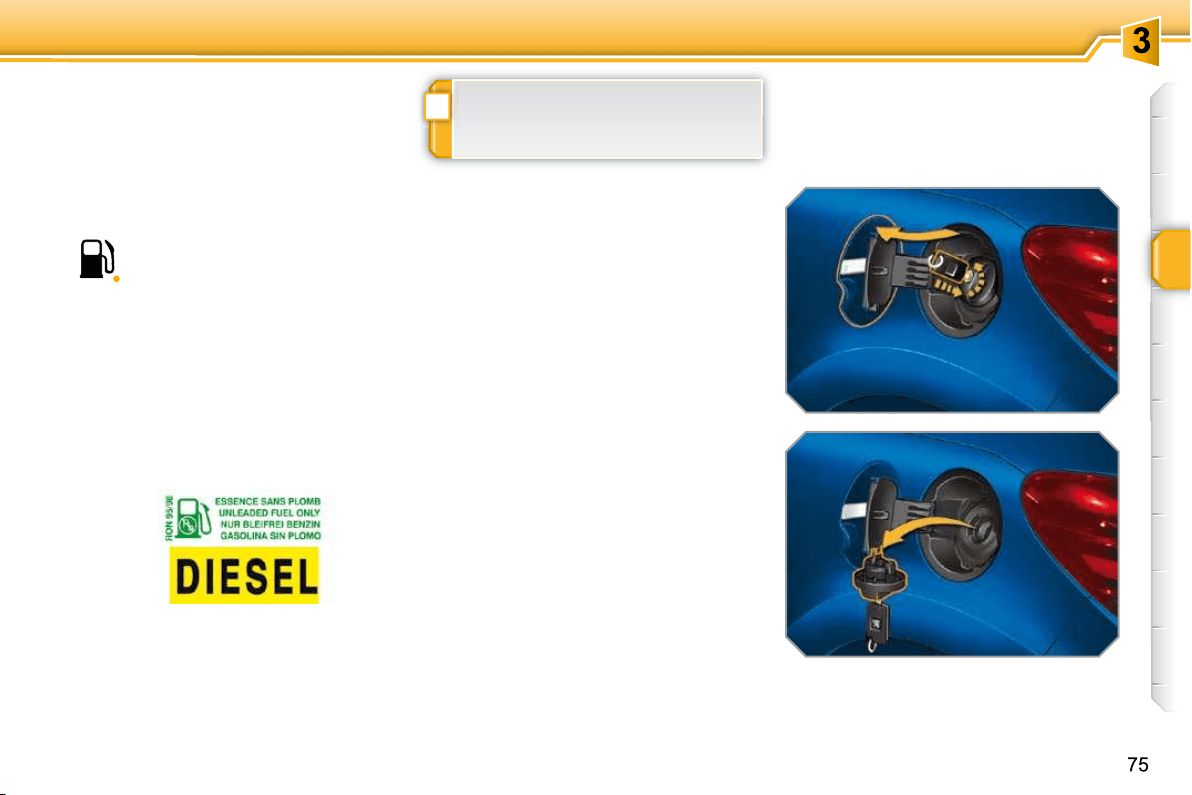
i
ACCESS
The key cannot be removed from
the lock until the cap is refi tted.
FUEL TANK
Fuel tank capacity: approximately
50 litres (petrol) or 48 litres (Diesel).
Opening the fi ller cap may create a
noise a caused by an inrush of air. This
vacuum is entirely normal, resulting
from the sealing of the fuel system.
To fi ll the tank in complete safety:
the engine must be switched off,
open the fuel fi ller fl ap,
insert the key in the cap, then turn it
to the left,
When you have fi lled the tank:
put the cap back in place,
turn the key to the right, then remove
it from the cap,
close the fl ap.
remove the cap and hook it onto
the clip located on the inside of the
fl ap,
fi ll the tank, but do not continue
after the 3rd cut-off of the pump ;
this could cause malfunctions.
Low fuel level
When the fuel tank minimum
level is reached this warning
lamp comes on on the instru-
ment panel. When it fi rst comes
on there remains approximate-
ly 5 litres of fuel in the tank.
You must refuel as soon as possible to
avoid running out of fuel.
If you run out of fuel (Diesel), refer also
to the "Checks" section.
Filling
A label affi xed to the inside of the fl ap
reminds you of the type of fuel to be
used depending on your engine.
Additions of fuel must be of at least
5 litres, in order to be taken into account
by the fuel gauge.
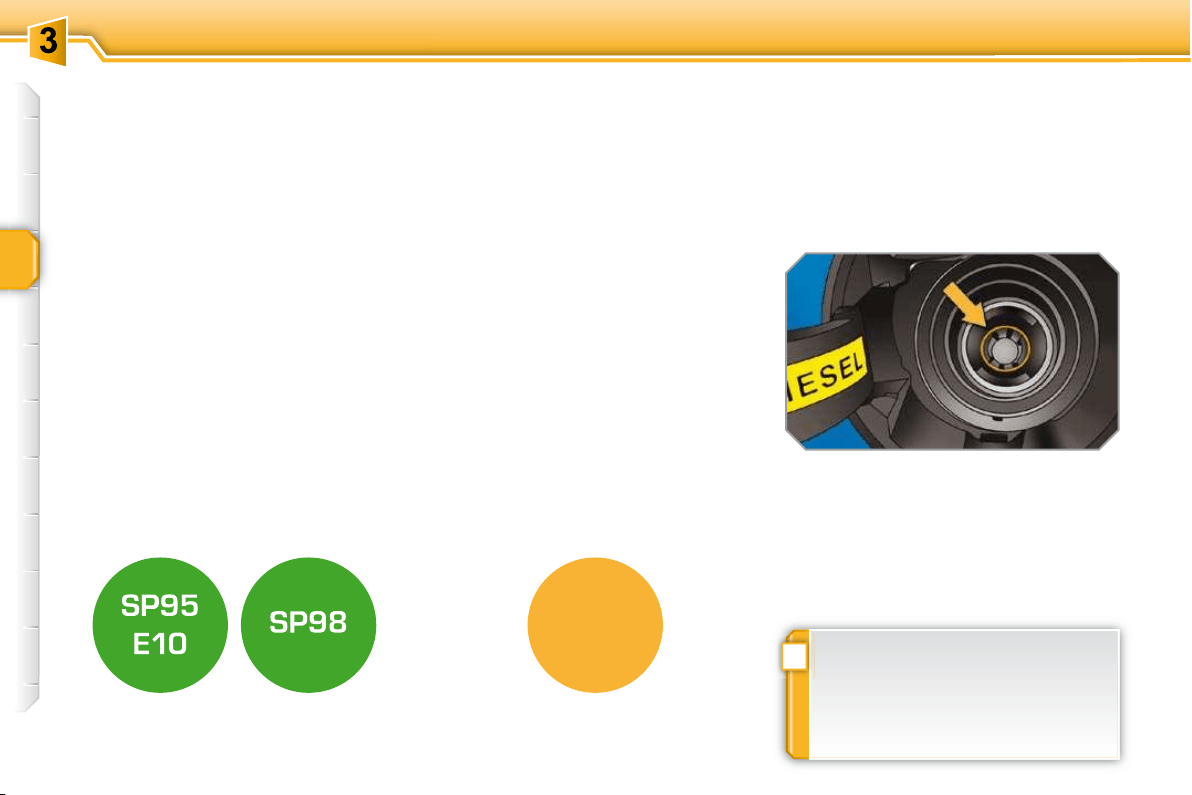
i
DIESEL
ACCESS
76
Quality of the fuel used for
petrol engines
Quality of the fuel used for
Diesel engines
The petrol engines are perfectly com-
patible with E10 type petrol biofuels
(containing 10 % ethanol), conforming
to European standards EN 228 and
EN 15376.
E85 type fuels (containing up to 85 %
ethanol) are reserved exclusively for ve-
hicles marketed for the use of this type
of fuel (BioFlex vehicles). The quality of
the ethanol must comply with European
standard EN 15293.
For Brazil only, special vehicles are
marketed to run on fuels containing up
to 100 % ethanol (E100 type).
The Diesel engines are perfectly com-
patible with biofuels which conform to
current and future European standards
(Diesel fuel which complies with stan-
dard EN 590 mixed with a biofuel which
complies with standard EN 14214)
available at the pumps (containing up
to 7 % Fatty Acid Methyl Ester).
The B30 biofuel can be used in cer-
tain Diesel engines; however, this use
is subject to strict application of the
special servicing conditions. Consult a
PEUGEOT dealer.
The use of any other type of (bio)fuel
(vegetable or animal oils, pure or dilut-
ed, domestic fuel...) is strictly prohibited
(risk of damage to the engine and fuel
system).
MISFUEL PREVENTION
Mechanical device which prevents fi ll-
ing the tank of a Diesel vehicle with
petrol. It avoids the risk of engine dam-
age that can result from fi lling with the
wrong fuel.
Located in the fi ller neck, the misfuel
prevention device appears when the
fi ller cap is removed.
Operation
When a petrol fi ller nozzle is intoduced
into the fuel fi ller neck of your Diesel
vehicle, it comes into contact with the
fl ap. The system remains closed and
prevents fi lling.
Do not persist but introduce a Diesel
type fi ller nozzle.
The device allows fi lling from a fuel
can.
In order to ensure a good fl ow of
fuel, do not place the nozzle of
the fuel can in direct contact with
the fl ap of the misfuel prevention
device.
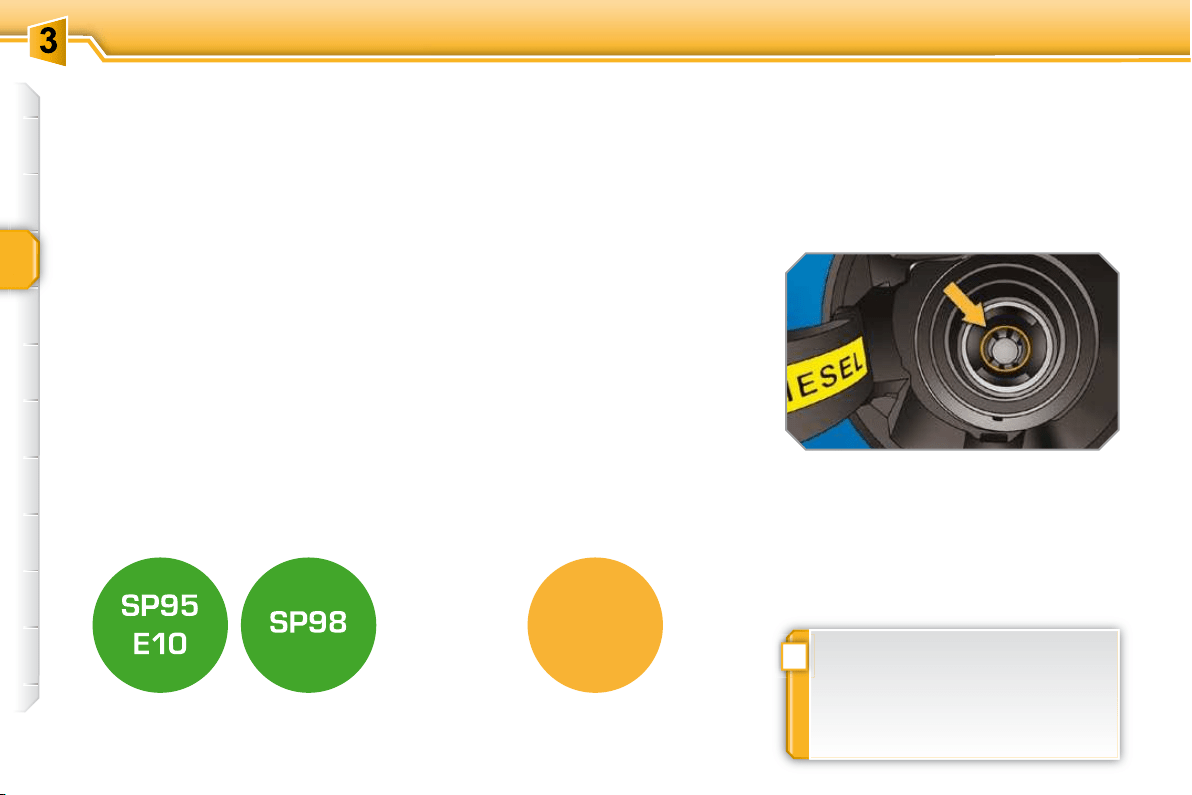
i
DIESEL
ACCESS
76
Quality of the fuel used for
petrol engines
Quality of the fuel used for
Diesel engines
The petrol engines are perfectly com-
patible with E10 type petrol biofuels
(containing 10 % ethanol), conforming
to European standards EN 228 and
EN 15376.
E85 type fuels (containing up to 85 %
ethanol) are reserved exclusively for ve-
hicles marketed for the use of this type
of fuel (BioFlex vehicles). The quality of
the ethanol must comply with European
standard EN 15293.
For Brazil only, special vehicles are
marketed to run on fuels containing up
to 100 % ethanol (E100 type).
The Diesel engines are perfectly com-
patible with biofuels which conform to
current and future European standards
(Diesel fuel which complies with stan-
dard EN 590 mixed with a biofuel which
complies with standard EN 14214)
available at the pumps (containing up
to 7 % Fatty Acid Methyl Ester).
The B30 biofuel can be used in cer-
tain Diesel engines; however, this use
is subject to strict application of the
special servicing conditions. Consult a
PEUGEOT dealer.
The use of any other type of (bio)fuel
(vegetable or animal oils, pure or dilut-
ed, domestic fuel...) is strictly prohibited
(risk of damage to the engine and fuel
system).
MISFUEL PREVENTION
Mechanical device which prevents fi ll-
ing the tank of a Diesel vehicle with
petrol. It avoids the risk of engine dam-
age that can result from fi lling with the
wrong fuel.
Located in the fi ller neck, the misfuel
prevention device appears when the
fi ller cap is removed.
Operation
When a petrol fi ller nozzle is intoduced
into the fuel fi ller neck of your Diesel
vehicle, it comes into contact with the
fl ap. The system remains closed and
prevents fi lling.
Do not persist but introduce a Diesel
type fi ller nozzle.
The device allows fi lling from a fuel
can.
In order to ensure a good fl ow of
fuel, do not place the nozzle of
the fuel can in direct contact with
the fl ap of the misfuel prevention
device.
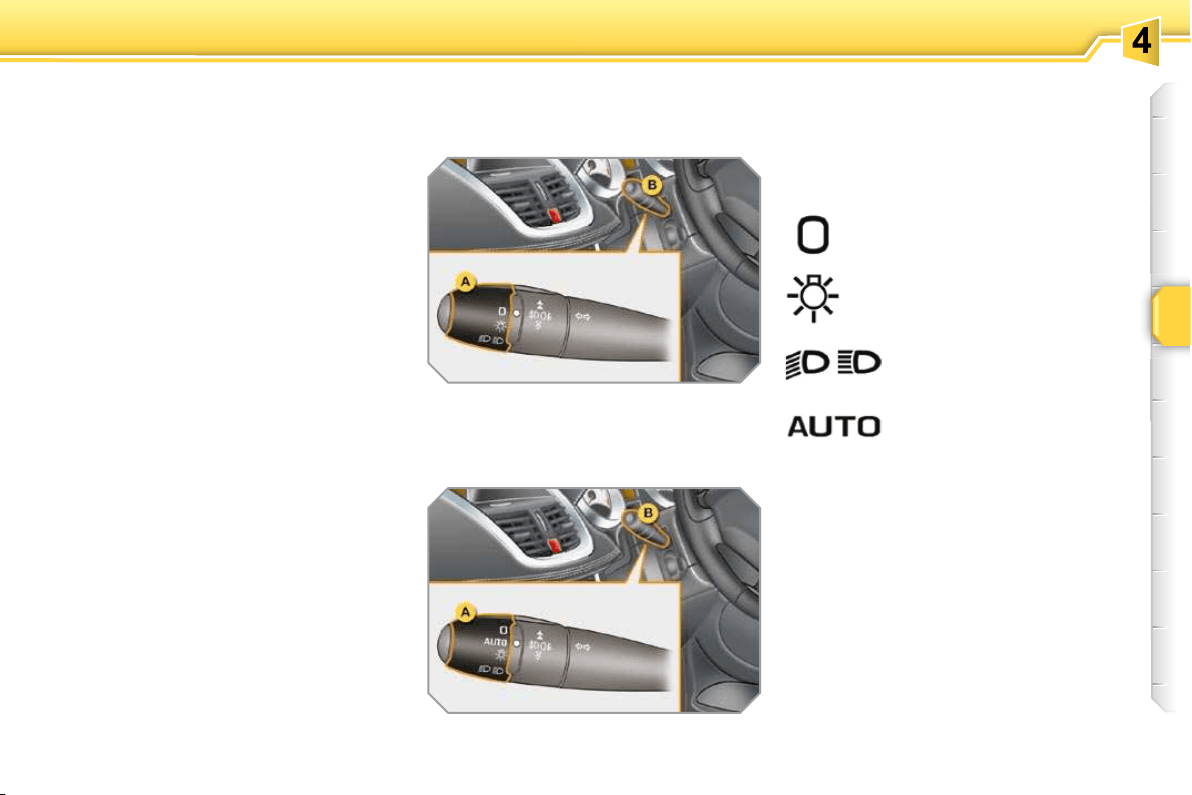
VISIBILITY
77
LIGHTING CONTROL STALK
System for selection and control of the
various front and rear lamps providing
the vehicle's lighting.
Manual controls
The lighting commands are made di-
rectly by the driver by means of ring A
and stalk B .
A. main lighting mode selection ring,
with:
Model without AUTO lighting
Model with AUTO lighting
lighting off,
sidelamps only,
dipped or main beam
headlamps,
B. stalk for inversion of the beam by
pulling:
dipped/main beam headlamps.
automatic illumination of
headlamps.
Displays
The corresponding indicator lamp
comes on on the instrument panel to
confi rm the switching on of the lighting
selected.
Main lighting
The vehicle's various front and rear
lamps are designed to adapt the driv-
er's visibility gradually in relation to the
climatic conditions:
- sidelamps, to be seen,
- dipped beam headlamps to see
without dazzling other drivers,
- main beam headlamps for good visi-
bility when the road is clear.
Additional lighting
Other lamps are installed to respond to
particular driving conditions:
- rear foglamps to be seen from a dis-
tance,
- front foglamps for even better visibi-
lity,
- directional headlamps for improved
visibility around corners.
Programmes
Various automatic lighting control
modes are also available according to
the following options:
- "guide-me-home" lighting,
- automatic illumination of headlamps,
- static directional lighting.
In the lighting off and sidelamps modes,
the driver can switch on the main beam
headlamps directly ("headlamp fl ash")
by pulling and holding the stalk.
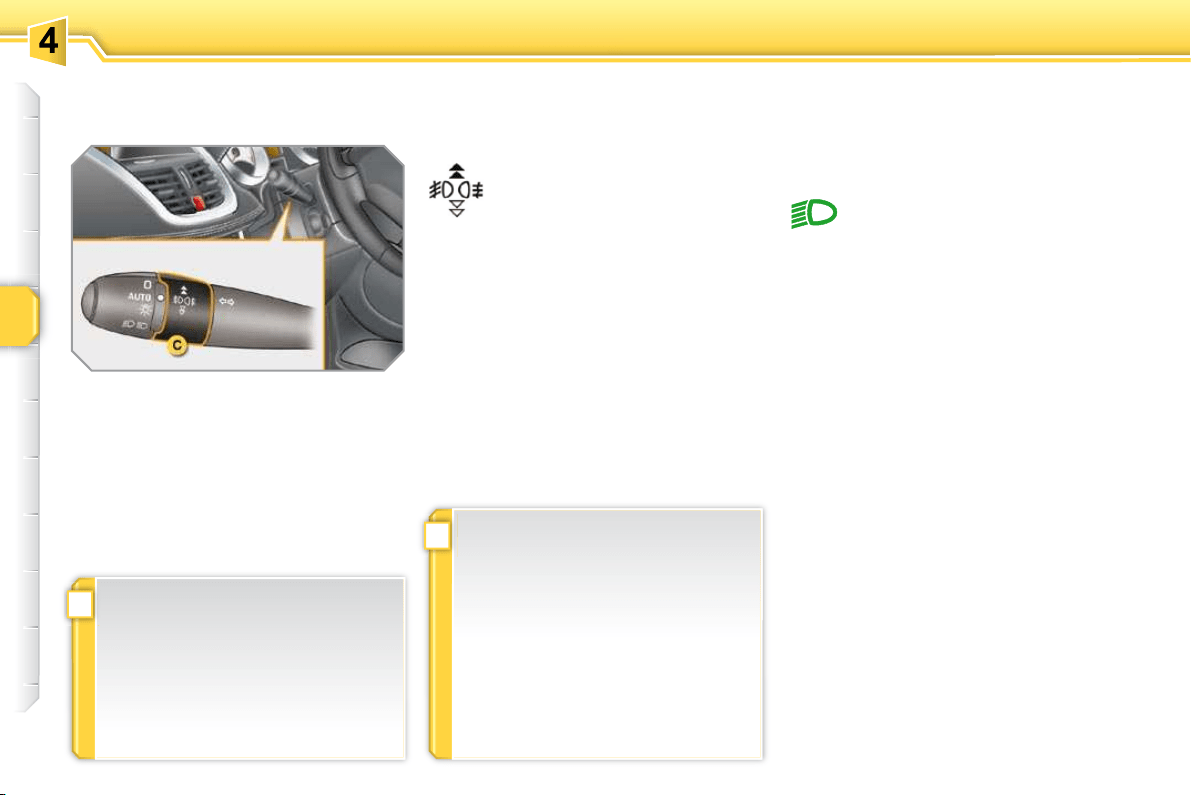
!
i
VISIBILITY
78
Model with front and rear foglamps
front and rear foglamps
C. foglamps selection ring.
These operate with the dipped and main
beam headlamps.
To switch on the foglamps, turn ring C
forwards.
To switch off the rear foglamps, turn
ring C rearwards twice in succession.
When the lighting is switched off auto-
matically (on AUTO model) or when the
dipped beam headlamps are switched
off manually, the foglamps and the side-
lamps will remain on.
Turn the ring rearwards to switch
off the foglamps, the sidelamps will
then switch off.
Do not forget to switch off the front
foglamps and the rear foglamps
when they are no longer neces-
sary. In normal light levels, the
power of their beams may dazzle
other drivers.
Lighting on reminder
The triggering of an audible signal
when a door is opened warns the
driver that they have forgotten to
switch off the vehicle's lighting, with
the ignition off.
In this case, switching off the light-
ing will stop the audible signal.
When the ignition is switched off,
if the dipped beam headlamps re-
main on, they will be switched off
automatically after thirty minutes to
prevent discharging of the battery.
This indicator lamp comes on
on the instrument panel.
* According to country.
Daytime running lamps *
On vehicles fi tted with daytime running
lamps, the dipped beam headlamps
come on when the vehicle is started.
The instruments and controls (multi-
function screen, air conditioning control
panel, ...) are not lit, unless the auto-
matic lighting mode is activated or the
lighting is switched on manually.
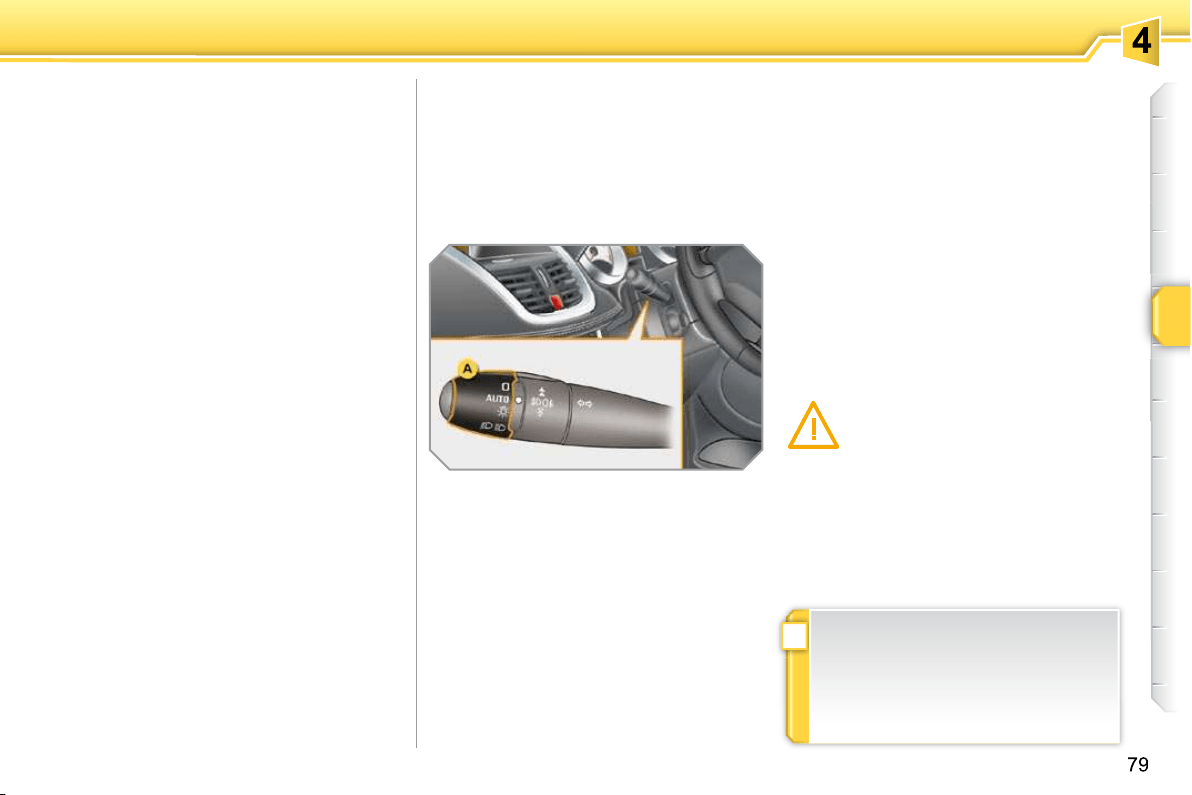
!
VISIBILITY
Do not cover the sunshine sensor,
located in the centre of the wind-
screen behind the rear view mirror;
the associated functions would no
longer be controlled.
Coupling with the "Guide-me-home"
lighting
Association with the automatic illumination of
headlamps provides the "guide-me-home"
lighting with the following additional options:
-
selection of the lighting duration to 15, 30
or 60 seconds in the vehicle parameters
on the multifunction screen confi gura-
tion menu,
- automatic activation of "guide-me-
home" lighting when automatic illumi-
nation of headlamps is in operation.
Automatic illumination of headlamps
The sidelamps and dipped beam head-
lamps are switched on automatically, with-
out any action on the part of the driver,
when a low level of external light is detect-
ed (sensor behind the rear view mirror).
As soon as the brightness returns to a suffi cient
level, the lighting is switched off automatically.
"Guide-me-home" lighting
The dipped beam headlamps remain on
temporarily, after switching off the vehi-
cle's ignition, to make the driver's exit
easier in poor light.
Activation
With the ignition off, activate a
"headlamp fl ash" using stalk B .
A second "headlamp fl ash" switches
the function off again.
Switching off
The "guide-me-home" lighting is
switched off automatically following the
door locking command, after a given
time.
Activation
Turn ring A to the "AUTO" position.
The automatic lighting is accompanied
by a message on the multifunction
screen.
In fog or snow, the sunshine sensor
may detect suffi cient light. Therefore,
the lighting will not be switched on auto-
matically. The dipped beam headlamps
must be switched on manually.
Deactivation
Turn ring A to a position other than
"AUTO" . Switching off is accompa-
nied by a message on the multifunction
screen.
Operating fault
In the event of a malfunction of
the sunshine sensor, the light-
ing comes on accompanied by
the service warning lamp, an
audible signal and a message on the
multifunction screen.
Have it checked by a PEUGEOT dealer.
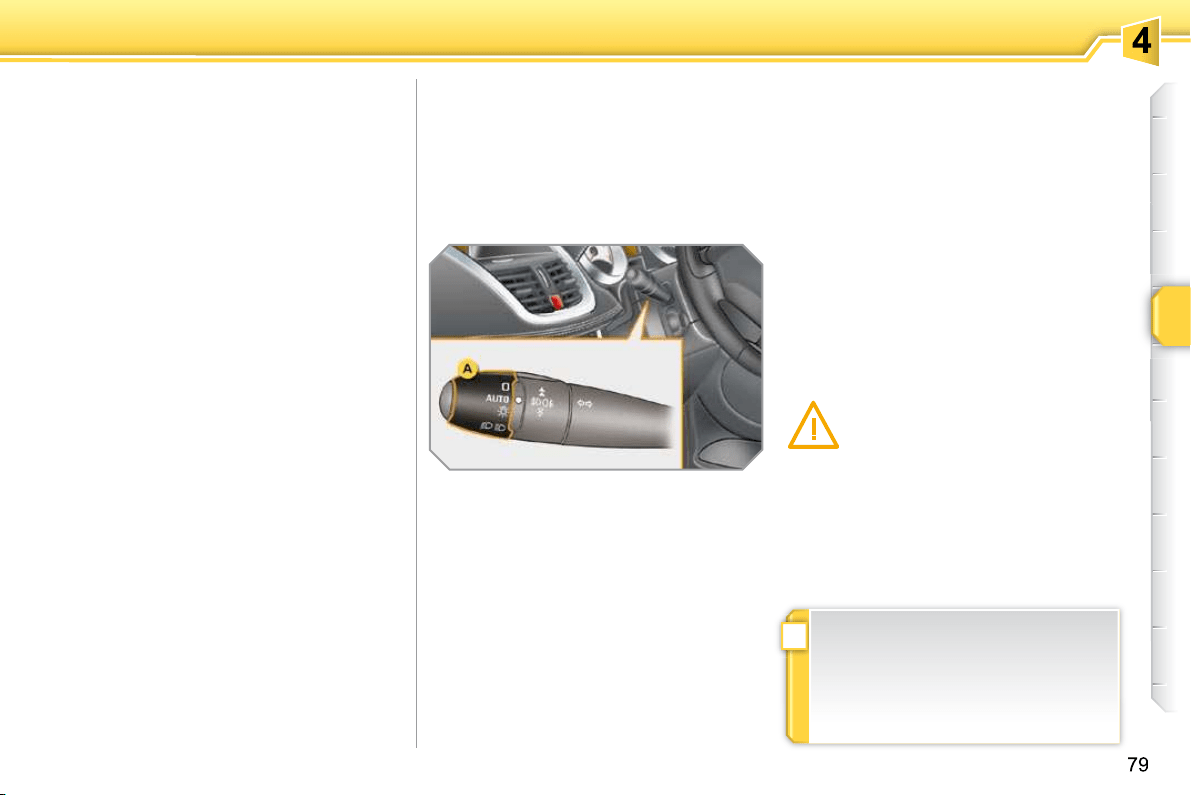
!
VISIBILITY
Do not cover the sunshine sensor,
located in the centre of the wind-
screen behind the rear view mirror;
the associated functions would no
longer be controlled.
Coupling with the "Guide-me-home"
lighting
Association with the automatic illumination of
headlamps provides the "guide-me-home"
lighting with the following additional options:
-
selection of the lighting duration to 15, 30
or 60 seconds in the vehicle parameters
on the multifunction screen confi gura-
tion menu,
- automatic activation of "guide-me-
home" lighting when automatic illumi-
nation of headlamps is in operation.
Automatic illumination of headlamps
The sidelamps and dipped beam head-
lamps are switched on automatically, with-
out any action on the part of the driver,
when a low level of external light is detect-
ed (sensor behind the rear view mirror).
As soon as the brightness returns to a suffi cient
level, the lighting is switched off automatically.
"Guide-me-home" lighting
The dipped beam headlamps remain on
temporarily, after switching off the vehi-
cle's ignition, to make the driver's exit
easier in poor light.
Activation
With the ignition off, activate a
"headlamp fl ash" using stalk B .
A second "headlamp fl ash" switches
the function off again.
Switching off
The "guide-me-home" lighting is
switched off automatically following the
door locking command, after a given
time.
Activation
Turn ring A to the "AUTO" position.
The automatic lighting is accompanied
by a message on the multifunction
screen.
In fog or snow, the sunshine sensor
may detect suffi cient light. Therefore,
the lighting will not be switched on auto-
matically. The dipped beam headlamps
must be switched on manually.
Deactivation
Turn ring A to a position other than
"AUTO" . Switching off is accompa-
nied by a message on the multifunction
screen.
Operating fault
In the event of a malfunction of
the sunshine sensor, the light-
ing comes on accompanied by
the service warning lamp, an
audible signal and a message on the
multifunction screen.
Have it checked by a PEUGEOT dealer.
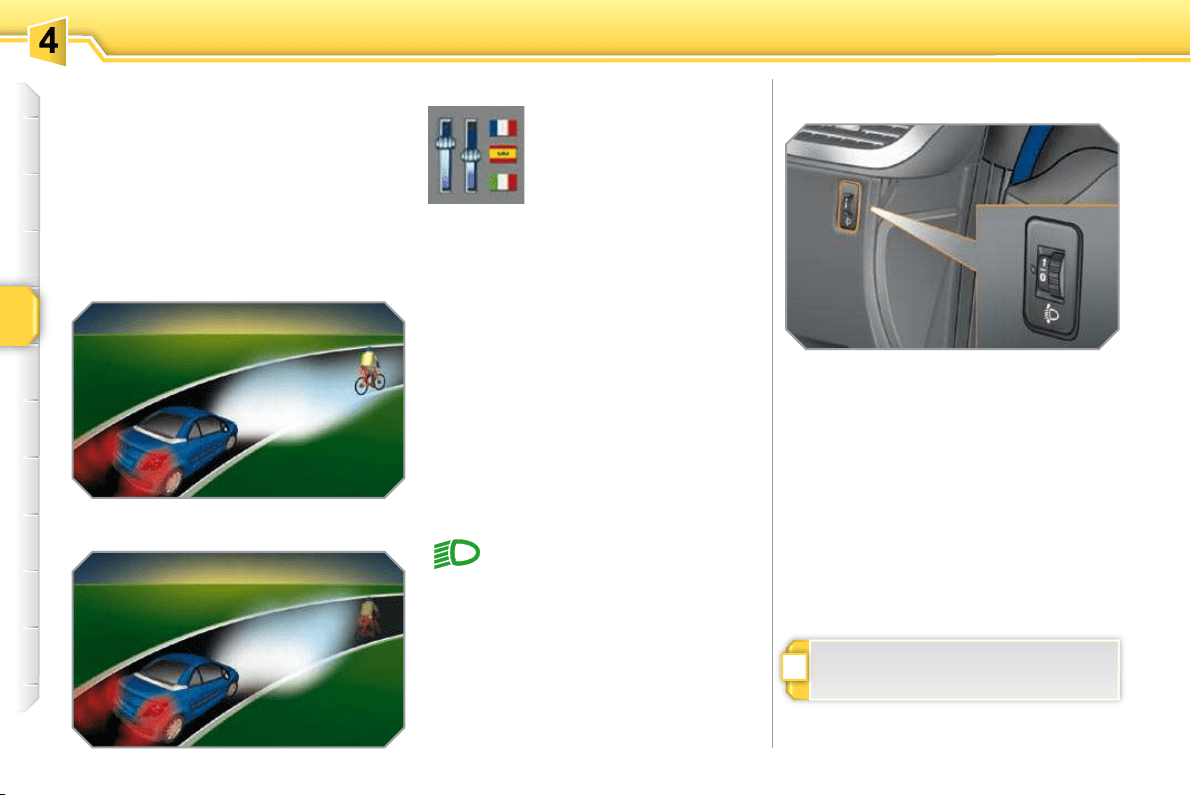
i
VISIBILITY
80
STATIC DIRECTIONAL LIGHTING
When the dipped or main beam headlam-
ps are on, this function enables the beam
to light the inside of the turn with an addi-
tional angle of approximately 30°.
The use of this lighting is optimum above
all at low and average speed (city driving,
winding roads, ...).
with directional lighting
without directional lighting
Programming
Switching on
The system is switched on from a certain
speed and a certain angle of rotation of the
steering wheel.
Operating fault
The function is activated or
deactivated via the multi-
function screen confi gura-
tion menu.
This function is activated
by default.
In the event of a malfunction,
this warning lamp fl ashes on
the instrument panel, accom-
panied by a message on the
multifunction screen.
Have it checked by a PEUGEOT dealer.
HEADLAMP ADJUSTMENT
The initial setting is position "0" .
To avoid causing a nuisance to other
road users, the height of the headlamps
should be adjusted in relation to the
load in the vehicle.
0. 1 or 2 people in the front seats.
-. 3 people.
1. 4 people.
2. 4 people + maximum authorised
load.
3. Driver + maximum authorised load.
Switching off
The system is switched off below a certain
angle of rotation of the steering wheel.
It is switched off when reverse gear is
engaged.
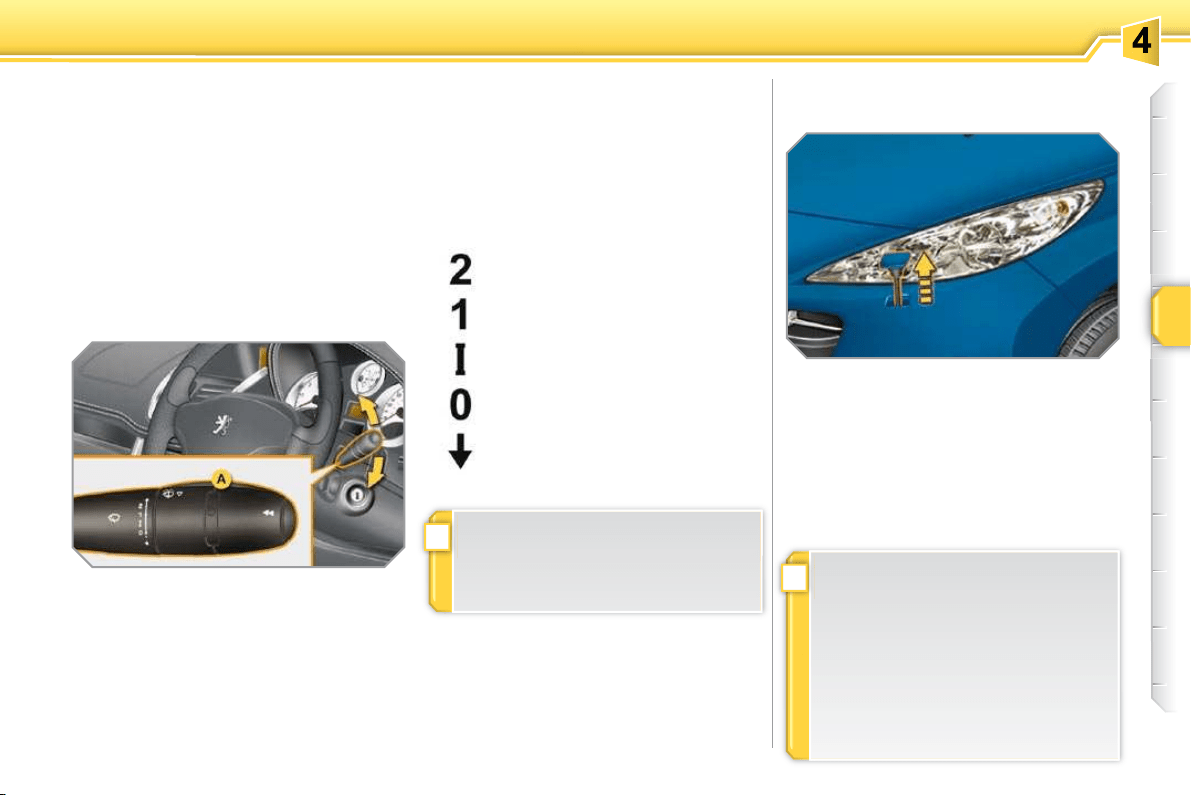
i
i
VISIBILITY
81
WIPER CONTROL STALK
System for the selection and control of
the various windscreen wiping modes
permitting the dispersal of rain and
cleaning.
The vehicle's windscreen wipers are
designed to gradually improve the driv-
er's visibility in relation to the weather
conditions.
Manual controls
The wiping commands are made directly
by the driver using stalk A .
fast (heavy rain),
normal (moderate rain),
intermittent (in proportion to
the speed of the vehicle),
off,
single wipe (press downwards),
Model with intermittent wiping
Windscreen wipers
A. wiping speed selection control:
Windscreen and headlamp
wash
Pull the windscreen wiper stalk to-
wards you.
The headlamp wash is only activate if
the dipped headlamps are on .
With daytime running lamps, to
activate the headlamp wash, posi-
tion the lighting stalk in the dipped
beam position.
On vehicles fi tted with digital air
conditioning, any action on the
windscreen wash control results in
temporary closing of the air intake
to avoid odours inside the passen-
ger compartment.
Automatic wiping is not available
on the 207CC at present.
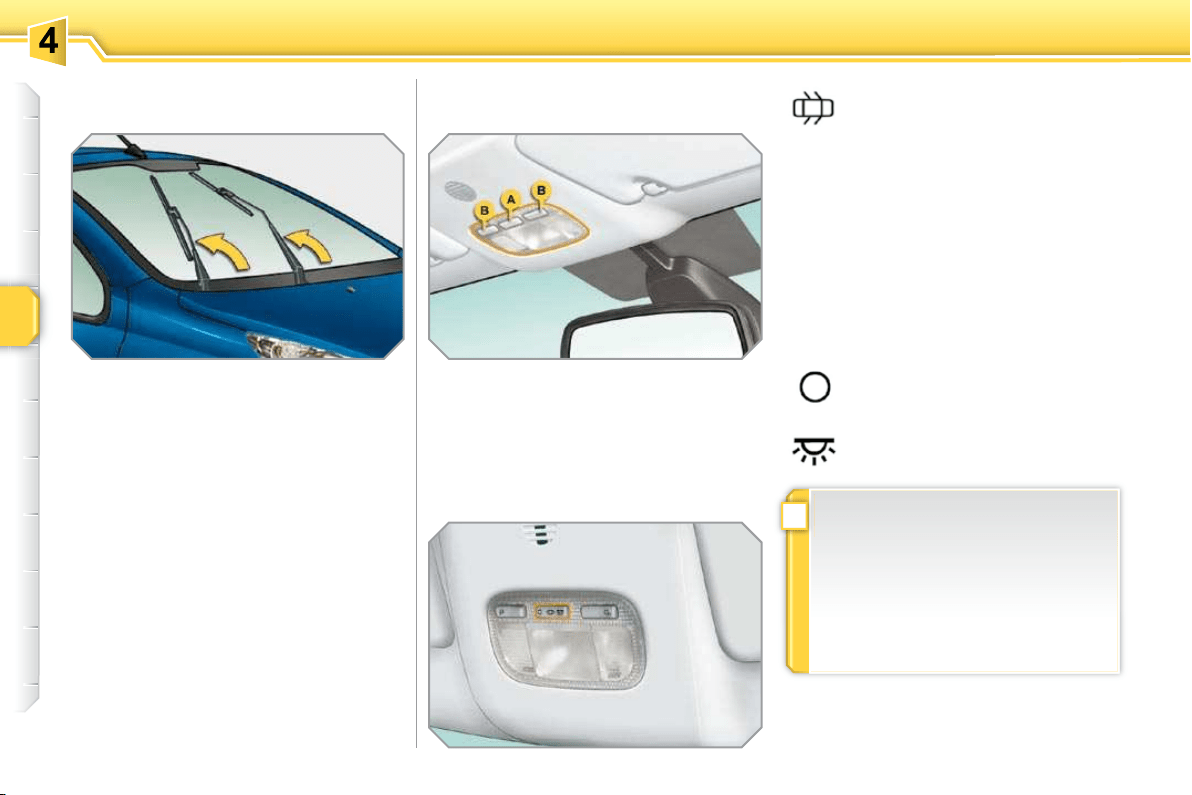
i
VISIBILITY
82
Special position of the windscreen
wipers
In the minute following switching off of
the ignition, any action on the stalk po-
sitions the wipers vertically on the wind-
screen.
This action enables you to position the
wiper blades for winter parking.
To park the wipers after this has been
done, switch on the ignition and operate
the stalk.
COURTESY LAMP
A. Courtesy lamp
B. Map reading lamps
In this position, the courtesy
lamp comes on gradually:
Map reading lamps
With the ignition on, press the cor-
responding switch.
With the "permanent lighting" mode,
the duration of lighting varies, de-
pending on the circumstances:
- with the ignition off, approxi-
mately ten minutes,
- in energy economy mode, ap-
proximately thirty seconds,
-
with the engine running, unlimi-ted.
- when the vehicle is unlocked,
- when the key is removed from the
ignition,
- when a door is opened,
- when the remote control locking but-
ton is activated, in order to locate
your vehicle.
It switches off gradually:
- when the vehicle is locked,
- when the ignition is switched on,
- 30 seconds after the last door is
closed.
Permanently off.
Permanent lighting.
Courtesy lamp
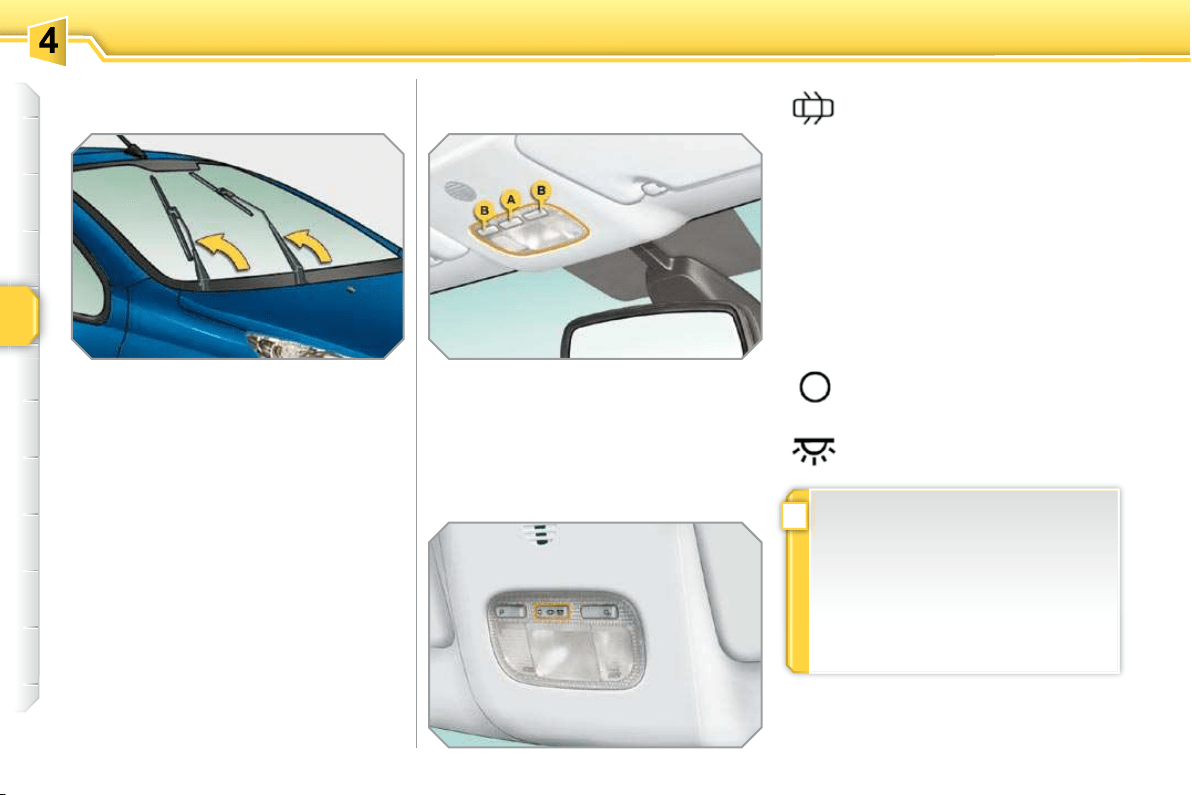
i
VISIBILITY
82
Special position of the windscreen
wipers
In the minute following switching off of
the ignition, any action on the stalk po-
sitions the wipers vertically on the wind-
screen.
This action enables you to position the
wiper blades for winter parking.
To park the wipers after this has been
done, switch on the ignition and operate
the stalk.
COURTESY LAMP
A. Courtesy lamp
B. Map reading lamps
In this position, the courtesy
lamp comes on gradually:
Map reading lamps
With the ignition on, press the cor-
responding switch.
With the "permanent lighting" mode,
the duration of lighting varies, de-
pending on the circumstances:
- with the ignition off, approxi-
mately ten minutes,
- in energy economy mode, ap-
proximately thirty seconds,
-
with the engine running, unlimi-ted.
- when the vehicle is unlocked,
- when the key is removed from the
ignition,
- when a door is opened,
- when the remote control locking but-
ton is activated, in order to locate
your vehicle.
It switches off gradually:
- when the vehicle is locked,
- when the ignition is switched on,
- 30 seconds after the last door is
closed.
Permanently off.
Permanent lighting.
Courtesy lamp
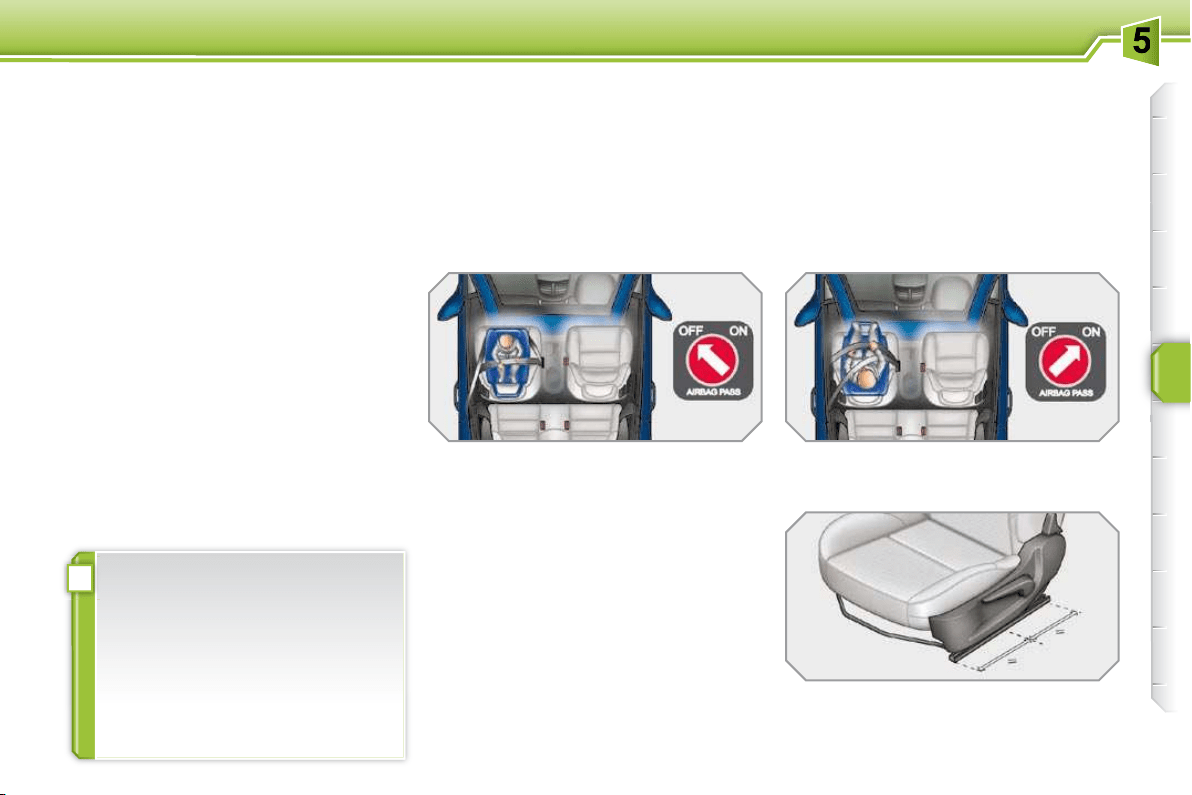
i
CHILD SAFETY
83
PEUGEOT recommends that children
should travel in these positions:
- "rearwards-facing" up to the
age of 2 on the front passenger
seat ,
- "forwards-facing" over the
age of 2 on the rear side seat .
For further details, see section
"Locations for child seats secured
using a seat belt".
GENERAL POINTS RELATING
TO CHILD SEATS
Although one of PEUGEOT's main cri-
teria when designing your vehicle, the
safety of your children also depends on
you.
For maximum safety, please follow
these recommendations:
- in accordance with European regu-
lations, all children under the age
of 12 or less than one metre fi fty
tall must travel in approved child
seats suited to their weight , on
seats fi tted with a seat belt or ISOFIX
mountings * .
- statistically, the safest seats in
your vehicle for carying children
are the rear seats,
-
a child weighing less than 9 kg must
travel in the "rearwards-facing" po-
sition both in the front and in the
rear.
CHILD SEAT IN THE FRONT
"Forwards-facing"
When a "forwards-facing" child seat is
installed on the front passenger seat ,
adjust the vehicle's seat to the interme-
diate longitudinal position with the seat
back upright and leave the passenger
airbag activated.
"Rearwards-facing"
When a "rearwards-facing" child seat is
installed on the front passenger seat ,
it is essential that the passenger air bag
is deactivated. Otherwise, the child
would risk being seriously injured or
killed if the airbag were to infl ate .
Intermediate longitudinal
position
* The rules for carrying children are
specifi c to each country. Consult the
current legislation in your country.
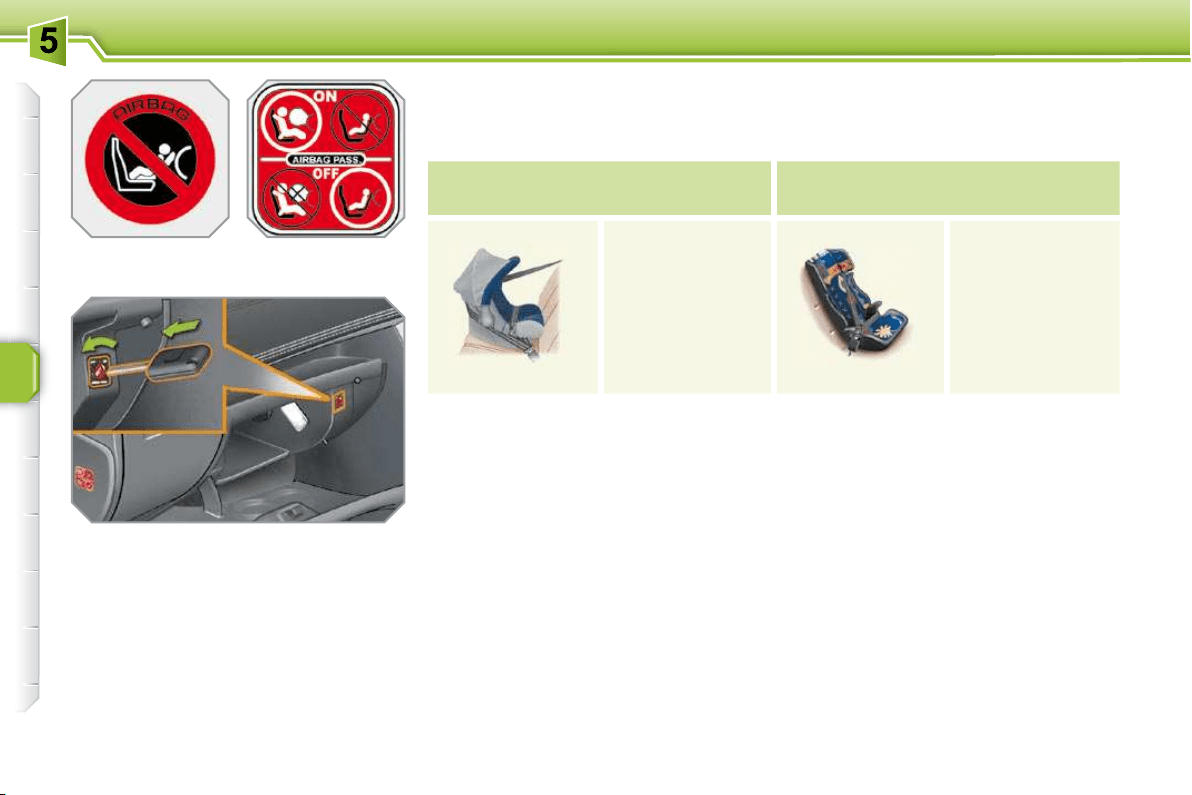
CHILD SAFETY
84
Passenger airbag OFF
CHILD SEATS RECOMMENDED BY PEUGEOT
PEUGEOT offers a range of child seats which are secured using a three point
seat belt :
Group 0: from birth to 10 kg
Group 0 +: from birth to 13 kg
Groups 2 and 3: from 15 to 36 kg
"RÖMER Baby-
Safe Plus"
Installed in
the rear-facing
position.
"KLIPPAN Optima"
From the age of
6 years
(approximately 22 kg),
the booster is
used on its own.
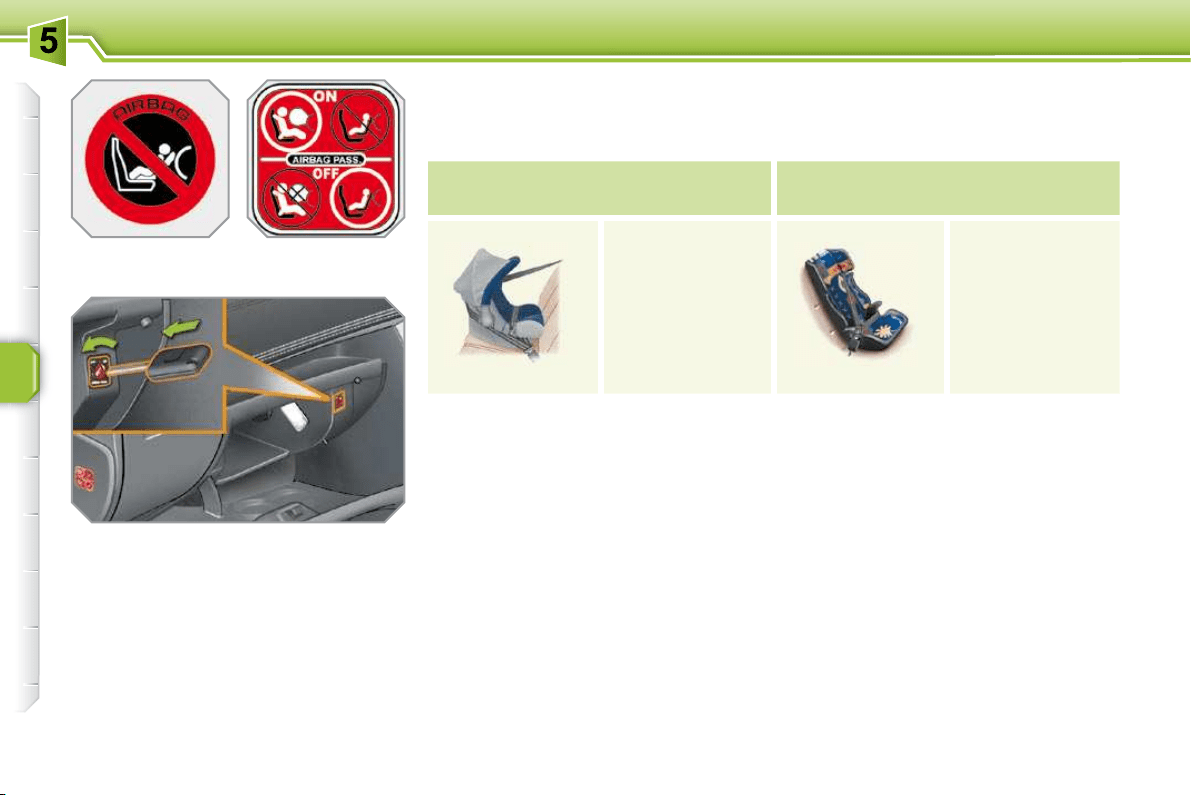
CHILD SAFETY
84
Passenger airbag OFF
CHILD SEATS RECOMMENDED BY PEUGEOT
PEUGEOT offers a range of child seats which are secured using a three point
seat belt :
Group 0: from birth to 10 kg
Group 0 +: from birth to 13 kg
Groups 2 and 3: from 15 to 36 kg
"RÖMER Baby-
Safe Plus"
Installed in
the rear-facing
position.
"KLIPPAN Optima"
From the age of
6 years
(approximately 22 kg),
the booster is
used on its own.
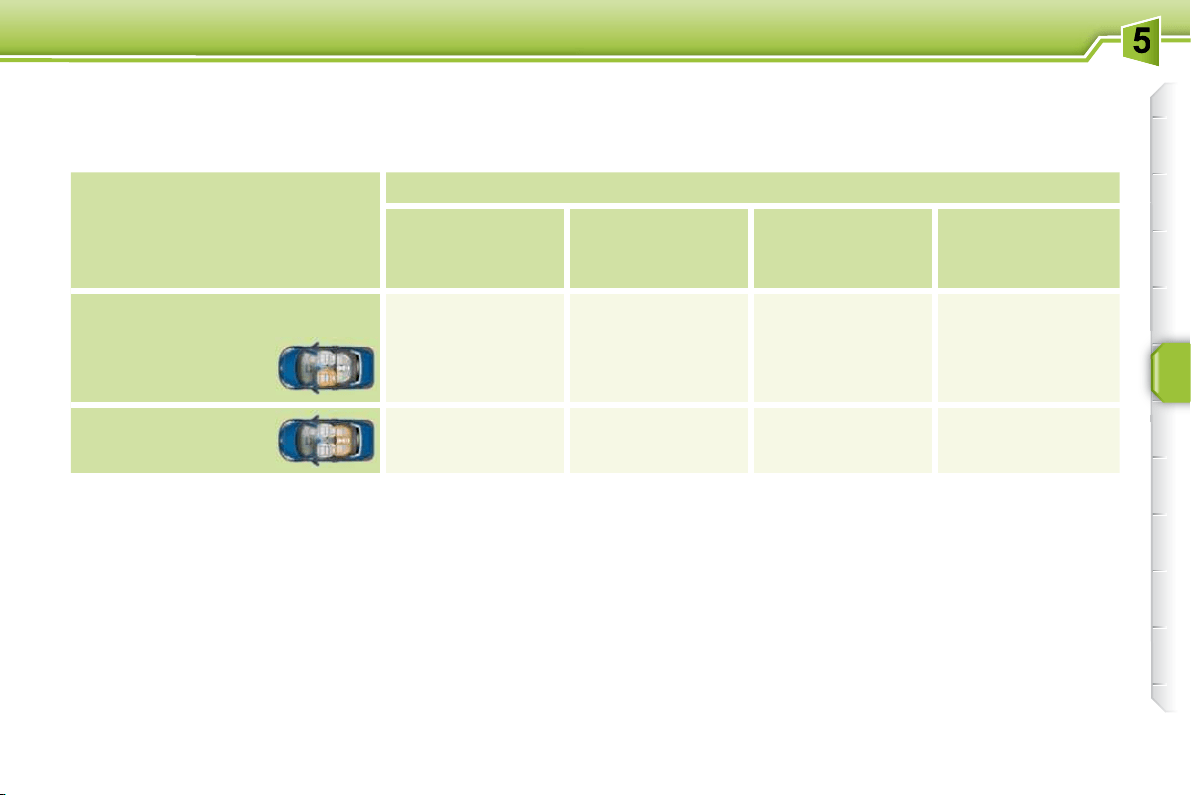
CHILD SAFETY
85
LOCATIONS FOR CHILD SEATS SECURED WITH A SEAT BELT
In accordance with European regulations, this table indicates the options for the installation of child seats secured using the
seat belt and universally approved (a) in relation to the weight of the child and the seat in the vehicle.
(a) Universal child seat: child seat which can be installed in all vehicles using the seat belt.
(b) Group 0: from birth to 10 kg. Infant car seats and "car cots" cannot be installed on the front passenger seat.
(c) Consult the legislation in force in your country before installing your child on this seat.
(d) To install a child seat, move the front seat forward, then put the seat back in the upright position to leave enough space for
the child seat and the child's legs. The front seat can be moved further forward than the intermediate longitudinal position.
U : seat suitable for the installation of a child seat secured using the seat belt and universally approved "rear facing" and/or
"forward facing".
U(R) : identical to U , with the vehicle's seat adjusted to its highest position.
Seat
Weight of the child /indicative age
Less than 13 kg
(groups 0 (b) and 0+)
Up to 1 year approx
From 9 to 18 kg
(group 1)
From 1 to 3 years
approx
From 15 to 25 kg
(group 2)
From 3 to 6 years
approx
From 22 to 36 kg
(group 3)
From 6 to 10 years
approx
Front passenger seat (c)
- fi xed U U U U
- height
adjustable
U(R) U(R) U(R) U(R)
Outer rear
seats (d)
U U U U
!
CHILD SAFETY
86
The incorrect installation of a child
seat in a vehicle compromises the
child's protection in the event of an
accident.
Remember to fasten the seat belts
or the child seat harnesses keeping
the slack in relation to the child’s
body to a minimum , even for short
journeys.
To install a child seat with the seat
belt, check that the belt has tight-
ened on the child seat and that the
child seat is held fi rmly against the
vehicle's seat.
For optimum installation of the "for-
ward facing" child seat, ensure that
the back of the child seat is in con-
tact with the back of the vehicle's
seat and that the head restraint
does not cause any discomfort.
If the head restraint has to be re-
moved, ensure that it is stored or
attached securely to prevent it from
being thrown around the vehicle in
the event of sharp braking.
Installing a booster seat
The chest part of the seat belt must be
positioned on the child's shoulder with-
out touching the neck.
Ensure that the lap part of the seat belt
passes correctly over the child's thighs.
PEUGEOT recommends the use of a
booster seat which has a back, fi tted
with a seat belt guide at shoulder level.
As a safety precaution, do not leave:
- one or more children alone and
unsupervised in a vehicle,
- a child or an animal in a vehicle
which is exposed to the sun, with
the windows closed,
- the keys within reach of children
inside the vehicle.
Children under the age of 10 must not
travel in the "forward facing" position
on the front passenger seat, unless the
rear seats are already occupied by other
children, cannot be used or are absent.
Deactivate the passenger airbag when
a "rear facing" child seat is installed
on the front seat. Otherwise, the child
would risk being seriously injured or
killed if the airbag were to infl ate.
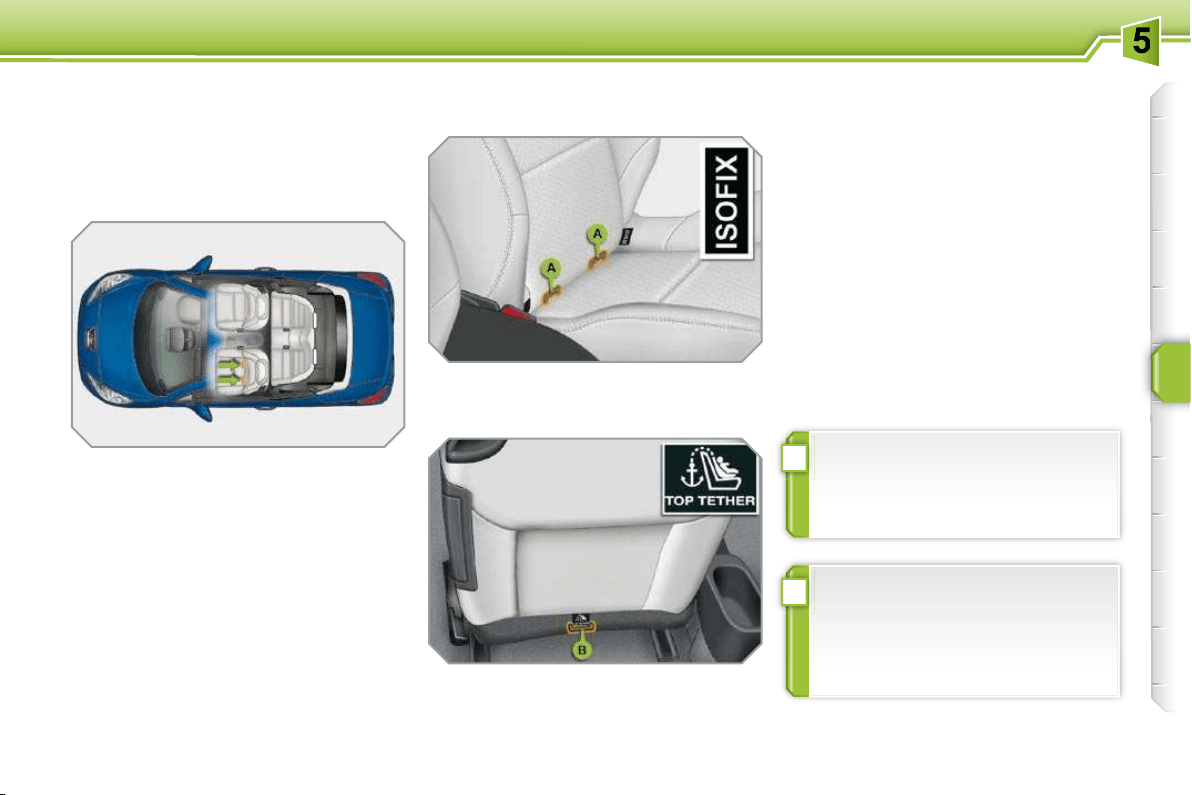
!
i
CHILD SAFETY
87
The incorrect installation of a child
seat in a vehicle compromises the
child's protection in the event of an
accident.
For information regarding the ISOFIX
child seats which can be installed in
your vehicle, consult the summary
table for the location of the ISOFIX
child seats.
"ISOFIX" MOUNTINGS
Your vehicle has been approved in accord-
ance with the new ISOFIX regulation .
The seats, represented below, are fi tted
with regulation ISOFIX mountings:
There are three rings for each seat:
- two rings A , located between the
vehicle seat back and cushion, indi-
cated by a label,
- a ring B , behind the seat, referred to
as the TOP TETHER for fi xing the
upper strap.
This ISOFIX mounting system guaran-
tees you fast, reliable and safe fi tting of
the child seat in your vehicle.
The ISOFIX child seats are fi tted with
two locks which are secured easily on
the two rings A .
Some also have an upper strap which
is attached to ring B .
To attach this strap, raise the vehicle
seat's head restraint then pass the hook
between its rods. Then fi x the hook on
ring B and tighten the upper strap.
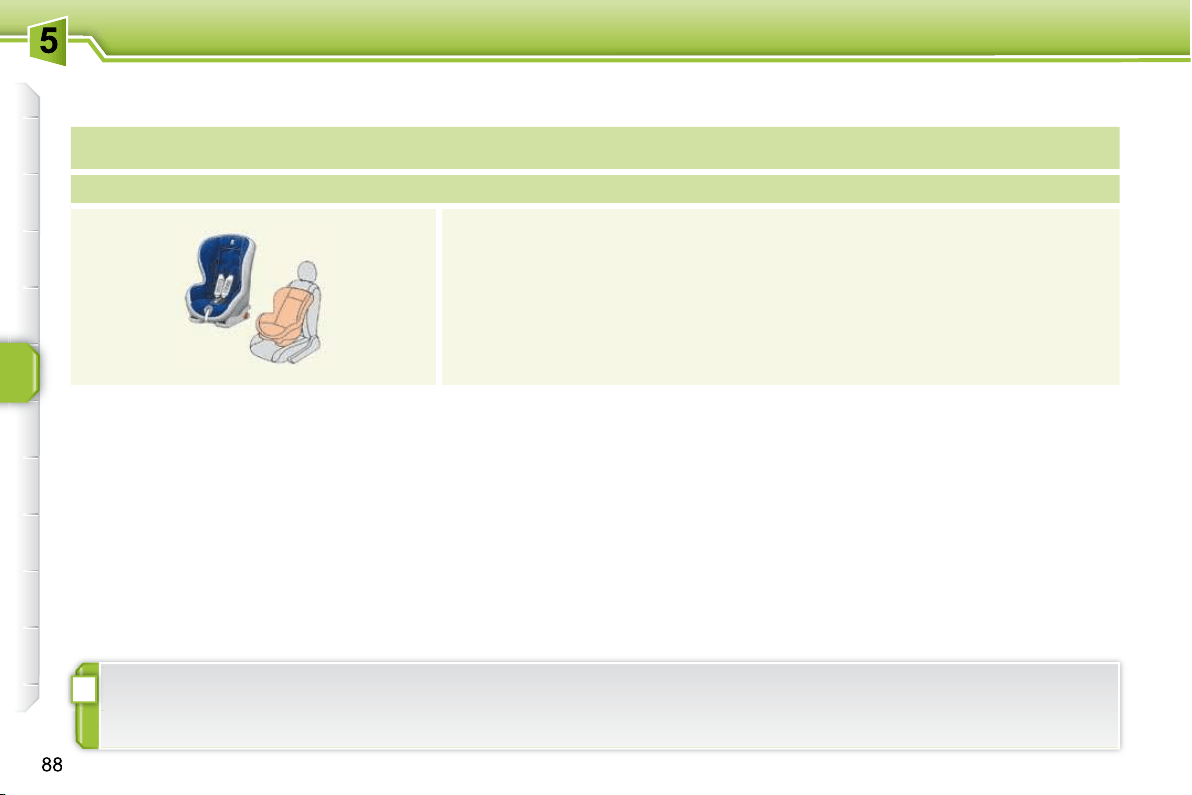
i
CHILD SAFETY
ISOFIX CHILD SEAT RECOMMENDED BY PEUGEOT AND APPROVED FOR YOUR VEHICLE
This child seat can also be used on seats which are not fi tted with ISOFIX mountings. In this case, it must be attached
to the vehicle seat using the three point seat belt.
Follow the instructions for fi tting the child seat given in the seat manufacturer's installation guide.
RÖMER Duo Plus ISOFIX (size category B1 )
Group 1: from 9 to 18 kg
Installed in the forwards-facing position.
Fitted with an upper strap to be secured on the upper ring B , referred to as
the TOP TETHER.
Three seat body angles: sitting, reclining, lying.
CHILD SAFETY
89
LOCATIONS FOR THE INSTALLATION OF ISOFIX CHILD SEATS
In accordance with the European regulation, this table indicates the options for the installation of ISOFIX child seats on the
vehicle seats fi tted with ISOFIX mountings.
In the case of the universal and semi-universal ISOFIX child seats, the child seat's ISOFIX size category, determined by a
letter from A to G , is indicated on the child seat next to the ISOFIX logo.
IUF: seat suitable for the installation of an I sofi x U niversal seat, " F orward facing" and secured using the "Top Tether" upper
strap.
IL-SU: seat suitable for the installation an I sofi x S emi- U niversal seat which is:
- "rear facing" fi tted with a "Top Tether" upper strap or a stay,
- "forward facing" fi tted with a stay,
For the securing of the "Top Tether" upper strap, refer to the "Isofi x Mountings" paragraph.
X: seat which is not suitable for the installation of an ISOFIX seat of the size category indicated.
Weight of the child/ /indicative age
Less than 10 kg
(group 0)
Up to 6 months
approx
Less than 10 kg
(group 0)
Less than 13 kg
(group 0+)
Up to 1 year approx
From 9 to 18 kg (group 1)
From 1 to 3 years approx
Type of ISOFIX child seat Infant car seat * "rear facing" "rear facing" "forward facing"
ISOFIX size category F G C D E C D A B B1
Universal and semi-universal
ISOFIX child seats which
can be installed on the front
passenger seat
X IL-SU IL-SU
IUF
IL-SU
* Infant car seats and "car cots" cannot be installed on the front passenger seat.
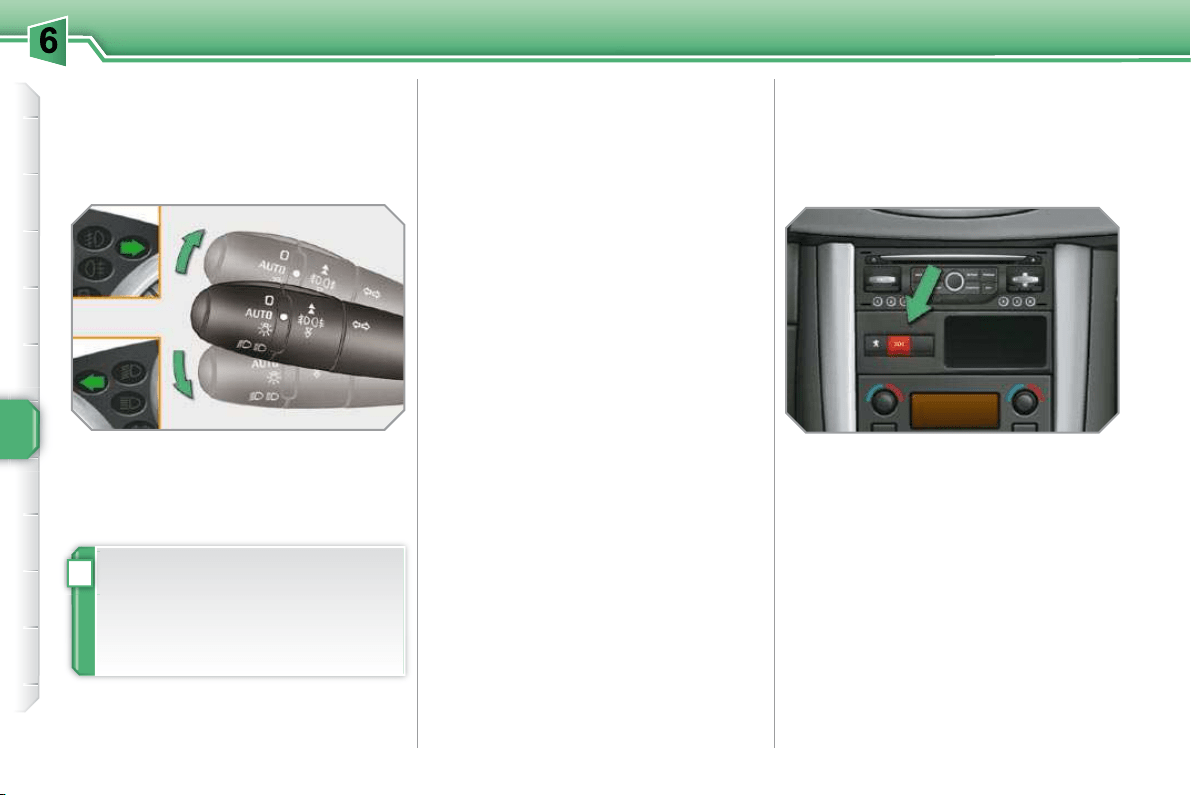
i
SAFETY
90
DIRECTION INDICATORS
Selection of the left or right direction in-
dicators to signal a change of direction
of the vehicle.
If you forget to cancel the direc-
tion indicators for more than twenty
seconds, the volume of the audible
signal will increase if the speed is
above 40 mph (60 km/h).
Lower the lighting stalk when moving to
the left.
Raise the lighting stalk when moving to
the right.
"Motorway" function
Press briefl y upwards or downwards,
without going beyond the point of re-
sistance; the direction indicators will
fl ash 3 times.
EMERGENCY OR ASSISTANCE
CALL
This system allows you to make an
emergency or assistance call to the
emergency services or to the dedicated
PEUGEOT service.
For more information on the use of this
function, refer to the "Audio and tele-
matics" section.
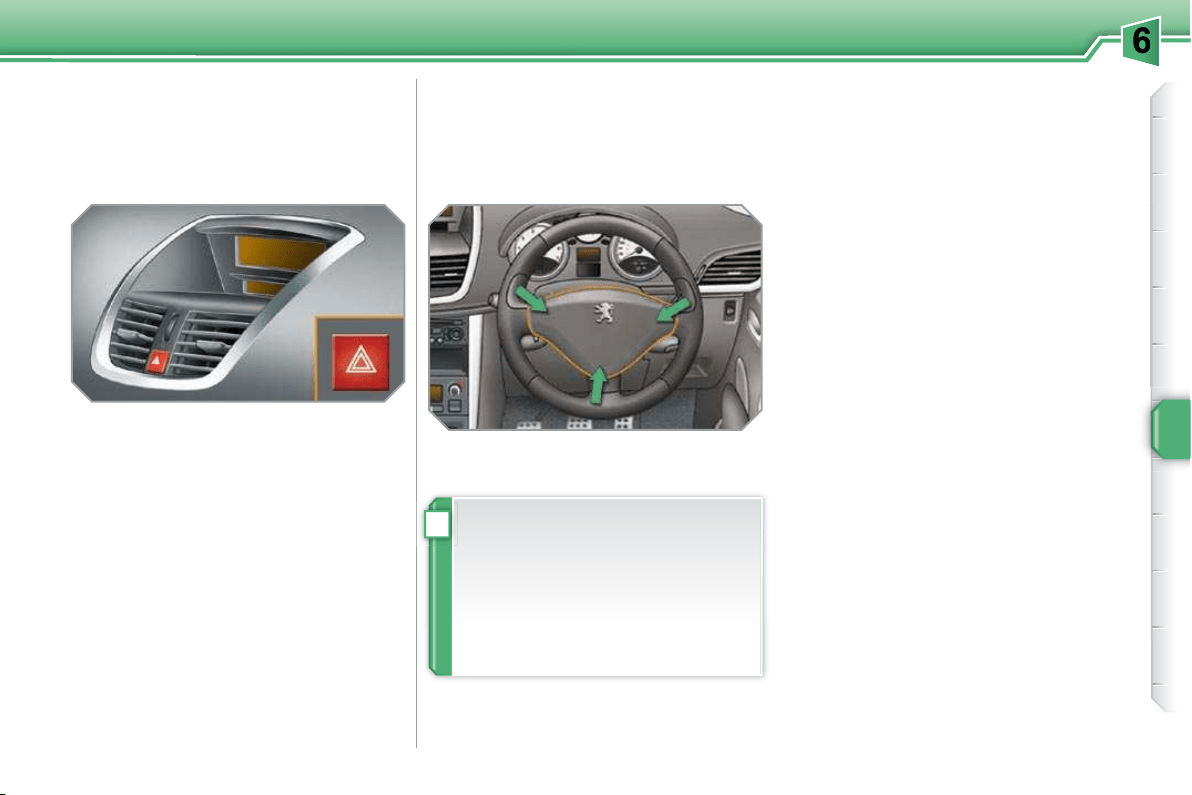
i
SAFETY
91
HAZARD WARNING LAMPS
A visual warning by means of the direc-
tion indicators to alert other road users to
a vehicle breakdown, towing or accident.
Press this button, the direction indi-
cators fl ash.
They can operate with the ignition off.
Automatic operation of hazard
warning lamps
When braking in an emergency, de-
pending on the deceleration, the hazard
warning lamps come on automatically.
They switch off automatically the fi rst
time you accelerate.
You can also switch them off by
pressing the button.
HORN
Press one of the spokes of the steer-
ing wheel.
Use the horn moderately and only
in the following cases:
- immediate danger,
- when approaching an area
where there is no visibility.
Audible warning to alert other road us-
ers to an imminent danger.
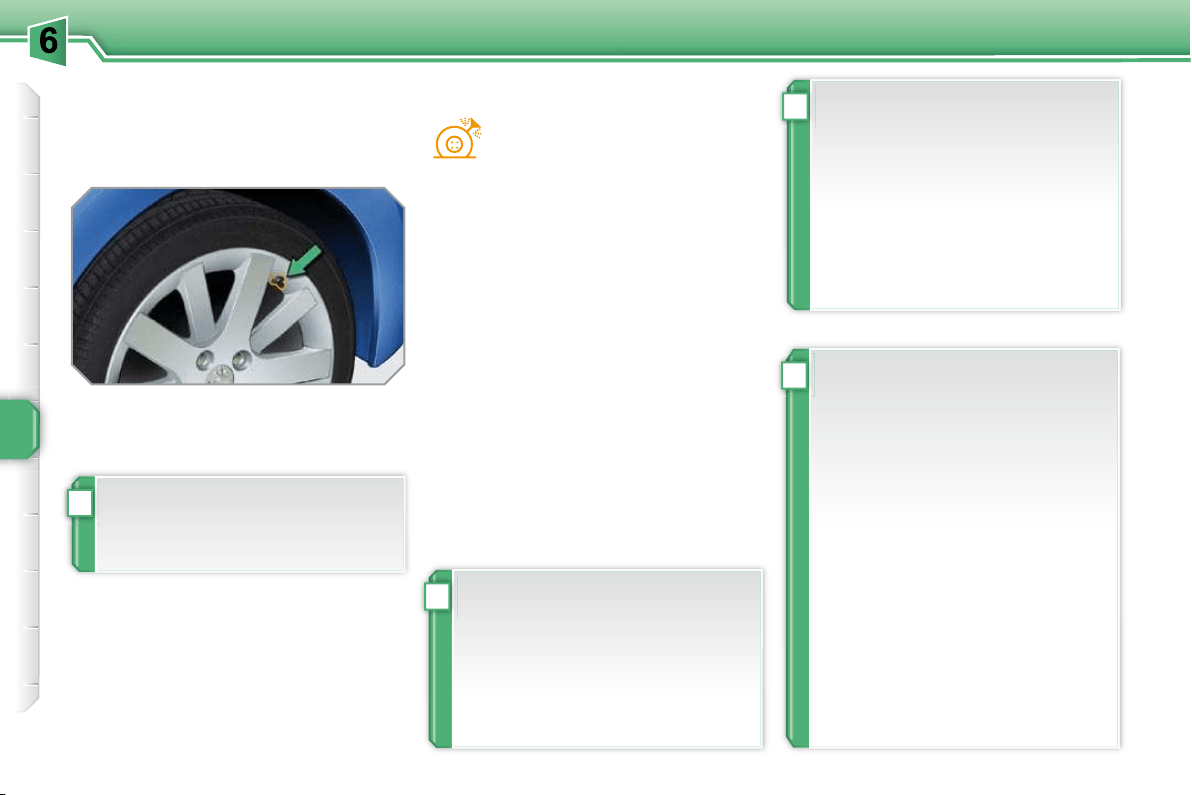
!
i
i
i
SAFETY
92
TYRE UNDER-INFLATION
DETECTION
System which automatically checks the
pressure of the tyres while driving.
All repairs and changing of tyres on
a wheel fi tted with this system must
be carried out by a PEUGEOT
dealer.
If, when changing a tyre, you in-
stall a wheel which is not detected
by your vehicle (example: fi tting
of snow tyres), you must have the
system reinitialised by a PEUGEOT
dealer.
This system does not eliminate
the need to have the tyre pres-
sure checked regularly (refer to
the "Technical information - Identi-
fi cation markings" page) to ensure
that the optimum dynamic perfor-
mance of the vehicle is maintained
and prevent premature wear of the
tyres, particularly in arduous driv-
ing conditions (heavy load, high
speed).
The tyre pressures must be checked
cold, at least once a month. Re-
member to check the pressure of
the spare wheel.
The tyre under-infl ation detection
system may experience temporary
interference due to electro-magnetic
signals on a frequency close to that
used by the system.
Sensors fi tted in each valve trigger a warn-
ing in the event of malfunction. The speed
has to be above 12 mph (20 km/h).
A message appears on the multifunc-
tion screen, accompanied by an audible
signal, to locate the wheel concerned.
Check the tyre pressures as soon
as possible.
This check must be carried out when
the tyres are cold.
Flat tyre
This warning lamp and the STOP
warning lamp come on on the in-
strument panel, accompanied by
an audible signal and a message
on the multifunction screen locat-
ing the wheel concerned.
Stop immediately, avoiding any sud-
den movement of the steering wheel
and the brakes.
Change the damaged wheel (punc-
tured or very defl ated tyre), and
have the tyre pressure checked as
soon as possible.
Puncture
The tyre under-infl ation detection
system is an aid to driving which
does not replace the need for the
driver to be vigilant or to drive re-
sponsibly.
Sensor(s) not detected or faulty
A message appears on the multifunc-
tion screen, accompanied by an audible
signal, to locate the wheel or wheels
which are not detected or to indicate a
fault in the system.
Contact a PEUGEOT dealer to replace
the faulty sensor(s).
This message is also displayed
when one of the wheels is away
from the vehicle (being repaired) or
when one or more wheels without a
sensor are fi tted.
The spare wheel is not fi tted with
a sensor.
!
i
!
SAFETY
93
BRAKING ASSISTANCE
SYSTEMS *
Group of supplementary systems which
help you to obtain optimum braking in
complete safety in emergency situa-
tions:
- anti-lock braking system (ABS),
- electronic brake force distribution
(EBFD),
-
emergency braking assistance (EBA).
Anti-lock braking system
and electronic brake force
distribution
Linked systems which improve the sta-
bility and manoeuvrability of your vehicle
when braking, in particular on poor or
slippery surfaces.
When braking in an emergency,
press very fi rmly without releasing
the pressure.
When replacing wheels (tyres and
rims), ensure that they conform to the
manufacturer's recommendations.
Operating fault
If this warning lamp comes on,
accompanied by an audible sig-
nal and a message on the mul-
tifunction screen, it indicates a
malfunction of the anti-lock braking sys-
tem which could result in loss of control
of the vehicle when braking.
If this warning lamp comes on,
together with the STOP and
ABS warning lamps, accompa-
nied by an audible signal and a
message on the multifunction screen, it
indicates a malfunction of the electron-
ic brake force distribution which could
result in loss of control of the vehicle
when braking.
You must stop as soon as it is safe
to do so.
In either case, contact a PEUGEOT
dealer.
Emergency braking assistance
System which, in an emergency, ena-
bles you to obtain the optimum braking
pressure more quickly, thus reducing
the stopping distance.
* According to country.
Activation
The anti-lock braking system comes
into operation automatically when there
is a risk of wheel lock.
Normal operation of the ABS may make
itself felt by slight vibration of the brake
pedal.
Activation
It is triggered by the speed at which the
brake pedal is pressed.
The effect of this is a reduction in the
resistance of the pedal and an increase
in braking effi ciency.
When braking in an emergency,
press fi rmly without releasing the
pressure.
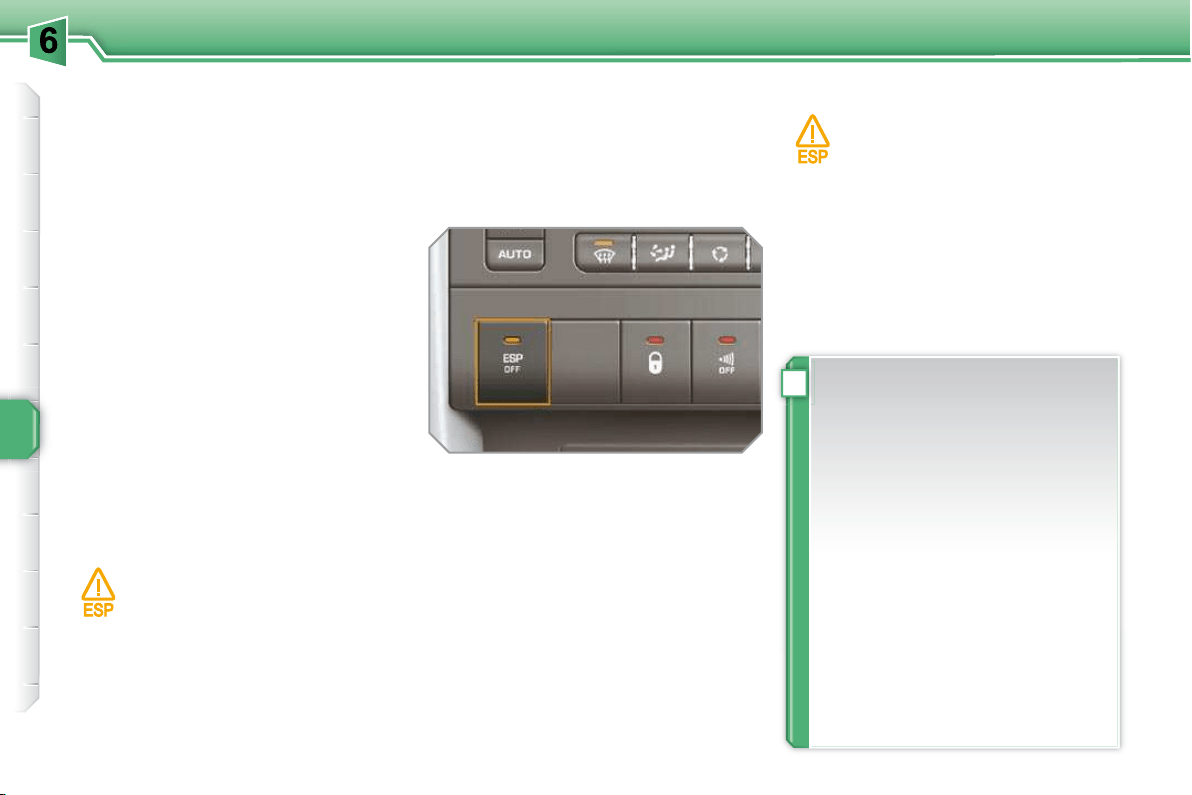
!
SAFETY
94
The ESP/ASR systems offer ex-
ceptional safety in normal driving,
but this should not encourage the
driver to take extra risks or drive at
high speed.
The correct functioning of these
systems depends on observation
of the manufacturer's recommen-
dations regarding the wheels (tyres
and rims), the braking components,
the electronic components and the
PEUGEOT assembly and opera-
tion procedures.
After an impact, have these sys-
tems checked by a PEUGEOT
dealer.
Deactivation
In exceptional conditions (starting a ve-
hicle which is bogged down, stuck in
snow, on soft ground, ...), it may be ad-
visable to deactivate the ASR and ESP
systems, so that the wheels can move
freely and regain grip.
Press the "ESP OFF" button, locat-
ed in the centre of the dashboard.
If this warning lamp comes on on the in-
strument panel and the indicator lamp on
the button comes on, this indicates that the
ASR and ESP systems are deactivated.
Reactivation
These systems are reactivated automat-
ically each time the ignition is switched
back on or from 30 mph (50 km/h).
Press the "ESP OFF" button again
to reactivate them manually.
Operating fault
If this warning lamp comes on,
accompanied by an audible sig-
nal and a message on the multi-
function screen, this indicates a
malfunction of these systems.
Have them checked by a PEUGEOT dealer.
TRAJECTORY CONTROL
SYSTEMS
Activation
These systems are activated automati-
cally each time the vehicle is started.
Anti-skid regulation (ASR) and
electronic stability programme
(ESP)
They come into operation in
the event of a grip or trajectory
problem.
This is indicated by fl ashing of
this warning lamp on the instru-
ment panel.
The anti-skid regulation (also known as
Traction Control) optimises traction to
prevent skidding of the wheels, by act-
ing on the brakes of the driving wheels
and on the engine.
The electronic stability programme acts
on the brake of one or more wheels and
on the engine to keep the vehicle on the
trajectory required by the driver, within
the limits of the laws of physics.
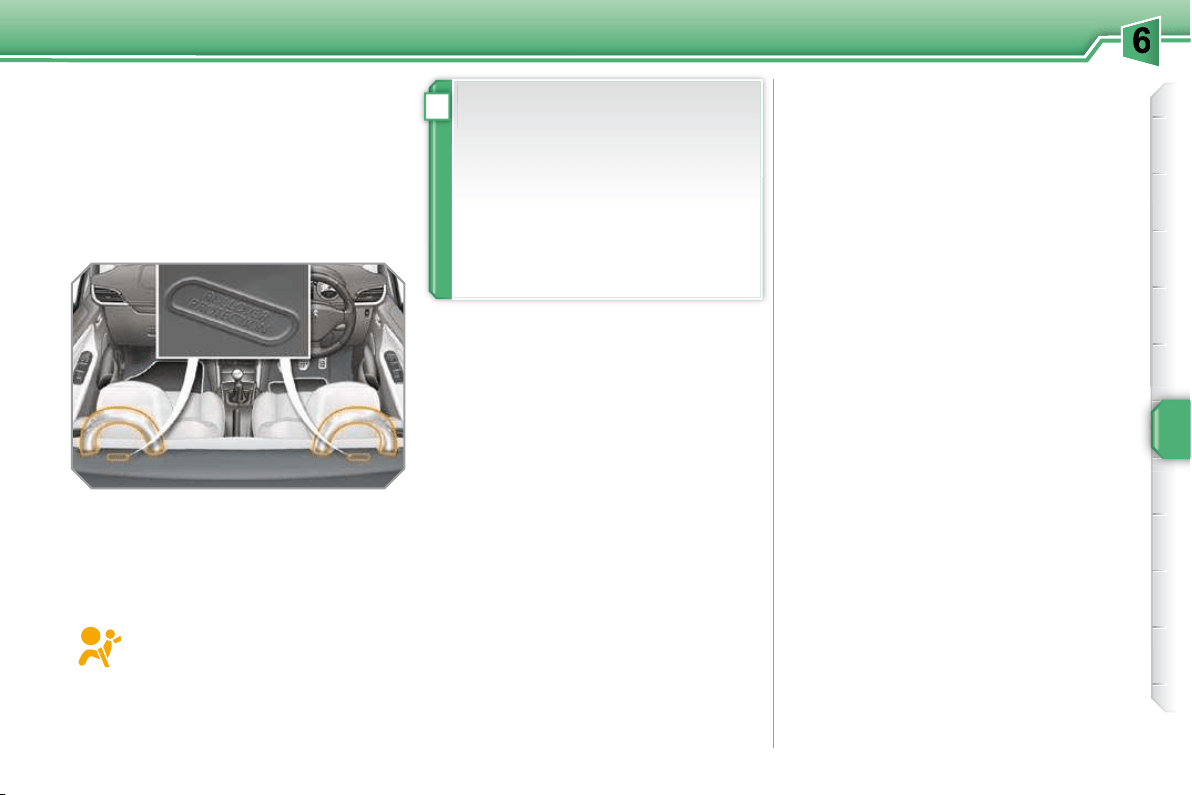
!
SAFETY
95
SEAT BELTS
ROLL-OVER BARS
System which protects all of the oc-
cupants restrained by their seat belt
should the vehicle roll over.
The roll-over bars are built into the back
of the rear bench seat. Their presence
is indicated by the words "Rollover
Protection".
Activation
They are triggered simultaneously should
the vehicle roll over.
Operating fault
If this warning lamp comes on
on the instrument panel, accom-
panied by an audible signal and
a message on the multifunction
screen, contact a PEUGEOT deal-
er to have the system checked.
In order to guarantee the correct opera-
tion and the deployment of the roll-over
bars if roll-over is detected, the follow-
ing conditions must be complied with:
-
no accessory which is not recom-
mended by PEUGEOT should be
in contact with or fi xed to the roll-
over bars,
- no object should block or stop the
movement of the roll-over bars,
- the area above the roll-over bars
should be clear of any objects.
Front seat belts
The front seat belts are fi tted with a pre-
tensioning and force limiting system.
This system improves safety in the front
seats in the event of front impacts. De-
pending on the severity of the impact,
the pretensioning system instantly tight-
ens the seat belts against the body of
the occupants.
The pretensioning seat belts are active
when the ignition is on.
The force limiter reduces the pressure
of the seat belt on the occupant's chest.
This improves their protection.
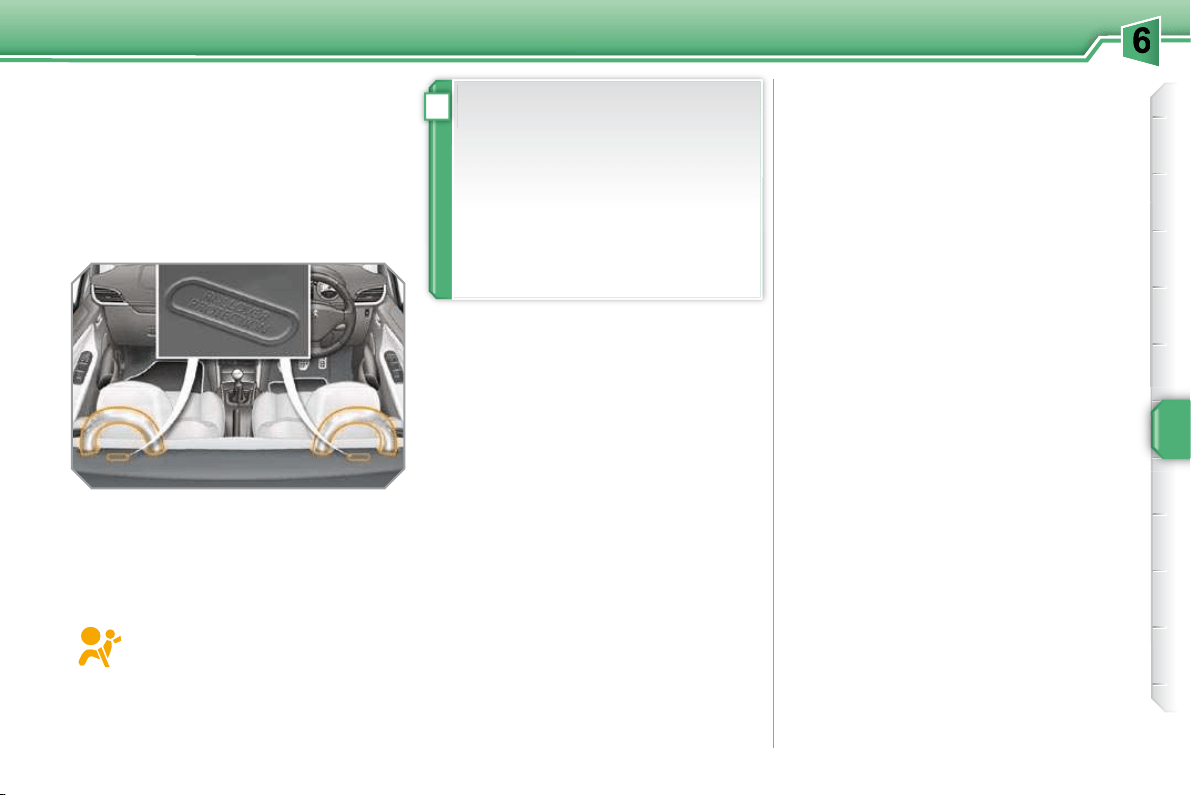
!
SAFETY
95
SEAT BELTS
ROLL-OVER BARS
System which protects all of the oc-
cupants restrained by their seat belt
should the vehicle roll over.
The roll-over bars are built into the back
of the rear bench seat. Their presence
is indicated by the words "Rollover
Protection".
Activation
They are triggered simultaneously should
the vehicle roll over.
Operating fault
If this warning lamp comes on
on the instrument panel, accom-
panied by an audible signal and
a message on the multifunction
screen, contact a PEUGEOT deal-
er to have the system checked.
In order to guarantee the correct opera-
tion and the deployment of the roll-over
bars if roll-over is detected, the follow-
ing conditions must be complied with:
-
no accessory which is not recom-
mended by PEUGEOT should be
in contact with or fi xed to the roll-
over bars,
- no object should block or stop the
movement of the roll-over bars,
- the area above the roll-over bars
should be clear of any objects.
Front seat belts
The front seat belts are fi tted with a pre-
tensioning and force limiting system.
This system improves safety in the front
seats in the event of front impacts. De-
pending on the severity of the impact,
the pretensioning system instantly tight-
ens the seat belts against the body of
the occupants.
The pretensioning seat belts are active
when the ignition is on.
The force limiter reduces the pressure
of the seat belt on the occupant's chest.
This improves their protection.
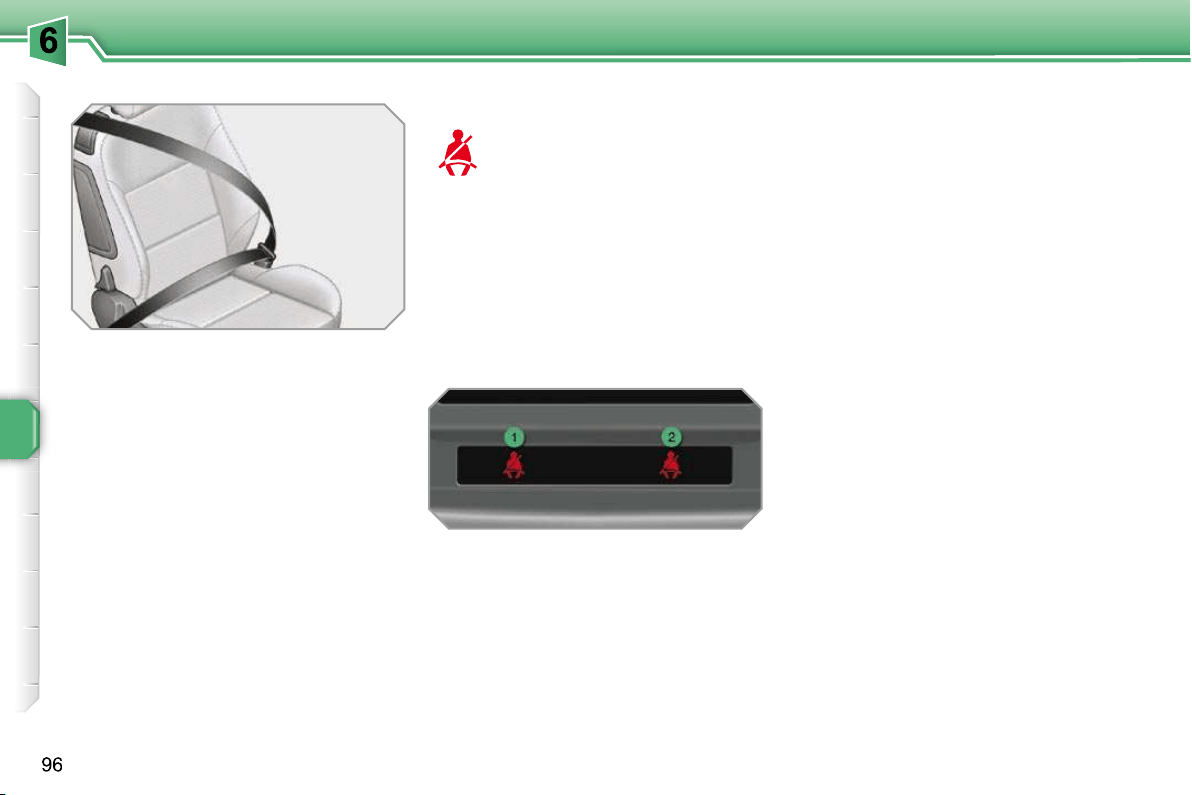
SAFETY
Fastening Seat belt not fastened/unfastened
warning lamp
Pull the strap, then insert the tongue
in the buckle.
Check that the seat belt is fastened
correctly by pulling the strap.
When the ignition is switched on,
this warning lamp comes on on
the instrument panel if the driver *
and/or the front passenger has not
fastened their seat belt.
Above approximately 12 mph (20 km/h) and
for two minutes, this warning lamp fl ashes
accompanied by an audible signal of in-
creasing volume. When the two minutes
have elapsed, this warning lamp remains on
until the driver * and/or the front passenger
fastens their seat belt.
Unfastening
Press the red button on the buckle.
1. Front left seat belt warning lamp.
2. Front right seat belt warning lamp.
On the central panel, the corresponding
warning lamp 1 or 2 comes on in red if
the seat belt is not fastened or is unfas-
tened
Seat belt not fastened/unfastened
warning lamps panel
Rear seat belts
The rear seats are fi tted with two three-
point inertia reel seat belts.
Fastening
Pull the strap, then insert the tongue
in the buckle.
Check that the seat belt is fastened
correctly by pulling the strap.
Unfastening
Press the red button on the buckle.
* According to country.
i
SAFETY
97
The driver must ensure that pas-
sengers use the seat belts correctly
and that they are all restrained se-
curely before setting off.
Wherever you are seated in the ve-
hicle, always fasten your seat belt,
even for short journeys.
Do not invert the seat belt buckles
as they will not fulfi l their role fully.
The seat belts are fi tted with an in-
ertia reel permitting automatic ad-
justment of the length of the strap
to your size. The seat belt is stored
automatically when not in use.
Before and after use, ensure that
the seat belt is reeled in correctly.
The lower part of the strap must be
positioned as low as possible on
the pelvis.
The upper part must be positioned
in the hollow of the shoulder.
The inertia reels are fi tted with an
automatic locking device which
comes into operation in the event
of a collision, emergency braking
or if the vehicle rolls over. You can
release the device by pulling fi rmly
on the strap and releasing it so that
it re-winds slightly.
In order to be effective, a seat belt
must:
- be tightened as close to the body as
possible,
- be pulled in front of you with a
smooth movement, checking that it
does not twist,
- be used to restrain only one person,
- not bear any trace of cuts or fraying,
- not be converted or modifi ed to
avoid affecting its performance.
In accordance with current safety regu-
lations, all repairs and checks must be
carried out by a PEUGEOT dealer who
guarantees that the work is carried out
correctly.
Have your seat belts checked regularly
by a PEUGEOT dealer and particularly
if the straps show signs of damage.
Clean the seat belt straps with soapy
water or a textile cleaning product, sold
by PEUGEOT dealers.
After folding or moving a seat or rear
bench seat, ensure that the seat belt is
positioned and reeled in correctly.
Recommendations for children
Use a suitable child seat if the passen-
ger is less than 12 years old or shorter
than one and a half metres.
Never use the same seat belt to secure
more than one person.
Never allow a child to travel on your lap.
In the event of an impact
Depending on the nature and se-
riousness of the impacts , the pre-
tensioning device may be triggered
before and independently of the air-
bags. Triggering of the pre-tensioners
is accompanied by a slight discharge
of harmless smoke and a noise, due
to the activation of the pyrotechnic car-
tridge incorporated in the system.
In all cases, the airbag warning lamp
comes on.
Following an impact, have the seat
belts system checked, and if neces-
sary replaced, by a PEUGEOT dealer.
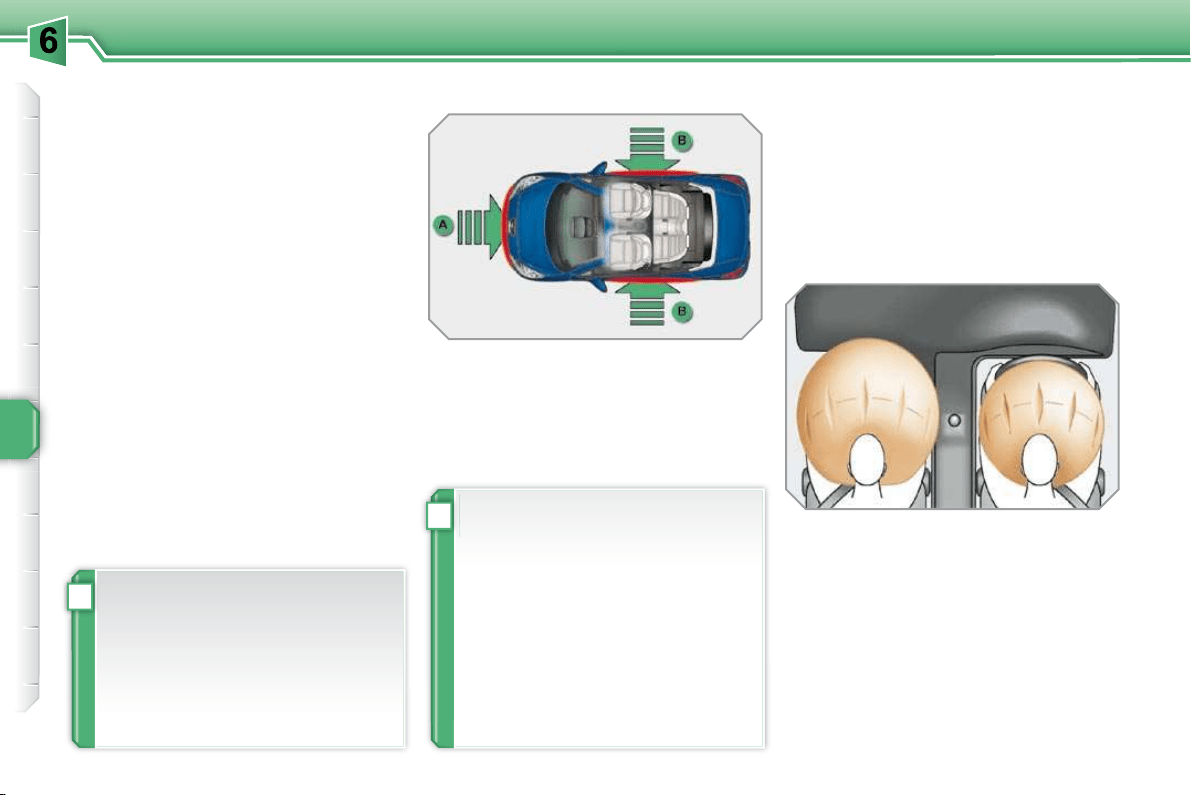
!
i
SAFETY
98
AIRBAGS
The airbags have been designed to
maximise the safety of the occupants
in the event of violent collisions. They
supplement the action of the force-limit-
ing seat belts.
In this case, the electronic detectors
record and analyse the front and side
impacts suffered in the impact detection
zones:
- in the event of a serious impact,
the airbags are deployed instanta-
neously and protect the occupants
of the vehicle; immediately after the
impact, the airbags defl ate rapidly
so that they do not hinder the visibili-
ty of the occupants or their possible
exit from the vehicle,
- in the event of a minor impact or
rear impact and in certain roll-over
conditions, the airbags will not be
deployed; the seat belt alone is suf-
fi cient to provide maximum protec-
tion in these situations.
The airbags do not operate when
the ignition is off.
This equipment only operates once.
If a second impact occurs (during
the same or a subsequent acci-
dent), the airbag will not operate.
Impact detection zones
A. Front impact zone.
B. Side impact zone.
Front airbags
System which protects the head and
chest of the driver and front passenger
in the event of a front impact.
The driver's airbag is incorporated in
the centre of the steering wheel; the
front passenger's airbag is incorporated
in the dashboard above the glove box.
Activation
The airbags are triggered simultaneous-
ly, unless the passenger's front airbag
is deactivated, in the event of a serious
front impact applied to all or part of the
front impact zone A , in the longitudinal
centreline of the vehicle on a horizontal
plane and directed from the front to the
rear of the vehicle.
The front airbag infl ates between the
front occupant of the vehicle and the
dashboard to cushion their forward
movement.
The deployment of one or more
airbags is accompanied by a slight
discharge of harmless smoke and
a noise, due to the activation of the
pyrotechnic cartridge incorporated
in the system.
This smoke is not harmful, but sen-
sitive individuals may experience
some irritation.
The noise of the detonation may
result in a slight loss of hearing for
a short time.
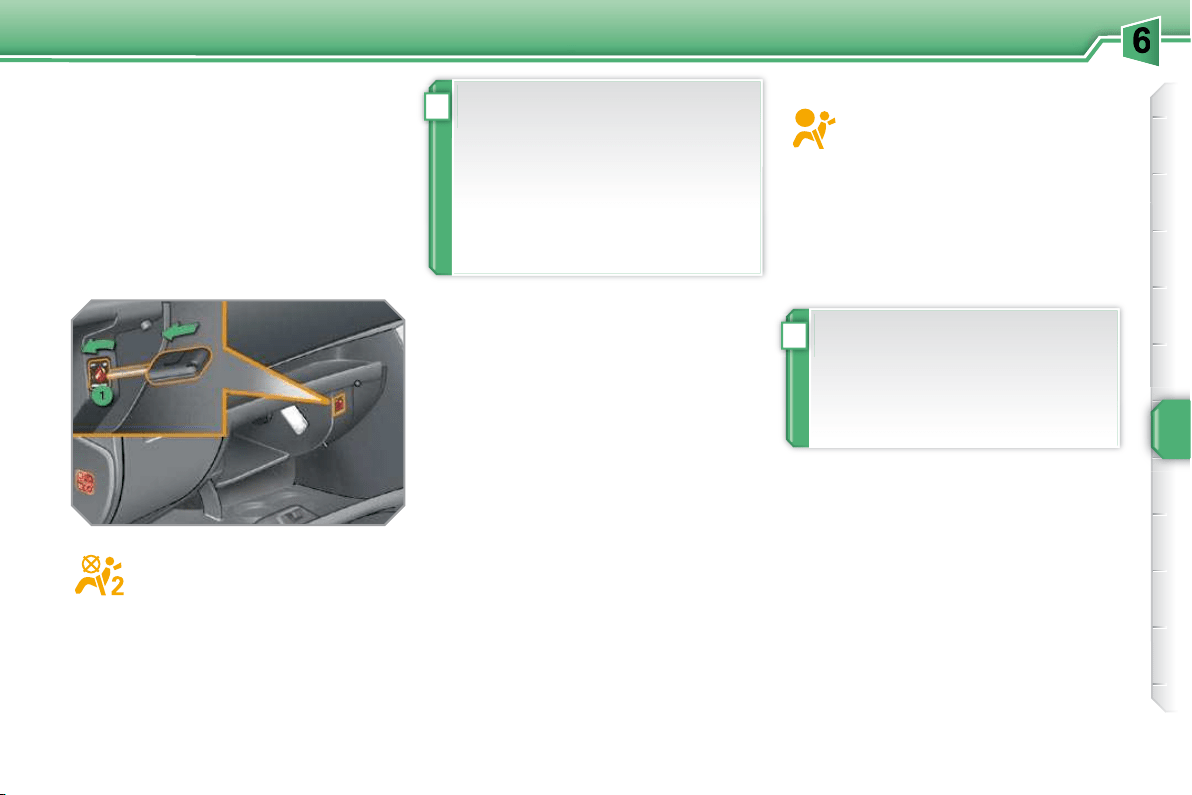
!
!
SAFETY
99
To assure the safety of your child,
it is imperative that the passenger
airbag is deactivated when you in-
stall a "rear facing" child seat on
the front passenger seat.
Otherwise, the child would risk be-
ing seriously injured or killed if the
airbag were triggered.
If both airbag warning lamps come
on continuously, do not install a
"rear facing" child seat on the front
passenger seat.
Have the system checked by a
PEUGEOT dealer.
Deactivation
Only the front passenger's airbag can
be deactivated:
with the ignition off , insert the key
in the passenger airbag deactivation
switch 1 ,
turn it to the "OFF" position,
then, remove the key keeping the
switch in the new position.
According to version, this warn-
ing lamp comes on either on
the instrument panel or on the
central panel when the ignition
is on and until the airbag is re-
activated.
Reactivation
When you remove the child seat, turn
switch 1 to the "ON" position to reacti-
vate the airbag and so asure the safety
of your front passenger in the event of
an impact.
Operating fault
If this warning lamp comes on on
the instrument panel, accompa-
nied by an audible warning and
a message on the multifunction
screen, contact a PEUGEOT
dealer to have the system checked. The
airbags may no longer be triggered in
the event of a serious impact.
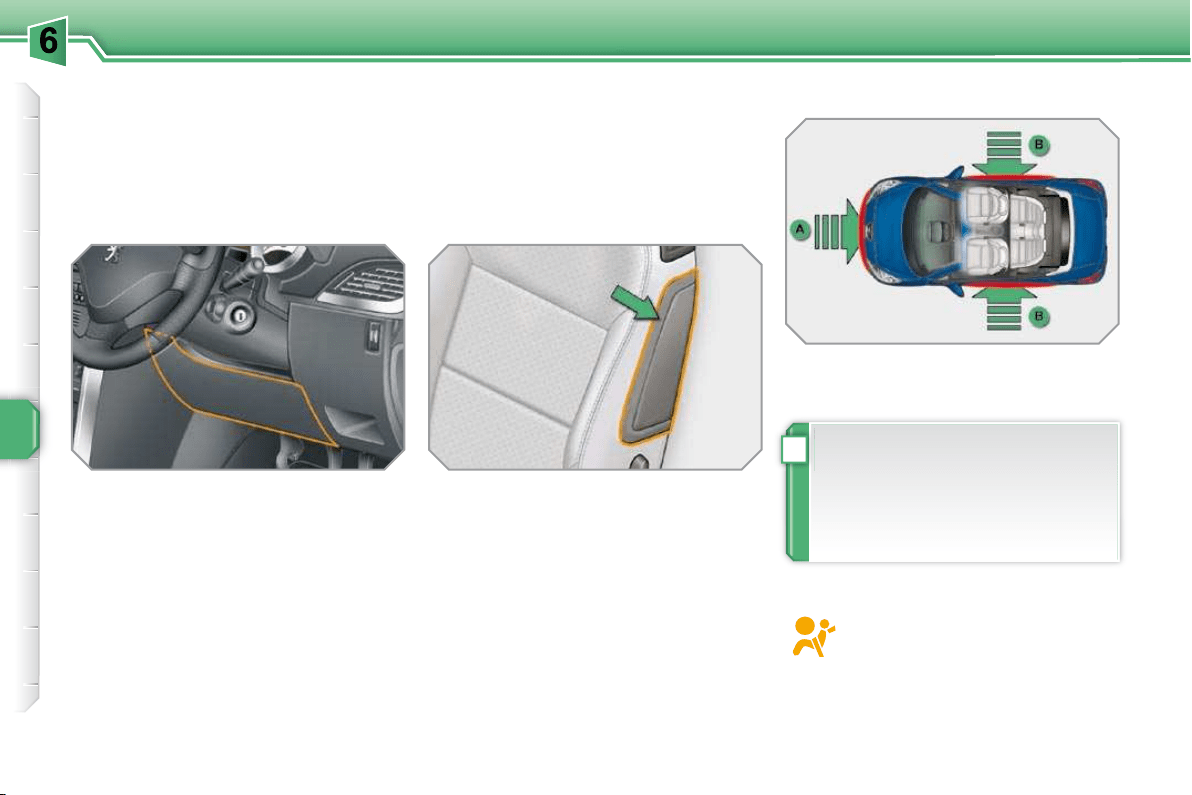
!
SAFETY
100
* According to country.
Knee airbag *
System which protects the driver's knees
in the event of a serious front impact.
This airbag is incorporated in the dash-
board below the steering column.
Activation
It is deployed at the same time as the
front airbags.
Lateral airbags
System which protects the driver and
front passenger in the event of a violent
side impact in order to limit the risks of
injury to the chest.
Each lateral airbag is incorporated in
the front seat back frame, on the door
side.
Activation
It is triggered unilaterally in the event
of a violent impact applied to all or part
of the side impact zone B , operating at
right angles to the longitudinal axis of
the vehicle in a horizontal plane and
from the exterior of the vehicle towards
the interior.
The lateral airbag comes between the
front occupant of the vehicle and the
corresponding door trim panel.
Impact detection zones
A. Front impact zone.
B. Side impact zone.
The airbag may not trigger in an
impact or minor accident on the
side of the vehicle.
The airbag does not trigger in a
front or rear impact.
Operating fault
If this warning lamp comes on
on the instrument panel, accom-
panied by an audible signal and
a message on the multifunction
screen, contact a PEUGEOT dealer to
have the system checked. The airbags
may no longer trigger in the event of a
violent impact.
!
SAFETY
101
For the airbags to be fully
effective, observe the following
safety rules:
Sit in a normal upright position.
Wear a correctly adjusted seat belt.
Do not leave anything between the
occupants and the airbags (a child,
pet, object...). This could hamper the
operation of the airbags or injure the
occupants.
After an accident or if the vehicle has
been stolen or broken into, have the
airbag systems checked.
All work on the airbag system is strict-
ly forbidden unless it is carried out by
qualifi ed personnel of the PEUGEOT
network.
Even if all of the precautions men-
tioned are observed, a risk of injury
or of slight burns to the head, chest
or arms when an airbag is triggered
cannot be ruled out. Indeed, the bag
infl ates almost instantly (within a few
milliseconds) then defl ates within the
same time discharging the hot gas via
openings provided for this purpose.
* According to country.
Front airbags
Do not drive holding the steering wheel by its spokes or resting your hands on
the centre part of the wheel.
Passengers must not place their feet on the dashboard.
Smoke as little as possible as deployment of the airbags can cause burns or the
risk of injury from a cigarette or pipe.
Never remove or pierce the steering wheel or hit it violently.
Knee airbag *
Do not sit with your knees any nearer to the steering wheel than necessary.
Lateral airbags
Only put approved covers on the seats. These will not hinder the triggering of
the lateral airbags. Consult a PEUGEOT dealer.
Do not fi x or attach anything to the seat backs. This could cause injury to the
chest or arms when the side airbag infl ates.
Do not sit with the upper part of the body any nearer to the door than necessary.
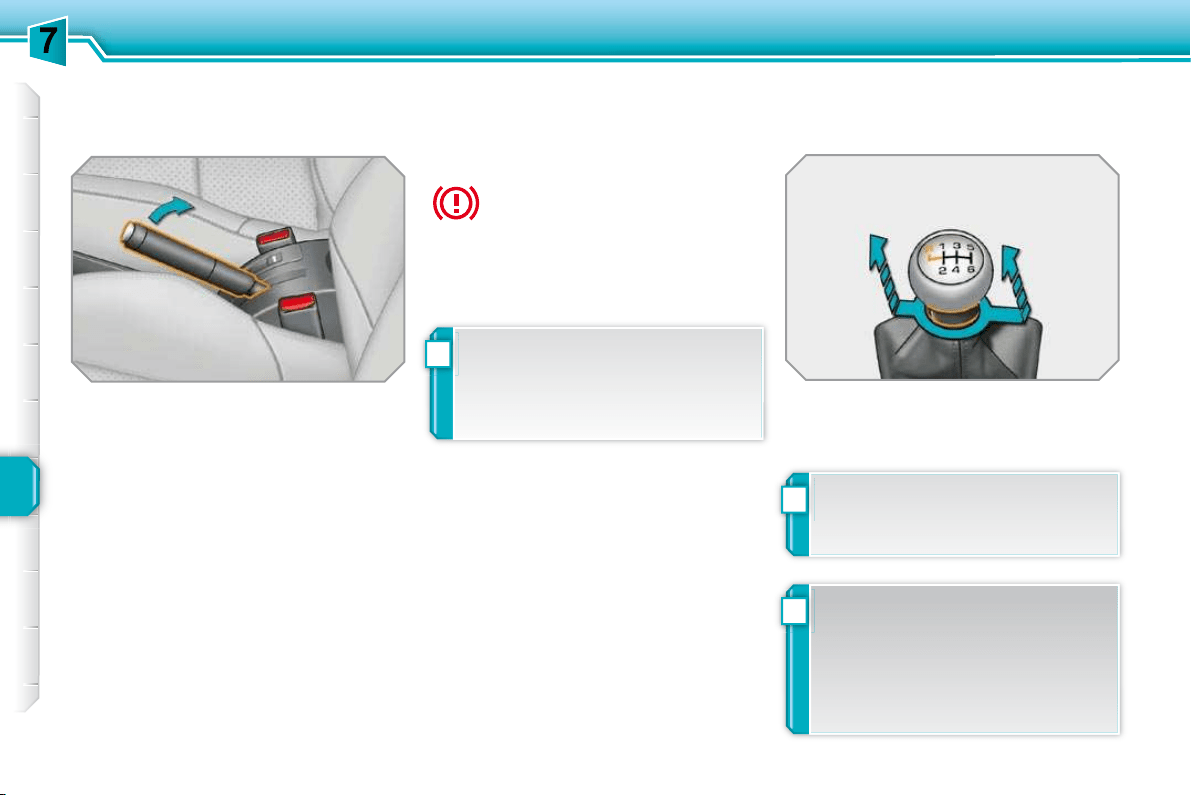
!
!
i
DRIVING
102
When parking on a slope, direct
your wheels against the pavement,
apply the parking brake and en-
gage a gear.
PARKING BRAKE
Applying
Pull the parking brake lever fully up
to immobilise your vehicle.
When the vehicle is being driven,
if this warning lamp and the STOP
warning lamp come on, accom-
panied by an audible signal and a
message on the multifunction screen, this
indicates that the parking brake is still on or
has not been properly released.
Releasing
Pull the parking brake lever gently,
press the release button then lower
the lever fully.
6-SPEED MANUAL GEARBOX
Engaging reverse gear
Raise the ring under the knob and
push the gear lever to the left then
forwards.
Only engage reverse gear when
the vehicle is stationary with the
engine at idle.
As a safety precaution and to facili-
tate starting of the engine:
- always select neutral,
- press the clutch pedal.
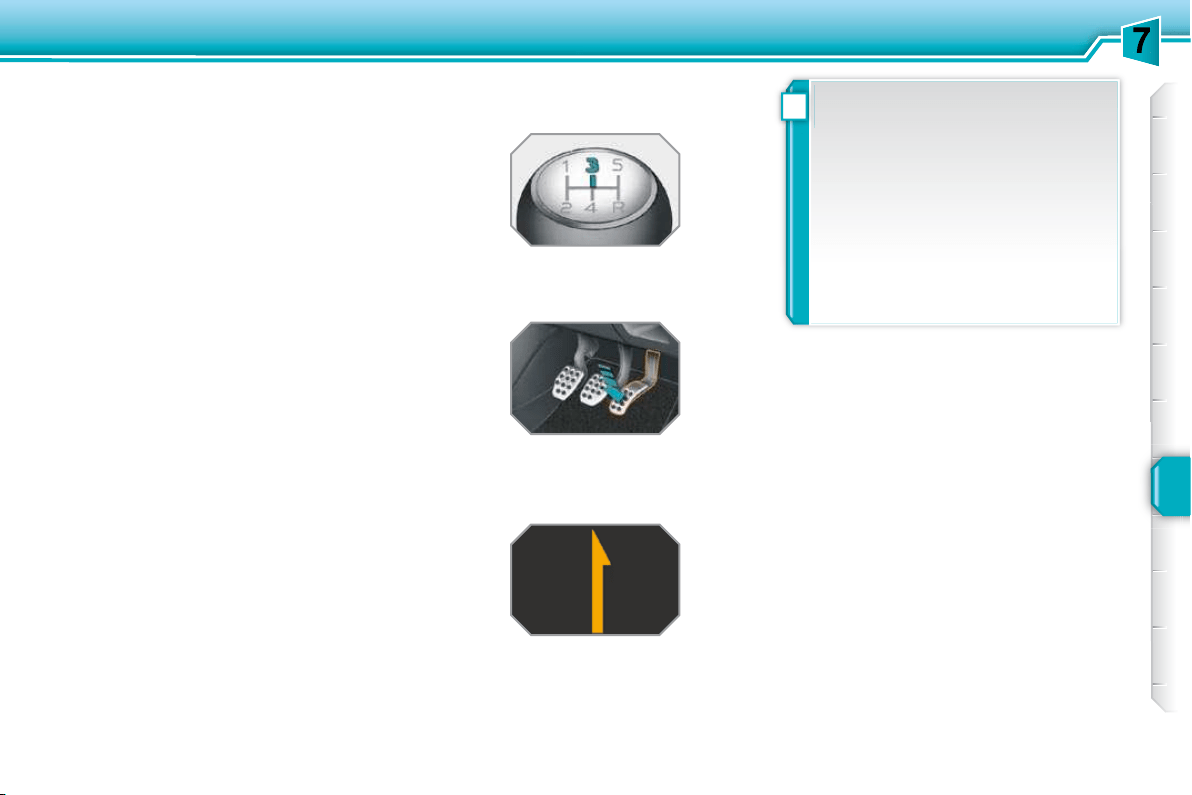
!
DRIVING
103
* According to engine.
GEAR SHIFT INDICATOR *
System which reduces fuel consumption
by advising the driver to change up on
vehicles fi tted with a manual gearbox.
Operation
The system intervenes only when driv-
ing economically.
Depending on the driving situation and
your vehicle's equipment, the system
may advise you to skip one or more
gears. You can follow this instruc-
tion without engaging the intermediate
gears.
The gear engagement recommenda-
tions must not be considered compulso-
ry. In fact, the confi guration of the road,
the amount of traffi c and safety remain
determining factors when choosing the
best gear. Therefore, the driver remains
responsible for deciding whether or not
to follow the advice given by the system.
This function cannot be deactivated.
Example:
- You are in third gear.
- You press the accelerator pedal
moderately.
- The system may suggest that you
engage a higher gear, if appropriate.
The information appears in the form
of an arrow on the instrument panel
screen.
Depending on your vehicle's equipment,
this arrow may be accompanied by the
recommended gear.
In the case of driving which makes
particular demands on the perfor-
mance of the engine (fi rm pres-
sure on the accelerator pedal, for
example, when overtaking...), the
system will not recommend a gear
change.
The system never suggests:
- engaging fi rst gear,
- engaging reverse gear,
- engaging a lower gear.
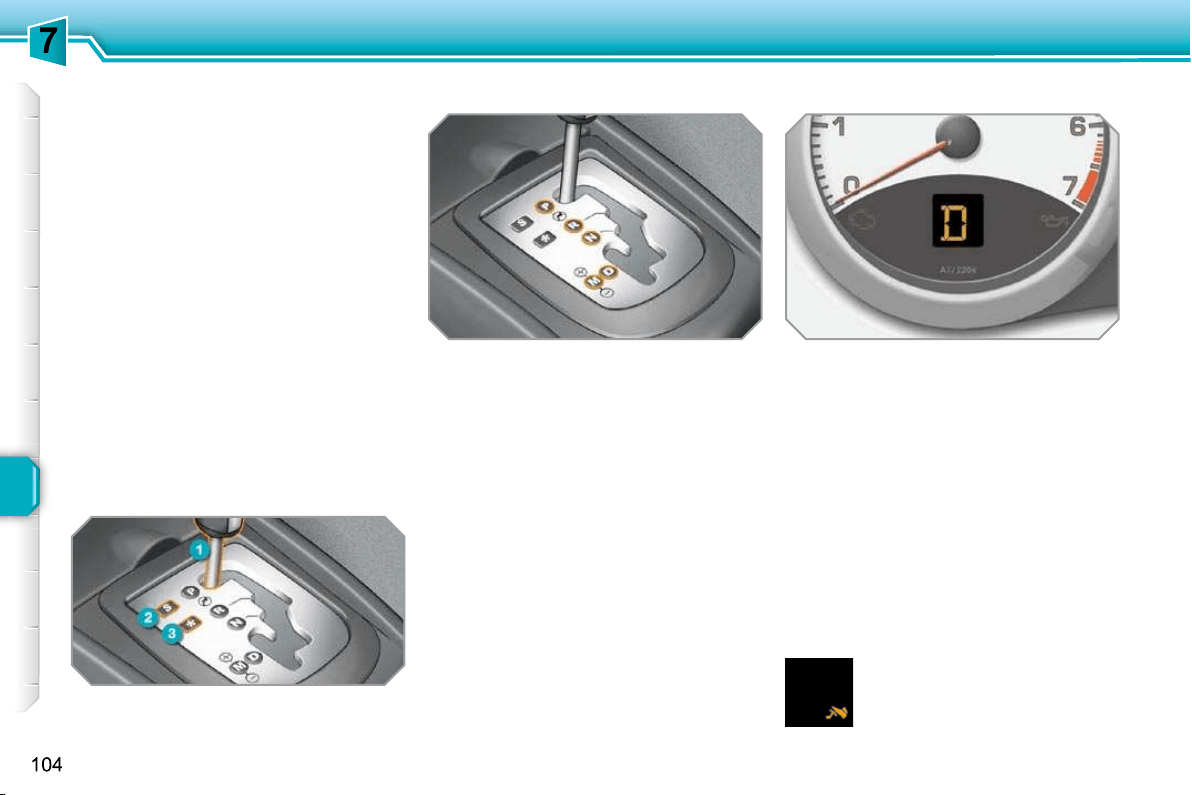
DRIVING
AUTOMATIC GEARBOX
Four-speed automatic gearbox which
offers a choice between the comfort of
fully automatic operation, enhanced by
sport and snow programmes, or manual
gear changing.
Therefore, four driving modes are of-
fered:
- automatic operation for electronic
management of the gears by the
gearbox,
- sport programme for a more dynamic
style of driving,
- snow programme to improve driving
when traction is poor,
- manual operation for sequential
changing of the gears by the driver.
Gear lever
P. Park.
- Immobilisation of the vehicle, park-
ing brake on or off.
- Starting the engine.
R. Reverse.
- Reversing manoeuvres, vehicle sta-
tionary, engine at idle.
N. Neutral.
- Immobilisation of the vehicle, park-
ing brake on.
- Starting the engine.
D. Automatic operation.
M. +/- Manual operation with sequential
changing of the four gears.
Push forwards to change up through
the gears.
or
Pull backwards to change down
through the gears.
Displays on the instrument panel
When you move the lever in the gate
to select a position, the corresponding
indicator is displayed on the instrument
panel.
P. Park
R. Reverse
N. Neutral
D. Drive (Automatic driving)
S. Sport programme
. Snow programme
1, 2, 3, 4 . Gear engaged during manual
operation
-. Invalid value during manual operation
Press the brake pedal
when this indicator lamp is
displayed on the instrument
panel (e.g.: starting the en-
gine).
Gear selection gate
1. Gear lever.
2. Button "S" (sport) .
3. Button " " (snow).
Foot on brake
!
!
i
DRIVING
105
Moving off
Apply the parking brake.
Select position P or N .
Start the engine.
If this procedure is not followed, an au-
dible signal is heard, accompanied by a
message on the multifunction screen.
With the engine running, press the
brake pedal.
Release the parking brake.
Select position R , D or M ,
Gradually release the brake pedal.
The vehicle moves off immediately.
If position N is engaged inadver-
tently while driving, allow the en-
gine to return to idle then engage
position D to accelerate.
The gearbox then operates in auto-
adaptive mode, without any intervention
on the part of the driver. It continuously
selects the most suitable gear accord-
ing to the style of driving, the profi le of
the road and the load in the vehicle.
Automatic operation
Select position D for automatic
changing of the four gears.
appears on the instrument
panel.
Snow programme " "
Press button " ", after starting the
engine.
The gearbox adapts to driving on slip-
pery roads.
This programme improves starting and
drive when traction is poor.
S appears on the instrument
panel.
Sport programme "S"
Press button "S" , after starting the
engine.
The gearbox automatically favours a
dynamic style of driving.
Never select position N while the
vehicle is moving.
Never select positions P or R
unless the vehicle is completely
stationary.
When the engine is running at idle,
with the brakes released, if position R ,
D or M is selected, the vehicle moves
even without the accelerator being
pressed.
When the engine is running, never
leave children in the vehicle with-
out supervision.
When carrying out maintenance with
the engine running, apply the park-
ing brake and select position P .
Sport and snow programmes
These two special programmes supple-
ment the automatic operation in very
specifi c conditions of use.
Return to automatic operation
At any time, press the button se-
lected again to quit the programme
engaged and return to auto-adaptive
mode.
For maximum acceleration without
touching the lever, press the accelera-
tor pedal down fully (kick down). The
gearbox changes down automatically
or maintains the gear selected until the
maximum engine speed is reached.
On braking, the gearbox changes down
automatically to provide effi cient engine
braking.
If you release the accelerator sharply,
the gearbox will not change to a higher
gear for safety reasons.
!
i
DRIVING
106
Stopping the vehicle
Before switching off the engine, you
can engage position P or N to place the
gearbox in neutral.
In both cases, apply the parking brake
to immobilise the vehicle.
Operating fault
There is a risk of damage to the
gearbox:
- if you press the accelerator and
brake pedals at the same time,
- if you force the movement of
the gear lever from the P posi-
tion to another position when
the battery is fl at.
To reduce fuel consumption when
at a prolonged standstill with the
engine running (traffi c jam...), put
the gear lever in the N position and
apply the parking brake.
Manual operation
Select position M for sequential
changing of the four gears.
Push the lever towards the + sign to
change up a gear.
Pull the lever towards the - sign to
change down a gear.
D disappears and the gears
engaged appear in succes-
sion on the instrument panel.
In the event of the engine la-
bouring or over-revving, the
gear selected fl ashes for a few sec-
onds, then the actual gear engaged is
displayed.
It is possible to change from position D
(automatic) to position M (manual) at
any time.
When the vehicle is stationary or mov-
ing very slowly, the gearbox selects
gear M1 automatically.
The sport and snow programmes do not
operate in manual mode.
If the lever is not in position P ,
when the driver's door is opened
or approximately 45 seconds after
the ignition is switched off, a mes-
sage appears in the multifunction
screen.
Return the lever to position P ;
the message disappears.
It is only possible to change from one
gear to another if the vehicle speed and
engine speed permit; otherwise, the
gearbox will operate temporarily in au-
tomatic mode.
Invalid value during manual
operation
This symbol is displayed if a
gear is not engaged correctly
(selector between two posi-
tions).
When the ignition is on, the
lighting of this warning lamp,
accompanied by an audible sig-
nal and a message on the mul-
tifunction screen, indicates a gearbox
malfunction.
In this case, the gearbox switches to
back-up mode and is locked in 3rd gear.
You may feel a substantial knock when
changing from P to R and from N to R .
This will not cause any damage to the
gearbox.
Do not exceed 60 mph (100 km/h), local
speed restrictions permitting.
Contact a PEUGEOT dealer as soon as
possible.
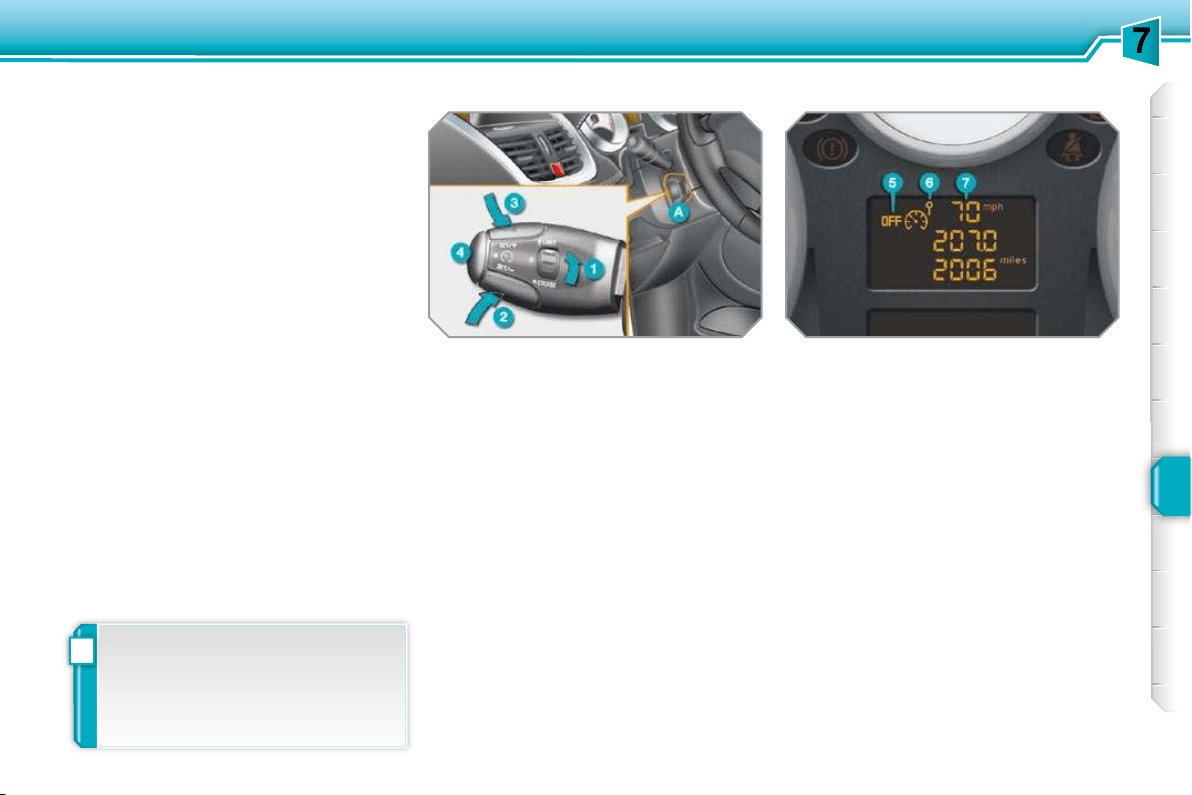
i
DRIVING
107
SPEED LIMITER
System which prevents the vehicle from
exceeding the speed programmed by
the driver.
When the programmed speed limit is
reached, pressing the accelerator pedal
no longer has any effect.
The speed limiter is switched on man-
ually: it requires a programmed speed
of at least 20 mph (30 km/h).
The speed limiter is switched off by
manual operation of the control.
The programmed speed can be ex-
ceeded temporarily by pressing the ac-
celerator fi rmly.
To return to the programmed speed,
simply slow down to a speed below the
programmed speed.
The programmed speed remains in the
memory when the ignition is switched
off.
The controls of this system are grouped
together on stalk A .
1. Speed limiter mode selection dial
2. Value decrease button
3. Value increase button
4. Speed limiter on/off button
The programmed information is grouped
together on the instrument panel screen.
5. Speed limiter on/off indication
6. Speed limiter mode selection
indication
7. Programmed speed value
Steering mounted controls Displays on the instrument panel
The speed limiter cannot, in any
circumstances, replace the need
to respect speed limits, nor can it
replace the need for vigilance and
responsibility on the part of the
driver.
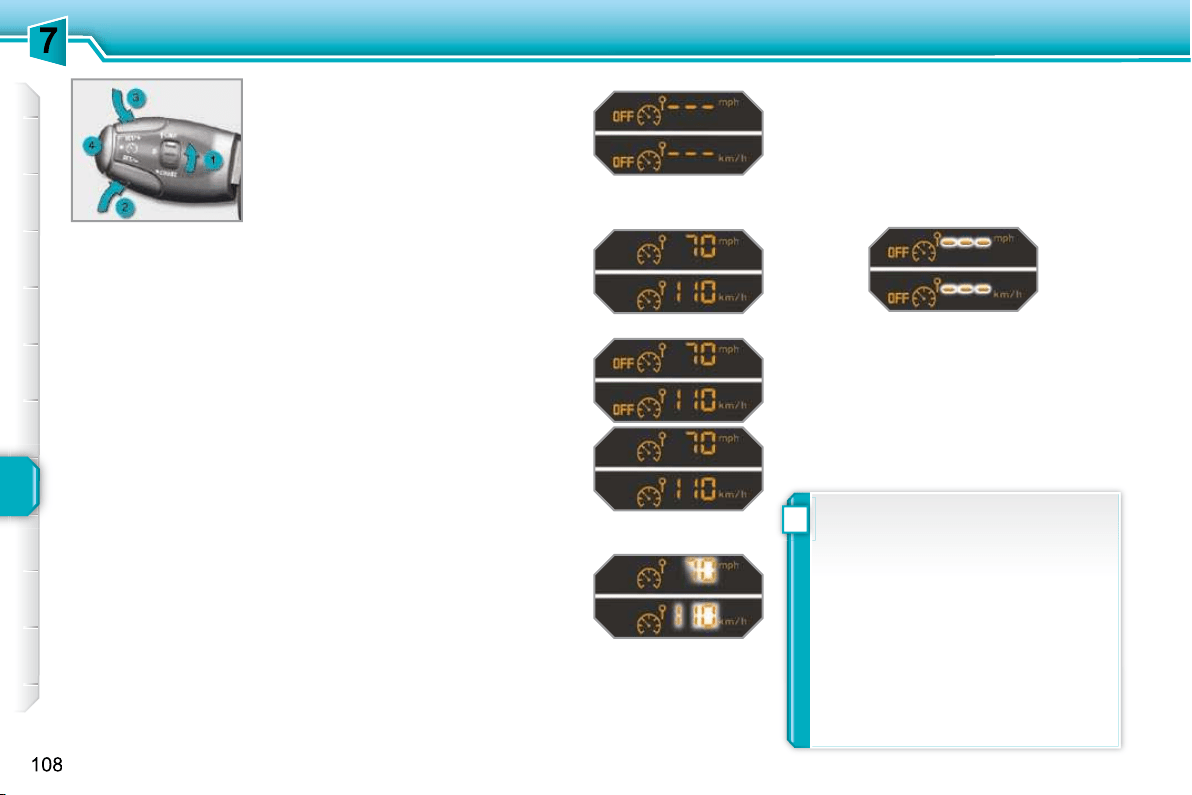
!
DRIVING
On a steep descent, the speed lim-
iter will not be able to prevent the
vehicle from exceeding the pro-
grammed speed.
To avoid any risk of jamming of the
pedals:
- ensure that the mat is posi-
tioned correctly,
- do not fi t one mat on top of an-
other.
Programming
Turn dial 1 to the "LIMIT" position:
the speed limiter mode is selected
but is not switched on (OFF).
Exceeding the programmed speed
Pressing the accelerator pedal to exceed the programmed
speed will not have any effect unless you press the pedal
fi rmly past the point of resistance .
The speed limiter is deactivated temporarily and the pro-
grammed speed, which is still displayed, fl ashes.
Returning to the programmed speed, by means of intentional
or unintentional deceleration of the vehicle, automatically can-
cels the fl ashing of the programmed speed.
Return to normal driving
Turn dial 1 to the "0" position: the speed limiter mode is
deselected. The display returns to the distance recorder.
Operating fault
In the event of a speed limiter mal-
function, the speed is cleared result-
ing in fl ashing of the dashes. Contact a
PEUGEOT dealer to have the system
checked.
You do not have to switch the speed
limiter on in order to set the speed.
Set the speed value by pressing button 2 or 3 (e.g.:
70 mph (110 km/h).
You can then change the programmed speed using but-
tons 2 and 3 :
- by + or - 1 mph (km/h) = short press,
- by + or - 5 mph (km/h) = long press,
- in steps of + or - 5 mph (km/h) = maintained press.
Switch the speed limiter on by pressing button 4 .
Switch the speed limiter off by pressing button 4 : the dis-
play confi rms that it has been switched off (OFF).
Switch the speed limiter back on by pressing button 4
again.
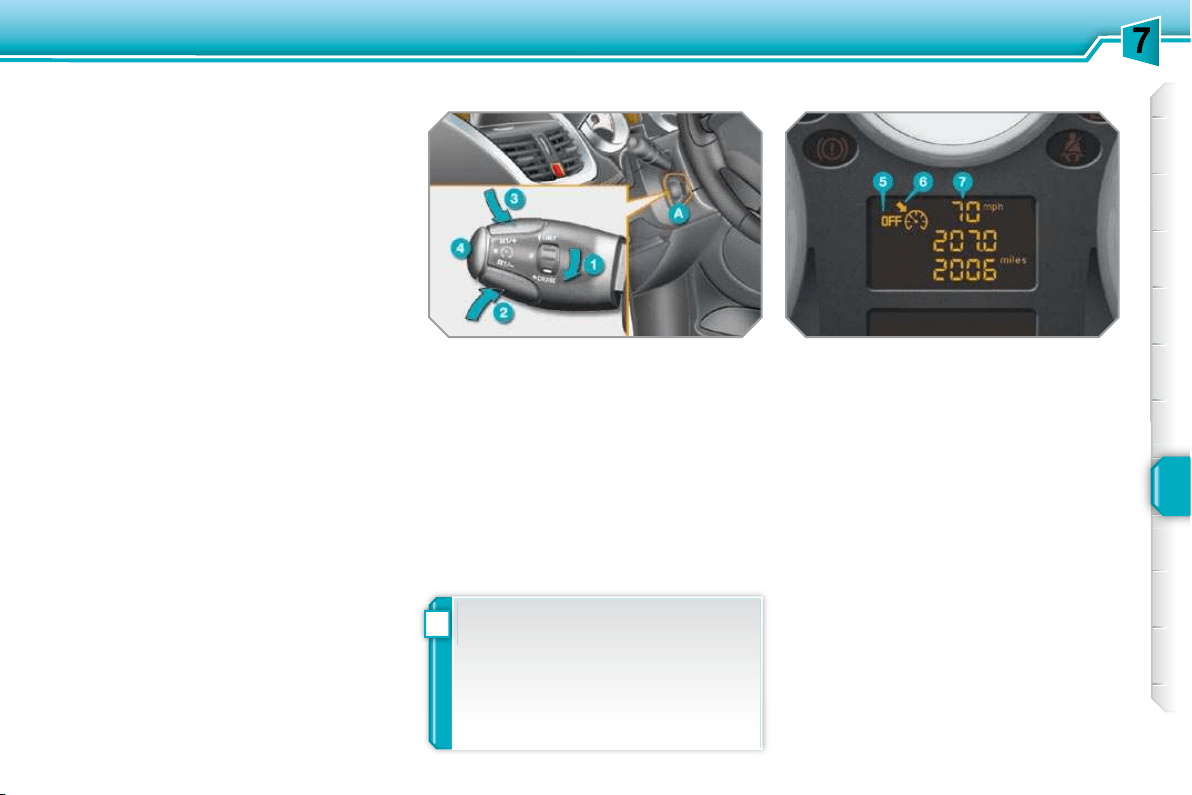
i
DRIVING
109
CRUISE CONTROL
System which automatically maintains
the speed of the vehicle at the value
programmed by the driver, without any
action on the accelerator pedal.
The cruise control is switched on
manually: it requires a minimum vehicle
speed of 25 mph (40 km/h), as well as
the engaging:
-
of fourth gear on the manual gearbox,
- of second gear on the automatic
gearbox, in sequential mode,
-
of position D on the automatic gearbox.
The cruise control is switched off man-
ually or by pressing the brake or clutch
pedal or on triggering of the ESP sys-
tem for safety reasons.
It is possible to exceed the programmed
speed temporarily by pressing the ac-
celerator pedal.
To return to the programmed speed,
simply release the accelerator pedal.
Switching off the ignition cancels any
programmed speed value.
The controls of this system are grouped
together on stalk A .
1. Cruise control mode selection dial
2. Value decrease button
3. Value increase button
4. Cruise control off/resume button
The programmed information is grouped
together on the instrument panel screen.
5. Cruise control off/resume indication
6. Cruise control mode selection
indication
7. Programmed speed value
Steering mounted controls Displays on the instrument panel
The cruise control cannot, in any
circumstances, replace the need
to respect speed limits, nor can it
replace the need for vigilance and
responsibility on the part of the
driver.
You are advised to keep your feet
near the pedals at all times.
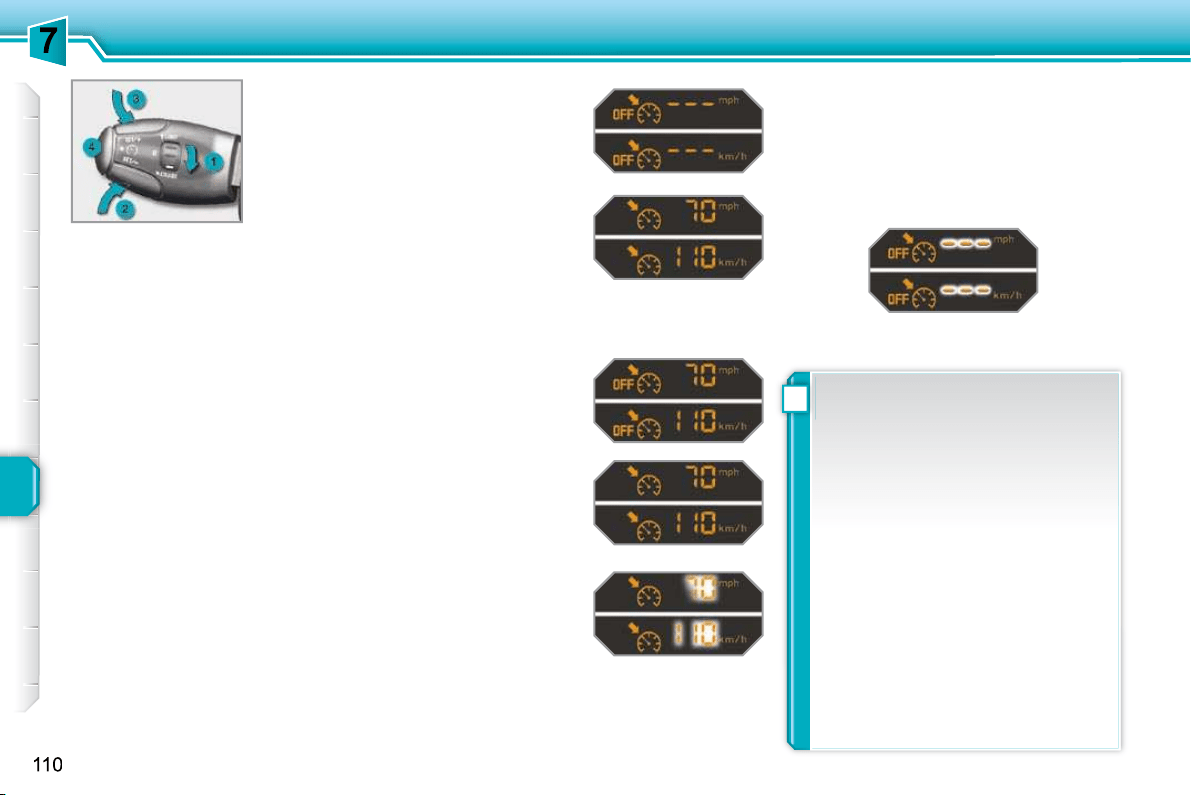
!
DRIVING
When the cruise control is switched
on, be careful if you maintain the
pressure on one of the programmed
speed changing buttons: this may
result in a very rapid change in the
speed of your vehicle.
Do not use the cruise control on
slippery roads or in heavy traffi c.
On a steep descent, the cruise
control will not be able to prevent
the vehicle from exceeding the pro-
grammed speed.
To avoid any risk of jamming of the
pedals:
- ensure that the mat is posi-
tioned correctly,
- never fi t one mat on top of an-
other.
Programming
Turn dial 1 to the "CRUISE" po-
sition: the cruise control mode is
selected but is not switched on
(OFF).
Exceeding the programmed speed
Intentional or unintentional exceeding of the programmed
speed results in fl ashing of this speed on the screen.
Return to the programmed speed, by means of intentional or
unintentional deceleration of the vehicle, automatically can-
cels the fl ashing of the speed.
Return to normal driving
Turn dial 1 to the "0" position: the cruise control mode is
deselected. The display returns to the distance recorder.
Operating fault
In the event of a cruise control mal-
function, the speed is cleared result-
ing in fl ashing of the dashes. Contact a
PEUGEOT dealer to have the system
checked.
Set the programmed speed by ac-
celerating to the required speed,
then press button 2 or 3 (e.g.:
70 mph (110 km/h)).
Switch off the cruise control by pressing button 4 : the
display confi rms that it has been switched off (OFF).
Switch the cruise control back on by pressing button 4
again.
You can then change the programmed speed using buttons 2
and 3 :
- by + or - 1 mph (km/h) = short press,
- by + or - 5 mph (km/h) = long press,
- in steps of + or - 5 mph (km/h) = maintained press.
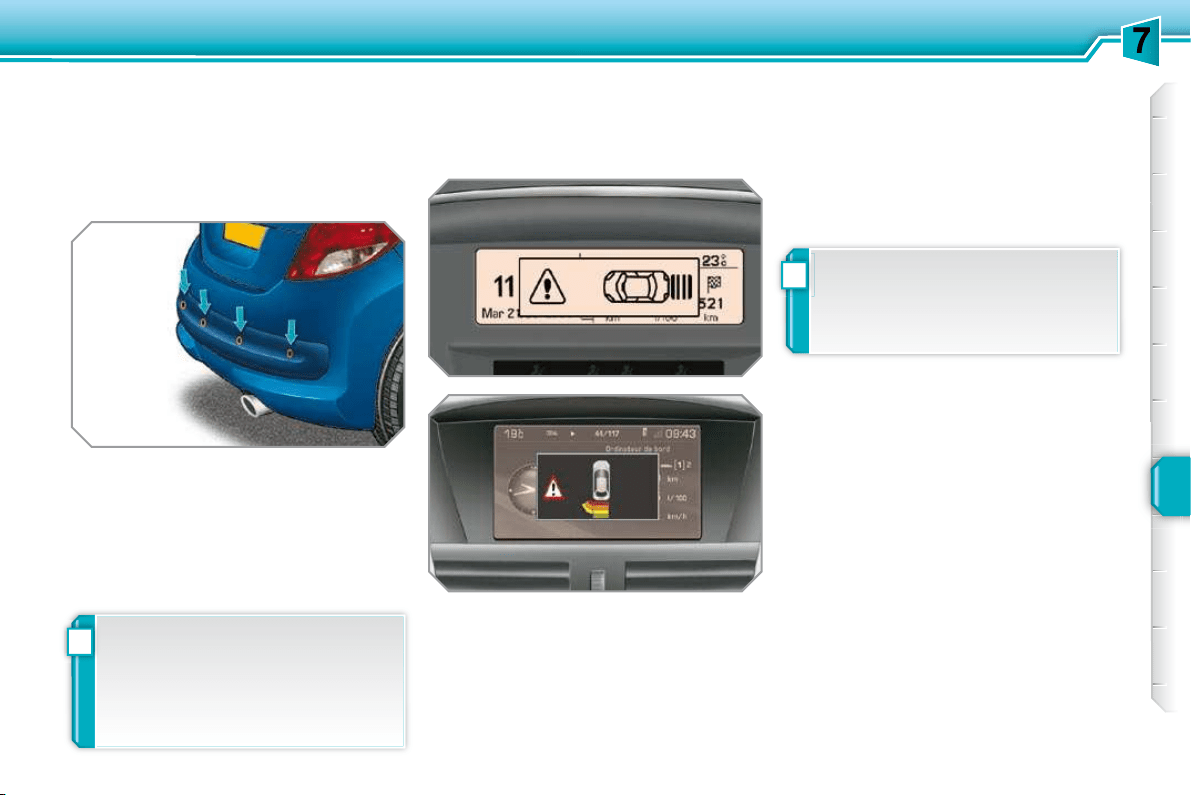
i
i
DRIVING
111
VISUAL AND AUDIBLE
PARKING SENSORS
System consisting of four proximity
sensors, installed in the rear bumper.
It detects any obstacle (person, vehicle,
tree, barrier...) located behind the vehi-
cle, however, it will not be able to detect
obstacles located immediately below
the bumper.
The parking sensors are switched on
by engaging reverse gear.
This is accompanied by an audible signal.
* According to version.
An object, such as a stake, a road-
works cone or any other similar
object may be detected at the start
of the manoeuvre but may no lon-
ger be detected when the vehicle
moves nearer to it.
When the distance between the rear of
the vehicle and the obstacle is less than
approximately thirty centimetres, the
audible signal becomes continuous and
the "Danger" symbol appears, depend-
ing on the multifunction screen version.
The parking sensor system cannot, in
any circumstances, replace the need
for vigilance and responsibility on the
part of the driver.
The parking sensors are switched off
by moving the gear lever to neutral.
The proximity information is indicated
by:
- an audible signal which becomes
more rapid as the vehicle approach-
es the obstacle,
- a diagram on the multifunction
screen * , with blocks which move
closer to the vehicle.
ii
i
DRIVING
112
Deactivation/Activation of the rear
parking sensors
Operating fault
In bad weather or in winter, ensure
that the sensors are not covered
with mud, ice or snow. When re-
verse gear is engaged, an audible
signal (long bleep) indicates that
the sensors may be dirty.
When the vehicle is moving at a
speed below 6 mph (10 km/h), cer-
tain sound sources (motorcycle,
lorry, pneumatic drill, etc.) may trig-
ger the audible signals of the parking
sensor system.
If an operating fault occurs,
when reverse gear is engaged
this warning lamp is displayed
on the instrument panel and/or
a message appears on the screen, ac-
companied by an audible signal (short
bleep).
Consult a PEUGEOT dealer.
The status of the function is stored
when the ignition is switched off.
For further details about the access
to the parking sensors menu, refer
to the vehicle confi guration section
corresponding to your multifunction
screen.
The function will be deactivated au-
tomatically if a trailer is being towed
or a bicycle carrier is fi tted (vehicle
fi tted with a towbar or bicycle car-
rier recommended by PEUGEOT.
The function is deactivated
or activated via the multi-
function screen confi gura-
tion menu.
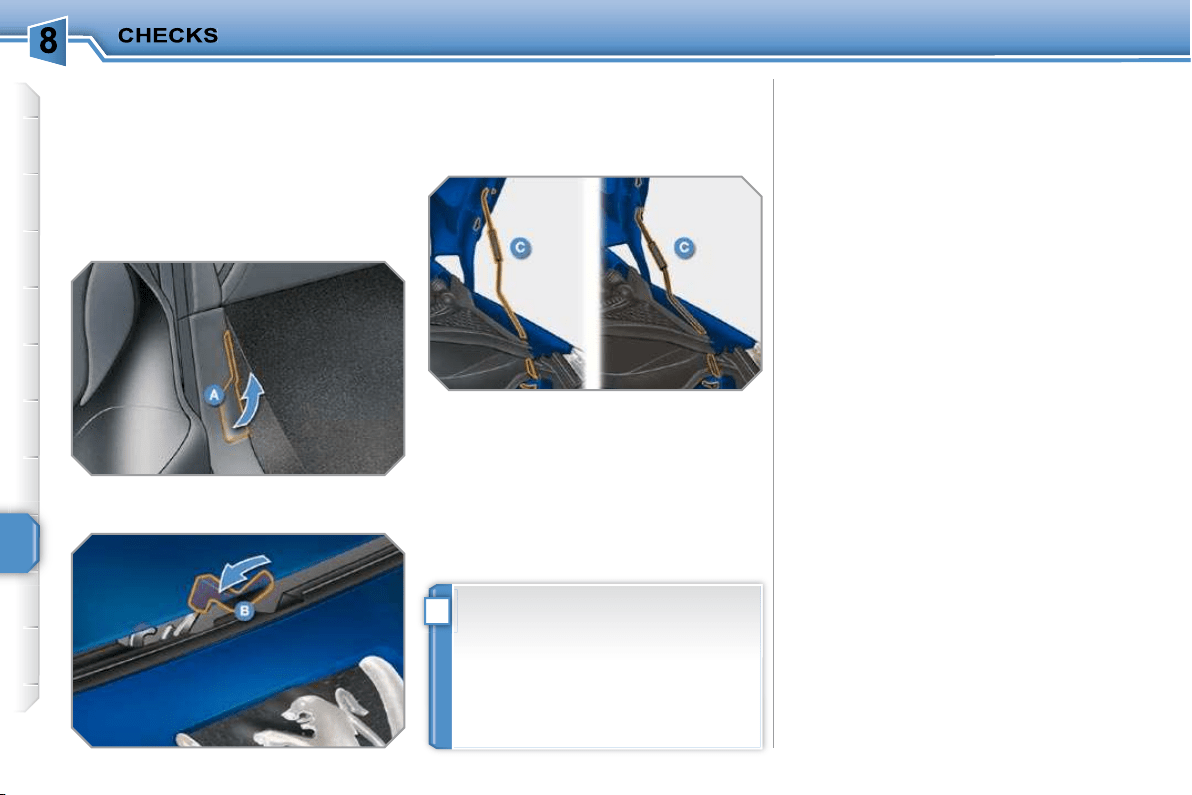
i
114
BONNET
Protects the components of the engine and
provides access for checking levels.
Push the exterior safety catch B to
the left and raise the bonnet.
Unclip the stay C from its housing.
Fix the stay in one of the two notches
to hold the bonnet open.
Closing
Take the stay out of the support
notch.
Clip the stay in its housing.
Lower the bonnet and release it at
the end of its travel.
Pull on the bonnet to check that it is
secured correctly.
RUNNING OUT OF FUEL
(DIESEL)
If your vehicle is fi tted with an HDI en-
gine, the fuel system must be primed if
you run out of fuel (refer to the corre-
sponding image).
If the engine does not start fi rst time,
don't keep trying.
Operate the priming pump again, then
the starter motor.
Opening
Open the front left door.
Pull the interior release lever A , located
at the bottom of the door frame.
The location of the interior release
lever prevents opening of the
bonnet while the front left door is
closed.
When the engine is hot, handle the
exterior safety catch and bonnet
stay with care (risk of burns).
1.6 litre Turbo HDI 16V engine
Fill the fuel tank with at least fi ve
litres of diesel.
Open the bonnet.
Operate the priming pump until it
hardens (it may be hard at the fi rst
press).
Operate the starter until the engine
starts.
Close the bonnet.
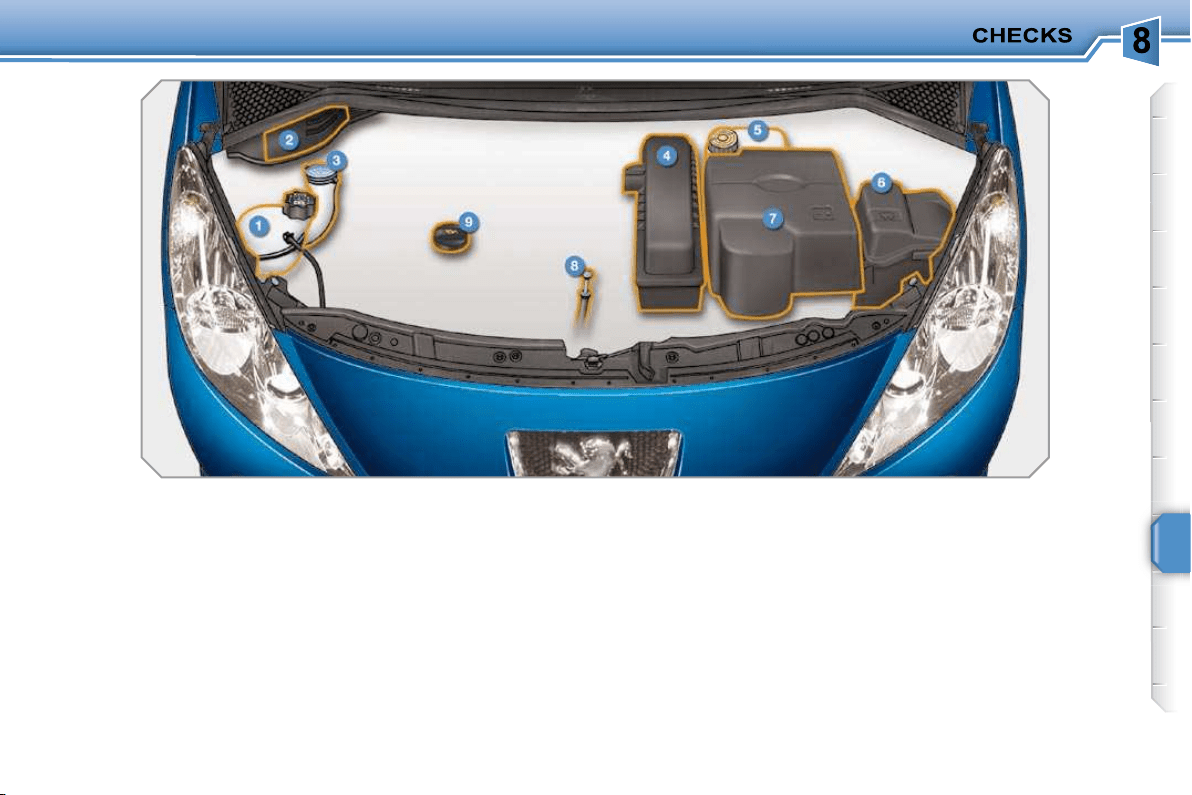
115
PETROL ENGINES
The caps and covers provide access for checking the levels of the various fl uids and to replace certain components.
1. Coolant reservoir.
2. Passenger compartment fi lter.
3. Screenwash and headlamp wash
reservoir.
4. Air fi lter.
5. Brake fl uid reservoir.
6. Fusebox.
7. Battery.
8. Engine oil dipstick.
9. Engine oil fi ller cap.
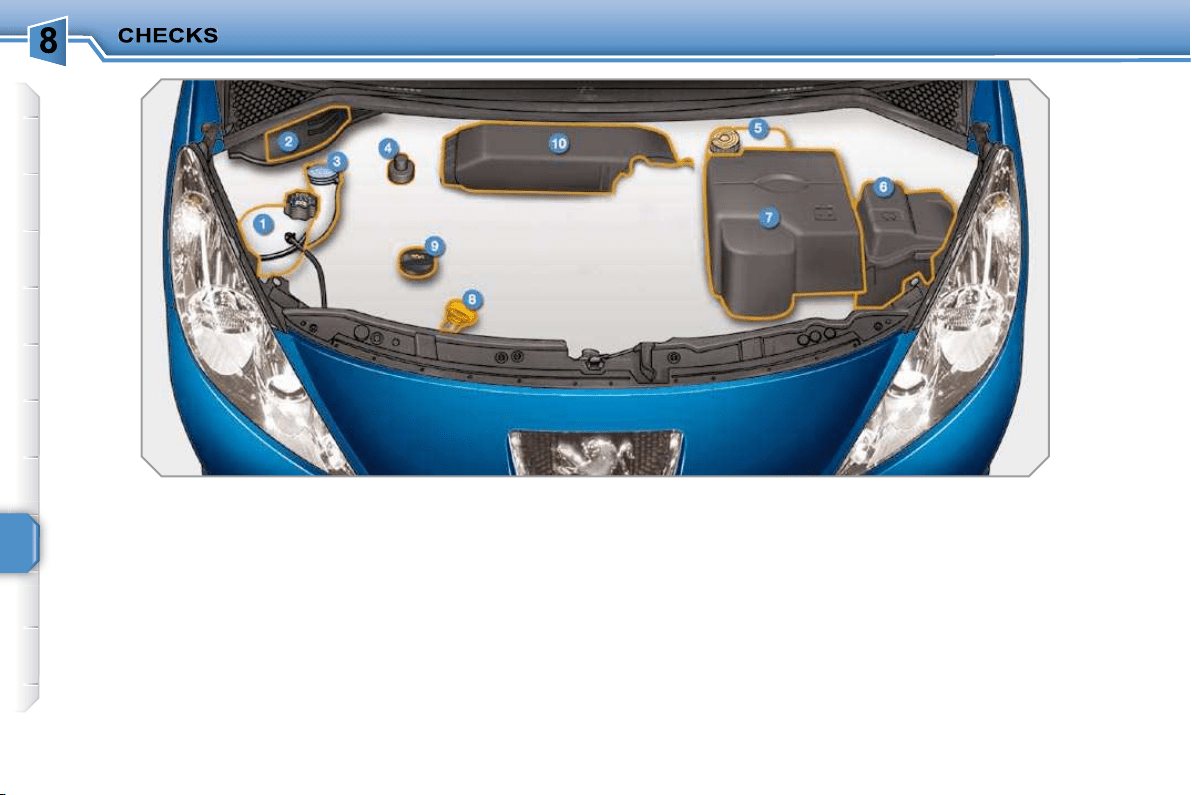
116
DIESEL ENGINE
The caps and covers provide access for checking the levels of the various fl uids, to replace certain components and to prime
the fuel system.
1. Coolant reservoir.
2. Passenger compartment fi lter.
3. Screenwash and headlamp wash
reservoir.
4. Priming pump.
5. Brake fl uid reservoir.
6. Fusebox.
7. Battery.
8. Engine oil dipstick.
9. Engine oil fi ller cap.
10. Air fi lter.
117
CHECKING LEVELS
Check all of these levels regularly and
top them up if necessary, unless other-
wise indicated.
If a level drops signifi cantly, have the
corresponding system checked by a
PEUGEOT dealer.
Take care when working under the bon-
net, as some parts of the engine can be
extremely hot (risk of burns).
Brake fluid level
To avoid any risk of scalding, unscrew
the cap by two turns to allow the pres-
sure to drop. When the pressure has
dropped, remove the cap and top up
the level.
Oil level
The reading will only be correct
if the vehicle is on level ground
and the engine has been off for
more than 15 minutes.
The check is carried out either when
the ignition is switched on using the oil
level indicator on the instrument panel,
or using the dipstick.
The brake fl uid level should be
close to the "MAX" mark. If it is
not, check the brake pad wear.
Changing the brake fl uid
Refer to the Warranty and Maintenance
Record for details of the interval for this
operation.
Coolant level
The coolant level should be
close to the "MAX" mark but
should never exceed it.
When the engine is warm, the
temperature of the coolant is regulated
by the fan. This can operate with the ig-
nition off.
On vehicles which are fi tted with a
particle emission fi lter, the fan may
operate after the vehicle has been
switched off, even if the engine is
cold.
In addition, as the cooling system is
pressurised, wait at least one hour after
switching off the engine before carrying
out any work.
Screenwash and headlamp
wash * fluid
The minimum level of this
fl uid is indicated by an audible
signal and a message on the
multifunction screen.
Top up the level when you stop the
vehicle.
* According to country.
Changing the engine oil
Refer to the Warranty and Maintenance
Record for details of the interval for this
operation.
In order to maintain the reliability of the
engine and emission control system,
the use of additives in the engine oil is
prohibited.
Oil specifi cation
The oil must correspond to your engine
and conform to the manufacturer's
recommendations.
Fluid specifi cation
The brake fl uid must conform to the
manufacturer's recommendations and
fulfi l the DOT4 standards.
Changing the coolant
The coolant does not have to be
changed.
Fluid specifi cation
The coolant must conform to the manu-
facturer's recommendations.
Fluid specifi cation
To guarantee optimum cleaning and
avoid freezing, plain water should not
be used to top up or replace this fl uid.
!
i
118
Avoid any prolonged contact of
used oil or fl uids with the skin.
Most of these fl uids are harmful to
health or indeed very corrosive.
Do not discard used oil or fl uids
into sewers or onto the ground.
Take used oil to an authorised
waste disposal site or a PEUGEOT
dealer.
Diesel additive level (Diesel with
particle emission filter)
The minimum level of this additive is
indicated by lighting of the service war-
ning lamp, accompanied by an audible
signal and a message on the multifunc-
tion screen.
Used products
Unless otherwise indicated, check
these components in accordance with
the Warranty and Maintenance Record
and in relation to your engine.
Otherwise, have them checked by a
PEUGEOT dealer.
Battery
The battery does not require
any maintenance.
However, check that the ter-
minals are clean and correctly
tightened, particularly in sum-
mer and winter.
When carrying out work on the battery,
refer to the "Practical information" sec-
tion for details of the precautions to be
taken before disconnecting the battery
and following its reconnection.
Air filter and passenger compartment filter
Refer to the Warranty and
Maintenance Record for de-
tails of the replacement inter-
vals for these components.
Depending on the environ-
ment (dusty atmosphere...) and the use
of the vehicle (city driving...), replace
them twice as often if necessary (re-
fer to the "Engines" section).
A clogged passenger compartment fi lter
may have an adverse effect on the per-
formance of the air conditioning system
and generate undesirable odours.
Particle emission filter (Diesel)
It is imperative that the maintenance of
the particle emission fi lter is carried out
by a PEUGEOT dealer.
Oil filter
Replace the oil fi lter each time
the engine oil is changed.
Refer to the Warranty and
Maintenance Record for de-
tails of the replacement inter-
val for this component.
Following prolonged operation of
the vehicle at very low speed or at
idle, you may, exceptionally, notice
the emission of water vapour at the
exhaust on acceleration. This does
not have any adverse effect on the
performance of the vehicle or on
the environment.
Topping up
This additive must be topped up by a
PEUGEOT dealer without delay.
!
i
118
Avoid any prolonged contact of
used oil or fl uids with the skin.
Most of these fl uids are harmful to
health or indeed very corrosive.
Do not discard used oil or fl uids
into sewers or onto the ground.
Take used oil to an authorised
waste disposal site or a PEUGEOT
dealer.
Diesel additive level (Diesel with
particle emission filter)
The minimum level of this additive is
indicated by lighting of the service war-
ning lamp, accompanied by an audible
signal and a message on the multifunc-
tion screen.
Used products
Unless otherwise indicated, check
these components in accordance with
the Warranty and Maintenance Record
and in relation to your engine.
Otherwise, have them checked by a
PEUGEOT dealer.
Battery
The battery does not require
any maintenance.
However, check that the ter-
minals are clean and correctly
tightened, particularly in sum-
mer and winter.
When carrying out work on the battery,
refer to the "Practical information" sec-
tion for details of the precautions to be
taken before disconnecting the battery
and following its reconnection.
Air filter and passenger compartment filter
Refer to the Warranty and
Maintenance Record for de-
tails of the replacement inter-
vals for these components.
Depending on the environ-
ment (dusty atmosphere...) and the use
of the vehicle (city driving...), replace
them twice as often if necessary (re-
fer to the "Engines" section).
A clogged passenger compartment fi lter
may have an adverse effect on the per-
formance of the air conditioning system
and generate undesirable odours.
Particle emission filter (Diesel)
It is imperative that the maintenance of
the particle emission fi lter is carried out
by a PEUGEOT dealer.
Oil filter
Replace the oil fi lter each time
the engine oil is changed.
Refer to the Warranty and
Maintenance Record for de-
tails of the replacement inter-
val for this component.
Following prolonged operation of
the vehicle at very low speed or at
idle, you may, exceptionally, notice
the emission of water vapour at the
exhaust on acceleration. This does
not have any adverse effect on the
performance of the vehicle or on
the environment.
Topping up
This additive must be topped up by a
PEUGEOT dealer without delay.
!
119
Only use products recommended
by PEUGEOT or products of equi-
valent quality and specifi cations.
In order to optimise the operation
of units as important as the braking
system, PEUGEOT selects and of-
fers very specifi c products.
To avoid damaging the electrical
units, the use of a high pressure
washer in the engine compartment
is strictly prohibited .
Automatic gearbox
The gearbox does not re-
quire any maintenance (no oil
change).
Refer to the Warranty and
Maintenance Record for de-
tails of the checking intervals
for this component.
Brake disc wear
For any information relating
to checking of the brake disc
wear, contact a PEUGEOT
dealer.
Manual gearbox
The gearbox does not re-
quire any maintenance (no oil
change).
Refer to the Warranty and
Maintenance Record for details
of the level checking intervals
for this component.
Brake pads
Brake wear depends on the
style of driving, particularly in
the case of vehicles used in
town, over short distances. It
may be necessary to have the
condition of the brakes checked, even
between vehicle services.
Unless there is a leak on the circuit, a
drop in the brake fl uid level indicates
that the brake pads are worn.
Parking brake
If the parking brake travel is
too long or if you notice a loss
of effectiveness of this sys-
tem, the parking brake must
be adjusted, even between
two services.
This system must be checked by a
PEUGEOT dealer.
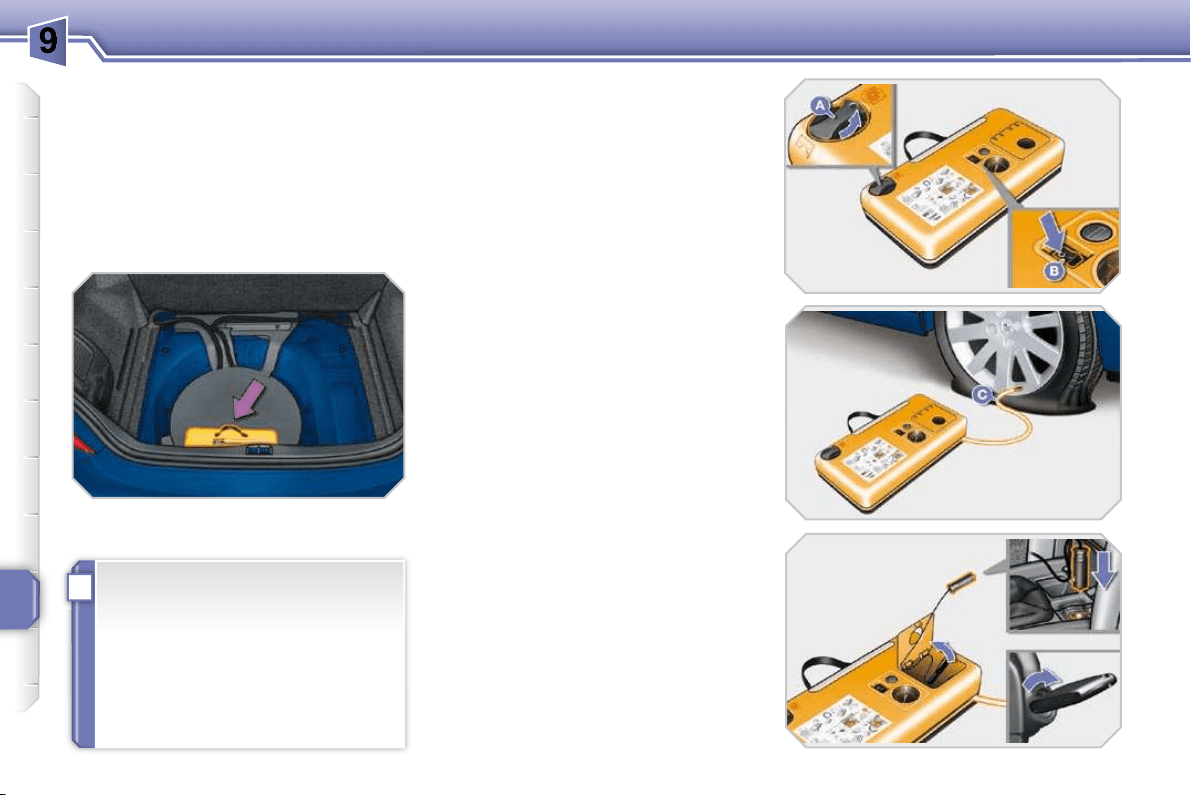
i
PRACTICAL INFORMATION
120
TEMPORARY PUNCTURE
REPAIR KIT
Complete system consisting of a com-
pressor and an incorporated sealant
cartridge which permits temporary re-
pair of the tyre so that you can drive to
the nearest garage.
Access to the kit
This repair kit is available from
PEUGEOT dealers.
It is designed to repair most punc-
tures which could affect the tyre,
located on the tyre tread or shoul-
der. Avoid removing any foreign
bodies which have penetrated the
tyre.
Using the kit
This procedure, comprising several
steps, must be carried out in full.
Switch off the ignition.
Turn the selector A to the "SEALANT"
position.
Check that the switch B is in position "0" .
Connect the white pipe C to the
valve of the tyre to be repaired.
Connect the compressor's electric
plug to the vehicle's 12 V socket.
Affi x the speed limitation sticker
to the vehicle's steering wheel to
remind you that a wheel is in tem-
porary use.
Start the vehicle and leave the en-
gine running.
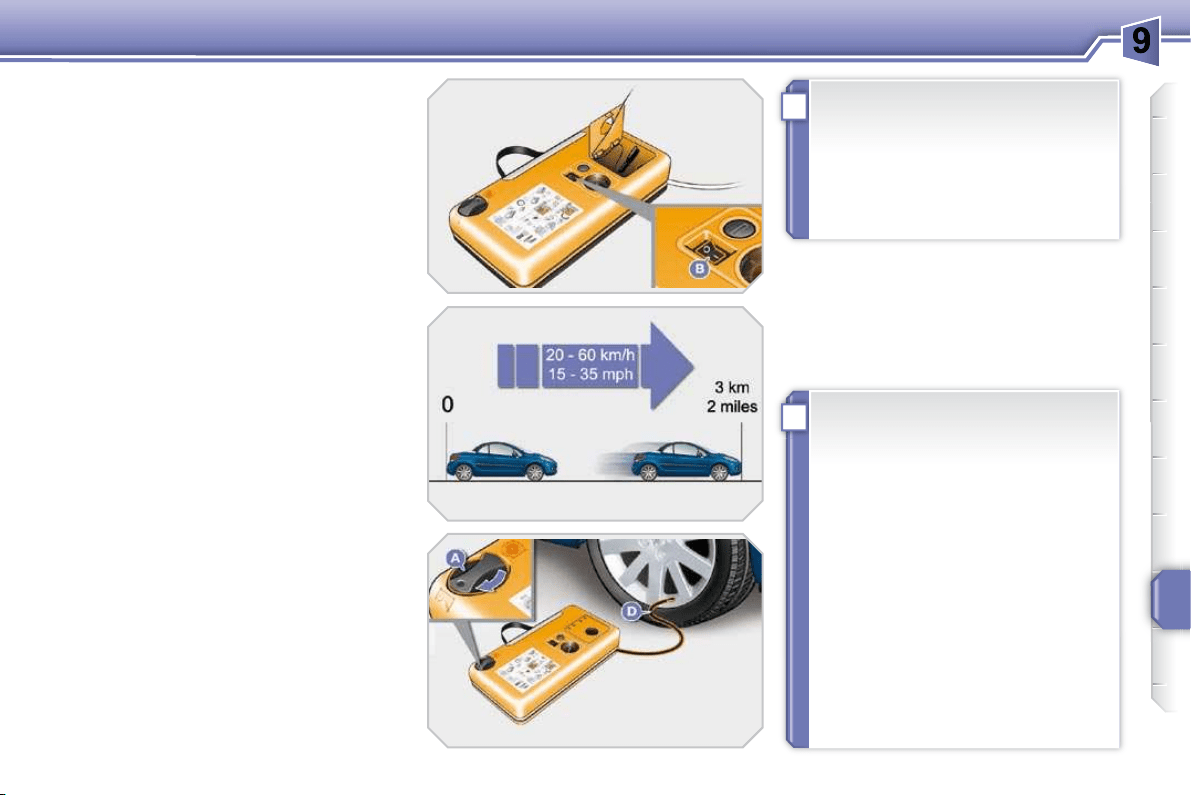
i
i
PRACTICAL INFORMATION
121
Switch on the compressor by mov-
ing the switch B to position "1" until
the tyre pressure reaches 2.0 bars.
Remove the kit, taking care to avoid
staining your vehicle with traces of
fl uid. Keep the kit to hand.
Drive immediately for approximate-
ly three miles (fi ve kilometres), at
reduced speed (between 15 and
35 mph [20 and 60 km/h]), to plug
the puncture.
Stop to check the repair and the tyre
pressure using the kit.
Turn the selector A to the AIR position.
Connect the black pipe D to the
valve of the wheel.
If after around 5 to 7 minutes
the pressure is not attained, this
indicates that the tyre is not re-
pairable; contact a PEUGEOT
dealer for assistance.
Checking tyre pressures/
infl ating accessories
You can use this kit to infl ate other
accessories such as a ball or bi-
cycle tyres.
To do this, turn the selector to the
"Infl ation (AIR)" position, connect
the black pipe with the appropri-
ate adaptor to the accessory to
be infl ated, then follow the rest
of the procedure below as far as
removal of the kit.
You can also use this kit for rou-
tine checking and adjustment
of the tyre pressures on your
vehicle. For this, carry out just the
following 6 points.
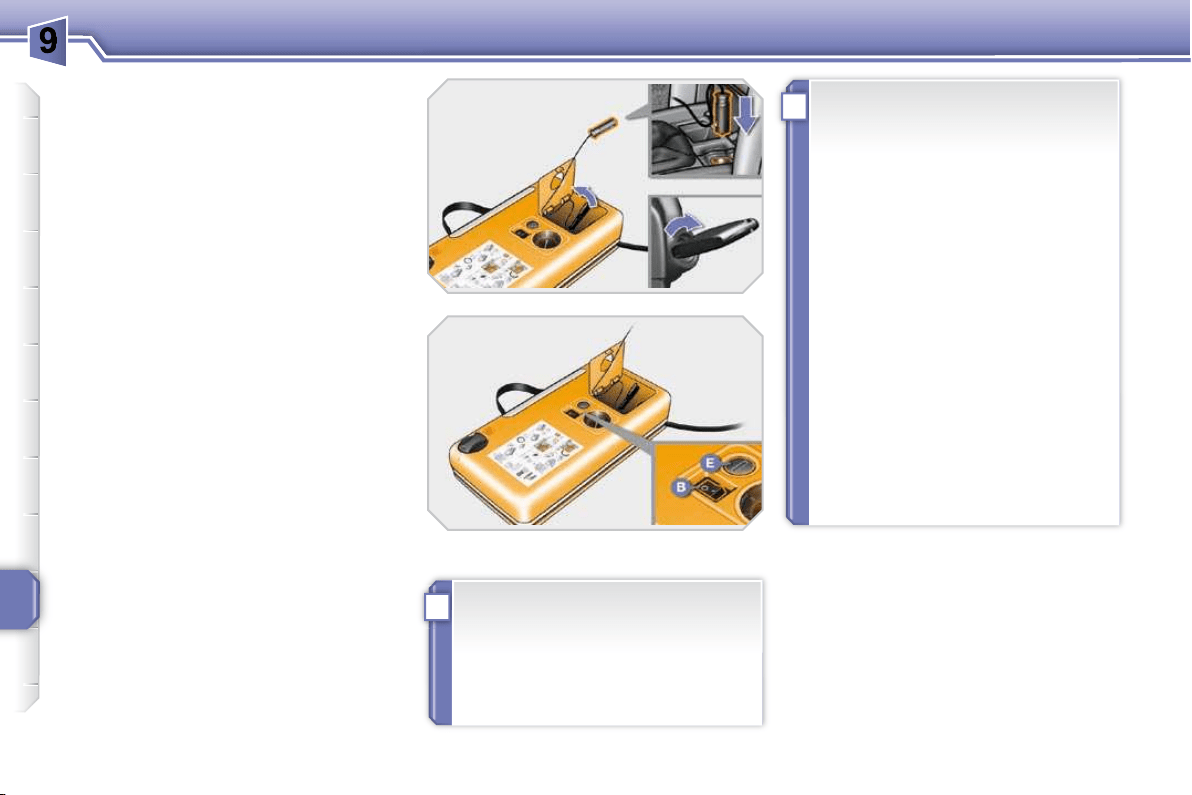
!
!
PRACTICAL INFORMATION
122
Connect the compressor's electric
plug to the vehicle's 12 V socket.
Start the vehicle again and leave the
engine running.
Adjust the pressure using the com-
pressor (to infl ate: switch B in
position "1" ; to defl ate: switch B in
position "0" and press button E ), in
accordance with the vehicle's tyre
pressure label (located on the left
hand door aperture).
A loss of pressure indicates that the
puncture has not been fully plugged;
contact a PEUGEOT dealer for as-
sistance.
Remove and stow the kit.
Take care, this product is harm-
ful (e.g. ethylene-glycol, coloph-
ony, ethanediol...) if swallowed
and causes irritation to the eyes.
Keep it out of reach of children.
The expiry date of the fl uid is
indicated on the cartridge
The sealant cartridge is designed
for single use; even if only partly
used, it must be replaced.
To remove the cartridge, unscrew
it completely at its cap and pull
off.
After use, do not discard the car-
tridge into the environment, take
it to an authorised waste disposal
site or a PEUGEOT dealer.
Do not forget to obtain a new
sealant cartridge, available from
PEUGEOT dealers.
Visit a PEUGEOT dealer as
soon as possible.
After inspection of the tyre, a
technician will be able to ad-
vise you whether the tyre can
be repaired or must be re-
placed.
Drive at reduced speed (50 mph
[80 km/h] max) limiting the distance
travelled to approximately 120 miles
(200 km).
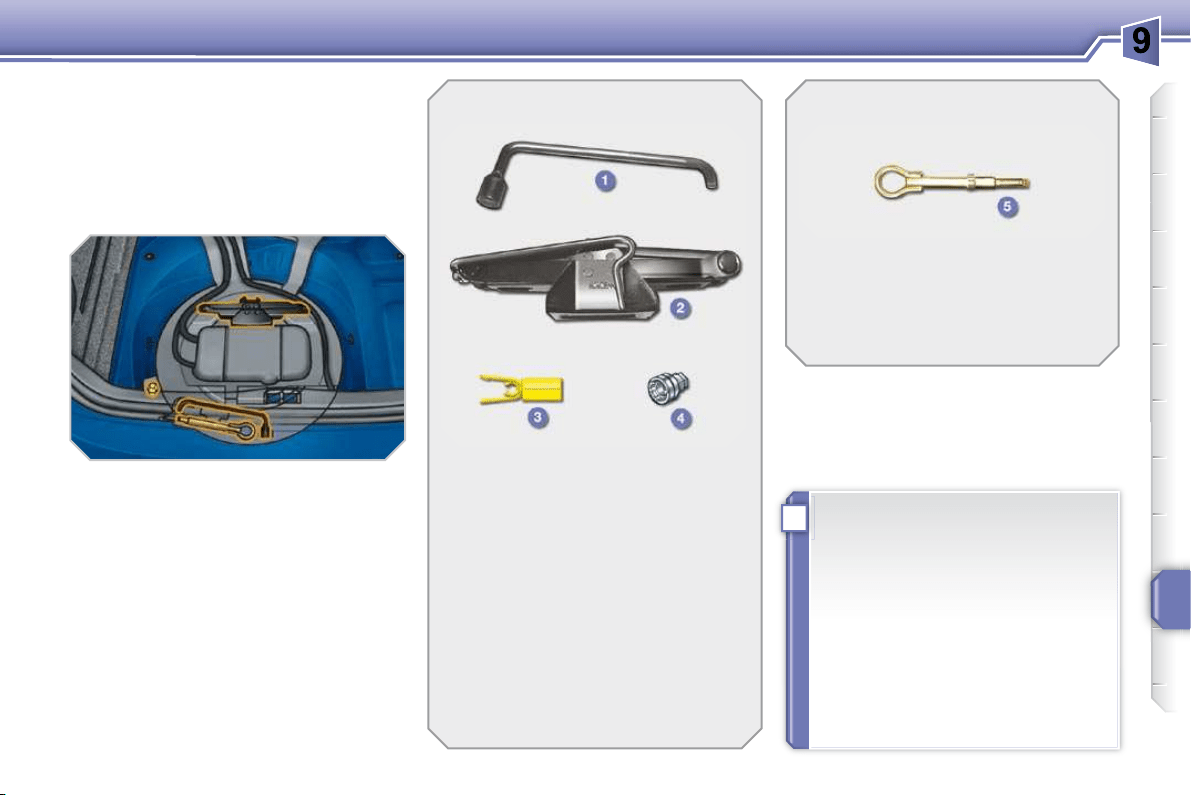
i
PRACTICAL INFORMATION
123
* According to country.
CHANGING A WHEEL *
Procedure for changing a faulty wheel
for the spare wheel using the tools pro-
vided with the vehicle.
Access to the tools
The tools are installed in a box at the
bottom of the boot under the spare
wheel.
For access to them, refer to the para-
graph "Access to the spare wheel" on
the following page.
List of tools
1. Wheelbrace.
For removal of the wheel trim and
removal of the wheel fi xing bolts.
2. Jack with integral handle.
For raising the vehicle.
3. "Bolt cover" tool.
For removal of the bolt protectors
(covers) on alloy wheels.
4. Socket for the security bolts
(located in the glove box).
For adaptation of the wheelbrace
to the special "security" bolts.
5. Removable towing eye.
Refer to the paragraph "Towing
the vehicle".
All of these tools are specifi c to your
vehicle. Do not use them for other
purposes.
Other accessories
Wheel with trim
When removing the wheel ,
detach the trim fi rst using the
wheelbrace 1 pulling at the valve
passage hole.
When refi tting the wheel , re-
fi t the trim starting by placing its
notch facing the valve and press
around its edge with the palm of
your hand.
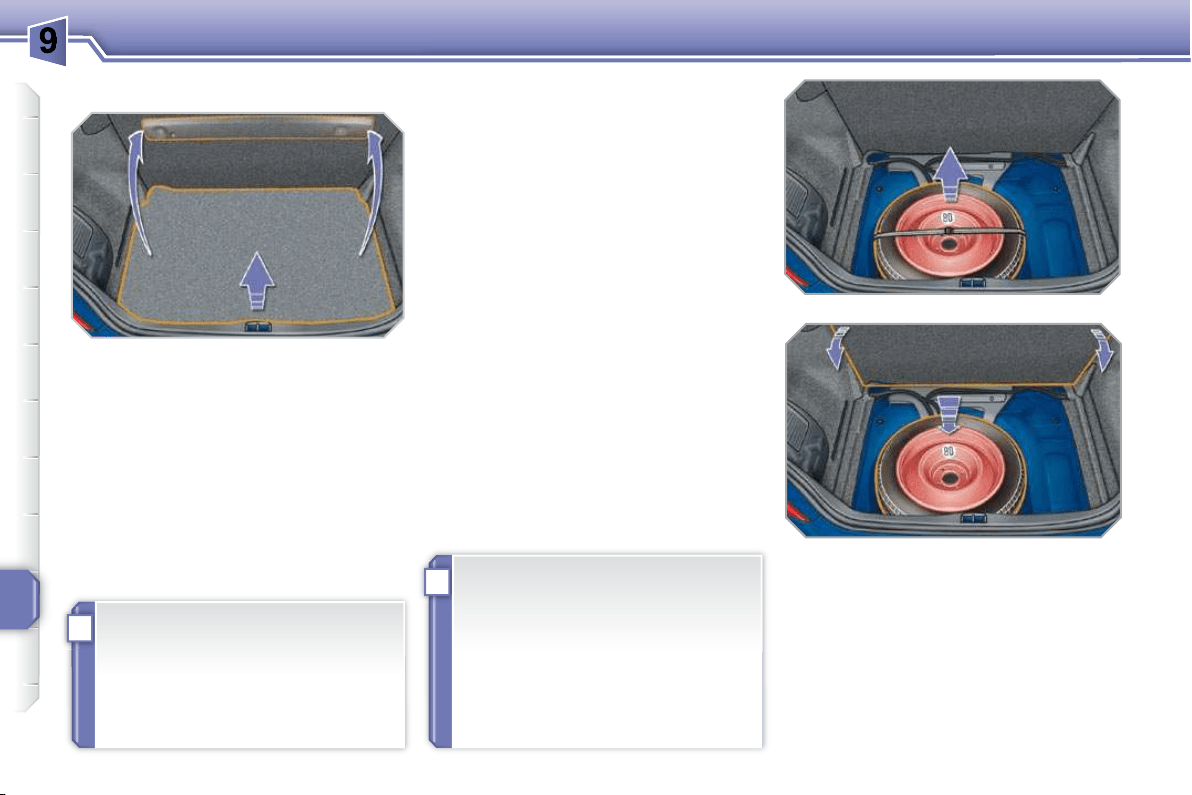
i
i
PRACTICAL INFORMATION
124
Access to the spare wheel
The "space-saver" spare wheel is in-
stalled in the boot under the fl oor.
To gain access to it:
place the vehicle in the "coupé"
confi guration,
open the boot,
raise the fl oor.
Fixing the "space-saver" spare
wheel
If your vehicle is fi tted with alloy
wheels, it is normal to notice, when
tightening the bolts on fi tting, that
the washers do not come into con-
tact with the "space-saver" spare
wheel. The wheel is secured by the
conical contact of each bolt.
Taking out the wheel
Slacken and remove the retaining
strap.
Raise the spare wheel towards you
from the rear.
Take the wheel out of the boot.
Putting the wheel back in place
Put the spare wheel back in its housing.
Put the retaining strap back in place
and tighten it.
Put the boot fl oor back in place.
Tyre under-infl ation detection
The spare wheel is not fi tted with
a sensor. The punctured wheel
must be repaired by a PEUGEOT
dealer.
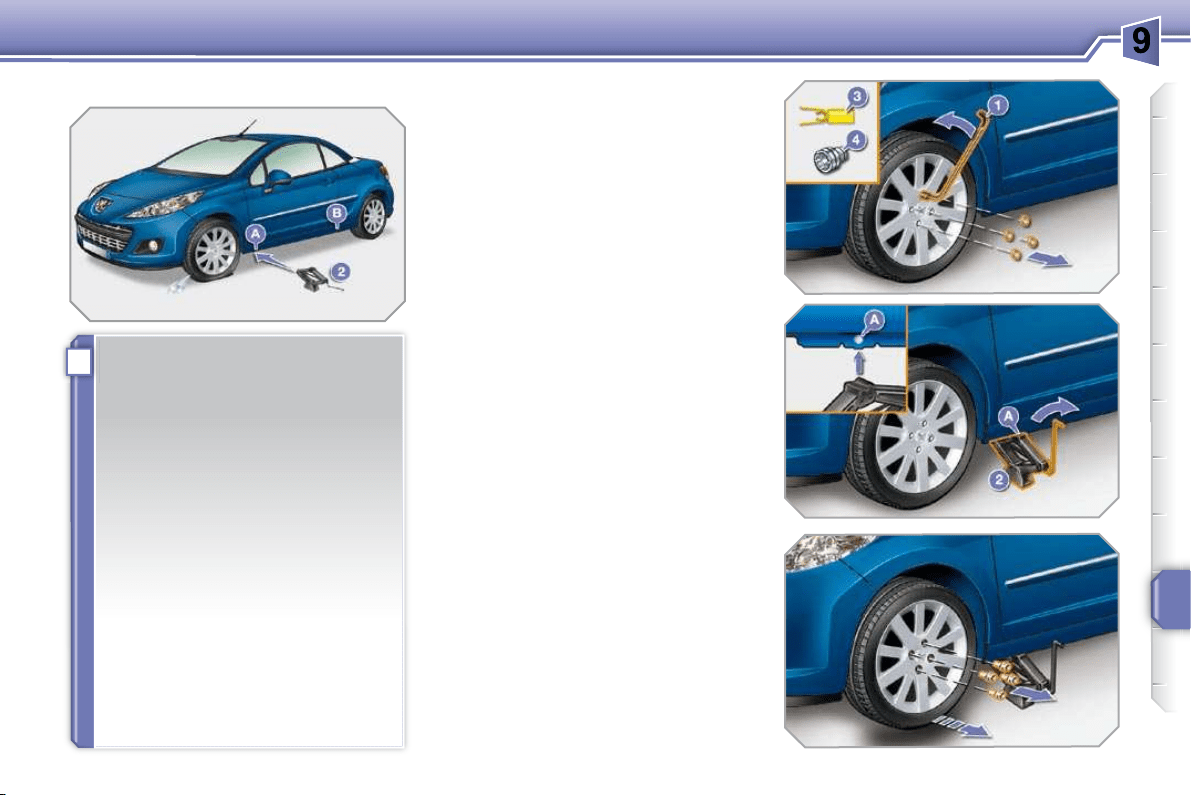
i
PRACTICAL INFORMATION
125
Parking the vehicle
Immobilise the vehicle where it
does not block traffi c: if possible,
park the vehicle on level, stable
and non-slippery ground.
Apply the parking brake, switch off
the ignition and engage fi rst gear *
to lock the wheels.
If necessary, place a chock under
the wheel diagonally opposite the
wheel to be changed.
It is imperative that you ensure that
the occupants get out of the vehicle
and wait in a safe location.
Never go underneath a vehicle
raised using a jack; use an axle
stand.
Removing a wheel
List of operations
Remove the chromed bolt cover from
each of the bolts using the tool 3 .
If your vehicle is equipped with
this, fi t the security socket 4 on the
wheelbrace 1 to slacken the security
bolt.
Slacken the other bolts using the
wheelbrace 1 only.
Place the jack 2 in contact with one
of the two front A or rear B locations
provided on the underframe, which-
ever is closest to the wheel to be
changed.
Extend the jack 2 until its base plate
is in contact with the ground. Ensure
that the centreline of the jack base
plate is directly below the location A
or B used.
Raise the vehicle until there is suf-
fi cient space between the wheel and
the ground to admit the spare (not
punctured) wheel easily.
Remove the bolts and store them in
a clean place.
Remove the wheel.
*
position P for the automatic gearbox.
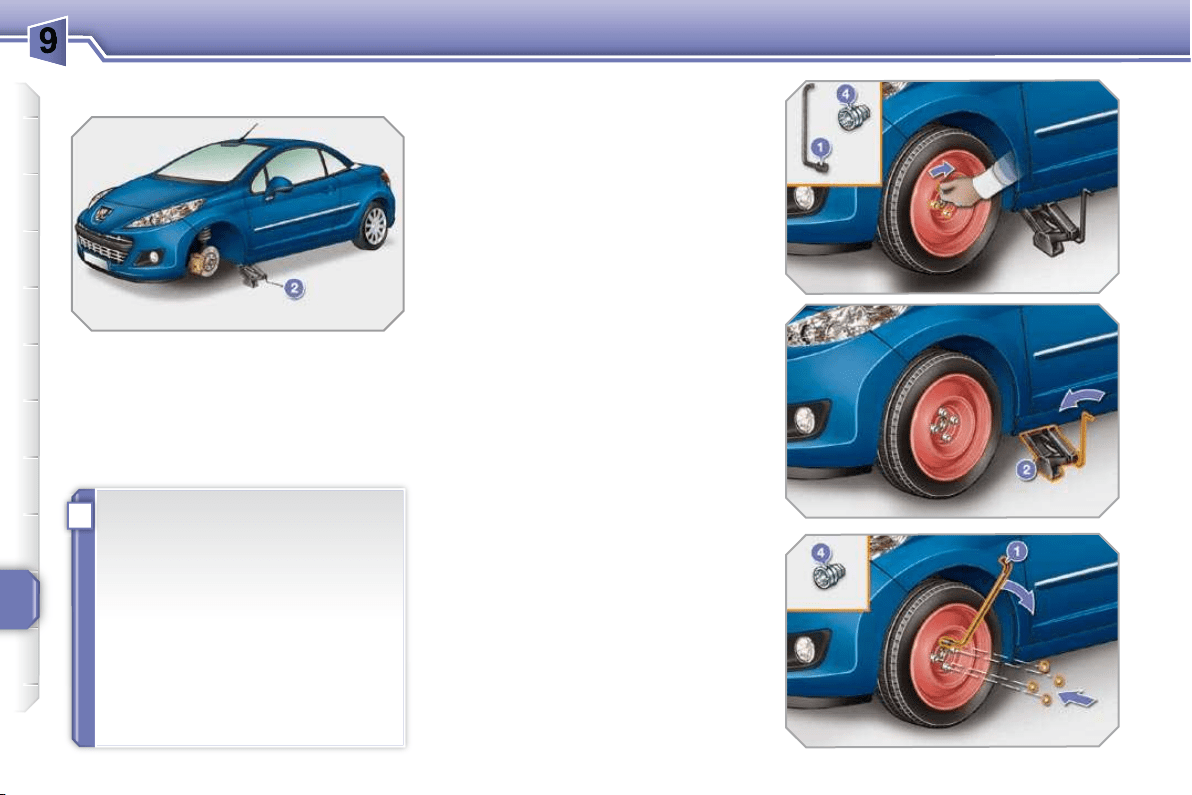
i
PRACTICAL INFORMATION
126
After changing a wheel
Using the "space-saver" spare wheel:
do not fi t the wheel trim,
do not exceed a speed of
50 mph (80 km/h).
Have the tightening of the bolts and
the pressure of the spare wheel
checked by a PEUGEOT dealer
without delay.
Have the punctured wheel repaired
and replace it on the vehicle as
soon as possible.
Fitting a wheel
List of operations
Put the wheel in place on the hub.
Screw in the bolts by hand.
Pre-tighten the security bolt us-
ing the wheelbrace 1 fi tted with the
security socket 4 (if your vehicle is
equipped with this).
Pre-tighten the other bolts using the
wheelbrace 1 only.
Lower the vehicle fully.
Fold the jack 2 and detach it.
Tighten the security bolt using the
wheelbrace 1 fi tted with the security
socket 4 (if your vehicle is equipped
with this).
Tighten the other bolts using the
wheelbrace 1 only.
Refi t the chromed bolt covers on
each of the bolts.
Store the tools in the box at the bot-
tom of the boot.
Store the punctured wheel in a cor-
ner of the boot.
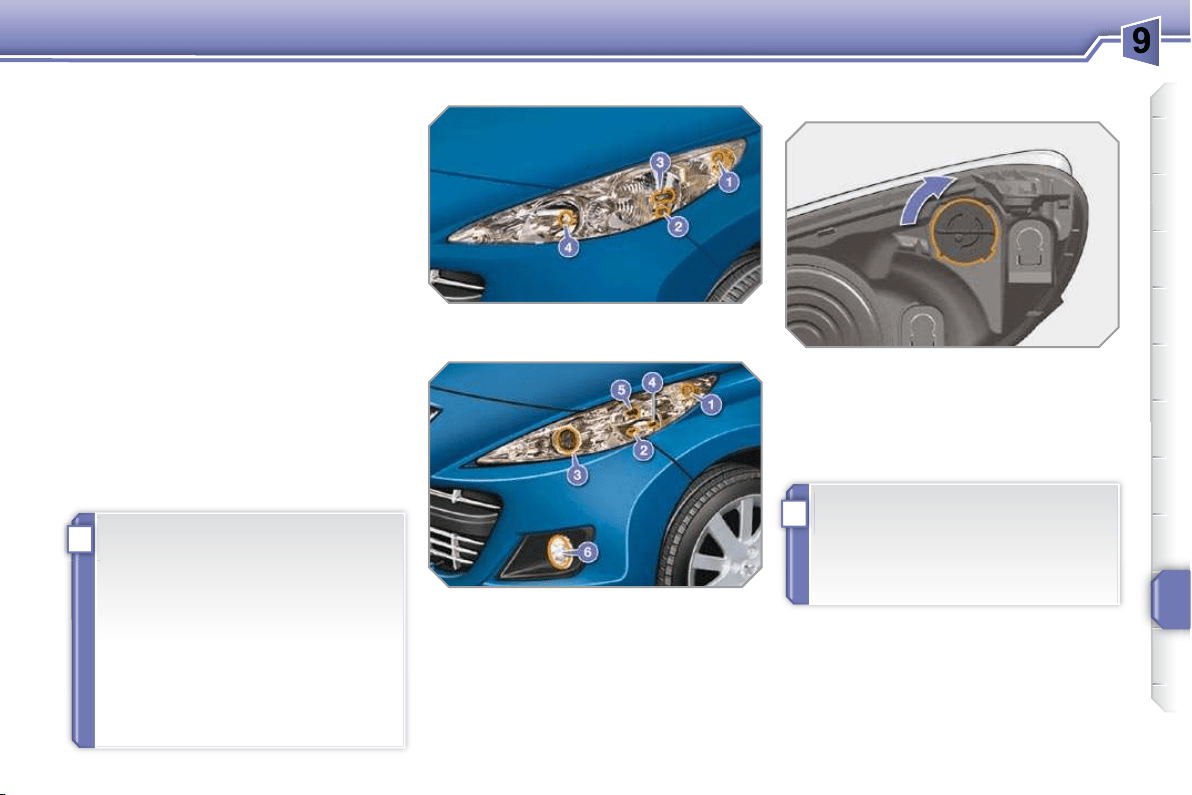
i
i
PRACTICAL INFORMATION
127
CHANGING A BULB
Procedure for replacing a faulty bulb
with a new bulb without the use of
tools.
1. Direction indicators
(PY21W amber).
2. Sidelamps (W5W).
3. Dipped beam headlamps
(H7-55W).
4. Main beam headlamps (H1-55W).
5. Directional headlamps (H7-55W).
6. Foglamps (H11-55W).
Changing the direction indicator
bulbs
Do not touch the bulb directly
with your fi ngers, use lint-free
cloths.
Changing a halogen bulb should
only be done after the headlamp
has been switched off for a few
minutes (risk of serious burns).
It is imperative to use only anti-ul-
traviolet (UV) type bulbs in order
not to damage the headlamp.
Model with conventional lamps
Amber coloured bulbs, such as
the direction indicators, must be
replaced with bulbs of identical
specifi cation and colour.
Turn the bulb holder one quarter of
a turn and remove it.
Pull the bulb then change it.
To refi t, carry out these operations in
reverse order.
The headlamps are fi tted with polycar-
bonate glass with a protective coating:
do not clean them using a dry or
abrasive cloth, nor with a deter-
gent or solvent product,
use a sponge and soapy water,
when using a high pressure washer
on persistent marks, do not direct
at the lamps or their outlines for too
long, so as not to damage their pro-
tective coating and seals.
Model with elliptical module dipped
beam headlamps and directional
headlamps
Front lamps
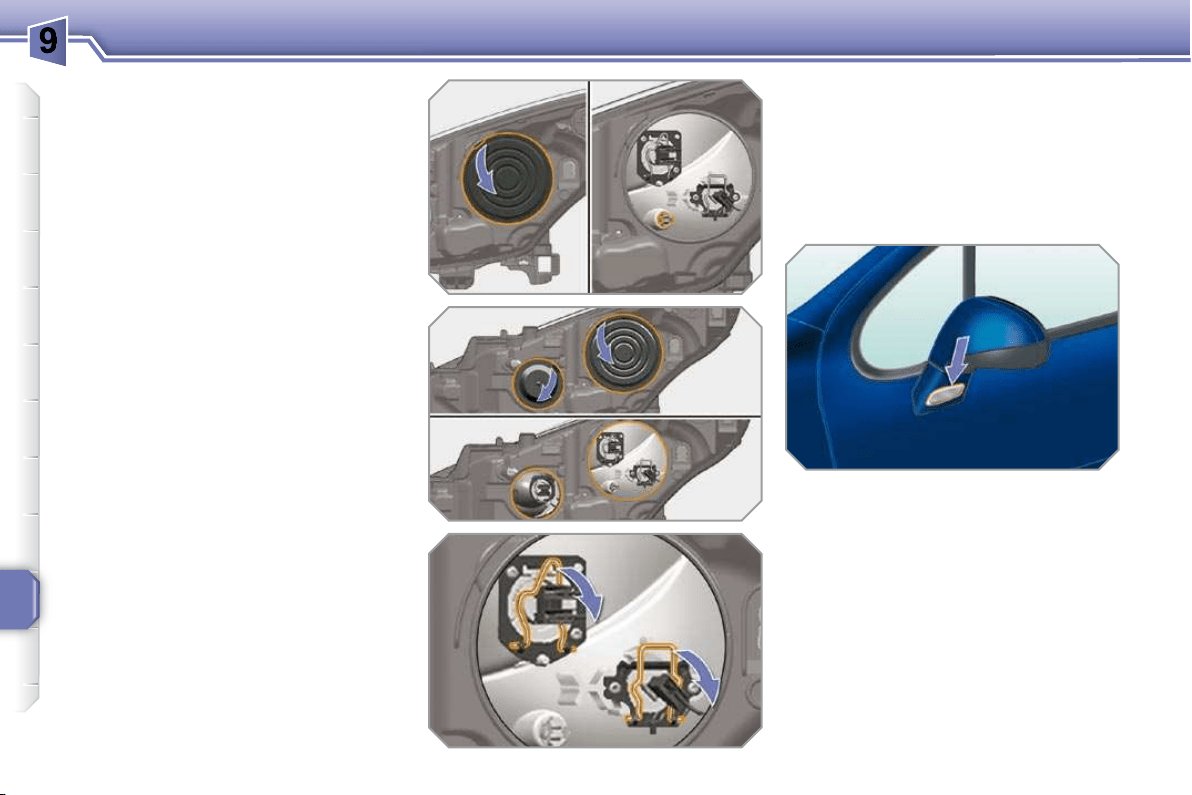
PRACTICAL INFORMATION
128
Changing the integrated direction
indicator side repeaters
Changing the foglamp bulbs
For replacement of these bulbs, contact
a PEUGEOT dealer.
Insert a screwdriver towards the
centre of the repeater between the
repeater and the base of the mirror.
Tilt the screwdriver to extract the
repeater and remove the repeater.
Disconnect the repeater connector.
To refi t, carry out these operations in
reverse order.
To obtain a replacement repeater, contact
a PEUGEOT dealer.
Changing the sidelamp bulbs
Disconnect the main headlamp con-
nector.
Remove the plastic protective cover
by pulling on the tab.
Turn the bulb holder one quarter of
a turn and remove it.
Pull the bulb and change it.
To refi t, carry out these operations in
reverse order.
Changing the dipped, main beam or
directional headlamp bulbs
Disconnect the main headlamp
connector.
Remove the corresponding plastic
protective cover by pulling on the tab.
Disconnect the connector of the
corresponding lamp.
Move aside the spring to release the
bulb and remove the bulb.
To refi t, carry out these operations in
reverse order.
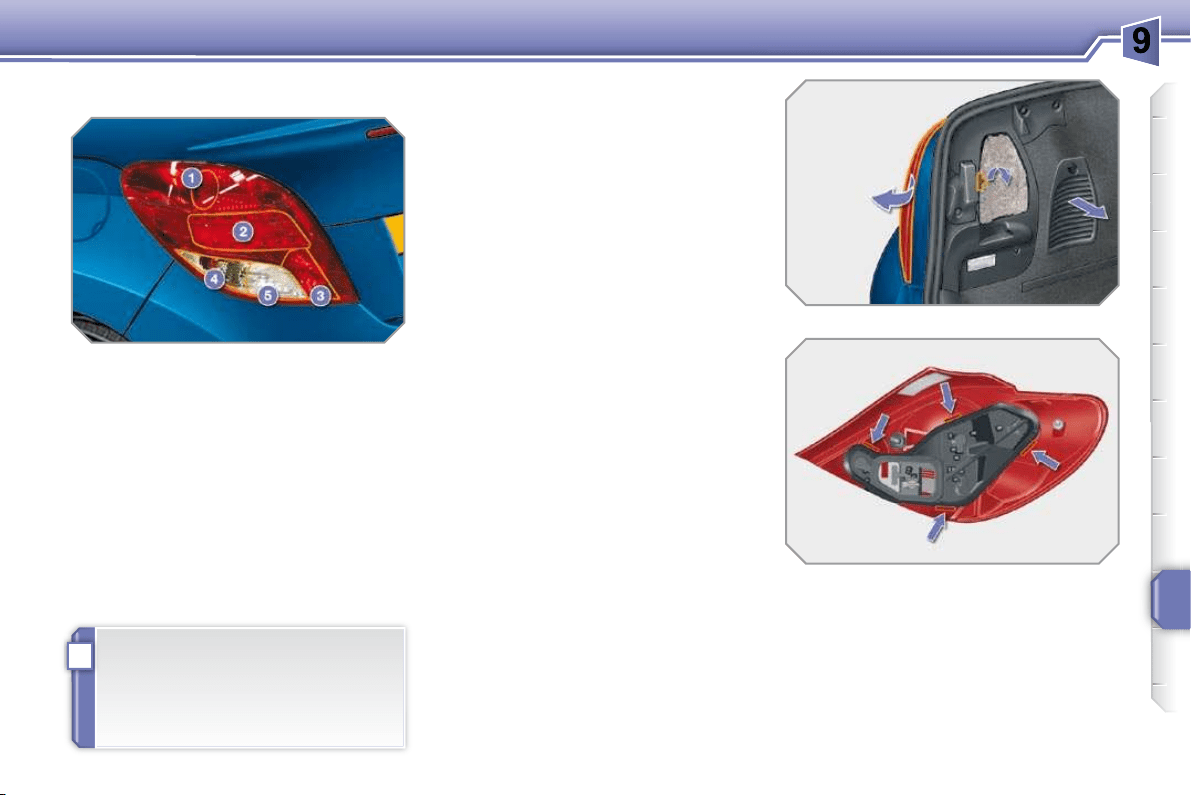
i
PRACTICAL INFORMATION
129
Rear lamps
1. Brake lamps (P 21 W).
2. Sidelamps (diodes).
3. Foglamps (P 21 W).
4. Direction indicators
(PY 21 W amber).
5. Reversing lamps (R 10 W).
Changing bulbs
These bulbs (with the exception of the diode
lamps) are changed from outside the boot:
fi rst open the fl ap to gain access to
the fi xing bolt,
remove the lamp fi xing bolt,
remove the lamp from the outside,
disconnect the lamp connector,
remove the lamp seal,
press the four tabs and remove the
bulb holder,
turn the bulb one quarter of a turn
and change it.
To refi t, carry out these operations in
reverse order.
Amber coloured bulbs, such as
the direction indicators, must be
replaced with bulbs of identical
specifi cation and colour.
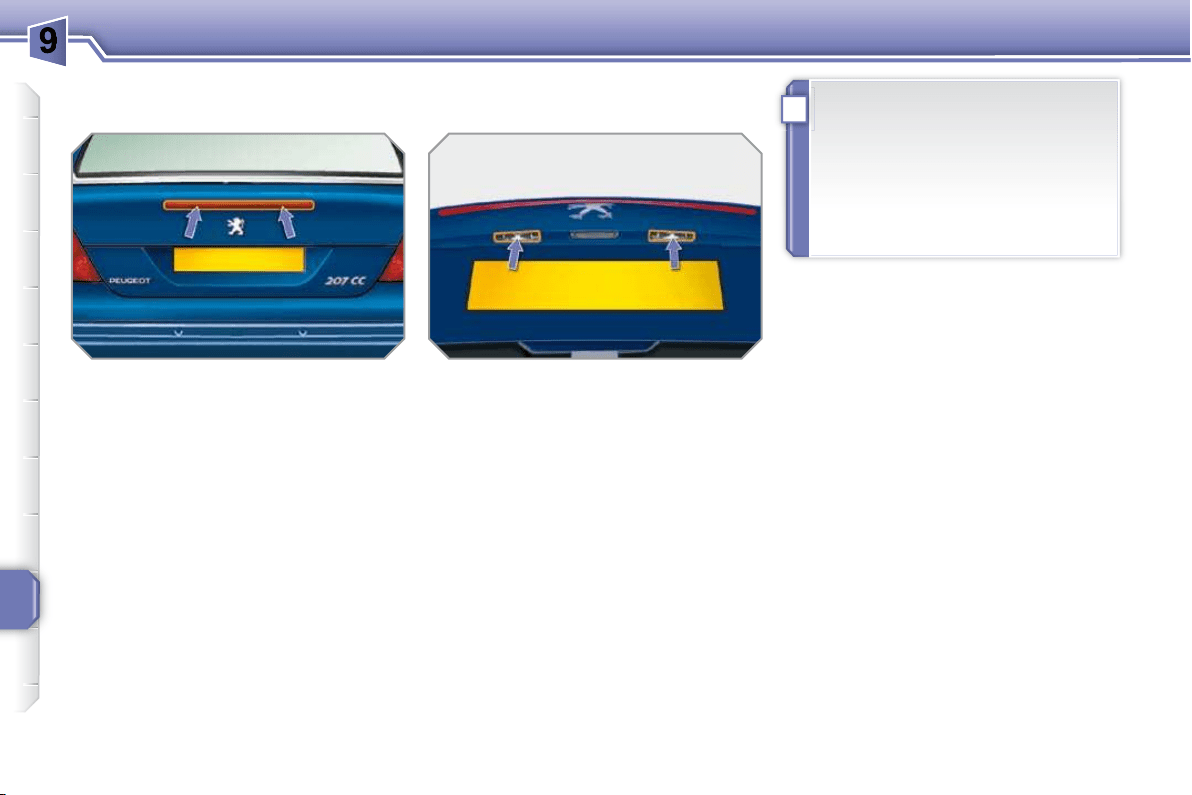
!
PRACTICAL INFORMATION
130
Changing the third brake lamp
(diodes)
For the replacement of this type of di-
odes lamp, contact a PEUGEOT dealer.
Changing the number plate lamp
bulbs (W 5 W)
Insert a thin screwdriver in one of
the exterior holes of the lens.
Push it towards the outside to unclip it.
Remove the lens.
Pull the bulb and change it.
High pressure washing
When using this type of washing
on stubborn dirt, do not persist on
the headlamps, the lamps and their
surrounds to avoid damaging their
protective coating and seals.
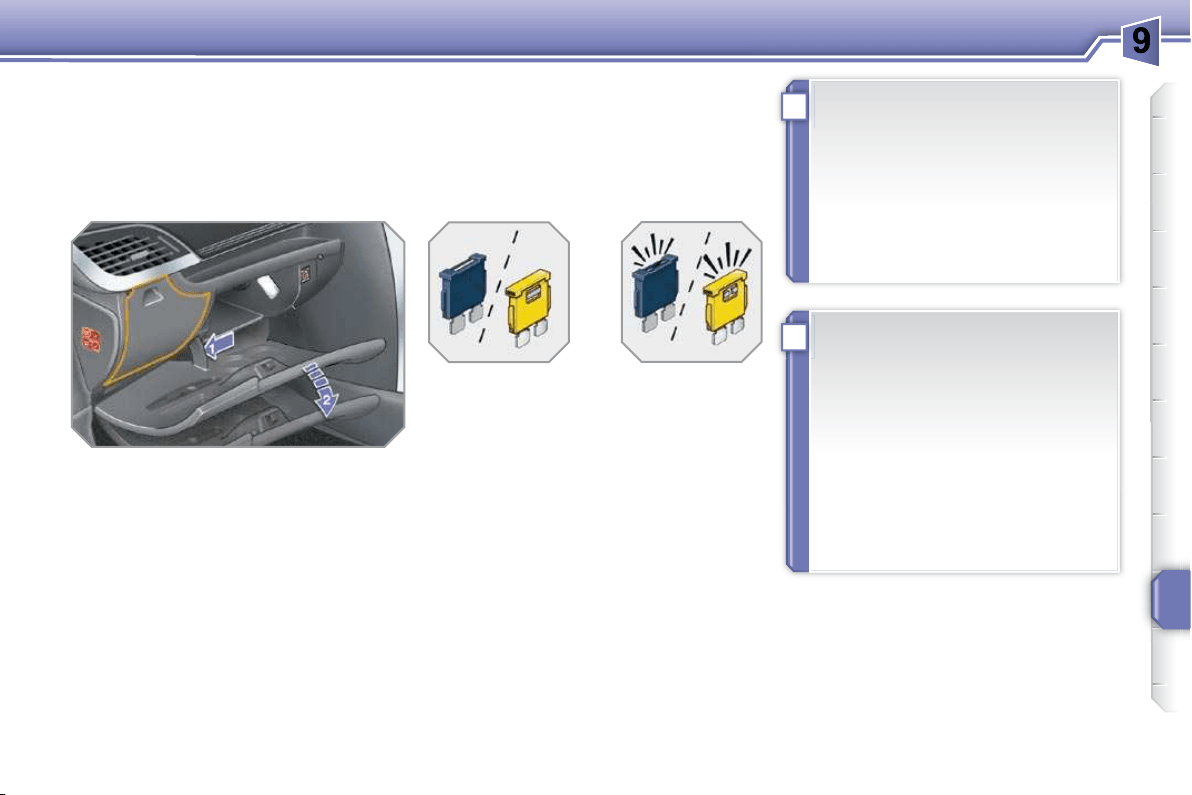
!
i
PRACTICAL INFORMATION
131
PEUGEOT does not accept any
responsibility for the costs incurred
in repairing your vehicle or for the
malfunctions resulting from the
installation of additional accessories
which are not supplied or recom-
mended by PEUGEOT and which
are not installed in accordance with
its instructions, particularly when
the combined consumption of all of
the additional equipment connect-
ed exceeds 10 milliamperes.
Installation of electrical acces-
sories
Your vehicle's electrical circuit is
designed to operate with the stan-
dard or optional equipment.
Before installing other electrical
equipment or accessories in your
vehicle, contact a PEUGEOT dealer.
CHANGING A FUSE
Procedure for the replacement of a
faulty fuse with a new fuse in order to
rectify a failure of the corresponding
function.
Access to the tools
The extraction pliers are installed on the
back of the dashbaord fusebox cover.
To gain access to them:
unclip the cover pulling at the top,
remove the cover completely,
remove the pliers.
Replacing a fuse
Before replacing a fuse, the cause of
the failure must be identifi ed and recti-
fi ed.
Identify the faulty fuse by examining
the condition of its fi lament.
Use the special pliers to extract the
fuse from its housing.
Always replace the faulty fuse with a
fuse of the same rating.
Check that the number engraved
on the box and the rating engraved
on the top correspond to the tables
which follow.
Correct
Incorrect
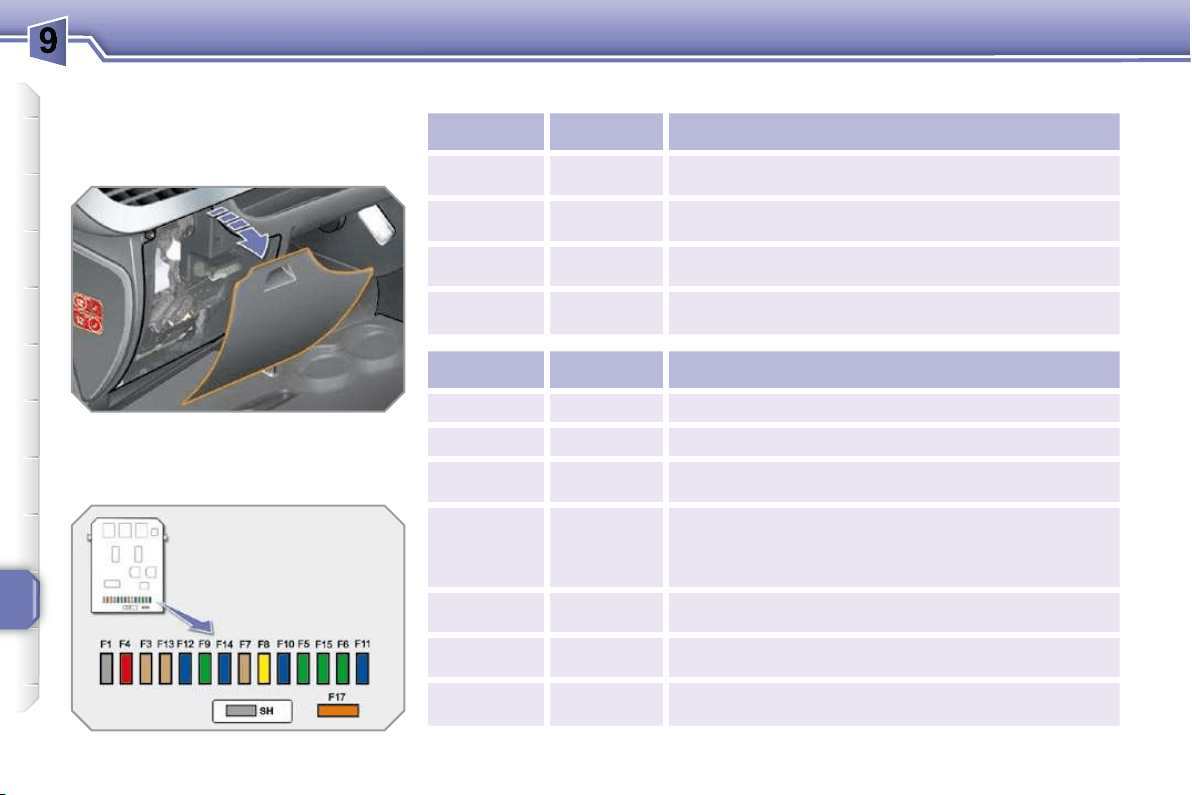
PRACTICAL INFORMATION
132
Dashboard fuses
The fusebox is placed in the lower dash-
board (left-hand side).
Access to the fuses
refer to the "Access to the tools"
paragraph.
Fuse table
Fuse N° Rating Functions
G37 30 A Retractable roof unit supply.
G38 20 A Hi-Fi amplifi er.
G39 20 A Driver and passenger heated seats.
G40 40 A Trailer fusebox supply.
Fuse N° Rating Functions
F1 - Not used.
F2 - Not used.
F3 5 A Airbags and pre-tensioners control unit.
F4 10 A
Clutch pedal switch, diagnostic socket,
electrochromatic rear view mirror, air conditioning,
steering wheel angle sensor, particle emission fi lter
pump (Diesel).
F5 30 A Rear electric windows, retractable roof.
F6 30 A Front electric windows, folding mirrors supply.
F7 5 A
Front courtesy lamp, map reading reading lamps,
sun visor lighting, glove box lighting.
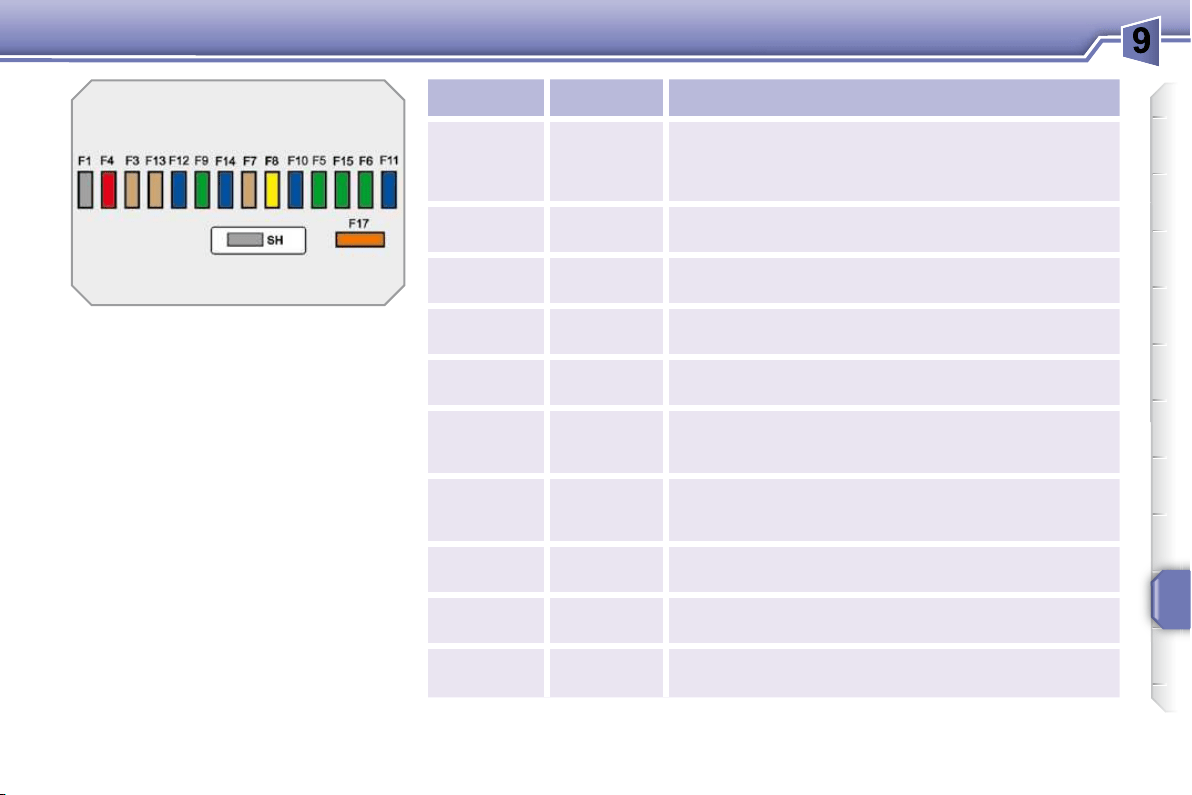
PRACTICAL INFORMATION
133
Fuse N° Rating Functions
F8 20 A
Audio/telephone, multifunction screen, steering
mounted controls, tyre under-infl ation detection,
trailer fusebox, alarm (accessory).
F9 30 A
Front 12 V socket, front courtesy lamp, map reading
lamps, sun visor lighting, glove box lighting.
F10 15 A
Alarm siren, alarm control unit, directional
headlamps.
F11 15 A
Diagnostic socket, low current ignition switch,
automatic gearbox control unit.
F12 15 A Sunshine sensor, trailer fusebox, retractable roof.
F13 5 A
Engine fusebox, ABS relay, dual-function brake
switch.
F14 15 A
Instrument panel, seat belt warning lamps panel,
headlamp adjustment, air conditioning, audio equipment,
Bluetooth system, rear parking sensors control unit.
F15 30 A Locking and deadlocking.
F17 40 A Heated rear screen and door mirrors.
SH - PARC shunt.
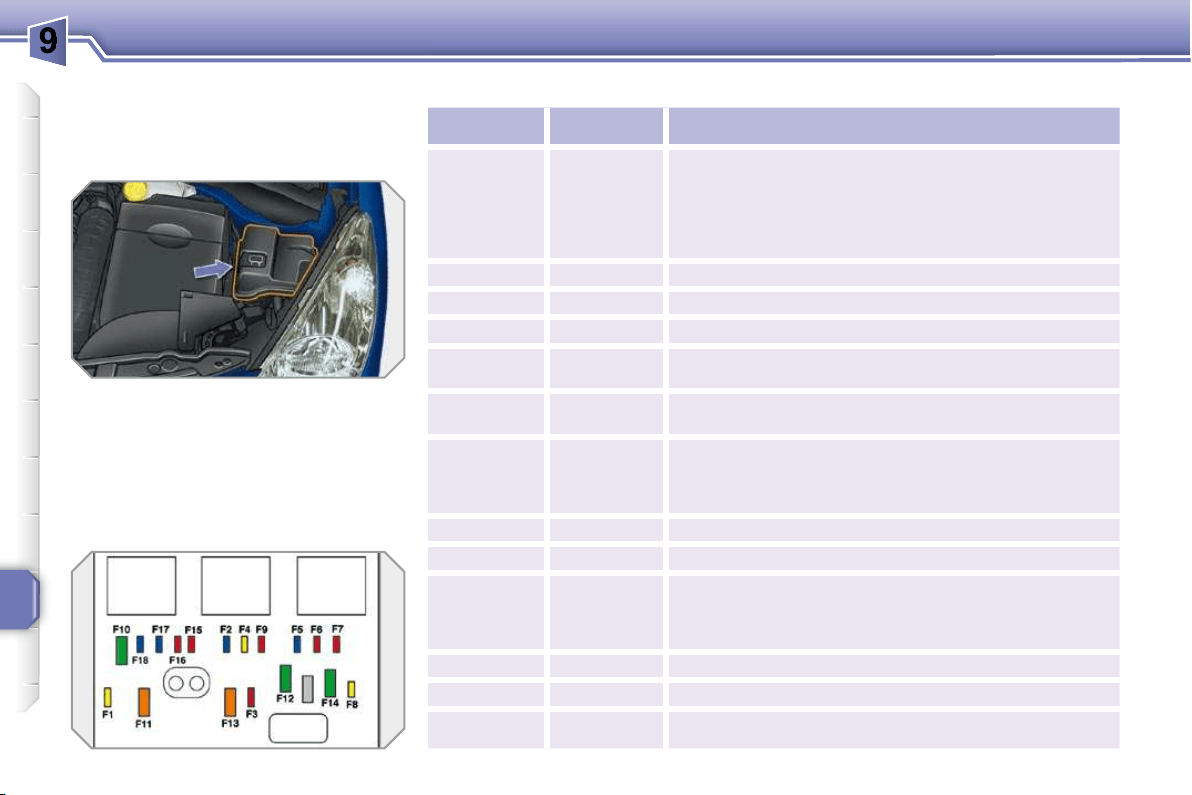
PRACTICAL INFORMATION
134
Engine compartment fuses
The fusebox is placed in the engine
compartment, near the battery (left-
hand side).
Access to the fuses
Unclip the cover.
Replace the fuse (refer to the cor-
responding paragraph).
When you have fi nished, close the
cover carefully to ensure correct
sealing of the fuse box.
Fuse table
Fuse N° Rating Functions
F1 20 A
Engine control unit and fan assembly control relay
supply, timing and canister electrovalves
(1.6 l 16V THP), air fl ow sensor (Diesel), injection
pump (Diesel), water in Diesel sensor (Diesel),
EGR electrovalves, air heating (Diesel).
F2 15 A Horn.
F3 10 A Front wash-wipe.
F4 20 A Headlamp wash.
F5 15 A
Fuel pump (petrol), Turbo electrovalves
(1.6 l 16V THP).
F6 10 A Vehicle speed sensor, automatic gearbox.
F7 10 A
Electric power steering, directional headlamps,
directional headlamps control relay, switching and
protection unit (Diesel).
F8 20 A Starter motor control.
F9 10 A ABS/ESP control unit, brake pedal switch.
F10 30 A
Engine control unit actuators (petrol: ignition coils,
electrovalves, oxygen sensors, injectors, heaters,
electronic thermostat) (Diesel: electrovalves,
heaters).
F11 40 A Air conditioning blower.
F12 30 A Windscreen wipers Low/High speed.
F13 40 A Built-in systems interface supply (ignition positive).
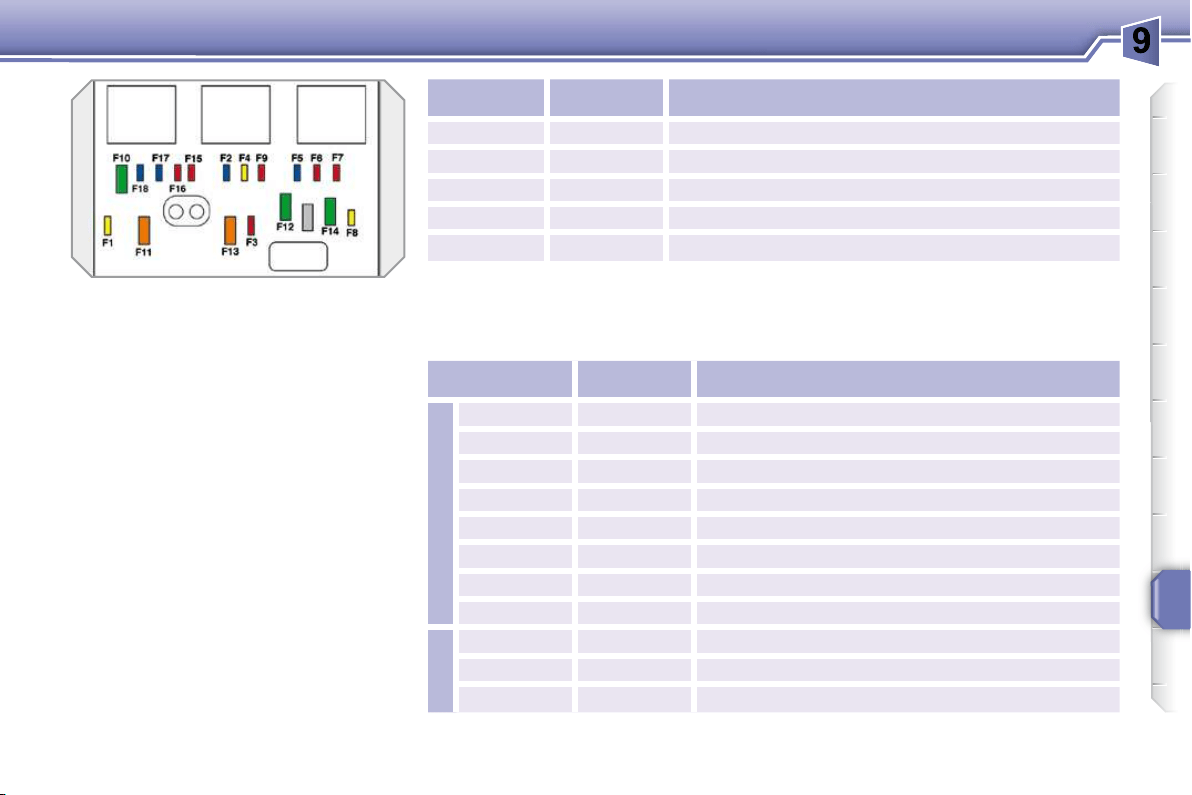
PRACTICAL INFORMATION
135
Fuse N° Rating Functions
F14 30 A Diesel heater (Diesel).
F15 10 A Left main beam headlamp.
F16 10 A Right main beam headlamp.
F17 15 A Left dipped beam headlamp.
F18 15 A Right dipped beam headlamp.
Maxi-fuse table
* The maxi-fuses provide additional
protection for the electrical systems.
All work on the maxi-fuses must be
carried out by a PEUGEOT dealer.
Fuse N° Rating Functions
Box 1
MF1 * 70 A Fan assembly.
MF2 * 20 A/30 A ABS/ESP pump.
MF3 * 20 A/30 A ABS/ESP electrovalves.
MF4 * 60 A Built-in systems interface supply.
MF5 * 60 A Built-in systems interface supply.
MF6 * 30 A Additional fan assembly (1.6 l 16V THP).
MF7 * 80 A Dashboard fusebox.
MF8 * - Not used.
Box 2
MF9 * 80 A Heating unit (Diesel).
MF10 * 80 A Electric power steering.
MF11 * 40 A Valvetronic electric motor (1.6 l 16V THP).
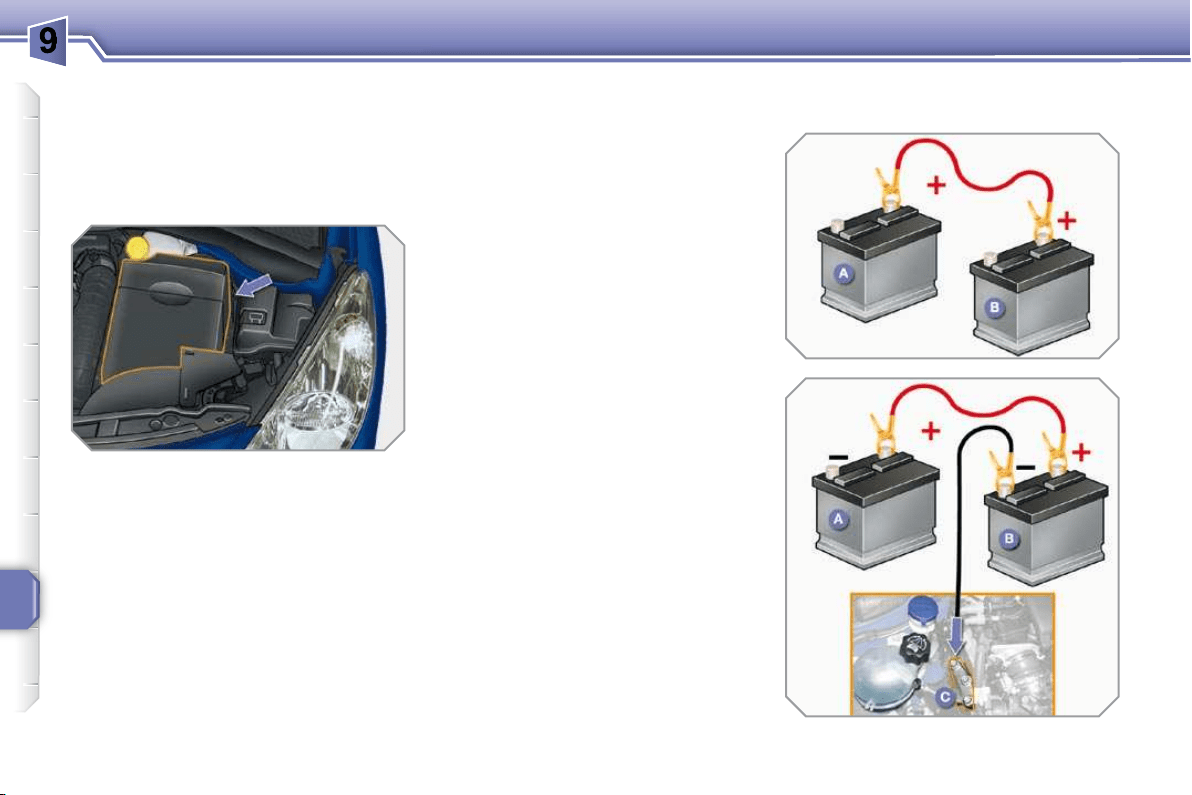
PRACTICAL INFORMATION
136
BATTERY
Procedure for charging your battery
when it is fl at or for starting the engine
using another battery.
Access to the battery
Starting using another battery
Connect the red cable to the posi-
tive terminal (+) of the fl at battery A ,
then to the positive terminal (+) of
the slave battery B .
Connect one end of the green or
black cable to the negative terminal
(-) of the slave battery B .
Connect the other end of the green
or black cable to an earth point C on
the broken down vehicle, as far as
possible from the battery (for exam-
ple, right-hand engine mounting).
Operate the starter, let the engine
run.
Wait until the engine returns to idle
and disconnect the cables.
The battery is located under the bonnet
on the left.
To gain access to it:
open the bonnet using the interior re-
lease lever, then the exterior safety
catch,
secure the bonnet stay,
remove the plastic cover to gain
access to the two terminals.
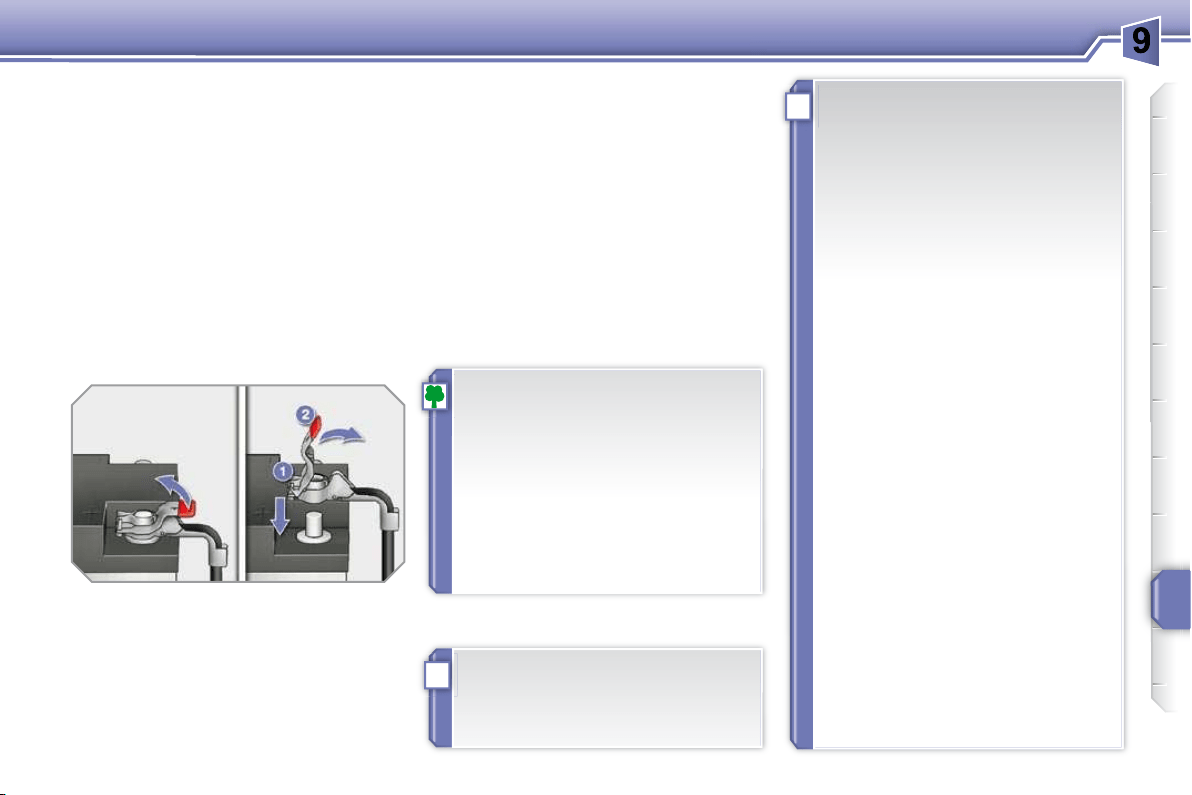
!
i
PRACTICAL INFORMATION
137
Do not disconnect the terminals
while the engine is running.
Do not charge the batteries without
disconnecting the terminals fi rst.
The batteries contain harmful sub-
stances such as sulphuric acid and
lead. They must be disposed of in
accordance with regulations and
must not, in any circumstances, be
discarded with household waste.
Take used remote control batteries
and vehicle batteries to a special
collection point.
Charging the battery using a
battery charger
Disconnect the battery from the vehicle.
Follow the instructions for use pro-
vided by the manufacturer of the
charger.
Reconnect starting with the nega-
tive terminal (-).
Check that the terminals and connec-
tors are clean. If they are covered with
sulphate (whitish or greenish deposit),
remove them and clean them.
It is advisable to disconnect the
battery if the vehicle is to be left
unused for more than one month.
Before disconnecting the
battery
Wait 2 minutes after switching off
the ignition before disconnecting
the battery.
Close the windows, the retractable
roof and the doors before discon-
necting the battery.
Following reconnection of the
battery
Following reconnection of the bat-
tery, switch on the ignition and wait
1 minute before starting to permit
initialisation of the electronic sys-
tems. However, if problems remain
following this operation, contact a
PEUGEOT dealer.
Referring to the corresponding sec-
tion, you must yourself reinitialise:
- the remote control key,
- the electric windows and the
automatic partial opening of the
door windows,
- the GPS satellite navigation
system.
Disconnecting the cables
Reconnecting the cables
Position the open clip 1 of the cable
on the positive terminal (+) of the
battery.
Press vertically on the clip 1 to posi-
tion it correctly against the battery.
Lock the clip by lowering the tab 2 .
Do not force the tab as locking will not
be possible if the clip is not positioned
correctly; start the procedure again.
Raise the locking tab fully.
!
i
PRACTICAL INFORMATION
138
A fl at battery prevents the engine
from starting (refer to the corre-
sponding paragraph).
If a roof operation is in progress,
it will be completed, but no further
operation is possible.
ENERGY ECONOMY MODE
System which manages the duration of
use of certain functions to conserve a
suffi cient level of charge in the battery.
After the engine has stopped, you can
still use functions such as the audio
equipment, windscreen wipers, dipped
beam headlamps, courtesy lamp, etc.
for a maximum combined duration of
thirty minutes.
Exiting economy mode
These functions are reactivated auto-
matically next time the vehicle is driven.
In order to resume the use of these
functions immediately, start the
engine and let it run for a few minutes.
The time available to you will then be
double the duration for which the engine
is left running. However, this period will al-
ways be between fi ve and thirty minutes.
Switching to economy mode
Once the thirty minutes are over, a
message appears on the multifunction
screen indicating that the vehicle has
switched to economy mode and the ac-
tive functions are put on standby.
CHANGING A WIPER BLADE
Procedure for replacing a worn wiper
blade with a new one without the use
of tools.
Removing a front wiper blade
Raise the corresponding wiper arm.
Unclip the wiper blade and remove it.
Fitting a front wiper blade
Check the size of the wiper blade
as the shorter blade is fi tted on the
right-hand side of the vehicle.
Put the corresponding new wiper
blade in place and clip it.
Fold down the wiper arm carefully.
LOAD REDUCTION MODE
System which manages the use of cer-
tain functions according to the level of
charge remaining in the battery.
When the vehicle is being driven, the load
reduction function temporarily deactivates
certain functions, such as the air condi-
tioning, the heated rear screen...
The deactivated functions are reactivat-
ed automatically as soon as conditions
permit.
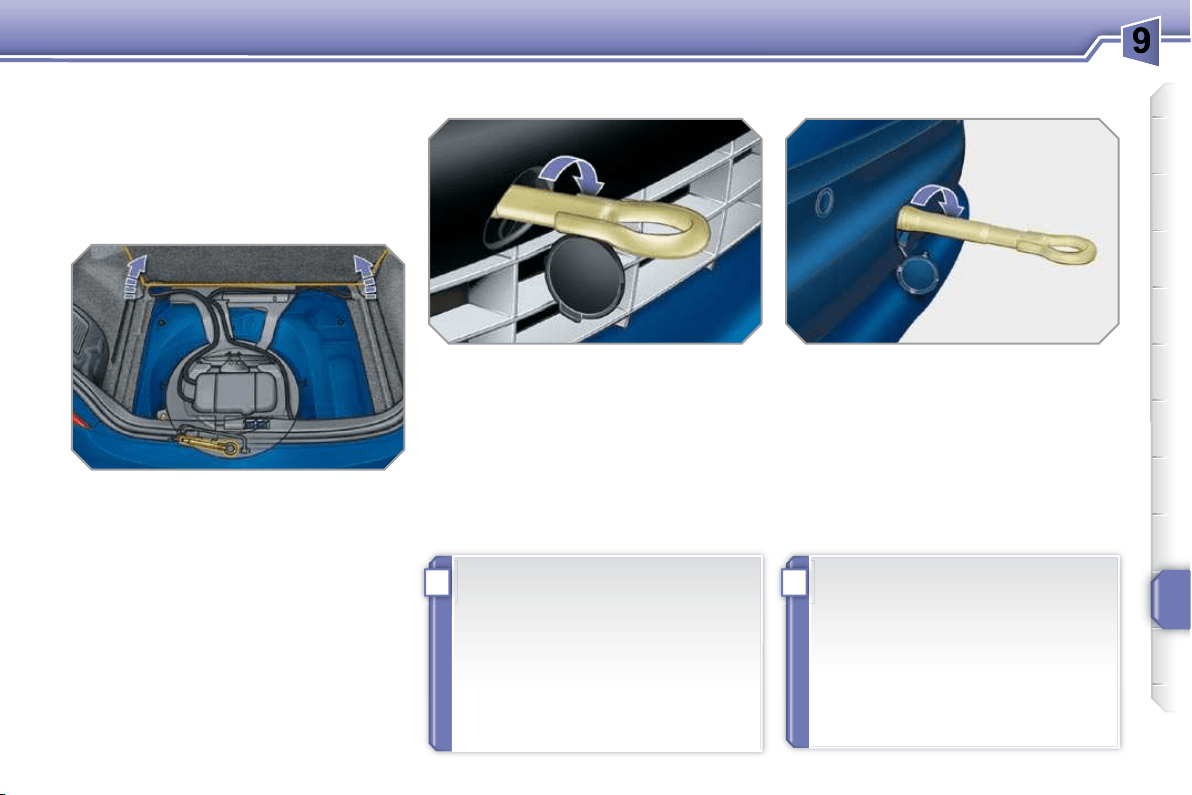
!
i
PRACTICAL INFORMATION
139
TOWING THE VEHICLE
Procedure for having your vehicle towed
or for towing another vehicle using a re-
movable towing eye.
Access to the tools
Towing your vehicle
On the front bumper, pull on the cov-
er to unclip it.
Screw the towing eye in fully.
Install the towing bar.
Switch on the hazard warning lamps
on the towed vehicle.
On the rear bumper, unclip the cover
by pressing at the bottom.
Screw the towing eye in fully.
Install the towing bar.
Switch on the hazard warning lamps
on the towed vehicle.
Towing another vehicle
The towing eye is installed in a holder at
the bottom of the boot under the fl oor.
For access to it:
place the vehicle in "coupé" confi gu-
ration,
open the boot,
raise the fl oor,
remove the towing eye from the
holder.
When towing with all four wheels
on the ground, always use a towing
bar.
When towing with only two wheels
on the ground, always use profes-
sional lifting equipment.
When towing with the engine off,
there is no longer any braking or
steering assistance.
Place the gear lever in neutral
(position N on the automatic
gearbox).
Failure to observe this specifi c
instruction may result in damage
to certain braking units and the
absence of braking assistance
when the engine is restarted.
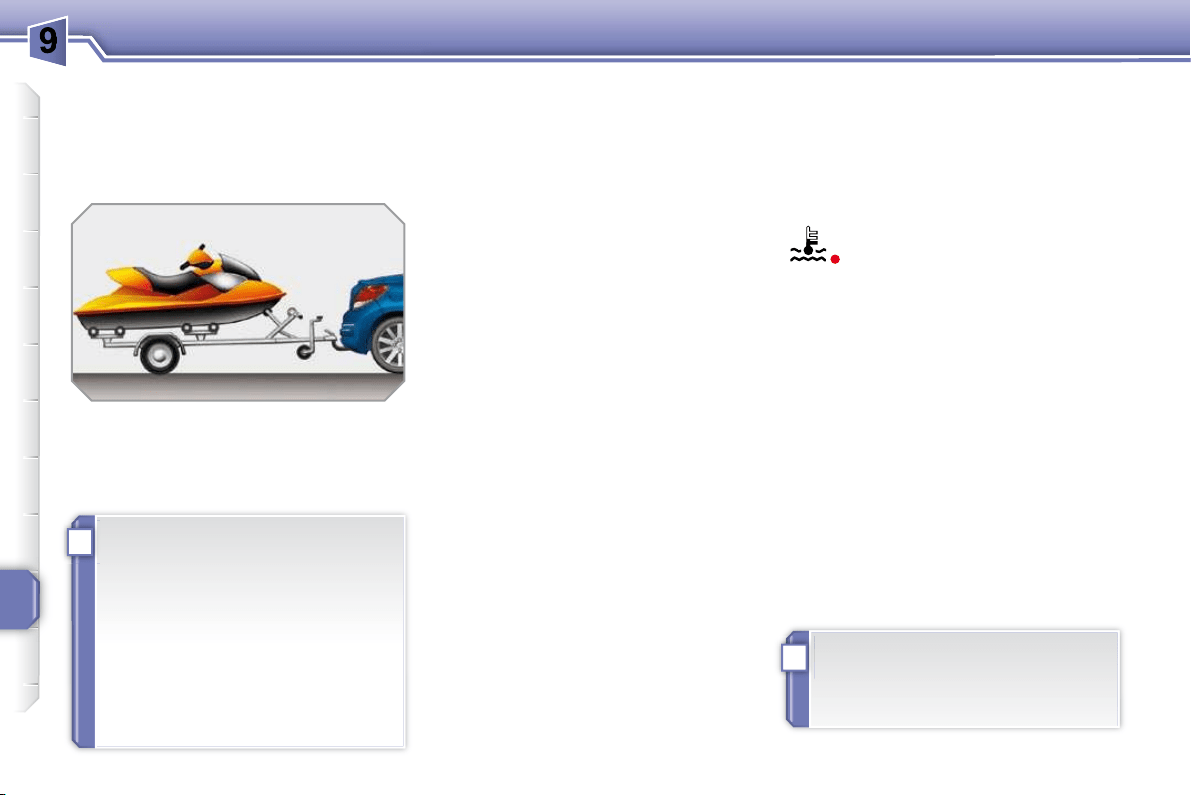
i
i
PRACTICAL INFORMATION
140
TOWING A TRAILER, A
CARAVAN, ETC.
Your vehicle is primarily designed for
transporting people and luggage, but it
may also be used for towing a trailer.
Driving with a trailer subjects the towing
vehicle to more signifi cant stress and its
driver must be particularly careful.
The maximum towing load on a long
slope depends on the gradient and the
ambient temperature.
Distribution of loads
Distribute the load in the trailer so
that the heaviest items are as close
as possible to the axle and the nose
weight approaches the maximum
permitted without exceeding it.
Air density decreases with altitude, thus
reducing engine performance. Above
1 000 metres, the maximum towing load
must be reduced by 10 % and so on for
every 1 000 metres of altitude.
Refer to the "Technical Data" section for
details of the weights and towing loads
which apply to your vehicle.
Side wind
Take into account the increased
sensitivity to side wind.
If the warning lamp and the
STOP warning lamp come
on, stop the vehicle and
switch off the engine as
soon as possible.
Braking
Towing a trailer increases the braking
distance.
Tyres
Check the tyre pressures of the towing
vehicle and of the trailer, observing the
recommended pressures.
The rear parking sensors will be
deactivated automatically if a gen-
uine PEUGEOT towbar is used.
In all cases, pay attention to the coolant
temperature.
Towbar suitable for the attachment of a
trailer or caravan with additional lighting
and signalling.
We recommend the use of genuine
PEUGEOT towbars and their har-
nesses that have been tested and
approved from the design stage
of your vehicle, and that the fi t-
ting of the towbar is entrusted to a
PEUGEOT dealer.
If the trailer is not fi tted by a
PEUGEOT dealer, it is imperative
that it is fi tted using the electrical
pre-equipment installed at the rear
of the vehicle, in accordance with
the manufacturer's instructions.
Driving advice
Cooling
Towing a trailer on a slope increases
the temperature of the coolant.
As the fan is electrically controlled, its
cooling capacity is not dependent on
the engine speed.
To lower the engine speed, reduce
your speed.
Lighting
Check the electrical lighting and sig-
nalling on the trailer.
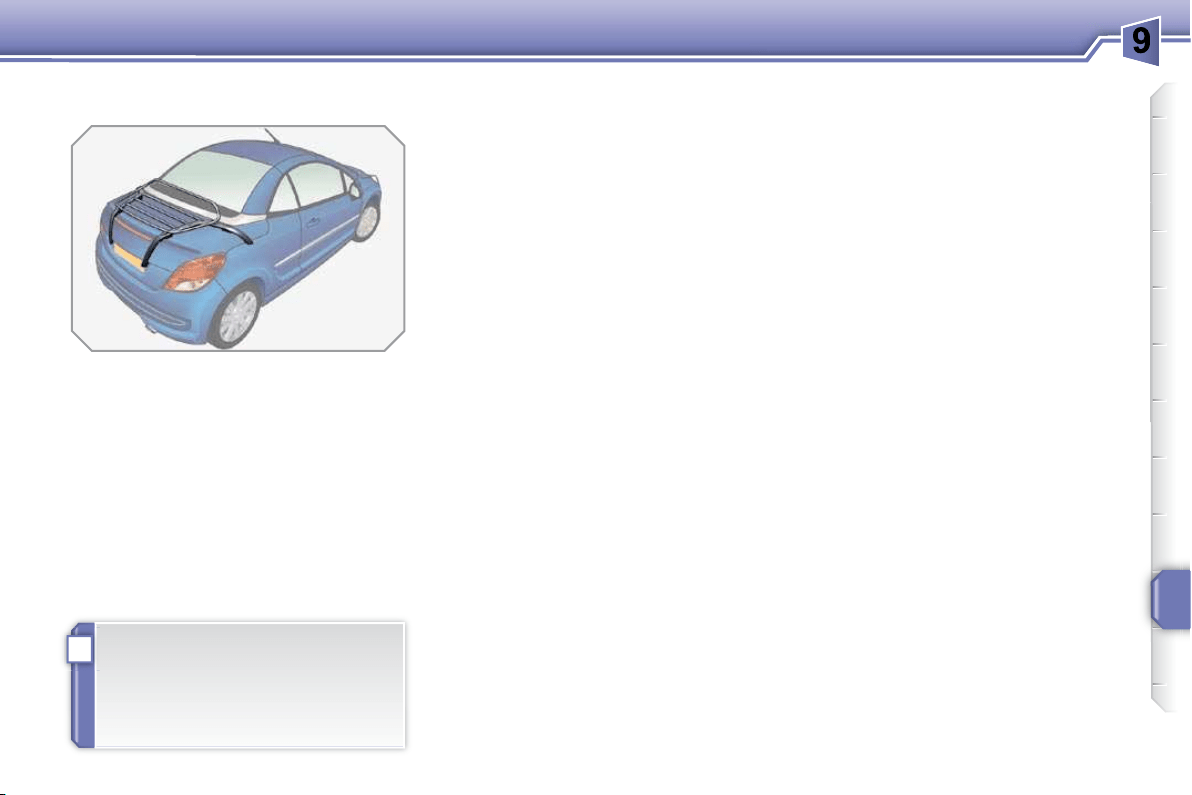
!
PRACTICAL INFORMATION
141
BOOT LUGGAGE CARRIER
A boot luggage carrier, designed spe-
cifi cally for your coupé-cabriolet, is avail-
able from your PEUGEOT dealer as an
accessory.
Follow the manufacturer's recommen-
dations for fi tting and use.
When loading the boot luggage car-
rier, take care not to cover the third
brake lamp and the number plate.
The retractable roof must not not
operated when the boot luggage
carrier is fi tted.
!
i
PRACTICAL INFORMATION
142
The fi tting of electrical equipment
or accessories which are not rec-
ommended by PEUGEOT may
result in a failure of your vehicle's
electronic system.
Please note this specifi c warning.
You are advised to contact a rep-
resentative of the Marque to be
shown the range of recommended
equipment and accessories.
ACCESSORIES
You can obtain a wide range of ac-
cessories and original parts from the
PEUGEOT network.
These accessories and parts have been
tested and approved for reliability and
safety.
They are all adapted to your vehicle and
benefi t from PEUGEOT's recommenda-
tion and warranty.
The product range offered by
PEUGEOT Accessories is structured
around 5 categories: PROTECTION -
TOURING - IN-CAR TECHNOLOGY -
STYLING - UNIVERSAL.
"Protection":
anti-theft alarm, window etching,
security wheel bolts, breathalyz-
er, fi rst aid kit, warning triangle,
high visibility jacket, stolen ve-
hicle tracking system, puncture
repair kit, snow chains, anti-skid
covers.
"Touring":
mats * , boot tray, fi xed coat
hook on head restraint, light-
er, aluminium door sills, rear
head rest.
For leisure pursuits: bicycle car-
rier on towbar ** , boot luggage
carrier, booster seats and child
seats, spectacles storage.
Trailer towbar which must be fi tted by
the PEUGEOT network.
"In-car technology":
audio systems, satellite
navigation systems, Blue-
tooth hands-free system,
CD changer, speakers, DVD
player, connection kit for MP3
player or portable CD player,
USB Box, front and rear park-
ing sensors.
"Styling":
seat covers compatible with
lateral airbags, aluminium
gear lever knob, styling strips,
alloy wheels, trims.
"Universal":
screenwash, interior and exte-
rior maintenance and cleaning
products.
* To prevent any risk of jamming the
pedals:
- ensure that the mat is positioned
and secured correctly,
- never fi t one mat on top of another.
Depending on the country in which
the vehicle is sold, it is compulso-
ry to have a high visibility jacket,
warning triangle and spare bulbs
available in the vehicle.
** Precautions relating to the bicycle
carrier on towbar:
- observe the manufacturer's recom-
mendations for fi tting and use,
- refer to the "Technical data - §
Weights and towed loads" section
for information regarding the recom-
mended nose weight.
10
TECHNICAL DATA
143
MODELS: ENGINES AND GEARBOXES
PETROL ENGINES 1.6 litre VTi 16V 120 hp 1.6 litre THP 16V 150 hp
Cubic capacity (cc) 1 598 1 598
Bore x stroke (mm) 77 x 85.8 77 x 85.8
Max power: EU standard (kW) 88 115
Max power engine speed (rpm) 5 750 5 800
Max torque: EU standard (Nm) 160 240
Max torque engine speed (rpm) 4 250 1 400
Fuel Unleaded Unleaded
Catalytic converter Yes Yes
GEARBOXES
Manual
(5-speed)
Automatic
(4-speed)
Manual
(6-speed)
OIL CAPACITIES (in litres)
Engine (with fi lter replacement) 4.25 4.25 4.25
Gearbox - Final drive 1.9 - 1.9

10
TECHNICAL DATA
145
MODELS: ENGINES AND GEARBOXES
DIESEL ENGINE 1.6 litre Turbo HDI 110 hp
Cubic capacity (cc) 1 560
Bore x stroke (mm) 75 x 88.3
Max power: EU standard (kW) 80
Max power engine speed (rpm) 4 000
Max torque: EU standard (Nm) 240
Max torque engine speed (rpm) 1 750
Fuel Diesel
Catalytic converter Yes
Particle emission fi lter Yes
GEARBOX Manual (6-speed)
OIL CAPACITIES (in litres)
Engine (with fi lter replacement) 3.75
Gearbox - Final drive 1.9
10
TECHNICAL DATA
144
The GTW and towed load values indicated apply up to a maximum altitude of 1 000 metres; the towed load mentioned must
be reduced by 10 % for every additional 1 000 metres.
The speed of a towing vehicle must not exceed 60 mph (100 km/h) (comply with the legislation in force in your country).
High ambient temperatures may result in a reduction in the performance of the vehicle to protect the engine; when the ambient
temperature is higher than 37 °C, limit the towed weight.
* The weight of the braked trailer can be increased, within the GTW limit, on condition that the GVW of the towing vehicle is reduced
by the same amount; warning: towing with a lightly loaded towing vehicle may have an adverse effect on its road holding.
WEIGHTS AND TOWED LOADS (in kg)
Petrol engines 1.6 litre VTi 16V 120 hp 1.6 litre THP 16V 150 hp
Gearboxes Manual Auto. Manual
- Kerb weight 1 417 1 455 1 484
- Payload 292 312 290
- Gross vehicle weight (GVW) 1 709 1 767 1 774
- Gross train weight (GVW)
on a 12 % gradient 2 559 2 647 2 664
- Braked trailer (within GTW limit)
on a 10 % or 12 % gradient - - -
- Braked trailer * (with load transfer within
GTW limit)
1 040 1 060 1 060
- Unbraked trailer 600 600 600
- Recommended nose weight 42 43 43
10
TECHNICAL DATA
146
The GTW and towed load values indicated apply up to a maximum altitude of 1 000 metres; the towed load mentioned must
be reduced by 10 % for every additional 1 000 metres.
The speed of a towing vehicle must not exceed 60 mph (100 km/h) (comply with the legislation in force in your country).
High ambient temperatures may result in a reduction in the performance of the vehicle to protect the engine; when the ambient
temperature is higher than 37 °C, limit the towed weight.
* The weight of the braked trailer can be increased, within the GTW limit, on condition that the GVW of the towing vehicle is reduced
by the same amount; warning: towing with a lightly loaded towing vehicle may have an adverse effect on its road holding.
WEIGHTS AND TOWED LOADS (in kg)
Diesel engine 1.6 litre Turbo HDI 110 hp
Gearbox Manual
- Kerb weight 1 475
- Payload 308
- Gross vehicle weight (GVW) 1 783
- Gross train weight (GTW)
on a 12 % gradient 2 673
- Braked trailer (within GTW limit)
on a 10 % or 12 % gradient -
- Braked trailer * (with load transfer within
GTW limit)
1 070
- Unbraked trailer 600
- Recommended nose weight 43
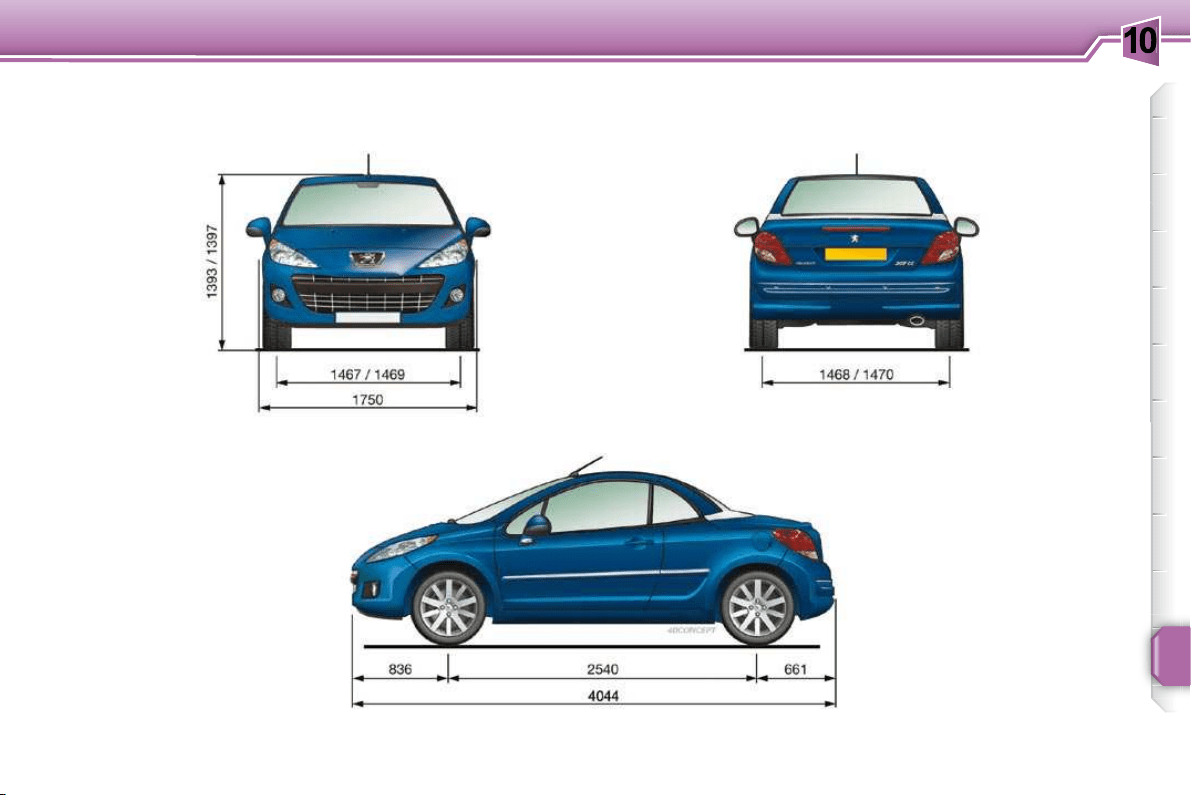
10
TECHNICAL DATA
147
DIMENSIONS (IN MM)
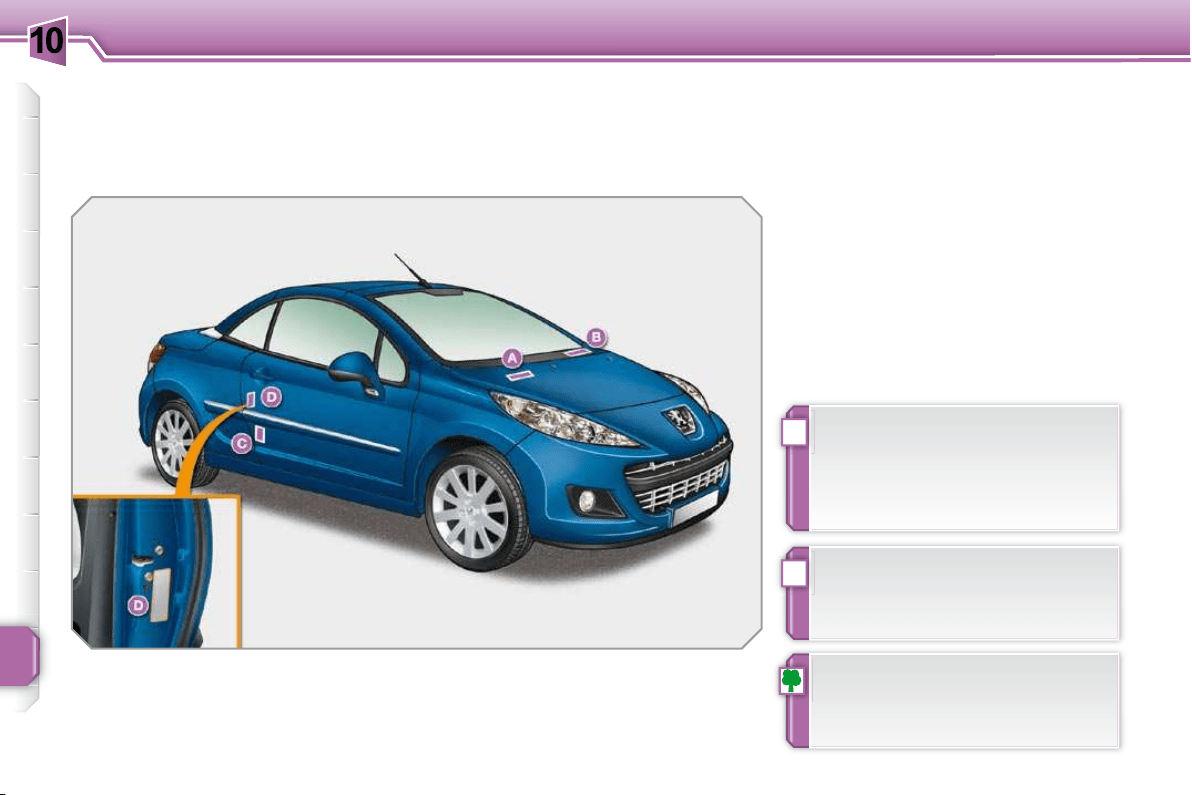
10
!
i
TECHNICAL DATA
148
IDENTIFICATION MARKINGS
Various visible markings for the identifi -
cation of your vehicle.
Wheels which are fi tted with 205/45
R17 tyres cannot be fi tted with
snow chains. For more information,
contact a PEUGEOT dealer.
If the infl ation pressures are too low,
this increases fuel consumption.
The infl ation pressures must be
checked when the tyres are cold,
at least once a month.
A. Vehicle identifi cation (VIN) number
under the bonnet.
This number is etched on the bodywork
near the passenger compartment fi lter.
B. Visible VIN on the dashboard.
This number is indicated on a self-ad-
hesive label which is visible through the
windscreen.
C. VIN on the chassis.
This number is indicated on a self-de-
stroying label affi xed to the centre pillar,
near the driver’s door striker.
D. Manufacturer’s label.
This label is affi xed to the edge of the
door on the driver’s side.
It bears the following information:
- the wheel rim and tyre sizes,
- the brands of tyre recommended by
the manufacturer,
- the associated infl ation pressures,
- the paint colour code.
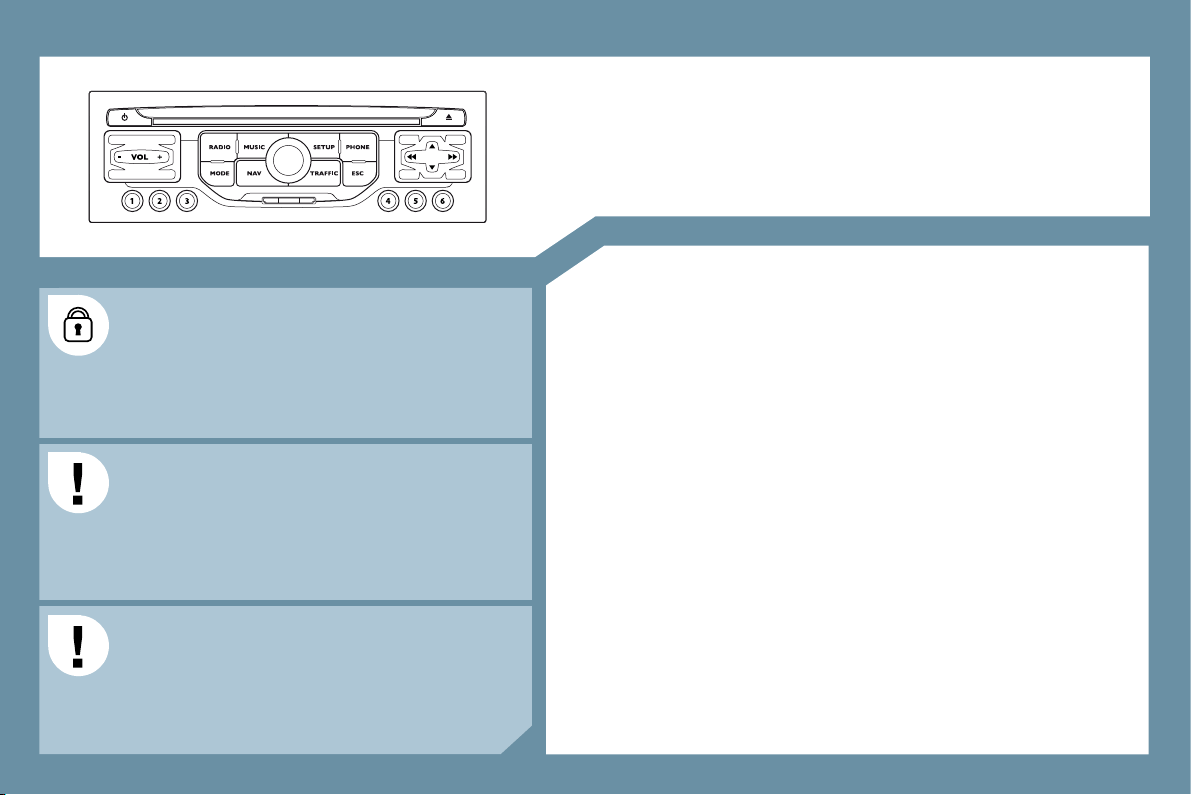
149
The Peugeot Connect Navigation is protected in such a
way that it will only operate in your vehicle. If it is to be
installed in another vehicle, contact a PEUGEOT dealer
for confi guration of the system.
Certain functions described in this handbook will become
available during the year.
Peugeot Connect Navigation
CONTENTS
01 First steps p.
02 Steering mounted controls p.
03 General operation p.
04 Navigation - Guidance p.
05 Traffi c information p.
06 Radio p.
07 Music media players p.
08 Bluetooth telephone p.
09 Confi guration p.
10
Trip computer/vehicle parameters
p.
11 Screen menu map p.
Frequently asked questions p.
For safety reasons, it is imperative that the driver carries
out operations which require prolonged attention while
the vehicle is stationary.
When the engine is switched off and to prevent
discharging of the battery, the Peugeot Connect
Navigation switches off following the activation of the
Energy Economy mode.
MULTIMEDIA AUDIO EQUIPMENT/BLUETOOTH TELEPHONE
GPS EUROPE BY SD CARD
150
151
152
154
161
163
164
167
169
170
171
174
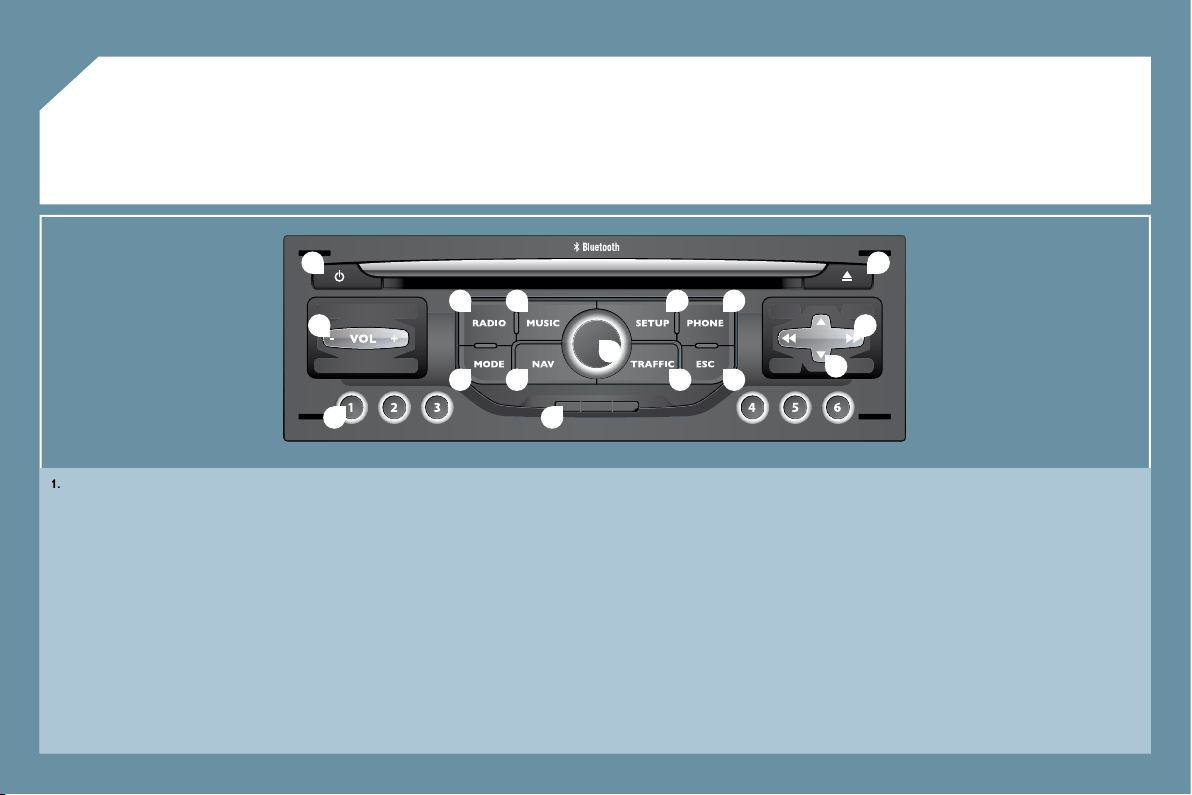
150
1
5
10
01
2
3 4 6
13
11
9
14 15
7 8
12
16
Engine not running
- Short press: on/off.
- Long press: CD pause, mute for the radio.
Engine running
- Short press: CD pause, mute for the radio.
- Long press: reinitialisation of the system.
2.
Volume adjustment (each source is independent, including
also navigation messages and alerts)
3.
Access to the "Radio" Menu. Display the list of stations.
4.
Access to the "Music" Menu. Display the tracks.
6.
Access to the "Phone" Menu. Display the call list.
7.
Access to the "MODE" menu.
Selection of the successive display of:
Radio, Map, NAV (if navigation is in progress), Telephone (if a
conversation is in progress), Trip computer.
Long press: display of a black screen (DARK).
8.
Access to the "Navigation" Menu. Display the last destinations.
9.
Access to the "Traffi c" Menu. Display the current traffi c alerts.
10.
ESC: abandon the operation in progress.
11.
CD eject.
12.
Selection of the previous/next radio station from the list.
Selection of the previous/next MP3 directory.
Selection of the previous/next page of a list.
13.
Selection of the previous/next radio station.
Selection of the previous/next CD or MP3 track.
Selection of the previous/next line of a list.
14.
Buttons 1 to 6:
Selection of the stored radio station.
Long press: store the current radio station.
15.
SD card reader (navigation SD card only).
16.
Dial for selection of the screen display and according to the
context of the menu
Short press: contextual menu or confi rmation.
Long press press: contextual menu specifi c to the list
displayed.
Peugeot Connect Navigation CONTROL PANEL
3 - 4.
Long press: access to the audio settings: front/rear and left/
right balance, bass/treble, equalizer, loudness, automatic
volume adjustment, initialise the settings.
5.
Access to the "SETUP" menu.
Long press: access to the GPS coverage and the
demonstration mode.
FIRST STEPS
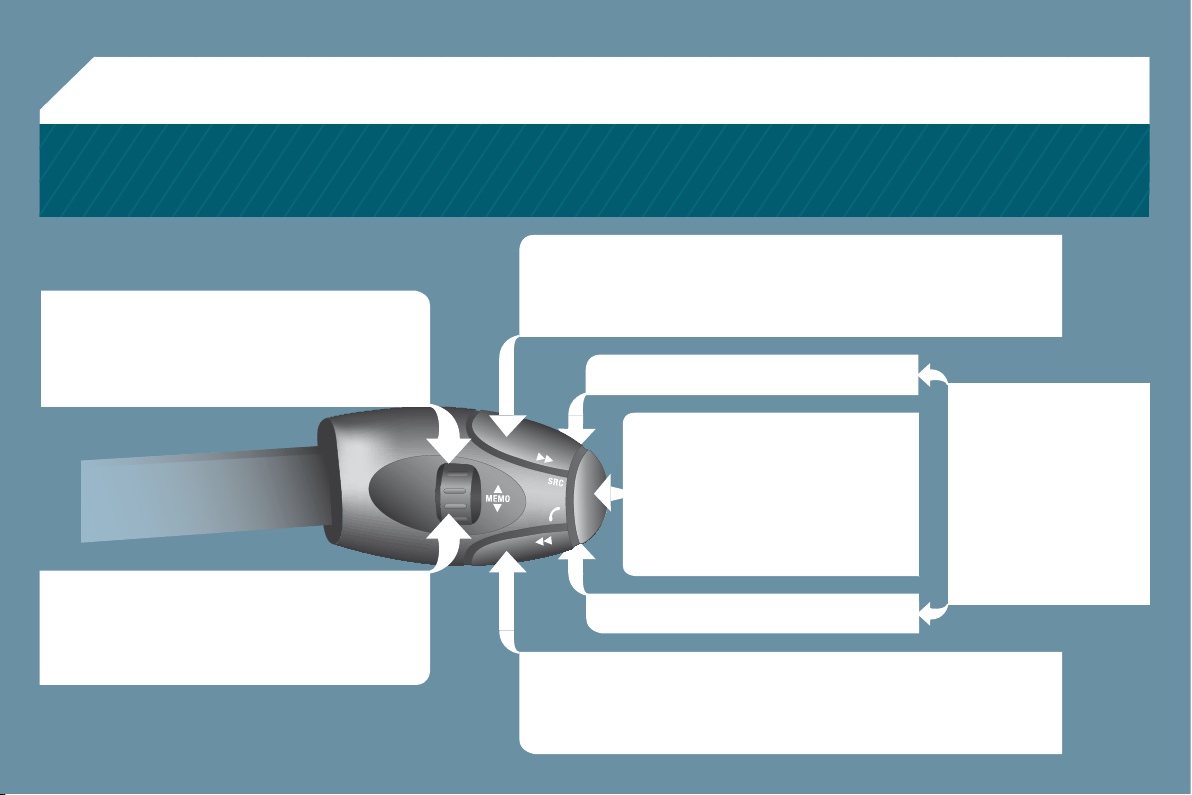
151
02
RADIO: selection of the previous stored station.
Selection of the previous entry in the address book.
RADIO: selection of the next stored station.
Selection of the next entry in the address book.
RADIO: change to the next radio station on the list.
Long press: automatic search for a higher frequency.
CD: selection of the next track.
CD: continuous press: fast forward play.
RADIO: change to the previous radio station on the List.
Long press: automatic search for a lower frequency.
CD: selection of the previous track.
CD: continuous press: fast reverse.
- Change the sound source.
- Make a call from the address book.
- Pick up/Hang up the telephone.
- Press for more than 2 seconds:
access to the address book.
Volume increase.
Volume decrease.
Mute: function activated
by pressing the volume
increase and decrease
buttons simultaneously.
Restore the sound by
pressing one of the two
volume buttons.
STEERING MOUNTED CONTROLS
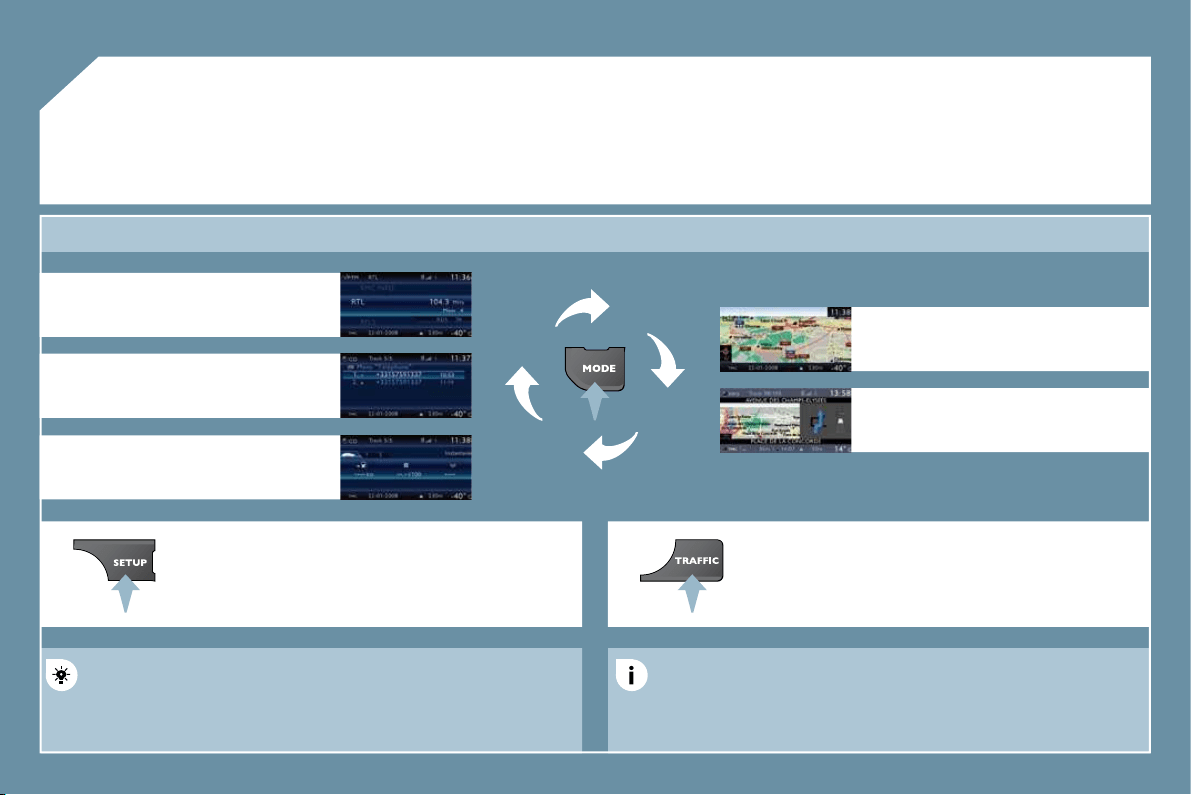
152
03
GENERAL OPERATION
For a detailed global view of the menus available, refer to the "Screen
menu map" section.
Press the MODE button several times in succession for access to the following menus:
For cleaning the screen, the use of a soft, non-abrasive cloth
(spectacles cloth) is recommended, with no additional product.
RADIO/ MUSIC MEDIA PLAYERS
TELEPHONE
(If a conversation is in progress)
FULL SCREEN MAP
NAVIGATION
(If guidance is in progress)
SETUP:
system language * , date and time * , display,
vehicle settings * , unit and system settings, "Demo
mode".
TRAFFIC:
TMC information and messages.
* Available according to model.
TRIP COMPUTER
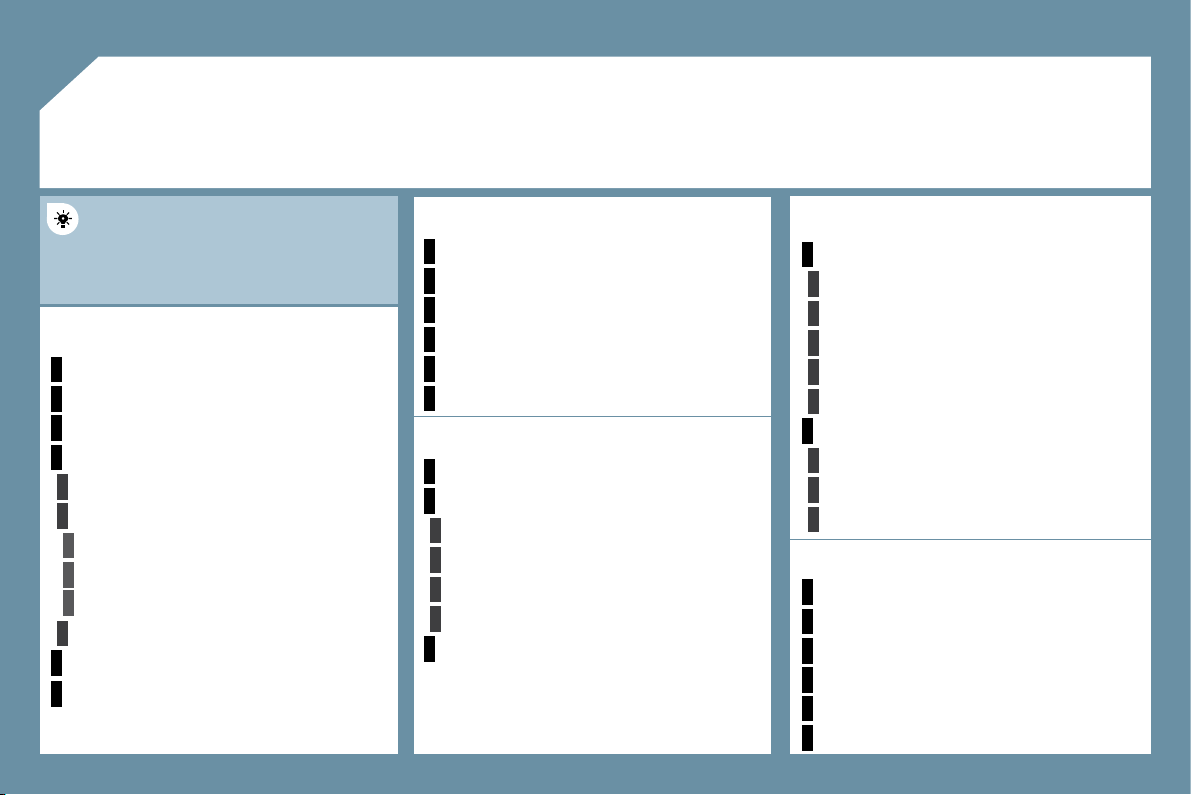
153
03
1
2
3
3
2
1
1
1
3
2
1
1
1
1
1
1
1
1
1
1
2
2
2
2
1
1
2
1
2
2
2
2
2
2
2
1
1
1
1
1
1
A press on the OK dial gives access to
short-cut menus according to the display
on the screen.
MUSIC MEDIA PLAYERS:
NAVIGATION (IF GUIDANCE IS IN PROGRESS):
ABORT GUIDANCE
REPEAT ADVICE
BLOCK ROAD
ROUTE INFO
SHOW DESTINATION
TRIP INFO
Route type
Avoid
Satellites
ZOOM/SCROLL
VOICE ADVICE
ROUTE OPTIONS
RADIO:
IN FM MODE
TRAFFIC INFO (TA)
RDS
RADIOTEXT
REGIONAL PROG.
AM
IN AM MODE
TA
REFRESH AM LIST
FM
DISPLAY ACCORDING TO THE CONTEXT
TRAFFIC INFO (TA)
PLAY OPTIONS
NORMAL ORDER
RANDOM TRACK
REPEAT FOLDER
SCAN
SELECT MUSIC
TELEPHONE:
END CALL
HOLD CALL
DIAL
DTMF-TONES
PRIVATE MODE
MICRO OFF
GENERAL OPERATION
FULL SCREEN MAP:
ABORT GUIDANCE /RESUME GUIDANCE
SET DESTINATION
POIS NEARBY
POSITION INFO
MAP SETTINGS
ZOOM/SCROLL
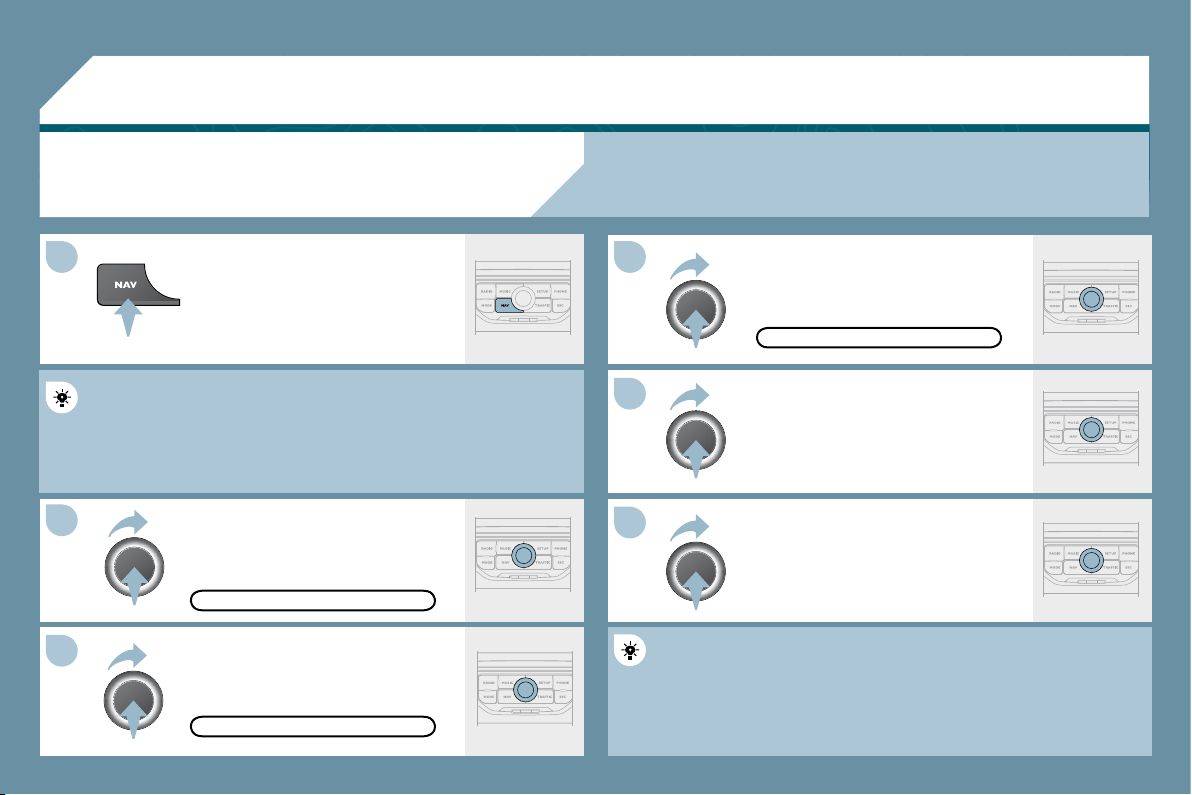
154
04
1
2
3
5
6
4
NAVIGATION - GUIDANCE
SELECTING A DESTINATION
Press the NAV button again or select
the Navigation Menu function and
press the dial to confi rm.
Select the "Destination input" function
and press the dial to confi rm.
Press the NAV button.
Select the letters of the town one by
one confi rming each time by pressing
the dial.
Once the country has been selected,
turn the dial and select the town
function. Press the dial to confi rm.
NAVIGATION MENU
DESTINATION INPUT
Insert the SD card in the front panel reader and leave it there to use the Navigation functions.
The navigation SD card data must not be modifi ed.
Map data updates are available from PEUGEOT dealers.
A pre-set list (by entering the fi rst few letters) of the towns in the
A pre-set list (by entering the fi rst few letters) of the towns in the
country selected can be accessed via the LIST button on
tton on the virtual
keypad.
Select the "Address input" function
and press the dial to confi rm.
ADDRESS INPUT
The list of the last 20 destinations appears under the Navigation
The list of the last 20 destinations appears under the Navigation
Menu function.
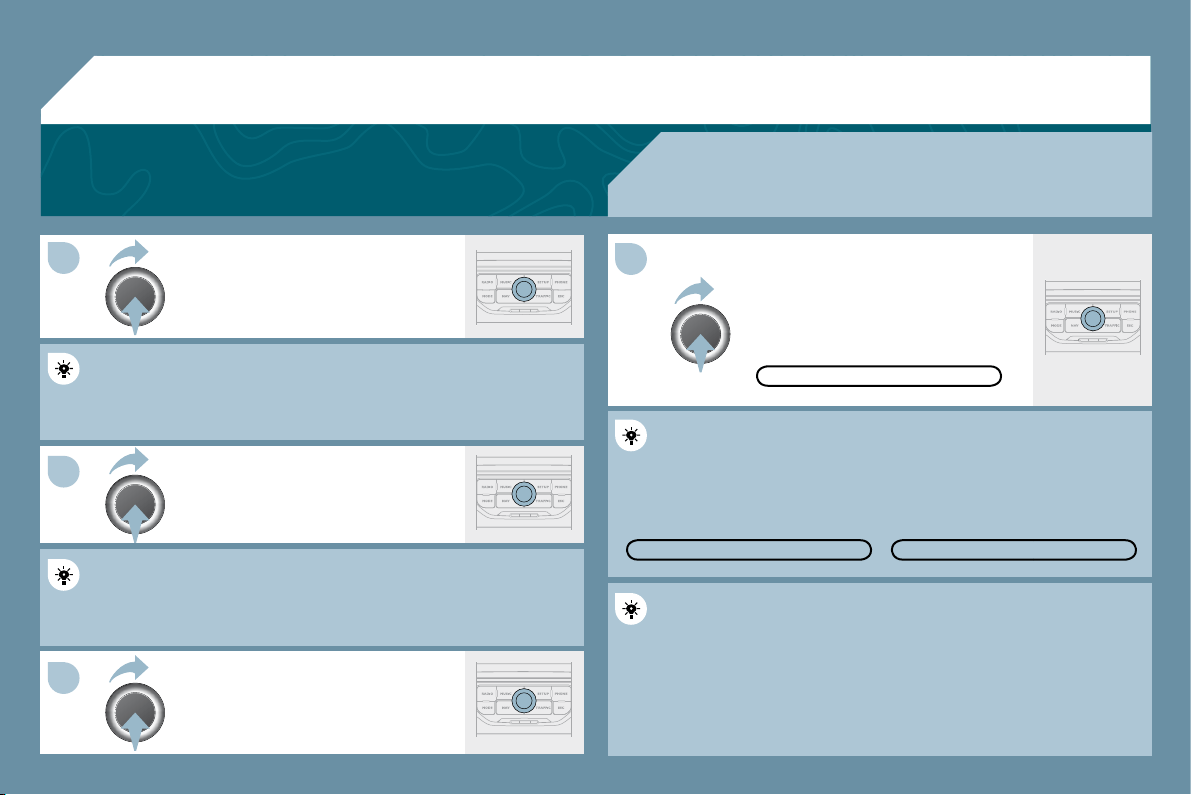
155
7
8
9
10
04
To clear a destination; from steps 1 to 3, select "Choose from last destinations". A long press
on one of the destinations displays a list of actions from which you can select:
Delete entry
Delete list
Repeat steps 5 to 7 for the "Street"
and "House number" functions.
Turn the dial and select OK.
Press the dial to confi rm.
Select the "Save to address book" function to record th
ord the address
entered in a directory fi le. Press the dial to confi rm the selection.
entered in a directory fi le. Press the dial to confi rm the selection.
Peugeot Connect Navigation allows up to 500 contact fi les to be
Peugeot Connect Navigation allows up to 500 contact fi les to be
recorded.
To speed up the process, the post code can be entered
tered directly after
selecting the "Postal code" function.
Use the virtual keypad to enter the letters and digits.
Then select "Start route guidance"
and the press the dial to confi rm.
During guidance, pressing the end
of the lighting stalk repeats the last
guidance instruction.
You can zoom in/zoom out on the map using the dial.
It is possible to scroll the map or select its orientation via the short-
It is possible to scroll the map or select its orientation via the short-
cut menu of the FULL SCREEN MAP. Press the dial then select
cut menu of the FULL SCREEN MAP. Press the dial then select
"Map settings".
Select the route type:
"Fast route", "Short route" or "Optimized route" and press the dial to
"Fast route", "Short route" or "Optimized route" and press the dial to
confi rm.
It is also possible to select a destination via "Choose from address
It is also possible to select a destination via "Choose from address
book" or "Choose from last destinations".
CHOOSE FROM LAST DESTINATIONS
CHOOSE FROM LAST DESTINATIONS
CHOOSE FROM ADDRESS BOOK
START ROUTE GUIDANCE
NAVIGATION - GUIDANCE
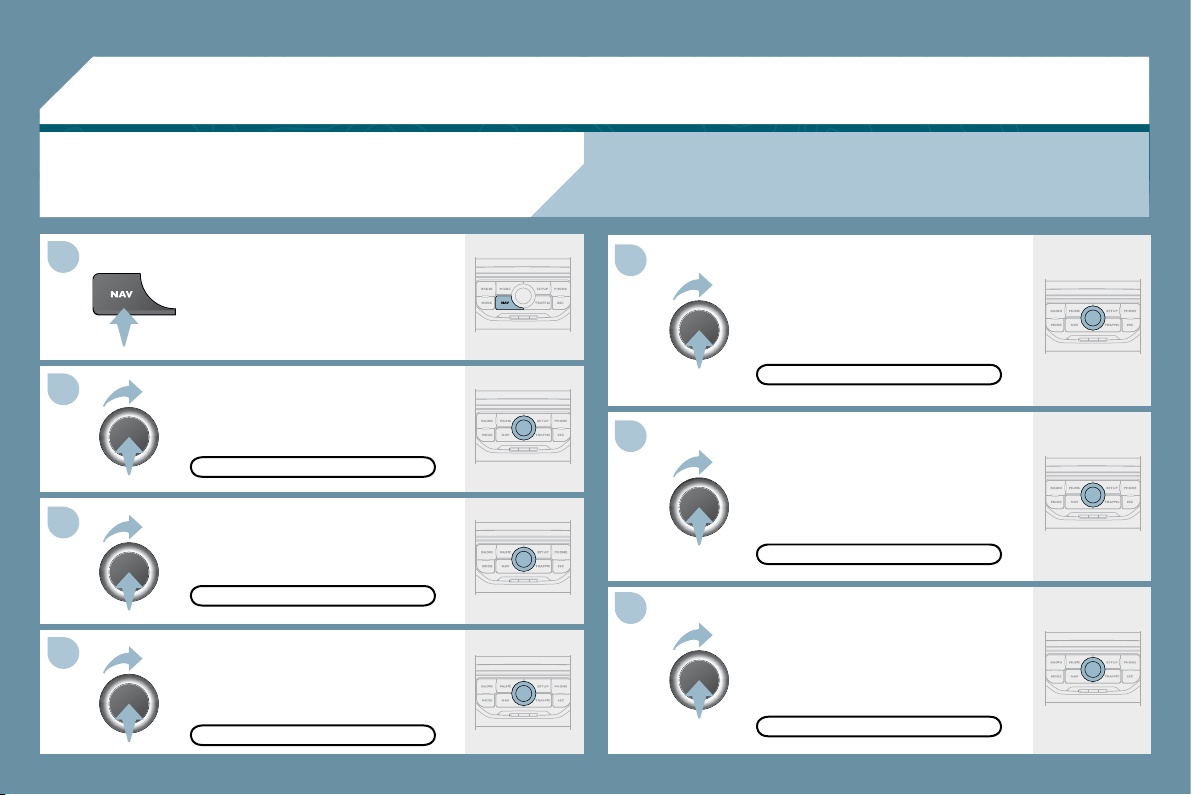
156
04
4
3
2
1
7
6
5
NAVIGATION - GUIDANCE
ROUTE OPTIONS
Select the "Route dynamics" function.
This function gives access to the
"Traffi c independent" or "Semi-
dynamic" options.
Select the "Avoidance criteria"
function. This function provides
access to the AVOID options
(motorways, toll roads, ferries).
Turn the dial and select the
"Recalculate" function to take into
account the route options selected.
Press the dial to confi rm.
Press the NAV button.
Press the NAV button again or select
the Navigation Menu function and
press the dial to confi rm.
Select the "Route type" function and
press the dial to confi rm. This function
allows you to change the route type.
Select the "Route options" function
and press the dial to confi rm.
RECALCULATE
AVOIDANCE CRITERIA
ROUTE DYNAMICS
ROUTE TYPE
ROUTE OPTIONS
NAVIGATION MENU
The route selected by the Peugeot Connect Navigation audio/telephone depends directly on the route
options.
Changing these options may change the route completely.
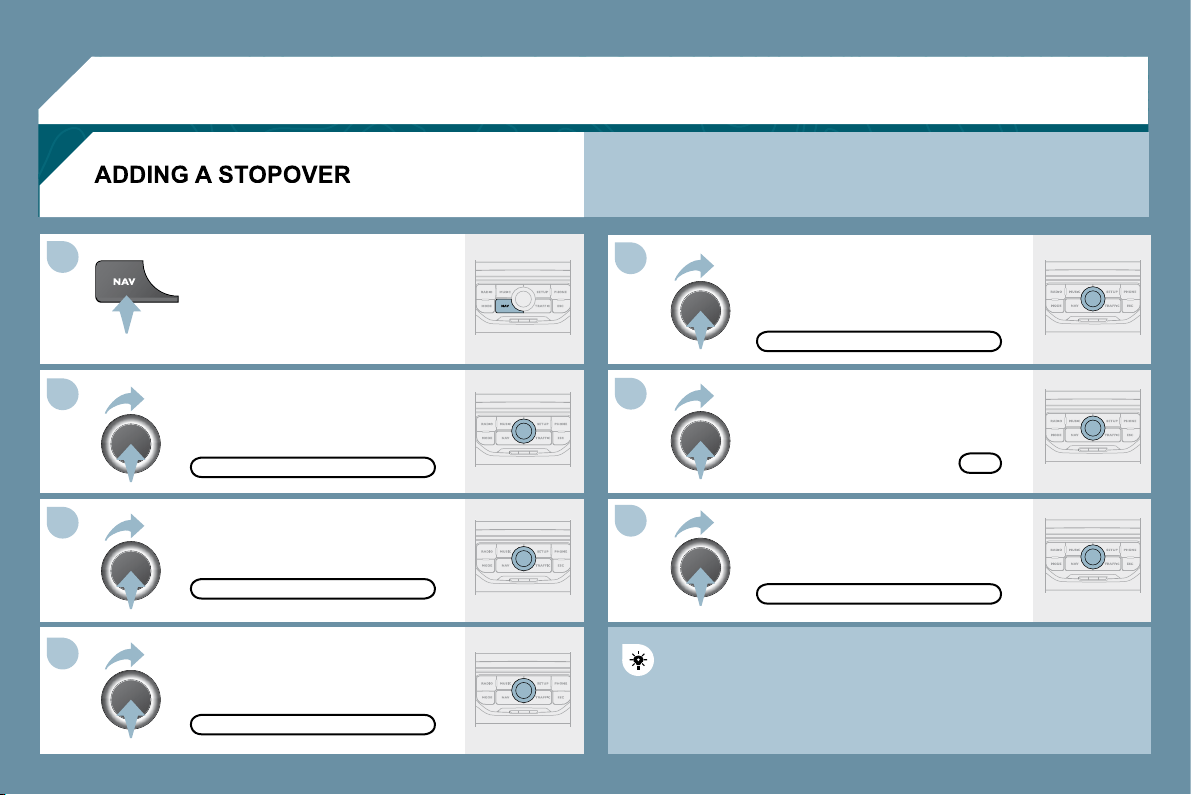
157
04
7
6
5
4
3
2
1
Enter a new address, for example.
Once the new address has been
entered, select OK and press the dial
to confi rm.
Select "Recalculate" and press the
dial to confi rm.
Press the NAV button.
Press the NAV button again or select
the "Navigation" Menu function and
press the dial to confi rm.
Select the "Add stopover" function
(5 stopovers maximum) and press the
dial to confi rm.
Select the "Stopovers" function and
press the dial to confi rm.
OK
ADDRESS INPUT
ADD STOPOVER
STOPOVERS
"NAVIGATION" MENU
RECALCULATE
The stopover must be completed or deleted in order for the guidance
The stopover must be completed or deleted in order for the guidance
to continue to the next destination. Otherwise, the Peug
Peugeot Connect
Navigation will always return you to the previous stopov
topover.
Stopovers can be added to the route once the destination has been selected.
NAVIGATION - GUIDANCE
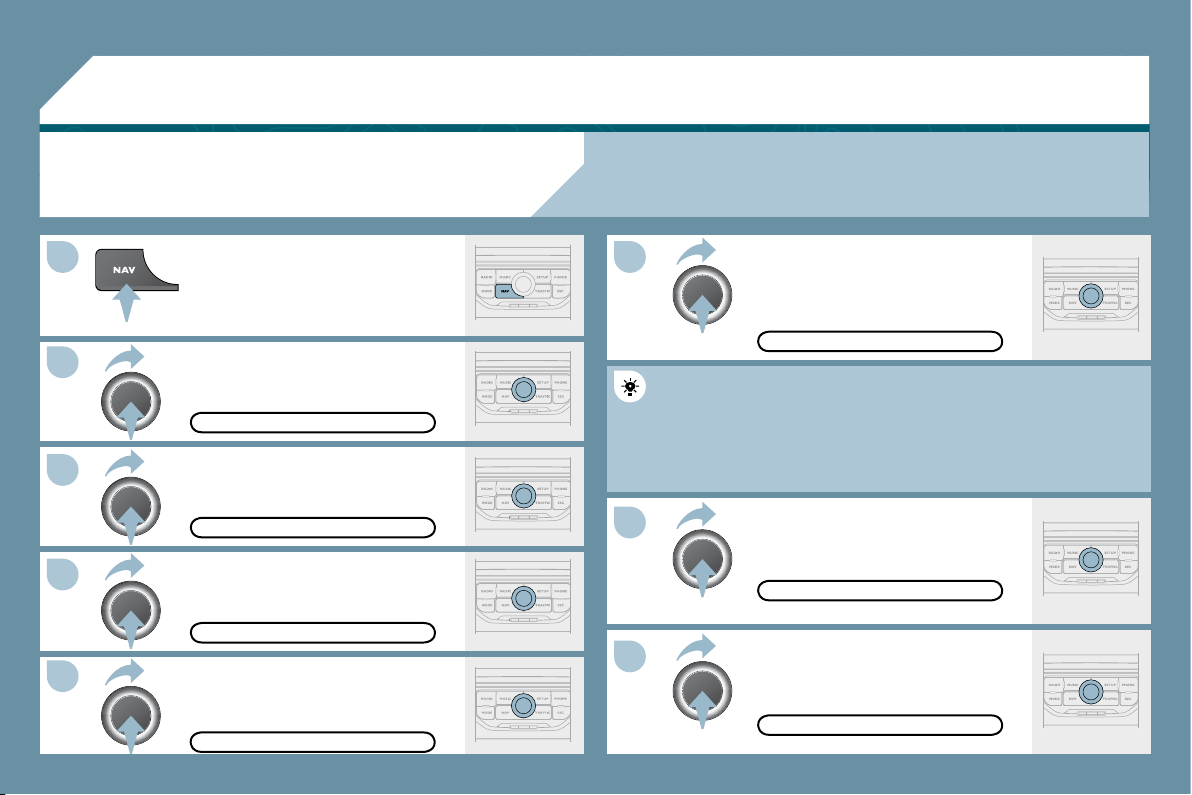
158
04
8
6
7
4
3
5
2
1
NAVIGATION - GUIDANCE
SEARCHING FOR POINTS OF INTEREST
(POI)
Press the NAV button.
Press the NAV button again or select
the Navigation Menu function and
press the dial to confi rm.
Select the "POI nearby" function to
search for POIs around the vehicle.
Select the "POI search" function and
press the dial to confi rm.
NAVIGATION MENU
POI SEARCH
POI NEARBY
Select the "POI in city" function to
search for POIs in the city required.
Select the country then enter the
name of the city using the virtual
keypad.
Select the "POI near route" function to
search for POIs near the route.
Select the "POI in country" function
to search for POIs in the country
required.
Select the "POI near destination"
function to search for POIs near the
point of arrival of the route.
POI NEAR DESTINATION
POI NEAR ROUTE
POI IN COUNTRY
POI IN CITY
A list of cities present in the country selected can be acc
be accessed via
the LIST button on the virtual keypad.
The points of interest (POI) indicate all of the service locations in the vicinity (hotels, various
businesses, airports...).
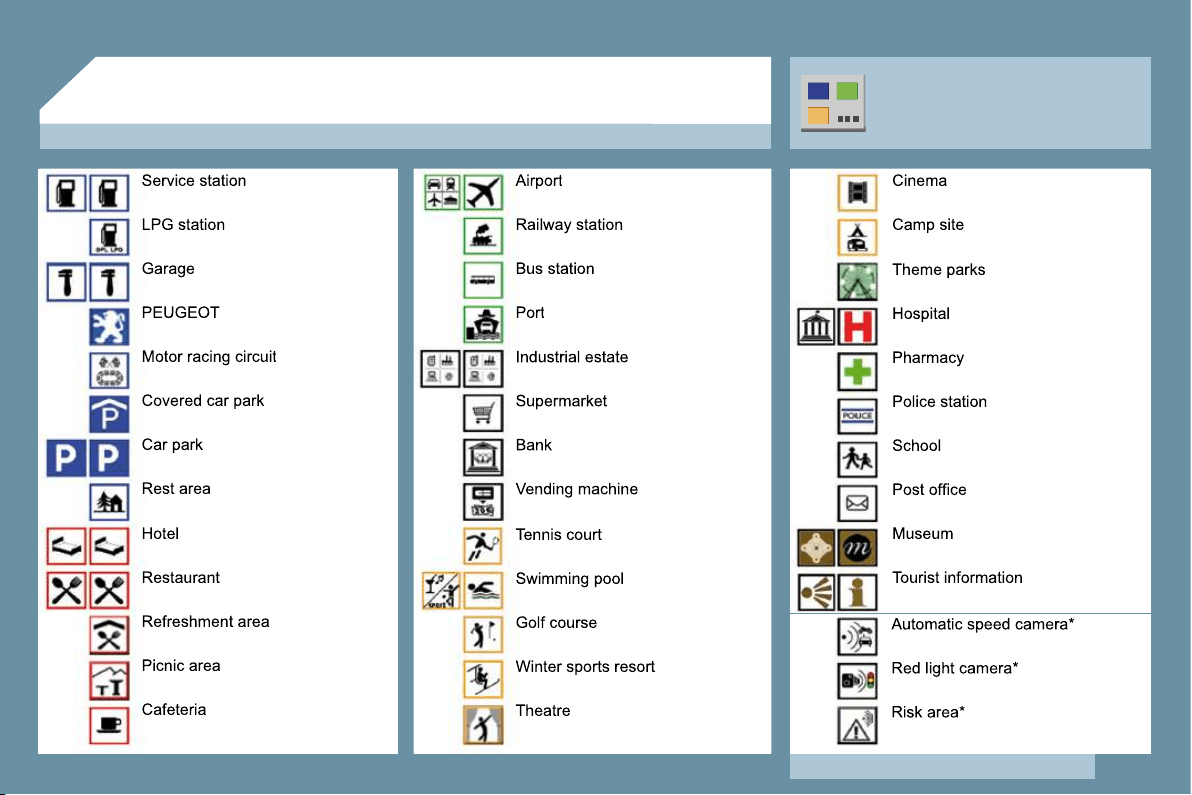
159
04
NAVIGATION - GUIDANCE
LIST OF PRINCIPAL POINTS OF INTEREST (POI)
*
According to availability in the country.
This icon appears when several POIs are grouped
together in the same area. Zooming in on this icon
shows details of the POIs.
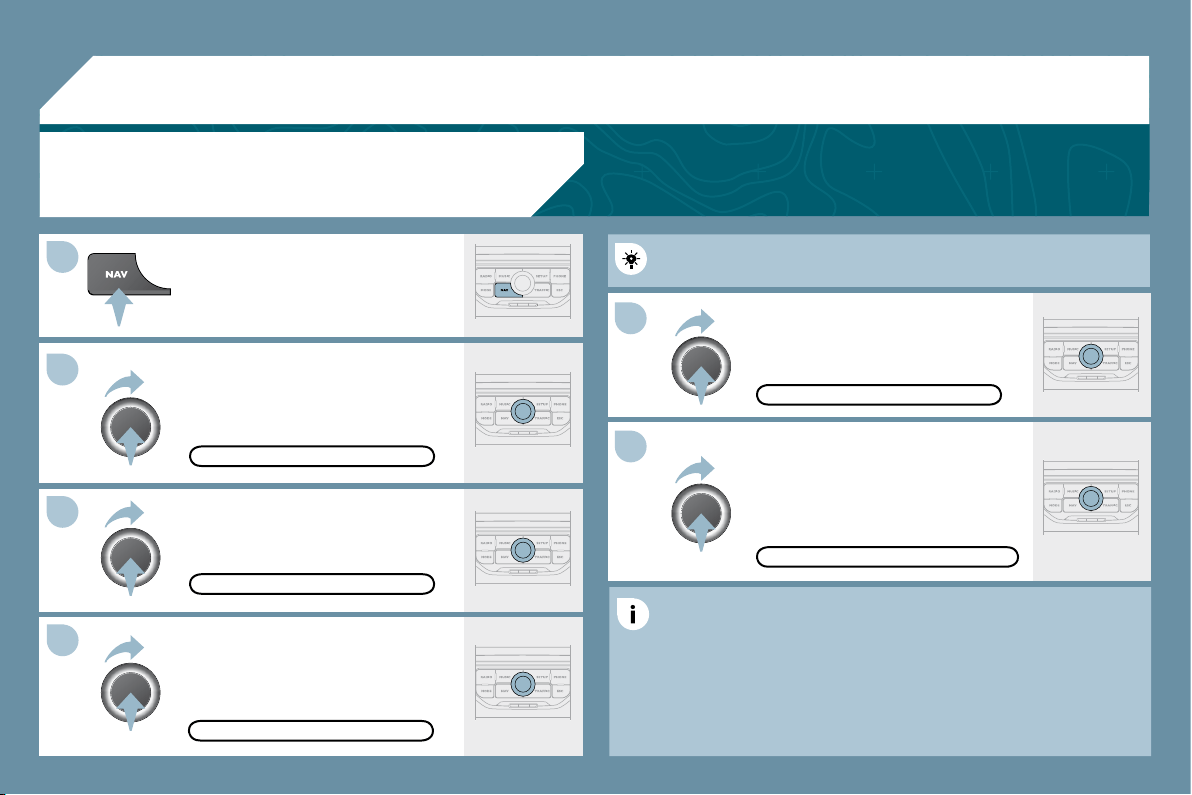
160
04
5
6
3
2
1
4
NAVIGATION SETTINGS
NAVIGATION - GUIDANCE
Select "Set parameters for risk areas"
to gain access to the "Display on
map", "Visual alert" and "Sound alert"
functions.
Select the "POI categories on Map"
function to select the POIs to be
displayed on the map by default.
Press the NAV button.
Press the NAV button again or select
the Navigation Menu function and
press the dial to confi rm.
Select the "Settings" function and
press the dial to confi rm.
POI CATEGORIES ON MAP
SETTINGS
SET PARAMETERS FOR RISK AREAS
NAVIGATION MENU
Select the "Navi volume" function and
turn the dial to set the volume of each
voice synthesiser (traffi c information,
alert messages…).
NAVI VOLUME
The volume of the Risk Areas POIs alert can only be adjusted
during this type of alert.
UPDATING THE RISK AREAS POIs
This requires an SDHC (High Capacity) compatible reader.
Download the update fi le from the Internet (www.peugeot.fr or
www.peugeot.co.uk).
Open this fi le and copy the extracted documents to the DATABASE
folder on the SD card, replacing the existing fi les.
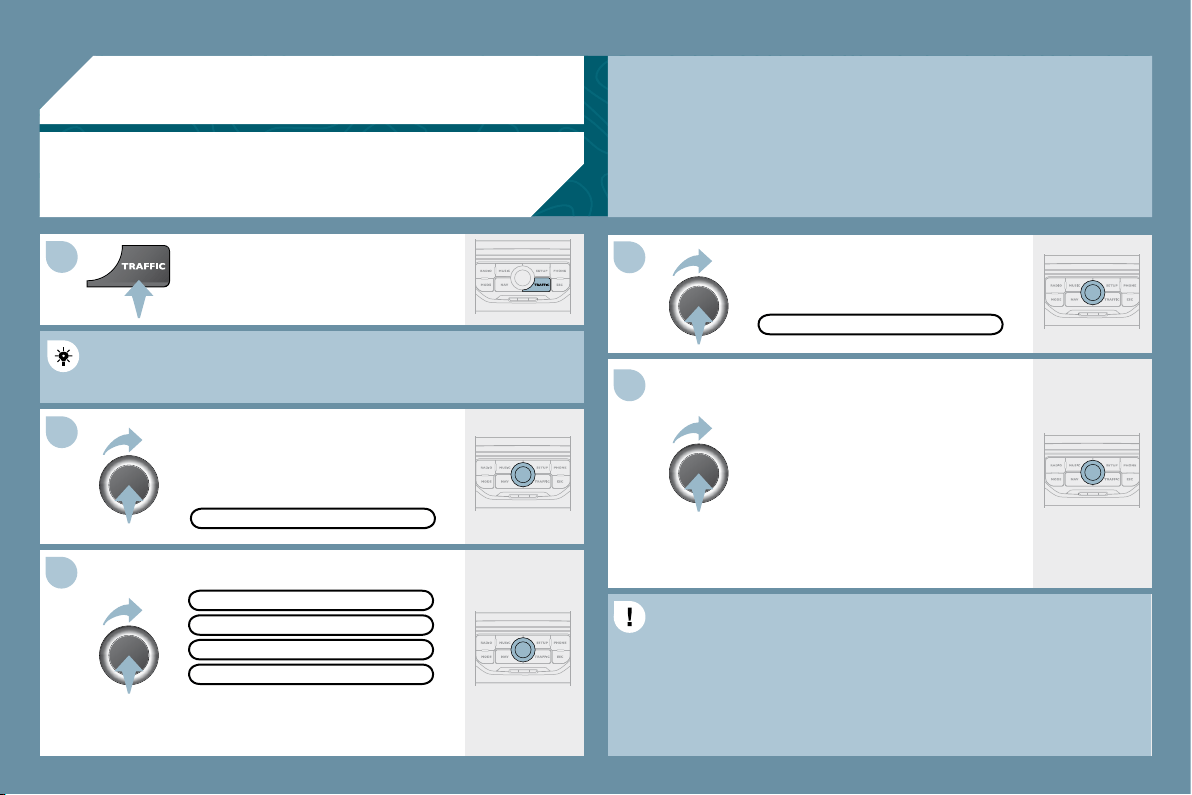
161
05
2
1
3
4
5
TRAFFIC INFORMATION
CONFIGURE THE FILTERING AND
DISPLAY OF TMC MESSAGES
TMC (Traffi c Message Channel) messages contain information on traffi c and weather conditions,
received in real time and transmitted to the driver in the form of audible announcements and
symbols on the navigation map.
The navigation system can then suggest an alternative route to avoid a traffi c problem.
Then select the radius of the fi lter in
miles (km) required in accordance
with the route, press the dial to
confi rm.
When all of the messages on the
route are selected, the addition of a
geographical fi lter is recommended
(within a radius of 3 miles (5 km) for
example) to reduce the number of
messages displayed on the map.
The geographical fi lter follows the
movement of the vehicle.
The fi lters are independent and their results are cumulative.
The fi lters are independent and their results are cumulative.
We recommend a fi lter on the route and a fi lter around the vehicle of:
We recommend a fi lter on the route and a fi lter around the vehicle of:
- 2 miles (3 km) or 3 miles (5 km) for a region with heavy traffi c,
- 2 miles (3 km) or 3 miles (5 km) for a region with heavy traffi c,
- 6 miles (10 km) for a region with normal traffi c,
- 30 miles (50 km) for long journeys (motorway).
Press the TRAFFIC button again or
select the Traffi c Menu function and
press the dial to confi rm.
Press the TRAFFIC button.
Select the "Geo. Filter" function and
press the dial to confi rm.
MESSAGES ON ROUTE
The list of TMC messages appears under the Traffi c Menu sorted in
The list of TMC messages appears under the Traffi c Menu sorted in
order of proximity.
ONLY WARNINGS ON ROUTE
TRAFFIC MENU
Select the fi lter of your choice:
ALL WARNING MESSAGES
ALL MESSAGES
The messages appear on the map
and on the list.
To exit, press ESC.
GEO. FILTER
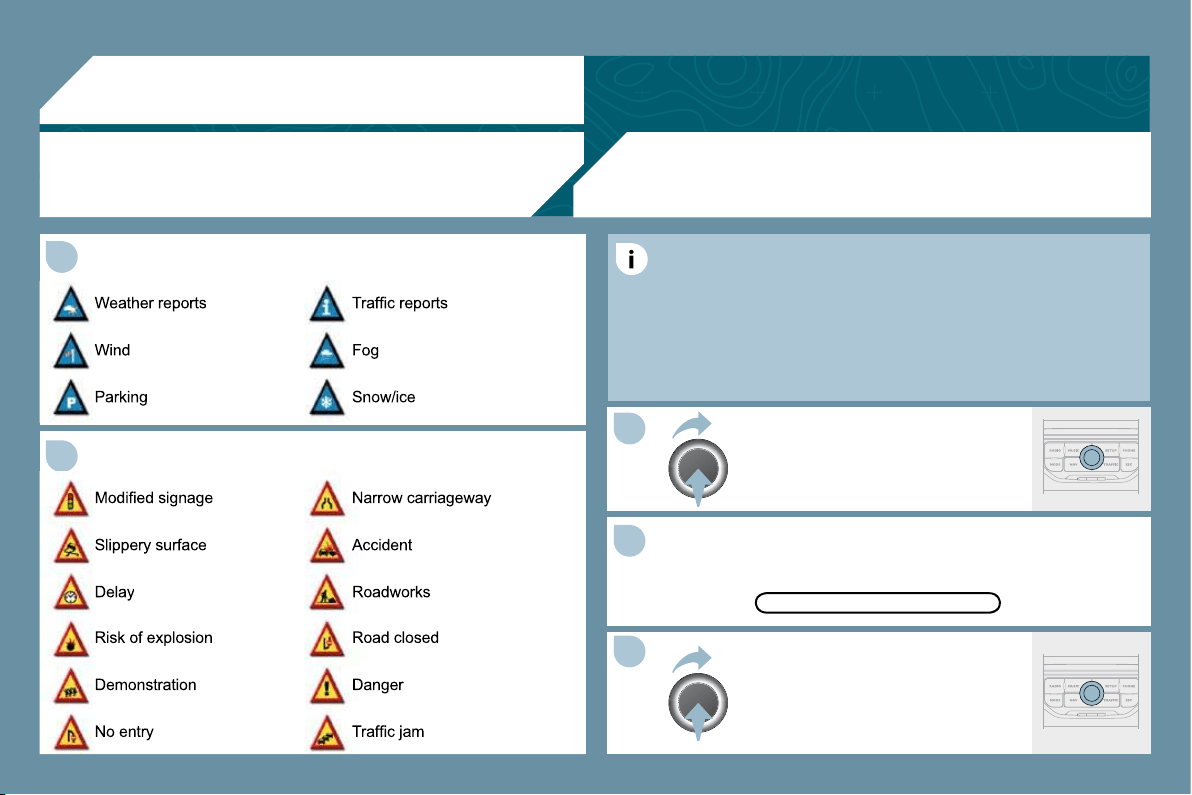
162
05
2
1
3
2
1
TRAFFIC INFORMATION
PRINCIPAL TMC SYMBOLS
Red and yellow triangle: traffi c information, par example:
Black and blue triangle: general information, for example:
With the current audio source
displayed on the screen, press the
dial.
The shortcut menu for the source appears and gives access to:
The shortcut menu for the source appears and gives access to:
Select Traffi c Announcements (TA)
and press the dial to confi rm and go
to the associated settings.
TA
The TA (Traffi c Announcement) function gives priority to TA alert
messages. To operate, this function needs good reception of a radio
station transmitting this type of message. When a traffi c report is
transmitted, the current audio source (Radio, CD, Jukebox, ...) is
interrupted automatically to play the TA message. Normal playback
of the audio source resumes at the end of the transmission of the
message.
RECEIVING TA MESSAGES
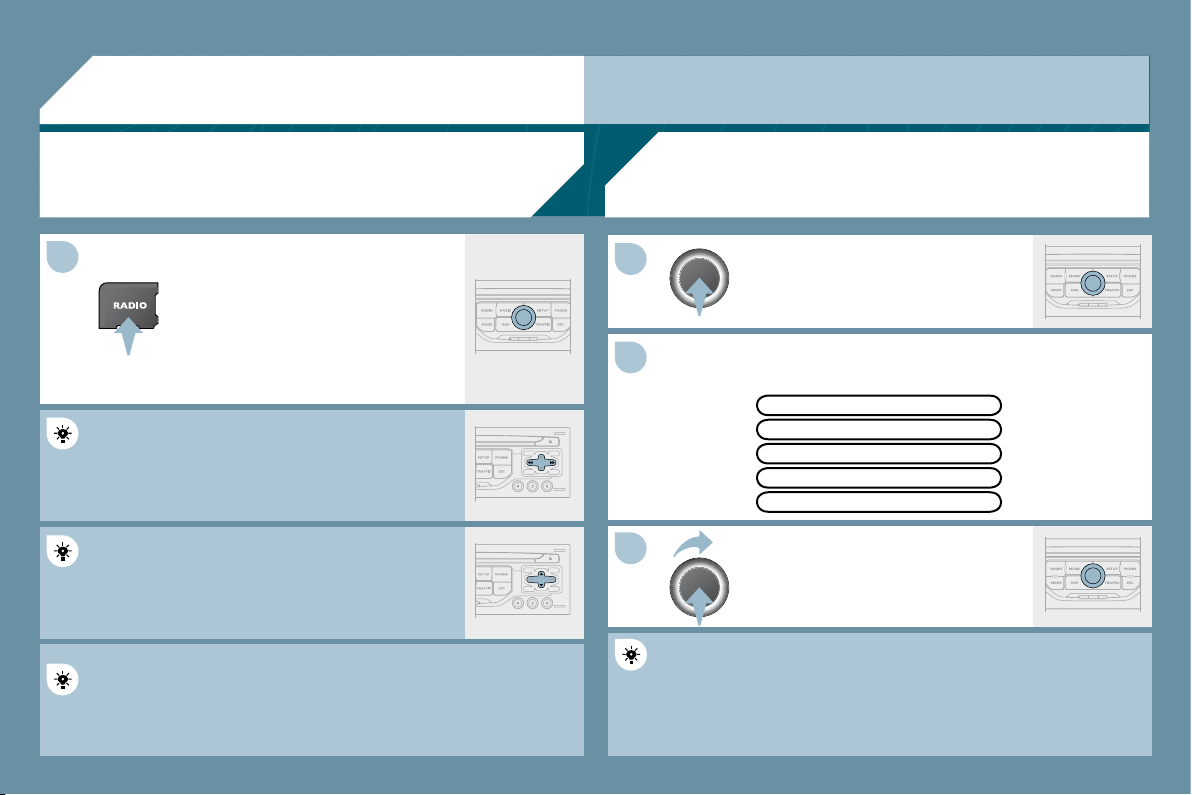
163
06
3
2
1
1
SELECTING A STATION
When the current radio station is
displayed on the screen, press the
dial.
The radio source short-cuts menu appears and provides access to
The radio source short-cuts menu appears and provides access to
the following short-cuts:
Select the function required and press
the dial to confi rm to gain access to
the corresponding settings.
TA
RDS, if displayed, allows you to continue listening to the same
RDS, if displayed, allows you to continue listening to the same
station by automatic retuning to alternative frequencies. However, in
station by automatic retuning to alternative frequencies. However, in
certain conditions, coverage of an RDS station may not be assured
certain conditions, coverage of an RDS station may not be assured
throughout the entire country as radio stations do not co
not cover 100 % of
the territory. This explains the loss of reception of the sta
the station during
a journey.
The external environment (hill, building, tunnel, underground car park...) may interfere with the
reception, including in RDS following mode. This phenomenon is a normal result of the way in which
radio waves are transmitted and does not in any way indicate a failure of the audio equipment.
RDS - REGIONAL MODE
Press the RADIO button to display
the list of stations received locally
sorted in alphabetical order.
Select the station required by turning
the dial and press to confi rm.
While listening to the radio, press one of the
buttons to select the previous or next station on
the list.
Press one of the buttons on the numeric keypad for more than
Press one of the buttons on the numeric keypad for more than
2 seconds to store the current station.
Press the button on the numeric keypad to recall the stored radio
Press the button on the numeric keypad to recall the stored radio
station.
RDS
RADIOTEXT
REGIONAL PROG.
AM
RADIO
A long press of one of the buttons starts the
automatic search for a station with a lower or
higher frequency.
164
07
MUSIC MEDIA PLAYERS
CD, MP3/WMA CD
INFORMATION AND ADVICE
In order to be able to play a recorded CDR or CDRW, w
RW, when
recording it is preferable to select the ISO 9660 level 1, 2 or Joliet
recording it is preferable to select the ISO 9660 level 1, 2 or Joliet
standard.
If the disc is recorded in another format it may not be played
If the disc is recorded in another format it may not be played
correctly.
It is recommended that the same recording standard is always used
It is recommended that the same recording standard is always used
for an individual disc, with as low a speed as possible (4x maximum)
for an individual disc, with as low a speed as possible (4x maximum)
for optimum sound quality.
In the particular case of a multi-session CD, the Joliet standard is
In the particular case of a multi-session CD, the Joliet standard is
recommended.
The Peugeot Connect Navigation will only play audio fi les with the
The Peugeot Connect Navigation will only play audio fi les with the
extension ".mp3" with a speed of between 8 Kbps and 320 Kbps and
extension ".mp3" with a speed of between 8 Kbps and 320 Kbps and
the extension ".wma" with a speed of between 5 Kbps and 384 Kbps.
the extension ".wma" with a speed of between 5 Kbps and 384 Kbps.
It also supports the VBR (Variable Bit Rate) mode.
No other type of fi le (.mp4, .m3u...) can be played.
The MP3 format, an abbreviation of MPEG 1, 2 & 2.5 Audio Layer 3
The MP3 format, an abbreviation of MPEG 1, 2 & 2.5 Audio Layer 3
and the WMA format, an abbreviation of Windows Media Audio and
and the WMA format, an abbreviation of Windows Media Audio and
the property of Microsoft, are audio compression standards which
the property of Microsoft, are audio compression standards which
permit the recording of several tens of music fi les on a single disc.
permit the recording of several tens of music fi les on a single disc.
It is advisable to restrict fi le names to 20 characters, without using
It is advisable to restrict fi le names to 20 characters, without using
special characters (e.g.: " " ? ; ù) to avoid any play or display
special characters (e.g.: " " ? ; ù) to avoid any play or display
problems.
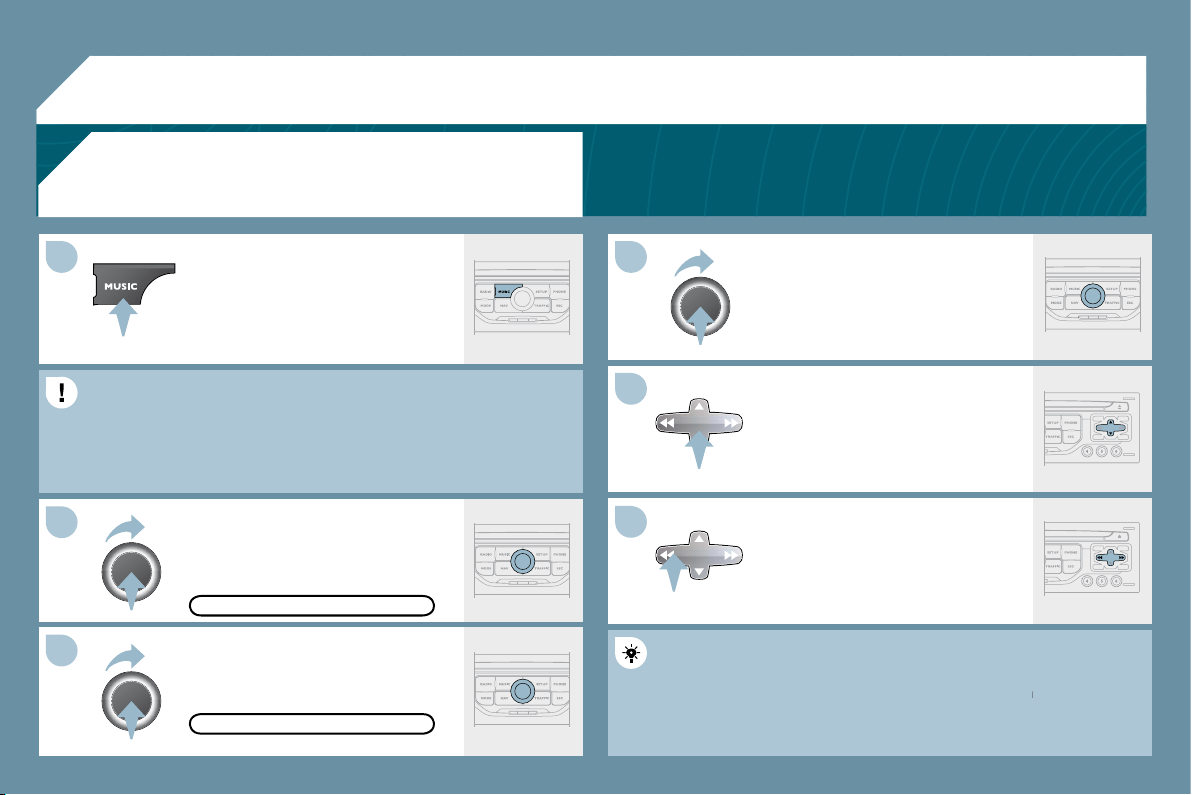
165
07
6
4
5
3
2
1
SELECTING/PLAYING MUSIC
CD, MP3/WMA CD
The playing and displaying of an MP3/WMA compilation may
The playing and displaying of an MP3/WMA compilation may
depend on the recording programme and/or the settings used. We
depend on the recording programme and/or the settings used. We
recommend the ISO 9660 fi le standard.
Press the MUSIC button.
Select the "Select music" function and
press the dial to confi rm.
Press the up or down button to select
the next/previous folder.
Select the music source required:
CD, MP3/WMA CD. Press the dial to
confi rm. Play begins.
SELECT MUSIC
Press the MUSIC button again or
select the "Music" Menu function and
press the dial to confi rm.
Press one of the buttons to select a
music track.
Press and hold one of the buttons for
fast forward or rewind play.
"MUSIC" MENU
The list of tracks or MP3/WMA fi les appears under "Music" Menu.
The list of tracks or MP3/WMA fi les appears under "Music" Menu.
MUSIC MEDIA PLAYERS
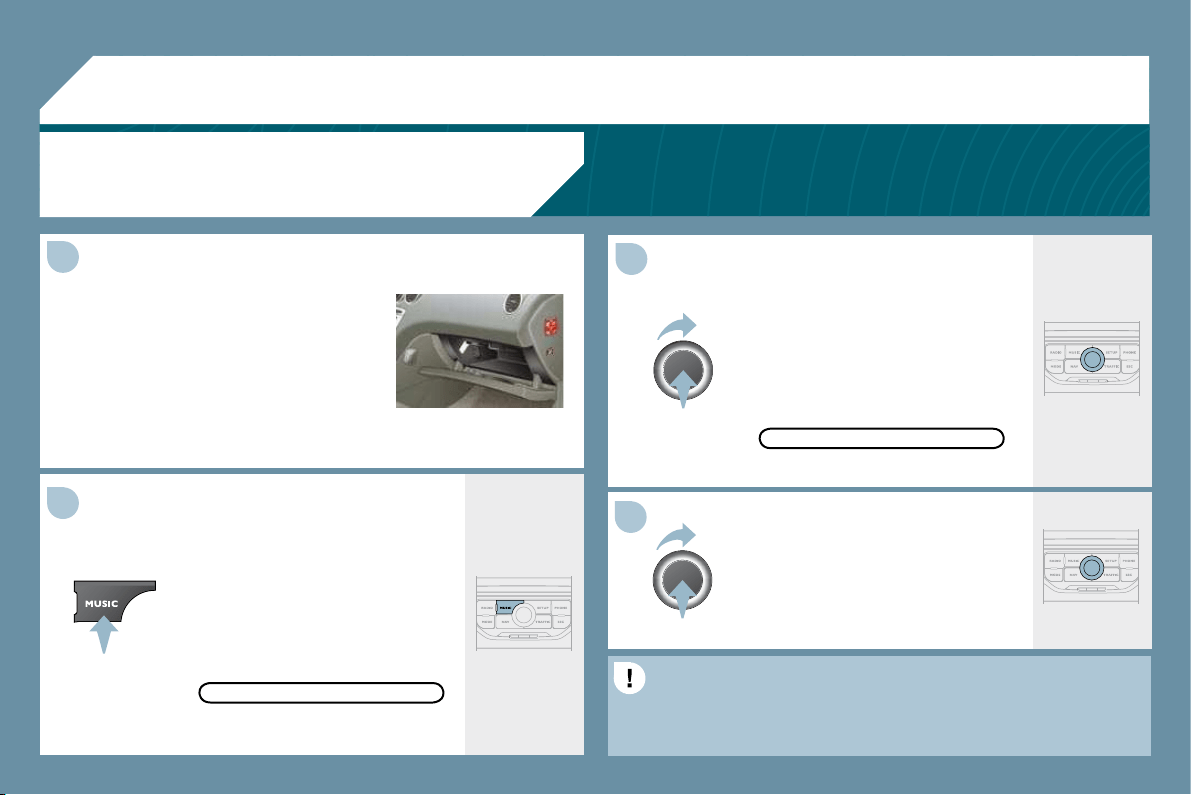
166
07
4
3
1
2
Connect the portable equipment (MP3/
WMA player…) to the JACK audio
socket or to the USB port, using a
suitable audio cable.
Press the MUSIC button then press
it again or select the Music Menu
function and press the dial to confi rm.
Select the AUX music source and
press the dial to confi rm. Play begins
automatically.
Select the "External device" function
and press the dial to activate it.
EXTERNAL DEVICE
The display and management of the controls is via the portable
The display and management of the controls is via the portable
equipment.
USING THE EXTERNAL INPUT (AUX)
JACK/USB AUDIO CABLE NOT SUPPLIED
MUSIC MEDIA PLAYERS
MUSIC MENU
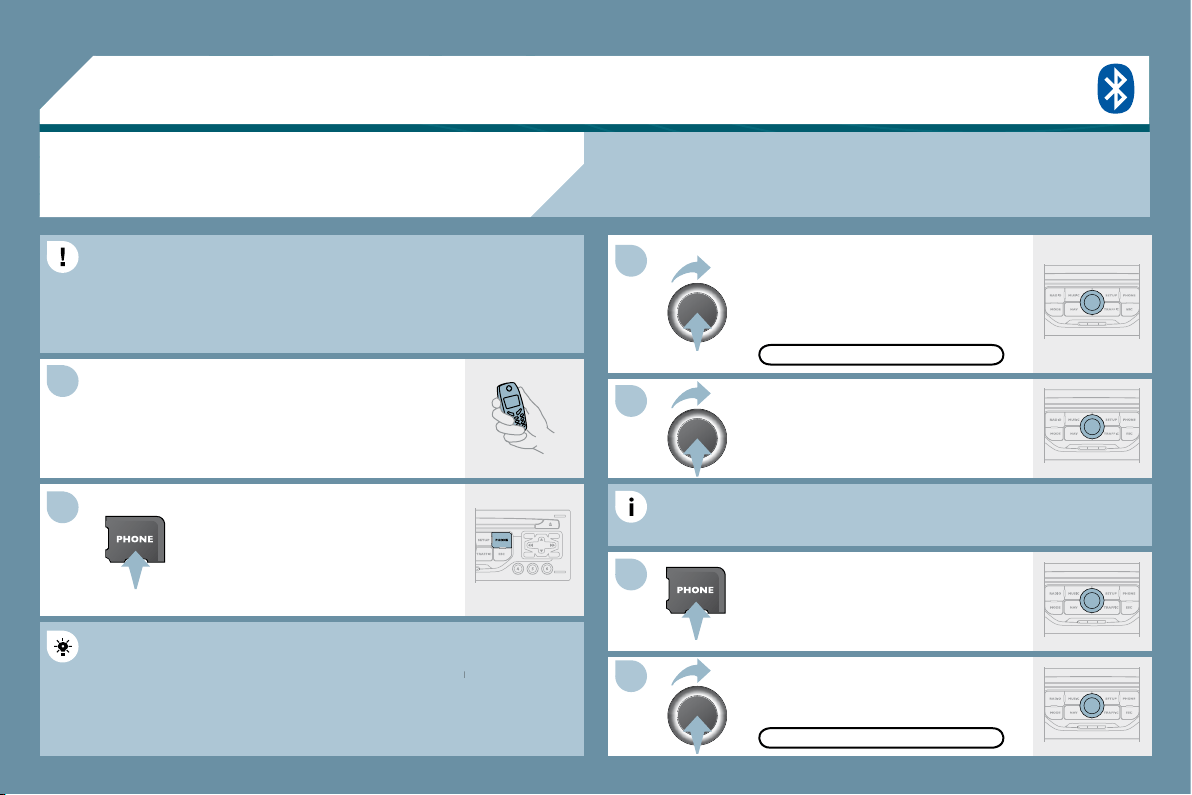
167
08
1
2
3
2
1
4
* The services available depend on the network, the SIM card and the compatibility of the Bluetooth
telephone used. Check the telephone manual and with your network provider for details of the
services available to you. A list of mobile telephones with the best level of compatibility is available
from the dealer network.
BLUETOOTH TELEPHONE
CONNECTING A TELEPHONE
For reasons of safety and because they require prolong
rolonged attention
on the part of the driver, the operations for pairing the B
the Bluetooth
mobile telephone to the hands-free system of the Peugeot Connect
mobile telephone to the hands-free system of the Peugeot Connect
Navigation must be carried out with the vehicle stationary. The
Navigation must be carried out with the vehicle stationary. The
ignition must be on.
Activate the telephone's Bluetooth function.
The last telephone connected is reconnected
automatically.
Enter the authentication code on the
telephone. The code to be entered is
displayed on the screen.
To change the telephone connected,
press the PHONE button, then select
Phone Menu and press the dial to
confi rm.
Once the telephone has been connected, Peugeot Con
t Connect
Navigation can synchronise the address book and the c
the call list. This
synchronisation may take a few minutes * .
Select "Connect phone". Select the
telephone and press to confi rm.
The list of telephones connected previously (4 maximum) appears
The list of telephones connected previously (4 maximum) appears
on the multifunction screen. Select the telephone required for a new
on the multifunction screen. Select the telephone required for a new
connection.
Press the PHONE button.
For a fi rst connection, select
"Search phone" and press the dial to
confi rm. Then select the name of the
telephone.
SEARCH PHONE
CONNECT PHONE
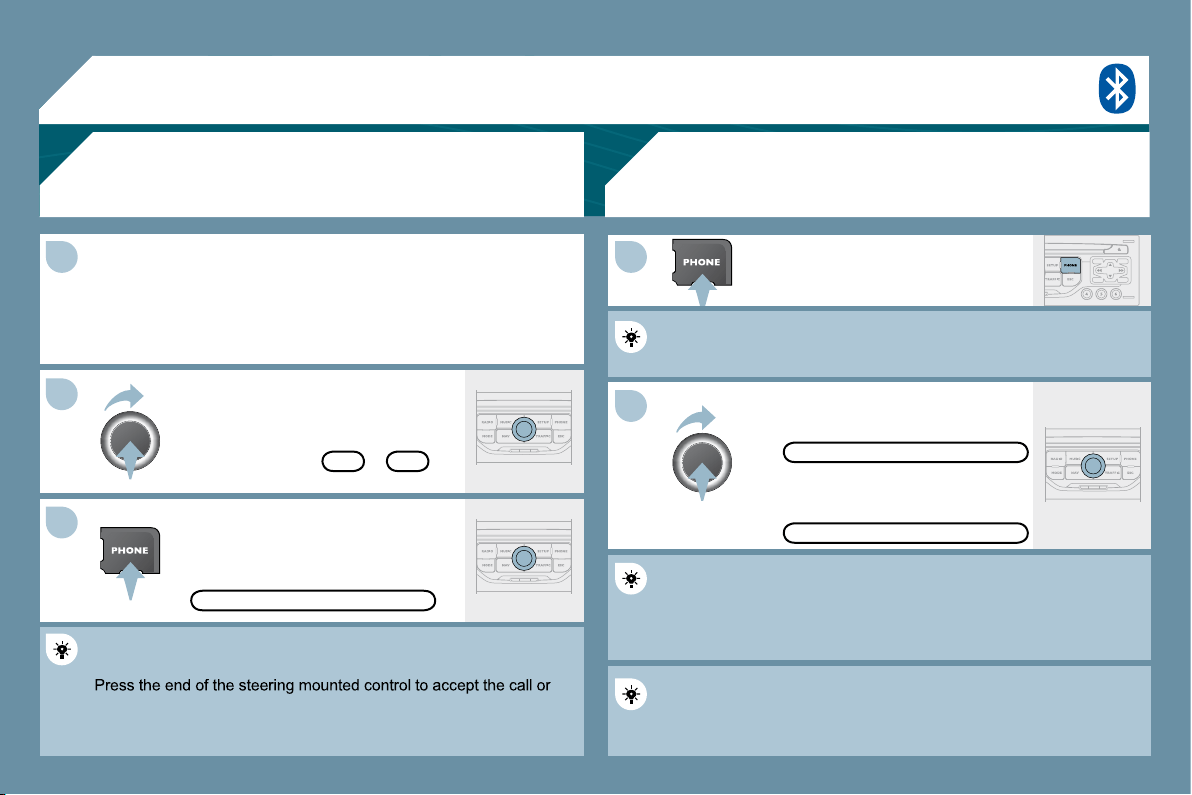
168
08
2
11
3
2
end the call in progress.
Select the "Yes" tab to accept or "No"
to refuse and confi rm by pressing the
dial.
RECEIVING A CALL
MAKING A CALL
An incoming call is announced by a ring and a superimposed display
An incoming call is announced by a ring and a superimposed display
on the multifunction screen.
YES
To hang up, press the PHONE button
or press the dial and select "End call"
then confi rm by pressing the dial.
END CALL
Press the PHONE button.
Select "Dial number", then dial the
telephone number using the virtual
keypad.
Select the "Phone" Menu function and
press the dial to confi rm.
The list of the last 20 calls made and received in the vehicle appears
The list of the last 20 calls made and received in the vehicle appears
under "Phone" Menu. You can select a number and press the dial to
under "Phone" Menu. You can select a number and press the dial to
make the call.
NO
It is also possible to select a number from the address book. You can
It is also possible to select a number from the address book. You can
select "Dial from address book". The Peugeot Connect Navigation
select "Dial from address book". The Peugeot Connect Navigation
can record up to 4 000 entries.
Press the end of the steering mounted control for more than two
Press the end of the steering mounted control for more than two
seconds to gain access to the address book.
"PHONE" MENU
DIAL NUMBER
To delete a number, press the PHONE button then press and hold on
To delete a number, press the PHONE button then press and hold on
a call number to display a list of actions including:
Delete entry
Delete list
BLUETOOTH TELEPHONE
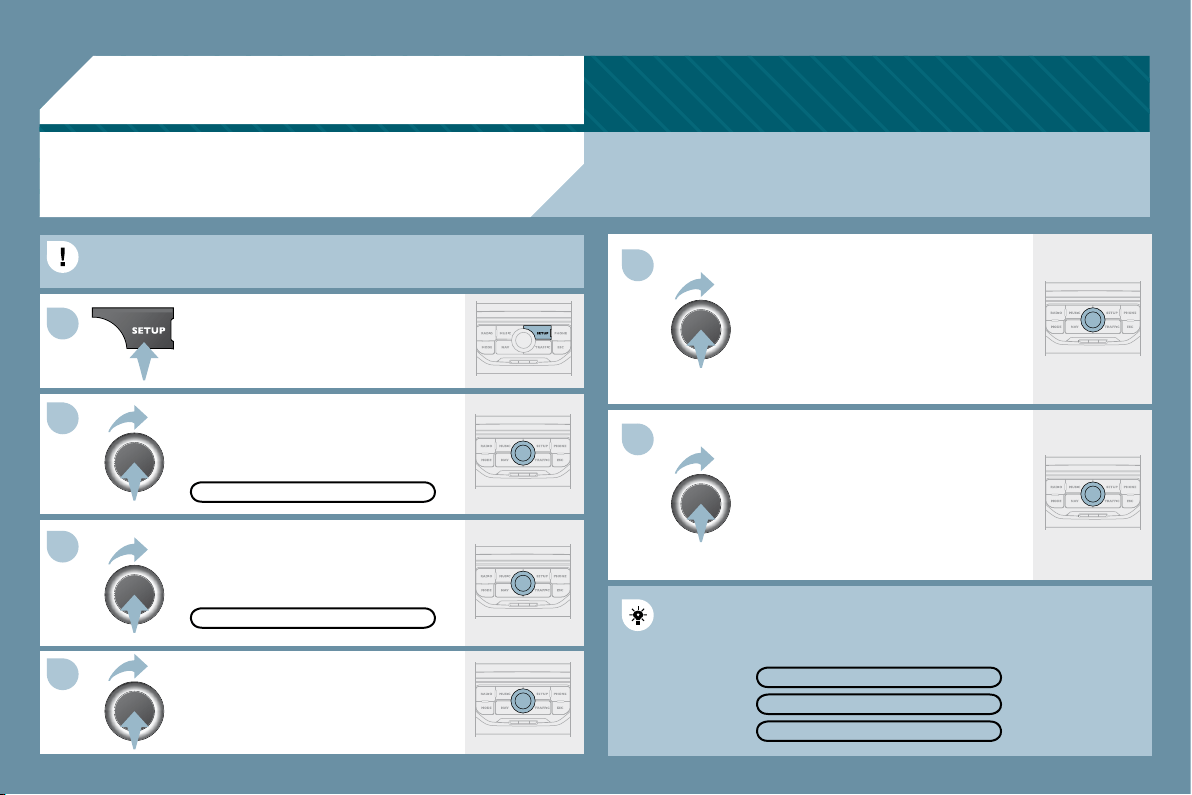
169
09
6
5
4
3
2
1
CONFIGURATION
SETTING THE DATE AND TIME
The SETUP function gives access to the following options: System language, Date & Time, Display
(Brightness, Colour, Map colour), Vehicle, Units, System.
Select the "Date format" function and
press the dial to confi rm.
Confi rm the format required using the dial.
Pressing the SET UP button for more than 2 seconds gives access
Pressing the SET UP button for more than 2 seconds gives access
to:
Confi rm the format required using
the dial.
Select the "Time format" function and
press the dial to confi rm.
DESCRIPTION OF THE UNIT
GPS COVERAGE
DEMO MODE
Set the parameters one by one using
the direction arrows and confi rm by
means of the dial.
Select the "Set date & time" function
and press the dial to confi rm.
These settings must be re-entered if the battery has been
These settings must be re-entered if the battery has been
disconnected.
Press the SET UP button.
SET DATE & TIME
Select the "Date & Time" function and
press the dial to confi rm.
DATE & TIME
170
10
1
TRIP COMPUTER/VEHICLE PARAMETERS
TRIP COMPUTER
Press the MAIN button or press
the MODE button several times in
succession until the trip computer is
displayed.
- The "vehicle" tab:
The range, the current fuel
consumption and the distance
remaining.
- The "1" (trip 1) tab with:
The average speed, the average
fuel consumption and the distance
travelled calculated over route "1".
- The "2" (trip 2) tab with the same
functions for a second route.
Range:
displays the distance which can travelled with the remaining
displays the distance which can travelled with the remaining
fuel detected in the tank, based on the average fuel consumption
fuel detected in the tank, based on the average fuel consumption
over the last few miles (kilometres).
This displayed value may vary signifi cantly following a change in the
This displayed value may vary signifi cantly following a change in the
vehicle speed or the relief of the route.
When the range falls below 20 miles (30 km), dashes are displayed.
When the range falls below 20 miles (30 km), dashes are displayed.
After fi lling with at least 5 litres of fuel, the range is recalculated and
After fi lling with at least 5 litres of fuel, the range is recalculated and
is displayed when it exceeds 60 miles (100 km).
If, whilst driving, dashes are displayed continuously in p
ly in place of the
digits, contact a PEUGEOT dealer.
Current fuel consumption:
only calculated and display
displayed above
20 mph (30 km/h).
Average fuel consumption:
this is the average fuel consumption
this is the average fuel consumption
since the last trip computer zero reset.
Distance travelled:
calculated since the last trip computer zero
calculated since the last trip computer zero
reset.
Distance remaining to the destination:
calculated wit
ed with reference
to the fi nal destination, entered by the user. If guidance is activated,
to the fi nal destination, entered by the user. If guidance is activated,
the navigation system calculates it as a current value.
Average speed:
this is the average speed calculated s
ated since the last
trip computer zero reset (ignition on).
Each press of the button at the end of the wiper stalk di
talk displays the
different trip computer information in succession, according to the
different trip computer information in succession, according to the
screen.
A FEW DEFINITIONS
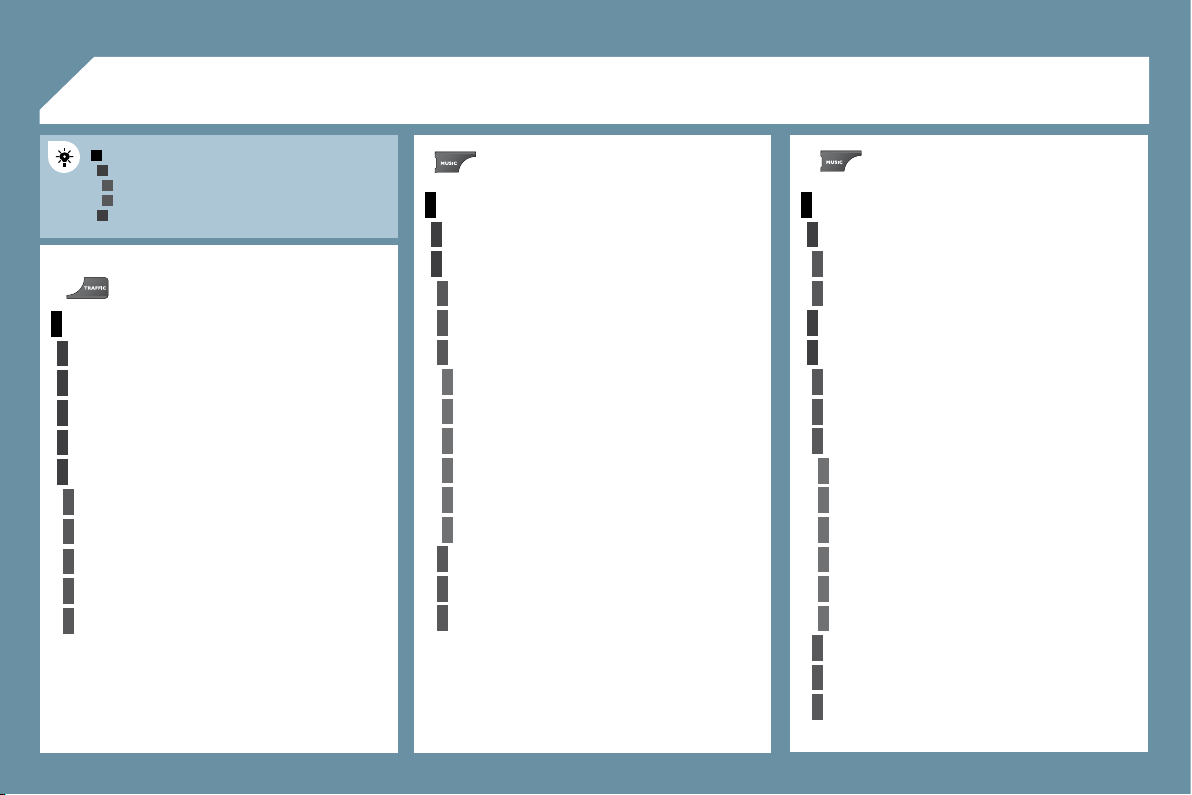
171
11
1
2
3
1
2
4
1
2
3
4
3
3
3
3
2
2
2
2
4
4
4
4
4
3
3
3
3
3
2
3
2
2
3
3
3
4
4
4
4
4
3
3
1
2
3
3
2
3
3
"RADIO" MENU
MAIN FUNCTION
CHOICE A
choice A1
choice A2
CHOICE B...
SCREEN MENU MAP
"MUSIC" MENU
"TRAFFIC" MENU
MESSAGES ON ROUTE
ONLY WARNINGS ON ROUTE
ALL WARNING MESSAGES
ALL MESSAGES
GEO. FILTER
Within 2 miles (3 km)
Within 3 miles (5 km)
Within 6 miles (10 km)
Within 30 miles (50 km)
Within 60 miles (100 km)
SELECT MUSIC
SOUND SETTINGS
Balance/Fader
Bass/Treble
Equalizer
Linear
Classic
Jazz
Rock/Pop
Techno
Vocal
Loudness
Speed dependent volume
Reset sound settings
WAVEBAND
FM
AM
MANUAL TUNE
SOUND SETTINGS
Balance/Fader
Bass/Treble
Equalizer
Linear
Classic
Jazz
Rock/Pop
Techno
Vocal
Loudness
Speed dependent volume
Reset sound settings
172
1
2
4
2
3
4
2
3
4
4
4
4
4
4
4
4
4
4
4
3
3
3
3
2
4
4
4
3
3
3
3
4
4
4
2
3
3
3
3
3
3
3
3
4
4
2
4
4
4
4
4
3
3
3
3
4
4
4
ROUTE OPTIONS
Route type
Fast route
Short route
Optimized route
Route dynamics
Traffi c independent
Semi-dynamic
Avoidance criteria
Avoid motorways
Avoid toll roads
Avoid ferries
Recalculate
STOPOVERS
Add stopover
Address input
Navigate HOME
Choose from address book
Choose from last destinations
Rearrange route
Replace stopover
Delete stopover
Recalculate
Fast route
Short route
Optimized route
"NAVIGATION" MENU
ABORT GUIDANCE/RESUME GUIDANCE
POI SEARCH
POI nearby
POI near destination
POI in city
POI in country
POI near route
SETTINGS
Navi volume
POI categories on Map
Set parameters for risk areas
Display on map
Visual alert
Sound alert
DESTINATION INPUT
Address input
Country
City
Street
House number
Start route guidance
Postal code
Save to address book
Intersection
City district
Geo position
Map
Navigate HOME
Choose from address book
Choose from last destinations
TMC station information
173
1
2
3
4
1
3
4
3
4
2
2
2
3
4
4
4
4
2
3
3
3
2
3
3
3
2
3
4
4
4
4
2
4
3
4
3
3
3
3
3
3
3
3
2
4
4
2
3
4
4
3
4
4
4
2
3
3
3
"PHONE" MENU
"SETUP" MENU
DIAL NUMBER
SETTINGS
Select ring tone
Phone/Ring tone volume
Enter mailbox number
SYSTEM LANGUAGE *
Deutsch
English
Español
Français
Italiano
Nederlands
Polski
Portuguese
DATE & TIME *
Set date & time
Date format
Time format
Dark blue
Map colour
Day mode for map
Night mode for map
Auto. Day/Night for map
VEHICLE *
Vehicle information
Alert log
Status of functions
DISPLAY
Brightness
Colour
Pop titanium
Toffee
Blue steel
Technogrey
UNITS
Temperature
Celsius
Fahrenheit
Metric/Imperial
Kilometres (Consumption: l/100)
Kilometres (Consumption: km/l)
Miles (Consumption: MPG)
SYSTEM
Factory reset
Software version
Automatic scrolling
DIAL FROM ADDRESS BOOK
CALL LISTS
CONNECT PHONE
Search phone
Phones connected
Disconnect phone
Rename phone
Delete pairing
Delete all pairings
Show details
* Available according to model.
174
sound quality between
the different audio
sources (radio, CD...).
Check that the audio settings (Volume, Bass,
Treble, Ambience, Loudness) are adapted to
the sources listened to. It is advisable to set
the AUDIO functions (Bass, Treble, Front-Rear
Balance, Left-Right Balance) to the middle
position, select the Linear musical ambience
and set the loudness correction to the "Active"
position in CD mode or to the "Inactive" position
in radio mode.
For optimum sound quality, the audio settings (Volume, Bass, Treble,
Ambience, Loudness) can be adapted to the different sound sources,
which may result in audible differences when changing source (radio,
CD...).
The CD is ejected
automatically or is not
played by the player.
- Check that the CD is inserted in the player the
right way up.
- Check the condition of the CD: the CD cannot
be played if it is too damaged.
- Check the content in the case of a recorded
CD: consult the advice in the Audio section.
- The audio equipment's CD player does not
play DVDs.
- Because of their quality level, certain writeable
CDs will not be played by the audio system.
The CD is inserted upside down, is unplayable, does not contain any audio
data or contains an audio format which the player cannot play.
The CD is protected by an anti-pirating protection system which is not
recognised by the audio equipment.
The CD player sound
is poor.
Insert good quality CDs and store them in
suitable conditions.
The CD used is scratched or of poor quality.
The audio equipment settings (bass, treble, ambiences) are unsuitable.
Set the treble or bass level to 0, without selecting
an ambience.
QUESTION
SOLUTION
ANSWER
FREQUENTLY ASKED QUESTIONS
175
SOLUTION
ANSWER
The quality of reception
of the radio station
listened to gradually
deteriorates or the
stored stations do
not function (no
sound, 87.5 Mhz is
displayed...).
The vehicle is too far from the transmitter used by the station listened to or
there is no transmitter in the geographical area through which the vehicle
is travelling.
The environment (hills, buildings, tunnels, basement car parks...) block
reception, including in RDS mode.
The aerial is absent or has been damaged (for example when going
through a car wash or into an underground car park).
Activate the RDS function to enable the system
to check whether there is a more powerful
transmitter in the geographical area.
This phenomenon is normal and does not
indicate a failure of the audio equipment.
Have the aerial checked by a PEUGEOT dealer.
Sound cut-outs of
1 to 2 seconds in radio
mode.
During this brief sound cut-out, the RDS searches for any frequency
permitting better reception of the station.
Deactivate the RDS function if the phenomenon
is too frequent and always on the same route.
With the engine off,
the audio equipment
switches off after a few
minutes of use.
When the engine is switched off, the audio equipment operating time
depends on the battery charge.
The switch-off is normal: the audio equipment switches to economy mode
and switches off to prevent discharging of the vehicle's battery.
Start the vehicle's engine to increase the battery
charge.
The stored stations do
not function (no sound,
87.5 Mhz is displayed...)
An incorrect waveband is selected.
Press the BAND AST button to return to the
waveband (AM, FM1, FM2, FMAST) on which the
stations are stored.
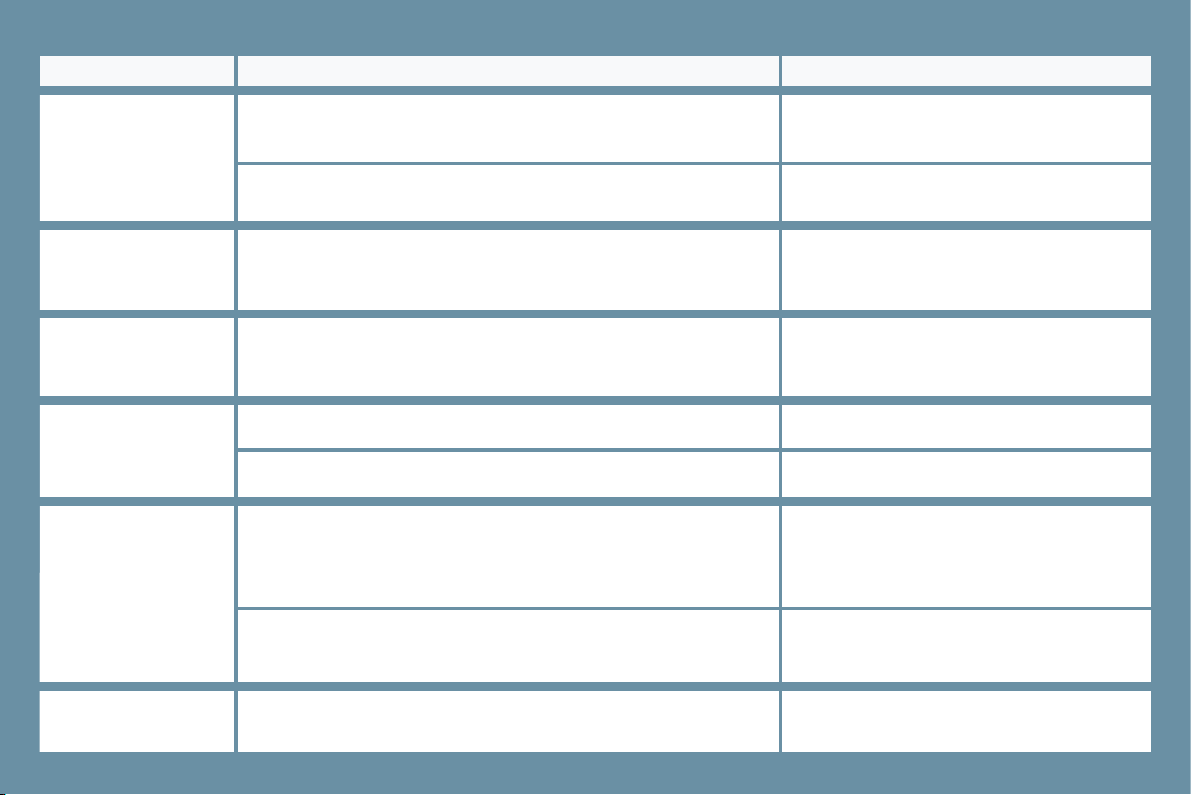
176
QUESTION
SOLUTION
ANSWER
The TA box is ticked.
However, certain traffi c
jams along the route
are not indicated in real
time.
On starting, it is several minutes before the system begins to receive the
traffi c information.
Wait until the traffi c information is being received
correctly (displaying of the traffi c information
symbols on the map).
In certain countries, only major routes (motorways...) are listed for the
traffi c information.
The time taken to
calculate a route
sometimes seems
longer than usual.
This phenomenon is normal. The system is
dependent on the traffi c information available.
The performance of the system may slow down temporarily if a CD is
being copied onto the Jukebox at the same time as a route is being
calculated.
Wait until the CD has been copied or stop the
copying before starting the guidance function.
I receive a speed
camera alert for a
camera which is not on
my route.
The system announces all speed cameras located in a conical zone
forward of the vehicle. It may detect speed cameras on nearby or parallel
roads.
Zoom the map to view the exact position of the
speed camera.
The audible speed
camera alert is not
working.
Audible alerts are not active.
The altitude is not
displayed.
On starting, the initialisation of the GPS may take up to 3 minutes to
receive more than 3 satellites correctly.
Wait until the system has started up completely.
Check that there is a GPS coverage of at least
3 satellites (long press on the SETUP button,
then select GPS coverage).
Depending on the geographical environment (tunnel...) or the weather, the
conditions of reception of the GPS signal may vary.
This phenomenon is normal. The system is
dependent on the conditions of reception of the
GPS signal.
The route is not
calculated successfully.
The exclusion criteria may confl ict with the current location (exclusion of
toll roads on a motorway with tolls).
Check the exclusion criteria.
The alert volume level is set to minimum.
Activate audible alerts in Navigation Menu,
Settings, Set parameters for risk areas.
Increase the speed camera alert volume.
177
There is a long waiting
time after inserting a CD.
When a new medium is inserted, the system reads a certain amount of
data (directory, title, artist, etc.).
This may take a few seconds.
This phenomenon is normal.
I cannot connect my
Bluetooth telephone.
A telephone connected
by Bluetooth is
inaudible.
The telephone's Bluetooth function may be deactivated or the equipment
may not be visible.
The volume level depends on both the system and the telephone.
- Check that your telephone's Bluetooth function
is activated.
- Check that your telephone is visible.
Increase the Peugeot Connect Navigation volume
setting, possibly to maximum, and increase the
telephone volume level if necessary.
QUESTION
SOLUTION
ANSWER
179
Peugeot Connect Sound
CONTENTS
01 First steps p.
02 Steering mounted controls p.
03 Main menu p.
04 Audio p.
05 Peugeot Connect USB p.
06 Bluetooth p.
07 Confi guration p.
08 Trip computer p.
09 Screen menu map p.
Frequently asked questions p.
Your Peugeot Connect Sound is coded in such a way that
it will only operate in your vehicle. If it is to be installed
in another vehicle, contact your PEUGEOT dealer for
confi guration of the system.
For safety reasons, the driver must carry out operations
which require prolonged attention while the vehicle is
stationary.
When the engine is switched off and to prevent
discharging of the battery, the audio equipment may
switch off after a few minutes.
AUDIO EQUIPMENT/BLUETOOTH
t Connect Sound
Connect Sound
180
181
182
183
186
189
191
192
193
195
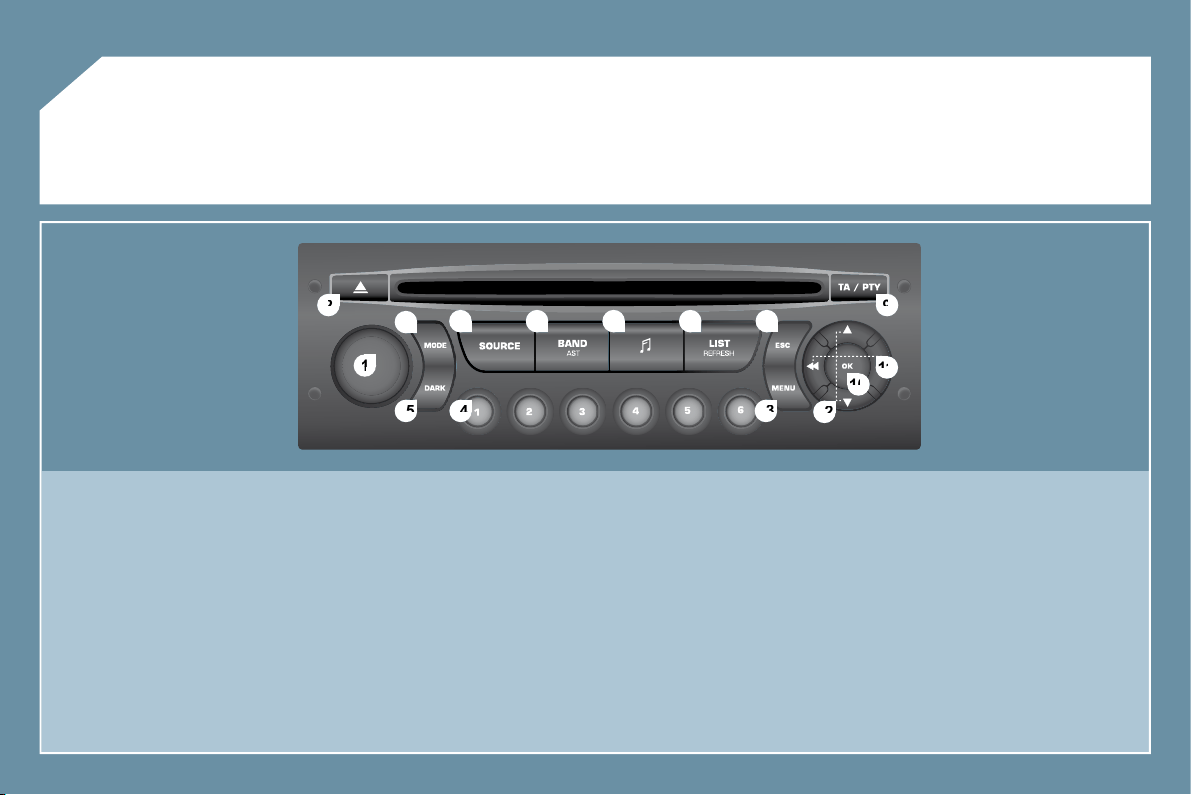
180
1
2
2
10
10
11
11
13
13
14
14
15
15
3
3
4
4
5
5
6
6
7
7
8
8
9
9
12
12
01
FIRST STEPS
1.
On/Off and volume adjustment.
2.
CD eject.
3.
Selection of the display on the screen from the following
modes:
Audio (AUDIO), Trip Computer (TRIP) and Telephone (TEL)
functions.
4. Selection of source:
radio, audio CD/MP3 CD, USB, Jack connection, Streaming.
5.
Selection of FM1, FM2, FMast and AM wavebands.
6.
Setting audio options: front/rear balance, left/right balance,
loudness, sound ambience.
7.
Display the list of local stations, of the tracks on the CD or of
the MP3 folders.
8.
Abandon current operation.
9.
TA (Traffi c Announcement) function on/off.
Long press: access to the PTY (Types of radio programme)
mode.
10.
Confi rmation.
11.
Automatic search for a lower/higher frequency.
Selection of previous/next CD, MP3 or USB track.
12.
Selection of a lower/higher radio frequency.
Selection of the previous/next MP3 folder.
Selection of the previous/next USB equipment folder/genre/
artist/playlist.
13.
Display the general menu.
14.
Buttons 1 to 6:
Selection of a stored radio station.
Long press: store a station.
15.
The DARK button changes the display on the screen to
improve driving comfort at night.
1st press: lighting the upper band only.
2nd press: display of a black screen.
3rd press: return to the standard display.
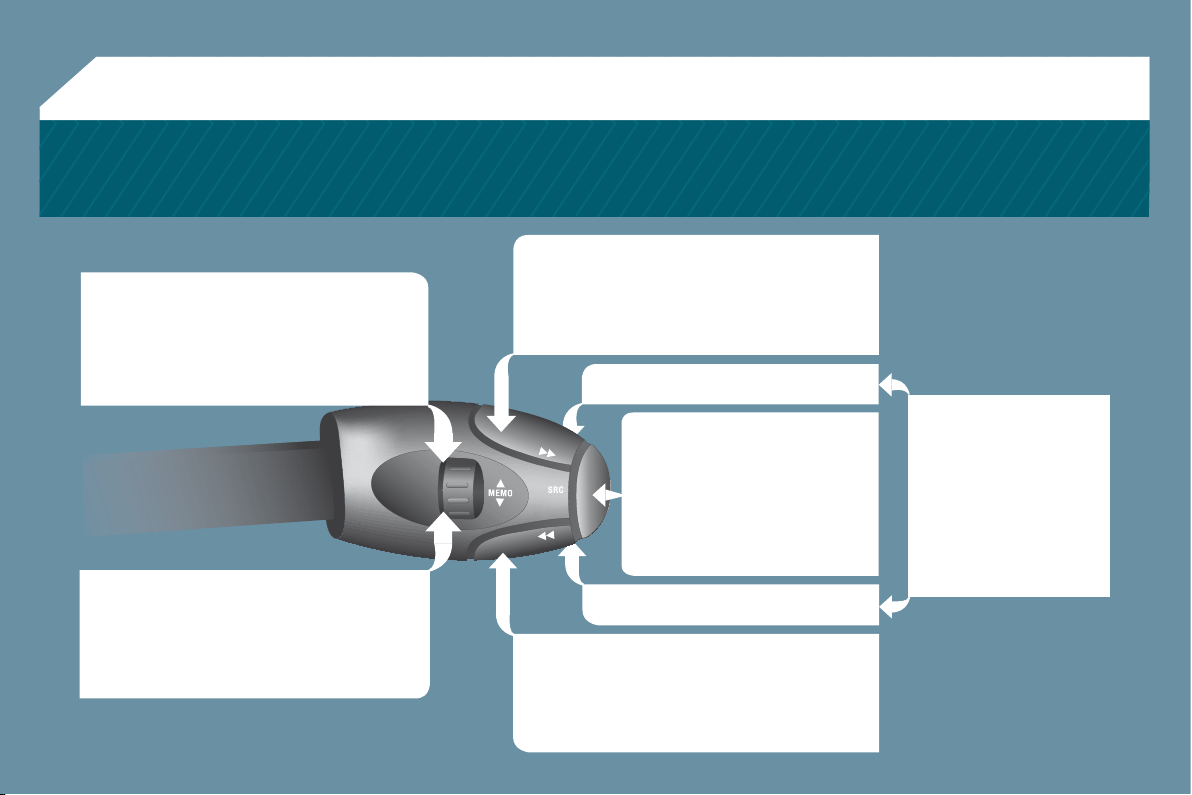
181
02
RADIO: selection of the previous stored
station.
USB: selection of the previous genre/artist/
directory from the classifi cation list.
Selection of the previous item on a menu.
RADIO: automatic search for a higher frequency.
CD/MP3/USB: selection of the next track.
CD/USB: continuous press: fast forwards play.
Selection of the previous item.
RADIO: automatic search for a lower frequency.
CD/MP3/USB: selection of the previous track.
CD/USB: continuous press: fast reverse.
Selection of the next item.
Volume increase.
Volume decrease.
STEERING MOUNTED CONTROLS
Mute: press the volume
increase and decrease
buttons simultaneously.
The sound is restored by
pressing one of the two
volume buttons.
- Change of sound source.
- Confi rmation of a selection.
- Pick up/Hang up the telephone.
- Press for more than 2 seconds:
access to the telephone menu.
RADIO: selection of the next stored station.
USB: selection of the next genre/artist/
directory from the classifi cation list.
Selection of the next item on a menu.
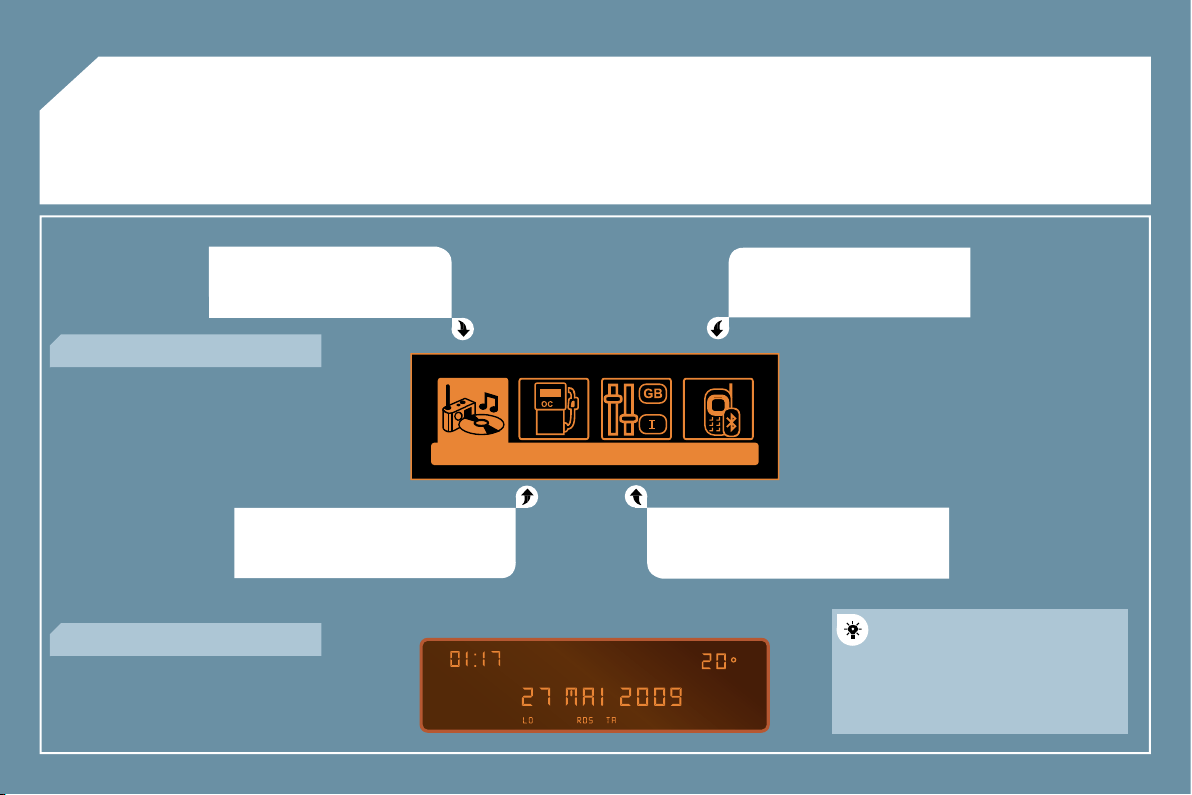
182
03
MAIN MENU
AUDIO FUNCTIONS :
radio,
CD, USB, options.
TRIP COMPUTER :
entering of
distances, alerts, status of functions.
TELEPHONE :
Bluetooth
hands-free, pairing,
management of a call.
PERSONALISATION-
CONFIGURATION :
vehicle parameters,
display, languages.
> MONOCHROME SCREEN C
> MONOCHROME SCREEN A
For a detailed global view of the
menus available, refer to the
"Screen menu map" section of
this chapter.
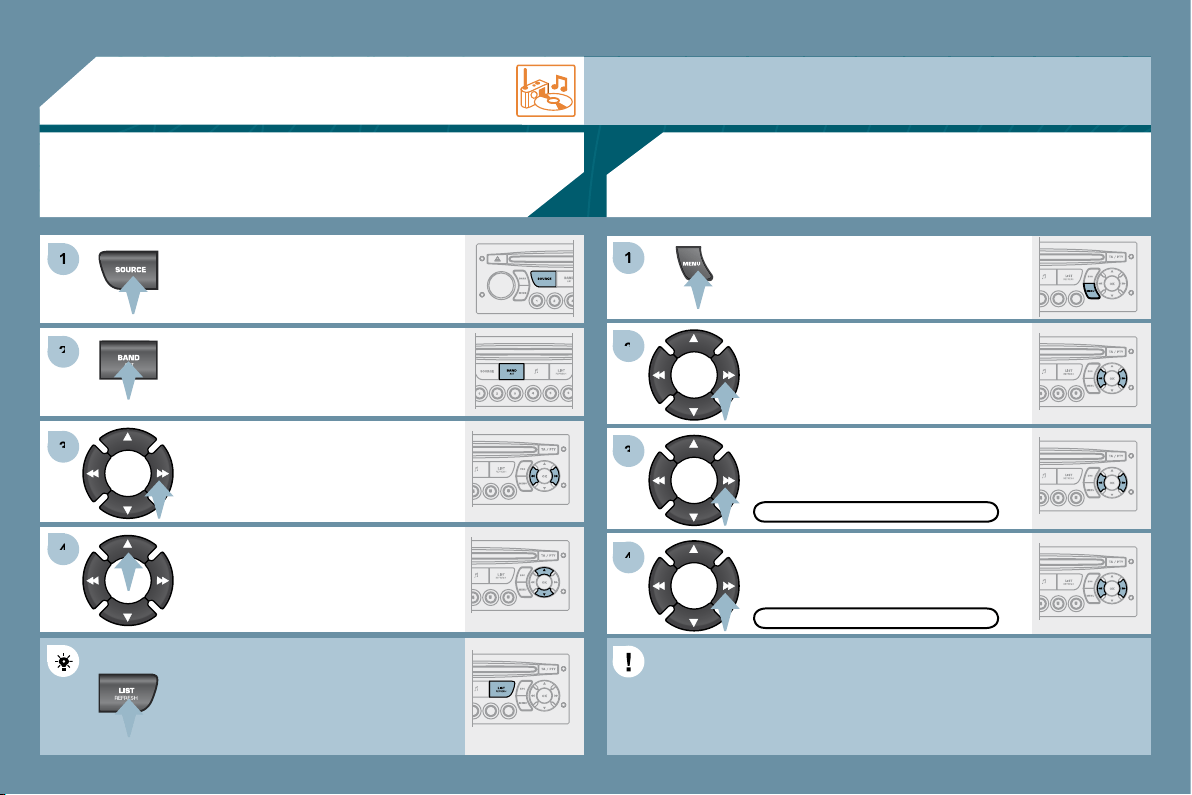
183
2
2
3
3
4
4
1
1
2
2
4
4
3
3
1
1
04
AUDIO
Press the SOURCE button several
times in succession and select the
radio.
Press the BAND AST button to select
a waveband: FM1, FM2, FMast, AM.
Briefl y press one of the buttons to
carry out an automatic search of the
radio stations.
Press one of the buttons to carry out a
manual search of the radio stations.
Press the LIST REFRESH button to
display the list of stations received
locally (30 stations maximum).
To update this list, press for more than
two seconds.
Select ACTIVATE FREQUENCY
FOLLOWING (RDS) then press OK.
RDS appears on the display.
Select the FM WAVEBAND
PREFERENCES function then
press OK.
Select AUDIO FUNCTIONS then
press OK.
Press the MENU button.
FM WAVEBAND PREFERENCES
ACTIVATE FREQUENCY FOLLOWING (RDS)
The external environment (hills, buildings, tunnels, basement car parks) may block reception, including
in RDS mode. This is a normal effect of the way in which radio waves are transmitted and does not
indicate any failure of the audio equipment.
RDS
The RDS, if displayed, enables you to continue listening to the same
station by automatic retuning to alternative frequencies. However, in
certain conditions, coverage of an RDS station may not be assured
throughout the country as radio stations do not cover 100 % of the
territory. This explains the loss of reception of the station during a journey.
RADIO
SELECTING A STATION
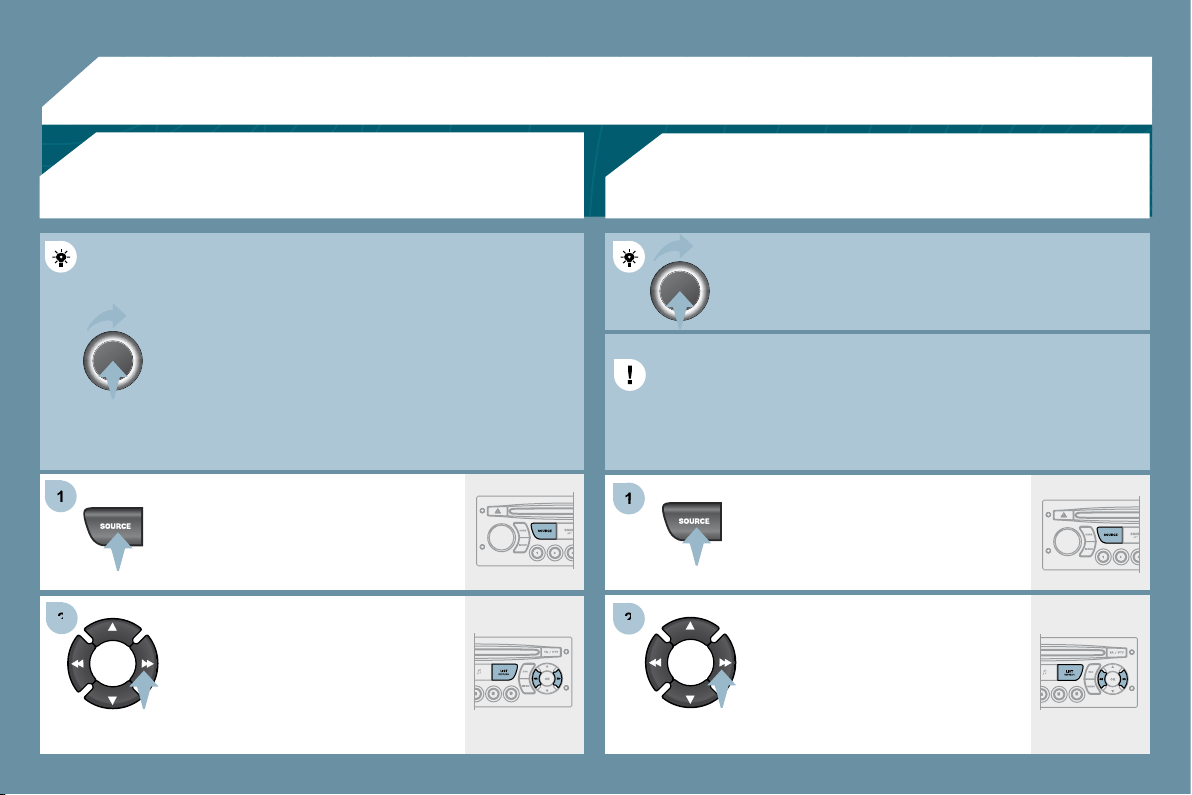
184
04
1
1
2
2
1
1
2
2
Insert circular compact discs only.
Some anti-pirating systems, on original discs or CDs
copied using a personal recorder, may cause faults
which are no refl ection on the quality of the original
player.
Without pressing the EJECT button, insert a CD in
the player, play begins automatically.
To play a disc which has already been
inserted, press the SOURCE button
several times in succession and
select CD.
Press one of the buttons to select a
track on the CD.
Press the LIST REFRESH button to
display the list of tracks on the CD.
Press and hold one of the buttons for
fast forward or backward.
Insert an MP3 compilation in the player.
The audio equipment searches for all of the music
tracks, which may take anything between a few seconds
and several tens of seconds, before play begins.
On a single disc, the CD player can read up to 255 MP3 fi les spread
over 8 directory levels. However, it is advisable to keep to a limit of
two levels to reduce the access time before the CD is played.
While the CD is being played, the directory fl ow chart is not followed.
All of the fi les are displayed on a single level.
To play a disc which has already been
inserted, press the SOURCE button
several times in succession and
select CD.
Press one of the buttons to select a
track on the CD.
Press the LIST REFRESH button to
display the list of directories of the
MP3 compilation.
Press and hold one of the buttons for
fast forward or backward play.
CD
PLAYING A CD
MP3 CD
PLAYING AN MP3 COMPILATION
AUDIO
185
04
The MP3 format, an abbreviation of MPEG 1.2 & 2.5 Audio Layer 3,
The MP3 format, an abbreviation of MPEG 1.2 & 2.5 Audio Layer 3,
is an audio compression standard which permits the recording of
is an audio compression standard which permits the recording of
several tens of music fi les on a single disc.
In order to be able to play a recorded CDR or CDRW, when recording
In order to be able to play a recorded CDR or CDRW, when recording
it is preferable to select standards ISO 9660 level 1.2 or
1.2 or Joliet.
If the disc is recorded in another format, it may not be played correctly.
If the disc is recorded in another format, it may not be played correctly.
It is recommended that the same recording standard is always used
It is recommended that the same recording standard is always used
for an individual disc, with as low a speed as possible (4x maximum)
for an individual disc, with as low a speed as possible (4x maximum)
for optimum sound quality.
In the particular case of a multi-session CD, the Joliet standard is
In the particular case of a multi-session CD, the Joliet standard is
recommended.
The audio equipment will only play fi les with the extension ".mp3"
The audio equipment will only play fi les with the extension ".mp3"
with a sampling rate of 22.05 KHz or 44.1 KHz. No other type of fi le
with a sampling rate of 22.05 KHz or 44.1 KHz. No other type of fi le
(.wma, .mp4, .m3u...) can be played.
It is advisable to restrict fi le names to 20 characters without using
It is advisable to restrict fi le names to 20 characters without using
special characters (e.g. " ? ; ù) to avoid any playing or d
g or displaying
problems.
MP3 CD
INFORMATION AND ADVICE
AUDIO
Empty CDs are not recognised and may damage the system.
Empty CDs are not recognised and may damage the system.
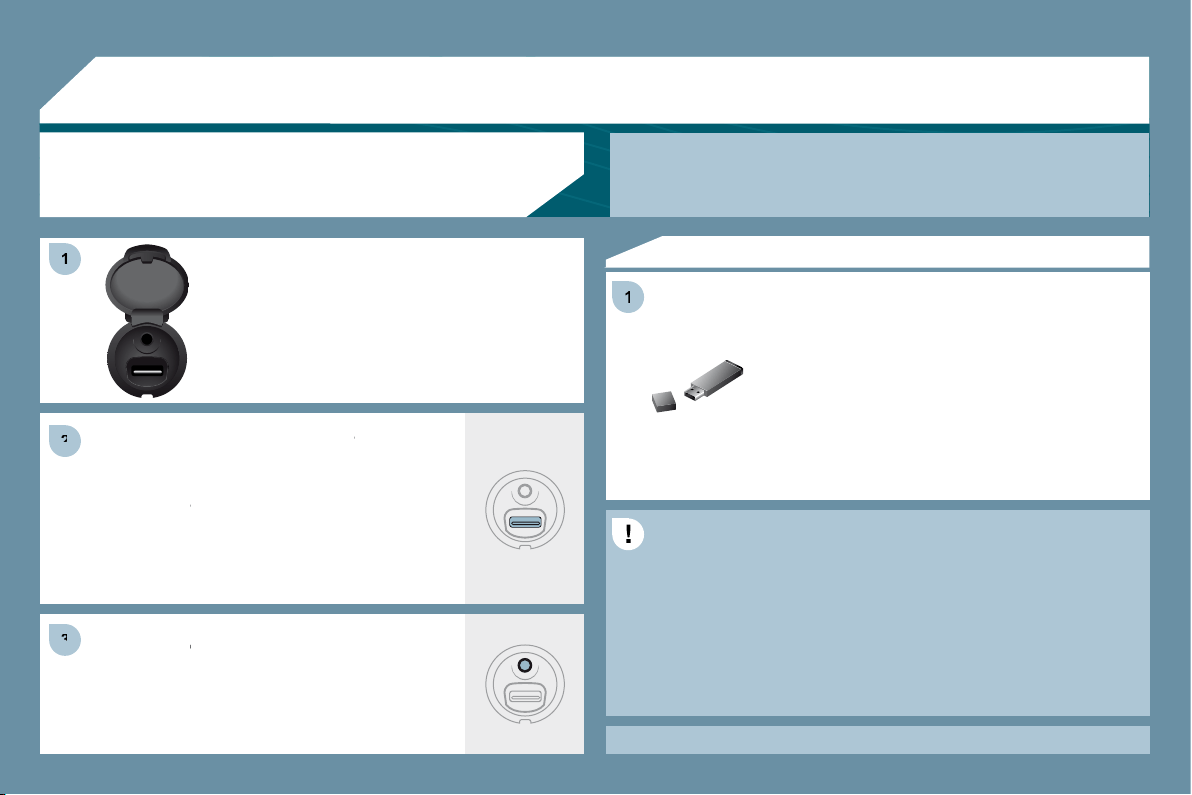
186
1
05
1
1
2
2
3
3
The system puts together playlists (temporary memory) created over
a period which depends on the capacity of the USB equipment.
The other sources are available during this time.
The playlists are updated each time the ignition is switched off or
each time a USB memory stick is connected.
When connecting for the fi rst time, the classifi cation suggested is by
folder. When you reconnect, the classifi cation selected previously is
retained.
Connect the memory stick to the port, directly or
using a lead. If the audio equipment is switched
on, the USB source is detected as soon as it is
connected. Play begins automatically after a delay
which depends on the capacity of the USB stick.
The fi le formats recognised are .mp3 (mpeg1
layer 3 only), .wma (standard 9 only, 128 kbits/
sec compression), .wav and .ogg.
The playlists types accepted are m3u, .pls, .wpl.
This unit consists of a USB port and a Jack
socket * . The audio fi les are transmitted from
portable equipment such as a digital player or
a USB memory stick to your Peugeot Connect
Sound to be listened to via the vehicle's speakers.
USB key (1.1, 1.2 and 2.0) or iPod
®
of generation
®
5 or later:
- USB memory sticks should be formatted FAT
or FAT 32 (NTFS not supported),
- the iPod
®
lead is essential,
®
- navigation through the fi le database is by
means of the steering wheel controls,
- the iPod
®
software should be regularly updated
for the best connection.
Other iPod
®
players of earlier generations and
®
players using the MTP protocol * :
- play via Jack-Jack lead only (not supplied),
- navigation through the fi le database is from the
portable equipment.
The list of compatible equipment and the compression rates supported are available from
PEUGEOT dealers.
USING THE PEUGEOT CONNECT USB
CONNECTING A USB MEMORY STICK
* According to vehicle.
PEUGEOT CONNECT USB
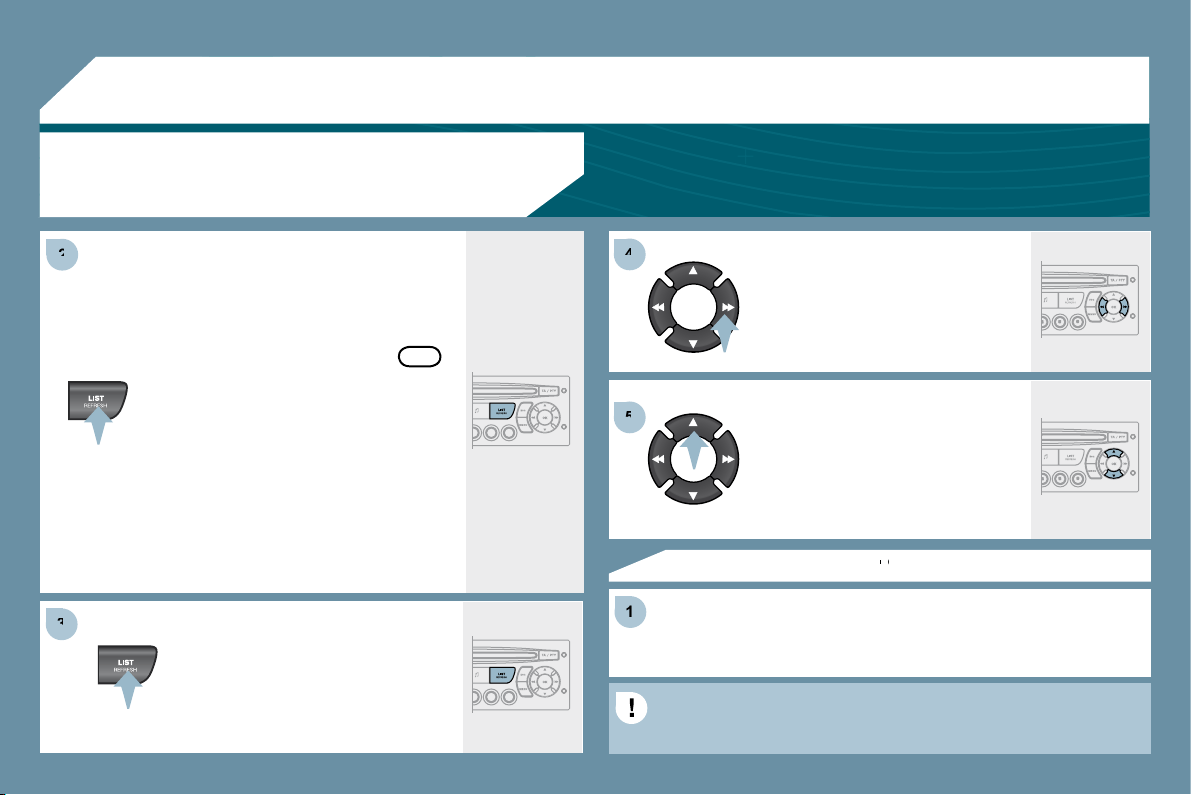
187
3
3
05
4
4
1
1
5
5
2
2
PEUGEOT CONNECT USB
USING THE PEUGEOT CONNECT USB
Press LIST briefl y to display the
previously selected classifi cation.
Navigate through the list using the
left/right and up/down buttons.
Confi rm the selection by pressing OK.
The lists available are Artist, Genre and Playlist (as defi ned on the
iPod
®
).
Selection and Navigation are described in steps 1 to 5 above.
Do not connect a hard disk or USB devices other than audio
equipment to the USB port. This could damage your installation.
CONNECTING AN iPod
®
CONNECTING AN iPod
CONNECTING AN iPod
VIA THE USB PORT
®
Press one of these buttons to gain
access to the previous/next track on
the classifi cation list currently being
played.
Press and hold one of the buttons for
fast forward or backward play.
Press one of these buttons to gain
access to the previous/next Genre,
Folder, Artist or Playlist on the
classifi cation list currently being
played.
Press and hold LIST to display the
different classifi cations.
Select by Folder/Artist/Genre/Playlist,
press OK to select the classifi cation
required, then press OK again to confi rm.
- by Folder: all folders containing audio
fi les recognised on the peripheral
device, classifi ed in alphabetical order
without following the fl ow chart.
- by Artist: all of the artist names
defi ned in the ID3 Tags, classifi ed in
alphabetical order.
- by Genre: all of the genres defi ned in
the ID3 Tags.
- by Playlist: in accordance with the
playlists recorded on the USB device.
OK
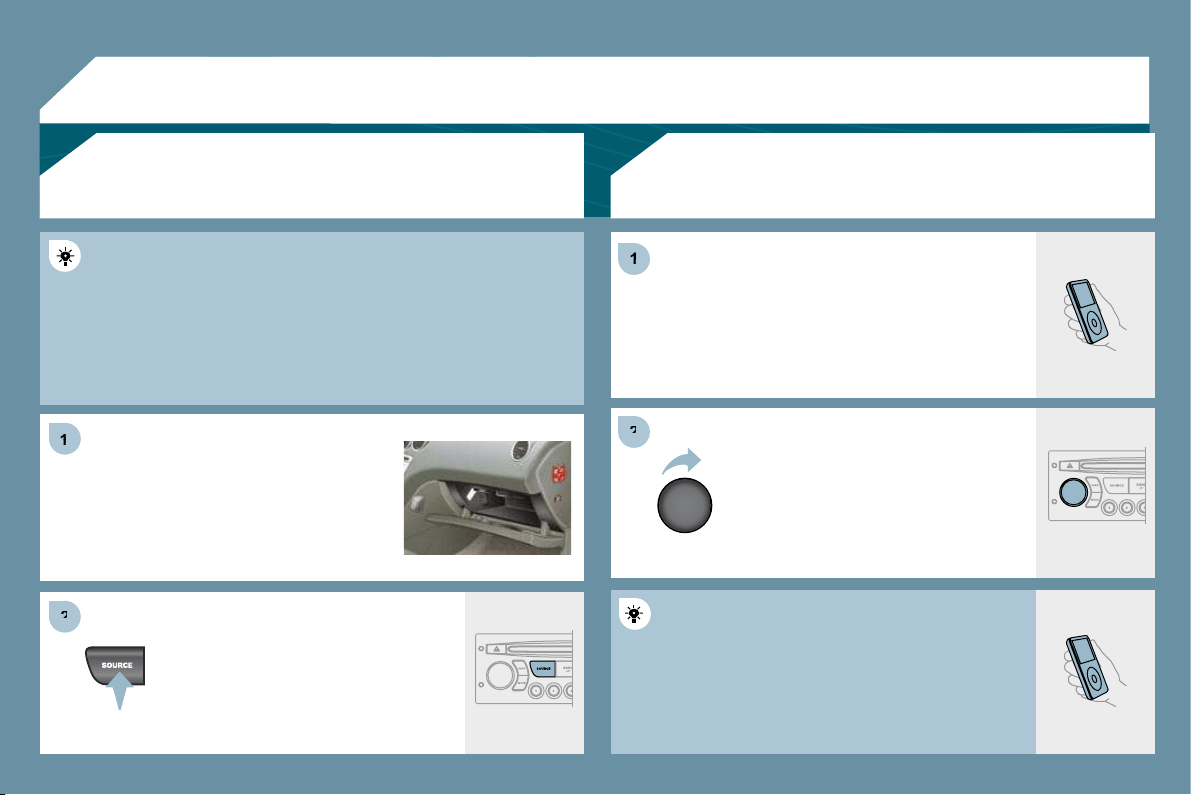
188
05
1
1
2
2
2
2
1
1
The controls are displayed and managed via
the portable equipment.
First adjust the volume of your portable equipment.
Then adjust the volume of your audio
equipment.
The RCA auxiliary socket permits the connection of portable
equipment (MP3 player...).
Connect the portable equipment (MP3
player…) to the audio sockets (white
and red, RCA type) using a suitable
cable (not supplied).
Press the SOURCE button several
times in succession and select AUX.
USING THE AUXILIARY SOCKET (AUX)
RCA SOCKET
ADJUSTING THE VOLUME OF
THE AUXILIARY SOURCE
PEUGEOT CONNECT USB
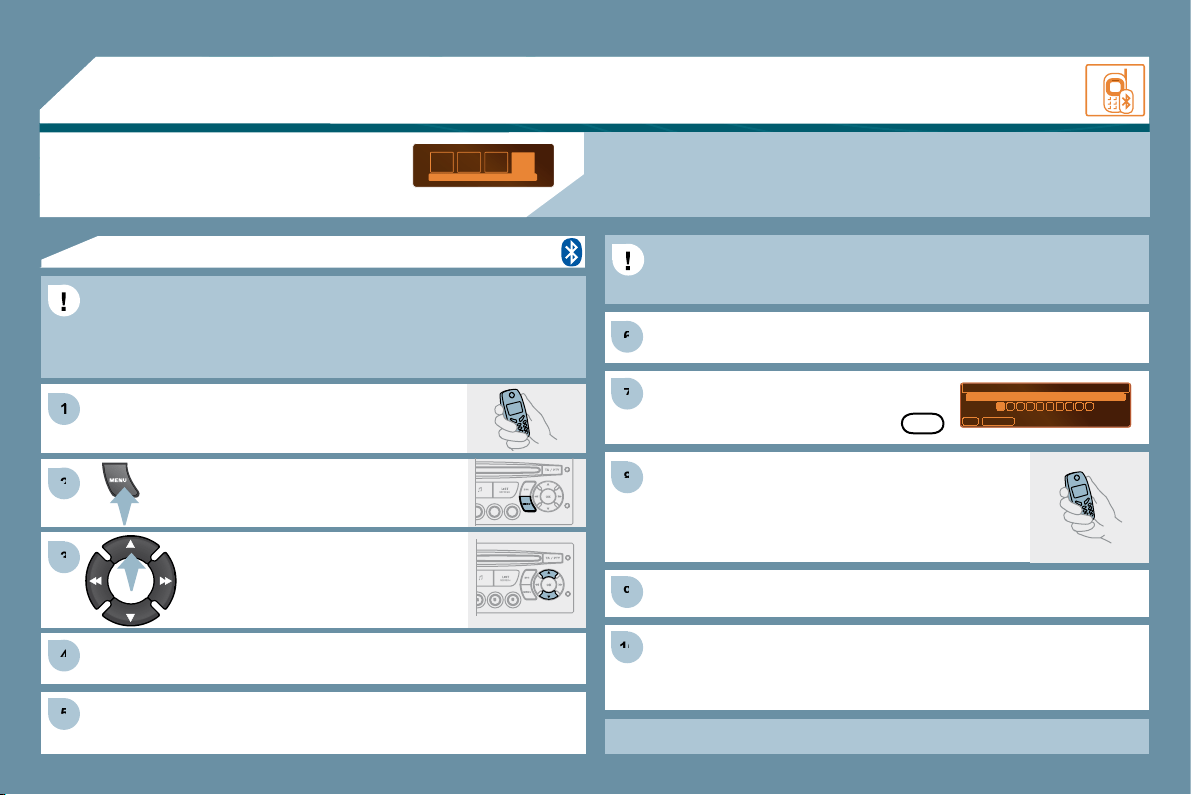
189
1
1
6
6
2
2
7
7
4
4
9
9
5
5
10
10
3
3
8
8
06
BLUETOOTH
For safety reasons and because they require prolonged attention on
the part of the driver, the operations for pairing of the Bluetooth mobile
telephone with the Bluetooth hands-free system of your audio equipment
must be carried out with the vehicle stationary and the ignition on.
Press the MENU button.
A window is displayed with "Searching...".
Activate the telephone's Bluetooth function.
In the menu, select:
- Bluetooth telephone function - Audio
- Bluetooth confi guration
- Perform a Bluetooth search
The services offered depend on the network, the SIM card and the compatibility of the Bluetooth
equipment used.
Consult your telephone's manual and your operator to fi nd out which services are available to you. A
list of mobile telephones which offer the best range of services is available from the network. Consult a
PEUGEOT dealer.
BLUETOOTH TELEPHONE
SCREEN C
The TELEPHONE menu permits access to the following functions in
particular: Directory * , Call list, Pairing management.
The fi rst 4 telephones recognised are displayed in this window.
A virtual keypad is displayed on the screen:
enter a code with at least 4 digits.
Confi rm by pressing OK.
If pairing fails, the number of attempts is not limited.
Select the telephone to be connected from the list. Only one
telephone can be connected at a time.
A message is displayed on the screen of the
telephone chosen: to accept the pairing, enter
the same code on the telephone, then confi rm by
pressing OK.
"Pairing of Name_telephone successful" appears on the screen.
The automatic connection authorised is only active after the
telephone has been confi gured.
The directory and the call list can be accessed after the
synchronisation period.
OK
PAIRING A TELEPHONE
The pairing can also be initiated from the telephone.
* If your telephone is fully compatible.
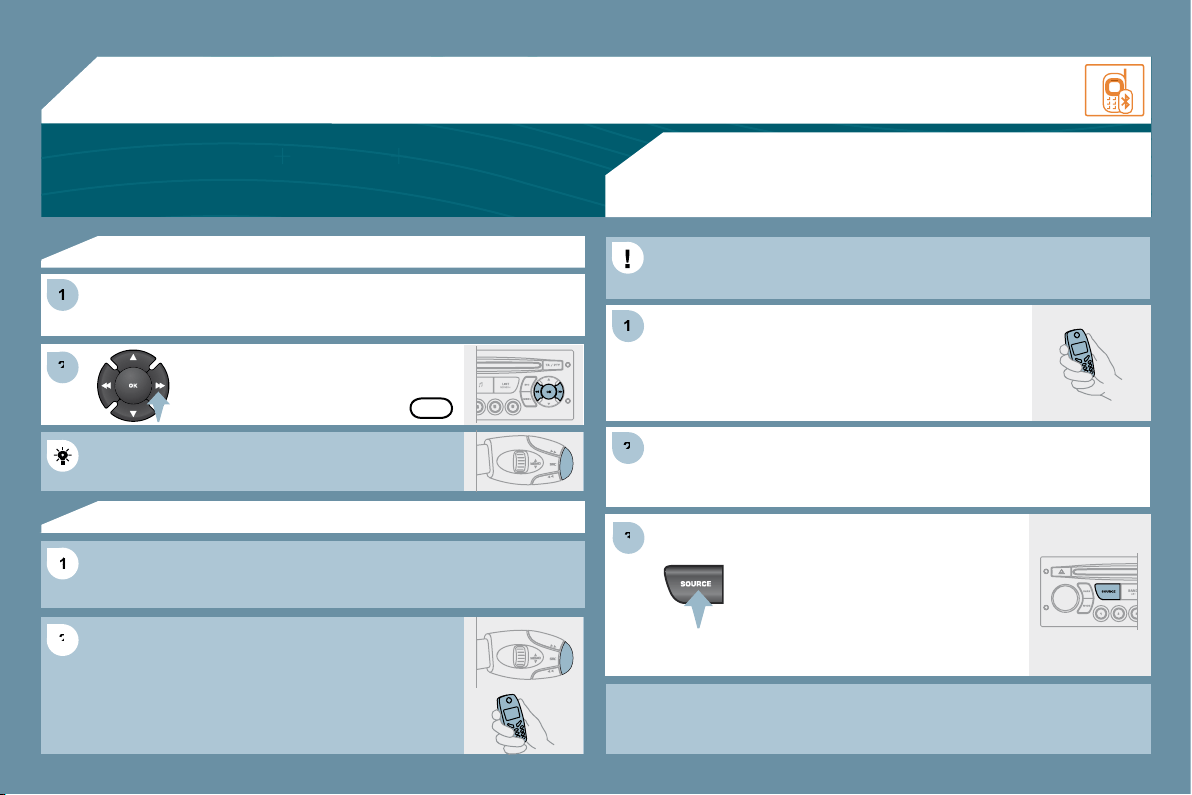
190
06
1
1
2
2
1
1
1
1
2
2
3
3
2
2
YES
RECEIVING A CALL
An incoming call is announced by a ring and a superimposed display
on the multifunction screen.
Initiate the pairing between the telephone and
the vehicle. This pairing can be initiated from
the vehicle's telephone function menu or via the
telephone's keypad. See steps 1 to 10 on the
previous pages. During the pairing phase, the vehicle
must be stationary with the key in the ignition.
Select the telephone to be connected from the telephone function
menu.
The audio system connects to a newly paired telephone
automatically.
Select the YES tab on the display
using the buttons and confi rm by
pressing OK.
Press the steering mounted control OK to accept
the call.
From the Bluetooth telephone function Audio menu, select Manage
the telephone call then Call, Call list or Directory.
Press the end of the steering mounted control for
more than two seconds to gain access to your
directory.
Or
To dial a number, use your telephone's keypad, with
the vehicle stationary.
MAKING A CALL
BLUETOOTH AUDIO STREAMING
(AVAILABLE DURING THE YEAR)
Wireless transmission of the telephone's music fi les via the audio
equipment. The telephone must be able to manage the appropriate
bluetooth profi les (Profi les A2DP/AVRCP).
* In certain cases, playing of the Audio fi les must be initiated from the
keypad.
** If the telephone supports the function.
Activate the streaming source by
pressing the SOURCE button * . The
tracks to be played can be controlled
as usual via the buttons on the Radio
control panel and the steering wheel
controls ** . The contextual information
can be displayed on the screen.
BLUETOOTH
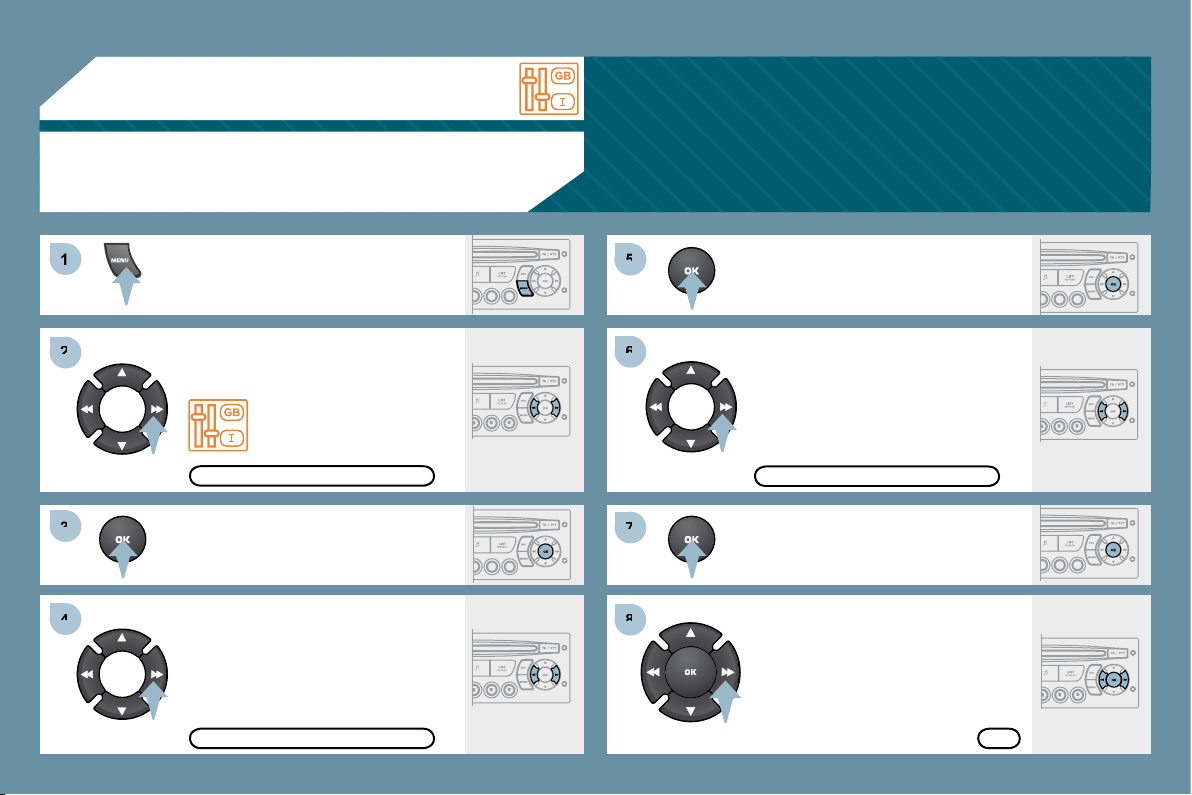
191
1
1
2
2
3
3
4
4
5
5
6
6
7
7
8
8
07
CONFIGURATION
Press the MENU button.
Using the arrows, select
PERSONALISATION
CONFIGURATION.
Press to confi rm the selection.
Using the arrows, select DISPLAY
CONFIGURATION.
Press to confi rm the selection.
Press to confi rm the selection.
Using the arrows, select ADJUST
DATE AND TIME.
Adjust the settings one by one
confi rming by pressing the OK button.
Next select the OK tab on the screen
then confi rm.
DISPLAY CONFIGURATION
ADJUST DATE AND TIME
OK
PERSONNALISATION CONFIGURATION
SETTING THE DATE AND TIME
SCREEN C
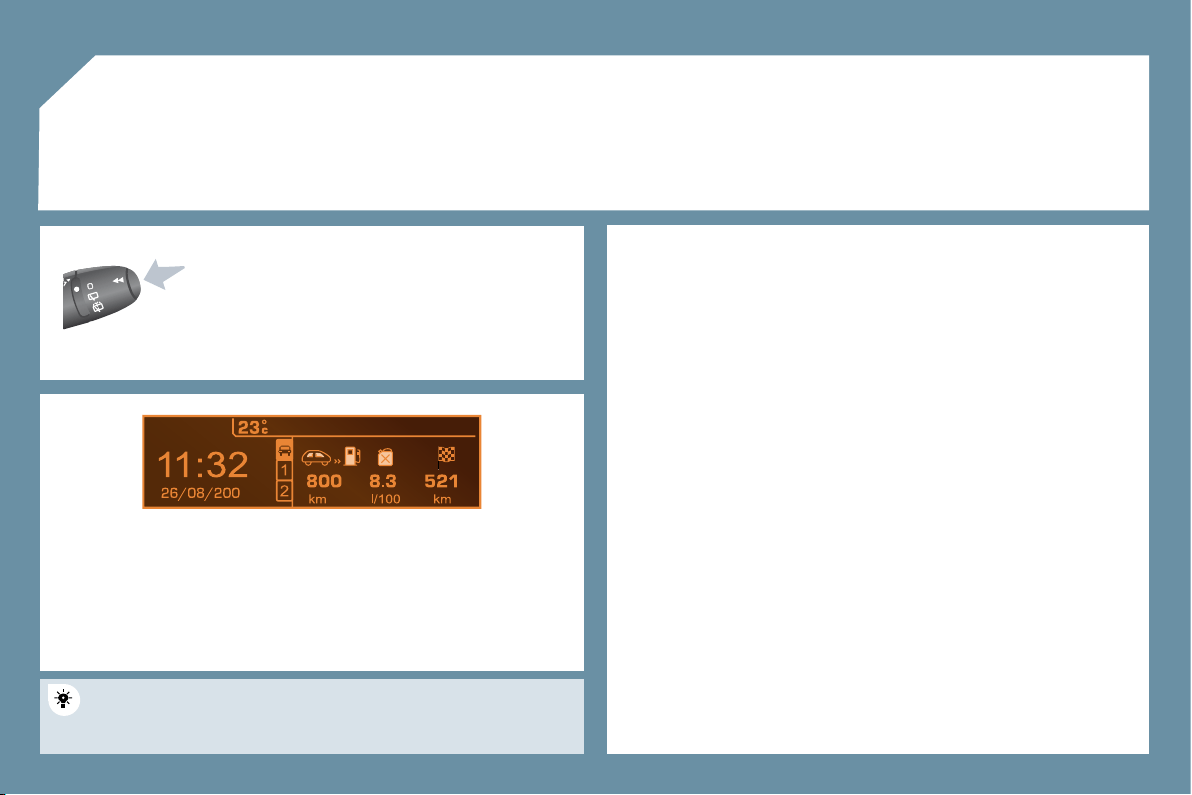
192
9
08
Each press of the button, located at the end of the
wiper stalk , displays the different trip computer
information in succession, depending on the screen.
- the "vehicle " tab with:
the range, the current fuel consumption and the distance remaining to
the destination,
- the "1" tab (trip 1) with:
the average speed, the average consumption and the distance travelled
calculated over trip "1",
- the "2" tab (trip 2) with the same information for a second trip.
A FEW DEFINITIONS
Range:
displays the distance which can travelled with the remaining fuel
detected in the tank, based on the average fuel consumption over the last
few miles (kilometres).
This displayed value may vary signifi cantly following a change in the
vehicle speed or the relief of the route.
When the range falls below 20 miles (30 km), dashes are displayed. After
fi lling with at least 5 litres of fuel, the range is recalculated and is displayed
when it exceeds 60 miles (100 km).
If, whilst driving, dashes are displayed continuously in place of the digits,
contact a PEUGEOT dealer.
Current fuel consumption:
only calculated and displayed above 20 mph
(30 km/h).
Average fuel consumption:
this is the average fuel consumption since
the last trip computer zero reset.
Distance travelled:
calculated since the last trip computer zero reset.
Distance remaining to the destination:
calculated with reference to
the fi nal destination, entered by the user. If guidance is activated, the
navigation system calculates it as a current value.
Average speed:
this is the average speed calculated since the last trip
computer zero reset (ignition on).
Zero reset
When the required trip is displayed, press the control for more than
two seconds.
TRIP COMPUTER
193
1
2
2
2
2
1
2
2
1
2
3
3
1
2
2
2
2
2
2
1
2
2
2
2
2
2
2
2
1
2
2
1
2
3
2
3
1
1
1
1
09
1
1
1
1
RADIO-CD
DISPLAY ADJUST
YEAR
MONTH
DAY
HOUR
MINUTES
12 H/24 H MODE
SCREEN MENU MAP
MAIN FUNCTION
* The parameters vary according to vehicle.
CHOICE A
Choice A1
Choice A2
CHOICE B...
LANGUAGE
FRANCAIS
ITALIANO
NEDERLANDS
PORTUGUES
PORTUGUES-BRASIL
DEUTSCH
ENGLISH
ESPANOL
Press the OK dial for access to short-cut
menus according to the display on the
screen:
monochrome A
monochrome C
RADIO
activate/deactivate RDS
activate/deactivate REG mode
activate/deactivate radiotext
RDS SEARCH
REG MODE
CD REPEAT
RANDOM PLAY
VEHICLE CONFIG *
REV WIPE ACT
GUIDE LAMPS
OPTIONS
DIAGNOSTICS
consult
abandon
UNITS
TEMPERATURE: °CELSIUS/°FAHRENHEIT
FUEL CONSUMPTION: KM/L - L/100 - MPG
CD/MP3 CD
activate/deactivate Intro
activate/deactivate track repeat (the entire current CD for
CD, the entire current folder for MP3 CD)
activate/deactivate random play (the entire current CD for
CD, the entire current folder for MP3 CD)
USB
activate/deactivate track repeat (of the current folder/
artist/genre/playlist)
activate/deactivate random play (of the current folder/
artist/genre/playlist)
193
1
2
2
2
2
1
2
2
1
2
3
3
1
2
2
2
2
2
2
1
2
2
2
2
2
2
2
2
1
2
2
1
2
3
2
3
1
1
1
1
09
1
1
1
1
RADIO-CD
DISPLAY ADJUST
YEAR
MONTH
DAY
HOUR
MINUTES
12 H/24 H MODE
SCREEN MENU MAP
MAIN FUNCTION
* The parameters vary according to vehicle.
CHOICE A
Choice A1
Choice A2
CHOICE B...
LANGUAGE
FRANCAIS
ITALIANO
NEDERLANDS
PORTUGUES
PORTUGUES-BRASIL
DEUTSCH
ENGLISH
ESPANOL
Press the OK dial for access to short-cut
menus according to the display on the
screen:
monochrome A
monochrome C
RADIO
activate/deactivate RDS
activate/deactivate REG mode
activate/deactivate radiotext
RDS SEARCH
REG MODE
CD REPEAT
RANDOM PLAY
VEHICLE CONFIG *
REV WIPE ACT
GUIDE LAMPS
OPTIONS
DIAGNOSTICS
consult
abandon
UNITS
TEMPERATURE: °CELSIUS/°FAHRENHEIT
FUEL CONSUMPTION: KM/L - L/100 - MPG
CD/MP3 CD
activate/deactivate Intro
activate/deactivate track repeat (the entire current CD for
CD, the entire current folder for MP3 CD)
activate/deactivate random play (the entire current CD for
CD, the entire current folder for MP3 CD)
USB
activate/deactivate track repeat (of the current folder/
artist/genre/playlist)
activate/deactivate random play (of the current folder/
artist/genre/playlist)
194
1
2
3
4
3
4
3
2
3
4
3
4
1
2
1
2
3
3
3
4
4
4
2
3
4
2
3
3
4
3
1
2
4
3
2
4
4
3
3
4
4
2
3
4
4
3
2
3
2
SCREEN MENU MAP
BLUETOOTH TELEPHONE
AUDIO FUNCTIONS
PLAY MODES
album repeat (RPT)
activate/deactivate
track random play (RDM)
activate/deactivate
TRIP COMPUTER
MANAGE THE TELEPHONE CALL
Terminate the current call
Activate private mode
FM BAND PREFERENCES
alternative frequencies (RDS)
activate/deactivate
regional mode (REG)
activate/deactivate
radio-text information (RDTXT)
activate/deactivate
ENTER DISTANCE TO DESTINATION
Distance: x miles
BLUETOOTH CONFIGURATION
Connect/Disconnect a device
Telephone function
Audio Streaming function
Consult the paired device
Delete a paired device
Perform a Bluetooth search
CALL
Calls list
Directory
Pressing the MENU button displays:
PERSONALISATION-CONFIGURATION
DEFINE THE VEHICLE PARAMETERS *
DISPLAY CONFIGURATION
video brightness adjustment
normal video
inverse video
brightness (- +) adjustment
date and time adjustment
day/month/year adjustment
hour/minute adjustment
choice of 12 h/24 h mode
choice of units
l/100 km - mpg - km/l
°Celsius/°Fahrenheit
* The parameters vary according to vehicle.
CHOICE OF LANGUAGE
ALERT LOG
Diagnostic s
STATUS OF THE FUNCTIONS *
Functions activated or deactivated
monochrome C
195
There is a difference in
sound quality between
the different audio
sources (radio, CD...).
Check that the audio settings (Volume, Bass,
Treble, Ambience, Loudness) are adapted to
the sources listened to. It is advisable to set
the AUDIO functions (Bass, Treble, Front-Rear
Balance, Left-Right Balance) to the middle
position, select the musical ambience "None"
and set the loudness correction to the "Active"
position in CD mode or to the "Inactive" position
in radio mode.
For optimum sound quality, the audio settings (Volume, Bass, Treble,
Ambience, Loudness) can be adapted to the different sound sources,
which may result in audible differences when changing source (radio,
CD...).
The CD is ejected
automatically or is not
played by the player.
- Check that the CD is inserted in the player the
right way up.
- Check the condition of the CD: the CD cannot
be played if it is too damaged.
- Check the content in the case of a recorded
CD: consult the advice in the "Audio" section.
- The audio equipment's CD player does not
play DVDs.
- Due to their quality level, certain writeable CDs
will not be played by the audio system.
The CD is inserted upside down, is unplayable, does not contain any audio
data or contains an audio format which the player cannot play.
The CD is protected by an anti-pirating protection system which is not
recognised by the audio equipment.
The message "USB
peripheral error" is
displayed on the screen.
Recharge the battery of the peripheral device.
The Bluetooth connection is cut.
The battery of the peripheral may not be suffi ciently charged.
The USB memory stick is not recognised.
The memory stick may be corrupt.
Reformat the memory stick.
QUESTION
SOLUTION
ANSWER
FREQUENTLY ASKED QUESTIONS
The CD player sound
is poor.
The CD used is scratched or of poor quality.
Insert good quality CDs and store them in
suitable conditions.
The audio equipment settings (bass, treble, ambiences) are unsuitable.
Set the treble or bass level to 0, without selecting
an ambience.
196
The traffi c announcement
(TA) is displayed. I do
not receive any traffi c
information.
Tune to a radio station which broadcasts traffi c
information.
The radio station is not part of the regional traffi c information network.
QUESTION
SOLUTION
ANSWER
The quality of reception
of the radio station
listened to gradually
deteriorates or the
stored stations do
not function (no
sound, 87.5 Mhz is
displayed...).
The vehicle is too far from the transmitter used by the station listened to or
there is no transmitter in the geographical area through which the vehicle
is travelling.
The environment (hills, buildings, tunnels, basement car parks...) block
reception, including in RDS mode.
The aerial is absent or has been damaged (for example when going
through a car wash or into an underground car park).
Activate the RDS function to enable the system
to check whether there is a more powerful
transmitter in the geographical area.
This phenomenon is normal and does not
indicate a failure of the audio equipment.
Have the aerial checked by a PEUGEOT dealer.
Sound cut-outs of 1
to 2 seconds in radio
mode.
During this brief sound cut-out, the RDS searches for any frequency
permitting better reception of the station.
Deactivate the RDS function if the phenomenon
is too frequent and always on the same route.
With the engine off,
the audio equipment
switches off after a few
minutes of use.
When the engine is switched off, the audio equipment operating time
depends on the battery charge.
The switch-off is normal: the audio equipment switches to economy mode
and switches off to prevent discharging of the vehicle's battery.
Start the vehicle's engine to increase the battery
charge.
The stored stations do
not function (no sound,
87.5 Mhz is displayed...).
An incorrect waveband is selected.
Press the BAND AST button to return to the
waveband (AM, FM1, FM2, FMAST) on which the
stations are stored.
The message "the audio
system is overheated"
appears on the display.
Switch the audio system off for a few minutes to
allow the system to cool.
In order to protect the installation if the surrounding temperature is too high,
the audio equipment switches to an automatic thermal protection mode
leading to a reduction of the volume or stopping of the playing of the CD.
197
EMERGENCY OR ASSISTANCE CALL
EMERGENCY CALL
ASSISTANCE CALL
OPERATION OF THE SYSTEM
In an emergency, press this button for more than
2 seconds. Flashing of the green diode and a voice
message confi rm that the call has been made to the
PEUGEOT Emergency team * .
Pressing this button again immediately cancels the request. The green
diode switches off.
The green diode remains on (without fl ashing) when communication is
established. It switches off at the end of communication.
This call is dealt with by the PEUGEOT Emergency team which receives
locating information from the vehicle and can send a detailed alert to the
appropriate emergency services. In countries in which the team is not
operational, or when the locating service has been expressly refused,
the call is dealt with directly by the emergency services (112) without the
vehicle location.
If an impact is detected by the airbag ECU, and independently of any
triggering of the airbags, an emergency call is made automatically.
* This service is subject to conditions and availability.
Consult a PEUGEOT dealer.
Press this button for more than 2 seconds to request
assistance if the vehicle breaks down.
A voice message confi rms that the call has been made *
Pressing this button again immediately cancels the request.
The cancellation is confi rmed by a voice message.
When the ignition is switched on, the green
indicator lamp comes on for 3 seconds
indicating that the system is operating
correctly.
If the orange indicator lamp fl ashes: there is
a system malfunction.
If the orange indicator lamp is lit continuously:
the backup battery must be replaced.
In both cases, consult a PEUGEOT dealer.