imagine the possibilities
Thank you for purchasing this Samsung product.
To receive more complete service,
please register your product at
www.samsung.com/register
RF268AB
English
Refrigerator
user manual
2_ features
For easy future reference, write the
model and serial number down. You
will find your model number and serial
number on the left side of the refrigerator.
Model #
Serial #
Features of your new Refrigerator
KEY FEATURES OF YOUR NEW REFRIGERATOR
Your Samsung French Door Refrigerator comes equipped with various innovative storage and energy-efficient
features.
Twin Cooling System
The Refrigerator and Freezer have separate evaporators. Due to this independent cooling system,
the Freezer and Refrigerator cool more efficiently.
Additionally, this separate air flow system prevents food odor of one compartment from seeping into
other compartments.
Bigger & Wider Space
The wide shelf area and pantry provide enough space for larger items like a pizza box, etc.
The wide freezer drawer also provides enough space for 2~3 turkeys.
Cool Select Pantry
Plus
The Cool Select pantry
Plus
is a full-width drawer with adjustable temperature control.
Compact Ice Maker
The Ice maker can dispense cubed or crushed ice.
Secure Auto Close
The Secure Auto Close feature will automatically close a door that is slightly open.
Digital Display and Temperature Control
Water Filtration System
Door Alarm
A helpful beeper alerts you if door is ajar.
Tilting Pocket
The Tilting pocket can be used to store up to a 16” pizza.
Auto Pull Out Drawer
The upper drawer in the freezer comes out automatically when you open the freezer door.
Easy Handle
Freezer door can be opened with less effort.
Energy Star
This Energy star labeled product may save you money on your energy costs.
Dual Ice Maker
The Refrigerator and freezer each have an ice maker; providing even more cubed and crushed ice.
safety information _3
SAFETY INFORMATION
Before using your new Samsung French Door Refrigerator, please read this manual thoroughly to ensure that
you know how to safely and efficiently operate the features and functions that your new appliance offers.
This appliance is not intended for use by persons (including children) with reduced physical, sensory or mental
capabilities, or lack of experience and knowledge, unless they have been given supervision or instruction
concerning use of the appliance by a person responsible for their safety.
Because the following instruction covers various models, the characteristics of your Refrigerator may differ
slightly from the Refrigerator described in this manual. If you have any question, contact us at 1-800-SAMSUNG
or find help and information online at www.samsung.com.
Important safety symbols and precautions:
WARNING
Hazards or unsafe practices that may result in .
CAUTION
Hazards or unsafe practices that may result in
.
Do NOT attempt.
Do NOT disassemble.
Do NOT touch.
Follow directions carefully.
Unplug the power plug from the wall socket.
Make sure the refrigerator is grounded to prevent electric shock.
Call the contact center for help.
Note.
WARNING
SEVERE WARNING SIGNS FOR INSTALLATION
Safety Information
other appliance.
- Deteriorated insulation of electrical parts may cause an electric shock or fire.
- This provides the best performance and also prevents overloading house wiring circuits, which could cause
a fire hazard from overheated wires.
4_ safety information
Safety Information
- Always make sure that you have grounded the Refrigerator before attempting to investigate or repair any
part of the appliance. Power leakages can cause severe electric shock.
- Improper use of the grounding plug can result in a risk of electric shock. If it is necessary to use an
extension cord, use only a 3-wire extension cord that has a 3-blade grounding plug and a 3-slot
receptacle that will accept the plug on the appliance. The marked rating of the extension cord should
be AC115-120 V, 10 A, or more. If a grounding adapter is used, make sure the receptacle box is fully
grounded.
agent.
used.
- If you connect the power plug upside down, the wire can get cut off and cause a fire or electric shock.
- This constitutes a fire hazard.
- There is a risk of death from suffocation if children put them on their head.
- When you open or close the door, the articles may fall and cause personal injury and/or material damage.
- If spilled, there is a risk of fire or electric shock.
CAUTION
CAUTION SIGNS FOR INSTALLATION
- If your refrigerator is not level, the internal cooling system may not work correctly.
WARNING
SEVERE WARNING SIGNS FOR USING
- There is a risk of electric shock of fire.
out from the outlet.
- Damage to the cord may cause a short-circuit, fire and/or electric shock.
- Aerosols used near the Refrigerator may cause an explosion or fire.
safety information _5
- Any sharp edges may cause personal injury.
- The drawer may break and cause them to slip.
- When you open the door, an item may fall out and cause personal injury or material damage.
- This may cause frostbite.
- There is a risk of explosion or fire.
- The storage of benzene, thinner, alcohol, ether, LP gas and other such products may cause explosions.
refrigerator.
- Products that require strict temperature controls must not be stored in the refrigerator.
recommended by the manufacturer.
those recommended by the manufacturer.
- You run risk of causing a fire, malfunction and/or personal injury.
WARNING
SEVERE WARNING SIGNS FOR USING
yourself.
- Please contact your service agents.
- Otherwise there is a risk of fire
- Otherwise, there is a risk of electric shock.
- When the contents freeze, the glass may break and cause personal injury.
CAUTION
CAUTION SIGNS FOR USING
6_ safety information
Safety Information
- Otherwise there is a risk of fire or electric shock.
- There is a risk of fire or electric shock.
- Take off the doors.
- Leave the shelves in place so that children may not easily climb inside.
pipes on the back of the appliance are damaged prior to disposal.
children or animals cannot become trapped inside.
disposal of this product. Ensure that none of the pipes on the back of the refrigerator are damaged
prior to disposal.
- Any changes or modifications performed by a 3rd party on this finished appliance is not covered under
Samsung warranty service, nor can Samsung be responsible for safety issues that result from 3rd party
modifications.
- If the air holes are blocked, especially with a plastic bag, the refrigerator can be over cooled. If this cooling
period lasts too long, the water filter may break and cause water leakage.
before plugging it back.
you must empty the refrigerator and pull out the power plug.
- Deterioration in the insulation may cause fire.
- Otherwise, door and mold may develop.
- Do not place foods too closely in front of the vents at the rear of the appliance as it can obstruct free air
circulation in the refrigerator compartment.
- Wrap the food up properly or place it in airtight containers before putting it into the refrigerator.
WARNING
SEVERE WARNING SIGNS FOR DISPOSAL
- There is a risk of electric shock or fire.
CAUTION
CAUTION SIGNS FOR CLEANING
Contents _7
Contents
08
08 Getting ready to install the refrigerator
09 Setting up the refrigerator
09 Removing the refrigerator doors
11 Disassemble the Freezer Drawer
12 Reattaching the refrigerator doors
14 Assemble the Freezer Drawer
15 Adjusting the doors
16 Making minor adjustments between doors
17 Adjusting the freezer drawer level
18 Checking the water dispenser line
19 Installing the water line
21
21 Using the control panel
22 Using the digital display
23 Controlling the temperature
24 Using the cold water dispenser
26 Parts and Features
27 Storing food in the refrigerator
27 Storing food in the freezer drawer
28 Using the Cool Select Pantry
Plus
29 Removing the refrigerator accessories
30 Using the doors
30 Using the tilting pocket
31 Removing the freezer accessories
32 Food Storage Tips
34 Cleaning the refrigerator
35 Changing the interior lights
36 Changing the water filter
TROUBLESHOOTING
37
37 Troubleshooting
38
38 Water filter chart
39 Water filter certification
40 Warranty on SAMSUNG refrigerator
8_ Setting up
Setting up your French Door Refrigerator
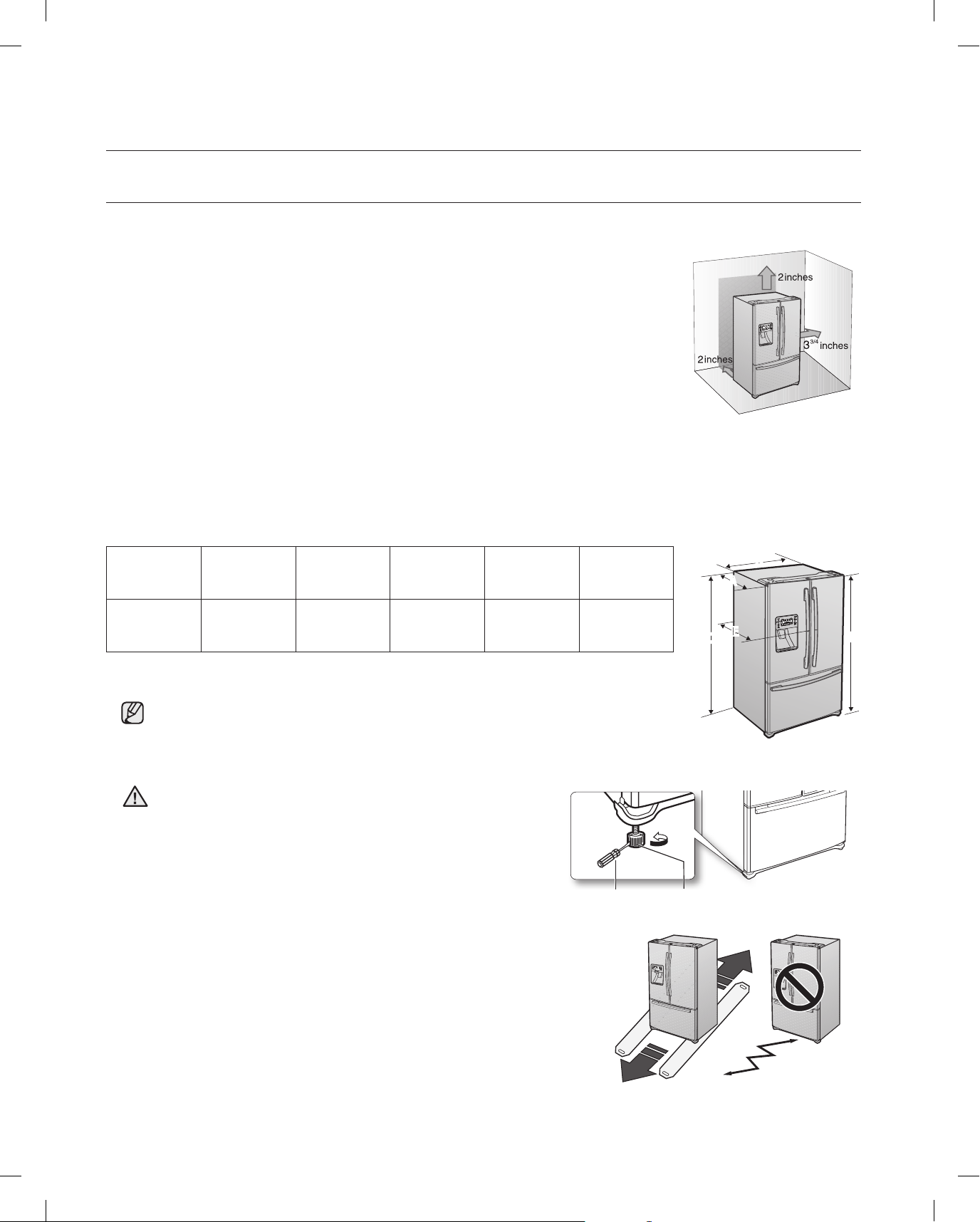
If your refrigerator has an ice maker, allow extra space at the back for the water line connections.
When you install the refrigerator next to a fixed wall, minimum clearance is 3 ¾” (95mm) between the refrigerator
and wall to allow the door to swing open.
First thing! Make sure that you can easily move your Refrigerator to its final location by measuring doorways
(both width and height), thresholds, ceilings, stairways, etc.
The following chart details the exact height and depth of Samsung French Door Refrigerator.
FLOORING
For proper installation, this refrigerator must be placed on a level
surface of hard material that is the same height as the rest of the
flooring. This surface should be strong enough to support a fully
loaded refrigerator, or approximately 328lbs (150kg). To protect
the finish of the flooring, cut a large section of the cardboard
carton and place under the refrigerator where you are working.
When moving the refrigerator, be sure to pull it straight out and
push it back straight in.
• Allow clearance to the right, left, back and top when installing. This will help
reduce power consumption and keep your energy bills lower.
• Do not install the Refrigerator where the temperature will go below 50ºF (10ºC).
• Do not locate the refrigerator where it may become wet.
When moving your refrigerator
To prevent floor damage, be sure the front adjusting legs
are in the up position(above the floor).
Refer to ‘Adjusting the doors’ in the manual (on page 15).
CAUTION
Congratulations on your purchase of the Samsung French Door Refrigerator. We hope you enjoy the state-of-art
features and efficiencies that this new appliance offers.
• A location with easy access to the water supply.
• A location without direct exposure to sunlight.
• A location with level (or nearly level) ooring.
• A location with enough space for the Refrigerator doors to open easily.
• Allow sufcient space for air circulation of the internal cooling system.
If the Refrigerator does not have enough space, the internal cooling system may
not work properly.
GETTING READY TO INSTALL THE REFRIGERATOR
Model
Depth
“A”
Width
“B”
Height
“C”
Overall
Height “D”
Depth
“E”
RF268AB
29-⅛”
(83.6cm)
35-¾”
(90.8cm)
68-⅝”
(174.4cm)
69-¾”
(177.4cm)
35-⅝”
(90.5cm)
B
A
C
E
D
B
A
C
E
D
Setting up _9
01 SETTING UP
REMOVING THE REFRIGERATOR DOORS
SETTING UP THE REFRIGERATOR
Now that you have your new Refrigerator installed in place, you are ready to set up and enjoy the features and
functions of the appliance. By completing the following steps, your Refrigerator should be fully operational.
1. Place the Refrigerator in an appropriate location with reasonable clearance between it and the wall.
Refer to installation instructions in this manual.
2. Once the Refrigerator is plugged in, make sure the interior light comes on when you open the doors.
3. Set the Temperature control to the coldest temperature and wait for an hour. The Freezer will get slightly
chilled and the motor will run smoothly.
4. After powering the Refrigerator, it will take a few hours to reach the appropriate temperature. You can
store food and drinks in the Refrigerator after the temperature is sufficiently cool.
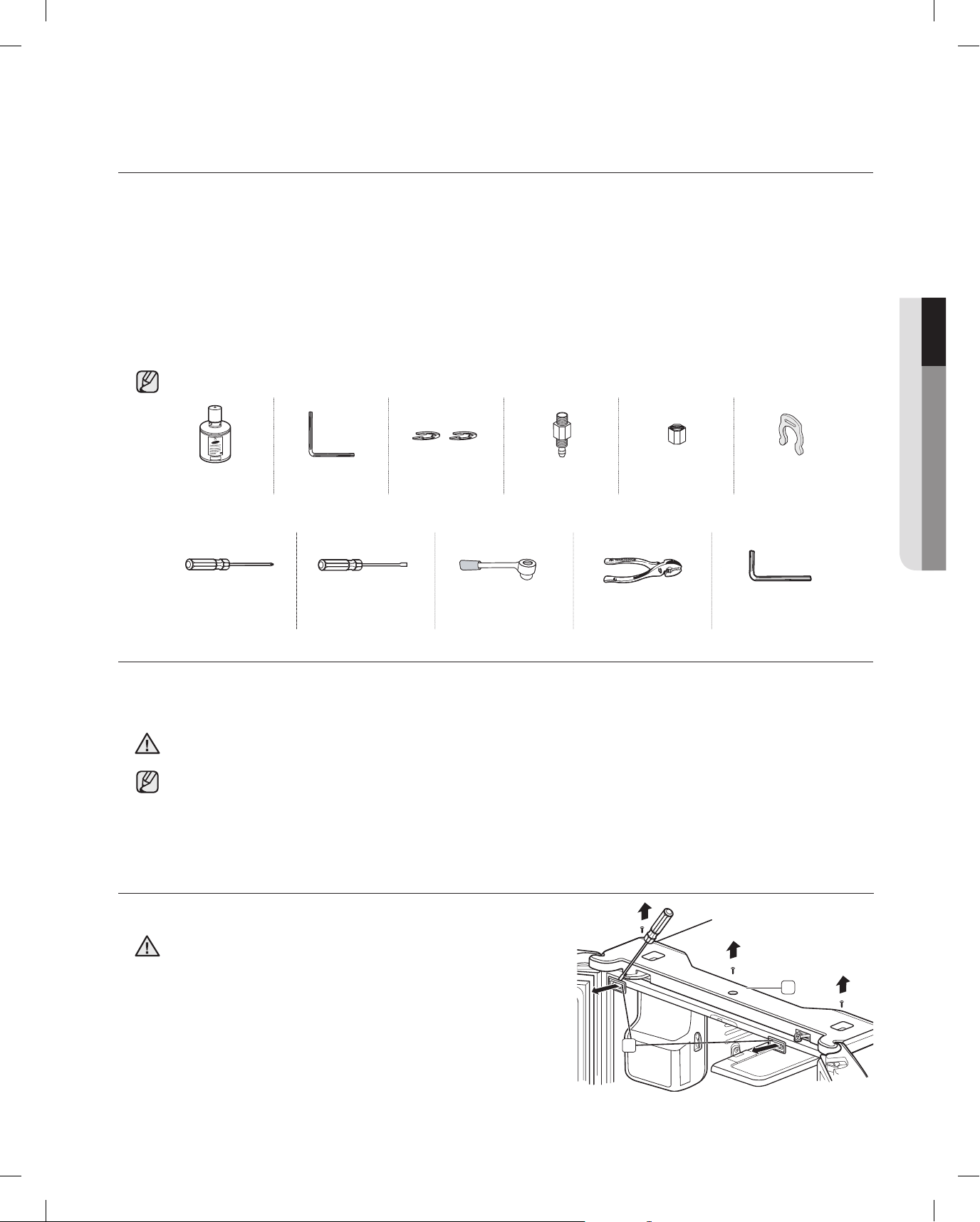
Philips screwdriver(+) Flat-blade screwdriver(-) Socket wrench (7/16”) Pliers Allen wrench(3/16”)
Water filter Hex wrench Fastener Compression fitting Compression nut Clip fitting lock(red)
Some installations require door removal to transport the Refrigerator to its final location.
Do not remove the door/drawer if it is not needed. Before removing the door/drawer, make sure you read
following items.
Disconnect power to the Refrigerator before removing the door or drawer.
WARNING
Be careful not to drop and scratch the doors while removing the
doors.
WARNING
• Be careful not to drop, damage or scratch the door/drawer while removing them.
• Be careful not to get injured while removing the door/drawer.
• Reattach the door/drawer properly to avoid:
- Moisture from air leakage.
- Uneven door alignment.
- Wasting energy due to improper door seal.
Check the accessories listed below.
2
1
Disassemble the Refrigerator doors
Disassemble the Refrigerator doors
1. With the door opened, remove the cap top table ( 1 ) with
a flat-blade screwdriver(-), and close the door.
Remove the 3 screws holding down the top table ( 2 ) and
remove it.
10_ Setting up
Setting up your French Door Refrigerator
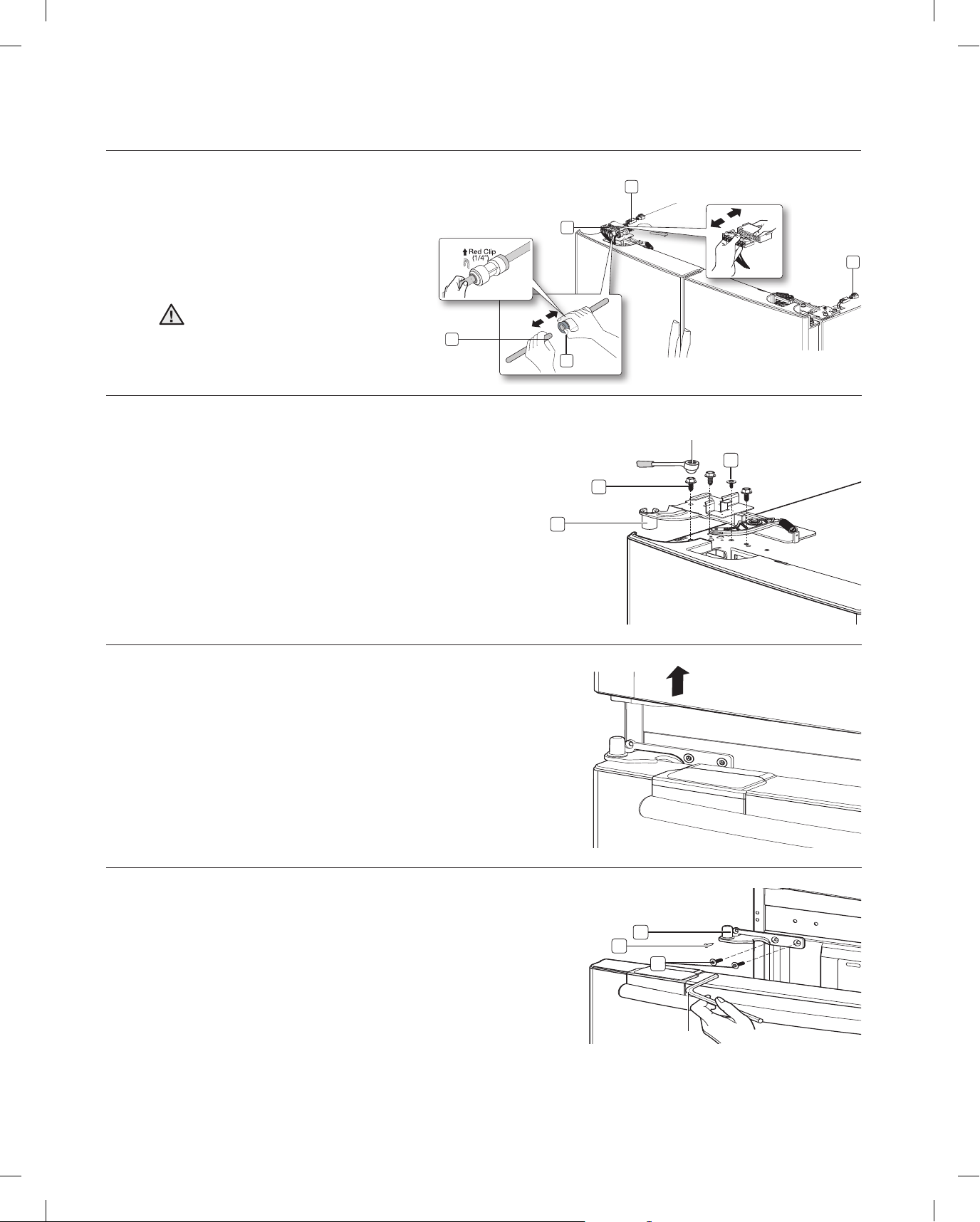
2. Disconnect 2 connectors ( 3 ) at each
side of the top cap and one connector
( 4 ) on the left side door. Remove the
water line ( 5 ) while pressing the dark
gray color part ( 6 ) of the water line
coupler.
3. Remove the 3 hex head bolts ( 7 ) attached to the
upper left and right door hinges with a socket wrench
(7/16”). Remove the ground screw ( 8 ) attached to
the upper left and right door hinges with a philips
screwdriver(+).
Remove the upper left and right door hinges ( 9 ).
4. Lift the door straight up to remove.
5. Remove the screw ( 10 ) attached to the lower left
and right door hinges with a philips screwdriver(+).
Remove the 2 hex head bolts ( 11 ) attached to the
lower left and right door hinges with an allen wrench
(3/16”).
Remove the lower left and right door hinges ( 12 ).
Socket wrench
9
7
8
5
6
4
3
3
12
10
11
Allen wrench
If a red clip is on the coupler, it must
be removed before removing the
tube.
CAUTION
Setting up _11
01 SETTING UP
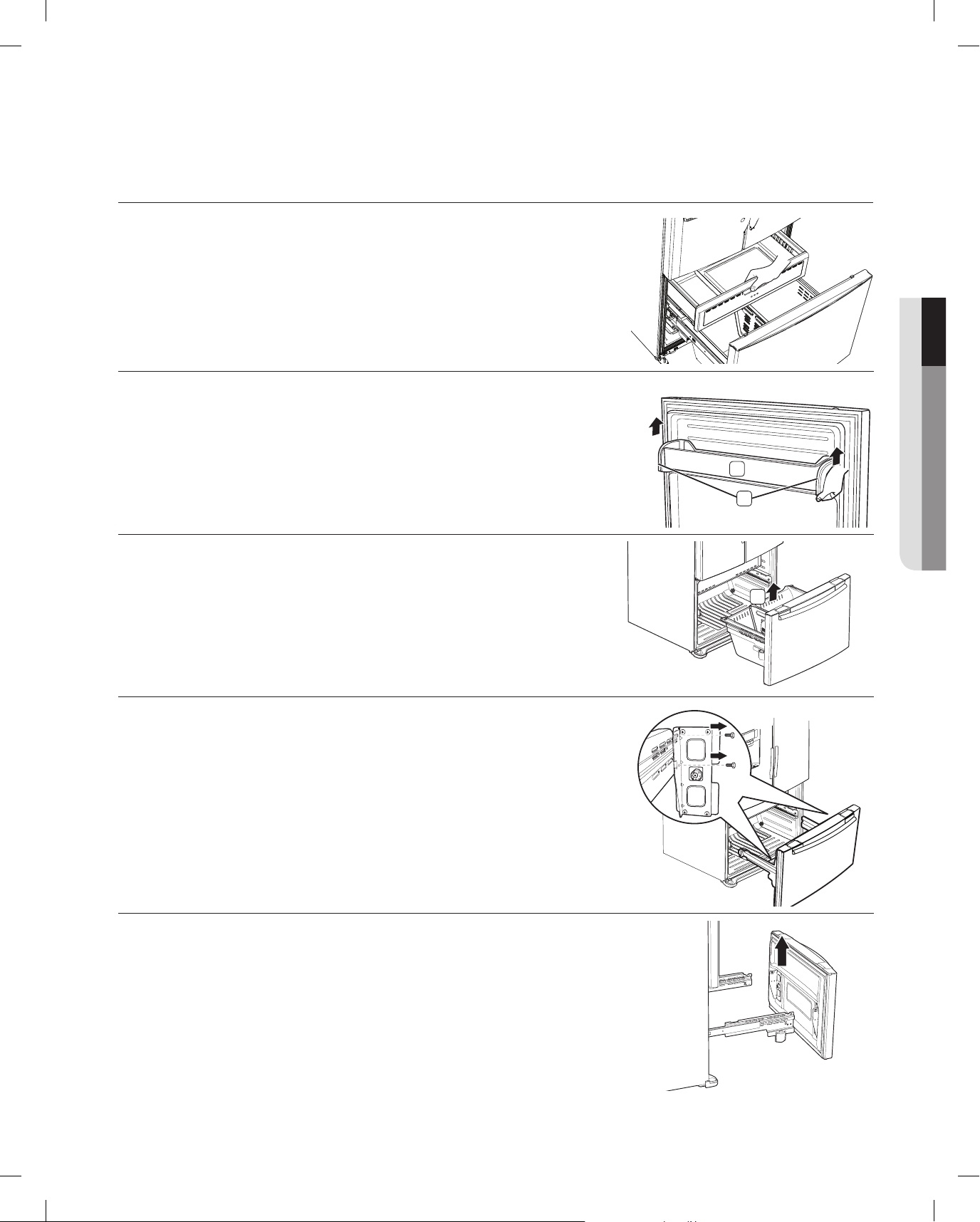
1. Take out the upper drawer by lifting it up.
2. Remove the tilting pocket ( 1 ) by pulling both support
guards ( 2 ) upward at the same time.
3. Take out the lower basket( 3 ) by lifting the basket up
from the rail system.
4. Remove 4 hex head bolts from both sides with a
socket wrench(7/16”).
5. Lift up the freezer door from the rails.
1
2
3
Slot
Slot
DISASSEMBLE THE FREEZER DRAWER
12_ Setting up
Setting up your French Door Refrigerator
12
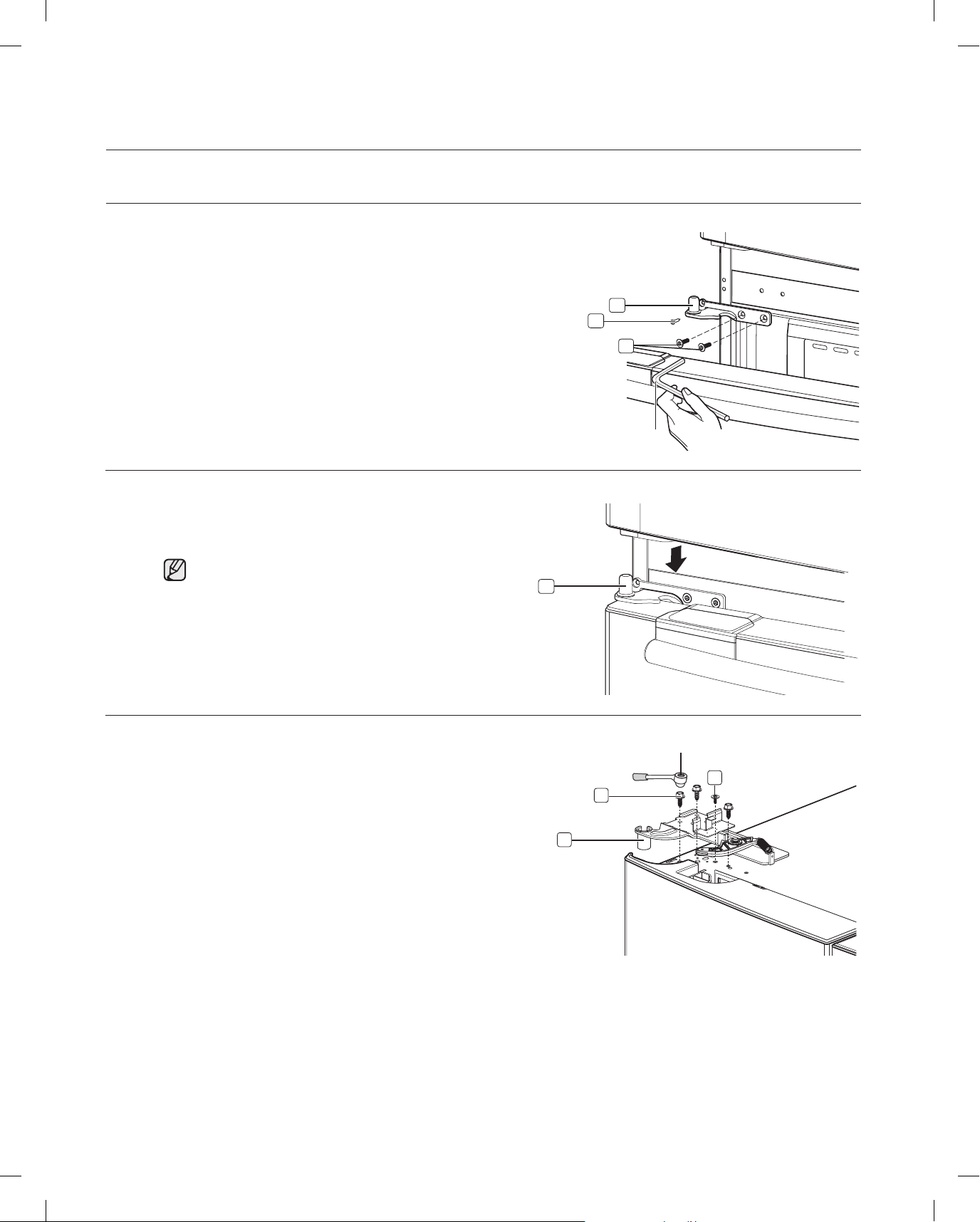
Assemble the Refrigerator doors
1. Reattach the lower left and right door hinges ( 12 ).
With a Philips head screwdriver, insert and tighten the
screw ( 10 ) into the lower left and right door hinges.
With a allen wrench(3/16”), insert and tighten the 2
hex head bolts ( 11 ) into the lower left and right door
hinges.
2. Place the hole in the bottom of the door over the door
hinge ( 12 ).
3. Insert the upper hinges ( 9 ) into the holes at the top
of the doors.
Insert and tighten the 3 hex head bolts ( 7 ) into
the upper left and right door hinges with a socket
wrench(7/16”).
Insert and tighten the ground screw ( 8 ) into the
upper left and right door hinges with a philips
screwdriver(+).
REATTACHING THE REFRIGERATOR DOORS
12
10
11
Allen wrench
7
8
9
Socket wrench
Be careful not to miss the hinge cap because it
can be easily taken off.
Setting up _13
01 SETTING UP
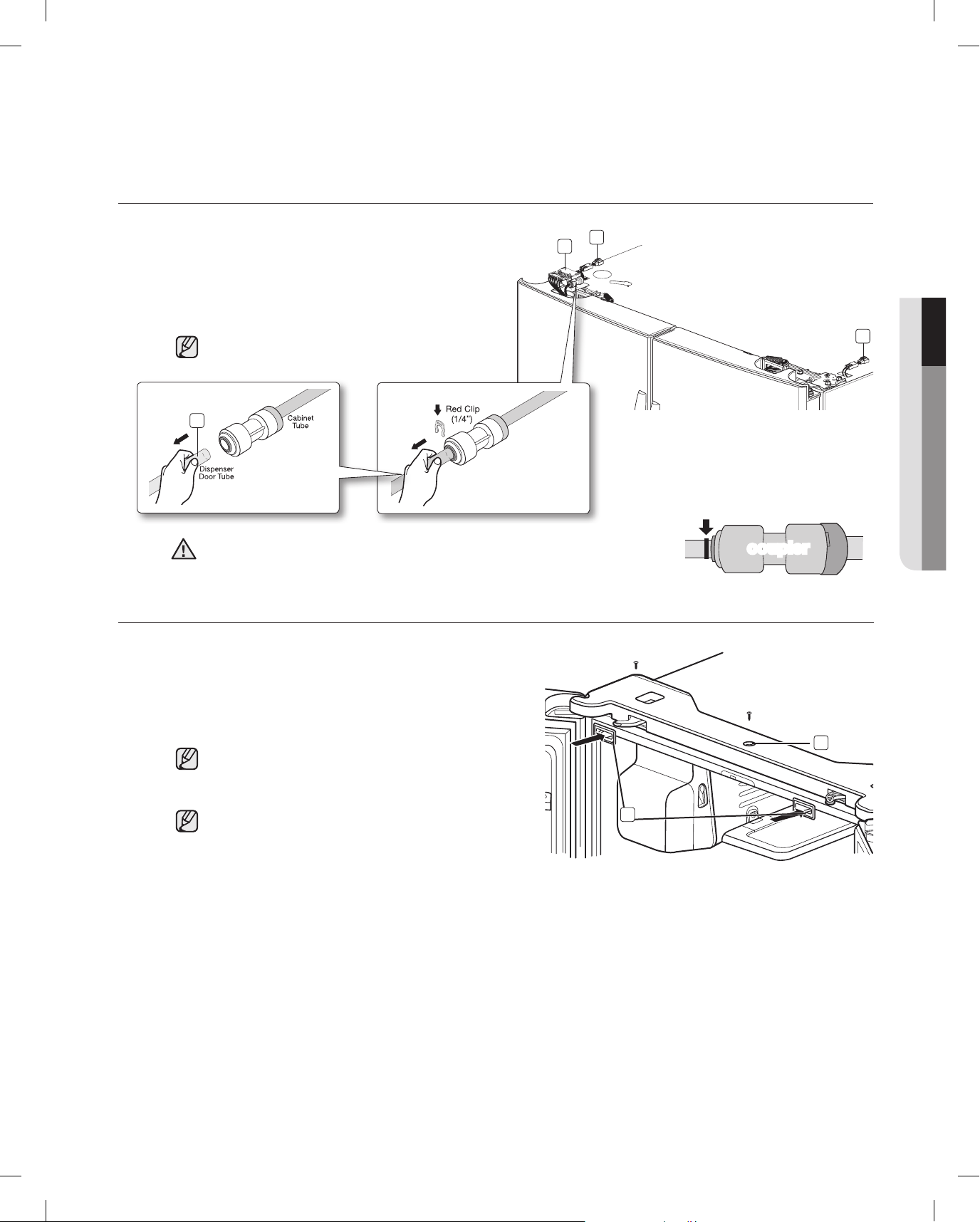
5. Position the top table ( 2 ) in place. Insert and tighten
the 3 screws into the top table with a philips screw
driver(+). With the doors open, reinsert the cap top
table ( 1 ) and close the doors.
REATTACHING THE REFRIGERATOR DOORS
1
2
3
3
4
5
dispenser door tube
The dispenser door tube ( 5 ) must be fully inserted to the marked
line to prevent water leakage from the dispenser.
CAUTION
4. Connect the dispenser door tube ( 5 ) and then
insert a clip on the coupler with pulling tube.
Connect the connector ( 4 ) on the left side door
and two connectors ( 3 ) at each side of the top
cap.
The clip is enveloped inside of the top cap.
When reattaching the top table, make sure that
the wires are not pressed or damaged by the
hinge cover.
After assembling, close the doors and check
to see whether the doors have gaps between
gaskets or are tilted. If you see a gap or tilt
please refer to “Adjusting the doors” on page 15.
14_ Setting up
Setting up your French Door Refrigerator
7
8
9
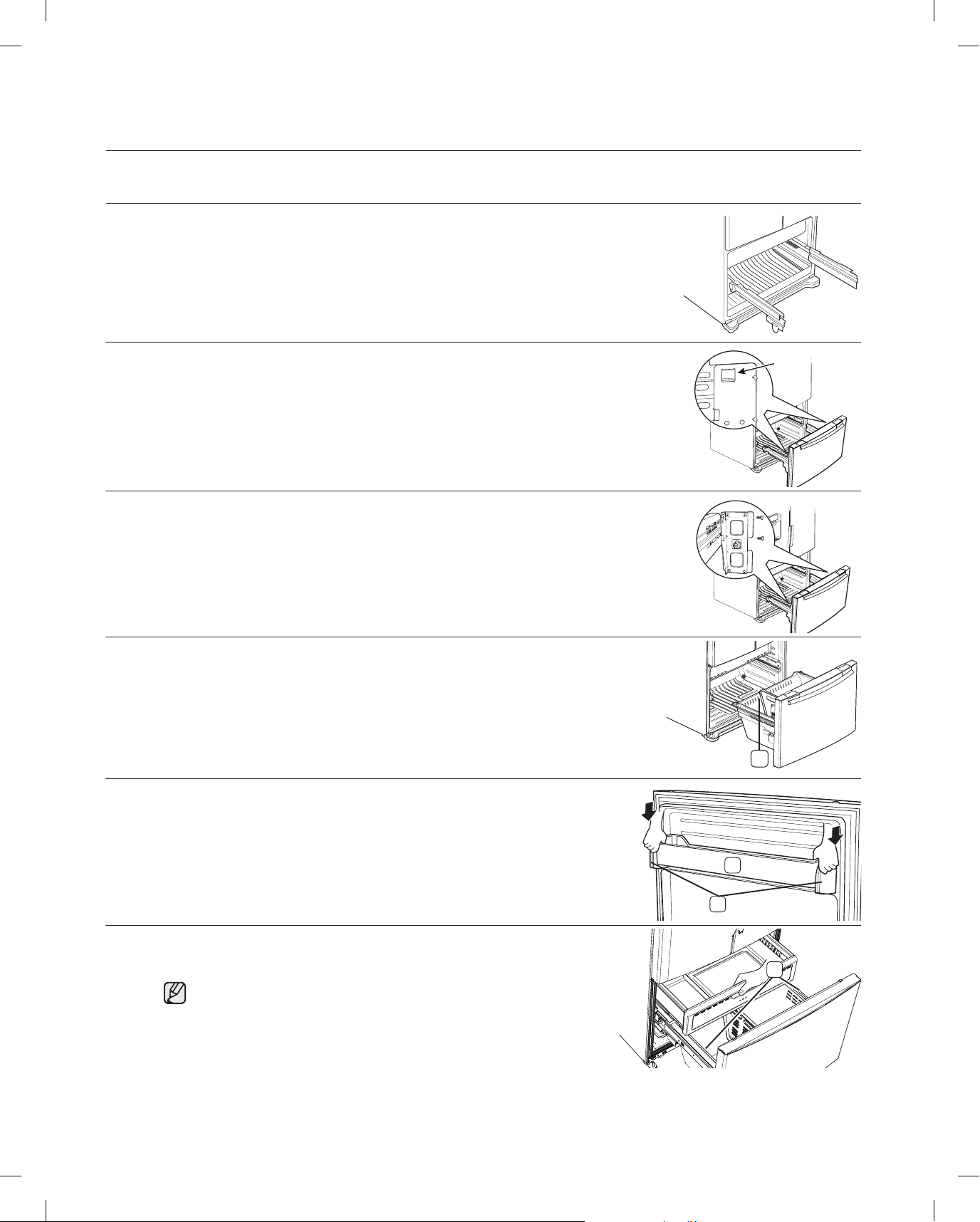
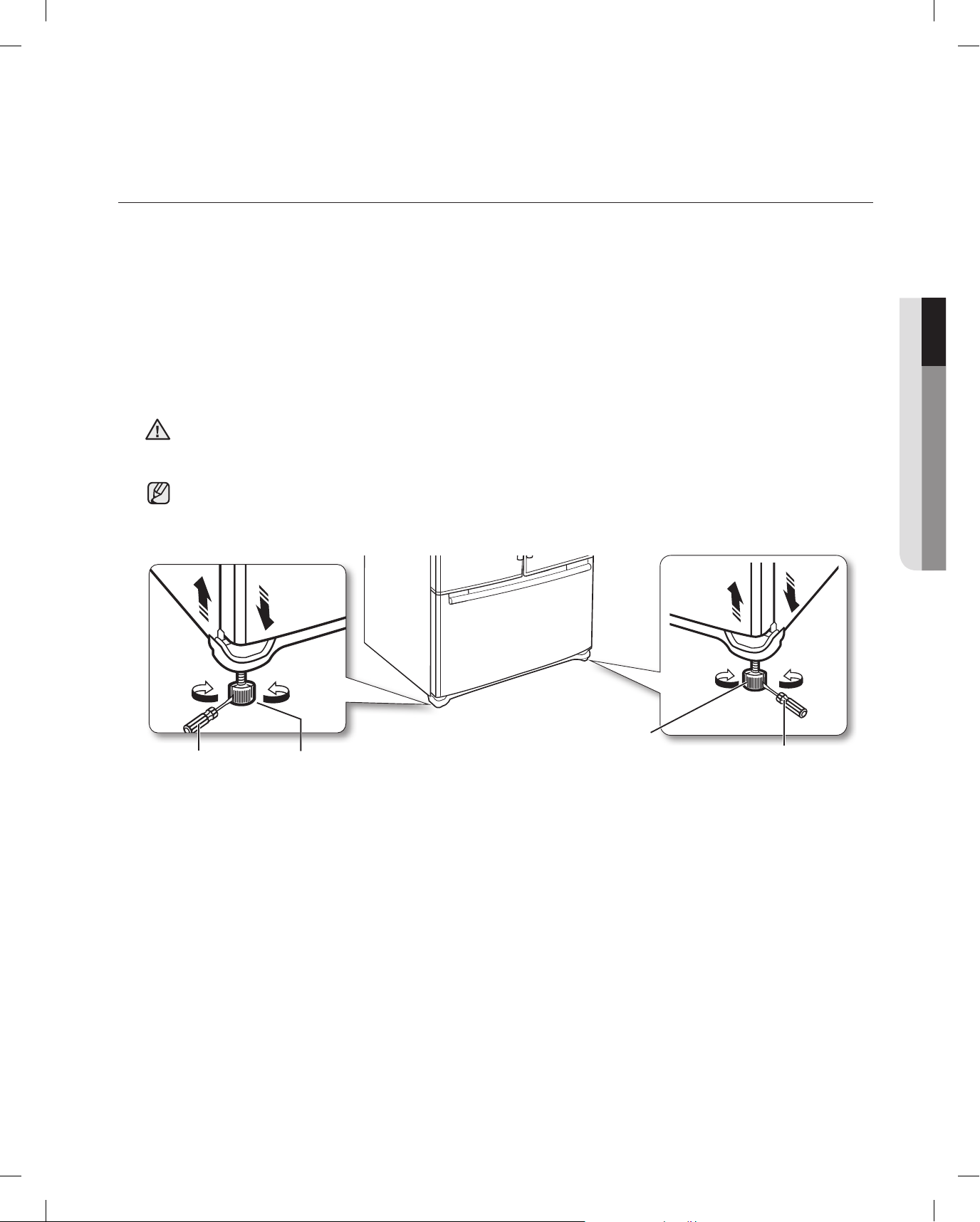
ASSEMBLE THE FREEZER DRAWER
1. Pull out the rails fully on each side of the cabinet.
2. Attach the freezer door front onto the open slots on the sides.
3. Tighten 4 hex head bolts completely with a socket
wrench(7/16”).
4. Insert the lower basket ( 6 ) into the rail system.
5. Hook the ends of the tilting pocket ( 7 ) onto the support
guards ( 8 ) and push down until they lock into place.
6. Insert the upper drawer.
Slot
Slot
Slot
Slot
Slot
Slot
6
Remove 2 pieces of tape ( 9 ) attached to the side of the
drawer bin.
Reattach the tape in the same position when moving the
refrigerator to prevent scratching the drawer bin.
Setting up _15
01 SETTING UP
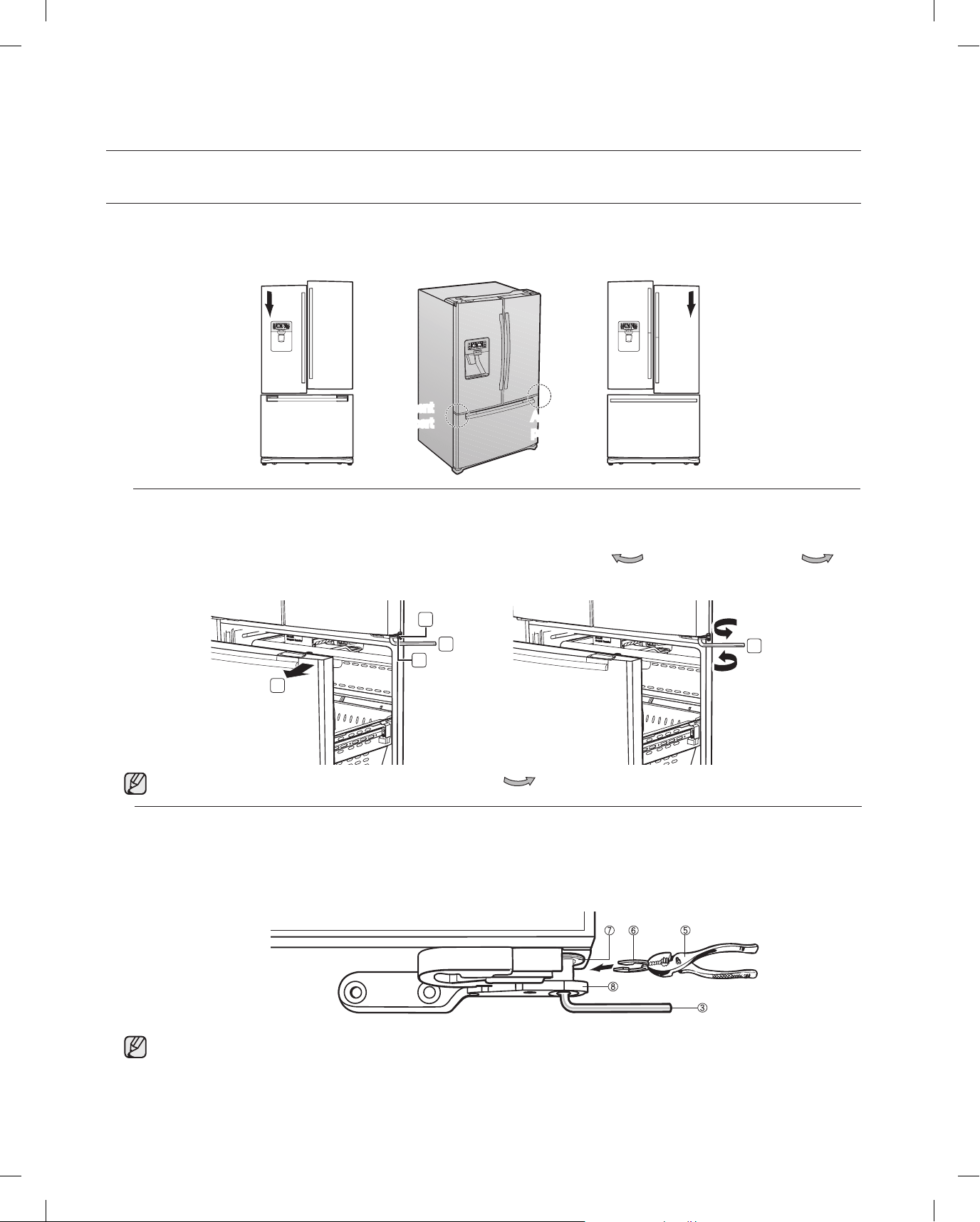
ADJUSTING THE DOORS
After putting the doors back on the refrigerator, make sure the refrigerator is level so that you can make final
adjustments.
If the Refrigerator is not level, it will not be possible to get the doors perfectly even, which may cause moisture
condensation and increased energy bills.
For example, when the left side is lower than the right side, insert a flat-blade screwdriver(-) into a notch on the
left control lever, and turn it counterclockwise to level the door.
Turn it clockwise to lower the refrigerator and counterclockwise to raise it.
Both control levers must be touching the floor to avoid possible personal injury or property damage
because of tipping.
CAUTION
We do not recommend making small adjustments with the control lever. Instead, refer to the next
page for the best way to make minor adjustments to the doors.
16_ Setting up
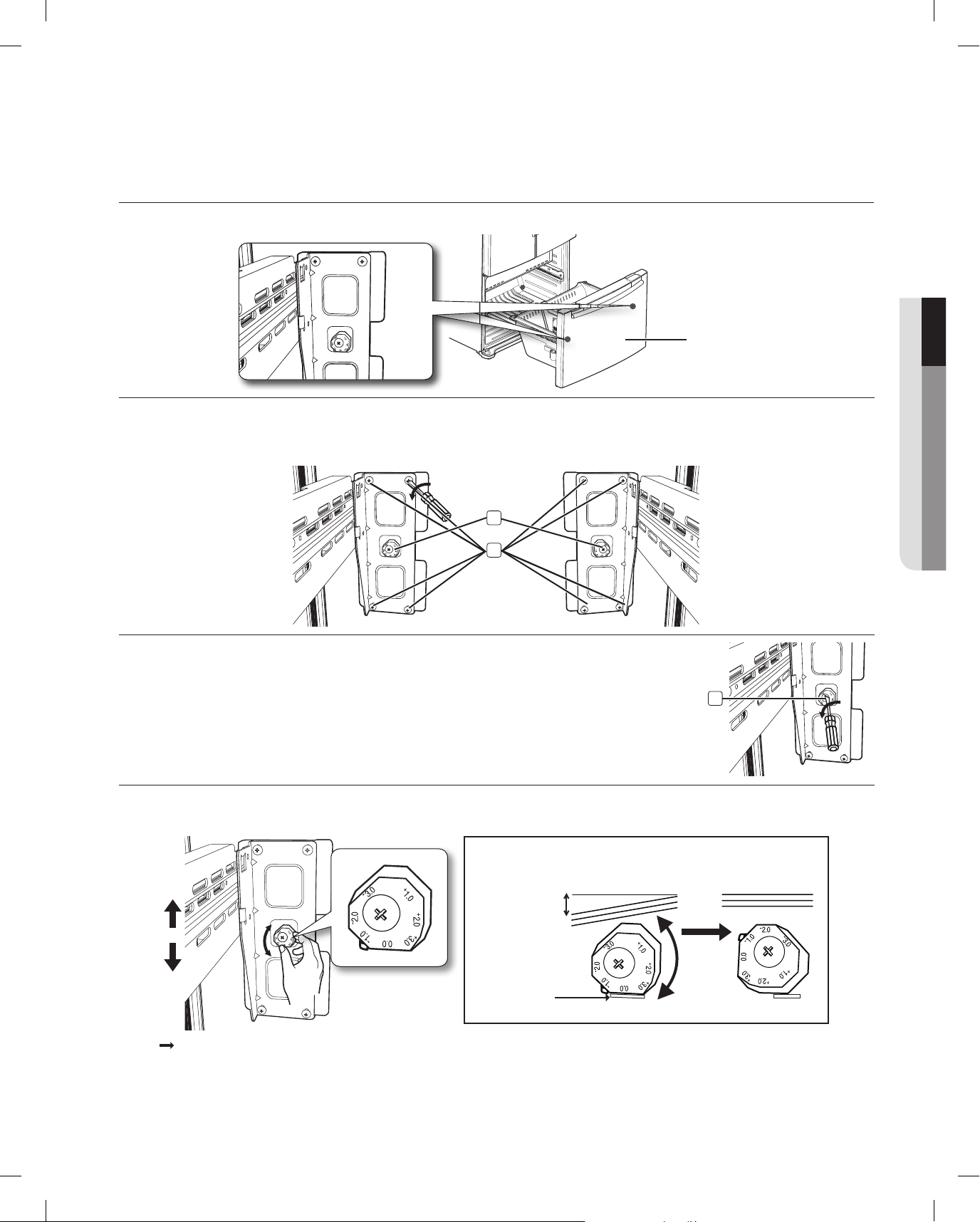
1. Pull out the freezer drawer ( 1 ), then you can see the middle hinge ( 2 ) .
2. Insert the supplied hex wrench ( 3 ) into the shaft ( 4 ) of the middle hinge.
3. Please adjust the height by turning the hex wrench ( 3 ) clockwise (
) or counter-clockwise ( ).
1. After adjusting the doors, please insert the supplied fastener ( 6 ) using pliers ( 5 ) in the gap between
the hinge-grommet ( 7 ) and the lower hinge ( ). The number of fasteners you’ll need to insert
depends on the gap.
MAKING MINOR ADJUSTMENTS BETWEEN DOORS
Remember, a level Refrigerator is necessary for getting the doors perfectly even. If you need help, review the
previous section on leveling the Refrigerator.
Setting up your French Door Refrigerator
When you turn the hex wrench counter-clockwise( ), the door will move up.
2 fasteners are enclosed with the refrigerator.
The thickness of each fastener is 0.04”.
When the left
door is lower
than the right
door.
When the left
door is higher
than the right
door.
Adjustment
part
Adjustment
part
3
2
3
4
1
Setting up _17
01 SETTING UP
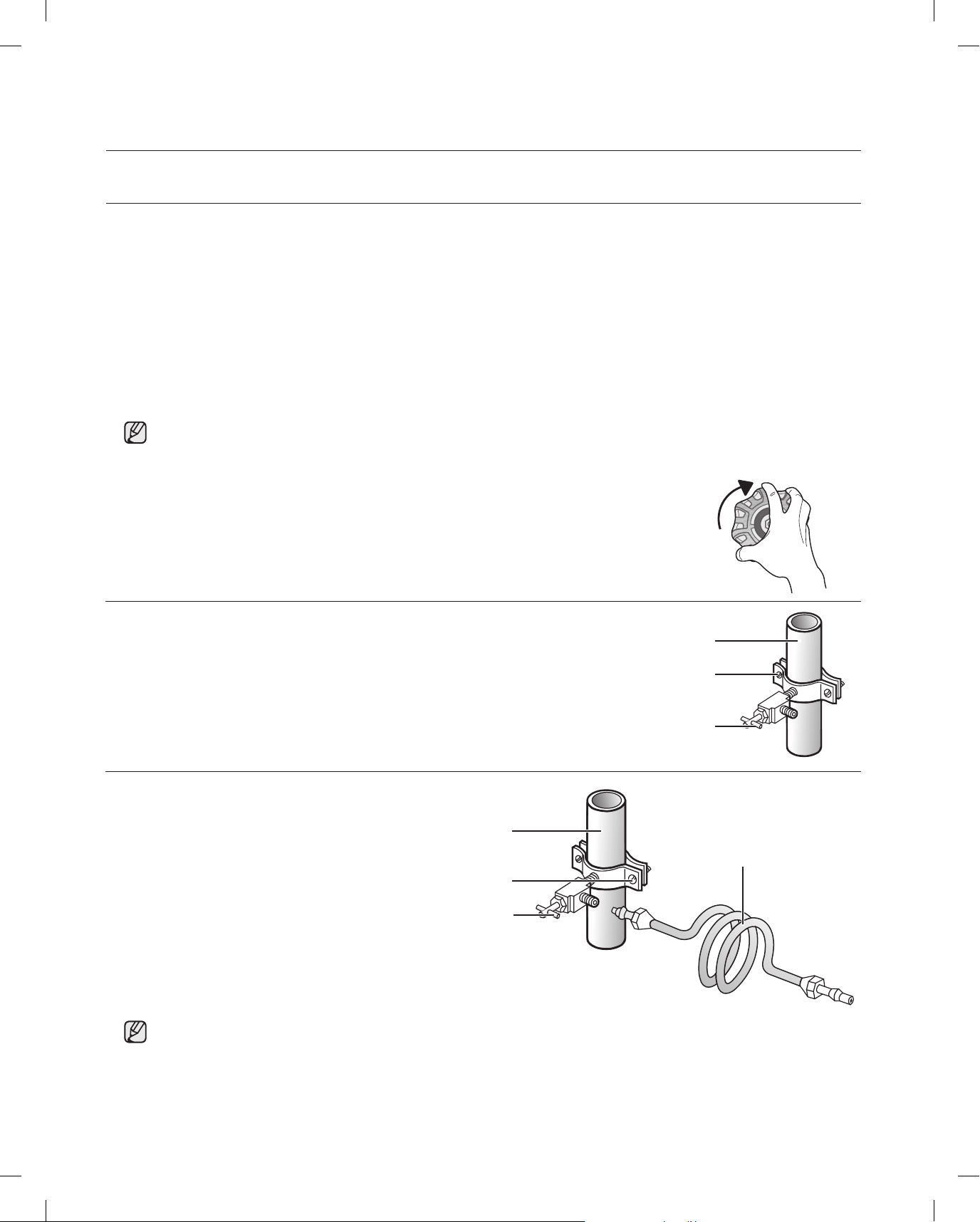
ADJUSTING THE FREEZER DRAWER LEVEL
1. Locate the height-adjuster ( 1 ) in the freezer drawer.
Unscrew the 8 Phillips screws ( 2 ) slightly to loosen the door.
3. Find the best level to align the door slope.
After adjustment, tighten the controller screw ( 3 ) and then philips screws.
Freezer Drawer
Adjustment part
2. Loosen the controller screw( 3 ) with a Phillips screwdriver(+).
3
2
1
Example) The slope is about 0.08inch(2mm) as shown below.
- Rotate the height adjuster to -2.0 to reduce the door slope.
Slope
Reference
plane
18_ Setting up
CHECKING THE WATER DISPENSER LINE
A water dispenser is one of the helpful features on your new Refrigerator. To help promote better health,
the water filter removes unwanted particles from your water. However, it does not sterilize or destroy
microorganisms. You may need to purchase a water purifying system to do that.
In order for the ice maker to operate properly, a water pressure of 20~125 psi is required.
Under normal conditions, a 170 cc (5.75 oz.) cup can be filled in 10 seconds.
If the Refrigerator is installed in an area with low water pressure (below 20psi), you can install a booster pump to
compensate for the low pressure.
Make sure the water storage tank inside the Refrigerator is properly filled. To do this, press the water dispenser
lever until the water runs from the water outlet.
Setting up your French Door Refrigerator
Water line installation kits are available at extra cost from your dealer. We recommend using a water line
installation kit that contains copper tubing and ¼” compression nut.
After connecting the water supply to the water filter, turn your main water supply back on and flush 4 or
more gallons into a bucket to clear and prime the water filter.
If water drop or leakage is found on the connection area, turn off the main water supply. Check it and, if
necessary, tighten it more.
Pipe clamp
Cold water line
Shut off valve
Shut off valve
Pipe clamp
Cold water line
Water line installation kit
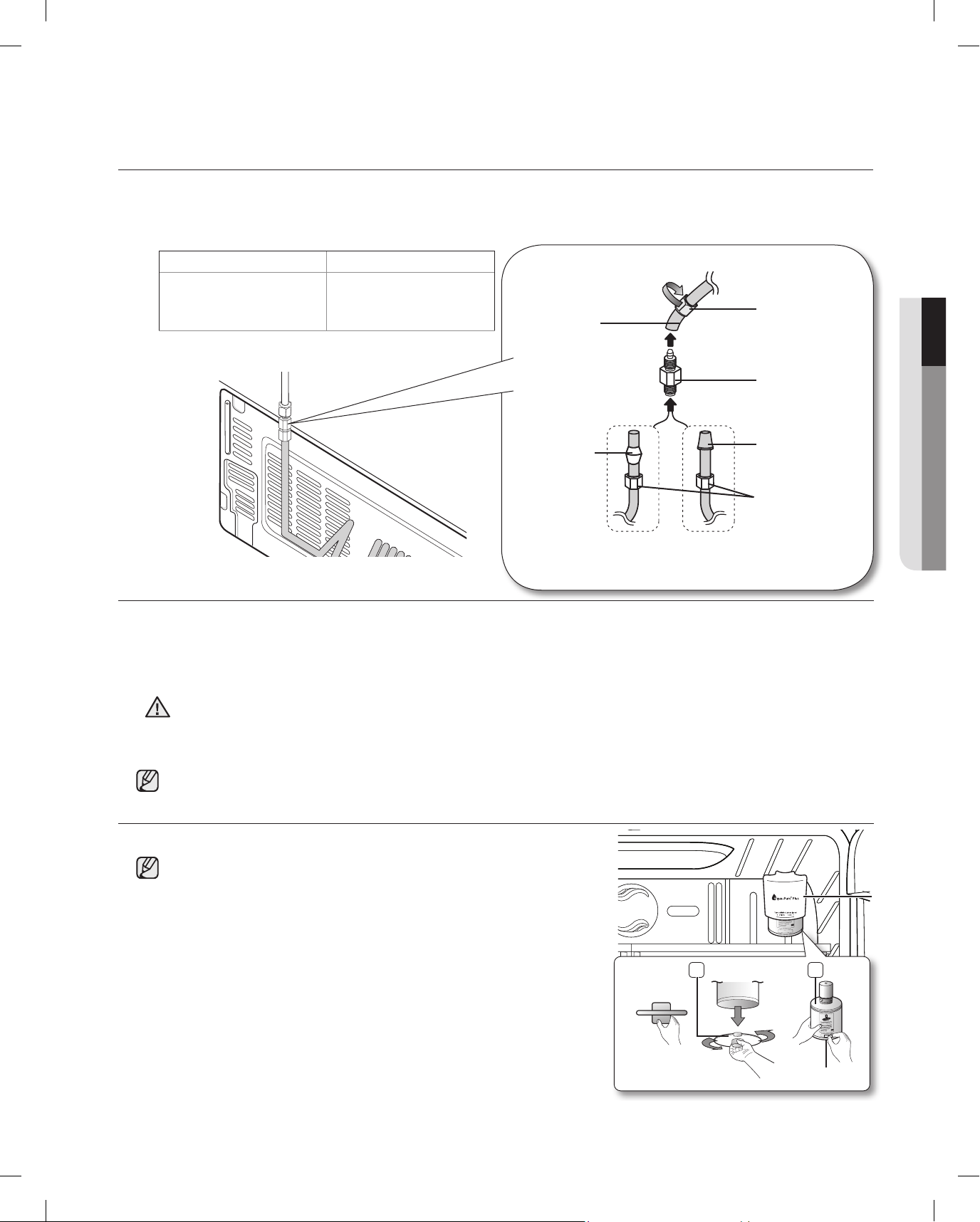
Connecting to the water supply line
1. First, shut off the main water supply.
2. Locate the nearest cold water drinking line and install
the pipe clamp and shut off valve.
3. Connect the water line installation kit to shut off valve.
Setting up _19
01 SETTING UP
INSTALLING THE WATER LINE
Only connect the water line to a drinkable water source.
If you have to repair or disassemble the water line, cut off 1/4“ of the plastic tubing to make sure you
get a snug, leak-free connection.
After removing the right side upper shelf, you can
install the water filter more easily.
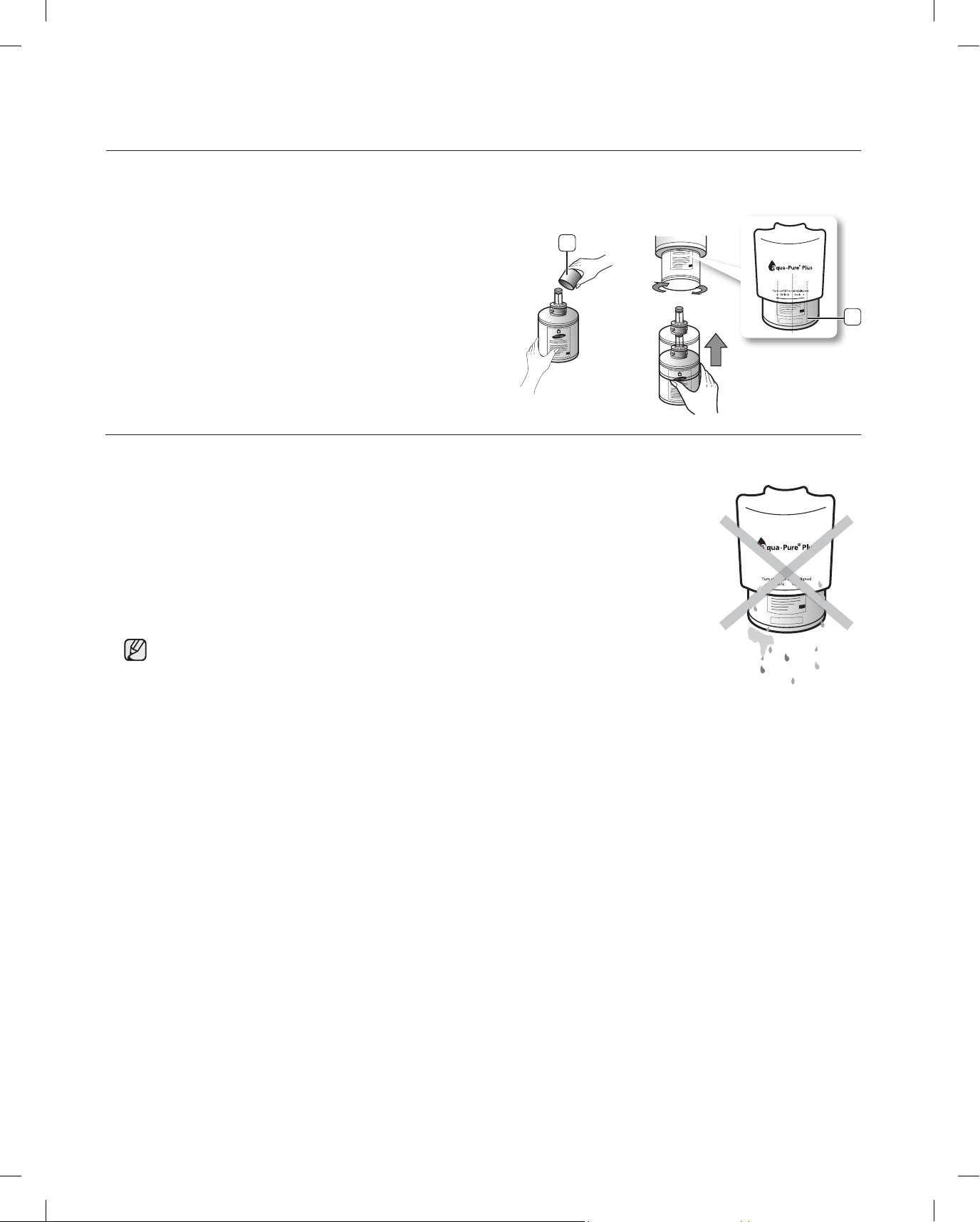
Connecting the water supply line to the refrigerator.
There are several items that you need to purchase to complete this connection.
You may find these items sold as a kit at your local hardware store.
1. Slip the compression nut (A) through the supplied plastic tubing (A) .
2. Tighten the compression nut (A) onto the 1/4” compression fitting.
- If you are using copper tubing, slip the compression nut (B) (not supplied) and ferrule (not supplied) on
copper tubing (not supplied) as shown.
-
If you are using plastic tubing (B), insert the molded end(Bulb) of the plastic tubing (B) into the compression fitting.
3. Tighten the compression nut (B) onto the compression fitting. Do not over-tighten the compression nut (B).
4. Turn water on and check for any leakage.
1. Remove the water filter cover ( 1 )
2. Remove the fixed cap ( 2 ) by turning it counter-clockwise. Keep
the cap in a safe place for later use if you don’t use the filter.
3. Remove the water filter ( 3 ) from the box and put a replacement
indicator sticker (Indicator sticker is included in the box) on
the filter as shown. Place the sticker on the filter that dates
six months in the future. For example, if you install the water
filter in March, put the “SEP” sticker on the filter to remind you
to replace it in September. This way, you can remember the
time to replace the water filter. Normally, a filter life is about 6
months.
2 3
Indicator sticker
(month indicator)
Plastic tubing (A)
(Supplied)
Ferrule
(Not supplied)
Compression nut (A)
(1/4”) (Supplied)
Compression fitting
(Supplied)
Molded end(Bulb)
Compression nut (B)
(1/4”) (Not supplied)
or
Copper tubing
(Not supplied)
(Not supplied)
Household water supply line
Refrigerator
Use Copper Tubing Use Plastic Tubing
•
¼” copper tubing
•
¼” compression nut (2pc)
•
Ferrule (2pc)
•
¼” plastic tubing
→ Molded end(Bulb)
•
¼” compression nut (2pc)
Do not use without the molded end(Bulb) of the plastic tubing (B) .
CAUTION
20_ Setting up
Setting up your French Door Refrigerator
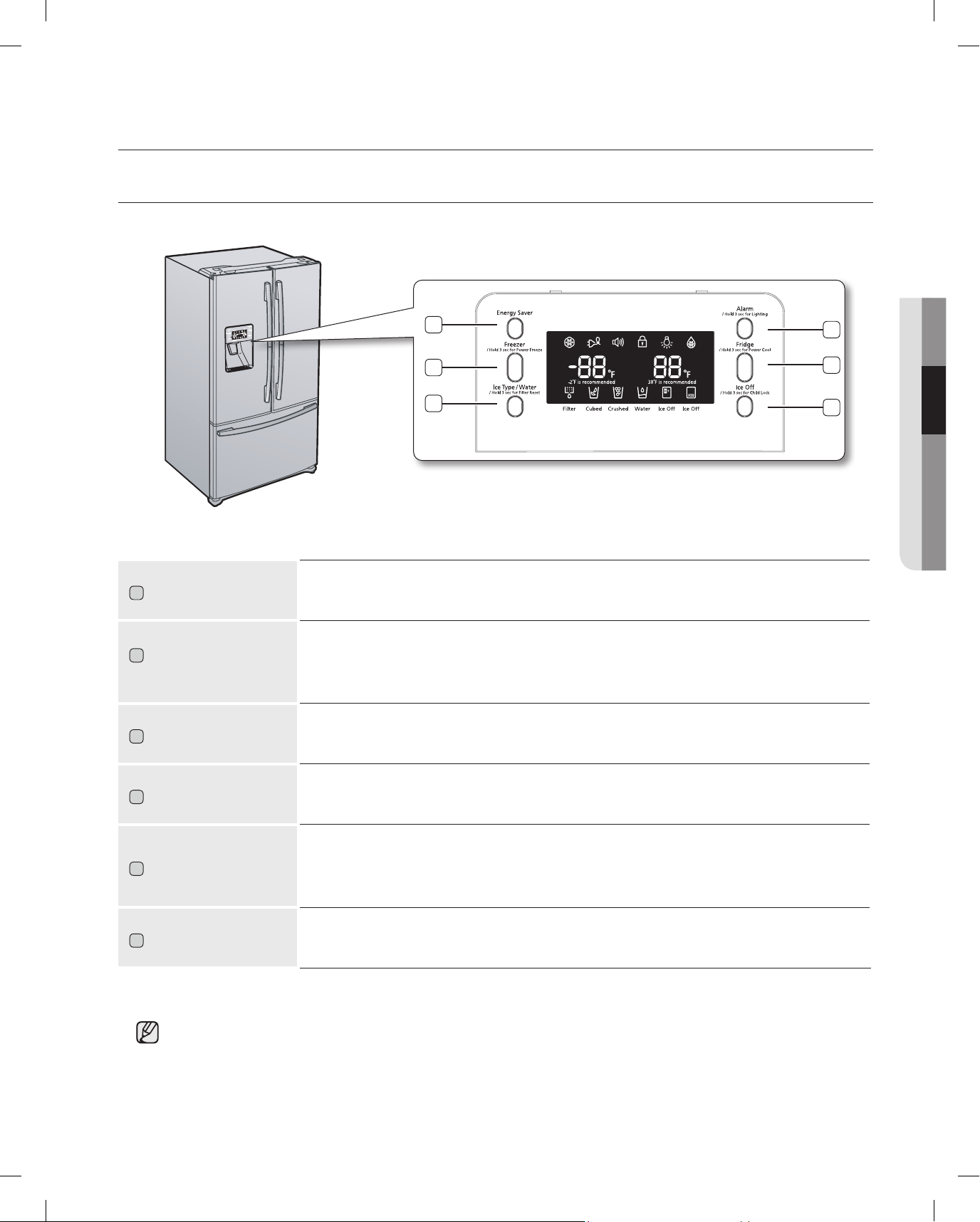
4. Remove the filter cap ( 4 ) and insert the filter
into the filter housing.
5. Slowly turn the water lter 90º clockwise to align
with the printing mark on the cover, locking the
filter in position. Make sure to align the water
filter label mark ( 5 ) with center of cover filter
printing as illustrated.
Remember, do not over-tighten.
Turn until the label
is aligned.
Separation
of filter cap(red)
Cover filter.
4
5
1. Turn on the main water supply & turn on the valve to the water supply line.
2. Run water through the dispenser until the water runs clear (approx. 6-7minutes).
This will clean the water supply system and remove air from the lines.
3. Additional clearing time may be required in some households.
4. Open the Refrigerator door and make sure there are no water leaks coming
from the water filter.
The pressure of the water supply coming out of a reverse osmosis system going to the
water inlet valve of the refrigerator needs to be between 35 and 120 psi (241 and 827 kPa).
If a reverse osmosis water filtration system is connected to your cold water supply, the water pressure to
the reverse osmosis system needs to be a minimum of 40 to 60 psi (276 to 414 kPa.)
If the water pressure to the reverse osmosis system is less than 40 to 60 psi (276 to 414 kPa):
• Check to see whether the sediment lter in the reverse osmosis system is blocked. Replace the lter if
necessary.
• Allow the storage tank on the reverse osmosis system to rell after heavy usage.
• If your refrigerator has a water lter, it may further reduce the water pressure when used in conjunction
with a reverse osmosis system. Remove the water filter.
If you have questions about your water pressure, call a licensed, qualified plumber.
Be sure to flush the dispenser thoroughly or water may leak from it.
This is due to the fact that there is still air in the line.
Operating _21
02 OPERATING
Some functions are activated after a few-second delay when the buttons are pressed, while others
operate immediately. This is normal operation.
Operating your French Door Refrigerator
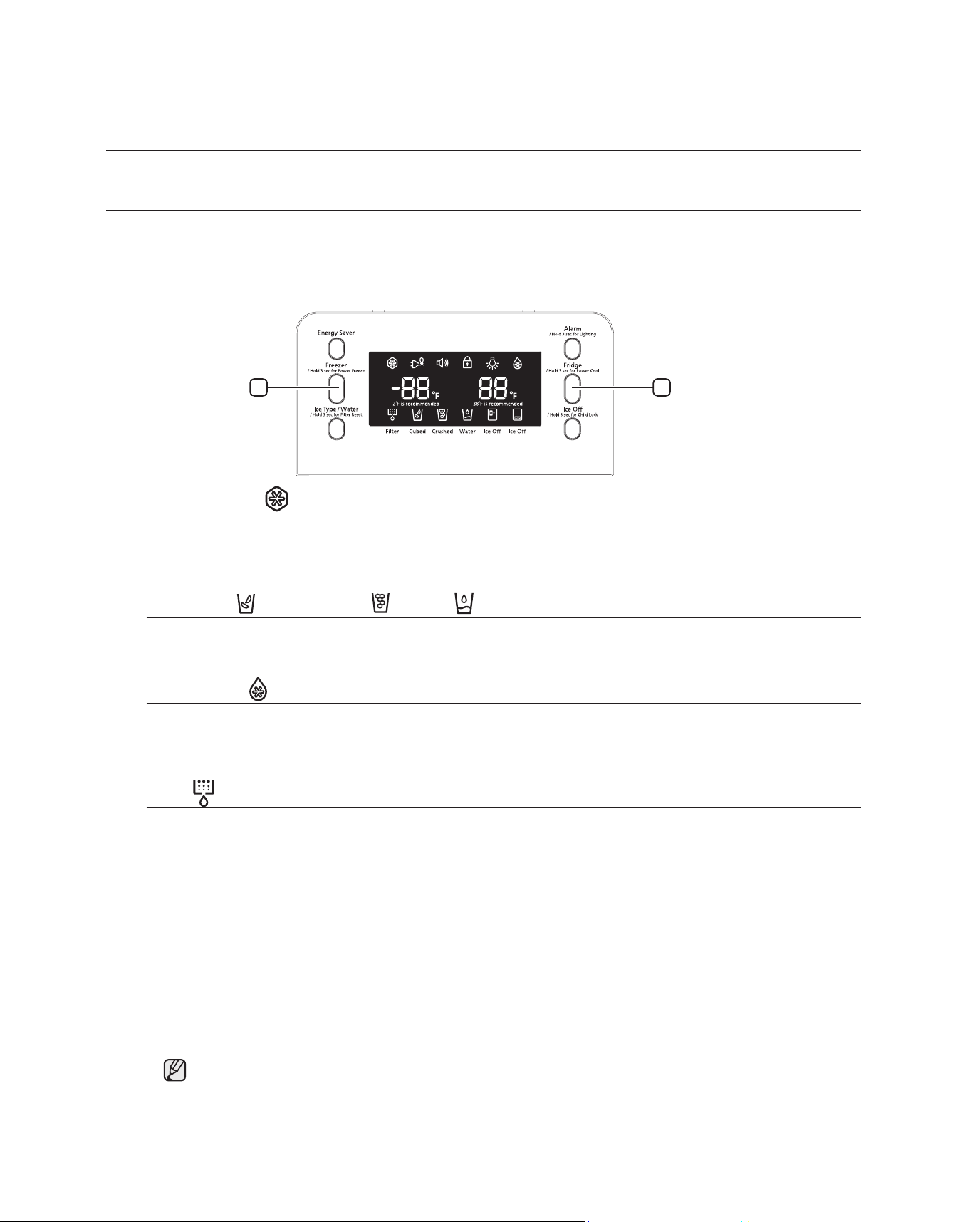
1
2
3
4
5
6
1
Press the button for better energy efficiency. If water drops appear on the doors, turn
the function off.
2
Press the button to set the Freezer to your desired temperature.
You can set the temperature between -8°F and 8°F
Press and hold the Button for 3 seconds, to speed up the time needed to
freeze products in the Freezer. It can be helpful if you need to quickly freeze easily spoiled items or if
the temperature in the Freezer has warmed dramatically (For example, if the door was left open).
3
Press the button to select the ice or water function. You can select water or the types of
ice(cube/crushed ice).
After making a selection, press the dispenser lever.
4
Press the button to turn off the door open alarm. The default alarm mode is On.
If you press and hold the button for 3 seconds, the Dispenser LED Lamp will stay
on.
5
Press the button to set the fridge to your desired temperature.
You can set the temperature between 34°F and 46°F.
Press and hold the button for 3 seconds to speed up the time needed to cool
products in the Refrigerator. It can be helpful if you need to quickly cool easily spoiled items or if the
temperature in the fridge has warmed dramatically (For example, if the door was left open).
6
Press the button to turn the ice making function off.
If you press and hold the button for 3 seconds, the Display and Dispenser will be
locked.
USING THE CONTROL PANEL
22_ Operating
Operating your French Door Refrigerator
USING THE CONTROL PANEL
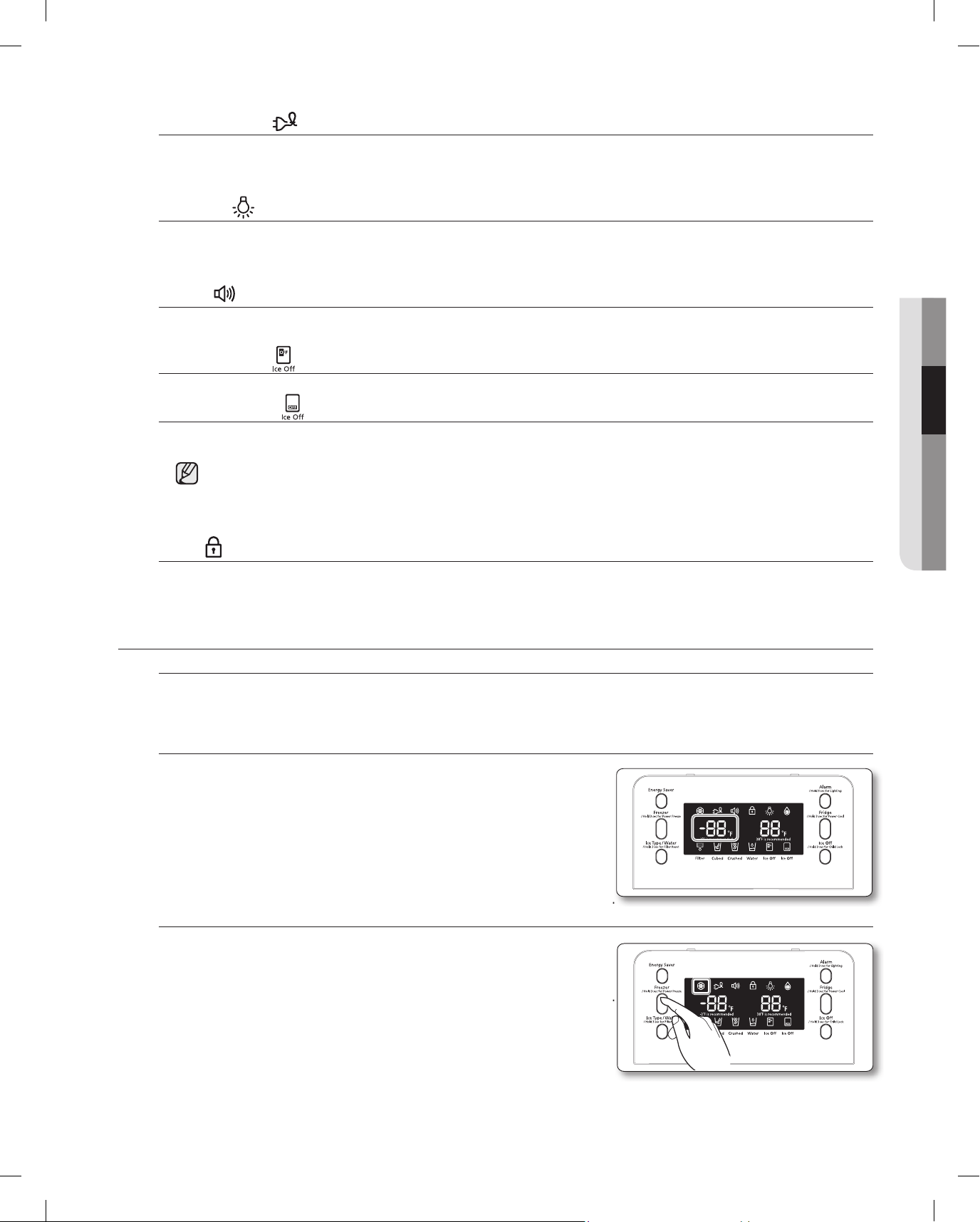
1 2
indicates the current Freezer temperature.
indicates the current Refrigerator temperature.
If you do not press any button, the freezer & fridge temperature indicator will turn off in a few seconds.
If any button is pressed, the display will light up again.
This icon will light up when you press the button for 3 seconds. Power Freeze
is great when you need a lot of ice. When you have enough ice, just press the same button again for 3
seconds to cancel the Power Freeze mode. After 2 and a half hours, Power Freeze mode will turn off
automatically to decrease energy consumption.
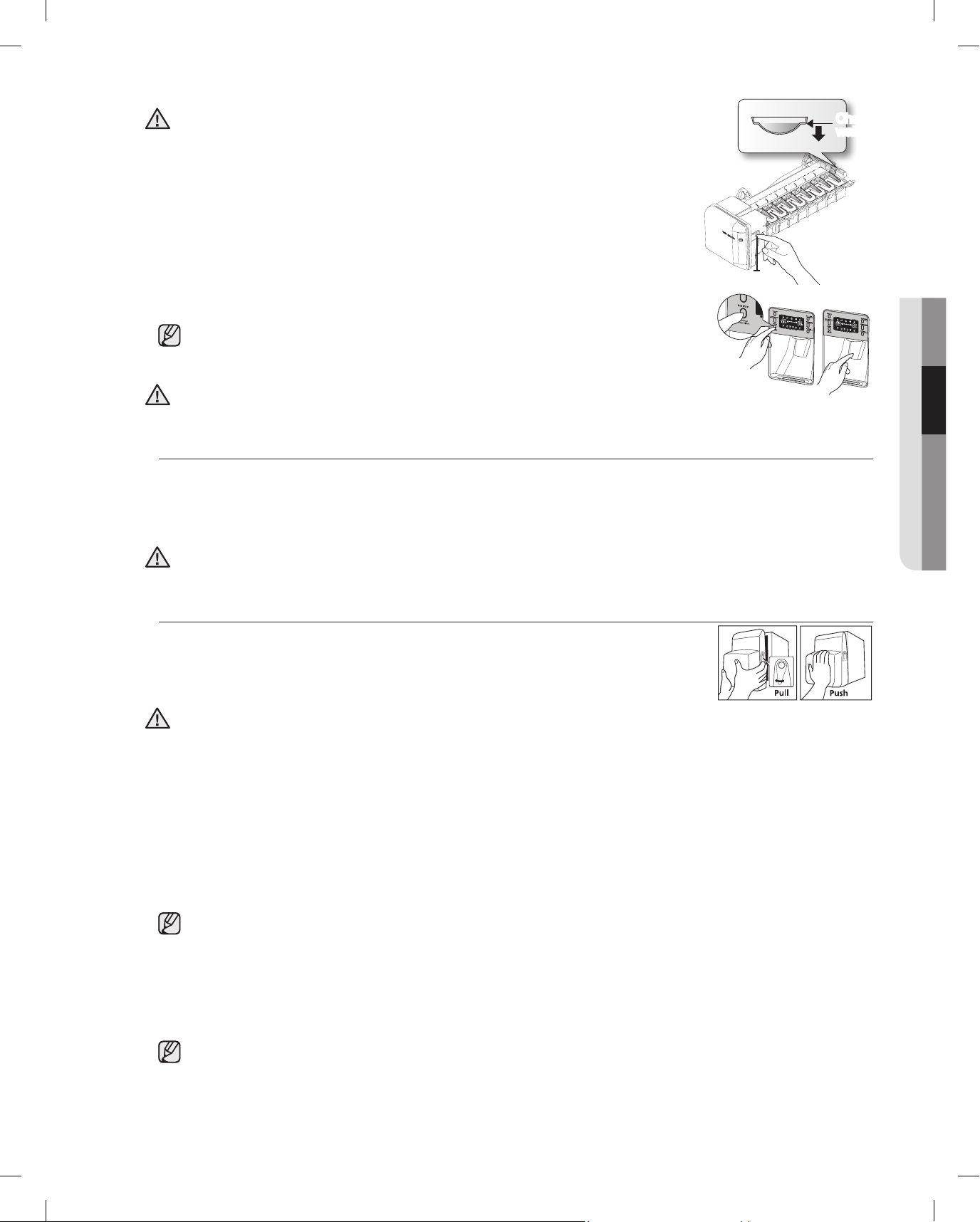
Cubed Ice
Enjoy cubed or crushed ice by selecting your preference from the digital control panel. If you don’t need
ice, turn the function off to save on water and energy consumption. Each Ice type icon will light up
depending on what is currently chosen.
Power Cool
This icon will light up when you press the button for 3 seconds. For a quick fridge
cool down, use Power Cool mode. If you want to cancel the Power Cool mode, just press the same
button again for 3 seconds. After 2 and a half hours, Power cool mode will turn off automatically to
decrease energy consumption.
Cooling Off stops cooling in the freezer and refrigerator compartments, but does not shut off electrical
power to the refrigerator. To use this feature, press Button and
Button simultaneously for 3 seconds until an alarm sound is heard. To cancel this mode, press the same
buttons again for 3 seconds.
Filter
When the filter indicator light is on, it is time to change the filter. Typically this happens about every 6 months.
The filter indicator will be Blue when you initially insert the water filter.
The filter indicator will be Light Pink when you have used your water filter for 270 gallons.
The filter indicator will be Red when you have used your water filter for 300 gallons.
After removing the old water filter and installing a new one(see page 36 for instructions on how to do this)
when the filter indicator is red, reset the indicator by pressing and holding the “Alarm/Hold 3 sec for Filter
Reset” button for 3 seconds.(The filter indicator will be blue or yellow green when the indicator is reset.)
This function is for store display refrigerators. It is not for customer use.
Operating _23
02 OPERATING
CONTROLLING THE TEMPERATURE
This icon will light up when you press the button. The Energy Saver function is
automatically set to “ON” when power is supplied to the Refrigerator. If condensation occurs on the doors,
turn the Energy Saver mode off.
Lighting
This icon will light up when you press the button. In this case, the dispenser light(under the
display) will be on constantly. If you would like the dispenser light to come on only when using the
dispenser, turn the Lighting mode off.
Alarm
This icon will light up when you press the button. The door alarm will sound if any door is open for
more than 3 minutes. The beeping stops when you close the door. Initially the Alarm is set to on.
Fridge ice off
This icon will light up when you press the button. In this case, the fridge ice will not be produced.
This icon will light up when you press the button. In this case, the freezer ice will not be
produced.
Lock
This icon will light up when you press the button. In this case, you won’t be able to use the control
panel. If you press and hold the Ice Off/Hold button for 3 sec to unlock Child Lock, you will be able to use
the control panel again.
• As this refrigerator has a dual Ice Maker, there is a possibility of using more energy. We
recommend if you have enough ice, set ice off to save energy.
• You may occasionally hear noises from Ice dropping or water owing to the icemaker. These
noises are part of normal operation.
The basic temperature and/or recommended temperatures of the Freezer and Refrigerator Compartments are -2°F
and 38°F respectively.
If the temperature of Freezer and Refrigerator Compartments are too high or low, adjust the temperature manually.
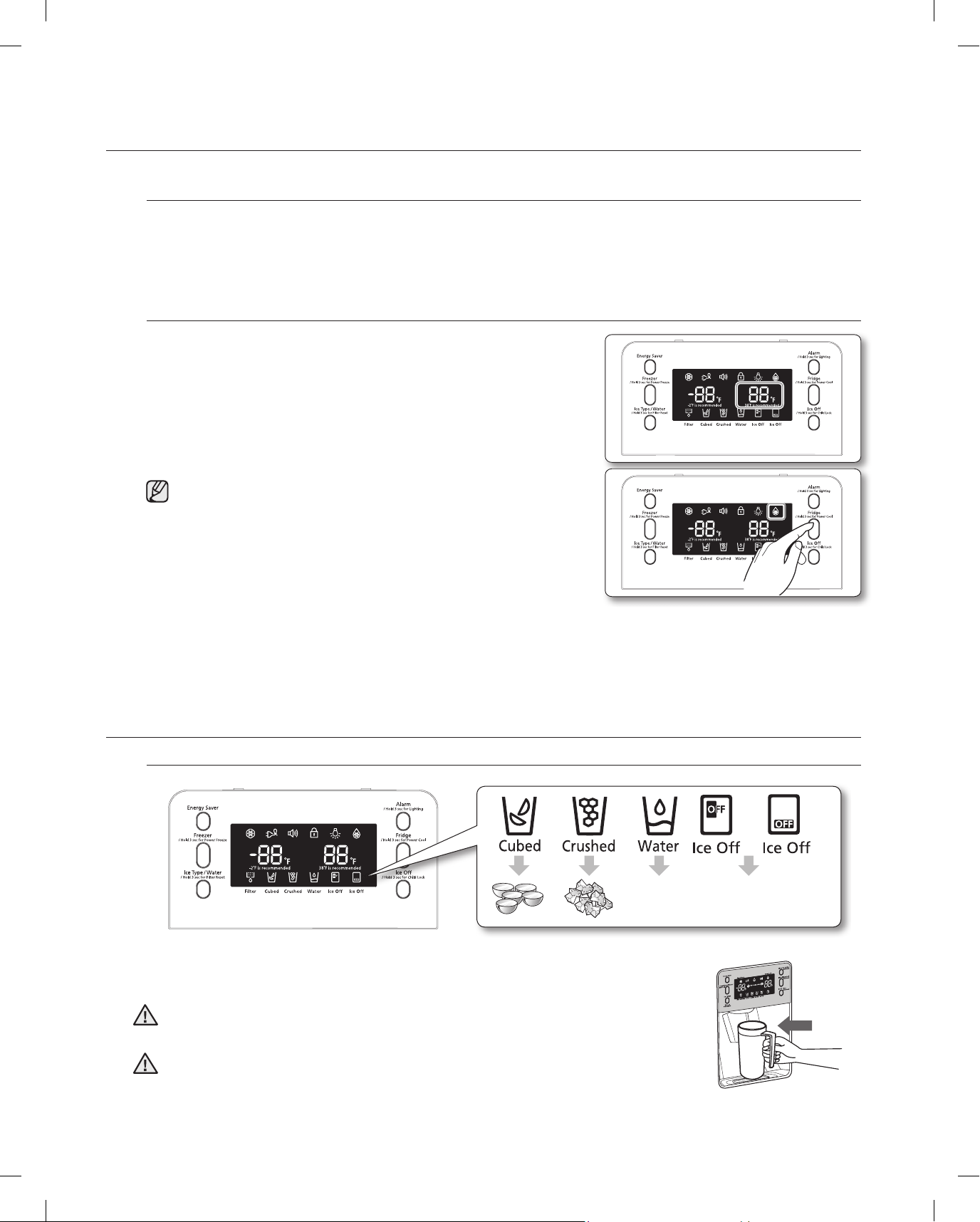
The Freezer temperature can be set between -8°F and 8°F to suit your
particular needs. Press the Freezer button repeatedly until the desired
temperature is shown in the temperature display. The temperature will
move 2°F degrees with each press (-2°F ➝ -4°F ➝ -6°F ➝ -8°F ➝ 8°F ➝
6°F ➝ 4°F ➝ 2°F ➝ 0°F ➝ -2°F). Keep in mind that foods like ice cream
may melt at 4°F. The temperature display will move sequentially from -8°F
to 8°F. Five seconds after the new temperature is set, the display will show
the actual current freezer temperature until the new temperature is reached.
If you need a lot of ice or if you want to cool down the freezer faster, you
can use the Power Freezer function. Press and hold the Freezer/Power
Cool button for 3 seconds. Then, the power freeze indicator will light and
activate the power freeze mode independent of the freezer set temperature.
If you select Power freeze, the inside temperature of the freezer will
decrease for about two and a half hours. When you have enough ice, just
press and hold the button for 3 seconds again to cancel the Power Freeze
mode. Then, the indicator will go out and the freezer will return to the set
temperature again.
24_ Operating
Operating your French Door Refrigerator
Controlling the fridge temperature
The fridge temperature can be set between 46°F and 34°F to suit your particular needs. Press the Fridge button
repeatedly until the desired temperature is shown in the temperature display. The temperature will move 2°F degrees
with each press(38°F ➝ 36°F ➝ 34°F ➝ 46°F ➝ 44°F ➝ 42°F ➝ 40°F ➝ 38°F). The temperature control process for
the Fridge works just like the Freezer process. Press the Fridge button to set your desired temperature. After a few
seconds, the Fridge will begin adjusting towards the newly set temperature. This will be reflected in the digital display.
Press the Ice type or water button to select the type of you want
Using the Power Cool
For a quick Fridge cool down, use the Power Cool function. Press and
hold the Fridge/Hold 3 sec for Power Cool button for 3 seconds. Then,
the power cool indicator will light and activate the power cool mode
independent of fridge set temperature. If you select Power Cool, the inside
temperature of the fridge will decrease for about two and a half hours
or until 25°F is reached. Press and hold the button for 3 seconds again
to cancel the Power Cool mode. Then, the indicator will go out and the
Refrigerator will return to the set temperature again.
Select this if you want
to turn ice maker off.
- The temperature of the Freezer, fridge or Pantry Room may
rise when you open the doors too frequently, or if a large
amount of warm or hot food is placed inside.
- This may cause the digital display to blink. Once the
Freezer and fridge temperature return to their normal set
temperatures, the blinking will stop.
- If the blinking continues, you may need to “reset” the
Refrigerator. Try unplugging the appliance, wait for around 10 minutes and then plug the power cord
back in.
- If there is an communication error between the Display and Main Controller, the Pantry Display
light may blink. Once the normal set temperatures are reached, the blinking will stop. If the blinking
continues for a long period of time, please contact a Samsung Electronics Service Center.
USING THE COLD WATER DISPENSER
Using the ice Dispenser
Place a glass underneath the ice dispenser and push gently against the dispenser lever with your glass.
Make sure the glass is in line with the dispenser to prevent the ice from bouncing out.
PUSH
• When Cubed Ice is selected after using the Crushed Ice mode, a small
amount of residual crushed ice might be produced.
CAUTION
• Before or during using, wash ice bin/bucket with a mild detergent, rinse well,
and dry thoroughly it. Do not use harsh or abrasive cleaners or solvents.
CAUTION
Operating _25
02 OPERATING
Using the water dispenser
Place a glass underneath the water outlet and push gently against the water dispenser lever with your glass.
Make sure the glass is in line with the dispenser to prevent the water from splashing out.
If you have just installed the Refrigerator or just installed a new water filter, pour out the first six glassfuls of water to
flush out impurities in the water supply system. Make sure water flows cleanly before drinking.
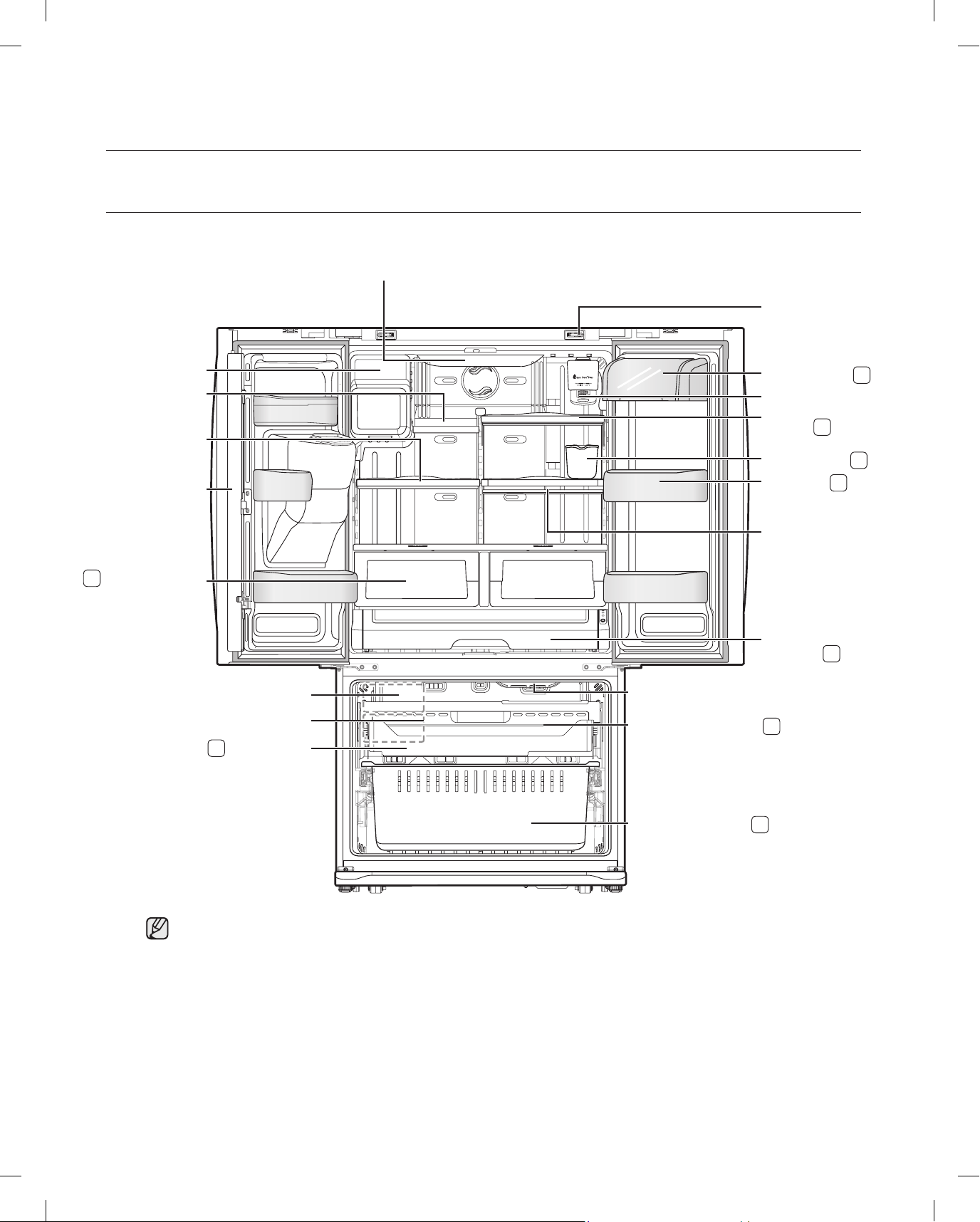
Using the ice off Function
When selecting the Ice Off mode, remove all ice cubes from the bucket. If you are not using
the ice dispenser, the ice cubes may clump together. Pull the lock lever forward to throw
away ice cubes or remove clumped ice from the bucket. Push the bucket back until you
hear a click.
If you use all the ice at once, steps 3 and above 4 must be repeated (before dispensing
the first 4 to 6 ice cubes, you need to wait 8 hours). This will replenish the ice cubes
and ensure maximum ice production.
All water provided to refrigerators flows through the core filter which is an alkaline water filter. In this process, the
pressure in the water that has flowed out of the filter gets increased, and oxygen and nitrogen become saturated.
When this water flows out in the air, the pressure plummets and the oxygen and nitrogen get supersaturated,
which results in gas bubbles. The water may temporarily look misty or cloudy due to these oxygen bubbles. After
a few seconds, the water will look clear.
Please wait 1 second before removing the cup after dispensing water to prevent spills. Do not pull out the lever
dispenser after taking out ice or water. It comes back automatically. Ice is made in cubes. When you select
“Crushed”, the ice maker grinds the ice cubes into crushed ice.
• In case ice doesn’t come out, pull out the ice bucket and press the test button
located on the right side of ice maker.
• Do not press the test button continuously when the tray is lled with ice or water.
Water may overflow or ice jamming may occur.
• Normal Use
To fill the ice bucket to maximum capacity after installation, make sure to do the
following steps.
1. Allow your refrigerator to operate and cool down for 24 hours (or 1 full day).
2. Waiting 24 hours will allow your ice maker to cool properly.
3. Dispense 4 to 6 ice cubes into the glass.
4. After 8 and 16 hours, dispense a full glass of ice.
When you dump the ice from the ice bucket, you should press the dispenser lever
once with ‘ICE CUBED’ or ‘CRUSHED’ function ON to get new ice faster after replacing the ice bucket in the
refrigerator.
When you do not use the water dispenser for 2~3 days (especially during the summer), the dispensed water
may have a funny smell or taste.
If this occurs, we recommend that you discard the first 1~2 glasses for better tasting water.
Use only the ice maker provided with the refrigerator. The water supply to this refrigerator must only be
installed/connected by a suitably qualified person and connect to a potable water supply only. In order to
operate the ice maker properly, water pressure of 138 ~ 862Kpa is required. If you have a long vacation or
business trip and won’t use water or ice dispensers, close the water valve.
- Otherwise, water leakage may occur.
Wipe excess moisture from inside and leave the doors open.
- Otherwise, odor and mold may develop.
Use running water to clean the ice tray bucket, do not use detergent or your hands. Do not put your fingers or
any other object in the chutes or blades, as it may result in injury or damage to the refrigerator.
Never put your finger or any other objects in the dispenser opening.
- It may cause injury.
Do not try to disassemble the ice maker. Do not wash or spray the ice bucket with water.
CAUTION
CAUTION
CAUTION
CAUTION
Test button
Check the
water level
26_ Operating
Use this page to become more familiar with the parts and features of the Refrigerator.
PARTS AND FEATURES
Operating your French Door Refrigerator
Auto Door Closer
Water Filter
Dairy
Compartment
1
Door Bins
2
Cool Select
Pantry
Plus
6
Light
Vertical Hinged
Section
5
Vegetable & Fruit
Drawers
8
Tilting Pocket
Light
Freezer Drawer Bin
9
Auto Pull Out Drawer
7
Slide-Shelf
FF Ice-Maker
Foldable-Shelf
Tempered Glass
Shelves
3
Quick-Space
Glass Shelf
Egg Container
4
FZ Ice-Maker
Ice Bucket
When closing the door, make sure the Vertical Hinged Section is in the correct position to avoid
scratching the other door.
If the Vertical Hinged Section is reversed, put it back to the right position and close the door.
Moisture may occur at times on the Vertical Hinged Section.
The door handle may become loose over time.
If this happens, tighten the bolts found on the inside of the door.
If you close one door with a lot of force, the other door may open.
Operating _27
02 OPERATING
Do not place any large articles of food under the lamp in the Refrigerator. An air sensor is located near the lamp and if
the sensor is blocked, your Refrigerator may become too cold. Please place vegetable and fruits in the vegetable and
fruit drawers to avoid freezing them. If the food in your Refrigerator becomes frozen, please set the temperature higher.
If you plan to go away for a long time, empty the Refrigerator and turn it off. Wipe the excess moisture from
the inside of the appliance and leave the doors open.
(
1
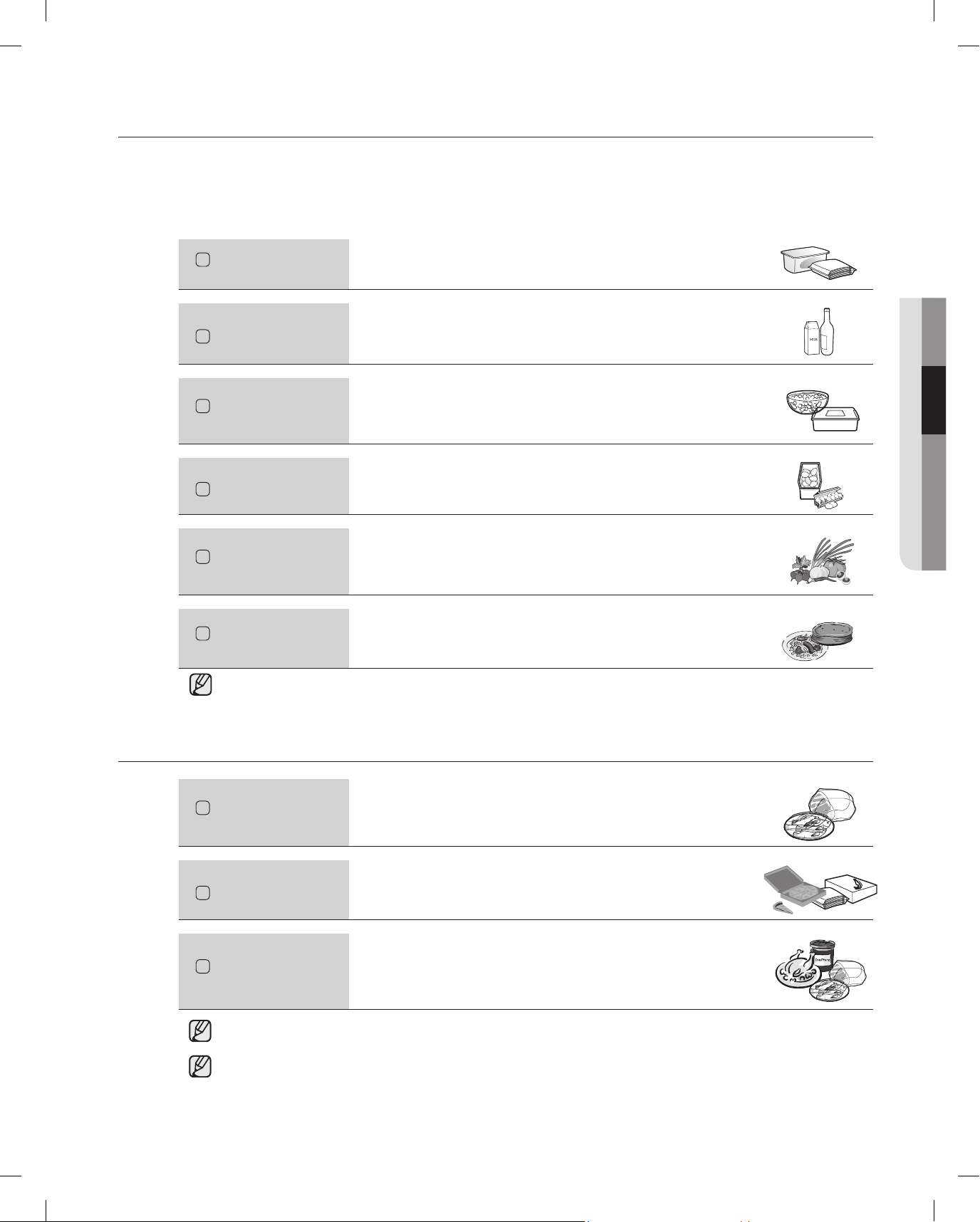
) DAIRY
COMPARTMENT
Can be used to store small dairy items like butter or margarine,
yogurt or cream cheese bricks
(
2
) DOOR BINS
Designed to handle large, bulky items such as gallons of milk or
other large bottles and containers.
(
3
) TEMPERED GLASS
SHELVES
Designed to be crack-resistant, the shelves can be used to store all
types of food and drinks. Circular marks on the glass surface are a
normal phenomenon and can usually be wiped clean with a damp
cloth.
(
4
) EGG CONTAINER
Best place to keep eggs.
Place the container on the shelf for easy access.
(
5
) VEGETABLE & FRUIT
DRAWERS
Used to preserve the freshness of your stored vegetables and fruits.
This drawer could control the level of humidity for items that must
keep the enough moisture. Keep vegetables and fruits separate
when possible.
(
6
) COOL SELECT
PANTRY
PLUS
Can be used for large party trays, deli items, pizza, beverages or
miscellaneous items.
(
7
) AUTO PULL OUT
DRAWER
Best use to store meats or dry foods. Stored food should be
placed in a container or wrapped securely using foil or other
suitable wrapping materials.
(
8
) TILTING POCKET
Can be used for small packages of frozen food.
You can also store a 16” pizza.
(
9
) FREEZER DRAWER
BIN
Can be used to store meat and dry foods.
Stored food should be placed in a container or wrapped securely
using foil or other suitable wrapping materials.
Bottles should be stored tightly together so that they do not tip and fall out when the Refrigerator door is
opened.
STORING FOOD IN THE REFRIGERATOR
STORING FOOD IN THE FREEZER DRAWER
The Samsung French Door Refrigerator has been designed to provide you with maximum space saving features
and functions. Here are some of the customized compartments we have created to keep your food fresher longer. In
order to further prevent odor from seeping into the ice compartment, stored food should be wrapped securely and as
airtight as possible.
28_ Operating
Operating your SAMSUNG Refrigerator
USING THE COOL SELECT PANTRY
PLUS
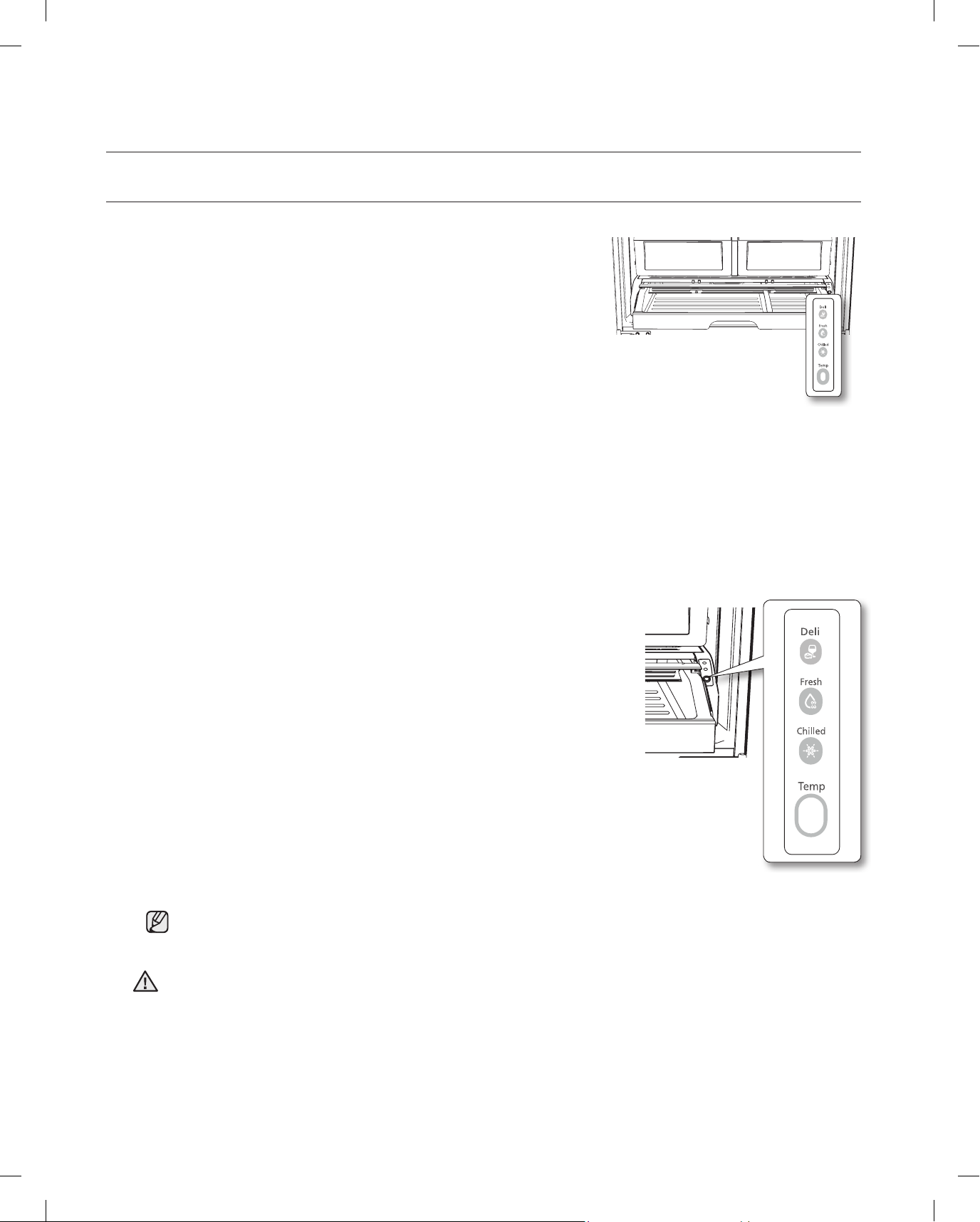
Deli Fresh Chilled
• pineapples • cucumbers • steaks
• lemons • apples • hard cheeses
• avocados • oranges • cold cuts
• potatoes • grapes • bacon
• zucchinis • hot dogs
• corn
The Cool Select Pantry
PLUS
is a full-width drawer with an adjustable
temperature control. This pantry can be used for large party trays, deli
items, pizzas, beverages or miscellaneous items. There is a temperature
sensor which can adjust the amount of cold air allowed into the pantry. The
control buttons are located on the right side of the pantry.
• Press the Temp button repeatedly until your desired mode is lit.
The Fresh mode(38°F), Chilled mode(34°F) and Deli mode(41°F) will be selected whenever you press the
Temp button.
Initially, the Fresh mode is set. Though the set temperature is different from the current temperature, the
temperature will be changed to the set temperature automatically.
• The Pantry temperature may change depending on the amount of items inside and where they are located, the
ambient temperature, and how often the door is opened.
Temperature
You can select your pantry temperature from among Fresh(38°F), Chilled mode(34°F), and Deli mode(41°F)
modes.
Selection Button
1. When “Deli” is selected, the temperature of the pantry will be kept
around 41°F(5°C). This feature helps keep food fresh for a long time.
2. When “Fresh” is selected, the temperature of the pantry will be kept
around 38°F(3°C). This feature helps keep food fresh for a longer time.
3. When “Chilled” is selected, the temperature of the pantry will be kept
around 34°F(1°C). This feature also helps keep meat or fish fresh for a
longer time.
Fruits and vegetables may be damaged under the “Chilled” setting.
Do not store lettuce or other leafy produce in this pantry.
Do not store glass bottles in this pantry.
If they are frozen, they can break and cause personal injury.
CAUTION
Operating _29
02 OPERATING
2
1
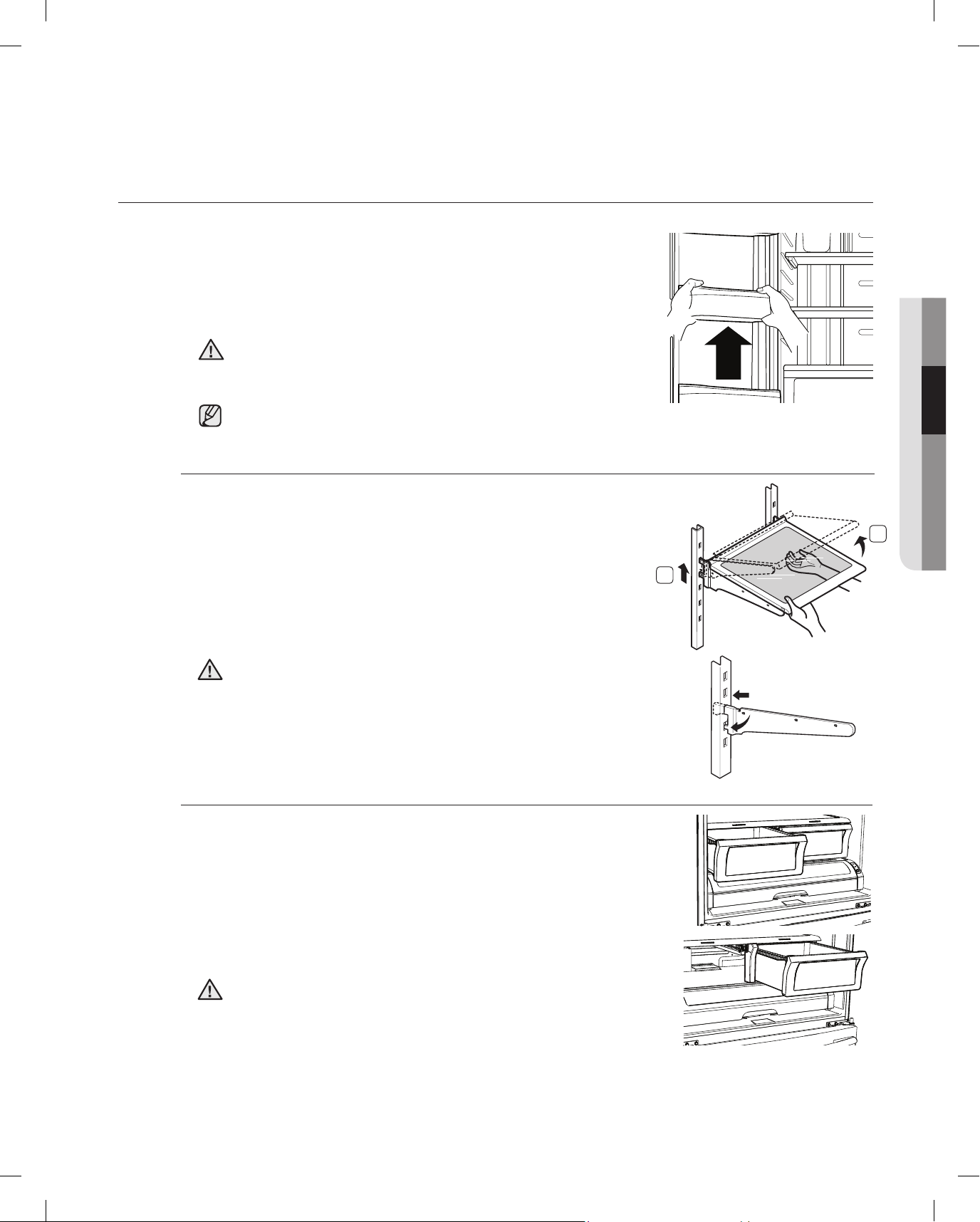
REMOVING THE REFRIGERATOR ACCESSORIES
To remove - Tilt up the front of the shelf in the direction shown ( 1 )
and lift it up vertically ( 2 ) .
Pull the shelf out.
To relocate - Tilt the front of the shelf up and guide the shelf hooks
into the slots at a desired height. Then lower the front
of the shelf so that the hooks can drop into the slots.
1. Door Bins & Dairy Compartment
To remove - Simply lift the bin up and pull straight out.
To relocate - Slide it in above the desired location and push down
until it stops.
Dust removal method -Remove the guard and wash in water.
3. Vegetable & Fruit Drawers
To remove - Pull the drawer out to full extension. Tilt up the front of
the drawer and pull straight out.
To relocate - Insert the drawer into the frame rails and push back
into place.
Injury may occur if the door bins are not firmly assembled.
Do not allow children to play with bins. Sharp corners of the bins
may cause injury.
CAUTION
The Tempered Glass shelves are heavy.
Use special care when removing them.
CAUTION
The drawers need to be removed before the glass shelf above
them can be lifted out.
Do not open the drawers while the pantry is open.
It may cause a scratch or breakage to the drawer covers.
CAUTION
Do not adjust a bin full of foods.
30_ Operating
Operating your SAMSUNG Refrigerator
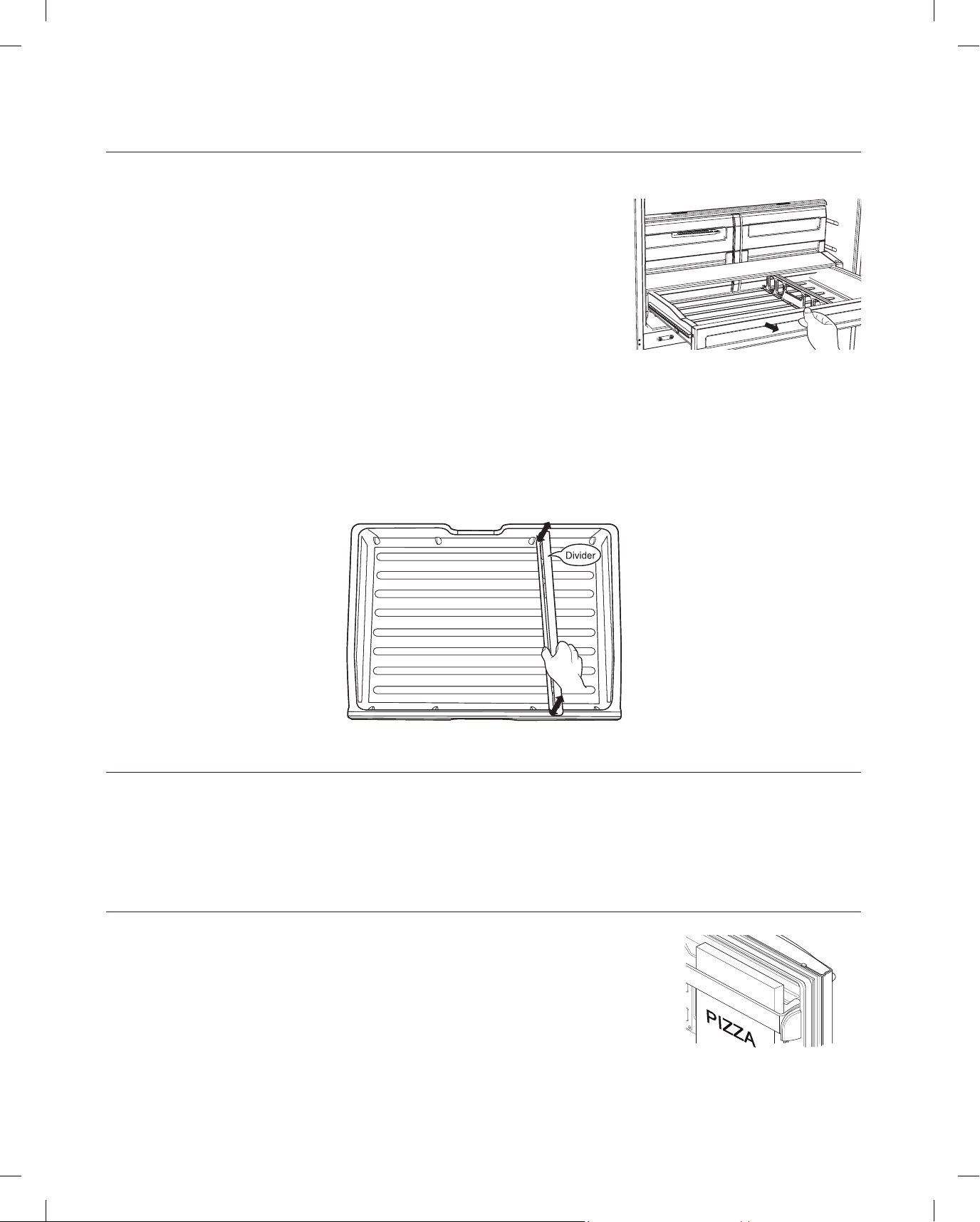
4. Cool Select Pantry
PLUS
To remove the pantry - Pull the pantry out to full extension.
Tilt up the front side of pantry and pull
straight out.
To relocate the pantry - Push the rails to the back of the
Refrigerator. Place the drawer onto the
rails and slide the pantry back until it is in
place.
To remove the divider - Pull the pantry completely out to full extension and raise the front side of
the divider to unhook it from the rear wall of the pantry, then lift the divider
out.
To relocate the divider - Hook the back of the divider over the rear wall of the pantry and push the
divider down.
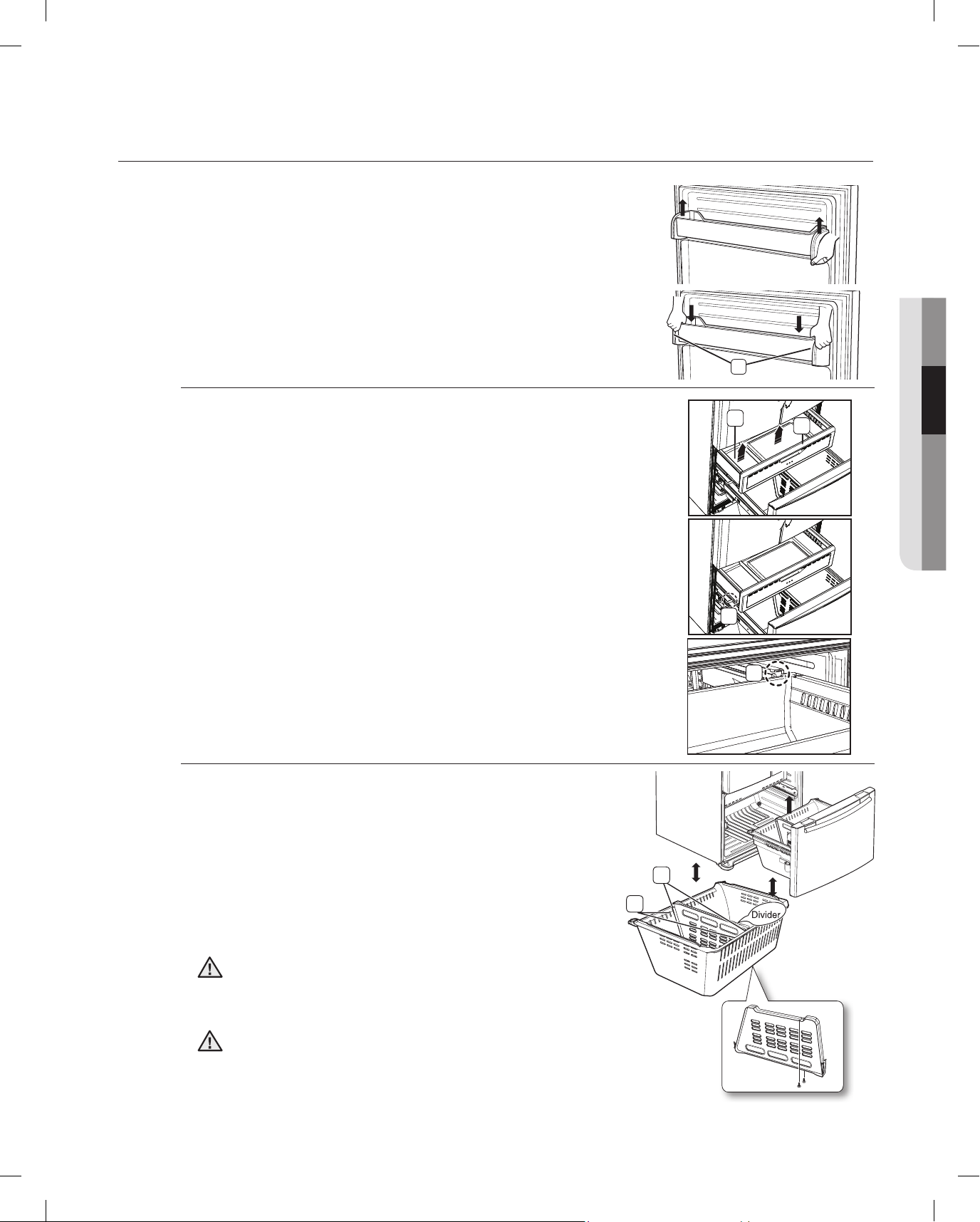
USING THE DOORS
USING THE TILTING POCKET
The Refrigerator doors ensure that the doors close all the way and are securely sealed.
When the Refrigerator door is only partially open, it will automatically close. But, the door will stay open when opened
more than the auto close range.
The Tilting Pocket can be used to store up to a 16” pizza if you place it as shown in
the illustration.
Operating _31
02 OPERATING
1
3
4
1
2
2
1
REMOVING THE FREEZER ACCESSORIES
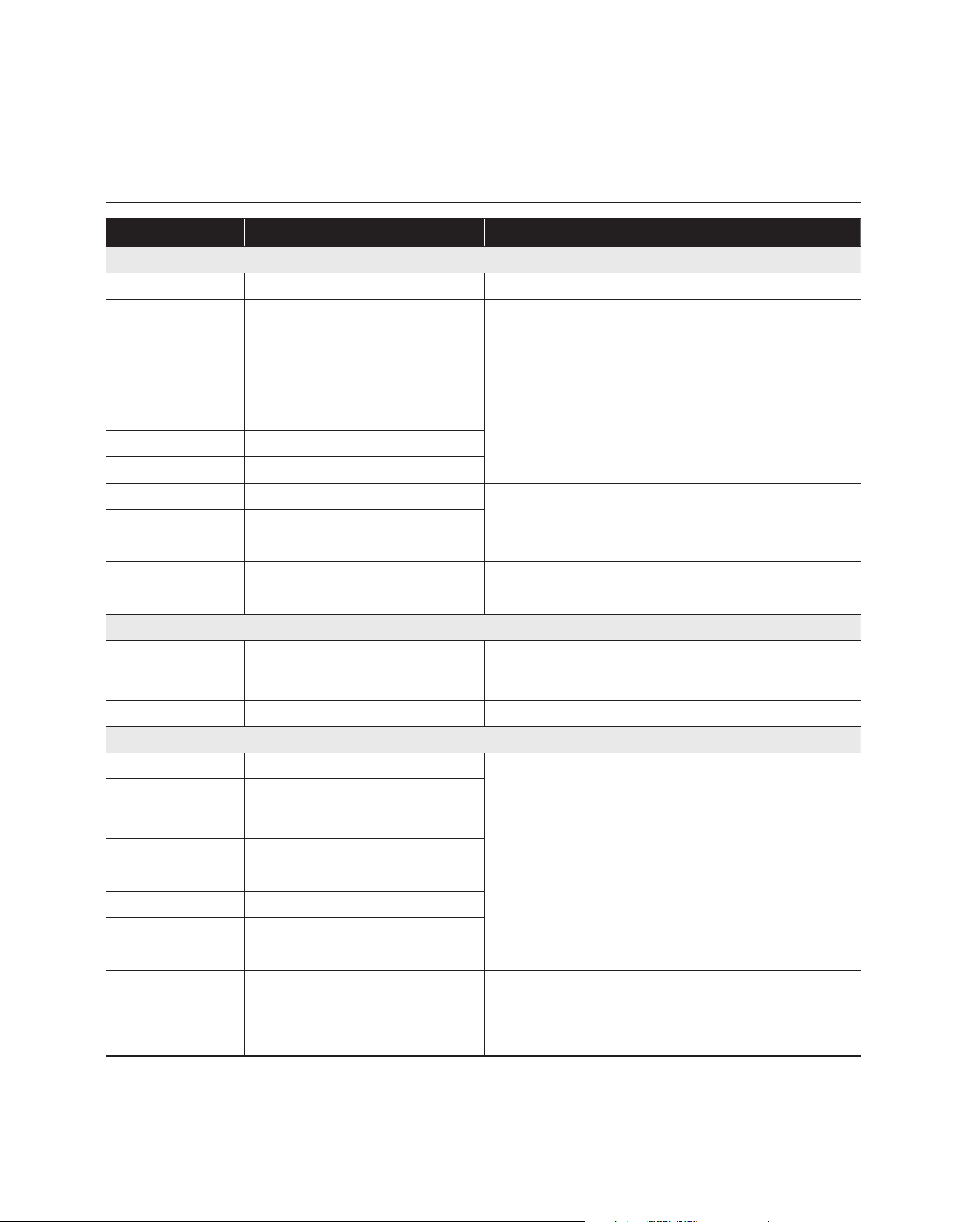
1. Tilting Pocket
To remove - Pull both brackets( 1 ) upward until you hear a clicking
sound and remove the pocket
To replace - Hook the ends of the pocket into both brackets ( 1 )
and push down until it locks into place.
2. ICE BUCKET
To remove - Lift the ice bucket( 1 ).
To relocate - Place the ice bucket into the Super extended drawer(
2 ).
3. Auto Pull Out Drawer
To remove - Pull the drawer out to full extension.
Tilt up the rear of the drawer and lift straight out.
To relocate - Place the drawer onto the rails( 4 ) by tilting it up.
Lower the drawer into place until it is horizontal and
slide the Drawer( 3 ) in.
To remove the drawer - Pull the drawer out fully. Tilt up the
rear of the bin and lift it out to remove.
To relocate the drawer - Place the bin into the rail assembly.
To remove the divider - Pull the divider straight up.
To relocate the divider - Hook the top corners of divider( 1 )
over the hole of the bin( 2 ).
Do not allow a baby or children to go inside the drawer bin.
They could damage the Refrigerator and seriously injure
themselves. Do not sit on the Freezer door. The door may
break. Do not allow children to climb into the Freezer basket.
If you remove the divider to clean the basket bin, you must
reinstall the divider using 2 screws after cleaning to prevent
children from getting trapped inside the basket.
CAUTION
WARNING
32_ Operating
Operating your SAMSUNG Refrigerator
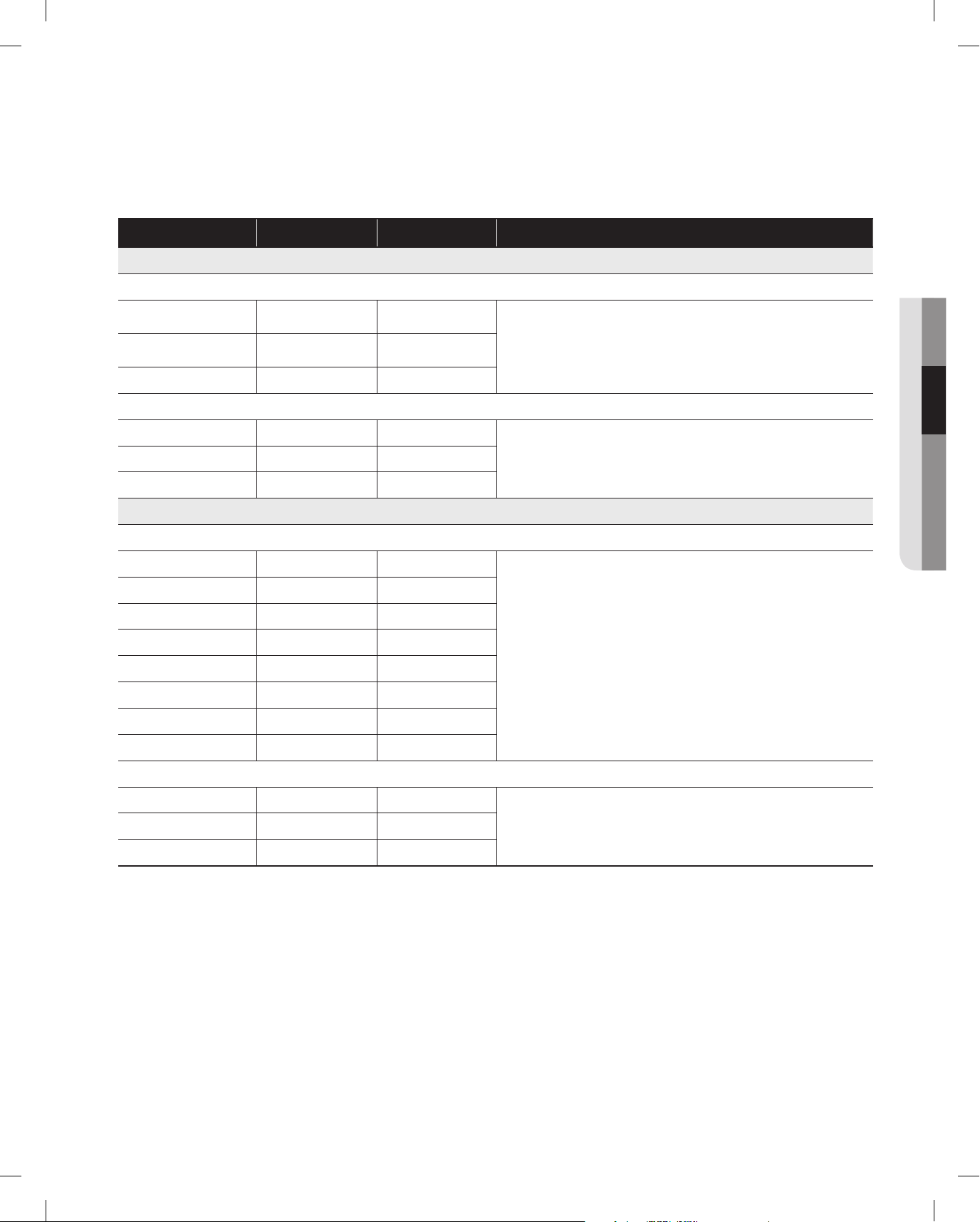
FOOD STORAGE TIPS
DAIRY PRODUCTS
Butter 2-3 Weeks 6-9 Months Wrap or cover tightly.
Milk 1-2 Weeks Not recommended
Check date code. Most milk and similar products are sold in date-coded
cartons that indicate a products’s peak freshness. Re-seal with cap or
wrap tightly. Do not return unused portions to original container.
Cream Cheese, cheese
food, and cheese
spread
2-4 Weeks Not recommended
Check date code. Keep all cheese tightly packed in moisture proof wrap
Hard Cheese (un-
opened)
3-4 Months 6 Months
Hard Cheese (opened) 2 Months Not recommended
Cottage Cheese 10-15 Days Not recommended
Cream 7-10 Days 2 Months
Check date code. Most yogurt, creams, and similar products are sold in
date-coded cartons that indicate a product’s peak freshness. Re-seal or
cover tightly. Do not return unused portions to original container.
Sour Cream 2 Weeks Not recommended
Cream Dips (opened) 1 Week Not recommended
Yogurt 10-14 Days Not recommended
Check date code. Keep covered.
Frozen Yogurt n/a 2 Months
EGGS
Eggs (uncooked) 3-4 Weeks Not recommended
Check date code. Store eggs in coldest part of refrigerator and in their
original container.
Eggs (cooked) 1 weeks Not recommended Store in covered container
Leftover egg dishes 3-4 Days Not recommended Store in covered container
FRESH FRUITS
Apples 1 Month Not recommended
If storing in refrigerator, do not wash fruit before storing. Store in mois-
ture resistant bags or containers. Wrap cut fruits. Some fruits darken
when refrigerated.
Bananas 2-4 Days Not recommended
Peaches, Melons,
Pears, Avocados
3-5 Days Not recommended
Berries and Cherries 2-3 Days 12 Months
Apricots 3-5 Days Not recommended
Grapes 2-5 Days n/a
Pineapple (un-cut) 2-3 Days Not recommended
Pineapple (cut) 5-7 Days 6-12 Months
Citrus 1-2 Weeks Not recommended Store uncovered.
Juice 6 Days Not recommended
Check date code and re-seal in original container. Do not return unused
portions to original container.
Frozen Juice Thawing only 12 Months Check date code. Do not re-freeze.
Operating _33
02 OPERATING
FISH AND SHELLFISH
Fish
Fatty Fish (mackerel,
trout, salmon)
1-2 Days 2-3 Months
Keep in original wrapper and store in coldest part of refrigerator. Pack-
age in vapor-proof and moisture proof wrap for freezer. Freeze at 0ºF.
Thaw in refrigerator or Check date code. Freeze in original packaging.
Lean Fish (cod, flounder,
etc)
1-2 Days 6 Months
Frozen or Breaded n/a 3 Months
Shellfish
Shrimp (uncooked) 1-2 Days 12 Months
Freeze package in vapor and moisture-proof container.Crab 3-5 Days 10 Months
Cooked Fish or Shellfish 2-3 Days 3 Months
MEAT
Fresh, Uncooked
Chops 2-4 Days 6-12 Months
Check date code for use. Store in coldest part of refrigerator in original
packaging. Use additional moisture and vapor-proof container for freez-
ing. Recommended refrigerator temperature 33ºF to 36ºF and freezer
temperature 0ºF to 2ºF
Ground 1 Day 3-4 Months
Roast 2-4 Days 6-12 Months
Bacon 1-2 Weeks 1-2 Months
Sausage 1-2 Days 1-2 Months
Steak 2-4 Days 6-9 Months
Poultry 1 Day 12 Months
Lunch meat 3-5 Days 1 Month
Cooked
Meat 2-3 Days 2-3 Months
Check date code for use. Store in coldest part of refrigerator in original
packaging. Place package in moisture and vapor-proof container for
freezing.
Poultry 2-3 Days 4-5 Months
Ham 1-2 weeks 1-2 Months
Sources:
American Meat Institute Foundation. 1994. Yellow pages: answers to predictable questions consumers ask about meat and poultry.
American Meat Institute Food Marketing Institute. 1999. The food keeper. Food Marketing Institute, Washington, D.C. Freeland-Graves,
J.H. and G.C. Peckham. 1996. Foundations of food preparation, 6th ed. Prentice-Hall, Inc. Englewood Cliffs, NJ. Hillers, V.N. 1993. Stor-
ing foods at home. Washington State University Cooperative Extension, Pullman, WA. Publ. EB 1205.
National Restaurant Association. 2001. Be cool-chill out! Refrigerate promptly. National Restaurant Association Education Foundation¼s
International Food Safety Council, Washington, D.C. USDA. 1997. Basics for handling food safely. U.S. Department of Agriculture, Food
Safety and Inspection Service, Washington, D.C.
34_ Operating
Operating your SAMSUNG Refrigerator
1
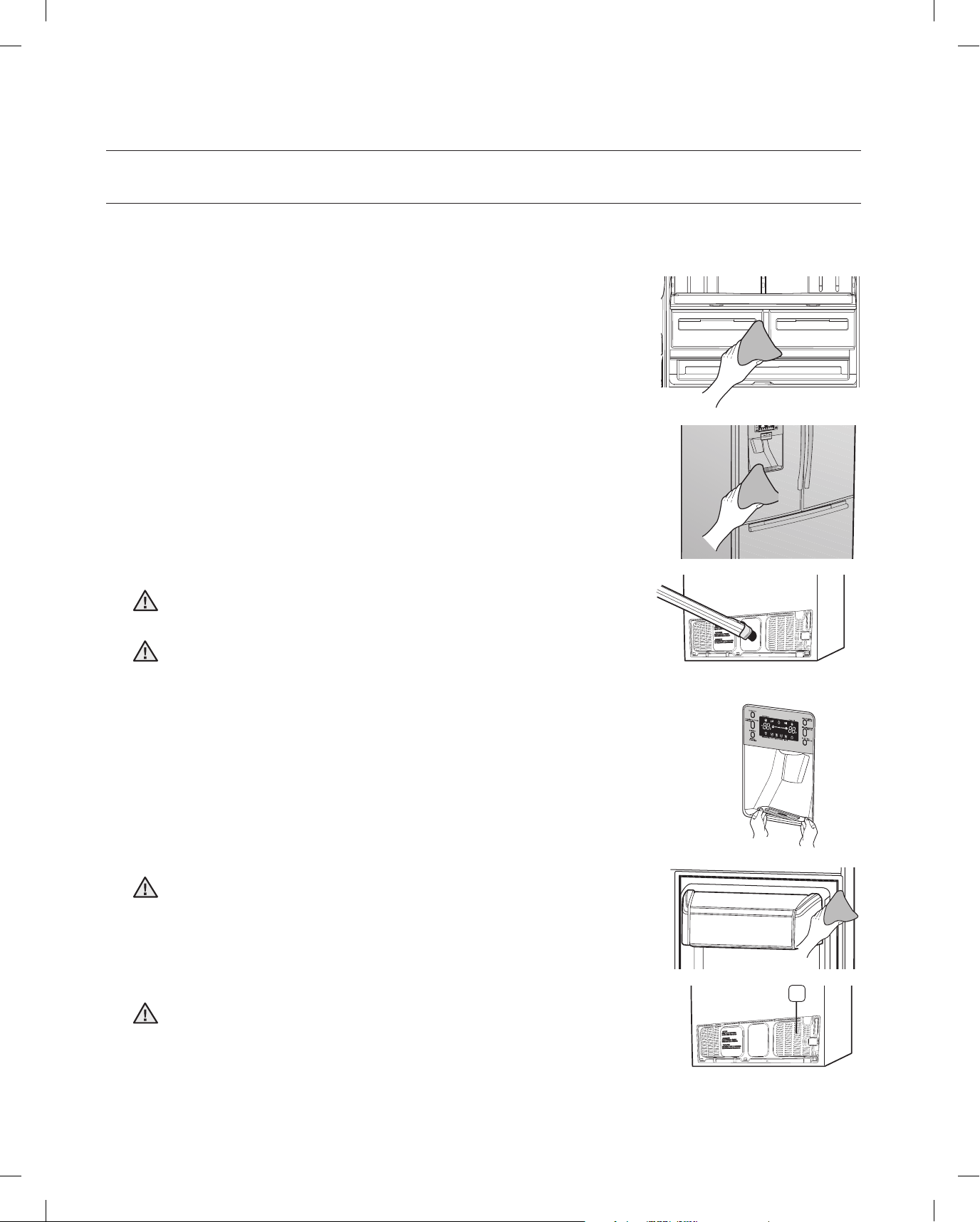
CLEANING THE REFRIGERATOR
Caring for your Samsung Refrigerator prolongs the life of your appliance and helps keep it odor
and germ-free.
Cleaning the Interior
Clean the inside walls and accessories with a mild detergent
and then wipe dry with a soft cloth. You can remove the drawers
and shelves for a more thorough cleaning. Just make sure to dry
drawers and shelves before putting them back into place.
Wipe the control panel and digital display with a damp, clean,
soft cloth. Do not spray water directly on the surface of the
Refrigerator.
The doors, handles and cabinet surfaces should be cleaned with a
mild detergent and then wiped dry with a soft cloth. To keep your
appliance looking its best, the exterior should be polished once or
twice a year.
Push down one end of the tray dispenser and remove it. Wipe the
Ice / Water Dispenser with a clean and soft cloth.
Cleaning the Rubber door seals
If the rubber door seals are dirty, the doors may not close properly,
and the Refrigerator will not operate efficiently. Keep the door seals
free of grit or grime by cleaning the doors with a mild detergent
and damp cloth. Wipe dry with a clean and soft cloth.
Cleaning behind the Refrigerator
To keep cords and exposed parts free of dust and dirt
accumulation, vacuum behind the appliance once or twice a year.
Do not use Benzene, Thinner or Clorox for cleaning. They may
damage the surface of the appliance and may cause fire.
Printed letters on the display may be erased if the stainless cleaner is
applied directly to the area where the letters are printed.
Do not clean the Refrigerator with benzene, thinner or car detergent
due to risk of fire.
Do not remove the back cover( 1 ). Doing so may cause an electric
shock.
CAUTION
CAUTION
CAUTION
CAUTION
Operating _35
02 OPERATING
CHANGING THE INTERIOR LIGHTS
Before changing any of interior lights, unplug the refrigerator from the power supply. If you are unsure
about changing the lights after reading through these directions, contact a Samsung authorized service
center for help.
The Replacement bulb for the freezer is available from your local home improvement or electronics store.
Use replacement bulb size E26, maximum 60 watts. The refrigerator LED lamp must be changed by a
Samsung authorized center.
1. Unplug the power cord from the wall outlet.
2. Remove the pull out drawer. Refer to ‘Remove Auto Pull Out drawer’ on page 31.
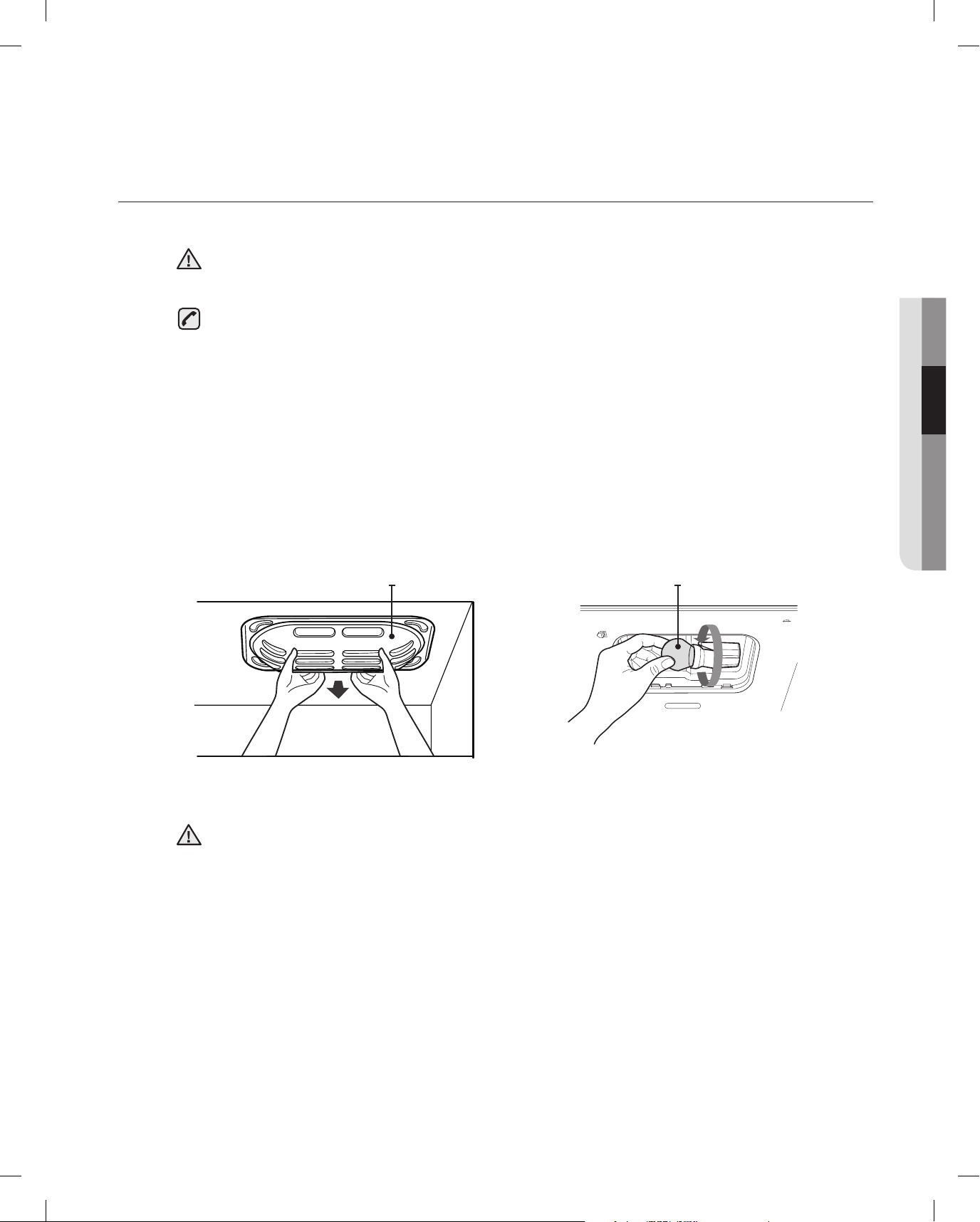
3. Pull the Light Cover to remove it.
4. Turn the bulb counterclockwise to remove it.
5. Assembly is the reverse order of disassembly.
Do not place your fingers inside the cover. The lamp may be hot.
CAUTION
CAUTION
Bulb
36_ Operating
Turn until the
label aligned.
Cover filter
Indicator sticker
(month indicator)
1
2
3
Operating your SAMSUNG Refrigerator
CHANGING THE WATER FILTER
The “Filter” light lets you know when it is time to change your water filter
cartridge. To give you preparation time to get a new filter, the red light will come
on just before the capacity of the current filter runs out. Changing the filter on
time provides you with the freshest, cleanest water from your fridge.
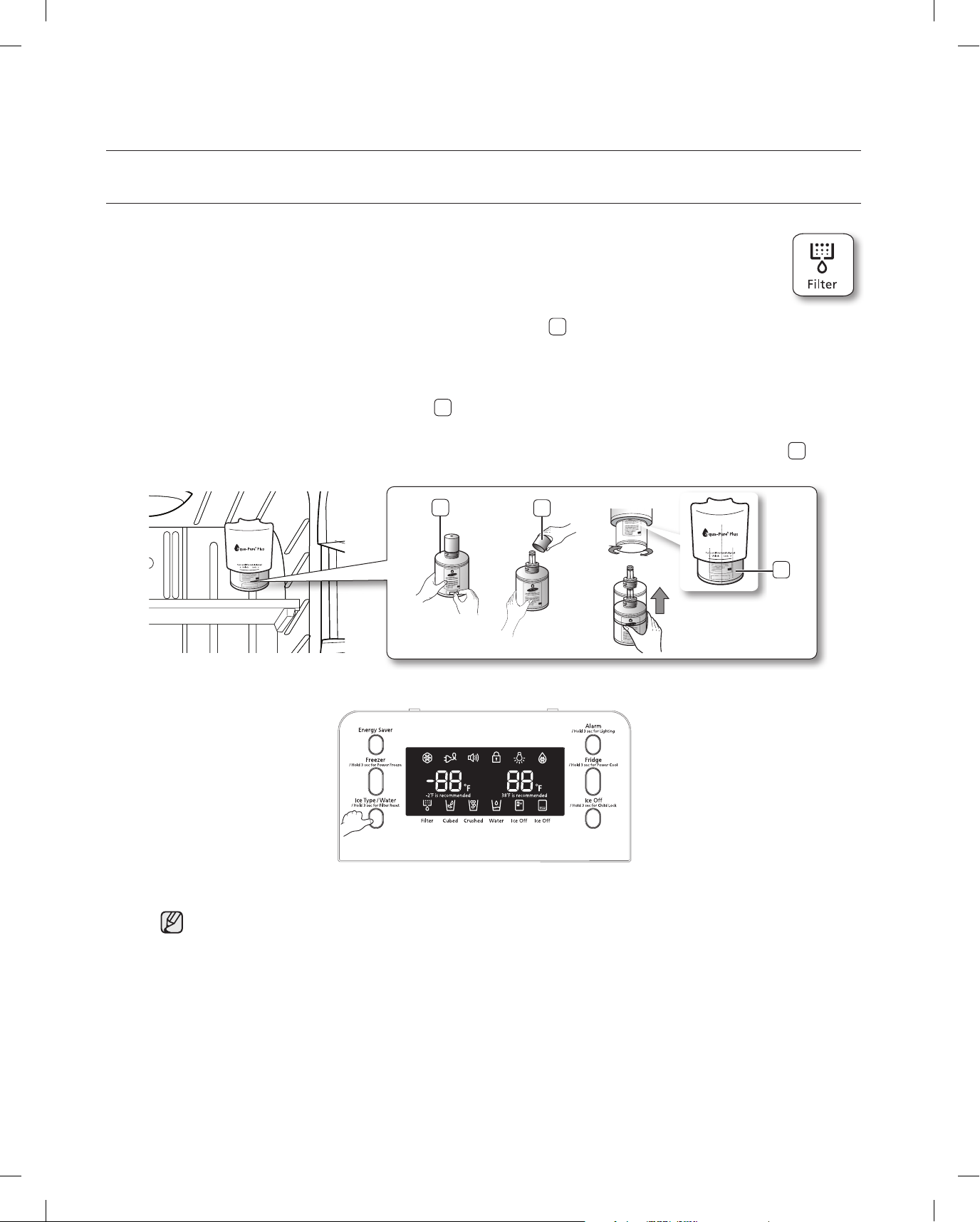
1. Take a new water filter and put a month indicator sticker(
1
) on the filter as shown. The date on the
sticker must be six months from the current date. For example, if you are replacing the water filter in
March, put the “SEP” (September) sticker on the filter to remind you to replace in September. Normal filter
life is about 6 months.
2. Remove the new filter’s protective cap(
2
) and remove the old filter.
3. Position and insert the new filter into the cover filter. Slowly turn the water filter clockwise to align with the
printing mark on the cover, locking the filter in position. Make sure to align the water filter label(
3
) mark
with the center of cover filter printing as illustrated. Remember, do not over-tighten.
4. After above steps, press and hold the Alarm / Hold 3 sec for Filter Reset button for 3 seconds to reset the
filter.
5. Lastly, run about six glassfuls of water through water dispenser to clean the water supply system. Make
sure that water flows cleanly again before drinking.
Be sure to flush the dispenser thoroughly otherwise water may drip from the dispenser.
This means that there is still air in the line.
Do NOT use the water or ice dispenser without a water filter cartridge because the water line may become
blocked.
Ordering a Replacement Water Filter
For a replacement water filter, you can visit your local home improvement center or contact the Samsung
Parts distributor. Be sure the replacement water filter has the SAMSUNG logo on the box and on the water
filter.
Link: http://www.samsungparts.com
troubleshooting _37
03 TROUBLESHOOTING
Troubleshooting
PROBLEM SOLUTION
The Refrigerator does not
work at all or it does not chill
• Check that the power plug is properly connected.
• Check the set temperature on the digital display is warmer than the freezer or fridge
inner temperature.
• Try setting it to a lower temperature.
• Is the Refrigerator in direct sunlight or located near a heat source?
• Is the back of the Refrigerator too close to the wall and therefore keeping air from
circulating?
The food in the
• Check to see if the set temperature on the digital display is too low.
• Try setting it to a warmer temperature.
• Is the temperature in the room too low?
Try setting it to a warmer temperature.
• Did you store the food which is soft in the coldest part of the Refrigerator?
Try moving those items on the other shelves in fridge instead of keeping them in the
Cool Select Pantry
Plus
.
You hear unusual noise or
sounds.
• Check that the Refrigerator is level and stable.
• Is the back of the Refrigerator too close to the wall and therefore keeping air from
circulating?
• Try locating the refrigerator at least 2 inches from the wall.
• Was anything dropped behind or under the Refrigerator?
• A “ticking” sound is heard from inside the Refrigerator. It is normal and occurs
because various accessories are contracting or expanding according to the
temperature of the Refrigerator interior.
The front corners and
the appliance are hot and
condensation is occurring.
• Some heat is normal as anti-condensation devices are installed in the vertical hinged
section of the Refrigerator to prevent condensation.
• Is the Refrigerator door ajar? Condensation can occur when you leave the door
open for a long time.
Ice Maker is not producing ice.
•
Did you wait for 12 hours after installation of the water supply line before making ice?
• Is the water line connected and the shut-off valve opened?
• Did you manually stop the ice making function?
• Is the Freezer temperature too warm? Try setting the Freezer temperature lower.
You can hear water bubbling in
the Refrigerator.
• This is normal. The bubbling comes from the Refrigerator coolant liquid circulating
through the Refrigerator.
There is a bad smell in the
Refrigerator.
• Check for spoiled food.
• Foods with strong odors(for example, sh) should be tightly covered.
• Clean out your Freezer periodically and throw away any spoiled food.
Frost forms on the walls of the
• Is the air vent blocked? Remove any obstructions so air can circulate freely.
• Allow sufcient space between the foods stored for efcient air circulation.
• Is the Freezer drawer closed properly?
Water dispenser is not
functioning.
• Is the water line connected and the shut-off valve opened?
• Has the water supply line tubing been crushed or kinked?
Make sure the tubing is free and clear of any obstruction.
• Is the water tank frozen because the Refrigerator temperature is too low?
Try selecting a warmer setting on the Digital display.
38_ warranty
Warranty
WATER FILTER CHART
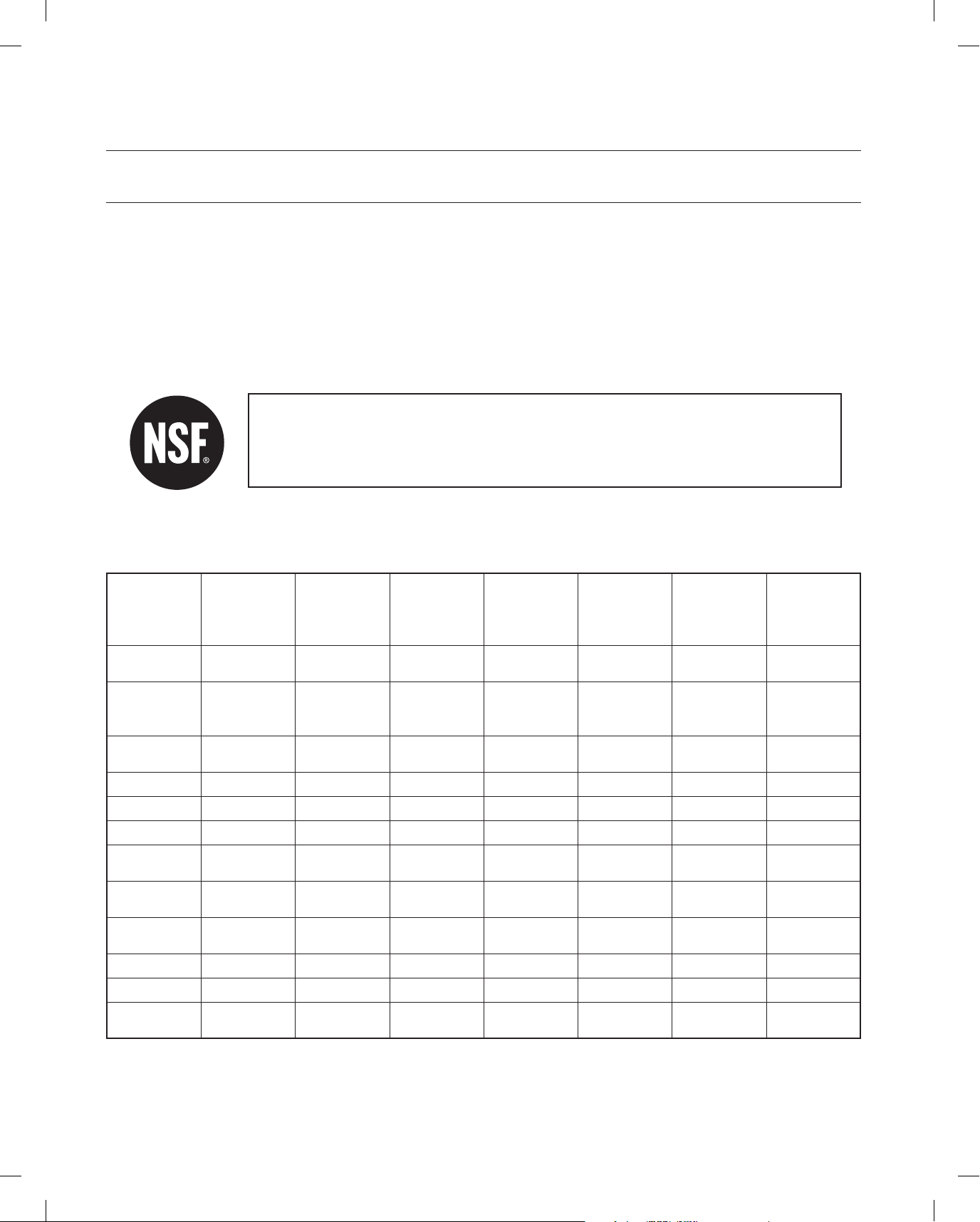
This system has been tested according to NSF/ANSI Standards 42 and 53 for the reduction of the substances listed below.
The concentration of the indicated substances in water entering the system was reduced to a concentration less than or
equal to the permissible limit for water leaving the system, as specifi ed in NSF/ANSI 42 and 53.
To a capacity of 300 gallons (1,136 liters).
Note that while the testing was performed under standard laboratory conditions, actual performance may vary.
System tested and certified by NSF International against NSF/ANSI Standard 42 for
the reduction of Chlorine Taste and Odor, Particulate Class I, and against NSF/ANSI
Standard 53 for the reduction of Cysts, Turbidity, Lead, Asbestos, Benzene, Carbofuran,
p-Dichlorobenzene and Mercury.
Contaminant
Reduction
Concentration
Concentration Units
apply to each row
Reduction
Product Water
Concentration
Permissible
Product Water
Concentration
NSF Reduction
NSF Test
Chlorine taste
and odor
2.1 mg/L 2.0 mg/L ± 10% 97.6 0.05 mg/L NA > 50% J-00029741
Particulate Class I
Particle size :
< 0.5 to < 1 um
10,566,666
pt/mL
At least 10,000
particles/mL
98.4 171,833 pts/mL NA > 85% J-00029739
Cysts* 127,500 cysts/L
Minimum 50,000
cysts/L
99.99 <1 cyst/L NA > 99.95% J-00031000
Turbidity 10.5 11±1 NTU 98.6 0.15 NTU 0.5 NTU > 0.5 NTU J-00033223
Lead @ pH 6.5 153 ug/L 0.15±10% 99.3 <1ug/L 0.010 mg/L 10 ug/L J-00039590
Lead @ pH 8.5 155 ug/L 0.15±10% >99.4 <1ug/L 0.010 mg/L 10 ug/L J-00039591
Mercury @ pH
6.5
5.97 ug/L 0.006±10% 96.6 <0.2 ug/L 0.002 mg/L 2 ug/L J-00039589
Mercury @ pH
8.5
6.29 ug/L 0.006±10% 88.9 0.7 ug/L 0.002 mg/L 2 ug/L J-00039586
Asbestos 140 MFL
107 to 108 fibers
> um in length
> 99 <0.17 MFL NA 99% J-00029743
Benzene 13.88 ug/L 0.015±10% 96.4 <0.5 ug/L 0.005 mg/L < 5 ug/L J-0029751
Carbofuran 79.6 ug/L 0.190 mg/L 98.7 1 ug/L 0.001 mg/L < 40 ug/L J-00029750
p-Dichloroben-
zene
237.5 ug/L 0.225±10% 99.8 0.525 ug/L 0.075 mg/L < 75 ug/L J-00029749
warranty _39
04 WARRANTY
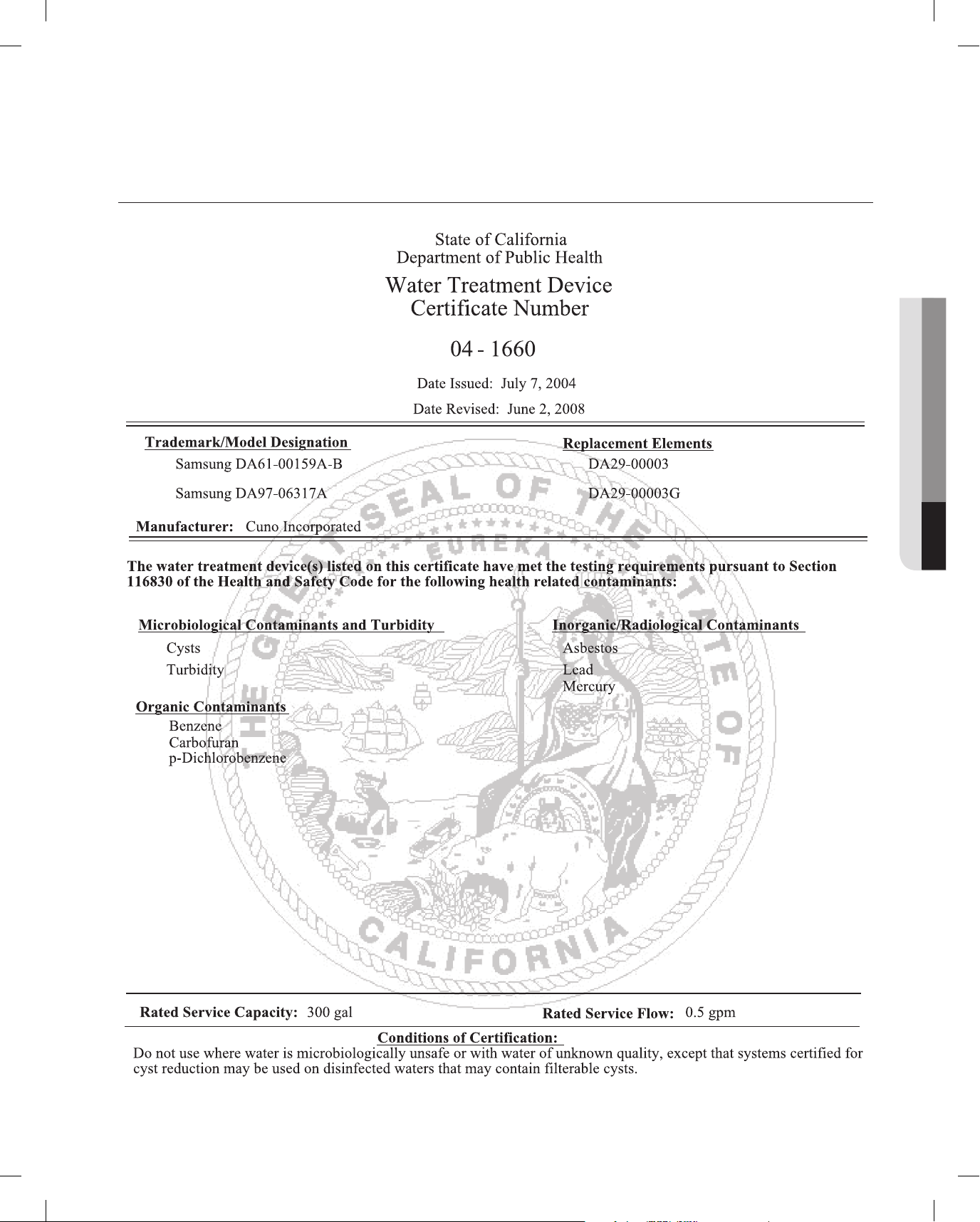
WATER FILTER CERTIFICATION
40_ warranty
Warranty
WARRANTY ON SAMSUNG REFRIGERATOR
LIMITED WARRANTY TO ORIGINAL PURCHASER
This Samsung brand product, as supplied and distributed by Samsung Electronics America, Inc. (Samsung)
and delivered new, in the original carton to the original consumer purchaser, is warranted by Samsung against
manufacturing defects in materials and workmanship for a limited warranty period of:
(*Compressor, evaporator, condenser, drier, connecting tubing)
This limited warranty begins on the original date of purchase, and is valid only on products purchased and used in
the United States. To receive warranty service, the purchaser must contact Samsung for problem determination and
service procedures. Warranty service can only be performed by a Samsung authorized service center. The original
dated bill of sale must be presented upon request as proof of purchase to Samsung or Samsung authorized service
center.
Samsung will repair or replace any part found to be defective, at our option and at no charge as stipulatedX herein,
with new or reconditioned parts during the limited warranty period specified above. All replaced parts and products
become the property of Samsung and must be returned to Samsung. Replacement parts and products assume the
remaining original warranty, or ninety (90) days, whichever is longer.
In-home service will be provided during the warranty labor period subject to availability within the contiguous United
States. In-home service is not available in all areas. To receive in-home service, the product must be unobstructed
and accessible from floor level to service personnel. If during in-home service repair cannot be completed, it may
be necessary to remove, repair and return the product. If in-home service is unavailable, Samsung may elect, at
our option, to provide for transportation of our choice to and from a Samsung authorized service center. Otherwise,
transportation to and from the Samsung authorized service center is the responsibility of the purchaser.
This limited warranty covers manufacturing defects in materials and workmanship encountered in normal,
noncommercial use of this product, and shall not apply to the following, including, but not limited to: damage which
occurs in shipment; delivery and installation; applications and uses for which this product was not intended; altered
product or serial numbers; cosmetic damage or exterior finish; accidents, abuse, neglect, fire, water, lightning or other
acts of nature; use of products, equipment, systems, utilities, services, parts, supplies, accessories, applications,
installations, repairs, external plumbing and leaks, external wiring, circuit breakers, fuses or connectors not supplied
and authorized by Samsung, or which damage this product or result in service problems; incorrect electrical line
voltage, fluctuations and surges; customer adjustments and failure to follow operating instructions, cleaning,
maintenance and environmental instructions that are covered and prescribed in the instruction book; loss of food due
to spoilage; consumable items including filters and light bulbs.
warranty _41
04 WARRANTY
THERE ARE NO EXPRESS WARRANTIES OTHER THAN THOSE LISTED AND DESCRIBED ABOVE, AND
NO WARRANTIES WHETHER EXPRESS OR IMPLIED, INCLUDING, BUT NOT LIMITED TO, ANY IMPLIED
WARRANTIES OF MERCHANTABILITY OR FITNESS FOR A PARTICULAR PURPOSE, SHALL APPLY
AFTER THE EXPRESS WARRANTY PERIODS STATED ABOVE, AND NO OTHER EXPRESS WARRANTY
OR GUARANTY GIVEN BY ANY PERSON, FIRM OR CORPORATION WITH RESPECT TO THIS PRODUCT
SHALL BE BINDING ON SAMSUNG. SAMSUNG SHALL NOT BE LIABLE FOR LOSS OF REVENUE OR
PROFITS, FAILURE TO REALIZE SAVINGS OR OTHER BENEFITS, OR ANY OTHER SPECIAL, INCIDENTAL
OR CONSEQUENTIAL DAMAGES CAUSED BY THE USE, MISUSE OR INABILITY TO USE THIS PRODUCT,
REGARDLESS OF THE LEGAL THEORY ON WHICH THE CLAIM IS BASED, AND EVEN IF SAMSUNG
HAS BEEN ADVISED OF THE POSSIBILITY OF SUCH DAMAGES. NOR SHALL RECOVERY OF ANY KIND
AGAINST SAMSUNG BE GREATER IN AMOUNT THAN THE PURCHASE PRICE OF THE PRODUCT SOLD BY
SAMSUNG AND CAUSING THE ALLEGED DAMAGE. WITHOUT LIMITING THE FOREGOING, PURCHASER
ASSUMES ALL RISK AND LIABILITY FOR LOSS, DAMAGE OR INJURY TO PURCHASER AND PURCHASER’S
PROPERTY AND TO OTHERS AND THEIR PROPERTY ARISING OUT OF THE USE, MISUSE OR INABILITY TO
USE THIS PRODUCT SOLD BY SAMSUNG NOT CAUSED DIRECTLY BY THE NEGLIGENCE OF SAMSUNG.
THIS LIMITED WARRANTY SHALL NOT EXTEND TO ANYONE OTHER THAN THE ORIGINAL PURCHASER OF
THIS PRODUCT, IS NONTRANSFERABLE AND STATES YOUR EXCLUSIVE REMEDY.
Some states do not allow limitations on how long an implied warranty lasts, or the exclusion or limitation of
incidental or consequential damages, so the above limitations or exclusions may not apply to you. This warranty
gives you specific legal rights, and you may also have other rights, which vary from state to state.
To obtain warranty service, please contact Samsung at:
SAMSUNG CUSTOMER CARE CENTER
Samsung Electronics America, Inc. 400 Valley Road Suite 201 Mt. Arlington, NJ 07956
1-800-SAMSUNG (1-800-726-7864) and www.samsung.com
imagine las posibilidades
Gracias por adquirir un producto Samsung.
Para recibir un servicio más completo,
registre su producto en
www.samsung.com/register
RF268AB
SPANISH
Refrigerador
Manual de usuario

2_ Características de su nuevo refrigerador
Para facilitar futuras consultas, escriba
el modelo y el número de serie a
continuación, que podrá encontrar en el
lateral izquierdo del refrigerador.
Nº de modelo #
Nº de serie #
Características de su nuevo refrigerador
CARACTERÍSTICAS PRINCIPALES DE SU NUEVO REFRIGERADOR
Su refrigerador Samsung de tres puertas está equipado con multitud de características innovadoras de
almacenamiento y eficiencia energética.
Sistema de doble enfriamiento
El refrigerador y la heladera disponen de evaporadores independientes. Gracias a este sistema de
enfriamiento, la heladera y el refrigerador refrigeran de forma más eficiente.
Además, este sistema de flujo de aire independiente evita que los olores de los alimentos situados
en uno de los compartimentos penetren en el resto.
Espacio más grande y ancho
Las zonas de balda ancha y despensa proporcionan suficiente espacio para artículos más grandes, como
cajas de pizza, etc. La gaveta ancha la nevera proporciona,asimismo, espacio suficiente para 2 ó 3 pavos.
Cool Select Pantry Plus
El Cool Select Pantry Plus es una gaveta de ancho completo que dispone de control de temperatura ajustable.
La máquina de hielo puede dispensar cubitos o hielo picado.
Cierre automático de seguridad
El cierre automático de seguridad cerrará de forma automática una puerta entreabierta
Alarma de puerta
Una útil alarma avisará cuando la puerta quede entreabierta.
Compartimento inclinable
El compartimento inclinable puede usarse para almacenar una pizza de 40,6 cm (16”).
La gaveta superior de la nevera se despliega y sale automáticamente al abrir la puerta del
compartimento.
Tirador simple
La gaveta superior de la heladera sale por completo hasta llegar al compartimento inclinable.
Este producto etiquetado con el sello Energy Star puede ahorrarle dinero en su factura de electricidad.
El refrigerador y la heladera disponen de una máquina de hielo cada uno, proporcionando mucha
más cantidad de cubitos y hielo picado.
Información de seguridad _3
INFORMACIÓN DE SEGURIDAD
Antes de usar su nuevo refrigerador Samsung de tres puertas, lea este manual para asegurarse de que sabe cómo usar
de forma segura y eficaz, las características y funciones que ofrece su nuevo electrodoméstico.
Este electrodoméstico no ha sido diseñado para ser usado por personas con capacidades físicas, sensoriales o mentales
mermadas (niños incluidos), o faltas de experiencia o conocimientos, a menos que estén bajo supervisión o dispongan de
instrucciones relativas al uso del electrodoméstico proporcionadas por una persona responsable de su seguridad.
Como las siguientes instrucciones de funcionamiento están destinadas a varios modelos, las características de su
refrigerador pueden diferir ligeramente de las descritas en este manual. Si tiene cualquier pregunta, póngase en contacto
con nosotros en el 1-800-SAMSUNG o busque ayuda e información online en www.samsung.com.
Important safety symbols and precautions:
Prácticas peligrosas o inseguras que pueden ocasionar lesiones físicas graves o peligro
de muerte.
PRECAUCIÓN
Prácticas peligrosas o inseguras que pueden ocasionar lesiones físicas leves o daños
materiales.
NO intentar.
NO desmontar.
NO tocar.
Siga atentamente las instrucciones.
Desenchufar el cable de alimentación de la toma de pared.
Asegurarse de que el refrigerador está conectado a tierra para evitar choques eléctricos.
Póngase en contacto con el centro de asistencia para obtener ayuda.
Nota
SEÑALES IMPORTANTES DE ADVERTENCIA RELATIVAS A LA INSTALACIÓN
Información de seguridad
- Un aislamiento deteriorado de las piezas eléctricas podría provocar un choque eléctrico o incendio.
- Esto proporciona el mejor rendimiento y evita además la sobrecarga de los circuitos de cableado de su
hogar, que podría ser causa de incendio por el sobrecalentamiento de los cables.
4_ Información de seguridad
Información de seguridad
- Asegúrese siempre de haber conectado el refrigerador a tierra antes de intentar examinar o reparar
cualquier pieza del mismo. Las fugas de corriente pueden ocasionar choques eléctricos graves.
mecanismo de puesta a tierra.
-
Un uso incorrecto del tomacorriente de puesta a tierra puede suponer un riesgo de choque eléctrico. Si fuese necesario usar una
alargadera, use únicamente una de 3 cables que disponga de un conector de 3 clavijas con toma de tierra y una toma eléctrica de 3
ranuras que acepte el conector del electrodoméstico. El régimen indicado de la alargadera debe ser de 115 V~120 V de CA, 10 A o
superior. Si se usa un adaptador de puesta a tierra, asegúrese de que la caja de la toma eléctrica disponga de conexión completa a tierra.
- Si conecta el cable de alimentación al revés, podría seccionarse provocando incendios o choques eléctricos.
- Esto provocaría riesgo de incendio.
- Existe peligro de muerte por asfixia en caso de que los niños jueguen con ellos.
- Al abrir o cerrar la puerta, dichos artículos pueden caer, ocasionando lesiones físicas o daños materiales.
- Si se derrama, existe riesgo de incendio o choque eléctrico.
atrapados.
PRECAUCIÓN
SEÑALES DE PRECAUCIÓN RELATIVAS A LA INSTALACIÓN
- Si su refrigerador no está nivelado, el sistema de refrigeración interno puede no funcionar correctamente.
SEÑALES IMPORTANTES DE ADVERTENCIA RELATIVAS AL USO
- Existe riesgo de choque eléctrico o incendio.
- Los daños en el cable pueden ocasionar cortocircuitos, incendios o choques eléctricos.
- El uso de aerosoles en las proximidades del refrigerador podría provocar explosiones o incendios.
Información de seguridad _5
- Los bordes afilados podrían ocasionar lesiones físicas.
- La gaveta podría romperse y que resbalasen.
- Al abrir la puerta, algún artículo podría caer provocando lesiones físicas o daños materiales.
- Podría ser causa de lesiones por congelación.
- Existe riesgo de explosión o incendio.
- El almacenaje de benceno, disolvente, alcohol, éter, gas licuado y otros productos similares puede
provocar explosiones.
la temperatura.
- Los productos que precisan controles de temperatura estrictos no deben almacenarse en el refrigerador.
recomendado por el fabricante.
- Corre el riesgo de provocar un incendio, averías o lesionarse.
SEÑALES IMPORTANTES DE ADVERTENCIA RELATIVAS AL USO
LED por sus propios medios.
- Póngase en contacto con su agente de servicio.
- De lo contrario, existe riesgo de incendio.
refrigerador.
- De lo contrario, existe riesgo de choque eléctrico.
- Al congelarse el contenido, el cristal podría romperse provocando lesiones físicas.
PRECAUCIÓN
SEÑALES DE PRECAUCIÓN RELATIVAS AL USO
6_ Información de seguridad
Información de seguridad
- De lo contrario existe riesgo de incendio o choque eléctrico.
- Existe riesgo de incendio o choque eléctrico.
- Desmonte las puertas.
- Deje las baldas en su lugar a fin de dificultar la entrada de los niños.
- Cualquier cambio o modificación realizada por terceros sobre este electrodoméstico acabado, no está
cubierta por el servicio de garantía de Samsung ni serán responsabilidad de Samsung las cuestiones
relativas a la seguridad resultantes de dichas modificaciones realizadas por terceros.
-
Si las aberturas de ventilación fuesen bloqueadas, especialmente con bolsas de plástico, el refrigerador puede sobrerefrigerarse.
Si este período de refrigeración durase demasiado, el filtro de agua podría romperse provocando fugas de agua.
- El deterioro del aislamiento podría ocasionar un incendio.
- De lo contrario podrían acumularse olores y moho.
- no coloque alimentos demasiado próximos a las aberturas de ventilación situadas en la parte posterior del
electrodoméstico, ya que podrían impedir la libre circulación de aire en el compartimento del refrigerador.
-
Envuelva los alimentos de forma adecuada o colóquelos en recipientes herméticos antes de introducirlos en el refrigerador.
SEÑALES DE ADVERTENCIA IMPORTANTES RELATIVAS AL DESECHO
- Existe riesgo de choque eléctrico o incendio.
PRECAUCIÓN
SEÑALES DE PRECAUCIÓN RELATIVAS A LA LIMPIEZA
Índice _7
Índice
08
08 Preparativos para instalar el refrigerador
09 Ajuste del refrigerador
09 Preparativos para instalar el refrigerador
11 Desmontaje de la gaveta de la nevera
12 Montaje de las puertas de la nevera
14 Montaje de la gaveta de la nevera
15 Ajuste de las puertas
16 Realización de ajustes menores entre puertas
17 Ajuste del nivel de la gaveta de la nevera
18 Chequeo de la toma del dispensador de agua
19 Instalación de la toma del dispensador de agua
21
21 Uso del panel de control
22 Uso de la pantalla de visualización digital
23 Control de la temperatura
24 Uso del dispensador de agua fría
26 Piezas y funciones
27 Almacenaje de alimentos en el refrigerador
27 Almacenaje de alimentos en la gaveta de l a
nevera
28 Uso del Cool select pantryPLUS
29 Desmontaje de los accesorios del refrigerador
30 Uso de puertas
30 Uso del compartimento inclinable
31 Desmontaje de los accesorios de la nevera
32 Consejos útiles para el almacenaje de alimentos
34 Limpieza del refrigerador
35 Reemplazo de los focos interiores
36 Reemplazo del filtro de agua
37
37 Solución de problemas
38
38 Cuadro del filtro de agua
39 Certificación del filtro de agua
40 Garantía del refrigerador SAMSUNG
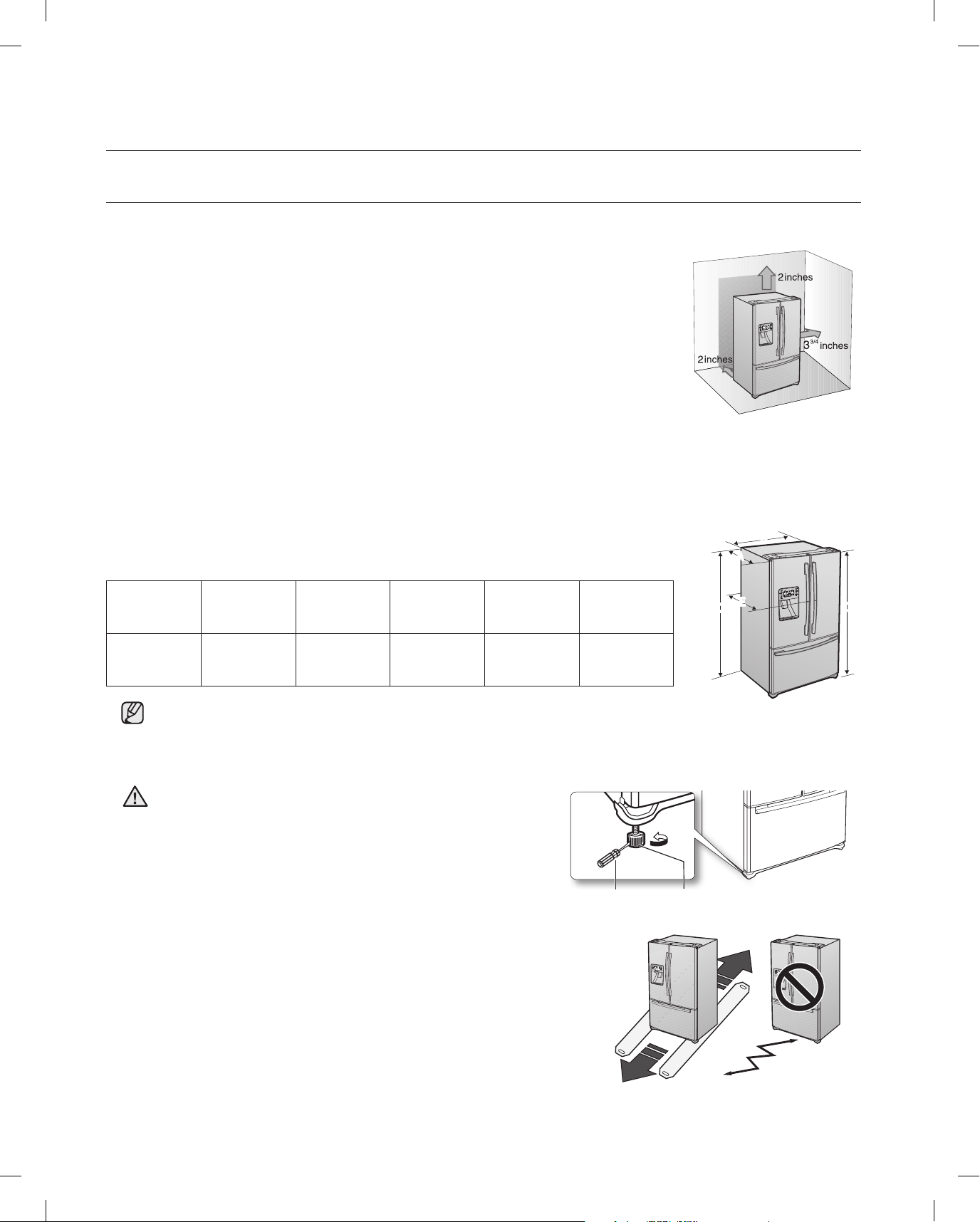
8_ Instalación
Instalación de su refrigerador de tres puertas
Si su refrigerador dispone de una máquina de hielo, deje más espacio libre en la parte posterior para las
conexiones de la toma de agua. Al instalar su refrigerador junto a una pared fija, debe dejarse un espacio libre
mínimo de 3 ¾” (95 mm) entre el refrigerador y la pared, para permitir la apertura de la puerta.
Antes que nada: asegúrese de poder mover fácilmente su refrigerador hasta su posición nal, midiendo puertas
de entrada (ancho y alto), umbrales, techos, escaleras, etc. El siguiente cuadro especifica la altura y ancho
exactos del refrigerador Samsung de tres puertas.
El siguiente cuadro especifica la altura y ancho exactos del refrigerador Samsung de tres
puertas.
PISO
Para llevar a cabo una instalación correcta, este refrigerador debe
instalarse sobre una superficie nivelada de material firme, situado
a la misma cota que el resto del piso. Esta superficie debería
ser lo suficientemente resistente como para soportar la carga
del refrigerador completamente cargado o un peso aproximado
de 328 libras (150 kg). Para proteger el acabado del piso, corte
un trozo grande de cartón de embalaje y colóquelo bajo el
refrigerador en el lugar de trabajo. Al desplazar el refrigerador,
asegúrese de tirar de la unidad hacia fuera y empujarla hacia
dentro en línea recta.
• Mantenga despejado el lado derecho, izquierdo, posterior y superior durante la instalación. Esto
ayudará a reducir el consumo de energía y mantener una factura eléctrica más baja.
• No instale el refrigerador en un emplazamiento donde la temperatura pueda ser inferior a 50° F (10° C).
• No instale el refrigerador en lugares potencialmente húmedos.
Al desplazar el refrigerador
Para evitar daños en el piso, asegúrese de que los pies
de ajuste frontales están en su posición más elevada
(por encima del piso). Examine la sección “Ajuste de las
puertas” del manual (en la página 15).
PRECAUCIÓN
Felicidades por la adquisición de su refrigerador Samsung de tres puertas. Esperamos que disfrute de las características y
rendimiento de alta tecnología que este nuevo electrodoméstico tiene que ofrecer.
• Un emplazamiento de fácil acceso para el suministro de agua.
• Un emplazamiento sin exposición directa a la luz solar.
• Un emplazamiento que tenga el piso nivelado (o casi nivelado).
• Un emplazamiento con suciente espacio para que las puertas del refrigerador
puedan abrirse con facilidad.
• Deje suciente espacio para la circulación del aire del sistema de enfriamiento
interno. Si el refrigerador no dispone de suficiente espacio, el sistema de
refrigeración interna puede no funcionar correctamente.
PREPARATIVOS PARA INSTALAR EL REFRIGERADOR
MODELO
Profundi-
dad “A”
Ancho
“B”
Altura
“C”
Altura total
“D”
Profundi-
dad “E”
RF268AB
29-⅛”
(83.6cm)
35-¾”
(90.8cm)
68-⅝”
(174.4cm)
69-¾”
(177.4cm)
35-⅝”
(90.5cm)
B
A
C
E
D
B
A
C
E
D
Destornillador
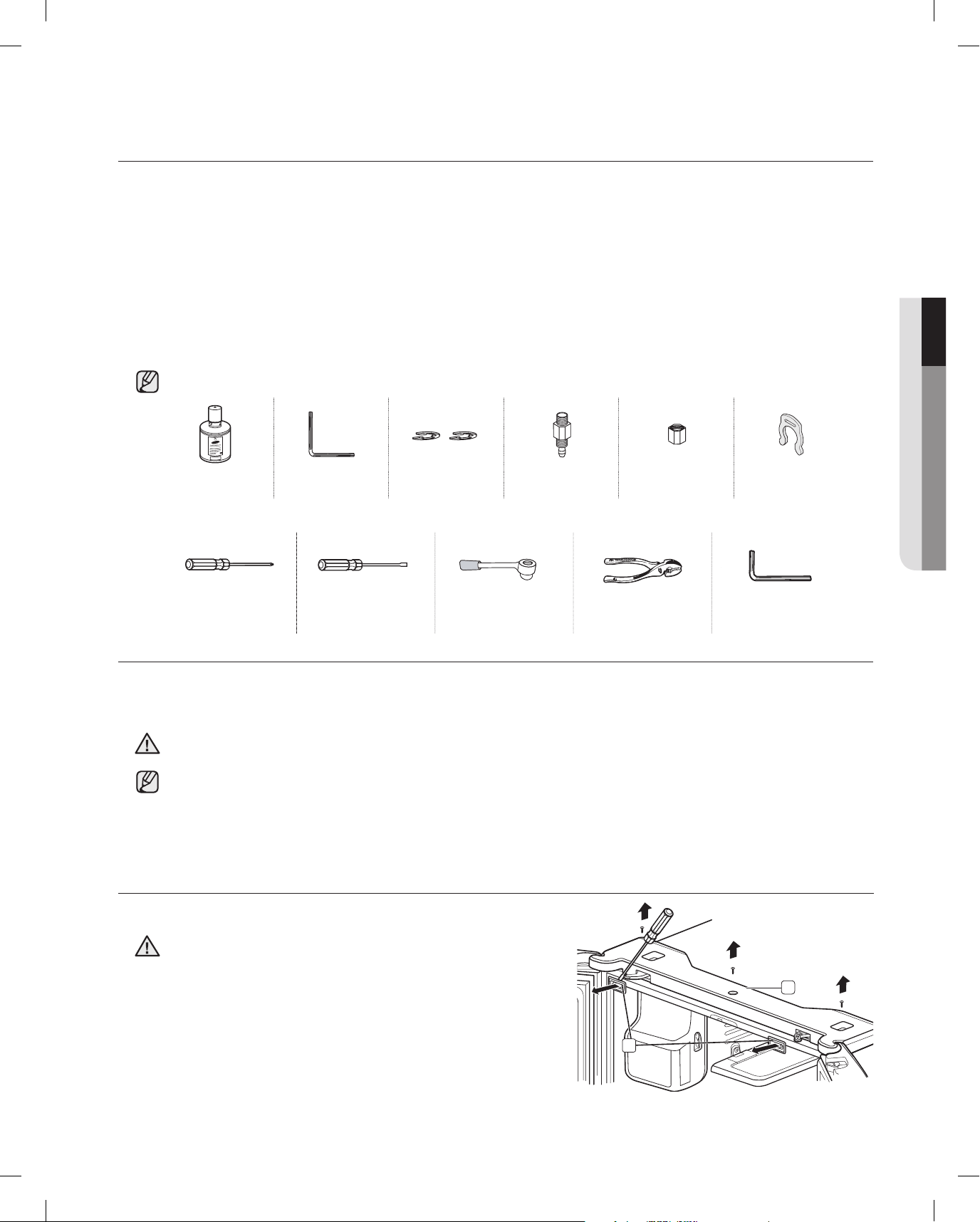
Instalación _9
01 INSTALACIÓN
DESMONTAJE DE LAS PUERTAS DEL REFRIGERADOR
AJUSTE DEL REFRIGERADOR
Ahora que tiene su nuevo refrigerador instalado y en su sitio, está preparado para ajustarlo y disfrutar de todas
las características y funciones de las que dispone el electrodoméstico. Completando los siguientes pasos, su
refrigerador deberá estar totalmente operativo.
1. Coloque el refrigerador en una situación apropiada, con una distancia libre razonable entre la pared y el
electrodoméstico. Examine las instrucciones de instalación de este manual.
2. Una vez enchufado el refrigerador, asegúrese de que el foco interior se ilumina al abrir las puertas.
3. Ajuste el control en la temperatura más fría y espere una hora. La nevera deberá enfriarse ligeramente y
el motor funcionar suavemente.
4.
Tras poner en funcionamiento el refrigerador, harán falta varias horas para alcanzar la temperatura asignada.
Puede introducir alimentos y bebidas en el refrigerador una vez la temperatura sea suficientemente fría.
Destornillador Philips(+) Destornillador de cabeza
plana(-)
Llave de tubo(7/16”) Alicates Llave Allen (3/16”)
Filtro de agua Llave Allen Dispositivo de
sujeción
Racor de compresión Tuerca de
compresión
Clip de cierre de
ajuste (rojo)
Algunas instalaciones requieren el desmontaje de la puerta para poder transportar el refrigerador hasta su
emplazamiento final. No desmonte la puerta/gaveta si no es necesario. Antes de desmontar la puerta/gaveta,
asegúrese de haber leído los siguientes puntos.
Desconecte el suministro del refrigerador antes de desmontar la puerta o la gaveta.
Tenga cuidado de no dejar caer ni arañar las puertas durante el
proceso de desmontaje.
• Tenga cuidado de no dejar caer, dañar o arañar la puerta/gaveta durante el proceso de desmontaje.
•
Tenga cuidado de no dejar caer la puerta, arañarla ni dañarla durante el desmontaje de la puerta/ gaveta.
• Vuelva a montar correctamente la puerta/gaveta para evitar:
- Humedad procedente del escape de aire.
- Una alineación desigual de la puerta.
- Gastos de energía debido a un sellado incorrecto de la puerta.
Chequee la siguiente lista de accesorios.
2
1
Desmontar las puertas del refrigerador
Desmontar las puertas del refrigerador
1. Con la puerta abierta, retire el cuadro de la tapa superior
( 1 ) mediante el destornillador de cabeza plana (-) y cierre
la puerta. Extraiga los 3 pernos que sujetan la cubierta de
la bisagra ( 2 ) y retírela.
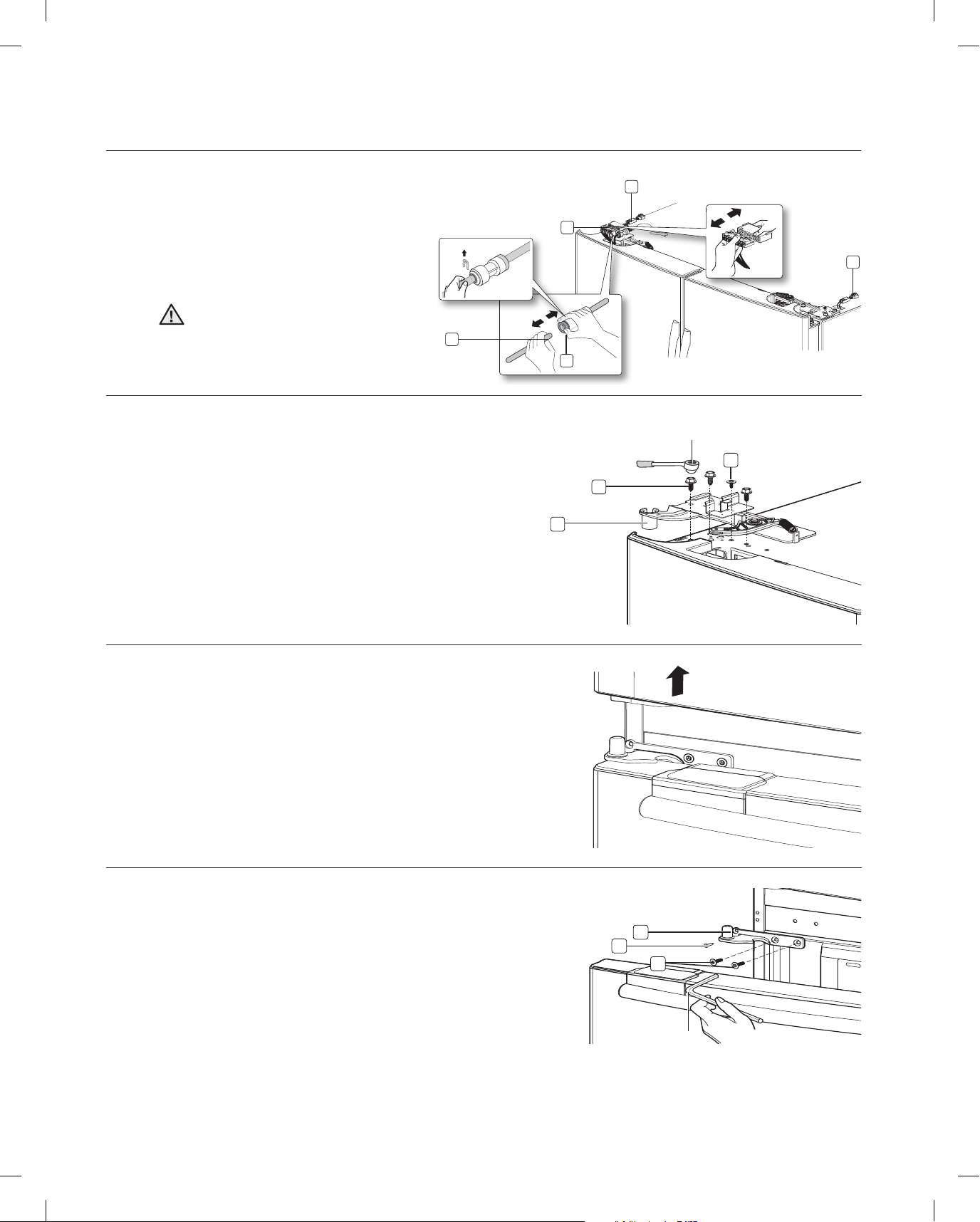
10_ Instalación
Instalación de su refrigerador de tres puertas
2. Desconecte los 2 conectores ( 3 ) situados a
cada lado de la tapa superior y el conector (
4 ) situado sobre la puerta del lado izquierdo.
Desmonte la toma de agua ( 5 ) mientras
presiona la pieza de color gris oscuro ( 6 )
del conector de la toma de agua.
3. Extraiga los 3 pernos hexagonales ( 7 ) que se
encuentran fijados a las bisagras superiores izquierda
y derecha de la puerta con una llave de tubo (7/16”).
Extraiga el perno de puesta a tierra ( 8 ) que se
encuentra fijado a las bisagras superiores izquierda y
derecha de la puerta con un destornillador Philips (+).
Retire las bisagras superiores izquierda y derecha ( 9 )
de la puerta.
4. Levante la puerta hacia arriba para extraerla.
5. Extraiga el perno ( 10 ) que se encuentra fijado a
las bisagras inferiores izquierda y derecha de la
puerta con un destornillador Philips (+). Extraiga los 2
pernos hexagonales ( 11 ) que se encuentran fijados
a las bisagras inferiores izquierda y derecha de la
puerta con una llave Allen (3/16”). Retire las bisagras
inferiores izquierda y derecha de la puerta ( 12 ).
9
7
8
5
6
4
3
3
Tu bo del
dispensador
de la puerta
Tu bo de la
carcasa
Tu bo del
dispensador
de la puerta
Tu bo de la
carcasa
Clip rojo
(1/4")
Clip rojo
(1/4")
12
10
11
Si el acoplador incluye una
abrazadera roja, deberá retirarla
antes de retirar el tubo.
PRECAUCIÓN
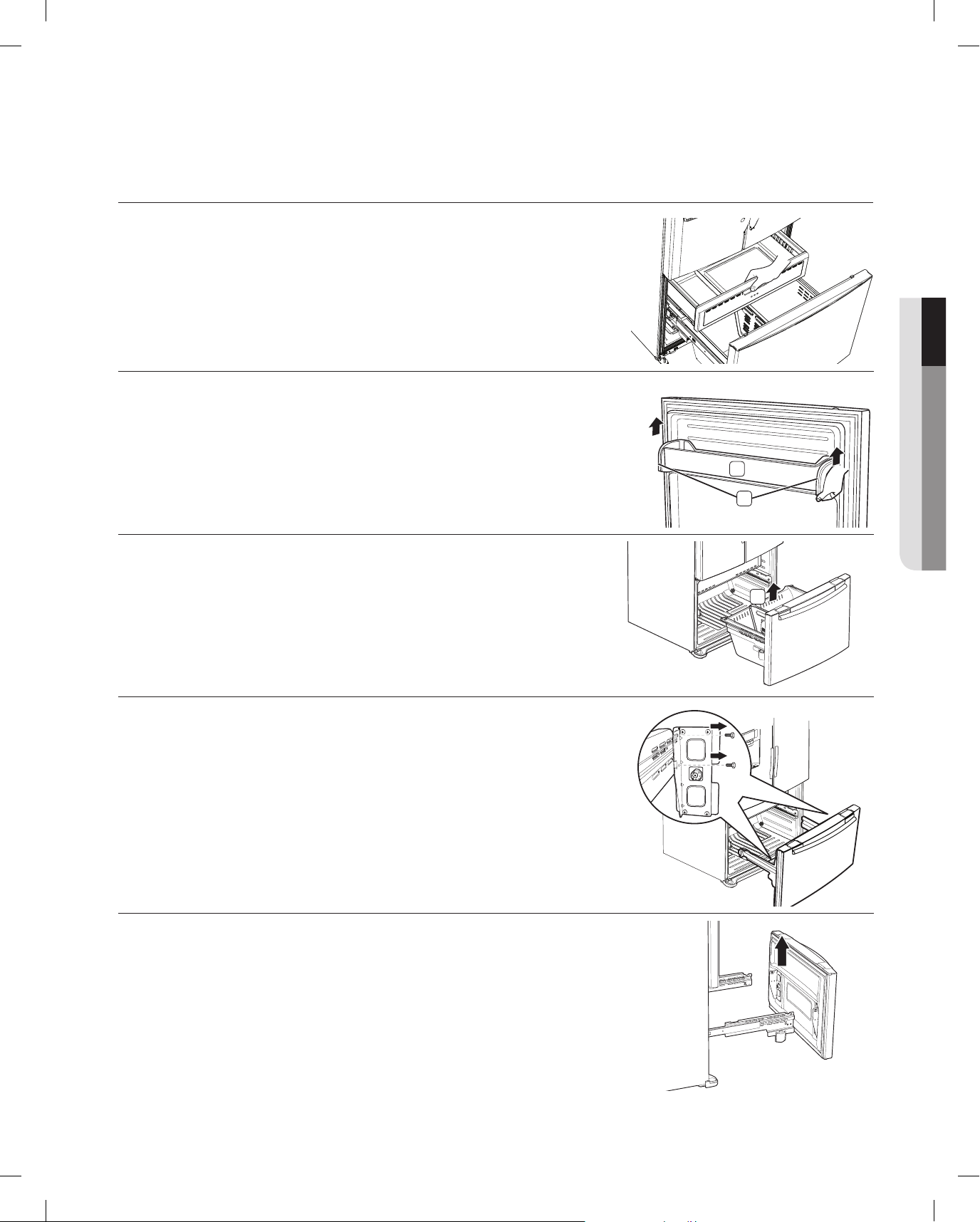
Instalación _11
01 INSTALACIÓN
1. Extraiga el compartimento superior levantándolo.
2. Extraiga el compartimento inclinable ( 1 ) tirando
hacia arriba de ambos soportes de protección ( 2 ) al
mismo tiempo.
3. Saque la cesta inferior ( 3 ) levantándola del sistema
de raíles.
4. Extraiga los 4 pernos de cabeza hexagonal de ambos
lados con una llave de tubo (7/16”).
5. Levante la puerta de la heladera de los rieles.
1
2
3
Slot
Slot
MONTAR LA GAVETA DE LA NEVERA
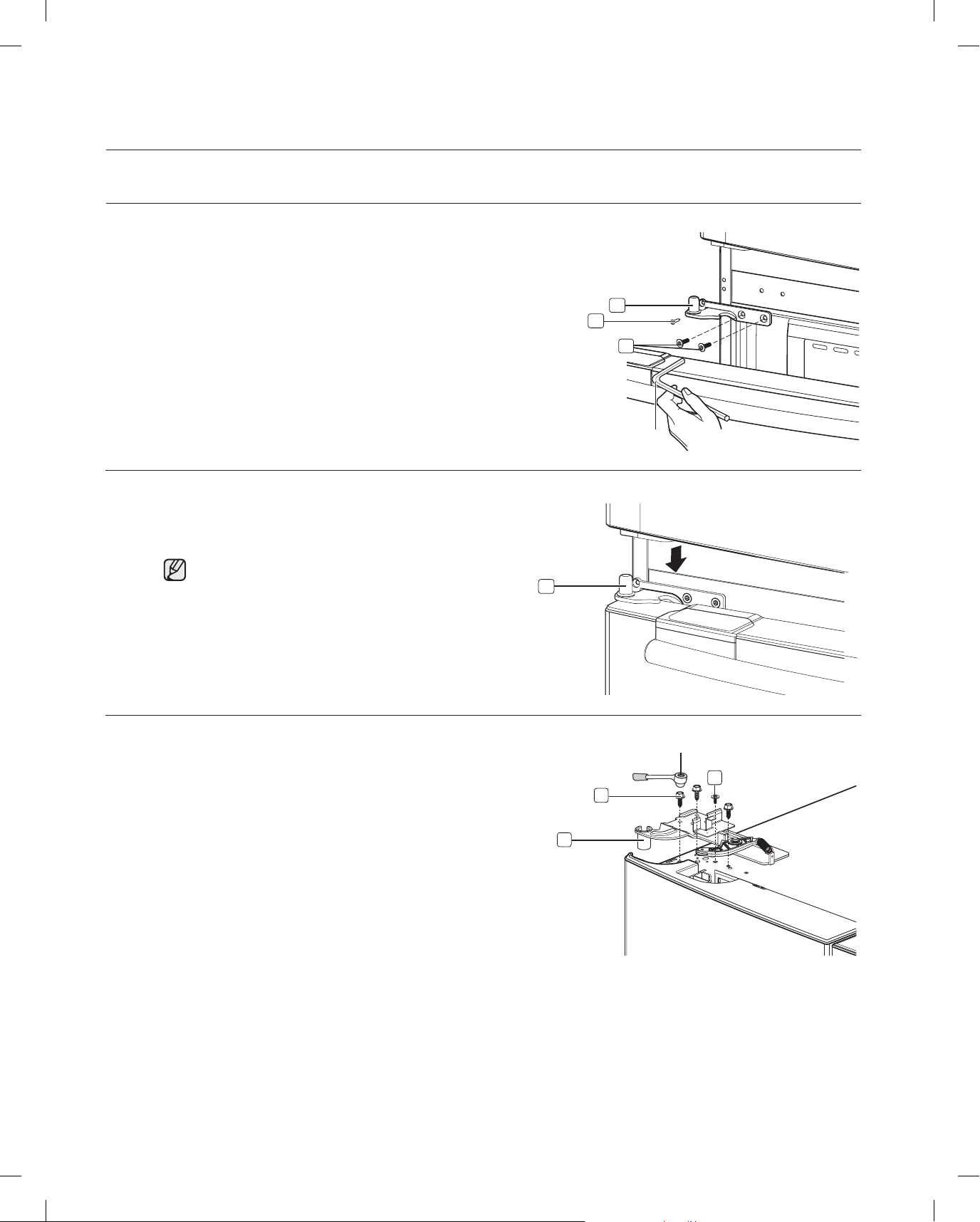
12_ Instalación
Instalación de su refrigerador de tres puertas
12
Montar las puertas del refrigerador
1. Vuelva a montar las bisagras inferiores izquierda
y derecha de la puerta ( 12 ). Con la ayuda de un
destornillador de cabeza Philips, introduzca y apriete
el perno ( 10 ) en las bisagras inferiores izquierda y
derecha de la puerta. Con ayuda de una llave Allen
(3/16”), introduzca y apriete los 2 pernos de cabeza
hexagonal ( 11 ) en las bisagras inferiores izquierda y
derecha de la puerta.
2. Haga coincidir el orificio de la base de la puerta con la
bisagra de la misma ( 12 ).
3. Introduzca las bisagras superiores ( 9 ) en los orificios
situados en la parte superior de las puertas.
Introduzca y apriete los 3 pernos de cabeza
hexagonal ( 7 ) en las bisagras superiores izquierda y
derecha de la puerta con una llave de tubo (7/16”).
Introduzca y apriete el perno de puesta a tierra ( 8 )
en las bisagras superiores izquierda y derecha de la
puerta con un destornillador Philips (+).
DESMONTAJE DE LAS PUERTAS DEL REFRIGERADOR
12
10
11
7
8
9
Asegúrese de no perder la tapa de la bisagra
que es muy fácil de quitar.
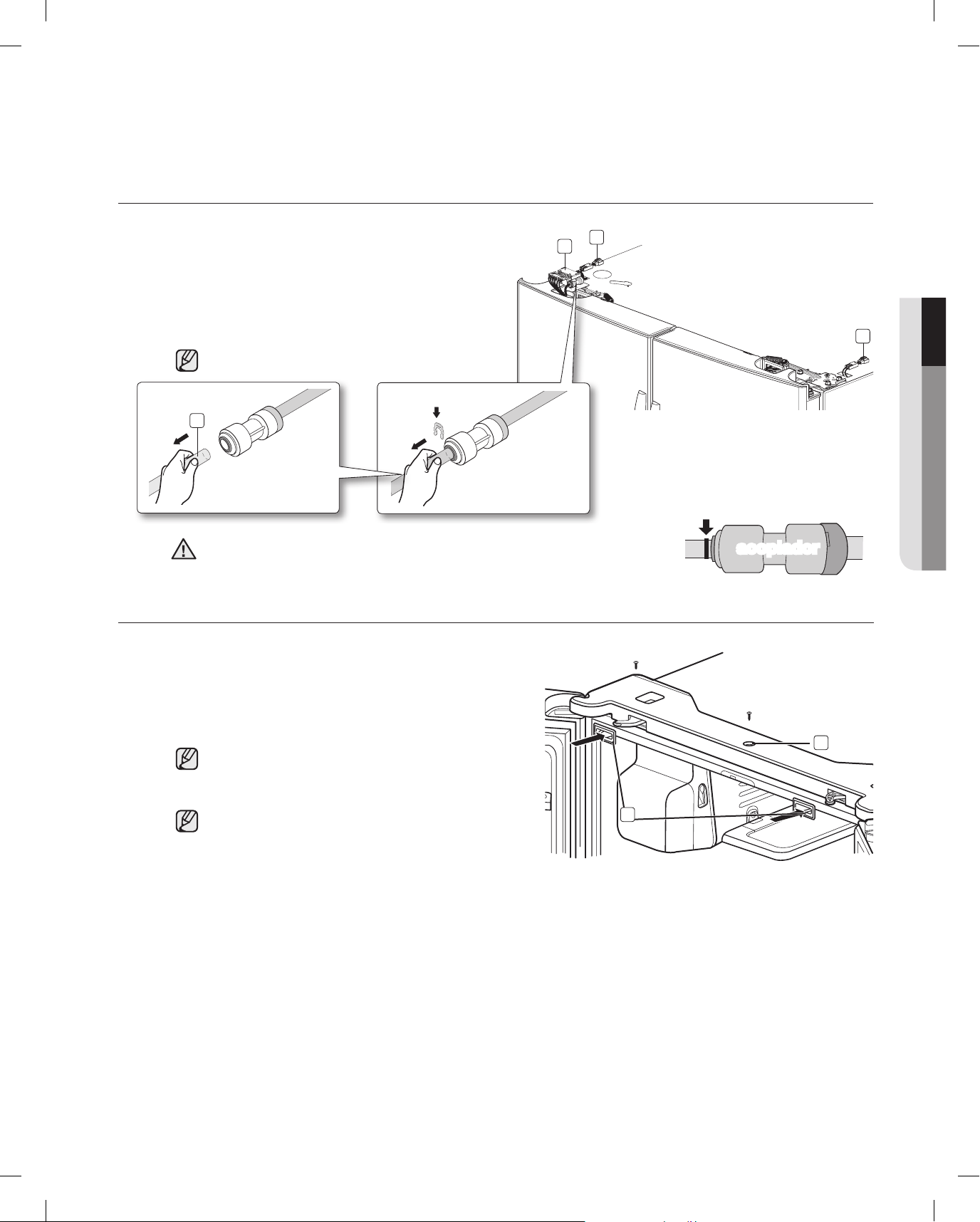
Instalación _13
01 INSTALACIÓN
5. Sitúe el cuadro superior (2) en su lugar. Introduzca
y apriete los 3 pernos en el cuadro superior con un
destornillador Philips (+). Con las puertas abiertas,
vuelva a introducir la tapa del cuadro superior (1) y
cierre las puertas.
DESMONTAJE DE LAS PUERTAS DEL REFRIGERADOR
1
2
3
3
4
Tubo del
dispensador
de la puerta
Tubo de la
carcasa
Tubo del
dispensador
de la puerta
Tubo de la
carcasa
Clip rojo
(1/4")
Clip rojo
(1/4")
Tubo del
dispensador
de la puerta
Tubo de la
carcasa
Tubo del
dispensador
de la puerta
Tubo de la
carcasa
Clip rojo
(1/4")
Clip rojo
(1/4")
5
tubo de la puerta del dispensador
El tubo de la puerta del dispensador ( 5 ) debe quedar
completamente introducido hasta la línea marcada para evitar
fugas de agua procedentes del dispensador.
PRECAUCIÓN
4. Conecte el tubo de la puerta del dispensador
( 5 ) y, a continuación, introduzca un clip en el
conector tirando del tubo. Fije el conector ( 4
) situado en la puerta del lado izquierdo y los
dos conectores ( 3 ) situados a cada lado de
la tapa superior.
La abrazadera se encuentra en el interior de
la tapa superior.
Al volver a montar el cuadro superior, asegúrese
de que la cubierta de la bisagra no comprima o
dañe los cables.
Tras el montaje, cierre las puertas y chequee si
existen huecos entre las juntas de las puertas
o si están inclinadas. Si encuentra un hueco o
inclinación, examine la sección “Ajuste de las
puertas” en la página 15.
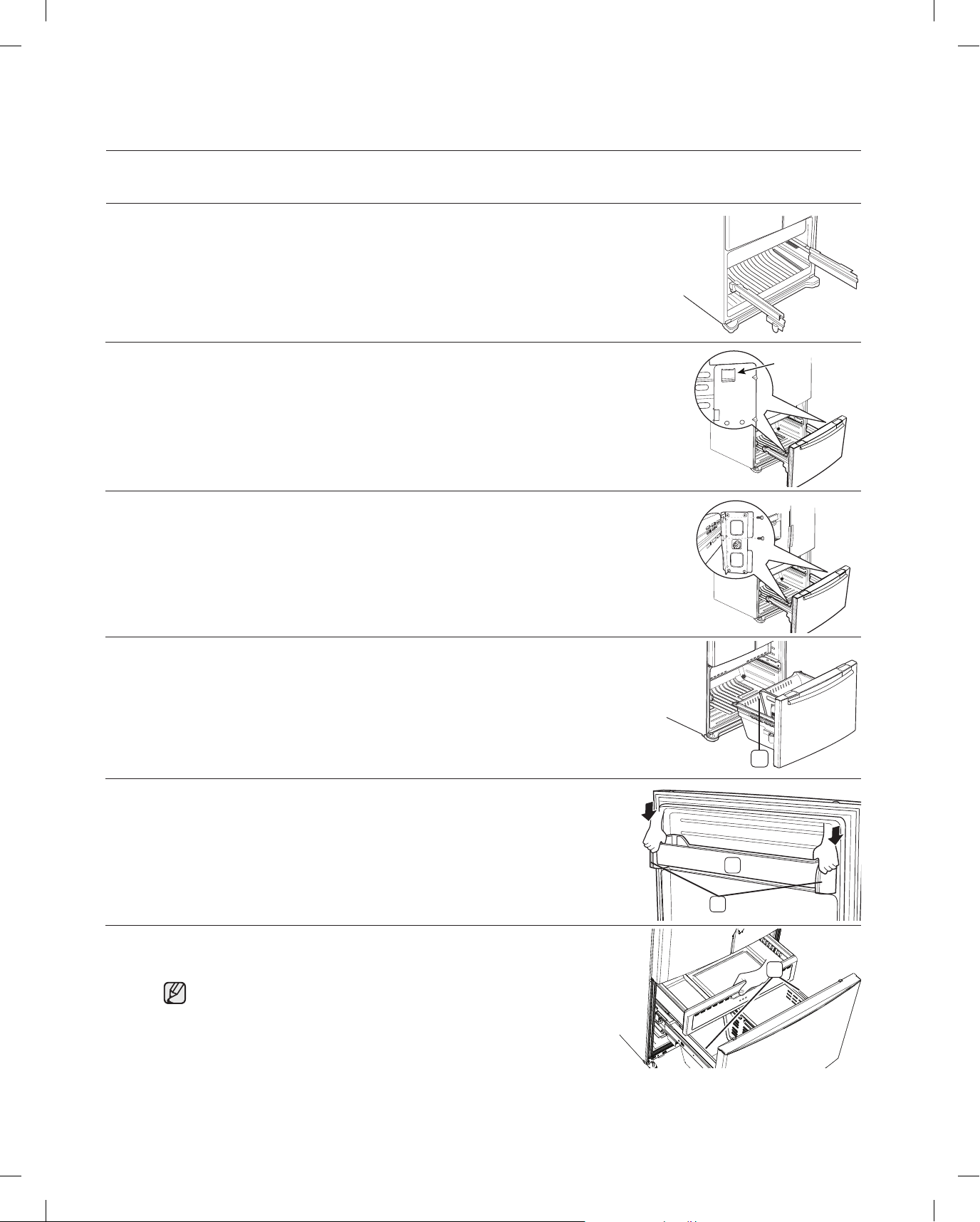
14_ Instalación
Instalación de su refrigerador de tres puertas
7
8
9
MONTAR LA GAVETA DE LA NEVERA
1. Extraiga completamente los raíles de cada lado de la carcasa.
2. Fije la puerta de la nevera sobre las ranuras abiertas de los
lados.
3. Apriete por completo los 4 pernos de cabeza hexagonal con
la ayuda de una llave tubular (7/16”).
4. Introduzca la cesta inferior ( 6 ) dentro del sistema de rieles.
5. Enganche los extremos del compartimento inclinable ( 7
) dentro de los soportes de protección y presione hasta
encajarlo en su posición.
6. Introduzca la gaveta superior.
Slot
Slot
Slot
Slot
Slot
Slot
6
Retire los 2 pedazos de cinta ( 9 ) adheridos al lateral del
compartimento de la gaveta. Vuelva a adherir la cinta en
la misma posición al desplazar el refrigerador, para evitar
arañazos en el compartimento de la gaveta.
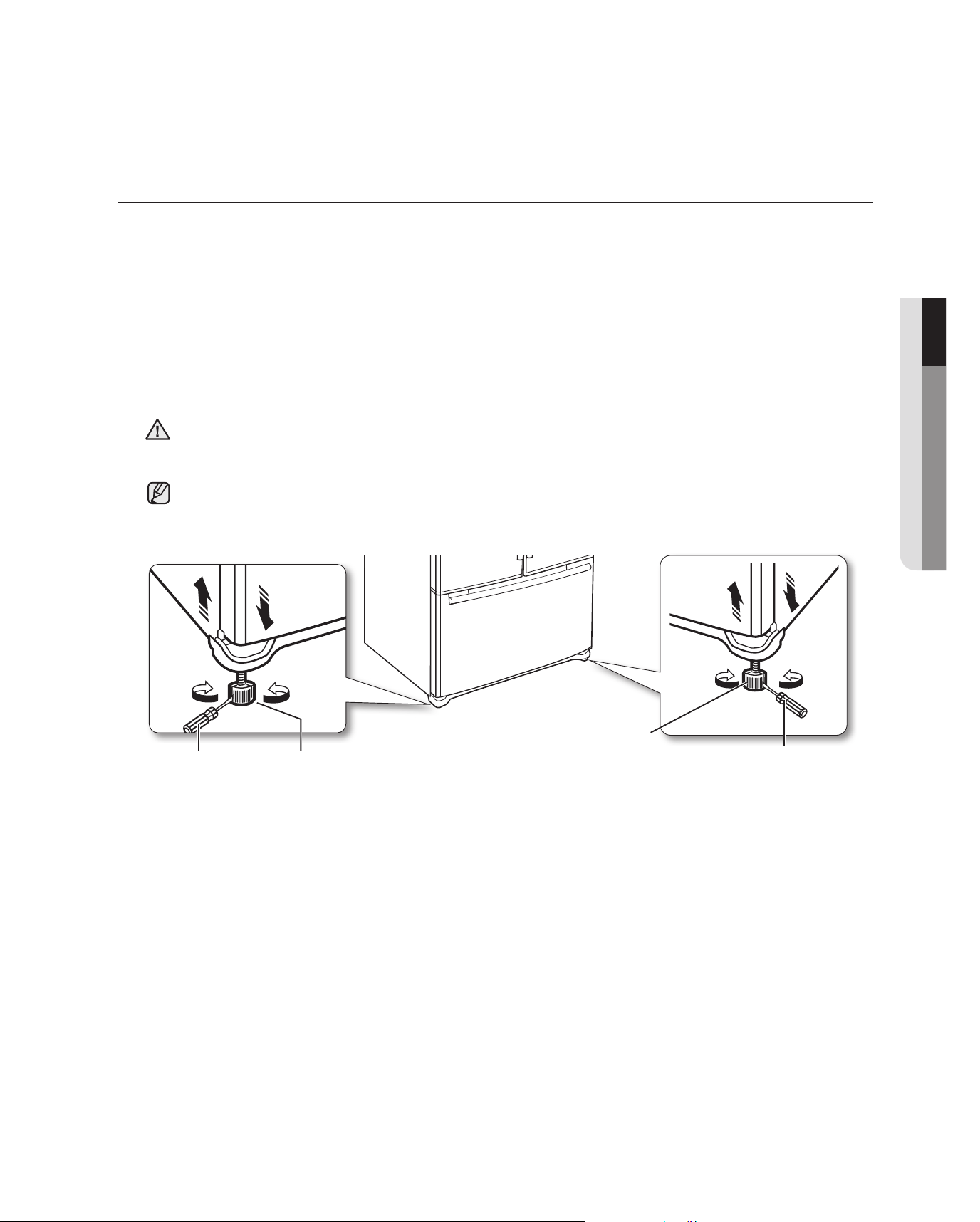
Instalación _15
01 INSTALACIÓN
AJUSTE DE LAS PUERTAS
Tras volver a colocar las puertas del refrigerador, asegúrese de que el electrodoméstico esté nivelado para
poder realizar los ajustes finales.
Si el refrigerador no está nivelado, no será posible conseguir que las puertas estén perfectamente igualadas, lo
que podría provocar condensación de humedad e incrementos en las facturas eléctricas.
Por ejemplo, cuando el lateral izquierdo esté más bajo que el derecho, introduzca un destornillador de cabeza
plana (-) dentro de una muesca del pie de nivelación izquierdo y gírelo en sentido antihorario hasta nivelar la
puerta.
Gírelo en sentido horario para bajar el refrigerador y en sentido antihorario para levantarlo.
Ambos pies de nivelación deben estar en contacto con el piso para evitar potenciales lesiones o
daños a la propiedad derivados del vuelco.
PRECAUCIÓN
Recomendamos no realizar pequeños ajustes en los pies de nivelación. En lugar de eso, examine la
siguiente página para descubrir la mejor forma de realizar ajustes menores en las puertas.
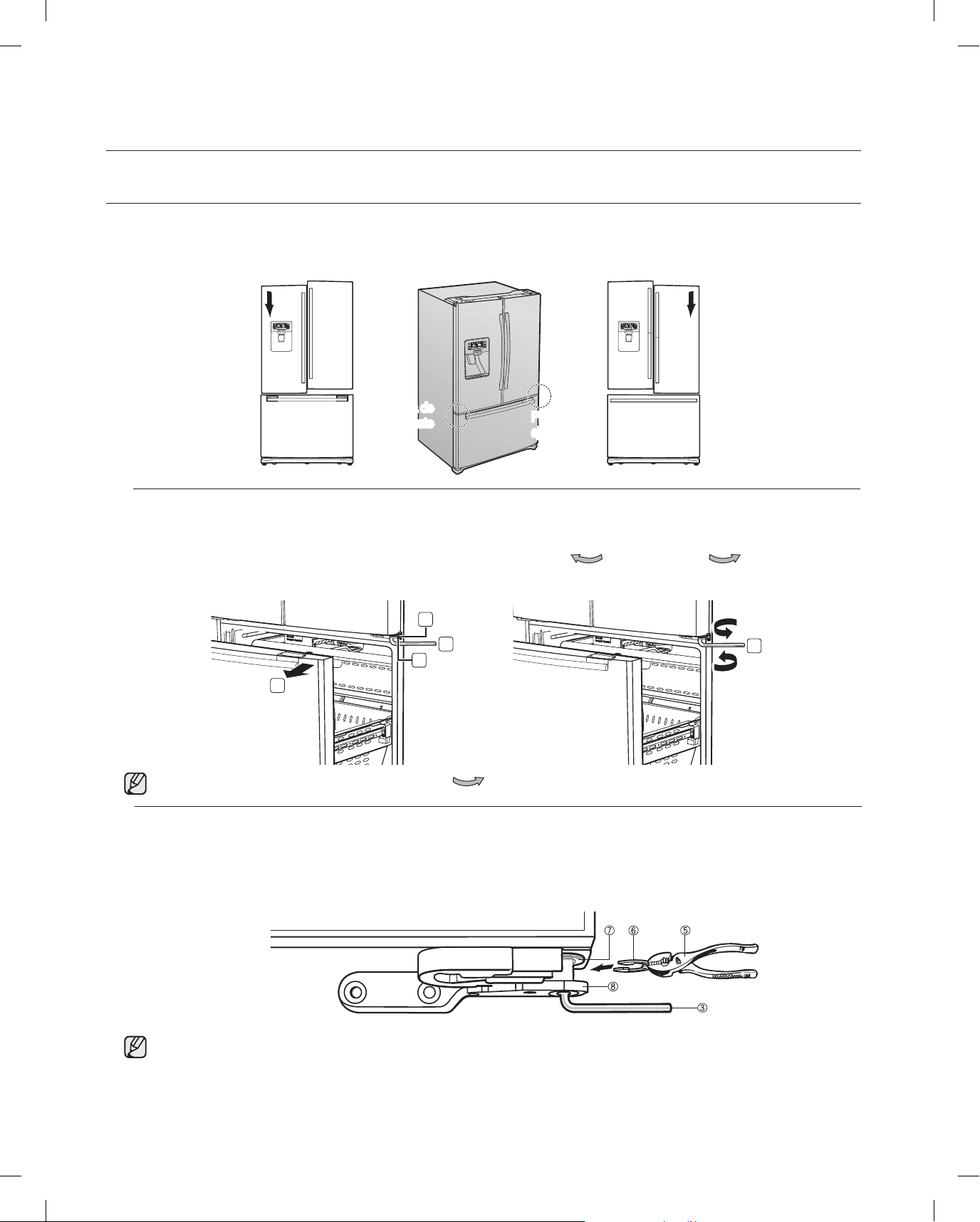
16_ Instalación
1. Extraiga la gaveta de la heladera ( ) y podrá ver la bisagra central ( ).
2. Introduzca la llave hexagonal incluida ( ) dentro del eje ( ) de la bisagra central.
3. Ajuste la altura girando la llave Allen ( 3 ) en sentido horario (
) o antihorario ( ).
1. Tras ajustar las puertas, introduzca el mecanismo de cierre incluido ( 6 ) usando un alicate ( 5 ) en el
hueco entre el anillo de la bisagra ( 7 ) y la bisagra inferior ( 8 ) . El número de mecanismos de cierre a
insertar, dependerá del hueco.
REALIZACIÓN DE AJUSTES MENORES ENTRE PUERTAS
Recuerde que es necesario que el refrigerador esté nivelado para lograr que las puertas estén igualadas de
forma uniforme. Si necesita ayuda, revise las secciones anteriores relativas a la nivelación del refrigerador.
Instalación de su refrigerador de tres puertas
Al girar la llave Allen en sentido antihorario( ), la puerta se desplazará hacia arriba.
Con el refrigerador se incluyen dos mecanismos de cierre.
El grosor de cada anillo de sujeción es de 1mm (0,04 pulgadas).
Cuando la
puerta izquierda
esté más baja
que la derecha.
Cuando
la puerta
izquierda esté
más alta que la
derecha.
Pieza de
ajuste
Pieza de
ajuste
3
2
3
4
1
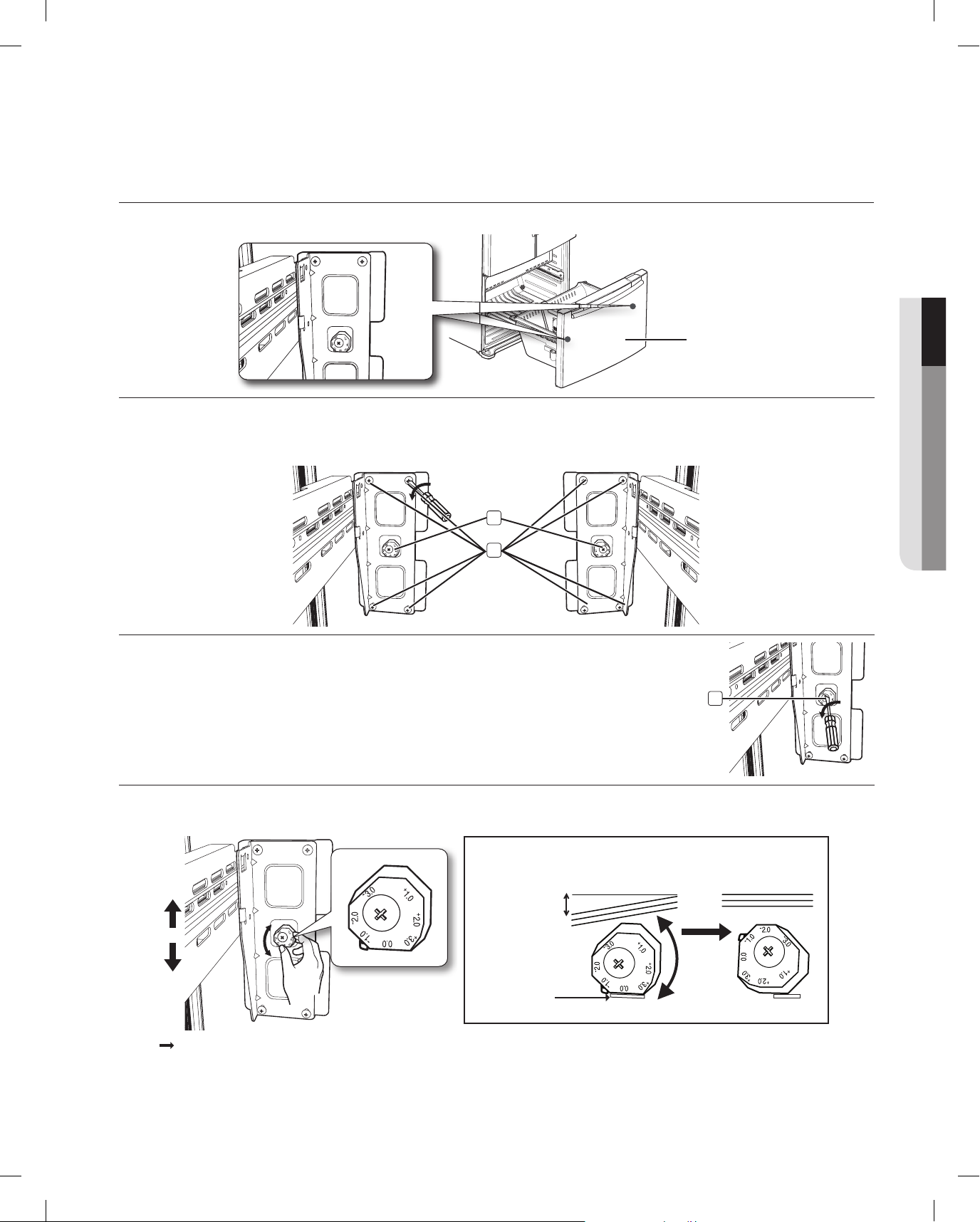
Instalación _17
01 INSTALACIÓN
AJUSTE DEL NIVEL DE LA GAVETA DE LA NEVERA
1. Localice el regulador de altura ( 1 ) en la gaveta de la nevera.
Desenrosque parcialmente los 8 pernos Philips ( 2 ) para aflojar la puerta.
3. Busque el mejor nivel de ajuste para la inclinación de la puerta.
Tras el ajuste, apriete el perno de control ( 3 ) y, a continuación, los pernos Philips.
Gaveta de la nevera
Pieza de ajuste
2. Afloje el perno de control ( 3 ) con un destornillador Philips(+).
3
2
1
Ejemplo) La inclinación es de es de 2 mm( 0,08 pulgadas)
aproximadamente, como se indica a continuación.
- Gire el ajuste de altura a -2,0 para reducir la inclinación de la puerta.
Plano de
referencia
Inclinación
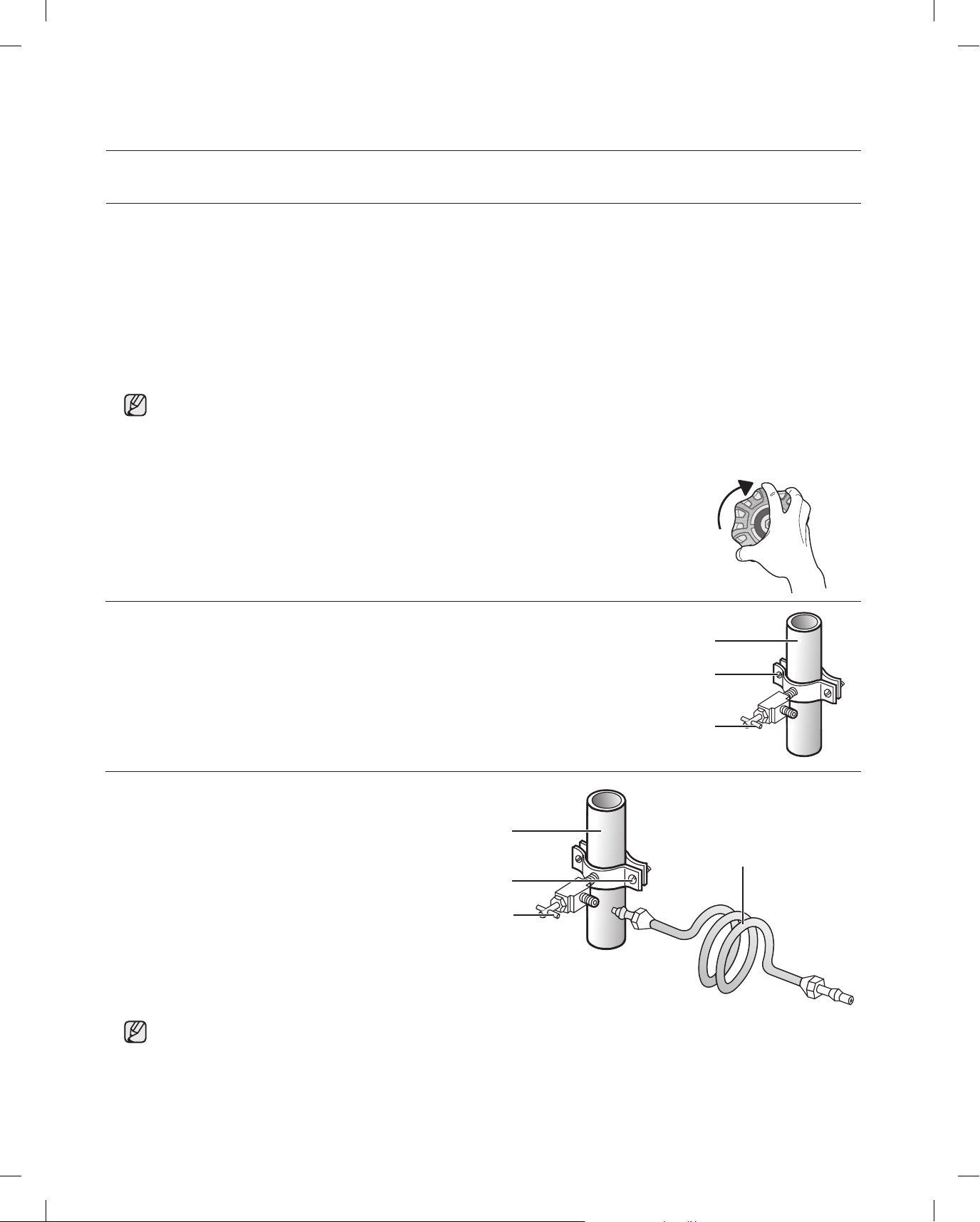
18_ Instalación
CHEQUEO DE LA TOMA DE AGUA DEL DISPENSADOR
Un dispensador es sólo una de las útiles características de su nuevo refrigerador. Para fomentar una mejor
salud, el filtro elimina partículas no deseadas del agua. Sin embargo, no esteriliza ni destruye microorganismos.
Para lograr esto último, debe adquirir un sistema purificador de agua.
Para que la máquina de hielo funcione correctamente, es necesaria una presión de agua de 20~125 psi (libras
por pulgada cuadrada)
En condiciones normales, un vaso de papel de 170 cc (5,75 onzas) debe poder llenarse en 10 segundos.
Si la zona de instalación del refrigerador dispone de una presión baja de agua (por debajo de 20 psi), puede
instalar una bomba auxiliar para compensar la falta de presión.
Instalación de su refrigerador de tres puertas
En su distribuidor encontrará disponibles kits de instalación para la toma de agua por un coste
adicional. Recomendamos usar un kit de instalación de toma de agua que disponga de tubos de
cobre y de tuercas de compresión de ¼”.
Tras conectar el suministro al filtro de agua, vuelva a dejar el suministro principal como estaba y
dispense 4 ó más galones en un recipiente para eliminar impurezas y cebar el filtro de agua.
Si advierte la presencia de goteo o fugas de agua en el área de conexión, cierre el suministro de agua
principal. Chequéelo y, si es necesario, apriételo más.
Abrazadera para tubos
Toma de agua fría
Válvula de cierre
Válvula de cierre
Abrazadera para tubos
Toma de agua fría
Kit de instalación de
toma de agua
1. Primero, corte el suministro de agua principal.
2. Localice la toma de agua fría potable más cercana e
instale la abrazadera para tubos y la válvula de cierre.
3. Conecte el kit de instalación de la toma de agua a la
válvula de cierre.
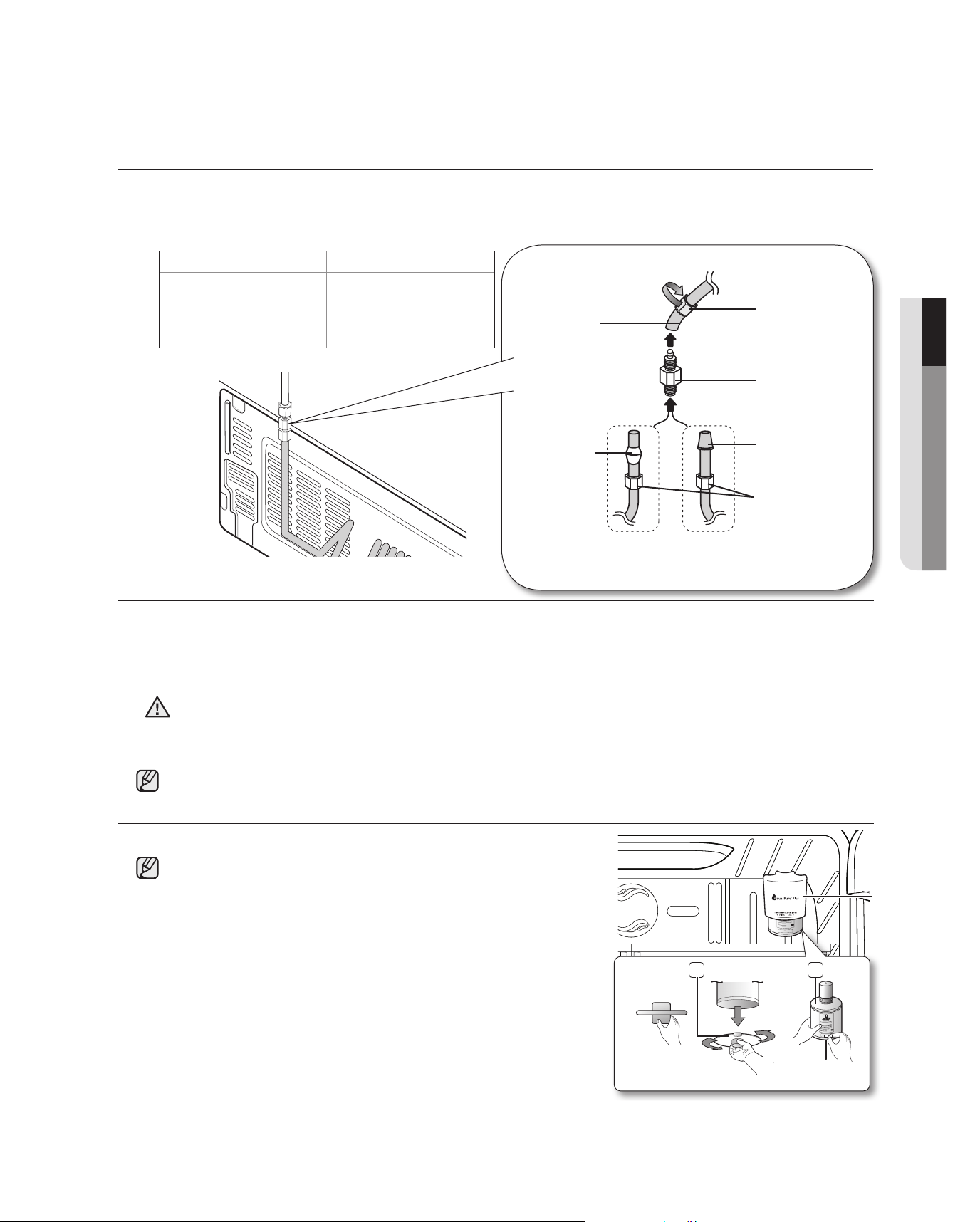
Instalación _19
01 INSTALACIÓN
Conecte la toma de agua sólo a una fuente de agua potable.
Si debe reparar o desmontar la toma de agua, corte 6,35 mm (1/4“) del tubo de plástico para
garantizar una conexión ajustada y sin fugas.
Tras retirar la balda superior del lado derecho, podrá
instalar más fácilmente el filtro de agua.
Deberá adquirir varios elementos para realizar esta conexión.
Podrá encontrar estos elementos a la venta en forma de kit, en su ferretería habitual.
1. Deslice la tuerca de compresión (A) a través del tubo de plástico suministrado.(A)
2. Apriete la tuerca de compresión (A )sobre elracor de compresión de 1/4”.
- Si está usando tubo de cobre, deslice la tuerca de compresión (B)(no incluida) y la férula (no incluida)
por el tubo de cobre (no incluido) como se indica.
-
Si está usando conductos de plástico(B), introduzca el extremo moldeado (bulbo) del tubo (B)dentro del racor de compresión.
3. Apriete la tuerca de compresión (B)sobre el racor de compresión. No fuerce la tuerca de compresión.(B)
4. Abra el suministro de agua y realice un chequeo en busca de fugas.
1. Retire la tapa del filtro de agua ( 1 ).
2. Retire la tapa fija ( 2 ) girándola en sentido antihorario. Guarde la
tapa en un lugar seguro para usarla en caso de no usar el filtro.
3. Retire el filtro del agua ( 3 ) de la caja y coloque una etiqueta
adhesiva indicadora de reemplazo (incluida en la caja) sobre
el filtro como se indica. Por ejemplo, si instala el filtro de
agua en marzo, coloque la etiqueta “SEP” sobre el filtro para
recordarle que debe reemplazar en septiembre. De esta forma,
sabrá cuándo debe reemplazar el filtro. Normalmente, un filtro
dispone de una vida útil de unos 6 meses.
2 3
Etiqueta adhesiva
indicadora
(indicador de mes)
Tubo de plástico (A)
(incluido)
Férula
(No incluido)
Tuerca de compresión
(1/4”) (A) (incluido)
Racor de compresión
(incluido)
Extremo moldeado
(bulbo)
Tuerca de compresión
(1/4”)(B) (no incluido)
o
Tubo de cobre
(no incluido)
(no incluido)
Refrigerador
Uso de tubo de cobre Uso de tubo de plástico
• Tubo de cobre de ¼”
• Tuerca de compresión de
¼” (2 unidades)
• Férula (2 unidades)
•
Tubo de plástico de ¼”
→
Extremo moldeado (bulbo)
•
Tuerca de compresión
de ¼” (2 unidades)
No usar sin el extremo moldeado (bulbo) de la tubería de plástico. (B) .
PRECAUCIÓN
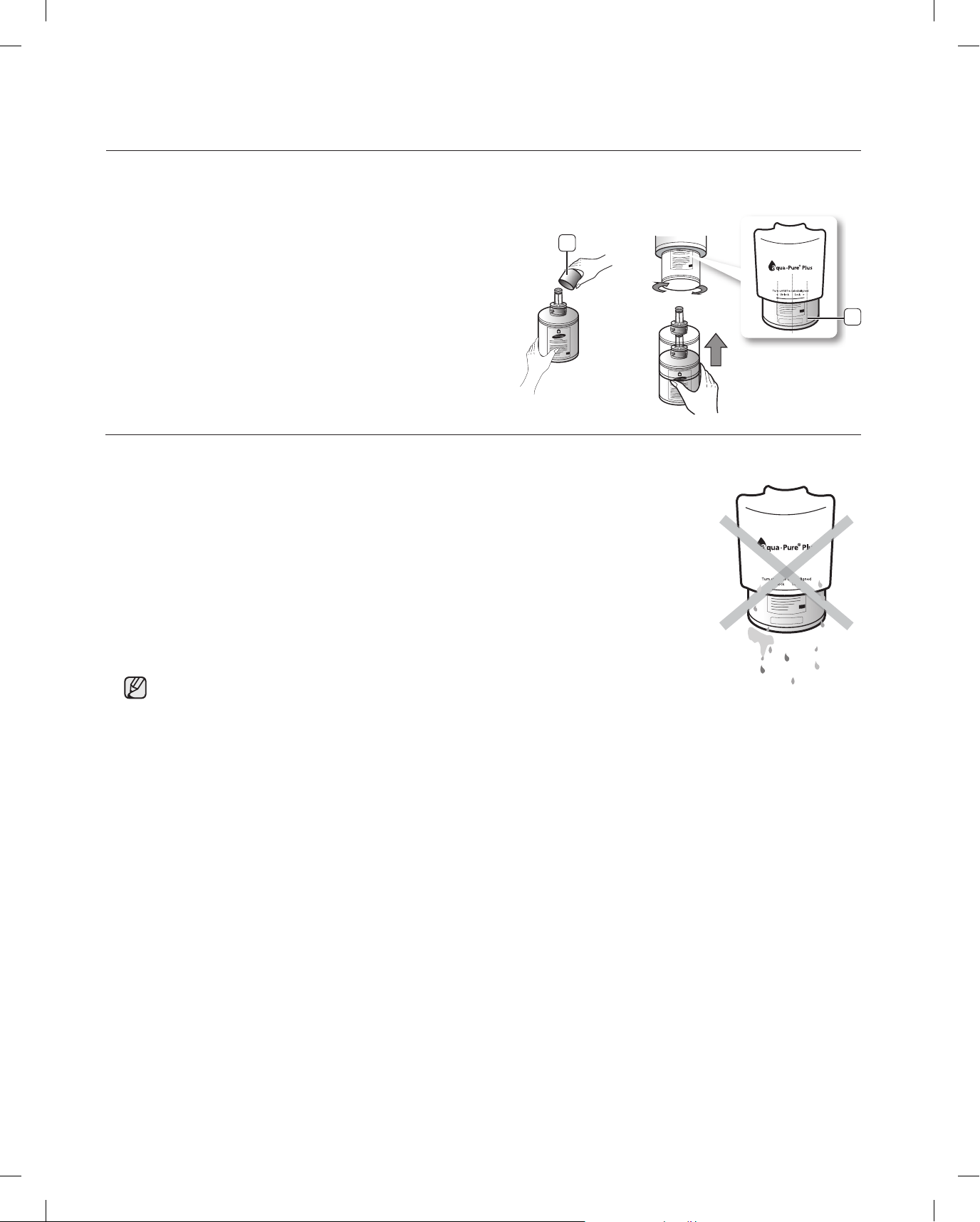
20_ Instalación
Instalación de su refrigerador de tres puertas
4. Retire la tapa del filtro ( 4 ) e introdúzcalo en su
alojamiento.
5. Gire lentamente el ltro de agua 90º en sentido
horario para alinearlo con la marca impresa
situada en la cubierta, bloqueando el filtro en su
posición. Asegúrese de alinear la marca ( 5 ) de
la etiqueta del filtro de agua con el centro de la
impresión de la cubierta del filtro como se indica
en la ilustración, Recuerde, no la fuerce.
Gire hasta que
la etiqueta esté
alineada.
Retirada del tapón
del filtro (rojo)
Cubiertadel filtro
4
5
1. Abra el suministro de agua principal y la válvula de la toma de suministro de
agua.
2. Deje correr el agua a través del dispensador hasta que salga transparente (6-7
minutos aprox.). Limpiará el sistema de suministro de agua y eliminará aire de
los conductos.
3. En algunos hogares podría necesitarse un tiempo de limpieza mayor.
4. Abra la puerta del refrigerador y asegúrese de que no existen fugas de agua
procedentes del filtro.
La presión del suministro de agua procedente de un sistema de ósmosis inversa dirigida
hacia la válvula de entrada de agua del refrigerador debe encontrarse entre 35 y 120 psi (241 y 827 kPa).
Si se conecta un sistema de filtrado de agua por ósmosis inversa a su suministro de agua fría, la presión
del agua a dicho sistema debe contar con un mínimo de 40 a 60 psi (276 a 414 kPa).
Si la presión del agua hacia al sistema de ósmosis inversa está por debajo de 40 a 60 psi (276 a 414 kPa):
• Chequear si el ltro de sedimentos del sistema de ósmosis inversa está obstruido. Reemplace el ltro si
fuera necesario.
• Permita que el depósito de almacenamiento del sistema de ósmosis inversa vuelva a llenarse tras un
uso exigente.
• Si su refrigerador dispone de un ltro de agua, este podría reducir aún más la presión de agua al usarse
junto con un sistema de ósmosis inversa. Desmonte el filtro de agua.
Si tiene alguna duda respecto a la presión de agua disponible, póngase en contacto con un fontanero
cualificado y autorizado.
Asegúrese de purgar completamente el dispensador o podría gotear agua.
Esto es debido al hecho de que todavía queda aire en la toma.

Funcionamiento _21
02 FUNCIONAMIENTO
Algunas funciones quedan desactivadas pasados unos segundos al pulsar los botones, mientras son
activados otros en el mismo instante. Esto se considera normal.
Funcionamiento del refrigerador de tres puertas
1
2
3
4
5
6
1
Pulse el botón para mejorar el rendimiento energético. Si se produjese goteo de agua
en las puertas, desactive la función (Ahorro de energía).
2
Pulse el botón (Heladera / Congelación rápida) para ajustar la heladera a la
temperatura deseada.
Puede ajustar la temperatura entre -8° F y 8° F).
Mantenga pulsado el botón (Heladera / Congelación rápida) durante 3
segundos para acelerar el tiempo necesario para congelar productos en la heladera. Puede ser útil si
necesita congelar rápidamente artículos que se estropeen deprisa o si la temperatura de la heladera
fuese muy alta (por ejemplo, si la puerta se ha dejado abierta).
3
Pulse el botón (Hielo/Agua) para escoger la función de hielo o agua. Puede escoger agua
o los distintos tipos de hielo (cubitos/hielo picado). Tras realizar una selección, pulse la palanca del
dispensador.
4
Pulse el botón (Alarma/Iluminación) para desactivar la alarma de puerta abierta. Al
principio, el modo de alarma está activado. Si mantiene pulsado el botón (Alarma/
Iluminación) durante 3 segundos, la iluminación LED del dispensador permanecerá prendida.
5
Pulse el botón (Refrigerador / Enfriamiento rápido) para ajustar el refrigerador a
la temperatura deseada. Puede ajustar la temperatura entre 1,1º C y 7,8º C (34° F y 46° F).
Mantenga pulsado el botón (Refrigerador / Enfriamiento rápido) durante 3
segundos para acelerar el tiempo necesario para enfriar productos en el refrigerador. Puede ser útil
si necesita enfriar rápidamente artículos que se estropeen deprisa o si la temperatura del refrigerador
fuese muy alta (por ejemplo, si la puerta se ha dejado abierta).
6
Pulse el botón (Hielo desac. / Bloquear) para desconectar la función de elaboración
de hielo.
Si mantiene pulsado el botón (Hielo desac. / Bloquear) durante 3 segundos, la
pantalla de visualización y el dispensador quedarán bloqueados.
USO DEL PANEL DE CONTROL
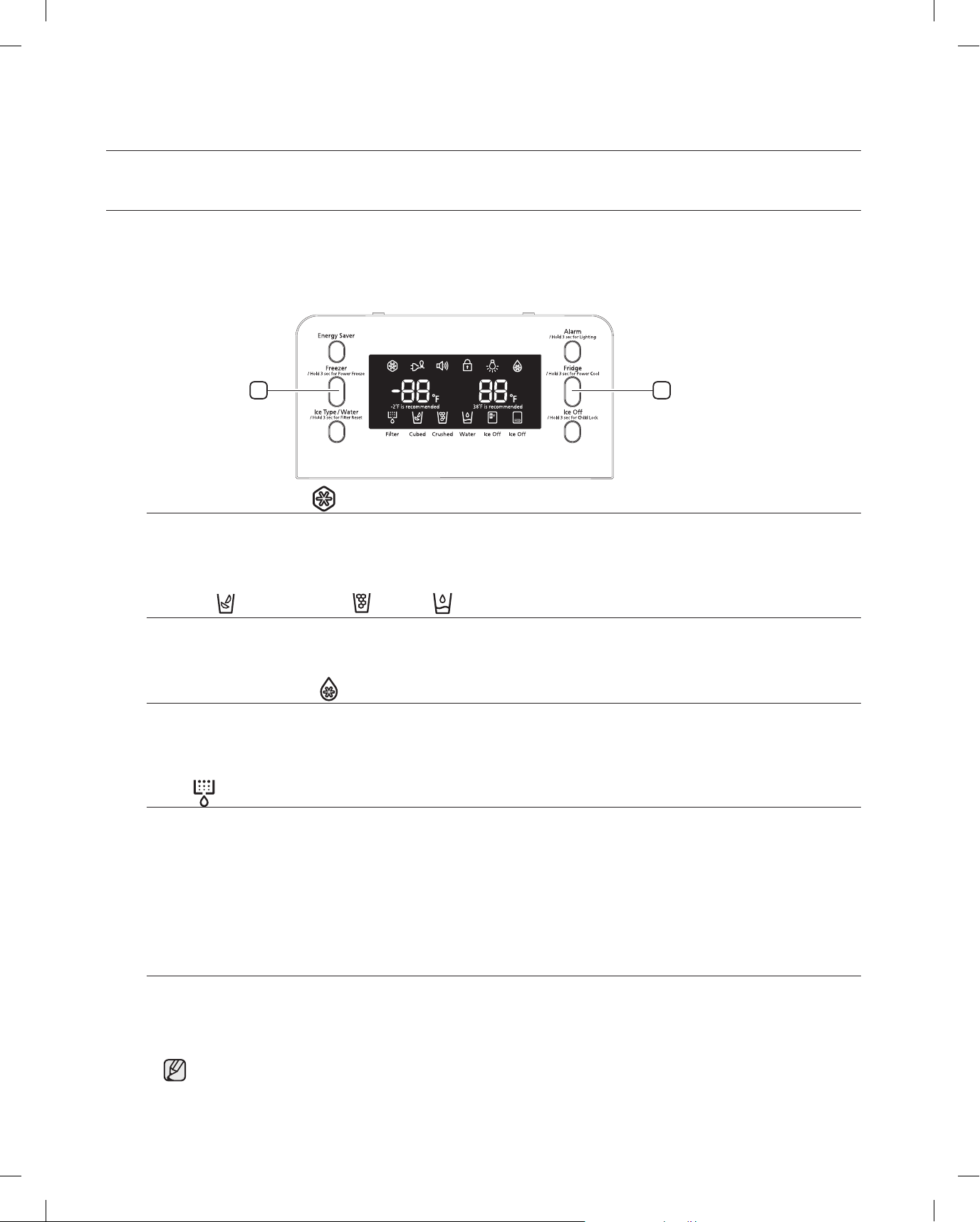
22_ Funcionamiento
Funcionamiento del refrigerador de tres puertas
USO DE LA PANTALLA DIGITAL
1 2
indica la temperatura actual en la heladera.
indica la temperatura actual en el refrigerador.
Si no pulsa ningún botón, los indicadores de temperatura de la heladera y el refrigerador se apagarán pasados
unos segundos.
Si pulsa cualquier botón, la pantalla se iluminará de nuevo.
Este icono se iluminará al pulsar el botón durante 3 segundos. La función de Congelación
rápida es fantástica para esos momentos en los que necesita disponer de una gran cantidad de hielo. Cuando disponga
de hielo suficiente, simplemente pulse el mismo botón durante 3 segundos para cancelar el modo de Congelación rápida.
Tras 2 horas y media, el modo Congelación rápida se apagará automáticamente para reducir el consumo de energía.
Cubitos
Disfrute de cubitos o hielo picado escogiéndolo mediante el panel de control digital. Si no necesita hielo,
desactive la función para ahorrar consumo de agua y energía. Dependiendo de la elección actual, se
iluminará el icono de Tipo de hielo correspondiente.
Este icono se iluminará al pulsar el botón durante 3 segundos. Use el modo de
Refrigeración rápida para conseguir un enfriamiento rápido. Si desea cancelar el modo de Refrigeración
rápida, simplemente pulse de nuevo el botón durante 3 segundos. Tras 2 horas y media, el modo
Refrigeración rápida se apagará automáticamente para reducir el consumo de energía.
La refrigeración se detendrá tanto en el compartimento de la heladera como en el del refrigerador, pero
no se cortará el suministro eléctrico del electrodoméstico. Para usar esta función, pulse simultáneamente
los botones y durante 3 segundos hasta que suene un aviso de
alarma. Para cancelar este modo, pulse de nuevo los mismos botones durante 3 segundos.
Filtro
Cuando la luz del indicador del filtro se prenda, es el momento de cambiar el filtro. Normalmente esto sucede
cada 6 meses aproximadamente. Al introducirlo inicialmente, el indicador del filtro de agua se iluminará en azul
(amarillo-verde). El indicador del filtro pasará a iluminarse en rosa (ámbar) tras 270 galones (1,000 litros) de uso.
El indicador del filtro pasará a iluminarse en rojo tras 300 galones (1,140 litros) de uso. Tras reemplazar el filtro
de agua usado e instalar uno nuevo (examine la página 38 para obtener instrucciones) cuando el filtro esté rojo,
reinicie el indicador manteniendo pulsado el botón “Alarm/Hold 3 sec for Filter Reset” durante 3 segundos.(El
indicador del filtro pasará a ser de color azul o verde amarillento cuando el indicador sea reiniciado).
Esta función se usa para refrigeradores de muestra en tiendas. No para uso doméstico.
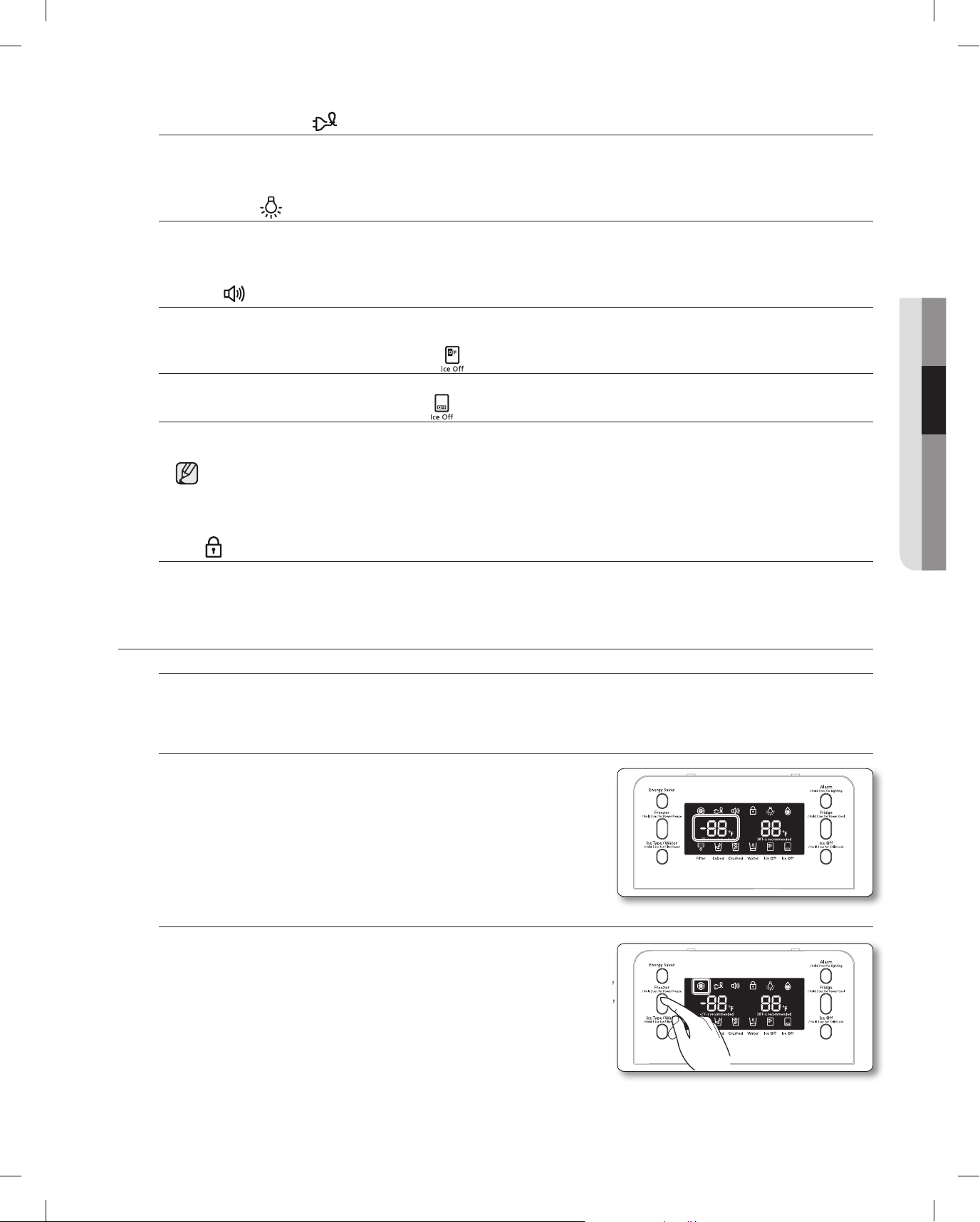
Funcionamiento _23
02 FUNCIONAMIENTO
CONTROL DE LA TEMPERATURA DEL REFRIGERADOR
Ahorro de energía
Este icono se iluminará al pulsar el botón (Ahorro de energía). La función de ahorro de
energía se activará automáticamente en “ON” al conectar el refrigerador. Si se produjese condensación en
las puertas, desactive la función de Ahorro de energía.
Este icono se iluminará al pulsar el botón (Iluminación). En este caso, la luz del dispensador (bajo
la pantalla) permanecerá constantemente iluminada. Si desea que la luz del dispensador se prenda sólo
cuando esté usándose, desactive la función Lighting.
Alarma
Este icono se iluminará al pulsar el botón (Alarma). La alarma de puerta sonará si se deja abierta cualquier puerta
durante más de 3 minutos. El aviso sonoro se detendrá cuando cierre la puerta. Inicialmente la alarma está activada.
Este icono se iluminará al activar el botón (Hielo del refrigerador desactivado). En este caso, el refrigerador no elaborará hielo.
Este icono se iluminará al activar el botón (Hielo de la heladera desactivado). En este
caso, la heladera no elaborará hielo.
Lock
Este icono se iluminará al pulsar el botón (Bloqueo). En este estado, no podrá usar el panel de
control. Si mantiene pulsado el botón Ice Off / Lock (Hielo desac. / Bloquear) durante 3 segundos, podrá
usar de nuevo el panel de control.
• Debido a que este refrigerador dispone de doble máquina de hielo, puede darse un incremento de gasto energético.
Le recomendamos que si dispone de hielo suficiente, desactive la elaboración de hielo para ahorrar energía.
• Podría oír, ocasionalmente, ruidos producidos por la caída o el ujo de agua de la máquina de hielo. Estos ruidos
forman parte del normal funcionamiento.
Temperatura básica de los compartimentos de la heladera y el refrigerador
La temperatura básica o recomendada para los compartimentos de la heladera y el refrigerador es de -2°F y 3°C
(38°F) respectivamente. Si la temperatura de los compartimentos de la heladera y el refrigerador es demasiado alta o
baja, ajuste la temperatura manualmente.
Control de la temperatura de la heladera
La temperatura de la heladera puede ajustarse entre -8º F y 8º F (-22º C y -13º C) para
adaptarse a sus necesidades particulares. Pulse el botón Freezer (Heladera) varias veces hasta
que la temperatura deseada aparezca en la pantalla de visualización. La temperatura variará 2º
F con cada pulsación (-2°F ➝ -4°F ➝ -6°F ➝ -8°F ➝ 8°F ➝ 6°F ➝ 4°F ➝ 2°F ➝ 0°F ➝ -2°F).
Tenga en cuenta que alimentos como el helado pueden derretirse a -16º C (4º F). La pantalla
de visualización de temperatura cambiará secuencialmente entre -22º C y -13º C (-8º F y 8º F).
Cinco segundos después de que la nueva temperatura se ajuste, en pantalla se mostrará de
nuevo la temperatura actual de la heladera hasta que se alcance la nueva temperatura.
Si necesita elaborar una gran cantidad de hielo o desea que la heladera se enfríe más rápidamente,
puede usar la función de Congelación rápida. Mantenga pulsado el botón Freezer/Power Cool
durante 3 segundos. A continuación, se iluminará el indicador de la función de Congelación rápida,
independiente de la temperatura de ajuste de la heladera. Si escoge la función Congelación rápida,
la temperatura interior de la heladera descenderá durante dos horas y media aproximadamente.
Cuando disponga de hielo suficiente, simplemente mantenga pulsado el mismo botón durante 3
segundos para cancelar el modo de Congelación rápida. Entonces, el indicador se apagará y la
heladera volverá de nuevo su temperatura de ajuste.
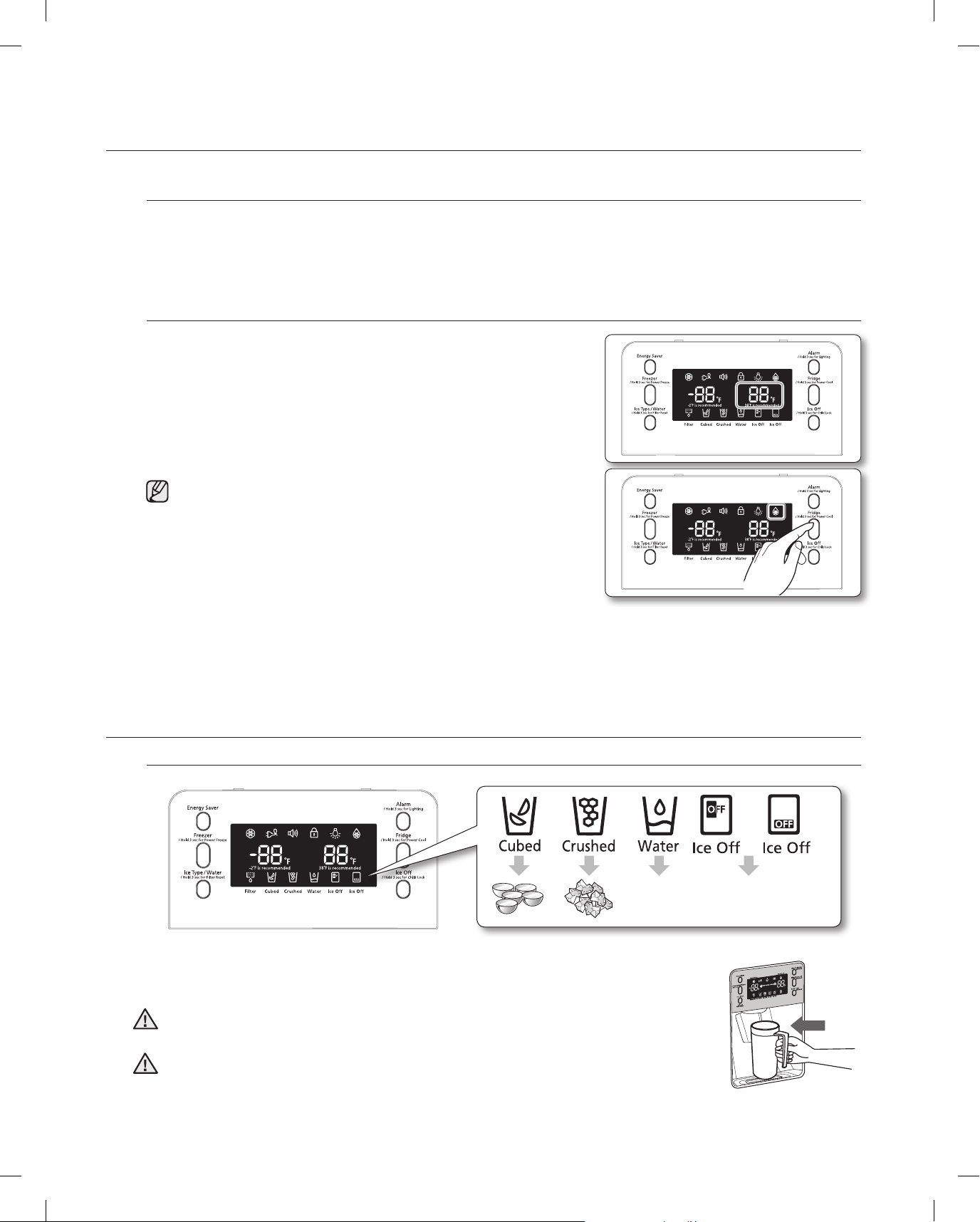
24_ Funcionamiento
Funcionamiento del refrigerador de tres puertas
Control de la temperatura del refrigerador
La temperatura del refrigerador puede ajustarse entre 46º F y 34º F (8º C y 1º C) para adaptarse a sus necesidades particulares. Pulse el botón
Fridge (Refrigerador) varias veces hasta que la temperatura deseada aparezca en la pantalla de visualización. La temperatura variará 2º F con
cada pulsación (38°F ➝ 36°F ➝ 34°F ➝ 46°F ➝ 44°F ➝ 42°F ➝ 40°F ➝ 38°F). El proceso de control de temperatura para el refrigerador
funciona de la misma forma que el de la heladera. Pulse el botón Fridge (Refrigerador) para ajustar la temperatura deseada. Pasados unos
segundos, el refrigerador se encaminará hacia la temperatura recientemente ajustada. Lo que se reflejará en la pantalla de visualización digital.
Use la función de Refrigeración rápida para conseguir un enfriamiento rápido. Mantenga
pulsado el botón Fridge/Hold 3 sec for Power Cool durante 3 segundos. Entonces, se
iluminará el indicador de la función Refrigeración rápida, activándose dicho modo de
forma independiente de la temperatura de ajuste del refrigerador. Si escoge Refrigeración
rápida, la temperatura interior del refrigerador descenderá durante dos horas y media
aproximadamente o hasta alcanzar -4º C (25° F). Mantenga pulsado de nuevo el botón
durante 3 segundos para cancelar el modo de Refrigeración rápida. Entonces, el
indicador se apagará y el refrigerador volverá de nuevo su temperatura de ajuste.
Escoja esta opción si desea
desactivar la producción de hielo.
- La temperatura de la heladera, refrigerador o zona Pantry puede aumentar
debido a una apertura frecuente de las puertas o a la introducción, en
cualquiera de ellos, de una gran cantidad de alimentos calientes.
- Esto puede provocar que la pantalla de visualización parpadee. Una vez que
la temperatura de la heladera y el refrigerador vuelvan a sus ajustes normales,
el parpadeo cesará.
- Si continua parpadeando, puede ser necesario “reiniciar” el refrigerador.
Pruebe desenchufando el electrodoméstico, esperando unos 10 minutos y volviéndolo a enchufar.
- Si se produce un error de comunicación entre la pantalla de visualización y el controlador principal, el indicador de la
pantalla del compartimento Pantry podría parpadear. Una vez alcanzadas las temperaturas de ajuste normales, el parpadeo
cesará. Si continua parpadeando durante un período de tiempo prolongado, póngase en contacto con su centro de servicio
Samsung Electronics.
USO DEL DISPENSADOR DE AGUAFRÍA
Uso del dispensador de hielo
Coloque un vaso bajo el dispensador de hielo y pulse, con él, la palanca del dispensador cuidadosamente.
Asegúrese de que el vaso se encuentra en línea con el dispensador para evitar que el hielo salte.
EMPUJAR
• Al escoger el modo Cubitos de hielo tras usar el de Hielo picado, puede
producirse una pequeña cantidad de hielo picado residual.
PRECAUCIÓN
•
Antes de usar el cajón para cubitos/cubitera y durante su uso, lavar estos componentes con un detergente
suave, enjuagar bien y secar por completo. No utilizar limpiadores ni disolventes fuertes o abrasivos.
PRECAUCIÓN
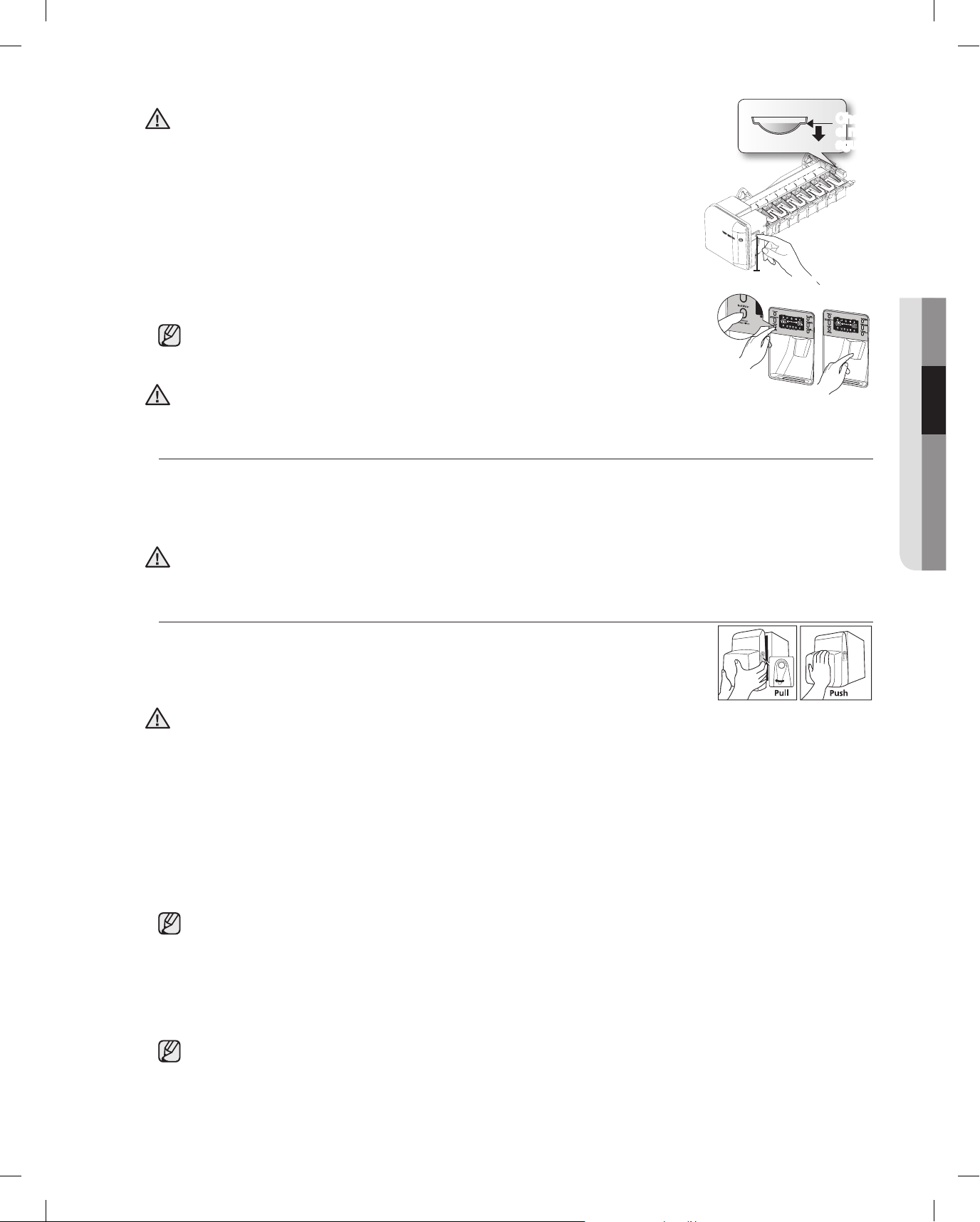
Funcionamiento _25
02 FUNCIONAMIENTO
Uso del dispensador de agua
Coloque un vaso bajo la salida de agua y pulse, con él, la palanca del dispensador cuidadosamente. Asegúrese
de que el vaso se encuentra en línea con el dispensador para evitar que el agua salpique. Si acaba de instalar el
refrigerador o un nuevo filtro de agua, deseche los seis primeros vasos de agua para eliminar las impurezas del
sistema de suministro de agua. Asegúrese de que el flujo de agua es transparente antes de comenzar a consumirla.
Al escoger el modo Ice Off (Hielo desac.), retire todos los cubitos del depósito. Si no usa
el dispensador de hielo, los cubitos pueden adherirse unos a otros. Tire de la palanca de
bloqueo hacia adelante para desechar cubitos o extraer el hielo aglomerado del depósito.
Pulse el depósito hacia atrás hasta escuchar un clic.
Cuando vacie la cubeta de hielos, usted debe presionar una vez la palanca del dispensador
de hielos con la función “ice cubed” o “crushed” en posición ON para obtener hielo
rápidamente después de colocar nuevamente la cubeta de hielos en el refrigerador.
Toda el agua suministrada a los refrigeradores pasa a través del filtro principal, que es un filtro de agua alcalino. En este proceso,
la presión del agua que ha pasado por el filtro aumenta y el agua se satura de oxígeno y nitrógeno. Cuando el agua fluye de
nuevo al aire, la presión se reduce y el oxígeno y el nitrógeno quedan supersaturados, por lo que se transforman en burbujas de
gas. El agua podría adquirir un aspecto turbio debido a estas burbujas de oxígeno. El agua podría adquirir, temporalmente, un
aspecto turbio debido a estas burbujas de oxígeno.
El agua podría adquirir, temporalmente, un aspecto difuso o turbio
debido a estas burbujas de oxígeno.
Pasados unos segundos, el agua volverá a ser transparente.
Tras dispensar agua, espere 1 segundo antes de retirar el vaso para evitar derrames. No tire de la palanca del
dispensador una vez obtenido hielo o agua. Volverá automáticamente a su posición. El hielo se elabora en
cubitos. Al escoger “Crushed” (Hielo picado), la máquina de hielo tritura los cubitos para conseguir hielo picado.
• En caso de que el hielo no salga, extraiga el depósito de hielo y pulse el botón de prueba
situado en el lateral derecho de la máquina de hielo.
• No pulse el botón de prueba de forma continua cuando la bandeja está llena de hielo o
agua. Podría producirse un derramamiento de agua o un bloqueo de hielo.
• Uso normal
Para llenar el depósito de hielo a su máxima capacidad tras la instalación, asegúrese de
seguir los pasos expuestos a continuación.
1. Permita que su refrigerador funcione y enfríe durante 24 horas (o durante 1 día completo).
2. Una espera de 24 horas permitirá que su máquina de hielo enfríe de forma adecuada.
3. Dispense de 4 a 6 cubitos de hielo dentro del vaso.
4. Tras 8 y 16 horas, dispense un vaso lleno de hielo.
Si usa todo el hielo de una vez, deben repetirse los pasos 3 y 4 anteriores
(antes de dispensar los primeros 4 a 6 cubitos de hielo, es necesario esperar 8 horas). Esto permitirá el
reabastecimiento de cubitos, garantizando una elaboración máxima de hielo.
Cuando no use el dispensador de agua durante 2 ó 3 días (especialmente durante el verano), el agua
dispensada podría presentar olores o sabores extraños. Si esto ocurre, recomendamos que deseche los
primeros 1 ó 2 vasos de agua para mejorar su sabor.
Use sólo el dispositivo de fabricación de hielo incluido con el refrigerador. El suministro de agua a este refrigerador debe ser
instalado/conectado por un profesional cualificado y conectado a un suministro de agua potable únicamente. Para que la máquina
de hielo funcione correctamente, es necesaria una presión de agua de 138 a 862 kPa. Si va a ausentarse durante unas vacaciones
o un viaje de negocios de larga duración y no va a usar los dispensadores de agua o hielo, cierre la válvula de agua.
- De lo contrario podrían ocasionarse fugas de agua.
Limpie el exceso de humedad del interior y deje las puertas abiertas.
- De lo contrario podrían acumularse olores y moho.
Use un chorro de agua para limpiar el depósito de la bandeja de hielo, no use detergente ni sus manos. No introduzca las
manos ni ningún objeto en los conductos de salida ni en las cuchillas; podría lesionarse o provocar daños en el refrigerador.
No introduzca los dedos ni ningún otro objeto en la salida del dispensador.
- Podría ocasionar lesiones.
No intente desmontar la máquina de hielo. No salpique ni rocíe agua en el depósito de hielo.
PRECAUCIÓN
PRECAUCIÓN
PRECAUCIÓN
PRECAUCIÓN
Botón de prueba
Chequear
el nivel de
agua
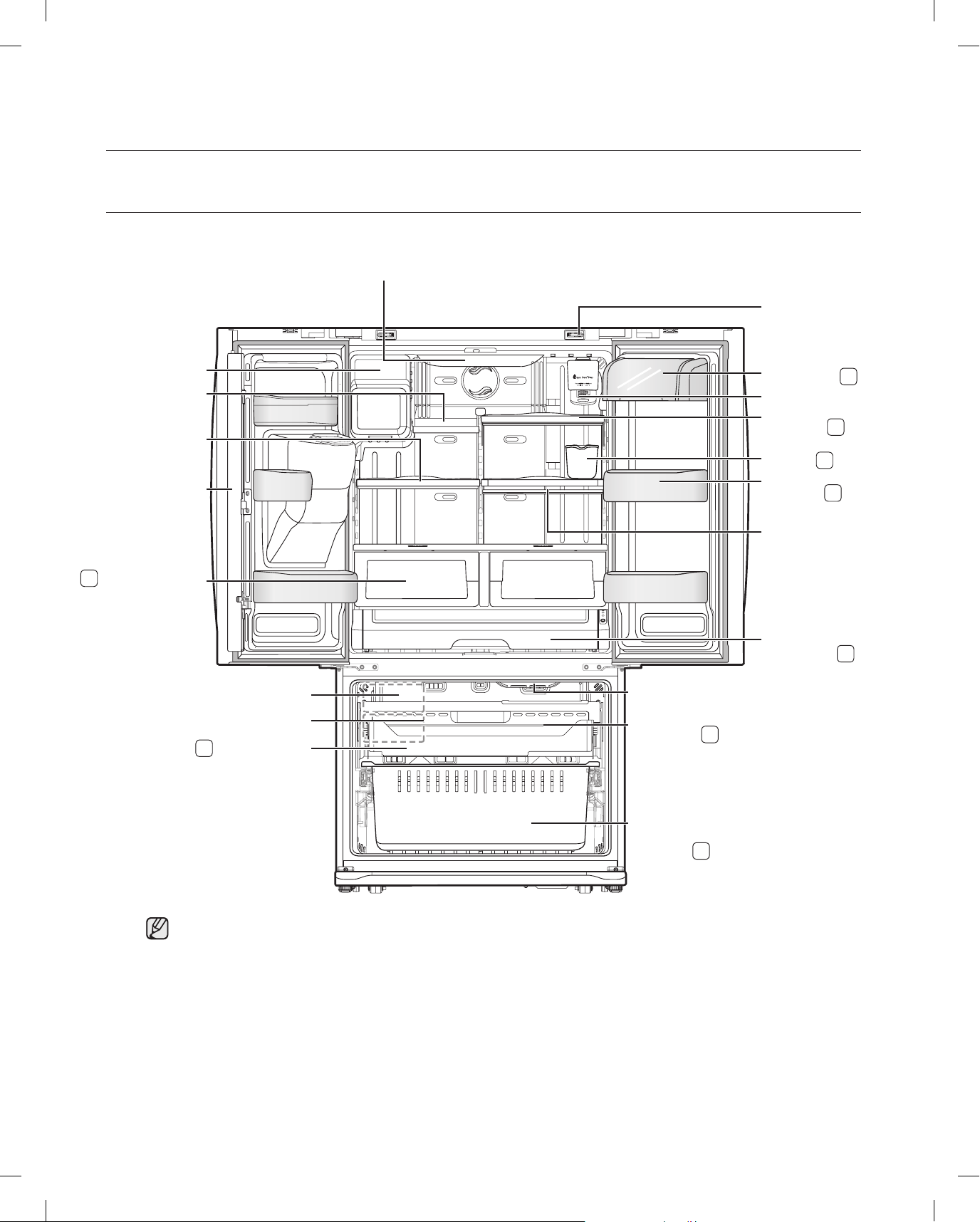
26_ Funcionamiento
Use esta página para familiarizarse con las partes y funciones del refrigerador.
PARTES Y FUNCIONES
Funcionamiento del refrigerador de tres puertas
Cierre automático
de puerta
Filtro de agua
Compartimento
para lácteos
1
Compartimentos
de puerta
2
Cool Select
Pantry Plus
6
Luz
Sección con
bisagras vertical
5
Gaveta para fruta
y verdura
8
Compartimento
inclinble
Luz
Compartimento
de la gaveta de
la nevera
9
Gaveta de extracción
automática
7
Balda
deslizante
Máquina de hielo del
refrigerador
Balda plegable
Baldas de cristal
templado
3
Balda de cristal de
compartimentación
rápida
Huevera
4
Máquina de hielo de
la heladera
Depósito de hielo
Al cerrar la puerta, asegúrese de que la sección con bisagras vertical se encuentra en posición
correcta para evitar arañazos en la otra puerta.
Si la sección con bisagras vertical está al revés, devuélvala a su posición correcta y cierre la puerta.
En algunas ocasiones se puede producir humedad en la sección con bisagras vertical.
El tirador de la puerta puede aflojarse con el paso del tiempo.
Si esto ocurre, apriete los pernos que se encuentran en la parte interior de la puerta.
Si cierra la puerta mediante una fuerza excesiva, pueden abrirse las otras puertas.
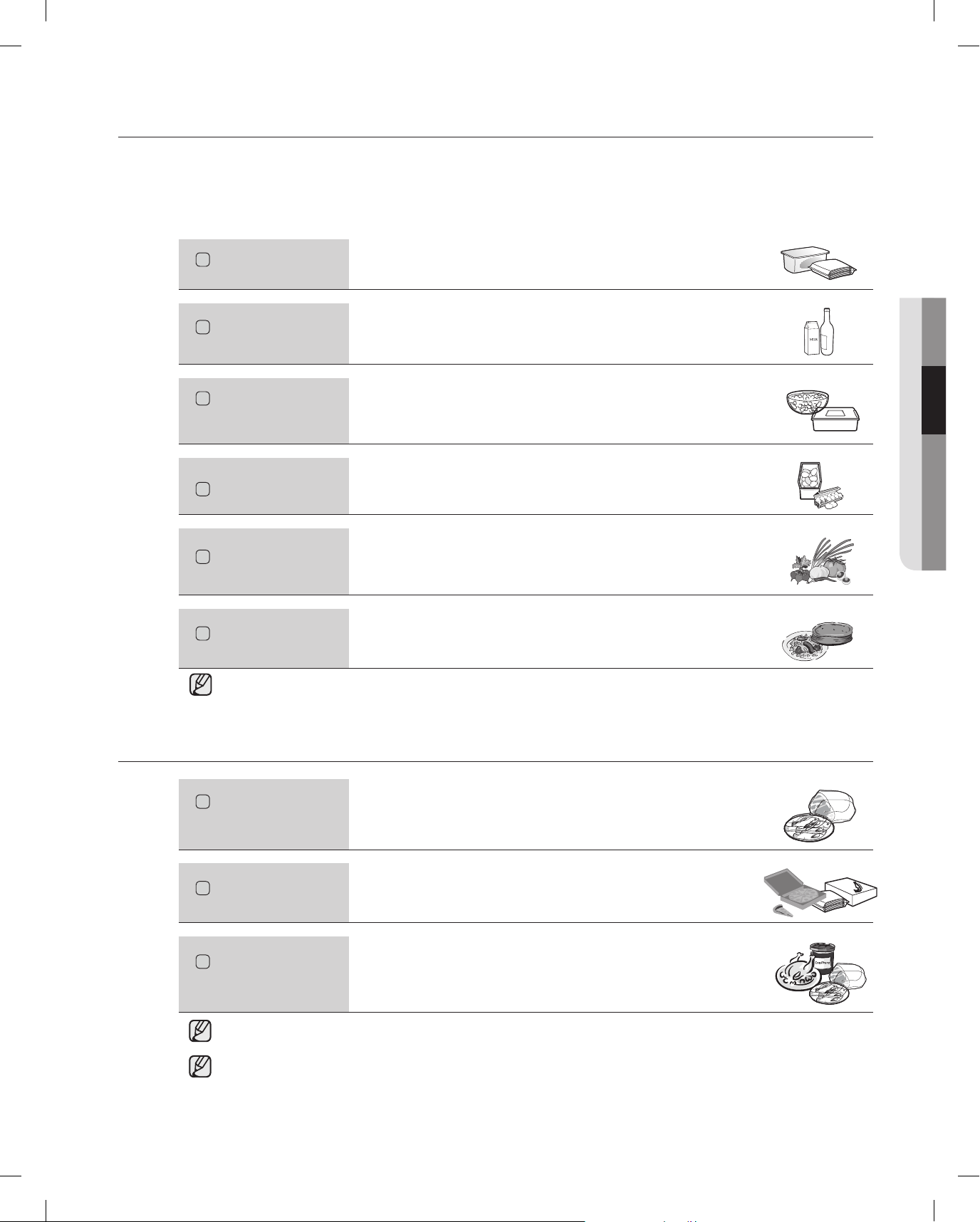
Funcionamiento _27
02 FUNCIONAMIENTO
No coloque artículos de grandes dimensiones bajo el foco del refrigerador. Hay un sensor situado en las proximidades del foco y,
si dicho sensor fuese bloqueado, su refrigerador podría enfriarse demasiado. Coloque verduras y frutas en la gaveta que tienen
asignada para evitar que se congelen. Si los alimentos se congelasen en su refrigerador, ajústelo a una temperatura más alta.
Si tiene planeado ausentarse durante un período de tiempo prolongado, vacíe el refrigerador y apáguelo.
Limpie el exceso de humedad del interior del electrodoméstico y deje las puertas abiertas. Esto ayuda a
evitar la proliferación de olores y moho.
(
1
) COMPARTIMENTO
PARA LÁCTEOS
Puede usarse para almacenar pequeños productos lácteos como
mantequilla o margarina, yogurt o dados de crema de queso.
(
2
) DEPÓSITOS DE
PUERTA
Diseñados para soportar artículos grandes y voluminosos como
galones de leche u otras botellas o recipientes de grandes
dimensiones.
(
3
) BALDAS DE
CRISTAL
TEMPLADO
Con diseño antirrotura, las baldas pueden usarse para almacenar
todo tipo de alimentos y bebidas. Las marcas circulares en la
superficie de cristal representan un fenómeno normal que puede
limpiarse a menudo con un paño húmedo.
(
4
) HUEVERA
El mejor lugar para guardar huevos.
Coloque la huevera sobre la balda para acceder fácilmente.
(
5
) GAVETAS PARA
FRUTA Y VERDURA
Usado para mantener frescas sus frutas y verduras. Esta gaveta
puede controlar el nivel de humedad de alimentos que deban
mantener un grado de humedad concreto. Si es posible, mantenga
separadas verduras y frutas.
(
6
) COOL SELECT
PANTRY PLUS
Puede usarse como bandeja grande para fiestas, delicatesen, pizzas,
bebidas o artículos diversos.
(
7
) GAVETA DE
EXTRACCIÓN
AUTOMÁTICA
La mejor elección para almacenar carnes o alimentos secos.
Los alimentos almacenados deberán introducirse en un envase
o envolverse adecuadamente usando papel de aluminio u otros
materiales adecuados.
(
8
) COMPARTIMENTO
INCLINABLE
Pueden usarse para paquetes pequeños o alimentos
congelados. Puede introducir una pizza de 16”.
(
9
) COMPARTIMENTO
DE LA GAVETA DE
LA NEVERA
Puede usarse para almacenar carne y alimentos secos.
Los alimentos almacenados deberán introducirse en un envase
o envolverse adecuadamente usando papel de aluminio u otros
materiales adecuados.
Las botellas deberán almacenarse unas junto a otras para que no se golpeen y caigan al abrir la puerta del
refrigerador.
ALMACENAJE DE ALIMENTOS EN EL REFRIGERADOR
ALMACENAJE DE ALIMENTOS EN LA GAVETA DE LA NEVERA
El refrigerador Samsung de tres puertas ha sido diseñado para proporcionarle características y funciones de ahorro máximo
de espacio. Aquí tiene algunos de los compartimentos personalizados que hemos creado para mantener sus alimentos
frescos durante períodos de tiempo más largos. Para evitar la penetración de olores en el interior del compartimento del hielo,
los alimentos almacenados deberán serenvueltos adecuadamente, tan herméticos como sea posible.
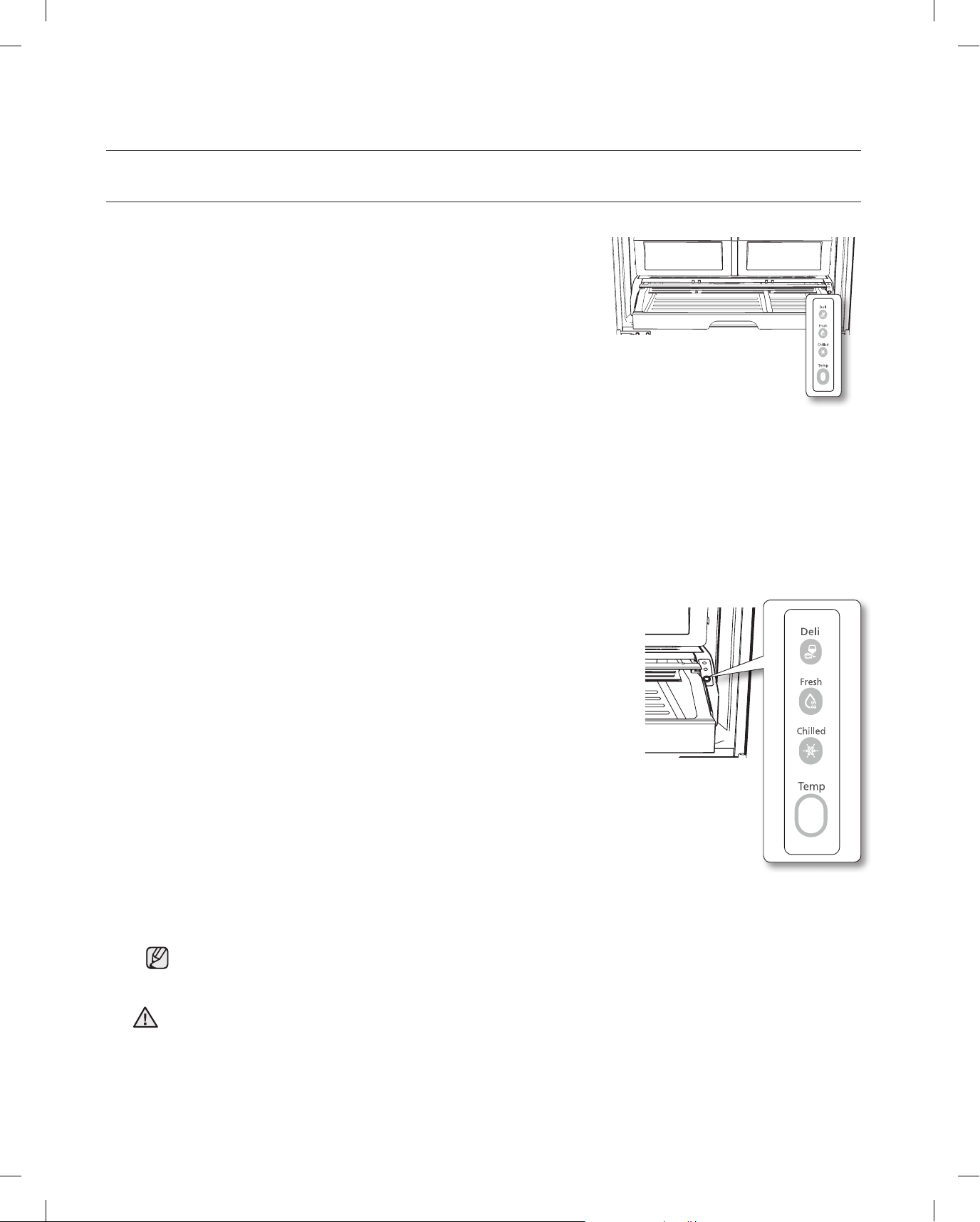
28_ Funcionamiento
Funcionamiento del refrigerador de tres puertas
USO DEL COOL SELECT PANTRY
PLUS
Deli
• piñas • pepinos • bistec
• limones • manzanas • quesos curados
• aguacates • naranjas • embutidos
• patatas • uvas • bacon
• calabacines • perritos calientes
• maíz
El Cool Select Pantry
PLUS
es una gaveta de ancho completo que dispone
de control de temperatura ajustable. Este compartimento puede usarse
como bandeja grande para fiestas, delicatesen, pizzas, bebidas o artículos
diversos. Dispone de un sensor de temperatura que puede ajustar la
cantidad de aire frío que entra en el compartimento. Los botones de
control se encuentran situados en el lateral derecho del compartimento.
• Pulse repetidamente el botón Temp hasta que se ilumine el modo
deseado. El modo Fresh (38°F), modo Chilled (34°F) y modo Deli (41°F)
serán escogidos cada vez que pulse el botón Temp. Inicialmente, está
escogido el modo Fresh Aunque la temperatura de ajuste sea difere nte de la actual, ésta cambiará a la de aju ste
de forma automática.
• La temperatura del compartimento Pantry puede cambiar dependiendo de la cantidad de artículos introducidos y
del lugar donde se coloquen, la temperatura ambiente y la frecuencia de apertura de la puerta.
Temperatura
Puede escoger la temperatura que desee para el compartimento Pantry entre los modos Frescos (38°F ,
Enfriamiento (34°F), y delicatesen (41°F).
1. Al escoger “Deli”, la temperatura del compartimento se mantiene
entorno a 5ºC (41ºF). Esta función ayuda a mantener los alimentos
frescos durante un período de tiempo más prolongado.
2. Al escoger “Fresh”, la temperatura del compartimento se mantiene
entorno a 3ºC (38ºF). Esta función ayuda a mantener los alimentos
frescos durante un período de tiempo más prolongado.
3. Al escoger “Chilled”, la temperatura del compartimento se mantiene
entorno a 1ºC (34ºF). Esta función también ayuda a mantener carnes y
pescados frescos durante un período de tiempo más prolongado.
Las frutas y verduras pueden dañarse al escoger el modo “chilled” (helado).
No guarde lechuga u otros productos similares en este compartimento.
No almacene botellas de cristal en este compartimento. Si se congelasen, podrían romperse y provocar
lesiones físicas.
PRECAUCIÓN
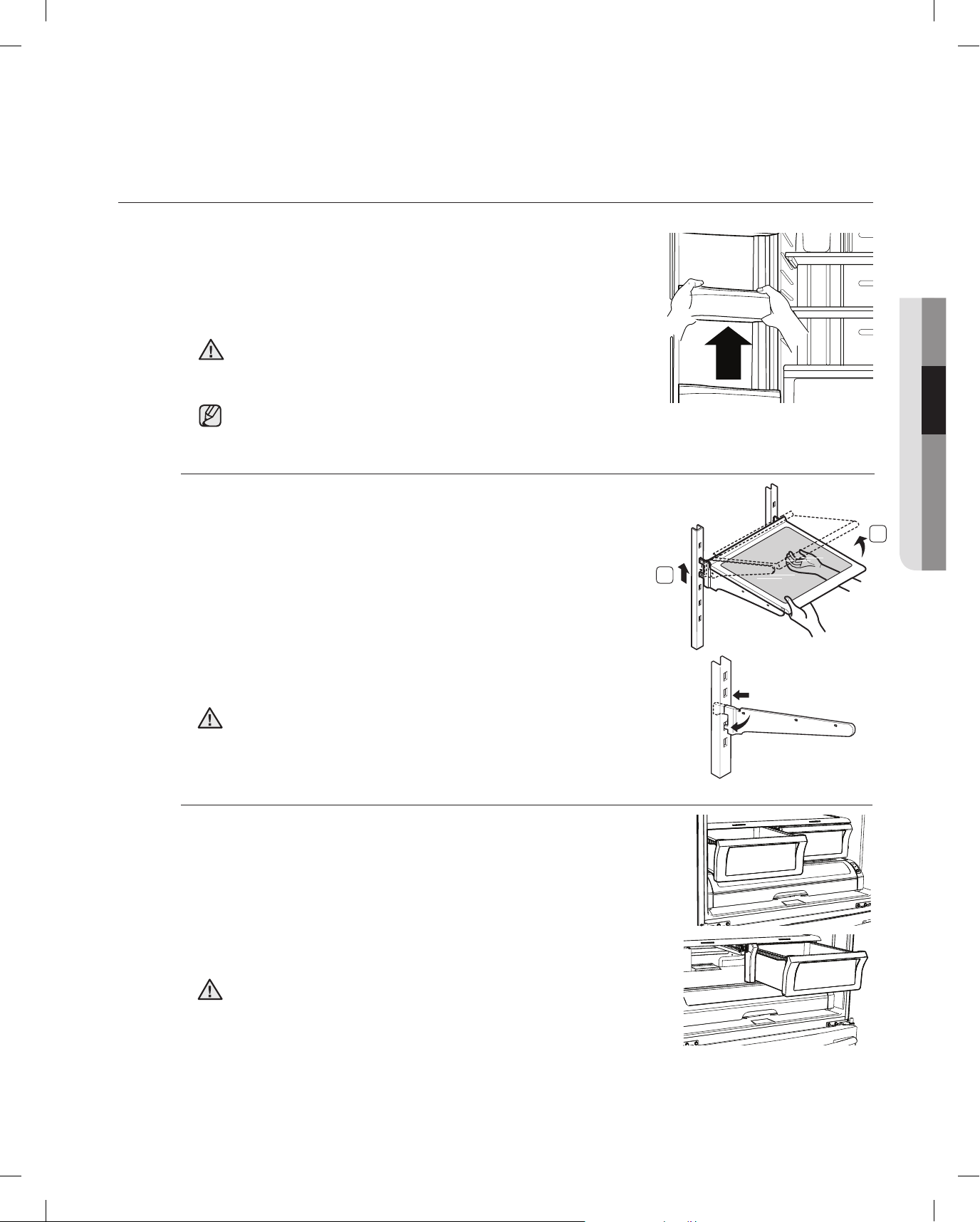
Funcionamiento _29
02 FUNCIONAMIENTO
2
1
DESMONTAJE DE LOS ACCESORIOS DEL REFRIGERADOR
2. Baldas de cristal templado
To remove - Para desmontarlas - incline hacia arriba la parte
frontal de la balda, en sentido ( 1 ) y levántela en
sentido ( 2 ). Extraiga la balda.
To relocate - Para volver a montarlas - incline hacia arriba la
parte frontal de la balda y guíe sus ganchos sobre
las ranuras, a la altura deseada. A continuación,
haga descender la parte frontal de la balda de tal
forma que los ganchos puedan entrar en las ranuras
correspondientes.
1. Compartimento de puerta y para lácteos
Para desmontarlo - Simplemente levántelo y extráigalo directamente.
Para volver a montarlo - Deslícelo sobre el emplazamiento deseado y
pulse hasta encajarlo en posición.
Método de eliminación del polvo, quitar la guardia y lavar en agua.
Para extraerla - Retire la gaveta todo lo posible. Incline hacia
arriba la parte frontal de la gaveta y extráigalo
directamente hacia fuera.
Para volver a colocarla - Introduzca la gaveta en los rieles del
marco y empújela hacia atrás hasta su
posición.
Si los compartimentos de la puerta no están montados de forma
firme, pueden producirse lesiones.No monte un compartimento
lleno de alimentos.
PRECAUCIÓN
Las baldas de cristal templado son pesadas.
Ponga especial atención al desmontarlas.
PRECAUCIÓN
La balda de cristal sobre la gaveta no está firmemente asegurada.
Tenga cuidado al levantar.
No abra la gaveta mientras el compartimento Cool Select Pantry
PLUS está abierto. Hacerlo puede provocar que se arañe o se
rompa su cubierta.
PRECAUCIÓN
No monte un compartimento lleno de alimentos.
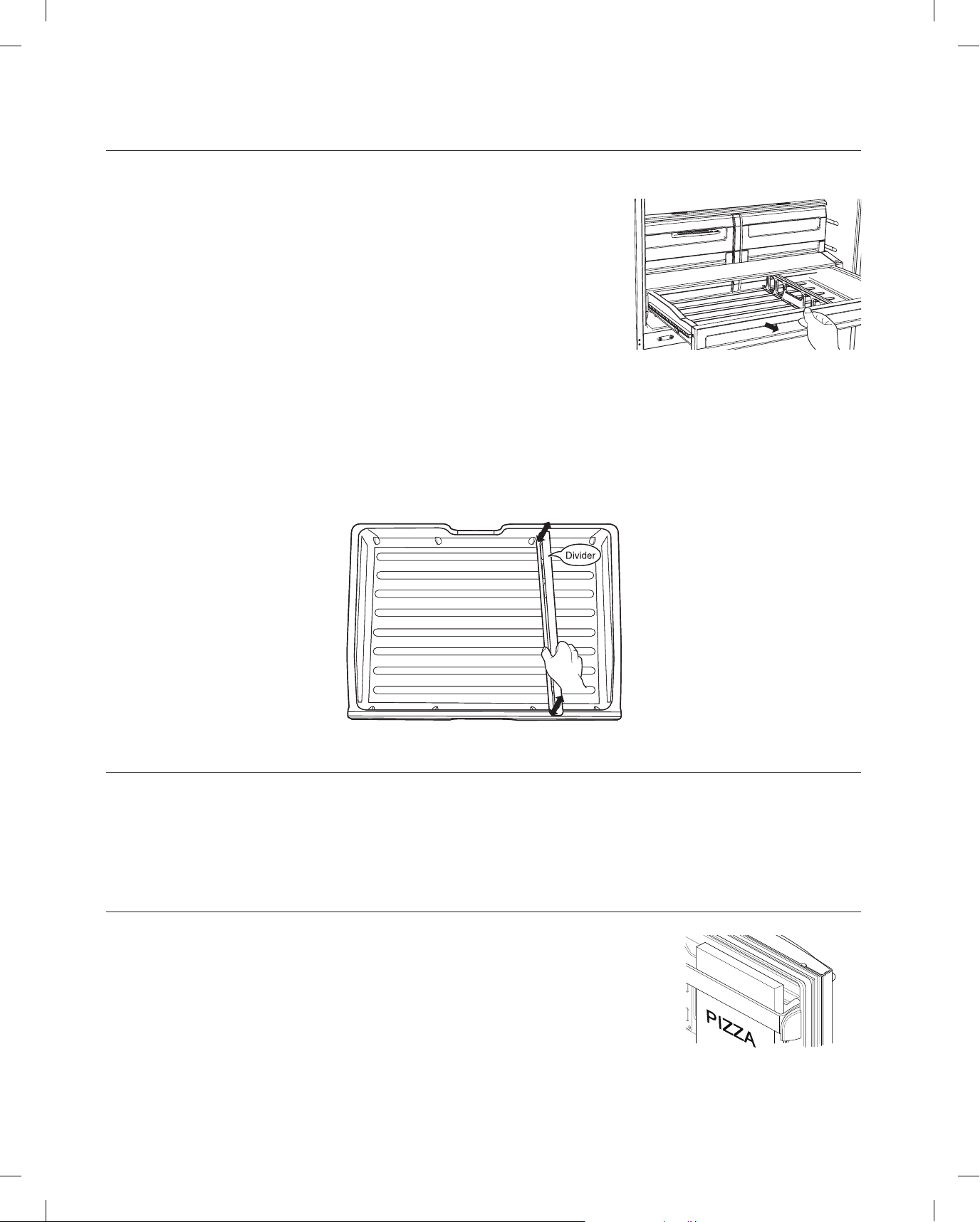
30_ Funcionamiento
Funcionamiento del refrigerador de tres puertas
4. Cool Select Pantry PLUS
Para extraer el compartimento
- Extraiga toda la extensión de la gaveta. Incline hacia arriba
la cara frontal del compartimento y extráigalo directamente
hacia fuera.
Para volver a co locar el compartimento
- Empuje los rieles hacia la parte posterior del refrigerador.
Coloque la gaveta dentro de los rieles y deslice el
compartimento hasta su lugar.
Para retirar la división - Tire por completo del compartimento en toda su extensión y levante la cara
frontal de la división para desengancharla de la parte posterior de la pared
del compartimento y, a continuación, levántelo.
Para volver a colocar la división - Enganche la parte de atrás de la división sobre la parte posterior
de la pared del compartimento y, a continuación, empuje hacia
abajo la división.
USO DE LAS PUERTAS
USO DEL COMPARTIMENTO INCLINABLE
Las puertas del refrigerador garantizan el cierre y sellado completo del mismo. Cuando la puerta del refrigerador está
sólo parcialmente abierta, se cerrará automáticamente.
Pero la puerta permanecerá abierta si supera su límite de cierre automático.
El compartimento inclinado puede usarse para almacenar pizzas de hasta 16” (406
mm) si la guarda como se indica en la ilustración.
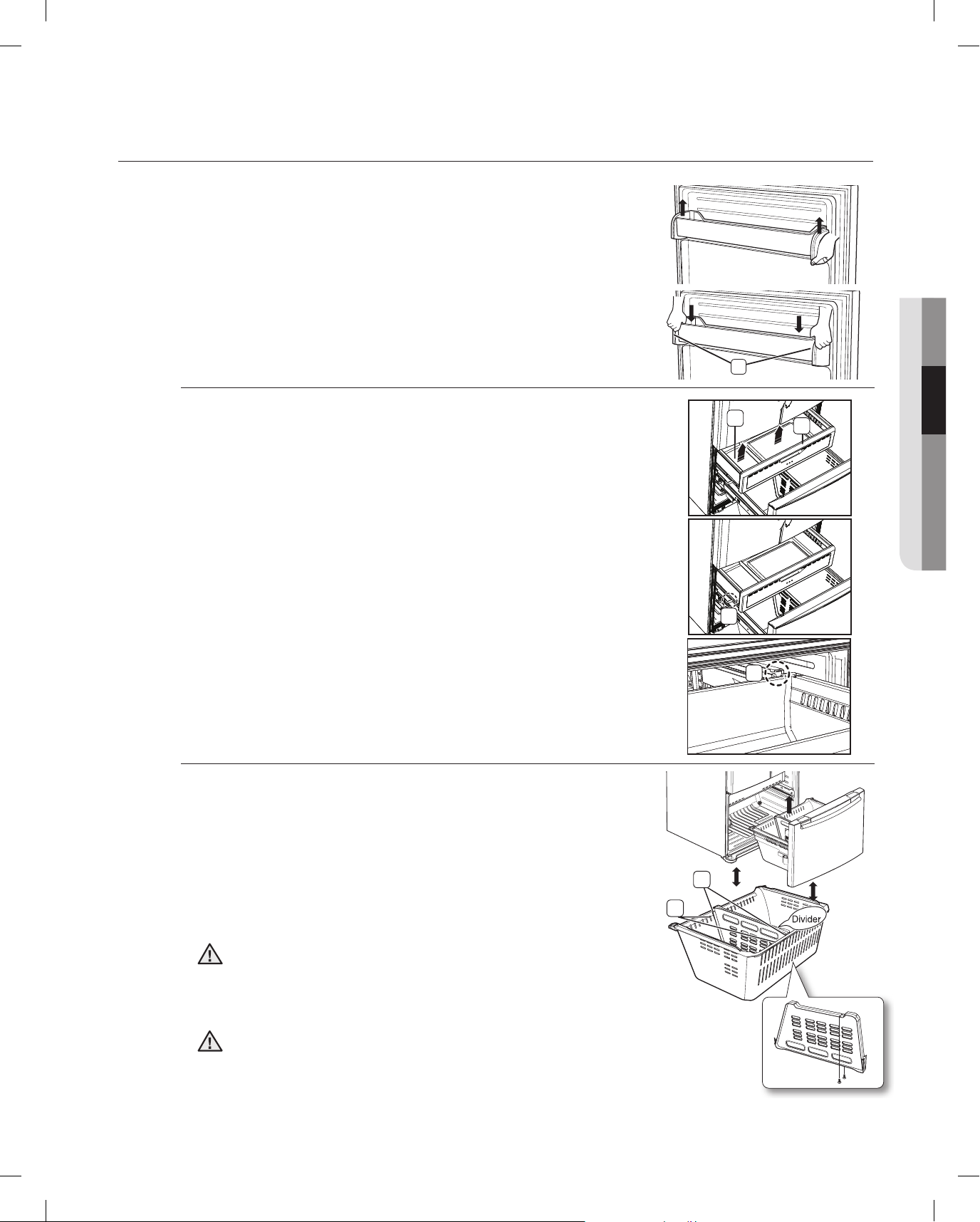
Funcionamiento _31
02 FUNCIONAMIENTO
1
3
4
1
2
2
1
DESMONTAJE DE LOS ACCESORIOS DEL REFRIGERADOR
1. Compartimento Inclinable
Para desmontarlo - Tire de hacia arriba de los soportes ( 1 ) hasta
que oiga el “clic” y retire el compartimento.
Para volver a montarlo - Enganche los extremos del
compartimento en ambos soportes ( 2 ) y
empuje hacia abajo hasta que encaje en
su lugar.
Para extraerlo - Levante el depósito ( 1 ).
Para volver a colocarlo - Sitúe el depósito de hielo dentro de la
gaveta de gran extensión ( 2 ).
Para extraerla - Retire la gaveta todo lo posible. Incline la parte
posterior de la gaveta y elévela directamente.
Para volver a colocarla - Sitúe la gaveta dentro de los raíles
( 4 ) inclinándola hacia arriba. Haga
descender la gaveta ( 3 ) hasta que
se encuentre en posición horizontal y
deslícela hacia dentro.
Para extraerlo - Retire la gaveta todo lo posible. Incline la parte posterior
del compartimento y levántelo para extraerlo.
Para volver a col ocarlo - Introduzca el compartimento dentro de los rieles
de montaje.
Para quitar la div isión - Tire de la división hacia arriba.
Para volver a co locar la división - Enganche las esquinas superiores de la
división ( 1 ) en el hueco del compartimento ( 2 ).
No permita que los bebés ni los niños accedan al interior del
compartimento de la gaveta. Estas acciones podrían dañar el refrigerador
y herir gravemente a los niños. No los apoye en la puerta de la heladera.
La puerta podría romperse. No permita que los niños accedan al interior
de la gaveta de la heladera.
Si decide retirar la división para limpiar el compartimento de la gaveta, deberá
volver a instalarla, mediante 2 pernos, una vez finalizadas dichas labores de
limpieza para evitar que los niños queden atrapados dentro de la gaveta.
PRECAUCIÓN
32_ Funcionamiento
Funcionamiento del refrigerador de tres puertas
CONSEJOS ÚTILES PARA EL ALMACENAJE DE ALIMENTOS
PRODUCTOS LÁCTEOS
Mantequilla 2-3 semanas 6-9 meses Envuélvala o tápela herméticamente.
Leche 1-2 semanas No recomendado
Chequee la fecha. La mayoría de la leche y productos similares se venden
en cajas de cartón fechadas que indican el período de máxima frescura
de un producto. Vuelva a cerrar herméticamente mediante tapa o envolto-
rio. No devuelva el producto no consumido al recipiente original.
Queso en crema, derivados
del queso y queso para
untar
2-4 semanas No recomendado
Chequee la fecha. Mantenga todos los quesos guardados hermética-
mente en un envoltorio con protección contra la humedad.
Queso curado (sin abrir) 3-4 meses 6 meses
Queso curado (abierto) 2 meses No recomendado
Queso fresco 10-15 días No recomendado
Nata 7-10 días 2 meses
Check date code. Most yogurt, creams, and similar products are sold in
date-coded cartons that indicate a product’s peak freshness. Re-seal or
cover tightly. Do not return unused portions to original container.
Crema agria 2 semanas No recomendado
Salsa Dip (abierta) 1 semanas No recomendado
Yogur 10-14 días No recomendado
Check date code. Keep covered.
Yogur congelado na 2 meses
HUEVOS
Huevos (frescos) 3-4 semanas No recomendado
Chequee la fecha. Guarde los huevos en la parte más fría del refrigera-
dor y dentro de su envase original.
Huevos (cocinados) 1 semanas No recomendado Guarde en envase con tapa.
Sobras de platos
con huevo
3-4 días No recomendado Guarde en envase con tapa.
FRUTA FRESCA
Manzanas 1 meses No recomendado
No lave la fruta antes de introducirla en el refrigerador.
Guárdela en bolsas o recipientes resistentes a la humedad. Envuelva la
fruta cortada.
Algunas frutas se ponen negras al introducirlas en el refrigerador.
Plátanos 2-4 días No recomendado
Melocotones, melones,
peras, aguacates
3-5 días No recomendado
Bayas y cerezas 2-3 días 12 meses
Albaricoques 3-5 días No recomendado
Uvas 2-5 días n/a
Piña (sin cortar) 2-3 días No recomendado
Piña (cortada) 5-7 días 6-12 meses
Cítricos 1-2 semanas No recomendado Guárdelos sin cubrir.
Zumo 6 días No recomendado
Chequee la fecha y vuelva a cerrar su recipiente original. No devuelva el
producto no consumido al recipiente original.
Zumo congelado
Sólo para desconge-
lar
12 meses Chequee la fecha. No vuelva a congelarlo.
Funcionamiento _33
02 FUNCIONAMIENTO
PESCADO Y MARISCO
Pescado
Pescado azul (caballa,
trucha, salmón)
1-2 días 2-3 meses
Manténgalo en su envoltorio original e introdúzcalo en la parte más fría
del refrigerador. Introdúzcalo en plástico para congelados con protec-
ción contra el vapor y la humedad. Congélelo a 0º F (-18º C). Descongé-
lelo en el refrigerador o bajo chorro de agua.
Pescado blanco (ba-
calao, lenguado, etc.)
1-2 días 6 meses
Congelado o empanado n/a 3 meses
Marisco
Gambas (crudas) 1-2 días 12 meses
Para congelarlos, introdúzcalos en un recipiente con protección contra
el vapor y la humedad.
Cangrejo 3-5 días 10 meses
Pescado o marisco
congelado
2-3 días 3 meses
CARNE
Fresca, cruda
Chuletas 2-4 días 6-12 meses
Chequee la fecha para usarla. Guárdela en la parte más fría del refrig-
erador, en su envase original. Introdúzcala en un recipiente extra que
disponga de protección contra la humedad y el vapor para congelarla.
Temperatura recomendada para el refrigerador: de 33ºF a 36ºF (0ºC a
2ºC), y para la heladera: de 0ºC a 2ºF (-18ºC a -17ºC)
Picada 1 día 3-4 meses
Costillas 2-4 días 6-12 meses
Bacón 1-2 semanas 1-2 meses
Salchicha 1-2 días 1-2 meses
Bistec 2-4 días 6-9 meses
Aves 1 día 12 meses
Charcutería 3-5 días 1 meses
Cocinada
Carne 2-3 días 2-3 meses
Chequee la fecha para usarla. Guárdela en la parte más fría del refrigera-
dor, en su envase original. Introdúzcala en un recipiente que disponga
de protección contra la humedad y el vapor para congelarla.
Aves 2-3 días 4-5 meses
Jamón 1-2 semanas 1-2 meses
Fuentes:
American Meat Institute Foundation. 1994. Páginas amarillas: respuestas a las preguntas más frecuentes acerca de carnes y
aves. American Meat Institute Food Marketing Institute. 1999. The food keeper. Food Marketing Institute, Washington, D.C.
F reeland-Graves, J.H. y G.C. Peckham. 1996. Foundations of food preparation, 6ª ed. Prentice-Hall, Inc. Englewood Cliffs,
NJ. Hillers, V.N. 1993. Storing foods at home. Washington State University Cooperative Extension, Pullman, WA. Publ. EB
1205. National Restaurant Association. 2001. Be cool-chill out! Refrigerate promptly. National Restaurant Association Educa-
tion Foundation¼s International Food Safety Council, Washington, D.C. USDA. 1997. Basics for handling food safely. U.S.
Department of Agriculture, Food Safety and Inspection Service, Washington, D.C.
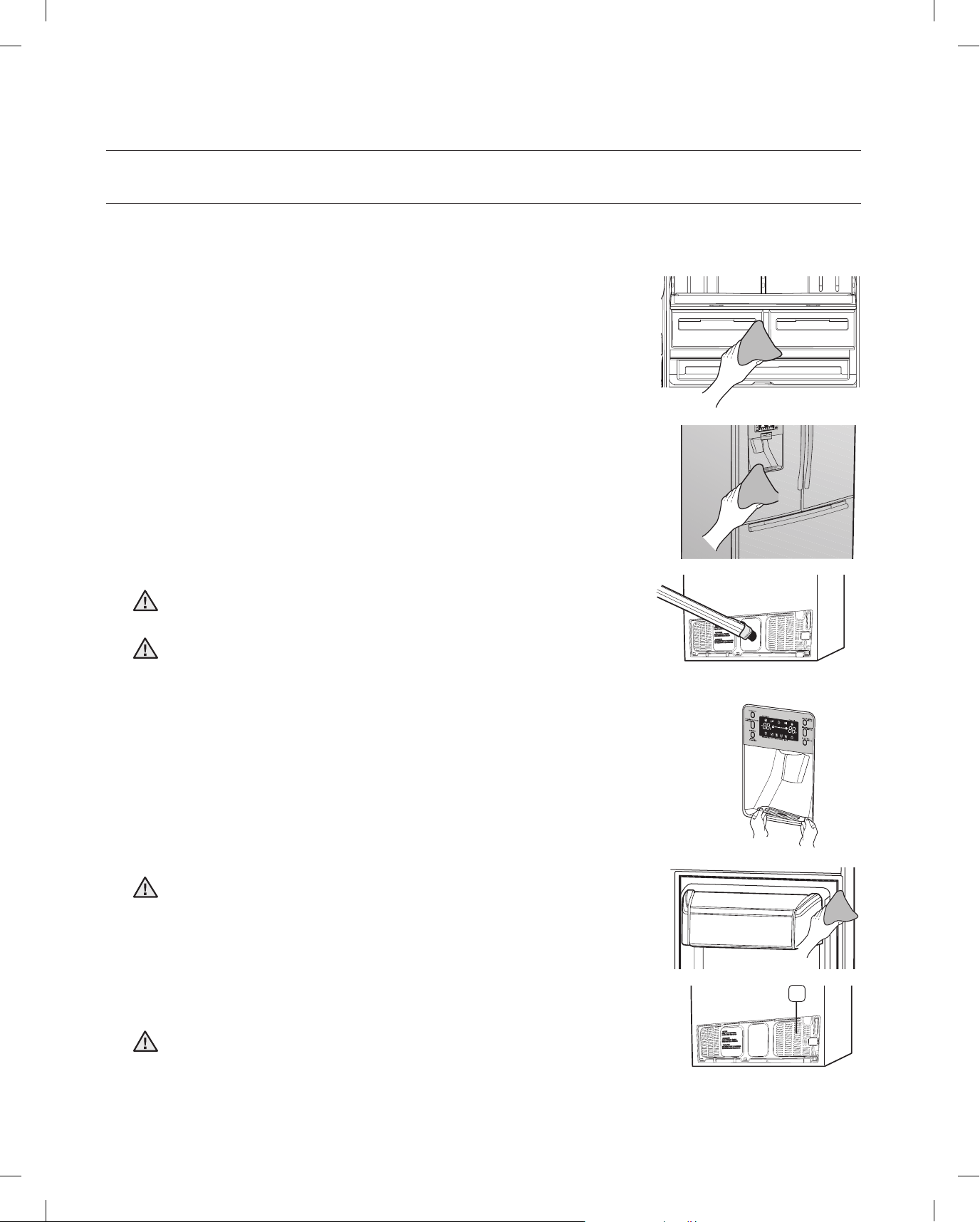
34_ Funcionamiento
Funcionamiento del refrigerador de tres puertas
1
LIMPIEZA DEL REFRIGERADOR
Los cuidados de su refrigerador Samsung de tres puertas prolongarán su vida útil y ayudarán a
mantenerlo libre de olores y gérmenes.
Limpie las paredes interiores y los accesorios con un detergente
suave y, a continuación, enjuague y seque con un paño suave.
Puede extraer las gavetas y las baldas para llevar a cabo una
limpieza minuciosa. Simplemente asegúrese de secar gavetas y
baldas antes de volverlos a colocar en su sitio.
Limpie el panel digital y el panel de la pantalla de visualización con
un paño limpio y seco. Pulverice agua sobre el paño de limpieza en
lugar de hacerlo directamente sobre la superficie del refrigerador. Esto
ayuda a asegurar una distribución uniforme de la humedad sobre la
superficie. La superficie de las puertas, tiradores y carcasa deberán
limpiarse con un detergente suave y secarse, a continuación, con un
paño seco. Para mantener su electrodoméstico como el primer día, el
exterior deberá abrillantarse una o dos veces al año.
Tire de un extremo de la bandeja del dispensador y extráigala.
Limpie el dispensador de hielo/agua con un paño limpio y suave.
Si los sellos de goma están sucios, las puertas pueden no cerrar
adecuadamente y el refrigerador no funcionar de forma eficiente. Mantenga
las puertas libres de polvo y suciedad limpiándolas con detergente suave y
un paño húmedo. Séquela con un paño limpio y suave.
Para mantener cables y partes expuestas libres de polvo
y acumulación de suciedad, aspire la parte de detrás del
electrodoméstico una o dos veces al año.
No use benceno, disolvente o Clorox™ para realizar la limpieza. Pueden
dañar la superficie del electrodoméstico y provocar un incendio.
Las letras impresas en la pantalla de visualización podrían borrarse
si el limpiador de acero inoxidable es aplicado directamente sobre la
zona donde se encuentran dichas letras.
No pulverice el refrigerador con agua mientras esté enchufado ya que podría
ocasionar un choque eléctrico. Por riesgo de incendio, no limpie el refrigerador
con benceno, disolvente o detergente para vehículos.
No desmonte la cubierta de posterior ( 1 ). Hacerlo podría ocasionar
un choque eléctrico.
PRECAUCIÓN
PRECAUCIÓN
PRECAUCIÓN
PRECAUCIÓN
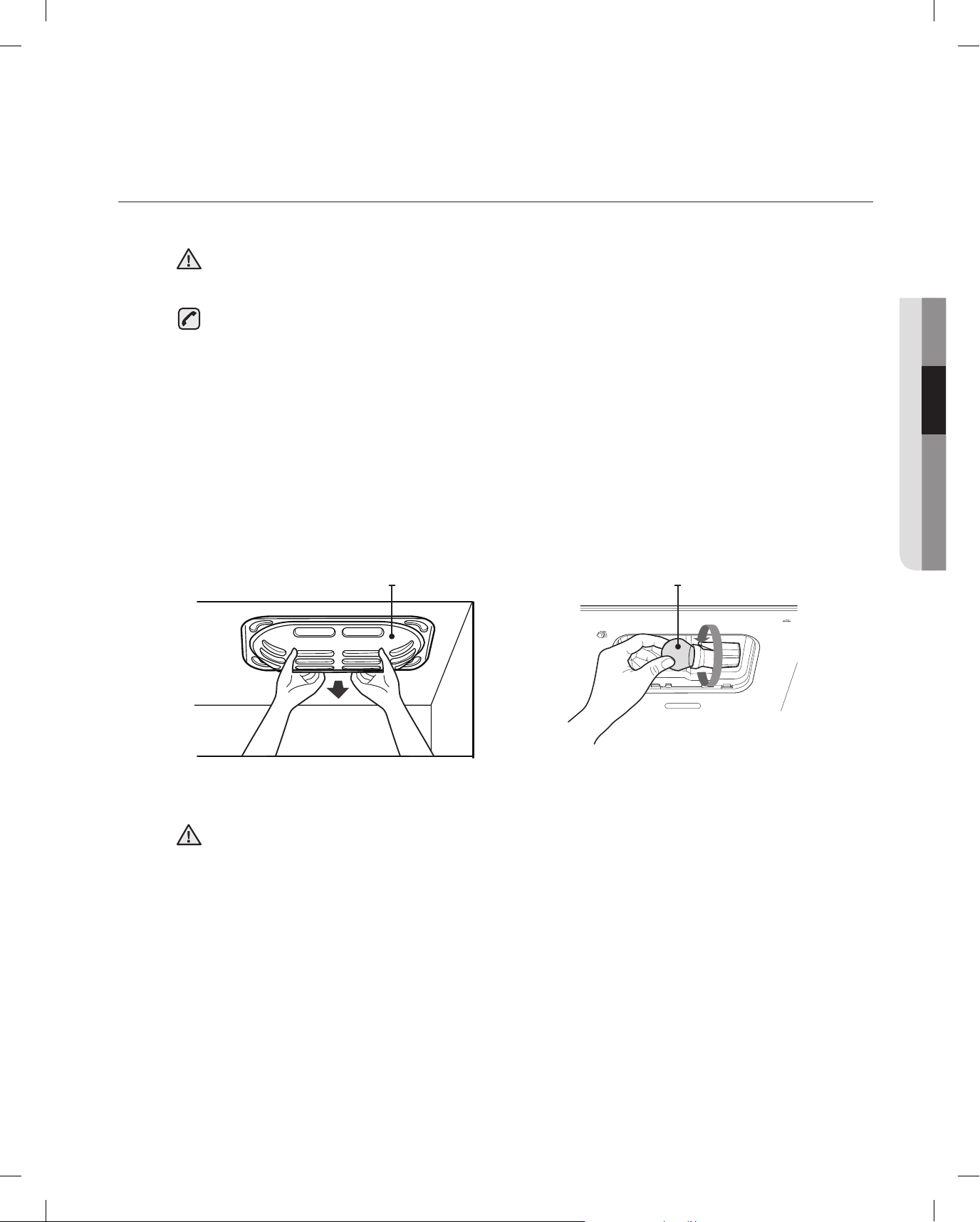
Funcionamiento _35
02 FUNCIONAMIENTO
REEMPLAZO DE FOCOS INTERIORES
Antes de reemplazar cualquier foco interior, desenchufe el refrigerador de la toma de pared. Si no está
seguro de cómo reemplazar los focos tras leer estas instrucciones, póngase en contacto con su centro de
asistencia para obtener ayuda.
Existen focos de repuesto para la heladera a su disposición en su tienda de reformas o electrónica.
Use focos de tamaño E26 y un máximo de 60 vatios. El cambio de la lámpara LED del refrigerador debe
realizarlo un centro Samsung autorizado.
1. Desenchufe el cable de alimentación de la toma de corriente.
2. Extraiga la gaveta extraíble. Examine la sección “Desmontar la gaveta de extracción automática” en la
página 31.
3. Tire de la cubierta de la luz para desmontarla.
4. Gire el foco en sentido antihorario para extraerlo.
5. El montaje se realizará en el orden inverso al desmontaje.
No introduzca los dedos dentro de la cubierta. El foco podría estar caliente.
PRECAUCIÓN
CAUTION
Foco
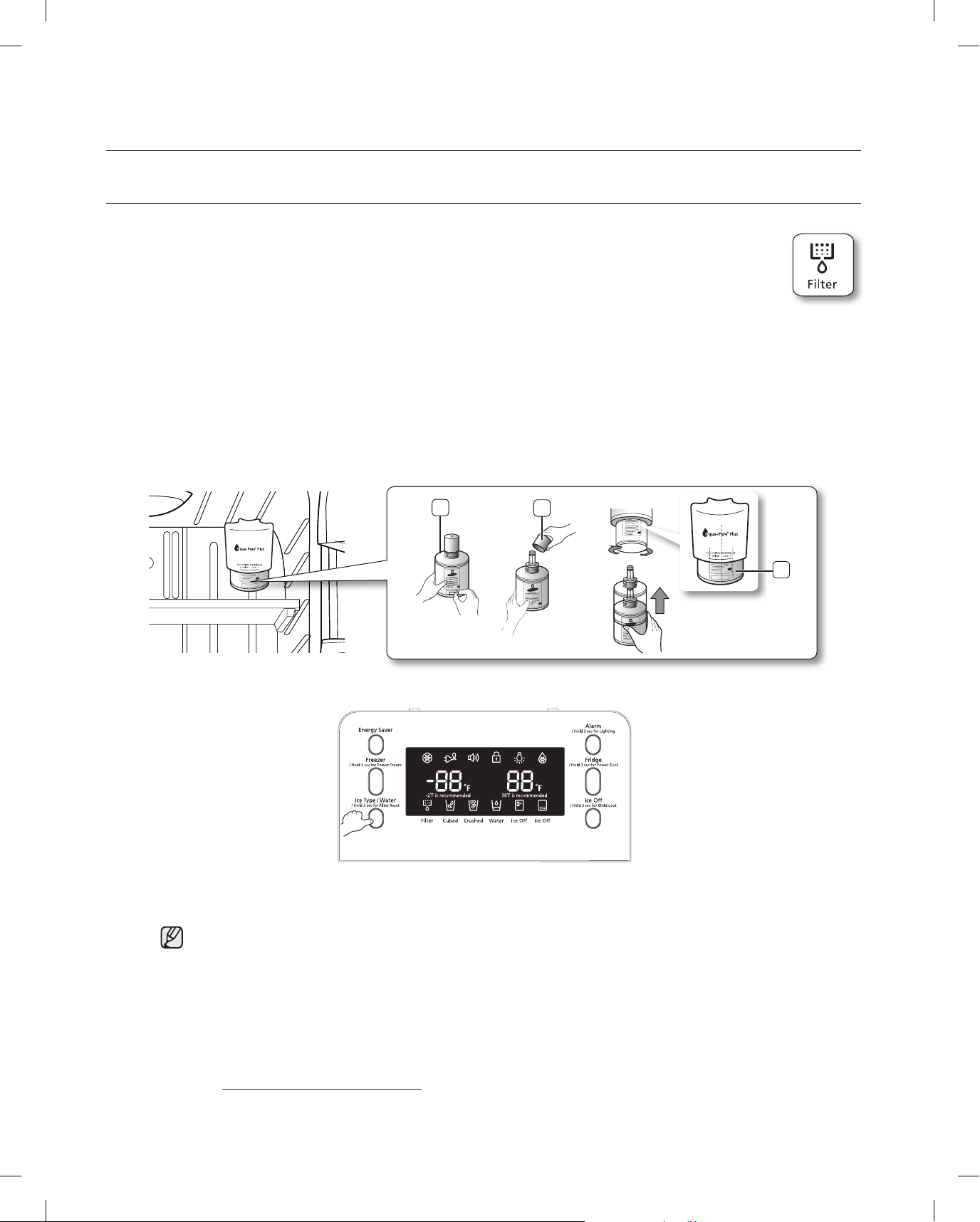
36_ Funcionamiento
Gire hasta que las
etiquetas estén
alineadas.
Cubiertadel filtro
Etiqueta adhesiva
indicadora
(indicador de mes)
1
2
3
Funcionamiento del refrigerador de tres puertas
REEMPLAZO DEL FILTRO DE AGUA
La luz del “indicador de filtro” le permite saber cuándo ha llegado el momento de cambiar
el cartucho del filtro de agua. Para que tenga tiempo de conseguir un filtro nuevo, la luz roja
aparecerá justo antes de que la capacidad del filtro actual se agote. Cambiar el filtro a tiempo
le permitirá obtener agua más fresca y pura de su refrigerador.
1. Coja un filtro de agua nuevo y coloque una etiqueta adhesiva indicadora de mes ( 1 ) sobre el filtro como
se indica. La fecha del adhesivo debe indicar seis meses a partir de la fecha actual. Por ejemplo, si ha
reemplazado el filtro de agua en marzo, coloque la etiqueta “SEP” (septiembre) sobre el filtro para recordarle
que debe reemplazarlo en dicho mes. Normalmente, la vida útil del filtro es de unos 6 meses.
2. Retire la tapa de protección del nuevo filtro ( 2 ) y extraiga el antiguo.
3. Coloque e introduzca el nuevo filtro en su alojamiento. Gire lentamente el filtro de agua en sentido horario para
alinearlo con la marca impresa situada en la cubierta, bloqueando el filtro en su posición. Asegúrese de alinear
la marca de la etiqueta del filtro de agua ( 3 ) con el centro de la impresión de la cubierta del filtro como se
indica en la ilustración. Recuerde, no lo fuerce.
4. Tras realizar los pasos anteriores, mantenga pulsado del botón Alarm/Hold 3 sec for Filter Reset durante
3 segundos para reiniciar el filtro.
5. Por último, descarte seis vasos de agua aproximadamente a través del dispensador para limpiar el
sistema de suministro de agua. Asegúrese de que el flujo de agua es transparente antes de comenzar a
consumirla.
Asegúrese de enjuagar a fondo el dispensador, de lo contrario el agua podría gotear. Esto significa que aún
queda aire en la toma. NO use el dispensador de agua o hielo sin un cartucho de filtro de agua instalado, ya
que la toma de agua podría bloquearse.
Para reemplazar el filtro del agua, puede visitar su centro de bricolaje habitual o ponerse en contacto con el
distribuidor de repuestos de Samsung. Asegúrese de que el filtro de agua de repuesto dispone del logotipo
SAMSUNG en la caja y en el propio filtro.
Enlace : http://www.samsungparts.com
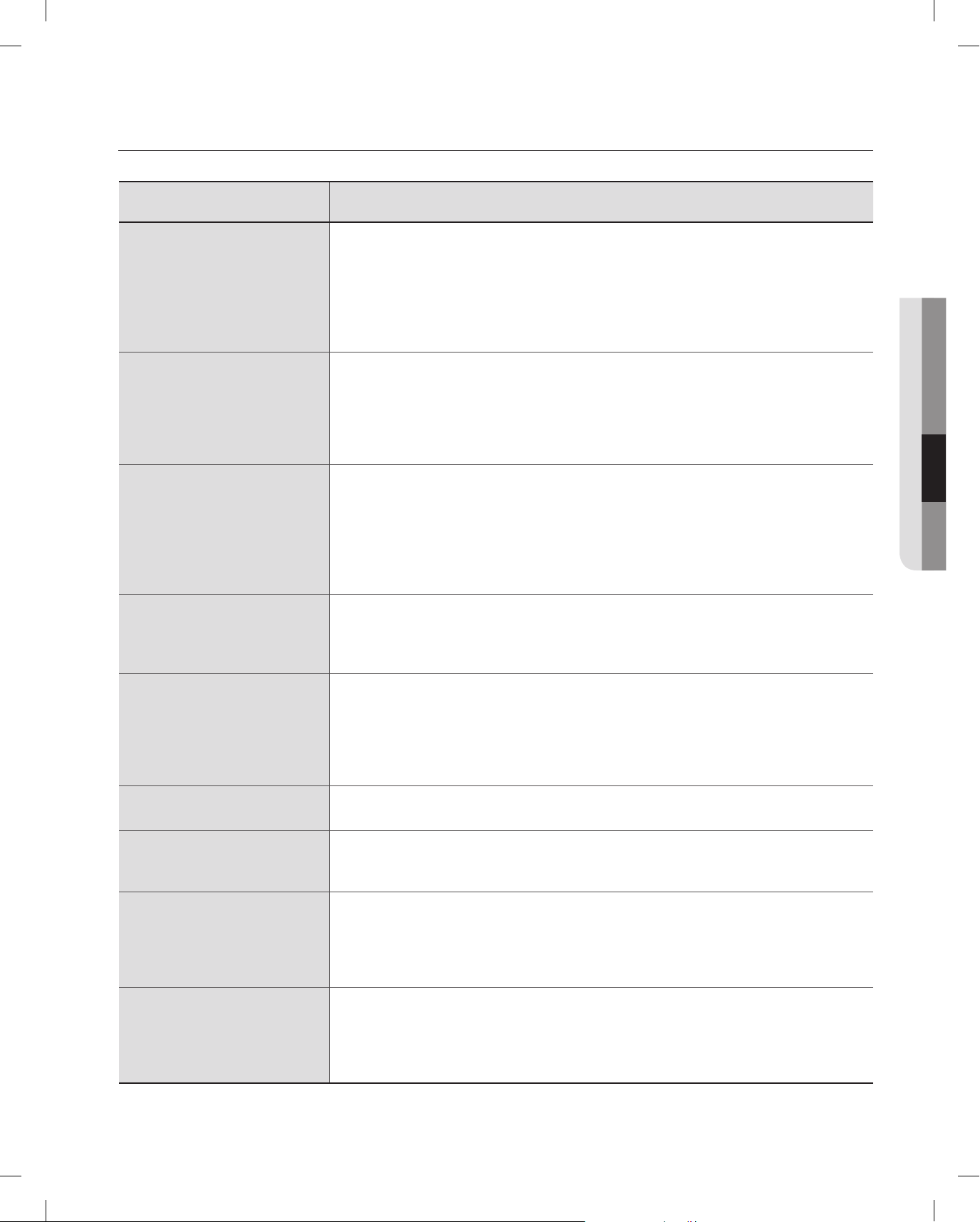
Solución de problemas _37
03 SOLUCIÓN DE PROBLEMAS
Solución de problemas
PROBLEMA
El refrigerador no funciona o
• ¿Chequee que la toma de alimentación esté correctamente conectada.
• Chequee si la temperatura de ajuste de la pantalla digital es mayor que la temperatura interior de
la heladera o refrigerador.
• Intente ajustarlo a una temperatura inferior.
• ¿ Está instalado el refrigerador bajo la luz directa del sol o junto a una fuente de calor?
• ¿ Está la parte posterior del refrigerador demasiado pegada a la pared y, por tanto, impidiendo la
circulación del aire?
Los alimentos del refrigerador
están congelados.
• Chequee si la temperatura de ajuste de la pantalla digital es demasiado baja.
• Intente ajustarlo a una temperatura más alta.
• ¿Es muy baja la temperatura de la estancia? Intente ajustarlo a una temperatura más alta.
• ¿Ha introducido alimentos blandos en la parte más fría del refrigerador? Intente mover estos
artículos a otras baldas del refrigerador en lugar de guardarlos en el compartimento Cool Select
Pantry
PLUS
Se oyen ruidos o sonidos
inusuales.
• Chequee que el refrigerador está nivelado y es estable.
• ¿Está la parte posterior del refrigerador demasiado pegada a la pared y, por tanto, impidiendo la
circulación del aire?
• Intente mantener el refrigerador alejado de la pared más de 2 pulgadas (5 cm).
• ¿Ha caído algo en la parte posterior o bajo el refrigerador?
• Se oyen sonidos repetitivos procedentes del interior del refrigerador. Es normal y ocurre debido a que
varios accesorios se contraen y expanden en base a la temperatura del interior del refrigerador.
• Es normal que se produzca algo de calor ya que los dispositivos anticondensación están
instalados en la sección con bisagras vertical del refrigerador para evitar dicho fenómeno.
• ¿Está entreabierta la puerta del refrigerador? Puede producirse condensación cuando la puerta
permanece abierta durante un período de tiempo prolongado.
elaborando cubitos.
• ¿ Ha esperado las 12 horas posteriores a la instalación de la toma de abastecimiento de agua
antes de elaborar hielo?
• ¿Está conectada la toma de agua y la válvula de corte abierta?
• ¿Detuvo manualmente el funcionamiento de la máquina de hielo?
• ¿ Es demasiado alta la temperatura de la nevera? Intente ajustar la temperatura de la nevera a un
nivel inferior.
Puede oír borboteo de agua
procedente del refrigerador.
• Esto se considera normal. El borboteo procede de la circulación del líquido de refrigeración a
través del refrigerador.
Se perciben malos olores
procedentes del refrigerador.
• Chequee que no existen alimentos estropeados.
• Los alimentos con un olor fuerte (por ejemplo, pescados) deben cubrirse herméticamente.
• Limpie periódicamente su heladera chequeando y desechando alimentos en mal estado.
Se forma escarcha en las
• ¿ Está bloqueado el conducto de ventilación? Elimine cualquier obstrucción para conseguir que el
aire circule libremente.
• Disponga suciente espacio entre los alimentos almacenados para lograr una circulación de aire
más eficiente.
• ¿Está cerrada correctamente la puerta de la nevera?
No funciona el dispensador de
agua.
• ¿Está conectada la toma de agua y la válvula de corte abierta?
• ¿ Está siendo aplastado o doblado el conducto de la toma de suministro de agua? Asegúrese de
que el conducto esté libre y limpio de cualquier obstrucción.
• ¿ Está congelado el depósito de agua debido a que la temperatura del refrigerador es demasiado
baja? Intente escoger un ajuste de temperatura mayor en el panel de visualización principal.
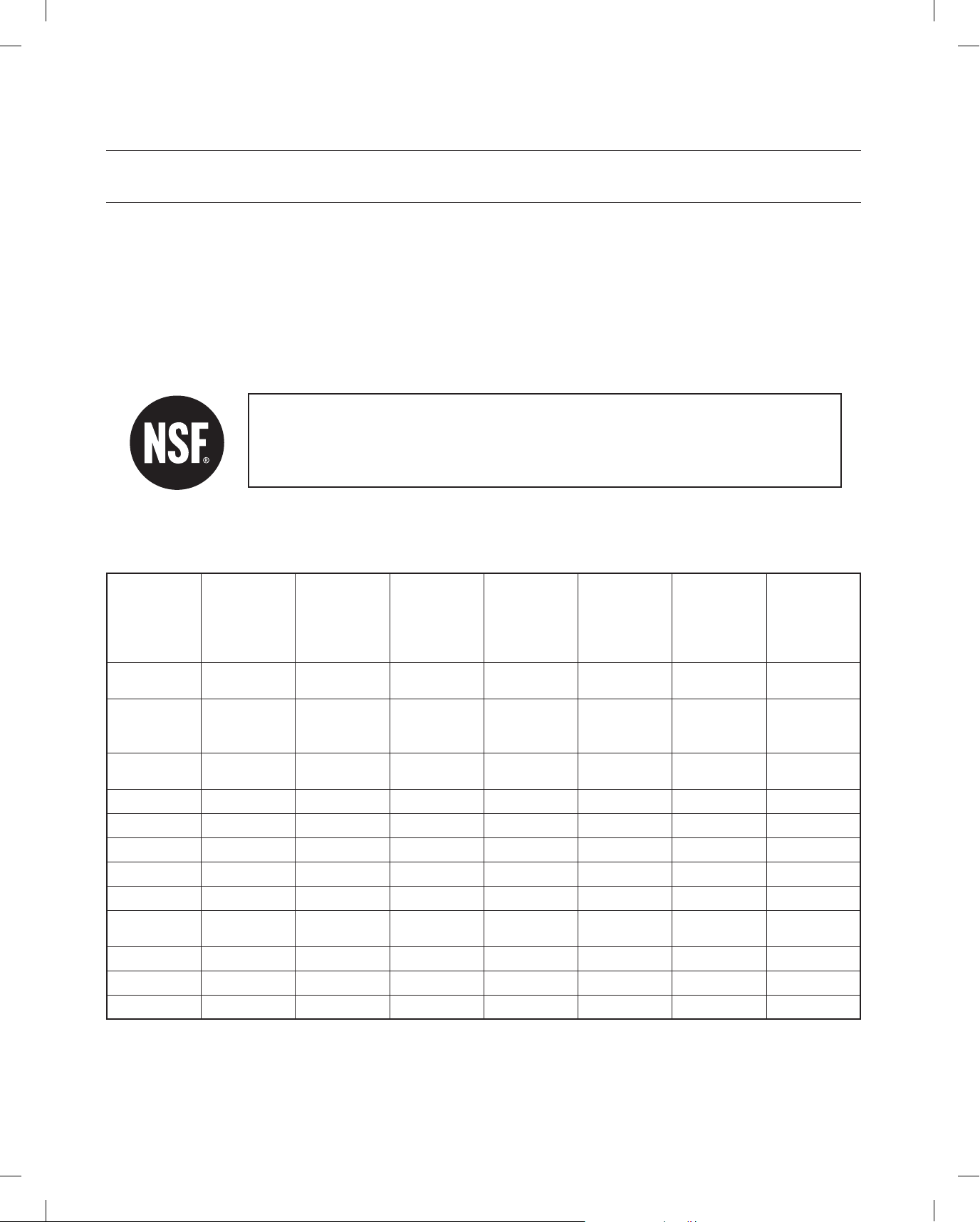
38_ Garantía
Garantía
CUADRO DEL FILTRO DE AGUA
Este sistema ha sido probado según los estándares 42 y 53 de la NSF/ANSI para la reducción de las sustancias que se
enumeran a continuación. La concentración de las sustancias indicadas en la entrada de agua del sistema fue reducida
a una concentración inferior o igual al límite permitido para la salida de agua del sistema, tal y como especifican en los
estándares 42 y 53 de la NSF/ANSI.
Para una capacidad de 300 galones (1 136 litros).
Tenga en cuenta que como la prueba se realizó bajo las condiciones estándar del laboratorio, el rendimiento real podría variar.
El sistema probado y certificado por la NSF Internacional relativo al estándar 42 de la NSF/
ANSI para la reducción del sabor y olor a cloro, partículas de clase I y relativo al estándar
53 de la NSF/ANSI para la reducción de quistes, turbiedad, plomo, amianto, benceno,
Carbofuran, p-diclorobenceno y mercurio.
contaminantes
media de
entrada
Concentration Units
apply to each row
media del
producto en
agua
permitida del
producto en
agua
NSF
Prueba de la
NSF
Sabor y olor a
cloro
2.1 mg/L 2.0 mg/L ± 10% 97.6 0.05 mg/L No aplicable > 50% J-00029741
Partículas de clase
I,tamaño de las partícu-
las: < 0,5 a < 1um
10,566,666
pt/mL
Al menos 10,000
partículas/mL
98.4 171,833 pts/mL No aplicable > 85% J-00029739
Quistes*
127,500
quistes/L
Mínimo 50,000
quistes/L
99.99 <1 quiste/L No aplicable > 99.95% J-00031000
Turbiedad 10.5 11±1 NTU 98.6 0.15 NTU 0.5 NTU > 0.5 NTU J-00033223
Plomo: pH 6,5 153 ug/L 0.15±10% 99.3 <1ug/L 0.010 mg/L 10 ug/L J-00039590
Plomo: pH 8,5 155 ug/L 0.15±10% >99.4 <1ug/L 0.010 mg/L 10 ug/L J-00039591
Mercurio: pH 6,5 5.97 ug/L 0.006±10% 96.6 <0.2 ug/L 0.002 mg/L 2 ug/L J-00039589
Mercurio: pH 8,5 6.29 ug/L 0.006±10% 88.9 0.7 ug/L 0.002 mg/L 2 ug/L J-00039586
Amianto 140 MFL
107 a 108 fibras
> um de longitud
> 99 <0.17 MFL No aplicable 99% J-00029743
Benceno 13.88 ug/L 0.015±10% 96.4 <0.5 ug/L 0.005 mg/L < 5 ug/L J-0029751
Carbofuran 79.6 ug/L 0.190 mg/L 98.7 1 ug/L 0.001 mg/L < 40 ug/L J-00029750
p-diclorobenceno 237.5 ug/L 0.225±10% 99.8 0.525 ug/L 0.075 mg/L < 75 ug/L J-00029749
Garantía _39
04 GARANTÍA
CERTIFICACIÓN DEL FILTRO DE AGUA
Estado de California
Departamento de Salud P.blica
Unidad de Tratamiento de Aguas
N.mero de certificado
04 - 1660
Fecha de emisi.n: julio 7, 2004
Fecha de revisi.n: junio 2, 2008
Elementos de reemplazo
DA29-00003
DA29-00003G
Samsung DA61-00159A-B
Samsung DA97-06317A
Fabricante: Cuno Incorporated
Los dispositivos de tratamiento de agua enumerados en este certificado, re.nen los requisitos de prueba conforme
a la Secci.n 116830 del C.digo de Salud y Seguridad para los siguientes contaminantes relacionados con
la salud:
Contaminantes microbiol.gicos y turbiedad
Contaminantes inorg.nicos/radiol.gicos
Amianto
Plomo
Mercurio
Quistes
Turbiedad
Contaminantes org.nicos
Benceno
Carbofuran
p-diclorobenceno
Flujo de servicio nominal: 0,5 g/mCapacidad de servicio nominal: 300 galones
No usar en lugares donde el agua presente un riesgo microbiol.gico o en aguas cuya calidad sea desconocida,
excepto cuando se empleen sistemas certificados para la reducci.n de quistes en aguas desinfectadas que puedan
contener quistes susceptibles de ser filtrados.
Condiciones de la certificaci.n:
Designaci.n de Marca comercial/Modelo
40_ Garantía
Garantía
GARANTÍA LIMITADA AL COMPRADOR ORIGINAL
Este producto de marca Samsung, suministrado y distribuido por Samsung Electronics America, Inc. (Samsung)
y entregado nuevo, en se caja de cartón original al comprador original, está garantizado por Samsung ante
defectos de fabricación en materiales y mano de obra durante un período de garantía limitado a:
(*Compresor, evaporador, condensador, deshumidificador, tuberías de conexión)
Esta garantía limitada comienza en la fecha original de compra y sólo es válido para productos adquiridos y
usados en los Estados Unidos. Para recibir servicios bajo garantía, el comprador debe ponerse en contacto con
Samsung para proceder a la resolución del problema y al procedimiento de reparación. El servicio de garantía
sólo puede realizarse a través de un servicio técnico autorizado Samsung. Debe presentarse la factura original
de venta bajo solicitud de Samsung o del servicio técnico autorizado Samsung, como prueba de compra.
Samsung reparará o reemplazará cualquier pieza considerada defectuosa a nuestra entera discreción y sin
cargo, como queda estipulado en este documento, por piezas nuevas o reparadas durante el período de
garantía limitada anteriormente especificado. Todas las piezas y productos reemplazados pasan a ser propiedad
de Samsung, debiendo ser devueltos a Samsung. Las piezas y productos de repuesto quedarán aún bajo el
período restante de garantía original, o noventa (90) días, el que sea más extenso.
La prestación de servicios en sitio será proporcionada durante el período de garantía de mano de obra, sujeta
a disponibilidad dentro de los estados contiguos de los EE.UU. La prestación de servicios en sitio no está
disponible en todas las zonas. Para recibir prestación de servicios en sitio, el producto debe estar despejado y
ser accesible al nivel del piso por parte del personal de servicio. Si durante la prestación de servicios en sitio,
no pudiera completarse la reparación, podría ser necesario el traslado, reparación y devolución posterior del
producto. Si la prestación de servicios en sitio no está disponible, Samsung podría escoger, a nuestra entera
discreción, proporcionar transporte a nuestra elección hasta y desde un servicio técnico autorizado Samsung.
De lo contrario, el transporte hasta y desde el servicio técnico autorizado Samsung corre por cuenta del
comprador.
Esta garantía limitada cubre defectos de fabricación en materiales y mano de obra bajo condiciones de uso
normal, no comercial, del producto y no se aplicará en los siguientes casos, incluidos, aunque no limitados a:
daños ocasionados durante el transporte; entrega e instalación; utilizaciones y usos para los que el producto
no fue diseñado; producto o números de serie alterados; daños externos o de acabado exterior; accidentes,
mal uso, negligencia, incendio, agua, rayos u otros fenómenos naturales; uso de productos, equipamiento,
sistemas, utilidades, servicios, piezas, suministros, accesorios, aplicaciones, instalaciones, reparaciones,
tuberías externas y fugas, cableado externo, disyuntores, fusibles o conectores no suministrados y autorizados
por Samsung o que dañen este producto u ocasionen problemas de servicio; voltaje incorrecto, fluctuaciones
y sobretensión del suministro eléctrico; adaptaciones y fallas, por parte del cliente, en el cumplimiento de las
instrucciones de funcionamiento, limpieza, mantenimiento y de entorno que se incluyen y establecen en el
manual de instrucciones; pérdida de alimentos por descomposición; consumibles incluyendo filtros y focos de
iluminación.
Garantía _41
04 GARANTÍA
NO EXISTEN OTRAS GARANTÍAS EXPLÍCITAS MÁS QUE LAS RECOGIDAS Y DESCRITAS ANTERIORMENTE,
ASÍ COMO TAMPOCO EXISTEN OTRAS GARANTÍAS EXPLÍCITAS O IMPLÍCITAS, INCLUYENDO SIN
LIMITACIÓN TODAS LAS GARANTÍAS IMPLÍCITAS DE COMERCIABILIDAD O IDONEIDAD PARA UN FIN
CONCRETO QUE PUDIERAN RESULTAR PERTINENTES TRAS LOS PERÍODOS EXPLÍCITOS DE GARANTÍA
INDICADOS CON ANTERIORIDAD. TAMPOCO SERÁN LEGALMENTE VINCULANTES PARA SAMSUNG
OTRAS GARANTÍAS EXPLÍCITAS U OFRECIDAS POR PERSONAS, FIRMAS O EMPRESAS EN RELACIÓN
A ESTE PRODUCTO. SAMSUNG NO SERÁ LEGALMENTE RESPONSABLE DE LA PÉRDIDA DE INGRESOS
O BENEFICIOS, LA NO MATERIALIZACIÓN DE AHORROS U OTROS BENEFICIOS, O DE CUALQUIER
DAÑO RESULTANTE ESPECIAL, ACCIDENTAL O INDIRECTO OCASIONADO POR EL USO, ABUSO O
INCAPACIDAD DE USO DE ESTE PRODUCTO, INDEPENDIENTEMENTE DE LA TEORÍA LEGAL SOBRE LA
QUE SE BASA LA RECLAMACIÓN, INCLUSO SI SAMSUNG HA SIDO ADVERTIDO DE LA POSIBILIDAD DE
TALES DAÑOS. IGUALMENTE, CUALQUIER TIPO RECUPERACIÓN EXIGIDA A SAMSUNG NO SUPERARÁ EL
PRECIO DE COMPRA DEL PRODUCTO VENDIDO POR SAMSUNG Y QUE HA OCASIONADO EL SUPUESTO
DAÑO. SIN LIMITAR LO INDICADO ANTERIORMENTE, EL COMPRADOR ASUME TODO EL RIESGO Y
RESPONSABILIDAD DE CUALQUIER PÉRDIDA, DAÑO O LESIÓN PERSONAL Y A SU PROPIEDAD, ASÍ
COMO A TERCEROS Y SUS PROPIEDADES, OCASIONADAS POR EL USO, ABUSO O INCAPACIDAD DE
USO DE ESTE PRODUCTO VENDIDO POR SAMSUNG Y NO PROVOCADAS DIRECTAMENTE POR LA
NEGLIGENCIA DE SAMSUNG. ESTA GARANTÍA LIMITADA NO SERÁ VÁLIDA PARA PERSONAS DISTINTAS
AL COMPRADOR ORIGINAL DE ESTE PRODUCTO, ES INTRANSFERIBLE Y ESTIPULA SU SOLUCIÓN
EXCLUSIVA.
Ciertos estados no permiten limitaciones en relación a la duración de una garantía implícita o la exclusión o
limitación de daños accidentales o indirectos, de tal forma que las mencionadas limitaciones o excepciones
pueden no ser pertinentes. Esta garantía le otorga unos derechos legales específicos, e incluso puede conferirle
otros derechos, distintos dependiendo del estado en que se encuentre.
Para obtener servicio de garantía, póngase en contacto con Samsung en:
CENTRO DE ASISTENCIA AL CLIENTE DE SAMSUNG
Samsung Electronics America, Inc. 400 Valley Road Suite 201 Mt. Arlington, NJ 07956
QUESTIONS OR COMMENTS?
WRITE
U.S
800-SAMSUNG
(800-726-7864)
ww
w.samsung.com
Samsung Elect
ronics America, Inc. 400 Valley
Road Suite 201 Mt. Arlington, NJ 07956
CANADA
800-SAMSUNG
(800-726-7864)
ww
w.samsung.com/ca
Samsung Elect
ronics Canada Inc. Customer
Service, 55 Standish Court Mississauga, Ontario
L5R 4B2 Canada
Code No. DA68-01869A REV(0.0)