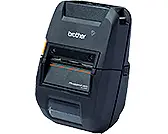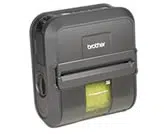
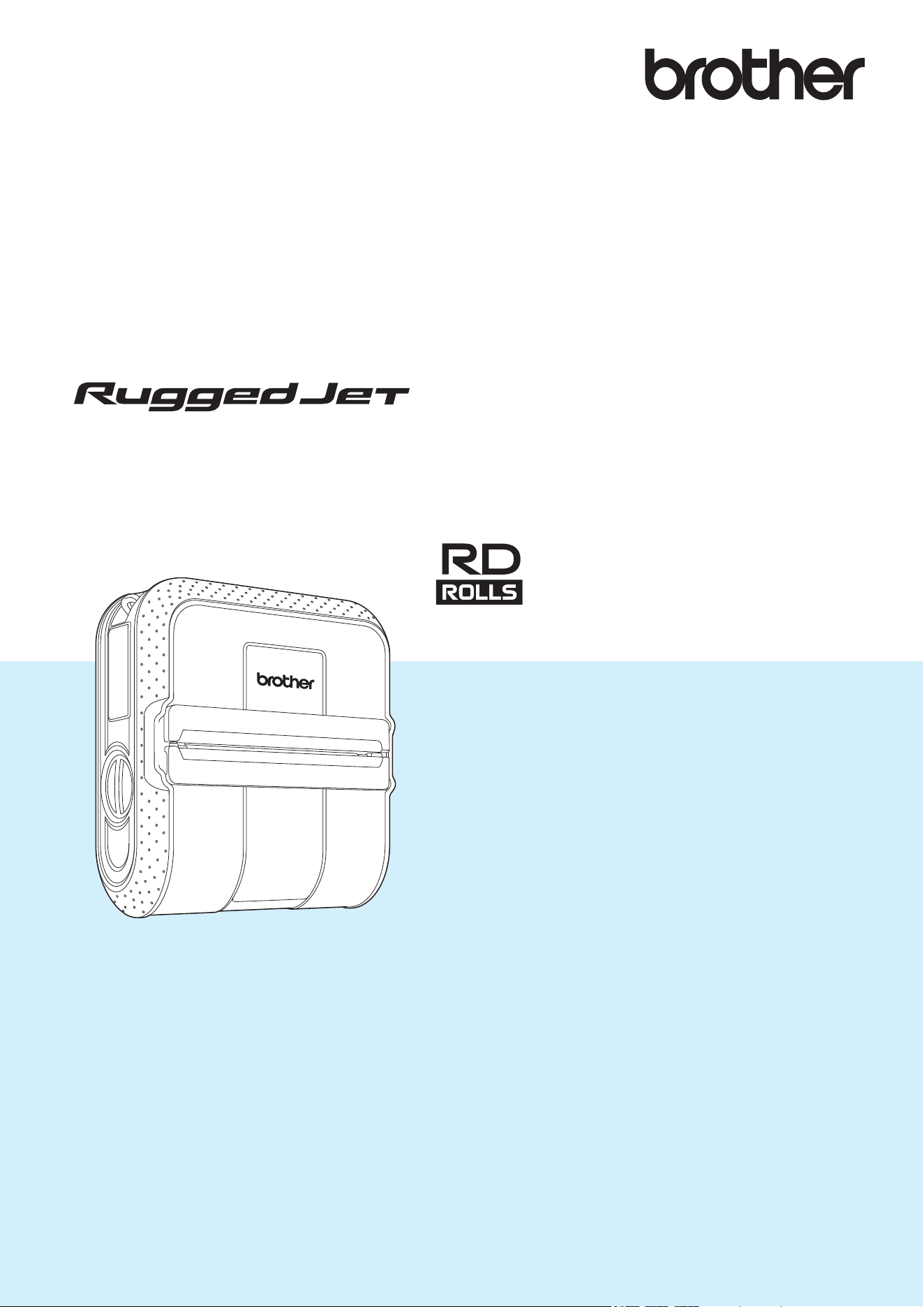
RJ-4030
RJ-4030Ai
RJ-4040
Before using this printer, be sure to read this User's
Guide.
We suggest that you keep this manual in a handy
place for future reference.
Version E
US ENG
USER’S GUIDE RJ-4030/RJ-4040

i
Introduction
Thank you for purchasing the Brother RuggedJet RJ-4030/RJ-4030Ai/RJ-4040 mobile printer.
The RJ-4030/RJ-4030Ai/RJ-4040 (hereafter referred to as “the printer”) is a mobile thermal
printer. Be sure to read the User’s Guide, Product Safety Guide, Quick Reference Guide, Software
User’s Guide and Network User’s Guide (RJ-4040 only) before using the printer. We suggest that
you keep these documents in a handy place for future reference.
Symbols Used in This Document
The following symbols are used throughout this document.
This symbol indicates information or directions that should be followed. Ignoring them
may result in damage, or failed operations.
This symbol indicates notes that provide information or directions that can help you better
understand and use the product more efficiently.

ii
Table of Contents
1 Setting Up the Printer 1
General Description...............................................................................................1
Connecting the Printer to External Power..............................................................2
Connecting to an AC Power Outlet (Optional).................................................2
Connecting to a DC Power Outlet (Optional)...................................................2
Using the Rechargeable Li-ion Battery (Optional) .................................................3
Installing the Rechargeable Li-ion Battery.......................................................3
Charging the Rechargeable Li-ion Battery ......................................................3
Tips on Using the Rechargeable Li-ion Battery...............................................4
Inserting the RD Roll..............................................................................................5
Cutting Roll Paper ...........................................................................................7
Attaching the Belt Clip ...........................................................................................7
Installing the Printer Driver and the Software for RJ-4030 ....................................8
Installing the Printer Driver and the Software for RJ-4030Ai .................................9
Installing the Printer Driver and the Software for RJ-4040 ..................................10
Before You Begin ..........................................................................................10
Infrastructure Mode .......................................................................................11
Choosing Your Wireless Install Method.........................................................11
Installation Procedure (Using USB Cable/Wireless Network) .......................12
One Push Configuration Using WPS and Installation....................................16
Web Based Management (web browser) ......................................................19
Connecting the Computer and Printer .................................................................20
USB Connection ............................................................................................20
Bluetooth Connection
(RJ-4030/RJ-4030Ai).................................................................................20
Wi-Fi Connection (RJ-4040 only) ..................................................................21
Serial Cable Connection................................................................................21
2 Using the Printer 22
Operation Panel...................................................................................................22
Button Functions............................................................................................23
Indicators .......................................................................................................24
Printing Solutions.................................................................................................25
Printing ................................................................................................................25
Making Prints Lighter or Darker.....................................................................26
Printer Driver Options ..........................................................................................26
Setting Paper Size...............................................................................................27
Distributing Paper Formats ..................................................................................29
Distributing only paper formats......................................................................29
Distributing paper formats bundled with the installer (RJ-4030/4040)...........29
3 RJ Utility 31
Overview..............................................................................................................31
Using the RJ Utility ..............................................................................................31
Before Using the RJ Utility.............................................................................31
Starting the RJ Utility .....................................................................................31
How to Use the RJ Utility...............................................................................31

iii
Parameters ....................................................................................................32
4 Communication Settings (RJ-4040 only) 38
Overview..............................................................................................................38
Using the Communication Settings......................................................................38
Starting the Communication Settings ............................................................38
Changing the Settings Related to Communications ......................................40
Applying Setting Changes to Multiple Printers ..............................................40
Menu Bar .......................................................................................................41
Connected Printer’s Status............................................................................43
Network Settings ...........................................................................................43
5 Other Functions 45
Mass Storage.......................................................................................................45
Description.....................................................................................................45
Using the Mass Storage Feature...................................................................45
JPEG Printing ......................................................................................................46
6 Maintaining the Printer 47
Print Head Maintenance ......................................................................................47
Roller Maintenance..............................................................................................47
Paper Outlet Maintenance...................................................................................48
7 Reference 49
Indicators .............................................................................................................49
Indicator Warnings...............................................................................................51
Printing the Printer Set-up Information ................................................................52
8 Troubleshooting 53
Overview..............................................................................................................53
9 Technical Information 57
Product Specifications .........................................................................................57
1
1
1
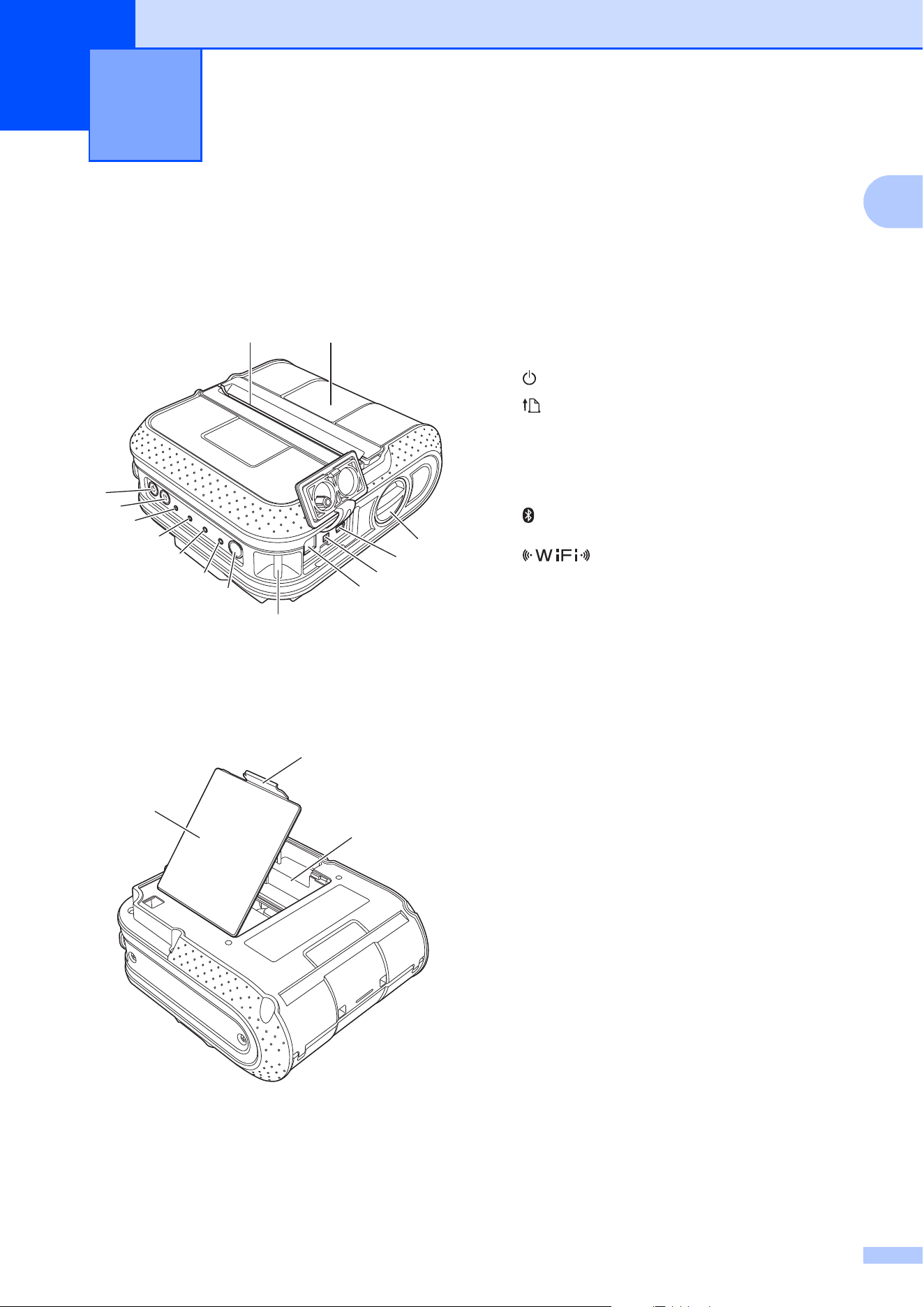
General Description 1
Front 1
Back 1
1 AC/DC connector
2 Serial port
3 USB port
4 Cover open lever
5 RD Roll compartment cover
6 Paper outlet
7 (Power) button
8 (Feed)button
9 POWER indicator
10 STATUS indicator
11 BATT (Battery) indicator
12 (Bluetooth) indicator
(RJ-4030/RJ-4030Ai)/
(Wi-Fi) indicator (RJ-4040)
13 Bluetooth button (RJ-4030/RJ-4030Ai)/
Wi-Fi button (RJ-4040)
14 Belt hook
15 Battery cover
16 Battery cover latch
17 Battery compartment
Setting Up the Printer 1
1
2
3
4
56
7
8
9
10
11
12
13
14
15
16
17
Chapter 1
2
Connecting the Printer
to External Power
1
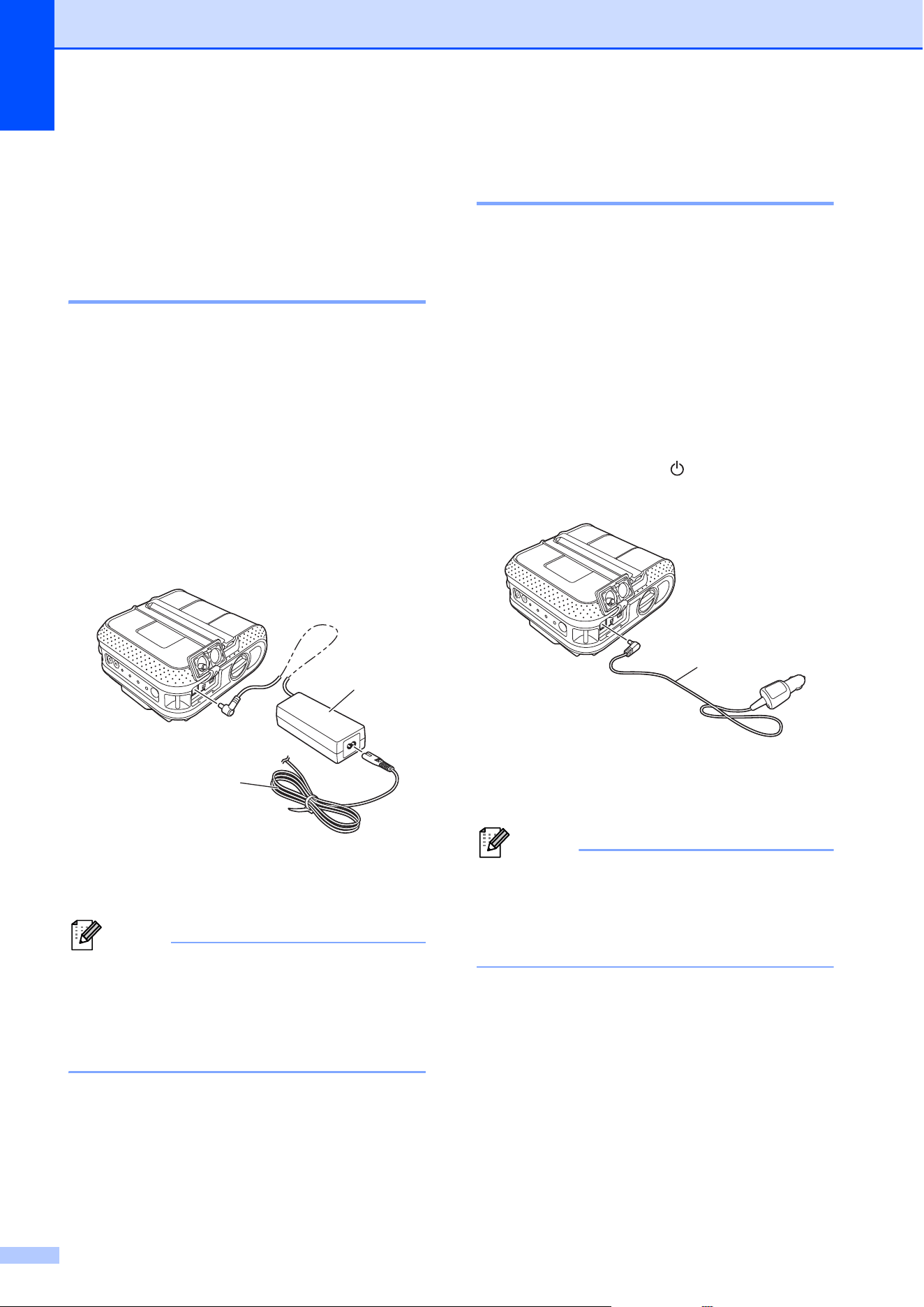
Connecting to an AC Power
Outlet (Optional) 1
Connect the printer to a nearby AC power
outlet to power the printer or charge the
rechargeable battery using AC power.
a Connect the AC adapter to the printer.
b Connect the AC power cord to the AC
adapter.
c Connect the AC power cord to a nearby
AC power outlet (100 - 240 VAC,
50 - 60 Hz).
1AC adapter
2 AC power cord
Note
The AC adapter and AC power cord are
optional accessories. When purchasing,
purchase the adapter and power cord
appropriate for the region where the
printer will be used.
Connecting to a DC Power
Outlet (Optional) 1
Connect the printer to your vehicle’s 12 V DC
power outlet (cigarette lighter, etc.) to power
the printer or charge the rechargeable battery
using the vehicle’s DC power.
a Connect the Car adapter to the vehicle’s
12 V DC power outlet.
b Connect the Car adapter to the printer.
c Turn on the vehicle’s power, and then
press and hold the (Power) button of
the printer to turn it on.
1 Car adapter
Note
• The Car adapter is an optional accessory.
• The voltage supplied by a vehicle
fluctuates. The printing speed may differ
depending on the supplied voltage.
1
2
1
Setting Up the Printer
3
1
Using the
Rechargeable Li-ion
Battery (Optional)
1
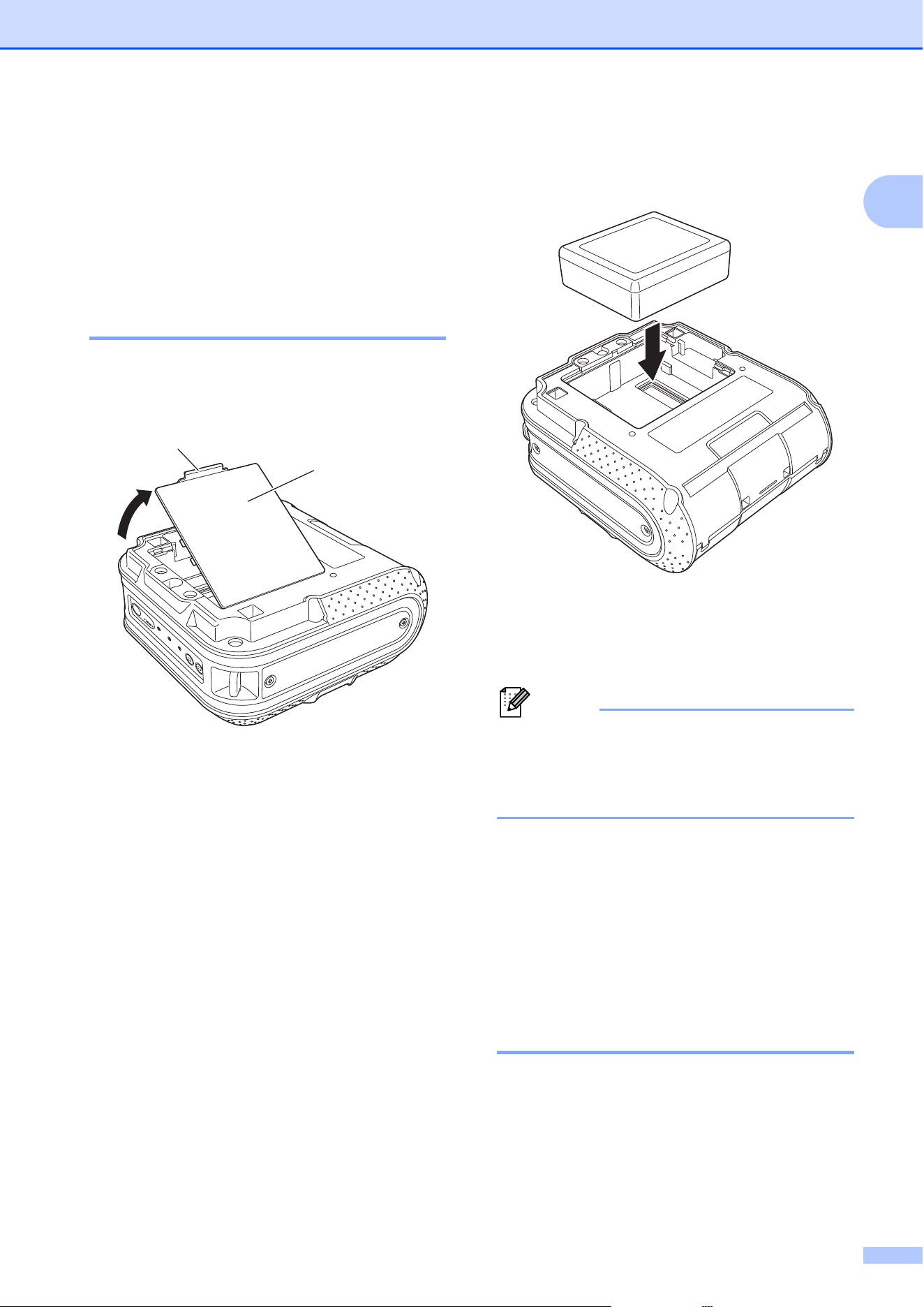
Installing the Rechargeable
Li-ion Battery 1
a Open the battery cover by pressing the
cover latch.
1 Battery cover
2 Cover latch
b Swing the cover open and remove it.
c Insert the battery into the battery
compartment.
d Confirm that the hooks on the edge of
the battery cover are inserted correctly,
and then reattach the cover.
Note
The voltage supplied by the rechargeable
Li-ion battery fluctuates. The printing
speed may also fluctuate depending on
the voltage.
Removing the Rechargeable Li-ion
Battery
1
Remove the battery cover and the
rechargeable Li-ion battery, and then
reattach the battery cover.
Charging the Rechargeable
Li-ion Battery 1
The rechargeable Li-ion battery can be
charged while it is inserted in the printer.
Perform the following procedure to charge
the rechargeable Li-ion battery.
1
2
Chapter 1
4
Note
• Before using the rechargeable Li-ion
battery, use the following procedure to
charge it.
• Up to 360 minutes is needed to fully
charge a rechargeable Li-ion battery.
• You can print about 2,000 labels (when
connected by USB, and using a new, fully
charged battery.) Tested using Brother’s
print test data (7% coverage 4×6 inches)
at 73.4 °F (23 °C).
a Make sure that the printer is turned off.
If the printer is turned on, press and hold
the (Power) button to turn it off.
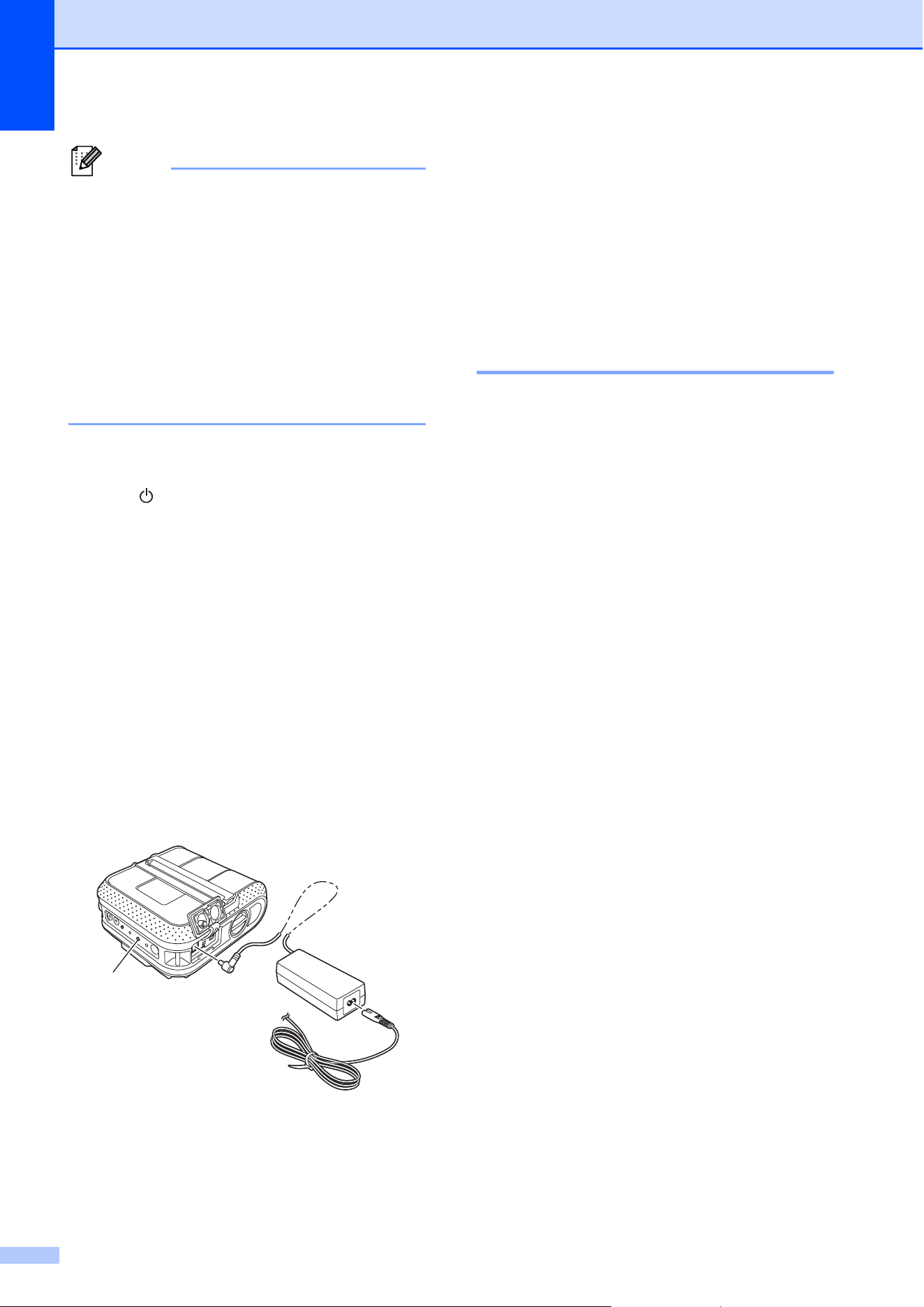
b Make sure that the rechargeable Li-ion
battery is installed in the printer.
c Use the AC adapter and AC power cord
to connect the printer to an AC power
outlet, or use the Car adapter to connect
the printer to a DC power outlet.
The BATT (battery) indicator light is
orange when the printer is charging.
When the rechargeable Li-ion battery is
fully charged, the BATT (battery)
indicator light turns off.
1 BATT (battery) indicator
Stopping Rechargeable Li-ion Battery
Charging
1
To stop rechargeable Li-ion battery from
charging, disconnect the AC power cord or
Car adapter from the battery’s AC/DC
connector.
Tips on Using the
Rechargeable Li-ion Battery 1
Charge the rechargeable Li-ion battery
before use. Do not use it before it is
charged.
Darker prints discharge the rechargeable
Li-ion battery faster than lighter prints.
Adjust the print density setting in the
printer driver’s dialog box or in the RJ
Utility (see Print Density uu page 32).
The rechargeable Li-ion battery charging
can take place in 32-104 °F (0-40 °C)
environments. Charge the rechargeable
Li-ion battery in an environment in this
temperature range. If the surrounding
temperature is out of this range, the
rechargeable Li-ion battery will not be
charged, and the battery indicator will
remain lit.
If the printer is used when both the
rechargeable Li-ion battery is installed
and the AC adapter or Car adapter is
connected, the battery indicator may turn
off and charging may stop even if the
rechargeable Li-ion battery has not been
fully charged.
When charging the rechargeable Li-ion
battery while the Car adapter is
connected, the amount of voltage required
to fully charge the rechargeable Li-ion
battery may not be supplied by the DC
power outlet. When 360 minutes (max.)
have passed since charging started, the
battery indicator turns off and charging
stops even if the rechargeable Li-ion
battery has not been fully charged.
1
Setting Up the Printer
5
1
Rechargeable Li-ion Battery
Characteristics
1
Understanding the properties of the
rechargeable Li-ion battery will allow you to
optimize its usage.
Using or storing the rechargeable Li-ion
battery in a location exposed to high or low
temperatures may accelerate its
deterioration. In particular, using a
rechargeable Li-ion battery with a high
charge (charged 90% or more) in a
location exposed to high temperatures will
considerably accelerate battery
deterioration.
Using the printer while the rechargeable
Li-ion battery is installed and charging
may accelerate the battery’s deterioration.
If using the printer when the rechargeable
Li-ion battery is installed, disconnect the
AC adapter or Car adapter.
If the printer will not be used for a long
period of time, remove the rechargeable
Li-ion battery from the printer when its
charge is 50% or less, and then store the
battery in a cool place away from direct
sunlight.
If the rechargeable Li-ion battery will not
be used for a long period of time, we
recommend charging it every 6 months.
For other precautions, refer to the
instruction manual included with the
rechargeable Li-ion battery.
Inserting the RD Roll 1
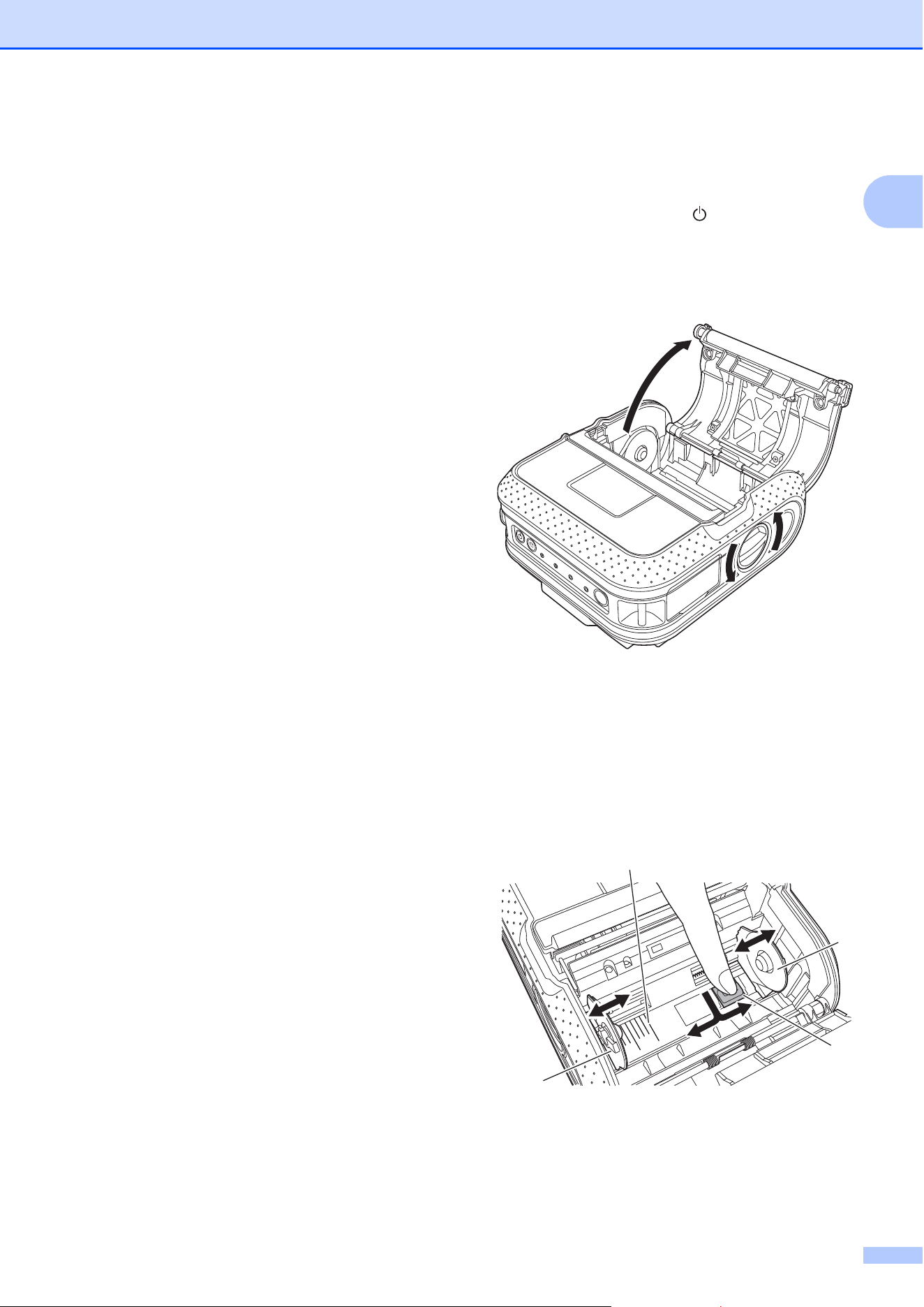
a Press and hold the (Power) button to
turn the printer off.
Turn and hold the cover open lever, and
open the RD Roll compartment cover.
b While pushing the adjuster lock in the
direction of the arrow, move it to the left
or right. Because the roll guide will also
move, adjust the roll guide to match the
width of the paper using the scale
engraved on the inside of the printer.
1 Adjuster lock
2 Roll guide
3 Scale
1
2
3
2
Chapter 1
6
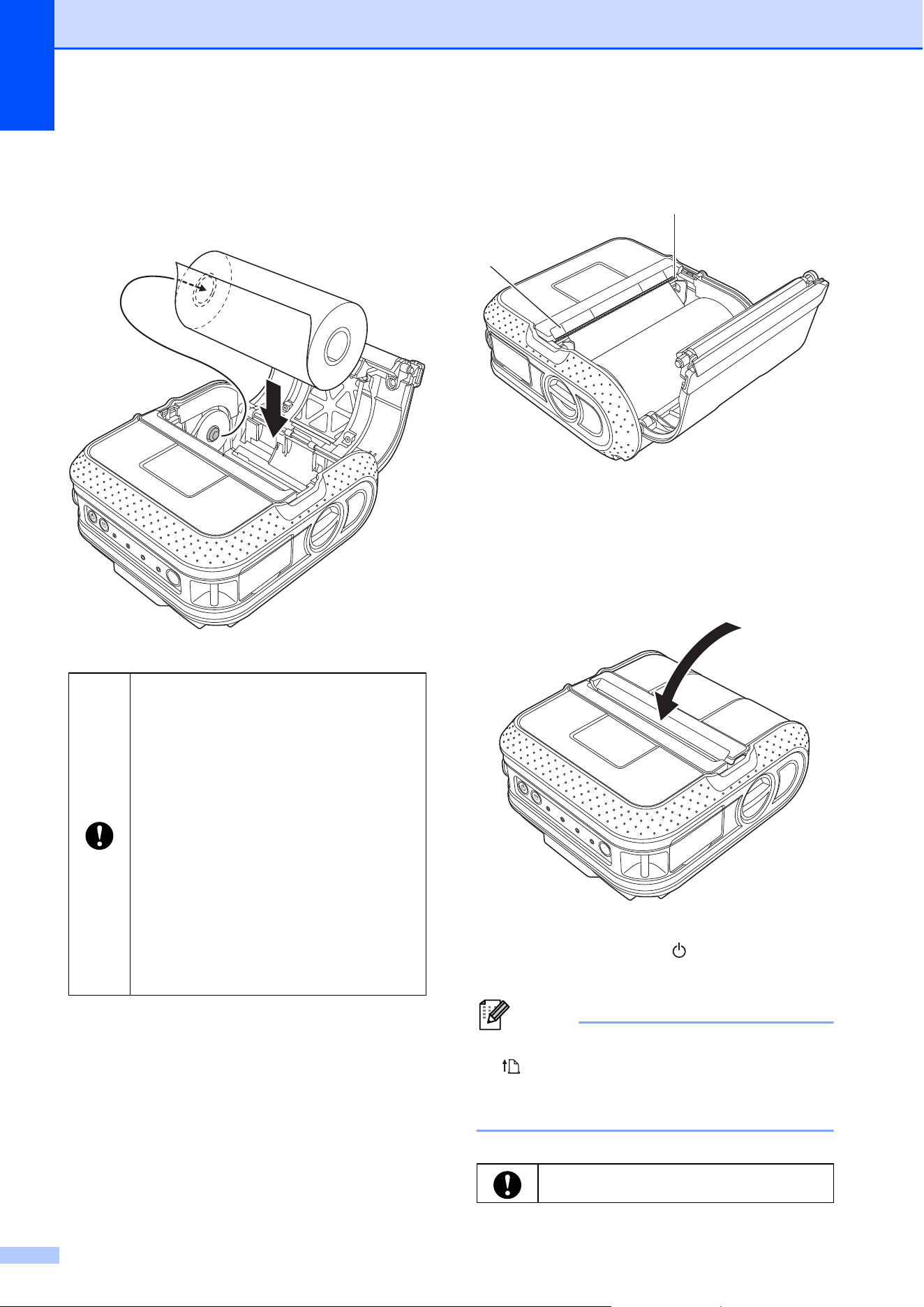
c Insert an RD Roll into the RD Roll
compartment upside down with the
labels feeding from the bottom as
shown.
d Align the RD Roll with the guide lines.
4 Guide lines
5Tear bar
e Close the RD Roll compartment by
pressing on the center of the cover.
f Press and hold the (Power) button to
turn the printer on.
Note
When using die cut label, press the
(Feed) button after inserting the RD
Roll. The printer will position the label to
the correct starting position.
Make sure that the roll guide is
properly positioned to prevent the
RD Roll from moving sideways.
If the RD Roll is not inserted
correctly, the printer will not print on
the correct side of the paper or label.
When printing on die cut labels, set
the roll guide so that there is
0.08 inches (2 mm) of space on
both sides (0.16 inches (4 mm)
total) of the scale.
Example: When using a 4-inch wide
(101.6 mm) label, set the roll guide
to a width of 4.16 inches
(105.6 mm).
Use genuine Brother media.
5
4
Setting Up the Printer
7
1
Cutting Roll Paper 1
Roll paper can be cut using the printer's tear
bar. Pull one edge of the ejected paper up
and toward the other edge diagonally.
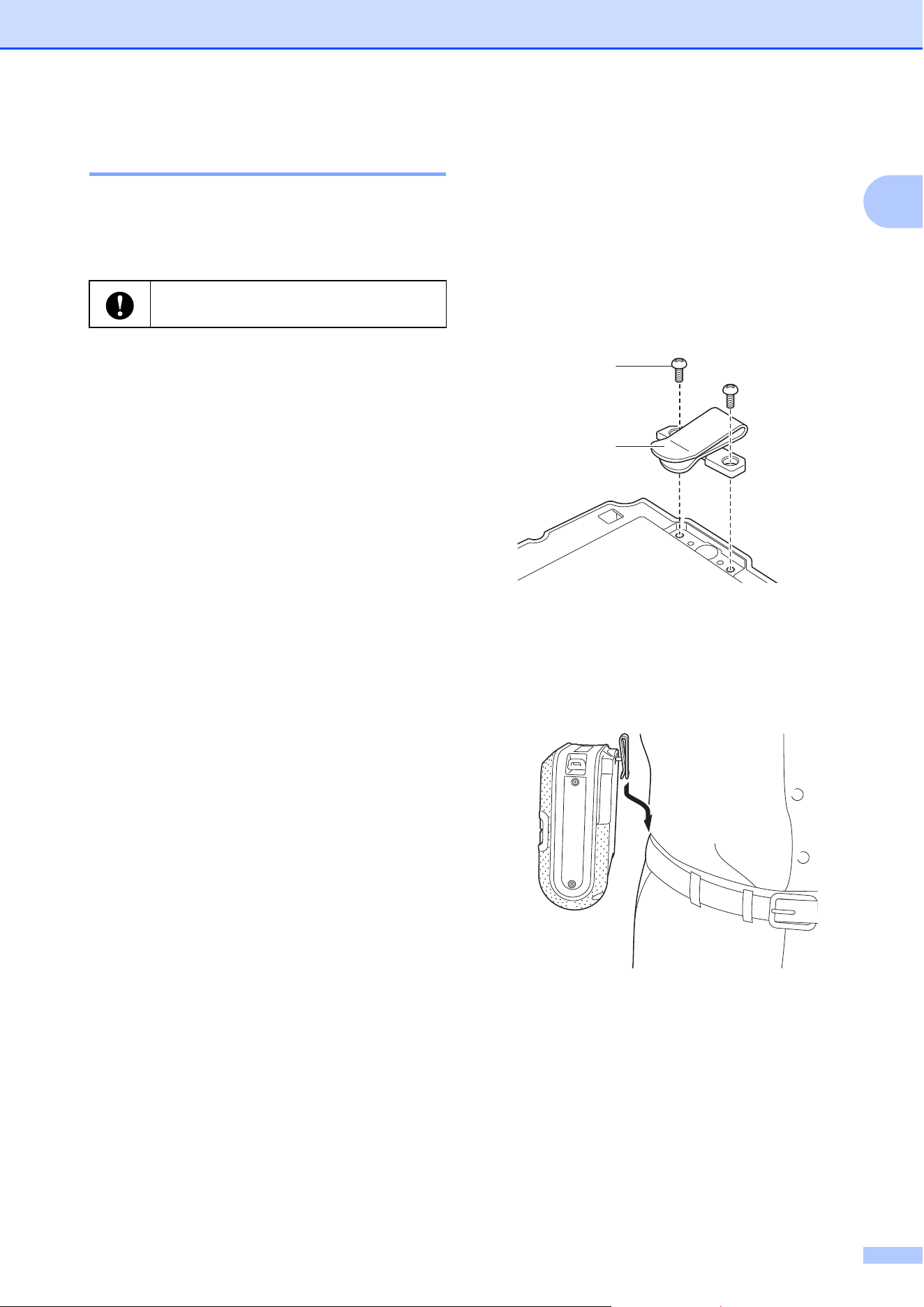
Attaching the Belt Clip 1
When using the printer outside the office, you
can attach the included belt clip to the printer
and secure the belt clip to your belt.
a Secure the Phillips-head screws to the
rear of the printer as shown.
1 Belt clip
2 Phillips screw
b Attach the clip to your belt.
The tear bar is sharp. To avoid injury, do
not touch the tear bar.
2
1
Chapter 1
8
Installing the Printer
Driver and the Software
for RJ-4030
1
The procedure for installing the software
varies depending on the OS of the computer.
Installation procedure is subject to change
without notice.
This section explains how to install P-touch
Editor 5.1, the printer driver, P-touch Update
Software and the Printer Setting Tool using
the Standard Installation option.
Windows
®
7 is used in the following example.
a Insert the installer CD-ROM into your
CD-ROM drive. If the model name
screen appears, choose your printer. If
the language screen appears, choose
your language.
Note
If the CD-ROM menu is not displayed
automatically, open the files on the
CD-ROM and double click [Start.exe].
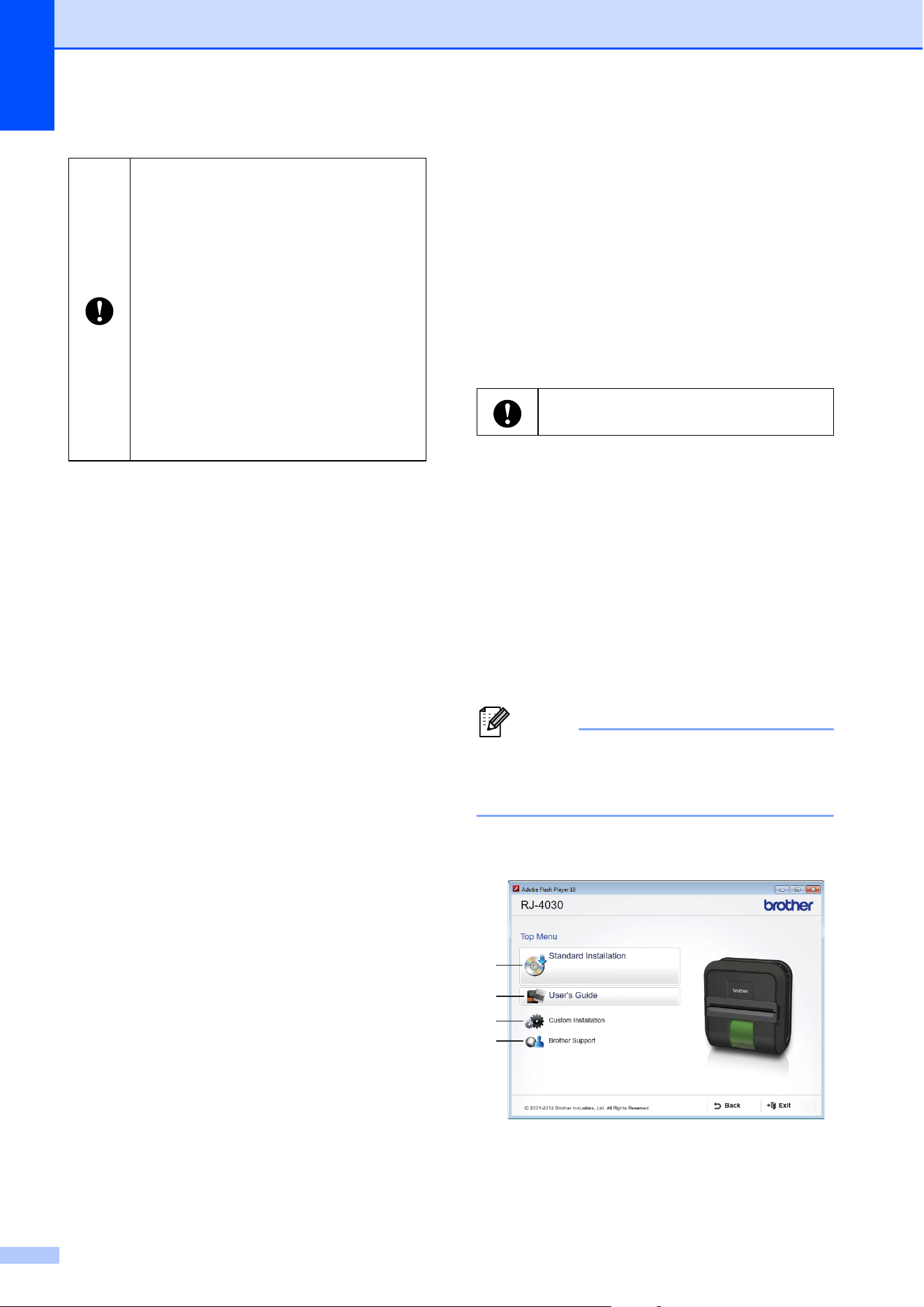
b Click [Standard Installation].
Make sure that the screw is
tightened securely. There is a risk of
injury if the screw is loose and the
printer falls.
Make sure that the belt clip is
attached securely to the printer.
There is a risk of injury if the belt clip
is not attached securely and the
printer falls.
Make sure that the belt clip is
attached securely to the wearer's
belt. There is a risk of injury if the
belt clip is not attached securely and
the printer falls.
Make sure that you are logged on with
Administrator rights.
1
2
3
4
Setting Up the Printer
9
1
Note
• Installation items:
1 Standard Installation
Installs P-touch Editor 5.1, printer
driver, P-touch Update Software,
Printer Setting Tool.
2 User’s Guide
Displays the User’s Guide, Software
User’s Guide.
3 Custom Installation
Individually installs P-touch Editor 5.1,
printer driver, P-touch Update
Software, Printer Setting Tool.
4 Brother Support
Displays the link to Brother Developer
Center and Brother Solutions Center.
• You can use the Printer Setting Tool to
configure various printer settings when
the printer is connected to the computer
via USB.
Note that the printer driver must be
installed on the computer in order to
configure the printer.
c Read the license agreement and click
[Agree] if you agree with the terms and
conditions.
d Click [Install] to start the installation and
follow the on-screen instructions.
e When instructed, connect the printer to
the computer to finish the printer driver
installation.
f When the screen for the online user
registration is displayed, click [OK] or
[Cancel].
If you choose [OK], you will go to the
online user registration page before
finishing the installation
(recommended).
If you choose [Cancel], installation
continues.
g Click [Finish].
The software installation is now
complete.
Note
When you are asked to restart the
computer, choose [Restart] and click
[Finish].
Installing the Printer
Driver and the Software
for RJ-4030Ai
1
Please install the printer driver and P-touch
Editor software before using the printer.
Chapter 1
10
a Visit our website
(www.brother.com/inst/
) and download
the installer for the software and
documents.
b Double-click the downloaded .exe file
and follow the on-screen instructions to
proceed with the installation. In the
dialog box for selecting which items to
install, select the necessary software.
Note
If a dialog box appears to confirm whether
to continue with the installation, proceed
with the installation.
Installing the Printer
Driver and the Software
for RJ-4040
1
The RJ-4040 printer driver and software can
be installed using the following methods:
USB cable connection
Wireless network connection
When using a wireless network, please read
from Before You Begin below to Choosing
Your Wireless Install Method.
When using a USB cable, please read from
Installation Procedure (Using USB
Cable/Wireless Network) uu page 12.
Before You Begin 1
First you must configure the wireless network
settings of your printer to communicate with
your network access point/router. After the
printer is configured to communicate with
your access point/router, computers on your
network will have access to the printer. To
use the printer from these computers, you will
need to install the drivers and software. The
following steps will guide you through the
configuration and installation process.
Note
To achieve optimum results with normal
everyday document printing, use the
printer as close to the network access
point/router as possible with minimal
obstructions. Large objects and walls
between the two devices as well as
interference from other electronic devices
can affect the data transfer speed of your
documents.
Due to these factors, wireless may not be
the best method of connection for all types
of documents and applications.
The maximum processing speed is
possible when using USB.
If you are going to connect the
printer to your network, we
recommend that you contact your
system administrator prior to
installation. You must know your
wireless network settings before
you proceed with this installation.
If you have previously configured
the printer's wireless settings, you
must reset the network settings
before you can configure the
wireless settings again.
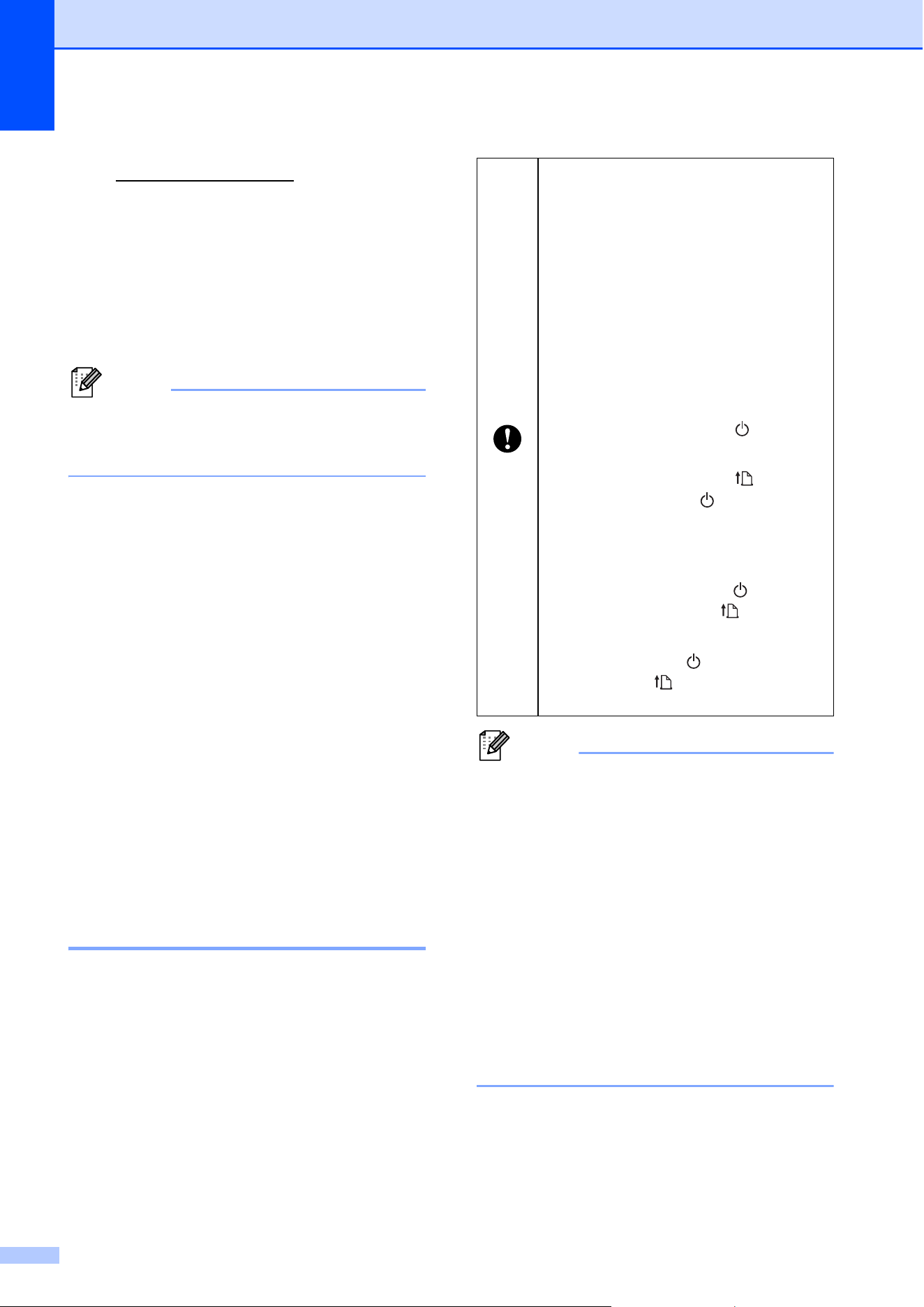
1 Press and hold the (Power)
button to turn the printer off.
2 Press and hold the (Feed)
button and the (Power) button
until the POWER, STATUS and
BATTERY indicators start
blinking in orange.
3 While pressing the (Power)
button, press the (Feed)
button once.
4 Release the (Power) button
and the (Feed) button at the
same time.
Setting Up the Printer
11
1
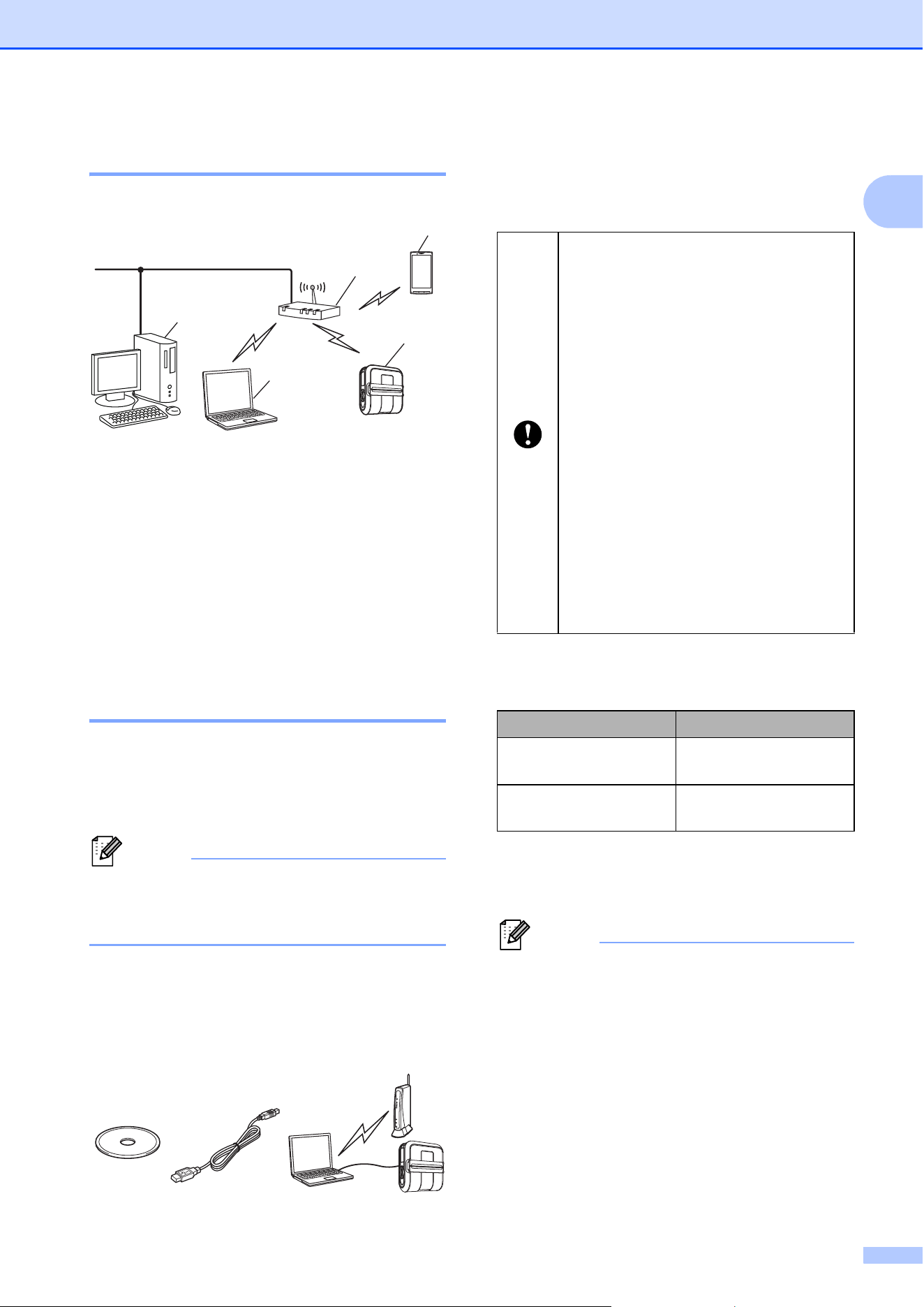
Infrastructure Mode 1
1 Access point/router
2 Your printer
3 Wireless capable computer connected to
the access point/router
4 Wired computer connected to the access
point/router
5 Smartphone
Choosing Your Wireless
Install Method 1
The following instructions will offer two
methods for installing your printer in a
wireless network environment. Choose the
method you prefer for your environment.
Note
To set up your printer in any other wireless
environment, refer to the Network User’s
Guide.
Configuration using the Installer
CD-ROM and temporarily using a USB
cable
1
It is recommended that you use a computer
wirelessly connected to your network for this
method.
MEMO 1
* The Network Key may also be described as
the Password, Security Key or Encryption
Key.
Note
• If you do not know this information (SSID
and Network Key), you cannot continue
the wireless setup.
• How can I find this information (SSID and
Network Key)?
1 Refer to the documentation provided
with your WLAN access point/router.
2 The initial network name could be the
manufacturer's name or the model
name.
2
5
4
3
1
You need to temporarily use a USB
cable (optional) during
configuration.
If you are using a network cable to
connect your computer with your
wireless access point/router, you
need to know the SSID and Network
Key of your WLAN access
point/router before you proceed.
Please print out the following
“MEMO” and write down your
wireless network settings in the area
below.
Please do not contact Brother
Customer Service for assistance
without the wireless security
information. We cannot assist you in
locating your network security
settings.
Item Setting
SSID (Network Name)
Network Key (Security
Key/Encryption Key)
Chapter 1
12
3 If you do not know the security
information, please consult the router
manufacturer, your system
administrator, or internet provider.
One push configuration using WPS 1
If your WLAN access point/router supports
automatic wireless (one-push) setup (WPS),
you can also choose this method.
Now, go on to the installation procedure.
If you choose "Configuration using the
Installer CD-ROM and temporarily using a
USB cable", go to the next section
Installation Procedure (Using USB
Cable/Wireless Network).
If you choose "One push configuration
using WPS", go to One Push
Configuration Using WPS and Installation
uu page 16.
Installation Procedure (Using
USB Cable/Wireless Network)1
The procedure for installing the software
varies depending on the OS of the computer.
The installation procedure is subject to
change without notice.
This section explains how to install P-touch
Editor 5.1, the printer driver, P-touch Update
Software and the Printer Setting Tool using
the Standard Installation option.
Windows
®
7 is used in the following example.
a Insert the installer CD-ROM into your
CD-ROM drive. If the model name
screen appears, choose your printer. If
the language screen appears, choose
your language
Note
If the CD-ROM menu is not displayed
automatically, open the files on the
CD-ROM and double click [Start.exe].
b Click [Standard Installation].
Note
• Installation items:
1 Standard Installation
Installs P-touch Editor 5.1, printer
driver, P-touch Update Software,
Printer Setting Tool.
2 User’s Guide
Displays the User’s Guide, Software
User’s Guide, Network User’s Guide.
3 Custom Installation
Individually installs P-touch Editor 5.1,
printer driver, P-touch Update
Software, Printer Setting Tool.
4 Utility Installation
Installs BRAdmin Light utility.
Make sure that you are logged on with
Administrator rights.
1
2
3
4
5
Setting Up the Printer
13
1
5 Brother Support
Displays the link to Brother Developer
Center, Brother Solutions Center.
• You can use the Printer Setting Tool to
configure various printer settings when
the printer is connected to the computer
via USB.
Note that the printer driver must be
installed on the computer in order to
configure the printer.
c Read the license agreement and click
[Agree] if you agree with the terms and
conditions.
d Click [Install] to start the installation and
follow the on-screen instructions.
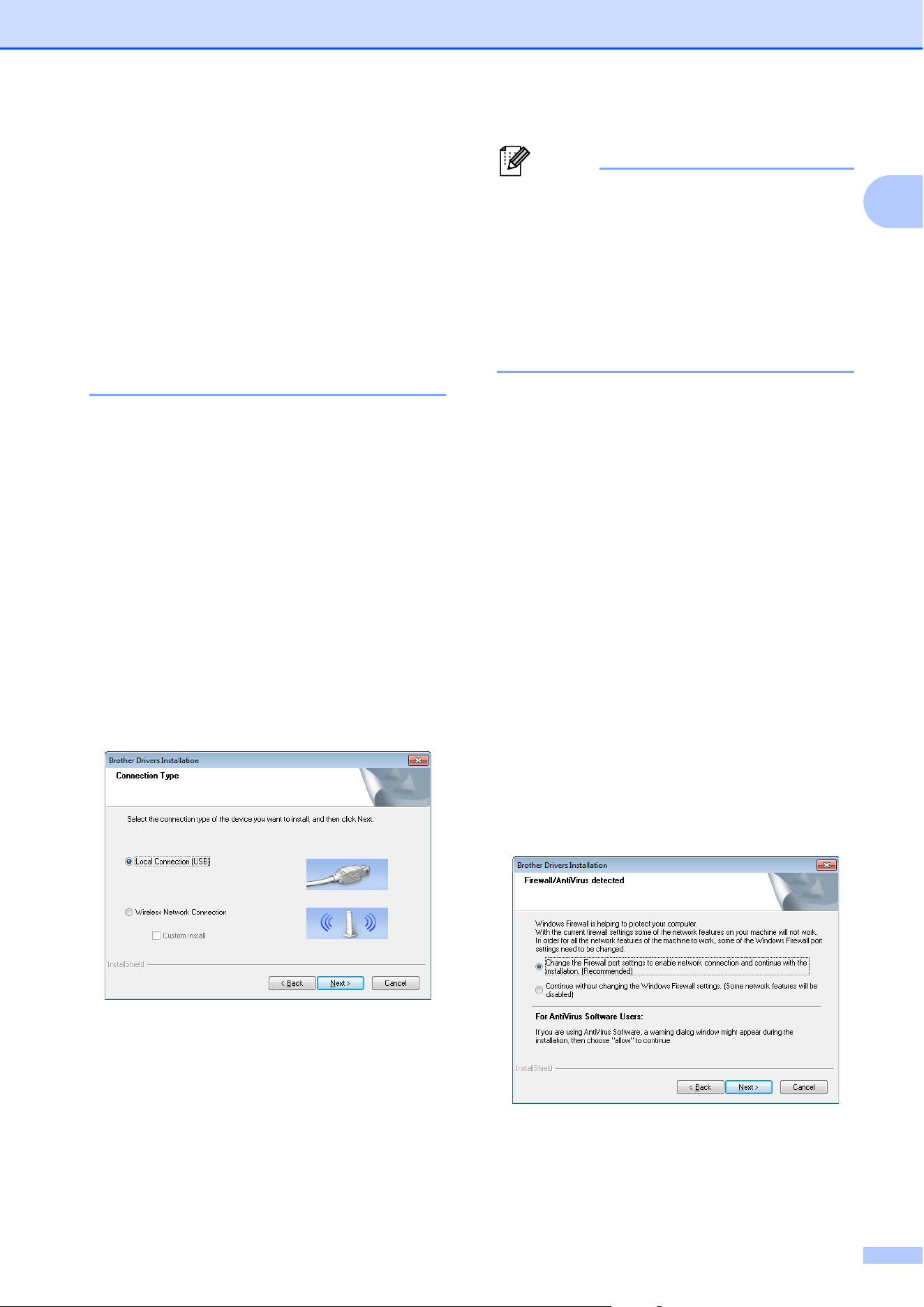
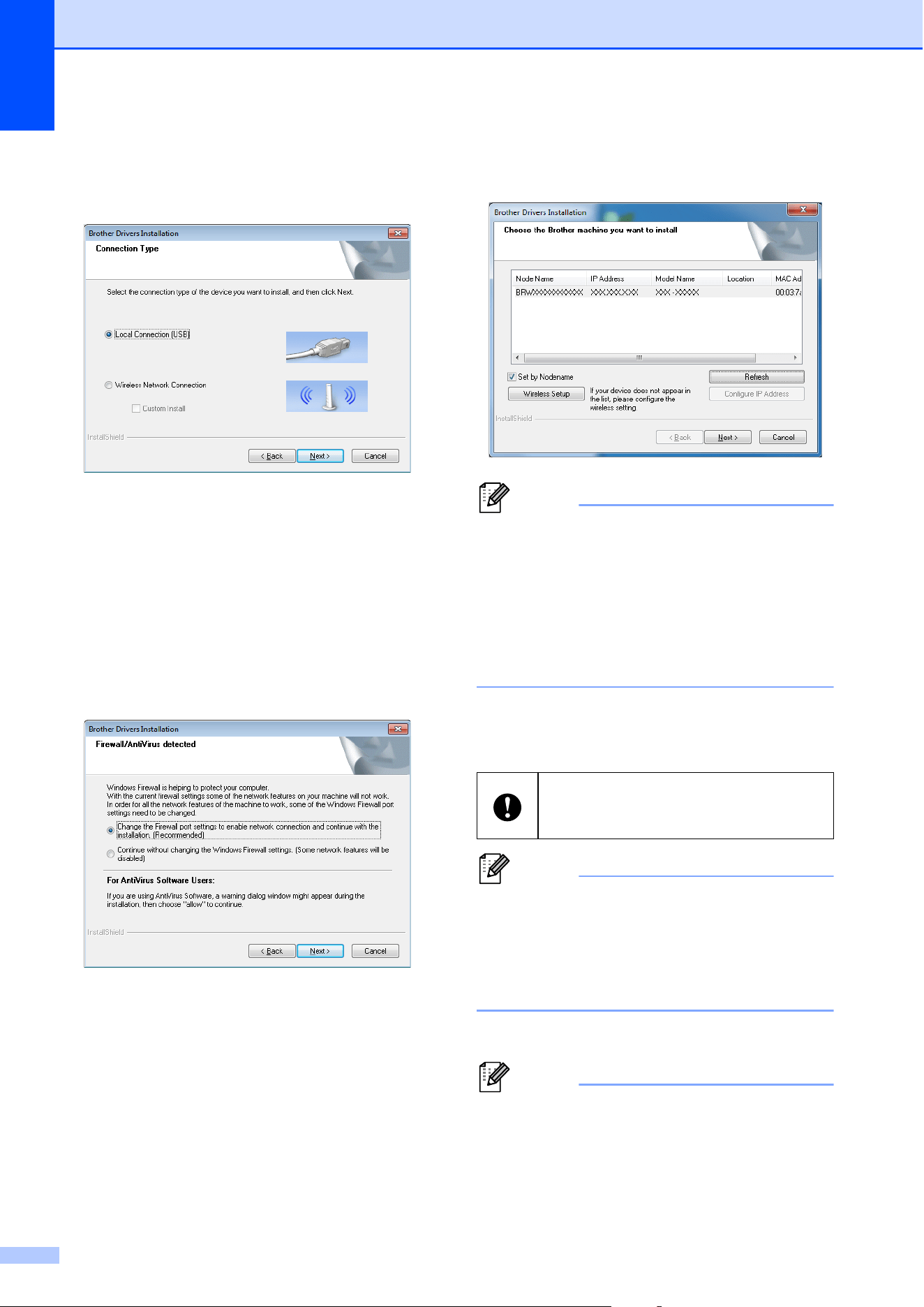
e When the following screen appears,
choose your connection method and
click [Next].
Connection method:
1 Local Connection (USB)
2 Wireless Network Connection
Note
When configuring multiple printers for
wireless network connection:
After using a USB connection to install the
drivers and the Printer Setting Tool on the
computer, you can use the
Communication Settings to easily
configure network settings for multiple
printers.
If you choose [Wireless Network
Connection], move on to For
Wireless Network Users
uu page 13.
If you choose [Local Connection
(USB)] as your connection method,
move on to For USB Users
uu page 16.
For Wireless Network Users 1
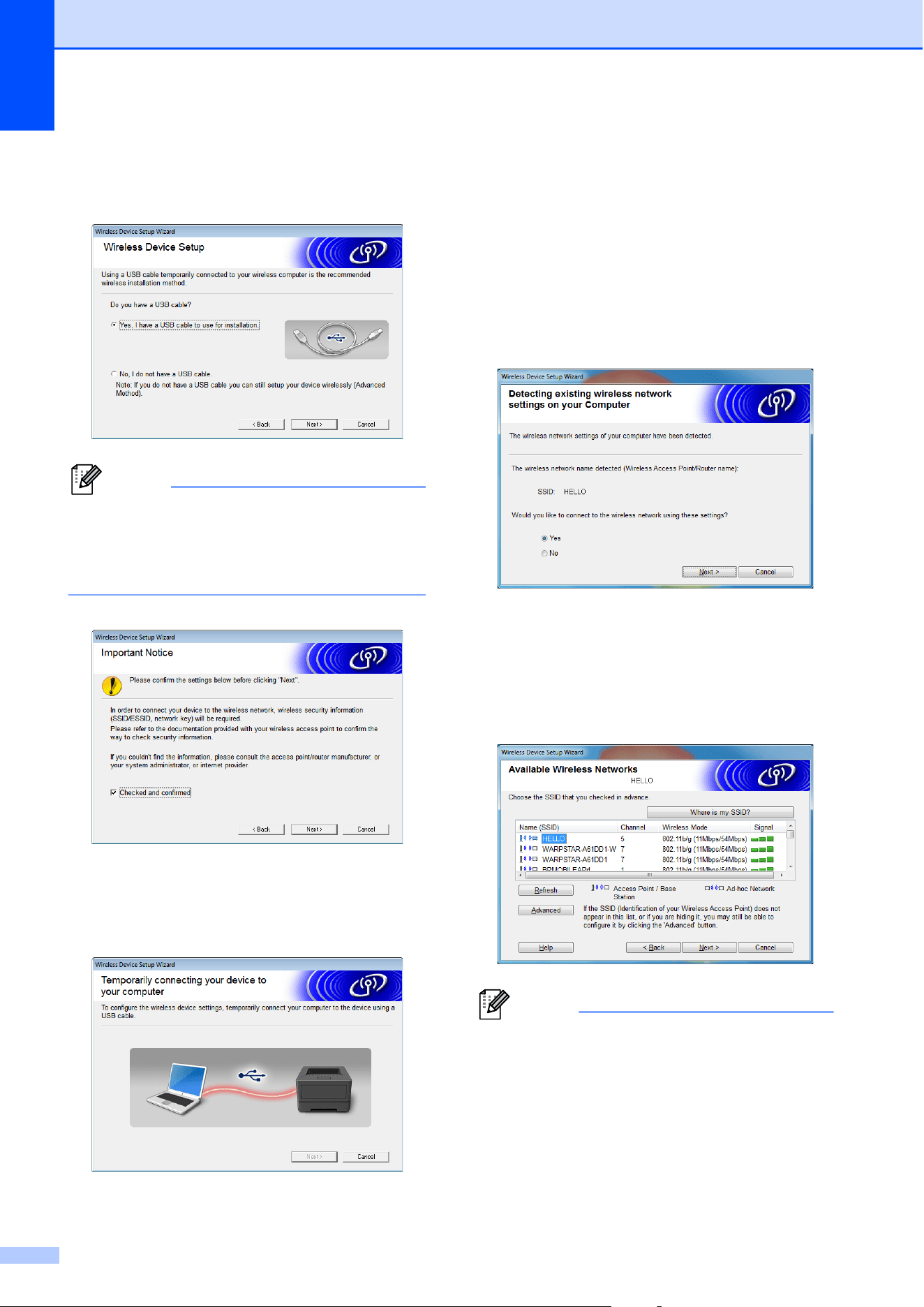
a When the [Firewall/AntiVirus
detected] screen appears, choose
[Change the Firewall port settings to
enable network connection and
continue with the installation.
(Recommended)] and click [Next].
If you are not using the Windows
®
Firewall allow access using UDP ports
137 and 161.
Chapter 1
14
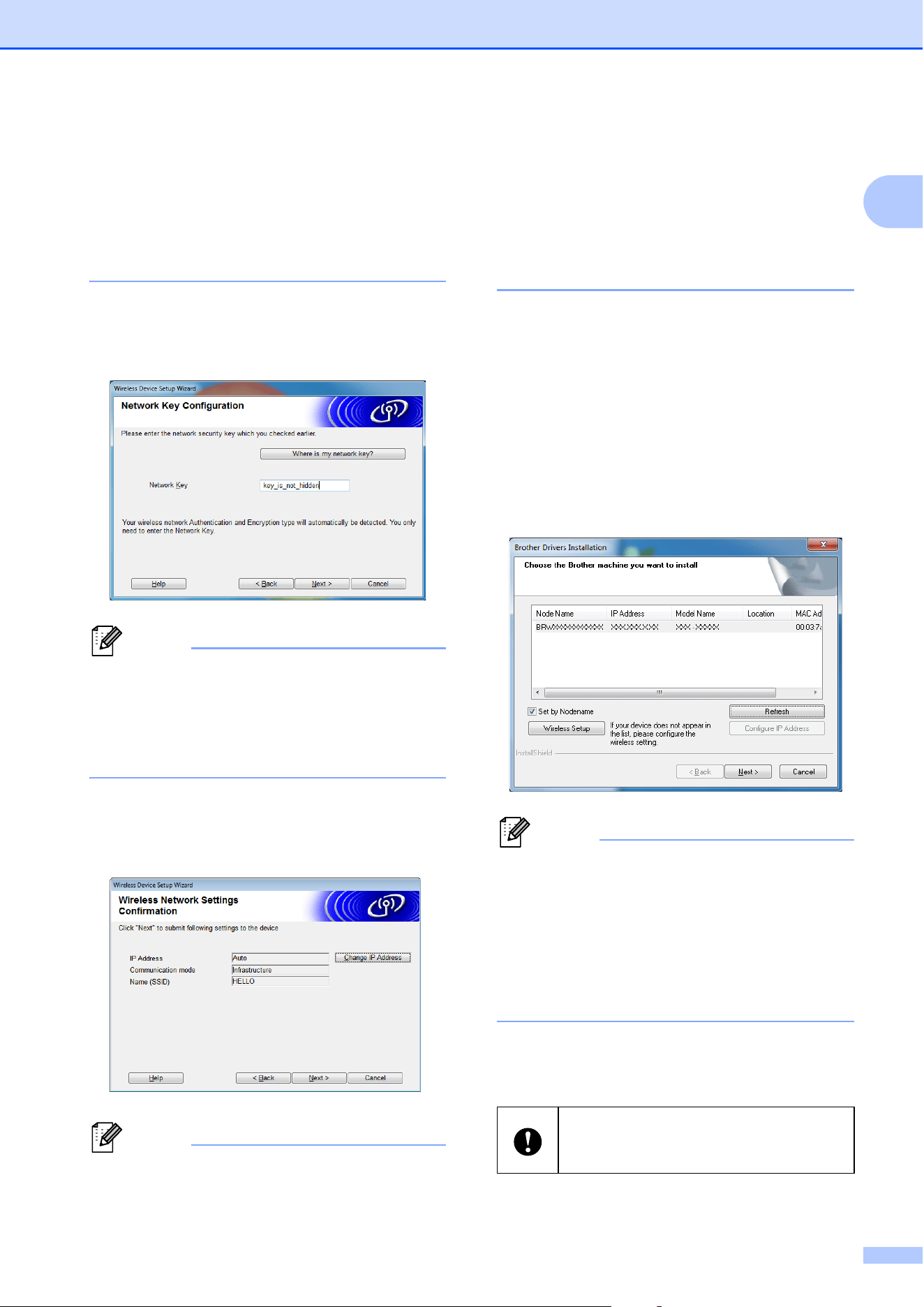
b Choose [Yes, I have a USB cable to
use for installation], and then click
[Next].
Note
If the [Important Notice] screen appears,
read the notice. Check the box after you
confirm the SSID and Network Key, and
then click [Next].
c Temporarily connect the USB cable
(optional) directly to the computer and
the printer.
d Do one of the following:
If the Installation confirmation screen
appears, check the box and click
[Next], then go to e.
Otherwise, go to f.
e Check [Yes] if you want to connect with
the listed SSID. Click [Next] and go to
h.
f The wizard will search for wireless
networks available from your printer.
Choose the SSID that you noted in
MEMO uu page 11 and then click
[Next].
Note
• If the list is blank, check that the access
point is turned on and is broadcasting the
SSID, and then see if the printer and the
access point are within range for wireless
communication.
Then, click [Refresh].
Setting Up the Printer
15
1
• If your access point is set to not broadcast
the SSID, you can enter the SSID
manually by clicking the [Advanced]
button. Follow the on-screen instructions
for entering the [Name (SSID)], and then
click [Next].
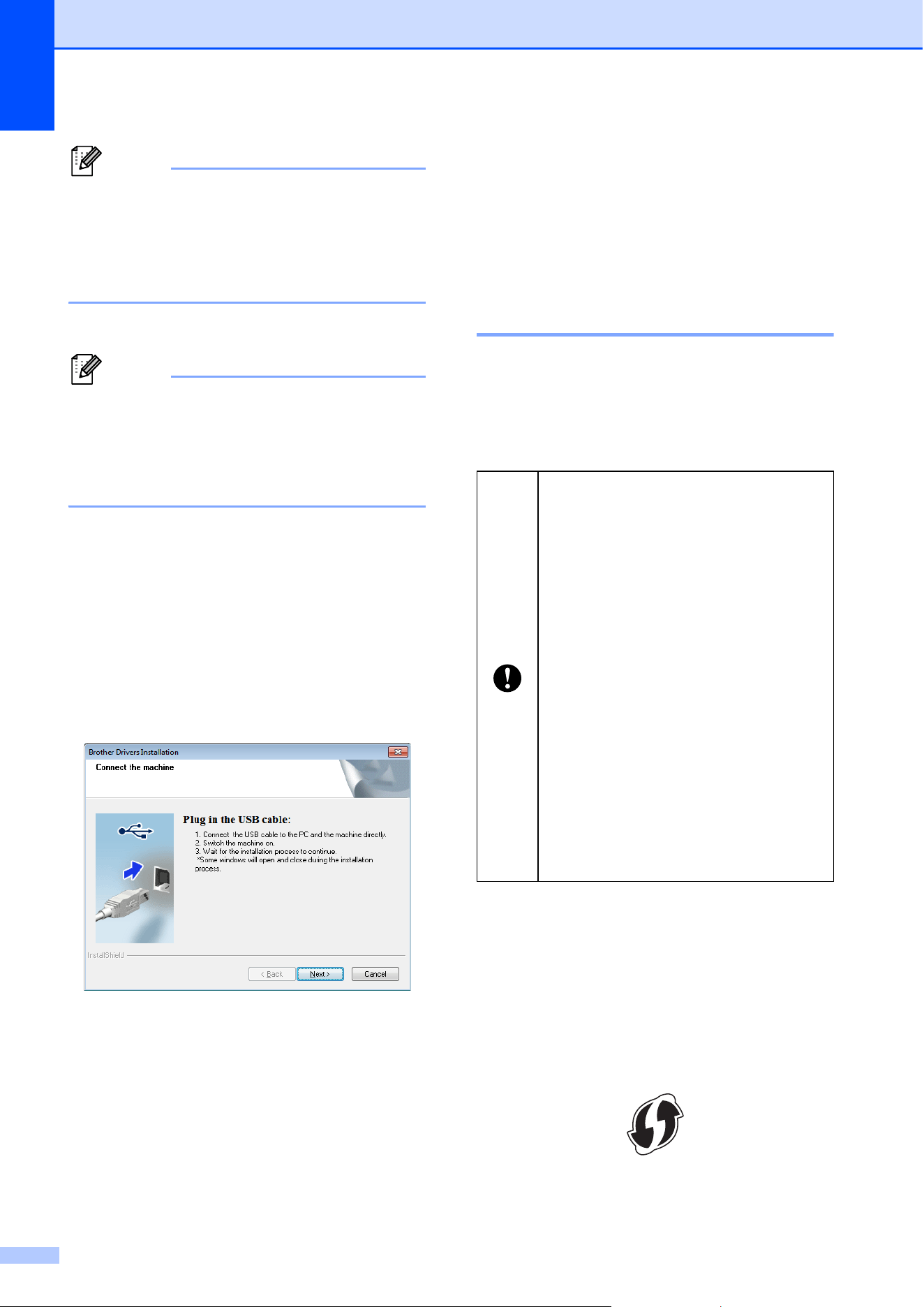
g Enter the [Network Key] you noted in
MEMO uu page 11 and then click
[Next].
Note
If your network is not configured for
authentication and encryption, the
[ATTENTION!] screen will appear. To
continue configuration, click [OK] and go
to h.
h Confirm the wireless network settings
and then click [Next]. The settings will
be sent to your printer.
Note
• The settings will remain unchanged if you
click [Cancel].
• If you want to manually assign an IP
address to the printer, click [Change IP
Address] and enter an IP address that is
compatible with your network.
• If the wireless setup failure screen
appears, click [Retry].
i Disconnect the USB cable connecting
the computer and the printer and then
click [Next].
Wireless setup is now complete.
Go on to j to install the printer driver
and the software.
j Choose the printer from the list, and
then click [Next].
Note
• If your wireless settings fail, the [Wireless
Device Setup Wizard] screen appears.
Follow the on-screen instructions to
complete the wireless configuration.
• If you are using WEP but your printer is
not found, make sure you entered the
WEP key correctly.
k Follow the on-screen instructions to
complete setup.
DO NOT cancel any of the screens
during the installation. It may take a few
seconds for all screens to appear.
Chapter 1
16
Note
For Windows Vista
®
and Windows
®
7
users, when the [Windows Security]
screen appears, click the check box and
click [Install] to complete the installation
correctly.
The installation is now complete.
Note
Depending on your security settings, a
Windows Security or antivirus software
window may appear when using the
printer or its software. Please allow or
permit the installer to continue.
For USB Users 1
a Follow the on-screen instructions for
installing the printer driver. When this
screen appears, confirm the printer
power is on. When instructed, connect
the USB cable to your computer and
then to the printer, to finish the printer
driver installation.
b When the screen for the online user
registration is displayed, click [OK] or
[Cancel].
If you choose [OK], you will go to the
online user registration page before
finishing the installation
(recommended).
If you choose [Cancel], installation
continues.
c Click [Finish].
The installation is now complete.
One Push Configuration
Using WPS and Installation 1
The procedure for installing the software
varies depending on the OS of the computer.
The installation procedure is subject to
change without notice.
This section explains how to install P-touch
Editor 5.1, the printer driver, P-touch Update
Software and the Printer Setting Tool using
the Standard Installation option.
Windows
®
7 is used in the following example.
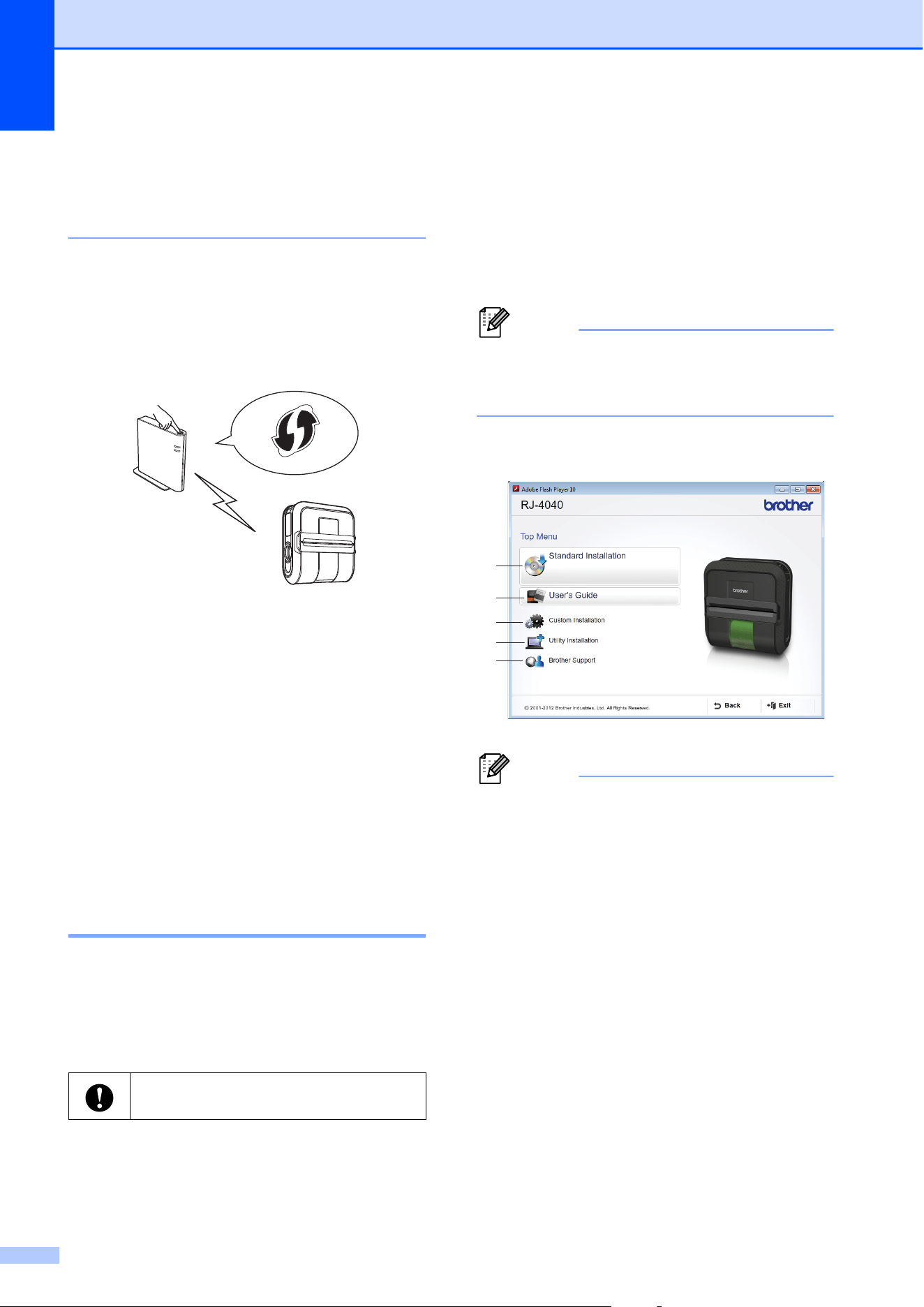
a Confirm that your WLAN access
point/router has the WPS symbol.
Make sure that you are logged on
with Administrator rights.
When the printer is on an Enterprise
Wireless Network, connect the
printer via USB and configure its
wireless settings. If using the
RJ-4040, you can also use the
Communication Settings to
configure these settings once you
have installed the printer driver.
For information about installing the
printer driver, see Installation
Procedure (Using USB
Cable/Wireless Network)
uu page 12.
For information about the
Communication Settings, see
Communication Settings (RJ-4040
only) uu page 38.
Setting Up the Printer
17
1
b Place your printer within range of your
WPS access point/router. The range
may differ depending on your
environment. Refer to the instructions
provided with your access point/router.
c Turn on your printer and press and hold
the Wi-Fi button until the
(Wi-Fi) indicator starts blinking in blue.
d Press the WPS button on your WLAN
access point/router.
When the configuration is completed,
the (Wi-Fi) indicator on your
printer lights in blue.
Wireless setup is now complete.
Go on to e to install the printer driver
and the software.
e Insert the installer CD-ROM into your
CD-ROM drive. If the model name
screen appears, choose your printer. If
the language screen appears, choose
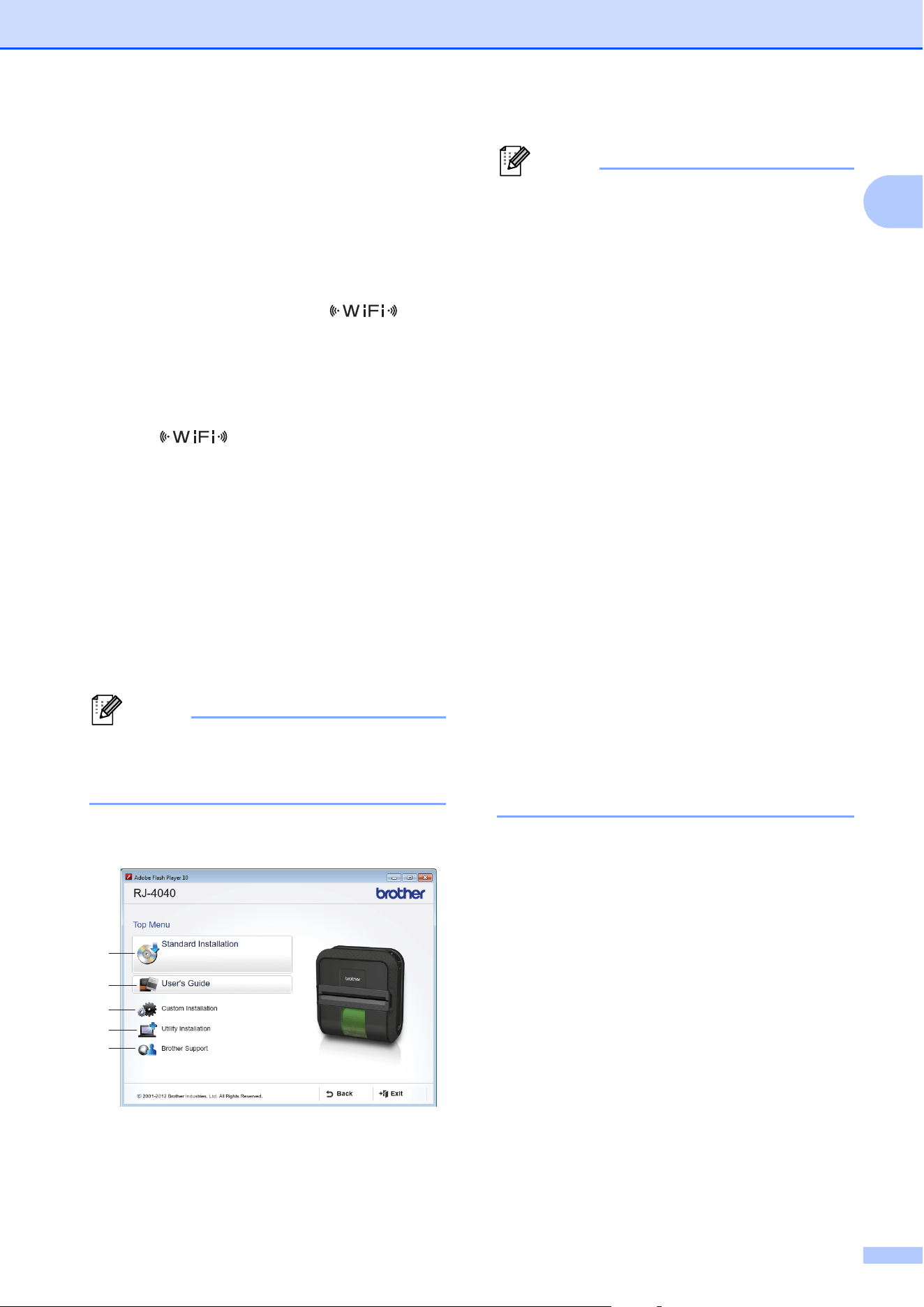
your language
Note
If the CD-ROM menu is not displayed
automatically, open the files on the
CD-ROM and double click [Start.exe].
f Click [Standard Installation].
Note
• Installation items:
1 Standard Installation
Installs P-touch Editor 5.1, printer
driver, P-touch Update Software,
Printer Setting Tool.
2 User’s Guide
Displays the User’s Guide, Software
User’s Guide, Network User’s Guide.
3 Custom Installation
Individually installs P-touch Editor 5.1,
printer driver, P-touch Update
Software, Printer Setting Tool.
4 Utility Installation
Installs BRAdmin Light utility.
5 Brother Support
Displays the link to Brother Developer
Center, Brother Solutions Center.
• You can use the Printer Setting Tool to
configure various printer settings when
the printer is connected to the computer
via USB.
Note that the printer driver must be
installed on the computer in order to
configure the printer.
g Read the license agreement and click
[Agree] if you agree with the terms and
conditions.
h Click [Install] to start the installation and
follow the on-screen instructions.
1
2
3
4
5
Chapter 1
18
i When the following screen appears,
choose [Wireless Network
Connection] and click [Next].
j When the [Firewall/AntiVirus
detected] screen appears, choose
[Change the Firewall port settings to
enable network connection and
continue with the installation.
(Recommended)] and click [Next].
If you are not using the Windows
®
Firewall allow access using UDP ports
137 and 161.
k Choose the printer from the list, and
then click [Next].
Note
• If your wireless settings fail, the [Wireless
Device Setup Wizard] screen appears.
Follow the on-screen instructions to
complete the wireless configuration.
• If you are using WEP but your printer is
not found, make sure you entered the
WEP key correctly.
l Follow the on-screen instructions to
complete setup.
Note
For Windows Vista
®
and Windows
®
7
users, when the [Windows Security]
screen appears, click the check box and
click [Install] to complete the installation
correctly.
The installation is now complete.
Note
• Depending on your security settings, a
Windows Security or antivirus software
window may appear when using the
printer or its software. Please allow or
permit the window to continue.
DO NOT cancel any of the screens
during the installation. It may take a few
seconds for all screens to appear.

Setting Up the Printer
19
1
• When configuring multiple printers for
wireless network connection:
After using a USB connection to install the
drivers and the Printer Setting Tool on the
computer, you can use the
Communication Settings to easily
configure network settings for multiple
printers.
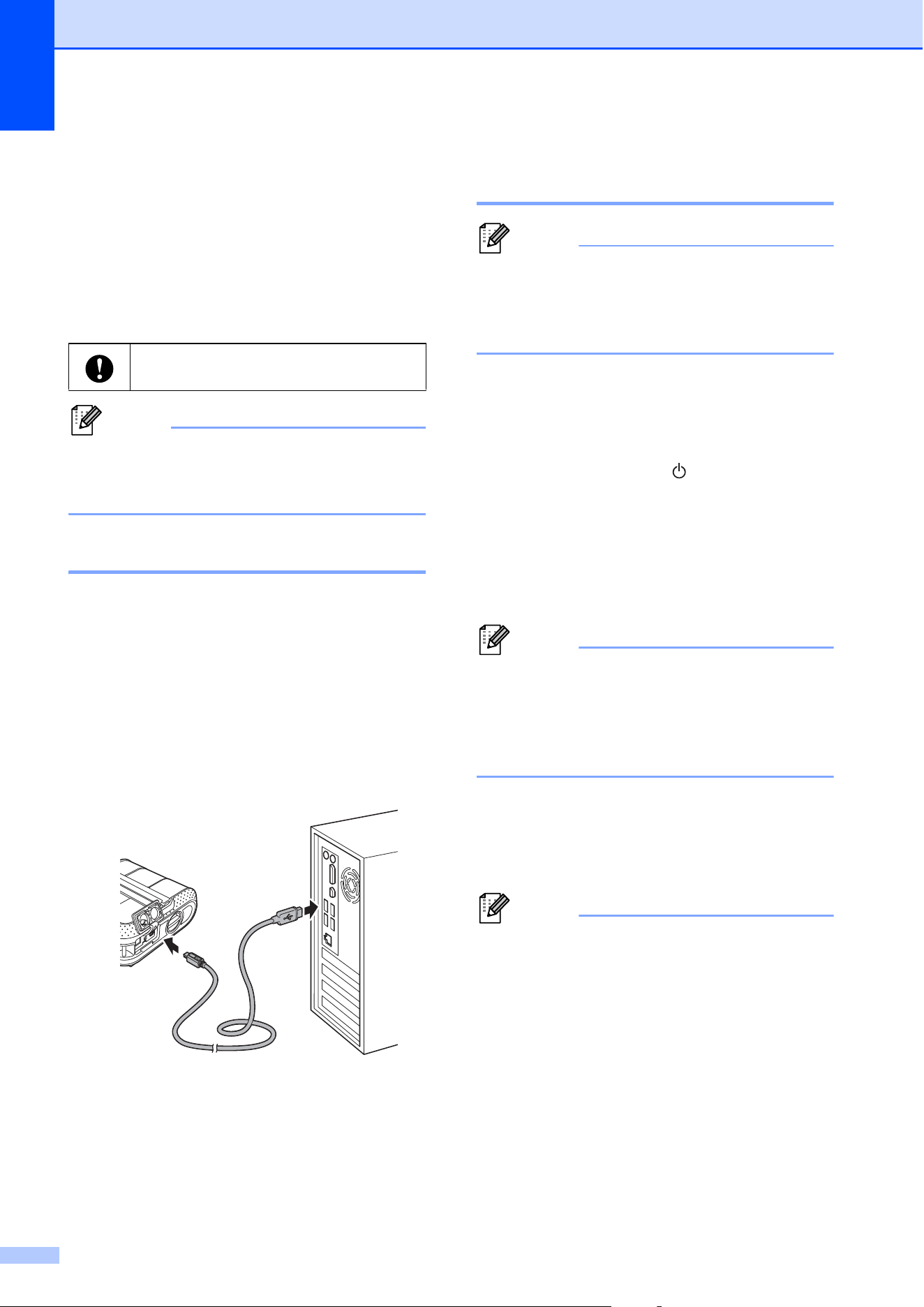
Web Based Management (web
browser) 1
The Brother print server is equipped with a
web server that allows you to monitor its
status or change some of its settings using
HTTP (Hyper Text Transfer Protocol).
Note
We recommend Microsoft
®
Internet
Explorer
®
7.0/8.0 or Firefox 3.6 for
Windows
®
. Please also make sure that
JavaScript and cookies are always
enabled in whichever browser you use. To
use a web browser, you will need to know
the IP address of the print server. The IP
address of the print server is listed on the
Network Configuration List.
a Open your browser.
b Type "http://printer’s IP address/" into
your browser’s address bar (where
"printer’s IP address" is the IP address
of the Brother printer or the print server
name).
For example: http://192.168.1.2/
c If you have configured an optional
Network password, you must enter it
when prompted to access the Web
Based Management.
For more information, see Web Based
Management in the Network User’s
Guide.
Chapter 1
20
Connecting the
Computer and Printer
1
The printer can be connected to your
computer via USB cable, Bluetooth
(RJ-4030/RJ-4030Ai), Wi-Fi (RJ-4040 only)
and the serial cable.
Note
When connecting via Bluetooth, the
connection settings are saved even after
the printer is turned off.
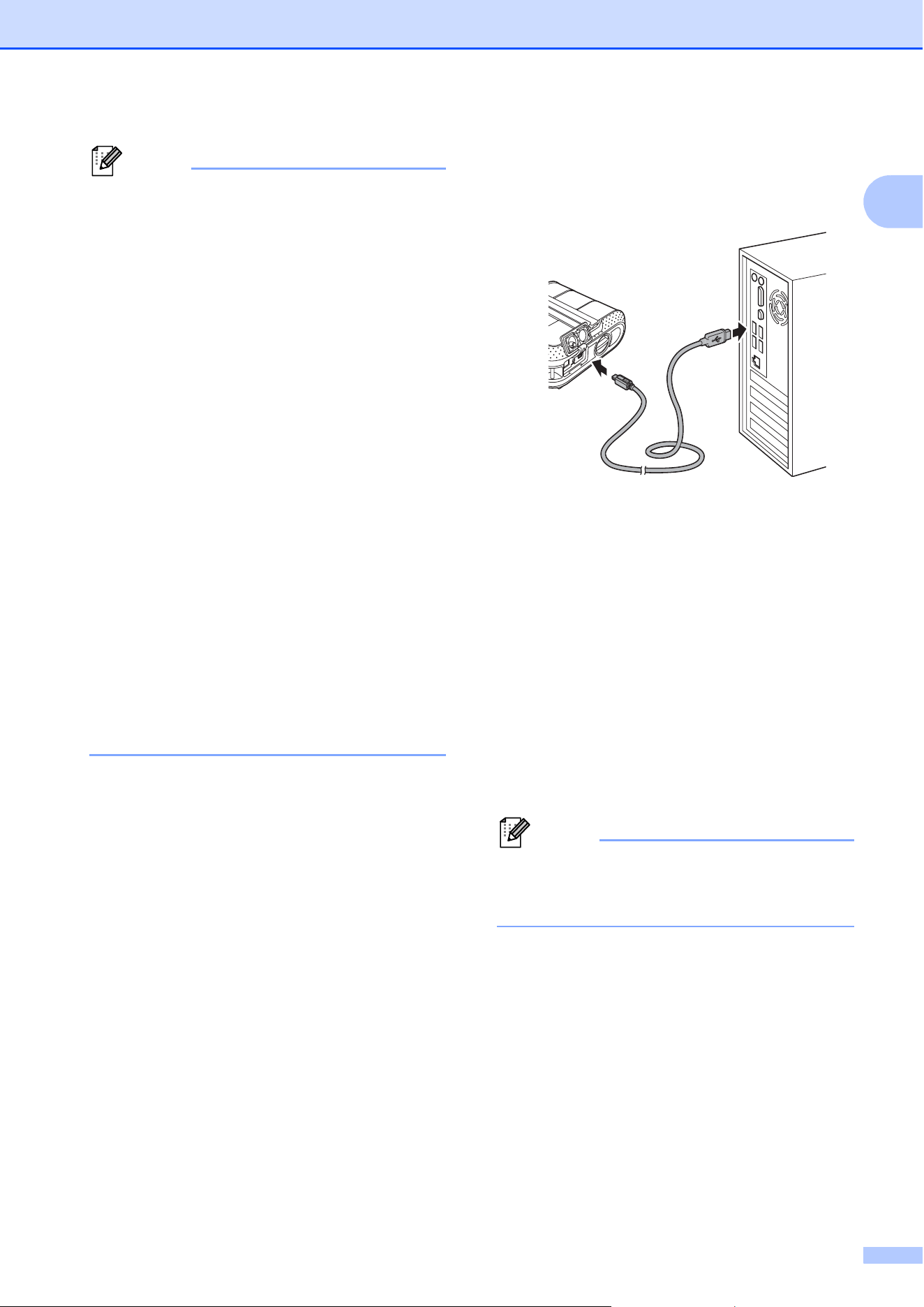
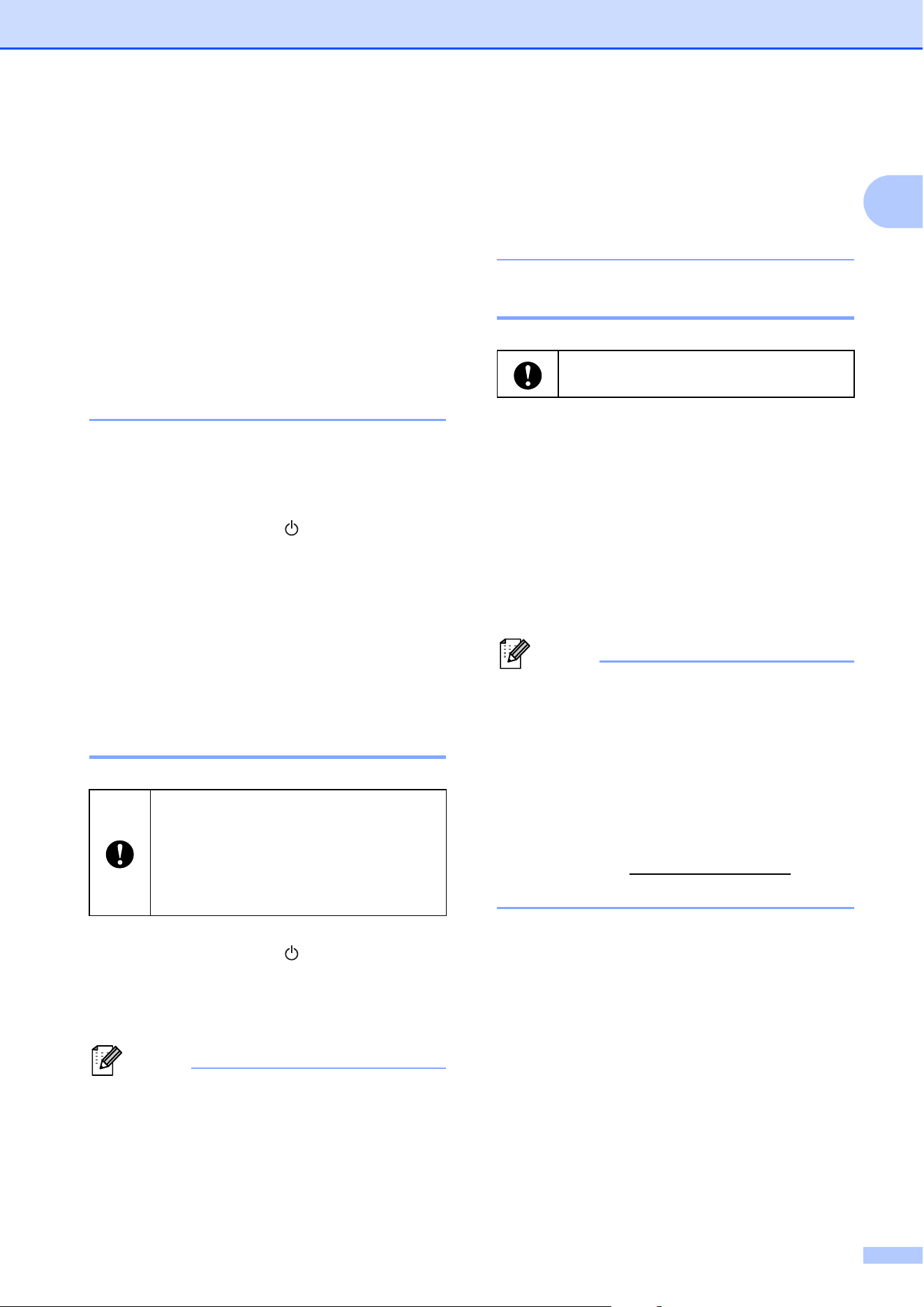
USB Connection 1
a Make sure that the printer is turned off
before connecting the USB cable.
b Connect the printer end of the USB
cable to the USB port on the side of the
printer.
c Connect the other end of the USB cable
to the USB port on the computer.
Bluetooth Connection
(RJ-4030/RJ-4030Ai) 1
Note
Follow the recommendations of the
manufacturer of your Bluetooth-equipped
computer or Bluetooth adapter and install
any necessary hardware and software.
Use this procedure to pair the printer with the
computer using the Bluetooth management
software.
a Press and hold the (Power) button to
turn the printer on and then press and
hold the Bluetooth button.
b Use your Bluetooth management
software to discover the printer and
configure the printer connection.
Note
If the software prompts you to enter a
Bluetooth passkey (PIN code), enter the
passkey assigned to the printer. The
printer's passkey is the last four digits of its
serial number by default.
c When a computer is used, select "serial
port" as the connection method to the
printer in the Bluetooth connection
screen.
Note
• Note the COM port number when it
appears. (Depending on the type of the
computer or mobile device, the COM port
number may be required for printing.)
• Refer to your Bluetooth management
software’s documentation for details on
connection settings, confirming the port
name, etc.
Install the printer driver before
connecting the printer to the computer.
Setting Up the Printer
21
1
• If the printer becomes disconnected
because the iPad, iPhone or iPod is
moved away from the printer, select
"Bluetooth" in the device settings, and
then tap the device you want to connect to
from the list of Bluetooth devices.
• If your Bluetooth management software
cannot discover the printer, the printer
may be connected to another device. Use
the connected device to end the Bluetooth
connection with the printer, or turn off the
printer and on again.
Using Bluetooth to communicate
when printing
1
a Press and hold the (Power) button to
turn the printer on, and then press the
Bluetooth button.
b Use your Bluetooth management
software to discover the printer.
Bluetooth communication starts.
Wi-Fi Connection (RJ-4040
only) 1
a Press and hold the (Power) button to
turn the printer on, and then press the
Wi-Fi button.
Wi-Fi communication starts.
Note
• You can change the printer's network
settings using the Communication
Settings (see Communication Settings
(RJ-4040 only) uu page 38).
• The Communication Settings also allows
you to easily apply the network setting
changes to multiple printers. (see
Applying Setting Changes to Multiple
Printers uu page 40).
Serial Cable Connection 1
a Make sure that the printer and the
computer are turned off before
connecting the serial cable.
b Connect the printer end of the serial
cable to the serial port on the side of the
printer.
c Connect the other end of the serial cable
to the serial port on the computer.
Note
• The default settings are as follows:
Baud rate: 9600 bps
Parity: None
Bit length: 8 bit
Flow control: Hardware
• To change these settings, refer to the
P-touch Template Command Reference.
The latest version is available for
download at: support.brother.com
Choose your product. - [Manuals]
In order for the printer and your network
access point or router to communicate,
you must first install the printer driver
and the Printer Setting Tool (see
Installing the Printer Driver and the
Software for RJ-4040 uu page 10).
Please use the cable designed for your
Brother printer.
22
2
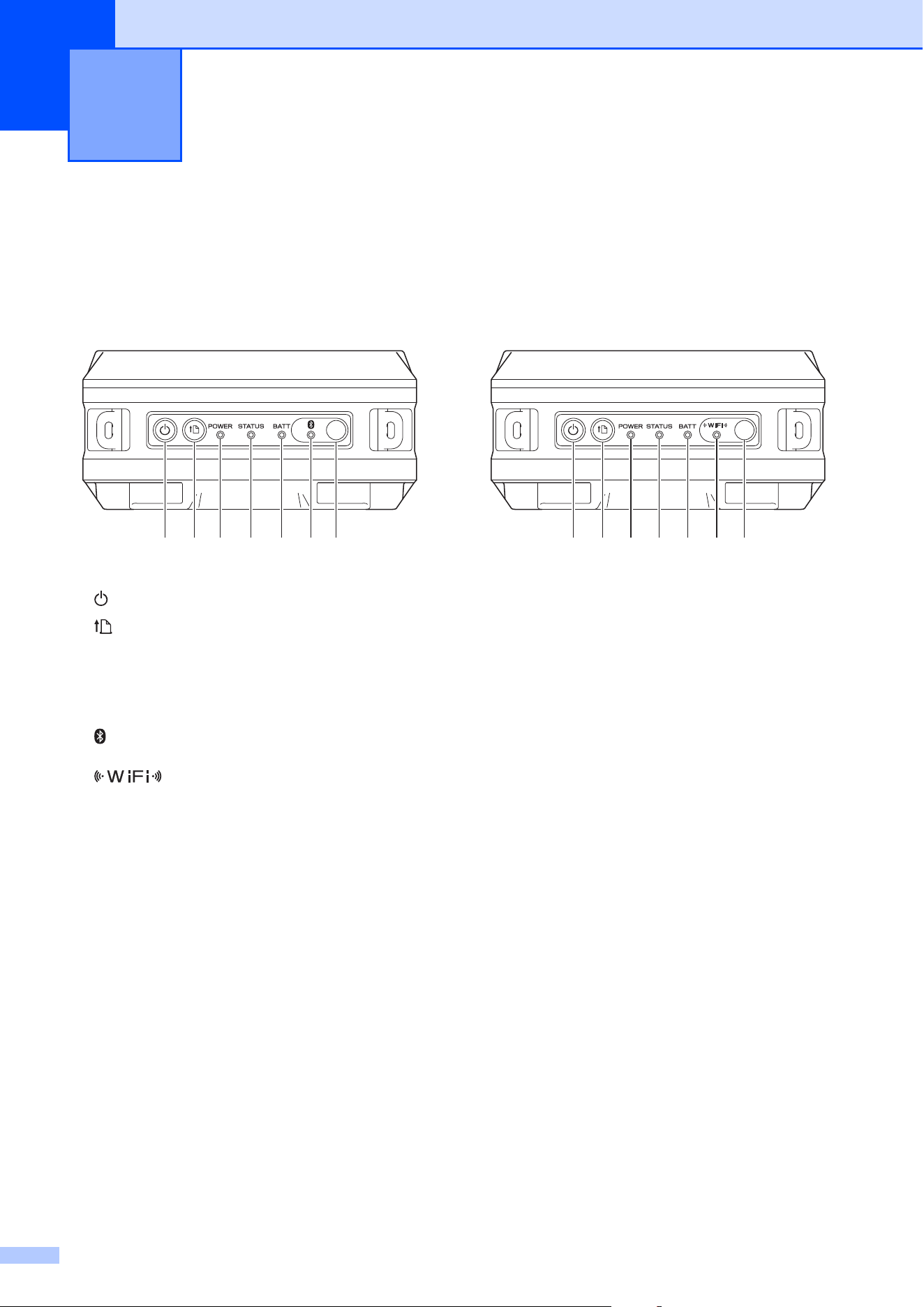
Operation Panel 2
The operation panel consists of the following buttons and indicators.
1 (Power) button
2 (Feed) button
3 POWER indicator
4 STATUS indicator
5 BATT (Battery) indicator
6 (Bluetooth) indicator
(RJ-4030/RJ-4030Ai)/
(Wi-Fi) indicator (RJ-4040)
7 Bluetooth button (RJ-4030/RJ-4030Ai)/
Wi-Fi button (RJ-4040)
Using the Printer 2
1
RJ-4030/RJ-4030Ai RJ-4040
23 4 5 67 1234567
Using the Printer
23
2
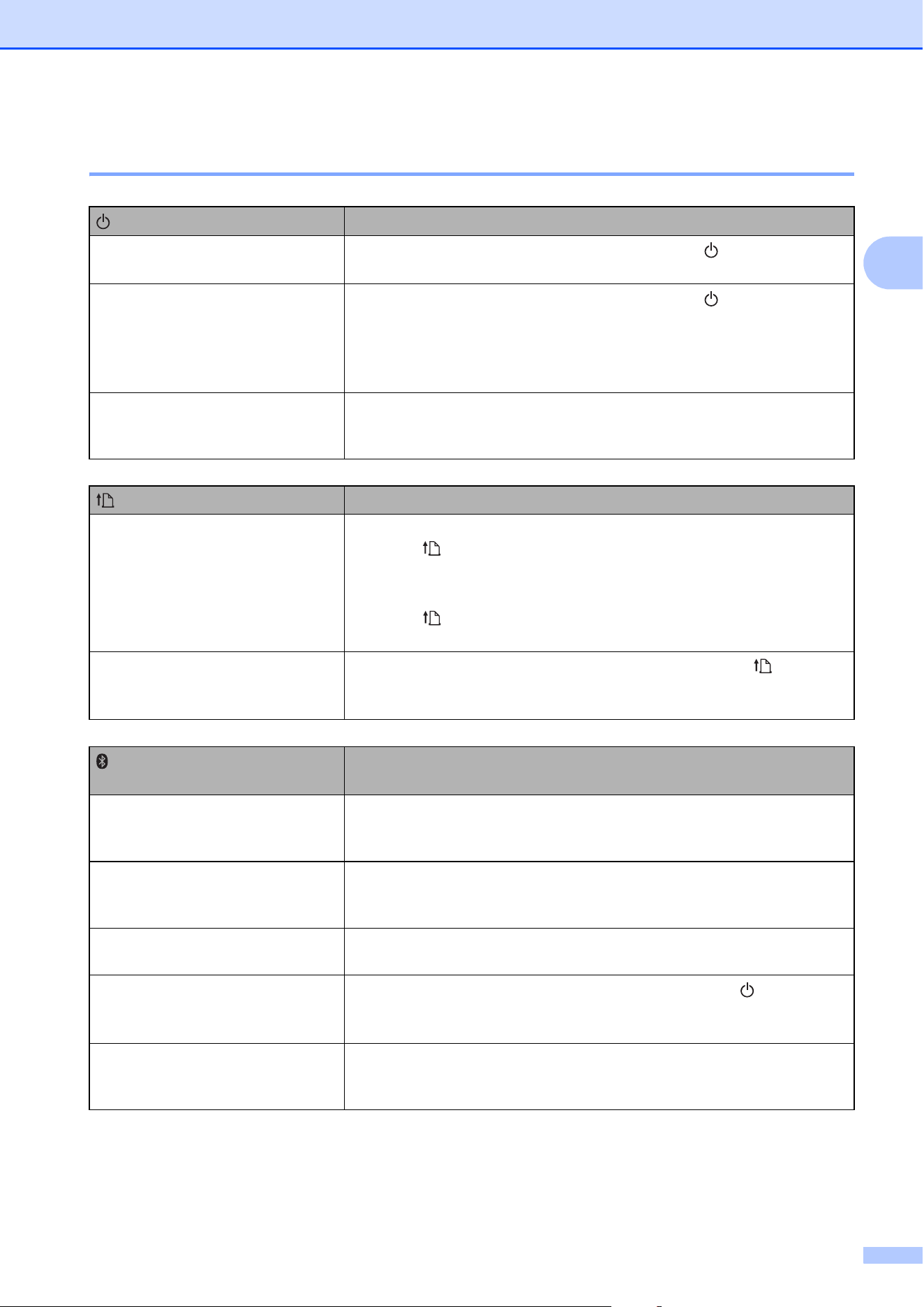
Button Functions 2
(Power) button function
Operation
Turn the printer on
While the printer is turned off, press and hold the (Power) button
until the POWER indicator turns on.
Turn the printer off
While the printer is turned on, press and hold the (Power) button
until the STATUS indicator blinks 1 time in red, and the POWER
indicator turns off. (If the [Auto Power Off] feature is enabled in the RJ
Utility, the printer will turn itself off automatically after the selected
period of inactivity.)
Start up the printer in mass
storage mode
If you press and hold this button while also pressing the Wi-Fi
button/Bluetooth button, the printer starts up in mass storage mode
(see Mass Storage uu page 45).
(Feed) button function
Operation
Feed the paper When the paper type is set to [Die-cut Label] or [Media With Marks]:
Press the (Feed) button to automatically feed the paper to the print
position.
When the paper type is set to [Continuous Length Tape]:
Press the (Feed) button to feed the paper. The paper feeds a fixed
length; you can use a command to change this length.
Print the printer settings
Make sure that a roll is set, and then press and hold the (Feed)
button. The printer starts printing its settings (see Printing the Printer
Set-up Information uu page 52).
(Bluetooth) button function
(RJ-4030/RJ-4030Ai)
Operation
Pair the printer to the computer When the printer and computer or other device haven’t been paired
with each other via Bluetooth, hold this button (see Bluetooth
Connection (RJ-4030/RJ-4030Ai) uu page 20).
Use Bluetooth to communicate
when printing
When this key is pressed while the computer and the printer are not
connected via Bluetooth, the Bluetooth connection is established and
data can be transferred.
End the Bluetooth connection When the printer and computer are connected via Bluetooth, press this
button to end the connection.
Start up the printer in mass
storage mode
If you press this button while pressing and holding the (Power)
button, the printer starts up in mass storage mode (see Mass Storage
uu page 45).
Execute a file stored in the mass
storage area
If you press this button while the printer is running in mass storage
mode, you can execute a command file stored in the mass storage
area (see Mass Storage uu page 45).
Chapter 2
24
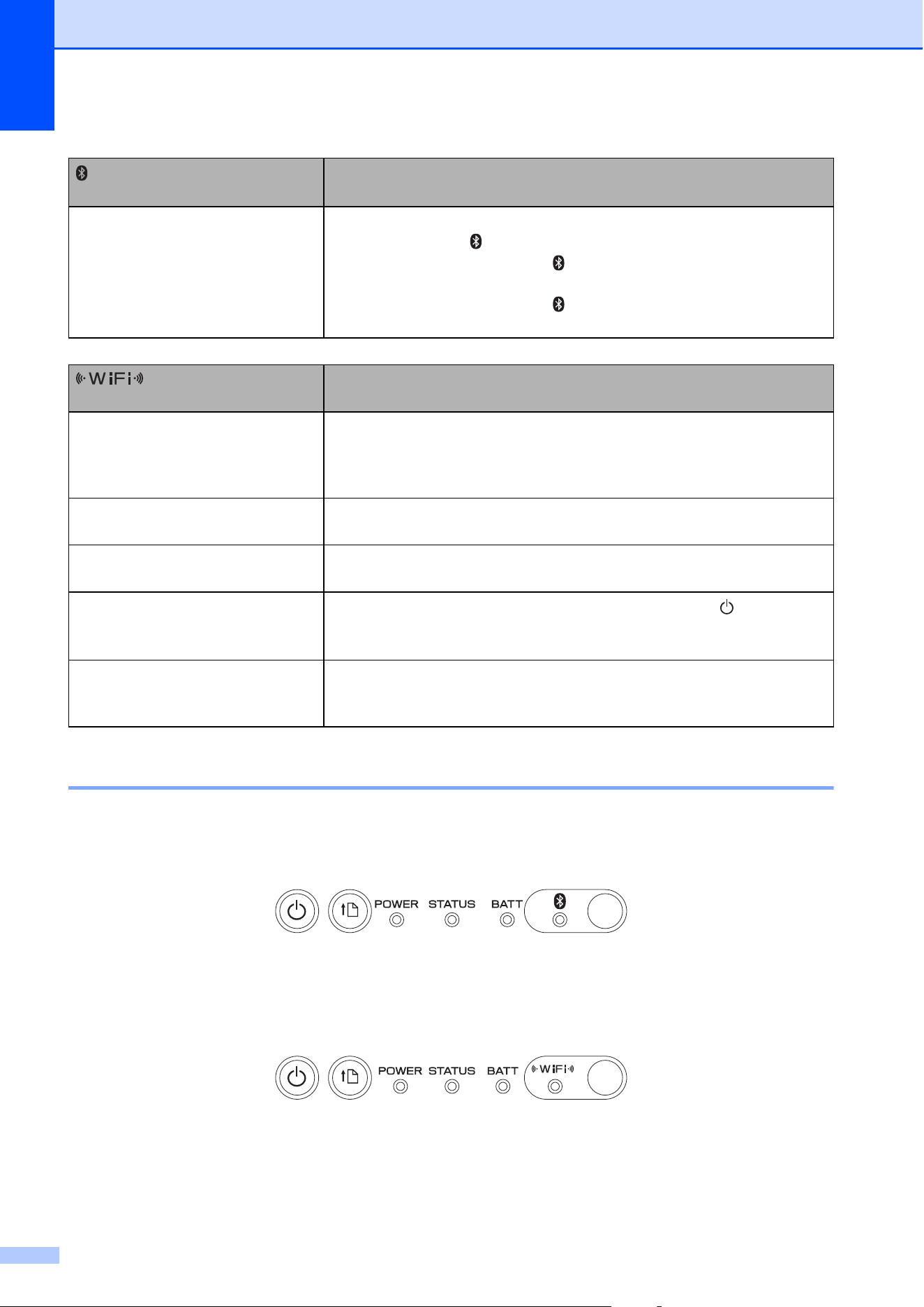
Indicators 2
RJ-4030/RJ-4030Ai 2
RJ-4040 2
The indicators light and blink to indicate the printer’s status. Each indicator may light or blink in
green, red, orange, or blue. For details, see Indicators uu page 49.
(Bluetooth) button function
(RJ-4030Ai only)
Operation
Enable or disable the Bluetooth
Auto re-pairing function.
Confirm that the Bluetooth function is turned on.
Press and hold the (Bluetooth) button for 5 seconds.
If the function is turned off, the (Bluetooth) indicator turns off, and
then the printer turns off.
If the function is turned on, the (Bluetooth) indicator flashes once,
and then the printer turns off.
(Wi-Fi) button
function (RJ-4040 only)
Operation
Use WPS to set wireless network
settings easily
Wi-Fi settings can be configured by simply pressing and holding this
button, making it easy to install the printer driver or other software (see
Installing the Printer Driver and the Software for RJ-4040
uu page 10).
Use Wi-Fi to communicate when
printing
When the printer and computer are not connected via Wi-Fi, press this
button to connect them and send data to the printer.
End the Wi-Fi connection When the printer and computer are connected via Wi-Fi, press this
button to end the connection.
Start up the printer in mass
storage mode
If you press this button while pressing and holding the (Power)
button, the printer starts up in mass storage mode (see Mass Storage
uu page 45).
Execute a file stored in the mass
storage area
If you press this button while the printer is running in mass storage
mode, you can execute a command file stored in the mass storage
area (see Mass Storage uu page 45).
Using the Printer
25
2
Printing Solutions 2
Your printer can be used with several
versions of the Windows
®
operating systems.
In most situations, the printer requires driver
software to communicate with your computer.
The latest software can be downloaded from
the Brother Solutions Center website
(support.brother.com
). We recommend that
you visit the website to make sure that you
have the latest version of the drivers.
Printing 2
For typical printing, use the following
procedure.
a Open the document to be printed.
b Make sure that the printer is properly
powered. Use a charged battery, or
connect the printer to an AC or DC
power outlet.
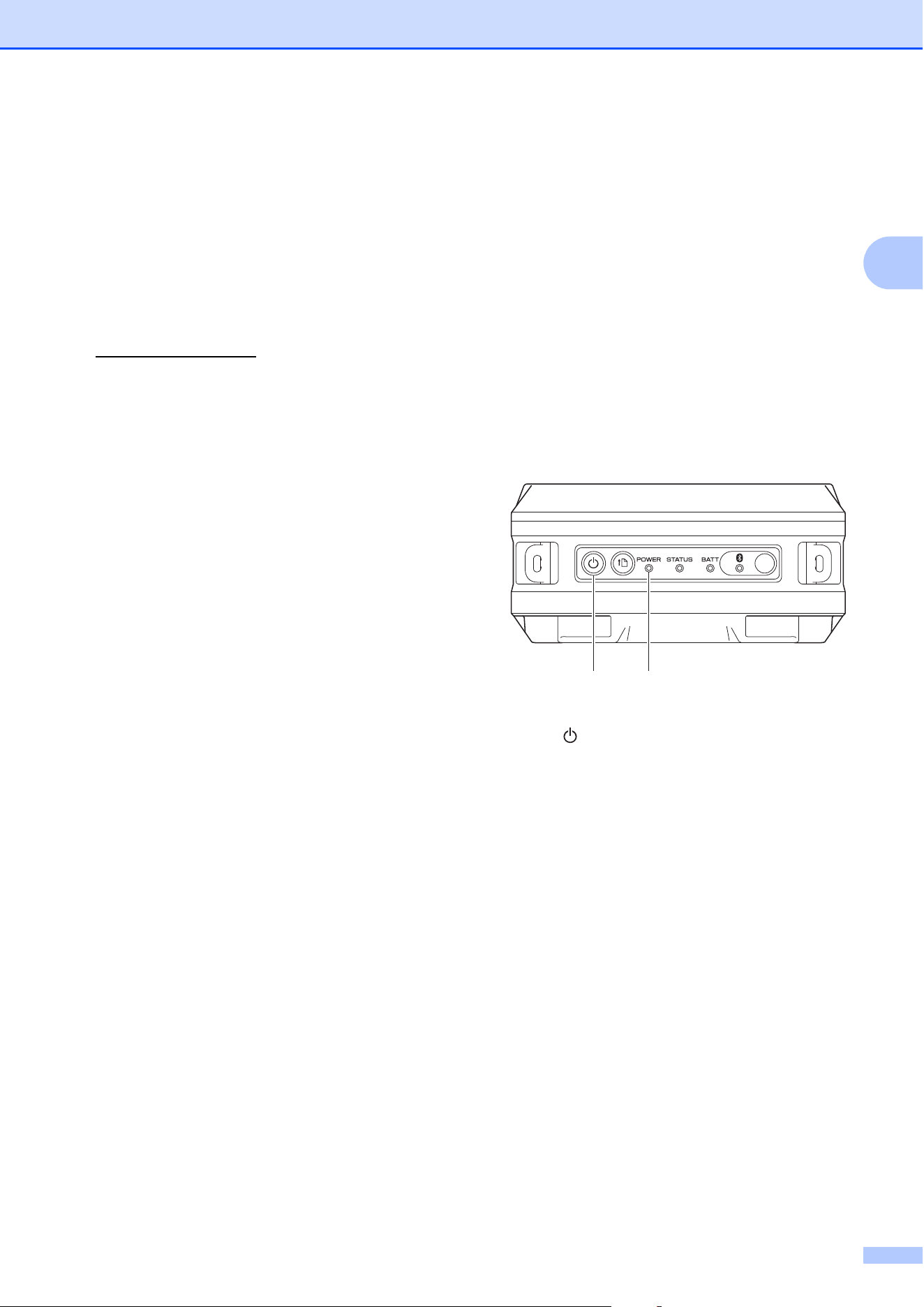
c Turn the printer on. The POWER
indicator lights in green.
1 (Power) button
2 POWER indicator
d Connect the printer to a computer, using
either USB, Bluetooth
(RJ-4030/RJ-4030Ai), or Wi-Fi
(RJ-4040 only).
(See Connecting the Computer and
Printer uu page 20.)
e Insert the RD Roll. (See Inserting the RD
Roll uu page 5.)
Use genuine Brother paper.
f If necessary, change the print settings
using either the printer driver or the RJ
Utility. (See RJ Utility uu page 31)
12

Chapter 2
26
g Click [Print] in the computer program’s
menu.
The POWER indicator blinks in green to
indicate that the printer is receiving data,
and the document is printed.
h Turn the printer off. The POWER
indicator turns off.
Note
To print a JPEG image without using the
printer driver, see JPEG Printing
uu page 46.
Making Prints Lighter or
Darker 2
You can make prints lighter or darker by
adjusting the print density setting in the
printer driver’s dialog box or the RJ Utility
(see Print Density uu page 32).
When using the battery, changing the print
density setting may result in slight changes in
printing speed and the number of pages that
can be printed on a single charge.
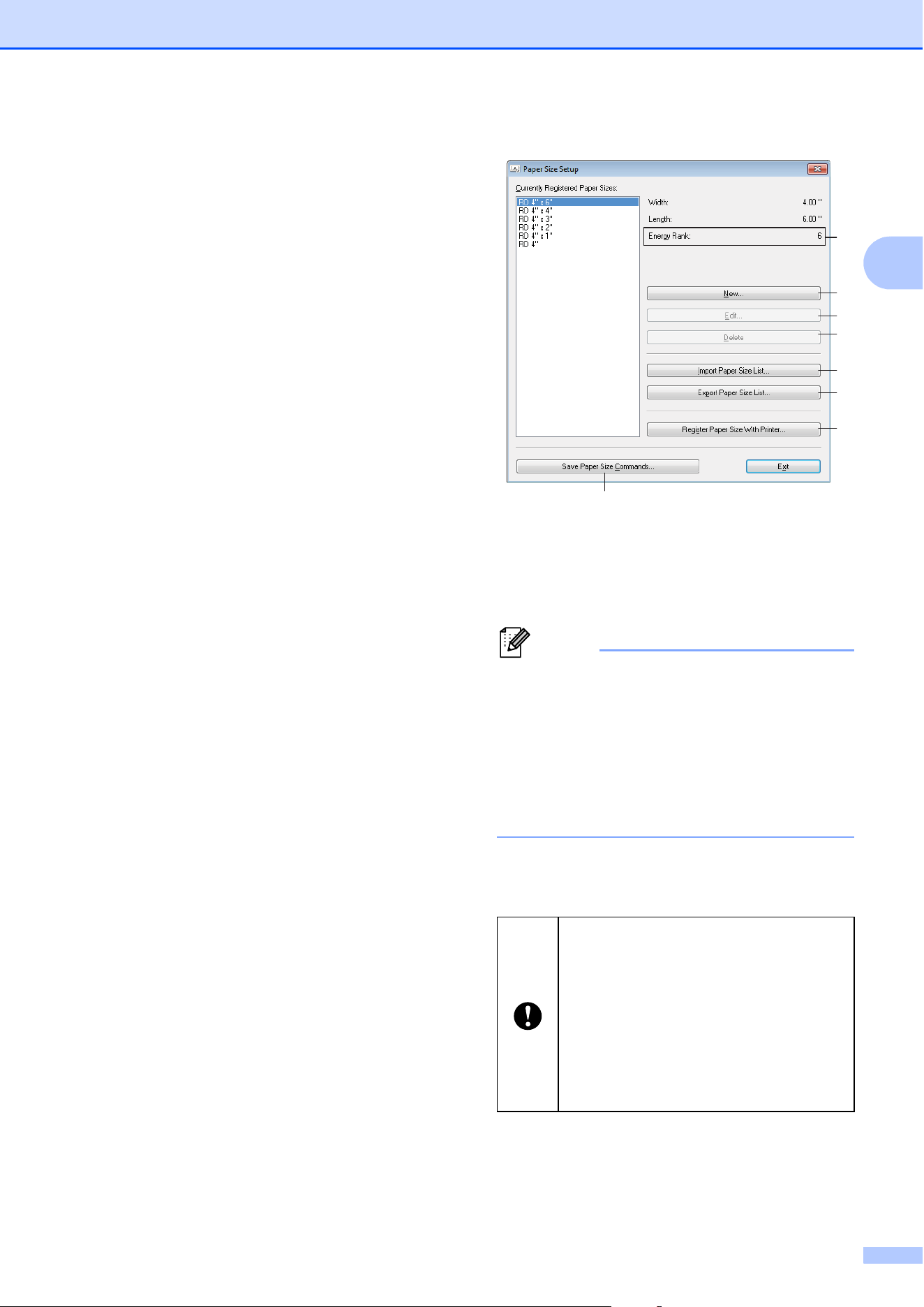
Printer Driver Options 2
You can configure various settings in the
printer driver screen, such as paper size,
number of copies, print quality, etc.
You can also use the Paper Size Setup and
the RJ Utility to configure advanced settings
(see Setting Paper Size uu page 27 and RJ
Utility uu page 31).
Using the Printer
27
2
Setting Paper Size 2
In order to use labels with a size not listed in
the [Paper Size] list of the printer driver, the
label format must be added to the printer
driver.
a Connect the printer to be configured to
the computer via USB.
b For Windows Vista
®
/ Windows
®
7 /
Windows Server
®
2008 / Windows
Server
®
2008 R2:
From the Start menu, click [All
Programs] - [Brother] - [Label &
Mobile Printer] - [Printer Setting
Tool].
For Windows
®
8 / Windows
®
8.1 /
Windows Server
®
2012 / Windows
Server
®
2012 R2:
Click the [Printer Setting Tool] icon on
the [Apps] screen.
For Windows
®
10:
From the Start button, select all
applications, and then click [Brother] -
[Label & Mobile Printer] - [Printer
Setting Tool].
c Select the printer connected in step a.
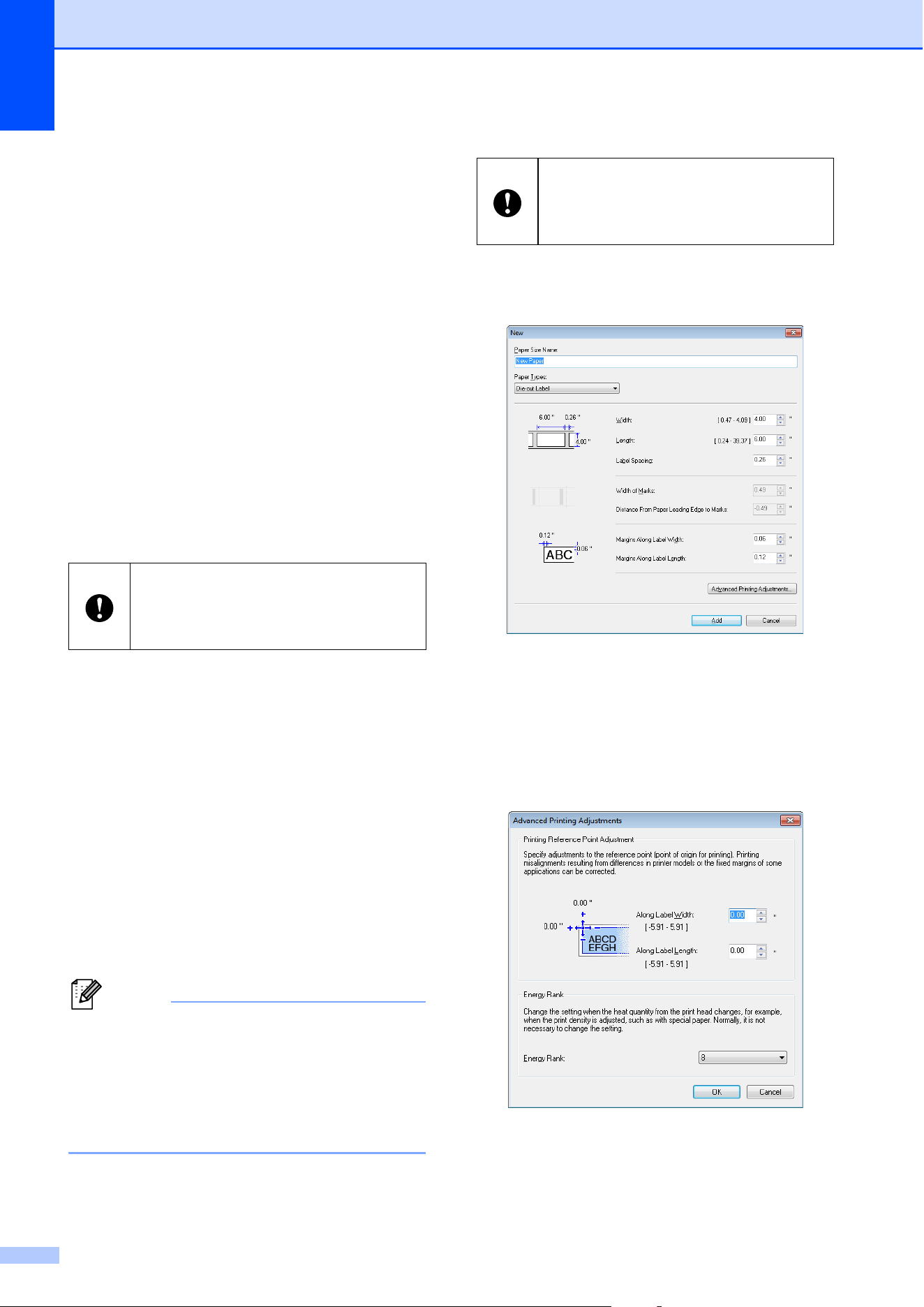
d Click the [Paper Size Setup] button.
The [Paper Size Setup] dialog box
appears.
1 Energy Rank
Displays the current setting for the
[Energy Rank] of the selected paper
format.
Note
When using "Premium Receipt Paper" *, select
[RD 4" (102 mm)] on the [Paper Size Setup]
screen, click the [Edit] button, and then set
[Energy Rank] to [0] on the [Advanced
Printing Adjustments] screen.
When using "Standard Receipt Paper" *, set
[Energy Rank] to [3].
* Available paper types vary by country.
2New
Registers new paper formats.
3Edit
Edits the settings for the selected paper
format.
Do not register a paper size if the same
paper size has already been registered.
It may cause an unintended result.
If you use the same size of paper as
currently registered, select the desired
size from the [Currently Registered
Paper Sizes] list on the [Paper Size
Setup] screen, and change settings on
the [Edit] screen.
3
2
4
5
6
7
8
1
Chapter 2
28
To save the selected paper format with
the new settings, click [Overwrite]. To
add a paper format with the new settings,
change the name in the [Paper Size
Name] box, and then click [Add].
Preset RD paper formats (paper formats
available when the software was
installed) cannot be edited.
4Delete
Deletes the selected paper format. A
deleted paper format cannot be restored.
5 Import Paper Size List...
Reads the text file (RJ-4030:
BSR403ed.txt; RJ-4030Ai:
BSR403aied.txt; RJ-4040:
BSR404ed.txt) containing the paper
format settings, and uses it to replace the
contents of the [Currently Registered
Paper Sizes] list.
6 Export Paper Size List...
Exports the settings for the paper formats
in the [Currently Registered Paper
Sizes] list. The exported list can then be
distributed to other computers. For
details, see Distributing Paper Formats
uu page 29.
7 Register Paper Size With Printer
Registers the settings for the selected
paper format in the printer.
8 Save Paper Size Commands
Uses the settings for the paper as an
added command and exports it as a file.
The file extension is “.bin”.
Note
If you use the following methods, you can apply
these settings to the printer easily.
• Mass storage feature (see Mass Storage
uu page 45)
• Bluetooth (Object Push Profile (OPP))
• Wi-Fi (File Transfer Profile (FTP))
e Click [New].
The [New] dialog box appears.
f Click [Advanced Printing
Adjustments...] to specify the following
settings for each paper size.
Under [Printing Reference Point
Adjustment], the printing position can
be adjusted.
g Under [Energy Rank], the print energy
(density) can be adjusted.
When the list is imported, the entire
contents of the [Currently Registered
Paper Sizes] list will be replaced with
the imported paper formats.
These settings commands are only
intended for use for applying to printer
settings. Saved commands cannot be
imported to the Paper Size Setup.

Using the Printer
29
2
h Enter the settings for the paper to be
used, and then click [Add].
A new paper format is created.
i Click [Exit].
Note
When the [Paper Size Setup] dialog box
is displayed again, the added paper
format will appear in the [Currently
Registered Paper Sizes] list. If the
application is running, exit the application,
and then start it again in order for the new
paper format to appear in the [Currently
Registered Paper Sizes] list.
Distributing Paper
Formats
2
The paper formats exported from the
[Currently Registered Paper Sizes] list can
be distributed to other computers.
Distributing only paper
formats 2
If the printer driver has been installed on the
recipient’s computer, only the paper formats
need to be distributed.
a At the sender’s computer, specify the
paper format settings, and then click
[Export Paper Size List...].
(See Setting Paper Size uu page 27.)
The following files are created.
RJ-4030:
BSR403ed.txt, BSR403ed.ptd, pdt3137.bin
RJ-4030Ai:
BSR403aied.txt, BSR403aied.ptd,
ptd3537.bin
RJ-4040:
BSR404ed.txt, BSR404ed.ptd, pdt3237.bin
b Save BSR403ed.txt or, BSR403aied.txt
or BSR404ed.txt at any location on the
recipient’s computer.
c At the recipient’s computer, click
[Import Paper Size List...].
The paper formats are replaced with the
imported ones.
Distributing paper formats
bundled with the installer
(RJ-4030/4040) 2
If the printer driver has not been installed on
the recipient’s computer, the paper formats
that can be distributed are bundled with the
installer for the printer driver.
Read "RJ-XXXX" in the following steps as
your model name.

Chapter 2
30
a At the sender's computer, specify the
paper format settings, and then click
[Export Paper Size List...].
(See Setting Paper Size uu page 27.)
The following files are created.
RJ-4030:
BSR403ed.txt, BSR403ed.ptd, pdt3137.bin
RJ-4040:
BSR404ed.txt, BSR404ed.ptd, pdt3237.bin
b Insert the CD-ROM into the CD-ROM
drive of the sender's computer.
c Copy the folder in CD drive:\your
language\Drivers\RJ-XXXX to any
location on the sender’s computer.
d Overwrite the contents of the folders at
RJ-XXXX\x64\custom and
RJ-XXXX\x86\custom (copied in step 3)
with the three files created in a.
e Save folder [RJ-XXXX] at any location
on the recipient's computer.
f At the recipient’s computer, double-click
[dsetuph.exe].
Complete the installation according to
the instructions that appear on the
screen.
31
3
3
Overview 3
The RJ Utility is a computer program that
allows you to change the printer's default
settings.
Normally when using a computer program to
print a document, print settings are specified
in the printer driver's dialog box and then the
data is sent to the printer. This utility can be
used to adjust settings that are more
advanced than the printer driver’s settings.
Using the RJ Utility 3
Before Using the RJ Utility 3
Connect the printer to an AC or DC power
outlet, or make sure that the battery is
fully-charged.
Make sure that the printer driver has been
installed and is functional.
Connect the printer to a computer via USB
or Bluetooth (RJ-4030/RJ-4030Ai).
Starting the RJ Utility 3
a Connect the printer to be configured to
the computer.
b For Windows Vista
®
/ Windows
®
7 /
Windows Server
®
2008 / Windows
Server
®
2008 R2:
From the Start menu, click [All
Programs] - [Brother] - [Label &
Mobile Printer] - [Printer Setting
Tool].
For Windows
®
8 / Windows
®
8.1 /
Windows Server
®
2012 / Windows
Server
®
2012 R2:
Click the [Printer Setting Tool] icon on
the [Apps] screen.
For Windows
®
10:
From the Start button, select all
applications, and then click [Brother] -
[Label & Mobile Printer] - [Printer
Setting Tool].
c Select the printer connected in step a.
d Click the [Device settings] button.
The main window is displayed.
(See Main Window uu page 32.)
How to Use the RJ Utility 3
a In the main window of the RJ Utility,
select the check boxes of the
parameters with settings that can be
changed.
b Select the desired settings from the
pull-down menus or enter the desired
values.
c Click [Apply] to save the settings in the
printer.
Note
The settings are saved when you quit the
RJ Utility, and the settings are applied the
next time the RJ Utility is started.
Note, however, that if the printer is already
connected when the RJ Utility is started,
the printer's settings are applied.
RJ Utility 3
Use the RJ Utility to configure the
printer only when the printer is idle. The
printer may malfunction if you attempt to
configure it while it is handling a job.
Chapter 3
32
Parameters 3
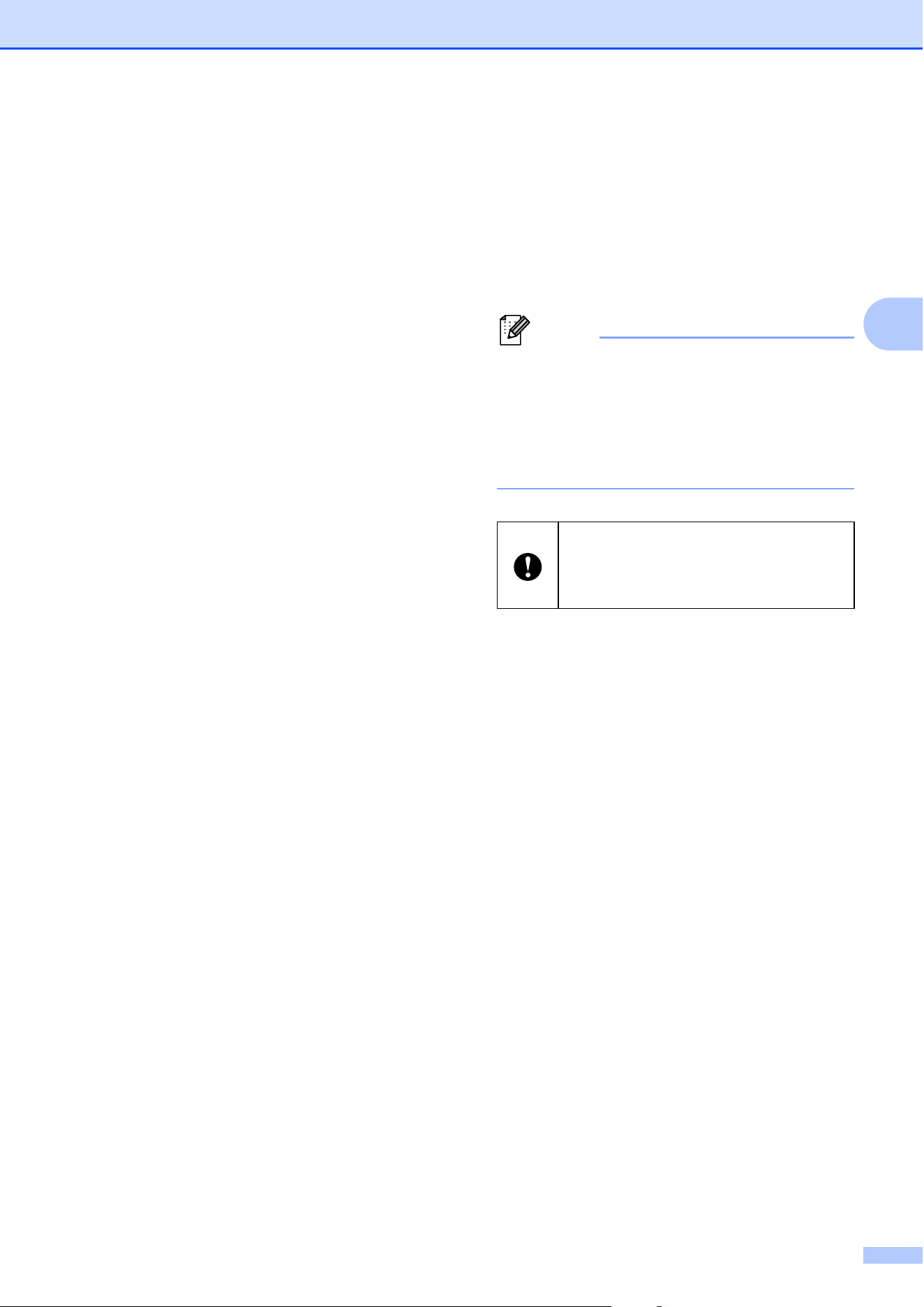
Main Window 3
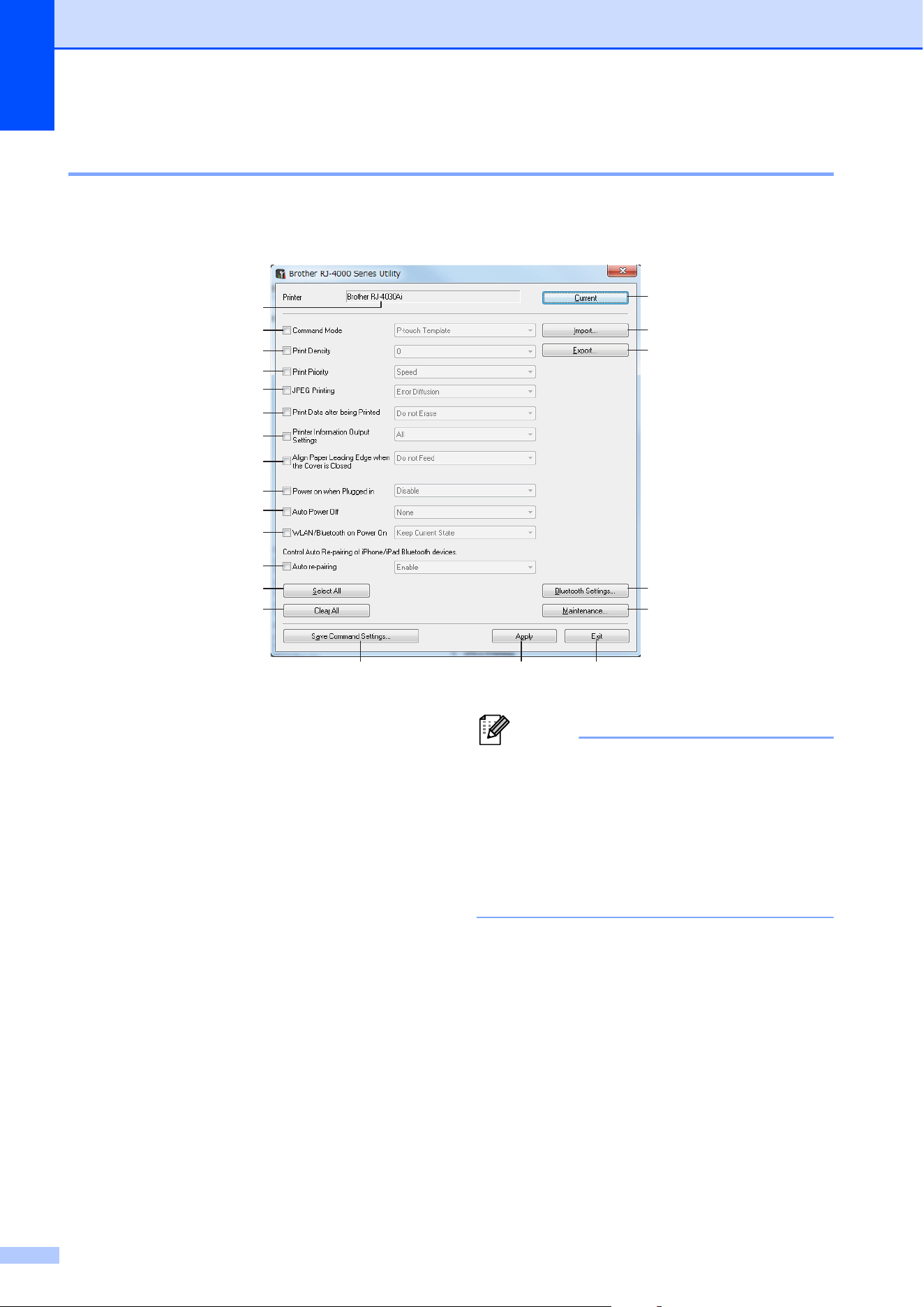
1Printer
Displays the printer selected in the Printer
Setting Tool.
2 Command Mode
Sets the printer’s command format.
Available settings: [Raster], [ESC/P], [P-touch
Template]
3 Print Density
Adjusts the printing density on a scale of -5 to
+5.
4 Print Priority
Determines the printer's print quality.Available
settings: [Speed], [Quality]
Note
This setting can also be changed using the
printer driver, however, in this case the setting
is erased when the printer is turned off. If the
setting is changed using the RJ Utility, the
setting is retained even when the printer is
turned off, therefore, if you plan on printing
without using the printer driver, use the RJ
Utility to change this setting.
5 JPEG Printing
Sets the image processing used when printing
JPEG images via Bluetooth or with the mass
storage feature.
Available settings: [Binary], [Error Diffusion]
6 Print Data after being Printed
Determines whether the print data is erased
automatically after printing.
Available settings: [Erase], [Do not Erase]
7 Printer Information Output Settings
Determines which information is printed when
printing the printer’s settings.
15
16
17
18
19
21
2
1
3
4
5
6
7
8
9
10
11
13
14
20 22
12
RJ Utility
33
3
Available settings: [All], [Usage Log], [Printer
Settings], [Printer Transfer Data]
(See Printing the Printer Set-up Information
uu page 52.)
8 Align Paper Leading Edge when the Cover
is Closed
Determines whether or not paper is
automatically fed when the cover is closed.
Available settings: [Do not Feed], [Feed]
9 Power on when Plugged in
Determines whether or not the printer turns on
automatically when the power cord is
connected.
Available settings: [Disable], [Enable]
10 Auto Power Off
Determines the amount of time that passes
before the printer turns off automatically.
Available settings: [None], 10 min. to 60 min.
(10 min. increments)
11 WLAN/Bluetooth on Power On
Determines the conditions for connecting via
Wi-Fi and Bluetooth when the printer is turned
on.
Available settings: [On by Default], [Off by
Default], [Keep Current State]
12 Auto re-pairing
Control Auto Re-pairing of iPhone/iPad
Bluetooth devices.
Available settings: [Enable], [Disable]
13 Select All
Places a check in the check boxes for all items.
14 Clear All
Removes the checks in the check boxes for all
items.
15 Current
Retrieves the current setting values from the
printer and applies them to each combo box.
16 Import
Reads an exported file and applies the settings
to the printer.
17 Export
Saves the current settings to a file.
18 Bluetooth Settings
Displays the [Bluetooth Settings] screen.
(See Bluetooth Settings (RJ-4030Ai only)
uu page 35.)
19 Maintenance
Displays the [Maintenance] screen.
(See Maintenance uu page 36.)
20 Save Command Settings
Saves the content of the selected (checked)
items as a command-format “.bin” file.
Bluetooth settings are not saved.
Note
If you use the following methods, you can apply
these settings to the printer easily.
• Mass storage feature (see Mass Storage
uu page 45)
• Bluetooth (Object Push Profile (OPP))
• Wi-Fi (File Transfer Profile (FTP))
21 Apply
Sends the selected (checked) settings to the
printer.
22 Exit
Exits the RJ Utility. The current settings are
saved.
These settings commands are only
intended for use for applying to printer
settings. Saved commands cannot be
imported to the RJ Utility.
Chapter 3
34
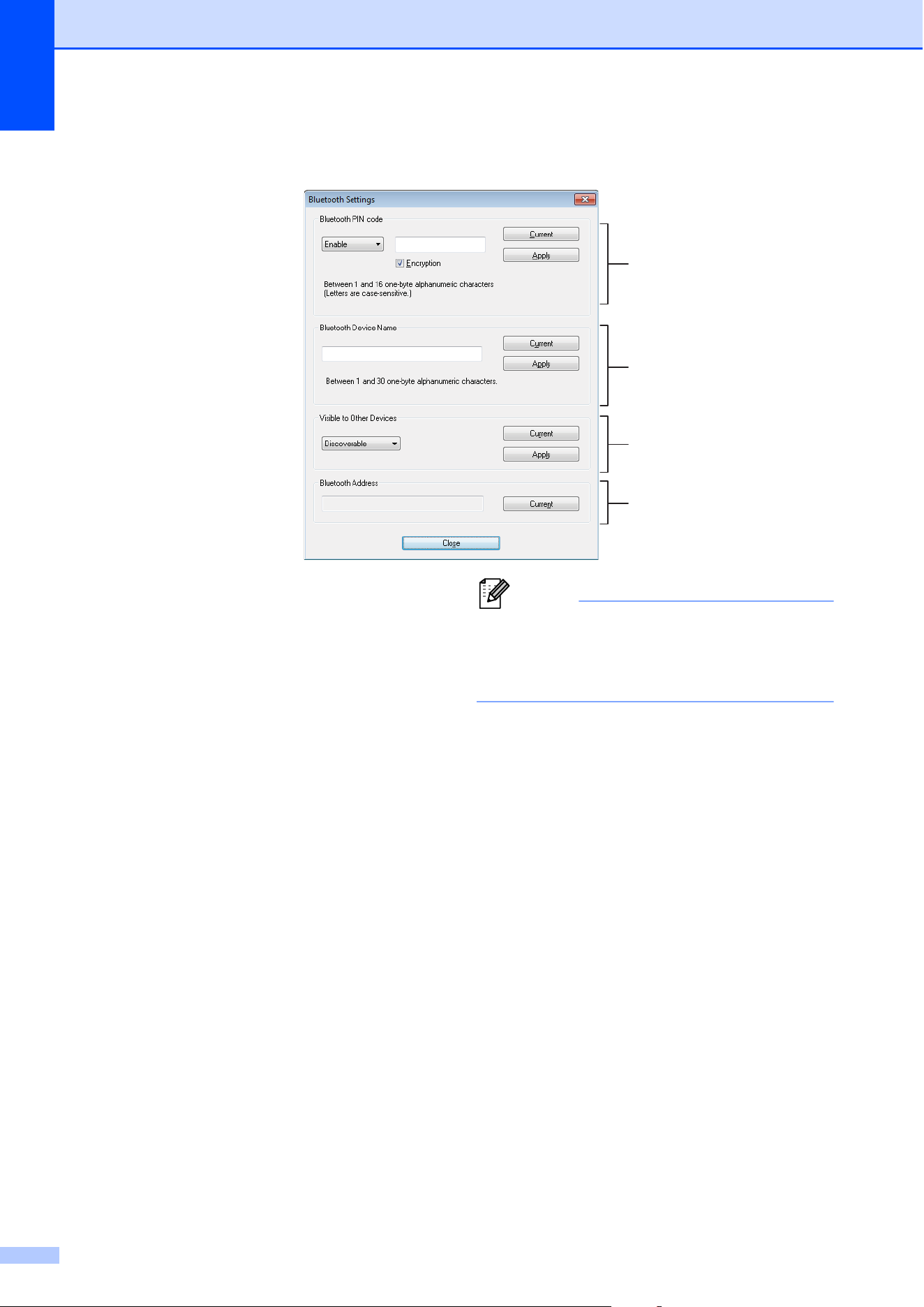
Bluetooth Settings (RJ-4030 only) 3
1 Bluetooth PIN code
Allows you to select whether a Bluetooth PIN
code (passkey) is required, change the
printer's Bluetooth PIN code, and select
whether Bluetooth communication is
encrypted.
If [Enable] is selected in the [Bluetooth PIN
code] pull-down menu, the PIN code specified
here must also be stored on the computer in
order to communicate with the printer when
using Bluetooth. You can change the PIN code
if necessary.
If the [Encryption] check box is selected, data
sent using the RJ Utility between the computer
and printer will be encrypted when using
Bluetooth.
2 Bluetooth Device Name
Allows you to specify a name (up to 30
characters) for the printer. Useful when there
are multiple Bluetooth printers present.
3 Visible to Other Devices
Allows you to specify whether the printer can
be "discovered" by other Bluetooth devices.
4 Bluetooth Address
Displays the current Bluetooth address.
Note
The PIN code and the device name must use
alphanumeric characters (A-Z, a-z, 0-9) only.
The device name can contain a space
character; the PIN code cannot.
2
1
3
4
RJ Utility
35
3
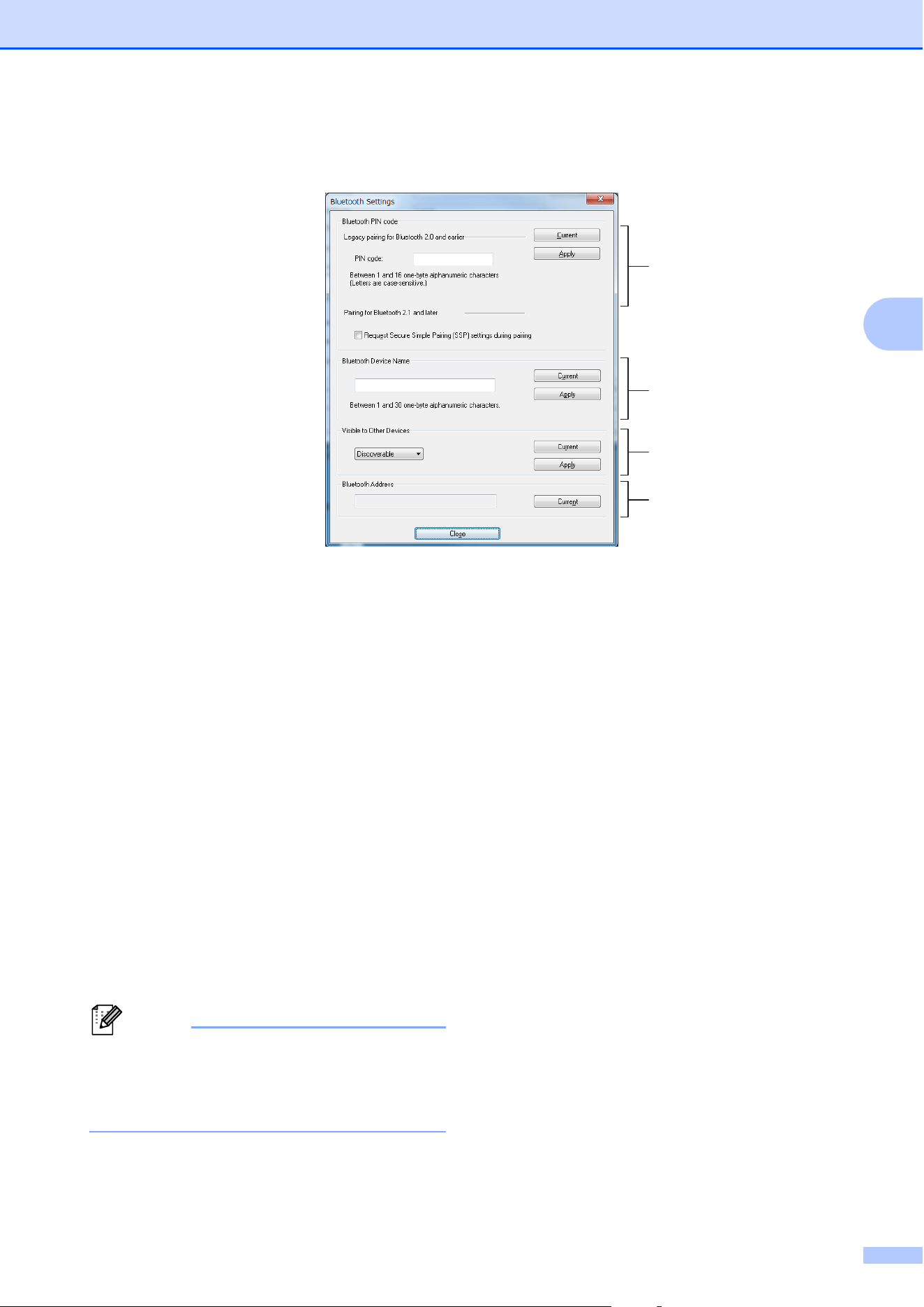
Bluetooth Settings (RJ-4030Ai only) 3
1 Bluetooth PIN code
PIN code
Specify the PIN code that will be used when
pairing with devices that are compliant with
Bluetooth 2.0 or earlier.
Request Secure Simple Pairing (SSP)
settings during pairing
If this check box is selected, pairing can be
performed using the printer buttons for devices
that are compliant with Bluetooth 2.1 or later.
2 Bluetooth Device Name
Allows you to specify a name (up to 30
characters) for the printer. Useful when there
are multiple Bluetooth printers present.
3 Visible to Other Devices
Allows you to specify whether the printer can
be "discovered" by other Bluetooth devices.
4 Bluetooth Address
Displays the current Bluetooth address.
Note
The PIN code and the device name must use
alphanumeric characters (A-Z, a-z, 0-9) only.
The device name can contain a space
character; the PIN code cannot.
2
1
3
4
Chapter 3
36
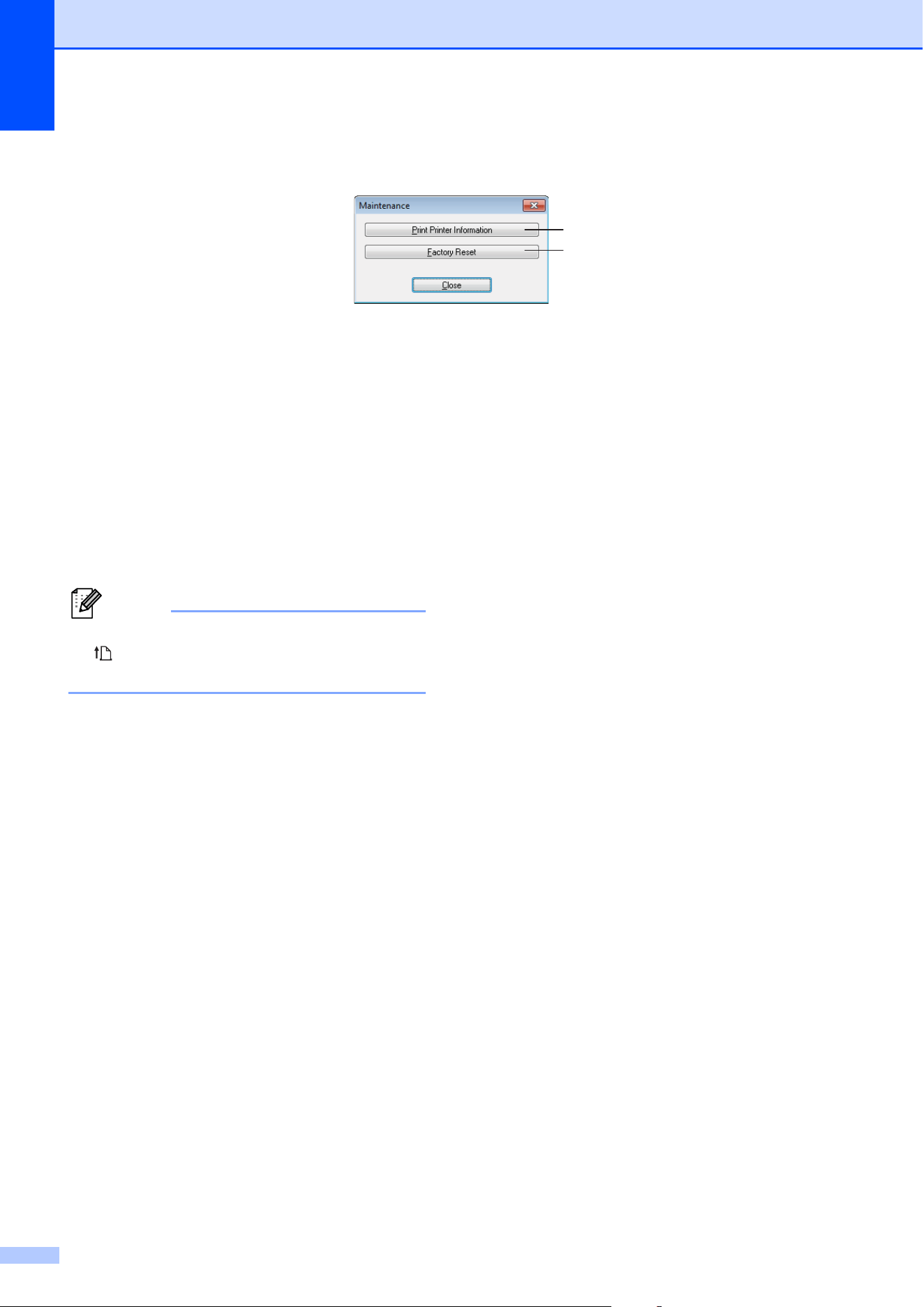
Maintenance 3
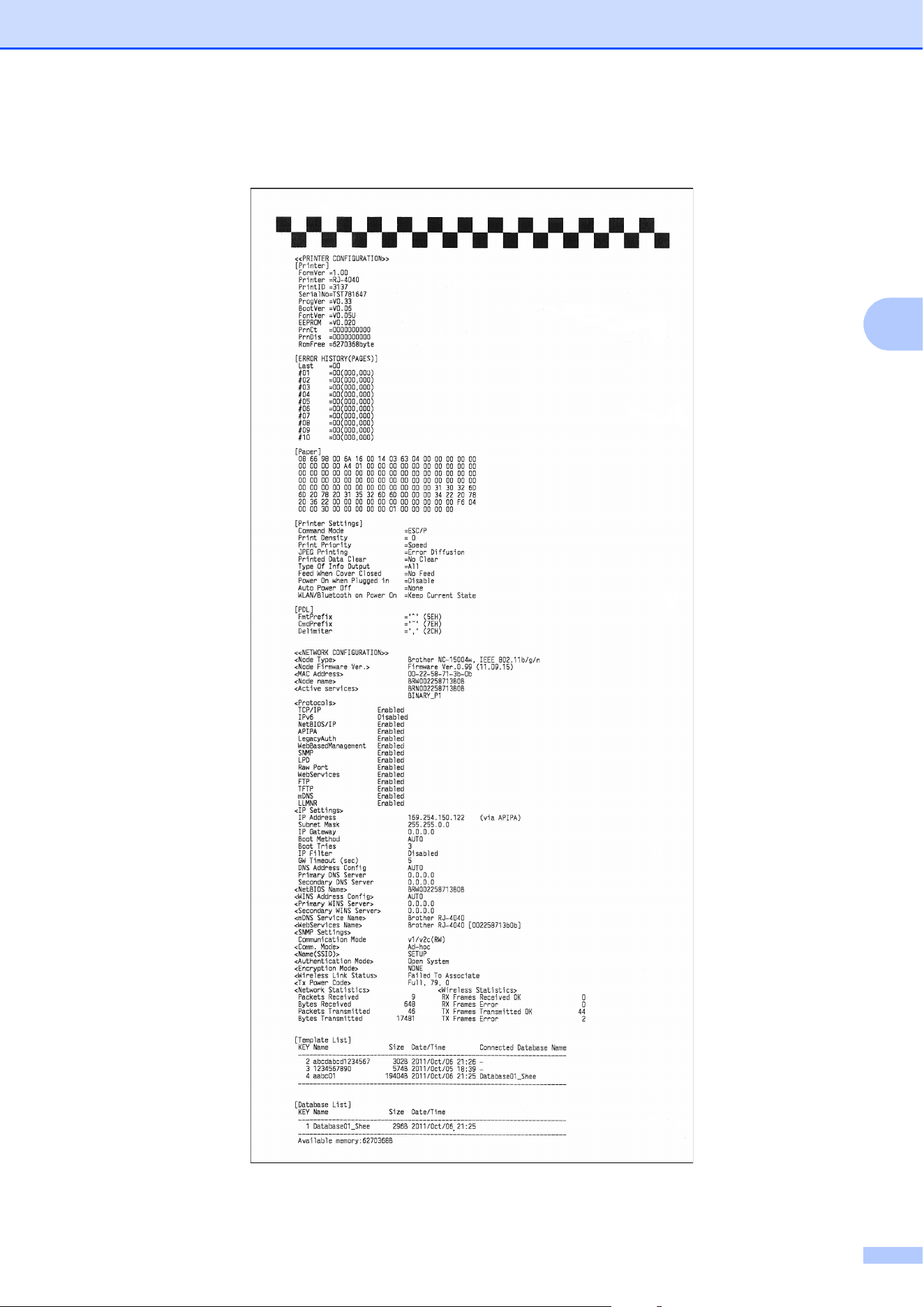
1 Print Printer Information
Click to print a report containing the following
types of information.
Program version
Printer usage history
Missing dot test pattern
RJ Utility setting information
List of transferred data
Network setting information
Wi-Fi setting information
See the print sample on the next page.
Note
You can also print this report using the
(Feed) button (see Printing the Printer
Set-up Information uu page 52).
2 Factory Reset
Click [Factory Reset] to reset the RJ Utility to
its default settings and send them to the
printer.
1
2
RJ Utility
37
3
Printer Information printing sample 3
*Labels are for illustrative purposes only.
38
4
Overview 4
The Communication Settings is a computer
program used for changing network settings
via USB.
By using the Communication Settings, you
can not only change the network settings for
one printer, you can easily apply the same
settings to multiple printers.
Note
The Communication Settings is installed
with other software such as the printer
driver. (see Installing the Printer Driver
and the Software for RJ-4040
uu page 10)
Using the
Communication
Settings
4
Starting the Communication
Settings 4
a Connect the printer whose settings will
be changed to the computer via USB.
b For Windows Vista
®
/ Windows
®
7 /
Windows Server
®
2008 / Windows
Server
®
2008 R2:
From the Start menu, click [All
Programs] - [Brother] - [Label &
Mobile Printer] - [Printer Setting
Tool].
For Windows
®
8 / Windows
®
8.1 /
Windows Server
®
2012 / Windows
Server
®
2012 R2:
Click the [Printer Setting Tool] icon on
the [Apps] screen.
For Windows
®
10:
From the Start button, select all
applications, and then click [Brother] -
[Label & Mobile Printer] - [Printer
Setting Tool].
c Select the printer connected in a.
d Click the [Communication settings]
button.
The main window is displayed.
Communication Settings
(RJ-4040 only)
4
To start the Communication
Settings, you must be logged on
with Administrator rights.
The Communication Settings can
change the settings for certain
Brother printer models only.
Communication Settings (RJ-4040 only)
39
4
Main Window 4
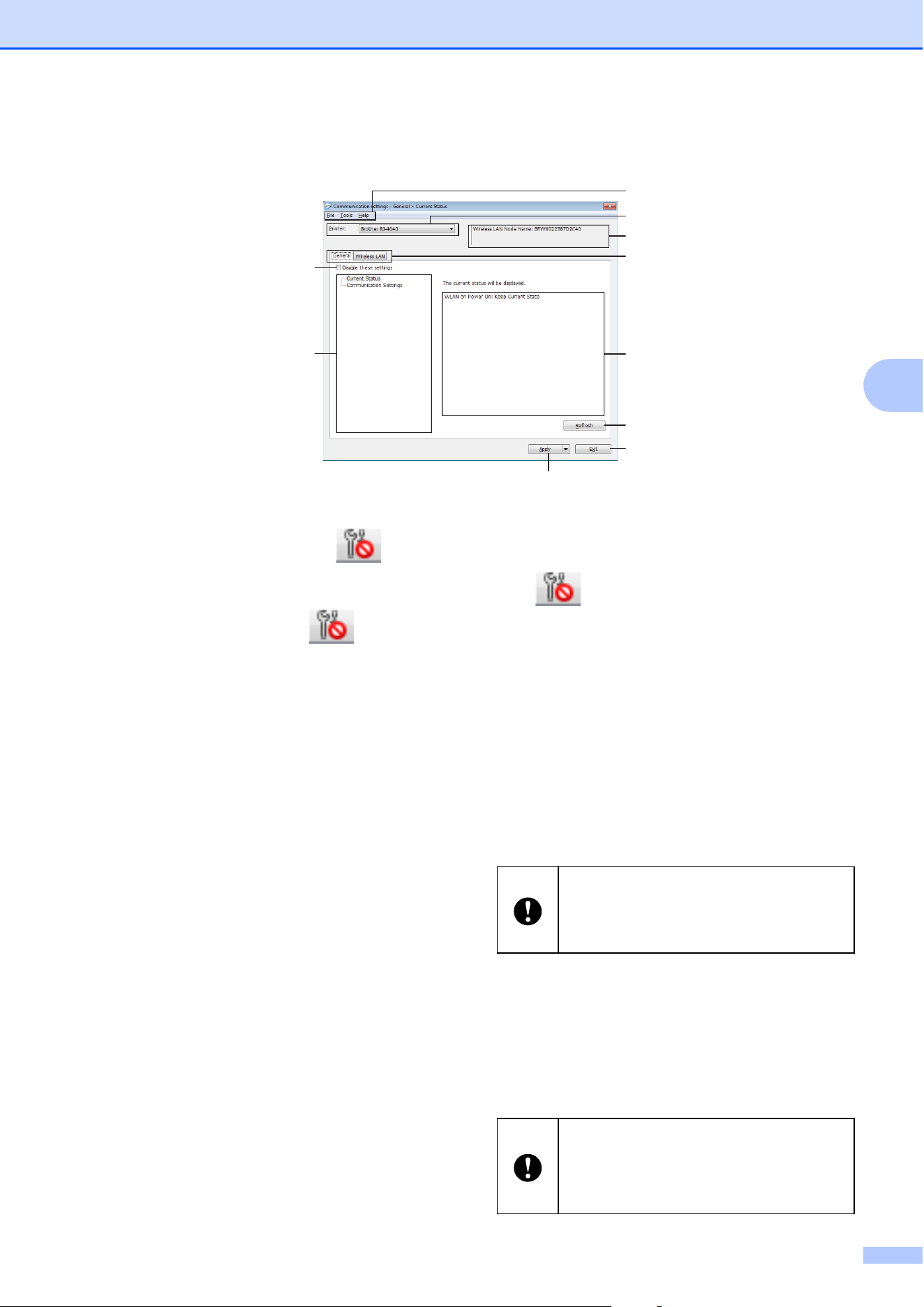
1 Disable these settings
When this check box is clicked, appears
in the tab, and the settings can no longer be
specified or changed.
The settings in a tab where appears will
not be applied to the printer even if [Apply] is
clicked. In addition, the settings in the tab will
not be saved or exported when the [Save in
Command File] or [Export] command is
executed.
To apply the settings to the printer or save or
export them, be sure to clear the check box.
2Items
When [Current Status] is selected, the current
settings appear in the settings display/change
area.
Select the item for the settings that you want to
change.
3 Menu Bar
Select a command contained in each menu
from the list.
4Printer
Selects the printer whose settings are to be
changed.
If only one printer is connected, it is
unnecessary to make a selection since only
that printer will appear.
5 Node Name
Displays the node name. The node name can
also be changed. (See Change Node
Name/Bluetooth Device Name uu page 42)
6 Settings Tabs
Click the tab containing the settings to be
specified or changed.
If appears in the tab, the settings in that
tab will not be applied to the printer.
7 Settings Display/Change Area
Displays the current settings for the selected item.
Change the settings as necessary using the drop-down
menus, direct entry or other appropriate methods.
8Refresh
Click to update the displayed settings with the
most recent information.
9Exit
Exits [
Communication settings
], and returns to
the main window of the “
Printer Setting Tool
”.
10 Apply
Click [
Apply
] to apply the settings to the printer.
To save the specified settings in a command file,
select [
Save in Command File
] from the drop-
down menu. The saved command file can be used
with the mass storage feature to apply the settings
to a printer. (See Mass Storage
uu
page 45)
7
8
5
6
9
10
3
4
1
2
Settings are not applied to printers if the
[Exit] button is clicked without clicking
the [Apply] button after changing
settings.
Clicking [Apply] applies all settings in
all tabs to the printer.
If the [
Disable these settings
] check box is
selected, the settings in that tab are not applied.
Chapter 4
40
Changing the Settings
Related to Communications 4
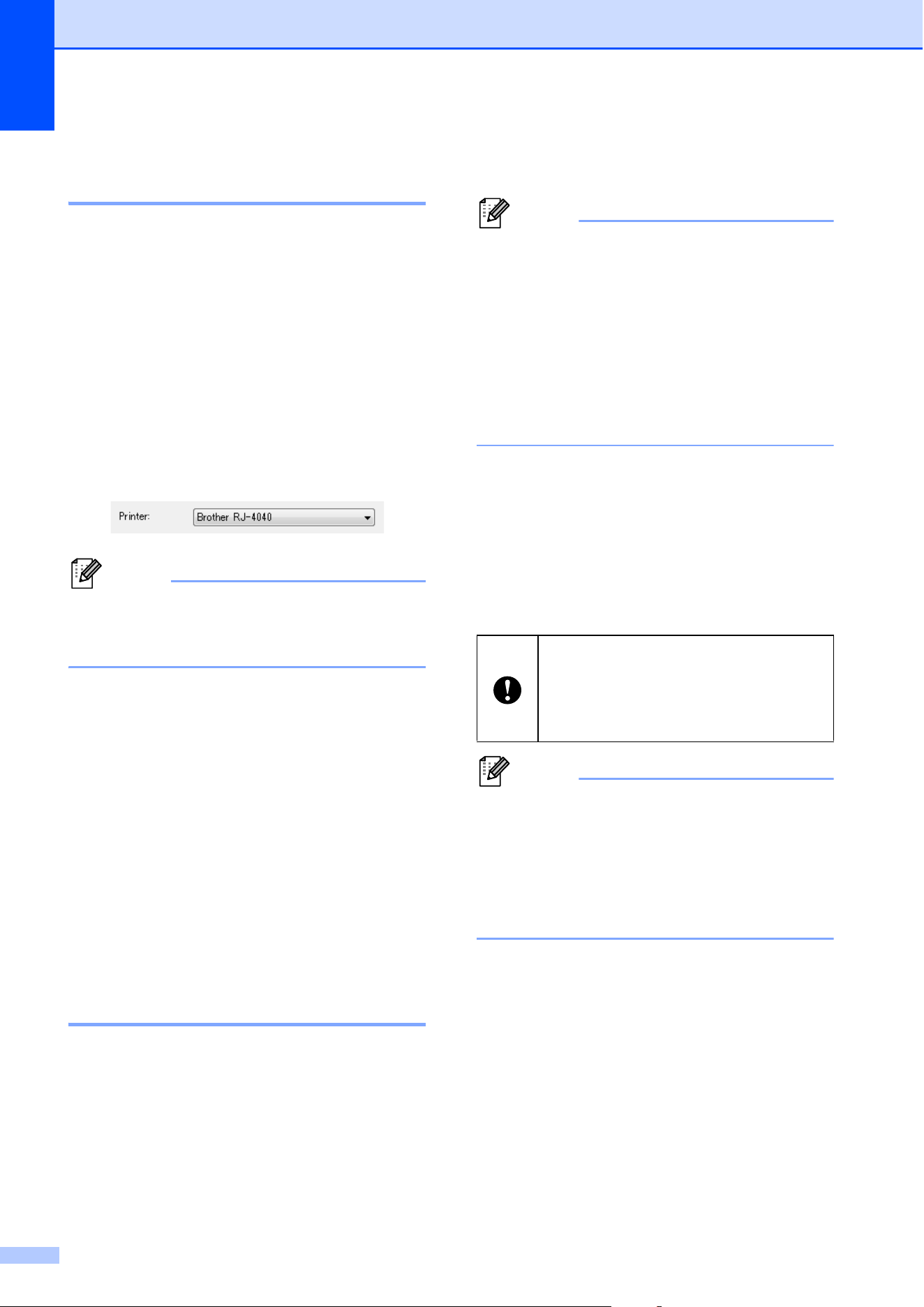
a Make sure that the computer with the
Communication Settings installed is
connected via USB to the printer that
you want to change the settings for.
b Start the Communication Settings.
Confirm that the printer that you want to
change the settings for is displayed in
[Printer].
If another printer is displayed, select the
desired printer from the [Printer] combo
box.
Note
If only one printer is connected, only that
printer is displayed and it is not necessary
to select a printer.
c From [Communication Settings] of
[Items], click the items that will be
changed.
d In the settings display/change area,
select the desired setting from the pull-
down list, or enter a value.
e When you have changed all the desired
settings, click [Apply] button and then
[Exit] button.
The settings are applied to the printer.
Applying Setting Changes to
Multiple Printers 4
a After following the steps in Changing the
Settings Related to Communications
above, disconnect the printer from the
computer, and connect the second
printer to the computer.
b Select the newly connected printer from
the [Printer] combo box.
Note
If [Automatically detects the connected
printer, and retrieves the current
settings.] check box on the [Option
Settings] screen is selected, the
connected printer is automatically
selected.
See Automatically detects the connected
printer, and retrieves the current settings.
uu page 42.
c Click the [Apply] button.
The same settings that were applied to
the first printer are applied to the second
printer.
d Repeat steps a - c for all the printers
that you want to change the settings for.
Note
To save the setting contents as a file, click
[File] - [Export...].
The exported setting contents are applied
to [Communication Settings] the next
time settings are imported using the
Communication Settings.
If the IP address is set to [STATIC], the
printer’s IP address will also be
changed to the same address as the
first printer.
Change the IP address as necessary.
Communication Settings (RJ-4040 only)
41
4
Menu Bar 4
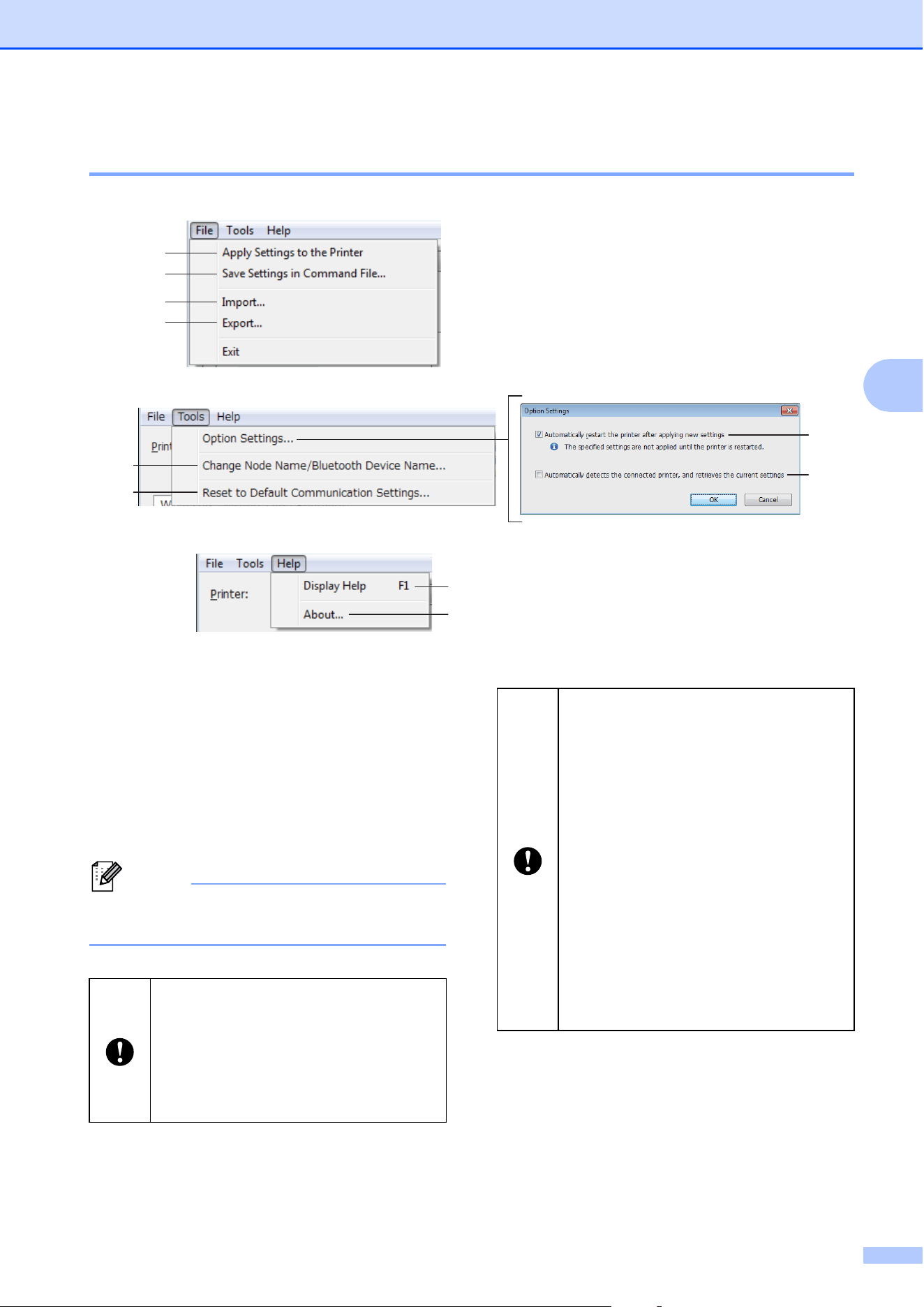
1 Apply Settings to the Printer
Applies the settings to the printer.
2 Save Settings in Command File
Saves the specified settings in a command file.
The file extension is “.bin”.
The saved command file can be used with the
mass storage feature to apply the settings to a
printer. (See Mass Storage uu page 45)
Note
If the [Disable these settings] check box is
selected, the settings in that tab are not saved.
3 Import
Import from the current computer
wireless settings
Imports the settings from the computer.
5
9
10
6
1
2
3
4
7
8
The following information is not
saved with the settings commands.
• Node name
• IP address, subnet mask and
default gateway (when the IP
address is set to [STATIC])
The saved communication settings
commands are only intended to be
used for applying settings to a
printer. The settings cannot be
applied by importing this command
file.
Saved command files contain
authentication keys and passwords.
Take necessary measures to
protect saved command files, such
as by saving them in a location that
cannot be accessed by other users.
Do not send the command file to a
printer whose model was not
specified when the command file
was exported.
Chapter 4
42
Note
• Only personal security authentication settings
(open system, public key authentication and
WPA/WPA2-PSK) can be imported. Enterprise
security authentication (such as LEAP and
EAP-FAST) settings cannot be imported.
• If multiple wireless LANs are enabled for the
computer being used, the first wireless settings
(only personal settings) that are detected will
be considered for the import data.
• Only settings (communication mode, SSID,
authentication method, encryption mode and
authentication key) from the [Wireless LAN]
tab - [Wireless Settings] pane can be
imported.
Select a Profile to import
Imports the exported file and applies the
settings to a printer.
Click [Browse] to display a dialog box for
browsing for the file. Select the file to be
imported. The settings in the selected file
appear in the settings display/change area.
Note
• All settings, such as wireless settings or
TCP/IP settings, can be imported. However,
node names cannot be imported.
• Only profiles that are compatible with the
selected printer can be imported.
• If the imported profile’s IP address is set to
[STATIC], change the IP address of the
imported profile, if necessary, so that it does
not duplicate the IP address of an existing
printer on the network whose settings have
been completed.
4 Export
Saves the current settings in a file.
Note
If the [Disable these settings] check box is
selected, the settings in that tab are not saved.
5 Automatically restart the printer after
applying new settings
If this check box is selected, the printer
automatically restarts after communication
settings are applied.
If this check box is cleared, printers must be
manually restarted.
Note
When configuring multiple printers, you can
reduce the time required to change settings by
clearing this check box. In this case, we
recommend selecting this check box when
configuring the first printer so that you can
confirm that each setting is operating as
intended.
6 Automatically detects the connected
printer, and retrieves the current settings.
If this check box is selected and a printer is
connected to the computer, the printer is
automatically detected and the printer’s current
settings are displayed in the [Current Status]
pane.
Note
If the model of the connected printer is different
than that of the printer shown in the [Printer]
drop-down list, the settings available on all tabs
change to match the connected printer.
7 Change Node Name/Bluetooth Device
Name
Allows each node name to be changed.
8 Reset to Default Communication Settings
Returns the communication settings to their
factory defaults.
9 Display Help
Displays the Help.
10 About
Displays the version information.
Exported files are not encrypted.
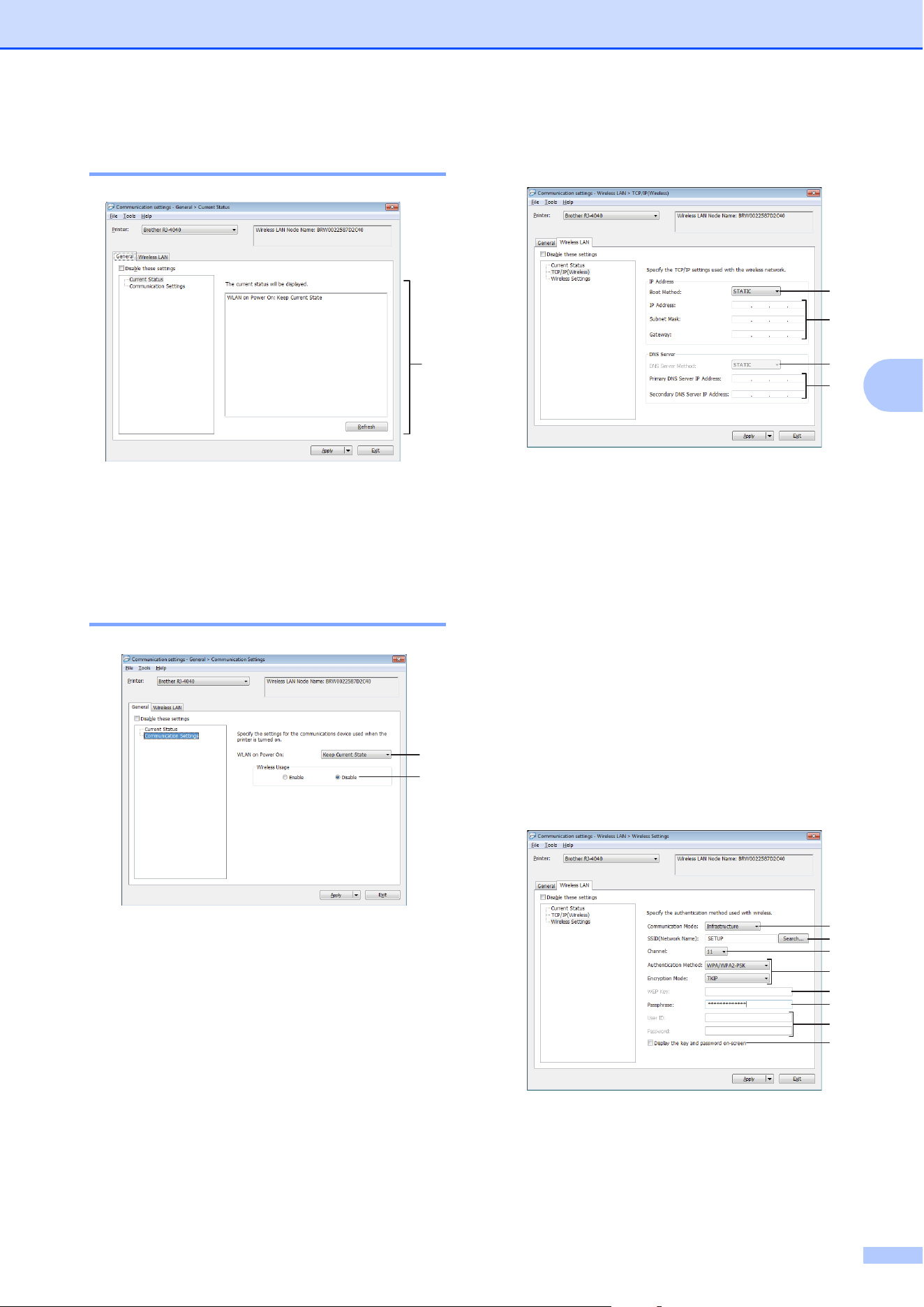
Communication Settings (RJ-4040 only)
43
4
Connected Printer’s Status 4
1 Current Network Status
Displays network status on the right side of the
screen in the settings display/change area.
Click the [Refresh] button to update the view.
Network Settings 4
1 WLAN on Power On
Determines the conditions for connecting via
Wi-Fi when the printer is turned on.
Select either: [On by Default], [Off by
Default], [Keep Current State]
2 Wireless Usage
Enables and disables wireless communication.
TCP/IP (Wireless) 4
1 Boot Method
Select [STATIC], [AUTO], [BOOTP], [DHCP]
or [RARP].
2 IP Address/Subnet Mask/Gateway
Specify the various values.
You can only enter settings when the IP
address is set to [STATIC].
3 DNS Server Method
Select [STATIC] or [AUTO].
4 Primary DNS Server IP Address/Secondary
DNS Server IP Address
You can only enter settings when the DNS
server is set to [STATIC].
Wireless Settings 4
1 Communication Mode
Select [Ad-hoc] or [Infrastructure].
2 SSID (Network Name)
Click the [Search] button to display the SSID
selections in a separate dialog box.
1
2
1
1
2
3
4
1
2
5
6
8
3
4
7
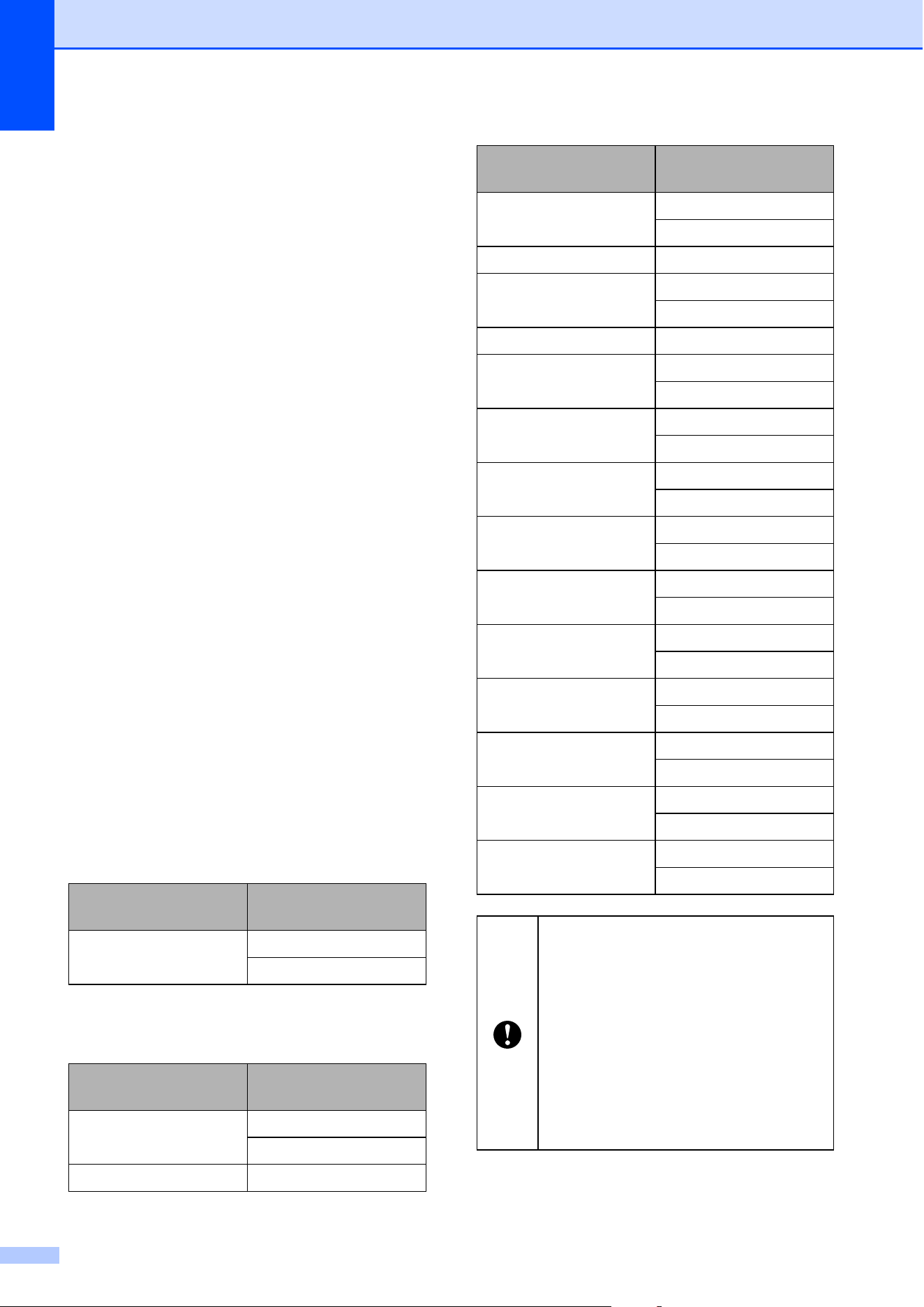
Chapter 4
44
3 Channel
Select from the displayed options.
4 Authentication Method/Encryption Mode
The supported encryption modes for the
various authentication methods are as shown
in Communication Mode and
Authentication/Encryption Methods
uu page 44.
5 WEP Key
You can only specify a setting when WEP is
selected as the encryption mode.
6 Passphrase
You can only specify a setting when WPA-
PSK, WPA2-PSK, or WPA-PSK/WPA2-PSK is
selected as the authentication method.
7 User ID/Password
You can only specify settings when LEAP,
EAP-FAST, PEAP, EAP-TTLS or EAP-TLS is
selected as the authentication method. In
addition, with EAP-TLS, it is not necessary to
register a password, but a client certificate
must be registered. To register a certificate,
connect to the printer from a web browser, and
then specify the certificate.
8 Display the key and password on-screen
If this check box is selected, keys and
passwords will be displayed in plain text (non-
encrypted text).
Communication Mode and
Authentication/Encryption Methods
4
When the Communication Mode is Ad hoc
When the Communication Mode is
Infrastructure
Authentication
Method
Encryption Mode
Open System None
WEP
Authentication
Method
Encryption Mode
Open System None
WEP
Shared Key WEP
WPA-PSK TKIP
AES
WPA2-PSK AES
WPA/WPA2-PSK TKIP
AES
LEAP CKIP
EAP-FAST/NONE TKIP
AES
EAP-FAST/MS-CHAP
v2
TKIP
AES
EAP-FAST/GTC TKIP
AES
PEAP/MS-CHAPv2 TKIP
AES
PEAP/GTC TKIP
AES
EAP-TTLS/CHAP TKIP
AES
EAP-TTLS/MS-CHAP TKIP
AES
EAP-TTLS/MS-
CHAPv2
TKIP
AES
EAP-TTLS/PAP TKIP
AES
EAP-TLS TKIP
AES
To perform higher level security
settings:
When performing certificate verification
with EAP-FAST, PEAP, EAP-TTLS or
EAP-TLS authentication methods, the
certificate cannot be specified from the
Communication Settings. After the
printer has been set to be able to
connect to the network, perform
settings by accessing the printer from a
web browser.
Authentication
Method
Encryption Mode

45
5
5
Mass Storage 5
Description 5
The mass storage feature allows you to
execute commands and perform JPEG
printing by sending data from a computer or
other device to the printer via USB. Files that
have been copied to the printer’s mass
storage area are processed when you press
the Wi-Fi button/Bluetooth button.
This feature is useful in the following
situations.
When you want to apply settings that are
stored in a command file (“.bin” format) or
templates that are stored in “.blf” format
files that were distributed by the
administrator without using a customized
tool
When you want to execute commands or
perform JPEG printing without installing
the printer driver
When you want to use a device with an
OS (including non-Windows operating
systems) that has a USB host feature to
print and transmit data
Using the Mass Storage
Feature 5
a Confirm that the printer is turned off.
b While pressing the Wi-Fi
button/Bluetooth button, press and hold
the power button.
The printer starts up in mass storage
mode and the POWER and STATUS
indicators light in green.
c Connect the computer or device to the
printer via USB.
The printer’s mass storage area is
displayed on the computer or device’s
screen.
Note
If the mass storage area is not displayed
automatically, refer to the operating
instructions for the computer or device’s
operating system for information about
displaying the mass storage area.
d Drag and drop the file you want to copy
to the mass storage area.
e Press the Wi-Fi button/Bluetooth button.
The command file is executed.
While the file is being executed, the
(Wi-Fi) indicator/ (Bluetooth)
indicator lights in blue.
f After the file has been executed, the
(Wi-Fi) indicator/ (Bluetooth)
indicator turns off.
g To turn mass storage mode off, turn the
printer off.
The printer will start up in its normal
operating mode.
Other Functions 5

Chapter 5
46
JPEG Printing 5
Image data (JPEG) can be printed without
using the printer driver.
Note
• JPEG images can be printed using the
mass storage feature.
• The Bluetooth Basic Imaging Profile (BIP)
or Object Push Profile (OPP) is used for
printing via a Bluetooth connection.
• This printer will convert a color JPEG
image to a ‘Black & White’ image using a
dithering process.
• When sending a JPEG image that is
already ‘Black & White’ this dithering
process may make your printed image
fuzzy.
• To improve the image quality, try to turn
off any preprocessing of the JPEG image.
Only JPEG images can be printed.
(Limited to files with the .jpg extension.)
The maximum file size is 5 MB.
(2.38 MB when the mass storage feature
is used.)
The maximum resolutions are as follows.
Height × Width = 8000 × 832 dots
If these limits are exceeded, the data
received by the printer will be discarded
and not printed.
Print is at 1 pixel = 1 dot.
This printer performs binary processing
(simple binary) to print the image.
The image is printed with the
height-to-width proportion of the received
data.
When the printer is turned off, mass
storage mode is deactivated and
any files in the mass storage area
are deleted.
This feature supports “.bin”, “.blf”,
and “.jpg” files. Do not use other file
formats with this feature.
Do not create folders in the mass
storage area. If a folder is created,
files in the folder will not be
executed.
The capacity of the mass storage
area is 2.45 MB. Use of files larger
than 2 MB cannot be guaranteed.
If multiple files are copied, the order
that the files will be executed in
cannot be guaranteed.
Wi-Fi, Bluetooth, and RS-232C
features are not available while the
printer is running in mass storage
mode.
Do not access other files in the
mass storage area when executing
a copied file.
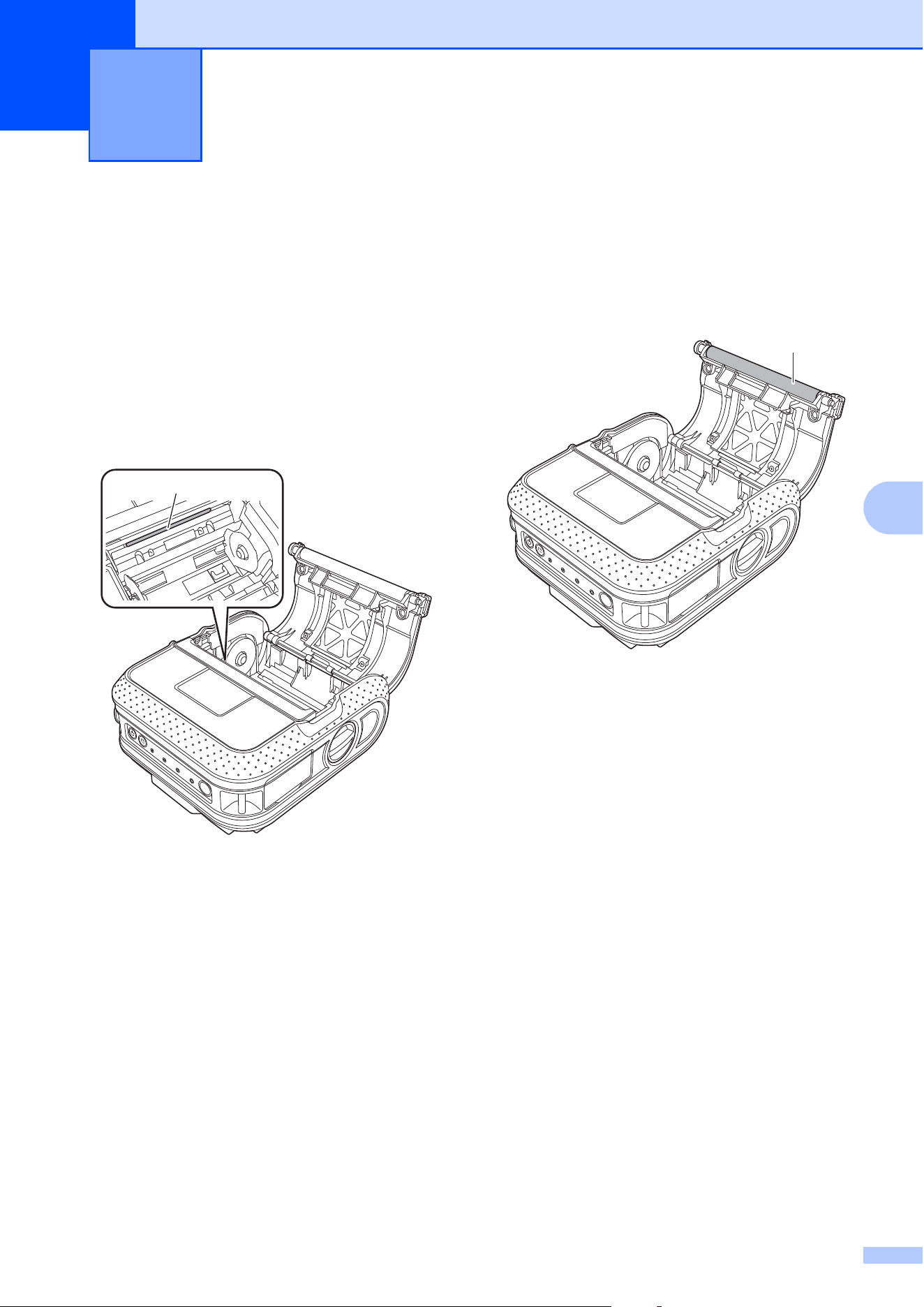
47
6
6
Maintenance of the printer may be carried out
as required. However, some environments
require that maintenance must be done more
frequently (e.g. in dusty conditions).
Print Head
Maintenance
6
Use a cotton swab and wipe the head.
1 Print head
Roller Maintenance 6
Use a piece of cellophane tape to remove dirt
from the roller.
2 Roller
Maintaining the Printer 6
1
2
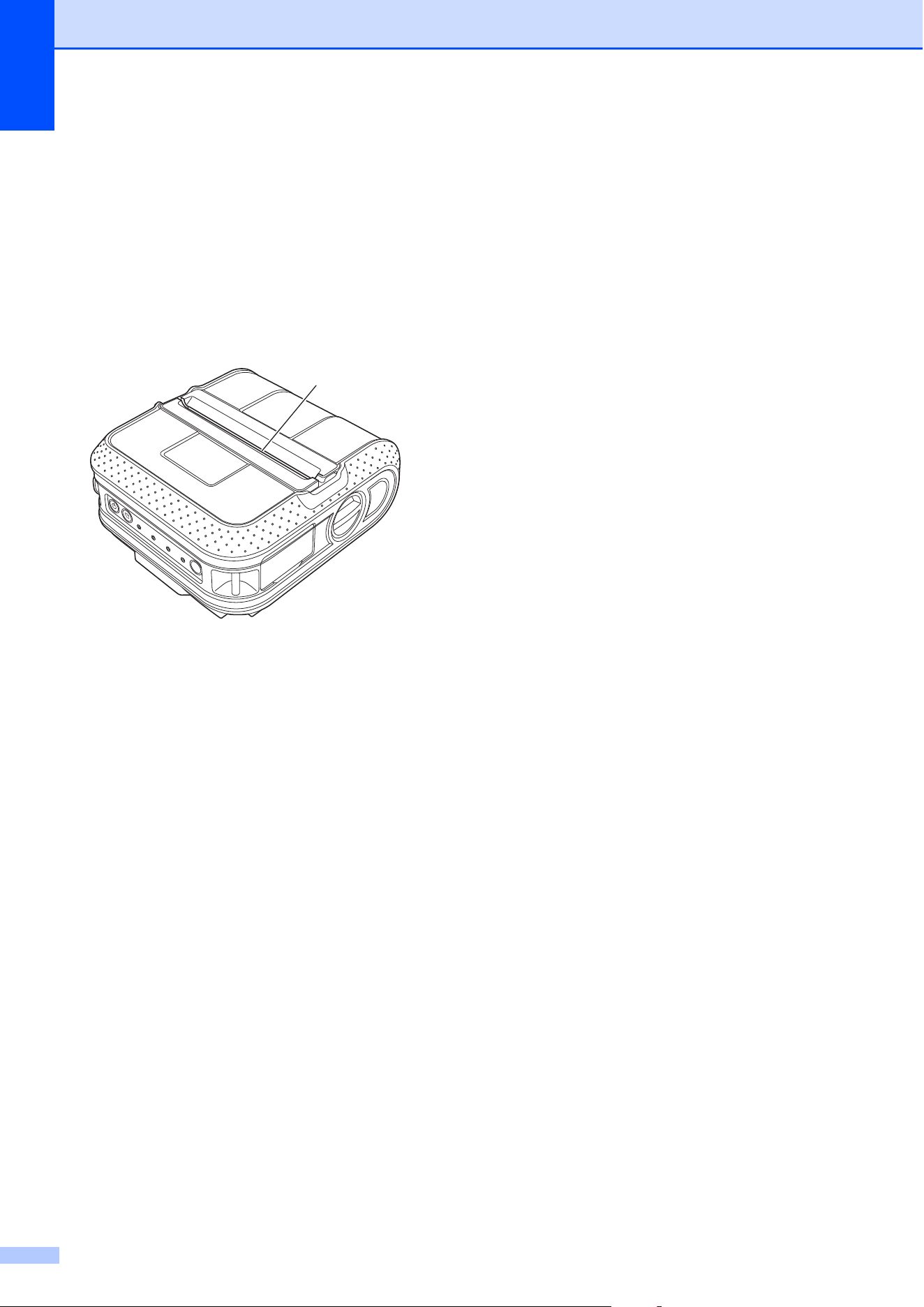
Chapter 6
48
Paper Outlet
Maintenance
6
If glue accumulates on the paper outlet and
the printer becomes jammed, disconnect the
printer from the external power outlet and
clean the paper outlet with a cloth dipped in
isopropyl alcohol.
3 Paper outlet
3
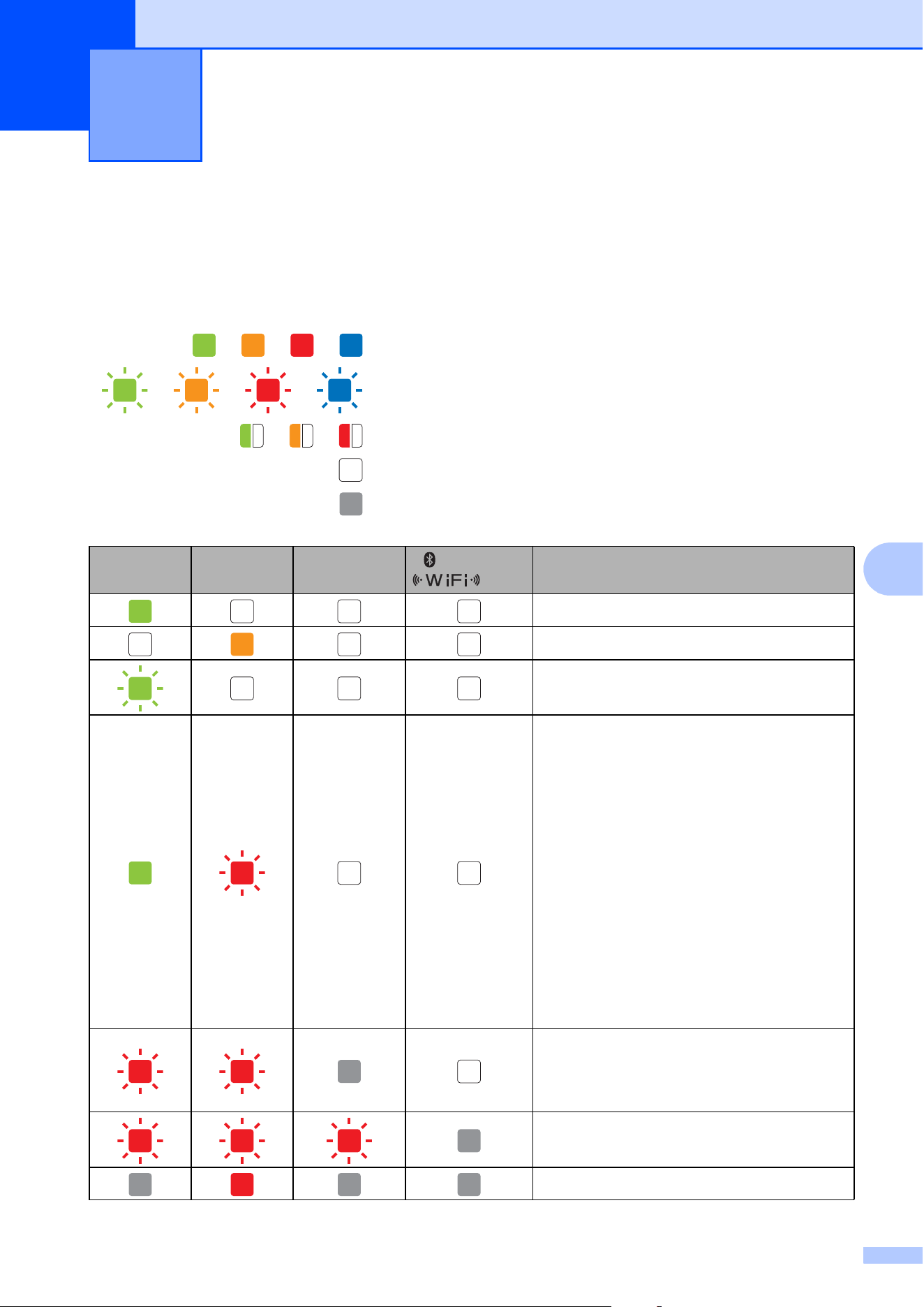
49
7
7
Indicators 7
The indicators light and blink to indicate the printer’s status. The following symbols are used in this
section to explain the meaning of the different indicator colors and patterns.
Reference 7
or or or
Indicator is lit in the color shown
or or or
Indicator is blinking in the color shown
or or
Indicator blinks 1 or 2 times in each color, then turns off
Indicator is lit or blinking in any color or pattern
Indicator is off
POWER STATUS
BATT
(BATTERY)
(Bluetooth)
(Wi-Fi)
Description
Power on
Roll cover open
Receiving data
Transferring data
Error
Print error
Feed error
Cover open error
Communication error
Image processing error
Database search error
No template error
Access point search error
Access point connection error
Security error
Error
Battery error
Mass storage error
System error
In boot mode
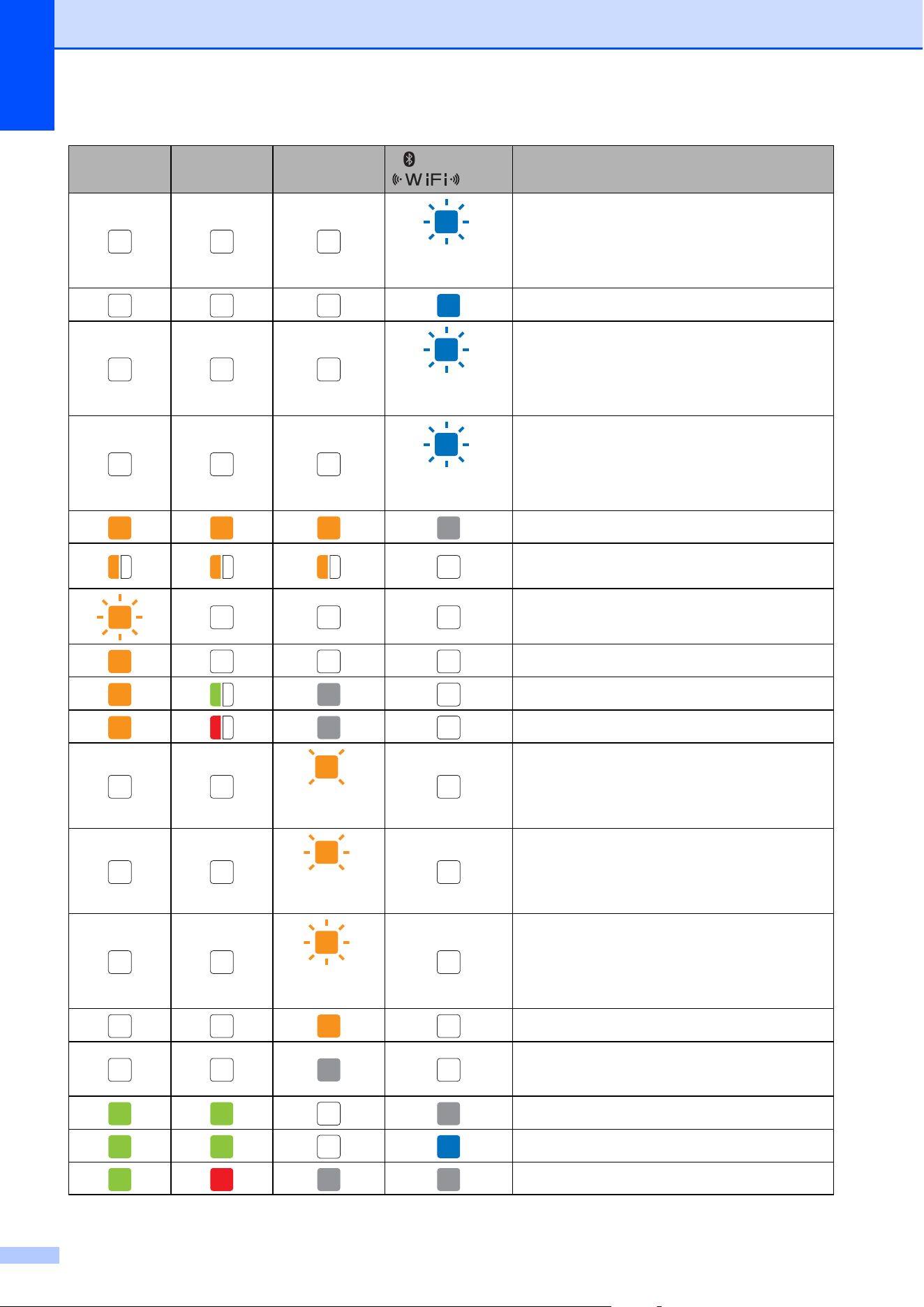
Chapter 7
50
*RJ-4040 only
(Once every
3 seconds)
Wireless on, not connected*
Wireless or Bluetooth on, connected
(Once every
second)
Now setting WPS*
Pairing with Bluetooth
(Once every 2
seconds)
Connecting to an Apple device (iPad,
iPhone, or iPod touch)
Now resetting
Formatting complete (When [Print Data
after being Printed] is set to [Erase])
Now cooling
MCR read mode
MCR read success
MCR read error
(Once every
4 seconds)
Rechargeable battery power: half
(Twice every
4 seconds)
Rechargeable battery power: low
(Once every
second)
Battery must be charged
Charging
Rechargeable battery power: full
Charging complete
In mass storage mode
Processing file in mass storage mode
Initializing
POWER STATUS
BATT
(BATTERY)
(Bluetooth)
(Wi-Fi)
Description
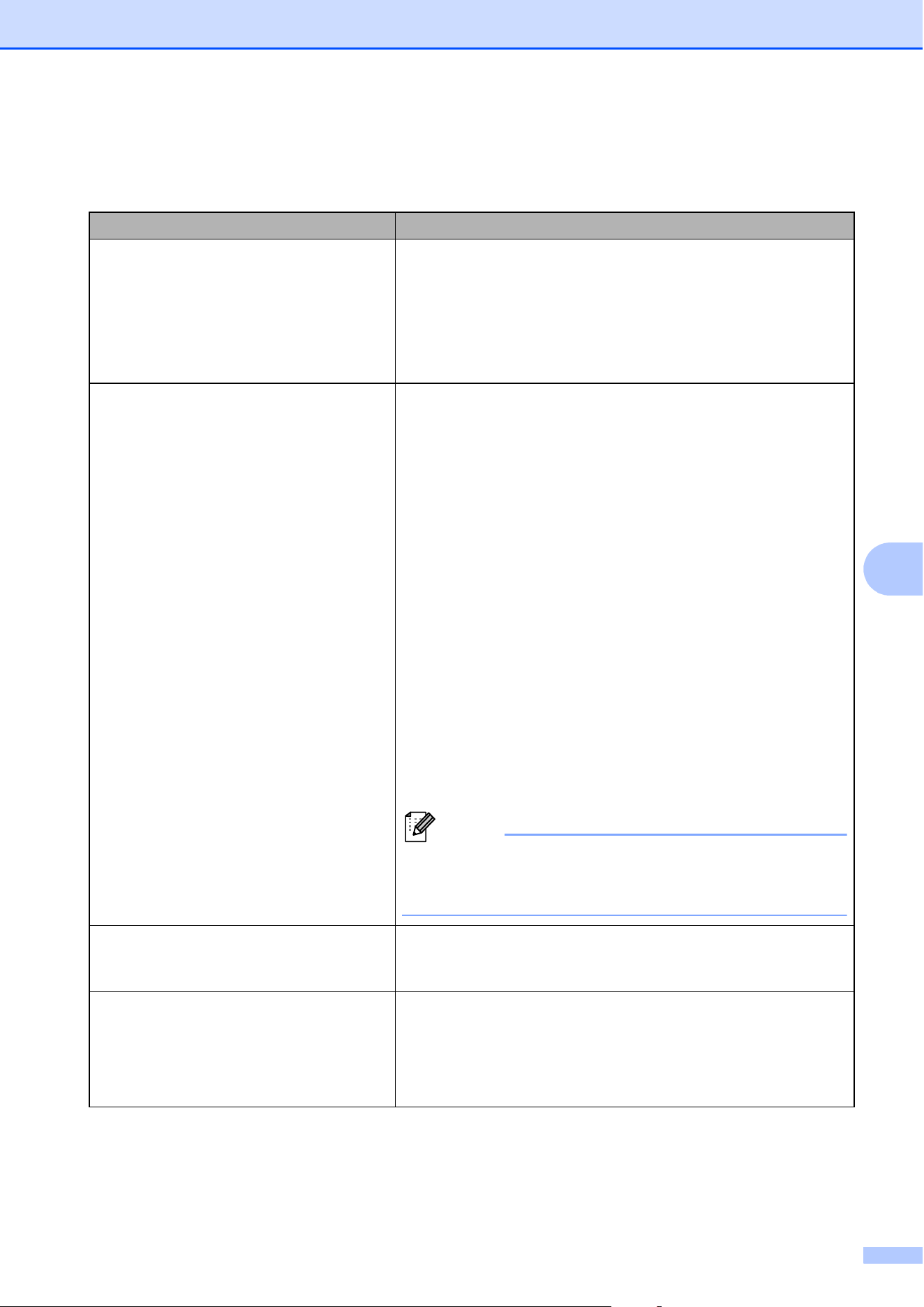
Reference
51
7
Indicator Warnings 7
Problem Solution
The POWER indicator does not light The printer is receiving no power.
If you are using AC or DC power, make sure that the AC
adapter or Car adapter is properly connected (see Connecting
the Printer to External Power uu page 2) and make sure that
the AC or DC power outlet is turned on.
If you are using DC power, check the fuse.
Head or motor is cooling down The thermal head or motor is too hot.
Head:
If the thermal head becomes even hotter, the thermal head may
produce imaging on the paper in areas not intended to be
printed. This condition is normal when printing documents with
a great deal of “black” content.
The printer will stop and resume printing after the print head
has cooled down.
To avoid or delay the onset of this condition, print using a lighter
density setting, reduce the amount of black space being printed
(for example, remove background shading and colors in graphs
and presentation documents), and make sure that the printer
has adequate ventilation and is not located in an enclosed
space.
Motor:
Do not use the printer continuously. If the printer is used
continuously, the motor will become too hot. In this case, the
printer will stop and resume printing after the motor has cooled
down.
Note
This condition may occur more often when the printer is
used at high altitude (more than 10,000 feet) due to a lower
air density available to cool the printer.
Data reception error Data may not be received correctly when communications are
unstable.Try connecting again when communication conditions
have improved.
Printer is in boot mode The AC adapter was unplugged while the firmware was being
updated, and the printer started up in boot mode the next time
it was started.
Contact your reseller or Brother Customer Service for
assistance.

Chapter 7
52
Printing the Printer
Set-up Information
7
You can use the (Feed) button to print a
report that lists the following printer settings:
Program version
Printer usage history
Missing dot test pattern
RJ Utility setting information
List of transferred data
Network setting information
Wi-Fi setting information
Note
• You can use the RJ Utility to set in
advance which items will be printed (see
Printer Information Output Settings
uu page 32).
• The node name appears in the Printer
Settings. The default node name is
“BRWxxxxxxxxxxxx”. (“xxxxxxxxxxxx” is
based on your printer’s MAC
Address/Ethernet Address.)
a Make sure that a roll of 4" (101.6 mm)
receipt paper has been loaded and the
RD Roll compartment cover is closed.
b Turn on the printer.
c Press and hold the (Feed) button until
the POWER indicator starts blinking in
green.
The settings will be printed.
Note
• To print the Printer Settings, we
recommend to use 4" (101.6 mm) receipt
paper.
• This operation can also be performed
using the RJ Utility (see Print Printer
Information uu page 36).

53
8
8
Overview 8
If you have any problems with the printer, first check to make sure that you have performed the
following tasks correctly.
Install the battery or connect the printer to an AC or DC power outlet (see Connecting the
Printer to External Power uu page 2).
Install and select the proper printer driver (see Installing the Printer Driver and the Software for
RJ-4030 uu page 8, see Installing the Printer Driver and the Software for RJ-4030Ai
uu page 9 or Installing the Printer Driver and the Software for RJ-4040 uu page 10).
Connect the printer to the computer (see Connecting the Computer and Printer uu page 20).
If you still have problems, read the troubleshooting tips in this chapter for help.
Troubleshooting 8
Problem Solution
The printer does not print, or there is a
printing error.
Is the cable loose?
Check that the cable is connected securely.
Is the RD Roll installed correctly?
If not, remove the RD Roll and reinstall.
(See Inserting the RD Roll uu page 5.)
Is there enough roll remaining?
If not, install a new RD Roll.
Is the RD Roll compartment cover open?
Check that the RD Roll compartment cover is closed.
Has a print error or transmission error occurred?
Turn off the printer and on again. If the problem still occurs,
contact Brother Customer Service at 1-800-255-0415.
Is the roll guide not touching the side of the RD Roll?
Move the roll guide against the side of the RD Roll.
(See Inserting the RD Roll uu page 5.)
The POWER indicator is not lit. Is the power cord inserted correctly?
Check that the power cord is inserted correctly. If it is, try
plugging it into another electrical outlet.
If the POWER indicator still does not light up, contact
Brother Customer Service at 1-800-255-0415.
Printed labels contain streaks or poor
quality characters, or labels are not fed
correctly.
Is the print head or roller dirty?
Although the print head generally remains clean under normal
use, lint or dirt from the roller may become stuck on the printer
head. If this occurs, clean the roller (see Roller Maintenance
uu page 47).

Chapter 8
54
A data transmission error appears on
your computer.
Is the correct port selected?
Check that the correct port is selected.
Is the printer in cooling mode (the POWER indicator is
flashing in orange)?
Wait until the indicator stops flashing and then try printing
again.
Is someone printing via the network?
If you try to print while other users are printing large
amounts of data, the printer is unable to accept your print
job until the ongoing printing is finished. In such situations,
execute the print job again after the other jobs are
completed.
Labels are jammed or are not ejected
correctly after printing.
Is there dirt or lint on the roller preventing it from rolling
freely? (See Roller Maintenance uu page 47.)
Check that the ejection path of the label is not blocked.
Check that the RD Roll is set correctly by removing the RD
Roll and reinstalling.
(See Inserting the RD Roll uu page 5.)
Ensure that the RD Roll compartment cover is closed
correctly.
The print quality is poor Is there dirt or lint on the roller preventing it from rolling freely?
Clean the roller (see Roller Maintenance uu page 47).
Problem Solution
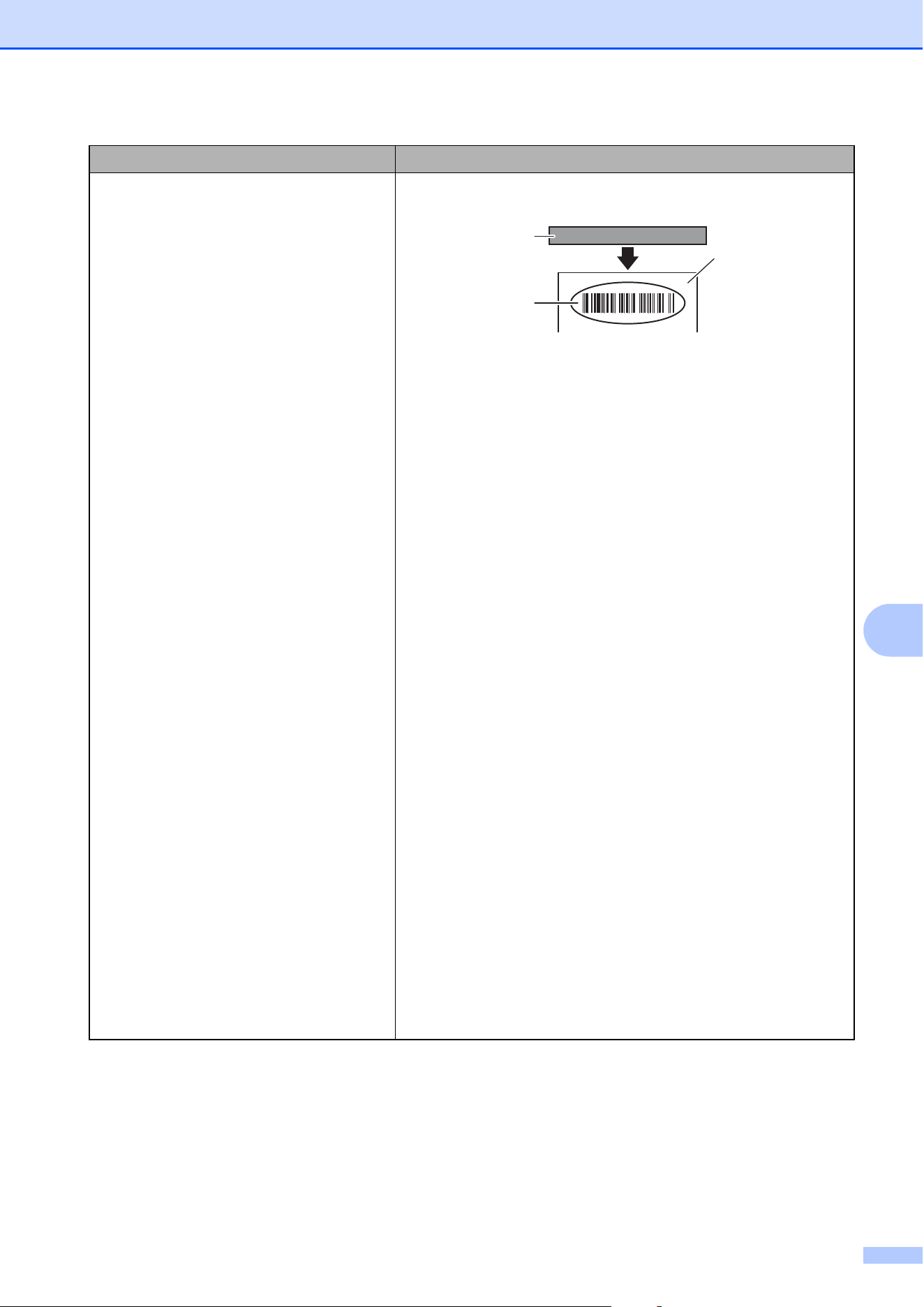
Troubleshooting
55
8
Printed barcodes cannot be read. Align the label with the print head as shown below.
1 Label exit slot
2 Print head
3 Recommended print direction
Some types of scanners are not able to read the barcodes.
Try using another scanner.
We recommend printing the barcodes with [Quality]
options set to [Give priority to quality].
Windows Vista
®
/ Windows Server
®
2008:
To change the [Quality] options, open the printer properties
by going to [Control Panel] - [Hardware and Sound] -
[Printers], right-clicking the printer whose settings are to be
changed, then selecting [Properties]. Then, in the
[General] tab, click [Printing Preference].
Windows
®
7 / Windows Server
®
2008 R2:
To change the [Quality] options, open the printer properties
by clicking [Start] - [Devices and Printers], right-clicking
the printer whose settings are to be changed, and selecting
[Printing Preference].
Windows
®
8 / Windows
®
8.1 / Windows Server
®
2012 /
Windows Server
®
2012 R2:
To display the [Quality] options, open the printer properties
by clicking [Control Panel] in the [Apps] screen -
[Hardware and Sound] - [Devices and Printers],
right-clicking the printer you want to set up, and then
clicking [Printing Preferences].
Windows
®
10:
To display the [Quality] options, open the printer properties
by clicking the Start button - [Settings] - [Devices] -
[Devices and Printers], right-clicking the printer you want
to set up, and then clicking [Printing Preferences].
Problem Solution
1
2
3
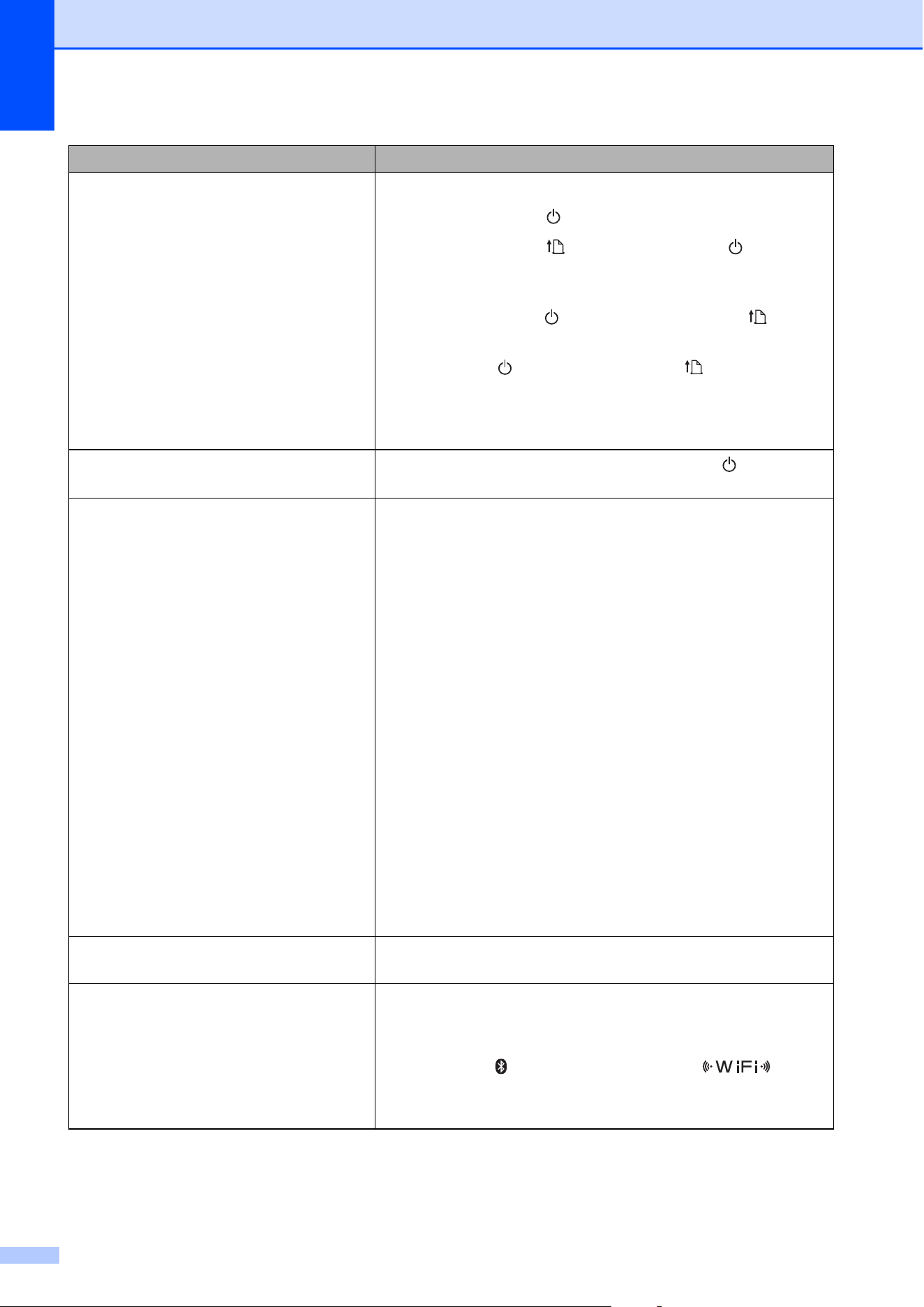
Chapter 8
56
I want to reset the printer/delete the data
transferred from the computer.
To reset the printer, perform the following procedure;
1 Press and hold the (Power) button to turn the printer off.
2 Press and hold the (Feed) button and the (Power)
button until the POWER, STATUS and BATTERY
indicators start blinking in orange.
3 While pressing the (Power) button, press the (Feed)
button 3 times.
4 Release the (Power) button and the (Feed) button at
the same time.
All the transferred data from the computer will be deleted and
reset the printer to factory settings.
I want to cancel the current print job.
Make sure that the printer is ON, and press the (Power)
button.
When printing via the USB cable, the
printer repeatedly pauses and then
continues printing.
Is the printer set for sequential printing?
If so, set print mode to buffered printing.
Windows Vista
®
/ Windows Server
®
2008:
Open printer properties from [Control Panel] - [Hardware and
Sound] - [Printers] and click [Printing Preference] button in
the [General] tab. Click the [Other] tab and choose the option
[After one page of data is received].)
Windows
®
7 / Windows
®
8 / Windows
®
8.1 / Windows Server
®
2008 R2 / Windows Server
®
2012 / Windows Server
®
2012 R2:
Open printer properties from [Devices and Printers],
right
-clicking the printer whose settings are to be changed, and
selecting [Printing Preference]. Choose the option [After one
page of data is received].
Windows
®
10:
Open printer properties from Start button - [Settings] -
[Devices and Printers], right-clicking the printer whose
settings are to be changed, and selecting [Printing
Preference]. Choose the option [After one page of data is
received].
An error occurs when the roll cannot be
fed to the beginning of the label.
If a feed error occurs, use the Paper Size Setup to assign the
correct paper settings to the printer.
The computer program should be
sending data to the printer, but the
POWER indicator does not blink green
Make sure that the USB cable is connected firmly and correctly.
Try using another USB cable.
Depending on whether you are using Bluetooth or Wi-Fi,
confirm that the (Bluetooth) indicator or the (Wi-Fi)
indicator is lit in blue. If it is not, check the connection.
(See Connecting the Computer and Printer uu page 20.)
Problem Solution
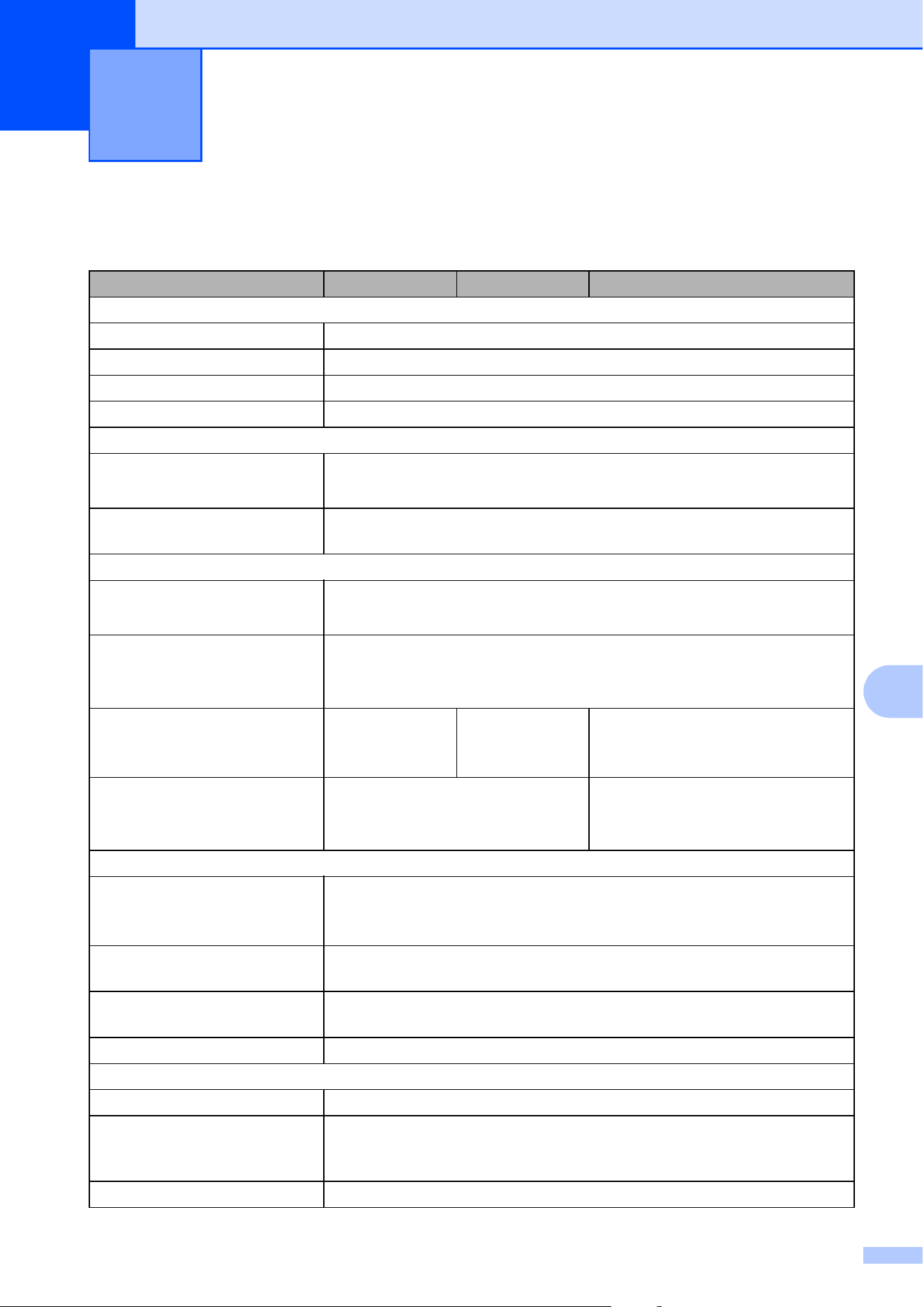
57
9
9
Product Specifications 9
Technical Information 9
Model Name RJ-4030 RJ-4030Ai RJ-4040
Printing
Printing Technology Direct Thermal
Print Resolution 203 dpi
Print Speed Maximum 5 ips (127 mm/sec)
Print Width Maximum 4.09" (104 mm)
Size
Weight Printer: Approximately 1.35 lb/610 g
Printer with battery: Approximately 1.87 lb/850 g
Dimentions Approximately 6.38" (W) x 6.93" (H) x 3.03" (D) / 162 mm (W) x
176 mm (H) x 77 mm (D)
Interface
USB Yes
USB Ver. 2.0 (Full Speed) (mini-B, Peripheral)
Serial Yes
RS232C
* Original serial cable
Bluetooth Yes
Ver. 2.0 +EDR
(Class 2)
Yes
Ver. 2.1 +EDR
(Class 1)
No
WLAN No Yes
Wireless LAN IEEE802.11b/g/n
(Infrastructure Mode/Ad hoc mode)
Environment
Operating Temperature Operate: 14 to 122°F (-10 to 50 °C) (For best print quality, the
recommended temperature is 32 to 122°F (0 to 50 °C))
Charge: 32 to 104 °F (0°C to 40 °C)
Operating Humidity 20 to 80% (No condensation, Maximum wet bulb temperature:
80.6 °F/27 °C)
Storage Temperature -4 to 140 °F (-20 to 60 °C) Do not leave your printer inside a car where
the temperature is over 60 °C.
Storage Humidity
20 to 80% (No condensation, Maximum wet bulb temperature: 113 °F/45
°
C)
Power supply (Optional)
Battery Rechargeable Li-ion battery:14.4 V
Battery Yield 2,000 labels (when connected by USB, and using a new, fully charged
battery.) Tested using Brother’s print test data (7% coverage 4×6 inches)
at 73.4 °F (23 °C).
Adapter AC adapter (15 V)
Chapter 9
58
RJ-4030Ai Compatible List 9
Made for:
iPod touch (6th generation), iPod touch (5th generation), iPhone 6s Plus, iPhone 6s, iPhone 6
Plus, iPhone 6, iPhone 5s, iPhone 5c, iPhone 5, iPhone 4s, iPad Pro, iPad Air 2, iPad Air, iPad
mini 4, iPad mini 3, iPad mini 2, iPad mini, iPad (4th generation), iPad (3rd generation), iPad 2
Car adapter Cigarette car adapter or Wired type (12 V (DC))
Media specification
Media type Receipt, Die cut label
Media Width 2" to 4.64" (51 to 118 mm)
Gap between labels 0.12" (3 mm) or more
Thickness Receipt: 0.002" to 0.0035" (0.051 to 0.090 mm)
Label: 0.003" to 0.007" (0.080 to 0.170 mm)
Diameter (Max) 2.28" (58 mm)
Core Diameter (Min) Receipt: 0.5" (12.7 mm)
Label: 1" (25.4 mm)
Media sensor Transmissive/Gap, Reflective/Bar
Compatible operating systems
See support.brother.com
for a complete and updated list of software.
Model Name RJ-4030 RJ-4030Ai RJ-4040