TYPE KHH30
instructions

English 2 - 11
4
8
9
7
2
3
bq
br
bk
1
3
2
4
1
bl
bm bn bo bp
56
bo
씊
Creaming Beater
Spanner shown is
for illustration
purposes only
and not supplied
in pack.
A
F
A
B
G
H
I
C
B
D
E
쐅
쐈
쐉
bq br
씉
씈
Food Processor Citrus Juicer

safety
l
Read these instructions carefully and retain for future
reference.
l
Remove all packaging and any labels.
l
Switch off and unplug:
l
before fitting or removing parts;
l
when not in use;
l
before cleaning.
l
Turn the speed control to ‘O’ (OFF) position and unplug
before fitting or removing tools/attachments, after use and
before cleaning.
l
Keep your fingers away from moving parts and fitted
attachments.
l
Never leave the Kitchen Machine unattended when it is
operating.
l
Never use a damaged appliance. Get it checked or repaired:
see ‘service and customer care’ section.
l
Never let the cord hang down where a child could grab it.
l
Never let the power unit, cord or plug get wet.
l
Ensure that no bowl tools are fitted or stored in
the bowl when using the dual drive outlet.
l
Never use an unauthorised attachment or more than one
attachment at once.
l
Never exceed the quantities stated in the maximum capacity
chart.
l
Take care when lifting this appliance. Ensure the head is
correctly latched in the down position and that the bowl,
tools, outlet cover and cord are secure before lifting.
l
Ensure the cord is fully unwound from the cord storage
compartment
4
before using the Kitchen Machine.
l
Children should be supervised to ensure that they do not play
with the appliance.
l
Do not move or raise the mixer head with an attachment
fitted as the Kitchen Machine could become unstable.
2

l
Do not operate your appliance near the edge of a work
surface.
l
Appliances can be used by persons with reduced physical,
sensory or mental capabilities or lack of experience and
knowledge if they have been given supervision or instruction
concerning use of the appliance in a safe way and if they
understand the hazards involved.
l
Misuse of your appliance can result in injury.
l
This appliance shall not be used by children. Keep the
appliance and its cord out of reach of children.
l
Only use the appliance for its intended domestic use.
Kenwood will not accept any liability if the appliance is subject
to improper use, or failure to comply with these instructions.
l
The maximum rating is based on the attachment that draws
the greatest load. Other attachments may draw less power.
l
Attachments will be damaged and may cause
injury if the interlock mechanism is subjected to
excessive force.
Food Processor attachment
l
The food processor knife blade and discs are extremely
sharp, handle with care. Always hold by the finger grip
at the top, away from the cutting edge, both when
handling and cleaning.
l
Always remove the knife blade before pouring contents from
the bowl.
l
Keep hands and utensils out of the food processor bowl
whilst connected to the power supply.
l
Never use your fingers to push food down the feed tube.
Always use the pusher supplied.
l
Before removing the lid from the food processor bowl:
l
switch off;
l
wait until the attachment/blades have completely stopped.
l
Never remove the food processor lid until the knife
blades/cutting discs have completely stopped.
3

l
SCALD RISK: Hot ingredients should be allowed to cool to
room temperature before processing in the attachment.
l
Do not use the lid to operate the food processor, always use
the speed/pulse control.
before plugging in
l
Make sure your electricity supply is the same as
the one shown on the underside of your appliance.
important - UK only
l
The wires in the cord are coloured as follows:
Blue = Neutral,
Brown = Live.
l
The appliance must be protected by a 13A
approved (BS1362) fuse.
Note:
l
For non-rewireable plugs the fuse cover MUST be
refitted when replacing the fuse. If the fuse cover is
lost then the plug must not be used until a
replacement can be obtained. The correct fuse
cover is identified by colour and a replacement
may be obtained from your Kenwood Authorised
Repairer (see Service).
l
If a non-rewireable plug is cut off it must be
DESTROYED IMMEDIATELY. An electric shock
hazard may arise if an unwanted non-rewireable
plug is inadvertently inserted into a 13A socket
outlet.
l
This appliance conforms to EC directive
2004/108/EC on Electromagnetic Compatibility
and EC regulation no. 1935/2004 of 27/10/2004
on materials intended for contact with food.
before using for the first time
l
Wash the parts: see ‘care and cleaning’.
key
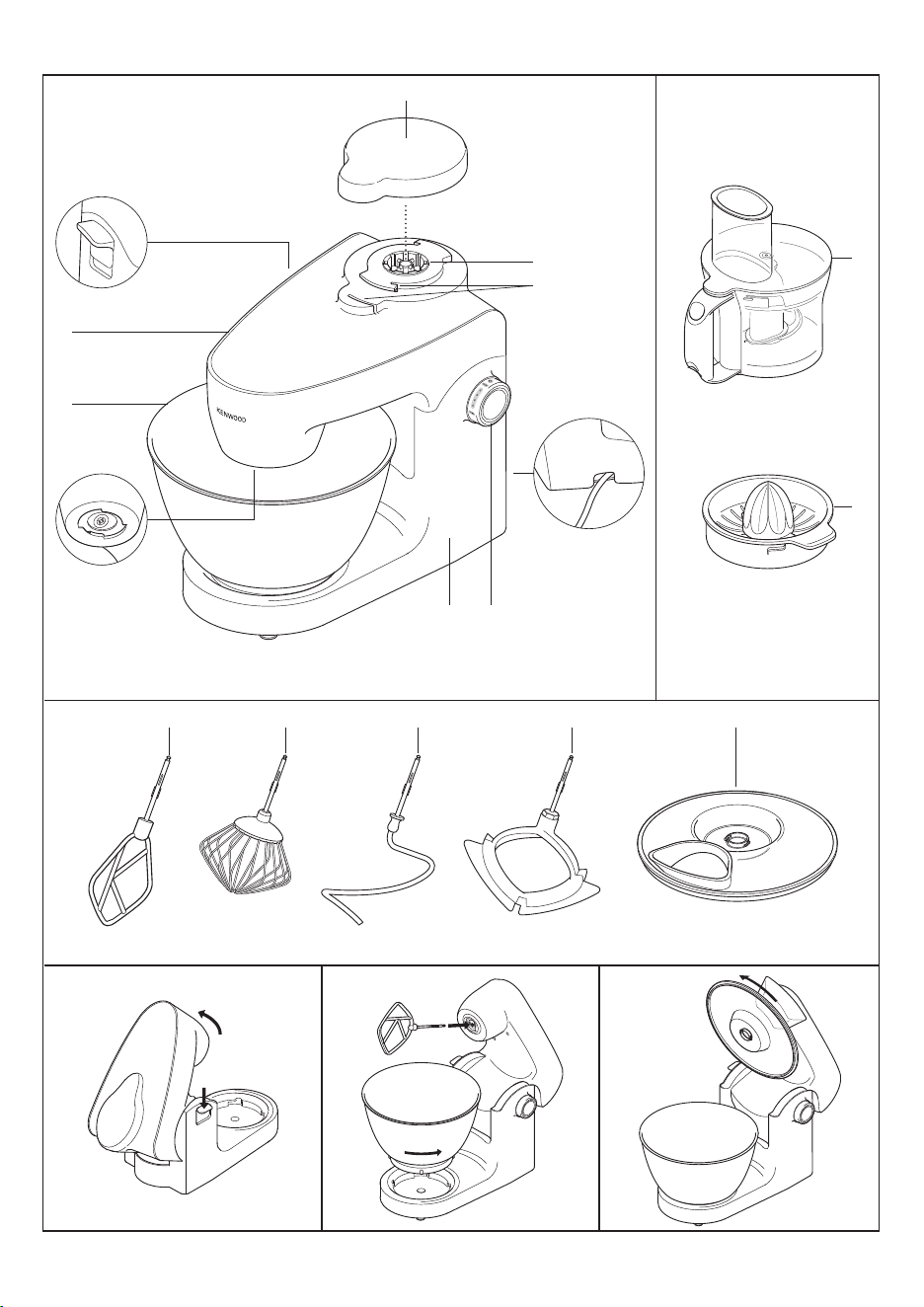
1
outlet cover
2
dual drive outlet (medium and high speed)
3
interlocks
4
cord storage compartment
5
speed/pulse control
6
power unit
7
bowl tool socket
8
bowl
9
mixer head
bk
head release lever
bl
K-beater
bm
whisk
bn
spiral dough hook
bo
creaming beater
bp
splashguard
attachments
bq
food processor
br
citrus juicer
Refer to the recommended speed chart for each
attachment.
the mixing tools and some of
their uses
K-beater
l
For making cakes, biscuits, pastry, icing, fillings,
éclairs and mashed potato.
whisk
l
For eggs, cream, batters, fatless sponges,
meringues, cheesecakes, mousses, soufflés. Do
not use the whisk for heavy mixtures (e.g.
creaming fat and sugar) - you could damage it.
spiral dough hook
l
For yeast mixtures.
creaming beater
l
The creaming beater is designed for creaming and
mixing soft ingredients. Do not use with heavy
recipes such as dough or hard ingredients, for
example those containing fruit stones, bones or
shells.
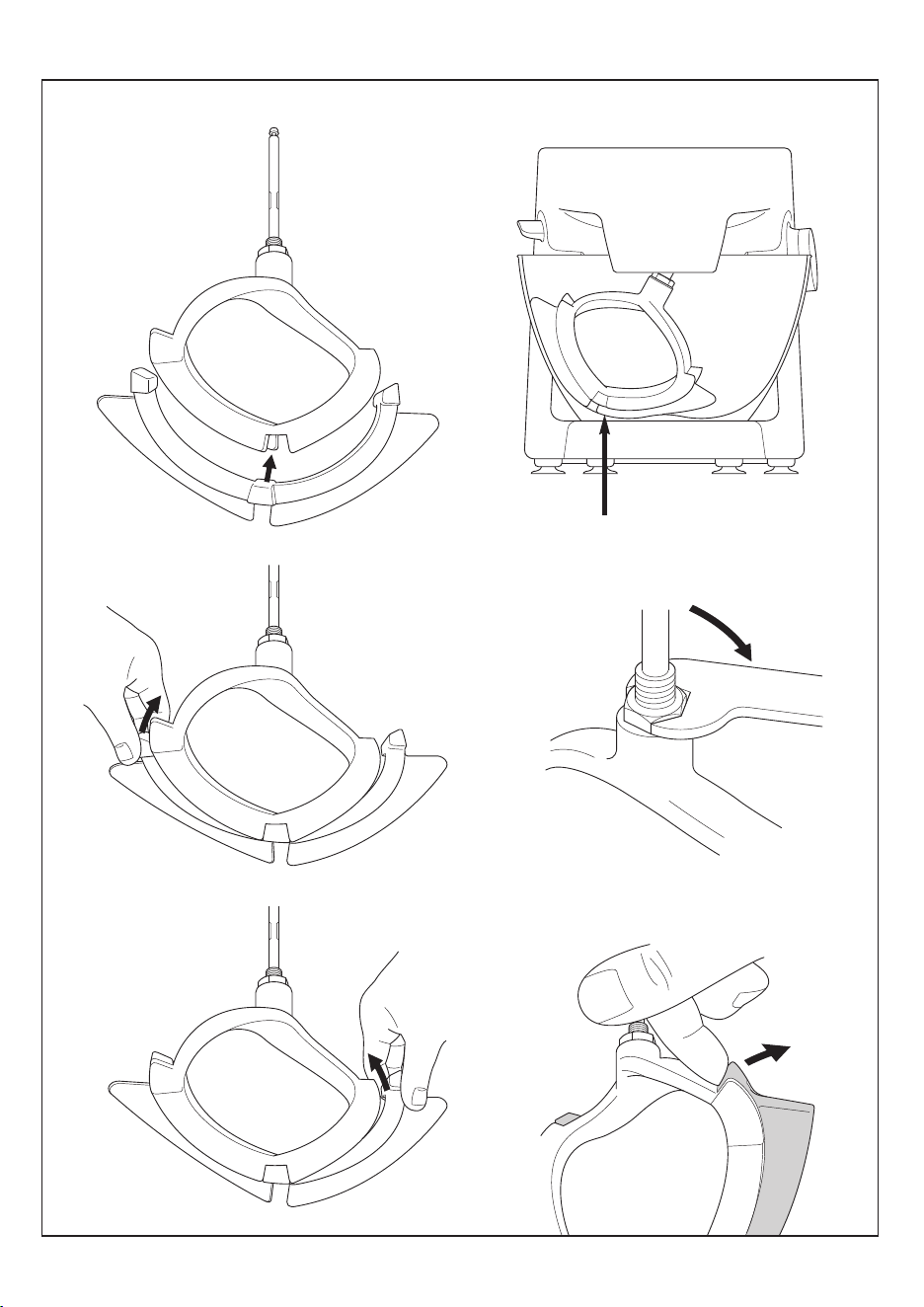
Fitting the wiper blade
l
The wiper blade is supplied already fitted and
should always be removed for cleaning
bp
.
1 Carefully fit the flexible wiper blade onto the tool by
locating the base of the wiper blade into the slot
5
then fit one side into the groove before gently
hooking the end in place
6
. Repeat with the other
side
7
.
Checking the beater height
l
The beater height has been set in the factory and
should not require adjusting. If height adjustment is
required follow the procedure below.
1 With the mixer switched off, insert the creaming
beater and lower the mixer head.
Check the position of the beater in the bowl
8
.
Ideally it should be in contact with the bowl surface
so that it gently wipes the bowl during mixing.
2 If the clearance needs to be adjusted, raise the
mixer head and remove the beater.
4

3
To loosen and allow adjustment of the shaft
9
,
r
otate the nut clockwise using a 15mm spanner
(not supplied in pack).
l
To lower the beater closer to the bottom of the
bowl, turn the beater shaft clockwise.
l
To raise the beater away from the bottom of the
b
owl turn the shaft anticlockwise.
4
Tighten the nut by turning anticlockwise.
5 Fit the beater and lower the mixer head. Check its
position (see point 2). Repeat the above steps as
necessary until the beater is set correctly. Once this
is achieved tighten the nut securely.
Note: If the mixer vibrates heavily when
the speed is selected, the beater has
been set too close to the bowl and needs
adjusting.
to use your bowl tools
1 Press the head release lever down
1
and raise the
mixer head until it locks into position.
2 Fit the bowl into the base and turn anti-clockwise
to lock into position
2
.
3 Select a tool and push into the tool socket until it
clicks
3
.
4 Press the head release lever down and lower the
mixer head until it locks into position.
5 Plug into the power supply. To switch on, turn the
speed switch to the desired setting. To switch off
turn to ‘O’ (OFF) position.
If the mixer head is in the raised position
or the outlet cover is not fitted, the Power
On light will flash and the machine will
not operate.
l
Switch to pulse for short bursts.
6 Unplug from the power supply.
7 Raise the mixer head and whilst holding it steady,
pull the tool from the tool socket.
important
l
If the mixer head is raised during operation, the
machine will stop working straight away. To
re-start, lower the mixer head, turn the speed
switch to the ‘O’ (OFF) position, wait a few
seconds and then re-select the speed. The
machine should resume operating straight away.
l
If for any reason power is interrupted and the
machine stops working, turn the speed switch to
the ‘O’ (OFF) position, wait a few seconds and then
re-select the speed. It should resume operating
straight away.
l
The machine will not operate unless the
outlet cover is correctly fitted.
l
If you hear the machine labouring either switch off
and remove some of the mixture or increase the
speed.
l
A
lways remove attachments fitted to the dual drive
outlet before raising the mixer head.
l
E
nsure that no bowl tools are fitted or
s
tored in the bowl when using the dual
drive outlet.
hints
l
S
witch off and scrape the bowl with a spatula
when necessary.
l
Eggs at room temperature are best for whisking.
l
Before whisking egg whites, make sure there is no
grease or egg yolk on the whisk or bowl.
l
Use cold ingredients for pastry unless your recipe
states otherwise.
l
When creaming fat and sugar for cake mixes,
always use the fat at room temperature or soften it
first.
l
Your machine has been fitted with a ‘soft start’
feature to minimise spillage. However if the
machine is switched on with a heavy mixture in the
bowl such as bread dough, you may notice that it
takes a few seconds to reach the selected speed.
points for bread making
important
l
Never exceed the maximum capacities stated - you
will overload the machine.
l
Some movement of the mixer head is
normal when mixing heavy loads such as
bread dough.
l
The ingredients mix best if you put the liquid in first.
l
At intervals stop the machine and scrape the
mixture off the dough hook.
l
Different batches of flour vary considerably in the
quantities of liquid required and the stickiness of
the dough can have a marked effect on the load
imposed on the machine. You are advised to keep
the machine under observation whilst the dough is
being mixed; the operation should take no longer
than 6-8 minutes.
to fit and use your splashguard
1 Fit the bowl into the base and add the ingredients.
2 Fit the splashguard by aligning the tabs with the
bowl tool socket
7
and rotate anti-clockwise to
lock into position
4
.
3 Fit the tool then lower the mixer head.
4 To remove the splashguard reverse the above
procedure.
l
During mixing, ingredients can be added directly to
the bowl via the chute.
P
5

electronic speed sensor control
Y
our mixer is fitted with an electronic speed sensor
control that is designed to maintain the speed
under different load conditions, such as when
k
neading bread dough or when eggs are added to
a cake mix. You may therefore hear some variation
in speed during the operation as the mixer adjusts
to the load and speed selected - this is normal.
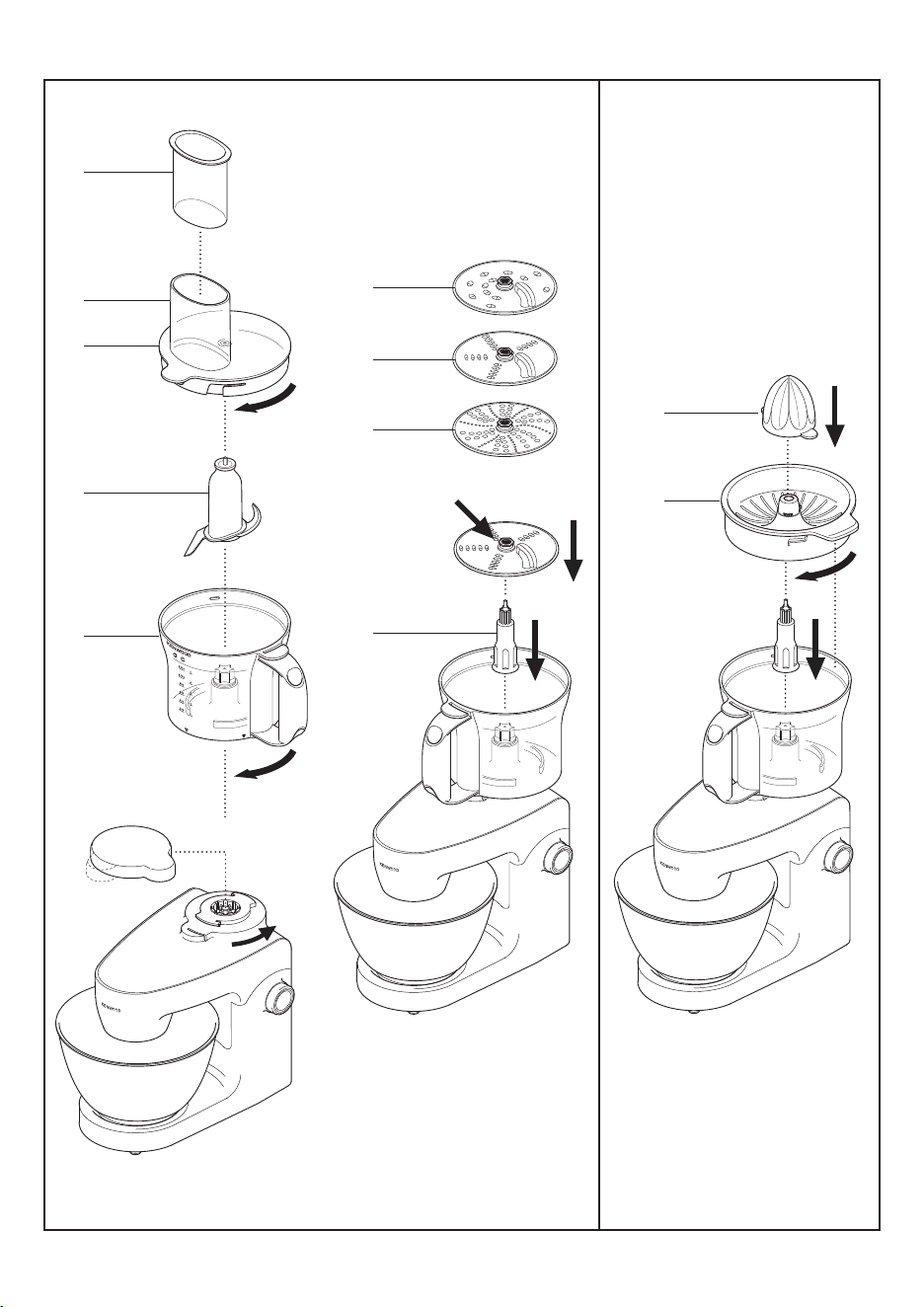
bq
food processor
A
pusher
B
feed tube
C
lid
D
knife blade
E
bowl with drive shaft
F
thick slicing/grating disc
G
thin slicing/grating disc
H
extra fine grating disc
I
detachable drive shaft
to use your food processor
1 Remove the outlet cover by turning it anti-
clockwise and lifting off
bk
.
2 Fit the bowl
E
over the outlet with the handle to
the right hand side and turn clockwise until it locks
into position
bl
.
3 Add the knife blade or detachable drive shaft with
the desired attachment.
Note: The detachable drive shaft
I
should only be fitted when using the discs
and citrus juicer.
l
Always fit the bowl and attachment onto the
processor before adding ingredients.
4 Fit the lid
bm
– ensuring the top of the knife
blade/drive shaft locates into the centre of the lid.
l
Do not use the lid to operate the
processor, always use the speed/pulse
control.
5 Plug in, switch on and select a speed (refer to the
recommended speed chart).
l
The processor will not operate if the bowl
or lid are not fitted correctly into the
interlocks. Check that the feed tube and
bowl handle are situated to the front.
l
Use the pulse for short bursts. The pulse will
operate for as long as the control is held in
position.
6 Reverse the above procedure to remove the lid,
attachments and bowl.
l
Always switch off and unplug before
removing the lid.
i
mportant
l
Your processor is not suitable for crushing or
g
rinding coffee beans, or converting granulated
s
ugar to caster sugar.
l
When adding almond essence or flavouring to
m
ixtures, avoid contact with the plastic as this may
r
esult in permanent marking.
l
Do not process hot ingredients.
knife blade
D
The knife blade is the most versatile of all the
attachments. The length of the processing time will
determine the texture achieved.
For coarser textures use the pulse control.
Use the knife blade for cake and pastry making,
chopping raw and cooked meat, vegetables, nuts,
pâté, dips, pureeing soups and to also make
crumbs from biscuits and bread.
hints
l
Cut food such as meat, bread, vegetables into
cubes approximately 2cm/ ¾in before processing.
l
Biscuits should be broken into pieces and added
down the feed tube whilst the machine is running.
l
When making pastry, use fat straight from the
fridge cut into 2cm/ ¾in cubes.
l
Take care not to over-process.
l
Do not use the knife blade to mix heavy
loads such as bread dough.
l
Do not use the knife blade to chop ice cubes or
other hard foods, such as spices, they may
damage the attachment.
slicing/grating discs
to use the discs
reversible slicing/grating discs – thick
F
,
thin
G
Use the grating side for cheese, carrots, potatoes
and foods of a similar nature.
Use the slicing side for cheese, carrots, potatoes,
cabbage, cucumber, beetroot and onions.
extra fine grating disc
H
Grates Parmesan cheese and potatoes for German
potato dumplings.
to use the cutting discs
1 Fit the bowl on the power unit, add the detachable
drive shaft.
2 Hold by the centre grip, place the disc onto the
drive shaft with the appropriate side uppermost.
3 Fit the lid.
PP
6

4
Put the food in the feed tube.
5 Switch on, then push down evenly with the pusher
–
never put your fingers in the feed tube.
h
ints
l
Use fresh ingredients.
l
Do not cut food too small. Fill the width of the feed
t
ube fairly full. This prevents the food from slipping
sideways during processing.
l
Food placed upright comes out shorter than food
placed horizontally.
l
There will always be a small amount of waste on
the disc or in the bowl after processing.
br
citrus juicer
Use the citrus juicer to squeeze the juice from
citrus fruits (e.g. oranges, lemons, limes and
grapefruits).
A
cone
B
sieve
to use the citrus juicer
1 Fit the bowl onto the power unit, add the
detachable drive shaft.
2 Fit the sieve into the bowl – ensuring the sieve
handle is locked into position directly over the bowl
handle
bn
.
3 Place the cone over the drive shaft turning until it
drops all the way down
bo
.
4 Cut the fruit in half. Then switch on and press the
fruit onto the cone.
l
The citrus juicer will not operate if the
sieve is not locked correctly.
l
For best results store and juice the fruit at room
temperature and hand roll on a worktop before
juicing.
l
To help with juice extraction move the fruit from
side to side when juicing.
l
When juicing large quantities, empty the strainer
regularly to prevent the build up of pulp and seeds.
care and cleaning
l
A
lways switch off and unplug before cleaning.
l
Dismantle attachments fully before cleaning.
p
ower unit
l
W
ipe with a damp cloth, then dry.
l
Never use abrasives or immerse in water.
l
Store excess cord in the storage compartment
4
at the back of the machine.
l
Ensure the feet on the base of the mixer are kept
clean.
bowl, tools, splashguard
l
Wash by hand, then dry thoroughly.
l
Never use a wire brush, steel wool or bleach to
clean your stainless steel bowl. Use vinegar to
remove limescale.
l
Keep away from heat (cooker tops, ovens,
microwaves).
creaming beater
1 Always remove the flexible wiper blade from the
tool before cleaning
bp
.
2 Wash the flexible wiper blade and tool in hot soapy
water, then dry thoroughly. Alternatively the parts
can be washed in a dishwasher.
Note: Please inspect the condition of the tool body
before and after use and also regularly inspect the
condition of the wiper blade and replace it if there
are any signs of wear.
food processor
l
Handle the blades and discs with care –
they are extremely sharp.
l
Some foods may discolour the plastic. This is
perfectly normal and won’t harm the plastic or
affect the flavour of your food. Rub with a cloth
dipped in vegetable oil to remove the
discolouration.
citrus juicer
l
Wash by hand, then dry thoroughly.
7
a
ll other parts
l
Wash by hand, then dry.
l
A
lternatively, refer to dishwasher chart for parts that
a
re dishwasher safe and can be washed on the top
rack of your dishwasher. Avoid placing items on the
b
ottom rack directly over the heating element. A
s
hort, low temperature (Maximum 50°C)
programme is recommended.
service and customer care
l
If the cord is damaged it must, for safety reasons,
be replaced by KENWOOD or an authorised
KENWOOD repairer.
l
If you experience any problems with the
operation of the Kitchen Machine or
attachments, before calling for assistance
refer to the troubleshooting guide.
UK
If you need help with:
l
using your appliance
l
servicing or repairs
콯 call Kenwood Customer Care on
023 9239 2333.
Have your model number (i.e. KHH30) and
date code (5 digit code i.e. 13L35) ready.
They are on the underside of the power unit.
l
spares and attachments
콯 call 0844 557 3653.
other countries
l
If you experience any problems with the operation
of your appliance, before requesting assistance
refer to the “troubleshooting guide” section in the
manual or visit www.kenwoodworld.com.
l
P
lease note that your product is covered by a
warranty, which complies with all legal provisions
c
oncerning any existing warranty and consumer
r
ights in the country where the product was
purchased.
l
If your Kenwood product malfunctions or you find
any defects, please send it or bring it to an
a
uthorised KENWOOD Service Centre. To find up
to date details of your nearest authorised
KENWOOD Service centre visit
www.kenwoodworld.com or the website specific to
your Country.
l
Designed and engineered by Kenwood in the UK.
l
Made in China.
IMPORTANT INFORMATION FOR CORRECT
DISPOSAL OF THE PRODUCT IN
ACCORDANCE WITH EC DIRECTIVE
2002/96/EC.
At the end of its working life, the product must not be
disposed of as urban waste.
It must be taken to a special local authority differentiated
waste collection centre or to a dealer providing this
service.
Disposing of a household appliance separately avoids
possible negative consequences for the environment
and health deriving from inappropriate disposal and
enables the constituent materials to be recovered to
obtain significant savings in energy and resources. As
a reminder of the need to dispose of household
appliances separately, the product is marked with a
crossed-out wheeled dustbin.
guarantee UK only
l
If your machine goes wrong within one year from
the date you bought it, we will repair or replace it
free of charge provided:
l
you have not misused, neglected or damaged it;
l
it has not been modified;
l
it is not second-hand;
l
it has not been used commercially;
l
you have not fitted a plug incorrectly; and
l
you supply your receipt to show when you
bought it.
This guarantee does not affect your statutory
rights.
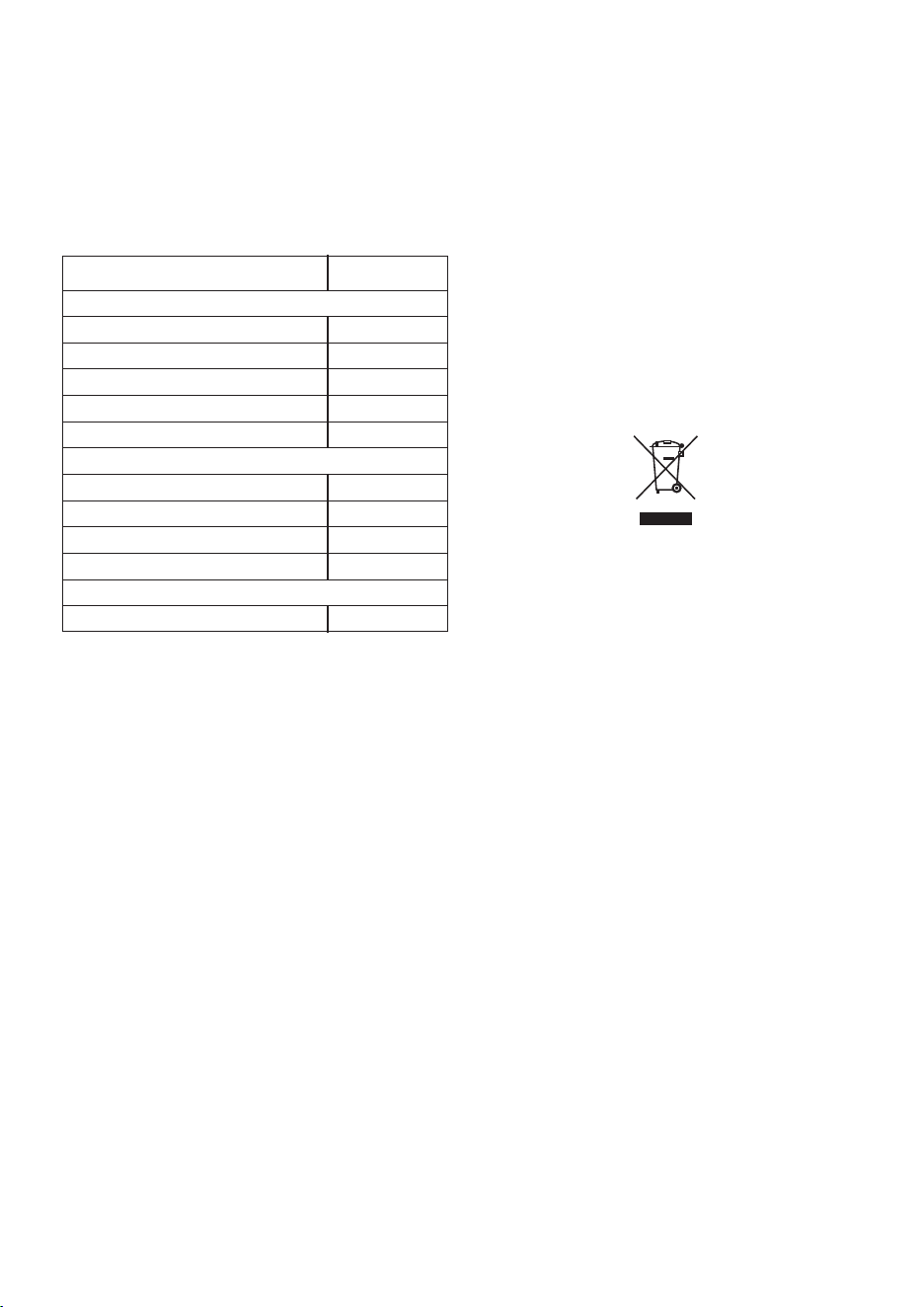
8
item suitable for
dishwashing
Mixer
Bowl 4
Whisk, beater and dough hook 4
Creaming beater and wiper blade 4
Splashguard 4
Outlet cover 8
Food Processor
Main bowl, lid and pusher 4
Knife blade 4
Detachable drive shaft 4
Discs 4
Citrus juicer
Cone, sieve 4

recommended speed chart and maximum capacities
These are a guide only and will vary depending upon the quantity of mix in the bowl and the ingredients being
m
ixed.
tool/ recipe type speed time maximum capacities
attachment
K
itchen machine
Whisk Egg whites Min to Max 2 mins 2-8 (70g-280g/2oz-10oz)
Cream Min to Max 1½ mins 125ml/4½ fl oz
600ml/21 fl oz
K-Beater All in one cake mixes Min to Max 1½ mins 1.6kg /3lb 8oz total weight
8 egg mix
Rubbing fat into flour Min to 5 mins 450g/1lb flour
Speed 2
Adding water to combine pastry
ingredients Min 30 secs
Dough hook Bread dough (stiff yeasted) Min to 4 mins 500g/1lb 2oz flour weight
Speed 2 800g/1lb 12oz total weight
Creaming beater Fruit Cake 1.8Kg/4lb total weight
Creaming fat and sugar Speed 4 - 1½ – 3½ 6 eggs
max mins
Adding eggs Speed 3 1 – 2 mins
Folding in flour, fruit, etc. Min to 30 secs
speed 1
Food processor
Knife blade All in one cake mixes Max 15 secs 600g/1lb 5oz total weight
3 egg mix
Rubbing fat into flour Max Up to 1 min 340g/12oz flour weight
Adding water to combine pastry Max 10 secs
ingredients
Chopping/pureeing/pâtés Max Up to 30 400g/14oz chopping lean
secs meat total weight
Discs – Firm food items such as carrots, Max –
slicing/grating hard cheeses
Softer items such as cucumbers, Speed 3 –
tomatoes
Extra fine grating Parmesan cheese, potato for Max –
disc German potato dumplings
Citrus juicer Citrus fruits Speed 2 ––
9
*Egg sizes used = medium sized (Weight 53-63g)
Do not exceed maximum
capacity marked on the
bowl.

10
P
roblem Cause Solution
The machine will not operate No power/indicator light not lit. Check machine is plugged in.
when using mixing tools.
M
ixer head not locked down correctly. Check that the mixer head is
locked down correctly.
Outlet cover not fitted correctly. Check that the outlet cover is
located correctly.
The machine will not work
if the outlet cover is fitted
incorrectly.
Mixer head has been lifted during Check that the speed control is
operation and lowered again without reset to ‘O’ (OFF) position.
resetting the speed control to
‘O’ (OFF) position.
Machine stops during operation Outlet cover or attachment has Check that attachment and/or
and indicator light flashes. unlocked. outlet cover are located
correctly. Reset control to ‘O’
(OFF) position, then restart
the machine.
If attachment is located correcty, then Check maximum capacities
machine is overloaded or maximum stated in the recommended
capacities exceeded. speed chart. Reduce quantity
being processed if necessary.
Switch off, unplug and allow the
machine to cool down for 30
minutes.
Dual drive attachment will Dual drive attachment is not locked Check the dual drive attachment
not operate. on correctly. is located correctly.
Food processor/juice extractor lid Check that the attachment is
or citrus juicer sieve located fitted correctly.
incorrectly.
Movement on the work surface. Feet on the underside of the machine Regularly check the feet are
are dirty or wet. clean and dry.
Poor performance of Refer to hints in relevant “using the attachment” section. Check
tools/attachments. attachments are assembled correctly.
troubleshooting guide

11
P
roblem Cause Solution
Power On light flashing rapidly. Normal operation. If using an attachment, check
The light will flash if one or more of the that it is locked into place
i
nterlocks are not engaged correctly. correctly.
Check the mixer head is fully in
the lowered position, unless
using the meat grinder
attachment.
Check the speed control is in the
‘O’ (OFF) position.
Power On light flashing slowly. Standby mode operating. The kitchen machine will return
If the kitchen machine is left plugged to normal operation when the
in for over 30 minutes without being speed control is turned to a
used, it will go into Standby mode to speed and then turned back to
reduce energy consumption. the ‘O’ (OFF) position.
The light will change to being
constantly lit when ready to use.
If none of the above solve the problem see “service and customer care”.
troubleshooting guide

HEAD OFFICE: Kenwood Limited, 1-3 Kenwood Business Park, New Lane, Havant, Hampshire PO9 2NH
Aus only
128713/1