APPENDIX
UTILITY STITCHES
SEWING BASICS
KNOWING YOUR
SEWING MACHINE
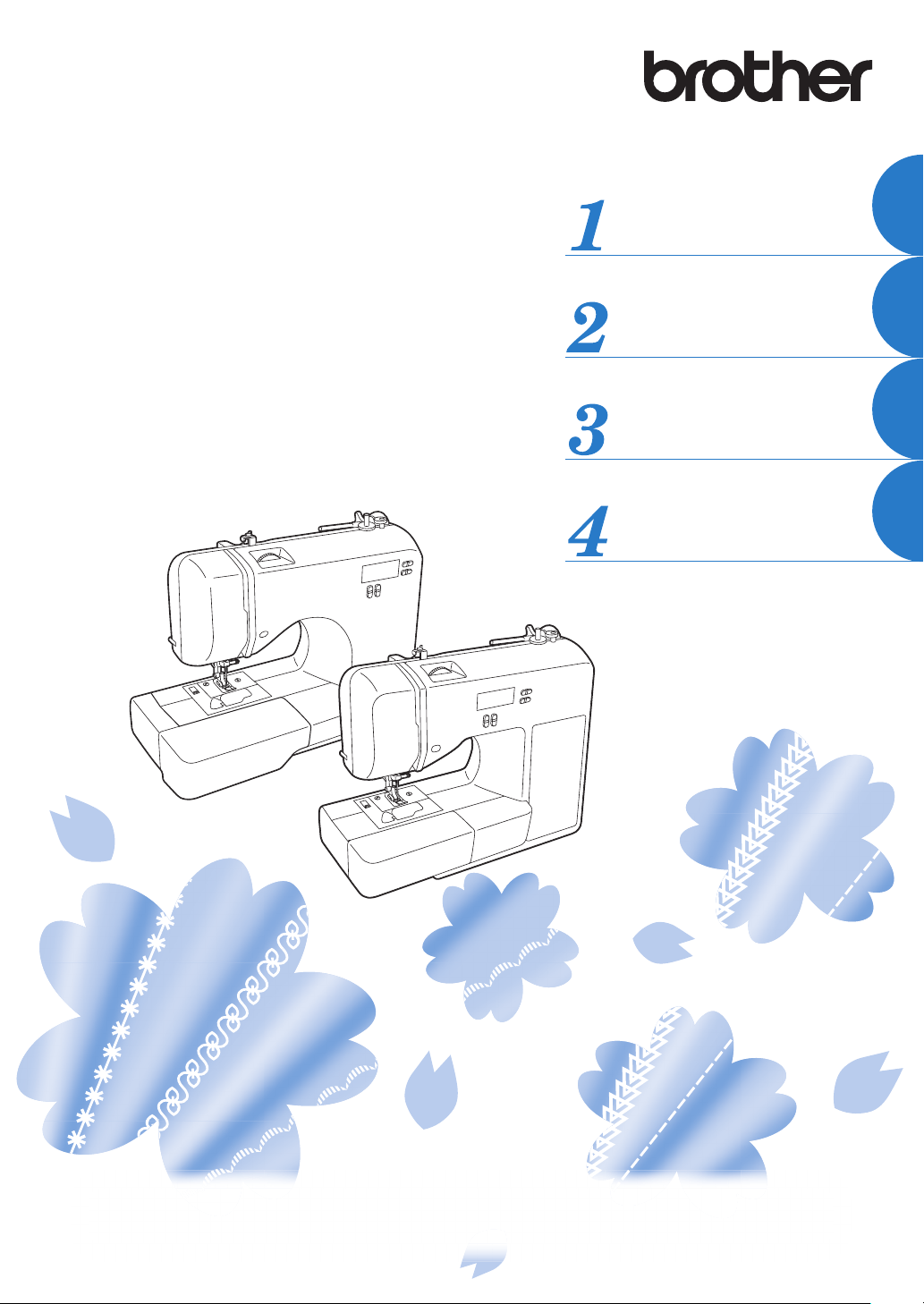
Operation Manual
Product Code: 888-E35
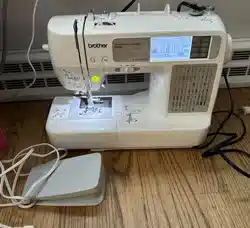
Sewing Machine
Be sure to read this document before using the machine.
We recommend that you keep this document nearby for future reference.
English
888-E35
Printed in Vietnam
XG6295-101①
Please visit us at http://support.brother.com/ where you can get product
support and answers to frequently asked questions (FAQs).

1
IMPORTANT SAFETY
INSTRUCTIONS
Please read these safety instructions before
attempting to use the machine.
DANGER
- To reduce the risk of electric shock:
1
Always unplug the machine from the electrical
outlet immediately after using, when cleaning,
when making any user servicing adjustments
mentioned in this manual, or if you are leaving
the machine unattended.
WARNING
- To reduce the risk of burns, fire, electric shock, or
injury to persons.
2
Always unplug the machine from the electrical
outlet when making any adjustments mentioned
in the instruction manual:
•Tounplugthemachine,switchthemachinetothe
symbol “O” position to turn it off, then grasp the
plug and pull it out of the electrical outlet. Do not
pull on the cord.
•Plugthemachinedirectlyintotheelectricaloutlet.
Do not use an extension cord.
•Alwaysunplugyourmachineifthepoweriscut.
3
Electrical Hazards:
•ThismachineshouldbeconnectedtoanAC
power source within the range indicated on the
ratinglabel.DonotconnectittoaDCpower
source or inverter. If you are not sure what kind
of power source you have, contact a qualified
electrician.
•Thismachineisapprovedforuseinthecountryof
purchase only.
4
Never operate this machine if it has a damaged
cord or plug, if it is not working properly, if
it has been dropped or damaged, or water is
spilled on the unit. Return the machine to the
nearest authorized dealer or service center for
examination, repair, electrical or mechanical
adjustment.
•Whilethemachineisstoredorinuseifyou
notice anything unusual, such as an odor, heat,
discoloration or deformation, stop using the
machine and immediately unplug the power cord.
•Whentransportingthemachine,besuretocarryit
by its handle. Lifting the machine by any other part
may damage the machine or result in the machine
falling, which could cause injuries.
•Whenliftingthemachine,becarefulnottomake
any sudden or careless movements, otherwise you
may injure your back or knees.
5
Always keep your work area clear:
• Neveroperatethemachinewithanyairopenings
blocked. Keep ventilation openings of the
machine and foot control free from the build up
of lint, dust, and loose cloth.
• Donotstoreobjectsonthefootcontroller.
• Donotuseextensioncords.Plugthemachine
directly into the electrical outlet.
• Neverdroporinsertanyobjectintoanyopening.
• Donotoperatewhereaerosol(spray)products
are being used or where oxygen is being
administered.
• Donotusethemachinenearaheatsource,such
as a stove or iron; otherwise, the machine, power
cord or garment being sewn may ignite, resulting
in fire or an electric shock.
• Donotplacethismachineonanunstable
surface, such as an unsteady or slanted table,
otherwise the machine may fall, resulting in
injuries.
6
Special care is required when sewing:
• Alwayspaycloseattentiontotheneedle.Donot
use bent or damaged needles.
• Keepfingersawayfromallmovingparts.Special
care is required around the machine needle.
• Switchthemachinetothesymbol“O”position
to turn it off when making any adjustments in the
needle area.
• Donotuseadamagedorincorrectneedleplate,
as it could cause the needle to break.
• Donotpushorpullthefabricwhensewing,and
follow careful instruction when freehand stitching
so that you do not deflect the needle and cause
it to break.

2
7
This machine is not a toy:
• Yourcloseattentionisnecessarywhenthe
machineisusedbyornearchildren.
• Theplasticbagthatthismachinewassupplied
inshouldbekeptoutofthereachofchildrenor
disposedof.Neverallowchildrentoplaywith
thebagduetothedangerofsuffocation.
• Donotuseoutdoors.
8
Foralongerservicelife:
• Whenstoringthismachine,avoiddirectsunlight
andhighhumiditylocations.Donotuseorstore
themachinenearaspaceheater,iron,halogen
lamp,orotherhotobjects.
• Useonlyneutralsoapsordetergentstocleanthe
case.Benzene,thinner,andscouringpowders
candamagethecaseandmachine,andshould
neverbeused.
• Alwaysconsulttheoperationmanualwhen
replacingorinstallinganyassemblies,thepresser
feet,needle,orotherpartstoassurecorrect
installation.
9
Forrepairoradjustment:
• Ifthelightunit(light-emittingdiode)isdamaged,
itmustbereplacedbyauthorizeddealer.
• Intheeventamalfunctionoccursoradjustment
isrequired,firstfollowthetroubleshootingtable
inthebackoftheoperationmanualtoinspect
andadjustthemachineyourself.Iftheproblem
persists,pleaseconsultyourlocalauthorized
Brotherdealer.
Use this machine only for its intended use as
described in this manual.
Use accessories recommended by the manufacturer
as contained in this manual.
The contents of this manual and specifications of
this product are subject to change without notice.
For additional product information, visit our web
site at www.brother.com
SAVE THESE
INSTRUCTIONS
This machine is intended for household use.
FOR USERS IN COUNTRIES EXCEPT
CENELEC COUNTRIES
Thisapplianceisnotintendedforusebypersons
(includingchildren)withreducedphysical,sensory
ormentalcapabilities,orlackofexperience
andknowledge,unlesstheyhavebeengiven
supervisionorinstructionconcerninguseofthe
appliancebyapersonresponsiblefortheirsafety.
Childrenshouldbesupervisedtoensurethatthey
donotplaywiththeappliance.
FOR USERS IN CENELEC COUNTRIES
Thisappliancecanbeusedbychildren
agedfrom8yearsandaboveandpersons
withreducedphysical,sensoryormental
capabilitiesorlackofexperienceand
knowledgeiftheyhavebeengiven
supervisionorinstructionconcerning
useoftheapplianceinasafewayand
understandthehazardsinvolved.Children
shallnotplaywiththeappliance.Cleaning
andusermaintenanceshallnotbemade
bychildrenwithoutsupervision.
FOR USERS IN THE
UK, EIRE, MALTA AND
CYPRUS ONLY
IMPORTANT
•Intheeventofreplacingtheplugfuse,useafuse
approvedbyASTAtoBS1362,i.e.carryingthe
mark,ratingasmarkedonplug.
•Alwaysreplacethefusecover.Neveruseplugs
withthefusecoveromitted.
•Iftheavailableelectricaloutletisnotsuitablefor
theplugsuppliedwiththisequipment,youshould
contactyourauthorizedBrotherdealertoobtain
thecorrectlead.

3
IMPORTANT SAFETY INSTRUCTIONS ............. 1
1. KNOWING YOUR SEWING
MACHINE ........................................... 4
ACCESSORIES ................................................... 4
Included accessories .............................................. 4
Optional accessories .............................................. 5
Accessory compartment ......................................... 5
Flip chart (For models equipped with a flip chart) ... 5
NAMES OF MACHINE PARTS AND THEIR
FUNCTIONS ..................................................... 6
The main parts ....................................................... 6
Needle and presser foot section ............................. 6
Operation buttons .................................................. 7
Operation panel ..................................................... 7
Spool pin................................................................ 8
USING YOUR SEWING MACHINE ................... 9
Power supply precautions ...................................... 9
Power supply ......................................................... 9
Foot controller........................................................ 9
Sewing speed controller (for models
equipped with the start/stop button) ......................10
Changing the needle stop position.........................10
Changing the initial needle position ......................10
Cancelling the operation beep...............................11
THREADING THE MACHINE .......................... 11
Winding the bobbin ..............................................11
Lower threading ....................................................14
Upper threading ....................................................16
Drawing up the lower thread .................................19
REPLACING THE NEEDLE ............................... 20
Needle precautions .............................................. 20
Needle types and their uses ................................. 20
Checking the needle ............................................ 20
Replacing the needle ............................................ 21
Sewing with the twin needle ................................ 21
REPLACING THE PRESSER FOOT .................... 23
Replacing the presser foot .................................... 23
Removing the presser foot holder ......................... 24
2. SEWING BASICS ............................... 25
SEWING .......................................................... 25
General sewing procedure ................................... 25
Selecting a stitch .................................................. 25
Adjusting the stitch length and width.................... 26
Starting to sew ...................................................... 26
Thread tension ..................................................... 28
USEFUL SEWING TIPS .................................... 29
Trial sewing .......................................................... 29
Changing the sewing direction ............................. 29
Sewing curves ...................................................... 29
Sewing thick fabrics ............................................. 29
Sewing hook-and-loop fastener tape .................... 30
Sewing thin fabrics ............................................... 30
Sewing stretch fabrics ........................................... 30
Stitching cylindrical pieces ....................................31
3. UTILITY STITCHES ............................ 32
OVERCASTING STITCHES ............................... 32
Using zigzag foot ................................................. 32
Using overcasting foot .......................................... 32
BASIC STITCHING .......................................... 33
BLIND HEM STITCHING ................................. 33
BUTTONHOLE SEWING ................................. 35
Button sewing ...................................................... 38
ZIPPER INSERTION ......................................... 39
SEWING STRETCH FABRICS AND
ELASTIC TAPE ................................................. 40
Stretch stitching .................................................... 40
Elastic attaching ................................................... 40
APPLIQUÉ, PATCHWORK AND
QUILT STITCHING .......................................... 41
Appliqués ..............................................................41
Patchwork (crazy quilt) stitching ............................41
Piecing ................................................................. 42
Quilting ................................................................ 42
Free-motion quilting ............................................. 43
REINFORCEMENT STITCHING .......................44
Triple stretch stitching ........................................... 44
Bar tack stitching .................................................. 44
DECORATIVE STITCHING .............................. 45
Fagoting ............................................................... 46
Scallop stitching ................................................... 46
Smocking ............................................................. 46
Shell tuck stitching ............................................... 47
Joining .................................................................. 47
Heirloom stitching ................................................ 48
SEWING CHARACTERS (for models
equipped with character stitches) ................... 48
Sewing beautiful patterns ..................................... 48
Selecting characters ............................................. 48
Checking characters ............................................. 51
Deleting characters .............................................. 51
Sewing the character stitches ............................... 51
ADJUSTING STITCHES (for models
equipped with character stitches) ................... 52
4. APPENDIX ......................................... 53
STITCH SETTINGS ........................................... 53
Utility stitches ...................................................... 53
Satin stitches ........................................................ 58
Character stitches (for models
equipped with character stitches) ......................... 59
MAINTENANCE ..............................................60
Restrictions on oiling ............................................ 60
Precautions on storing the machine ...................... 60
Cleaning the machine surface ............................... 60
Cleaning the race ................................................. 60
TROUBLESHOOTING ..................................... 61
Frequent troubleshooting topics ............................61
Upper thread tightened up ................................... 62
Tangled thread on wrong side of fabric ................. 62
Incorrect thread tension ....................................... 62
Fabric is caught in the machine and
cannot be removed .............................................. 63
Error message “E6” appears in the LCD ................ 65
List of symptoms .................................................. 67
ERROR MESSAGES .......................................... 71
Operation beep .................................................... 71
INDEX ............................................................. 72
CONTENTS
1
4
ACCESSORIES
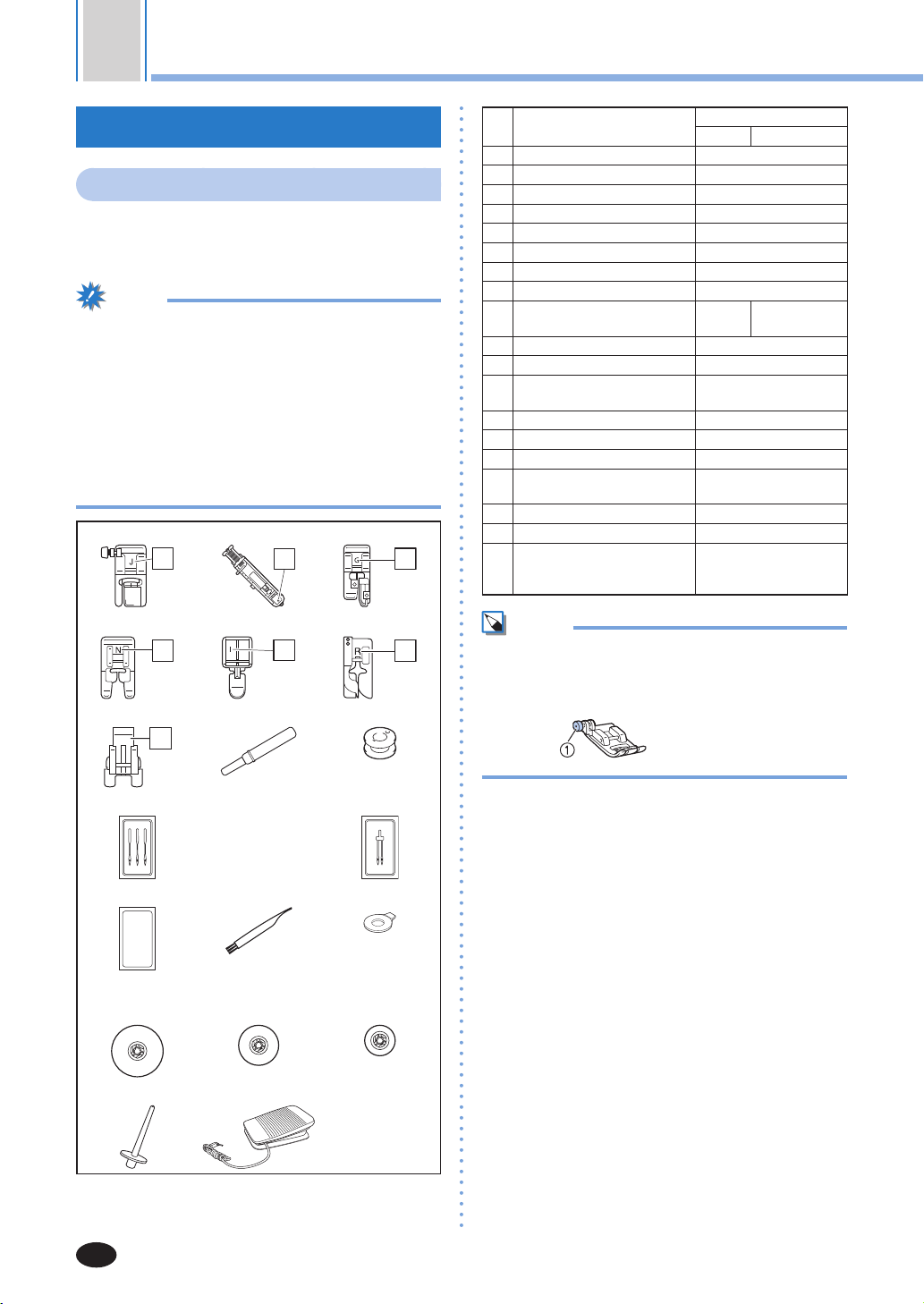
Included accessories
After opening the box, check that the following
accessories are included. If any item is missing or
damaged, contact your dealer.
Note
(For U.S.A. only)
• Foot controller: Model T
• This foot controller can be used on the machine
with product code 888-E35. The product code is
mentioned on the machine rating plate.
• The screw of the presser foot holder is available
through your authorized dealer. (Part code:
XG1343-001)
• The included accessories vary depending on the
machine model.
1.
J
2.
A
3.
G
4.
N
5.
I
6.
R
7.
M
M
8. 9.
10. 11.
12.
90 / 14 1 ne e dle
13. 14.
15. 16. 17.
18. 19.
No. Part Name
Part Code
Americas
Others
1 Zigzag foot “J” (on machine) XZ5134-001
2 Buttonhole foot “A” XC2691-033
3 Overcasting foot “G” XC3098 -031
4 Monogramming foot “N” XD0810-031
5 Zipper foot “I” X59370-021
6 Blind stitch foot “R” XE2650-001
7 Button tting foot “M” XE2137- 001
8 Seam ripper XZ5082-001
9
Bobbin (4)
(One is on machine.)
SA156
SFB:
XA5539-151
10 Needle set XC8834-021
11 Twin needle 131096-121
12
Ball point needle
(gold colored)
XD0360-021
13 Cleaning brush X59476- 051
14 Disc-shaped screwdriver XC1074 - 051
15 Spool cap (large) 130012-024
16
Spool cap (medium)
(on machine)
XE1372- 001
17 Spool cap (small) 130013-124
18 Extra spool pin XE2241-001
19 Foot controller
XD0501-121 (EU area)
XC8816-071
(Other areas)
Mem
o
• About zigzag foot “J”;
Press the black button when it is difficult for thick
seams to be fed, for example, at the beginning of
sewing thick fabrics. (Page 29)
1 Black button
75/11 1 needle
90 / 14 1 ne e dle
100/16 1 needle
KNOWING YOUR SEWING MACHINE
1
KNOWING YOUR SEWING MACHINE
5
Optional accessories
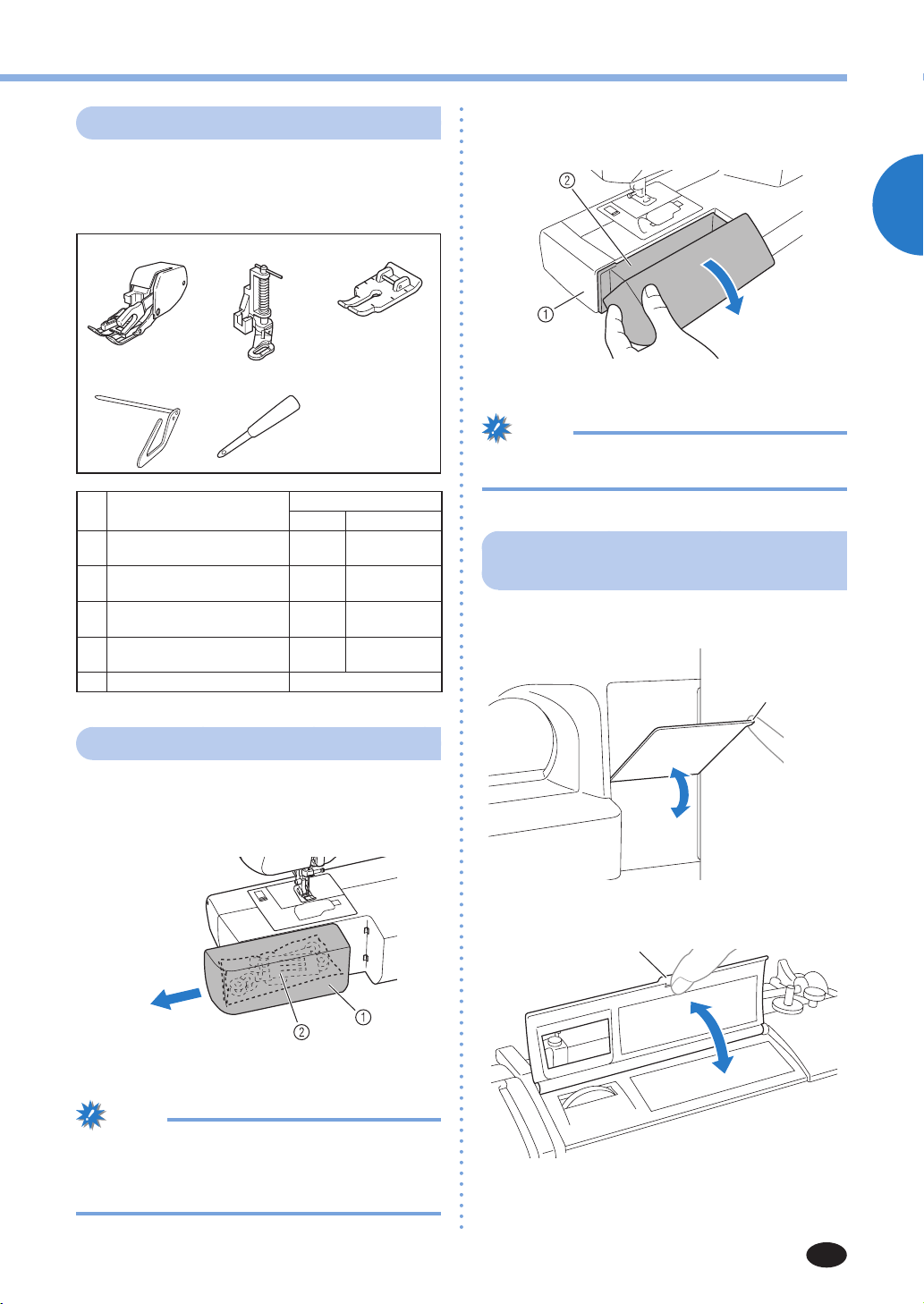
The following are available as optional accessories to
be purchased separately. Depending on the model
you purchased, the following accessory may be
included.
1. 2. 3.
4. 5.
No. Part Name
Part Code
Americas
Others
1 Walking foot SA140
F033N:
XG6623-001
2 Quilting foot SA129
F005N:
XC1948-052
3 1/4-inch quilting foot SA125
F001N:
XC1944-052
4 Quilting guide SA132
F016N:
XC2215-052
5 Eyelet punch XZ5051-001
Accessory compartment
For models equipped with a slide type flat bed
attachment
Slide the flat bed attachment as illustrated below to
open it.
1
Flat bed attachment
2
Storage compartment
Note
• Put the accessories in the bag, and then store the
bag inside the compartment when they are not
used. If the accessories are not in a bag, they may
fall out, and be lost or damaged.
For models equipped with an open type flat bed
attachment
Open the compartment as illustrated below.
1
Flat bed attachment
2
Storage compartment
Note
• Store the accessories in the compartment when
they are not used.
Flip chart (For models equipped
with a flip chart)
For models equipped with a flip chart on the front
panel
1
1 Notch
For models equipped with a flip chart on the top
panel
1
1 Notch
KNOWING YOUR SEWING MACHINE
6
NAMES OF MACHINE PARTS
AND THEIR FUNCTIONS
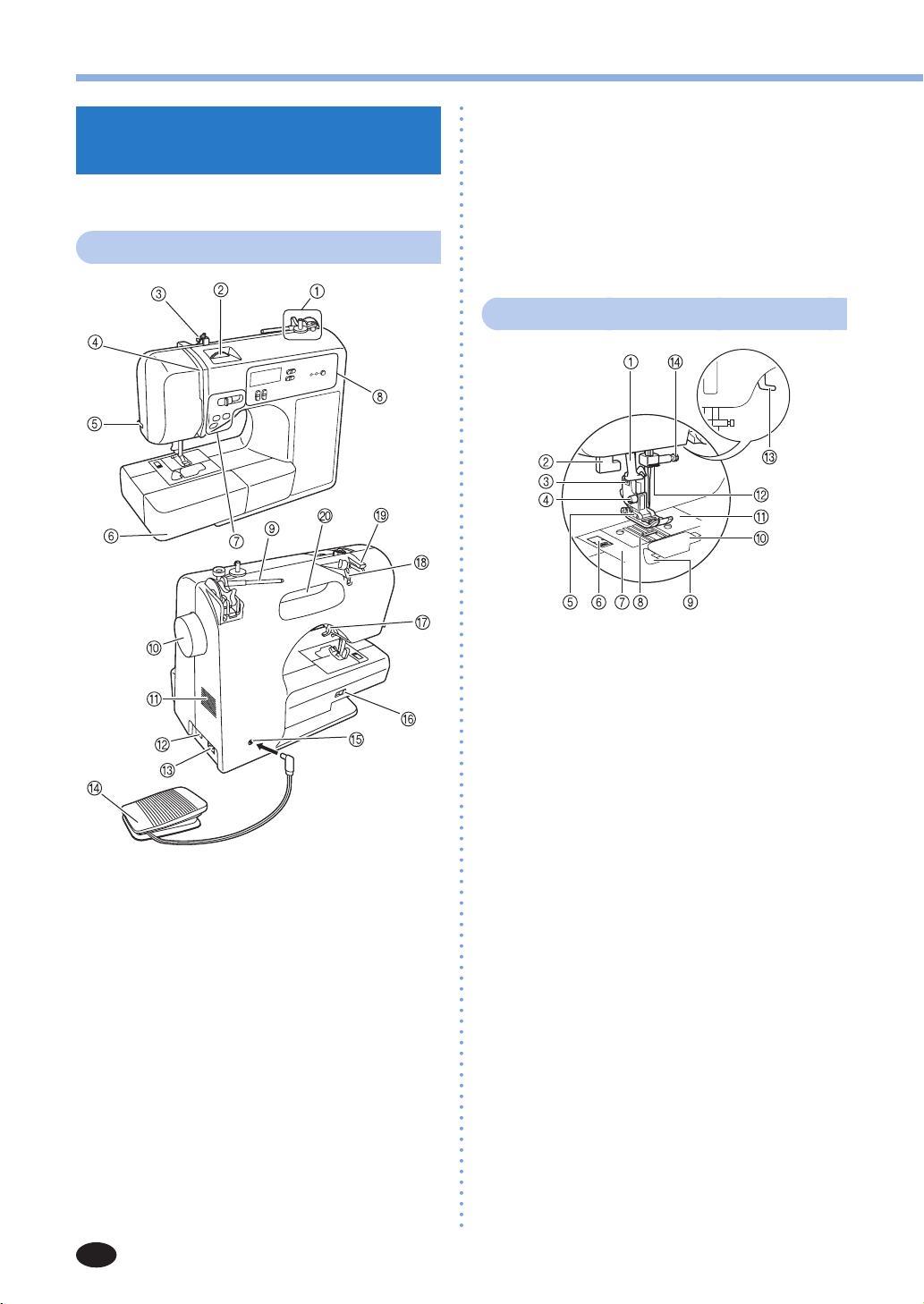
The illustrations in this operation manual may differ
from the actual machine.
The main parts
1 Bobbin winder (page 11)
2 Upper tension-control dial (page 28)
3 Bobbin-winding thread guide and pre-tension disc
(page 11)
4 Thread take-up lever (page 17)
5 Thread cutter (page 27)
6 Flat bed attachment with accessory compartment
(page 5 and 31)
7 Operation buttons (page 7)
8 Operation panel (page 7)
9 Spool pin (page 8, 11 and 16)
< Handwheel
This is used to manually raise and lower the needle.
A Air vent
This vent allows the air surrounding the motor to
circulate. Do not cover the air vent while the sewing
machine is being used.
B Main power and sewing light switch (page 9)
C Jack/socket connector (page 9)
D Foot controller (page 9)
E Foot controller jack/socket (page 9)
F Feed dog position lever (page 38 and 43)
G Presser foot lever (page 16)
H Thread guide (page 12 and 17)
I Thread guide cover (page 17)
J Handle
Carry the sewing machine by its handle when
transporting the machine.
Needle and presser foot section
1 Needle threader (for models equipped with the needle
threader) (page 18)
2 Buttonhole lever (page 36 and 45)
3 Presser foot holder
The presser foot is installed onto the presser foot holder.
4 Presser foot holder screw
Use the presser foot holder screw to hold the presser
foot holder in place.
5 Presser foot
The presser foot applies pressure consistently on the
fabric as the sewing takes place. Attach the appropriate
presser foot for the selected stitching.
6 Needle plate cover release
Use when removing the needle plate cover.
7 Needle plate cover
8 Feed dogs
The feed dogs feed the fabric in the sewing direction.
9 Quick-set bobbin (for models equipped with the
quickset bobbin)
You can start sewing without pulling up the bobbin
thread.
0 Bobbin cover
A Needle plate
The needle plate is marked with guides for sewing
straight seams.
B Needle bar thread guide (page 18)
C Presser foot lever
Raises and lowers the presser foot.
D Needle clamp screw
KNOWING YOUR SEWING MACHINE
7
1
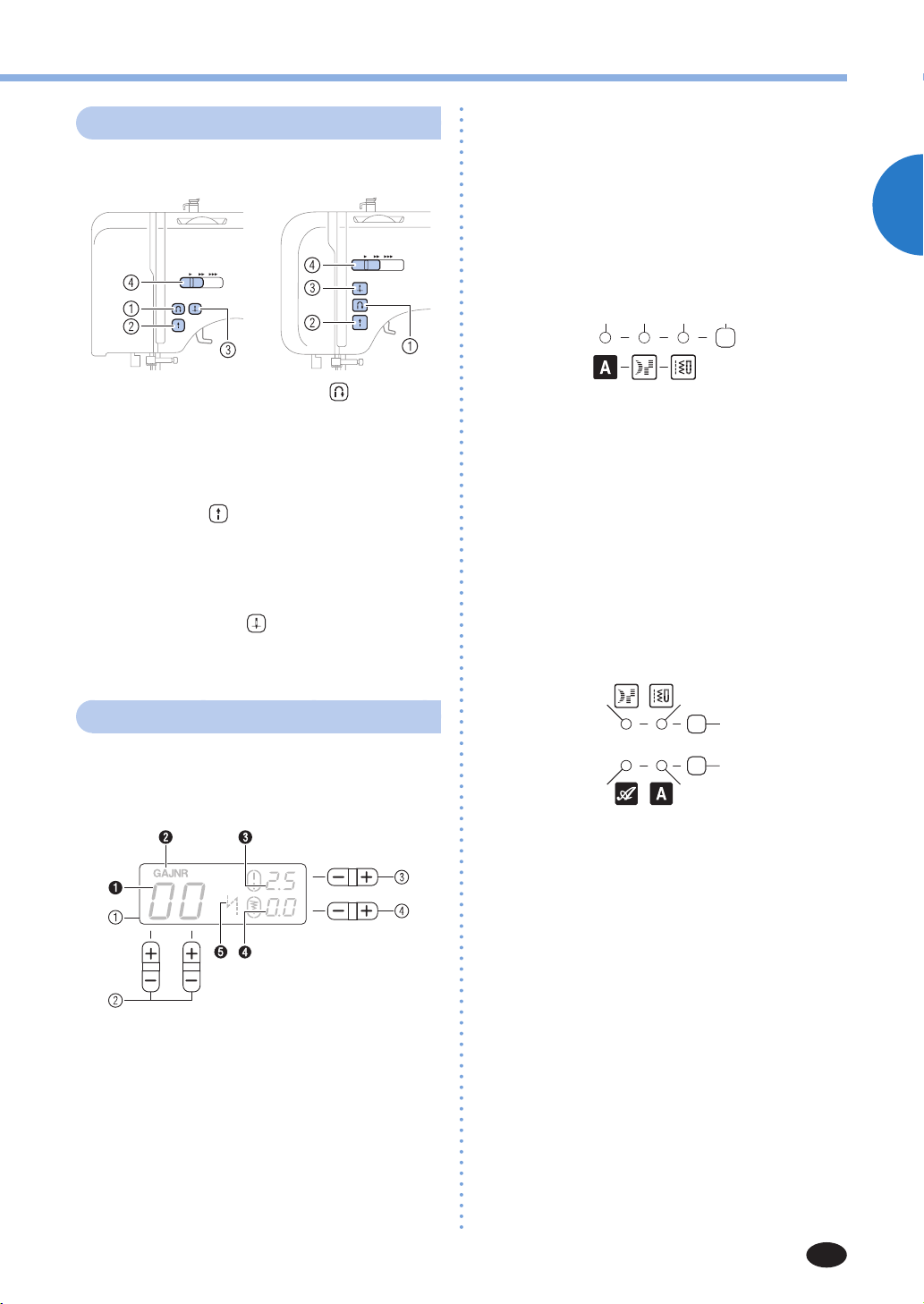
Operation buttons
The operation buttons differ depending on the
sewing machine model.
1 Reverse/reinforcement stitch button
Press this button to sew reverse stitches. Reverse
stitches are sewn by keeping the button pressed down
to sew in the opposite direction. For details, refer to
“Sewing reinforcement stitches” (page 27).
■
Buttons provided on some models
2 Start/stop button
Press this button to start or stop sewing. The machine
sews at a slow speed at the beginning of sewing while
the button is pressed. When sewing is stopped, the
needle is lowered in the fabric. For details, refer to
“Starting to sew” (page 26).
3 Needle position button
Press this button to raise or lower the needle.
4 Sewing speed controller
Slide this controller to adjust the sewing speed.
Operation panel
The operation panel allows you to select a stitch and
specify how the stitch will be sewn. The operation
panel differs depending on the sewing machine
model.
1 LCD (liquid crystal display)
The number of the selected stitch (1), the presser
foot type to be used (2), the stitch length (mm)
(3), the stitch width (mm) (4), and the auto
reverse/reinforcement (5) are displayed here.
2 Stitch selection keys (Page 25)
Select the number for the stitch that you wish to
use.
3 Stitch length adjustment key
Press the “–” side to reduce the stitch length;
press the “+” side to increase the stitch length.
4 Stitch width adjustment key
Press the “–” side to reduce the stitch width; press
the “+” side to increase the stitch width.
■
Keys and indicators provided on some models
<For models equipped with satin stitches and 1
font type of character stitches>
578 6
5 Stitch category selection key (Page 25 and 49)
Press this key to select desired stitch category.
6 Utility stitch indicator
Lights up when the utility stitch is selected with
the stitch category selection key.
7 Satin stitch indicator
Lights up when the satin stitch is selected with the
stitch category selection key.
8 Character stitch indicator (for models equipped with
character stitches)
Lights up when the character stitch is selected
with the stitch category selection key.
<For models equipped with satin stitches and 2
font types of character stitches>
8
5
9
:
6
7
5 Utility stitch key (Page 25)
Selects the desired type of utility stitches.
6 Utility stitch indicator
Lights up when the utility stitch is selected with
the utility stitch key.
7 Satin stitch indicator
Lights up when the satin stitch is selected with the
utility stitch key.
8 Character stitch key (Page 50)
Selects the desired font type of character stitches.
9 Character stitch indicator (Gothic font)
Lights up when the character stitch (Gothic font) is
selected with the character stitch key.
: Character stitch indicator (Script font)
Lights up when the character stitch (Script font) is
selected with the character stitch key.
KNOWING YOUR SEWING MACHINE
8
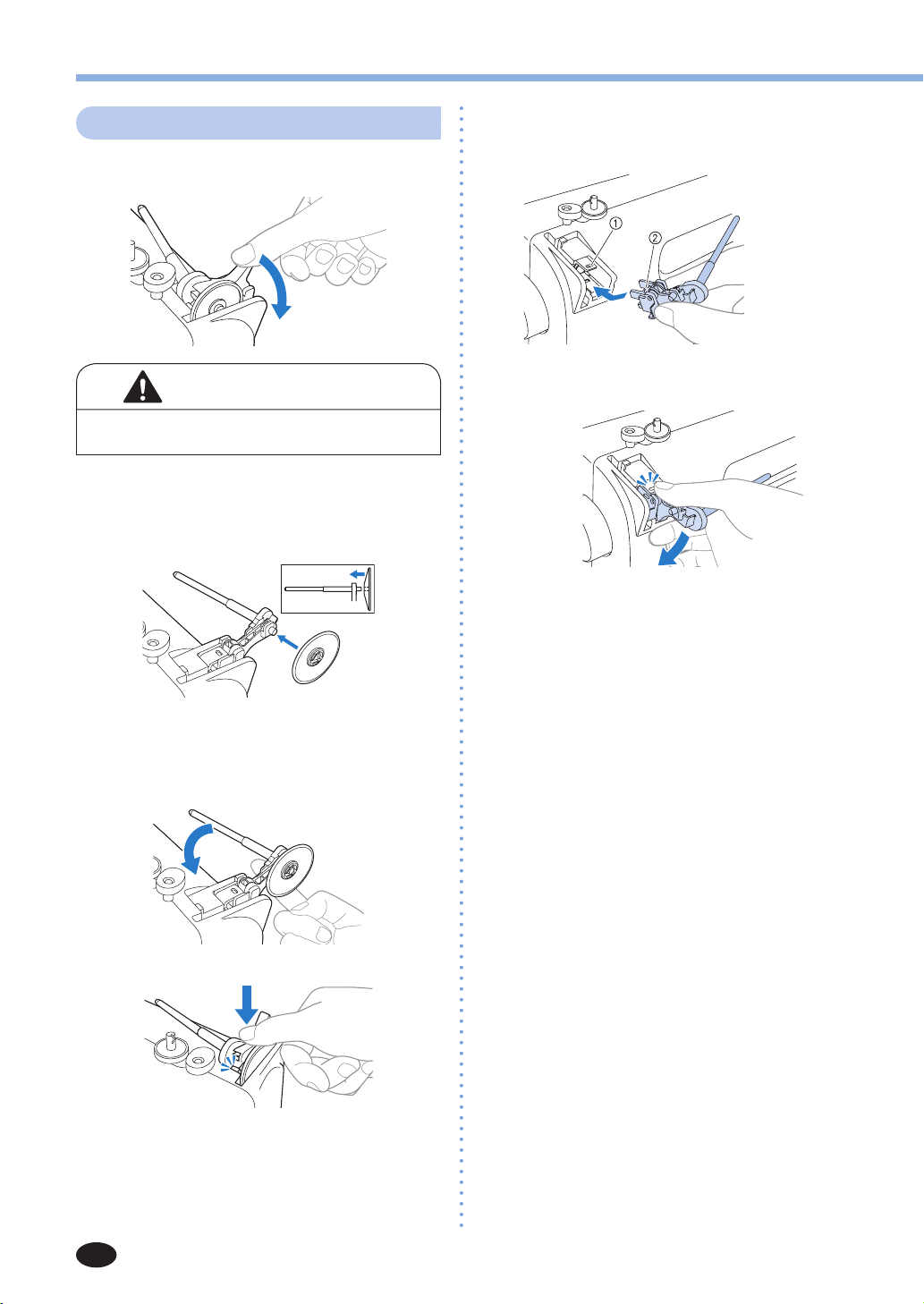
Spool pin
Press down on the spool pin lever to raise the spool
pin.
CAUTION
• Do not grab the bar to raise the spool pin,
otherwise, the spool pin may bend or break.
■
Storing the spool cap
The included spool cap (large, medium, small)
can be stored by attaching it to the spool pin as
illustrated below.
■
Storing the spool pin
When placing the cover on the sewing machine
or if the spool pin will not be used, return the
spool pin to its storage position.
Press until it clicks.
■
Installing the spool pin
1
Insert the tab on the spool pin into the hole.
1
Hole
2
Tab
2
Push the spool pin down until it locks into
place.
KNOWING YOUR SEWING MACHINE
9
1
USING YOUR SEWING
MACHINE
Power supply precautions
Be sure to observe the following precautions
concerning the power supply.
WARNING
• Use only regular household electricity for the
power source. Using other power sources may
result in fire, electric shock, or damage to the
machine.
• Make sure that the plugs on the power cord
are firmly inserted into the electrical outlet
and the power supply jack on the machine.
Otherwise, a fire or electric shock may result.
• Do not insert the plug on the power cord into
an electrical outlet that is in poor condition.
• Turn off the main power and remove the plug
in the following circumstances:
· When you are away from the machine
· After using the machine
· When the power fails during use
· When the machine does not operate
correctly due to a bad connection or a
disconnection
· During electrical storms
CAUTION
• Use only the power cord included with this
machine.
• Do not use extension cords or multi-plug
adapters with many other appliances plugged
in to them. Fire or electric shock may result.
• Do not touch the plug with wet hands. Electric
shock may result.
• When unplugging the machine, always turn off
the main power first. Always grasp the plug
to remove it from the outlet. Pulling on the
cord may damage the cord, or lead to fire or
electric shock.
• Do not allow the power cord to be cut,
damaged, modified, forcefully bent, pulled,
twisted, or bundled.
Do not place heavy objects on the cord. Do
not subject the cord to heat. These things may
damage the cord and cause fire or electric
shock. If the cord or plug is damaged, take the
machine to your authorized dealer for repairs
before continuing use.
• Unplug the power cord if the machine is not to
be used for a long period of time. Otherwise a
fire may result.
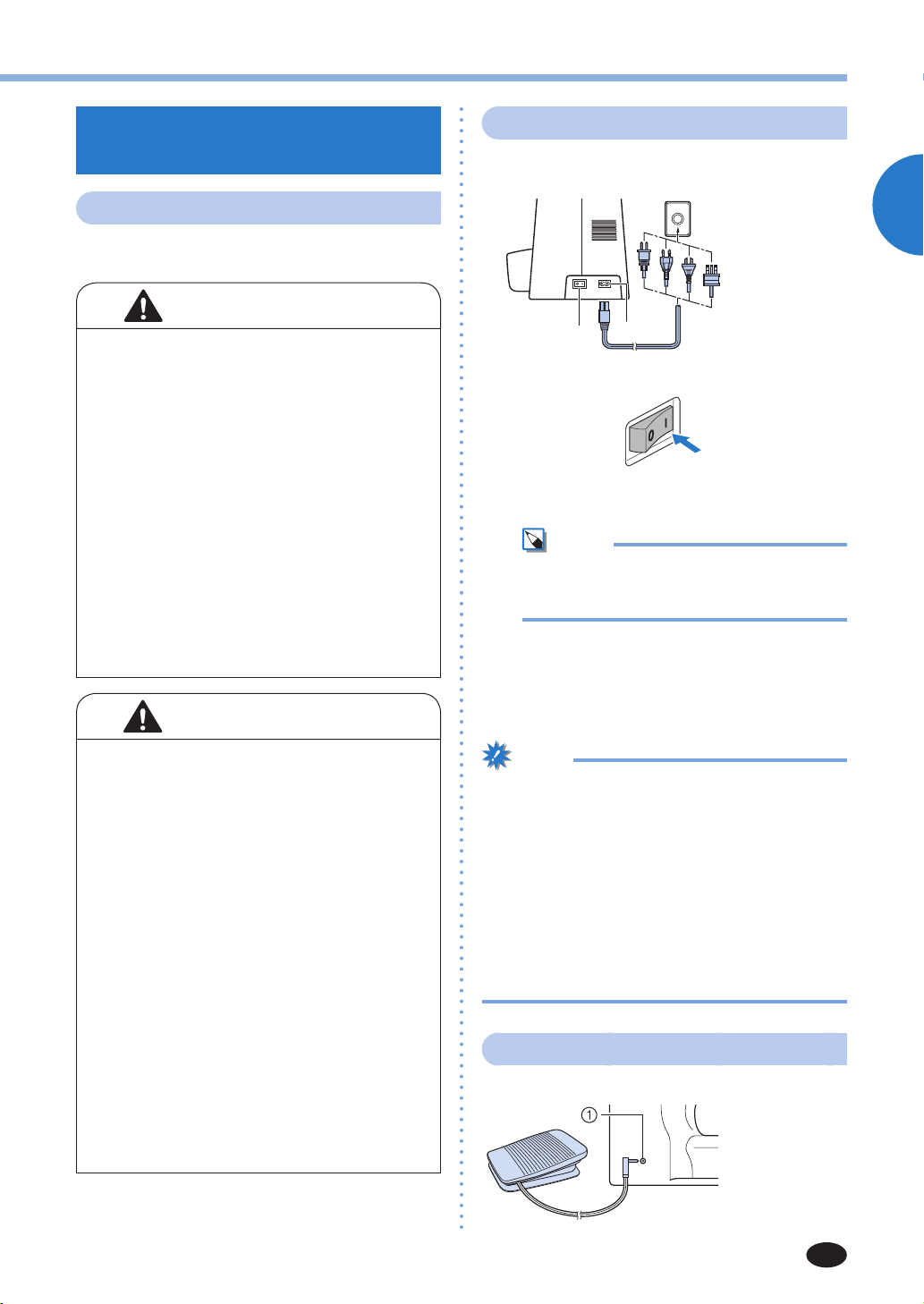
Power supply
1
Insert the plug into a wall outlet.
2
1
1
Main power
switch
2
Jack/socket
connector
2
Set the main power switch to “I”.
X
The sewing light comes on when the
machine is turned on.
Mem
o
•When the machine is turned on, the needle
and the feed dogs will make sound when
they move; this is not a malfunction.
3
To turn off the machine, set the main power
switch to “”.
X
The sewing light goes off when the machine
is turned off.
Note
•If a power outage occurs while the sewing
machine is being operated, turn off the sewing
machine and unplug the power supply cord.
(For U.S.A. only)
•This appliance has a polarized plug (one blade
wider than the other). To reduce the risk of
electric shock, this plug is intended to fit in a
polarized outlet only one way. If the plug does
not fit fully in the outlet, reverse the plug.
If it still does not fit, contact a qualified electrician
to install the proper outlet. Do not modify the
plug in any way.
Foot controller
Insert the foot controller plug into its jack/socket.
1
Foot controller jack/socket
KNOWING YOUR SEWING MACHINE
10
CAUTION
• When connecting the foot controller, be sure
to turn off the sewing machine in order to
prevent the machine from accidentally being
started.
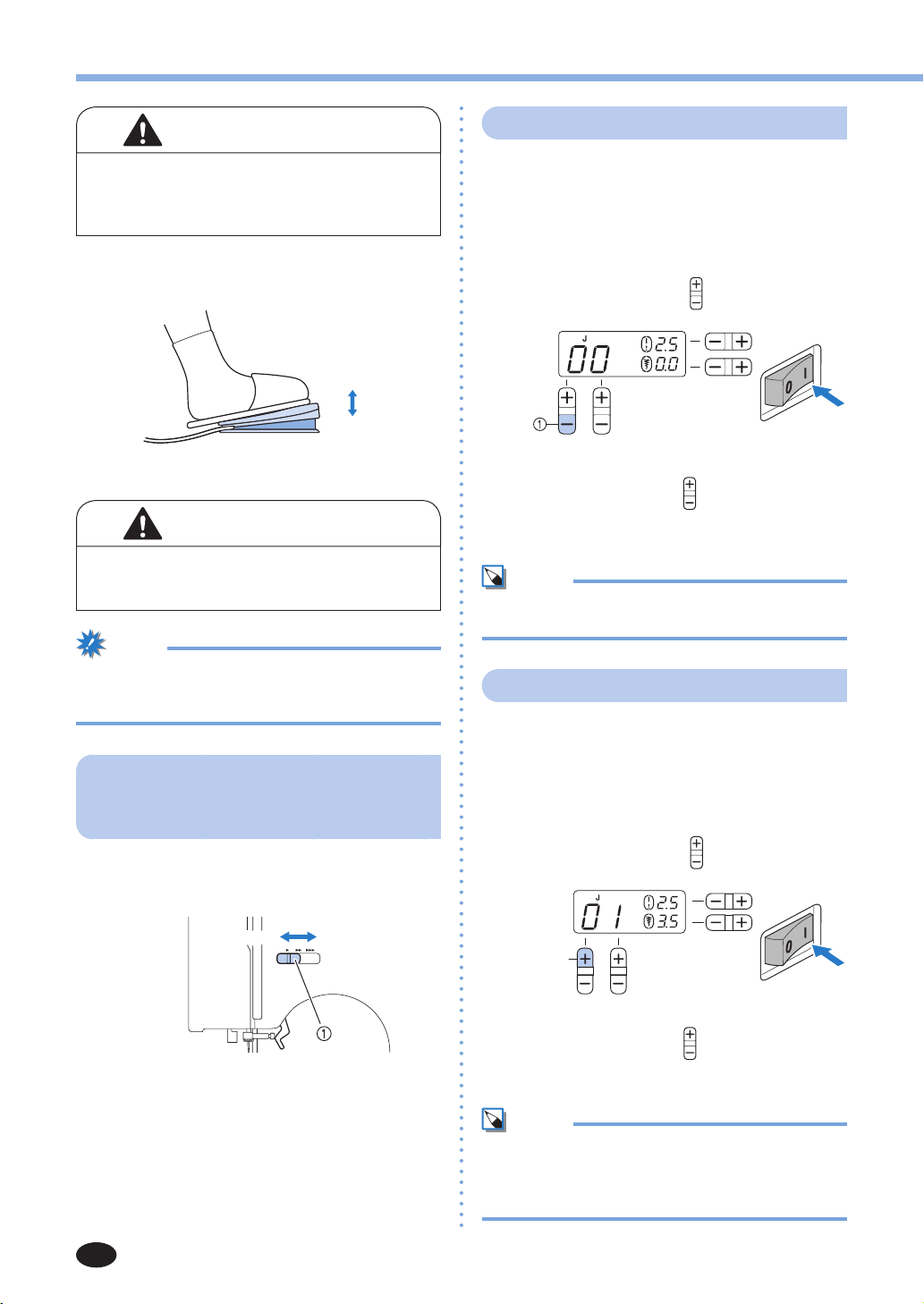
Depress the foot controller to start sewing, and
adjust the sewing speed by changing the pressing
force.
Slower
Faster
You should make sure that nothing is placed on the
foot controller when the machine is not in use.
CAUTION
• Do not allow pieces of cloth and dust to build
up on the foot controller. Doing so could cause
a fire or an electric shock.
Note
•When the foot controller is plugged in, the start/
stop button cannot be used to start sewing (only
for models equipped with the start/stop button).
Sewing speed controller (for
models equipped with the start/
stop button)
1
Slide the sewing speed controller to select
the desired sewing speed.
Slower Faster
1
Sewing speed controller
• Thespeedsetusingthesewingspeed
controller is the foot controller’s maximum
sewing speed.
Changing the needle stop position
Normally, the sewing machine is set to leave the
needle in the fabric when sewing is stopped. Instead,
the machine can be set to leave the needle raised
when sewing is stopped.
1
Turn off the sewing machine.
2
Holding the “–” side of (1) pressed, turn
on the sewing machine.
3
After the sewing machine has turned on,
release the “–” side of
(1).
X
The needle stop position changes to the
raised position.
Mem
o
•Perform the same operation to change the needle
stop position to the lowered position.
Changing the initial needle position
Normally, the straight stitch (left needle position) is
automatically selected when the sewing machine
is turned on. The initial needle position can be
changed to the straight stitch (center needle position).
1
Turn off the sewing machine.
2
Holding the “+” side of (2) pressed, turn
on the sewing machine.
3
After the sewing machine has turned on,
release the “+” side of
(2).
X
The initial needle position changes to the
center needle position.
Mem
o
•The specified initial needle position is maintained
after the machine is turned off.
•Perform the same operation to change the initial
needle position to the left needle position.
KNOWING YOUR SEWING MACHINE
11
1
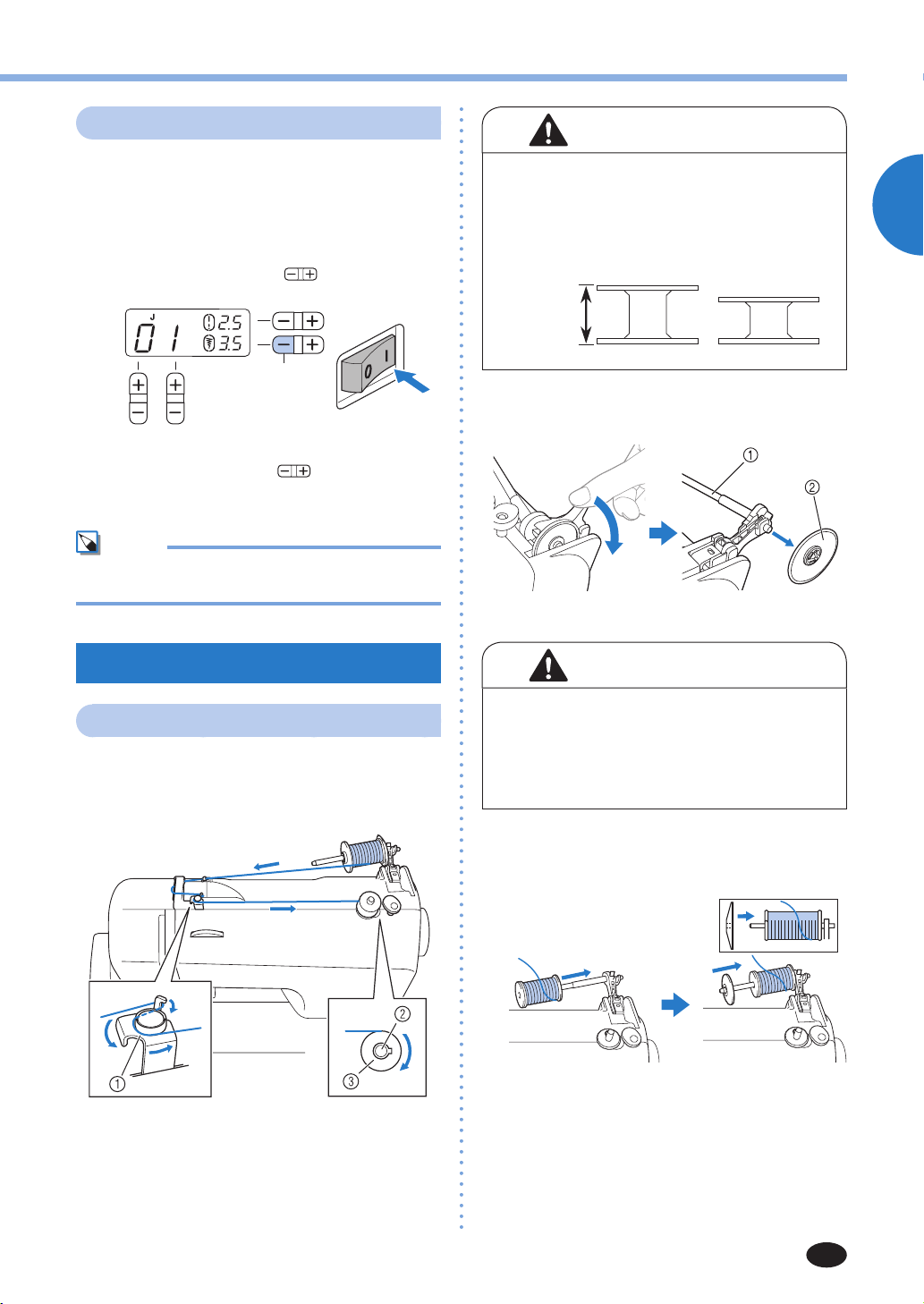
Cancelling the operation beep
When the sewing machine is purchased, it is set to
beep each time a key is pressed. This setting can be
changed so that the machine does not beep.
1
Turn off the sewing machine.
2
Holding the “–” side of (3) pressed,
turn on the sewing machine.
3
After the sewing machine has turned on,
release the “–” side of
(3).
X
The machine is now set so that it will not
beep.
Mem
o
•Perform the same operation to change the setting
so that machine beeps.
THREADING THE MACHINE
Winding the bobbin
This section describes how to wind the thread onto
the bobbin.
•For details on the fast bobbin winding, see page
13.
1
Bobbin-winding thread guide
2
Bobbin winder shaft
3
Bobbin
CAUTION
• Only use the bobbin that comes with this
machine or bobbins of the same type (part
code: SA156, SFB: XA5539-151). Using other
bobbins may cause damage to the machine.
SA156 is Class 15 type bobbin.
This model
Actual size
11.5 mm
(7/16 inch)
Other models
1
Press down on the spool pin lever to swing
up the spool pin. Then remove the spool cap.
1
Spool pin
2
Spool cap
CAUTION
• Do not grab the bar to raise the spool pin,
otherwise, the spool pin may bend or break.
• Be sure to raise the spool pin when winding
the bobbin. The thread may become tangled if
the bobbin winder is used without raising the
spool pin.
2
Fully insert the spool of thread for the
bobbin, and then slide the spool cap onto the
spool pin.
•The thread should be unwound from the
bottom to the front.
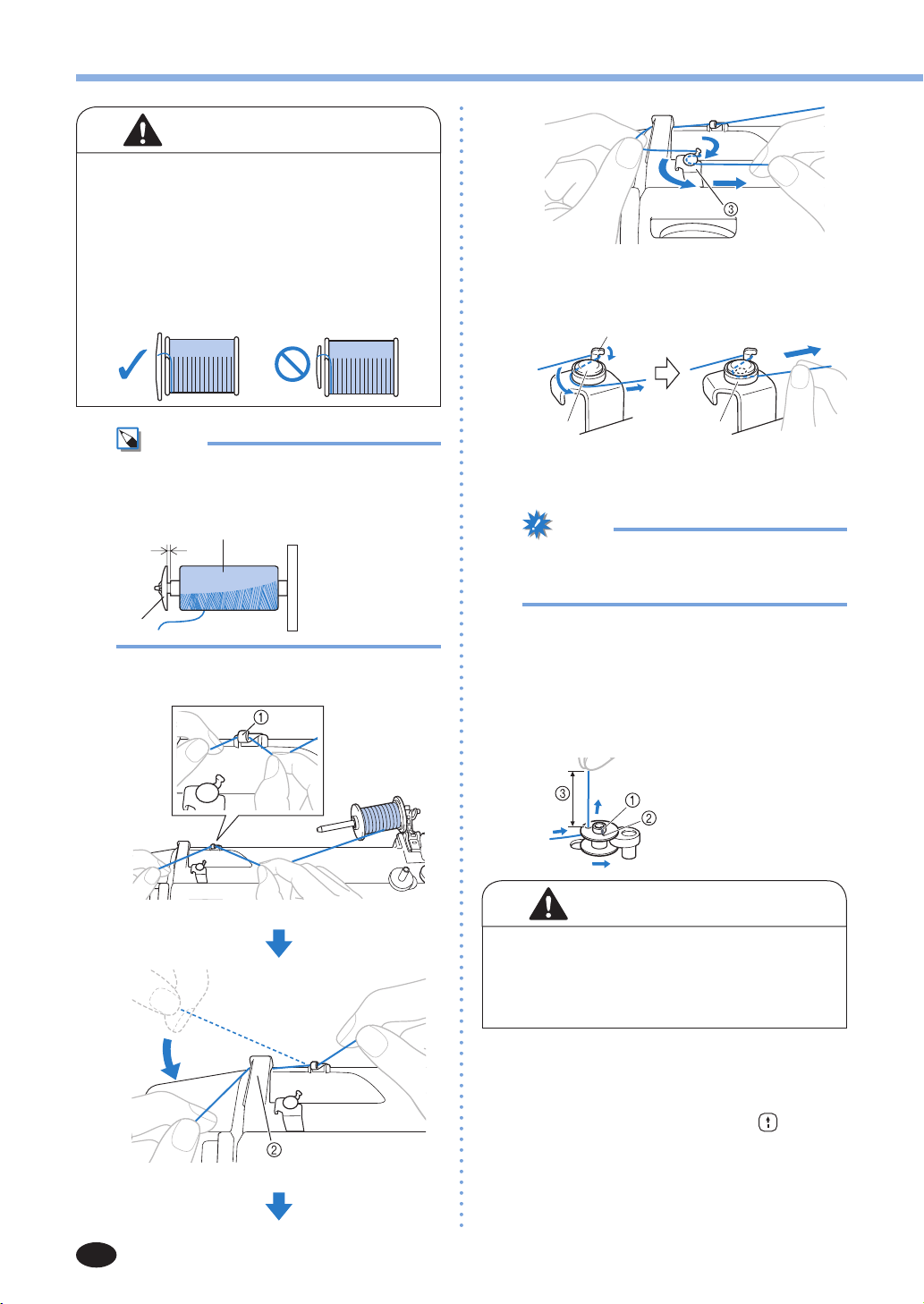
KNOWING YOUR SEWING MACHINE
12
CAUTION
• If the spool or the spool cap is not positioned
correctly, the thread may become tangled
around the spool pin or the machine may be
damaged.
• Three spool cap sizes are available. Choose a
spool cap that best fits the size of spool being
used. If the spool cap is too small for the spool,
the thread may catch on the slit in the spool or
the machine may be damaged.
Mem
o
•When sewing with fine, cross-wound
thread, use the small spool cap, and leave a
small space between the cap and the spool.
1
3
2
1
Spool cap
(small)
2
Spool (cross-
wound thread)
3
Space
3
Pass the thread as illustrated bellow.
1
Thread guide
2
Thread guide cover
3
Bobbin-winding thread guide
Make sure that the thread passes under the
pre-tension disk.
4
56
4
Hook
5
Pre-tension disk
6
Pull it in as far as possible.
Note
•Make sure that the thread is pulled as far as
possible into the pre-tension disk, otherwise
the bobbin may not be wound cleanly.
4
Put the bobbin onto the bobbin winder shaft and
slide the bobbin winder shaft to the right. Turn
the bobbin clockwise, by hand, until the spring
on the shaft slides into the notch in the bobbin.
•Make sure to pull out 7 to 10 cm (2-3/4 to
3-15/16 inches) of thread.
1
Spring on the shaft
2
Notch
3
7 – 10 cm
(3 – 4 inches)
CAUTION
• Pull the thread taut and hold the end of the
thread straight up. If the thread is too short,
not pulled taut or held at an angle, injuries
may occur when the thread is wound around
the bobbin.
5
Turn on the sewing machine.
6
While holding the end of the thread, gently
press the foot controller or press
(start/
stop button) (for models equipped with
the start/stop button) to wind the thread
around the bobbin a few times. Then stop the
machine and trim the excess thread.
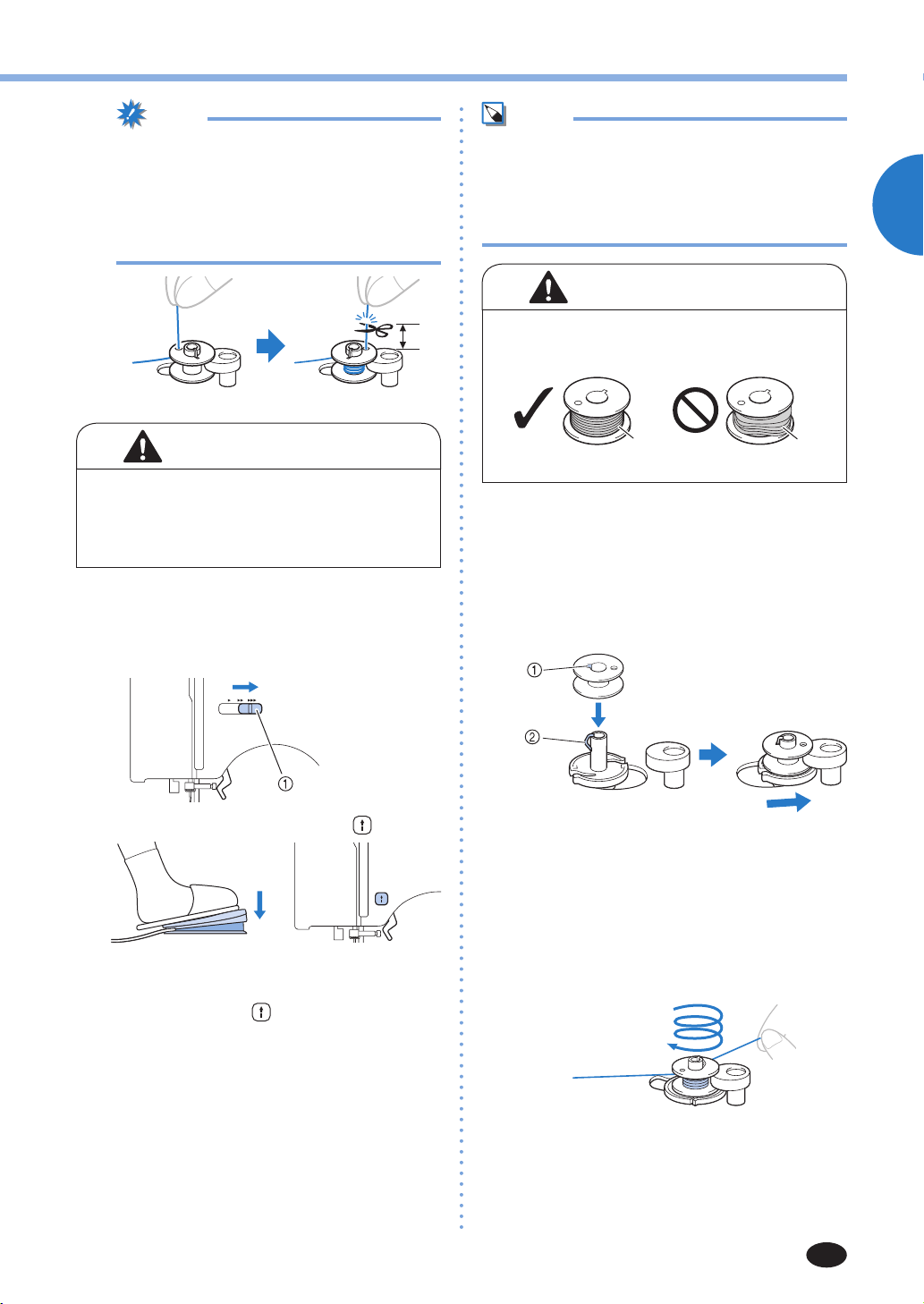
KNOWING YOUR SEWING MACHINE
13
1
Note
•When using the foot controller to operate
the sewing machine, connect the foot
controller before turning on the machine.
•When the foot controller is plugged in, the
start/stop button cannot be used to start
sewing (only for models equipped with the
start/stop button).
1
1 1 cm (3/8 inch)
CAUTION
• Make sure you follow the instructions carefully.
If you do not cut the thread completely, and
the bobbin is wound, when the thread runs
low it may tangle around the bobbin and cause
the needle to break.
7
(For models equipped with the sewing speed
controller)
Slide the sewing speed controller to the right
(to set the speed to fast).
1
Sewing speed
controller
8
Press the foot controller or press to start.
or
9
When the bobbin seems full and begins
spinning slowly, take your foot off the foot
controller or press
.
10
Cut the thread, slide the bobbin winder shaft
to the left and remove the bobbin.
11
(For models equipped with the sewing speed
controller)
Slide the sewing speed controller back to its
original position.
Mem
o
•When the sewing machine is started or the
handwheel is turned after winding the thread
around the bobbin, the machine will make a
clicking sound; this is not a malfunction.
•The needle bar does not move when you slide the
bobbin winding shaft to the right.
CAUTION
• Not winding the bobbin properly may cause
the thread tension to loosen, and may break
the needle.
1
2
1
Wound evenly
2
Wound poorly
■
For models equipped with the fast bobbin
winding system
1
Place the bobbin on the bobbin winder shaft
so that the spring on the shaft fits into the
notch in the bobbin. Then slide the shaft to
the right.
1
Notch
2
Spring
2
Follow steps 1 through 3 of the procedure
in “Winding the bobbin” to pass the thread
around the pre-tension disk (page 11).
3
Wind the free end of the thread clockwise
around the bobbin five or six times.
KNOWING YOUR SEWING MACHINE
14
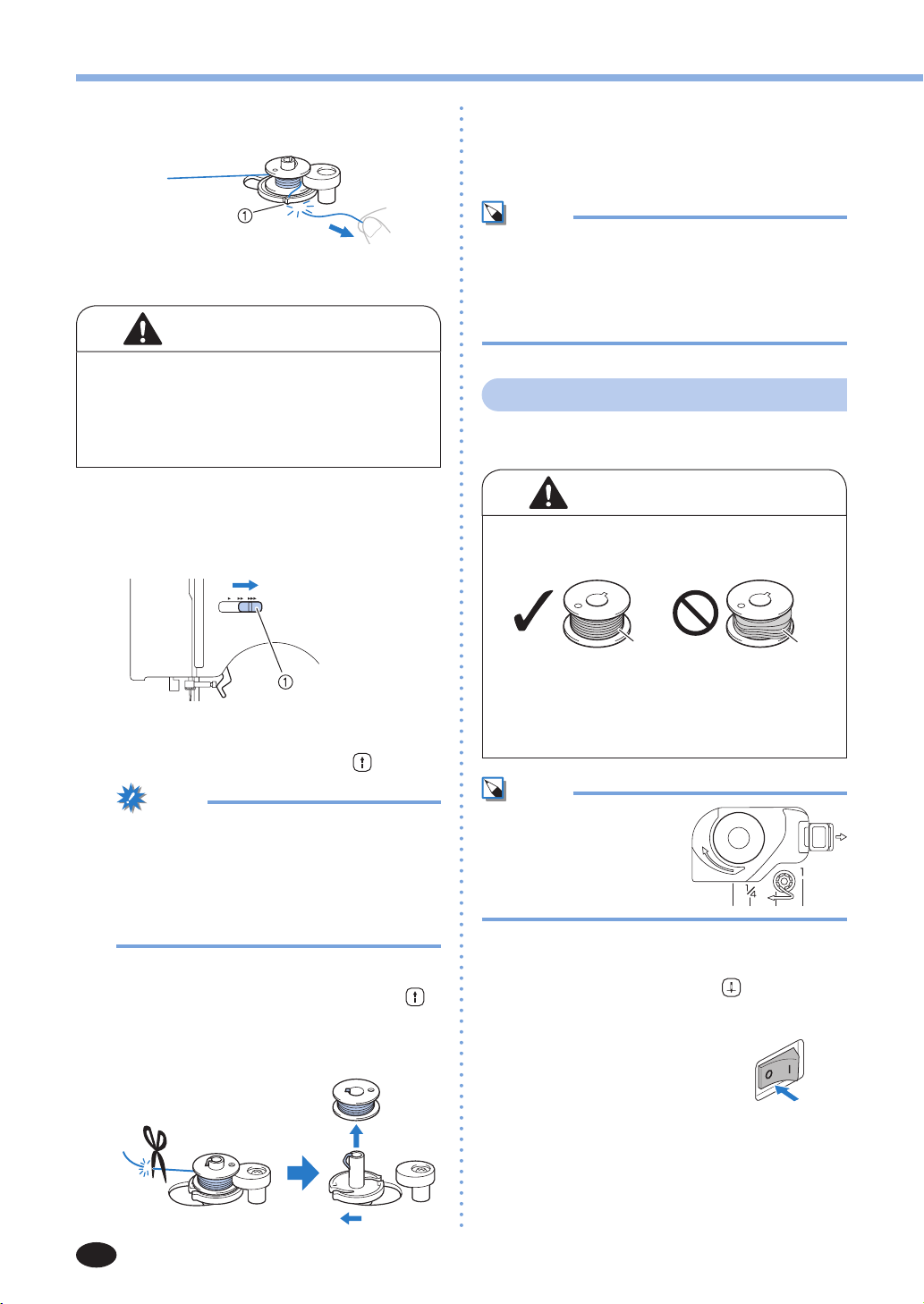
4
Pull the thread and pass it through the slit in
the bobbin winder seat.
1
Slit (with built-in cutter)
X
The thread is cut to a suitable length.
CAUTION
• Be sure to cut the thread as described. If the
bobbin is wound without cutting the thread
using the cutter built into the slit, the thread
may become tangled in the bobbin or the
needle may bend or break when the bobbin
thread starts to run out.
5
(For models equipped with the sewing speed
controller)
Slide the sewing speed controller to the right
(to set the speed to fast).
1
Sewing speed
controller
6
Turn on the sewing machine.
7
Press the foot controller or press to start.
Note
•When using the foot controller to operate
the sewing machine, connect the foot
controller before turning on the machine.
•When the foot controller is plugged in, the
start/stop button cannot be used to start
sewing (only for models equipped with the
start/stop button).
8
When the bobbin begins spinning slowly, take
your foot off the foot controller or press
.
9
Cut the thread, slide the bobbin winder shaft
to the left, and then remove the bobbin from
the shaft.
10
(For models equipped with the sewing speed
controller)
Slide the sewing speed controller back to its
original position.
Mem
o
•When the sewing machine is started or the
handwheel is turned after winding the thread
around the bobbin, the machine will make a
clicking sound; this is not a malfunction.
•The needle bar does not move when you slide the
bobbin winding shaft to the right.
Lower threading
Install the bobbin wound with thread.
•For more details on quick-set bobbin, see page 15.
CAUTION
• Winding the bobbin improperly may cause the
thread tension to loosen, breaking the needle
and resulting in injury.
1
2
1
Wound evenly
2
Wound poorly
• Make sure you turn the power off while
threading the machine. If you accidentally step
on the foot controller and the machine starts
to sew, you could be injured.
Mem
o
•The direction for feeding
the bobbin thread is
indicated by marks on
the needle plate cover.
Be sure to thread the
machine as indicated.
1
Raise the needle to its highest position
by turning the handwheel toward you
(counterclockwise) or press
(needle
position button) (for models equipped with
the needle position button), and raise the
presser foot lever.
2
Turn off the sewing machine.
KNOWING YOUR SEWING MACHINE
15
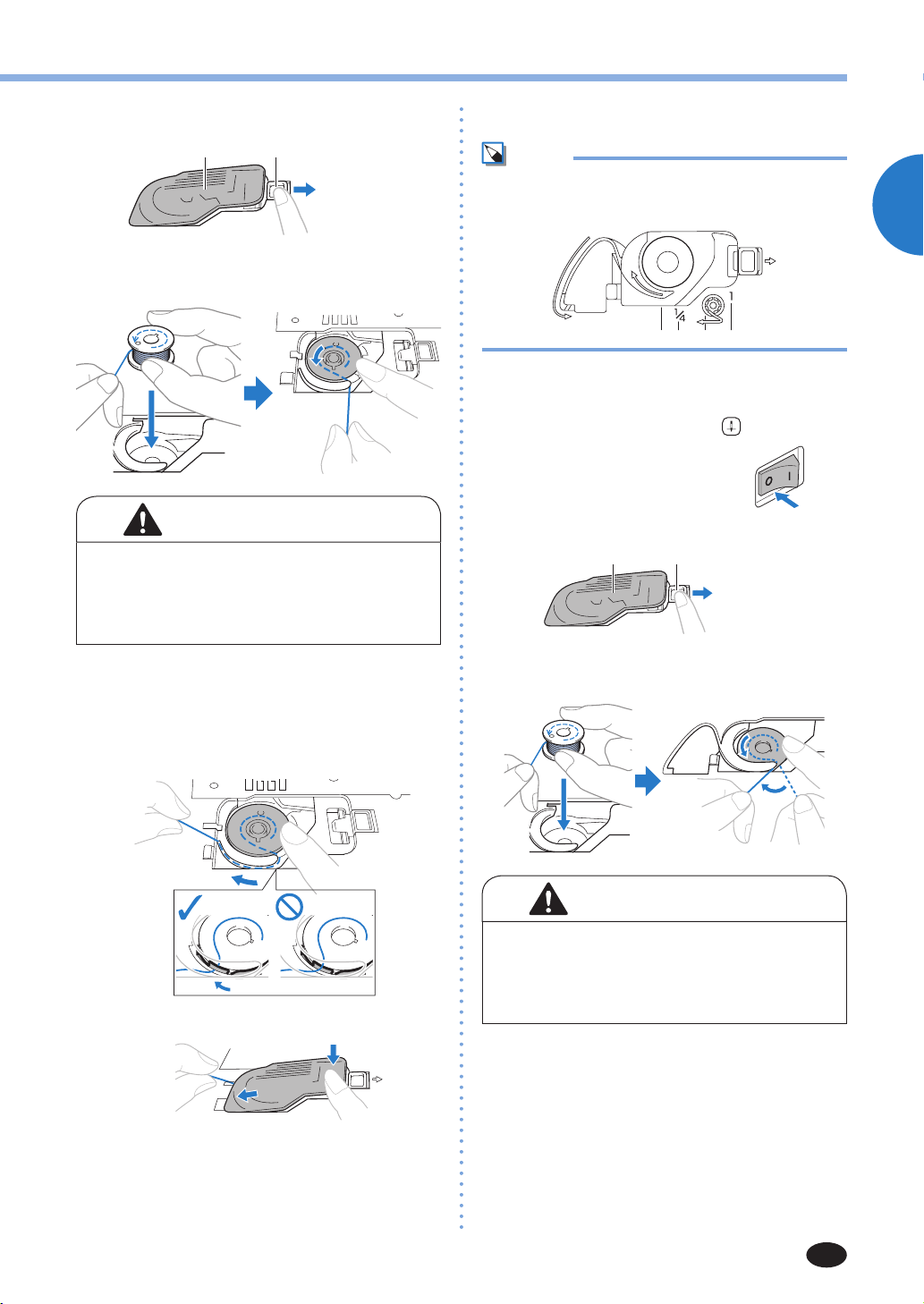
1
3
Slide the button and open the cover.
12
1
Cover
2
Slide button
4
Put the bobbin in so the thread comes out in
the direction shown by the arrow.
CAUTION
• Make sure you set the bobbin so the thread
unrolls in the right direction. If the thread
unrolls in the wrong direction, it may cause
the thread tension to be incorrect or break the
needle.
5
Hold the end of the thread, push the bobbin
down with your finger, and then pass the
thread through the slit, as shown.
•If the thread is not correctly inserted, it may
cause incorrect thread tension (page 28).
6
Replace the bobbin cover.
•Replace the cover so that the end of the
thread comes out from the left side of the
cover (as shown by the line in the diagram).
■
For models equipped with the quick-set bobbin
Mem
o
•The direction for feeding the bobbin thread is
indicated by marks on the needle plate cover. Be
sure to thread the machine as indicated.
1
Raise the needle to its highest position
by turning the handwheel toward you
(counterclockwise) or press
, and raise the
presser foot lever.
2
Turn off the sewing machine.
3
Slide the button and open the cover.
12
1
Cover
2
Slide button
4
Put the bobbin in so the thread comes out in
the direction shown by the arrow.
CAUTION
• Make sure you set the bobbin so the thread
unrolls in the right direction. If the thread
unrolls in the wrong direction, it may cause
the thread tension to be incorrect or break the
needle.
5
While lightly holding down the bobbin, guide
the thread through the slit (1 and 2).
•At this time, check that the bobbin easily
rotates counterclockwise.
Then, pull the thread toward you to cut it
with the cutter (3).
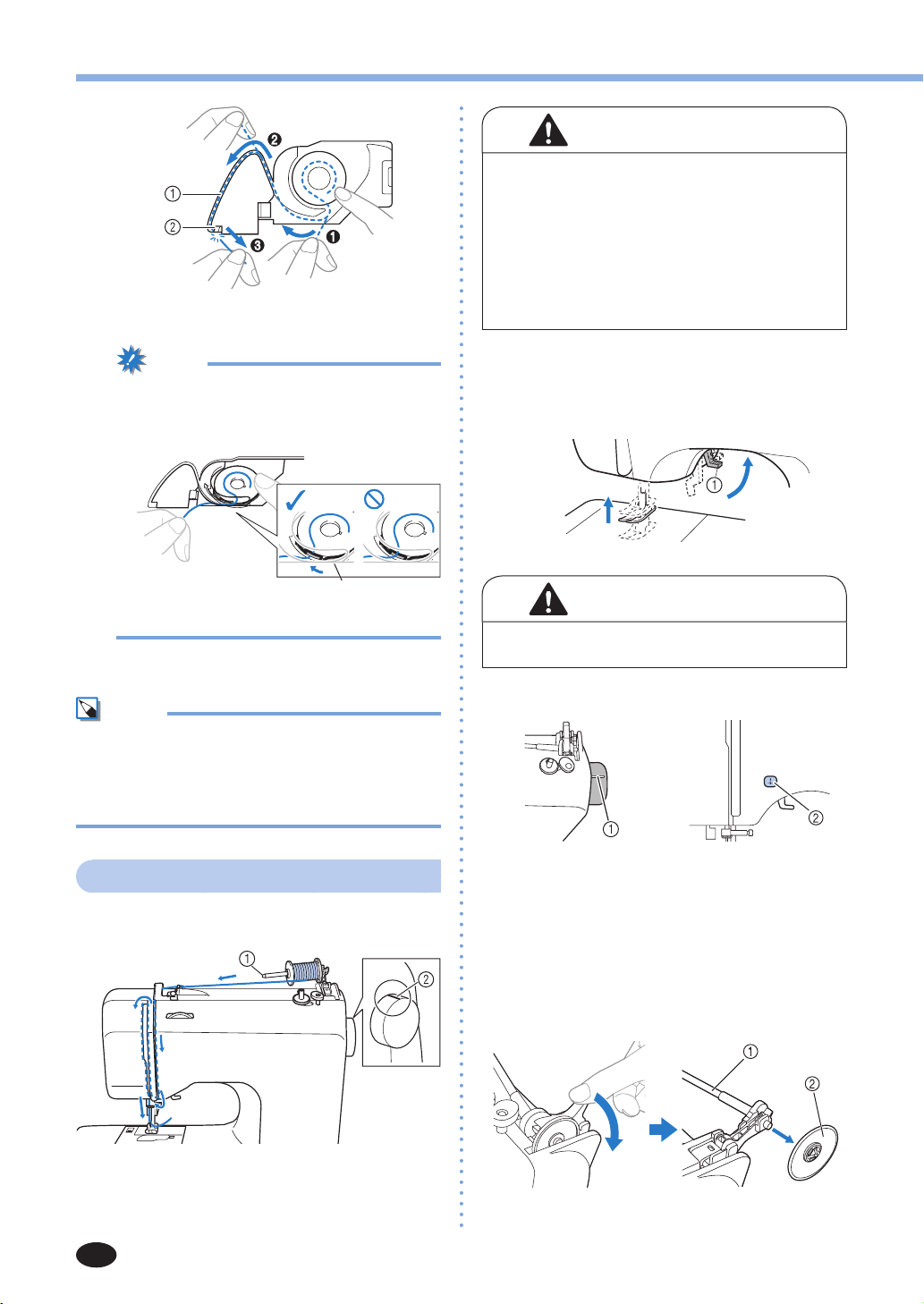
KNOWING YOUR SEWING MACHINE
16
1
Slit
2
Cutter (Cut the thread with the cutter.)
Note
•If the thread is not correctly inserted
through the tension-adjusting spring of the
bobbin case, it may cause incorrect thread
tension (page 28).
1
1
Tension-adjusting spring
6
Replace the bobbin cover.
Mem
o
•You can begin sewing immediately without
drawing up the bobbin thread. If you want to
draw up the bobbin thread before you start to
sew, follow to the procedure in “Drawing up the
lower thread” (page 19).
Upper threading
Set the upper thread and thread the needle.
•For details on the needle threader, see page 18.
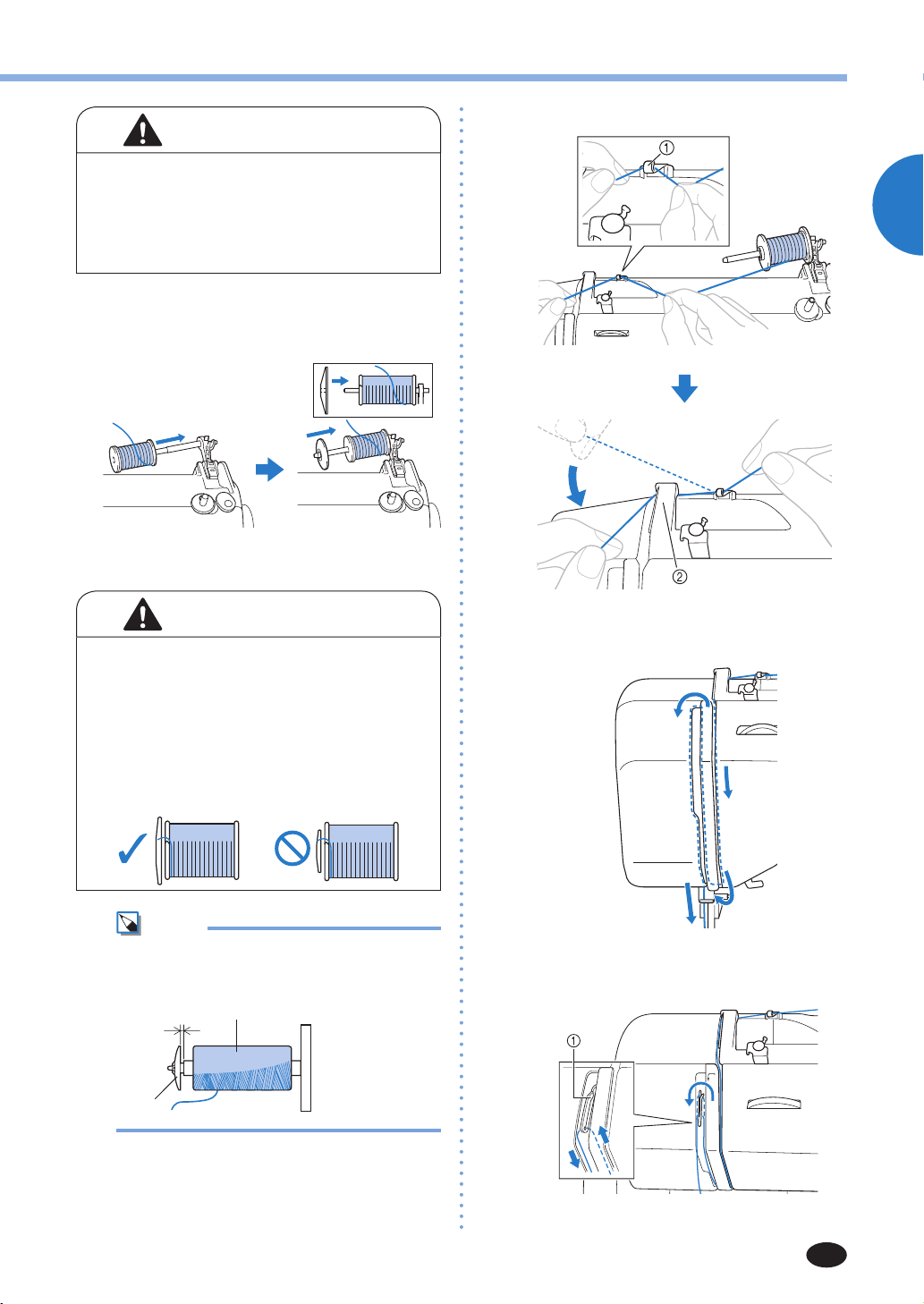
1
Spool pin
2
Mark on the handwheel
CAUTION
• When threading the upper thread, carefully
follow the instructions. If the upper threading
is not correct, the thread may become tangled
or the needle may bend or break.
• Never use a thread weight of 20 or lower.
• Use the needle and the thread in the correct
combination. For details on the correct
combination of needles and threads, refer to
“Needle types and their uses” (page 20).
1
Turn on the sewing machine.
2
Raise the presser foot, using the presser foot
lever.
1
Presser foot lever
CAUTION
• If the presser foot is not raised, the sewing
machine cannot be threaded correctly.
3
Raise the needle in the following way.
or
1 Turn the handwheel so
that the mark on the
wheel points up.
2 Press the Needle position
button (for the models
equipped with this button).
•If the needle is not correctly raised, the
sewing machine cannot be threaded. Be
sure to raise the needle before threading the
sewing machine.
4
Press down on the spool pin lever to swing
up the spool pin. Then remove the spool cap.
1
Spool pin
2
Spool cap
KNOWING YOUR SEWING MACHINE
17
1
CAUTION
• Do not grab the bar to raise the spool pin,
otherwise, the spool pin may bend or break.
• Be sure to raise the spool pin when winding
the bobbin. The thread may become tangled if
the bobbin winder is used without raising the
spool pin.
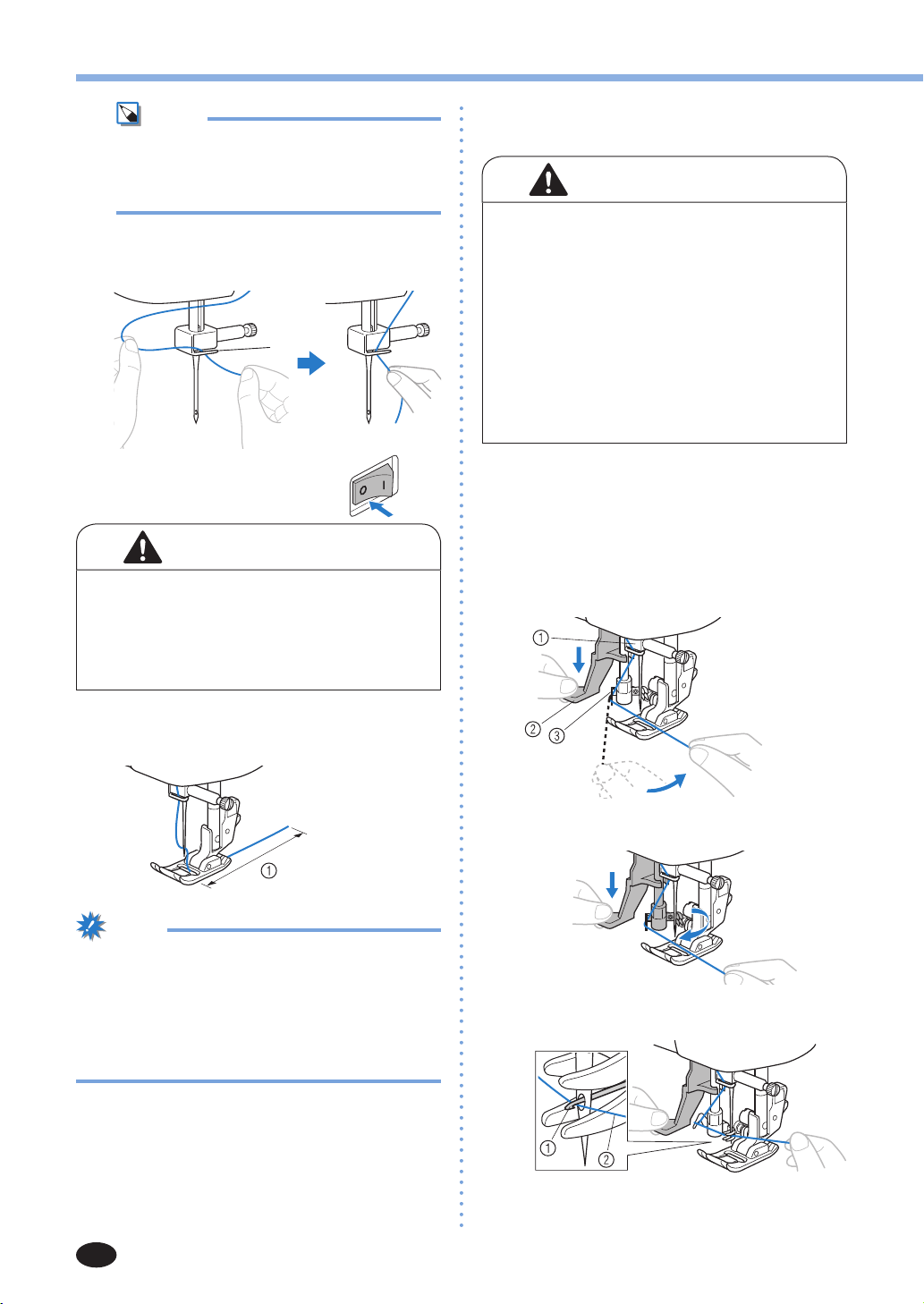
5
Fully insert the spool for the upper thread
onto the spool pin.
Slide the spool cap onto the spool pin.
•The thread should be unwound from the
bottom to the front.
CAUTION
• If the spool or the spool cap is not positioned
correctly, the thread may become tangled
around the spool pin or the machine may be
damaged.
• Three spool cap sizes are available. Choose a
spool cap that best fits the size of spool being
used. If the spool cap is too small for the spool,
the thread may catch on the slit in the spool or
the machine may be damaged.
Mem
o
•When using the spool as shown below, use
the small spool cap, and leave a small space
between the cap and the spool.
1
3
2
1 Spool cap
(small)
2 Spool (cross-
wound thread)
3 Space
6
Pass the thread as illustrated below.
1
Thread guide
2
Thread guide cover
7
Feed the upper thread as illustrated below.
8
Make sure to guide the thread through the
thread take-up lever from right to left.
1
Thread take-up lever
KNOWING YOUR SEWING MACHINE
18
Mem
o
•Iftheneedleisnotraised,thethreadtake-
uplevercannotbethreaded.Besureto
raisetheneedlebeforethreadingthesewing
machine.
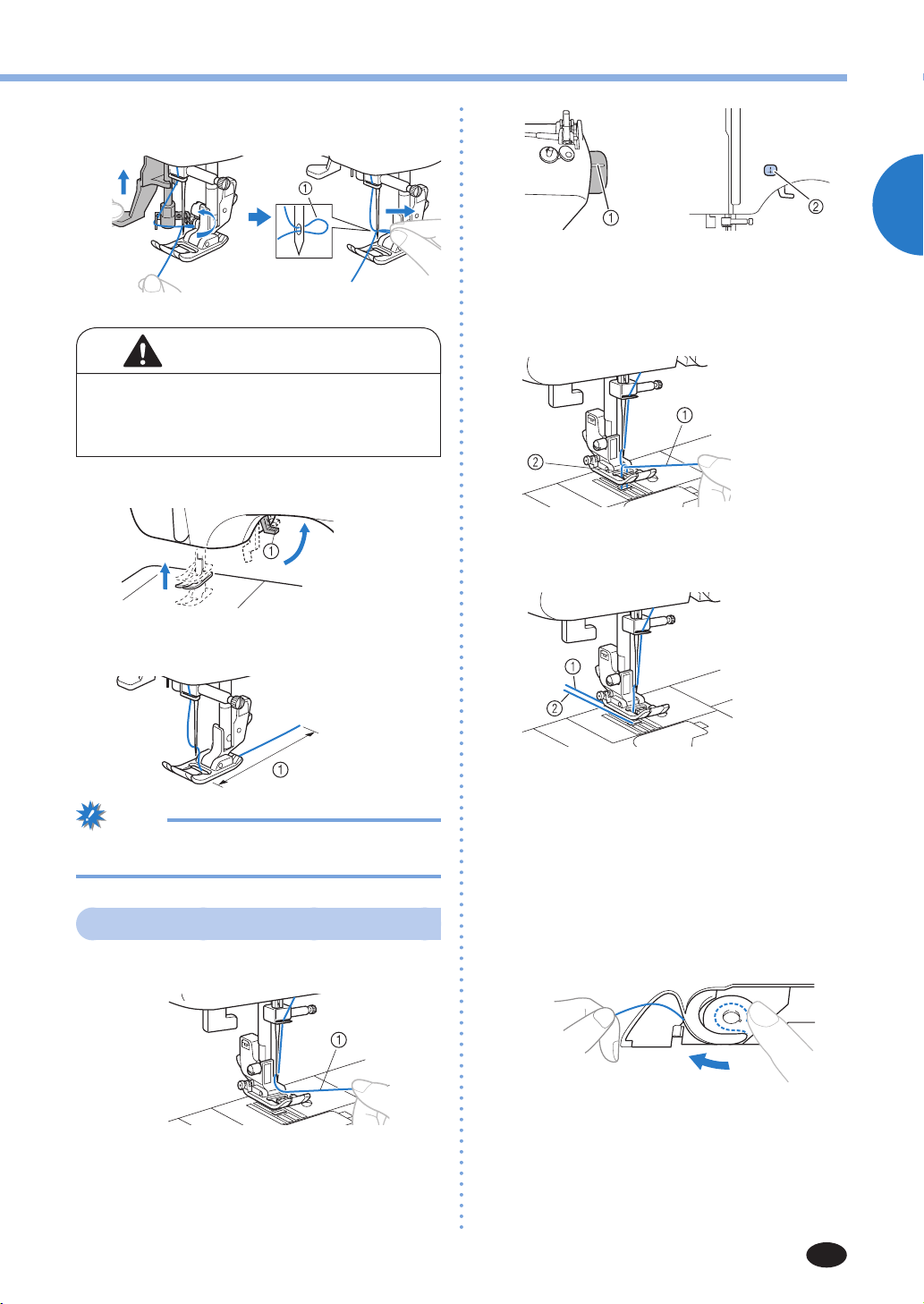
9
Put the thread behind the needle bar thread
guide.
1
1
Needlebarthreadguide
10
Turn off the sewing machine.
CAUTION
• Make sure you turn the power off while
threading the machine without using the
needle threader (for models equipped with the
needle threader). If you accidentally step on
the foot controller and the machine starts to
sew, you could be injured.
11
Thread the needle from front to back and pull
out about 5 cm (2 inches) of thread.
15cm(2inches)
Note
•Ifthethreadtake-upleverislowered,theupper
threadcannotbewrappedaroundthethread
take-uplever.Makesureyouraisethepresserfoot
leverandthethreadtake-upleverbeforeyoufeed
theupperthread.
•Ifyouincorrectlyfeedthethreadyoumaycause
sewingproblems.
■
Using the needle threader (for models
equipped with the needle threader)
CAUTION
• The needle threader can be used with a 75/11
through 100/16 home sewing machine needle.
However, the needle threader cannot be used
with a 65/9 home sewing machine needle.
When using special thread such as transparent
nylon thread or metallic thread, the needle
threader cannot be used.
• Thread with a thickness of 130/120 or thicker
cannot be used with the needle threader.
• The needle threader cannot be used with the
wing needle or the twin needle.
• If the needle threader cannot be used, refer to
“Upper threading” (page 16).
1
Follow steps 1 through 10 of the procedure
in “Upper threading”.
2
Lower the presser foot lever.
3
While lowering the needle threader lever,
hook the thread onto the guide.
1
Needleholder
2
Needlethreader
lever
3
Guide
4
Fully lower the needle threader lever.
X
Thehookpassesthroughtheeyeofthe
needle,andcatchthethread.
1
Hook
2
Thread
KNOWING YOUR SEWING MACHINE
19
1
5
Release the needle threader lever. Then pull
the loop of the thread.
1
Loop of thread
CAUTION
• Be careful not to pull on the thread with force
or it may bend the needle.
• If the thread does not pass through the eye of
the needle, start from step
3
again.
6
Raise the presser foot lever.
1
Presser foot
lever
7
Pass the end of the thread as illustrated
below.
1
5 cm (2 inches)
Note
•If you incorrectly feed the thread you may cause
sewing problems.
Drawing up the lower thread
1
Lightly hold the end of the upper thread.
1
Upper thread
2
While holding the end of the upper thread,
raise the needle in the following way.
or
1 Turn the handwheel so
that the mark on the
wheel points up.
2
Press the Needle position
button (for the models
equipped with this button).
3
Pull on the upper thread to draw up the
lower thread.
1
Upper thread
2
Lower thread
4
Pull out about 10 cm (4 inches) of both
threads and pull them toward the back of the
machine under the presser foot.
1
Upper thread
2
Lower thread
■
For models equipped with the quick-set bobbin
You can begin sewing immediately without drawing
up the bobbin thread. When sewing gathers or
darts, you can draw up the lower thread by hand
so that some thread will be left over. Before you
draw up the lower thread, put the bobbin back in.
1
Pass the thread along the slit in the direction
of the arrow, and leave it there without
cutting it.
•The bobbin cover should still be removed.
2
Draw up the lower thread as described in
steps 1 to 4.
3
Replace the bobbin cover.
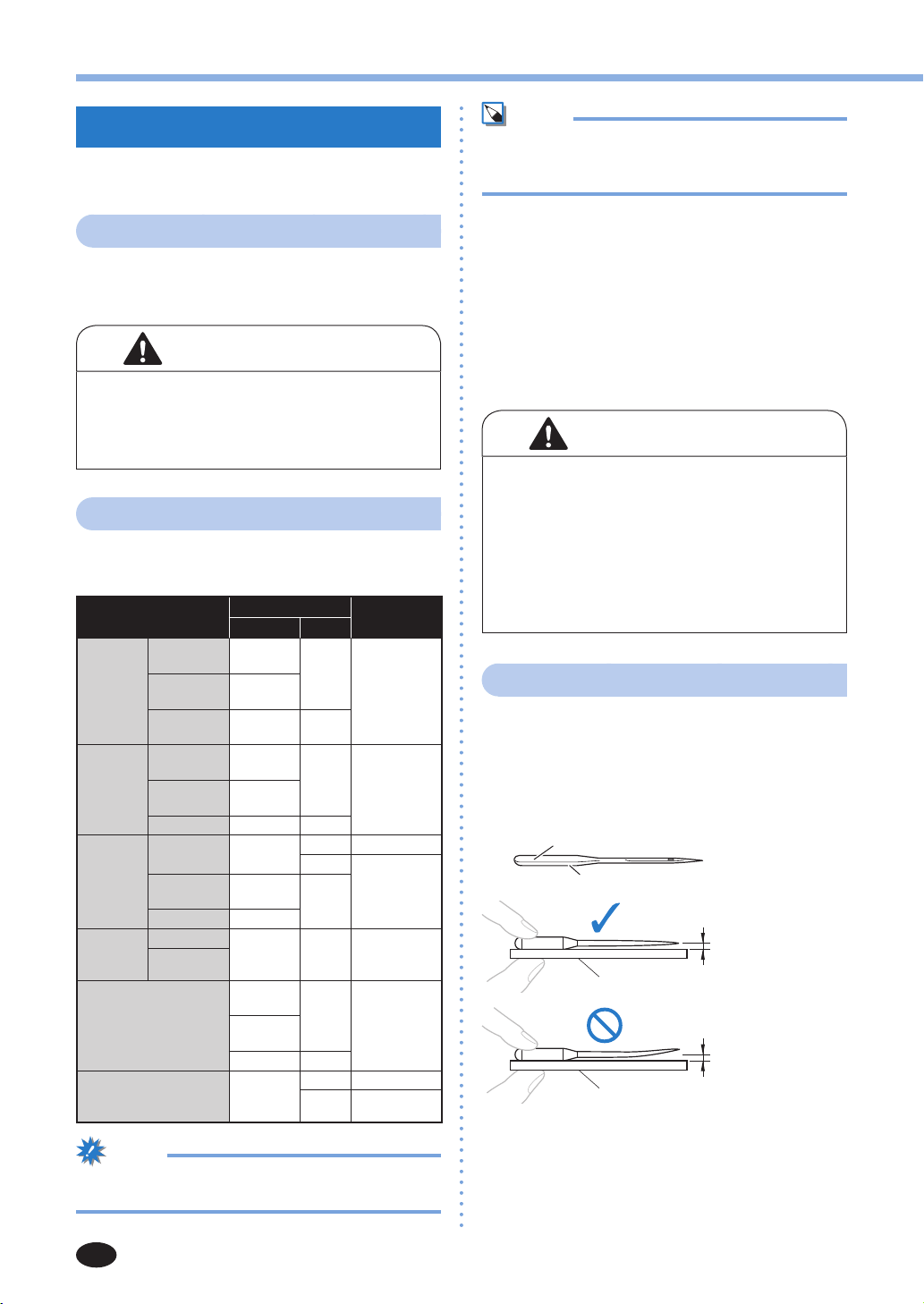
KNOWING YOUR SEWING MACHINE
20
REPLACING THE NEEDLE
This section provides information on sewing machine
needles.
Needle precautions
Be sure to observe the following precautions
concerning the handling of the needle. Failure to
observe these precautions is extremely dangerous.
CAUTION
• Only use home sewing machine needles. Use
of any other needle may bend the needle or
damage the machine.
• Never use bent needles. Bent needles can
easily break, possibly resulting in injury.
Needle types and their uses
The sewing machine needle that should be used
depends on the fabric and thread thickness.
Fabric Type/
Application
Thread
Size of
Needle
Type Size
Medium
weight
fabrics
Broadcloth
Cotton
thread
60–90
75/11–90/14Taffeta
Synthetic
thread
Flannel,
Gabardine
Silk thread 50
Thin
fabrics
Lawn
Cotton
thread
60–90
65/9–75/11
Georgette
Synthetic
thread
Challis, Satin
Silk thread 50
Thick
fabrics
Denim
Cotton
thread
30 100/16
50
90/14–100/16Corduroy
Synthetic
thread
50–60
Tweed Silk thread
Stretch
fabrics
Jersey
Thread for
knits
50–60
Ball point needle
75/11–90/14
(gold colored)
Tricot
Easily frayed fabrics
Cotton
thread
50–90
65/9–90/14Synthetic
thread
Silk thread 50
For top-stitching
Synthetic
thread
Silk thread
30 100/16
50–60 75/11–90/14
Note
•Never use a thread of weight 20 or lower. It may
cause malfunctions.
Mem
o
•The lower the thread number, the thicker the
thread; and the higher the needle number, the
thicker the needle.
■
Ball point needle
Use the ball point needle when sewing on stretch
fabrics or fabrics where skipped stitches easily
occur.
Use the ball point needle for best results when
sewing patterns using monogramming foot “N”.
■
Transparent nylon thread
Use a 90/14 to 100/16 needle, regardless of the
fabric or thread.
CAUTION
• The appropriate fabric, thread and needle
combinations are shown in the table on the
left page. If the combination of the fabric,
thread and needle is not correct, particularly
when sewing thick fabrics (such as denim) with
thin needles (such as 65/9 to 75/11), the needle
may bend or break. In addition, the stitching
may be uneven or puckered or there may be
skipped stitches.
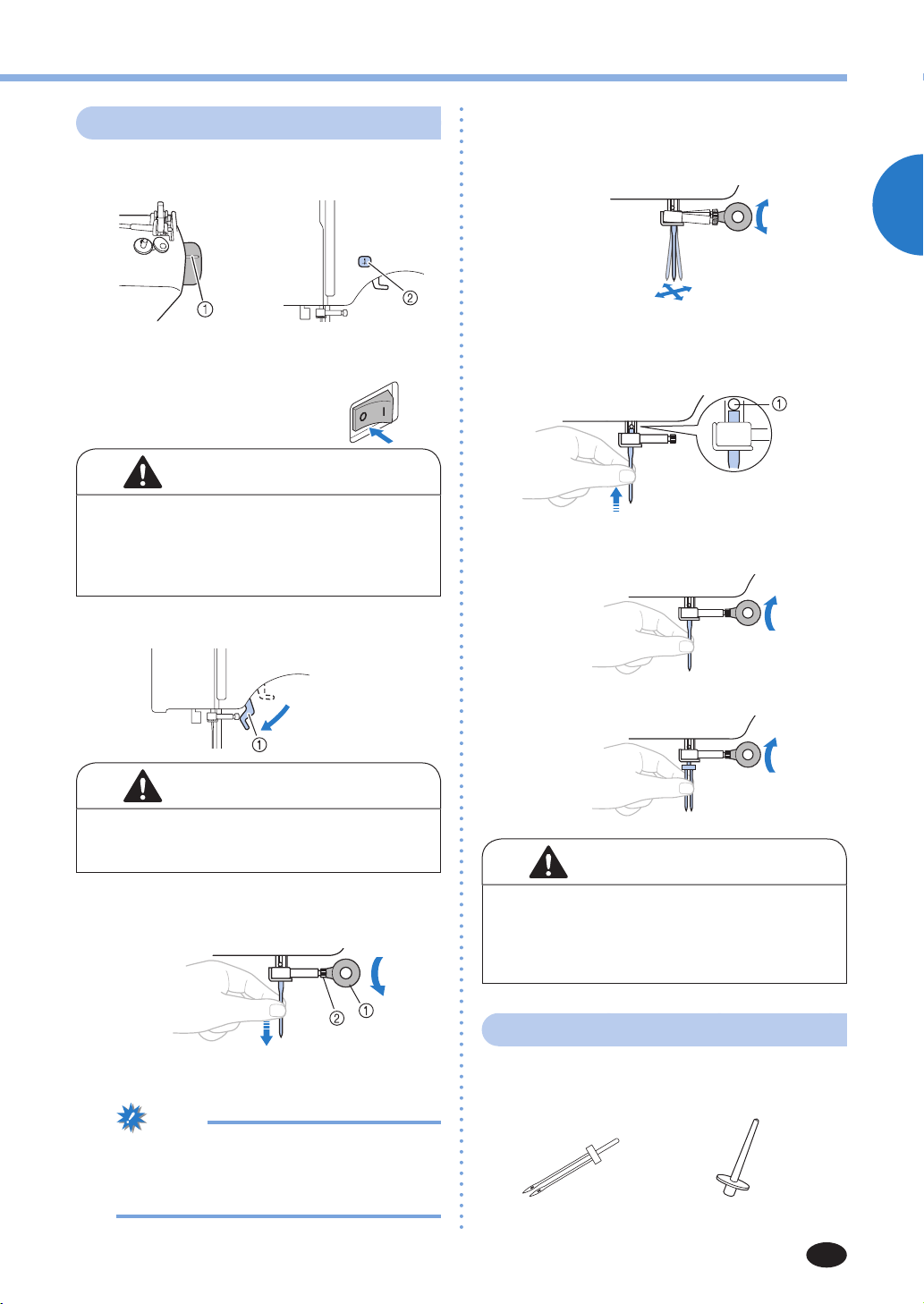
Checking the needle
Sewing with a bent needle is extremely dangerous
since the needle may break while the machine is
being operated.
Before using the needle, place the flat side of the
needle on a flat surface and check that the distance
between the needle and the flat surface is even.
1
2
1
Flat side
2
Needle type
marking
3
4
3
Flat surface
4
Even
3
5
5
Not even
KNOWING YOUR SEWING MACHINE
21
1
Replacing the needle
1
Raise the needle in the following way.
or
1 Turn the handwheel so
that the mark on the
wheel points up.
2
Press the Needle position
button (for the models
equipped with this button).
2
Turn off the sewing machine.
CAUTION
• Before replacing the needle, be sure to turn off
the sewing machine, otherwise injuries may
occur if the foot controller or the start/stop
button is accidentally pressed and the machine
starts sewing.
3
Lower the presser foot lever.
1
Presser foot
lever
CAUTION
• Before replacing the needle, place fabric or paper
under the presser foot to prevent the needle from
falling into the hole in the needle plate.
4
Remove the needle by turning the needle
clamp screw counterclockwise.
1
Disc-shaped screwdriver
2
Needle clamp screw
Note
•If the needle clamp screw is loosened too
much, the needle clamp (which holds the
needle) may fall off. Therefore, do not
loosen the needle clamp screw too much.
•Do not apply strong force when loosening or
tightening the needle clamp screw, otherwise
certain parts of the sewing machine may be
damaged.
5
With the flat side of the needle toward the
rear of the machine, insert the needle until it
touches the needle stopper.
1
Needle stopper
6
Tighten the needle clamp screw by turning it
clockwise.
•Install the twin needle in the same way.
CAUTION
• Be sure to insert the needle until it touches the
needle stopper and securely tighten the needle
clamp screw with the disc-shaped screwdriver,
otherwise the needle may break or damage
may result.
Sewing with the twin needle
You can sew with this needle and two top threads.
You can use the same color or two different colors of
thread for making decorative stitches.
1
Twin needle
2
Extra spool pin

KNOWING YOUR SEWING MACHINE
22
CAUTION
• Use only twin needles that have been made for
this machine (part code: 131096-121). Other
needles could break, and damage the machine.
• Do not sew with bent needles. The needle
could break and injure you.
• You cannot use the needle threader to thread
the twin needle. Instead, thread the twin
needle by hand, from front to back. Using the
needle threader may damage the machine.
• When using the twin needle, be sure to select
an appropriate stitch, otherwise the needle
may break or the machine may be damaged.
• Select a stitch width of 5.0 mm (3/16 inch) or
less, otherwise the needle may break or the
machine may be damaged.
1
Install the twin needle.
•For details on installing a needle, refer to
“Replacing the needle” (page 21).
2
Thread the upper thread for the left needle.
•For details, refer to steps
1
through
9
of
“Upper threading” (page 16).
3
Manually thread the left needle with the
upper thread.
•Pass the thread through the eye of the needle
from the front to the back.
4
Insert the extra spool pin onto the end of the
bobbin winder shaft.
1
Bobbin winder shaft
2
Extra spool pin
3
Thread spool
5
Install the thread spool and thread the upper
thread.
Mem
o
•When setting the thread spool, set it so that
the thread winds off from the front of the
spool.
6
Thread the upper thread for the right needle
in the same way as the left needle.
7
Without passing the thread through the
needle bar thread guide, manually thread the
right needle.
Pass the thread through the eye of the needle
from the front to the back.
1
Needle bar thread guide
8
Attach zigzag foot “J”. (Refer to page 23.)
Note
Models equipped with a needle threader
•You cannot use the needle threader to thread
the twin needle. Instead, thread the twin
needle by hand, from front to back. Using the
needle threader may damage the machine.
CAUTION
• When using the twin needle, be sure to attach
zigzag foot “J”, otherwise the needle may
break or the machine may be damaged.
9
Turn on the sewing machine.
10
Select a stitch.
•For details on selecting a stitch, refer to
“Selecting a stitch” (page 25).
•For details on the stitches that can be sewn
with the twin needle, refer to “STITCH
SETTINGS” (page 53).
CAUTION
• After adjusting the stitch width, slowly turn
the handwheel toward you (counterclockwise)
and check that the needle does not touch the
presser foot. If the needle hits the presser foot,
the needle may bend or break.
11
Start sewing.
For details on starting to sew, refer to “Starting
to sew” (page 26).
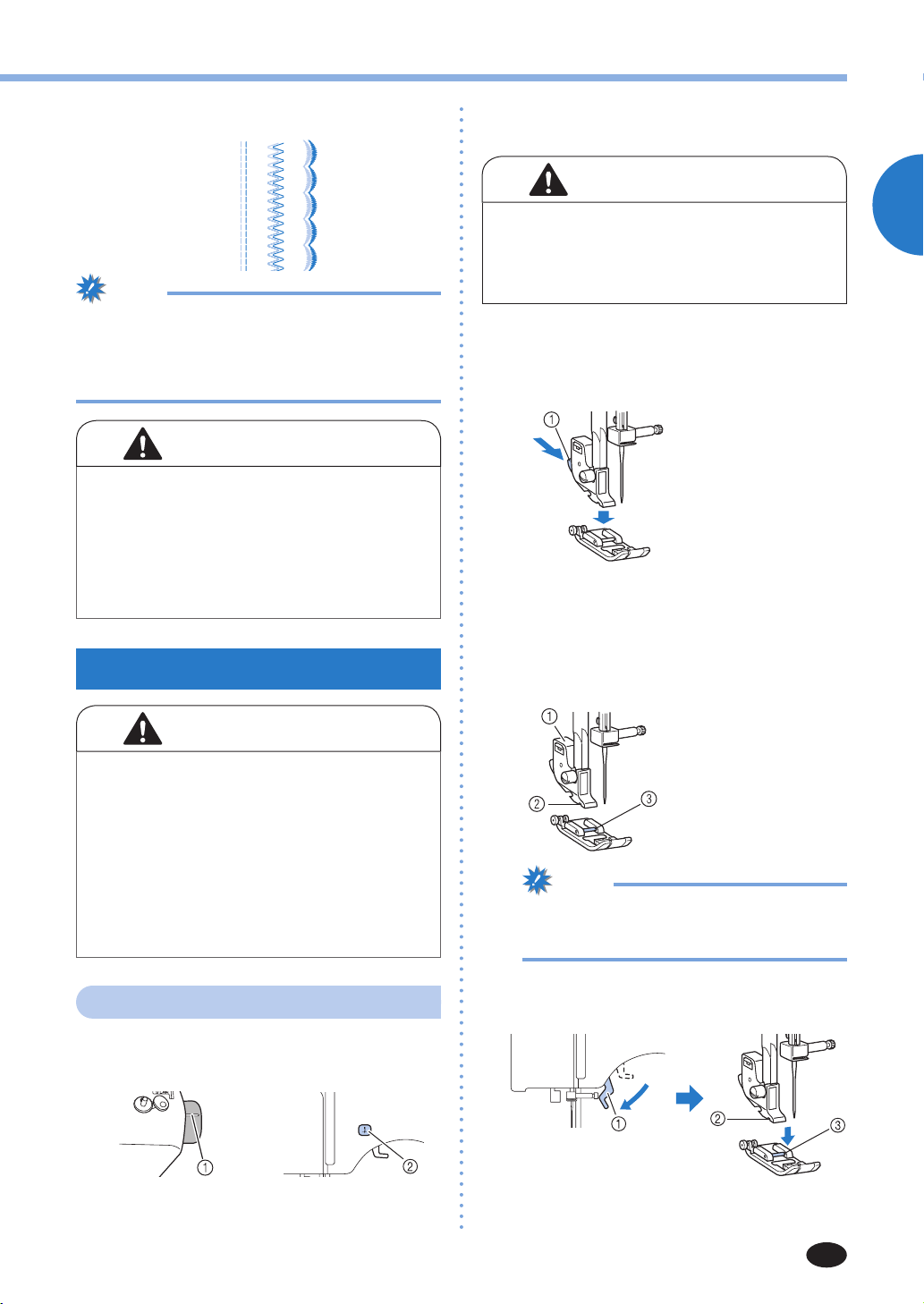
KNOWING YOUR SEWING MACHINE
23
1
X
Two lines of stitching are sewn parallel to
each other.
Note
• When using the twin needle, the stitches may become
bunched together, depending on the types of thread and
fabric that are used. If this occurs, increase the stitch
length. For details on adjusting the stitch length, refer to
“Adjusting the stitch length and width” (page 26).
CAUTION
• When changing the sewing direction, be
sure to raise the needle from the fabric, and
then raise the presser foot lever and turn the
fabric. Otherwise the needle may break or the
machine may be damaged.
• Do not try turning the fabric with the twin needle
left down in the fabric, otherwise the needle may
break or the machine may be damaged.
REPLACING THE PRESSER FOOT
CAUTION
• Always turn off the power before you change
the presser foot. If you leave the power on and
step on the foot controller, the machine will
start and you may be injured.
• Always use the correct presser foot for the stitch
pattern you have chosen. If you use the wrong
presser foot, the needle may strike the presser
foot and bend or break, and may cause injury.
• Only use presser feet that have been designed
to be used with this machine. Using other any
presser feet may cause an accident or injury.
Replacing the presser foot
Replace the presser foot as described below.
1
Raise the needle in the following way.
or
1 Turn the handwheel so
that the mark on the
wheel points up.
2
Press the Needle position
button (for the models
equipped with this button).
2
If the sewing machine has been turned on,
turn it off.
CAUTION
• Before replacing the presser foot, be sure to
turn off the sewing machine, otherwise injuries
may occur if the foot controller or the start/
stop button is accidentally pressed and the
machine starts sewing.
3
Raise the presser foot lever.
4
Press the black button to release the presser
foot.
1
Black button
5
Place a different presser foot below the
presser foot holder so that the presser foot
pin is aligned with the shank in the holder.
Position the presser foot so the letter indicating
the presser foot type (J, A, etc.) is positioned to
be read.
1
Presser foot holder
2
Shank
3
Pin
Note
•The presser foot to be used with each stitch
appears in the LCD. To select a stitch, refer
to “Selecting a stitch” (page 25).
6
Slowly lower the presser foot lever so that the
pin snaps into the shank.
1
Presser foot lever
2
Shank
3
Pin
X
The presser foot is attached.
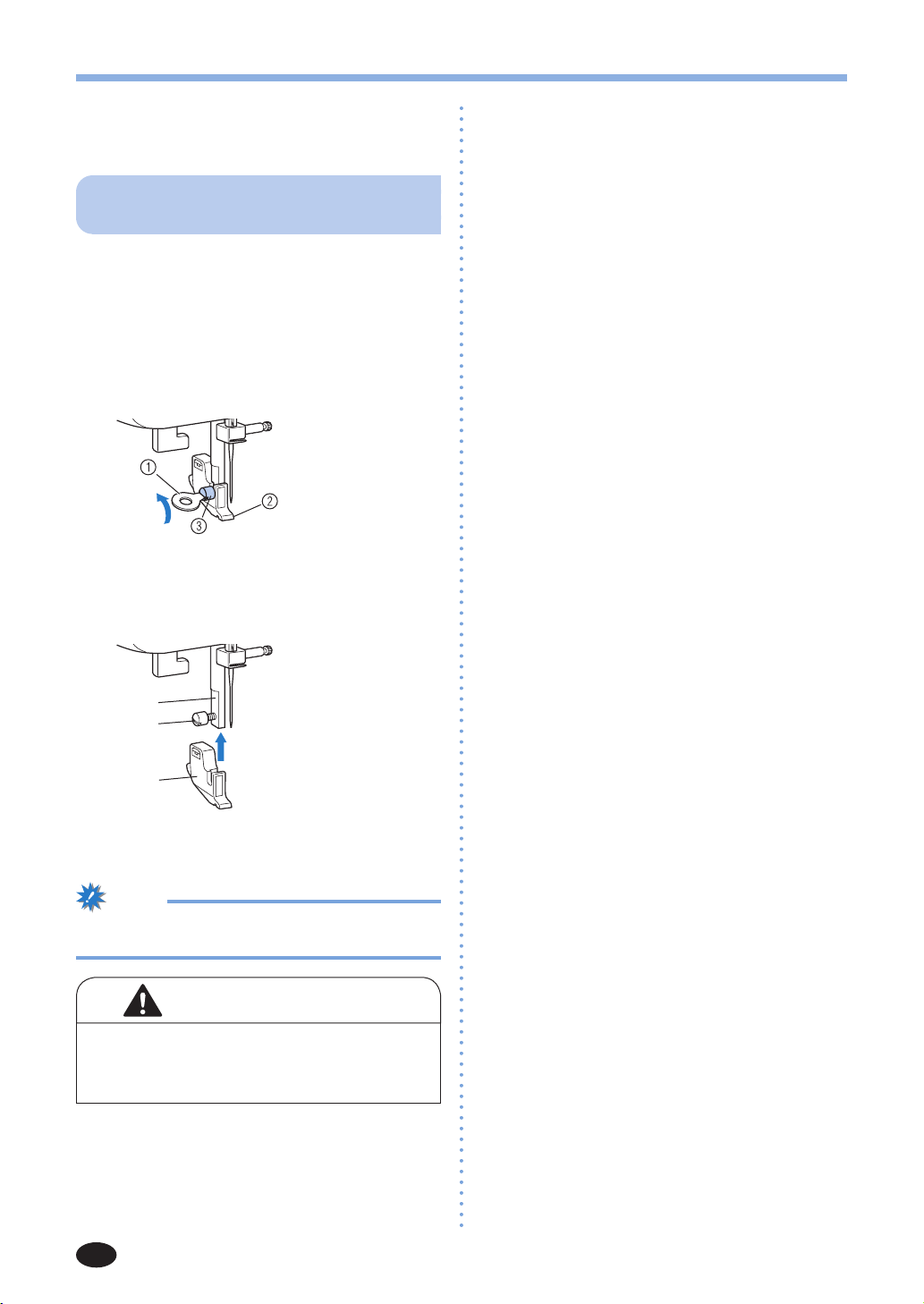
24
KNOWING YOUR SEWING MACHINE
7
Raise the presser foot lever to check that the
presser foot is securely attached.
Removing the presser foot
holder
Remove the presser foot holder when cleaning the
sewing machine or when installing a presser foot
that does not use the presser foot holder, such as
the quilting foot. Use the disc-shaped screwdriver to
remove the presser foot holder.
1
Remove the presser foot. (Refer to page 23.)
2
Loosen the presser foot holder screw.
1
Disc-shaped
screwdriver
2
Presser foot
holder
3
Presser foot
holder screw
■
Attaching the presser foot holder
1
Align the presser foot holder with the lower-
left side of the presser bar.
3
2
1
1
Presser foot
holder
2
Presser bar
3
Presser foot
holder screw
2
Holding the presser foot holder in place,
tighten the screw.
Note
•If the presser foot holder is not correctly installed,
the thread tension will be incorrect.
CAUTION
• Be sure to securely tighten the presser foot
holder screw, otherwise the presser foot
holder may fall off and the needle may strike
it, causing the needle to bend or break.
SEWING BASICS
2
25
2
SEWING BASICS
SEWING
Basic sewing operations are described below.
Before operating the sewing machine, read the
following precautions.
CAUTION
• While the machine is in operation, pay special
attention to the needle location. In addition,
keep your hands away from all moving parts
such as the needle and handwheel, otherwise
injuries may occur.
• Do not pull or push the fabric too hard while
sewing, otherwise injuries may occur or the
needle may break.
• Never use bent needles. Bent needles can
easily break, possibly resulting in injuries.
• Make sure that the needle does not strike
basting pins, otherwise the needle may break
or bend.
General sewing procedure
Follow the basic procedures below to sew.
1 Turn on the machine.
Turn on the sewing machine.
For details on turning on the machine, refer to
“Power supply” (page 9).
2 Select the stitch.
Select the stitch appropriate for the area to be
sewn.
For details on selecting a stitch, refer to “Selecting
a stitch” (page 25).
3 Attach the presser foot.
Attach the presser foot appropriate for the stitch.
For details on replacing the presser foot, refer to
“Replacing the presser foot” (page 23).
4 Start sewing.
Position the fabric, and then start sewing. When
sewing is finished, cut the threads.
For details on starting to sew, refer to “Starting to
sew” (page 26).
Selecting a stitch
When the sewing machine is turned on, the straight
stitch (
left needle position) is selected.
1
Turn on the sewing machine.
2
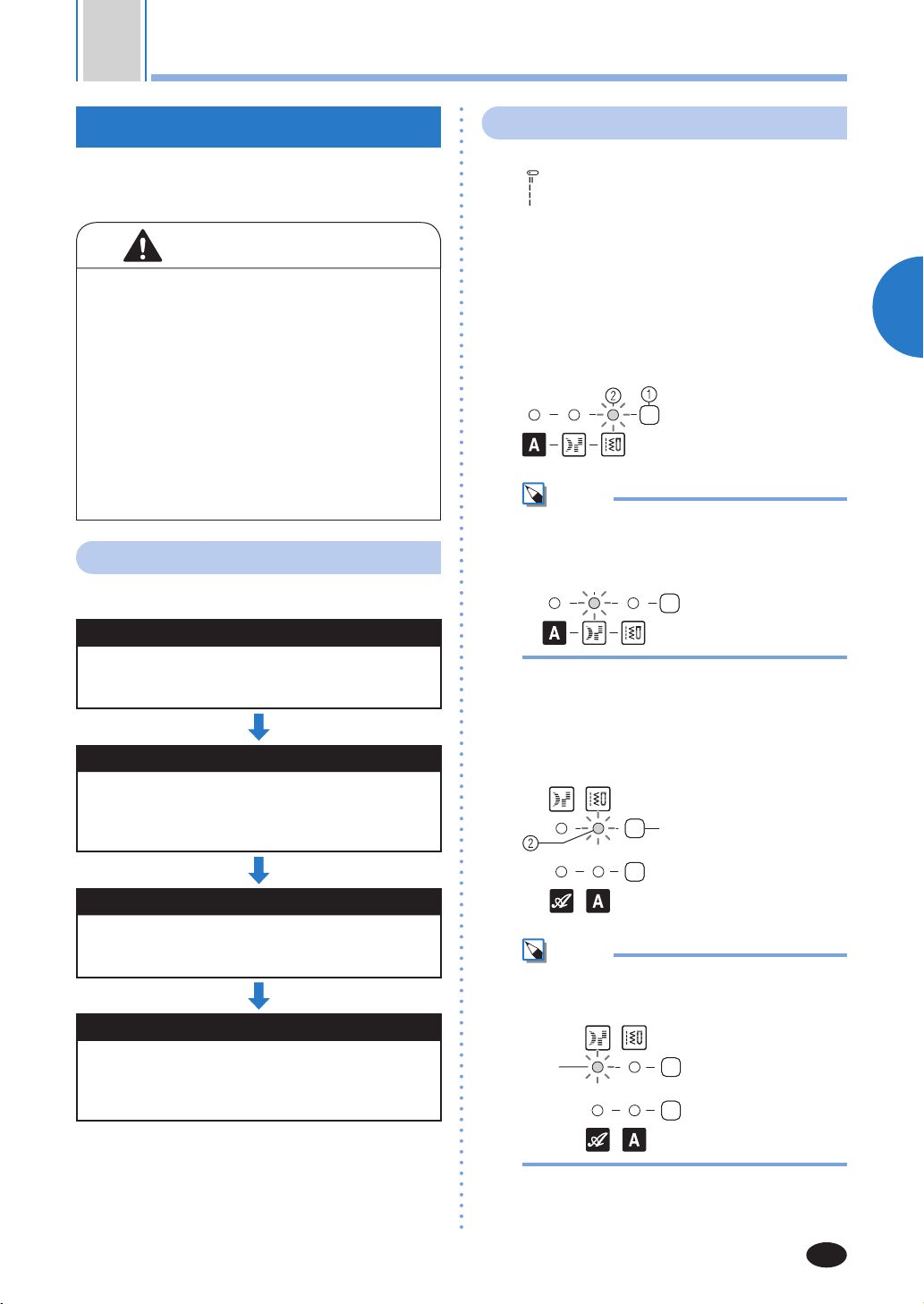
<For models equipped with satin stitches and
1 font type of character stitches>
Confirm that the utility stitch indicator is
lit. If it is not lit, press the stitch category
selection key once or more until the utility
stitch indicator is lit.
1
Stitch category
selection key
2
Utility stitch indicator
Mem
o
•When you want to select the satin stitch,
press the stitch category selection key once
or more until the satin stitch indicator is lit.
3
3 Satin stitch indicator
<For models equipped with satin stitches and
2 font types of character stitches>
Confirm that the utility stitch indicator is lit.
If it is not lit, press the utility stitch key once
or more until the utility stitch indicator is lit.
1
1
Utility stitch key
2
Utility stitch indicator
Mem
o
•When you want to select the satin stitch,
press the utility stitch key once or more until
the satin stitch indicator is lit.
3
3 Satin stitch indicator
SEWING BASICS
26
3
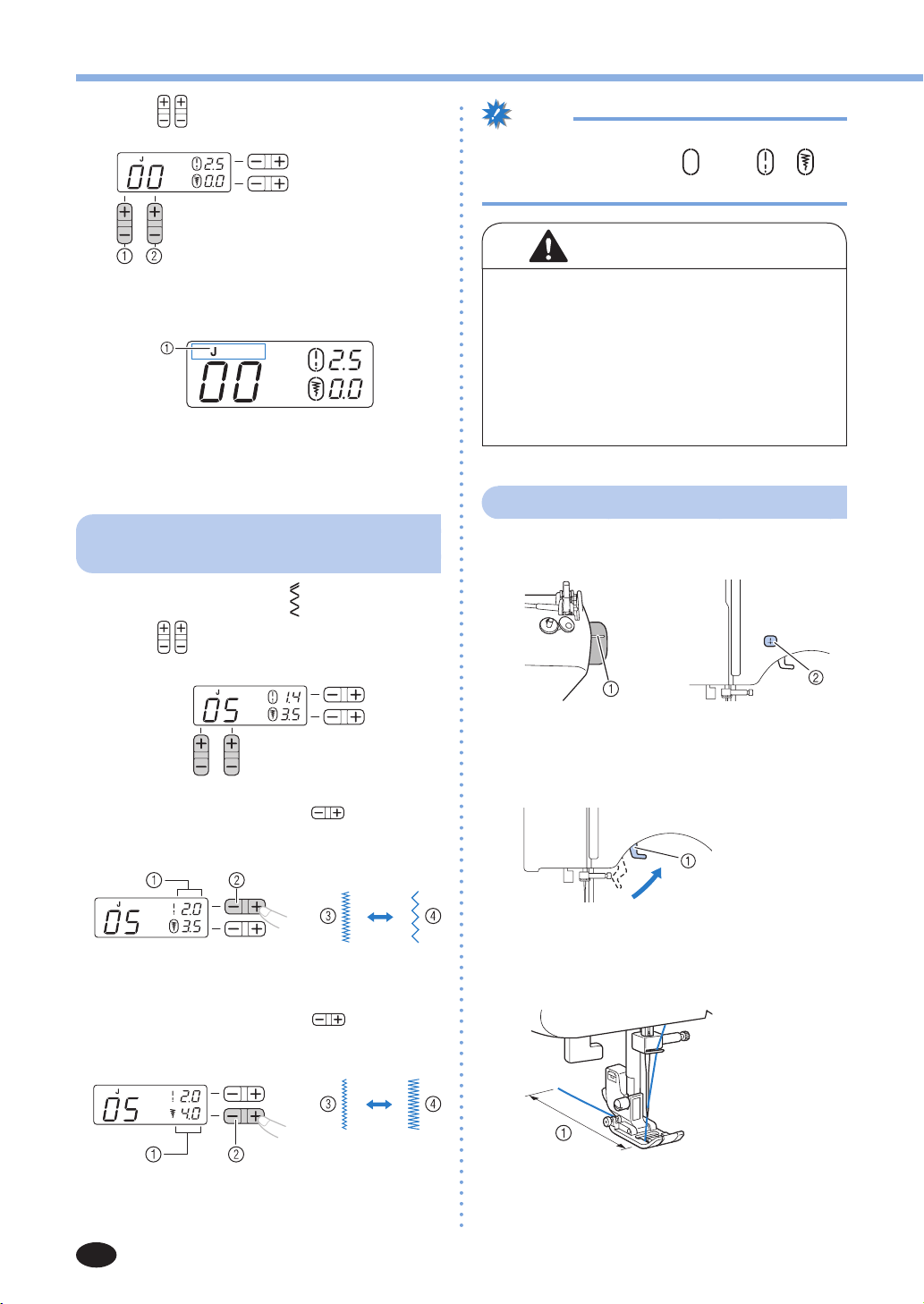
Press (stitch selection keys) to designate
the desired stitch number.
1
Designates the tens digit.
2
Designates the ones digit.
X
The stitch is selected.
4
Attach the presser foot indicated in the LCD.
1
Presser foot type
•For details, refer to “Replacing the presser
foot” (page 23).
Adjusting the stitch length and
width
■
[Example] Selecting stitch .
1
Press (stitch selection keys) to select
stitch 05.
2
Press the “+” or “–” side of (stitch length
adjustment key) to increase or reduce the
stitch length.
1 Stitch length 2 Stitch length adjustment key
3 Short 4 Long
3
Press the “+” or “–” side of (stitch width
adjustment key) to increase or reduce the
stitch width.
1 Stitch width 2 Stitch width adjustment key
3 Narrow 4 Wide
Note
•When the stitch length or stitch width is changed
from the standard setting,
around or
disappears from the LCD.
CAUTION
• After adjusting the stitch width, slowly turn
the handwheel toward you (counterclockwise)
and check that the needle does not touch the
presser foot. If the needle hits the presser foot,
the needle may bend or break.
• If the stitches are bunched together, increase
the stitch length. Continuing to sew with the
stitches bunched together may result in the
needle bending or breaking.
Starting to sew
1
Raise the needle in the following way.
or
1 Turn the handwheel so
that the mark on the
wheel points up.
2
Press the Needle position
button (for the models
equipped with this button).
2
Raise the presser foot lever.
1
Presser foot lever
3
Place the fabric under the presser foot, pass
the thread under the presser foot, and then
pull out about 5 cm (2 inches) of thread
toward the rear of the machine.
1
5 cm (2 inches)
SEWING BASICS
27
2
4
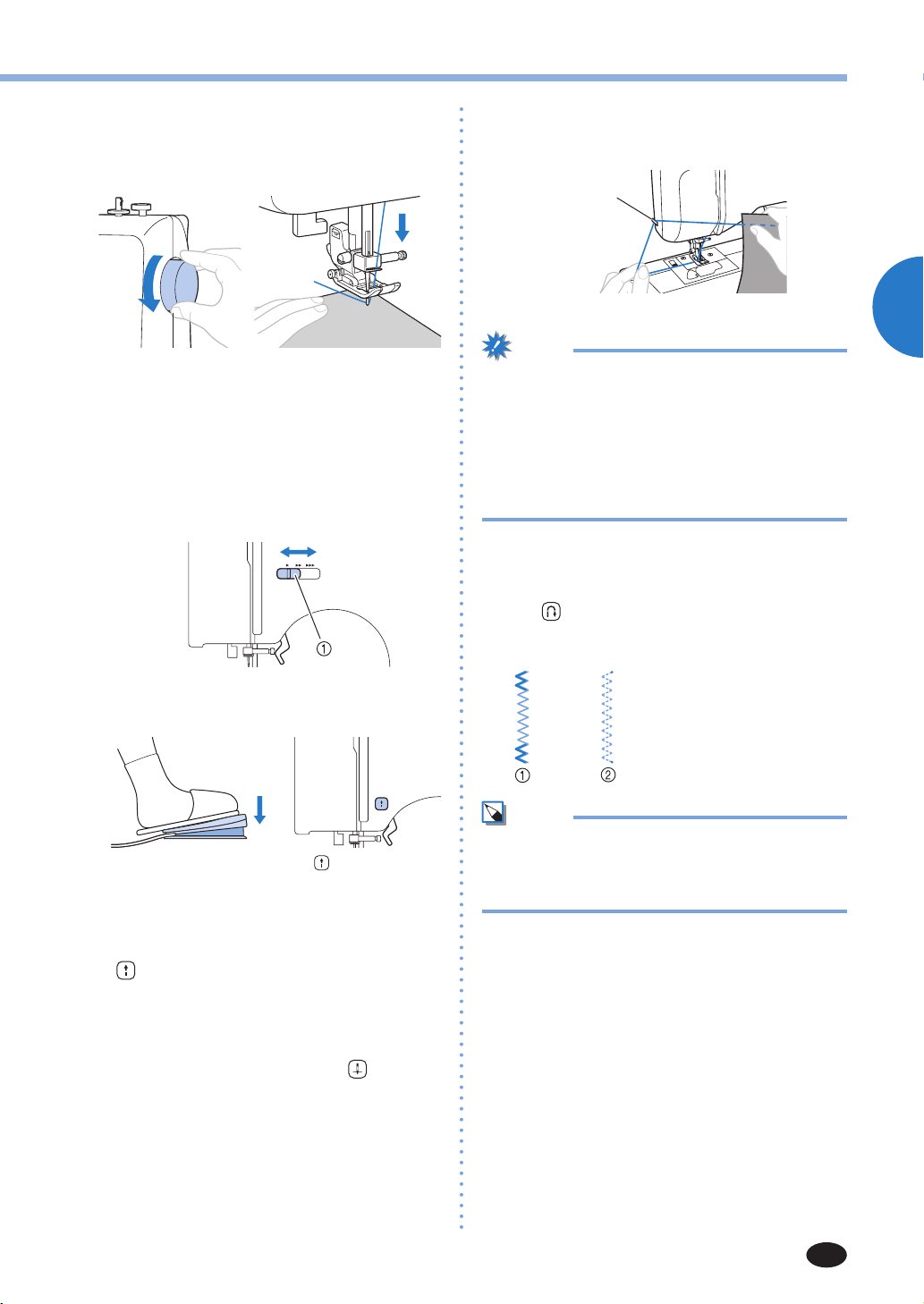
While holding the end of the thread and
the fabric, turn the handwheel toward you
(counterclockwise) to lower the needle to the
starting point of the stitching.
5
Lower the presser foot lever.
6
(For models equipped with a sewing speed
controller)
Slide the sewing speed controller to the left or
right to adjust the sewing speed. Refer to “Sewing
speed controller (for models equipped with the
start/stop button)” (page 10).
1
Sewing speed controller
7
Start sewing in the following way.
or
Press down the foot
controler slowly.
Press
(start/stop button)
(for models equipped with
the start/stop button).
X
The machine starts sewing.
8
Take your foot off the foot controller, or press
(start/stop button) once.
X
The machine stops sewing.
9
Raise the needle by turning the handwheel
toward you (counterclockwise) so that the mark
on the wheel points up. (Or press
(needle
position button) once or twice for models
equipped with the needle position button.)
This procedure is not necessary if the needle
stop position has been set to the raised position
(page 10).
10
Raise the presser foot lever.
11
Pull the fabric to the left side of the machine,
and then cut the threads by using the thread
cutter.
1
Thread cutter
Note
•When the foot controller is plugged in, the start/
stop button cannot be used to start sewing (for
models equipped with the start/stop button).
•When sewing is stopped, the needle remains
lowered (in the fabric). The machine can be set
so that the needle will stay up when sewing is
stopped. For details, refer to “Changing the needle
stop position” (page 10).
■
Sewing reinforcement stitches
When sewing stitches other than straight or zigzag
stitches that are secured with reverse stitching,
pressing
(reverse/reinforcement stitch button)
sews reinforcement stitches, 3 to 5 stitches on top of
each other.
1
Reverse stitching
2
Reinforcement stitching
Mem
o
•Whether reverse stitches or reinforcement stitches
are sewn depends on the stitch that is selected.
For details, refer to “STITCH SETTINGS” (page
53).
SEWING BASICS
28
Thread tension
The thread tension will affect the quality of your
stitches. You may need to adjust it when you change
fabric or thread.
Mem
o
•We recommend that you do a test sewing on
scrap of a fabric before you start to sew.
■
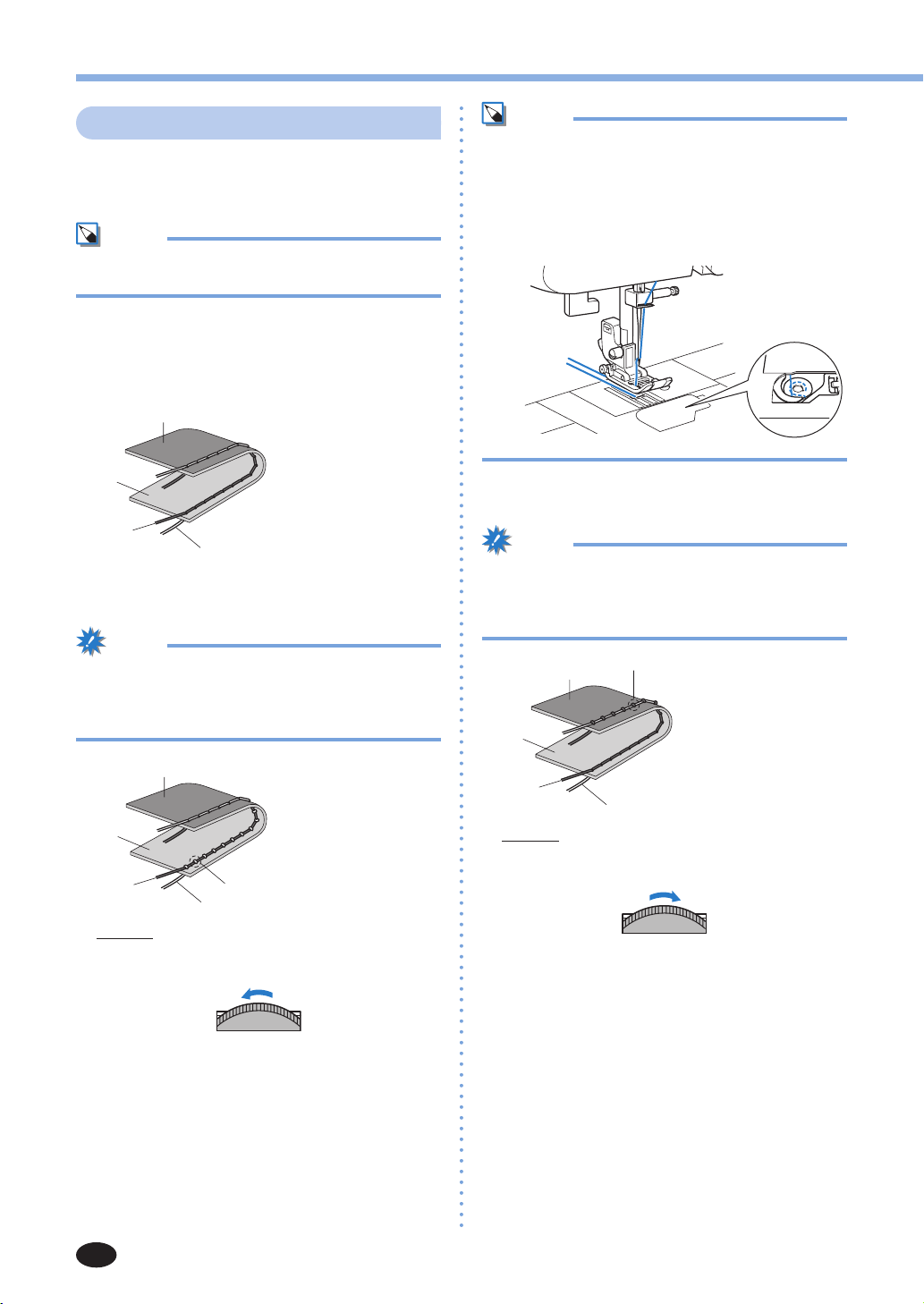
Correct tension
Correct tension is important as too much or too little
tension will weaken your seams or cause puckers on
your fabric.
1
2
3
4
1
Wrong side
2
Surface
3
Upper thread
4
Lower thread
■
Upper tension is too tight
Loops will appear on the surface of the fabric.
Note
•If the bobbin thread was incorrectly threaded, the
upper thread may be too tight. In this case, refer
to “Lower threading” (page 14) and rethread
the bobbin thread.
1
2
3
4
5
1
Wrong side
2
Surface
3
Upper thread
4
Lower thread
5
Loops appear on
surface of fabric
Solution
Reduce the tension by turning the upper tension-
control dial to a lower number.
4
3
5
Mem
o
•When you finish sewing, remove the bobbin
cover and then make sure that the thread is shown
as below. If the thread is not shown as below,
the thread is not inserted through the tension-
adjusting spring of the bobbin case correctly.
Reinsert the thread correctly. For details, refer to
page 14 to 16.
■
Upper tension is too loose
Loops appear on the wrong side of the fabric.
Note
•If the upper thread was incorrectly threaded, the
upper thread may be too loose. In this case, refer
to “Upper threading” (page 16) and rethread
the upper thread.
1
2
3
4
5
1
Wrong side
2
Surface
3
Upper thread
4
Lower thread
5
Loops appear on
wrong
Solution
Increase the tension by turning the upper tension-
control dial to a higher number.
4
3
5
SEWING BASICS
29
2
USEFUL SEWING TIPS
Various ways to achieve better results for your
sewing projects are described below. Refer to these
tips when sewing your project.
Trial sewing
A trial piece of fabric should be sewn. Use a piece of
fabric and thread that are the same as those used for
your project, and check the thread tension and stitch
length and width.
Changing the sewing direction
1
When the stitching reaches a corner, stop the
sewing machine.
Leave the needle lowered (in the fabric).
If the needle was raised, lower the needle
either by turning the handwheel toward you
(counterclockwise) or by pressing
once.
CAUTION
• When using the twin needle, be sure to
raise the needle before changing the sewing
direction. If the fabric is turned while the
needle is lowered, the needle may bend or
break.
2
Raise the presser foot lever, and then turn the
fabric.
Turn the fabric using the needle as a pivot.
3
Lower the presser foot lever and continue
sewing.
Sewing curves
Stop sewing, and then slightly change the sewing
direction to sew around the curve.
When sewing along a curve while using a zigzag
stitch, select a shorter stitch length in order to obtain
a finer stitch.
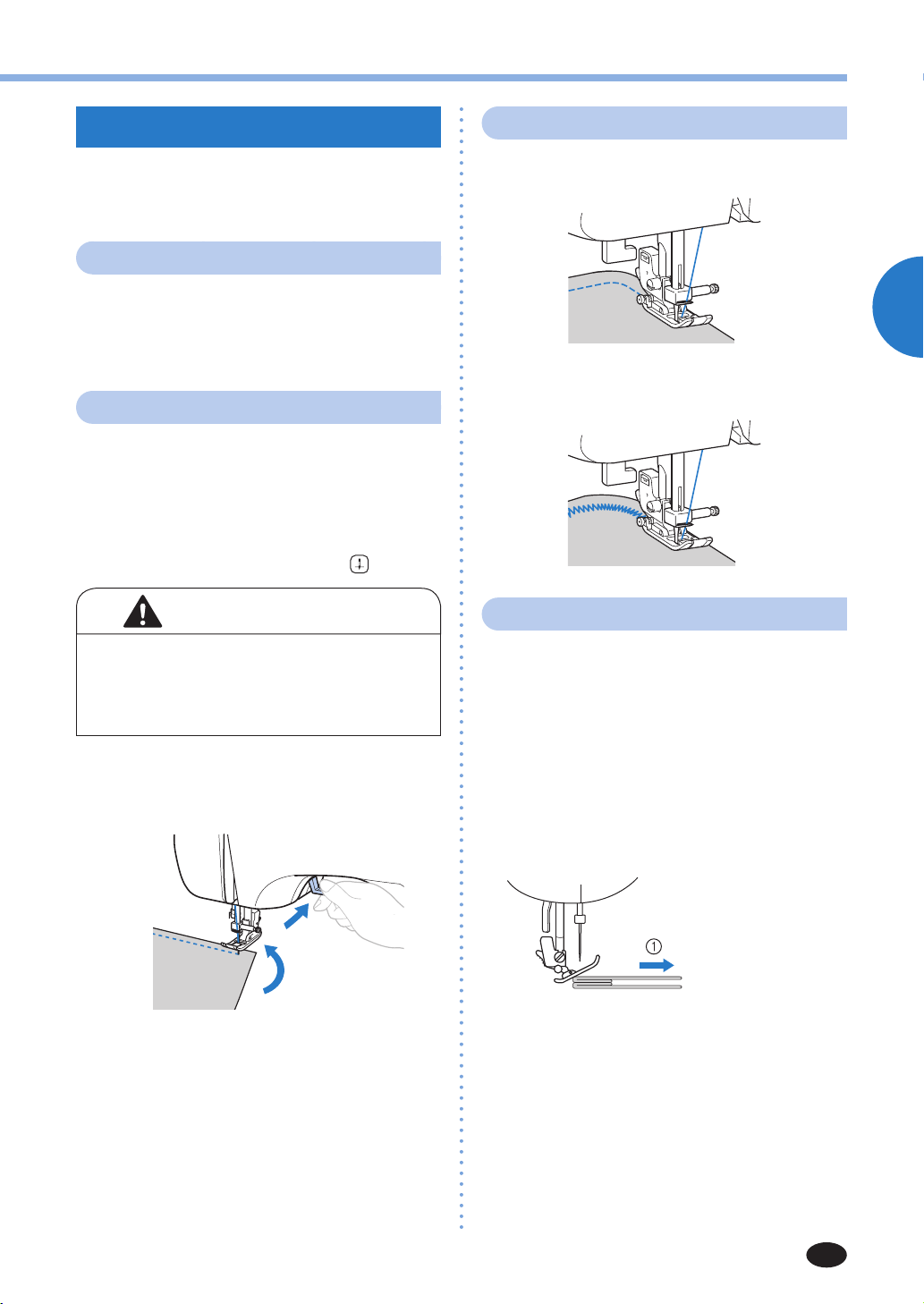
Sewing thick fabrics
■
If the fabric does not fit under the presser foot
If the fabric does not fit easily under the presser
foot, raise the presser foot lever even higher to
bring the presser foot to its highest position.
■
If thick seams are being sewn and the fabric
does not feed at the beginning of stitching
The fabric may not feed when thick seams are
being sewn and the presser foot is not level, as
shown below. In this case, use the presser foot
locking pin.
1
Sewing direction
1
Raise the presser foot lever.
2
Align the beginning of stitching, and then
position the fabric.
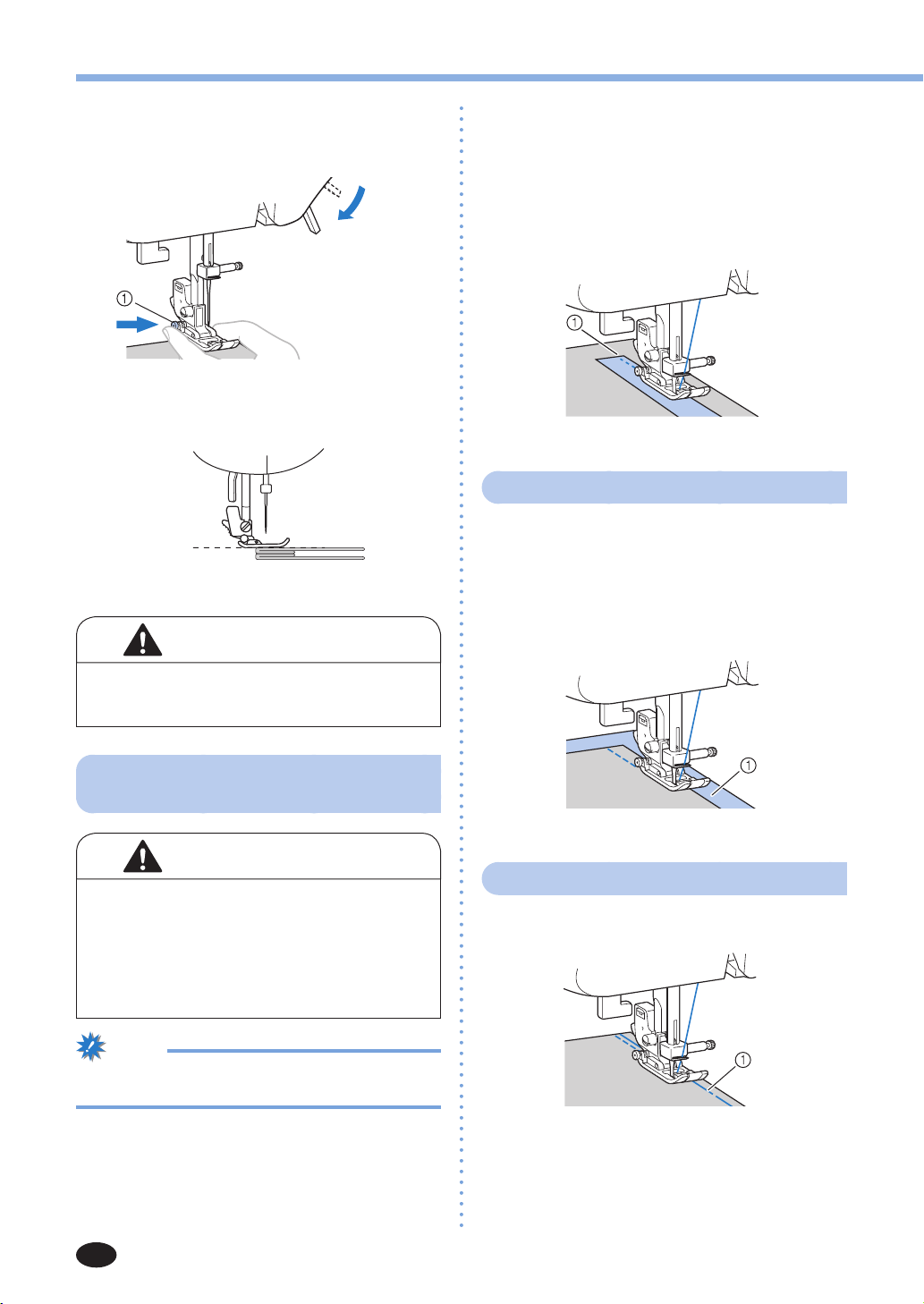
SEWING BASICS
30
3
While holding zigzag foot “J” level, hold the
presser foot locking pin pressed in, and lower
the presser foot lever.
1
Presser foot
locking pin
(black button)
4
Release the presser foot locking pin.
X
The presser foot remains level, allowing the
fabric to be fed.
•After the seam is sewn, the presser foot will
return to its original angle.
CAUTION
• If fabric more than 6 mm (15/64 inch) thick is
sewn or if the fabric is pushed with too much
force, the needle may bend or break.
Sewing hook-and-loop fastener
tape
CAUTION
• Use only the ungummed hook-and-loop
fastener tape which is for sewing. If the glue
is attached to the needle or the bobbin hook
race, it may cause malfunction.
• If the hook-and-loop fastener tape is sewn
with the thin needle (65/9 – 75/11), the needle
may bend or break.
Note
•Before start sewing, baste together the fabric and
the hook-and-loop fastener tape.
Make sure that the needle passes through the hook-
and-loop fastener tape by turning the handwheel and
lower the needle into the hook-and-loop fastener
tape before sewing. And then, sew the edge of the
hook-and-loop fastener tape at a slow speed.
If the needle does not pass through the hook-and-
loop fastener tape, replace the needle with the
needle for thick fabrics (page 20).
1
Edge of the hook-and-loop fastener tape
Sewing thin fabrics
When sewing thin fabrics, the stitching may become
misaligned or the fabric may not feed correctly.
Move the needle (be sure to use a fine needle) to the
furthest left or right hand position so that the fabric
does not get pulled down into the feed dog area. If
you have finished sewing, tear off any excess
paper.
1
Stabilizer material or paper
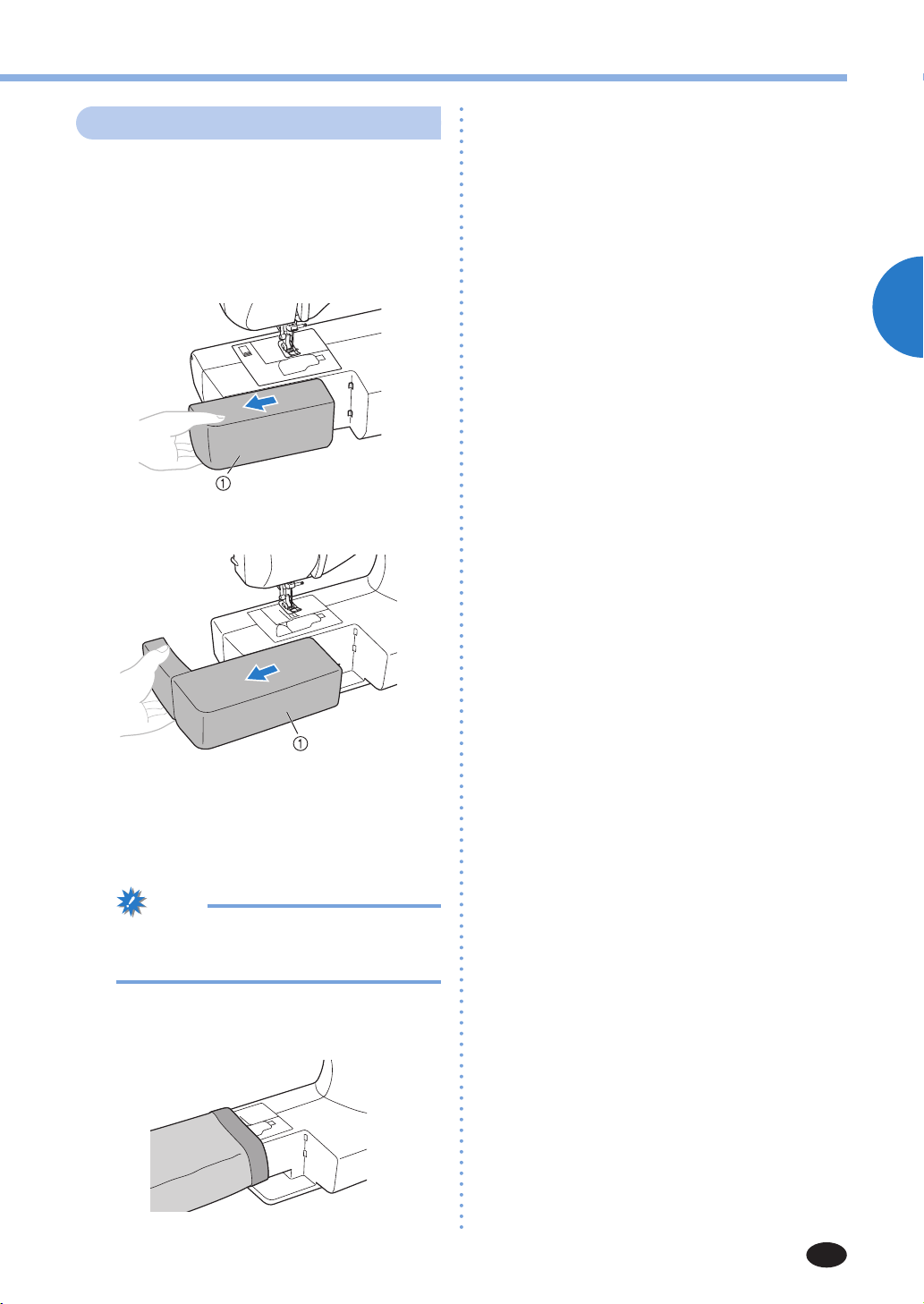
Sewing stretch fabrics
First, baste the pieces of fabric together, and then
sew without stretching the fabric.
1
Basting
SEWING BASICS
31
2
Stitching cylindrical pieces
Removing the flat bed attachment makes it easier to
sew cylindrical pieces such as cuffs and pant legs, or
hard-to-reach areas.
1
Pull the flat bed attachment to the left to
release it.
<Slide type flat bed attachment>
1
Flat bed attachment
<Open type flat bed attachment>
1
Flat bed attachment
X
With the flat bed attachment removed, free-
arm sewing is possible.
•When sewing cylindrical pieces, follow the
next step.
Note
•When you are finished with free-arm
sewing, install the flat bed attachment back
in its original position.
2
Slide the part that you wish to sew onto the
arm, and then sew from the top.
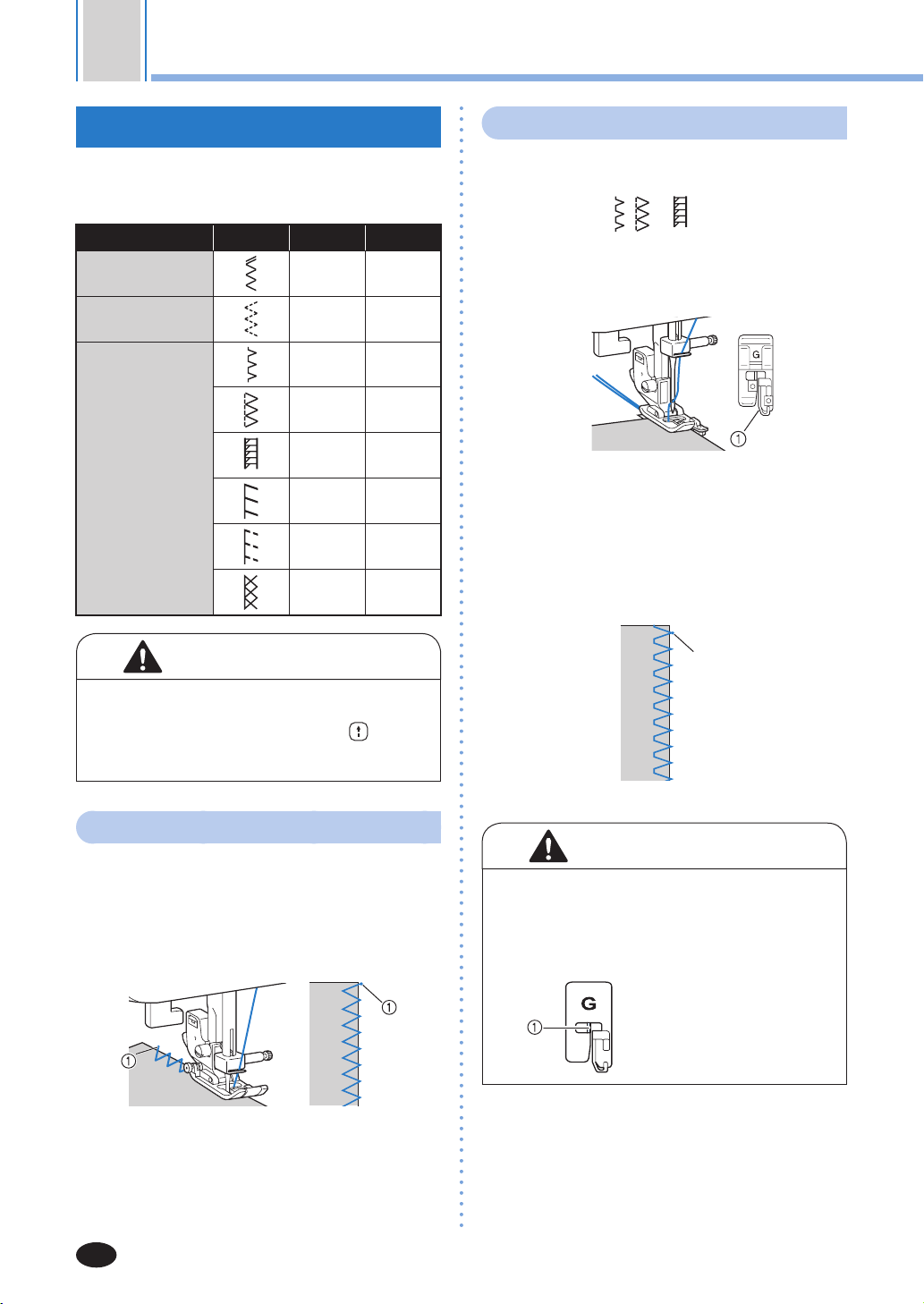
3
32
UTILITY STITCHES
OVERCASTING STITCHES
You can use the overcasting stitches to join together
seams and finish them in one operation. They are
also useful for sewing stretch materials.
Stitch Name Pattern
Presser Foot
Pattern No.
Zigzag stitch J 05
3-point zigzag
stitch
J 06
Overcasting
stitch
G 07
G 08
G 09
J 10
J 11
J 12
CAUTION
• Be sure to turn off the main power before
replacing the presser foot. Otherwise, injuries
may occur if the foot controller or
(start/
stop button) is accidentally pressed and the
machine starts sewing.
Using zigzag foot
1
Attach zigzag foot “J”.
2
Select a stitch. (Refer to page 25.)
3
Sew to the edge of the fabric.
1
Needle drop point
Using overcasting foot
1
Attach overcasting foot “G”.
2
Select stitch , or . (Refer to page 25.)
3
Position the fabric with the edge of the fabric
against the guide of the presser foot, and then
lower the presser foot lever.
1
Guide
4
Slowly turn the handwheel toward you
(counterclockwise) and check that the needle
does not touch the presser foot.
5
Sew with the edge of the fabric against the
presser foot guide.
1
1
Needle drop point
CAUTION
• After adjusting the stitch width, slowly turn
the handwheel toward you (counterclockwise)
and check that the needle does not touch the
presser foot. If the needle hits the presser foot,
the needle may bend or break.
1
Check that the needle does not
touch the presser foot.
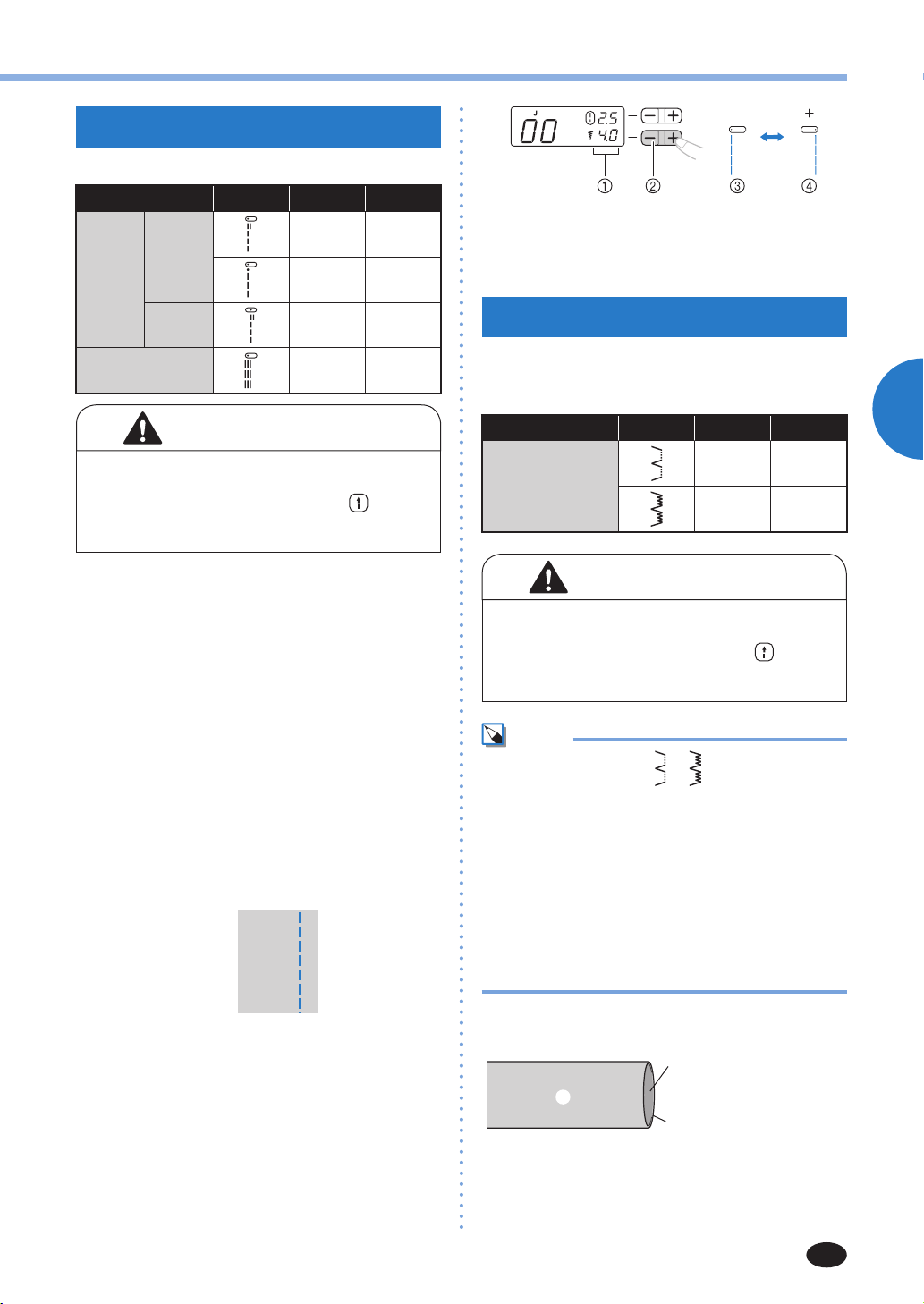
33
3
UTILITY STITCHES
BASIC STITCHING
Straight stitches are used for sewing plain seams.
Stitch Name Pattern
Presser Foot
Pattern No.
Straight
Left
J 00
J 01
Center
J 02
Triple stretch
stitch
J 03
CAUTION
• Be sure to turn off the main power before
replacing the presser foot. Otherwise, injuries
may occur if the foot controller or
(start/
stop button) is accidentally pressed and the
machine starts sewing.
1
Baste or pin together the fabric pieces.
2
Attach zigzag foot “J”.
3
Select a stitch. (Refer to page 25.)
4
Lower the needle into the fabric at the
beginning of the stitching.
5
Start sewing. (Refer to page 26.)
•For details on sewing reverse/reinforcement
stitches, refer to “Sewing reinforcement
stitches” (page 27).
6
When sewing is finished, cut the thread.
(Refer to page 27.)
■
Changing the needle position
With the straight stitch (left needle position) and
the triple stretch stitch, the needle position can
be adjusted. Pressing the “+” side of the stitch
width adjustment key moves the needle to the
right; pressing the “–” side of the stitch width
adjustment key moves the needle to the left.
1
Stitch width
2
Stitch width adjustment key
3
Left needle position
4
Right needle position
BLIND HEM STITCHING
You can use the Blind Hem Stitch to finish the
edge of a project, like the hem of a pair of trousers,
without the stitch showing.
Stitch Name Pattern
Presser Foot
Pattern No.
Blind hem stitch
R 13
R 14
CAUTION
• Be sure to turn off the main power before
replacing the presser foot. Otherwise, injuries
may occur if the foot controller or
(start/
stop button) is accidentally pressed and the
machine starts sewing.
Mem
o
•When selecting stitch or , stitch numbers “0”,
“-1”, “-2” or “-3” may be displayed on the LCD by
pressing “-” side of the stitch width adjustment
key, then the needle drop point will be changed
to the left. Stitch numbers “0”, “1”, “2” or “3” may
be displayed on the LCD by pressing “+” side of
the stitch width adjustment key, then the needle
drop point will be changed to the right.
•When the size of cylindrical pieces is too small to
slide onto the arm or the length is too short, the
fabric will not feed and desired results may not be
achieved.
1
Reverse the skirt or pants.
2
1
3
4
1
Wrong side of fabric
2
Right side of fabric
3
Edge of fabric
4
Bottom side
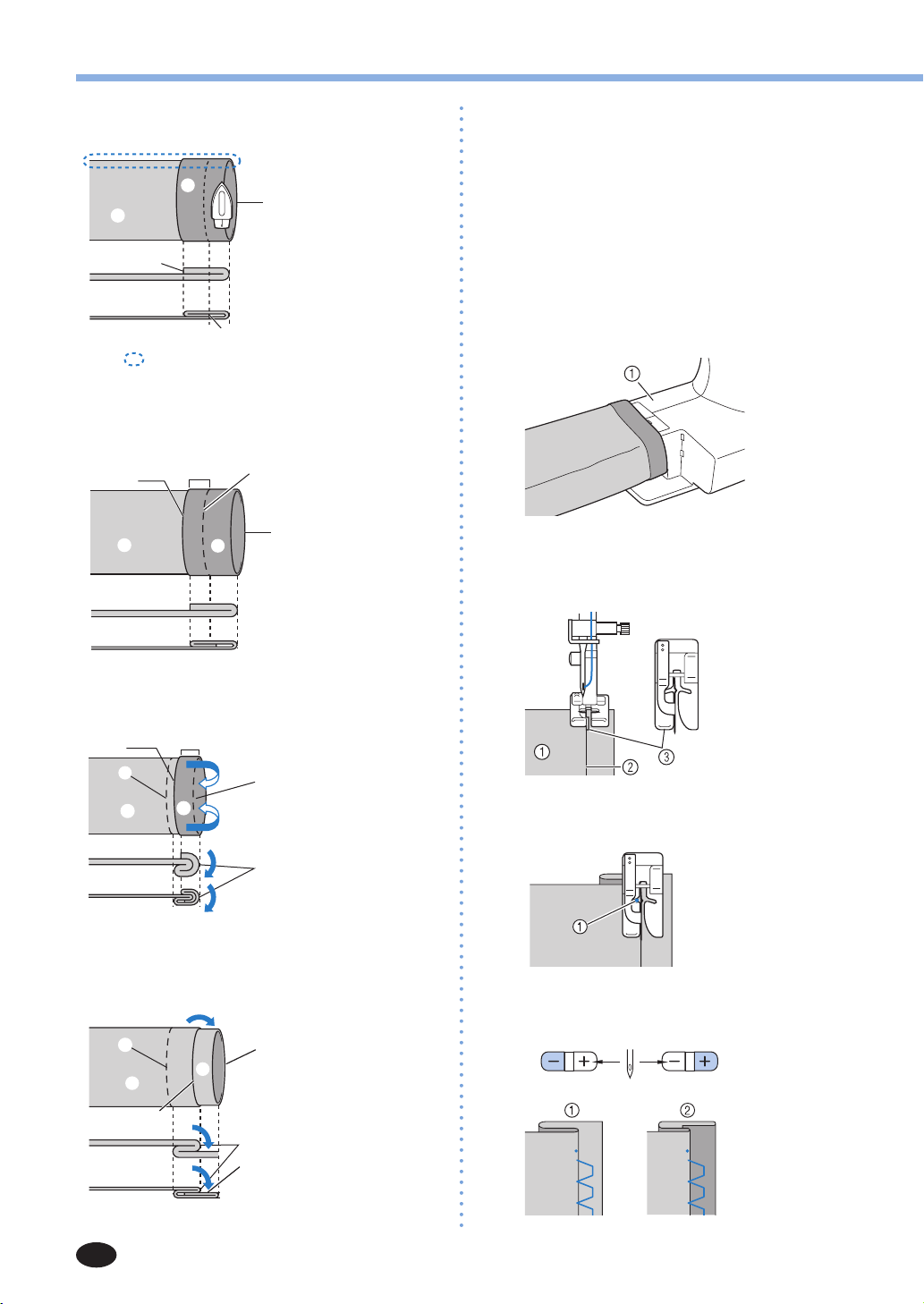
UTILITY STITCHES
34
2
Fold the fabric along the desired edge of the
hem, and press.
1
2
1
2
1
3
3
4
2
1
Wrong side of fabric
2
Right side of fabric
3
Edge of fabric
4
Desired edge of hem
<Thick fabric>
<Normal fabric>
<Seen from the side>
3
Use a chalk to mark on the fabric about 5
mm (3/16 inch) from the edge of the fabric,
and then baste it.
1
2
1
2
3
5
6
4
1
2
1
Wrong side of fabric
2
Right side of fabric
3
Edge of fabric
4
Desired edge of
hem
5
5 mm (3/16 inch)
6
Basting
<Thick fabric>
<Normal fabric>
<Seen from the side>
4
Fold back the fabric inside along the basting.
1
3
6
5
1
1
2
7
4
1
Wrong side of fabric
2
Right side of fabric
3
Edge of fabric
4
Desired edge of hem
5
5 mm (3/16 inch)
6
Basting
7
Basting point
<Thick fabric>
<Normal fabric>
<Seen from the side>
5
Unfold the edge of fabric, and position the
fabric with the wrong side facing up.
5
1
1
1
1
1
2
6
3
4
1
Wrong side of fabric
2
Right side of fabric
3
Edge of fabric
4
Desired edge of
hem
5
Basting point
6
Basting
<Thick fabric>
<Normal fabric>
<Seen from the side>
6
Attach blind hem foot “R”.
7
Select a stitch.
8
Remove the flat bed attachment and make
free-arm sewing possible.
•For details on free-arm sewing, refer to
“Stitching cylindrical pieces” (page 31).
9
Slide the part that you wish to sew onto
the arm, make sure that the fabric feeds
correctly, and then start sewing.
1
Arm
10
Position the fabric with the edge of the folded
hem against the guide of the presser foot, and
then lower the presser foot lever.
R
1
Wrong side of
fabric
2
Fold of hem
3
Guide
11
Adjust the stitch width until the needle
slightly catches the fold of the hem.
R
1
Needle drop point
When you change the needle drop point, raise
the needle, and then change the stitch width.
Stitch width
1
Thick fabric
2
Normal fabric
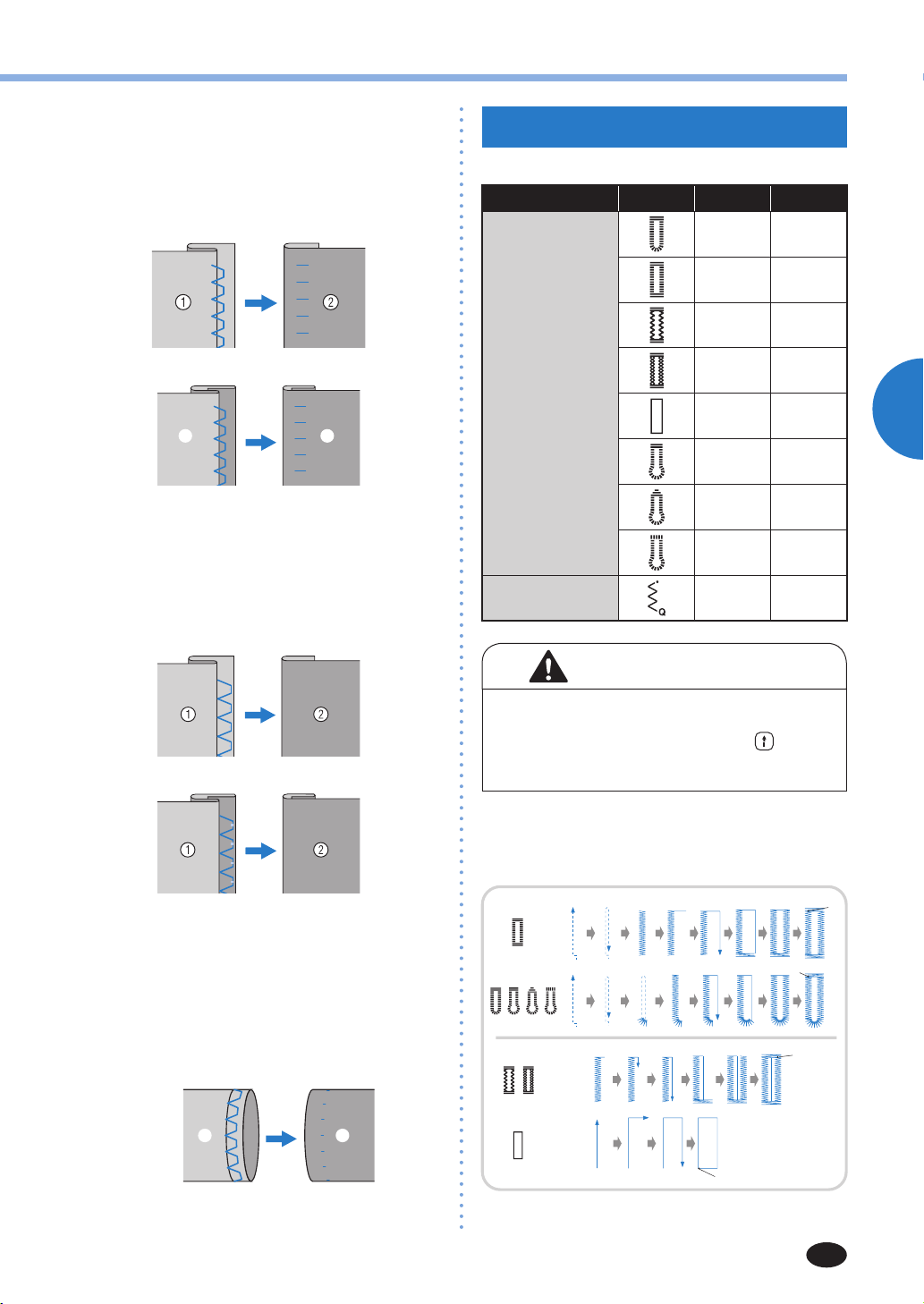
UTILITY STITCHES
35
3
■
If the needle catches too much of the hem fold
If the needle catches too much of the hem
fold, adjust the stitch width so that the needle
slightly catches the fold by pressing the “+”
side of the stitch width adjustment key.
<Thick fabric>
<Normal fabric>
1
Wrong side of fabric
2
Right side of fabric
■
If the needle does not catch the hem fold
If the needle does not catch the hem fold,
adjust the stitch width so that the needle
slightly catches the fold by pressing the “-” side
of the stitch width adjustment key.
<Thick fabric>
<Normal fabric>
1
Wrong side of fabric
2
Right side of fabric
•For details on changing the stitch width, refer
to “Selecting a stitch” (page 25).
12
Sew with the fold of the hem against the
presser foot guide.
13
Remove the basting stitching and turn the
fabric right side up.
1
2
1
Wrong side of fabric
2
Right side of fabric
BUTTONHOLE SEWING
Buttonholes can be sewn and buttons can be sewn on.
Stitch Name Pattern
Presser Foot
Pattern No.
Buttonhole stitch
A 37
A 38
A 39
A 40
A 41
A 42
A 43
A 44
Zigzag stitch
(for quilting)
J 49
CAUTION
• Be sure to turn off the main power before
replacing the presser foot. Otherwise, injuries
may occur if the foot controller or
(start/
stop button) is accidentally pressed and the
machine starts sewing.
The maximum buttonhole length is about 28 mm
(1-1/8 inches) (diameter + thickness of the button).
Buttonholes are sewn from the front of the presser
foot to the back, as shown below.
1
Reinforcement stitching
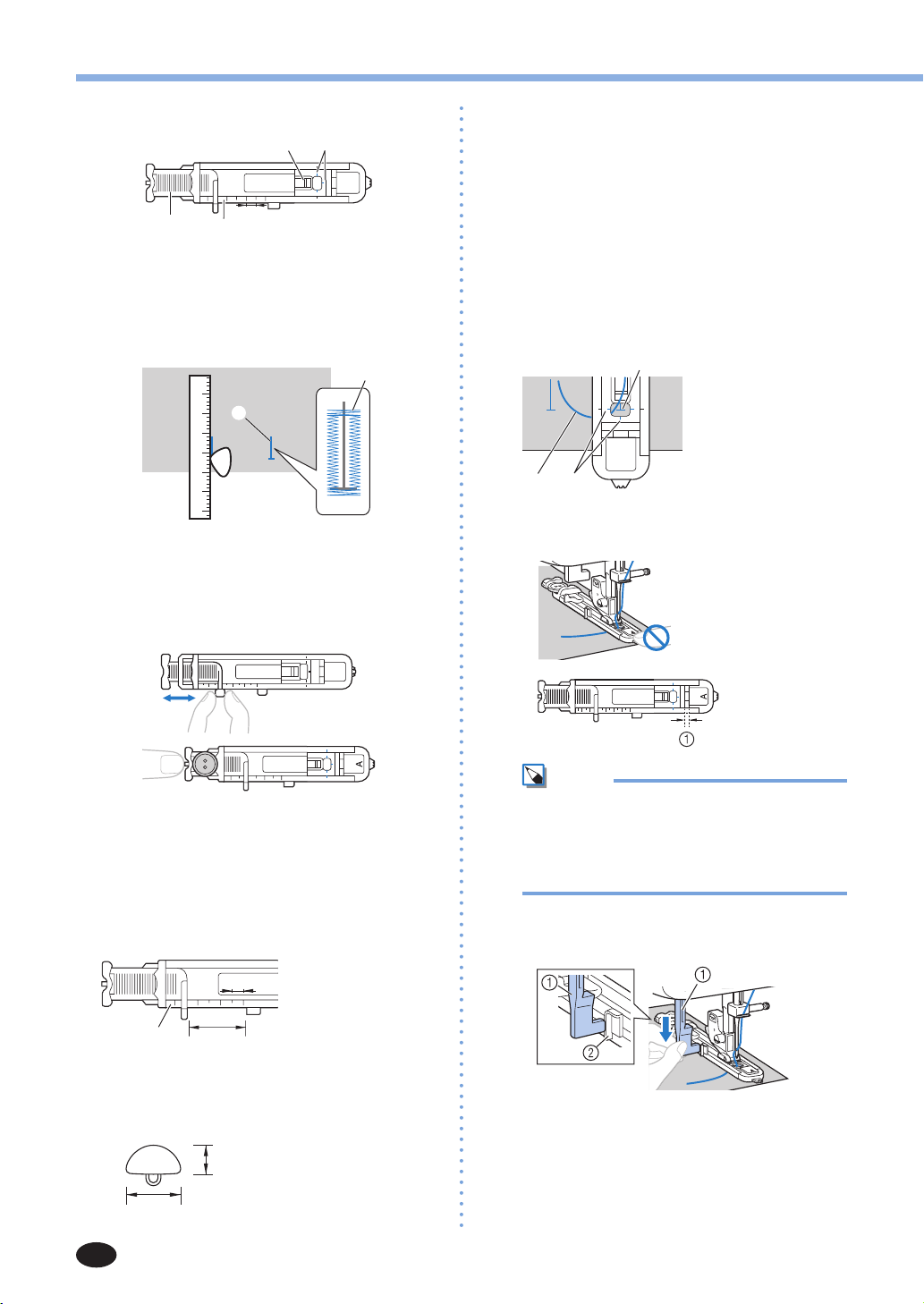
UTILITY STITCHES
36
Part names of the buttonhole foot “A”
A
1
2
5
3
4
1
Button guide plate
3
Pin
5
5 mm (3/16 inch)
2
Presser foot scale
4
Marks on buttonhole foot
1
Use chalk to mark the position and length of
the buttonhole on the fabric.
1
2
1
Marks on fabric
2
Buttonhole sewing
2
Pull out the button guide plate of buttonhole
foot “A”, and then insert the button that will
be put through the buttonhole.
A
X
The size of the buttonhole is set.
• If the button does not fit in the button guide
plate
Add together the diameter and thickness of
the button, and then set the button guide plate
to the calculated length. (One division on the
scale is 5 mm (3/16 inch).)
1
3
2
1
Presser foot scale
2
Length of buttonhole
(Diameter + thickness
of button)
3
5 mm (3/16 inch)
Example: For a button with a diameter of 15
mm (9/16 inch) and a thickness of 10 mm (3/8
inch), the button guide plate should be set to
25 mm (1 inch) on the scale.
5
4
4
10 mm (3/8 inch)
5
15 mm (9/16 inch)
3
Attach buttonhole foot “A”.
Position the upper thread under the presser
foot by guiding thread through the hole in the
presser foot before attaching the buttonhole
fo ot “A”.
4
Select a stitch.
5
Position the fabric with the front end of the
buttonhole mark aligned with the red marks
on the sides of the buttonhole foot, and then
lower the presser foot lever.
A
1
23
1
Mark on fabric
2
Red marks on
buttonhole foot
3
Upper thread
• When lowering the presser foot, do not push
in the front of the presser foot, otherwise the
buttonhole will not be sewn with the correct size.
1
Do not reduce
the gap.
Mem
o
•If there is difficulty in aligning the marks,
slowly turn the handwheel toward you
to check where the needle will enter the
fabric, and then align the mark on the fabric
with that point.
6
Pull down the buttonhole lever as far as
possible.
1
Buttonhole lever
2
Bracket
The buttonhole lever is positioned behind the
bracket on the buttonhole foot.
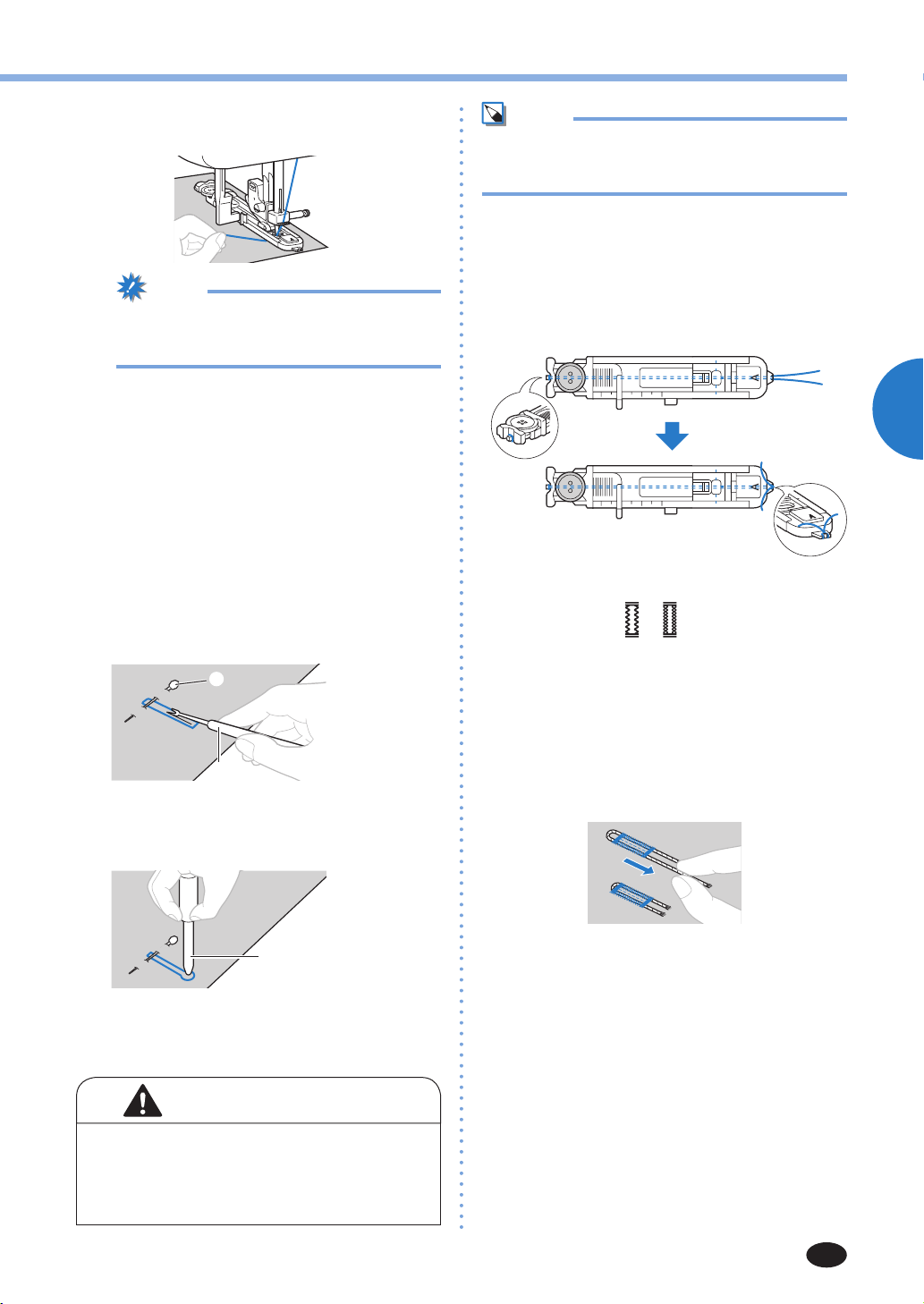
UTILITY STITCHES
37
3
7
Gently hold the end of the upper thread in
your left hand, and then start sewing.
Note
•If thick seams are being sewn and the fabric
does not feed, sew with the coarser (longer)
stitch.
X
Once sewing is completed, the machine
automatically sews reinforcement stitches,
then stops.
8
Raise the needle and the presser foot lever,
remove the fabric, and cut the thread.
9
Raise the buttonhole lever to its original
position.
10
Insert a pin at the end of the buttonhole
stitching to prevent the stitching from being
cut, and then use a seam ripper to cut
towards the pin and open the buttonhole.
1
2
1
Seam ripper
2
Pin
For keyhole buttonholes, use a commercially
available eyelet punch to make a hole in the
rounded end of the buttonhole, and then use
the seam ripper to cut open the buttonhole.
1
1
Eyelet punch
•When using the eyelet punch, place thick
paper or some other protective sheet under
the fabric before punching the hole in the
fabric.
CAUTION
• When opening the buttonhole with the seam
ripper, do not place your hands in the cutting
path, otherwise injuries may result if the seam
ripper slips. Do not use the seam ripper in any
other way than how it is intended.
Mem
o
•Before sewing buttonholes, check the stitch length
and width by sewing a trial buttonhole on a scrap
piece of fabric.
■
Sewing buttonholes on stretch fabrics
When sewing buttonholes on stretch fabrics, use
a gimp thread.
1
Hook the gimp thread onto the part of buttonhole
foot “A” shown in the illustration so that it fits
into the grooves, and then loosely tie it.
2
Attach buttonhole foot “A”.
3
Select a stitch or .
4
Adjust the stitch width to the thickness of the
gimp thread.
5
Lower the presser foot lever and the
buttonhole lever, and then start sewing.
6
When sewing is finished, gently pull the gimp
thread to remove any slack.
7
Use a handsewing needle to pull the gimp
thread to the wrong side of the fabric, and
then tie it.
8
With a seam ripper, cut the middle part of
the gimp thread remaining at the top end of
the buttonhole.
Trim off any excess of the gimp thread.
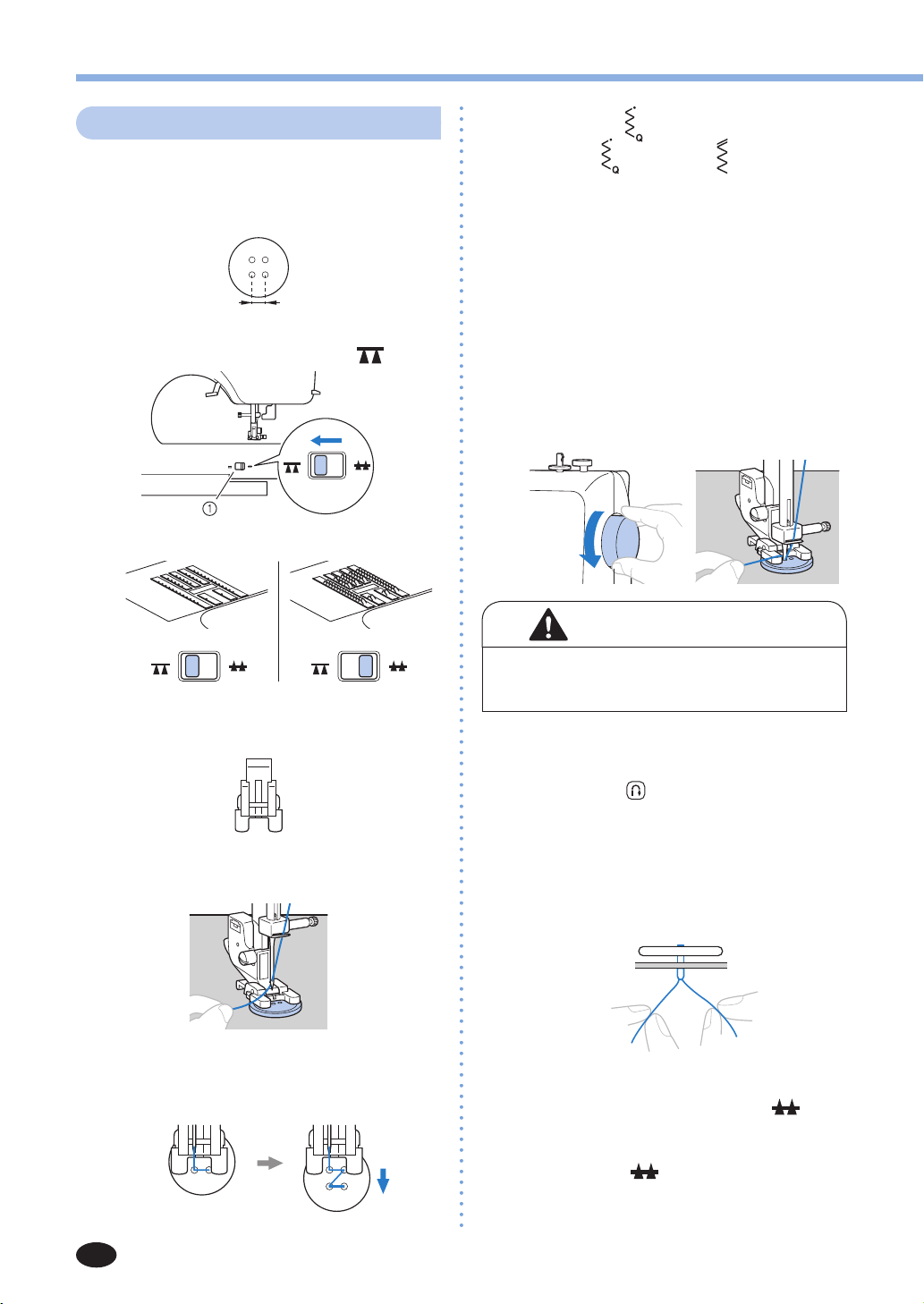
UTILITY STITCHES
38
Button sewing
Buttons can be sewn on with the sewing machine.
Buttons with 2 or with 4 holes can be attached.
1
Measure the distance between the holes.
2
Raise the presser foot lever, and then slide
the feed dog position lever to the
side.
1
Feed dog position lever
X
The feed dogs are lowered.
3
Attach presser foot “M”.
4
Place a button between the presser foot and
the fabric.
•When attaching four-hole buttons, first sew the
two holes closest to you. Then, slide the button
so that the needle goes into the other two
holes, and then sew them in the same way.
5
Select a stitch . (With models not provided
with stitch
, select stitch .)
6
Adjust the stitch width so that it is the same
as the distance between the holes in the
button.
7
Set the stitch length to the shortest setting by
pressing the stitch length adjustment key.
8
Turn the handwheel toward you
(counterclockwise) to check that the needle
correctly goes into the two holes of the
button.
Adjust the stitch width to the distance between
the button holes.
CAUTION
• When sewing, be sure that the needle does not
touch the button, otherwise the needle may
bend or break.
9
Start sewing.
•After sewing for about 10 seconds at low
speed, press
(reverse/reinforcement stitch
button) to sew reinforcement stitches.
10
Pull the upper thread at the end of the
stitching to the wrong side of the fabric, and
then tie it with the bobbin thread.
Use scissors to cut the upper thread and the
bobbin thread at the beginning of the stitching.
11
When you are finished attaching the button,
slide the feed dog position lever to
and
turn the handwheel to raise the dogs.
•Normally, the feed dog position lever is
positioned at
.
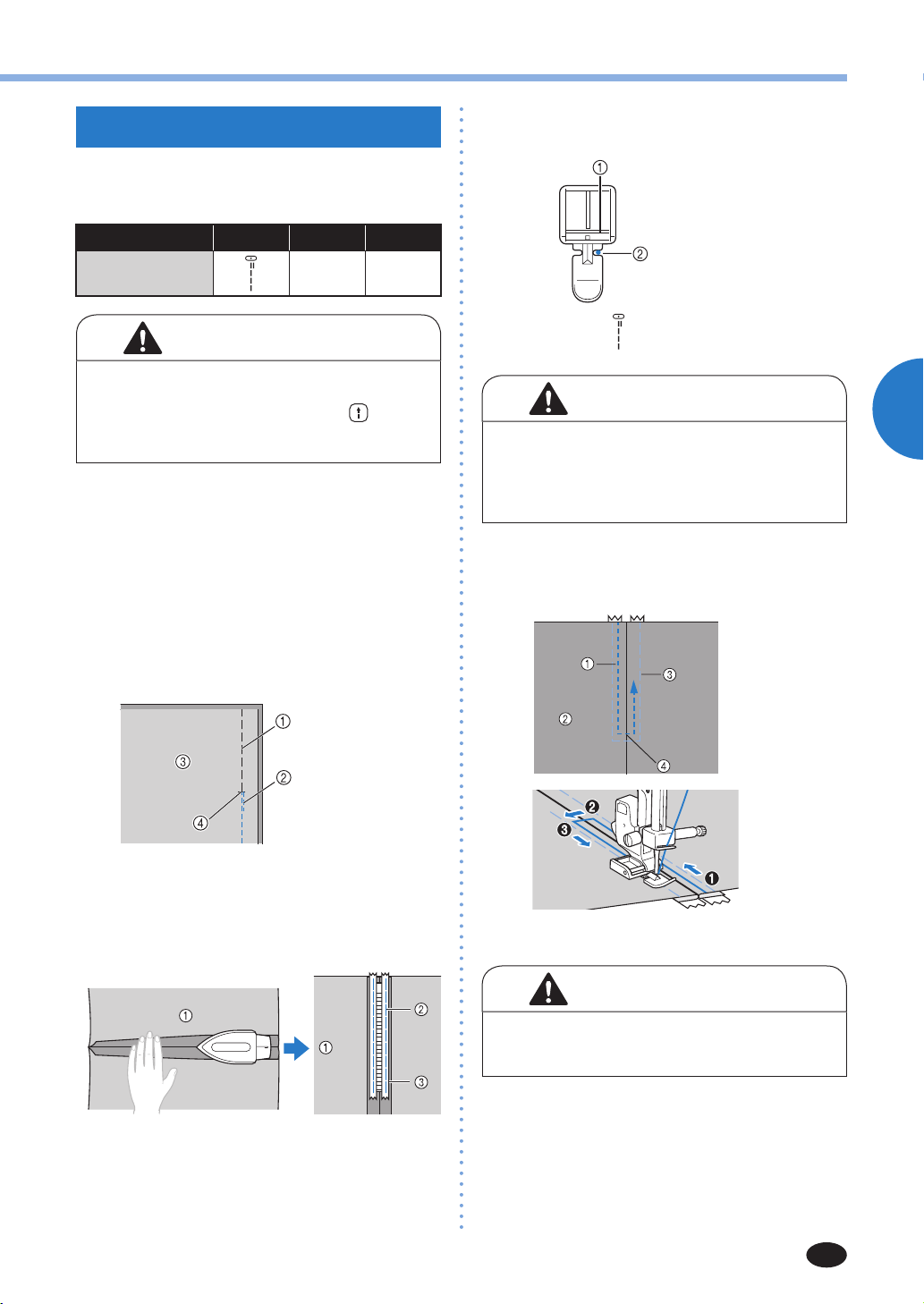
UTILITY STITCHES
39
3
ZIPPER INSERTION
You can use the zipper foot to sew different types of
zippers, and can easily position it to the right or left
side of the needle.
Stitch Name Pattern
Presser Foot
Pattern No.
Straight stitch
(center)
I 02
CAUTION
• Be sure to turn off the main power before
replacing the presser foot. Otherwise, injuries
may occur if the foot controller or
(start/
stop button) is accidentally pressed and the
machine starts sewing.
1
Attach zigzag foot “J”.
2
Place the two pieces of fabric with their right
sides facing each other.
3
Sew basic stitches to the end of the zipper
opening, and then sew reverse stitches at the
end of the stitching.
•Use basting stitching to sew the zipper
opening (where the zipper will be inserted).
1
Basting stitching
2
Reverse stitches
3
Wrong side of
fabric
4
End of zipper
opening
•Refer to “BASIC STITCHING” on page 33.
4
Open the seam allowance, press it from the
wrong side of the fabric with an iron, align
the center of the zipper with the stitching,
and then baste the zipper in place.
1
Wrong side of fabric
2
Basting stitching
3
Zipper
5
Attach the presser foot holder to the right
side of the pin on zipper foot “I”.
I
1
Pin on the right side
2
Needle drop point
6
Select stitch .
CAUTION
• Turn the handwheel by hand to make sure the
needle does not hit the presser foot before you
start sewing. If you choose a different stitch,
the needle will hit the presser foot and break
the needle. You may also be injured.
7
With the right side of the fabric facing up,
continue sewing with the zipper on the right
side of the presser foot.
1
Stitching
2
Right side of
fabric
3
Basting
stitching
4
End of zipper
opening
•Sew the stitching in order, from
1
to
3
.
CAUTION
• Make sure the needle does not hit the zipper
during sewing. If the needle hits the zipper, the
needle may break and you may be injured.
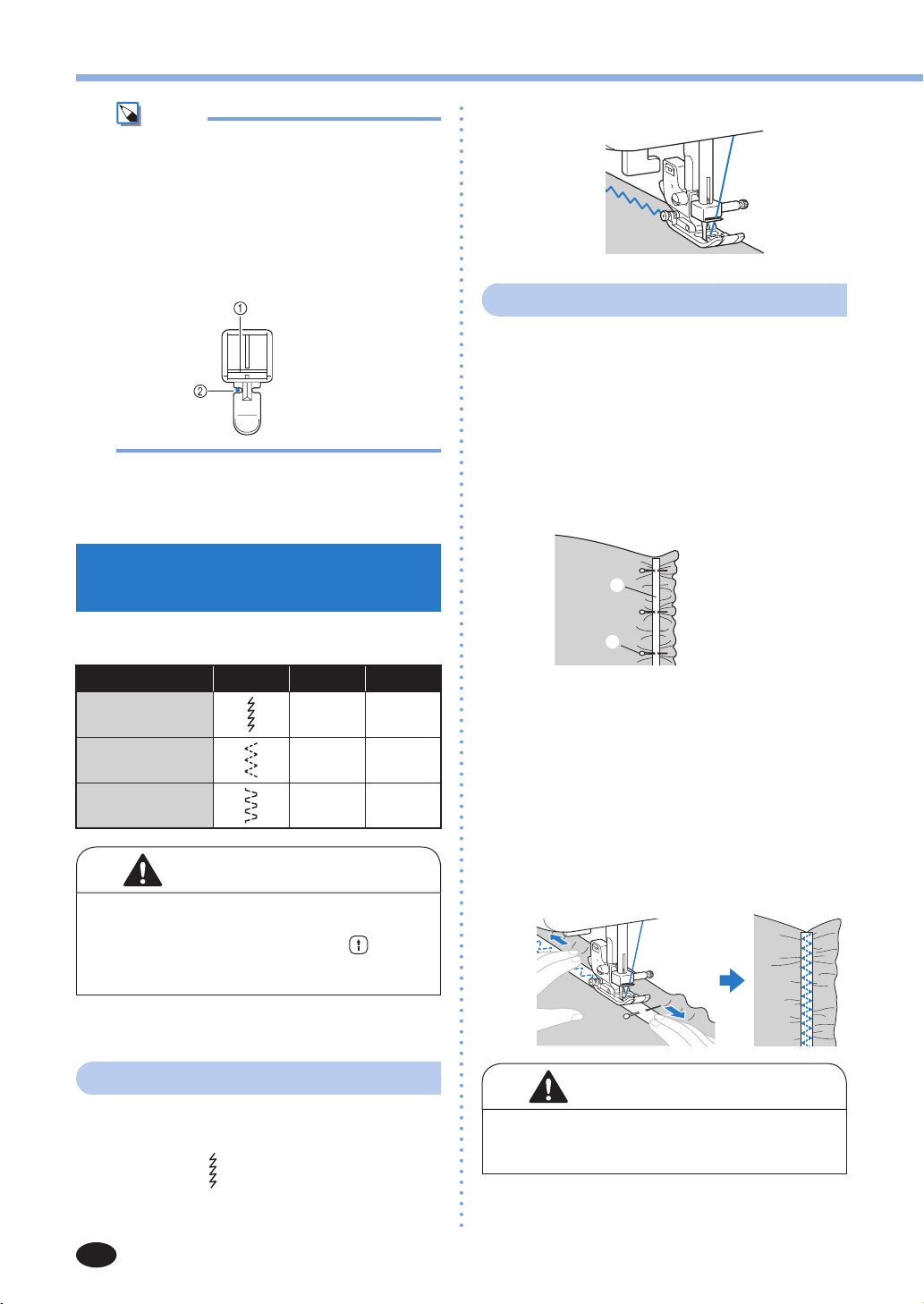
UTILITY STITCHES
40
Mem
o
•If the presser foot contacts the zipper slider,
leave the needle lowered (in the fabric)
and raise the presser foot. After moving the
slider so it will not contact the presser foot,
lower the presser foot and continue sewing.
•To sew with the zipper on the left side of
the presser foot, attach the presser foot
holder to the left side of the pin on zipper
foot “I” in step
5
.
I
1
Left side of the pin
2
Needle drop point
8
When you have finished sewing, remove the
basting stitching.
SEWING STRETCH FABRICS
AND ELASTIC TAPE
Stretch fabrics can be sewn and elastic tape can be
attached.
Stitch Name Pattern
Presser Foot
Pattern No.
Stretch stitch J 04
3-point
zigzag stitch
J 06
Elastic-attaching
stitch
J 24
CAUTION
• Be sure to turn off the main power before
replacing the presser foot. Otherwise, injuries
may occur if the foot controller or
(start/
stop button) is accidentally pressed and the
machine starts sewing.
Observe the corresponding precautions when
performing each of the following stitching operations.
Stretch stitching
1
Attach zigzag foot “J”.
2
Select stitch .
3
Sew the fabric without stretching it.
Elastic attaching
When elastic tape is attached to the cuff or waist of a
piece of clothing, the finished dimensions will be that
of the stretched elastic tape. Therefore, it is necessary
that a suitable length of the elastic tape is used.
1
Pin the elastic tape to the wrong side of the
fabric.
Pin the elastic tape to the fabric at a few
points to make sure that the tape is uniformly
positioned on the fabric.
1
2
1
Elastic tape
2
Pin
2
Attach zigzag foot “J”.
3
Select a stitch.
4
Sew the elastic tape to the fabric while
stretching the tape so that it is the same
length as the fabric.
While pulling the fabric behind the presser foot
with your left hand, pull the fabric at the pin
nearest the front of the presser foot with your
right hand.
CAUTION
• When sewing, be sure that the needle does not
touch any pins, otherwise the needle may bend
or break.

UTILITY STITCHES
41
3
APPLIQUÉ, PATCHWORK
AND QUILT STITCHING
The stitches that can be used for sewing appliqués,
patchwork and quilts are described below.
Stitch Name Pattern
Presser Foot
Pattern No.
Zigzag stitch J 05
Zigzag stitch
(for quilting)
J 49
Appliqué stitch
J 15
Appliqué stitch
(for quilting)
J 50
J 51
Piecing straight
stitch
J 46
J 47
Joining stitch
J 18
J 19
J 20
Hand-look
quilting
J 48
Quilting
stippling
J 52
CAUTION
• Be sure to turn off the main power before
replacing the presser foot. Otherwise, injuries
may occur if the foot controller or
(start/
stop button) is accidentally pressed and the
machine starts sewing.
Appliqués
You can create an appliqué by cutting a different
piece of fabric into a shape and using it as a
decoration.
1
Baste the cut design to the fabric.
CAUTION
• If glue is used to hold the cut design in place
on the fabric, do not apply glue to areas that
will be sewn with the machine. If glue is
attached to the needle or race, the machine
may be damaged.
2
Attach zigzag foot “J”.
3
Select stitch .
4
Sew along the edge of the fabric with the
needle dropping off the edge at the right.
1
Appliqué fabric
2
Needle drop point
5
Remove the basting, if necessary.
Mem
o
•Make reinforcing straight stitches at the beginning
and the end of stitching.
CAUTION
• Be careful that the needle does not hit a pin
during sewing, as the needle can break. You
may also be injured.
Patchwork (crazy quilt) stitching
1
Fold the edge of the top piece of fabric and
place it over the lower piece.
2
Sew the two pieces of fabric together so the
pattern spans both pieces.
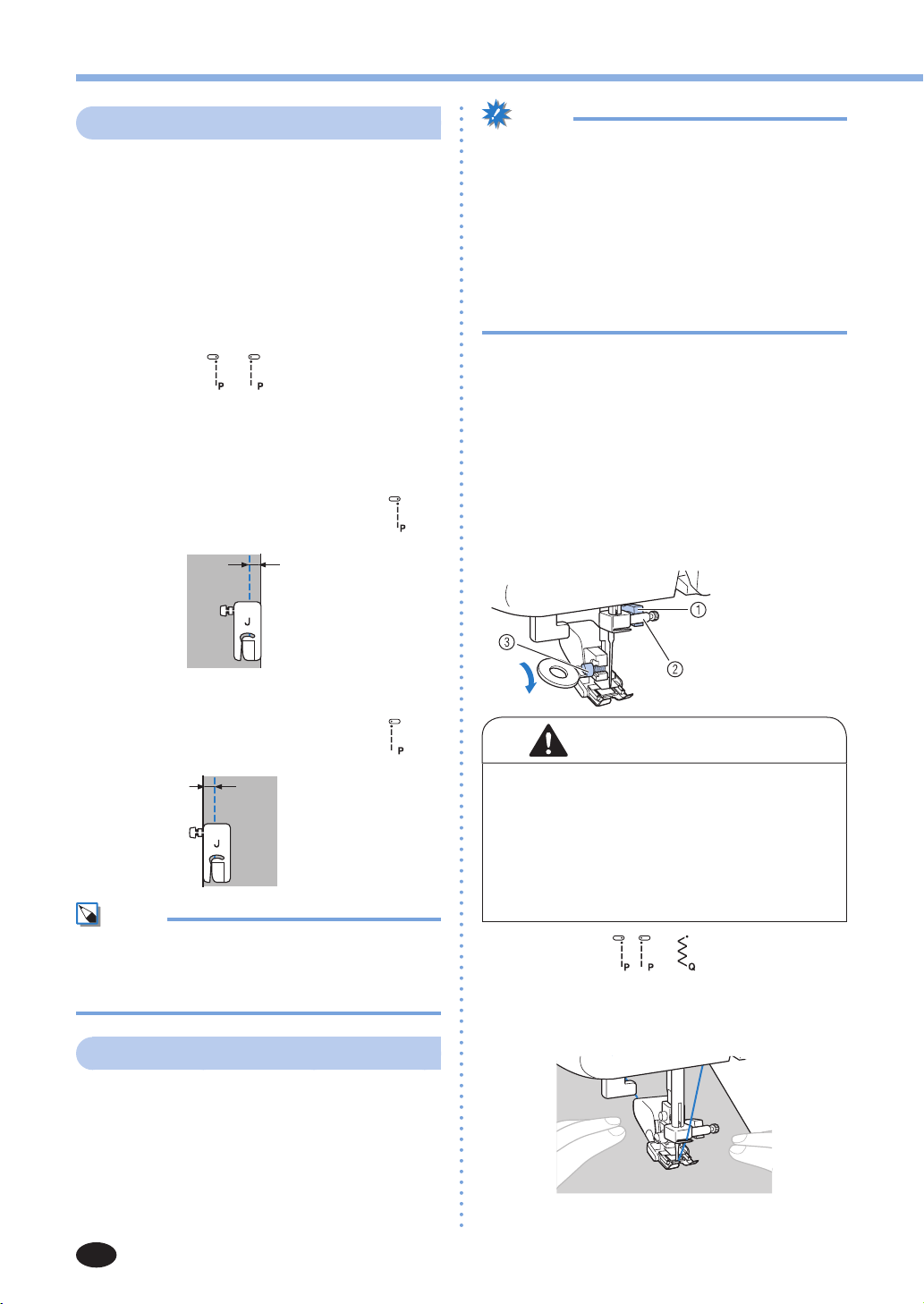
UTILITY STITCHES
42
Piecing
Sewing together two pieces of fabric is called
“piecing”. The fabric pieces should be cut with a 6.5
mm (1/4 inch) seam allowance.
Sew a piecing straight stitch 6.5 mm (1/4 inch) from
either the right side or the left side of the presser foot.
1
Baste or pin along the seam allowance of the
fabric that you wish to piece together.
2
Attach zigzag foot “J”.
3
Select stitch
or .
4
Sew with the side of the presser foot aligned
with the edge of the fabric.
• For a seam allowance on the right side
Align the right side of the presser foot with the
edge of the fabric, and sew using stitch
.
1
1
6.5 mm (1/4 inch)
• For a seam allowance on the left side
Align the left side of the presser foot with the
edge of the fabric, and sew using stitch
.
1
1
6.5 mm (1/4 inch)
Mem
o
•To change the width of the seam allowance (the
needle position), adjust the stitch width. For
details, refer to “Changing the needle position”
(page 33).
Quilting
Sandwiching batting between the top and bottom
layers of fabric is called “quilting”. Quilts can easily
be sewn using the optional walking foot and the
optional quilting guide.
Note
•The walking foot can only be used with straight or
zigzag stitch patterns. Do not sew reverse stitches
with the walking foot.
•When using the walking foot, try a test sewing
on a scrap piece of fabric that is to be used in
project.
Models equipped with a needle threader
•Thread the needle manually when using the
walking foot, or only attach the walking foot after
threading the needle using the needle threader.
1
Baste the fabric to be quilted.
2
Remove the presser foot and the presser foot
holder. (Refer to page 24.)
3
Hook the connecting fork of the walking
foot onto the needle clamp screw, lower the
presser foot lever, and then use the presser
foot holder screw to attach the walking foot
to the presser bar.
1
Connecting fork
2
Needle clamp
screw
3
Presser foot
holder screw
CAUTION
• Use the disc-shaped screwdriver to tighten
the screw securely. If the screw is loose, the
needle may strike the presser foot and cause
injury.
• Be sure to turn the handwheel toward the
front of the machine to check that the needle
does not strike the presser foot. If the needle
strikes the presser foot, injury may result.
4
Select stitch , or .
5
Place one hand on each side of the presser
foot, and then evenly guide the fabric while
sewing.
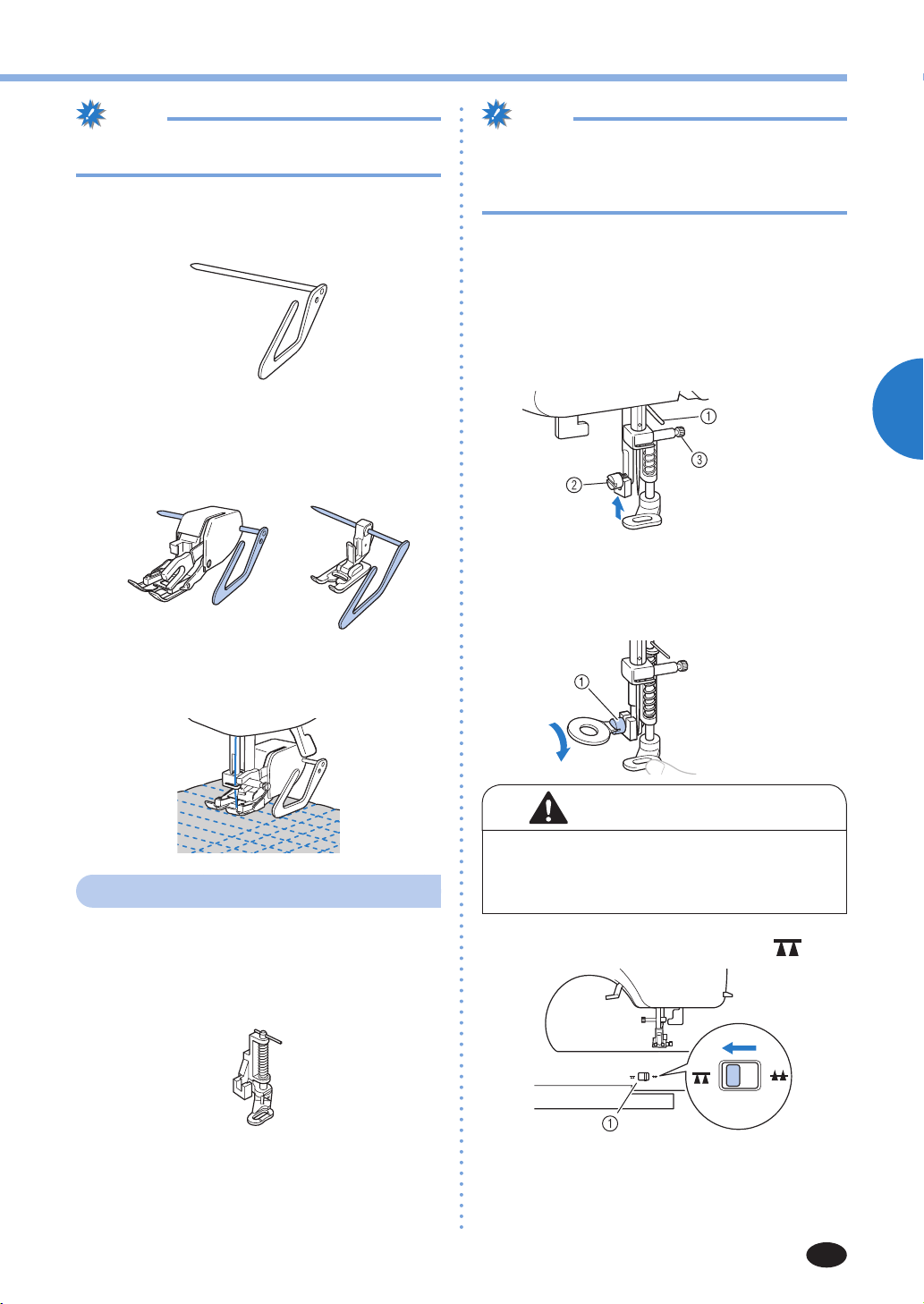
UTILITY STITCHES
43
3
Note
•When sewing with the walking foot, sew at a
speed between slow and medium.
■
Using the optional quilting guide
Use the quilting guide to sew parallel stitches that
are equally spaced.
1
Insert the stem of the quilting guide into the
hole at the rear of the walking foot or presser
foot holder.
Walking foot
Presser foot holder
2
Adjust the stem of the quilting guide so
that the guide aligns with the seam that has
already been sewn.
Free-motion quilting
With free-motion quilting, the feed dogs can be
lowered (using the feed dog position lever) so that
the fabric can be moved freely in any direction.
The optional quilting foot is needed for free-motion
quilting.
Note
Models equipped with a needle threader
•Thread the needle manually when using the
quilting foot, or only attach the quilting foot after
threading the needle using the needle threader.
1
Remove the presser foot and the presser foot
holder. (Refer to page 24.)
2
Align the quilting foot with the lower-left side
of the presser bar.
The pin on the quilting foot should be
positioned over the needle clamp screw.
1
Pin on quilting
foot
2
Presser foot
holder screw
3
Needle clamp
screw
3
Hold the quilting foot in place with your right
hand, and then tighten the presser foot holder
screw using the disc-shaped screwdriver in
your left hand.
1
Presser foot
holder screw
CAUTION
• Be sure to securely tighten the screws with the
disc-shaped screwdriver, otherwise the needle
may touch the presser foot, causing it to bend
or break.
4
Slide the feed dog position lever to .
1
Feed dog position lever
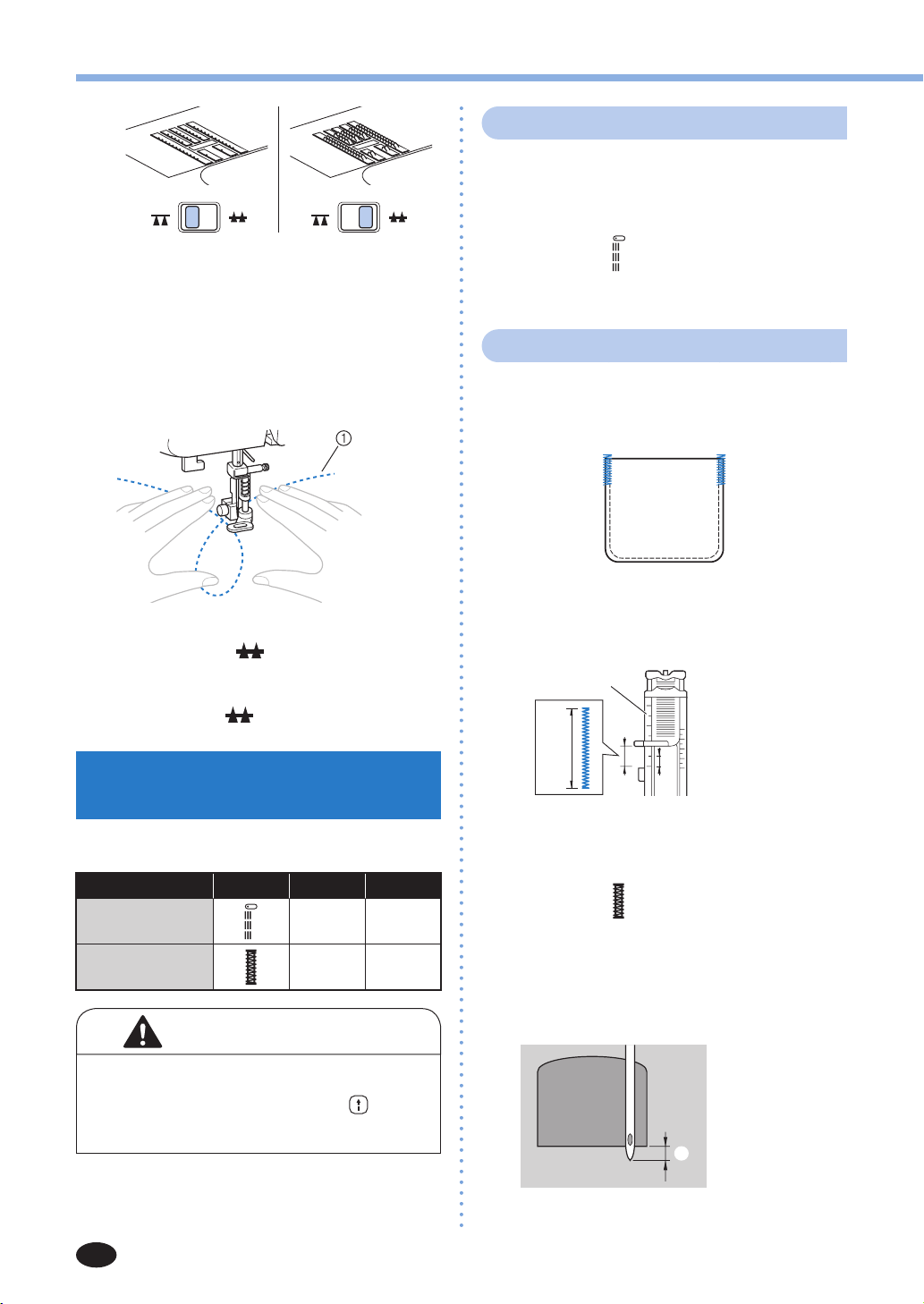
UTILITY STITCHES
44
X
The feed dogs are lowered.
5
Turn on the sewing machine, and then select
a stitch.
6
Use both hands to hold the fabric taut, then
move the fabric to follow the pattern.
Reinforcement stitches are sewn at the
beginning and end of sewing.
1
Pattern
7
After sewing is finished, slide the feed dog
position lever to
and turn the handwheel
to raise the dogs.
•Normally, the feed dog position lever is
positioned at
.
REINFORCEMENT
STITCHING
Reinforce points that will be subject to strain, such as
sleeve holes, inseams and pocket corners.
Stitch Name Pattern
Presser Foot
Pattern No.
Triple stretch
stitch
J 03
Bar tack stitch
A 45
CAUTION
• Be sure to turn off the main power before
replacing the presser foot. Otherwise, injuries
may occur if the foot controller or
(start/
stop button) is accidentally pressed and the
machine starts sewing.
Triple stretch stitching
Use triple stretch stitching to reinforce sleeve holes
and inseams.
1
Attach zigzag foot “J”.
2
Select stitch .
3
Start sewing. (Refer to page 26.)
Bar tack stitching
Bar tacks are used to reinforce points subject to
strain, such as pocket corners and openings.
As an example, the procedure for sewing bar tacks at
pocket corners is described below.
1
Determine the desired length of the bar tack.
Set the button guide plate on buttonhole foot
“A” to the desired length. (One division on the
presser foot scale is 5 mm (3/16 inch).)
1
2
3
1
Presser foot scale
2
Length of bar tack
3
5 mm (3/16 inch)
•A bar tack with a maximum length of about
28 mm (1-1/8 inches) can be sewn.
2
Attach buttonhole foot “A”.
3
Select stitch .
4
Position the fabric so that the opening of the
pocket faces toward you, and then lower the
presser foot lever so that the needle drops
2 mm (1/16 inch) in front of the pocket
opening.
1
1
2 mm (1/16 inch)
Pass the upper thread down through the hole
in the presser foot.
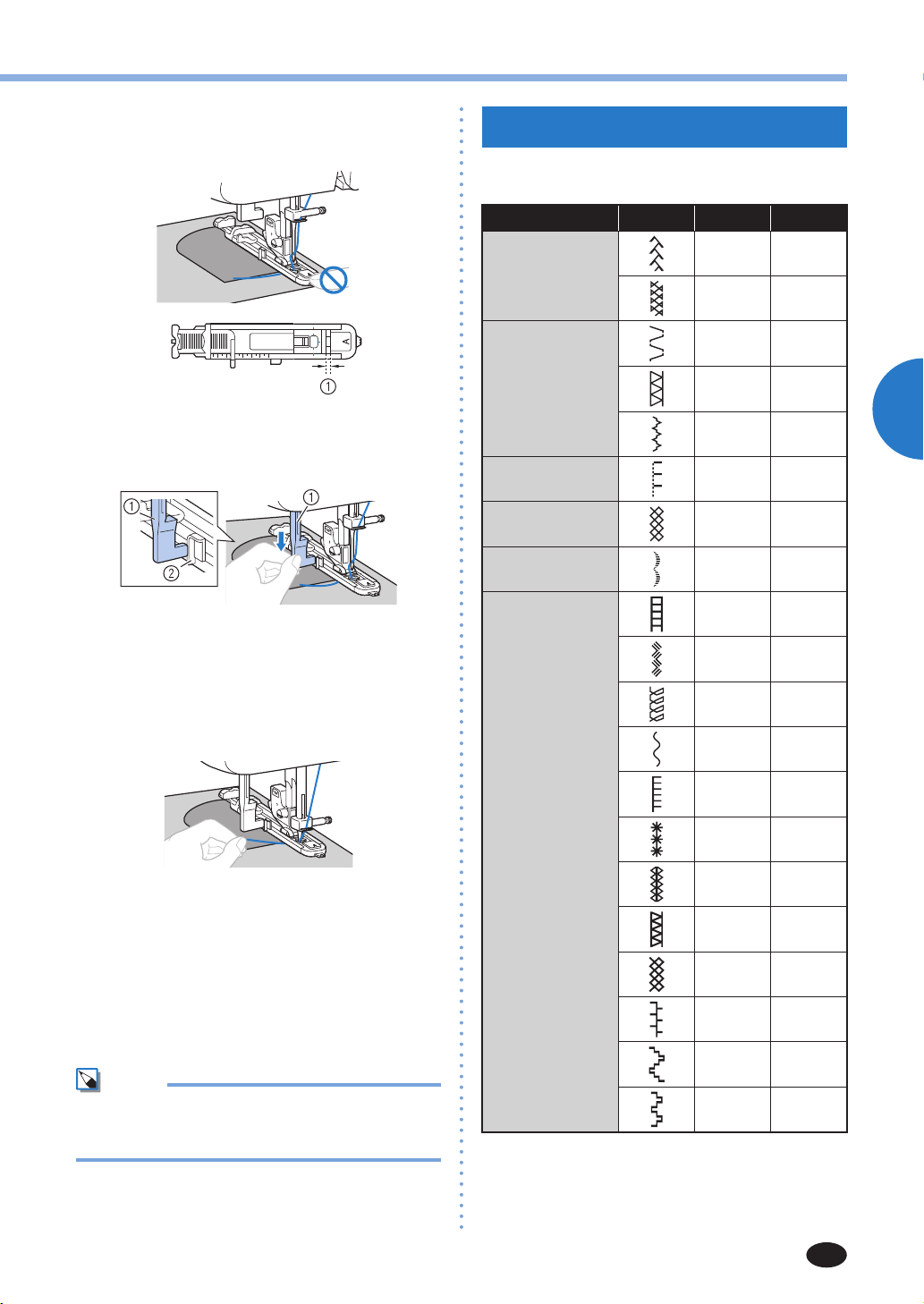
UTILITY STITCHES
45
3
•When lowering the presser foot, do not push
in the front of the presser foot, otherwise the
bar tack will not be sewn with the correct size.
1
Do not reduce the gap.
5
Pull down the buttonhole lever as far as
possible.
1
Buttonhole lever
2
Bracket
The buttonhole lever is positioned behind the
bracket on the buttonhole foot.
6
Gently hold the end of the upper thread in
your left hand, and then start sewing.
X
Once sewing is completed, the machine
automatically sews reinforcement stitches,
then stops.
7
Raise the needle and the presser foot lever,
remove the fabric, and cut the thread.
8
Raise the buttonhole lever to its original
position.
Mem
o
•If the fabric does not feed, for example, because it
is too thick, increase the stitch length. For details,
refer to “Selecting a stitch” (page 25).
DECORATIVE STITCHING
Various decorative stitches can be sewn with this
sewing machine.
Stitch Name Pattern
Presser Foot
Pattern No.
Fagoting stitch
J 22
J 23
Joining stitch
J 18
J 19
J 20
Shell tuck stitch
J 16
Smocking stitch
J 21
Satin scallop
stitch
N 17
Decorative stitch
J 25
J 26
J 27
N 28
N 29
N 30
N 31
N 32
N 33
N 34
N 35
N 36
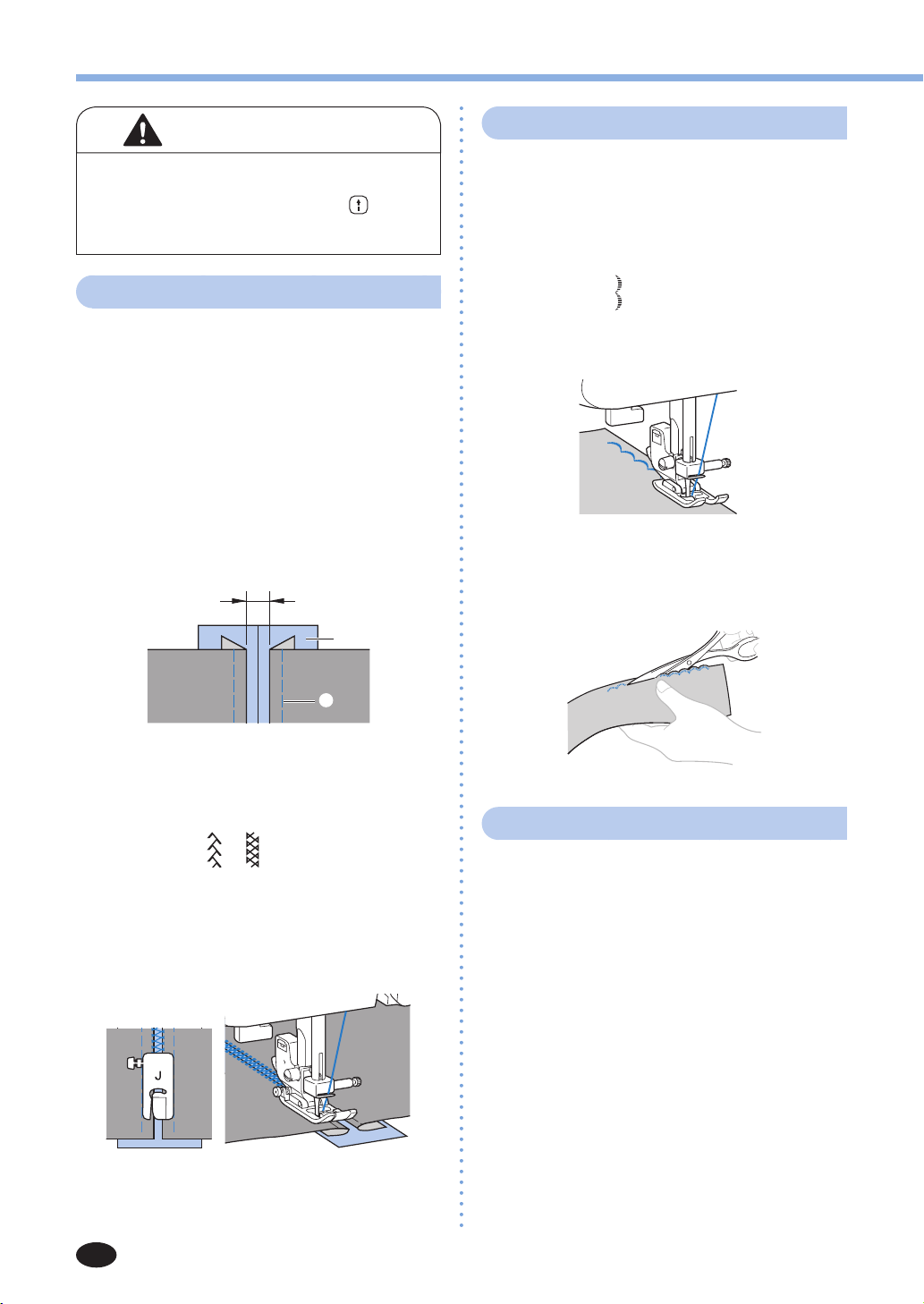
UTILITY STITCHES
46
CAUTION
• Be sure to turn off the main power before
replacing the presser foot. Otherwise, injuries
may occur if the foot controller or
(start/
stop button) is accidentally pressed and the
machine starts sewing.
Fagoting
Stitching across an open seam is called “fagoting”. It
is used on blouses and children’s clothing. This stitch
is more decorative when thicker thread is used.
1
Use an iron to fold the two pieces of fabric
along their seams.
2
Baste the two pieces of fabric, separated by
about 4.0 mm (3/16 inch), onto thin paper or
a sheet of water-soluble stabilizer.
•If you draw a line down the middle of the
thin paper or water-soluble stabilizer, sewing
is easier.
1
2
3
1
Thin paper or water soluble stabilizer
2
Basting stitching
3
4 mm (3/16 inch)
3
Attach zigzag foot “J”.
4
Select stitch
or .
5
Set the stitch width to 7.0 mm (1/4 inch).
(Refer to page 26.)
6
Sew with the center of the presser foot aligned
along the center of the two pieces of fabric.
7
After sewing is finished, remove the paper.
Scallop stitching
The wave-shaped repeating pattern that looks
like shells is called “scalloping”. It is used on the
collars of blouses and to decorate the edges of
handkerchiefs.
1
Attach monogramming foot “N”.
2
Select stitch .
3
Stitch along the edge of the fabric, making sure
not to sew directly on the edge of the fabric.
•For better results, apply spray starch onto the
fabric and press with a hot iron before it is
sewn.
4
Trim along the stitches.
•Be careful not to cut the stitches.
Smocking
The decorative stitch created by stitching or
embroidering over gathers is called “smocking”. It is
used to decorate the front of blouses or cuffs. The
smocking stitch adds texture and elasticity to fabric.
1
Attach zigzag foot “J”.
2
Select the straight stitch, and then adjust
the stitch length to 4.0 mm (3/16 inch) and
loosen the thread tension.
•For details, refer to “Selecting a stitch” (page
25) and “Thread tension” (page 28).
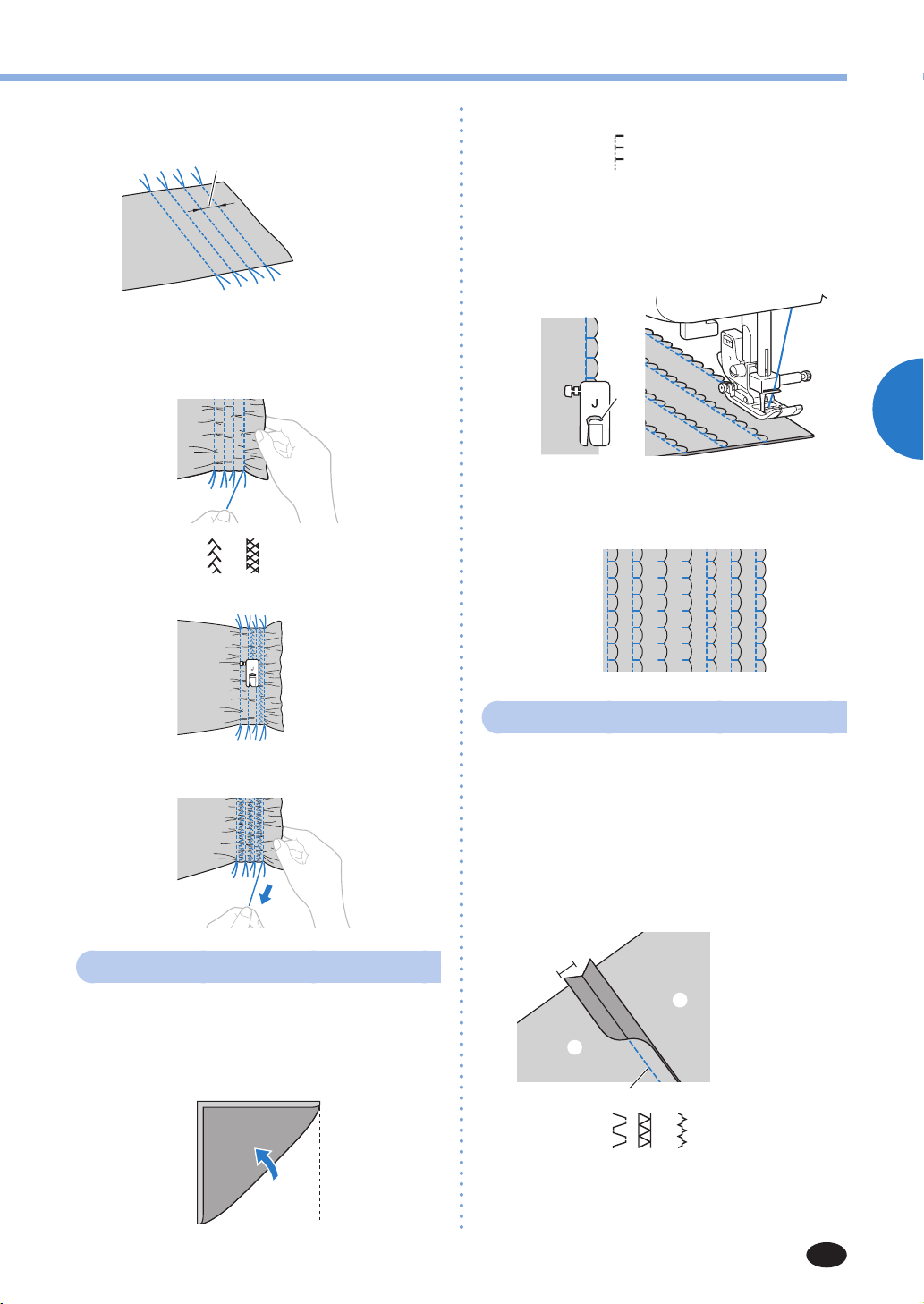
UTILITY STITCHES
47
3
3
Sew parallel stitching at intervals of 10 mm
(3/8 inch).
1
1
10 mm (3/8 inch)
•Do not sew reverse/reinforcement stitches or
cut the thread.
4
Pull the bobbin threads to create gathers.
Smooth the gathers by ironing them.
5
Select stitch
or .
6
Stitch between the straight stitches.
7
Pull out the threads for the straight stitches.
Shell tuck stitching
The gathers that look like shells are called “shell
tucks”. They are used to decorate trims, the front of
blouses or cuffs made of thin fabrics.
1
Fold the fabric along the bias.
2
Attach zigzag foot “J”.
3
Select stitch , and then increase the thread
tension.
•For details, refer to “Selecting a stitch” (page
25).
4
Sew while making sure that the needle drops
slightly off the edge of the fabric.
1
1
Needle drop point
5
Unfold the fabric, and then iron the tucks
down to one side.
Joining
Decorative bridging stitches can be sewn over the
seam allowance of joined fabrics. This is used when
making a crazy quilt.
1
Attach zigzag foot “J”.
2
Sew together the right sides of the two
pieces of fabric, and then open up the seam
allowances.
1
1
2
3
1
Wrong side of
fabric
2
6.5 mm (1/4 inch)
seam allowance
3
Straight stitch
3
Select stitch , or .
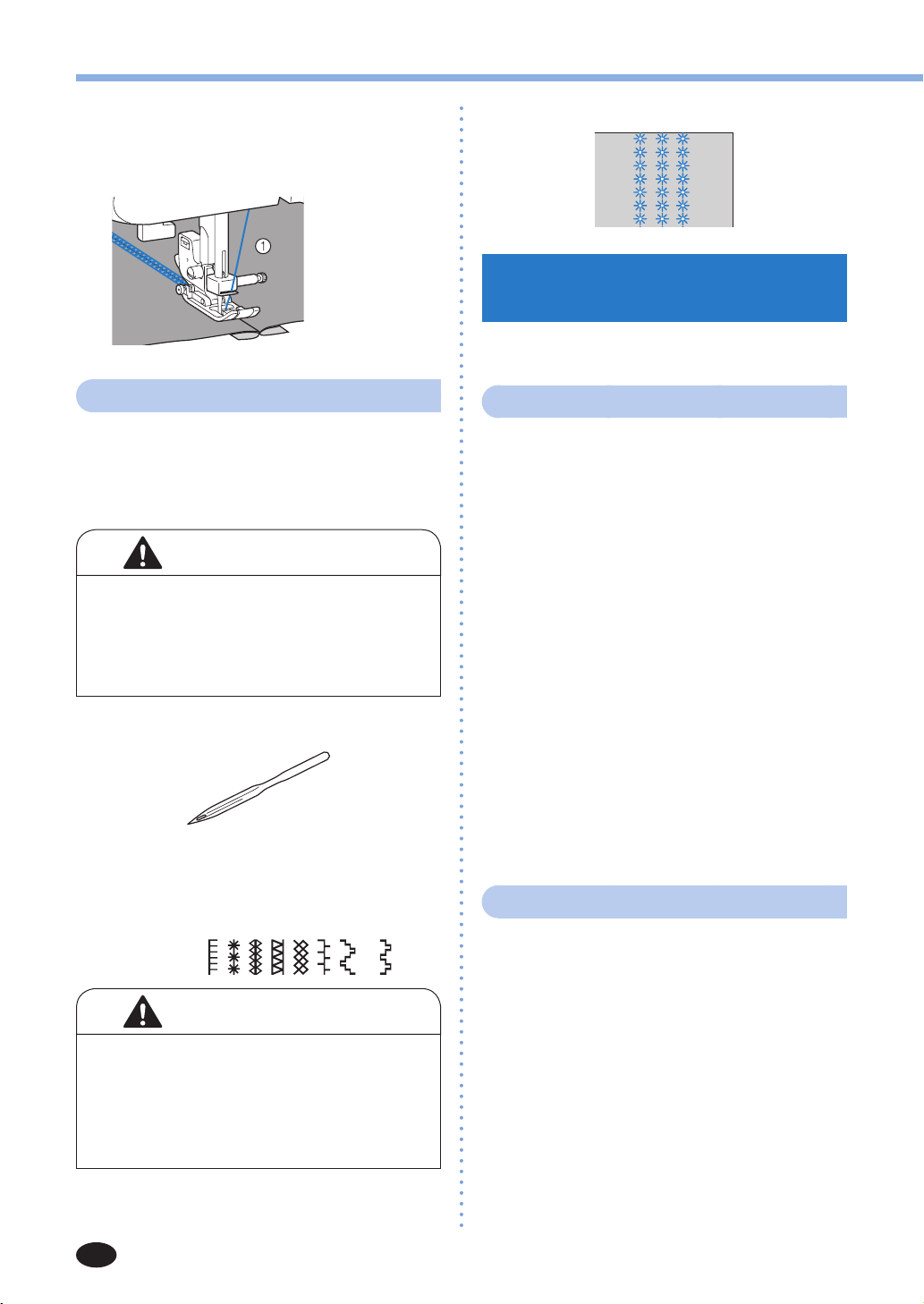
UTILITY STITCHES
48
4
Turn the fabric over so that the right side
faces up, and then sew over the seam with
the center of the presser foot aligned with the
seam.
1
Right side of
fabric
Heirloom stitching
When sewing with the wing needle, the needle holes
are enlarged, creating a lace-like decorative stitch.
This is used to decorate hems and tablecloths on thin
or medium weight fabrics in addition to plain weave
fabrics.
CAUTION
• The needle threader cannot be used with the
wing needle, otherwise the sewing machine
may be damaged. Manually pass the thread
through the eye of the needle from the front
to the back. For details, refer to “Upper
threading” (page 16).
1
Insert the wing needle.
•Use a 130/705H 100/16 wing needle.
•For details on inserting a needle, refer to
“Replacing the needle” (page 21).
2
Attach monogramming foot “N”.
3
Select stitch , , , , , , or .
CAUTION
• Select a stitch width of 6.0 mm (15/64 inch) or
less, otherwise the needle may bend or break.
• After adjusting the stitch width, slowly turn
the handwheel toward you (counterclockwise)
and check that the needle does not touch the
presser foot. If the needle hits the presser foot,
the needle may bend or break.
4
Start sewing.
SEWING CHARACTERS (for models
equipped with character stitches)
55 characters can be sewn by following the
procedure below.
Sewing beautiful patterns
In order to sew the patterns correctly, the following
must be considered.
■
Fabric
Before sewing stretch or thin fabrics or fabrics with
a coarse weave, affix stabilizer material to the wrong
side of the fabric or place a thin sheet of paper, such as
tracing paper, under the fabric. Since material puckering
or bunched stitches may occur when satin stitches are
sewn, be sure to affix stabilizer material to the fabric.
■
Needles and threads
When sewing thin, mediumweight or stretch fabrics,
use the ball point needle. When sewing thick
fabrics, use a 90/14 home sewing machine needle.
In addition, #50 to #60 thread should be used.
■
Trial sewing
Depending on the type and thickness of the fabric
being sewn and whether or not stabilizer material is
used, the desired result may not be achieved. Be sure to
sew a trial piece of fabric before sewing your project. In
addition, while sewing, be sure to guide the fabric with
your hands in order to prevent the fabric from slipping.
Selecting characters
■
Selecting a character
[Example] Selecting stitch “C” (No. 03).
1
Turn on the sewing machine.
2
<For models equipped with 1 font type of
character stitches>
Press the stitch category selection key
twice and confirm that the character stitch
indicator lights up.
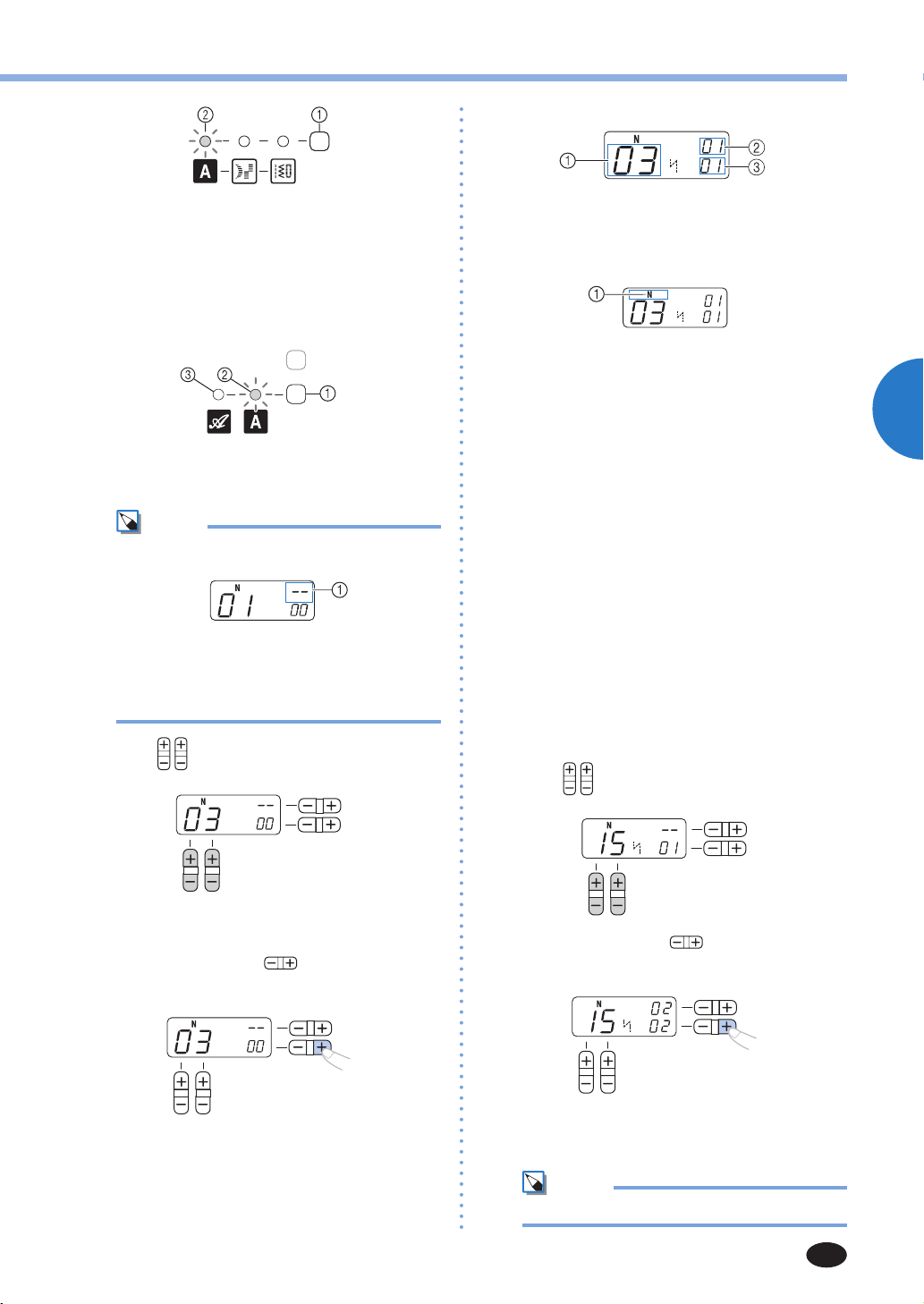
UTILITY STITCHES
49
3
1
Stitch category selection key
2
Character stitch indicator
<For models equipped with 2 font types of
character stitches>
Press the character stitch key once or more
and confirm that the desired font type of
character stitch indicator is lit.
1
Character stitch key
2
Character stitch indicator (Gothic font)
3
Character stitch indicator (Script font)
Mem
o
•When you select a character, check that
there are no characters in memory.
1
This indicator shows that no character is stored.
If there are any characters in memory,
delete them. (For details, refer to “Deleting
characters” (page 51).)
3
Press (stitch selection keys) to select
pattern No. 03.
•For details, refer to step
3
of “Selecting a
stitch” (page 26).
4
Press the “+” side of (stitch width
adjustment key) to enter the selected
character.
X
The following display is shown on the LCD.
1
Selected pattern No.
2
The position of the selected pattern No.
3
The total number of entered characters
5
Attach the presser foot indicated on the LCD.
1
The presser foot to use
•For details, refer to “Replacing the presser
foot” (page 23).
6
If you would like to only sew this single
character, start sewing.
If you would like to sew a sequence of
characters, see the following procedure.
•For details on sewing characters, refer to
“Sewing the character stitches” (page 51).
■
Combining characters
You can easily sew names, messages, etc. by
combining the character stitches. Up to 35
characters can be combined.
[Example] Selecting stitches “COME” (No.
03)+(No. 15)+(No. 13)+(No. 05)
1
Follow steps 1 through 5 in “Selecting
characters” (page 48) to select the first
character “C” (No. 03).
2
Press (stitch selection keys) to select the
next character, “O” (No. 15).
3
Press the “+” side of (stitch width
adjustment key) to enter the selected
character.
4
Repeat steps 2 and 3 to add “M” (No. 13)
and “E” (No. 05).
Mem
o
•To enter a space, select “_” (No. 30).
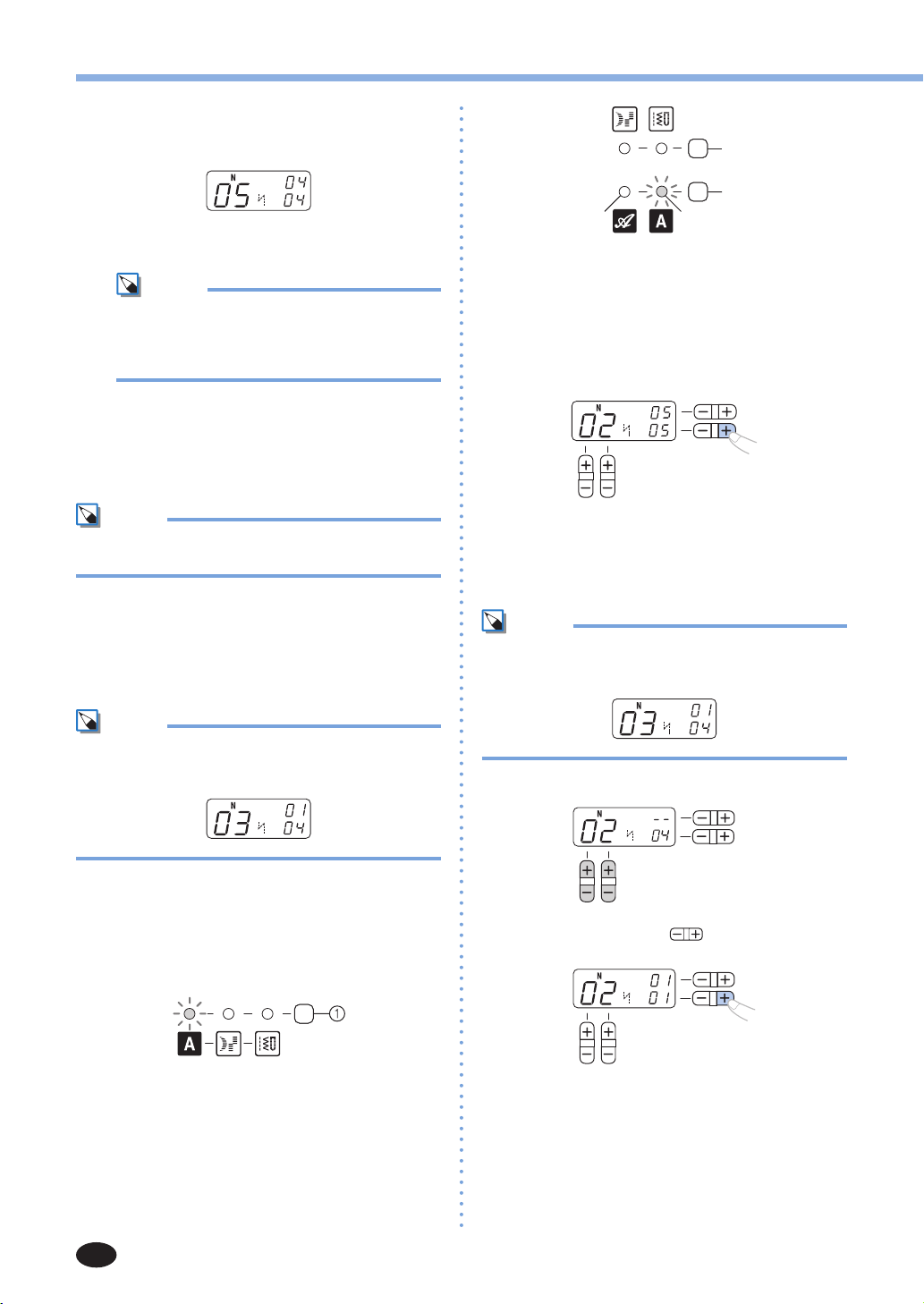
UTILITY STITCHES
50
5
When you have finished combining
characters, check the entered characters and
their order.
•For details on checking characters, refer to
“Checking characters” (page 51).
Mem
o
•A new character can only be added next to
the last character. You cannot insert a new
character between characters or before the
first character of the sequence.
6
After checking the entered characters, start
sewing.
•For details on sewing characters, refer to
“Sewing the character stitches” (page 51).
Mem
o
•The combination of characters will be stored in
memory even if you turn off the machine.
■
Adding new characters after sewing
After sewing a combination of characters, you
can add characters to the combination using the
following method.
Mem
o
•When you have finished sewing, the pattern No.
of the first character in the current combination is
shown on the LCD.
1
<For models equipped with 1 font type of
character stitches>
Press the stitch category selection key to
select the character stitch again. (Do not skip
this step.)
1
Stitch category selection key
<For models equipped with 2 font types of
character stitches>
Press the utility stitch key first (Do not skip
this step.) and then, press the character stitch
key once or more until the desired font type
of character stitch indicator is lit.
2
1
3
4
1
Utility stitch key
2
Character stitch key
3
Character stitch indicator (Gothic font)
4
Character stitch indicator (Script font)
2
Add new characters by following the
procedure described in “Combining
characters” (page 49).
X
New characters are added next to the last
character of the combination.
■
Making a new combination of characters after
sewing
Mem
o
•When you have finished sewing, the pattern No.
of the first character in the current combination is
shown on the LCD.
1
Select the first character of the new combination.
2
Press the “+” side of (stitch width
adjustment key).
X
The old combination of characters is cleared
from memory, and the pattern No. shown in
the LCD is entered as the first character of a
new combination.
3
Add characters by following the procedure
described in “Combining characters” (page 49).

UTILITY STITCHES
51
3
Checking characters
You can check the characters in a combination with
following method.
1
Press the “+” or “-” side of (stitch length
adjustment key) repeatedly.
This will display the characters that have been
entered one by one on the LCD.
You can check the pattern No. and position of
each character.
1
Stitch length adjustment key
2
The position of the selected pattern No.
3
The total number of characters in the combination
4
Selected pattern No.
Deleting characters
You can delete characters from the combination.
1
Press “-” side of (stitch width adjustment
key) to delete the last character in the
combination.
1
Stitch width adjustment key
X
The last character will be deleted.
Mem
o
•Repeat step
1
to delete more characters.
•You can only delete the last character in a
combination.
Sewing the character stitches
All character stitches are sewn with monogramming
foot “N”.
1
Select a character stitch. (Refer to page 48.)
2
Attach monogramming foot “N”.
•For details, refer to “Replacing the presser
foot” (page 23).
3
Start sewing.
X
The stitch is sewn in the direction indicated
by the arrow.
Mem
o
•When sewing characters, the machine
automatically sews reinforcement stitches
for each character.
•While sewing, the LCD shows the pattern
No. currently being sewn.
4
When you have finished sewing, use scissors
to trim off any excess threads at the beginning
of the stitching and between the characters.

52
UTILITY STITCHES
ADJUSTING STITCHES (for models
equipped with character stitches)
Your stitch pattern may sometimes turn out poorly,
depending on the type or thickness of fabric, the
stabilizer material used, sewing speed, etc. If your
sewing does not turn out well, sew trial stitches using
the same conditions as the real sewing, and adjust
the stitch pattern as shown below.
Mem
o
•The character stitches “034” (No. 31 + No. 34+
No. 35) are used for making adjustments.
1
Attach monogramming foot “N”.
•For details, refer to “Replacing the presser
foot” (page 23).
2
Combine the character stitches “034”
(No. 31 + No. 34 + No. 35).
•For details, refer to “Combining characters”
(page 49).
X
When you have finished creating the
combination, the following is displayed on
the LCD.
3
Sew the combination of characters and check
how it turns out.
•For details, refer to “Sewing the character
stitches” (page 51).
A
B
C
A: Correctly sewn
(with proper spaces between characters)
B: Bunched or shapeless
(There is no space between characters.)
C: Overstretched
(The stitch “0” has a gap.)
If the pattern you sewed does not look like A, use
the following steps to adjust the stitches.
4
Select No. 59 (for making adjustments).
X
The LCD goes into the stitch adjustment
mode. The total number of combined
characters
1
changes to “--“.
5
Adjust the character stitches by pressing
(stitch length adjustment key).
Each press of “+” or “-” side of (stitch length
adjustment key) widens or narrows the stitches.
1
No. for making adjustments
2
The stitch adjustment level
3
Widens the stitches
4
Narrows the stitches
If the pattern is bunched (B)
Press the “+” side of
(stitch length
adjustment key) to widen the stitch.
If the pattern is overstretched
(The stitch “0” has a gap.) (C)
Press the “-” side of
(stitch length
adjustment key) to narrow the stitch.
Mem
o
•The stitch adjustment level can be set
between -9 and 9.
•The setting is saved in memory even if you
turn off the machine.
6
Sew the characters “034” again.
Mem
o
•You can sew when you are in the stitch
adjustment mode.
If the stitch pattern still comes out poorly,
adjust the stitch again. Adjust the stitch until
the stitch pattern comes out correctly.
7
After you have finished adjusting the pattern,
press the stitch category selection key three
times.
X
The display returns to the normal character
stitching mode.
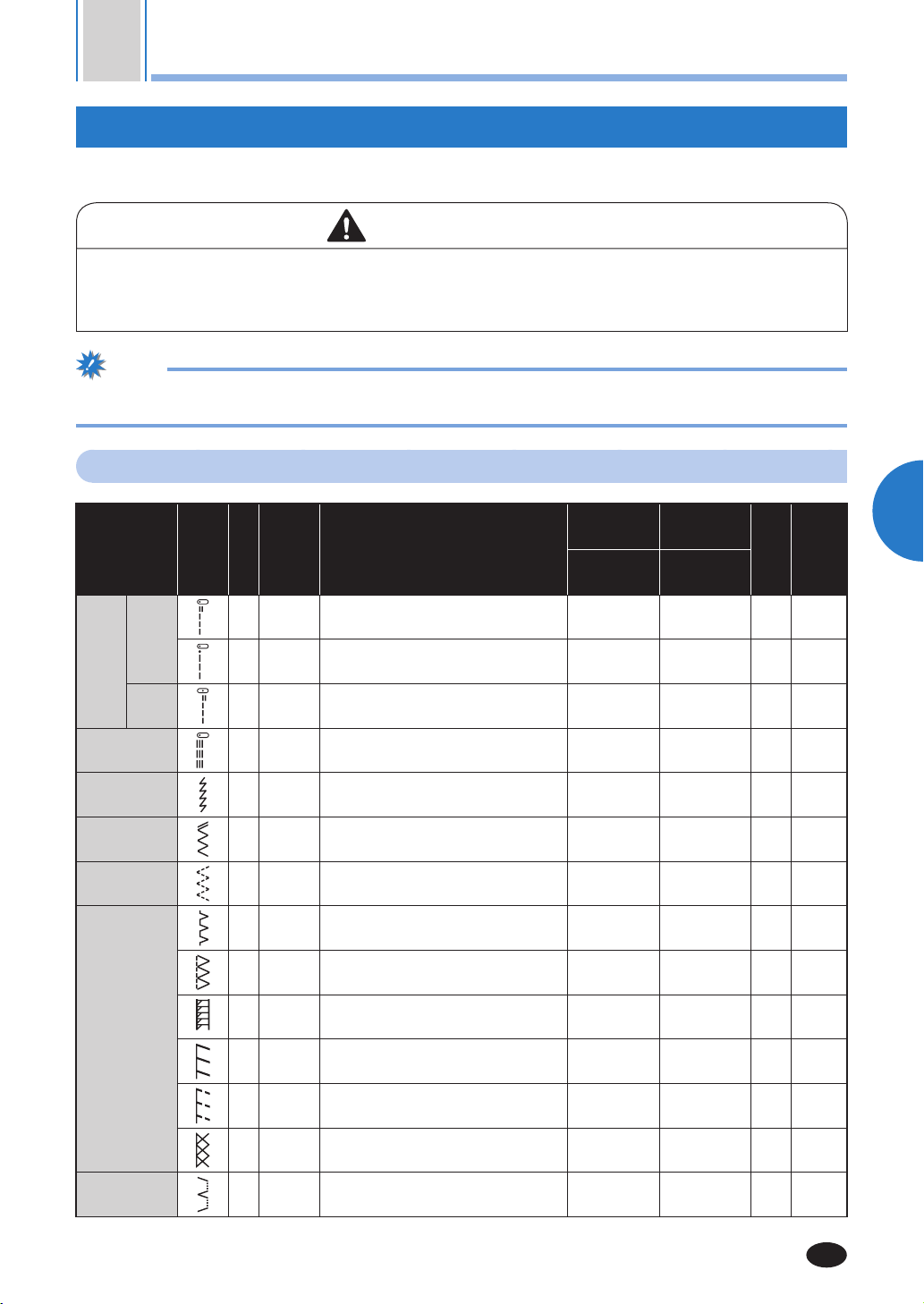
4
53
4
APPENDIX
STITCH SETTINGS
Applications, stitch lengths and widths and whether the twin needle can be used are listed for utility stitches
and satin stitches in the following table.
CAUTION
• When using the twin needle, select a stitch width of 5.0 mm (3/16 inch) or less, otherwise the needle
may break or the machine may be damaged.
• When using the twin needle, be sure to attach zigzag foot “J”, otherwise the needle may break or the
machine may be damaged.
Note
•The walking foot can only be used with straight or zigzag stitch patterns. Do not sew reverse stitches with
the walking foot.
Utility stitches
Stitch Name
Pattern
Presser Foot
Pattern
No.
Application
Stitch Width
[mm (inch)]
Stitch Length
[mm (inch)]
Twin Needle
Reverse (Rev.)/
Reinforcement (Reinf.)
Stitching
Auto
Manual
Auto
Manual
Straight
Left
J 00
Basic stitching, sewing gathers or pintucks,
etc.
0.0 (0)
0.0–7.0
(0–1/4)
2.5 (3/32)
0.2–5.0
(1/64 –3/16)
Yes*
( J )
Rev.
J 01
Basic stitching and sewing gathers or
pintucks
0.0 (0)
0.0–7.0
(0–1/4)
2.5 (3/32)
0.2–5.0
(1/64 –3/16)
Yes*
( J )
Reinf.
Center
J 02
Attaching zippers, basic stitching, and
sewing gathers or pintucks, etc.
3.5 (1/8)
0.0–7.0
(0–1/4)
2.5 (3/32)
0.2–5.0
(1/64 –3/16)
Yes*
( J )
Rev.
Triple stretch
stitch
J 03
Attaching sleeves, sewing inseams, sewing
stretch fabrics and decorative stitching
0.0 (0)
0.0–7.0
(0–1/4)
2.5 (3/32)
1.5–4.0
(1/16–3/16)
Yes*
( J )
Reinf.
Stretch stitch
J 04
Sewing stretch fabrics and decorative
stitching
1.0 (1/16)
1.0–3.0
(1/16–1/8)
2.5 (3/32)
1.0–4.0
(1/16–3/16)
Yes
( J )
Reinf.
Zigzag stitch
J 05 Overcasting and attaching appliqués
3.5 (1/8)
0.0–7.0
(0–1/4)
1.4 (1/16)
0.0–4.0
(0 –3/16)
Yes*
( J )
Rev.
3-point zigzag
stitch
J 06
Overcasting on medium weight or stretch
fabrics, attaching elastic, darning, etc.
5.0 (3/16)
1. 5 –7.0
(1/16–1/4)
1.0 (1/16)
0.2–4.0
(1/64 –3/16)
Yes*
( J )
Reinf.
Overcasting
stitch
G 07
Overcasting on thin or medium weight
fabrics
3.5 (1/8)
2.5–5.0
(3/32–3/16)
2.0 (1/16)
1.0–4.0
(1/16–3/16)
No Reinf.
G 08 Overcasting on thick fabrics
5.0 (3/16)
2.5–5.0
(3/32–3/16)
2.5 (3/32)
1.0–4.0
(1/16–3/16)
No Reinf.
G 09
Overcasting on thick fabrics and decorative
stitching
5.0 (3/16)
3.5–5.0
(1/8 –3/16)
2.5 (3/32)
1.0–4.0
(1/16–3/16)
No Reinf.
J 10 Overcasting on stretch fabrics
5.0 (3/16)
0.0–7.0
(0–1/4)
2.5 (3/32)
0.5–4.0
(1/32–3/16)
Yes*
( J )
Reinf.
J 11 Overcasting on thick or stretch fabrics
5.0 (3/16)
0.0–7.0
(0–1/4)
2.5 (3/32)
0.5–4.0
(1/32–3/16)
Yes*
( J )
Reinf.
J 12
Overcasting on stretch fabrics and
decorative stitching
4.0 (3/16)
0.0–7.0
(0–1/4)
4.0 (3/16)
1.0–4.0
(1/16–3/16)
Yes*
( J )
Reinf.
Blind hem stitch
R 13
Blind hem stitching on medium weight
fabrics
0 (0)
-3← →3
2.0 (1/16)
1.0 –3.5
(1/16–1/8)
No Reinf.
* Select a stitch width of 5.0 mm (3/16 inch) or less.
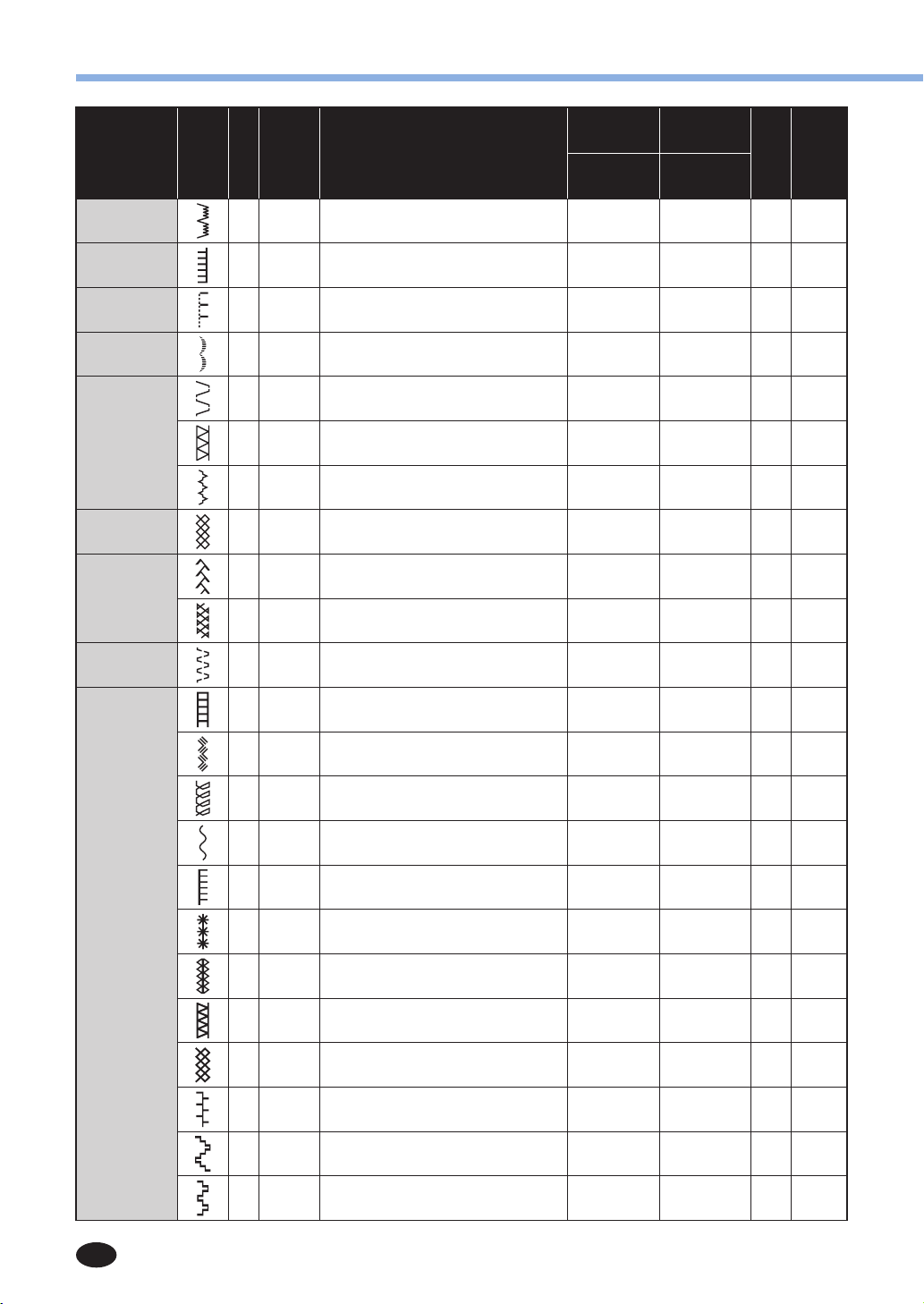
APPENDIX
54
Stitch Name
Pattern
Presser Foot
Pattern
No.
Application
Stitch Width
[mm (inch)]
Stitch Length
[mm (inch)]
Twin Needle
Reverse (Rev.)/
Reinforcement (Reinf.)
Stitching
Auto
Manual
Auto
Manual
Blind hem stitch
R 14 Blind hem stitching on stretch fabrics
0 (0)
-3← →3
2.0 (1/16)
1.0 –3.5
(1/16–1/8)
No Reinf.
Appliqué stitch
J 15 Appliqué stitching
3.5 (1/8)
2. 5 –7. 0
(3/32–1/4)
2.5 (3/32)
1.6–4.0
(1/16–3/16)
Yes*
( J )
Reinf.
Shell tuck stitch
J 16 Shell tuck stitching
4.0 (3/16)
0.0–7.0
(0–1/4)
2.5 (3/32)
0.2–4.0
(1/64 –3/16)
Yes*
( J )
Reinf.
Satin scallop
stitch
N 17 Scallop stitching
5.0 (3/16)
2. 5 –7. 0
(3/32–1/4)
0.5 (1/32)
0.1–1.0
(1/64–1/16)
Yes*
( J )
Reinf.
Joining stitch
J 18 Patchwork stitching and decorative stitching
4.0 (3/16)
0.0–7.0
(0–1/4)
1.2 (1/16)
0.2–4.0
(1/64 –3/16)
Yes*
( J )
Reinf.
J 19
Patchwork stitching, decorative stitching and
sewing overcasting on both pieces of fabrics,
such as with tricot
5.0 (3/16)
2. 5 –7. 0
(3/32–1/4)
2.5 (3/32)
1.0–4.0
(1/16–3/16)
Yes*
( J )
Reinf.
J 20 Patchwork stitching and decorative stitching
5.0 (3/16)
0.0–7.0
(0–1/4)
1.2 (1/16)
0.2–4.0
(1/64 –3/16)
Yes*
( J )
Reinf.
Smocking stitch
J 21 Smocking stitching and decorative stitching
5.0 (3/16)
0.0–7.0
(0–1/4)
1.6 (1/16)
1.0–4.0
(1/16–3/16)
Yes*
( J )
Reinf.
Fagoting stitch
J 22 Fagoting, smocking and decorative stitching
5.0 (3/16)
0.0–7.0
(0–1/4)
2.5 (3/32)
1.0–4.0
(1/16–3/16)
Yes*
( J )
Reinf.
J 23 Fagoting, smocking and decorative stitching
5.0 (3/16)
2. 5 –7. 0
(3/32–1/4)
2.5 (3/32)
1.0–4.0
(1/16–3/16)
Yes*
( J )
Reinf.
Elastic-attaching
stitch
J 24 Attaching elastic to stretch fabrics
4.0 (3/16)
0.0–7.0
(0–1/4)
1.0 (1/16)
0.2–4.0
(1/64 –3/16)
Yes*
( J )
Reinf.
Decorative stitch
J 25 Decorative stitching
4.0 (3/16)
0.0–7.0
(0–1/4)
3.0 (1/8)
2.0–4.0
(1/16–3/16)
No Reinf.
J 26 Decorative stitching
4.0 (3/16)
0.0–7.0
(0–1/4)
2.5 (3/32)
1.0–4.0
(1/16–3/16)
Yes*
( J )
Reinf.
J 27 Decorative stitching
5.5 (7/32)
0.0–7.0
(0–1/4)
1.6 (1/16)
1.0–4.0
(1/16–3/16)
Yes*
( J )
Reinf.
N 28 Decorative stitching and elastic attaching
5.0 (3/16)
1. 5 –7.0
(1/64–1/4)
1.0 (1/16)
0.2–4.0
(1/64 –3/16)
Yes*
( J )
Reinf.
N 29
Lace sewing, decorative hemming, heirloom
stitching, etc.
3.5 (1/8)
1. 5 –7.0
(1/16–1/4)
2.5 (3/32)
1.6–4.0
(1/16–3/16)
No Reinf.
N 30
Decorative hemming, heirloom stitching,
etc.
6.0 (15/64)
1. 5 –7.0
(1/16–1/4)
3.0 (1/8)
1.5–4.0
(1/16–3/16)
No Reinf.
N 31
Decorative hemming on thin, medium
weight and plain weave fabrics, heirloom
stitching, etc.
5.0 (3/16)
1. 5 –7.0
(1/16–1/4)
3.5 (1/8)
1.5–4.0
(1/16–3/16)
No Reinf.
N 32
Decorative hemming on thin, medium
weight and plain weave fabrics, heirloom
stitching, etc.
5.0 (3/16)
1. 5 –7.0
(1/16–1/4)
4.0 (3/16)
1.5–4.0
(1/16–3/16)
No Reinf.
N 33
Decorative hemming on thin, medium
weight and plain weave fabrics, heirloom
stitching, etc.
5.0 (3/16)
1. 5 –7.0
(1/16–1/4)
2.5 (3/32)
1.5–4.0
(1/16–3/16)
No Reinf.
N 34
Decorative hemming on thin, medium
weight and plain weave fabrics, heirloom
stitching, etc.
5.0 (3/16)
1. 5 –7.0
(1/16–1/4)
2.0 (1/16)
1.5–4.0
(1/16–3/16)
No Reinf.
N 35
Decorative stitching, smocking stitching,
heirloom stitching, etc.
6.0 (15/64)
1. 5 –7.0
(1/16–1/4)
1.6 (1/16)
1.0–4.0
(1/16–3/16)
No Reinf.
N 36
Decorative stitching, smocking stitching,
heirloom stitching, etc.
5.0 (3/16)
1. 5 –7.0
(1/16–1/4)
1.6 (1/16)
1.0–4.0
(1/16–3/16)
No Reinf.
* Select a stitch width of 5.0 mm (3/16 inch) or less.
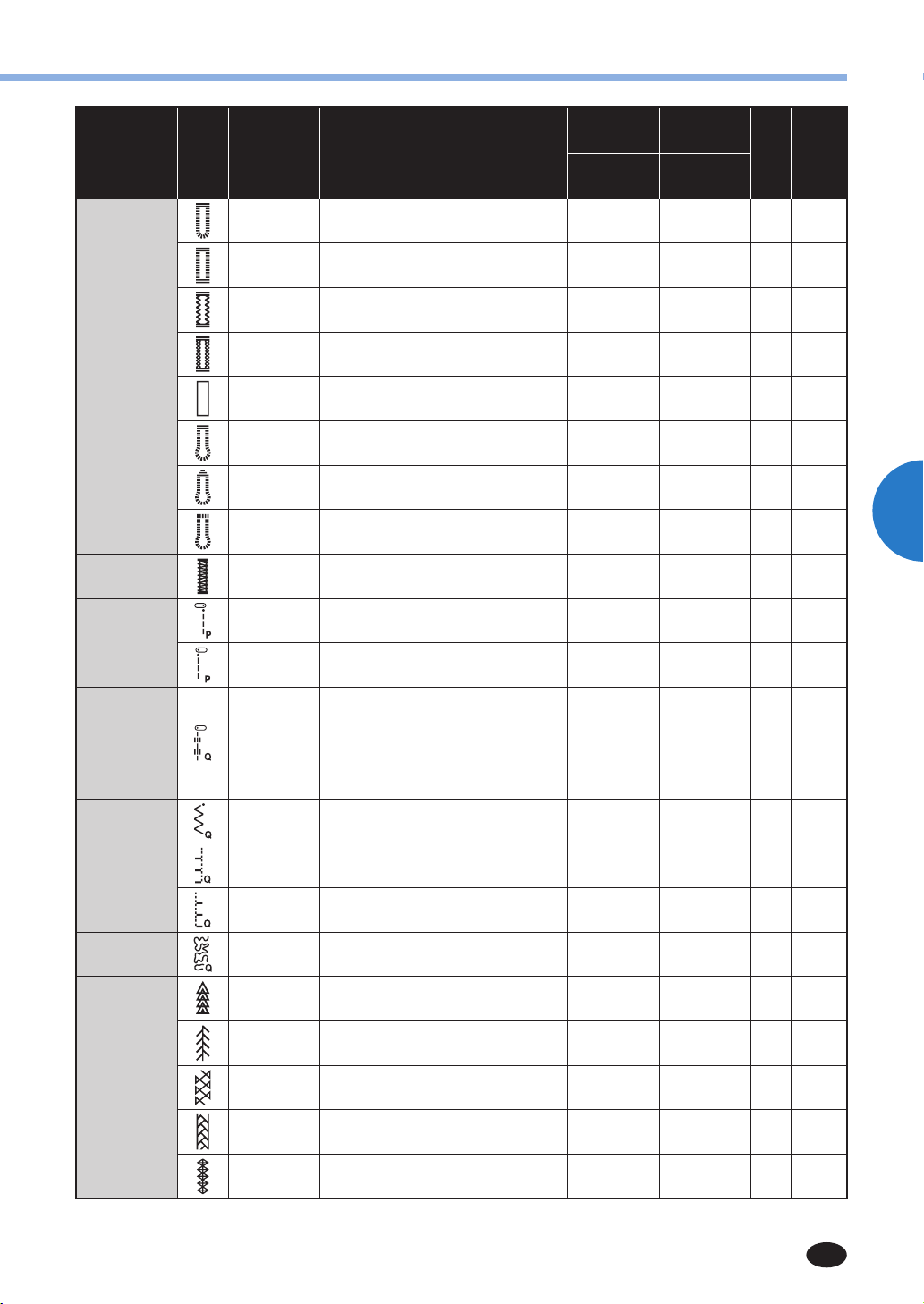
APPENDIX
55
4
Stitch Name
Pattern
Presser Foot
Pattern
No.
Application
Stitch Width
[mm (inch)]
Stitch Length
[mm (inch)]
Twin Needle
Reverse (Rev.)/
Reinforcement (Reinf.)
Stitching
Auto
Manual
Auto
Manual
Buttonhole stitch
A 37
Horizontal buttonholes on thin and medium
weight fabrics
5.0 (3/16)
3.0–5.0
(1/8 –3/16)
0.5 (1/32)
0.2–1.0
(1/64–1/16)
No
Auto
Reinf.**
A 38
Secured buttonholes for fabrics that have
backings
5.0 (3/16)
3.0–5.0
(1/8 –3/16)
0.5 (1/32)
0.2–1.0
(1/64–1/16)
No
Auto
Reinf.**
A 39 Buttonholes for stretch or knit fabrics
6.0 (15/64)
3.0–6.0
(1/8 –15/64)
1.0 (1/16)
0.5–2.0
(1/32–1/16)
No
Auto
Reinf.**
A 40 Buttonholes for stretch fabrics
6.0 (15/64)
3.0–6.0
(1/8 –15/64)
1.5 (1/16)
1.0–3.0
(1/16–1/8)
No
Auto
Reinf.**
A 41 Bound buttonholes
5.0 (3/16)
0.0–6.0
(0 –15/64)
2.0 (1/16)
0.2–4.0
(1/64 –3/16)
No
Auto
Reinf.**
A 42 Keyhole buttonholes for thick or furry fabrics
7.0 (1/4)
3.0–7.0
(1/8–1/4)
0.5 (1/32)
0.3–1.0
(1/64–1/16)
No
Auto
Reinf.**
A 43
Keyhole buttonholes for medium weight and
thick fabrics
7.0 (1/4)
3.0–7.0
(1/8–1/4)
0.5 (1/32)
0.3–1.0
(1/64–1/16)
No
Auto
Reinf.**
A 44 Keyhole buttonholes for thick or furry fabrics
7.0 (1/4)
3.0–7.0
(1/8–1/4)
0.5 (1/32)
0.3–1.0
(1/64–1/16)
No
Auto
Reinf.**
Bar tack stitch
A 45
Reinforcing openings and areas where the
seam easily comes loose
2.0 (1/16)
1.0–3.0
(1/16–1/8)
0.4 (1/64)
0.3–1.0
(1/64–1/16)
No
Auto
Reinf.**
Piecing straight
stitch
J 46
Piecing straight stitching (with a seam
allowance of 6.5mm from the right edge of
the presser foot)
5.5 (7/32)
0.0–7.0
(0–1/4)
2.0 (1/16)
0.2–5.0
(1/64 –3/16)
No Reinf.
J 47
Piecing straight stitching (with a seam
allowance of 6.5mm from the left edge of
the presser foot)
1.5 (1/16)
0.0–7.0
(0–1/4)
2.0 (1/16)
0.2–5.0
(1/64 –3/16)
No Reinf.
Hand-look
quilting
J 48
Quilting stitch made to look like hand
quilting when using transparent nylon thread
for the upper thread and a thread color
matching the quilt for the bobbin thread.
Sew with a tight thread tension so that the
bobbin thread is visible from the right side of
the fabric.
Use a needle between 90/14 and 100/16.
0.0 (0)
0.0–7.0
(0–1/4)
2.5 (3/32)
1.0–4.0
(1/16–3/16)
No Reinf.
Zigzag stitch
(for quilting)
J 49
Appliqué quilting, freemotion quilting, satin
stitching, button sewing
3.5 (1/8)
0.0–7.0
(0–1/4)
1.4 (1/16)
0.0–4.0
(0 –3/16)
No Reinf.
Appliqué stitch
(for quilting)
J 50 Attaching appliqués and binding
1.5 (1/16)
0.5–3.5
(1/32–1/8)
1.8 (1/16)
1.0–4.0
(1/16–3/16)
No Reinf.
J 51 Attaching appliqués and binding
1.5 (1/16)
0.5–3.5
(1/32–1/8)
1.8 (1/16)
1.0–4.0
(1/16–3/16)
No Reinf.
Quilting
stippling
J 52 Quilting background stitching (stippling)
7.0 (1/4)
1.0–7.0
(1/16–1/4)
1.6 (1/16)
1.0–4.0
(1/16–3/16)
No Reinf.
Decorative stitch
N 53
Decorative stitching, smocking stitching,
heirloom stitching, etc.
2.5 (3/32)
0.0–7.0
(0–1/4)
2.5 (3/32)
0.2–4.0
(1/64 –3/16)
No Reinf.
N 54 For decoration, etc.
3.0 (1/8)
0.0–7.0
(0–1/4)
1.0 (1/16)
0.2–4.0
(1/64 –3/16)
No Reinf.
N 55 For decoration, etc.
5.0 (3/16)
0.0–7.0
(0–1/4)
2.0 (1/16)
0.2–4.0
(1/64 –3/16)
No Reinf.
N 56 For decoration, etc.
4.0 (3/16)
0.0–7.0
(0–1/4)
1.6 (1/16)
0.2–4.0
(1/64 –3/16)
No Reinf.
N 57 For decoration, etc.
5.0 (3/16)
0.0–7.0
(0–1/4)
2.5 (3/32)
0.2–4.0
(1/64 –3/16)
No Reinf.
**Auto Reinf.:Automatic Reinforcement
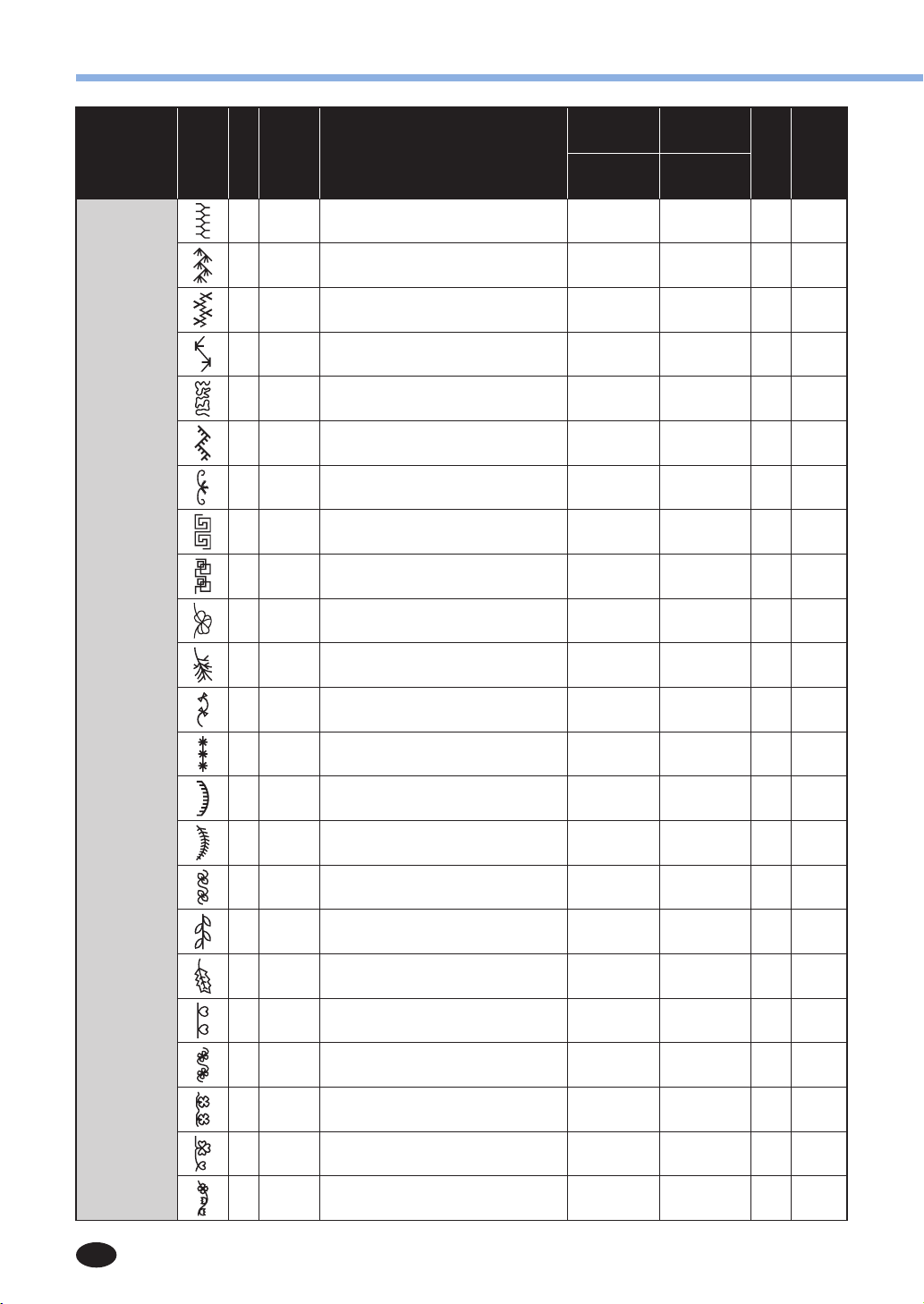
APPENDIX
56
Stitch Name
Pattern
Presser Foot
Pattern
No.
Application
Stitch Width
[mm (inch)]
Stitch Length
[mm (inch)]
Twin Needle
Reverse (Rev.)/
Reinforcement (Reinf.)
Stitching
Auto
Manual
Auto
Manual
Decorative stitch
N 58 For decoration, etc.
7.0 (1/4)
0.0–7.0
(0–1/4)
2.5 (3/32)
0.2–4.0
(1/64 –3/16)
No Reinf.
N 59 For decoration, etc.
7.0 (1/4)
0.0–7.0
(0–1/4)
2.5 (3/32)
0.2–4.0
(1/64 –3/16)
No Reinf.
N 60 For decoration, etc.
7.0 (1/4)
0.0–7.0
(0–1/4)
1.4 (1/16)
0.2–4.0
(1/64 –3/16)
No Reinf.
N 61 For decoration, etc.
7.0 (1/4)
0.0–7.0
(0–1/4)
2.5 (3/32)
0.2–4.0
(1/64 –3/16)
No Reinf.
N 62 For decoration, etc.
7.0 (1/4)
0.0–7.0
(0–1/4)
1.6 (1/16)
0.2–4.0
(1/64 –3/16)
No Reinf.
N 63 For decoration, etc.
7.0 (1/4)
0.0–7.0
(0–1/4)
1.6 (1/16)
0.2–4.0
(1/64 –3/16)
No Reinf.
N 64 For decoration, etc.
7.0 (1/4)
0.0–7.0
(0–1/4)
2.0 (1/16)
0.2–4.0
(1/64 –3/16)
No Reinf.
N 65 For decoration, etc.
7.0 (1/4)
0.0–7.0
(0–1/4)
2.5 (3/32)
0.2–4.0
(1/64 –3/16)
No Reinf.
N 66 For decoration, etc.
7.0 (1/4)
0.0–7.0
(0–1/4)
2.5 (3/32)
0.2–4.0
(1/64 –3/16)
No Reinf.
N 67 For decoration, etc.
7.0 (1/4)
0.0–7.0
(0–1/4)
2.0 (1/16)
0.2–4.0
(1/64 –3/16)
No Reinf.
N 68 For decoration, etc.
7.0 (1/4)
0.0–7.0
(0–1/4)
2.5 (3/32)
0.2–4.0
(1/64 –3/16)
No Reinf.
N 69 For decoration, etc.
7.0 (1/4)
0.0–7.0
(0–1/4)
1.6 (1/16)
0.2–4.0
(1/64 –3/16)
No Reinf.
N 70 For decoration, etc.
2.5 (3/32)
0.0–7.0
(0–1/4)
2.0 (1/16)
0.2–4.0
(1/64 –3/16)
No Reinf.
N 71 For decoration, etc.
7.0 (1/4)
0.0–7.0
(0–1/4)
2.0 (1/16)
0.2–4.0
(1/64 –3/16)
No Reinf.
N 72 For decoration, etc.
7.0 (1/4)
0.0–7.0
(0–1/4)
2.0 (1/16)
0.2–4.0
(1/64 –3/16)
No Reinf.
N 73 For decoration, etc.
7.0 (1/4)
0.0–7.0
(0–1/4)
1.6 (1/16)
0.2–4.0
(1/64 –3/16)
No Reinf.
N 74 For decoration, etc.
7.0 (1/4)
0.0–7.0
(0–1/4)
2.5 (3/32)
0.2–4.0
(1/64 –3/16)
No Reinf.
N 75 For decoration, etc.
7.0 (1/4)
0.0–7.0
(0–1/4)
2.0 (1/16)
0.2–4.0
(1/64 –3/16)
No Reinf.
N 76 For decoration, etc.
5.0 (3/16)
0.0–7.0
(0–1/4)
2.0 (1/16)
0.2–4.0
(1/64 –3/16)
No Reinf.
N 77 For decoration, etc.
7.0 (1/4)
0.0–7.0
(0–1/4)
1.6 (1/16)
0.2–4.0
(1/64 –3/16)
No Reinf.
N 78 For decoration, etc.
7.0 (1/4)
0.0–7.0
(0–1/4)
2.0 (1/16)
0.2–4.0
(1/64 –3/16)
No Reinf.
N 79 For decoration, etc.
7.0 (1/4)
0.0–7.0
(0–1/4)
2.0 (1/16)
0.2–4.0
(1/64 –3/16)
No Reinf.
N 80 For decoration, etc.
7.0 (1/4)
0.0–7.0
(0–1/4)
2.5 (3/32)
0.2–4.0
(1/64 –3/16)
No Reinf.

APPENDIX
57
4
Stitch Name
Pattern
Presser Foot
Pattern
No.
Application
Stitch Width
[mm (inch)]
Stitch Length
[mm (inch)]
Twin Needle
Reverse (Rev.)/
Reinforcement (Reinf.)
Stitching
Auto
Manual
Auto
Manual
Decorative stitch
N 81 For decoration, etc.
7.0 (1/4)
0.0–7.0
(0–1/4)
1.6 (1/16)
0.2–4.0
(1/64 –3/16)
No Reinf.
N 82 For decoration, etc.
7.0 (1/4)
0.0–7.0
(0–1/4)
1.4 (1/16)
0.2–4.0
(1/64 –3/16)
No Reinf.
Cross-stitches
N 83 For decoration, etc.
6.0 (15/64)
0.0–7.0
(0–1/4)
1.4 (1/16)
0.2–4.0
(1/64 –3/16)
No Reinf.
N 84 For decoration, etc.
7.0 (1/4)
0.0–7.0
(0–1/4)
1.6 (1/16)
0.2–4.0
(1/64 –3/16)
No Reinf.
N 85 For decoration, etc.
6.0 (15/64)
0.0–7.0
(0–1/4)
2.5 (3/32)
0.2–4.0
(1/64 –3/16)
No Reinf.
N 86 For decoration, etc.
6.0 (15/64)
0.0–7.0
(0–1/4)
1.4 (1/16)
0.2–4.0
(1/64 –3/16)
No Reinf.
N 87 For decoration, etc.
6.0 (15/64)
0.0–7.0
(0–1/4)
1.4 (1/16)
0.2–4.0
(1/64 –3/16)
No Reinf.
N 88 For decoration, etc.
6.0 (15/64)
0.0–7.0
(0–1/4)
1.4 (1/16)
0.2–4.0
(1/64 –3/16)
No Reinf.
N 89 For decoration, etc.
6.0 (15/64)
0.0–7.0
(0–1/4)
1.4 (1/16)
0.2–4.0
(1/64 –3/16)
No Reinf.
N 90 For decoration, etc. - - No Reinf.
N 91 For decoration, etc. - - No Reinf.
Decorative satin
stitches
N 92 For decoration, etc. -
0.3 (1/64)
0.2–0.4
(1/64–1/64)
No Reinf.
N 93 For decoration, etc. -
0.3 (1/64)
0.2–0.4
(1/64–1/64)
No Reinf.
N 94 For decoration, etc. -
0.3 (1/64)
0.2–0.4
(1/64–1/64)
No Reinf.
N 95 For decoration, etc. -
0.3 (1/64)
0.2–0.4
(1/64–1/64)
No Reinf.
N 96 For decoration, etc. -
0.3 (1/64)
0.2–0.4
(1/64–1/64)
No Reinf.
N 97 For decoration, etc. -
0.3 (1/64)
0.2–0.4
(1/64–1/64)
No Reinf.
N 98 For decoration, etc. -
0.3 (1/64)
0.2–0.4
(1/64–1/64)
No Reinf.
N 99 For decoration, etc. -
0.3 (1/64)
0.2–0.4
(1/64–1/64)
No Reinf.
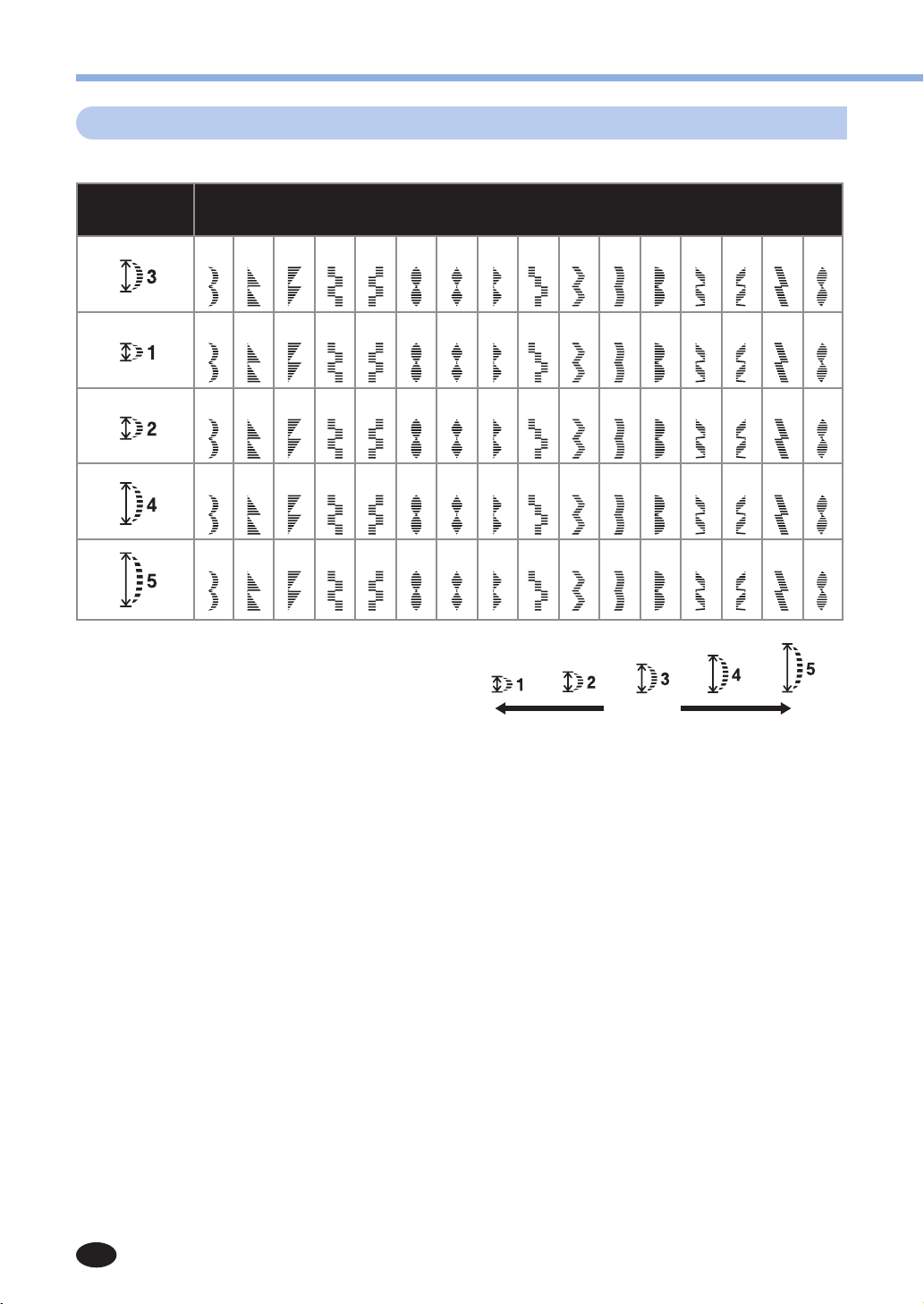
APPENDIX
58
Satin stitches
The number of patterns differs depending on the machine model.
Pattern
Length*
Pattern No.
00 01 02 03 04 05 06 07 08 09 10 11 12 13 14 15
16 17 18 19 20 21 22 23 24 25 26 27 28 29 30 31
32 33 34 35 36 37 38 39 40 41 42 43 44 45 46 47
48 49 50 51 52 53 54 55 56 57 58 59 60 61 62 63
64 65 66 67 68 69 70 71 72 73 74 75 76 77 78 79
Presser foot: N
Application: For decoration, etc.
Stitch Width [mm (inch)]
Auto: 7. 0 (1/4)
Manual: 0.0-7.0 (0-1/4)
Stitch Length [mm (inch)]
Auto: 0.4 (1/64)
Manual: 0.1-1.0 (1/64-1/16)
Twin Needle: **Yes ( J)
Walking Foot: No
Reverse/Reinforcement Stitching: Reinforcement
Shorter Longer
(Standard)
*: Pattern Length Icon definition
**: Select a stitch width of 5.0 mm (3/16 inch) or less.
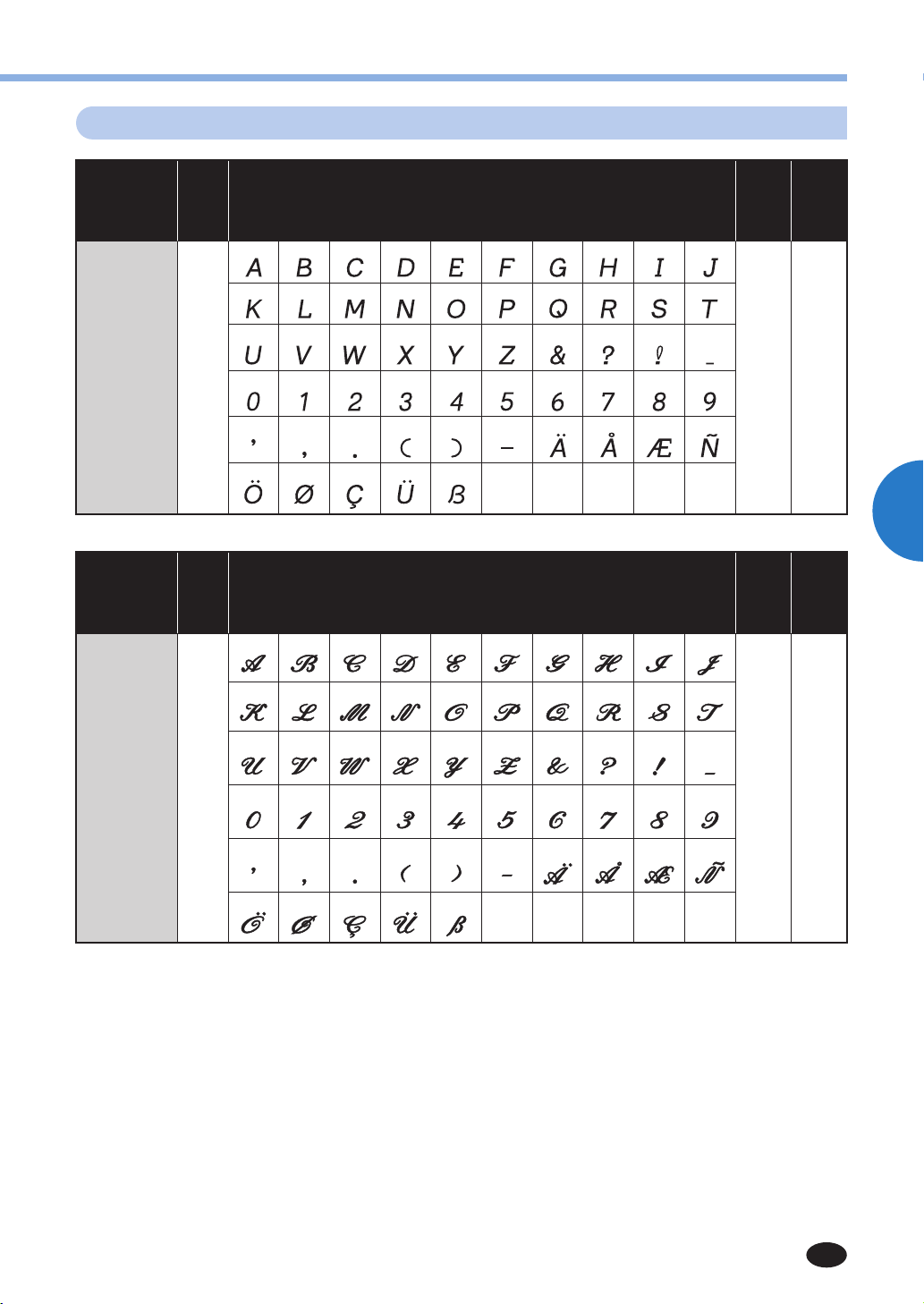
APPENDIX
59
4
Character stitches (for models equipped with character stitches)
Stitch Type
Presser Foot
Pattern No.
Twin Needle
Stitch Width/
Stitch Length
Gothic font N
01
02 03 04 05 06 07 08 09 10
No -
11
12 13 14 15 16 17 18 19 20
21 22 23 24 25 26 27 28 29 30
31 32 33 34 35 36 37 38 39 40
41 42 43 44 45 46 47 48 49 50
51 52 53 54 55
Stitch Type
Presser Foot
Pattern No.
Twin Needle
Stitch Width/
Stitch Length
Script font
(for models
equipped with
2 font types
of character
stitches)
N
01
02 03 04 05 06 07 08 09 10
No -
11
12 13 14 15 16 17 18 19 20
21 22 23 24 25 26 27 28 29 30
31 32 33 34 35 36 37 38 39 40
41 42 43 44 45 46 47 48 49 50
51 52 53 54 55
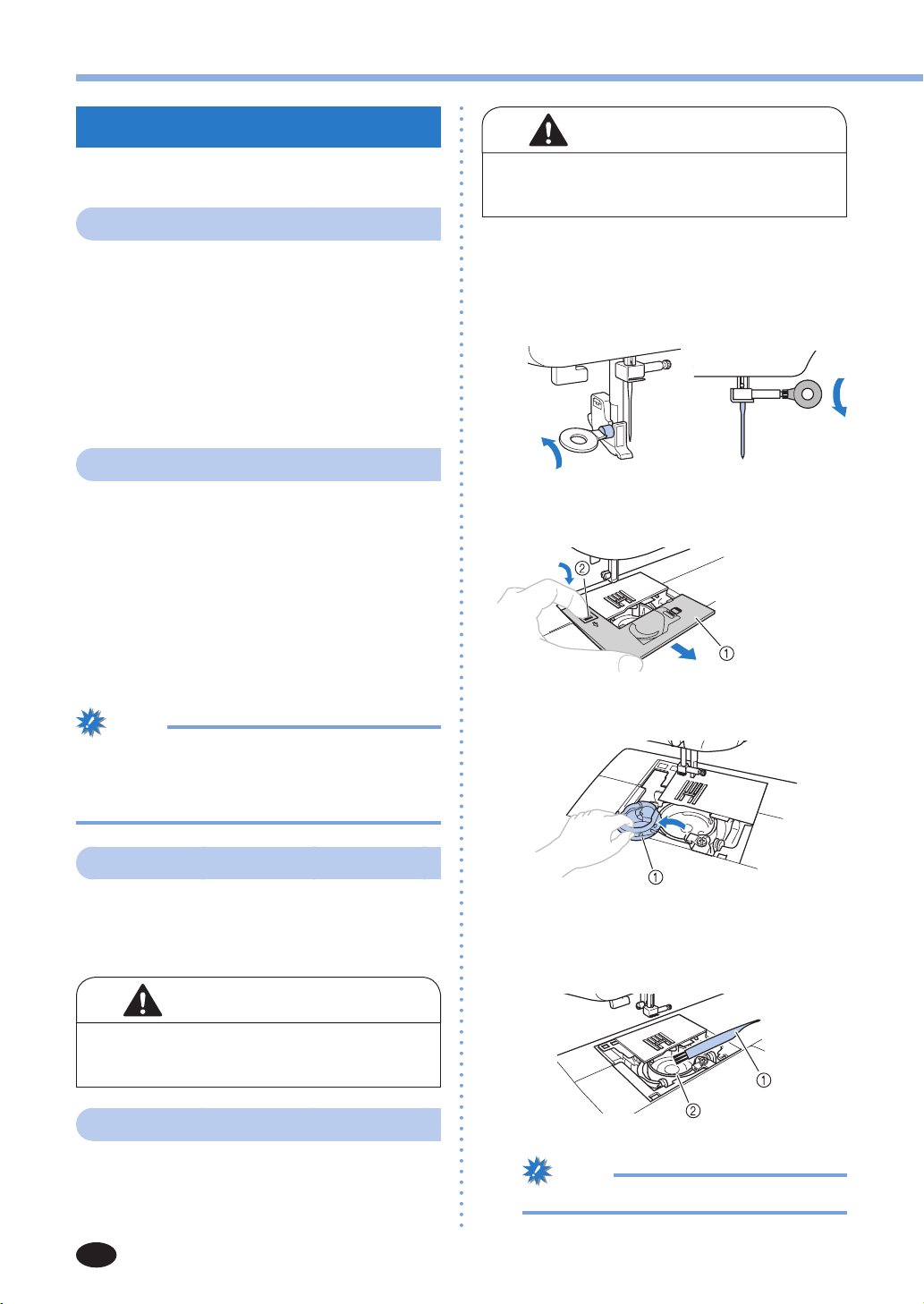
APPENDIX
60
MAINTENANCE
Simple sewing machine maintenance operations are
described below.
Restrictions on oiling
In order to prevent damaging this machine, it must
not be oiled by the user.
This machine was manufactured with the necessary
amount of oil applied to ensure correct operation,
making periodic oiling unnecessary.
If problems occur, such as difficulty turning the
handwheel or an unusual noise, immediately stop
using the machine, and contact your authorized
dealer or the nearest authorized service center.
Precautions on storing the machine
Do not store the machine in any of the locations
described below, otherwise damage to the
machine may result, for example, rust caused by
condensation.
•Exposed to extremely high temperatures
•Exposed to extremely low temperatures
•Exposed to extreme temperature changes
•Exposed to high humidity or steam
•Near a flame, heater or air conditioner
•Outdoors or exposed to direct sunlight
•Exposed to extremely dusty or oily environments
Note
•In order to extend the life of this machine,
periodically turn it on and use it.
Storing this machine for an extended period of
time without using it may reduce its efficiency.
Cleaning the machine surface
If the surface of the machine is dirty, lightly soak a
cloth in neutral detergent, squeeze it out firmly, and
then wipe the surface of the machine. After cleaning it
once with a wet cloth, wipe it again with a dry cloth.
CAUTION
• Unplug the power supply cord before cleaning
the machine, otherwise injuries or an electric
shock may occur.
Cleaning the race
Sewing performance will suffer if dust collects in the
race therefore, it should be cleaned periodically.
1
Switch the machine off and unplug it.
CAUTION
• Make sure you unplug the machine before you
clean it. Otherwise, you may get an electric
shock or be injured.
2
Raise the needle and the presser foot.
3
Loosen the presser-foot screw and the needle
clamp screw to remove the presser-foot
holder and the needle.
4
Slide the needle plate cover release toward
you to remove the needle plate cover.
1
Needle plate
cover
2
Needle plate
cover release
5
Remove the bobbin case.
Grasp the bobbin case, and then pull it out.
1
Bobbin case
6
Use the cleaning brush or a vacuum cleaner
to remove any dust from the race and its
surrounding area.
1
Cleaning brush
2
Race
Note
•Do not put oil on the race.
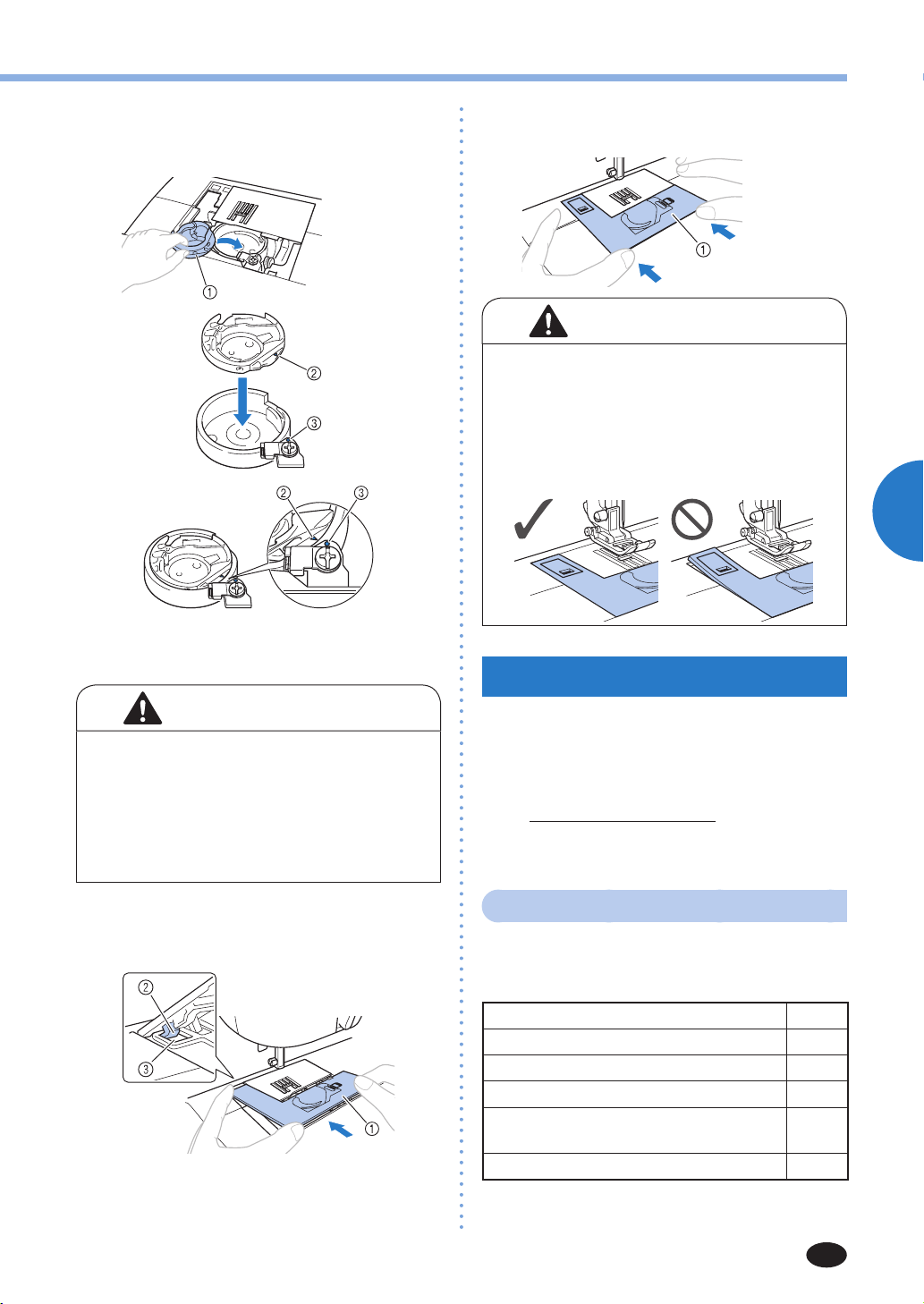
APPENDIX
61
4
7
Insert the bobbin case so that the mark on
the bobbin case aligns with the mark on
the machine.
1
Bobbin case
2
mark
3
mark
•Align the and marks.
•Make sure that the indicated points are
aligned before installing the bobbin case.
CAUTION
• Never use a bobbin case that is scratched,
otherwise the upper thread may become
tangled, the needle may break or sewing
performance may suffer. For a new bobbin
case (part code: XE7560-001), contact your
nearest authorized service center.
• Make sure that you fit the bobbin case
properly, otherwise the needle may break.
8
As shown, insert the tab on the needle plate
cover into the hole in the needle plate, and then
correctly position of the needle plate cover.
1
Needle plate cover
2
Tab
3
Hole
•Check that the needle plate cover is flush
with the top surface of the machine.
9
From the front, slide the needle plate cover
back into position.
1
Needle plate
cover
CAUTION
• If the needle plate cover is not flush with the
surface of the machine as shown below, remove
the needle plate cover (step
4
), and then install
it again (steps
8
and
9
). Sewing while the
needle plate cover is not flush with the surface
of the machine may cause the needle plate
cover to come off of the machine, resulting in
injuries if your fingers touch the race.
TROUBLESHOOTING
If the machine stops operating correctly, check the
following possible problems before requesting service.
You can solve most problems by yourself. If you
need additional help, the Brother Solutions Center
offers the latest FAQs and troubleshooting tips. Visit
us at “ http://support.brother.com/ ” .
If the problem persists, contact your dealer or the
nearest authorized service center.
Frequent troubleshooting topics
Detailed causes and remedies for common
troubleshooting topics are described below. Be sure
to refer to this before contacting us.
Topic Page
Upper thread tightened up 62
Tangled thread on wrong side of fabric 62
Incorrect thread tension 62
Fabric is caught in the machine and
cannot be removed
63
Error message “E6” appears in the LCD 65
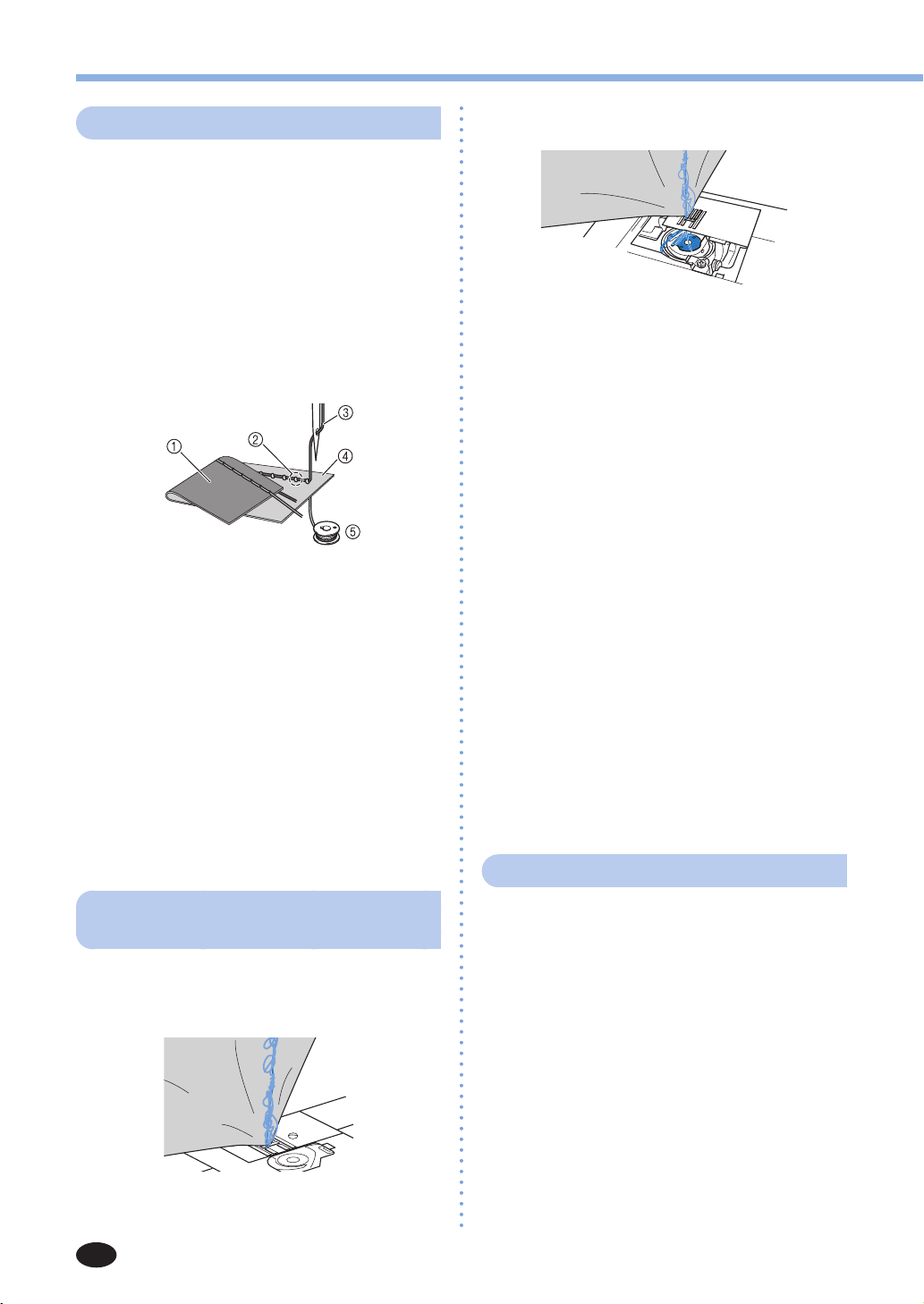
APPENDIX
62
Upper thread tightened up
■
Symptom
•The upper thread appears as a single
continuous line.
•The lower thread is visible from the upper side
of the fabric. (Refer to the illustration below.)
•The upper thread has tightened up, and comes
out when pulled.
•The upper thread has tightened up, and
wrinkles appear in the fabric.
•The upper thread tension is tight, and the
results do not change even after the thread
tension is adjusted.
1
Lower side of fabric
2
Lower thread visible from upper side of fabric
3
Upper thread
4
Upper side of fabric
5
Lower thread
■
Cause
Incorrect lower threading
If the lower thread is incorrectly threaded, instead
of the appropriate tension being applied to the
lower thread, it is pulled through the fabric when
the upper thread is pulled up. For this reason, the
thread is visible from the upper side of the fabric.
■
Remedy/check details
Correctly install the lower thread.
•Refer to “Lower threading” (page 14-16).
Tangled thread on wrong side of
fabric
■
Symptom
•The thread becomes tangled on the lower side
of the fabric.
•After starting sewing, a rattling noise is made
and sewing cannot continue.
•Looking under the fabric, there is tangled
thread in the bobbin case.
■
Cause
Incorrect upper threading
If the upper thread is incorrectly threaded, the
upper thread passed through the fabric cannot be
firmly pulled up and the upper thread becomes
tangled in the bobbin case, causing a rattling
noise.
■
Remedy/check details
Remove the tangled thread, and then correct the
upper threading.
1
Remove the tangled thread. If it cannot be
removed, cut the thread with scissors.
•For details, refer to “Cleaning the race” (page
60).
2
Remove the upper thread from the machine.
3
Correct the upper threading by following
the instructions in “Upper threading” (page
16-18).
•If the bobbin was removed from the bobbin
case, refer to “Lower threading” (page 14)
and “Remedy/check details” in the section
“Upper thread tightened up” (page 62) to
correctly install the bobbin.
Incorrect thread tension
■
Symptoms
Symptom 1 : The lower thread is visible from the
upper side of the fabric.
Symptom 2 : The upper thread appears as a
straight line on the upper side of the
fabric.
Symptom 3 : The upper thread is visible from the
lower side of the fabric.
Symptom 4 :
The lower thread appears as a straight
line on the lower side of the fabric.
Symptom 5 : The stitching on the lower side of
the fabric is loose or has slack.
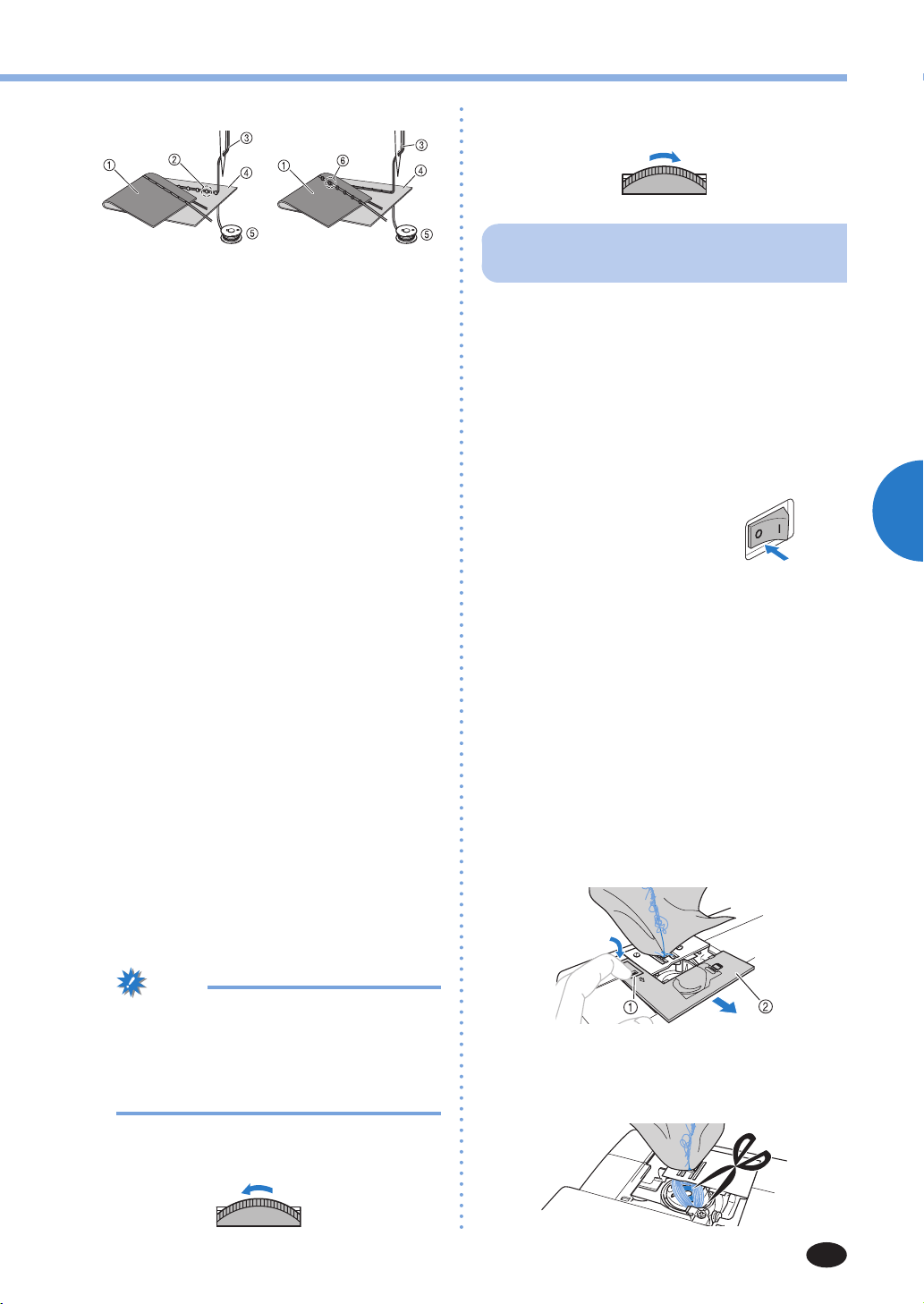
APPENDIX
63
4
Symptom 1 Symptom 3
1
Lower side of fabric
2
Lower thread visible from upper side of fabric
3
Upper thread
4
Upper side of fabric
5
Lower thread
6
Upper thread visible from lower side of fabric
■
Cause/remedy/check details
Cause 1
The machine is not correctly threaded.
<With symptoms 1 and 2 described above>
The lower threading is incorrect.
Return the upper tension-control dial to “4”,
and then refer to “Upper thread tightened up”
(page 62) to correct the threading.
<With symptoms 3 through 5 described above>
The upper threading is incorrect.
Return the upper tension-control dial to “4”,
and then refer to “Tangled thread on wrong
side of fabric” (page 62) to correct the
upper threading.
Cause 2
A needle and thread appropriate for the
fabric are not being used.
•Referto“Needletypesandtheiruses”(page
20) to check that a needle and thread
appropriate for the fabric are being used.
Cause 3
An appropriate setting on the upper tension-
control dial is not selected.
Turn the upper tension-control dial to select an
appropriate thread tension.
* Adjust the thread tension while test sewing
on a piece of scrap fabric that is the same as
that used in your project.
Note
•If the upper threading and lower threading
are incorrect, the thread tension cannot
be adjusted correctly, even by turning the
upper tension-control dial. Check the upper
threading and lowe threading first, and then
adjust the thread tension.
•When the lower thread is visible from
the upper side of the fabric, turn the dial
counterclockwise.
4
3
5
•When the upper thread is visible from the
lower side of the fabric, turn the dial clockwise.
4
3
5
Fabric is caught in the machine
and cannot be removed
If the fabric is caught in the sewing machine and cannot
be removed, the thread may have become tangled under
the needle plate. Follow the procedure described below
to remove the fabric from the machine. If the operation
could not be completed according to the procedure,
instead of attempting to complete it forcefully, contact
your nearest authorized service center.
■
Removing the fabric from the machine
1
Immediately stop the sewing machine.
2
Turn off the sewing machine.
3
Remove the needle.
If the needle is lowered into the fabric, turn the
handwheel away from you (clockwise) to raise the
needle out of the fabric, and then remove the needle.
•Refer to “Replacing the needle” (page 21).
4
Remove the presser foot and presser foot
holder.
•Refer to “Replacing the presser foot” (page
23) and “Removing the presser foot
holder” (page 24).
5
Lift up the fabric and cut the threads below it.
If the fabric can be removed, remove it.
6
Remove the needle plate cover.
1
Needle plate cover release
2
Needle plate cover (front part)
7
Cut out the tangled threads, and then remove
the bobbin.
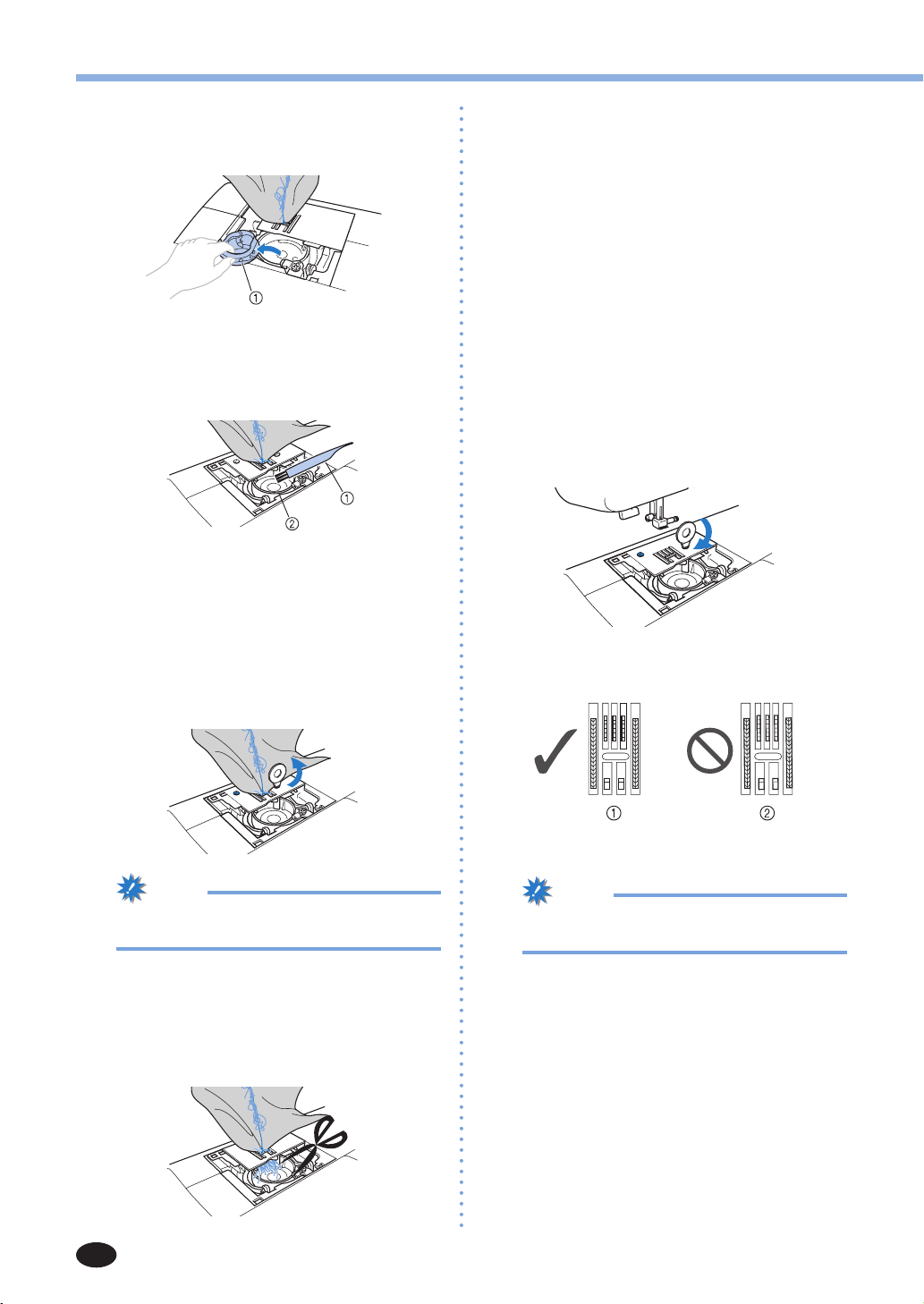
APPENDIX
64
8
Remove the bobbin case.
If threads remain in the bobbin case, remove
them.
1
Bobbin case
9
Use the cleaning brush or a vacuum cleaner
to remove any dust from the race and its
surrounding area.
1
Cleaning brush
2
Race
•If the fabric could be removed
Continue to step
16
.
•If the fabric could not be removed
Continue to step
10
.
10
Use the included disc-shaped screwdriver to
loosen the two screws on the needle plate.
Note
•Be careful not to drop the removed screws
in the machine.
11
Slightly lift up the needle plate, cut any
tangled threads, and then remove the needle
plate.
Remove the fabric and threads from the needle
plate.
If the fabric cannot be removed, even after
completing these steps, contact your nearest
authorized service center.
12
Remove any threads in the race and around
the feed dogs.
13
Turn the handwheel to raise the feed dogs.
14
Align the two screw holes in the needle
plate with the two holes at the needle plate
mounting base, and then fit the needle plate
onto the machine.
15
Lightly finger-tighten the screw on the
right side of the needle plate. Then, use the
discshaped screwdriver to firmly tighten the
screw on the left side. Finally, firmly tighten
the screw on the right side.
Turn the handwheel to check that the feed
dogs move smoothly and do not contact the
edges of the slots in the needle plate.
1
Correct position of feed dogs
2
Incorrect position of feed dogs
Note
•Be careful not to drop the removed screws
in the machine.
16
Insert the bobbin case by following step 7 in
“Cleaning the race” (page 61).
17
Attach the needle plate cover by following
steps 8 and 9 in “Cleaning the race” (page
61).
18
Check the condition of the needle, and then
install it.
•Refer to “Checking the needle” and
“Replacing the needle” (page 21).
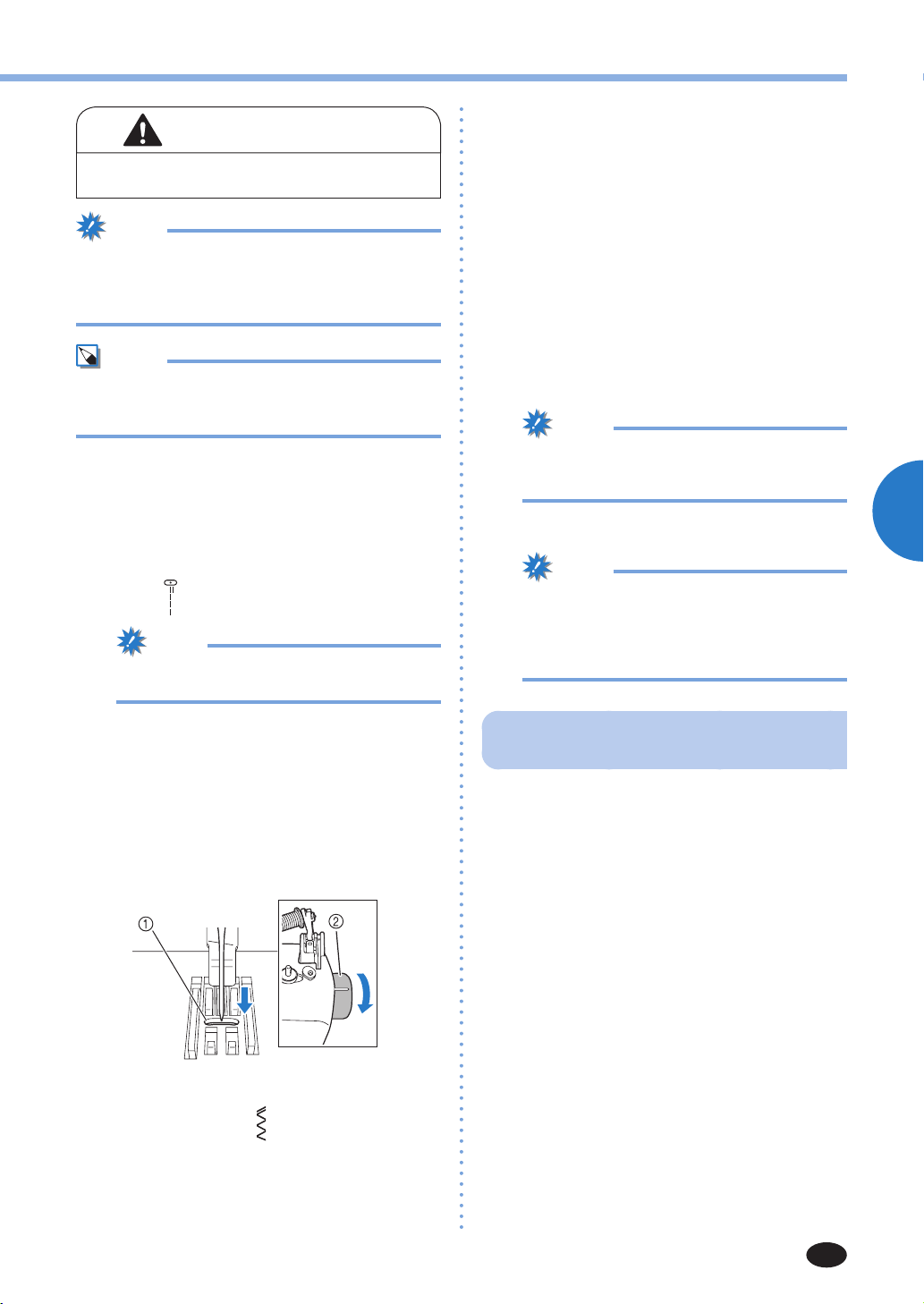
APPENDIX
65
4
CAUTION
• Never use bent needles. Bent needles can
easily break, possibly resulting in injuries.
Note
•After completing this procedure, continue with
the following procedure in “Checking machine
operations” to check that the machine is operating
correctly.
Mem
o
•Since the needle may have been damaged
when the fabric was caught in the machine, we
recommend replacing it with a new one.
■
Checking machine operations
If the needle plate has been removed, check
machine operations to confirm that installation
has been completed correctly.
1
Turn on the machine.
2
Select (middle needle position stitch).
Note
•Do not yet install the presser foot and
thread.
3
Slowly turn the handwheel toward you
(counterclockwise), and look from all sides
to check that the needle falls at the center of
the hole in the needle plate.
If the needle contacts the needle plate, remove
the needle plate, and then install it again,
starting with step
13
in “Removing the fabric
from the machine” (page 64).
1
Hole in the needle plate
2
Handwheel
4
Select zigzag stitch . At this time, increase
the stitch length and width to their maximum
settings.
•Refer to “Adjusting the stitch length and
width” (page 26).
5
Slowly turn the handwheel toward you
(counterclockwise) and check that the needle
bar and feed dogs operate correctly.
If the needle or feed dogs contact the needle
plate, the machine may be malfunctioning;
therefore, contact your nearest authorized
service center.
6
Turn off the machine, and then install the
bobbin and presser foot.
•Refer to “Lower threading” (page 14) and
“Replacing the presser foot” (page 23).
7
Correctly thread the machine.
•Refer to “Upper threading” (page 16).
Note
•The thread may have become tangled as a
result of incorrect upper threading. Make
sure that the machine is correctly threaded.
8
Perform trial sewing with normal fabric.
Note
•Incorrect sewing may be the result of
incorrect upper threading or sewing thin
fabrics. If there are poor results from the
trial sewing, check the upper threading or
the type of fabric being used.
Error message “E6” appears in
the LCD
If the error message “E6” appears in the LCD with
the occurrence of one of the following symptoms,
follow the procedure below to solve the problem.
Symptom 1 : The machine rattles and then stops
just after sewing is started.
Symptom 2 : The upper thread is tangled, for
example, in the race, or fabric is
caught in the machine.
Symptom 3 : The needle breaks, or the needle
bends and thus hits the needle
plate.
Symptom 4 : The fabric is not fed.
Symptom 1 :
The machine rattles and then stops just after
sewing is started.
■
Cause
•The upper thread is not threaded correctly.
•The thread take-up lever is not threaded.
*
When the machine stops just after sewing is started,
the upper thread may not be threaded correctly.

APPENDIX
66
Note
•If the needle is not raised, the upper thread
cannot be threaded correctly. Be sure to press the
needle position button to raise the needle before
threading the upper thread.
■
Remedy
Thread the upper thread again correctly by
following the procedure below.
1
Turn off the machine.
2
If the thread is tangled, remove the tangled
thread.
•Refer to “Cleaning the race” (page 60) and
“Tangled thread on wrong side of fabric”
(page 62).
3
Remove the upper thread from the machine.
4
Turn the handwheel toward you
(counterclockwise) to check if the handwheel
moves smoothly.
•If the handwheel moves smoothly
Continue to step
8
.
•If the handwheel does not move smoothly
Continue to step
5
.
5
Remove the needle plate cover, and then
remove the bobbin and bobbin case.
6
Insert the bobbin case, attach the needle
plate cover, and then set the bobbin in the
bobbin case.
•Refer to “Cleaning the race” (page 60).
7
If the needle is bent, replace it with a new
one.
•Refer to “Replacing the needle” (page 21).
8
Turn on the machine, and then press the
needle position button to raise the needle.
Thread the machine correctly.
•Refer to “Upper threading” (page 16).
Symptom 2 :
The upper thread is tangled, for example, in
the race, or fabric is caught in the machine.
■
Cause
Thread is tangled below the needle plate.
■
Remedy
Remove the fabric and reset the thread and
bobbin by following the procedure below.
1
Turn off the machine.
2
Remove the fabric from the machine.
•Refer to “Fabric is caught in the machine and
cannot be removed” (page 63).
3
Remove the upper thread, bobbin and then
bobbin case.
If threads remain in the bobbin case, remove
it.
•Refer to “Fabric is caught in the machine and
cannot be removed” (page 63).
4
Insert the bobbin case, attach the needle
plate cover, and then set the bobbin in the
bobbin case.
•Refer to “Cleaning the race” (page 60).
5
If the needle is bent, replace it with a new
one.
•Refer to “Replacing the needle” (page 21).
6
Turn on the machine, and then press the
needle position button to raise the needle.
Thread the machine correctly.
•Refer to “Upper threading” (page 16).
Symptom 3 :
The needle breaks, or the needle bends and
thus hits the needle plate.
■
Cause
You have not used the right combination of fabric,
thread and needle.
■
Remedy
Choose a thread and needle that are appropriate
for the type of fabric.
•Refer to “Needle types and their uses” (page
20).
Symptom 4 :
The fabric is not fed.
■
Cause
The thread has become clogged as the stitch is
too fine.
■
Remedy
Lengthen the stitch length.
•Refer to “Adjusting the stitch length and width”
(page 26).
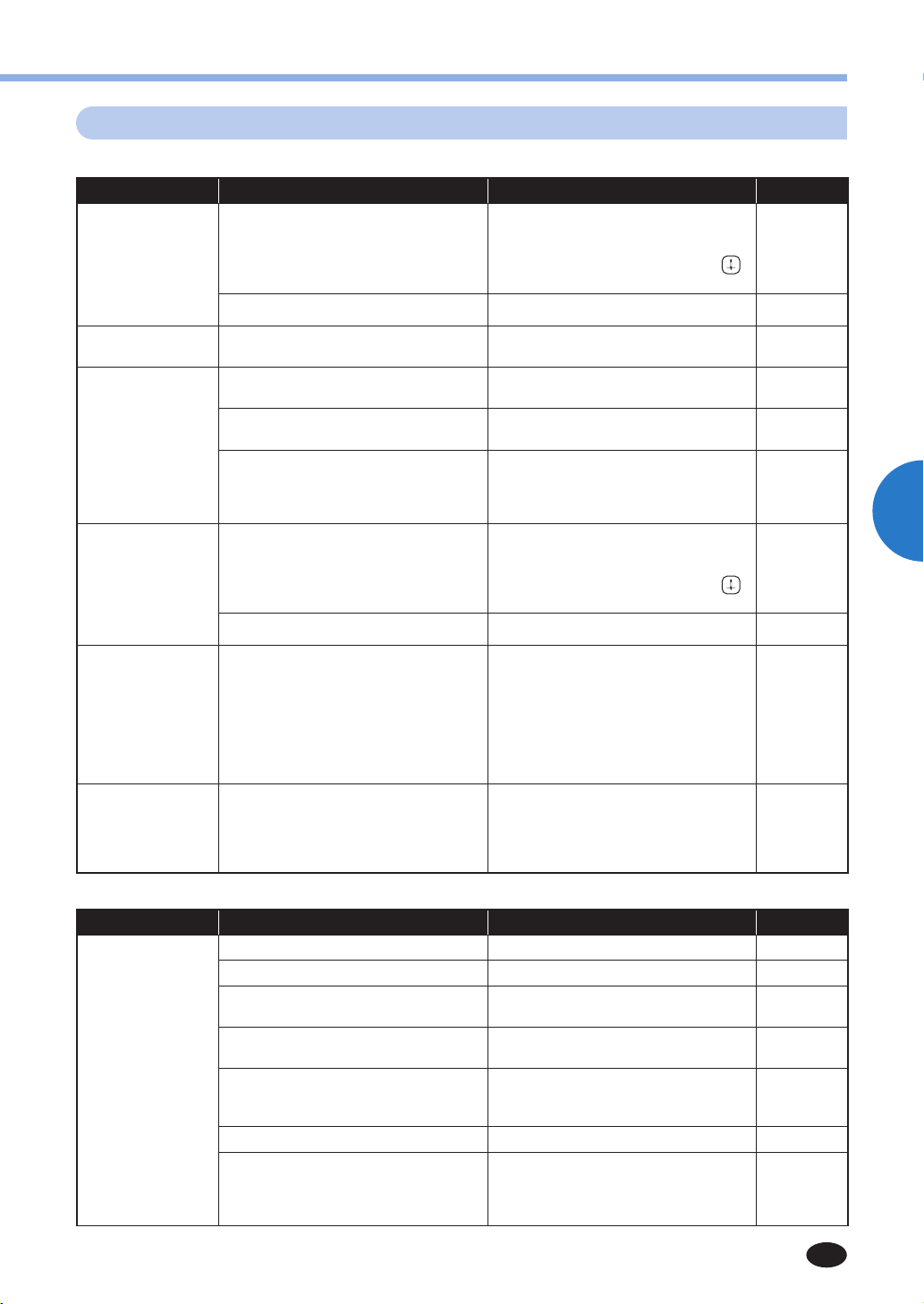
APPENDIX
67
4
List of symptoms
■
Before sewing
Symptom Possible cause How to put it right Reference
The needle
threader cannot be
used.
(For models
equipped with the
needle threader
lever.)
You have not moved the needle holder
to its highest position.
Raise the needle either by turning
the handwheel toward you
(counterclockwise) so that the mark on
the wheel points up or by pressing
(needle position button) once or twice.
page 16
The needle is incorrectly installed. Correctly install the needle. page 20
The sewing light
does not come on.
The machine is not turned on. Turn on the machine. page 9
Bobbin thread does
not wind neatly on
the bobbin.
The thread is not passed through the
bobbin-winding thread guide correctly.
Correctly pass the thread through the
bobbin-winding thread guide.
page 12
Bobbin spins slowly. (for models equipped
with the sewing speed controller.)
Move the sewing speed controller to
the right (so that the speed will be fast).
page 10
The thread that was pulled out was not
wound onto the bobbin correctly. (For
models equipped with the fast bobbin
winding system.)
Wind the thread that was pulled off
round the bobbin five or six times
clockwise.
page 13
The thread does not
pass through the
eye of the needle.
(For models
equipped with the
needle threader
lever.)
You have not moved the needle holder
to its highest position.
Raise the needle either by turning
the handwheel toward you
(counterclockwise) so that the mark on
the wheel points up or by pressing
(needle position button) once or twice.
page 16
The needle is incorrectly installed. Correctly install the needle. page 20
The needle
threader lever does
not lower to the
correct position.
(For models
equipped with the
needle threader
lever.)
The needle has not been raised to the
correct position.
Press the needle position button. page 16
While winding the
bobbin, the bobbin
thread was wound
below the bobbin
winder seat.
You have not wound the bobbin thread
properly.
After removing the thread wound
below the bobbin winder seat, wind
the bobbin correctly.
page 11
■
While sewing
Symptom Possible cause How to put it right Reference
The sewing
machine does not
work.
The machine is not plugged in. Plug the machine in. page 9
The main power switch is turned off. Turn on the main power switch. page 9
The bobbin winder shaft is pushed to
the right.
Move the bobbin winder shaft to the
left.
page 13, 14
You have not used the foot controller
properly.
Use the foot controller properly. page 9, 10
The foot controller or the start/stop
button was not pressed (for models
equipped with the start/stop button).
Press the foot controller or the start/
stop button.
page 27
The presser foot lever is raised. Lower the presser foot lever. page 27
The start/stop button was pressed, even
though the foot controller is connected.
(for models equipped with the start/
stop button)
Do not use the start/stop button when
the foot controller is connected. To use
the start/stop button, disconnect the
foot controller.
page 27
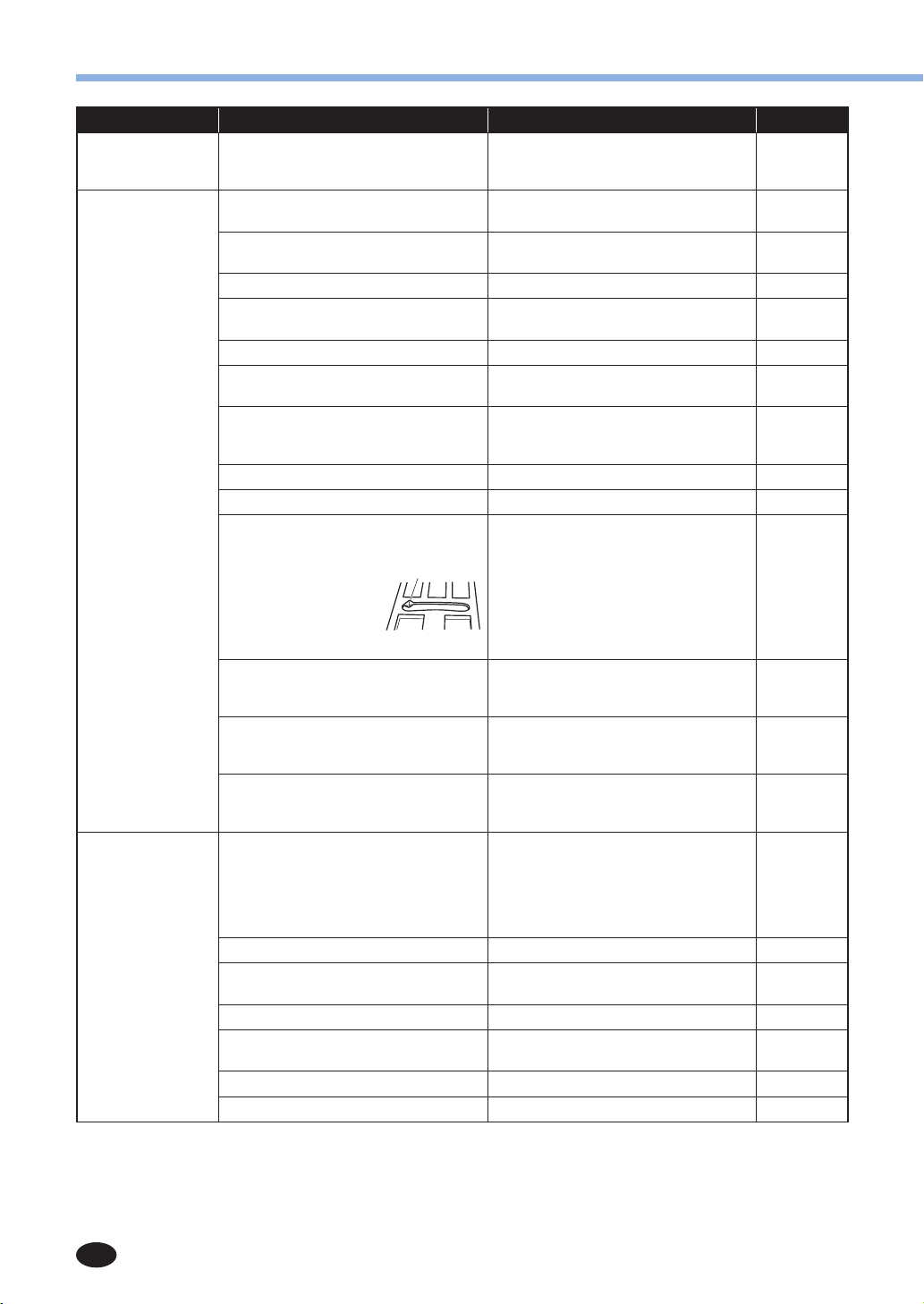
APPENDIX
68
Symptom Possible cause How to put it right Reference
Fabric being sewn
with the machine
cannot be removed.
Thread is tangled below the needle
plate.
Lift up the fabric and cut the threads
below it, and clean the race.
page 63
The needle breaks.
The spool or spool cap is incorrectly
installed.
Correctly install the spool or spool cap. page 17
The upper thread was not threaded
correctly.
Correct the upper threading. page 16
The needle is incorrectly installed. Correctly install the needle. page 20
The needle clamp screw is loose.
Use the disc-shaped screwdriver to
firmly tighten the screw.
page 21
The needle is bent or blunt. Replace the needle. page 21
You have not used the right combination
of fabric, thread and needle.
Choose a thread and needle that are
appropriate for the type of fabric.
page 20
The presser foot you are using is not
appropriate for the type of stitch that
you want to sew.
Attach the presser foot that is correct
for the type of stitch that you want to
sew.
page 53
The upper thread tension is too tight. Loosen the upper thread tension. page 28
You are pulling the fabric too much. Lightly guide the fabric. –
The area around the hole in the needle
plate is scratched.
* There is a notch on
the left side of the
opening in the needle
plate. This is not a
scratch.
1 Notch
Replace the needle plate.
Contact your retailer or the nearest
authorized service center.
–
The area around the hole in the presser
foot is scratched.
Replace the presser foot.
Contact your retailer or the nearest
authorized service center.
–
The bobbin case is scratched.
Replace the bobbin case.
Contact your retailer or the nearest
authorized service center.
–
You have not used a bobbin that has
been designed for this machine.
Incorrect bobbins will not work
properly. Only use a bobbin that has
been designed for this machine.
page 11
The upper thread
breaks.
The upper thread was not threaded
correctly. (for example, the spool is
not installed correctly, the spool cap is
too big for the spool being used, or the
thread has come out of the needle bar
thread guide.)
Correct the upper threading. Use the
spool cap that best fits the size of the
spool being used.
page 16
There are knots or tangles in the thread. Remove any knots or tangles. –
The needle is not appropriate for the
thread you are using.
Choose a needle that is appropriate for
the type of stitch.
page 20
The upper thread tension is too tight. Loosen the upper thread tension. page 28
The thread is tangled, for example, in
the race.
Remove the tangle thread. If the thread
is tangled in the race, clean the race.
page 60, 62
The needle is bent or blunt. Replace the needle. page 21
The needle is incorrectly installed. Correctly install the needle. page 20
a
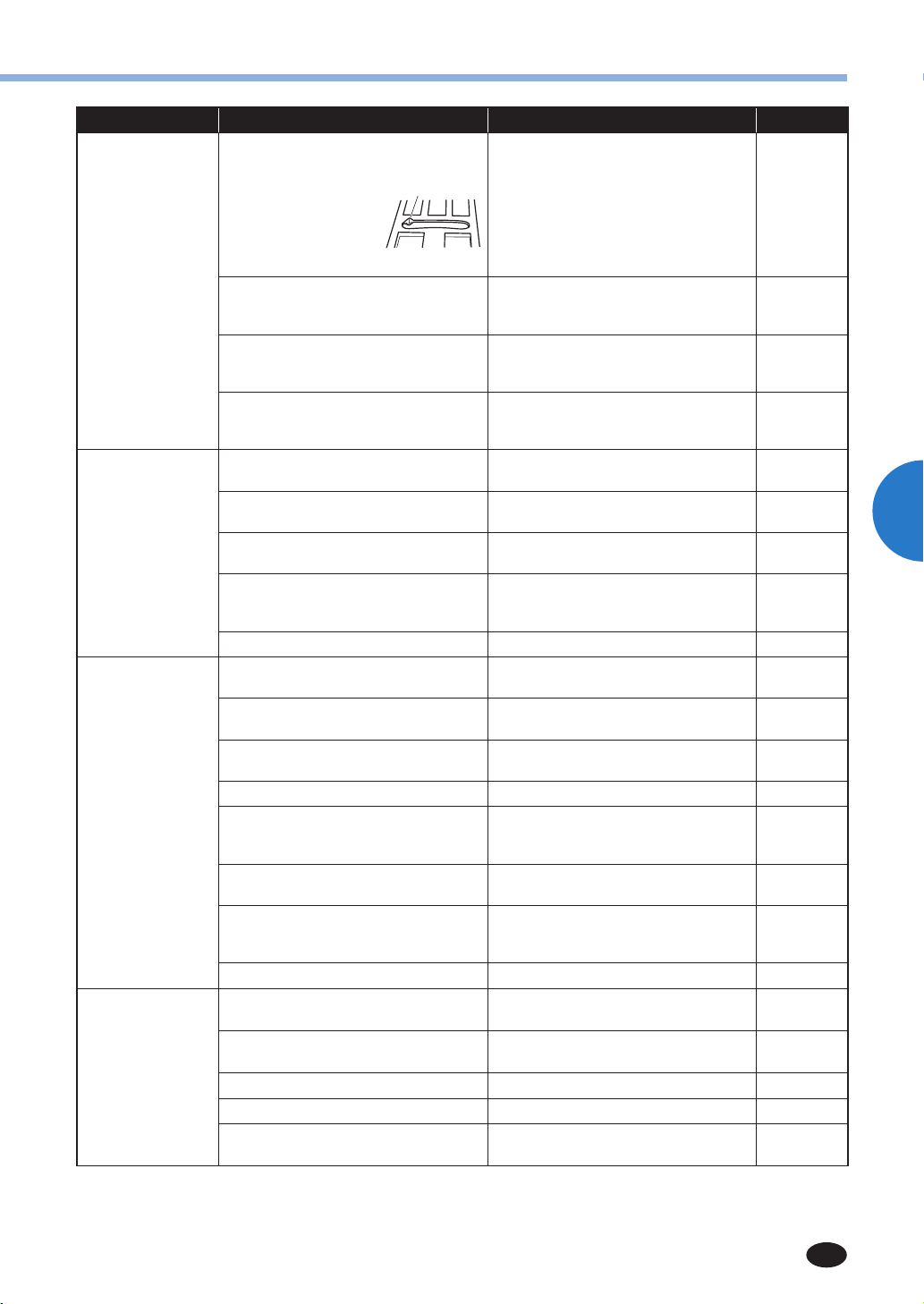
APPENDIX
69
4
Symptom Possible cause How to put it right Reference
The upper thread
breaks.
The area around the hole in the needle
plate is scratched.
* There is a notch on
the left side of the
opening in the needle
plate. This is not a
scratch.
1 Notch
Replace the needle plate.
Contact your retailer or the nearest
authorised service center.
–
The area around the hole in the presser
foot is scratched.
Replace the presser foot.
Contact your retailer or the nearest
authorised service center.
–
The bobbin case is scratched, or has a
burr on it.
Replace the bobbin case.
Contact your retailer or the nearest
authorised service center.
–
You have not used a bobbin that has
been designed for this machine.
Incorrect bobbins will not work
properly. Only use a bobbin that has
been designed for this machine.
page 11
The lower thread is
tangled or breaks.
You have not wound the bobbin thread
properly.
Wind the bobbin thread properly. page 11
The bobbin is scratched or does not
turn smoothly.
Replace the bobbin. –
The thread is tangled.
Remove the tangled thread and clean
the race.
page 60, 62
You have not used a bobbin that has
been designed for this machine.
Incorrect bobbins will not work
properly. Only use a bobbin that has
been designed for this machine.
page 11
Bobbin is set incorrectly. Reset the bobbin thread correctly. page 14, 15
The fabric is
wrinkled.
You have not threaded the upper thread
properly or fitted the bobbin properly.
Thread the upper thread and wind the
bobbin thread properly.
page 14, 15,
16
The spool or spool cap is incorrectly
installed.
Correctly install the spool or spool cap. page 17
You have not used the right combination
of fabric, thread and needle.
Choose a thread and needle that are
appropriate for the type of fabric.
page 20
The needle is bent or blunt. Replace the needle. page 21
If thin fabrics are being sewn, the stitch
is too long or the fabric is not being fed
correctly.
Sew with the stabilizer material under
the fabric.
page 30
If thin fabrics are being sewn, the stitch
is too coarse.
Shorten the stitch length, or sew with
stabilizer material under the fabric.
page 26, 30
The presser foot you are using is not
appropriate for the type of stitch that
you want to sew.
Attach the presser foot that is correct
for the type of stitch that you want to
sew.
page 53
The thread tension is incorrect. Adjust the tension of the upper thread. page 28, 62
Stitches are
skipped.
You have not threaded the upper thread
properly.
Correct the upper threading. page 16
You have not used the right combination
of fabric, thread and needle.
Choose a thread and needle that are
appropriate for the type of fabric.
page 20
The needle is bent or blunt. Replace the needle. page 21
The needle is incorrectly installed. Correctly install the needle. page 20
Dust has accumulated under the needle
plate or in the race.
Remove the needle plate cover and
clean the plate and the race.
page 60
a
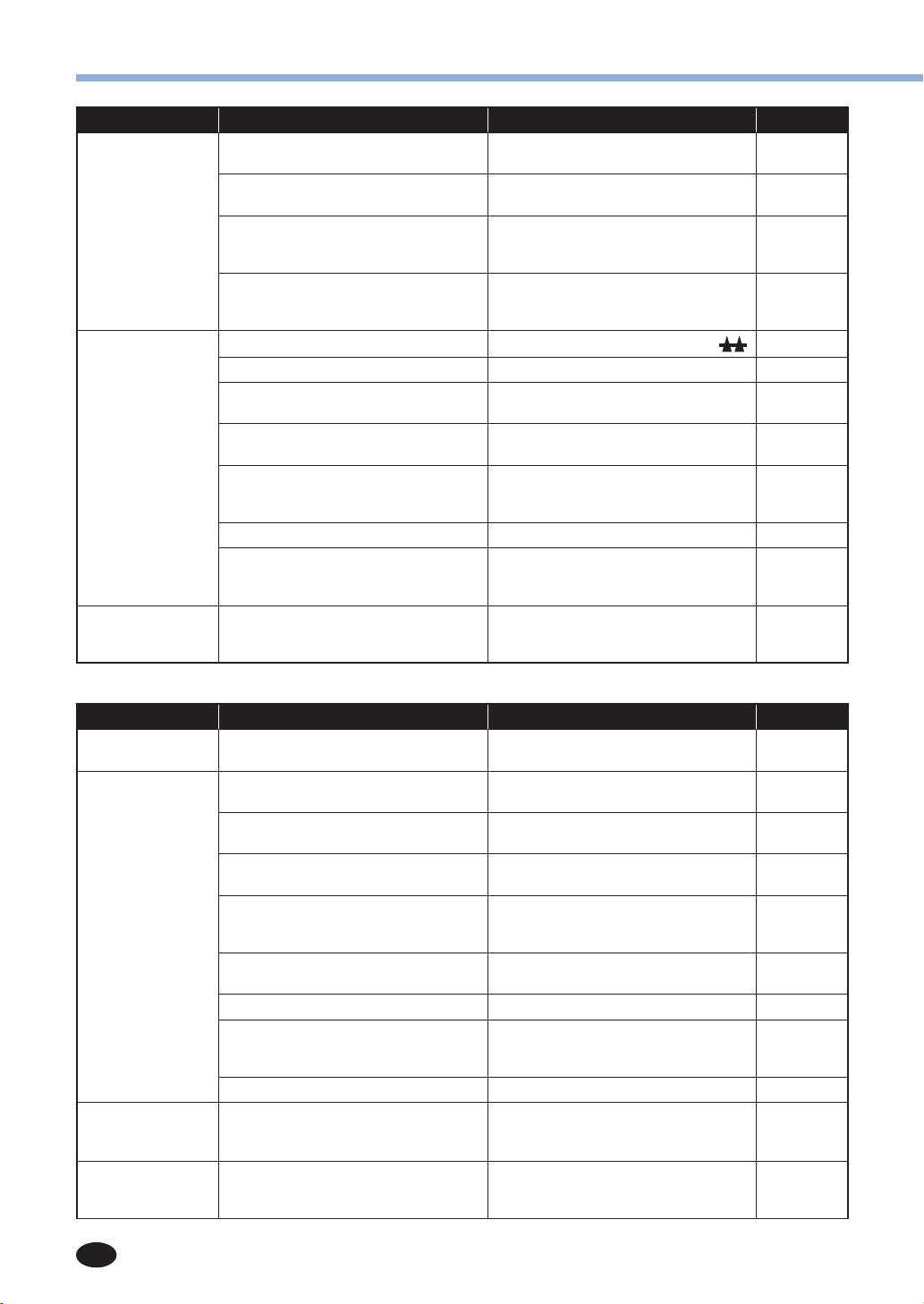
APPENDIX
70
Symptom Possible cause How to put it right Reference
There is a high-
pitched noise while
sewing.
Dust has built up in the feed dogs or in
the race.
Remove the needle plate cover and
clean the plate and the race.
page 60
You have not threaded the upper thread
properly.
Correct the upper threading. page 16
The bobbin case is scratched.
Replace the bobbin case.
Contact your retailer or the nearest
authorized service center.
–
You have not used bobbin that has
been designed for this machine.
Incorrect bobbins will not work
properly. Only use a bobbin that has
been designed for this machine.
page 11
The fabric does not
feed.
The feed dogs are lowered.
Slide the feed dog position lever to .
page 38, 44
The stitch is too fine. Lengthen the stitch length. page 26
You have not used the right combination
of fabric, thread and needle.
Choose a thread and needle that are
appropriate for the type of fabric.
page 20
The thread is tangled, for example, in
the race.
Remove the tangle thread. If the thread
is tangled in the race, clean the race.
page 60, 62
The presser foot you are using is not
appropriate for the type of stitch that
you want to sew.
Attach the presser foot that is correct
for the type of stitch that you want to
sew.
page 53
The needle is bent or blunt. Replace the needle. page 21
Zigzag foot “J” is slanted on a thick
seam at the beginning of stitching.
Use the presser foot locking pin (black
button on the left side) on zigzag foot “J”
to keep the presser foot level while sewing.
page 30
The fabric feeds
in the opposite
direction.
The feed mechanism is damaged.
Contact your retailer or the nearest
authorized service center.
–
■
After sewing
Symptom Possible cause How to put it right Reference
The upper thread
has tightened up.
The bobbin thread is incorrectly
installed.
Correctly install the bobbin thread. page 14, 62
The thread tension
is incorrect.
You have not threaded the upper thread
properly.
Correct the upper threading. page 16
You have not wound the bobbin thread
properly.
Wind the bobbin thread properly. page 11
The bobbin thread is incorrectly
installed.
Correctly install the bobbin thread. page 14
You have not threaded the right
combination of thread and needle for
the fabric you are using.
Choose a thread and needle that are
appropriate for the type of fabric.
page 20
You have not attached the presser foot
holder properly.
Attach the presser foot holder properly. page 23
The thread tension is incorrect. Adjust the tension of the upper thread. page 28, 62
You have not used a bobbin that has
been designed for this machine.
Incorrect bobbins will not work
properly. Only use a bobbin that has
been designed for this machine.
page 11
Bobbin is set incorrectly.
Reset the bobbin thread correctly.
page 14, 15
The thread is tangled
on the wrong side of
the fabric.
You have not threaded the upper thread
properly.
Correct the upper threading. page 16, 62
The stitch is not
sewn correctly.
The presser foot you are using is not
appropriate for the type of stitch that
you want to sew.
Attach the presser foot that is correct
for the type of stitch that you want to
sew.
page 53
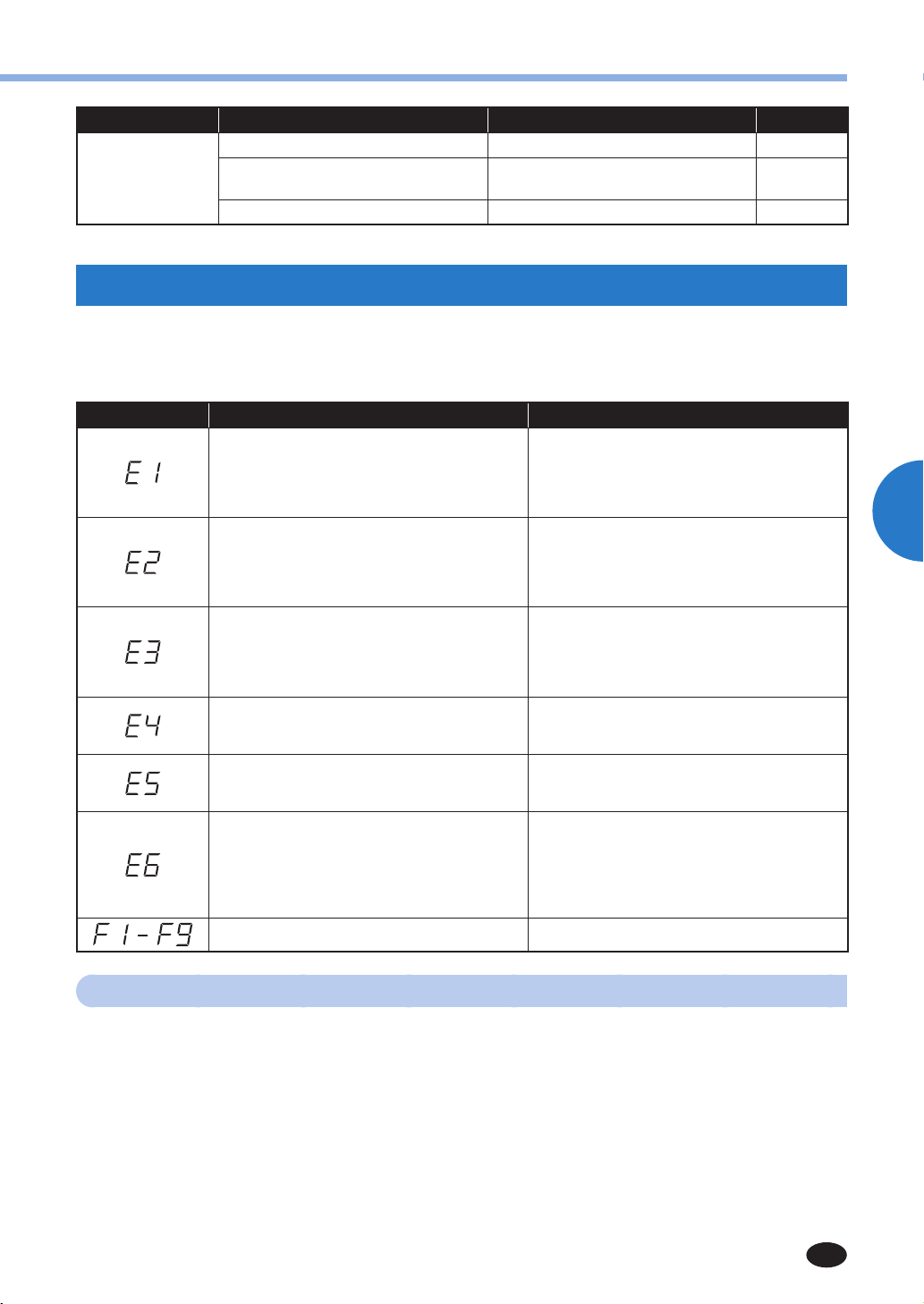
APPENDIX
71
4
Symptom Possible cause How to put it right Reference
The stitch is not
sewn correctly.
The thread tension is incorrect. Adjust the tension of the upper thread. page 28, 62
The thread is tangled, for example, in
the race.
Remove the tangle thread. If the thread
is tangled in the race, clean the race.
page 60, 62
The stitch adjustment level is incorrect. Adjust the stitch. page 52
ERROR MESSAGES
If an operation is performed incorrectly before the sewing machine is set up, an error message appears on the
operation panel. Follow the instructions indicated in the table.
If you press the stitch selection key or do the operation correctly while the error message is displayed, the
message disappears.
Error Message Probable Cause Solution
The foot controller was pressed (or the start/
stop button was pressed if the foot controller is
not connected) and the reverse/reinforcement
stitch button was pressed while the presser foot
is raised.
Lower the presser foot lever before continuing
the operation.
A stitch other than the buttonhole or bar tack
stitch was selected and the foot controller was
pressed (or the start/stop button was pressed if
the foot controller is not connected) while the
buttonhole lever is lowered.
Raise the buttonhole lever before continuing
the operation.
The buttonhole or bar tack stitch was selected
and the foot controller was pressed (or the start/
stop button was pressed if the foot controller
is not connected) while the buttonhole lever is
raised.
Lower the buttonhole lever before continuing
the operation.
The reverse/reinforcement stitch button or
needle position button was pressed while the
bobbin winder shaft is moved to the right.
Move the bobbin winder shaft to the left before
continuing the operation.
The start/stop button was pressed while the
foot controller was connected.
Disconnect the foot controller, and then press
the start/stop button. Otherwise, operate the
machine by using the foot controller.
The motor locked up because the thread
became tangled, or the needle bent and thus
hit the needle plate.
Clean the race to remove the tangled thread
(page 60).
Check the needle. If the needle is bent or
broken, replace the needle (page 21).
If both of the above fail, refer to “Error message
“E6” appears in the LCD” (page 65).
The machine may be malfunctioning. Contact your nearest authorized service center.
Operation beep
Each time a key is pressed you will hear one beep. If a non-functioning key is pressed or an incorrect operation
is performed you will hear two or four beeps (only for models equipped with the operation beep).
■
If a key is pressed (correct operation)
One beep sounds.
■
If an incorrect operation is performed or a non-functioning key is pressed
Two or four beeps sound.
■
If the machine locks up, for example, because the thread is tangled
The sewing machine beeps for four seconds and the machine automatically stops. Be sure to check for the
cause of the error, and correct it before continuing to sew.

72
APPENDIX
Numerics
3-point zigzag stitch ............................................................. 40
A
accessories ............................................................................. 4
adjusting stitches ...................................................................52
appliqués...............................................................................41
B
bar tack ................................................................................ 44
basic stitching ........................................................................33
blind hem stitching ................................................................33
bobbin ..................................................................................11
bobbin case.......................................................................... 60
bobbin cover .....................................................................6, 15
bobbin winder ....................................................... 6, 11, 13, 22
buttonhole foot......................................................................36
buttonhole lever ..........................................................6, 36, 45
buttonhole sewing .................................................................35
button sewing ........................................................................38
C
character stitch indicator ................................................... 7, 49
character stitch key............................................................ 7, 50
checking characters ...............................................................51
combining characters ............................................................49
crazy quilt stitching ...............................................................41
D
deleting characters ................................................................51
E
elastic tape ........................................................................... 40
error messages ......................................................................71
extra spool pin ......................................................................21
eyelet punch ..........................................................................37
F
fagoting ................................................................................ 46
fast bobbin winding ............................................................... 13
feed dog position lever ....................................................38, 43
feed dogs ..............................................................6, 43, 44, 64
flat bed attachment ................................................................ 5
flip chart ................................................................................. 5
foot controller ........................................................................ 9
free-motion quilting ...............................................................43
H
handwheel ........................................................................6, 16
heirloom stitching ................................................................. 48
hook-and-loop fastener tape ................................................ 30
J
joining ...................................................................................47
L
lower threading .....................................................................14
M
main parts .............................................................................. 6
main power switch ................................................................. 9
N
needle ...................................................................................20
needle bar thread guide .....................................................6, 18
needle clamp screw ..........................................................6, 21
needle plate............................................................................ 6
needle plate cover ............................................................ 6, 60
needle position ......................................................................10
needle position button ...................................................... 7, 26
needle threader .................................................................6, 18
O
operation beep ......................................................................71
operation buttons ................................................................... 7
operation panel ...................................................................... 7
optional accessories ............................................................... 5
overcasting stitches ...............................................................32
P
patchwork stitching ...............................................................41
piecing ..................................................................................42
presser foot ............................................................................ 6
presser foot holder ................................................6, 23, 24, 43
presser foot lever ................................................... 6, 16, 23, 26
Q
quick-set bobbin .......................................................... 6, 15, 19
quilting ..................................................................................42
quilting foot ...........................................................................43
quilting guide ........................................................................43
R
race ...................................................................................... 60
reinforcement stitching ..........................................................27
reverse/reinforcement stitch button ........................................ 7
S
satin stitch indicator ............................................................... 7
scallop stitching .................................................................... 46
seam ripper ...........................................................................37
sewing speed controller............................................... 7, 10, 27
sewing the character stitches .................................................51
shell tuck stitching .................................................................47
smocking .............................................................................. 46
spool cap ..........................................................................8, 16
spool pin .......................................................................6, 8, 16
start/stop button ................................................................ 7, 27
stitch category selection key ........................................ 7, 25, 49
stitch length ........................................................................... 26
stitch length adjustment key ................................................... 7
stitch selection keys ........................................................... 7, 26
stitch settings .........................................................................53
stitch width ...........................................................................26
stitch width adjustment key .................................................... 7
straight stitch .........................................................................33
stretch fabrics ....................................................................... 30
T
thick fabrics ...........................................................................29
thin fabrics ........................................................................... 30
thread cutter ..........................................................................27
thread tension .......................................................................28
trial sewing ............................................................................29
triple stretch stitch ................................................................ 44
troubleshooting .....................................................................61
twin needle ...........................................................................21
U
upper tension-control dial ...........................................6, 28, 63
upper threading .....................................................................16
utility stitch indicator ......................................................... 7, 2 5
utility stitch key ................................................................. 7, 25
W
walking foot ....................................................................42, 43
wing needle ......................................................................... 48
Z
zigzag stitch .............................................................. 29, 32, 41
zipper foot .............................................................................39
zipper insertion .....................................................................39
INDEX


APPENDIX
UTILITY STITCHES
SEWING BASICS
KNOWING YOUR
SEWING MACHINE
Operation Manual
Product Code: 888-E35
Sewing Machine
Be sure to read this document before using the machine.
We recommend that you keep this document nearby for future reference.
English
888-E35
Printed in Vietnam
XG6295-101①
Please visit us at http://support.brother.com/ where you can get product
support and answers to frequently asked questions (FAQs).