
DE’LONGHI
COOKING
INSTALLATION and SERVICE INSTRUCTIONS
USE and CARE INSTRUCTIONS
DEF605GW
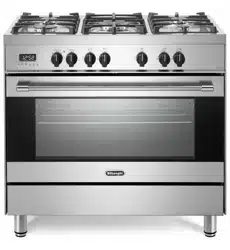
DUAL FUEL COOKER
distributed by
DeLonghi Australia Pty Ltd
DeLonghi New Zealand Ltd

2
Dear Customer,
Thank you for having purchased and given your
preference to our product.
The safety precautions and recommendations reported
below are for your own safety and that of others. They
will also provide a means by which to make full use of
the features offered by your appliance.
Please keep this booklet in a safe place. It may be
useful in future, either to yourself or to others in the
event that doubts should arise relating to its operation.
This appliance must be used only for the task it has
explicitly been designed for, that is for cooking
foodstuffs. Any other form of usage is to be considered
as inappropriate and therefore dangerous.
The manufacturer declines all responsibility in the
event of damage caused by improper, incorrect or
illogical use of the appliance or be faulty installation.
PRODUCT LABEL
Important:
This appliance is designed and manufactured solely for the cooking of domestic
(household) food and is not suitable for any non domestic application and there-
fore should not be used in a commercial environment.
The appliance guarantee will be void if the appliance is used within a non domes-
tic environment i.e. a semi commercial, commercial or communal environment.
3
IMPORTANT PRECAUTIONS AND RECOMMENDATIONS FOR
USE OF ELECTRICAL APPLIANCES
Use of any electrical appliance implies the necessity to follow a series of fundamental
rules. In particular:
■ Never touch the appliance with wet hands or feet;
■ Do not operate the appliance barefooted;
■ The appliance is not intended for use by young children or infirm persons
without supervision;
■ Young children should be supervised to ensure they do not play with the
appliance.
The manufacturer cannot be held responsible for any damages caused by improper,
incorrect or illogical use of the appliance.
USING THE OVEN FOR THE FIRST TIME
You are advised to carry out the following operations:
■ Furnish the interior of the oven.
■ Switch the empty oven ON at maximum temperature for about two hours
to eliminate traces of grease and smell from the components.
■ Disconnect the appliance from the electric power supply and clean the
interior of the oven with a cloth soaked in water and neutral detergent
and dry thoroughly.
This cooker has been designed and constructed in accordance with the following
codes and specifications:
AGA101 (AS 4551) Approval Requirements for Domestic Gas cooking appliances
AS/NZS 603351 General Requirements for Domestic electrical appliances
AS/NZS 6033526 Particular Requirements for Domestic electrical cooking appliances
AS/ Electromagnetic Compatibility Requirements.NZS

4
IMPORTANT PRECAUTIONS AND RECOMMENDATIONS
After having unpacked the appliance, check to ensure that it is not damaged.
In case of doubt, do not use it and consult your supplier or a professionally qualified technician.
Packing elements (i.e. plastic bags, polystyrene foam, nails, packing straps, etc.) should not be left
around within easy reach of children, as these may cause serious injuries.
■ Do not attempt to modify the technical characteristics of the appliance as this may become dan-
gerous to use.
■ Do not carry out cleaning or maintenance operations on the appliance without having previ-
ously disconnected it from the electric power supply.
■ After use, ensure that the knobs are in the off position.
■
The appliance is not intended for use by young children or infirm persons unless they have been
adequately supervised by a responsible person to ensure that they can use the appliance safely.
■ During and after use of the appliance, certain parts will become very hot. Do not touch hot
parts. Care should be taken to avoid touching heating elements inside the oven.
■ Keep children away from the appliance when it is in use.
■ Young children should be supervised to ensure that they do not play with the appliance.
■ Some appliances are supplied with a protective film on steel and aluminium parts. This film must
be removed before using the appliance.
■ Make sure that electrical cables connecting other appliances in the proximity of the cooker can-
not come into contact with the hob or become entrapped in the oven door.
■ Do not line the oven walls with aluminium foil. Do not place baking trays or the drip tray on the
base of the oven chamber.
■ WARNING When correctly installed, your product meets all safety requirements laid down for
this type of product category. However special care should be taken around the rear or the
underneath of the appliance as these areas are not designed or intended to be touched and
may contain sharp or rough edges, that may cause injury.
■ Fire risk! Do not store flammable material in the oven.
■ Always use oven gloves when removing the shelves and food trays from the oven whilst hot.
■ Do not hang towels, dishcloths or other items on the appliance or its handle – as this could be a
fire hazard.
■ Clean the oven regularly and do not allow fat or oils to build up in the oven base or tray.
Remove spillages as soon as they occur.
■ Do not stand on the open oven door.
■ Always stand back from the appliance when opening the oven door to allow steam and hot air
to escape before removing the food.
■ This appliance is for domestic use only.
■ Safe food handling: leave food in the oven for as short a time as possible before and after cook-
ing. This is to avoid contamination by organisms which may cause food poisoning. Take particu-
lar care during warmer weather.
■ The manufacturer declines all liability for injury to persons or damage to property caused by
incorrect or improper use of the appliance.
■ WARNING: Taking care NOT to lift the oven by the door handle.
■ IMPORTANT NOTE: This appliance shall not be used as a space heater.
Do not operate your appliance by means of an external timer or separate remote-
control system.
■

5
INSTALLATION
CAUTION:
■ This appliance must be installed in accordance with these installation instruc-
tions.
■ This appliance shall only be serviced by authorized personnel.
■ This appliance is to be installed only by an authorised person.
■ Incorrect installation, for which the manufacturer accepts no responsibility,
may cause personal injury of damage.
■ Always disconnect the cooker from mains power supply before carrying out
any maintenance operations or repairs.
■ In the room where the cooker is installed, there must be enough air to allow
the gas to burn correctly, according to the current local regulations.
ELECTRICAL REQUIREMENTS
■ The appliance must be connected to the mains checking that the voltage corresponds
to the value given in the rating plate and that the electrical cable sections can with-
stand the load specified on the plate.
■ The plug must be connected to an earthed socket in compliance with safety standards.
■ If the appliance is supplied without a plug, fit a standard plug which is suitable for the
power consumed by the appliance.
■
■
The power supply cable must not touch the hot parts and must be positioned so that it
does not exceed 50°C above ambient.
■ Once the appliance has been installed, the switch or socket must always be accessible.
■ If the supply cord is damaged it must be replaced by the manufacturer or it’s
Service Agent or a similarly qualified person in order to avoid a hazard.
WARNING: This cooker must be connected to electrical supply using
V105 insulated cable (size: 3 x 1.5 mm
2
).
N.B. The connection of the appliance to earth is mandatory.
If the installation requires alterations to the domestic electrical system call a qualified
electrician. He should also check that the socket cable section is suitable for the power
drawn by the appliance.
Appliance power rating: 230 V~ 2460 W (10.6 A)
240 V~ 2680 W (11.1 A)
Replacing the power cord must be done by a qualified electrician in accor-
dance with the instructions supplied by the manufacturer and in compliance
with established electrical regulations.
■
A suitable disconnection switch must be incorporated in the permanent wiring, mounted
and positioned to comply with the local wiring rules and regulations. The switch must
separation in all poles in accordance with the local wiring rules.
In Australia and New Zealand, a switch of the approved type with a 3 mm air gap must
6
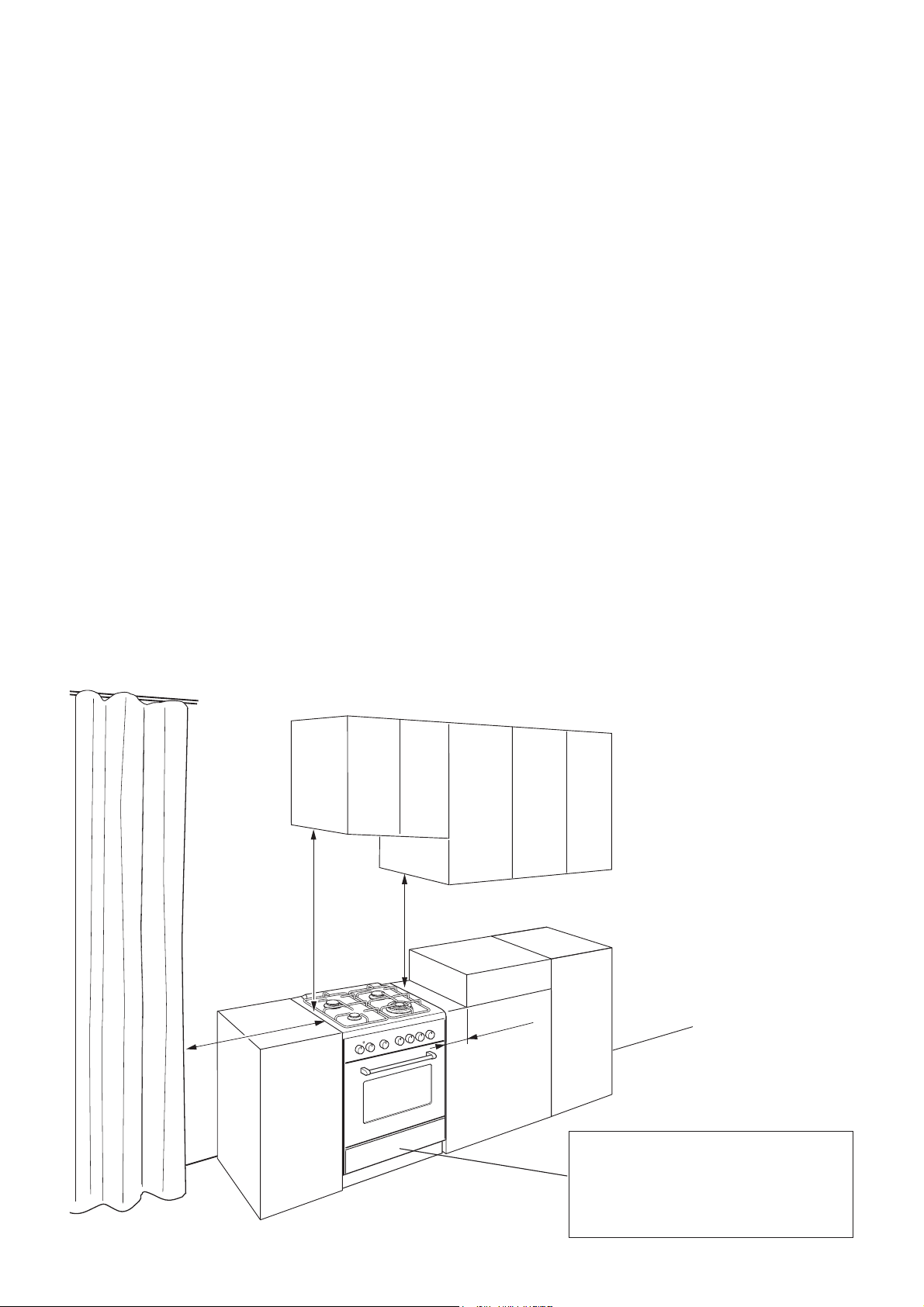
Figure 1
750 mm
500 mm
105 mm
450 mm
Cooker overall dimensions [mm]
• height: min 900 - max 915
• width: 600
• depth: 600
CLEARANCES
Installation clearances and protection of combustible surfaces shall comply with the
current local regulations eg. Gas Installations code.
Installation shall comply with the dimension in Fig. 1 bearing in mind that.
Overhead Clearances
In no case shall the clearances between the highest part of the cooker be less than
600 mm or for an overhead exhaust fan 750 mm. AII other downward facing com-
bustible surfaces less than 600 mm above the cooker surface shall be protected for the
full width of the cooking surface in accordance with the standards noted above. In no
case shall the clearance be less than 450 mm.
Rear and Side Clearances
Where the dimensions from the periphery of the nearest burner to any vertical com-
bustible surface is less than 200 mm the surface shall be protected in accordance with
the standards to a height of not less than 150 mm above the cooking surface for the
full width or depth of the cooking surface
Where the dimensions from the periphery of the nearest burner to any horizontal com-
bustible surface is less than 200 mm, the horizontal surface shall be greater than
10 mm below the surface of the hob, or the horizontal surface requirement above.
Protection of combustible surfaces.
The standards above specify that where required protection shall ensure that the sur-
face temperature of the combustible surface does not exceed 65 °C above room tem-
perature.
If the cooker is located on a pedestal it is necessary to provide safety mea-
sures to prevent falling out.
AS5601 / NZS5261
7
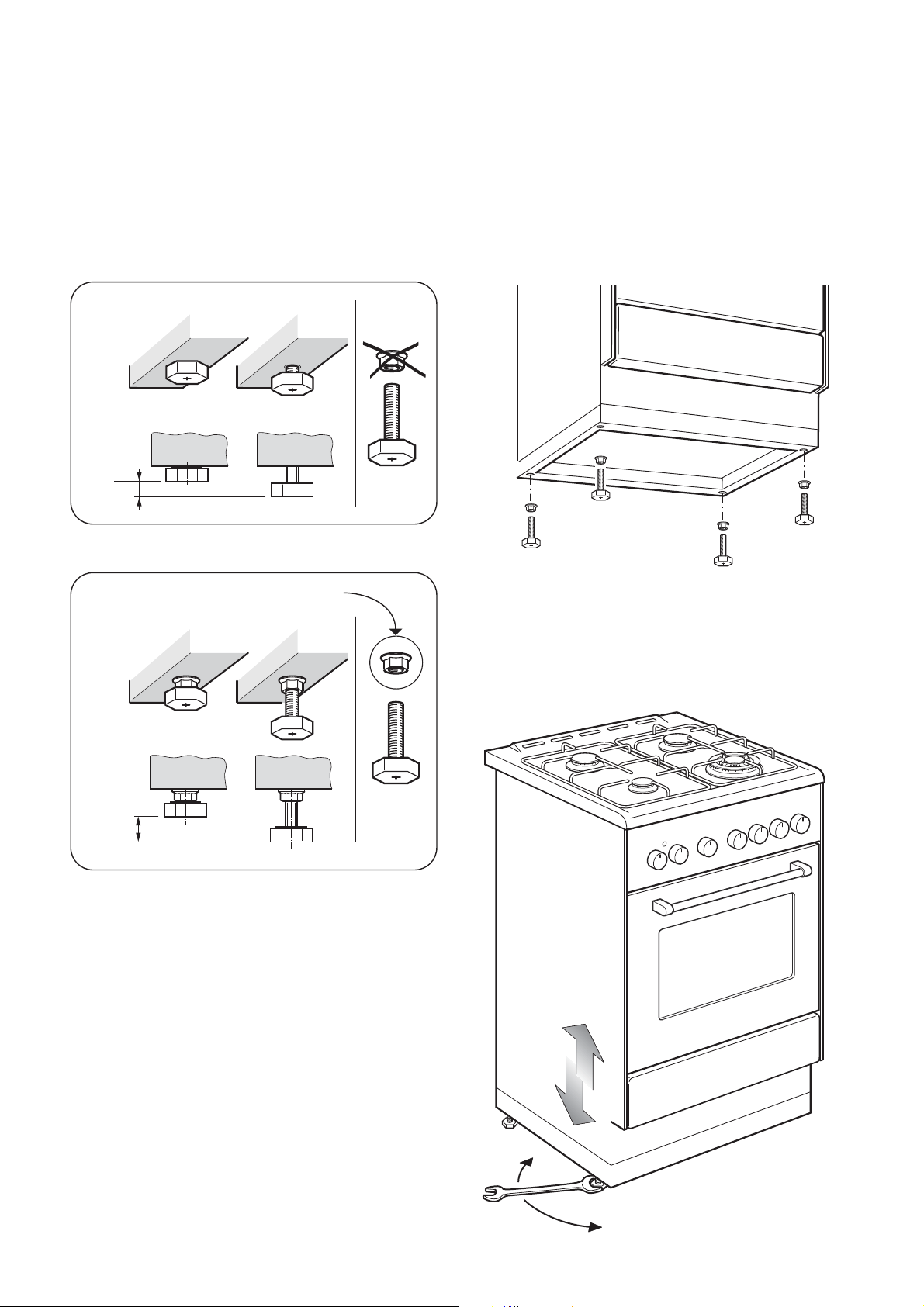
LEVELLING THE COOKER
The cooker is equipped with 4 levelling feet and may be levelled by screwing or
unscrewing the feet with a spanner (fig. 4).
It is important to observe the prescriptions of figures 2a, 2b, 3.
Supplied with the cooker
in a separate kit
+ 8 mm
+ 8
0
mm
+ 15 mm
Figure 2b
Figure 2a
Figure 3
Figure 4
8
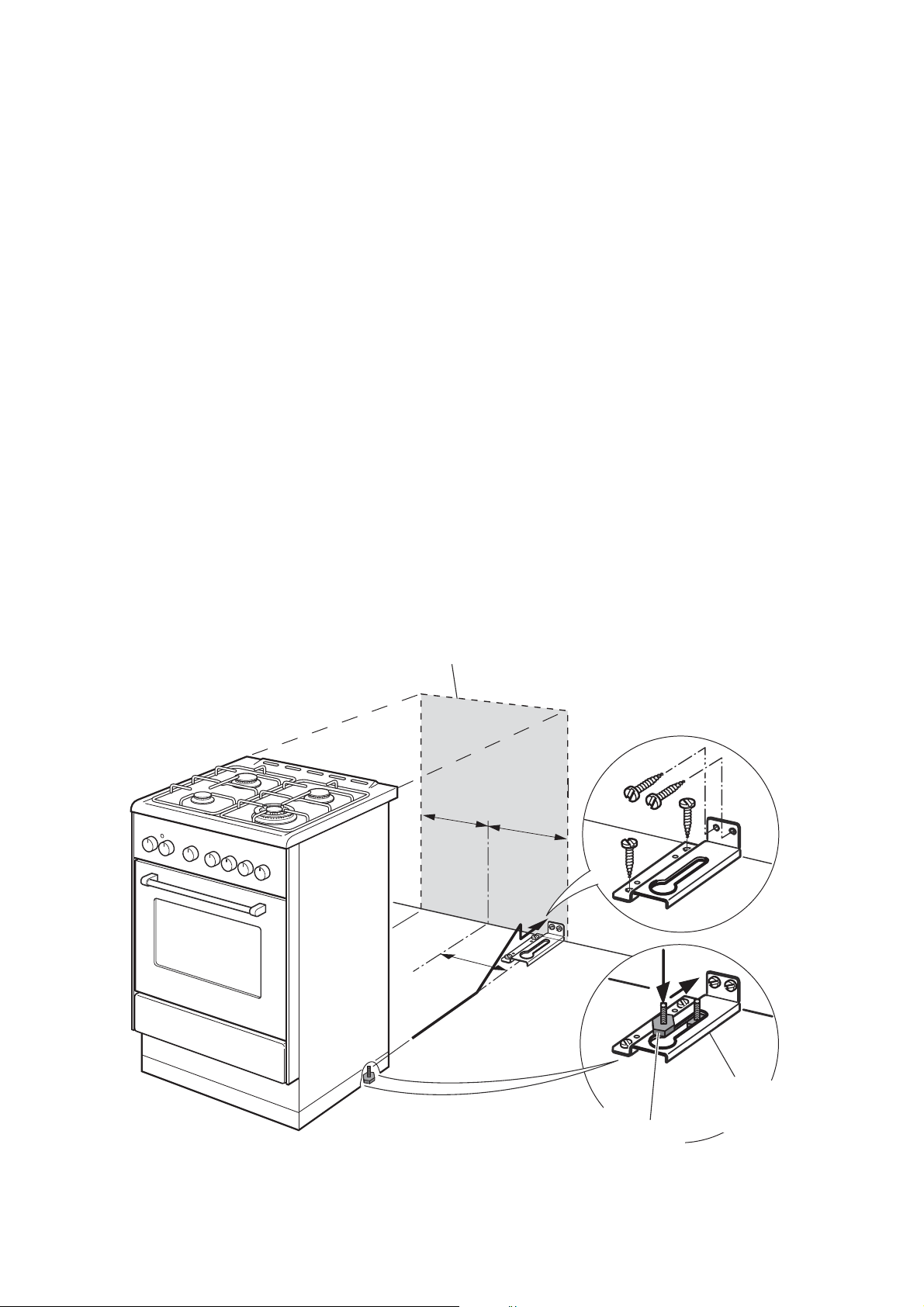
Figure 5
ANTI-TILT BRACKET
Important!
To restrain the appliance and prevent it tipping accidentally, the anti-tilt
bracket must be fitted according to the instructions below.
1. Drill four 8mm diameter holes for the fixing screws (two in the wall and two in the
floor - see Fig. 5) and insert the plastic plugs supplied.
Important! Before drilling the holes, check that you will not damage any
pipes or electrical wires.
2. Attach the anti-tilt bracket to the floor and rear wall using the four screws supplied,
as shown in Fig. 5.
3. After attaching the anti-tilt bracket securely, slide the cooker close to the anti-tilt
bracket and vertically fit the rear right foot into the circular opening of the bracket by
lifting the rear of the cooker. Then slide cooker into place.
Ensure that the rear right foot slides under the bracket, as shown in Fig. 5.
IMPORTANT NOTE: if necessary adjust the height of the feet to ensure the
rear right foot slides under the anti-tilt bracket.
=
=
260
Dotted line showing the position
of the cooker when installed
Foot of cooker
Anti-tilt
bracket
Attaching the anti-tilt bracket and sliding the cooker into place
9
GAS SUPPLY:
■ The connection must be performed by an authorised person according to the rel-
evant standards.
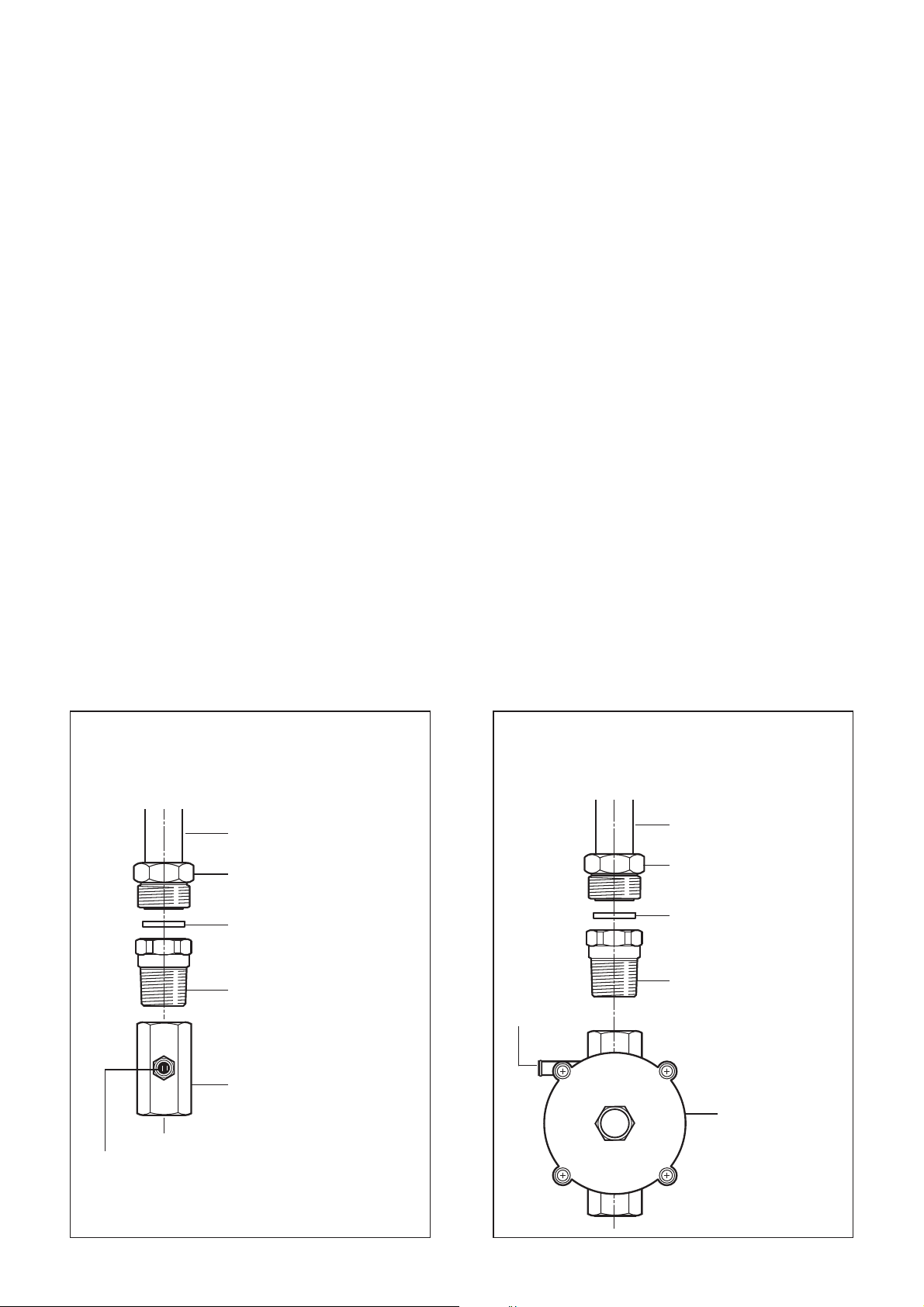
■ Before connecting the appliance to the gas main, mount the brass conical adap-
tor onto the gas inlet pipe, upon which the gasket has been placed (figs. 6-7).
Conical adaptor and gasket are supplied with the appliance (packed with conver-
sion kit for use with Natural gas or ULPG).
■ This appliance is suitable for use with Natural Gas or ULPG. (Check the “gas type”
sticker attached to the appliance).
■ For Natural Gas models the gas supply is connected to the pressure regulator
which is supplied with the appliance (fig. 7). Adjust the regulator to obtain a test
point pressure of 1 kPa with the two semi-rapid (SR) burners operating at maxi-
mum.
■ For ULPG models the gas supply is connected to the test point adaptor which is
supplied with the appliance (fig. 6) and ensure that the supply pressure is regulat-
ed to 2.75 kPa.
■ The connection must be made at the rear of appliance (left or right); the pipe
does not cross the cooker.
■ The inlet not used must be closed off with the cap and sealing gasket supplied.
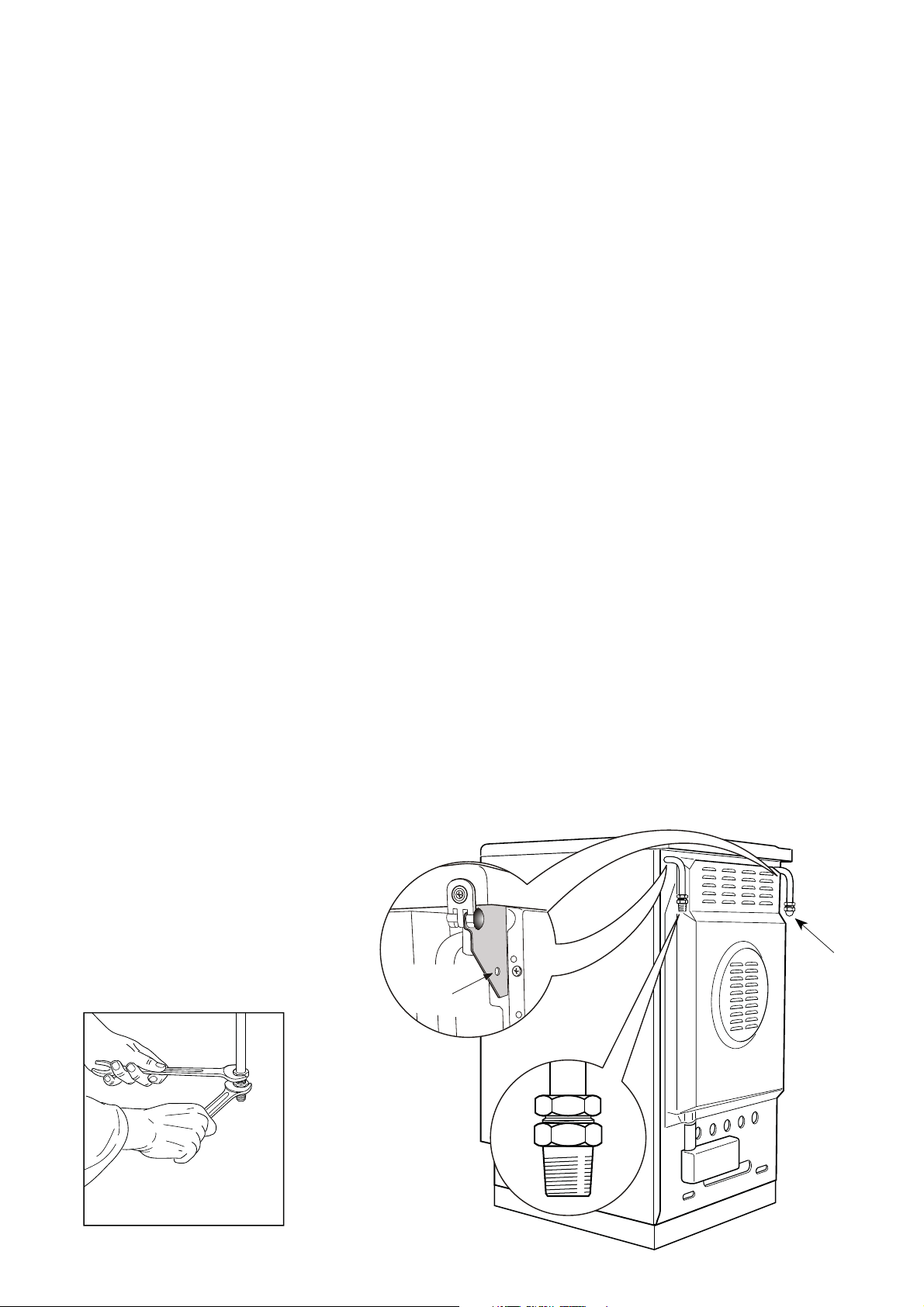
■ IMPORTANT: Use two spanners to tighten or loosen the connecting pipe (fig. 8).
Gas connection for
ULPG
Figure 7
Figure 6
Gas connection for
NATURAL GAS
Gas inlet pipe
Nipple
Gasket
Brass conical adaptor
(Thread tight: use
suitable seal)
Gas inlet pipe
Nipple
Gasket
Brass conical adaptor
(Thread tight: use
suitable seal)
Gas regulator
Test point adaptor
Test
point
Test
point
10
Figure 8
Figure 9
Plug
Chain
security
hole
1. After connecting the gas supply, check the piping and connections for leaks using
a soap and water solution. The presence of bubbles indicates a leak, tighten or
replace connections as appropriate.
Warning: Do not use any naked flame to check for leaks.
2. Adjust the test point pressure or supply pressure to the value which is appropriate
for the gas type.
3. The operation of the appliance must be tested when installation is completed.
Installation with a flexible hose assembly
-
If this appliance has to be installed with a hose assembly, the installer shall refer to the network
operator or gas supplier for confirmation of the gas type, if in doubt.
- When used with a flexible hose, the connector on the wall should be between 450 mm to 500
mm from the floor and 200 mm to 300 mm from the left-hand side of the appliance as viewed
from the front. The hose connection on the appliance shall face downwards.
- It is important that the hose does not come in contact with the metal of the appliance and is
secured as per appropriate gas installation codes.
A chain 80% of the length of the flexible gas hose must be used to prevent stress being applied
to the hose. The chain should be attached securely to the product where shown, and on the wall.
- Flexible hose assemblies should be AS/NZS 1869 Class B or Class D certified.
The thread connection shall be Rp 1/2” (ISO 7-1) male.
- IMPORTANT WARNING: After connection the installer must check that the hose is not kinked,
subjected to abrasion or permanently deformed.
The installer must check also that the hose is not near (or in contact) with any hot surfaces.
- The hose assembly shall be as short as practicable and comply with relevant AS5601 / NZS5261
requirements.
11
Figure 10
Figure 11
J
J
CONVERSION PROCEDURE (to convert to Natural gas or to ULPG)
REPLACING THE INJECTORS
This appliance is suitable for use with Natural gas or ULPG (check the “gas type” sticker
attached to the appliance). A label stating the type of gas used after replacing the
injectors must be attached at the rear of the appliance, in proximity of the gas inlet
connection. The nominal gas consumption and injector size details are provided in
table at page 13.
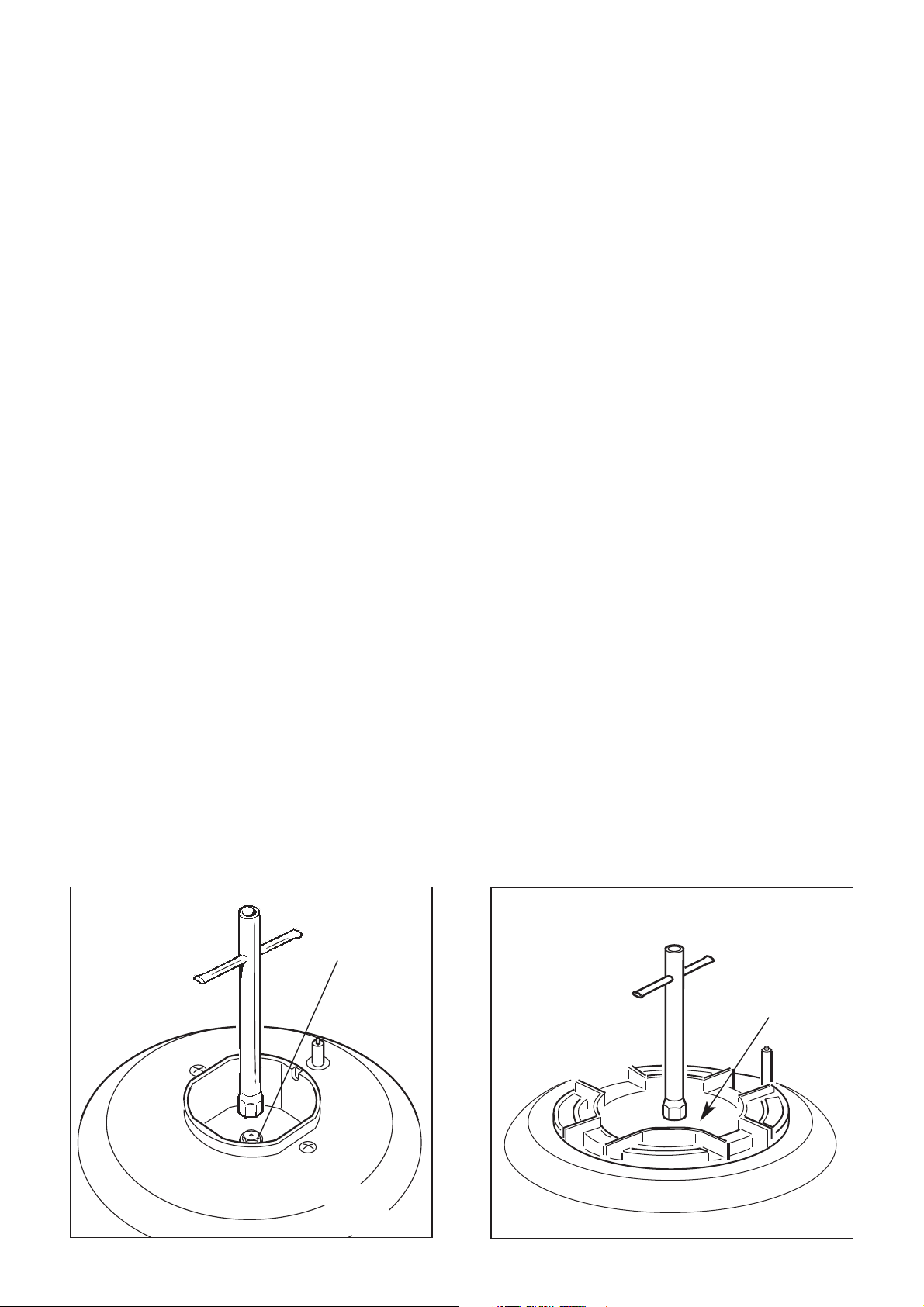
To replace the injectors proceed as follows:
■ Remove pan supports and burners from the cooktop.
■ Using a spanner, remove the injector J (figs. 10, 11) and replace it with one
according to the gas type (see following tables - page 13).
■ Affix to the rear of the appliance, in proximity of the gas inlet connections, the
warning label (supplied with the conversion kit) stating that the cooker has
been converted for use with ULPG / Natural gas.
4. Turn on the appliance gas controls and light each burner individually and in com-
bination. Check for a well defined blue flame without any yellow tipping. If any
abnormality is evident then check that the burner cap is located properly and the
injector nipple is aligned correctly.
5. Check the minimum burner setting by quickly rotating the gas control knob from
the maximum to the minimum position, the flame must not go out. If adjustment is
required carry out the “minimum burner setting adjustment" procedure described
6. If satisfacfory performance cannot be obtained, the installer shall check the installa-
tion and notify the local gas supply authority for a gas supply problem, or if it is an
appliance problem, our Customer Service Centre should be called to obtain the
nearest authorized Delonghi Service Agent.
12
MINIMUM BURNER SETTING ADJUSTMENT
Check whether the flame spreads to all burner ports when the burner is lit with the gas
tap set to the minimum position. If some ports do not light, increase the minimum gas
rate setting.
Check whether the burner remains lit even when the gas tap is turned quickly from
the maximum to the minimum position. If the burner does not remain lit, increase the
minimum gas rate setting.
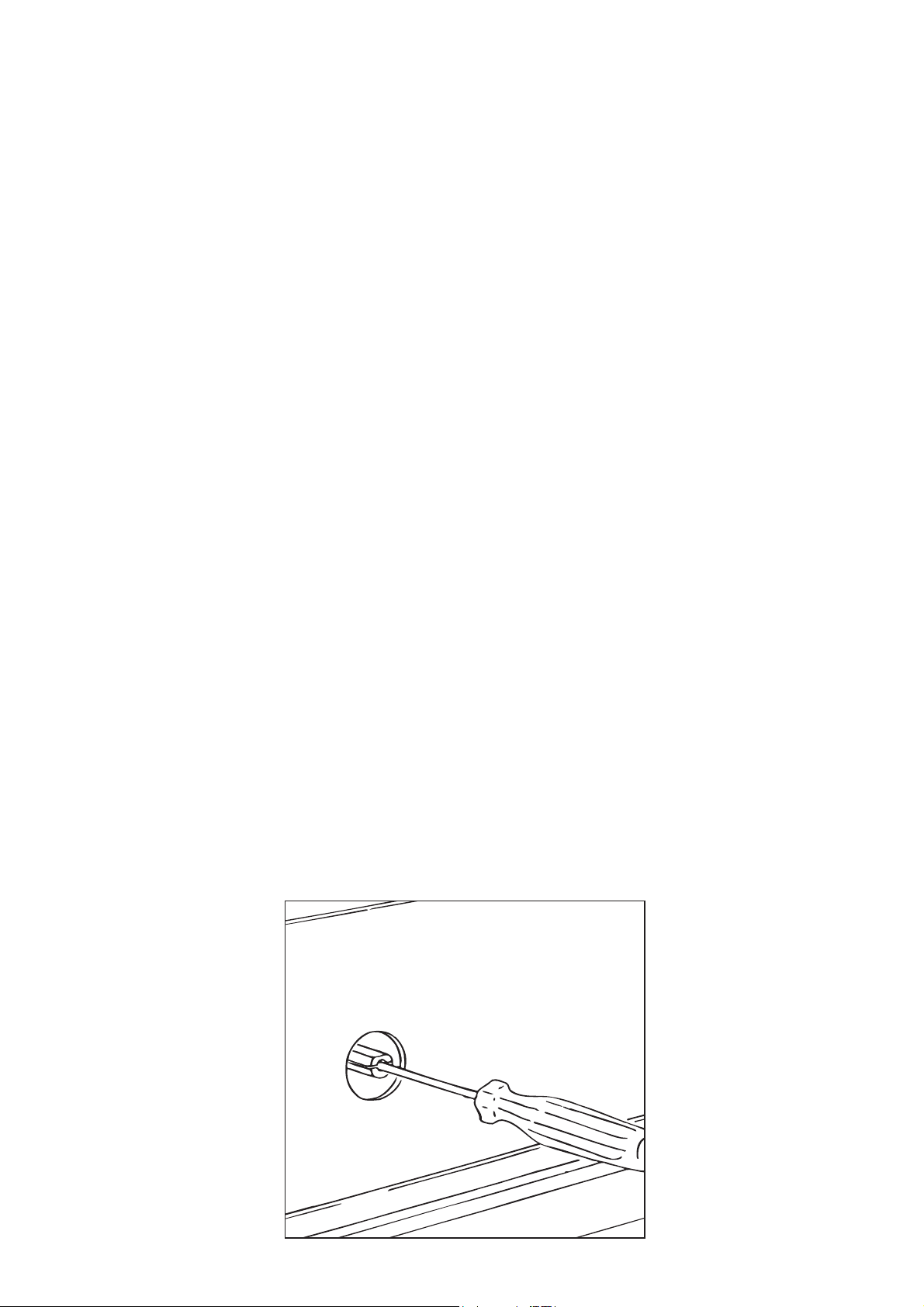
The procedure for adjusting the minimum gas rate setting is described below.
■ Turn on the burner
■ Turn the tap to the MINIMUM position
■ Take off the knob
■ With a small flat screwdriver turn the screw inside the tap rod to the correct reg-
ulation (fig. 12).
Normally for ULPG, the regulation screw is tightened up.
Figure 12
IMPORTANT
■ If the cooker is suitable for use with Natural gas and must be converted for use
with ULPG, before connecting to gas main remove the appliance gas regulator
and replace with test point adaptor (see figs. 6-7)
■ If the cooker is suitable for use with ULPG and must be converted for use with
Natural gas, before connecting to the gas main remove the appliance test point
adaptor and replace with gas regulator (see figs. 6-7).
NOTE:
Gas regulator and test point adaptor are supplied with the appliance (packed with
conversion kit)
The burners are designed so that regulation of primary air is not required.
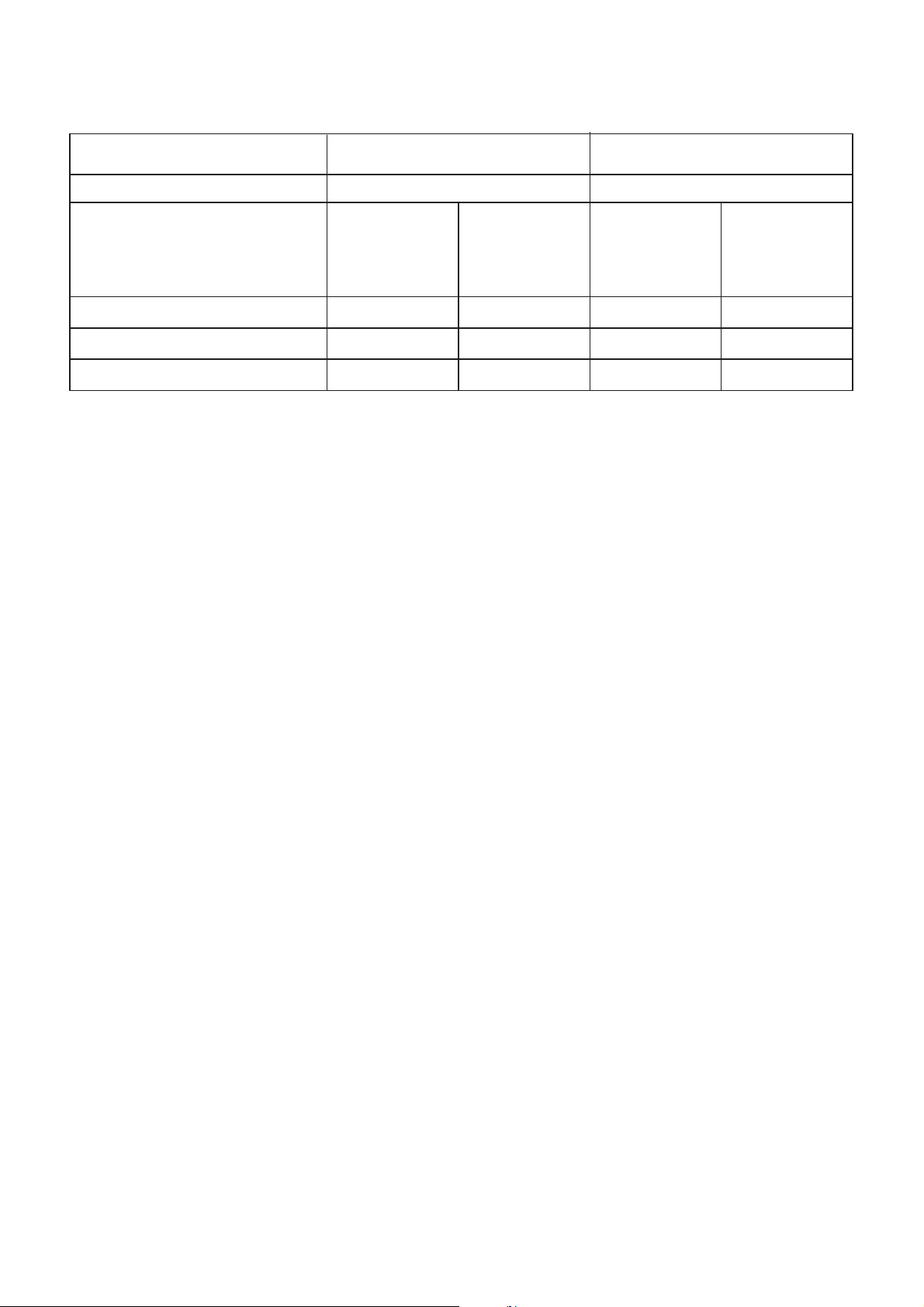
TABLE FOR THE CHOICE OF THE INJECTORS
Natural gas ULPG
Test Point Pressure [kPa] 1.0 2.75
BURNER
Auxiliary (A) 0.85 3.60 0.53 3.60
Semi-rapid (SR) 1.12 6.30 0.70 6.30
Triple ring (TC) 0.95 11.90
Gas
Consumption
[MJ/h]
Injector
Orifice Dia.
[mm]
Gas
Consumption
[MJ/h]
Injector
Orifice Dia.
[mm]
13
LUBRICATION OF THE GAS TAPS
If the gas tap becomes stiff, it is necessary to dismantle it carefully and clean it with
petroleum spirit. Specialist high temperature resistant grease should be used to
lubricate the tap before replacing.
The operations must be carried out by an authorised person/service agent.
1.60 12.70
14
Figure 15
USE and CARE
CAUTION:
■ This appliance must be used only for the task it has explicitly been designed for,
that is for domestic cooking of foodstuffs. Any other form of usage is to be con-
sidered as inappropriate and therefore dangerous.
■ Do NOT place combustible materials or products on this appliance at any time.
■ Do NOT spray aerosols in the vicinity of this appliance while it is in use.
Figure 14
■ Do NOT use or store flammable materials near this appliance.
■ Do NOT modify this appliance.
Stop notch
Stop notch
Guard rail
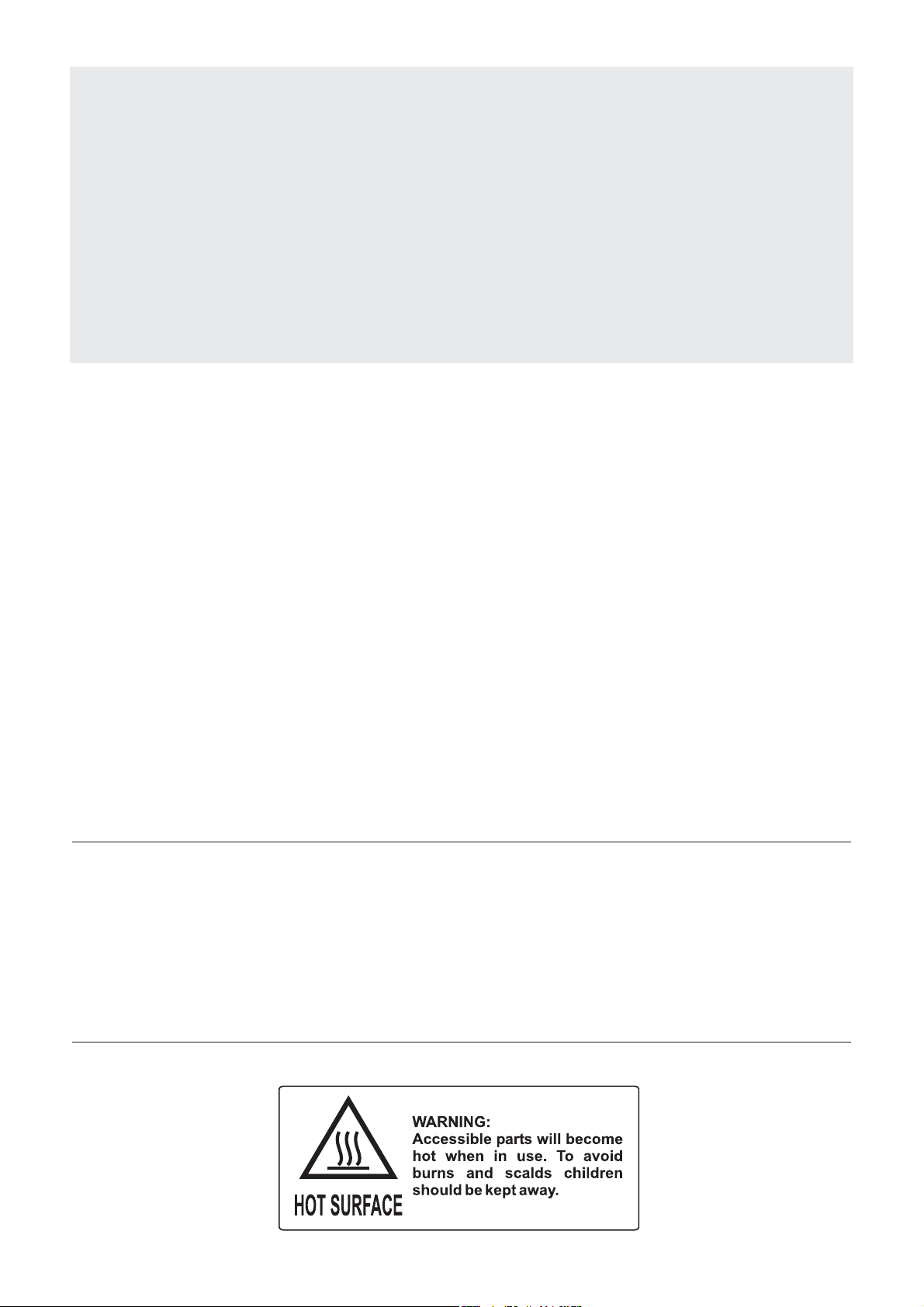
WARNING: Accessible parts will become hot when in use. To avoid burns and
scalds, young children should be kept away.
■
15
Figure 16
USING THE OVEN FOR THE FIRST TIME
■ Clean the inside of the oven with a cloth soaked in water and neutral detergent
and dry thoroughly.
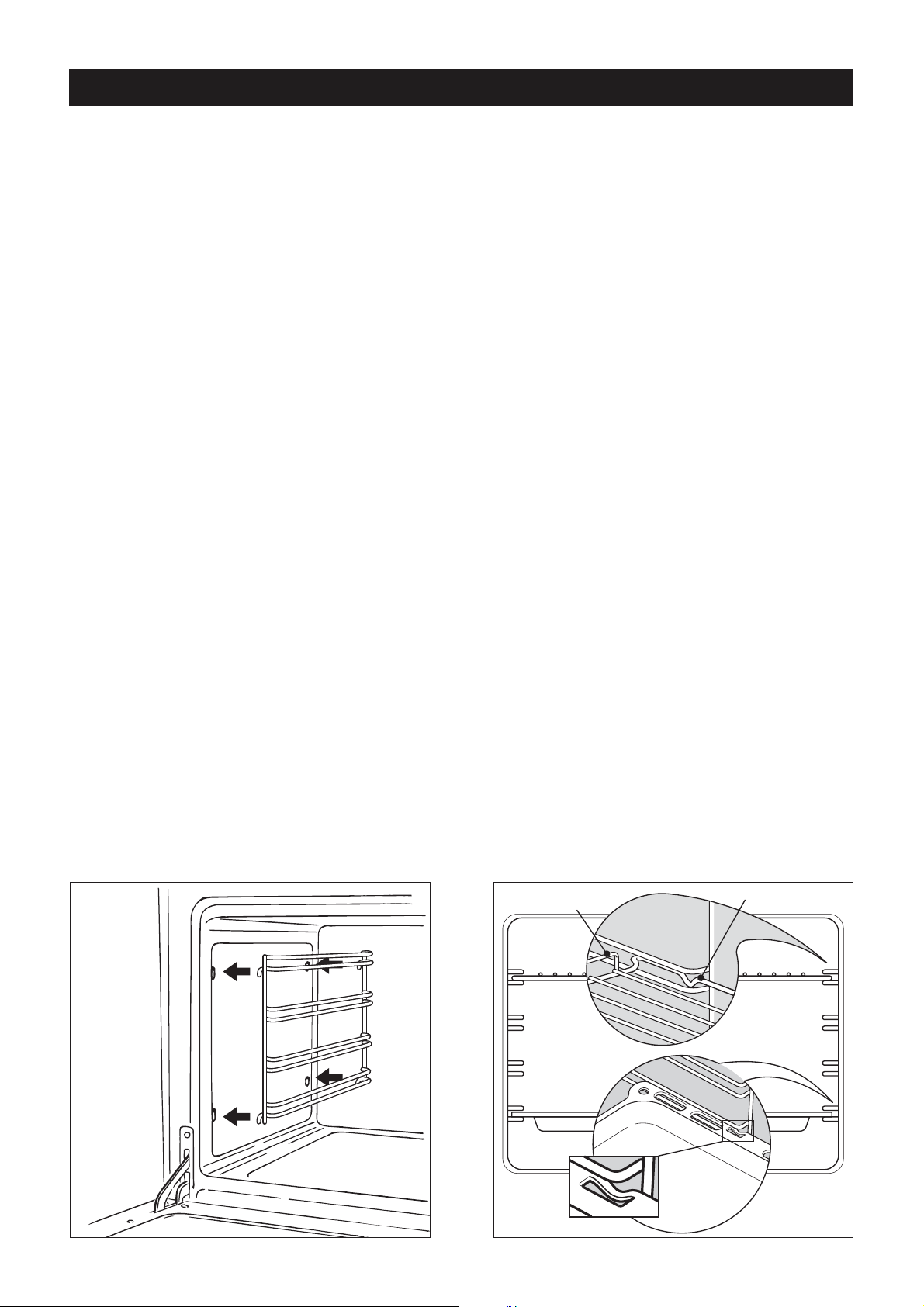
■ Slide in the wire racks on the oven wall as in Fig. 14.
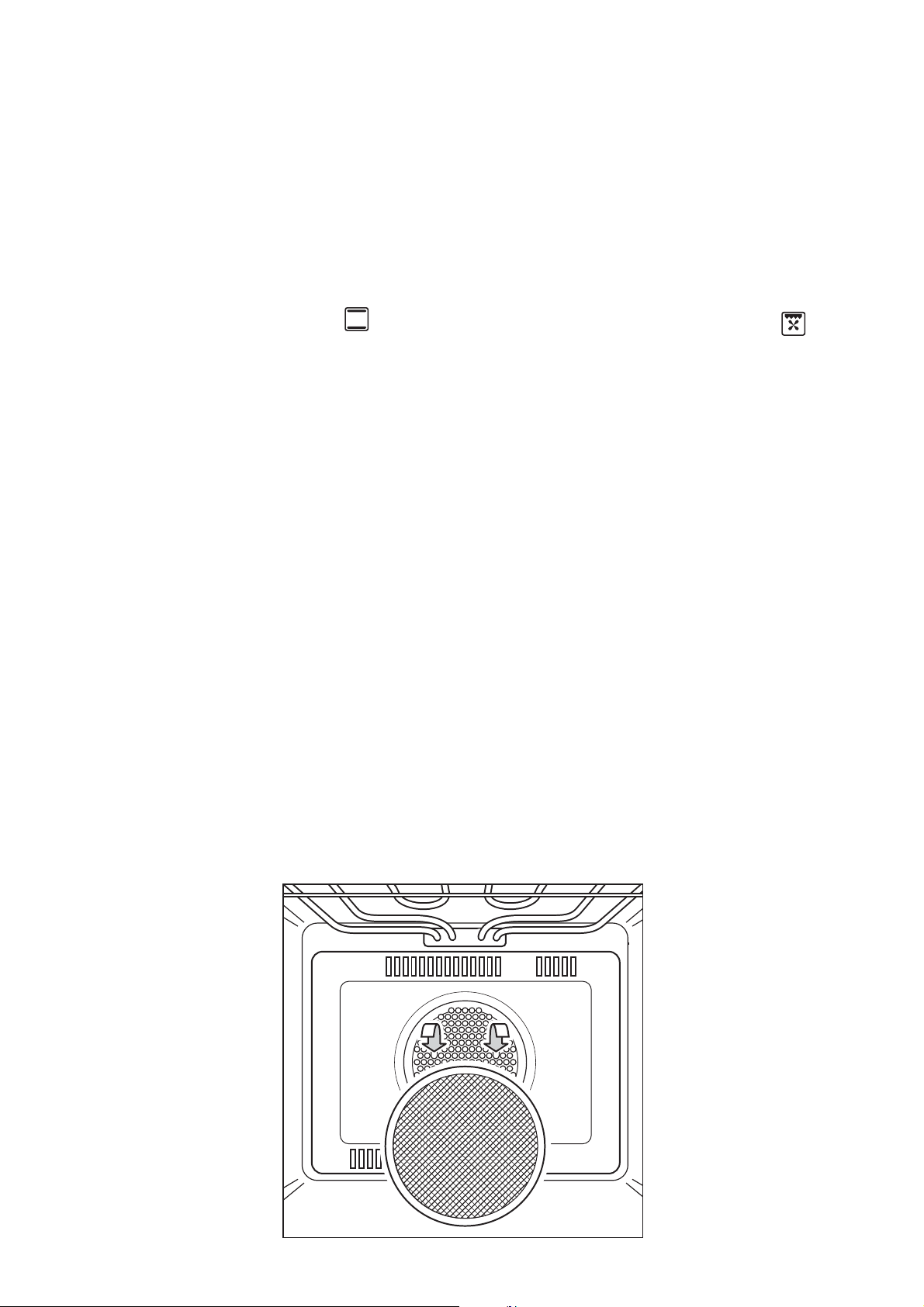
■ Slide in the grease filter on the back of the oven as in Fig. 16.
■ Position the shelf and tray as per Fig. 15.
■ To eliminate traces of grease in manufacture it is necessary to pre-heat the oven
at the maximum temperature.
• For 60 minutes in the position, and for another 15 minutes in the posi-
tion.
GREASE FILTER
■ A special screen is provided at the back of the oven to catch grease particles,
mainly when meat is being roasted (fig. 16).
■ When baking pastry etc. this filter should be removed.
■ Always clean the filter after cooking as any solid residues on it might adversely
affect the oven performance.
16
Figure 17
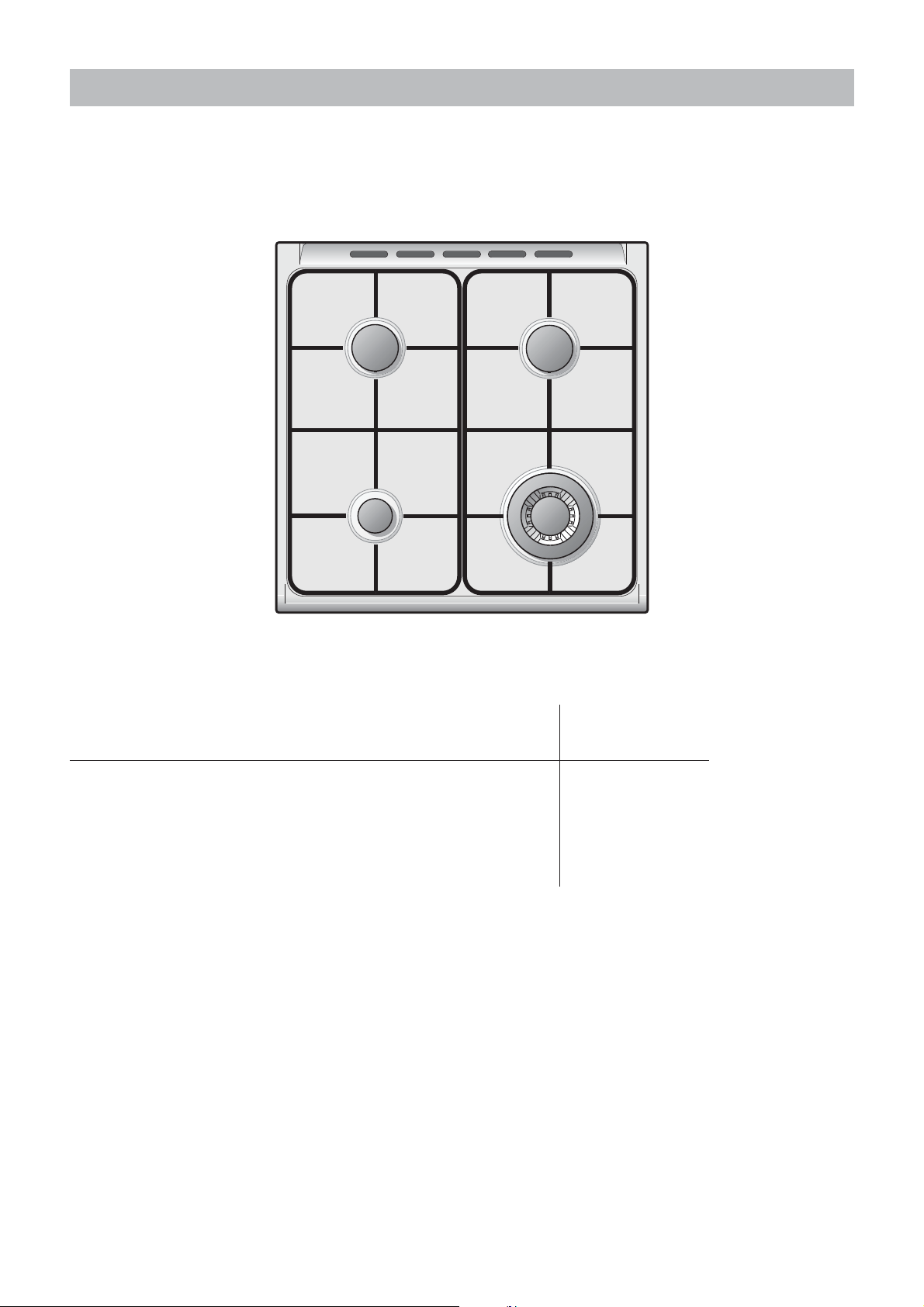
GAS HOB
2
3
4
1
GAS BURNERS Natural Gas ULPG
MJ/h MJ/h
1. Auxiliary burner (A) 3.6 3.6
2. Semi-rapid burner (SR) 6.3 6.3
3. Semi-rapid burner (SR) 6.3 6.3
4. Triple ring burner (TC)
11.9
12.7
17
LIGHTING GAS BURNERS
FITTED WITH ELECTRONIC IGNITION
Figure 18
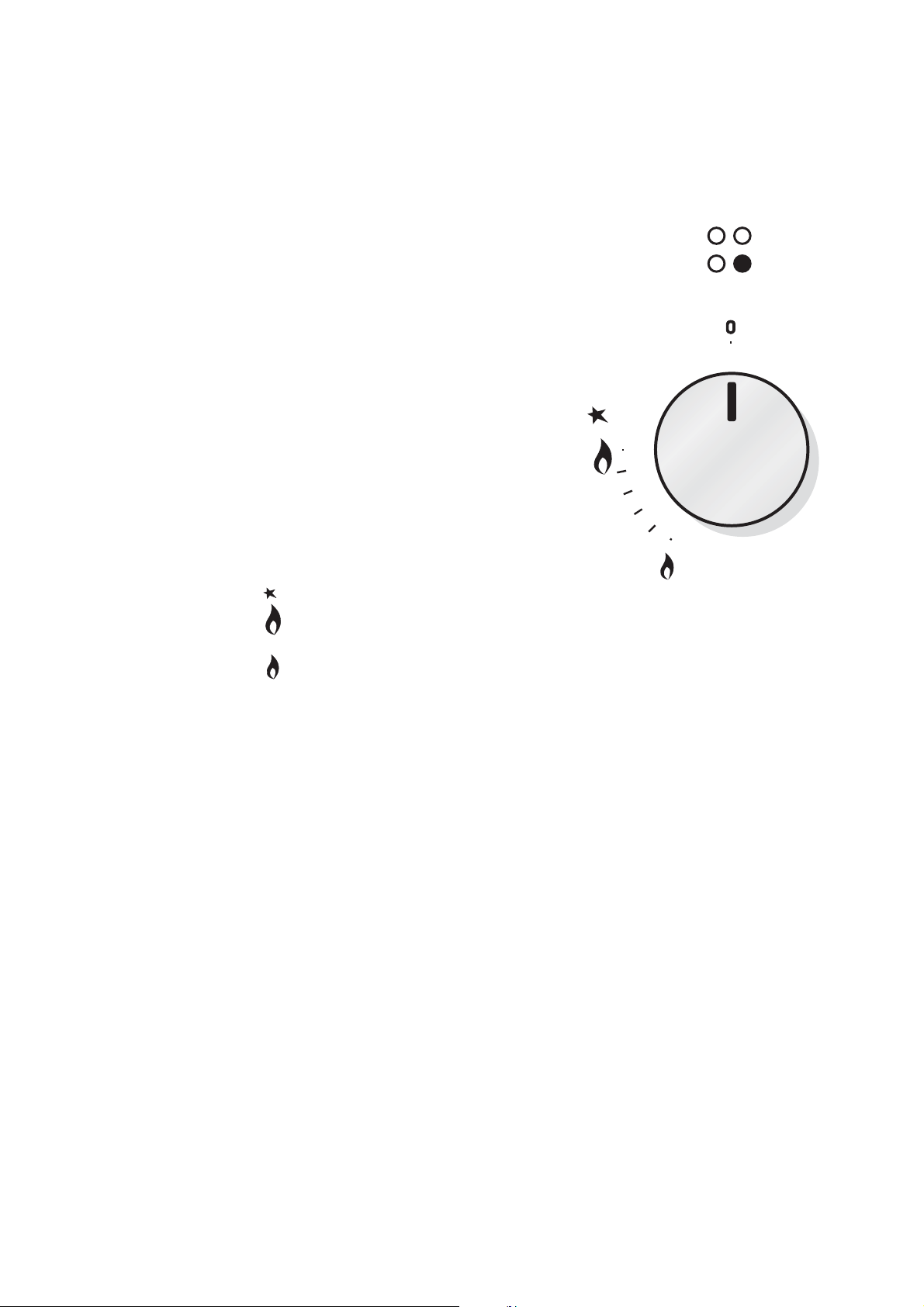
■ Check that the electricity is
switched on to allow spark igni-
tion.
■ Make sure that all controls are
turned to zero.
■ The gas flow to the burners is
controlled by taps. The switch for
the electric ignition is incorporat-
ed in the knobs.
■ You control the flow by turning
the knob indicator to line up
with the following symbols:
– Symbol 0 : tap closed
(burner off)
– Symbol : High (maximum)
– Symbol : Low (minimum)
■ To ignite automatically, push the required knob down and turn it to maximum,
keeping the knob down until the burner lights.
■ You can control the temperature by the knob to “High” (maximum) from “Low”
(minimum).
■ To switch off, turn the knob clockwise until you hear the safety click.
■ Note that, if you are using a burner at the minimum setting, you turn the knob
clockwise past the maximum setting before reaching the off position.
■ Whenever the lighting of the burners is difficult due to peculiar conditions of
the gas features or supply, it is advised to repeat the ignition with the knob on
“minimum” position.
■ If when lighting any of the burners an abnormal flame appears, switch the
burner off and relight using the minimum setting.
■ If the flame is still not correct, turn the burner off and call our Customer Service
center for your nearest Authorized Delonghi Service Agent.
■ In the case of a mains failure light the burner with a match or lighted taper.
18
CHOICE OF BURNER
The burner must be chosen according to the diameter of the pans and energy
required.
For optimum efficiency use a wok or pan no smaller than 230mm diameter.
Saucepans with handles which are excessively heavy, in relationship to the weight of
the pan, are safer as they are less likely to tip.
Pans which are positioned centrally on burners are more stable than those which are
offset.
It is far safer to position the pan handles in such a way that they cannot be accidentally
knocked.
When deep fat frying fill the pan only one third full of oil.
DO NOT cover the pan with a lid and DO NOT leave the pan unattended.
In the unfortunate event of a fire, leave the pan where it is and turn off all controls.
Place a damp cloth or correct fitting lid over the pan to smother the flames.
DO NOT use water on the fire.
Leave the pan to cool for at least 30 minutes.
Figure 19
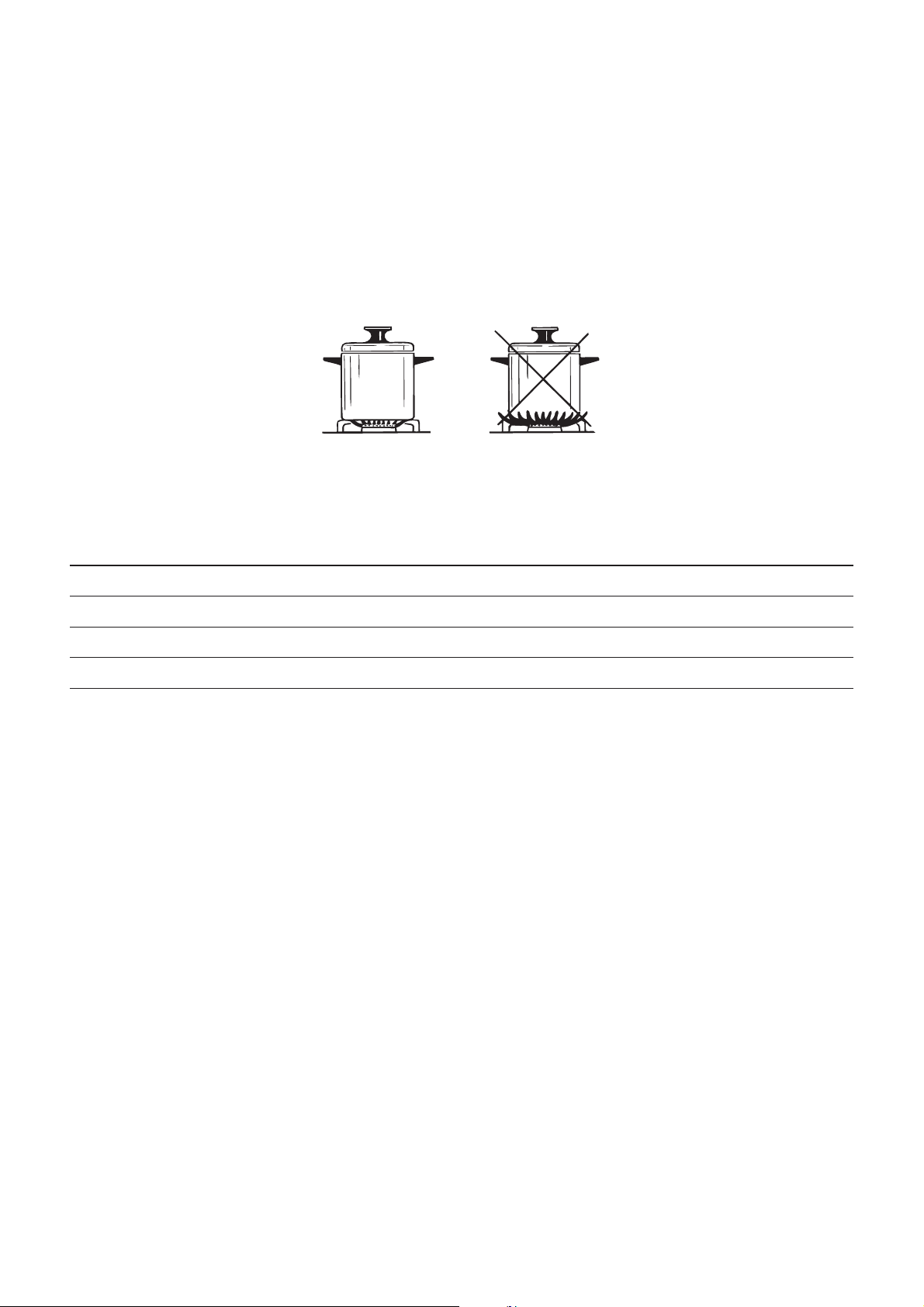
do not use pans with concave or convex bases
Burners Pan diameter
Auxiliary 12 - 14 cm
Semi-rapid 16 - 24 cm
Triple ring 26 - 28 cm
Wok max 36 cm
19
CORRECT USE OF TRIPLE-RING BURNER
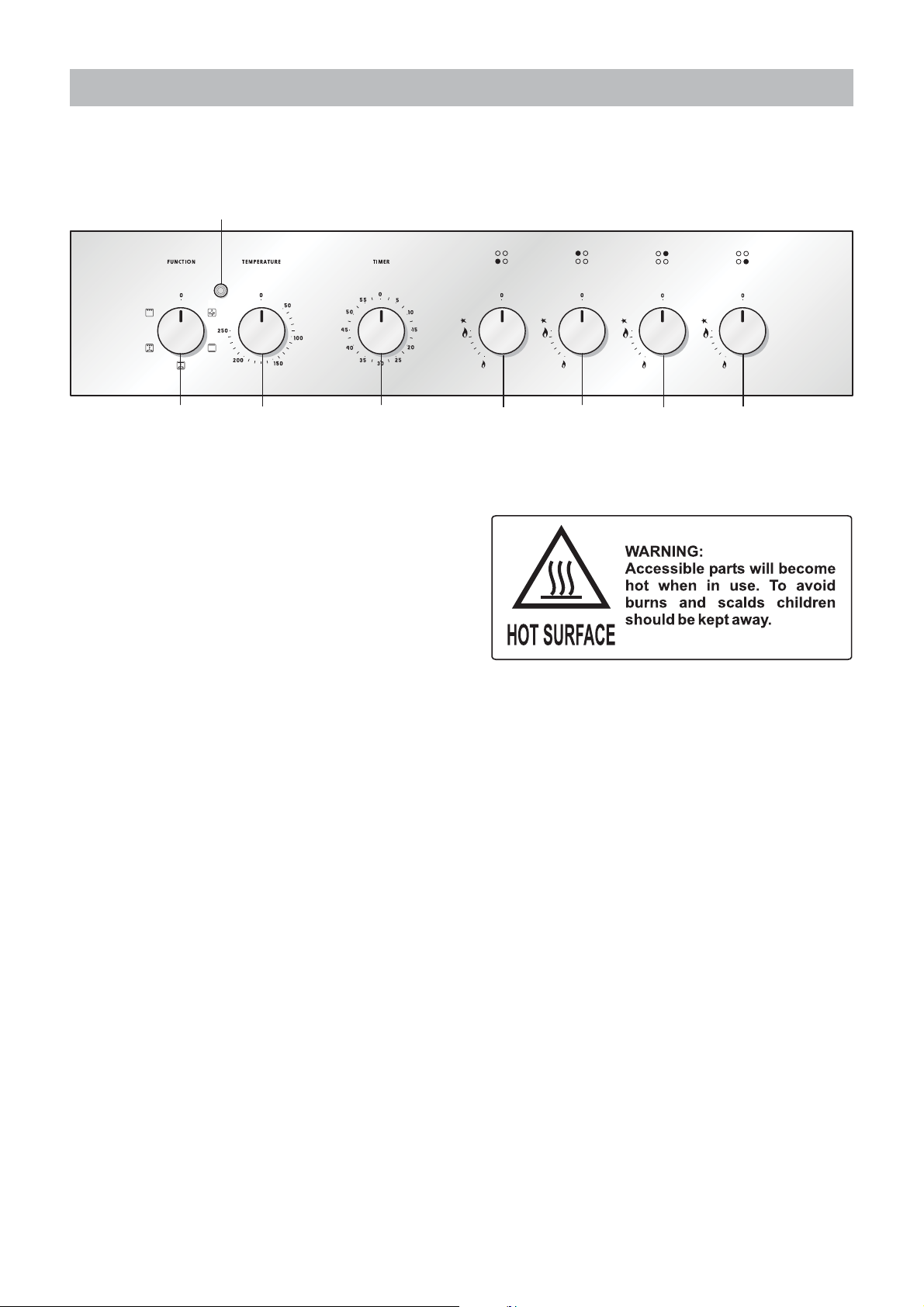
■ The flat-bottomed pans are to be placed directly onto the pan-support.
■ To use the WOK, you must place the wok stand in the CORRECT position as
shown in Figs. 20-21.
IMPORTANT:
The special grille for wok pans (fig. 21) MUST BE PLACED ONLY over the pan-rest for
the triple-ring burner.
Figure 20 Figure 21
WRONG
CORRECT
20
675
8
43 21
CONTROL PANEL
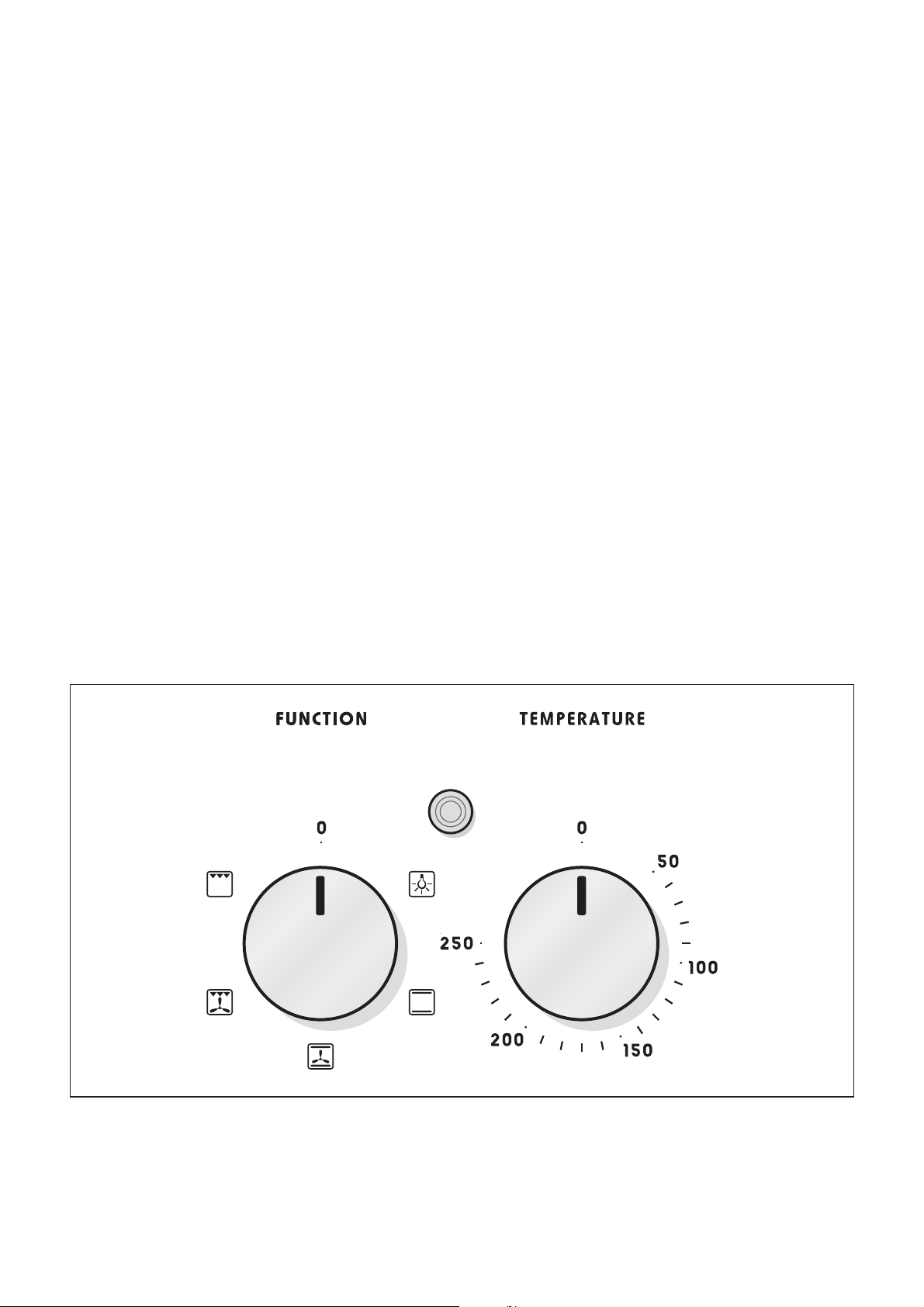
Controls description
1. Front right burner control knob
2. Rear right burner control knob
3. Rear left burner control knob
4. Front left burner control knob
5. 0’ timer
6. Plurifunction oven thermostat knob
7. Plurifunction oven switch knob
Note: The electric ignition of the hob burners is incorporated in the knobs.
Pilot lamp:
8. Oven thermostat indicator light
PLURIFUNCTION ELECTRIC OVEN
GENERAL FEATURES
With your new Plurifunction oven it is possible to cook a variety of food using the 4 dif-
ferent cooking functions.
The 4 positions, thermostatically controlled, are obtained by 3 heating elements.
Figure 22
Please note: This appliance incorporates a safety cooling fan which you will hear
operating whenever the oven or grill are in use. This fan is to reduce the external
temperature of the appliance and cool the internal components.
6
21
THERMOSTAT KNOB
This only sets the cooking temperature and does not switch the oven on. Rotate
clockwise until the required temperature is reached (from 50 to 250°C).
OPERATING PRINCIPLES
Heating and cooking in the fan assisted oven are obtained in the following ways:
a. by normal convection
The heat is produced by the upper and lower heating elements.
b. by forced semi-convection
The heat produced by the top and bottom heating elements is distributed through-
out the oven by the fan.
c. by radiant heat
The food is grilled by the infra red grill element.
d. by radiant heat and ventilation
The food is grilled by the grill element is distributed throughout the oven.
e. by ventilation
The food is defrosted by using the fan only function without heat.
WARNING:
The door is hot, use the handle.
ATTENTION - MOST IMPORTANT
Pay special attention not to touch the hot heating element inside the oven
cavity.
Figure 23

22
FAN ASSISTED BAKE
The upper and lower heating elements come on and the fan come on - the heat from
the element being circulated by the fan.
The temperature range can be set to between 50 °C and 250 °C using the thermostat.
Idea for:
Large bulky quantities of food that require even cooking throughout for example large
roasts, turkey, roast turkey, cakes etc.
DEFROST
With the thermostat knob on “0” only the oven fan is on.
The food is thawed by ventilation without heating.
Ideal for:
Quick thawing of frozen foods; one kg requires approximately 1 hour.
Thawing times vary according to the quantity and type of food to be thawed.
TRADITIONAL BAKE
The upper and lower heating elements come on. The heat being dispersed by
natural convection. The temperature range must be set between 50 °C and
250 °C using the thermostat.
The oven must be preheated before cooking.
Ideal for:
Food that requires the same degree of cooking both inside and out, for example
roasts, spare pork ribs, meringues etc.
OVEN LIGHT
By setting the knob to this position, only the oven light comes on.
It remains on in all the cooking modes.
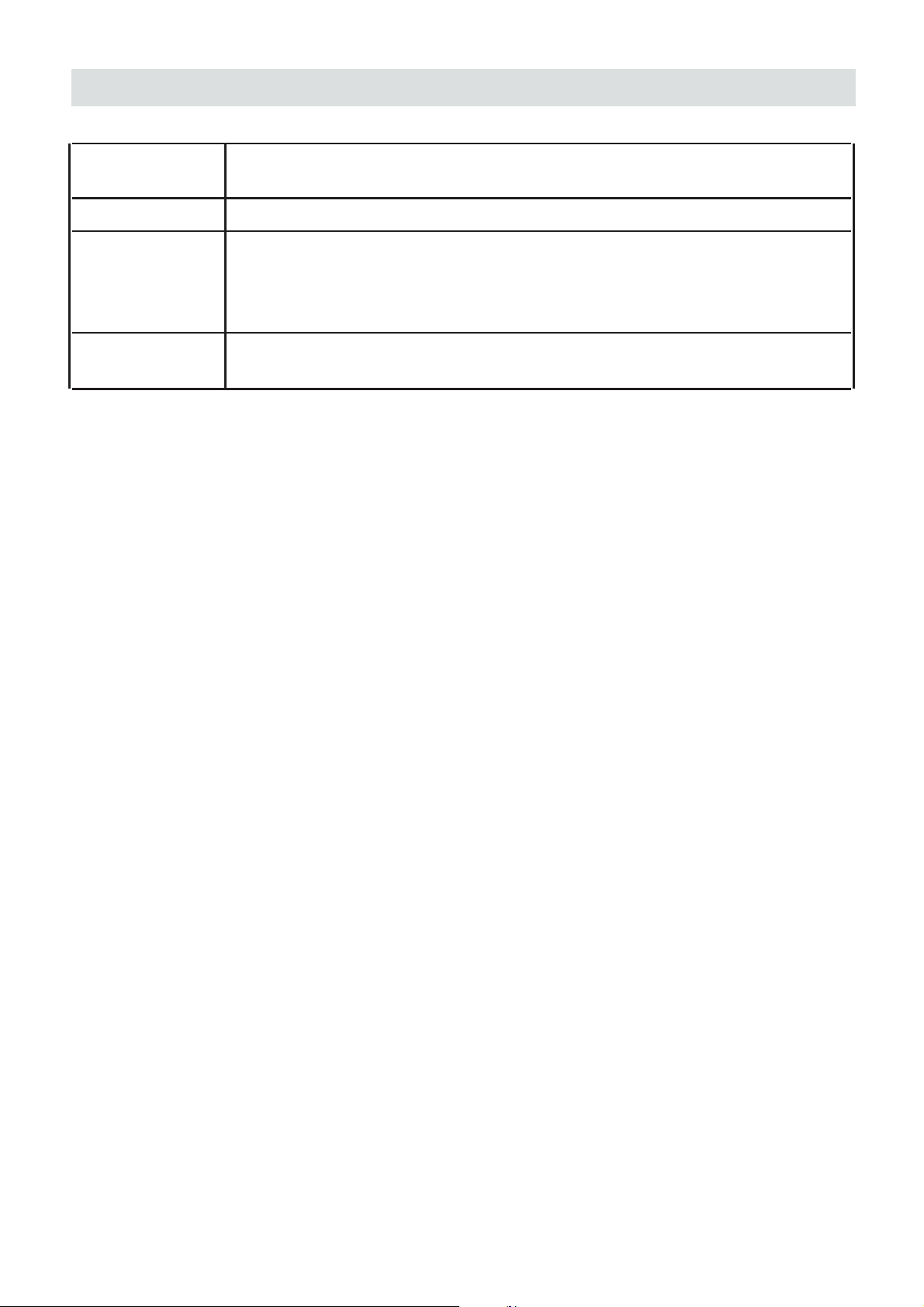
FUNCTION SELECTOR KNOB
Rotate the knob clockwise to set the oven for one of the following functions.

23
FAN GRILL
Both the grill and the fan come on. Most of the cooking is done by grilling and then
the hot air circulated around the oven. The oven door should be kept closed
.
The temperature can be set between 50 °C and 175 °C maximum.
The oven should be preheated for 5 minutes before cooking. For further cooking hints
see “GRILLING AND COOKING AU GRATIN”.
Ideal for:
Quick sealing in of food juices for example such as hamburger, chicken pieces, chops.
It is recommended that you do not grill for longer than 30 minutes at any
one time.
Attention: the oven door becomes very hot during operation.
Keep children away.
GRILLING
The infrared grill element at the top of the oven comes on. The heat is dispersed by
radiation.
Use with the oven door closed and the thermostat knob to position 225 °C for max
15 minutes, then to position 175 °C.
For cooking hints, see the chapter “USE OF THE GRILL”.
Ideal for:
Intense grilling, browning, cooking au gratin and toasting etc.
It is recommended that you do not grill for longer than 30 minutes at any
one time.
Attention: the oven door becomes very hot during operation.
Keep children away.

24
COOKING ADVICE
STERILIZATION
Sterilization of foods to be conserved, in full and hermetically sealed jars, is done in the
following way:
a. Set the switch to position .
b. Set the thermostat knob to position 185 °C and preheat the oven.
c. Fill the dripping pan with hot water.
d. Set the jars onto the dripping pan making sure they do not touch each other and
the door and set the thermostat knob to position 135 °C.
When sterilization has begun, that is, when the contents of the jars start to bubble,
turn off the oven and let cool.
Check your recycle book for full instructions.
SIMULTANEOUS COOKING OF DIFFERENT FOODS
The oven set on position can cook several different foods together. Foods as
diverse as fish and cakes can be cooked together without the cross transference of
flavours. This is because the fats and cooking smell that would normally be
deposited on the different foods are oxidised and are not absorbed by the foods.
The cooking temperature of the foods, however must be within 20 - 25°C of each
other. The food with the longest cooking time will be put into the oven first and
the other foods are added as necessary according to their cooking times.
ROASTING
To obtain classical roasting, it is necessary to remember:
■ that it is advisable to maintain a temperature between 180 °C and 200 °C.
■ that the cooking time depends on the quantity and the type of foods.

25
USE OF THE GRILL
Preheat the oven for about 5 minutes.
Introduce the food to be cooked, positioning the rack as close to the grill as
possible.
The dripping pan should be placed under the rack to catch the cooking juices
and fats.
Grilling with the oven door closed.
Do not grill for longer than 30 minutes at any one time.
Caution: the oven door becomes very hot during operation. Keep children
well out of reach.
GRILLING AND COOKING AU GRATIN
As the hot air completely covers the food to be cooked, grilling may be done with
the food on rack in the oven. The knob should be switched to position .
The thermostat should be set to 175 °C and the oven pre-heated.
The food should be placed on a rack in the oven for the required cooking time.
Adding a few dabs of butter before the end of the cooking time gives the golden “au
gratin” effect.
It is recommended that you do not grill for longer than 30 minutes at
any one time.
Caution: the oven door becomes very hot during operation. Keep children
well out of reach.
WARNING: Accessible parts may become hot when the grill is used.
Children should be kept away.

26
N.B. For fan ovens reduce the temperature
by 10-20°C. For any dish taking one hour or
over to cook, reduce the cooking time by 10
minutes per hour.
*
Shelf positions have been counted from
the top of the oven to the base.
A fan oven creates more even temperature
throughout, therefore the shelf positions are
not as critical.
Food °C °F Gas Shelf Cooking
Mark Position* Time (approx)
CAKES
Victoria sandwich 190 375 5 2 or 3 20-25 mins
Small cakes/buns 190 375 5 1 and 2 15-20 mins
Maidera cake 180 350 4 2 or 3 20 mins
Fruit cake 170 325 3 3 1
3
/4
hours
Rich fruit cake 150 300 2 3 or 4 2
1
/2
hours
Scones 225 425 8-9 2 8-10 mins
PASTRY
Puff 225 425 8-9 2 10-20 mins
Short crust 200 400 6 2 20-30 mins
Plate tarts 200-210 400-410 6 1 or 2 30-35 mins
Quiches and flans 200-210 400-410 6 1 or 2 40-45 mins
YEAST
Bread loaf 225 425 7-8 2 35-55 mins
Bread rolls 220 425 7 1 or 2 15-20 mins
Pizza dough 230 450 8 2 20 mins
ROAST MEAT
Beef – Medium 190 375 5 2 or 3 20 mins/lb + 20 mins
Lamb 190 375 5 2 or 3 25-30 mins/b + 25 mins
Pork 190-200 375-400 5-7 2 or 3 30 mins/lb + 30 mins
Veal 190 375 5 2 or 3 30 mins/b + 30 mins
Chicken 190 375 5 2 or 3 30 mins/b + 30 mins
Turkey up to 10lb 180 350 4 2 or 3 18-20 mins/b + 20 mins
Stews/casseroles 150-170 300-325 2-3 2 or 3 1
1
/2
2 hours
RECOMMENDED COOKING TEMPERATURE

27
How to use the timer
Figure 24
MINUTE COUNTER
The minute counter is a timed acoustic
warning device which can be set for a ma-
ximum of 60 minutes.
The knob (Fig. ) must be rotated clockwi-
se as far as the 60 minute position and
then set to the required time by rotating it
anticlockwise.
IMPORTANT WARNING: This is only a
mechanical timer.
Remember to turn off the oven/grill ma-
nually.
28
GENERAL ADVICE
■ Before you begin cleaning, you must ensure that the appliance is
switched off.
■ It is advisable to clean when the appliance is cold and especially when
cleaning the enamelled parts.
■ Avoid leaving alkaline or acidic substances (lemon juice, vinegar, etc.) on the
surfaces.
■ Avoid using cleaning products with a chlorine or acidic base.
■ Do not use a steam cleaner because the moisture can get into the
appliance thus make it unsafe.
ENAMELLED PARTS
All the enamelled parts must be cleaned with a sponge and soapy water only or other
non-abrasive products.
Dry preferably with a microfibre or soft cloth.
GAS TAPS
If the gas taps are not working properly, call our Customer Service Centre to obtain the
nearest Authorized Delonghi Service Agent.
Cleaning and Maintenance
Maintenance
Description
Period
Daily • Clean gas cooktop as per instructions below
• Remove burner caps, burner rings & base and clean using
non abrasive detergent & rinse in cold water & dry thoroughly
Monthly before replacing back on hob
• Clean ignitor tip using damp soapy cloth and dry thoroughly
3 - 4 Yearly
• Contact your local authorized gas Service Agent to perform
a thorough check on all gas components on the gas cooker
STAINLESS STEEL, ALUMINIUM PARTS, PAINTED AND SILK-SCREEN PRIN-
TED SURFACES
Clean using an appropriate product.
Always dry thoroughly.
!"#$%&'%*
You are advised to use a soft cloth and neutral soap.
CAUTION: Do not use abrasive substances or non-neutral detergents as these will
irreparably damage the surface.
29
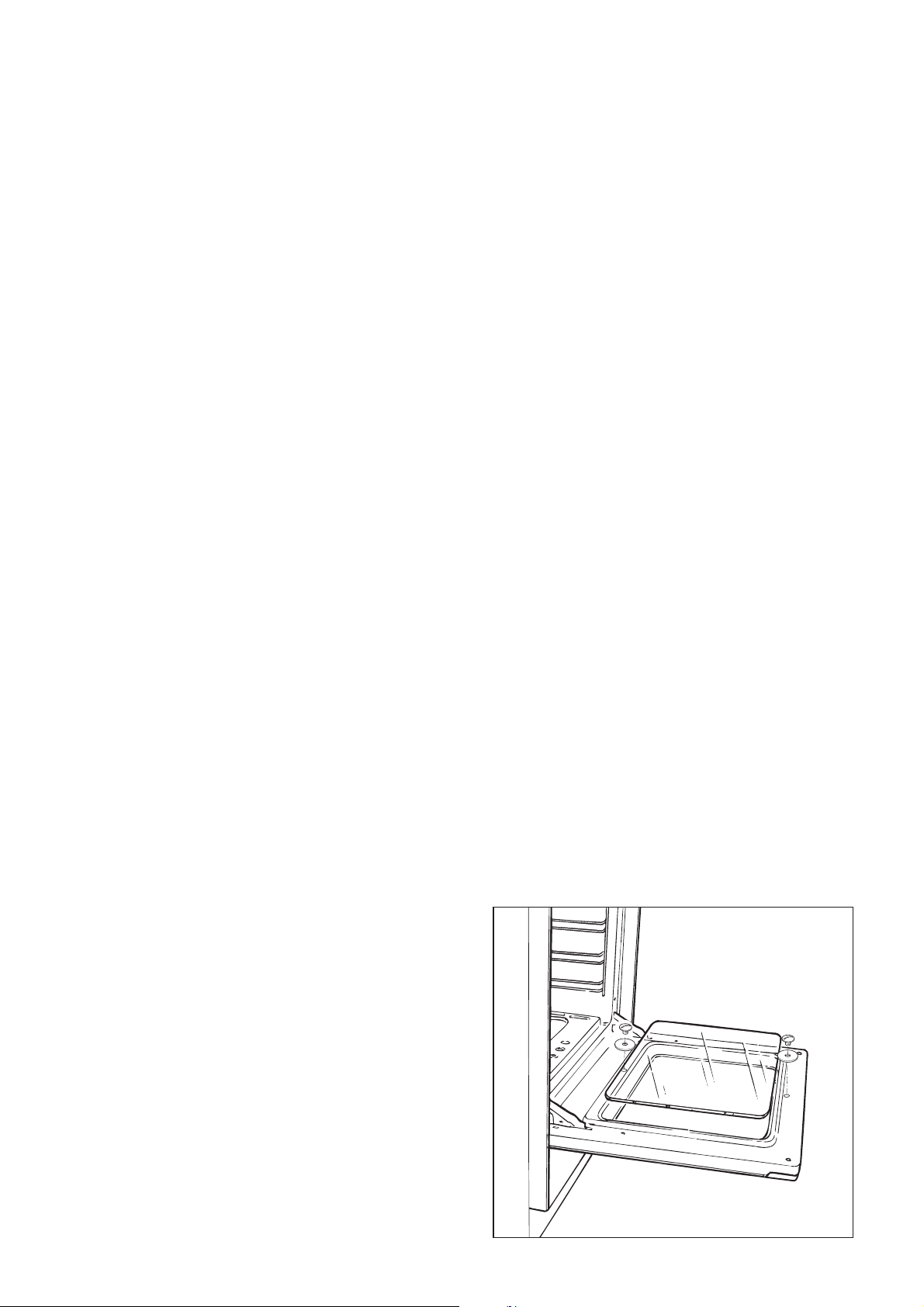
OVEN DOOR
The internal glass of the oven door can
be easily removed for cleaning by
unscrewing the two lateral fixing
screws (fig. 25).
Figure 25
GRILL HEATING ELEMENT
■ The heating element is self-cleaning and does not require maintenance.
GREASE FILTER
■ Clean the filter after any cooking! The grease filter can be removed for cleaning
and should be washed regularly in hot soapy water (fig. 16).
■ Always dry the filter properly before fitting it back into the oven.
INSIDE OF OVEN
■ The oven should always be cleaned after use when it has cooled down.
The cavity should be cleaned using a mild detergent solution and warm water.
Suitable proprietary chemical cleaners may be used after first consulting with the
manufacturers recommendations and testing a small sample of the oven cavity.
Abrasive cleaning agents or scouring pads/cloths should not be used on the cavi-
ty surface.
■ NOTE: The manufacturers of this appliance will accept no responsibility for dam-
age caused by chemical or abrasive cleaning.
■ Do not store flammable material in the oven.
REPLACING THE OVEN LIGHT BULB
When the oven is cool, unscrew and replace the bulb with another one resistant to
high temperatures (300°C), voltage 230-240 V~ (50 Hz), E14
and same power (check
watt power as stamped in the bulb itself) of the replaced bulb.
Note: Oven bulb replacement is not covered by your guarantee.
Do not use harsh abrasive cleaners
or sharp metal scrapers to clean the
oven door glass since they can
scratch the surface, which may result
in shattering of the glass.
WARNING: Ensure the appliance is switched off before replacing the lamp to avoid
the possibility of electric shock.

30
BURNERS
They can be removed and washed only with
soapy water.
Detergents can be used but must not be abrasive
or corrosive.
Do not use abrasive sponges or pads.
Do not put in dishwasher.
After cleaning, make sure that the burner-caps,
as well as the burners, have been well wiped
off and CORRECTLY POSITIONED.
It is essential to check that the burner flame dis-
tributor F and the cap C has been correctly
positioned (see fig. 26) - failure to do so can
cause serious problems.
Check that the electrode “S” (fig. 26) is always
clean to ensure trouble-free sparking.
Note:
The electrode “S” must be very carefully
cleaned.
To avoid damage to the electric ignition
do not use it when the burners are not in
place.
Figure 26
F
C
S
TRIPLE RING BURNER
The triple ring burner must be correctly positioned (see fig. 27); the burner rib must be
located in position as shown by the arrow.
The burner correctly positioned must not rotate (fig. 28).
Then position the cap A and the ring B (fig. 28).
A
B
Figure 27 Figure 28
31
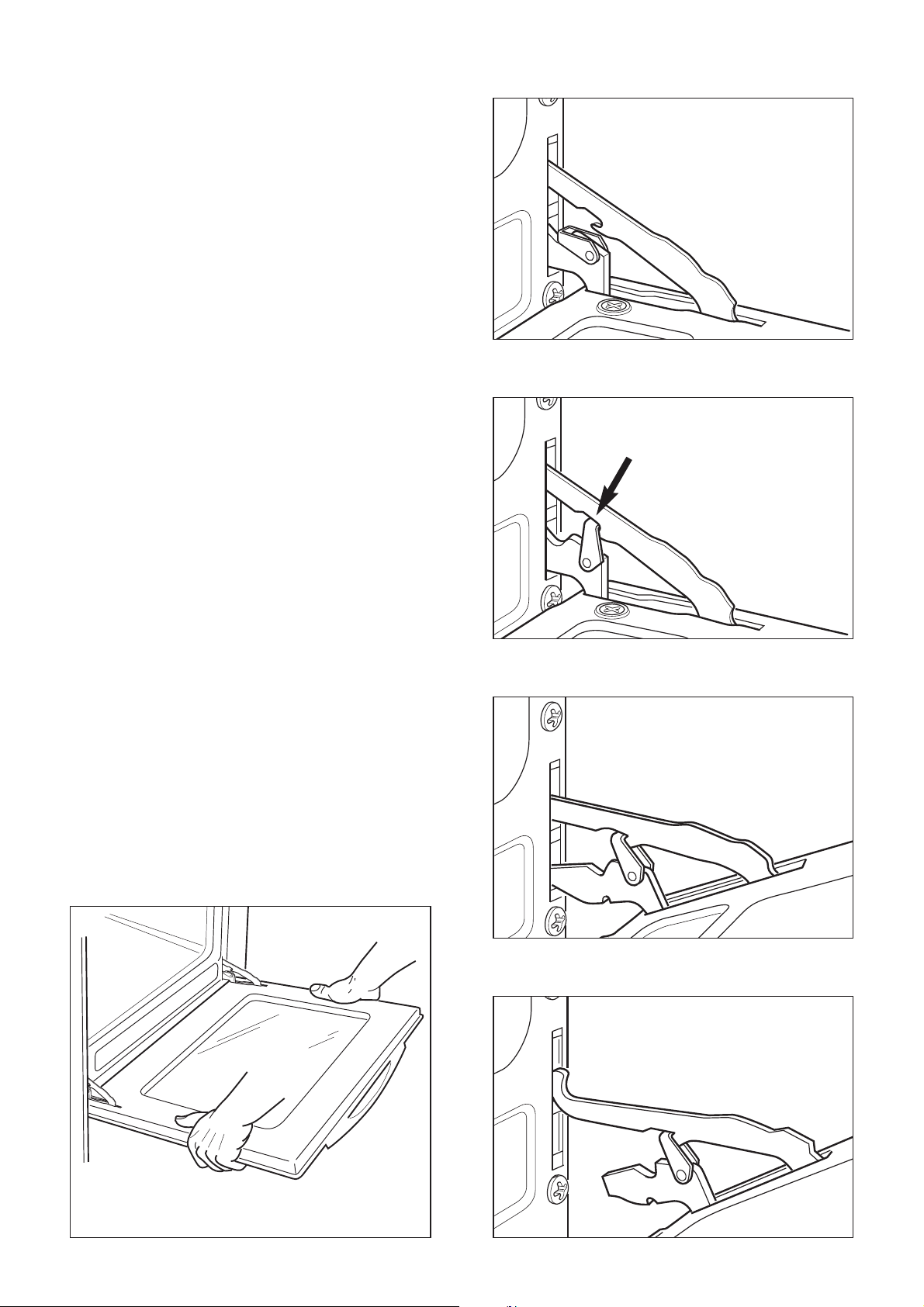
REMOVING THE OVEN
DOOR - Type “A”
The oven door can easily be removed
as follows:
■ Open the door to the full extent
(fig. 30).
■ Attach the retaining rings to the
hooks on the left and right
hinges (fig. 31).
■ Hold the door as shown in fig.
29.
■ Gently close the door and with-
draw the lower hinge pins from
their location (fig. 32).
■ Withdraw the upper hinge pins
from their location (fig. 33).
■ Rest the door on a soft surface.
■ To replace the door, repeat the
above steps in reverse order.
Figure 29
Figure 30
Figure 31
Figure 32
Figure 33
32
L
H
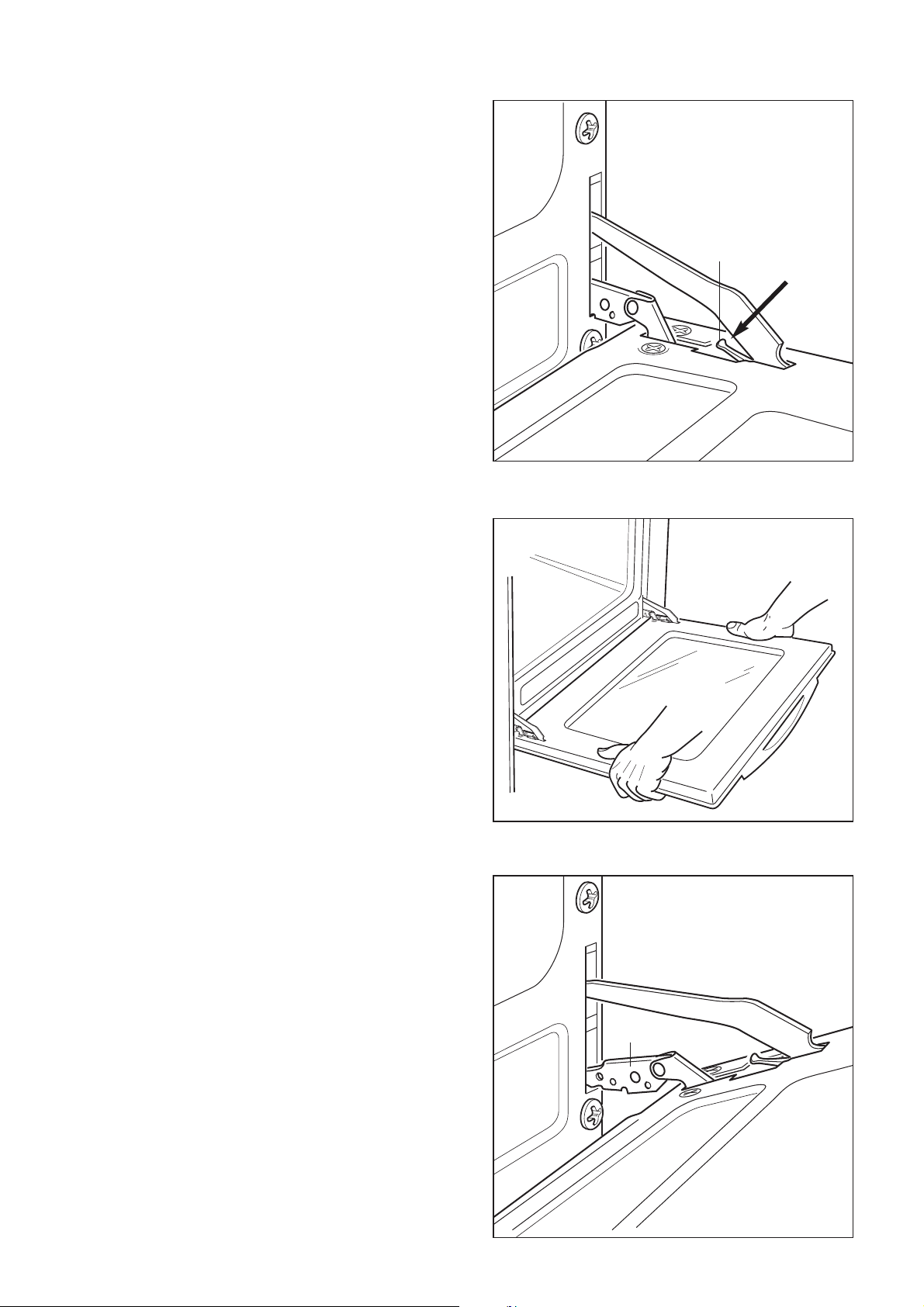
REMOVING THE OVEN
DOOR - Type “B”
To facilitate oven cleaning, it is possible
to remove the door.
Please follow the instructions carefully:
■ Open the door completely.
■ Push down the lever “L” (fig. 34) and,
keeping it in this position, slowly
close the door in order to block the
hinge.
■ Grip the door (as indicated in fig. 35)
and, while closing it, release the two
hinges as shown in fig. 36.
DOOR ASSEMBLY
■ Grip the door with your hands
placed near the hinges and raise the
levers “H” with your forefingers (fig.
36).
■ Insert the hinges in their position until
levers “H” are hooked.
■ Open the door completely to obtain
the release of levers “L”.
Figure 36
Figure 34
Figure 35

33
If the ignition spark fails to ignite or does not light the gas, check the following
items before calling our Customer Service Centre to obtain the nearest Authorised
Service Agent:
■ Burner is reassembled and located correctly.
■ Spark electrode and white ceramic are clean and dry.
■ 240 VAC power supply is connected.
Contact the local gas utility or our Customer Service Centre to obtain the nearest
Authorized Service Agent.
■ You can smell gas when all burners are turned on.
■ The burners do not remain alight at the minimum marked setting.
■ The burner flame is yellow or emits an unusual odour.
Note that a bi-annual inspection of the appliance by an authorized service agent
or your locate gas utility will ensure many years of trouble free operation of your
appliance.
Service and Maintenance
Servicing the appliance:
Service may be obtained by contacting our Customer Service Centre to locate the
nearest Authorised Delonghi Service Agent:
Servicing shall be carried out only by authorized personnel.
The appliance shall not be modified.
34
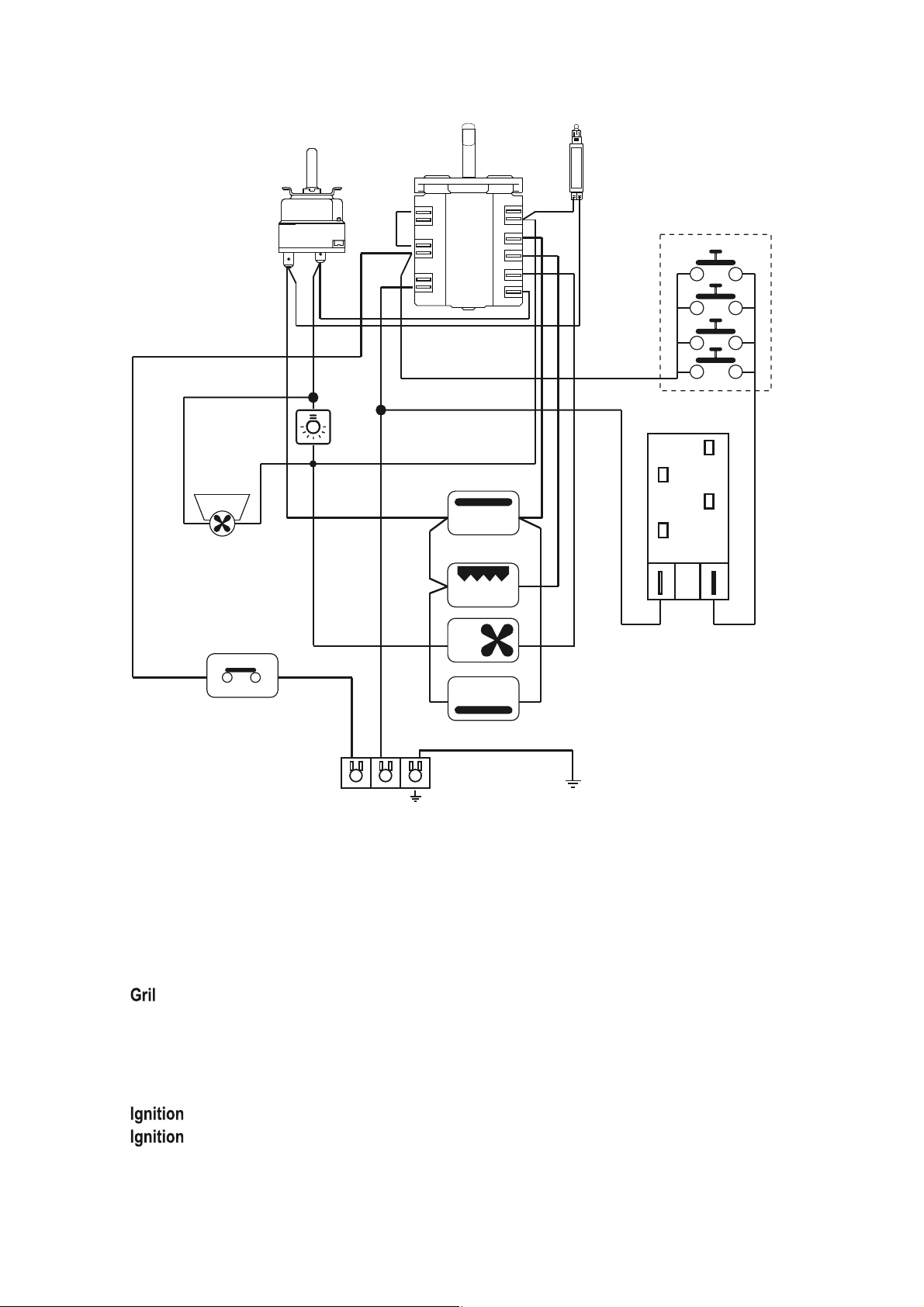
WIRING DIAGRAM
!"
"#$% &
"#$&' %#'%&(
'&$+
%+ '$
'$
,% %$ '$
&
"#$% & +'% '&$+
!"-#%)+
!%'
#$&' .'%!/
&# "
!%! %
%%'-*&

35

www.delonghi.com.au
www.delonghi.co.nz
Cod. 1104169 - ß1
Descriptions and illustrations in this booklet are given as simply indicative.
The manufacturer reserves the right, considering the characteristics of the
models described here, at any time and without notice, to make eventual necessary
modifications for their construction or for commercial needs.