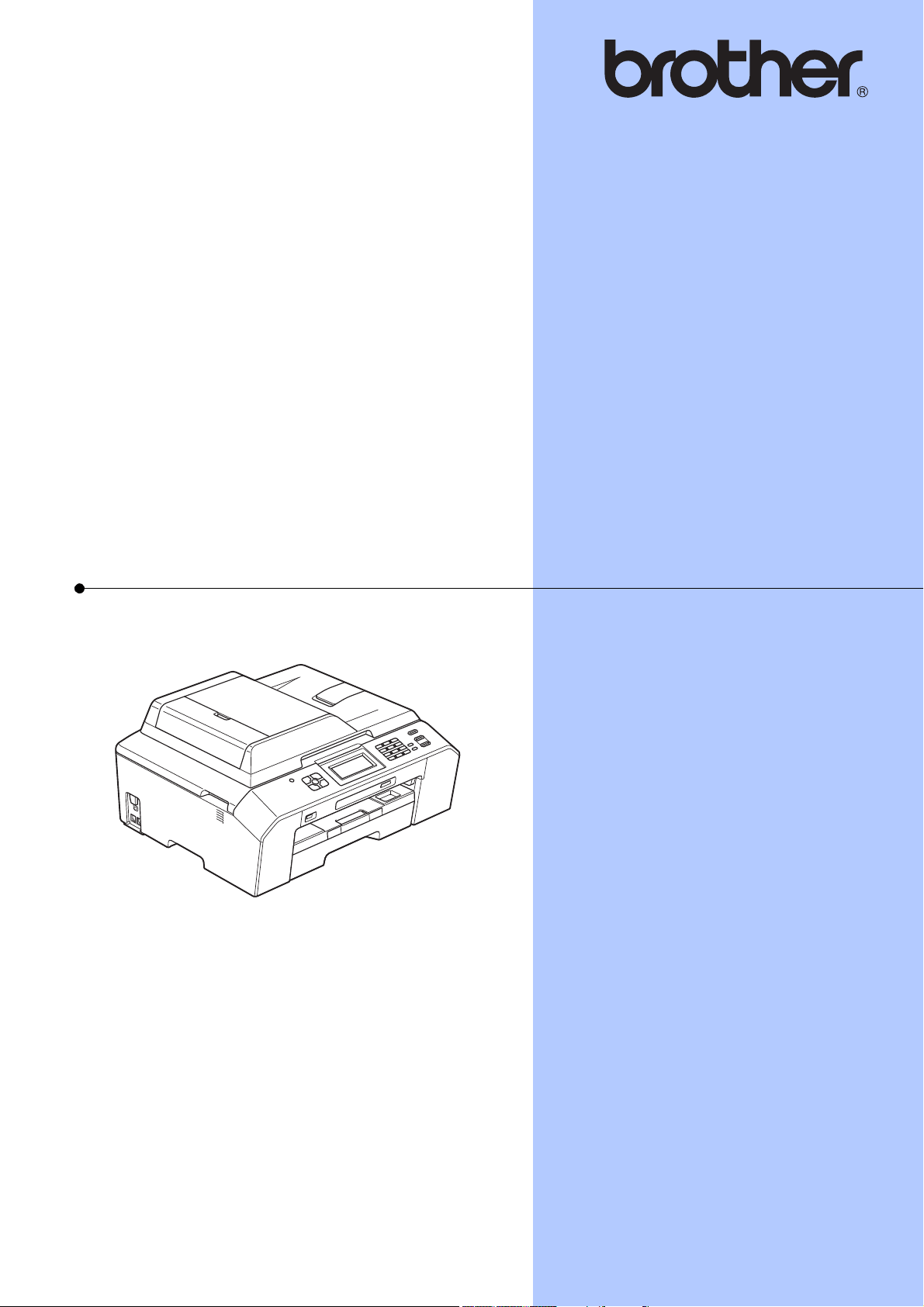
BASIC USER’S GUIDE
MFC-J5910DW
Version 0
USA/CAN

If you need to call Customer Service
Please complete the following information for future
reference:
Model Number: MFC-J5910DW
Serial Number:
1
Date of Purchase:
Place of Purchase:
1
The serial number is on the back of the unit. Retain
this User's Guide with your sales receipt as a
permanent record of your purchase, in the event of
theft, fire or warranty service.
Register your product on-line at
http://www.brother.com/registration/
By registering your product with Brother, you will be recorded as the
original owner of the product. Your registration with Brother:
may serve as confirmation of the purchase date of your product
should you lose your receipt;
may support an insurance claim by you in the event of product loss
covered by insurance; and,
will help us notify you of enhancements to your product and special
offers.
The most convenient and efficient way to register your new product is
on-line at http://www.brother.com/registration/
.
© 2011 Brother Industries, Ltd.
i
Brother numbers
IMPORTANT
For technical help, you must call the country where you bought the machine. Calls must be
made from within that country.
Register your product
By registering your product with Brother International Corporation, you will be recorded as the
original owner of the product. Your registration with Brother:
may serve as confirmation of the purchase date of your product should you lose your receipt;
may support an insurance claim by you in the event of product loss covered by insurance; and,
will help us notify you of enhancements to your product and special offers.
Please complete and fax the Brother Warranty Registration And Test Sheet or, for your
convenience and most efficient way to register your new product, register on-line at
http://www.brother.com/registration/
FAQs (frequently asked questions)
The Brother Solutions Center is our one-stop resource for all your Fax Machine/Multi-Function
Center needs. You can download the latest software documents and utilities, read FAQs and
troubleshooting tips, and learn how to get the most from your Brother product.
http://solutions.brother.com/
Note
• You can check here for Brother driver updates.
• To keep your machine performance up to date, check here for the latest firmware upgrade.
For Customer Service
Service Center Locator (USA only)
For the location of a Brother authorized service center, call 1-877-BROTHER (1-877-276-8437).
Service Center Locations (Canada only)
For the location of a Brother authorized service center, call 1-877-BROTHER.
In USA: 1-877-BROTHER (1-877-276-8437)
1-901-379-1215 (fax)
In Canada: 1-877-BROTHER
(514) 685-4898 (fax)
ii
Ordering accessories and supplies
For best quality results use only genuine Brother accessories, which are available at most Brother
retailers. If you cannot find the accessory you need and you have a Visa, MasterCard, Discover,
or American Express credit card, you can order accessories directly from Brother. (You can visit
us online for a complete selection of the Brother accessories and supplies that are available for
purchase.)
Note
In Canada only Visa and MasterCard are accepted.
1
For more information about the replacement consumables, visit us at http://www.brother.com/pageyield/.
In USA: 1-877-552-MALL (1-877-552-6255)
1-800-947-1445 (fax)
http://www.brothermall.com/
In Canada: 1-877-BROTHER
http://www.brother.ca/
Description Item
Ink Cartridge Super High Yield <black>
LC79BK (Prints approx. 2,400 pages)
1
Ink Cartridge Super High Yield <yellow>
LC79Y (Prints approx. 1,200 pages)
1
Ink Cartridge Super High Yield <cyan> (blue)
LC79C (Prints approx. 1,200 pages)
1
Ink Cartridge Super High Yield <magenta> (red)
LC79M (Prints approx. 1,200 pages)
1
Ink Cartridge High Yield <black>
LC75BK (Prints approx. 600 pages)
1
Ink Cartridge High Yield <yellow>
LC75Y (Prints approx. 600 pages)
1
Ink Cartridge High Yield <cyan> (blue)
LC75C (Prints approx. 600 pages)
1
Ink Cartridge High Yield <magenta> (red)
LC75M (Prints approx. 600 pages)
1
Premium Plus Glossy Photo Paper
(Ledger size / 20 sheets) BP71GLGR
(Letter size / 20 sheets) BP71GLTR
(4" 6" size / 20 sheets) BP71GP
Premium Glossy Photo Paper
(Letter size / 20 sheets) BP61GLL (USA only)
(4" 6" size / 20 sheets) BP61GLP (USA only)
iii
Description Item
Multipurpose Paper - Plain Paper
(Letter size / 500 sheets) BP60MPLTR (USA only)
Matte Inkjet Paper
(Letter size / 25 sheets) BP60ML (USA only)
Plain Inkjet Paper
(Ledger size / 100 sheets) BP60PLGR (USA only)
(Letter size / 100 sheets) BP60PL100 (USA only)
Telephone Line Cord LG3077001 (USA only)
Basic User's Guide LX8860001 (English for USA and Canada)
LX8860002 (French for Canada)
CD ROM for Windows
®
& Mac
LX8382001

iv
Notice - Disclaimer of Warranties
(USA and Canada)
BROTHER'S LICENSOR(S), AND THEIR DIRECTORS, OFFICERS, EMPLOYEES OR AGENTS
(COLLECTIVELY BROTHER'S LICENSOR) MAKE NO WARRANTIES, EXPRESS OR IMPLIED,
INCLUDING WITHOUT LIMITATION THE IMPLIED WARRANTIES OF MERCHANTABILITY
AND FITNESS FOR A PARTICULAR PURPOSE, REGARDING THE SOFTWARE. BROTHER'S
LICENSOR(S) DOES NOT WARRANT, GUARANTEE OR MAKE ANY REPRESENTATIONS
REGARDING THE USE OR THE RESULTS OF THE USE OF THE SOFTWARE IN TERMS OF
ITS CORRECTNESS, ACCURACY, RELIABILITY, CURRENTNESS OR OTHERWISE. THE
ENTIRE RISK AS TO THE RESULTS AND PERFORMANCE OF THE SOFTWARE IS
ASSUMED BY YOU. THE EXCLUSION OF IMPLIED WARRANTIES IS NOT PERMITTED BY
SOME STATES IN THE USA AND SOME PROVINCES IN CANADA. THE ABOVE EXCLUSION
MAY NOT APPLY TO YOU.
IN NO EVENT WILL BROTHER'S LICENSOR(S) BE LIABLE TO YOU FOR ANY
CONSEQUENTIAL, INCIDENTAL OR INDIRECT DAMAGES (INCLUDING DAMAGES FOR
LOSS OF BUSINESS PROFITS, BUSINESS INTERRUPTION, LOSS OF BUSINESS
INFORMATION, AND THE LIKE) ARISING OUT OF THE USE OR INABILITY TO USE THE
SOFTWARE EVEN IF BROTHER'S LICENSOR HAS BEEN ADVISED OF THE POSSIBILITY OF
SUCH DAMAGES. BECAUSE SOME STATES IN THE USA AND SOME PROVINCES IN
CANADA DO NOT ALLOW THE EXCLUSION OR LIMITATION OF LIABILITY FOR
CONSEQUENTIAL OR INCIDENTAL DAMAGES, THE ABOVE LIMITATIONS MAY NOT APPLY
TO YOU. IN ANY EVENT BROTHER'S LICENSOR'S LIABILITY TO YOU FOR ACTUAL
DAMAGES FROM ANY CAUSE WHATSOEVER, AND REGARDLESS OF THE FORM OF THE
ACTION (WHETHER IN CONTRACT, TORT (INCLUDING NEGLIGENCE), PRODUCT
LIABILITY OR OTHERWISE), WILL BE LIMITED TO $50.

v
Compilation and Publication Notice
Under the supervision of Brother Industries, Ltd., this manual has been compiled and published,
covering the latest product descriptions and specifications.
The contents of this manual and the specifications of this product are subject to change without
notice.
Brother reserves the right to make changes without notice in the specifications and materials
contained herein and shall not be responsible for any damages (including consequential) caused
by reliance on the materials presented, including but not limited to typographical and other errors
relating to the publication.

vi
User's Guides and where to find them?
1
Visit us at http://solutions.brother.com/.
Which manual? What's in it? Where is it?
Product Safety Guide Read this Guide first. Please read the Safety
Instructions before you set up your machine. See
this Guide for trademarks and legal limitations.
Printed / In the box
Quick Setup Guide Follow the instructions for setting up your
machine and installing the drivers and software
for the operating system and connection type
you are using.
Printed / In the box
Basic User's Guide Learn the basic Fax, Copy, Scan and
PhotoCapture Center™ operations and how to
replace consumables. See troubleshooting tips.
Printed / In the box
Advanced User's Guide Learn more advanced operations: Fax, Copy,
security features, printing reports and performing
routine maintenance.
PDF file / CD-ROM
Software User's Guide Follow these instructions for Printing, Scanning,
Network Scanning, PhotoCapture Center™,
Remote Setup, PC-Fax, Web Services (Scan),
and using the Brother ControlCenter utility.
PDF file / CD-ROM
Network Glossary This Guide provides basic information about
advanced network features of Brother machines
along with explanations about general
networking and common terms.
PDF file / CD-ROM
Network User's Guide This Guide provides useful information about
wired and wireless network settings and security
settings using the Brother machine. You can also
find supported protocol information for your
machine and detailed troubleshooting tips.
PDF file / CD-ROM
Mobile Print/Scan Guide This Guide provides useful information about
printing data from your mobile phone and
transmitting scanned data from the Brother
machine to your mobile phone.
PDF file / Brother
Solutions Center
1

vii
Table of Contents
(BASIC USER’S GUIDE)
1 General information 1
Using the documentation .......................................................................................1
Symbols and conventions used in the documentation ....................................1
Accessing the Advanced User’s Guide, Software User’s Guide,
Network User’s Guide, and Network Glossary ...................................................2
Viewing Documentation...................................................................................2
Accessing Brother Support (Windows
®
)................................................................4
Accessing Brother Support (Macintosh) ................................................................5
Control panel overview ..........................................................................................6
1.9" Touchscreen plus Touchpanel controls....................................................8
Basic Operations ............................................................................................. 9
Favorite Settings.................................................................................................. 10
Registering Favorite Settings ........................................................................10
Changing Favorite Settings ...........................................................................11
Deleting Favorite Settings ............................................................................. 11
Recalling Favorite Settings............................................................................11
2 Loading paper 12
Loading paper and other print media...................................................................12
Loading envelopes and postcards.................................................................15
Printable area ................................................................................................ 18
Paper settings......................................................................................................19
Paper Type ....................................................................................................19
Paper Size .....................................................................................................19
Secure Paper Feed mode for Ledger size Short Grain Paper.......................20
Acceptable paper and other print media..............................................................20
Recommended print media ...........................................................................21
Handling and using print media .....................................................................21
Choosing the right print media.......................................................................22
3 Loading documents 24
How to load documents .......................................................................................24
Using the ADF ...............................................................................................24
Using the scanner glass ................................................................................ 25
Unscannable area .........................................................................................26
4 Sending a fax 27
How to send a fax ................................................................................................ 27
Stop faxing..................................................................................................... 29
Setting scanner glass size for faxing .............................................................29
Color fax transmission ...................................................................................29
Canceling a fax in progress ........................................................................... 29
Transmission Verification Report...................................................................29

viii
5 Receiving a fax 31
Receive Modes....................................................................................................31
Choose the correct Receive Mode ................................................................31
Using Receive Modes..........................................................................................33
Fax Only ........................................................................................................33
Fax/Tel...........................................................................................................33
Manual...........................................................................................................33
External TAD .................................................................................................33
Receive Mode settings ........................................................................................34
Ring Delay .....................................................................................................34
F/T Ring Time (Fax/Tel mode only)...............................................................34
Easy Receive.................................................................................................35
6 Telephone services and external devices 36
Telephone services..............................................................................................36
Voice Mail ......................................................................................................36
Distinctive Ring..............................................................................................37
Connecting an external TAD (telephone answering device)................................39
Connections...................................................................................................40
Recording an outgoing message (OGM) on the external TAD......................40
Multi-line connections (PBX) .........................................................................41
External and extension telephones......................................................................41
Connecting an external or extension telephone ............................................41
Using external and extension telephones......................................................42
Using a non-Brother cordless external telephone .........................................42
Using remote codes.......................................................................................42
7 Dialing and storing numbers 44
How to dial ...........................................................................................................44
Manual dialing ...............................................................................................44
Speed Dialing ................................................................................................44
Fax Redial .....................................................................................................44
Storing numbers ..................................................................................................45
Storing a pause .............................................................................................45
Storing Speed Dial numbers..........................................................................45
Changing Speed Dial names or numbers......................................................46
8 Making copies 47
How to copy .........................................................................................................47
Stop copying..................................................................................................47
Copy settings.................................................................................................48
Paper Options................................................................................................48

ix
9 PhotoCapture Center™: Printing photos from a memory card or
USB Flash memory drive 50
PhotoCapture Center™ operations (PHOTO mode) ........................................... 50
Using a memory card or USB Flash memory drive .......................................50
Getting started ..................................................................................................... 51
Print Images.........................................................................................................53
View Photos................................................................................................... 53
PhotoCapture Center™ print settings.................................................................. 53
How to scan to a memory card or USB Flash memory drive............................... 54
10 How to print from a computer 55
Printing a document.............................................................................................55
11 How to scan to a computer 56
Scanning a document..........................................................................................56
Scanning using the SCAN key.............................................................................56
Scanning using a scanner driver .........................................................................57
Scanning using the ControlCenter.......................................................................57
A Routine maintenance 58
Replacing the ink cartridges ................................................................................58
Cleaning and checking the machine....................................................................61
Cleaning the scanner.....................................................................................61
Cleaning the print head .................................................................................62
Checking the print quality .............................................................................. 62
Checking the print alignment ......................................................................... 63
B Troubleshooting 64
Error and Maintenance messages.......................................................................64
Error animation .............................................................................................. 72
Transferring your faxes or Fax Journal report ...............................................72
Document jam .............................................................................................. 73
Printer jam or paper jam ................................................................................75
Troubleshooting ..................................................................................................81
If you are having difficulty with your machine ................................................ 82
Dial Tone ......................................................................................................93
Telephone line interference / VoIP ................................................................93
Machine Information ............................................................................................ 94
Checking the serial number........................................................................... 94
Reset functions.............................................................................................. 94
How to reset the machine.............................................................................. 94

x
C Menu and features 95
On-screen programming......................................................................................95
Memory Storage ..................................................................................................95
Menu table ...........................................................................................................96
Entering Text .....................................................................................................123
Inserting spaces .........................................................................................123
Making corrections ......................................................................................123
Repeating letters .........................................................................................123
D Specifications 124
General ..............................................................................................................124
Print media.........................................................................................................126
Fax.....................................................................................................................127
Copy ..................................................................................................................128
PhotoCapture Center™ .....................................................................................129
PictBridge ..........................................................................................................130
Scanner .............................................................................................................131
Printer ................................................................................................................132
Interfaces ...........................................................................................................133
Computer requirements .....................................................................................134
Consumable items .............................................................................................135
Network (LAN) ...................................................................................................136
EIndex 137

xi
Table of Contents
(ADVANCED USER’S GUIDE)
The Advanced User’s Guide explains the following features and operations.
You can view the Advanced User’s Guide on the CD-ROM.
1 General setup
Memory storage
Volume Settings
Automatic Daylight Saving Time
Sleep Mode
LCD screen
Dial Prefix
Mode Timer
2 Security features
Secure Function Lock 2.0
3Sending a fax
Additional sending options
Additional sending operations
Polling overview
4 Receiving a fax
Memory Receive (Black & White only)
Remote Retrieval
Additional receiving operations
Polling overview
5 Dialing and storing numbers
Voice operations
Additional dialing operations
Additional ways to store numbers
6Printing reports
Fax reports
Reports
7 Making copies
Copy settings
8 PhotoCapture Center™:
Printing photos from a
memory card or USB Flash
memory drive
PhotoCapture Center™ operations
Print Images
PhotoCapture Center™ print settings
Scan to a memory card or USB Flash
memory drive
9 Printing photos from a
camera
Printing photos directly from a
PictBridge camera
Printing photos directly from a digital
camera (without PictBridge)
A Routine maintenance
Cleaning and checking the machine
Packing and shipping the machine
B Glossary
CIndex

xii

1
1
1
Using the
documentation
1
Thank you for buying a Brother machine!
Reading the documentation will help you
make the most of your machine.
Symbols and conventions
used in the documentation 1
The following symbols and conventions are
used throughout the documentation.
General information 1
Bold Bold typeface identifies specific
keys on the machine’s control
panel or on the computer
screen.
Italics Italicized typeface emphasizes
an important point or refers you
to a related topic.
Courier
New
Text in Courier New font
identifies messages on the
screen of the machine.
WARNING
WARNING indicates a potentially
hazardous situation which, if not avoided,
could result in death or serious injuries.
CAUTION
CAUTION indicates a potentially hazardous
situation which, if not avoided, may result in
minor or moderate injuries.
IMPORTANT
IMPORTANT indicates a potentially
hazardous situation which, if not avoided,
may result in damage to property or loss of
product functionality.
Notes tell you how you should
respond to a situation that may arise
or give tips about how the operation
works with other features.
Electrical Hazard icons alert you to
possible electrical shock.
Chapter 1
2
Accessing the
Advanced User’s
Guide, Software User’s
Guide, Network User’s
Guide, and Network
Glossary
1
This Basic User’s Guide does not contain all
the information about the machine, such as
how to use the advanced features for Fax,
Copy, PhotoCapture Center™, Printer,
Scanner, PC-Fax, and Network. When you
are ready to learn detailed information about
these operations, read the
Advanced User’s Guide,
Software User’s Guide,
Network User’s Guide, and
Network Glossary that are on the CD-ROM.
Viewing Documentation 1
Viewing Documentation
(Windows
®
) 1
To view the documentation, from the Start
menu, select Brother, MFC-XXXX (where
XXXX is your model name) from the
programs group, and then choose
User’s Guides.
If you have not installed the software, you can
find the documentation on the CD-ROM by
following the instructions below:
a Turn on your PC. Insert the Brother
CD-ROM into your CD-ROM drive.
Note
If the Brother screen does not appear
automatically, go to
My Computer (Computer), double-click
the CD-ROM icon, and then double-click
start.exe.
b If the model name screen appears, click
your model name.
c If the language screen appears, click
your language. The CD-ROM Top Menu
will appear.
d Click Documentation.
e Click PDF documents. If the country
screen appears, choose your country.
After the list of User’s Guides appears,
choose the guide you want to read.
Viewing Documentation
(Macintosh)
1
a Turn on your Macintosh. Insert the
Brother CD-ROM into your CD-ROM
drive. The following window will appear.
b Double-click the Documentation icon.
c Double-click your language folder.
d Double-click top.pdf. If the country
screen appears, choose your country.

General information
3
1
e After the list of User’s Guides appears,
choose the guide you want to read.
How to find Scanning instructions 1
There are several ways you can scan
documents. You can find the instructions as
follows:
Software User’s Guide
Scanning
ControlCenter
Network Scanning
ScanSoft™ PaperPort™12SE with OCR
How-to-Guides
(Windows
®
users)
The complete ScanSoft™
PaperPort™12SE with OCR How-to-
Guides can be viewed from the Help
selection in the ScanSoft™
PaperPort™12SE application.
Presto! PageManager User’s Guide
(Macintosh users)
Note
Presto! PageManager is available as a
download from
http://nj.newsoft.com.tw/download/
brother/PM9SEInstaller_BR_multilang.dmg
The complete Presto! PageManager
User’s Guide can be viewed from the Help
selection in the Presto! PageManager
application.
How to find Network setup
instructions
1
Your machine can be connected to a wireless
or wired network.
Basic setup instructions
uuQuick Setup Guide
If your wireless access point or router
supports Wi-Fi Protected Setup or AOSS™
uuQuick Setup Guide
Network setup uuNetwork User’s Guide
Chapter 1
4
Accessing Brother
Support (Windows
®
) 1
You can find all the contacts you will need,
such as Web support (Brother Solutions
Center), Customer Service and Brother
Authorized Service Centers in Brother
numbers uu page i and on the CD-ROM.
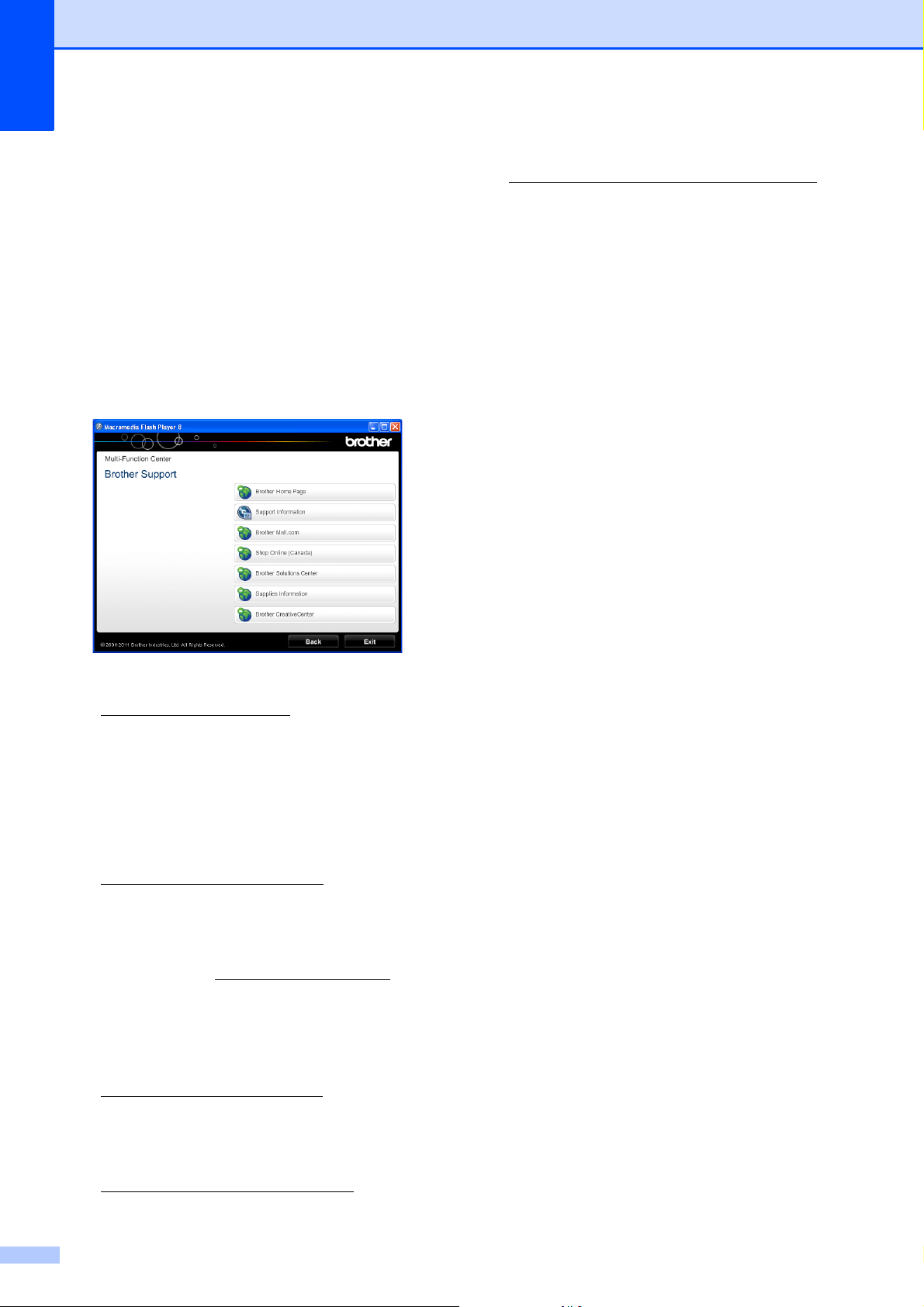
Click Brother Support on the Top Menu.
The following screen will appear:
To access our Web site
(http://www.brother.com/
), click
Brother Home Page.
To view all Brother Numbers, including
Customer Service numbers for the USA
and Canada, click Support Information.
To access the USA Brother online
shopping mall
(http://www.brothermall.com/
) for
additional product and services
information, click Brother Mall.com.
To access Canada’s Brother online
shopping mall (http://www.brother.ca/
) for
additional product and services
information, click Shop Online (Canada).
For the latest news and product support
information
(http://solutions.brother.com/
), click
Brother Solutions Center.
To visit our Web site for genuine Brother
Supplies
(http://www.brother.com/original/
),
click Supplies Information.
To access the Brother CreativeCenter
(http://www.brother.com/creativecenter/
)
for FREE photo projects and printable
downloads,
click Brother CreativeCenter.
To return to the Top Menu, click Back or
if you are finished, click Exit.
General information
5
1
Accessing Brother
Support (Macintosh)
1
You can find all the contacts you will need,
such as Web support (Brother Solutions
Center) on the CD-ROM.
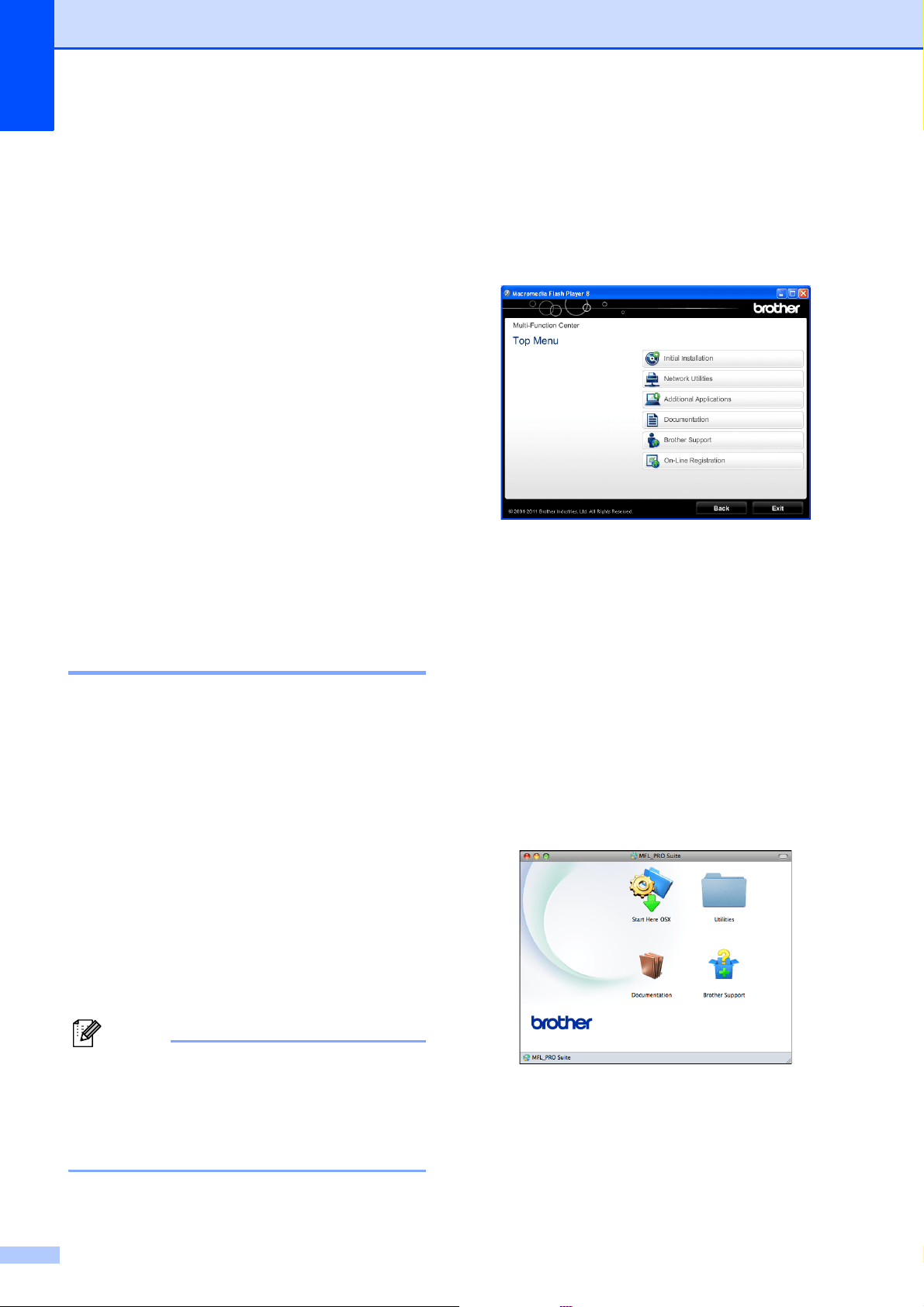
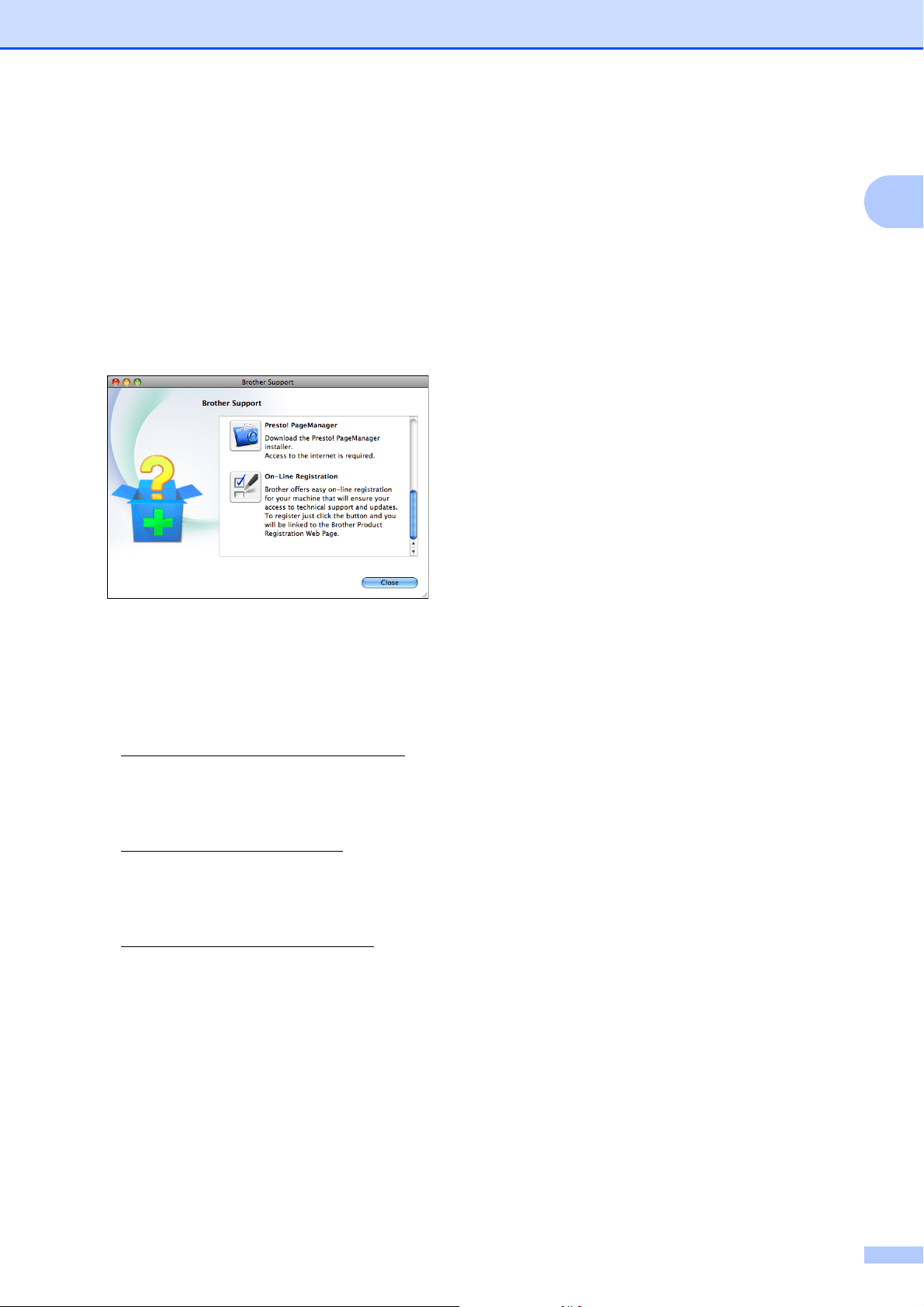
Double-click the Brother Support icon.
The following screen will appear:
To download and install Presto!
PageManager, click
Presto! PageManager.
To register your machine from the Brother
Product Registration Page
(http://www.brother.com/registration/
),
click On-Line Registration.
For the latest news and product support
information
(http://solutions.brother.com/
), click
Brother Solutions Center.
To visit our Web site for genuine Brother
Supplies
(http://www.brother.com/original/
), click
Supplies Information.
Chapter 1
6
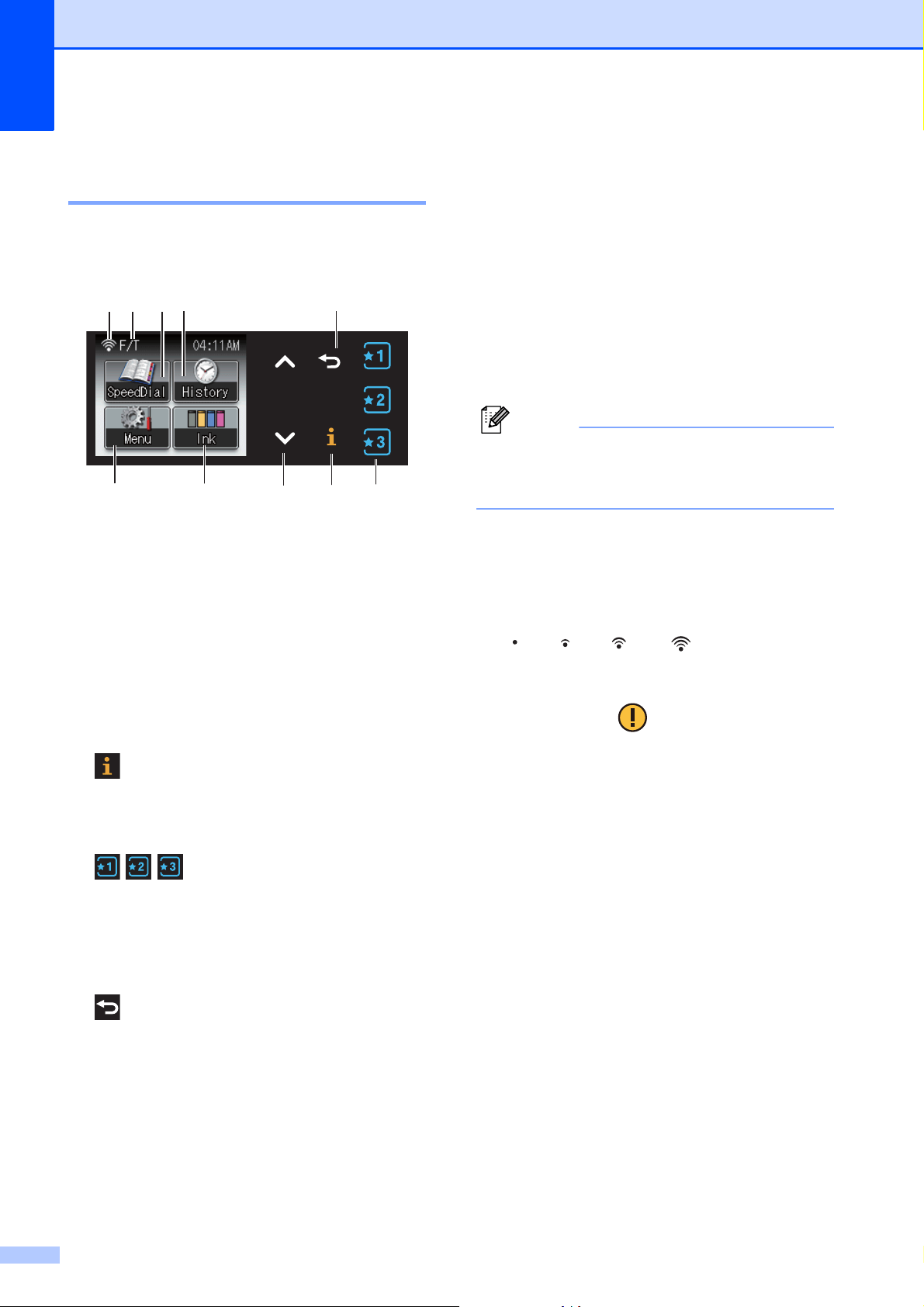
Control panel overview 1
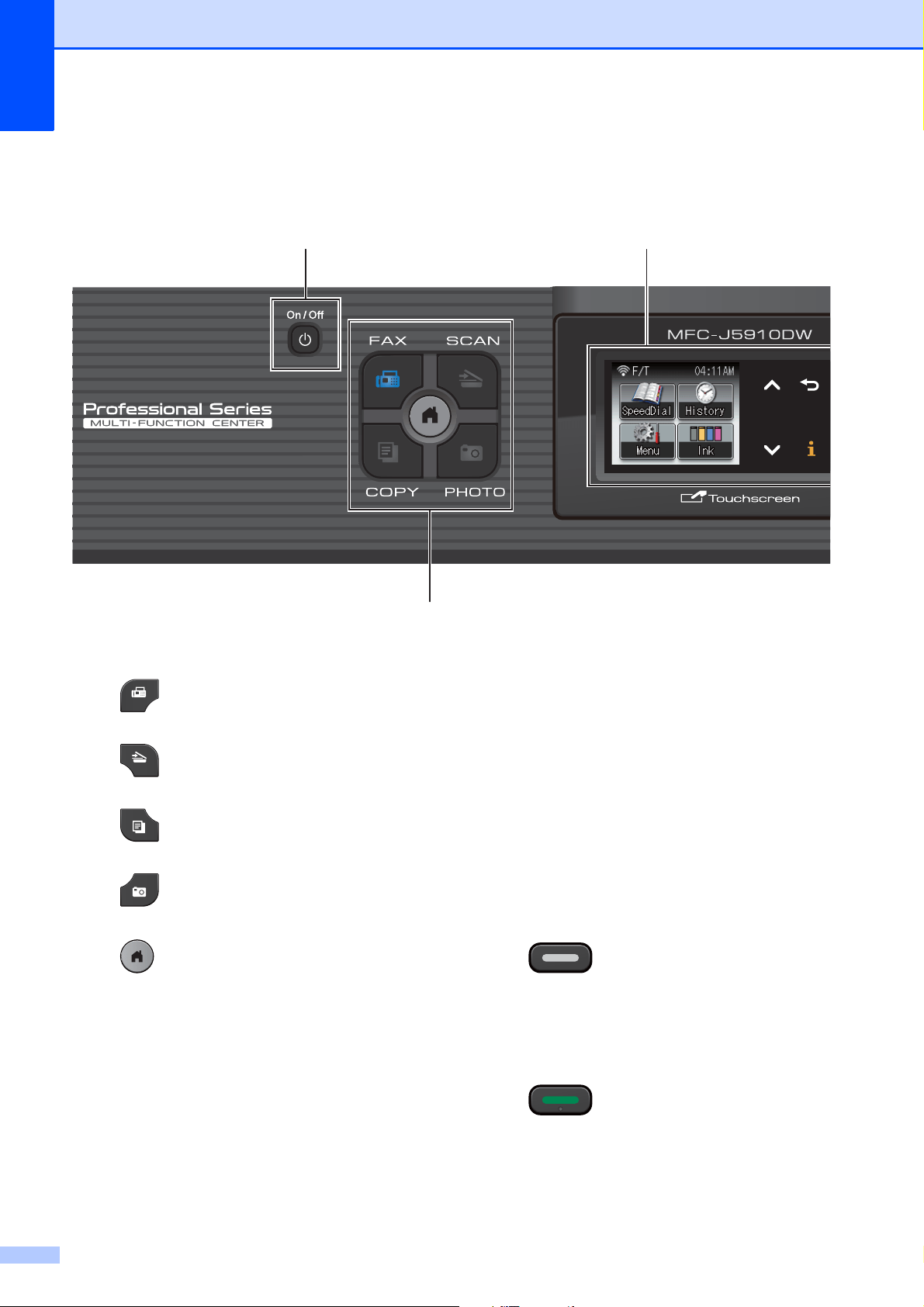
1 Mode keys:
FAX
Lets you access FAX mode.
SCAN
Lets you access SCAN mode.
COPY
Lets you access COPY mode.
PHOTO
Lets you access PHOTO mode.
Lets you return to Ready mode.
2 Telephone keys:
Redial/Pause
Redials the last 30 numbers called. It also
inserts a pause when dialing numbers.
Hook
Press before dialing when you want to
listen to make sure a fax machine has
answered, and then press Black Start or
Color Start.
Also, press this key after picking up the
handset of the external telephone during
the F/T pseudo/double-ring.
3 Start keys:
Black Start
Lets you start sending faxes or making
copies in black & white. Also lets you start
a scanning operation (in color or black &
white depending on the scan setting in the
ControlCenter software).
Color Start
Lets you start sending faxes or making
copies in full color. Also lets you start a
scanning operation (in color or black &
white, depending on the scan setting in the
ControlCenter software).
76
1
General information
7
1
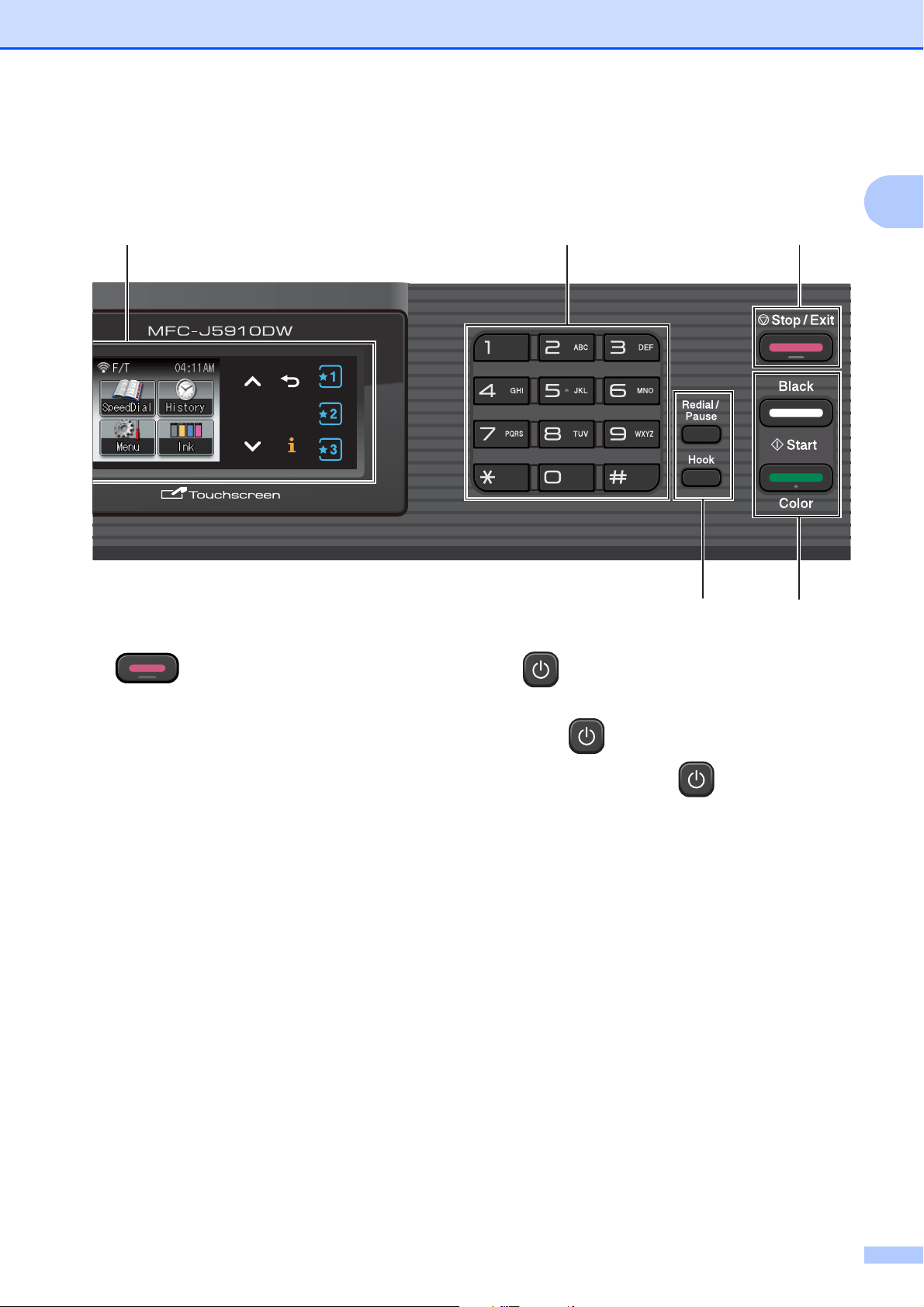
4 Stop/Exit
Stops an operation or exits the menu.
5Dial Pad
Use these keys to dial telephone and fax
numbers and as a keyboard for entering
information into the machine.
6 1.9" Touchscreen plus Touchpanel
controls
This is a screen. You can access the menus
and options by pressing buttons displayed on
the screen.
Also, you can adjust the angle of the screen by
lifting it.
7 On/Off
You can turn the machine on and off.
Press On/Off to turn the machine on.
Press and hold down On/Off to turn the
machine off. The screen will show
Shutting Down and will stay on for a few
seconds before going off.
If you have connected an external telephone or
TAD, it is always available.
If you turn the machine off, it will still
periodically clean the print head to maintain
print quality. To prolong print head life, provide
the best ink cartridge economy, and maintain
print quality, you should keep your machine
connected to the power at all times.
654
23
Chapter 1
8
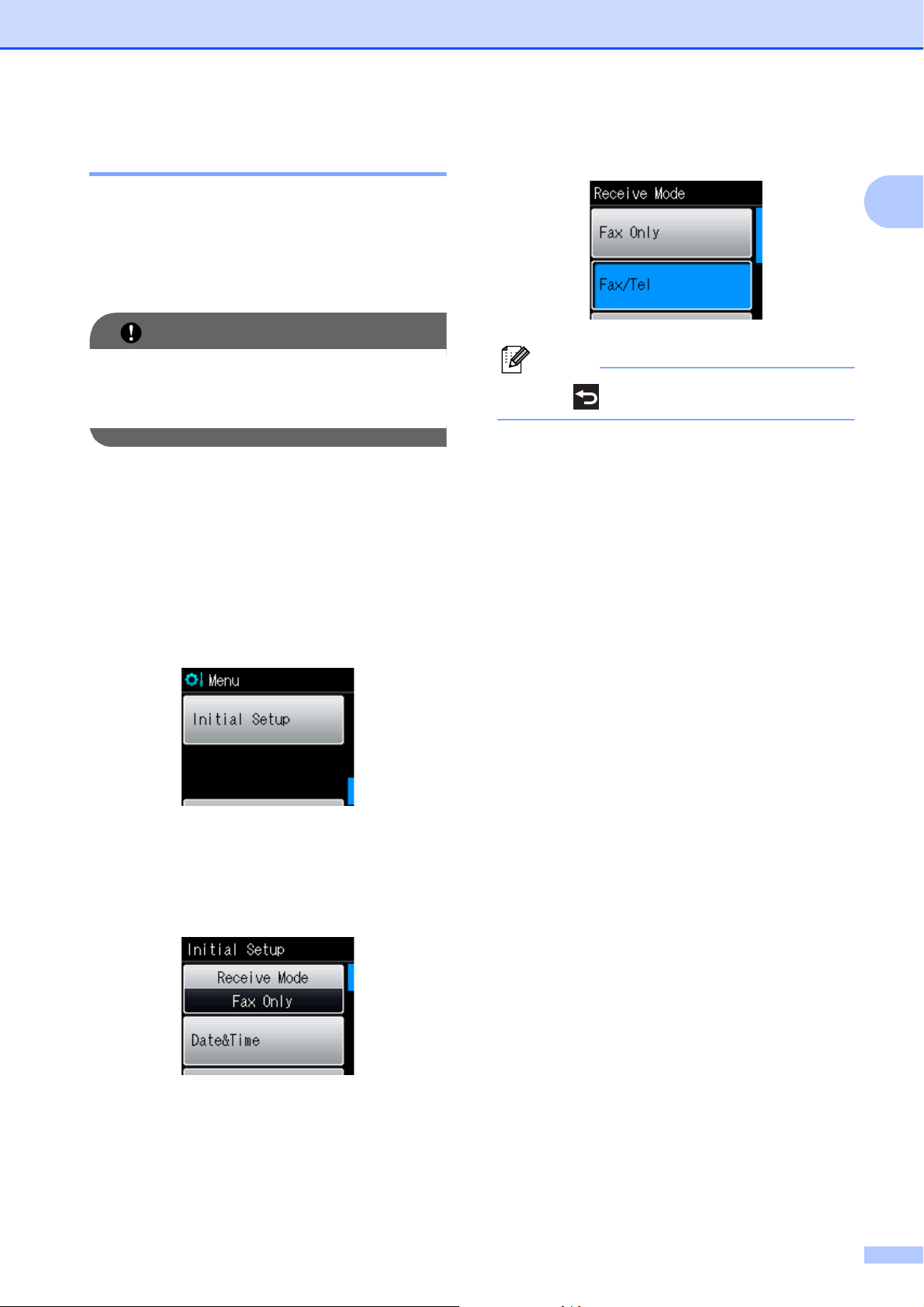
1.9" Touchscreen plus
Touchpanel controls 1
The screen shows the current machine status
when the machine is idle.
1 Menu
Lets you access the main menu.
2 Ink
Lets you see the available ink volume.
Also, lets you access the Ink menu.
3 s or t
Press to display the previous or next page. The
Up and Down arrow buttons do not light up
when there is only one page.
4
If the Information button lights up, you can
press it to view information about machine
functions or error messages.
5
Press to recall present Favorite settings. These
buttons are always lit, even when you have not
registered your Favorite settings. Press a
Favorite button to display instructions about
how to set up a Favorite.
6
Press to go back to the previous menu level.
The Back button does not light up when it is
unavailable.
7 History
Lets you view a list of outgoing calls and the
Caller ID history.
Also, lets you send a fax to the number you
have chosen from the lists.
8 SpeedDial
Lets you set up Speed Dial and Group
numbers.
Also, you can search for the number you want
to dial.
9 Current Receive Mode
Lets you see the current Receive Mode.
Fax (Fax Only)
F/T (Fax/Tel)
TAD (External TAD)
Mnl (Manual)
Note
When the Distinctive Ring feature is turned on,
the screen shows D/R. For details, see
Distinctive Ring uu page 37.
10 Wireless Status
A four-level indicator shows the current
wireless signal strength if you are using a
wireless connection.
The warning icon appears when there is
an error or maintenance message. For
details, see Error and Maintenance
messages uu page 64.
134
8
5
6
7
910
2
0Max
General information
9
1
Basic Operations 1
To operate the screen use your finger to
press the Menu or option button directly on
the screen. To display and access all the
screen menus or options in a setting, press
s or t to scroll through them.
IMPORTANT
DO NOT press the screen with a sharp
object, such as a pen or stylus. It may
damage the machine.
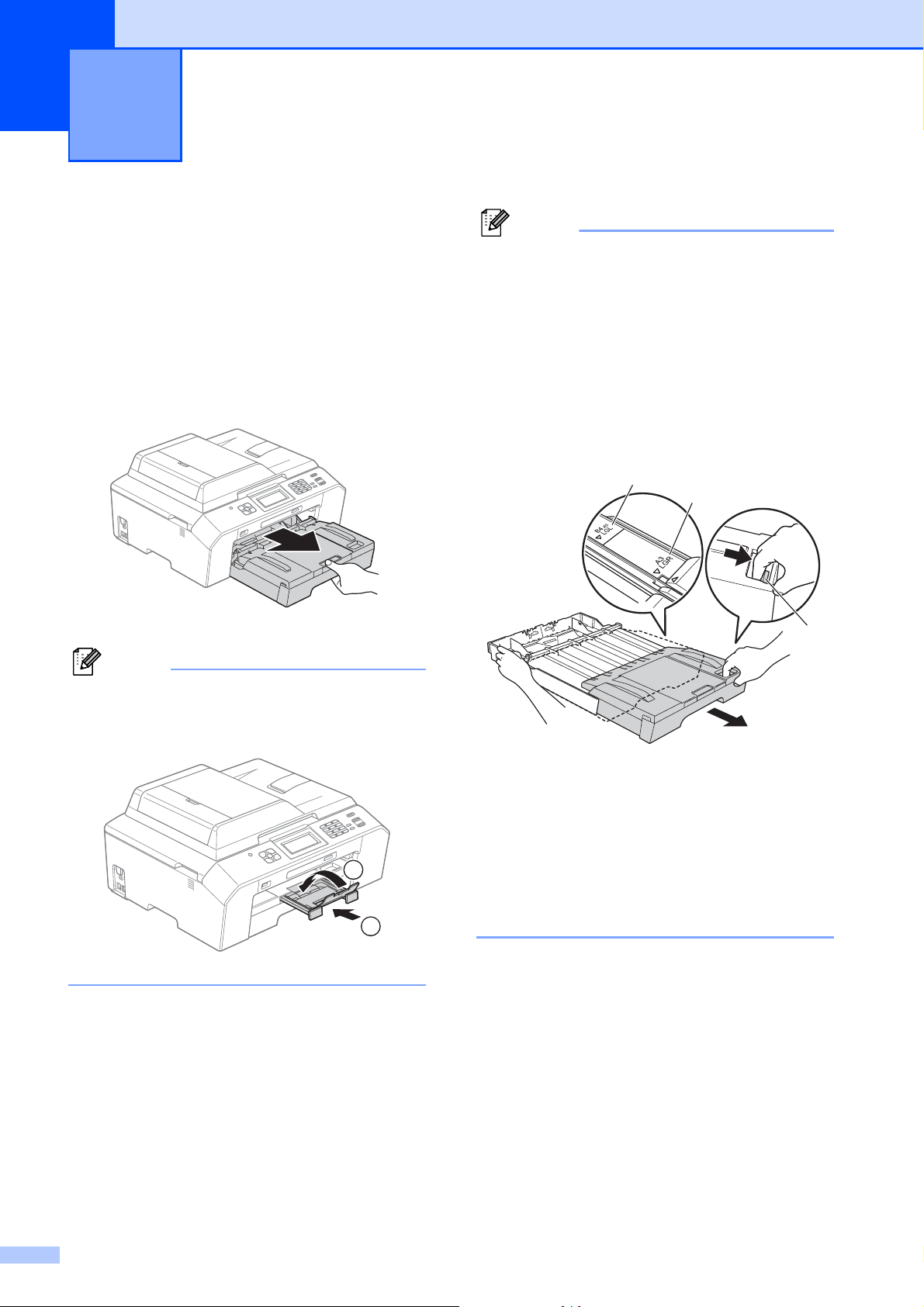
The following steps show how to change a
setting in the machine. In this example the
Receive Mode setting is changed from
Fax Only to Fax/Tel.
a Press Menu.
b Press s or t to display
Initial Setup.
c Press Initial Setup.
d Press s or t to display
Receive Mode.
e Press Receive Mode.
f Press s or t to display Fax/Tel.
g Press Fax/Tel.
Note
Press to go back to the previous level.
h Press Stop/Exit.

Chapter 1
10
Favorite Settings 1
You can register the fax, copy and scan
settings you use most often by setting them
as your Favorite Settings. Later you can
recall and apply these settings quickly and
easily. You can register three Favorites.
The following settings can be included in a
fax, copy or scan Favorite:
Copy
Quality
Paper Type
Paper Size
Enlarge/Reduce
Density
Stack/Sort
Page Layout
Duplex Copy
Advanced Settings
Fax
Address
Fax Resolution
Contrast
Batch TX
Real Time TX
Overseas Mode
Glass ScanSize
Scan (Scan to Media)
Quality
File Type
File Name
Scan (Scan to Network)
Scan (Scan to FTP)
Registering Favorite Settings 1
a Do one of the following:
Press , or where you
haven't registered the favorite
settings.
Press Create New Favorite.
Go to step d.
Press Menu.
Go to step b.
b Press s or t to display
Favorite Settings.
Press Favorite Settings.
c Press a Favorite displayed as
”-Blank-”.
Note
Each Favorite button will show the word
”-Blank-” next to it before you register it.
d Press Next to display the modes Copy,
Fax and Scan.
e Press Copy, Fax or Scan for the mode
you want to register.
f Press s or t to display the available
settings for the mode you chose in
step e, and then press the setting you
want to store.
g Press s or t to display the available
options for the setting, and then press
the option you want.
Repeat steps f and g until you have
chosen all the settings for this Favorite.
h When you are finished choosing
settings, press OK.
i Press the buttons on the screen to enter
a name for the Favorite. (To help you
enter letters, see Entering Text
uu page 123.)
Press OK.

General information
11
1
j To finish and register the settings for this
Favorite, press Yes.
k Press OK to confirm.
l Press Stop/Exit.
Changing Favorite Settings 1
You can change the settings registered to a
Favorite.
a Press Menu.
b Press s or t to display
Favorite Settings.
Press Favorite Settings.
c Press the Favorite (1, 2, or 3) you want
to change.
d Press Change, and then Yes to confirm.
e Press s or t to display the available
settings, and then press the setting you
want to change.
f Press s or t to display the available
options, and then choose your new
option.
Repeat steps e and f to change other
settings as needed.
g Press OK when you are finished
changing settings.
h To edit the name, hold down to
delete the current name, and then enter
a new name by pressing the buttons on
the screen. (To help you enter letters,
see Entering Text uu page 123.)
Press OK.
i To finish and register the settings for this
Favorite, press Yes.
j Press OK to confirm.
k Press Stop/Exit.
Deleting Favorite Settings 1
You can delete a Favorite.
a Press Menu.
b Press s or t to display
Favorite Settings.
Press Favorite Settings.
c Press the Favorite (1, 2, or 3) you want
to delete.
d Press Delete to delete the Favorite
that you chose in step c.
Press Yes to confirm.
e Press Stop/Exit.
Recalling Favorite Settings 1
Buttons for each Favorite are always
displayed on the screen. To recall a Favorite,
simply press its button.
12
2
Loading paper and
other print media
2
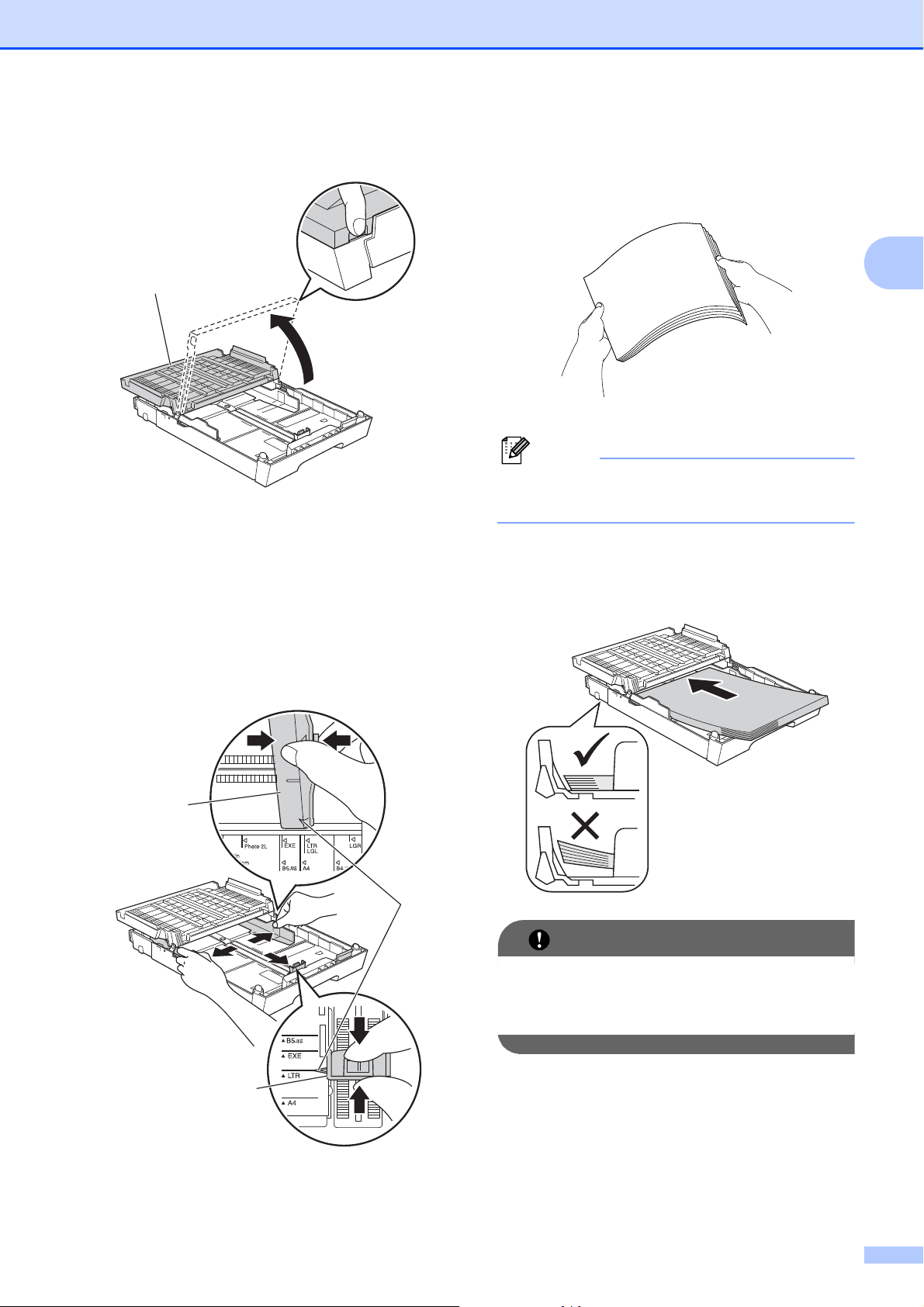
Load only one size of paper and one type of
paper in the paper tray at any one time.
a Pull the paper tray completely out of the
machine.
Note
If the paper support flap (1) is open, close
it, and then close the paper support (2).
Note
• When you are using Legal, Ledger or A3
size paper, press the universal guide
release button (1) as you slide out the
front of the paper tray. Make sure that
when using Legal or Ledger or A3 size
paper, the triangular mark on the output
paper tray cover is aligned with the line
indicating Legal (2) or Ledger or A3 (3)
size, as shown in the illustration.
• If you are using A5 or smaller size paper,
make sure that the paper tray is not
extended.
• When you load a different paper size in a
tray, you will need to change the paper
size setting in the machine at the same
time. (See Paper Size uu page 19.)
Loading paper 2
2
1
1
2
3
Loading paper
13
2
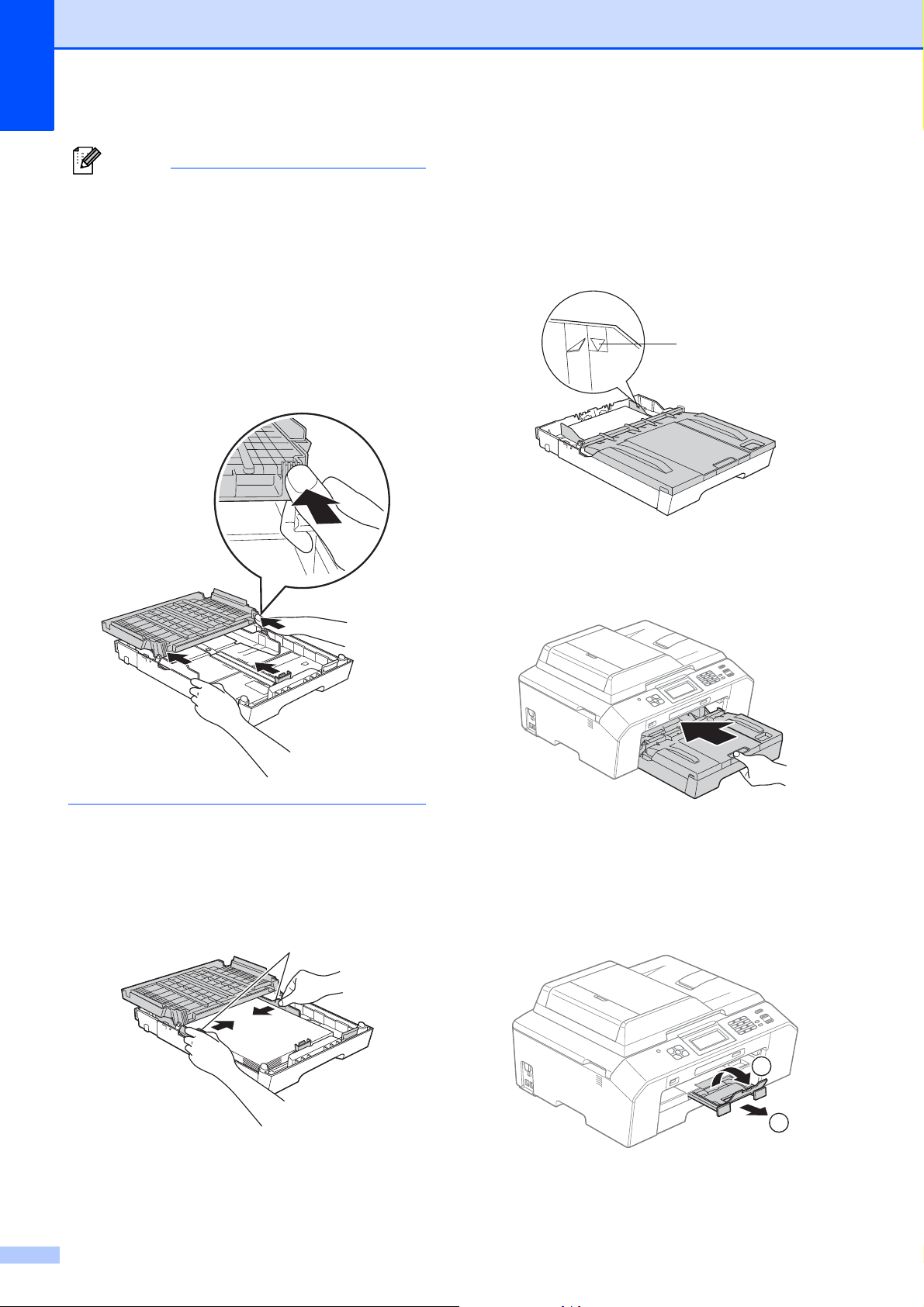
b Open the output paper tray cover (1).
c With both hands, gently press and slide
the paper length guide (1) and then the
paper side guides (2) to fit the paper
size.
Make sure that the triangular marks (3)
on the paper length guide (1) and paper
side guides (2) line up with the mark for
the paper size you are using.
d Fan the stack of paper well to avoid
paper jams and misfeeds.
Note
Always make sure that the paper is not
curled or wrinkled.
e Gently put the paper into the paper tray
print side down and top edge in first.
Check that the paper is flat in the tray.
IMPORTANT
Be careful not to push the paper in too far;
it may lift at the back of the tray and cause
paper feed problems.
1
2
3
1
Chapter 2
14
Note
• When there are only a few sheets of paper
left in the paper tray, the machine may
start to misfeed. Load at least 10 sheets of
paper into the paper tray.
• When you put Photo L size into the paper
tray, you need to release the hinges on
both sides of the output paper tray cover,
and push the cover over. And then slide
the paper length guide.
f Gently adjust the paper side guides (1)
to fit the paper using both hands.
Make sure the paper side guides touch
the sides of the paper.
g Close the output paper tray cover.
Check that the paper is flat in the tray
and below the maximum paper
mark (1).
Overfilling the paper tray may cause
paper jams.
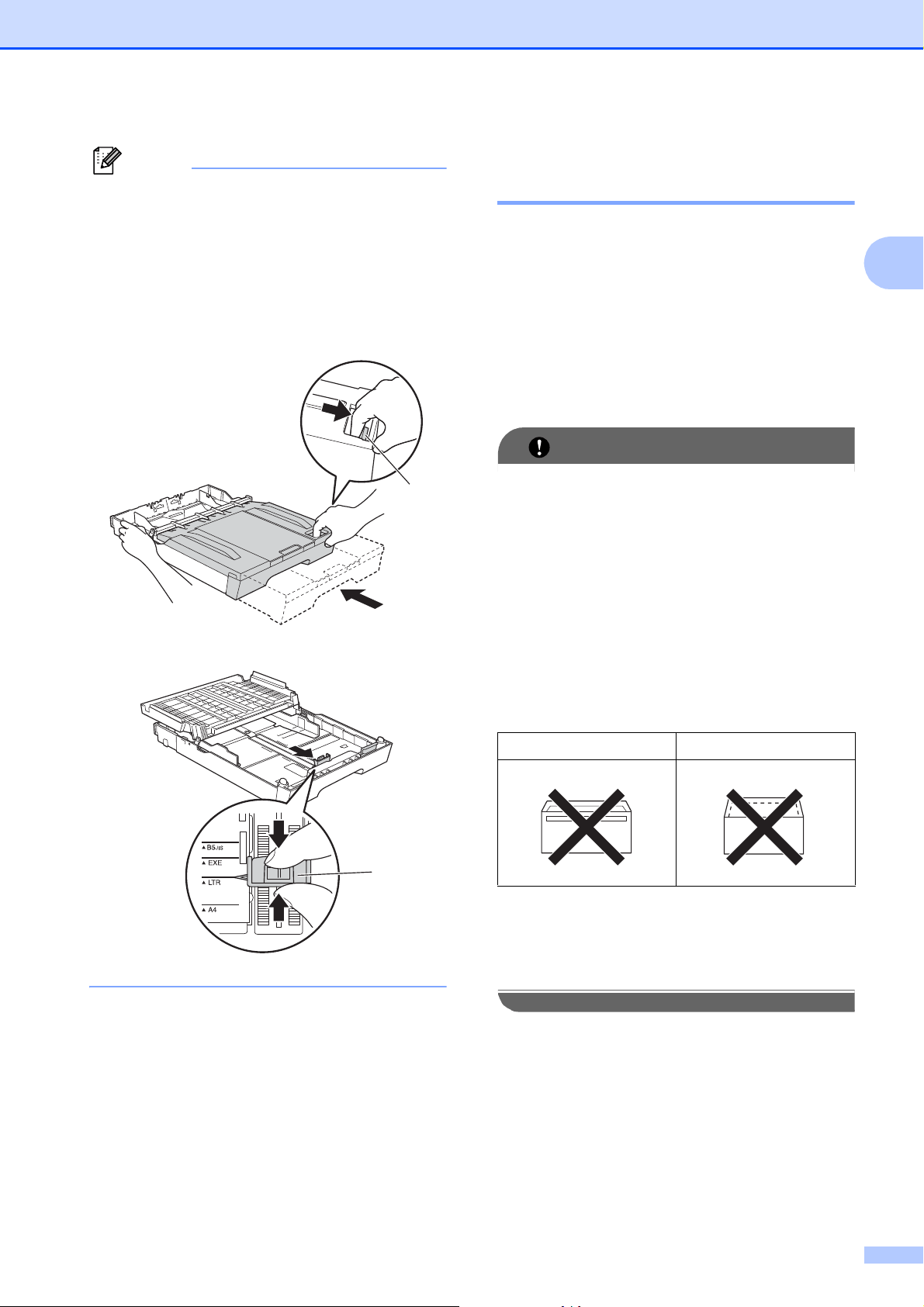
h Slowly push the paper tray completely
into the machine.
i While holding the paper tray in place,
pull out the paper support (1) until it
clicks, and then unfold the paper
support flap (2).
1
1
1
2
Loading paper
15
2
Note
Before you shorten the tray, take the
paper out of the tray. Then shorten the
tray by pressing the universal guide
release button (1). Adjust the paper length
guide (2) to fit the paper size you are
going to use. Then put the paper in the
tray.
Loading envelopes and
postcards 2
About envelopes 2
Use envelopes that weigh from 20 to 25 lb
(80 to 95 g/m
2
).
Some envelopes need margin settings to
be set in the application. Make sure you
do a test print first before printing many
envelopes.
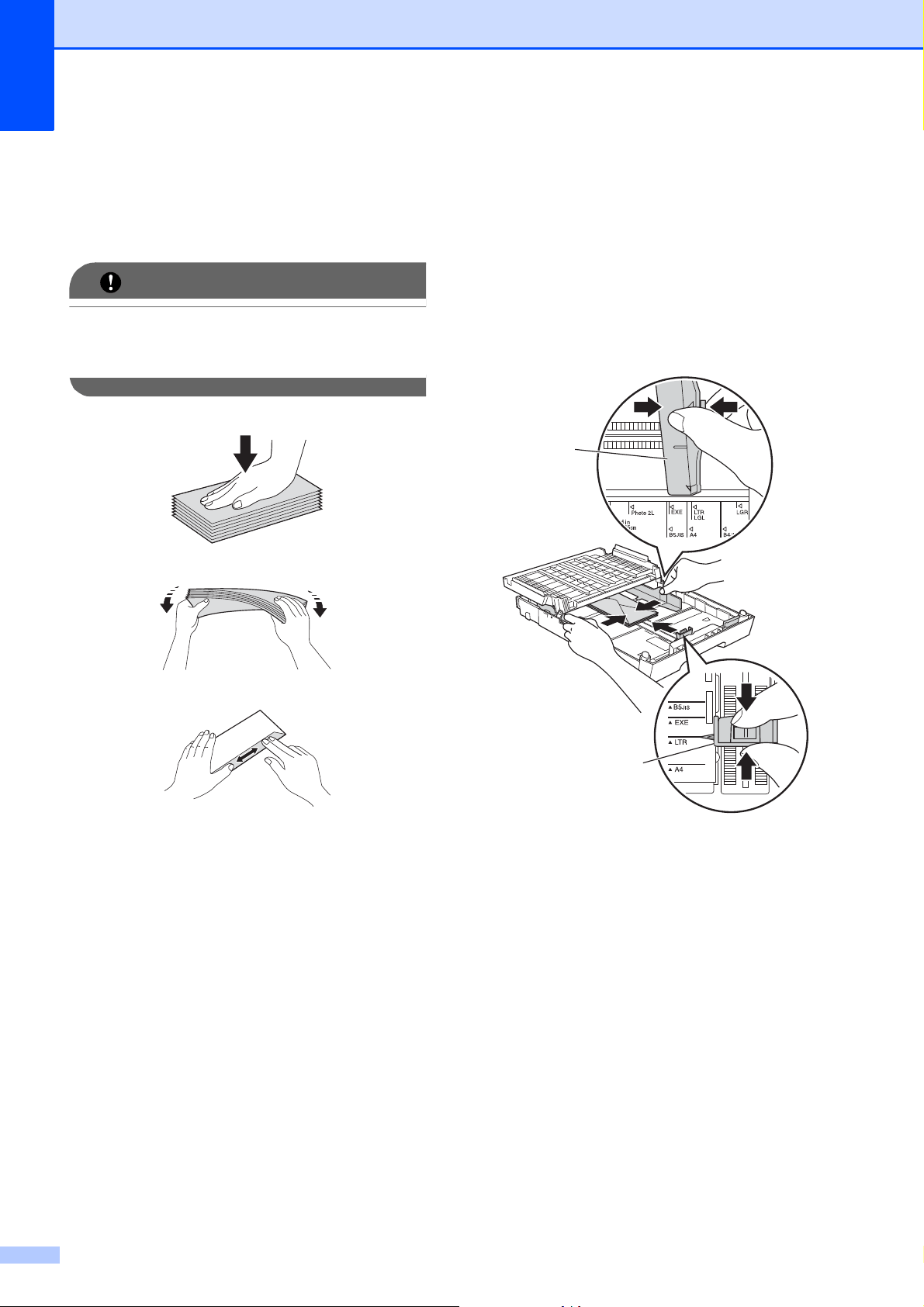
IMPORTANT
DO NOT use any of the following types of
envelopes, as they will cause paper feed
problems:
• That are of a baggy construction.
• That have windows.
• That are embossed (have raised
writing on them).
• That have clasps or staples.
• That are pre-printed on the inside.
Occasionally you may experience paper
feed problems caused by the thickness,
size and flap shape of the envelopes you
are using.
1
2
Glue Double flaps
Chapter 2
16
Loading envelopes and postcards 2
a Before loading, press the corners and
sides of envelopes or postcards to make
them as flat as possible.
IMPORTANT
If envelopes or postcards are “double-
feeding,” put one envelope or postcard in
the paper tray at a time.
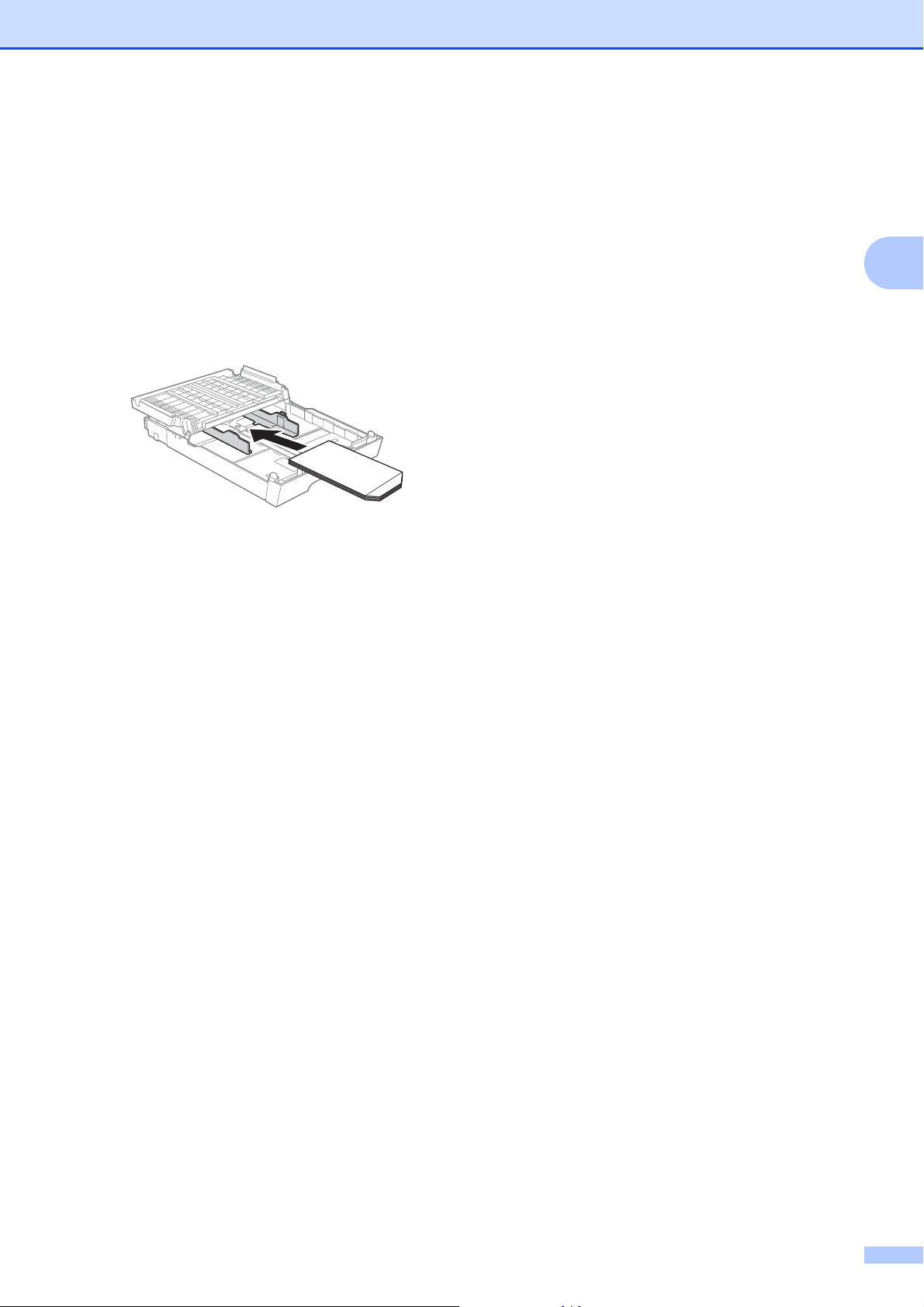
b Put envelopes or postcards in the paper
tray with the address side down. If the
envelope flaps are on the long edge,
load the envelopes with the flap on the
left, as shown in the illustration. Load
postcards with the leading edge in first.
Using both hands, gently press and
slide the paper length guide (1) and
paper side guides (2) to fit the size of the
envelopes or postcards.
2
1
Loading paper
17
2
If you have problems printing on
envelopes with the flap on the short edge,
try the following:
2
a Open the envelope flap.
b Put the envelope into the paper tray with
the address side down and the flap
positioned as shown in the illustration.
c Select Reverse Print in the printer
driver’s dialog box, and then adjust the
size and margin in your application.
uuSoftware User’s Guide: Printing
(Windows
®
)
uuSoftware User’s Guide: Printing and
Faxing (Macintosh)
Chapter 2
18
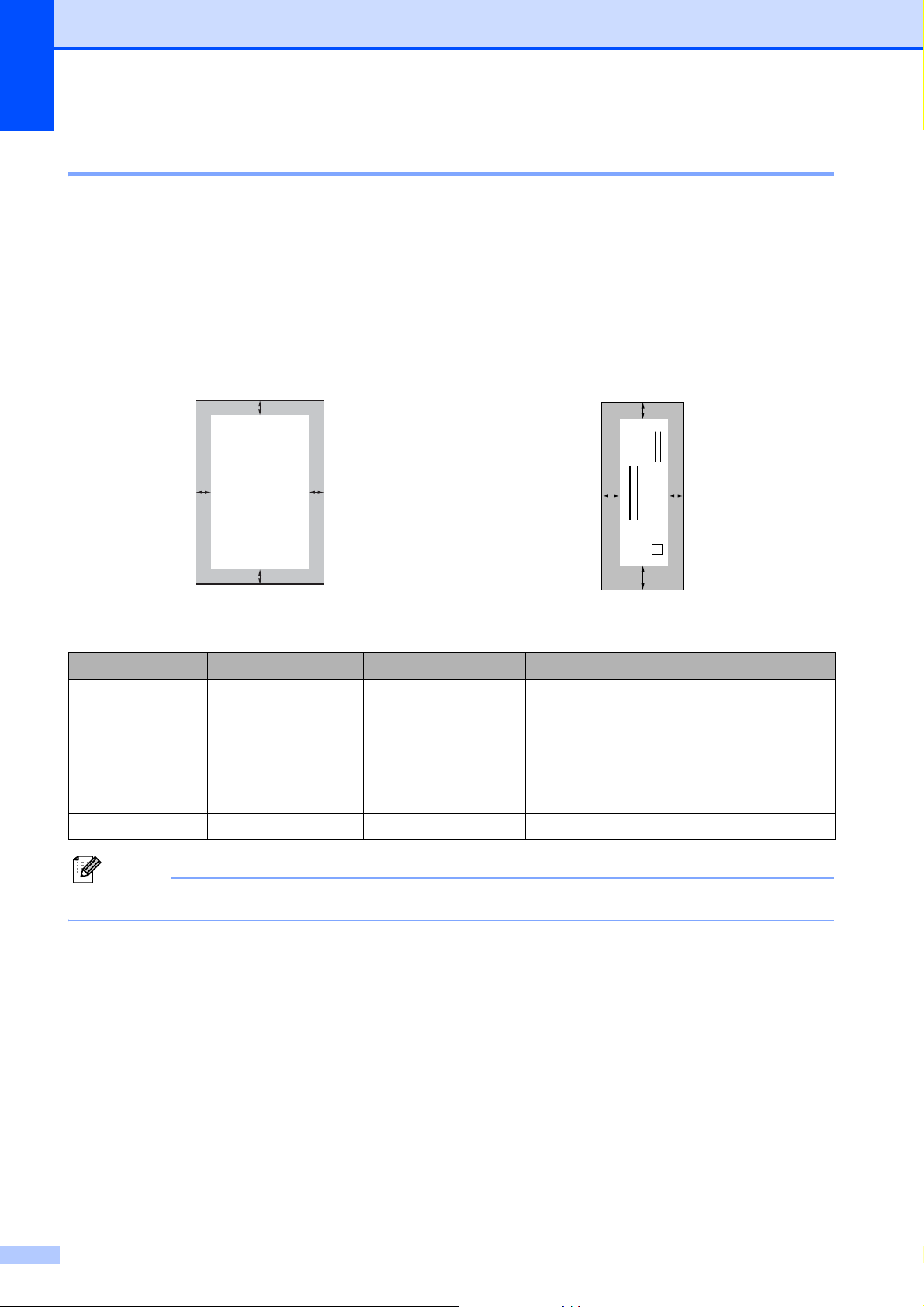
Printable area 2
The printable area depends on the settings in the application you are using. The figures below
show the unprintable areas on cut-sheet paper and envelopes. The machine can print in the
shaded areas of cut-sheet paper only when the Borderless print feature is available and turned on.
uuSoftware User’s Guide: Printing (Windows
®
)
uuSoftware User’s Guide: Printing and Faxing (Macintosh)
Note
The Borderless feature is not available for envelopes and duplex printing.
Cut-Sheet Paper Envelopes
Top (1) Bottom (2) Left (3) Right (4)
Cut-Sheet 0.12 in. (3 mm) 0.12 in. (3 mm) 0.12 in. (3 mm) 0.12 in. (3 mm)
Cut-Sheet
(Duplex print
when using
Ledger or A3
size)
0.87 in. (22 mm) 0.87 in. (22 mm) 0.12 in. (3 mm) 0.12 in. (3 mm)
Envelopes 0.87 in. (22 mm) 0.87 in. (22 mm) 0.12 in. (3 mm) 0.12 in. (3 mm)
34
1
2
34
1
2

Loading paper
19
2
Paper settings 2
Paper Type 2
To get the best print quality, set the machine
for the type of paper you are using.
a Press Menu.
b Press s or t to display
General Setup.
c Press General Setup.
d Press s or t to display Paper Type.
e Press Paper Type.
f Press s or t to display Plain Paper,
Inkjet Paper, Brother BP71,
Brother BP61, Other Glossy or
Transparency, and then press the
option you want.
g Press Stop/Exit.
Note
The machine ejects paper with printed
surfaces face up onto the paper tray at the
front of the machine. When you use
transparencies or glossy paper, remove
each sheet at once to prevent smudging
or paper jams.
Paper Size 2
You can use eight sizes of paper for copies:
Letter, Legal, Ledger, A4, A5, A3, Executive
and 4" 6" (10 15 cm) and five sizes for
printing faxes: Ledger, Letter, Legal, A3 and
A4. When you change the size of paper you
load in the machine, you will need to change
the paper size setting at the same time so
your machine can fit an incoming fax on the
page.
a Press Menu.
b Press s or t to display
General Setup.
c Press General Setup.
d Press s or t to display Paper Size.
e Press Paper Size.
f Press s or t to display Letter,
Legal, Ledger, A4, A5, A3, EXE or
4"x6", and then press the option you
want.
g Press Stop/Exit.

Chapter 2
20
Secure Paper Feed mode for
Ledger size Short Grain Paper2
If your printed pages are smudged when
using Ledger paper, your paper may be short
grain paper. Choose LGR - Short Grain
and set it to On to avoid this problem.
a Press Menu.
b Press s or t to display
General Setup.
c Press General Setup.
d Press s or t to display
LGR - Short Grain.
e Press LGR - Short Grain.
f Press On.
g Press Stop/Exit.
Note
• If you are not sure about the type of paper
you are using, consult the paper
packaging or paper manufacturer for
paper specifications.
• Printing will be slower when using the
LGR - Short Grain setting.
Acceptable paper and
other print media
2
The print quality can be affected by the type
of paper you use in the machine.
To get the best print quality for the settings
you have chosen, always set the Paper Type
to match the type of paper you load.
You can use plain paper, inkjet paper (coated
paper), glossy paper, transparencies and
envelopes.
We recommend testing various paper types
before buying large quantities.
For best results, use Brother paper.
When you print on inkjet paper (coated
paper), transparencies and glossy paper,
be sure to choose the proper print media
in the Basic tab of the printer driver or in
the Paper Type setting of the machine’s
menu. (See Paper Type uu page 19.)
When you print on Brother Photo paper,
load one extra sheet of the same photo
paper in the paper tray. An extra sheet has
been included in the paper package for
this purpose.
When you use transparencies or photo
paper, remove each sheet at once to
prevent smudging or paper jams.
Avoid touching the printed surface of the
paper immediately after printing; the
surface may not be completely dry and
may stain your fingers.
Loading paper
21
2
Recommended print media 2
To get the best print quality, we suggest using
Brother paper. (See the table below.)
We recommend using “3M Transparency
Film” when you print on transparencies.
Handling and using print
media 2
Store paper in its original packaging and
keep it sealed. Keep the paper flat and
away from moisture, direct sunlight and
heat.
Avoid touching the shiny (coated) side of
photo paper. Load photo paper with the
shiny side facing down.
Avoid touching either side of
transparencies because they absorb
water and perspiration easily, and this
may cause decreased output quality.
Transparencies designed for laser
printers/copiers may stain your next
document. Use only transparencies
recommended for inkjet printing.
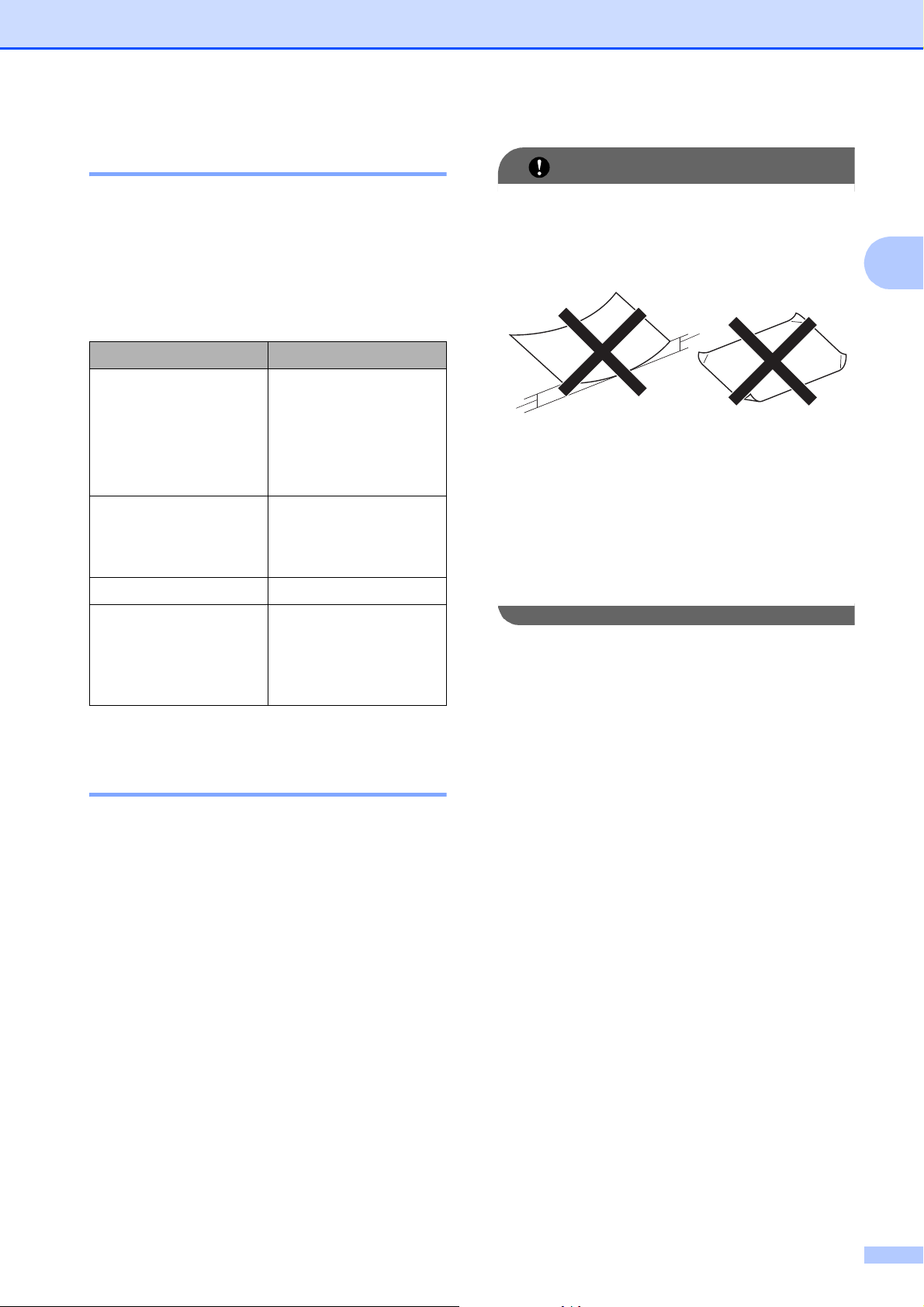
IMPORTANT
DO NOT use the following kinds of paper:
• Damaged, curled, wrinkled, or
irregularly shaped
1 0.08 in. (2 mm) or greater curl may
cause jams to occur.
• Extremely shiny or highly textured
• Paper that cannot be arranged
uniformly when stacked
• Paper made with a short grain
Paper capacity of the output paper
tray cover
2
Up to 50 sheets of Letter, Legal or A4 20 lb
(80 g/m
2
) paper.
Transparencies and photo paper must be
picked up from the output paper tray cover
one page at a time to avoid smudging.
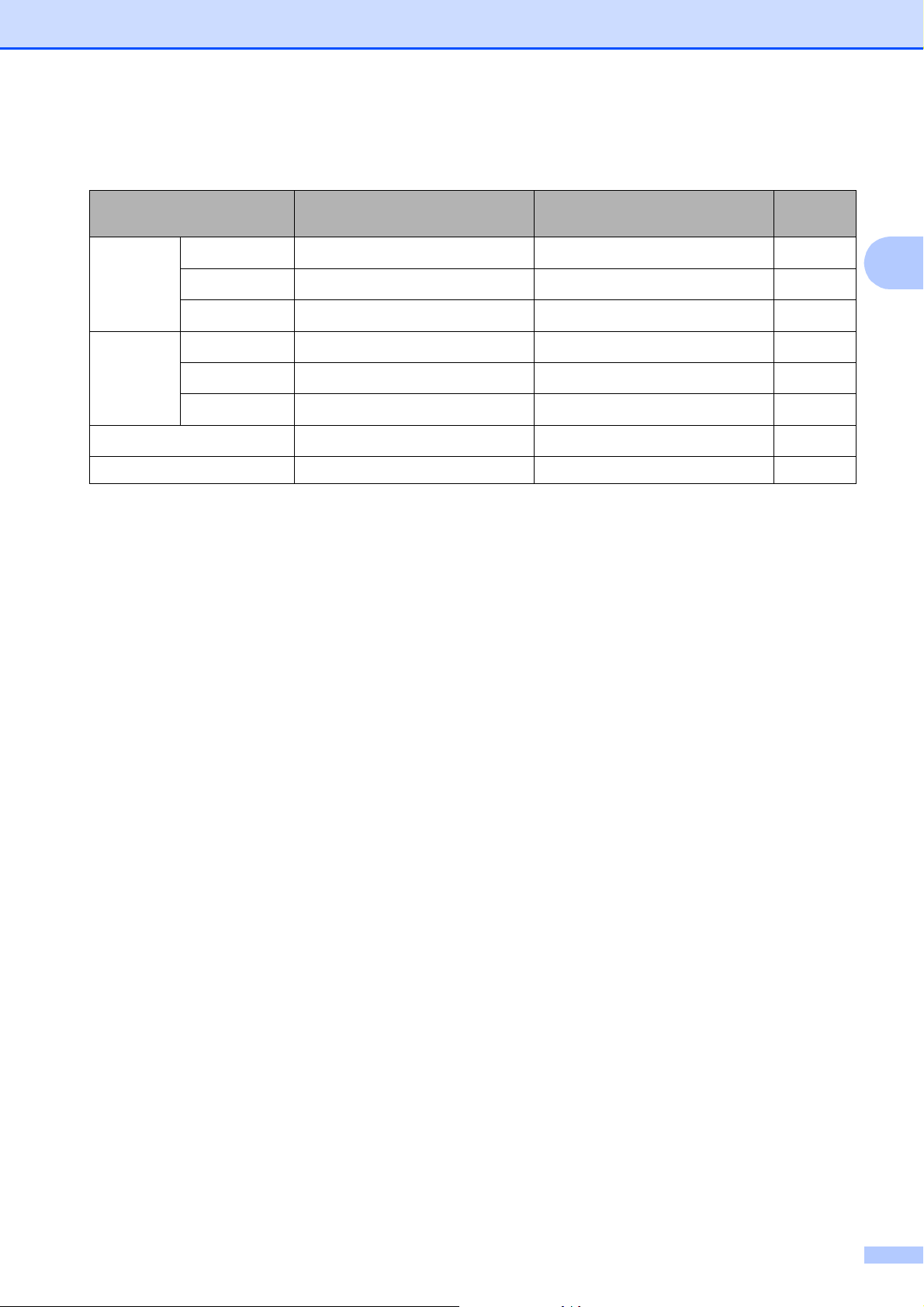
Brother paper
Paper Type Item
Premium Plus Glossy
Photo
Ledger BP71GLGR
Letter BP71GLTR
4" 6" BP71GP
Premium Glossy Photo
Letter BP61GLL (USA only)
4" 6" BP61GLP (USA only)
Matte Inkjet (Letter) BP60ML (USA only)
Plain Inkjet
Ledger BP60PLGR (USA only)
Letter BP60PL100 (USA
only)
1
1

Chapter 2
22
Choosing the right print media 2
Paper type and size for each operation 2
Paper Type Paper Size Usage
Fax Copy
Photo
Capture
Printer
Cut-Sheet Ledger 11 17 in. (279.4 431.8 mm) Yes Yes Yes Yes
Letter 8 1/2 11 in. (215.9 279.4 mm) Yes Yes Yes Yes
A3 11.7 16.5 in. (297 420 mm) Yes Yes Yes Yes
A4 8.3 11.7 in. (210 297 mm) Yes Yes Yes Yes
Legal 8 1/2 14 in. (215.9 355.6 mm) Yes Yes – Yes
Executive 7 1/4 10 1/2 in. (184 267 mm) – Yes – Yes
JIS B4 10.1 14.3 in. (257 364 mm) – – – User
Defined
JIS B5 7.2 10.1 in. (182 257 mm) – – – User
Defined
A5 5.8 8.3 in. (148 210 mm) – Yes – Yes
A6 4.1 5.8 in. (105 148 mm) – – – Yes
Cards 4 6 in. (10 15 cm) – Yes Yes Yes
3 1/2 5 in. (89 127 mm) – – – Yes
5 7 in. (13 18 cm) – – Yes Yes
5 8 in. (127 203 mm) – – – Yes
Postcard 1 3.9 5.8 in. (100 148 mm) – – – User
Defined
Postcard 2
(Double)
5.8 7.9 in. (148 200 mm) – – – User
Defined
Envelopes C5 Envelope 6.4 9 in. (162 229 mm) – – – Yes
DL Envelope 4.3 8.7 in. (110 220 mm) – – – Yes
COM-10 4 1/8 9 1/2 in. (105 241 mm) – – – Yes
Mo
narch 3 7/8 7 1/2 in. (98 191 mm) – – – Yes
Y4 Envelope 4.1 9.3 in. (105 235 mm) – – – User
Defined
Transparencies
Letter 8 1/2 11 in. (215.9 279.4 mm) – Yes – Yes
A4 8.3 11.7 in. (210 297 mm) – Yes – Yes
Legal 8 1/2 14 in. (215.9 355.6 mm) – Yes – Yes
A5 5.8 8.3 in. (148 210 mm) – Yes – Yes
Loading paper
23
2
Paper weight, thickness and capacity 2
1
Up to 250 sheets of plain paper 20 lb (80 g/m
2
).
2
BP71 69 lb (260 g/m
2
) paper is especially designed for Brother inkjet machines.
Paper Type Weight Thickness No. of
sheets
Cut-Sheet Plain Paper
17 to 32 lb (64 to 120 g/m
2
)
3 to 6 mil (0.08 to 0.15 mm)
250
1
Inkjet Paper
17 to 53 lb (64 to 200 g/m
2
)
3 to 10 mil (0.08 to 0.25 mm) 20
Glossy Paper
Up to 58 lb (Up to 220 g/m
2
)
Up to 10 mil (Up to 0.25 mm)
20
2
Cards Photo 4" 6"
Up to 58 lb (Up to 220 g/m
2
)
Up to 10 mil (Up to 0.25 mm)
20
2
Index Card
Up to 32 lb (Up to 120 g/m
2
)
Up to 6 mil (Up to 0.15 mm) 30
Postcard
Up to 53 lb (Up to 200 g/m
2
)
Up to 10 mil (Up to 0.25 mm) 30
Envelopes
20 to 25 lb (75 to 95 g/m
2
)
Up to 20 mil (Up to 0.52 mm) 10
Transparencies – – 10
24
3
How to load
documents
3
You can send a fax, make copies, and scan
from the ADF (automatic document feeder)
and from the scanner glass.
Using the ADF 3
The ADF can hold up to 35 pages and feeds
each sheet individually. Use paper that is
within the sizes and weights shown in the
table below. Always fan the pages before
placing them in the ADF.
Document Sizes and Weights 3
How to load documents 3
IMPORTANT
• DO NOT pull on the document while it is
feeding.
• DO NOT use paper that is curled,
wrinkled, folded, ripped, stapled, paper
clipped, pasted or taped.
• DO NOT use cardboard, newspaper or
fabric.
Make sure documents with ink or correction
fluid are completely dry.
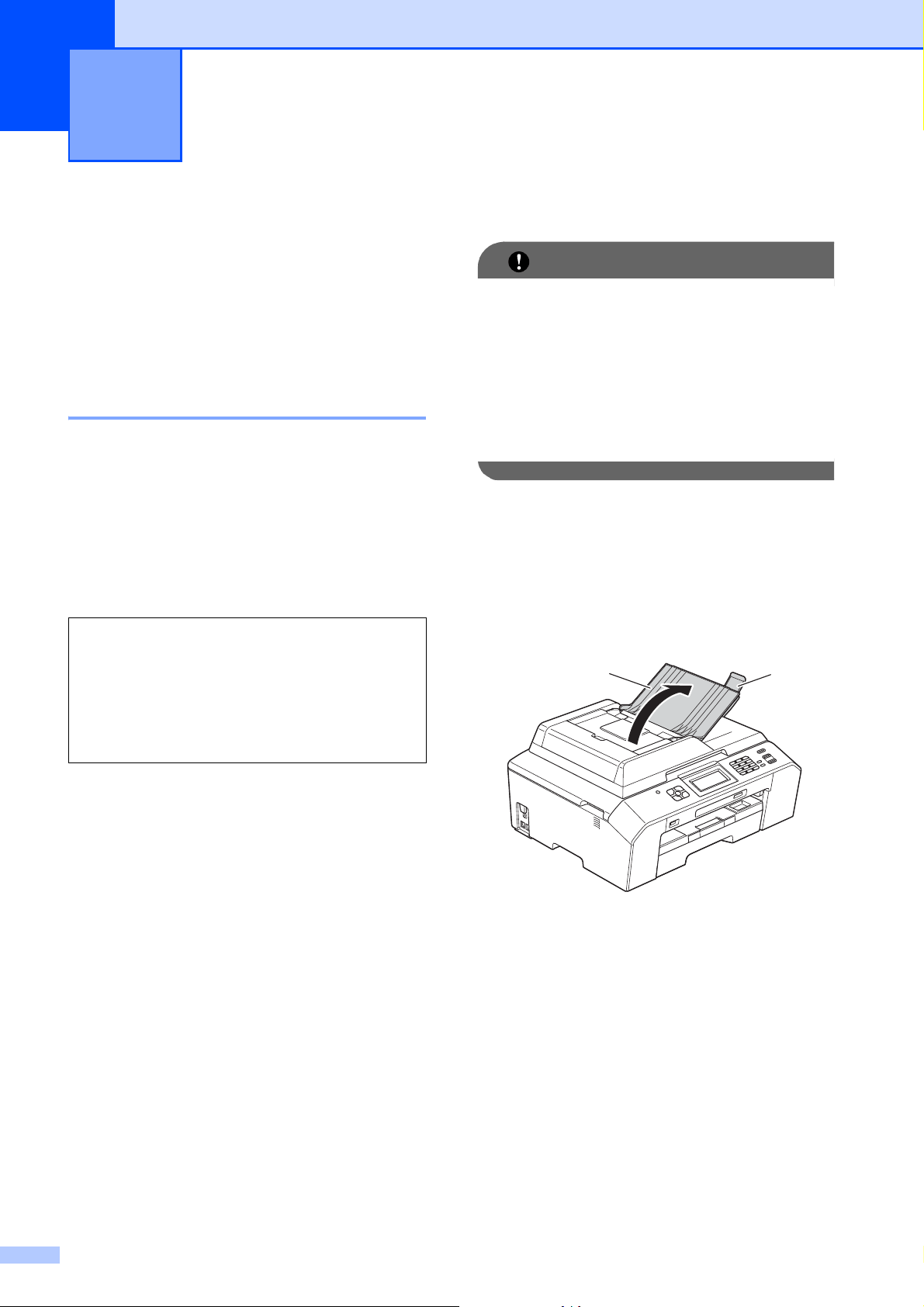
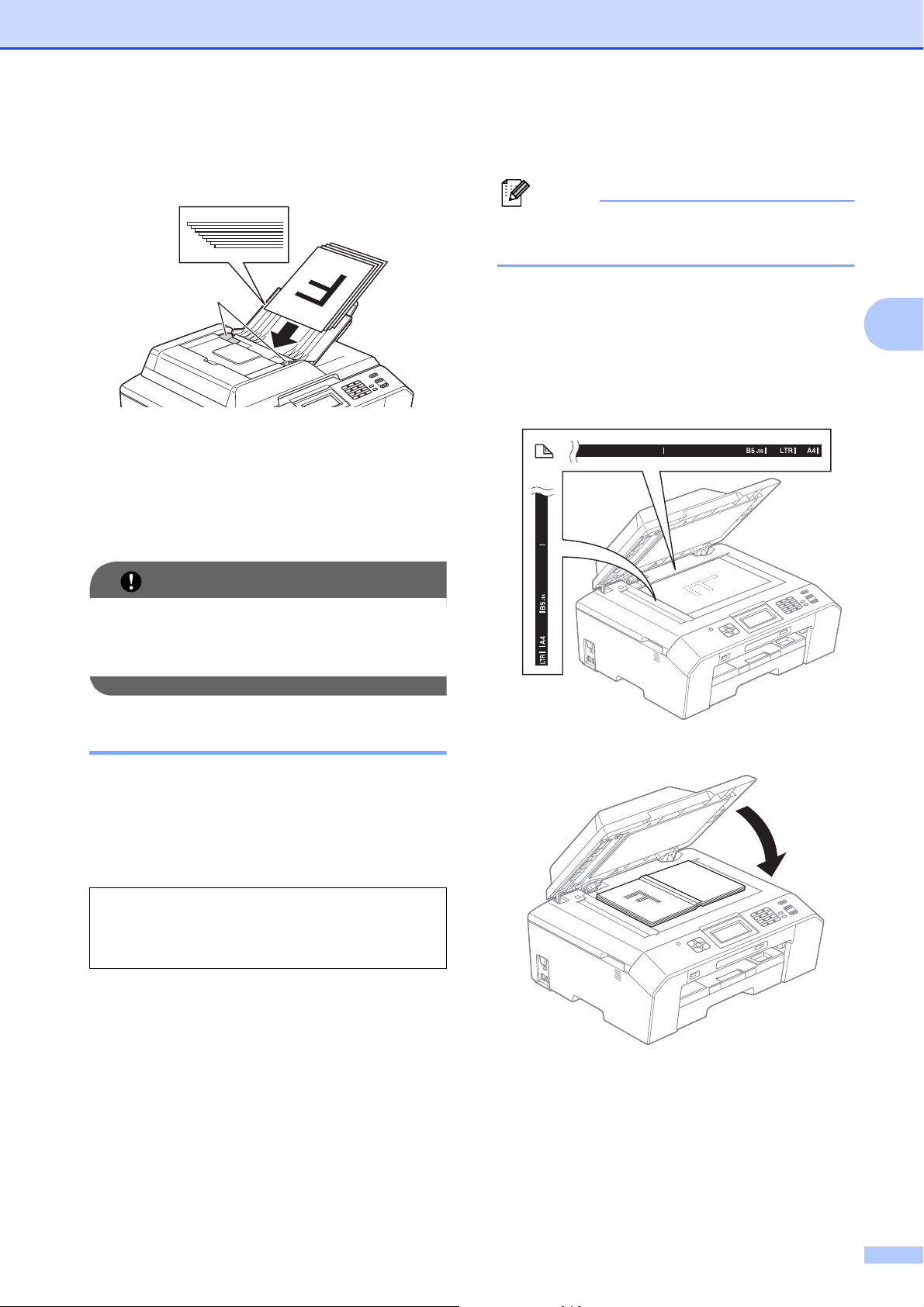
a Lift up and unfold the ADF document
output support flap (1). Unfold the ADF
document support (2).
b Fan the pages well.
Loading documents 3
Length: 5.8 to 14 in.
(148 to 355.6 mm)
Width: 5.8 to 8.5 in.
(148 to 215.9 mm)
Weight: 17 to 24 lb
(64 to 90 g/m
2
)
2
1
Loading documents
25
3
c Adjust the paper guides (1) to fit the
width of your document.
d Place your document, face up, top
edge first in the ADF underneath the
guides until the screen shows
ADF Ready and you feel it touch the
feed rollers.
IMPORTANT
DO NOT leave a thick document on the
scanner glass. If you do this, the ADF may
jam.
Using the scanner glass 3
You can use the scanner glass to fax, copy or
scan pages of a book or one page at a time.
Document Sizes Supported 3
How to load documents 3
Note
To use the scanner glass, the ADF must
be empty.
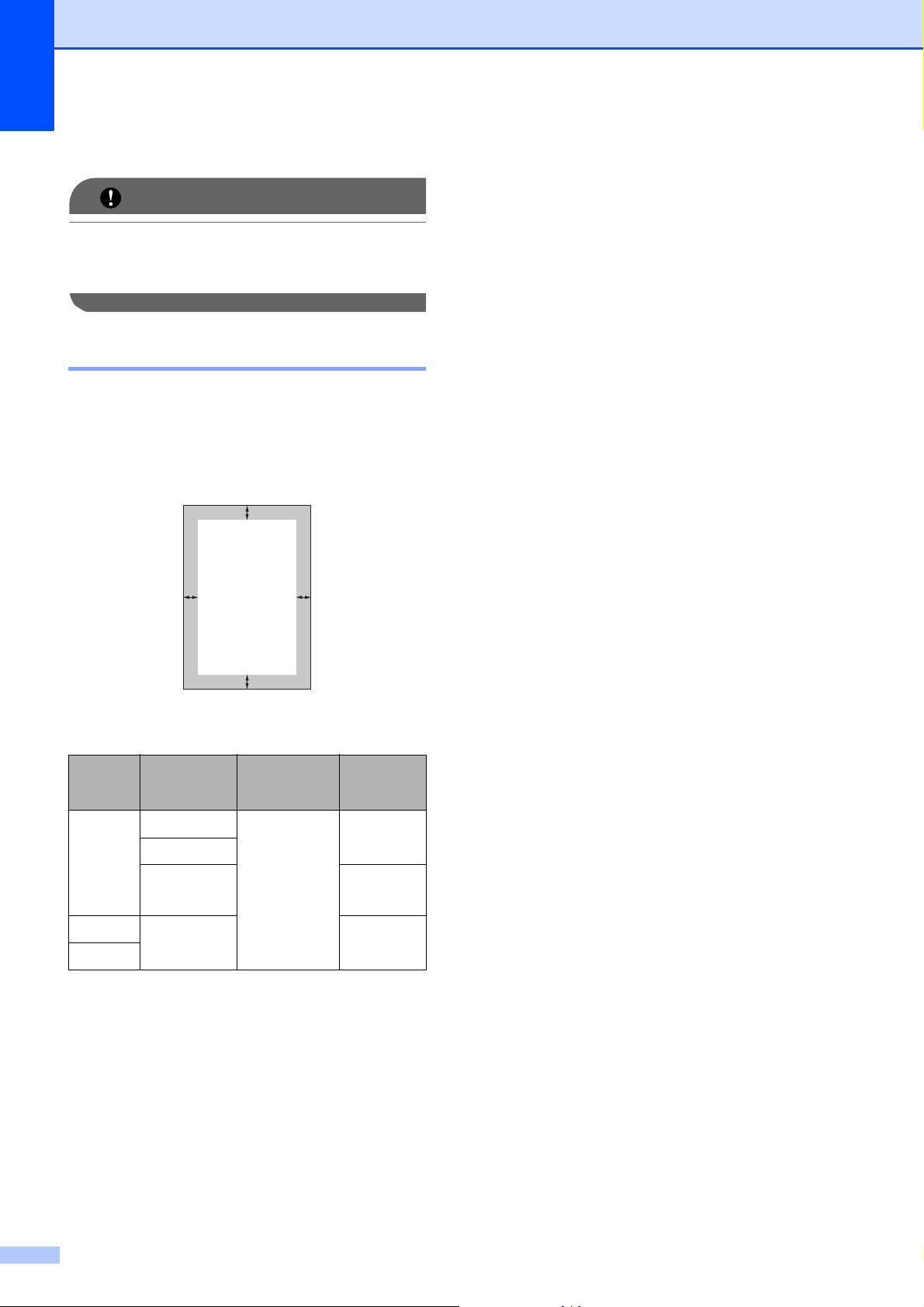
a Lift the document cover.
b Using the document guidelines on the
left and top, place the document
face down in the upper left corner of the
scanner glass.
Length: Up to 11.7 in. (297 mm)
Width: Up to 8.5 in. (215.9 mm)
Weight: Up to 4.4 lb (2 kg)
1
Chapter 3
26
c Close the document cover.
IMPORTANT
If you are scanning a book or thick
document, DO NOT slam the cover down
or press on it.
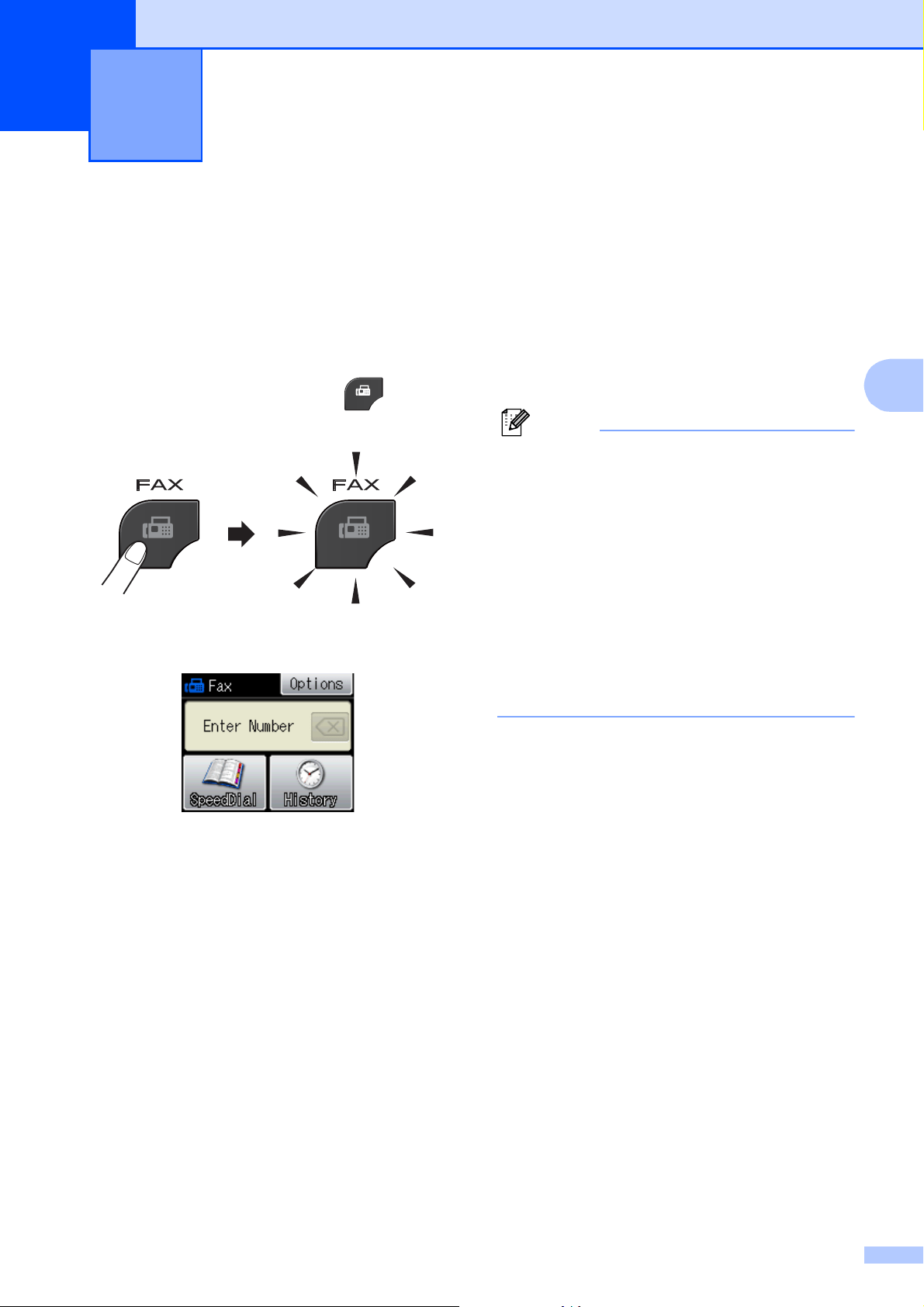
Unscannable area 3
The scannable area depends on the settings
in the application you are using. The figures
below show unscannable areas.
1
The unscannable area is 0.04 in (1 mm) when you
use the ADF.
Usage Document
Size
Top (1)
Bottom (2)
Left (3)
Right (4)
Fax Letter 0.12 in.
(3 mm)
0.16 in.
(4 mm)
Legal
A4
0.12 in.
1
(3 mm)
Copy All paper
sizes
0.12 in.
(3 mm)
Scan
34
1
2
27
4
4
How to send a fax 4
The following steps show how to send a fax.
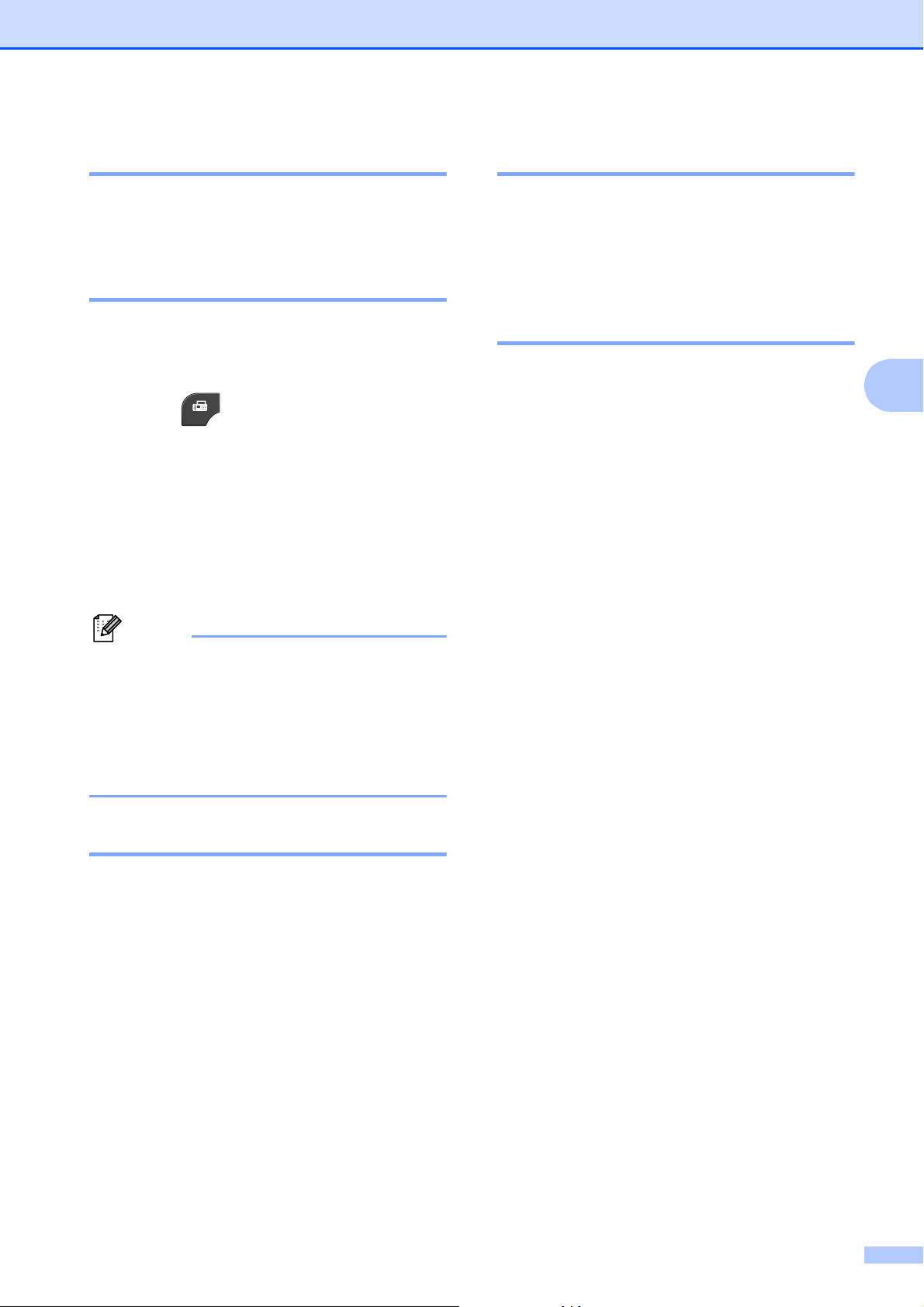
a When the machine is idle, the time
appear on the screen. When you want to
send a fax, or change fax send or
receive settings, press the (FAX)
key to illuminate it in blue.
The screen shows:
b Do one of the following to load your
document:
Place the document face up in the
ADF. (See Using the ADF
uu page 24.)
Load your document face down on
the scanner glass. (See Using the
scanner glass uu page 25.)
Note
• To send color faxes with multiple pages
use the ADF.
• If you send a black & white fax from the
ADF while the memory is full, it will be sent
in real time.
• You can use the scanner glass to fax
pages of a book one at a time. The
document can be up to Letter or A4 size.
• Since you can only scan one page at a
time, it is easier to use the ADF if you are
sending a multiple-page document.
Sending a fax 4

Chapter 4
28
c You can change the following
fax-sending settings. Press FAX and
then press Options. Press s or t to
scroll through the fax settings. When the
setting you want is displayed, press it
and choose your option.
(Basic User’s Guide)
For details about changing the following
fax-sending settings uu pages 29 to 30.
Glass ScanSize
Color Fax Transmission
Transmission Verification Report
(Setup)
(Advanced User’s Guide)
For more advanced fax-sending
operations and settings
uuAdvanced User’s Guide: Sending a
fax
Contrast
Fax Resolution
Set New Defaults
Factory Reset
Faxing at End of Call
Broadcasting
Real Time Transmission
Overseas Mode
Delayed Fax
Batch Transmission
Canceling Waiting Jobs
Polled Transmit
d Enter the fax number.
Using the dial pad
Using Speed Dial
SpeedDial
Using call history
Outgoing
Incoming
e Press Black Start or Color Start.
Faxing from the ADF 4
The machine starts scanning and
sending the document.
Faxing from the scanner glass 4
If you pressed Black Start, the
machine starts scanning the first
page. Go to step f.
If you pressed Color Start, the
screen asks if you want to send a
color fax. Press Yes (ColorFax)
to confirm. The machine starts
dialing and sending the document.
f When the screen asks you
Next Page?, do one of the following:
To send a single page, press
No (Send) (or press Black Start
again).
The machine starts sending the
document.
To send more than one page, press
Yes and go to step g.
g Place the next page on the scanner
glass.
Press OK.
The machine starts scanning the page.
(Repeat steps f and g for each
additional page.)
Sending a fax
29
4
Stop faxing 4
To stop faxing, press Stop/Exit.
Setting scanner glass size for
faxing 4
When documents are A4 size, you need to
set the Scan Size to A4. If you do not, the
bottom portion of the faxes will be missing.
a Press (FAX).
b Press Options.
c Press s or t to display
Glass ScanSize.
d Press Glass ScanSize.
e Press A4 (or Letter).
Note
• You can save the setting you use most
often by setting it as the default.
(uuAdvanced User’s Guide: Setting your
changes as the new default)
• This setting is only available for sending
documents from the scanner glass.
Color fax transmission 4
Your machine can send a color fax to
machines that support this feature.
Color faxes cannot be stored in the machine’s
memory. When you send a color fax, the
machine will send it in real time (even if
Real Time TX is set to Off).
Canceling a fax in progress 4
If you want to cancel a fax while the machine
is scanning, dialing or sending, press
Stop/Exit.
Transmission Verification
Report 4
You can use the Transmission Verification
Report as proof that you sent a fax. This
report lists the sender’s name or fax number,
the time and date of transmission, duration of
transmission, number of pages sent, and
whether or not the transmission was
successful.
There are several settings available for the
Transmission Verification Report:
On: Prints a report after every fax you
send.
On+Image: Prints a report after every fax
you send. A portion of the fax’s first page
appears on the report.
Off: Prints a report if your fax is
unsuccessful due to a transmission error.
The report will also print if you send a color
fax that the receiving machine prints in
black & white. Off is the default setting.
Off+Image: Prints a report if your fax is
unsuccessful due to a transmission error.
The report will also print if you send a color
fax that the receiving machine prints in
black & white.
A portion of the fax’s first page appears on
the report.

Chapter 4
30
a Press Menu.
b Press s or t to display Fax.
c Press Fax.
d Press s or t to display
Report Setting.
e Press Report Setting.
f Press s or t to display
Transmission.
g Press Transmission.
h Press s or t to display On, On+Image,
Off or Off+Image, and then press the
option you want.
i Press Stop/Exit.
Note
• If you choose On+Image or Off+Image
the image will only appear on the
Transmission Verification Report if Real
Time Transmission is set to Off. The
image will not appear on the report when
you send a color fax.
(uuAdvanced User’s Guide: Real Time
Transmission)
• If your transmission is successful, "OK" will
appear next to "RESULT" on the
Transmission Verification Report. If
transmission is not successful, "NG" will
appear next to "RESULT."
31
5
5
Receive Modes 5
Choose the correct Receive Mode 5
The correct Receive Mode is determined by the external devices and telephone subscriber
services (Voice Mail, Distinctive Ring, etc.) you will be using on the same line as the Brother
machine.
Receiving a fax 5
Will you be using a Distinctive Ring number for receiving faxes?
Brother uses the term “Distinctive Ring” but different telephone companies may have other names for this
service, such as Custom Ringing, RingMaster, Personalized Ring, Teen Ring, Ident-A-Ring, Ident-A-Call,
Data Ident-A-Call, Smart Ring and SimpleBiz Fax & Alternate Number Ringing. (See Distinctive Ring
uu page 37 for instructions on setting up your machine using this feature.)
Will you be using Voice Mail on the same telephone line as your Brother machine?
If you have Voice Mail on the same telephone line as your Brother machine, there is a strong possibility
that Voice Mail and the Brother machine will conflict with each other when receiving incoming calls.
(See Voice Mail uu page 36 for instructions on setting up your machine using this service.)
Will you be using a Telephone Answering Device on the same telephone line as your Brother
machine?
Your external telephone answering device (TAD) will automatically answer every call. Voice messages are
stored on the external TAD and fax messages are printed. Choose External TAD as your Receive Mode.
(See Connecting an external TAD (telephone answering device) uu page 39.)
Will you be using your Brother machine on a dedicated fax line?
Your machine automatically answers every call as a fax. Choose Fax Only as your Receive Mode.
(See Fax Only uu page 33.)
Will you be using your Brother machine on the same line as your telephone?
Do you want to receive voice calls and faxes automatically?
Fax/Tel mode is used when sharing the Brother machine and your telephone on the same line.
Choose Fax/Tel as your Receive Mode. (See Fax/Tel uu page 33.)
Important Note: You cannot receive voice messages on either Voice Mail or an answering machine
with Fax/Tel mode.
Do you expect to receive very few faxes?
Choose Manual as your Receive Mode. You control the telephone line and must answer every call
yourself. (See Manual uu page 33.)

Chapter 5
32
To set the Receive Mode follow the instructions below:
a Press Menu.
b Press s or t to display Initial Setup.
c Press Initial Setup.
d Press s or t to display Receive Mode.
e Press Receive Mode.
f Press s or t to display Fax Only, Fax/Tel, External TAD or Manual, and then press
the option you want.
g Press Stop/Exit.
The screen will display the current Receive Mode.

Receiving a fax
33
5
Using Receive Modes 5
Some Receive Modes answer automatically
(Fax Only and Fax/Tel). You may want to
change the Ring Delay before using these
modes. (See Ring Delay uu page 34.)
Fax Only 5
Fax Only mode will automatically answer
every call as a fax call.
Fax/Tel 5
Fax/Tel mode helps you automatically
manage incoming calls, by recognizing
whether they are fax or voice calls and
handling them in one of the following ways:
Faxes will be automatically received.
Voice calls will start the F/T Ring to tell you
to pick up the line. The F/T Ring is a fast
pseudo/double-ring made by your
machine.
(Also see F/T Ring Time (Fax/Tel mode only)
uu page 34 and Ring Delay uu page 34.)
Manual 5
Manual mode turns off all automatic
answering functions unless you are using the
Distinctive Ring feature.
To receive a fax in Manual mode lift the
handset of the external telephone or press
Hook. When you hear fax tones (short
repeating beeps), press Black Start or
Color Start and choose Receive. You can
also use the Easy Receive feature to receive
faxes by lifting a handset on the same line as
the machine.
(Also see Easy Receive uu page 35.)
External TAD 5
External TAD mode lets an external
answering device manage your incoming
calls. Incoming calls will be handled in one of
the following ways:
Faxes will be automatically received.
Voice callers can record a message on the
external TAD.
(For more information see Connecting an
external TAD (telephone answering device)
uu page 39.)

Chapter 5
34
Receive Mode settings 5
Ring Delay 5
The Ring Delay sets the number of times the
machine rings before it answers in Fax Only
or Fax/Tel mode. If you have external or
extension telephones on the same line as the
machine, keep the ring delay setting of
4rings.
(See Using external and extension
telephones uu page 42 and Easy Receive
uu page 35.)
a Press Menu.
b Press s or t to display Fax.
c Press Fax.
d Press s or t to display
Setup Receive.
e Press Setup Receive.
f Press s or t to display Ring Delay.
g Press Ring Delay.
h Press s or t to display the options, and
then press the number of times the
machine will ring before it answers (0, 1,
2, 3 or 4).
If you choose 0, the machine will answer
immediately and the line will not ring at
all.
i Press Stop/Exit.
F/T Ring Time
(Fax/Tel mode only) 5
When somebody calls your machine, you and
your caller will hear the normal telephone
ring. The number of rings is set by the ring
delay setting.
If the call is a fax, then your machine will
receive it; however, if it is a voice call the
machine will sound the F/T Ring (a fast
pseudo/double-ring) for the time you have set
in the F/T Ring Time setting. If you hear the
F/T Ring it means that you have a voice caller
on the line.
Because the F/T Ring is made by the
machine, extension and external telephones
will not ring; however, you can still answer the
call on any telephone by using a remote code.
(For more information see Using remote
codes uu page 42.)
a Press Menu.
b Press s or t to display Fax.
c Press Fax.
d Press s or t to display
Setup Receive.
e Press Setup Receive.
f Press s or t to display
F/T Ring Time.
g Press F/T Ring Time.
h Press s or t to display the options, and
then press how long the machine will
ring to alert you that you have a voice
call (20, 30, 40 or 70 seconds).
i Press Stop/Exit.
Note
Even if the caller hangs up during the
pseudo/double-ringing, the machine will
continue to ring for the set time.

Receiving a fax
35
5
Easy Receive 5
If Easy Receive is On: 5
The machine can receive a fax automatically,
even if you answer the call. When you see
Receiving on the screen or hear a click on
the phone line through the handset you are
using, just replace the handset. Your
machine will do the rest.
If Easy Receive is Off: 5
If you are at the machine and answered a call
first by lifting the external handset, press
Black Start or Color Start, and then press
Receive to receive.
If you answered at an extension telephone
press l 51. (See Using external and
extension telephones uu page 42.)
Note
• If this feature is set to On, but your
machine does not connect a fax call when
you lift an extension or external telephone,
press the fax receive code l 51.
• If you send faxes from a computer on the
same telephone line and the machine
intercepts them, set Easy Receive to Off.
a Press Menu.
b Press s or t to display Fax.
c Press Fax.
d Press s or t to display
Setup Receive.
e Press Setup Receive.
f Press s or t to display
Easy Receive.
g Press Easy Receive.
h Press On (or Off).
i Press Stop/Exit.

36
6
Telephone services 6
Your machine supports the Caller ID and
Distinctive Ring subscriber telephone
services that some telephone companies
offer.
Features like Voice Mail, Call Waiting, Call
Waiting/Caller ID, RingMaster, answering
services, alarm systems or other custom
features on one telephone line may create
problems with the operation of your machine.
If you have Voice Mail on your telephone line,
please read the following carefully.
Voice Mail 6
If you have Voice Mail on the same telephone
line as your Brother machine, Voice Mail and
the Brother machine will conflict with each
other when receiving incoming calls.
For example, if your Voice Mail is set to
answer after 4 rings and your Brother
machine is set to answer after 2 rings, then
your Brother machine will answer first. This
will prevent callers from being able to leave a
message in your Voice Mail.
Similarly, if your Brother machine is set to
answer after 4 rings and your Voice Mail is set
to answer after 2 rings, then your Voice Mail
will answer first. This will prevent your Brother
machine from being able to receive an
incoming fax, since Voice Mail cannot
transfer the incoming fax back to the Brother
machine.
To avoid conflicts between your Brother
machine and your Voice Mail service, do one
of the following:
Get the Distinctive Ring service from your
telephone company. Distinctive Ring is a
feature of your Brother machine that allows a
person with one line to receive fax and voice
calls through two different phone numbers on
that one line.
Brother uses the term “Distinctive Ring,” but
telephone companies market the service
under a variety of names, such as Custom
Ringing, Personalized Ring, Smart Ring,
RingMaster, Ident-A-Ring, Ident-A-Call, Data
Ident-A-Call, Teen Ring, and SimpleBiz Fax
& Alternate Number Ringing. This service
establishes a second telephone number on
the same line as your existing telephone
number, and each number has its own ring
pattern. Typically, the original number rings
with the standard ring pattern and is used for
receiving voice calls, and the second number
rings with a different ring pattern and is used
for receiving faxes. (See Distinctive Ring
uu page 37.)
OR
Set your Brother machine’s Receive Mode to
“Manual.” Manual Mode requires that you
answer every incoming call if you want to be
able to receive a fax. If the incoming call is a
telephone call, then complete the call as you
normally would. If you hear fax-sending tones
you must transfer the call to the Brother
machine. (See Using external and extension
telephones uu page 42.) Unanswered fax
and voice calls will go to your Voice Mail. (To
set the machine in Manual Mode, see
Choose the correct Receive Mode
uu page 31.)
Telephone services and external
devices
6
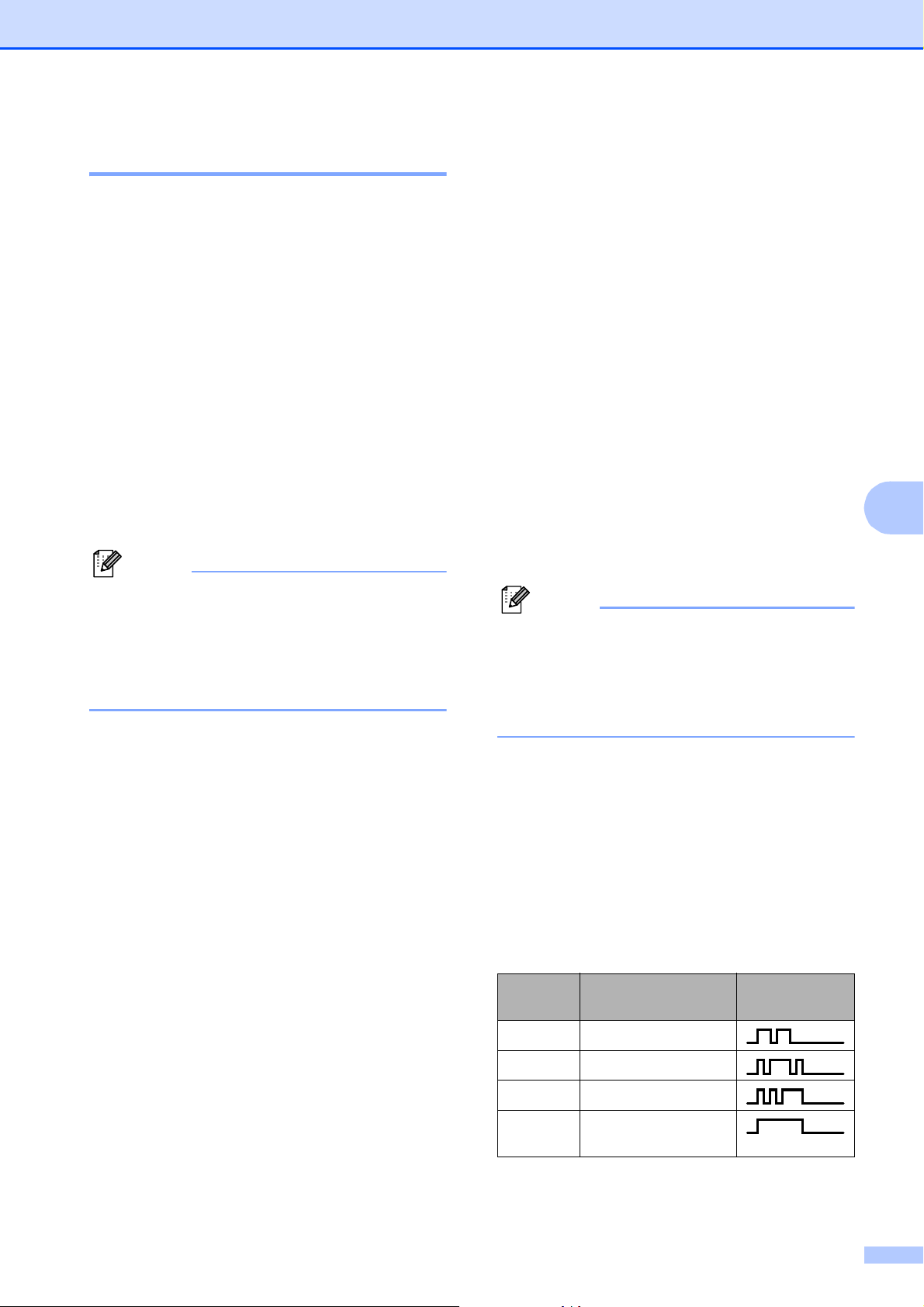
Telephone services and external devices
37
6
Distinctive Ring 6
Distinctive Ring is a function of your Brother
machine that allows a person with one line to
receive fax and voice calls through two
different phone numbers on that one line.
Brother uses the term “Distinctive Ring,” but
telephone companies market the service
under a variety of names, such as Smart
Ring, Ring Master or Ident-a-Ring. This
service establishes a second telephone
number on the same line as your existing
telephone number, and each number has its
own ring pattern. Typically, the original
number rings with the standard ring pattern
and is used for receiving voice calls, and the
second number rings with a different ring
pattern and is used for receiving faxes.
Note
• You must pay for your telephone
company's Distinctive Ring service before
you program the machine to work with it.
• Please call your telephone company for
availability and rates.
What does your telephone company's
“Distinctive Ring” do?
6
Your telephone company's Distinctive Ring
service allows you to have more than one
number on the same telephone line. If you
need more than one telephone number, it
is cheaper than paying for an extra line.
Each telephone number has its own
distinctive ring pattern, so you will know
which telephone number is ringing. This is
one way you can have a separate telephone
number for your machine.
What does Brother's “Distinctive
Ring” do?
6
The Brother machine has a Distinctive Ring
feature that allows you to use your machine to
take full advantage of the telephone
company's Distinctive Ring service. The new
telephone number on your line can just
receive faxes.
Do you have Voice Mail? 6
If you have Voice Mail on the telephone line
that you will install your new machine on,
there is a strong possibility that Voice Mail
and the machine will conflict with each other
while receiving incoming calls. However, the
Distinctive Ring feature allows you to use
more than one number on your line, so
both Voice Mail and the machine can work
together without any problems. If each one
has a separate telephone number, neither will
interfere with the other's operations.
If you decide to get Distinctive Ring service
from the telephone company, you will need to
follow the directions in Registering the
Distinctive Ring pattern to register the new
Distinctive Ring pattern they give you. This is
so your machine can recognize its incoming
calls.
Note
You can change or cancel the Distinctive
Ring pattern at any time. You can switch it
off temporarily, and turn it back on later.
When you get a new fax number, make
sure you reset this feature.
Before you choose the ring pattern to
register
6
You can only register one Distinctive Ring
pattern with the machine. Some ring patterns
cannot be registered. The ring patterns below
are supported by your Brother machine.
Register the one your telephone company
gives you.
Ring
Pattern
Rings
1 long-long
2 short-long-short
3 short-short-long
4very long
(normal pattern)

Chapter 6
38
Note
Ring Pattern #1 is often called Short-Short
and is the most commonly used.
If the ring pattern you received is not on
this chart, please call your telephone
company and ask for one that is
shown.
The machine will only answer calls to its
registered number.
The first two rings are silent on the
machine. This is because the fax must
“listen” to the ring pattern (to compare it to
the pattern that was “registered”). Other
telephones on the same line will ring.
If you program the machine properly, it will
recognize the registered ring pattern of the
“fax number” within 2 ring patterns and
then answer with fax tones. When the
“voice number” is called, the machine will
not answer.
Registering the Distinctive Ring
pattern
6
Very Important !
After you have set the Distinctive Ring feature
to On, your Distinctive Ring number will
receive faxes automatically. The Receive
Mode is automatically set to Manual and you
cannot change it to another Receive Mode
while Distinctive Ring is set to On. This
ensures the Brother machine will only answer
the Distinctive Ring number and will not
interfere when your main telephone number
is called. When Distinctive Ring is on, the
screen will show D/R as the Receive Mode.
a Press Menu.
b Press s or t to display Fax.
c Press Fax.
d Press s or t to display
Miscellaneous.
e Press Miscellaneous.
f Press Distinctive.
g Press Set.
h Press the stored ring pattern you want to
use.
Press OK.
(You will hear each ring pattern as you
press its number. Make sure you
choose the pattern that the telephone
company gave you.)
i Press Stop/Exit.
Distinctive Ring is now set to On.
Turning off Distinctive Ring 6
a Press Menu.
b Press s or t to display Fax.
c Press Fax.
d Press s or t to display
Miscellaneous.
e Press Miscellaneous.
f Press Distinctive.
g Press s or t to display Off.
h Press Off.
i Press Stop/Exit.
Note
If you turn off Distinctive Ring, the
machine will stay in Manual mode. You
will need to set the Receive Mode again.
(See Choose the correct Receive Mode
uu page 31.)
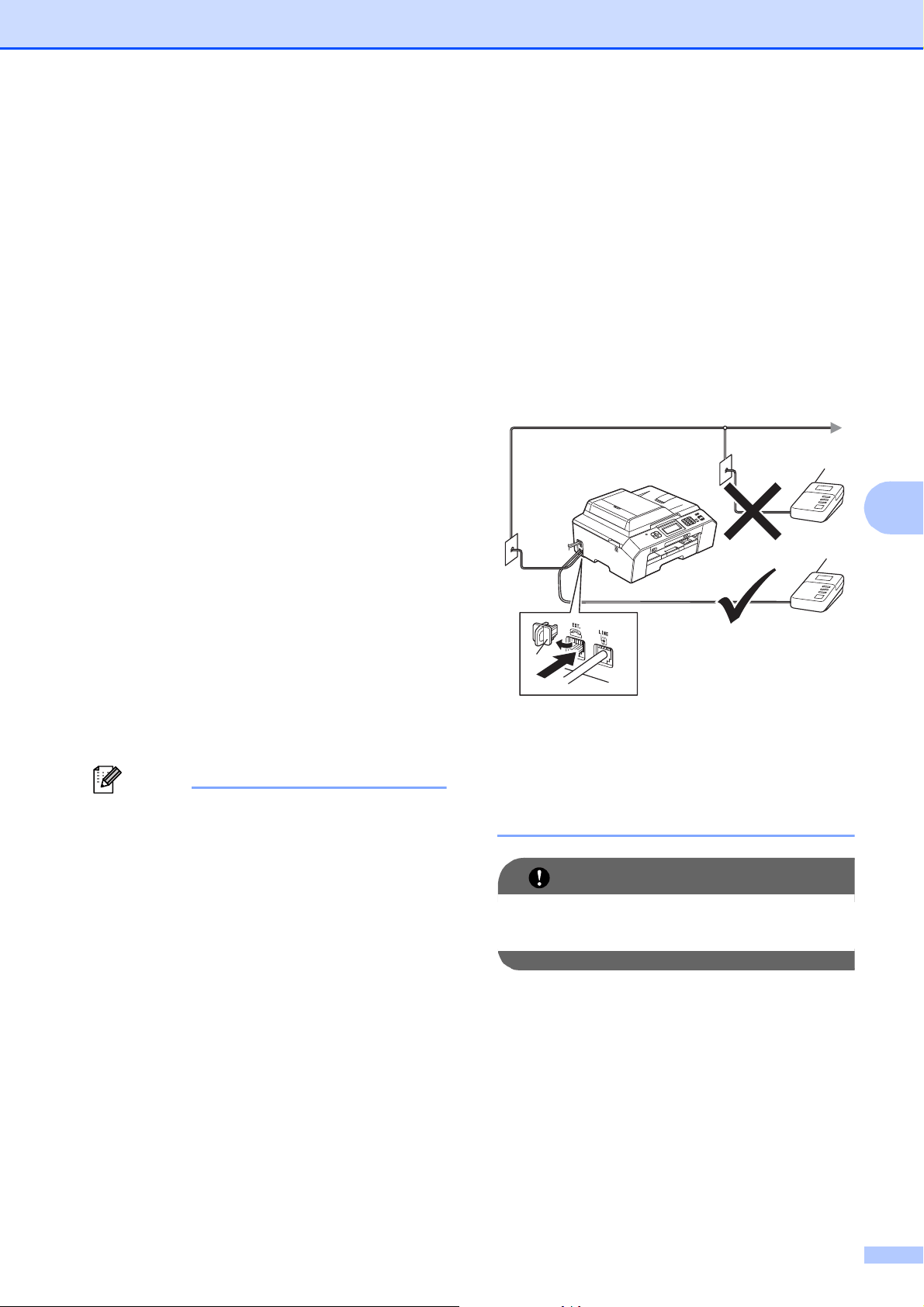
Telephone services and external devices
39
6
Connecting an external
TAD (telephone
answering device)
6
You may choose to connect an external
answering device. However, when you have
an external TAD on the same telephone line
as the machine, the TAD answers all calls
and the machine “listens” for fax calling
(CNG) tones. If it hears them, the machine
takes over the call and receives the fax. If it
does not hear CNG tones, the machine lets
the TAD continue playing your outgoing
message so your caller can leave you a voice
message.
The TAD must answer within four rings (the
recommended setting is two rings). The
machine cannot hear CNG tones until the
TAD has answered the call, and with four
rings there are only 8 to 10 seconds of CNG
tones left for the fax “handshake.” Make sure
you carefully follow the instructions in this
guide for recording your outgoing message.
We do not recommend using the toll saver
feature on your external answering machine if
it exceeds five rings.
Note
• If you do not receive all your faxes,
shorten the Ring Delay setting on your
external TAD.
• If you subscribe to your telephone
company's Distinctive Ring service:
You may connect an external TAD to a
separate wall jack only if you subscribe to
your telephone company's Distinctive
Ring service, have registered the
distinctive ring pattern on your machine,
and use that number as a fax number. The
recommended setting is at least four rings
on the external TAD when you have the
telephone company's Distinctive Ring
service. You cannot use the Toll Saver
setting.
• If You Do Not Subscribe to the
Distinctive Ring Service:
You must plug your TAD into the EXT.
jack of your machine. If your TAD is
plugged into a wall jack, both your
machine and the TAD will try to control the
telephone line. (See the illustration
below.)
• Before you connect the external TAD,
remove the protective cap (2) from the
EXT. jack on the machine.
1TAD
2 Protective Cap
When the TAD answers a call, the screen
shows Telephone.
IMPORTANT
DO NOT connect a TAD elsewhere on the
same telephone line.
1
1
2
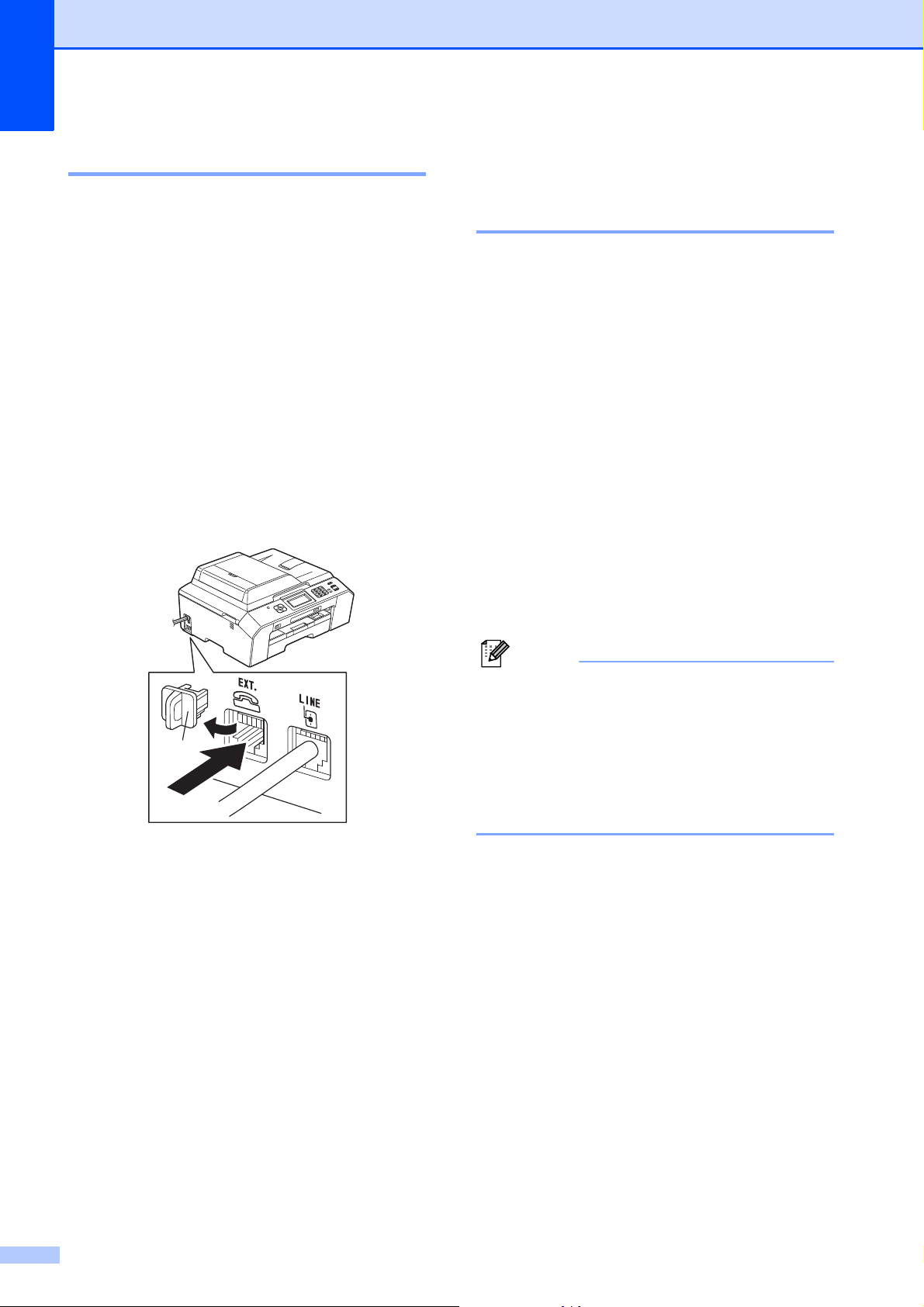
Chapter 6
40
Connections 6
The external TAD must be plugged into the
jack labeled EXT. Your machine cannot work
properly if you plug the TAD into a wall jack
(unless you are using Distinctive Ring).
a Plug the telephone line cord from the
telephone wall jack into the jack labeled
LINE.
b Remove the protective cap (1) from the
jack labeled EXT., and then plug the
telephone line cord from the external
TAD into the EXT. jack. (Make sure this
cord is connected to the TAD at the
TAD's telephone line jack, and not its
handset jack.)
c Set your external TAD to four rings or
less. (The machine's Ring Delay setting
does not apply.)
d Record the outgoing message on your
external TAD.
e Set the TAD to answer calls.
f Set the Receive Mode to
External TAD. (See Choose the
correct Receive Mode uu page 31.)
Recording an outgoing
message (OGM) on the
external TAD 6
Timing is important in recording this
message. The way you record this message
will affect both manual and automatic fax
reception.
a Record 5 seconds of silence at the
beginning of your message. (This allows
your machine time to listen for the fax
CNG tones of automatic transmissions
before they stop.)
b Limit your speaking to 20 seconds.
c End your 20-second message by giving
your Fax Receive Code for people
sending manual faxes. For example:
“After the beep, leave a message or
send a fax by pressing l 51 and Start.”
Note
We recommend beginning your OGM with
an initial 5-second silence because the
machine cannot hear fax tones over a
resonant or loud voice. You may try
omitting this pause, but if your machine
has trouble receiving, then you must
re-record the OGM to include it.
1
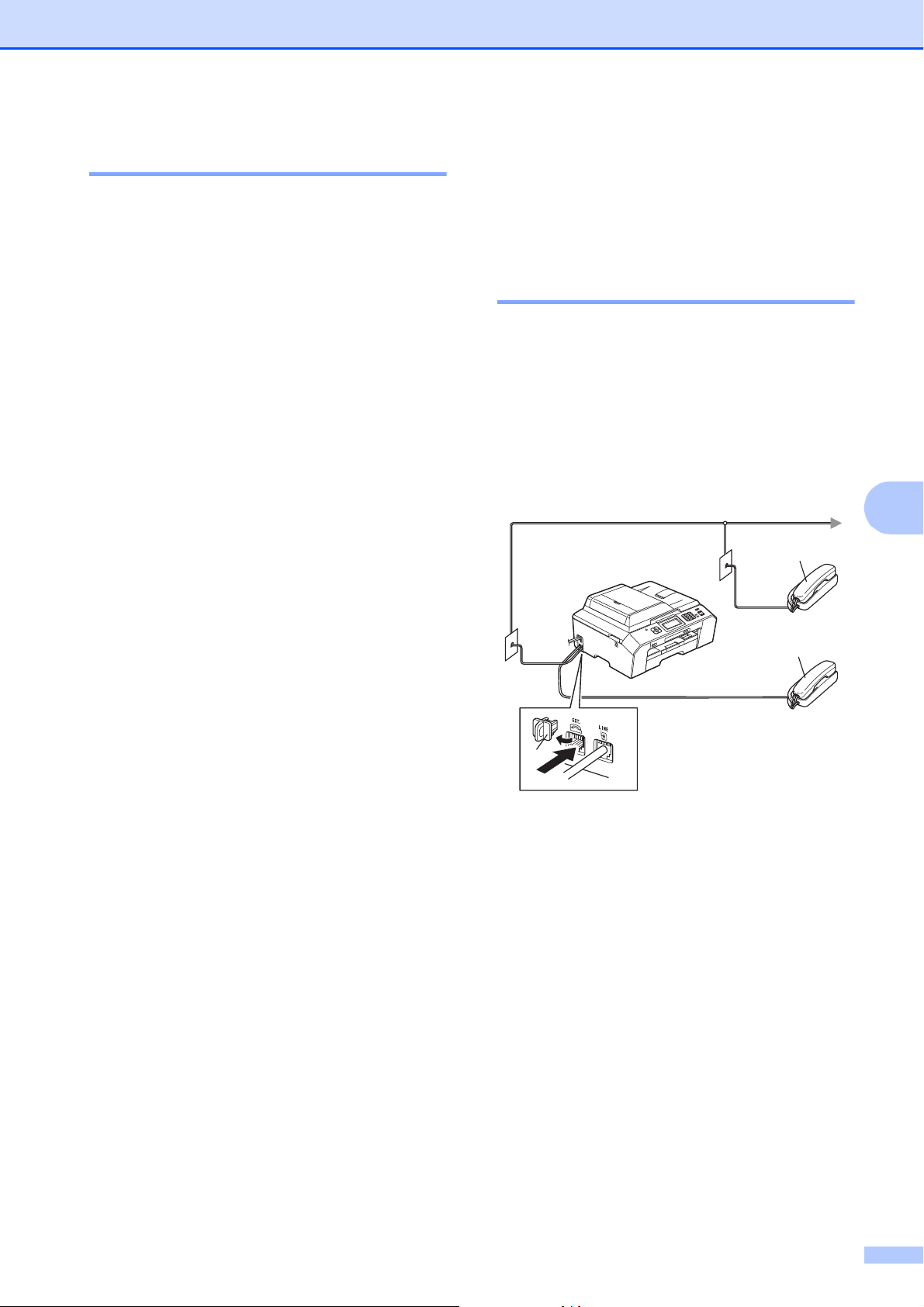
Telephone services and external devices
41
6
Multi-line connections (PBX) 6
We suggest you ask the company who
installed your PBX to connect your machine.
If you have a multi-line system we suggest
you ask the installer to connect the unit to the
last line on the system. This prevents the
machine being activated each time the
system receives telephone calls. If all
incoming calls will be answered by a
switchboard operator we recommend that
you set the Receive Mode to Manual.
We cannot guarantee that your machine will
operate properly under all circumstances
when connected to a PBX. Any difficulties
with sending or receiving faxes should be
reported first to the company who handles
your PBX.
External and extension
telephones
6
Connecting an external or
extension telephone 6
You can connect a separate telephone to
your machine as shown in the diagram below.
Connect the telephone line cord to the jack
labeled EXT.
Before you connect the external telephone,
remove the protective cap (3) from the EXT.
jack on the machine.
1 Extension telephone
2 External telephone
3 Protective Cap
When you are using a telephone on the same
phone line, the screen shows Telephone.
1
2
3

Chapter 6
42
Using external and extension
telephones 6
Using extension telephones
If you answer a fax call at an extension
telephone, you can make your machine
receive the fax by pressing the Fax Receive
Code l 51.
If the machine answers a voice call and
pseudo/double-rings for you to take over, you
can take the call at an extension telephone by
pressing the Telephone Answer Code #51.
(See F/T Ring Time (Fax/Tel mode only)
uu page 34.)
Using an external telephone
(connected to the EXT. jack of the
machine)
If you answer a fax call at the external
telephone connected to the EXT. jack of the
machine, you can make the machine receive
the fax by pressing Black Start and choosing
Receive.
You can also use the Fax Receive Code
l 51.
If the machine answers a voice call and
pseudo/double-rings for you to take over, you
can take the call at the external telephone by
pressing Hook.
If you answer a call and no one is on
the line:
6
You should assume that you're receiving a
manual fax.
Press l 51 and wait for the chirp or until the
screen shows Receiving, and then hang
up.
Note
You can also use the Easy Receive
feature to make your machine
automatically take the call. (See Easy
Receive uu page 35.)
Using a non-Brother cordless
external telephone 6
If your non-Brother cordless telephone is
connected to the EXT. jack of the machine
and you typically carry the cordless handset
elsewhere, it is easier to answer calls during
the Ring Delay.
If you let the machine answer first, you will
have to go to the machine so you can press
Hook to send the call to the cordless handset.
Using remote codes 6
Fax Receive Code 6
If you answer a fax call on an extension
telephone, you can tell your machine to
receive it by dialing the Fax Receive Code
l 51. Wait for the chirping sounds and then
replace the handset. (See Easy Receive
uu page 35.)
If you answer a fax call at the external
telephone connected to the EXT. jack of the
machine, you can make the machine receive
the fax by pressing Black Start or
Color Start and choosing Receive.
Telephone Answer Code 6
If you receive a voice call and the machine is
in Fax/Tel mode, it will start to sound the F/T
(pseudo/double) ring after the initial ring
delay. If you pick up the call on an extension
telephone you can turn the F/T Ring off by
pressing #51 (make sure you press this
between the rings).
If the machine answers a voice call and
pseudo/double-rings for you to take over, you
can take the call at the external telephone
connected to the EXT. jack of the machine by
pressing Hook.

Telephone services and external devices
43
6
Changing the remote codes 6
The preset Fax Receive Code is l 51. The
preset Telephone Answer Code is #51. If
you want to, you can replace them with your
own codes.
a Press Menu.
b Press s or t to display Fax.
c Press Fax.
d Press s or t to display
Setup Receive.
e Press Setup Receive.
f Press s or t to display
Remote Codes.
g Press Remote Codes.
h Press On.
i Do one of the following.
If you want to change the Fax
Receive Code, enter the new code.
Press OK. Go to step j.
If you do not want to change the Fax
Receive Code, press OK. Go to
step j.
j Do one of the following.
If you want to change the Telephone
Answer Code, enter the new code.
Press OK. Go to step k.
If you do not want to change the
Telephone Answer Code, press OK.
Go to step k.
k Press Stop/Exit.
Note
• If you are always disconnected when
accessing your external TAD remotely, try
changing the Fax Receive Code and
Telephone Answer Code to another
three-digit code (such as ### and 999).
• Remote Codes might not work with some
telephone systems.
44
7
How to dial 7
Manual dialing 7
Press all of the digits of the fax or telephone
number.
Speed Dialing 7
a Press SpeedDial.
Or, you can press (FAX) and then
press SpeedDial.
b Do one of the following:
Press Alphabetical or
Numerical, and then press the
number you want to dial.
Press the 2-digit Speed Dial number
using the dial pad.
Note
If the screen shows Not Registered
when you enter a Speed Dial number it
means a number has not been stored at
this location.
c To send a fax, press Send a fax and
go to step d.
d Press Black Start or Color Start.
The machine scans and sends the fax.
Fax Redial 7
If you are sending a fax manually and the line
is busy, press Hook, Redial/Pause, and then
press Black Start or Color Start to try again.
Redial/Pause only works if you dialed from
the control panel. If you are sending a fax
automatically and the line is busy, the
machine will automatically redial once after
five minutes.
a Press Redial/Pause.
b Press the number you want to redial.
c Press Send a fax.
d Press Black Start or Color Start.
Note
In Real Time Transmission the automatic
redial feature does not work when you are
using the scanner glass.
Dialing and storing numbers 7
Dialing and storing numbers
45
7
Storing numbers 7
You can set up your machine to do the
following types of easy dialing: Speed Dial
and Groups for broadcasting faxes. When
you dial a Quick Dial number, the screen
shows the number.
Note
If you lose electrical power, the Quick Dial
numbers that are in the memory will not be
lost.
Storing a pause 7
When you are storing Speed Dial numbers,
you can insert one or more 3.5-second
pauses by pressing the PAUSE button on the
screen.
Storing Speed Dial numbers 7
You can store up to 100 2-digit Speed Dial
locations with a name, and each name can
have two numbers. When you dial you will
only have to press a few buttons on the
screen (for example: press SpeedDial, the
number you want to call and Send a fax).
a Press SpeedDial.
b If Speed Dial numbers have already
been stored, press Alphabetical or
Numerical.
c Press More.
d Press s or t to display
Set Speed Dial.
e Press Set Speed Dial.
f Do one of the following:
Enter the name (up to 16 characters)
by pressing the buttons on the
screen.
Press OK.
(To help you enter letters, see
Entering Text uu page 123.)
To store the number without a name,
press OK.
g Enter the first fax or telephone number
( ) by pressing the buttons on the
screen (up to 20 digits).
Press OK.
Note
If you downloaded Internet Fax:
If you want to store an E-mail address to
use with Internet fax or Scan to E-mail
server, press and enter the E-mail
address and press OK. (See Entering Text
uu page 123.)
h Do one of the following:
Enter the second fax or telephone
number ( ) by pressing the
buttons on the screen (up to 20
digits).
Press OK.
If you do not want to store a second
number, press OK.
i To choose where the number will be
stored, do one of the following:
To accept the displayed next
available Speed Dial location, press
OK.
To enter a different Speed Dial
location, press and then enter a
2-digit number using the buttons on
the screen.
Press OK.

Chapter 7
46
Note
If the 2-digit Speed Dial location you
choose is already taken, the OK button on
the screen will not work. Choose a
different location.
j When the screen displays your settings,
press OK to confirm.
k Do one of the following:
To store another Speed Dial
number, repeat steps c to j.
To finish storing numbers, press
Stop/Exit.
Changing Speed Dial names
or numbers 7
You can change or delete a Speed Dial name
or number that has already been stored.
a Press SpeedDial.
b Press Alphabetical or Numerical.
c Press More.
d Do one of the following:
Press s or t to display Change.
Press Change to edit the names or
numbers.
Press s or t to display Delete.
Press Delete.
Delete the numbers you want to
delete by pressing them to display a
red check mark.
Press OK.
Press Yes to confirm.
Go to step i.
e Press s or t to display the number you
want to change.
f Press the number you want to change.
g Do one of the following:
If you want to change the name,
press Name.
Enter the new name (up to 16
characters) by pressing the buttons
on the screen. (See Entering Text
uu page 123.)
Press OK.
If you want to change the first fax or
telephone number, press .
Enter the new fax or telephone
number (up to 20 digits) by pressing
the buttons on the screen.
Press OK.
If you want to change the second
Fax/Tel number, press .
Enter the new fax or telephone
number (up to 20 digits) by pressing
the buttons on the screen.
Press OK.
Note
How to change the stored name or
number:
If you want to change a character, press
d or c to position the cursor under the
character you want to change, and then
press . Re-enter the character.
If you want to change a stored number,
press repeatedly to delete the number.
Enter the new number.
h The screen will display your settings.
Do one of the following:
Press OK to finish.
To change another Speed Dial
number, repeat steps e to h.
To change more details, go to g.
i Press Stop/Exit.
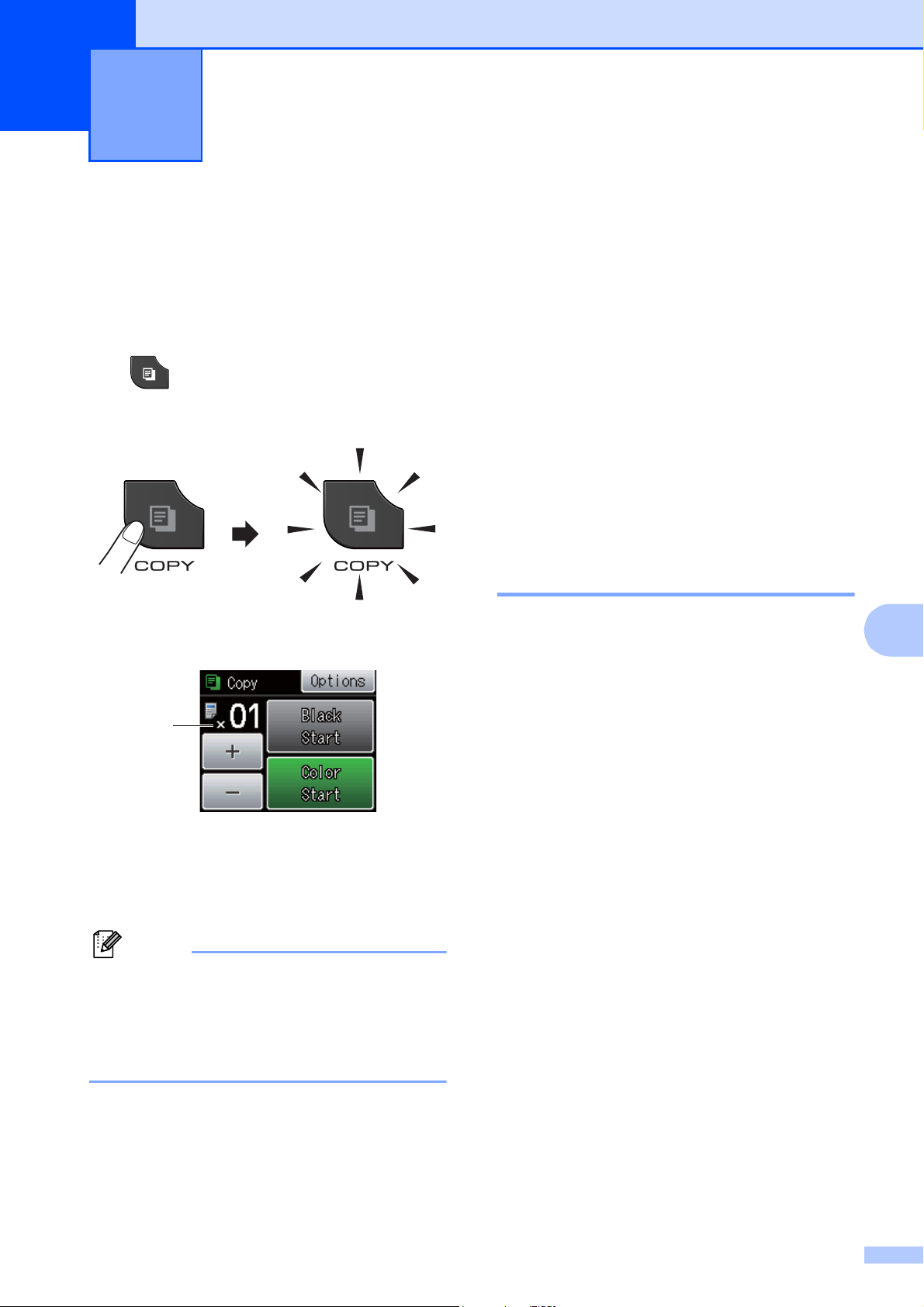
47
8
8
How to copy 8
The following steps show the basic copy
operation.
a When you want to make a copy, press
(COPY) to illuminate it in blue.
Make sure you are in COPY mode.
The screen shows:
1 No. of Copies
You can enter the number of copies by
pressing - or + on the screen (as shown
above) or by using the dial pad.
Note
The default setting is FAX mode. You can
change the amount of time that the
machine stays in COPY mode after the
last copy operation.
(uuAdvanced User’s Guide: Mode Timer)
b Do one of the following to load your
document:
Place the document face up in the
ADF.
(See Using the ADF uu page 24.)
Place the document face down on
the scanner glass.
(See Using the scanner glass
uu page 25.)
c If you want more than one copy, enter
the number (up to 99).
d Press Black Start or Color Start.
Stop copying 8
To stop copying, press Stop/Exit.
Making copies 8
1

Chapter 8
48
Copy settings 8
You can change the following copy settings.
Press COPY and then press Options. Press
s or t to scroll through the copy settings.
When the setting you want is displayed, press
it and choose your option.
(Basic User’s Guide)
For details about changing the following copy
settings uu page 48.
Paper Type
Paper Size
(Advanced User’s Guide)
For details about changing the following copy
settings
uuAdvanced User’s Guide: Copy settings
Quality
Enlarge/Reduce
Page Layout
2in1(ID)
Stack/Sort
Density
Duplex Copy
Ink Save Mode
Thin Paper Copy
Book Copy
Set New Default
Factory Reset
Note
If you want to sort copies, use the ADF.
Paper Options 8
Paper Type 8
If you are copying on special paper, set the
machine for the type of paper you are using to
get the best print quality.
a Press (COPY).
b Load your document.
c Enter the number of copies you want.
d Press Options.
e Press s or t to display Paper Type.
f Press Paper Type.
g Press s or t to display Plain Paper,
Inkjet Paper, Brother BP71,
Brother BP61, Other Glossy or
Transparency, and then press the
option you want.
h If you do not want to change additional
settings, press Black Start or
Color Start.

Making copies
49
8
Paper Size 8
If you are copying on paper other than Letter
size, you will need to change the Paper Size
setting. You can copy only on Letter, Legal,
Ledger, A4, A5, A3, Executive or
Photo 4" 6" (10 15 cm) paper.
a
Press (COPY).
b Load your document.
c Enter the number of copies you want.
d Press Options.
e Press s or t to display Paper Size.
f Press Paper Size.
g Press s or t to display Letter,
Legal, Ledger, A4, A5, A3, EXE or
4"x6", and then press the option you
want.
h If you do not want to change additional
settings, press Black Start or
Color Start.

50
9
PhotoCapture Center™
operations
(PHOTO mode)
9
Even if your machine is not connected to your
computer, you can print photos directly from
digital camera media or a USB Flash memory
drive. (See Print Images uu page 53.)
You can scan documents and save them
directly to a memory card or USB Flash
memory drive. (See How to scan to a memory
card or USB Flash memory drive
uu page 54.)
If your machine is connected to a computer,
you can use your computer to access a
memory card or USB Flash memory drive that
is inserted in the front of the machine.
uuSoftware User’s Guide: PhotoCapture
Center™ (Windows
®
)
uuSoftware User’s Guide: Remote Setup &
PhotoCapture Center™ (Macintosh)
Using a memory card or USB
Flash memory drive 9
Your Brother machine has media drives
(slots) for use with the following popular
digital camera media: Memory Stick™,
Memory Stick PRO™, Memory Stick Duo™,
Memory Stick PRO Duo™, SD Memory Card,
SDHC Memory Card, SDXC Memory Card,
MultiMedia Card, MultiMedia Card plus and
USB Flash memory drives.
The PhotoCapture Center™ feature lets you
print digital photos from your digital camera at
high resolution to get photo quality printing.
PhotoCapture Center™: Printing
photos from a memory card or
USB Flash memory drive
9
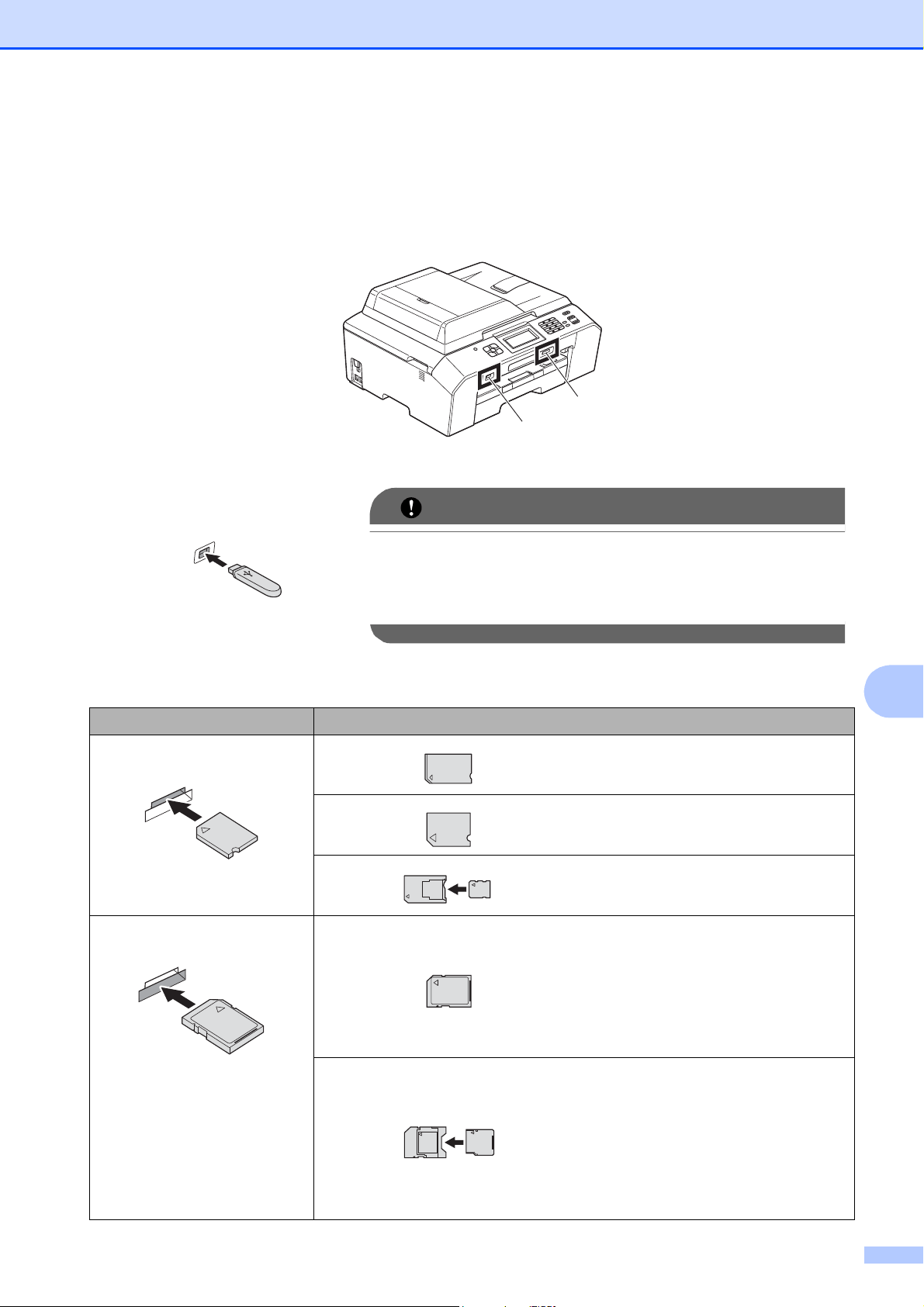
PhotoCapture Center™: Printing photos from a memory card or USB Flash memory drive
51
9
Getting started 9
Firmly put a memory card or USB Flash memory drive into the correct slot.
1 USB Flash memory drive
IMPORTANT
The USB direct interface supports only a USB Flash
memory drive, a PictBridge-compatible camera, or a
digital camera that uses the USB mass storage standard.
Any other USB devices are not supported.
2 Memory card slot
Slot Compatible memory cards
Upper slot
Memory Stick™
Memory Stick PRO™
Memory Stick Duo™
Memory Stick PRO Duo™
Memory Stick Micro™
(Adapter required)
Lower slot
SD Memory Card
SDHC Memory Card
SDXC Memory Card
MultiMedia Card
MultiMedia Card plus
mini SD (Adapter required)
mini SDHC (Adapter required)
micro SD (Adapter required)
micro SDHC (Adapter required)
MultiMedia Card mobile
(Adapter required)
2
1
Chapter 9
52
IMPORTANT
DO NOT insert a Memory Stick Duo™ into the lower SD slot. Doing this may cause damage
to the machine.
PHOTO key lights:
PHOTO light is on, the memory card or USB Flash memory drive is properly inserted.
PHOTO light is off, the memory card or USB Flash memory drive is not properly inserted.
PHOTO light is blinking, the memory card or USB Flash memory drive is being read or written
to.
IMPORTANT
DO NOT unplug the power cord or remove the memory card or USB Flash memory drive from
the media drive (slot) or USB direct interface while the machine is reading or writing to the
memory card or USB Flash memory drive (the PHOTO key is blinking). You will lose your
data or damage the card.
The machine can only read one memory card or USB Flash memory drive at a time.
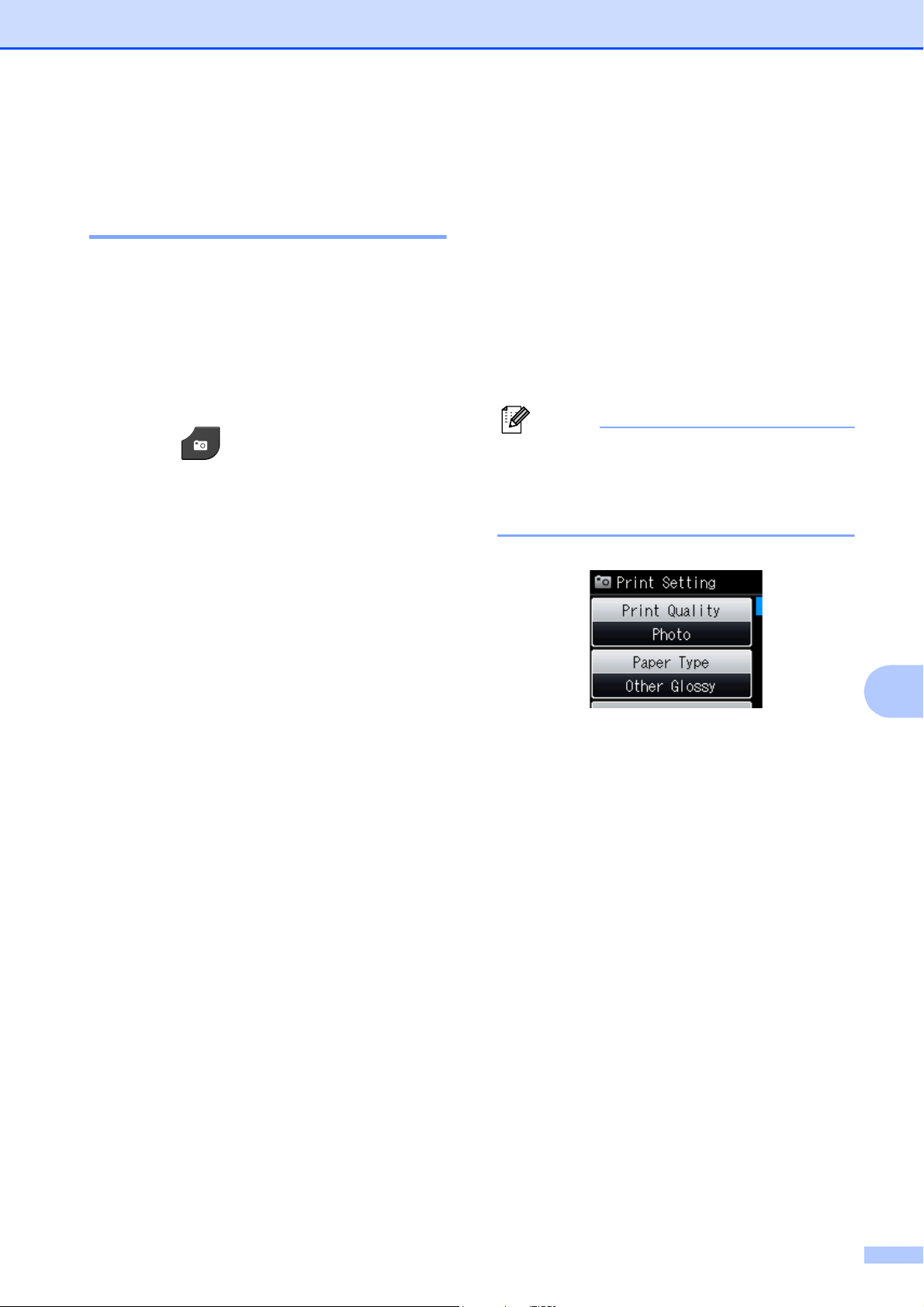
PhotoCapture Center™: Printing photos from a memory card or USB Flash memory drive
53
9
Print Images 9
View Photos 9
You can preview your photos on the screen
before you print them. If your photos are large
files there may be a delay before each photo
is displayed on the screen.
a Make sure you have put the memory
card or USB Flash memory drive in the
proper slot.
Press (PHOTO).
b Press View Photos.
c Press s or t to display the photo you
want to print.
d Press + or - to select the number of
copies you want to print.
e Repeat step c and d until you have
chosen all the photos you want to print.
Press OK.
f You now have the following options.
If you want to change the print
settings, press Options.
(uuAdvanced User’s Guide:
PhotoCapture Center™ print
settings)
If you do not want to change any
settings, go to step g.
g Press Color Start to print.
PhotoCapture Center™
print settings
9
You can change the print settings for the next
printing.
These settings are temporary, and the
machine returns to its default settings
3 minutes after printing unless you have set
the Mode Timer to 2 minutes or less.
(uuAdvanced User’s Guide: Mode Timer)
Note
You can save the print settings you use
most often by setting them as the default.
(uuAdvanced User’s Guide: Setting your
changes as the new default)
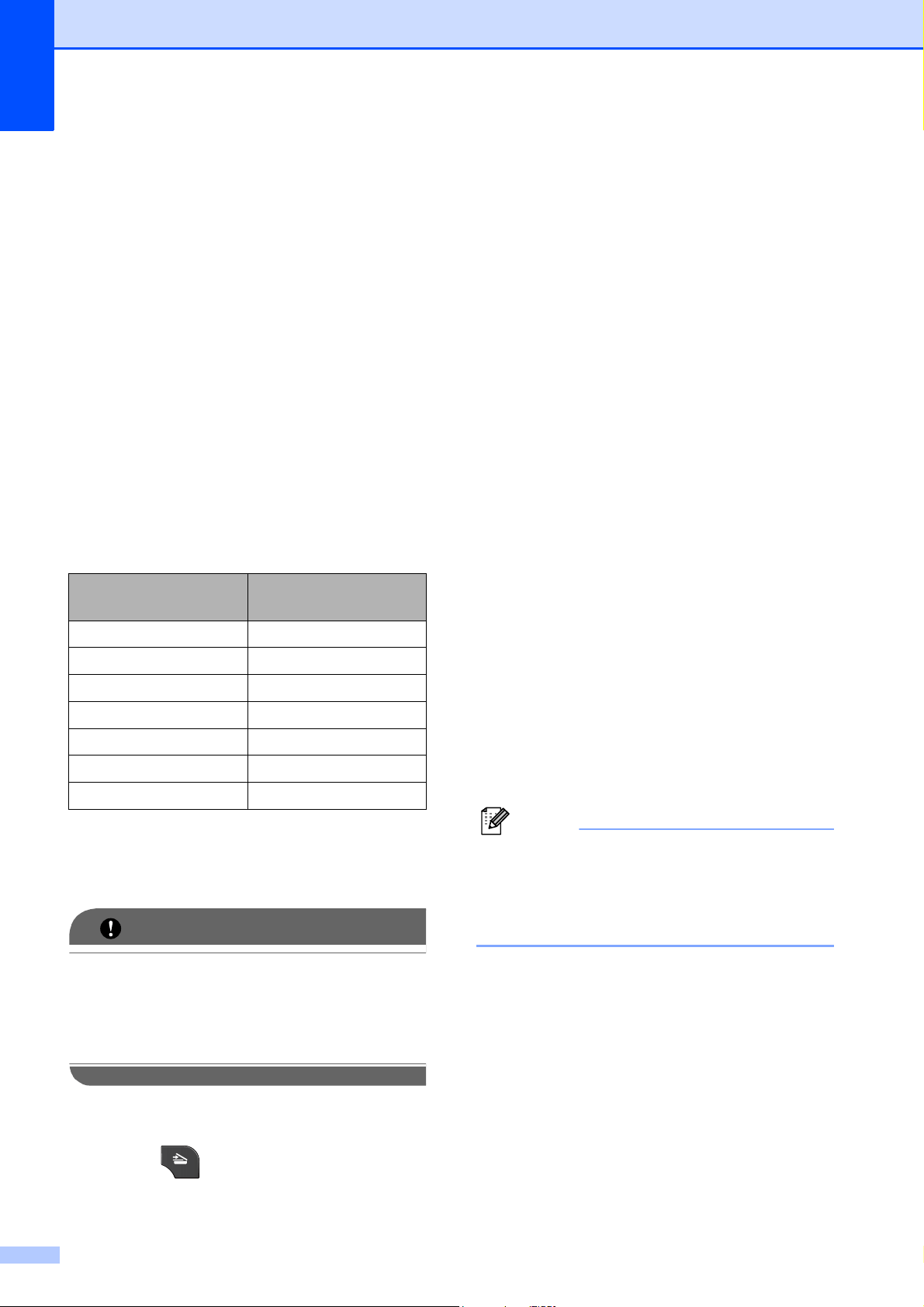
Chapter 9
54
How to scan to a
memory card or USB
Flash memory drive
9
You can scan black & white and color
documents into a memory card or USB Flash
memory drive. Black & white documents will
be stored in PDF (*.PDF) or TIFF (*.TIF) file
formats. Color documents may be stored in
PDF (*.PDF) or JPEG (*.JPG) file formats.
The factory setting is Color 200 dpi and
the default file format is PDF. The machine
automatically creates file names based on
the current date. (uuQuick Setup Guide) For
example, the fifth image scanned on July 1,
2011 would be named 07011105.PDF. You
can change the color and quality.
a Make sure you have put the memory
card or USB Flash memory drive in the
proper slot.
IMPORTANT
DO NOT take out the memory card or
USB Flash memory drive while PHOTO is
blinking to avoid damaging the card, USB
Flash memory drive, or the data stored on
them.
b Load your document.
c Press (SCAN).
d Press s or t to display
Scan to Media.
e Press Scan to Media.
f Press Options.
Do one of the following:
To change the quality, press s or t
to display Quality.
Press Quality and choose
Color 100 dpi,
Color 200 dpi,
Color 300 dpi,
Color 600 dpi, B/W 100 dpi,
B/W 200 dpi or B/W 300 dpi.
To change the file type, press s or t
to display File Type.
Press File Type and choose PDF,
JPEG or TIFF.
If you want to change the file name,
press s or t to display File Name.
Press File Name and enter the file
name.
You can only change the first
6 characters.
Press OK.
To start scanning without changing
additional settings, go to step g.
Note
• If you chose color in the resolution setting,
you cannot choose TIFF.
• If you chose black & white in the resolution
setting, you cannot choose JPEG.
g Press Black Start or Color Start.
Quality Selectable File
Format
Color 100 dpi JPEG / PDF
Color 200 dpi JPEG / PDF
Color 300 dpi JPEG / PDF
Color 600 dpi JPEG / PDF
B/W 100 dpi TIFF / PDF
B/W 200 dpi TIFF / PDF
B/W 300 dpi TIFF / PDF

55
10
10
Printing a document 10
The machine can receive data from your
computer and print it. To print from a
computer, you must install the printer driver.
uuSoftware User’s Guide: Printing
(Windows
®
)
uuSoftware User’s Guide: Printing and
Faxing (Macintosh)
a Install the Brother printer driver on the
CD-ROM. (uuQuick Setup Guide)
b From your application, choose the Print
command.
c Choose the name of your machine in the
Print dialog box and click Preferences.
d Choose the settings you want in the
Properties dialog box.
Media Type
Print Quality
Paper Size
Orientation
Color/Grayscale
Ink Save Mode
Scaling
e Click OK.
f Click Print to begin printing.
How to print from a computer 10

56
11
Scanning a document 11
There are several ways to scan documents.
You can use the SCAN key on the machine or
the scanner drivers on your computer.
a To use the machine as a scanner, you
must install a scanner driver. If the
machine is on a Network, configure it
with a TCP/IP address.
Install the scanner drivers on the
CD-ROM. (uuQuick Setup Guide)
Configure the machine with a TCP/IP
address if network scanning does not
work.
uuSoftware User’s Guide:
Configuring Network Scanning for
Windows
®
uuSoftware User’s Guide:
Configuring network scanning for
Macintosh
b Load your document. (See How to load
documents uu page 24.)
Use the ADF to scan multiple pages
of documents. It feeds each sheet
automatically.
Use the scanner glass to scan a
page of a book or one sheet at a
time.
c Do one of the following:
To scan using the SCAN key, go to
Scanning using the SCAN key.
To scan using a scanner driver at
your computer, go to Scanning using
a scanner driver.
Scanning using the
SCAN key
11
For more information
uuSoftware User’s Guide: Using the Scan
key
a Press (SCAN).
b Press s or t to display the available
scan modes, and then press the scan
mode you want to use.
Scan to File
Scan to Media
Scan to Network
Scan to FTP
Scan to email
Scan to OCR
1
Scan to Image
Web Service (Web Services
Scan)
2
1
(Macintosh users)
This function is available after you download
and install Presto! PageManager from
http://nj.newsoft.com.tw/download/brother/
PM9SEInstaller_BR_multilang.dmg
2
(Windows
®
users only)
(uuSoftware User’s Guide: Using Web
Services for scanning on your network
(Windows Vista
®
SP2 or later and
Windows
®
7))
c (For network users)
Choose the computer you want to send
the data to.
d Press Start to begin scanning.
How to scan to a computer 11

How to scan to a computer
57
11
Scanning using a
scanner driver
11
uuSoftware User’s Guide: Scanning a
document using the TWAIN driver
(Windows
®
)
uuSoftware User’s Guide: Scanning a
document using the WIA driver (Windows
®
)
uuSoftware User’s Guide: Scanning a
document using the TWAIN driver
(Macintosh)
uuSoftware User’s Guide: Scanning a
document using the ICA driver (Mac OS X
10.6.x)
a Start a scanning application and click
the Scan button.
b Adjust the settings such as Resolution,
Brightness and Scan Type in the
Scanner Setup dialog box.
c Click Start or Scan to begin scanning.
Scanning using the
ControlCenter
11
uuSoftware User’s Guide: ControlCenter4
(Windows
®
)
uuSoftware User’s Guide: ControlCenter2
(Macintosh)

58
A
Replacing the ink
cartridges
A
Your machine is equipped with an ink dot
counter. The ink dot counter automatically
monitors the level of ink in each of the
four cartridges. When the machine detects an
ink cartridge is running out of ink, the machine
will display a message on the screen.
The screen will show which ink cartridge is
low or needs replacing. Be sure to follow the
screen prompts to replace the ink cartridges
in the correct order.
Even though the machine tells you to replace
an ink cartridge, there will be a small amount
of ink left in the ink cartridge. It is necessary
to keep some ink in the ink cartridge to
prevent air from drying out and damaging the
print head assembly.
CAUTION
If ink gets in your eyes, wash it out with
water at once and call a doctor if you are
concerned.
IMPORTANT
Brother strongly recommends that you do
not refill the ink cartridges provided with
your machine. We also strongly
recommend that you continue to use only
Genuine Brother Brand replacement ink
cartridges. Use or attempted use of
potentially incompatible ink and/or
cartridges in the Brother machine may
cause damage to the machine and/or may
result in unsatisfactory print quality. Our
warranty coverage does not apply to any
problem that is caused by the use of
unauthorized third-party ink and/or
cartridges. To protect your investment and
obtain premium performance from the
Brother machine, we strongly recommend
the use of Genuine Brother Supplies.
a Open the ink cartridge cover.
If one or more of the ink cartridges have
reached the end of their life, the screen
shows B&W Print Only or
Cannot Print.
Routine maintenance A
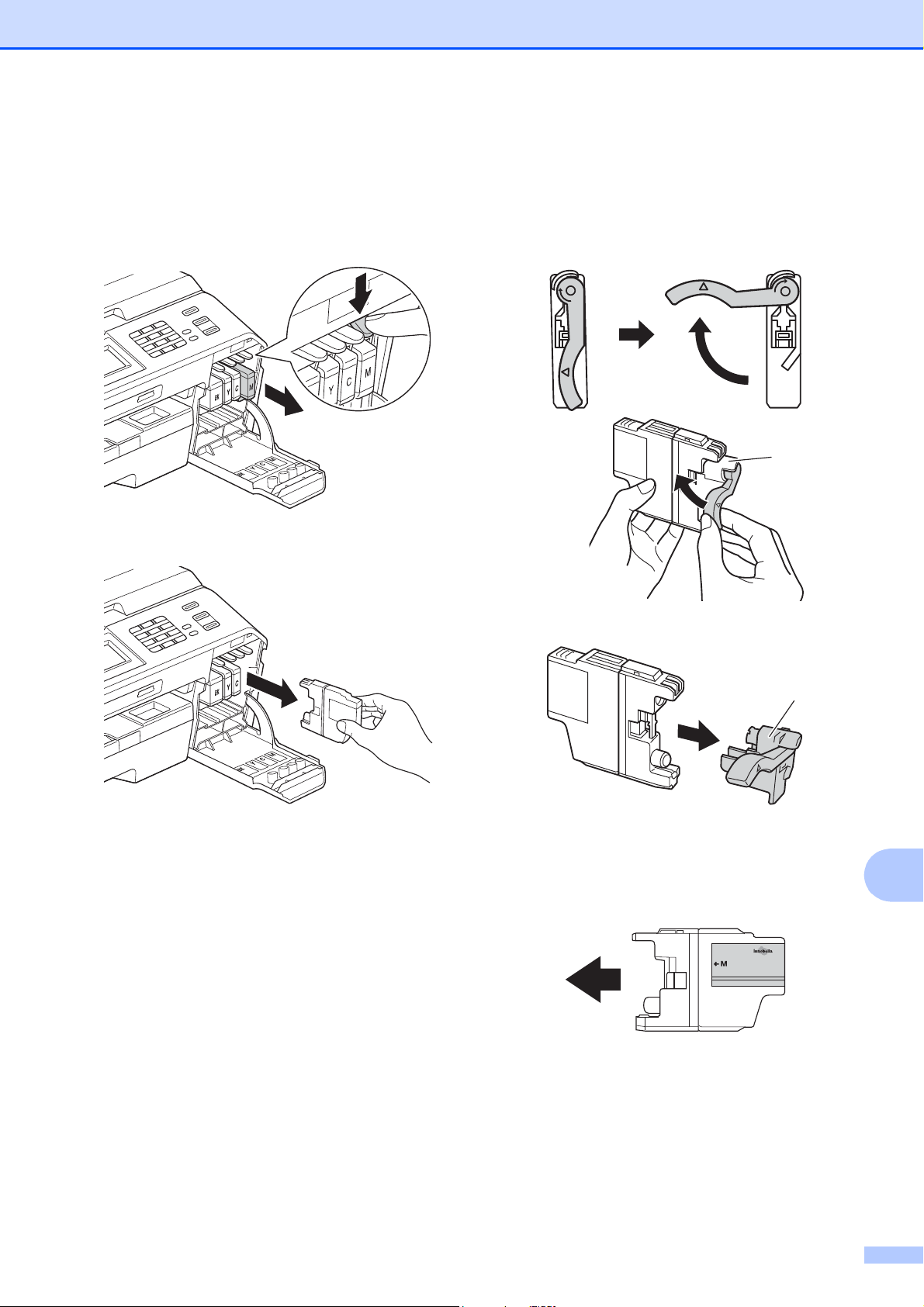
Routine maintenance
59
A
b Press the lock release lever as shown to
release the cartridge for the color
indicated on the screen. Remove the
cartridge from the machine.
c Open the new ink cartridge bag for the
color shown on the screen, and then
take out the ink cartridge.
d Turn the green release lever on the
orange protective packing (1) clockwise
until it clicks to release the vacuum seal.
Then remove the orange protective
packing as shown.
e Each color has its own correct position.
Insert the ink cartridge in the direction of
the arrow on the label.
1
1
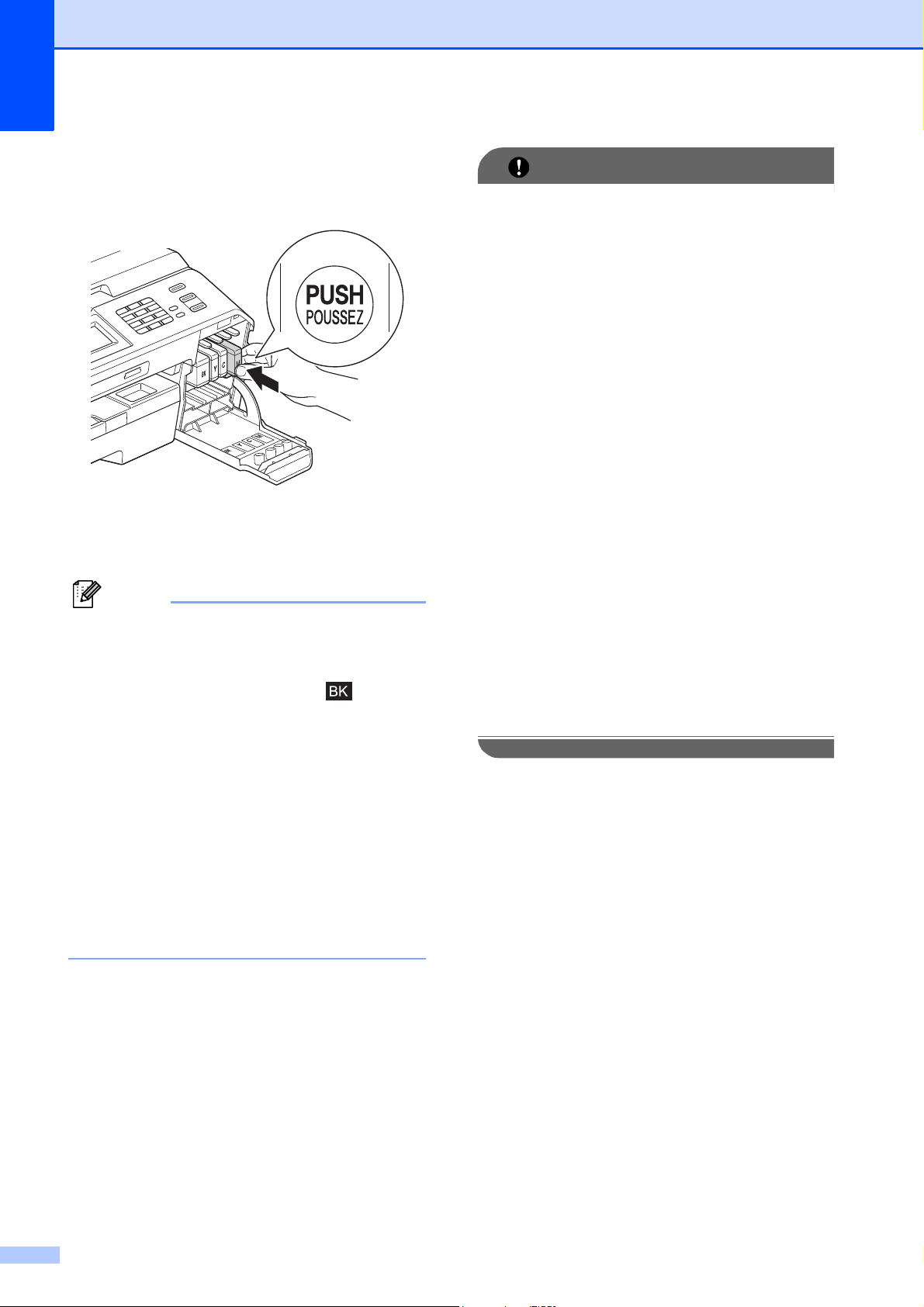
60
f Gently push the back of the ink cartridge
marked “PUSH” until it clicks, and then
close the ink cartridge cover.
g The machine will automatically reset the
ink dot counter.
Note
• If you replaced an ink cartridge, for
example Black, the screen may ask you to
verify that it was a brand new one (for
example, Did You Change Black).
For each new cartridge you installed,
press Yes to automatically reset the ink
dot counter for that color. If the ink
cartridge you installed is not a brand new
one, be sure to press No.
• If the screen shows No Ink Cartridge
or Cannot Detect after you install the
ink cartridge, check that the ink cartridge
is installed properly. Remove the ink
cartridge and reinstall it slowly until it
clicks.
IMPORTANT
• DO NOT take out ink cartridges if you do
not need to replace them. If you do so, it
may reduce the ink quantity and the
machine will not know the quantity of ink
left in the cartridge.
• DO NOT touch the cartridge insertion
slots. If you do so, the ink may stain your
skin.
• If ink gets on your skin or clothing
immediately wash it off with soap or
detergent.
• If you mix the colors by installing an ink
cartridge in the wrong position, clean the
print head several times after correcting
the cartridge installation.
• Once you open an ink cartridge, install it in
the machine and use it up within six
months of installation. Use unopened ink
cartridges by the expiration date written on
the cartridge package.
• DO NOT dismantle or tamper with the ink
cartridge; this can cause the ink to leak out
of the cartridge.
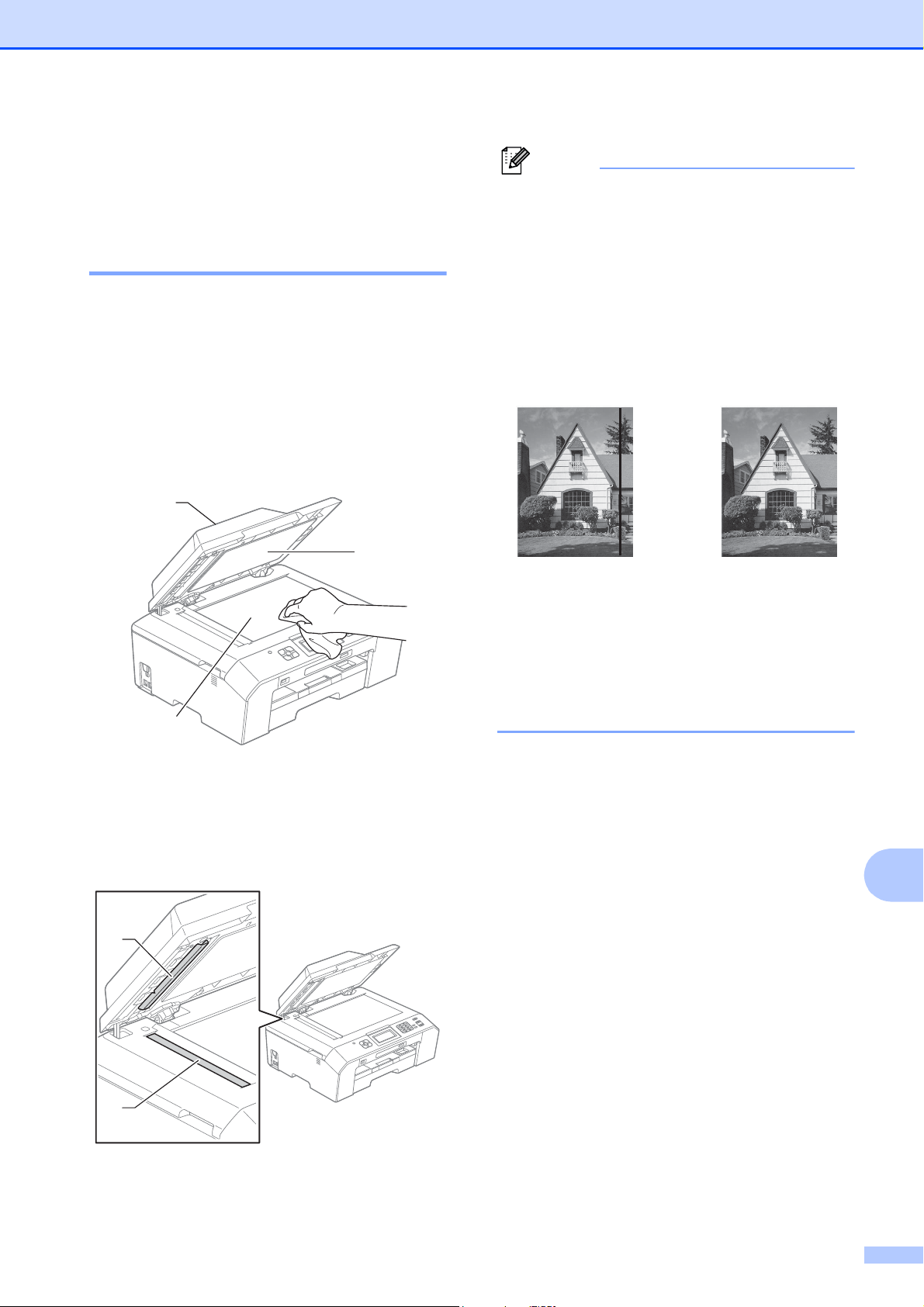
Routine maintenance
61
A
Cleaning and checking
the machine
A
Cleaning the scanner A
a Unplug the machine from the AC power
outlet.
b Lift the document cover (1). Clean the
scanner glass (2) and the white
plastic (3) with a soft lint-free cloth
moistened with a non-flammable glass
cleaner.
c In the ADF unit, clean the white bar (1)
and the glass strip (2) with a lint-free
cloth moistened with a non-flammable
glass cleaner.
Note
In addition to cleaning the scanner glass
and glass strip with a non-flammable glass
cleaner, run your fingertip over the glass
to see if you can feel anything on it. If you
feel dirt or debris, clean the glass again
concentrating on that area. You may need
to repeat the cleaning process three or
four times. To test, make a copy after each
cleaning attempt.
2
1
3
1
2
i
When there is a
spot of dirt or
correction fluid
on the glass strip
the printed
sample shows a
vertical line.
After the glass
strip is cleaned
the vertical line is
gone.
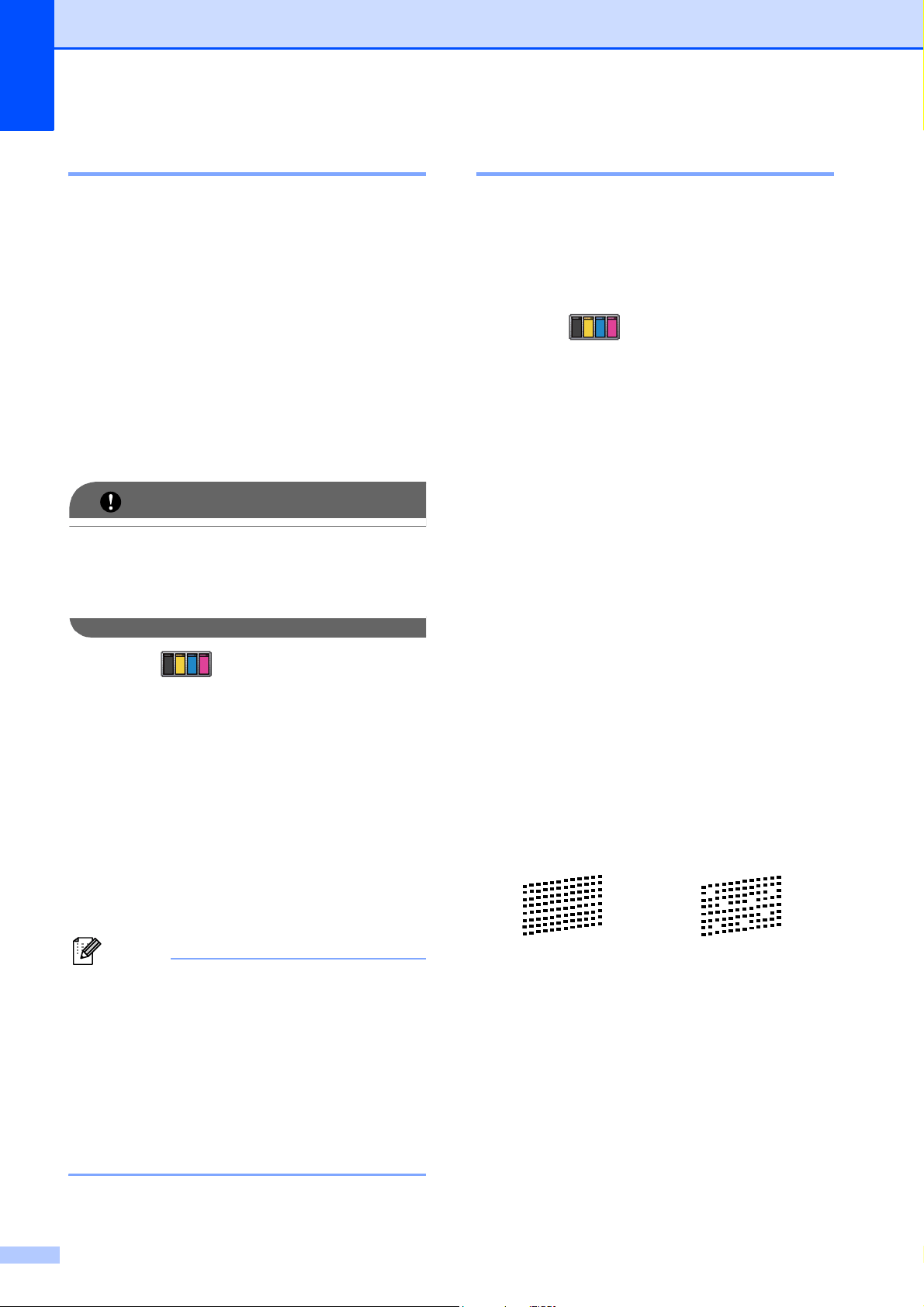
62
Cleaning the print head A
To maintain good print quality, the machine
will automatically clean the print head when
needed. You can start the cleaning process
manually if there is a print quality problem.
Clean the print head if you get a horizontal
line in the text or graphics, or blank text on
your printed pages. You can clean Black only,
three colors at a time
(Yellow/Cyan/Magenta), or all four colors at
once.
Cleaning the print head consumes ink.
Cleaning too often uses ink unnecessarily.
IMPORTANT
DO NOT touch the print head. Touching
the print head may cause permanent
damage and may void the print head's
warranty.
a Press (Ink).
b Press s or t to display Cleaning.
c Press Cleaning.
d Press s or t to display Black, Color
or All, and then press the option you
want to clean.
The machine cleans the print head.
When cleaning is finished, the machine
will go back to Ready mode
automatically.
Note
If you clean the print head at least five
times and the print has not improved, try
installing a new Genuine Brother Brand
replacement ink cartridge for each
problem color. Try cleaning the print head
again up to five more times. If the print has
not improved call Brother Customer
Service. (See Brother numbers
uu page i.)
Checking the print quality A
If faded or streaked colors and text appear on
your printouts, some of the print head nozzles
may be clogged. You can check this by
printing the Print Quality Check Sheet and
looking at the nozzle check pattern.
a Press (Ink).
b Press s or t to display Test Print.
c Press Test Print.
d Press Print Quality.
e Press Start.
The machine begins printing the Print
Quality Check Sheet.
f Check the quality of the four color blocks
on the sheet.
g The screen asks you if the print quality is
OK.
Do one of the following:
If all lines are clear and visible, press
Yes to finish the Print Quality check
and go to step k.
If you can see missing short lines as
shown below, press No.
h The screen asks you if the print quality is
OK for black and then the three colors.
Press Yes or No.
i The screen asks you if you want to start
cleaning.
Press Yes.
The machine starts cleaning the print
head.
OK Poor
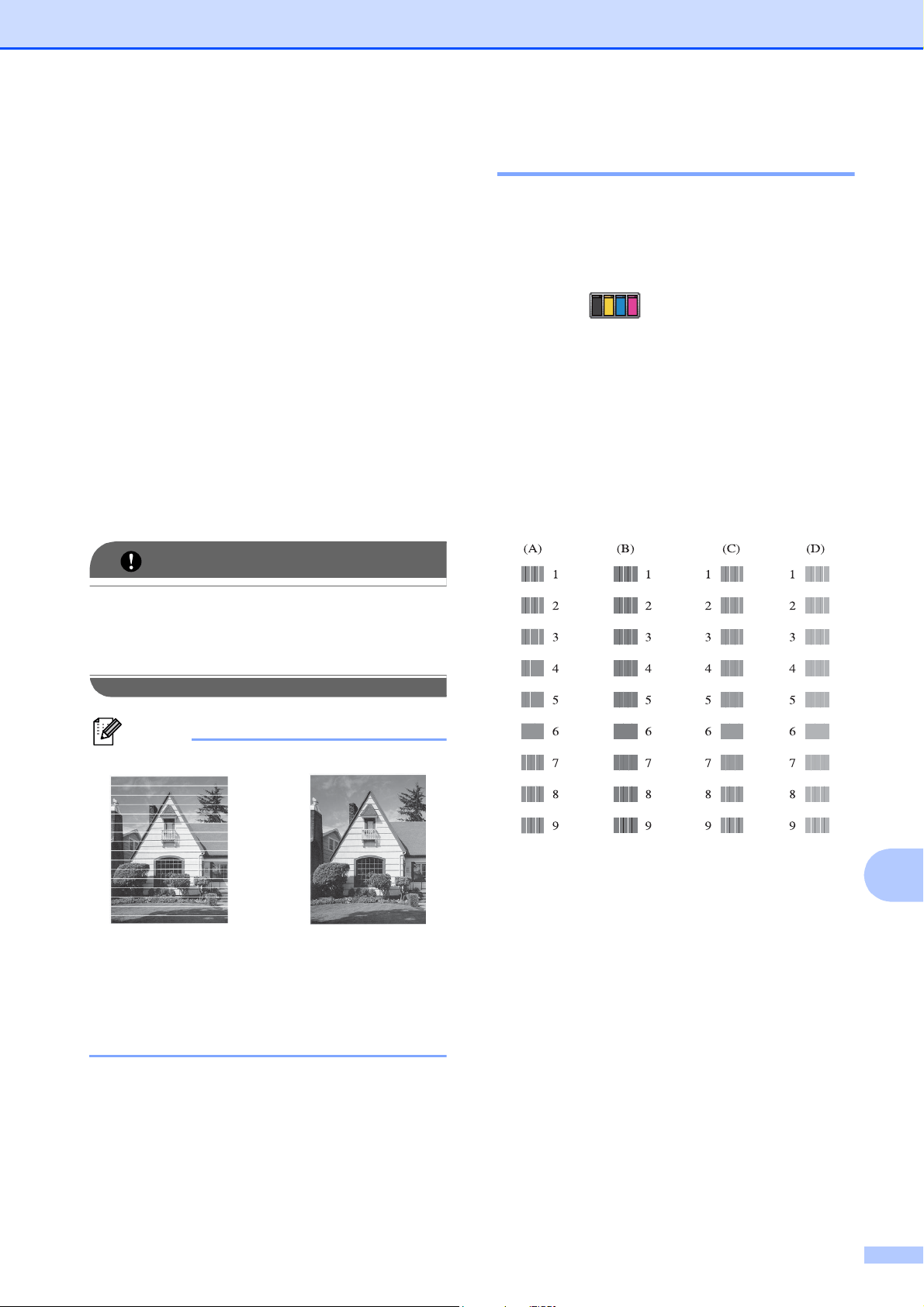
Routine maintenance
63
A
j After the cleaning procedure is finished,
press Start.
The machine starts printing the Print
Quality Check Sheet again and then
return to step f.
k Press Stop/Exit.
If you repeat this procedure at least five
times and the print quality is still poor,
replace the ink cartridge for the clogged
color.
After replacing the ink cartridge, check
the print quality. If the problem still
exists, repeat the cleaning and test print
procedures at least five times for the
new ink cartridge. If ink is still missing,
call Brother Customer Service. (See
Brother numbers uu page i.)
IMPORTANT
DO NOT touch the print head. Touching
the print head may cause permanent
damage and may void the print head's
warranty.
Note
Checking the print alignment A
You may need to adjust the print alignment
after transporting the machine if your printed
text becomes blurred or images become
faded.
a Press (Ink).
b Press s or t to display Test Print.
c Press Test Print.
d Press Alignment.
e Press Start.
The machine starts printing the
Alignment Check Sheet.
f For the “A” pattern, press the number of
the test print that has the least visible
vertical stripes (1-9).
g For the “B” pattern, press the number of
the test print that has the least visible
vertical stripes (1-9).
h For the “C” pattern, press the number of
the test print that has the least visible
vertical stripes (1-9).
i For the “D” pattern, press the number of
the test print that has the least visible
vertical stripes (1-9).
j Press Stop/Exit.
i
When a print head
nozzle is clogged
the printed
sample looks like
this.
After the print
head nozzle is
cleaned, the
horizontal lines
are gone.
64
B
Error and Maintenance messages B
As with any sophisticated office product, errors may occur and consumable items may need to be
replaced. If this happens, your machine identifies the problem and shows an error message. The
most common error and maintenance messages are shown below.
You can correct most errors and clear routine maintenance messages by yourself. If you need
more help, the Brother Solutions Center offers the latest FAQs and troubleshooting tips.
Visit us at http://solutions.brother.com/
.
Note
The information button ( ) lights up when an error message appears on the screen. Press
to display the error message screen.
Troubleshooting B

Troubleshooting
65
B
Error Message Cause Action
B&W Print Only
Replace Ink
One or more of the color ink cartridges
have reached the end of their life.
You can use the machine in
black & white mode for approximately
four weeks depending on the number
of pages you print.
While this message appears on the
screen, each operation works in the
following way:
Printing
If you choose Grayscale in the
Advanced tab of the printer driver
you can use the machine as a
black & white printer.
Duplex print is not available when
this message appears.
Copying
If the paper type is set to
Plain Paper you can make
copies in black & white.
Duplex copy is not available when
this message appears.
Faxing
If the paper type is set to
Plain Paper or
Inkjet Paper, the machine will
receive and print the faxes in
black & white.
If a sending machine has a color
fax, the machine’s “handshake”
will ask that the fax be sent as
black & white.
Replace the ink cartridges. (See
Replacing the ink cartridges
uu page 58.)
Note
The machine will stop all print
operations and you will not be able to
use the machine until you change to a
new ink cartridge in the following
cases:
• If you unplug the machine or take
out the ink cartridge.
• If the paper type is set to
Other Glossy, Brother BP71
or Brother BP61.
• (Windows
®
users) If you check
Slow Drying Paper in the Basic
tab of the printer driver.
(Macintosh users) If you check
Slow Drying Paper in the
Print Settings of the printer driver.
Cannot Detect You installed a new ink cartridge too
quickly and the machine did not detect
it.
Take out the new ink cartridge and
re-install it slowly until it clicks.
If you are not using Genuine Brother
Innobella™ ink the machine may not
detect the ink cartridge.
Use a new Genuine Brother
Innobella™ Ink Cartridge. If the error
is not cleared, call Brother Customer
Service.
An ink cartridge is not installed
properly.
Take out the new ink cartridge and
re
-install it slowly until it clicks. (See
Replacing the ink cartridges
uu page 58.)
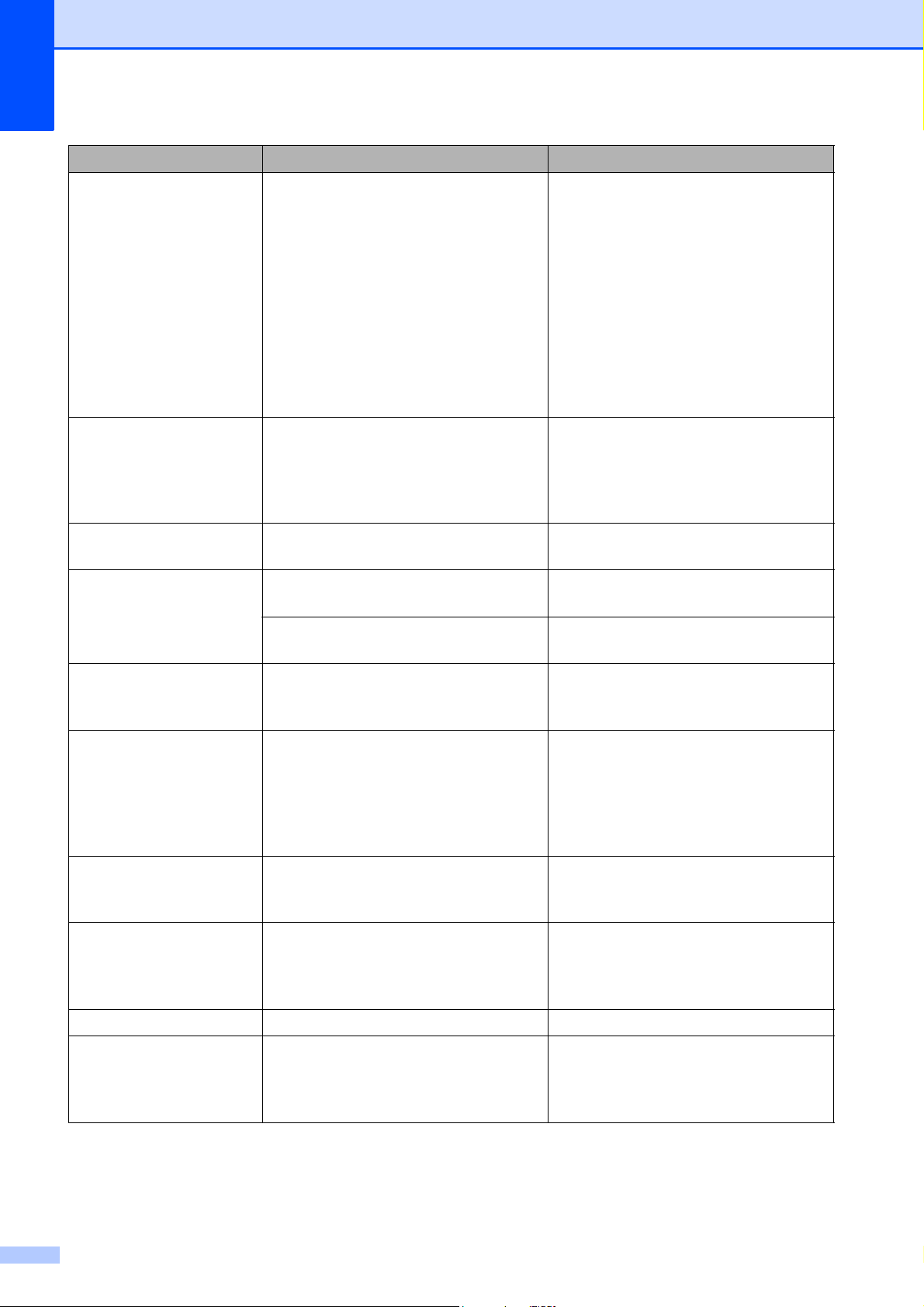
66
Cannot Print
Replace Ink
One or more of the ink cartridges have
reached the end of their life. The
machine will stop all print operations.
While memory is available, black &
white faxes will be stored in the
memory. If a sending machine has a
color fax, the machine's “handshake”
will ask that the fax be sent as black &
white. If the sending machine has the
ability to convert it, the color fax will be
stored in the memory as a black &
white fax.
Replace the ink cartridges. (See
Replacing the ink cartridges
uu page 58.)
Comm.Error Poor telephone line quality caused a
communication error.
Send the fax again or connect the
machine to another telephone line. If
the problem continues, call the
telephone company and ask them to
check your telephone line.
Connection Fail You tried to poll a fax machine that is
not in Polled Waiting mode.
Check the other fax machine's polling
setup.
Cover is Open The scanner cover is not completely
closed.
Lift the scanner cover and then close it
again.
The ink cartridge cover is not
completely closed.
Firmly close the ink cartridge cover
until it clicks.
Data Remaining Print data is left in the machine's
memory.
Press Stop/Exit. The machine will
cancel the job and clear it from the
memory. Try to print again.
Disconnected The other person or other person's fax
machine stopped the call.
Try to send or receive again.
If calls are stopped repeatedly and you
are using a VoIP (Voice over IP)
system, try changing the Compatibility
to Basic (for VoIP). (See Telephone
line interference / VoIP uu page 93.)
Document Jam The document was not inserted or fed
properly, or the document scanned
from the ADF was too long.
(See Using the ADF uu page 24.)
(See Document jam uu page 73.)
DR Mode in Use The machine is in Distinctive Ring
mode. You cannot change the
Receive Mode from Manual to
another mode.
Set Distinctive Ring to Off. (See
Turning off Distinctive Ring
uu page 38.)
High Temperature The print head is too warm. Allow the machine to cool down.
Hub is Unusable. A Hub or USB Flash memory drive
with Hub has been connected to the
USB direct interface.
Hubs, including USB Flash memory
drives that have a hub built-in, are not
supported. Unplug the device from the
USB direct interface.
Error Message Cause Action

Troubleshooting
67
B
Ink Absorber Full The ink absorber box or flushing box is
full. These components are periodic
maintenance items that may require
replacement after a period of time to
ensure optimum performance from
your Brother machine. Because these
components are periodic maintenance
items, the replacement is not covered
under the warranty. The need to
replace these items and the time
period before replacement is
dependent on the number of purges
and flushes required to clean the ink
system. These boxes acquire
amounts of ink during the different
purging and flushing operations. The
number of times a machine purges
and flushes for cleaning varies
depending on different situations. For
example, frequently powering the
machine on and off will cause
numerous cleaning cycles since the
machine automatically cleans upon
power up. The use of non-Brother ink
may cause frequent cleanings
because non-Brother ink could cause
poor print quality which is resolved by
cleaning. The more cleaning the
machine requires the faster these
boxes will fill up.
Note
Repairs resulting from the use of
non-Brother supplies may not be
covered under the stated product
warranty.
The ink absorber box or flushing box
will need to be replaced. Contact
Brother Customer Service or a Brother
Authorized Service Center to have
your machine serviced. (See Brother
numbers uu page i.)
Other reasons for cleaning are:
1 After a paper jam has been
cleared, the machine automatically
cleans itself before the next
received fax is printed.
2 The machine automatically cleans
itself after sitting idle for more than
30 days (infrequent use).
3 The machine automatically cleans
itself after ink cartridges of the
same color have been replaced
12 times.
InkAbsorberNearFull
The ink absorber box or flushing box is
nearly full.
The ink absorber box or flushing box
will need to be replaced soon. Call
Brother Customer Service or a Brother
Authorized Service Center to have
your machine serviced. (See Brother
numbers uu page i.)
Error Message Cause Action

68
Ink low One or more of the ink cartridges are
near the end of their life. If one of the
color ink cartridges is near the end of
its life and someone is sending you a
color fax, your machine’s “handshake”
will ask that the fax be sent as black &
white. If the sending machine has the
ability to convert it, the color fax will be
printed at your machine as a black &
white fax.
Order a new ink cartridge. You can
continue printing until the screen
shows Cannot Print. (See
Ordering accessories and supplies
uu page ii and Replacing the ink
cartridges uu page 58.)
Low Temperature The print head is too cold. Allow the machine to warm up.
Media Error The memory card is either corrupted,
improperly formatted, or there is a
problem with the memory card.
Remove the memory card from the
media drive (slot) of the machine and
format it properly.
Put the card firmly into the slot again to
make sure it is in the correct position.
If the error remains, check the media
drive (slot) of the machine by putting in
another memory card that you know is
working.
Media is Full. The memory card or USB Flash
memory drive you are using has no
available space or already contains
999 files.
Your machine can only save to your
memory card or USB Flash memory
drive if it contains less than 999 files.
Delete unused files to free some
space and try again.
No Caller ID There is no incoming call history. You
did not receive calls or you have not
subscribed to the Caller ID service
from your telephone company.
If you want to use the Caller ID feature
call your telephone company.
(uuAdvanced User’s Guide: Caller
ID)
No File The memory card or USB Flash
memory drive in the media drive does
not contain a .JPG file.
Put the correct memory card or USB
Flash memory drive into the slot again.
No Ink Cartridge An ink cartridge is not installed
properly.
Take out the new ink cartridge and
re
-install it slowly until it clicks. (See
Replacing the ink cartridges
uu page 58.)
Error Message Cause Action

Troubleshooting
69
B
No Paper Fed The machine is out of paper or paper
is not properly loaded in the paper
tray.
Do one of the following:
Refill the paper in the paper tray,
and then press Black Start or
Color Start.
Remove the paper and load it
again, and then press Black Start
or Color Start. (See Loading
paper and other print media
uu page 12.)
The paper is jammed in the machine. Remove the jammed paper by
following the steps in Printer jam or
paper jam uu page 75.
If this error occurs often during duplex
copying or duplex printing, the paper
feed rollers may be stained with ink.
Clean the paper feed rollers.
(uuAdvanced User’s Guide: Cleaning
the paper feed rollers)
Paper dust has accumulated on the
surface of the paper pick-up rollers
and the back sides of the paper feed
rollers.
Clean the paper pick-up rollers and
the back sides of the paper feed
rollers. (uuAdvanced User’s Guide:
Cleaning the paper pick-up rollers)
The Jam Clear Cover is not closed
properly.
Make sure the Jam Clear Cover is
closed evenly at both ends. (See
Printer jam or paper jam uu page 75.)
No Response/Busy The number you dialed does not
answer or is busy.
Verify the number and try again.
Not Registered You tried to access a Speed Dial
number that is not programmed.
Set up the Speed Dial number. (See
Storing Speed Dial numbers
uu page 45.)
Out of Fax Memory The fax memory is full. Do one of the following:
Clear the data in the memory. To
gain extra memory, you can turn
off Memory Receive.
(uuAdvanced User’s Guide:
Turning off Memory Receive
operations)
Print the faxes that are in the
memory.
(uuAdvanced User’s Guide:
Printing a fax from the memory)
Error Message Cause Action

70
Out of Memory The machine's memory is full. If a copy operation is in process:
Press Stop/Exit and wait until the
other operations in progress finish,
and then try again.
The memory card or USB Flash
memory drive you are using does not
have enough free space to scan the
document.
Press Stop/Exit.
Delete unused files from your memory
card or USB Flash memory drive to
make some free space and then try
again.
Paper Jam [Front] Paper is jammed in the machine. Remove the jammed paper by
following the steps in Paper is jammed
at the front of the machine
uu page 75.
Make sure the paper length guide is
set to the correct paper size. DO NOT
extend the paper tray when you load
A5 or smaller size paper.
PaperJam Front,Rear
Paper is jammed in the machine. Remove the jammed paper by
following the steps in Paper is jammed
at the front and back of the machine
uu page 77.
Make sure the paper length guide is
set to the correct paper size. DO NOT
extend the paper tray when you load
A5 or smaller size paper.
Paper Jam [Rear] Paper is jammed in the machine. Remove the jammed paper by
following the steps in Paper is jammed
at the back of the machine
uu page 76.
Make sure the paper length guide is
set to the correct paper size.
DO NOT extend the paper tray when
you load A5 or smaller size paper.
Paper dust has accumulated on the
surface of the paper pick-up rollers
and the back sides of the paper feed
rollers.
Clean the paper pick
-up rollers and
the back sides of the paper feed
rollers. (uuAdvanced User’s Guide:
Cleaning the paper pick-up rollers)
Screen init. Fail The Touchscreen was pressed before
the power on initialization was
completed.
Make sure that nothing is touching or
resting on the Touchscreen.
Debris may be stuck between the
lower part of the Touchscreen and its
frame.
Insert a piece of stiff paper between
the lower part of the Touchscreen and
its frame and slide it back and forth to
push out the debris.
Error Message Cause Action
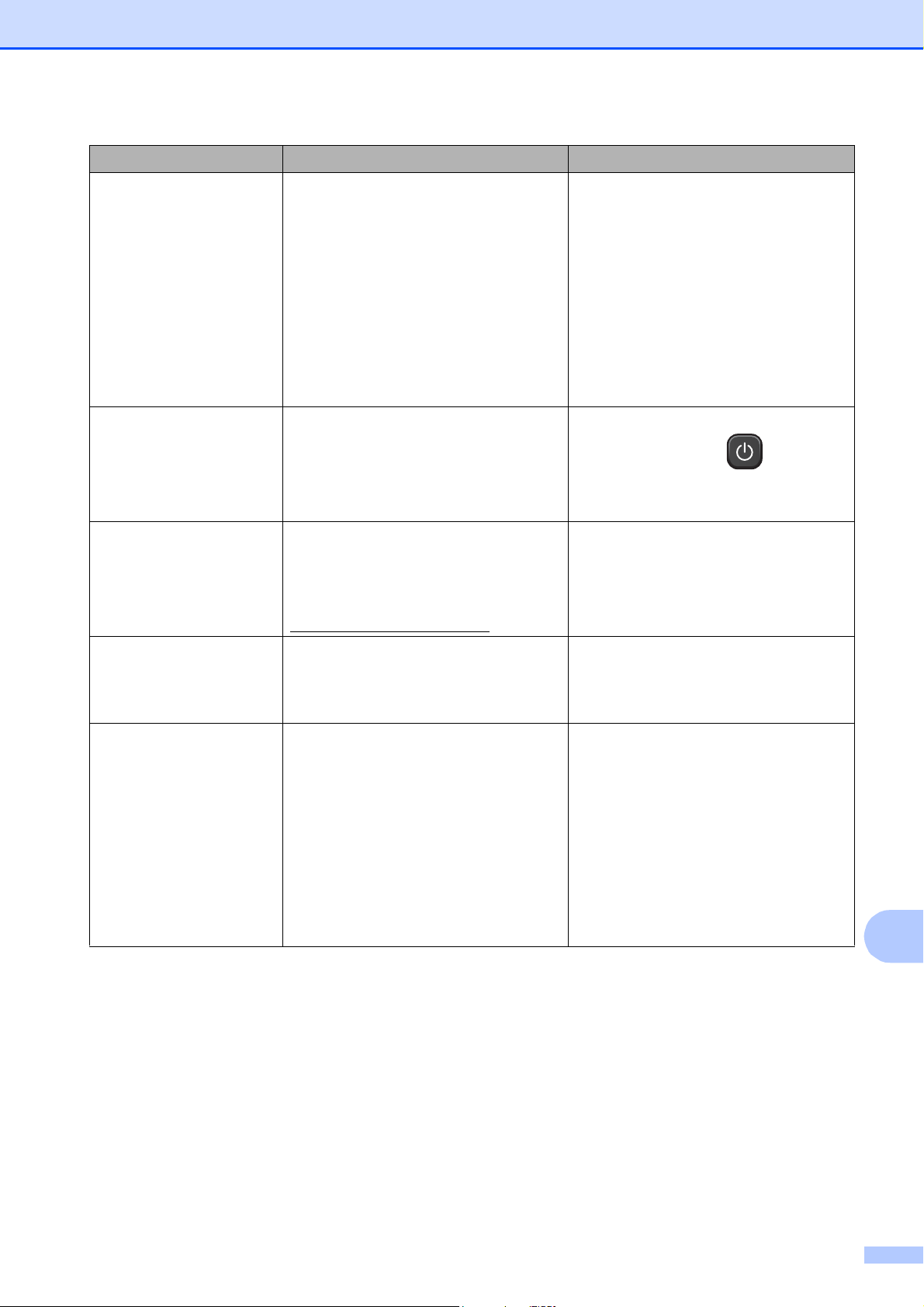
Troubleshooting
71
B
Unable to CleanXX
Unable to Init.XX
Unable to PrintXX
Unable to ScanXX
The machine has a mechanical
problem.
—OR—
A foreign object such as a paper clip or
a piece of ripped paper is in the
machine.
Open the scanner cover and remove
any foreign objects and paper scraps
from inside the machine. If the error
message continues, disconnect the
machine from the power for several
minutes and reconnect it.
(The machine can be turned off for
approximately 24 hours without losing
faxes stored in the memory. See
Transferring your faxes or Fax Journal
report uu page 72.)
Unusable Device
Disconnect device
from front connector
& turn machine off
&thenon
A broken device has been connected
to the USB direct interface.
Unplug the device from the USB direct
interface, then press On/Off to
turn the machine off and then on
again.
Unusable Device
Please Disconnect
USB Device.
A USB device or USB Flash memory
drive that is not supported has been
connected to the USB direct interface.
For more information, visit us at
http://solutions.brother.com/
.
Unplug the device from the USB direct
interface. Turn the machine off and
then on again.
Wrong Ink Color A color ink cartridge has been installed
in the Black ink cartridge position.
Check which ink cartridges are not
matched by color to their ink cartridge
positions and move them to their
proper positions.
Wrong Paper Size The Paper Size setting does not
match the size of paper in the tray. Or,
you did not set the paper guides in the
tray to the indicators for the paper size
you are using.
1 Check that the paper size you
choose matches the size of paper
in the tray.
2 Make sure you loaded the paper in
a Portrait position, by setting the
paper guides at the indicators for
your paper size.
3 After you have checked the paper
size and the paper position, press
Black Start or Color Start.
Error Message Cause Action

72
Error animation B
Error animations display step-by-step
instructions when paper gets jammed. You
can read the steps at your own pace by
pressing t to see the next step and s to go
back a step.
Transferring your faxes or Fax
Journal report B
If the screen shows:
Unable to CleanXX
Unable to Init.XX
Unable to PrintXX
Unable to ScanXX
We recommend transferring your faxes to
another fax machine or to your PC. (See
Transferring faxes to another fax machine
uu page 72 or Transferring faxes to your PC
uu page 72.)
You can also transfer the Fax Journal report
to see if there are any faxes you need to
transfer. (See Transferring the Fax Journal
report to another fax machine uu page 73.)
Transferring faxes to another fax
machine
B
If you have not set up your Station ID, you
cannot enter fax transfer mode.
(uuQuick Setup Guide: Set your Station ID)
a Press Stop/Exit to interrupt the error
temporarily.
b Press Menu.
c Press s or t to display Service.
d Press Service.
e Press Data Transfer.
f Press Fax Transfer.
g Do one of the following:
If the screen shows No Data, there
are no faxes left in the machine's
memory.
Press Stop/Exit.
Enter the fax number to which faxes
will be forwarded.
h Press Black Start.
Transferring faxes to your PC B
You can transfer the faxes from your
machine's memory to your PC.
a Press Stop/Exit to interrupt the error
temporarily.
b Make sure you have installed
MFL-Pro Suite on your PC, and then
turn on PC-FAX Receiving on the PC.
(uuSoftware User’s Guide: PC-FAX
receiving)
c Make sure you have set PC-Fax
Receive on the machine.
(uuAdvanced User’s Guide: PC-Fax
Receive (Windows
®
only))
If faxes are in the machine’s memory
when you set up PC-Fax Receive, the
screen will ask if you want to transfer the
faxes to your PC.
d Do one of the following:
To transfer all faxes to your PC,
press Yes. You will be asked if you
want to also turn on the backup print
option.
To exit and leave the faxes in the
memory, press No.
e Press Stop/Exit.
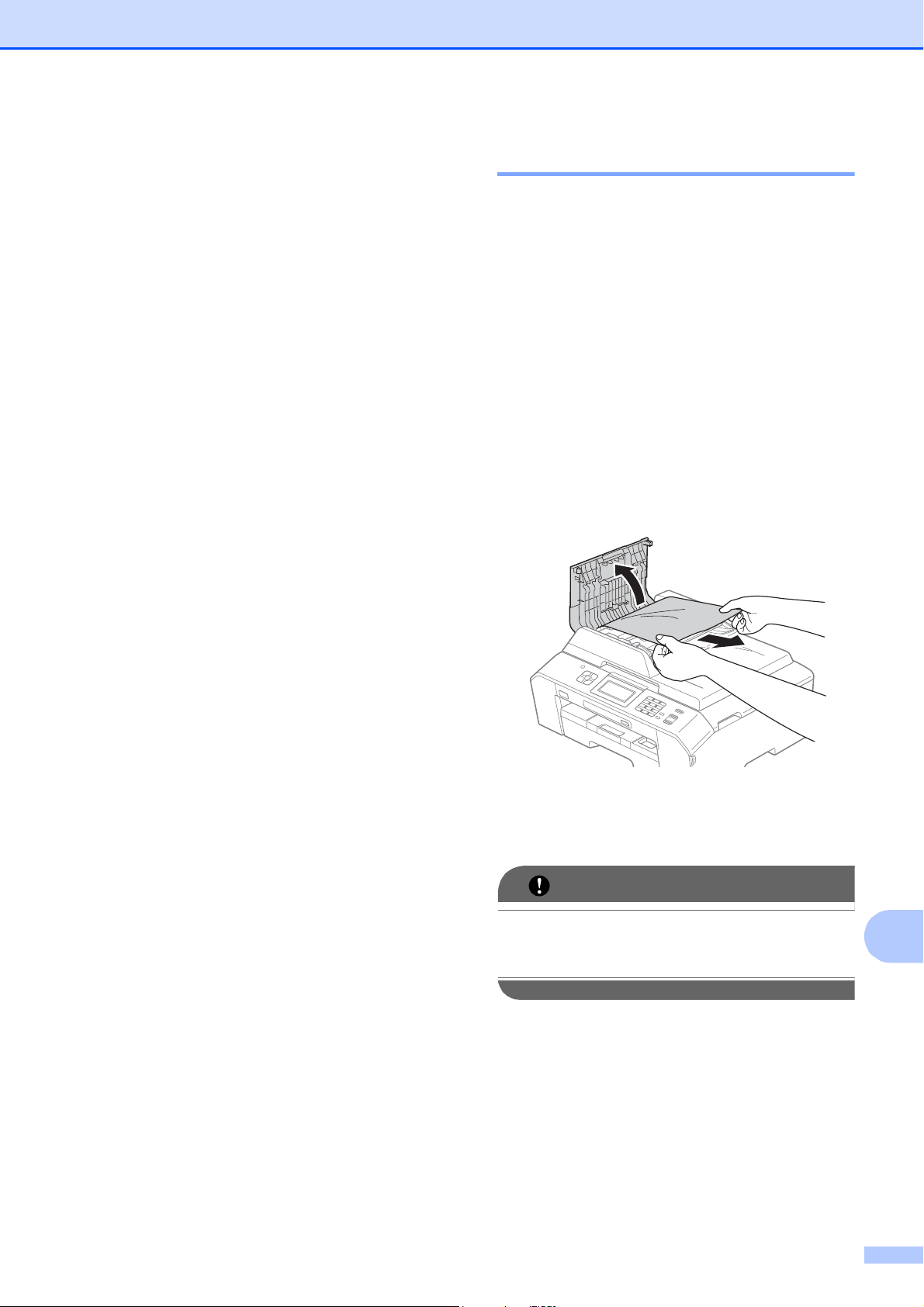
Troubleshooting
73
B
Transferring the Fax Journal report to
another fax machine
B
If you have not set up your Station ID, you
cannot enter fax transfer mode.
(uuQuick Setup Guide: Set your Station ID)
a Press Stop/Exit to interrupt the error
temporarily.
b Press Menu.
c Press s or t to display Service.
d Press Service.
e Press Data Transfer.
f Press Report Trans.
g Enter the fax number to which the Fax
Journal report will be forwarded.
h Press Black Start.
Document jam B
Documents can jam in the ADF unit if they are
not inserted or fed properly, or if they are too
long. Follow the steps below to clear a
document jam.
Document is jammed in the top of the
ADF unit
B
a Take out any paper from the ADF that is
not jammed.
b Open the ADF cover.
c Pull the jammed document out to the
right.
d Close the ADF cover.
e Press Stop/Exit.
IMPORTANT
To avoid future document jams, close the
ADF cover properly by pressing it down in
the center.
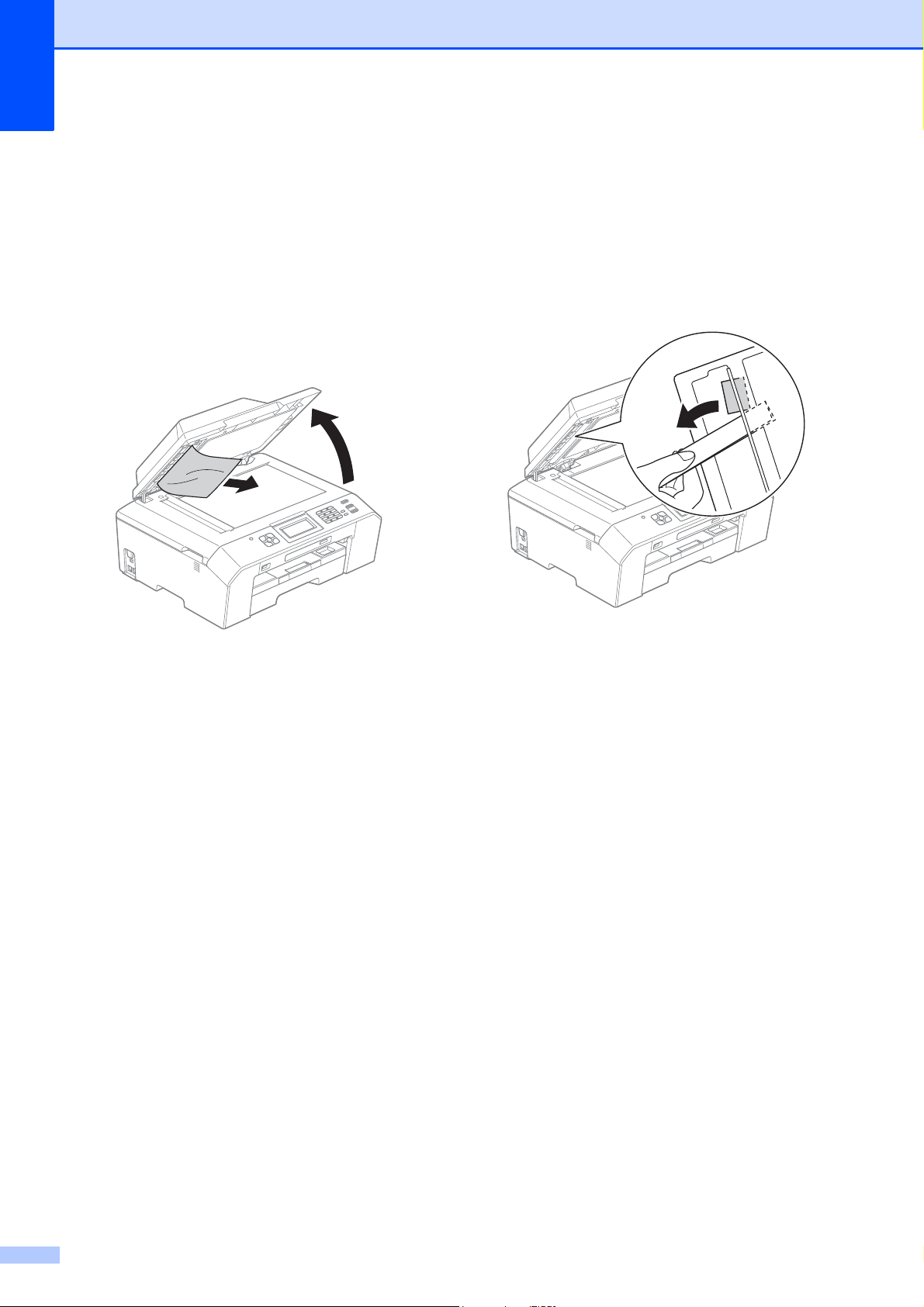
74
Document is jammed inside the ADF
unit
B
a Take out any paper from the ADF that is
not jammed.
b Lift the document cover.
c Pull the jammed document out to the
right.
d Close the document cover.
e Press Stop/Exit.
Removing small documents jammed
in the ADF
B
a Lift the document cover.
b Insert a piece of stiff paper, such as
cardstock, into the ADF to push any
small paper scraps through.
c Close the document cover.
d Press Stop/Exit.
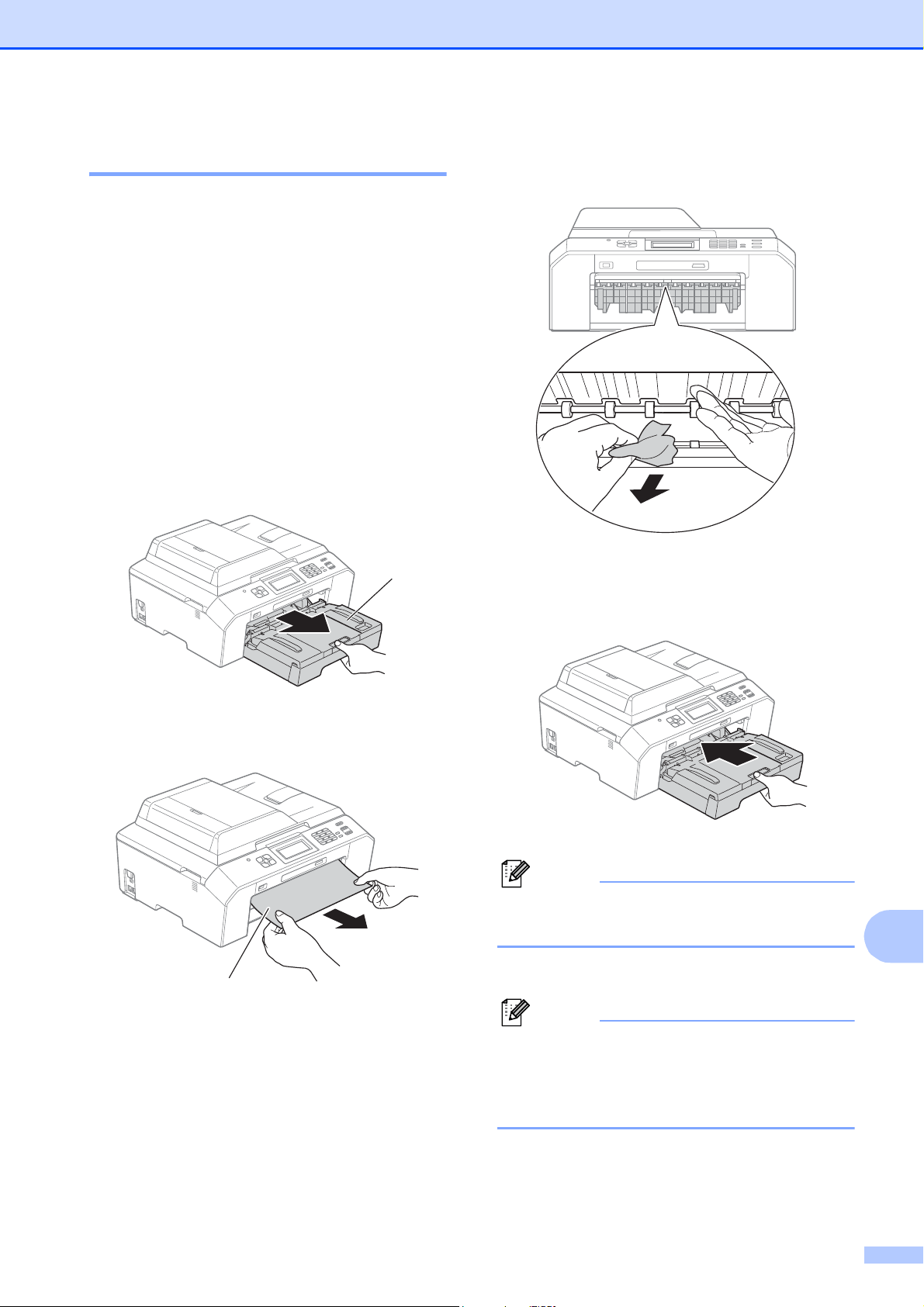
Troubleshooting
75
B
Printer jam or paper jam B
Take out the jammed paper depending on
where it is jammed in the machine.
Paper is jammed at the front of the
machine
B
If the screen shows Paper Jam [Front],
follow these steps:
a Unplug the machine from the AC power
outlet.
b Pull the paper tray (1) completely out of
the machine.
c Pull out the jammed paper (1).
d Lift the Jam Clear Flap, and remove the
jammed paper.
e Put the paper tray firmly back in the
machine.
Note
Make sure you pull out the paper support
until it clicks.
f Re-connect the power cord.
Note
If there is a repeat paper jam, a small
piece of paper may be stuck in the
machine. (See Additional paper jam clear
operations uu page 80.)
1
1
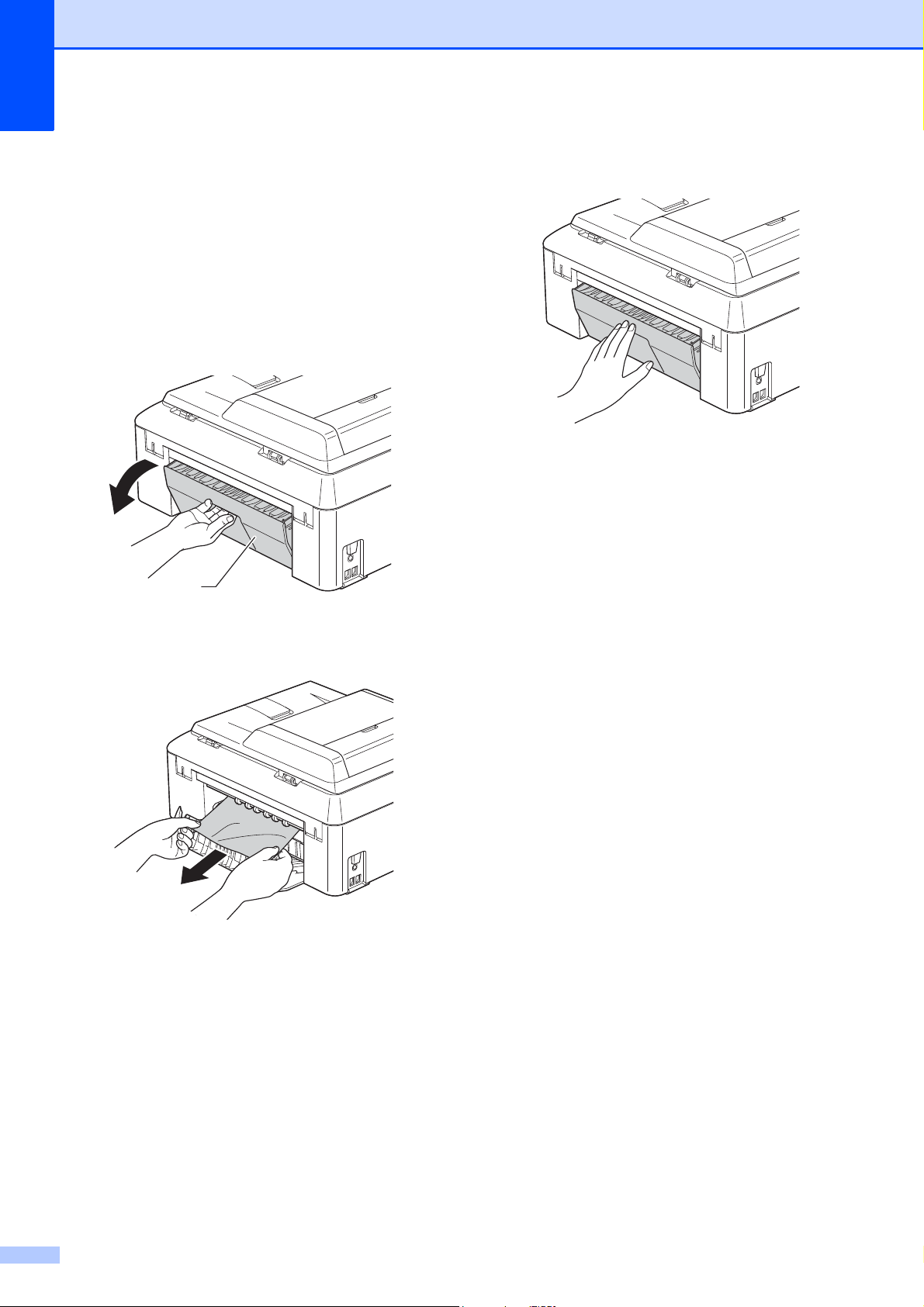
76
Paper is jammed at the back of the
machine
B
If the screen shows Paper Jam [Rear],
follow these steps:
a Unplug the machine from the AC power
outlet.
b Open the Jam Clear Cover (1) at the
back of the machine.
c Pull the jammed paper out of the
machine.
d Close the Jam Clear Cover. Make sure
the cover is closed properly.
e Re-connect the power cord.
1
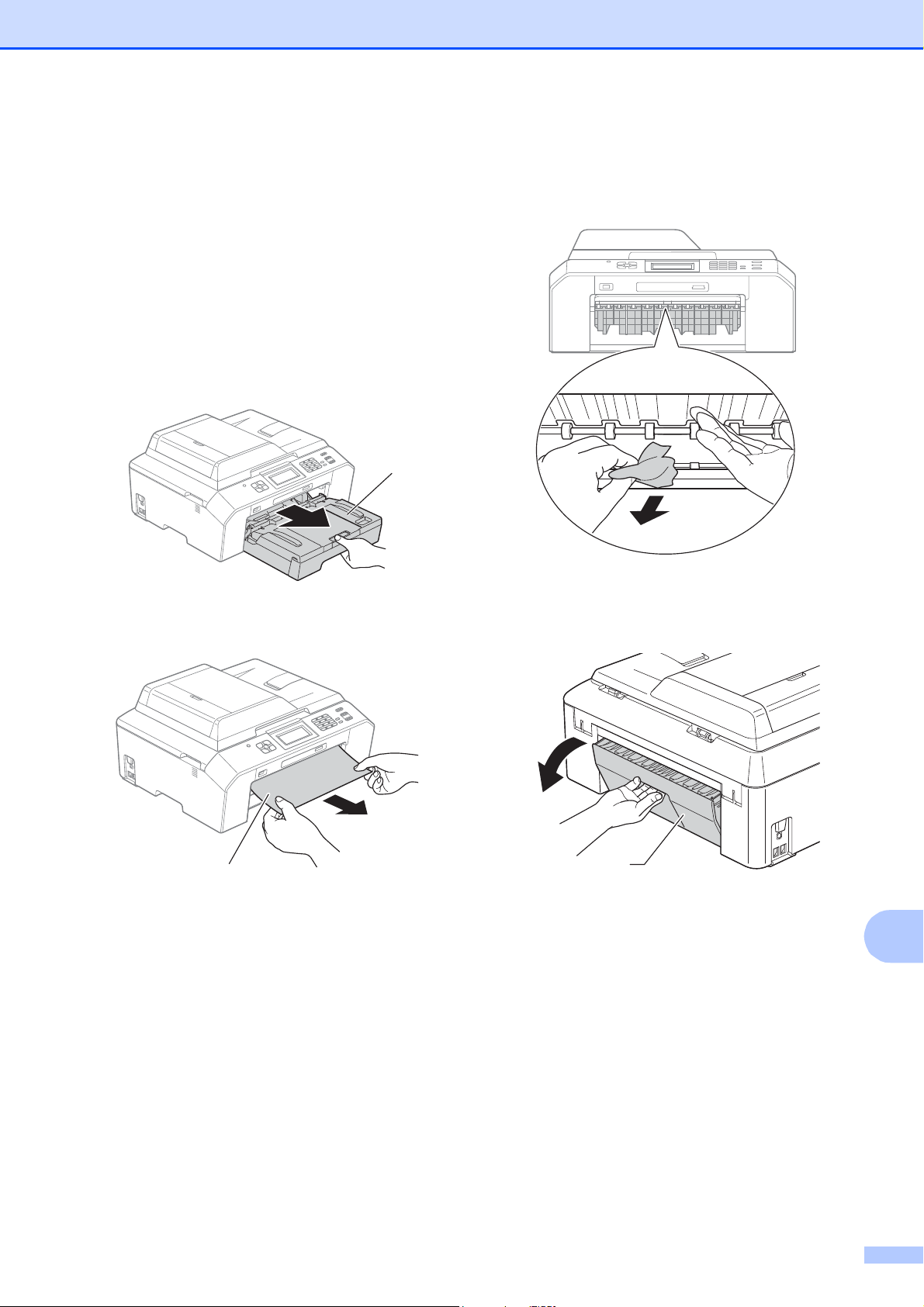
Troubleshooting
77
B
Paper is jammed at the front and back
of the machine
B
If the screen shows
PaperJam Front,Rear, follow these
steps:
a Unplug the machine from the AC power
outlet.
b Pull the paper tray (1) completely out of
the machine.
c Pull out the jammed paper (1).
d Lift the Flap, and remove the jammed
paper.
(With tray removed, go to step e.)
e Open the Jam Clear Cover (1) at the
back of the machine.
1
1
1
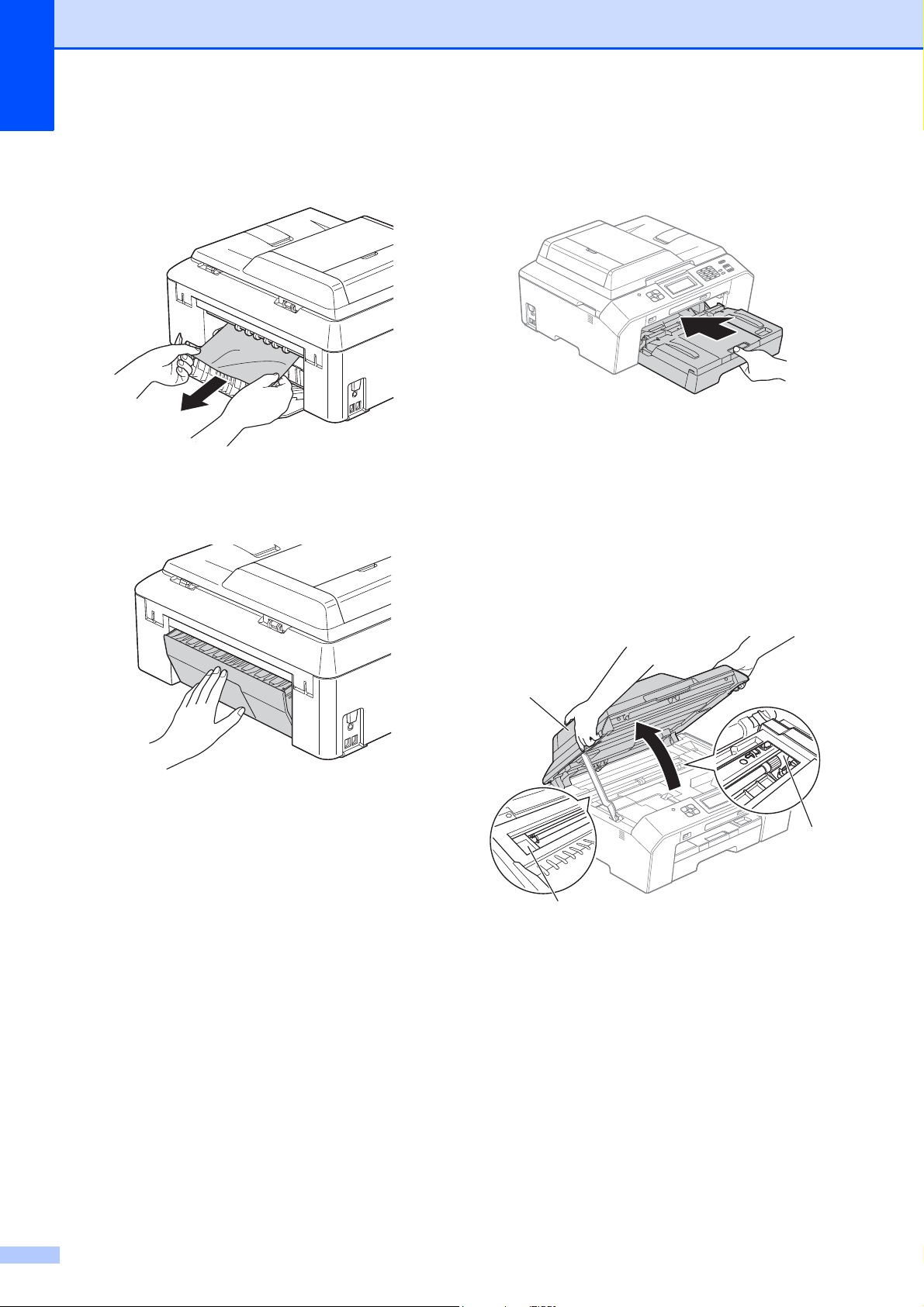
78
f Pull the jammed paper out of the
machine.
g Close the Jam Clear Cover. Make sure
the cover is closed properly.
h Put the paper tray firmly back in the
machine.
i Using both hands, use the finger holds
on each side of the machine to lift the
scanner cover (1) into the open position.
Move the print head (if necessary) to
take out any paper remaining in this
area. Make sure that jammed paper is
not left in the corners of the machine (2)
and (3).
1
2
3
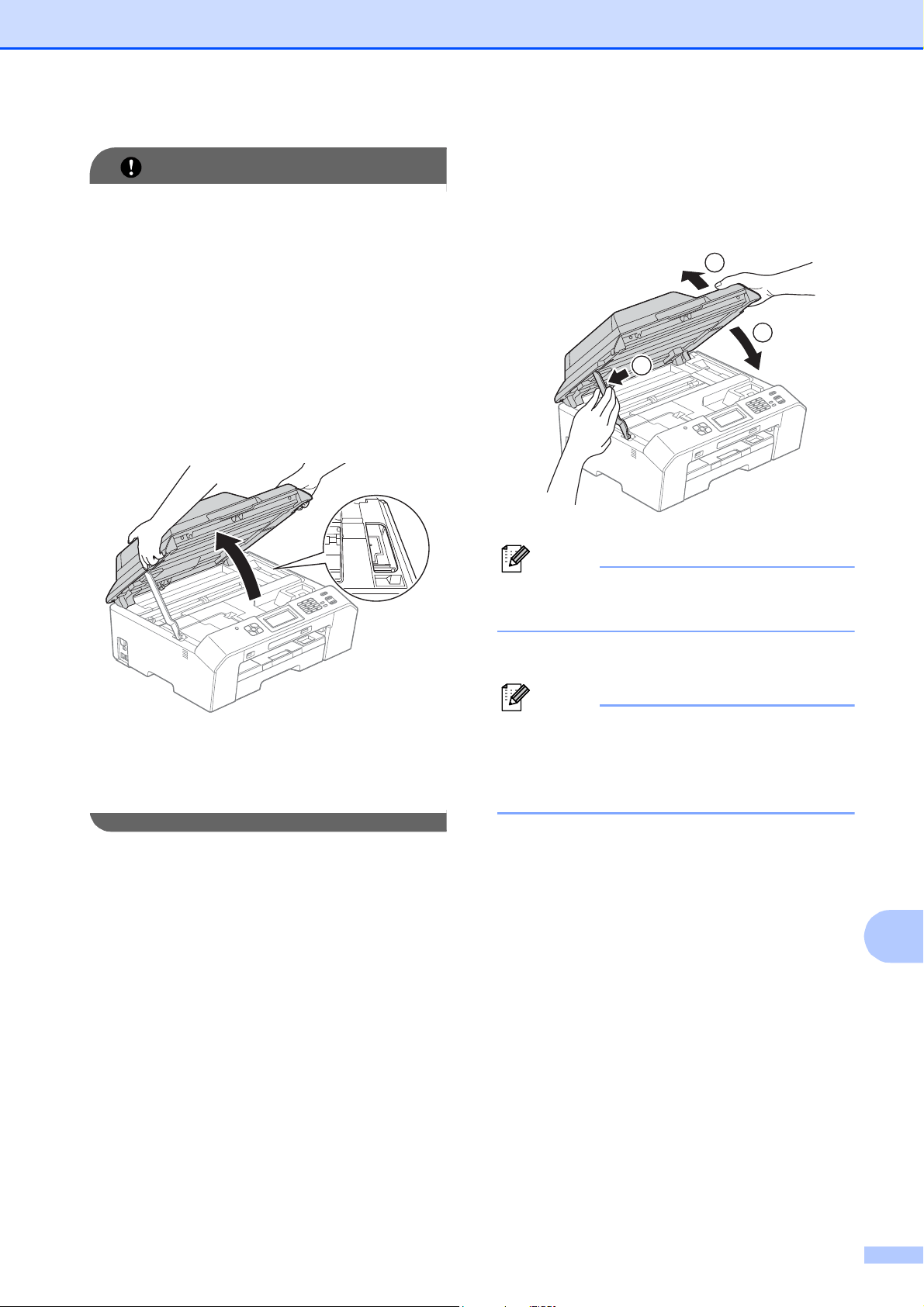
Troubleshooting
79
B
IMPORTANT
• If the paper is jammed under the print
head, unplug the machine from the power
source, and then move the print head to
take out the paper.
• If the print head is in the right corner as
shown in the illustration, you cannot move
the print head. Re-connect the power
cord. Hold down Stop/Exit until the print
head moves to the center. Then unplug
the machine from the power source and
take out the paper.
• If ink gets on your skin or clothing
immediately wash it off with soap or
detergent.
j Lift the scanner cover (1) to release the
lock. Gently push the scanner cover
support down (2) and close the scanner
cover (3) using both hands.
Note
Make sure you pull out the paper support
until it clicks.
k Re-connect the power cord.
Note
If there is a repeat paper jam, a small
piece of paper may be stuck in the
machine. (See Additional paper jam clear
operations uu page 80.)
3
1
2
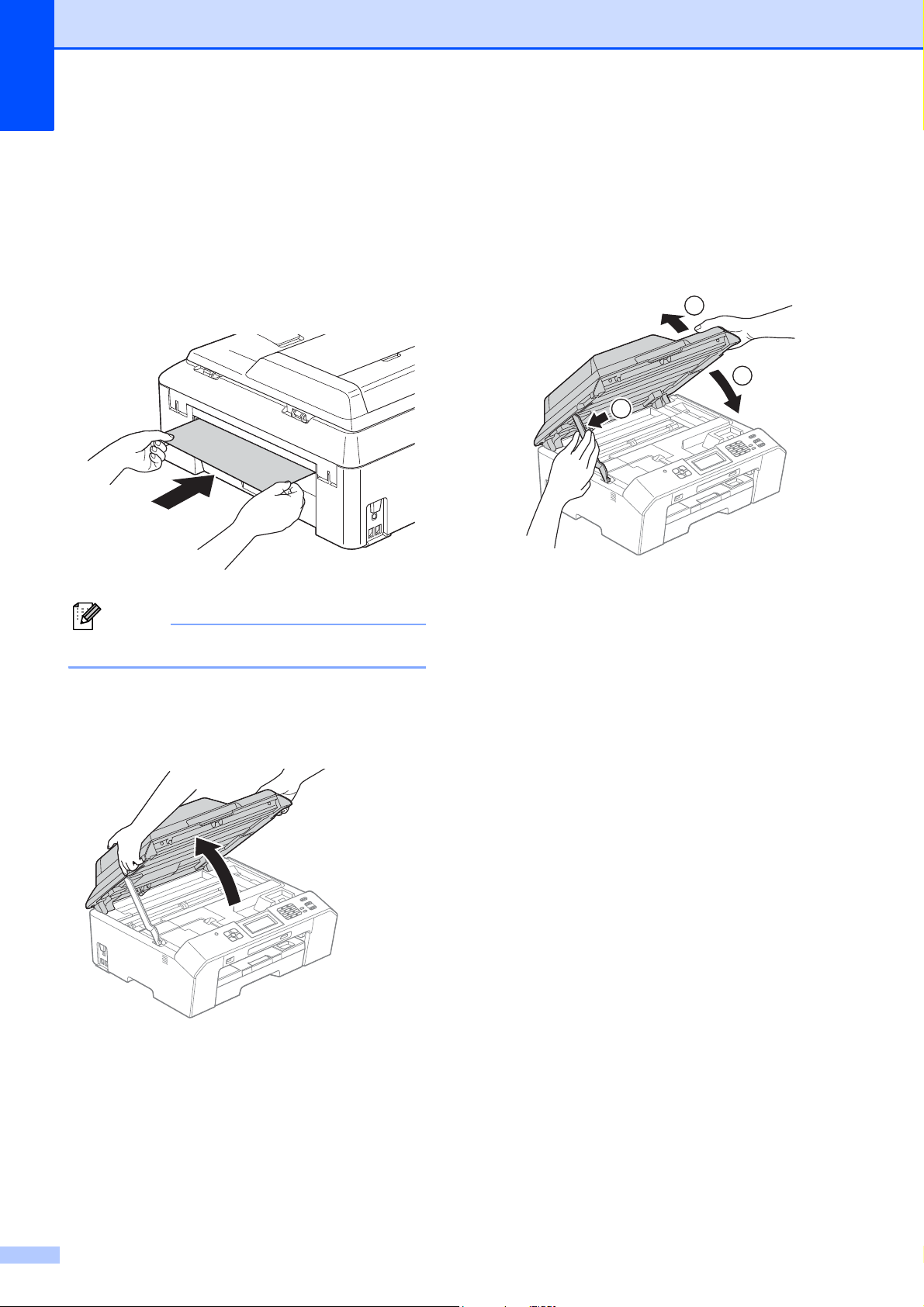
80
Additional paper jam clear operationsB
a Prepare one sheet of thick letter or A4
sized paper, such as glossy paper, and
insert it into the machine in the
landscape orientation through the
opening as shown, until you feel it grab
the paper.
Note
We recommend you use glossy paper.
b Using both hands, use the finger holds
on each side of the machine to lift the
scanner cover into the open position.
c Lift the scanner cover (1) to release the
lock. Gently push the scanner cover
support down (2) and close the scanner
cover (3) using both hands.
The paper you inserted will be fed
through the machine and ejected.
3
1
2

Troubleshooting
81
B
Troubleshooting B
IMPORTANT
For technical help, you must call the country where you bought the machine. Calls must be
made from within that country.
If you think there is a problem with your machine, check the chart below and follow the
troubleshooting tips.
Most problems can be easily resolved by yourself. If you need additional help, the Brother
Solutions Center offers the latest FAQs and troubleshooting tips.
Visit us at http://solutions.brother.com/
.
Using non-Brother supplies may affect the print quality, hardware performance, and machine
reliability.
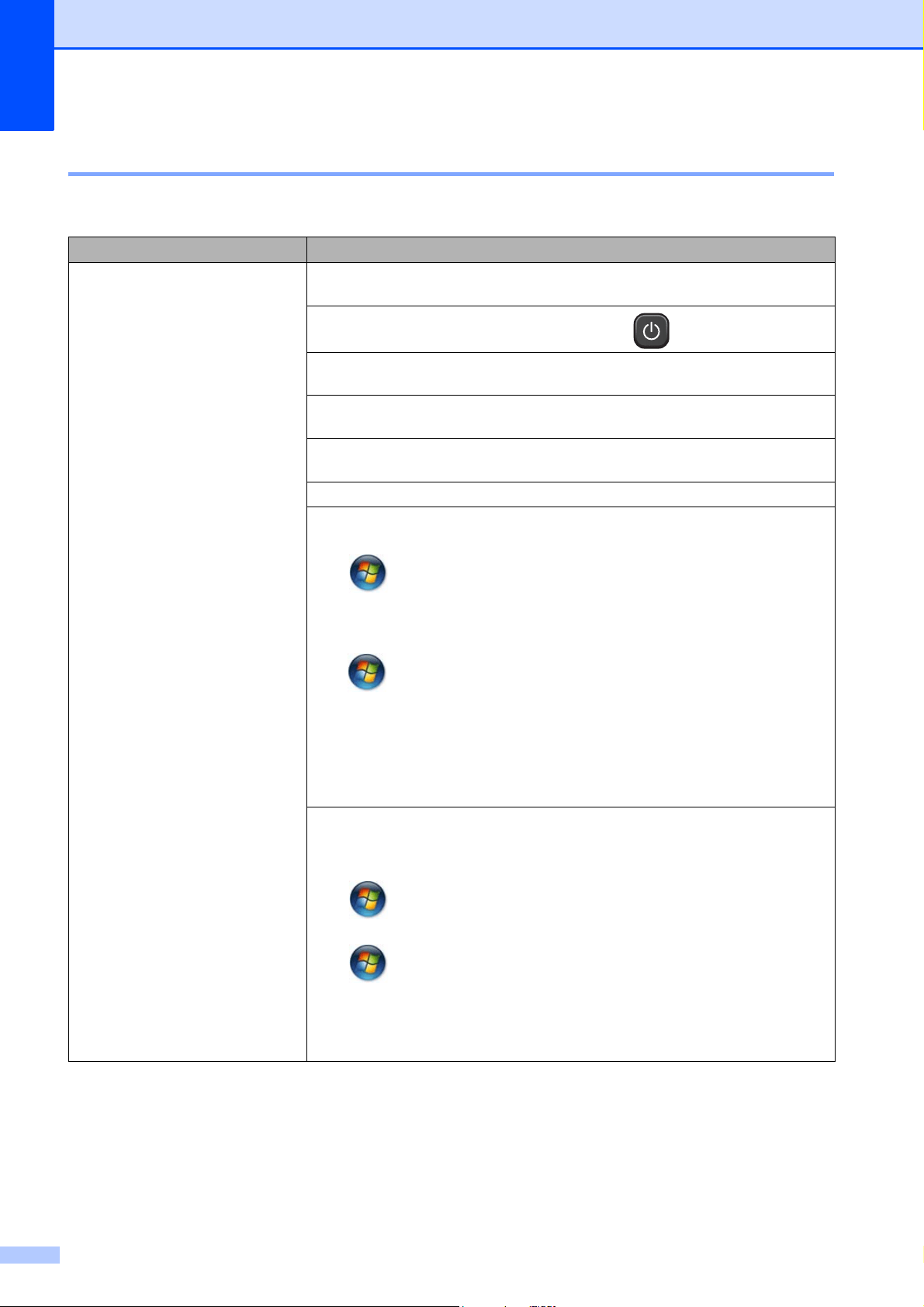
82
If you are having difficulty with your machine B
Printing
Difficulty Suggestions
No printout. Check the interface cable or wireless connection on both the machine and your
computer. (uuQuick Setup Guide)
Check that the machine is plugged in and that the On/Off key is on.
One or more ink cartridges have reached the end of their life.
(See Replacing the ink cartridges uu page 58.)
Check to see if the screen is showing an error message.
(See Error and Maintenance messages uu page 64.)
If the screen shows Cannot Print and Replace Ink, see Replacing the ink
cartridges uu page 58.
Check that the correct printer driver has been installed and chosen.
Make sure that the machine is online.
(Windows
®
7)
Click and then Devices and Printers. Right-click Brother MFC-XXXXX
(where XXXXX is your model name) and choose See what’s printing. Click
Printer and make sure that Use Printer Offline is unchecked.
(Windows Vista
®
)
Click , Control Panel, Hardware and Sound and then Printers. Right-click
Brother MFC-XXXXX (where XXXXX is your model name). If the printer is offline,
it will show Use Printer Online. Select this option to enable the printer.
(Windows
®
XP)
Click Start and then Printers and Faxes. Right-click Brother MFC-XXXXX
(where XXXXX is your model name). If the printer is offline, it will show
Use Printer Online. Select this option to enable the printer.
If old unprinted data remains in the printer driver spooler, it will prevent new print
jobs from printing. Open the printer icon and delete all data as follows:
(Windows
®
7)
Click /Devices and Printers/Printers and Faxes.
(Windows Vista
®
)
Click /Control Panel/Hardware and Sound/Printers.
(Windows
®
XP)
Click Start/Control Panel/Printers and Other Hardware/Printers and Faxes.
(Macintosh)
Click System Preferences/Print & Fax.
Troubleshooting
83
B
Poor print quality. Check the print quality. (See Checking the print quality uu page 62.)
Make sure that the Media Type setting in the printer driver or the Paper Type
setting in the machine’s menu matches the type of paper you are using.
See Paper Type uu page 19.
uuSoftware User’s Guide: Printing (Windows
®
)
uuSoftware User’s Guide: Printing and Faxing (Macintosh)
Make sure that your ink cartridges are fresh. The following may cause ink to clog:
The expiration date written on the cartridge package has passed. (Genuine
Brother Innobella™ ink cartridges stay usable for up to two years if kept in their
original packaging.)
The ink cartridge has been in your machine for over six months.
The ink cartridge may not have been stored properly before use.
Make sure you are using Genuine Brother Innobella™ Ink. Using non-Brother
supplies may affect the print quality, hardware performance, and machine
reliability.
Make sure you are using one of the recommended types of paper.
(See Acceptable paper and other print media uu page 20.)
The recommended environment for your machine is between 68 F to 91 F
(20 C to 33 C).
White horizontal lines appear in text
or graphics.
Clean the print head. (See Cleaning the print head uu page 62.)
Make sure you are using Genuine Brother Innobella™ Ink.
Try using the recommended types of paper.
(See Acceptable paper and other print media uu page 20.)
The machine prints blank pages. Clean the print head. (See Cleaning the print head uu page 62.)
Make sure you are using Genuine Brother Innobella™ Ink.
Characters and lines are blurred. Check the printing alignment. (See Checking the print alignment uu page 63.)
Printed text or images are skewed. Make sure the paper is loaded properly in the paper tray and the paper side guides
are adjusted correctly. (See Loading paper and other print media uu page 12.)
Make sure the Jam Clear Cover is closed properly.
Smudge or stain at the top center of
the printed page.
Make sure the paper is not too thick or curled.
(See Acceptable paper and other print media uu page 20.)
Printing appears dirty or ink seems
to run.
Make sure you are using the recommended types of paper. (
See Acceptable paper
and other print media uu page 20.
) Don't handle the paper until the ink is dry.
Make sure you are using Genuine Brother Innobella™ Ink.
If you are using photo paper, make sure that you have set the correct paper type.
If you are printing a photo from your PC, set the Media Type of the printer driver.
Stains appear on the reverse side
or at the bottom of the page.
Make sure the printer platen is not dirty with ink. (uuAdvanced User’s Guide:
Cleaning the machine’s printer platen)
Make sure you are using Genuine Brother Innobella™ Ink.
Make sure you are using the paper support flap.
(See Loading paper and other print media uu page 12.)
Make sure the paper feed rollers are not dirty with ink.
(uuAdvanced User’s Guide: Cleaning the paper feed rollers)
The machine prints dense lines on
the page.
(Windows
®
users only)
Check Reverse Order in the Basic tab of the printer driver.
Printing (continued)
Difficulty Suggestions
84
The printouts are wrinkled.
(Windows
®
users)
In the printer driver Advanced tab, click Color Settings, and uncheck
Bi-Directional Printing.
(Macintosh users)
In the printer driver, choose Print Settings, click Advanced, choose
Other Print Options, and uncheck Bi-Directional Printing.
Make sure you are using Genuine Brother Innobella™ Ink.
Cannot perform “Page Layout”
printing.
Check that the paper size setting in the application and in the printer driver are the
same.
Print speed is too slow. Try changing the printer driver setting. The highest resolution needs longer data
processing, sending and printing time. Try the other quality settings in the printer
driver Advanced tab (Windows
®
) or Print Settings (Macintosh). Also, click
Color Settings, and make sure you uncheck Color Enhancement (True2Life).
Turn the Borderless feature off. Borderless printing is slower than normal printing.
uuSoftware User’s Guide: Printing (Windows
®
)
uuSoftware User’s Guide: Printing and Faxing (Macintosh)
True2Life™ is not working properly. If the image data is not full color in your application (such as 256 color),
True2Life™ will not work. Use at least 24 bit color data with the True2Life™
feature.
Photo paper does not feed
properly.
When you print on Brother Photo paper, load one extra sheet of the same photo
paper in the paper tray. An extra sheet has been included in the paper package
for this purpose.
Clean the paper pick
-up rollers. (uuAdvanced User’s Guide: Cleaning the paper
pick-up rollers)
Machine feeds multiple pages. Make sure the paper is loaded properly in the paper tray. (See Loading paper and
other print media uu page 12.)
Make sure the paper support is pulled out until it clicks and the paper support flap
is unfolded. (See the step i in Loading paper and other print media uu page 12.)
Make sure the Jam Clear Cover is closed properly. (See the step d in Paper is
jammed at the back of the machine uu page 76.)
Make sure the Base Pad in the paper tray is not dirty. (uu Advanced User’s Guide:
Cleaning the paper pick-up rollers)
There is a paper jam. Make sure the paper length guide is set to the correct paper size. Do not extend
the paper tray when you load A5 or smaller size paper. (See Printer jam or paper
jam uu page 75.)
The paper jams when you use
duplex copy or duplex print.
Use one of the jam prevention settings, Duplex1 or Duplex2.
For copying
uuAdvanced User’s Guide: Duplex (2-sided) copying
For printing
uuSoftware User’s Guide: Duplex / Booklet (Windows
®
)
uuSoftware User’s Guide: Duplex Printing (Macintosh)
If paper jams occur often during duplex copying or duplex printing, the paper feed
rollers may be stained with ink. Clean the paper feed rollers.
(uuAdvanced User’s Guide: Cleaning the paper feed rollers)
Printed pages are not stacked
neatly.
Make sure you are using the paper support flap.
(See Loading paper and other print media uu page 12.)
Printing (continued)
Difficulty Suggestions
Troubleshooting
85
B
Machine does not print from
Adobe
®
Illustrator
®
.
Try to reduce the print resolution.
uuSoftware User’s Guide: Printing (Windows
®
)
uuSoftware User’s Guide: Printing and Faxing (Macintosh)
Ink is smudged or running when
using glossy photo paper.
Make sure to check the front and back of the paper. Place the glossy surface
(printing surface) face down. (See Paper Type uu page 19.)
If you use glossy photo paper, make sure that the paper type setting is correct.
Prints appears dirty or the paper
jams when using Ledger paper.
(PC print for Windows
®
user)
Select Ledger (Short Grain) size paper in Paper Size in the Basic tab of the
printer driver.
Check Slow Drying Paper in the Basic tab of the printer driver.
(PC print for Macintosh user)
Select Tabloid (Short Grain) size paper in Paper Size of the printer driver.
Select Print Settings from drop-down list and then check Slow Drying Paper
of the printer driver.
(Copy)
Turn on LGR - Short Grain setting in General Setup. (See Secure
Paper Feed mode for Ledger size Short Grain Paper uu page 20.)
Adjust the copy density to make copies lighter. (uuAdvanced User’s Guide:
Adjusting Density)
Printing (continued)
Difficulty Suggestions
86
Printing Received Faxes
Difficulty Suggestions
Condensed print and white streaks
across the page or the top and
bottom of sentences are cut off.
You probably had a bad connection, with static or interference on the telephone
line. Ask the other party to send the fax again.
Vertical black lines when receiving. The sender's scanner may be dirty. Ask the sender to make a copy to see if the
problem is with the sending machine. Try receiving from another fax machine.
Received color fax prints only in
black & white.
Replace the color ink cartridges that have reached the end of their life, and then
ask the other person to send the color fax again.
(See Replacing the ink cartridges uu page 58.)
Left and right margins are cut off or
a single page is printed on two
pages.
Turn on Auto Reduction. (uuAdvanced User’s Guide: Printing a reduced
incoming fax)
Telephone Line or Connections
Difficulty Suggestions
Dialing does not work.
(No dial tone)
Check that the machine is plugged in and that the On/Off key is on.
Check all line cord connections. Make sure the telephone line cord is plugged into
the telephone wall jack and the LINE jack of the machine.
(Canada only) Change the Tone/Pulse setting. (uuQuick Setup Guide)
Verify that the telephone line and jack are working by connecting a known working
telephone and telephone line to the jack. Then lift the external telephone’s handset
and listen for a dial tone. If there is no dial tone, ask your telephone company to
check the line and/or jack.
The machine does not answer
when called.
Make sure the machine is in the correct Receive Mode for your setup.
(See Choose the correct Receive Mode uu page 31.) Check for a dial tone. If
possible, call your machine to hear it answer. If there is still no answer, check that
the telephone line cord is plugged into the telephone wall jack and the LINE jack
of the machine. If there is no ringing when you call your machine, ask your
telephone company to check the line.

Troubleshooting
87
B
Receiving Faxes
Difficulty Suggestions
Cannot receive a fax. Make sure your machine has a dial tone by pressing the Hook key. If you hear
static or interference on your fax line, please contact your local telephone
company.
Check all line cord connections. Make sure the telephone line cord is plugged into
the telephone wall jack and the LINE jack of the machine. If you subscribe to DSL,
VoIP or MagicJack services, please contact your service provider for connection
instructions. To lower the modem speed and turn off ECM (error correction mode)
see Telephone line interference / VoIP uu page 93.
Make sure the machine is in the correct Receive Mode. This is determined by the
external devices and telephone subscriber services you have on the same line as
the Brother machine. (See Choose the correct Receive Mode uu page 31.)
If you have a dedicated fax line and want your Brother machine to automatically
answer all incoming faxes, you should select Fax Only mode.
If your Brother machine shares a line with an external answering machine, you
should select External TAD mode. In External TAD mode, your Brother
machine will automatically receive incoming faxes and voice callers will be able to
leave a message on your answering machine.
If your Brother machine shares the line with a Voice Mail subscriber service,
please see Voice Mail uu page 36.
If your Brother machine is on a line with the Distinctive Ring subscriber service,
please see Distinctive Ring uu page 37.
If your Brother machine shares a line with other telephones and you want it to
automatically answer all incoming faxes, you should select Fax/Tel mode. In
Fax/Tel mode, your Brother machine will automatically receive faxes and
produce a pseudo/double-ring to alert you to answer voice calls.
If you do not want your Brother machine to automatically answer any incoming
faxes, you should select Manual mode. In Manual mode, you must answer every
incoming call and activate the machine to receive faxes.
Another device or service at your location may be answering the call before your
Brother machine answers. To test this, lower the Ring Delay setting:
If the Receive Mode is set to Fax Only or Fax/Tel, reduce the Ring Delay
to 1 ring. (See Ring Delay uu page 34.)
If the Receive Mode is set to External TAD, reduce the number of rings
programmed on your answering machine to 2.
If the Receive Mode is set to Manual, DO NOT adjust the Ring Delay setting.
Have someone send you a test fax:
If you received the test fax successfully, your machine is operating properly.
Remember to reset your Ring Delay or answering machine setting back to
your original setting. If receiving problems recur after resetting the Ring Delay,
then a person, device, or subscriber service is answering the fax call before
the machine has a chance to answer.
If you were not able to receive the fax, then another device or subscriber
service may be interfering with your fax reception or there may be a problem
with your fax line.

88
Cannot receive a fax.
(continued)
If you are using a telephone answering machine (External TAD mode) on the
same line as the Brother machine, make sure your answering machine is set up
correctly. (See Connecting an external TAD (telephone answering device)
uu page 39.)
1 Plug the telephone line cord directly from the wall telephone jack to your
Brother machine’s LINE jack.
2 Remove the protective cap from your Brother machine’s EXT. jack, and then
plug the telephone line cord from your answering machine into the EXT. jack.
3 Set your answering machine to answer within 4 rings.
If you are having problems receiving faxes or voice messages, set your
answering machine to answer within 2 or 3 rings.
4 Record the outgoing message on your answering machine.
Record five seconds of silence at the beginning of your outgoing
message.
Limit your speaking to 20 seconds.
End your outgoing message with your Fax Receive Code for people
sending manual faxes. For example:
“After the beep, leave a message or
press l 51 and Start to send a fax.
”
5 Set your answering machine to answer calls.
6 Set your Brother machine’s Receive Mode to External TAD. (See Choose
the correct Receive Mode uu page 31.)
Make sure your Brother machine’s Easy Receive feature is turned On. Easy
Receive is a feature that allows you to receive a fax even if you have answered
the call on an external or extension telephone. (See Easy Receive uu page 35.)
If you often get transmission errors due to possible interference on the telephone
line, try changing the Compatibility setting to Basic(for VoIP). (See
Telephone line interference / VoIP uu page 93.)
Receiving Faxes (continued)
Difficulty Suggestions
Troubleshooting
89
B
Sending Faxes
Difficulty Suggestions
Cannot send a fax. Check all line cord connections. Make sure the telephone line cord is plugged into
the telephone wall jack and the LINE jack of the machine.
Make sure that the FAX key is illuminated.
Ask the other party to check that the receiving machine has paper.
Print the Transmission Verification Report and check for an error.
(uuAdvanced User’s Guide: Reports)
Transmission Verification Report
says “RESULT:NG”.
There is probably temporary noise or static on the line. Try sending the fax again.
If you send a PC FAX message and get “RESULT:NG” on the Transmission
Verification Report, your machine may be out of memory. To gain extra memory,
you can turn off Memory Receive (uuAdvanced User’s Guide: Turning off
Memory Receive operations), print fax messages from the machine’s memory
(uuAdvanced User’s Guide: Printing a fax from the memory), or cancel a Delayed
Fax or Polling Job. (See Canceling a fax in progress uu page 29.)
(uuAdvanced User’s Guide: Checking and canceling waiting jobs) If the problem
continues, ask the telephone company to check your telephone line.
If you often get transmission errors due to possible interference on the telephone
line, try changing the machine's Compatibility setting to Basic(for VoIP).
(See Telephone line interference / VoIP uu page 93.)
Sent faxes are blank. Make sure you are loading the document properly. (See Loading documents
uu page 24.)
Poor fax send quality. Try changing your resolution to Fine or S.Fine. Make a copy to check your
machine's scanner operation. If the copy quality is not good, clean the scanner.
(See Cleaning the scanner uu page 61.)
Vertical black lines when sending. Black vertical lines on faxes you send are typically caused by dirt or correction fluid
on the glass strip. Clean the glass strip. (See Cleaning the scanner uu page 61.)
Handling Incoming Calls
Difficulty Suggestions
The machine “hears” a voice as a
CNG Tone.
If Easy Receive is set to On, your machine is more sensitive to sounds. It may
mistakenly interpret certain voices or music on the line as a fax machine calling
and respond with fax receiving tones. Deactivate the machine by pressing
Stop/Exit. Try avoiding this problem by turning Easy Receive to Off.
(See Easy Receive uu page 35.)
Sending a fax call to the machine. If you answered on an extension telephone, press your Fax Receive Code (the
factory setting is l 51). If you answered on the external telephone (connected to
the EXT. jack), press Start to receive the fax. When your machine answers, hang
up.
90
Custom features on a single line. If you have Call Waiting, Call Waiting/Caller ID, Voice Mail, an alarm system or
other custom feature on a single telephone line with your machine, it may create
a problem sending or receiving faxes.
For example: If you subscribe to Call Waiting or some other custom service and
its signal comes through the line while your machine is sending or receiving a fax,
the signal can temporarily interrupt or disrupt the faxes. Brother's ECM (Error
Correction Mode) feature should help overcome this problem. This condition is
related to the telephone system industry and is common to all devices that send
and receive information on a single, shared line with custom features. If avoiding
a slight interruption is crucial to your business, a separate telephone line with no
custom features is recommended.
Copying Difficulties
Difficulty Suggestions
Cannot make a copy.
Make sure that the COPY key is illuminated.
Poor copy results when using the
ADF.
Try using the scanner glass. (See Using the scanner glass uu page 25.)
Vertical black lines or streaks
appear in copies.
Vertical black lines or streaks on copies are typically caused by dirt or correction
fluid on the scanner. Clean the glass strip and scanner glass and the white bar and
white plastic above them. (See Cleaning the scanner uu page 61.)
Copies are blank. Make sure you are loading the document properly. (See Loading documents
uu page 24.)
Fit to Page does not work properly. Make sure the document is not skewed on the scanner glass.
Reposition the document and try again.
Scanning Difficulties
Difficulty Suggestions
TWAIN or WIA errors appear when
starting to scan. (Windows
®
)
Make sure the Brother TWAIN or WIA driver is chosen as the primary source in
your scanning application. For example, in PaperPort™12SE with OCR, click
Scan Settings, Select to choose the Brother TWAIN/WIA driver.
TWAIN or ICA errors appear when
starting to scan. (Macintosh)
Make sure the Brother TWAIN driver is chosen as the primary source.
In PageManager, click File, Select Source and choose the Brother TWAIN driver.
Mac OS X 10.6.x users can also scan documents using the ICA Scanner Driver.
uuSoftware User’s Guide: Scanning a document using the ICA driver (Mac OS X
10.6.x)
Poor scanning results when using
the ADF.
Try using the scanner glass. (See Using the scanner glass uu page 25.)
OCR does not work. Try increasing the scanner resolution.
(Macintosh users)
Make sure you have finished downloading and installing Presto! PageManager
from:
http://nj.newsoft.com.tw/download/brother/PM9SEInstaller_BR_multilang.dmg
Handling Incoming Calls (continued)
Difficulty Suggestions
Troubleshooting
91
B
Software Difficulties
Difficulty Suggestions
Cannot install software or print.
(Windows
®
users only)
Run the Repair MFL-Pro Suite program on the CD-ROM. This program will repair
and reinstall the software.
“Device Busy” Make sure the machine is not showing an error message on the screen.
Cannot print images from
FaceFilter Studio.
To use FaceFilter Studio, you must install the FaceFilter Studio application from
the CD-ROM supplied with your machine. (uuQuick Setup Guide)
Also, before you start FaceFilter Studio for the first time, you must make sure your
Brother machine is turned on and connected to your computer. This will allow you
to access all the functions of FaceFilter Studio.
PhotoCapture Center™ Difficulties
Difficulty Suggestions
Removable Disk does not work
properly.
1 Take out the memory card or USB Flash memory drive and put it back in
again.
2 If you have tried “Eject” from within Windows
®
, take out the memory card or
USB Flash memory drive before you continue.
3 If an error message appears when you try to eject the memory card or USB
Flash memory drive, it means the card is being accessed. Wait a while and
then try again.
4 If all of the above do not work, turn off your PC and machine, and then turn
them on again.
Cannot access Removable Disk
from Desktop icon.
Make sure that you have correctly inserted the memory card or USB Flash
memory drive.
Part of my photo is missing when
printed.
Make sure that Borderless printing and Cropping are turned off.
(uuAdvanced User’s Guide: Borderless printing and Cropping)
Network Difficulties
Difficulty Suggestions
Cannot print over the network. Make sure that your machine is powered on and is online and in Ready mode.
Print a Network Configuration list (uuAdvanced User’s Guide: Reports) and
check the current Network settings printed in this list. Reconnect the LAN cable to
the hub to verify that the cabling and network connections are good. If possible,
try connecting the machine to a different port on your hub using a different cable.
If the connections are good, the machine shows LAN Active for 2 seconds.
If you are using a wireless connection or are having Network problems
uuNetwork User’s Guide: Troubleshooting

92
The network scanning feature does
not work.
It is necessary to configure the third-party Security/Firewall Software to allow
Network scanning. To add port 54925 for Network scanning, enter the information
below:
In Name: Enter any description, for example Brother NetScan.
In Port number: Enter 54925.
In Protocol: UDP is selected.
Please refer to the instruction manual that came with your third-party
Security/Firewall Software or contact the software manufacturer.
(Macintosh users only)
Re-select your machine in the Device Selector application located in
Macintosh HD/Library/Printers/Brother/Utilities/DeviceSelector or from the
model list in ControlCenter2.
The network PC-Fax Receive
feature does not work.
(Windows
®
users only)
It is necessary to set the third-party Security/Firewall Software to allow PC-FAX
Rx. To add port 54926 for Network PC-FAX Rx, enter the information below:
In Name: Enter any description, for example Brother PC-FAX Rx.
In Port number: Enter 54926.
In Protocol: UDP is selected.
Please refer to the instruction manual that came with your third-party
Security/Firewall Software or contact the software manufacturer.
The Brother software cannot be
installed.
(Windows
®
users)
If the Security Software warning appears on the PC screen during the installation,
change the Security Software settings to permit the Brother product setup
program or other program to run.
(Macintosh users)
If you are using a firewall function of anti-spyware or antivirus security software,
temporarily disable it and then install the Brother software.
Cannot connect to wireless
network.
Investigate the problem using the WLAN Report.
Press Menu, and then press s or t to display Print Reports. Press
Print Reports. Press s or t to display WLAN Report, and then press
WLAN Report.
(uuNetwork User’s Guide)
Reset the network settings. Press Menu, and then press s or t to display Network. Press Network. Press
s or t to display Network Reset, and then press Network Reset.
(uuNetwork User’s Guide)
Data entry difficulties
Difficulty Suggestions
The dial pad does not work when
entering numbers or characters.
Use the screen buttons to enter information.
Network Difficulties (continued)
Difficulty Suggestions

Troubleshooting
93
B
Dial Tone B
Setting the dial tone to Detection will shorten
the dial detect pause.
a Press Menu.
b Press s or t to display
Initial Setup.
c Press Initial Setup.
d Press s or t to display Dial Tone.
e Press Dial Tone.
f Press Detection or No Detection.
g Press Stop/Exit.
Telephone line
interference / VoIP B
If you are having problems sending or
receiving a fax due to possible interference
on the telephone line, we recommend that
you change the modem speed to minimize
errors in fax operations.
a Press Menu.
b Press s or t to display
Initial Setup.
c Press Initial Setup.
d Press s or t to display
Compatibility.
e Press Compatibility.
f Press High, Normal or
Basic(for VoIP).
Basic(for VoIP) reduces the
modem speed to 9,600 bps and
turns off color fax receiving and
ECM, except for color fax-sending.
Unless interference is a recurring
problem on your telephone line, you
may prefer to use it only when
needed.
To improve compatibility with most
VoIP services, Brother recommends
changing the compatibility setting to
Basic(for VoIP).
Normal sets the modem speed at
14,400 bps.
High increases the modem speed to
33,600 bps. (factory setting)
g Press Stop/Exit.
Note
VoIP (Voice over IP) is a type of phone
system that uses an internet connection,
rather than a traditional phone line.

94
Machine Information B
Checking the serial number B
You can see the machine’s serial number on
the screen.
a Press Menu.
b Press s or t to display
Machine Info.
c Press Machine Info.
d Press Serial No.
e Press Stop/Exit.
Reset functions B
The following reset functions are available:
1 Network
You can reset the print server back to its
default factory settings, such as the
password and IP address information.
2 Speed Dial&Fax
Speed Dial & Fax resets the following
settings:
Speed Dial
(Speed-Dial and Setup Groups)
Programmed fax jobs in the memory
(Polled Transmit, Delayed Fax and
Delayed Batch Transmission)
Station ID
(Name and Number)
Remote Fax Options
(Fax Forwarding and Paging)
Report settings
(Transmission Verification Report,
Quick Dial List and Fax Journal)
History
(Caller ID history and Outgoing Call)
Faxes in memory
3 All Settings
You can restore all settings to their factory
defaults.
Brother strongly recommends performing
this procedure before handing over or
disposing of the machine.
Note
Unplug the interface cable before you
choose Network or All Settings.
How to reset the machine B
a Press Menu.
b Press s or t to display
Initial Setup.
c Press Initial Setup.
d Press s or t to display Reset.
e Press Reset.
f Press s or t to display the types of
Reset options Network,
Speed Dial&Fax, and
All Settings.
g Press the reset option you want to use.
h Press Yes to confirm.
i Press Yes for 2 seconds to reboot the
machine.

95
C
C
On-screen
programming
C
Your machine is designed to be easy to
operate with on-screen programming using
the menu buttons on the screen. User-
friendly programming helps you take full
advantage of all the menu selections your
machine has to offer.
Since your programming is done on the
screen, we have created step-by-step on-
screen instructions to help you program your
machine. All you need to do is follow the
instructions as they guide you through the
menu selections and programming options.
Memory Storage C
Even if there is a power failure, you will not
lose your menu settings because they are
stored permanently. Temporary settings
(such as Overseas Mode) will be lost. You
may have to reset the time and date.
Menu and features C
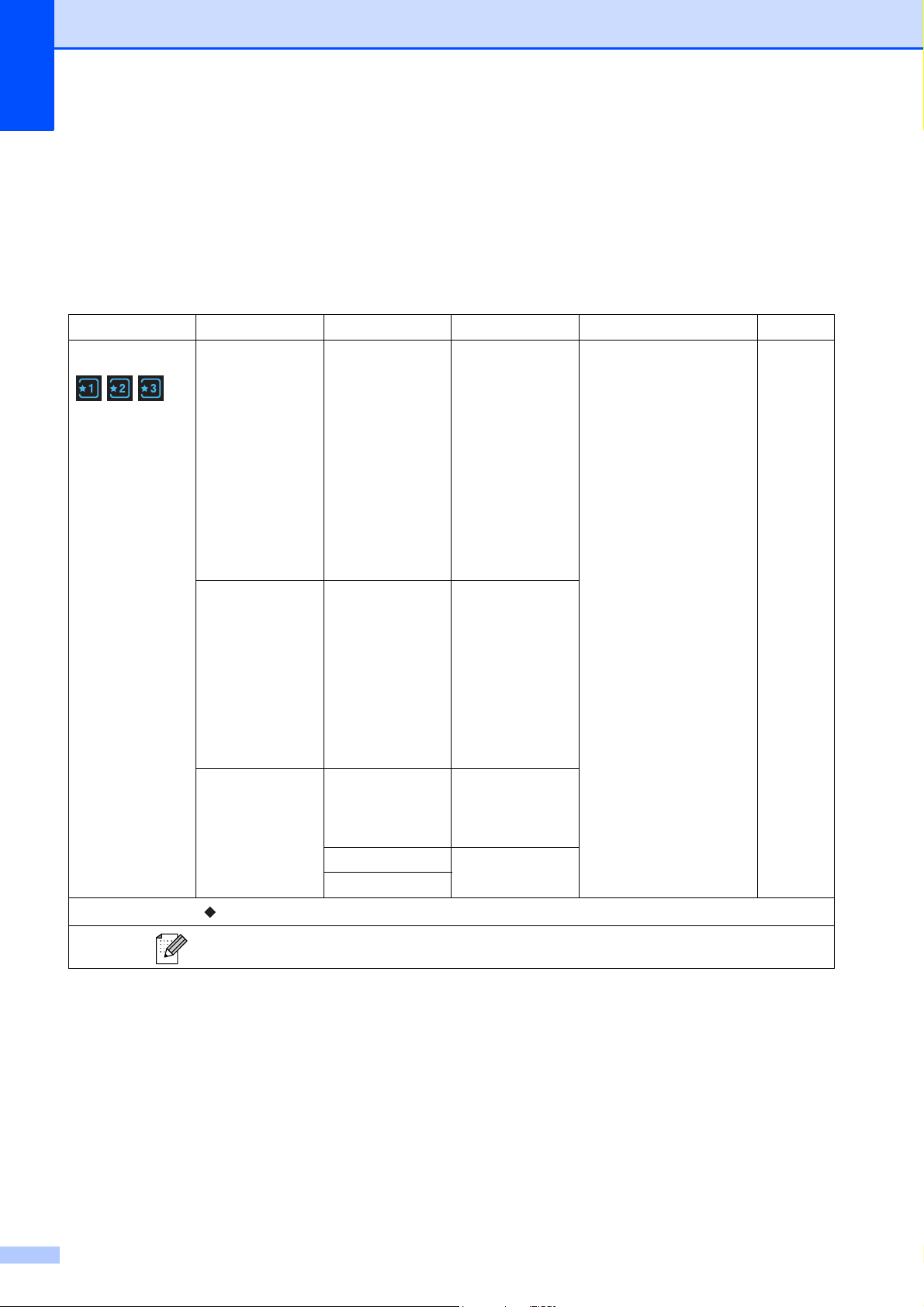
96
Menu table C
The menu table will help you understand the menu selections and options that are found in the
machine's programs. The factory settings are shown in Bold with an asterisk.
Menu C
Level1 Level2 Level3 Options Descriptions Page
Favorite Settings
Copy — Quality
Paper Type
Paper Size
Enlarge/Reduce
Density
Stack/Sort
Page Layout
Duplex Copy
Advanced Settings
Lets you quickly and
easily recall and apply
your previously registered
preferred settings.
10
Fax — Address
Fax Resolution
Contrast
Batch TX
Real Time TX
Overseas Mode
Glass ScanSize
Scan Scan to Media Quality
File Type
File Name
Scan to Network
(Profile Name)
Scan to FTP
See Advanced User’s Guide.
The factory settings are shown in Bold with an asterisk.
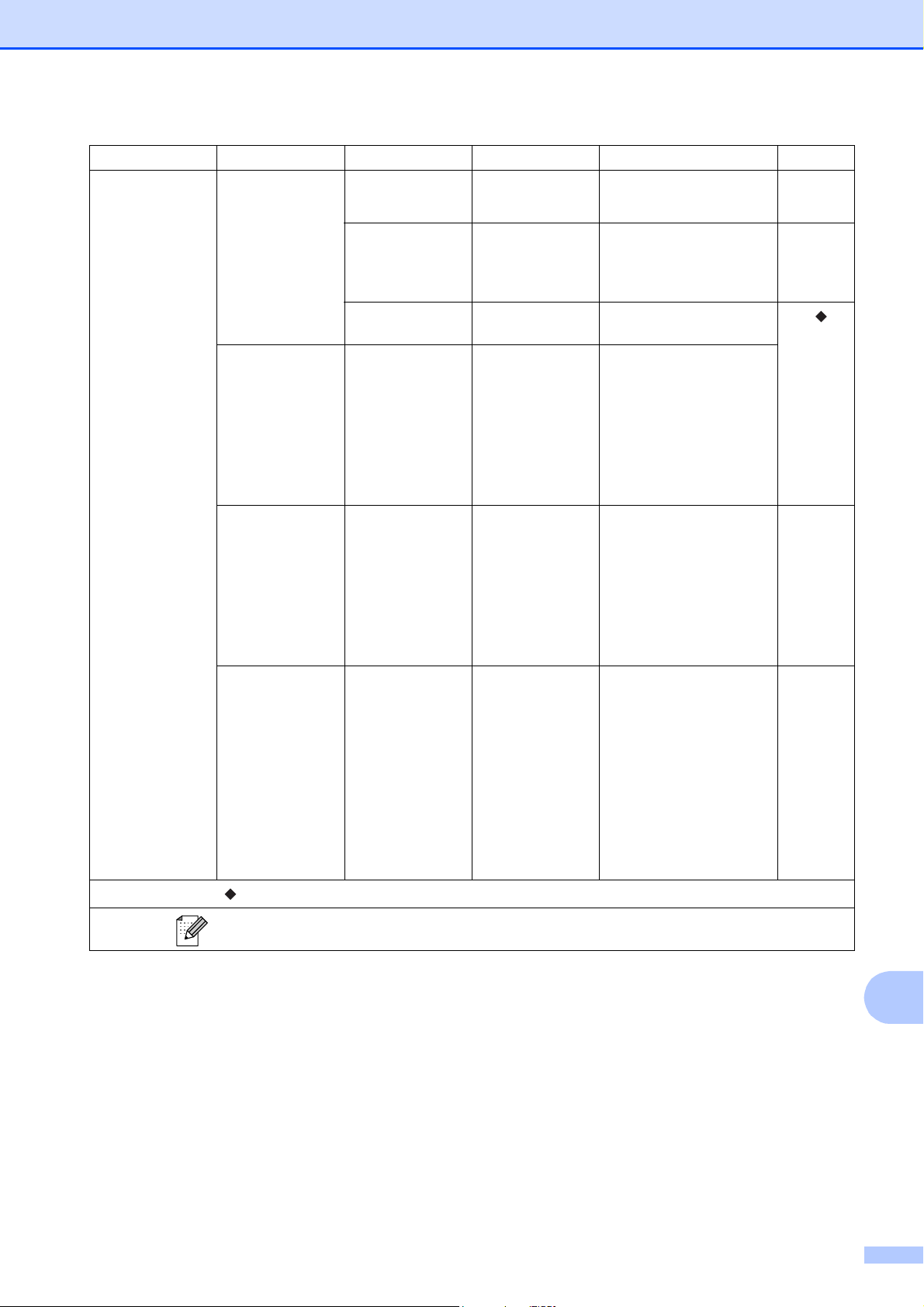
Menu and features
97
C
General Setup Ink Test Print Print Quality
Alignment
Lets you check the print
quality or alignment.
62
Cleaning Black
Color
All
Lets you clean the print
head.
62
Ink Volume — Lets you check the
available ink volume.
See .
Mode Timer — Off
0Sec
30Secs
1Min
2Mins*
5Mins
Sets the length of time
before the machine will
return to FAX mode and
before the machine will
change from a restricted
user to Public user mode
when using Secure
Function Lock.
Paper Type — Plain Paper*
Inkjet Paper
Brother BP71
Brother BP61
Other Glossy
Transparency
Sets the type of paper in
the paper tray.
19
Paper Size — Letter*
Legal
Ledger
A4
A5
A3
EXE
4"x6"
Sets the size of paper in
the paper tray.
19
Level1 Level2 Level3 Options Descriptions Page
See Advanced User’s Guide.
The factory settings are shown in Bold with an asterisk.
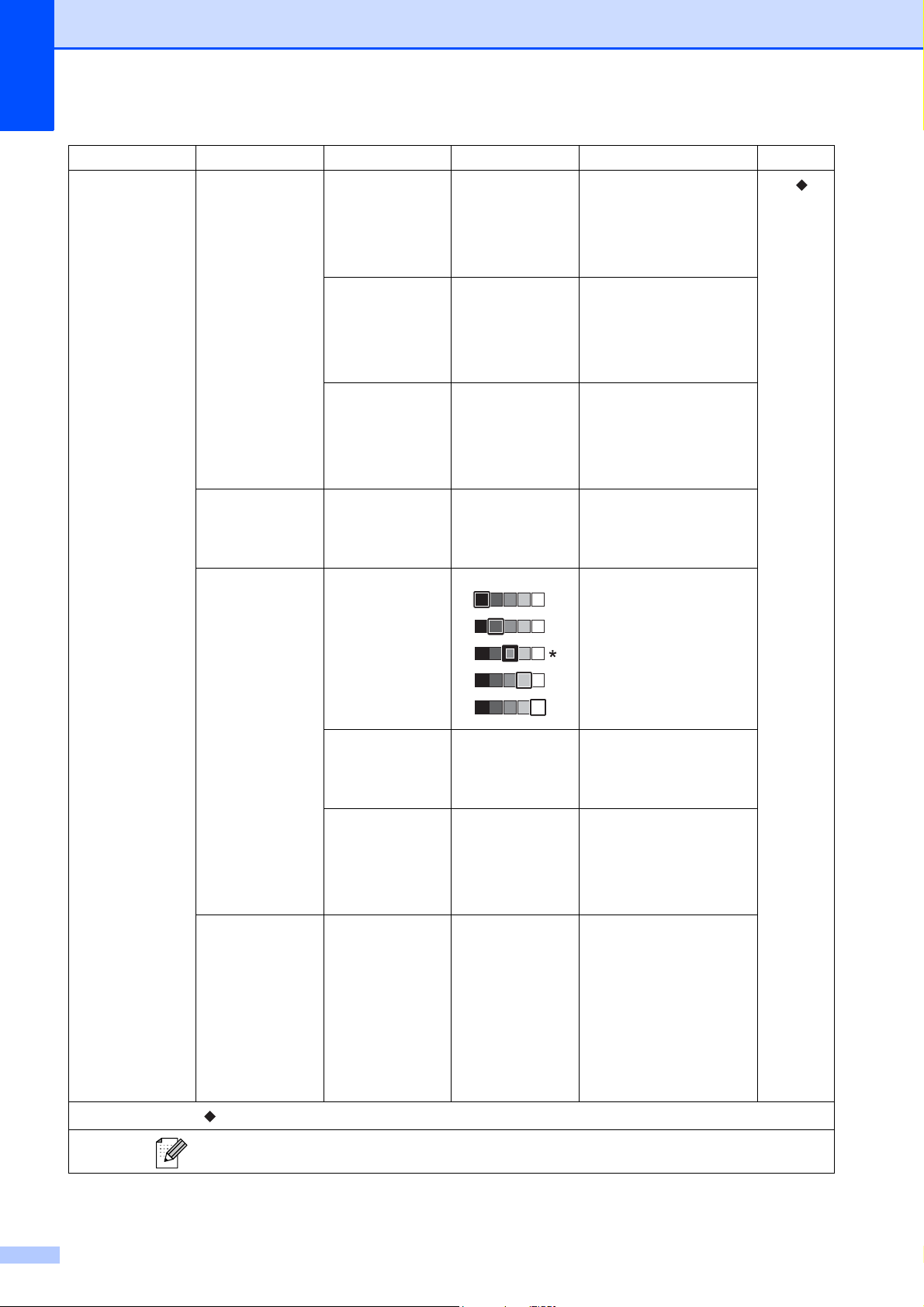
98
General Setup
(Continued)
Volume Ring Off
Low
Med*
High
Adjusts the ring volume.
See .
Beeper Off
Low*
Med
High
Adjusts the beeper
volume.
Speaker Off
Low
Med*
High
Adjusts the speaker
volume.
Auto Daylight — On
Off*
Change this setting to On
if you want the machine to
change automatically for
Daylight Saving Time.
LCD Settings LCD Contrast
Adjust the contrast of the
LCD.
Backlight Light*
Med
Dark
You can adjust the
brightness of the LCD
backlight.
Dim Timer Off
10Secs
20Secs
30Secs*
You can set how long the
LCD backlight stays on
after the last key press.
Sleep Mode — 1Min
2Mins
3Mins
5Mins*
10Mins
30Mins
60Mins
You can choose how long
the machine must be idle
before it goes into Sleep
mode.
Level1 Level2 Level3 Options Descriptions Page
See Advanced User’s Guide.
The factory settings are shown in Bold with an asterisk.
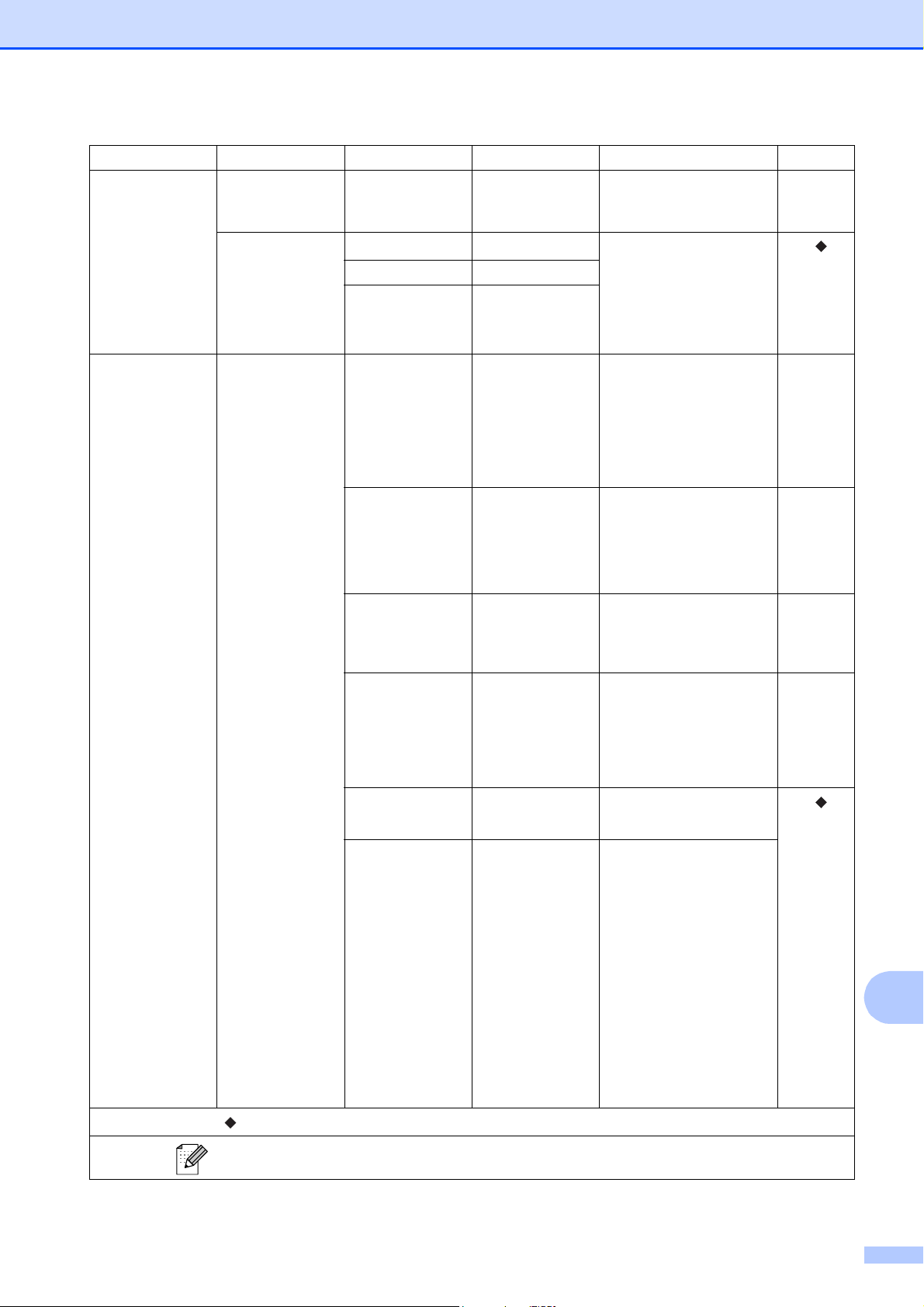
Menu and features
99
C
General Setup
(Continued)
LGR - Short Grain
— On
Off*
Turn on this setting when
you use Ledger short
grain paper.
20
Function Lock Set Password — You can restrict selected
machine operation for up
to 10 restricted users and
for all other
non
-authorized Public
users.
See .
Lock OffiOn —
Setup User —
Fax Setup Receive Ring Delay 0
1
2
3
4*
Sets the number of rings
before the machine
answers in Fax Only or
Fax/Tel mode.
34
F/T Ring Time 20Secs*
30Secs
40Secs
70Secs
Sets the length of the
pseudo/double-ring time
in Fax/Tel mode.
34
Easy Receive On*
Off
Receives fax messages
automatically when you
answer a call and hear fax
tones.
35
Remote Codes On*
(l51, #51)
Off
Allows you to answer all
calls at an extension
telephone and use codes
to turn the machine on or
off. You can personalize
these codes.
42
Auto Reduction
On*
Off
Reduces the size of
incoming faxes.
See .
Memory Receive
Off*
Fax Forward
Paging
Fax Storage
PC Fax Receive
You can set the machine
to either forward fax
messages, call your
pager, store incoming
faxes in the memory (so
you can retrieve them
while you are away from
your machine), or send
faxes to your PC.
If you choose Fax
Forward or PC-Fax
Receive, you can turn on
the safety feature Backup
Print.
Level1 Level2 Level3 Options Descriptions Page
See Advanced User’s Guide.
The factory settings are shown in Bold with an asterisk.

100
Fax
(Continued)
Setup Speed Dial
Set Speed Dial
Add Number You can store Speed Dial
numbers, so you can dial
by pressing only a few
buttons on the screen
(and Start).
45
Add Number
from History
See .
Setup Groups — You can set up Group
numbers for
Broadcasting.
Change — You can change Speed
Dial numbers.
46
Delete — You can delete Speed
Dial numbers.
Report Setting
Transmission On
On+Image
Off*
Off+Image
Choose the initial setup
for Transmission
Verification Report.
29
Journal Period
Off
Every 50 Faxes
*
Every 6 Hours
Every 12 Hours
Every 24 Hours
Every 2 Days
Every 7 Days
Sets the interval for the
automatic printing of the
Fax Journal.
If you have chosen other
than Off and
Every 50 Faxes, you
can set the time for the
chosen option.
If you have chosen
Every 7 Days, you can
set the day of the week.
See .
Print Fax — — Prints incoming faxes
stored in the memory.
Remote Access — --- Set your own code for
Remote Retrieval.
Remaining Jobs
— — Check which jobs are in
the memory and cancel
chosen jobs.
Miscellaneous Distinctive Off*
Set (On)
Uses the telephone
company's Distinctive
Ring subscriber service to
register the ring pattern
with the machine.
37
Caller ID
(USA only)
Area Co de View or print a list of the
last 30 Caller IDs stored in
the memory. Set up your
3-digit area code only if
you do not dial it within
your own area code.
See .
Level1 L evel2 Level3 Op tions Descriptio ns Page
See Advanced User’s Guide.
The factory settings are shown in Bold with an asterisk.
Menu and features
101
C
Network menu C
Level1 Level2 Level3 Level4 Options Descriptions Page
Network Wired LAN TCP/IP BOOT Method Auto*
Static
RARP
BOOTP
DHCP
Choose the
BOOT method
that best suits
your needs.
See .
IP Address [000-255].
[000-255].
[000-255].
[000-255]
Enter the IP
address.
Subnet Mask [000-255].
[000-255].
[000-255].
[000-255]
Enter the Subnet
mask.
Gateway [000-255].
[000-255].
[000-255].
[000-255]
Enter the
Gateway
address.
Node Name
BRNXXXXXXXXXXXX
Enter the Node
name.
WINS Config Auto*
Static
Chooses the
WINS
configuration
mode.
WINS Server (Primary)
000.000.000.000
(Secondary)
000.000.000.000
Specifies the IP
address of the
primary or
secondary WINS
server.
DNS Server (Primary)
000.000.000.000
(Secondary)
000.000.000.000
Specifies the IP
address of the
primary or
secondary DNS
server.
APIPA On*
Off
Automatically
allocates the IP
address from the
link-local address
range.
See Network User’s Guide.
The factory settings are shown in Bold with an asterisk.
102
Network
(Continued)
Wired LAN
(Continued)
TCP/IP
(Continued)
IPv6 On
Off*
Enable or disable
the IPv6 protocol.
If you want to use
the IPv6 protocol,
visit
http://solutions.
brother.com/ for
more information.
See .
Ethernet — Auto*
100B-FD
100B-HD
10B-FD
10B-HD
Chooses the
Ethernet link
mode.
MAC Address — — You can see your
machine’s MAC
address.
WLAN TCP/IP BOOT Method Auto*
Static
RARP
BOOTP
DHCP
Chooses the
BOOT method
that best suits
your needs.
IP Address [000-255].
[000-255].
[000-255].
[000-255]
Enter the IP
address.
Subnet Mask [000-255].
[000-255].
[000-255].
[000-255]
Enter the Subnet
mask.
Gateway [000-255].
[000-255].
[000-255].
[000-255]
Enter the
Gateway
address.
Node Name
BRWXXXXXXXXXXXX
Enter the Node
name.
WINS Config Auto*
Static
Chooses the
WINS
configuration
mode.
Level1 Level2 Level3 Level4 Options Descriptions Page
See NetworkUser’sGuide.
The factory settings are shown in Bold with an asterisk.
Menu and features
103
C
Network
(Continued)
WLAN
(Continued)
TCP/IP
(Continued)
WINS Server (Primary)
000.000.000.000
(Secondary)
000.000.000.000
Specifies the IP
address of the
primary or
secondary WINS
server.
See .
DNS Server (Primary)
000.000.000.000
(Secondary)
000.000.000.000
Specifies the IP
address of the
primary or
secondary DNS
server.
APIPA On*
Off
Automatically
allocates the IP
address from the
link-local address
range.
IPv6 On
Off*
Enable or disable
IPv6 protocol for
a wireless LAN.
If you want to use
the IPv6 protocol,
visit
http://solutions.
brother.com/ for
more information.
Setup Wizard
— — You can
manually
configure your
print server for a
wireless network.
WPS/AOSS — — You can easily
configure your
wireless network
settings using the
one-button push
method.
WPS w/PIN Code
— — You can easily
configure your
wireless network
settings using
WPS with a PIN
code.
Level1 Level2 Level3 Level4 Options Descriptions Page
See Network User’s Guide.
The factory settings are shown in Bold with an asterisk.
104
Network
(Continued)
WLAN
(Continued)
WLAN Status Status — You can see the
current wireless
network status.
See .
Signal — You can see the
current wireless
network signal
strength.
SSID — You can see the
current SSID.
Comm. Mode — You can see the
current
Communication
Mode.
MAC Address — — You can see your
machine’s MAC
address.
Email/IFax
(Available after
IFAX is
downloaded)
Email Address
— — Enter the mail
address. (Up to
60 characters)
Setup Server
SMTP Server Name
(Up to 30
characters)
IP Address
[000-255].
[000-255].
[000-255].
[000-255]
Enter the SMTP
server address.
SMTP Port [00001-65535] Enter the SMTP
port number.
Auth. for SMTP
None*
SMTP-AUTH
POP bef.SMTP
Selects the
Security method
for E-mail
notification.
POP3 Server Name
(Up to 30
characters)
IP Address
[000-255].
[000-255].
[000-255].
[000-255]
Enter the POP3
server address.
POP3 Port [00001-65535] Enter the POP3
port number.
Level1 Level2 Level3 Level4 Options Descriptions Page
See NetworkUser’sGuide.
The factory settings are shown in Bold with an asterisk.
Menu and features
105
C
Network
(Continued)
Email/IFax
(Available after
IFAX is
downloaded)
(Continued)
Setup Server
(Continued)
Mailbox Name
— Enter the mail
box name. (Up to
60 characters)
See .
Mailbox Pwd — Enter the
password to login
to the POP3
server. (Up to
32 characters)
APOP On
Off*
Enables or
disables APOP.
Setup Mail RX
Auto Polling
On*
Off
Automatically
checks the POP3
server for new
messages.
Poll Frequency
(Available
when
Auto Polling
is set to On.)
1Min
3Mins
5Mins
10Mins*
30Mins
60Mins
Sets the interval
for checking for
new messages
on the POP3
server.
Header All
Subject+From+To
None*
Selects the
contents of the
mail header to be
printed.
Del Error
Mail
On*
Off
Deletes error
mails
automatically.
Notification
On
MDN
Off*
Receives
notification
messages.
Setup Mail TX
Sender Subject
— Displays the
subject that is
attached to the
Internet Fax data.
Size Limit On
Off*
Limits the size of
E-mail
documents.
Notification
On
Off*
Sends
notification
messages.
Level1 Level2 Level3 Level4 Options Descriptions Page
See Network User’s Guide.
The factory settings are shown in Bold with an asterisk.
106
Network
(Continued)
Email/IFax
(Available after
IFAX is
downloaded)
(Continued)
Setup Relay
Rly Broadcast
On
Off*
Relays a
document to
another fax
machine over the
Internet.
See .
Relay Domain
— Registers the
Domain name.
Relay Report
On
Off*
Prints the Relay
Broadcast
Report.
Time Zone — UTCXXX:XX — Sets the time
zone for your
country.
Network I/F — Wired LAN*
WLAN
— You can choose
the network
connection type.
Network Reset
———Restore all
network settings
back to the
factory settings.
Level1 Level2 Level3 Level4 Options Descriptions Page
See NetworkUser’sGuide.
The factory settings are shown in Bold with an asterisk.
Menu and features
107
C
Menu (continued) C
Level1 Level2 Level3 Options Descriptions Page
Print Reports Transmission — — Prints these lists and
reports.
See .
Quick Dial — Alphabetical
Order
Numerical
Order
Fax Journal ——
User Settings ——
Network Config
——
WLAN Report ——
Caller ID hist.
——
Machine Info. Serial No. — — Lets you check the serial
number of your machine.
94
Initial Setup Receive Mode — Fax Only*
Fax/Tel
External TAD
Manual
Choose the Receive
Mode that best suits your
needs.
31
Date&Time — — Puts the date and time on
the screen and in the
headings of the faxes you
send.
See .
Station ID — Fax:
Name:
Enter your name and fax
number to appear on
each page you fax.
Tone/Pulse
(Canada only)
— Tone*
Pulse
Choose the dialing mode.
Dial Tone — Detection
No Detection*
You can shorten the dial
tone detect pause.
93
Dial Prefix — On
Off*
Sets a prefix number that
will always be added
before the fax number
every time you dial.
See .
Compatibility — High*
Normal
Basic(for VoIP)
Adjusts the modem speed
to help resolve
transmission problems.
93
See Advanced User’s Guide.
See Quick Setup Guide.
The factory settings are shown in Bold with an asterisk.
108
Initial Setup
(Continued)
Reset Network — Resets the print server
back to its factory default
settings, such as the
password and IP address
information.
94
Speed Dial&Fax
— Deletes all stored
Speed Dial numbers and
faxes, restores the
Station ID, Quick Dial List,
Transmission Verification
Report and Fax Journal
back to the factory default
settings.
All Settings — Resets all the machine’s
settings back to the
factory settings.
Local Language
(USA only)
— English*
Spanish
Allows you to change the
screen language for your
country.
See .
Local Language
(Canada only)
— English*
French
Allows you to change the
screen language for your
country.
Level1 Level2 Level3 Options Descriptions Page
See Advanced User’s Guide.
See Quick Setup Guide.
The factory settings are shown in Bold with an asterisk.
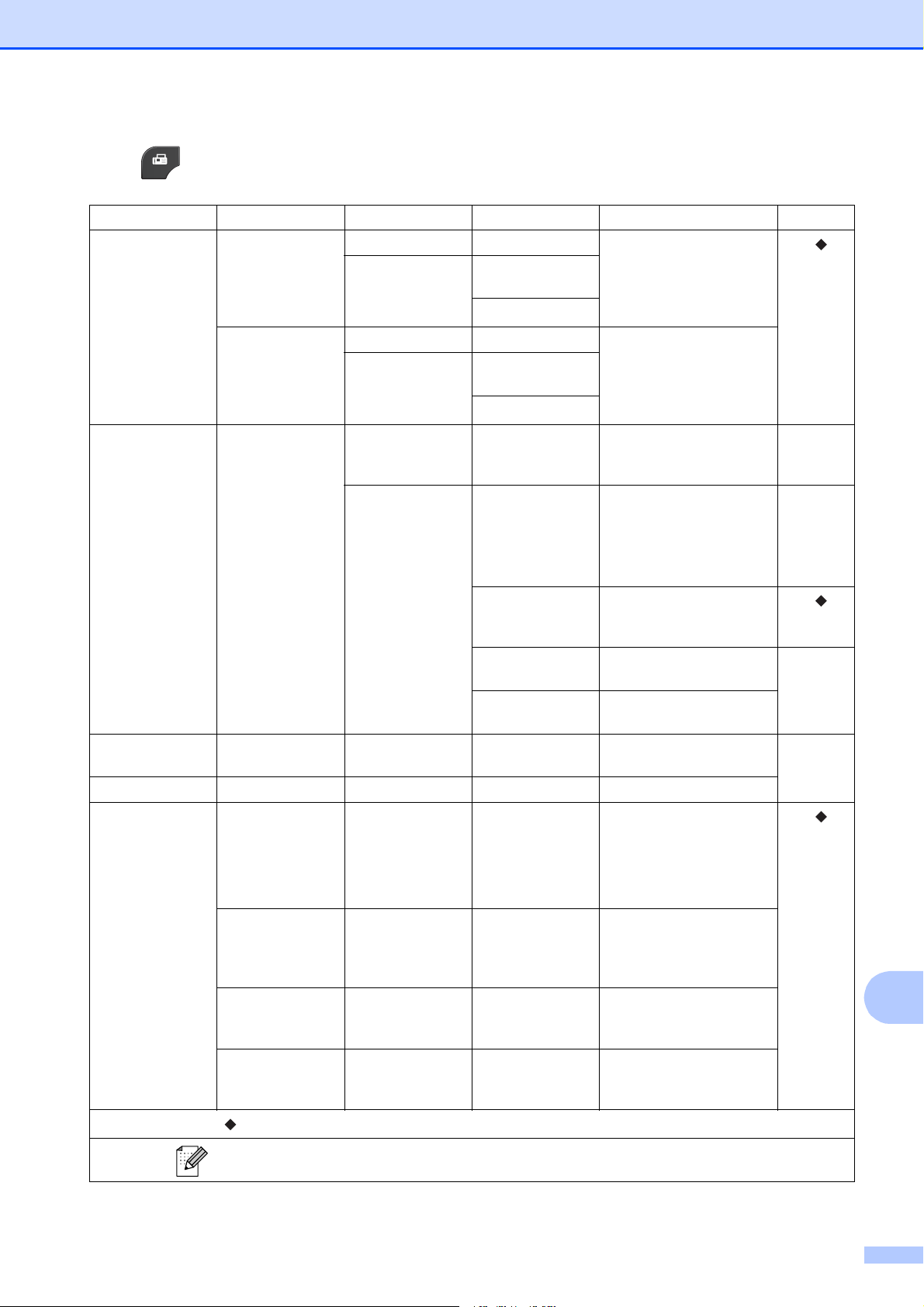
Menu and features
109
C
FAX ( ) C
Level1 Level2 Level3 Options Descriptions Page
History Outgoing Send a fax — You can choose a number
from the Outgoing Call
history and then send a
fax to it, add it to
Speed Dial, or delete it.
See .
More Add Speed
Dial
Delete
Incoming Send a fax — You can choose a number
from the Caller ID history
and then send a fax to it,
add it to Speed Dial, or
delete it.
More Add Speed
Dial
Delete
SpeedDial — Send a fax — You can dial by pressing
only a few keys (and
Start).
44
More
Set Speed Dial
You can store Speed Dial
numbers, so you can dial
by pressing only a few
buttons on the
screen(and Start).
45
Setup Groups You can set up Group
numbers for
Broadcasting.
See .
Change You can change
Speed Dial numbers.
46
Delete You can delete
Speed Dial numbers.
Black Start — — — Lets you send a
monochrome fax.
27
Color Start — — — Lets you send a color fax.
Options
Fax Resolution
— Standard*
Fine
S.Fine
Photo
Sets the resolution for
outgoing faxes.
See .
Contrast — Auto*
Light
Dark
Changes the lightness or
darkness of faxes you
send.
Broadcasting
Add number
from SpeedDial
— You can send the same
fax message to more than
one fax number.
Delayed Fax — On
Off*
Sets the time of day in
24-hour format that the
delayed faxes will be sent.
See Advanced User’s Guide.
The factory settings are shown in Bold with an asterisk.
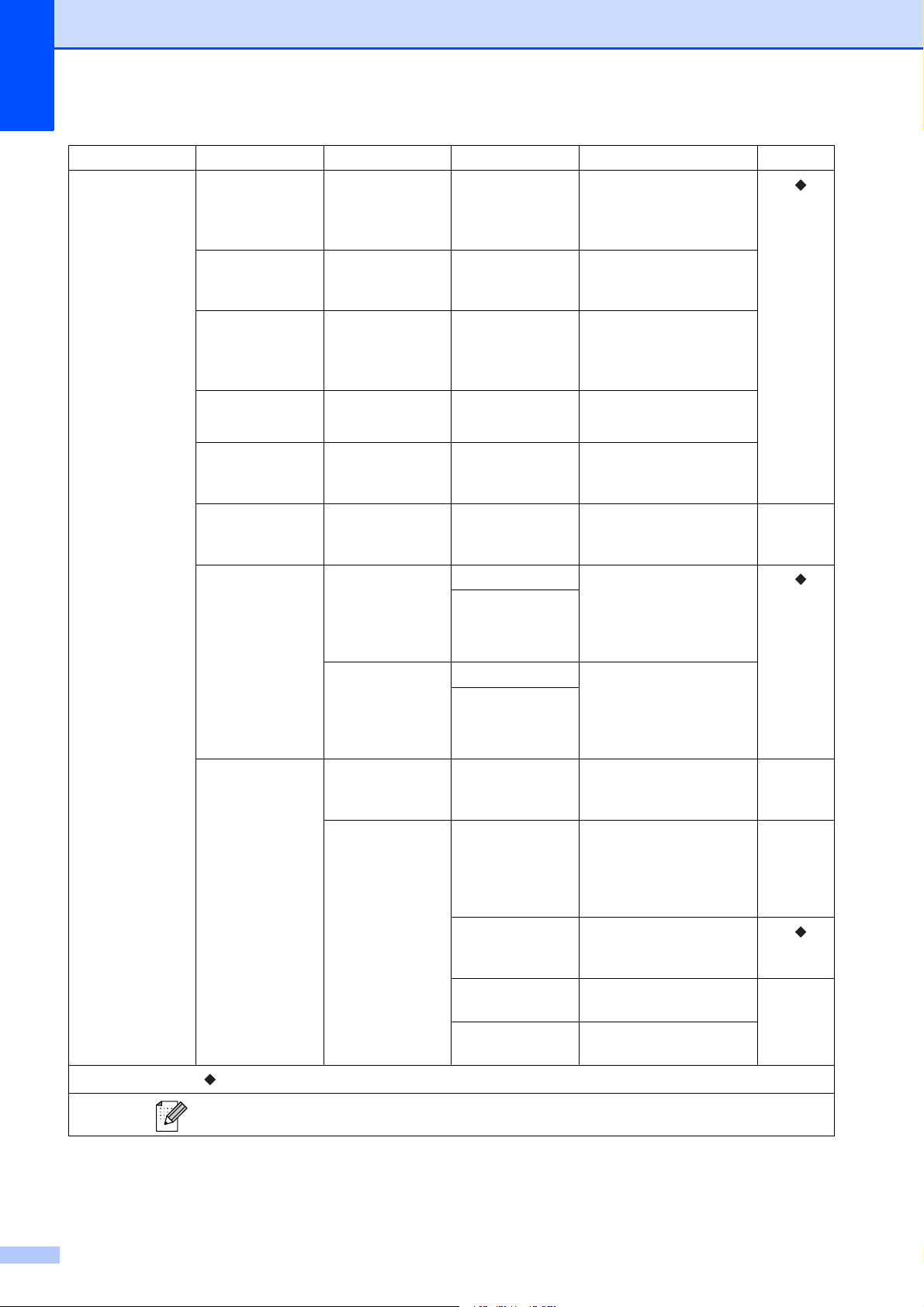
110
Options
(Continued)
Batch TX — On
Off*
Combines delayed faxes
to the same fax number at
the same time of day into
one transmission.
See .
Real Time TX — On
Off*
You can send a fax
without using the
memory.
Polled TX — On
Off*
Sets up your machine
with a document to be
retrieved by another fax
machine.
Polling RX — On
Off*
Sets up your machine to
poll another fax machine.
Overseas Mode — On
Off*
If you are having difficulty
sending faxes overseas,
set this to On.
Glass ScanSize
— Letter*
A4
Adjust the scan area of
the scanner glass to the
size of the document.
29
History Outgoing Send a fax You can choose a number
from the Outgoing Call
history and then send a
fax to it, add it to Speed
Dial, or delete it.
See .
More
(Add Speed
Dial/Delete)
Incoming Send a fax You can choose a number
from the Caller ID history
and then send a fax to it,
add it to Speed Dial, or
delete it.
More
(Add Speed
Dial/Delete)
Speed Dial Send a fax — You can dial by pressing
only a few keys (and
Start).
44
More
Set Speed Dial
You can store Speed Dial
numbers, so you can dial
by pressing only a few
buttons on the screen
(and Start).
45
Setup Groups You can set up Group
numbers for
Broadcasting.
See .
Change You can change Speed
Dial numbers.
46
Delete You can delete Speed
Dial numbers.
Level1 Level2 Level3 Options Descriptions Page
See Advanced User’s Guide.
The factory settings are shown in Bold with an asterisk.
Menu and features
111
C
Options
(Continued)
Set New Default
—
Fax Resolution
Contrast
Real Time TX
Glass ScanSize
You can save your fax
settings.
See .
Factory Reset — — You can restore all
settings back to the
factory settings.
Level1 Level2 Level3 Options Descriptions Page
See Advanced User’s Guide.
The factory settings are shown in Bold with an asterisk.
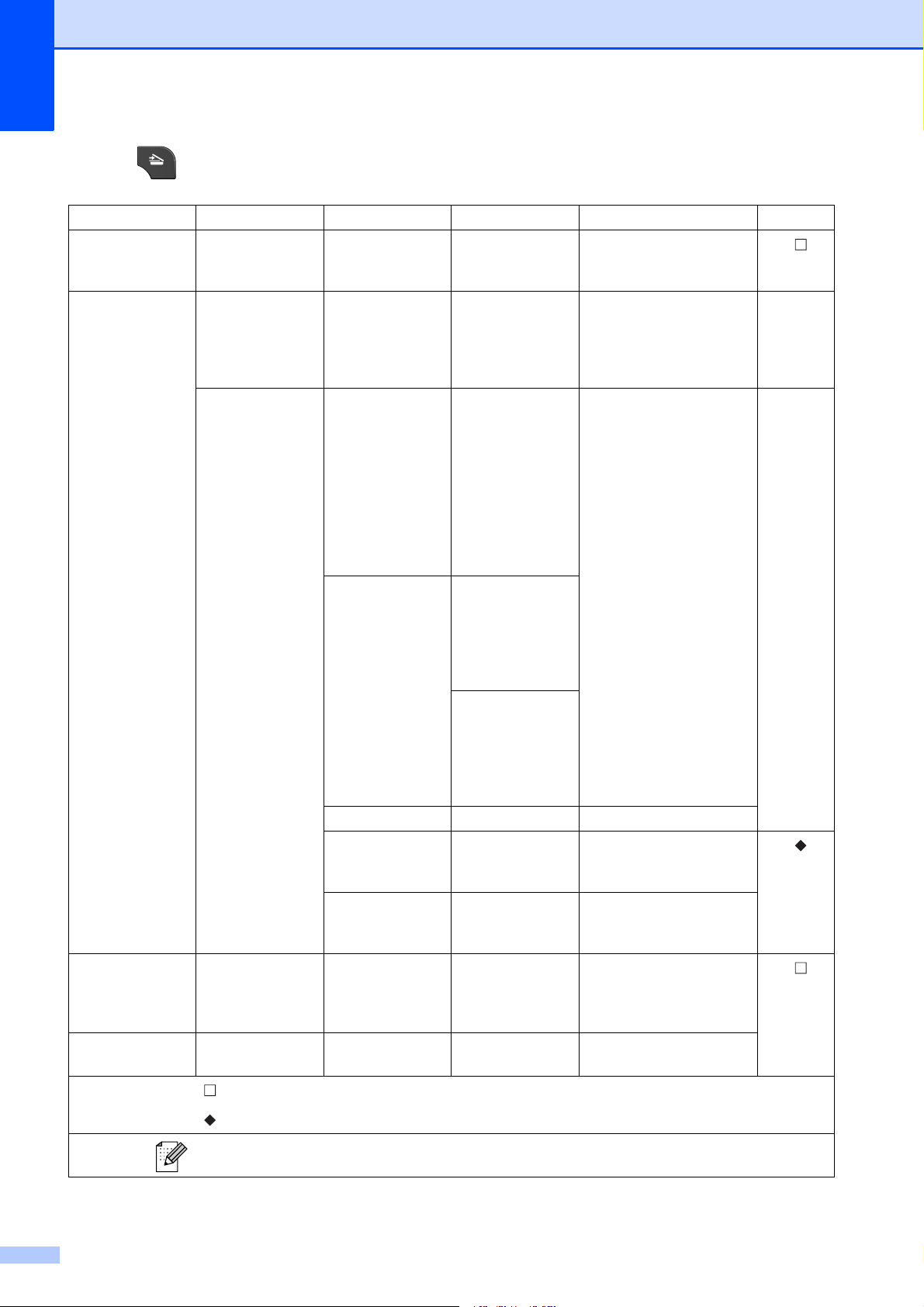
112
SCAN ( ) C
Level1 Option1 Option2 Option3 Descriptions Page
Scan to File — — — You can scan a black &
white or a color document
into your computer.
See .
Scan to Media
(when a memory
card or USB
Flash memory
drive is inserted)
Start — — Lets you scan directly to a
memory card or USB
Flash memory drive.
54
Options Quality Color 100 dpi
Color 200 dpi
*
Color 300 dpi
Color 600 dpi
B/W 100 dpi
B/W 200 dpi
B/W 300 dpi
You can choose the scan
resolution and file format
for your document.
54
File Type (If you choose
Color option in
Quality setting)
PDF*
JPEG
(If you choose
B&W option in
Quality setting)
TIFF
PDF*
File Name — You can rename the file.
Set New Default
Quality
File Type
You can save your scan
settings as the default
settings.
See .
Factory Reset — You can restore all
settings back to the
factory settings.
Scan to Network
(Profile Name) — — You can send scanned
data to a CIFS server on
your local network or on
the Internet.
See .
Scan to FTP (Profile Name) — — You can send scanned
data via FTP.
See Software User’s Guide.
See Advanced User’s Guide.
The factory settings are shown in Bold with an asterisk.
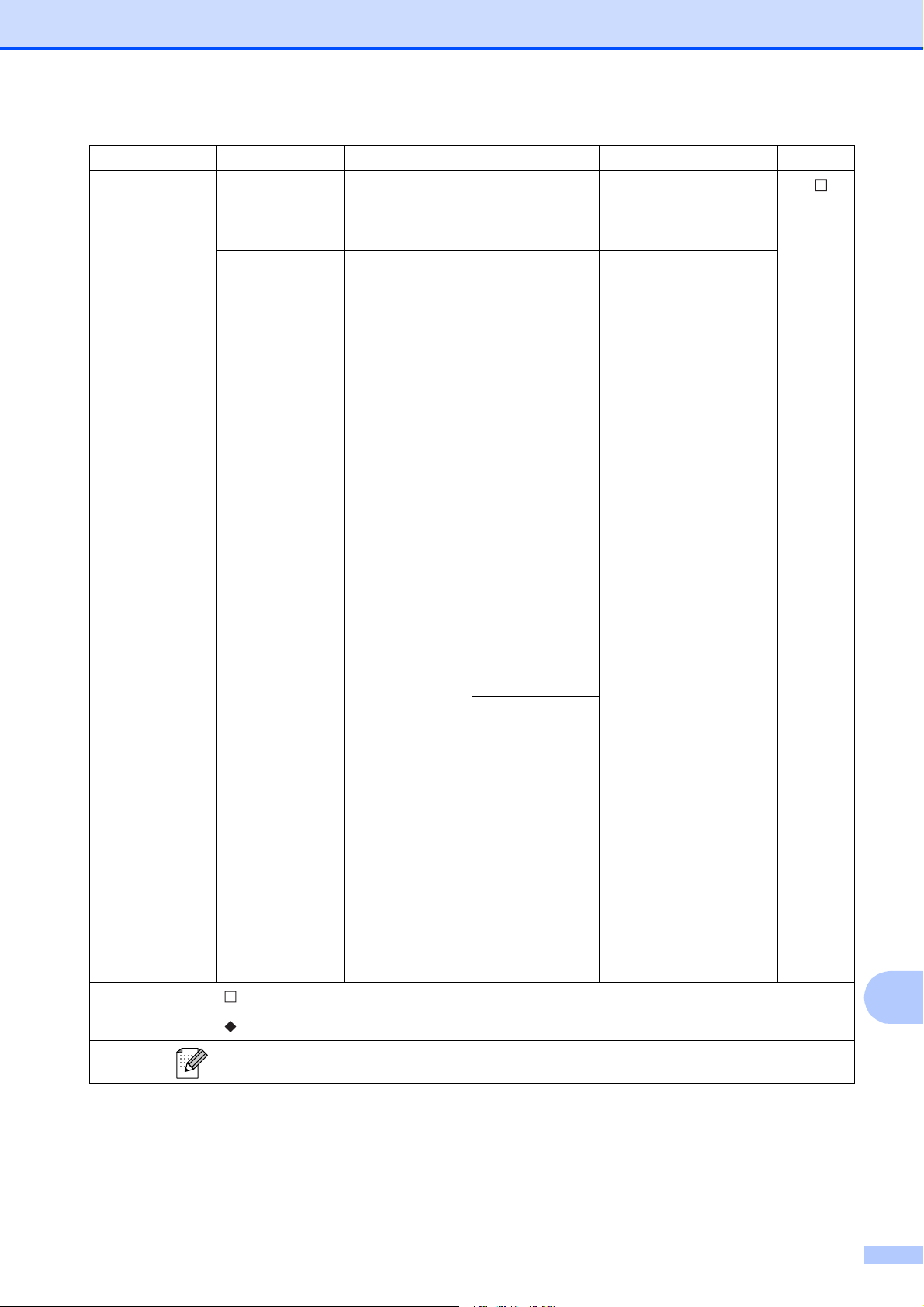
Menu and features
113
C
Scan to email PC — — You can scan a black &
white or a color document
into your E-mail
application.
See .
E-mail Server
(Available after
IFAX is
downloaded)
Manual
Speed Dial
— You can scan a black &
white or a color document
into your E-mail Server.
Manual: You can enter
an E-mail address using
the buttons on the LCD.
Speed Dial: You can
search for an E-mail
address that you have
stored in the machine.
Quality
(Options)
Color 100 dpi
Color 200 dpi
*
Color 300 dpi
Color 600 dpi
B/W 100 dpi
B/W 200 dpi
B/W 300 dpi
Chooses the file format to
send the scanned data via
E-mail server.
File Type
(Options)
(If you choose
Color option in
Quality setting)
PDF*
JPEG
(If you choose
B&W option in
Quality setting)
TIFF
PDF*
Level1 Option1 Option2 Option3 Descriptions Page
See Software User’s Guide.
See Advanced User’s Guide.
The factory settings are shown in Bold with an asterisk.
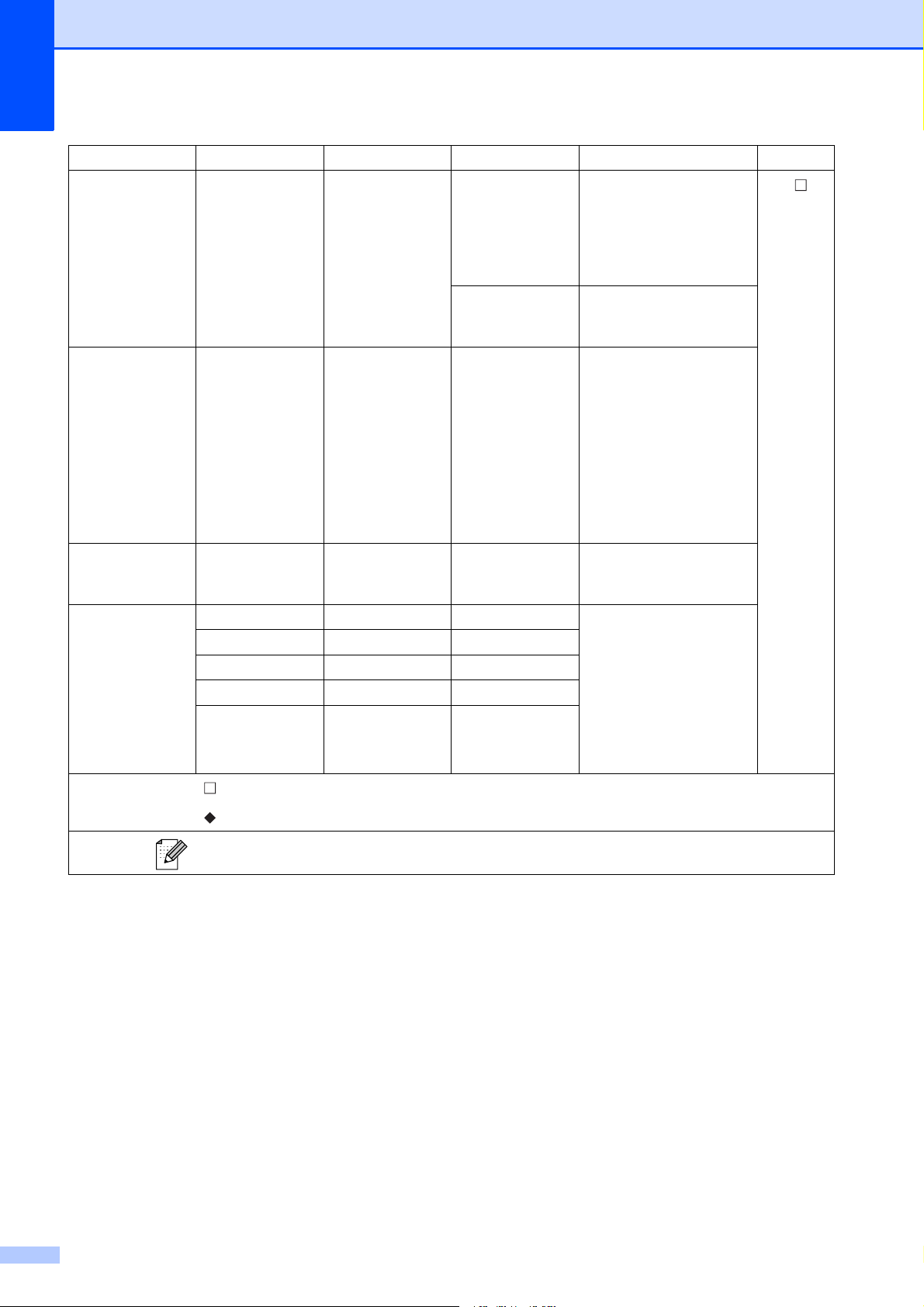
114
Scan to email
(Continued)
E-mail Server
(Available after
IFAX is
downloaded)
(Continued)
Manual
Speed Dial
(Continued)
Set New Default
(Options)
Quality
File Type
You can save your scan
settings.
See .
Factory Reset You can restore all
settings back to the
factory settings.
Scan to OCR
(Available after
Presto!
PageManager is
downloaded for
Macintosh users.
See Accessing
Brother Support
(Macintosh)
uu page 5.)
— — — You can have your text
document converted to an
editable text file.
Scan to Image — — — You can scan a color
picture into your graphics
application.
Web Service
(Appears when
you install a Web
Services
Scanner, which is
displayed in your
computer’s
Network
Explorer.)
Scan — — You can scan data by
using the Web Services
protocol.
Scan for E-mail
——
Scan for OCR ——
Scan for Fax ——
Scan for Print
——
Level1 Option1 Option2 Option3 Descriptions Page
See Software User’s Guide.
See Advanced User’s Guide.
The factory settings are shown in Bold with an asterisk.
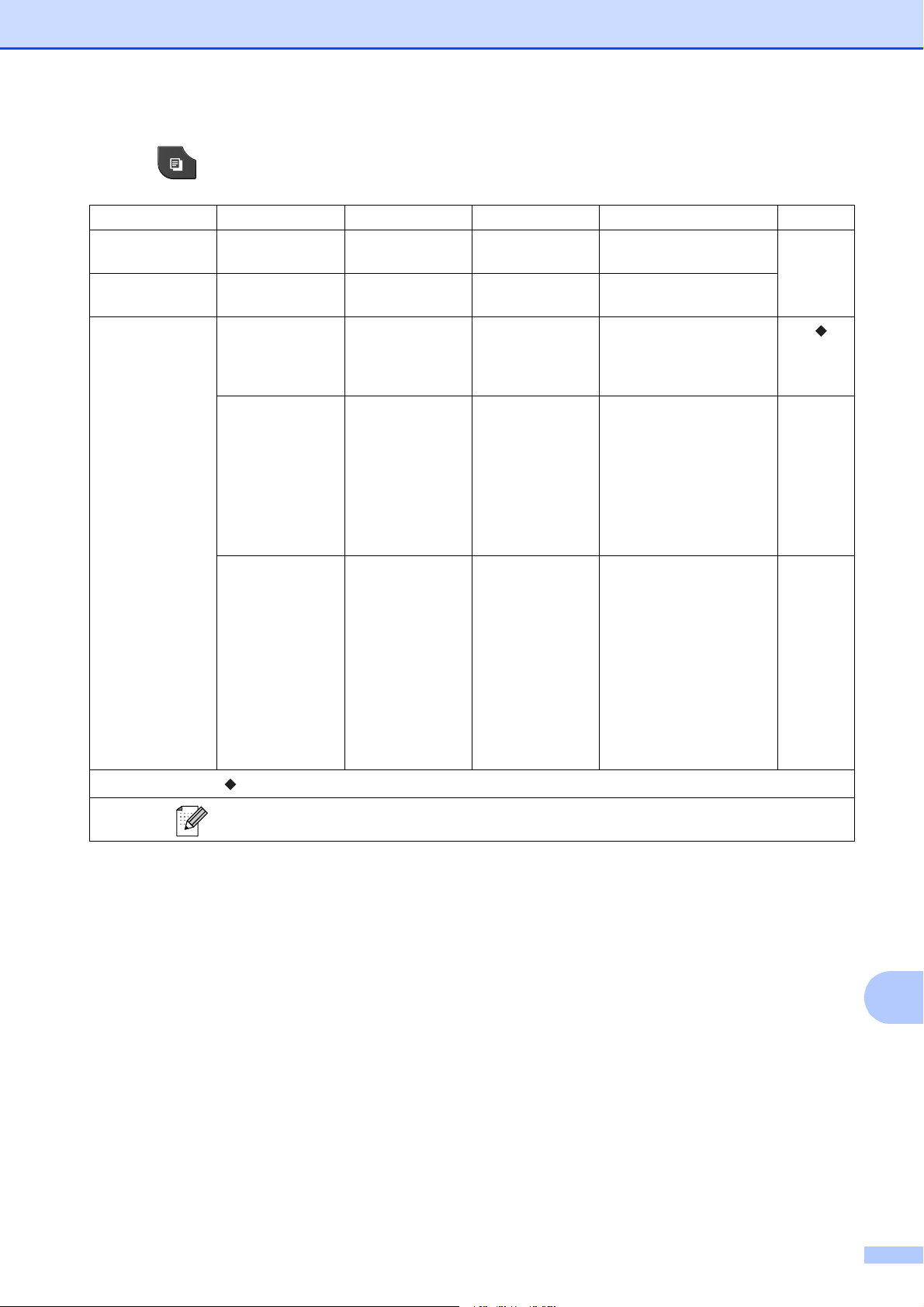
Menu and features
115
C
COPY ( ) C
Level1 Level2 Level3 Options Descriptions Page
Black Start — — — Lets you make a
monochrome copy.
47
Color Start — — — Lets you make a color
copy.
Options Quality — Fast
Normal*
Best
Choose the Copy
resolution for the next
copy.
See .
Paper Type — Plain Paper*
Inkjet Paper
Brother BP71
Brother BP61
Other Glossy
Transparency
Choose the paper type
that matches the paper in
the tray.
48
Paper Size — Letter*
Legal
Ledger
A4
A5
A3
EXE
4"x6"
Choose the paper size
that matches the paper in
the tray.
49
See Advanced User’s Guide.
The factory settings are shown in Bold with an asterisk.
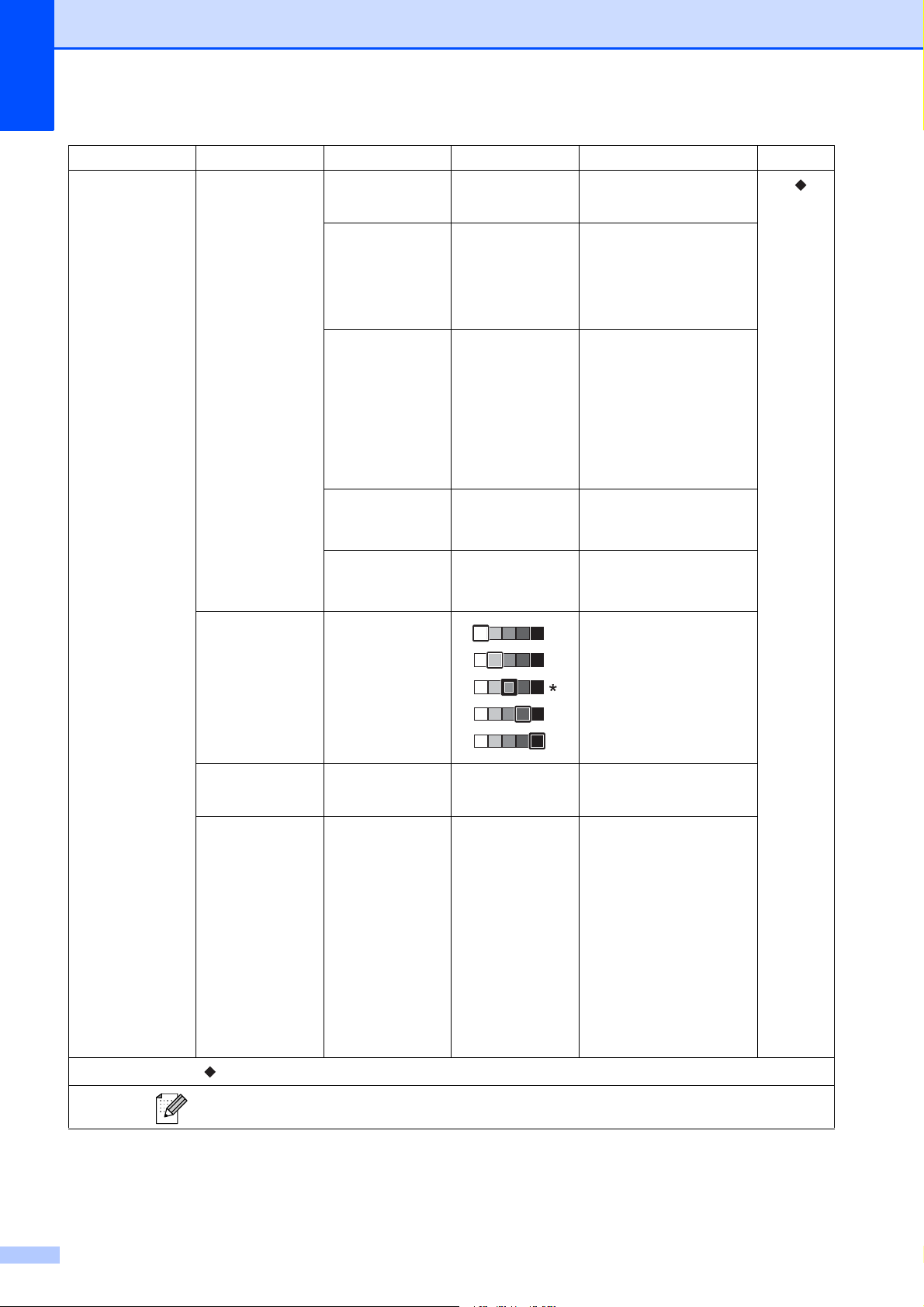
116
Options
(Continued)
Enlarge/Reduce
100%* ——
See .
Enlarge 198% 4"x6"iA4
186% 4"x6"
i
LTR
130% LTRiLGR
104% EXEiLTR
You can choose the
enlargement ratio for the
next copy.
Reduce 97% LTRiA4
93% A4iLTR
85% LTRiEXE
83% LGLiA4
78% LGLiLTR
46% LTRi4"x6"
You can choose the
reduction ratio for the next
copy.
Fit to Page — Your machine will adjust
the size automatically to
the paper size you set.
Custom(25-400%)
— You can enter an
enlargement or reduction
ratio.
Density —
Adjusts the density of
copies.
Stack/Sort — Stack*
Sort
You can choose to stack
or sort multiple copies.
Page Layout — Off(1in1)*
2in1(P)
2in1(L)
2in1(ID)
4in1(P)
4in1(L)
Poster (2x1)
Poster (2x2)
Poster (3x3)
You can make N in 1, 2 in
1 ID, or Poster copies.
Level1 Level2 Level3 Options Descriptions Page
See Advanced User’s Guide.
The factory settings are shown in Bold with an asterisk.
+2
+1
-1
-2
0
Menu and features
117
C
Options
(Continued)
Duplex Copy Off* — You can choose the
duplex print settings.
See .
Portrait
LongEdgeFlip
—
Landscape
LongEdgeFlip
—
Portrait
ShortEdgeFlip
—
Landscape
ShortEdgeFlip
—
Advanced Normal*
Duplex1
Duplex2
Advanced Settings
— Off*
Ink Save Mode
Thin Paper Copy
Book Copy
You can choose various
copy settings such as
Thin Paper Copy and
Book Copy.
Set New Default
— Quality
Enlarge/Reduce
Density
Page Layout
Ink Save Mode
Thin Paper Copy
Duplex Copy
You can save your copy
settings.
Factory Reset — — You can restore all the
settings back to the
factory settings.
Level1 Level2 Level3 Options Descriptions Page
See Advanced User’s Guide.
The factory settings are shown in Bold with an asterisk.
118
PHOTO ( ) C
Level1 Level2 Level3 Options Descriptions Page
View Photos OK Start — You can print your chosen
photos.
53
Options For details, see
the Options in
the following
table.
You can adjust your
photos with the options.
See .
Print All Start — — You can print all photos in
your memory card or USB
Flash memory drive.
Options — For details, see
the Options in
the following
table.
You can adjust your
photos with the options.
Index Print Index Sheet 6 IMGs/Line
5 IMGs/Line
For details, see
Options (for
Index Sheet)
uu page 121.
You can print a thumbnail
page.
Print Photos Start — You can print an
individual image.
Options For details, see
the Options in
the following
table.
You can adjust your
photos with the options.
See Advanced User’s Guide.
The factory settings are shown in Bold with an asterisk.
Menu and features
119
C
Options (for PHOTO) C
Option1 Option2 Option3 Option4 Descriptions Page
Print Quality
(Does not appear
when DPOF Print
is chosen.)
Normal
Photo*
— — Choose the print quality.
See .
Paper Type Plain Paper
Inkjet Paper
Brother BP71
Brother BP61
Other Glossy*
— — Choose the paper type.
Paper Size 4"x6"*
5"x7"
Letter
Ledger
A4
A3
(When A4 or
Letter is chosen)
3"x4"
3.5"x5"
4"x6"
5"x7"
6"x8"
Max. Size*
— Choose the paper and
print size.
Brightness
— — Adjusts the brightness.
Contrast
— — Adjusts the contrast.
See Advanced User’s Guide.
The factory settings are shown in Bold with an asterisk.
+2
+1
-1
-2
0
-2
-1
0
+1
+2
120
True2Life On
Off*
White Balance
Adjusts the hue of the
white areas.
See .
Sharpness
Enhances the detail of the
image.
Color Density
Adjusts the total amount
of color in the image.
Cropping On*
Off
— — Crops the image around
the margin to fit the paper
size or print size. Turn this
feature off if you want to
print whole images or
prevent unwanted
cropping.
Borderless On*
Off
— — Expands the printable
area to fit the edges of the
paper.
Print Date
(Does not appear
when DPOF Print
is chosen.)
On
Off*
— — Prints the date on your
photo.
Set New Default
Print Quality
Paper Type
Paper Size
Brightness
Contrast
True2Life
Cropping
Borderless
Print Date
— — You can save your print
settings as the default
settings.
Option1 Option2 Option3 Option4 Descriptions Page
See Advanced User’s Guide.
The factory settings are shown in Bold with an asterisk.
+2
+1
-1
-2
0
+2
+1
-1
-2
0
+2
+1
-1
-2
0
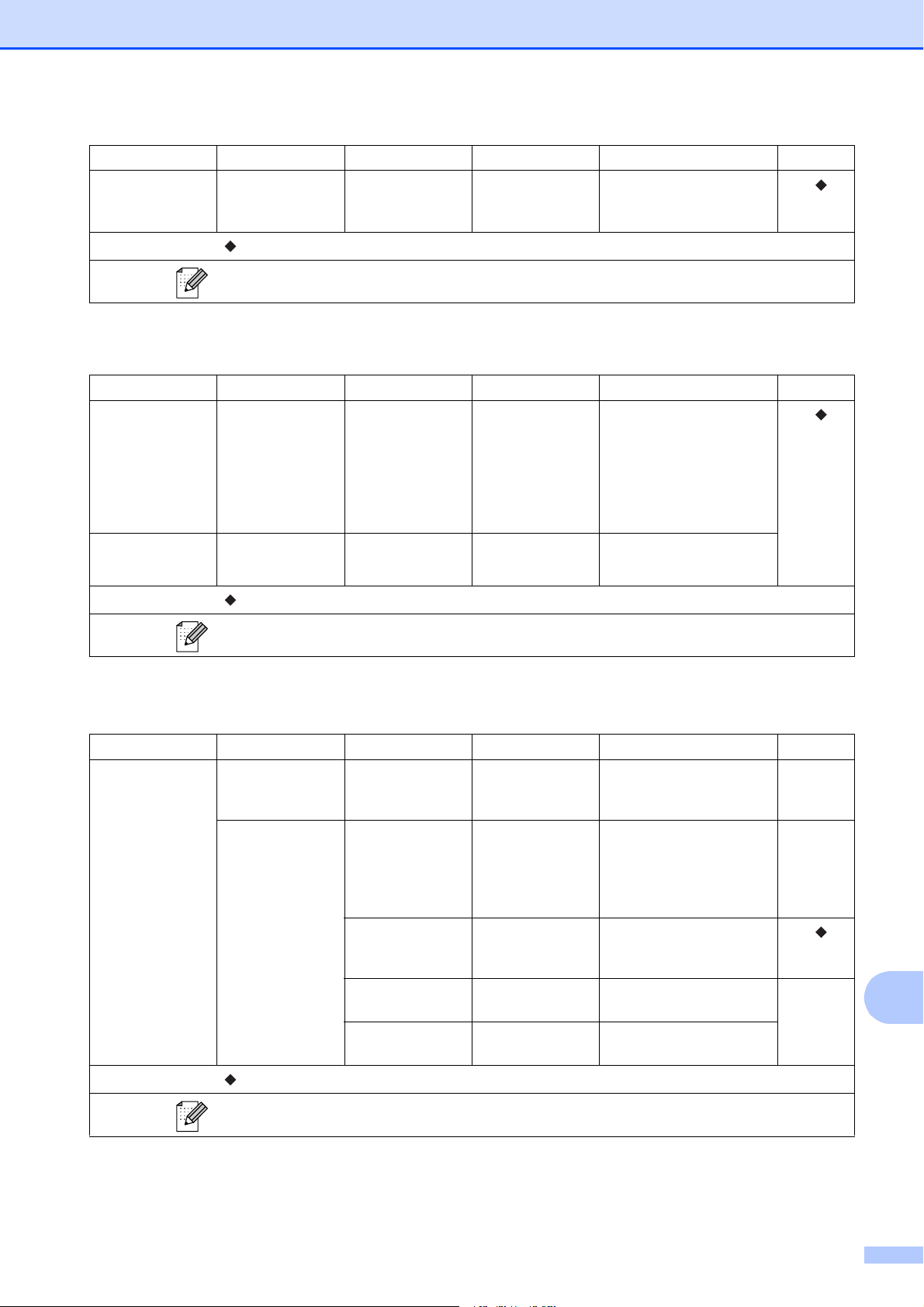
Menu and features
121
C
Options (for Index Sheet) C
SpeedDial C
Factory Reset — — — You can restore all the
settings back to the
factory settings.
See .
Level1 Level2 Level3 Options Descriptions Page
Paper Type Plain Paper*
Inkjet Paper
Brother BP71
Brother BP61
Other Glossy
— — Choose the paper type.
See .
Paper Size Letter*
A4
— — Choose the paper size.
See Advanced User’s Guide.
The factory settings are shown in Bold with an asterisk.
Level1 Level2 Level3 Options Descriptions Page
SpeedDial Send a fax — — You can dial by pressing
only a few keys (and
Start).
44
More
Set Speed Dial
— You can set up Speed
Dial numbers, so you can
dial by pressing only a few
buttons on the screen
(and Start).
45
Setup Groups — You can set up Group
numbers for
Broadcasting.
See .
Change — You can change
Speed Dial numbers.
46
Delete — You can delete
Speed Dial numbers.
See Advanced User’s Guide.
The factory settings are shown in Bold with an asterisk.
Option1 Option2 Option3 Option4 Descriptions Page
See Advanced User’s Guide.
The factory settings are shown in Bold with an asterisk.
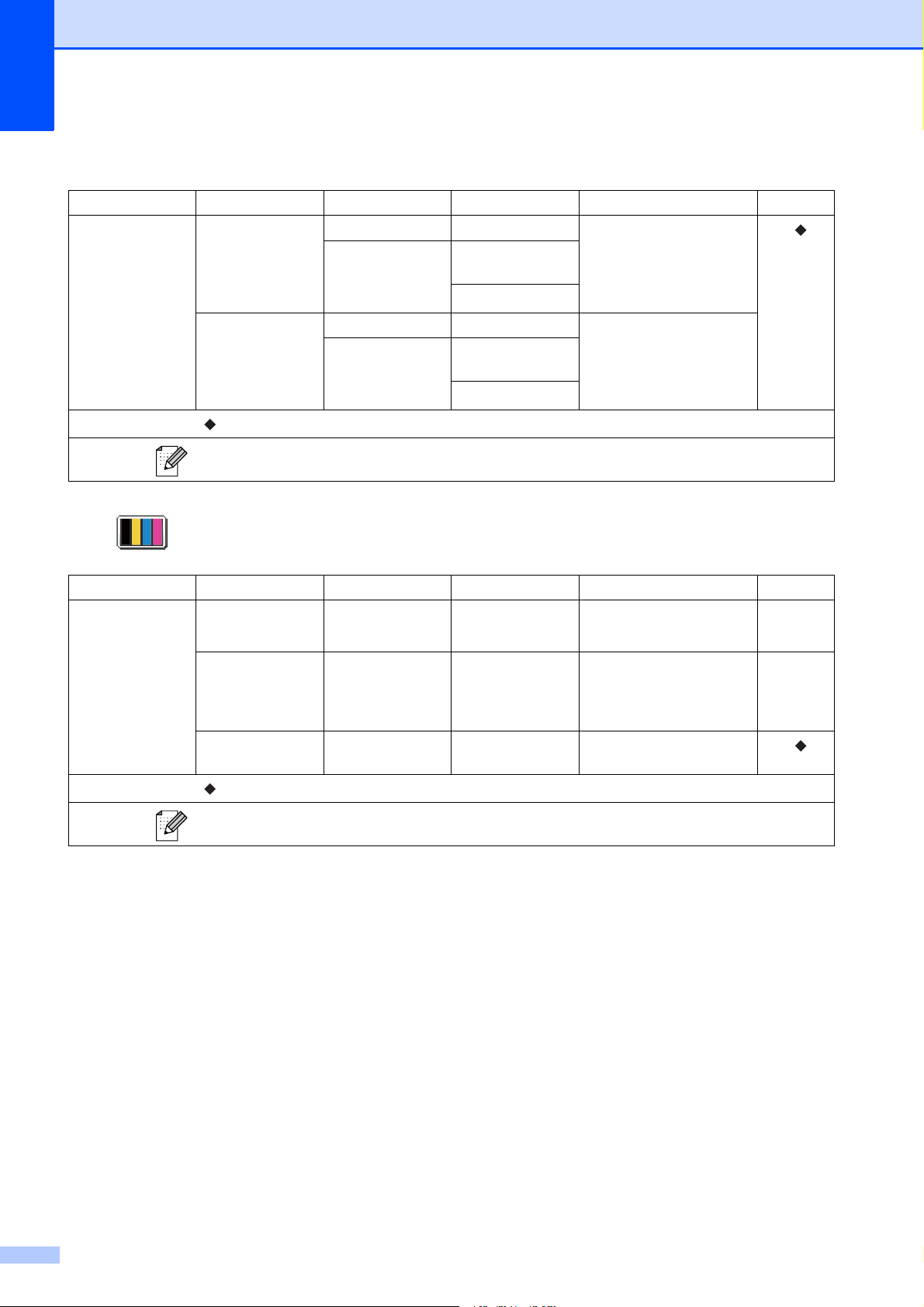
122
History C
Ink () C
Level1 Level2 Level3 Options Descriptions Page
History Outgoing Send a fax — You can choose a number
from the Outgoing Call
history and then send a
fax to it, add it to
Speed Dial, or delete it.
See .
More Add Speed
Dial
Delete
Incoming Send a fax — You can choose a number
from the Caller ID history
and then send a fax to it,
add it to Speed Dial, or
delete it.
More Add Speed
Dial
Delete
See Advanced User’s Guide.
The factory settings are shown in Bold with an asterisk.
Level1 Level2 Level3 Options Descriptions Page
Ink Test Print — Print Quality
Alignment
Lets you check the print
quality or alignment.
62
Cleaning — Black
Color
All
Lets you clean the print
head.
62
Ink Volume — — Lets you check the
available ink volume.
See .
See Advanced User’s Guide.
The factory settings are shown in Bold with an asterisk.
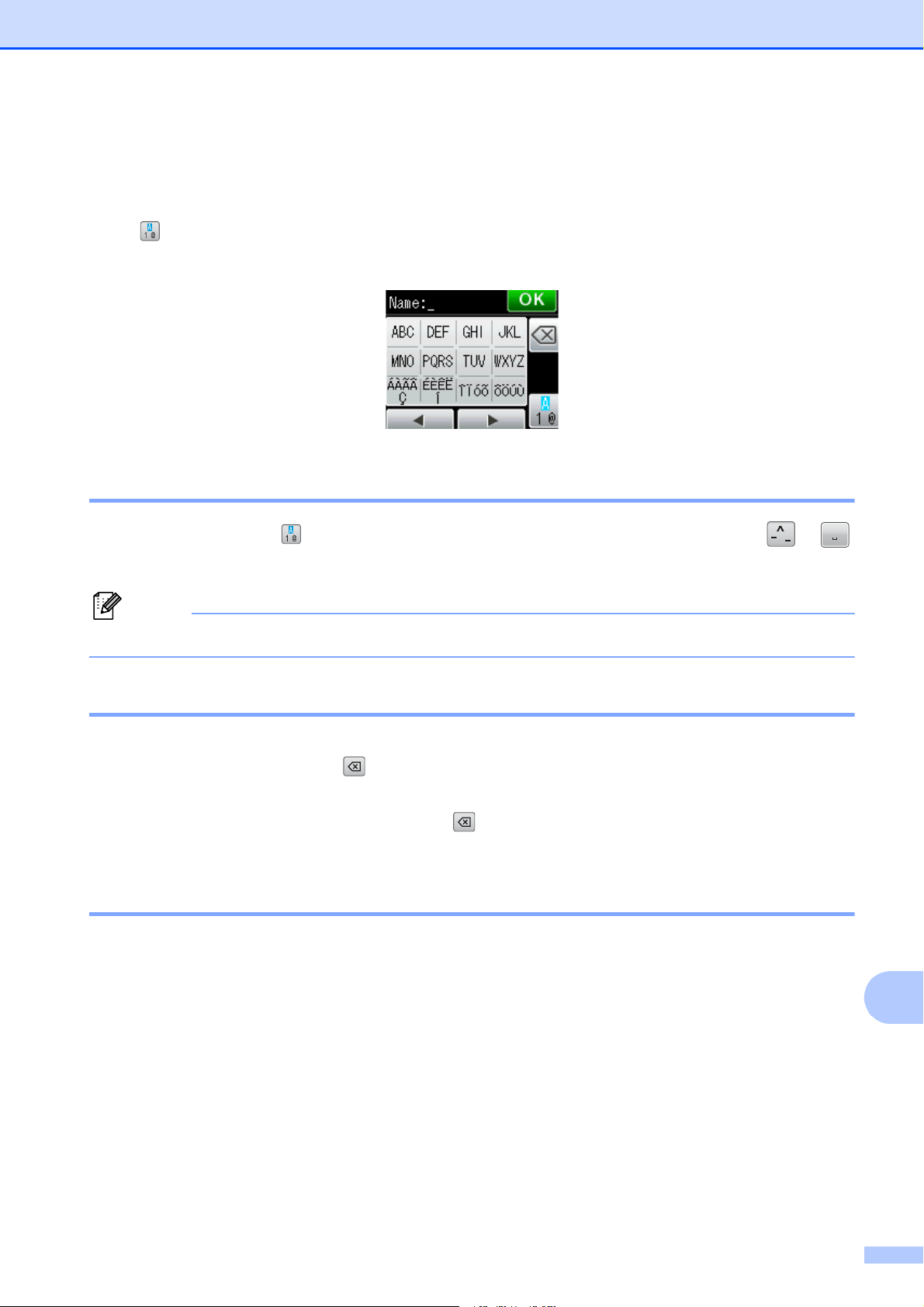
Menu and features
123
C
Entering Text C
When you are setting certain menu selections, you may need to enter text into the machine.
Press to cycle between letters, numbers and special characters. By pressing the proper button
repeatedly, you can access the character you want.
Inserting spaces C
To enter a space, press to choose special characters, then press the space button or .
Or, you can press the c twice to move the cursor.
Note
The characters available may differ depending on your country.
Making corrections C
If you entered an incorrect character and want to change it, press d to move the cursor under the
incorrect character. Then press . Enter the correct character. You can also insert letters by
moving the cursor and entering a character.
If the screen does not show a d button, press repeatedly until you have erased the incorrect
character. Enter the correct characters.
Repeating letters C
If you need to enter a character that is on the same button as the letter before it, press c to move
the cursor to the right before you press the same button again.

124
D
General D
Note
This chapter provides a summary of the machine’s specifications. For additional specifications
visit http://www.brother.com/
for details.
1
Measured diagonally.
2
Measured when the machine is connected to the USB interface.
3
When using ADF, single-sided printing, resolution: standard / document: ISO/IEC 24712 printed pattern.
Specifications D
Printer Type Inkjet
Print Head Black:
Color:
Piezo with 210 nozzles 1
Piezo with 210 nozzles 3
Memory Capacity 64 MB
LCD (Liquid Crystal
Display)
1.9 in. (49.0 mm) STN Color LCD Touchscreen plus Touchpanel
controls
1
Power Source AC 100 to 120 V 50/60 Hz
Power Consumption
2
Copy Mode:
Approx. 26 W
3
Ready Mode: Approx. 6 W
Sleep Mode: Approx. 2.5 W
Off: Approx. 0.2 W
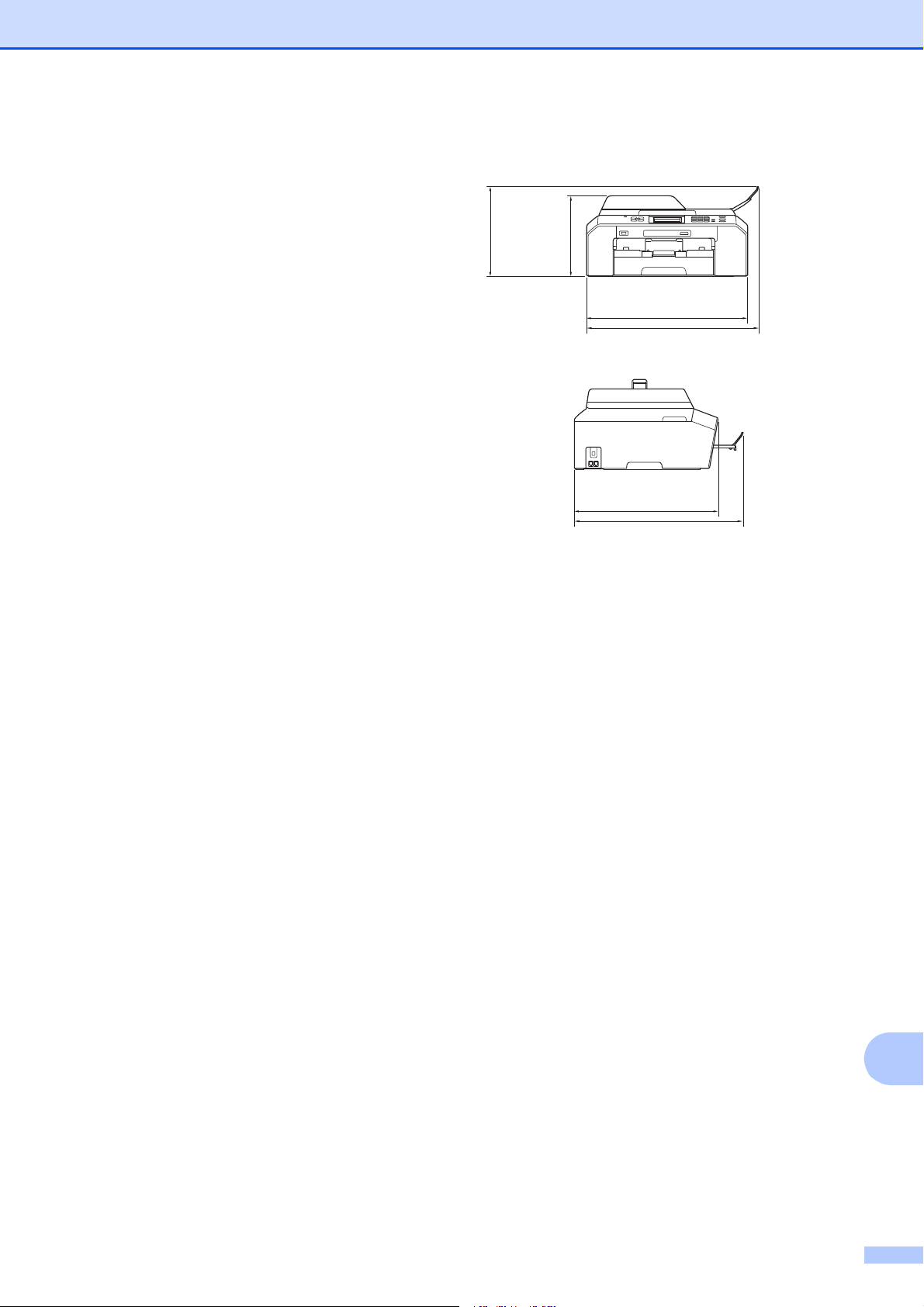
Specifications
125
D
1
Noise depends on printing conditions.
Dimension
Weight 30.0 lb (13.6 kg)
Noise Operating:
50 dB or less
1
Temperature Operating:
Best Print Quality:
50 to 95 F (10 to 35 C)
68 to 91 F (20 to 33 C)
Humidity Operating:
Best Print Quality:
20 to 80% (without condensation)
20 to 80% (without condensation)
ADF (automatic
document feeder)
Up to 35 pages
Paper: 24 lb (90 g/m
2
) Letter or A4 size
Document Size ADF Width: 5.8 in. to 8.5 in. (148 mm to 215.9 mm)
ADF Length: 5.8 in. to 14.0 in. (148 mm to 355.6 mm)
Scanner Glass Width: Max. 8.5 in. (215.9 mm)
Scanner Glass Length: Max. 11.7 in. (297 mm)
21.8 in.
20.2 in.
(554 mm)
(514 mm)
22.8 in.
18.1in.
(580 mm)
(461 mm)
10.2 in.
(260 mm)
11.3 in.
(286 mm)

126
Print media D
1
For glossy paper or transparencies, remove printed pages from the output paper tray immediately after they exit the
machine to avoid smudging.
2
Use only transparencies recommended for inkjet printing.
3
See Paper type and size for each operation uu page 22.
Paper Input Paper Tray
Paper Type:
Plain Paper, Inkjet Paper (coated paper),
Glossy Paper
1
and Transparency
12
Paper Size:
Letter, Ledger, A3, Legal, Executive, A4, A5, A6, Envelopes
(commercial No.10, DL, C5, Monarch), Photo 4" 6",
PhotoL3.5" 5", Photo 2L 5" 7" and Index Card 5" 8"
3
Width: 3.5 in. - 11.7 in. (89 mm - 297 mm)
Length: 5.0 in. - 17 in. (127 mm - 431.8 mm)
For more details, see Paper weight, thickness and capacity
uu page 23.
Maximum paper tray capacity:
Up to 250 sheets of 20 lb (80 g/m
2
) plain paper
Paper Output
Up to 50 sheets of 20 lb (80 g/m
2
) plain paper (face up print delivery to the
output paper tray)
1

Specifications
127
D
Fax D
1
“Pages” refers to the “ITU-T Test Chart #1” (a typical business letter, Standard resolution, MMR code). Specifications
and printed materials are subject to change without prior notice.
Compatibility ITU-T Super Group 3
Modem Speed Automatic Fallback
33,600 bps
Scanning Width 8.2 in. (208 mm) (Letter)
Printing Width 10.76 in. (273.4 mm) (Ledger)
11.5 in. (291 mm) (A3)
Gray Scale Levels: 64 (B&W) / 256 (Color)
Resolution Standard
203 98 dpi (Black)
203 196 dpi (Color)
Fine
203 196 dpi (Black/Color)
Superfine
203 392 dpi (Black)
Photo
203 196 dpi (Black)
Speed Dial 100 stations 2 numbers
Groups Up to 6
Broadcasting 200 (200 Speed Dial)
Automatic Redial 1 time after 5 minutes
Memory Transmission
Up to 400
1
pages
Out of Paper Reception
Up to 400
1
pages

128
Copy D
1
Minimum top and bottom margins of 0.87 in. (22 mm)
Color/Black Yes/Yes
Copy Width Max. 8.26 in. (210 mm)
Multiple Copies Stacks/Sorts up to 99 pages
Enlarge/Reduce 25% to 400% (in increments of 1%)
Resolution Prints up to 1200 1200 dpi
Duplex (2-sided) Yes
Paper Type:
Plain paper
Paper Size:
Letter, Ledger
1
, A3
1
, Legal, A4, A5, Executive

Specifications
129
D
PhotoCapture Center™ D
1
Memory cards, adapters and USB Flash memory drive are not included.
2
USB 2.0 Standard
USB Mass Storage standard up to 32 GB
Support format: FAT12/FAT16/FAT32/exFAT
3
Progressive JPEG format is not supported.
4
See Paper type and size for each operation uu page 22.
Compatible Media
1
Memory Stick™ (16 MB - 128 MB)
Memory Stick PRO™ (256 MB - 32 GB)
(Not available for music data with MagicGate™)
Memory Stick Duo™ (16 MB - 128 MB)
Memory Stick PRO Duo™ (256 MB - 32 GB)
Memory Stick Micro™ (M2™) with Adapter (256 MB - 32 GB)
MultiMedia Card (32 MB - 2 GB)
MultiMedia Card plus (128 MB - 4 GB)
MultiMedia Card mobile with Adapter (64 MB - 1 GB)
SD Memory Card (16 MB - 2 GB)
miniSD with Adapter (16 MB - 2 GB)
microSD with Adapter (16 MB - 2 GB)
SDHC Memory Card (4 GB - 32 GB)
miniSDHC with Adapter (4 GB - 32 GB)
microSDHC with Adapter (4 GB - 32 GB)
SDXC Memory Card (48 GB - 64 GB)
USB Flash memory drive
2
Resolution Up to 1200 2400 dpi
File Extension
(Media Format) DPOF (ver. 1.0, ver. 1.1), Exif DCF (up to ver. 2.1)
(Image Format)
Photo Print: JPEG
3
Scan to Media: JPEG, PDF (Color)
TIFF, PDF (Black & White)
Color Enhancement True2Life™
Number of Files Up to 999 files
(The folder inside memory cards or USB Flash memory drive is
also counted.)
Folder File must be stored in the 4th folder level of the memory card or
USB Flash memory drive.
Borderless
Letter, A4, Ledger, A3, Photo 4" 6", Photo 2L 5" 7"
4


Specifications
131
D
Scanner D
1
Windows
®
XP in this User’s Guide includes Windows
®
XP Home Edition, Windows
®
XP Professional, and Windows
®
XP Professional x64 Edition.
2
For the latest driver updates for the Mac OS X you are using, visit us at http://solutions.brother.com/.
3
Maximum 1200 1200 dpi scanning when using the WIA Driver for Windows
®
XP, Windows Vista
®
and Windows
®
7
(resolution up to 19200 19200 dpi can be selected by using the Brother scanner utility).
Color/Black Yes/Yes
TWAIN Compliant
Yes (Windows
®
XP
1
/Windows Vista
®
/Windows
®
7)
Mac OS X 10.4.11, 10.5.x, 10.6.x
2
WIA Compliant
Yes (Windows
®
XP
1
/Windows Vista
®
/Windows
®
7)
ICA Compliant Yes (Mac OS X 10.6.x)
Color Depth 48 bit color Processing (Input)
24 bit color Processing (Output)
Resolution
Up to 19200 19200 dpi (interpolated)
3
Up to 2400 2400 dpi (optical) (Scanner Glass)
Up to 2400 1200 dpi (optical) (ADF)
Scanning Width and Length (Scanner Glass)
Width: Up to 8.3 in. (210 mm)
Length: Up to 11.46 in. (291 mm)
(ADF)
Width: Up to 8.3 in. (210 mm)
Length: Up to 13.76 in. (349.6 mm)
Gray Scale 256 levels

132
Printer D
1
When the Borderless feature is set to On.
2
See Paper type and size for each operation uu page 22.
3
When printing on Ledger size paper.
4
For detailed specifications visit http://www.brother.com/.
5
Minimum top and bottom margins of 0.87 in. (22 mm)
Resolution Up to 1200 6000 dpi
Printing Width
3
10.76 in. [11 in. (borderless)
1
]
Borderless
2
Letter, A4, Ledger, A3, A6, Photo 4" 6",
Index Card 5" 8",
Photo L 3.5" 5", Photo 2L 5" 7"
Duplex (2-sided) Paper Type:
Plain paper
Paper Size:
Letter, A4, Ledger
5
, A3
5
, Legal, A5, A6, Executive
Print Speed
4

Specifications
133
D
Interfaces D
1
Your machine has a USB 2.0 Hi-Speed interface. The machine can also be connected to a computer that has a USB
1.1 interface.
2
Third party USB ports are not supported.
3
See Network (LAN) uu page 136.
uuNetwork User’s Guide: Supported protocols and security features
USB
12
Use a USB 2.0 interface cable that is no longer than 6 feet (2 m).
LAN
3
Use an Ethernet UTP cable category 5 or greater.
Wireless LAN IEEE 802.11b/g/n (Infrastructure/Ad-hoc Mode)
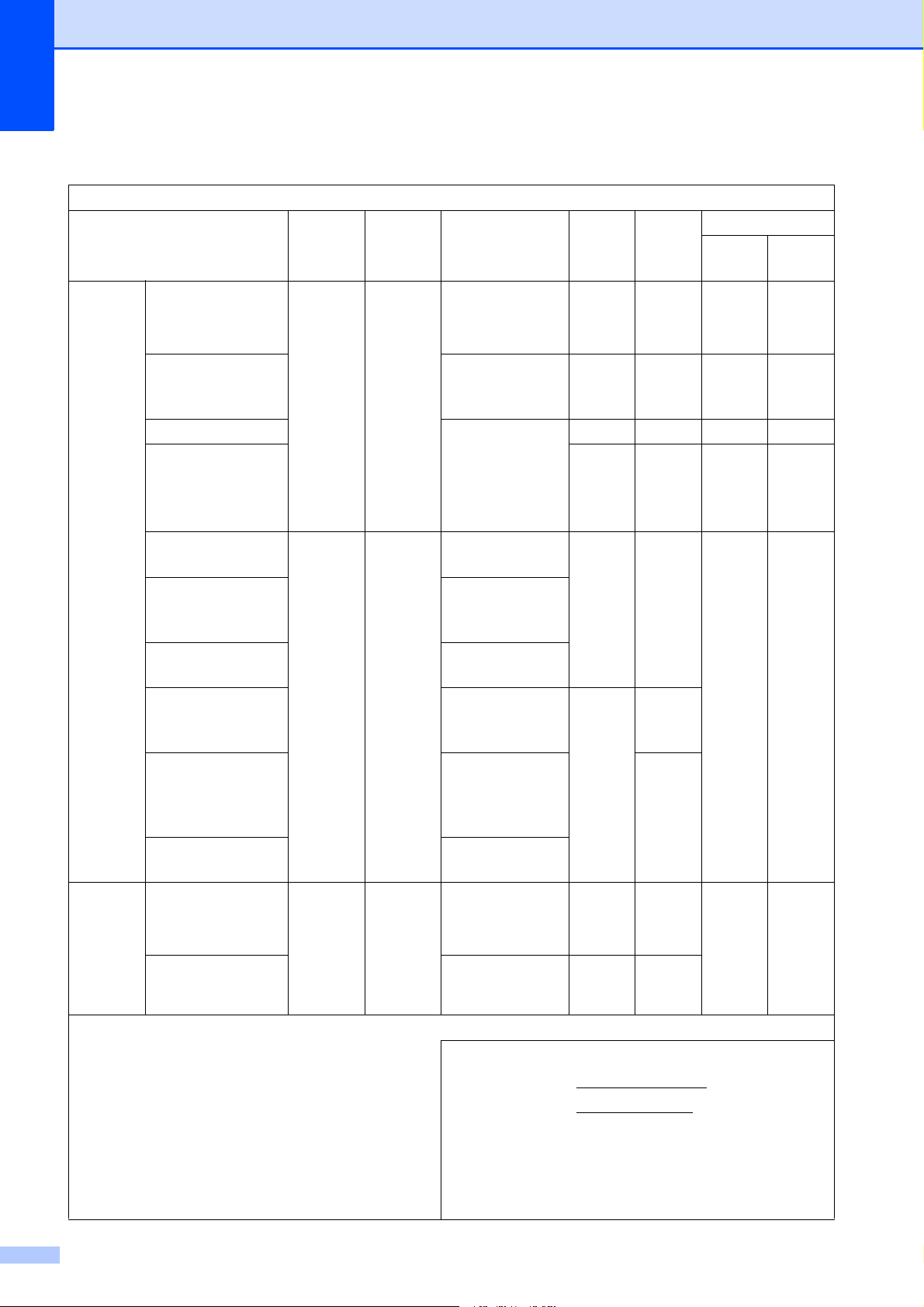
134
Computer requirements D
SUPPORTED OPERATING SYSTEMS AND SOFTWARE FUNCTIONS
Computer Platform &
Operating System Version
Supported
PC Software
Functions
PC
Interface
Processor
Minimum
Speed
Minimum
RAM
Recommended
RAM
Hard Disk Space to install
For
Drivers
For
Applications
Windows
®
Operating
System
Windows
®
XP Home
14
Windows
®
XP
Professional
14
Printing,
PC Fax
3
,
Scanning,
Removable
Disk
5
USB,
10/100
Base-TX
(Ethernet),
Wireless
802.11b/g/n
Intel
®
Pentium
®
II
or equivalent
128 MB 256 MB 150 MB
1GB
Windows
®
XP
Professional x64
Edition
14
64-bit (Intel
®
64
or AMD64)
supported CPU
256 MB 512 MB 150 MB
1GB
Windows Vista
®14
Intel
®
Pentium
®
4
or equivalent
64
-
bit (Intel
®
64 or
AMD64)
supported CPU
512 MB
1GB
500 MB
1.3 GB
Windows
®
7
14
1GB
(32 bit)
2GB
(64 bit)
1GB
(32 bit)
2GB
(64 bit)
650 MB
1.3 GB
Windows Server
®
2003
(print only via network)
Printing
10/100
Base-TX
(Ethernet),
Wireless
802.11b/g/n
Intel
®
Pentium
®
III
or equivalent
256 MB 512 MB
50 MB N/A
Windows Server
®
2003
x64 Edition (print only
via network)
64-bit (Intel
®
64
or AMD64)
supported CPU
Windows Server
®
2003
R2 (print only via network)
Intel
®
Pentium
®
III
or equivalent
Windows Server
®
2003
R2 x64 Edition (print
only via network)
64-bit (Intel
®
64
or AMD64)
supported CPU
512 MB
1GB
Windows Server
®
2008
(print only via network)
Intel
®
Pentium
®
4 or
equivalent 64-bit
(Intel
®
64 or AMD64)
supported CPU
2GB
Windows Server
®
2008
R2 (print only via network)
64-bit (Intel
®
64 or
AMD64) supported CPU
Macintosh
Operating
System
Mac OS X
10.4.11, 10.5.x
Printing,
PC Fax
Send
3
,
Scanning,
Removable
Disk
5
USB
2
,
10/100
Base-TX
(Ethernet),
Wireless
802.11b/g/n
PowerPC
®
G4/G5
Intel
®
Processor
512 MB
1GB 80MB
550 MB
Mac OS X 10.6.x
Intel
®
Processor
1GB 2GB
Conditions:
1
For WIA, 1200 1200 resolution. Brother Scanner
Utility enables to enhance up to 19200 19200 dpi.
2
Third party USB ports are not supported.
3
PC Fax supports black and white only.
4
PaperPort™12SE supports Windows
®
XP Home
(SP3 or greater), XP Professional (SP3 or greater),
XP Professional x64 Edition (SP2 or greater),
Windows Vista
®
(SP2 or greater) and Windows
®
7.
5
Removable disk is a function of PhotoCapture Center
™
.
For the latest driver updates, visit us at
(in USA) www.brother.com/
(in Canada) www.brother.ca/
All trademarks, brand and product names are the
property of their respective companies.

Specifications
135
D
Consumable items D
Ink The machine uses individual Black, Yellow, Cyan and Magenta ink
cartridges that are separate from the print head assembly.
Service Life of Ink
Cartridge
Starter ink cartridges are in the box. The first time you install the ink
cartridges the machine will use extra ink to fill the ink delivery tubes.
This is a one-time process that enables high quality printing.
Afterward, replacement ink cartridges will print the specified
number of pages. Starter cartridge yield is approx. 65% of the yield
of the LC75 replacement cartridges.
Replacement
Consumables
<Super High Yield Black> LC79BK
<Super High Yield Yellow> LC79Y
<Super High Yield Cyan> LC79C
<Super High Yield Magenta> LC79M
Black - Approximately 2,400 pages
1
Yellow, Cyan and Magenta - Approximately 1,200 pages
1
<High Yield Black> LC75BK
<High Yield Yellow> LC75Y
<High Yield Cyan> LC75C
<High Yield Magenta> LC75M
Black, Yellow, Cyan and Magenta - Approximately 600 pages
1
1
Approx. cartridge yield is declared in accordance with ISO/IEC 24711
For more information about the replacement consumables, visit us
at www.brother.com/pageyield/
.
What is Innobella™?
Innobella™ is a range of genuine consumables offered by Brother.
The name "Innobella™" derives from the words "Innovation" and
"Bella" (meaning "Beautiful" in Italian) and is a representation of the
"innovative" technology providing you with "beautiful" and "long
lasting" print results.
When you print photo images, Brother recommends Innobella™
glossy photo paper (BP71 series) for high quality. Brilliant prints are
made easier with Innobella™ Ink and paper.

136
Network (LAN) D
Note
For more information about the Network specifications, see the Network User’s Guide.
1
See the Computer Requirements chart on page 134.
2
If you require more advanced printer management, use the latest Brother BRAdmin Professional utility version that is
available as a download from http://solutions.brother.com/
.
LAN You can connect your machine to a network for Network Printing,
Network Scanning, PC Fax Send, PC Fax Receive (Windows
®
only),
Remote Setup, and access photos from PhotoCapture Center™
1
.
Also included is Brother BRAdmin Light
2
Network Management
software.
Wireless Network
Security
SSID (32 chr), WEP 64/128 bit, WPA-PSK (TKIP/AES),
WPA2-PSK (AES)
Setup Support Utility AOSS™ Yes
WPS Yes

Index
137
E
E
A
Accessories and supplies .......................... ii
ADF (automatic document feeder)
...........24
Answering machine (TAD)
.......................39
connecting
............................................40
Apple Macintosh
See Software User's Guide.
Automatic
fax receive
............................................31
Easy Receive
.....................................35
B
Brother
accessories and supplies
........................ ii
Brother numbers
...................................... i
CreativeCenter
........................................4
Customer Service
.................................... i
FAQs (frequently asked questions)
......... i
Notice-Disclaimer
................................... iv
product support
........................................ i
service centers
......................................... i
Solutions Center
...................................... i
C
Cleaning
print head
..............................................62
scanner
.................................................61
Connecting
external TAD
(answering machine)
..................... 39, 40
external telephone
................................41
Consumable items
.................................135
Control panel overview
..............................6
ControlCenter
See Software User's Guide.
Copy
paper size
.............................................49
paper type
.............................................48
using ADF
.............................................24
using scanner glass
..............................25
Cordless telephone (non-Brother)
............42
Custom Ringing
.......................................37
Custom telephone features on a single
line
...........................................................90
D
Data Ident-A-Call ..................................... 36
Dialing
a pause
................................................ 45
manual
................................................. 44
Speed Dial
............................................ 44
Distinctive Ring
........................................ 37
setting ring pattern
............................... 38
turning off
............................................. 38
Document
loading
............................................ 24, 25
E
Easy Receive .......................................... 35
Envelopes
............................. 15, 16, 22, 23
Error messages on screen
...................... 64
B&W Print Only
.................................... 65
Cannot Detect
...................................... 65
Cannot Print
......................................... 66
Comm. Error
......................................... 66
Cover is Open
...................................... 66
Data Remaining
................................... 66
Document Jam
..................................... 66
DR Mode in Use
................................... 66
Ink Absorber Full
.................................. 67
Ink low
.................................................. 68
InkAbsorberNearFull
............................ 67
No Ink Cartridge
................................... 68
No Paper Fed
....................................... 69
Not Registered
...............................44, 69
Out of Fax Memory
.............................. 69
Out of Memory
..................................... 70
Paper Jam
............................................ 70
Unable to Clean
................................... 71
Unable to Init.
....................................... 71
Unable to Print
..................................... 71
Unable to Scan
..................................... 71
Wrong Paper Size
................................ 71
Extension telephone, using
..................... 42
External telephone, connecting
............... 41

138
F
Favorite Settings ......................................10
changing
...............................................11
deleting
.................................................11
recalling
.................................................11
registering
.............................................10
Fax codes
changing
...............................................43
Fax Receive Code
......................... 35, 42
Telephone Answer Code
......................42
using
.....................................................42
Fax, from PC
See Software User's Guide.
Fax, stand-alone
receiving
................................................31
difficulties
.................................... 86, 87
Easy Receive
.....................................35
F/T Ring Time, setting
........................34
from extension telephone
...................42
from external telephone
.....................42
Ring Delay, setting
.............................34
telephone line interference / VoIP
......93
sending
.................................................27
change scanner glass size
.................29
color fax
.............................................29
difficulties
...........................................89
telephone line interference / VoIP
......93
Transmission Verification Report
.......29
Fax/Tel mode
answering at extension telephones
.......42
Fax Receive Code
................................42
Ring Delay
............................................34
Telephone Answer Code
......................42
G
Gray scale ..................................... 127, 131
H
Help
Menu Table
...........................................96
Screen messages
.................................95
Hook key
....................................................6
I
Ident-A-Call ............................................. 36
Ident-A-Ring
............................................ 36
Ink cartridges
ink dot counter
...................................... 58
replacing
............................................... 58
Innobella™
............................................ 135
J
Jams
document
.............................................. 73
paper
.................................................... 75
M
Macintosh
See Software User's Guide.
Maintenance, routine
replacing ink cartridges
........................ 58
Manual
dialing
................................................... 44
receive
.................................................. 31
Memory Storage
...................................... 95
Mode, entering
COPY
..................................................... 6
FAX
........................................................ 6
PHOTO
................................................... 6
SCAN
..................................................... 6
Multi-line connections (PBX)
................... 41
N
Network
Printing
See Network User's Guide.
Scanning
See Software User's Guide.
O
On-screen programming ......................... 95

139
E
P
Paper .............................................. 20, 126
capacity
.................................................23
loading
........................................... 12, 15
loading envelopes and postcards
.........15
printable area
........................................18
size
.......................................................19
size of document
...................................24
type
................................................ 19, 22
PaperPort™12SE with OCR
See Software User's Guide. See also Help
in the PaperPort™12SE application.
Personalized Ring
....................................37
PhotoCapture Center™
from PC
See Software User's Guide.
Memory Stick PRO™
............................50
Memory Stick™
....................................50
MultiMedia Card
....................................50
Preview photos
.....................................53
Print settings
Quality
................................................53
Printing
all photos
...........................................53
Scan to Media
change file name
...............................54
SD Memory Card
..................................50
SDHC Memory Card
.............................50
SDXC Memory Card
.............................50
specifications
......................................129
Presto! PageManager
See Software User's Guide. See also Help
in the Presto! PageManager application.
Print
difficulties
..............................................82
printable area
........................................18
resolution
............................................132
specifications
......................................132
Printing
See Software User's Guide.
Programming your machine
.....................95
Q
Quick Dial
Group dial
changing
............................................ 46
Speed Dial
changing
............................................ 46
deleting
.............................................. 46
setting up
........................................... 45
using
.................................................. 44
R
Receive Mode
External TAD
........................................ 31
Fax Only
............................................... 31
Fax/Tel
................................................. 31
Manual
................................................. 31
Redial/Pause
........................................... 44
Remote Setup
See Software User's Guide.
Resolution
copy
.................................................... 128
fax
...................................................... 127
print
.................................................... 132
scan
.................................................... 131
Ring Delay, setting
.................................. 34
RingMaster
.............................................. 37
S
Scanning
See Software User's Guide.
Serial Number
how to find ...............See inside front cover
SimpleBiz Fax & Alternative Number
Ringing
.................................................... 36
Smart Ring
.............................................. 37
Speed Dial
changing
............................................... 46
deleting
................................................. 46
setting up
.............................................. 45
using
..................................................... 44

140
T
TAD (telephone answering device),
external
............................................. 31, 39
connecting
...................................... 39, 40
Receive Mode
.......................................31
recording OGM
.....................................40
Teen Ring
................................................36
Telephone line
connections
...........................................40
difficulties
..............................................86
interference / VoIP
................................93
multi-line (PBX)
.....................................41
Text, entering
.........................................123
Transferring your faxes or
Fax Journal report
....................................72
Transparencies
............ 20, 21, 22, 23, 126
Troubleshooting
.......................................81
document jam
.......................................73
error messages on screen
....................64
if you are having difficulty
copying
...............................................90
data entry
...........................................92
incoming calls
....................................89
Network
..............................................91
phone line or connections
..................86
PhotoCapture Center™
.....................91
printing
...............................................82
printing received faxes
.......................86
receiving faxes
...................................87
scanning
.............................................90
software
.............................................91
maintenance messages on screen
.......64
paper jam
..............................................75
U
Unscannable area ....................................26
V
Voice Mail ................................................36
W
Warranties are in the box
Notice-Disclaimer
...................................iv
Windows
®
See Software User's Guide.
Wireless Network
See Quick Setup Guide and Network
User's Guide.
World Wide Web
.........................................i
Brother International Corporation
100 Somerset Corporate Boulevard
P.O. Box 6911
Bridgewater, NJ 08807-0911 USA
Brother International Corporation (Canada) Ltd.
1 rue Hôtel de Ville,
Dollard-des-Ormeaux, QC, Canada H9B 3H6
Visit us on the World Wide Web
http://www.brother.com/
This machine is approved for use in the country of purchase only. Local Brother companies or their
dealers will only support machines purchased in their own countries.