Be sure to read this document before using the machine.
We recommend that you keep this document nearby for future reference.
Operation Manual
Cutting Machine
Product Code: 891-Z01

IMPORTANT:
READ BEFORE DOWNLOADING, COPYING, INSTALLING OR USING.
By downloading, copying, installing or using the software, you agree to this license. If you do not
agree to this license, do not download, install, copy or use the software.
Intel License Agreement For Open Source Computer Vision Library
Copyright © 2000, Intel Corporation, all rights reserved. Third-party copyrights are the property of their respective owners.
Redistribution and use in source and binary forms, with or without modification, are permitted
provided that the following conditions are met:
● Redistribution of source code must retain the above copyright notice, this list of conditions and the following disclaimer.
● Redistribution in binary form must reproduce the above copyright notice, this list of conditions and the following
disclaimer in the documentation and/or other materials provided with the distribution.
● The name of Intel Corporation may not be used to endorse or promote products derived from this software without specific
prior written permission.
This software is provided by the copyright holders and contributors “as is” and any express or
implied warranties, including, but not limited to, the implied warranties of merchantability and
fitness for a particular purpose are disclaimed. In no event shall Intel or contributors be liable for any
direct, indirect, incidental, special, exemplary, or consequential damages (including, but not limited
to, procurement of substitute goods or services; loss of use, data, or profits; or business interruption)
however caused and on any theory of liability, whether in contract, strict liability, or tort (including
negligence or otherwise) arising in any way out of the use of this software, even if advised of the
possibility of such damage.
All information provided related to future Intel products and plans is preliminary and subject to change at any time, without notice.
TRADEMARKS
1
Thank you for purchasing this machine.
Before using this machine or attempting any maintenance, carefully read the “IMPORTANT SAFETY
INSTRUCTIONS” on this page, and then study this safety manual for the correct operation of the various
functions. In addition, after you have finished reading this safety manual, store it where it can quickly be
accessed for future reference. Failure to follow these instructions may result in an increased risk of personal
injury or damage to property, including through fire, electrical shock, burns or suffocation.
●
This machine is intended for household use.
● This machine is approved for use in the country of purchase only.
● Due to product quality improvements, the specifications or appearance of this machine may change without notice.
● The contents of this document are subject to change without notice.
● The contents of this document may not be duplicated or reproduced, partially or in full, without permission.
● We assume no responsibility for damages arising from earthquakes, fire, other disasters, actions of third parties, the user’s
intentional or negligent operation, misuse or operation under other special conditions.
● For additional product information, visit our web site at www.brother.com
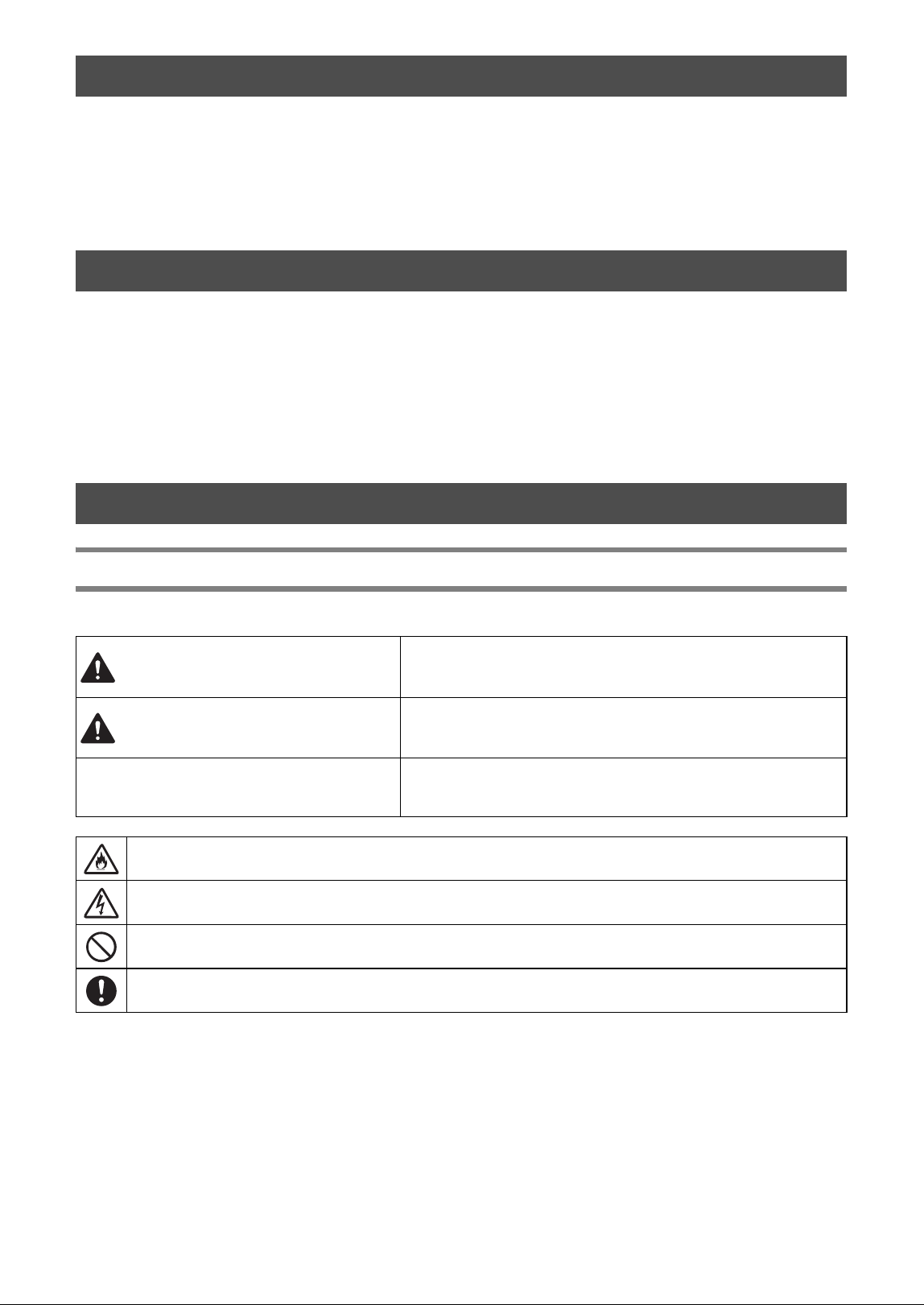
Symbols Used in This Document
The following symbols are used in this document.
INTRODUCTION
IMPORTANT NOTICE
IMPORTANT SAFETY INSTRUCTIONS
WARNING
Failure to observe instructions with this marking may result in fatal or
critical injuries.
CAUTION
Failure to observe instructions with this marking may result in serious
injuries.
IMPORTANT
Failure to observe instructions with this marking may result in property
damage.
This symbol indicates that there is a possibility of fire under specific conditions.
This symbol indicates that there is a possibility of electric shock under specific conditions.
This symbol indicates a prohibited action, which must not be performed.
This symbol indicates a required action, which must be performed.
2
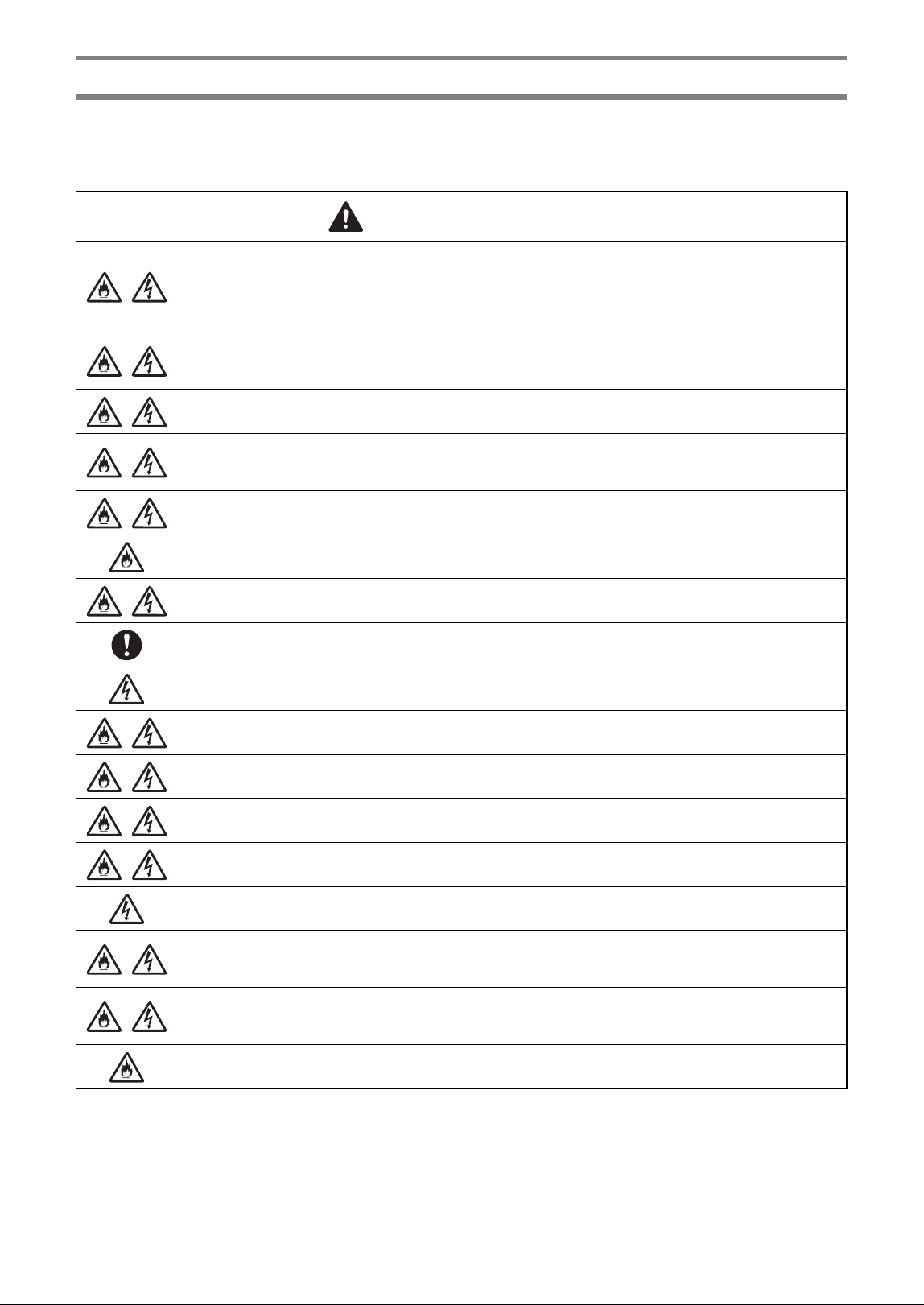
Important Safety Instructions
The following precautions should be observed for safe use of the machine.
Power Supply and AC Adapter
WARNING
Place the AC adapter and power cord in a safe location, where they will not be stepped on, while they are
being both used and stored. Do not perform any of the following actions that may damage the AC adapter
or power cord. Otherwise, a fire, electric shock or damage to the machine may result:
Damaging, modifying, forcefully bending, exposing to heat, pulling, twisting, bundling, placing objects on,
pinching, exposing to metal, repeatedly bending and folding, hanging in the air, or squeezing against a wall.
Do not use any AC adapter or power cord other than the AC adapter and power cord designed specifically
for this machine. Otherwise, a fire, electric shock or damage to the machine may result.
Do not use the AC adapter and power cord designed specifically for this machine with any other device.
Use the AC adapter only with a household electrical outlet (AC 100–240V, 50/60Hz). Otherwise, a fire,
electric shock or damage to the machine may result.
Never connect a DC power supply or inverter (DC-AC inverter). Otherwise, a fire or electric shock may
result. If it is unknown whether the electrical outlet to be used to connect this machine is an AC or DC
power supply, consult a licensed electrician.
Fully insert the power cord plug into the outlet. Otherwise, a fire, electric shock or damage to the machine
may result.
Do not place the machine on the power cord. Otherwise, a fire or damage to the power cord may result.
Do not expose to a flame or heater. Otherwise, the cover of the AC adapter may melt, and a fire or electric
shock may result.
If the machine is not to be used for a long period of time, be sure to unplug the AC adapter from the
machine and the electrical outlet for safety reasons.
When performing maintenance (such as cleaning), unplug the AC adapter from the electrical outlet.
Otherwise, an electric shock may result.
When disconnecting the power cord plug from the electrical outlet, grasp the non-metal part of the plug,
not the cord, to pull it out. Otherwise, a fire, electric shock or damage to the machine may result.
Do not use a damaged power cord or plug, or loose electrical outlet. Otherwise, a fire, electric shock or
damage to the machine may result.
Do not use an extension cord and multi-plug adapters. Otherwise, a fire, electric shock or damage to the
machine may result.
Do not insert foreign objects into the AC adapter inlet. Otherwise, a fire, electric shock, physical injuries or
damage to the machine and AC adapter may result.
Do not touch the AC adapter or power cord plug with wet hands. Otherwise, an electric shock may result.
Do not allow liquids, metal objects or dust to come into contact with the power cord plug while it is being
both plugged in and stored. In addition, never use the machine in a location where it may be exposed to
water. Otherwise, a fire, electric shock or damage to the machine may result.
Do not disassemble, alter or attempt to repair the AC adapter. Otherwise, a fire, electric shock or injuries
may result. For servicing, adjustments and repairs, contact the retailer who sold you this machine or the
nearest authorized service center.
If the power cord plug becomes dusty, disconnect it from the electrical outlet, and then wipe it with a dry
cloth. Using the machine with a dusty plug may result in a fire.
3
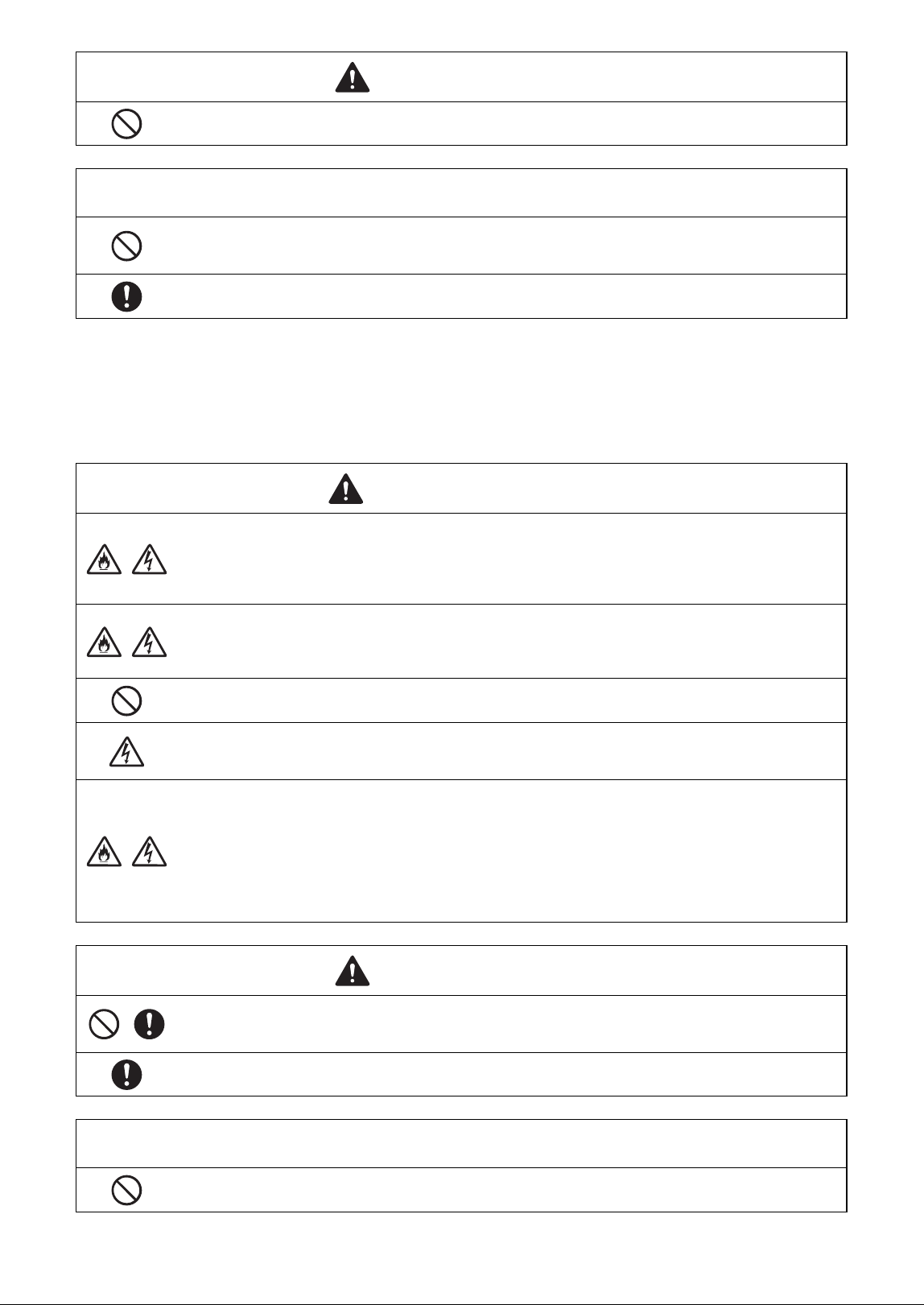
Installation Location
Put your machine on a flat, level, stable surface that is free of vibration and shocks.
Use this machine in an environment that meets the following specifications.
Temperature: 5 °C to 35 °C (41 °F to 95 °F)
Humidity: 20 % to 80 %
CAUTION
Do not place objects around the power cord or block access to the power cord. Otherwise, the power cord
cannot be unplugged in an emergency.
IMPORTANT
Take precautions when sharing the electrical outlet with other device.
Avoid using the same electrical outlet used by chargers for portable phones or high-voltage devices such
as copiers. Otherwise, interference or machine malfunctions may occur.
Turn off the machine before unplugging the AC adapter. Unplugging the power cord while the machine is
operating may result in damage to the machine.
WARNING
Do not install the machine in a location exposed to direct sunlight, sudden temperature or humidity
changes, high humidity or water (such as near a kitchen, bathroom or humidifier), condensation or extreme
amounts of dust. Avoid using or storing the machine in a location exposed to high temperatures or high
humidity. Otherwise, a short circuit may result, which may cause a fire, electric shock, or damage to the
machine.
Do not install the machine near a flame, heater, volatile combustibles or other source of extreme heat.
Otherwise, a fire, electric shock or damage to the machine may result.
Do not use the machine in a room where flammable sprays are used. Otherwise, a fire or physical injuries
may result.
Do not use the machine near medical electrical equipment. Otherwise, the medical electrical equipment
may be affected by the electrical waves from this machine and malfunction, resulting in an accident.
Avoid using this machine outdoors. Otherwise, the machine may become wet possibly resulting in an
electric shock. If the machine becomes wet, contact the retailer who sold you this machine or the nearest
authorized service center.
In order to prevent metal or liquids from entering the machine, do not place any of the following objects on
or above the machine. Otherwise, a fire, electric shock or damage to the machine may result.
- Metal objects such as paper clips and staples
- Precious metal objects such as necklaces and rings
- Containers filled with liquid, such as cups, vases and plant pots
In addition, do not allow pets near the machine.
If anything accidentally enters the machine, unplug the power cord, and then contact the retailer who sold
you this machine or the nearest authorized service center.
CAUTION
Do not place the machine on an unstable surface, such as an unsteady table or an angled surface. In
addition, do not position the machine so that any part of it extends off the surface’s edge. If the machine
falls or is dropped, injuries or damage to the machine may result.
Place the machine on a flat, even surface. The mat will catch on an uneven surface, causing improper
operation.
IMPORTANT
Do not use the machine in a location exposed to severe vibrations or strong electrical interference or static
electricity. Otherwise, the machine may not operate properly.
4
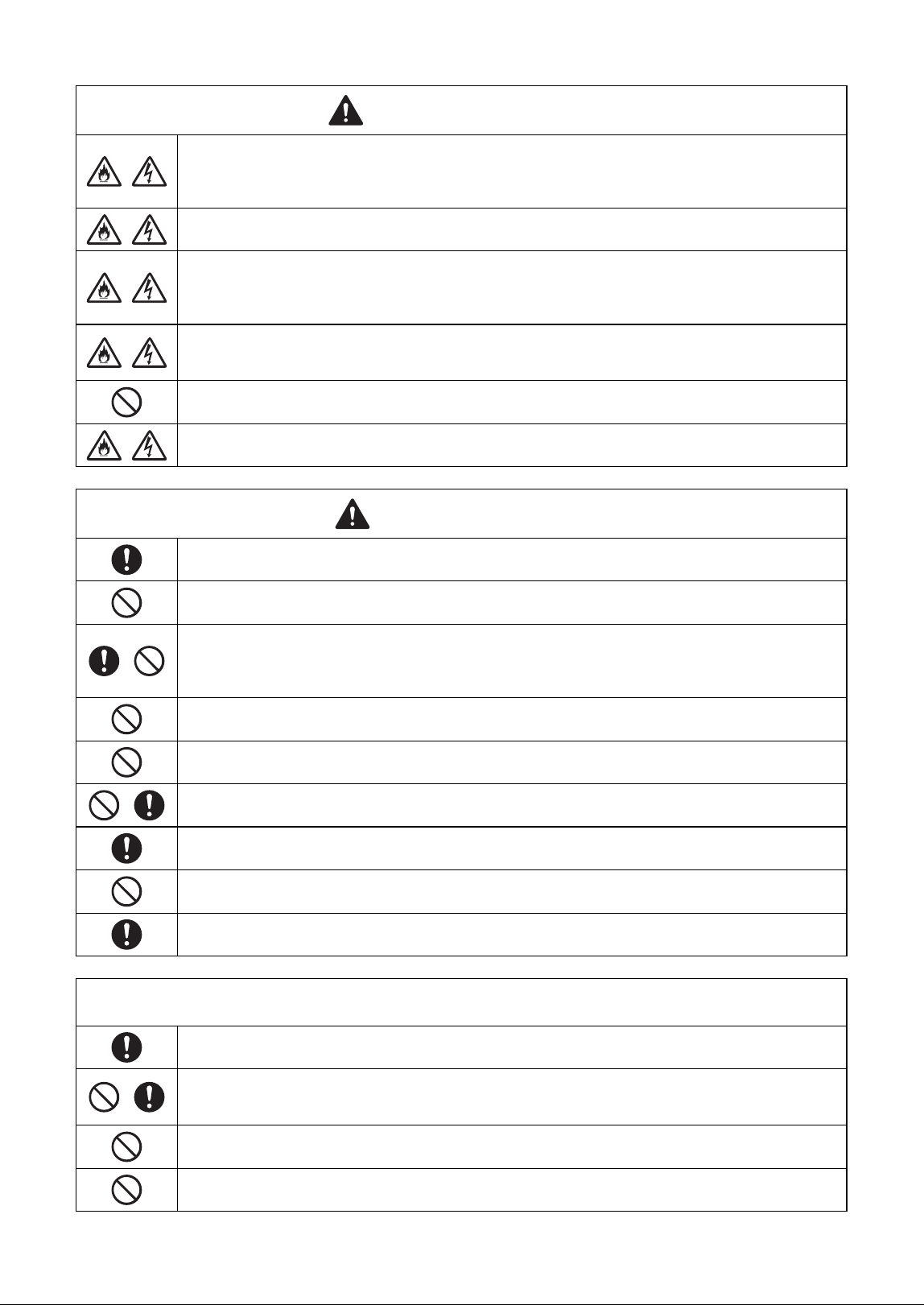
For Safe Operation
WARNING
If the machine malfunctions or is dropped or damaged or if water or a foreign object enters it, immediately
unplug the AC adapter from the machine and electrical outlet, and then contact the retailer who sold you this
machine or the nearest authorized service center. Continuing to use the machine in this condition may result
in a fire or electric shock.
If a power outage occurs or thunder is heard while the machine is being used, disconnect the power cord
plug from the electrical outlet. Otherwise, a fire, electric shock or damage to the machine may result.
If, while the machine is being used or stored, an unusual odor is produced, the machine produces heat or smoke or
becomes discolored or deformed, or any other unusual occurrence is observed, stop using the machine, and then
unplug the AC adapter from the machine and electrical outlet. Continuing to use the machine in this condition may
result in a fire or electric shock. In addition, repairs must never be performed by the user; it is too dangerous.
Do not disassemble, repair or alter the machine by yourself. Otherwise, a fire, electric shock or injuries
may result. For servicing, adjustment, cleaning or repair of internal parts other than those specified,
contact the retailer who sold you this machine or the nearest authorized service center.
The plastic bag that this machine was supplied in should be kept out of the reach of children or disposed of.
Never allow children to play with the bag due to the danger of suffocation.
Before performing any maintenance procedures described in this manual, unplug the power cord.
Otherwise, a fire, electric shock or damage to the machine may result.
CAUTION
While the machine is operating, make sure that shirt sleeves, neckties, hair or jewelry do not become pulled in.
Otherwise, injuries may result. If anything is pulled in, immediately unplug the power cord to stop the machine.
Do not touch the sharp edge of the blade. Otherwise, injuries may result.
Pay close attention to the carriage movements while the machine is operating. Keep your hands away from
all moving parts, such as the rollers, carriage and holders. Do not place your fingers under the blade holder.
In addition, keep your fingers away from moving parts such as under the tray, in the front cover or under the
operation panel. Otherwise, injuries may result.
In order to prevent injuries, do not trace or rub your hand or fingers along the end of the blade holder while
the blade tip is extended. Store the blade tip within the holder when the blade holder is not being used.
In order to prevent injuries, do not trace or rub your hand or fingers along the edge of the mat.
Do not allow this machine to be used as a toy. Pay close attention when the machine is used near children.
When moving the machine, be sure to grasp its handles. If any other part is grasped, the machine may be
damaged or fall, possibly resulting in injuries.
When lifting the machine, be careful not to make any sudden or careless movements. Otherwise, injuries to
your back or knees may result.
Only use the genuine parts specified in this manual. Use of any other parts may result in injuries or damage
to the machine.
IMPORTANT
When cutting, be sure to adjust the blade extension according to the material that will be cut. If too much of
the blade is extended, the blade may break or the mat may be cut.
Do not use a broken blade. Otherwise, cutting cannot be performed correctly. If the blade breaks, remove
the broken piece of blade from the cut material. When removing the broken piece of blade from the cut
material, use tweezers; do not touch it with your fingers.
Do not place the AC adapter, power cord and foreign objects within the range of the mat’s movements
(feed area). Otherwise, operations cannot be completed correctly.
Do not place large objects on the mat.
5
Unlawful Use of Scanning Equipment
It is an offence to make reproductions of certain items or documents with the intent to commit fraud.
The following is a non-exhaustive list of documents which it may be unlawful to produce copies of.
We suggest you check with your legal adviser and/or the relevant legal authorities if in doubt about a
particular item or document:
• Currency
• Bonds or other certificates of debt
• Certificates of Deposit
• Armed forces service or draft papers
• Passports
• Postage stamps (cancelled or uncancelled)
• Immigration papers
• Welfare documents
• Cheques or drafts drawn by governmental agencies
• Identifying badges or insignias
Copyrighted works cannot be copied lawfully, subject to the “fair dealing” exception relating to
sections of a copyrighted work. Multiple copies would indicate improper use. Works of art should be
considered the equivalent of copyrighted works.
Do not fold or stretch the mat with extreme force. If the mat is damaged, it may no longer be possible to cut,
draw or scan.
Do not use a damaged mat.
Make sure that the edges of the mat do not become dirty. Otherwise, the mat type cannot be detected,
which will interfere with the proper operation of the machine. If the edges become dirty, wipe them with a
dry cloth.
Use a mat designed specifically for this machine. In addition, do not use hard materials, such as metal
sheets, which are incompatible with this machine. Otherwise, damage to the machine may result.
Avoid using craft paper or fabric covered with decorative layer (that can easily separate), such as lamé or
foil. The separate layer may stick to the machine’s scanning device or feed rollers during operation,
resulting in damage to the machine. It may also damage the cutting blade.
While the machine is operating, do not pull out or push in the mat with extreme force. Otherwise, the blade
or holder may be damaged.
Do not leave material attached to the mat for a long period of time; otherwise, the adhesive will permeate
the material.
Store the mat at room temperature and in a location not exposed to high temperatures, high humidity or
direct sunlight.
If the carriage must be moved by hand in an emergency, move it slowly. Otherwise, damage to the machine
may result.
Before replacing the holder, check that the holder is not moving.
While the machine is operating, do not unplug the power cord or remove the USB flash drive. Otherwise,
the USB flash drive may be damaged or the data may be corrupted.
Do not insert foreign objects into the DC power jack or USB port on the machine. Be sure to make space
available around them.
Only connect a USB flash drive to the USB port. Otherwise, damage to the machine may result.
Do not touch the screen while the machine is cutting, drawing or scanning.
Do not oil the machine. Otherwise, damage to the machine may result.
Do not use organic solvents, such as thinner, benzene or alcohol, to clean the machine. Otherwise, the finish
may peel off or other damage to the machine may result. Clean the machine by wiping it with a soft, dry
cloth.
Do not peel off any labels (for example, the serial number label) affixed to the machine.

6
Precautions for Scanning
After using the machine to scan an original, check that the scan data meets the requirements for
precision and quality.
Since some parts of the scan data may be missing or deficient, observe the following precautions.
● Depending on the condition of the original, cracks, skewing, smearing or loss may occur, and some or all of the scan data
may be missing.
X Make sure that there are not wrinkles or folds in the original. In addition, correctly attach the original to the mat.
● If an original is scanned while the inside of the machine is dirty, cracks, skewing, smearing or loss may occur, and some or
all of the scan data may be missing.
X Carefully clean the inside of the machine.
● Depending on the scan settings (scan size and resolution), originals may be scanned as described below.
• With an insufficient resolution, the image may be blurry.
• A part of the image may be missing, or the size may be reduced.
• Scan data from midway of the original to the end may be missing.
• Margins may be added to the edges of the scan data.
● Do not scan the following types of originals.
• Paper clips or staples attached
• Ink that is not dry
• Metal or overhead projector transparencies
• Glossy sheets or having a mirror-like finish
• Plastic cards that have been embossed
• Originals that exceed the recommended thickness
● With non-standard originals or even in the case of standard originals, the original may become jammed depending on its
condition (for example, wrinkled, folded or incorrectly loaded) or the condition of the consumables and the feeding
mechanism in the machine. In this case, some or all of the scan data may be missing. (The original may be damaged if it
becomes jammed.)
● If a fluorescent marker has been used on the original, the color may not be scanned, depending on the marker color and
thickness, or the hue may not be faithfully reproduced.
Federal Communications Commission (FCC) Compliance Notice
(For USA Only)
This equipment has been tested and found to comply with the limits for a Class B digital device, pursuant to Part
15 of the FCC Rules. These limits are designed to provide reasonable protection against harmful interference in
a residential installation. This equipment generates, uses, and can radiate radio frequency energy and, if not
installed and used in accordance with the instructions, may cause harmful interference to radio
communications. However, there is no guarantee that interference will not occur in a particular installation. If
this equipment does cause harmful interference to radio or television reception, which can be determined by
turning the equipment off and on, the user is encouraged to try to correct the interference by one or more of the
following measures:
●
Reorient or relocate the receiving antenna.
● Increase the separation between the equipment and receiver.
● Connect the equipment into an outlet on a circuit different from that to which the receiver is connected.
● Consult the dealer or an experienced radio/TV technician for help.
IMPORTANT
Changes or modifications not expressly approved by Brother Industries, Ltd. could void the user’s authority to
operate the equipment.
Industry Canada Compliance Statement (For Canada Only)
This Class B digital apparatus complies with Canadian ICES-003.
REGULATION

7
INTRODUCTION .......................................... 1
IMPORTANT NOTICE ................................... 1
IMPORTANT SAFETY INSTRUCTIONS ......... 1
Symbols Used in This Document........................... 1
Important Safety Instructions................................. 2
REGULATION ............................................... 6
FEATURES...................................................... 8
Patterns (“Pattern” mode) ...................................... 8
Scanning (“Scan” mode) ........................................ 8
1 GETTING STARTED............9
PARTS AND FUNCTIONS ............................. 9
Unit Descriptions - Front........................................ 9
Unit Descriptions - Rear......................................... 9
Unit Descriptions - Operation Panel ...................... 9
FIRST STEPS................................................. 10
Removing the Transport Packing Materials ......... 10
Adjusting the Angle of the Operation Panel ......... 10
Turning On/Off the Machine................................. 10
Operation of LCD Panel ....................................... 11
Preparation of Craft Paper/Fabric........................ 11
Mat and Cutting Blade Combinations.................. 12
Adjusting the Blade Extension ............................. 18
Installing and Uninstalling the Holder................... 19
Trial Cutting.......................................................... 19
MACHINE SETTINGS .................................. 23
Settings Screen.................................................... 23
Auto Shutdown..................................................... 24
2 BASIC OPERATIONS........25
PATTERN CUTTING .................................... 25
Tutorial 1 - Cutting Patterns................................. 25
Tutorial 2 - Cutting Advanced Patterns................ 27
PATTERN SELECTION ................................. 31
Selecting a Single Pattern.................................... 31
Selecting Multiple Patterns .................................. 31
3
ADVANCED OPERATIONS
....33
CUTTING AND EDITING FUNCTIONS ...... 33
Pattern Editing Functions..................................... 33
Pattern Editing Functions - Advanced Patterns... 34
Pattern Layout Screen.......................................... 35
Layout Editing Functions...................................... 35
Welding
(Merging the Outlines of Multiple Patterns).......... 36
Auto Layout Functions ......................................... 38
Scanning a Background Image............................ 38
Character Input Functions.................................... 40
MEMORY FUNCTIONS ............................... 41
Saving................................................................... 41
Recalling............................................................... 41
DRAWING FUNCTIONS .............................43
Drawing ................................................................ 43
Cutting Around Drawings..................................... 44
4
SCANNING FUNCTIONS
.... 47
SCANNING FOR CUTTING (Direct Cut).....47
Tutorial 3 - Scanning and Cutting ........................ 47
Advanced Cutting Functions................................ 49
CREATING CUTTING DATA (Scan to Cut
Data)............................................................50
Tutorial 4- Creating Cutting Data ......................... 50
Editing Pictures .................................................... 52
SCANNING IMAGES (Scan to USB).............54
Notes on Scanning............................................... 54
Tutorial 5- Scanning to USB ................................ 54
5 APPENDIX ....................... 56
CONSUMABLES...........................................56
Replacement Criteria............................................ 56
Replacing the Blade ............................................. 56
CARE AND MAINTENANCE ........................58
Cleaning ............................................................... 58
Cleaning the Scanner Glass................................. 59
Adjusting the Screen ............................................ 60
TROUBLESHOOTING .................................61
ERROR MESSAGES.......................................64
UPGRADING THE SOFTWARE....................66
OPTIONAL ACCESSORIES........................... 66
INDEX..........................................................67
CONTENTS
8
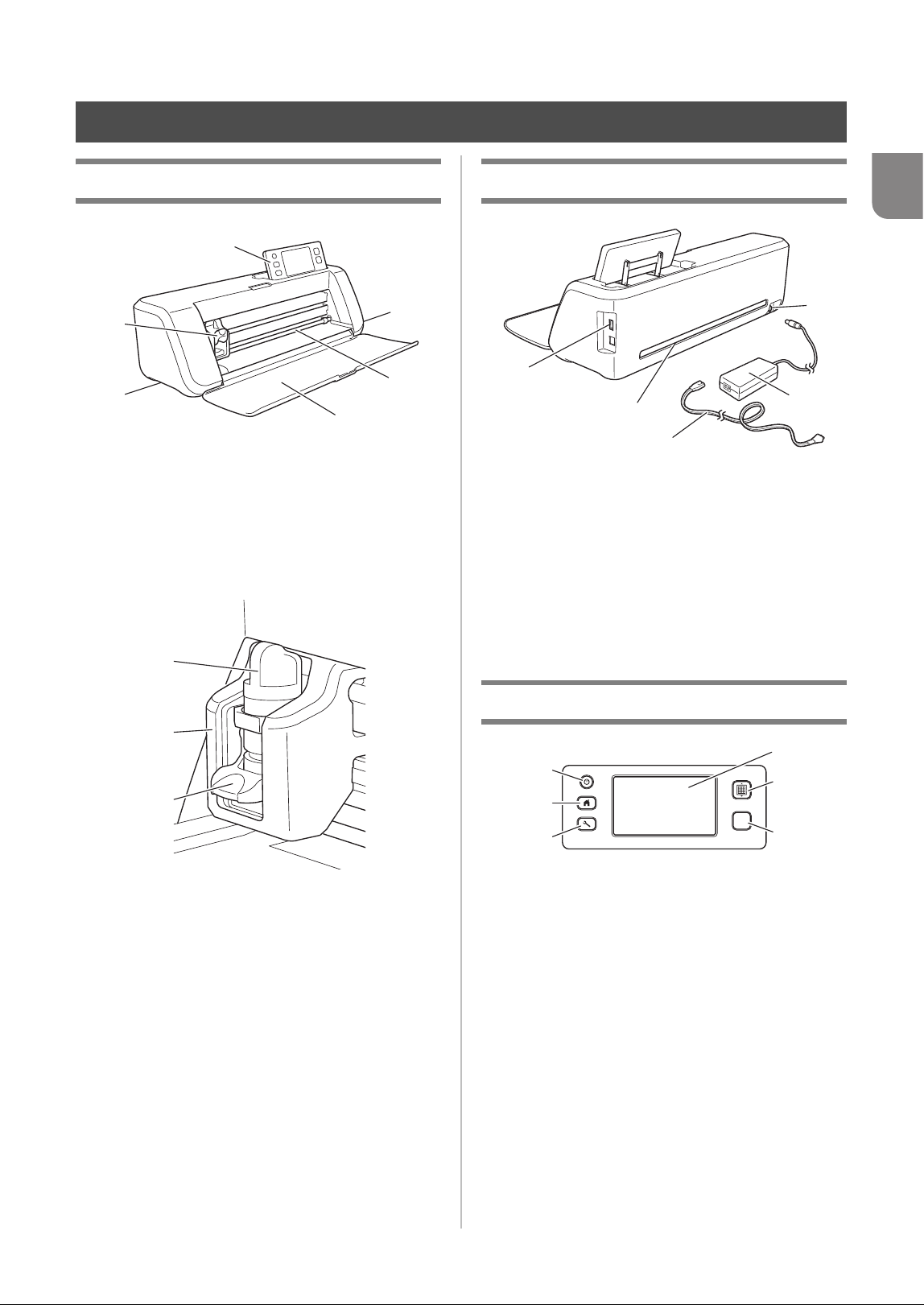
Patterns (“Pattern” mode)
Select a pattern and edit it to create your own design.
By simply loading craft paper or fabric, you can
quickly create precision paper and fabric cutouts.
The variety of built-in patterns can easily be edited to
create designs.
Scanning (“Scan” mode)
Scan an illustration, photo or your own drawing to
create personalized cut designs. The design can then
be cut out or saved as data.
The many editing functions allow you to easily
process the scanned design. The laid-out design can
be saved and recalled at any time.
FEATURES
Home screen
Select a pattern.
Tutorial 1 (page 25)
Tutorial 2 (page 27)
Scan an image.
Tutorial 3 (page 47)
Tutorial 4 (page 50)
Tutorial 5 (page 54)
9
1
Chapter 1
GETTING STARTED
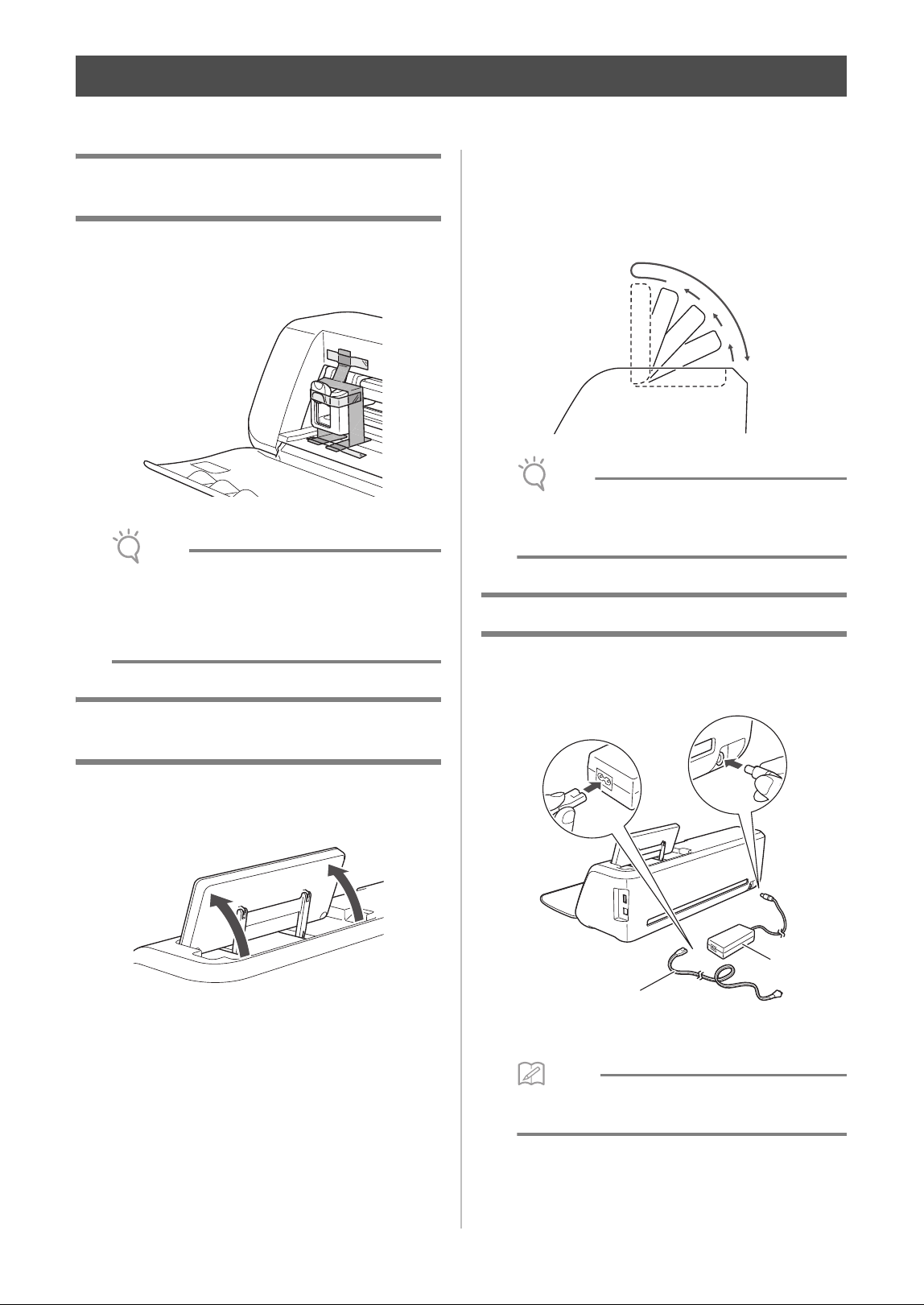
Unit Descriptions - Front
a Operation Panel
Allows you to control the unit and specify settings with
the LCD panel and operating buttons. The angle of the
operation panel can be adjusted to one of three levels.
For details, see “Adjusting the Angle of the Operation
Panel” on page 10.
b Carriage
Moves the installed holder for cutting or drawing.
1 Holder
Installs in the carriage to cut or draw on craft paper
or fabric. Use the holder designed specifically for
cutting or drawing.
2 Holder Guide
The guide secures the holder.
3 Holder Lock Lever
Releases the holder when the lever is raised. Locks
the holder when the lever is lowered.
c Handles
Grasped when moving the machine.
d Feed Slot
Feeds in or out a cutting/scanning mat. The mat is fed
by the feed rollers on both sides.
e Front Tray Cover
Protects the feed rollers, carriage and holder. Open
the cover while the machine is operating.
Unit Descriptions - Rear
a USB Port
Allows a USB flash drive to be connected for saving
and recalling data.
b Slot
Allows a mat to be fed back and forth during an
operation. Do not place any objects near the slot that
would prevent the mat from being fed out.
c DC Power Jack
d AC Adapter
e AC Power Cord
Unit Descriptions - Operation Panel
a Power Button
Turns the machine on/off.
b Home Button
Displays the home screen (starting screen for
operating this machine).
c Settings Button
Displays the settings screen for specifying various
settings. For details, see “Settings Screen” on
page 23.
d LCD Panel
Displays operation screens, preview images of
patterns and error messages.
e Feed Button
Feeds the loaded mat in to or out from the feed slot.
Be sure to press this button to feed the mat when
loading or unloading it.
f Start/Stop Button
Starts or stops cutting, drawing or scanning. When
the button function is available, it lights up in green.
PARTS AND FUNCTIONS
d
e
a
b
c
c
a
b
c
a
b
c
d
e
a
b
c
d
e
f
10
The following procedures describe basic operations, from preparing the material to performing trial cutting.
Removing the Transport Packing
Materials
Before turning on the machine, remove the shipping
tape and the cardboard shock-absorbing material.
Note
• If the packing materials were removed after the
machine was turned on, turn the machine off,
then on again. Continuing to use the machine
without restarting it may result in incorrect
operation.
Adjusting the Angle of the Operation
Panel
The angle of the operation panel can be adjusted to
one of three levels.
To store away the operation panel, first raise it until it
is vertical, and then it can be lowered and stored
away. If you wish to decrease the angle of the
operation panel, raise it until it is vertical, and then
adjust the angle again.
Note
• Follow the instructions provided above to lower
the panel. Lowering it forcibly may cause
damage to the panel.
Turning On/Off the Machine
a Connect the power cord to the AC adapter, and
then connect the AC adapter to the machine.
a Power cord
b AC adapter
Memo
• When using the AC adapter, untie the bundled
cord.
b Plug the power cord into an electrical outlet.
FIRST STEPS
b
a
11
1
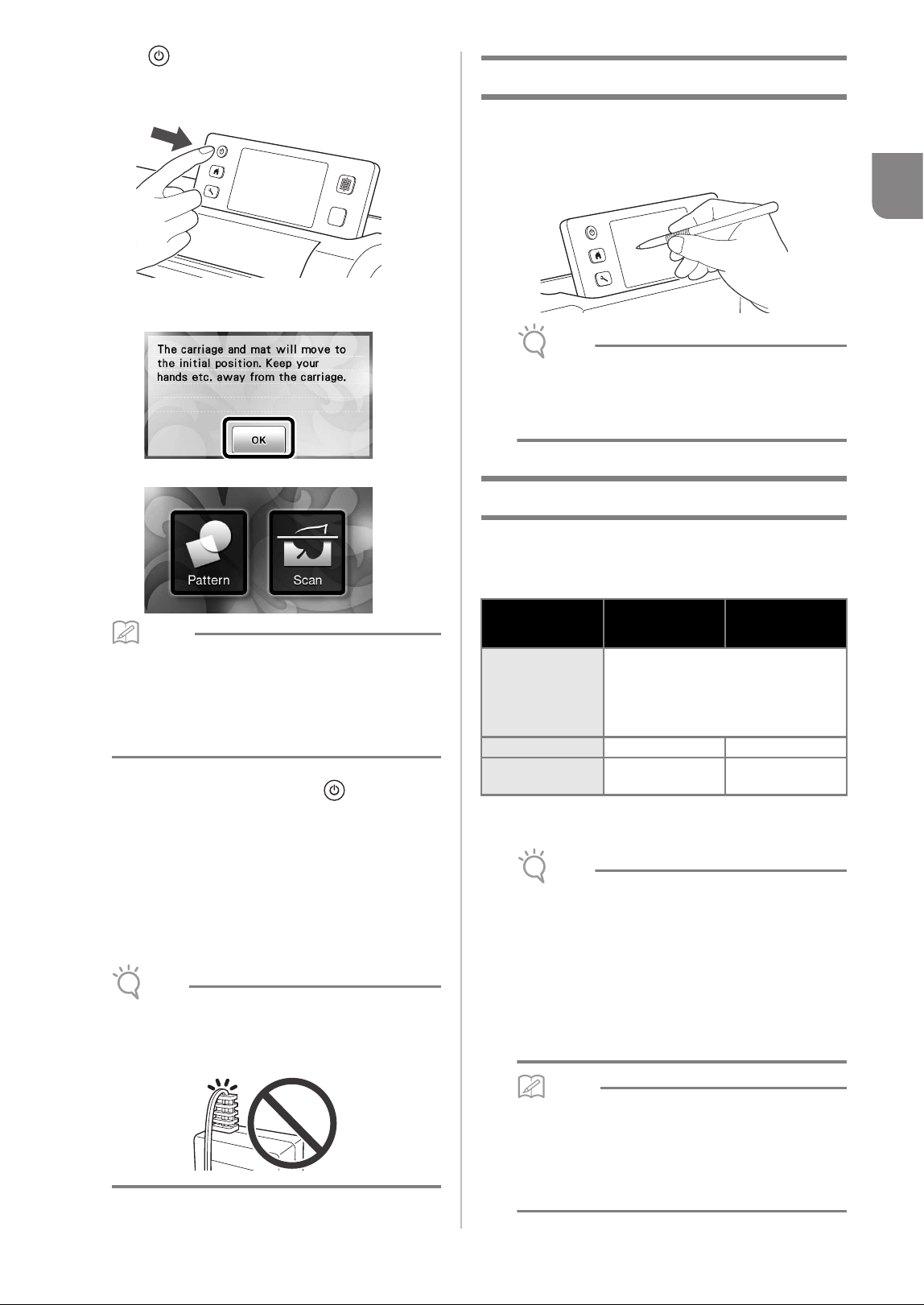
c Press in the operation panel.
When the opening screen appears, touch anywhere on
the display.
X When the following message appears, touch the
“OK” key.
X The home screen appears.
Memo
• LCD panels commonly have bright spots
(permanently lit dots) and dark spots (unlit
dots). It may cause some unexpected luminous
spots to appear and tiny picture elements to be
missed in the screen. Please note that this is
not a sign of malfunction.
d To turn off the machine, press in the
operation panel.
e Unplug the power cord from the electrical
outlet.
f Disconnect the AC adapter from the machine,
and then disconnect the power cord from the
AC adapter.
Note
• Do not wind the AC adapter cable around the
adapter or bend the cable, otherwise the cable
may be damaged.
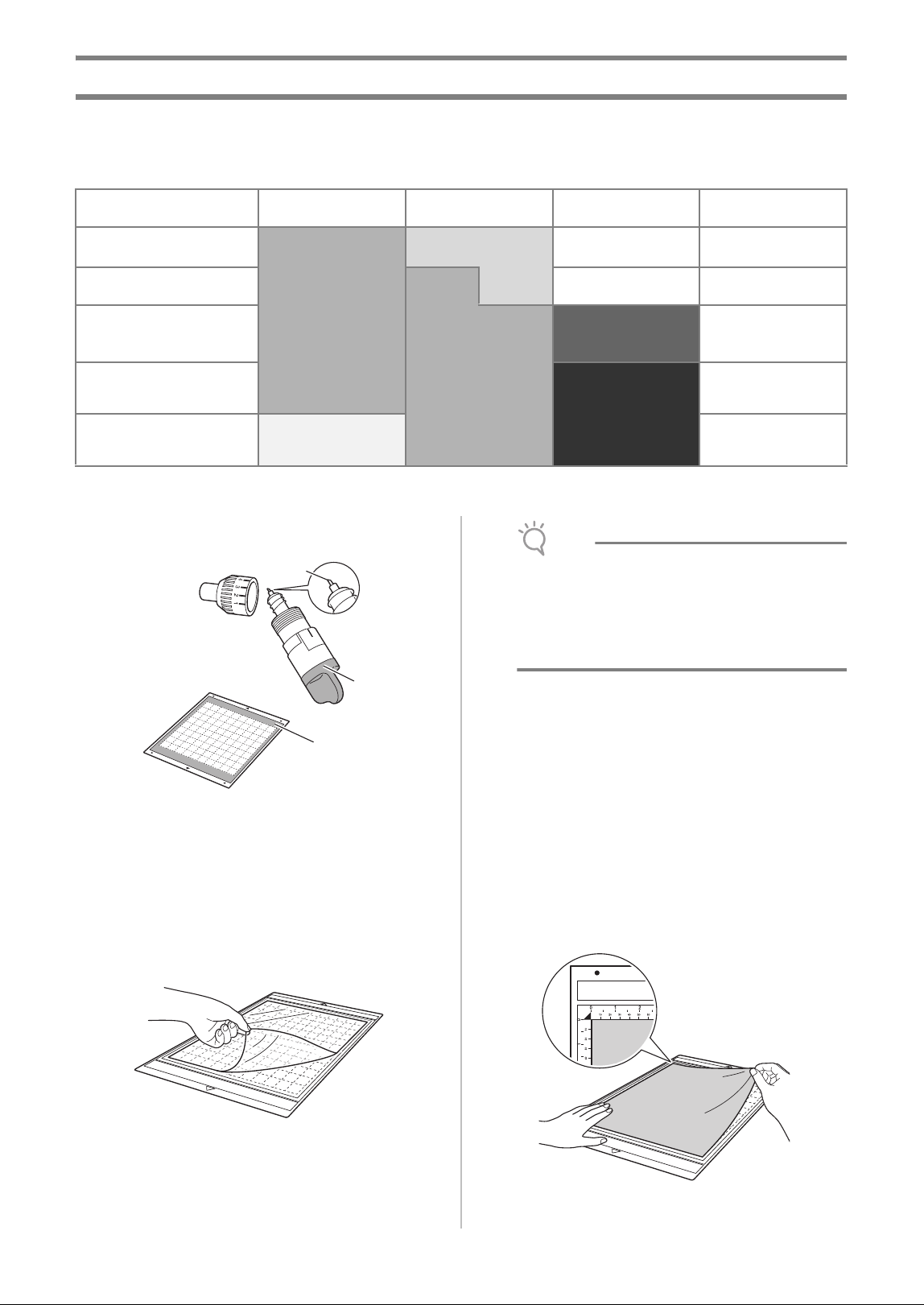
Operation of LCD Panel
After the machine is turned on, the operation screens
appear in the touch panel. To perform operations in
the screens, use the included touch pen.
Note
• Never use a hard or pointed object, such as a
mechanical pencil or screwdriver, to make a
selection in the screens. Otherwise, damage to
the machine may result.
Preparation of Craft Paper/Fabric
Prepare the material for cutting, drawing and
scanning (Direct Cut), based on the following
conditions.
* Recommended thickness varies depending on the
type of material used.
Note
• Avoid using craft paper or fabric covered with
decorative layer (that can easily separate), such
as lamé or foil. The separate layer may stick to
the machine’s scanning device or feed rollers
during operation, resulting in damage to the
machine. It may also damage the cutting blade.
If such media is used or tested it is
recommended to clean the scanner glass at the
bottom of the machine after every use
(page 59).
Memo
• When using an optional 12" × 24" (305 mm ×
610 mm) mat, the maximum work area for
cutting/drawing is 296 mm × 603 mm (11 3/4" ×
23 3/4").
• Some fabrics with uneven surfaces can be cut if
turned upside down.
Required
Material
Condition
Paper Fabric
Size
(When using a 12" × 12" (305 mm ×
305 mm) mat.)
Max: 305 mm × 305 mm (12" × 12")
The work area for cutting/drawing is
296 mm × 298 mm (11 3/4" × 11 3/4").
Thickness*
0.1 mm to 0.3 mm 0.2 mm to 1.5 mm
Type
scrapbook paper,
cardstock, vellum
cotton fabric, felt
12
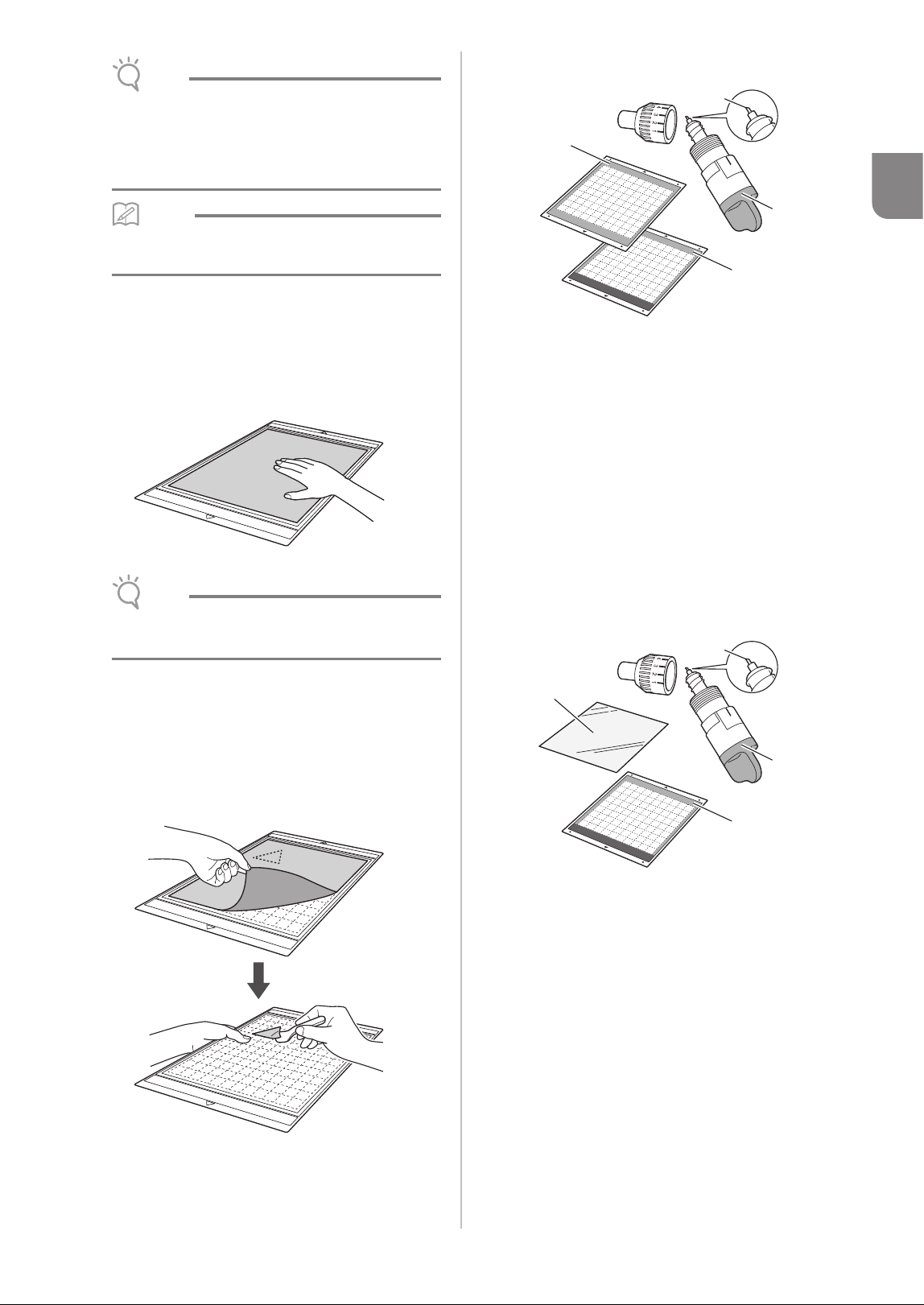
Mat and Cutting Blade Combinations
Use the following chart to select the correct combination of accessories for the material to be cut or drawn on.
Depending on the machine model, some accessories listed in the chart may not be included. In that case, they
must be purchased separately.
* Use the deep cut blade with heavy weight fabrics (0.5 to 1.5 mm), such as felt and denim.
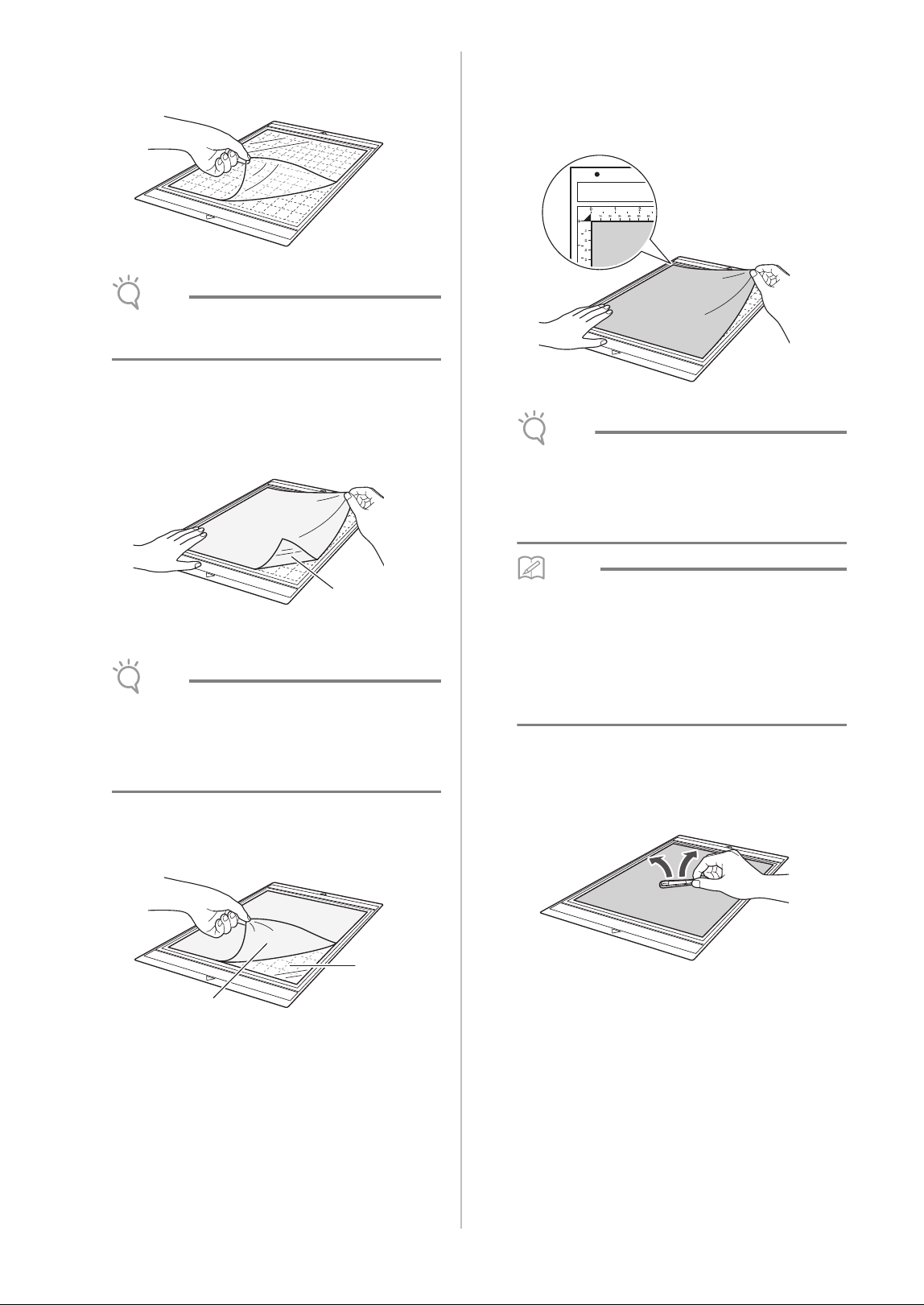
■ 1 Lightweight Paper
a Standard cut blade
b Standard cut blade holder (turquoise)
c Low tack adhesive mat (turquoise)
Attaching the Material (Lightweight Paper)
a Peel off the protective sheet from the adhesive
side of the mat.
Note
• Do not discard the protective sheet peeled off
the mat; save it for later use.
• When the mat is not being used, clean the
adhesive side and affix the protective sheet
before storing it. For details, see “Cleaning the
Mat” on page 58.
b Test attaching the material.
Before attaching the material to the mat, use a corner
of the adhesive side of the mat to test attaching it.
Check for the following when testing attaching the
material.
• The color does not come off the material when it is
peeled off.
• The material is not torn or deformed when it is
peeled off.
If any problems occur when testing attaching, use
different material.
c Attach the material to the mat’s adhesive side.
Cutting blade Mat Sheet
Recommended
Combination
Lightweight paper
(vellum)
Standard cut blade
(turquoise)
Low tack adhesive
mat (turquoise)
–
a (page 12)
Medium weight paper
(scrapbook paper)
–
b (page 13)
Lightweight fabric
(for quilt piecing)
Standard mat
(turquoise and purple)
High tack adhesive
fabric support sheet
(light blue backing)
c (page 13)
Lightweight fabric
(for any use other than
quilt piecing)
Iron-on fabric
appliqué contact
sheet (white backing)
d (page 15)
Medium weight fabric
(for any use other than
quilt piecing)
*Deep cut blade
(purple)
e (page 17)
a
c
b
13
1
Note
• Place the material within the attaching area
(grid area) on the adhesive side. If the material
extends from the attaching area, it may be
damaged by the feed rollers when the mat is
fed.
Memo
• The mat does not have a top and bottom. It can
be inserted into the feed slot from either end.
d Firmly attach all of the material to the mat so
that there are no wrinkles and no part can curl
off.
• Otherwise, curls in the material may become
caught when the mat is inserted.
Note
• If the mat is dirty, clean it. For details, see
“Cleaning the Mat” on page 58.
Peeling Off the Material (Lightweight Paper)
Follow the steps in adjusting the blade extension
(page 18), installing the blade holder (page 19)
and trial cutting (page 19) to set up your machine.
After cutting the material, use a spatula to slowly
peel off the paper.
■ 2 Medium Weight Paper
a Standard cut blade
b Standard cut blade holder (turquoise)
c Standard mat (turquoise and purple)
d Low tack adhesive mat (turquoise) (When
cutting slick paper)
Attaching the Material (Medium Weight Paper)
Follow the steps in “Attaching the Material
(Lightweight Paper)” on page 12.
Peeling Off the Material (Medium Weight Paper)
Follow the instructions in “Peeling Off the
Material (Lightweight Paper)” on page 13.
■ 3 Lightweight Fabric for Quilt Piecing
a Standard cut blade
b Standard cut blade holder (turquoise)
c Standard mat (turquoise and purple)
d High tack adhesive fabric support sheet (light
blue backing)
Attaching the Material (Lightweight Fabric for
Quilt Piecing)
Use the specially designed adhesive sheet to
attach lightweight fabrics for quilt piecing to the
standard mat. The high-tack adhesive fabric
support sheet is perfect for quilt piecing since it
will not leave adhesive on the surface of fabric.
Support sheets can be repeatedly used unless they
are peeled off the mat. They should only be used
with patterns that have a seam allowance. When
cutting patterns without a seam allowance, use
the iron-on fabric appliqué contact sheet.
a
c
b
d
a
d
c
b
14
a Peel off the protective sheet from the adhesive
side of the standard mat.
Note
• Do not discard the protective sheet peeled off
the mat; save it for later use.
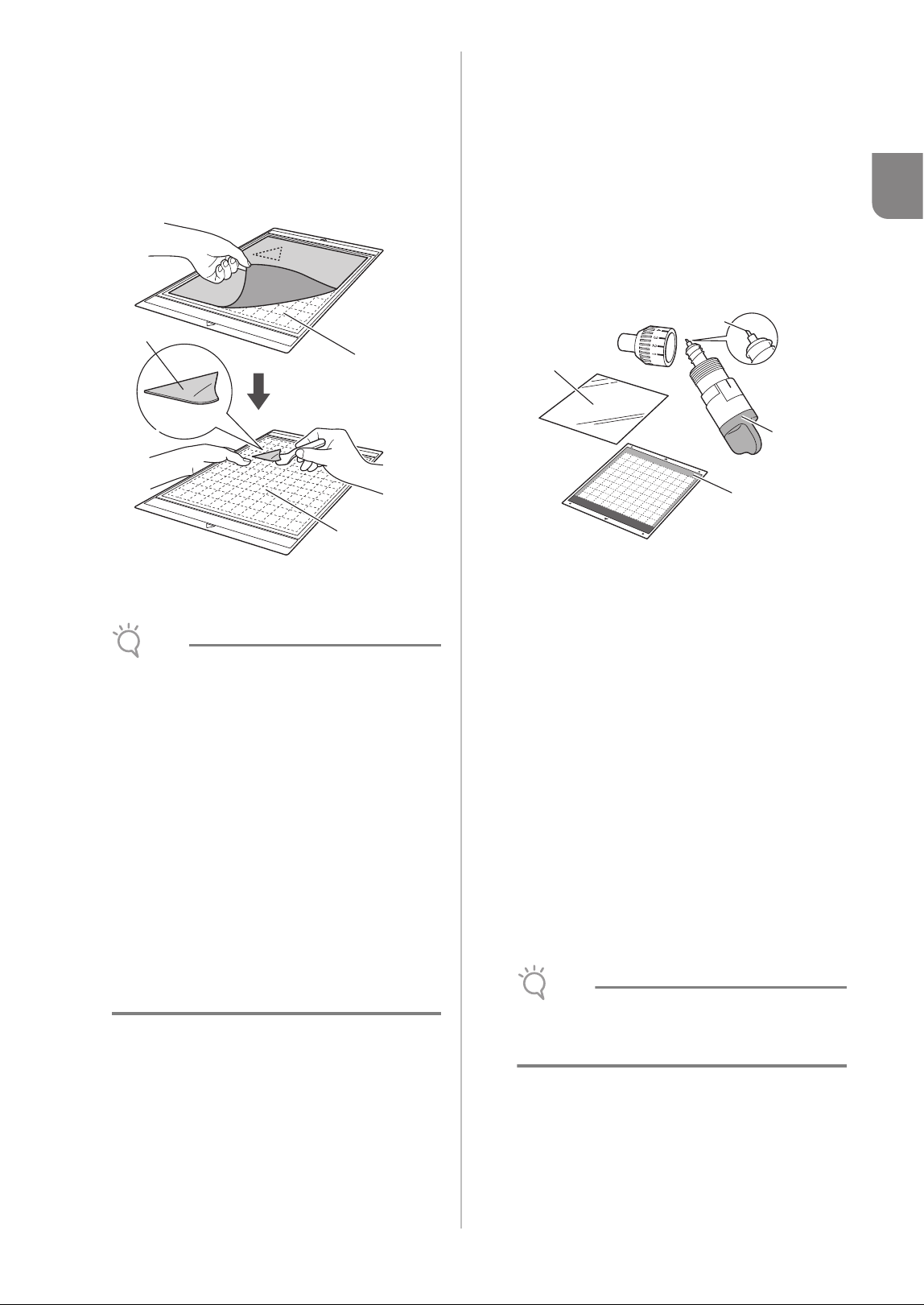
b With the glossy side of the support sheet facing
down, attach it to the mat’s adhesive side.
Slowly attach the support sheet from its edges so that
no air is trapped between the mat and the sheet.
a Glossy side of support sheet
Note
• Place the support sheet within the attaching
area (grid area) on the adhesive side of the mat.
If the sheet extends from the attaching area, it
may be damaged by the feed rollers when the
mat is fed.
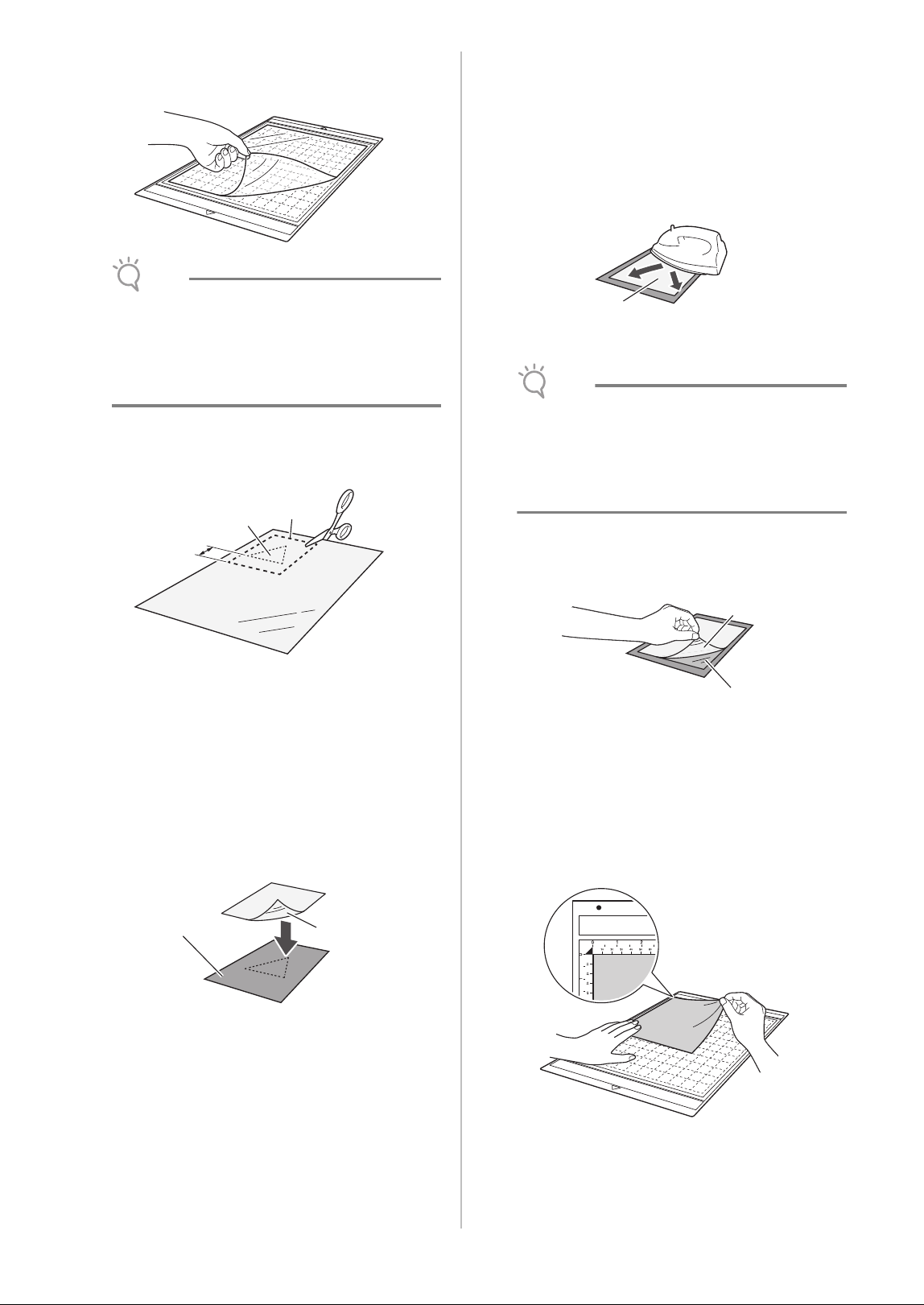
c Peel off the backing from the top of the support
sheet.
a Backing (light blue)
b Adhesive
d Test attaching the material.
Before attaching the material to the mat, use a corner
of the adhesive side of the mat to test attaching it. If
any problems occur when testing attaching, use
different material.
e From its edges, attach the material to the
adhesive side of the mat so that there are no
wrinkles in the material.
Be sure to first iron the fabric to remove any wrinkles.
Note
• Place the material within the attaching area
(grid area) on the adhesive side. If the material
extends from the attaching area, it may be
damaged by the feed rollers when the mat is
fed.
Memo
• The mat does not have a top and bottom. It can
be inserted into the feed slot from either end.
• Be sure that the vertical grain of the attached
fabric runs straight up and down. The built-in
patterns are automatically arranged suitable for
fabric with vertical grain.
• When drawing a seam allowance, attach the
fabric to the mat with its wrong side facing up.
f Firmly move the spatula handle across the
surface of the fabric to remove any wrinkles
and firmly attach the fabric to the mat.
a
a
b
15
1
Peeling Off the Material (Lightweight Fabric for
Quilt Piecing)
Follow the steps in adjusting the blade extension
(page 18), installing the blade holder (page 19)
and trial cutting (page 19) to set up your machine.
After cutting the material, use a spatula to slowly
peel off just the fabric. Try not to peel off the
support sheet.
a Fabric cut out
b Support sheet remaining on mat
Note
• The support sheet may be unintentionally
peeled off while you are removing the fabric
from the mat under the following conditions:
- The adhesive between the mat and support
sheet is becoming weak after repeated uses.
- The support sheet tends to be strongly
attached to a certain types of fabrics.
In this case, use the included spatula to hold
the support sheet on the mat and remove the
fabric using your hand.
• After cutting, carefully remove any fibers
remaining on the support sheet.
• When attaching fabric with an iron-on sheet
attached or paper to the mat, cleanly peel off
the support sheet from the mat, or attach the
material to a different standard mat without a
support sheet attached.
• Do not leave material attached to a mat with a
support sheet attached for a long period of
time; otherwise, the adhesive will permeate the
material.
Notice on Use of Support Sheet
• When the sheet’s adhesive strength decreases
or fabric becomes twisted while being cut,
replace the sheet with a new one.
• When peeling the sheet off the mat or replacing
the sheet, use the spatula to carefully remove
the old sheet.
• Store the mat in between uses with the
protective sheet affixed to the support sheet.
• If a mat with a support sheet attached is not to
be used for a certain length of time, peel the
support sheet off the mat and affix the
protective sheet on the adhesive side of the mat
before storing it.
• Do not reuse a support sheet that has been
attached to the mat.
• Store the support sheet at room temperature
and in a location not exposed to high
temperatures, high humidity or direct sunlight.
• Do not bend the support sheet to store it.
■ 4 Lightweight Fabric for Any Use Other
Than Quilt Piecing
a Standard cut blade
b Standard cut blade holder (turquoise)
c Standard mat (turquoise and purple)
d Iron-on fabric appliqué contact sheet (white
backing)
Attaching the Material (Lightweight Fabric for
Any Use Other Than Quilt Piecing)
Iron the specially designed contact sheet to the
back of fabrics for any use other than quilt
piecing, and then attach them to the standard
mat.
The double-faced adhesive type of the iron-on
fabric appliqué contact sheet reinforces the fabric
and enables any pattern to be cut easily,
including appliqués.
The sheet cannot be removed once it has been
attached to the back of fabrics. For quilt piecing,
use the high-tack adhesive fabric support sheet
and avoid using the iron-on fabric appliqué
contact sheet.
Note
• The contact sheet may not adhere to a fabric
surface that is so rough that the two surfaces
cannot be heat-set to adhere to each other.
a
b
b
a
d
c
b
16
a Peel off the protective sheet from the adhesive
side of the standard mat.
Note
• Do not discard the protective sheet peeled off
the mat; save it for later use.
• When the mat is not being used, clean the
adhesive side and affix the protective sheet
before storing it. For details, see “Cleaning the
Mat” on page 58.
b Cut the contact sheet to a size 2 cm or more
larger than the outline of the pattern to be cut.
a Pattern to be cut
b Cutting line of sheet
c Margin of 2 cm or more
c With the glossy side of the contact sheet facing
down, place it on the wrong side of the fabric.
Be sure to first iron the fabric to remove any wrinkles.
Before placing the contact sheet on the fabric, make
sure that the fabric has been allowed to cool after
ironing.
a Glossy side of contact sheet
b Wrong side of fabric
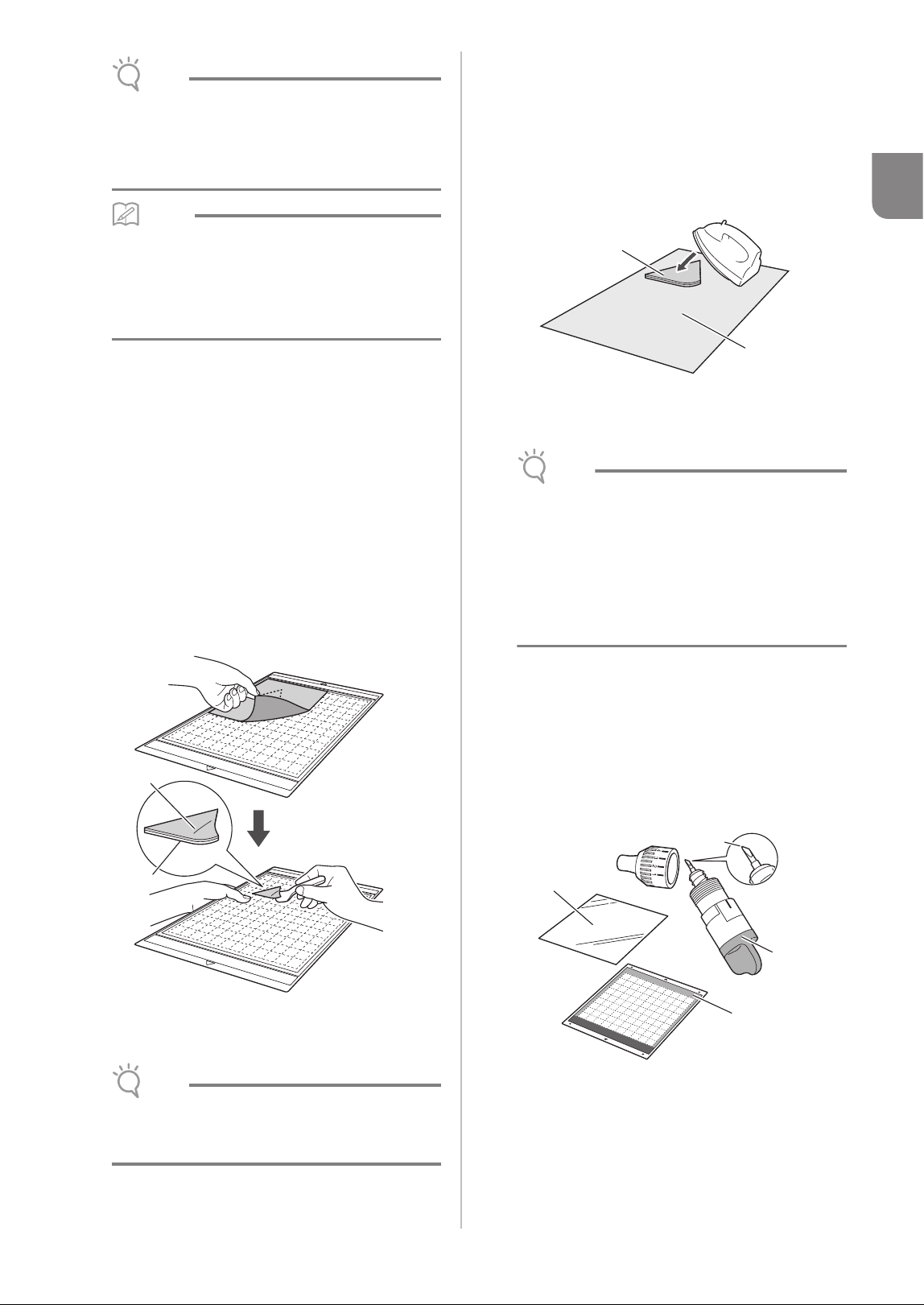
d Evenly iron the entire contact sheet to affix it to
the wrong side of the fabric.
With the iron on a medium temperature setting (140 to
160 °C (284 °F to 320 °F)), press each part of the sheet
for about 20 seconds (the length of time differs
depending on the material).
Be sure to apply pressure on the top of the backing
and push out any air between the sheet and fabric.
a Backing
Note
• Before attaching the contact sheet to the fabric,
use a piece of the sheet to test attaching it. If
any problems occur when testing attaching,
use different material.
• Leaving the iron in the same place for too long
may scorch or melt the material.
e Peel off the backing from the contact sheet.
Before peeling off the backing, allow all parts to cool.
a Contact sheet
b Backing
f With the side of the fabric that the contact
sheet is attached to facing down, attach the
material to the mat from its edges.
Slowly attach the material from its edges so that no air
is trapped between it and the mat.
a
c
b
a
b
a
a
b
17
1
Note
• Place the material within the attaching area
(grid area) on the adhesive side. If the material
extends from the attaching area, it may be
damaged by the feed rollers when the mat is
fed.
Memo
• The mat does not have a top and bottom. It can
be inserted into the feed slot from either end.
• Be sure that the vertical grain of the attached
fabric runs straight up and down. The built-in
patterns are automatically arranged suitable for
fabric with vertical grain.
g Firmly attach all of the material to the mat so
that there are no wrinkles and no part can curl
off.
• Otherwise, curls in the material may become
caught when the mat is inserted.
Peeling Off the Material (Lightweight Fabric for
Any Use Other Than Quilt Piecing)
Follow the steps in adjusting the blade extension
(page 18), installing the blade holder (page 19)
and trial cutting (page 19) to set up your machine.
After cutting the material, use a spatula to peel off
the fabric together with the attached contact
sheet.
a Pattern that was cut out
b Contact sheet
Note
• Do not place anything heated on the fabric
attached with a contact sheet. Adhesive will
permeate any other pieces of fabric around.
Attaching Fabrics With the Double-Sided
Adhesive
Place a cutout on a base fabric and apply pressure
on the top of the cutout using an iron. (The
contact sheet may not adhere well to some
fabrics.) Hand or machine stitch to ensure that the
cutout stays in place.
a Base fabric
b Cutout with a contact sheet
Note
• Do not wash fabrics attached together with a
double-sided adhesive contact sheet.
• When attaching fabrics with the double-sided
adhesive, iron carefully, being sure that the
material and adhesive surfaces are properly
heat-set.
• When attaching fabrics of different weights with
the double-sided adhesive, first iron the lighter-
weight fabric to affix the contact sheet.
Notice on Use of Contact Sheet
• Store the contact sheet at room temperature
and in a location not exposed to high
temperatures, high humidity or direct sunlight.
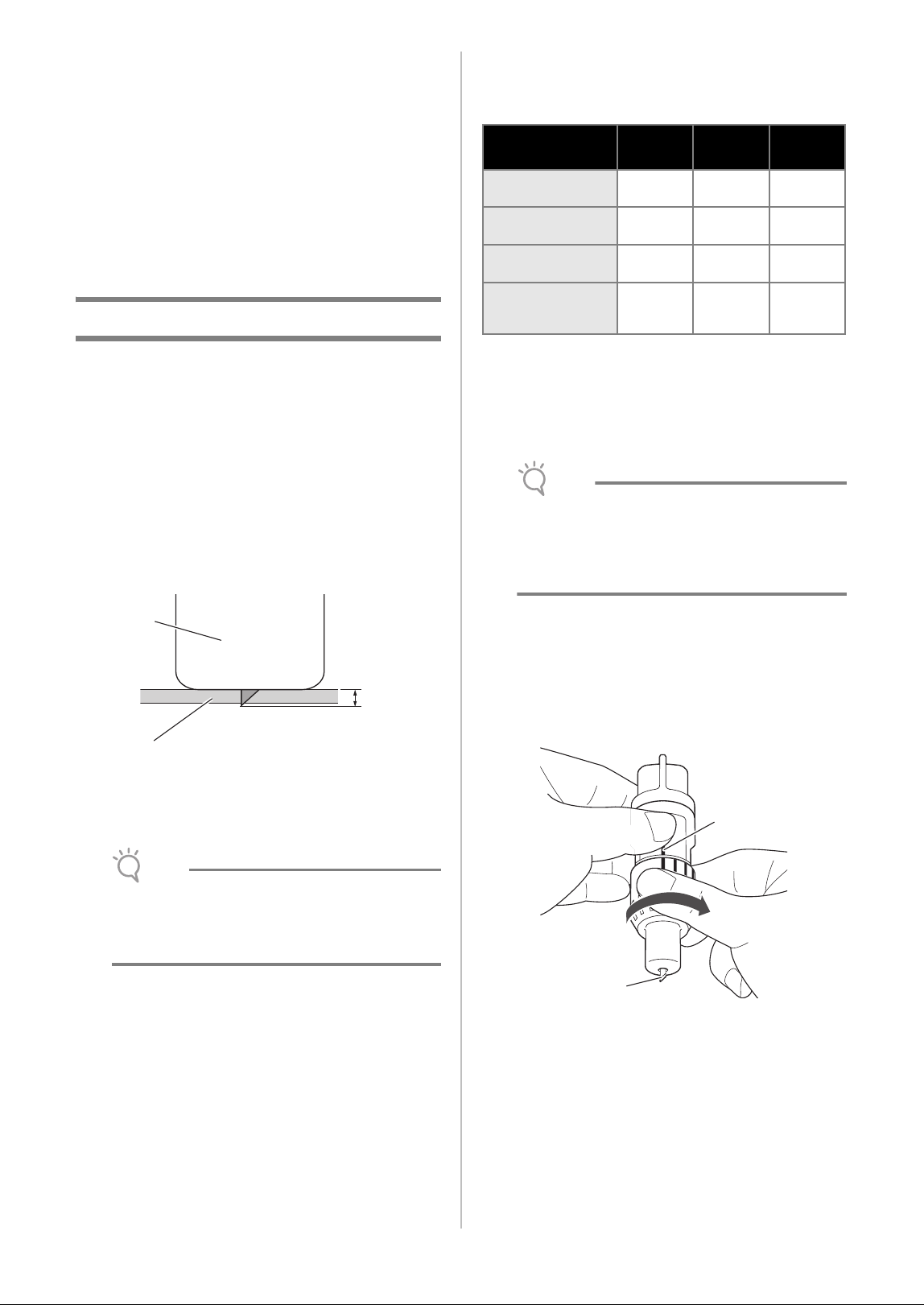
■ 5 Medium Weight Fabric for Any Use
Other Than Quilt Piecing
a Deep cut blade
b Deep cut blade holder (purple)
c Standard mat (turquoise and purple)
d Iron-on fabric appliqué contact sheet (white
backing)
a
b
a
b
a
c
b
d
18
Attaching the Material (Medium Weight Fabric
for Any Use Other Than Quilt Piecing)
Follow the steps in “Attaching the Material
(Lightweight Fabric for Any Use Other Than Quilt
Piecing)” on page 15.
Peeling Off the Material (Medium Weight Fabric
for Any Use Other Than Quilt Piecing)
Follow the instructions in “Peeling Off the
Material (Lightweight Fabric for Any Use Other
Than Quilt Piecing)” on page 17.
Adjusting the Blade Extension
The appropriate blade extension differs depending
on the material type and thickness. Before installing
the holder in the carriage, turn the holder cap to
adjust the blade extension, and then perform trial
cutting. For details on trial cutting, see “Trial
Cutting” on page 19.
■ Appropriate Blade Extension
Adjust the blade extension to slightly exceed the
thickness of the material that will be cut. Use the
markings on the holder to make the adjustment.
a End of holder cap
b Material that will be cut
c Length of blade tip
Note
• Be careful that the blade does not extend too
much. If there is too much of a blade extension,
the material may not be cut cleanly and the mat
will deteriorate quicker.
Cutting Settings
Use the following table to select the appropriate
settings according to the material that will be cut.
* Adjust the setting for “Cut Pressure” in the settings
screen (page 23).
* Use a support sheet or contact sheet when you cut
a piece of fabric out. For details, see “Mat and
Cutting Blade Combinations” on page 12.
Note
• The settings indicated in the table are
approximations. The setting will differ
depending on the type and thickness of the
material to be cut. Be sure to perform a trial
cutting first.
■ Adjusting the Cutting Blade
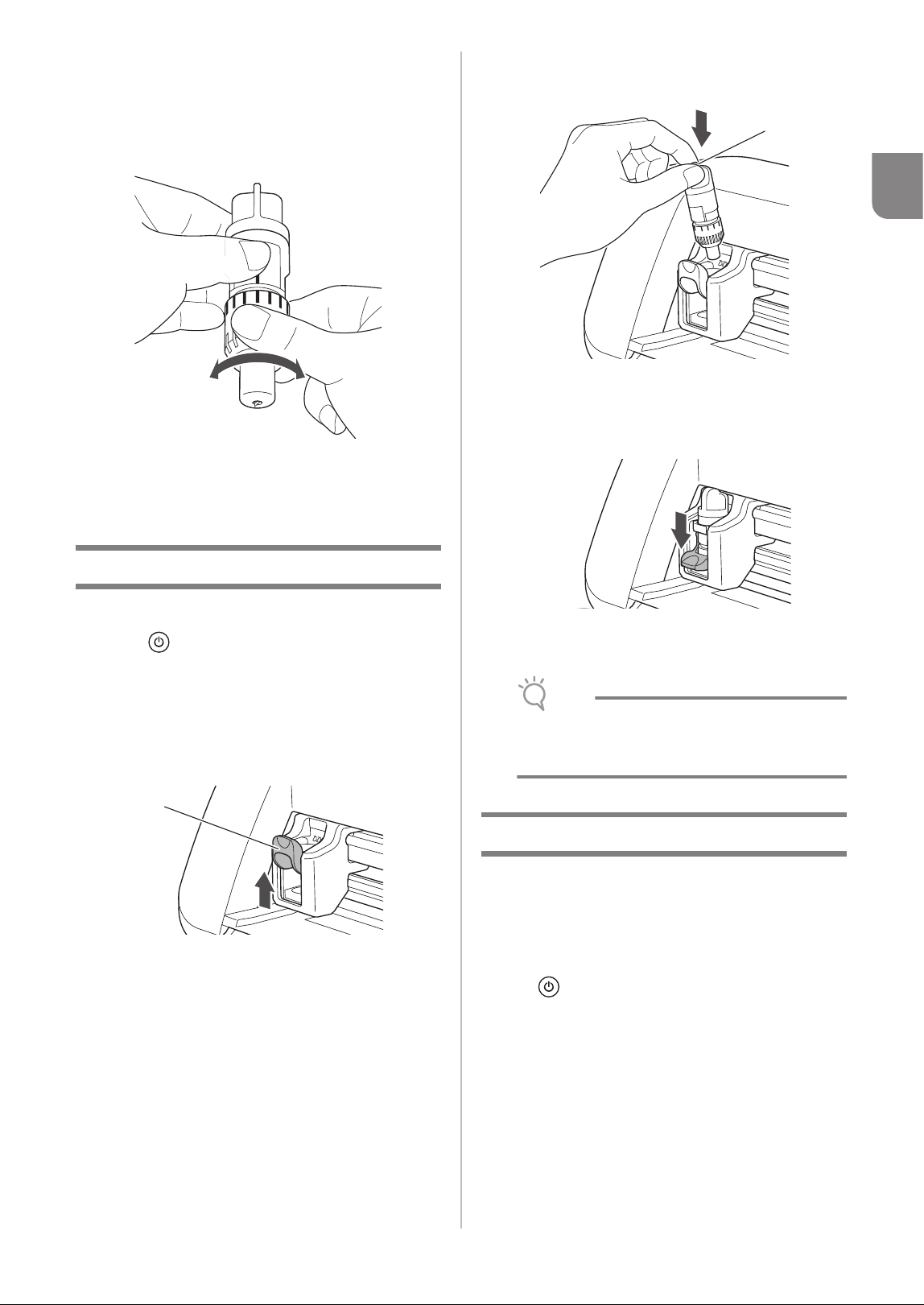
a With the reference line on the holder facing
toward you, fully turn the cap to the right to
extend the blade tip to its maximum.
a Reference line
b Extend the blade tip to its maximum.
a
b
c
Material Type Blade
Scale
Setting
Pressure
Setting
Lightweight paper
(vellum)
Standard 3 0
Heavy weight
paper (cardstock)
Standard 4 0
Lightweight fabric
(cotton fabric)
Standard 4 4
Heavy weight
fabric (1-mm-thick
felt)
Deep-cut 5 5
a
b
19
1
b Check the thickness of the material, and then
adjust the blade extension. See “Appropriate
Blade Extension” on page 18.
The larger the holder scale setting, the further the
blade extends.
a Turn to the left to decrease the blade extension.
b Turn to the right to increase the blade
extension.
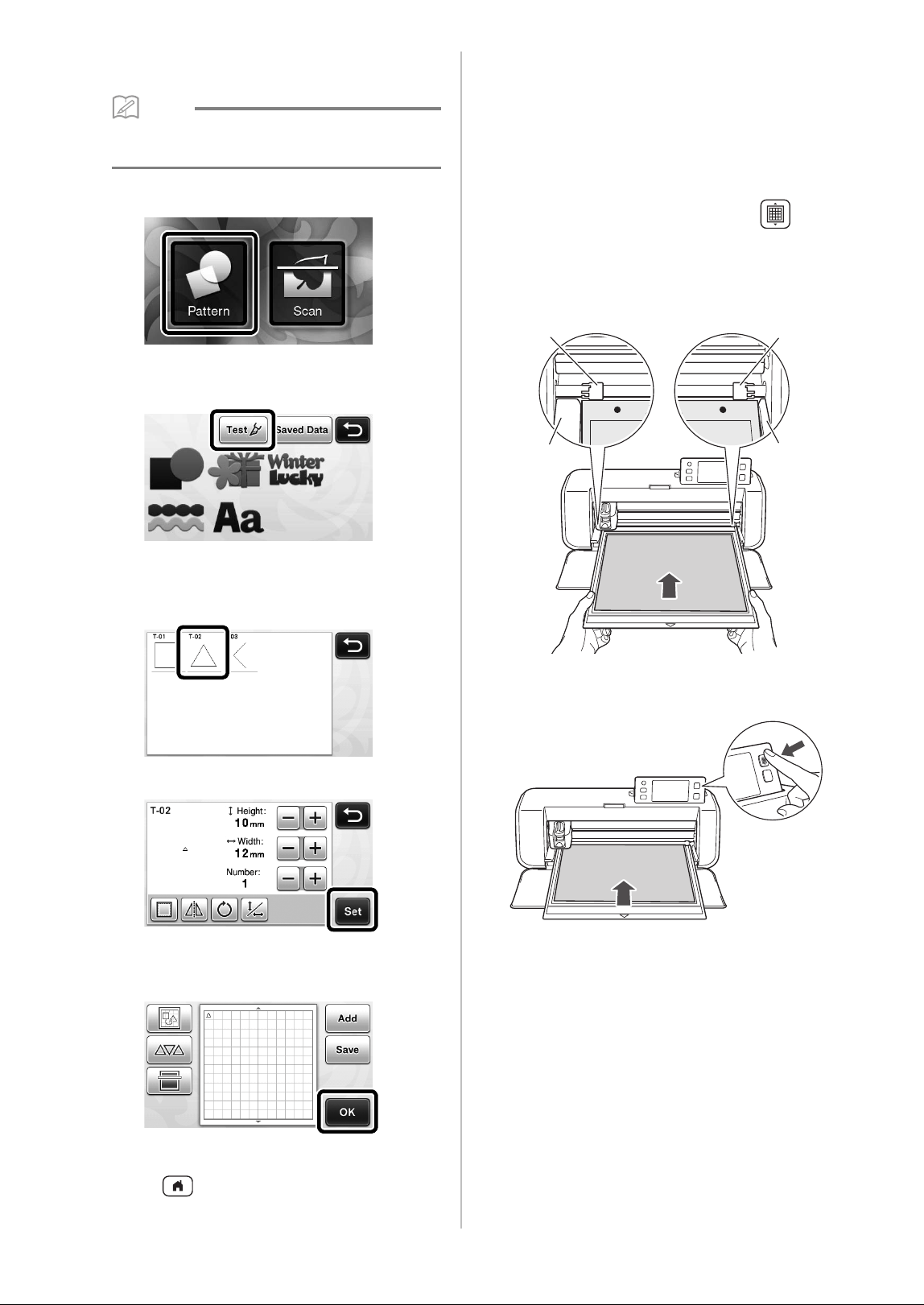
Installing and Uninstalling the Holder
Install the holder in the machine.
a Press in the operation panel to turn on the
machine.
For details, see “Turning On/Off the Machine” on
page 10.
b If the holder lock lever is not raised, raise it.
The holder cannot be installed if the lever is lowered.
a Holder lock lever
c Grasp the holder grip, and then insert the
holder into the carriage.
a Grip
d Push down on the holder lock lever.
Firmly push down until the holder is locked in place.
e Reverse the installation procedure to uninstall
the holder.
Note
• After removing the blade holder from the
machine or when storing it, store the blade tip
within the holder.
Trial Cutting
Make sure that the blade extension is appropriate for
the material. Using the same material to cut or draw
on in your project, perform trial cutting.
■ Turning On the Machine
Press in the operation panel to turn on the machine.
• For details, see “Turning On/Off the Machine” on
page 10.
■ Setting the Holder
Install the cutting blade holder into the carriage of the
machine.
• For details, see “Installing and Uninstalling the
Holder” on page 19.
a
b
a
a
20
■ Selecting the Test Pattern
Cut out a test pattern from paper.
Memo
• The language setting can be specified in the
settings screen (see “Language” on page 23).
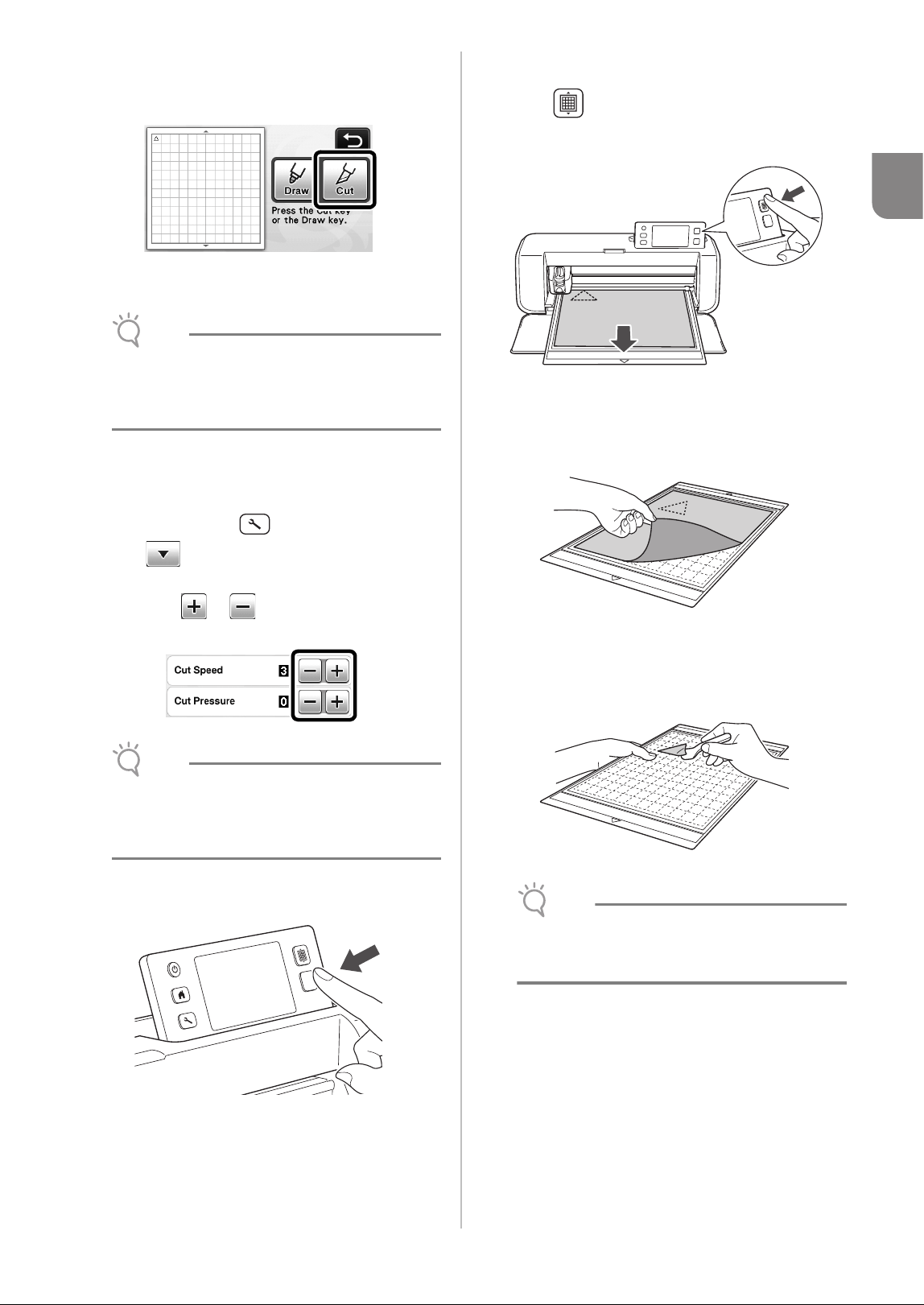
a Select “Pattern” in the home screen.
b Touch the “Test” key in the pattern category
selection screen.
c Select a pattern in the pattern selection screen.
• We recommend using pattern “T-02” when cutting
paper and pattern “T-03” when cutting fabric.
d Touch the “Set” key.
e Check the pattern arrangement, and then touch
the “OK” key.
• For details on changing the pattern arrangement,
see “Pattern Layout Screen” on page 35.
• Press to cancel the pattern selection, and
then select the pattern again.
■ Loading the Mat
a Attach the material that will be cut to the mat.
• For details on attaching material to the mat, see
“Mat and Cutting Blade Combinations” on
page 12.
b While holding the mat level and lightly
inserting it into the feed slot, press in the
operation panel.
Lightly insert the mat so that it aligns with the guides
on the left and right sides of the feed slot and is tucked
under the feed rollers.
a Guides
b Feed rollers
X The mat is fed in to complete the preparations for
cutting.
a
b
a
b
21
1
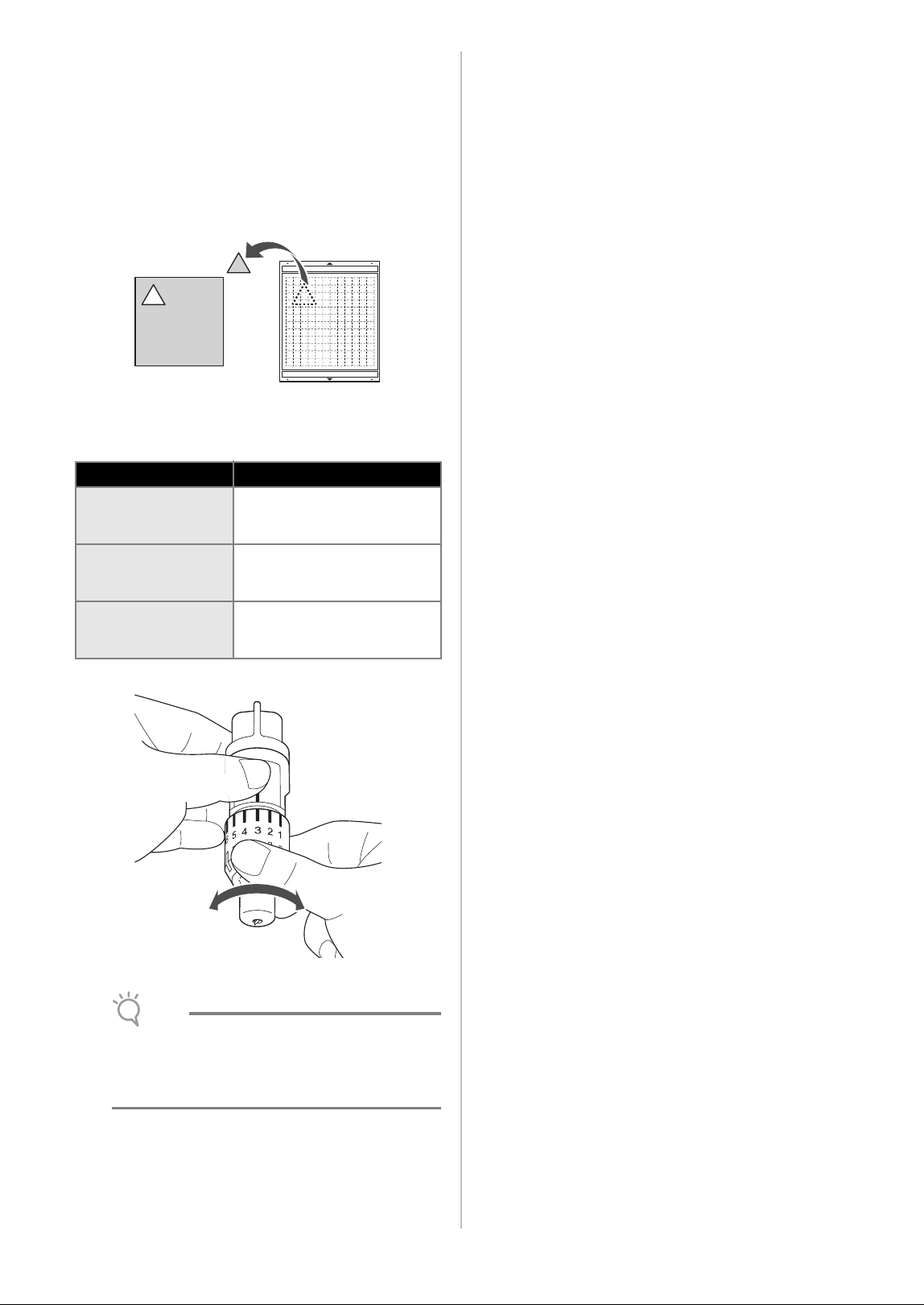
■ Cutting
a Select “Cut” in the draw/cut selection screen.
X The “Start/Stop” button in the operation panel
lights up.
Note
• Make sure that patterns that will be cut out are
arranged in the cutting area corresponding to
the size of the material attached before
continuing operation.
b Adjust the cutting speed and pressure.
Before cutting the pattern, adjust the cutting speed and
pressure. These adjustments can be made from the
settings screen. Press in the operation panel and
touch to display the second page of the settings
screen.
X Touch or to change the settings and
then touch the “OK” key.
Note
• Depending on the fabric being used, it may not
be cut cleanly if the cutting pressure is not
correctly adjusted. For the appropriate cutting
pressure, see “Cutting Settings” on page 18.
c Press the “Start/Stop” button to start cutting.
X When cutting is finished, the message “Finished
cutting.” appears on the display. Touch the “OK”
key to return to the draw/cut selection screen.
■ Unloading the Mat
a Press in the operation panel to feed out
the mat.
b Peel off the material from an area that is easily
removable, such as a corner, and then slowly
peel while maintaining an even pressure.
c Holding the mat with your hand, use the
included spatula to carefully peel off the cut-
out patterns.
Note
• For instructions on how to peel off the material,
see also “Mat and Cutting Blade Combinations”
on page 12.
22
■ Checking the Trial Cutting Results
Adjust the blade extension according to the trial cutting
results.
Repeatedly perform trial cutting and adjust the blade
extension until the material is cut cleanly.
With an Appropriate Blade Extension
When the material is peeled off, a faint trace of
the cut remains on the mat surface.
With a Blade Extension That Needs to be
Adjusted
Note
• Be careful that the blade does not extend too
much. If there is too much of a blade extension,
the material may not be cut cleanly and the mat
will deteriorate quicker.
Trial cutting results Tips for adjustment
Part of the cut
material remains
when it is peeled off.
Too Little of a Blade Extension:
Turn the holder cap half a
marking to the right. (
b
)
The material is not
clearly cut.
Too Little of a Blade Extension:
Turn the holder cap one marking
to the right. (
b
)
There are deep cuts
completely through
the mat.
Too Much of a Blade Extension:
Turn the holder cap one marking
to the left. (
a
)
a
b
23
1
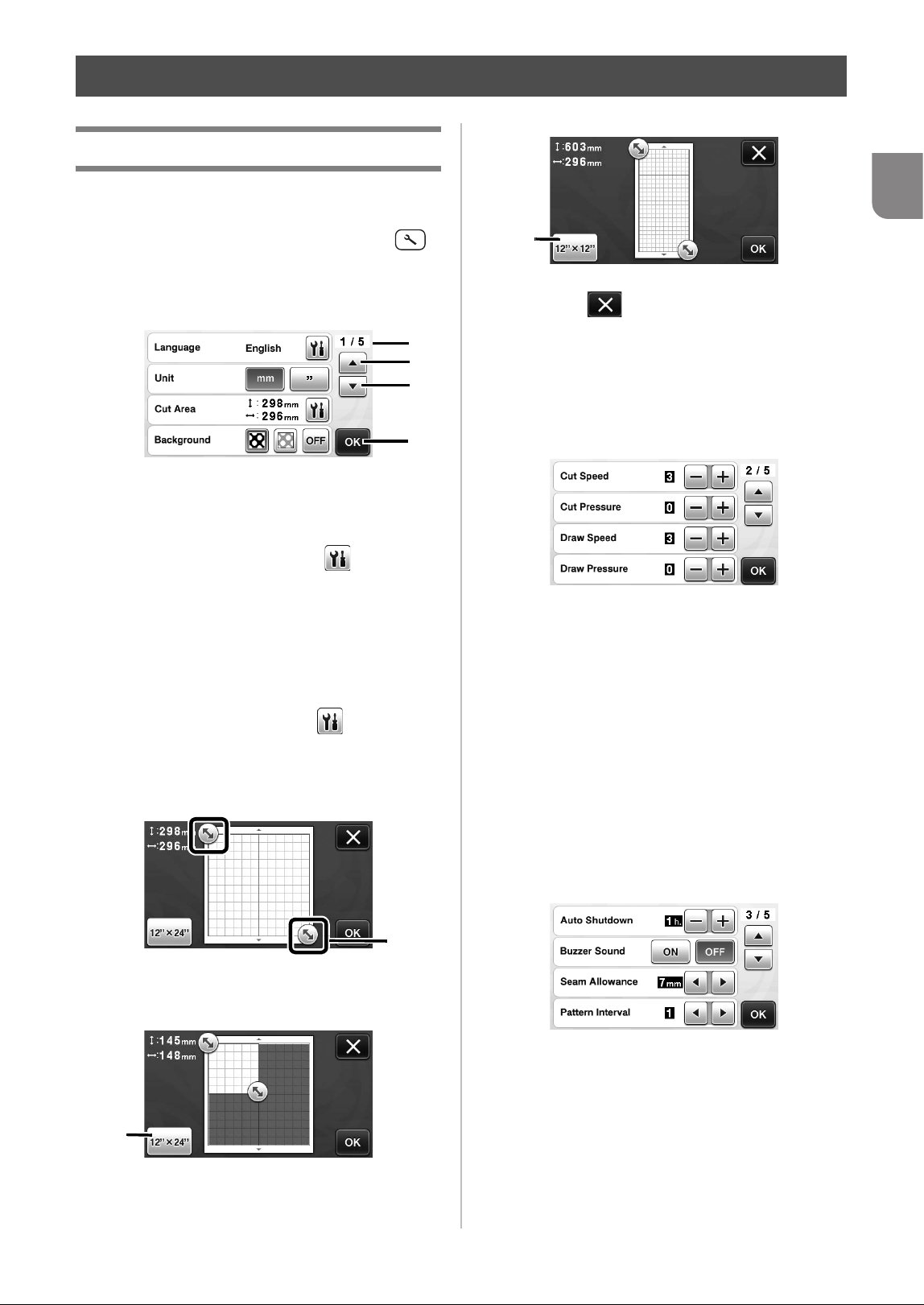
Settings Screen
From the LCD panel, the settings for specific
functions can be selected and settings can be
adjusted. To display the settings screen, press
in the operation panel.
■ Page 1
a Settings screen page number
b Touch to display a different page.
c Touch to finish specifying settings.
Language
Select the display language. Touch , select the
desired display language, and then touch the “OK”
key.
Unit
Select either millimeters or inches as the displayed
measurement units.
Cut Area
Specify the area for cutting/drawing according to the
size of material to be used. Touch , and then
touch and drag the area resizing keys to specify the
area. When using a 12" × 24" (305 mm × 610 mm)
mat, touch the mat size key to select a larger mat size,
and then specify the area size.
a Area resizing key (Using the touch pen, touch
the key, and then drag it around the screen to
specify the area.)
b Mat size key (Touching the key switches
between the mat size 12" × 12" (305 mm × 305
mm) and 12" × 24" (305 mm × 610 mm).)
• Touch the “OK” key to apply the settings.
Touch to return to the previous screen
without applying the settings.
Background
Adjust the contrast of a background image scanned
with the background scanning function. For details,
see “Scanning a Background Image” on page 38.
■ Page 2
Cut Speed
Adjust the cutting speed.
Cut Pressure
Adjust the cutting pressure. For the appropriate
cutting pressure, see “Cutting Settings” on page 18.
Draw Speed
Adjust the drawing speed.
Draw Pressure
Adjust the drawing pressure. Adjustments to the
drawing pressure will affect the finished product. Use
the same material that the pattern will be drawn on to
make the adjustments in advance. If the pressure is
too high, the pen tip may be damaged. Adjust the
pressure appropriately.
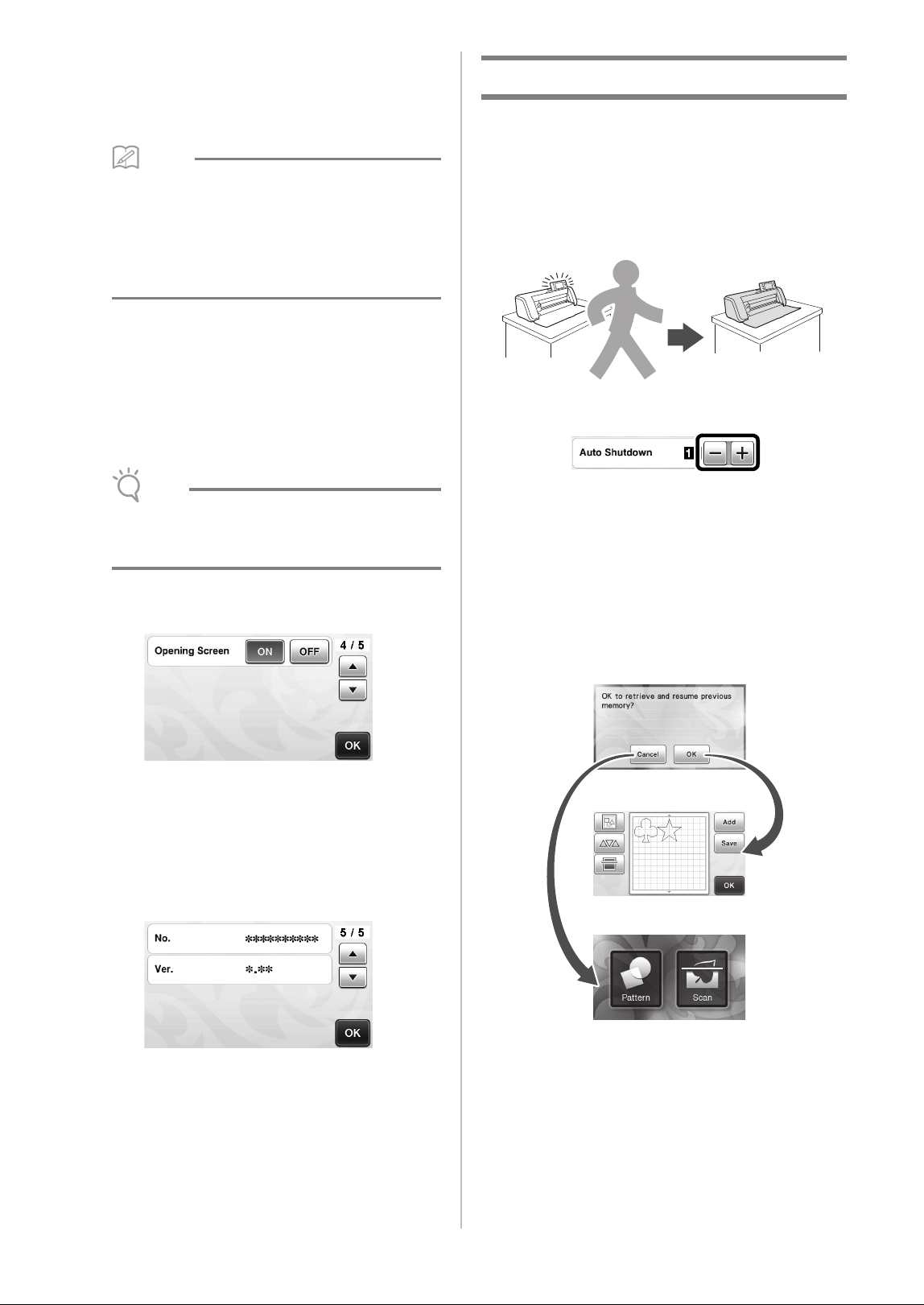
■ Page 3
Auto Shutdown
Specify the length of time for the auto shutdown
function. The setting can be specified in 1-hour
increments. For details, see “Auto Shutdown” on
page 24.
Buzzer Sound
Select whether or not an operation sound is
produced, for example, when a key is touched.
MACHINE SETTINGS
a
b
c
b
a
b
b
24
Seam Allowance
Specify the seam allowance. This is applied when
drawing on fabric, then cutting it, for example, when
making quilt pieces. For details, see “Cutting Around
Drawings” on page 44.
Memo
• When multiple patterns are cut at the same
time, the setting specified in this screen is
applied to all patterns.
• If cutting line data saved with a different seam
allowance is imported and used, the setting
specified in this screen will have priority over
the saved setting.
Pattern Interval
Specify the spacing between patterns as well as white
space around the edges of cutting area when patterns
in the pattern layout screen are automatically
arranged. The larger the number setting, the further
spacing between patterns. For details on the auto
layout function, see “Auto Layout Functions” on
page 38.
Note
• Set the number to “3” or higher when
lightweight fabric is attached to the mat with a
high tack adhesive fabric support sheet.
■ Page 4
Opening Screen
Select whether the opening slide show is displayed
after the machine is turned on. If the slide show is
displayed, touch the screen to display the home
screen.
■ Page 5
No.
Displays the serial number specific for this machine.
Ver.
Displays the version information for this software.
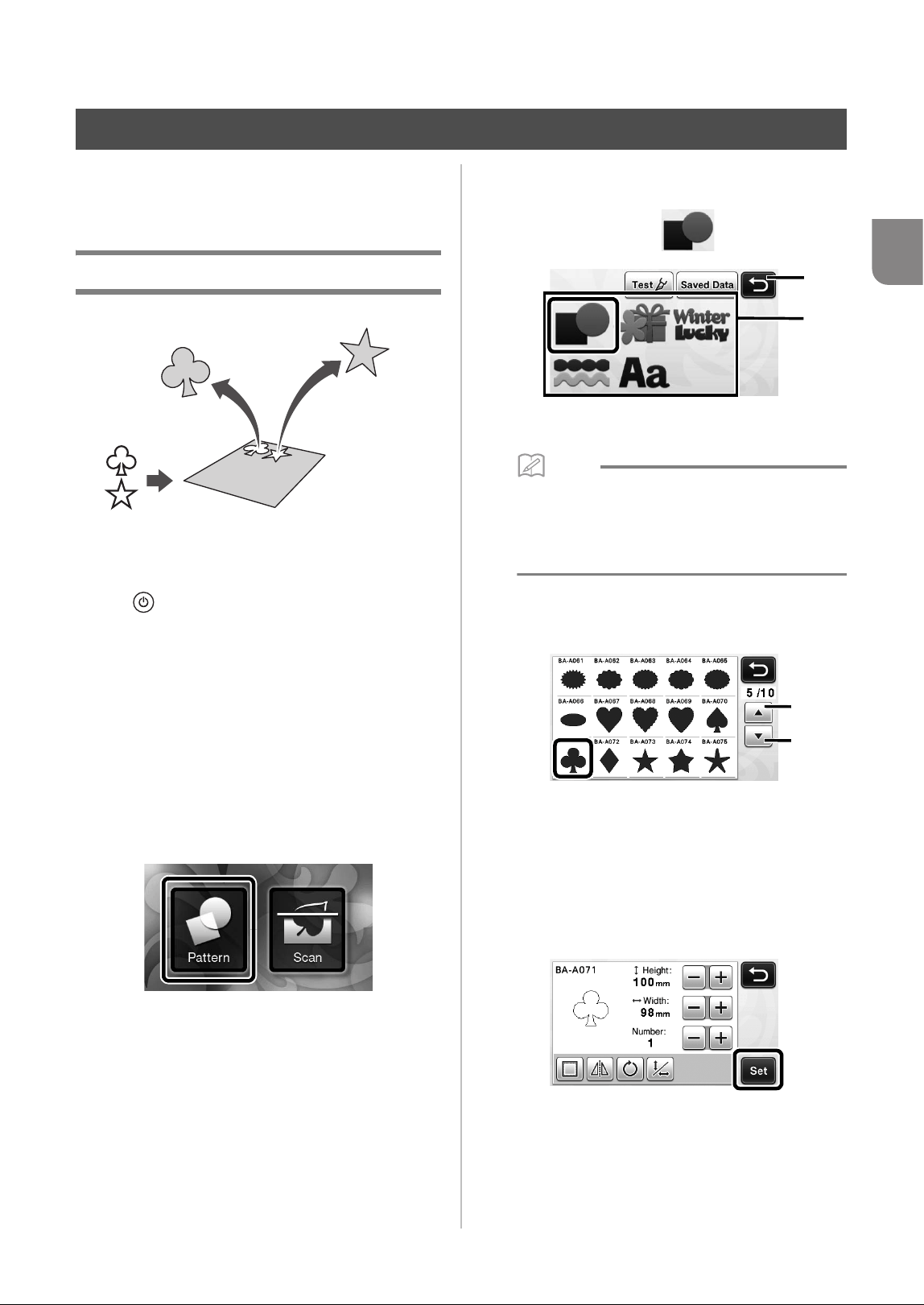
Auto Shutdown
If the machine is not used for a specified length of
time, it will automatically turn off. The length of time
until the machine turns off can be specified in the
settings screen.
If the machine is automatically turned off after you
reach the pattern layout screen, the stored
information can be recalled when the machine is
turned on again. Following the instructions in the
message screen that appear when the machine is
turned on again, touch the “OK” key to display the
pattern layout screen or touch the “Cancel” key to
return to the home screen.
a Message screen
b Pattern layout screen
c Home screen
If the machine is automatically turned off before you
reach the pattern layout screen, the home screen will
be displayed when the machine is turned on again.
a
b
c
25
2
Chapter 2
BASIC OPERATIONS
The following procedures use built-in patterns to
describe the entire series of operations, from
selecting a pattern and editing it to cutting.
Tutorial 1 - Cutting Patterns
In this tutorial, we will cut two built-in patterns.
■ Turning On the Machine
Press to turn on the machine.
• For details, see “Turning On/Off the Machine” on
page 10.
■ Setting the Holder
Install the cutting blade holder into the carriage of the
machine.
• For details, see “Installing and Uninstalling the
Holder” on page 19.
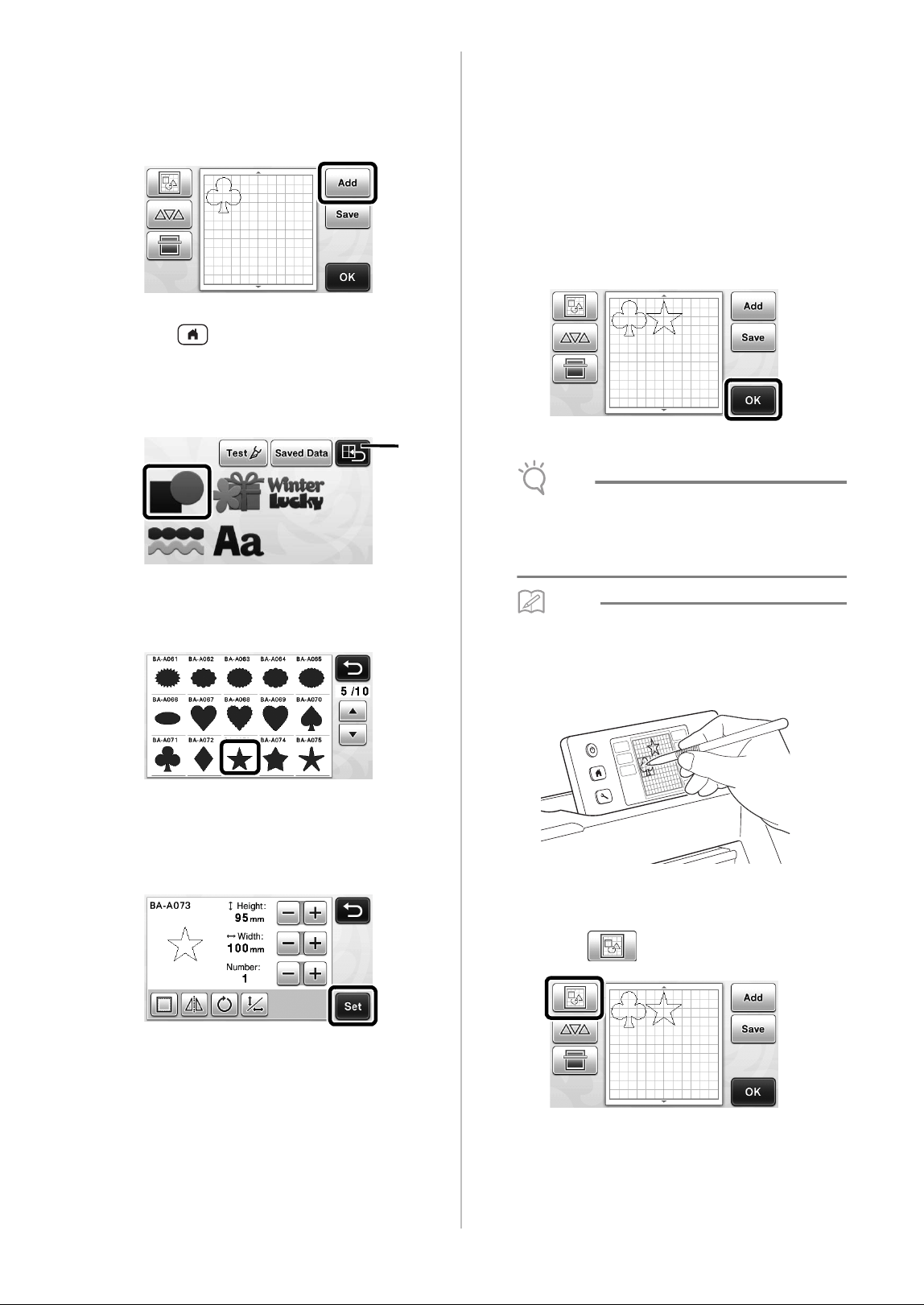
■ Selecting and Editing the First Pattern
a Select “Pattern” in the home screen.
b Select the category for the pattern to be cut out
in the pattern category selection screen.
For this example, select .
a Touch to return to the previous screen.
b Pattern categories
Memo
• The pattern categories and built-in patterns that
appear in the operation screens differ
depending on the machine model. For details
on the built-in patterns, refer to the included
pattern list.
c Select the first pattern to be used in the pattern
selection screen.
a Touch to scroll up.
b Touch to scroll down.
d Edit the pattern using the pattern editing
screen.
After editing is finished, touch the “Set” key.
• For details on the editing functions, see “Pattern
Editing Functions” on page 33.
PATTERN CUTTING
b
a
b
a
26
■ Selecting and Editing the Second
Pattern
a Touch the “Add” key in the pattern layout
screen.
X The pattern category selection screen appears.
• Press to cancel the pattern selection, and
then select the pattern again.
b Select the category for the pattern to be cut
out.
a Touch to return to the previous screen.
c Select the second pattern to be used.
d Edit the pattern.
After editing is finished, touch the “Set” key.
• For details on the editing functions, see “Pattern
Editing Functions” on page 33.
e Check the pattern arrangement.
The two patterns that will be cut out appear in the
pattern layout screen. After checking the arrangement,
touch the “OK” key.
• From this screen, an individual pattern can be
edited, moved or deleted. For details on the
functions that can be used in the pattern layout
screen, see “Layout Editing Functions” on
page 35.
• By using the auto layout function, the
arrangement of the patterns can easily be
adjusted. For details, see “Auto Layout
Functions” on page 38.
X The draw/cut selection screen appears.
Note
• Depending on the pattern type and material to
be cut, the patterns may not be cleanly cut if
their spacing is too small. In that case,
rearrange the patterns to separate them.
Memo
• To move a pattern within the cutting/drawing
area, touch the pattern on the screen and drag
it to the desired position.
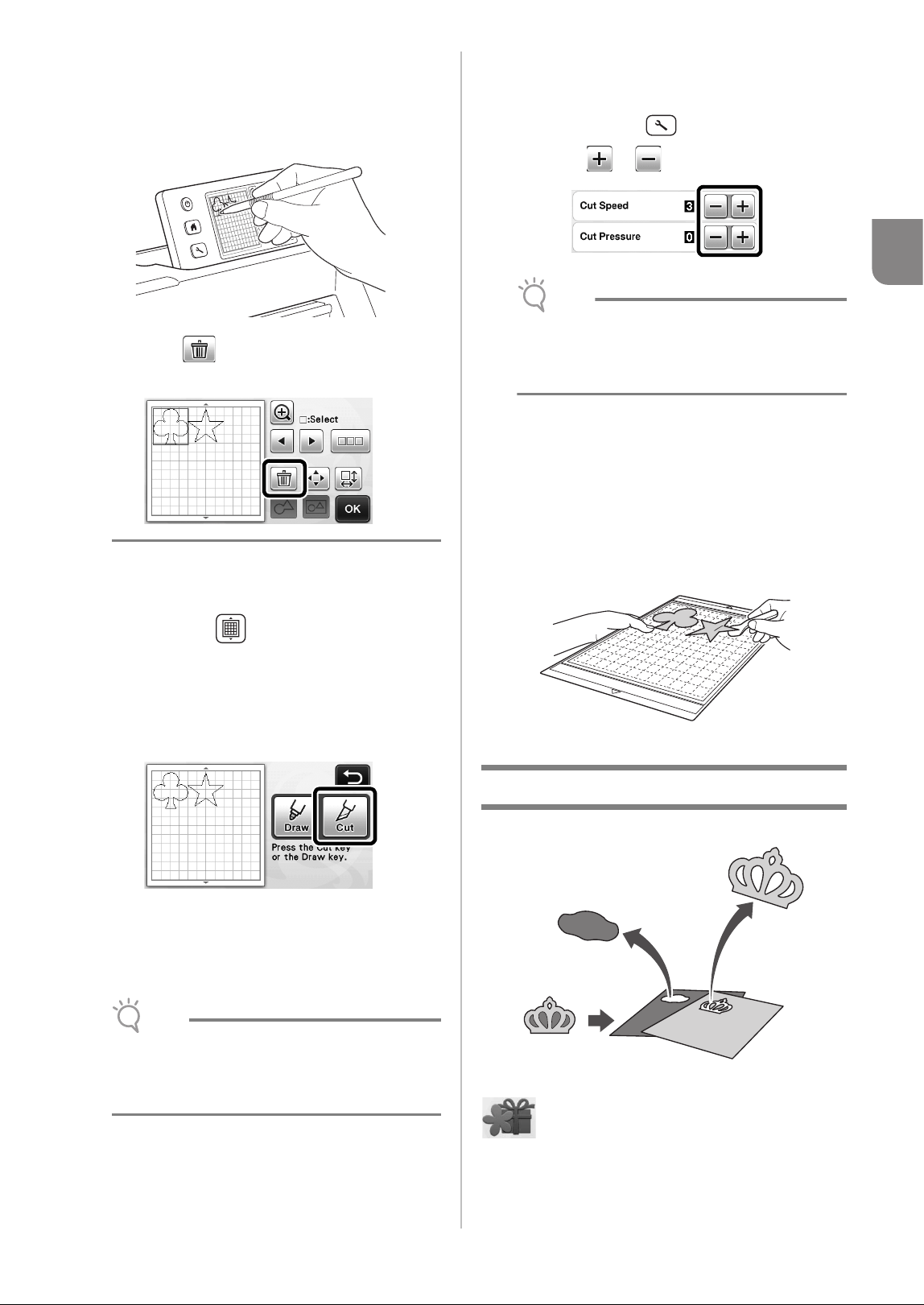
• To delete a pattern from the arrangement,
select the pattern in the layout editing screen,
and then use the function for deleting.
X Touch in the pattern layout screen.
a
27
2
X Touch the pattern to be deleted in the screen.
To delete multiple patterns, use the function for
selecting multiple patterns. For details, see
“Selecting Multiple Patterns” on page 31.
X Touch in the layout editing screen to
delete the selected pattern(s).
■ Loading the Mat
While holding the mat level and lightly inserting it into
the feed slot, press in the operation panel.
• For details, see “Loading the Mat” on page 20.
■ Cutting
a Select “Cut” in the draw/cut selection screen.
X The “Start/Stop” button in the operation panel
lights up.
• Before cutting your project, adjust the blade
extension appropriately. For details, see
“Adjusting the Blade Extension” on page 18.
Note
• Before continuing operation, make sure that
patterns that will be cut out are arranged in the
cutting area corresponding to the size of the
material to be used.
b Adjust the cutting speed and pressure.
Before cutting the pattern, adjust the cutting speed and
pressure. These adjustments can be made from the
settings screen. Press in the operation panel.
X Touch or to change the settings.
Note
• Depending on the fabric being used, it may not
be cut cleanly if the cutting pressure is not
correctly adjusted. For the appropriate cutting
pressure, see “Cutting Settings” on page 18.
c Press the “Start/Stop” button to start cutting.
X When cutting is finished, the draw/cut selection
screen appears again.
■ Unloading the Mat
Feed out the mat, and then use the included spatula to
peel off the patterns.
For details, see “Unloading the Mat” on page 21.
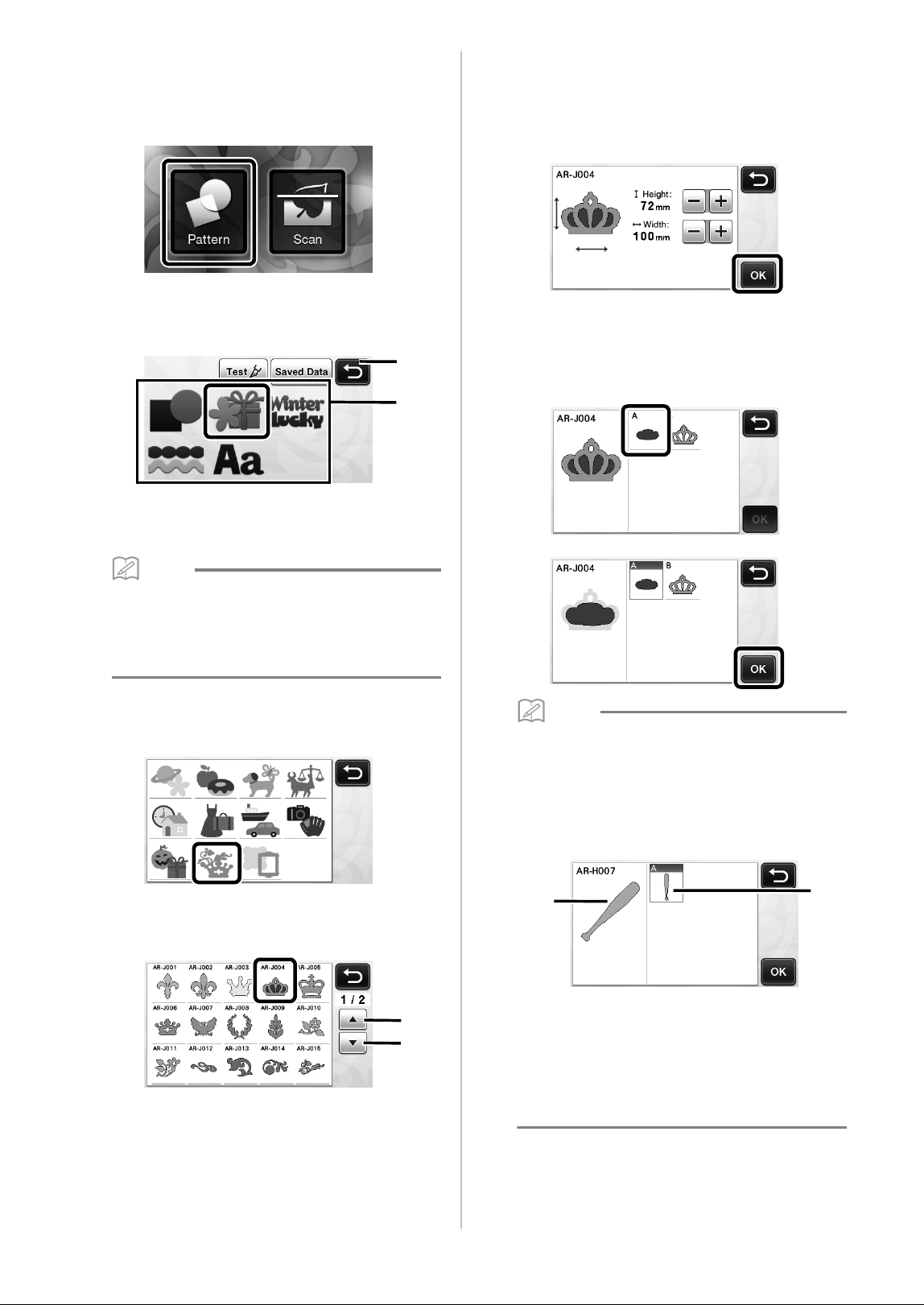
Tutorial 2 - Cutting Advanced Patterns
In this tutorial, we will cut a built-in pattern in the
category.
28
■ Selecting and Editing the First Pattern
Piece
a Select “Pattern” in the home screen.
b Select the category in the pattern category
selection screen.
a Touch to return to the previous screen.
b Pattern categories
Memo
• The pattern categories and built-in patterns that
appear in the operation screens differ
depending on the machine model. For details
on the built-in patterns, refer to the included
pattern list.
c Select the sub-category in the pattern sub-
category selection screen.
d Select the pattern to be cut out in the pattern
selection screen.
a Touch to scroll up.
b Touch to scroll down.
e Edit the size of the entire pattern using the
pattern sizing screen.
After editing is finished, touch the “OK” key.
• For details on the pattern sizing screen, see
“Pattern Sizing” on page 34.
f Select the piece to be edited first in the pattern
piece list screen, and then touch the “OK” key.
From the pattern piece list that appears in the screen,
touch a pattern piece to edit it individually.
Memo
• The pattern pieces displayed in the pattern
piece list screen are automatically arranged so
that the grain is vertical when fabric is used as
the material for cutting. Therefore, the angle at
which the pattern appears in the pattern piece
list may differ from the actual angle of the
pattern piece to be cut out.
a Appearance in pattern piece list
b Actual arrangement of the pattern piece to be
cut out
• Change the angle of pattern piece using the
rotating function according to your project. For
details, see “Editing the Pattern Piece” on
page 34.
b
a
b
a
b
a
29
2
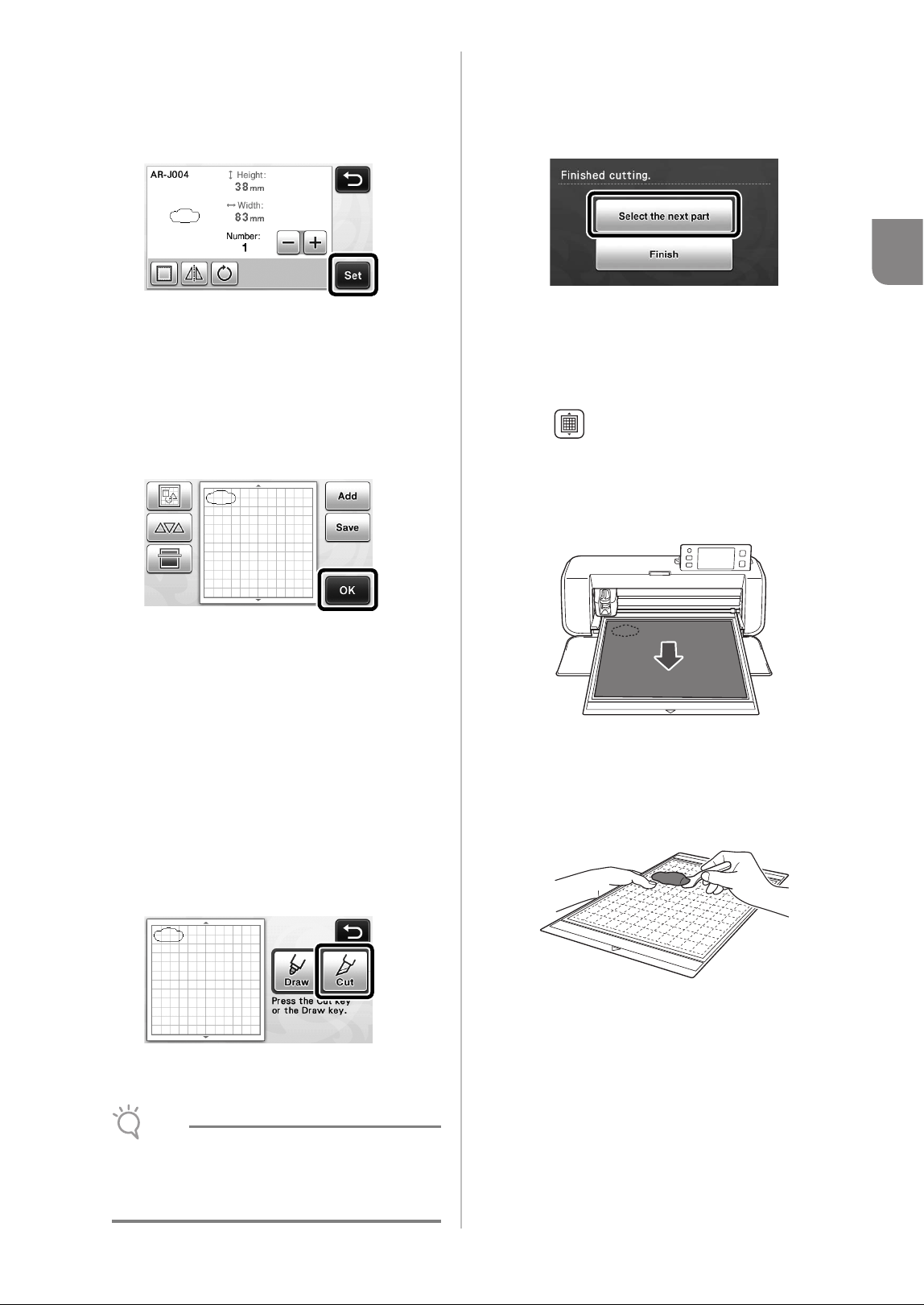
g Edit the pattern piece using the pattern piece
editing screen.
After editing is finished, touch the “Set” key.
• For details on the editing functions, see “Editing the
Pattern Piece” on page 34.
hCheck the pattern piece arrangement using the
pattern layout screen.
The pattern piece to be cut out appears in the screen.
After checking the arrangement, touch the “OK” key.
• From this screen, an individual pattern piece can
be edited, moved, deleted or saved. For details on
the editing functions in the pattern layout screen,
see “Pattern Layout Screen” on page 35.
X The draw/cut selection screen appears.
■ Loading the Mat
Attach the material that the first pattern piece will be cut
out of to the mat, and then feed in the mat from the feed
slot.
When cutting a pattern consisting of multiple pieces in
different colors, edit the pattern piece for each color,
and then change the material to cut out each piece.
• For details on preparing the material and loading
the mat, see “Loading the Mat” on page 20.
■ Cutting the First Pattern
a Select “Cut” in the draw/cut selection screen.
X The “Start/Stop” button in the operation panel
lights up.
Note
• Before continuing operation, make sure that
patterns that will be cut out are arranged in the
cutting area corresponding to the size of the
material to be used.
b Press the “Start/Stop” button to start cutting.
X After the first pattern piece has been cut out, the
following message appears. In order to cut out
the second pattern piece, touch the “Select the
next part” key.
X Touching the “Select the next part” key erases all
editing information for the first pattern piece and
displays the pattern piece list screen again.
■ Unloading the Mat
a Press in the operation panel to feed out
the mat.
In order to replace the material with one of a different
color, the material used for the first pattern piece must
be fed out.
b Peel from the mat the pattern piece that was
cut out.
For details on peeling the material from the mat, see
“Unloading the Mat” on page 21.
30
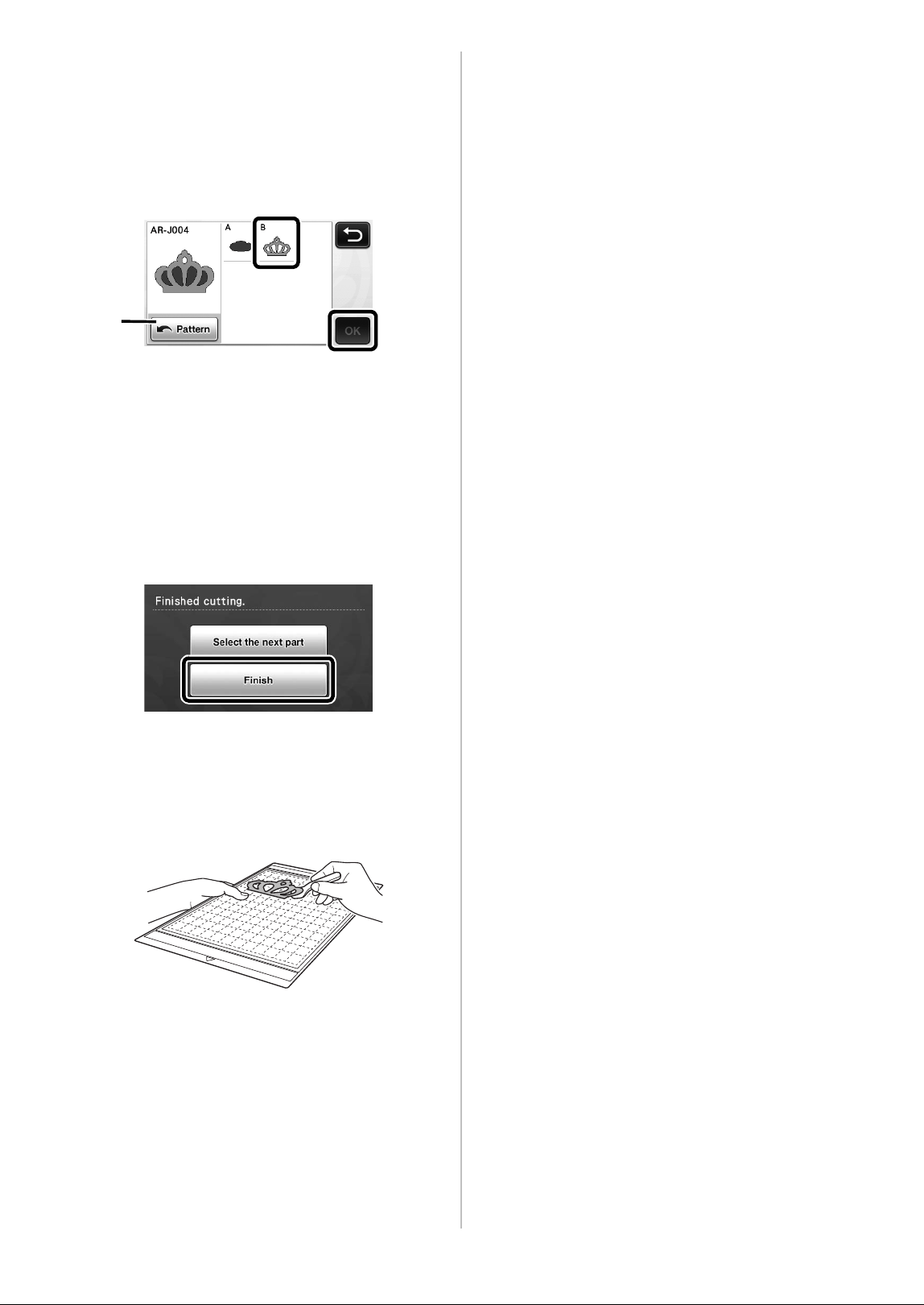
■ Editing and Cutting the Second Pattern
Piece
a Select and edit the second pattern piece, and
then touch the “OK” key.
For details on editing the pattern, follow steps f-h
(page 29) in “Selecting and Editing the First Pattern
Piece”.
a Touch to return to the pattern category
selection screen for selecting another pattern.
b Follow the procedures described in “Loading
the Mat” (page 20) and “Cutting” (page 21) to
load the material to be used for the second
pattern piece and cut it out.
X When cutting is finished, a message appears.
c After all pattern pieces have been cut out,
touch the “Finish” key.
X The draw/cut selection screen appears again.
■ Unloading the Mat
Peel from the mat the pattern piece that was cut out.
For details on peeling the material from the mat, see
“Unloading the Mat” on page 21.
a
31
2
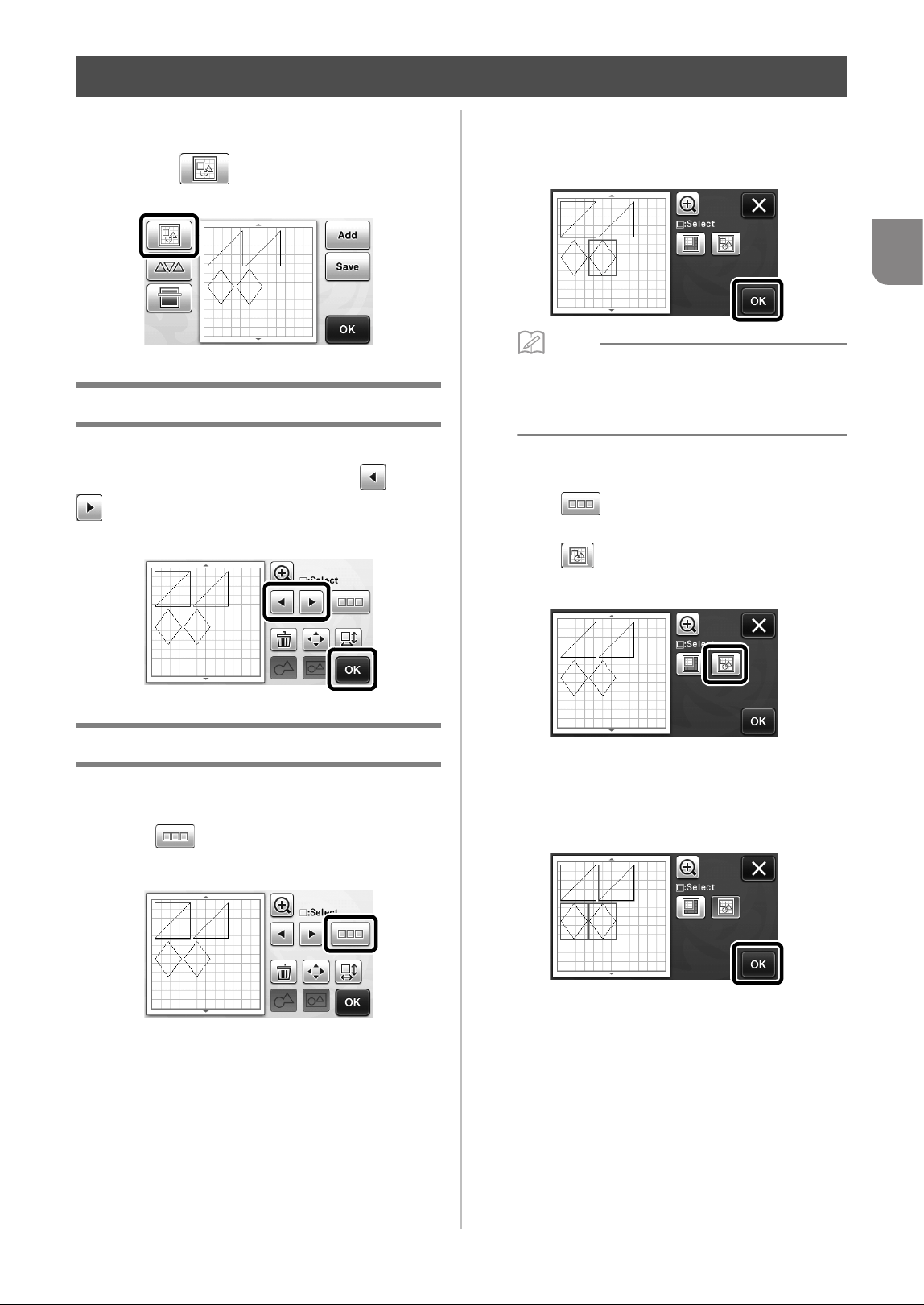
Four pattern selection functions are available in the
layout editing screen depending on your preference.
X Touch in the pattern layout screen to use
the pattern selection functions.
Selecting a Single Pattern
Select an individual pattern to be edited by either
touching it in the editing screen or using and
, and then touch the “OK” key.
The selected pattern is surrounded with a red box.
Selecting Multiple Patterns
■ Selecting Desired Patterns
a Touch in the layout editing screen for
making multiple pattern selection.
b Individually touch all the patterns you want to
select in the screen, and then touch the “OK”
key.
Memo
• Touching a selected (surrounded with a red
box) pattern again clears its multiple selection.
• Touching any blank space in the screen clears
all the pattern selections.
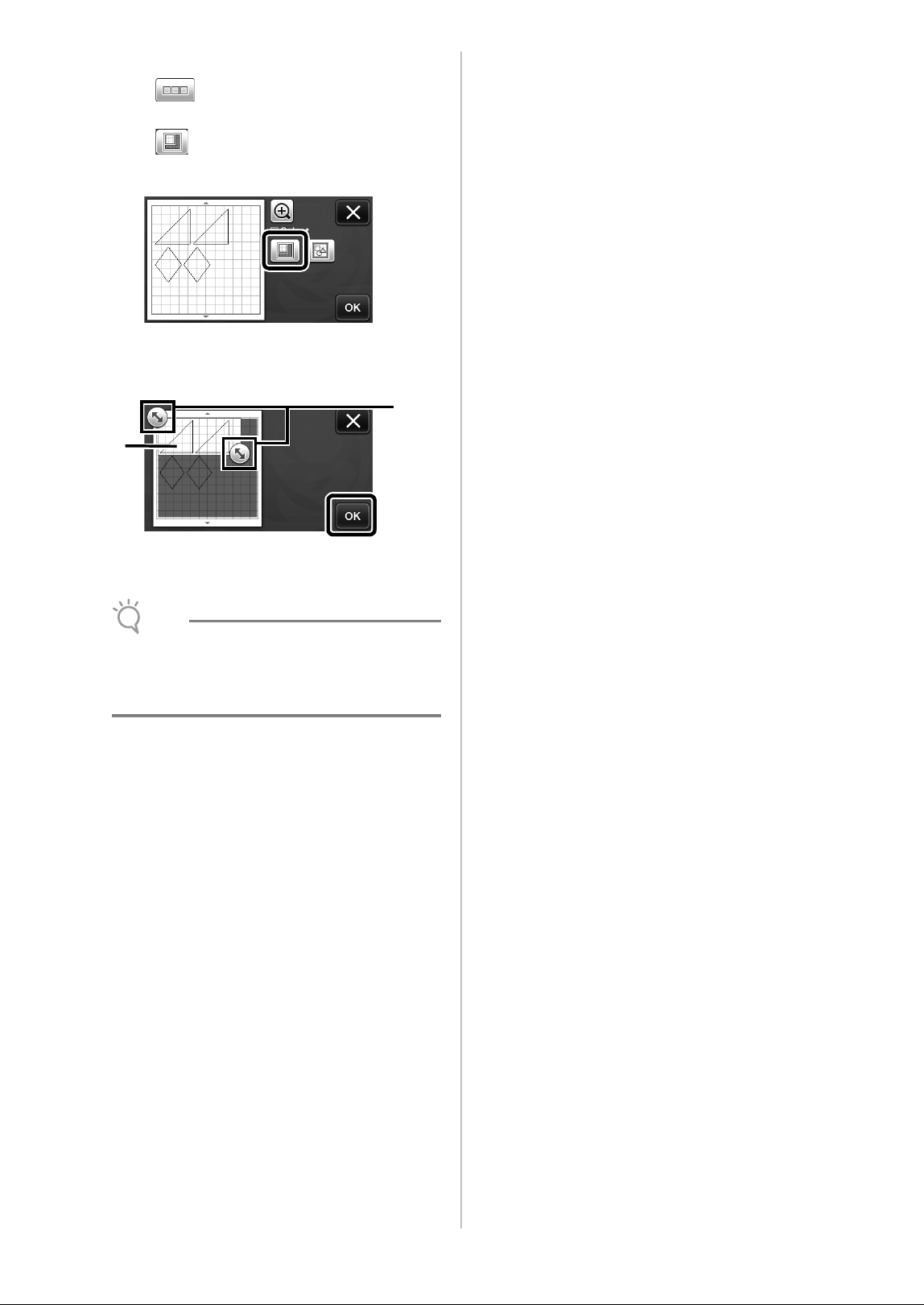
■ Selecting All Patterns
a Touch in the layout editing screen for
making multiple pattern selection.
b Touch to select all the patterns on the
screen.
c Check the selection, and then touch the “OK”
key.
X All the selected patterns are surrounded with a
red box.
PATTERN SELECTION
32
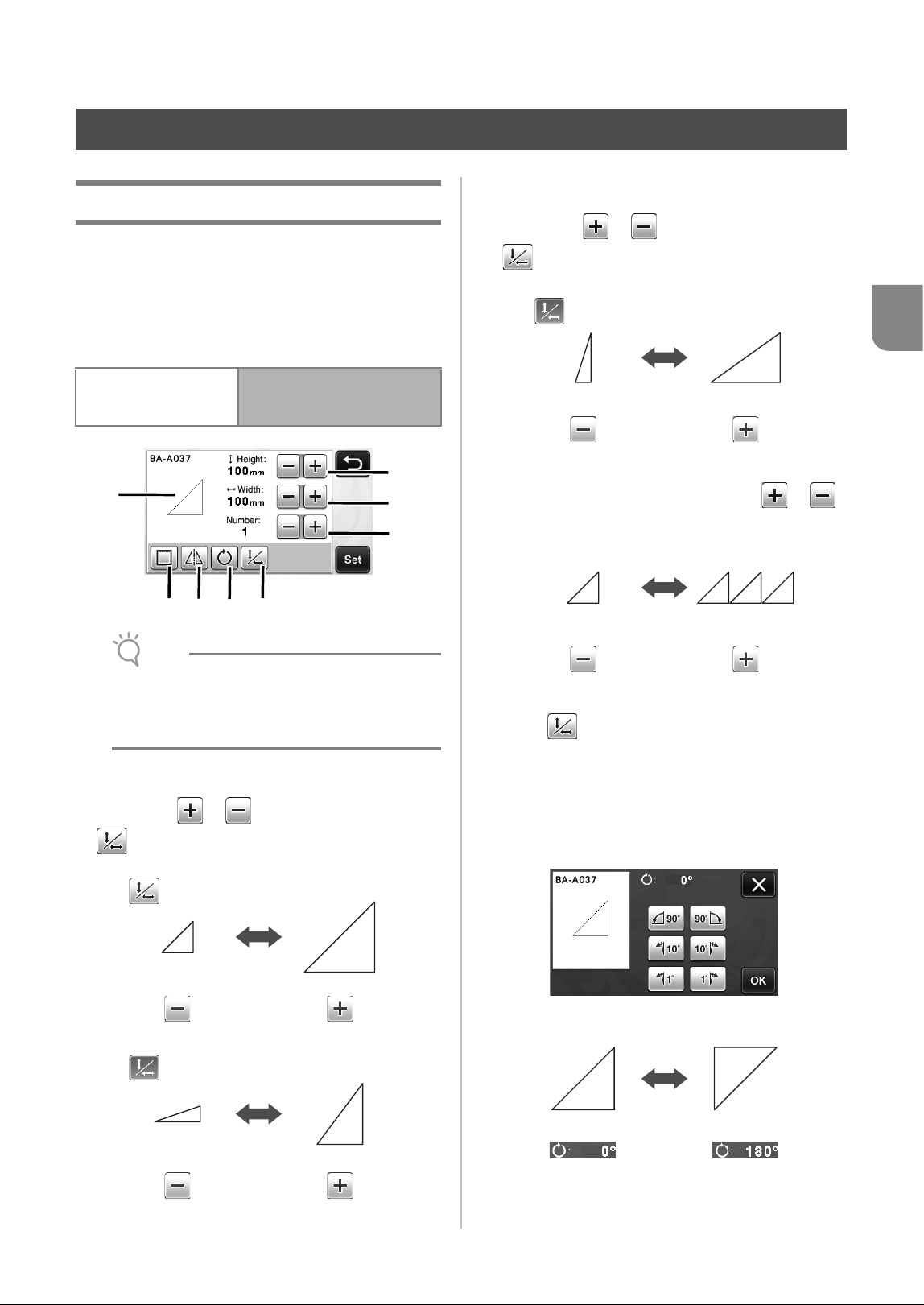
■ Specifying the Selection Area
a Touch in the layout editing screen for
making multiple pattern selection.
b Touch for specifying an area to select the
patterns.
c Touch and drag the area resizing keys to specify
the area, and then touch the “OK” key.
a Keys for specifying the area
b Patterns to be selected
Note
• This method of selecting patterns within a
specified area is useful for welding or unifying
patterns and deleting unwanted images when
scanning (page 52).
a
b
33
3
Chapter 3
ADVANCED OPERATIONS
Pattern Editing Functions
The pattern editing functions available may differ
depending on the pattern you select. Follow the
instructions in either this section or “Pattern Editing
Functions - Advanced Patterns” on page 34.
Available in the following screen
Note
• Depending on the pattern being used, the
material may not be cut cleanly, if reducing the
size of the pattern. Before making your project,
perform trial cutting with the same material.
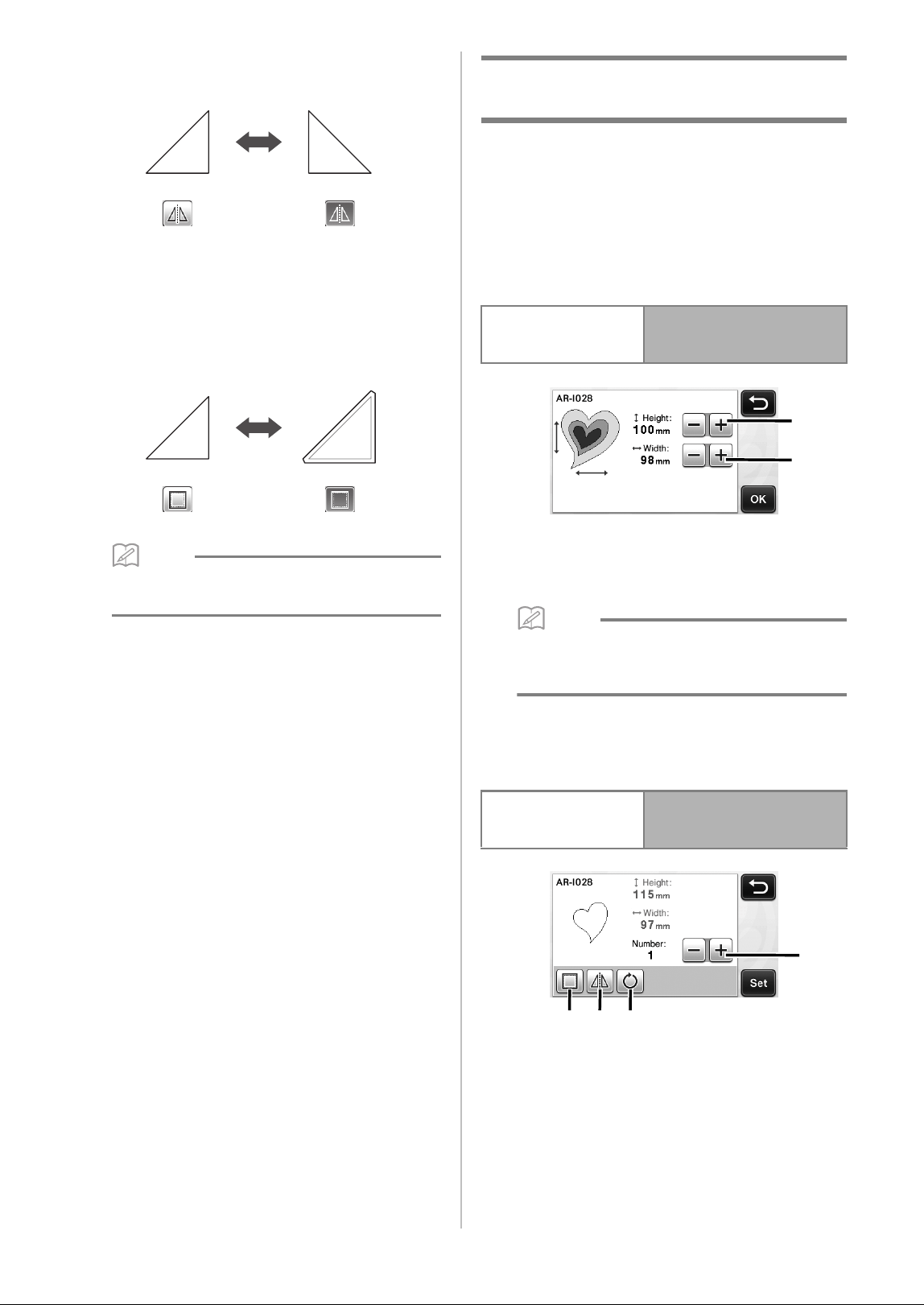
a Sizing (Height)
Edit the pattern height while maintaining the aspect
ratio. Touch or to adjust the setting. Touch
to edit only the height.
b Sizing (Width)
Edit the pattern width while maintaining the aspect
ratio. Touch or to adjust the setting. Touch
to edit only the width.
c Duplicating
Create a duplicate of the pattern. Touch or
to specify the number of pattern duplicates to be
created.
d Unlocking the Aspect Ratio
Touch to edit the pattern size without
maintaining the aspect ratio. The function is available
depending on the pattern you select. If the key is not
available, the aspect ratio is locked and the pattern
can only be edited while maintaining the aspect ratio.
e Rotating
Rotate the pattern.
Touch the key for the desired angle.
CUTTING AND EDITING FUNCTIONS
Pattern editing screen
→
Tutorial 1; Step
d
(page 25)
in “Selecting and Editing the
First Pattern”
a
c
h
b
de
f
g
34
f Mirroring
Flip the pattern along a vertical axis.
g Seam Allowance
Apply the seam allowance setting. Apply this setting
when cutting around a drawn pattern, such as when
making appliqué or quilt pieces. When applied, the
drawing line (blue) and cutting line (black) appear.
• For details on the seam allowance function, see
“Cutting Around Drawings” on page 44.
Memo
• Depending on the pattern, the seam allowance
may be applied as a default. Check the setting.
h Previewing
Display a preview of the edited pattern.
Pattern Editing Functions - Advanced
Patterns
The pattern editing functions available may differ
depending on the pattern you select. Follow the
instructions in either this section or “Pattern Editing
Functions” on page 33.
■ Pattern Sizing
Available in the following screen
a Touch to edit the pattern height (while
maintaining the aspect ratio).
b Touch to edit the pattern width (while
maintaining the aspect ratio).
Memo
• All the pattern pieces displayed on the pattern
sizing screen can be resized while maintaining
the aspect ratio.
■ Editing the Pattern Piece
Available in the following screen
a Duplicating
b Rotating
c Mirroring
d Seam Allowance
• For details on using each key, see “Pattern
Editing Functions” on page 33.
Pattern sizing screen
→
Tutorial 2; Step
e
(page 28)
in “Selecting and Editing the
First Pattern Piece”
Pattern piece editing
screen
→
Tutorial 2; Step
g
(page 29)
in “Selecting and Editing the
First Pattern Piece”
a
b
a
d c b
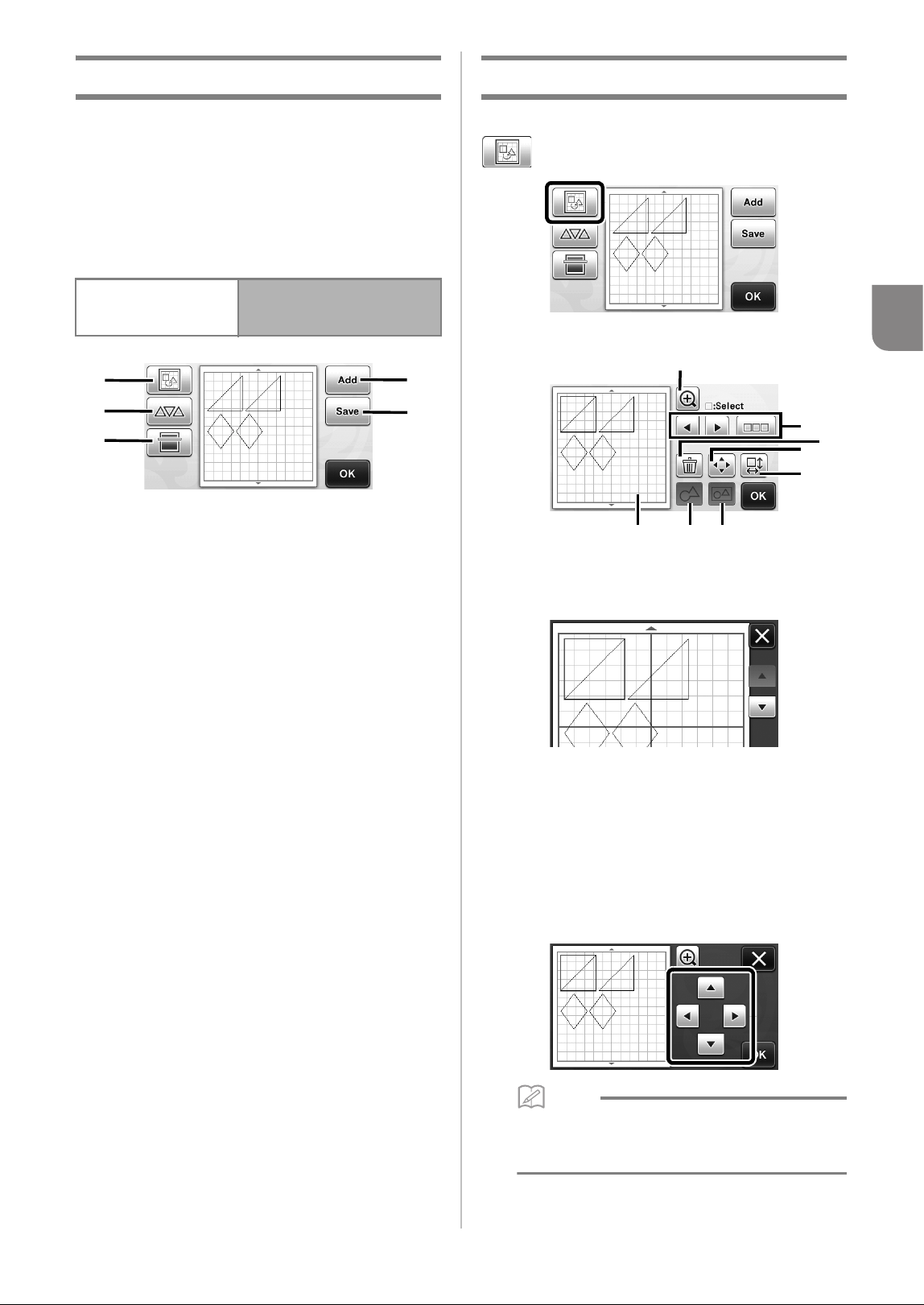
35
3
Pattern Layout Screen
The arrangement of the patterns can be edited. The
cutting/drawing area specified with the “Cut Area”
setting (page 23) in the settings screen is displayed in
the preview screen. Edit the pattern arrangement so
that the patterns fit within the specified area.
Available in the following screen
a Adding Patterns
Add a pattern to the layout.
X Touching this key displays the pattern category
selection screen. From that screen, select the
pattern to be added.
b Saving
Save the pattern arrangement as data. For details, see
“Saving” on page 41.
c Editing
The patterns in the layout can be edited, moved or
deleted. For details, see “Layout Editing Functions”
on page 35.
d Auto Layout
Automatically arrange the patterns to reduce their
spacing. For details, see “Auto Layout Functions” on
page 38.
e Background Scanning
Scan the material for cutting/drawing to be displayed
in the background of the pattern layout screen.
You can use specific areas of the material to cut out/
draw patterns, or display the material that has already
been cut in order to reuse it. For details, see
“Scanning a Background Image” on page 38.
Layout Editing Functions
The layout editing functions are available when
is touched in the pattern layout screen.
X The layout editing screen appears.
a Magnifying
Display the patterns enlarged. To scroll through the
screen, touch the arrow keys.
b Selecting Patterns
Select an individual pattern or multiple patterns to be
edited. For details, see “PATTERN SELECTION” on
page 31.
c Deleting
Delete the selected patterns.
d Moving
Incrementally move the selected patterns. Touch the
arrow keys to adjust the position of the patterns.
Memo
• The pattern can also be moved by touching it
displayed in the layout editing screen and
dragging it in the screen.
Pattern layout screen
→
Tutorial 1; Step
e
(page 26)
in “Selecting and Editing the
Second Pattern”
b
a
c
d
e
b
a
c
d
e
g fh
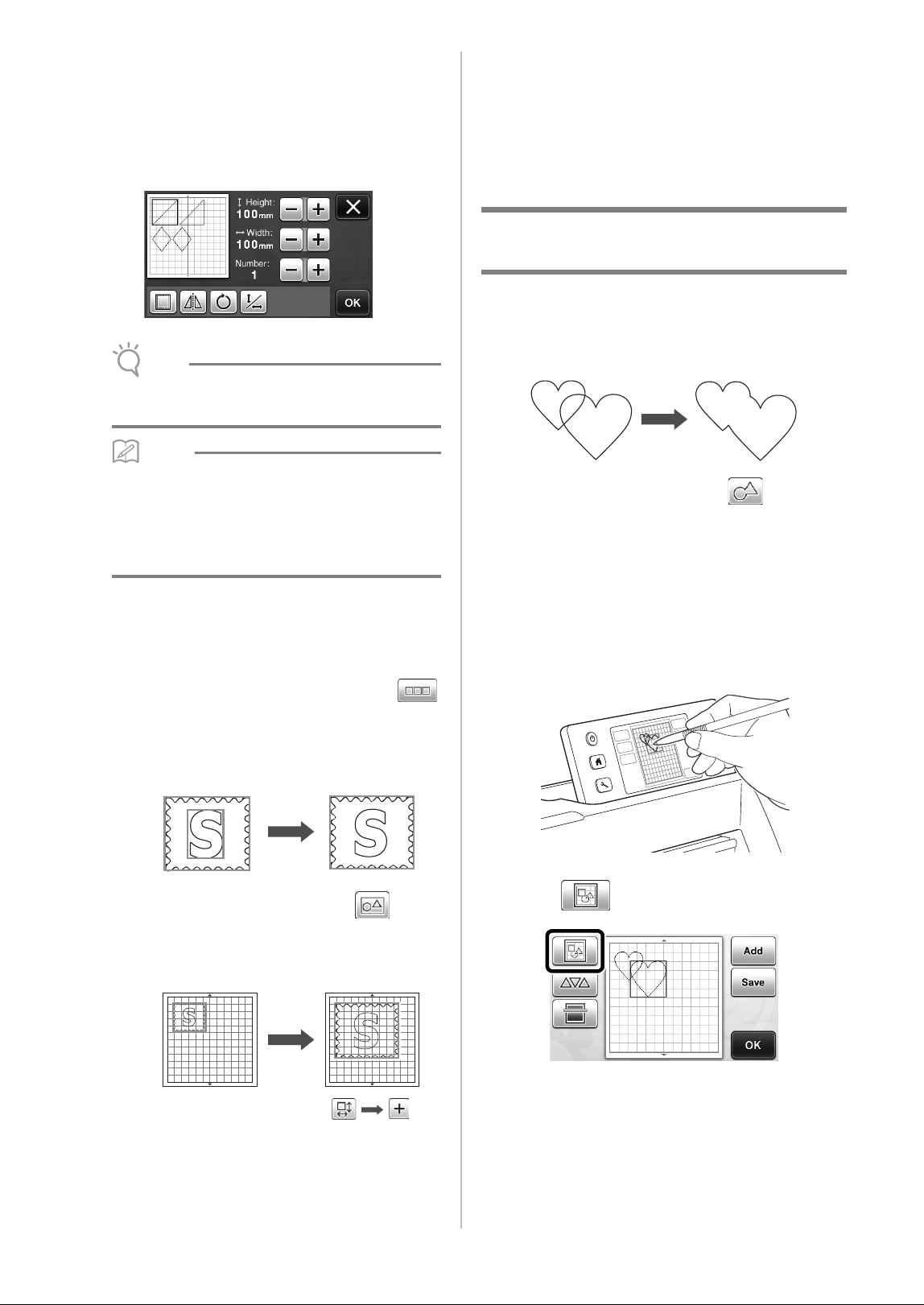
36
e Editing Individual Patterns
Edit the selected individual pattern.
X Touching this key displays the pattern editing
screen. From that screen, an individual pattern
can be edited.
• For details, see “Pattern Editing Functions” on
page 33.
Note
• This function is not available when multiple
patterns are selected.
Memo
• If the cutting line of a pattern extends from the
cutting/drawing area due to editing, such as by
applying a seam allowance or flipping a pattern,
the line will become gray. Continue editing the
pattern to move it within the cutting/drawing
area.
f Unifying (Grouping Multiple Patterns)
When multiple patterns are selected in the layout
editing screen, those patterns can be unified together
and edited as a single pattern. This is useful for
increasing or reducing the size of multiple patterns at
one time. For selecting multiple patterns, touch
in the layout editing screen. For details, see “Selecting
Multiple Patterns” on page 31.
X Unifying
X Increasing the size of multiple patterns at one
time
g Welding (Merging the Outlines of Multiple
Patterns)
Weld the outlines of multiple patterns to create a
single outline. For details, see “Welding (Merging the
Outlines of Multiple Patterns)” on page 36.
h Previewing
Display a preview of the edited pattern.
Welding (Merging the Outlines of
Multiple Patterns)
When multiple patterns are selected in the layout
editing screen, the outlines of those patterns can be
welded to create a single outline.
a Select two heart patterns of different sizes and
arrange them in the pattern layout screen.
b Touch the large heart pattern in the pattern
layout screen, and then drag it over the small
pattern.
c Touch in the pattern layout screen.
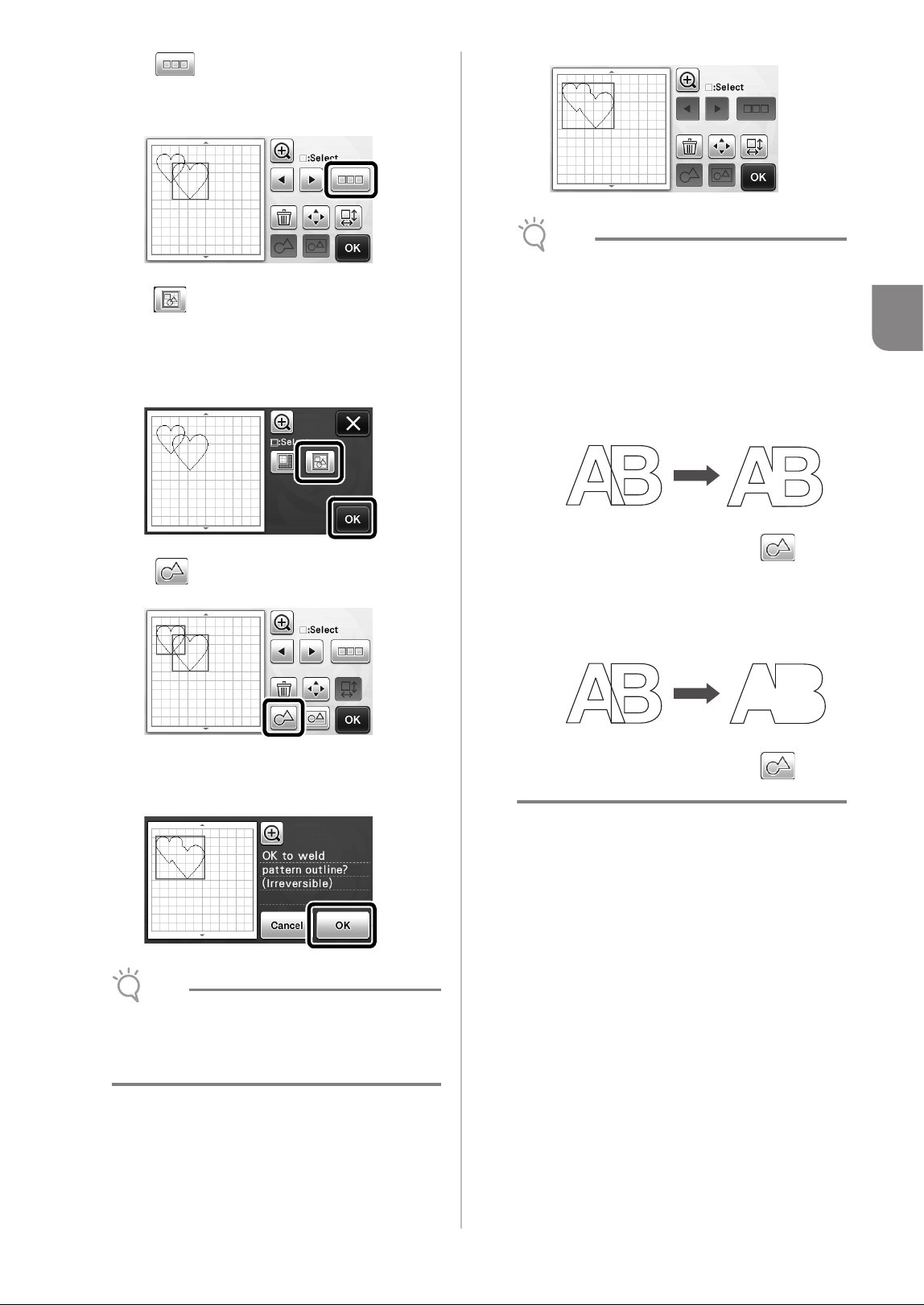
37
3
d Touch in the layout editing screen.
• For details on the functions in the layout editing
screen, see “Layout Editing Functions” on page 35.
e Select , and then touch the “OK” key.
• Two pattern selection functions are available
depending on your preference.
For details on selecting multiple patterns, see
“Selecting Multiple Patterns” on page 31.
f Touch .
g Check the preview, and then touch the “OK”
key.
Note
• Welding pattern outlines cannot be undone. In
order to recreate the original pattern
arrangement, select the patterns again, and
then arrange them.
X The outlines of the selected patterns are welded.
Note
• This function welds the outermost outline of the
patterns. When welding certain types of
patterns that have inside areas cut out, the cut-
out areas are not used to create the outline. Be
sure that the welded patterns in the preview
area meet your wishes before completing the
procedure.
- Welding built-in characters
- Welding character images created by
scanning
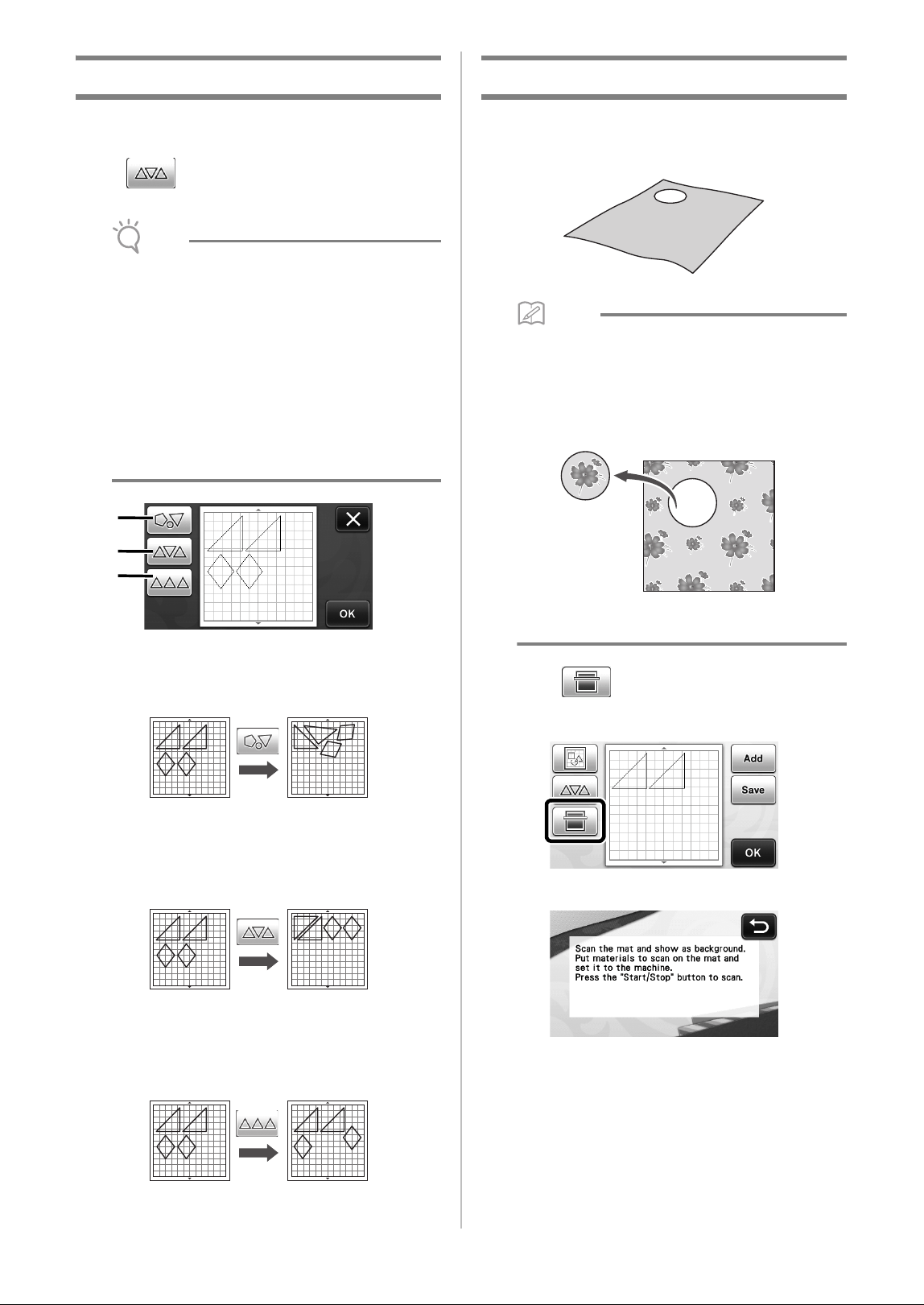
38
Auto Layout Functions
The auto layout function is useful when you do not
wish to waste the material attached to the mat.
Touch in the pattern layout screen (page 35)
to perform the auto layout function.
Note
• Depending on the pattern and material to be
cut, the patterns may not be cleanly cut if their
spacing is too small. In that case, rearrange the
patterns to slightly separate them.
• The spacing between arranged patterns can be
specified in the settings screen (see “Pattern
Interval” on page 24). Perform the auto layout
function after every time you adjust the spacing
between patterns so the changes are applied.
• Set the number to “3” or higher in the “Pattern
Interval” setting when lightweight fabric is
attached to the mat with a high tack adhesive
fabric support sheet.
a Rearranging By Rotating Patterns to Any Angle
This is useful when arranging a large number of
patterns in a limited space.
b Rearranging By Rotating Patterns 0° or 180°
This is useful when arranging the printed design
(vertical patterns) on paper or fabric as the material for
cutting/drawing or when using the vertical grain.
c Rearranging Without Rotating Patterns
This is useful when arranging the printed design on
paper or fabric as the material for cutting/drawing or
when using the grain.
Scanning a Background Image
In this example, we will use material with a cutout in
its upper-left corner as a background image.
Memo
• The background scanning function is also
useful when cutting out patterns from material
with a design on it. By arranging the patterns on
the screen in the desired patterned area of the
material, cutouts with a specific design can be
created.
• This function cannot be used when an optional
scanning mat is used.
a Touch in the pattern layout screen to
start the background scanning function.
X The following message appears.
a
b
c
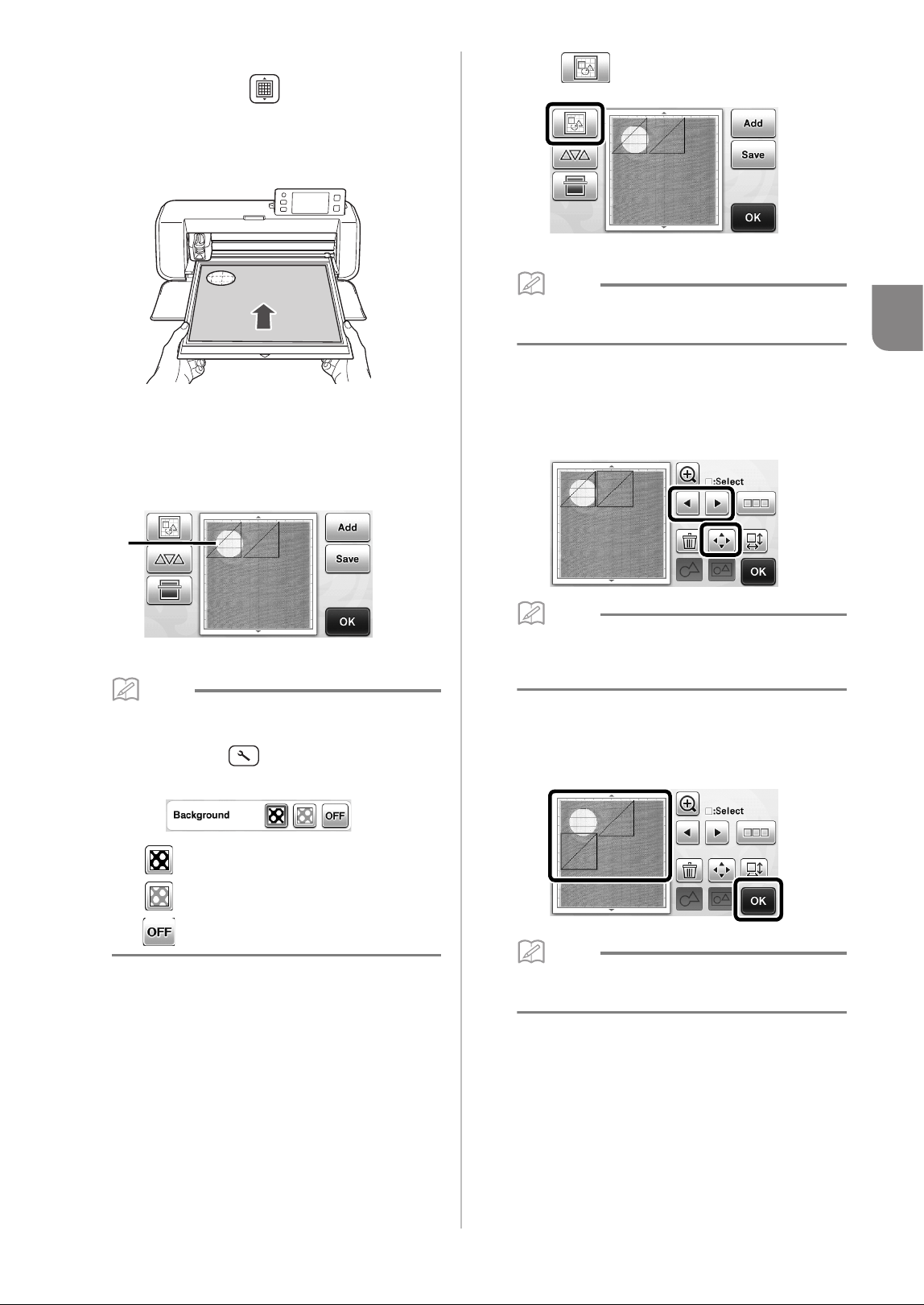
39
3
b Attach the material for the background to the
mat, and then press in the operation
panel.
For details on preparing the material and loading the
mat, see “Loading the Mat” on page 20.
X The mat is fed in, and the “Start/Stop” button in
the operation panel lights up.
c Press the “Start/Stop” button to start scanning.
X After the material has been scanned, it appears as
the background in the pattern layout screen.
a Material with a cutout displayed as background
Memo
• If it is difficult to see the arranged patterns,
adjust the background contrast in the settings
screen. Press in the operation panel to
display the settings screen.
X : Makes the background image darker.
X : Makes the background image lighter.
X : Does not display the background image.
d Touch .
X The layout editing screen appears.
Memo
• The pattern can also be moved by touching and
dragging it in the screen.
e Use the layout editing functions to move the
patterns.
• For details on moving patterns, see “Layout Editing
Functions” on page 35.
Memo
• The pattern can also be moved by touching the
pattern(s) displayed in the layout editing screen
and dragging it in the screen.
f Check that the patterns in the screen do not
overlap the cutouts in the background material
and then touch the “OK” key.
Memo
• When the scanned material is unloaded, the
background is cleared.
a
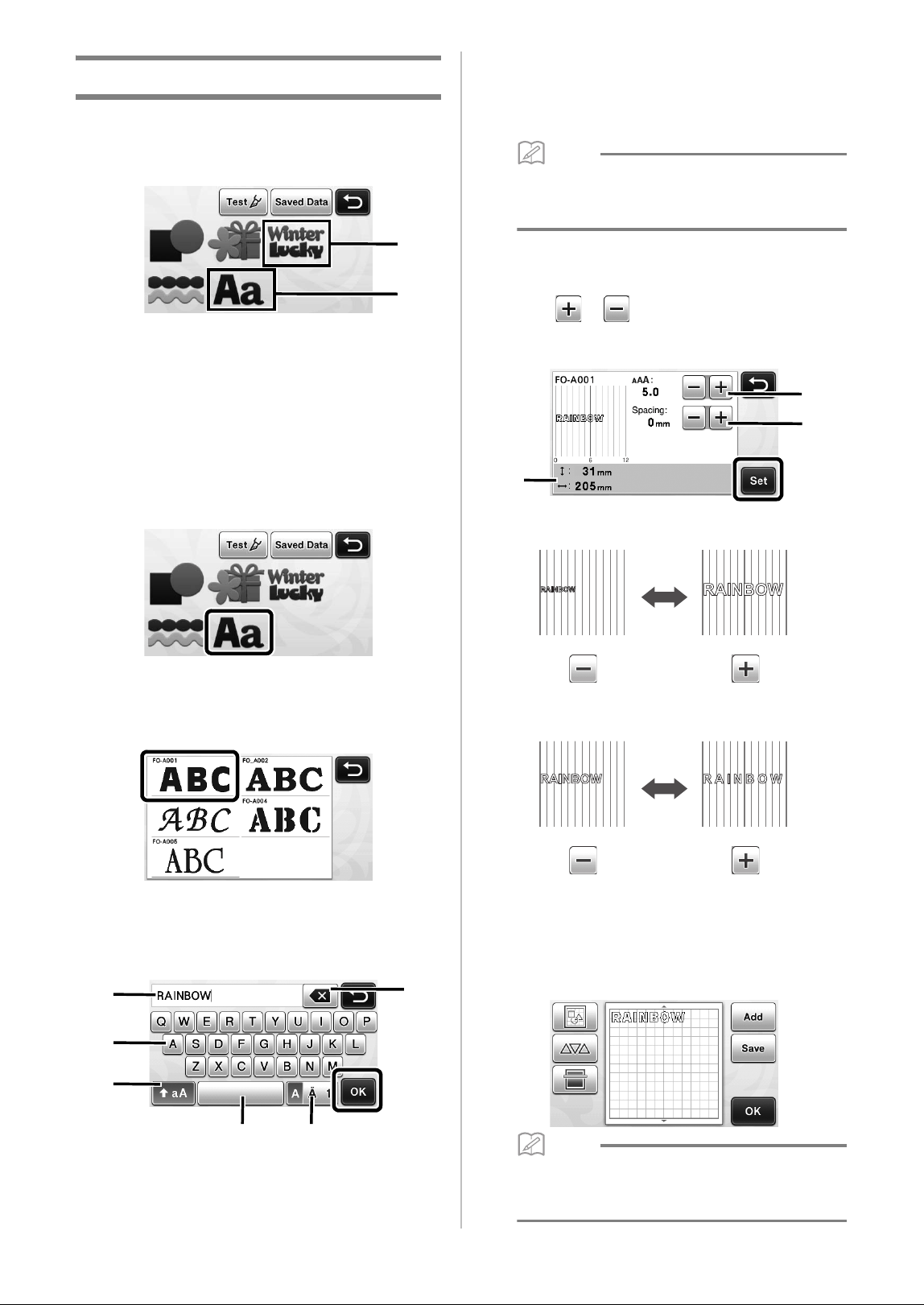
40
Character Input Functions
Characters can be selected, edited, cut out and
drawn as a single pattern. Select the character type
from the pattern category selection screen.
a Select decorated characters. The characters
can be edited, cut out and drawn as a pattern.
For details on editing, see “Pattern Editing
Functions” on page 33.
b Type in the desired combination of characters.
Typing In the Word “RAINBOW”
a Select the font category in the pattern category
selection screen.
b Touch the desired font type.
Select the desired font type from the five that are
available.
c Type in the characters.
The keyboard is in the QWERTY layout. After entering
the characters, touch the “OK” key.
a Character input display
b Character keys
c Uppercase/lowercase selection key
d Space key
e Letter/accented character/number selection
key
f Backspace key (deletes one character from the
end of those displayed)
Memo
• If the entered characters do not fit within the
cutting/drawing area, the character size is
automatically reduced.
d Adjust the settings of character size and
character spacing.
Touch or to adjust the character size or the
space between characters. After completing the
adjustment, touch the “Set” key.
a Character size adjustment keys
b Character spacing adjustment keys
c Size of entire character string
e Check the character arrangement.
To cut or draw, touch the “OK” key.
To save the characters as data, touch the “Save” key.
For details on saving data, see “Saving” on page 41.
Memo
• Entered characters can only be edited as the
entire character string. One character cannot
be edited individually.
b
a
a
b
c
de
f
a
b
c
0612 0612
0612 0612
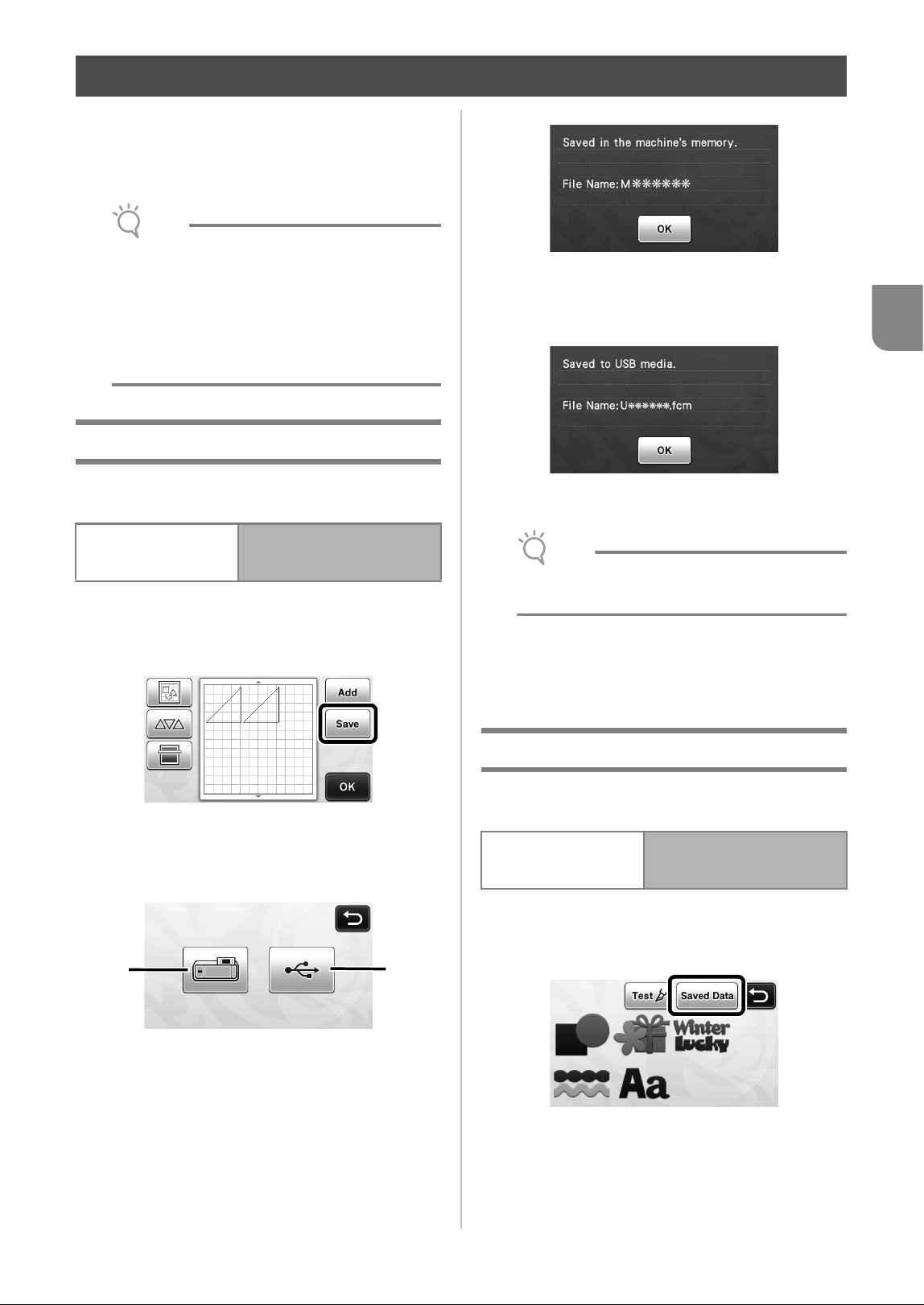
41
3
Patterns and characters arranged in the cutting/
drawing area can be saved and recalled later. Either
the machine’s memory or a USB flash drive can be
selected as the location for saving and recalling.
Note
• USB flash drive is widely used, however some
USB flash drive may not be usable with this
machine. Please visit our website
“ http://solutions.brother.com ” for more
details.
• This machine is incompatible with a USB hub.
Plug the USB flash drive directly into the USB
port.
Saving
Available in the following screen
a Touch the “Save” key to display the destination
memory selection screen.
b Touch the desired destination.
• In order to save data on a USB flash drive, plug the
USB flash drive into the USB port on this machine.
a Save to the machine’s memory
X Touch this key to start saving. When saving is
finished, the following message and the name of
the saved file appear.
b Save to the USB flash drive.
X Touch this key to start saving. When saving is
finished, the following message and the name of
the saved file appear.
• The name of the saved file with the extension
“.fcm” is automatically assigned.
Note
• While data is being saved, do not remove the
USB flash drive.
c Touch the “OK” key to finish saving the data.
X The destination memory selection screen appears
again.
Recalling
Available in the following screen
a Touch the “Saved Data” key to display the
destination memory selection screen.
MEMORY FUNCTIONS
Pattern layout screen
→
Tutorial 1; Step
e
(page 26)
in “Selecting and Editing the
Second Pattern”
ab
Pattern category
selection screen
→
Tutorial 1; Step
b
(page 25)
in “Selecting and Editing the
First Pattern”
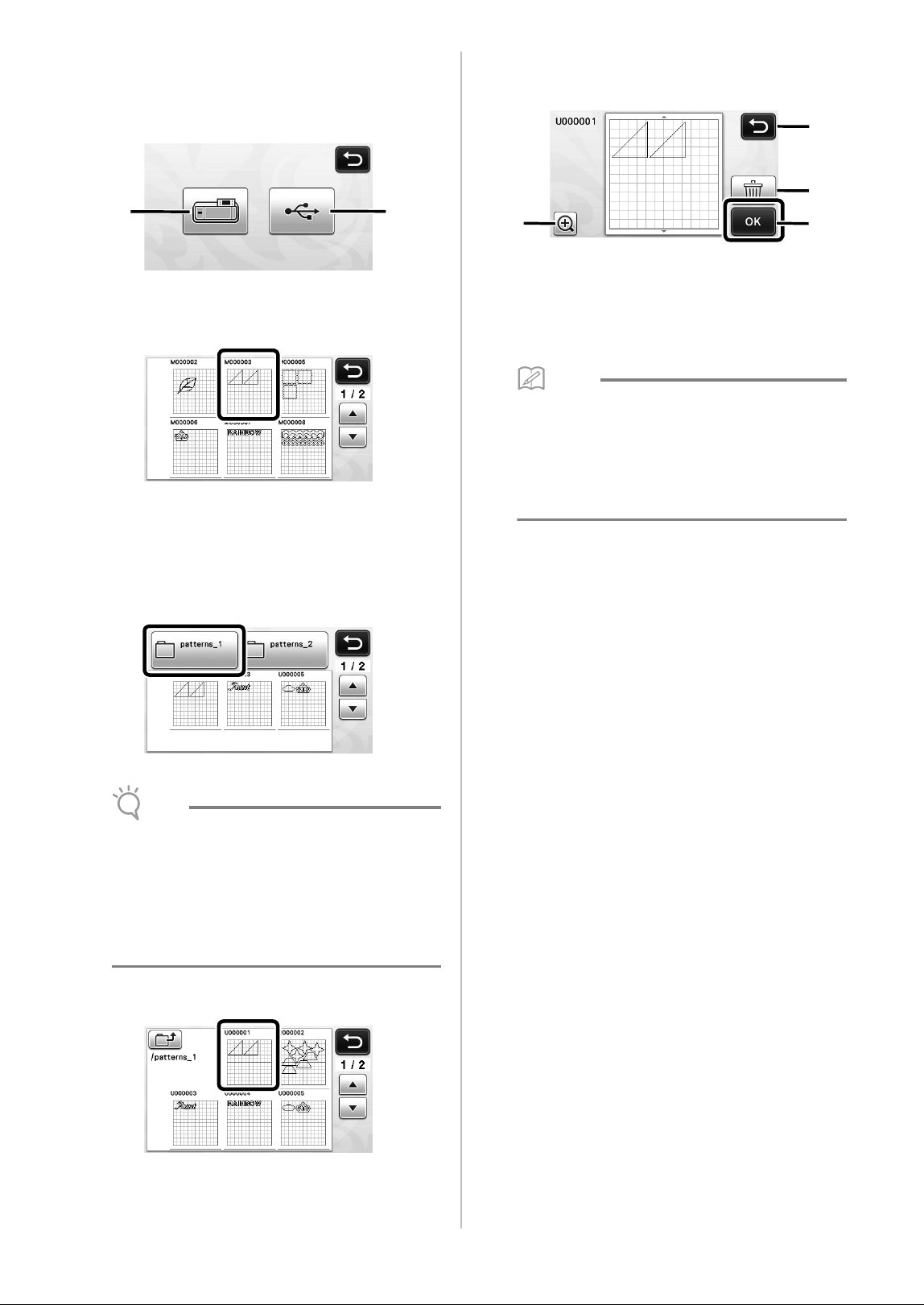
42
b Touch the desired destination, and then select
the desired pattern.
• To recall data from a USB flash drive, plug the USB
flash drive into the USB port on this machine.
a Recall from the machine’s memory.
X Touch the pattern to be recalled and display a
preview of the pattern layout.
b Recall from a USB flash drive.
X If there are folders on the USB flash drive, touch a
folder to display the list of patterns that it
contains.
• If there are many folders or patterns, touch the
arrows keys in the screen to scroll up or down.
Note
• If the name of the data file/folder cannot be
identified, for example, when the name contains
special characters, the file/folder is not
displayed. If this occurs, change the name of
the file/folder. We recommend using the 26
letters of the alphabet (uppercase and
lowercase), the numbers 0 through 9, “-” and
“_”.
X Touch the pattern to be recalled and display a
preview of the pattern layout.
c Check the preview of the pattern layout in the
screen, and then touch the “OK” key.
a Touch to return to the list of patterns at the
destination.
b Touch to delete the data for the displayed
pattern layout.
c Touch to recall the pattern layout data.
d Touch to display the patterns enlarged.
Memo
• Even if a seam allowance has been saved with
the pattern(s) (see “Cutting Around Drawings”
on page 44), the “Seam Allowance” setting
specified in the settings screen will have priority
and will be applied. If necessary, adjust the
“Seam Allowance” setting in the settings screen
(see “Seam Allowance” on page 24).
ab
a
b
c
d
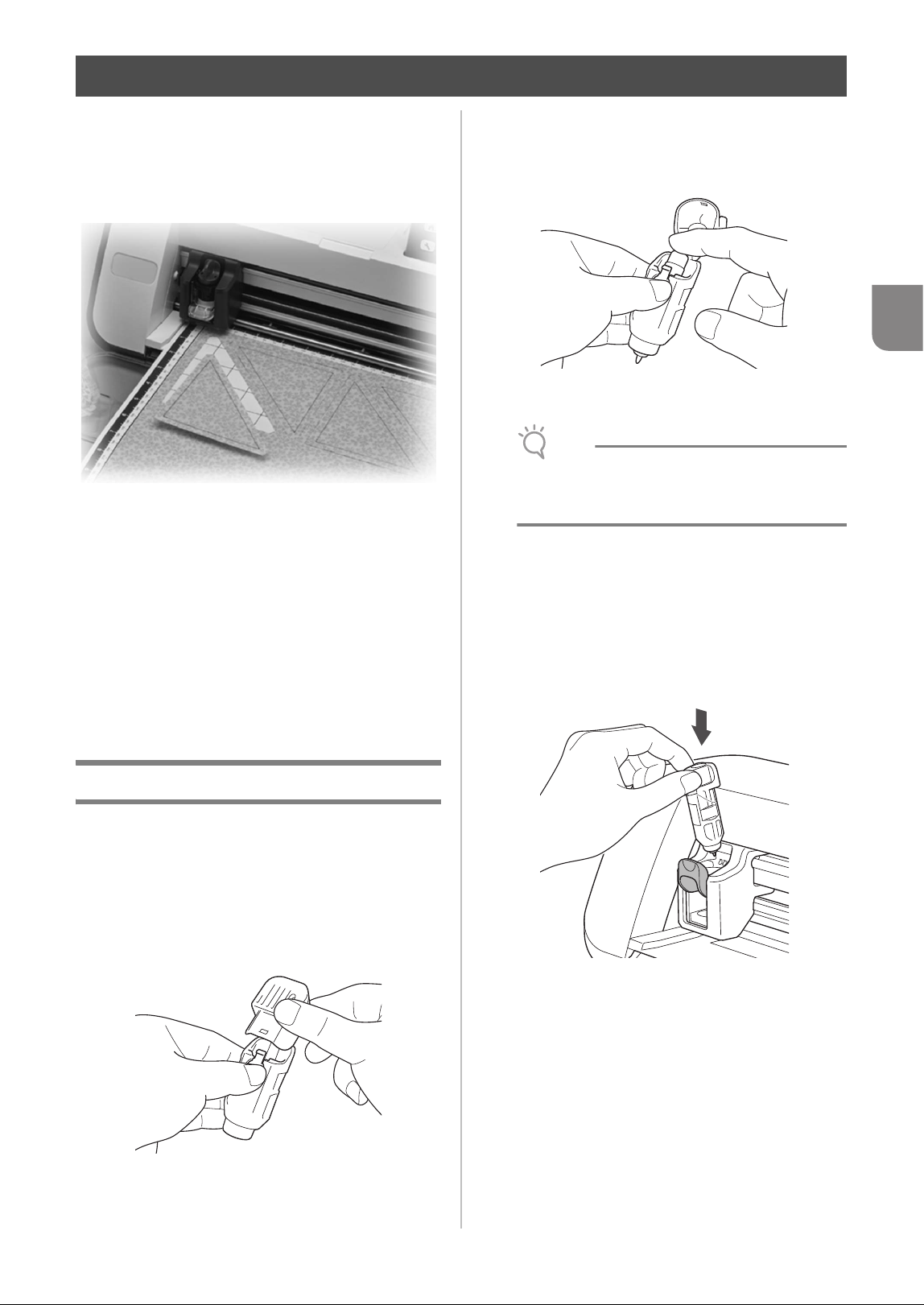
43
3
With a pen and pen holder, you can draw patterns
on material. Using the seam allowance settings also
allows you to draw patterns with seam allowances
on material and then cut them out. These drawing
functions can be used to create quilt pieces.
■ Preparation
Prepare the following accessories for drawing. An
additional purchase may be required depending on the
machine model.
- Pen holder
- Erasable pen set or color pen set
- Mat appropriate for the material that will be drawn
on.
- Blade and blade holder appropriate for the material
that will be cut.
- Contact sheet or support sheet appropriate for fabrics
that will be cut or drawn on.
Drawing
In this example, we will draw a built-in pattern on
material.
■ Preparing the Pen Holder
a Press the button at the center of the pen holder
to unhook the lid and open it.
b Remove the cap from the pen, and then insert
the pen into the pen holder with the point
down.
c Close the lid of the pen holder.
Note
• After use, remove the pen from the pen holder,
and then attach the cap to the pen before
storing it.
■ Drawing
a Grasp the holder grip, and then install the pen
holder in the carriage with its lid opening
button facing against you.
• For details, see “Installing and Uninstalling the
Holder” on page 19.
b Select and edit the pattern.
• For details on selecting and editing patterns, see
“Selecting and Editing the First Pattern” on
page 25.
DRAWING FUNCTIONS
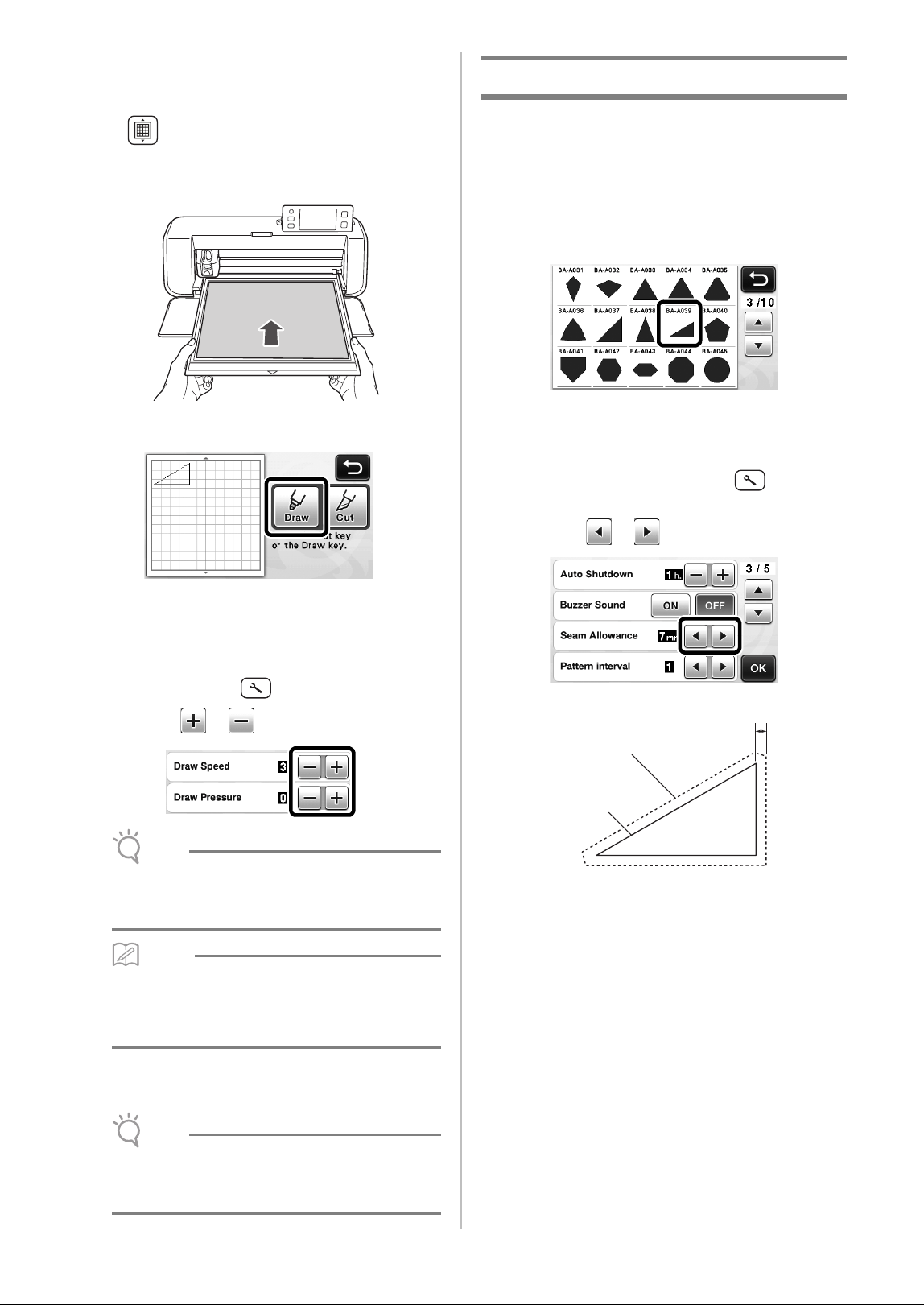
44
c Load the mat with the material for drawing
(cutting) attached.
• Lightly insert the mat into the feed slot, and press
in the operation panel.
• For details on inserting the mat, see “Loading the
Mat” on page 20.
d Select “Draw” in the draw/cut selection screen.
X The drawing line (blue) appears.
e Adjust the drawing speed and pressure.
Before drawing the pattern, adjust the drawing speed
and pressure. These adjustments can be made from the
settings screen. Press in the operation panel.
X Touch or to change the settings.
Note
• If the drawing pressure is too high, the pen tip
may be damaged. Adjust it to an appropriate
setting.
Memo
• Adjustments to the drawing pressure will affect
the finished product. Use the same material
that the pattern will be drawn on to make the
adjustments.
f Press the “Start/Stop” button in the operation
panel to start drawing.
Note
• After use, remove the pen from the pen holder,
and then attach the cap to the pen before
storing it.
Cutting Around Drawings
In this example, we will specify a seam allowance
for a built-in pattern and draw the pattern, then cut
an outline around it.
■ Specifying the Seam Allowance
a Touch the pattern to be drawn.
b Adjust the seam allowance.
Specify the seam allowance, which is the distance
from the pattern outline to the cutting line around the
pattern, in the settings screen. Press in the
operation panel to display the settings screen.
X Touch or to change setting.
a Seam allowance line
b Pattern outline (stitching line)
c Seam allowance
X Touch the “OK” key to finish specifying the
setting and return to the pattern editing screen.
c
a
b
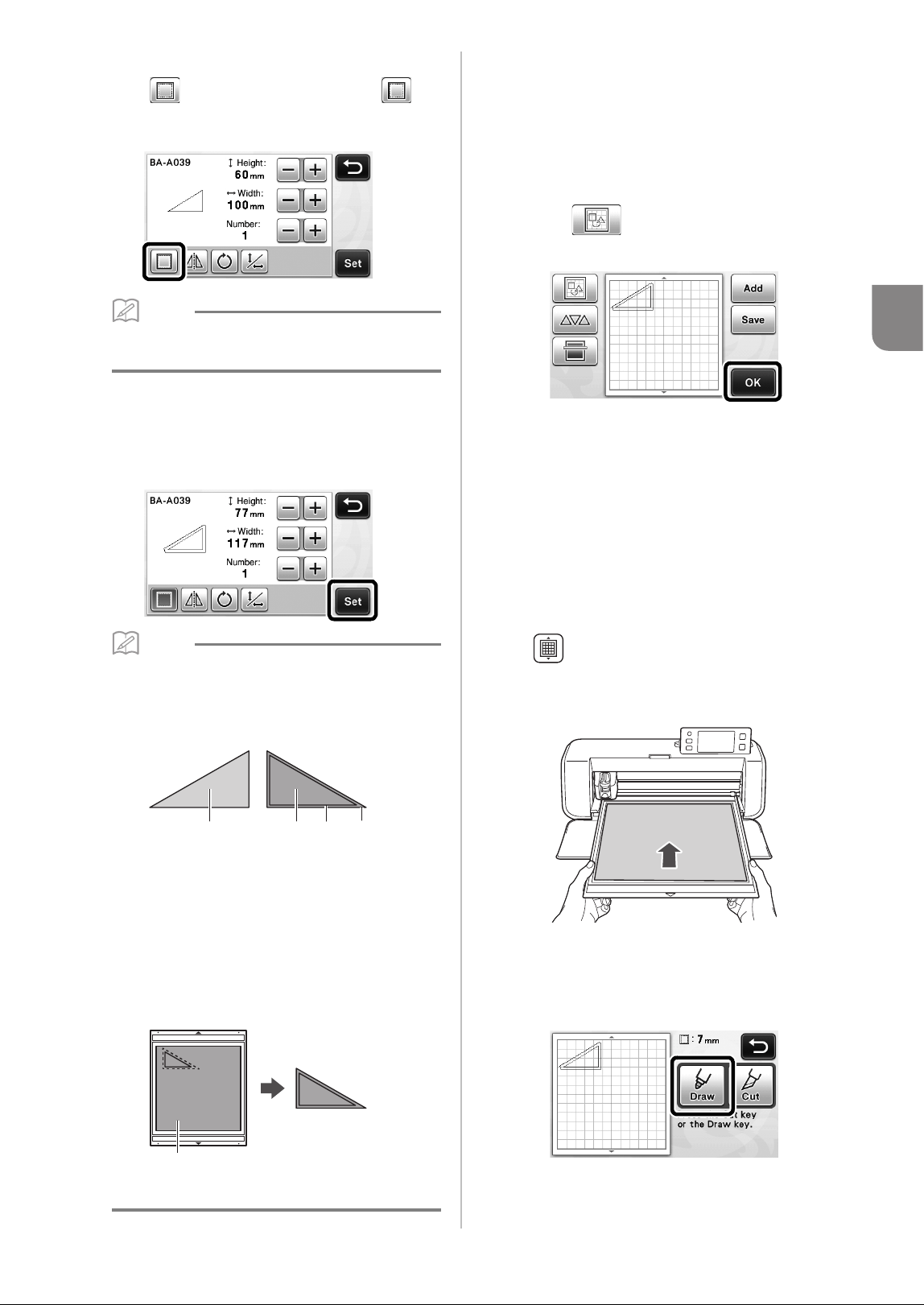
45
3
c Apply the seam allowance.
Touch to apply the seam allowance. If
appears in gray, the seam allowance cannot be
applied.
Memo
• Depending on the pattern, the seam allowance
may be applied as a default. Check the setting.
X The pattern in the preview appears with a
drawing line (blue) and a cutting line (black).
d Touch the “Set” key to finish editing the
pattern.
Memo
• To draw the seam allowance on the wrong side
of the fabric, flip the pattern.
Image of Pattern Piece to be Created
a Right side of fabric
b Wrong side of fabric
c Drawing line (stitching line)
d Seam allowance line
X After attaching to the mat the fabric with the
wrong side facing up, load the mat into the
machine, flip the pattern, and then draw it and
cut it out.
a Wrong side of fabric
e Check the pattern arrangement, and then touch
the “OK” key.
When using fabric, the patterns may not be cleanly cut
if they are arranged near the edge of the fabric. In this
case, move patterns so they are at least 10 mm from
the fabric edge (the edge of the cutting/drawing area in
the screen).
• To re-edit the pattern arrangement after checking it,
touch . For details, see “Pattern Layout
Screen” on page 35.
X The draw/cut selection screen appears.
■ Loading the Material
Load the mat with the material for cutting (drawing)
attached.
When drawing the seam allowance on the wrong side of
the fabric, attach the material to the mat with its wrong
side facing up.
• For details on attaching material to the mat, see
“Mat and Cutting Blade Combinations” on
page 12.
• Lightly insert the mat into the feed slot, and press
in the operation panel.
• For details on inserting the mat, see “Loading the
Mat” on page 20.
■ Drawing
a Touch the “Draw” key.
X A preview of the line to be drawn appears.
acb d
a
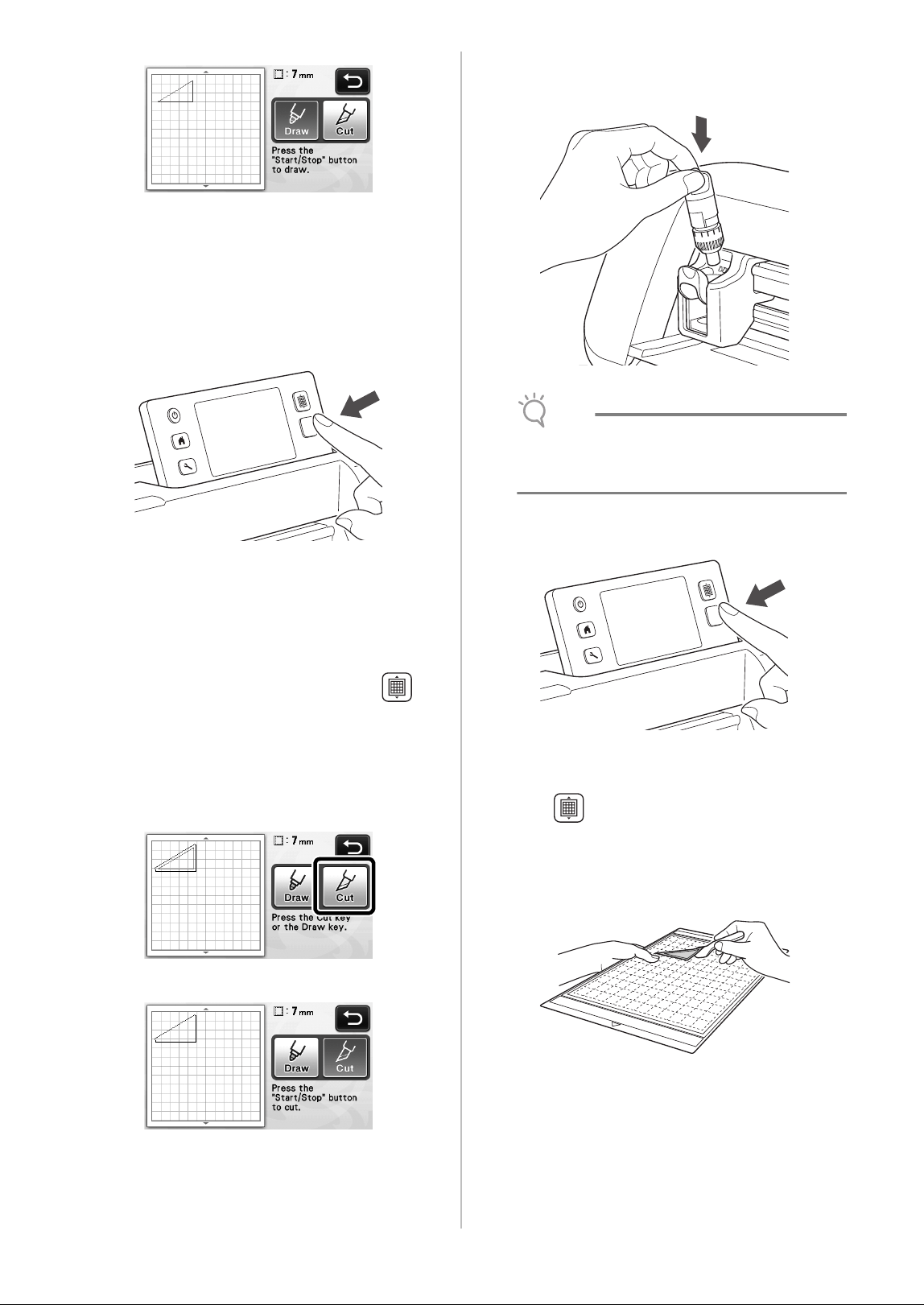
46
X The “Start/Stop” button in the operation panel
lights up.
b Adjust the pen pressure.
For details on adjusting the drawing pressure, see step
e (page 44) in “Drawing”.
c Press the “Start/Stop” button to start drawing.
X When drawing is finished, the message appears
in the screen. After you touch the “OK” key, the
draw/cut selection screen appears.
• To perform trial drawing operations to adjust
the drawing pressure, repeat steps
a through
c in this section.
• To cut around the drawn patterns, keep the mat
inserted into the slot without pressing ,
and continue with the following cutting
procedure.
■ Cutting
a Touch the “Cut” key.
X A preview of the line to be cut appears.
X The “Start/Stop” button in the operation panel
lights up.
b Remove the pen holder, and then install the
blade holder.
Note
• After use, remove the pen from the pen holder,
and then attach the cap to the pen before
storing it.
c Press the “Start/Stop” button to start cutting.
X When cutting is finished, the draw/cut selection
screen appears.
d Press in the operation panel to feed out
the mat.
e Peel the patterns off the mat.
• For details, see “Unloading the Mat” on page 21.
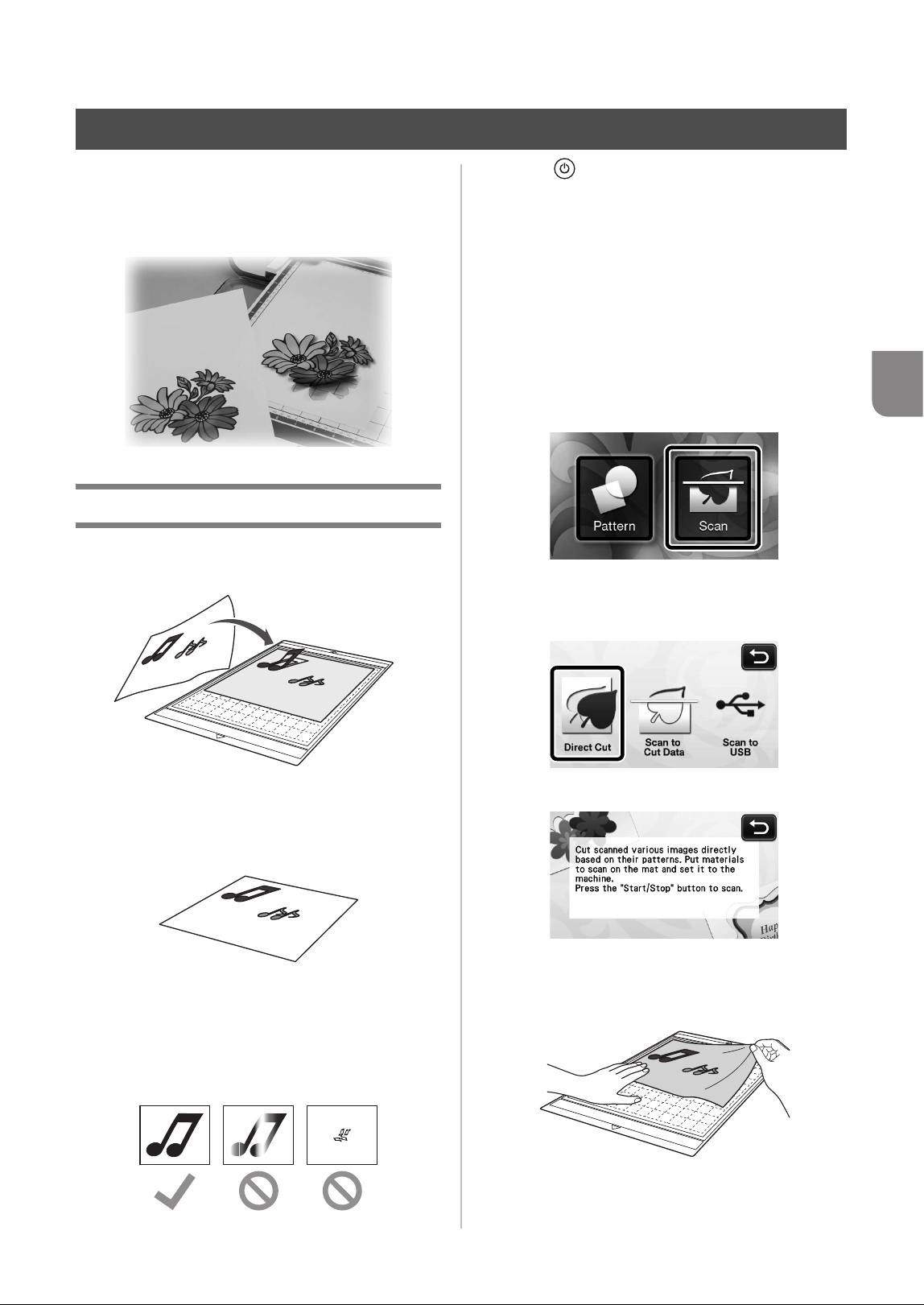
47
4
Chapter 4 SCANNING FUNCTIONS
A printed image or an original hand-drawn
illustration can be scanned and its outline can be cut
out or drawn. This is useful for scanning images for
paper crafts, then cutting them out.
Tutorial 3 - Scanning and Cutting
In this tutorial, we will scan an illustration drawn on
paper, then cut around it.
■ Preparation
a Prepare the original.
When using the “Direct Cut” mode, use originals like
those described below.
• Patterns that are clearly drawn, with no gradation,
fading or blurriness
• Patterns that are at least a 5 mm square
• Not using an extremely intricate design
b Press to turn on the machine.
• For details, see “Turning On/Off the Machine” on
page 10.
c Install the cutting blade holder into the carriage
of the machine.
• For details, see “Installing and Uninstalling the
Holder” on page 19.
■ Scanning
a Touch the “Scan” key in the home screen to
select the scanning mode.
b Select “Direct Cut” in the scanning mode
selection screen.
X A message appears.
c Attach the original that will be scanned to the
mat.
SCANNING FOR CUTTING (Direct Cut)
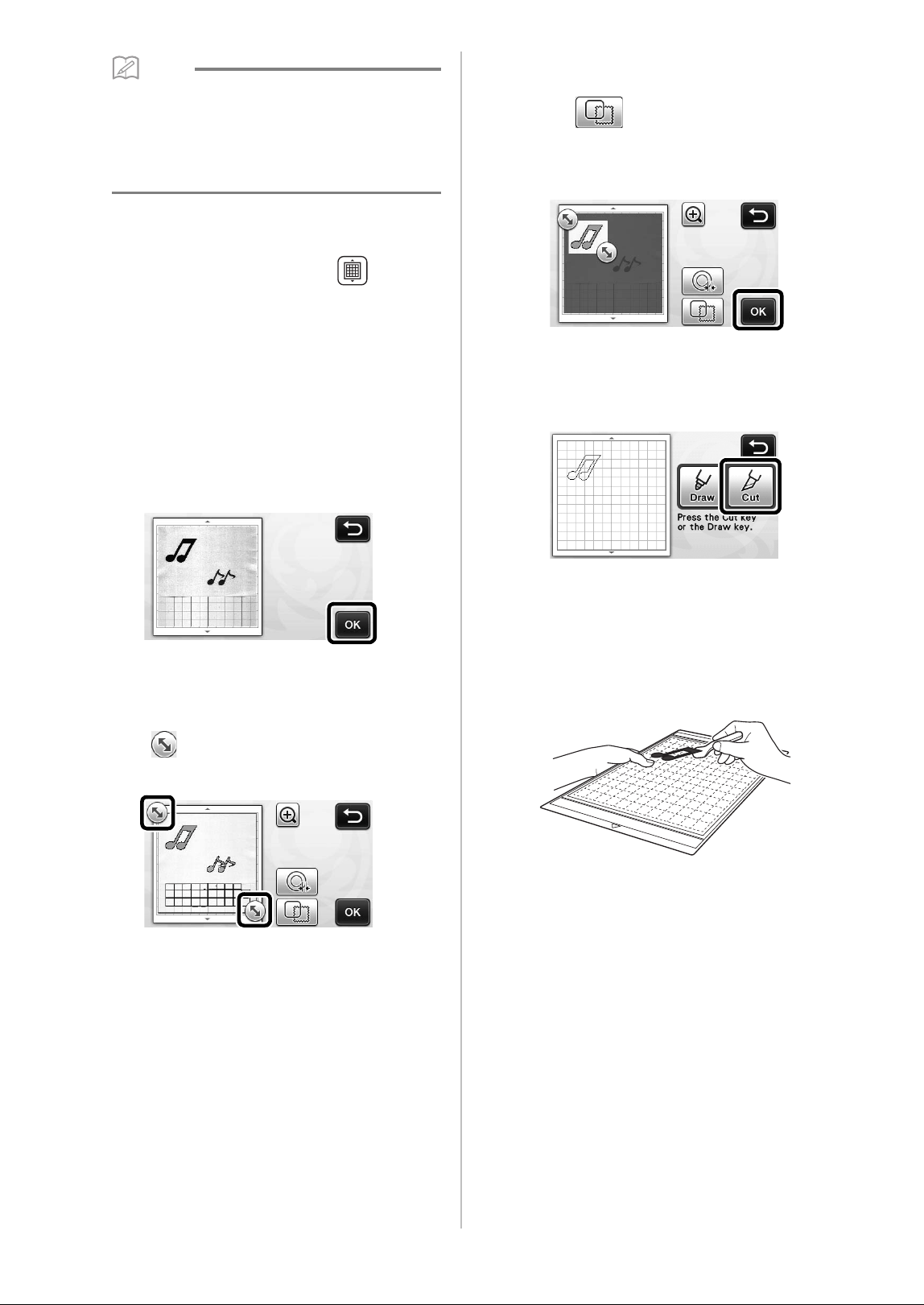
48
Memo
• In “Direct Cut” mode, the optional 12" × 24"
(305 mm × 610 mm) mat and scanning mat
cannot be used.
• Before attaching the material to the mat, use a
corner of the adhesive side of the mat to test
attaching it.
d While holding the mat level and lightly
inserting it under the feed rollers on the left and
right sides of the feed slot, press in the
operation panel.
• For details, see “Loading the Mat” on page 20.
X The “Start/Stop” button in the operation panel
lights up.
e Press the “Start/Stop” button to start scanning.
X When scanning is finished, the scanned image
appears in the screen.
f Check the scanned image, and then touch the
“OK” key.
■ Editing Cutting Lines
a In the image trim screen, use the touch pen to
touch and drag it around the screen to trim
the image.
b To cut around the image for the pattern, touch
the “OK” key.
• Touch to cut any of a variety of shapes as a
frame around the scanned image. For details on
selecting a frame, see “Advanced Cutting
Functions” on page 49.
■ Cutting
a Touch the “Cut” key.
X The “Cut” key is highlighted, and the “Start/Stop”
button in the operation panel lights up.
b Press the “Start/Stop” button to start cutting.
• For details on unloading the mat after cutting,
follow the procedure under “Unloading the Mat”
on page 21.
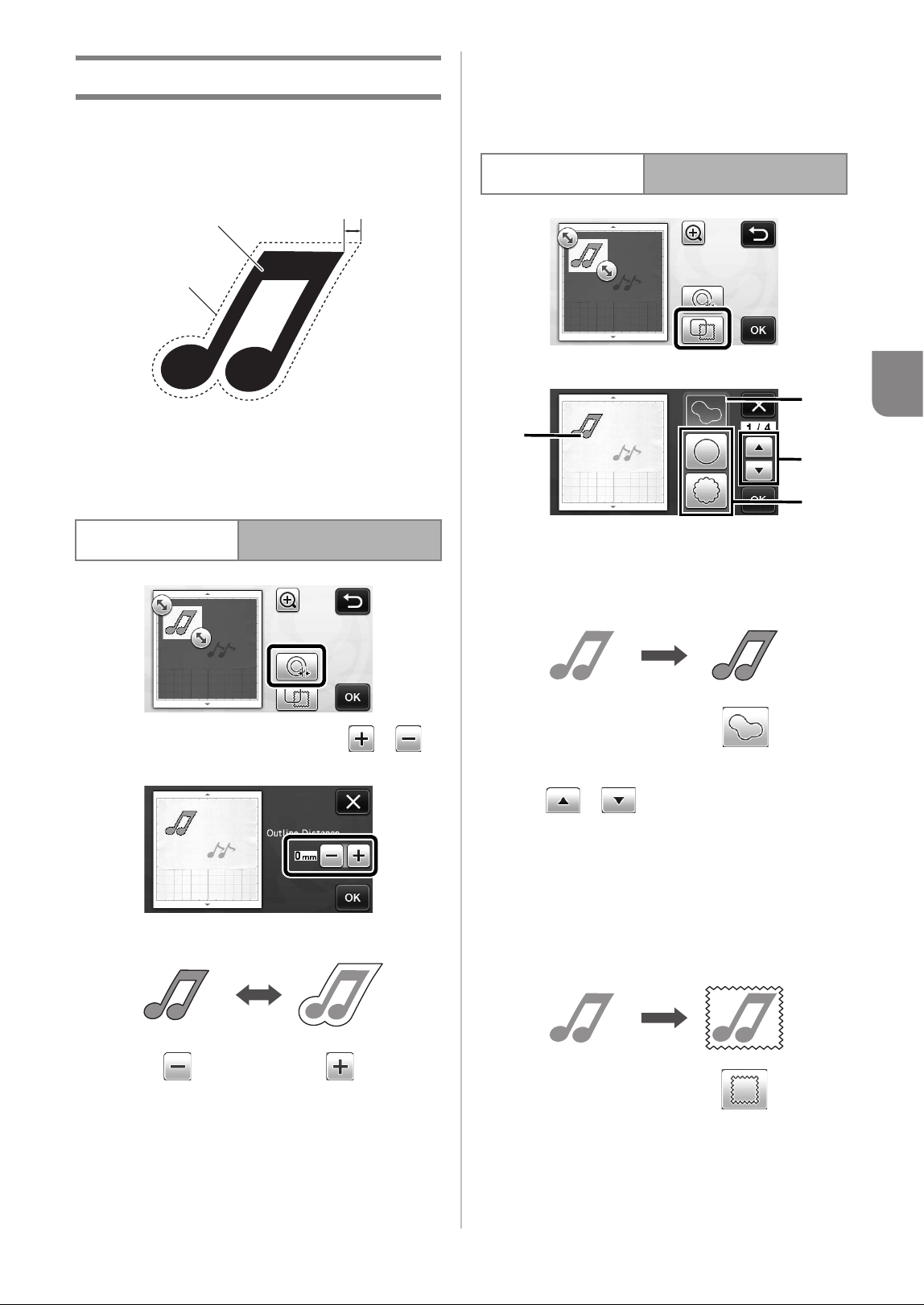
49
4
Advanced Cutting Functions
■ Outline Distance
Specify the distance from the cutting line to the outline
of the scanned image.
a Pattern outline
b Cutting line
c Outline distance
Available in the following screen
X The setting screen appears. Touch or to
change the setting.
■ Outlining and Framing
Any shape can be specified as the cutting line for the
scanned image.
Available in the following screen
X The settings screen appears.
a Outlining
Touch this key to create a cutting line that follows the
outline of the scanned image.
b Frame Shape Scroll Keys
Touch or to scroll up or down through the
list of frames.
c Framing
Touch the key for the desired frame to add it to the
scanned image and create a cutting line that follows
its shape.
• If there are multiple images, a frame can be
specified for each image.
d Previewing
Display a preview of the image together with the
cutting line for the selected frame.
Image trim screen
→
Tutorial 3; Step
b
(page 48)
in “Editing Cutting Lines”
c
a
b
Image trim screen
→
Tutorial 3; Step
b
(page 48)
in “Editing Cutting Lines”
d
b
c
a
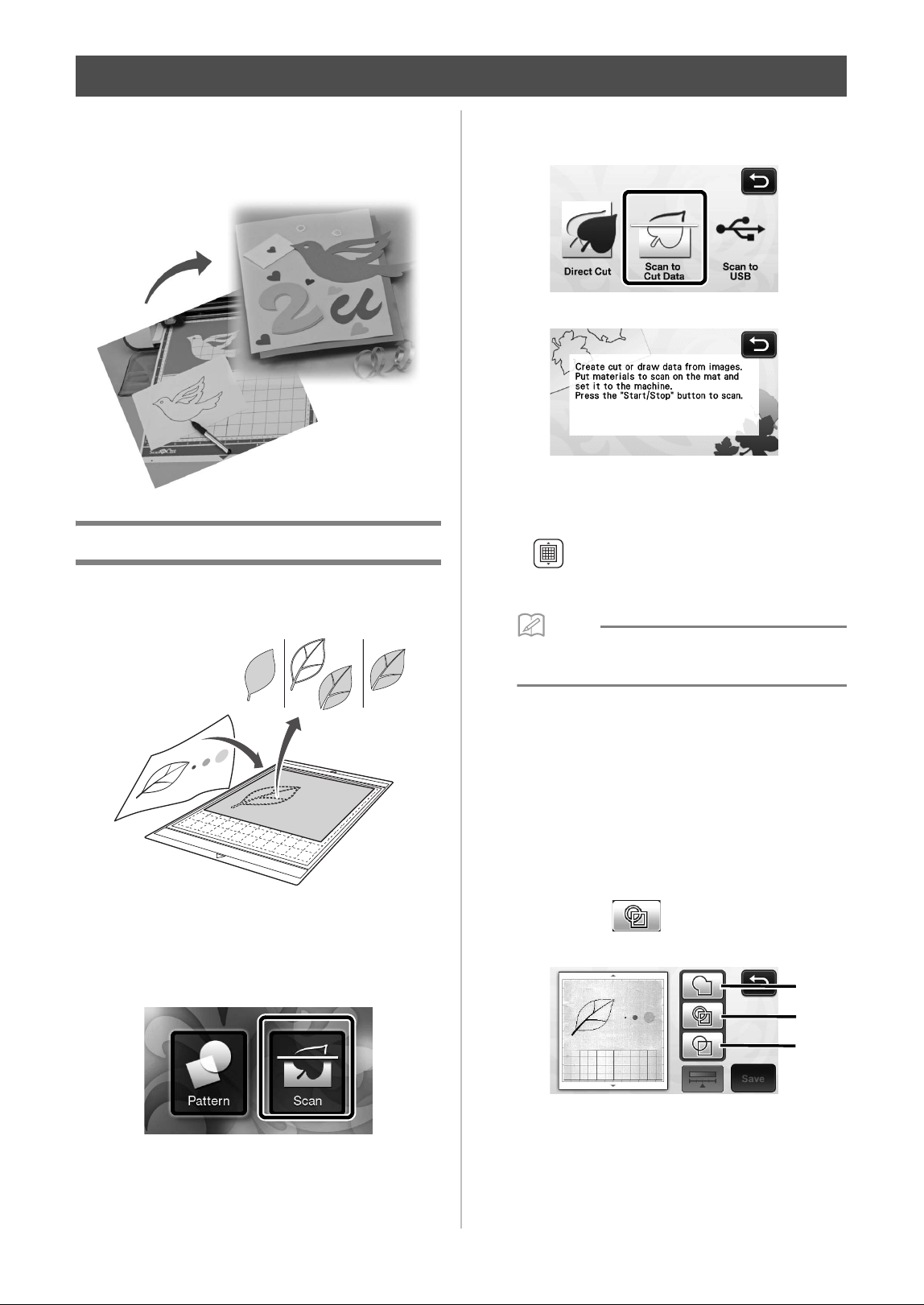
50
A printed pattern or image or an original hand-drawn
illustration can be scanned, converted to cutting
lines for cutting/drawing with this machine, then
saved as data.
Tutorial 4- Creating Cutting Data
In this tutorial, we will save an illustration drawn on
paper as cutting data.
■ Scanning
a Touch the “Scan” key in the home screen to
select the scanning mode.
b Select “Scan to Cut Data” in the scanning mode
selection screen.
X A message appears.
c Attach the original to the mat, and then load
the mat into the feed slot.
• Lightly insert the mat into the feed slot, and press
in the operation panel.
• For details on loading the mat, see “Loading the
Mat” on page 20.
Memo
• In “Scan to Cut Data” mode, the optional 12" ×
24" (305 mm × 610 mm) mat cannot be used.
d Press the “Start/Stop” button to start scanning.
X When scanning is finished, the scanned image
appears in the screen.
■ Editing Cutting Data
a Select the cutting line type in the image editing
screen.
The image shape is detected and cutting lines are
created based on one of three standards. For this
example, touch to create cutting lines using
region detection.
CREATING CUTTING DATA (Scan to Cut Data)
b
a
c
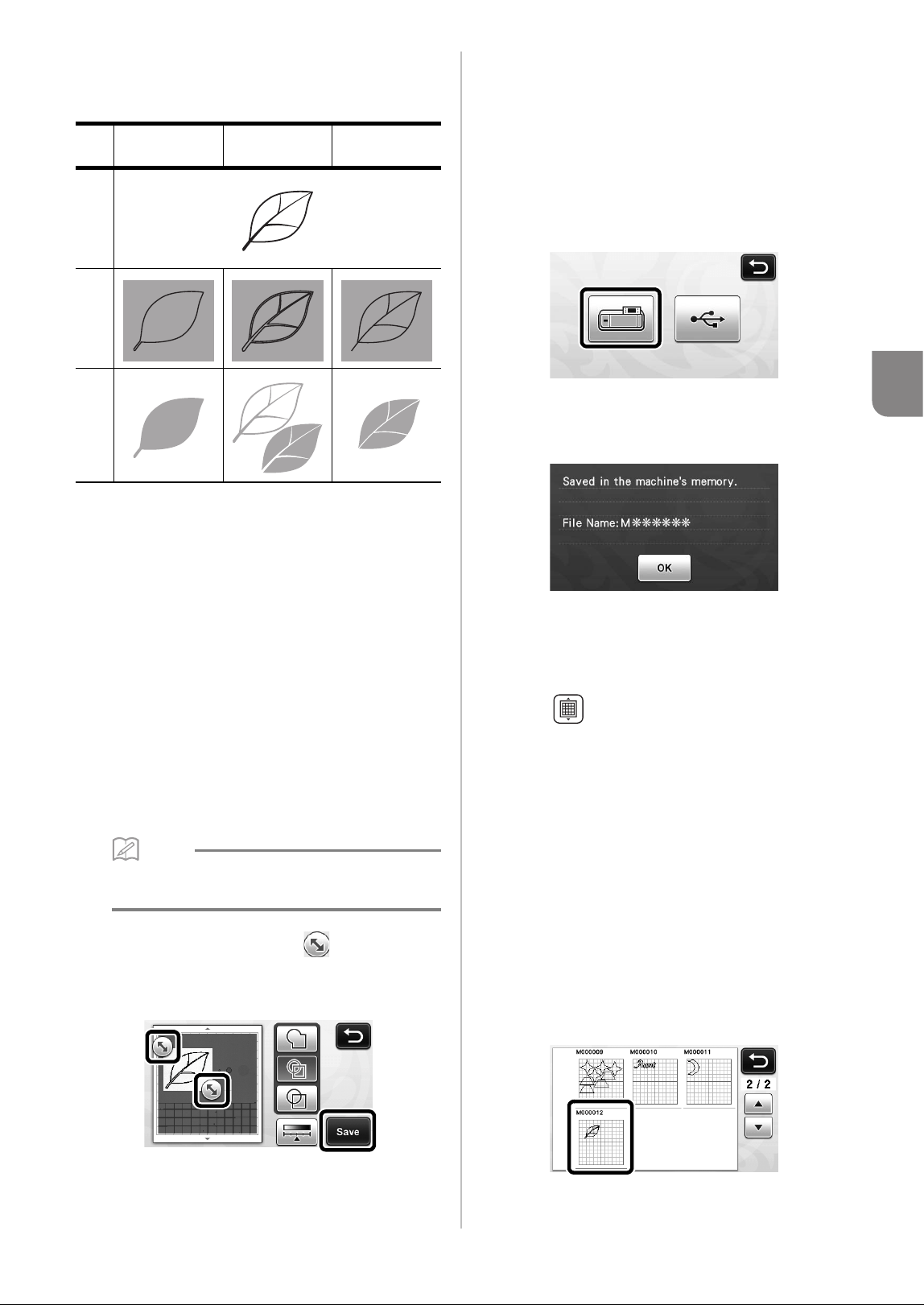
51
4
a Outline detection
If you wish to cut/draw along the outline of an image,
select this option to convert the outline of the image to
a cutting line. This is useful for saving as data an
illustration drawn for an appliqué.
b Region detection
Select this option to detect the colored portions of an
image as regions and create a cutting line around
each region. Cutouts can be created using thick
hand-drawn lines, such as borderlines of images or
text illustrations. This option allows you to use not
only cut-out patterns but the material from which
portions are cut out, such as lace.
c Line detection
Select this option to detect the center of lines and
convert them to a cutting line. This is useful for
detecting patterns consisting of multiple pieces and
creating cutting lines for each piece.
Memo
• Lines thicker than 1.5 mm will not be detected
as lines.
b Use the touch pen to touch and drag it
around the screen to trim the cutting lines to be
saved as data, and then touch the “Save” key.
X The destination memory selection screen
appears.
■ Saving Data
a Select the destination where the data will be
saved.
Select either the USB flash drive or the machine’s
memory as the destination for saving the data. Touch
the key for the desired destination. For this example,
select the machine’s memory. In order to save data on
a USB flash drive, plug the device into the USB port on
this machine.
X Touching a key starts saving the data. When the
data has been saved, the following message
appears.
b Touch the “OK” key to finish saving the data.
X The destination memory selection screen appears
again.
c Press in the operation panel to feed out
the mat, and then peel off the original from the
mat.
■ Recalling Cutting Data
Saved cutting data can be recalled for cutting.
a Attach the material for cutting to the mat, and
then load the mat.
• For details on attaching the material, see “Mat and
Cutting Blade Combinations” on page 12.
• For details on loading the mat, see “Loading the
Mat” on page 20.
b Recall the saved cutting data.
• For details on recalling data, follow the procedure
under “Recalling” on page 41.
X A preview of the pattern layout appears.
Difference in cutting lines depending on detection
standard
a Outline
detection
b Region
detection
c Line
detection
Original
Cutting
lines
Finished project
after cutting
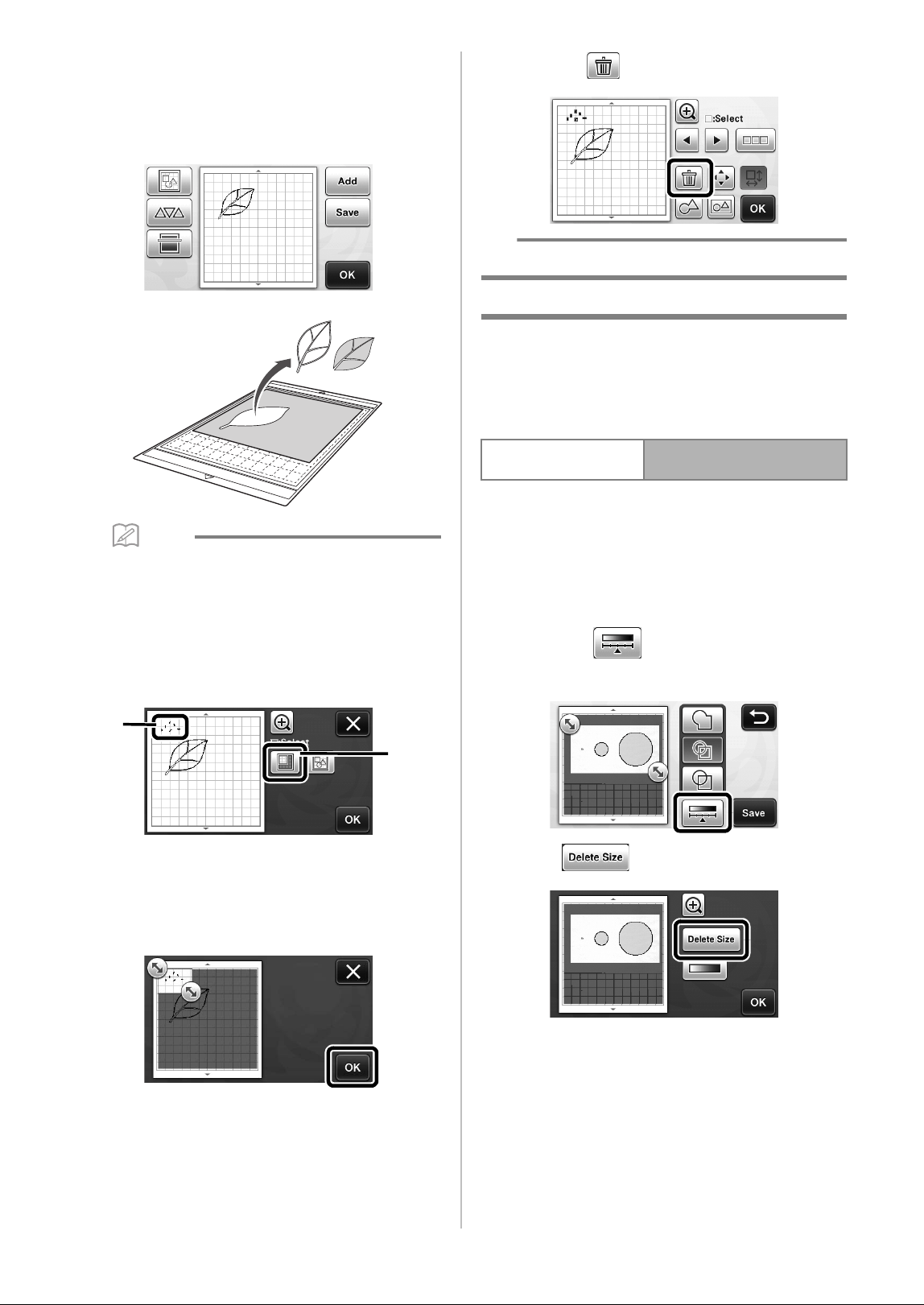
52
c Edit the cutting data as necessary, and then cut
or draw.
For details on finishing cutting, follow the procedures
under “Loading the Mat” (page 20) and “Cutting”
(page 21).
Memo
• Small spots and unwanted lines created during
scanning can be deleted after a scanned image
is converted to cutting data.
X After recalling the cutting data into the pattern
layout screen, use the editing functions for
selecting the spots to delete.
For details on the function, see “Selecting
Multiple Patterns” on page 31.
a Touch for selecting multiple patterns in the
specified area.
b Unwanted spots and lines
X Specify the area of the unwanted spots, and then
touch the “OK” key.
X Touch to delete all of the selected spots.
Editing Pictures
By adjusting the output level of data for a scanned
image, you can reproduce the image in a wide
variety of ways.
Available in the following screen
■ Specifying “Delete Size”
Clean up the image by deleting small spots, unwanted
lines or texts on it.
In the following example, we will scan three images of
different sizes (4 mm, 40 mm, 100 mm).
a Select one of the three detection options, and
then touch to display the function
selection screen.
b Touch to display the setting screen.
b
a
Image editing screen
→
Tutorial 4; Step
a
(page 50)
in “Editing Cutting Data”
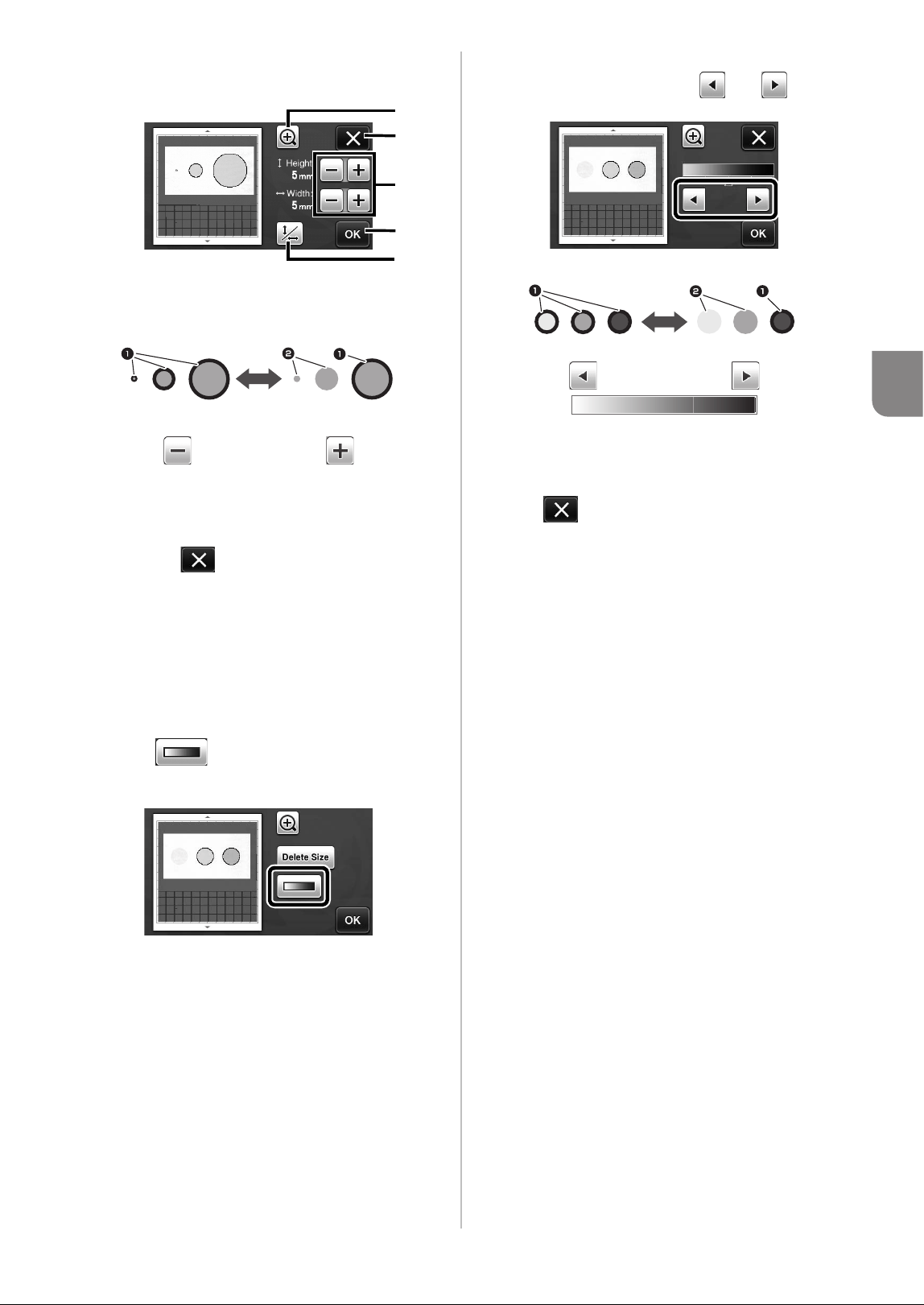
53
4
c Specify an object size smaller than which is not
to be converted to cutting lines.
a Magnifying
c Size Adjustment Keys
e Locking/Unlocking the Aspect Ratio
1 Cutting line created
2 No cutting line created
X Touch the “OK” key (d) to apply the settings.
Touch (b) to return to the previous screen
without applying the settings.
■ Setting Image Detection Level
Convert an image with a gradation or shading to a two-
tone (black and white) image, and then create cutting
lines for that image.
In the following example, we will scan three images of
different tones (light, medium, dark).
a Touch in the function selection screen
to display the setting screen.
b Specify the threshold for converting an image
to a two-tone image using and .
1
Cutting line created
2 No cutting line created
X Touch the “OK” key to apply the settings. Touch
to return to the previous screen without
applying the settings.
c
d
b
a
e
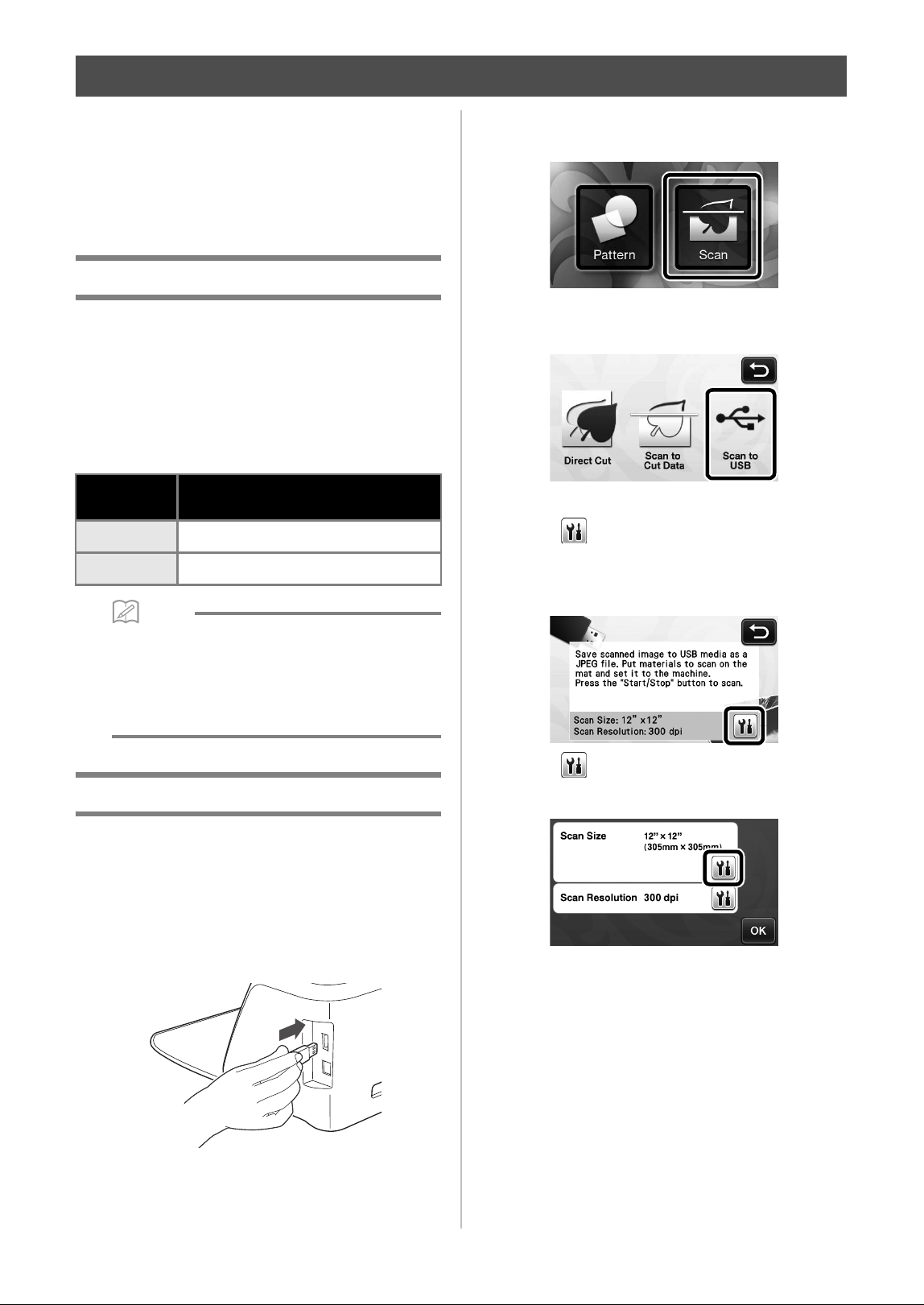
54
A pattern printed on paper or fabric, an image, a
pattern template or an original hand-drawn
illustration can be scanned and saved as image data
on a USB flash drive.
This is useful for saving the data of an original image
as backup before cutting.
Notes on Scanning
■ Scanning Specifications
•
Scanning format: Color
•
Saved file format: jpg
•
Maximum scanning area: 296 mm × 298 mm (11
3/4" × 11 3/4").
■ Material That Can be Scanned
Memo
• In “Scan to USB” mode, the optional 12" × 24"
(305 mm × 610 mm) mat cannot be used.
• Use the optional scanning mat to secure the
paper or fabric to be scanned. The mat can be
used without attaching the paper or fabric to
the mat.
Tutorial 5- Scanning to USB
In this tutorial, we will save an illustration drawn on
paper as JPEG data to a USB flash drive.
■ Scan Settings
a Plug the USB flash drive into the USB port on
this machine.
b Touch the “Scan” key in the home screen to
select the scanning mode.
c Select “Scan to USB” in the scanning mode
selection screen.
X A message appears.
d Touch to display the scanning settings
screen.
Specify the size of the area to be scanned and the
scanning resolution.
e Touch (for “Scan Size”) to display the
scanning size settings screen.
SCANNING IMAGES (Scan to USB)
with low-tack adhesive mat/
standard mat
Thickness
Max. 1.5 mm
Type
Paper/Fabric
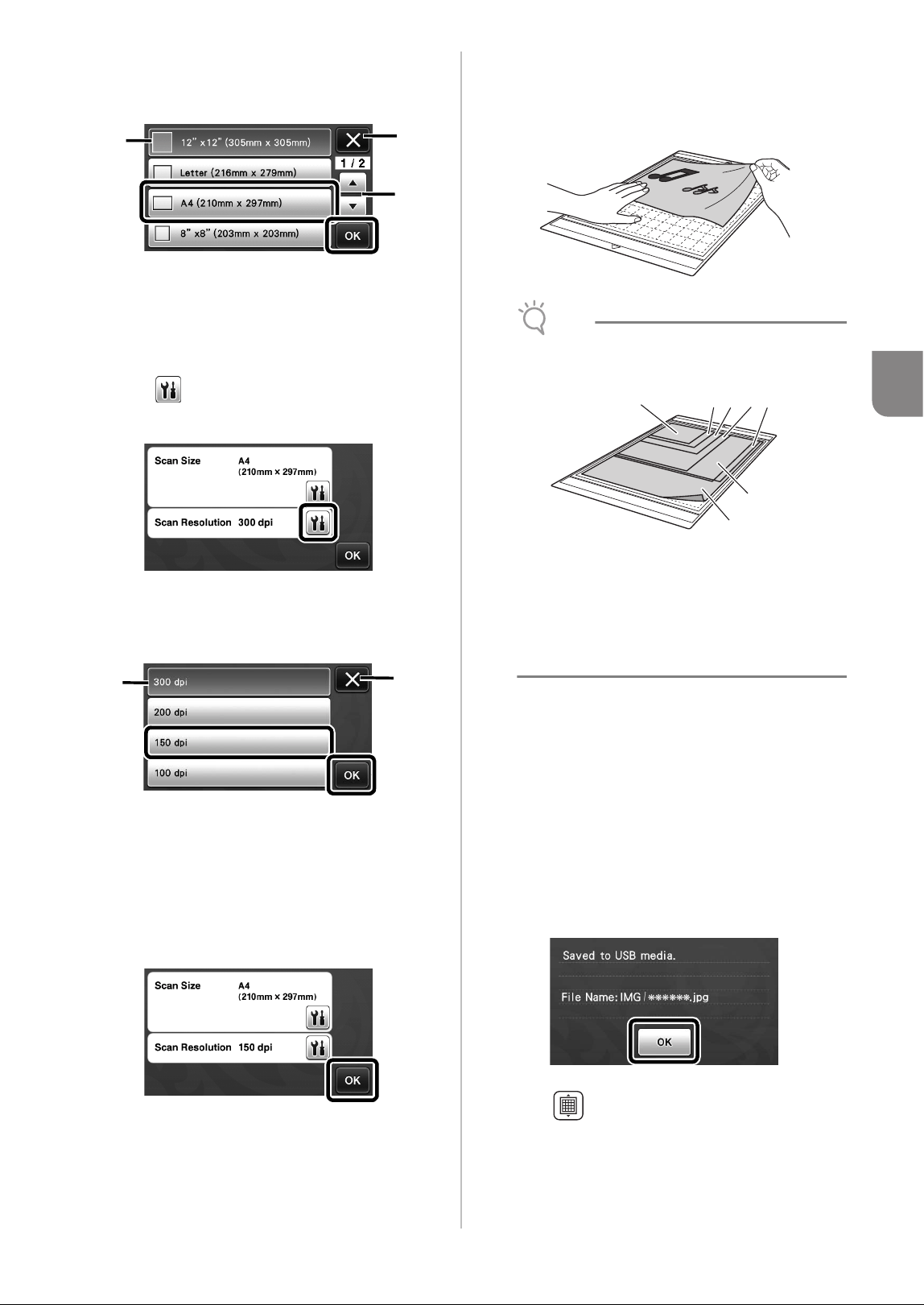
55
4
f Select the size of the scanning area.
From the list, touch the key for the size of the original
to be scanned. For this example, select the A4 size.
a Size selection keys
b Touch to cancel the setting and return to the
previous screen.
c Touch to scroll through the list.
X After the selected key is highlighted, touch the
“OK” key to finish specifying settings.
g Touch (for “Scan Resolution”) to display
the scanning resolution settings screen.
hSelect the scanning resolution.
From the list, touch the key for the scanning
resolution. For this example, select 150 dpi.
a Resolution selection keys
b Touch to cancel the setting and return to the
previous screen.
X After the selected key is highlighted, touch the
“OK” key to finish specifying settings.
i Check the settings, and then touch the “OK”
key.
X A message appears.
■ Scanning and Saving
a Attach the original that will be scanned to the
mat.
Note
• Place the original to be scanned so that it is in
the landscape orientation.
a 12" × 12" (305 mm × 305 mm)
b Letter (216 mm × 279 mm)
c A4 (210 mm × 297 mm)
d 8" × 8" (203 mm × 203 mm)
e 5" × 7" (127 mm × 178 mm)
f 4" × 6“ (102 mm × 152 mm)
g 3.5" × 5" (89 mm × 127 mm)
b Load the mat into the feed slot.
For details on loading the mat, see “Loading the Mat”
on page 20.
c Press the “Start/Stop” button to start scanning.
X The data is saved at the same time that the
original is being scanned.
X When scanning and saving is finished, the
completion message appears.
d Touch the “OK” key to exit “Scan to USB”
mode.
e Press in the operation panel to feed out
the mat.
f Unplug the USB flash drive from the USB port
on this machine.
g From a computer, check the saved image data.
b
a
c
b
a
a
b
c
d
e
f
g
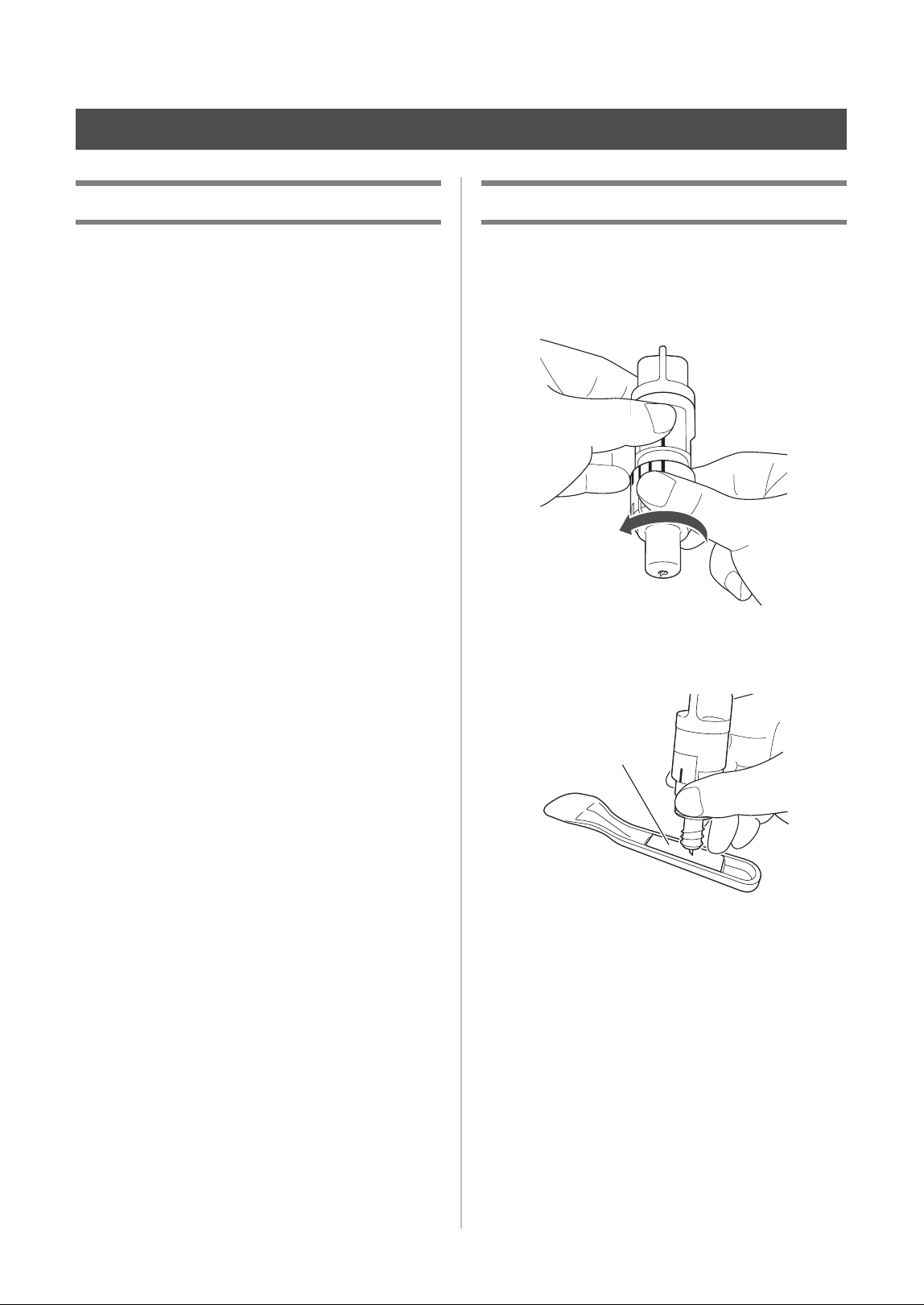
56
Chapter 5 APPENDIX
Replacement Criteria
For the safe operation of this machine, replace the
following consumables according to the replacement
criteria. To purchase parts, contact the retailer who
sold you this machine or the nearest authorized
service center. For details on the optional
accessories, see “OPTIONAL ACCESSORIES” on
page 66.
Mat
• When the mat’s adhesive strength decreases
• When there are many cutting traces in the mat
Cutting blade
• When the cuts in the material become rough,
reducing the quality of the finished product
• When the cutting edge becomes blunt
High tack adhesive fabric support sheet
• When the sheet’s adhesive strength decreases
• When fabric attached becomes twisted while being
cut
Scanning mat
• When the mat and cover sheet become dirty,
reducing the quality of the scan image
Replacing the Blade
■ Removing
a Twist off the holder cap to remove it.
b Stick the blade straight into the rubber area on
the back of the included spatula.
a Rubber area
CONSUMABLES
a
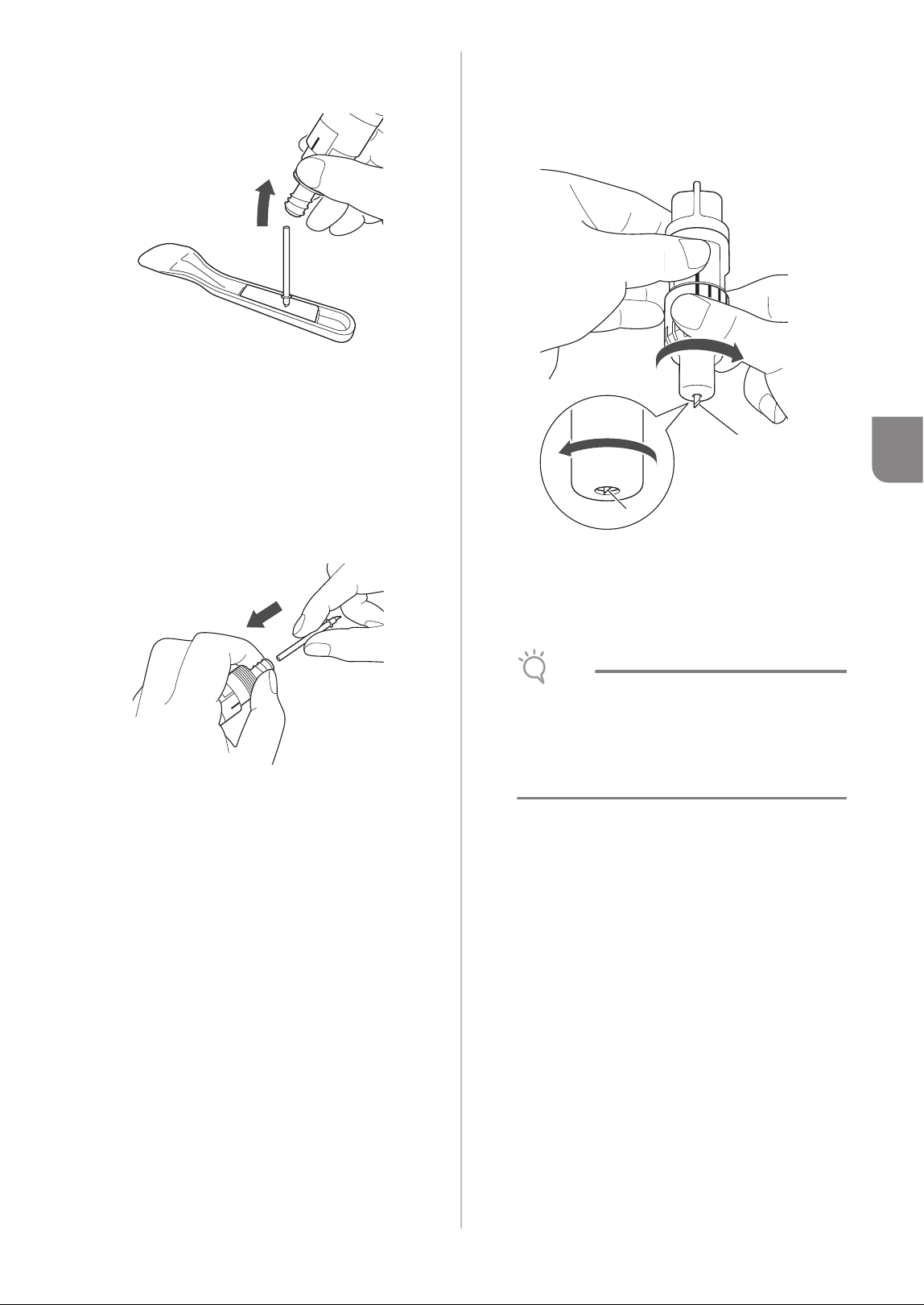
57
5
c Pull up the holder to leave the blade in the
rubber area.
■ Installing
a Grasp the shaft of the new blade, and then
insert it into the blade slot in the end of the
holder.
The blade shaft is held in place by a magnet in the
holder. Slowly insert the blade shaft, and then slowly
release it after the shaft snaps into place against the
magnet.
b Twist on the holder cap to attach it to the
holder.
Fully tighten the cap until the blade extension reaches
its maximum, and then loosen the cap until the blade
is no longer visible.
a Tighten the cap until the blade extension
reaches its maximum.
b Loosen the cap until the blade becomes
invisible from the cap end.
Note
• Loosen the holder cap until the blade tip is no
longer visible. The blade extension scale on the
holder applies when the blade begins to be
extended from the cap end. For details on the
blade extension, see “Adjusting the Blade
Extension” on page 18.
b
a
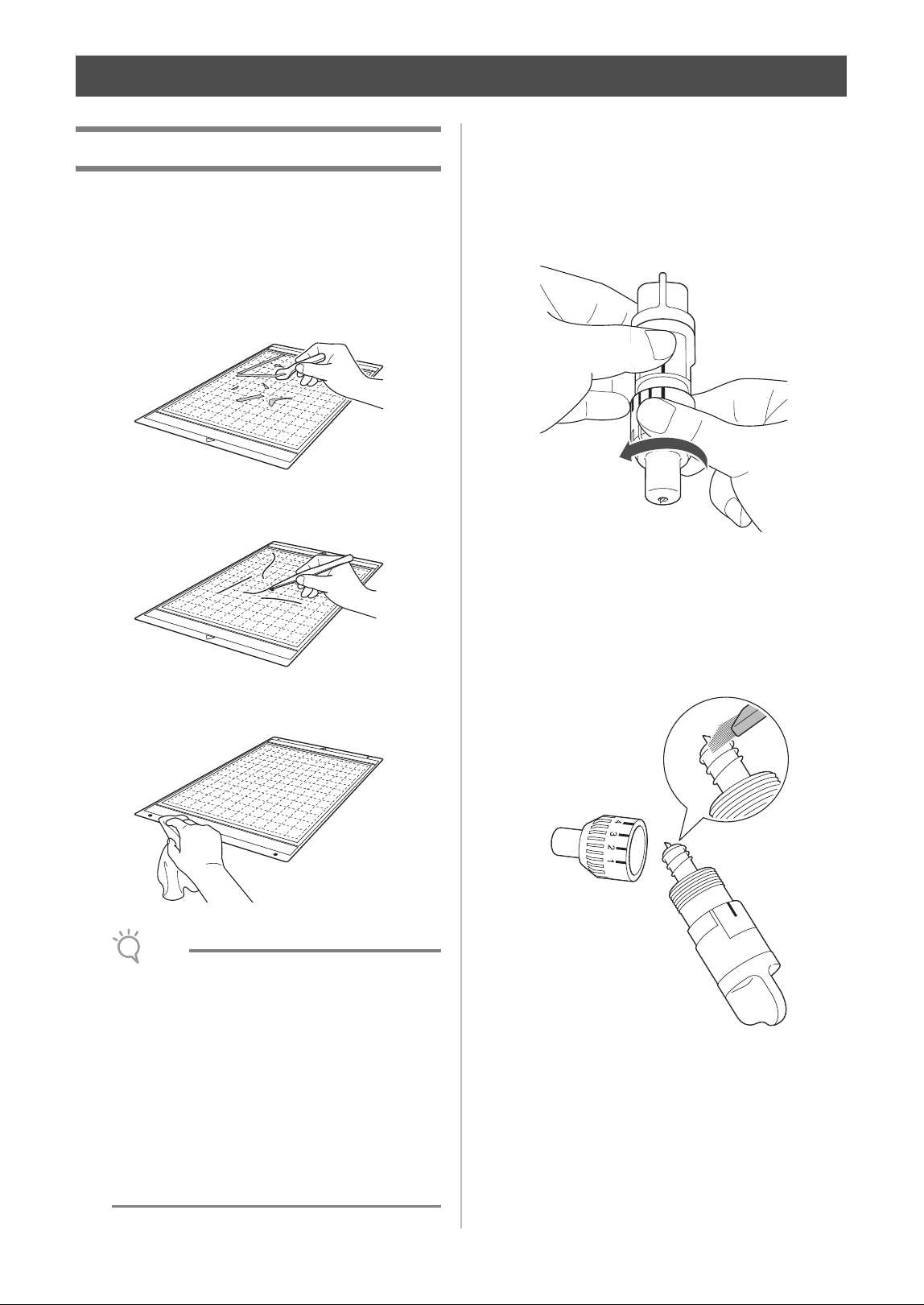
58
Cleaning
■ Cleaning the Mat
Cuttings and cut edges of patterns attached to the
mat may reduce the mat’s adhesive strength and
prevent correct operation. Periodically clean the
mat. Using the included spatula, lightly scrape off
any cuttings attached to the mat.
Use commercially available tweezers to remove any
fabric threads attached to the mat.
Clean the dotted marks on the mat and their
surrounding area with a dry cloth.
Note
• Do not use alcohol or water to clean the mat.
• When the mat is not being used, clean it, and
then store it with the protective sheet affixed. At
that time, do not affix the protective sheet while
the mat is damp. Otherwise, the mat’s adhesive
strength will decrease.
• Do not fold or bend the mat to store it.
• Store the mat at room temperature and in a
location not exposed to high temperatures, high
humidity or direct sunlight.
• If the mat no longer has any adhesive strength,
replace it with a new one. For details on
optional mats, see “OPTIONAL
ACCESSORIES” on page 66.
■ Cleaning the Holder
If material cuttings, lint or dust accumulate in the
holder, it may not operate correctly. Clean the
holder after every use.
a Twist off the holder cap to remove it.
b Using a commercially available brush, clean off
cuttings, lint and dust.
Specifically clean off lint and dust around the blade. If
lint and dust accumulate between the blade and
holder, the blade may no longer rotate or the cutting
quality may become poor.
c Attach the holder cap to the holder.
For details on attaching the holder cap, see “Installing”
on page 57.
CARE AND MAINTENANCE
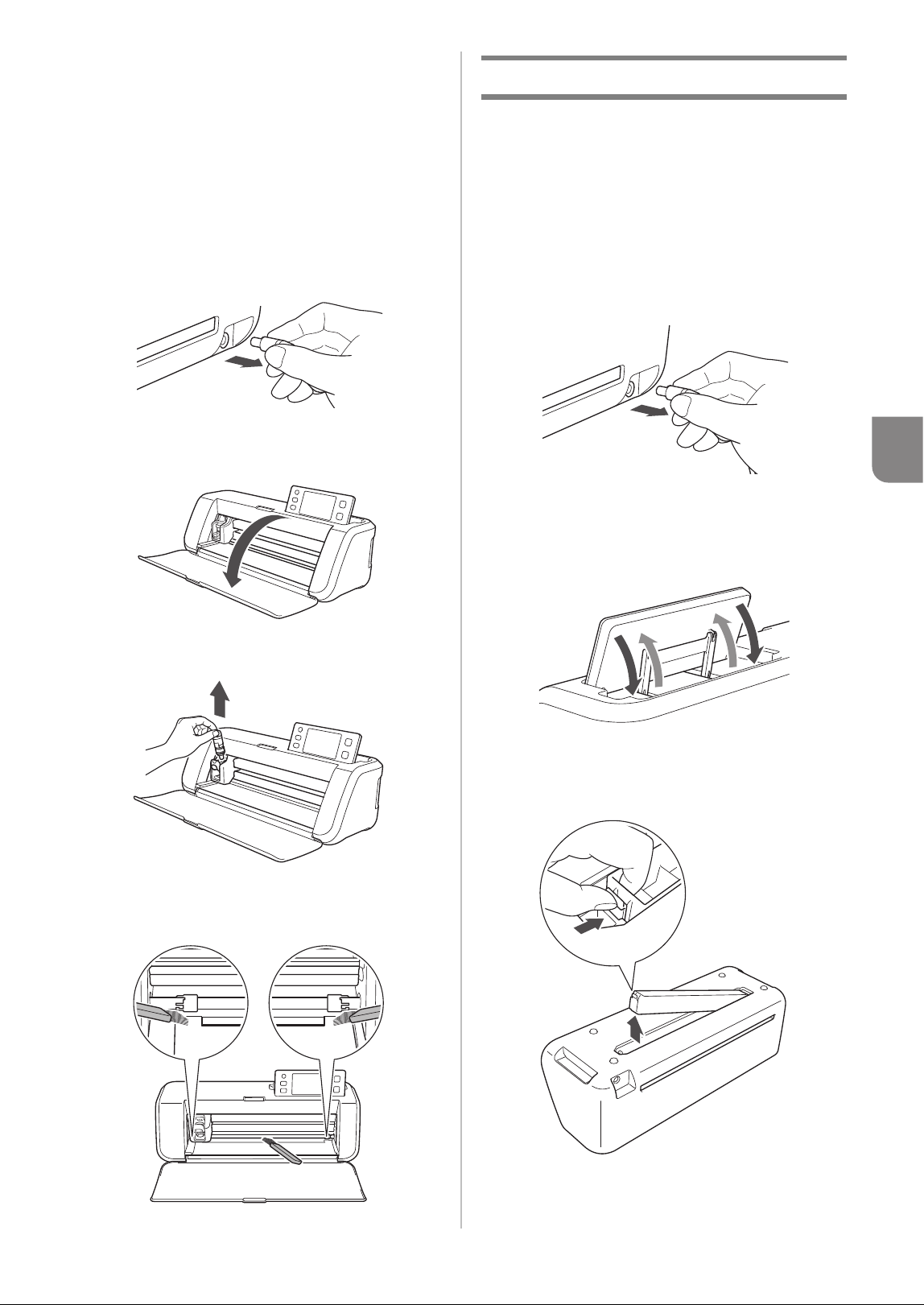
59
5
■ Cleaning Inside the Machine
If there are vertical lines or blank areas in the
scanned image, lint or dust may have accumulated
in the machine. The Lint may also attach to the
surface of the feed rollers, preventing a mat to be
loaded or unloaded correctly. Use a soft brush to
clean it.
a Turn off the machine and disconnect the power
cord plug, and then disconnect the AC adapter
plug from the DC power jack on the back of the
machine.
b Open the cover on the front of the machine.
c Remove the holder from the carriage.
d Use a commercially available brush to clean
around the feed slot and the carriage.
Cleaning the Scanner Glass
If there are unwanted vertical lines in the scanned
image or if scanning cannot be done cleanly, the
scanning area of the scanner may have become
dirty. Clean the scanner glass at the bottom of the
machine.
a Turn off the machine and disconnect the power
cord plug, and then disconnect the AC adapter
plug from the DC power jack on the back of the
machine.
b Store away the operation panel.
First raise the panel until it is vertical, and then lower
and store it away.
c While pushing in the tab at the bottom of the
machine, pull up on the cover.
a
b
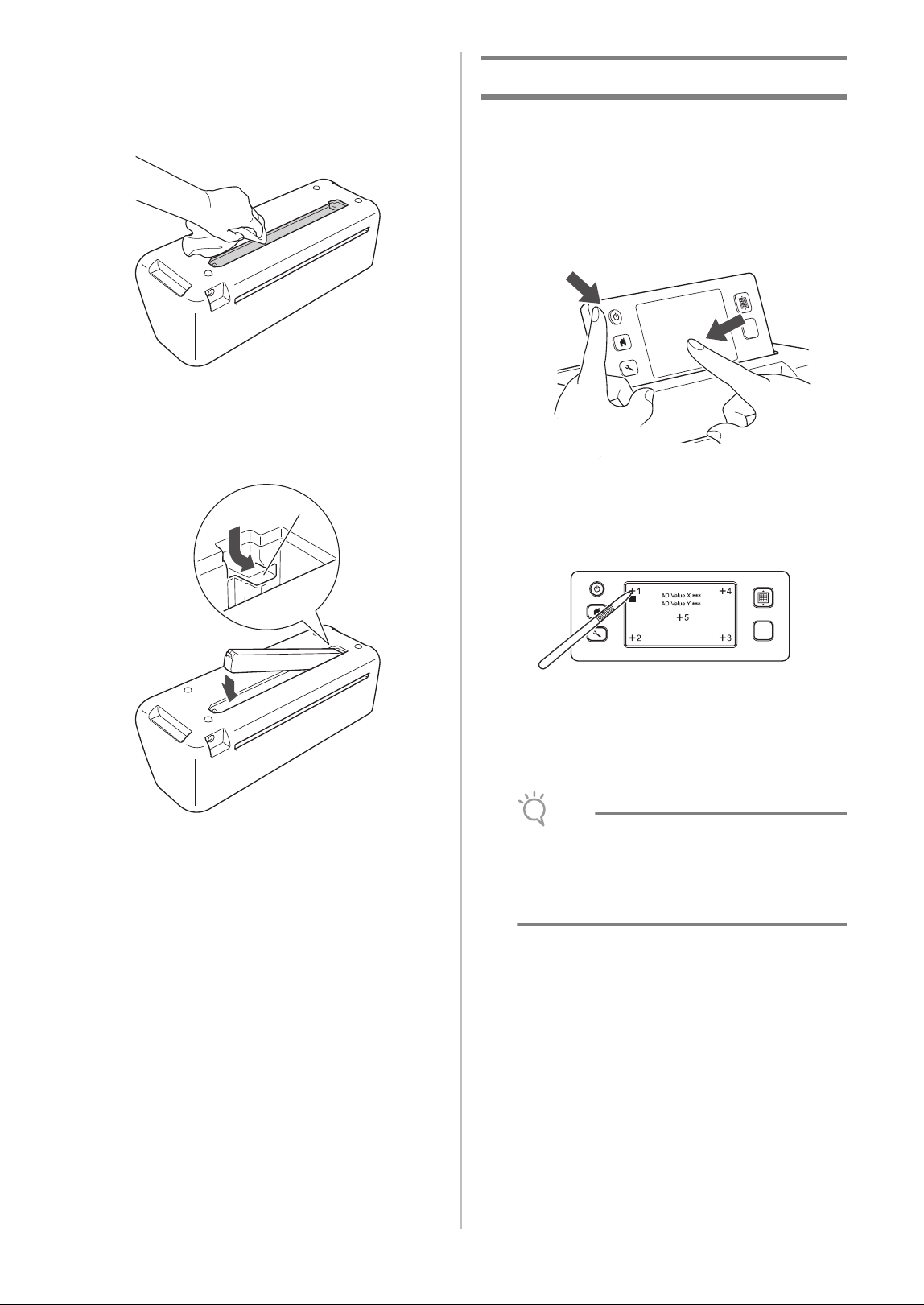
60
d Dampen a soft lint-free cloth with water and
firmly wring it out, and then wipe the scanner
glass at the inside on the bottom of the
machine.
e Fit the tab on the cover into the notch of the
installation slot, and then attach the cover to
the machine.
a Notch
f After cleaning, perform a test scan.
Adjusting the Screen
If the screen does not respond correctly when you
touch a key (the machine does not perform the
operation or performs a different operation), follow
the steps below to make the proper adjustments.
a Holding your finger on the LCD screen, turn
the main power to off and back to on.
X The touch panel adjustment screen is displayed.
b Using the included touch pen, lightly touch the
center of each +, in order from 1 to 5.
X After completing the touch panel adjustment, the
message “SUCCESS” appears on the screen.
c Turn the main power to off, then turn it back to
on.
Note
• If you finish the screen adjustment and the
screen still does not respond correctly, or if you
cannot do the adjustment, contact the retailer
who sold you this machine or the nearest
authorized service center.
a
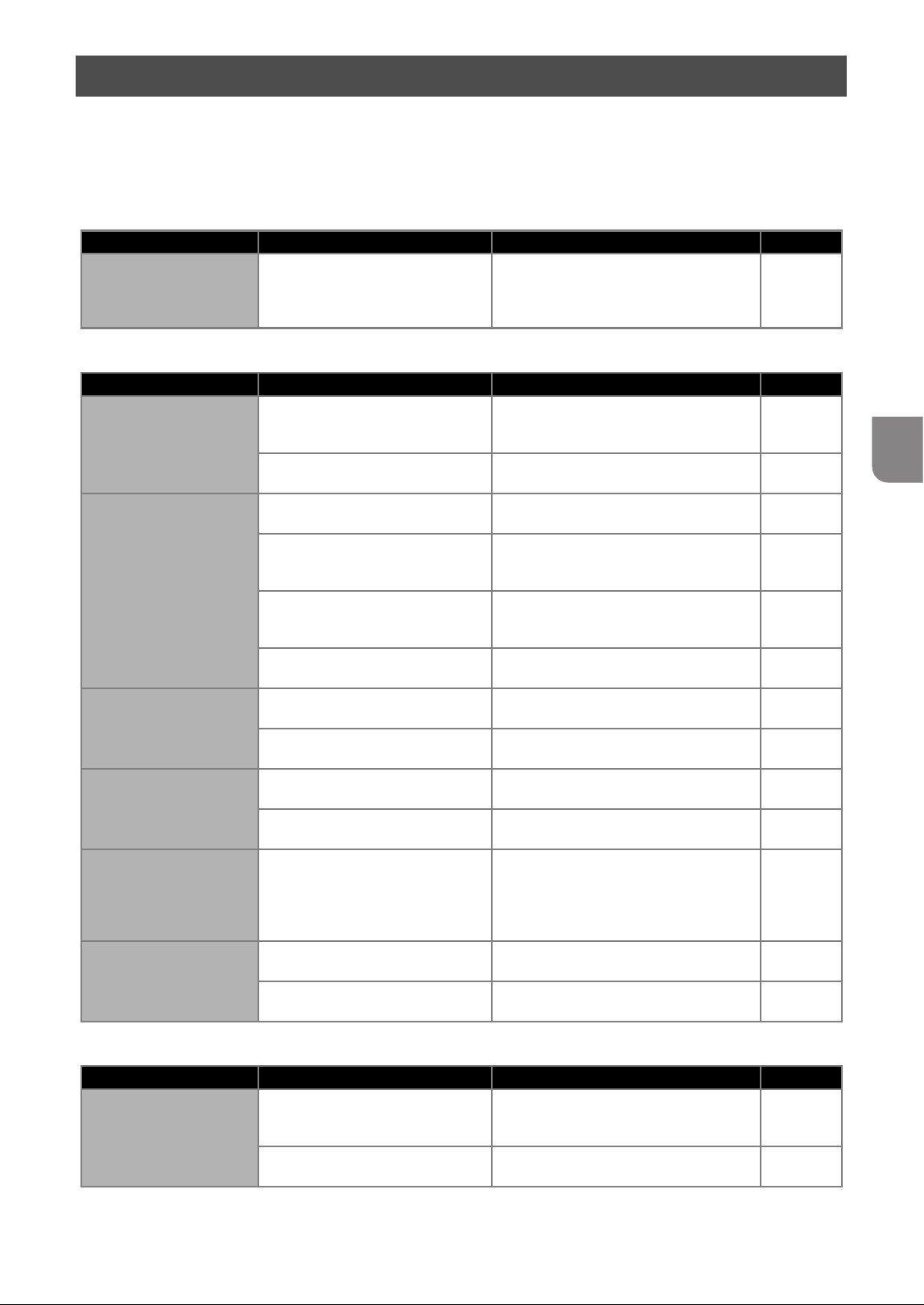
61
5
If the machine stops operating correctly, check the following possible problems before requesting service.
You can solve most problems by yourself. If you need additional help, the Brother Solutions Center offers the
latest FAQs and troubleshooting tips. Visit us at http://solutions.brother.com.
If the problem persists, contact the retailer who sold you this machine or the nearest authorized service center.
Power Supply
Mat
Paper/Fabric Jam
TROUBLESHOOTING
Symptom Possible Causes (or Results) Solutions Reference
The machine cannot be
turned on.
The AC adapter is not correctly
connected to the machine.
Check that the AC adapter is connected
to the machine and that the power cord is
connected to the AC adapter and
electrical outlet.
page 10
Symptom Possible Causes (or Results) Solutions Reference
The mat cannot be
inserted.
When the mat was inserted, it was
not placed under the feed rollers.
Insert the mat so that it is placed under
the feed rollers on the left and right sides
of the feed slot.
page 20
The mat was not loaded using the
“Feed” button.
Lightly insert the mat into the feed slot,
and then press the “Feed” button.
page 20
The mat cannot be
recognized.
The dotted marks on the part of the
mat that is inserted are dirty.
Clean the dotted marks on the mat and
their surrounding area.
page 58
The dotted marks on the part of the
mat that is inserted are hidden by
material that was attached.
Attach the material while keeping it within
the adhesive area of the mat.
page 12
The mat was inserted so that the
side with the material attached is
facing down.
Insert the mat so that the side with the
material attached is facing up.
page 20
The scanner glass is dirty.
Clean the scanner glass from the bottom
of the machine.
page 59
The mat is fed in at an
angle.
The mat was inserted into the feed
slot at an angle.
Press the “Feed” button to feed out the
mat, and then re-insert it straight in.
page 20
page 21
The corners of the mat are deformed
(bent).
Replace the mat with a new one. page 56
The material to be cut/
drawn or original to be
scanned cannot be
attached to the mat.
The material extends from the
adhesive area of the mat.
Attach the material while keeping it within
the adhesive area of the mat.
page 12
The mat’s adhesive strength has
decreased.
Replace the mat with a new one. page 56
The mat cannot be fed
out.
The material to be cut/drawn or
original to be scanned is jammed in
the feeding mechanism in the
machine.
Press the “Feed” button while the mat is
being inserted to feed it out.
If the mat does not feed out, turn off the
machine, and then carefully pull out the
mat.
page 21
When the mat is
inserted, the attached
material peels off.
The mat is not level due to the
weight of the material.
With your hands, hold the mat level when
inserting it.
page 20
The mat’s adhesive strength has
decreased.
Replace the mat with a new one. page 56
Symptom Possible Causes (or Results) Solutions Reference
The mat cannot be fed.
There is an obstruction around the
slot at the back of the machine.
Maintain space around the slot at the
back of the machine so that the mat can
be fed out.
page 9
The surface where the machine is
installed is uneven.
Place the machine on a flat, even surface. —
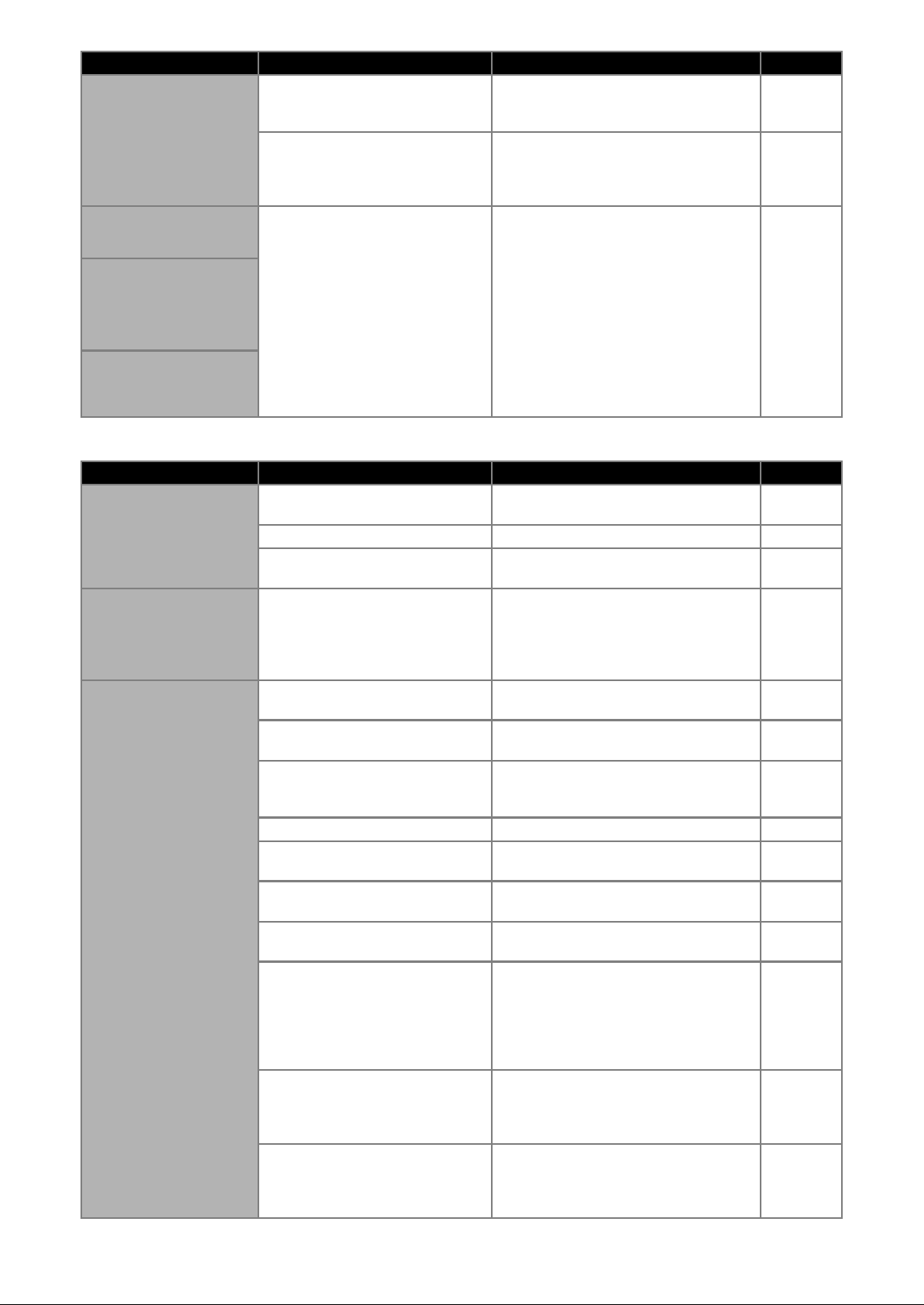
62
Cutting
The mat or the material
catches on a feed roller
when the mat is being
inserted.
The mat’s adhesive strength has
decreased, or the material is not
secured.
Press the “Feed” button to feed out the
mat, and then replace the mat with a new
one.
page 21
page 56
The material extends from the
adhesive area of the mat.
Press the “Feed” button to feed out the
mat, and then attach the material while
keeping it within the adhesive area of the
mat.
page 12
page 21
The mat or the material
catches on a feed roller
during cutting/drawing.
- The mat’s adhesive strength has
decreased, or the material is not
secured.
- The material extends from the
adhesive area of the mat.
Press the “Start/Stop” button to stop the
operation. Follow the instructions on the
screen, and press the “Feed” button to
feed out the mat.
If the mat does not feed out, turn off the
machine, remove the holder, and then
manually feed out the mat.
After feeding out the mat, replace it with a
new one or attach the material while
keeping it within the adhesive area of the
mat.
page 12
page 21
page 56
The mat is fed in at an
angle and is not fed
during cutting/drawing.
The material to be cut/
drawn or original to be
scanned peels off during
cutting/scanning.
Symptom Possible Causes (or Results) Solutions Reference
The material being cut
catches on the tip of the
cutting blade.
Dust or lint has accumulated in the
holder.
Clean the holder. page 58
The blade is worn. Replace the blade with a new one. page 56
The material being cut is
incompatible with this machine.
Replace the material with one compatible
with this machine.
page 11
The machine stopped
while an operation is
being performed.
For safety, the machine stops
operating if the panel is touched
while cutting or drawing.
Follow the instructions in the message
that appears in the screen. Touch the
“OK” key to move the carriage to its initial
position. Load the mat and perform the
operation again.
—
Not all of the material to
be cut is cut. Some
areas remain uncut.
A blade appropriate for the material
being cut is not used.
Use a blade appropriate for the material
being cut.
page 12
The blade extension from the blade
holder is too little.
Remove the holder from the carriage, and
then adjust the blade extension.
page 18
The mat’s adhesive strength has
decreased, or the material is not
secured.
Replace the mat with a new one. page 56
The blade is worn. Replace the blade with a new one. page 56
The material is incompatible with
this machine.
Replace the material with one compatible
with this machine.
page 11
The cutting pressure (“Cut
Pressure”) is incorrect.
Adjust the setting for “Cut Pressure” in the
settings screen.
page 18
page 23
Dust or lint has accumulated in the
holder.
Clean the holder. page 58
The spacing between arranged
patterns is too small.
Rearrange the patterns to slightly separate
them.
Set the number to “3” or higher in the
“Pattern Interval” setting, and then
rearrange the patterns or perform the auto
layout function.
page 24
page 38
Neither a high tack adhesive fabric
support sheet or iron-on fabric
appliqué contact sheet is used for
fabric cutting.
Attach a high tack adhesive fabric support
sheet to a mat or affix an iron-on fabric
appliqué contact sheet to a fabric before
cutting it.
page 13
page 15
A fabric is not firmly attached to a
mat that has a high tack adhesive
fabric support sheet on its adhesive
side.
Firmly attach the fabric to the mat
pressing the handle of the included
spatula across the surface of the fabric.
page 14
Symptom Possible Causes (or Results) Solutions Reference
63
5
Drawing
Scanning
Not all of the material to
be cut is cut. Some
areas remain uncut.
An iron-on fabric appliqué contact
sheet is not firmly attached to a
fabric.
Iron the entire contact sheet to affix it
firmly to the wrong side of the fabric.
page 16
There are deep cuts
completely through the
mat.
The blade extension from the blade
holder is too much.
Remove the holder from the carriage, and
then adjust the blade extension.
page 18
The cutting pressure (“Cut
Pressure”) is incorrect.
Adjust the setting for “Cut Pressure” in the
settings screen.
page 18
page 23
Symptom Possible Causes (or Results) Solutions Reference
The drawn line is thicker
(thinner) than intended.
The drawing speed (“Draw Speed”)
or drawing pressure (“Draw
Pressure”) is incorrect.
Adjust the settings for “Draw Speed” and
“Draw Pressure” in the settings screen.
To draw thicker lines, increase the
drawing pressure. To draw thinner lines,
decrease the drawing pressure.
To draw thicker lines, reduce the drawing
speed. To draw thinner lines, increase the
drawing speed.
After adjusting the settings, perform a trial
drawing operation.
page 23
Symptom Possible Causes (or Results) Solutions Reference
Unwanted images are
scanned.
The scanning area is incorrectly
specified.
In “Scan to USB” mode, specify the paper
size with the “Scan Size” setting.
page 54
In “Direct Cut” or “Scan to Cut Data”
mode, trim the image in the editing screen
after scanning.
page 48
page 51
Scanning cannot be
done cleanly (there are
lines in the scanned
image).
The scanner glass is dirty.
Clean the scanner glass from the bottom
of the machine.
page 59
The original to be scanned is dirty or
scratched.
In “Scan to Cut Data” mode, remove thin
lines or dirt in the image editing screen.
page 52
The lines printed on the
mat are scanned.
The original is transparent so the
lines printed on the mat are being
scanned.
In “Scan to Cut Data” mode, remove the
lines in the image editing screen.
page 52
The scanned image is
red.
When the optional scanning mat is
used, scanning is performed without
peeling off the blue tape.
Peel off the blue tape from the optional
scanning mat before scanning.
—
Symptom Possible Causes (or Results) Solutions Reference
64
The following table lists some of the messages that may appear while the machine is operating as well as their
corresponding solutions.
Perform the necessary operation according to the instructions in the message or the solution described here.
If the problem persists, contact the retailer who sold you this machine or the nearest authorized service center.
ERROR MESSAGES
Error Messages Causes / Solutions
A malfunction occurred. Turn the machine off, then on again. Turn the machine off, then on again.
Built-in memory is corrupted.
Initialize the memory.
The data on the machine’s memory is corrupted. Restart the
machine.
Cannot operate when there are too many patterns.
The message appears under the following conditions:
- There are 301 or more patterns being cut in the “Direct
Cut” mode.
- There are 301 or more patterns being saved as cutting
data in the “Scan to Cut Data” mode.
Reduce the number of patterns being used.
- There are too many cutting lines to be created after large
number of small patterns are scanned.
- There are too many light tone patterns to be converted to
two-tone (black and white) patterns while the image
detection level is being adjusted.
Scan images again after reducing the number of patterns
arranged in the original.
Cannot operate when there is no pattern.
There is no scanned image or lines for scanning.
Recheck the image to be scanned, and adjust the scanning
area, image detection level and “Delete Size” settings.
In addition, change the image drawn on the original to one
more easily scanned.
Character string is too long for the mat.
Reduce the number of characters so that the length of the
character string fits in the width of the 12-inch mat (maximum
possible width 297 mm).
Initialization of the blade position failed.
Turn the machine off.
Turn the machine off, then on again.
Initialization of the head failed.
Turn the machine off.
No more patterns can be added to this combination.
301 or more patterns cannot be combined. Reduce the
number of patterns.
No pattern in the effective area.
There is no pattern(s) to be cut out or drawn within the cutting
area.
To cut out or draw a pattern outside of the area, increase the
setting for “Cut Area”, or move the pattern(s) into the area
specified with “Cut Area” (page 23).
Not enough available memory to save the data. Delete a file from the machine’s memory or USB flash drive.
Not enough space on the mat.
Check pattern size, space on the mat, Cut Area (setting) or
Pattern Interval (setting).
Perform one of the following to arrange the patterns.
- Delete a pattern already arranged in the pattern layout
screen.
- Resize a pattern in the arrangement.
- Enlarge the setting for “Cut Area” (page 23).
- Reduce the spacing between arranged patterns using the
“Pattern Interval” setting.
Not enough space on the mat.
Max: 10 (example: calculated number)
Since there are too many patterns, they cannot be arranged.
Reduce the number of patterns to the maximum shown on
the screen.
OK to retrieve and resume previous memory?
To use data from the previous operation, touch the “OK” key.
(page 24)
Patterns cannot be unified.
Invalid pair was selected.
The message appears when you are unifying patterns.
Patterns with seam allowances and no seam allowances are
selected as pairs. Select patterns, all of which have either
seam allowances or no seam allowances.
65
5
Patterns cannot be welded.
There are some patterns which cannot accept or no overlaps.
The message appears when you are welding patterns.
- The patterns do not overlap. Rearrange them so the
selected patterns overlap. Unifying the pattern, instead,
can be an alternative editing method depending on your
project.
- A pattern that has a seam allowance is selected.
Deactivate the seam allowance setting and weld the
patterns.
- An open shape is selected as a pattern. Only closed
shapes can be welded. Unifying the pattern, instead, can
be an alternative editing method depending on your
project.
Patterns may overlap since seam allowance is set to large on
the machine.
When the seam allowance setting for a pattern becomes
larger than with a previous operation, the edges may overlap
nearby patterns. Adjust the seam allowance setting.
Otherwise, increase the spacing between patterns.
Scanning error occurred.
Turn the machine off.
Turn the machine off, then on again, and then try performing
the operation again.
The data cannot be deleted.
The USB flash drive being used may not be usable with this
machine. If unplugging the USB flash drive and performing
the operation again causes the message to appear again,
replace the USB flash drive. For information about USB flash
drive compatible with this machine, visit our website
“ http://solutions.brother.com ”.
The data cannot be read.
The data cannot be saved.
The mat cannot be recognized.
The mat will unload.
A mat that cannot be recognized has been inserted. If a mat
designed specifically for this machine is not being used, use
the specially designed mat.
Clean the dotted marks at the edge of the mat and their
surrounding area. If the mat is still not recognized, replace
the mat with a new one.
There are some patterns which cannot add seam allowance.
The seam allowance settings cannot be specified for
complex pattern shapes. Select a pattern with a simple
shape.
Expanding the seam allowance to 2 mm or more may help.
There are some patterns which cannot set cutting distance
from the outline.
The cutting distance cannot be specified for complex pattern
shapes. Select a pattern with a simple shape.
There is a pattern included that cannot be saved to USB
media.
Save the pattern in the machine’s memory.
Depending on the pattern, it may not be possible to save it to
a USB flash drive.
There is a pattern out of the effective area. The pattern
cannot be cut or drawn.
OK to continue?
There is a pattern(s) outside of the cutting area.
If the pattern(s) outside of the cutting area need(s) not to be
cut out or drawn, continue the operation.
To cut out or draw the pattern(s) outside of the area, increase
the setting for “Cut Area”, or move the pattern(s) into the area
specified with “Cut Area” (page 23).
This data is too complicated and cannot be converted.
When your are welding or unifying patterns:
Reduce the number of patterns arranged or change the
patterns to ones with simple designs.
This mat cannot be used.
The mat is one that cannot be used with the function being
performed. Replace the mat.
Error Messages Causes / Solutions
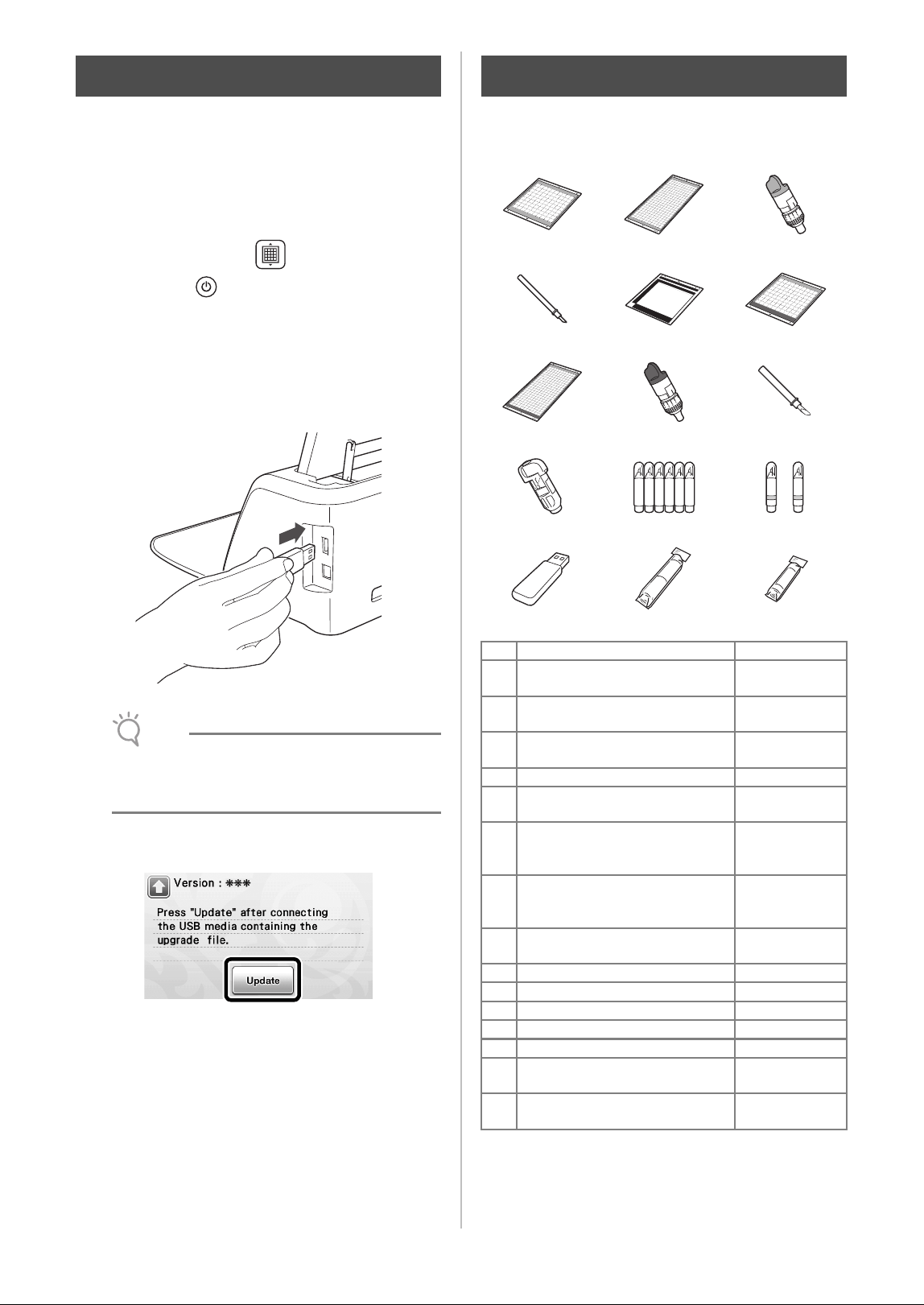
66
Using a USB flash drive, the machine’s software can
be upgraded. For upgrade information, refer to
details posted on the Brother Solutions Center (http://
solutions.brother.com/). If an upgrade file is posted,
download the file, and then upgrade the machine
according to the following procedure.
a While holding down in the operation
panel, press to turn on the machine.
b Plug the USB flash drive containing the upgrade
file into the USB port on this machine.
The USB flash drive must not contain any data other
than the upgrade file. Otherwise, the machine may
stop operating correctly.
Note
• This machine is incompatible with a USB hub.
Plug the USB flash drive directly into the USB
port.
c Touch the “Update” key to start the upgrade.
X When upgrading is finished, the completion
message appears.
d Unplug the USB flash drive from the port.
e Turn the machine off, then on again.
The following are available as optional accessories
to be purchased separately.
* Contact the retailer who sold you this machine or
the nearest authorized service center.
UPGRADING THE SOFTWARE OPTIONAL ACCESSORIES
1. 2. 3.
4. 5. 6.
7. 8. 9.
10. 11. 12.
13. 14. 15.
No. Part Name Part Code
1
Low tack adhesive mat 12" × 12"
(305 mm × 305 mm) (turquoise)
CAMATP12
2
Low tack adhesive mat 12" × 24"
(305 mm × 610 mm) (turquoise)
CAMATP24
3
Standard cut blade holder
(turquoise) (with no blade)
CAHLP1
4 Standard cut blade CABLDP1
5
Scanning mat 12" × 12"
(305 mm × 305 mm)
CAMATS12
6
Standard mat 12" × 12"
(305 mm × 305 mm)
(turquoise and purple)
CAMATF12
7
Standard mat 12" × 24"
(305 mm × 610 mm)
(turquoise and purple)
CAMATF24
8
Deep cut blade holder (purple)
(with no blade)
CAHLF1
9 Deep cut blade CABLDF1
10 Pen holder CAPENHL1
11 Color pen set CAPEN1
12 Erasable pen set CAPEN2
13 Contents USB *
14
Iron-on fabric appliqué contact
sheet (white backing)
CASTBL1
15
High tack adhesive fabric support
sheet (light blue backing)
CASTBL2

67
A
Advanced pattern cutting ............................................27
Auto shutdown
.....................................................23, 24
B
Background .................................................................23
Background scanning
..................................................38
Basic pattern cutting
...................................................25
Blade extension
....................................................18, 22
Buzzer sound
...............................................................23
C
Carriage ..................................................................9, 19
Character input functions
............................................40
Cleaning
.......................................................................58
Cut area
................................................................23, 35
Cut pressure
..................................................18, 23, 27
Cut speed
.............................................................23, 27
Cutting around drawings
.............................................44
Cutting blade replacement
..........................................56
Cutting line
...................................................................50
D
DC power jack ........................................................9, 59
Deep cut blade
............................................................17
Direct cut
.....................................................................47
Draw pressure
......................................................23, 44
Draw speed
...........................................................23, 44
Draw/cut selection screen
...........................................27
Drawing functions
........................................................43
E
Error messages ............................................................64
F
Feed slot .................................................................9, 20
H
High tack adhesive fabric support sheet .....................13
Holder lock lever
.....................................................9, 19
Holder setting
..............................................................19
Home screen
........................................................11, 25
I
Image editing screen ............................................50, 52
Image trim screen
.................................................48, 49
Iron-on fabric appliqué contact sheet
.........................15
L
Language .....................................................................23
Layout editing functions
..............................................35
Layout Interval
.............................................................24
Low tack adhesive mat
................................................12
M
Main power on/off .......................................................10
Main power switch
................................................11, 25
Mat loading
..................................................................20
Mat unloading
..............................................................21
O
Opening screen ....................................................11, 24
Operation panel
......................................................9, 10
Optional accessories
...................................................66
Outline distance
...........................................................49
Outlining and framing
..................................................49
P
Parts and functions ........................................................9
Pattern category selection screen
...............................25
Pattern editing functions
..............................................33
Pattern editing screen
...........................................25, 33
Pattern layout screen
............................................26, 35
“Pattern” mode
..............................................................8
Pattern piece editing screen
.................................29, 34
Pattern piece list screen
..............................................28
Pattern selection screen
.......................................25, 28
Pattern sizing screen
...................................................28
Pattern sub-category selection screen
........................28
Picture editing
..............................................................52
R
Recalling ......................................................................41
Replacement criteria
....................................................56
Required material condition (cutting/drawing)
.............11
Required material condition (scanning)
................47, 54
S
Saving ..........................................................................41
“Scan” mode
..........................................................8, 47
Scan to cut data
..........................................................50
Scan to USB
................................................................54
Seam allowance
.............................................24, 34, 44
Selecting multiple patterns
..........................................31
Settings screen
............................................................23
Software upgrade
........................................................66
Standard cut blade
......................................................12
Standard scale settings
...............................................18
T
Touch screen calibration .............................................60
Trial cutting
..................................................................19
Troubleshooting
...........................................................61
U
Unifying (grouping multiple patterns) ...........................36
Unit
..............................................................................23
USB port
..........................................................9, 41, 66
W
Welding (merging the outlines of multiple patterns) ....36
INDEX



XF5251-001
1
English
891-Z01
Printed in China
Please visit us at http://solutions.brother.com where you can get
product support and answers to frequently asked questions (FAQs).