Chapter 1.
Getting Started
Product Features 2
Before You Start 4
Contents 7
Safety Precautions 8
Proper Posture During Computer Use 18
Important Safety Information 20
Replacement Parts and Accessories 22
Regulatory Compliance Statements 24
WEEE SYMBOL INFORMATION 35
Overview 36
Turning the Computer On and Off 42
2
Product Features
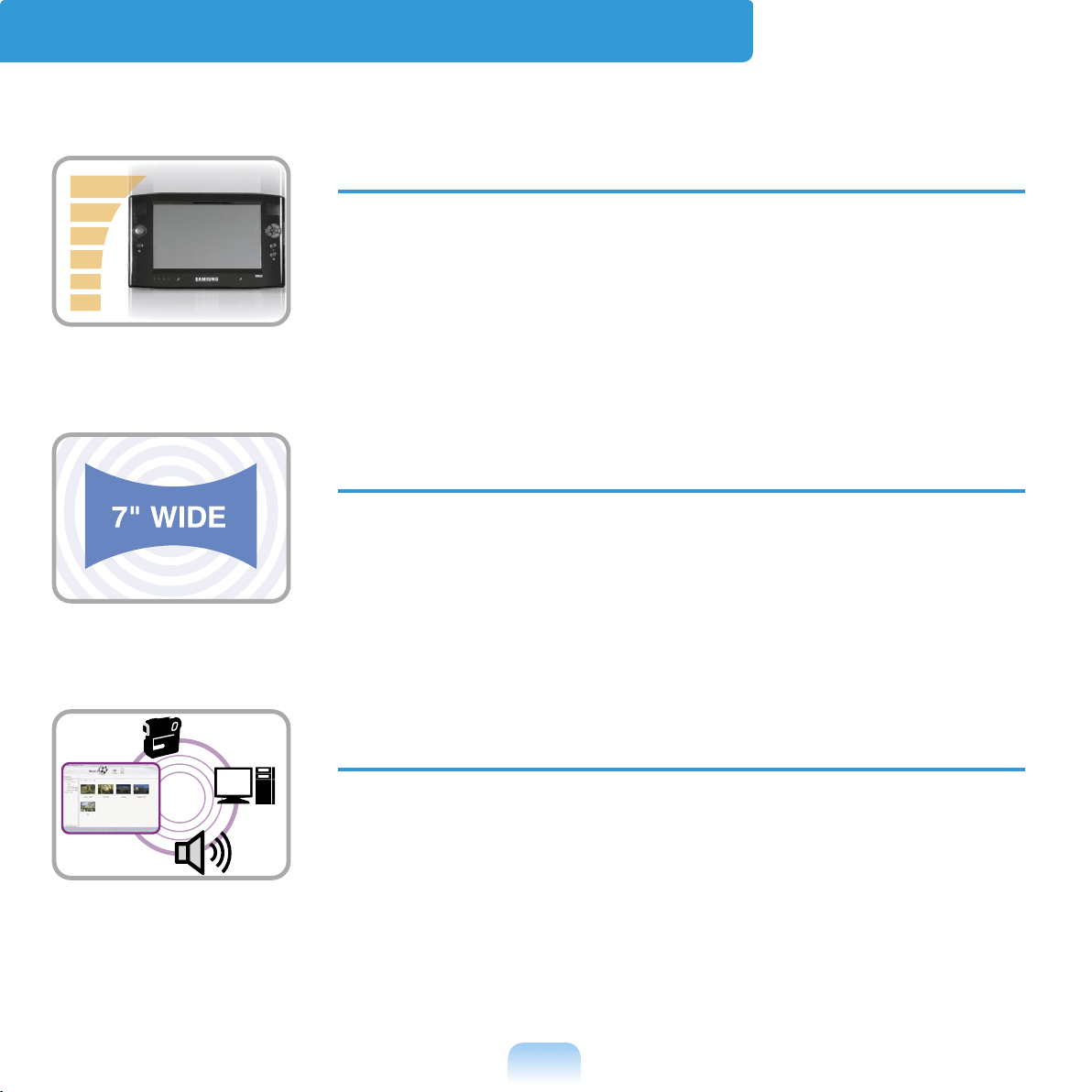
Small but Strong UMPC (Ultra Mobile PC)
● Intel Celeron M ULV Processor /
Intel Pentium M ULV Processor
● 256MB~Up To 1GB DDR2 Memory
● 1.8”, 20~60GB High-Capacity Hard Disk Drive
7” WVGA TFT LCD
● Basic Resolution of 800x480 Pixels, Maximum Resolution of
2048x1536 Pixels (when an external display is connected)
● Auto Scaler (Automatic Resolution Adjustment) Function to
Support High Resolution Output
● Easy-to-Use Touch Screen usable with your fingers.
Powerful Multimedia Functions
● Various Multimedia Programs Such as Play AVStation etc.
● 2 Built-in Array Microphones for Higher Audio Recording
Quality Sound
3
Multiple Network Support
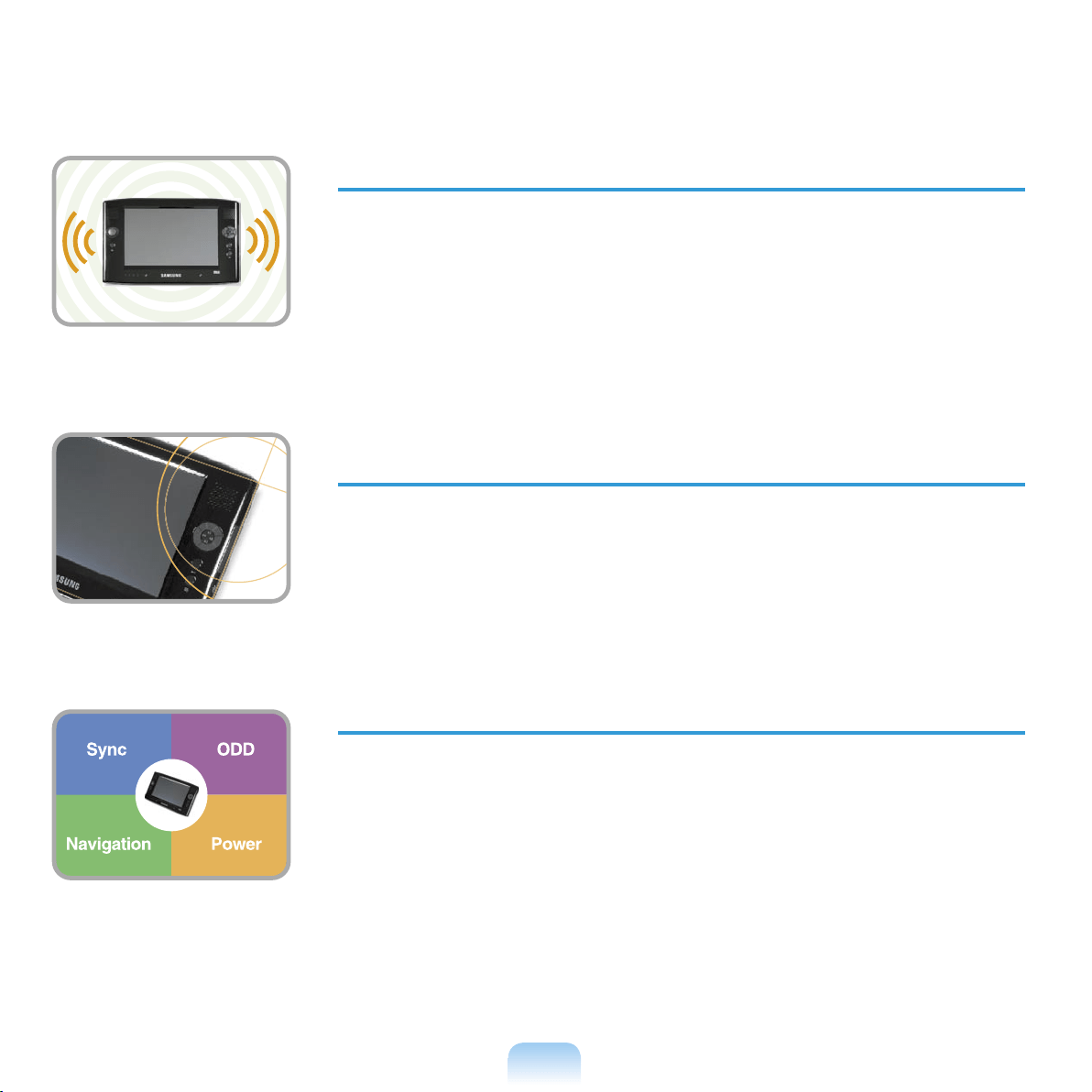
● Wired LAN, Wireless LAN, Bluetooth (Optional)
● Resolves Space Restrictions through the Wireless
Communication Function
Compact, Light-Weight Design for Portability /
Polished Design
● A mere 779g (Without the Bluetooth modules)
● High-Gloss Front Panel
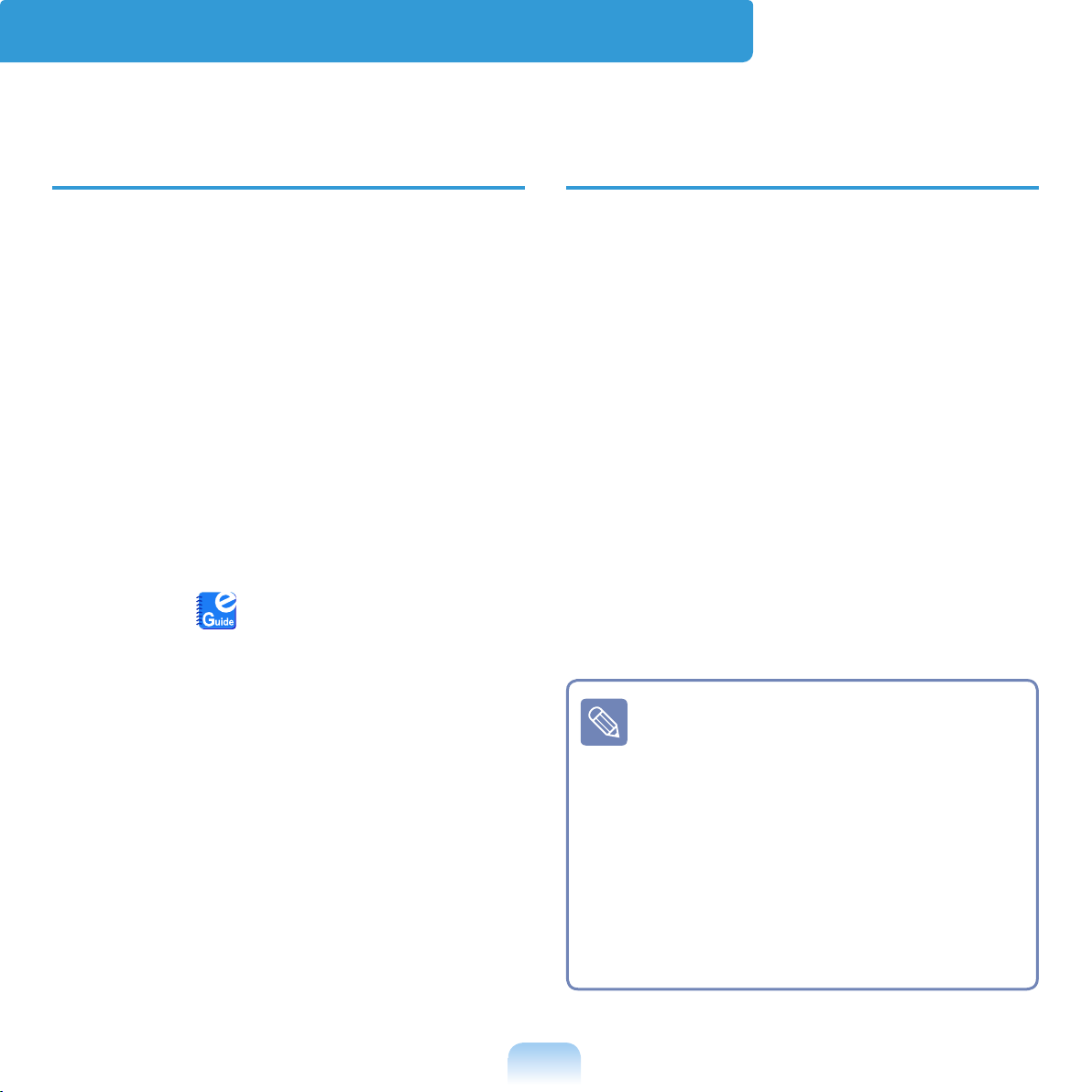
Optional Accessories for Additional Convenience
● USB Data Cable Enabling Data Exchange with another PC.
● USB External ODD, Ultra-Slim USB External Keyboard
● Power Bank to Extend Use Time
4
Before You Start
Before reading the User Guide, first check the following information.
User Guide Information
This product is supplied with an Getting
Started Guide, and a User Guide.
You can even more easily and conve-
niently use the computer by using any of
the guides depending on your needs.
Getting Started Guide
This guide is provided so that you can
conveniently refer to this guide when us-
ing the computer for the first time after
purchasing it.
User Guide
The document you are currently read-
ing is the User Guide. You can read it by
double-tapping the icon on the Desktop.
This document includes the computer
functions, how to use the functions, and
how to use the program.
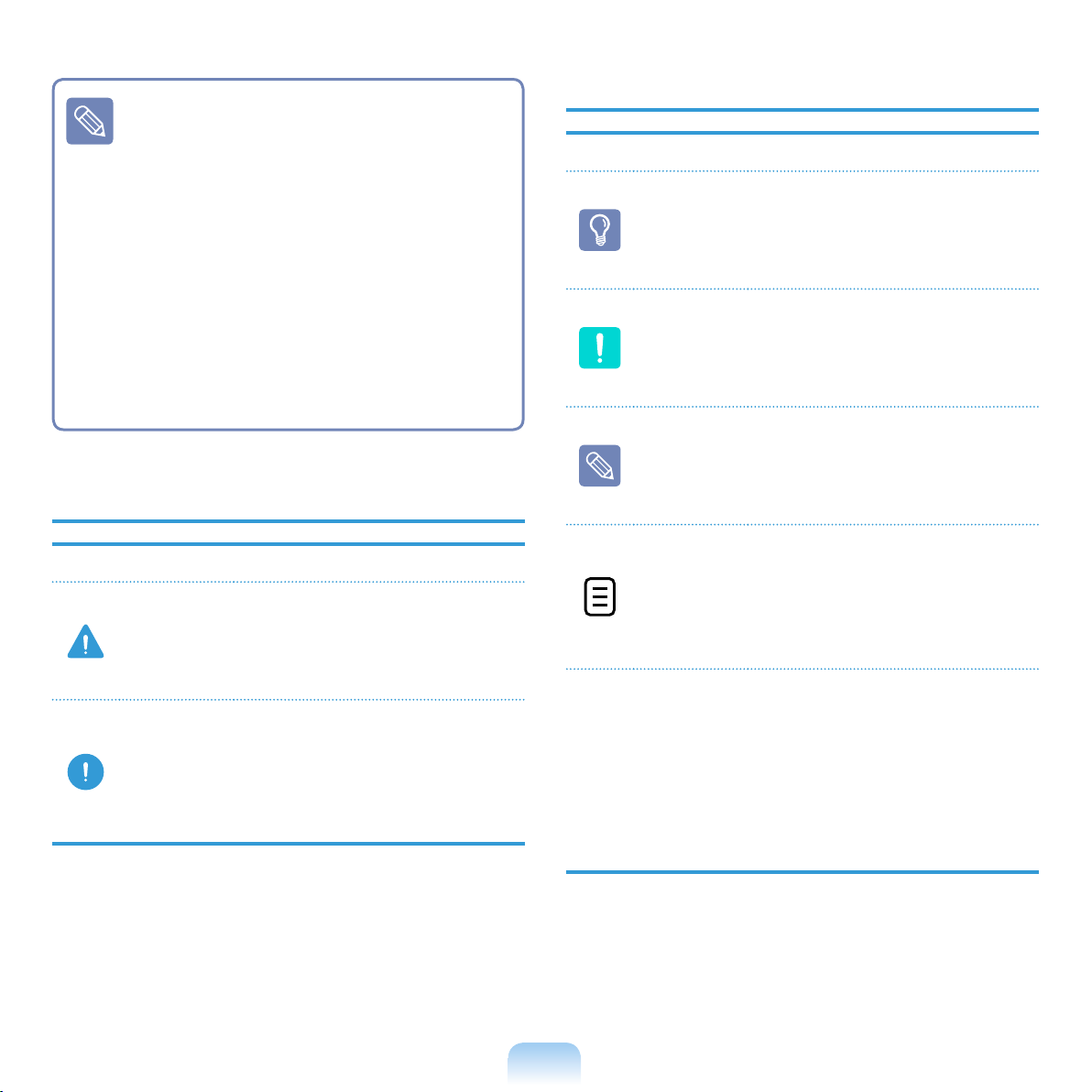
Utilizating the User Guide
Be sure to read the Safety Precautions
before using the computer.
For basic usage of the computer refer to
the additionally supplied Getting Started
Guide.
Refer to the User Guide for the proce-
dures to use the computer.
Using the Index of the User Guide, you
can easily find any information you are
looking for.
Using the Glossary of the User Guide,
you can easily find meanings for technical
terms.
If a problem occurs, refer to the Q & A
included in the User Guide.
■ Some devices and software re-
ferred in the User Guide may not
be provided and/or changed by
upgrade.
Note that the computer environ-
ment referred in the User Guide
may not be the same as your own
environment.
■ The image used for the cover and
text of the User Guide may not be
the same as actual ones.
5
■ This guide decribes procedures
for both the mouse and the stylus
pen together
.
A
‘Click’ in this manual refers to
a ‘Single-tap’ for the Stylus Pen.
■ The figures in this guide are pro-
vided assuming that your operat-
ing system is Windows V
ista. The
figures are subject to change.
■ The User guide supplied with
computer may be varied depend-
ing on model.
Safety Precaution Notations
Icon Notation Description
Warning
Failing to follow instruc-
tions marked with this
symbol, may cause per-
sonal injury and or fatality.
Caution
Failing to follow instruc-
tions marked with this
symbol, may cause slight
injury to yourself or dam-
age your property.
Text Notations
Icon Notation Description
Before
You
Start
Content included in this
section includes informa-
tion required before using
a function.
Caution
Content included in this
section includes informa-
tion required about the
function.
Note
Content included in this
section includes helpful
information to use the
function.
Page XX
This notation represents
the page number you can
refer to for information
about related functions or
as a reference.
Start >
All Programs
> Samsung >
User Guide >
User Guide
This represents a menu
path to run a program.
Click the Start button and
then select All Programs
> Samsung > User
Guide > User Guide in
this order from the menu.

6
Copyright
© 2007 Samsung Electronics Co., Ltd.
Samsung Electronics Co., Ltd. owns the
copyright of this manual.
No part of this manual may be repro-
duced or transmitted in any form or by
any means, electronic or mechanical,
without the consent of Samsung Elec-
tronics Co., Ltd.
The information in this document is sub-
ject to change without notice due to im-
proving the performance of the product.
Samsung Electronics shall not be li-
able for any data loss. Please take care
to avoid losing any important data and
backup your data to prevent any such
data loss.
Precautions for
Operating System Support
The operating system (OS) installed on
this product is the latest version of Win-
dows Vista. You cannot install an operat-
ing system other than Windows Vista as
well as any unauthorized copy of Win-
dows Vista.
Example) When trying to install Windows
Vista Home Premium when Windows
Vista Home Basic is already installed.
Other operating systems (Windows 98,
Windows ME, Windows 2000, Windows
2003 server, UNIXand LINUX, other Win-
dows Vista versions, etc.) other than the
operating system already installed on this
computer are not supported.
If a problem occurs because of the instal-
lation of another operating system, the
company will not provide technical sup-
port, a replacement or refund, and if our
service engineer visits you due to this
problem, a service charge will be applied.
In addition, installing a program that does
not support Windows Vista, may cause
the program to not work properly.
In this case, ask the corresponding soft-
ware manufacturer about the problem.
If you request our services to resolve a
problem caused by incompatible soft-
ware, a service charge will be applied.
7
Contents
Chapter 1. Getting Started
Product Features 2
Before You Start 4
Contents 7
Safety Precautions 8
Proper Posture During Computer Use 18
Important Safety Information 20
Replacement Parts and Accessories 22
Regulatory Compliance Statements 24
WEEE SYMBOL INFORMATION 35
Overview 36
Turning the Computer On and Off 42
Chapter 2. Using the Computer
Stylus Pen 45
Entering Text 48
Using the Buttons 53
CF Card Slot 59
Connecting a Monitor 60
Adjusting the Volume 64
Chapter 3. Using Microsoft Windows Vista
About Microsoft Windows Vista 66
Windows Vista Screen Layout 69
Control Panel 79
Chapter 4. Using the Network
Wired Network 92
Wireless Network 95
Using the Easy Network Manager 98
Bluetooth 102
Chapter 5. Using Applications
Introducing Programs 109
CyberLink PowerDVD 1
12
Samsung Update Plus 1
14
Play AVStation 1
16
AVStation Now 130
Using Origami Experience 132
Chapter 6. Settings
BIOS Setup 135
Setting a Boot Password 140
Changing the Boot Priority 143
Battery 144
Chapter 7. Windows Media Center
About Package Contents
and the Program Guide 151
Connecting and Setting Up Media Center 152
Using Media Center 156
Chapter 8. Appendix
Using Samsung Magic Doctor 169
Using McAfee SecurityCenter 170
Reinstalling Software 171
Reinstalling Windows Vista 173
Q & A 177
Intel Media Sharing Software Information 194
Product Specifications 195
Glossary 199
Index 202
Contact SAMSUNG WORLD WIDE 203
8
Safety Precautions
For your security and to prevent damage, please read the following safety instructions carefully.
Since this is commonly applied to Samsung Computers, some figures may differ from actual ones.
Warning
Failing to follow instructions marked with this symbol may cause personal injury and even
fatality.
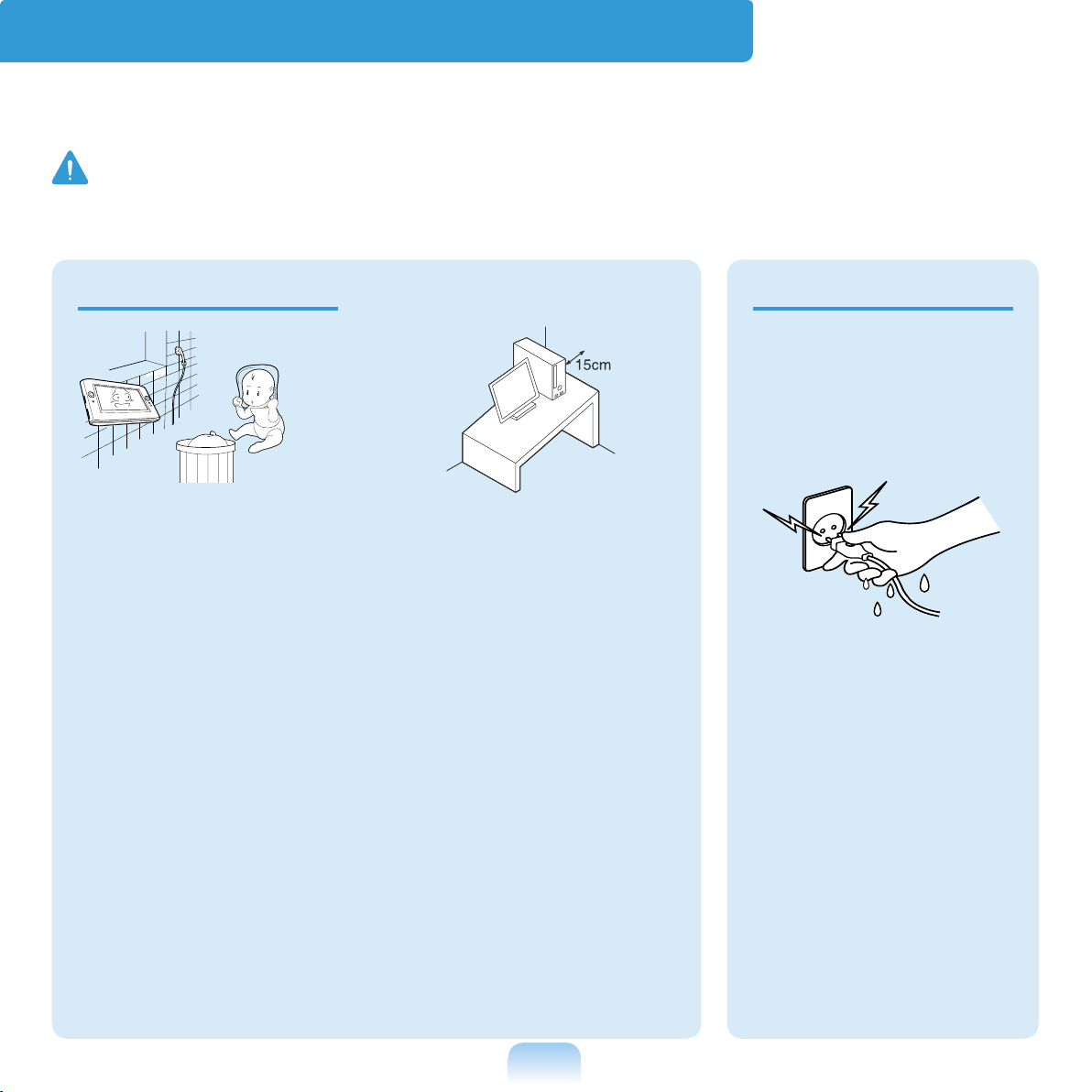
Installation Related Power Related
Do not install the prod-
uct in places exposed to
humidity such as a bath-
rooms.
There is a danger of electric
shock. Use the product within
the operating conditions
specified in the Manufactur-
ers User Guide.
Keep the plastic bags out
of the reach of children.
There is a danger of suffoca-
tion.
Keep a distance of 15cm
or more between the
computer and the wall
and do not place any ob-
jects between them.
This may increase the in-
ternal temperature of the
computer and may cause an
injury.
Do not install the computer
on a slant or a place prone
to vibrations, or avoid us-
ing the computer in that
location for a long time.
This increases the risk that a
malfunction or damage to the
product will occur.
Do not touch the mains
plug or power cord with
wet hands.
There is a danger of elec-
tric shock.
Do not exceed the stan-
dard capacity (voltage/
current) of a multi-plug
or power outlet exten-
sion when using it for
the product.
There is a danger of elec-
tric shock or fire hazard.
The power plug and
wall outlet figures may
differ depending on the
country specifications
and the product model.
9
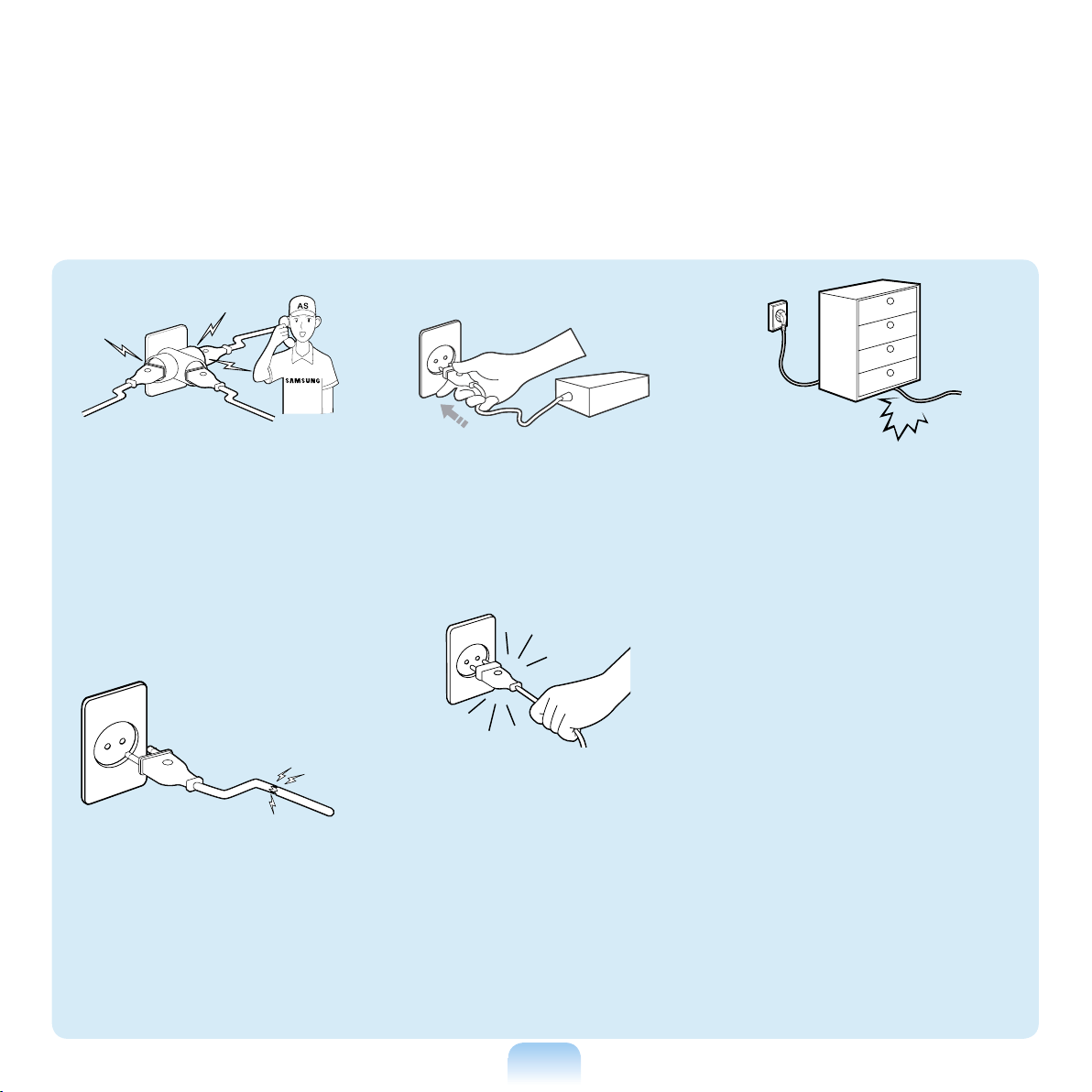
If the power cord or pow-
er outlet makes a noise,
disconnect the power
cord from the wall outlet
and contact a service
center.
There is a danger of elec-
tric shock or fire hazard.
Do not use a damaged
or loose mains plug or
power cord or power
outlet.
There is a danger of elec-
tric shock or fire hazard.
Plug the power cord
firmly into the power out-
let and AC adapter.
Failing to do so may cause
fire hazard.
Do not unplug the power
cord out by pulling the
cable only.
If the cord is damaged, it
may cause electric shock.
Do not bend the power
cord excessively or do
not place a heavy object
over the power cord. It is
especially important to
keep the power cord out
of reach of infants and
pets.
If the cord is damaged, it
may cause electric shock
or fire.
Use a wall outlet or multi-
plug with a grounding
part.
Failing to do so may cause
electric shock hazard.
10
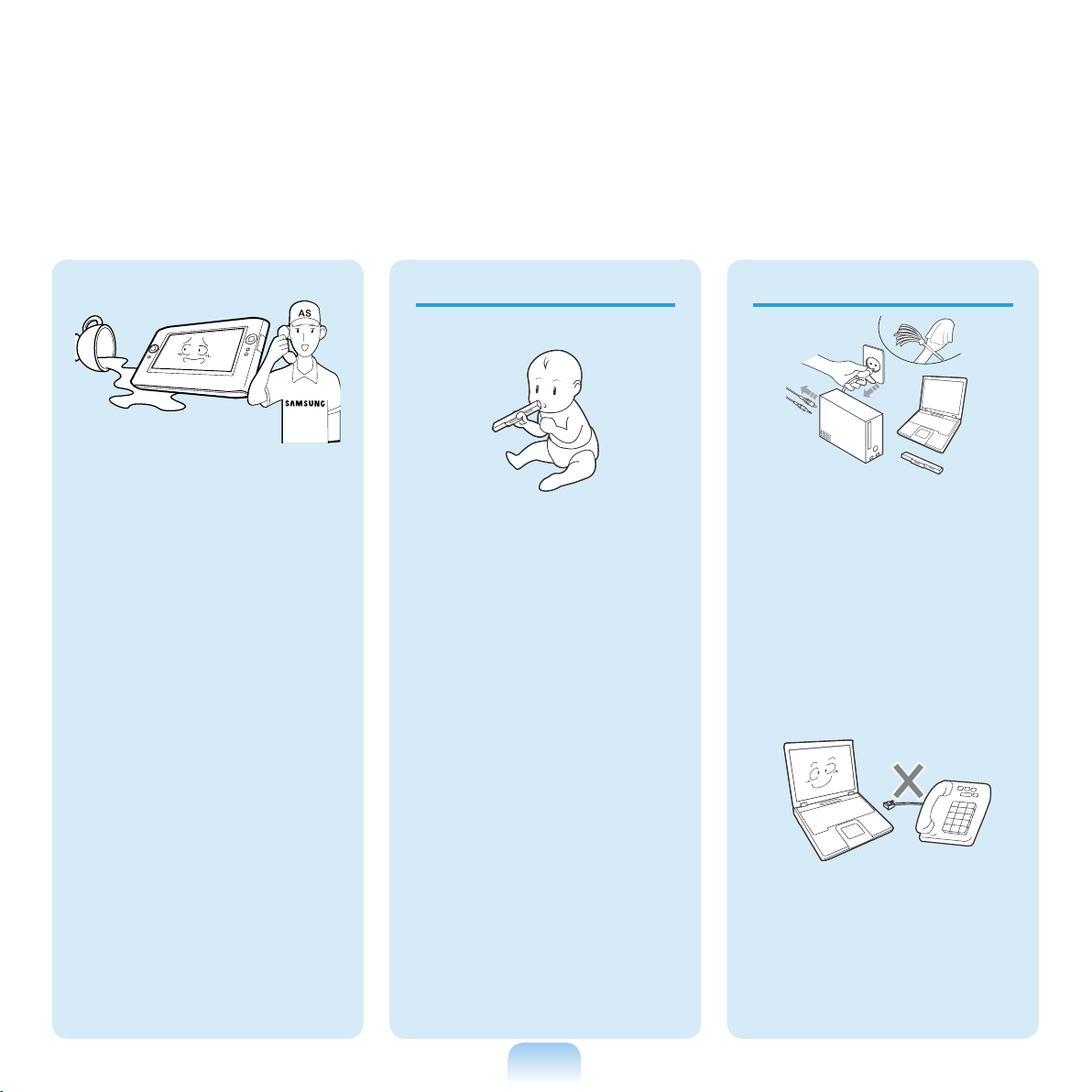
Keep the battery out of
the reach of infants and
pets, as they could put
the battery into their
mouths.
There is a danger of elec-
tric shock or choking.
Battery Usage Related
If water or another sub-
stance enters the power
input jack, AC adapter
or the computer, dis-
connect the power cord
and contact the service
center.
Damage to the device
within the computer may
cause electric shock or
fire hazard.
Usage Related
Disconnect all cables
connected to the com-
puter before cleaning it.
If you are using a note-
book computer, remove
the battery.
There is a danger of elec-
tric shock or damage to
the product.
Do not connect a phone
line connected to a digi-
tal phone to the modem.
There is a danger of a
electric shock, fire or
damage to the product.
11
Upgrade Related
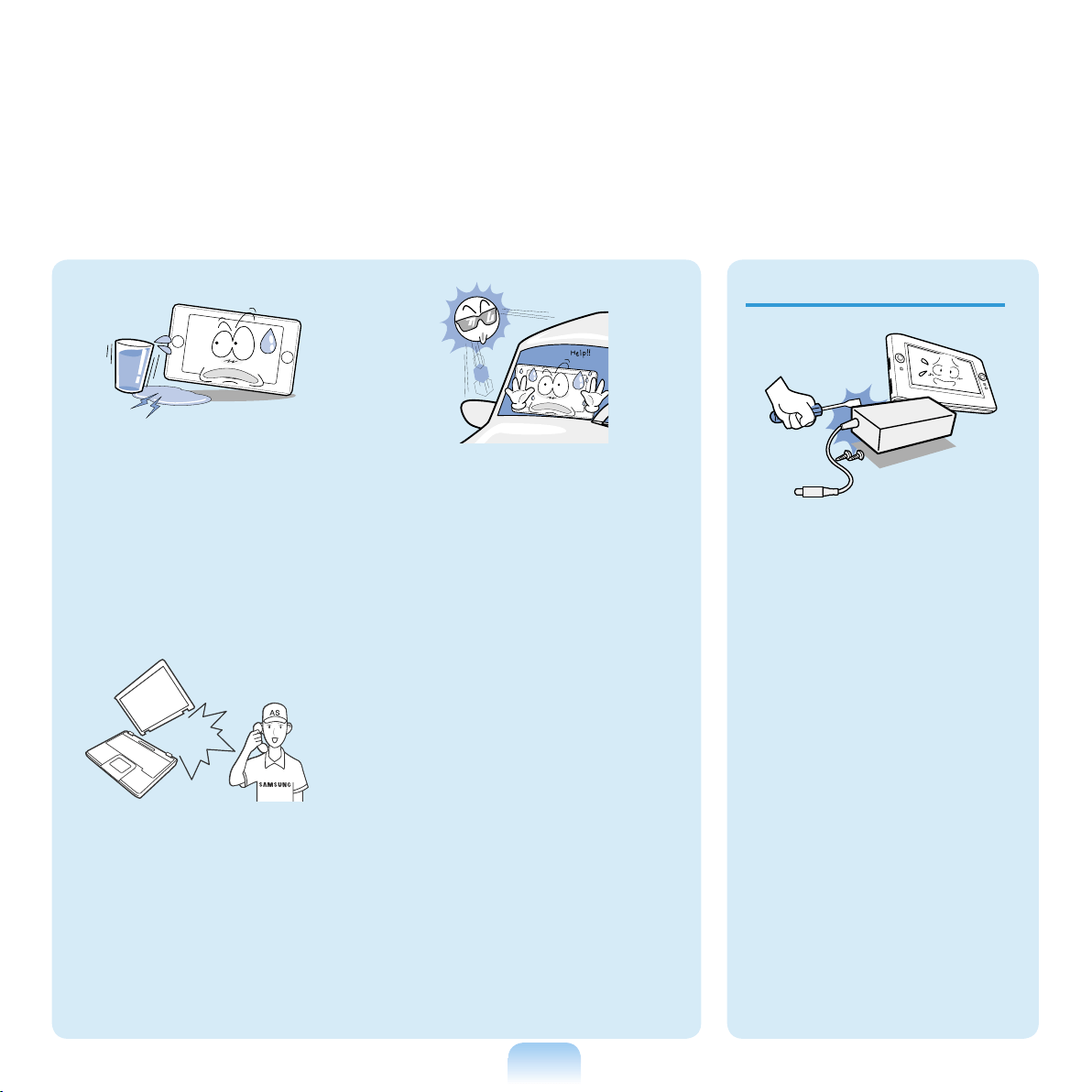
Never disassemble the
power supply or AC
adapter.
There is a danger of elec-
tric shock.
When removing the
RTC (Real Time Clock)
battery, keep it out of
the reach of children as
they could touch and/or
swallow it.
There is a danger of
choking. If a child has
swallowed it, contact a
doctor immediately.
Do not place any con-
tainer filled with water or
chemicals over or near
the computer.
If water or chemicals en-
ter the computer, this may
cause fire or electric shock.
If the computer is broken
or dropped, disconnect
the power cord and con-
tact a service center for a
safety check.
Using a broken computer
may cause electric shock
or fire hazard.
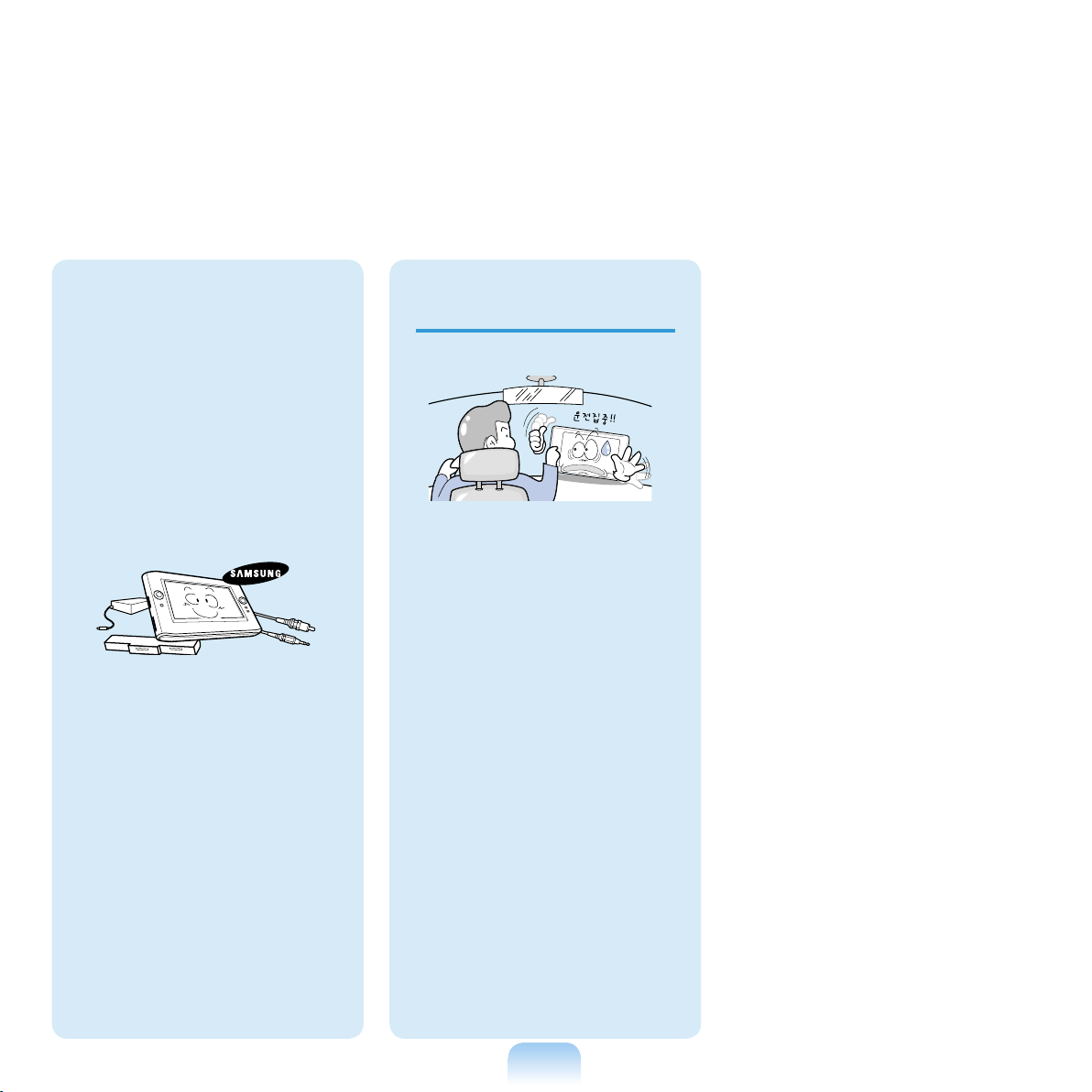
Avoid direct sunlight
when the computer is in
an air-tight location such
as inside a vehicle.
There is a danger of a fire
hazard. The computer may
overheat and also present
opportunity to thieves.
12
Use only authorized
parts (multi-plug, bat-
tery and memory) and
never disassemble
parts.
There is a danger of
damaging the product,
electric shock or fire
hazard.
Shut down the com-
puter and disconnect
all cables before disas-
sembling the computer.
If there is a modem,
disconnect the phone
line. If you are using
a notebook computer,
make sure to remove
the battery.
Failing to do so, may
cause electric shock.
Custody and
Movement Related
Follow the instructions
for the relevant location
(e.g. airplane, hospital,
etc.) when using a wire-
less communication
device (wireless LAN,
Bluetooth, etc.).

13
Caution
Failing to follow instructions marked with this symbol may cause slight injury or damage to the
product.
Installation Related Battery Usage Related
Do not block the ports
(holes), vents, etc. of
the product and do not
insert objects.
Damage to a component
within the computer may
cause electric shock or
fire.
When using the com-
puter with it lying on its
side, place it so that the
vents face upwards.
Failing to do so, may
cause the internal tem-
perature of the computer
to rise and the computer
to malfunction or halt.
Do not place a heavy
object over the prod-
uct.
This may cause a prob-
lem with the computer. In
addition, the object may
fall and cause injury, or
damage the computer.
Dispose of worn-out bat-
teries properly.
■ There is a danger of fire
or explosion.
■ The battery disposal
method may differ de-
pending on your country
and region. Dispose of
the used battery in an
appropriate way.
Do not throw or disas-
semble the battery and
do not put it into water.
This may cause an injury,
fire or explosion.
Use only a battery autho-
rized by Samsung Elec-
tronics.
Failing to do so may cause
an explosion.
Avoid contact with metal
objects such as car keys
or clips when keeping or
carrying a battery.
Contact with a metal may
cause excessive current
and a high temperature
and may damage the bat-
tery or cause a fire.
Charge the battery ac-
cording to the instruc-
tions in the manual.
Failing to do so, may
cause and explosion or fire
from damage to the prod-
uct.
Do not heat the battery
or expose it to heat (e.g.
inside a vehicle during
the summer).
There is a danger of explo-
sion or fire.

14
Usage Related
Do not place a candle,
lighted cigar, etc. over or
on the product.
There is a danger of fire.
Make sure to have the
product tested by a safety
service engineer after
repairing the product.
Authorised Samsung Re-
pair Centers will carry out
safety checks after a repair.
Using a repaired product
without testing it for safety
might cause electric shock
or fire.
In case of lightning, im-
mediately turn the system
off, disconnect the power
cord from the wall outlet
and line do not use a mo-
dem or phone.
There is a danger of electric
shock or fire.
Connect only permitted
devices to the connectors
or ports of the computer.
Failing to do so, may cause
electric shock and fire.
Close the LCD panel only
after checking if the note-
book computer is turned
off.
The temperature may rise
and it may cause overheat-
ing and deformation of the
product.
Do not press the Eject
Button while the Floppy
Disk/CD-ROM drive is in
operation.
You might lose data and
the disk might be suddenly
ejected and could cause an
injury.
Take care not to drop the
product while using it.
This may cause personal
injury or loss of data.
Do not contact the anten-
na with electricity facility
such as the power outlet.
There is a danger of electric
shock.
When handling computer
parts, follow the instruc-
tions on the manual sup-
plied with the parts.
Failing to do so, may cause
damage to the product.
If the computer emits
smoke, or there is a burn-
ing smell, disconnect
the power plug from the
wall outlet and contact
a service center. If your
computer is a note-book

15
Upgrade Related
computer, make sure to
remove the battery.
There is a danger of fire.
Do not use a damaged or
modified CD/Floppy Disk.
There is a danger of dam-
aging the product or per-
sonal injury.
Do not insert your fingers
into the PC Card Slot.
There is a danger of injury
or electric shock.
Use recommended com-
puter cleansing solu-
tion when cleaning the
product and only use the
computer when it is com-
pleted dried.
Failing to do so may cause
electric shock or fire.
Emergency disk eject
method using paperclip
should not be used while
the disk is in mothion.
Make sure to use the
emergency disk eject
method only when the
Optical Disk Drive is
stopped.
There is a danger of injury.
Do not place your face
close to the Optical Disk
Drive tray when it is oper-
ating.
There is a danger of injury
due to an abrupt ejection.
Check CDs for cracks
and damage prior to use.
It may damage the disc
and cause disorder of de-
vice and injury of user.
Take care when touch-
ing the product or
parts.
The device may be dam-
aged or you may be
injured.
Take care not to throw
or drop a computer part
or device.
This may cause injury or
damage to the product.
Make sure to close the
computer cover before
connecting the power
after a reassembly.
There is a danger of
electric shock if your
body touches an internal
part.

16
Use parts authorized
by Samsung Electron-
ics only.
Failing to do so, may
cause fire or damage
the product.
Never disassemble or
repair the product by
yourself.
There is a danger of
electric shock or file.
To connect a device
that is not manufac-
tured or authorized by
Samsung Electronics,
enquire at your service
center before connect-
ing the device.
There is a danger of
damaging the product.
Custody and Movement Related
When moving the prod-
uct, turn the power off
and separate all con-
nected cables first.
The product might be
damaged or users may trip
over the cables.
For long periods of not
using the notebook
computer, discharge the
battery and preserve as
it is detached.
The battery will be pre-
served at its best condi-
tion.
Keep the Stylus Pen out
of reach of children.
hildren may injure them-
selves by swallowing it or
damaging their eyes.
Use a computer cleans-
ing solution when clean-
ing the product.
Using a cleansing solu-
tion or chemical that is not
developed for a computer
may damage the product.
Do not use or watch the
computer while driving a
vehicle.
This may cause a traffic
accident. Concentrate on
driving.

17
Cautions on Preventing Data Loss (Hard Disk Management)
Take care not to damage
the data on a hard disk
drive.
■ A hard disk drive is so
sensitive to external
impact that an external
impact may cause loss of
data on the surface of the
disk.
■ Take extra care, because
moving the computer or
an impact on the com-
puter when it is turned on
may damage the data of
the hard disk drive.
■ The company is not liable
for the loss of any data
caused by customer such
as the careless-ness us-
age or bad environmental
condition.
Causes that may damage
the data of a hard disk
drive and the hard disk
drive itself.
■ The data may be lost
when an external impact
is applied to the disk
while disassembling or
assembling the comput-
er.
■ The data may be lost
when the computer is
turned off or reset by a
power failure while the
hard disk drive is operat-
ing.
■ The data may be lost and
irrecoverable due to a
computer virus infection.
■ The data may be lost if
the power is turned off
while running a program.
■ Moving or causing an
impact to the computer
while the hard disk drive
is operating, may cause
files to be corrupted or
bad sectors on the hard
disk.
To prevent data loss due to damage to the hard disk
drive, please backup your data frequently.
LCD Bad Pixels
The limits of LCD manu-
facturing technology
permit a maximum of 4
abnormal or bad pixels,
which does not affect
the system performance.
This system may have
the same level of abnor-
mal or bad pixels as any
other company’s prod-
ucts.
Cleaning the LCD
When cleaning the LCD
panel, use only comput-
er specific cleaners with
a soft cloth, and lightly
wipe in one direction.
Pressing down hard may
damage the LCD.
LCD Related
18
Proper Posture During Computer Use
Maintaining a proper posture during computer use is very important to prevent physical harm.
The following instructions are about maintaining a proper posture during computer use de-
veloped through human engineering. Please read and follow them carefully when using the
computer.
Otherwise, the probability of (RSI: Repetitive Strain Injury) from repeated operations may
increase and serious physical harm may be caused.
The instructions in this manual have been prepared so that they can be applied
within the coverage of general users. If the user is not included in the coverage, the
recommendation is to be applied according to the user’s needs.
Since this is commonly applied to Samsung Computers, some figures may differ
from actual ones.
Proper Posture
■ Do not use the computer on your lap or
close to your skin for a long time.
There is a danger of burns due to the high
temperature of the computer.
■ To use the computer while talking over
the telephone, use the ear-microphone
phone.
When using the computer while holding a
phone over your shoulder and talking on
the phone, your posture becomes bad.
■ Keep frequently used work items within an
easy working range (where you can reach
them with your hands easily).elf.
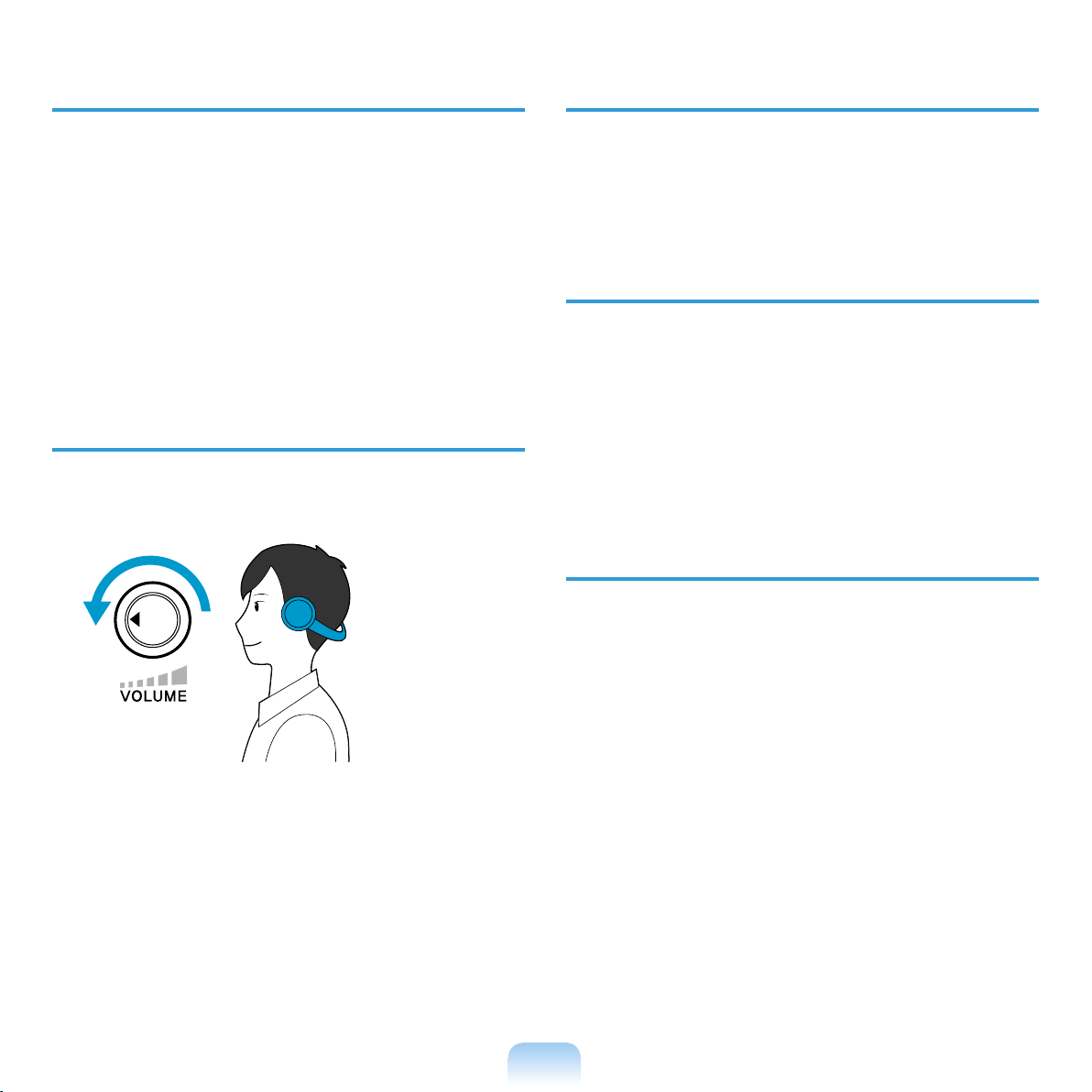
Eye Position
Keep a distance of at least 50cm between
the LCD and your eyes.
■ Adjust the height of the LCD screen so
that its top height is equal to or lower than
your eyes.
■ Avoid setting the LCD excessively bright.
■ Keep the LCD screen clean.
■ When wearing glasses, clean them before
using the computer.
19
Hand Position
■ It is recommended to connect and use an
external keyboard and mouse when using
the computer for a long time.
■ Do not hold the Stylus Pen with excessive
force.
■ Do not press the touch screen with exces-
sive force.
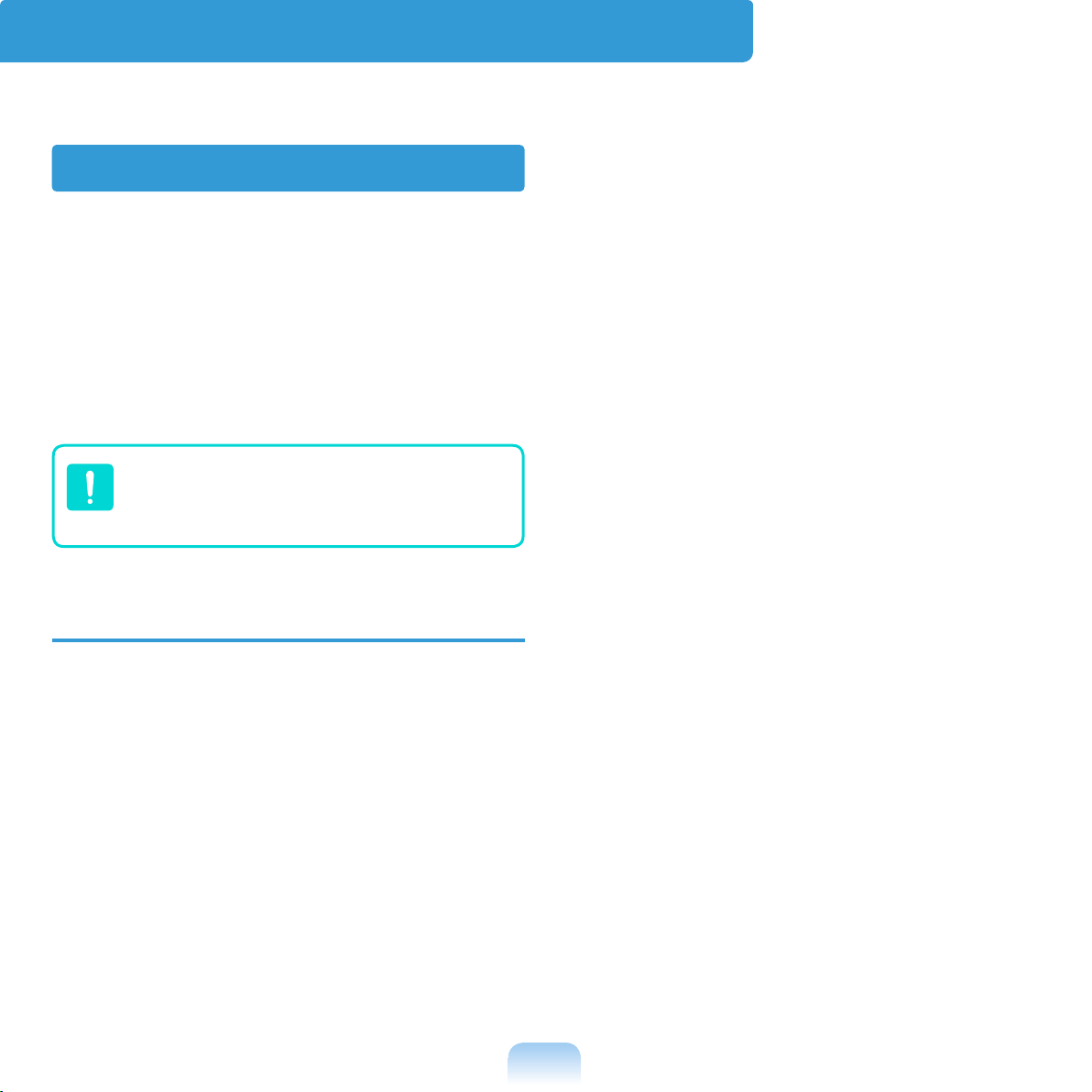
Volume Control
(Headphones and Speakers)
Check your volume first to listen to mu-
sic.
Click your
volume!!
■ Check if the volume is too loud before us-
ing headphones.
■ Do not turn the volume to the maximum
level right from the start. Instead, start
the volume at a low level and increase it
slowly while listening to the sound.
■ It is not recommended using headphones
for long periods of time.
Use Time (Break Time)
■ Take a break for 10 minutes or more after
a 50-minute period when working for more
than one hour.
Illumination
■ Do not use the computer in dark locations.
The illumination level for computer use
must be as bright so for reading a book.
■ Indirect illumination is recommended. Use
a curtain to prevent reflection on the LCD
screen.
Operation Condition
■ Do not use the computer in hot and humid
locations.
■ Use the computer within the allowed tem-
perature and humidity range specified in
the User Guide.
20
Your system is designed and tested to
meet the latest standards for safety of
information technology equipment. How-
ever, to ensure safe use of this product,
it is important that the safety instructions
marked on the product and in the docu-
mentation are followed.
Always follow these instructions to
help guard against personal injury
and damage to your system.
Setting Up your System
■ Read and follow all instructions marked
on the product and in the documentation
before you operate your system. Retain
all safety and operating instructions for
future use.
■ Do not use this product near water or a
heat source such as a radiator.
■ Set up the system on a stable work sur-
face.
■ The product should be operated only with
the type of power source indicated on the
rating label.
■ Ensure that the electrical outlet you are
using to power your equipment is easily
accessible in case of fire or short circuit.
■ If your computer has a voltage selector
switch, make sure that the switch is in the
proper posi-tion for your area.
■ Openings in the computer case are pro-
vided for ventilation. Do not block or cover
these openings. Make sure you provide
adequate space, at least 6 inches (15
cm), around the system for ventilation
when you set up your work area. Never
insert objects of any kind into the comput-
er ventilation openings.
■ Ensure that the fan vents on the bottom
of the casing are clear at all times. Do not
place the computer on a soft surface, do-
ing so will block the bottom vents.
■ If you use an extension cord with this sys-
tem, make sure that the total power rating
on the products plugged into the exten-
sion cord does not exceed the extension
cord power rating.
Important Safety Information
Safety instructions

21
Care During Use
■ Do not walk on the power cord or allow
anything to rest on it.
■ Do not spill anything on the system. The
best way to avoid spills is to not eat or
drink near your system.
■ Some products have a replaceable CMOS
battery on the system board. There is
a danger of explosion if the CMOS bat-
tery is replaced incorrectly. Replace the
battery with the same or equivalent type
recommended by the manufacturer.
■ When the computer is turned off, a small
amount of electrical current still flows
through the computer. To avoid electrical
shock, always unplug all power cables,
remove the battery and modem cables
from the wall outlets before cleaning the
system.
■ Unplug the system from the wall outlet
and refer servicing to qualified personnel
if:
– The power cord or plug is damaged.
– Liquid has been spilled into the system.
– The system does not operate properly
when the operating instructions are fol-
lowed.
– The system was dropped or the casing
is damaged.
– The system performance changes.
■ LAMP(S) INSIDE THIS PRODUCT
CONTAIN MERCURY AND MUST BE
RECYCLED OR DISPOSED OF ACCORDING
TO LOCAL, STATE OR FEDERAL LAWS.
For
details see lamprecycle.org, eise.org, or
call 1-800-Samsung.
The Instruction On
Safety Operation of NotePC
1
When installing and operating
devices please refer to safety require-
ments in the user guide.
2
Devices can be used only with the
equipment specified in the technical
specifications of the devices.
3
If any smell of burning or smoke
from the computer the unit should be
switched off and battery removed.
The unit should be checked by a
qualified technician before reuse.
4
Service and repair of devices should
be carried out by authorized service
centers.
22
To reduce the risk of fire, use only
No. 26 AWG or larger telecommuni-
cations line cord.
Contact the Samsung Helpline for in-
formation on how to dispose of batter-
ies that you cannot use or recharge any
longer.
Follow all local regulations when dispos-
ing of old batteries.
THERE IS A RISK OF EXPLOSION
IF BATTERY IS REPLACED BY AN
INCORRECT TYPE. DISPOSE OF
USED BATTERIES ACCORDING TO
THE INSTRUCTIONS
Battery Disposal
All systems equipped with CD or DVD
drives comply with the appropriate safety
standards, including IEC 60825-1. The
laser devices in these components are
classified as “Class 1 Laser Products”
under a US Department of Health and
Human Services (DHHS) Radiation Per-
formance Standard. Should the unit ever
need servicing, contact an authorized
service location.
■ Laser Safety Note:
Use of controls or adjustments
or performance of procedures
other than those specifi
ed in this
manual may result in hazardous
radiation exposure.
To prevent
exposure to laser beams, do not
try to open the enclosure of a CD
or DVD drive.
■ Class 1M laser radiation when
operating part is open.
Do not view directly with optical
instruments.
■ Class 3B invisible laser radiation
when open.
A
void exposure to the beam.
Laser Safety
Replacement Parts and Accessories
Use only replacement parts and accessories recommended by manufacturer.
To reduce the risk of fire, use only
No. 26 AWG or larger telecommu-
nications line cord.
Do not use this product in areas
classified as hazardous. Such areas
include patient care areas of medi-
cal and dental facilities, oxygen rich
environments, or industrial areas.

23
The socket-outlet shall be installed near
the equipment and shall be easily acces-
sible.
Do not unplug the power cord out by
pulling the cable only.
Connect and Disconnect
the AC adapter
The power cord set (wall plug, cable and
AC adapter plug) you received with your
computer meets the requirements for use
in the country where you purchased your
equipment.
Power cord sets for use in other coun-
tries must meet the requirements of the
country where you use the computer.
For more information on power cord set
requirements, contact your authorized
dealer, reseller, or service provider.
Power Cord Requirements
General Requirements
The requirements listed below are ap-
plicable to all countries:
■ The length of the power cord set must be
at least 6.00 feet (1.8m) and a maximum
of 9.75 feet (3.0m).
■ All power cord sets must be approved by
an acceptable accredited agency respon-
sible for evaluation in the country where
the power cord set will be used.
■ The power cord set must have a minimum
current capacity of 7 A and a nominal
voltage rating of 125 or 250 volts AC, as
required by each country’s power system.
■ The appliance coupler must meet the
mechanical configuration of an EN 60
320/IEC 320 Standard Sheet C7 connec-
tor, for mating with appliance inlet on the
computer.

24
Regulatory Compliance Statements
Wireless Guidance
Low power, Radio LAN type devices (radio frequency (RF) wireless communication devices), operat-
ing in the 2.4 GHz Band, may be present (embedded) in your notebook system. The following section
is a general overview of considerations while operating a wireless device.
Additional limitations, cautions, and concerns for specific countries are listed in the specific country
sections (or country group sections). The wireless devices in your system are only qualified for use
in the countries identified by the Radio Approval Marks on the system rating label. If the country you
will be using the wireless device in, is not listed, please contact your local Radio Approval agency for
requirements. Wireless devices are closely regulated and use may not be allowed.
The RF field strength of the wireless device or devices that may be embedded in your notebook are
well below all international RF exposure limits as known at this time. Because the wireless devices
(which may be embedded into your notebook) emit less energy than is allowed in radio frequency
safety standards and recommendations, manufacturer believes these devices are safe for use. Re-
gardless of the power levels, care should be taken to minimize human contact during normal opera-
tion.
As a general guideline, a separation of 20 cm (8 inches) between the wireless device and the body,
for use of a wireless device near the body (this does not include extremities) is typical. This device
should be used more than 20 cm (8 inches) from the body when wireless devices are on and trans-
mitting. (This Statement is not applicable to UMPC(Ultra Mobile PC) such as PDA, Portable PC.)
This transmitter must not be collocated or operate in conjunction with any other antenna or transmit-
ter except the installed Bluetooth transmitter.
Some circumstances require restrictions on wireless devices. Examples of common restrictions are
listed below:
25
■ Radio frequency wireless communication can interfere with equipment on commercial air-
craft. Current aviation regulations require wireless devices to be turned off while traveling
in an airplane.
802.11B (also known as wireless Ethernet or Wifi) and Bluetooth communication devices
are examples of devices that provide wireless communication.
■ In environments where the risk of interference to other devices or services is harmful or
perceived as harmful, the option to use a wireless device may be restricted or eliminated.
Airports, Hospitals, and Oxygen or flammable gas laden atmospheres are limited ex-
amples where use of wireless devices may be restricted or eliminated. When in environ-
ments where you are uncertain of the sanction to use wireless devices, ask the applicable
authority for authorization prior to use or turning on the wireless device.
■ Every country has different restrictions on the use of wireless devices. Since your system
is equipped with a wireless device, when traveling between countries with your system,
check with the local Radio Approval authorities prior to any move or trip for any restric-
tions on the use of a wireless device in the destination country.
■ If your system came equipped with an internal embedded wireless device, do not operate
the wireless device unless all covers and shields are in place and the system is fully as-
sembled.
■ Wireless devices are not user serviceable. Do not modify them in any way. Modification
to a wireless device will void the authorization to use it. Please contact manufacturer for
service.
■ Only use drivers approved for the country in which the device will be used. See the manu-
facturer System Restoration Kit, or contact manufacturer Technical Support for additional
information.
26
USA and Canada Safety
Requirements and Notices
Do not touch or move antenna while the unit is
transmitting or receiving.
Do not hold any component containing the radio
such that the antenna is very close or touching
any exposed parts of the body, especially the
face or eyes, while transmitting.
Do not operate the radio or attempt to transmit
data unless the antenna is connected; if not, the
radio may be damaged.
Use in specific environments:
The use of wireless devices in hazardous loca-
tions is limited by the constraints posed by the
safety directors of such environments.
The use of wireless devices on airplanes is
governed by the Federal Aviation Administration
(FAA).
The use of wireless devices in hospitals is re-
stricted to the limits set forth by each hospital.
Explosive Device Proximity Warning
Do not operate a portable transmitter
(such as a wireless network device)
near unshielded blasting caps or in an
explosive environment unless the de-
vice has been modifi
ed to be qualified
for such use.
United States of America
Use On Aircraft Caution
Regulations of the FCC and FAA
prohibit airborne operation of radio-
frequency wireless devices because
their signals could interfere with critical
aircraft instruments.
Other Wireless Devices
Safety Notices for Other Devices in the Wire-
less Network: Refer to the documentation sup-
plied with wireless Ethernet adapters or other
devices in the wireless network.
The Part 15 radio device operates on
a non-interference basis with other
devices operating at this frequency.
Any changes or modification to said
product not expressly approved by
Intel could void the user’s authority to
operate this device.
Unintentional Emitter
per FCC Part 15
This device complies with Part 15 of the FCC
Rules. Operation is subject to the following two
conditions:(1) this device may not cause harm-
ful interference, and (2) this device must accept
any interference received, including interference
that may cause undesired operation.
27
This equipment has been tested and
found to comply with the limits for a
Class B digital device pursuant to Part
15 of the FCC Rules. These limits are
designed to provide reasonable pro-
tection against harmful interference in
a residential installation. This equip-
ment generate uses and can radiate
radio frequency energy and if not
installed and used in accordance with
the instructions may cause harmful
interference will not occur in a particu-
lar installation. If this equipment does
cause harmful interference to radio
or television reception, which can be
determined by turning the equipment
off and on, the user is encouraged to
try to correct the interference by one or
more of the following measures:
■ Reorient or relocate the receiving
antenna.
■ Increase the separation between the
equipment and receiver
.
■ Connect the
equipment into an outlet
on a circuit different from that to
which the receiver is connected.
■ Consult the dealer or an experi-
enced radio/TV technician for help.
If necessary, the user should consult the dealer
or an experienced radio/television technician
for additional suggestions. The user may find
the following booklet helpful: “Something About
Interference.”
This is available at FCC local regional offices.
Our company is not responsible for any radio or
television interference caused by unauthorized
modifications of this equipment or the substitu-
tion or attachment of connecting cables and
equipment other than those specified by our
company. The correction will be the responsibil-
ity of the user. Use only shielded data cables
with this system.
Intentional emitter per FCC Part 15
Low power, Radio LAN type devices (radio fre-
quency (RF) wireless communication devices),
operating in the 2.4 GHz Band, may be pres-
ent (embedded) in your notebook system. This
section is only applicable if these devices are
present. Refer to the system label to verify the
presence of wireless devices.
Wireless devices that may be in your system
are only qualified for use in the United States of
America if an FCC ID number is on the system
label.
The FCC has set a general guideline of 20 cm
(8 inches) separation between the device and
the body, for use of a wireless device near the
body (this does not include extremities). This
device should be used more than 20 cm (8
inches) from the body when wireless devices
are on. The power output of the wireless device
(or devices), which may be embedded in your
notebook, is well below the RF exposure limits
as set by the FCC. (This Statement is not appli-
cable to UMPC(Ultra Mobile PC) such as PDA,
Portable PC.)
28
This transmitter must not be collocated or op-
erate in conjunction with any other antenna or
transmitter except the installed Bluetooth trans-
mitter.
Operation of this device is subject to the fol-
lowing two conditions: (1) This device may not
cause harmful interference, and (2) this device
must accept any interference received, including
interference that may cause undesired operation
of the device.
Wireless devices are not user service-
able. Do not modify them in any way.
Modification to a wireless device will
void the authorization to use it. Contact
manufacturer for service.
FCC Statement for Wireless LAN
use:
“While installing and operating this
transmitter and antenna combination
the radio frequency exposure limit of
1mW/cm2 may be exceeded at dis-
tances close to the antenna installed.
Therefore, the user must maintain
a minimum distance of 20cm from
the antenna at all times.
This device
can not be colocated with another
transmitter and transmitting antenna.”
(This Statement is not applicable to
UMPC(Ultra Mobile PC) such as PDA,
Portable PC.)
FCC Part 68
(If fitted with a modem device.)
This equipment compiles with part of the FCC
rules. On the back of this equipment is a label
that contains, among other information, the
FCC registration number and ringer equivalence
number (REN) for this equipment. If requested,
this information must be provided to the tele-
phone company.
This equipment uses the following USOC jacks :
RJ11C.
An FCC compliant telephone cord and modular
plug is provided with this equipment. This equip-
ment is designed to be connected to the tele-
phone network or promises wiring using a com-
patible modular jack which is Part 68 compliant.
See Installation Instructions for details.
The REN is used to determine the quantity of
devices which may be connected to telephone
line. Excessive RENs on the telephone line may
result in the devices not ringing in response to
an incoming call. In most, but not all areas, the
sum of RENs should not exceed five (5.0). To
be certain of the number of devices that may
be connected to a line, as determined by total
RENs, contact the local telephone company
to determine the maximum REN for the calling
area.
If the terminal equipment causes harm to the
telephone network, the Telephone Company will
notify you in advance that temporary discontinu-
ance of service may be required. But if advance
notice is not practical, the telephone company
will notify the customer as soon as possible.
Also, you will be advised of your right to file a

29
complaint with the FCC if you believe it is nec-
essary.
The telephone company may make changes
in its facilities, equipment, operations, or pro-
cedures that could affect the operation of the
equipment. If this happens, the telephone com-
pany will provide advanced notice in order for
you to make necessary modifications to main-
tain uninterrupted service.
If trouble is experienced with this equipment
(Modem) for repair or warranty information,
please contact your local distributor. If the equip-
ment is causing harm to the telephone network,
the telephone company may request that you
disconnect the equipment until the problem is
resolved.
The user must use the accessories and cables
supplied by the manufacturer to get optimum
performance from the product.
No repairs may be done by the customer.
This equipment cannot be used on public coin
phone service provided by the telephone com-
pany. Connection to party line service is subject
to state tariffs.
The Telephone Consumer Protection Act of
1991 makes it unlawful for any person to use a
computer or other electronic device, including
fax machines, to send any message unless such
message clearly contains in a margin at the top
or bottom of each transmitted page or on the
first page of the transmission, the date and time
it is sent and an identification of the business or
other entity, or other individual sending the mes-
sage and the telephone number of the sending
machine or such business, other entity, or indi-
Canada
Unintentional Emitter per ICES-003
This digital apparatus does not exceed the
Class B limits for radio noise emissions from
digital apparatus as set out in the radio interfer-
ence regulations of Industry Canada.
Le présent appareil numérique n’émet pas de
bruits radioélectriques dépassant les limitesap-
plicables aux appareils numériques de Classe
B prescrites dans le règlement sur le brouillage
radioélectrique édicté par Industrie Canada.
Intentional Emitter per RSS 210
Low power, Radio LAN type devices (radio fre-
quency (RF) wireless communication devices),
operating in the 2.4 GHz Band, may be pres-
ent (embedded) in your notebook system. This
section is only applicable if these devices are
present. Refer to the system label to verify the
presence of wireless devices.
vidual. (The telephone number provided may not
be any number for which charges exceed local
or long-distance transmission charges.)
In order to program this information into your fax
machine, refer to your communications software
user manual.
30
Wireless devices that may be in your system are
only qualified for use in Canada if an Industry
Canada ID number is on the system label.
As a general guideline, a separation of 20 cm
(8 inches) between the wireless device and the
body, for use of a wireless device near the body
(this does not include extremities) is typical.
This device should be used more than 20 cm
(8 inches) from the body when wireless devices
are on.
The power output of the wireless device (or
devices), which may be embedded in your note-
book, is well below the RF exposure limits as set
by Industry Canada.
This transmitter must not be collocated or op-
erate in conjunction with any other antenna or
transmitter except the installed Bluetooth trans-
mitter.
Operation of this device is subject to the fol-
lowing two conditions: (1) This device may not
cause harmful interference, and (2) this device
must accept any interference received, including
interference that may cause undesired operation
of the device.
To prevent radio interference to li-
censed service, this device is intended
to be operated indoors and away from
windows to provide maximum shield-
ing. Equipment (or its transmit anten-
na) that is installed outdoors is subject
to licensing.
Wireless devices are not user service-
able. Do not modify them in any way.
Modification to a wireless device will
void the authorization to use it. Contact
manufacturer for service.
Telecommunications per DOC no-
tice (for products fitted with an IC-
compliant modem)
The Industry Canada label identifies certified
equipment. This certification means that the
equipment meets certain telecommunications
network protective, operation, and safety re-
quirements. The Department does not guar-
antee the equipment will operate to the users’
satisfaction.
Before installing this equipment, users should
make sure that it is permissible to be connected
to the facilities of the local telecommunications
company. The equipment must also be installed
using an acceptable method of connection. In
some cases, the inside wiring associated with a
single-line individual service may be extended
by means of a certified connector assembly. The
customer should be aware that compliance with
the above conditions may not prevent degrada-
tion of service in some situations.
Repairs to certified equipment should be made
by an authorized Canadian maintenance facility
designated by the supplier. Any repairs or altera-
tions made by the user to this equipment, or
equipment malfunctions, may give the telecom-
munications company cause to request the user
to disconnect the equipment.
31
European Union CE Marking
and Compliance Notices
Products intended for sale within the Euro-
pean Union are marked with the Conformité
Européene (CE) Marking, which indicates
compliance with the applicable Directives
and European standards and amendments
identified below. This equipment also carries
the Class 2 identifier.
The following information is only applicable
to systems labeled with the CE mark
.
European Directives
This Information Technology Equipment has
been tested and found to comply with the follow-
ing European directives:
■ EMC Directive 89/336/EEC with amending
directives 92/31/EEC & 93/68/EEC as per
– EN 55022 Class B
– EN 61000-3-2
– EN 61000-3-3
– EN 55024
■ Low Voltage Directive (Safety) 73/23/EEC as
per EN 60950(A1/A2/A3/A4/A11)
■ Radio and Telecom Terminal Equipment Di-
rective 199/5/EC as per
– CTR21 (if fitted with a modem device)
European Union
Users should make sure, for their own protec-
tion, that the electrical ground connections of the
power utility, telephone lines, and internal metallic
water pipe system, if present, are connected to-
gether. This precaution may be particularly impor-
tant in rural areas.
To avoid electrical shock or equip-
ment malfunction do not attempt to
make electrical ground connections
by yourself. Contact the appropriate
inspection authority or an electrician,
as appropriate.
The Ringer Equivalence Number (REN) as-
signed to each terminal device provides an indica-
tion of the maximum number of terminals allowed
to be connected to a telephone interface. The ter-
mination on an interface may consist of any com-
bination of devices subject only to the requirement
that the sum of the Ringer Equivalence Numbers
of all the devices does not exceed 5.
32
– ETS 300 328 (if fitted with a 2.4 GHz band
embedded wireless device)
– ETS 301 489-1 (if fitted with a 2.4 GHz band
embedded wireless device)
– ETS 301 489-17 (if fitted with a 2.4 GHz
band embedded wireless device)
European Radio Approval
Information (for products fitted with
EU-approved radio devices)
This Product is a Notebook computer; low
power, Radio LAN type devices (radio frequency
(RF) wireless communication devices), op-
erating in the 2.4 GHz band, may be present
(embedded) in your notebook system which is
intended for home or office use. This section
is only applicable if these devices are present.
Refer to the system label to verify the presence
of wireless devices.
Wireless devices that may be in your system are
only qualified for use in the European Union or
associated areas if a CE
mark with a Notified
Body Registration Number and the Alert Symbol
is on the system label.
The power output of the wireless device or
devices that may be embedded in you notebook
is well below the RF exposure limits as set by
the European Commission through the R&TTE
directive.
See 802.11b and 802.11g restrictions
for specific countries or regions within
countries under the heading “Europe-
an Economic Area Restrictions” below.
Translated Statements of Compliance
[English]
This product follows the provisions of the Euro-
pean Directive 1999/5/EC.
[Danish]
Dette produkt er i overensstemmelse med det
europæiske direktiv 1999/5/EC
[Dutch]
Dit product is in navolging van de bepalingen
van Europees Directief 1999/5/EC.
[Finnish]
Tämä tuote noudattaa EU-direktiivin 1999/5/EC
määräyksiä.
[French]
Ce produit est conforme aux exigences de la
Directive Européenne 1999/5/EC.
[German]
Dieses Produkt entspricht den Bestimmungen
der Europäischen Richtlinie 1999/5/EC
[Greek]
Το προϊόν αυτό πληροί τις προβλέψεις της
Ευρωπαϊκής Οδηγίας 1999/5/ΕC.
[Icelandic]
Þessi vara stenst reglugerð Evrópska Efnahags
Bandalagsins númer 1999/5/EC
[Italian]
Questo prodotto è conforme alla Direttiva Euro-
pea 1999/5/EC.
33
[Norwegian]
Dette produktet er i henhold til bestemmelsene i
det europeiske direktivet 1999/5/EC.
[Portuguese]
Este produto cumpre com as normas da Diretiva
Européia 1999/5/EC.
[Spanish]
Este producto cumple con las normas del Direc-
tivo Europeo 1999/5/EC.
[Swedish]
Denna produkt har tillverkats i enlighet med EG-
direktiv 1999/5/EC.
Translated Statements of Compliance
Local Restriction of 802.11b/802.11g Radio
Usage
[Note to integrator: The following statements on
local restrictions must be published in all end-
user documentation provided with the system
or product incorporating the Intel PRO/Wireless
2200BG Network Connection product.]
Due to the fact that the frequencies
used by 802.11b/802.11g wireless
LAN devices may not yet be harmo-
nized in all countries, 802.11b/802.11g
products are designed for use only in
specific countries or regions, and are
not allowed to be operated in countries
or regions other than those of desig-
nated use.
As a user of these products, you are
responsible for ensuring that the prod-
ucts are used only in the countries or
regions for which they were intended
and for verifying that they are con-
figured with the correct selection of
frequency and channel for the country
or region of use.
Any deviation from
permissible settings and restrictions in
the country or region of use could be
an infringement of local law and may
be punished as such.
The European variant is intended for use
throughout the European Economic Area. How-
ever, authorization for use is further restricted in
particular countries or regions within countries,
as follows:
General
European standards dictate maximum radiated
transmit power of 100 mW effective isotropic
radiated power (EIRP) and the frequency range
2400 – 2483.5 MHz.
Belgium
The product may be used outdoors, but for out-
door transmissions over a distance of 300m or
more, a license from the BIPT is required.
34
This restriction should be indicated in the manu-
al as follows:
Dans le cas d’une utilisation privée, à l’extérieur
d’un bâtiment, au-dessus d’un espace public,
aucun enregistrement n’est nécessaire pour une
distance de moins de 300m. Pour une distance
supérieure à 300m un enregistrement auprès de
l’IBPT est requise. Pour une utilisation publique
à l’extérieur de bâtiments, une licence de l’IBPT
est requise. Pour les enregistrements et licenc-
es, veuillez contacter l’IBPT.
France
For Metropolitan departments:
2.400 - 2.4835 GHz for indoor use.
2.400 -2.454 GHz (channels 1 to 7) for outdoor
use.
For Guadeloupe, Martinique, St Pierre et Mique-
lon, Mayotte:
2.400 - 2.4835 GHz for indoor and outdoor use.
For Reunion, Guyane:
2.400 - 2.4835 GHz for indoor use.
2.420 - 2.4835 GHz for outdoor use (channels 5
to 13)
European Telecommunication
Information (for products fitted with
EU-approved modems)
Marking by the symbol indicates compliance
of this equipment to the Radio and Telecom
Terminal Equipment Directive 1999/5/EC. Such
marking is indicative that this equipment meets
or exceeds the following technical standards:
CTR 21 – Attachment requirements for pan-Eu-
ropean approval for connection to the analogue
Public Switched Telephone Networks (PSTNs)
of TE (excluding TE supporting voice telephony
services) in which network addressing, if provid-
ed, is by means of Dual Tone Multi-Frequency
(DTMF) signaling.
Although this equipment can use ei-
ther loop disconnect (pulse) or DTMF
(tone) signaling, only the performance
of the DTMF signaling is subject to
regulatory requirements for correct
operation.
It is therefore strongly recommended
that the equipment is set to use DTMF
signaling for access to public or private
emergency services. DTMF signaling
also provides faster call setup.
This equipment has been approved to Council
Decision 98/482/EEC—“CTR 21” for Pan-Eu-
ropean single terminal connection to the Public
Switched Telephone Network (PSTN).
However, due to differences between the indi-
vidual PSTNs provided in different countries,
the approval does not, of itself, give an uncon-
ditional assurance of successful operation on
every PSTN termination point. In the event of
problems, you should contact manufacturer
Technical Support.
35
WEEE SYMBOL INFORMATION
Correct Disposal of This Product
(Waste Electrical & Electronic Equipment)
(Applicable in the European Union and other European countries with separate collec-
tion systems)
This marking shown on the product or its literature, indicates that it should not be disposed
with other household wastes at the end of its working life. To prevent possible harm to the
environment or human health from uncontrolled waste disposal, please separate this from
other types of wastes and recycle it responsibly to promote the sustainable reuse of material
resources.
Household users should contact either the retailer where they purchased this product, or their
local government office, for details of where and how they can take this item for environmen-
tally safe recycling.
Business users should contact their supplier and check the terms and conditions of the pur-
chase contract. This product should not be mixed with other commercial wastes for disposal.
CALIFORNIA USA ONLY
This Perchlorate warning applies only to primary CR (Maganese Dioxide) Lithium coin cells in
the product sold or distributed ONLY in California USA.
“Perchlorate Material- special handling may apply, See www.dtsc.ca.gov/hazardouswaste/
perchlorate.”
36
Overview
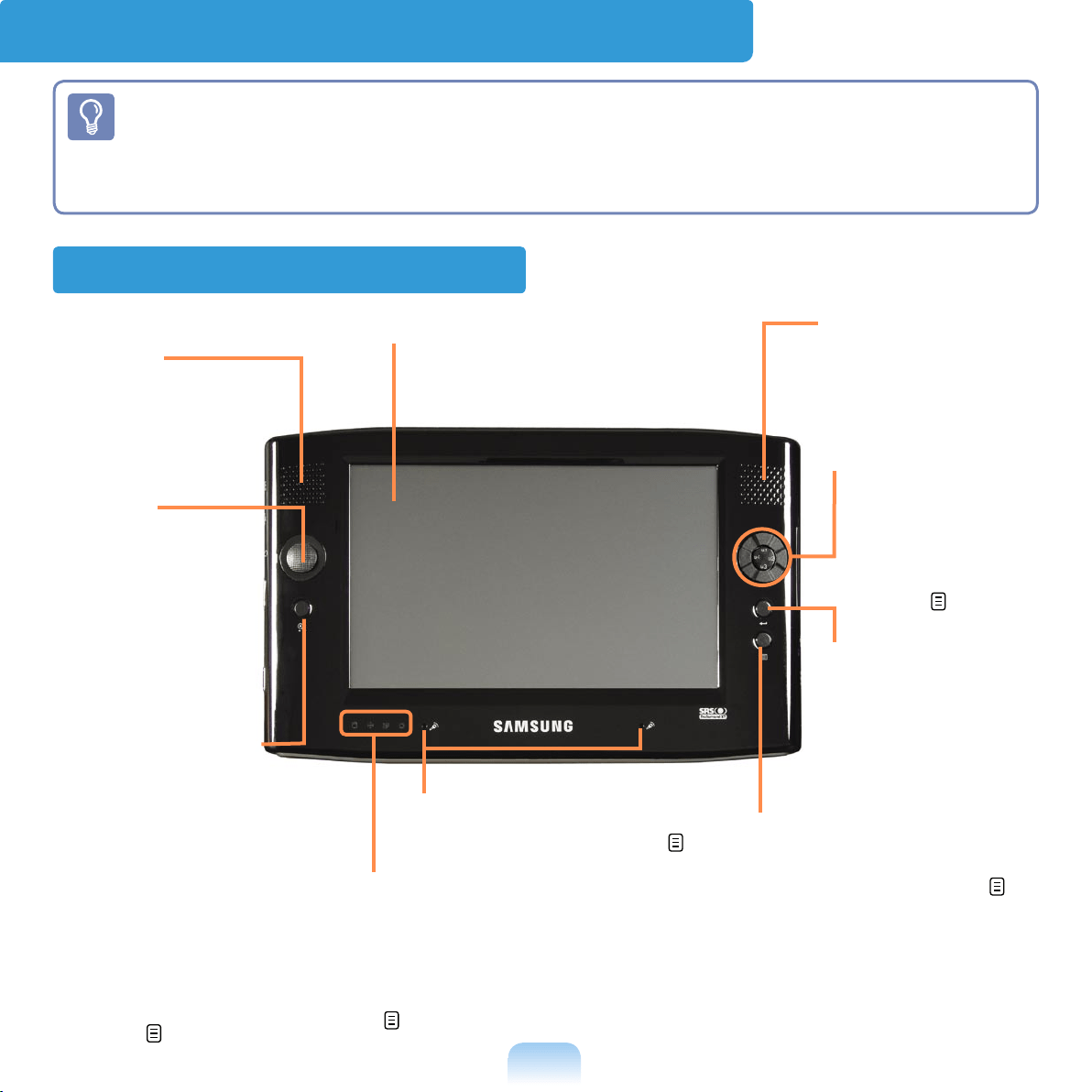
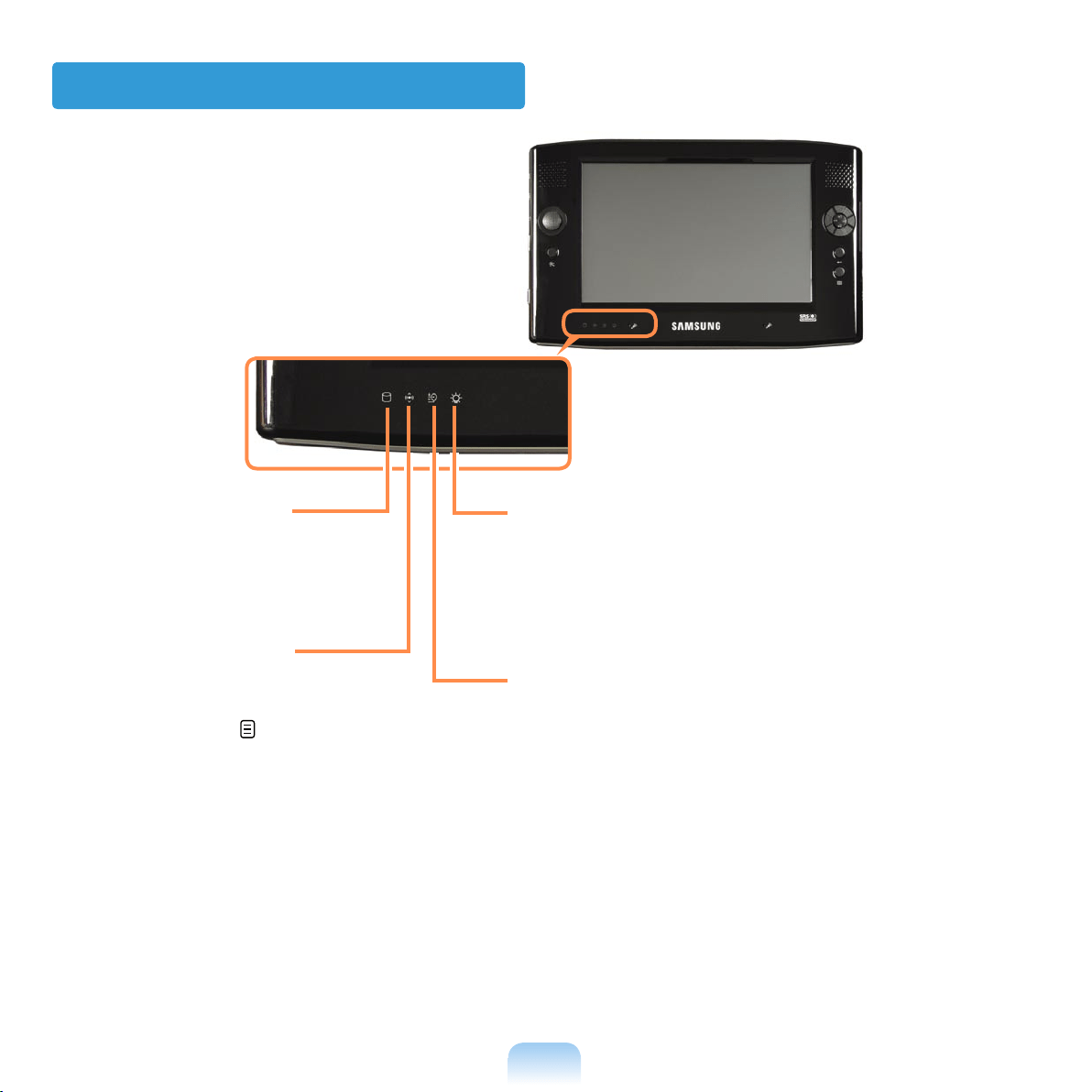
Front View
■
*
The items marked with this symbol are optional items which may be changed or
may not be provided depending on the computer model.
■ The actual color and appearance of the computer may differ from the pictures used
in this guide.
3
Joystick
Plays the same
role as the direction
keys (←→↑↓)
on the keyboard.
Used as a joy-
stick when playing
games.
2
Speaker
Used to generate
sound.
4
Auto Scaler Button
(Automatic Resolution
Adjustment Button)
Press this button to change
the screen resolution.
Auto Scaler provides 3-
step resolutions. Whenever
you press this button, the
screen resolution changes to
800x480 (Default Resolution)
> 800x600 > 1024x600 se-
quentially.
p.58
2
Speaker
Used to generate
sound.
9
Quick Launch
Button
You can register
a frequently used
program to launch it
just by pressing this
button.
p.55
8
Enter Button
Press this button
to select an item. It
is the same as the
Enter key on the
keyboard.
7
Menu Button
Press this button to launch
the Menu Program.
p.53
The Menu Program pro-
vides shortcuts to frequent-
ly used functions on the
computer. You can easily
change the settings.
5
Status Indicators
Shows the operating status of
the computer. The correspond-
ing operating LED is lit when the
corresponding function operates.
p.37
6
Array Microphone
Used to record sound.
p.64
1
LCD
The screen images from the
computer are displayed here.
37
Status Indicators
1
HDD
This turns on while
the hard disk drive is
being accessed.
4
Power Status
This shows the computer operating status.
On: When the computer is operating.
Blinks: When the computer is in Standby mode.
2
Wireless LAN
This turns on when
the wireless LAN is
operating.
p.95
3
Charge Status
This shows the power source and the battery
charge status.
Green: When the battery is fully charged or the
battery is not installed.
Amber: When the battery is being charged.
Blinks: It blinks for a while when sliding the
HOLD switch up or when pressing a
button when the HOLD switch is in the
HOLD position.
Off: When the computer is running on bat-
tery power without being connected to
AC power.

38
Top View
3
Wired LAN Port
A port to which an Ethernet cable is connected;
connects the computer to a LAN.
p.92
1
CF Card Slot
A slot into which a CF
card is inserted.
p.59
4
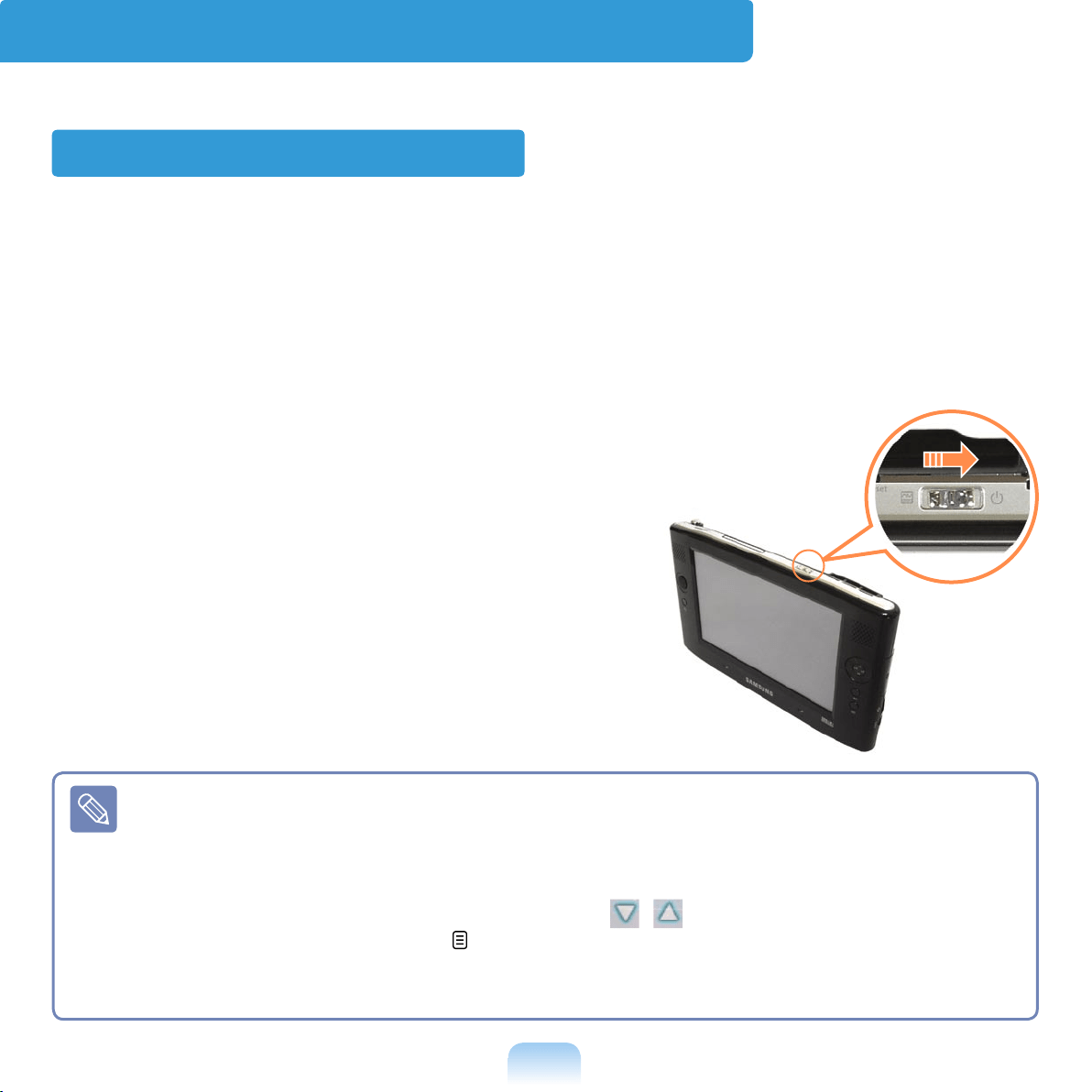
Power Switch / AV Now Switch
You can turn the computer on or off by sliding this
switch to the right and releasing it.
p.41
Slide the switch to the left and release it to launch
AVStation Now.
p.130
6
Stylus Pen / Stylus Slot
The Stylus is used to
enter information through
the touch screen.
p.45
You can keep the Stylus
Pen in the Stylus Slot.
2
Windows Security Button
Pressing this button is the same as
pressing the <Ctrl>+<Alt>+<Del> keys on
the keyboard.
To turn the computer on, slide the Power
switch to the right and hold it for more than
0.1 seconds before releasing it.
If the vents are blocked
the computer may over-
heat. This may be dan-
gerous, so avoid blocking
the vents.
5
Vents
The internal heat of the
computer is emitted through
these holes.
40
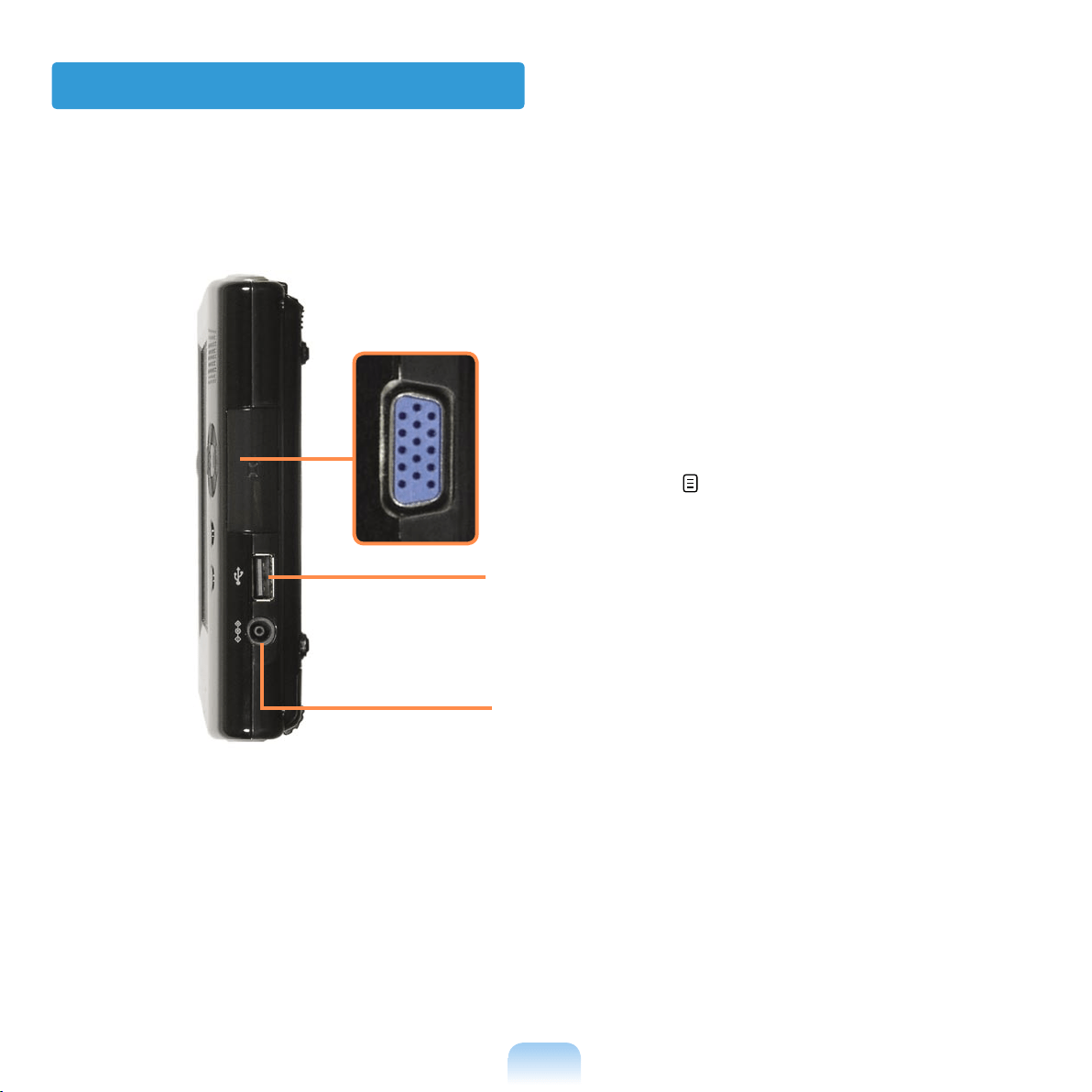
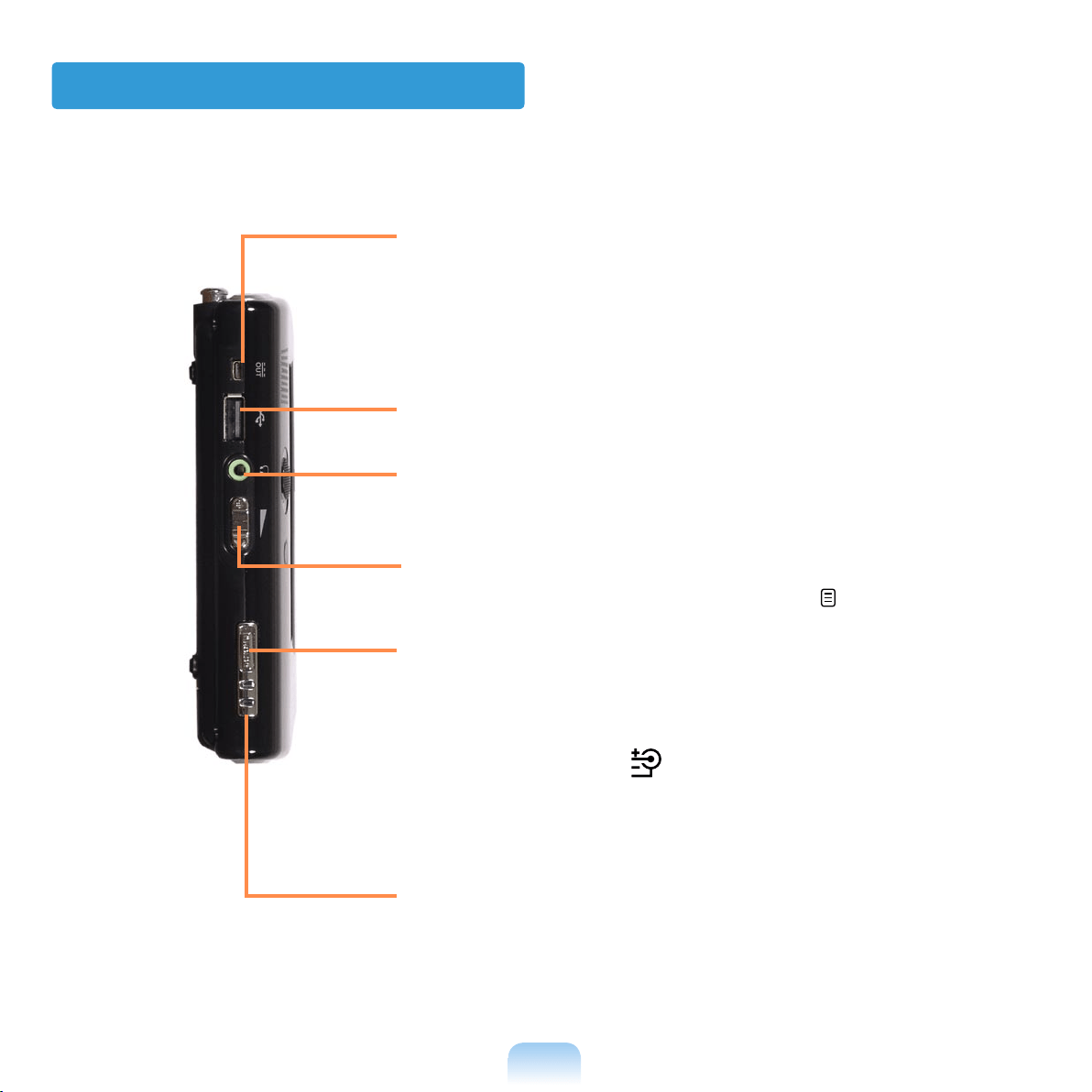
Left View
1
External ODD Power Port
A port used to supply power to the external USB ODD.
2
USB Port
A port used to connect a USB device such as a USB key-
board, mouse, USB ODD, etc.
3
Headphone Jack
A jack used to connect the headphones.
4
Volume Control Button
A button used to control the volume.
p.64
5
HOLD Switch
When sliding the HOLD switch into the HOLD position
(upwards), no buttons will work.
When pressing a button or switch in the HOLD status,
the Charge LED (
) blinks for a moment.
To use the computer again, slide the HOLD switch down.
6
Hand Strap Hole
You can connect the Hand Strap here.
41
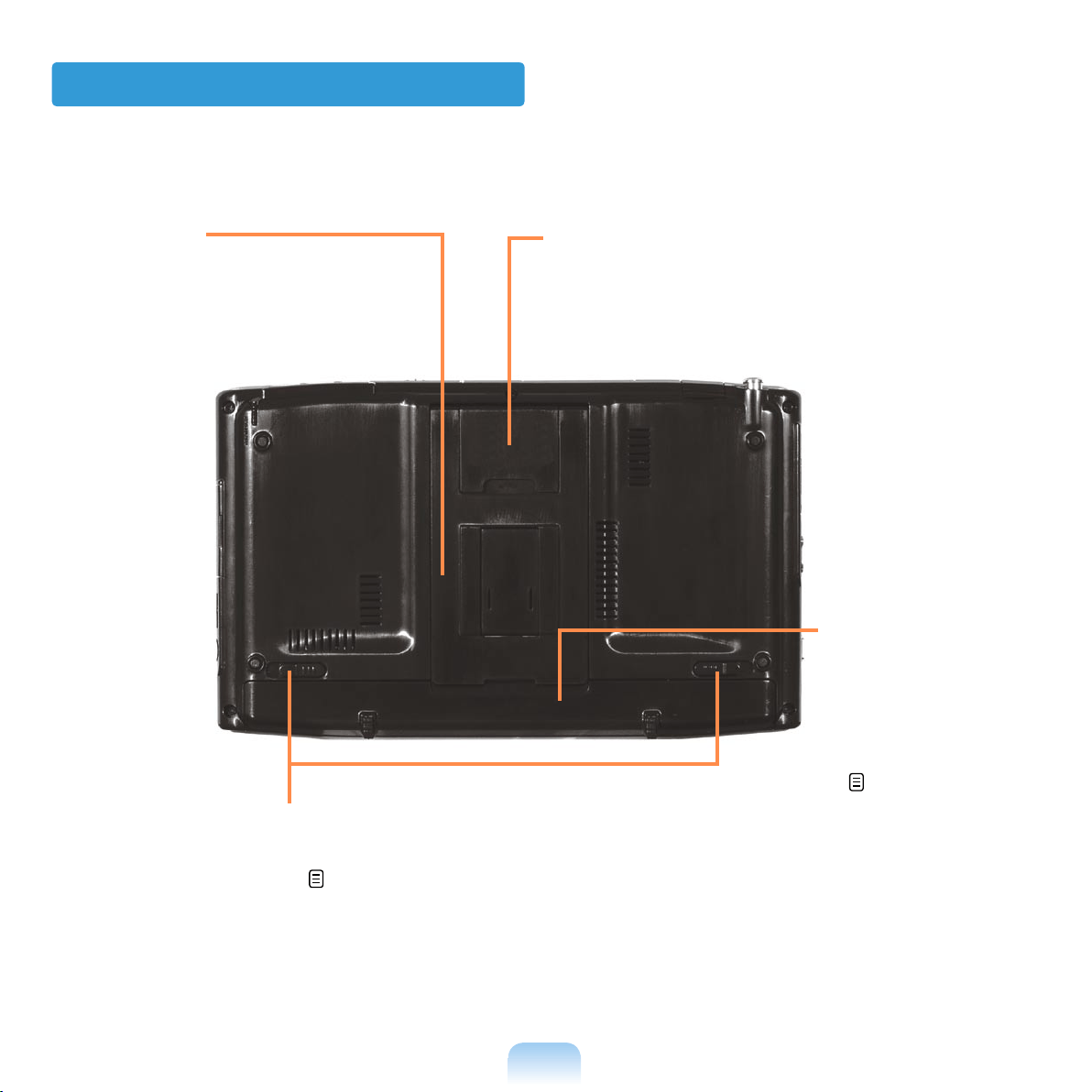
Back View
2
20° Stand
You can position the computer at a
20° degree angle so that you can
comfortably enter text.
1
80° Stand
You can position the computer
at an 80° degree angle so that
you can comfortably view the
screen.
3
Battery Latch
The latch used to remove or install the battery.
p.144
4
Battery
A Lithium Ion
rechargeable bat-
tery which sup-
plies power to the
computer.
p.144
42
Turning the Computer On and Off
Turning the computer on
1
Install the battery and connect the AC adapter.
(Refer to the Getting Started Guide.)
2
Adjust the stand at the back of the computer to a comfortable angle.
3
Slide the Power Switch to the right, hold it for more
than 0.1 seconds and then release it.
The computer is turned on.
■ If you slide the power switch in the right direction briefly when the computer is on,
the computer enters Sleep Mode.
■ When running the computer on battery power, the LCD brightness is dimmed auto-
matically to save battery power.
Press the Menu button and then press the
,
buttons for the
Brightness to
adjust the LCD brightness. (
p.53) Alternatively, press and hold the Menu button
and press the Volume Control button on the left side of the computer to adjust the
LCD brightness.
43
Turning the computer off
1
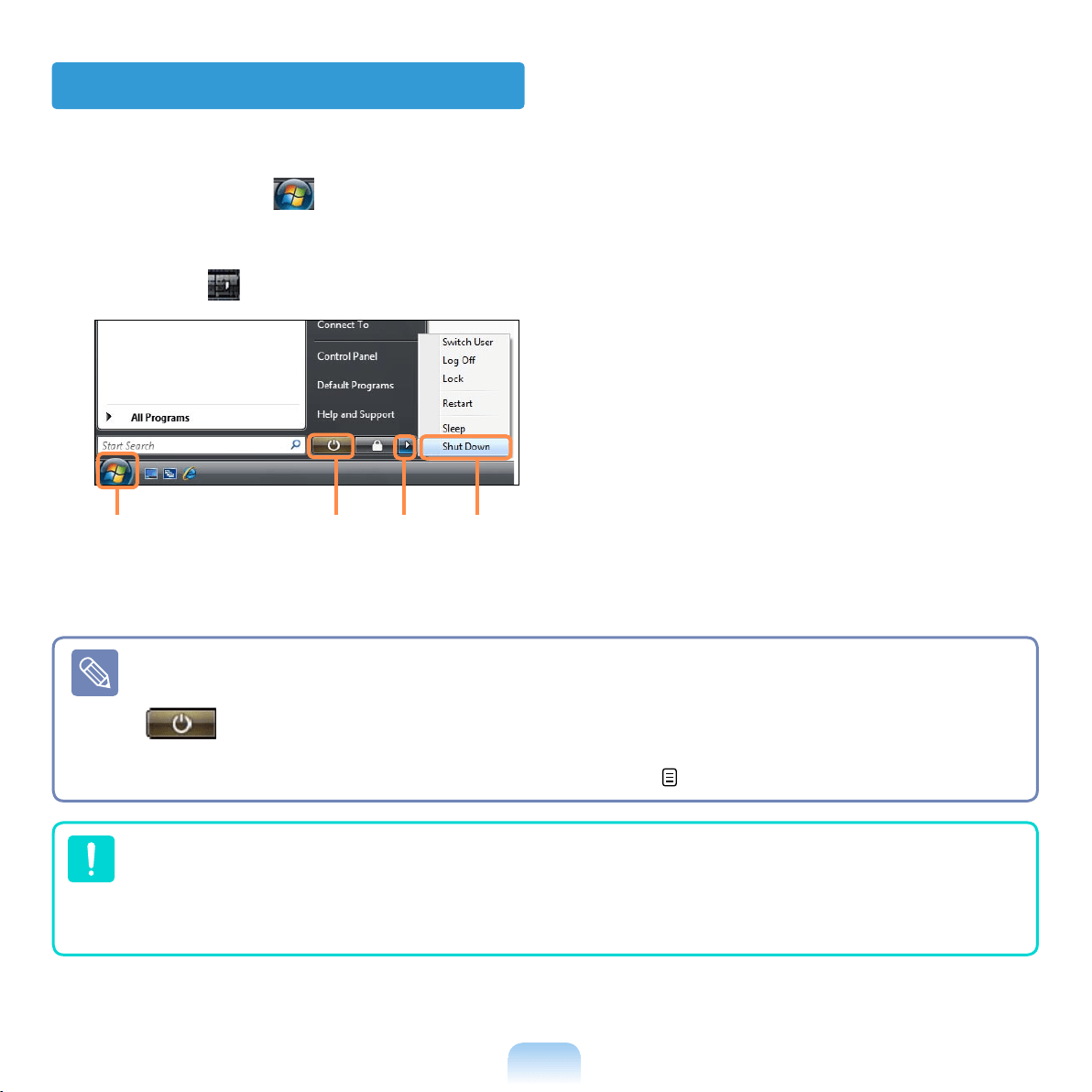
Click the Start ( ) button on the taskbar.
2
Click the ( ) and click on Shut down. The computer will shut down.
Power Button
1 2 3
Before Using the Power Button
Since the Power Icon is set to power saving mode, selecting Start > Power Button
(
), will cause the computer to enter Sleep mode.
To shut down the computer by clicking this icon, refer to the descriptions for Setting
up Start menu power button of the Control Panel.
p.84
When the system cannot be shut down due to a system error, turn it off by sliding
and holding the Power Switch for more than 4 seconds.
After that, when turning it on by sliding the Power Switch, the disk checking program
may launch.
45
Stylus Pen
A Stylus Pen is used instead of mouse and provides the same function.
It is recommended to connect and use a USB keyboard and mouse when using the
computer for a long time.
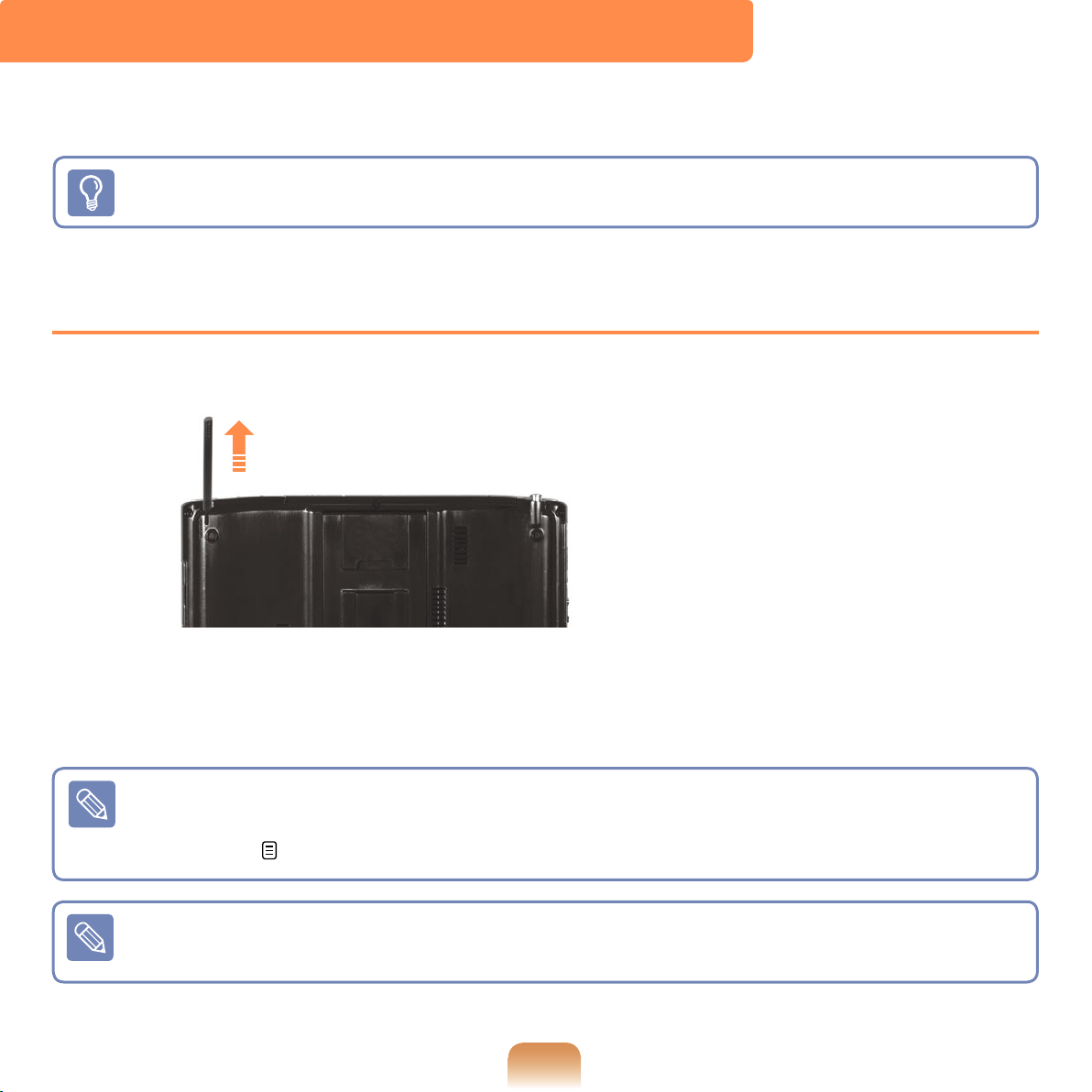
Taking the Stylus Pen Out
Pull the Stylus Pen upwards.
When finishing using the pen, return it to the Stylus Slot.
Learning Tablet PC Operations
Click Start > All Programs > Tablet PC to learn how to operate a Tablet PC using a
Stylus Pen.
p.68
Operate the touch screen LCD with a Stylus Pen or your finger. Sharp objects may
scratch or damage the LCD surface.
46
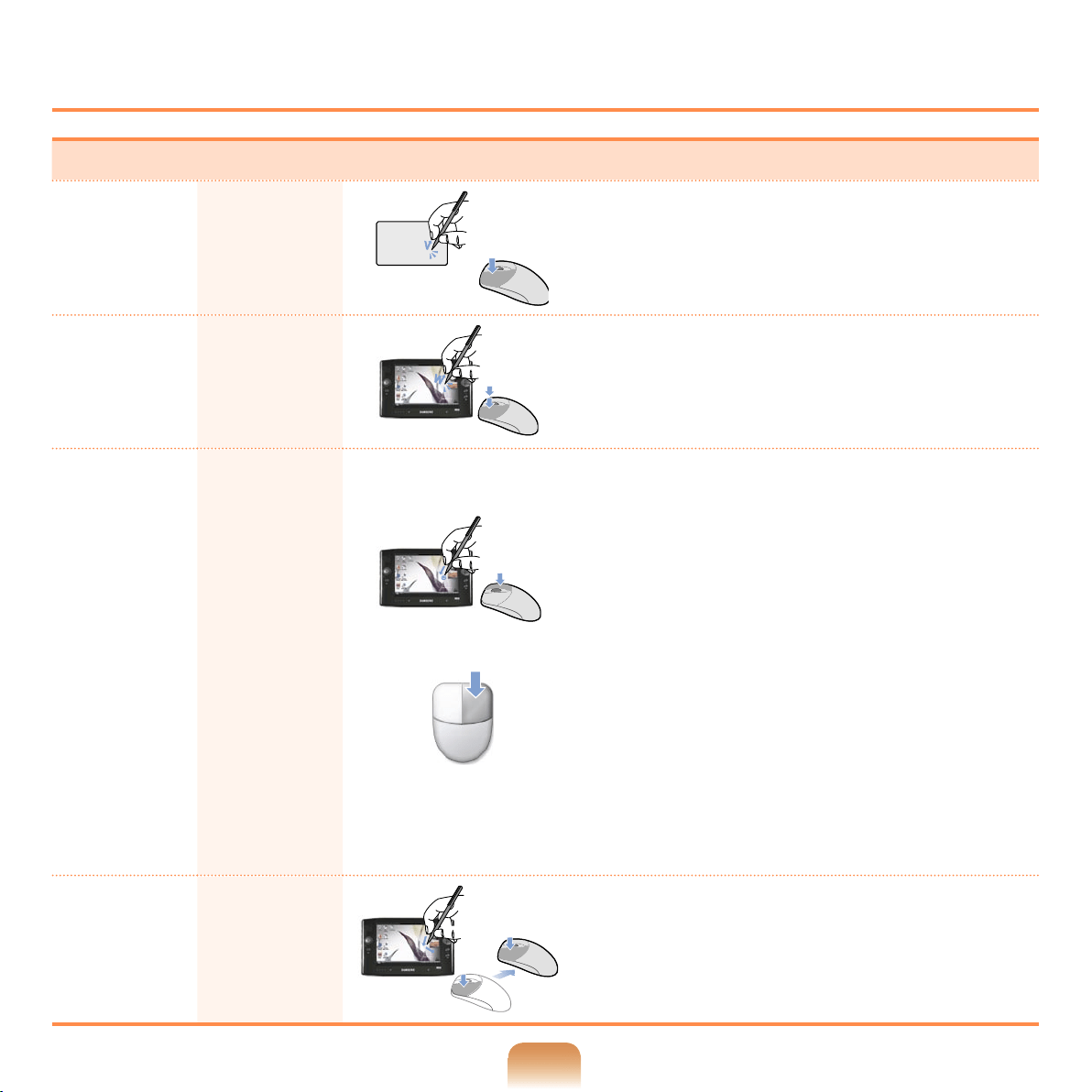
Mouse Using the Stylus Pen Function
Single-
click
Single-
tap
Single-tap with the pen to select an item.
Double-
click
Double-
tap
Double-tap with the pen to run an item.
Right-
click
Press and
Hold
Screen Mouse
● Method 1.
If you press and hold the pen over a
point of the screen, a circle is drawn
around the pointer.
If you remove the pen when the circle
is completely drawn, the pop-up menu
appears.
● Method 2.
In addition, if you press on the screen
with the Pen, the Screen Mouse ap-
pears for a moment.
If you click the right button of the
Screen Mouse, it performs the role
of the right button of an external-type
mouse.
Drag Drag
Tap an item and drag it with the pen to
move the item.
Stylus Pen Functions
47
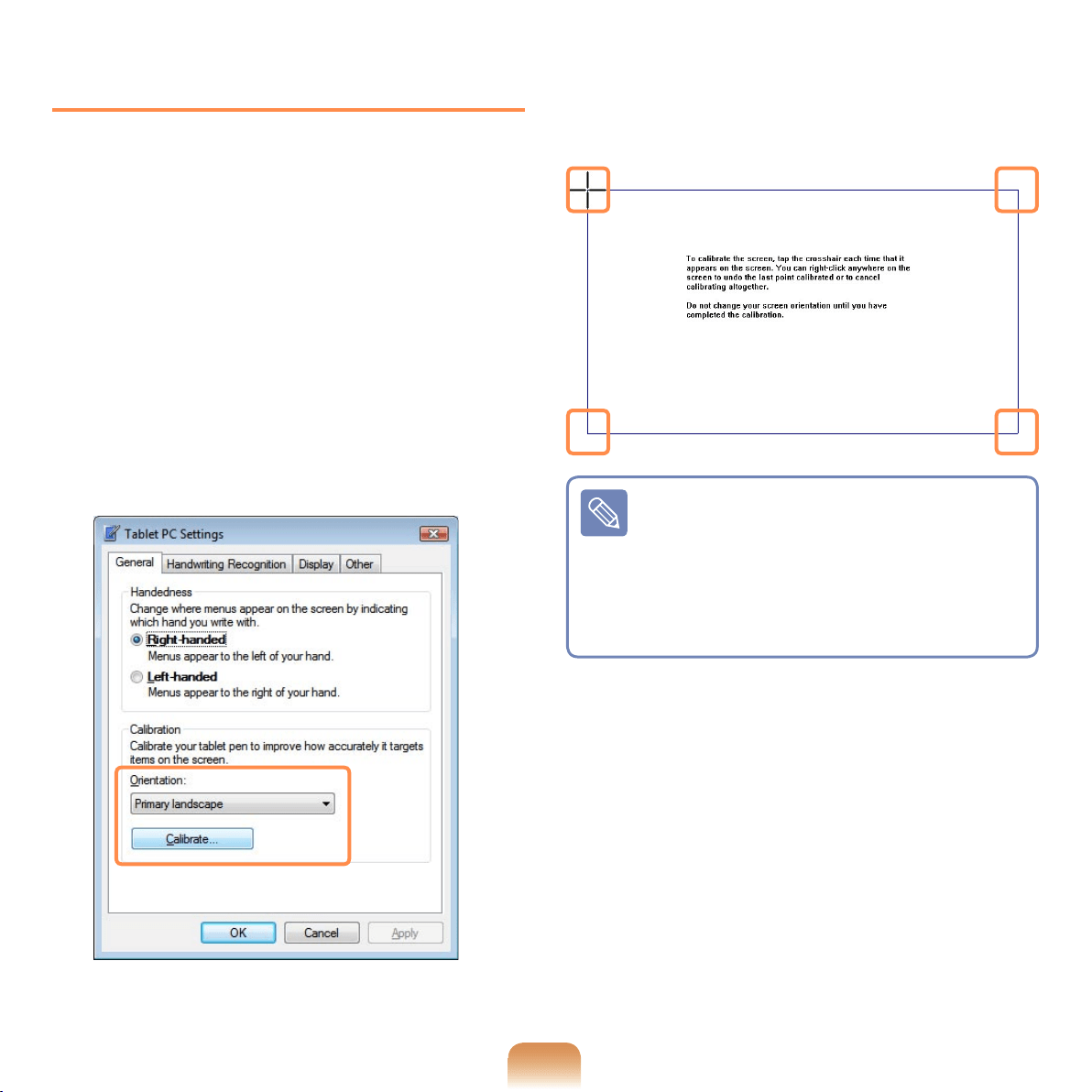
Calibrating the Stylus Pen
When using the Stylus Pen for the first
time or the pointing position of the Sty-
lus Pen is incorrect, you can correct the
pointing position.
1
Click Start > Control Panel > Hard-
ware and Sound > Tablet PC Set-
tings.
2
In the Calibration Area of the
General tab, select a screen direction
and click Calibrate....
3
Press the Crosshair (+) displayed on
the screen with the Stylus Pen when-
ever it appears on the screen.
To re-calibrate a previously correct-
ed point or cancel the calibration,
press over the screen with the Sty-
lus Pen and hold it for 3 seconds.
The pop-up menu appears. Select
an operation from the pop-up menu.
4
If you have pressed all the Cross-
hairs, the Digitizer Calibration Tools
window appears. Click the OK button
to apply the calibration result for the
pointing position correction.
48
Entering Text
You can enter text by using the Tablet PC Input Panel or DialKeys on this computer.
Using a USB keyboard is more convenient over long periods of use.
For example, the procedures to enter text in Notepad will be described below.
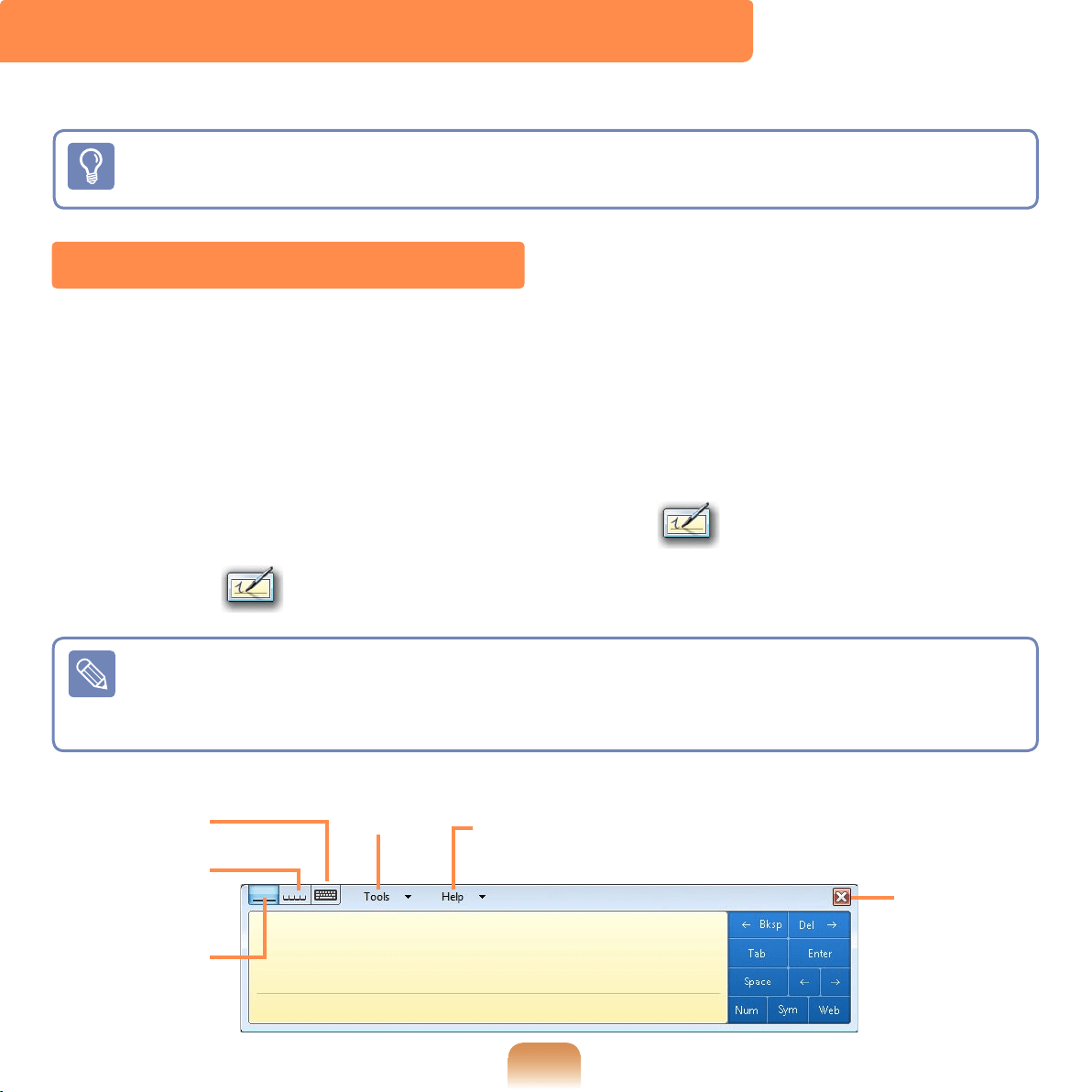
Using the Tablet PC Input Panel
The Tablet PC Input Panel is an on-screen letter input pad provided by Windows.
Using it, you can enter letters with the Stylus Pen when a keyboard is not available.
You can enter letters using the Tablet PC Input Panel in 3 ways.
1
Tap Start > All Programs > Accessories > Notepad. Notepad is launched.
2
If you tap over the Notepad with the Stylus Pen, < > appears with the cursor.
3
If you tap < > with the Stylus Pen, the Tablet PC Input Panel appears.
Close
Writing Pad
Character
Pad
On-Screen
Keyboard
Help
You can learn detailed usage for
the Tablet PC Input Panel.
Tools
This function may not be supported depending on the languages.
Alternatively, press the Tablet PC Input Panel hidden at the left end of the Desktop
to display the Tablet PC Input Panel.
49
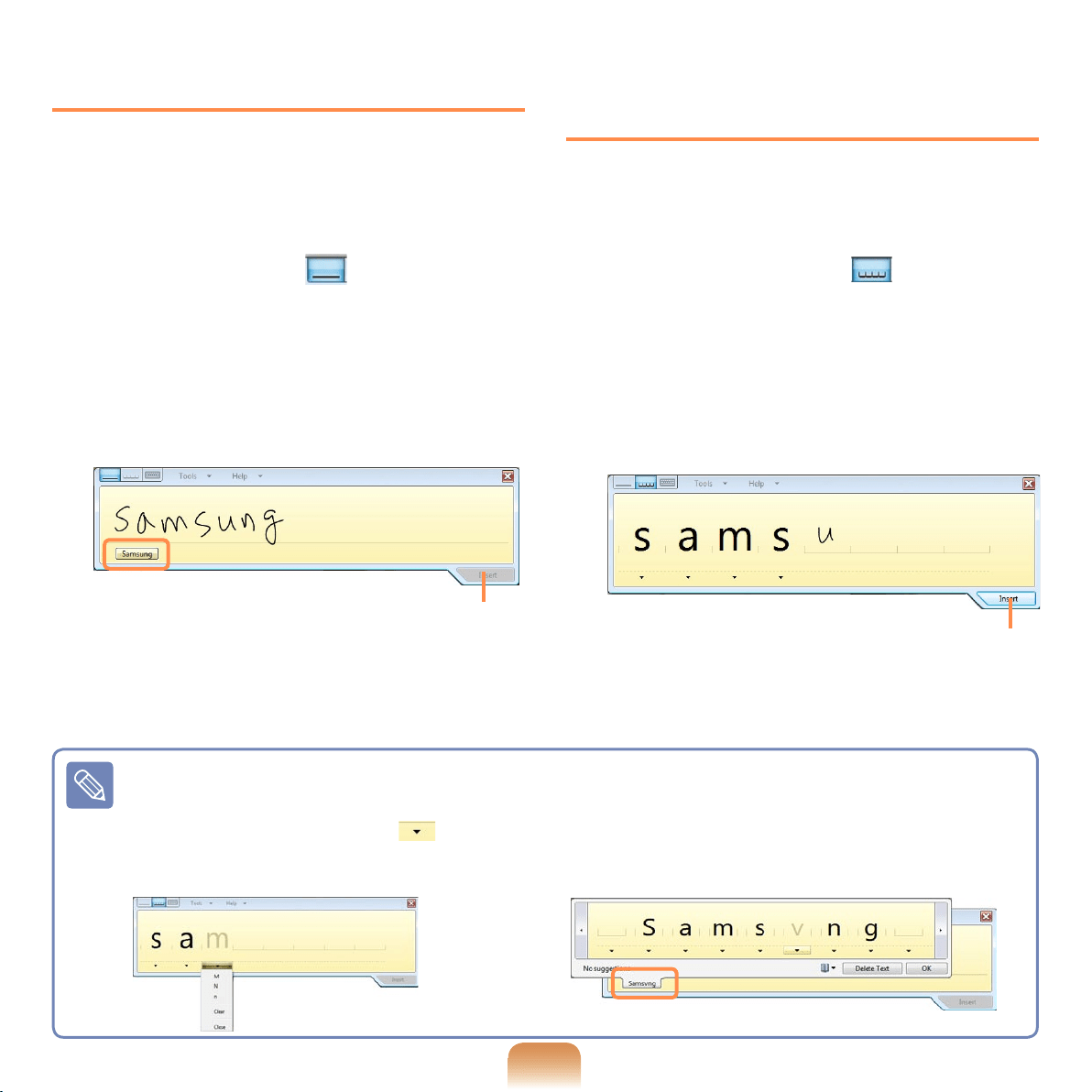
Entering text using the Writing Pad
You can enter characters by writing char-
acters on the Stylus Pen Writing Pad
directly.
1
In the Tablet PC Input Panel, tap the
Writing Pad icon (
).
2
Write text in the input area of the
Writing Pad with the Stylus Pen and
wait a moment. The written letters
are converted into the corresponding
computer characters.
Insert
3
Tap the Insert button to enter the
converted letters.
Entering text
using the Character Pad
You can write a letter in each cell of the
Character Pad with the Stylus Pen.
1
In the Tablet PC Input Panel, tap the
Character Pad icon (
).
2
Write a letter in the cell of the Charac-
ter Pad with the Stylus Pen and wait
a moment. The written letter is con-
verted into the corresponding com-
puter character.
Insert
Tap the Insert button to enter a con-
verted letter.
Modifying Text
To modify a wrong character, write
over the character or tap
below
the character and select another
character.
In the Writing Pad, you can replace a
word with another or modify a character
by clicking on it.
50
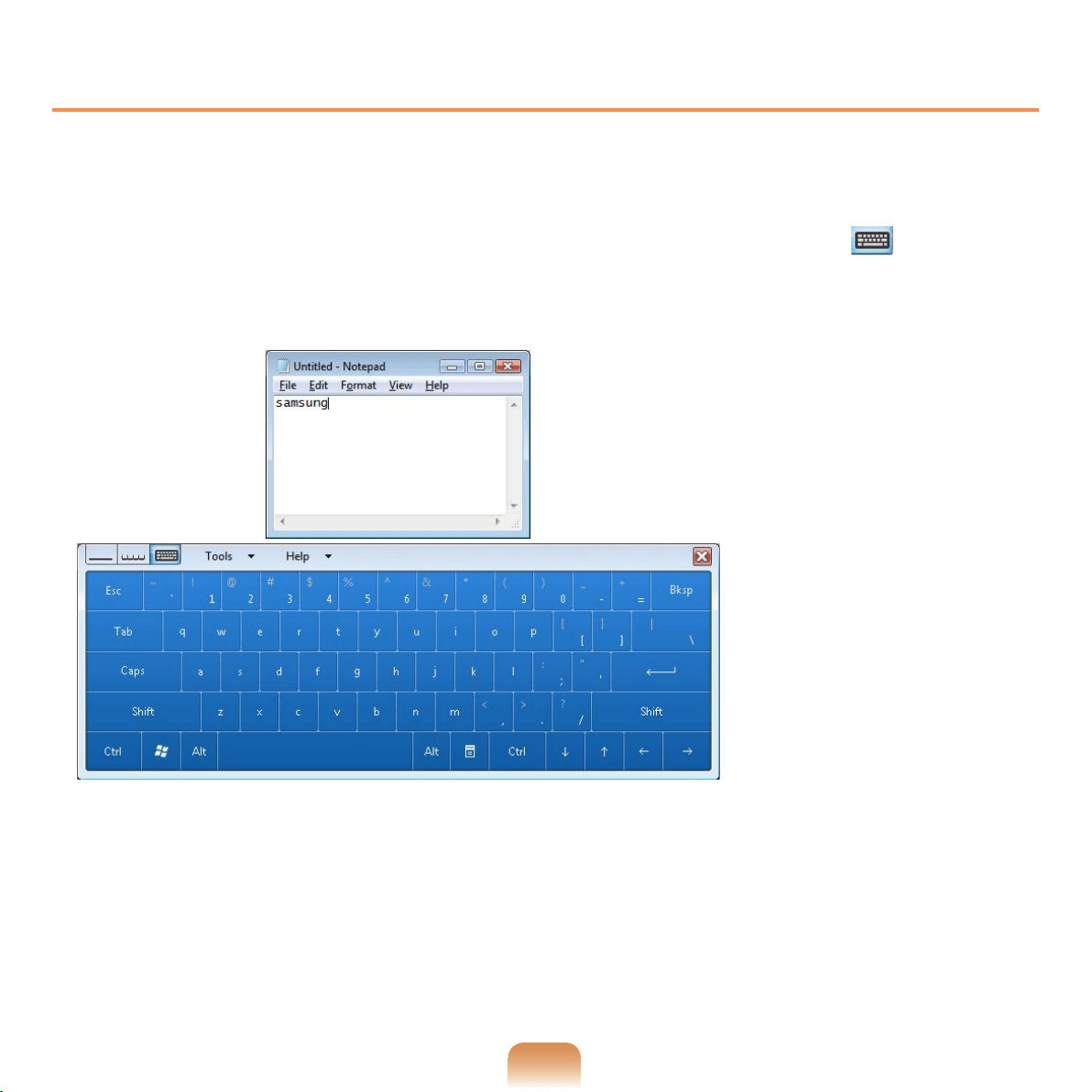
Entering text using the On-Screen Keyboard
The On-Screen Keyboard displays a standard keyboard on the screen so that you can
enter a letter by pressing the corresponding key on the screen.
1
In the Tablet PC Input Panel, tap the On-Screen Keyboard icon ( ).
2
Tap a character key with the Stylus Pen to enter the character.
51
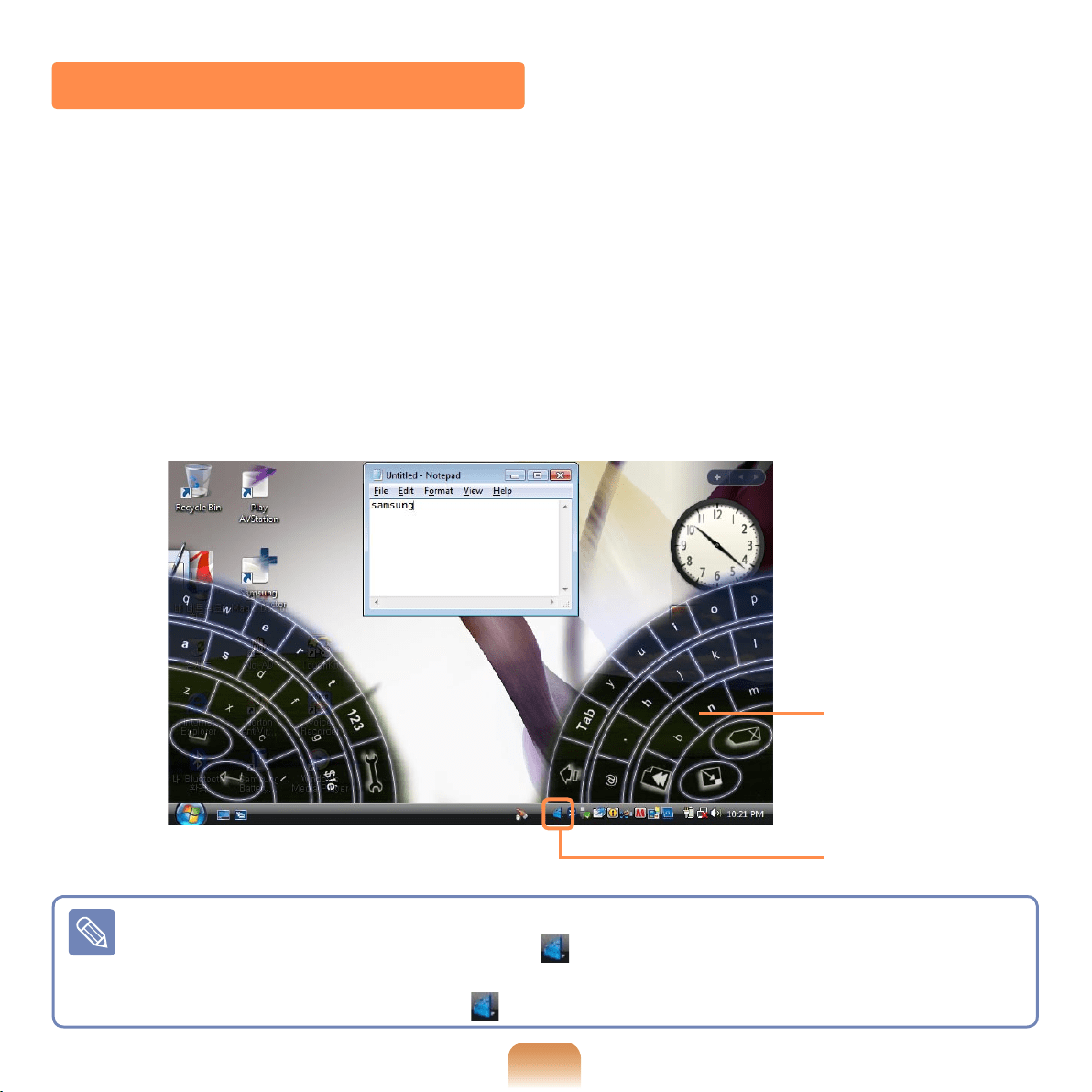
Hiding Dialkeys
Whenever you tap the Dialkeys icon ( ) in the Taskbar, the Dialkeys appear and
then disappear.
To hide, tap the Dialkeys icon (
) on the Taskbar.
Dialkeys
DialKeys is an on-screen keyboard designed to be used with compact touch screen
computers.
You can enter letters using the DialKeys by pressing a key on the screen with your
thumbs while holding both of the lower corners of the computer with your hands.
To launch the DialKeys for the first time, tap Start > All Programs > Microsoft
Origami Experience Pack > DialKeys.
Dialkeys appears on both lower corners of the screen. Enter letters using your thumbs.
* The Dialkeys appearance and color may differ from actual ones.
Dialkeys icon
Dialkeys
52
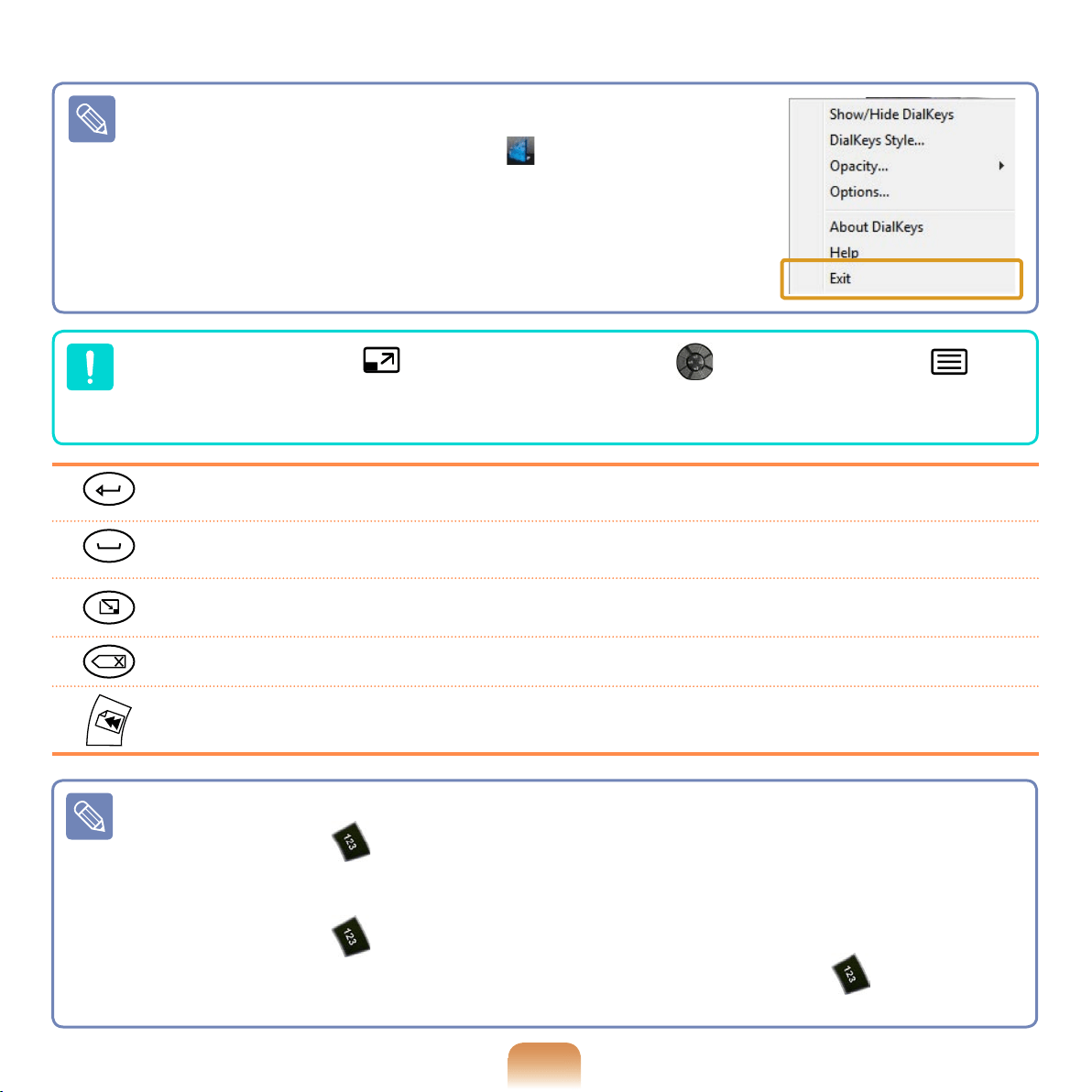
Corresponds to the Enter key on a keyboard.
Corresponds to the space bar on a keyboard.
The Dialkey key is minimized and moved into the notification area of the Taskbar.
To restore it to its original size, click the minimized Dialkey.
Corresponds to the Backspace on a keyboard.
Move the current window upwards.
Entering a Number
If you tap the 123 ( ) once in the screen shown in the figure on the left, the screen
turns blue and you can enter a number. After you enter a number, it returns to text
input mode.
If you tap the 123 (
) twice, it turns red and you can enter multiple numbers con-
tinuously. When you have finished entering numbers, tap the 123 (
) once again
to cancel number input mode.
Auto Scaler Button ( ), Quick Launch Button ( ) and Menu button ( ) may
not work while Dialkeys is working.
In this case, use the keys after exiting the Dialkeys.
Exiting Dialkeys
Press and hold the Dialkeys icon ( ) in the Taskbar,
press the Exit from the pop-up menu.
53
Using the Buttons
The procedures to use the Menu, Quick Launch and Auto Scaler buttons are described below.
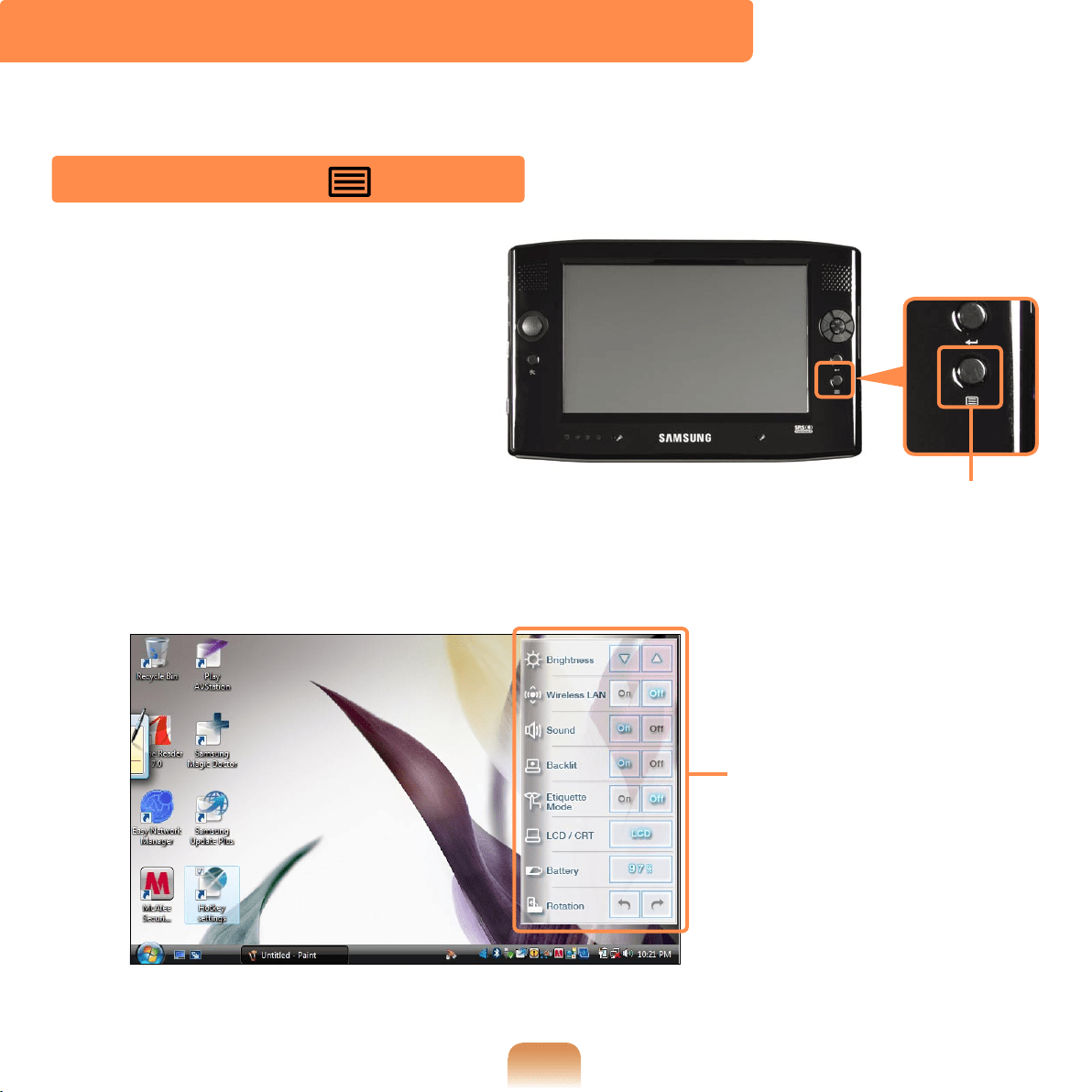
Press the Menu button to launch the
Menu Program. The Menu Program
provides shortcuts to frequently used
functions on the computer. You can
easily change the settings.
Press the Menu button again or press
a point on the screen to hide the
Menu Program.
The Menu Button ( )
Menu Program
Menu button
54
Menu Items Function
Brightness
/
Whenever this item is pressed, the LCD brightness is
increased(decreased) by one step.
Wireless
LAN On/Off
Press this item to turn the Wireless LAN on or off.
Sound On/Off Press this item to turn the volume on or off.
Backlit On/Off
If you press Off, the LCD screen is turned off. To turn it on again,
press down over the LCD screen once.
Etiquette Mode
On/Off
Turns Etiquette mode on or off.
Use Etiquette mode when you need a quiet working environment.
Since Etiquette Mode makes the CPU run at its slowest, the
program operating speed may slow down and the computer
may overheat due to the slow fan speed.
LCD/CRT
Whenever you press the LCD/CRT, the mode changes to LCD >
Clone > Dual View mode in sequence.
The Menu button does not support function to display com-
puter screen on an external monitor only. You can view the
computer screen through an external monitor only by using
the Intel program.
Battery Shows the remaining battery charge.
Rotation
Whenever you press this button, the screen rotates clockwise or
counterclockwise by 90 degrees.
■ When rotating the screen, a part of the screen image may
not be displayed in some software programs.
■ Since the Rotation function is supported for the 800x480
pixels resolution only
, if the Rotation function does not
work when pressing the item, set the screen resolution to
800x480 pixels fi
rst by pressing the Auto Scaler button.
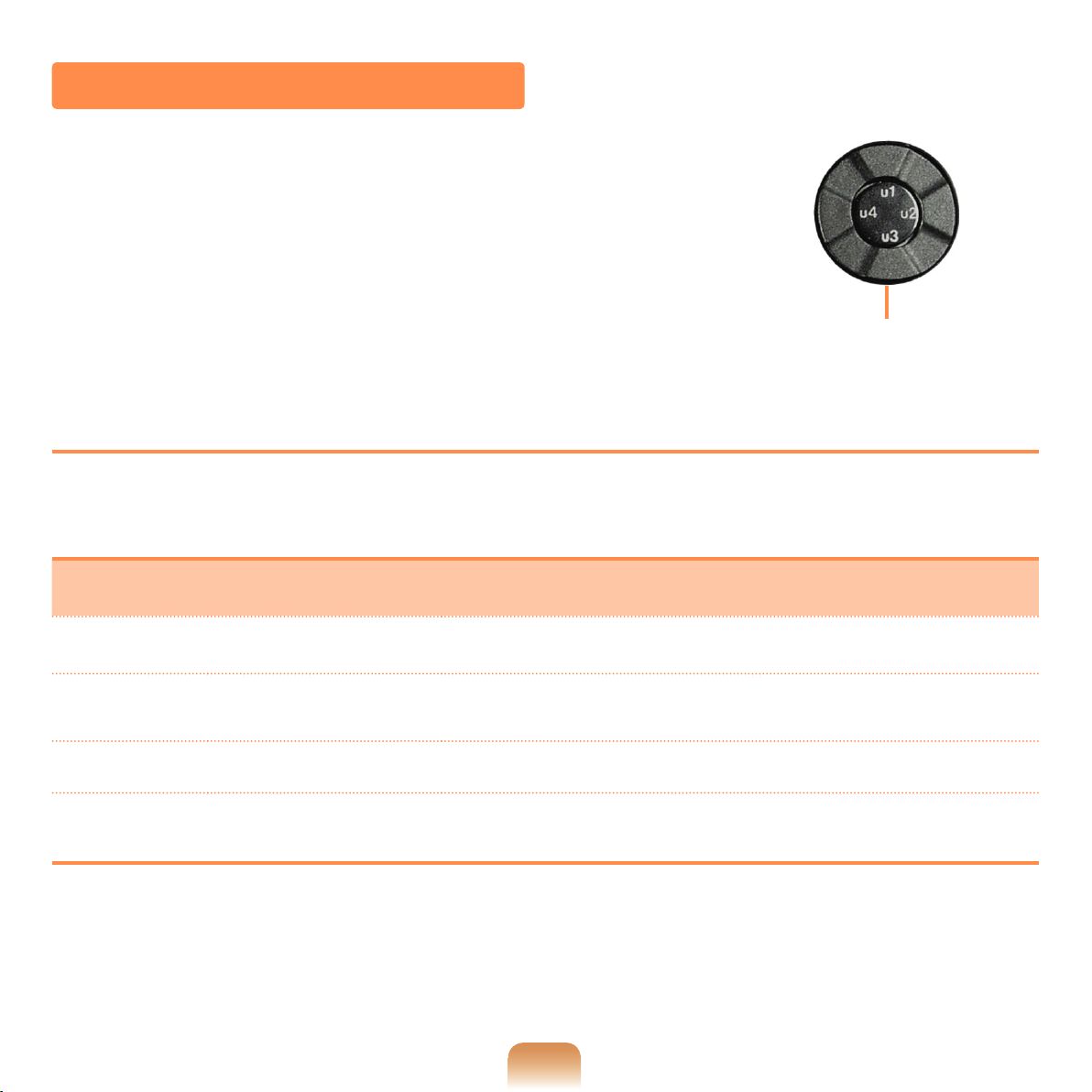
55
The Quick Launch Button
A Quick Launcher Button refers to a button which can be
configured so that pressing it launches a frequently used
program or plays the role of pressing a particular key combi-
nation.
It is convenient to set your frequently-used programs or key
combinations as groups.
Button Function Description
u1 MouseScrollUP Scrolls up in a window as a mouse scroll.
u2 WWW Forward
Moves forward in Internet or Windows Explorer to dis-
play the next page.
u3 MouseScrollDown Scrolls down in a window as with a mouse scroll.
u4 WWW Back
Moves back in Internet or Windows Explorer to display
the previous page.
Default Group Setting
When purchasing the computer, the Default group is configured as follows. However,
the Default group setting cannot be changed.
Quick Launch Button

56
Configuring Additional Groups
Below are procedures to add an additional group to the Default group and for setting
up functions for the four buttons.
As an example, the procedures to add a new group named “Test”, configure the u1
button to a particular key combination, and configure the u2 button to a program are
described below.
1
Double-click the Easy Button Manager icon ( ) on the Desktop.
2
In the Main screen, click Add.
3
Enter a name in the Group Name
field of the Tablet PC Input Panel.
For example, enter “Test”.
For information on how to
use the Tablet PC Input Pan-
el, refer to the descriptions
for Entering
Text.
p.48
4
After selecting the U1 button, select the Key Combination Function.
Key Combination Function: You can set a User Button to a particular key com-
bination.
Mouse Function: You can set a User Button to a mouse operation.
Program Link Function: You can set a User Button to launch a frequently used
program.
5
Select a key combination and then click the OK button.
For example, if you have pressed the Ctrl, Alt, Delete key in order, “Ctrl + Alt +
Delete” is displayed on the left side of the screen.

57
6
To configure the U2 button subsequently, click Modify in the Main screen.
7
Select the U2 button and click Program Link Function.
Select the program you want and click the OK button.
If the program you want is not in the list, click the Search button and select a pro-
gram.
2
1
3
8
You can view the settings for each button in the Main screen.
Select a group from the Group Name and click the OK button. The user buttons
perform the roles set in the selected group.
■ To use the default or another group’s button functions, Right-click Easy Button
Manager icon of taskbar and select Group List > group.
Otherwise, double-click the Easy Button Manager icon on the desktop or click
Start >
All Programs > Samsugn > Easy Button Manager > Hotkey settings.
In the Group fi
eld, select a group using the scroll bar and click the OK button.
■ Deleting or Modifying the Group List
Double-click the Easy Button Manager icon on the Desktop or click Start >
All
Programs > Samsung > Easy Button Manager > Hotkey settings.
Select a group to be deleted from the Group fi
eld of the main screen and then click
Delete or Modify.
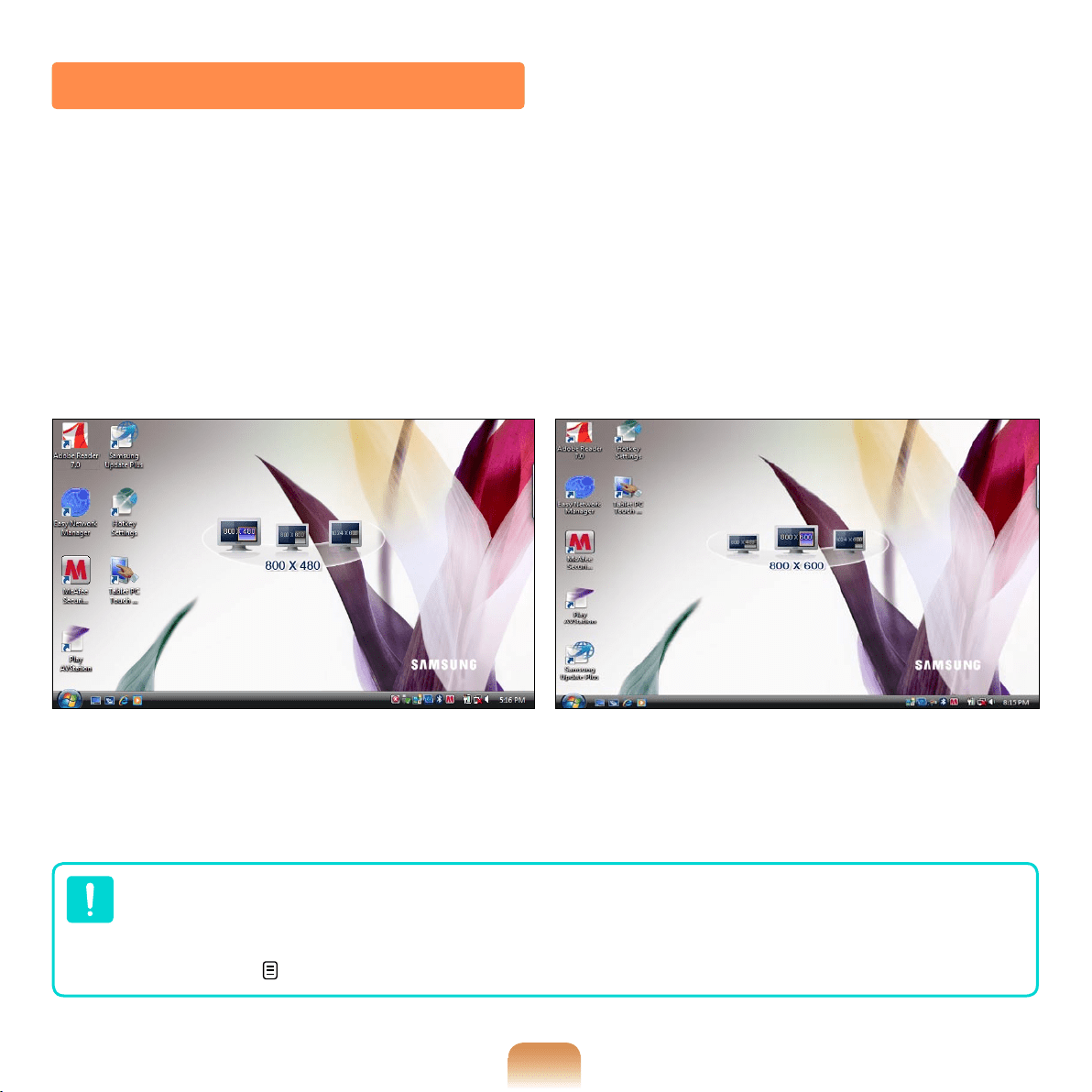
58
The default resolution of this computer is 800x480 pixels. In the default resolution, the
complete screen image of programs designed for high resolutions may not be dis-
played properly. In this case, press the Auto Scaler button(Automatic Resolution Ad-
justment Button) on the left side of the computer and select a higher screen resolution.
When pressing the Auto Scaler button, the Auto Scaler menu appears. Whenever
this button is pressed, the screen resolution changes to 800 x 480 (Default Resolution)
> 800 x 600 > 1024 x 600 sequentially.
The Auto Scaler Button
Example)
Selecting a 800 x 480 pixels resolution
Example)
Selecting a 800 x 600 pixels resolution
The Auto Scaler button provides a function that fits high resolution screen images to
the screen size and does not support all resolutions supported by the graphics chip-
set. To select a resolution, which is not supported by Auto Scaler, use the Display
Properties. (
p.83)
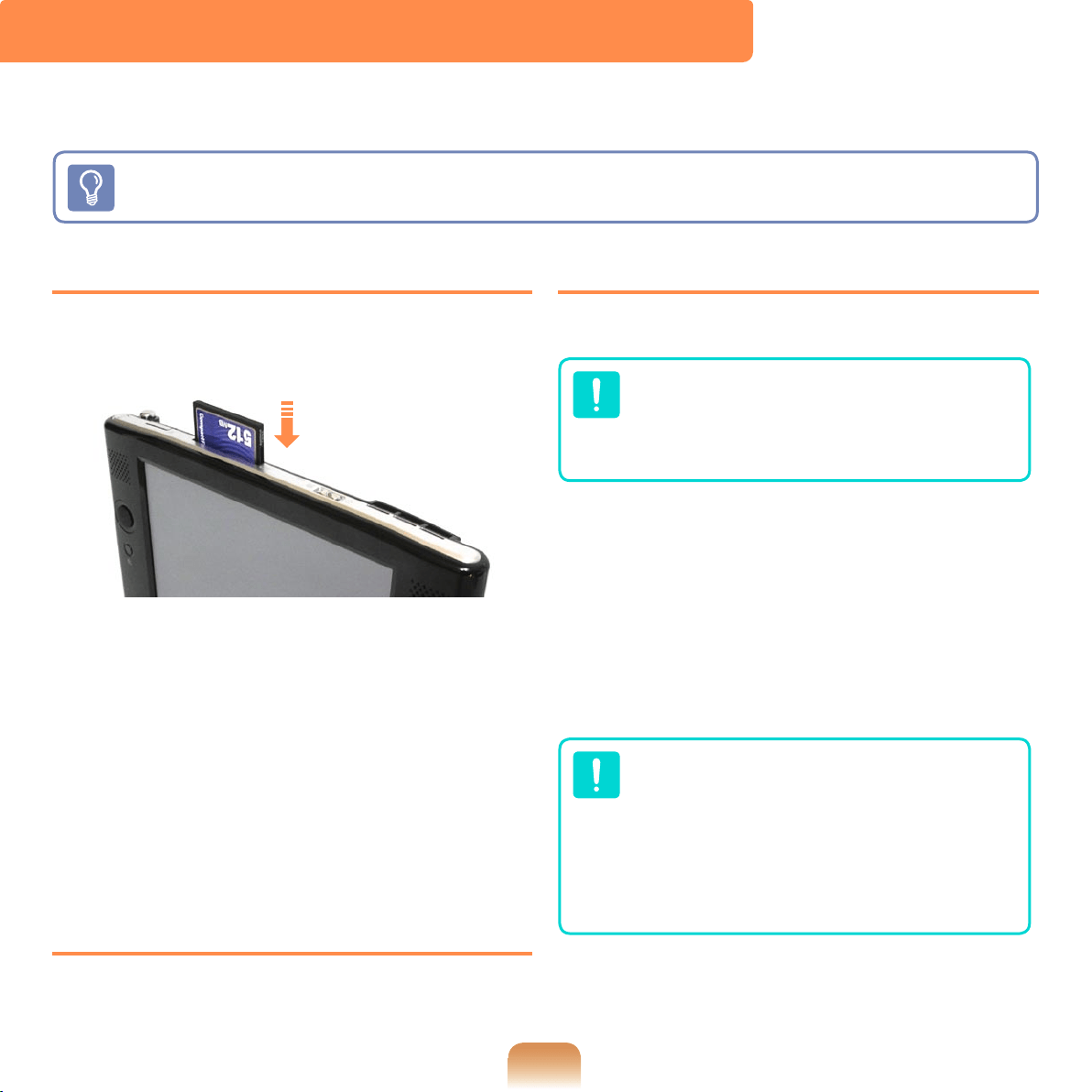
59
Using a Card
1
Insert a card into the slot in the right
direction.
2
The card drive appears in Windows. If
it does not appear automatically, click
Start > Computer.
3
You can save, move and delete data
by doubleclicking on a removable disk.
You can only use a card after format-
ting it. If you have not formatted the
card, format the card referring to the
descriptions of ‘Formatting a Card’.
Removing a Card
Hold the end of the CF card and take it
out.
Formatting a Card
You can only use a card after formatting it.
If you format a card, all the data
stored on the card will be deleted.
Therefore, backup your data before
formatting the card.
1
Click Start > Computer.
2
Right-click over the removable disk
and select Format from the pop-up
menu.
3
Click Start to start formatting the disk.
To use the CF card on another
digital device, formatting the card
in the digital device rather than on
the computer is recommended.
A
card formatted on a computer may
not work properly for another digital
device.
CF Card Slot
A CF card slot is provided for using CF cards. A CF card is a removable storage device that
can be used to exchange data with digital devices such as digital cameras, PDAs, etc.
This computer supports the CF Card Type I and II.
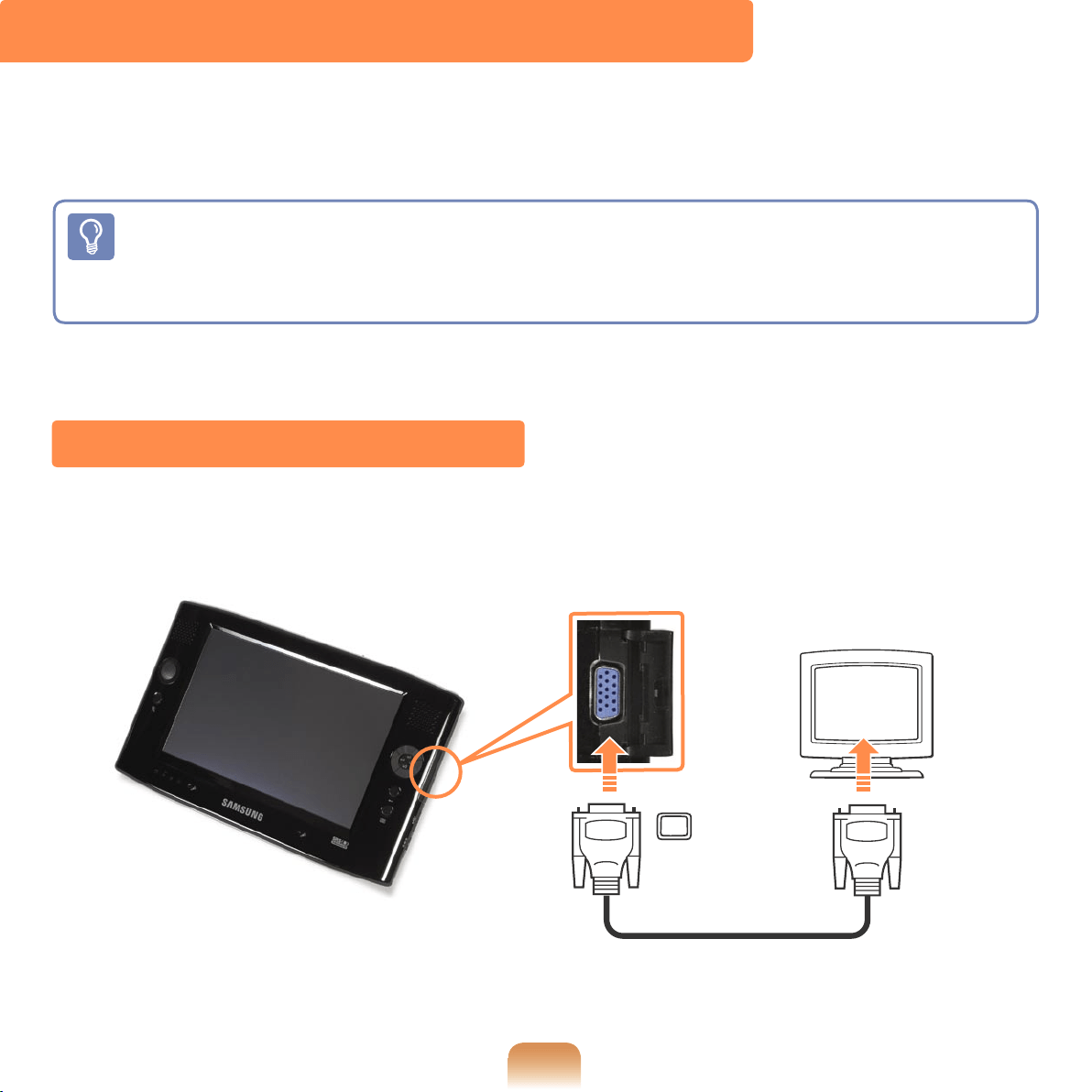
60
Connecting a Monitor
Using an external monitor, you can watch a movie on wide screen or give a presentation. The
procedures to view pictures on an external monitor are described below.
When using an external monitor or playing a game, an external USB mouse is
more convenient.
You have to purchase an additional connection cable.
Connecting a Monitor
Open the Monitor port cover by pulling the groove of the cover and connecting a monitor.
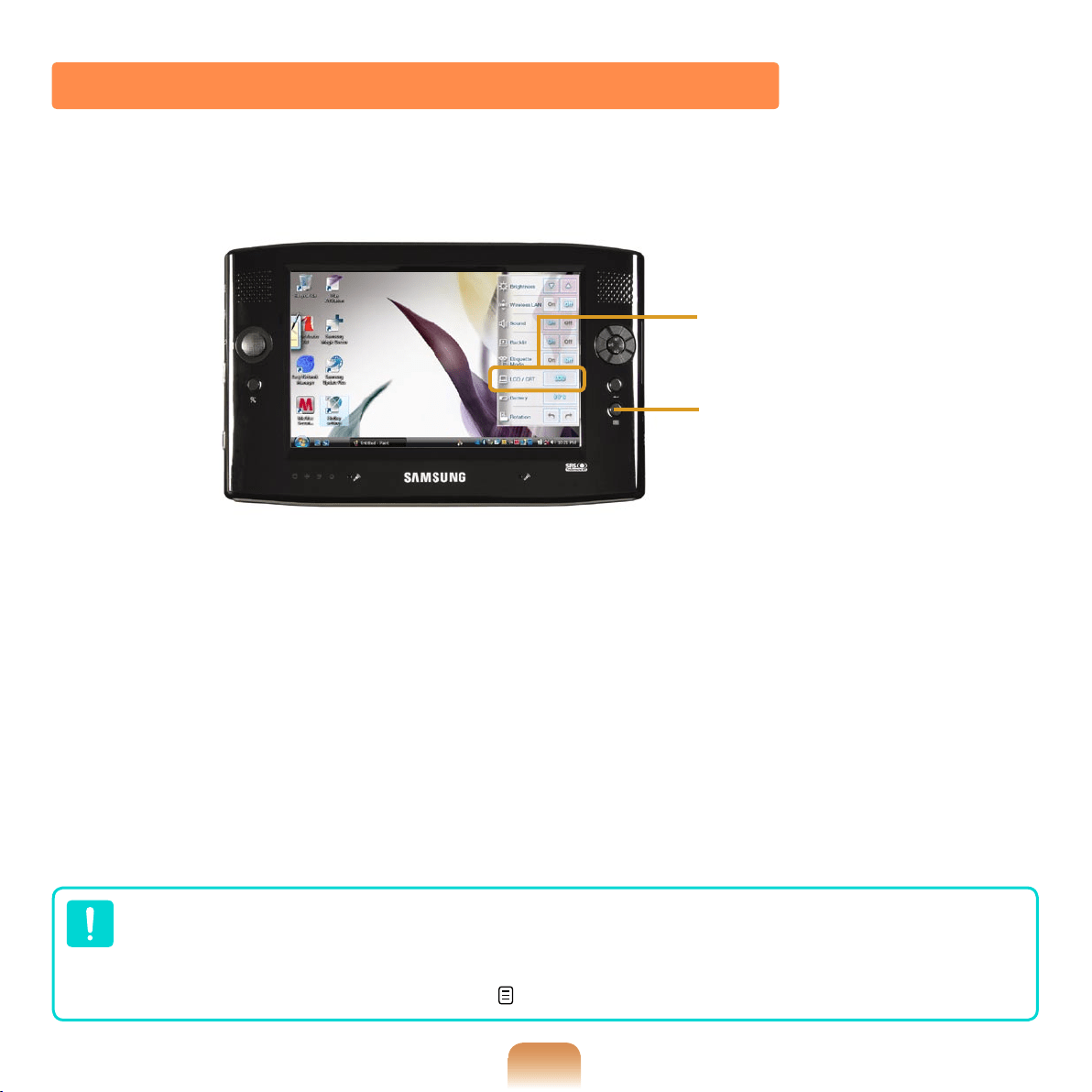
61
Method 1. Configuring with the Menu Button
1
Connect the monitor and press the Menu button on the right side to launch the
Menu program.
Viewing Through an External Monitor Only
The Menu button does not support a function to display the computer screen on an
external monitor only. You can view the computer screen through an external monitor
only by using the Intel program. (
p.62 )
Menu button
Menu Program
(LCD/CRT Item)
2
Select the LCD/CRT item from the menu and configure it according to your require-
ments.
Whenever LCD/CRT is pressed, the mode changes between LCD > Clone > Dual
View mode in this order.
● LCD: You can view the computer screen through the LCD only.
● Clone: When selecting this mode, you can view the same screen on both the
LCD and the external monitor.
● Dual View: When selecting this mode, you can view a screen spanning over the
LCD and the external monitor, and you can set different resolutions
for each display device.
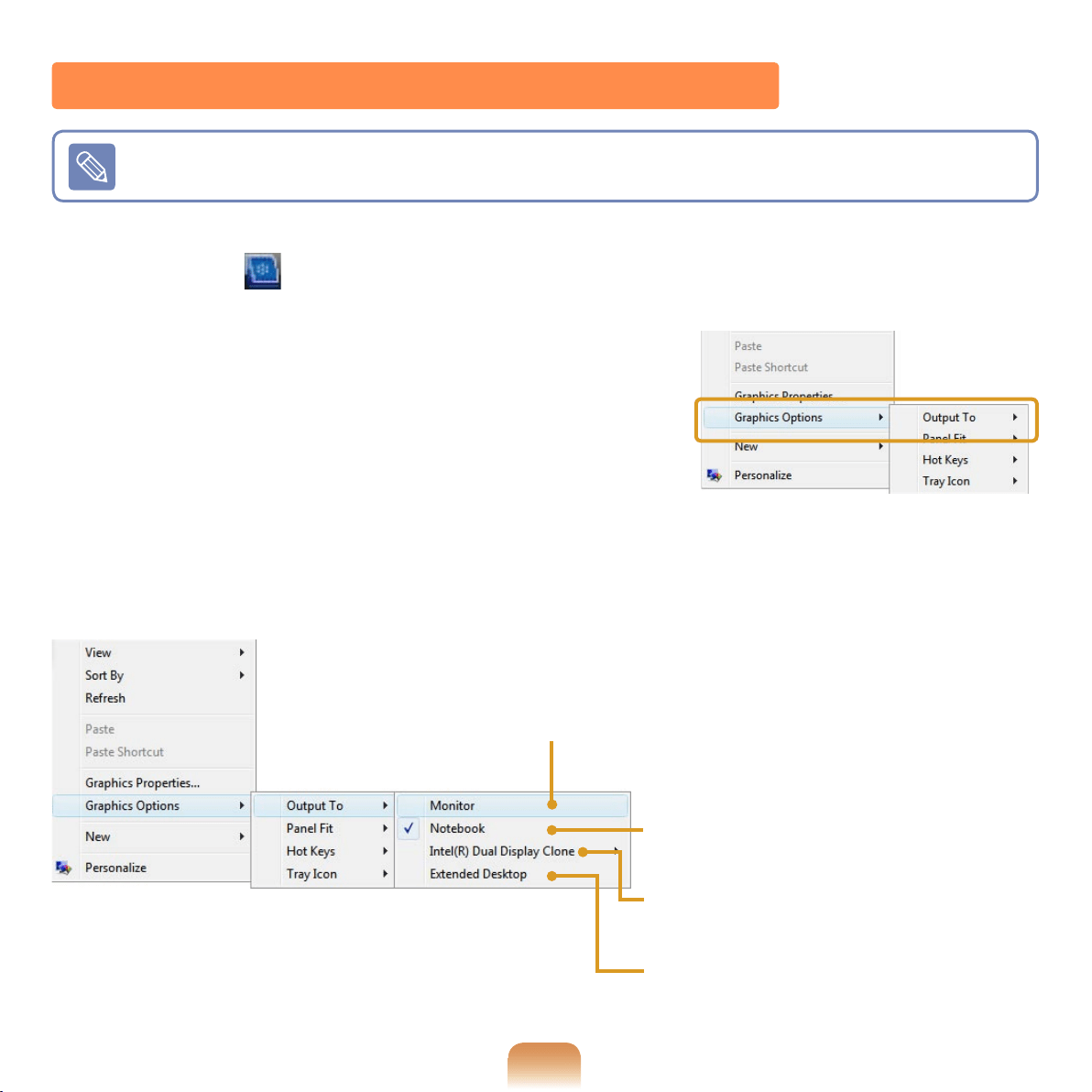
62
Method 2. Configuring with the Intel Program
1
Connect the monitor and click the Intel(R) Graphics Media Accelerator Driver for
Mobile icon (
) on the Taskbar. Or right-click on the desktop. The pop-up menu
appears.
2
Select Graphics Options and Output To from the
pop-up menu.
3
Select a display mode from among the available Display Modes 1~4 in the Graph-
ics Options menu.
* The terms and the screen figures in the manual may differ from actual ones.
1 To View through a Notebook
Computer (LCD) Only
3 To View through the LCD +
External Monitor (Clone Mode)
4 To View through the LCD +
External Monitor (Extended Mode)
2 To View through the
External Monitor Only
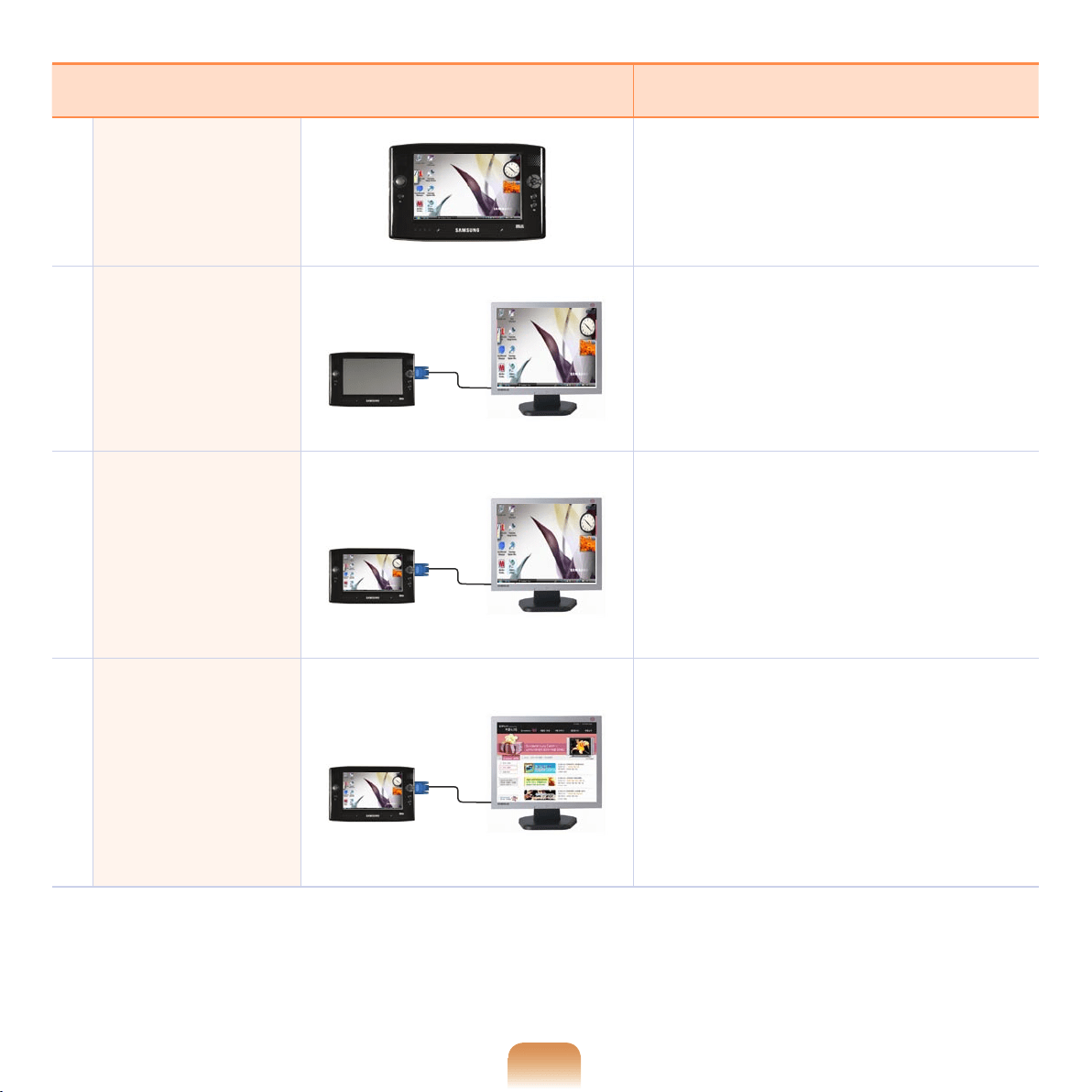
63
Display Device Display Mode
1
When carrying it Select Notebook.
2
When playing a
game
Select Monitor.
When playing a game, using only the
external monitor is better.
3
When giving a
presentation
(Clone Mode)
Select the Intel(R) Dual Display
Clone.
When selecting this mode, you can
view the same screen on both the
LCD and the external monitor.
4
When giving a
presentation
(Extended Mode:
Dual View)
Select the Extended Desktop.
When selecting this mode, you can
view a screen spanning over the
LCD and the external monitor, and
you can set different resolutions for
each display device.
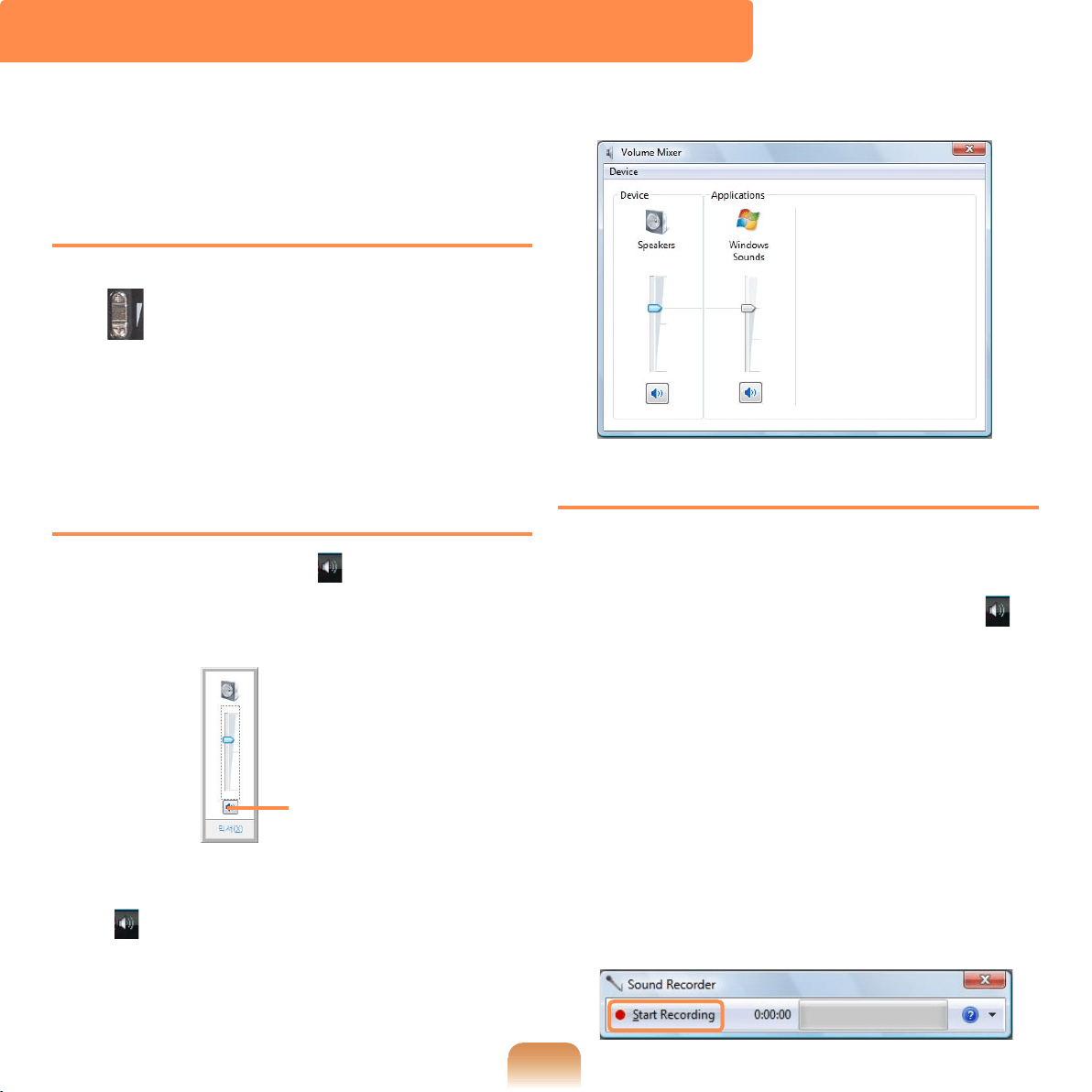
64
Using the Volume Control with
the Volume Control Button
Press the top of the Volume Control But-
ton (
) (+) to turn up the volume or
press the bottom of the button (-) to turn
down the volume.
Adjusting the Volume using the
Volume Adjustment Program
Click the Volume icon ( ) on the taskbar
and slide the volume control bar to adjust
the volume.
Alternatively, right-click over the Volume
icon (
) and select Open Volume Mixer
to adjust the volume.
Using the Sound Recorder
The procedures to record sound using the
Windows Recorder are described below.
1
Right-click over the Volume icon ( )
on the taskbar and select Recording
Device.
2
Check if the microphone is set as the
default recording device.
If this is the case, it is already set as
the default device. If not, right-click
over the microphone and select Set
default.
3
Click Start > All Programs > Acces-
sories > Sound Recorder and click
Start recording to start a recording.
Adjusting the Volume
You can control the volume with the Volume Control button or Volume Control program.
Mute
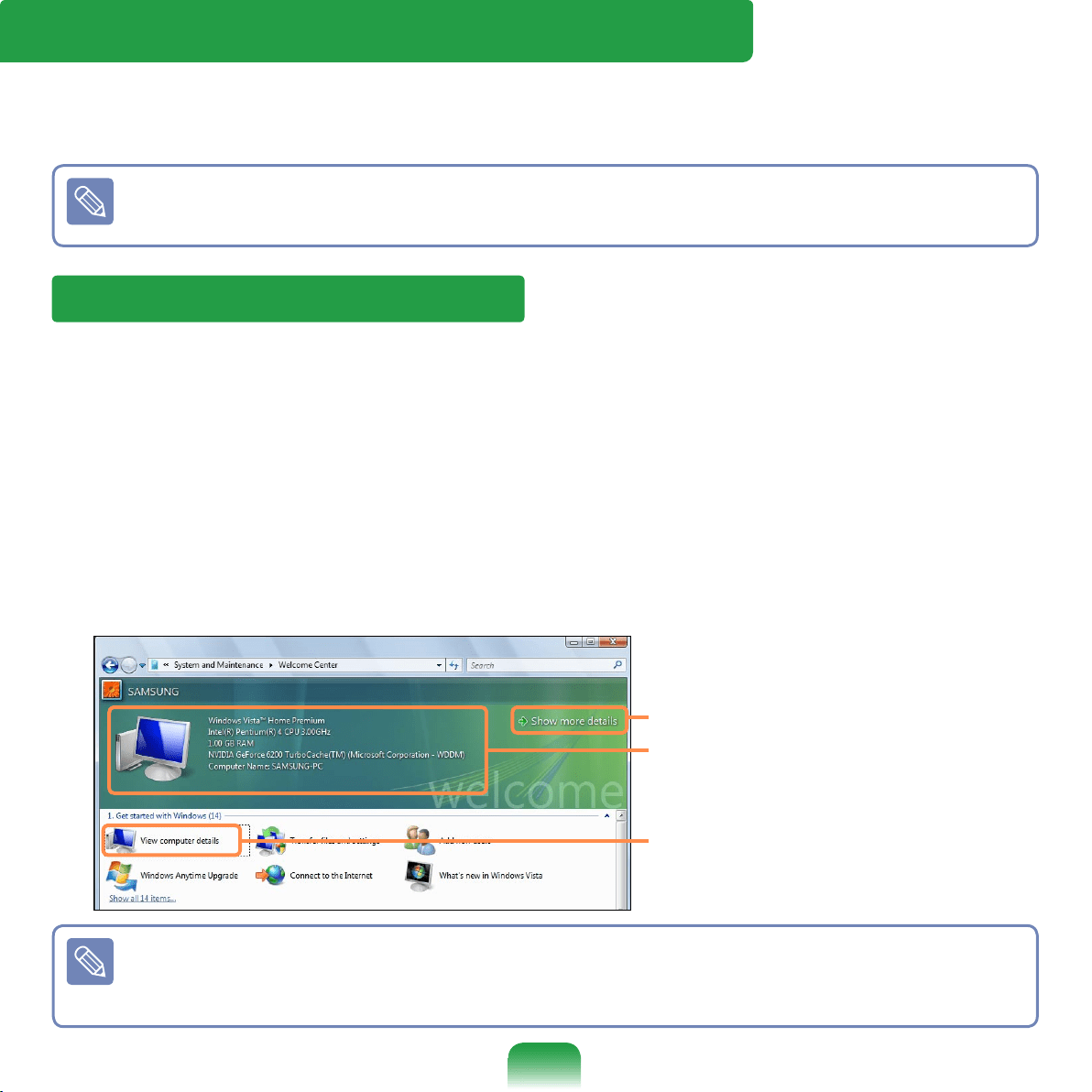
In the Welcome Center, you can view brief descriptions of Windows Vista functions and
run the functions directly.
1
Click Start > Welcome Center.
2
If you click on an item, information on the function is displayed in the description
window.
For example, if you click View computer details, your computer information is dis-
played in the description window.
In addition, if you click on Show more Details, you can view more detailed infor-
mation.
1
Description Window
2
Windows Vista Demo
If you click Start > Welcome Center > Show all 7 items > Windows Vista Demo,
you can watch the Windows V
ista introduction movie.
About Microsoft Windows Vista
Microsoft Windows Vista (hereafter Windows) is a computer operating system. Since you
have to learn how to use it in order to use the computer efficiently and effectively, use the
Welcome Center and Windows Help and Support to learn about Windows Vista.
Welcome Center
The screen layout may differ depending on the computer model and the operating
system.
66
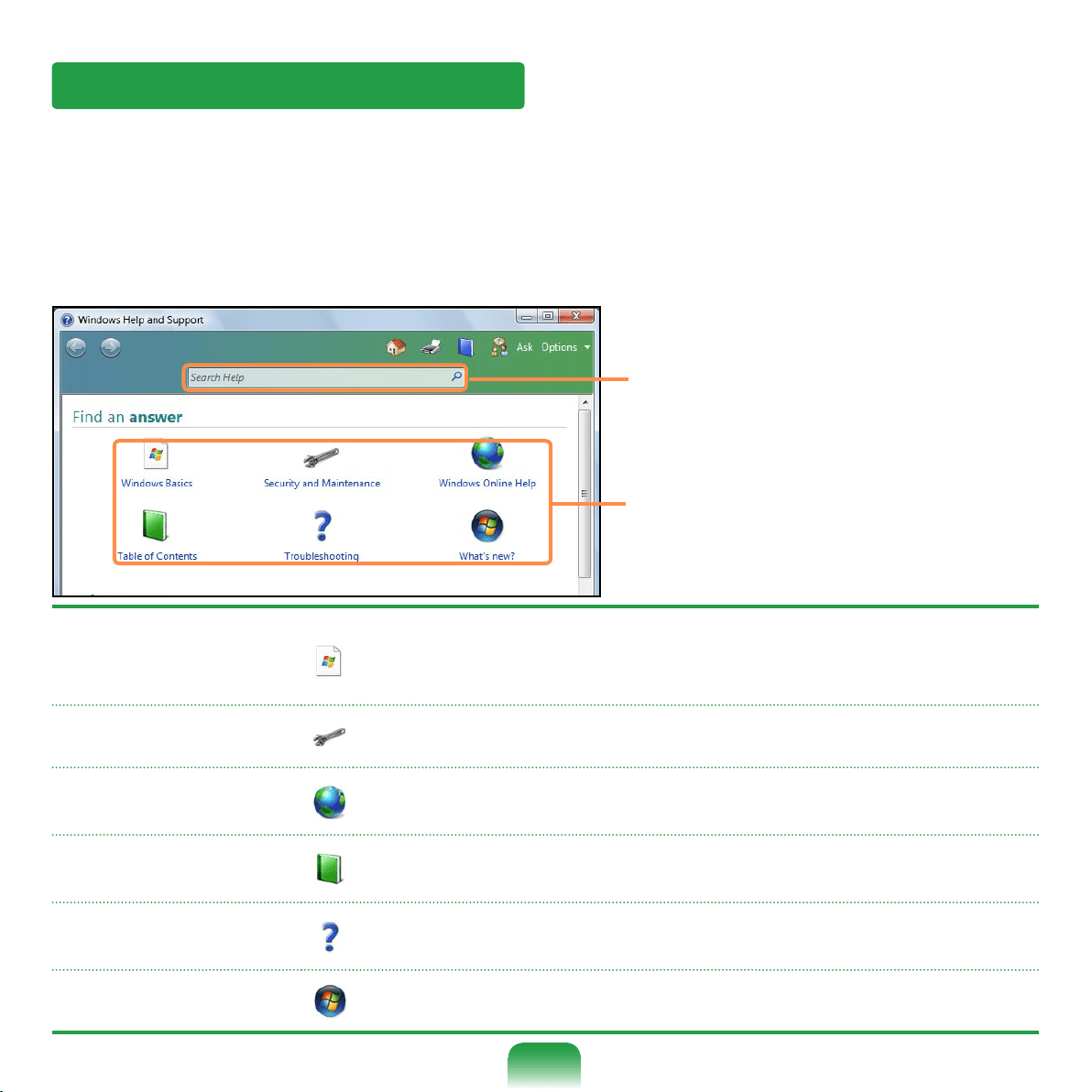
67
Help and Support
Windows Help and Support provides information on Windows basic functions and us-
ages.
Click Start > Help and Support.
You can find help for frequently used basic functions using Find an Answer and you
can search for help by entering a keyword in the Search box.
Help Search
Find an Answer
Windows Basics
Introduces the basic usage of the computer and the Windows
operation system.
You can learn tasks and tools necessary to use the computer.
Security and Main-
tenance
You can view help on computer protection and security.
Windows Online
Help
If your computer is connected to the Internet, you can view the
necessary information online.
Table of Contents
The help pages are arranged by subject so that users can eas-
ily find the relevant information.
Troubleshooting
You can view possible problems that may occur while using
Windows and solutions to the problems.
What’s new?
You can view help for new Windows Vista features.
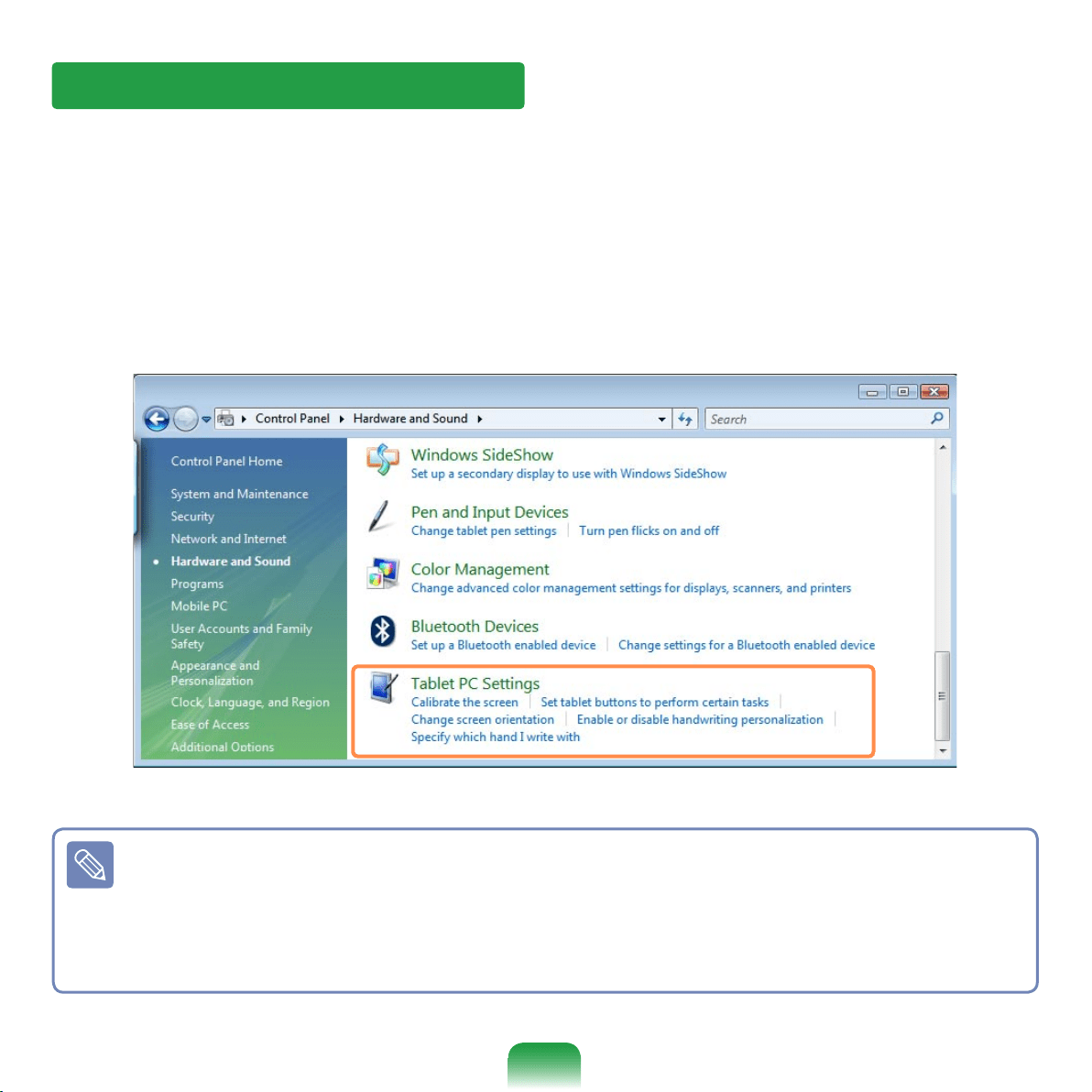
This computer is a Tablet PC with a touch screen.
In the Tablet PC Settings of the Control Panel, you can set the screen correction,
screen pivot function and whether to use the left-handed or right-handed option.
Click Start > Control Panel > Hardware and Sound > Tablet PC Settings.
Tablet PC Setting Information
For the efficient use of a Tablet PC
You can use the computer more efficiently in a short time by learning how to use
your fingers and the Stylus Pen.
Click Start > All Programs > Tablet PC and then click Tablet PC Touching Train-
ing or Tablet PC Pen Training.
68
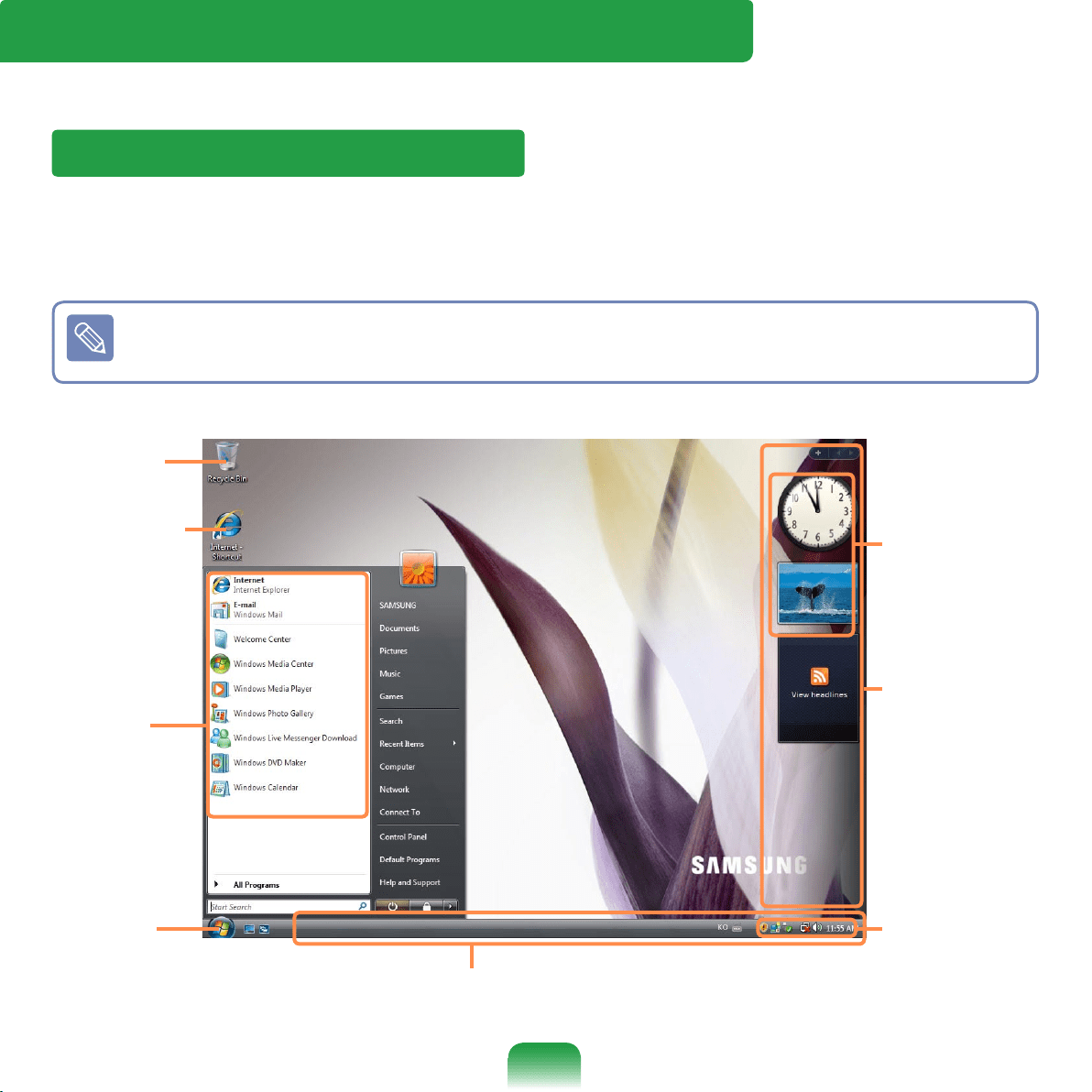
Windows Vista Screen Layout
Desktop
If you turn the computer on, the Desktop screen appears.
The desktop is the working area on the computer. It consists of a large workspace and
a taskbar at the bottom as shown in the figure below.
The screen layout may differ depending on the computer model and the operation
system version.
1 Recycle
Bin
2 Shortcut
Icons
3 Start
Menu
6 Gadget
7 Sidebar
4 Start
Button
5 Taskbar
8 System
Tray with
Clock
69
70
1 Recycle Bin
You can drop useless files and folders here.
2 Shortcut Icons
You can launch programs by clicking the shortcut icons on the Desktop.
3 Start Menu
The menu from which you can launch programs.
4 Start Button
Press the start button. The Start menu appears.
5 Taskbar
Currently running programs are displayed here.
6 Gadget
This is a mini information program that appears on the Sidebar.
7 Sidebar
This is a vertical bar that appears at the side of the Desktop.
8 System Tray
with Clock
Shows some running program icons. Icons not being used are hidden.
If you click the arrow mark on the left, you can view hidden icons.
Some item may not be provided depending on the Windows Vista version.
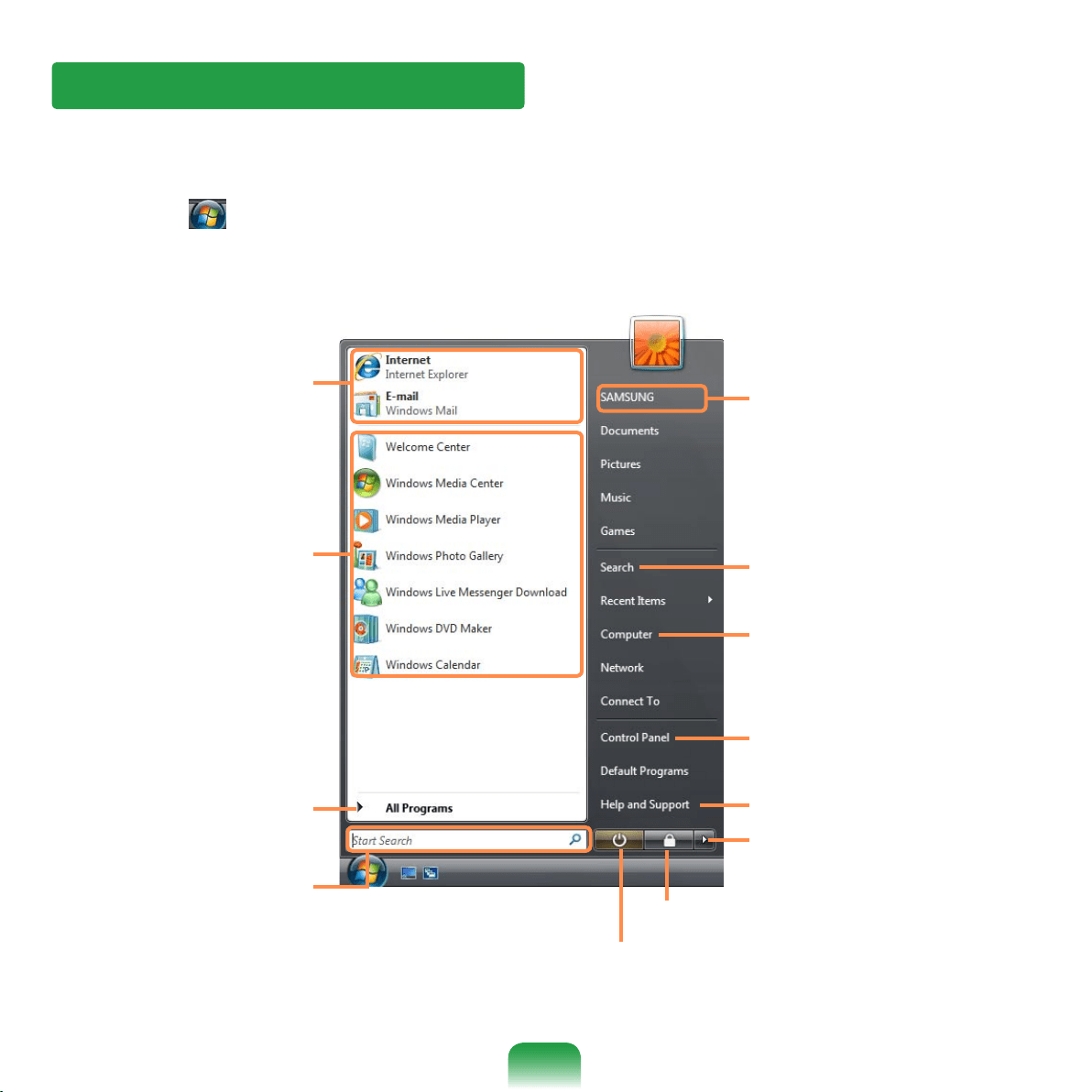
71
Start Menu
The menu from which you can launch programs.
Click Start (
). The Start menu appears.
Fixed Programs
The program or
search result is
displayed.
All Programs
You can search for
files, folders, etc.
Username
Search
Computer
Control Panel
Help and Support
Power Menu Button
Lock Button
Power Button
72
Search Enables users to search for files and folders.
Computer
Shows storage devices such as hard disk drives, CD/DVD
drives, network drives, etc.
In addition, you can manage files and folders here.
Control Panel
Enables users to configure the appearance and settings of
Windows such as the Desktop, window colors, hardware and
software settings, security, etc.
Help and Sup-
port
Provides on-line help about functions and usage of Windows
and troubleshooting. You can find a solution to a problem by
entering a keyword.
Power Button
Click the Power button to enter Sleep mode.
However, what the power button does changes according to the
power button setting.
p.84
Lock Button
To lock the computer, click this button. If you lock your comput-
er, no one can use the computer until you enter the password.
Power Menu
Button
Click the Power Menu button to shut down, restart, and logoff
from the computer.
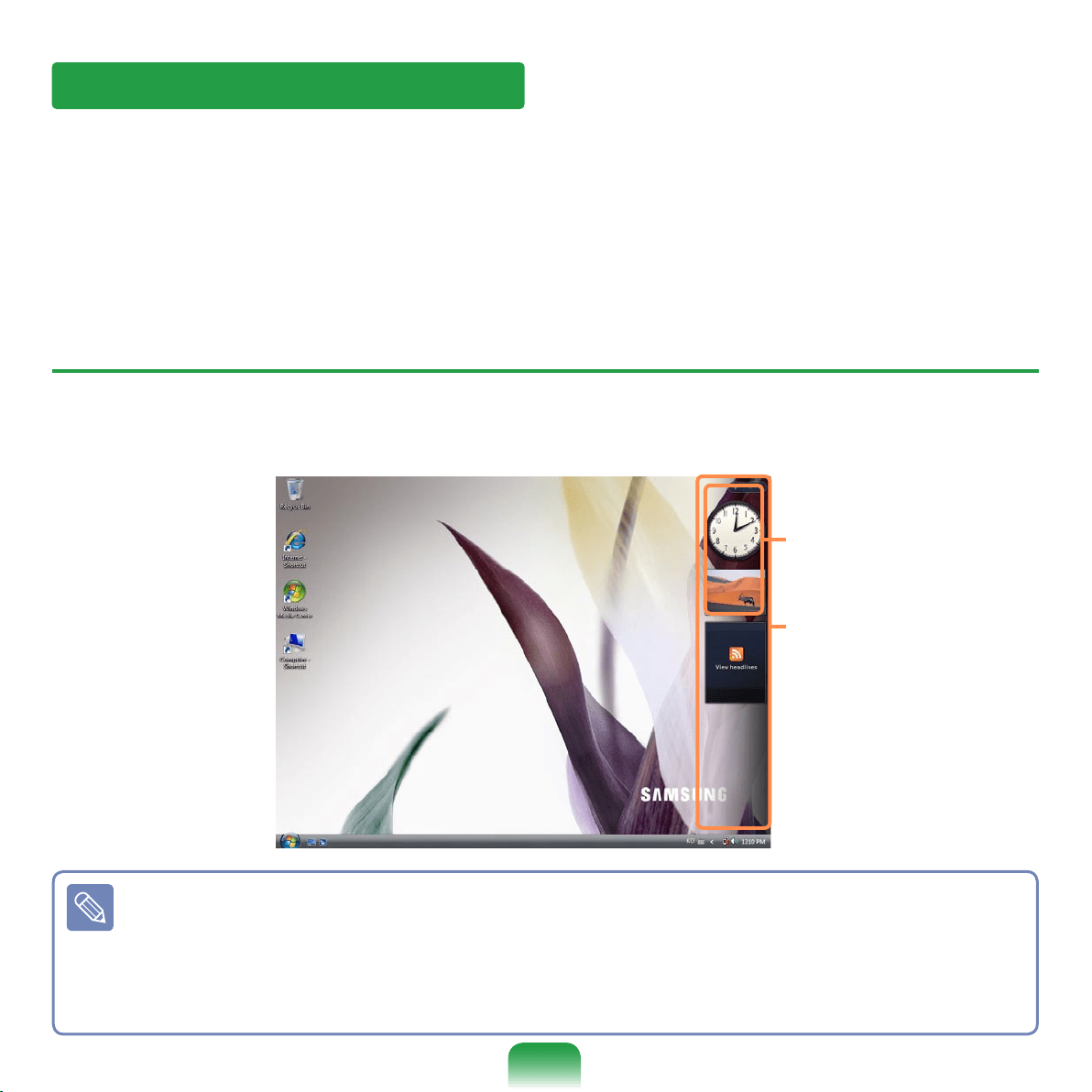
73
Sidebar / Gadget
Sidebar is a vertical bar that appears at the side of the Desktop.
A mini program called Gadget runs over the Sidebar which shows information such as
stocks, schedule, weather, etc. and provides frequently used tools.
You can download various Gadgets from the Internet other than the default Gadget.
Sidebar / Gadget Structure
If you launch Windows, the Sidebar is automatically launched and the Sidebar and
Gadget appear at the side of the Desktop.
■ If the Sidebar is not launched automatically when Windows starts, click Start > All
Programs > Accessories > Windows Sidebar to launch it manually.
■ To always display the Sidebar, right-click over the Sidebar and select Properties
and then select the Sidebar is always on top of Screen option in the Arrange-
ment field.
Sidebar
Gadget
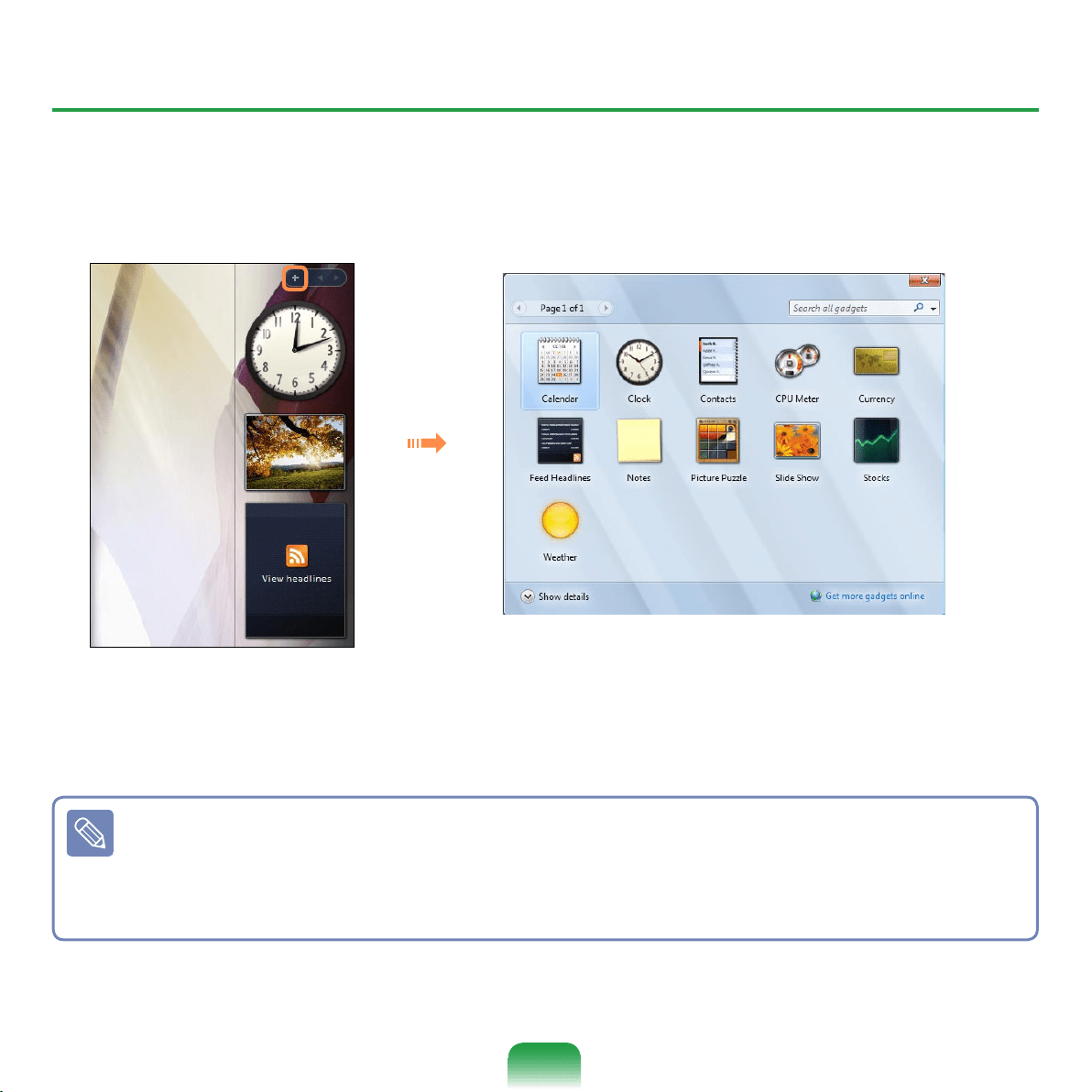
74
Adding a Gadget
You can find a gadget in the Gadget Gallery and add it to the Sidebar.
1
If you click the + at the top of the Sidebar, the Gadget Gallery opens.
2
If you double-click on a gadget, the gadget is added to the Sidebar.
■ If you drag a gadget to a new location with the Stylus Pen it moves the gadget to
that location.
Not only can you move a gadget onto the Sidebar but also out of the Sidebar.
■ If you tap on the gadget with the Stylus Pen, the Close and Option buttons appear.
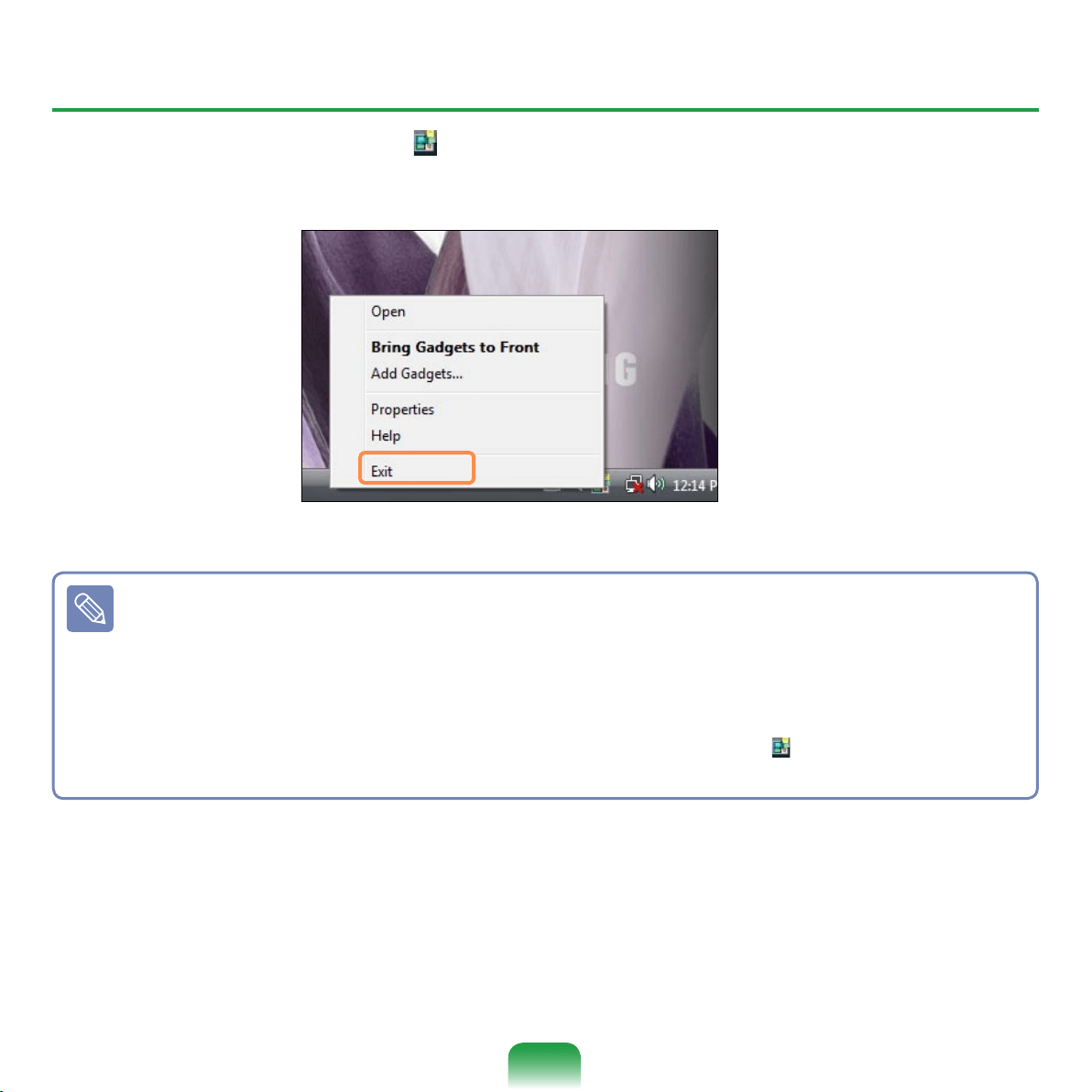
75
Exiting the Sidebar
Right-click on the Sidebar icon ( ) in the System Tray with the clock on the taskbar
and select Exit to exit the Sidebar.
Closing the Sidebar
■ Even if you close the Sidebar, the Sidebar continues running in the System Tray in
the clock area, though it is not displayed on the Desktop.
■ To close the Sidebar, right-click over the Sidebar on the Desktop and select Close
Sidebar.
To open the Sidebar again, right-click on the Sidebar icon (
) in the System Tray
with the clock on the taskbar and select Open.
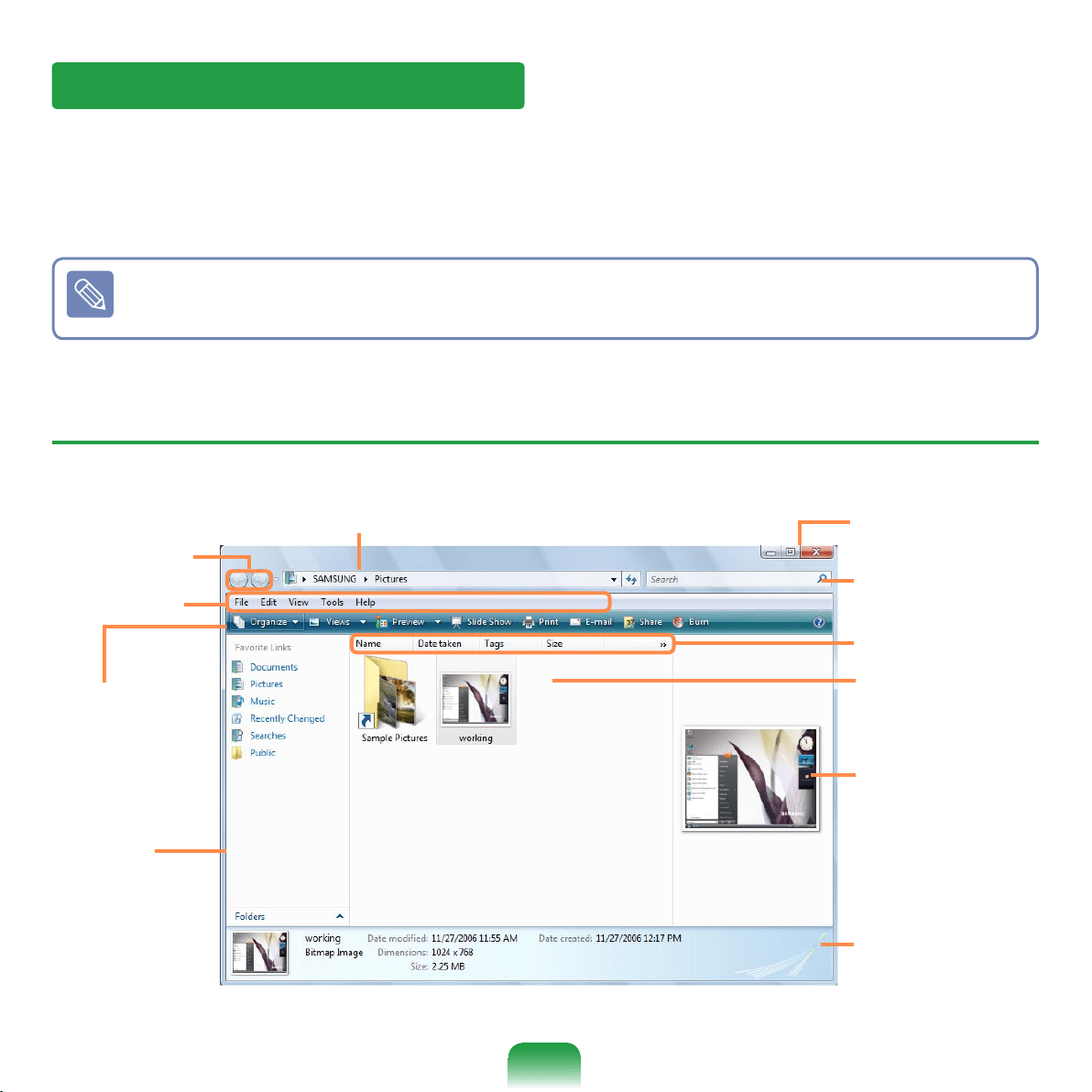
76
Window
A window is the basic frame for a computer operation. As an example, let’s see the
layout of a Pictures Window.
Click Start > Pictures.
The items and names may differ depending on your computer model and the Win-
dows Vista version.
Window Layout
1
Address Display Line
2 Move
Button
3 Menu Bar
4 Toolbar
5 Search
Window
6 Window
Button
7 Search Box
9 Folder / File
10 Preview
Window
11 Detailed
Information
Window
8 Sort Order

77
1 Address Display Line
Shows the location of the currently selected folder or file.
2 Move Button
You can move to the previous or next page by clicking the Back or
Next buttons.
Opens the previously opened page.
Opens the next page, when you have returned to a previous
page.
3 Menu Bar
Provides menus to run functions for the selected folder or file, etc.
4 Toolbar
Provides icons to quickly run frequently used functions.
5 Search Window
You can view the drive structure and the currently opened window
location.
You can move directly to a folder by clicking the folder in the
Search window.
6 Window Button
Used to resize the window.
Minimizes the window.
Maximizes the window.
Closes the window.
7 Search Box
You can search for files by specifying the text included in the file-
name or within the file or file attributes.
8 Sort Order
Used to change the sort order of the files.
9 Folder / File
The drives, folders and files included on the computer are dis-
played here.
10 Preview Window
You can preview a selected file before opening it.
A preview function is not provided for drives and folders.
11 Detailed Information
Window
Shows the general information of the selected file.
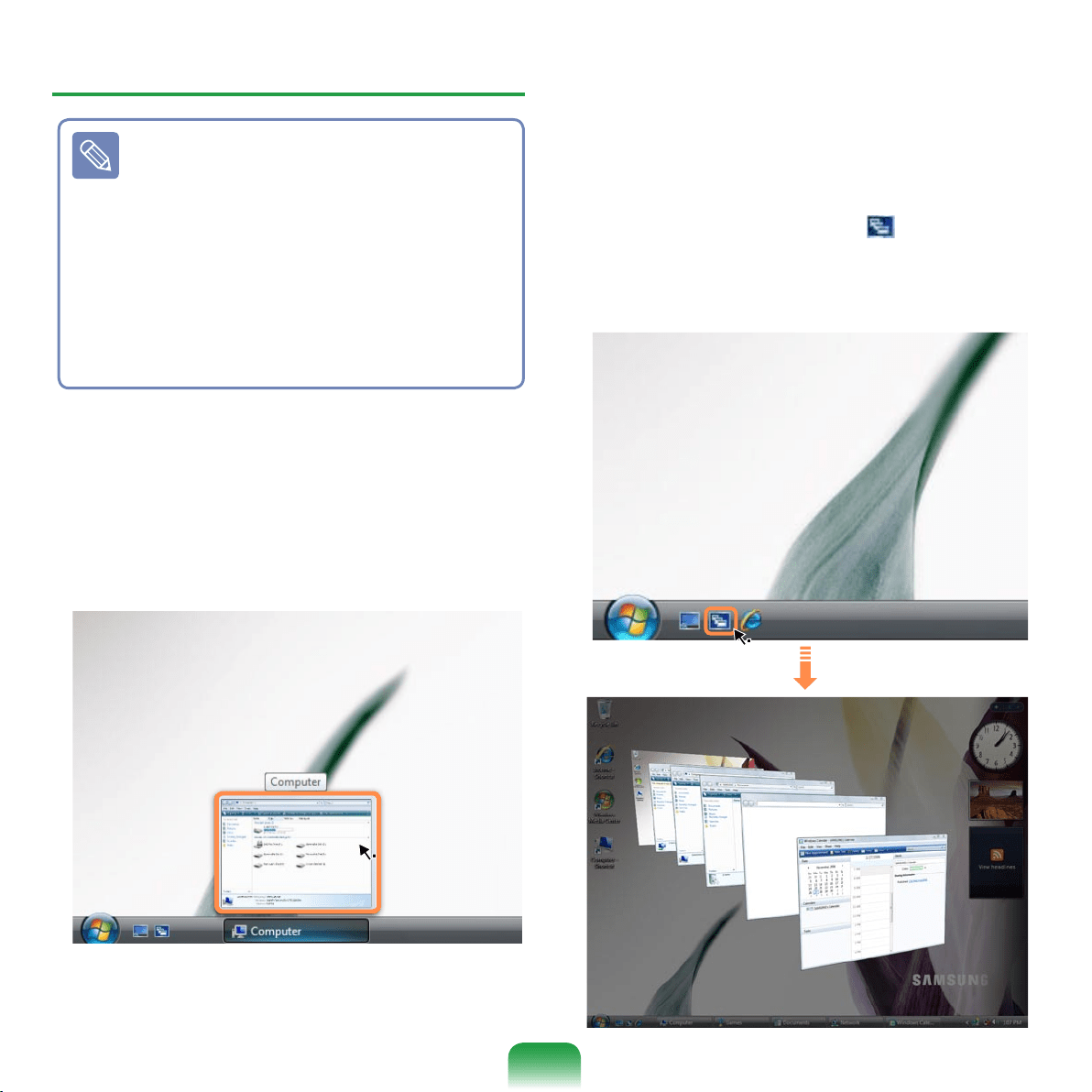
Window View Functions
► Preview
If you move the pointer over a button on
the Taskbar, you can preview the con-
tents of the window without opening the
window.
► Switching between Windows
This function arranges multiple windows
in 3D so that users can easily view the
windows.
Click on Switch Windows (
) at the bot-
tom left of the Desktop, and the windows
are displayed in 3D.
If you have set up the Aero func-
tion, you can use the window view
functions.
If you want to use the Aero func-
tion, click Start > Control Panel >
Appearance and Personalization
> Window Color and Appear-
ance. Select Window Aero from
the color schemes and click OK.
78
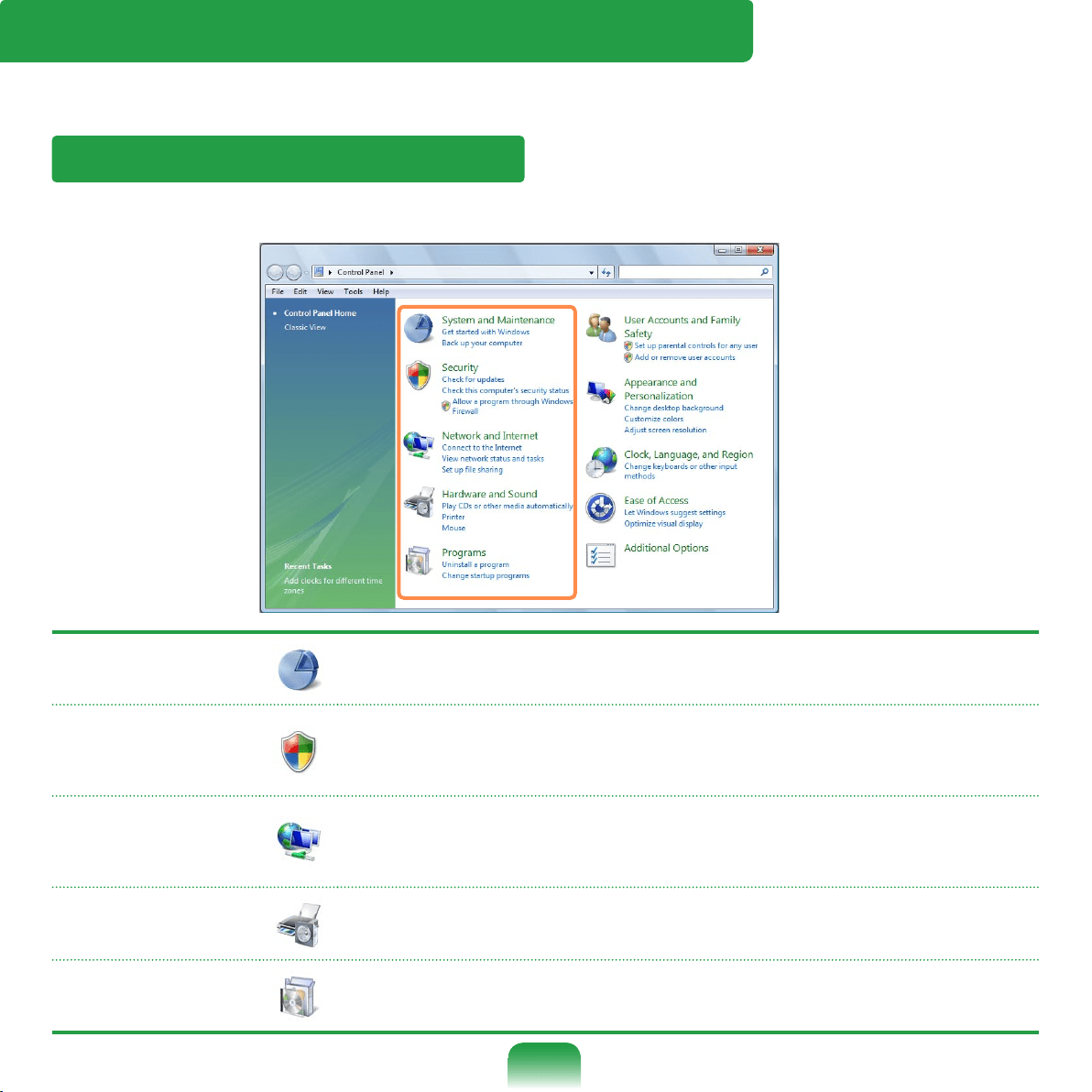
Control Panel
Tools for configuring Windows are located in the Control Panel.
Opening the Control Panel
Click Start > Control Panel.
System and
Maintenance
Using this function, you can configure Windows performance op-
tions.
Security
Using this function, you can check the current security status to
protect the computer and configure the security settings for the
firewall, spyware, etc.
Network and
Internet
Using this function, you can check the network status and config-
ure the settings.
You can change the Internet connection settings.
Hardware and
Sound
Using this function, you can add a printer and other hardware,
change the settings, and update the device drivers.
Programs
Using this function, you can remove a program or Windows func-
tion and download a new program from the internet.
79
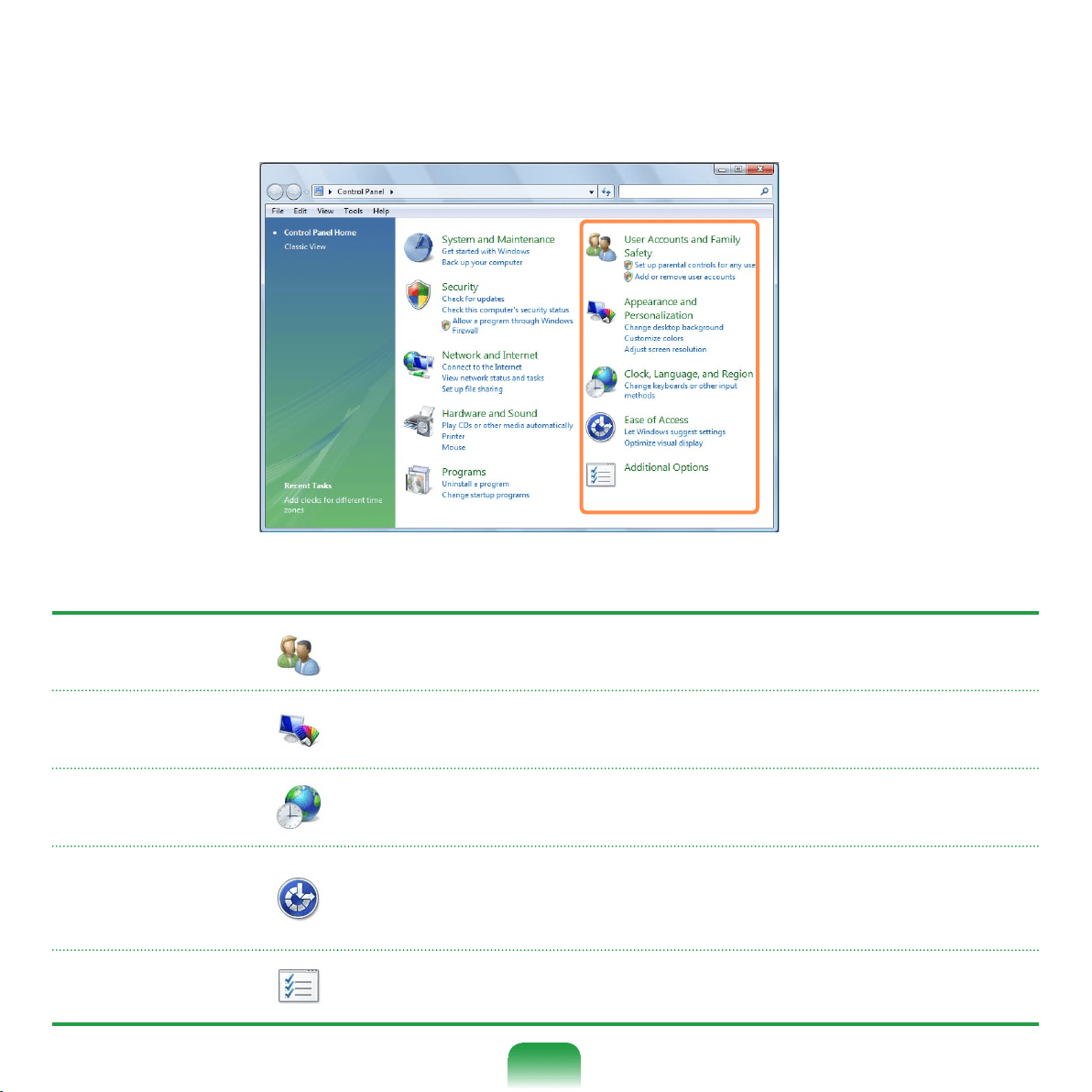
User Accounts
and Family Safe-
You can change the user account settings, passwords and con-
figure the Parental Controls function.
Appearance and
Personalize
Using this function, you can configure the Desktop style, theme
or screen saver settings.
Clock, Lan-
guage, and Re-
Using this function, you can configure the date, time, language
and regional settings.
Ease of Access
Using this function, you can select options for hearing and sight
impaired persons as well as for challenged persons. You can
configure the audio recognition settings.
Additional Op-
tions
Using this function, you can configure other Control Panel item
settings.
80
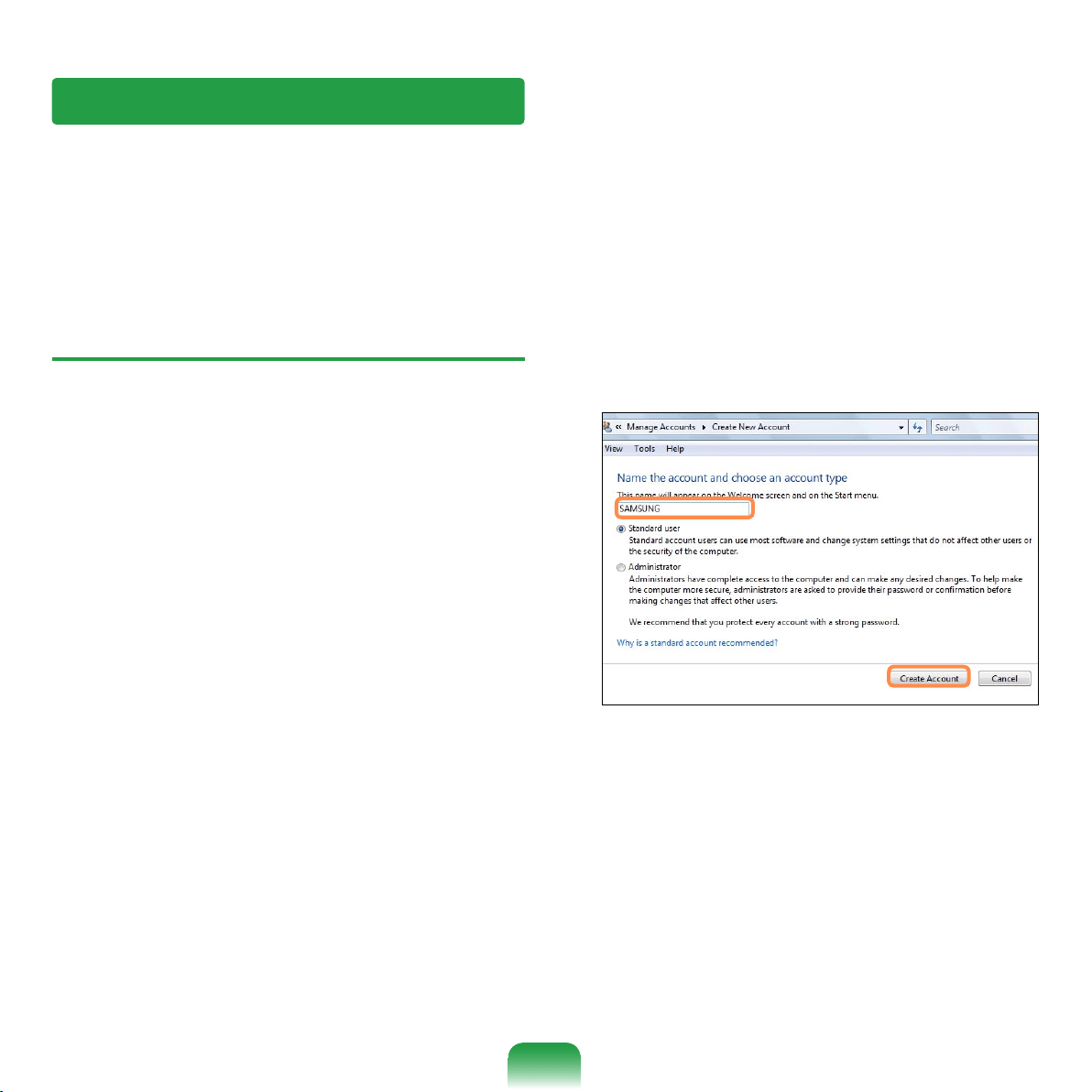
User Accounts
Using Windows Vista User Accounts, more than one user can easily share the same
PC.
The procedures to add and delete a user account and to switch users are described
below.
Adding User Accounts
1
Click Start > Control Panel> User
Accounts and Family Safety.
2
Click User Accounts > Manage
another account.
3
Click Create a new account.
4
Enter a new username and select
either Standard User or Administrator.
5
Click Create Account to add a new
account.
81

Removing User Accounts
1
Click Start > Control Panel > User
Accounts and Family Safety > User
Accounts.
2
Click Manage Another Account.
3
Click on the user account to be
deleted.
4
Click Delete the Account in the
Make changes to user’s account
menu.
5
A window appears asking whether
you want to save the desktop, docu-
ments, favorites, music files, pictures
and video folders as new folders
on the Desktop before deleting the
account.
If you click Delete files, the account
and all files belonging to the account
are deleted.
If you click Keep files, only the ac-
count is deleted and the files be-
longing to the user are saved on the
Desktop.
Switching User Accounts
1
Click Start ( ) on the taskbar and
select Switch User.
2
If you click on another username in
the start screen, you can login with
that user account.
■ If there is only one administra-
tor account for the computer,
you cannot delete the adminis-
trator account.
■ You can only delete another ac-
count when you are logged in as
an administrator.
82
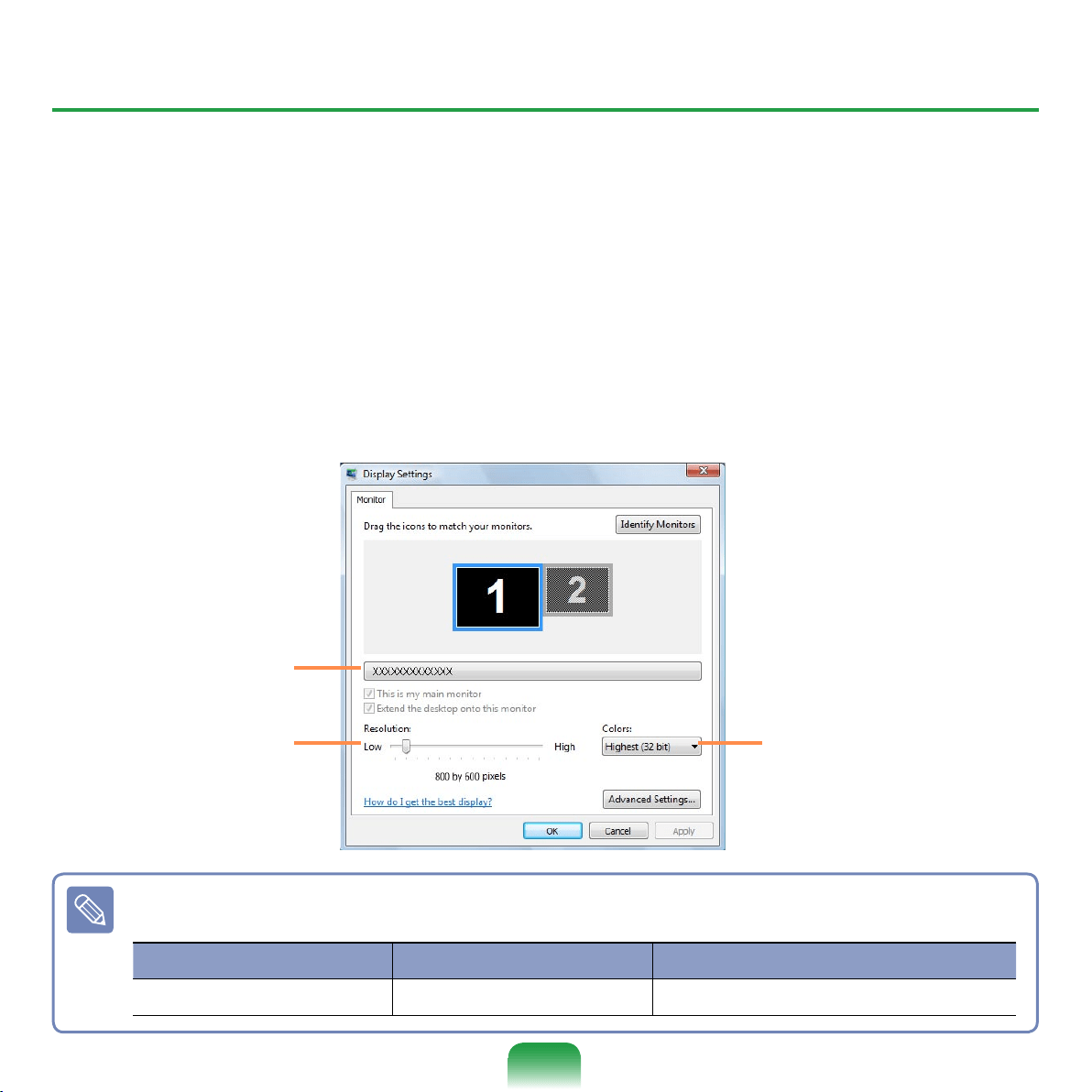
Changing the screen resolution and the color
The resolution refers to the number of pixels displayed on the screen. When increas-
ing the resolution, the items on the Desktop become smaller and more items can be
displayed on the screen. The higher the color quality, the more colors are displayed on
the screen.
1
Click Start > Control Panel > Appearance and Personalization > Personaliza-
tion > Display Settings.
Alternatively, right-click on the Desktop and select Personalization > Display Set-
tings from the pop-up menu.
2
The Display Settings screen appears.
Change the resolution and color settings and click the OK button.
The following resolutions and color qualities are recommended according to the
computer LCD panel type.
LCD Type Resolution Color Quality
7” WVGA 800 x 480 V
ery High (32bit)
To change the color
quality, click this button
and select a particular
quality.
To change the resolu-
tion, slide the resolu-
tion sliding bar to a
particular resolution.
You can check the
graphics chipset.
83
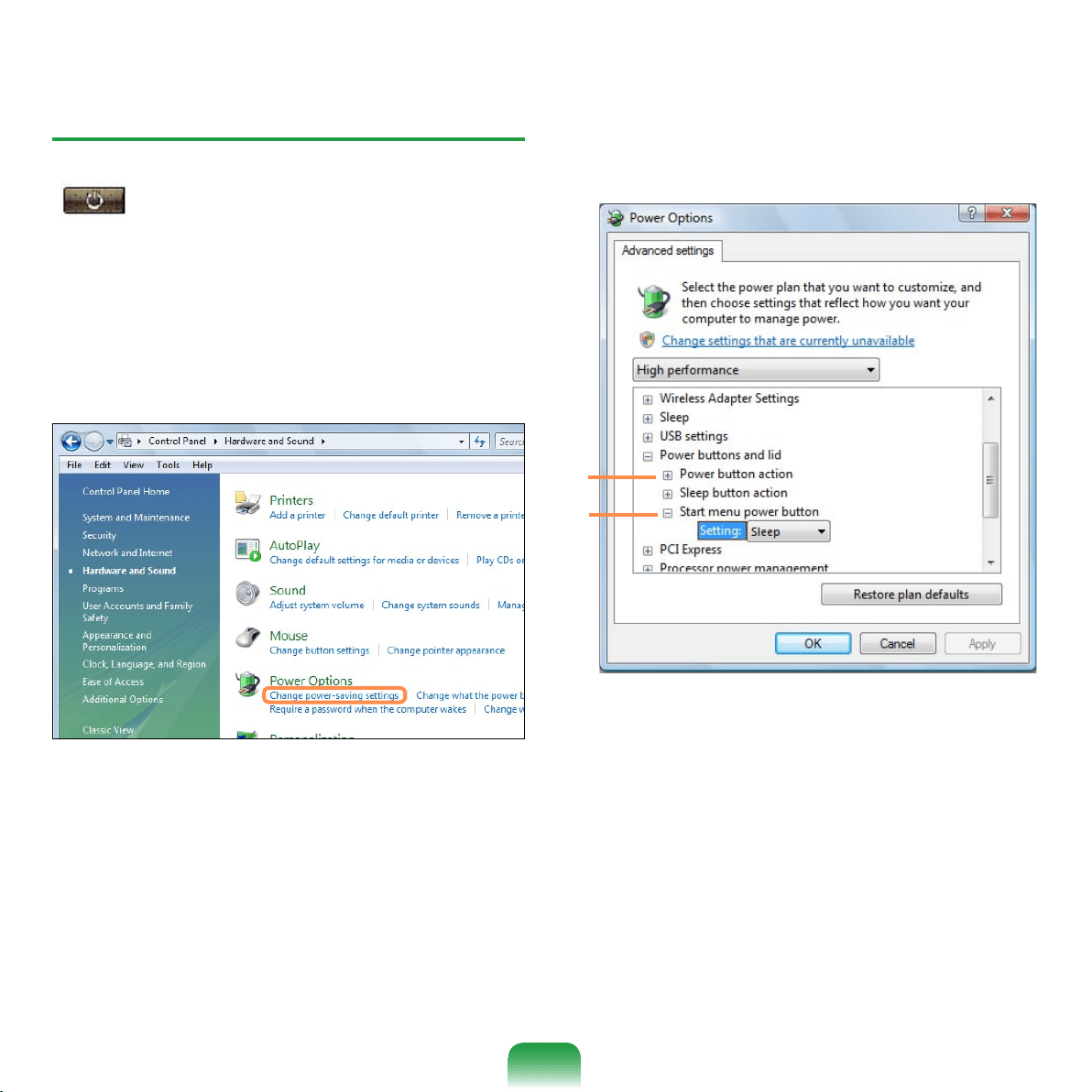
Configuring
the Start Menu Power Button
The Power button on the Start menu
(
) performs various operations de-
pending on the settings.
1
Click Start > Control Panel > Hard-
ware and Sound > Power Options
and then Change power-saving Set-
tings.
2
Click on Change Plan Settings in
the currently selected power setting.
3
Click on Change Advanced Power
Settings and open Start Menu
Power Button in the Power Buttons
and Lid item.
1
2
84
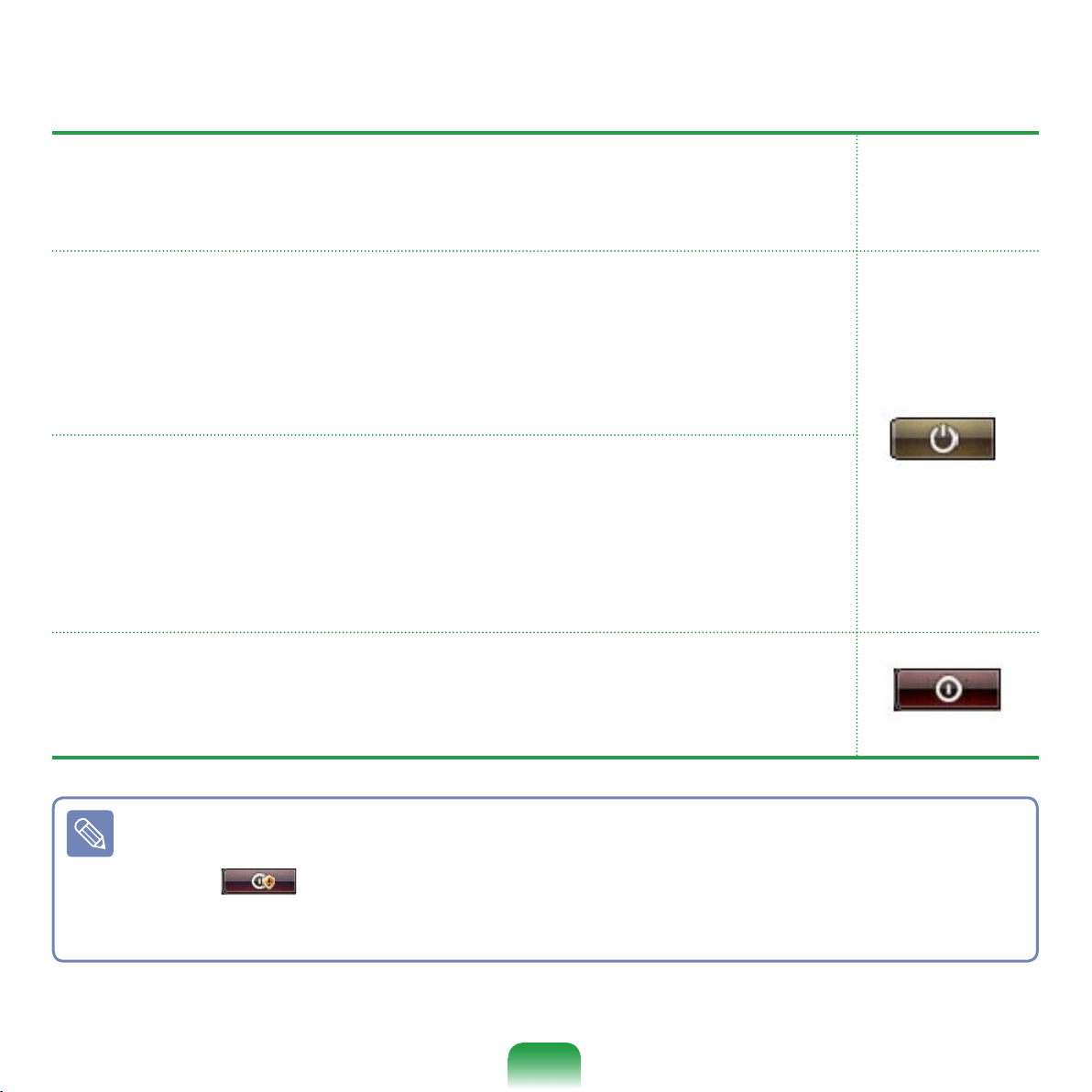
4
Select a power plan and click the OK button.
Type Description
Power But-
ton Image
after Setting
Change
Sleep
Sets the computer to enter Sleep mode.
The screen and hard disk will be turned off to reduce the
power consumption of the overall system.
If you slide the power switch of the computer to the right, the
computer wakes from Sleep Mode and you can resume work-
ing.
Hibernate
Sets the computer to hibernate.
All work is automatically saved, the screen is turned off and
the computer makes no noise.
If you slide the power switch of the computer to the right, the
computer wakes from Hibernation Mode and you can resume
working.
Shut
down
Shut down the computer.
You have to shut down the computer after closing all programs
and opened folders.
■ The Power button is set to Sleep mode by default.
■ If the computer is set to download Windows updates automatically, the update
mark (
) is displayed on the Power button when an update is ready.
If you click this button, the update is installed and the computer is shut down when
the update installation is complete.
85
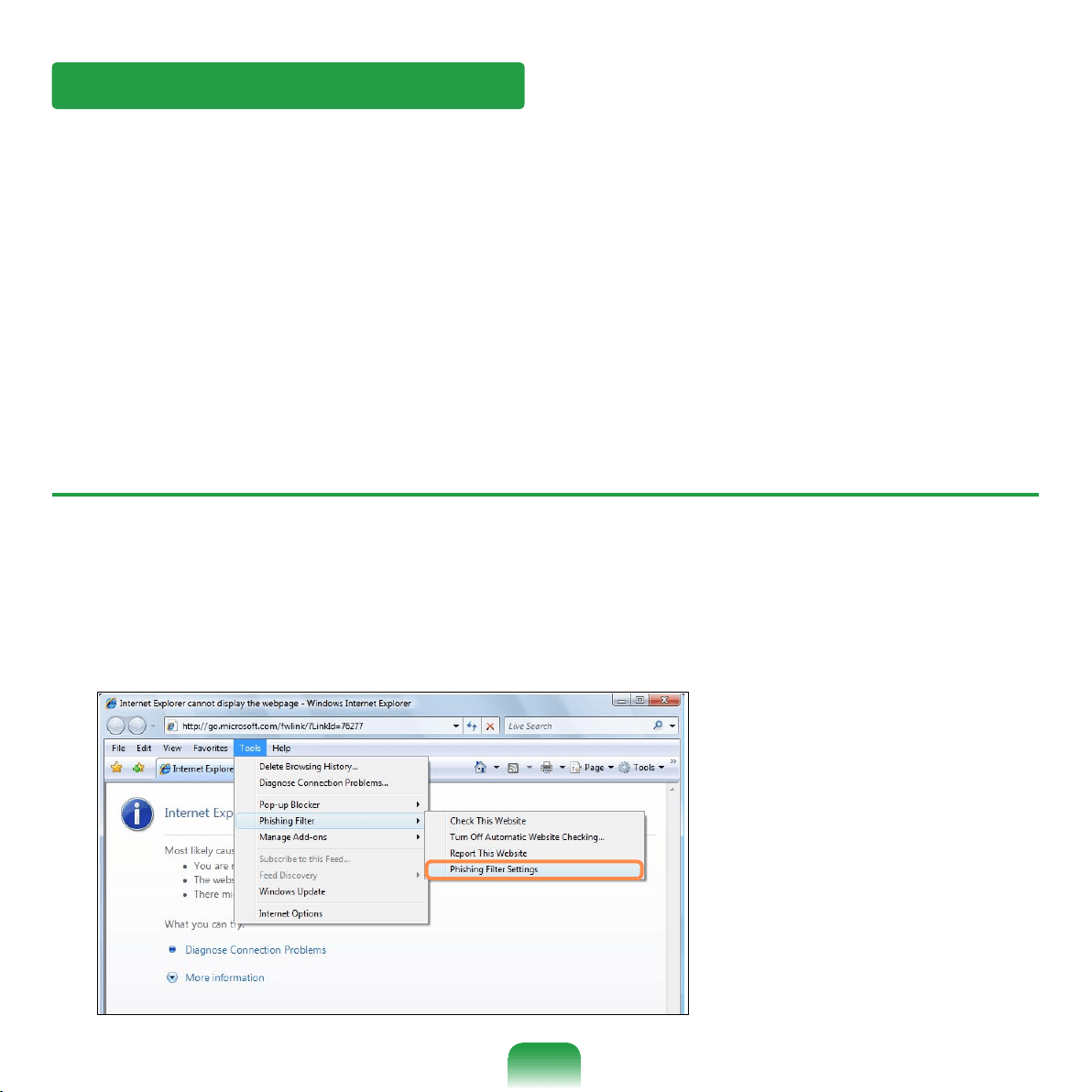
Phishing Filter Settings
1
Launch Internet Explorer.
2
Select Tools from the menu and click Phishing Filter > Phishing Filter Settings.
Phishing Filter
Phishing is a method used by hackers to illegally collect personal information such as
credit card numbers, passwords, other account numbers, etc. through emails or web-
sites.
The Phishing Filter protects users from these phishing attempts.
If the current page is judged to be a suspicious website, the Phishing Filter displays a
warning message with an alarm when the Phishing Filter is enabled. In addition, if a
page that the user is currently trying to open is registered as a known Phishing website
list, it displays a warning page instead.
86
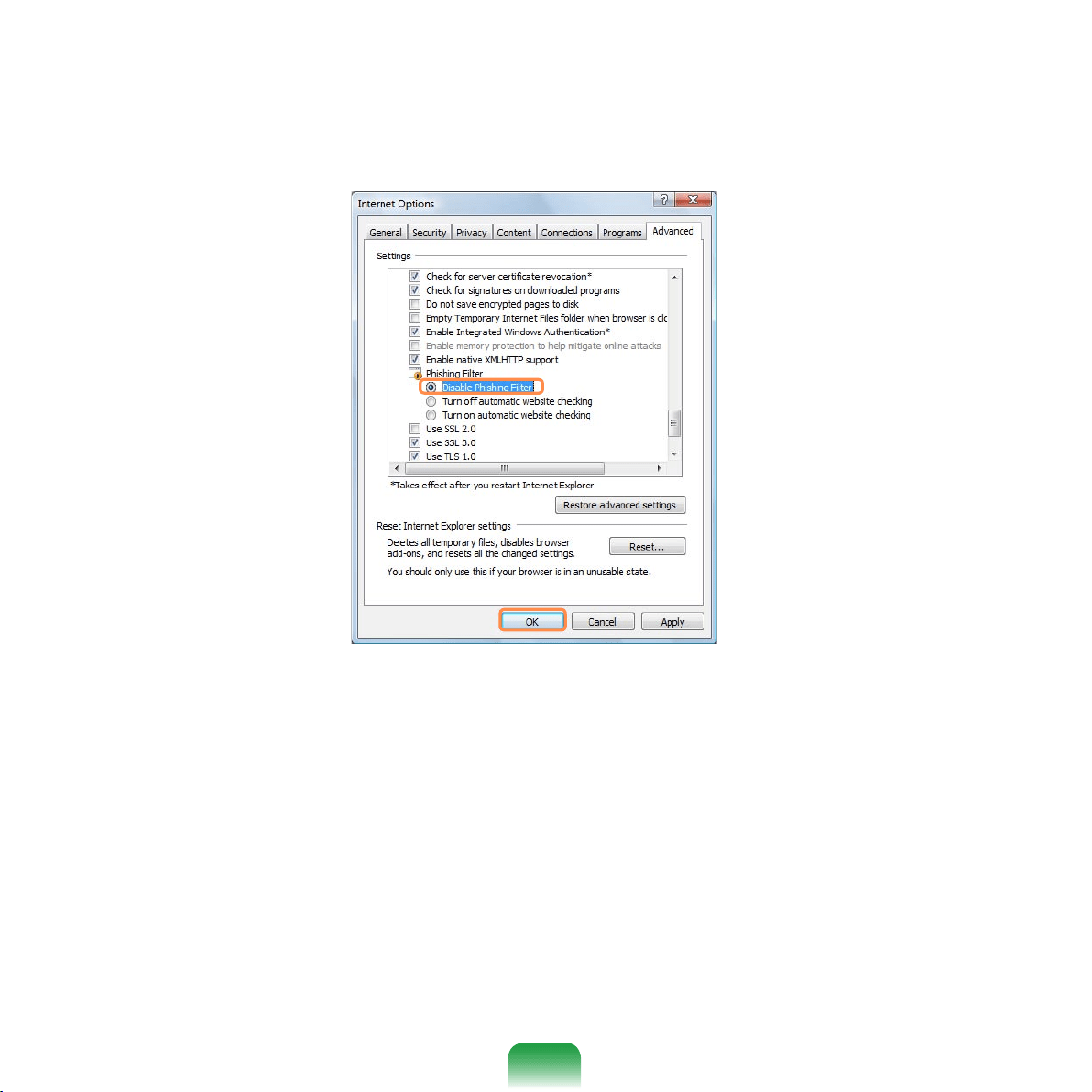
87
3
The Internet Options window opens.
Locate the Phishing Filter item in the Settings field. Select Turn on automatic
website checking and click the OK button to use the Phishing Filter.
4
To not use the Phishing Filter, select Turn off automatic website checking in the
Settings field in Step 3 above.
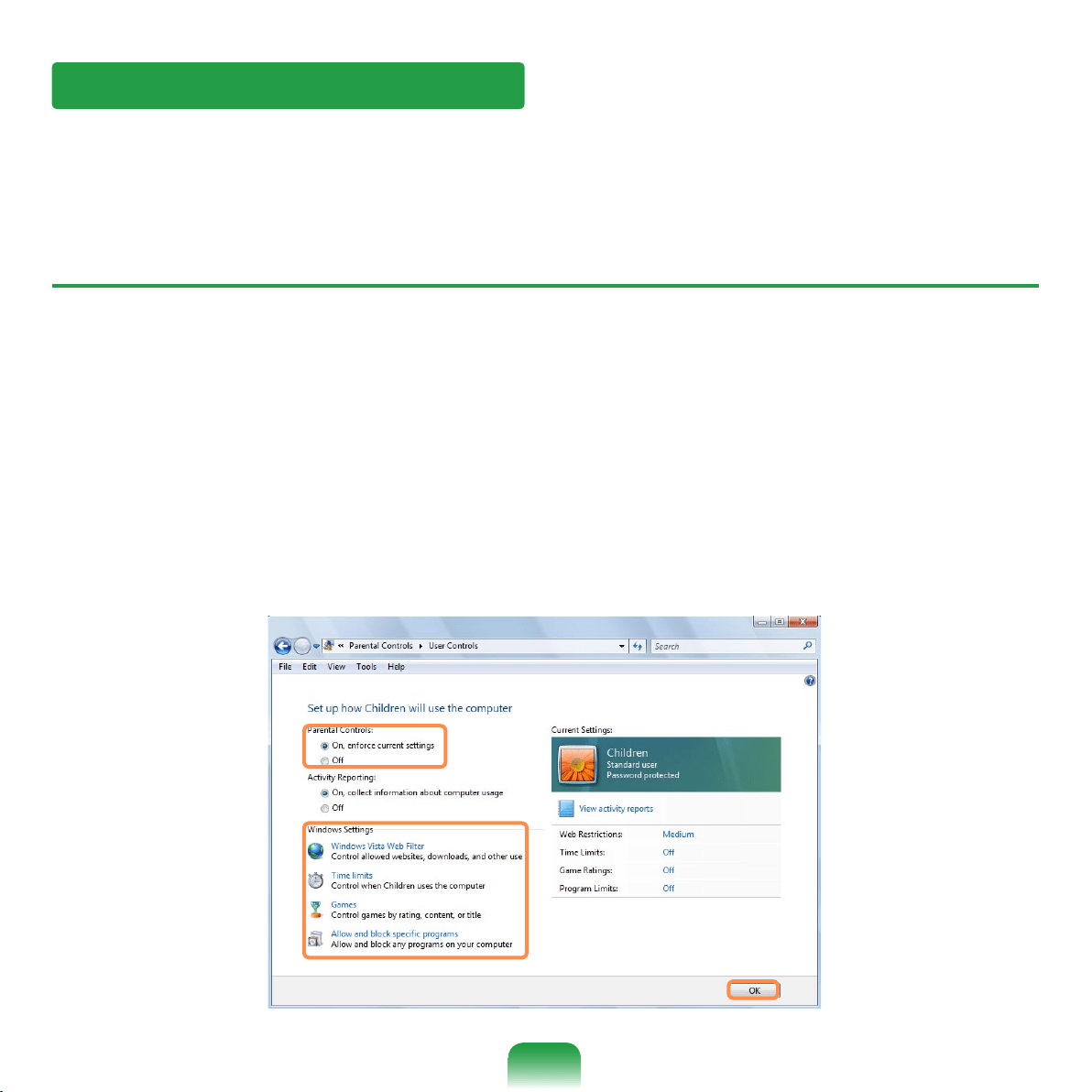
User control function
Using this function, you can control the content your children can access. You can
determine for how long they can use the computer and the content they can access.
When you have finished the settings, click OK to finish.
Configuring Parental Controls
1
Click Start > Control Panel > User Accounts and Family Safety > Parental
Controls.
2
Select a user to configure the Parental Controls for.
The User Controls window for that user opens.
3
Click Parental Controls > Use and configure the necessary settings in the
Windows Settings at the bottom. If you click OK, the Parental Controls setting is
completed.
88
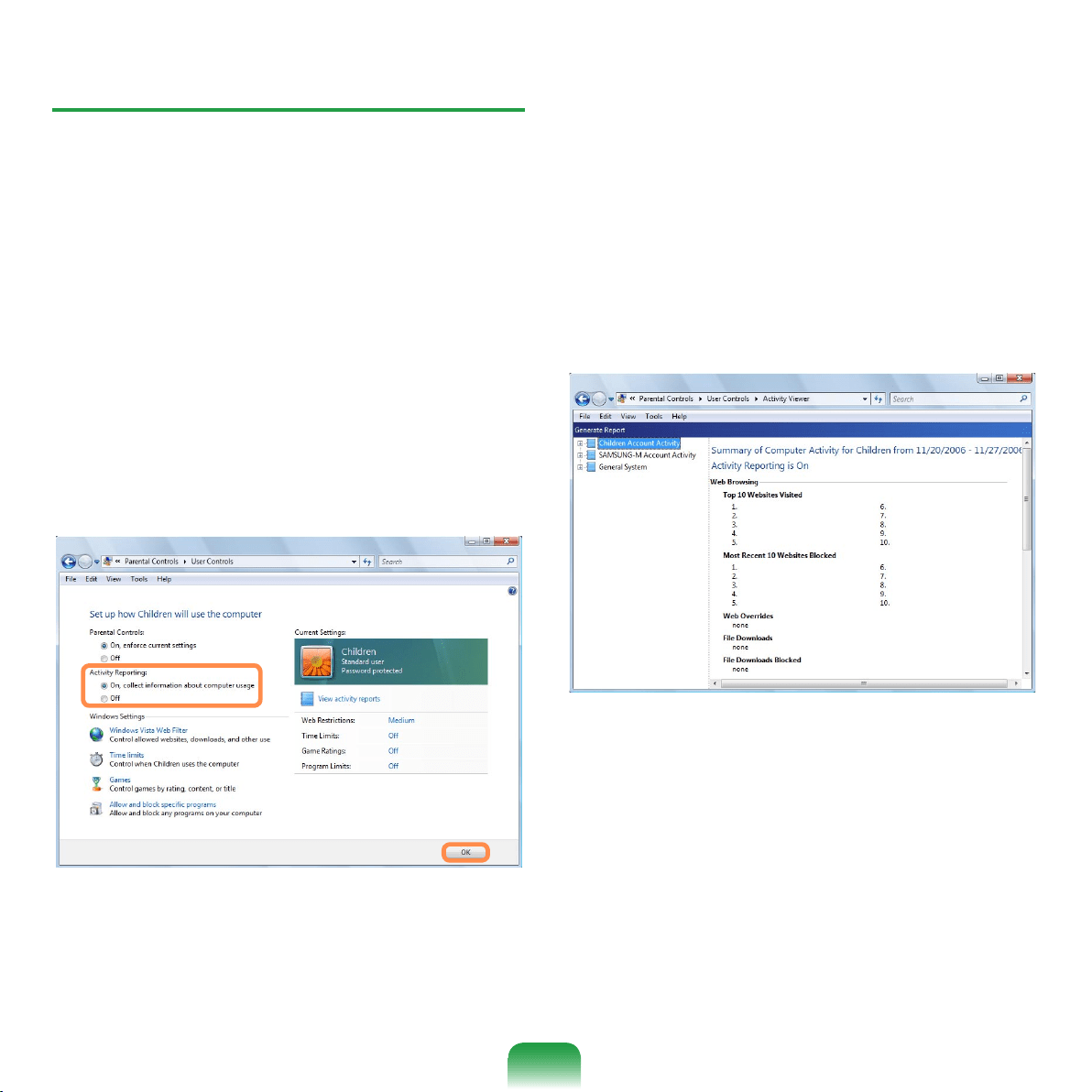
Using Activity Report
You can view and evaluate your chil-
dren’s internet access through the Activity
Report.
1
Open the User Controls window re-
ferring to the descriptions of Parental
Controls.
2
Set Activity Reporting to On.
3
To view the Activity Report, click on
View Activity Report on the right of
the User Controls window.
4
If you click the View Activity Report,
the following window opens display-
ing a computer operating summary.
89
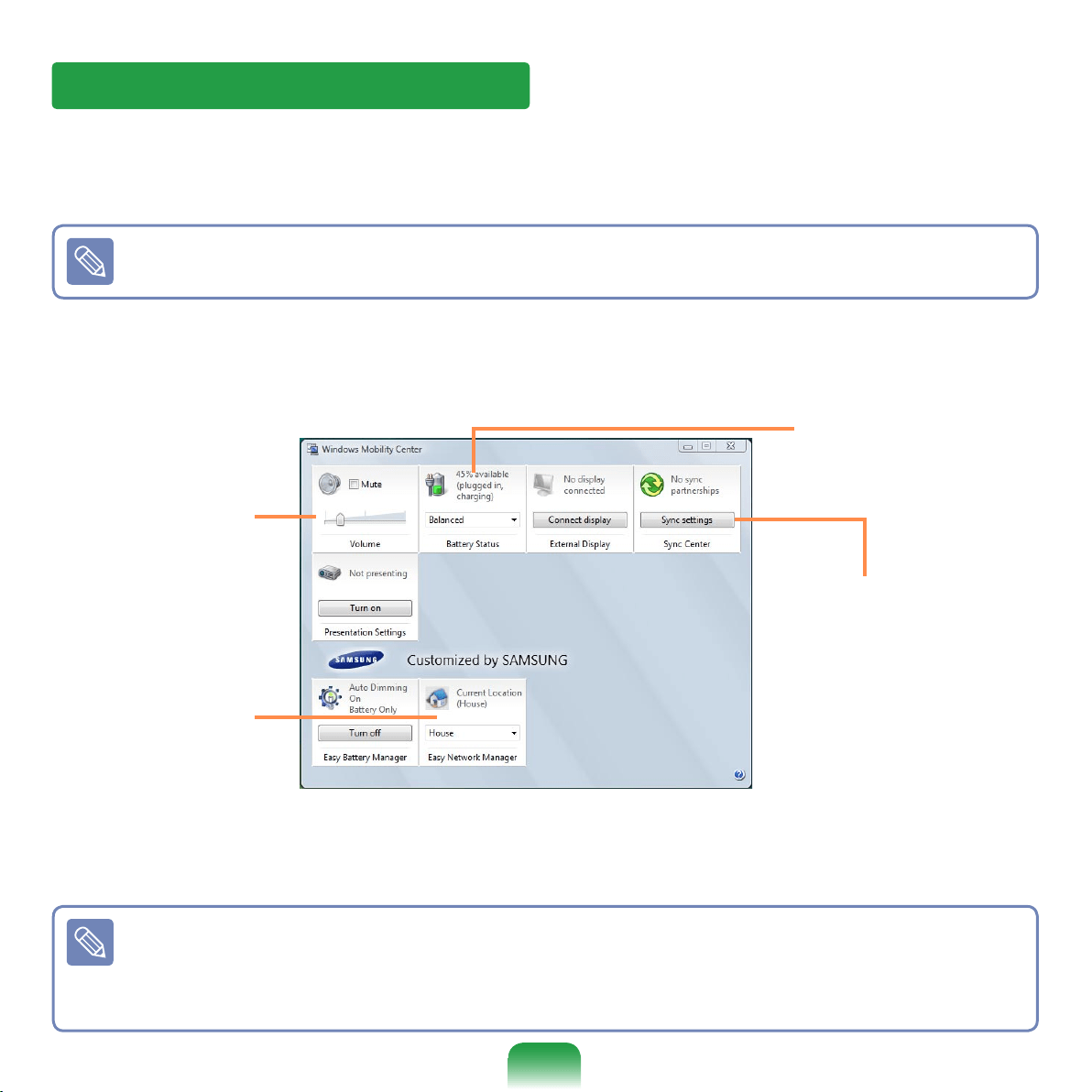
Using Windows Mobility Center, you can easily configure computer settings such as
the volume, the wireless network connection settings, the display settings, etc. all at
the same time.
Some functions may not be supported depending on the Windows Vista version.
1
Click Start > All Programs > Accessories > Windows Mobility Center.
Alternatively, click Start > Control Panel > Mobile PC > Windows Mobility Center.
Volume Control
Easy Network
Manager W
indow
Display Connection
Settings
Battery Status
Settings
2
Configure the volume, the battery status, the external display, the Sync center, etc.
according to your requirements.
■ Configurable items may differ depending on the installed Windows Vista version or
programs.
■ If Easy Network Manager program is installed, you can see Easy Network Man-
ager window
.
90
Windows Mobility Center
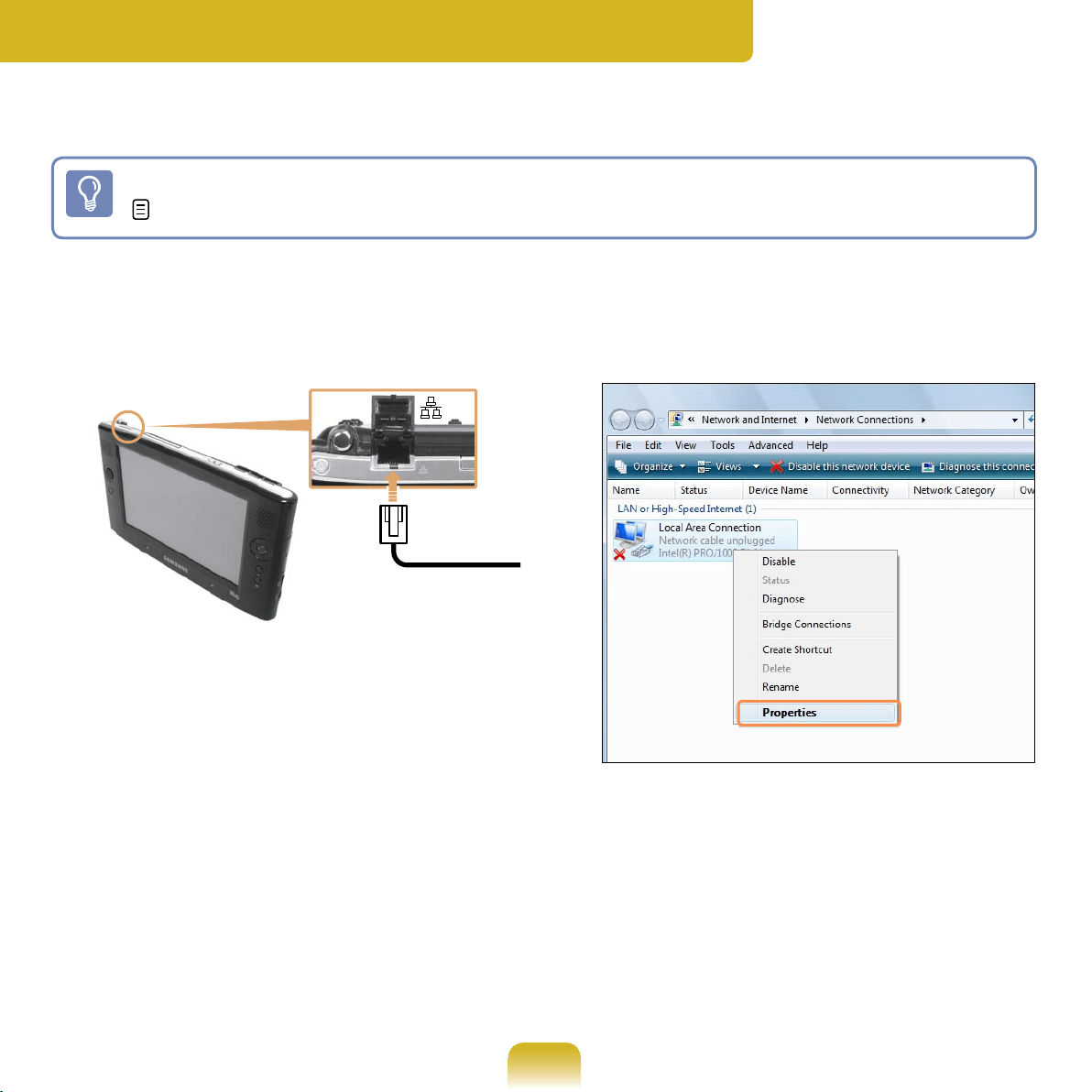
92
1
Connect a LAN cable to the comput-
er’s LAN port.
2
Click Start > Control Panel >
Network and Internet > Network
and Sharing Center.
3
Click Manage Network Connections
from the left pane.
4
Right-click over the Local Area Con-
nection and select Properties.
Wired Network
A wired network is a network environment used for a company network or broadband internet
connection at home.
You can also configure the network settings using the Easy Network Manager.
p.98
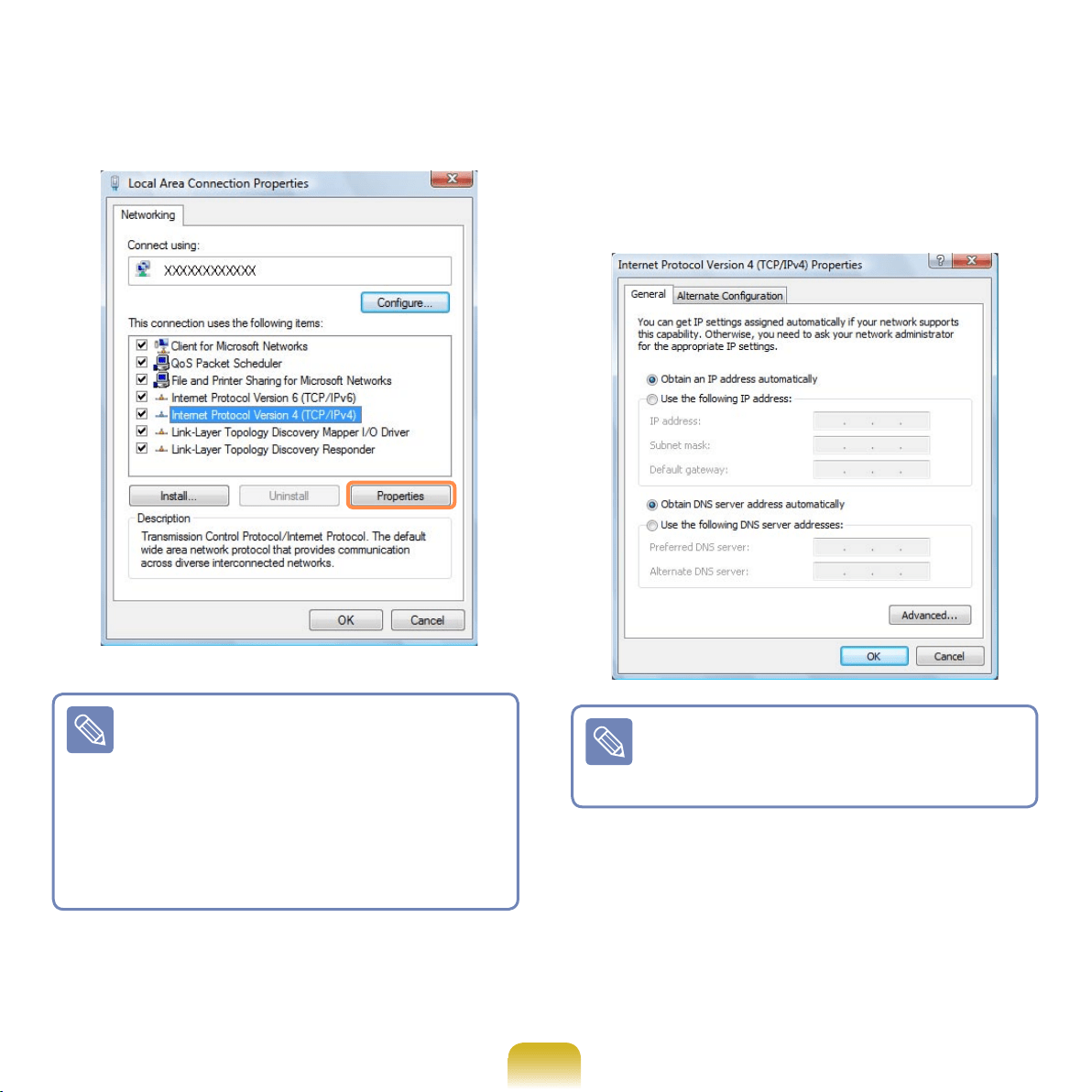
93
5
Select Internet Protocol Version 4
(TCP/IPv4) from the Networking tab
and click Properties.
6
Configure the IP settings.
When using DHCP, select Obtain an
IP address automatically. To use
a static IP address, select Use the
following IP address, and set the IP
address manually.
7
When you have completed the set-
tings, click the OK button.
The network settings have been com-
pleted.
■ The LAN device driver may differ
depending on your LAN device
model.
■ To add a network component,
click Install in the screen shown
in the figure above. You can add
clients, services, and protocols.
When not using DHCP, ask your
network administrator for the IP
address.
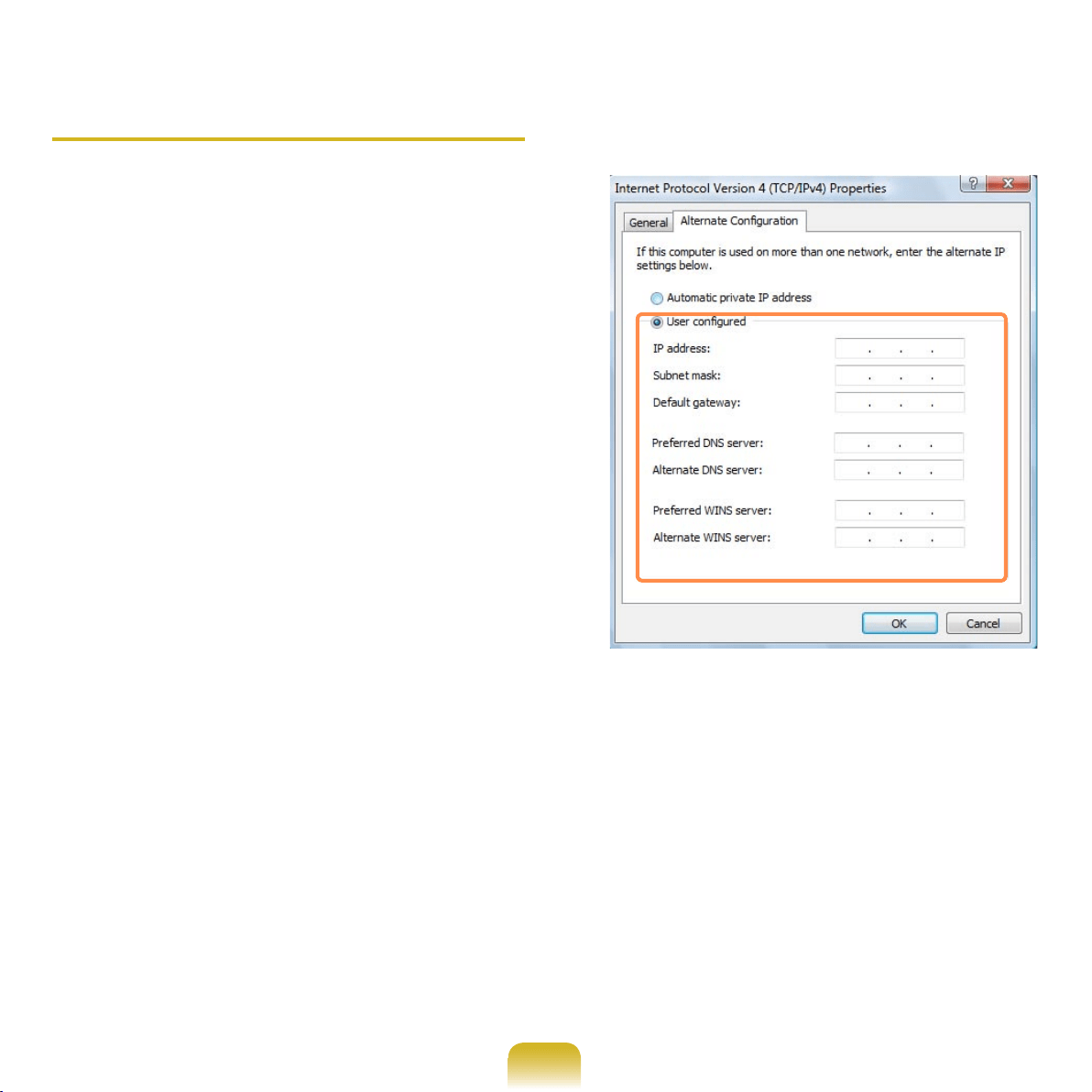
94
Using both DHCP
and a fixed IP simultaneously
Using the Alternate Configuration pro-
viding by Windows Vista, you can set both
automatic and fixed IP addresses and
then you can select to use either of them
to connect to the Internet.
1
Click Start > Control Panel >
Network and Internet > Network
and Sharing Center and click
Manage Network Connections in
the left pane.
2
Right-click over the Local Area Con-
nection and select Properties.
3
Select Internet Protocol Version 4
(TCP/IPv4) from the Networking tab
and select Properties.
4
Select the Alternate Configuration
tab, select User configured and fill in
the corresponding fields.
5
When you have completed the set-
tings, click the OK button.
95
Wireless Network
A wireless network (Wireless LAN) environment is a network environment that enables com-
municating between multiple computers at home or a small-size office through wireless LAN
devices.
You can also configure the network settings using the Easy Network Manager. p.98
■ The
descriptions below are for computer models with a Wireless LAN card or device.
You can also configure the wireless network settings using the Easy Network Man-
ager
.
p.98
A Wireless LAN device is optional. To view the installed wireless LAN card, click Start
>
Control Panel > Hardware and Sound > Device Manager > Network Adapter
and click the + symbol.
The
figures in this manual may differ from the actual ones depending on your wire-
less LAN device model.
■ T
o use the wireless LAN, you have to turn the wireless LAN on first. To turn it on, click
the Menu button and set the W
ireless LAN item to On. If the wireless LAN is turned
on, the Wireless LAN LED (
) is lit.
Wireless LAN Connections
Wireless network connections can be clas-
sified into 3 categories and this manual de-
scribes the connection procedures for con-
necting through an AP.
■ Access Point (AP)
You can connect to the Internet or another
computer on the network through an AP.
What is an Access Point (AP)?
An AP is a network device that
bridges wired and wireless LANs,
and corresponds to a wireless hub
in a wired network.
You can con-
nect multiple wireless LAN installed
computers to an AP.
■ Computer-to-computer (ad hoc) network
This is also called a peer-to-peer network.
In computer-to-computer wireless networks,
you can connect 2 or more computers with
wireless LAN modules.
For details, see the descriptions that appear
when clicking Start > Help and Support >
Troubleshooting > Networking.
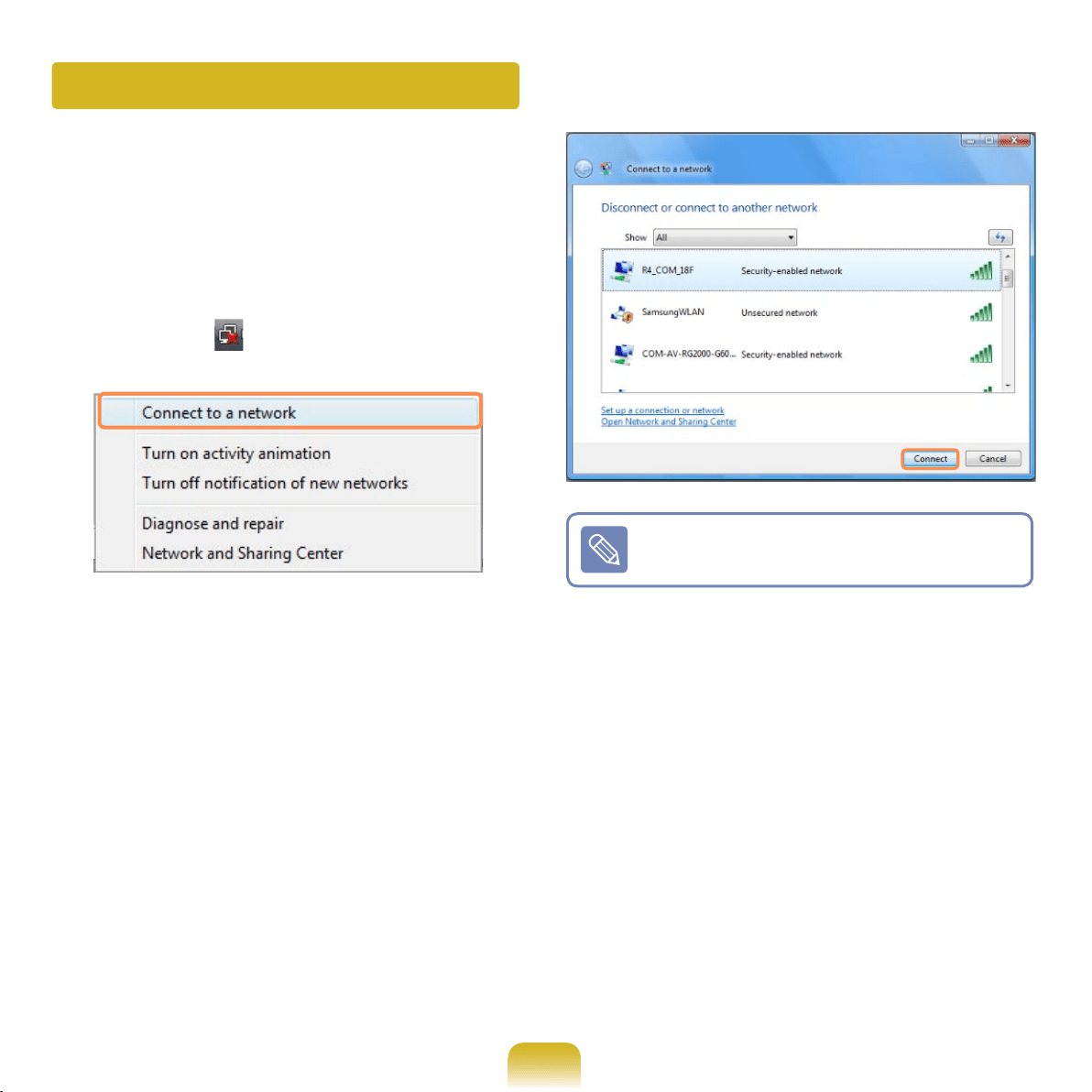
96
Connecting to a Wireless LAN
If there is an AP, you can connect to the
Internet via the AP using the Wireless LAN
connection method provided by Windows
Vista.
1
Right-click over the Network Con-
nections (
) icon on the taskbar
and click Connect to the Network.
2
Select an AP to connect to and click
Connect. If there is a configured
network key for the AP to connect
to, the Enter Network Key window
appears. Enter the network key in the
window and then click the Connect
button.
Ask your network administrator for
the network key, if necessary.
3
When Connected to the AP is dis-
played, click the Close button.
You can access the network.
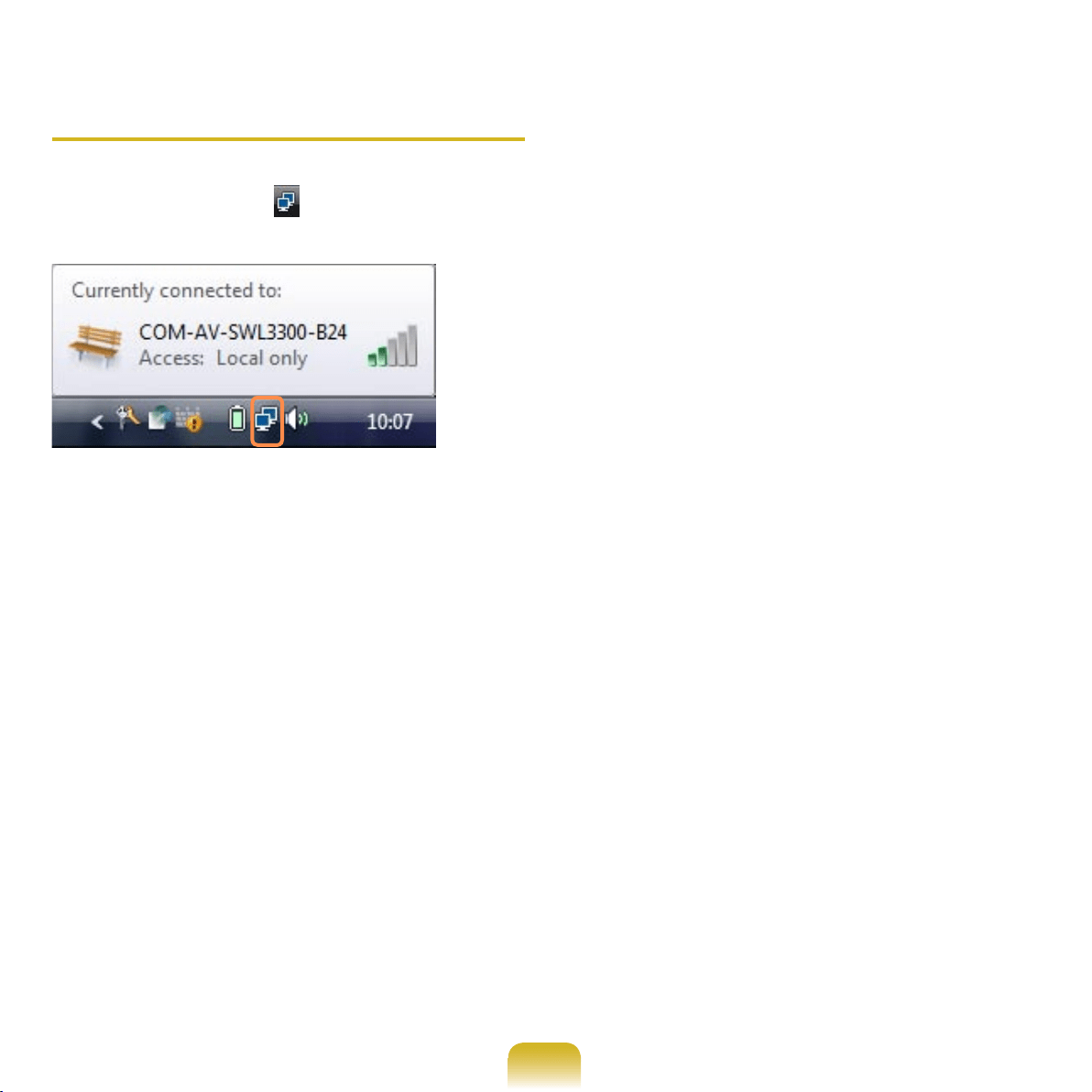
97
Checking
the network connection status
If you move the pointer over the Network
Connections icon (
) of the Taskbar, you
can view the connection status.

98
Using the Easy Network Manager
Easy Network Manager is a program that helps configure the network settings.
Easy Network Manager provides the following features.
You can easily configure the network and printer settings. p.98~99
You can immediately use the network without having to define new network settings
again after moving to another location.
p.100
By configuring the network settings (IP address, printer settings, etc.) for each location, you
can immediately access the network without following the network setting procedures each
time regardless of your location.
You can diagnose the network status.
p.101
Network Settings
This section describes the procedures to
connect to the Internet by setting up a net-
work. The setting up procedures include
procedures to add a printer to the net-
work.
1
To use a wired LAN, connect the LAN
cable to the LAN port. To use the
wireless LAN, you have to turn the
wireless LAN on first.
To turn it on, press the Menu button
and set the Wireless LAN item to
On. If the wireless LAN is turned on,
the Wireless LAN LED (
) is lit.
2
Click Start > All Programs >
Samsung > Easy Network Manager
> Easy Network Manager.
3
Click the Add button.
4
Select a network location icon and
enter the name of the location (e.g.
Home). Click the Next button.
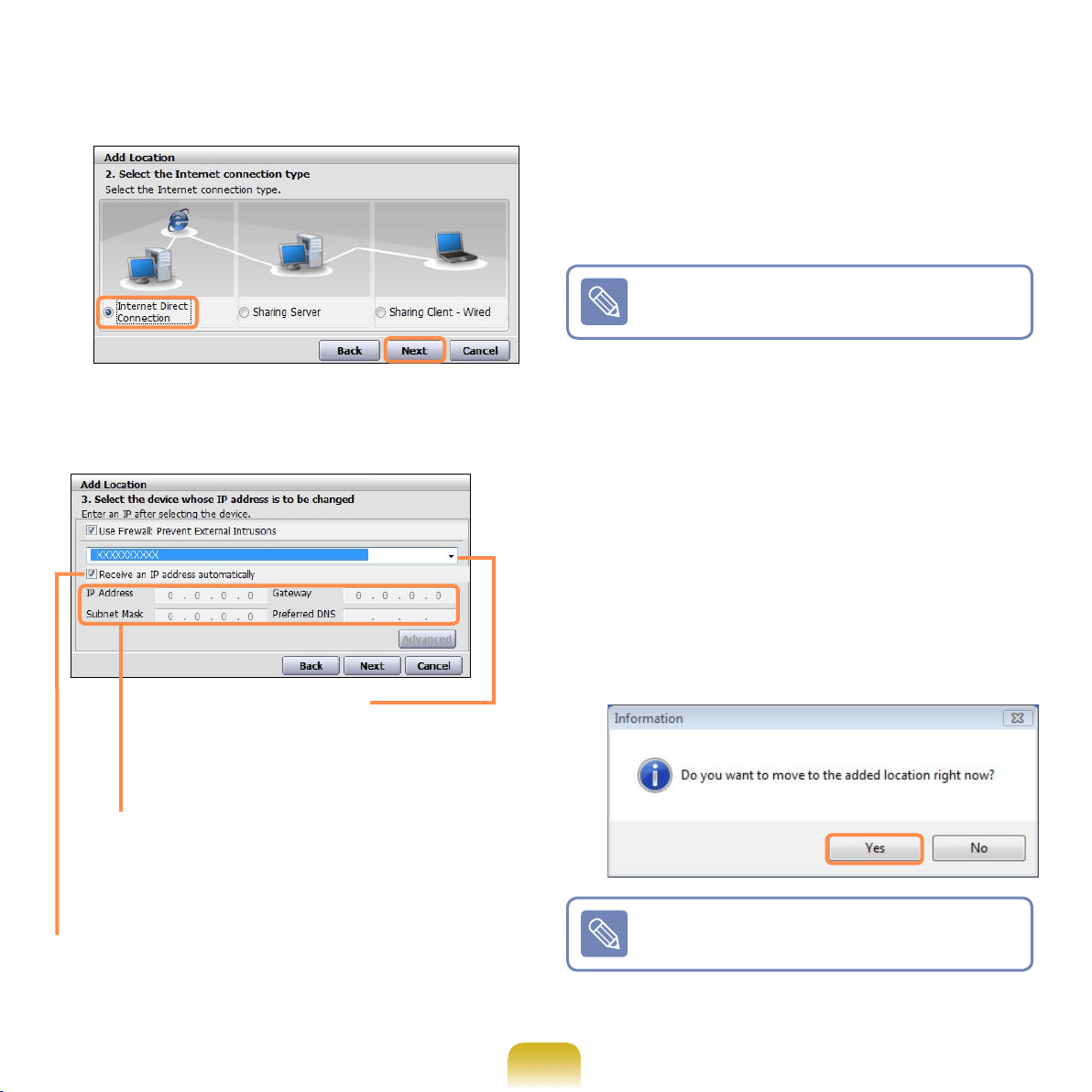
99
5
Select Internet Direct Connection
and click the Next button.
6
Select the LAN device, setup the IP
address and click the Next button.
Select Device
Select a device to be connect-
ed
to the Internet. Select either
Wired LAN or Wireless LAN.
IP
Settings
To use a static IP address, fill in the
fields. For the IP address information,
ask your network administrator.
Obtain an IP address automatically
Select DHCP to use this option (automatic IP
setting).
7
Click Add Printer and set up a printer
according to the wizard. When the
printer has been added, click the
Refresh button, select the newly
added printer and then click the
Finish button.
To not add a printer, click the Fin-
ish button.
8
When the network settings are com-
plete, the ’Do you want to move to
the newly added location now?’
message appears. Click the No
button.
An icon for the added location is
created. The network settings have
been completed.
If you select ’Yes’, the network set-
tings for the added location are
applied.
To add a new location, repeat the
procedures from Step 3 above.
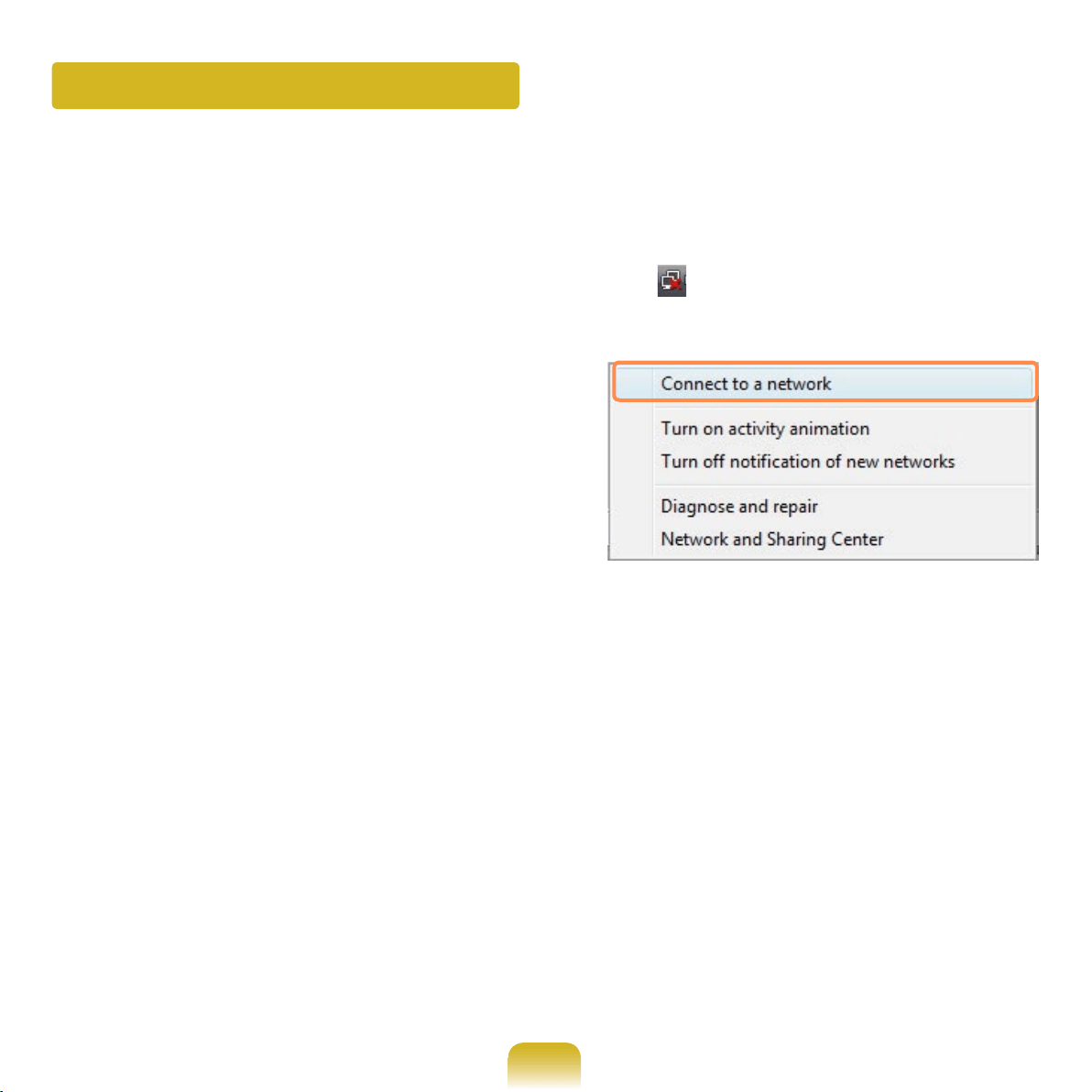
100
Using in Another Location
By configuring the network settings (IP ad-
dress, printer setting, etc.) for each loca-
tion, you can immediately access the net-
work in one click, without performing the
network setting procedures regardless of
your location.
1
Click Start > All Programs >
Samsung > Easy Network Manager
> Easy Network Manager when con-
nected to the Internet.
2
Select an icon that represents the
corresponding location from the
Saved Locations window and then
click Move.
3
If the Internet connection is a wired
LAN, you can immediately load the
settings for the new location and the
corresponding network connection
information is displayed in the Current
Location Information window.
If the Internet connection is a wireless
LAN, you have to select an AP as fol-
lows.
Click on the Network connection
(
) icon on the Taskbar using the
mouse and select Connect to the
Network.
Select an available AP and click
the Connect button. If a network
key is required, ask your network
administrator for the key informa-
tion.
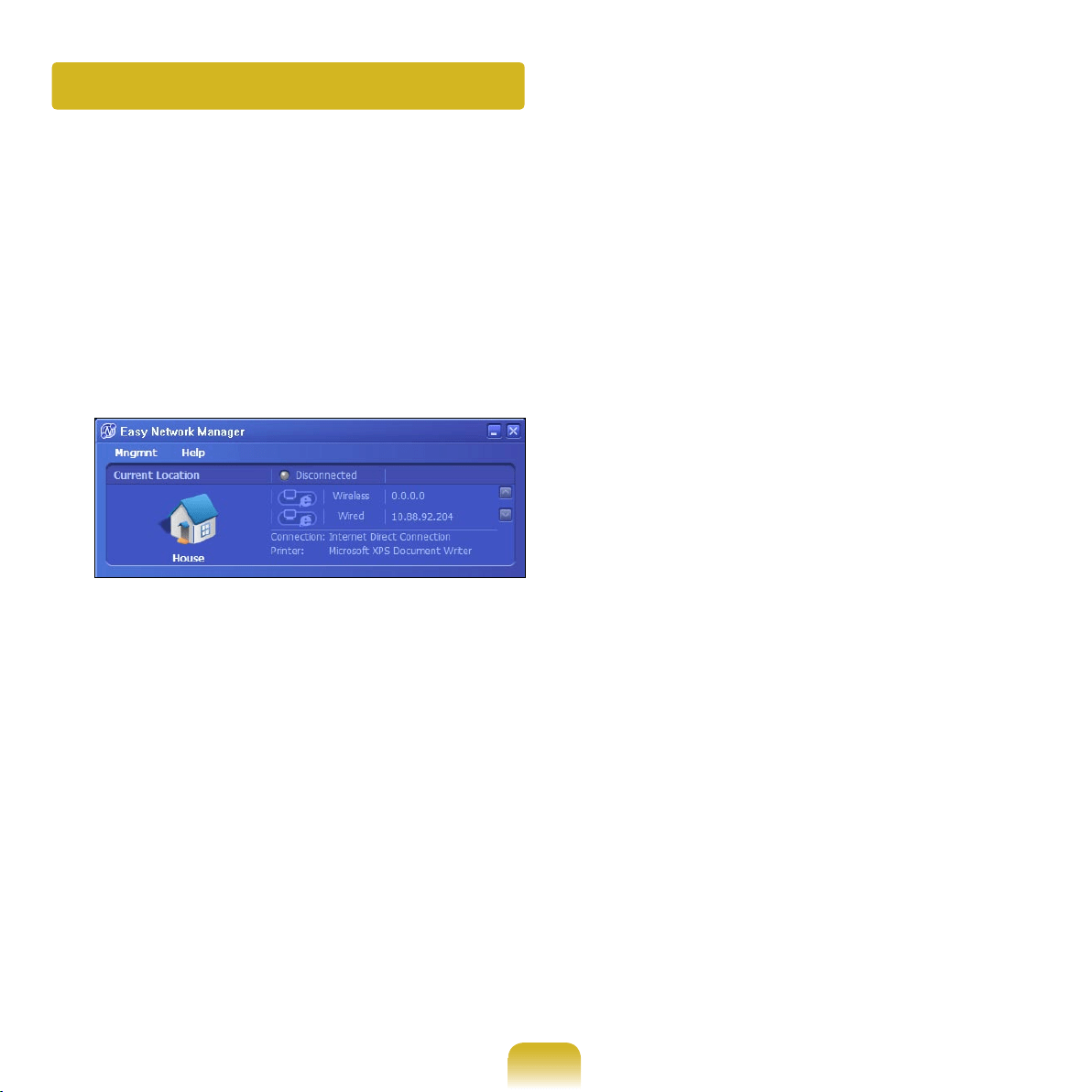
101
Diagnosing the Network Status
You can diagnose the network state and
find solutions for why you cannot connect
to the network.
1
Launch Easy Network Manager.
2
Select Management and Diagnose
Status from the menu.
3
The Network Connections window
appears.
Click Start to start the network diag-
nosis.
4
When the diagnosis is complete, a
device with a problem is marked by
an exclamation mark icon with a de-
scription of the problem at the bottom
of the window.
102
File Transmission
You can exchange files between two Bluetooth devices.
You can exchange files with another Bluetooth device such
as another computer, cell phone, PDA, etc.
Network Access
You can connect to another Bluetooth-installed computer
in the same way as an Ad-Hoc mode in wireless LAN and
connect to the network via an AP or an Internet connection
sharing server.
Network Access
through a Phone
Connection
You can connect to the network via a Bluetooth cell phone.
Data Sync
(Synchronization)
You can synchronize PIMS data (Outlook E-mail address
data) with Bluetooth devices such as a cell phone, PDA, an-
other notebook computer, etc.
Bluetooth Function
Bluetooth
Bluetooth is wireless communications technology that allows access to nearby devices such as
another computer, a cell phone, printer, keyboard, mouse, etc. without a cable connection. Us-
ing Bluetooth, you can exchange files, connect to the Internet, and construct a private network
as well as communicate with a keyboard, mouse, printer, etc. without a cable connection.
■ The Bluetooth supporting function is only available between devices (a computer,
cell phone, PDA, printer, etc.) and the connection may be restricted according to
the profile of the corresponding device.
■ The Bluetooth function is optional and may not be supported depending on your
model.
■ Compatibility to devices without the authentication or logo of Bluetooth is not guar-
anteed.
103
Using Bluetooth
The procedures to exchange files between
computers supporting Bluetooth and to
use other Bluetooth devices are described
below.
Using Bluetooth Devices
(Connecting Headset supporting
Bluetooth)
As an example, the procedures to connect
to a headset supporting Bluetooth will be
described below. Searching for Bluetooth
devices corresponds to Steps 1 to 4 and
may be slightly different depending on the
device.
1
To connect to another device via
Bluetooth, double-click the Bluetooth
icon(
) on the Taskbar.
For more information about using the Bluetooth function, refer to the online help of
the Bluetooth Device.
Electronic Busi-
ness Card (Vcard)
Exchange
You can exchange business cards with Bluetooth devices
such as a cell phone, PDA, another notebook computer, etc.
Sound Output
You can output computer sound to another Bluetooth device
or vice versa.
HID Connections
You can connect and use Bluetooth peripherals such as a
keyboard, mouse, joystick, etc.
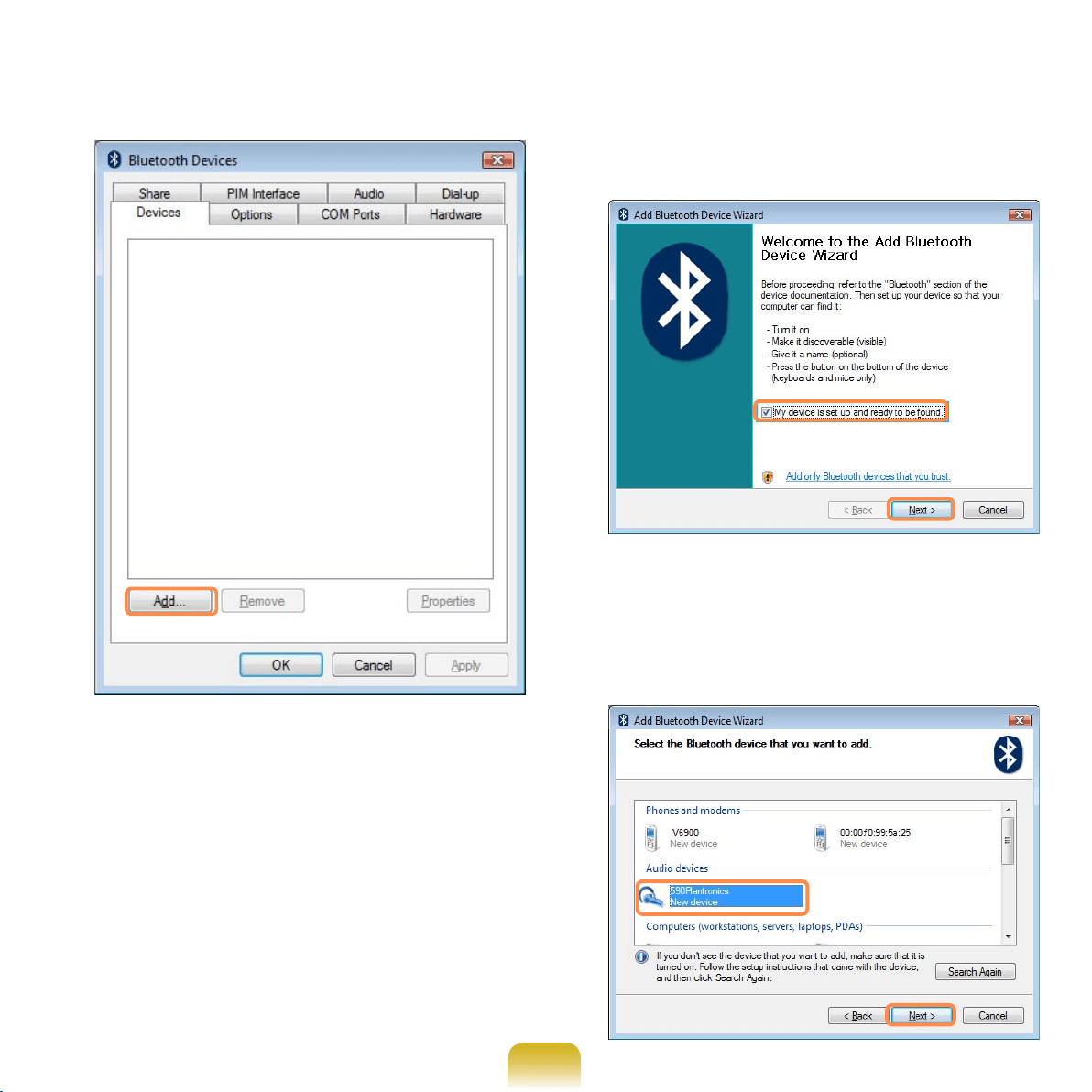
104
2
If the Bluetooth Device window
appears, click Add.
3
If the Add Bluetooth Device Wizard
screen appears, select the My device
is set up and ready to be found and
click the Next button.
4
When the search is complete, all
available Bluetooth devices are listed.
Select the Headset from the list and
click the Next button.
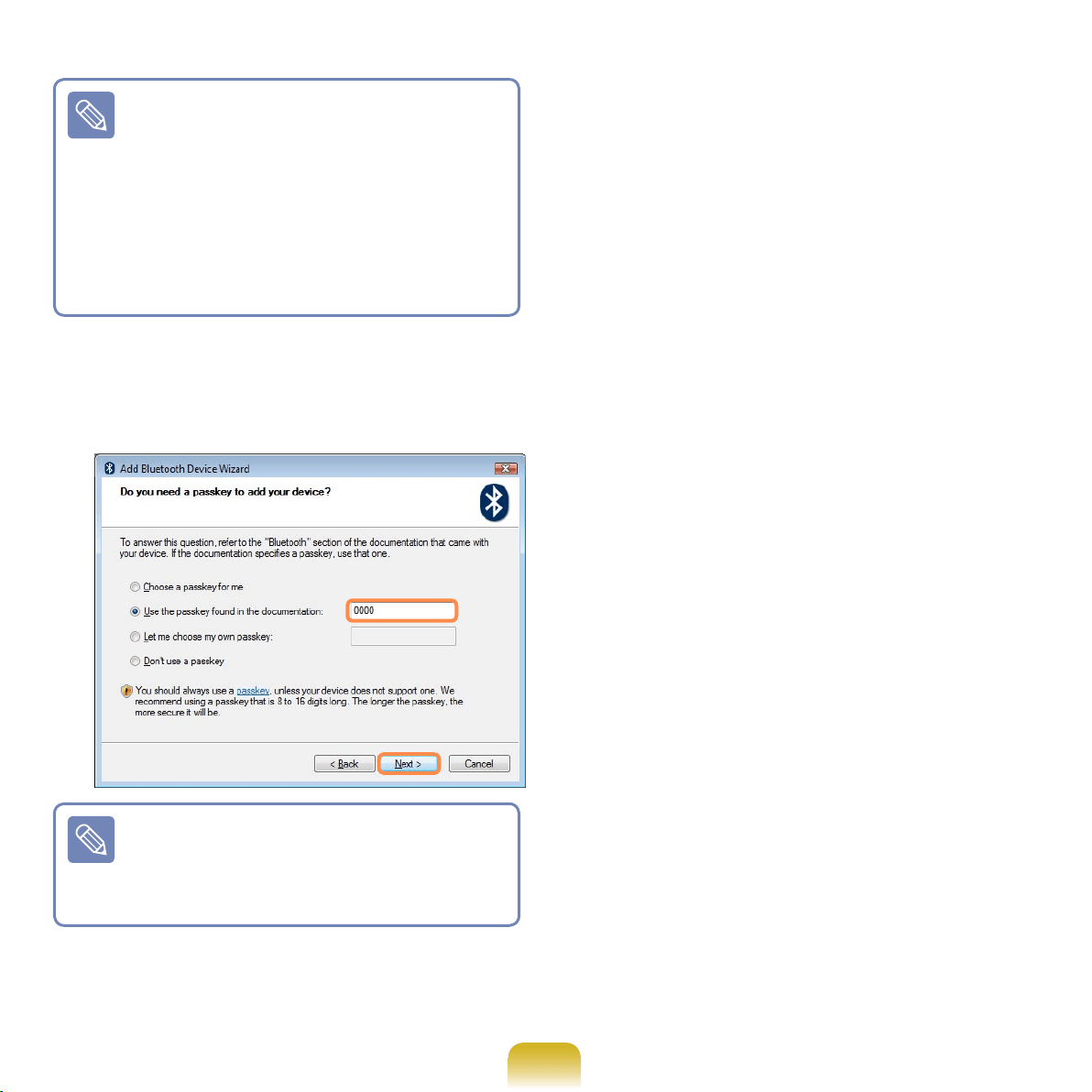
105
■ A Bluetooth device is represent-
ed by the device type and name
(Dedicated Bluetooth ID).
■ T
o use the Bluetooth headset, Blue-
tooth Pairing Mode is required.
For
the procedures to set up Pair-
ing
Mode, refer to the Headset
Manual.
5
Enter the PIN in the device PIN field
and click the Next button.
For pairing, a PIN is required.
Since a PIN is provided by the
headset manufacturer
, refer to the
corresponding manual.
6
If the Completing the Add Bluetooth
Device Wizard window appears, click
Finish.
7
The stereo headset is connected
and you can now use the Bluetooth
headset normally.
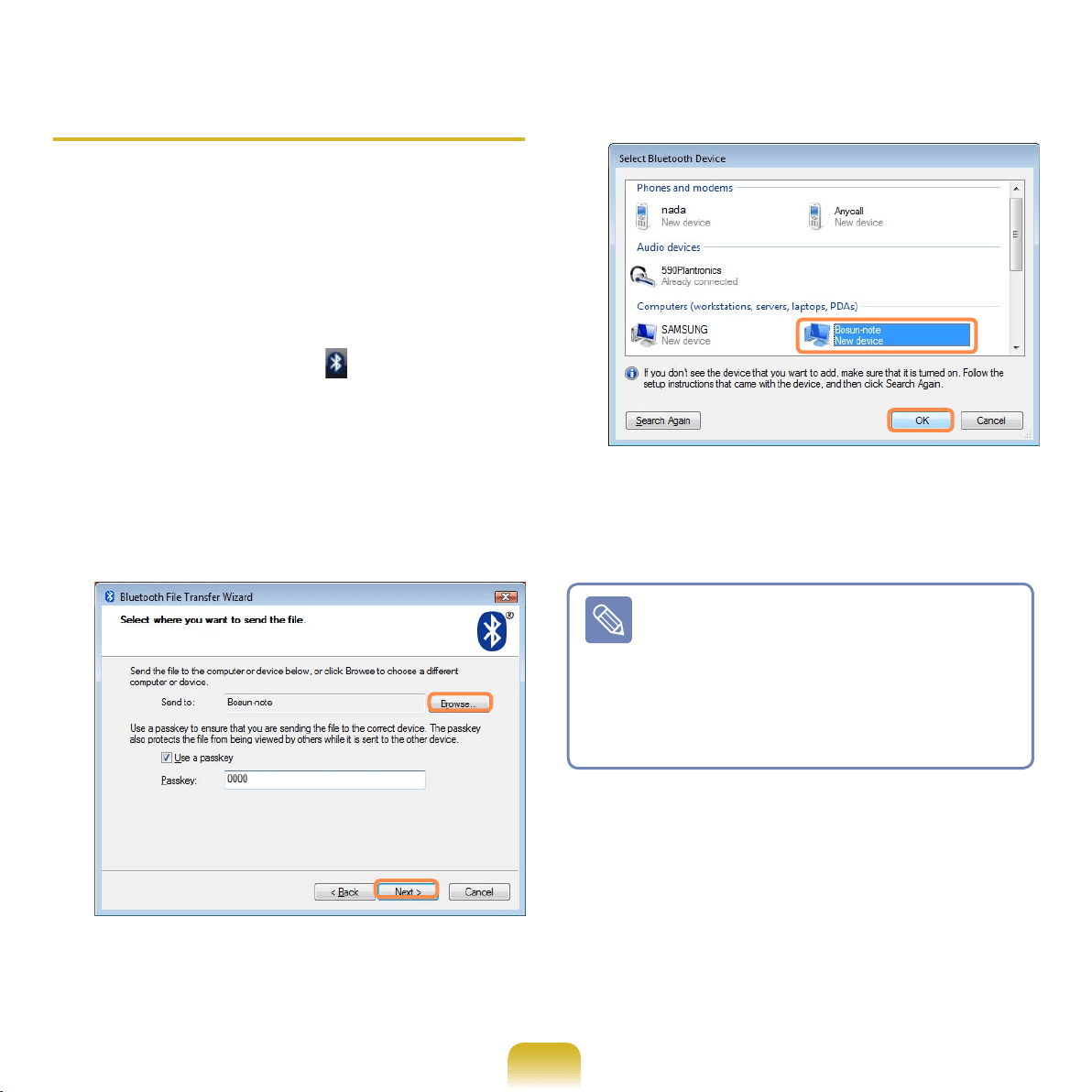
106
Exchanging Files between
Bluetooth Computers
The procedures to exchange files between
computers with Bluetooth capability are
described below.
1
On the computer which is sending a
file (hereafter Computer A), right-click
the Bluetooth icon(
) on the taskbar
and select File Transfer.
2
Click Browse, select a Bluetooth
device to send the file to and click the
Next button in the Select Bluetooth
Device window.
3
Select a Bluetooth device to send the
file from and click the OK button.
4
Enter a PIN in the Bluetooth PIN
Code field and click the Next button.
The Bluetooth PIN Code is a
password used for connecting two
Bluetooth devices.
The user just
enters the same PIN Code (E.g.
same numbers) on both Bluetooth
devices to make the connection.
5
Click Browse, specify a file to be sent
and click Next button in the Select
File to be Sent screen.

107
6
After a short while, the Bluetooth PIN
Code required dialog box appears on
Computer B. Enter the code entered
in Step 4 above.
7
If the FTP File Access Privilege
Request window appears on Com-
puter B, click on the window. If the
Select Access Permission window
appears, click the OK button.
Usage Instructions
Bluetooth devices to be connected must
be within a 3m (10 ft.) distance.
For a better communications environ-
ment, there should be no walls or ob-
stacles between the Bluetooth devices.
You can connect to only one Bluetooth
device at a time for a phone connection,
data syncing, electronic business card
exchange, FAX transmission/reception,
sound related functions, and serial port
functions.
Using the network connection or file
transmission function, multiple Blue-
tooth devices can be connected. How-
ever, since connecting to multiple devic-
es may slow down the data rate or make
the connection unstable, connecting to
one device at a time is recommended.
The Bluetooth function of a Bluetooth
PDA, mobile phone, mouse or keyboard
may be turned off. To use them in con-
nection with a Samsung computer sup-
porting Bluetooth, you must check if the
Bluetooth function of the device to con-
nect to is turned on.
For the procedures on turning on the
Bluetooth function of a device, refer to
the relevant device manual.
The services provided by Bluetooth de-
vices may vary depending on their ca-
pabilities. For the services provided by
the Bluetooth device, refer to the device
manual.
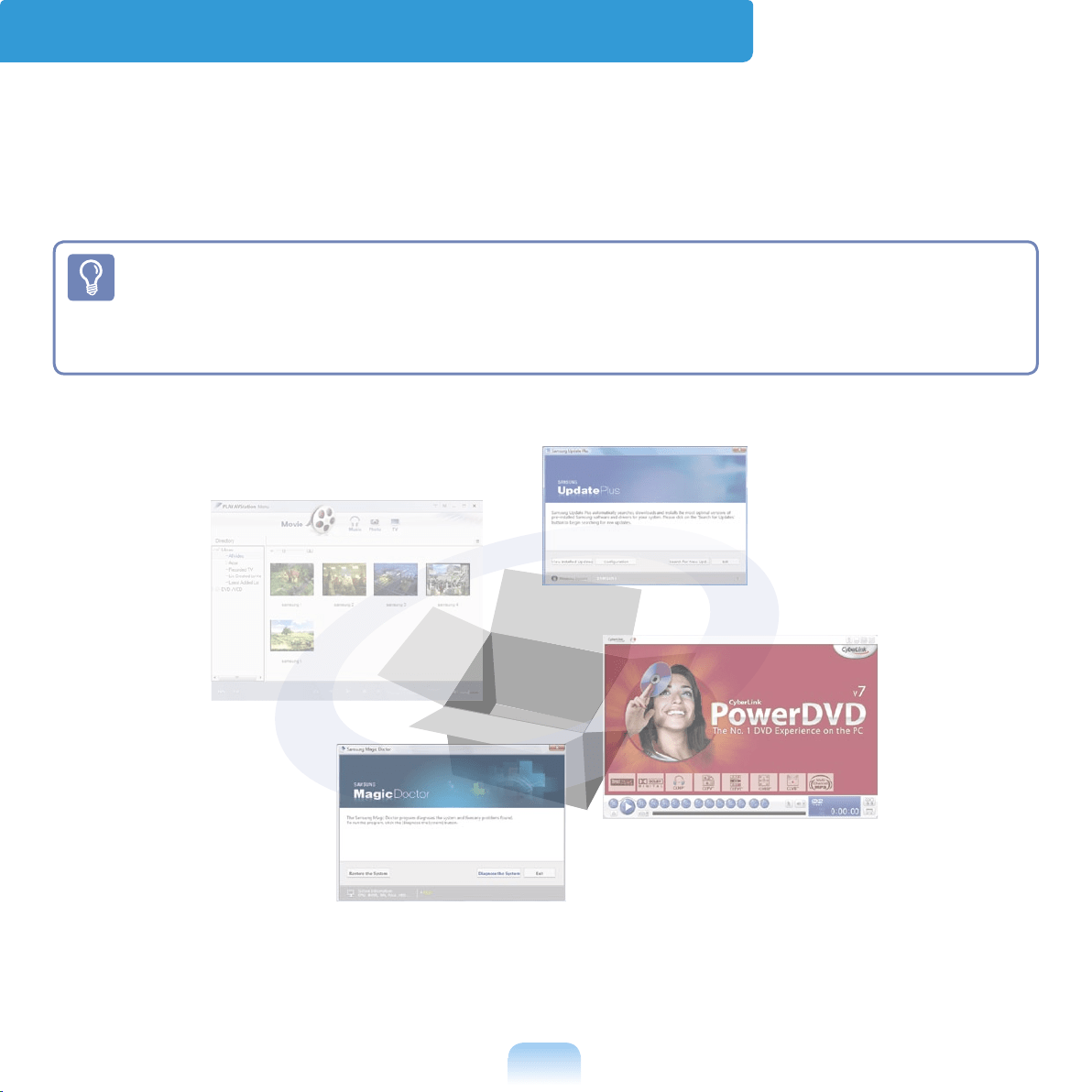
109
Introducing Programs
Using the software supplied with the Samsung computer, you can easily use functions and
troubleshoot problems.
Try to use the software after learning about the basic use of the software. For detailed infor-
mation, refer to the help section of the corresponding software.
Every software program may not be provided or the version may differ depending on
your computer model.
In addition, the screen capture images may differ from actual ones depending on the
computer model and software version.

110
Multi Media Functions
CyberLink PowerDVD ( )
Using this program, you can play a
DVD title.
The CyberLink PowerDVD program
is only supplied when you have pur-
chased an external ODD, and you
have to install the program additionally.
p.112
Play AVStation ( )
Play AVStation is an integrated mul-
timedia program that enables users
to enjoy better quality music, photo-
graphs, videos, movies, etc. all with a
single program.
p.116
Origami Experience ( )
Origami Experence is a program that
categorizes programs installed on the
computer for easier and more conve-
nient use.
p.132
It is optional and is not supplied with
some models.
Management Functions
Samsung Update Plus ( )
Samsung Update Plus is a software
function that examines and updates
the Samsung software and drivers
installed on your Samsung computer to
the most recent versions.
p.114
Easy Network Manager (
)
Easy Network Manager is a program
that enables you to easily configure the
network settings.
You can configure the network settings
for each location and you can also di-
agnose the network status
p.98
Easy Battery Manager (
)
Easy Battery Manager is a power man-
agement program that provides easy-
to-use power management and power
saving settings so that the battery us-
age time can be extended.
p.147
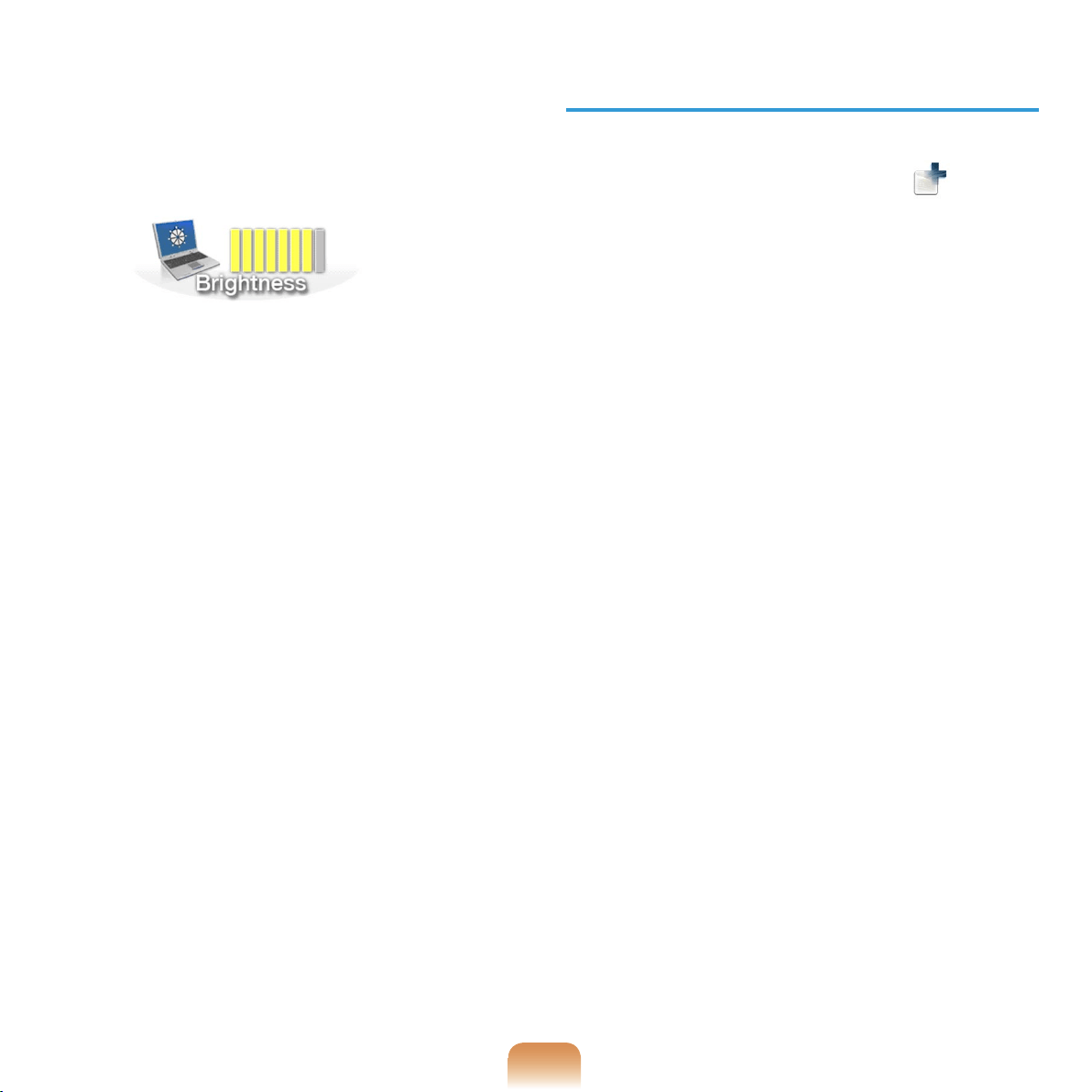
111
Easy Display Manager
Easy Display Manager is a program
that displays the setting status of some
buttons on the screen.
Example) The icon that appears when
pressing the Menu button
and clicking Brightness Up.
Troubleshooting Functions
SAMSUNG Magic Doctor ( )
SAMSUNG Magic Doctor is trou-
bleshooting software provided by
Samsung Computer for system diagno-
sis, and restoring the system.
The system diagnosis function enables
users to diagnose system problems
without assistance from others.
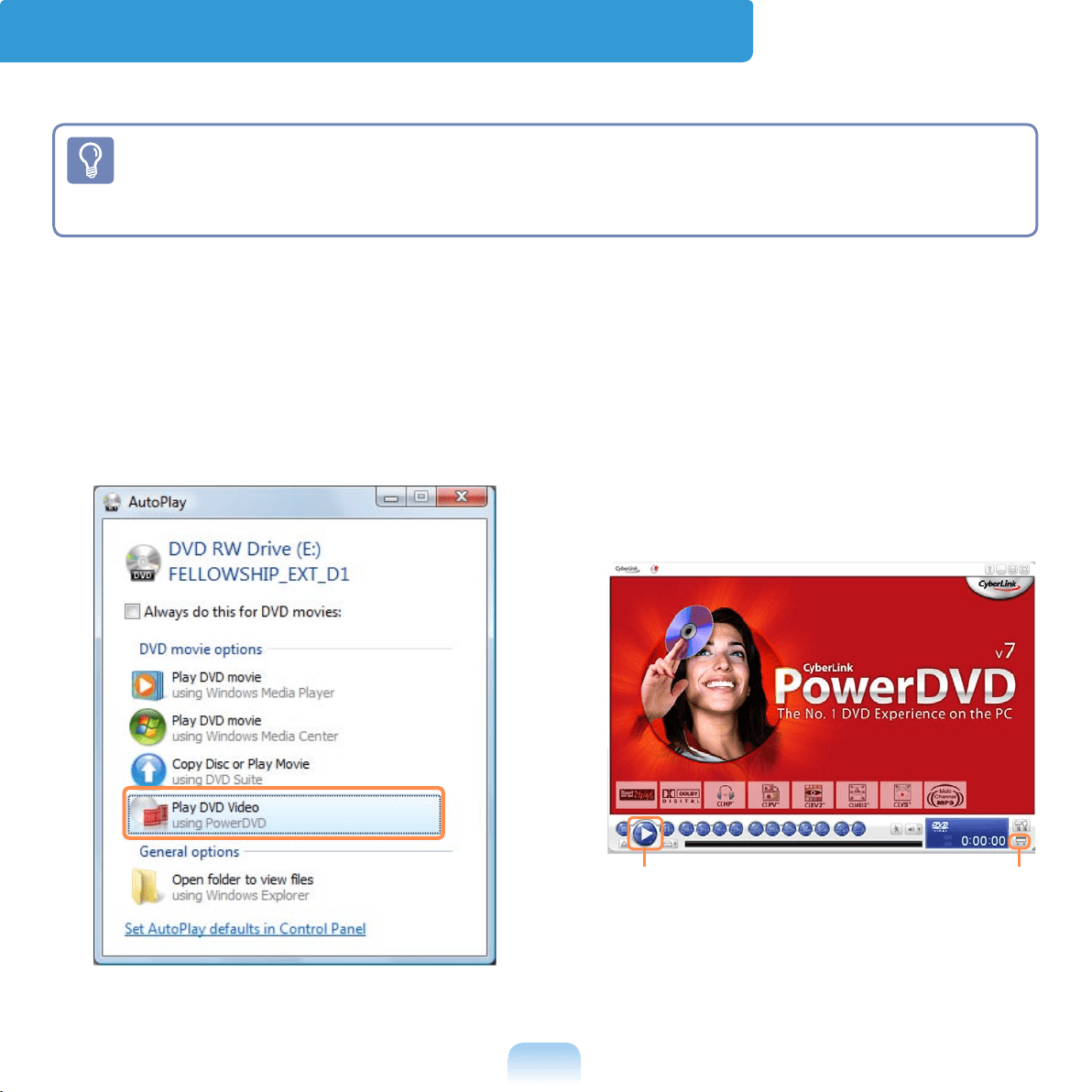
112
1
Insert a DVD title into the DVD drive.
2
Select PowerDVD and click the OK
button.
After a moment, the DVD title will
play.
3
If the DVD title is not automatically
played, click Start > All Programs >
CyberLink DVD Suite > Power DVD
> CyberLink PowerDVD.
4
Then click the Play icon in the control
panel of CyberLink PowerDVD to play
the DVD title.
Play Undock Player
Panel
The CyberLink PowerDVD program is only supplied when you have purchased an
external ODD, and you have to install the program additionally.
It is optional and is not supplied with some models.
CyberLink PowerDVD
CyberLink PowerDVD is a DVD player program.
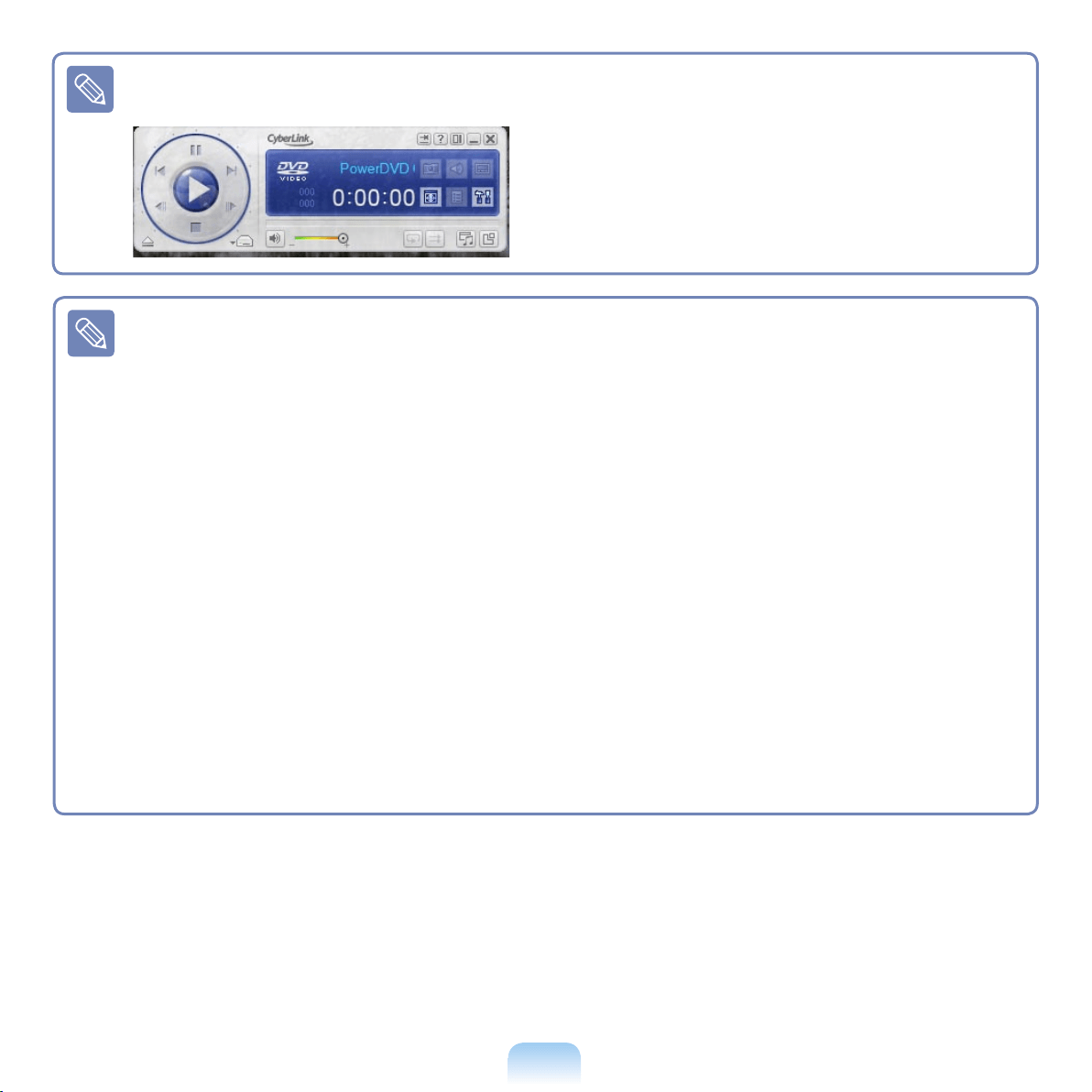
113
■ Detailed Usage
For more detailed usage, click Start > All Programs > Cyberlink DVD Suite >
Power DVD > PowerDVD Help.
■ DVD Region Code
A DVD title has a region code according to the international specifications so that it
can be played only in that specific region.
DVD titles with a region code will only play on DVD drives and program for playing
with the same region code.
A DVD drive is sold with an empty region code and the region code is set when
the user inserts a DVD title into the drive for the first time. Whenever a DVD title is
inserted with a region code different from that of the DVD drive, the region code of
the DVD drive is automatically changed to the region code of the DVD title.
However, changing the region code of a DVD drive is limited to 5 changes. After
that, the region code is permanently fixed to the last region code. If you need to
change the region code after changing the code 5 times, contact a service center.
Although a service center can help you in this case, you will be charged a service
fee.
If you click the Undock Player Panel button, the program control panel transforms
as follows.
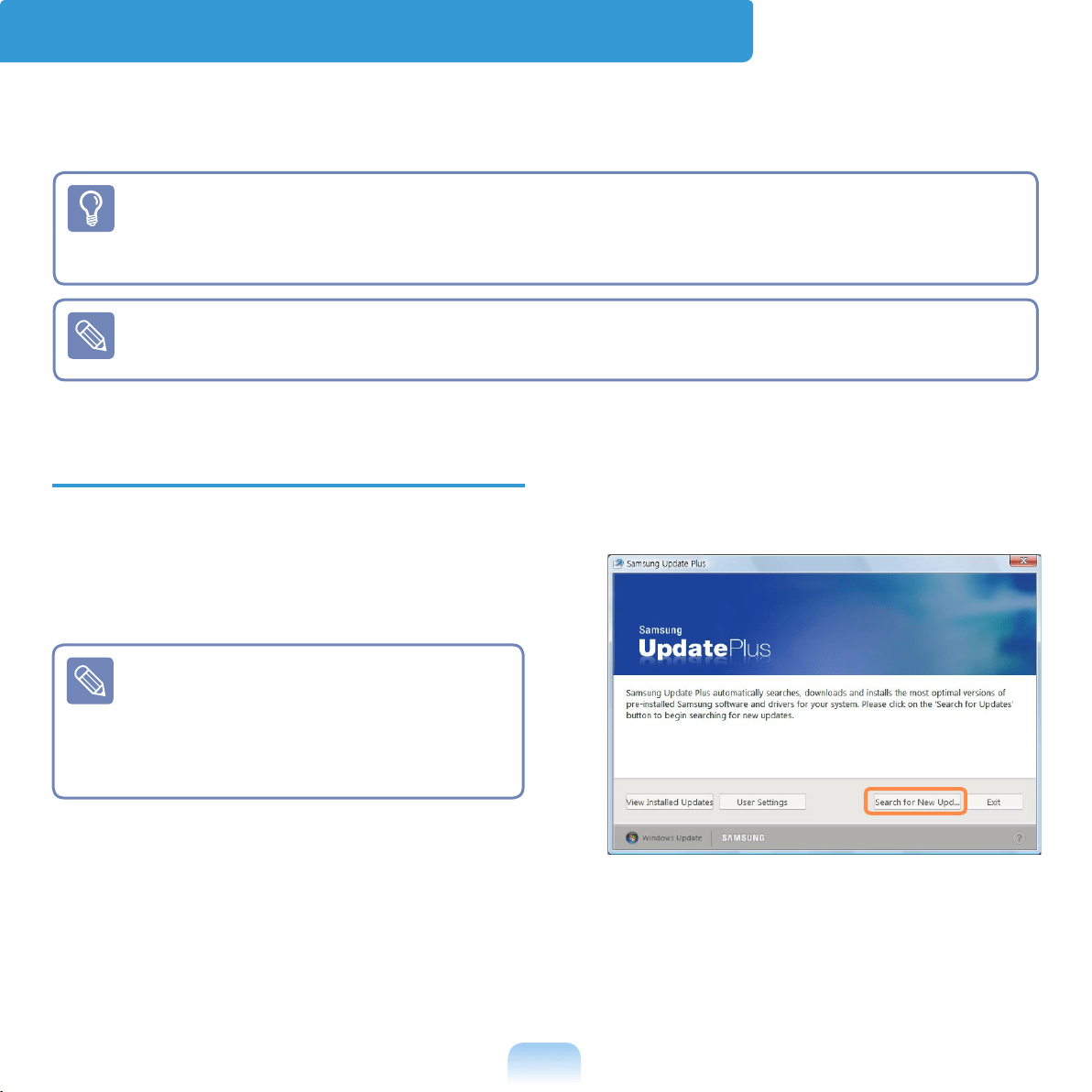
114
■ To search for updates and update your computer using Samsung Update Plus,
your computer must be connected to the Internet.
■ The update search result may differ depending on your computer model.
Samsung Update Plus does not provide updates for applications installed after pur-
chasing the computer.
Samsung Update Plus
Samsung Update Plus is software that examines and updates the Samsung software and
drivers installed on your Samsung computer to the latest version.
To update the software and drivers
1
Click Start > All Programs >
Samsung > Samsung Update Plus
> Samsung Update Plus.
If this is the first time you are
running the program, a window will
appear asking you if you agree to
the agreement in the window
. Click
Agree to use this software.
2
If you click on Search for new
updates, new updates are searched
for.
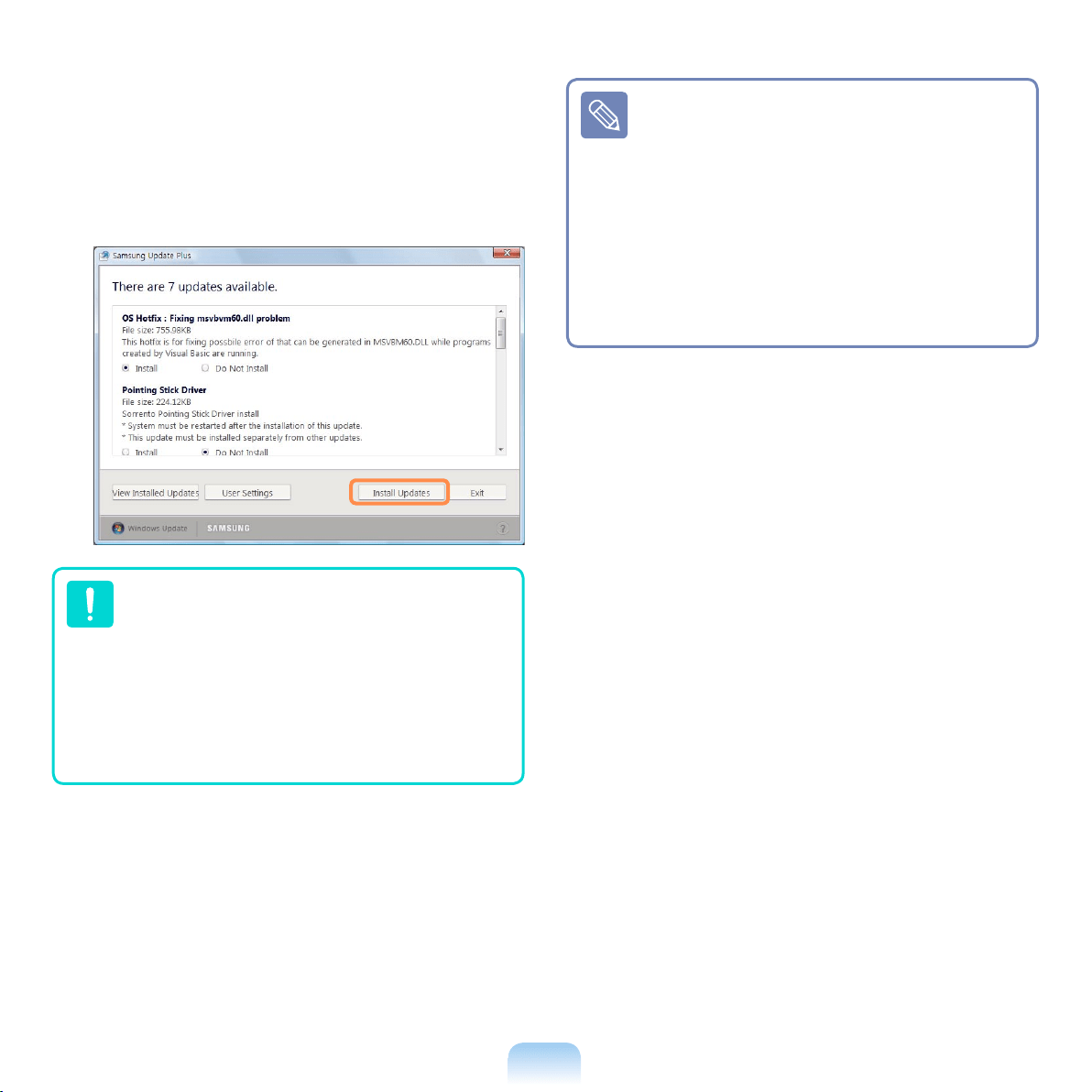
115
3
If there are available software or
driver updates for your computer, the
available updates will be listed.
Select the required updates from the
list and click on Install Updates to
start the update.
Updates that must be installed
separately.
If you select Install for an update
item that must be installed sepa-
rately
, a message appears inform-
ing you of this. Follow the instruc-
tion message to correctly install it.
Automatic update items display
By default, your computer is con-
figured to automatically search for
updates. If there is a new update
available, this is displayed in the
notification area. Click the balloon
help icon in the notifi
cation area.
Here you will be able to find the lat-
est available updates.
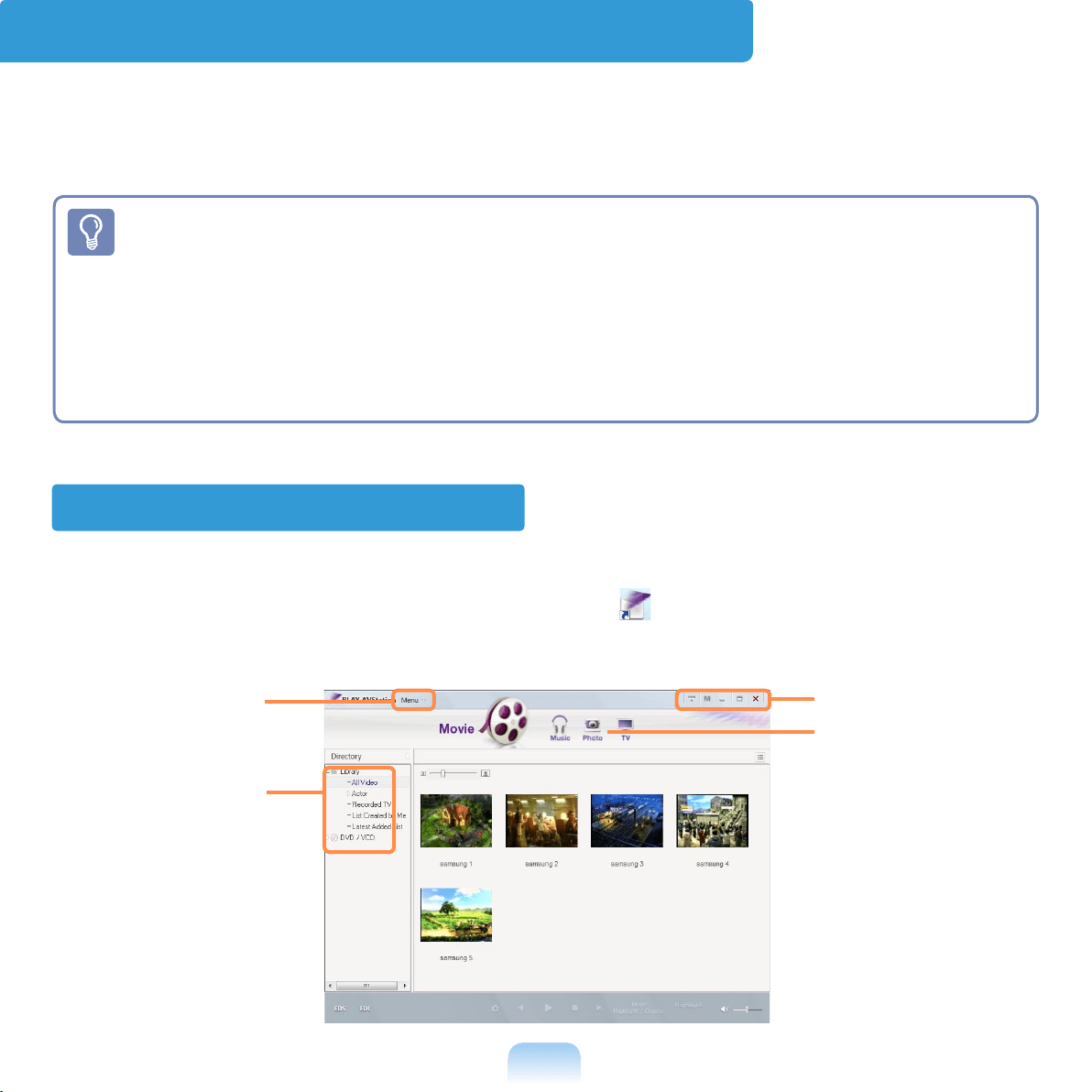
116
To launch the program, click Start > All Programs > Samsung > Play AVStation.
Alternatively, double-click the Play AVStation icon(
)on the Desktop.
Play AVStation
Play AVStation is an integrated multimedia program that enables users to enjoy music, photo-
graphs, video, movies, etc. using a single program.
This section describes the basic usage of Play AVStation.
Launching and Screen Layouts
■ The screens used in this manual may differ from actual screens according to the
program version.
■ For detailed usage, refer to the program help.
■ TV Station is only available for systems supporting the TV function. This computer
is not supported.
■ To play an audio CD or DVD, you have to connect an external ODD. Use the de-
scription below provided that an external ODD is connected.
Menu
Library
Station Bar
Resize Window
And Exit Buttons
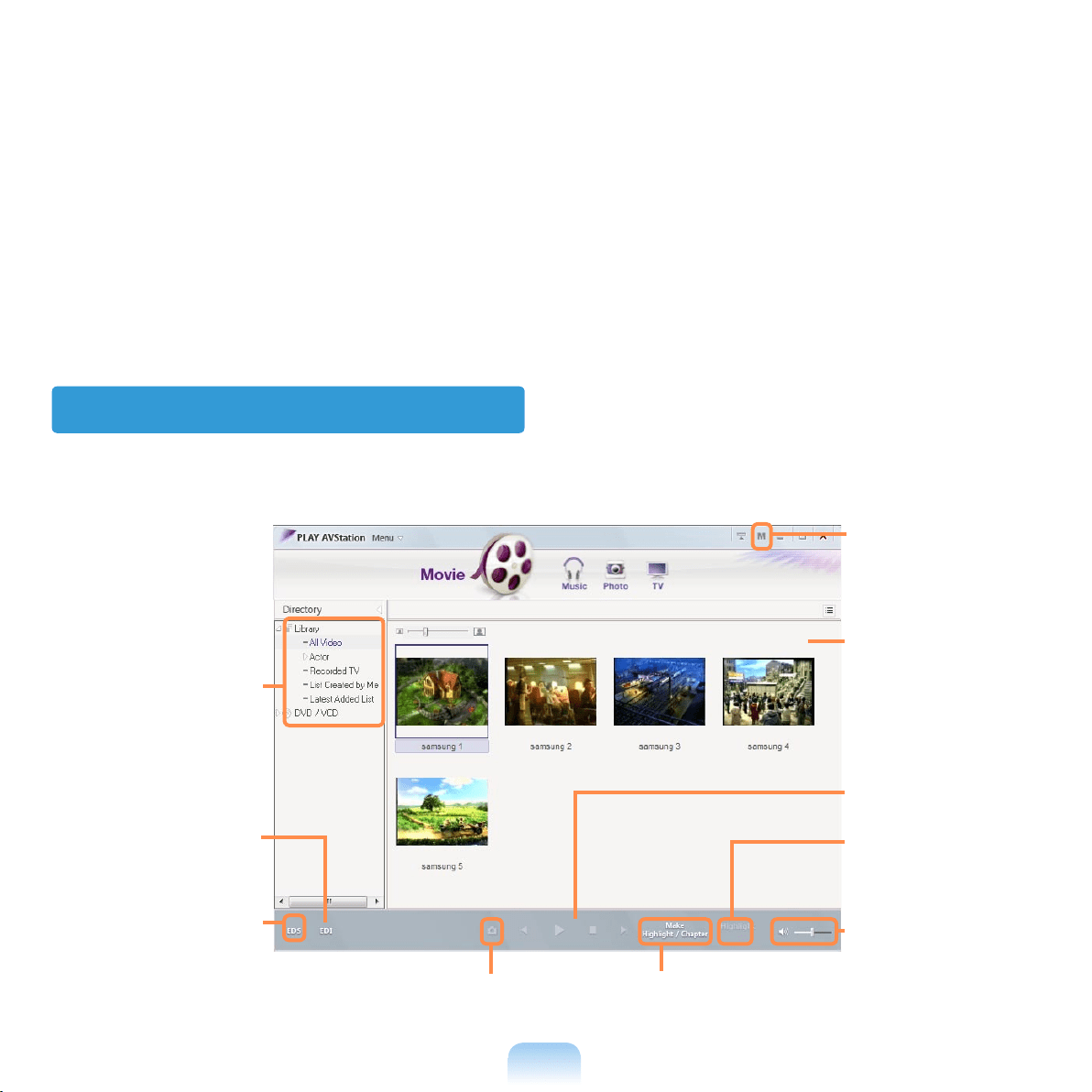
117
Movie Station
Movie
You can play a video (movie) file or a DVD/VCD title.
Music
You can play a music file or an audio CD.
Photo
You can view or edit a photograph (image), and also view the photographs in a Slide-
Show.
Launch Play AVStation and click on Movie on the Station Bar.
Mini Mode View
Movie List and
Thumbnail Win-
dow
Play Control
Buttons
Volume Control
Play Highlight
Button
Capture Button
EDS Button
(Enhanced Digital
Sound Setting)
Create Highlight/Chapter Button
EDI Button
(Enhanced Digital
Image Setting)
Movie Library
118
■ What is EDI (Enhanced Digital Image)?
EDI (Enhanced Digital Image) is visual quality enhancement technology devel-
oped by Samsung Electronics. You can view clearer and sharper images by en-
abling the EDI function when watching TV or playing a movie on Play AVStation.
To enable the EDI function, click the EDI (
) button at the bottom of the TV or
Movie Station.
Some TV tuner and graphics cards are not supported by EDI.
■ What is EDS (Enhanced Digital Sound)?
EDS (Enhanced Digital Sound) is sound quality enhancement technology devel-
oped by Samsung Electronics. You can listen to clearer sound if you enable the
EDS function when playing music or movie on Play AVStation.
To enable the EDS function, click the EDS (
) button at the bottom of Music or
Movie Station.
119
Playing a Movie File
The procedures to play a movie file registered to the MOVIE Library are described be-
low.
For the procedures to register files to the Library, refer to
p.120.
1
Move to Movie Station and double-click All Video in the left menu pane.
2
Double-click a movie file.
The file is played.
■ Playing a Video File not Registered to the Library
Click Menu > File > Open File, select a movie file to be played and click Open.
The selected file is automatically registered to the Library and played.
■ Playing a Video File in Full Screen
1. Double-click on the current playback screen.
2. The movie is played in full screen.
In full screen, to view the movie at the default size, double-click on the current
playback screen again.
■ Capturing the Video Screen
Click on Capture Current Screen (
) below the You can view captured images
in the Photo Station > Captured Images folder. Captured images are saved in
the C:\Samsung\Play AVStation\Data\Capture. You can change the captured im-
age folder by selecting Menu > Tools > Options > Capture.
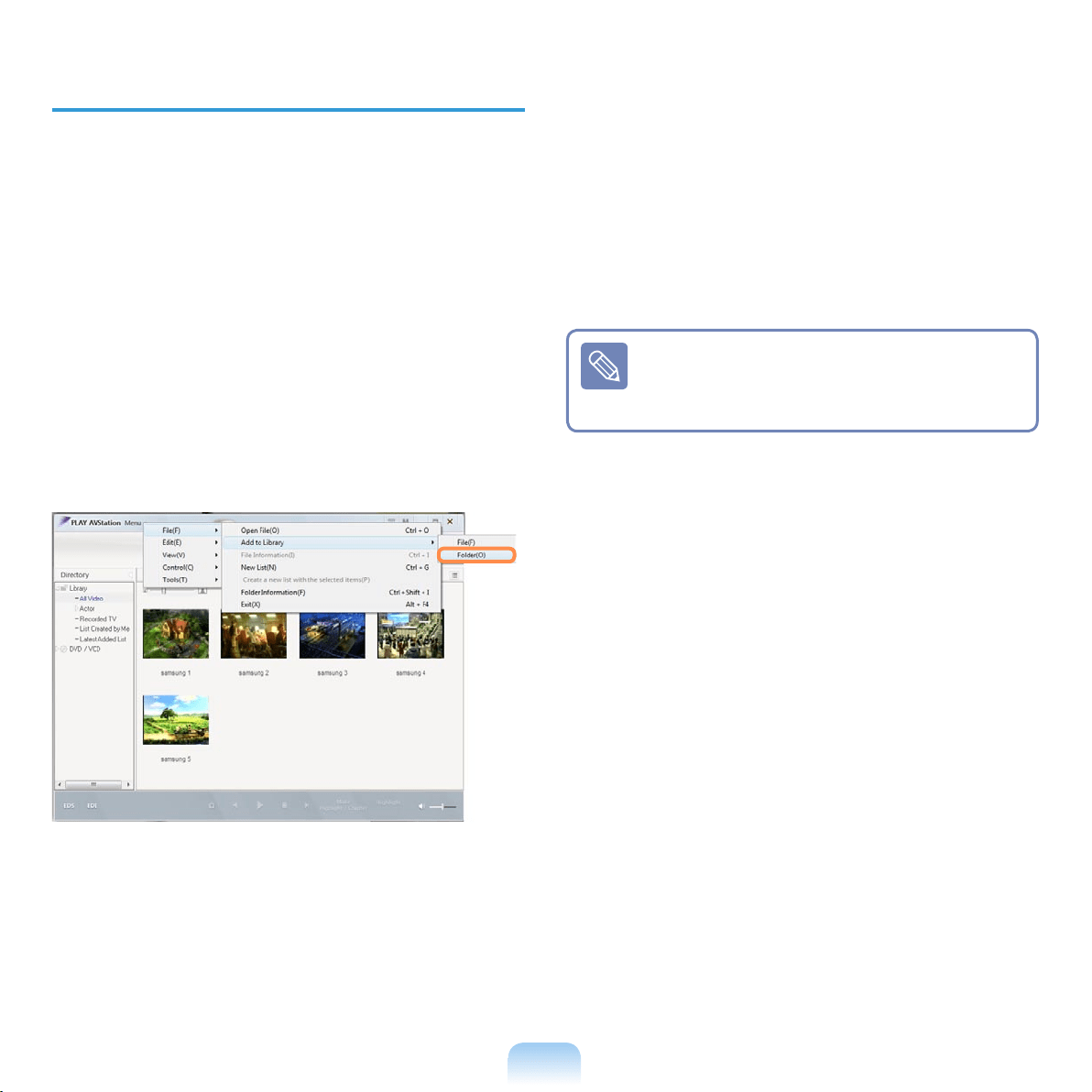
120
Adding Videos to the Library
The Movie Library is a library with movie
files to be used by Movie Station. The
procedures to add movie files saved on
the computer to the Library are described
below.
You can add files or folders. As an ex-
ample, the procedures to add folders are
described below.
1
Select Menu > File > Add to Library
> Folder.
2
Select a target folder and select
Video Files option in the Target File
Type field.
3
The movie files found in the selected
folder are added to the Library.
The movie files used in Play AVSta-
tion are automatically added to the
Library.
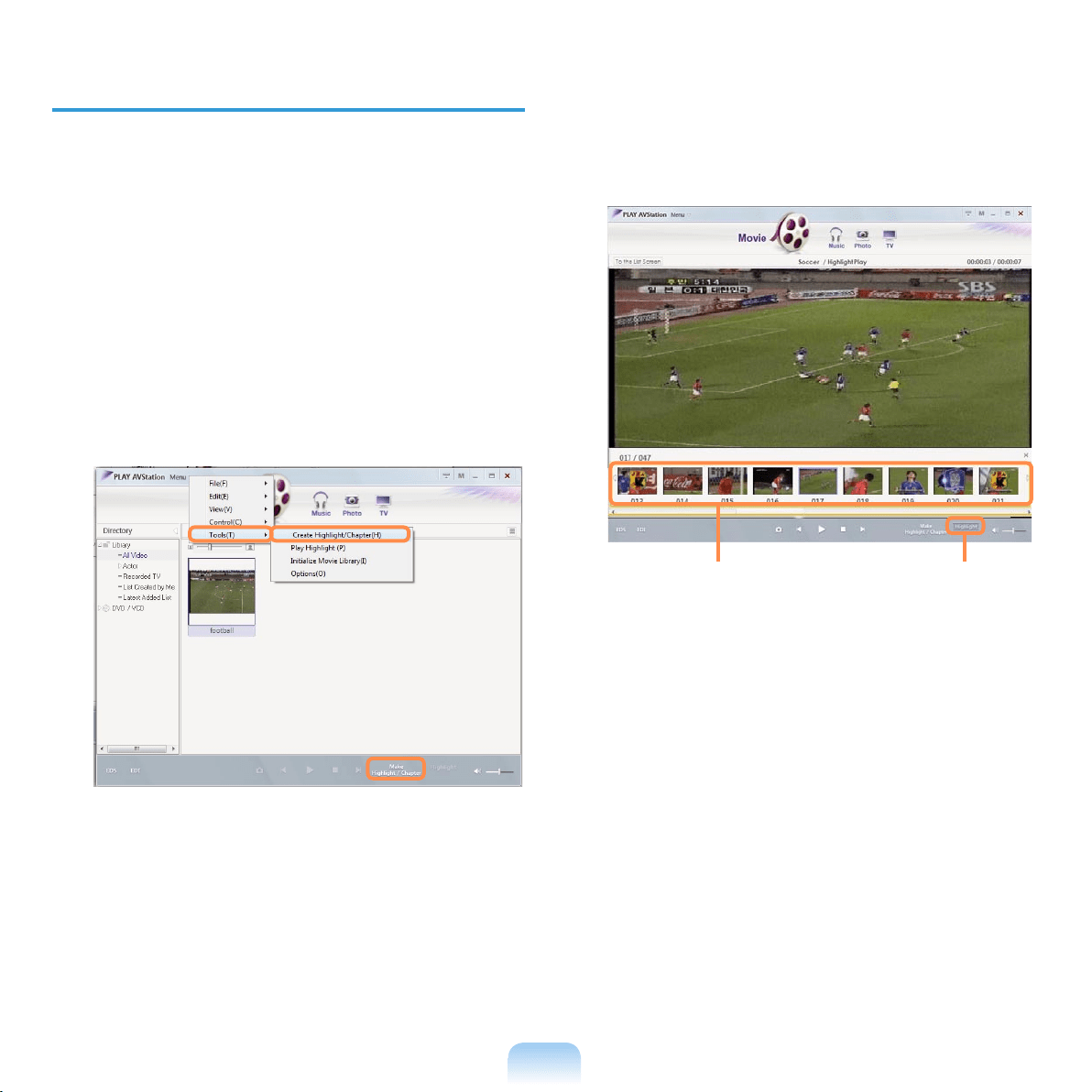
121
Highlight / Chapter Function
Using the Highlight function, you can
watch a highlighted part of a movie such
as a sports or news item, etc. Using the
Chapter function, you can create chap-
ters for a movie and play the movie from
any of the chapters.
1
Select a movie and click Make High-
light/Chapter at the bottom of the
window.
2
Select the movie type (Sports, News,
Other).
A Highlight / Chapter is created.
3
To watch a highlight, double-click
a file made and click the Highlight
icon at the bottom right of the current
movie file.
Highlight
Make Chapters
4
The highlight is played. If you click on
a Chapter thumbnail, the correspond-
ing Chapter is played.
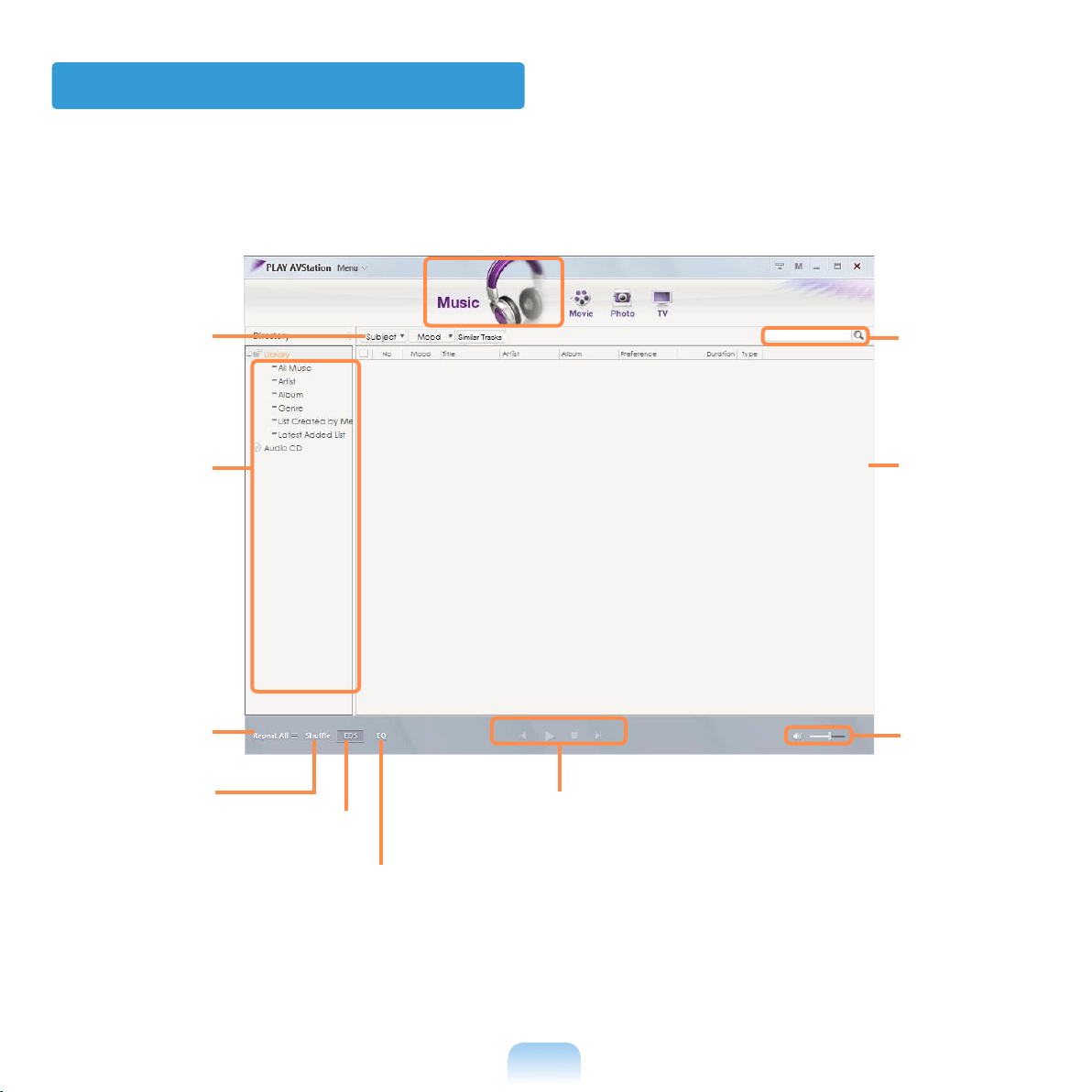
122
Launch Play AVStation and click Music on the Station Bar.
Music Station
Playlist
Window
Music
Search
Volume
Control
Music Library
Music Type
Repeat Setting
Random Play
Setting
EQ
EDS
Play Control Buttons
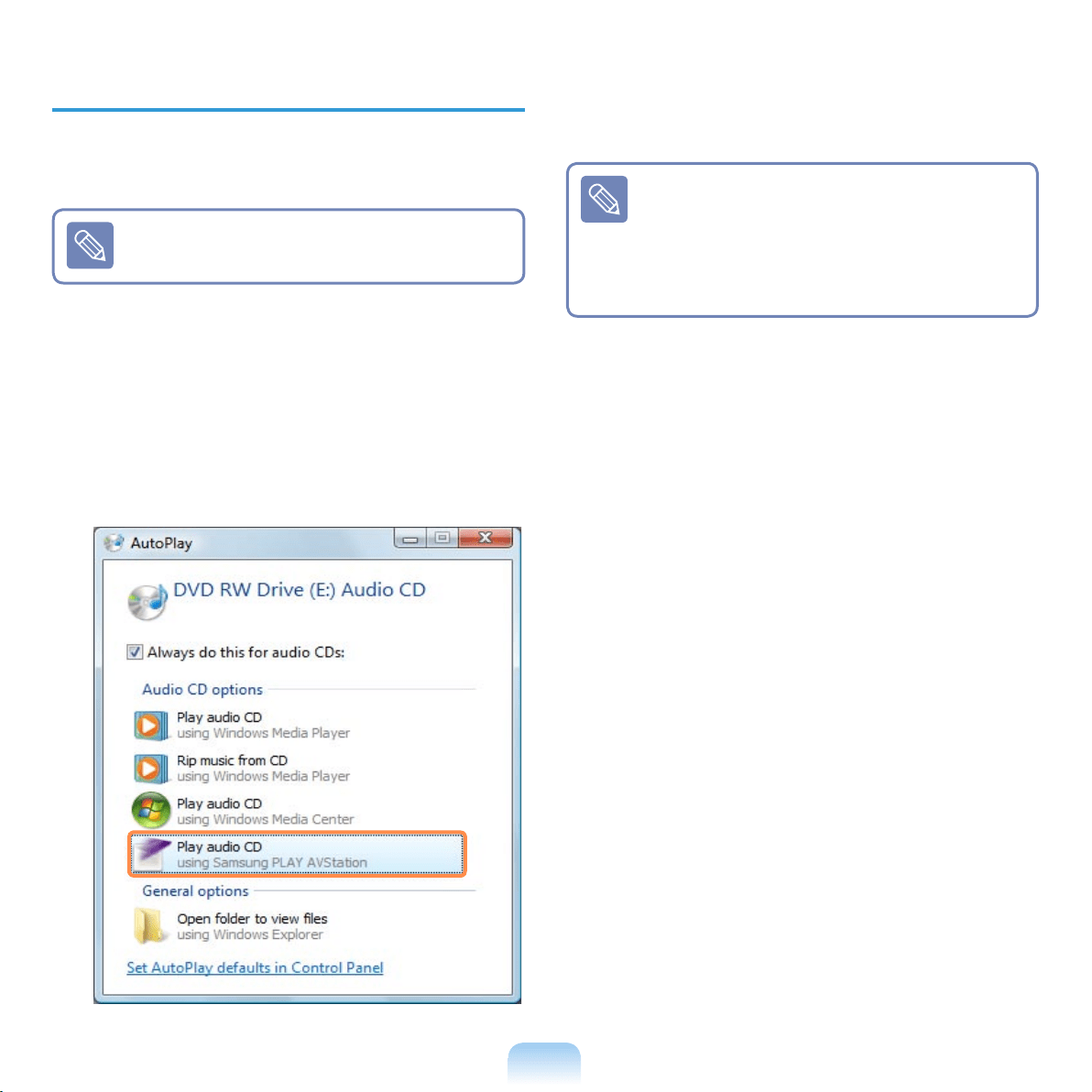
123
Playing an Audio CD
The procedures to play an audio CD are
described below.
To use it, you need to connect an
external-type ODD.
1
Insert an audio CD into the CD drive.
2
If the AutoPlay window appears,
select Play audio CD using
Samsung PLAY AVStation.
3
The CD is played.
If a CD is already inserted in the
CD/DVD drive, select CD in the
Audio CD folder of the Library and
double-click the title.
The CD is
played.
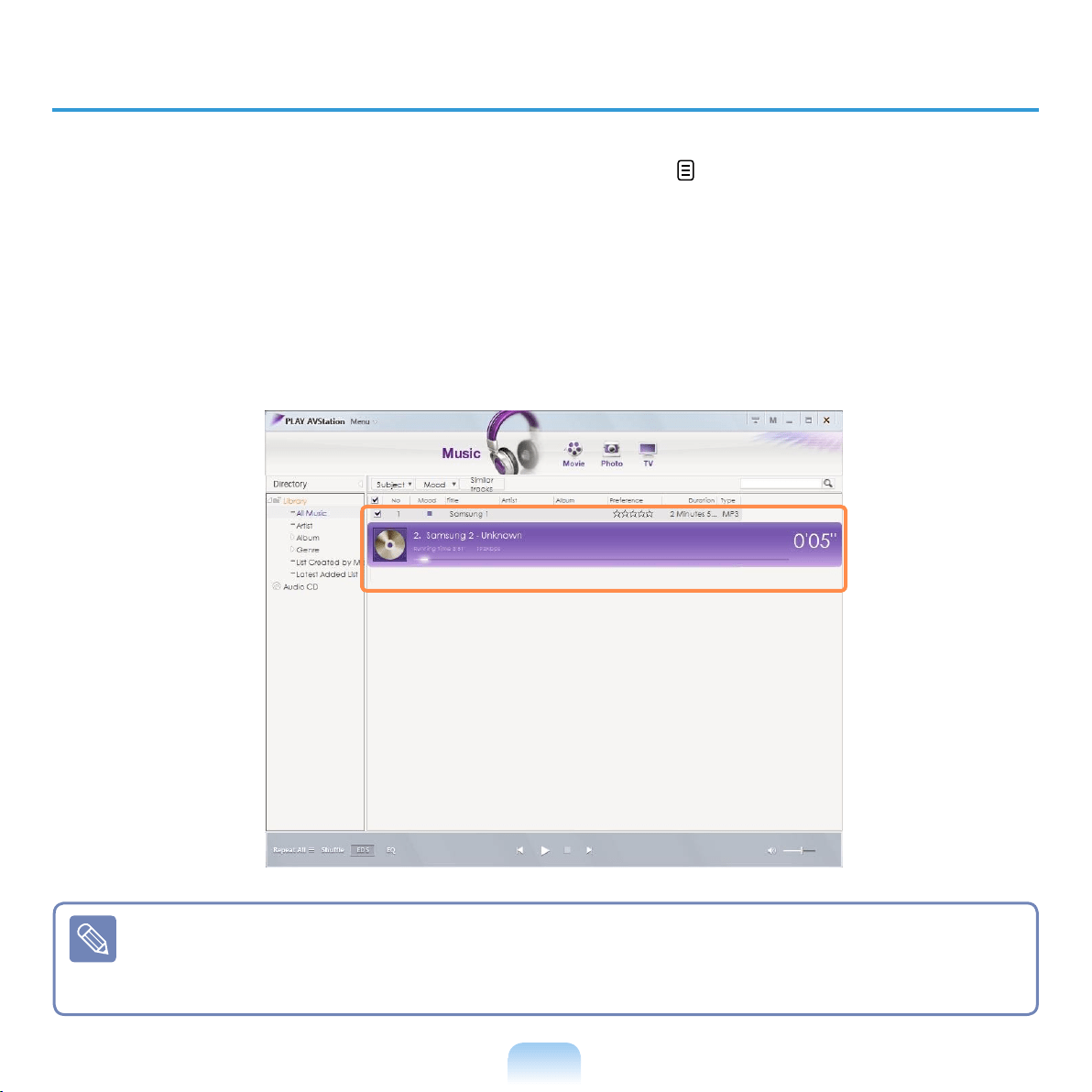
124
Play a Track not registered to the Library
Click Menu > File > Open File, select a music file to be played and click Open. The
selected track is registered to the Library and played.
Playing a Music File
If a music file is registered to the Music Library, you can easily play the music file. For
the procedures to register tracks to the Library, refer to
p.125.
1
Move to Music Station and double-click on All Music.
2
Double-click a music file.
The file is added to the playlist and played.
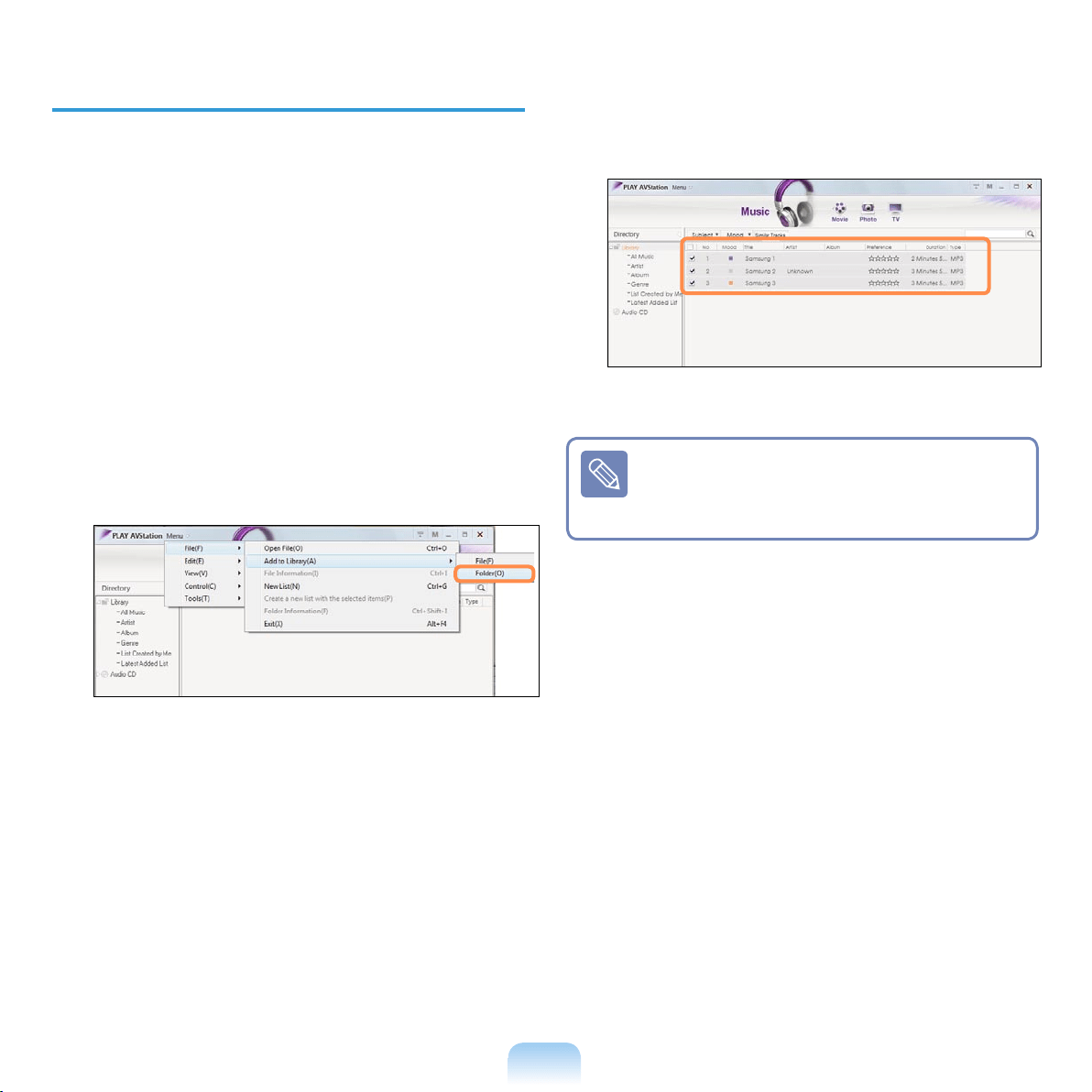
125
Adding Music Files to the Library
The Music Library is a library with music
files used by Music Station. The proce-
dures to add music files saved on the
computer to the Library are described
below.
You can add files, folders.
As an example, the procedures to add a
folder are described below.
1
Select Menu > File > Add to Library
> Folder.
2
Select a target folder and select the
Audio File option in the Target File
Type.
3
The music files found in the selected
folder are added to the Library. The
music files are registered.
The tracks played in Play AVSta-
tion are automatically added to the
Library
.
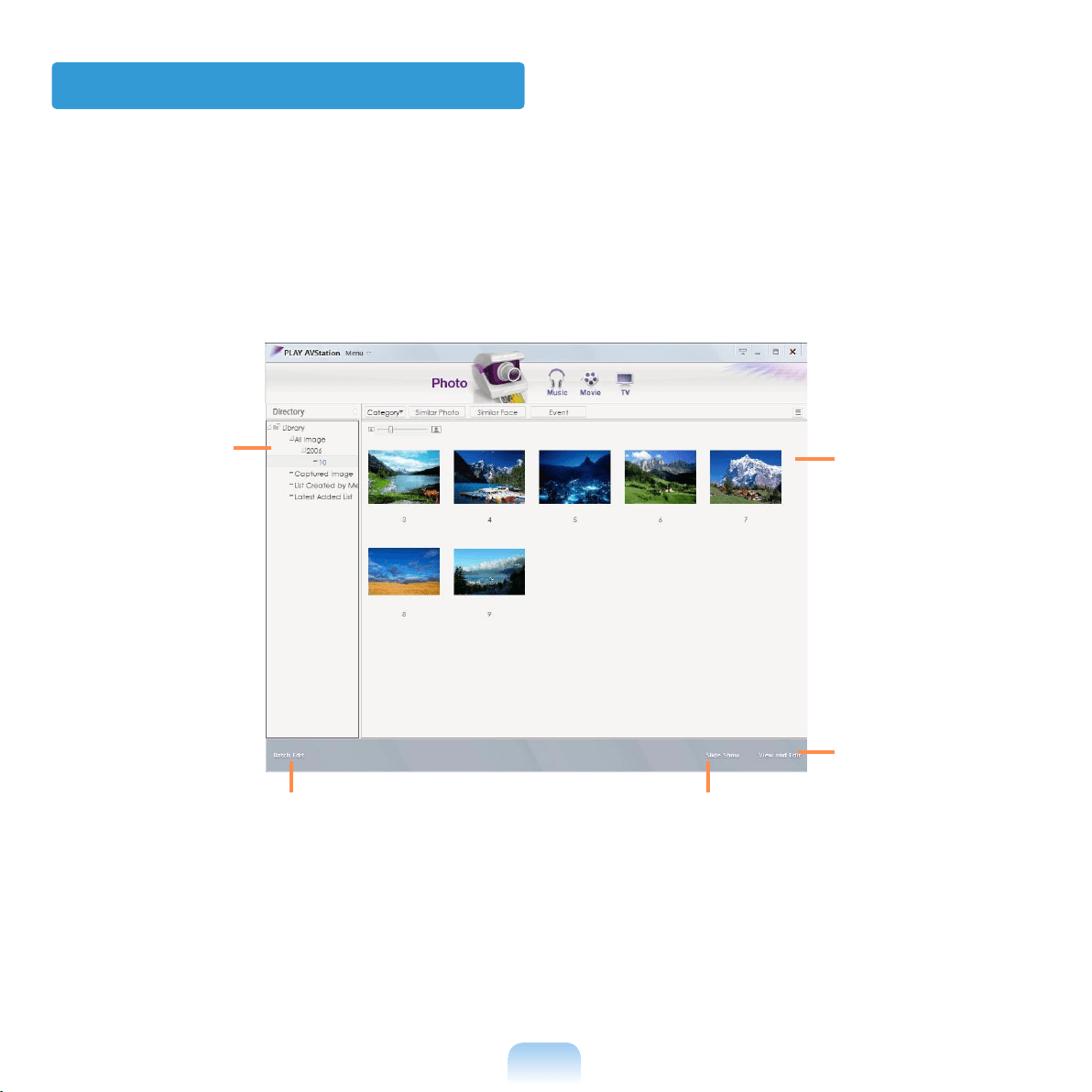
126
Launch Play AVStation and click on Photo on the Station Bar.
Photo Station
Photo Library
Photo List and
Thumbnail
Window
Batch Edit Button
SlideShow Button
View and Edit
Button
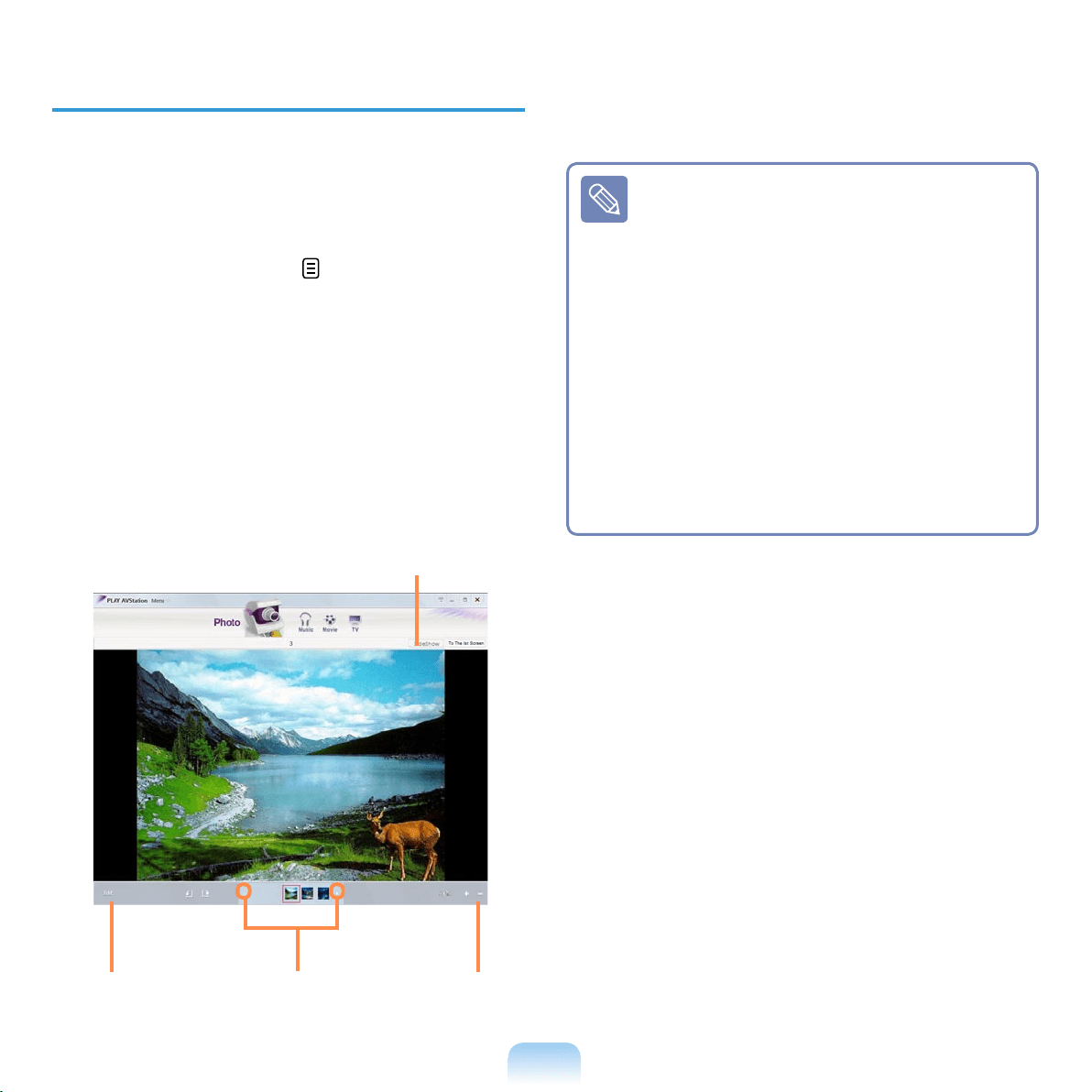
127
Viewing an Image
The procedures to view images regis-
tered to the Photo Library individually and
via a SlideShow are described below.
For the procedures to register image files
to the Library, refer to
p.129.
1
Move to Photo Station and double-
click on All Images.
2
Double-click on an image. The select-
ed image is displayed in the Preview
screen. Press the left and right arrow
keys to navigate through the images.
Left and Right
Arrows
Zoom
Control
Edit Image
Slide Show
3
Click on To The list Screen to return
to the list.
■ Viewing an image not regis-
tered to the Library
Click Menu > File > Open File,
select an image fi
le to view, and
click Open.
The selected image fi
le is regis-
tered to the Library and displayed
in the Preview window
.
■ V
iewing images using the
SlideShow function
Click the SlideShow button at
the bottom of the Photo Station.
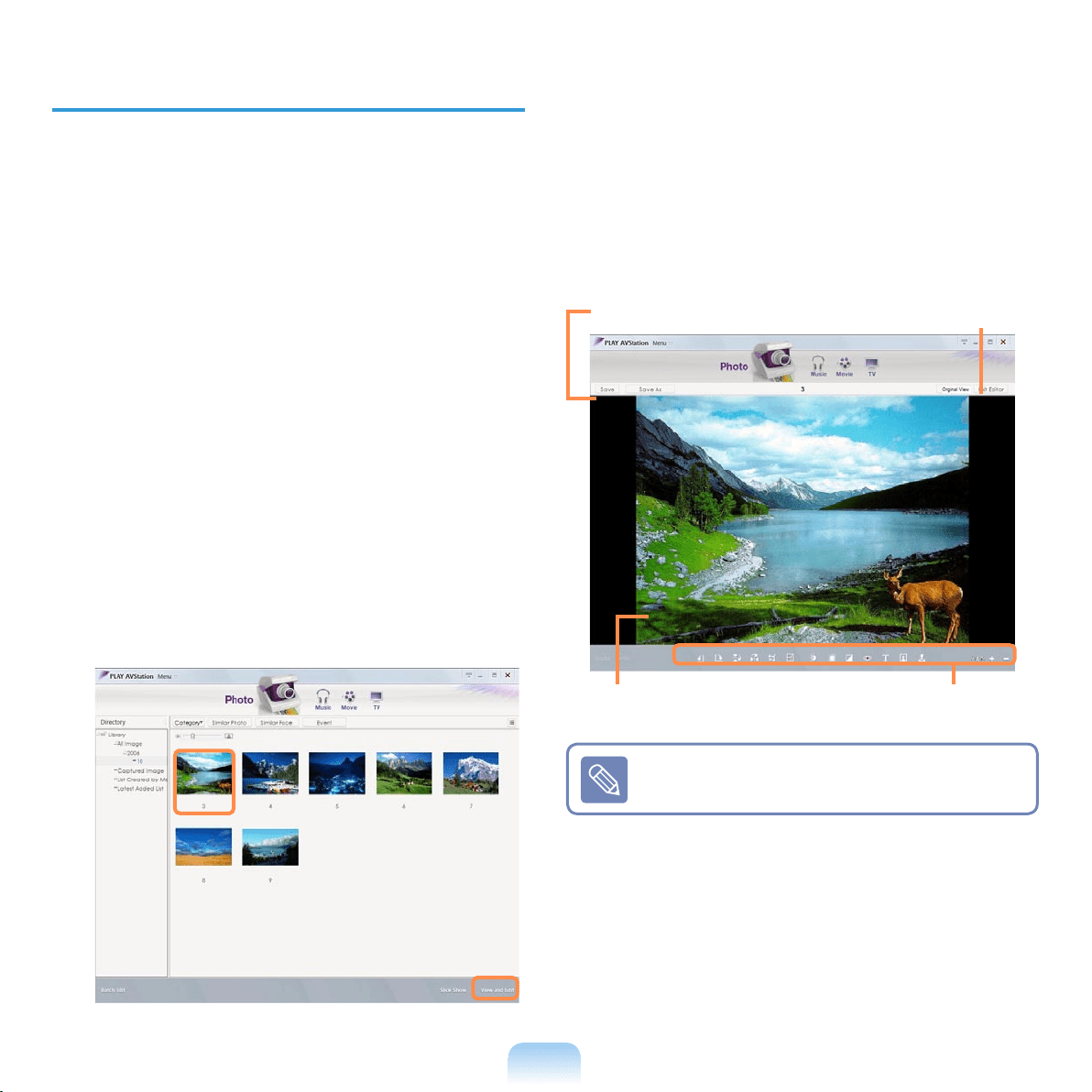
128
Editing an Image
You can change the shape of an image,
edit an image or apply special effects to
an image. The image editing functions
are described below.
1
Move to Photo Station and double-
click on All Images.
2
Click on a folder which includes
images, and the images in the folder
are displayed.
3
Double-click on an image or click the
View and Edit button at the bottom
right to switch to the Preview screen.
4
If the Preview screen appears, click
the Edit button at the bottom left. If
the image editor screen appears, edit
the image using the Edit tools at the
bottom of the window.
Click to switch
to the Preview
screen
Click to save
the edited
image
Edit T
oolsImage Editor Window
Click on Original View to edit the
image comparing it to the original.
5
You can save an edited image by
clicking the Save or Save As button.
6
Click the Exit Editor button to return
to the Preview screen.
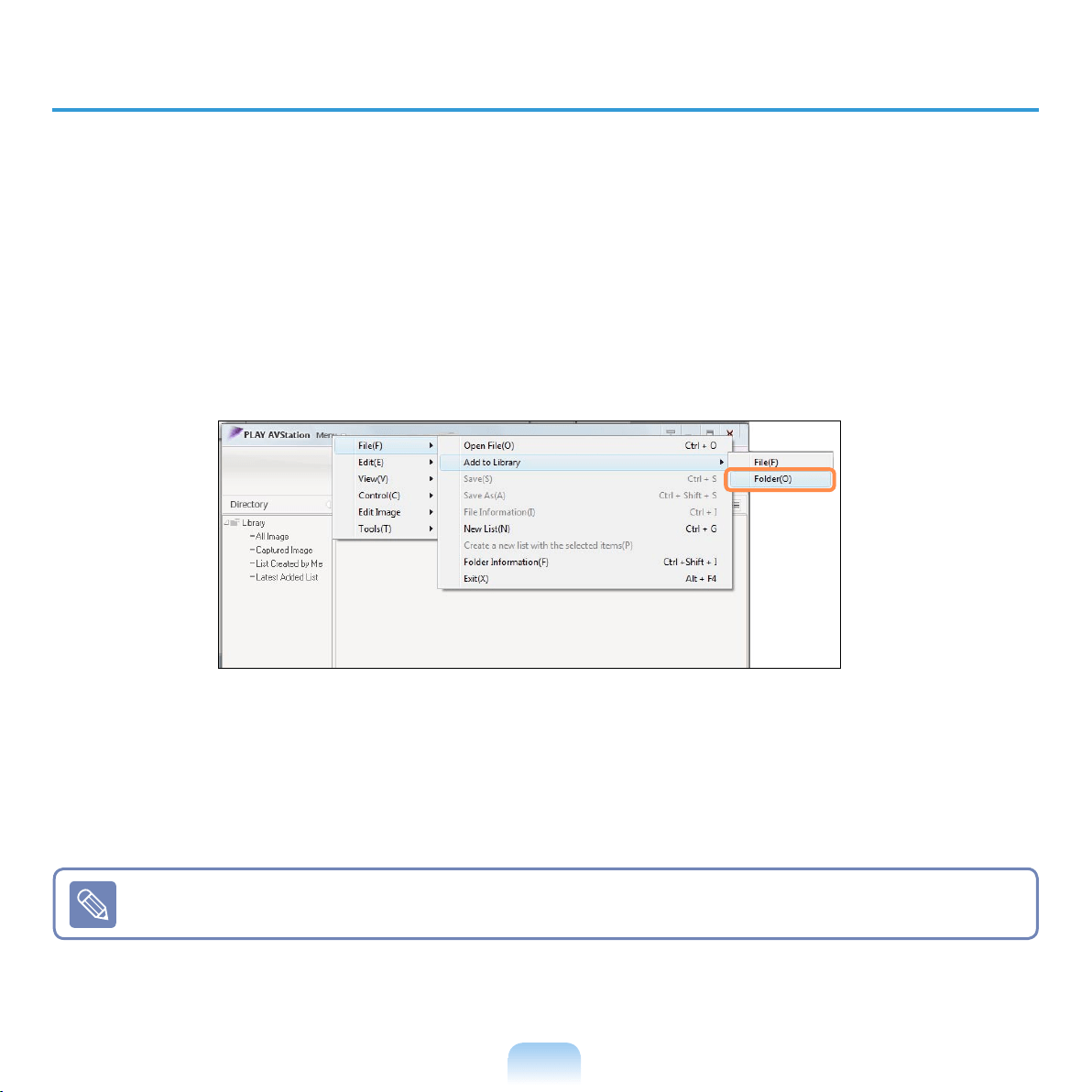
129
The image files used in AVStation are automatically added to the Library.
Adding Images to the Library
The Photo Library is a library with image files to be used by Photo Station. The proce-
dures to add image files saved on the computer to the Library are described below.
You can add files, add folders.
As an example, the procedures to add folders are described below.
1
Select Menu > File > Add to Library > Folder.
2
Select a target folder and select the Image File option in the Target File Type field.
The image files found in the selected folder are added to the Library.
130
If the HOLD switch on the left side
of the computer is slid upwards all
buttons of the computer are locked
and do not work. If AVStation Now
is not launched, check the position
of the HOLD switch.
AVStation Now
Using AVStation Now, you can easily and quickly play music, photographs, movies and DVDs
when the computer is on/off.
Start
To turn the computer on, slide the Power
switch/AV Now switch to the left (
)
and hold it for more than 0.1 seconds.
Screen Layout
Each menu of AVStation Now is linked
to a multimedia program so that you can
use the corresponding function.
Click on a menu to run the corresponding
program.
For more detailed usage of each pro-
gram, refer to the online help of each
program.
■ AVStation Now menus may dif-
fer depending on your computer
model and some functions may
not be supported by your com-
puter. In addition, if a required
program is removed or not in-
stalled, the corresponding menu
will not appear.
■ TV Station is only available for
systems supporting the TV func-
tion.
■ The screens used in this manual
may differ from actual screens
according to the program ver-
sion.
Exit
Move the mouse pointer to the top of the
screen and click the Exit (
) button to
exit AVStation Now.
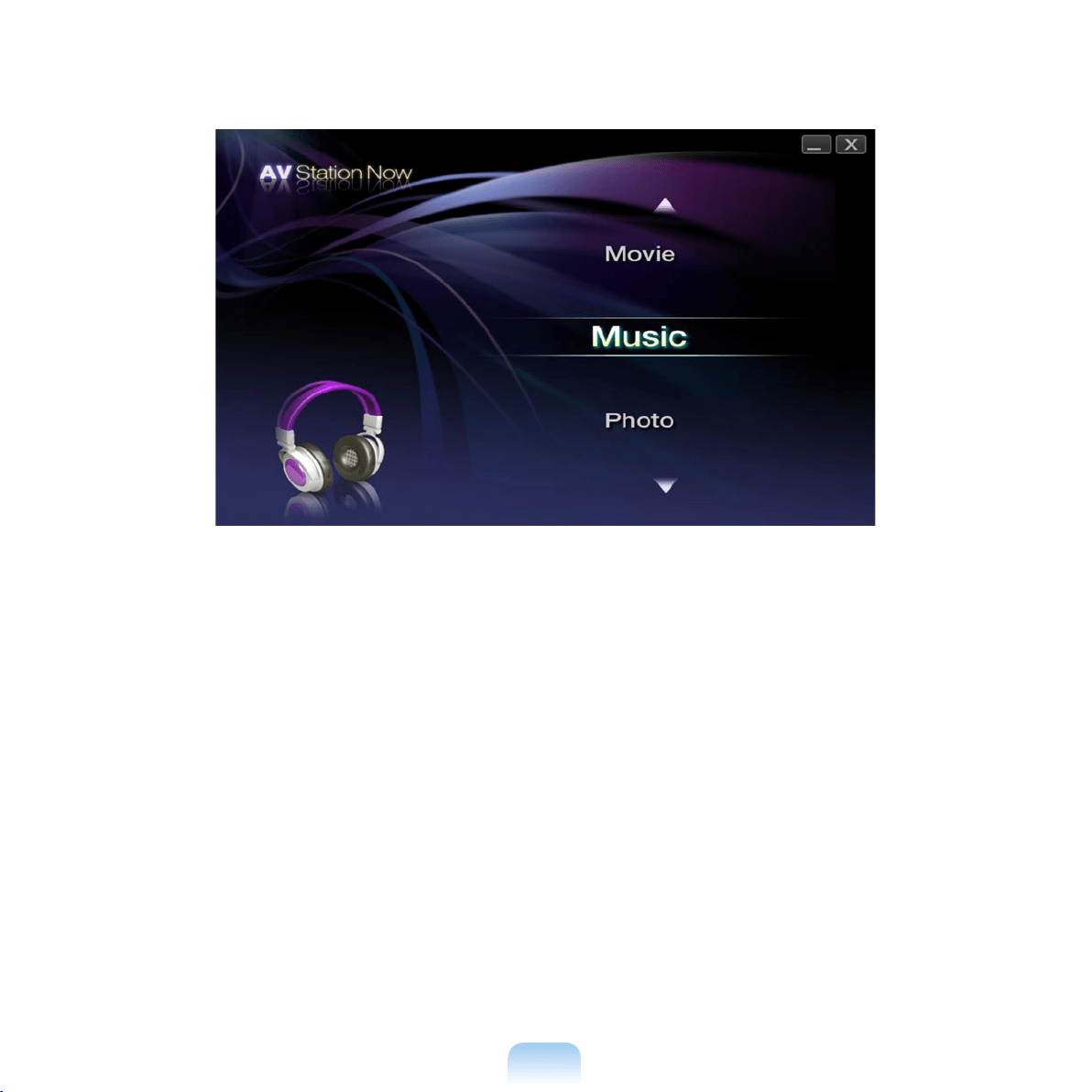
131
Music: Play AVStation is launched and you can play a music file or audio CD.
Movie: Play AVStation is launched and you can play a movie or DVD title.
Photo: Play AVStation is launched and you can view photographs or image files indi-
vidually or in a SlideShow.
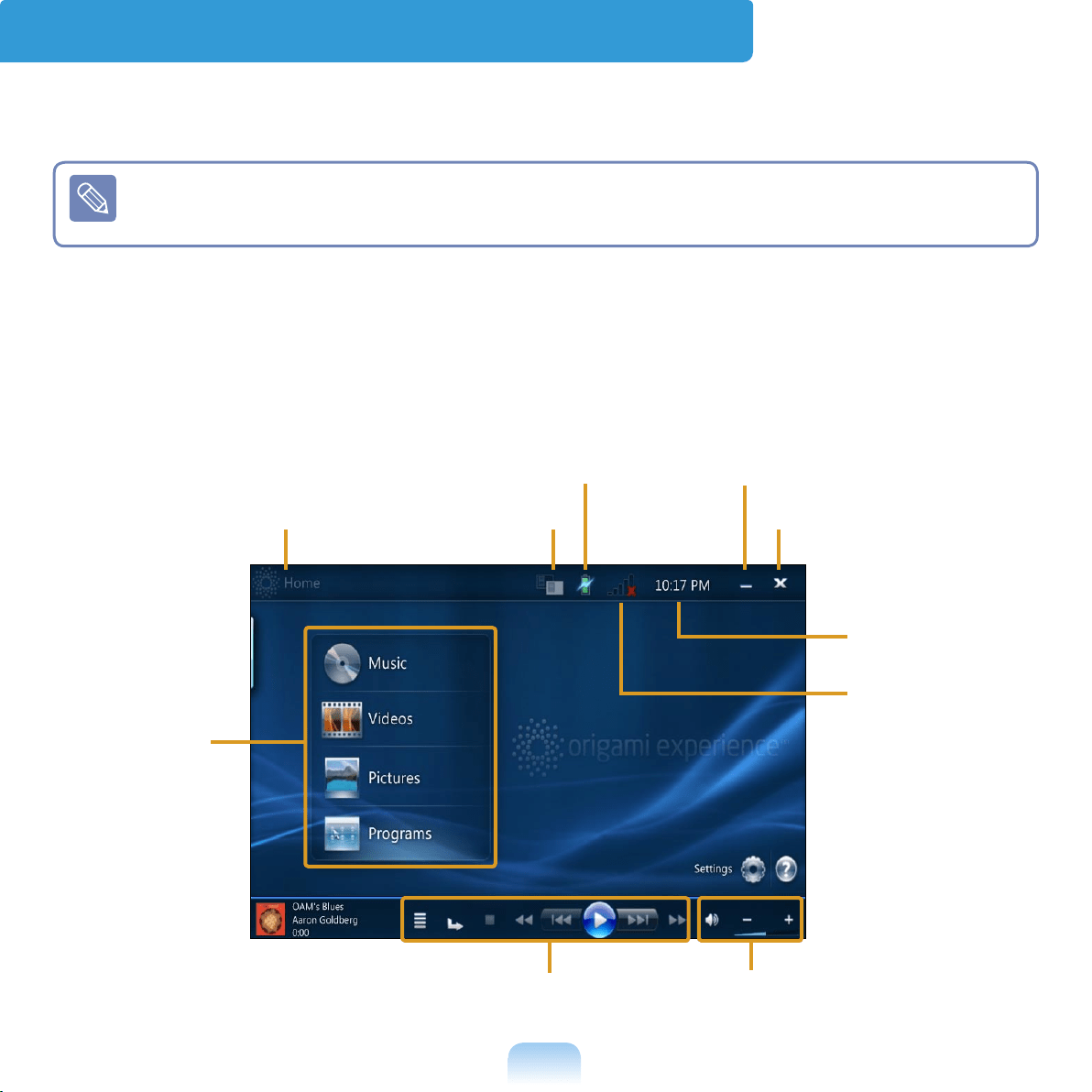
132
Using Origami Experience
Origami Experience is a program that categorizes programs installed on the computer for
easier and more convenient use.
To launch Origami Experience, click Start > All Programs > Microsoft Origami Expe-
rience Pack > Origami Experience.
Category
Home
Switch Windows
Minimize Window
Close Window
Battery Charge Status
Wireless LAN
Status
Play Control Button
Volume
Clock
It is optional and is not supplied with some models.
The terms and the screen figures in the manual may differ from actual ones.
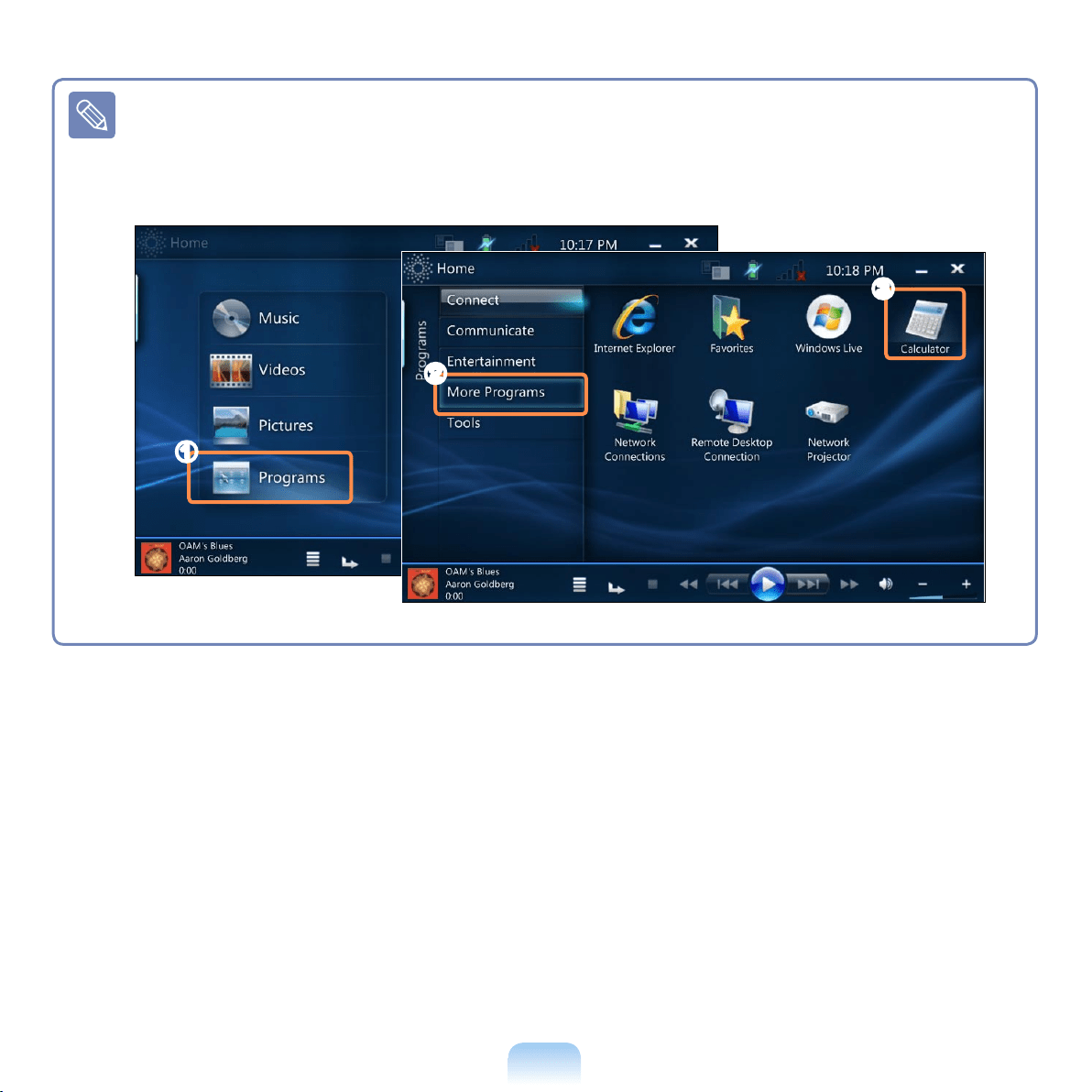
133
For example, the procedures to launch the Calculator are described below.
Launch Origami Experience.
Click Programs > More Programs > Calculator.
z
x
c
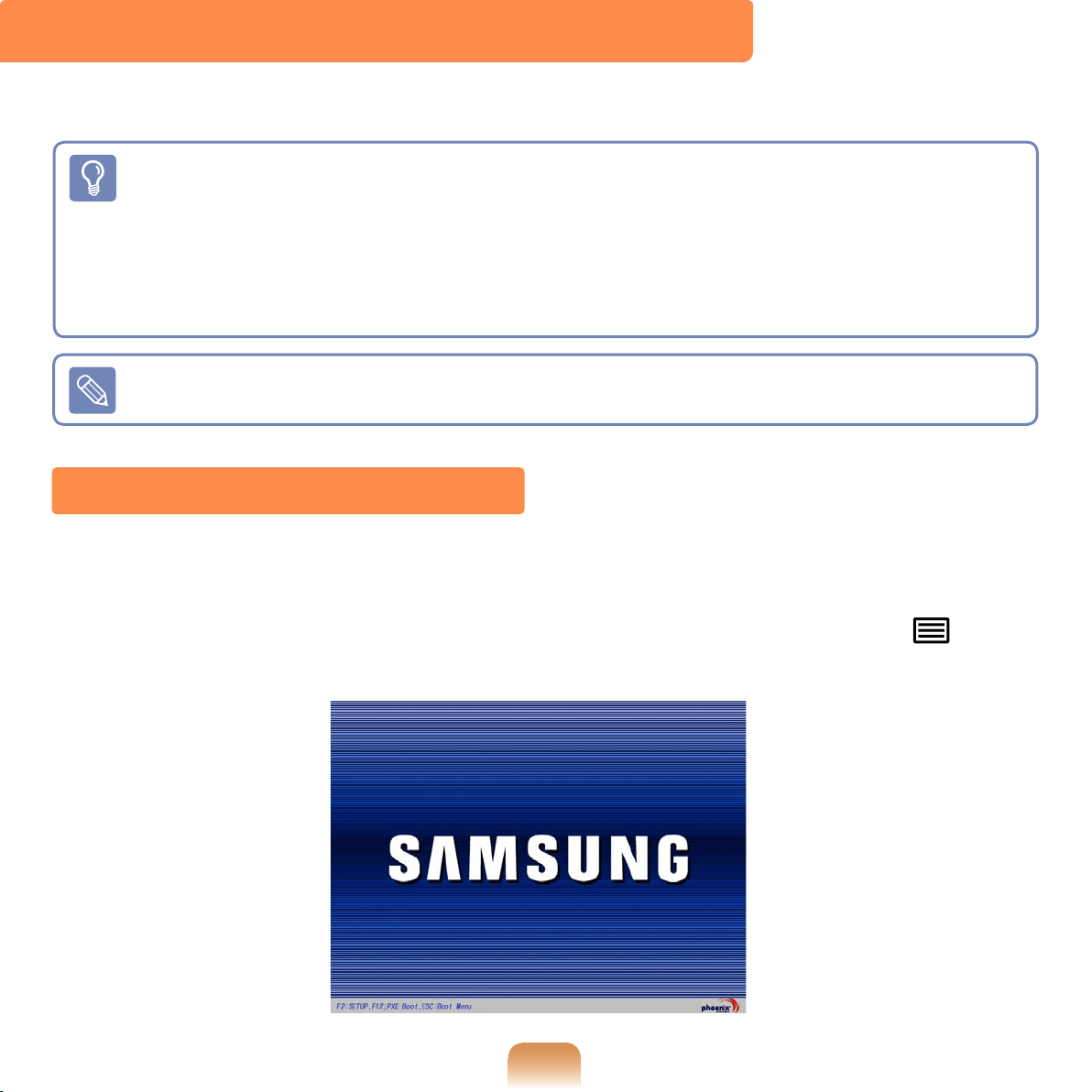
135
1
Slide the Power switch to the right to turn the computer on.
2
The booting screen (SAMSUNG logo) appears. Press the Menu button ( ) on the
right side of the computer. When an external keyboard is connected, press the F2
key.
Entering the BIOS Setup
BIOS Setup
The BIOS Setup enables you to configure your computer hardware according to your needs.
■ Use the BIOS setup to define a boot password, change the booting priority, or add
a new device.
Since incorrect settings may cause your system to malfunction or crash, take care
when configuring the BIOS.
■ The functions of the BIOS setup are subject to change for product function en-
hancement purposes.
The BIOS Setup menus and items may differ depending on your computer model.
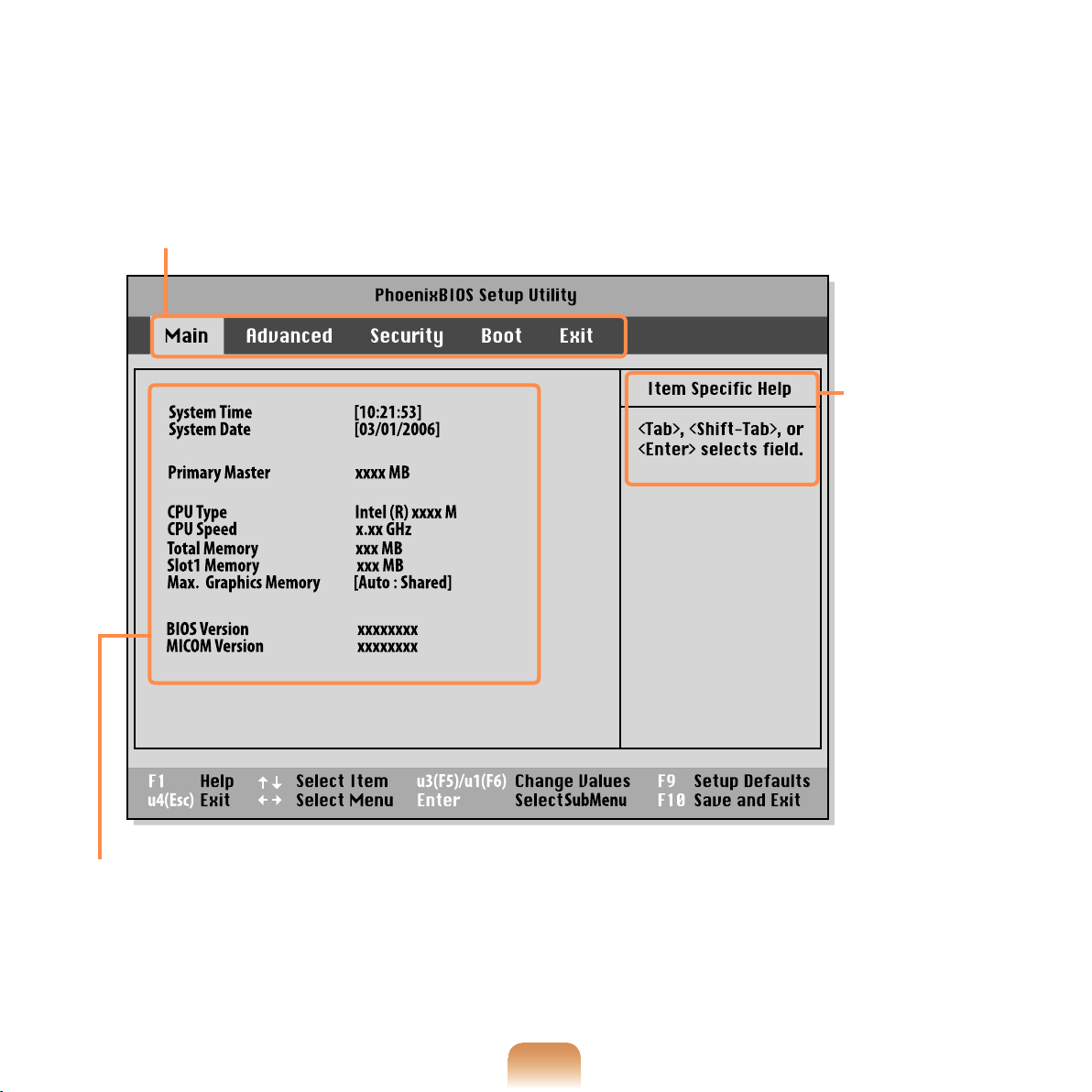
136
3
After a moment, the BIOS setup screen appears.
The items in the BIOS setup may differ depending on the product.
Setup Menu
Setup Items
Help
Help for the se-
lected item ap-
pears automati-
cally.
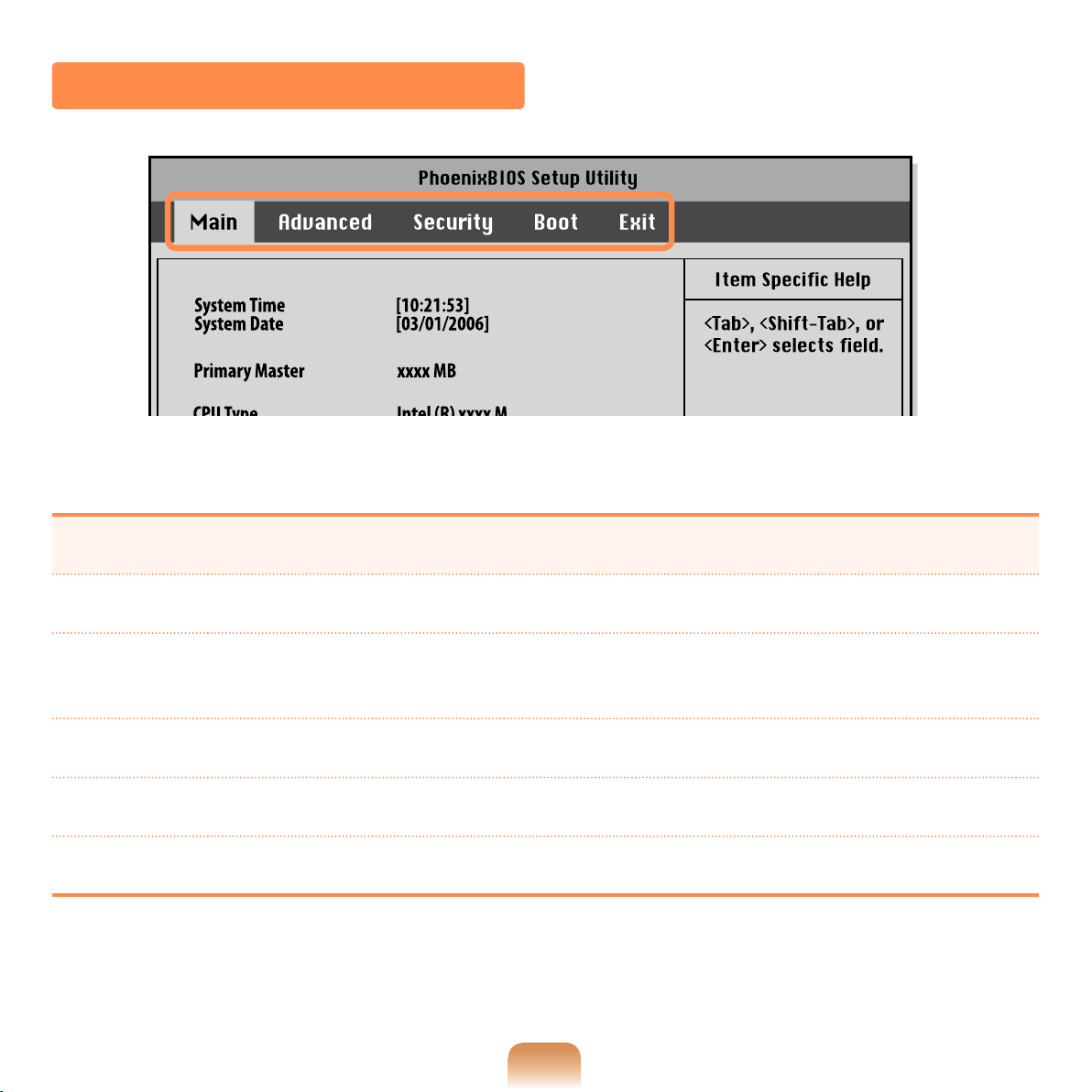
137
The BIOS Setup Screen
Menu Description
Main Used to change the basic system and environment settings.
Advanced
Used to configure advanced functions on your computer around devices and
chipsets.
Security Used to configure security functions, including passwords.
Boot Used to set the boot priority and other boot options
Exit Used to exit the Setup either saving the changes or not.
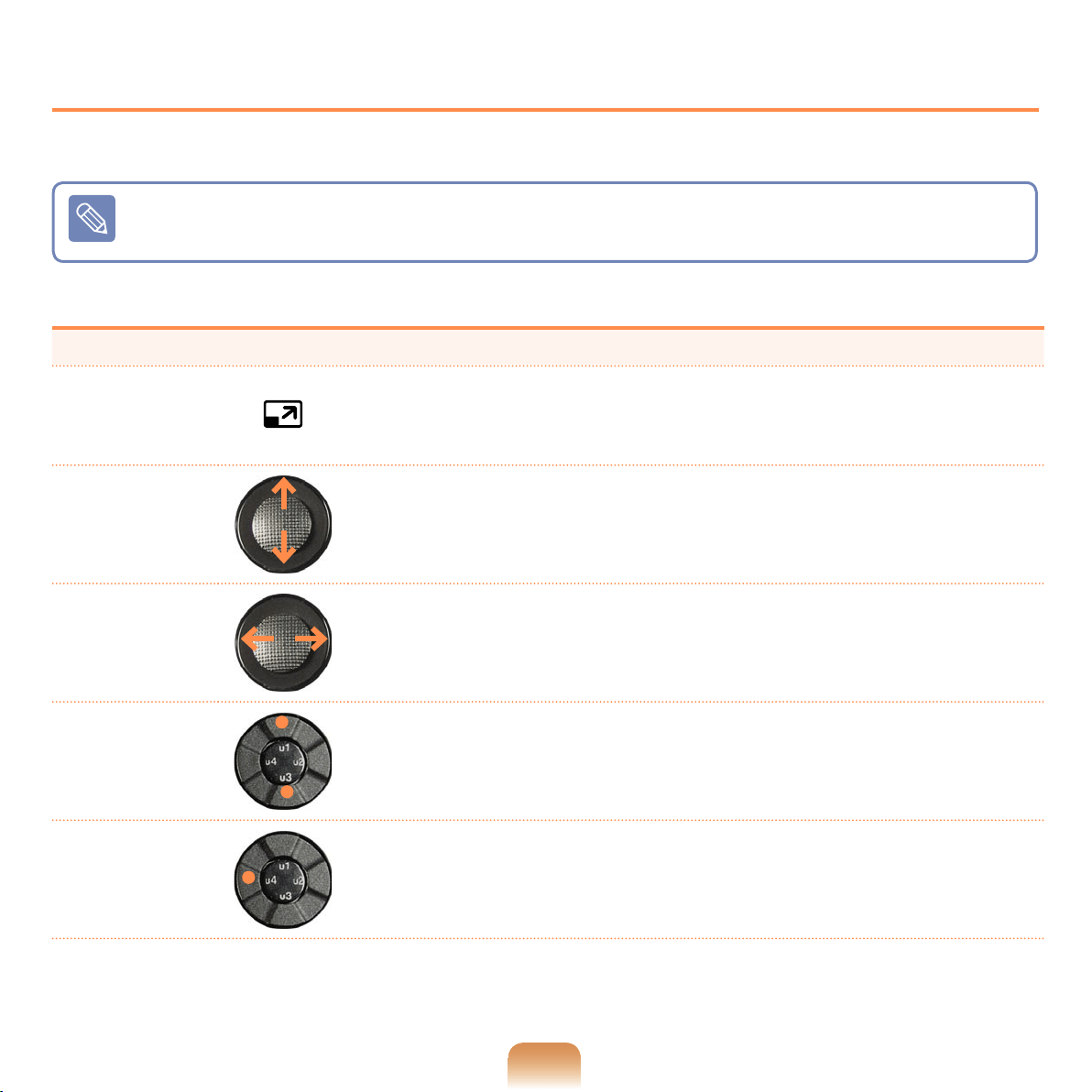
138
System Setup Buttons (Keys)
The following Buttons(keys) are used in System Setup.
When an external keyboard is connected, you can use the keys enclosed in paren-
thesis. For example, you can press the F1 key instead of the Auto Scaler button.
Setup Key Button Function
Auto Scaler
Button (F1)
When pressing the Auto Scaler button, Help appears. When
pressing the button again, Help disappears.
Up & Down
Keys (↑↓)
Move the Joystick up or down to move the cursor up and
down.
Left & Right
Keys (← →)
Move the Joystick left or right to move the cursor left or right.
u3(F5) /
u1(F6)
Press the u3 (F5) / u1 (F6) u3 and u1 buttons to change the
value of an item.
u4(Esc)
Press the u4 button to return to a higher-level menu or to move
to the Exit menu.
139
Enter Selects an item or opens a submenu.
(F9)
To initialize the setup settings, press the F9 key on the external
keyboard.
If an external keyboard is not connected, select Exit > Load
Setup Default from the setup menu.
(F10)
To save the changes press the F10 key on the external key-
board.
If an external keyboard is not connected, select Exit > Exit
Saving Changes from the setup menu.
Exiting the System Setup
1. Move to Exit menu > Exit Saving Changes using the Joystick and press Enter.
2. Select Yes and press the Enter button. The System Setup is closed and Windows
is started.
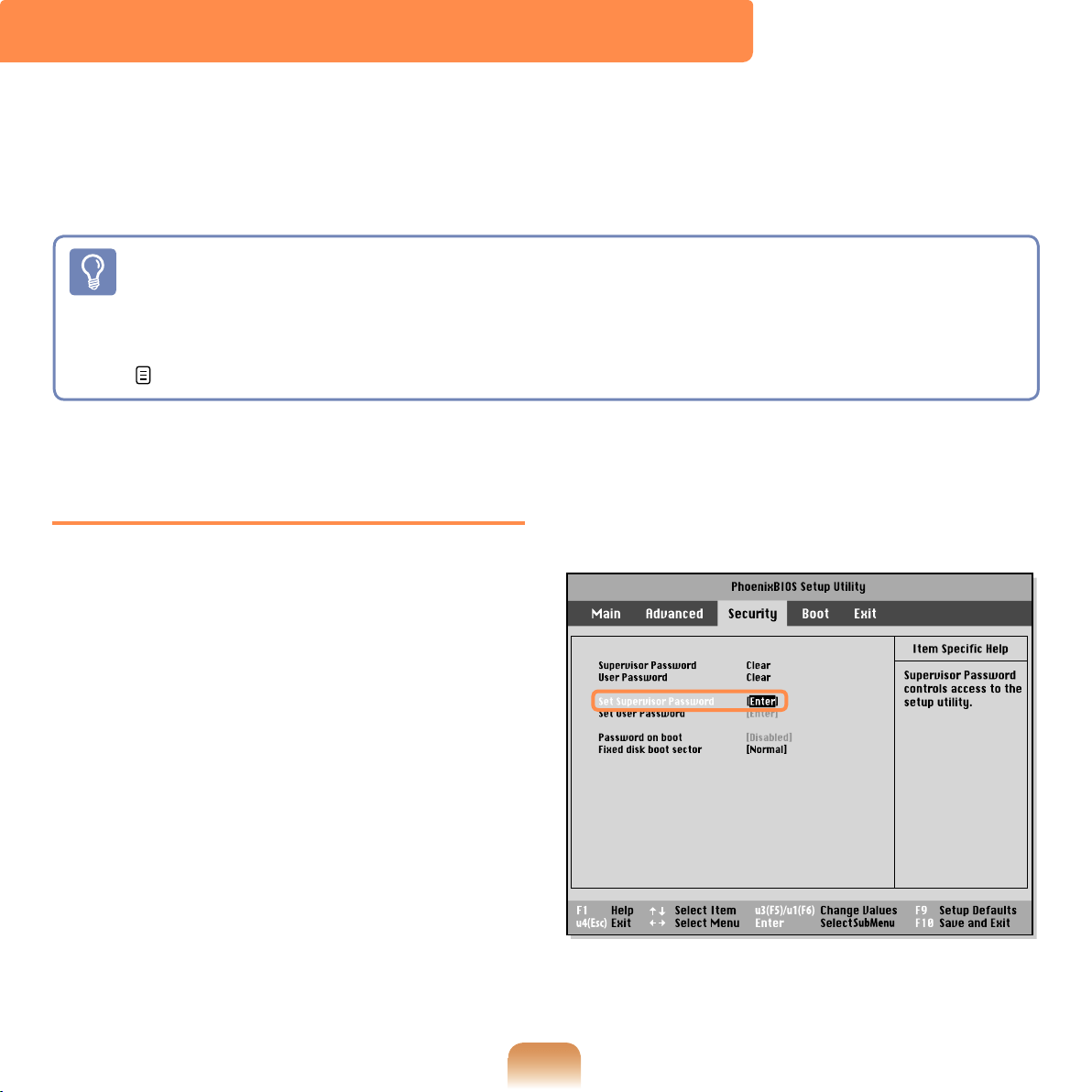
140
Setting a Supervisor Password
A Supervisor Password is required to turn
the computer on or to start the System
Setup.
When setting a Supervisor Password,
users other than a supervisor cannot use
the computer.
1
Select the Security menu in the
BIOS Setup.
2
In the Set Supervisor Password
item, press <Enter>.
Setting a Boot Password
When setting a password, you have to enter a password to use the computer or enter the
BIOS Setup.
By configuring a password, you can restrict system access to authorized users only and pro-
tect data and files saved on the computer.
Do not lose or forget your password.
If you have forgotten your password, contact a Samsung service center. In this case,
a service fee will be charged.
For the setup buttons, refer to the description of ‘System Setup Buttons (Keys)’.
p138
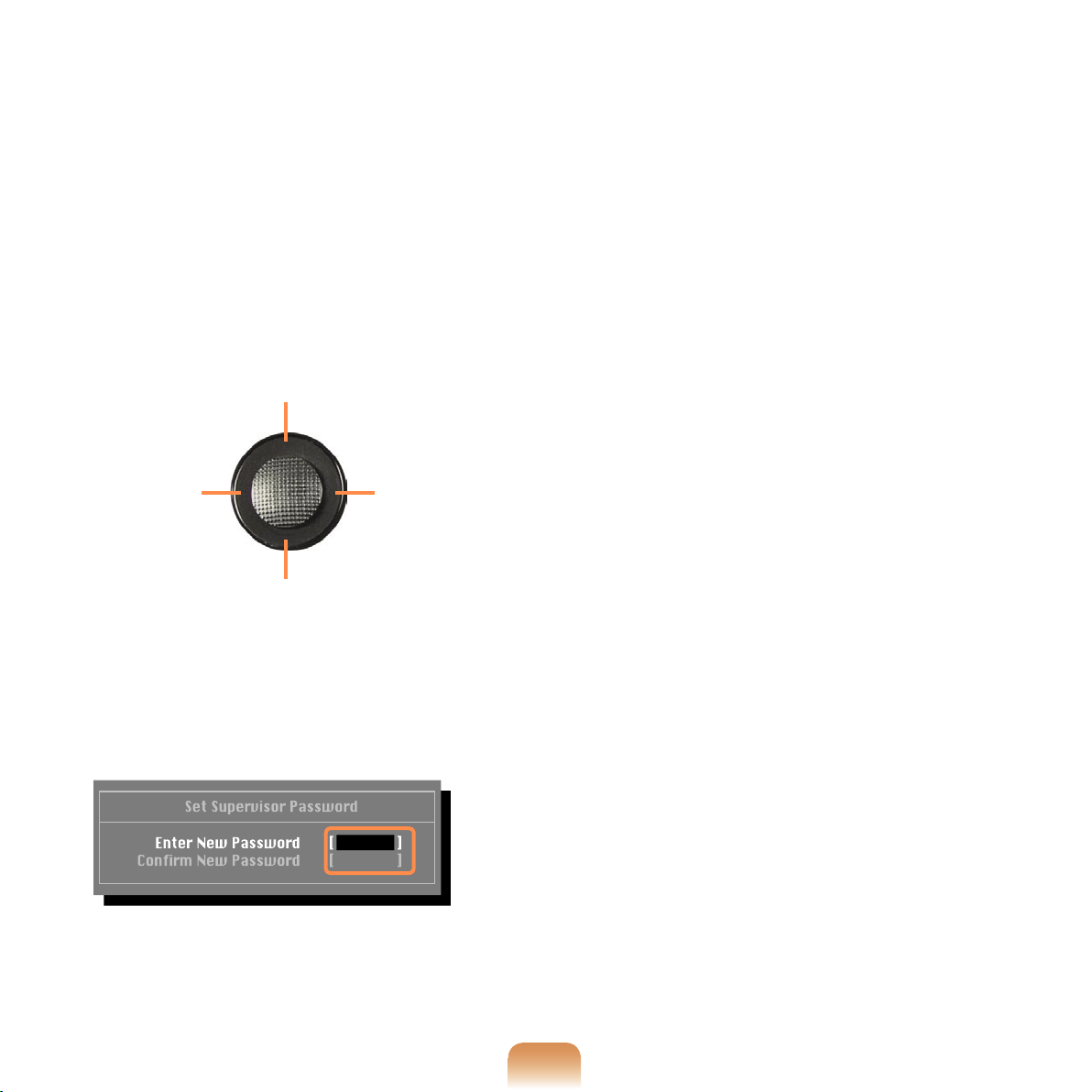
141
3
On the screen, the password setting
buttons are described.
You can set a password by entering
numbers between 1 and 4 with the
Joystick.
Since the u2 button is used as Delete
(BackSpace) and the u4 button is
used as Cancel (Esc), enter the pass-
word using the Joystick.
Left: 4 Right: 2
Next: 3
Up: 1
Enter a password, press <Enter>, re-
enter the password for confirmation,
and press <Enter> again.
4
When a message confirming the
password configuration appears in
the [Setup Notice] window, press
<Enter>.
The supervisor password has been
set. The supervisor password is re-
quired to turn the computer on or to
enter System Setup.

142
Setting a User Password
Users can start the system with a user
password, but cannot enter the System
Setup. By doing this, you can prevent
other users from entering Setup.
Before configuring a user password, a
supervisor password must have been
configured. Deactivating the supervisor
password also deactivates the user pass-
word.
In the Set User Password item, press
<Enter> and complete the procedures of
Step 3 of Setting a Supervisor Password.
Activating the Booting Password
Before activating the booting password,
a supervisor password must have been
configured.
Set the Password on boot option to En-
abled. From now on, system booting will
not proceed without the password.
Deactivating the Password
1
On the password to be deactivated,
press <Enter>. For example, to de-
activate a supervisor password in
the Set Supervisor Password item,
press <Enter>.
2
In the Enter Current Password item,
enter the currently configured pass-
word and press <Enter>.
3
Leave the Enter New Password item
field empty, and press <Enter>.
4
Leave the Confirm New Password
field empty, and press <Enter>.
5
In the [Setup Notice] window, press
<Enter>.
The password is deactivated.
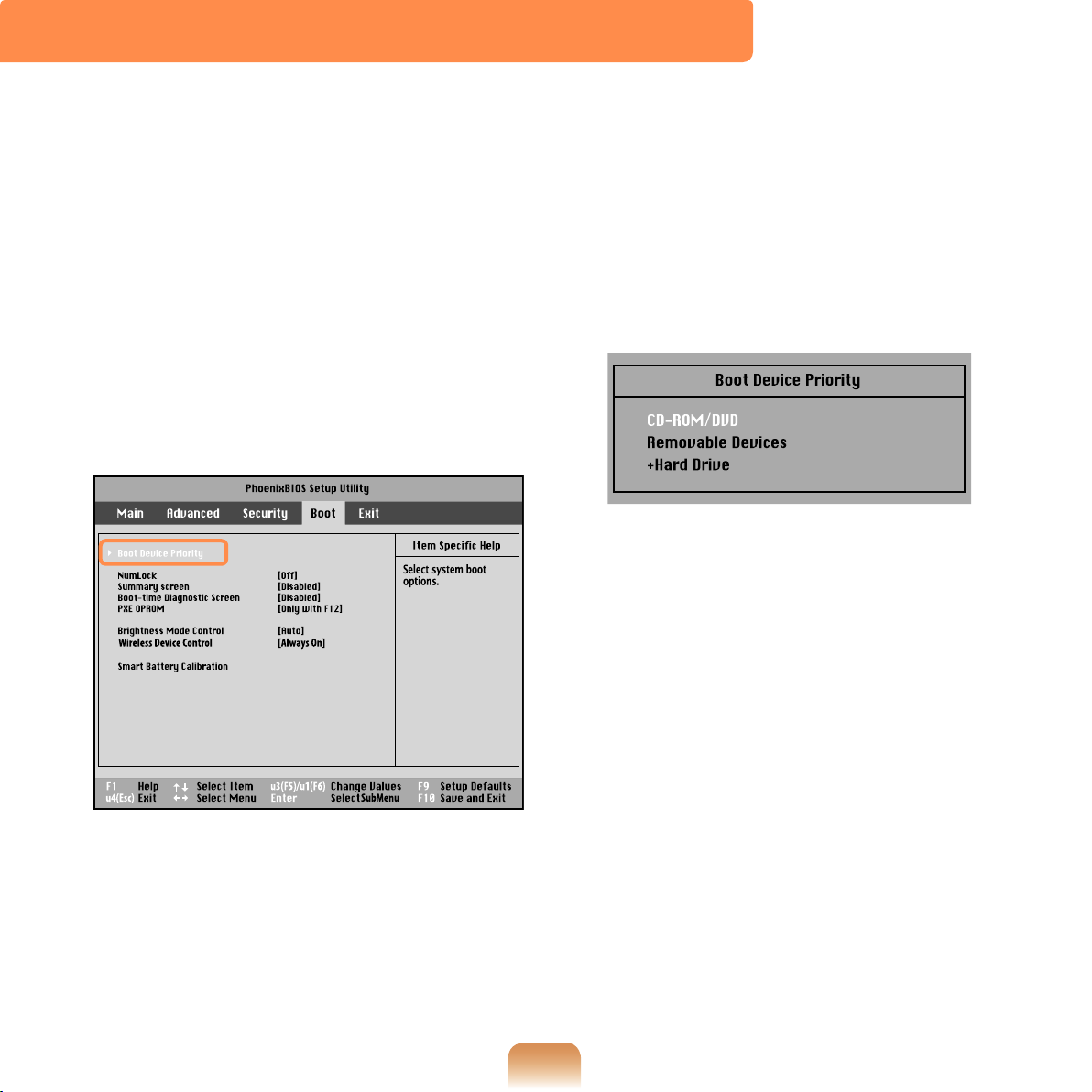
143
1
Select the Boot menu in the BIOS
Setup.
2
Press <Enter> on the Boot Device
Priority item.
3
Use the u1 or u3 button to move a
booting device up.
4
Exit from the Boot menu by pressing
the u4 button and move to the Exit
> Exit Saving Changes menu using
the Joystick and press <Enter> to
save the settings and exit the setup.
Changing the Boot Priority
The default boot priority of your computer is the CD-ROM first, then a removable device and
then the hard disk drive in this order.
You can change the booting priority using the Boot menu of the System Setup. As an ex-
ample, the procedures to change the highest boot priority device to the hard disk drive are
described below.
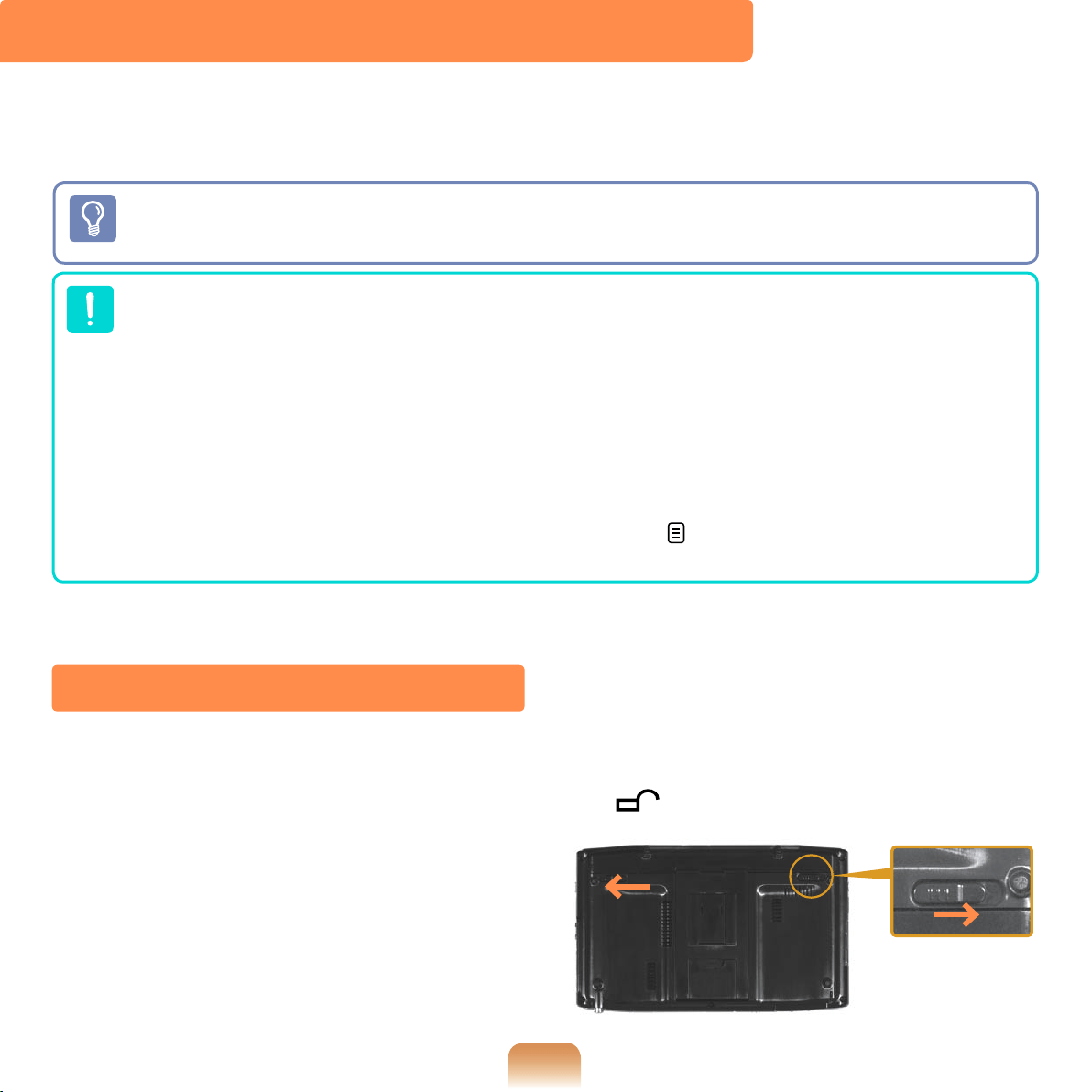
144
1
Shutdown the system and place
the computer upside down on a flat
surface.
2
Pull the two battery latches outwards
(
), then remove the battery.
Installing/Removing the Battery
Battery
Please refer to the following instructions when running the computer on battery power without
connecting the AC power.
A Lithium-Ion smart battery is supplied with this computer.
Carefully read and follow the precautions printed on the battery before using the bat-
tery.
Precautions
Use only chargers specified in the User Guide.
Never heat the battery pack, put it near or in a fire or use at a temperature higher
than 60°C, as this may cause fire.
Never cause a short circuit between the battery pack terminals or disassemble the
battery pack.
Carefully read and follow the precautions printed on the battery and the safety in-
structions in the User Guide before using the battery.
Please refer to the system operation environment (
p.195) of this guide and operate
and store the battery at room temperature.
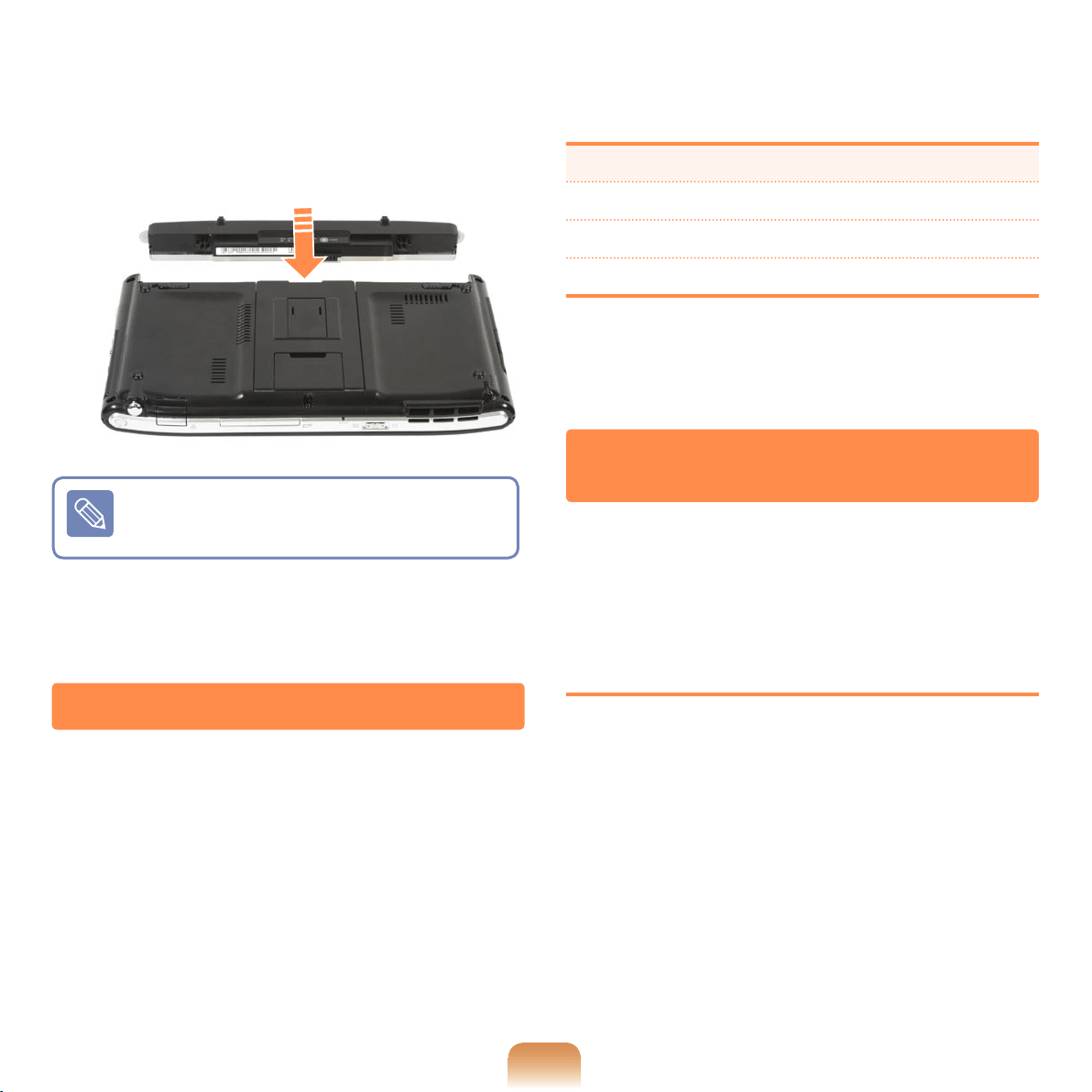
145
Charging the Battery
1
Attach the battery and connect the
AC adapter to the DC-in jack of the
computer.
The battery will then start charging.
Measuring the Remaining
Battery Charge
You can view the battery charge status
by completing the following procedures.
Viewing through the Menu button
Press the Menu button and press on
Battery.
3
To install the battery again, slide the
battery into the system. The battery
latches move inwards and fix the
battery automatically.
Check if the battery latch has been
moved inwards.
2
When charging is complete, the
Charge LED turns green.
Status Charge LED
Charging Amber
Charging complete Green
AC adapter not connected Off
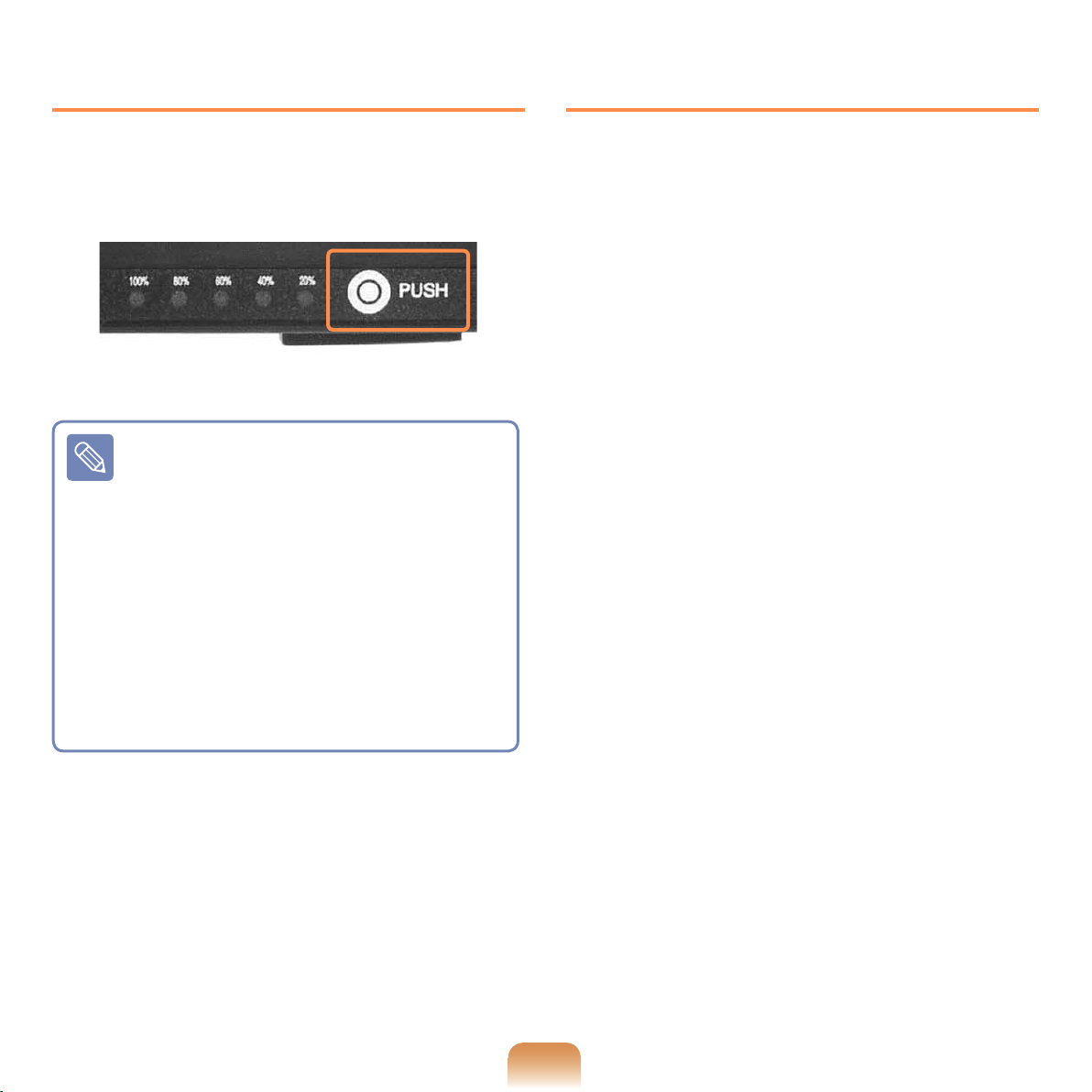
146
To view on the battery
If you press the PUSH button for the bat-
tery, you can view the remaining battery
charge.
Battery Warning
■ Y
ou will hear an alarm when the
remaining battery charge reaches
below 10%.
In this case, connect the
AC
adapter or turn off the computer
and install a fully charged battery.
■ When the remaining battery
charge is under 3%, the computer
automatically saves the current
work and turns of
f.
Battery Usage Time Information
A battery is an expendable supply, so
when using it over a long time, the ca-
pacity/battery life is shortened. If the
battery life is reduced to under half of its
initial time, we recommend purchasing a
new battery.
For long periods of not using the battery,
keep the battery after discharging it. This
extends the battery life time.
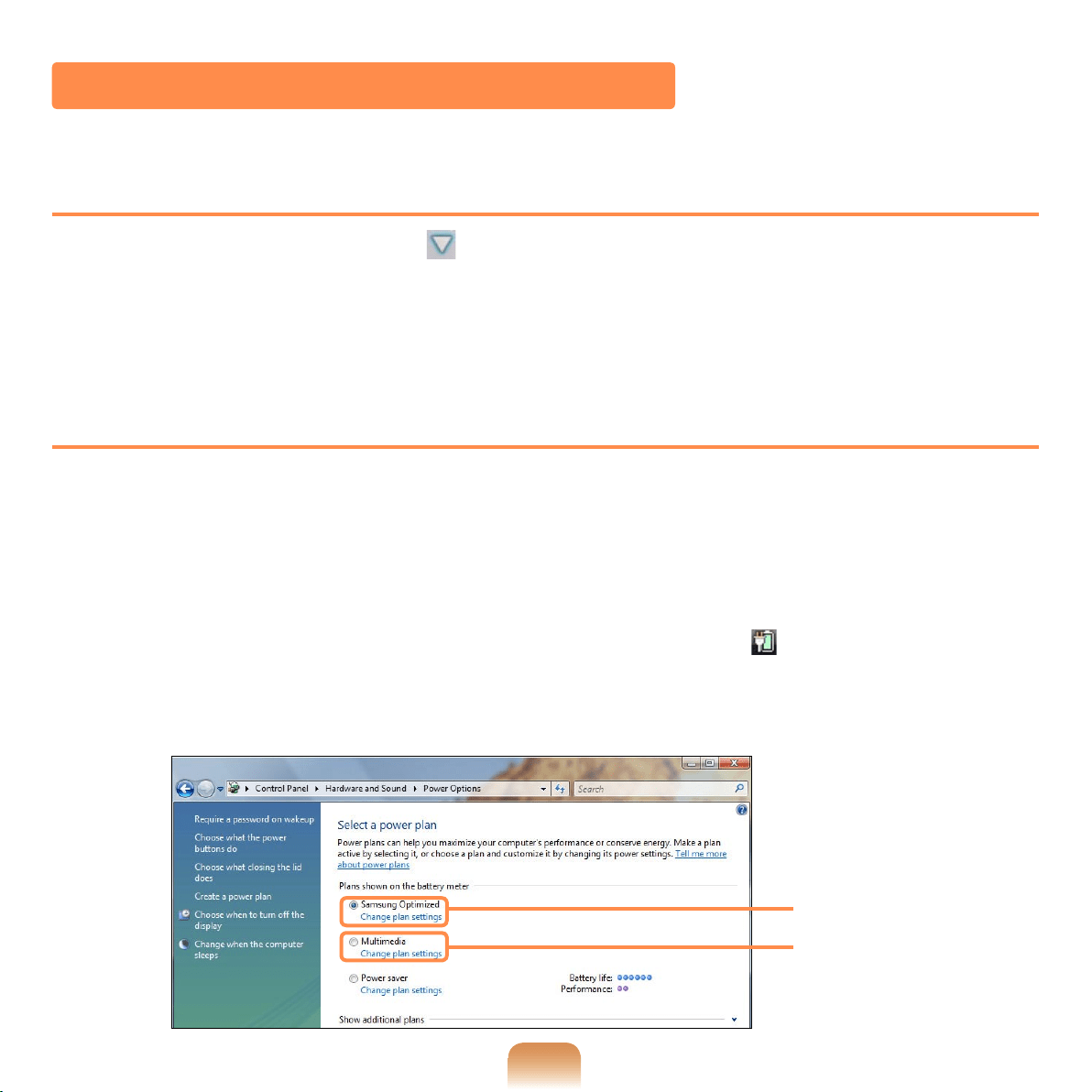
Extending the Battery Usage Time
147
Decreasing the LCD Brightness
Press the Menu button and click from the Brightness item to decrease the LCD
brightness. Then you can extend the battery usage time.
Alternatively, press the ‘-‘Volume Control button on the left side of the computer while
holding down the Menu button to decrease the LCD brightness.
Using Easy Battery Manager
Easy Battery Manager is a power management program that enables using the battery
power efficiently. You can select an optimized power mode according to your require-
ments.
1
Click Start > Control Panel > Hardware and Sound > Power Options.
Alternatively, right-click the power measuring device icon (
) in the notification
area of the taskbar and select Power Options.
2
If the following screen appears, select one of the modes.
Multimedia
Samsung Optimized
Samsung Optimized
This mode is appropriate for normal conditions. It maximizes the system performance
when the computer is running on AC power while maximizing the battery usage time
when the computer is running on battery power.
Multimedia
This mode is appropriate for a multimedia environment that requires maximum system
performance. Therefore, the battery usage time may be reduced in this mode.
148
Using the Easy Battery Manager power options
To use the Easy Battery Manager power options after reinstalling Windows, you
have to install the Easy Battery Manager manually using the system software media.
Since power options in Easy Battery Manager aim at maximizing the battery usage
time, programs requiring high performance may slow down when using the battery.
In this case, it is recommended connecting the AC adapter or selecting Power Saver.
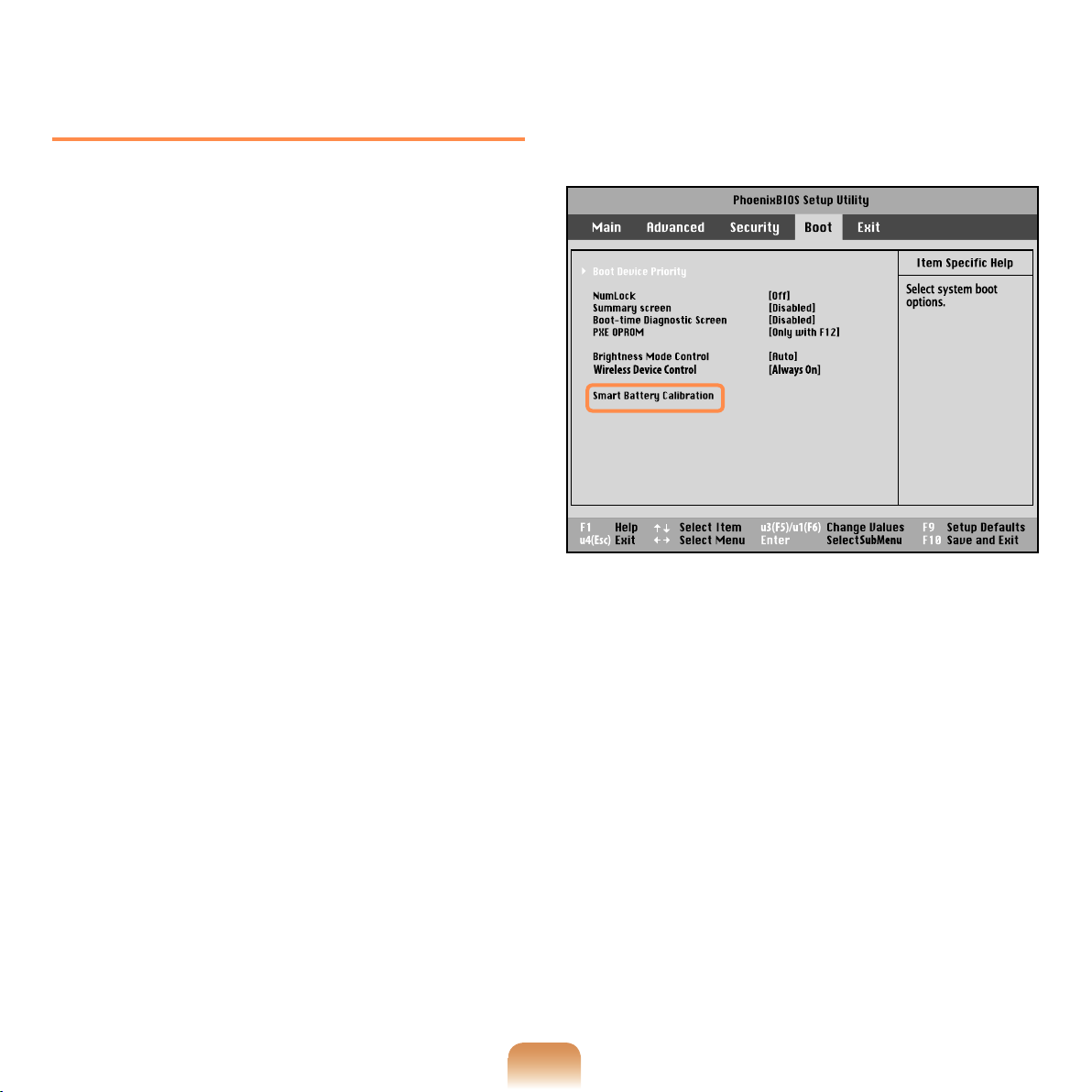
149
Using
the
Battery Calibration Function
When charging/discharging the battery
repeatedly for a short time only, the bat-
tery usage time may be reduced by the
difference between the actual battery
charge and the remaining charge display.
In this case, the actual battery charge
and the remaining charge display will be
the same by discharging the battery com-
pletely using the Battery Calibration func-
tion, and then recharging it again.
1
Disconnect the AC power adapter
after turning off the computer.
2
Restart your computer and press the
Menu button when the SAMSUNG
logo appears, to start System Setup.
3
Using the arrow keys, select Smart
Battery Calibration in the Boot
menu and press Enter.
4
Highlight Yes in the Battery Calibra-
tion Confirmation window and press
<Enter>.
The Battery Calibration function is
activated and the battery is forcefully
discharged. To stop the operation,
press the u4 (Esc) button.
This operation requires 3~5 hours de-
pending on the battery capacity and
the remaining battery charge.
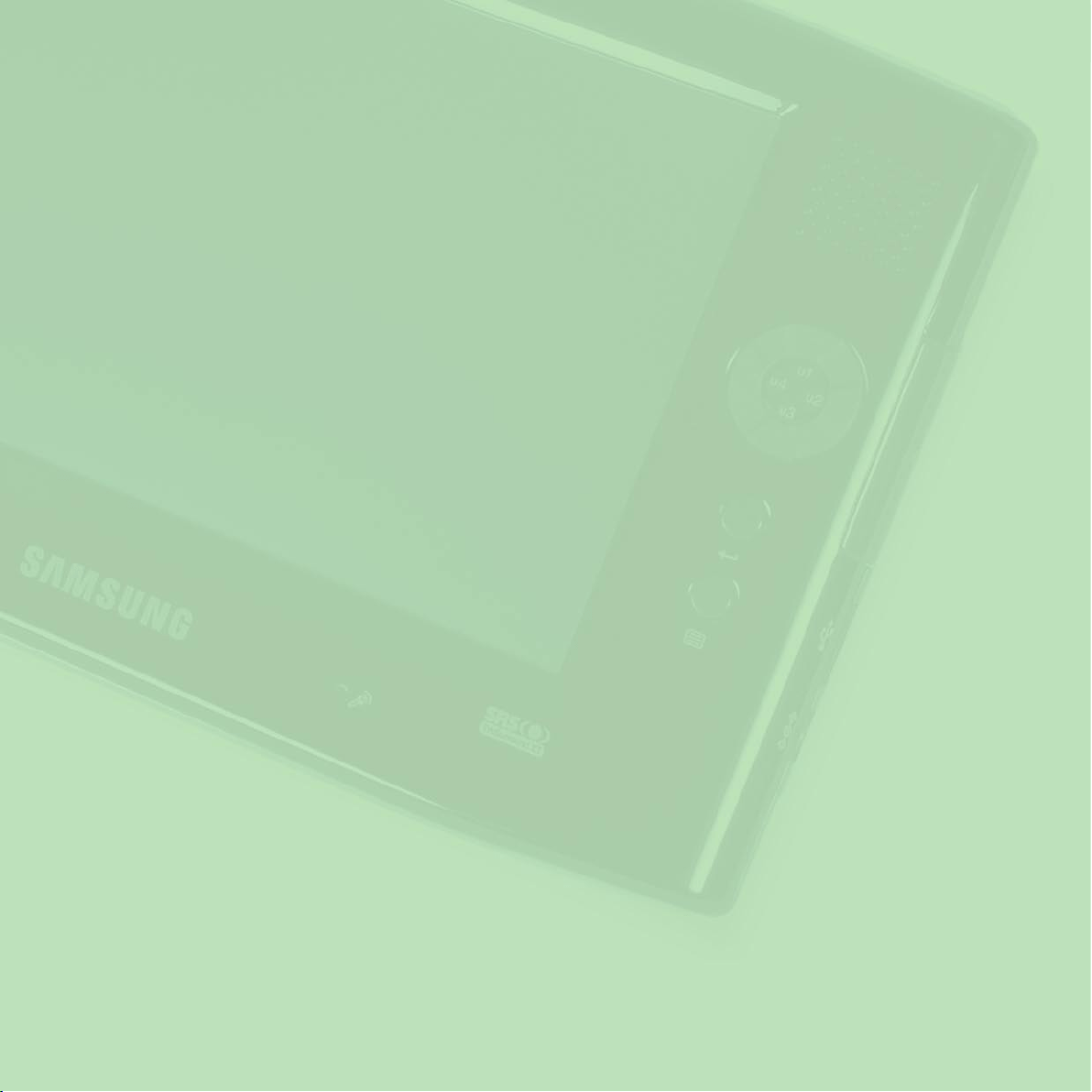
151
About the Package Contents
The package contents of your Samsung computer may differ depending on the com-
puter model.
The Media Center remote control, external-type remote control sensor and TV tuner
card are not supplied with your computer and the devices are not required to use Me-
dia Center.
However, if you purchase and connect the devices, you can more easily use the vari-
ous Media Center features.
About the Program Guide
An electronic TV program guide, the Electronic Program Guide (EPG) is provided by
the EPG provider and the contents of the EPG may differ from the actual TV program
depending on programming changes by the EPG provider or broadcast station.
About Package Contents and the Program Guide
■ You can use the Media Center TV function only when there is an installed TV
tuner card.
■ The contents of this manual are subject to change for product improvement pur-
poses.
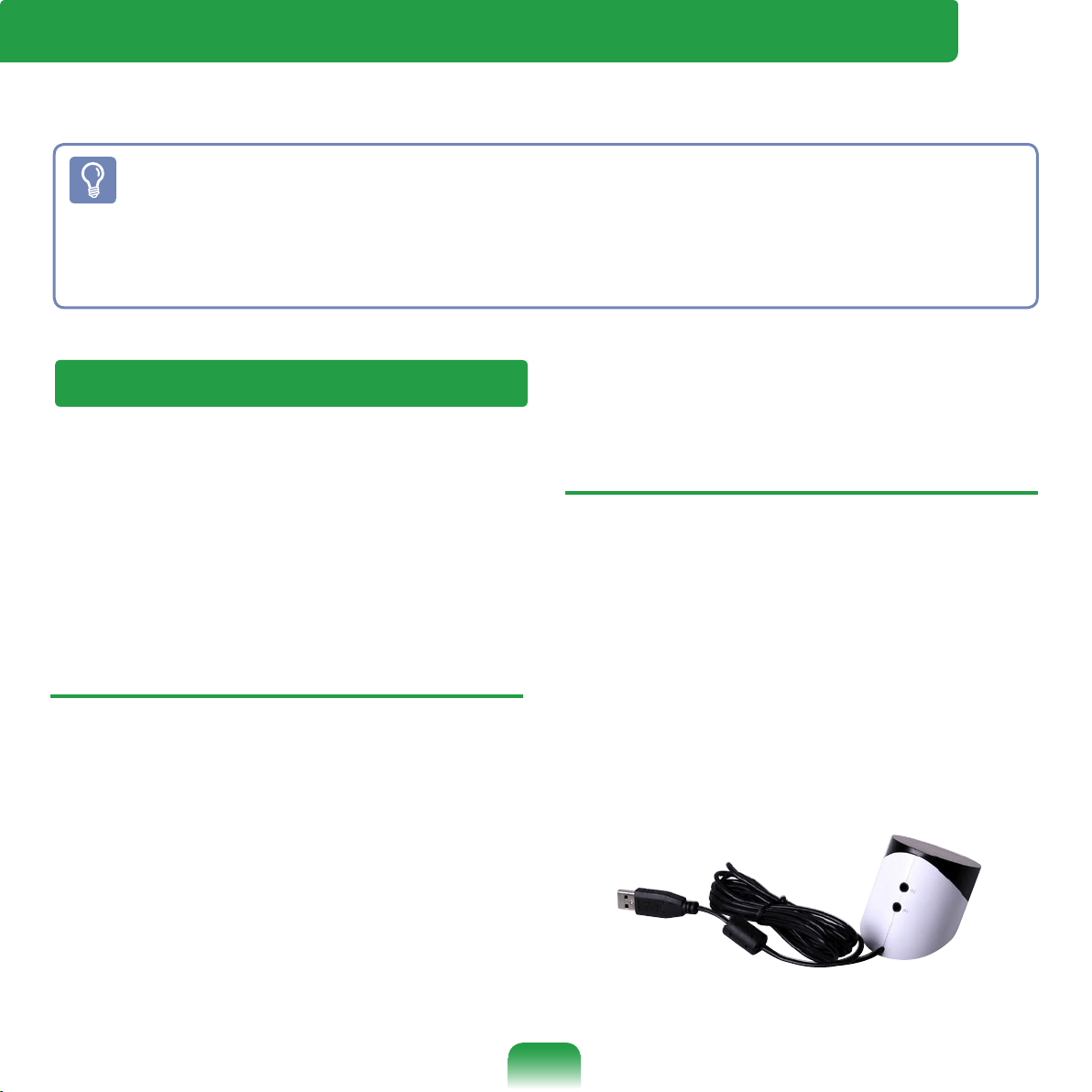
152
Connecting and Setting Up Media Center
The basic usage of Media Center for Microsoft Windows Vista Home Premium is described
below.
Optional Devices
The remote control, external-type remote
control sensor and TV tuner card are not
essential for using Media Center. Since
these devices are not supplied with your
Samsung computer, you have to pur-
chase them additionally if necessary.
Remote Control
Using the Media Center remote control,
you can use Media Center more conve-
niently over a short distance.
External-Type
Remote Control Sensor
To use Media Center using a remote con-
trol, you have to install the remote control
sensor on the computer.
When purchasing a remote control, pur-
chase an external-type remote control
sensor at the same time.
■ Connect the external-type remote
control sensor to the USB port of the
computer and turn the sensor so that it
faces the remote control.
External-Type
Remote Control Sensor
■ This manual will describe procedures assuming that you are using Media Center
with a mouse.
■ Since Media Center supports the use of a mouse, keyboard and remote control, in
this manual, [Select] means clicking with the mouse or pressing the corresponding
button on the remote control.
153
TV Tuner Card
Using a TV tuner card, you can watch
and record TV programs.
Some models have built-in TV tuner
cards. This manual describes their usage
assuming your computer has a built-in TV
tuner card.
There are two types of TV tuner
cards, built-in and external types,
and they may not support a re-
cording function depending on the
model.
Connecting Devices
► Connecting an external-type remote
control sensor
Connect the external-type remote control
sensor to the USB port of the computer.
► Connecting to the Internet
To view the TV Guide or to move to Me-
dia Center sites in Media Center, you
have to connect to the Internet.
Connect the network (LAN) cable to the
LAN port of the computer.
If the computer is not connected to
the Internet, you cannot use the TV
Guide (Channel Information) and
the Online Spotlight functions.
► Connecting the TV antenna
To use the Media Center TV function, you
have to connect the TV antenna to the
TV tuner card.
If your computer has a built-in TV tuner
card, connect the TV antenna cable to
the TV Antenna Input port.
If you do not have an installed TV
tuner card, you cannot use the TV
function.
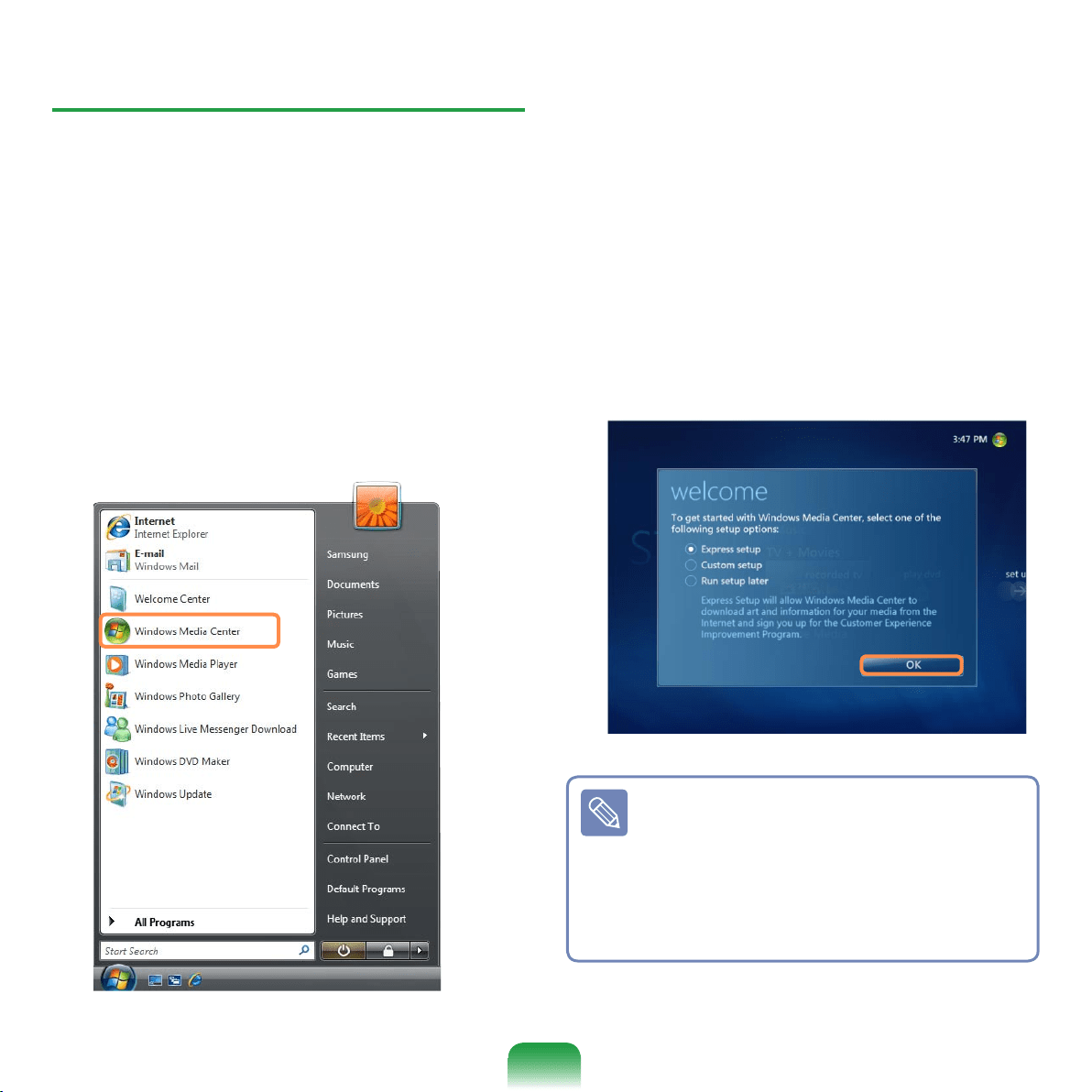
154
Media Center Setup
Connect all necessary devices and setup
Media Center. You have to complete the
settings to use Media Center.
1
Turn the computer on.
2
Click Start > Windows Media Center
or Start > All Programs > Windows
Media Center.
3
If the following start screen appears,
select the installation option.
Express Setup enables you to use
the basic functions of Media Center
when clicking OK. However, you can-
not use TV and Internet related func-
tions using Express Setup.
Custom Setup allows you to configure
all settings including TV and Internet
settings. If you click OK, the Setup
Wizard starts.
To setup the TV or Internet after
an Express Setup, select Tasks >
Settings > General > W
indows
Media Center Setup in the Media
Center start screen and setup the
following items.
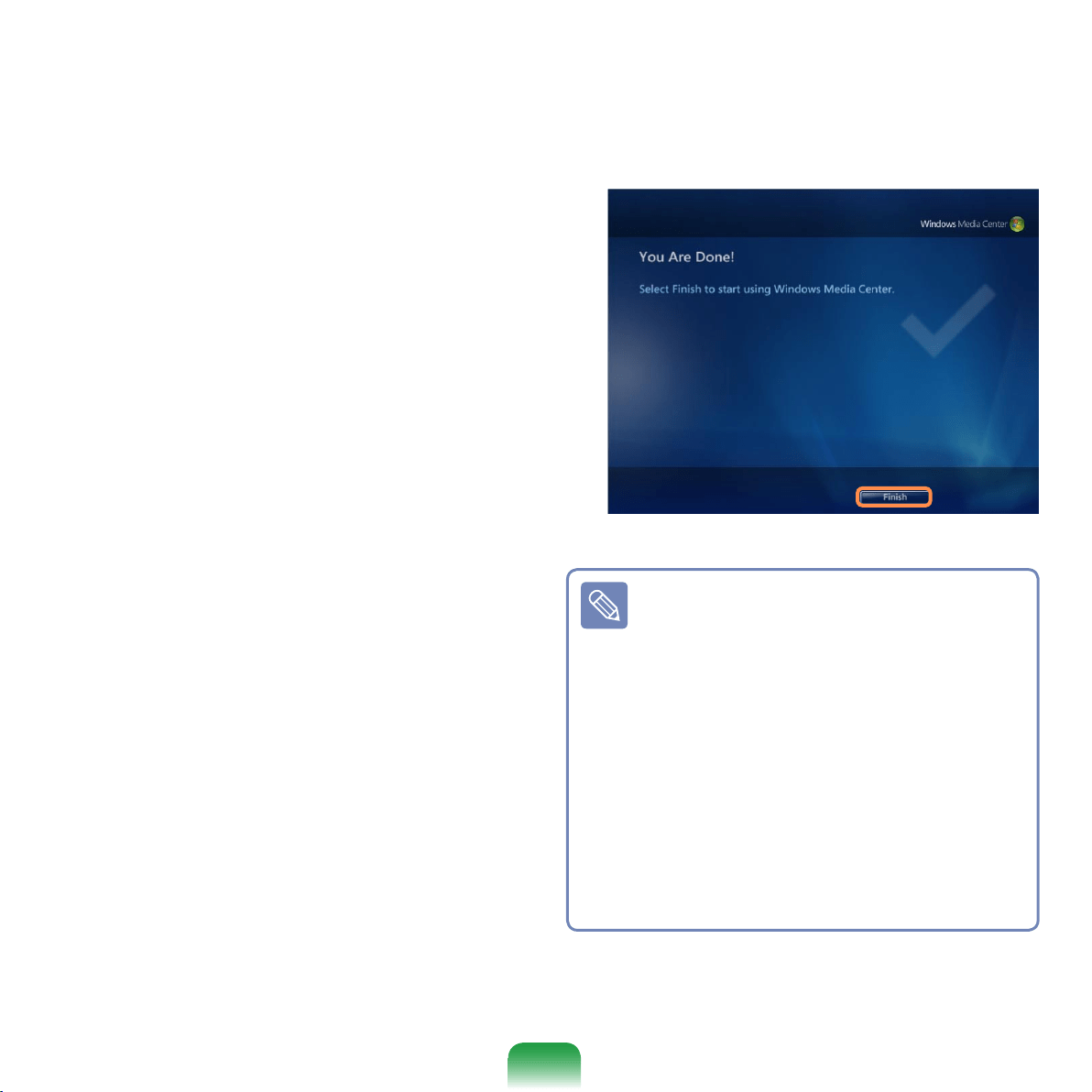
155
4
If you have selected Custom Setup,
continue with the setup according to
the Setup Wizard instructions.
If there are no installed TV tuner
cards, the TV related setup steps
will appear during the Media Center
setup.
In addition, if the computer is not
connected to the Internet, you cannot
setup and use the TV Guide (Channel
Information).
5
When the Media Center setup is com-
plete, click Finish.
Now you can use the Media Center.
Changing the Media Center set-
tings
Y
ou can change the Media Center
settings after completing the Setup
Wizard according to the proce-
dures below
.
1. Select Settings > General >
W
indows Media Center Setup
in the Media Center start screen.
2.
Select Run Setup Again. You
can setup the Media Center set-
tings again from the beginning.
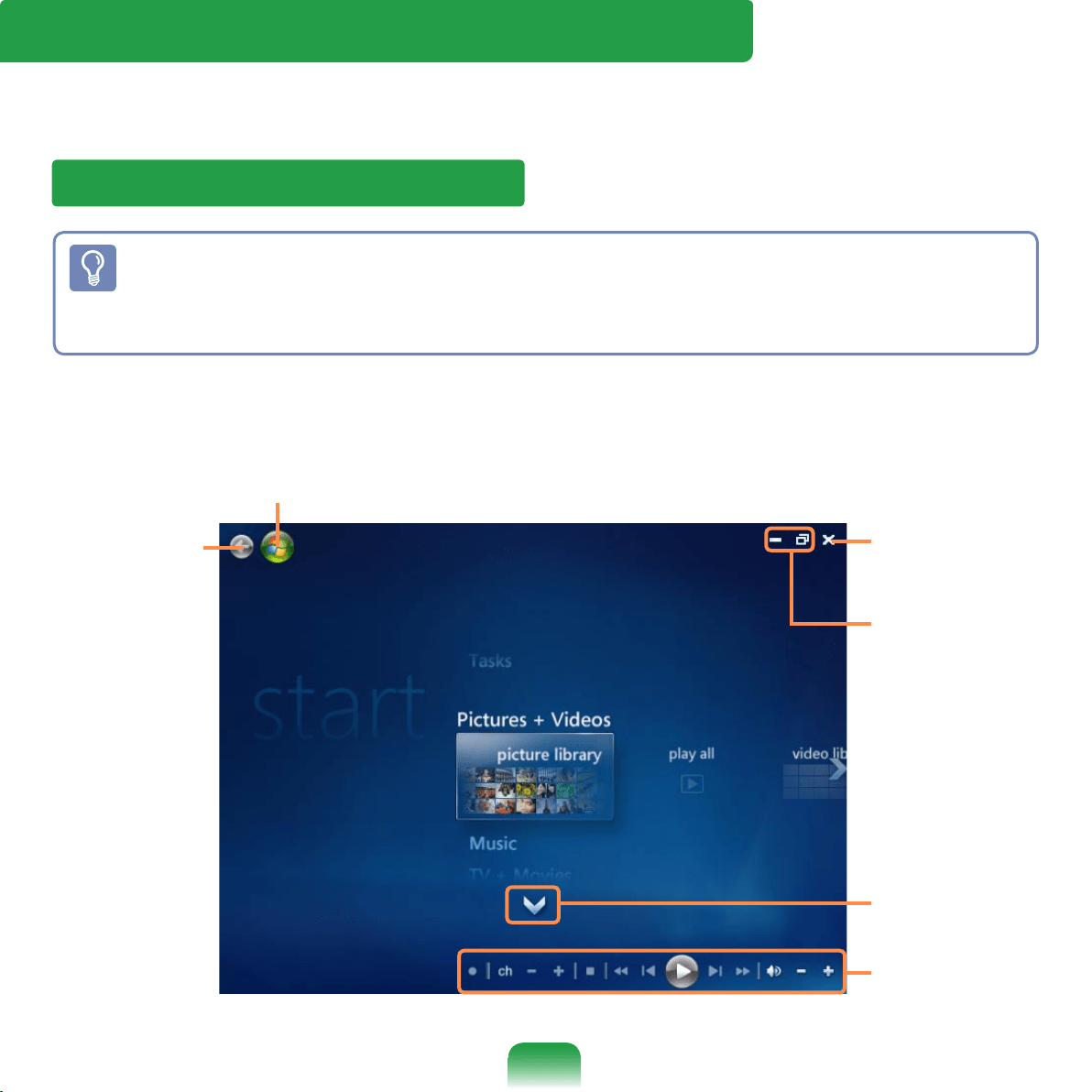
156
Start Screen Layout
Click Start > Windows Media Center or Start > All Programs > Windows Media
Center.
Move to the
Previous
Screen
Move to the Media Center Start Screen
Exit Media
Center
Resize
Move to the
Next Menu
Item
Play Control
Buttons
Using Media Center
The descriptions of the Media Center start screen and basic functions will be given below.
If you selected Run Setup Later in the Media Center start screen or did not com-
plete the Setup Wizard, the Setup Wizard screen appears when launching Media
Center.
If you complete the setup, the Media Center start screen appears.
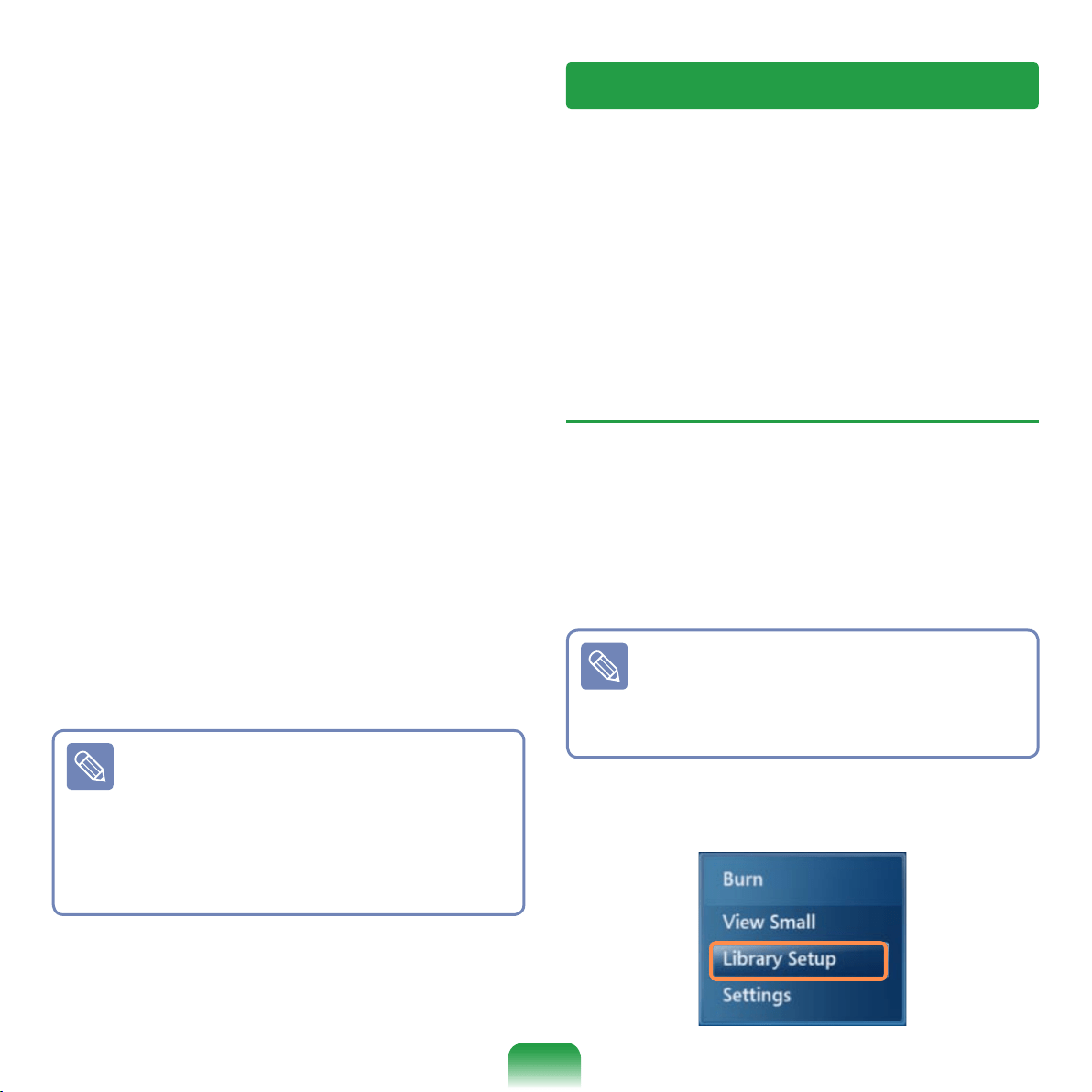
157
Pictures + Videos: You can view pic-
tures, images and video files.
Music: You can listen to music files, au-
dio CDs and the radio.
TV + Movies : You can watch and record
TV programs and play DVD titles.
Online Media: You can access all kinds
of multimedia content over the internet.
Tasks: You can change the Media Center
settings.
Navigation Arrow: If you move the
mouse pointer over the arrow, you can
navigate through the menu in the up,
down, left and right directions.
In Pictures + Videos, you can view pic-
tures and videos registered to the Media
Center library.
In addition, you can also view files not
registered to the library by registering
them, as well as viewing files on a re-
movable disk.
Registering to the Library
The procedures to register files to the
library are described below.
1
Launch Media Center, and select Pic-
tures + Videos > Picture Library or
Video Library.
When you run it for the first time,
an Add window may appear. In this
case, you can add files according
to the instructions on the screen.
2
In the library menu, right-click and
select Library Setup.
Pictures + Videos
The Menu and Play Control buttons
appear for a moment only when
moving the mouse pointer. The Me-
dia Player window size decreases
if you perform another task after
playing a media file.
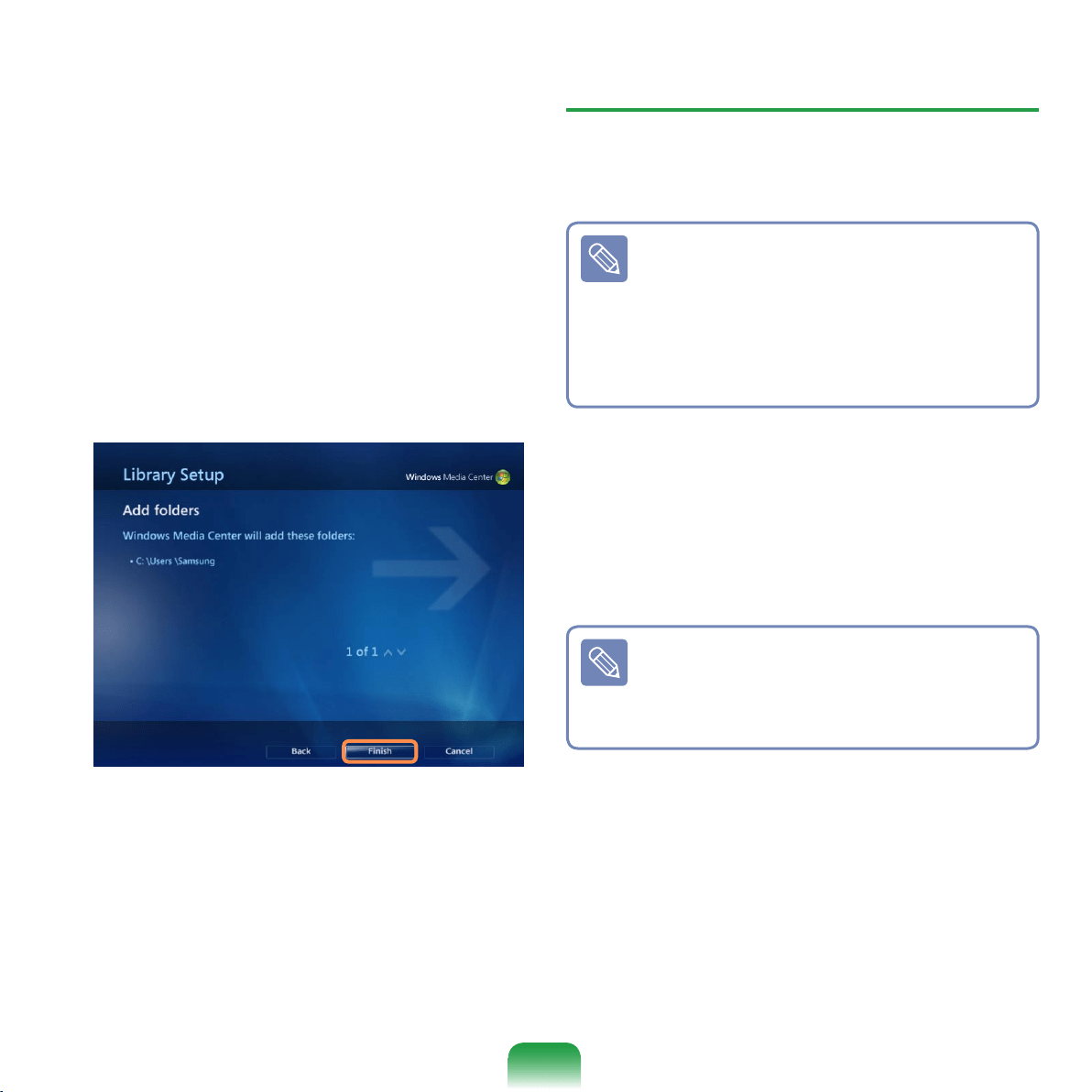
158
3
If the Library Setup screen appears,
select Add Folder to Watch.
4
Specify the path for the folder accord-
ing to the instructions on the screen.
5
If the following screen appears,
click Finish. You can view the newly
added folder in the Picture Library or
Video Library.
Viewing Pictures and Images
The procedures to view pictures and
images registered to the library are de-
scribed below.
Picture and image files are saved
in the Computer > Local Disk (C:)
> Users > User
Accounts > Pic-
ture Folder or Computer > Lo-
cal Disk (C:) > Users > Public >
Public Pictures folder.
1
Launch Media Center, and select Pic-
tures + Videos.
2
Select Picture Library.
When you run it for the first time,
the Setup Library window may
appear
. In this case, click the No
button.
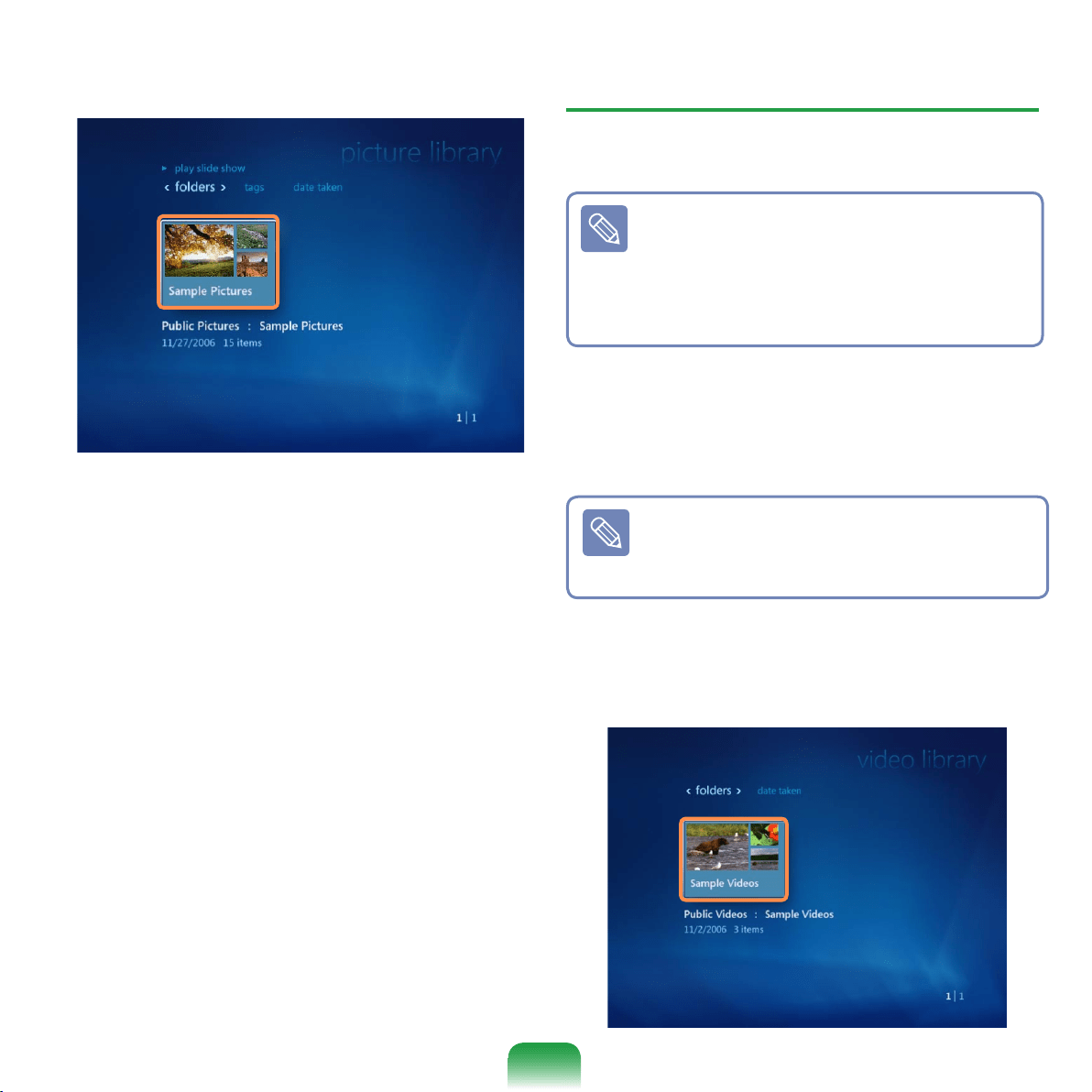
159
3
Select a folder with picture files.
4
If you select a picture, the picture is
displayed in full screen.
You can view another picture by using
the Play Control buttons or the direc-
tion buttons on the keyboard.
5
To view pictures in a SlideShow, click
on Play SlideShow.
Alternatively, select Pictures + Vid-
eos > Play All. Then the pictures in
the registered folder are displayed in
a random order.
Viewing Videos
The procedures to view videos registered
to the library are described below.
Video files are saved in the Com-
puter > Local Disk (C:) > Users >
User
Accounts > Video Folder or
Computer > Local Disk (C:) > Us-
ers > Public > Public V
ideo folder.
1
Launch Media Center, and select Pic-
tures + Videos.
2
Select Video Library.
When you run it for the first time, the
Setup Library window may appear.
In this case, click the No button.
3
Select a folder with video files.
If you select a video file, the video file
is played.
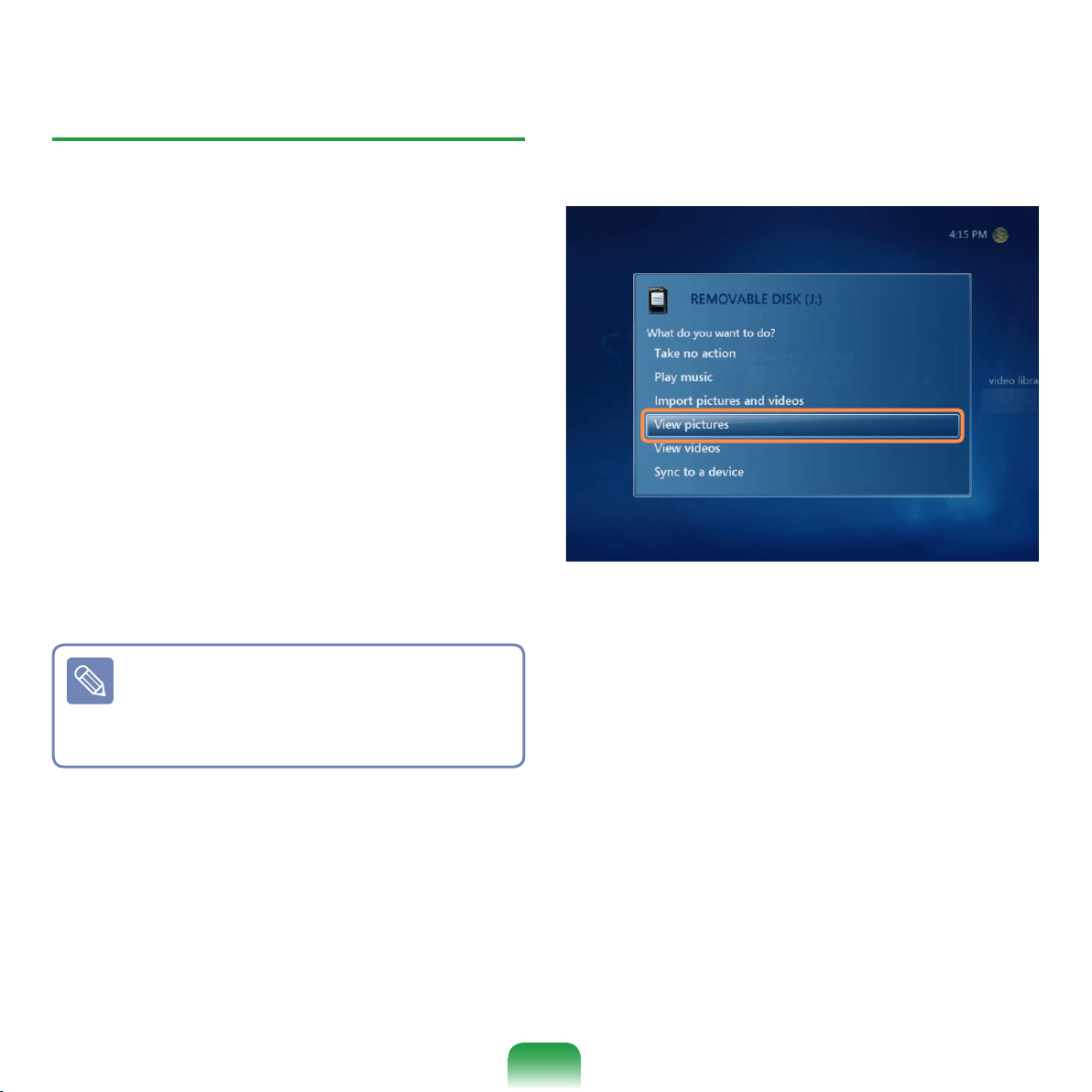
160
Viewing Pictures and Videos
Saved on Removable Media
The procedures to view pictures, images
and videos saved on removable media in
Media Center are described below.
1
Launch Media Center.
2
Insert a removable media with
picture, image or video files.
Removable media refers to a CD,
DVD, USB flash memory, memory
card, etc.
To view pictures saved on a digital
camera, connect the digital cam-
era and the computer using a USB
cable.
3
After a while, a window notifying
you that new media has been found
appears. Select View Pictures or
View Videos.
4
If the file list appears, select a file.
5
View the picture or video.
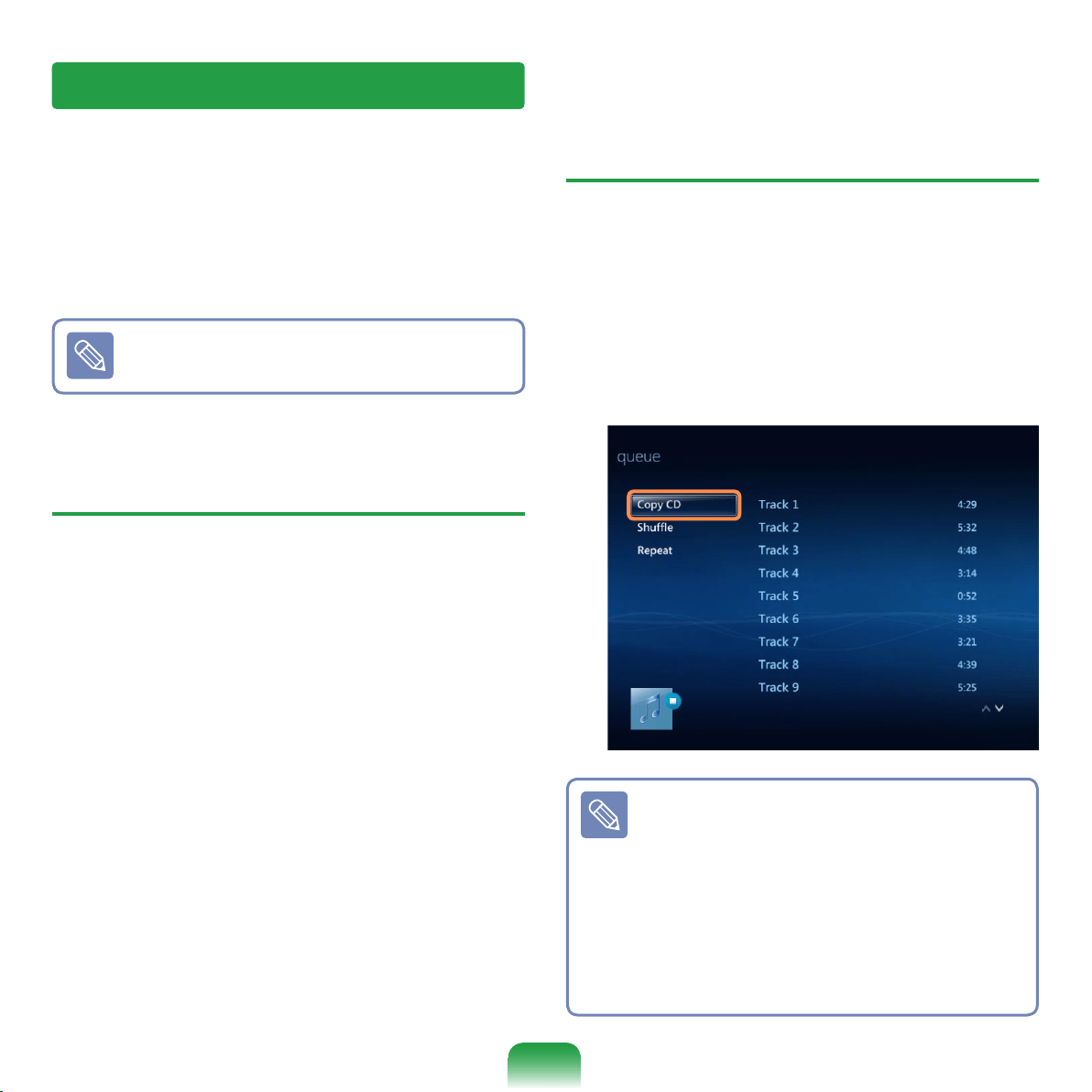
161
In Music of Media Center, you can play
music files or audio CDs. In addition, you
can rip the tracks of an audio CD onto
the computer and play them later individ-
ually or by using a playlist.
To use it, you need to connect an
external-type ODD.
Playing an Audio CD
1
Launch Media Center.
2
Press the Eject button of the CD-
ROM drive to open the CD tray and
insert an audio CD. The tracks on the
CD are played automatically.
Ripping an Audio CD
1
Launch Media Center.
2
Insert an audio CD into the CD-ROM
drive and play the CD.
3
Select Copy CD at the bottom left of
the Music Player window.
When running the Rip CD function
for the first time, the Ripping Op-
tions appear
. Configure the ripping
options according to the instruc-
tions on the screen, and complete
the following procedures. From the
second time the program is run, the
setup options are omitted.
Music
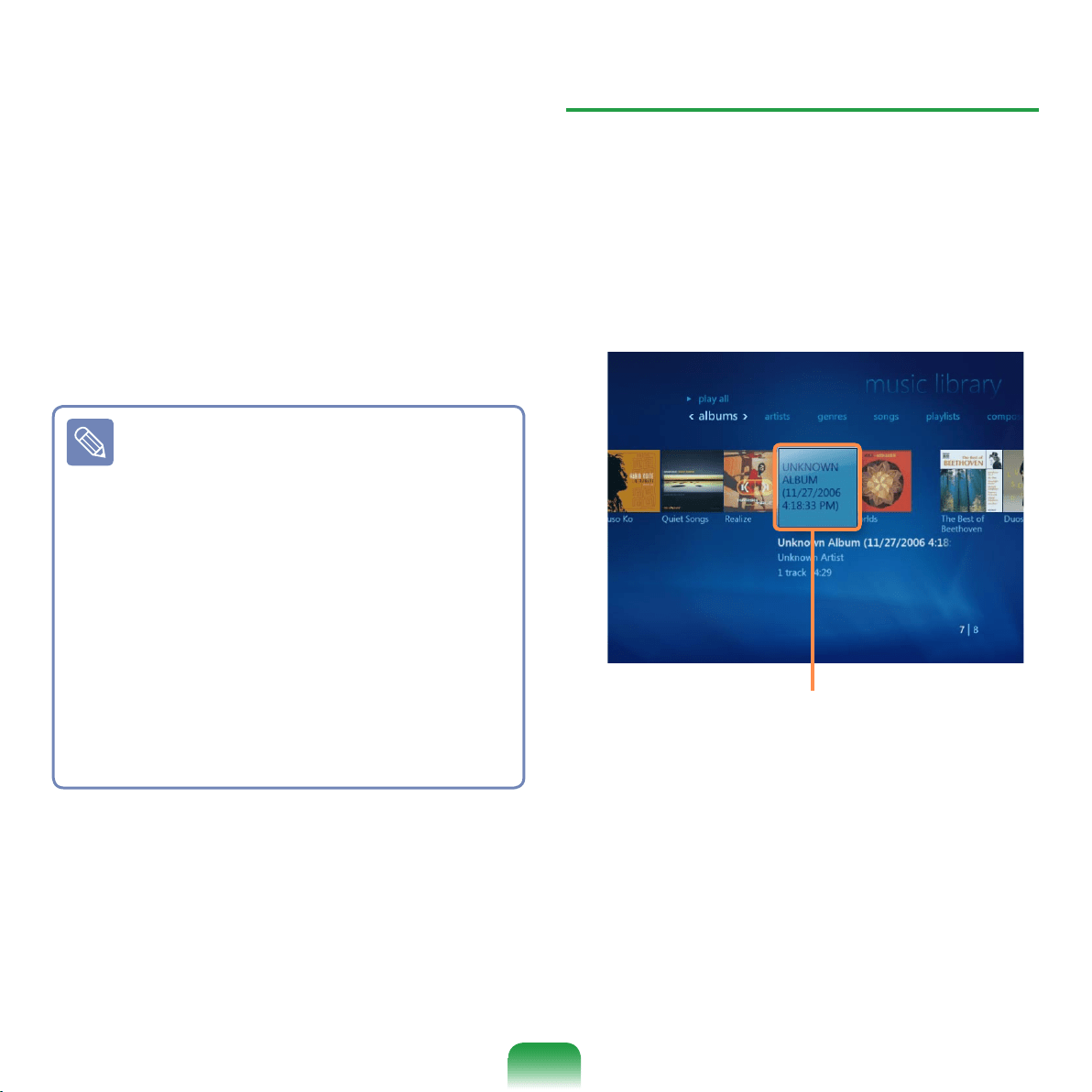
162
4
If the Rip CD window appears, click
Yes.
5
Ripping a CD begins by showing
rotating CD icon on the right side that
indicates ripping a CD is in progress.
When ripping is complete, the ripping
CD complete message appears.
The ripped tracks are displayed
in the Music > Music Library of
Media Center and in the Library of
Windows Media Player
. The ripped
tracks are copied to Start > Music
of the Desktop as album files.
T
o change the folder to save the
ripped tracks to, launch Windows
Media Player and right-click over
the top taskbar and select More
Options > Rip Music > Rip music
to this location from the pop-up
menu.
Playing Ripped Tracks
1
Launch Media Center, and select
Music.
2
If you select Music Library, the
album list appears including the
ripped album.
Ripped music albums
3
Select an album to be played and
click Play Album in the left pane.
4
The album is played.
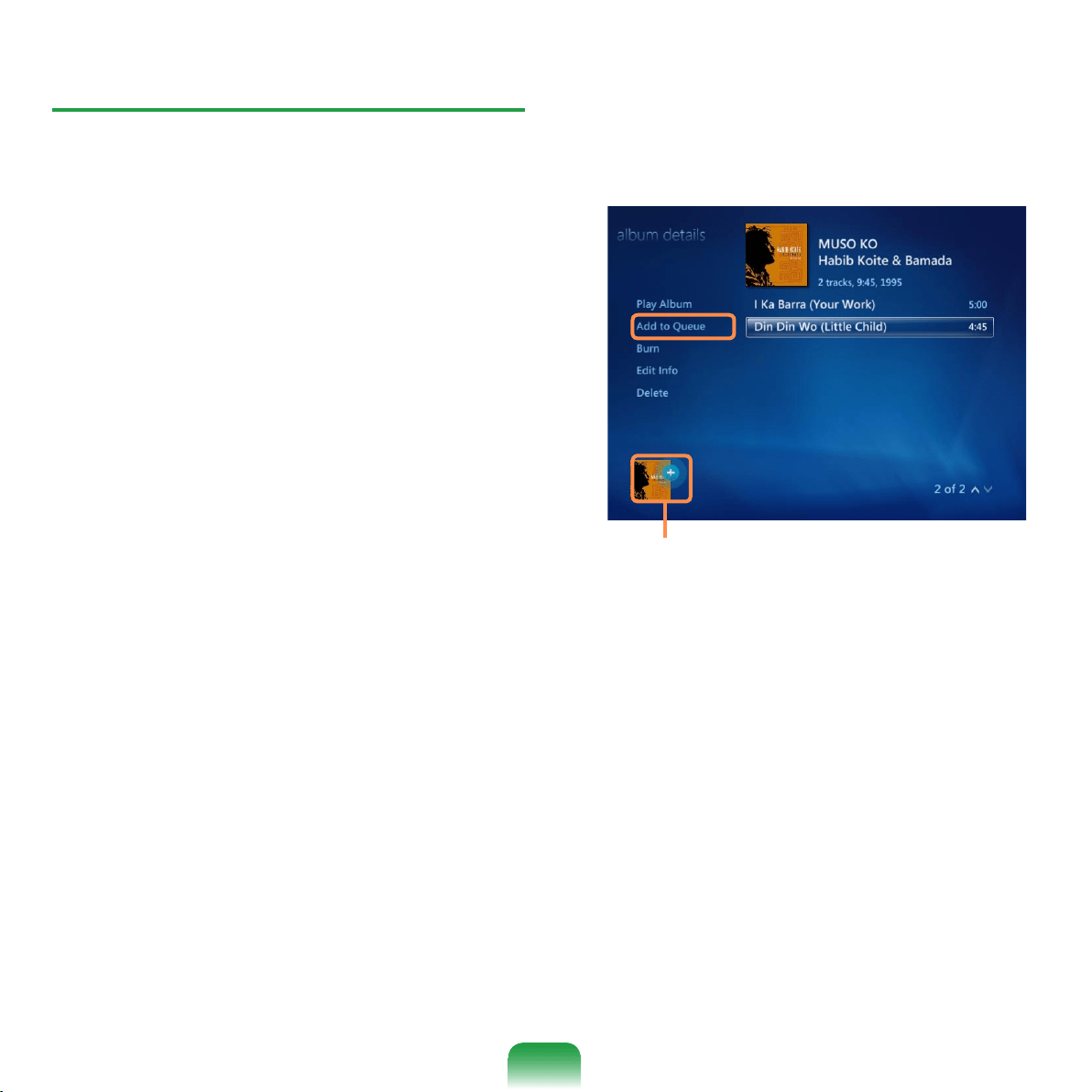
163
Using Playlists
You can easily create, manage and play
a playlist with ripped music albums and
music files downloaded from the Internet.
1
Launch Media Center, and select
Music > Music Library.
2
You can search for a music file by
selecting the album, artist, genre or
song at the top.
If you select Playlist > All Music, all
registered music files are listed.
3
Select the music files to be added to
the playlist and click Add to Queue in
the left pane.
4
The + mark starts blinking at the
bottom left of the Media Player
window and disappears the selected
music files are added to the queue.
Media Player Window
5
Select the Media Player window at
the bottom left and click View Queue.
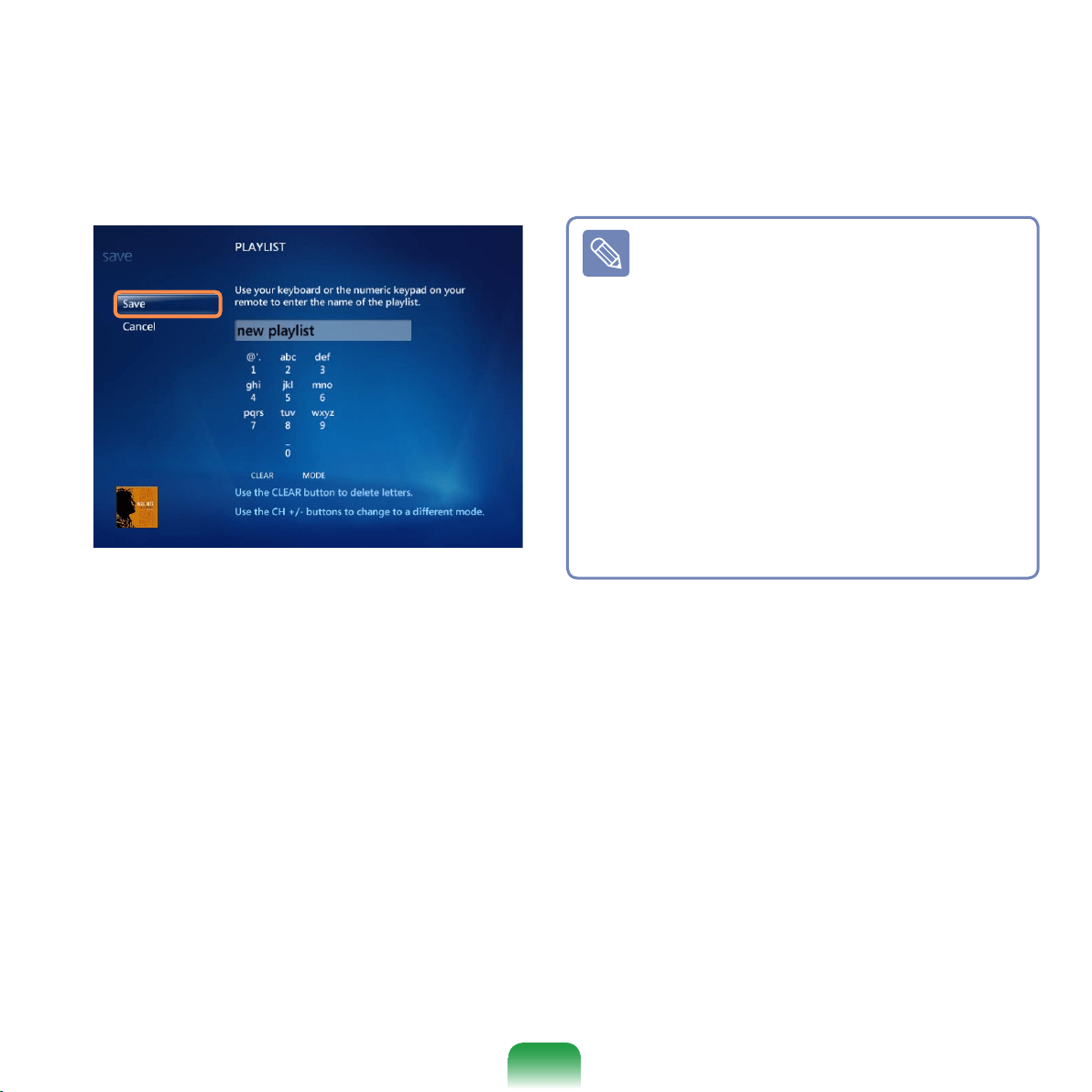
164
6
Select Save As Playlist, enter a
playlist name and select Save. If you
have a remote control, you can enter
a name using the numeric buttons on
the remote control.
7
To play the saved playlist, select
Media Center > Music Library >
Playlist, select a playlist and click
Play.
■ If a music file appears in the
Media Center even after the file
has been deleted
If you deleted a music file, you
must also manually delete the fi
le
from the Media Center playlist.
■ Deleting a playlist from Media
Center
Select Media Center > Music Li-
brary > Playlist, select a saved
playlist and click Delete. Then
the selected playlist is deleted.
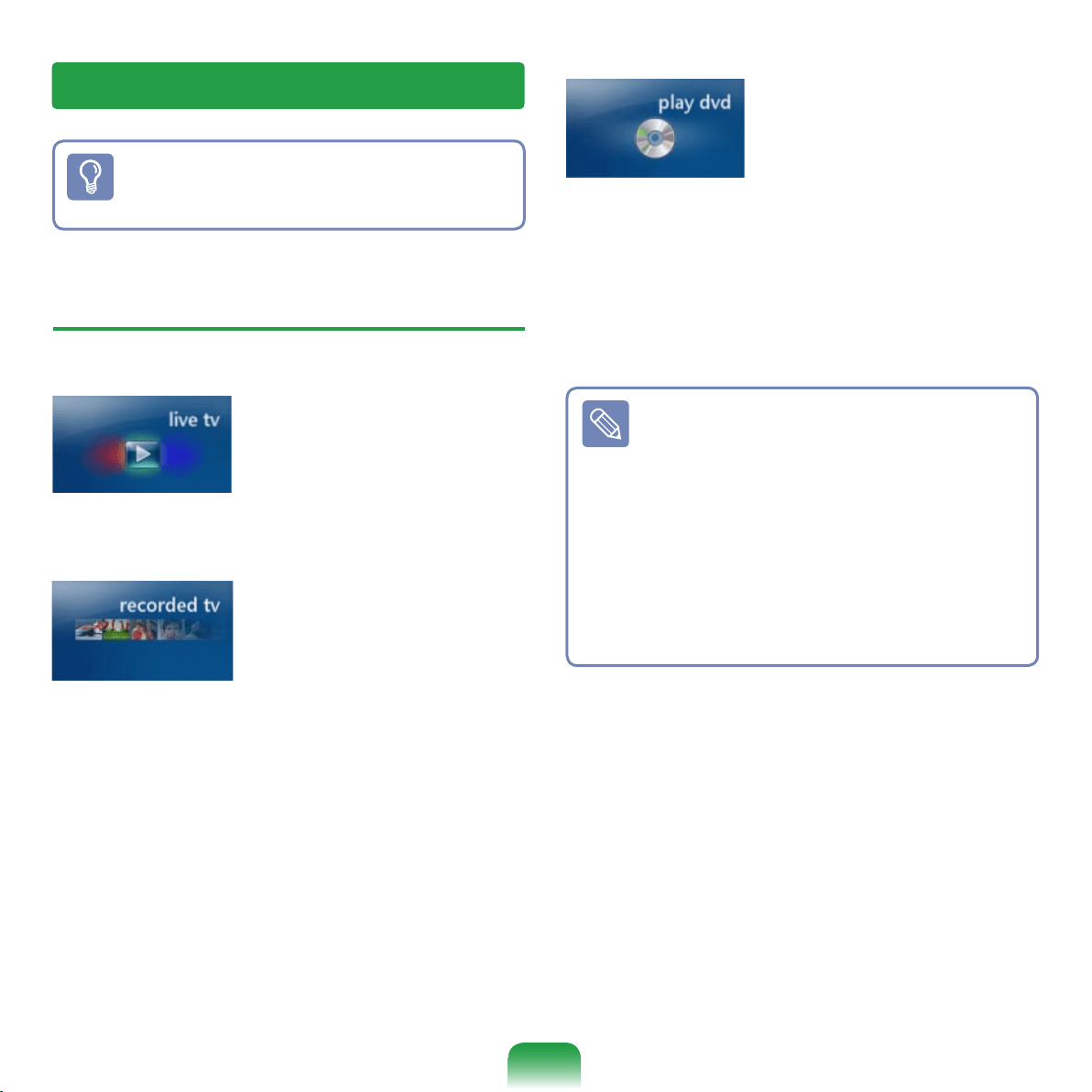
165
TV + Movies
The TV function is only available
when a TV tuner card is installed
on your computer.
TV + Movies Menus
Live TV
You can watch live TV
programs.
Recorded TV
You can watch recorded
TV programs.
Guide
(TV Broadcast Program Guide - EPG)
You can view the TV program guide. You
can watch or record live TV programs
and reserve a recording.
Play DVD
The DVD title appears.
Search
You can search for a program by the title,
keyword or genre.
What is a TV Program Guide -
EPG?
An Electronic Program Guide
(EPG) is a
TV program guide. You
can select a program and view de-
tailed information on that program
or easily reserve a recording.
The
guide information is updated by Me-
dia Center more than once a day
.
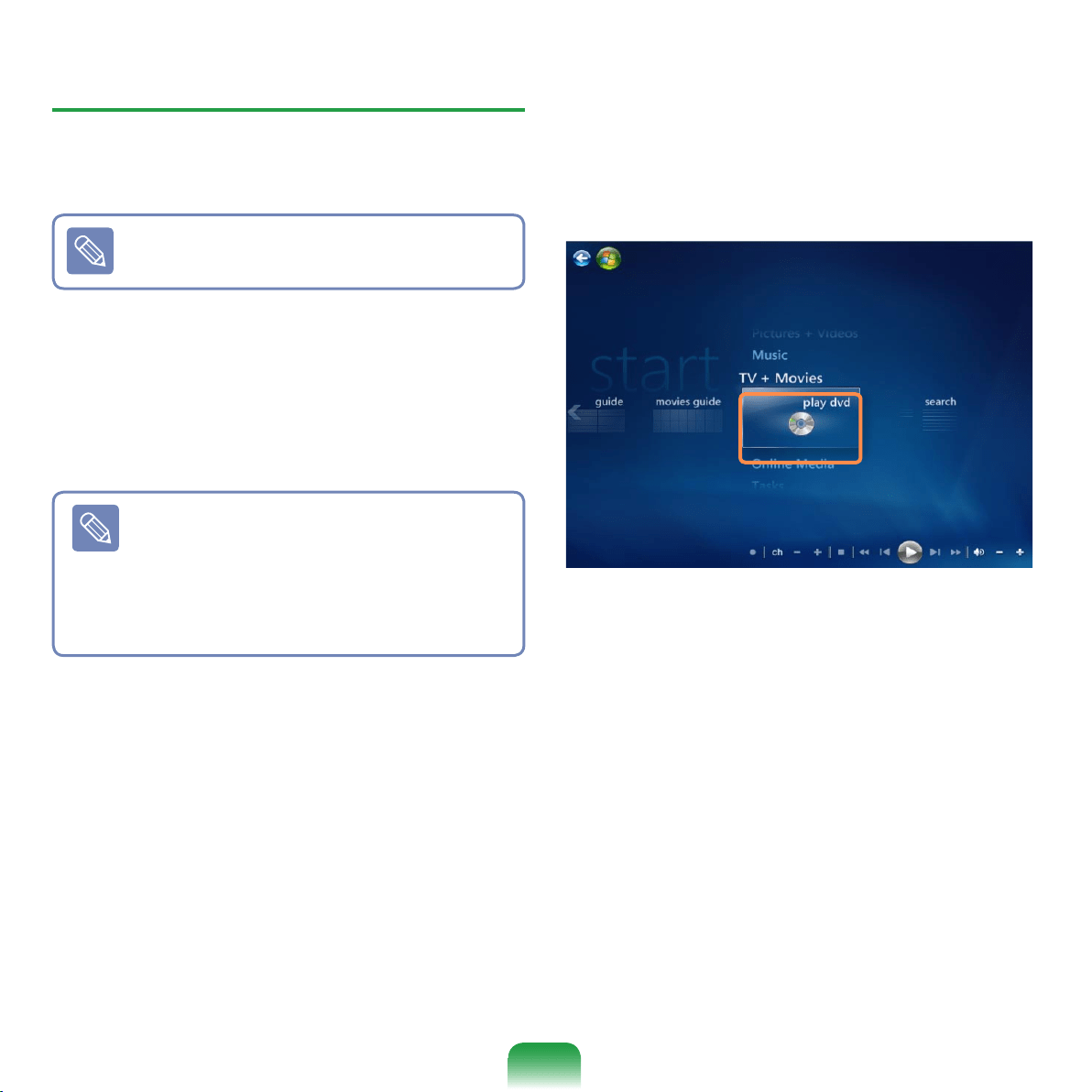
166
Playing a DVD
The procedures to watch a DVD title are
described below.
To use it, you need to connect an
external-type ODD.
1
Launch Media Center.
2
Press the Eject button of the DVD
drive to open the tray and insert a
DVD title.
If you insert a DVD title without
starting Media Center, the Auto
Play selection window appears.
Select Play DVD Video using Me-
dia Center and click OK.
3
After a moment, the DVD menu is
displayed.
It the DVD menu is not automatically
displayed, select Play DVD in the
start screen.
4
Select Watch Movie or Play from the
DVD menu.
The DVD title is played.
If you move the mouse, the Play Con-
trol buttons appear. Using the Play
Control buttons, you can play the
DVD from a particular point or stop
playing the DVD.
167
Online Media
You can access more online content
through Online Spotlight.
Online Spotlight is a service provided by
content providers via the Media Center.
You can enjoy all kinds of multimedia
content such as movies, news, sports,
etc. over the Internet.
■ To use Online Media, your com-
puter must be connected to the
Internet.
■ For problems encountered while
using Online Spotlight, contact
the corresponding online service
provider
. Online Spotlight content
services are not the responsibility
of the computer manufacturer
.
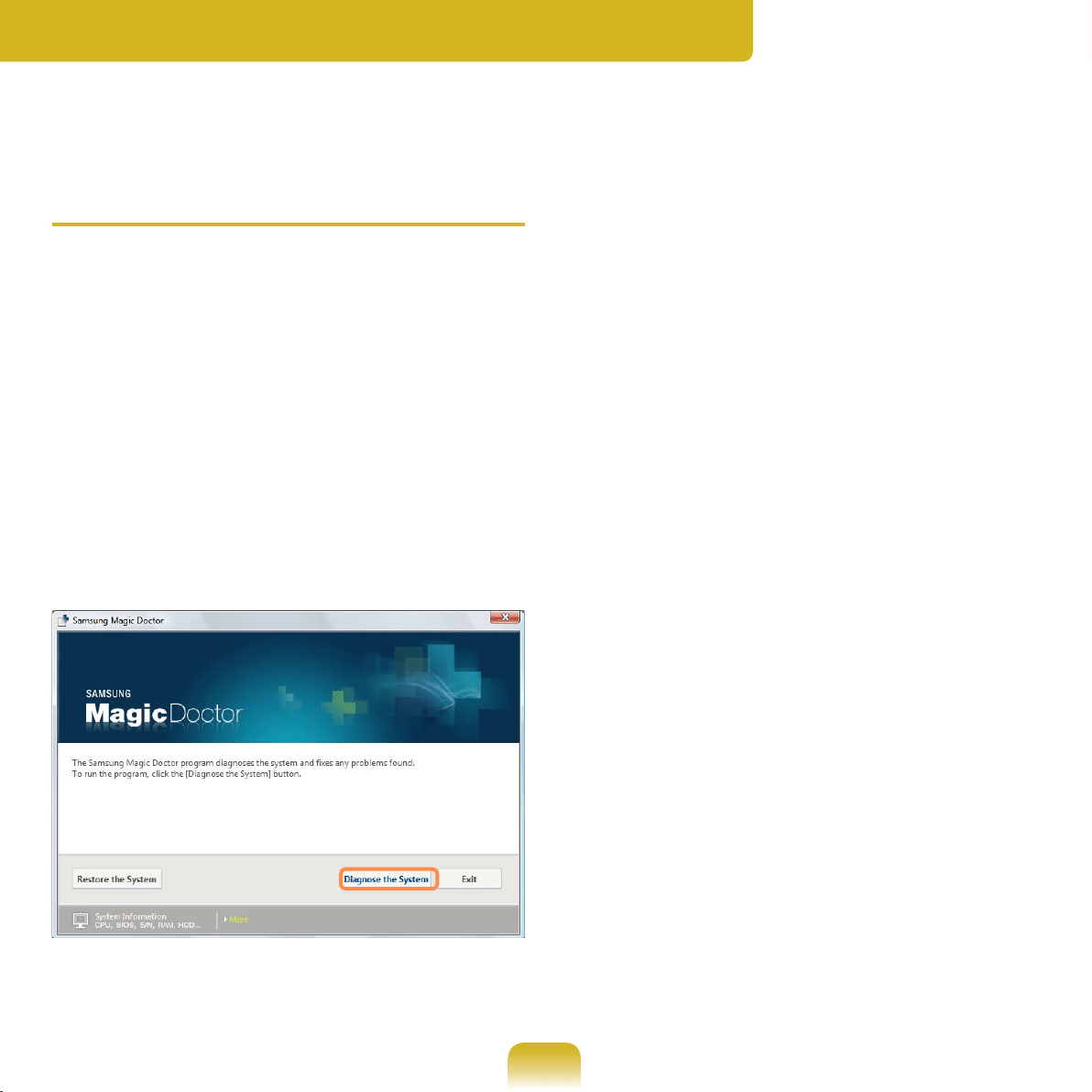
169
Using Samsung Magic Doctor
Magic Doctor is troubleshooting software provided by Samsung Computer. A user can diag-
nose system problems via one-click or by selecting diagnostic items.
Diagnosing the System
Diagnosing the System is a function to
check system connections and diagnose
problems affecting to system operation
and solve it.
1
Click Start > All Programs >
Samsung > Samsung Magic Doctor
> Samsung Magic Doctor.
2
Click on Diagnose the System to
start diagnosing the system.
3
When the system diagnosis is com-
pleted, the diagnostic result appears.
If problems are found, click the
Cure button to correct the problem.
Samsung Magic Doctor starts the cor-
rective operations.
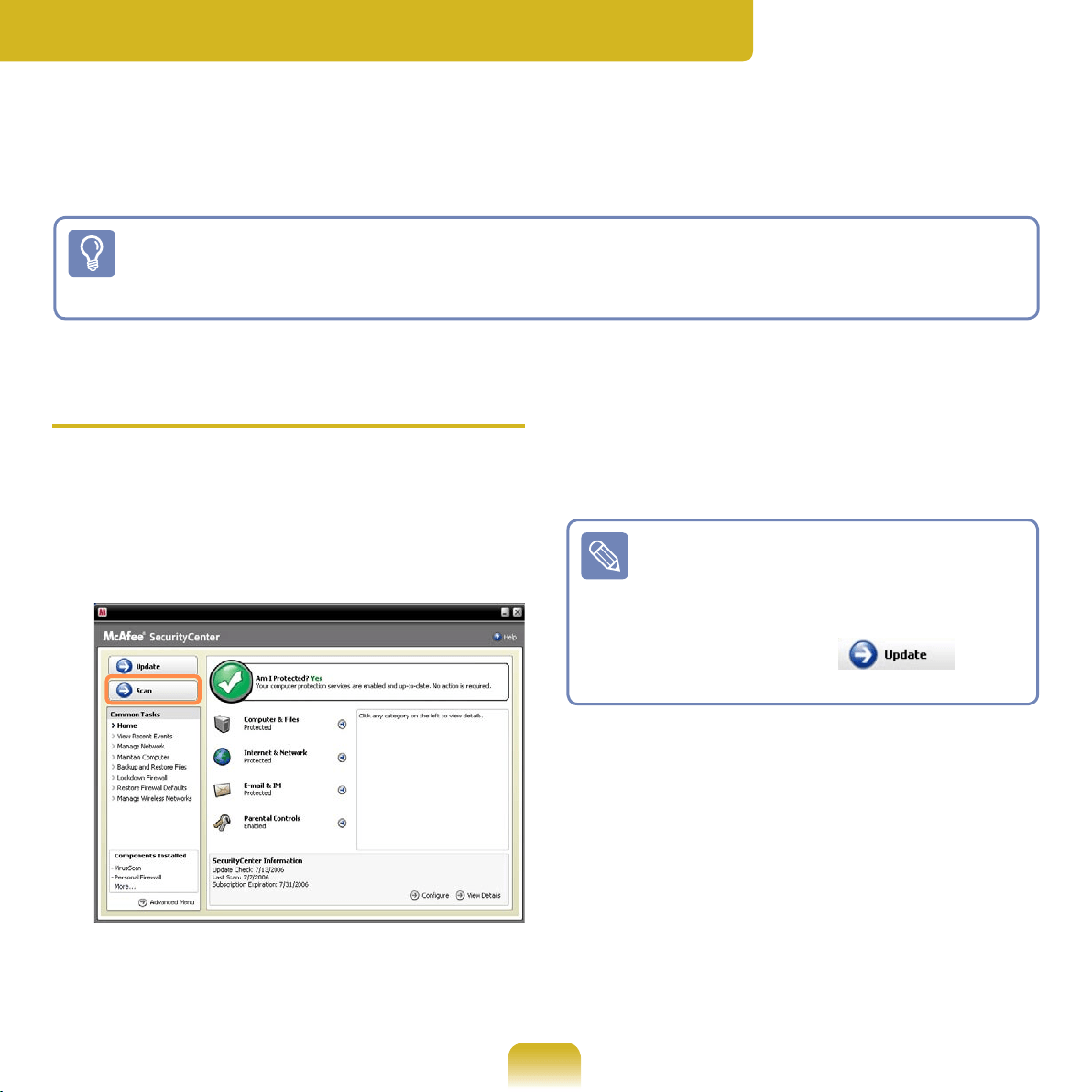
170
Using McAfee SecurityCenter
A computer virus is a program that damages computer files and information saved on a com-
puter. A computer is infected by an already infected file or by another computer over the Inter-
net. Let’s learn how to use McAfee SecurityCenter in order to scan and remove viruses and
to protect your computer from various threats on the Internet.
Scanning and Curing Viruses
1
Click Start > All Programs > McAfee
> McAfee SecurityCenter.
2
Click Scan from the left pane of the
program.
3
If a virus is found, remove the virus
according to the instructions on the
screen.
To protect yourself against the lat-
est viruses, update McAfee Securi-
tyCenter regularly
.
Connect to the Internet and click
the Update icon (
) to
update.
When McAfee SecurityCenter is run for the first time, the Registration screen ap-
pears. Register according to the instructions on the screen. You have to register the
software to protect the PC with the latest security information.

171
Reinstalling Software
You can reinstall software using the System Software Media, when a device driver or com-
puter application is not working properly.
Running
the System Software Media
The System Diagnosis function enables
users to diagnose the system connectiv-
ity, any system problems and resolve
these problems.
1
Insert the System Software Media
into the external ODD. When the
AutoPlay window appears, click Run
SoftwareMedia…. in the Install or
Run Program item.
2
In the User Account Control
window, click Allow.
If you are not logged in with an
administrator account, you have to
enter an administrator password in
the User
Account Control window.
3
The System Software Media will
launch.
Select an instillation option to start
the installation.
When software is not working properly, it is recommended removing the software
using the Add or Remove Programs of the Control Panel and reinstalling the soft-
ware using the System Software Media.
The System Software Media in the text is supplied as a CD or DVD depending on
your computer model.
To use the system software media, the external USB ODD must be connected to
the computer.
The following descriptions presuppose that the external USB ODD is connected.
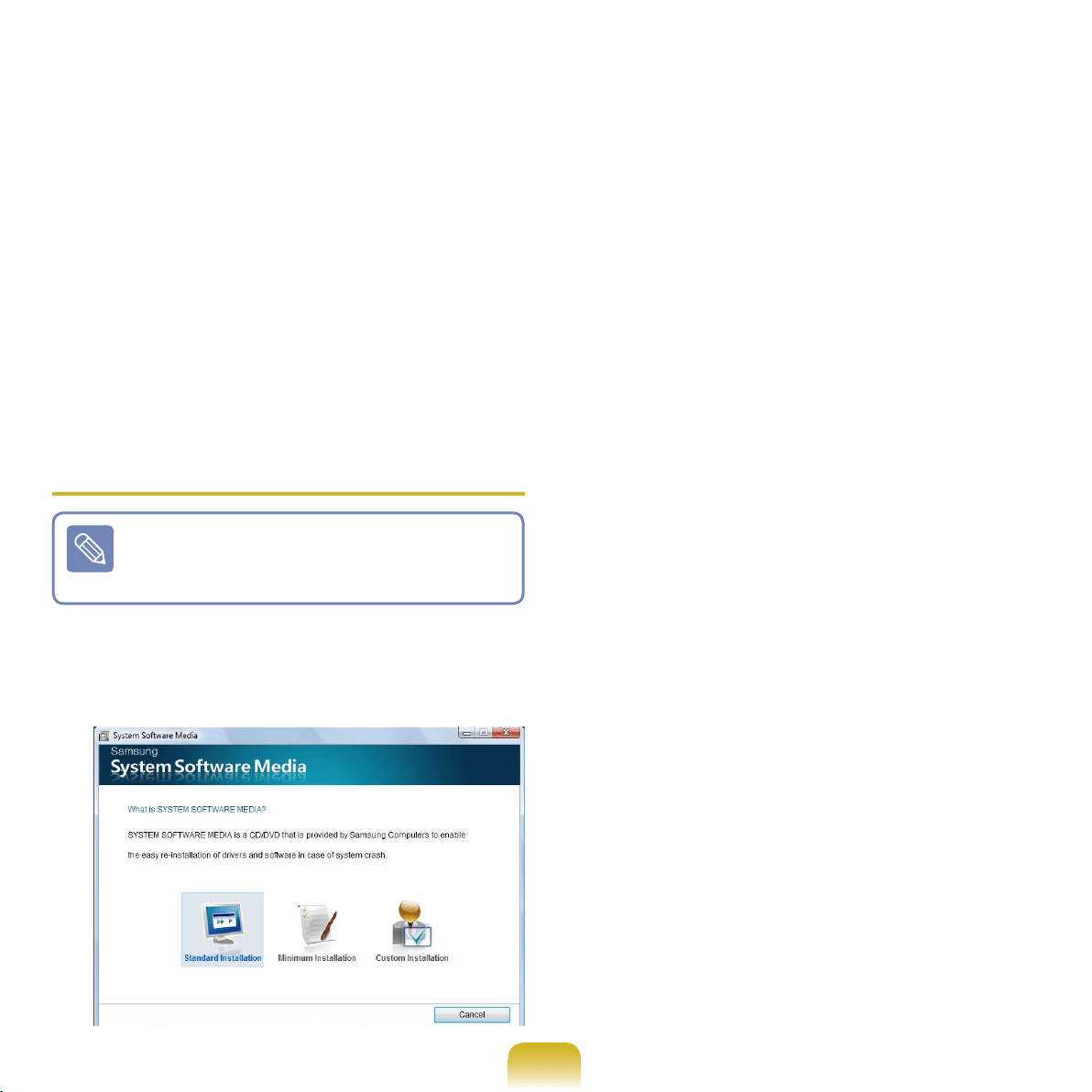
172
►Standard
Installation
If you select this option, programs not currently installed on the com-
puter are listed.
You can conveniently use this option, when installing all the pro-
grams on the media after reinstalling Windows.
►Minimum
Installation
If you select this option, programs are listed that need to be installed on
the computer (drivers, Windows updates, etc.).
You can conveniently use this option, when you need to install es-
sential programs only.
►Custom
Installation
If you select this option, you can select the programs to be installed.
You can conveniently use this option, when you need to install an
individual driver or program that is causing a problem.
Installing Software
As an example, the installation pro-
cedures for the Standard Installa-
tion options are described below
.
1
Select Standard Installation in
the System Software Media main
screen.
2
If the Start Standard Installation
window appears, click the Yes button.
The drivers and programs, which
were installed in the computer when
you purchased the computer, are
installed again.
3
The Software installations was
completed window appears.
If you select Yes and click Finish, the
computer is restarted.

173
Reinstalling Windows Vista
You can reinstall Windows using the System Recovery Media when Windows does not work
properly.
■ To install Windows, an external-type ODD and a USB keyboard are required.
Connect the external-type ODD and USB keyboard before turning the computer
on. If you connect a USB keyboard during the installation, the computer will fail to
recognize the USB keyboard.
■ To reinstall Windows when Windows does not boot, refer to
p.175.
■ The manual describes procedures on the basis of Windows Vista Home Premium.
Reinstalling Windows may delete data (files and programs) saved on the hard disk
drive. Make sure to backup all important data. Samsung Electronics shall not be held
liable for any loss of data.
Reinstalling in Windows
● Preparation
1. Connect an external-type ODD
through the External ODD Pow-
er Port and USB Port on the left
side of the computer
.
2. Connect the external-type USB
keyboard.
3. Turn the computer on to boot up
Windows.
1
Insert the System Recovery Media
into the external ODD.
2
When the AutoPlay window appears,
select Run setup.exe and tap Allow.
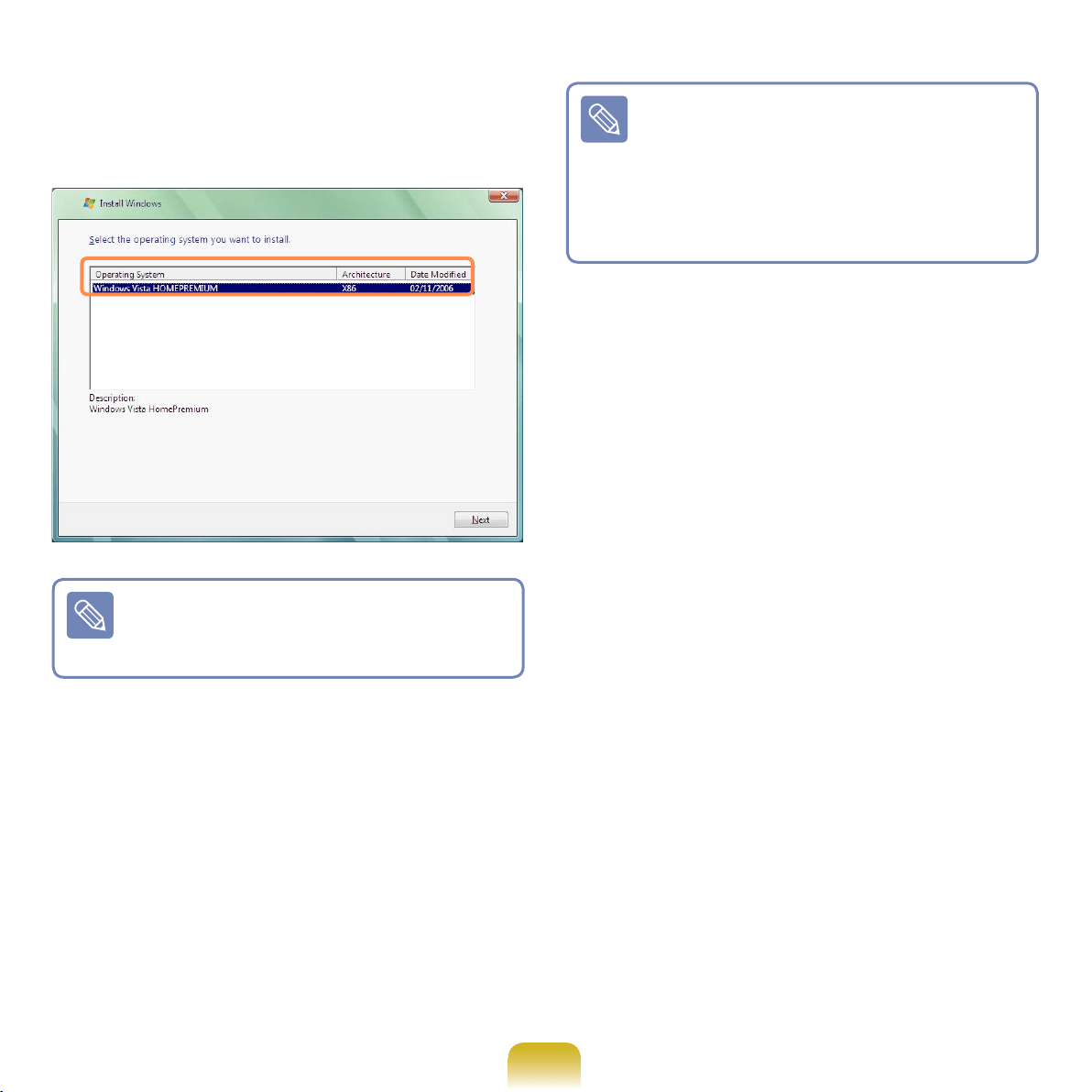
174
3
When the window appears allowing
you to select the operating system to
be installed, tap the Next button.
The name of the operating system
may differ depending on the Win-
dows version.
4
When the Software License Agree-
ment screen appears, select Agree
and click the Next button.
5
When a window appears asking for
the location to install the operating
system to, select a disk drive partition
and tap the Next button.
When previous Windows installa-
tion files are in the selected parti-
tion, a message appears informing
you that the files and folders will be
moved to the Windows.old folder
.
Click the OK button.
6
The Windows installation continues.
The computer will restart 3 times
during the installation. If the Press
any key to boot from CD or DVD…
message appears after a restart, do
not press any button.
7
The Windows user registration screen
appears. Select the username and
photo and tap the Next button.
8
Enter the computer name. The
window in which you can select the
Desktop background appears. Enter
the contents and tap the Next button.
9
The Windows automatic protection
settings window appears. Configure
the setting according to your require-
ments.
10
The time and date settings window
appears. Tap the Next button.
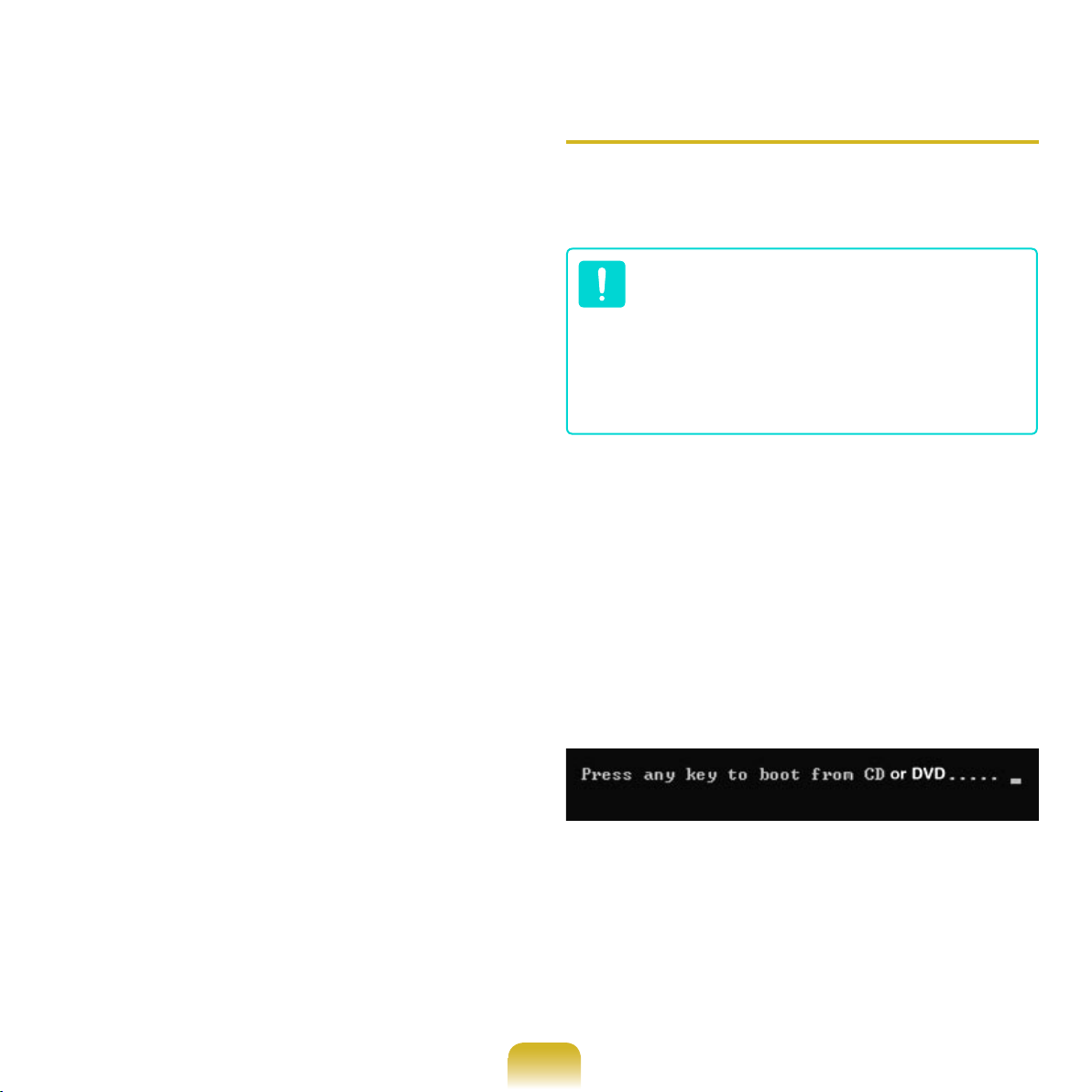
175
11
The Registration Complete window
appears. If you tap the Start button,
a computer specifications check
begins.
12
After a while, the Windows Desktop
appears. When Windows is
launched, install the device drivers
and applications according to your
requirements using the System Soft-
ware Media.
Reinstalling
when Windows does not start
When Windows does not start, boot up with
the System Recovery Media and from
there you can reinstall Windows.
Connect the external-type ODD
and USB keyboard before turning
the computer on. If you connect a
USB keyboard during the installa-
tion, the computer will fail to recog-
nize the USB keyboard.
1
Insert the System Recovery Media
into the DVD drive and restart the
computer.
2
If the Press any key to boot from
CD or DVD… message appears
while booting, press any key on the
keyboard.
3
After a while, the Options windows
such as Language, Time, Keyboard,
etc. appear. Confirm the settings and
tap the Next button.
176
4
When a window appears in which you
can select the operating system to be
installed, tap the Next button.
The name of the operating system
may differ depending on the Win-
dows version.
5
When the Software License Agree-
ment screen appears, select Agree
and click the Next button.
6
When a window appears asking for
the location to install the operat-
ing system to, select the partition of
the disk drive and then tap the Next
button.
■ If you click Drive Options (Ad-
vanced), you can delete, format,
create or expand a partition. Click
on a function and proceed ac-
cording to the instructions on the
screen.
■ When previous Windows installa-
tion files are in the selected parti-
tion, a message appears inform-
ing you that the files and folders
will be moved to the Windows.old
folder
. Tap the OK button.
7
The subsequent steps are the
same after 5 step for Reinstalling in
Windows.
p.173
177
Q & A
This section provides information on possible problems, solutions and other references for
using the system.
Q
The LCD screen is too dark or too bright
A Adjust the LCD brightness. Press the Menu button and click on Brightness
or
.
Alternatively, press the +, - Volume Control button while holding down the Menu
button to adjust the LCD brightness.
Q
The screen saver disturbs Media Player playing a movie or video clip after
the screen saver is activated while Media Player is playing.
A Unselect Library > More Options > Player > Allow screen saver during play-
back in the Media Player.
Q
In the following cases, the screen blinks or displays noise for a short time.
Click the Graphics Related tab, Change Resolution, Change Display Device,
Remove the AC Adapter, Restart the System, Change Power Scheme.
A This may happen while the video driver is examining the connected device. While
busy detecting, any connected display devices may blink or some noise may occur.
In addition, when pressing the Auto Scaler button, the screen may blink or display
noise for a short time while the resolution changes or the Down Scale (resolution
zoom out) function operates.
Display Related

178
Q
When I connect a projector, and change the settings to display the screen
image on both the LCD and the projector by pressing the Menu button, the
screen is not displayed properly.
A Click the Menu button, select LCD/CRT and then select Clone. If the screen image
or some part of it is not displayed on the screen, this is because the LCD resolution
is low or the current resolution is too wide and cannot be supported by the projec-
tor. Press the Auto Scaler button and change the resolution to 800x600 pixels.
Q
The shortcut icons are not displayed on the screen.
A The shortcut icons only appear when both the Magic Keyboard and Samsung Dis-
play Manager programs are installed.
Q
When I connect an external monitor and select the monitor, no screen image
is displayed (Clone Mode).
A This may happen when the current resolution is inappropriate or Dual View (Ex-
tended Mode) is selected. Try the following methods.
When the current resolution is inappropriate
This computer supports the 800x480 WVGA resolution. Since this resolution is
lower than that of the operating system, the above symptom may appear when the
external monitor cannot support this resolution. Change the resolution to 800x600
pixels, click Menu and then select Clone.
When Dual View (Extended mode) is selected
When Dual View is selected, the Clone Mode is not supported. In this case, un-
select the Dual View, press the Menu button to select the Clone Mode.

179
Q
In the Display Properties window, resolution starts from 800x600.
A Even if the current resolution is 800x480 pixels, it may be represented as 800x600
in the Display Properties. This is because the lowest resolution of the operating
system is 800x600 and is unable to show the 800x480 resolution in the Display
Properties window.
Q
Pressing [Start] displays a [Some items cannot be shown] message.
A This message appears when all start menu items cannot be displayed in the de-
fault resolution (800x480 pixels). In this case, change the screen resolution to
800x600 pixels or press the Auto Scaler button to change the resolution.
Q
The whole screen image is not displayed on the screen.
A This may happen when a program or game is designed for at least 800x600 pix-
els. In this case, press the Auto Scaler button and change the resolution. When-
ever the button is pressed, the screen resolution changes to 800X480 > 800x600
>1024x600 pixels, in this sequence.
Q
When I press the Auto Scaler button, letters on the screen are blurry.
A In resolutions provided by Auto Scaler, the letters on the screen may be blurred
because these are not the optimal resolutions of the LCD panel.
In this case, press the Auto Scaler button again and change the screen resolution
to 800x480 pixels which is the default resolution of the LCD panel.

180
Q
The shortcut icons are not displayed on the screen even if I press the
shortcut key.
A The shortcut icons only appear when the Easy Display Manager program is in-
stalled.
Q
I have connected a monitor (or projector) to the computer, but the colors on
the monitor are abnormally displayed.
A Check if the monitor and computer are properly connected with the signal cable
and reconnect the cable if necessary.
Q
I want to switch to the default resolution in Panning Mode.
A If you restart the computer in Panning Mode, Panning Mode continues even after
the computer has been restarted. To switch to the default resolution in Panning
Mode, press the Auto Scaler button and select 800x480.
If an external monitor is connected, disconnect the monitor first. Then press the
Auto Scaler button and select 800x480.
Q
The picture on the screen trembles.
A If you have selected 800x600 or 1024x600 pixels by pressing the Auto Scaler but-
ton, the picture on the screen may tremble when viewing some Internet pages or
playing online games. In this case, change the resolution to the default (800x480)
or connect and use an external monitor.

181
Q
The <Wake On LAN> function
A1 <Wake On LAN> is a function that activates the system from Sleep mode when a
signal (such as a ping or magic packet command) arrives over the network (wired
LAN).
Using the <Wake On LAN> Function
Click Start > Control Panel > Network and Internet > Network and Sharing
Center > Manage Network Connections.
Right-click on the Local Area Connection and select Properties.
Click Configure > Power Management tab. Select Allow this device to bring
the computer out of standby, then click OK. Restart the system.
—
If the system is activated from Sleep mode when there is no received signal,
use the system after disabling the <Wake On LAN> function.
—
When turning the power off when <Wake On LAN> is disabled, the LAN LED
may continue to be lit.
—
Connecting a wired LAN while using a wireless LAN may not activate the
<Wake On LAN> function. Set the Wireless LAN to Disable to use the <Wake
On LAN> function.
Click Start > Control Panel > Network and Internet > Network and Sharing
Center > Manage Network Connections.
Right-click on the Wireless Network Connections and select Disable.
Wired Network (LAN) Related

182
Q
When I am connected to a 100Mbps/1Gbps wired LAN and the computer exits
Sleep/hibernation mode, a message appears informing you of a connection
to a 10Mbps/100Mbps wired LAN.
A When the computer exits standby/hibernate mode, restoring the network takes
about 3 seconds.
When the network is restored, it operates at 100Mbps/1Gbps.
Q
Configure the options below to use the network at its maximum speed.
A Click Start > Control Panel > System and Maintenance > System > Device
Manager. Double-click Network Adapter > Marvell Yukon 88E8036 PCI-E Fast
Ethernet Controller, click Advanced, configure as follows and then click the OK
button.
1) BatteryModeLinkDetection : EnergyDetect+™
2) BatterySpeedSettings : FullSpeed

183
Q
The Wireless LAN device is operating properly, but I cannot connect to the
Internet or to another computer.
► This is due to an incorrect configuration, or a configuration error. Check the
following:
A1 If you are using a computer-to-computer (Ad Hoc) network connection, check that
the name of the configured network (SSID) is correct.
A2 If you are using a network key (encryption key), you have to use the same network
key for an AP (Access Point) or a computer-to-computer network (Ad Hoc). The
network key of the AP is configured in the AP management program. Ask your net-
work administrator or AP manager for more detailed information.
A3 Check that the device driver is installed properly. If the driver is not properly in-
stalled, you will find a yellow exclamation mark on the network icon by clicking
Start > Control Panel > System and Maintenance > Device Manager > Network
Adapter.
Q
The signal strength is excellent, but I cannot connect to the network.
► Even if the signal strength is excellent, the network connection may not oper-
ate properly if the TCP/IP properties are not properly configured, or the net-
work key (encryption key) is incorrect.
A Check that the TCP/IP properties are configured properly. When connecting to an
AP, right-click the Network Connections (
) icon on the taskbar and select Net-
work and Sharing Center. If you click the View Status next to a connected wire-
less network device and then click the Detail button, you can view the IP informa-
tion. If the IP is not allocated properly, the IP address will be displayed as follows
(e.g. 169.254.xxx.xxx).
If the network does not provide DHCP, you have to specify the correct IP address
by asking your network administrator.
Wireless Network (WLAN) Related

184
Even if the network provides DHCP, the server may not allocate an IP address to
the client properly, and the client station cannot connect to the network.
Q
I cannot connect to the AP.
► Check the Computer Settings
A1 Verify whether the wireless LAN function of the computer is on by performing the
following. If the wireless LAN function is off, turn it on.
● For Windows Vista, verify that the wireless network connection has been set to
Enable in Start > Control Panel > Network and Internet > Network and Shar-
ing Center > Manage Network Connections. If the wireless LAN is set to Do
Not Use, right-click and select Use.
● Check if the wireless LAN is turned on.
A2 Verify whether the same network key (encryption key) has been entered for both
the AP and the computer. The network key is an encryption key for encrypting the
data transmitted between the AP and the computer. It is recommended setting the
network key manually.
► Check the AP Settings
For the AP settings, refer to the User Guide provided by the AP manufacturer.
A3 Verify whether the environment is suitable for using a wireless LAN. The use of a
wireless LAN may be restricted according to the environment and distance. Obsta-
cles such as walls or doors affect the use of a wireless LAN. Install the AP in a high
and open space, 50cm from the wall and far removed from any other radio signal
sources.
A4 Verify whether the AP is operating properly.
● When the AP is not operating normally, turn off the AP, wait a short while, and
turn it on again.

185
● Verify whether the AP’s firmware is the most recent version. (Contact the AP
manufacturer or the place where you purchased the AP for details of the AP firm-
ware.)
A5 Verify whether the AP has been properly connected to the network. Verify whether
the network is operating normally by connecting the wired network cable, which
has been connected to the AP, to your computer.
A6 Check the network key settings (encryption key) again. When automatic code con-
version (a passphrase function) has been selected and data communication is not
functioning even with a normal wireless connection, it is recommended entering the
network key (encryption key) manually.
A7 Check the AP settings as follows. (The following is recommended for a standard
environment and thus may differ according to the specific wireless network environ-
ment.)
● When several APs are present simultaneously, check the channel settings for
each AP. When different APs are using nearby channels, interference may oc-
cur between the electronic waves. Set the AP channels further apart from each
other.
(Ex: Ch1, Ch5, Ch9, Ch13)
● When an AP’s SSID (Service Set ID) option is set to “Hide”, you cannot search
for that AP on the computer. We recommend unselecting the “Hide” option for the
AP. The SSID is a name used for distinguishing one wireless LAN from another
wireless LAN.
● It is recommended using Long Preamble. Preamble is a signal for data transmis-
sion synchronization. Short Preamble may be supported by some types of APs
but may cause compatibility problems.
● It is recommended using a static IP.
● Since static channel selection is more reliable than auto channel selection, it is
recommended using a static channel.

186
Q
When connecting to a computer-to-computer (Ad Hoc) network, I cannot
connect to another computer on the same computer-to-computer network.
A1 Make sure that the security settings and network name of the computer-to-comput-
er (Ad Hoc) network are correct.
A2 Check the TCP/IP properties of the computers to be connected through the com-
puter-to-computer (Ad Hoc) network. All computers to be connected through the
computer-to-computer (Ad Hoc) network should be configured so that their IP ad-
dresses are within the same subnet range.
● If the TCP/IP Settings are configured to DHCP, the address is automatically con-
figured to an address within the subnet IP range. This will take about 2~3 min-
utes.
● If the IP address is configured to a static IP in the TCP/IP properties, select
Use the following IP address in the TCP/IP properties of the wireless adapter,
configure an IP address between 10.0.0.1~10.0.0.254, and a Subnet mask of
255.255.255.0, and try again.
● A fixed IP is recommended for a small-sized network.
● If you are using a DHCP IP address, the system boot time may be extended.
Q
When using a computer-to-computer (Ad Hoc) network, sometimes I cannot
search the access point.
A It may happen occasionally when you are using a computer-to-computer (Ad Hoc)
network connection. Even if you cannot find some access points, the computer-to-
computer (Ad Hoc) network is operating properly. Click Refresh to view the latest
search result.

187
Q
The network does not operate properly when both the wireless and the
wired network connections are simultaneously configured with the same IP
address.
A You cannot use the wireless and the wired network connections using the same IP
address simultaneously. To use either the wireless or the wired network in turn with
the same IP address, you have to Disable whichever network device will not be
used in the network connection of the Control Panel.
Q
The wireless LAN does not work properly when there is a device operating
on an adjacent frequency in the vicinity of the product.
A1 Channel interference may occur when a wireless video transceiver or a microwave
oven is being used. If you experience channel interference from other equipment,
we recommended changing the channel for connecting to the AP. For more infor-
mation about AP settings, refer to the User Manual supplied by the AP manufac-
turer.
A2 Since IEEE802.11g equipment operates in hybrid mode when there is active
IEEE802.11b equipment, the data rate may be degraded.
Q
After Wireless LAN Setup Program is installed, The “AEGIS Protocol (IEEE
802.1x) v2.2.1.0” appears in the [Local Area Connection Properties] window.
A The AEGIS Protocol is a security authentication protocol that is automatically in-
stalled when Wireless LAN Setup Program is installed and does not affect the op-
eration of other programs.

188
Game and Program Related
Windows Vista may not provide some functions properly when performing some ap-
plications especially games, or may cause a problem due to a device driver compat-
ibility issue. For the latest device drivers and bug fixes, please refer to the respective
company’s website.
Q
A 3D game does not work, or some functions are not working.
A Change the graphics settings of the game to ‘2D’ or ‘Software Renderer’, then run
the program again.
Q
I want to use the Wireless LAN power saving function to extend the system
battery use time.
A You can configure this in the Samsung Battery Manager program. Run the Sam-
sung Battery Manager and select Options > Wireless LAN Power Saving > On from
the menu.
However, this setting may affect the performance of the Wireless LAN.
In addition, the wireless LAN connection might be disconnected while configuring
this.

189
Q
While playing a game, pressing the Menu button or pressing the LCD/CRT
item does not work or the screen is not properly displayed.
A Some games and 3D application programs may change the display device control.
Therefore, pressing the Menu button and clicking the LCD/CRT item may terminate
the running program or may display an abnormal screen.
Press the Menu button and press the LCD/CRT item before launching a program
and do not press these buttons while running the program.
Q
Running speed of a game is too slow or fast.
A Change the setting of Power Schemes to ‘Always On’.
Q
Some part of a game image is not displayed or is displayed in black.
A This may happen when running a game designed for DirectX 8.1, such as NHL
2003, MVP Baseball 2003, etc.
Q
The picture is not displayed properly for some games.
A Some games such as ‘Harry Potter and the Sorcerer’s Stone’, ‘Harry Potter and
the Chamber of Secrets’, etc. may not display the picture properly when the screen
resolution is set to 1024x768 and the color quality is set to 32 bit.
For these games, set the screen resolution to 1024x768, and the color quality to 16
bit.

190
Q
The game is not displayed smoothly on the screen.
A For 3D games, the texture data for the 3D screen display is saved to the system
memory.
If there is insufficient system memory, the data is saved to the hard disk drive and
loaded to memory when required. This operation may temporarily stop displaying
the picture on the screen.
In this case, lower the game resolution or the screen settings.
Q
If I run a program, an error message appears or the program does not launch.
A This may happen when the program does not support the 800x480 pixels resolu-
tion.
This is caused by a program that is designed for a minimum resolution of 800x600
pixels and fails to support a resolution lower than its minimum resolution.
In this case, change the screen resolution to 800x600 pixels or press the Auto
Scaler button to change the resolution.

191
Other
Q
I cannot run any functions.
A1 This may happen when the computer is in the HOLD status. When pressing a but-
ton or switch in the HOLD status, the Charge LED blinks for a moment. Slide the
HOLD switch downwards and try again.
A2 If the computer is running on battery power, check the battery charge status.
Q
The [Power Switch] and the [AV Now] switch do not work.
A1 This may happen when the computer is in the HOLD status. When pressing a but-
ton or switch in the HOLD status, the Charge LED blinks for a moment. Slide the
HOLD switch downwards and try again.
A2 To use the switch, you have to slide and hold the switch for more than 0.1 seconds.
Slide and hold the switch for more than 0.1 seconds before releasing it.
A3 If the computer is running on battery power, check the battery charge status.
Q
I’ve hidden the Taskbar, but I cannot display it again.
A If the Taskbar is behind the screen, you cannot display it with the Stylus Pen. In this
case, press the Menu button to display the Taskbar again.
Q
A 4GB memory capacity is not recognized by Windows.
A Windows Vista cannot display more than 4GB of memory due to license problems
and driver compatibility reasons.
Although the memory capacity is displayed as 3GB in the system information, the
4GB memory is recognized and can be used normally.

192
Q
The User Controls window appears when installing or running a program in
Windows Vista.
A In this case, click Allow (or OK) to install or run the program. However, if you do
not have an administrator account, you have to enter the administrator password
in the User Controls window and then click Allow (or OK). If no administrator pass-
word is set you can click Allow (or OK) without entering a password.
Q
How can I install the program?
A You can additionally purchase and install the following devices for UMPC. (See the
Installing Programs section of the ‘Getting Started Guide’.
● External USB ODD dedicated to UMPC or Compatible External USB ODD
● External USB HDD
● USB Data Cable
● LAN Cable (direct cable or cross cable), etc. : Since the usage of a direct cable
is the same as that of a cross cable, refer to the ‘Getting Started Guide’.
Q
I have turned the LCD screen off with a portable USB keyboard, but I cannot
turn it on again.
A When you are using an optional Portable USB Keyboard Dedicated to UMPC, if
you have turned the Backlit OFF (Screen Off) by pressing the <Fn>+<F5> keys,
press the <Fn>+<F5> keys on the keyboard again to turn the Backlit ON (Screen
On).
193
Q
I want to replace the pointing stick cap of a portable USB keyboard.
A A portable USB keyboard has a pointing stick that can be used instead of a mouse.
Since a spare pointing stick cap is supplied when you purchase a USB keyboard,
you can remove the cap and then insert a new one if necessary.
Q
I want to move the pointer on a rotated screen according to the actual
movement of the input device such as a Stylus Pen or mouse.
A Using the Button Mouse function, you can move the pointer on a rotated screen ac-
cording to the actual movement.
(e.g. If you move the joystick upwards of its default direction, the pointer moves
upward in a rotated screen. The default direction means the direction of the joystick
before the screen is rotated.)
When you use the Rotation function, use the Stylus Pen or an external USB
mouse.
The Button Mouse function refers to a function that moves the pointer by moving a
joystick while holding down the Menu button. (See the Using Buttons section of the
‘Getting Started Guide’.)
Q
The Rotation function does not work.
A Launch the ‘Setup.exe’ file in the C:\Program Files\samsung\Graphics Driver
folder. If you have reinstalled Windows, reinstall the graphics driver using the ‘Sys-
tem Software Media’ supplied with the computer.
194
Intel Media Sharing Software Information
(Only for some models)
Intel Media Sharing Software enables users to access, download and play all kinds of media
files such as music, video, image and picture files in the home network environment.
Intel Media Sharing Software runs on Intel CPU installed Intel Centrino mobile PCs only.
You
can achieve the best performance when the software is used with the Intel Viiv system.
■ For detailed information about the Intel Viiv system, visit the Intel website: http://
www.intel.com
■ This function is only supported for some models.
Running Intel Media Sharing Software
If you are running the Intel Media Sharing Software for the first time, the Select a serv-
er message appears.
If you do not have a Media Sharing Server or a Viiv System at home, select Offline.
Otherwise, configure the settings according to the instructions of the Installation Wiz-
ard. For detailed information about Intel Media Sharing Software, refer to the online
help of the Intel Media Sharing Software.
195
Product Specifications
The system specifications may differ depending on the derived models. For detailed system
specifications, refer to the product catalog.
■ The (
*
) mark represents optional components. Optional components may not be
provided or different components may be provided depending on the computer
model.
■ The system specifications are subject to change without notice.
CPU* Intel Celeron M ULV Processor / Intel Pentium M ULV Processor
Cache Memory* 2MB/512KB L2 Cache
Main Memory* 256MB ~ Max 1GB, Memory type : DDR2 SODIMM
Main Chipset* Intel 915GMS / 400 MHz FSB Support, Intel ICH6-M
Hard Disk Drive* 1.8” HDD, 20 ~ 60GB
Graphics* Intel 915GMA 900 Graphics
Sound Chipset AD1986 (2CH)
Network*
Wired LAN: Marvell Yukon 88E8036 PCI-E Fast Ethernet Controller
Wireless LAN: 802.11BG
Bluetooth 2.0+EDR
CF Card Slot Type I and II Compatible
Ports*
USB 2.0 x 2, Video (Monitor) Out Port, Headphone Jack, Wired LAN
Port, DC-in Jack, External ODD Power Port
Dimensions 227.5 x 138 x 24~25.7mm
LCD 7” WVGA (800x480)
Weight* 779g (without Bluetooth)
Battery*
Lithium-Ion smart battery: 3 Cells or 6 Cells
Operating
Environment
Temperature (storage) : -5 ~ 40°C (operation) : 10 ~ 35° C
Humidity (storage) : 5% ~ 90% (operation) : 20% ~ 80%
Operating Voltage 100 - 240VAC
Frequency 50 / 60Hz
Output Power* 60/90W
Output Voltage 19VDC
196
Wireless LAN Specifications (802.11BG Card)
Atheros AR5006EX Wireless Network Adapter Device
The Name of the Registered Equipment : Special Low Power Wireless Device for
Wireless Data Communication Systems.
Item Detailed Specifications
Physical
Specifications
Dimensions 30.0 × 50.95mm (Width X Height)
Operating
Temperature And
Humidity
Same as System Operations
Temperature: Bet. 0°C and 70°C,
Humidity: Less than 85%
Power
Specifications
Sleep Mode 726mW
Receive Mode 1.353W
Transmission
Mode
2.046W
Power 3.3V
Network
Specifications
Compatibility IEEE 802.11b, IEEE 802.11g
Operating System Microsoft Windows XP/Vista
Media Access
Protocol (MAC)
CSMA/CA (Collision Avoidance) with Acknowledge-
ment (ACK)
Security
Wired Equivalent Privacy support (WEP) 64bit/128bit
WPA
*
* This device supports the Wireless LAN Security Specifications WPA (Wi-Fi Protected Ac-
cess) for Wi-Fi. To connect to a WPA wireless network, you have to configure the settings
according to the network connection environment. For detailed setting information, ask your
network administrator.

197
Radio Specifications
The wireless network interface is designed for the 2.4GHz frequency in the unlicensed
ISM band.
RF Band 2.4GHz
Supported Channels Channels allowed per country.
Device Transceiver
Standard Output Power MAX 10 mW
Modulation Scheme
11b mode : DSSS, CCK
11g mode : OFDM
Data Rate (Mbps)*
11b mode : 11, 5.5, 2, 1
11g mode** : 54, 48, 36, 24, 18, 12, 9, 6
Antenna Type Built-in Antenna
* The data rate may differ from the real data transmission rate.
**11g mode is only supported when the device is connected to an IEEE 802.11g device. (e.g.
Access Point supporting IEEE 802.11g)

198
Registered Trademarks
Samsung is a registered trademark of Samsung Co., Ltd.
SENS is a registered trademark of Samsung Electronics Co., Ltd.
Intel, Pentium/Celeron are registered trademarks of the Intel Corporation.
Microsoft, MS-DOS, and Windows are registered trademarks of the Microsoft Corpora-
tion.
“Memory Stick” and
are trademarks of the Sony Corporation.
All other product or company names mentioned herein are registered trademarks of
their respective companies.
Macrovision Certification
This product incorporates copyright protection technology that is protected by method
claims of certain U.S. patents and other intellectual property rights owned by Macrovi-
sion Corporation and other rights owners. Use of this copyright protection technology
must be authorized by Macrovision Corporation, and is intended for home and other
limited viewing uses only unless otherwise authorized by Macrovision Corporation. Re-
verse engineering or disassembly is prohibited.
About the Product Capacity Representation Standard
The capacity of the storage device (HDD, SSD) of the manufacturer is calculated as-
suming that 1KB=1,000 Bytes.
However, the operating system (Windows) calculates the storage device capacity as-
suming that 1KB=1,024 Bytes, and therefore the capacity representation of the HDD in
Windows is smaller than the actual capacity due to the difference in capacity calcula-
tion. (E.g. For a 80GB HDD, Windows represents the capacity as 74.5GB)
In addition, the capacity representation in Windows may be even smaller because
some programs such as Recovery Solution may reside in a hidden area of the HDD.

199
Glossary
The Glossary lists the terminologies used in this User Guide.
For terminologies other than these, look in Windows Help.
Backup
A way to save the current data to restore
it later if necessary. A backup is a way to
restore computer data when the data or
computer is damaged.
Client
This refers to a computer that uses a
shared network resource provided by a
server.
DDR SDRAM (Double Data Rate
Synchronous Dynamic Random Access
Memory)
DRAM is a memory type whose cells con-
sist of a capacitor and transistor manufac-
tured at a low price. SDRAM is a memory
type whose performance has been im-
proved by synchronizing the clock with
the external CPU clock. DDR SDRAM is
a memory type whose performance has
been improved by doubling the operat-
ing speed of the SDRAM and is widely
used nowadays. This computer uses DDR
SDRAM.
Device Manager
An administrative tool used to manage
computer devices. You can add or remove
hardware or update a device driver using
the Device Manager.
Direct X
An application interface developed to en-
able Windows application programs to
access hardware devices at a very high
speed. Since the operating speed of graph-
ics, memory and sound cards must be
very fast to provide high quality video and
sound for games, Direct X enables faster
control and interaction between applica-
tions and hardware devices. By using
Direct X, the multimedia performance of
Windows has been hugely improved.
Driver
Software that interacts between the hard-
ware and the operating system. An operat-
ing system knows the hardware informa-
tion and controls the hardware. In general,
a driver is supplied with the corresponding
hardware device.
DVD (Digital Versatile Disk)
DVD was developed to replace CD (com-
pact disk). Although the shape and size of
the disc are the same as that of a CD, the
capacity of a DVD is at least 4.7GB while
the capacity of a CD is 600MB. DVD video
is digital unlike VHS (analog) video and
supports MPEG2 compression and digital
audio. To play a DVD, a DVD drive is re-
quired.

200
Firewall
A security system used to protect an in-
ternal network or intranet from external
networks through an authentication proce-
dure.
Hibernation Mode
A power mode that saves all data in mem-
ory to the hard disk and turns the CPU and
hard disk off. When canceling Hibernation
Mode, all application programs that were
running are restored to their last state.
Icon
This refers to a small image that repre-
sents a file that users can use.
LAN (Local Area Network)
A communications network connecting
computers, printers and other devices
within a local area such as within a build-
ing. A LAN enables all connected devices
to interact with other devices on the net-
work. The current LAN uses the Ethernet
media access control method developed in
the early 1980s. To connect to an Ethernet,
a network card called a LAN card, Ethernet
card or network interface card is required.
To exchange data between computers, a
protocol is required besides the hardware
equipment. Windows Vista uses TCP/IP as
the default protocol.
LCD (Liquid Crystal Display)
There are Passive Matrix and Active Matrix
LCD types. This computer uses the Active
Matrix type LCD called a TFT LCD. Since
an LCD is implemented by transistors in-
stead of a cathode-ray tube unlike a CRT,
its size can be slim. And because it does
not blink, it reduces eye strain.
Network
A group of computers and devices, such
as printers and scanners, connected by
a communications link. A network can be
either small or large and can be connected
permanently through cables or temporar-
ily through telephone lines or wireless
links. The biggest network is the Internet, a
worldwide network.
Network Administrator
A user who plans, configures and manages
network operations. Sometimes, a network
administrator is called a system administra-
tor.
Notification Area
This refers to the right area of the Task-
bar including program icons such as the
volume control, the power options and the
time.

201
Power Schemes
This refers to a pre-determined power
management option group. For example,
you can set the time the computer waits
before entering Standby Mode, or before
the monitor or hard drive turns off. The
settings are saved as a power scheme.
Quick Launch
This refers to a toolbar that can be con-
figured so that you can launch a program
such as Internet Explorer or display the
Windows Desktop with one click. You can
add any icon to the quick launch area of
the Taskbar and launch frequently used
program by clicking that icon.
Server
In general, a server refers to a computer
that provides shared resources for network
users.
Share
This refers to setting a resource of a com-
puter such as a folder or printer so that
other users can also use it.
Shared Folder
A folder that can be used by other users on
the network.
Sleep Mode
A power mode that enables computers
to save power consumption when they
are not being used. When a computer is
in Sleep Mode, the data on the computer
memory is not saved to the hard disk. If the
power is tuned off, the data in memory will
be lost.
System File
System Files refer to files that are read and
used by the Windows operating system. In
general, system files must not be deleted
or moved.
USB (Universal Serial Bus)
This refers to a serial interface standard
developed to replace the conventional in-
terface standards such as Serial and PS/2.
While USB 1.1 supports 12Mbps (12 mil-
lion bits per second), USB 2.0 supports a
data rate that is 40 times (480Mpbs) faster
than that of USB 1.1. The data rate of
USB 2.0 is equivalent to that of IEEE1394.
Therefore USB 2.0 is used for A/V devices
supported by IEEE 1394 and a 2nd HDD
and CDRW that require a high data rate.
Windows
The name of an operating system devel-
oped by the Microsoft Corporation. Win-
dows Vista is installed on this computer.
Windows Media Player
A multimedia program included with Win-
dows. Using this program, you can play a
media file, create an audio CD, listen to a
radio broadcast, search and manage me-
dia files, and copy files to a portable de-
vice, etc.

202
Index
A
Adjusting the Volume 64
AVStation Now 130
B
Battery 144
Battery Calibration 149
BIOS 135
Bluetooth 102
Boot Priority 143
Button 53
C
CF Card Slot 59
Charge 145
Connecting AP / AP 95
Connections Quick Started Guide
Connect / Output Monitor 60
Control Panel 79
CyberLink PowerDVD 112
D
Desktop / Change 69
E
Entering Text 48
H
Help 67
M
Multi Media 110
N
Network 91
Network Status Diagnosis 101
P
Password 140
Playing Music 122
Play AVStation 116
Product Specifications 195
Program 109
R
Recorder 64
Remaining Battery Charge 145
Resolution / Color 83
S
Samsung Update Plus 114
Safety Precautions 8
SlideShow 127
Status Indicators 37
Stylus Pen 45
U
User Accounts / Switch User 81
V
Video Play 119
Volume Control 64
W
Windows Vista 65
Wired Network 92
Wireless Network 95

203
Contact SAMSUNG WORLD WIDE
[U.S.A. / U.K. / AUSTRALIA / HONG KONG / MALAYSIA / SINGAPORE]
Contact SAMSUNG WORLD WIDE
If you have any comments or questions regarding a Samsung products, contact the
SAMSUNG customer care center.
Customer Care Center TEL Web Site
U.S.A. 1 800 SAMSUNG (7267864) www.samsung.com
U.K. 0870-726-7864 www.samsung.com/uk
AUSTRALIA 1300 362 603 www.samsung.com/au
HONG KONG 2862 6001 www.samsung.com/hk
MALAYSIA 1800-88-9999 www.samsung.com/my
SINGAPORE 1800-SAMSUNG(7267864) www.samsung.com/sg
[FRANCE] Comment contacter Samsung dans le monde
Si vous avez des suggestions ou des questions concernant les produits Samsung,
veuillez contacter le Service Consommateurs Samsung.
Customer Care Center TEL Web Site
FRANCE 0825 08 3260 www.samsung.com/fr
[GERMANY] Kontakt zu Samsung
Falls Sie Fragen oder Anregungen zu Samsung-Produkten haben, wenden Sie sich
bitte an den Samsung-Kundendienst.
Customer Care Center TEL Web Site
GERMANY 01805 121213 www.samsung.de
0,14 EUR/Min aus dem Festnetz der T-Com
204
Rev.1.3
[SPAIN] Contacte con SAMSUNG WORLD WIDE
Si tiene alguna pregunta o comentario referente a nuestros productos, por favor
contacte con nuestro Servicio de Atencion al Cliente.
Customer Care Center TEL Web Site
SPAIN 902 10 11 30 www.samsung.com/es
[ITALY] Contatta SAMSUNG
Se hai commenti o richieste sui prodotti Samsung contatta il nostro Servizio Clienti.
Customer Care Center TEL Web Site
ITALY 199 153 153 www.samsung.com/it/
[RUSSIA / UKRAINE] Связывайтесь с SAMSUNG по всему миру
Если у вас есть предложения или вопросы по продуктам Samsung,
связывайтесь с информационным центром Samsung.
Customer Care Center TEL Web Site
RUSSIA 8-800-200-0400 www.samsung.ru
UKRAINE 8-800-502-0000 www.samsung.com/ur
[CHINA]
Customer Care Center TEL Web Site
CHINA 800-810-5858 / (010) 64751880 www.samsung.com.cn
[THILAND]
Customer Care Center TEL Web Site
THAILAND 1800-29-3232 / 02-689-3232 www.samsung.com/th
m rev1.1