
USER’S GUIDE
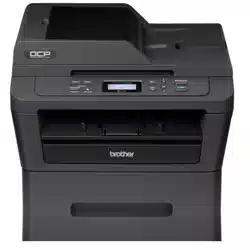
DCP-7030
DCP-7040
Not all models are available in all countries.
Version B
USA/CAN

If you need to call Customer Service
Please complete the following information for future
reference:
Model Number: DCP-7030 and DCP-7040
(Circle your model number)
Serial Number:
1
Date of Purchase:
Place of Purchase:
1
The serial number is on the back of the unit. Retain
this User’s Guide with your sales receipt as a
permanent record of your purchase, in the event of
theft, fire or warranty service.
Register your product on-line at
http://www.brother.com/registration/
By registering your product with Brother, you will be recorded as the
original owner of the product. Your registration with Brother:
may serve as confirmation of the purchase date of your product
should you lose your receipt;
may support an insurance claim by you in the event of product loss
covered by insurance; and,
will help us notify you of enhancements to your product and special
offers.
The most convenient and efficient way to register your new product is
online at http://www.brother.com/registration/
© 2008 Brother Industries, Ltd.
i
Brother numbers
IMPORTANT
For technical help, you must call the country where you bought the machine. Calls must be
made from within that country.
Register your product
By registering your product with Brother International Corporation, you will be recorded as the
original owner of the product. Your registration with Brother:
may serve as confirmation of the purchase date of your product should you lose your receipt;
may support an insurance claim by you in the event of product loss covered by insurance; and,
will help us notify you of enhancements to your product and special offers.
Please complete and fax the Brother Warranty Registration And Test Sheet or, for your
convenience and most efficient way to register your new product, register on-line at
http://www.brother.com/registration/
FAQs (frequently asked questions)
The Brother Solutions Center is our one-stop resource for all your Digital copier Center needs.
You can download the latest software and utilities and read FAQs and troubleshooting tips to learn
how to get the most from your Brother product.
http://solutions.brother.com/
Note
You can check here for Brother driver updates.
To keep your machine performance up to date, check here for the latest firmware upgrade (for
Windows
®
only).
For Customer Service
Service Center Locator (USA only)
For the location of a Brother authorized service center, call 1-877-BROTHER (1-877-276-8437).
Service Center Locations (Canada only)
For the location of a Brother authorized service center, call 1-877-BROTHER.
In USA: 1-877-BROTHER (1-877-276-8437)
1-901-379-1215 (fax)
In Canada: 1-877-BROTHER
(514) 685-4898 (fax)
ii
Ordering accessories and supplies
For best quality results use only genuine Brother accessories, which are available at most Brother
retailers. If you cannot find the accessory you need and you have a Visa, MasterCard, Discover,
or American Express credit card, you can order accessories directly from Brother. (You can visit
us online for a complete selection of the Brother accessories and supplies that are available for
purchase.)
Note
In Canada only Visa and MasterCard are accepted.
1
Approx. cartridge yield is declared in accordance with ISO/IEC 19752.
2
Drum yield is approximate, and may vary by type of use.
In USA: 1-877-552-MALL (1-877-552-6255)
1-800-947-1445 (fax)
http://www.brothermall.com/
In Canada: 1-877-BROTHER
http://www.brother.ca/
Description Item
Toner Cartridge Standard
TN-330 (Approx. 1,500 pages)
1
Toner Cartridge High Yield
TN-360 (Approx. 2,600 pages)
1
Drum Unit
DR-360 (Approx. 12,000 pages)
2
User’s Guide LS1180001 (English for USA and Canada)
LS1180002 (French for Canada)
Quick Setup Guide LS1181001 (English for USA and Canada)
LS1181002 (French for Canada)

iii
Notice - Disclaimer of Warranties
(USA and Canada)
BROTHER’S LICENSOR(S), AND THEIR DIRECTORS, OFFICERS, EMPLOYEES OR
AGENTS (COLLECTIVELY BROTHER’S LICENSOR) MAKE NO WARRANTIES, EXPRESS OR
IMPLIED, INCLUDING WITHOUT LIMITATION THE IMPLIED WARRANTIES OF
MERCHANTABILITY AND FITNESS FOR A PARTICULAR PURPOSE, REGARDING THE
SOFTWARE. BROTHER’S LICENSOR(S) DOES NOT WARRANT, GUARANTEE OR MAKE
ANY REPRESENTATIONS REGARDING THE USE OR THE RESULTS OF THE USE OF THE
SOFTWARE IN TERMS OF ITS CORRECTNESS, ACCURACY, RELIABILITY, CURRENTNESS
OR OTHERWISE. THE ENTIRE RISK AS TO THE RESULTS AND PERFORMANCE OF THE
SOFTWARE IS ASSUMED BY YOU. THE EXCLUSION OF IMPLIED WARRANTIES IS NOT
PERMITTED BY SOME STATES IN THE USA AND SOME PROVINCES IN CANADA. THE
ABOVE EXCLUSION MAY NOT APPLY TO YOU.
IN NO EVENT WILL BROTHER’S LICENSOR(S) BE LIABLE TO YOU FOR ANY
CONSEQUENTIAL, INCIDENTAL OR INDIRECT DAMAGES (INCLUDING DAMAGES FOR
LOSS OF BUSINESS PROFITS, BUSINESS INTERRUPTION, LOSS OF BUSINESS
INFORMATION, AND THE LIKE) ARISING OUT OF THE USE OR INABILITY TO USE THE
SOFTWARE EVEN IF BROTHER’S LICENSOR HAS BEEN ADVISED OF THE POSSIBILITY OF
SUCH DAMAGES. BECAUSE SOME STATES IN THE USA AND SOME PROVINCES IN
CANADA DO NOT ALLOW THE EXCLUSION OR LIMITATION OF LIABILITY FOR
CONSEQUENTIAL OR INCIDENTAL DAMAGES, THE ABOVE LIMITATIONS MAY NOT APPLY
TO YOU. IN ANY EVENT BROTHER’S LICENSOR’S LIABILITY TO YOU FOR ACTUAL
DAMAGES FROM ANY CAUSE WHATSOEVER, AND REGARDLESS OF THE FORM OF THE
ACTION (WHETHER IN CONTRACT, TORT (INCLUDING NEGLIGENCE), PRODUCT
LIABILITY OR OTHERWISE), WILL BE LIMITED TO $50.
Compilation and Publication Notice
Under the supervision of Brother Industries Ltd., this manual has been compiled and published,
covering the latest product descriptions and specifications.
The contents of this manual and the specifications of this product are subject to change without
notice.
Brother reserves the right to make changes without notice in the specifications and materials
contained herein and shall not be responsible for any damages (including consequential) caused
by reliance on the materials presented, including but not limited to typographical and other errors
relating to the publication.

iv
Brother
®
One-Year Limited Warranty and Replacement Service
(USA Only)
Who is covered:
This limited warranty (“warranty”) is given
only to the original end-use/retail purchaser
(referred to in this warranty as “Original
Purchaser”) of the accompanying product,
consumables and accessories (collectively
referred to in this warranty as “this
Product”).
If you purchased a product from someone
other than an authorized Brother reseller in
the United States or if the product was used
(including but not limited to floor models or
refurbished product), prior to your
purchase you are not the Original
Purchaser and the product that you
purchased is not covered by this warranty.
What is covered:
This Product includes a Machine and
Consumable and Accessory Items.
Consumable and Accessory Items include
but are not limited to print heads, toner,
drums, ink cartridges, print cartridges,
cordless handset battery, refill ribbons,
therma PLUS paper and thermal paper.
Except as otherwise provided herein,
Brother warrants that the Machine and the
accompanying Consumable and
Accessory Items will be free from defects in
materials and workmanship, when used
under normal conditions.
This warranty applies only to products
purchased and used in the United States.
For products purchased in, but used
outside, the United States, this warranty
covers only warranty service within the
United States (and does not include
shipping outside the United States).
What is the length of the Warranty Periods:
Machines: one year from the original
purchase date.
Accompanying Consumable and
Accessory Items: 90 days from the original
purchase date or the rated life of
consumable, whichever comes first.
What is NOT covered:
This warranty does not cover:
1 Physical damage to this Product;
2 Damage caused by improper installation,
improper or abnormal use, misuse, neglect
or accident (including but not limited to
transporting this Product without the proper
preparation and/or packaging);
3 Damage caused by another device or
software used with this Product (including
but not limited to damage resulting from
use of non Brother
®
-brand parts and
Consumable and Accessory Items);
4 Consumable and Accessory Items that
expired in accordance with a rated life;
5 Problems arising from other than defects in
materials or workmanship; and,
6 Normal Periodic Maintenance Items, such
as Paper Feeding Kit, Fuser and Laser
Units.
This limited warranty is VOID if this Product
has been altered or modified in any way
(including but not limited to attempted warranty
repair without authorization from Brother
and/or alteration/removal of the serial
number).
What to do if you think your Product is
eligible for warranty service:
Report your issue to either our Customer
Service Hotline at 1-877-BROTHER (1-877-
276-8437) or to a Brother Authorized Service
Center within the applicable warranty
period. Supply Brother or the Brother
Authorized Service Center with a copy of your
dated bill of sale showing that this Product was
purchased within the U.S. For the name of
local Brother Authorized Service Center(s),
call 1-877-BROTHER (1-877-276-8437) or
visit www.brother-usa.com.
What Brother will ask you to do:
After contacting Brother or a Brother
Authorized Service Center, you may be
required to deliver (by hand if you prefer) or
send the Product properly packaged, freight
prepaid, to the Authorized Service Center
together with a photocopy of your bill of sale.
You are responsible for the cost of
shipping, packing product, and insurance
(if you desire). You are also responsible for
loss or damage to this Product in shipping.
What Brother will do:
If the problem reported concerning your
Machine and/or accompanying Consumable
and Accessory Items is covered by this
warranty and
if you first reported the problem
to Brother or an Authorized Service Center
within the applicable warranty period, Brother
or its Authorized Service Center will repair or
replace the Machine and/or accompanying
Consumable and Accessory Items at no
charge to you for parts or labor. The decision
as to whether to repair or replace the Machine
and/or accompanying Consumable and
Accessory Items is made by Brother in its sole
discretion. Brother reserves the right to supply
a refurbished or remanufactured replacement
Machine and/or accompanying Consumable
and Accessory Items and use refurbished
parts provided such replacement products
conform to the manufacturer's specifications
for new product/parts.

v
Brother
®
One-Year Limited Warranty and Replacement Service
(USA Only)
The repaired or replacement Machine and/or
accompanying Consumable and Accessory
Items will be returned to you freight prepaid or
made available for you to pick up at a
conveniently located Authorized Service
Center.
If the Machine and/or accompanying
Consumable and Accessory Items are not
covered by this warranty (either stage), you
will be charged for shipping the Machine
and/or accompanying Consumable and
Accessory Items back to you and charged for
any service and/or replacement parts/products
at Brother's then current published rates.
The foregoing are your sole (i.e., only) and
exclusive remedies under this warranty.
What happens when Brother elects to
replace your Machine:
When a replacement Machine is authorized by
Brother, and you have delivered the Machine
to an Authorized Service Center, the
Authorized Service Center will provide you
with a replacement Machine after receiving
one from Brother. If you are dealing directly
with Brother's Express Exchange Service
Brother will send to you a replacement Machine
shipped for receipt within two business days,
with the understanding that you will, after
receipt of the replacement Machine, supply the
required proof of purchase information,
together with the Machine that Brother agreed
to replace. You are then expected to pack the
Machine that Brother agreed to replace in the
package from the replacement Machine and
return it to Brother using the pre-paid freight bill
supplied by Brother in accordance with the
instructions provided by Brother. Since you will
be in possession of two machines, Brother will
require that you provide a valid major credit
card number. Brother will issue a hold against
the credit card account number that you
provide until Brother receives your original
Product and determines that your original
Product is entitled to warranty coverage. Your
credit card will be charged up to the cost of a
new Product only if: (i) you do not return your
original Product to Brother within five (5)
business days; (ii) the problems with your
original Product are not covered by the limited
warranty; (iii) the proper packaging
instructions are not followed and has caused
damage to the product; or (iv) the warranty
period on your original Product has expired or
has not been sufficiently validated with a copy
of the proof of purchase (bill of sale). The
replacement Machine you receive (even if
refurbished or remanufactured) will be
covered by the balance of the limited warranty
period remaining on the original Product, plus
an additional thirty (30) days. You will keep the
replacement Machine that is sent to you and
your original Machine shall become the
property of Brother. Retain your original
Accessory Items and a copy of the return
freight bill, signed by the courier.
Limitations:
Brother is not responsible for damage to or
loss of any equipment, media, programs or
data related to the use of this Product. Except
for the repair or replacement as described
above, Brother shall not be liable for any
direct, indirect, incidental or consequential
damages or specific relief. Because some
states do not allow the exclusion or limitation
of consequential or incidental damages, the
above limitation may not apply to you.
THIS WARRANTY IS GIVEN IN LIEU OF ALL
OTHER WARRANTIES, WRITTEN OR
ORAL, WHETHER EXPRESSED BY
AFFIRMATION, PROMISE, DESCRIPTION,
DRAWING, MODEL OR SAMPLE. ANY AND
ALL WARRANTIES OTHER THAN THIS
ONE, WHETHER EXPRESS OR IMPLIED,
INCLUDING IMPLIED WARRANTIES OF
MERCHANTABILITY AND FITNESS FOR A
PARTICULAR PURPOSE, ARE HEREBY
DISCLAIMED.
This Limited Warranty is the only warranty
that Brother is giving for this Product. It is
the final expression and the exclusive and
only statement of Brother's obligations to
you. It replaces all other agreements and
understandings that you may have with
Brother or its representatives.
This warranty gives you certain rights and
you may also have other rights that may
vary from state to state.
This Limited Warranty (and Brother's
obligation to you) may not be changed in
any way unless you and Brother sign the
same piece of paper in which we (1) refer
to this Product and your bill of sale date, (2)
describe the change to this warranty and
(3) agree to make that change.
Important: We recommend that you keep all
original packing materials, in the event that
you ship this Product.
© 2008 Brother International Corporation

vi
BROTHER MULTIFUNCTION CENTER /FAX MACHINE
LIMITED WARRANTY
(Canada only)
Pursuant to the limited warranty of 1 year from the date of purchase for labour and parts,
Brother International Corporation (Canada) Ltd. (“Brother”), or its Authorized Service
Centres, will repair or replace (at Brother’s sole discretion) this MFC/Fax machine free of
charge if defective in material or workmanship. This warranty applies only to products
purchased and used in Canada.
This limited Warranty does not include cleaning, consumables (including, without limitation,
ink cartridges, print cartridges, print rolls, thermal paper rolls, toner cartridges, drum units,
OPC belts, fixing units, print heads, paper feed rollers, transfer rolls, cleaning rollers, waste
toner packs, oil bottles) or damage caused by accident, neglect, misuse or improper
installation or operation, any damage caused from service, maintenance, modifications, or
tampering by anyone other than a Brother Authorized Service Representative, or if shipped
out of the country.
The use of supplies or consumable items that are non-Brother products may void your
warranty. This limited warranty ceases when this machine is rented, sold, or otherwise
disposed of. Operation of the MFC/Fax machine in excess of the specifications or with the
Serial Number or Rating Label removed shall be deemed abuse and all repairs thereafter
shall be the sole liability of the end-user/purchaser.
In order to obtain warranty service, the MFC/Fax machine must be delivered or shipped
freight prepaid by the end-user/purchaser to a “Brother” Authorized Service Centre, together
with your Canadian Proof of Purchase in the form of a Sales Receipt.
When shipping or transporting your MFC/Fax machine, please refer to your Operation
Manual for the proper packaging procedures.
For Laser units: Failure to remove the Toner Cartridge (and Toner Drum Unit, waste toner
packs or oil bottles on applicable models) during shipping or transport will cause severe
damage to the Laser MFC/Fax machine and will void the Warranty.
For inkjet units: (When shipping your Inkjet MFC/Fax machine remove the ink cartridges and
replace them with the original protective parts. If original protective parts are not available,
leave ink cartridges installed. Please avoid shipping the unit without original protective parts
or ink cartridges.) Damage to your print head resulting from packing the Inkjet MFC/Fax
machine without the ink cartridges or the protective parts will void your warranty.
Improper packaging may cause severe damage to the machine during shipping and will void
the warranty.
BROTHER DISCLAIMS ALL OTHER WARRANTIES EXPRESSED OR IMPLIED
INCLUDING, WITHOUT LIMITATIONS, ANY IMPLIED WARRANTIES OF
MERCHANTABILITY OR FITNESS FOR A PARTICULAR PURPOSE, EXCEPT TO THE
EXTENT THAT ANY WARRANTIES IMPLIED BY LAW CANNOT BE VALIDLY WAIVED.
No oral or written information, advice or representation provided by Brother, its Authorized
Service Centres, Distributors, Dealers, Agents or employees, shall create another warranty
or modify this warranty. The warranty states Brother’s entire liability and your exclusive
remedy against Brother for any failure of the MFC/Fax machine to operate properly.
Neither Brother nor anyone else involved in the development, production, or delivery of this
MFC/Fax machine shall be liable for any indirect, incidental, special, consequential,
exemplary, or punitive damages, including lost profits, arising from the use of or inability to
use the product, even if advised by the end user/purchaser of the possibility of such damages.
Since some Provinces do not allow the above limitation of liability, such limitation, may not
apply to you.
This Limited Warranty gives you specific legal rights and you may also have other
rights which vary from Province to Province.
Warranty Service is available at Brother Authorized
Service Centres throughout Canada. For Technical
Assistance or for the name and location of your nearest
Authorized Service Centre call 1-877-BROTHER.
Internet support: [email protected] or browse Brother’s Web Site www.brother.ca.

vii

viii
Table of Contents
Section I General
1 General information 2
Using the documentation .......................................................................................2
Symbols and conventions used in the documentation ....................................2
Accessing the Software User’s Guide ...................................................................3
Viewing documentation ...................................................................................3
Accessing Brother support (for Windows
®
) ...........................................................5
Control panel overview ..........................................................................................6
2 Loading paper and documents 7
Loading paper and print media ..............................................................................7
Loading paper in the paper tray.......................................................................7
Loading paper in the manual feed slot ............................................................8
Unprintable area ............................................................................................11
Acceptable paper and other print media..............................................................12
Recommended paper and print media ..........................................................12
Type and size of paper ..................................................................................12
Handling and using special paper .................................................................14
Loading documents .............................................................................................17
Using the automatic document feeder (ADF) (DCP-7040 only) ....................17
Using the scanner glass ................................................................................18
3 General setup 19
Paper settings......................................................................................................19
Paper type .....................................................................................................19
Paper size......................................................................................................19
Volume settings ...................................................................................................19
Beeper volume ..............................................................................................19
Ecology features ..................................................................................................20
Toner save.....................................................................................................20
Sleep time......................................................................................................20
LCD contrast........................................................................................................21
User Settings List.................................................................................................21
Section II Copy
4 Making copies 24
How to copy .........................................................................................................24
Entering copy mode.......................................................................................24
Making a single copy .....................................................................................24

ix
Making multiple copies ..................................................................................24
Stop copying..................................................................................................24
Copy options (temporary settings).......................................................................25
Enlarging or reducing the image copied ........................................................25
Adjusting contrast ..........................................................................................26
Using the Options key ...................................................................................27
Improving copy quality................................................................................... 27
Sorting copies using the ADF (DCP-7040 only) ............................................28
Making N in 1 copies (page layout) ............................................................... 28
Out of memory message .....................................................................................29
Section III Software
5 Software features 32
How to read HTML User’s Guide.........................................................................32
For Windows
®
...............................................................................................32
For Macintosh
®
..............................................................................................33
Section IV Appendixes
A Safety and legal 36
Choosing a location .............................................................................................36
To use the machine safely...................................................................................37
Important information...........................................................................................40
Federal Communications Commission (FCC) Declaration of Conformity
(USA only) ................................................................................................. 40
Industry Canada Compliance Statement (Canada only) ..............................41
Disconnect device .........................................................................................41
International ENERGY STAR
®
Compliance Statement ................................41
Laser safety ...................................................................................................41
FDA regulations.............................................................................................42
Important safety instructions..........................................................................42
Trademarks..........................................................................................................45
B Troubleshooting and routine maintenance 46
Troubleshooting ................................................................................................... 46
If you are having difficulty with your machine ................................................46
Improving the print quality .............................................................................49
Error and maintenance messages.......................................................................55
Document jams (DCP-7040 only)..................................................................57
Paper jams ....................................................................................................58
Routine maintenance........................................................................................... 62
Cleaning the outside of the machine .............................................................62
Cleaning the scanner glass ...........................................................................63
Cleaning the laser scanner window...............................................................64

x
Cleaning the corona wire...............................................................................66
Cleaning the drum unit ..................................................................................68
Replacing the consumable items.........................................................................70
Replacing a toner cartridge ...........................................................................70
Replacing the drum unit.................................................................................74
Machine information ............................................................................................77
Checking the serial number...........................................................................77
Checking the page counters..........................................................................77
Checking the Drum life ..................................................................................77
Packing and shipping the machine ......................................................................78
C Menu and features 79
On-screen programming......................................................................................79
Menu table.....................................................................................................79
Memory storage.............................................................................................79
Menu keys ...........................................................................................................79
How to access the menu mode .....................................................................80
Menu table ...........................................................................................................81
D Specifications 83
General ................................................................................................................83
Print media...........................................................................................................85
Copy ....................................................................................................................86
Scan.....................................................................................................................87
Print .....................................................................................................................88
Interfaces .............................................................................................................88
Computer requirements .......................................................................................89
Consumable items ...............................................................................................90
E Glossary 91
F Index 92


2
1
Using the
documentation 1
Thank you for buying a Brother machine!
Reading the documentation will help you
make the most of your machine.
Symbols and conventions
used in the documentation 1
The following symbols and conventions are
used throughout the documentation.
Note
Illustrations in this User’s Guide are based
on the DCP-7040.
General information 1
Bold Bold style identifies keys on the
machine control panel or
computer screen.
Italics Italicized style emphasizes an
important point or refers you to
a related topic.
Courier
New
Courier New font identifies the
messages shown on the LCD
of the machine.
Warnings tell you what to do to
prevent possible personal injury.
Cautions specify procedures you
must follow or avoid to prevent
possible damage to the machine or
other objects.
Electrical Hazard icons alert you to a
possible electrical shock.
Hot Surface icons warn you not to
touch machine parts that are hot.
Incorrect setup icons alert you to
devices and operations that are not
compatible with the machine.
Note icons give useful tips.

General information
3
1
Accessing the
Software User’s Guide 1
This User’s Guide does not contain all the
information about the machine such as how
to use the advanced features of Printer and
Scanner. When you are ready to learn
detailed information about these operations,
read the Software User’s Guide.
Viewing documentation 1
Viewing documentation (Windows
®
) 1
To view the documentation, from the Start
menu, point to Brother, DCP-XXXX (where
XXXX is your model name) from the program
group, and then click User’s Guides in
HTML format.
If you have not installed the software, you can
find the documentation by following the
instructions below:
a Turn on your PC.
Insert the Brother CD-ROM labeled
Windows
®
into your CD-ROM drive.
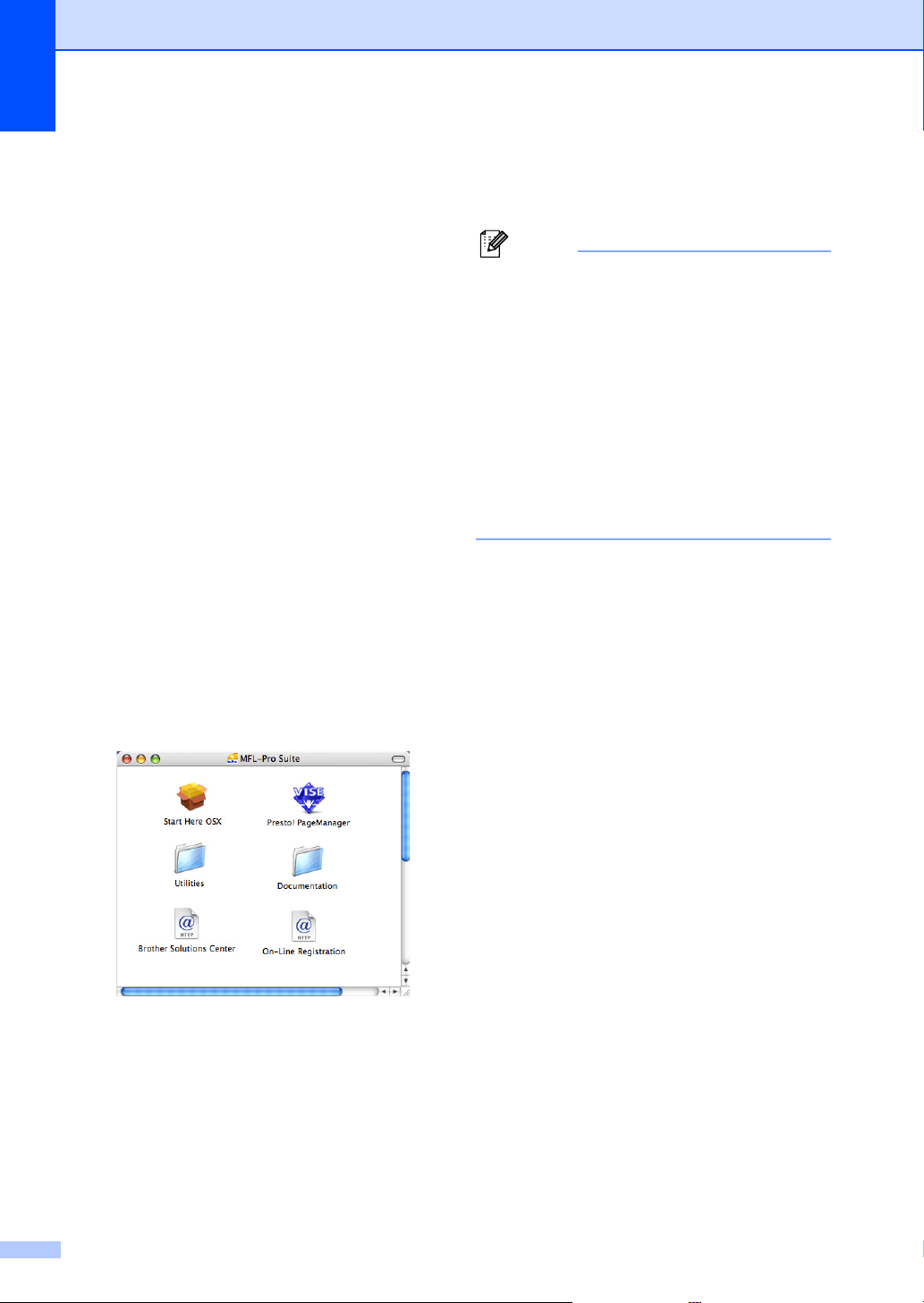
b If the language selection screen
appears, click your language.
c If the model name screen appears, click
your model name.The CD-ROM main
menu will appear.
If this window does not appear, use
Windows
®
Explorer to find and run the
start.exe program from the root directory
of the Brother CD-ROM.
d Click Documentation.
e Click the documentation you want to
read:
HTML document (1 manual):
Software User’s Guide in HTML
format.
This format is recommended for
viewing on your computer.
PDF documents (3 manuals):
User’s Guide for stand-alone
operations, Software User’s Guide
and Quick Setup Guide.
This format is recommended for
printing the manuals. Click to go to
the Brother Solutions Center, where
you can view or download the PDF
documents. (Internet access and
PDF Reader software are required.)
Chapter 1
4
How to find scanning instructions 1
There are several ways you can scan documents.
You can find the instructions as follows:
Software User's Guide: 1
Scanning a document using the TWAIN
driver in Chapter 2
Scanning a document using the WIA
driver (For Windows
®
XP/Windows Vista
®
only) in Chapter 2
Using ControlCenter3 in Chapter 3
ScanSoft™ PaperPort™ 11SE with
OCR How-to-Guides
1
The complete ScanSoft™ PaperPort™
11SE with OCR How-to-Guides can be
viewed from the Help selection in the
ScanSoft™ PaperPort™ 11SE
application.
Viewing documentation (Macintosh
®
) 1
a Turn on your Macintosh
®
.
Insert the Brother CD-ROM labeled
Macintosh
®
into your CD-ROM drive.
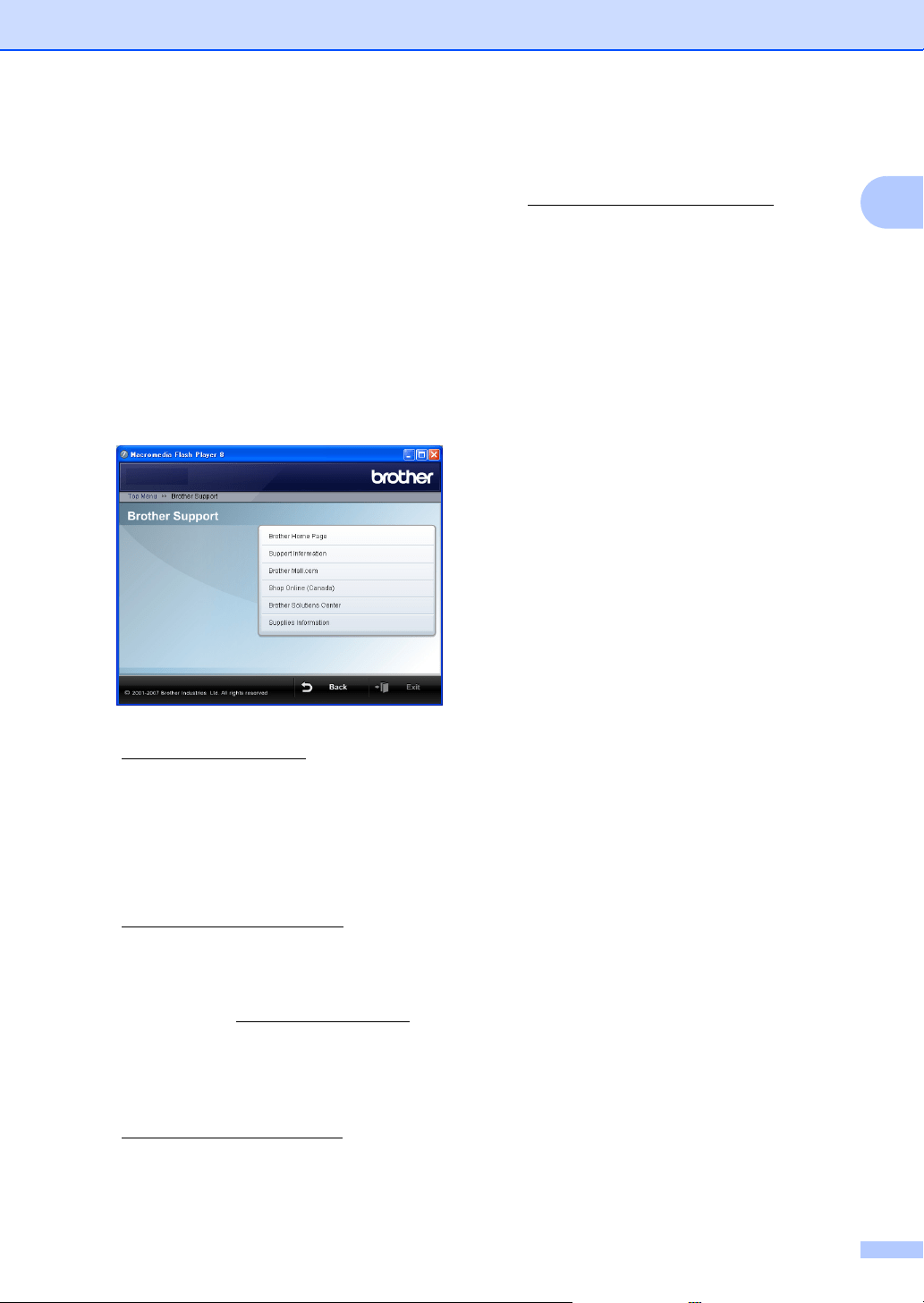
b The following window will appear.
c Double-click the Documentation icon.
d If the language selection screen
appears, double-click your language.
e Double-click the top page file to view the
Software User’s Guide in HTML
format.
f Click the documentation you want to
read.
Software User’s Guide
Note
The documents are also available in PDF
format (3 manuals):
User’s Guide for stand-alone operations,
Software User’s Guide and Quick Setup
Guide.
The PDF format is recommended for
printing the manuals.
Double-click Brother Solutions Center
icon to go to the Brother Solutions Center,
where you can view or download the PDF
documents. (Internet access and PDF
Reader software are required.)
How to find scanning instructions 1
There are several ways you can scan
documents. You can find the instructions as
follows:
Software User's Guide: 1
Scanning in Chapter 9
Using ControlCenter2 in Chapter 10
Presto!
®
PageManager
®
User's Guide:1
The complete Presto!
®
PageManager
®
User’s Guide can be viewed from the Help
selection in the Presto!
®
PageManager
®
application.
General information
5
1
Accessing Brother
support
(for Windows
®
) 1
You can find all the contacts you will need,
such as Web support (Brother Solutions
Center), Customer Service and Brother
Authorized Service Centers on page i and on
the Brother CD-ROM.
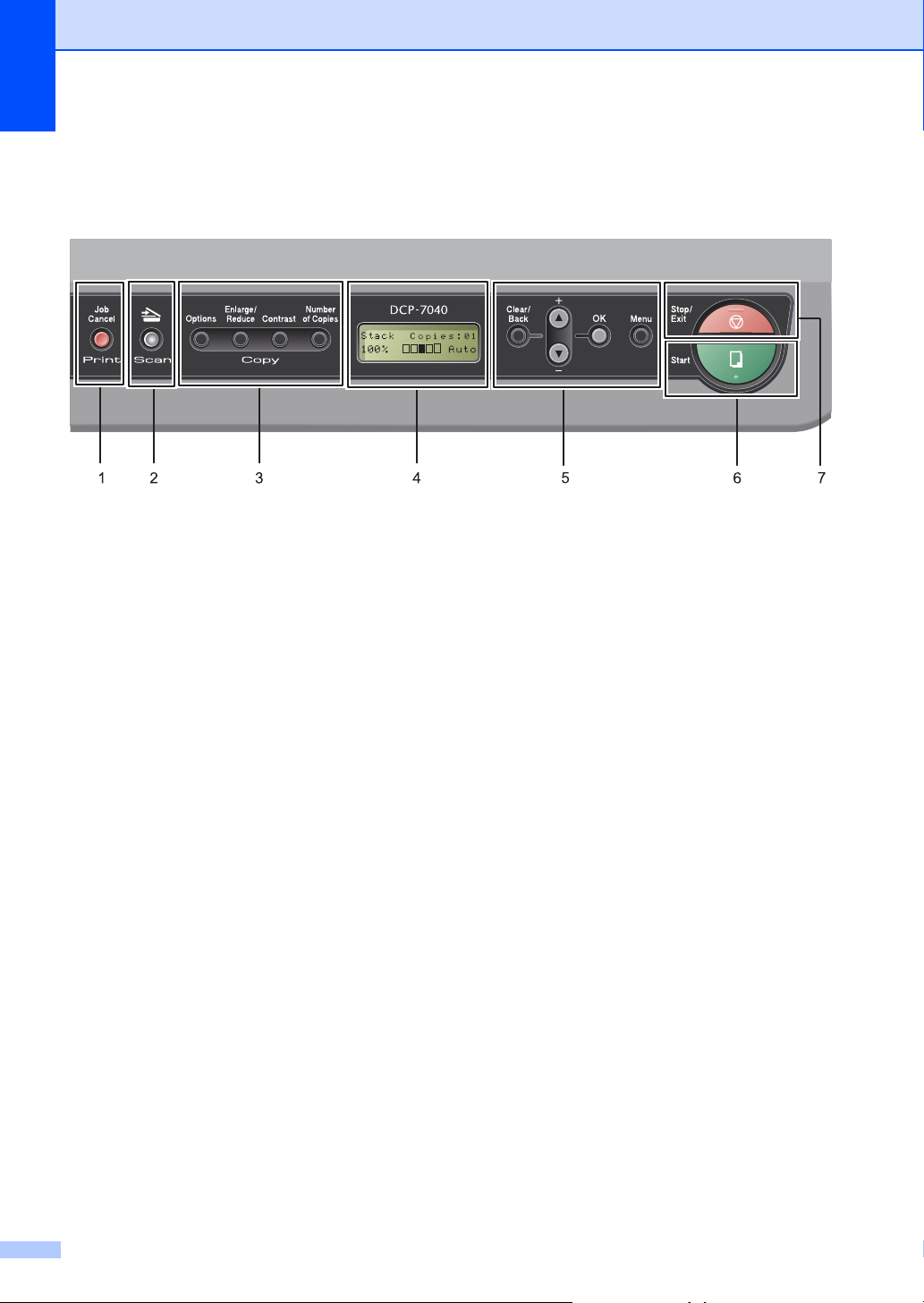
Click Brother Support on the main menu.
The following screen will appear:
To access our web site
(http://www.brother.com
/) click
Brother Home Page.
To view all Brother Numbers, including
Customer Service numbers for the USA
and Canada, click Support Information.
To access the USA Brother online
shopping mall
(http://www.brothermall.com/
) for
additional product and service
information, click Brother Mall.com.
To access Canada’s Brother online
shopping mall (http://www.brother.ca/
) for
additional product and service
information, click Shop Online (Canada).
For the latest news and product support
information
(http://solutions.brother.com/
), click
Brother Solutions Center.
To visit our web site for original/genuine
Brother supplies
(http://www.brother.com/original
/), click
Supplies Information.
To return to the main page, click Back.
Or, if you have finished, click Exit.
Chapter 1
6
Control panel overview 1
DCP-7030 and DCP-7040 have the same keys.
1Print key
Job Cancel
Cancels a programmed print job and clears it
from the machine’s memory.
To cancel multiple print jobs, hold down this
key until the LCD shows
Job Cancel (All).
2Scan key
Puts the machine in Scan mode. (For details
about scanning, see the Software User’s Guide
on the CD-ROM.)
3 Copy keys:
Options
You can choose and easily choose temporary
settings for copying.
Enlarge/Reduce
Reduces or enlarges copies.
Contrast
You can increase or decrease the contrast of
your copies.
Number of Copies
Use this key to make multiple copies.
4LCD
Displays messages to help you set up and use
your machine.
5 Menu keys:
Clear/Back
Deletes entered data or lets you cancel the
current setting.
a
+ or b -
Press to scroll through the menus and options.
OK
Lets you store your settings in the machine.
Menu
Lets you access the Menu to program your
settings in this machine.
6Start
Lets you start making copies or scanning.
7Stop/Exit
Stops an operation or exits from a menu.
7
2
2
Loading paper and
print media 2
The machine can feed paper from the
standard paper tray or manual feed slot.
When you put paper into the paper tray, note
the following:
If your application software supports
paper size selection on the print menu,
you can choose it through the software. If
your application software does not
support it, you can set the paper size in
the printer driver or by using the control
panel buttons.
Before using paper that has holes in it,
such as organizer sheets, you must ‘fan’
the stack to avoid paper jams and
misfeeds.
Loading paper in the paper
tray 2
Printing on plain paper, recycled
paper or transparencies from the
paper tray
2
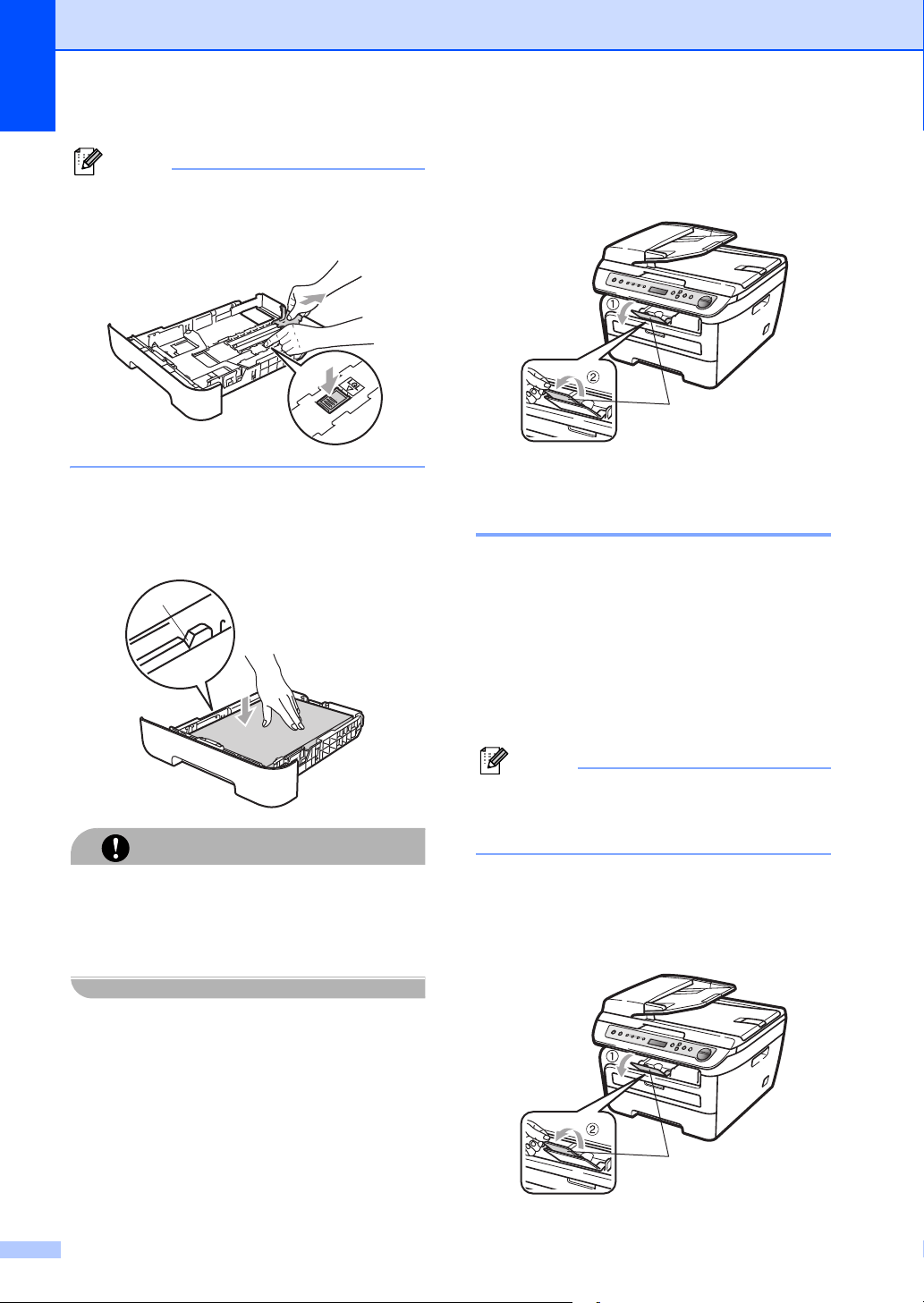
a Pull the paper tray completely out of the
machine.
b While pressing the green paper guide
release lever, slide the paper guides to
fit the paper size. Make sure that the
guides are firmly in the slots.
Loading paper and documents 2
Chapter 2
8
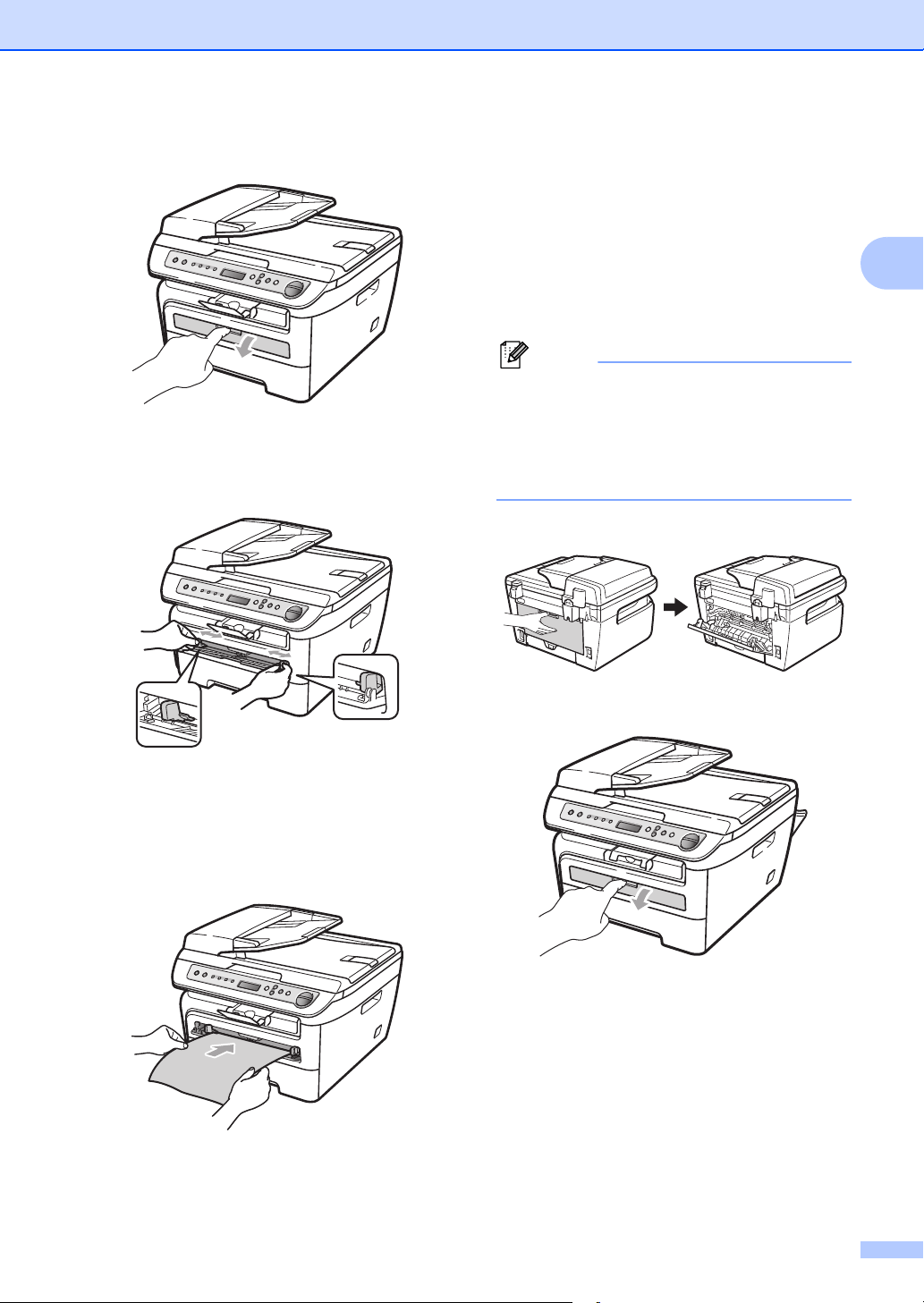
Note
For Legal size paper, press in the inside
latches and pull out the back of the paper
tray.
c Put paper in the tray, and make sure that
the paper is below the maximum paper
mark (1). The side to be printed on must
be face down.
CAUTION
Make sure the paper guides touch the sides
of the paper so it will feed properly. If you do
not do this, it may cause damage to your
machine.
d Put the paper tray firmly back in the
machine. Make sure that it is completely
inserted into the machine.
e Unfold the support flap (1) to prevent
paper from sliding off the face-down
output tray.
Loading paper in the manual
feed slot 2
You can load envelopes and special print
media one at a time into this slot. Use the
manual feed slot to print or copy on labels,
envelopes or thicker paper.
Printing on plain paper, recycled
paper or transparencies from the
manual feed slot
2
Note
The machine automatically turns on the
Manual Feed mode when you put paper in
the manual feed slot.
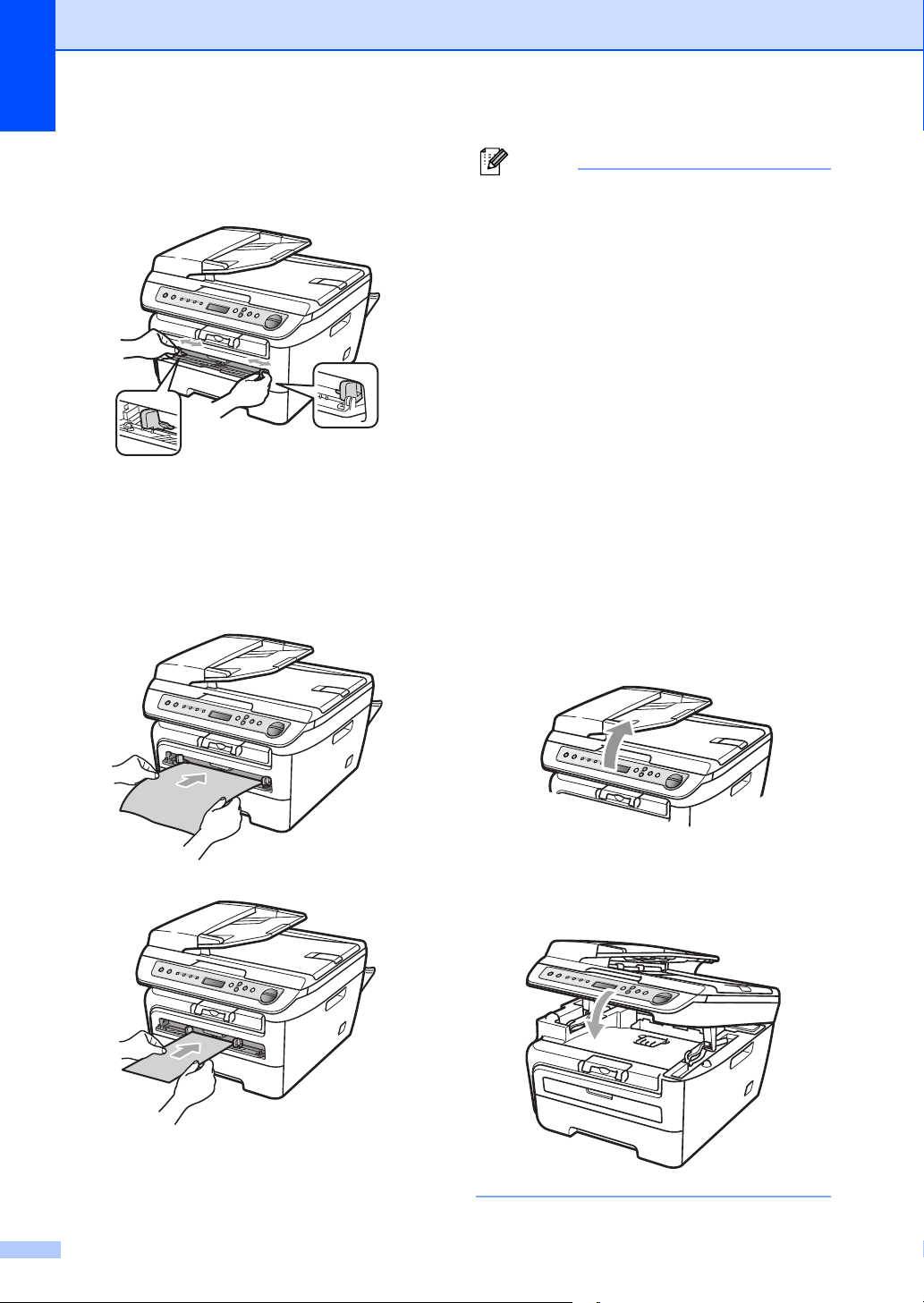
a Unfold the support flap (1) to prevent
paper from sliding off the face-down
output tray, or remove each page as
soon as it comes out of the machine.
1
1
1
Loading paper and documents
9
2
b Open the manual feed slot cover.
c Using both hands, slide the manual feed
slot paper guides to the width of the
paper that you are going to use.
d Using both hands, put one sheet of
paper in the manual feed slot until the
front edge of the paper or transparency
touches the paper feed roller. When you
feel the machine pull in the paper, let go.
Printing on thick paper, bond paper
labels and envelopes
2
When the back output tray is pulled down, the
machine has a straight paper path from the
manual feed slot through to the back of the
machine. Use this paper feed and output
method when you want to print on thick
paper, labels or envelopes.
Note
• Remove each printed sheet or envelope
immediately to prevent a paper jam.
• The machine automatically turns on the
Manual Feed mode when you put paper in
the manual feed solt.
a Open the back cover (back output tray).
b Open the manual feed slot cover.
Chapter 2
10
c Using both hands, slide the manual feed
slot paper guides to the width of the
paper that you are going to use.
d Using both hands, put one sheet of
paper or one envelope in the manual
feed slot until the front edge of the paper
or envelope touches the paper feed
roller. When you feel the machine pull in
the paper, let go.
Note
• Put the paper into the manual feed slot
with the side to be printed face up.
• Make sure that the print media (paper,
transparency and so on) is straight and in
the proper position on the manual feed
slot. If it is not, the paper or the
transparency may not be fed properly,
resulting in a skewed printout or a paper
jam.
• Do not put more than one sheet of paper
in the manual feed slot at any one time, as
it may cause a jam.
• If you put any print media in the manual
feed slot before the machine is in the
Ready state, the print media may be
ejected without being printed on.
• To easily remove a small printout from the
output tray, lift up the scanner cover by
using both hands as shown in the
illustration.
• You can still use the machine while the
scanner cover is up. To close the scanner
cover, push it down with both hands.
Loading paper and documents
11
2
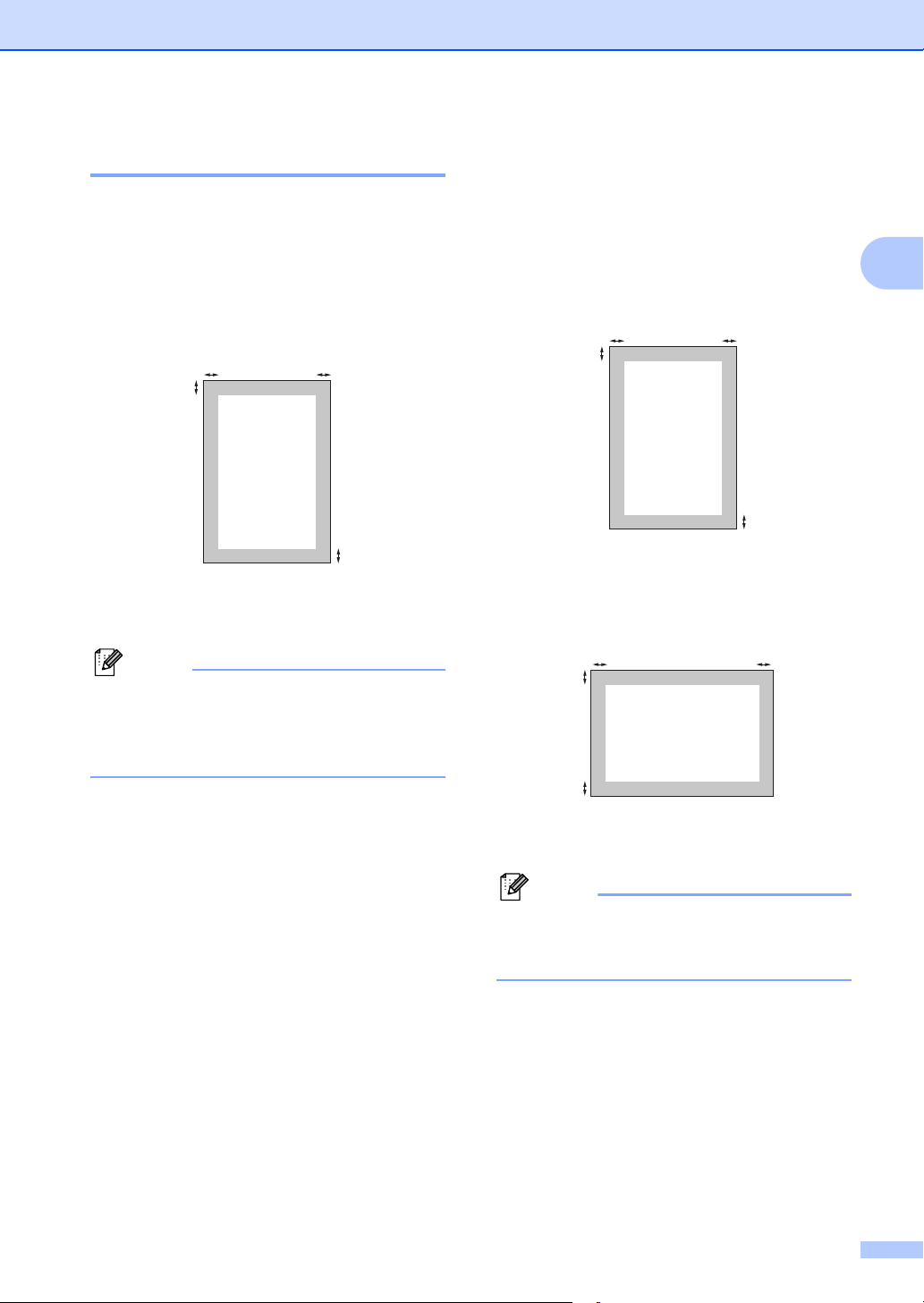
Unprintable area 2
Unprintable area for copies 2
The printable area of your machine begins at
approximately 0.12 in. (3 mm) from the top
and bottom and 0.16 in. (4 mm) from both
sides of the paper.
1 0.12 in. (3 mm)
2 0.16 in. (4 mm)
Note
This unprintable area shown above is for a
single copy or a 1 in 1 copy using Letter
size paper. The unprintable area changes
with the paper size.
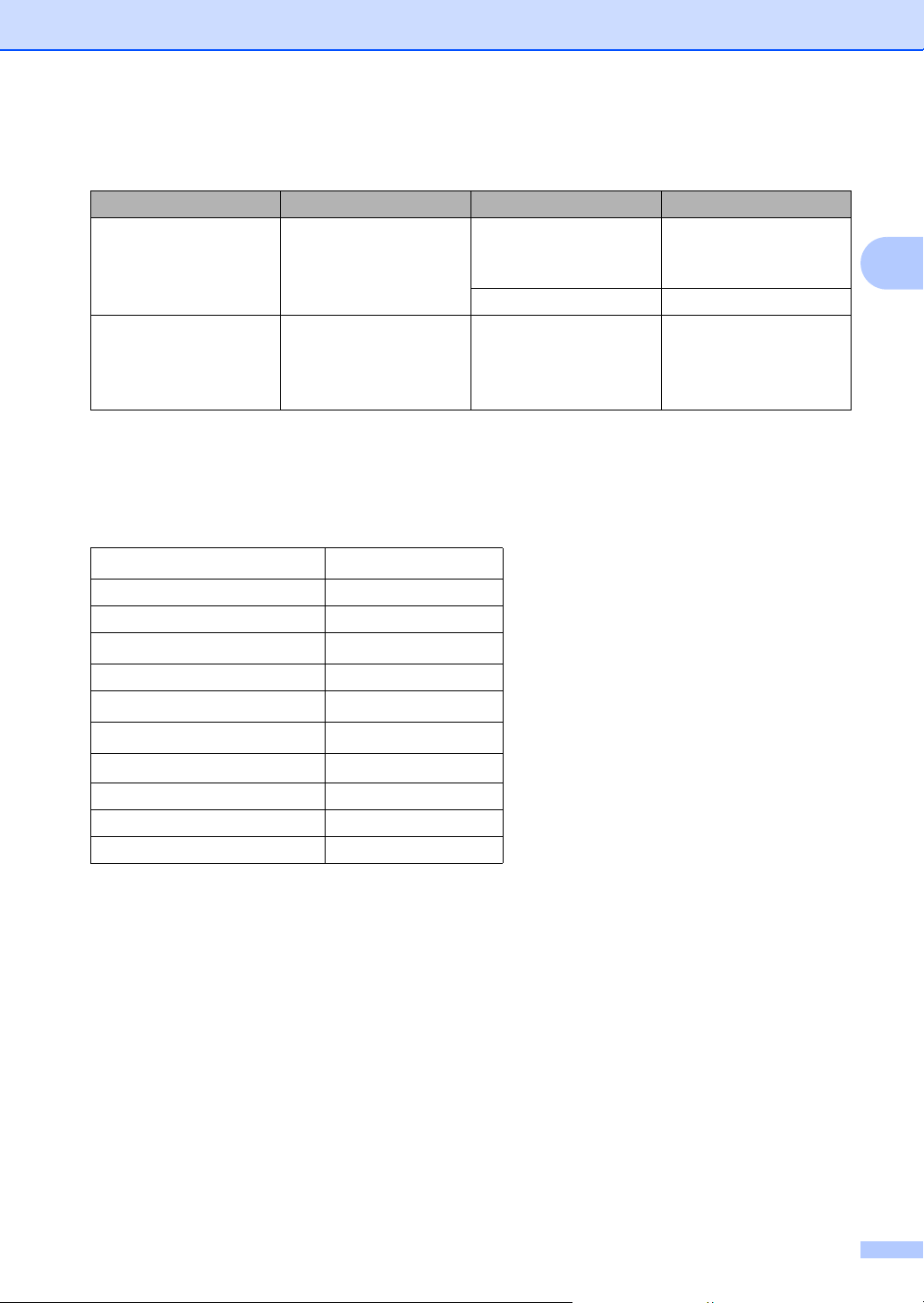
Unprintable area when printing from a
computer
2
When using the default driver the printable
area is smaller than the paper size, as shown
below.
Portrait
1 0.16 in. (4.23 mm)
2 0.25 in. (6.35 mm)
Landscape
1 0.16 in. (4.23 mm)
2 0.2 in. (5.08 mm)
Note
The unprintable area shown above is for
Letter size paper. The unprintable area
changes with the paper size.
2
2
1
1
2
2
1
1
2
2
1
1

Chapter 2
12
Acceptable paper and
other print media 2
Print quality may vary according to the type of
paper you are using.
You can use the following types of print
media: plain paper, bond paper, recycled
paper, transparencies, labels or envelopes.
For best results, follow the instructions below:
Use paper made for plain paper copying.
Use paper that is 20 to 24 lb (75 to
90 g/m
2
).
Use labels and transparencies which are
designed for use in laser machines.
DO NOT put different types of paper in the
paper tray at the same time because it
may cause paper jams or misfeeds.
For proper printing, you must choose the
same paper size from your software
application as the paper in the tray.
Avoid touching the printed surface of the
paper immediately after printing.
When you use transparencies remove
each sheet immediately to prevent
smudging or paper jams.
Use long grain paper with a neutral Ph
value, and a moisture content of approx.
5%.
Recommended paper and
print media 2
To get the best print quality, we suggest using
the following paper.
Type and size of paper 2
The machine loads paper from the installed
standard paper tray or manual feed slot.
Standard paper tray 2
Since the standard paper tray is a universal
type, you can use any of the paper sizes (one
paper type and size at a time) listed in the
table in Paper capacity of the paper trays
on page 13. The standard paper tray can
hold up to 250 sheets of Letter/A4, legal or
folio size paper (20 lb or 80 g/m
2
). Paper can
be loaded up to the maximum paper mark on
the sliding paper width guide.
Manual feed slot 2
The manual feed slot can hold a sheet with a
size of 3 to 8.66 in. (76.2 to 220 mm) wide
and 4.57 to 16 in. (116 to 406.4 mm) long.
You can use the manual feed slot if you are
using special paper, envelopes or labels.
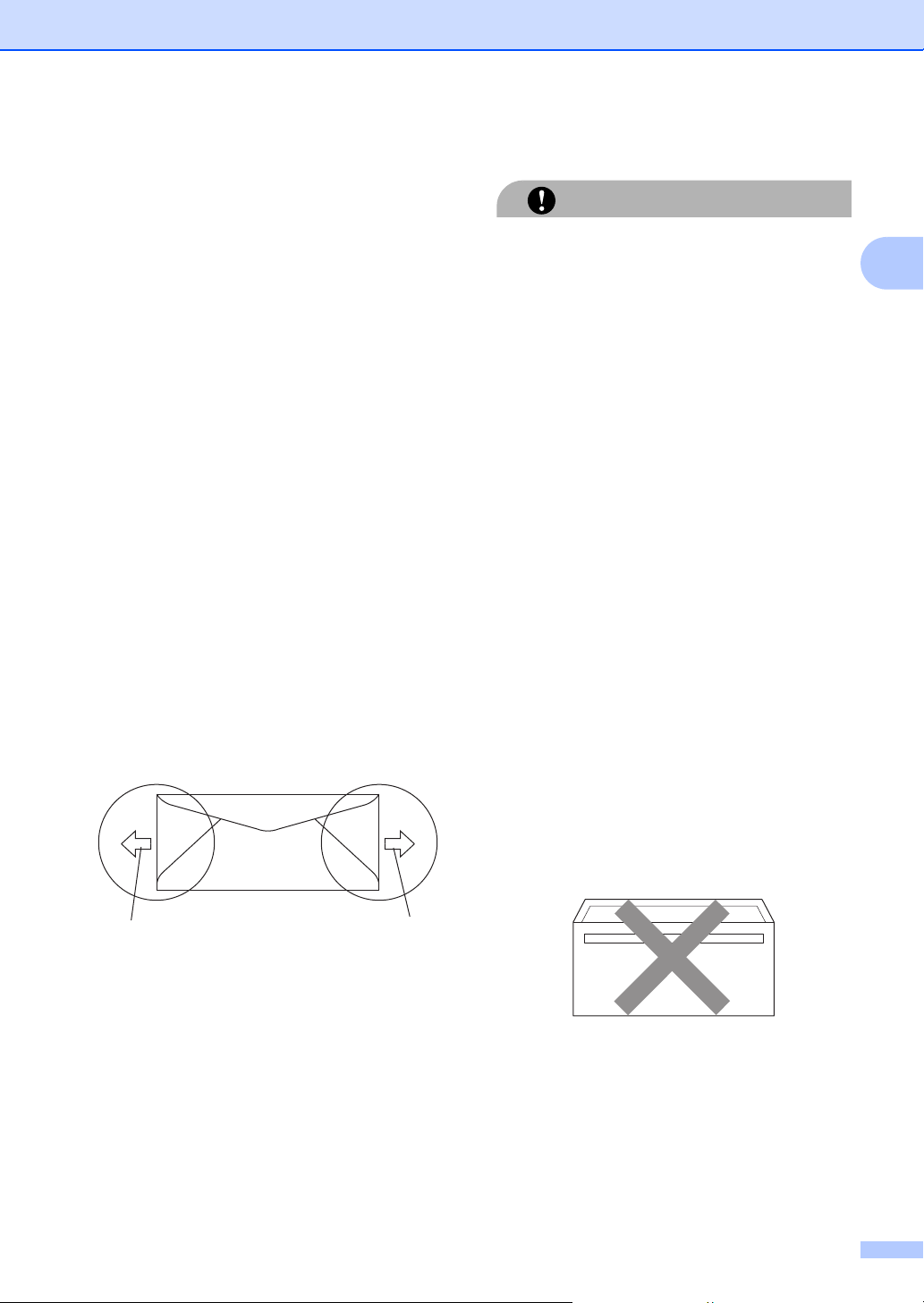
Paper Type Item
Plain Paper Xerox 4200DP 20 lb
Hammermill Laser Print
(24 lb=90 g/m
2
)
Recycled Paper No specific brand
recommended
Transparency 3M CG3300
Labels Avery laser labels white
#5160
Envelope No specific brand
recommended
Loading paper and documents
13
2
Paper capacity of the paper trays 2
1
Folio size is 8 in. × 13 in. (215.9 mm x 330.2 mm)
Recommended paper specifications 2
The following paper specifications are suitable for this machine.
Paper size Paper types No. of sheets
Paper Tray A4, Letter, Legal,
Executive, A5, A6, B5,
B6 and Folio
1
.
Plain paper and recycled
paper
up to 250
[20lb(80g/m
2
)]
Transparency up to 10
Manual Feed Slot Width: 3 to 8.66 in. (76.2
to 220 mm)
Length: 4.57 to 16 in.
(116 to 406.4 mm)
Plain paper, recycled
paper, bond paper,
envelopes, labels and
transparencies
1
Basis weight
20-24 lb (75-90 g/m
2
)
Thickness 80-110 µm
Roughness Higher than 20 sec.
Stiffness
90-150 cm
3
/100
Grain direction Long grain
Volume resistivity
10e
9
-10e
11
ohm
Surface resistivity
10e
9
-10e
12
ohm-cm
Filler CaCO
3
(Neutral)
Ash content Below 23 wt %
Brightness Higher than 80 %
Opacity Higher than 85 %

Chapter 2
14
Handling and using special
paper 2
The machine is designed to work well with
most types of xerographic and bond paper.
However, some paper variables may have an
effect on print quality or handling reliability.
Always test samples of paper before
purchasing to ensure desirable performance.
Store paper in its original packaging and keep
it sealed. Keep the paper flat and away from
moisture, direct sunlight and heat.
Some important guidelines when selecting
paper are:
Do not use ink jet paper because it may
cause a paper jam or damage your
machine.
Preprinted paper must use ink that can
withstand the temperature of the
machine’s fusing process (200 degrees
centigrade).
If you use bond paper, paper having a
rough surface or paper that is wrinkled or
creased, the paper may exhibit degraded
performance.
Types of paper to avoid 2
CAUTION
Some types of paper may not perform well
or may cause damage to your machine.
DO NOT use paper:
• that is highly textured
• that is extremely smooth or shiny
• that is curled or warped
1 0.08 in. (2 mm)
• that is coated or has a chemical finish
• that is damaged, creased or folded
• that exceeds the recommended weight
specification in this guide
• with tabs and staples
• with letterheads using low temperature
dyes or thermography
• that is multipart or carbonless
• that is designed for inkjet printing
If you use any of the types of paper listed
above, they may damage your machine.
This damage is not covered under any
Brother warranty or service agreement.
1
1
Loading paper and documents
15
2
Envelopes 2
Most envelopes will be suitable for your
machine. However, some envelopes may
have feed and print-quality problems
because of the way they have been made. A
suitable envelope should have edges with
straight, well-creased folds and the leading
edge should not be thicker than two sheets of
paper. The envelope should lie flat and not be
of baggy or flimsy construction. You should
buy quality envelopes from a supplier who
understands that you will be using the
envelopes in a laser machine.
Envelopes can be fed from manual feed slot
one at a time. We recommend that you print
a test envelope to make sure the print results
are what you want before you print or
purchase a large quantity of envelopes.
Check the following:
Envelopes should have a lengthwise
sealing flap.
The sealing flaps should be folded crisply
and correctly (irregularly cut or folded
envelopes may cause paper jams).
Envelopes should consist of two layers of
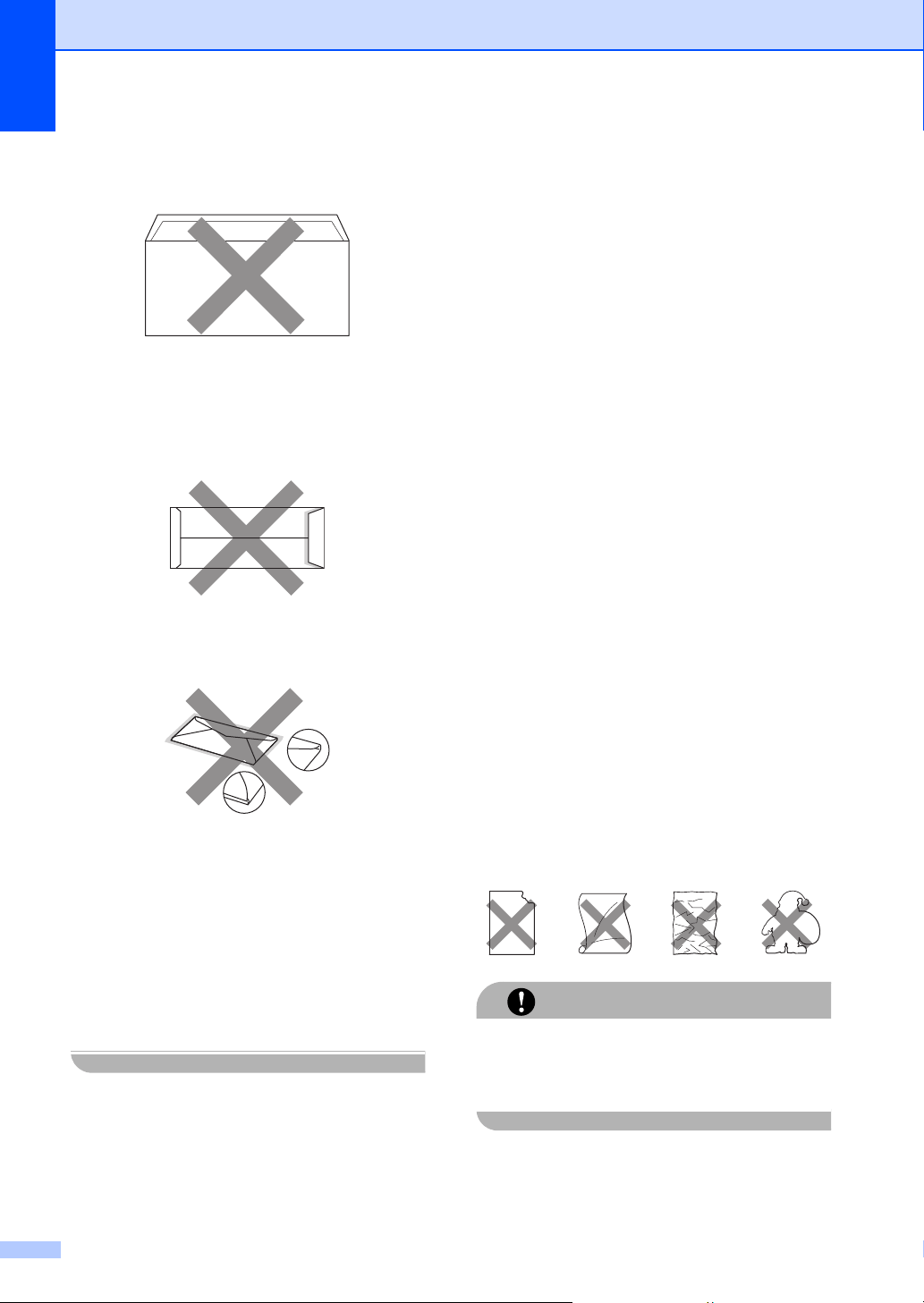
paper in the area circled in figure below.
1 Feeding direction
Envelope joints that are sealed by the
manufacturer should be secure.
We recommend that you do not print
within 0.6 in. (15 mm) of the edges of
envelopes.
Types of envelopes to avoid 2
CAUTION
DO NOT use envelopes:
• that are damaged, curled, wrinkled or an
unusual shape
• that are extremely shiny or textured
• with clasps, staples, snaps or tie strings
• with self-adhesive closures
• that are of a baggy construction
• that are not sharply creased
• that are embossed (have raised writing
on them)
• that were previously printed by a laser
machine
• that are pre-printed on the inside
• that cannot be arranged neatly when
stacked
• that are made of paper that weighs more
than the paper weight specifications for
the machine
• with edges that are not straight or
consistently square
• with windows, holes, cut-outs or
perforations
• with glue on surface as shown in figure
below
1
1
Chapter 2
16
• with double flaps as shown in figure
below
• with sealing flaps that have not been
folded at purchase
• with sealing flaps as shown in figure
below
• with each side folded as shown in figure
below
If you use any of the types of envelopes
listed above, they may damage your
machine. This damage is not covered
under any Brother warranty or service
agreement.
Occasionally you may experience paper
feed problems caused by the thickness,
size and flap shape of the envelopes you
are using.
Labels 2
The machine will print on most types of labels
designed for use with a laser machine. Labels
should have an adhesive that is acrylic-based
since this material is more stable at the high
temperatures in the fuser unit. Adhesives
should not come in contact with any part of
the machine, because the label stock may
stick to the drum unit or rollers and cause
jams and print quality problems. No adhesive
should be exposed between the labels.
Labels should be arranged so that they cover
the entire length and width of the sheet. Using
labels with spaces may result in labels
peeling off and causing serious jams or print
problems.
All labels used in this machine must be able
to withstand a temperature of 392 degrees
Fahrenheit (200 degrees centigrade) for a
period of 0.1 seconds.
Label sheets should not exceed the paper
weight specifications described in this User’s
Guide. Labels exceeding this specification
may not feed or print properly and may cause
damage to your machine.
Labels can be fed from the manual feed slot
only.
Types of labels to avoid 2
Do not use labels that are damaged, curled,
wrinkled or an unusual shape.
CAUTION
Avoid feeding labels with the carrier sheet
exposed because your machine will be
damaged.
Loading paper and documents
17
2
Loading documents 2
Using the automatic
document feeder (ADF)
(DCP-7040 only) 2
The ADF can hold up to 35 pages and feeds
each sheet individually. Use standard 20 lb
(80 g/m
2
) paper and always fan the pages
before putting them in the ADF.
Recommended environment 2
CAUTION
DO NOT leave thick documents on the
scanner glass. If you do this, the ADF may
jam.
DO NOT use paper that is curled, wrinkled,
folded, ripped, stapled, paper-clipped,
pasted or taped.
DO NOT use cardboard, newspaper or
fabric.
To avoid damaging your machine while
using the ADF, DO NOT pull on the
document while it is feeding.
To scan non-standard documents see
Using the scanner glass on page 18.
Make sure documents written with ink are
completely dry.
Documents must be from 5.8 to 8.5 in.
(148 to 215.9 mm) wide and from 5.8 to
14 in. (148 to 355.6 mm) long, and of a
standard weight [20 lb (80 g/m
2
)].
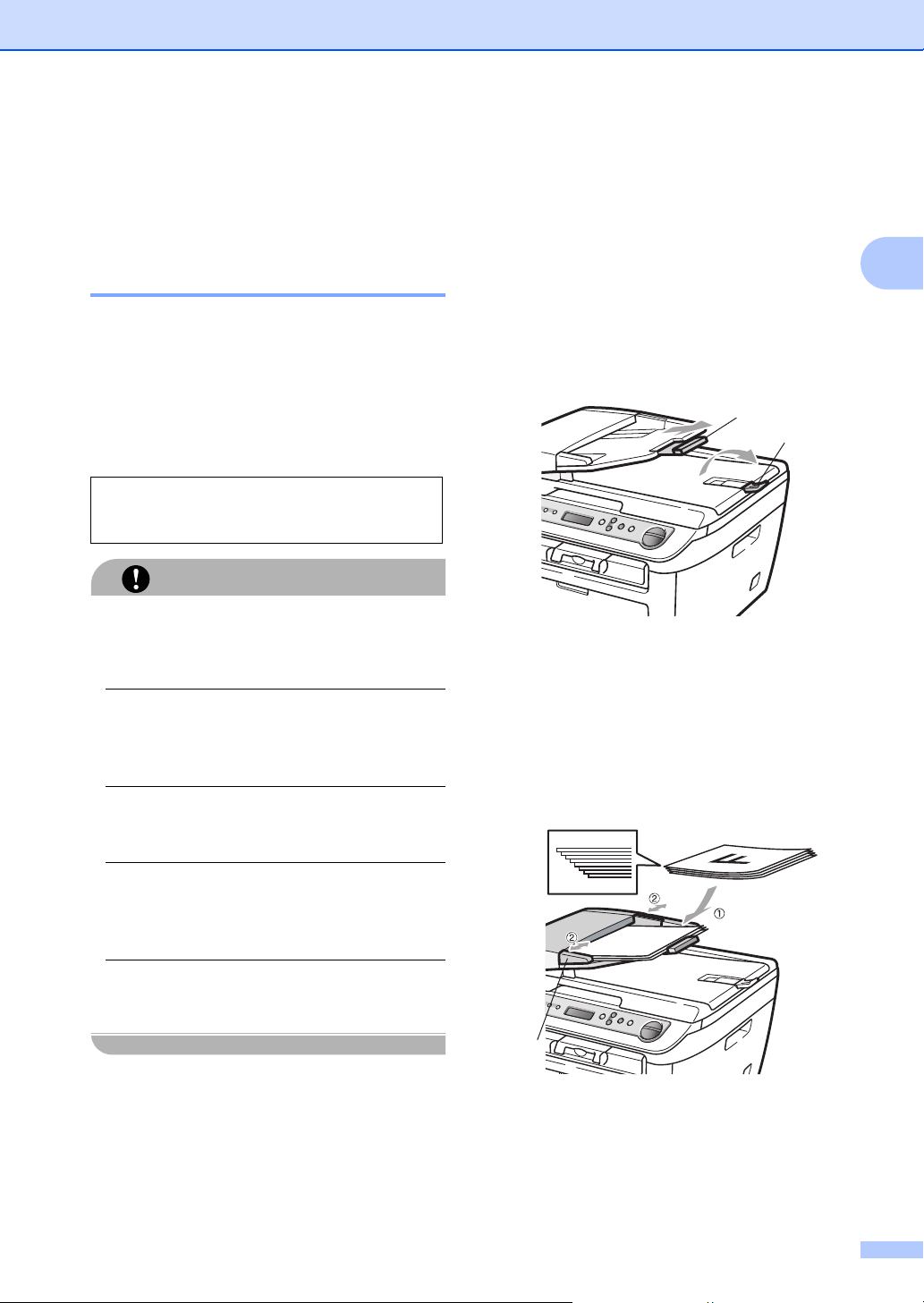
a Unfold the ADF document output
support flap (1) and the ADF support
flap (2).
b Fan the pages well.
c Place your document, face up top edge
first, in the ADF until you feel it touch the
feed roller.
d Adjust the paper guides(1) to fit the
width of your document.
Temperature: 68° F to 86° F (20 to 30° C)
Humidity: 50% - 70%
Paper: Xerox 4200 (20 lb/Letter)
2
1
1
Chapter 2
18
Using the scanner glass 2
You can use the scanner glass to copy or
scan pages of a book or one page at a time.
Documents can be up to 8.5 in. wide and
11.7 in. long (215.9 mm wide and 297 mm
long).
Note
(DCP-7040 only) To use the scanner
glass, the ADF must be empty.
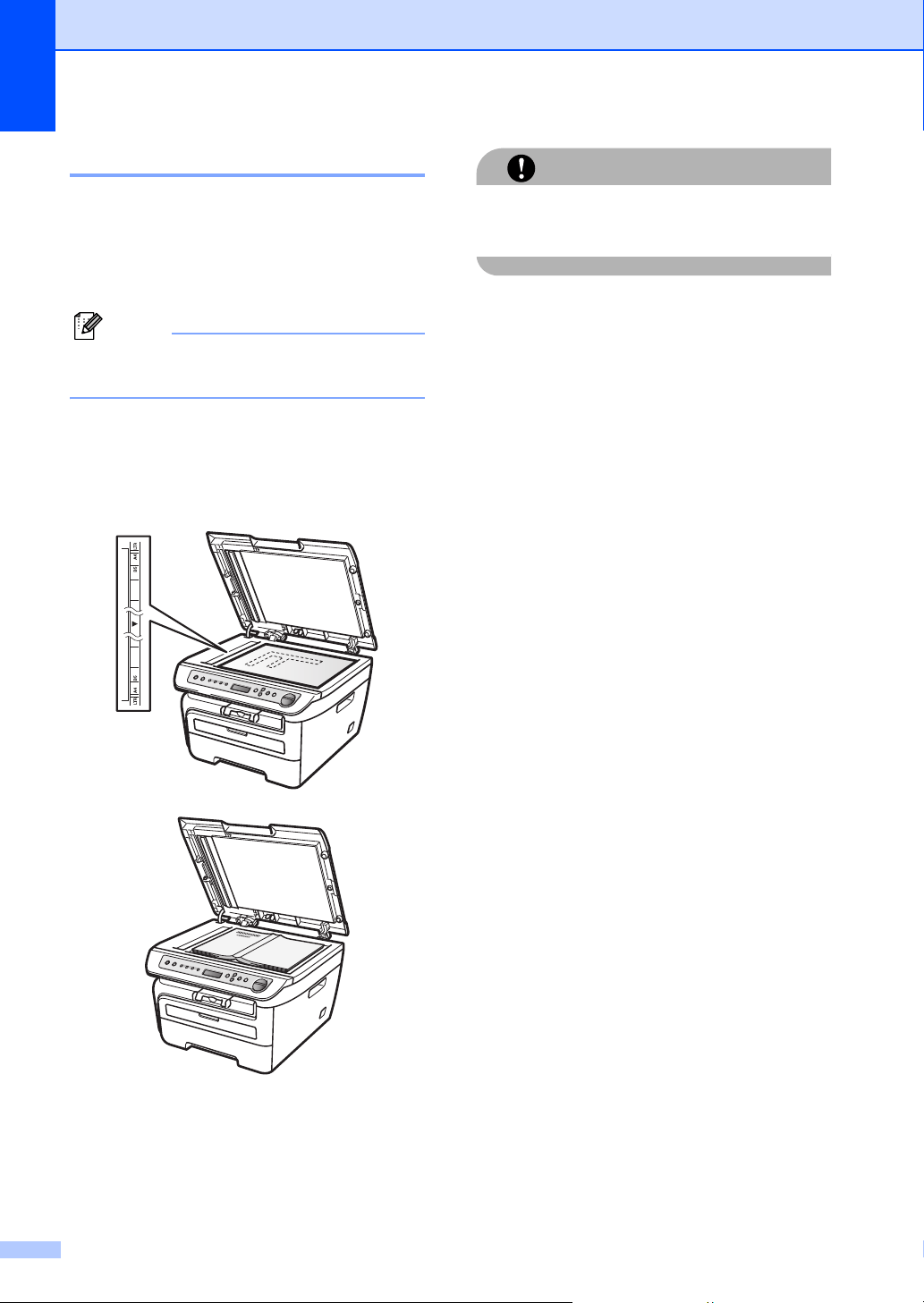
a Lift the document cover.
b Using the document guidelines on the
left, center the document face down on
the scanner glass.
c Close the document cover.
CAUTION
If the document is a book or is thick do not
slam the cover or press on it.

19
3
3
Paper settings 3
Paper type 3
Set up the machine for the type of paper you
are using. This will give you the best print
quality.
a Press Menu.
b Press a or b to choose
1.General Setup.
Press OK.
c Press a or b to choose 1.Paper Type.
General Setup
1.Paper Type
Press OK.
d Press a or b to choose Thin, Plain,
Thick, Thicker, Transparency or
Recycled Paper.
Press OK.
e Press Stop/Exit.
Paper size 3
You can use nine sizes of paper for printing
copies: A4, Letter, Legal, Executive, A5, A6,
B5, B6 and Folio.
When you change the size of paper in the
tray, you will also need to change the setting
for paper size at the same time so your
machine can fit the document on the page.
a Press Menu.
b Press a or b to choose
1.General Setup.
Press OK.
c Press a or b to choose 2.Paper Size.
General Setup
2.Paper Size
Press OK.
d Press a or b to choose A4, Letter,
Legal, Executive, A5, A6, B5, B6 or
Folio.
Press OK.
e Press Stop/Exit.
Note
If you chose Transparency as the paper
type you will only be able to choose
Letter, Legal, Folio or A4 size paper
in Step d.
Volume settings 3
Beeper volume 3
When the beeper is on, the machine will beep
when you press a key, make a mistake. You
can choose a range of volume levels, from
High to Off.
a Press Menu.
b Press a or b to choose
1.General Setup.
Press OK.
c Press a or b to choose 3.Beeper.
General Setup
3.Beeper
Press OK.
d Press a or b to choose Off, Low, Med or
High.
Press OK.
e Press Stop/Exit.
General setup 3

Chapter 3
20
Ecology features 3
Toner save 3
You can save toner using this feature. When
you set toner save to On, print appears
lighter. The default setting is Off.
a Press Menu.
b Press a or b to choose
1.General Setup.
Press OK.
c Press a or b to choose 4.Ecology.
General Setup
4.Ecology
Press OK.
d Press a or b to choose 1.Toner Save.
Press OK.
e Press a or b to choose On or Off.
Press OK.
f Press Stop/Exit.
Note
We do not recommend Toner Save for
printing Photo or Gray Scale images.
Sleep time 3
Setting the sleep time reduces power
consumption by turning off the fuser while the
machine is idle.
You can choose how long the machine must
be idle (from 00 to 99 minutes) before it goes
into sleep mode. When the machine receives
computer data, or makes a copy, the timer will
be reset. The default setting is 05 minutes.
While the machine is in sleep mode the LCD
will display Sleep. When printing or copying
in sleep mode, there will be a short delay
while the fuser warms up.
a Press Menu.
b Press a or b to choose
1.General Setup.
Press OK.
c Press a or b to choose 4.Ecology.
General Setup
4.Ecology
Press OK.
d Press a or b to choose 2.Sleep Time.
Press OK.
e Enter the length of time the machine is
idle before entering sleep mode (00 to
99). Press OK.
f Press Stop/Exit.
Note
To turn off sleep mode, press Start and
Options at the same time in e. Press a or
b to choose Off. Press OK.

General setup
21
3
LCD contrast 3
You can change the contrast to make the
LCD look lighter or darker.
a Press Menu.
b Press a or b to choose
1.General Setup.
Press OK.
c Press a or b to choose
5.LCD Contrast.
General Setup
5.LCD Contrast
Press OK.
d Press a to make the LCD darker. Or,
press b to make the LCD lighter.
Press OK.
e Press Stop/Exit.
User Settings List 3
You can print a list of the settings you
programmed.
a Press Menu.
b Press a or b to choose
1.General Setup.
Press OK.
c Press a or b to choose
6.User Settings.
General Setup
6.User Settings
Press OK.
d Press Start.
e Press Stop/Exit.

Chapter 3
22

24
4
How to copy 4
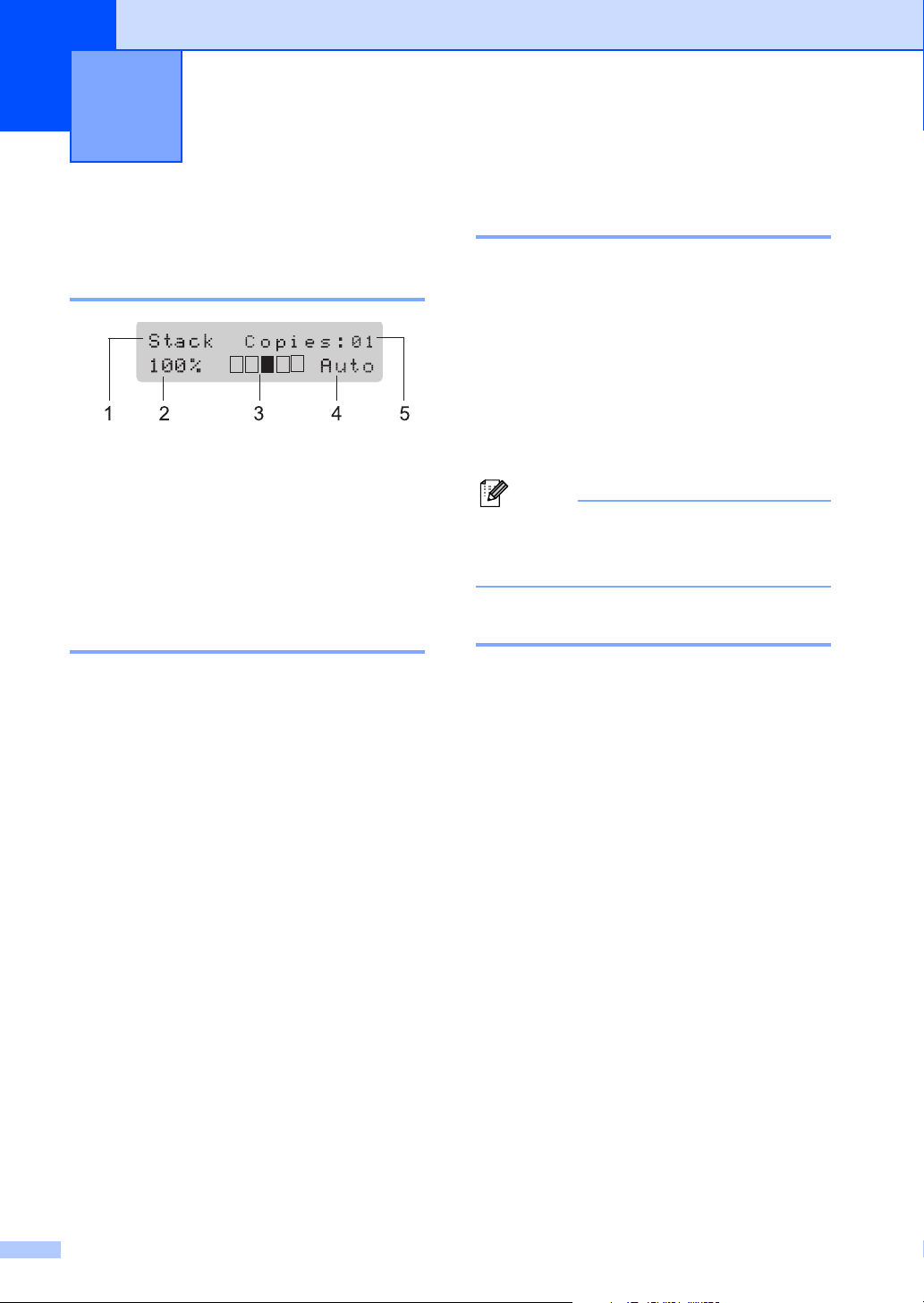
Entering copy mode 4
1 Stack/Sort
1
2 Copy ratio and copy layout
3 Contrast
4Quality
5 Number of copies
1
Sort is only available for the DCP-7040.
Making a single copy 4
a Load your document.
b Press Start.
Making multiple copies 4
a Load your document.
b Do one of the following:
Press Number of Copies to enter
the number of copies (up to 99).
Press or hold a or b to increase or
decrease the number of copies.
c Press Start.
Note
To sort your copies, see Sorting copies
using the ADF (DCP-7040 only)
on page 28.
Stop copying 4
To stop copying, press Stop/Exit.
Making copies 4
Making copies
25
4
Copy options
(temporary settings) 4
When you want to quickly change the copy
settings temporarily for the next copy, use the
temporary Copy keys. You can use different
combinations.
The machine returns to its default settings
one minute after copying.
Enlarging or reducing the
image copied 4
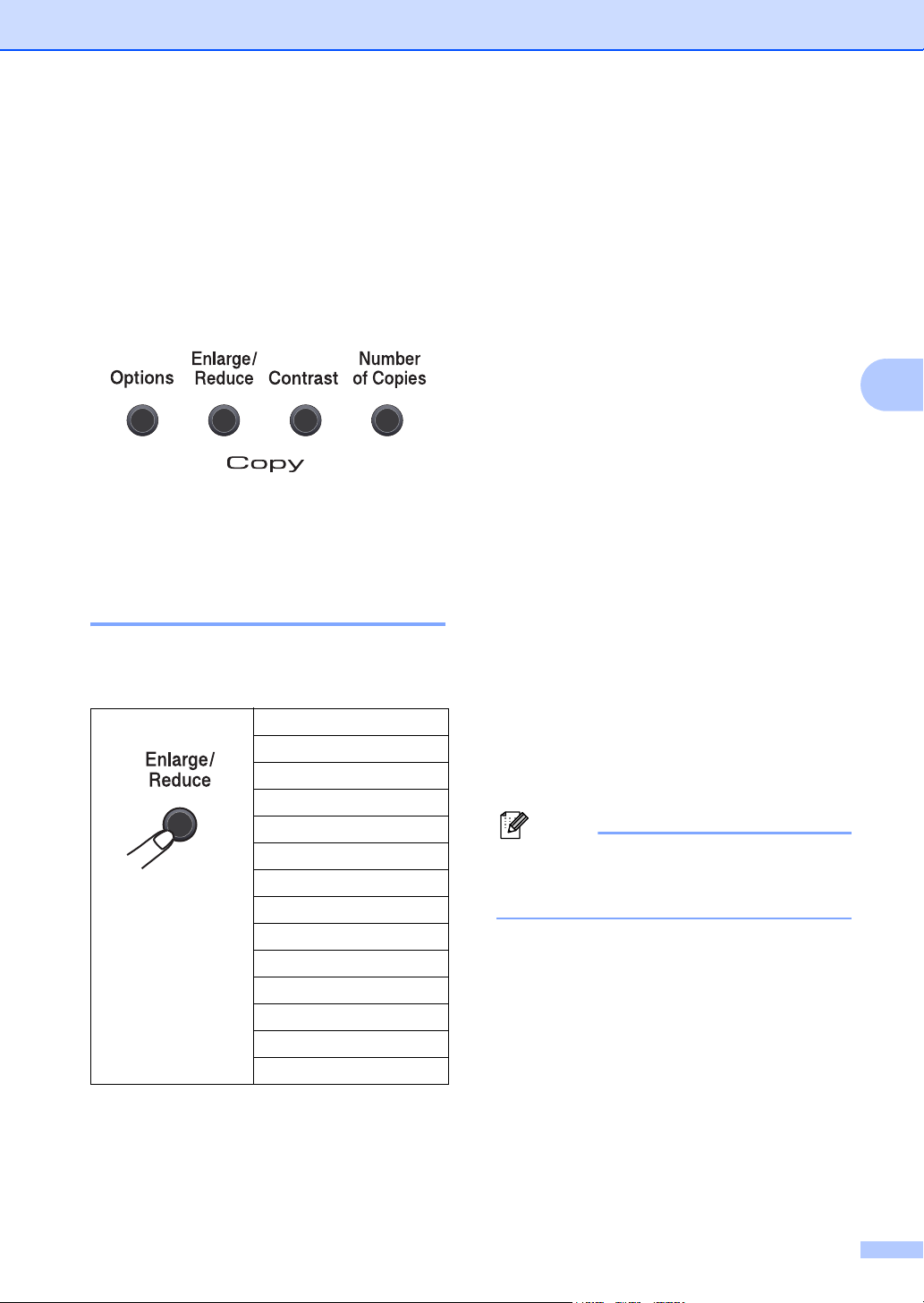
You can choose the following enlargement or
reduction ratios:
*The factory setting is shown in Bold with an
asterisk.
(DCP-7040 only) Auto sets the machine to
calculate the reduction ratio that best fits the
size of paper. Auto is only available when
using the ADF.
Custom(25-400%) allows you to enter a
ratio from 25% to 400%.
To enlarge or reduce the next copy follow the
instructions below:
a Load your document.
b Enter the number of copies you want.
c Press Enlarge/Reduce.
d Do one of the following:
Press a or b to choose the
enlargement or reduction ratio you
want.
Press OK.
Press a or b to choose
Custom(25-400%).
Press OK.
Press a or b to enter an enlargement
or reduction ratio from 25% to 400%.
Press OK.
e Press Start.
Note
Page Layout Options 2 in 1(P), 2 in 1(L), 4
in 1(P) or 4 in 1(L) are not available with
Enlarge/Reduce.
Press
100%*
97% LTRiA4
94% A4iLTR
91% Full Page
85% LTRiEXE
83% LGLiA4
78% LGLiLTR
70% A4iA5
50%
Custom(25-400%)
Auto
200%
141% A5iA4
104% EXEiLTR

Chapter 4
26
Adjusting contrast 4
Contrast 4
Adjust the contrast to help an image look
sharper and more vivid.
To temporarily change the contrast setting,
follow the steps below:
a Load your document.
b Enter the number of copies you want.
c Press Contrast.
d Press a or b to increase or decrease the
contrast.
Press OK.
e Press Start.
To change the default setting follow the steps
below:
a Press Menu.
b Press a or b to choose 2.Copy.
Press OK.
c Press a or b to choose 2.Contrast.
Copy
2.Contrast
Press OK.
d Press a or b to increase or decrease the
contrast.
Press OK.
e Press Stop/Exit.
Making copies
27
4
Using the Options key 4
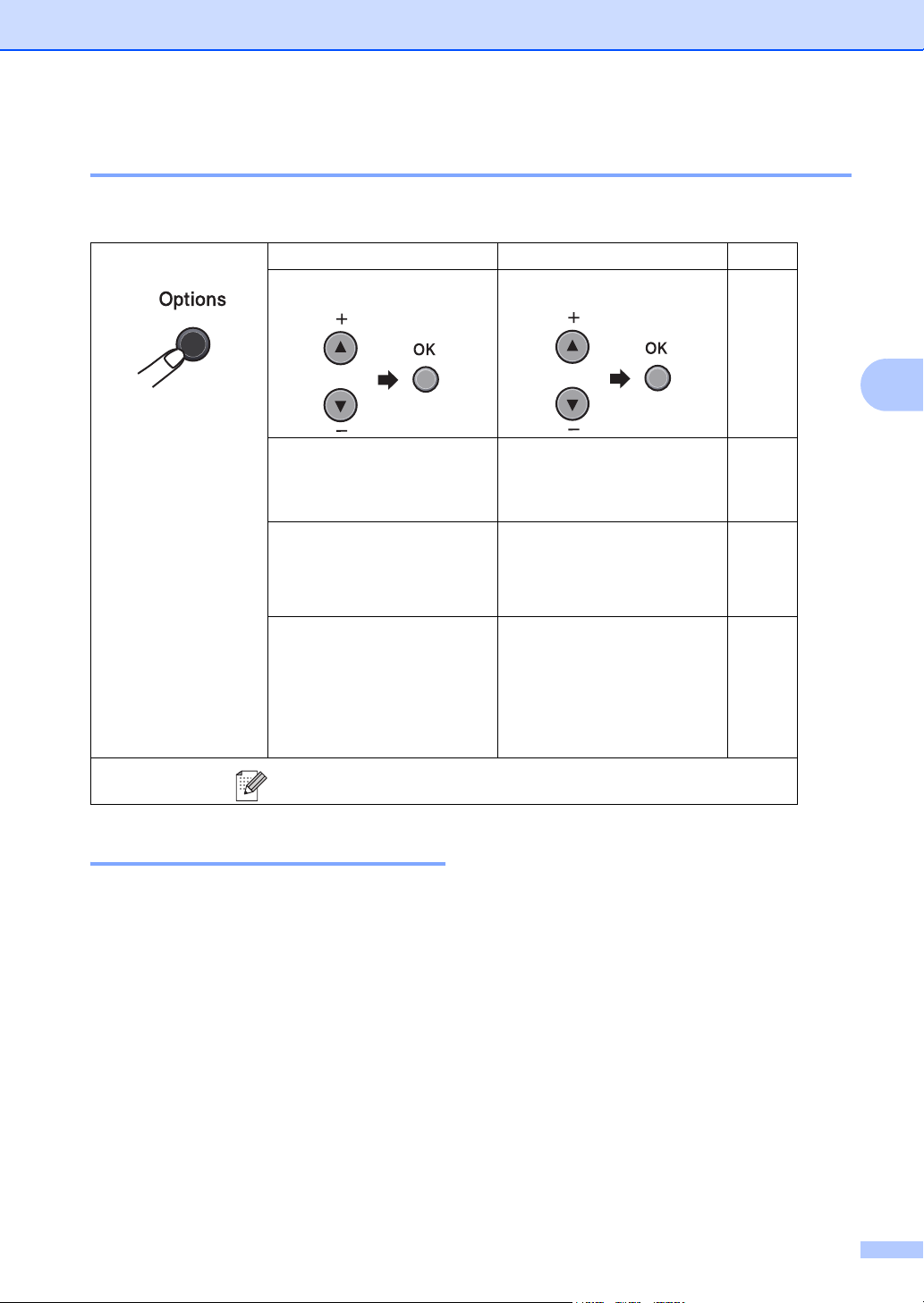
Use the Options key to quickly set the following copy settings temporarily for the next copy.
Improving copy quality 4
You can choose from a range of quality
settings. The default setting is Auto.
Auto
Auto is the recommended mode for
ordinary printouts. Suitable for documents
that contain both text and photographs.
Text
Suitable for documents containing only
text.
Photo
Suitable for copying photographs.
To temporarily change the quality setting,
follow the steps below:
a Load your document.
b Enter the number of copies you want.
c Press Options.
Press a or b to choose Quality.
Press OK.
d Press a or b to choose Auto, Photo or
Text.
Press OK.
e Press Start.
Press
Menu selections Options Page
Press a or b, then press OK
Press a or b, then press OK
Quality Auto*
Photo
Text
27
(DCP-7040 only)
Stack/Sort
(appears when the document
is in the ADF)
Stack*
Sort
28
Page Layout Off(1 in 1)*
2in1(P)
2in1(L)
4in1(P)
4in1(L)
28
The factory settings are shown in Bold with an asterisk.

Chapter 4
28
To change the default setting, follow the
steps below:
a Press Menu.
b Press a or b to choose
2.Copy.
Press OK.
c Press a or b to choose 1.Quality.
Copy
1.Quality
Press OK.
d Press a or b to choose the copy quality.
Press OK.
e Press Stop/Exit.
Sorting copies using the ADF
(DCP-7040 only) 4
You can sort multiple copies. Pages will be
stacked in the order 1 2 3, 1 2 3, 1 2 3, and so
on.
a Load your document in the ADF.
b Enter the number of copies you want.
c Press Options and a or b to choose
Stack/Sort.
Press OK.
d Press a or b to choose Sort.
Press OK.
e Press Start.
Making N in 1 copies
(page layout) 4
You can reduce the amount of paper used
when copying by using the N in 1 copy
feature. This allows you to copy two or four
pages onto one page, which lets you save
paper.
Important 4
Please make sure the paper size is set to
Letter, A4, Legal or Folio.
(P) means Portrait and (L) means
Landscape.
You cannot use the Enlarge/Reduce
setting with the N in 1 feature.
a Load your document.
b Enter the number of copies you want.
c Press Options.
d Press a or b to choose Page Layout.
Press OK.
e Press a or b to choose 2in1(P),
2in1(L), 4in1(P),
4in1(L) or Off(1 in 1).
Press OK.
f Press Start to scan the page.
(DCP-7040 only) If you placed the
document in the ADF, the machine
scans the pages and starts printing.
If you are using the scanner glass, go
to g.
g After the machine scans the page,
press a to scan the next page.
Next Page?
a Yes b No
h Place the next page on the scanner
glass.
Press OK.
Repeat g and h for each page of the
layout.
Making copies
29
4
i After all the pages have been scanned,
press b in h to finish.
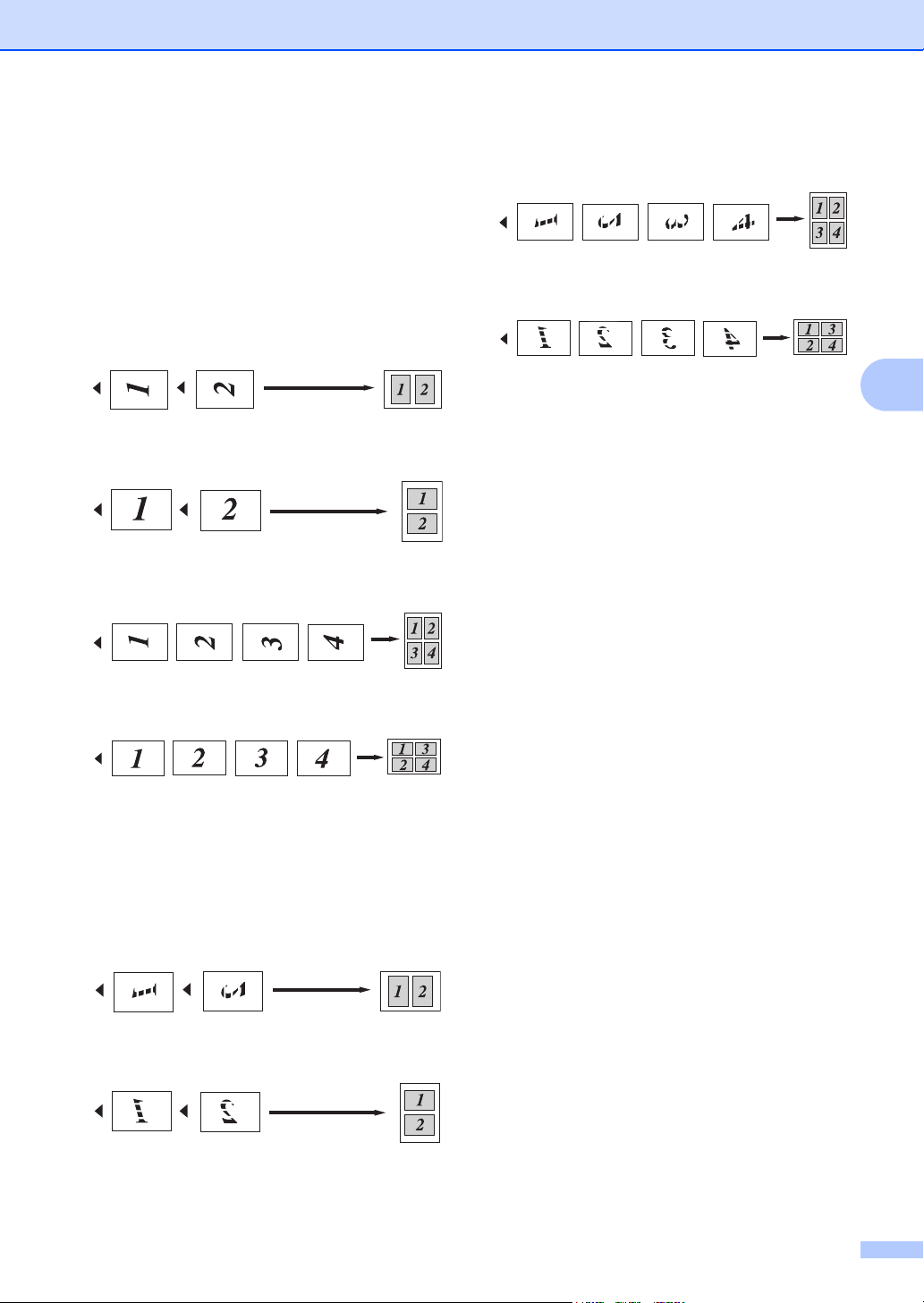
(DCP-7040 only) If you are copying
from the ADF:
4
Insert your document face up in the direction
shown below:
2 in 1 (P)
2 in 1 (L)
4 in 1 (P)
4 in 1 (L)
If you are copying from the scanner
glass:
4
Insert your document face down in the
direction shown below:
2 in 1 (P)
2 in 1 (L)
4 in 1 (P)
4 in 1 (L)
Out of memory
message
4
If the memory becomes full while you are
making copies, the LCD message will guide
you through the next step.
(DCP-7030 only) If you get an
Out of Memory message, press Stop/Exit
to cancel the operation.
(DCP-7040 only) If you get an
Out of Memory message while scanning a
subsequent page, you will have the option to
press Start to copy the pages scanned so far,
or to press Stop/Exit to cancel the operation.

Chapter 4
30

32
5
The User’s Guide on the CD-ROM includes
the Software User’s Guide for features
available when connected to a computer (for
example, printing and scanning). This guide
has easy to use links that, when clicked, will
take you directly to a particular section.
You can find information on these features:
Printing
Scanning
ControlCenter3 (for Windows
®
)
ControlCenter2 (for Macintosh
®
)
Note
See Accessing the Software User’s Guide
on page 3.
How to read HTML
User’s Guide 5
This is a quick reference for using the HTML
User’s Guide.
For Windows
®
5
Note
If you have not installed the software, see
Chapter 1.
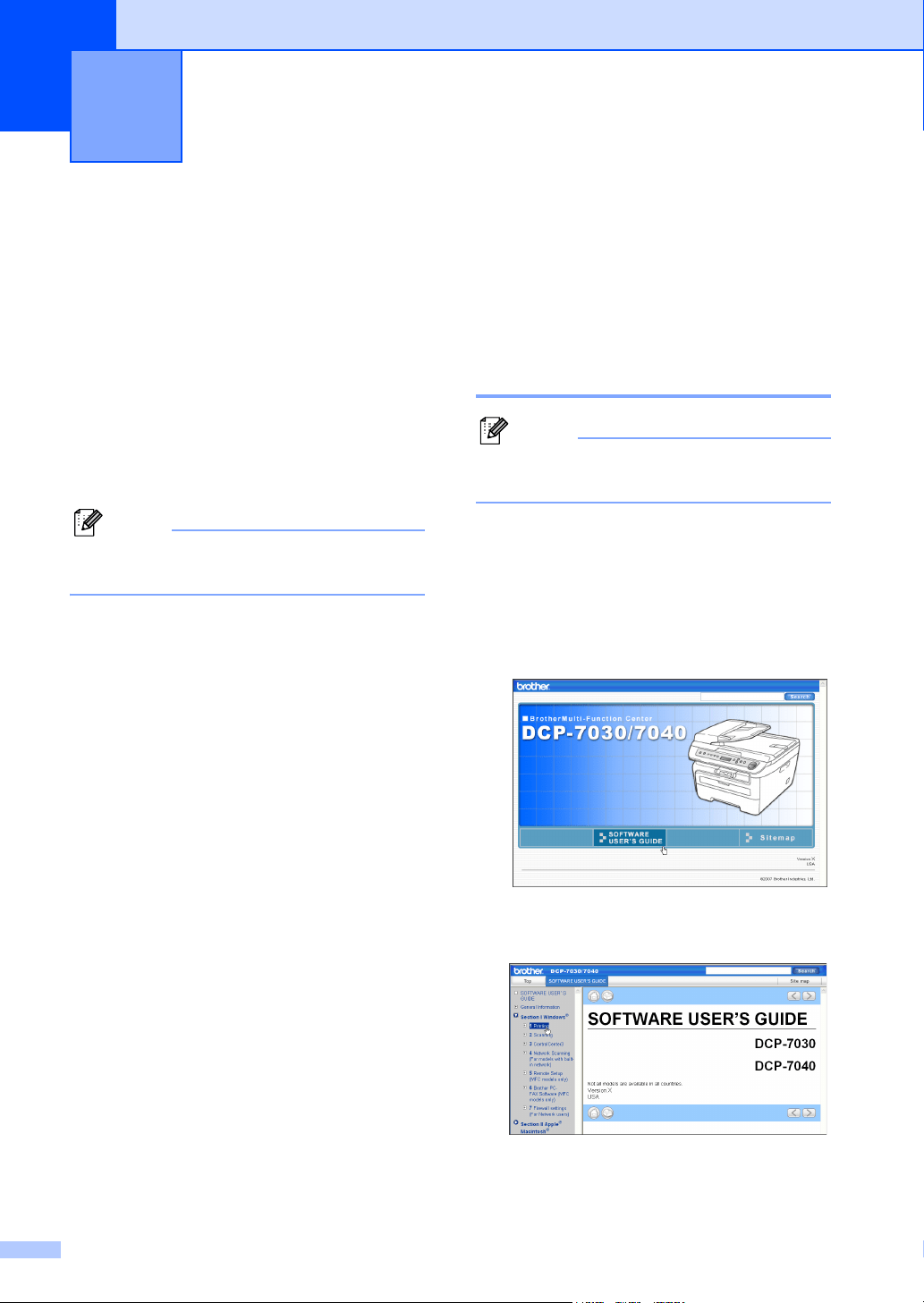
a From the Start menu, point to Brother,
DCP-XXXX from the programs group,
then click User’s Guides in HTML
format.
b Click on SOFTWARE USER’S GUIDE
from the top menu.
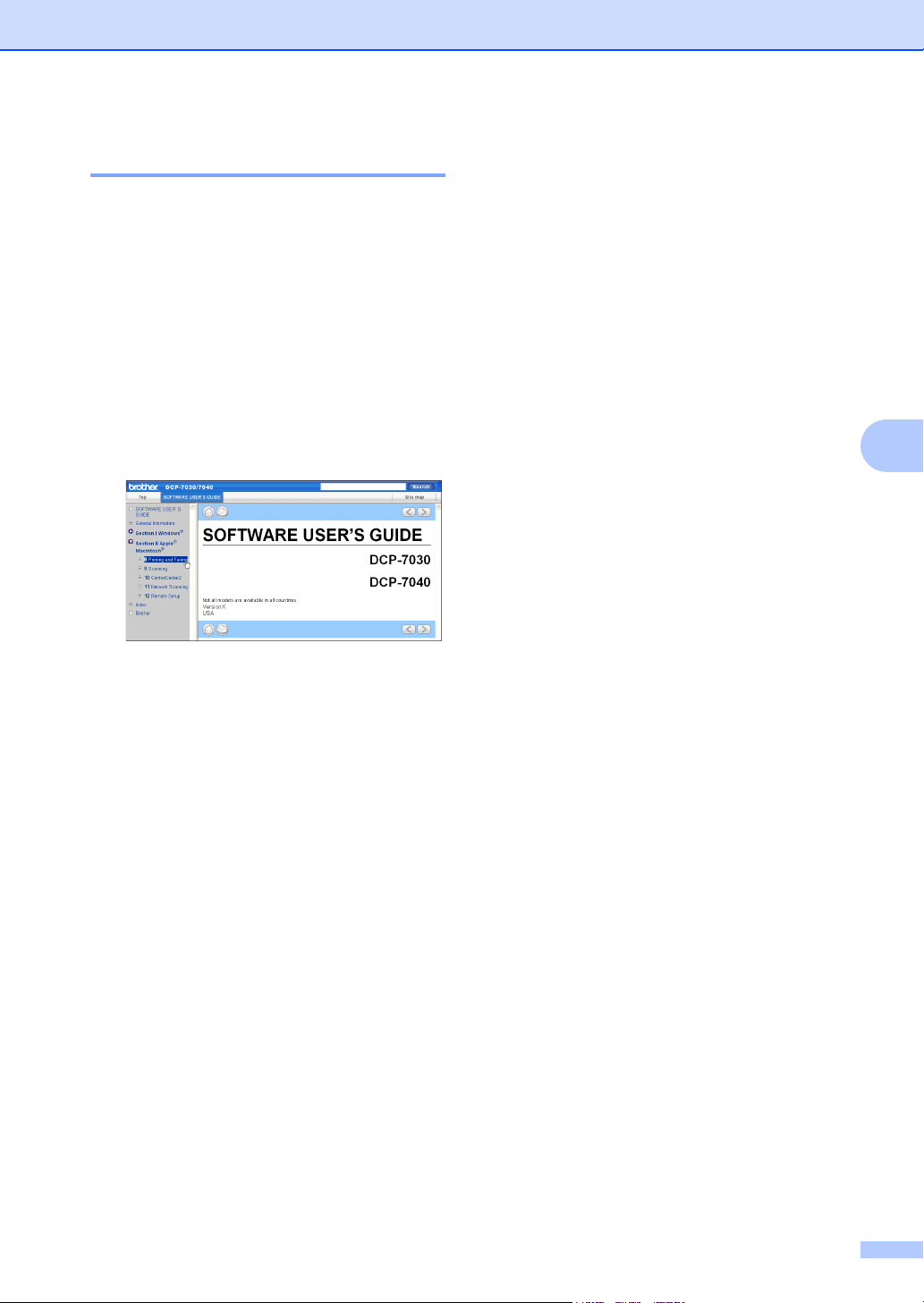
c Click the heading you would like to view
from the list at the left of the window.
Software features 5
Software features
33
5
For Macintosh
®
5
a Make sure your Macintosh
®
is turned
on. Insert the Brother CD-ROM into your
CD-ROM drive.
b Double-click the Documentation icon.
c Double-click your language folder, and
then double-click the top page file.
d Click on SOFTWARE USER’S GUIDE
in the top menu, and then click the
heading you would like to read from the
list at the left of the window.

Chapter 5
34

36
A
Choosing a location A
Place your machine on a flat, stable surface that is free of vibration and shocks. Put the machine
near a standard, grounded AC power outlet. Choose a location where the temperature remains
between 50° F and 90.5° F (10° C and 32.5° C) and the humidity is between 20% to 80% (without
condensation).
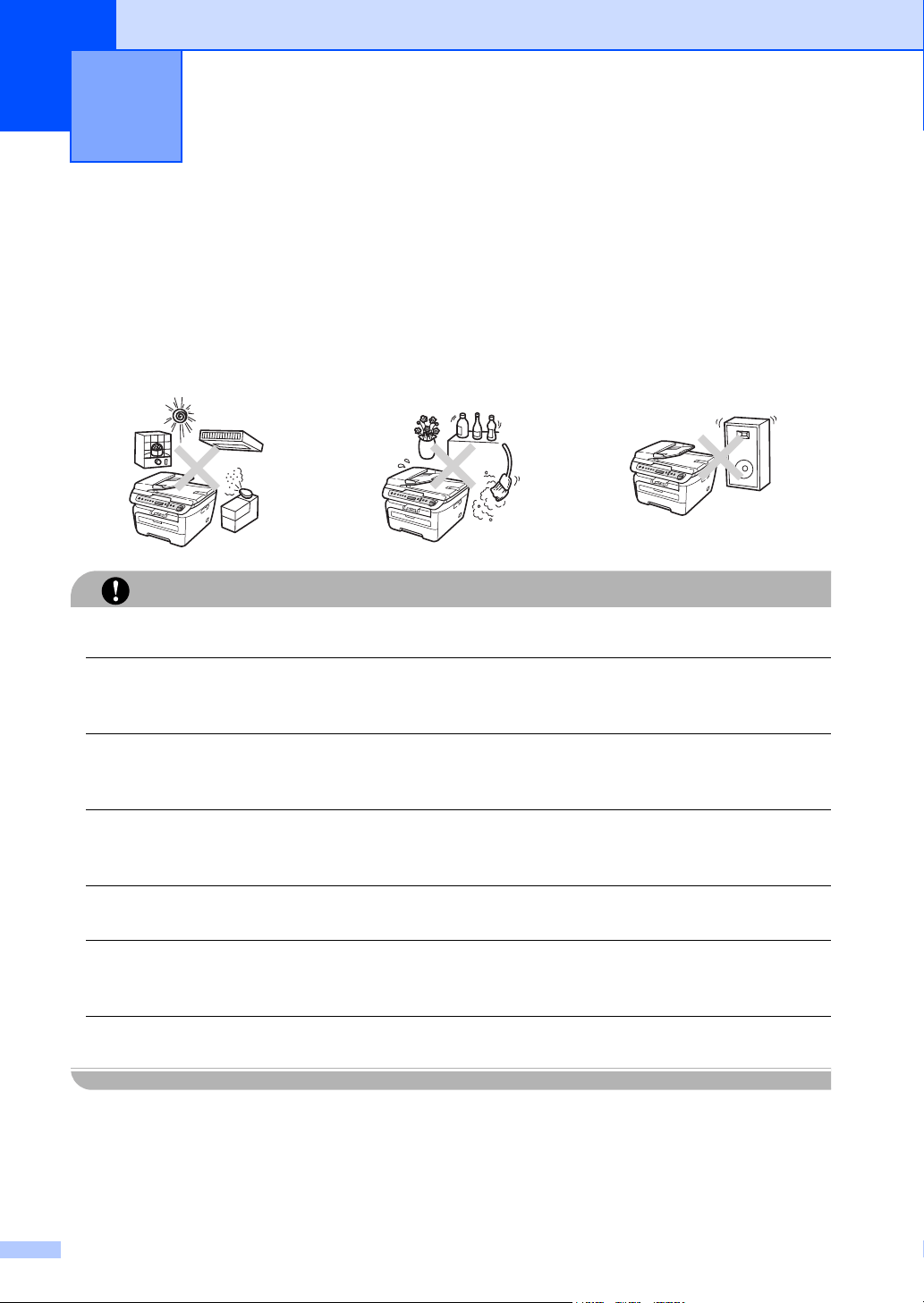
CAUTION
Avoid placing your machine in a high-traffic area.
DO NOT place the machine near heaters, air conditioners, refrigerators, water, chemicals or
devices that contain magnets or generate magnetic fields.
DO NOT expose the machine to direct sunlight, excessive heat, open flames, salty or corrosive
gasses, moisture, or dust.
DO NOT connect your machine to an AC power outlet controlled by wall switches or automatic
timers.
Disruption of power can wipe out information in the machine’s memory.
DO NOT connect your machine to an AC power outlet on the same circuit as large appliances
or other equipment that might disrupt the power supply.
DO NOT put objects on top of the machine.
Safety and legal A
Safety and legal
37
A
To use the machine safely A
Please keep these instructions for later reference and read them before attempting any
maintenance. If you do not follow these safety instructions, there is a possibility of a fire, electrical
shock, burn or suffocation.
WARNING
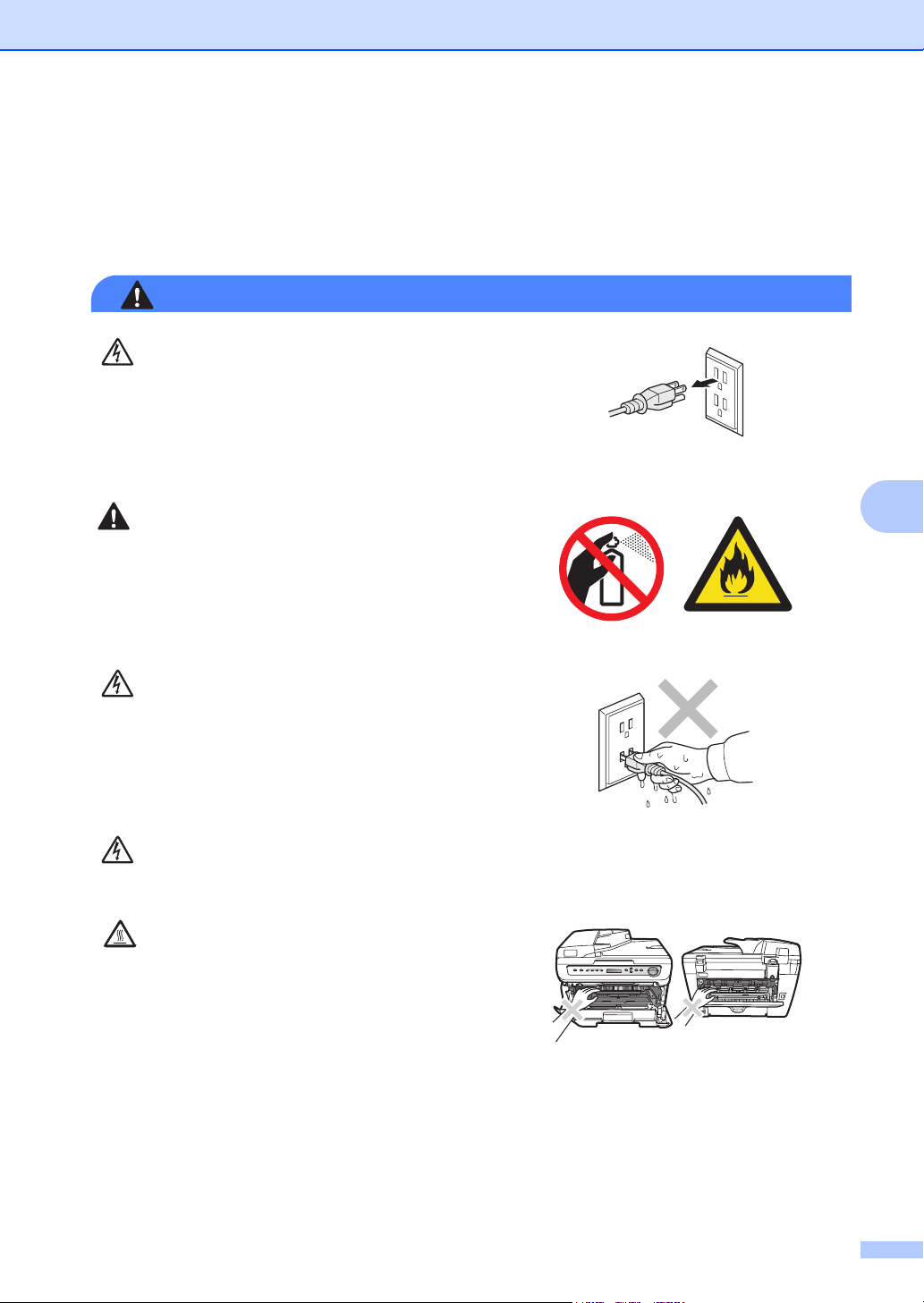
There are high voltage electrodes inside the
machine. Before you clean the inside of the
machine, make sure you have unplugged the
power cord from the AC power outlet (See Routine
maintenance on page 62.)
DO NOT use flammable substances, any type of
spray, or an organic solvent/liquid that contains
alcohol or ammonia to clean the inside or outside
of the machine. Refer to Routine maintenance
on page 62 for how to clean the machine.
DO NOT handle the plug with wet hands. Doing
this might cause an electrical shock.
Always make sure the plug is fully inserted.
After you have just used the machine, some
internal parts of the machine will be extremely hot.
When you open the front or back cover of the
machine, DO NOT touch the shaded parts shown
in the illustration.
38
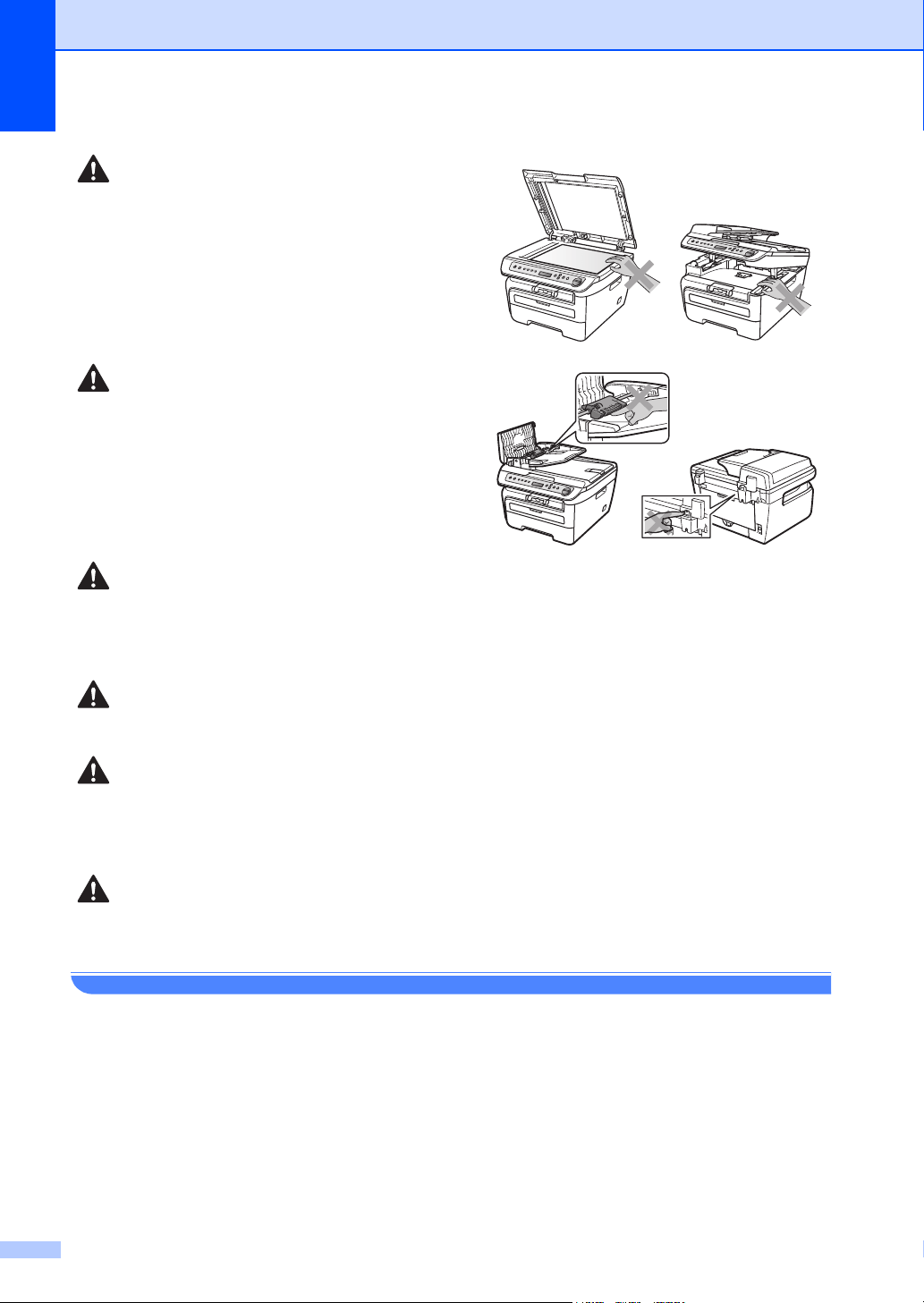
To prevent injuries, be careful not to put your
hands on the edge of the machine under the
document cover or scanner cover.
(DCP-7040 only) To prevent injuries, be careful not
to put your fingers in the area shown in the
illustration.
DO NOT use a vacuum cleaner to clean up scattered toner. Doing this might cause the toner
dust to ignite inside the vacuum cleaner, potentially starting a fire. Please carefully clean the
toner dust with a dry, lint-free cloth and dispose of it according to local regulations.
When you move the machine, grasp the side hand holds that are under the scanner.
This product must be installed near an AC power outlet that is easily accessible. In case of an
emergency, you must disconnect the power cord from the AC power outlet to shut off the power
completely.
Plastic bags are used in the packaging of your machine and drum unit. To avoid the danger of
suffocation, keep these bags away from babies and children.
Safety and legal
39
A
CAUTION
Lightning and power surges can damage this product! We recommend that you use a quality
surge protection device on the AC power line or unplug the cords during a lightning storm.
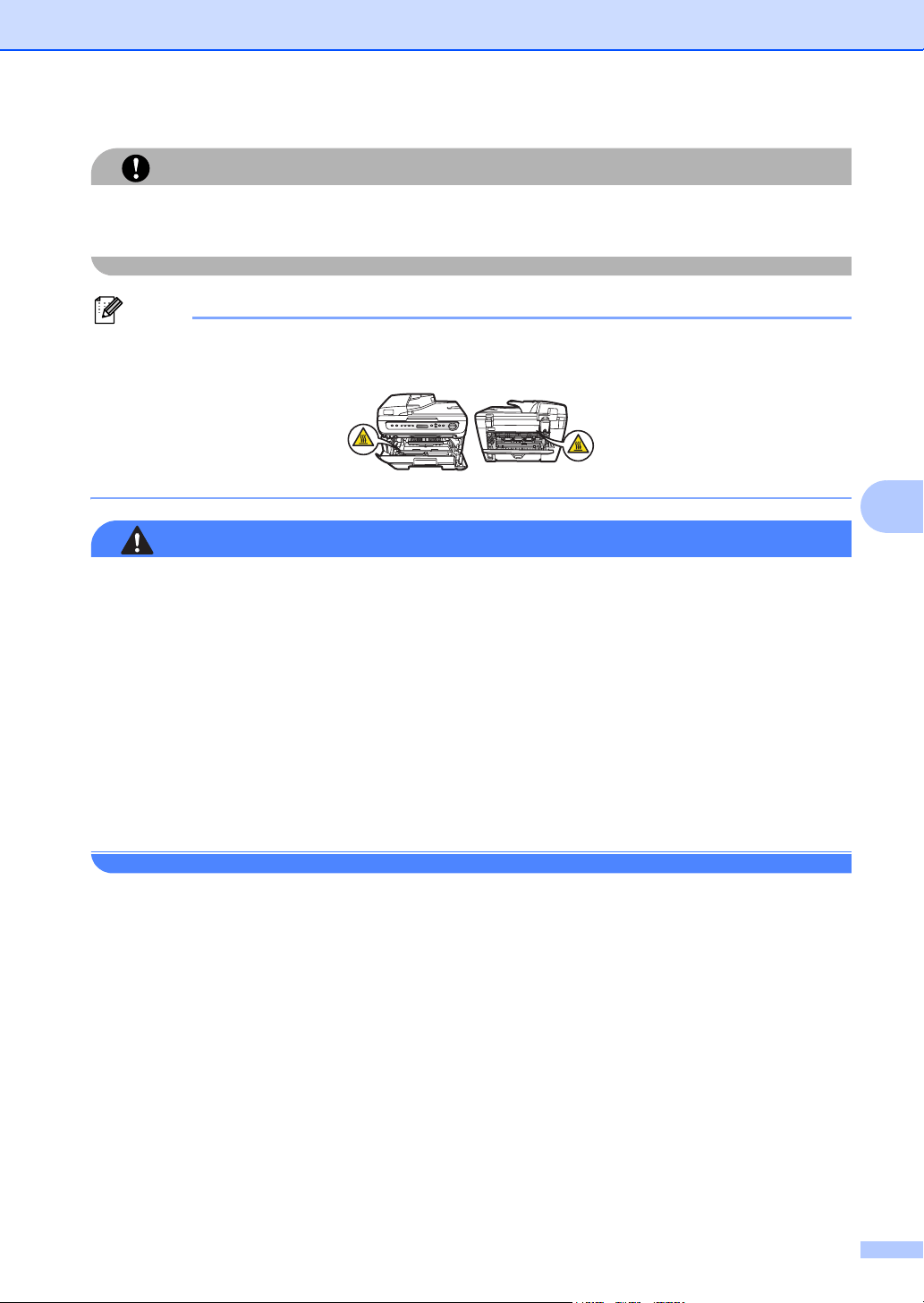
Note
The fuser unit is marked with a Caution label. Please DO NOT remove or damage the label.
WARNING
IMPORTANT SAFETY INSTRUCTIONS
When using your equipment, basic safety precautions should always be followed to reduce the
risk of fire, electric shock and injury to people, including the following:
1 DO NOT use this product near water, for example, near a bath tub, wash bowl, kitchen sink,
washing machine, or in a wet basement or near a swimming pool.
2 Avoid using this product during an electrical storm. There may be a remote risk of electric
shock from lightning.
3 DO NOT use this product to report a gas leak in the vicinity of the leak.
4 Use only the power cord provided with the machine.
SAVE THESE INSTRUCTIONS

40
Important information A
Federal Communications Commission (FCC) Declaration of
Conformity (USA only) A
declares, that the products
Product Name: DCP-7030 and DCP-7040
comply with Part 15 of the FCC Rules. Operation is subject to the following two conditions: (1) This
device may not cause harmful interference, and (2) this device must accept any interference
received, including interference that may cause undesired operation.
This equipment has been tested and found to comply with the limits for a Class B digital device,
pursuant to Part 15 of the FCC Rules. These limits are designed to provide reasonable protection
against harmful interference in a residential installation. This equipment generates, uses, and can
radiate radio frequency
and, if not installed and used in accordance with the instructions, may cause harmful interference
to radio communications. However, there is no guarantee that interference will not occur in a
particular installation. If this equipment does cause harmful interference to radio or television
reception, which can be determined by turning the equipment off and on, the user is encouraged
to try to correct the interference by one or more of the following measures:
Reorient or relocate the receiving antenna.
Increase the separation between the equipment and receiver.
Connect the equipment into an outlet on a circuit different from that to which the receiver is
connected.
Call the dealer or an experienced radio/TV technician for help.
Important A
Changes or modifications not expressly approved by Brother Industries, Ltd. could void the user’s
authority to operate the equipment.
Important—about the interface cable A
A shielded interface cable should be used to ensure compliance with the limits for a Class B digital
device.
Responsible Party: Brother International Corporation
100 Somerset Corporate Boulevard
Bridgewater, NJ 08807-0911 USA
TEL: (908) 704-1700

Safety and legal
41
A
Industry Canada Compliance Statement (Canada only) A
This Class B digital apparatus complies with Canadian ICES–003.
Cet appareil numérique de la classe B est conforme à la norme NMB–003 du Canada.
Disconnect device A
This product must be installed near an AC power outlet that is easily accessible. In case of
emergencies, you must disconnect the power cord from the AC power outlet to shut off power
completely.
International ENERGY STAR
®
Compliance Statement A
The purpose of the International ENERGY STAR
®
Program is to promote the development and
popularization of energy-efficient office equipment.
As an ENERGY STAR
®
Partner, Brother Industries, Ltd. has determined that this product meets
the ENERGY STAR
®
guidelines for energy efficiency.
Laser safety A
This equipment is certified as a Class 1 laser product as defined in IEC 60825-1+A2: 2001 under
the U.S. Department of Health and Human Services (DHHS) Radiation Performance Standard
according to the Radiation Control for Health and Safety Act of 1968. This means that the
equipment does not produce hazardous laser radiation.
Since radiation emitted inside the equipment is completely confined within protective housings
and external covers, the laser beam cannot escape from the machine during any phase of user
operation.

42
FDA regulations A
U.S. Food and Drug Administration (FDA) has implemented regulations for laser products
manufactured on and after August 2, 1976. Compliance is mandatory for products marketed in the
United States. One of the following labels on the back of the machine indicates compliance with
the FDA regulations and must be attached to laser products marketed in the United States.
WARNING
Use of controls, adjustments or performance of procedures other than those specified in this
manual may result in hazardous invisible radiation exposure.
Internal laser radiation
Max. Radiation Power: 10 mW
Wave Length: 780 – 800 nm
Laser Class: Class 3B
Important safety instructions A
1 Read all of these instructions.
2 Save them for later reference.
3 Follow all warnings and instructions marked on the product.
4 Unplug this product from the wall outlet before cleaning inside of the machine. DO NOT use
liquid or aerosol cleaners. Use a damp cloth for cleaning.
5 DO NOT place this product on an unstable cart, stand, or table. The product may fall, causing
serious damage to the product.
6 Slots and openings in the cabinet at the back or bottom are provided for ventilation. To ensure
reliable operation of the product and to protect it from overheating, these openings must not
be blocked or covered. The openings should never be blocked by placing the product on a bed,
sofa, rug, or other similar surface. This product should never be placed near or over a radiator
or heater. This product should never be placed in a built-in installation unless proper ventilation
is provided.
7 This product should be connected to an AC power source within the range indicated on the
rating label. DO NOT connect it to a DC power source or inverter. If you are not sure, contact
a qualified electrician.
Manufactured:
Brother Industries (Vietnam) Ltd.
Phuc Dien Industrial Zone Cam Phuc Commune, Cam giang Dist Hai Duong Province, Vietnam.
This product complies with FDA performance standards for laser products except for deviations pursuant
to Laser Notice No. 50, dated June 24, 2007.
Manufactured:
BROTHER TECHNOLOGY (SHENZHEN) LTD.
NO6 Gold Garden Ind., Nanling Buji, Longgang, Shenzhen, China
This product complies with FDA performance standards for laser products except for deviations pursuant
to Laser Notice No. 50, dated June 24, 2007.

Safety and legal
43
A
8 This product is equipped with a 3-wire grounded plug. This plug will only fit into a grounded
power outlet. This is a safety feature. If you are unable to insert the plug into the outlet, call
your electrician to replace your obsolete outlet. DO NOT defeat the purpose of the grounded
plug.
9 Use only the power cord supplied with this machine.
10 DO NOT allow anything to rest on the power cord. DO NOT place this product where people
can walk on the cord.
11 If an extension cord is used with this product, make sure that the total ampere ratings on the
products plugged into the extension cord DO NOT exceed the extension cord ampere rating.
Also, make sure that the total of all products plugged into the AC power outlet does not exceed
15 amperes (US only).
12 The power cord, including extensions, should be no longer than 16.5 feet (5 meters).
DO NOT share the same power circuit with other high powered appliances such as an air
conditioner, copier, shredder, and so on. If you cannot avoid using the printer with these
appliances, we recommend that you use a voltage transformer or a high-frequency noise filter.
Use a voltage regulator if the power source is not stable.
13 DO NOT place anything in front of the machine that will block printed pages. DO NOT place
anything in the path of printed pages.
14 Wait until pages have exited the machine before picking them up.
15 Never push objects of any kind into this product through cabinet slots, since they may touch
dangerous voltage points or short out parts resulting in the risk of fire or electric shock. Never
spill liquid of any kind on the product. DO NOT attempt to service this product yourself because
opening or removing covers may expose you to dangerous voltage points and other risks and
may void your warranty. Refer all servicing to a Brother Authorized Service Center. For the
location of your nearest Brother Authorized Service Center, please call:
In USA: 1-877-BROTHER (1-877-276-8437)
In Canada: 1-877-BROTHER
16 Unplug this product from the AC power outlet and refer all servicing to Brother Authorized
Service Personnel under the following conditions:
When the power cord is damaged or frayed.
If liquid has been spilled into the product.
If the product has been exposed to rain or water.
If the product does not operate normally when the operating instructions are followed.
Adjust only those controls that are covered by the operating instructions. Improper
adjustment of other controls may result in damage and will often require extensive work by
a qualified technician to restore the product to normal operation.
If the product has been dropped or the cabinet has been damaged.
If the product exhibits a distinct change in performance, indicating a need for service.
17 To protect your product against power surges, we recommend the use of a power protection
device (Surge Protector).

44
18 To reduce the risk of fire, electric shock and injury to people, note the following:
DO NOT use this product near appliances that use water, a swimming pool or in a wet
basement.
DO NOT use the machine during an electrical storm (there is the remote possibility of an
electrical shock).

Safety and legal
45
A
Trademarks A
The Brother logo is a registered trademark of Brother Industries, Ltd.
Brother is a registered trademark of Brother Industries, Ltd.
Multi-Function Link is a registered trademark of Brother International Corporation.
Windows Vista is either a registered trademark or a trademark of Microsoft Corporation in the
United States and other countries.
Microsoft, Windows and Windows Server are registered trademarks of Microsoft Corporation in
the United States and/or other countries.
Macintosh and TrueType are registered trademarks of Apple Inc.
Nuance, the Nuance logo, PaperPort and ScanSoft are trademarks or registered trademarks of
Nuance Communications, Inc. or its affiliates in the United States and/or other countries.
Presto! PageManager is a registered trademark of NewSoft Technology Corporation.
Java and all Java-based trademarks and logos are trademarks or registered trademarks of Sun
Microsystems, Inc. in the United States and other countries.
Each company whose software title is mentioned in this manual has a Software License
Agreement specific to its proprietary programs.
All other brand and product names mentioned in this User’s Guide are registered
trademarks of their respective companies.

46
B
Troubleshooting B
IMPORTANT
For technical help, you must call the country where you bought the machine. Calls must be
made from within that country.
If you are having difficulty with your machine B
If you think there is a problem, check the chart below and follow the troubleshooting tips. You can
solve most problems by yourself.
If you need additional help, the Brother Solutions Center offers the latest FAQs and
troubleshooting tips.
Visit us at http://solutions.brother.com/
.
Troubleshooting and routine
maintenance
B
Copy quality difficulties
Difficulties Suggestions
Vertical black line appears in
copies.
Black vertical lines on copies are typically caused by dirt or correction fluid on the
glass strip (DCP-7040 only) , or the corona wire for printing is dirty. (See Cleaning
the scanner glass on page 63 and Cleaning the corona wire on page 66.)

Troubleshooting and routine maintenance
47
B
Printing difficulties
Difficulties Suggestions
No printout. Check that the machine is plugged in and the power switch is turned on.
Check that the toner cartridge and drum unit are installed properly. (See
Replacing the drum unit on page 74.)
Check the interface cable connection on both the machine and your computer.
(See the Quick Setup Guide.)
Check that the correct printer driver has been installed and chosen.
Check to see if the LCD is showing an error message. (See Error and
maintenance messages on page 55.)
Check that machine is online:
(For Windows Vista
®
)
Click the Start button, Control Panel, Hardware and Sound, and then
Printers. Right-click Brother DCP-XXXX Printer. Make sure that Use Printer
Offline is unchecked.
(For Windows
®
XP and Windows Server
®
2003)
Click the Start button and choose Printers. Right-click Brother DCP-XXXX
Printer. Make sure that Use Printer Offline is unchecked.
(For Windows
®
2000)
Click the Start button and choose Settings and then Printers. Right-click
Brother DCP-XXXX Printer. Make sure that Use Printer Offline is
unchecked.
The machine prints unexpectedly
or it prints garbage.
Pull out the paper tray and wait until the machine stops printing. Then turn off
the machine’s power switch and disconnect from the power for several
minutes.
Check the settings in your application to make sure it is set up to work with
your machine.
The machine prints the first couple
of pages correctly, then some
pages have text missing.
Check the settings in your application to make sure that it is set up to work with
your machine.
Your computer is not recognizing the machine’s input buffer’s full signal. Make
sure that you connected the interface cable correctly. (See the Quick Setup
Guide.)
The headers or footers appear
when the document displays on the
screen but they do not show up
when it is printed.
There is an unprintable area on the top and bottom of the page. Adjust the top and
bottom margins in your document to allow for this.
Scanning difficulties
Difficulties Suggestions
TWAIN errors appear while
scanning.
Make sure that the Brother TWAIN driver is chosen as the primary source. In
PaperPort™ 11SE, click File, Scan or Get Photo and choose the Brother
TWAIN driver.
OCR does not work Try increasing the scanning resolution.
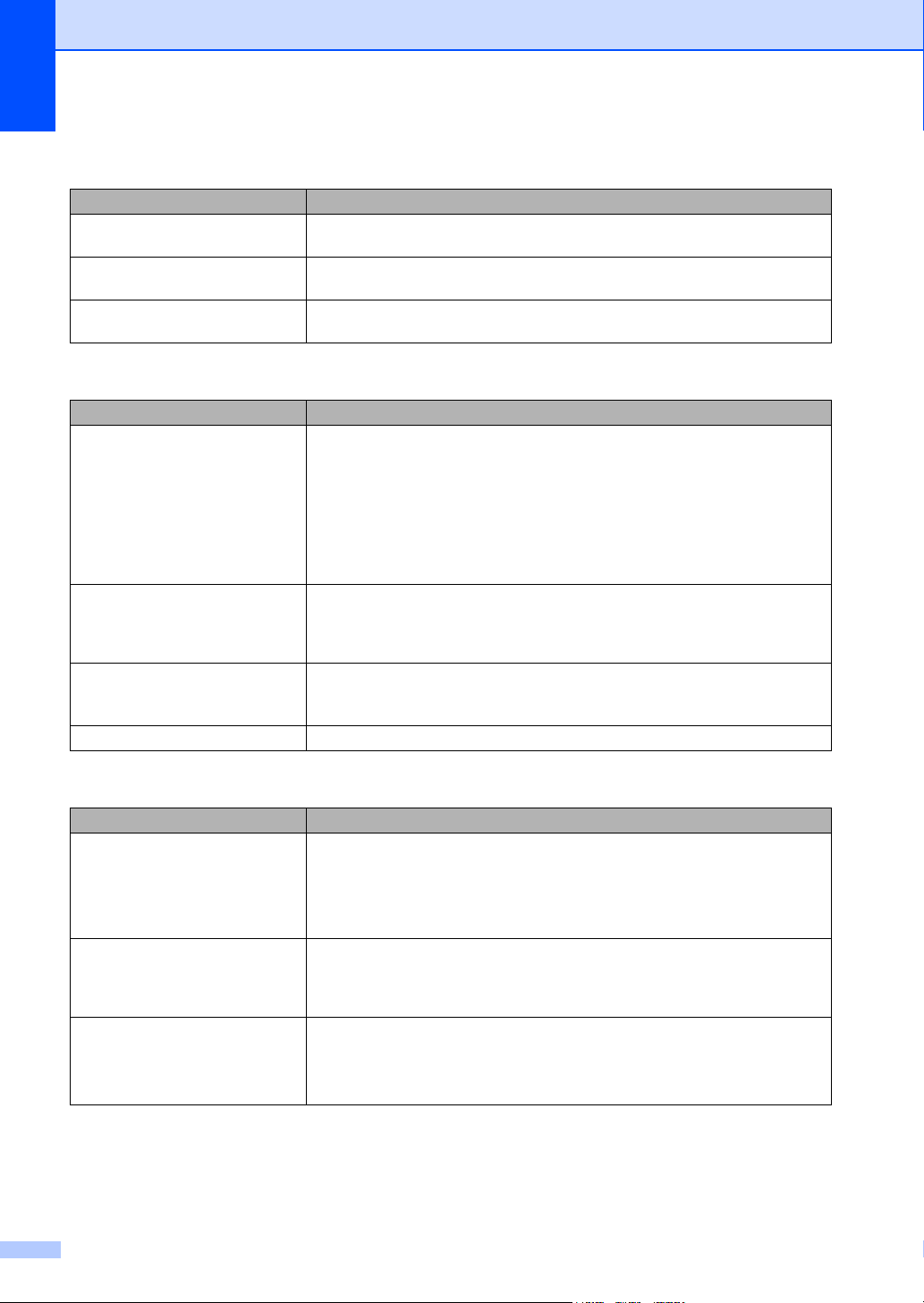
48
Software difficulties
Difficulties Suggestions
Cannot install software or print. Run the Repair MFL-Pro Suite program on the CD-ROM. This program will repair
and reinstall the software.
Cannot perform ‘2 in 1’ or ‘4 in 1’
printing.
Check that the paper size setting in the application and in the printer driver are the
same.
The machine does not print from
Adobe Illustrator.
Try to reduce the print resolution. (See Advanced tab in the Software User’s Guide
on the CD-ROM.)
Paper handling difficulties
Difficulties Suggestions
The machine does not load paper.
The LCD shows No Paper or a
Paper Jam message.
If there is no paper, load a new stack of paper into the paper tray.
If there is paper in the paper tray, make sure it is straight. If the paper is curled,
you should straighten it. Sometimes it is helpful to remove the paper, turn the
stack over and put it back into the paper tray.
Reduce the amount of paper in the paper tray, and then try again.
If the LCD shows Paper Jam message and you still have a problem, see
Paper jams on page 58.
How do I print on envelopes?
You can load envelopes from the manual feed slot. Your application must be set
up to print the envelope size you are using. This is usually done in the Page Setup
or Document Setup menu of your application. (See your application’s manual for
more information.)
Which paper can I use?
You can use plain paper, recycled paper, transparency and labels that are made
for laser machines. (For details, see Acceptable paper and other print media
on page 12.)
There is a paper jam. (See Paper jams on page 58.)
Print quality difficulties
Difficulties Suggestions
Printed pages are curled. Low quality thin or thick paper or not printing on the recommended side of the
paper could cause this problem. Try turning over the stack of paper in the
paper tray.
Make sure that you choose the Paper Type that suits the print media type you
are using. (See Acceptable paper and other print media on page 12.)
Printed pages are smeared. The Paper Type setting may be incorrect for the type of print media you are using,
or the print media may be too thick or have a rough surface. (See Acceptable
paper and other print media on page 12 and Basic tab in the Software User’s
Guide on the CD-ROM.)
Printouts are too light. If this problem occurs when making copies or printing, turn Toner Save mode
to off in the machine menu settings. (See Toner save on page 20.)
Set Toner Save mode to off in the Advanced tab in the printer driver. (See
Advanced tab in the Software User’s Guide on the CD-ROM.)
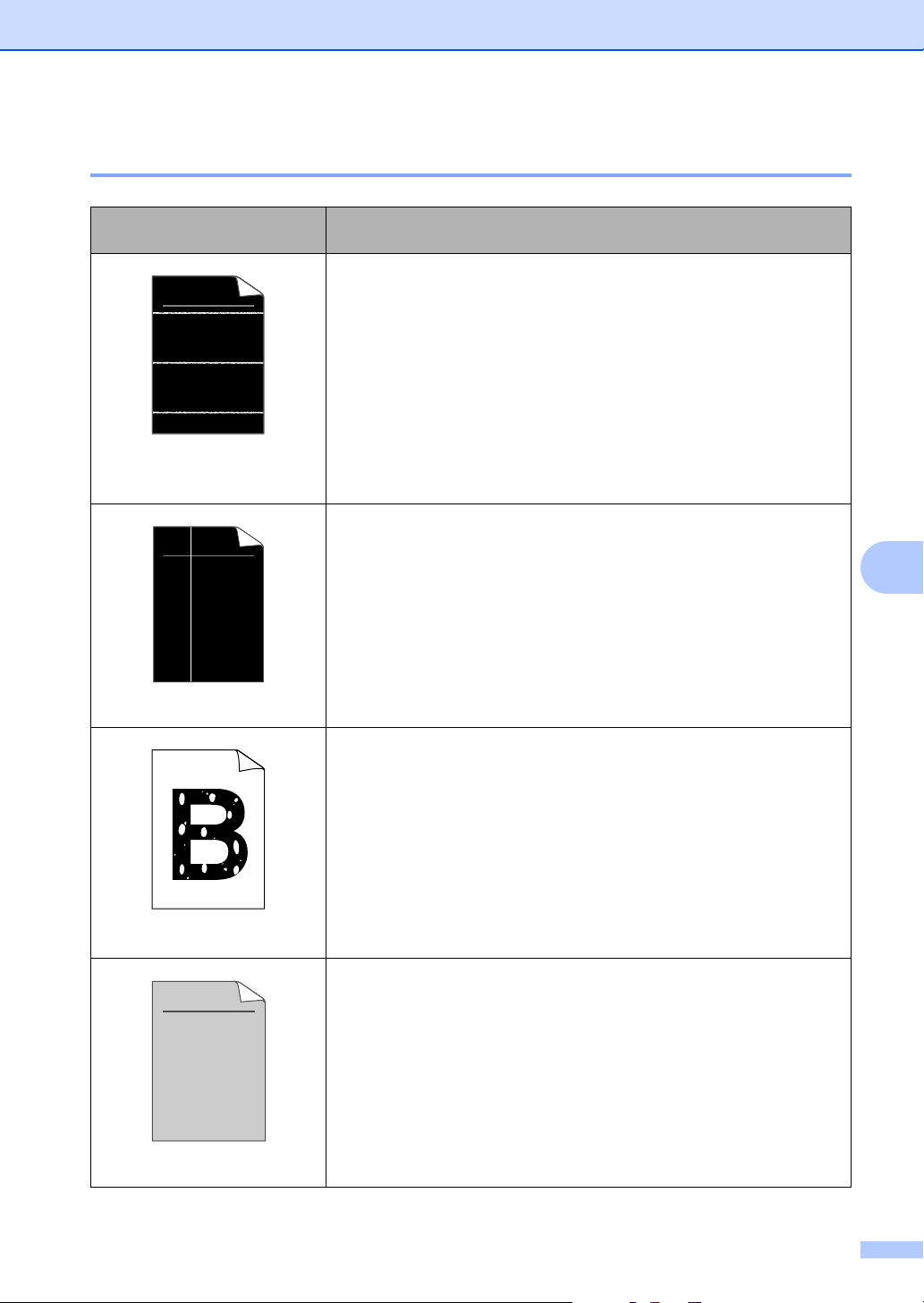
Troubleshooting and routine maintenance
49
B
Improving the print quality B
Examples of poor print
quality
Recommendation
White lines across the page
Make sure that you use paper that meets our specifications. A rough
surfaced paper or thick print media can cause the problem. (See
Acceptable paper and other print media on page 12.)
Make sure that you choose the appropriate media type in the printer
driver or in the machine’s Paper Type menu setting. (See Acceptable
paper and other print media on page 12 and Basic tab in the Software
User’s Guide on the CD-ROM.)
The problem may disappear by itself. Print multiple pages to clear this
problem, especially if the machine has not been used for a long time.
The drum unit may be damaged. Put in a new drum unit. (See
Replacing the drum unit on page 74.)
White lines down the page
Wipe the laser scanner windows with a soft cloth. (See Cleaning the
laser scanner window on page 64.)
Make sure that a torn sheet of paper is not inside the machine
covering the scanner window.
The toner cartridge may be damaged. Put in a new toner cartridge.
(See Replacing a toner cartridge on page 70.)
The drum unit may be damaged. Put in a new drum unit. (See
Replacing the drum unit on page 74.)
Hollow print
Make sure that you use paper that meets our specifications. (See
Acceptable paper and other print media on page 12.)
Choose Thick paper mode in the printer driver, choose Thick in the
machine’s Paper Type menu setting or use thinner paper than you
are currently using. (See Paper type on page 19 and Basic tab in the
Software User’s Guide on the CD-ROM.)
Check the machine’s environment. Conditions such as high humidity
can cause hollow print. (See Choosing a location on page 36.)
The drum unit may be damaged. Put in a new drum unit. (See
Replacing the drum unit on page 74.)
Gray background
Make sure that you use paper that meets our specifications. (See
Acceptable paper and other print media on page 12.)
Check the machine’s environment. Conditions such as high
temperatures and high humidity can increase the amount of
background shading. (See Choosing a location on page 36.)
The toner cartridge may be damaged. Put in a new toner cartridge.
(See Replacing a toner cartridge on page 70.)
The drum unit may be damaged. Put in a new drum unit. (See
Replacing the drum unit on page 74.)
ABCDEFGH
abcdefghijk
ABCD
abcde
01234
ABCDEFGH
abcdefghijk
ABCD
abcde
01234
ABCDEFGH
abcdefghijk
ABCD
abcde
01234
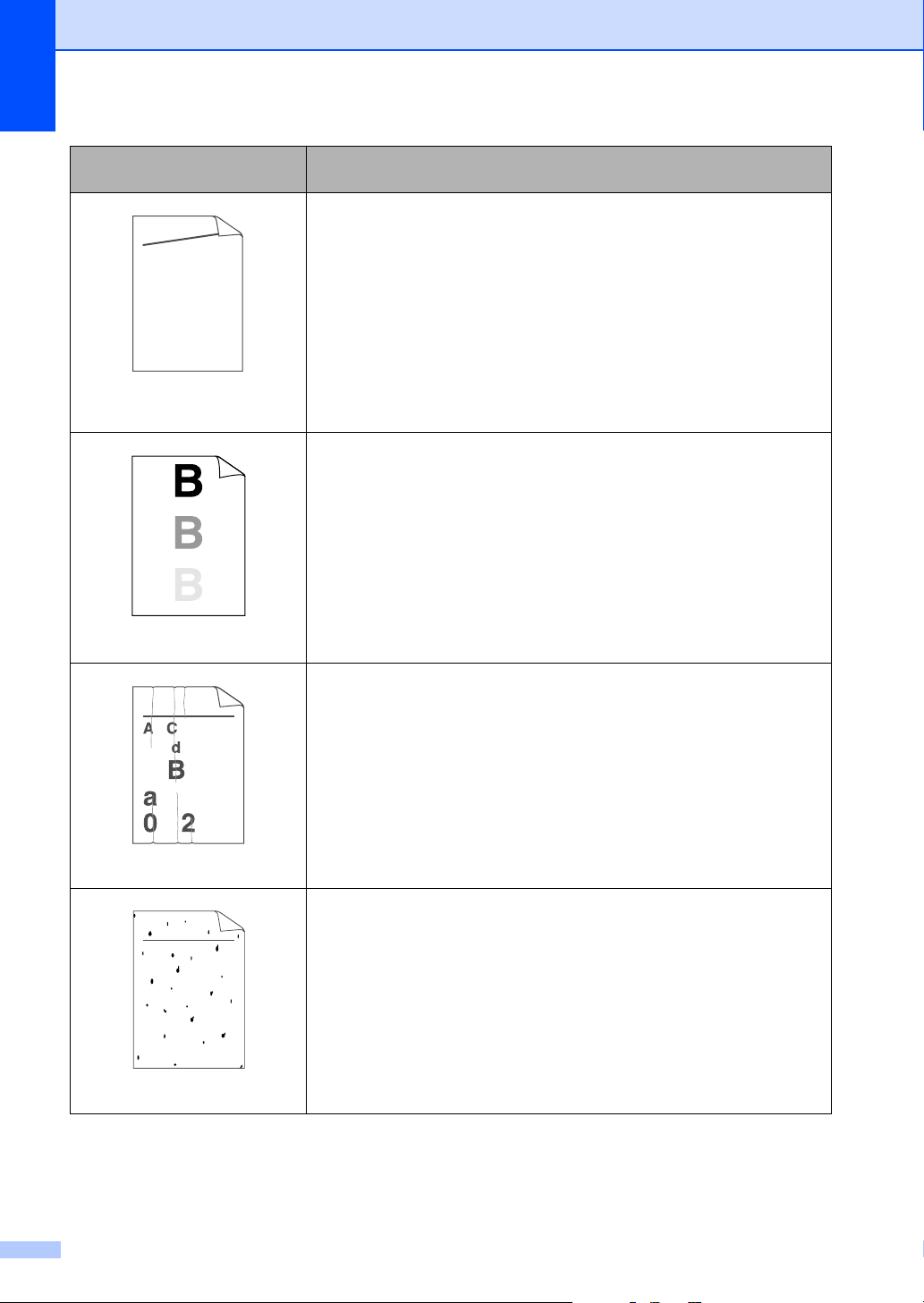
50
Page skewed
Make sure that the paper or other print media is loaded properly in the
paper tray and that the guides are not too tight or too loose against
the paper stack.
Set the paper guides correctly. (See Loading paper in the paper tray
on page 7.)
The paper tray may be too full.
If you are using the manual feed slot, see Loading paper in the
manual feed slot on page 8.
Check the paper type and quality. (See Acceptable paper and other
print media on page 12.)
Ghost
Make sure that you use paper that meets our specifications. Rough-
surfaced paper or thick paper may cause the problem. (See
Acceptable paper and other print media on page 12.)
Make sure that you choose the proper media type in the printer driver
or in the machine’s Paper Type menu setting. (See Acceptable paper
and other print media on page 12 and Basic tab in the Software
User’s Guide on the CD-ROM.)
The drum unit may be damaged. Put in a new drum unit. (See
Replacing the drum unit on page 74.)
The fuser unit may be contaminated. Call Brother Customer Service.
Wrinkles or creases
Check the paper type and quality. (See Acceptable paper and other
print media on page 12.)
Make sure that paper is loaded properly. (See Loading paper in the
paper tray on page 7.)
Turn over the stack of paper in the tray or rotate the paper 180° in the
input tray.
Poor fixing
Choose Improve Toner Fixing mode in the printer driver. (See
Device Options (For Windows
®
) or Print Settings (For Macintosh
®
) in
the software User’s Guide on the CD-ROM.)
If you print only a few pages, change the printer driver setting in
Media Type to a thin setting.
Examples of poor print
quality
Recommendation
ABCDEFGH
abcdefghijk
ABCD
abcde
01234
B DEFGH
abc efghijk
ACD
bcde
134
ABCDEFGH
abcdefghijk
ABCD
abcde
01234
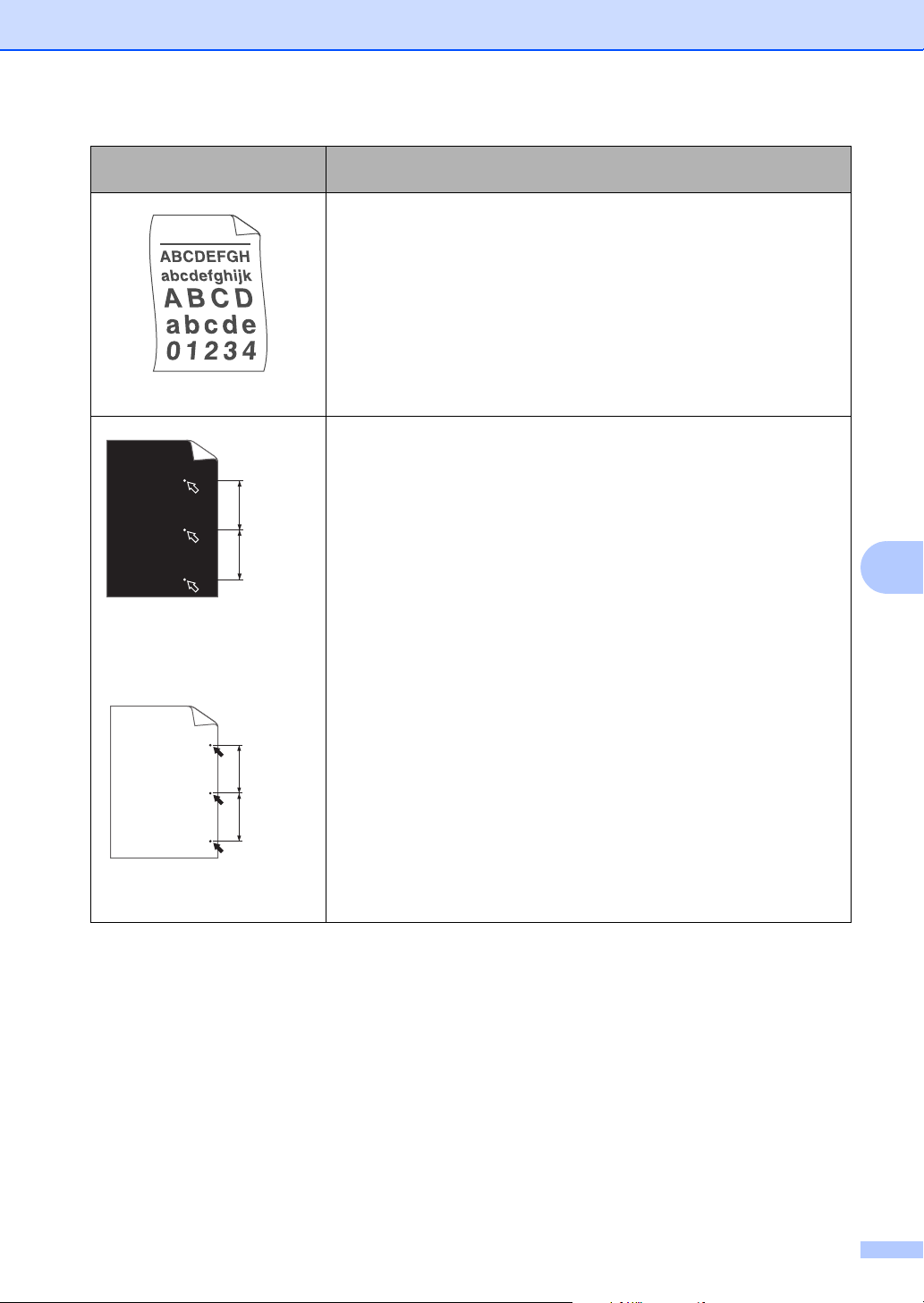
Troubleshooting and routine maintenance
51
B
Curled or wavy
Check the paper type and quality. High temperatures and high
humidity will cause paper to curl.
If you do not use the machine often, the paper may have been in the
paper tray too long. Turn over the stack of paper in the paper tray.
Also, fan the paper stack and then rotate the paper 180° in the paper
tray.
White Spots on black text
and graphics at 2.95 in.
(75 mm) intervals
Black Spots at 2.95 in.
(75 mm) intervals
Make ten copies of a blank, white sheet of paper. (See Making
multiple copies on page 24.) If the problem is not solved, the drum
unit may have glue from a label stuck on the OPC drum surface.
Clean the drum unit. (See Cleaning the drum unit on page 68.)
The drum unit may be damaged. Put in a new drum. (See Replacing
the drum unit on page 74.)
Examples of poor print
quality
Recommendation
(75 mm)
2.95 in.
(75 mm)
2.95 in.
(75 mm)
2.95 in.
(75 mm)
2.95 in.
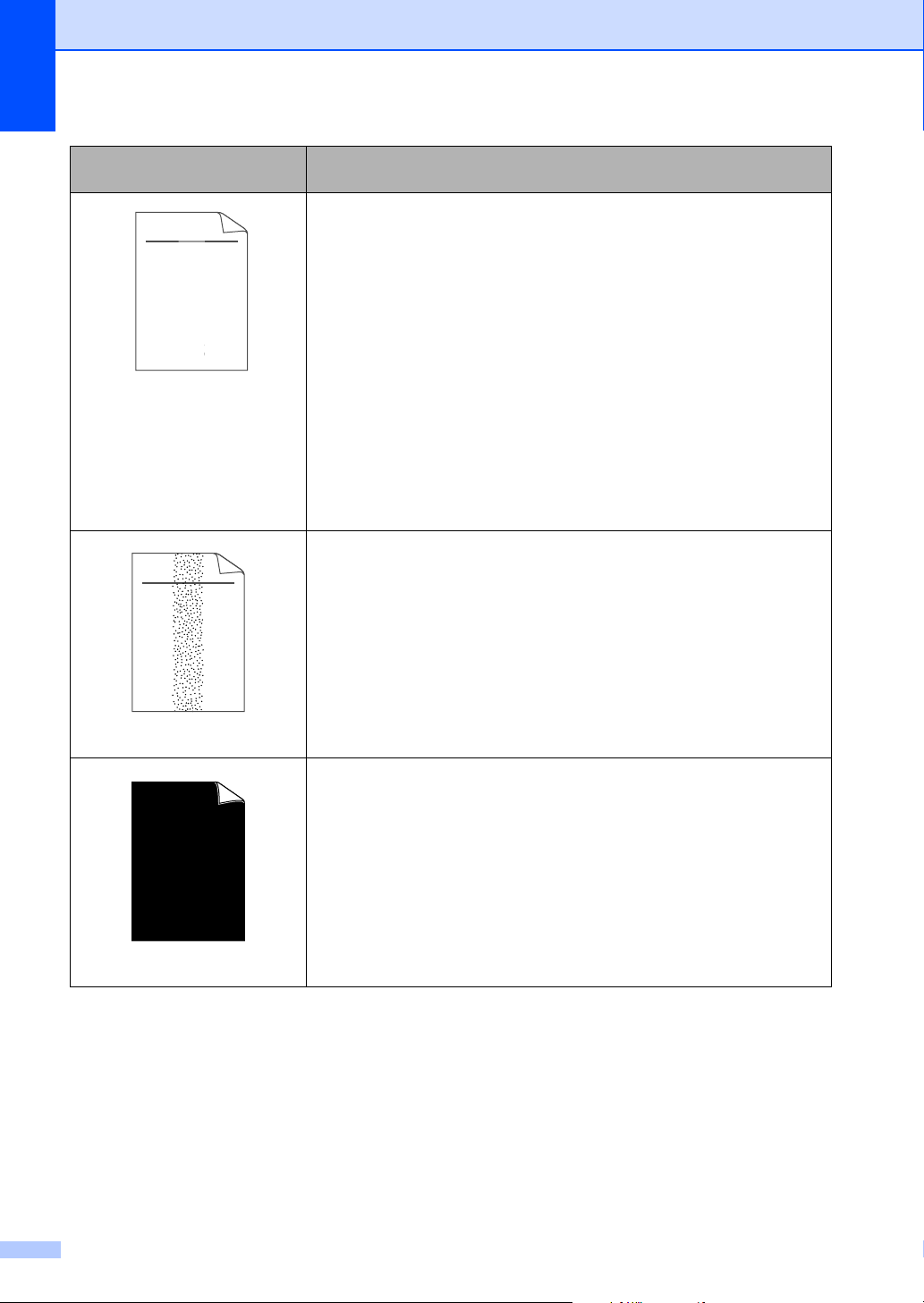
52
Faint
Check the machine’s environment. Conditions such as humidity, high
temperatures, and so on, may cause this print fault. (See Choosing a
location on page 36.)
If the whole page is too light, Toner Save mode may be on. Turn off
Toner Save mode in the machine menu settings or Toner Save
mode in the printer Properties of the driver. (See Toner save
on page 20 or Advanced tab in the Software User’s Guide on the CD-
ROM.)
Clean the scanner window and the primary corona wire of the drum
unit. (See Cleaning the laser scanner window on page 64 and
Cleaning the corona wire on page 66.)
The toner cartridge may be damaged. Put in a new toner cartridge.
(See Replacing a toner cartridge on page 70.)
The drum unit may be damaged. Put in a new drum unit. (See
Replacing the drum unit on page 74.)
Toner specks
Make sure that you use paper that meets our specifications. Rough-
surfaced paper may cause the problem. (See Acceptable paper and
other print media on page 12.)
Clean the primary corona wire and the drum unit. (See Cleaning the
corona wire on page 66 and Cleaning the drum unit on page 68.)
The drum unit may be damaged. Put in a new drum unit. (See
Replacing the drum unit on page 74.)
The fuser unit may be contaminated. Call Brother Customer Service.
All black
Clean the primary corona wire inside the drum unit by sliding the
green tab. Be sure to return the green tab to the home position (a).
(See Cleaning the corona wire on page 66.)
The drum unit may be damaged. Put in a new drum unit. (See
Replacing the drum unit on page 74.)
The fuser unit may be contaminated. Call Brother Customer Service.
Examples of poor print
quality
Recommendation
ABCDEFGH
abcdefghijk
ABCD
abcde
01234
C
DE
F
d
ef
g
BC
b
c
d
2
3
ABCDEFGH
abcdefghijk
ABCD
abcde
01234
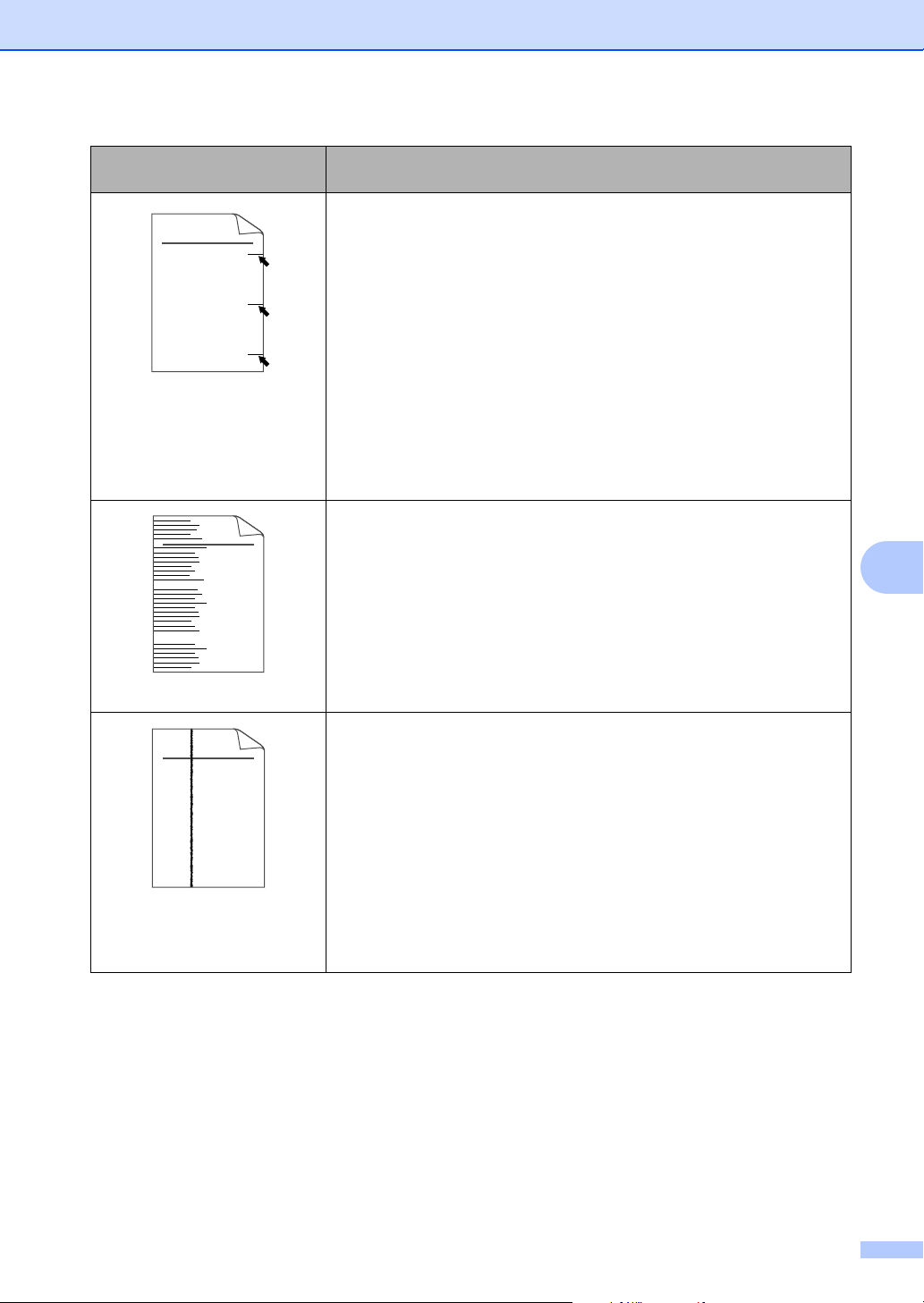
Troubleshooting and routine maintenance
53
B
Black toner marks across the
page
Make sure that you use paper that meets our specifications. (See
Acceptable paper and other print media on page 12.)
If you use label sheets for laser machines, the glue from the sheets
may sometimes stick to the OPC drum surface. Clean the drum unit.
(See Cleaning the drum unit on page 68.)
Do not use paper that has clips or staples because they will scratch
the surface of the drum.
If the unpacked drum unit is in direct sunlight or room light, the unit
may be damaged.
The toner cartridge may be damaged. Put in a new toner cartridge.
(See Replacing a toner cartridge on page 70.)
The drum unit may be damaged. Put in a new drum unit. (See
Replacing the drum unit on page 74.)
Line across the page
Clean the laser scanner window and the primary corona wire inside
the drum unit. (See Cleaning the laser scanner window on page 64
and Cleaning the corona wire on page 66.)
The drum unit may be damaged. Put in a new drum unit. (See
Replacing the drum unit on page 74.)
Black lines down the page
Printed pages have toner
stains down the page
Clean the primary corona wire inside the drum unit by sliding the
green tab. Be sure to return the green tab to the home position (a).
(See Cleaning the corona wire on page 66.)
The toner cartridge may be damaged. Put in a new toner cartridge.
(See Replacing a toner cartridge on page 70.)
The drum unit may be damaged. Put in a new drum unit. (See
Replacing the drum unit on page 74.)
The fuser unit may be smudged. Call Brother Customer Service at
1-877-BROTHER (1-877-276-8437) (in USA) or 1-877-BROTHER (in
Canada).
Examples of poor print
quality
Recommendation
ABCDEFGH
abcdefghijk
ABCD
abcde
01234
ABCDEFGH
abcdefghijk
ABCD
abcde
01234
ABCDEFGH
abcdefghijk
ABCD
abcde
01234
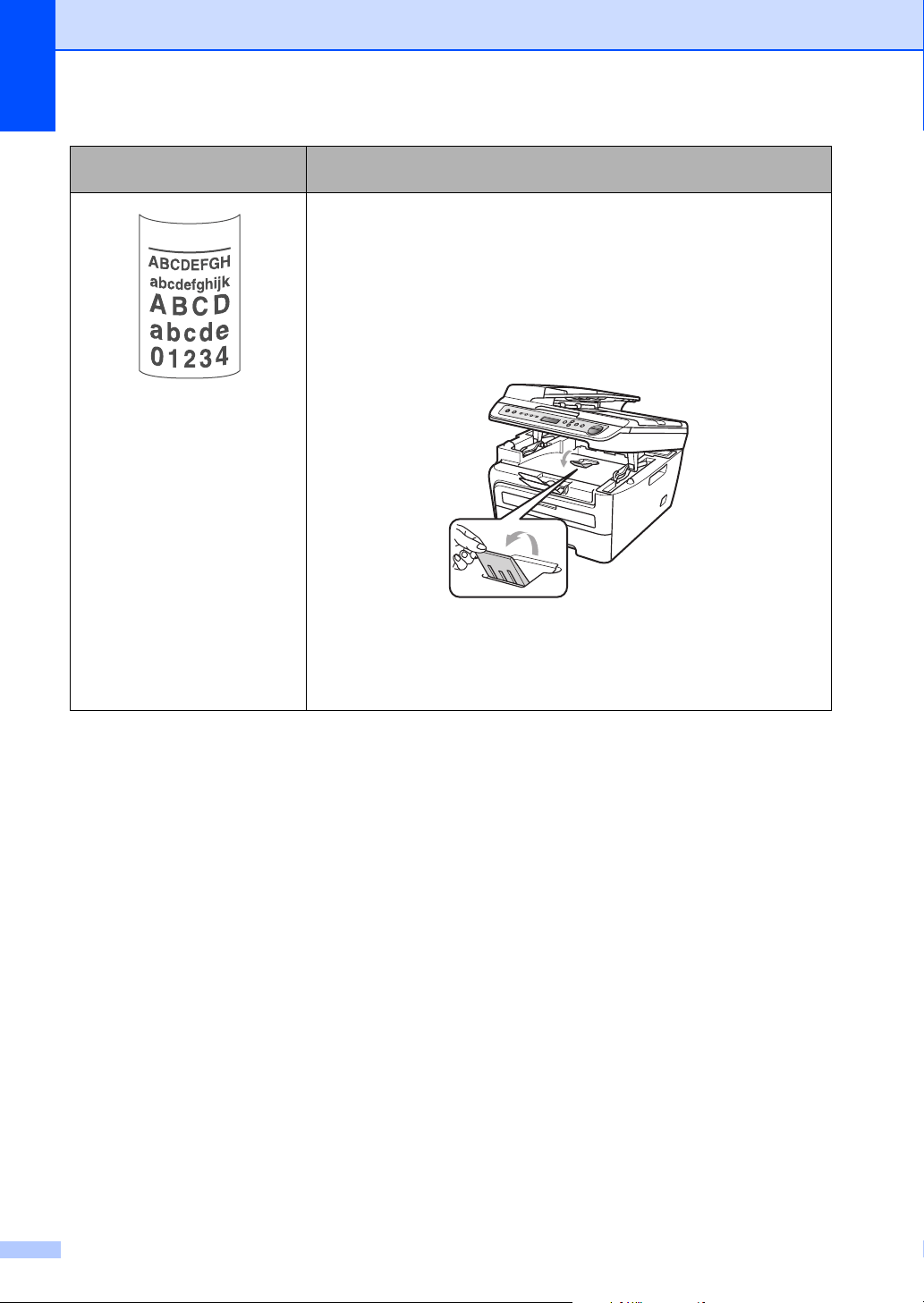
54
Curled
Choose Reduce Paper Curl mode in the printer driver when you do
not use our recommended paper. (See Device Options (For
Windows
®
) or Print Settings (For Macintosh
®
) in the Software User's
Guide on the CD-ROM.)
Turn the paper over in the paper tray, and print again. (Excluding
Letterhead paper)
Lift up the output tray support flap.
Replace the paper in the paper tray with paper from a freshly opened
ream.
Make sure you are using paper that is recommended for your
machine. (See Acceptable paper and other print media on page 12.)
Examples of poor print
quality
Recommendation

Troubleshooting and routine maintenance
55
B
Error and maintenance messages B
As with any sophisticated office product, errors may occur and consumable items may need to be
replaced. If this happens, your machine identifies the error or required routine maintenance and
shows the appropriate message. The most common error and maintenance messages are shown
below.
You can correct most errors and routine maintenance by yourself. If you need more help, the
Brother Solutions Center offers the latest FAQs and troubleshooting tips.
Visit us at http://solutions.brother.com/
.
Error Message Cause Action
Cartridge Error The toner cartridge is not
installed properly.
Pull out the drum unit, take out the toner
cartridge that is indicated on the LCD, and
put it back into the drum unit again.
Drum End Soon The drum unit is near the end of
its life.
Use the drum unit until you have a print
quality problem; then replace the drum unit
with a new one.
(See Replacing the drum unit on page 74.)
Cooling Down
Wait for a while
The temperature of the drum unit
or toner cartridge is too hot. The
machine will pause its current
print job and go into cooling down
mode. During the cooling down
mode, you will hear the cooling
fan running while the LCD shows
Cooling Down, and
Wait for a while.
Make sure that you can hear the fan in the
machine spinning and that the exhaust outlet
is not blocked by something.
If the fan is spinning, remove any obstacles
that surround the exhaust outlet, and then
leave the machine turned on but do not use
it for several minutes.
If the fan is not spinning do the following:
Disconnect the machine from the power for
several minutes and then reconnect it.
Cover is Open The front cover is not closed
completely.
Close the front cover of the machine.
Cover is Open The fuser cover is not closed
completely.
Close the fuser cover of the machine.
Cover is Open The fuser cover is not closed
completely or paper was jammed
in the back of the machine when
you turned on the power.
Make sure paper is not jammed inside the
back of the machine, and then close the
fuser cover and press Start.
Document Jam
(DCP-7040 only)
The document was not inserted
or fed properly, or the document
scanned from the ADF was too
long.
See Document jams (DCP-7040 only)
on page 57 or Using the automatic
document feeder (ADF) (DCP-7040 only)
on page 17.
Drum Error The corona wire on the drum unit
needs to be cleaned.
Clean the corona wire on the drum unit. (See
Cleaning the corona wire on page 66.)
The drum unit has reached the
end of its life.
Replace the drum unit. (See Replacing the
drum unit on page 74.)

56
Fuser Error The temperature of fuser unit
does not rise at a specified
temperature within specified time.
Turn the power switch off, wait a few
seconds, and then turn it on again. Leave the
machine for 15 minutes with the power on.
The fuser unit is too hot.
Init Unable XX The machine has a mechanical
problem.
Disconnect the machine from the power for
several minutes and then reconnect it.
Jam Rear The paper is jammed in the back
of the machine.
(See Paper jams on page 58.)
Jam Inside The paper is jammed inside the
machine.
(See Paper jams on page 58.)
Jam Tray The paper is jammed in the paper
tray of the machine.
(See Paper jams on page 58.)
No Paper The machine is out of paper or
paper is not properly loaded in the
paper tray.
Do one of the following:
Refill the paper in the paper tray, and
then press Start.
Remove the paper and load it again, and
then press Start.
Out of Memory The machine’s memory is full. Copy operation in progress
Do one of the following:
Press Start to copy the scanned pages.
Press
Stop/Exit
and wait until the other
operations in progress finish, and then try again.
Clear the data from the memory. (See
Out of memory message on page 29.)
Print operation in process
Reduce print resolution. (See Advanced tab
in the Software User’s Guide on the
CD-ROM.)
Print Unable XX The machine has a mechanical
problem.
Disconnect the machine from the power for
several minutes and then reconnect it.
Scan Unable XX The machine has a mechanical
problem.
Disconnect the machine from the power for
several minutes and then reconnect it.
Toner Life End The drum unit and toner cartridge
assembly may have been
installed improperly, or the toner
cartridge is used up and printing
is not possible.
Do one of the following:
Re-install the toner cartridge and drum
unit assembly.
Replace the empty toner cartridge with a
new one. (See Replacing a toner
cartridge on page 70.)
Toner Low If the LCD shows Toner Low,
you can still print; however, the
machine is telling you that the
toner cartridge is near the end of
its life and the toner will soon run
out.
Order a new toner cartridge now.
Error Message Cause Action
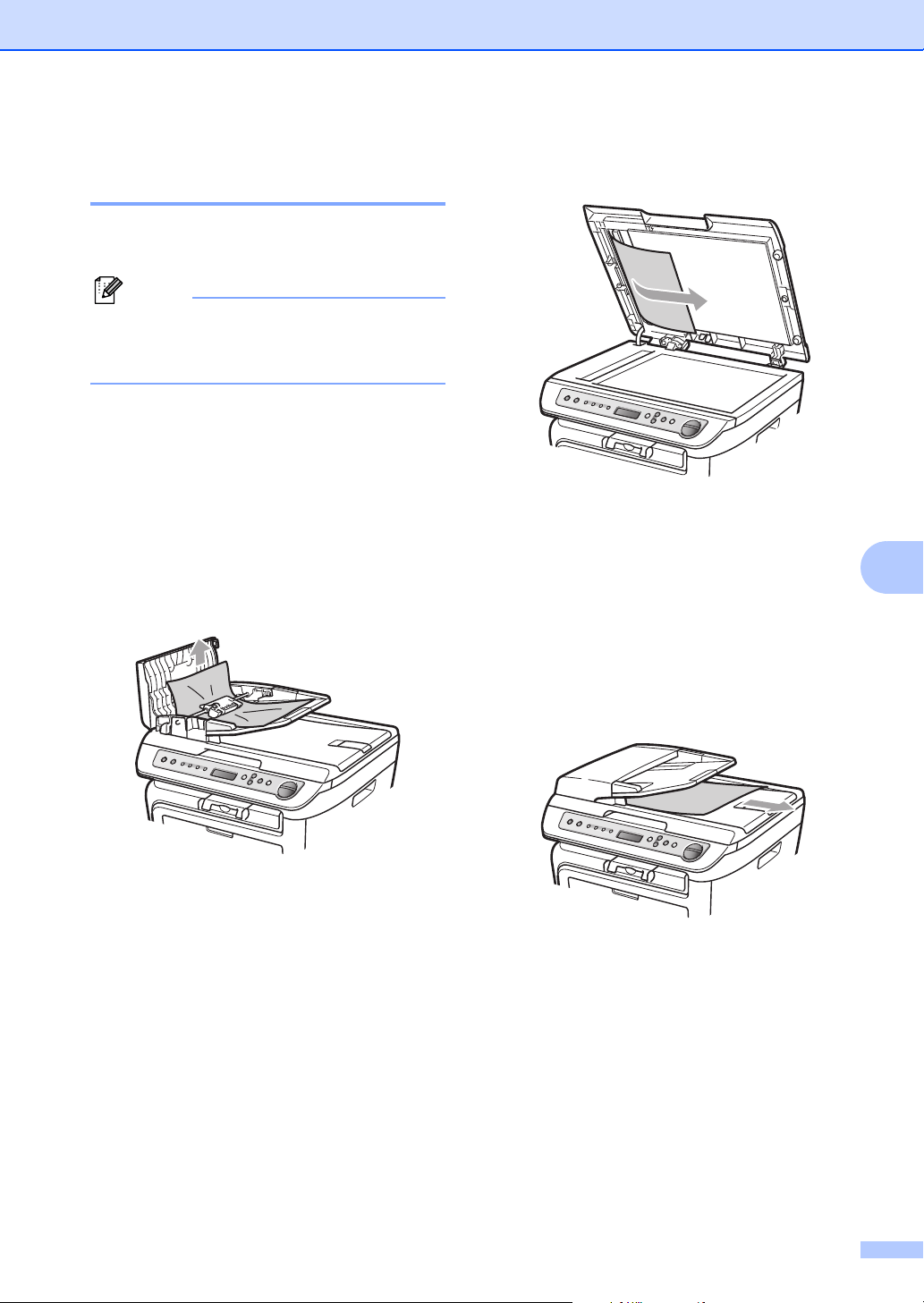
Troubleshooting and routine maintenance
57
B
Document jams
(DCP-7040 only) B
If the document is jammed, follow the steps
below.
Note
After removing a jammed document,
check that no paper scraps are left in the
machine that could cause another jam.
Document is jammed in the top of the
ADF unit
B
a Take out any paper from the ADF that is
not jammed.
b Open the ADF cover.
c Pull the jammed document out to the
left.
d Close the ADF cover.
e Press Stop/Exit.
Document is jammed under the
document cover
B
a Take out any paper from the ADF that is
not jammed.
b Lift the document cover.
c Pull the jammed document out to the
right.
d Close the document cover.
e Press Stop/Exit.
Document is jammed at the output
tray
B
a Pull the jammed document out to the
right.
b Press Stop/Exit.
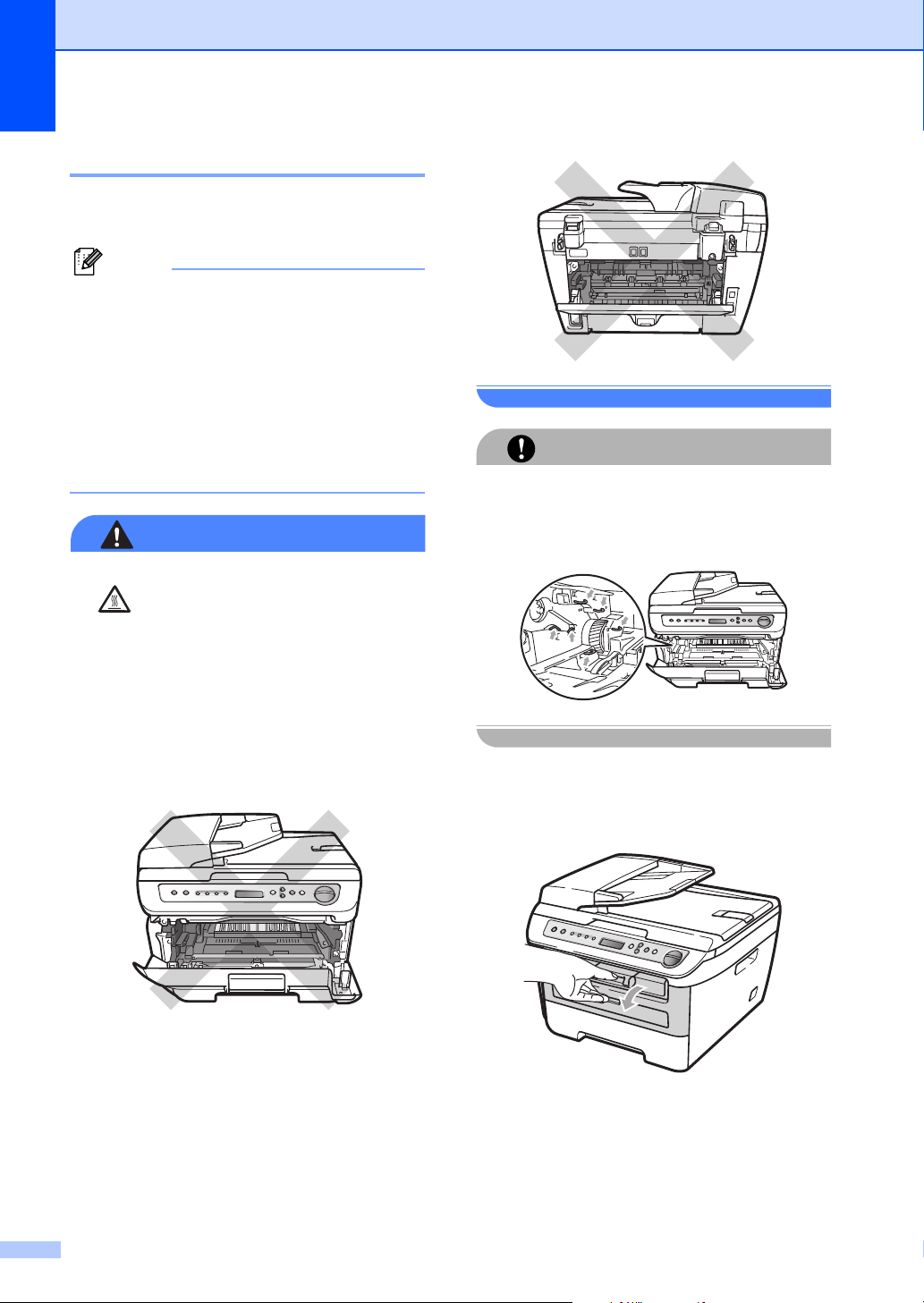
58
Paper jams B
To clear paper jams, please follow the steps
in this section.
Note
• Please confirm that you have installed
both a toner cartridge and a drum unit in
the machine. If you have not installed a
drum unit or have installed the drum unit
improperly, then this may cause a paper
jam in your Brother machine.
• If the error message remains, open and
close the front cover and fuser cover firmly
to reset the machine.
WARNING
HOT SURFACE
After you have just used the machine, some
internal parts of the machine will be
extremely hot. When you open the front or
back cover (back output tray) of the
machine, DO NOT touch the shaded parts
shown in the illustration. If you do this, you
may get burned.
CAUTION
To prevent damage to the machine caused
by static electricity, DO NOT touch the
electrodes shown in the illustration.
Paper is jammed inside the machine B
a Open the front cover.
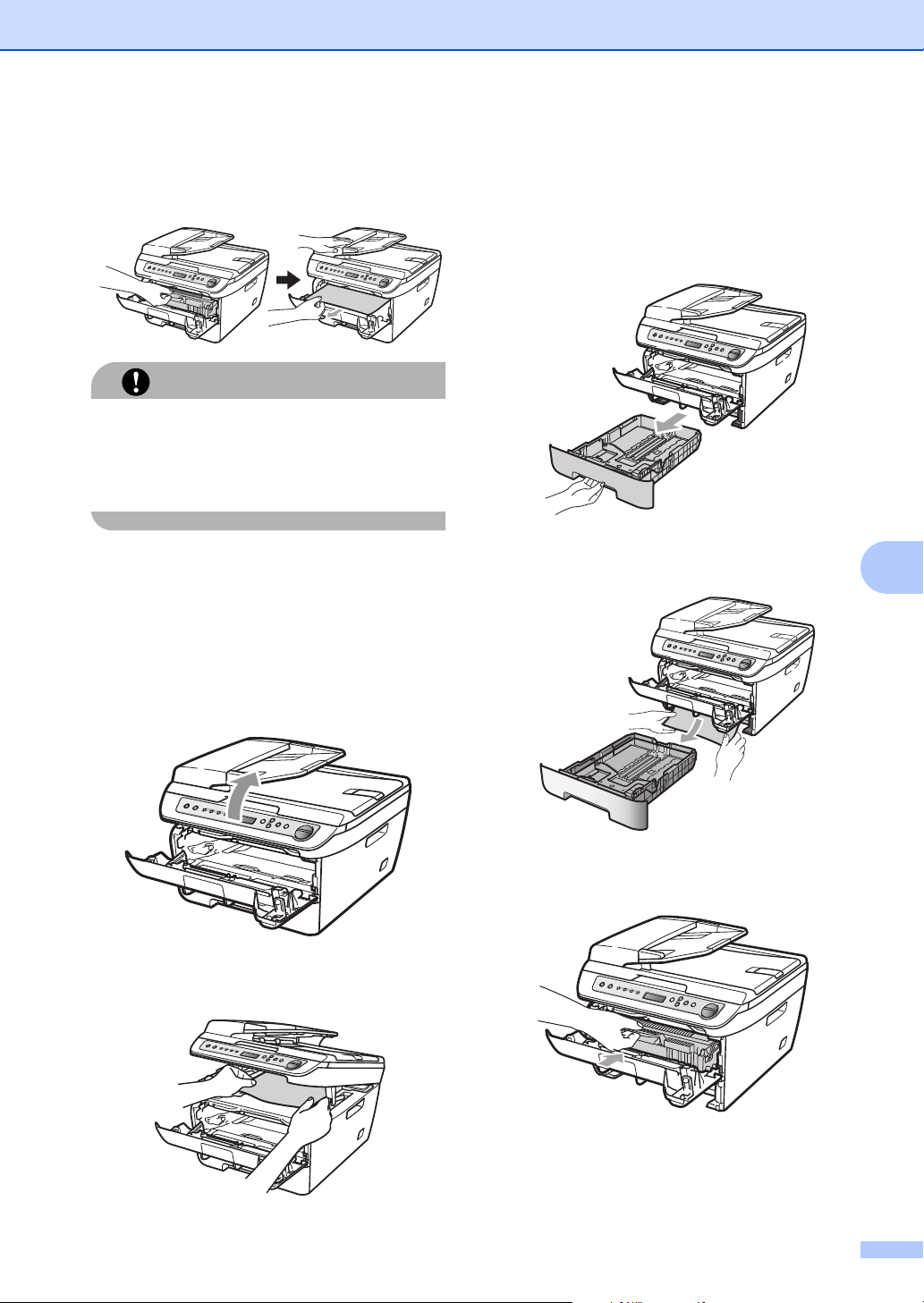
Troubleshooting and routine maintenance
59
B
b Slowly take out the drum unit and toner
cartridge assembly. The jammed paper
will be pulled out with the toner cartridge
and drum unit assembly.
CAUTION
We recommend that you place the drum
unit and toner cartridge assembly on a
clean, flat surface with a piece of
disposable paper or cloth underneath it in
case you accidentally spill or scatter toner.
c Do one of the following:
If you were able to remove the drum
unit and toner cartridge assembly
and the jammed paper, then go to
step g.
If you can not remove the drum unit
and toner cartridge assembly easily,
do not use extra force. Instead, lift
the scanner cover.
Use both hands to carefully pull the
jammed paper up and out of the output
tray opening.
d Close the scanner cover.
e If you could not pull the jammed paper
out of the output tray opening as shown
in step c, take the paper tray
completely out of the machine.
f Pull the jammed paper out of the paper
tray opening.
g Put the drum unit and toner cartridge
assembly back in the machine.
h Put the paper tray back in the machine.
i Close the front cover.
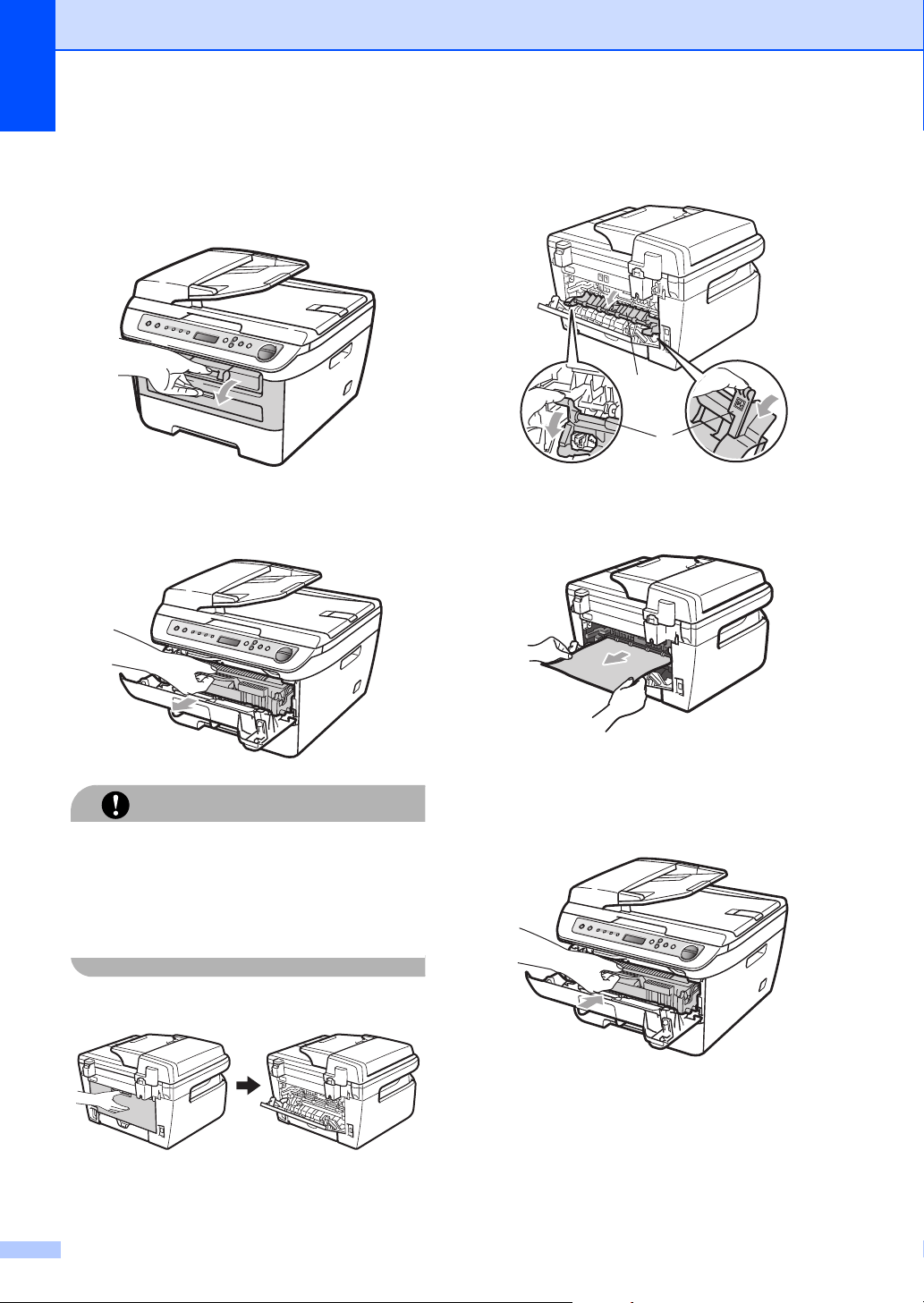
60
Paper is jammed at the back of the
machine
B
a Open the front cover.
b Slowly take out the drum unit and toner
cartridge assembly.
CAUTION
We recommend that you place the drum
unit and toner cartridge assembly on a
clean, flat surface with a piece of
disposable paper or cloth underneath it in
case you accidentally spill or scatter toner.
c Open the back cover (back output tray).
d Pull the tabs (1) toward you to open the
fuser cover (2).
e Pull the jammed paper out of the fuser
unit.
f Close the back cover (back output tray).
g Put the drum unit and toner cartridge
assembly back in the machine.
h Close the front cover.
1
2
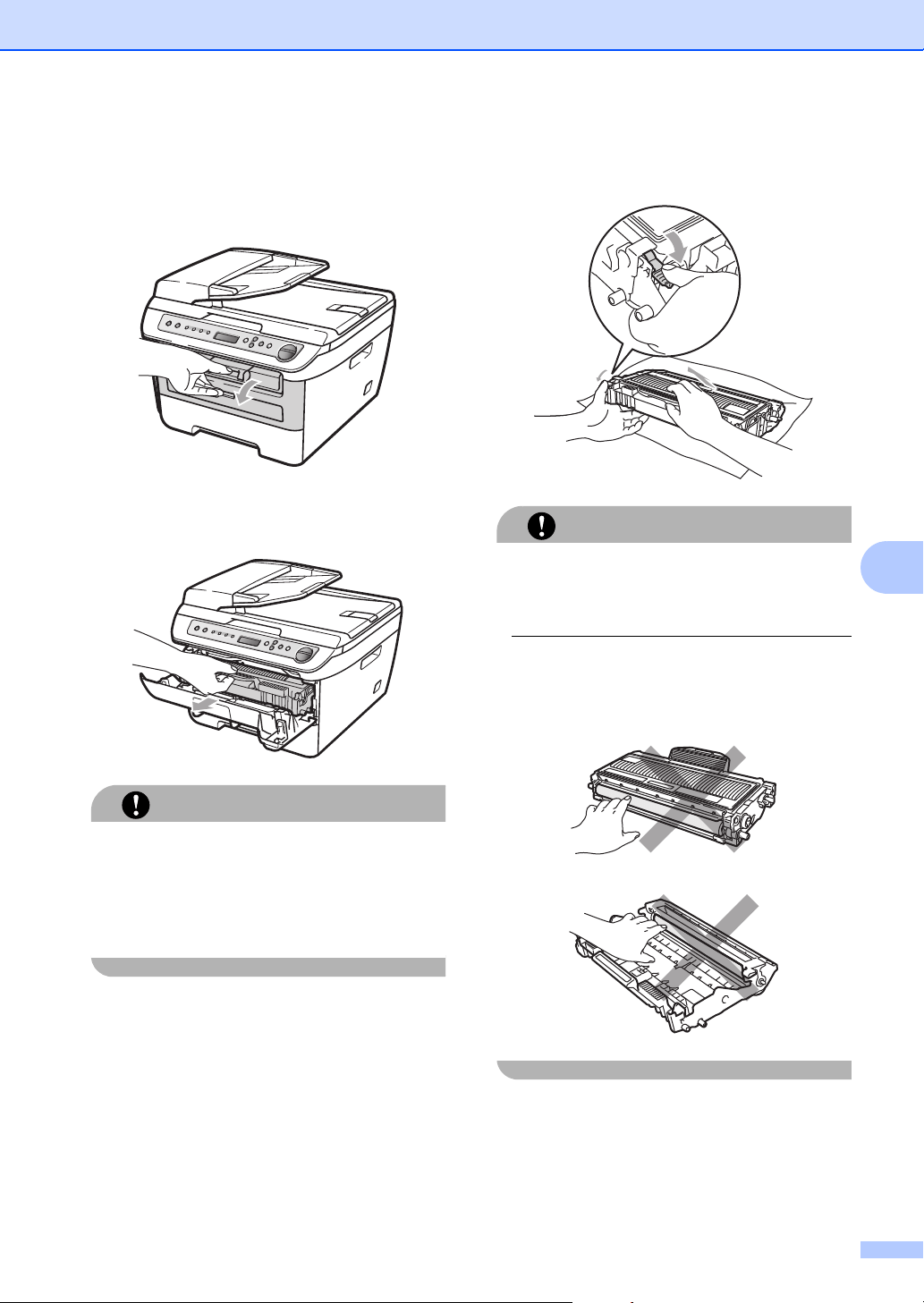
Troubleshooting and routine maintenance
61
B
Paper is jammed inside the drum unit
and toner cartridge assembly
B
a Open the front cover.
b Slowly take out the drum unit and toner
cartridge assembly.
CAUTION
We recommend that you place the drum
unit and toner cartridge assembly on a
clean, flat surface with a piece of
disposable paper or cloth underneath it in
case you accidentally spill or scatter toner.
c Push down the green lock lever and take
the toner cartridge out of the drum unit.
CAUTION
Handle the toner cartridge carefully. If toner
scatters on your hands or clothes, wipe or
wash it off with cold water at once.
To avoid print quality problems, DO NOT
touch the shaded parts shown in the
illustrations below.
d Clear the jammed paper if there is any
inside the drum unit.
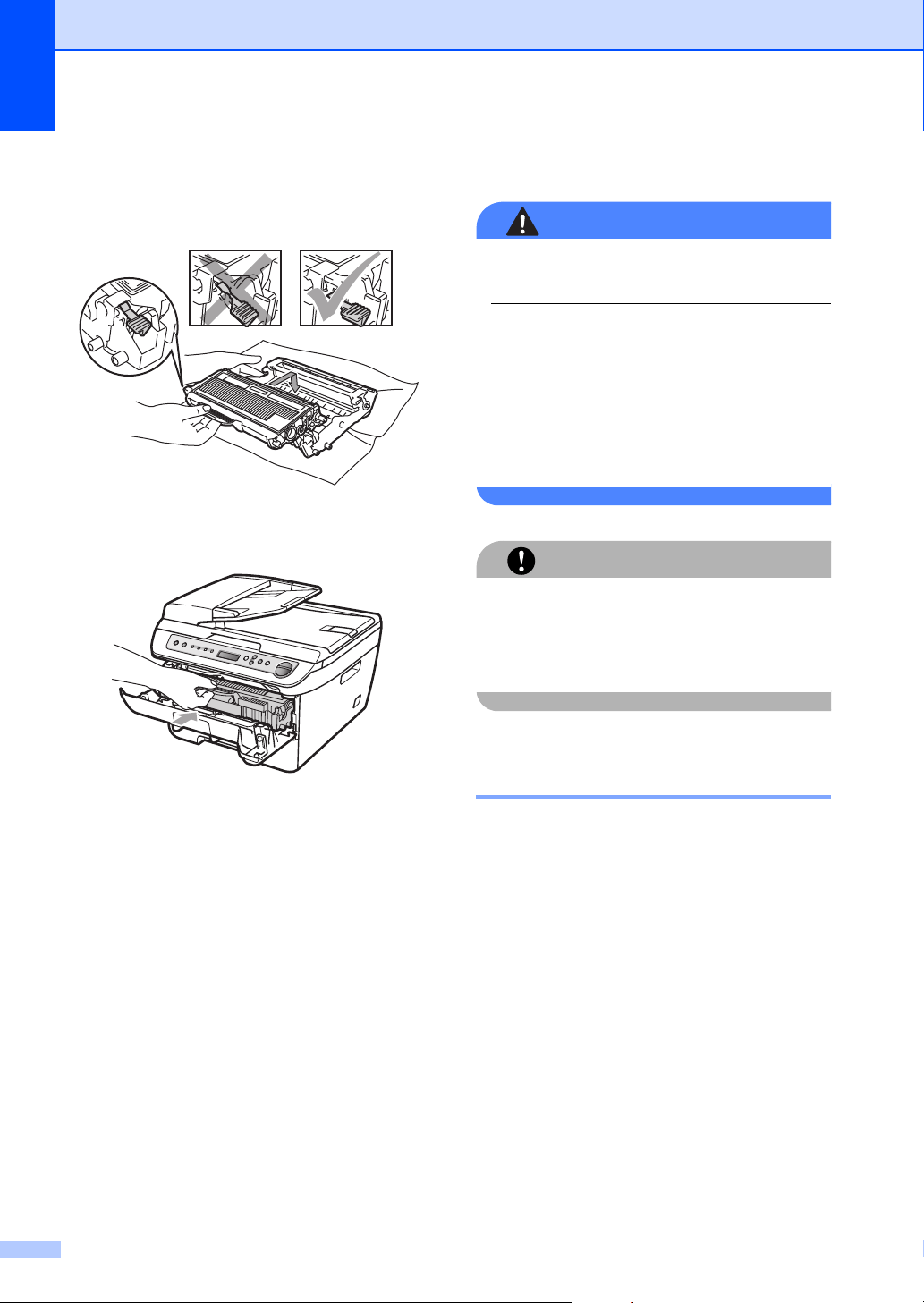
62
e Put the toner cartridge back into the
drum unit until you hear it lock into place.
If you put it in properly, the green lock
lever will lift automatically.
f Put the drum unit and toner cartridge
assembly back in the machine.
g Close the front cover.
Routine maintenance B
WARNING
Use neutral detergents.
DO NOT use cleaning materials that
contain ammonia, alcohol, any type of
spray, or any type of flammable substance
to clean the outside or inside of the
machine. Doing this may cause a fire or
electrical shock. For more infomation see
Important safety instructions on page 42.
CAUTION
The drum unit contains toner, so handle it
carefully. If toner scatters on your hands or
clothes, wipe or wash it off with cold water
at once.
Cleaning the outside of the
machine B
Clean the outside of the machine as
follows:
B
a Turn off the machine’s power switch.
Disconnect all cables, and then unplug
the power cord from the AC power
outlet.
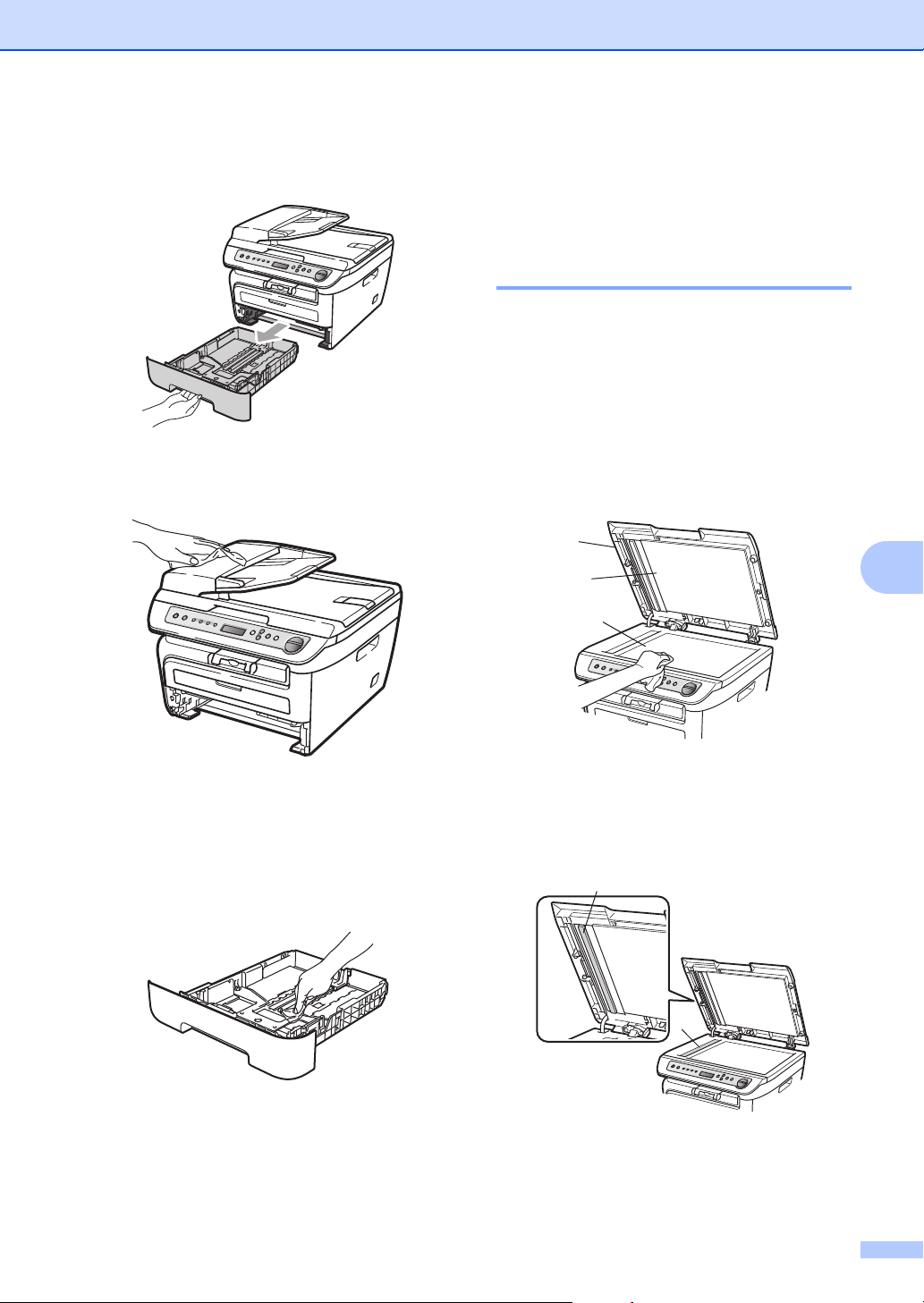
Troubleshooting and routine maintenance
63
B
b Pull the paper tray completely out of the
machine.
c Wipe the outside of the machine with a
soft cloth to remove dust.
d Remove anything that is stuck inside the
paper tray.
e Wipe the inside and the outside of the
paper tray with a soft cloth to remove
dust.
f Re-load the paper and put the paper tray
firmly back in the machine.
g Plug the machine’s power cord back into
the AC power outlet first, and then
reconnect all cables. Turn on the
machine’s power switch.
Cleaning the scanner glass B
a Turn off the machine’s power switch.
Disconnect all cables and then unplug
the power cord from the AC power
outlet.
b Lift the document cover (1).
Clean the white plastic surface (2) and
scanner glass (3) underneath it with a
soft lint-free cloth moistened with water.
c (DCP-7040 only) In the ADF unit, clean
the white bar (1) and the scanner glass
strip (2) underneath it with a soft lint-free
cloth moistened with water.
1
3
2
1
2
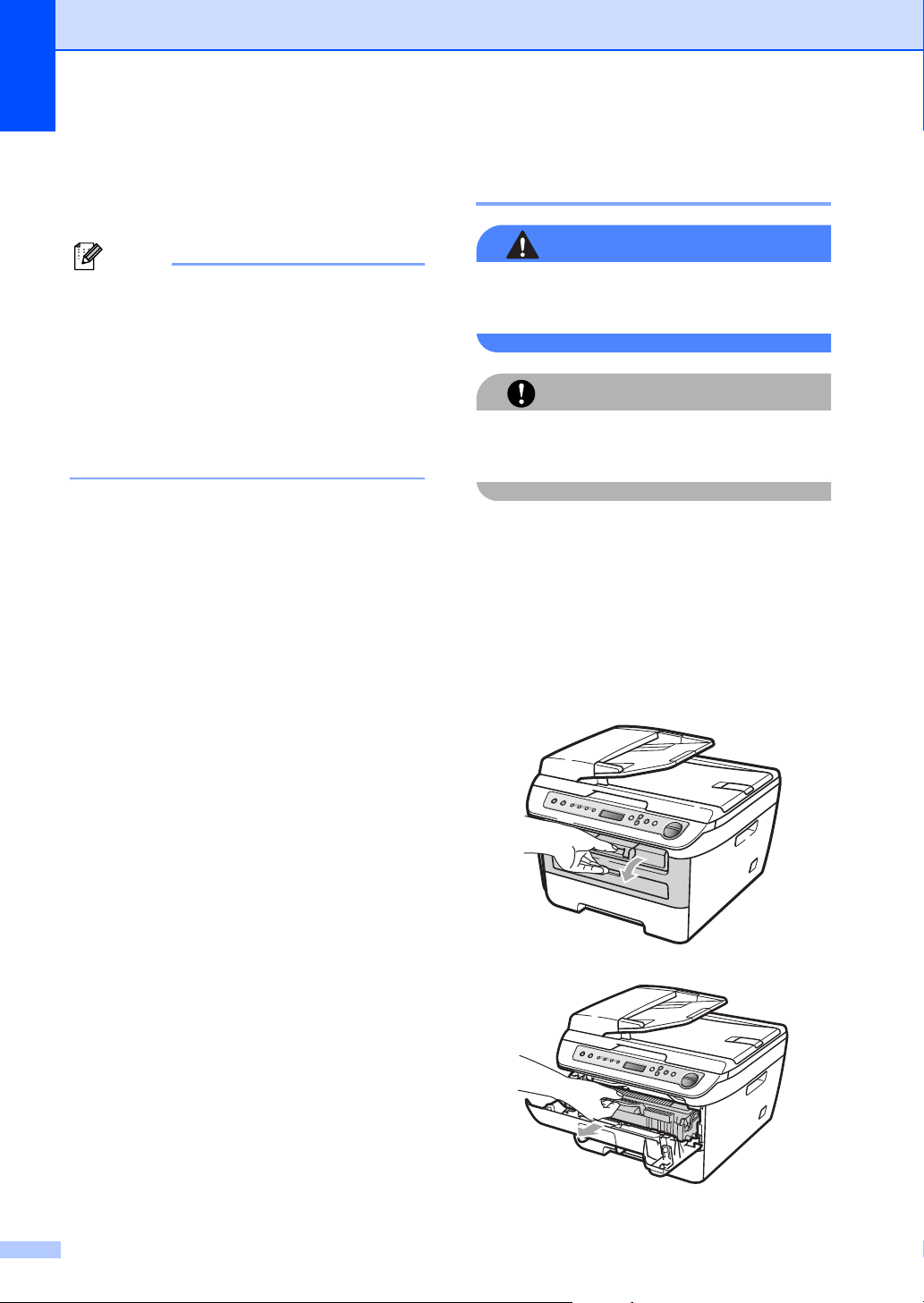
64
d Plug the machine’s power cord back into
the AC power outlet first, and then
reconnect all cables. Turn on the
machine’s power switch.
Note
In addition to cleaning the scanner glass
and glass strip with a soft lint-free cloth
moistened with water, run your finger tip
over the glass to see if you can feel
anything on it. If you feel dirt or debris,
clean the glass again concentrating on
that area. You may need to repeat the
cleaning process three or four times. To
test, make a copy after each cleaning.
Cleaning the laser scanner
window B
WARNING
DO NOT use isopropyl alcohol to clean the
laser scanner window.
CAUTION
DO NOT touch the laser scanner window
with your fingers.
a Before you clean the inside of the
machine, turn off the machine’s power
switch.
Unplug the power cord from the AC
power outlet.
b Open the front cover and slowly take out
the drum unit and toner cartridge
assembly.
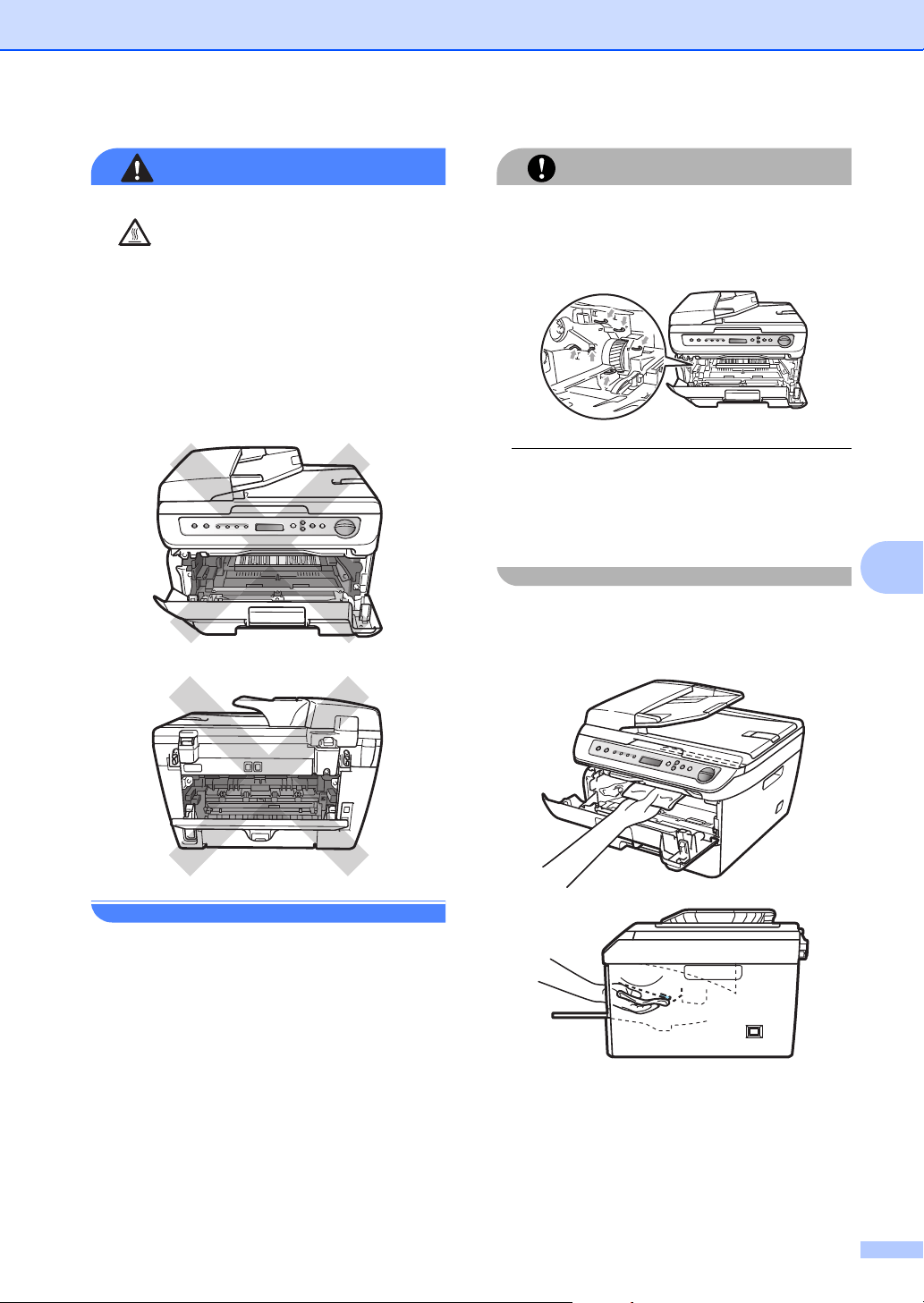
Troubleshooting and routine maintenance
65
B
WARNING
HOT SURFACE
After you have just used the machine, some
internal parts of the machine will be
extremely hot. When you open the front or
back cover (back output tray) of the
machine, DO NOT touch the shaded parts
shown in the illustration. If you do this, you
may get burned.
CAUTION
To prevent damage to the machine caused
by static electricity, DO NOT touch the
electrodes shown in the illustration.
We recommend that you place the drum
unit on a clean, flat surface with a piece of
disposable paper or cloth underneath it in
case you accidentally spill or scatter toner.
c Wipe the laser scanner window by
wiping it with a clean soft, dry lint-free
cloth.
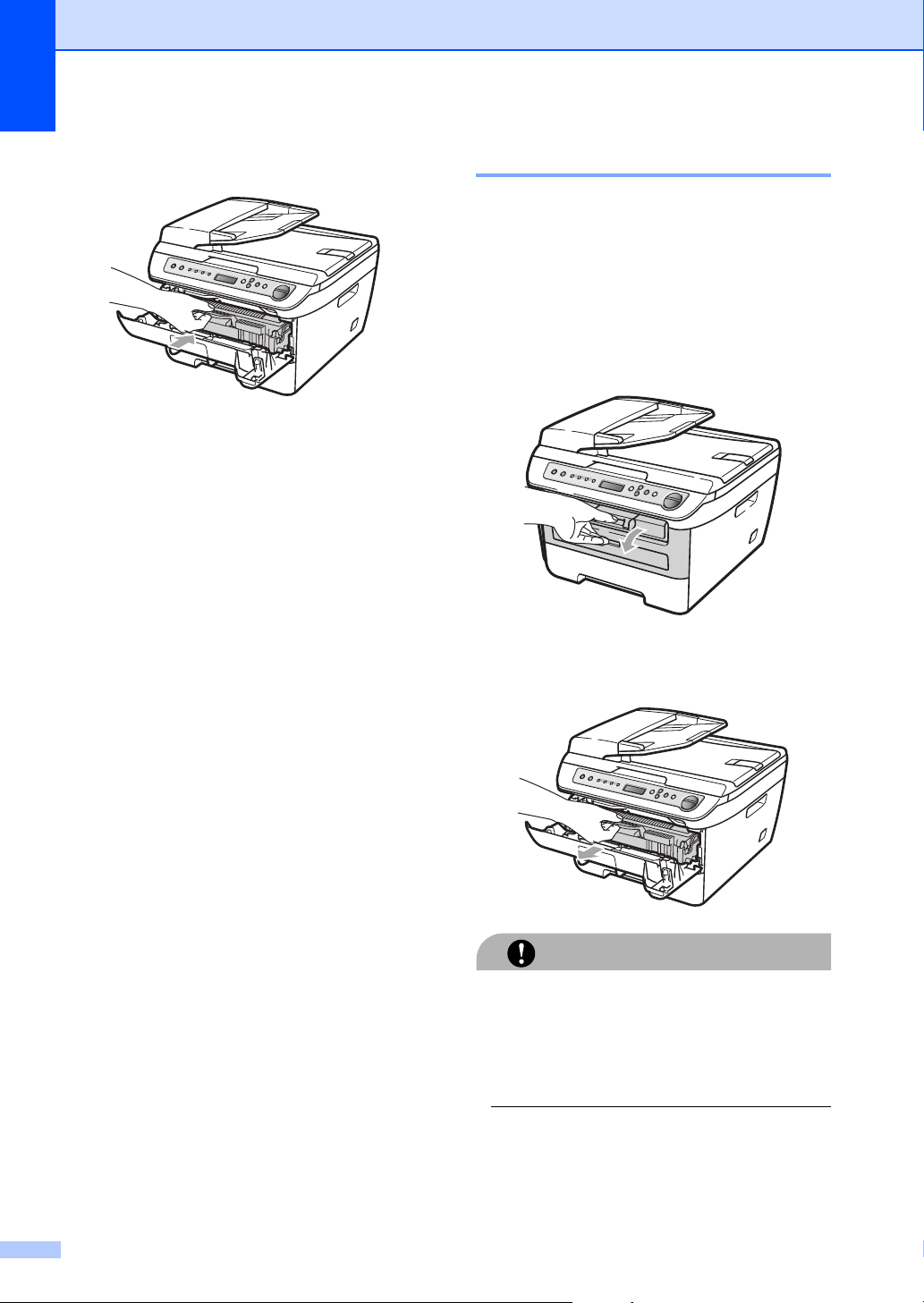
66
d Put the drum unit and toner cartridge
assembly back in the machine.
e Close the front cover.
f Plug the machine’s power cord back into
the AC power outlet.
Turn on the machine’s power switch.
Cleaning the corona wire B
If you have print quality problems, clean the
corona wire as follows:
a Turn off the machine’s power switch.
Disconnect all cables, and then unplug
the power cord from the AC power
outlet.
b Open the front cover.
c Slowly take out the drum unit and toner
cartridge assembly.
CAUTION
We recommend that you place the drum
unit and toner cartridge assembly on a
clean, flat surface with a piece of
disposable paper or cloth underneath it in
case you accidentally spill or scatter toner.
Handle the toner cartridge carefully. If toner
scatters on your hands or clothes, wipe or
wash it off with cold water at once.
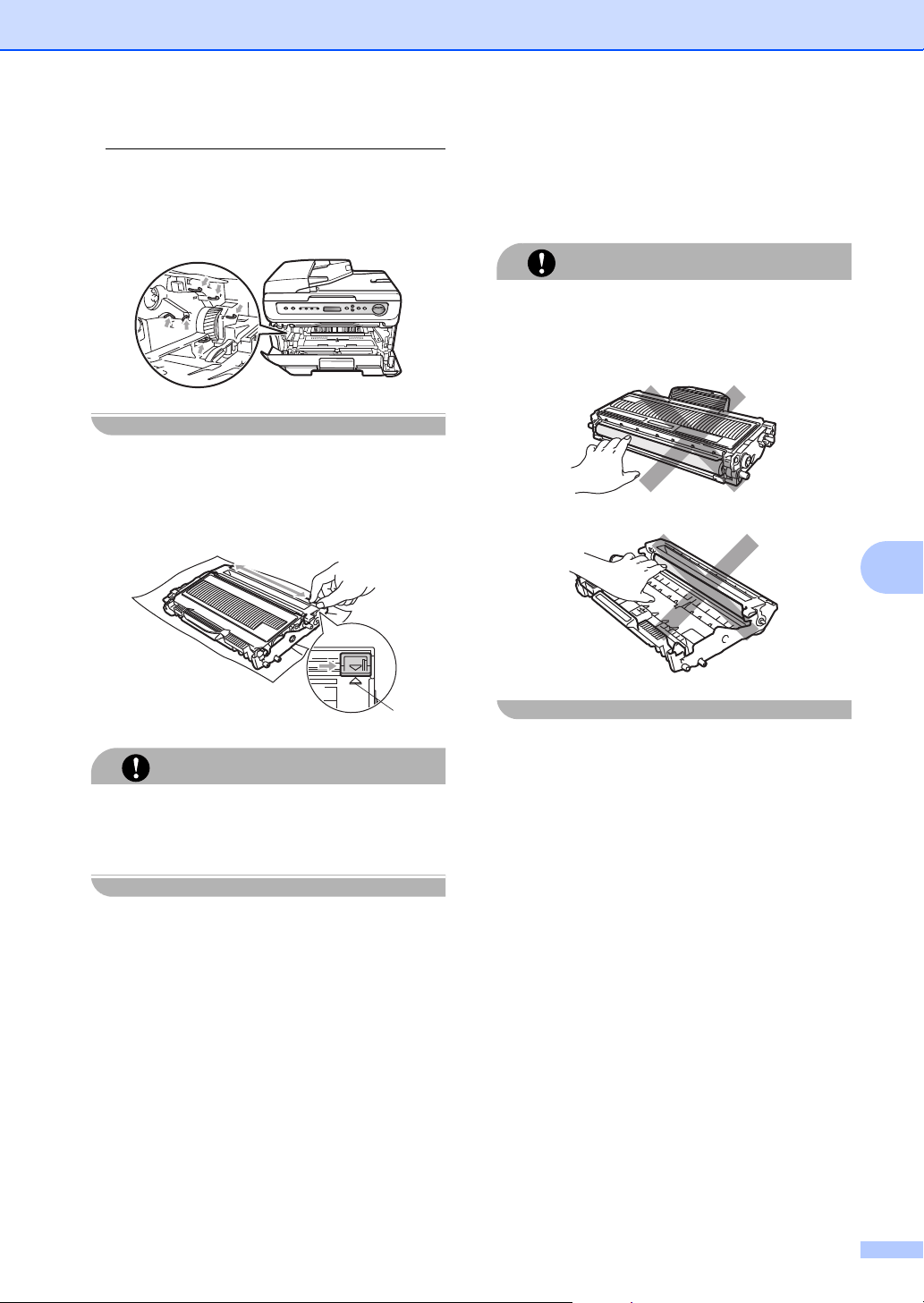
Troubleshooting and routine maintenance
67
B
To prevent damage to the machine caused
by static electricity, DO NOT touch the
electrodes shown in the illustration.
d Clean the primary corona wire inside the
drum unit by gently sliding the green tab
from right to left and left to right several
times.
CAUTION
Be sure to return the green tab to the home
position (a) (1). If you do not, printed pages
may have a vertical stripe.
e Put the drum unit and toner cartridge
assembly back in the machine.
f Close the front cover.
g Plug the machine’s power cord back into
the AC power outlet first, and then
reconnect all cables. Turn on the
machine’s power switch.
CAUTION
To avoid print quality problems, DO NOT
touch the shaded parts shown in the
illustrations below.
1
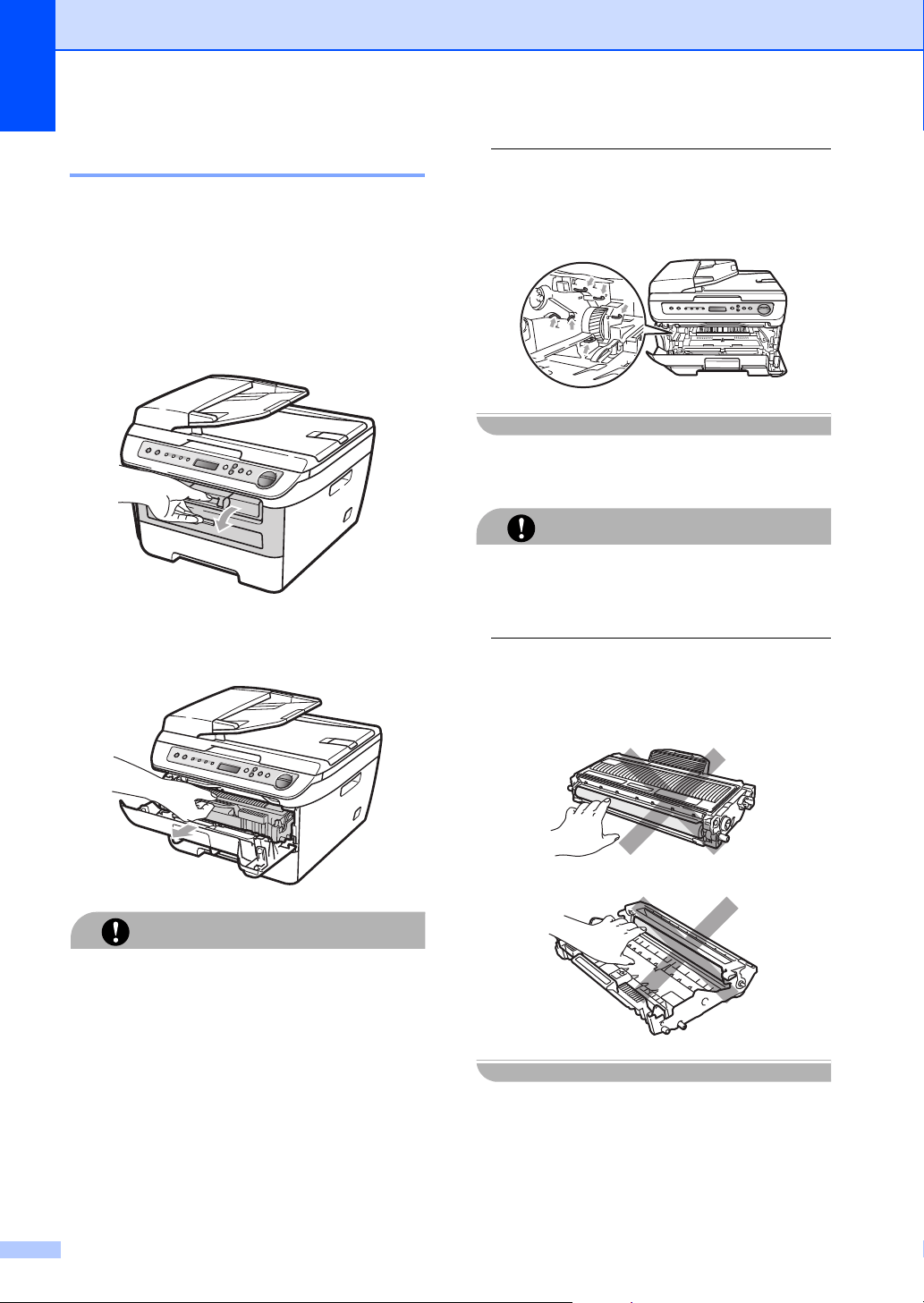
68
Cleaning the drum unit B
If you have print quality problems, clean the
drum unit as follows.
a Turn off the machine’s power switch.
Unplug the power cord from the AC
power outlet.
b Open the front cover.
c Slowly take out the drum unit and toner
cartridge assembly.
CAUTION
We recommend that you put the drum unit
and toner cartridge assembly on a clean,
flat surface with a piece of disposable paper
or cloth underneath it in case you
accidentally spill or scatter toner.
To prevent damage to the machine caused
by static electricity, DO NOT touch the
electrodes shown in the illustration.
d Push down the green lock lever and take
the toner cartridge out of the drum unit.
CAUTION
Handle the toner cartridge carefully. If toner
scatters on your hands or clothes, wipe or
wash it off with cold water at once.
To avoid print quality problems, DO NOT
touch the shaded parts shown in the
illustrations below.
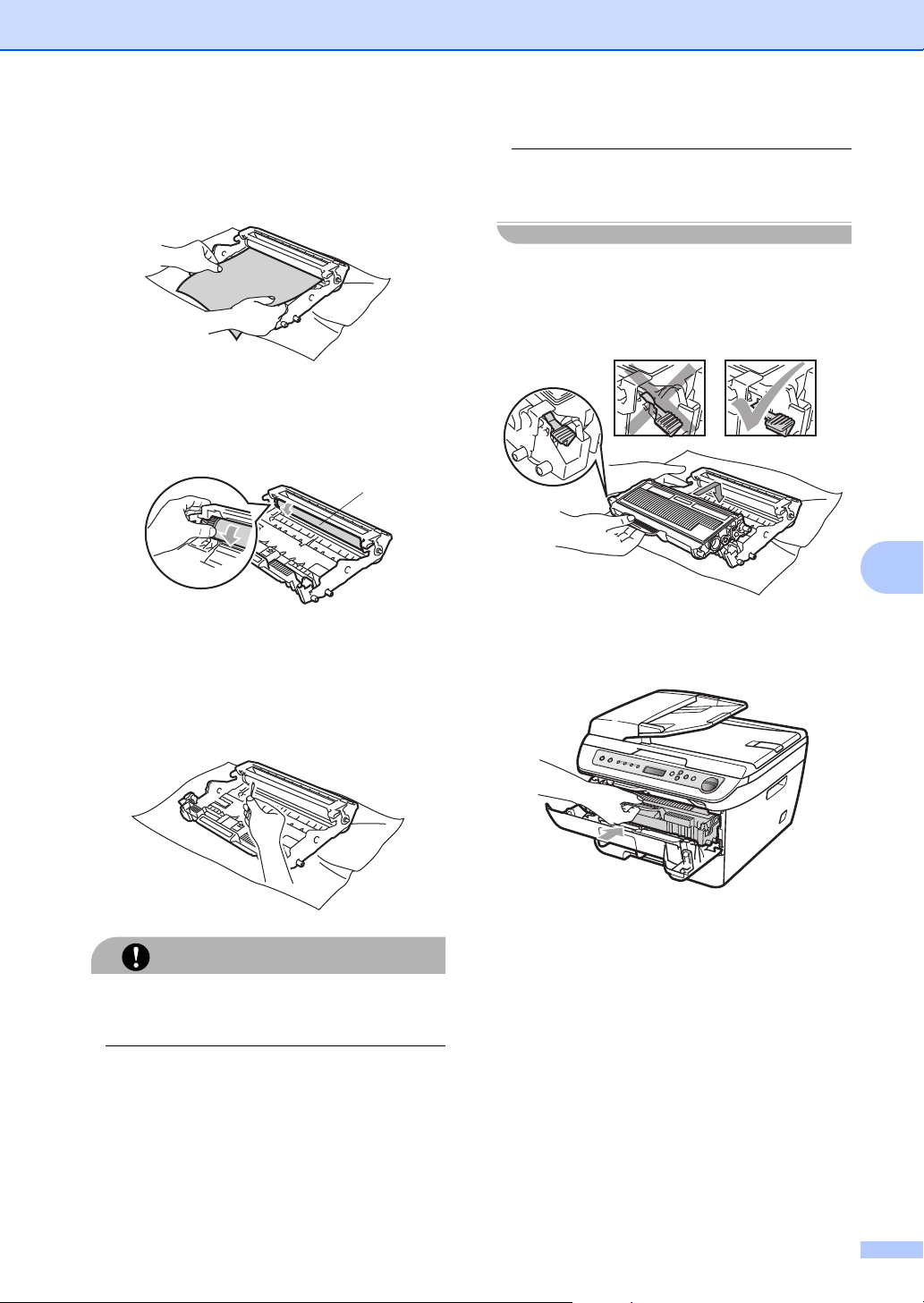
Troubleshooting and routine maintenance
69
B
e Put the print sample in front of the drum
unit, and find the exact position of the
poor print.
f Turn the drum unit gear by hand while
looking at the surface of the OPC
drum (1).
g When you have found the mark on the
drum that matches the print sample,
wipe the surface of the OPC drum with a
dry cotton swab until the dust or glue on
the surface comes off.
CAUTION
The drum is photosensitive so DO NOT
touch it with your fingers.
DO NOT clean the surface of the
photosensitive drum with a sharp object.
DO NOT use a scrubbing or wiping motion
because this might damage the drum.
h Put the toner cartridge back into the
drum unit until you hear it lock into place.
If you put the cartridge in properly, the
green lock lever will lift automatically.
i Put the drum unit and toner cartridge
assembly back in the machine.
j Close the front cover.
k Plug the machine’s power cord back into
the AC power outlet first, and then
reconnect all cables. Turn on the
machine’s power switch.
1
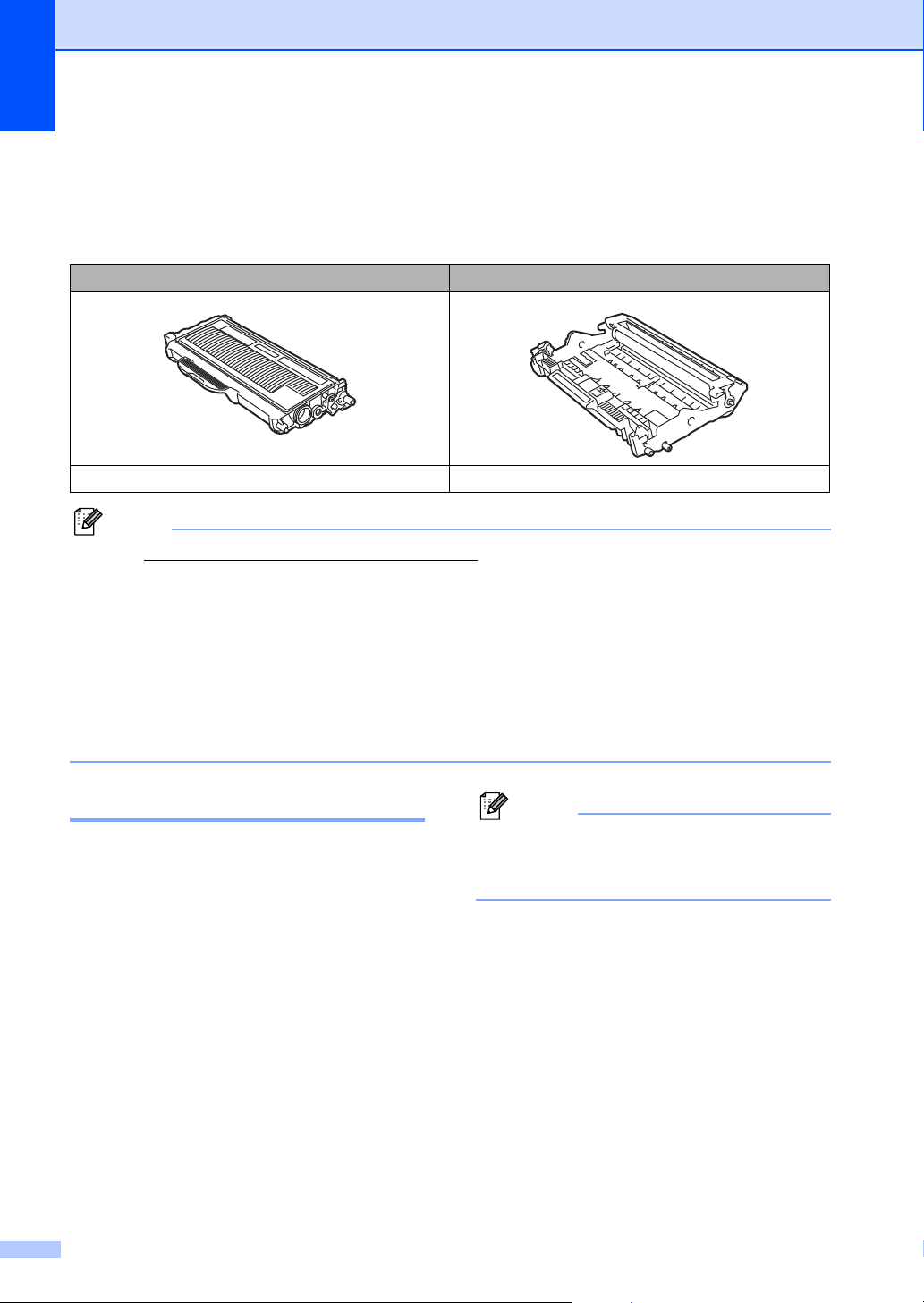
70
Replacing the consumable items B
You will need to replace the consumable items when the machine indicates that the life of the
consumable is over.
Note
• Go to http://www.brother.com/original/index.html for instructions on how to return your used
consumable items to the Brother collection program. If you choose not to return your used
consumable, please discard the used consumable according to local regulations, keeping it
separate from domestic waste. If you have questions, call your local waste disposal office. Be
sure to reseal the consumable items tightly so that the material inside does not spill.
• We recommend placing used consumable items on a piece of paper to prevent accidentally
spilling or scattering the material inside.
• If you use paper that is not a direct equivalent for the recommended paper, the life of
consumable items and machine parts may be reduced.
Replacing a toner cartridge B
The High Yield toner cartridges can print
approximately 2,600 pages
1
and the
Standard toner cartridges can print
approximately 1,500 pages
1
. Actual page
count will vary depending on your average
type of document (i.e., standard letter,
detailed graphics).
The machine is supplied with the Starter
toner cartridge that will need to be replaced
after approximately 1,000 pages
1
. When a
toner cartridge is running low, the LCD shows
Toner Low.
1
Approx. cartridge yield is declared in accordance
with ISO/IEC 19752.
Note
It is a good idea to keep a new toner
cartridge ready for use when you see the
Toner Low warning.
Toner cartridge Drum unit
Order No. TN-330, TN-360 Order No. DR-360
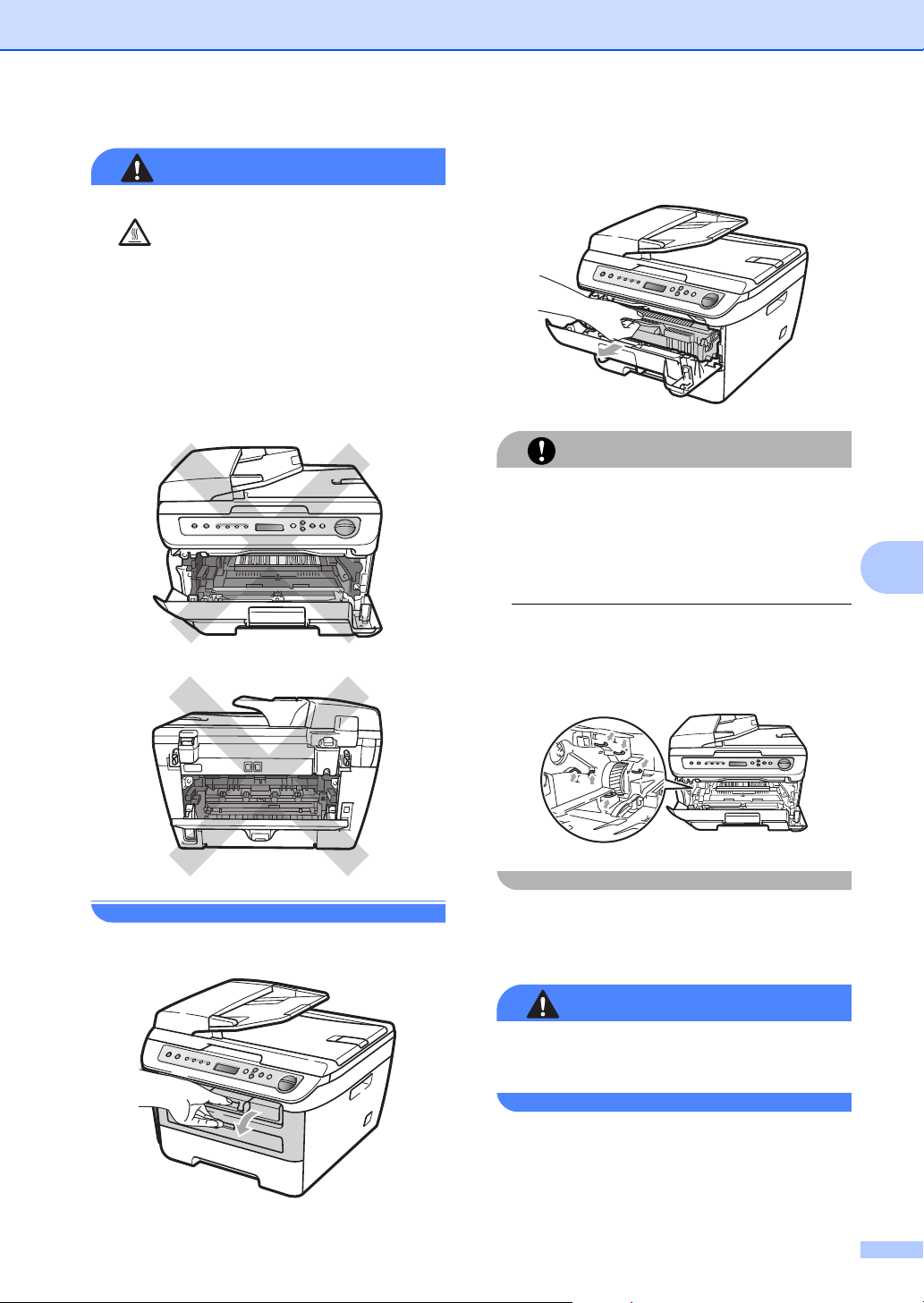
Troubleshooting and routine maintenance
71
B
WARNING
HOT SURFACE
After you have just used the machine, some
internal parts of the machine will be
extremely hot. When you open the front or
back cover (back output tray) of the
machine, DO NOT touch the shaded parts
shown in the illustration. If you do this, you
may get burned.
a Open the front cover.
b Slowly take out the drum unit and toner
cartridge assembly.
CAUTION
We recommend that you put the drum unit
and toner cartridge assembly on a clean,
flat surface with a piece of disposable paper
or cloth underneath it in case you
accidentally spill or scatter toner.
To prevent damage to the machine caused
by static electricity, DO NOT touch the
electrodes shown in the illustration.
c Push down the green lock lever and take
the used toner cartridge out of the drum
unit.
WARNING
DO NOT put a toner cartridge into a fire. It
could explode, resulting in injuries.
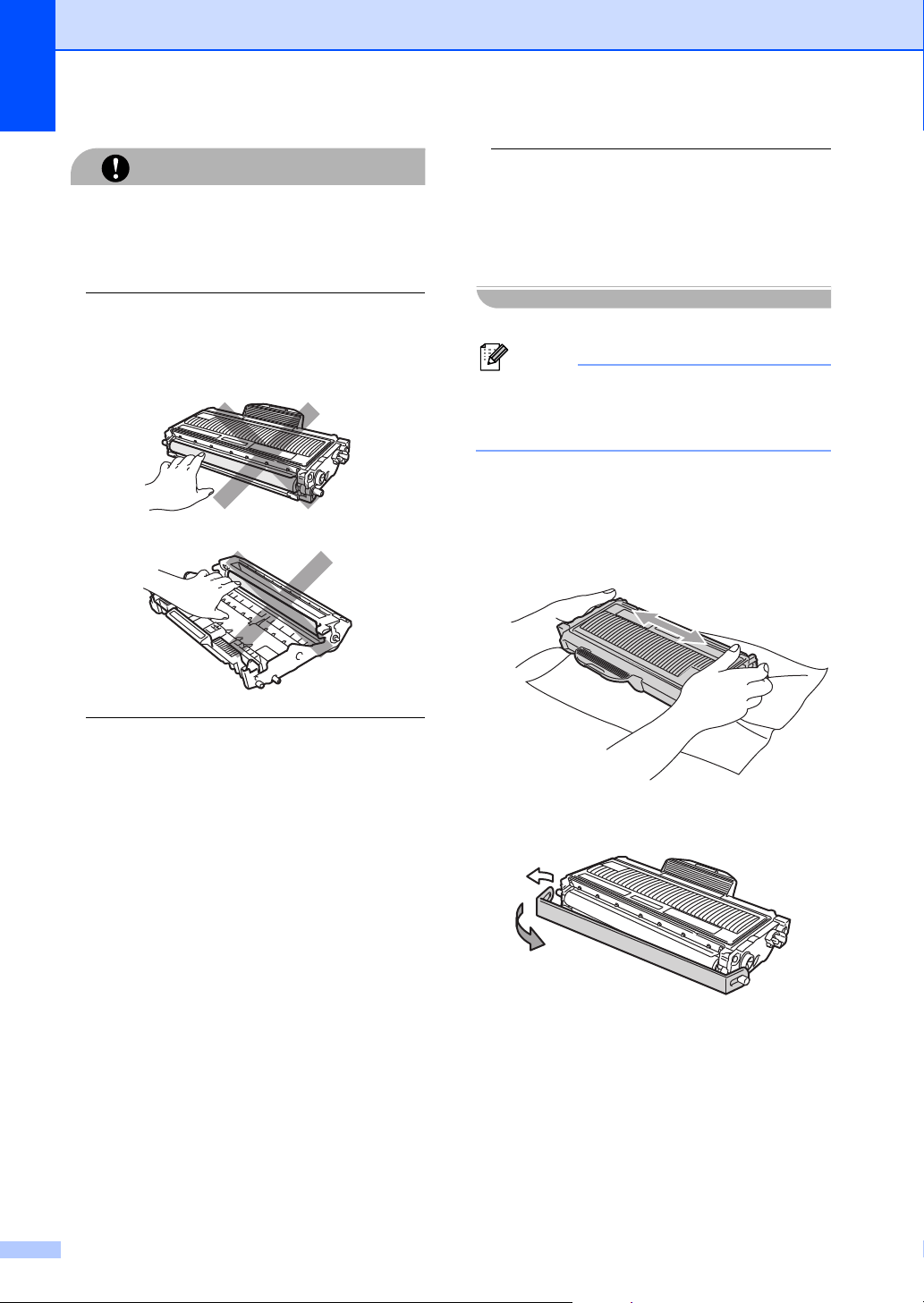
72
CAUTION
Handle the toner cartridge carefully. If toner
scatters on your hands or clothes, wipe or
wash it off with cold water at once.
To avoid print quality problems, DO NOT
touch the shaded parts shown in the
illustrations.
Brother strongly recommends that you DO
NOT refill the toner cartridge provided with
your machine. We also strongly
recommend that you continue to use only
Genuine Brother Brand replacement toner
cartridge. Use or attempted use of
potentially incompatible toner and/or
cartridge in the Brother machine may cause
damage to the machine and/or may result
in unsatisfactory print quality. Our warranty
coverage does not apply to any problem
that is caused by the use of unauthorized
third party toner and/or cartridge. To protect
your investment and obtain premium
performance from the Brother machine, we
strongly recommend the use of Genuine
Brother Supplies.
Wait to unpack the new toner cartridge until
immediately before you put it in the
machine. If a toner cartridge is left
unpacked for a long time, the toner life will
be shortened.
Note
Be sure to seal up the used toner cartridge
tightly in a suitable bag so that toner
powder does not spill out of the cartridge.
d Unpack the new toner cartridge. Hold
the cartridge level with both hands and
gently rock it from side to side five or six
times to spread the toner evenly inside
the cartridge.
e Pull off the protective cover.
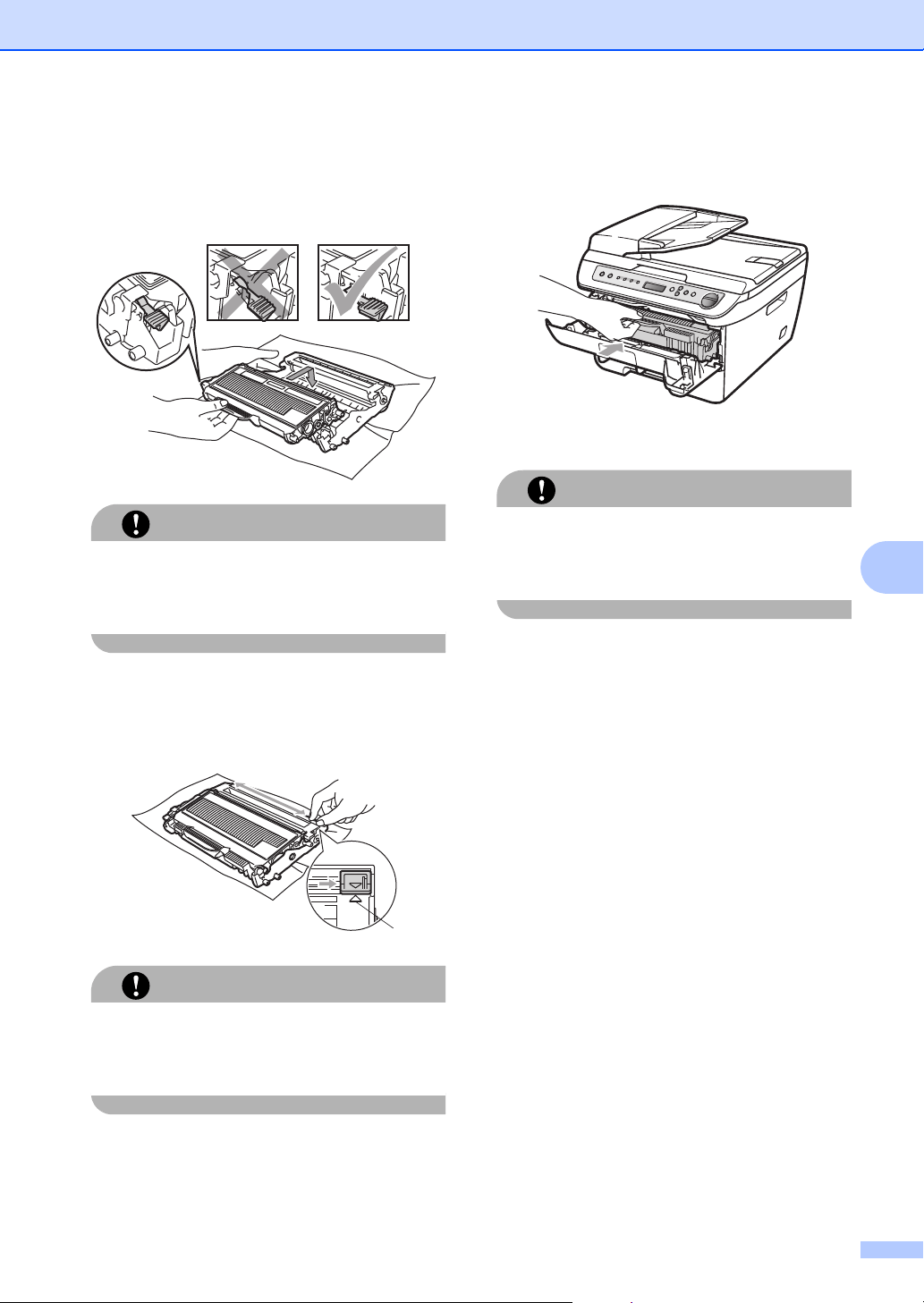
Troubleshooting and routine maintenance
73
B
f Put the new toner cartridge firmly into
the drum unit until you hear it lock into
place. If you put it in properly, the lock
lever will lift automatically.
CAUTION
Make sure that you put in the toner
cartridge properly or it may separate from
the drum unit.
g Clean the primary corona wire of the
drum unit by gently sliding the green tab
from right to left and left to right several
times.
CAUTION
Be sure to return the green tab to the home
position (a) (1). If you do not, printed pages
may have a vertical stripe.
h Put the drum unit and toner cartridge
assembly back in the machine.
i Close the front cover.
CAUTION
DO NOT turn off the machine’s power
switch or open the front cover until the LCD
returns to the standby state.
1
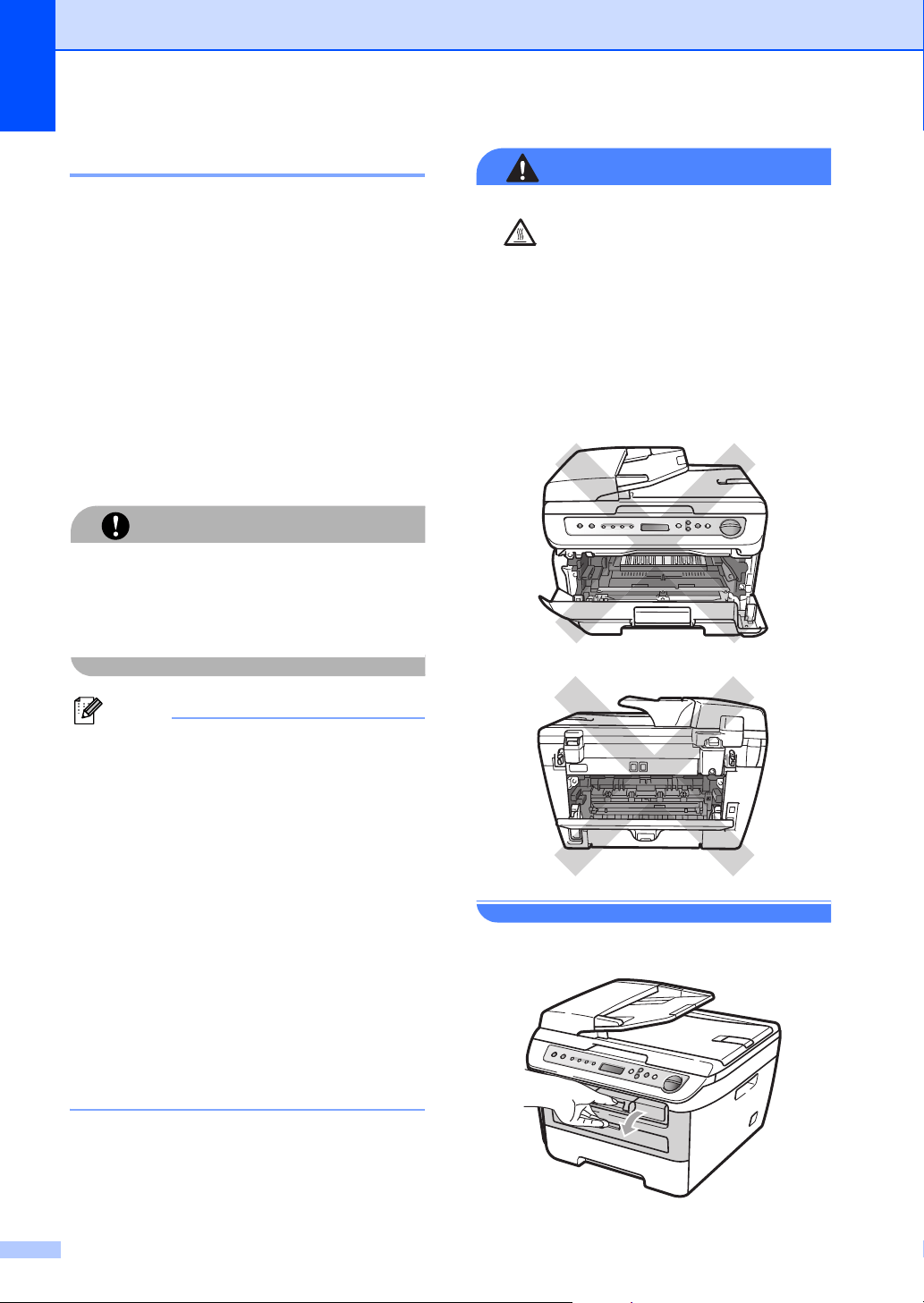
74
Replacing the drum unit B
The machine uses a drum unit to create print
images on paper. If the LCD shows
Drum End Soon, the drum unit is near the
end of its life and it is time to buy a new one.
Even if the LCD shows Drum End Soon,
you may be able to continue printing without
having to replace the drum unit for a while.
However, if there is a noticeable deterioration
in the output print quality (even before
Drum End Soon appears), then the drum
unit should be replaced. You should clean the
machine when you replace the drum unit.
(See Cleaning the laser scanner window
on page 64.)
CAUTION
While removing the drum unit, handle it
carefully because it may contain toner. If
toner scatters on your hands or clothes,
wipe or wash it off with cold water at once.
Note
The drum unit is a consumable item, and
it is necessary to replace it periodically.
There are many factors that determine the
actual drum life, such as temperature,
humidity, type of paper and how much
toner you use for the number of pages per
print job. The estimated drum life is
approximately 12,000 pages
1
. The actual
number of pages your drum will print may
be significantly less than this estimate.
Because we have no control over the
many factors that determine the actual
drum life, we cannot guarantee a
minimum number of pages that will be
printed by your drum.
1
Drum yield is approximate, and may vary by type of
use.
WARNING
HOT SURFACE
After you have just used the machine, some
internal parts of the machine will be
extremely hot. When you open the front or
back cover (back output tray) of the
machine, DO NOT touch the shaded parts
shown in the illustration. If you do this, you
may get burned.
a Open the front cover.
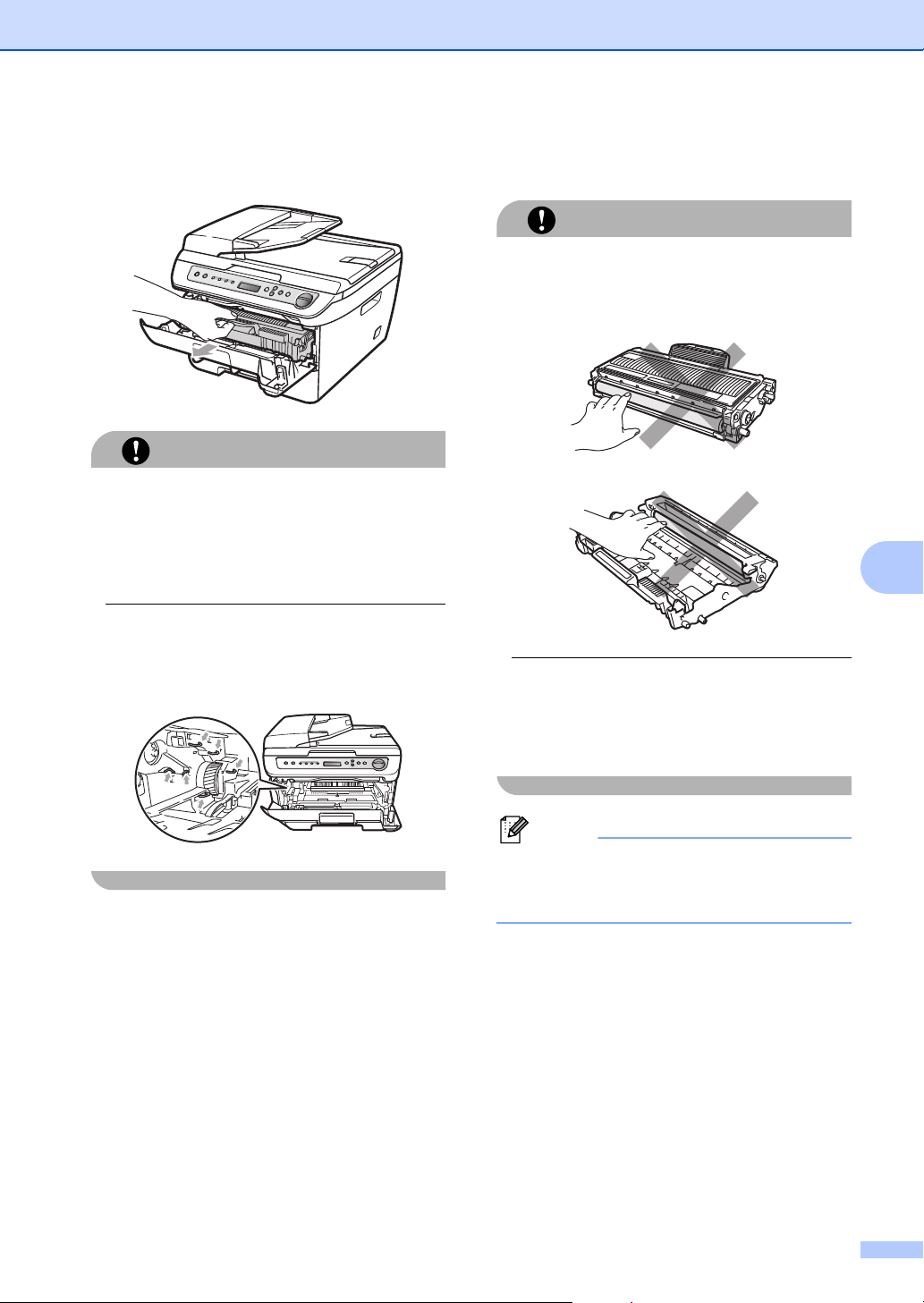
Troubleshooting and routine maintenance
75
B
b Slowly take out the drum unit and toner
cartridge assembly.
CAUTION
We recommend that you put the drum unit
and toner cartridge assembly on a clean,
flat surface with a piece of disposable paper
or cloth underneath it in case you
accidentally spill or scatter toner.
To prevent damage to the machine caused
by static electricity, DO NOT touch the
electrodes shown in the illustration.
c Push down the green lock lever and take
the toner cartridge out of the drum unit.
CAUTION
To avoid print quality problems, DO NOT
touch the shaded parts shown in the
illustrations.
Wait to unpack a new drum unit until
immediately before you put it in the
machine. Exposure to direct sunlight or
room light may damage the drum unit.
Note
Be sure to seal up the used drum unit
tightly in a bag so that toner powder does
not spill out of the unit.
d Unpack the new drum unit.
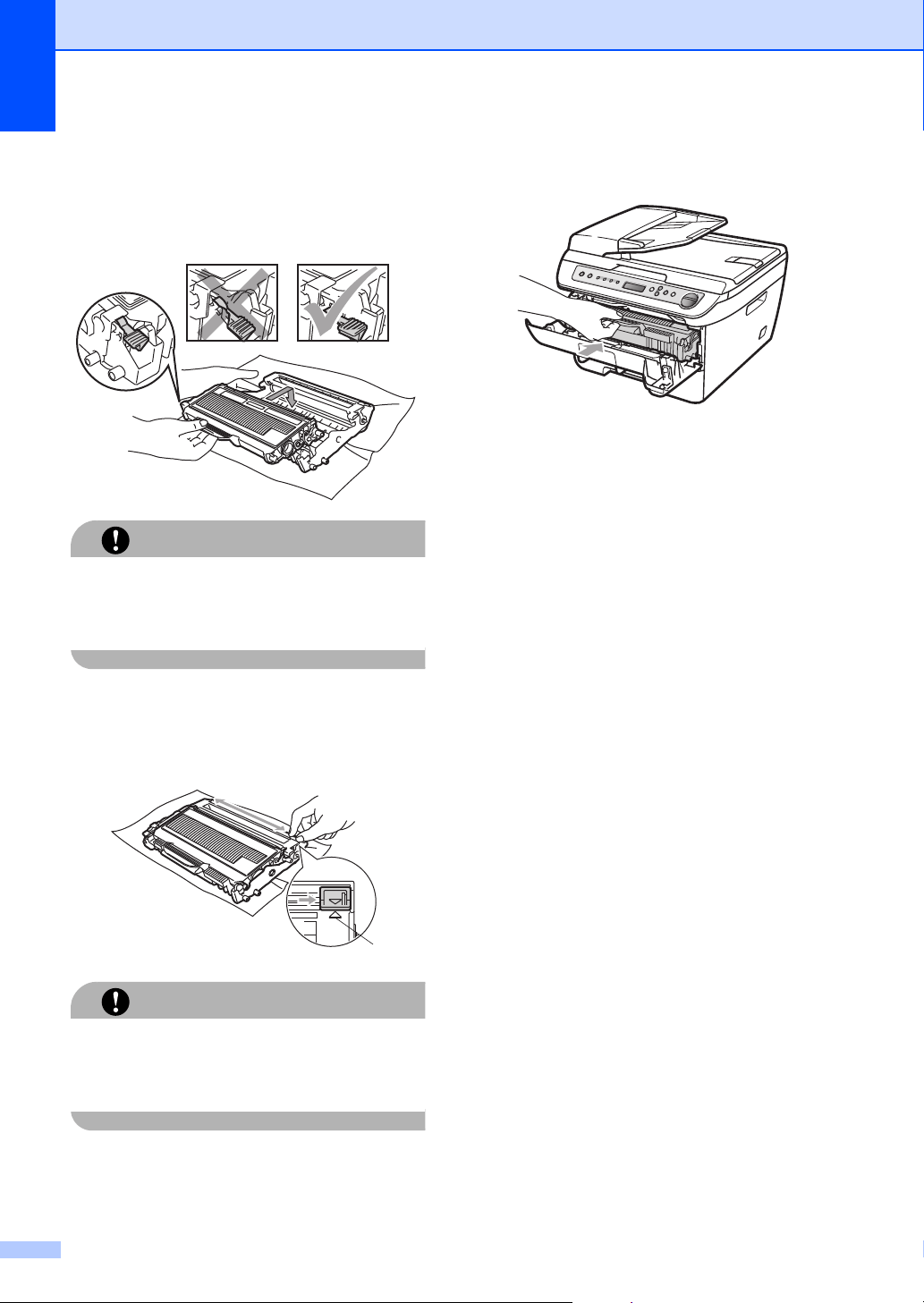
76
e Put the toner cartridge firmly into the
new drum unit until you hear it lock into
place. If you put the cartridge in
properly, the green lock lever will lift
automatically.
CAUTION
Make sure that you put in the toner
cartridge properly or it may separate from
the drum unit.
f Clean the primary corona wire inside the
drum unit by gently sliding the green tab
from right to left and left to right several
times.
CAUTION
Be sure to return the green tab to the home
position (a) (1). If you do not, printed pages
may have a vertical stripe.
g Put the new drum unit and toner
cartridge assembly in the machine.
h Press Clear/Back.
To confirm you are installing a new
drum, press a.
i When the LCD shows Accepted, close
the front cover.
1

Troubleshooting and routine maintenance
77
B
Machine information B
Checking the serial number B
You can see the machine’s serial number on
the LCD.
a Press Menu.
b Press a or b to choose
3.Machine Info.
Press OK.
c Press a or b to choose 1.Serial No.
Press OK.
d Press Stop/Exit.
Checking the page counters B
You can see the machine’s page counters for
copies, printed pages, reports and lists or a
summary total.
a Press Menu.
b Press a or b to choose
3.Machine Info.
Press OK.
c Press a or b to choose
2.Page Counter.
Press OK.
d Press a or b to choose Total, List,
Copy or Print.
You can see the machine’s page count.
e Press Stop/Exit.
Checking the Drum life B
You can see the machine’s drum life on the
LCD.
a Press Menu.
b Press a or b to choose
3.Machine Info.
Press OK.
c Press a or b to choose 3.Drum Life.
Press OK.
You can see the remaining percentage
of drum life.
d Press Stop/Exit.
Note
The drum life check will be accurate only if
you have reset the drum counter when
you installed a new drum unit. It will not be
accurate if you have reset the drum
counter during the life of a used drum.
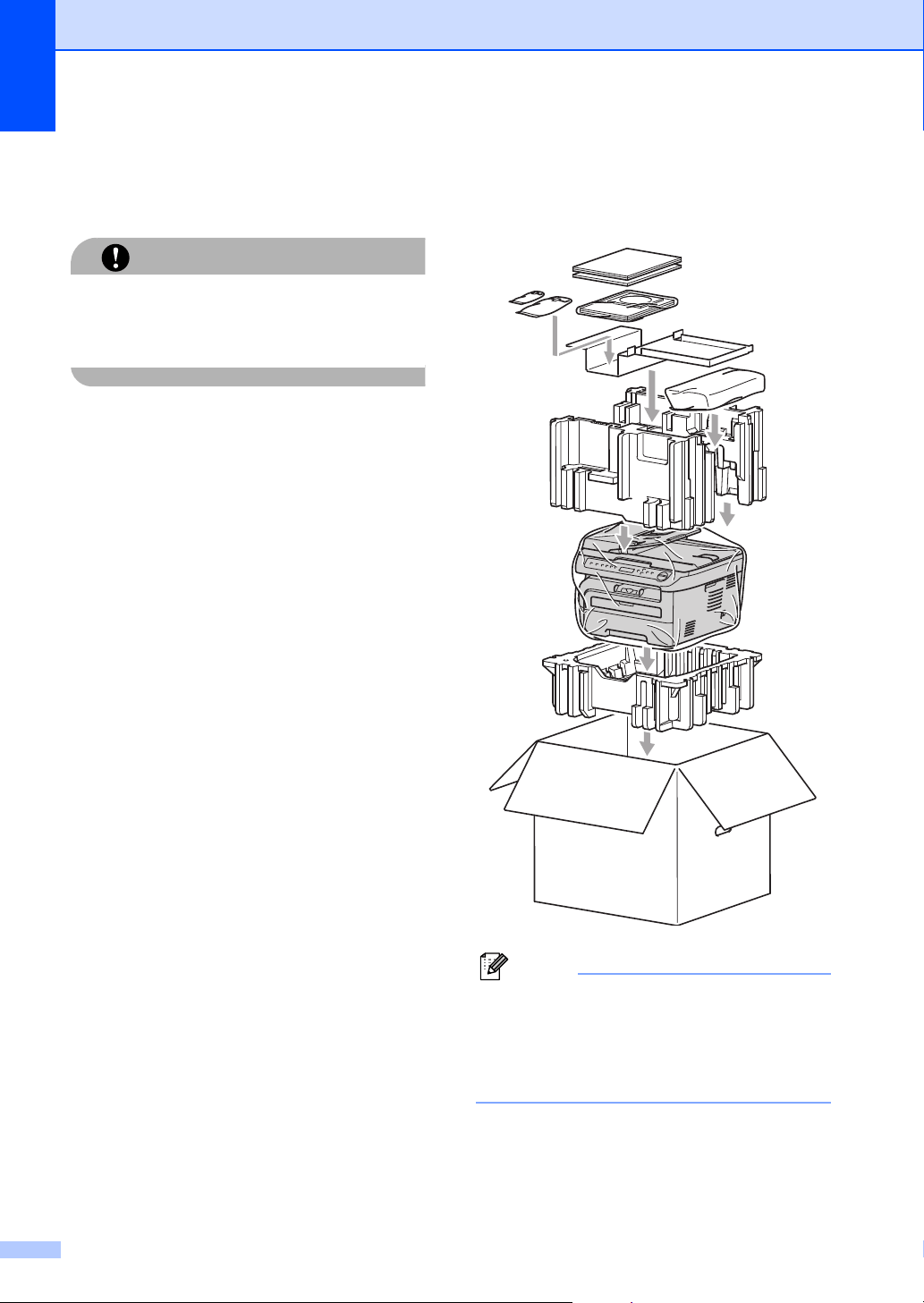
78
Packing and shipping
the machine B
CAUTION
If you pack the machine soon after turning
off the power make sure the machine has
cooled down completely.
When you transport the machine, use the
packing materials that came with your
machine. If you do not pack the machine
properly, you could void your warranty. The
machine should be adequately insured with
the carrier.
a Turn off the machine’s power switch.
b Unplug all the cables and AC power
cord from the machine.
c Open the front cover.
d Remove the drum unit and toner
cartridge assembly. Leave the toner
cartridge installed in the drum unit.
e Place the drum unit and toner cartridge
assembly into the plastic bag and seal
the bag.
f Close the front cover.
g Wrap the machine in the plastic bag and
place it in the original carton with the
original packing material.
h Pack the drum unit and toner cartridge
assembly, AC cord and printed
materials in the original carton as shown
below:
Note
If you are returning your machine to
Brother as part of the Exchange Service,
pack only the machine. Keep all separate
parts and printed materials to use with
your “Exchange” machine.
i Close the carton and tape it shut.
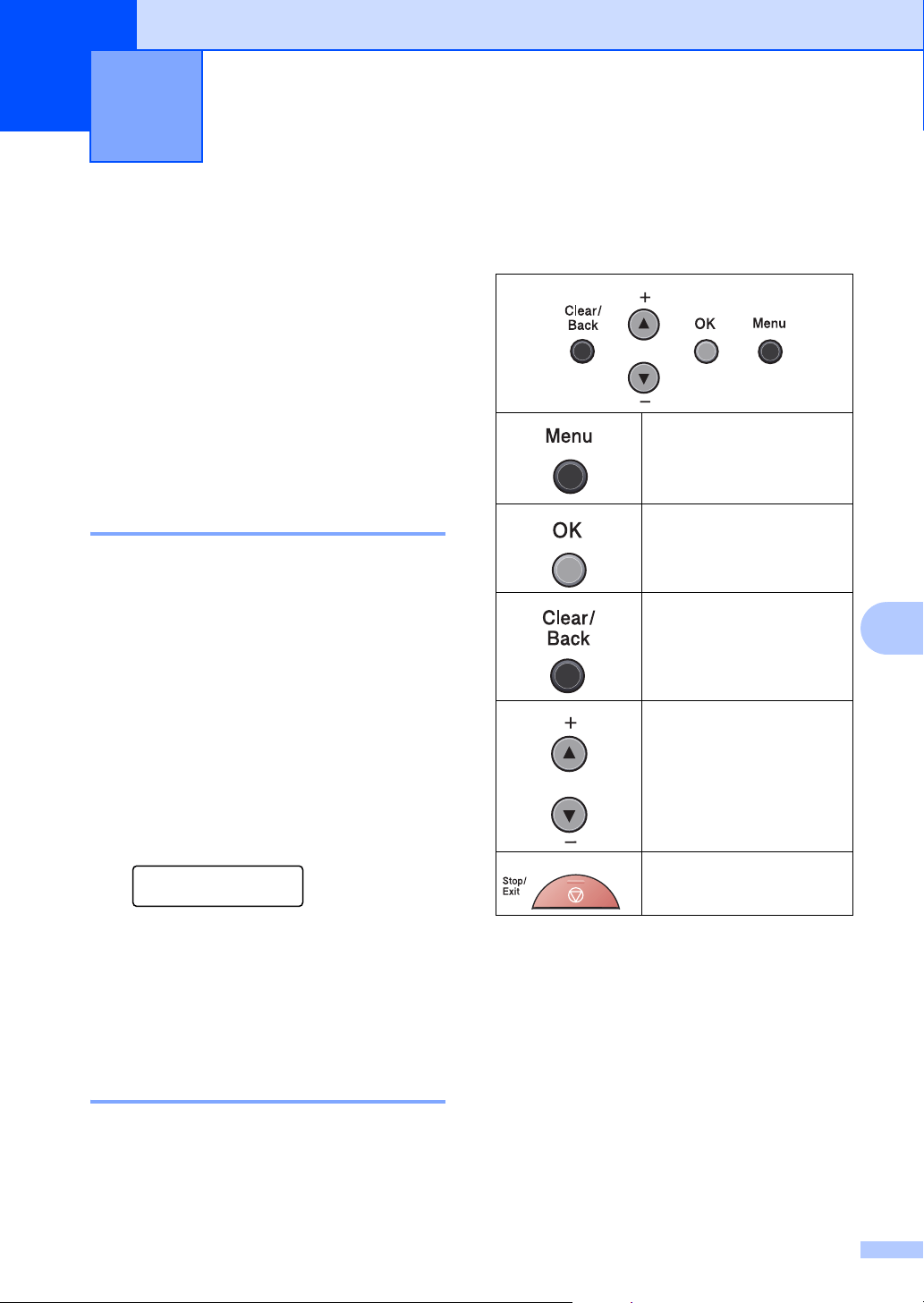
79
C
C
On-screen
programming C
Your machine has been designed to be easy
to use. The LCD provides on-screen
programming using the menu keys.
We have created step by step on-screen
instructions to help you program your
machine. Simply follow the steps as they
guide you through the menu selections and
programming options.
Menu table C
You can program your machine by using the
Menu table on page 81. These pages list the
menu selections and options.
Press Menu followed by the menu numbers
to program your machine.
For example, to set Beeper volume to Low:
a Press Menu.
b Press a or b to choose
1.General Setup.
Press OK.
c Press a or b to choose 3.Beeper.
General Setup
3.Beeper
Press OK.
d Press a or b to choose Low.
Press OK.
e Press Stop/Exit.
Memory storage C
Your menu settings are stored permanently,
and in the event of a power failure will not be
lost. Temporary settings (for example,
Contrast) will be lost.
Menu keys C
Menu and features C
Access the menu.
Go to the next menu level.
Accept an option.
Exit the menu by pressing
repeatedly.
Go back to the previous
menu level.
Scroll through the current
menu level.
Exit the menu.

80
How to access the menu
mode C
a Press Menu.
b Scroll through each menu level by
pressing a or b for the direction you
want.
c Press OK when the option you want
appears on the LCD.
The LCD will then show the next menu
level.
d Press a or b to scroll to your next menu
selection.
e Press OK.
When you have finished setting an
option, the LCD will show Accepted.
f Press Stop/Exit to exit Menu mode.

Menu and features
81
C
Menu table C
The factory settings are shown in Bold with an asterisk.
Choose & OK Choose & OK to accept to exit
Main Menu Submenu Menu Selections Options Descriptions Page
1.General
Setup
1.Paper Type — Thin
Plain*
Thick
Thicker
Transparency
Recycled Paper
Sets the type of
paper in the paper
tray.
19
2.Paper Size — A4
Letter*
Legal
Executive
A5
A6
B5
B6
Folio
Sets the size of the
paper in the paper
tray.
19
3.Beeper — Off
Low
Med*
High
Adjusts the volume
level of the beeper.
19
4.Ecology 1.Toner Save On
Off*
Increases the page
yield of the toner
cartridge.
20
2.Sleep Time (00-99)
05Min*
Conserves power. 20
The factory settings are shown in Bold with an asterisk.

82
1.General
Setup
(continued)
5.LCD Contrast — b -nnnno+ a
b -nnnon+ a
b -nnonn+ a*
b -nonnn+ a
b -onnnn+ a
Adjusts the contrast
of the LCD.
21
6.User Settings — — Lists your current
settings.
21
0.Local Language — (in USA)
English*
Spanish
(in Canada)
English*
French
Allows you to
change the LCD
language for your
country.
See Quick
Setup
Guide.
2.Copy 1.Quality — Auto*
Text
Photo
You can choose the
Copy resolution for
your type of
document.
27
2.Contrast — b -nnnno+ a
b -nnnon+ a
b -nnonn+ a*
b -nonnn+ a
b -onnnn+ a
Adjusts the contrast
for copies.
26
3.Machine
Info.
1.Serial No. — — You can check the
serial number of
your machine.
77
2.Page Counter — Total
List
Copy
Print
You can check the
number of total
pages the machine
has pr
inted during
its life.
77
3.Drum Life — — You can check the
percentage of a
Drum life that
remains available.
77
The factory settings are shown in Bold with an asterisk.
Main Menu Submenu Menu Selections Options Descriptions Page
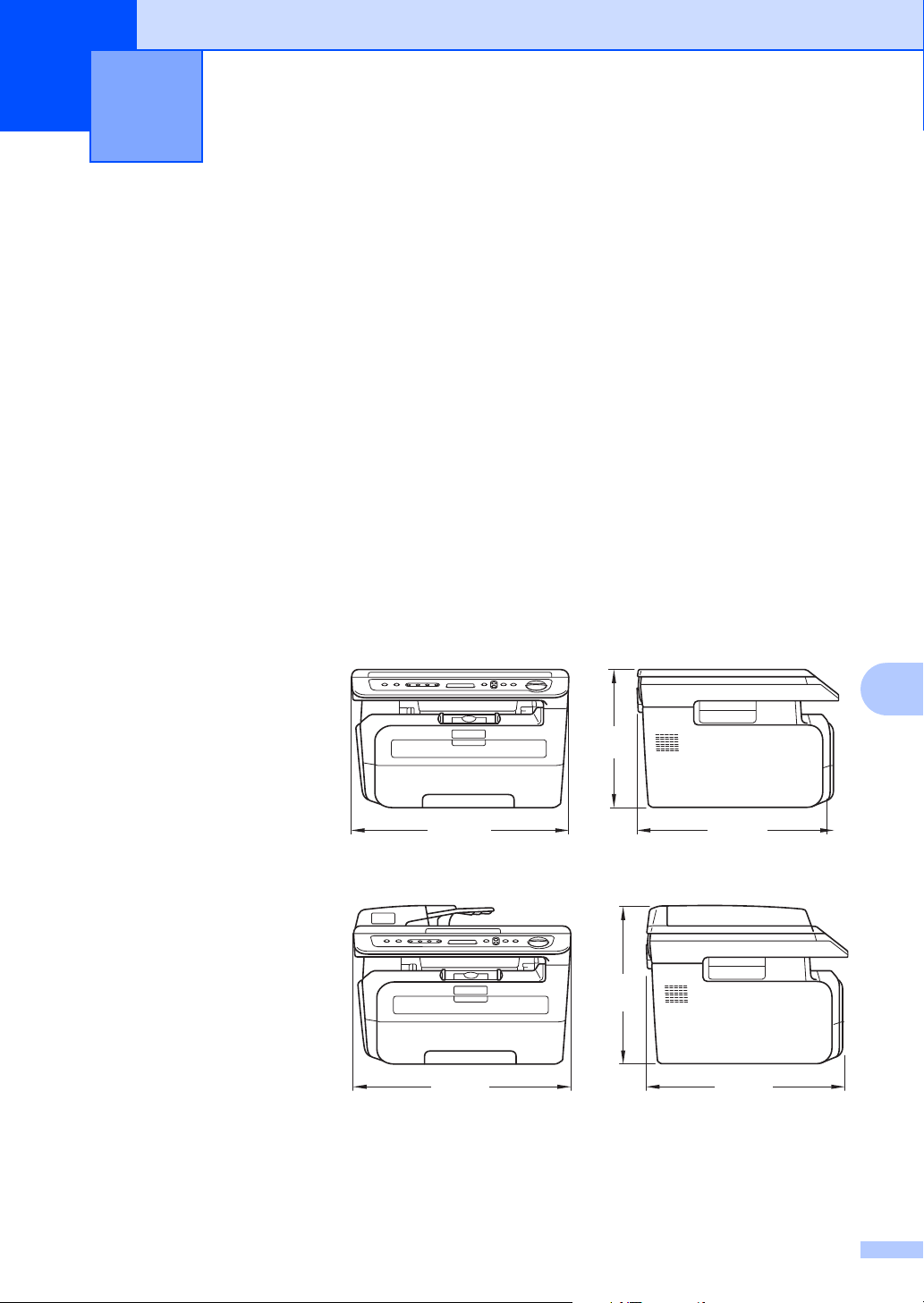
83
D
D
General D
Specifications D
Printer Type Laser
Print Method Electrophotography by semiconductor laser beam scanning
Memory Capacity 16 MB
LCD (liquid crystal display) 16 characters × 2 lines
Power Source 110-120 V AC 50/60 Hz
Power Consumption Peak: 1056 W
Copying:
Average 320 W
1
Sleep: (DCP-7030)
Average 8 W
(DCP-7040)
Average 9 W
Standby: Average 75 W
1
When making a copy from one sheet
Dimensions DCP-7030
DCP-7040
Weight Without Drum/Toner Unit:
(DCP-7030) 19.2 lb (8.7 kg)
(DCP-7040) 22 lb (10 kg)
10.1 in.
(257 mm)
16.9 in.
(428 mm)
15.6 in.
(396 mm)
12 in.
(304 mm)
15.6 in.
(396 mm)
16.9 in.
(428 mm)

84
Noise level Sound power
Operating
(Copying):
LWAd = 6.2 Bell
Standby: LWAd = 4.4 Bell
Sound
pressure
Operating
(Copying):
LpAm = 53 dBA
Standby: LpAm = 32 dBA
Temperature Operating: 50° F to 90.5° F (10 to 32.5° C)
Storage: 41° F to 95° F (5 to 35° C)
Humidity Operating: 20 to 80% (without condensation)
Storage: 10 to 90% (without condensation)
ADF (automatic document
feeder)
(DCP-7040 only)
Up to 35 pages (Staggered) 20 lb (80 g/m
2
)
Recommended Environment for Best Results:
Temperature: 68° F to 86° F (20 to 30° C)
Humidity: 50% - 70%
Paper: Xerox 4200 (20 lb/Letter)
Paper Tray
250 Sheets 20 lb (80 g/m
2
)

Specifications
85
D
Print media D
1
For transparencies and labels, we recommend removing printed pages from the output paper tray immediately after
they exit the machine to avoid the possibility of smudging.
Paper Input Paper Tray
Paper Type:
Plain Paper, Transparencies
1
or Recycled
Paper
Paper Size: Letter, A4, B5(ISO), A5, B6, A6, Executive,
Legal and Folio
Paper Weight: 16 to 28 lb (60 to 105 g/m2)
Maximum Paper Tray
Capacity:
Up to 250 sheets of 20 lb (80 g/m
2
)
Plain Paper
Manual Feed Slot
Paper Type: Plain Paper, Transparencies, Recycled
Paper, Bond Paper, Envelopes or Labels
1
Paper Size: Width: 3.0 to 8.66 in. (76.2 to 220 mm)
Length: 4.57 to 16 in. (116.0 to 406.4 mm)
Paper Weight:
16 to 43 lb (60 to 163 g/m
2
)
Maximum Manual Feed Slot
Capacity:
One sheet at a time
Paper Output Up to 100 sheets (face down print delivery to the output paper tray)

86
Copy D
1
The copy speed may change depending on the type of document you copy.
2
The first copy out time may vary depending on scanner lamp warm up time.
Copy Speed
Up to 23 pages/minute (Letter size)
1
Color/Monochrome Monochrome
Document Size ADF Width:
(DCP-7040 only)
5.8 to 8.5 in. (148 to 215.9 mm)
ADF Length:
(DCP-7040 only)
5.8 to 14 in. (148 to 355.6 mm)
Scanner Glass Width: Max. 8.5 in. (215.9 mm)
Scanner Glass Length: Max. 11.7 in. (297 mm)
Copy Width: Max. 8.26 in. (210 mm)
Multiple Copies Stacks up to 99 pages
Sorts up to 99 pages (DCP-7040 only)
Reduce/Enlarge 25% to 400% (in increments of 1%)
Resolution Up to 600 × 600 dpi
First Copy Out Time
Less than 15 seconds (from Ready state)
2

Specifications
87
D
Scan D
1
Maximum 1200 × 1200 dpi scanning with the WIA driver in Windows
®
XP/Windows Vista
®
(resolution up to
19200 × 19200 dpi can be chosen by using the Brother scanner utility)
Color/Monochrome Yes
TWAIN Compliant
Yes (Windows
®
2000 Professional/XP/
XP Professional x64 Edition/Windows Vista
®
)
Mac OS
®
X 10.2.4 or greater
WIA Compliant
Yes (Windows
®
XP/Windows Vista
®
)
Color Depth 24 bit color
Resolution
Up to 19200 × 19200 dpi (interpolated)
1
Up to 600 × 2400 dpi (optical) (From Scanner Glass)
(DCP-7040 only) Up to 600 × 600 dpi (optical) (From ADF)
Document Size ADF Width:
(DCP-7040 only)
5.8 to 8.5 in. (148.0 to 215.9 mm)
ADF Length:
(DCP-7040 only)
5.8 to 14 in. (148.0 to 355.6 mm)
Scanner Glass Width: Max. 8.5 in. (215.9 mm)
Scanner Glass Length:
Max. 11.7 in. (297 mm)
Scanning Width Max. 8.26 in. (210 mm)
Gray Scale 256 levels

88
Print D
1
The print speed may change depending on the type of document you print.
Interfaces D
1
Your machine has a USB interface that is compatible with the USB 2.0 specification. This interface is also compatible
with High-Speed USB 2.0; however, the maximum data transfer rate will be 12 Mbits/s. The machine can also be
connected to a computer that has a USB 1.1 interface.
2
Third party USB ports are not supported for Macintosh
®
.
Printer Driver
Host-Based Driver for Windows
®
2000 Professional/
XP/XP Professional x64 Edition/Windows Vista
®
Macintosh
®
Printer Driver for Mac OS
®
X 10.2.4 or greater
Resolution HQ1200 (2400 × 600 dpi), 600, 300 dpi
Print Speed
Up to 23 pages/minute (Letter size)
1
First Print Out Time Less than 10 seconds (from the Ready state and the standard tray)
USB
Use a USB 2.0 interface cable that is no longer than 6 feet (2.0 m).
1
2

Specifications
89
D
Computer requirements D
1
Microsoft
®
Internet Explorer 5.5 or greater
2
For WIA, 1200x1200 resolution. Brother Scanner Utility enables to enhance up to 19200 x 19200 dpi.
3
Third party USB ports are not supported.
4
PaperPort™ 11SE supports Microsoft
®
SP4 or higher for Windows
®
2000 and SP2 or higher for XP.
Minimum System Requirements and Supported PC Software Functions
Computer Platform &
Operating System
Version
Supported
PC
Software
Functions
PC
Interface
Processor
Minimum
Speed
Minimum
RAM
Recommended
RAM
Available Hard
Disk Space
For
Drivers
For
Applications
Windows
®
Operating
System
1
Windows
®
2000
Professional
4
Printing,
Scanning
USB
Intel
®
Pentium
®
II
or AMD
equivalent
64 MB
256 MB
150 MB 310 MB
Windows
®
XP
Home
24
Windows
®
XP
Professional
24
128 MB
Windows
®
XP
Professional
x64
Edition
2
64-bit
(Intel
®
64
or AMD64)
supported
CPU
256 MB
512 MB
Windows
Vista
®
2
Intel
®
Pentium
®
4
or
equivalent
64-bit
(Intel
®
64
or AMD64)
supported
CPU
512 MB 1 GB 500 MB 500 MB
Macintosh
®
Operating
System
Mac OS
®
X 10.2.4 -
10.4.3
Printing,
Scanning
USB
3
PowerPC
G4/G5,
PowerPC
G3
350MHz
128 MB
256 MB
80 MB 400 MB
Mac OS
®
X 10.4.4
or greater
PowerPC
G4/G5,
Intel
®
Core™
Processor
512 MB 1 GB

90
Consumable items D
1
Approx. cartridge yield is declared in accordance with ISO/IEC 19752.
2
Drum yield is approximate, and may vary by type of use.
Toner Cartridge Life Starter Toner Cartridge:
Approx. 1,000 pages
1
Standard Toner Cartridge:
TN-330: Approx. 1,500 pages
(Letter)
1
High-Yield Toner Cartridge:
TN-360: Approx. 2,600 pages
(Letter)
1
Drum Unit DR-360: Approx. 12,000 pages
(Letter)
2

91
E
E
ADF (automatic document feeder)
(DCP-7040 only) The document can be
placed in the ADF and scanned one page
at a time automatically.
Beeper Volume
Volume setting for the beep when you
press a key or make an error.
Cancel Job
Cancels a programmed print job and
clears the machine’s memory.
Contrast
Setting to compensate for dark or light
documents, by making copies of dark
documents lighter and light documents
darker.
Gray scale
The shades of gray available for copying
photographs.
LCD (liquid crystal display)
The display screen on the machine that
shows interactive messages during On-
Screen Programming and shows the date
and time when the machine is idle.
Menu mode
Programming mode for changing your
machine’s settings.
OCR (optical character recognition)
The bundled ScanSoft™
PaperPort™ 11SE with OCR or Presto!
®
PageManager
®
software application
converts an image of text to text you can
edit.
Resolution
The number of vertical and horizontal lines
per inch.
Scanning
The process of sending an electronic
image of a paper document into your
computer.
Temporary settings
You can choose certain options for each
copy without changing the default
settings.
User Settings List
A printed report that shows the current
settings of the machine.
Glossary E

Index
92
F
A
Accessories and supplies .......................... ii
ADF (automatic document feeder)
using
.....................................................17
Apple
®
Macintosh
®
See Software User’s Guide on the
CD-ROM.
B
Brother
accessories and supplies
........................ ii
Brother numbers
...................................... i
Customer Service
....................................i
FAQs (frequently asked questions)
.......... i
product support
........................................ i
service centers
......................................... i
warranties
.................................... iii, iv, vi
C
Canceling
print jobs
.................................................6
Cleaning
corona wire
...........................................66
drum unit
...............................................68
laser scanner window
...........................64
scanner glass
........................................63
Consumable items
...................................70
Control panel overview
..............................6
ControlCenter2 (for Macintosh
®
)
See Software User’s Guide on the
CD-ROM.
ControlCenter3 (for Windows
®
)
See Software User’s Guide on the
CD-ROM.
Copy
contrast
.......................................... 24, 26
Enlarge/Reduce key
..............................25
keys
.................................................. 6, 25
multiple
..................................................24
N in 1 (page layout)
...............................28
out of memory
.......................................29
quality
....................................................27
single
.....................................................24
sort (ADF only)
......................................28
temporary settings
................................ 25
using ADF
.......................................28, 29
using scanner glass
........................28, 29
D
Document
how to load
.....................................17, 18
Drum unit
checking (remaining life)
...................... 77
cleaning
.......................................... 66, 68
replacing
............................................... 74
E
Enlarge/Reduce key ................................ 25
Envelopes
.................. 9, 12, 13, 15, 16, 48
how to load
............................................. 9
Error messages on LCD
.......................... 55
Init Unable XX
...................................... 56
No Paper
.............................................. 56
Out of Memory
...................................... 56
Print Unable XX
.................................... 56
Scan Unable XX
................................... 56
F
Folio ......................................................... 13
G
Gray scale ............................................... 87
H
HELP
LCD messages
..................................... 79
Menu Table
....................................79, 81
using menu keys
.................................. 79
J
Jams
paper
.................................................... 58
Job Cancel key
.......................................... 6

Index
93
F
L
Labels ................... 8, 9, 12, 13, 16, 48, 85
LCD (liquid crystal display)
................. 6, 79
contrast
.................................................21
M
Machine information
checking remaining life of drum unit
.....77
page counts
..........................................77
Macintosh
®
See Software User’s Guide on the
CD-ROM.
Maintenance, routine
...............................62
checking the remaining life of drum unit
77
replacing
drum unit
............................................74
toner cartridge
....................................70
Memory
storage
..................................................79
Menu Table
....................................... 79, 81
using menu keys
...................................79
N
N in 1 (page layout) ..................................28
O
Out of Memory message ................... 29, 56
P
Packing and shipping the machine ..........78
Page layout (N in 1)
.................................28
Paper
................................................ 12, 85
how to load
.............................................7
jam
........................................................58
recommended
................................ 12, 13
size
................................................ 12, 19
size of document
............................ 86, 87
tray capacity
..........................................13
type
................................................ 12, 19
PaperPort™ 11SE with OCR
See Software User’s Guide on the
CD-ROM and Help in the PaperPort™
11SE application to access How-to-Guides.
Power failure
............................................79
Print
difficulties
............................................. 47
drivers
.................................................. 88
Job Cancel key
....................................... 6
paper jams
........................................... 58
quality
............................................. 48, 49
resolution
.............................................. 88
specifications
........................................ 88
Printing
See Software User’s Guide on the
CD-ROM.
Programming your machine
.................... 79
Q
Quality
copying
................................................. 27
printing
........................................... 48, 49
R
Reducing
copies
................................................... 25
Replacing
drum unit
.............................................. 74
toner cartridge
...................................... 70
Resolution
copy
...................................................... 86
print
...................................................... 88
scan
...................................................... 87
S
Safety instructions ................................... 42
Scanner glass
using
..................................................... 18
Scanning
See Software User’s Guide on the
CD-ROM.
Serial number
how to findSee inside front cover
Service centers
............................................i
Shipping the machine
.............................. 78
Sleep time
............................................... 20
Sort
.......................................................... 28

94
T
Temporary copy settings ..........................25
Toner cartridge, replacing
........................70
Toner save
...............................................20
Transparency
...............7, 8, 12, 13, 48, 85
Troubleshooting
.......................................46
document jam
.......................................57
error messages on LCD
........................55
if you are having difficulty
copy quality
........................................46
paper handling
...................................48
print quality
.................................. 48, 49
printing
...............................................47
scanning
.............................................47
software
.............................................48
maintenance messages on LCD
...........55
paper jam
..............................................58
V
Volume, setting
beeper
...................................................19
W
Warranties
Canada
.................................................. vi
Notice-Disclaimer
................................... iii
USA
........................................................ iv
Windows
®
See Software User’s Guide on the
CD-ROM.
World Wide Web ......................................... i

EQUIPMENT ATTACHMENT LIMITATIONS
(Canada only)
NOTICE
This product meets the applicable Industry Canada technical specifications.
Brother International Corporation
100 Somerset Corporate Boulevard
P.O. Box 6911
Bridgewater, NJ 08807-0911 USA
Brother International Corporation (Canada) Ltd.
1 rue Hôtel de Ville,
Dollard-des-Ormeaux, QC, Canada H9B 3H6
Visit us on the World Wide Web
http://www.brother.com/
These machines are made for use in the USA and Canada only. We cannot recommend using
them overseas because the power requirement of your Digital Copier/Printer may not be
compatible with the power available in foreign countries. Using USA or Canada models
overseas is at your own risk and may void your warranty.