
Contents
51
EN
1 Instructions 52
1.1 General safety instructions 52
1.2 Appliance purpose 55
1.3 Manufacturer liability 56
1.4 This user manual 56
1.5 Identification plate 56
1.6 Disposal 56
1.7 How to read the user manual 57
2 Description 58
2.1 General Description 58
2.2 Control panel 59
2.3 Other parts 60
2.4 Available accessories 60
2.5 Blast Chiller Advantages 61
3 Use 62
3.1 Instructions 62
3.2 Preliminary operations 63
3.3 Using the accessories 63
3.4 Using the Blast Chiller 64
3.5 Cooling functions 65
3.6 Automatic programs 77
3.7 Special functions 80
3.8 History 90
3.9 Settings 90
4 Cleaning and maintenance 93
4.1 Instructions 93
4.2 Cleaning the surfaces 93
4.3 Extraordinary maintenance 95
5 Installation 97
5.1 Electrical connection 97
5.2 Positioning 97
We advise you to read this manual carefully, as it contains all the instructions for maintaining
the appliance’s aesthetic and functional qualities.
For further information on the product: www.smeg.com
TRANSLATION OF THE ORIGINAL INSTRUCTIONS

Instructions
52
1 Instructions
1.1 General safety instructions
Risk of personal injury
• Do not touch the interior walls
during use of hot functions.
• Do not touch the appliance with
damp or wet hands or feet.
• Keep children under the age of
eight at a safe distance unless
they are constantly supervised.
• Children must not play with the
appliance.
• This appliance may be used by
children aged at least 8 and by
people of reduced physical,
sensory or mental capacity, or
lacking in experience in the use of
electrical appliances, provided
that they are supervised or
instructed by adults who are
responsible for their safety.
• Switch off the appliance
immediately after use.
• Wear oven gloves when handling
hot trays or other containers to
prevent burns.
• Never try to put out a fire or
flames with water: Turn off the
appliance and smother the flames
with a fire blanket or other
appropriate cover.
• Cleaning and maintenance must
not be carried out by
unsupervised children.
• Have qualified personnel carry
out installation and assistance
interventions according to the
standards in force.
• DO NOT USE OR STORE
FLAMMABLE MATERIALS NEAR
THE APPLIANCE.
• DO NOT USE AEROSOLS IN
THE VICINITY OF THIS
APPLIANCE WHILST IT IS IN
USE.
• Switch off the appliance
immediately after use.
• DO NOT MODIFY THIS
APPLIANCE.
• Always use any necessary/
required personal protective
equipment (PPE) before
performing any work on the
appliance (installation,
maintenance, positioning or
movement).
Instructions
53
EN
• Before performing any work on
the appliance, switch off the
power supply.
• Do not insert pointed metal
objects (cutlery or utensils) into the
slots in the appliance.
• Do not try to repair the appliance
yourself or without the intervention
of a qualified technician.
• If the power supply cable is
damaged, contact technical
support immediately and they will
replace it.
• Do not touch frozen foods
(especially with wet hands), or
place them in your mouth.
Risk of damaging the appliance
• Do not damage the refrigerant
circuit.
• Do not use mechanical devices or
other means to speed up the
defrosting process other than
those recommended by the
manufacturer.
• To prevent hazards due to
instability of the appliance, this
must be fastened in accordance
with the instructions.
• Never rest sharp metal objects
such as knives, forks, spoons and
lids on the appliance during use.
• Do not use abrasive or corrosive
detergents (e.g. scouring
powders, stain removers and
metallic sponges) on glass parts.
• Do not sit on the appliance.
• Do not use steam jets for cleaning
the appliance.
• Keep the appliance’s ventilation
openings and slots free from
obstructions.
• Do not place trays or other
containers directly on the base of
the appliance.
• Do not use electrical equipment
inside the appliance.
• Do not use the appliance to cool
rooms for any reason.
• Always disconnect the appliance
from the power grid in the event of
a breakdown, maintenance,
when replacing the light bulb or
during cleaning.
• The appliance is able to
guarantee optimum performance
at ambient temperatures not
exceeding 32°C.

Instructions
54
• Do not use rough or abrasive
materials or sharp metal scrapers.
• Never use the oven door to lever
the appliance into place when
fitting.
• Avoid exerting too much pressure
on the oven door when open.
• Do not use the handle to lift or
move the appliance.
Installation
• THIS APPLIANCE MUST NOT BE
INSTALLED IN BOATS OR
CARAVANS.
• Position the appliance into the
cabinet cut-out with the help of a
second person.
• Do not install the appliance in
potentially explosive
environments.
• Do not install the appliance in
closed environments without
sufficient air exchange.
• Do not install the appliance in
areas exposed to direct sunlight
or close to heat sources (ovens,
hobs etc.).
• To avoid potential overheating, the
appliance must not be installed
behind a decorative door or a
panel.
• Have the electrical connection
performed by authorised technical
personnel.
• The appliance must be connected
to earth in compliance with
electrical system safety standards.
• Use cables withstanding a
temperature of at least 90 °C.
• The tightening torque of the screws
of the terminal supply wires must
be 1.5 - 2 Nm.
For this appliance
• Do not damage the refrigeration
circuit (if this is accessible).
• Follow applicable legislation on the
consumption of raw foodstuffs. Raw
fish should be frozen to -20°C
and held at that temperature for at
least 24 hours.
• Carefully clean the parts of the
appliance which come into direct
or indirect contact with foodstuffs
to prevent any kind of
contamination.
• Use food-safe detergents.
• Do not use flammable or harmful
products.
Instructions
55
EN
• Use only the temperature probe
supplied with the appliance.
• Keep the appliance door closed
during all operations.
• Do not stack food items on top of
each other, but rather arrange
them so that the air is able to
circulate correctly inside the
appliance.
• Use aluminium or stainless-steel
containers.
• Do not cover trays with insulating
covers or films.
• Do not rest any weight or sit on the
open door of the appliance.
• Take care that no objects are stuck
in the doors.
• If the appliance is to remain
unused for an extended period of
time, unplug it and clean the
interior and exterior.
• The electrical cable and socket
must remain easily accessible
once the appliance is installed.
1.2 Appliance purpose
• This appliance is designed for
blast chilling, freezing,
conservation and proving of
foodstuffs, and for chilling drinks, in
a residential environment. It may
be used to rapidly lower the
temperature of cooked or raw
foods in order to retain their
nutritional properties. It also allows
foodstuffs to be cooked at low
temperatures in order to enhance
their quality, flavours and aromas,
and dishes to be warmed up to
serving temperature.
Every other use is considered
improper.
• This appliance may also be
used:
• In kitchenettes in shops, offices
and other workplaces
• In farms/farm stay facilities
• By guests in hotels, motels and
residential environments
• In bed and breakfasts.
• The appliance is not designed
to operate with external timers
or with remote-control systems.
Instructions
56
1.3 Manufacturer liability
The manufacturer shall bear no
liability for damage to persons or
property caused by:
• Use of the appliance other than
that specified
• Failure to comply with the
instructions in the user manual
• Failure to comply with applicable
legislation regarding the
consumption of raw foodstuffs
• Tampering with any part of the
appliance
• The use of non-original spare parts
1.4 This user manual
This user manual is an integral part of
the appliance and must therefore be
kept in its entirety and within the
user’s reach for the whole working
life of the appliance.
Read this user manual carefully
before using the appliance.
1.5 Identification plate
The identification plate bears the
technical data, serial number and
brand name of the appliance. Do not
remove the identification plate for
any reason.
1.6 Disposal
This appliance complies with
the European Union WEEE
directive (2012/19/EU) and
bears the symbol for waste electrical
and electronic products. This
appliance must be disposed of
separately from other household
waste (Directives 2002/95/EC,
2002/96/EC, 2003/108/EC).
The appliance does not contain
substances in quantities sufficient to
be considered hazardous to health
and the environment, in accordance
with current European directives.
To dispose of the appliance:
• Cut the power supply cable and
remove it along with the plug.
• Deliver the appliance to the
appropriate recycling centre for
electrical and electronic
equipment waste, or return it to the
retailer when purchasing an
equivalent product, on a like-for-
like basis.
This appliance is not subject
to the energy labelling
requirements of Article 1,
point E of Regulation (EC)
643/2009.
Power voltage
Danger of electrocution
• Isolate the mains power supply.
• Unplug the appliance.
Instructions
57
EN
Our appliances are packaged in
non-polluting and recyclable
materials.
• Take the packing materials to an
appropriate recycling centre.
1.7 How to read the user manual
This user manual uses the following reading
conventions:
1. Sequence of instructions for use.
• Standalone instruction.
Plastic packaging
Danger of suffocation
• Do not leave the packaging or any part
of it unattended.
• Do not let children play with the plastic
bags.
Instructions
General information on this user
manual, on safety and final
disposal.
Description
Description of the appliance and its
accessories.
Use
Information on the use of the
appliance and its accessories.
Cleaning and maintenance
Information for proper cleaning and
maintenance of the appliance.
Installation
Information for the qualified
technician: installation, operation
and testing.
Safety instructions
Information
Advice
Description
58
2 Description
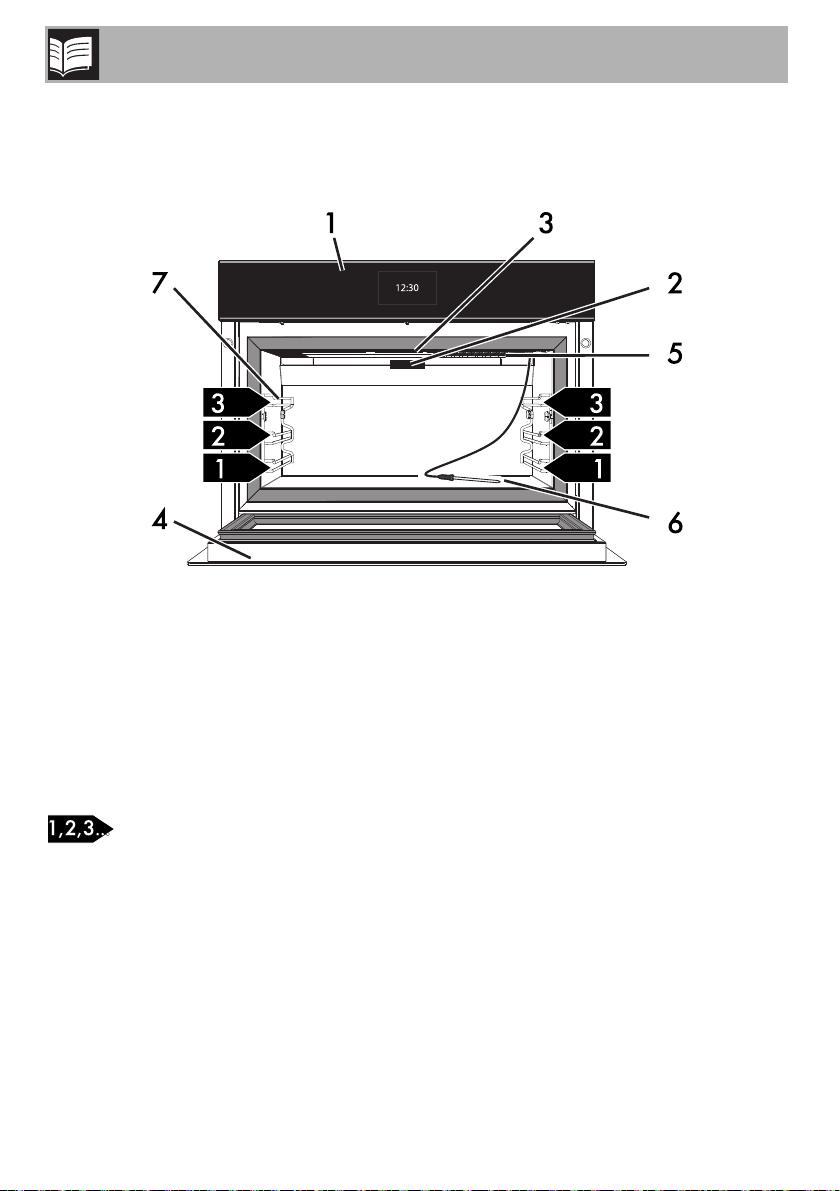
2.1 General Description
1 Control panel
2 Probe support
3 Oven light
4 Door
5 Fan
6 Temperature probe
7 Rack support frames
Frame shelf
Description
59
EN
2.2 Control panel
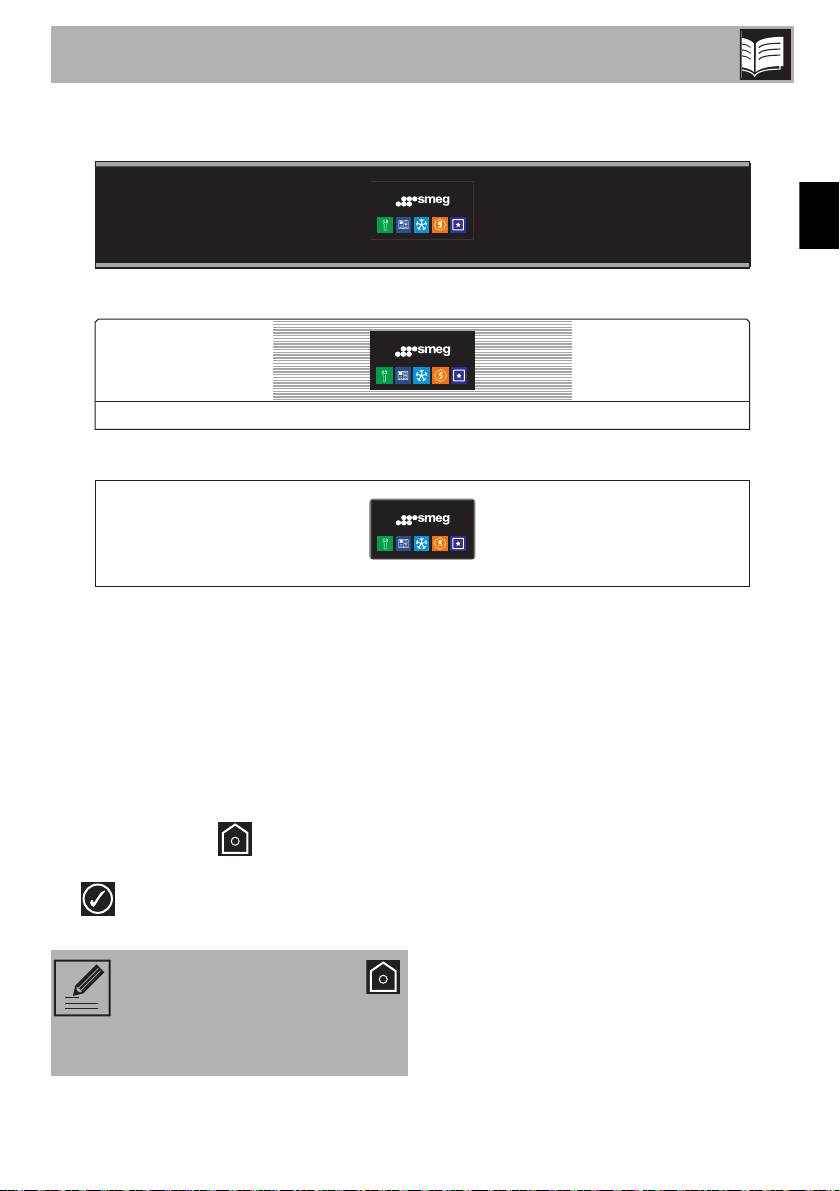
Display
The touchscreen display allows you to
interact with the appliance. Press the icons
to access the various available functions.
The display will show all operational
parameters, such as selected function,
time/temperature settings or pre-set
program settings.
In general, press the symbol to return to
the previous menu or end a function; press
the symbol to confirm the selected
options.
Press and hold the return symbol
for a few seconds to interrupt the
current function and switch off the
appliance.
Description
60
2.3 Other parts
Interior lighting
The appliance’s interior lighting comes on
only when the door is opened.
Shelves
The appliance features shelves to position
racks at different heights. The insertion
heights are indicated from the bottom
upwards (see 2.1 General Description).
Cooling fan
The cooling fan distributes the air evenly
inside the appliance, helping it reach the set
temperature more quickly.
2.4 Available accessories
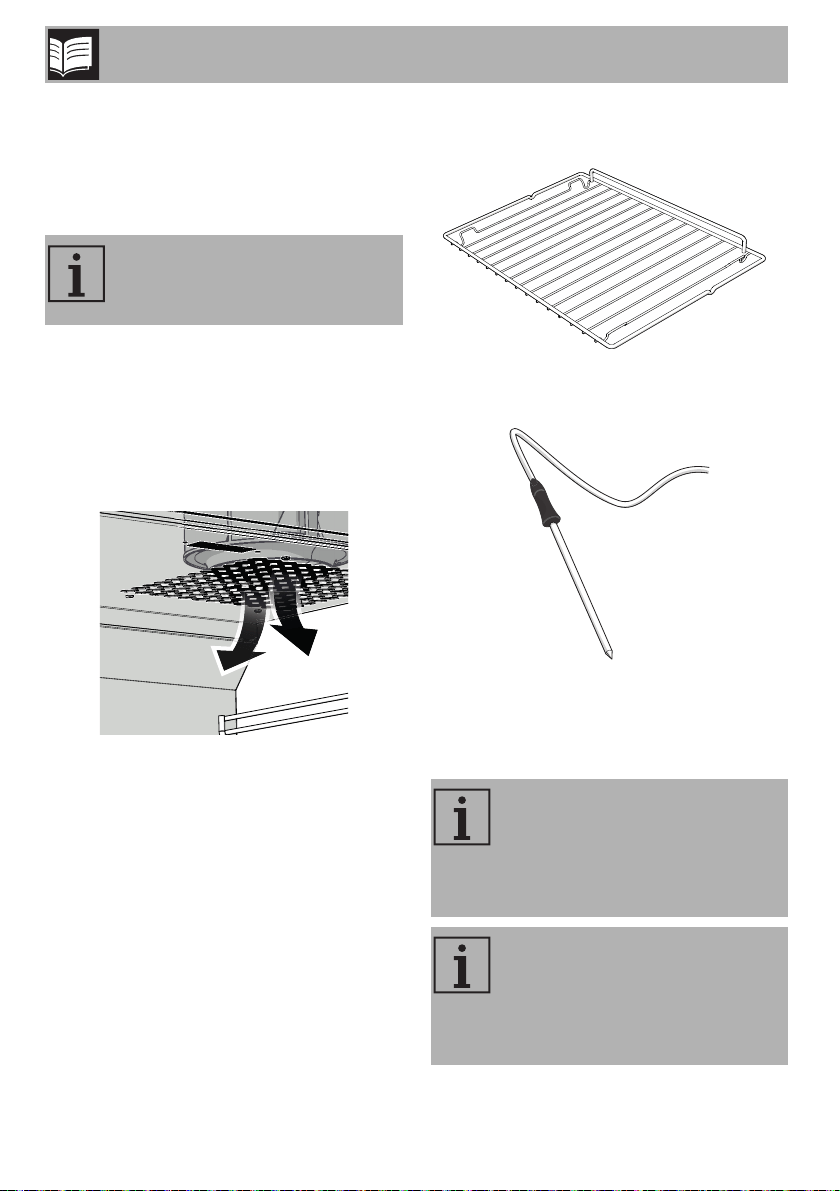
Rack
For supporting containers or bottles.
Temperature probe
To be inserted into the middle of foodstuffs
to measure their internal temperature when
blast chilling by time and during low-
temperature cooking.
When the door is open, it is not
possible to turn off the interior
lighting.
The appliance accessories
intended to come into contact with
food are made of materials that
comply with the provisions of
current legislation.
Original supplied and optional
accessories can be requested to
Authorised Assistance Centres.
Use only original accessories
supplied by the manufacturer.
Description
61
EN
2.5 Blast Chiller Advantages
Your blast chiller allows you to quickly cool
foodstuffs and to freeze them rapidly in
order to retain their freshness and
guarantee them a long lifetime.
Blast chilling and rapid freezing help
preserve the flavour, aroma, colour and
nutritional properties of foodstuffs.
• Blast chilling cooked foods to an internal
temperature of +3°C minimises bacterial
proliferation, which is at its maximum
between 65°C and 8°C.
• Rapid freezing to -18°C allows frozen
food to be preserved for a longer
period – usually several months more. It
also prevents the formation of “freezer
burn” (large ice crystals which damage
and break the cell walls of the
foodstuffs). When defrosted, the
foodstuffs will not lose liquid and will
retain their consistency and taste.
Without blast chiller With blast chiller
Bacteriological risk Food safety
Evaporation and
dehydration
Retention of original
consistency
Loss of weight No loss of weight
Loss of flavours,
aromas, colours
Retention of original
properties
Rapid spoiling
Longer preservation
time
Formation of freezer
burn (large ice
crystals which
damage the fibres
of the foodstuffs)
Formation of micro-
crystals of ice which
do not damage the
food, allowing its
properties to be
preserved
Use
62
3 Use
3.1 Instructions
Improper use
Danger of personal injury or
damage to the appliance
• Keep the door closed when performing
any operation on the appliance.
• Protect your hands by wearing oven
gloves when moving food inside the
appliance.
• Do not touch the heating elements.
• Do not allow children to approach the
appliance when it is in operation.
• Do not place trays or containers on the
bottom of the appliance.
• Do not cover trays or containers with
insulating films or covers.
• Ensure that the containers are suitable
for use at low temperatures.
• Avoid using plastic containers.
• Arrange the food carefully inside the
appliance so that air can circulate
correctly.
• Do not stack the foods on top of each
other.
• Handle the temperature probe with care
as it has a sharp point.
• Do not use or leave flammable materials
near the appliance.
Improper use
Bacteriological contamination
hazard
• Take great care when handling and
consuming raw foodstuffs, in particular
fresh fish and cephalopods, as there is
the risk of contamination from Anisakis,
a parasite which is hazardous to
human health. This risk can be
eliminated by cooking to a minimum
temperature of 65°C, or by freezing
to -18°C and then holding at -20°C
for at least 24 hours.
• In order to retain the properties of hot
foods, do not allow them to remain at
room temperature before blast chilling
or freezing them.
The formation of water or
condensate inside the appliance is
a natural phenomenon and does
not indicate a malfunction.
Use
63
EN
3.2 Preliminary operations
1. Remove any protective film from the
outside or inside of the appliance,
including accessories.
2. Remove any labels (apart from the
technical data plate) from the
accessories and inside of the appliance.
3. Remove and wash all the appliance
accessories (see 4 Cleaning and
maintenance).
4. To remove any manufacturing residue,
clean the inside of the appliance
thoroughly with a soft cloth and neutral,
non-abrasive detergent (see “Cleaning
the inside of the appliance.”).
5. You must set the current time in order to
start using the appliance (see “First use”).
3.3 Using the accessories
Racks
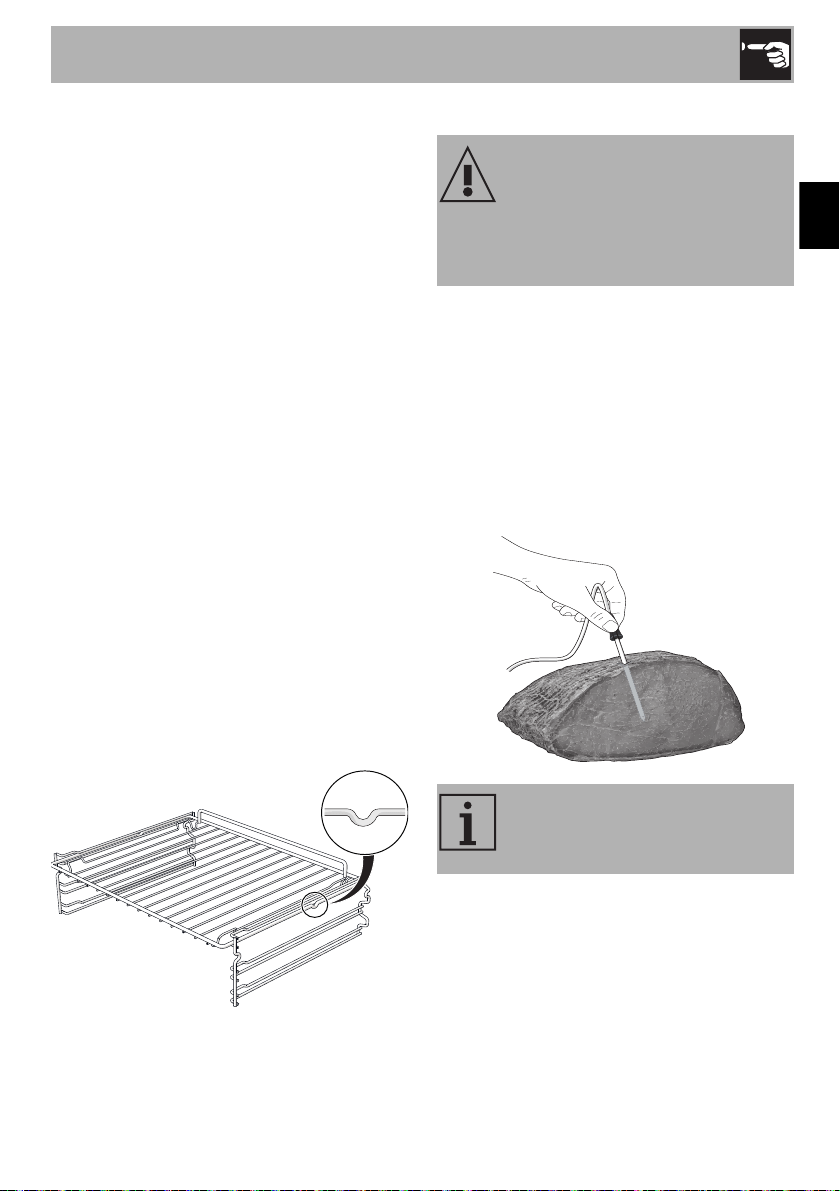
The racks must be inserted into the side
guides until they come to a complete stop.
• The mechanical safety locks that prevent
the racks from being removed
accidentally must face downwards and
towards the back of the appliance.
Temperature probe
Insert the probe into the food before starting
the blast chill by probe cycle or hot
functions.
• The temperature probe must be inserted
into the middle of the food without going
through it.
• For different sized pieces or irregular
foodstuffs, the probe should be placed in
the largest piece/thickest area.
When you have finished using the probe,
clean it with a soft cloth and warm water,
dry it carefully and return it to its housing.
Sharp point
Injury hazard
• Handle the probe with care and do not
touch its tip.
Insert the probe transversely,
ensuring at least 3/4 of its length is
inside the foodstuff.
Use
64
3.4 Using the Blast Chiller
First use
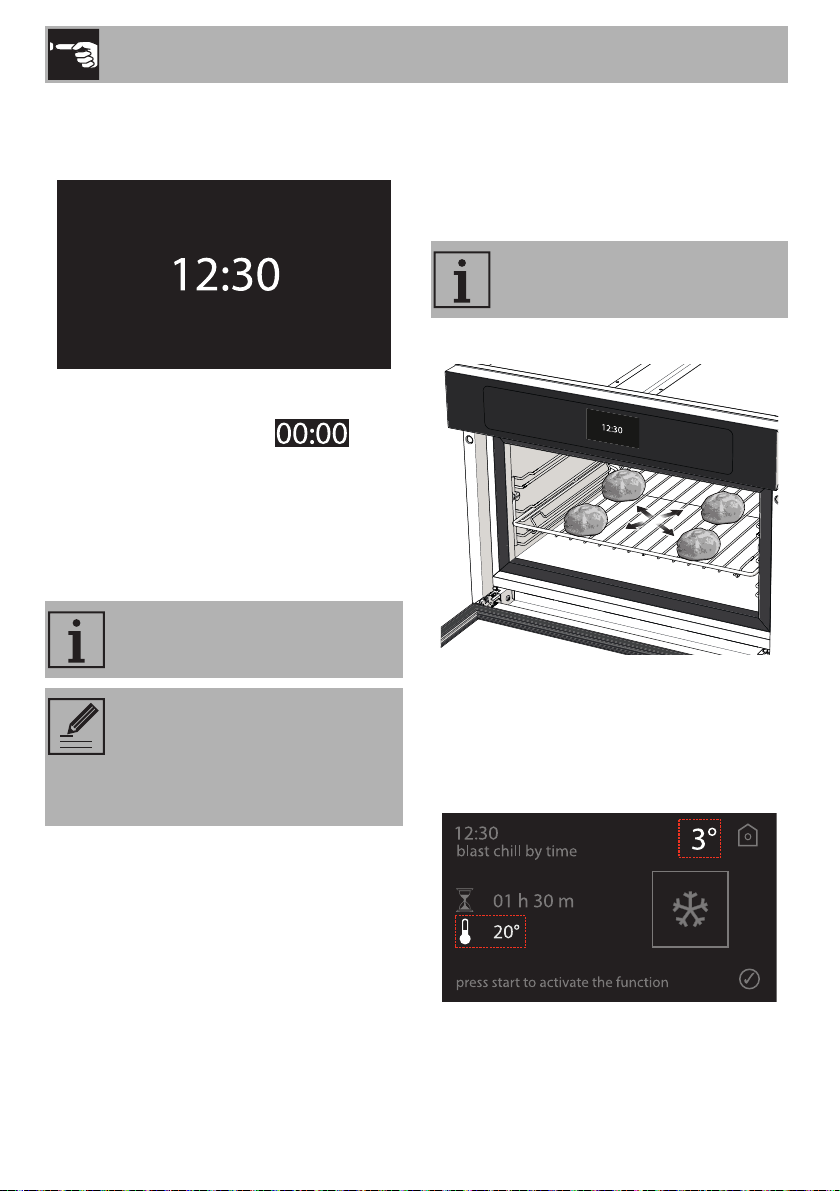
When using the appliance for the first time,
or after a power failure, the
symbol will flash on the display. In order to
be able to start any cooking function, the
current time must be set (if the oven is being
turned on for the first time, it is also
recommended you set the required
language).
Arranging Foodstuffs
Arrange the foods evenly inside the
appliance, ensuring you do not stack them
or place them on top of each other in order
to allow air to circulate.
Target Temperature
The temperature shown on the display
indicates the target temperature that the
foodstuffs must reach.
The appliance language is set to
“English” by default.
When first connecting or after the
power has been cut for a time it
will be necessary to wait a few
seconds before you can interact
with the appliance.
Use the rack for improved air
circulation.
Use
65
EN
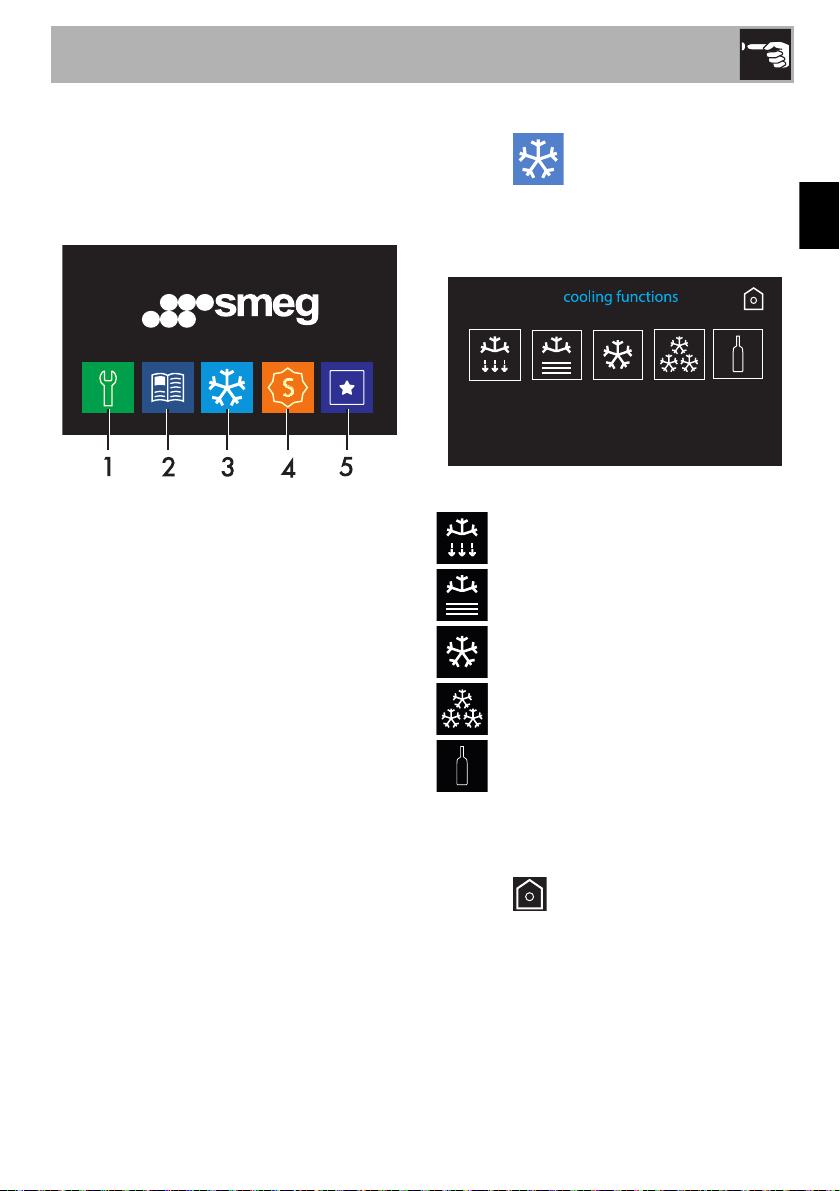
Home screen
Press the time on the display.
It is now possible to select the various
available functions on the home screen of
the appliance.
1 Settings
2 Automatic programs
3 Cooling functions
4 Special functions
5 History
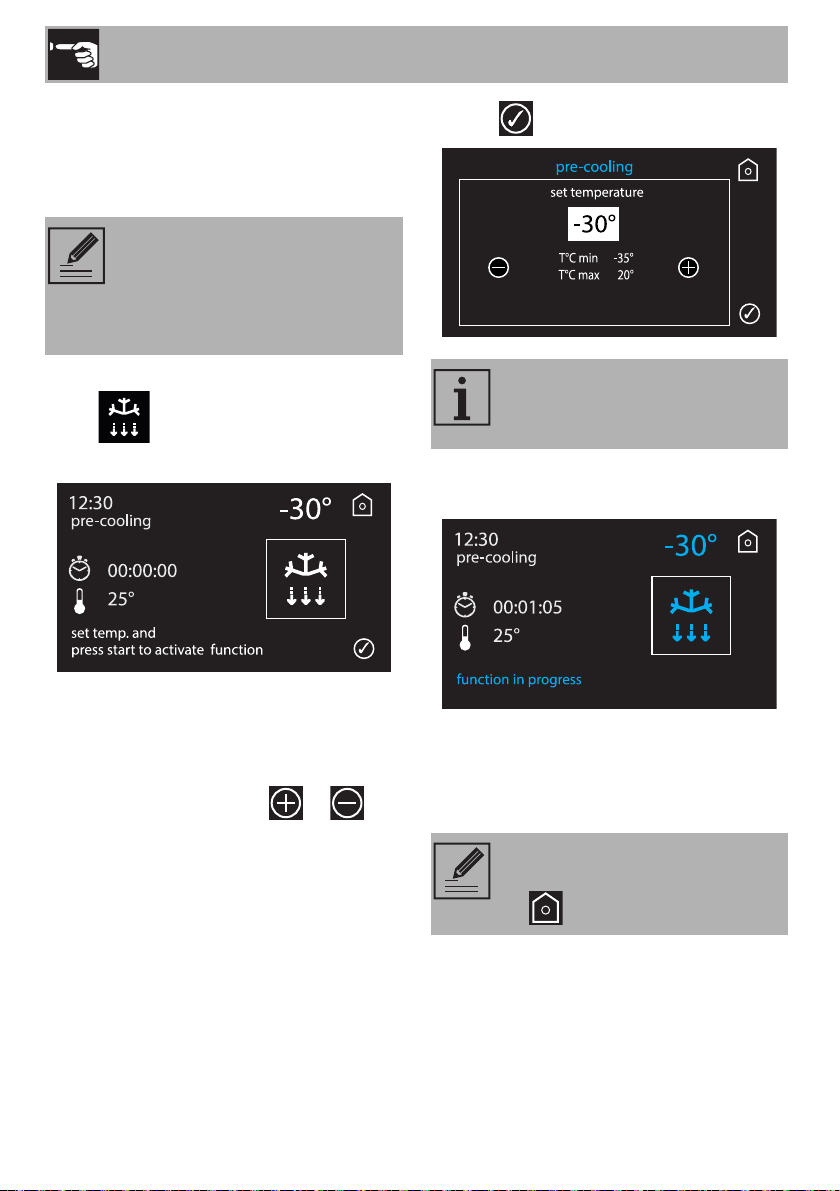
3.5 Cooling functions
Press the symbol on the appliance's
main screen to select the cooling functions.
The screen will display the symbols for the
various cooling functions:
The available cooling functions are:
Pre-cooling
Conservation
Blast chilling
Freezing
Drinks cooling
Press the symbol of the required function to
activate it.
Press the button to return to the main
screen.
Use
66
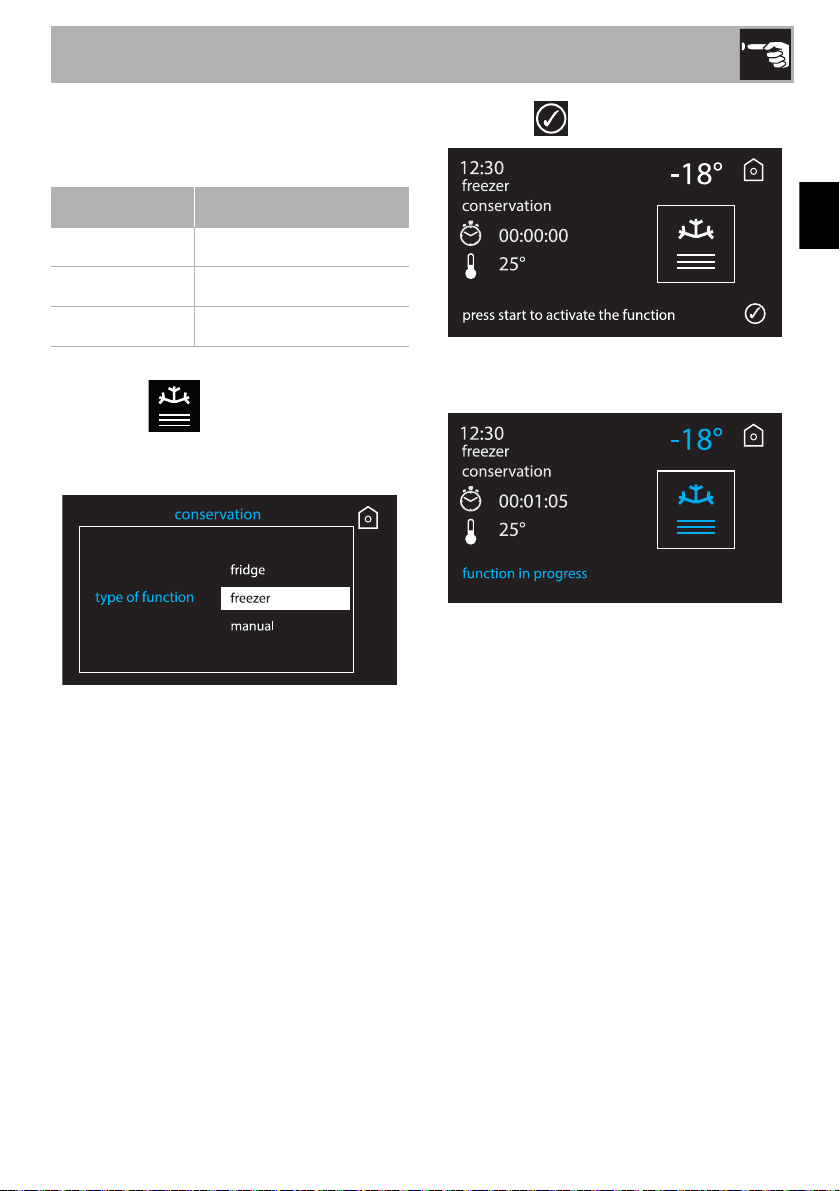
Pre-cooling
The pre-cooling function cools the interior of
the appliance before performing a blast
chilling or freezing cycle.
1. To start the pre-cooling function, press
the symbol.
2. The following screen will be displayed:
3. If you wish to modify the default
temperature (-20°C), press on the
temperature value: the setting screen will
be displayed, allowing you to set the
required value using the or
button.
4. Press to confirm.
5. The display will show the progress of the
function.
6. When the set temperature is reached, the
appliance will beep, and the function
progress bar and set temperature will no
longer be displayed.
Perform a pre-cooling cycle of at
least 15 minutes before
introducing foodstuffs to obtain the
best results during blast chilling or
freezing.
The temperature can also be
modified when the appliance is
being used.
The function can be interrupted at
any point by pressing and holding
the button for 3 seconds.
Use
67
EN
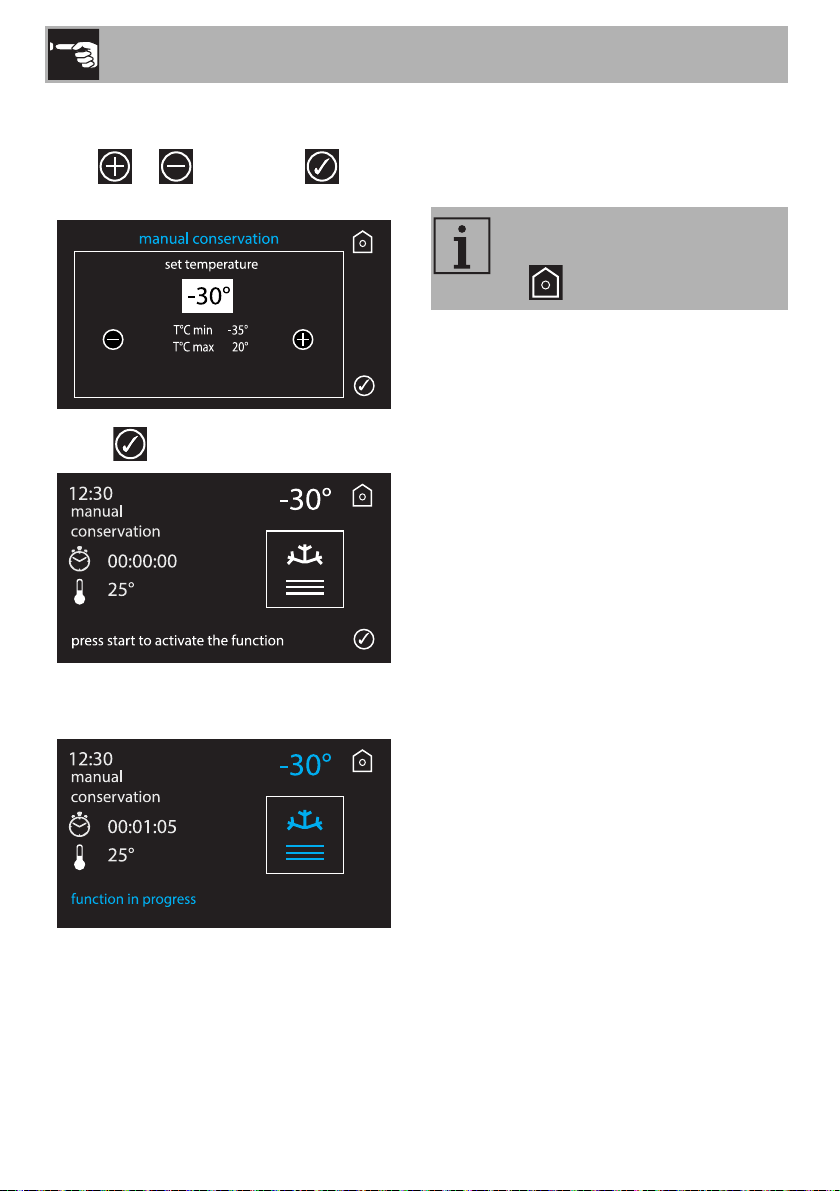
Conservation
This function keeps foodstuffs at the required
temperature.
1. Press the symbol from the cooling
functions screen.
2. Select the required conservation type.
3. Press the button to start the function.
4. The screen showing the progress of the
function will be displayed.
5. The appliance will beep when the
temperature is reached.
Option Temperature
Refrigerator
+3°C
Freezer
-18°C
Manual
-35°C - +20°C
Use
68
6. In the case of manual conservation,
choose the required temperature using
the or button. Press to
confirm.
7. Press to start the function.
8. The display will show the progress of the
function.
9. When the function has finished, the
appliance will beep, and the function
progress bar and set temperature will no
longer be displayed.
The function can be interrupted at
any point by pressing and holding
the button for 3 seconds.
Use
69
EN
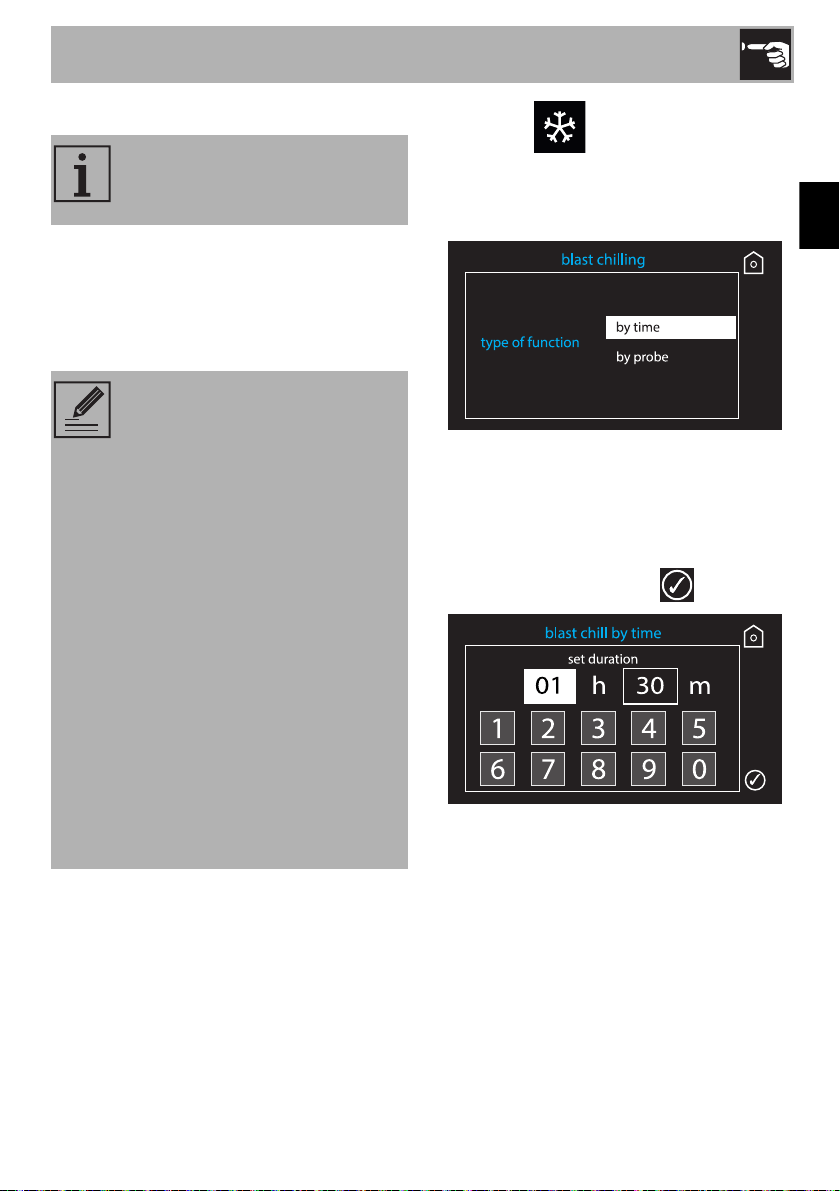
Blast Chilling
This function allows you to quickly chill raw
or recently cooked foods to +3°C.
After performing blast chilling, foodstuffs
can be kept in the refrigerator (+4°C) for
up to 5-7 days.
1. Press the symbol from the cooling
functions screen.
2. Select the type of blast chilling required:
blast chill by time or blast chill by probe.
3. If you select the “blast chill by time”
option, set the required duration. In the
example, a duration of 1 hour 30 minutes
has been set: first press the hours field and
enter 0 and 1, then press the minutes field
and enter 3 and 0. Press to confirm.
Blast chilling stops bacteriological
proliferation and retains the qualities
of the foodstuffs.
• Perform a pre-cooling cycle of a
minimum of 15 minutes with the
appliance empty before placing
the food to be chilled inside.
• Do not cover trays or containers
with insulating films or covers.
• Ensure that the containers are
suitable for use at low
temperatures.
• Arrange the trays or containers
evenly inside the appliance,
ensuring you do not stack them
or place them on top of each
other in order to allow air to
circulate.
• Do not allow hot food to sit at
ambient temperature before blast
chilling or freezing in order to
retain its desirable properties.
Use
70
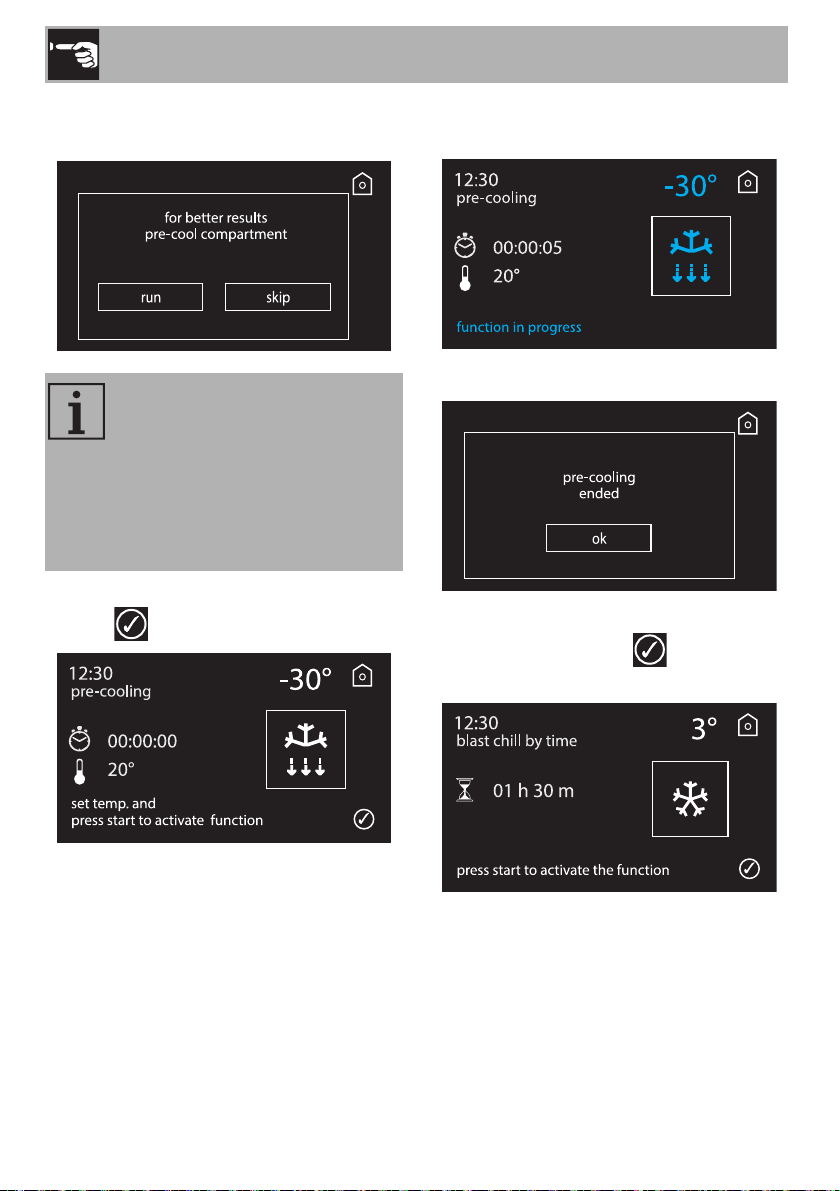
4. The appliance will ask the user to choose
whether or not to perform pre-cooling.
5. Run appliance pre-cooling at -30°C.
Press to confirm.
6. Upon confirmation, the display will show
that appliance pre-cooling is in progress.
7. Once pre-cooling is complete, press “ok”.
8. Place the foods for blast chilling into the
appliance, and press to start the
function.
It is recommended to perform pre-
cooling of the appliance interior to
attain the best results.
The recommended temperature for
pre-cooling is -30°C.
Pre-cooling should be performed
with the appliance empty.
Use
71
EN
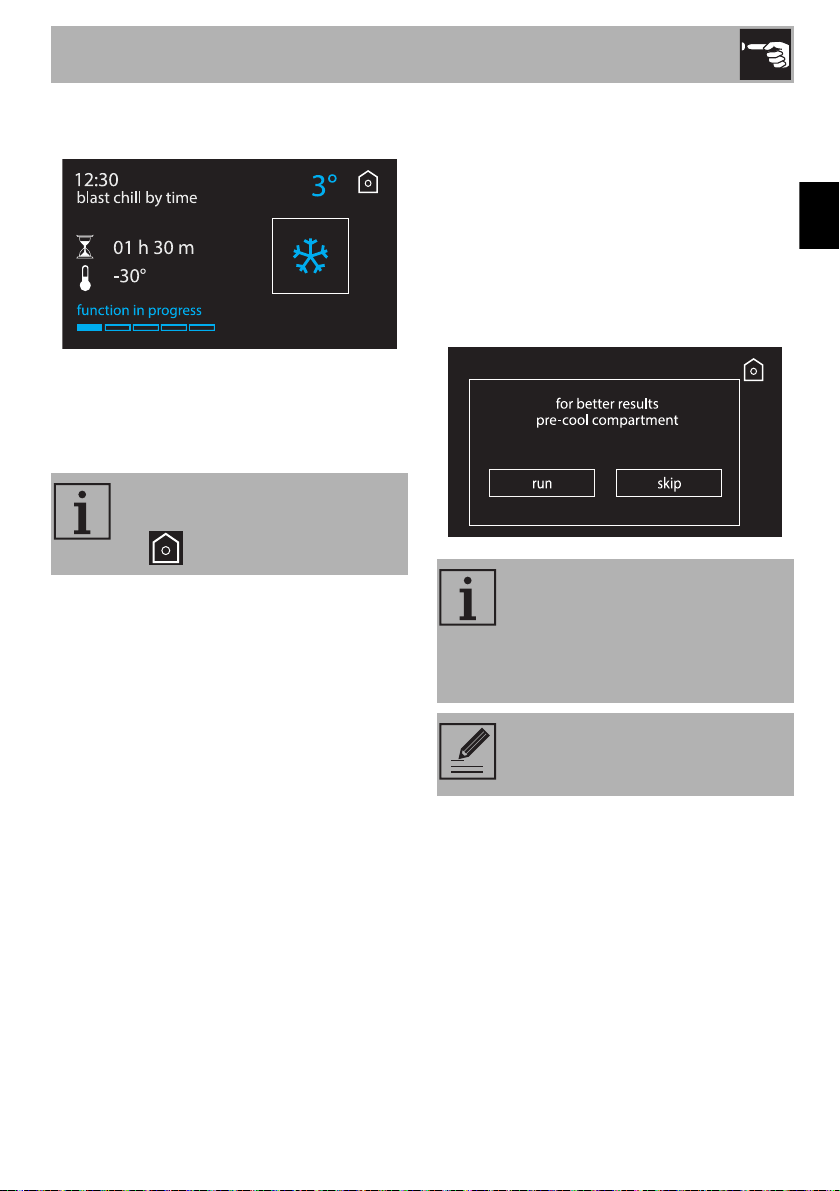
9. The display will show the progress of the
function.
10. When the function has finished, the
appliance will beep, and the function
progress bar and set temperature will
no longer be displayed.
Blast chill by probe
Blast chilling with the probe requires the
probe to be inserted into the thickest part of
the food to be chilled.
The probe must be used to measure the
temperature at the centre of whole pieces
of food.
1. The appliance will ask the user to choose
whether or not to perform pre-cooling.
The function can be interrupted at
any point by pressing and holding
the button for 3 seconds.
It is recommended to perform pre-
cooling of the appliance interior to
attain the best results.
The recommended temperature for
pre-cooling is -30°C.
Pre-cooling should be performed
with the appliance empty.
Use
72
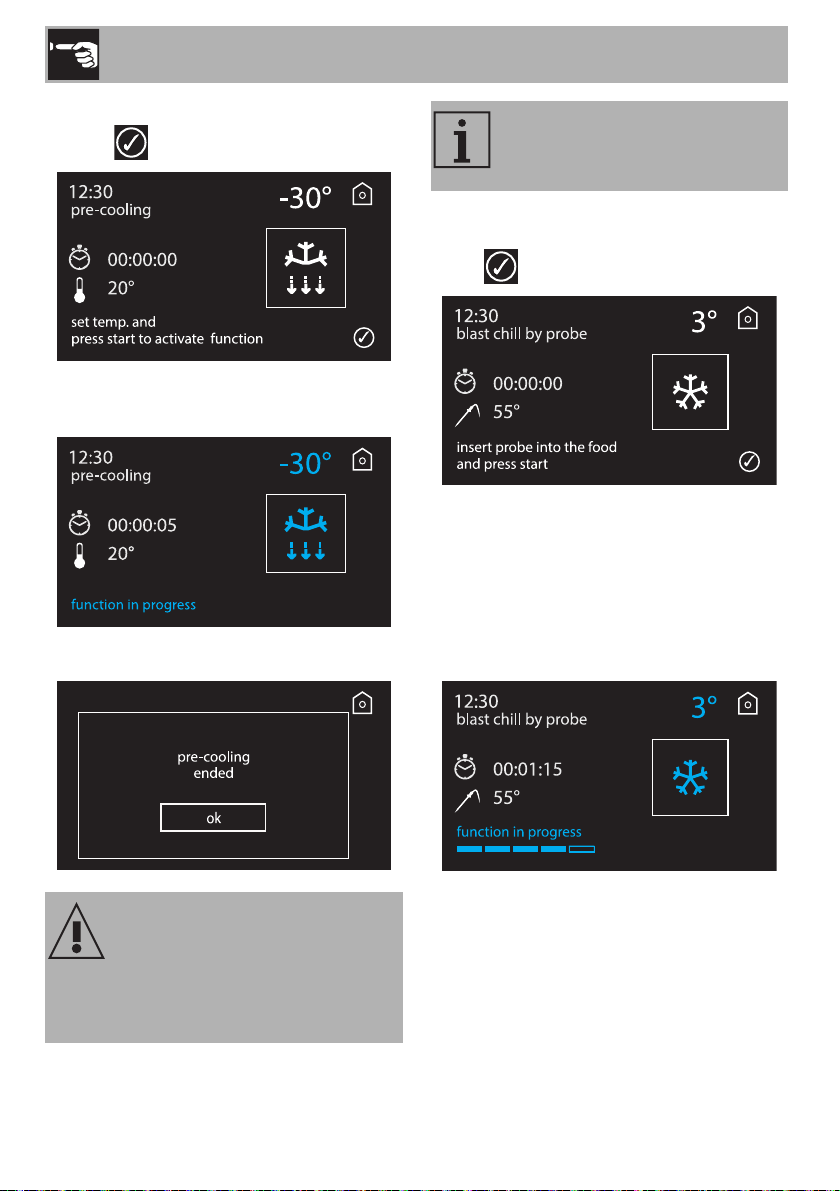
2. Run appliance pre-cooling at -30°C.
Press to confirm.
3. Upon confirmation, the display will show
that appliance pre-cooling is in progress.
4. Once pre-cooling is complete, press “ok”.
5. Insert the probe into the food without
going all the way through, then press
the button to start the function.
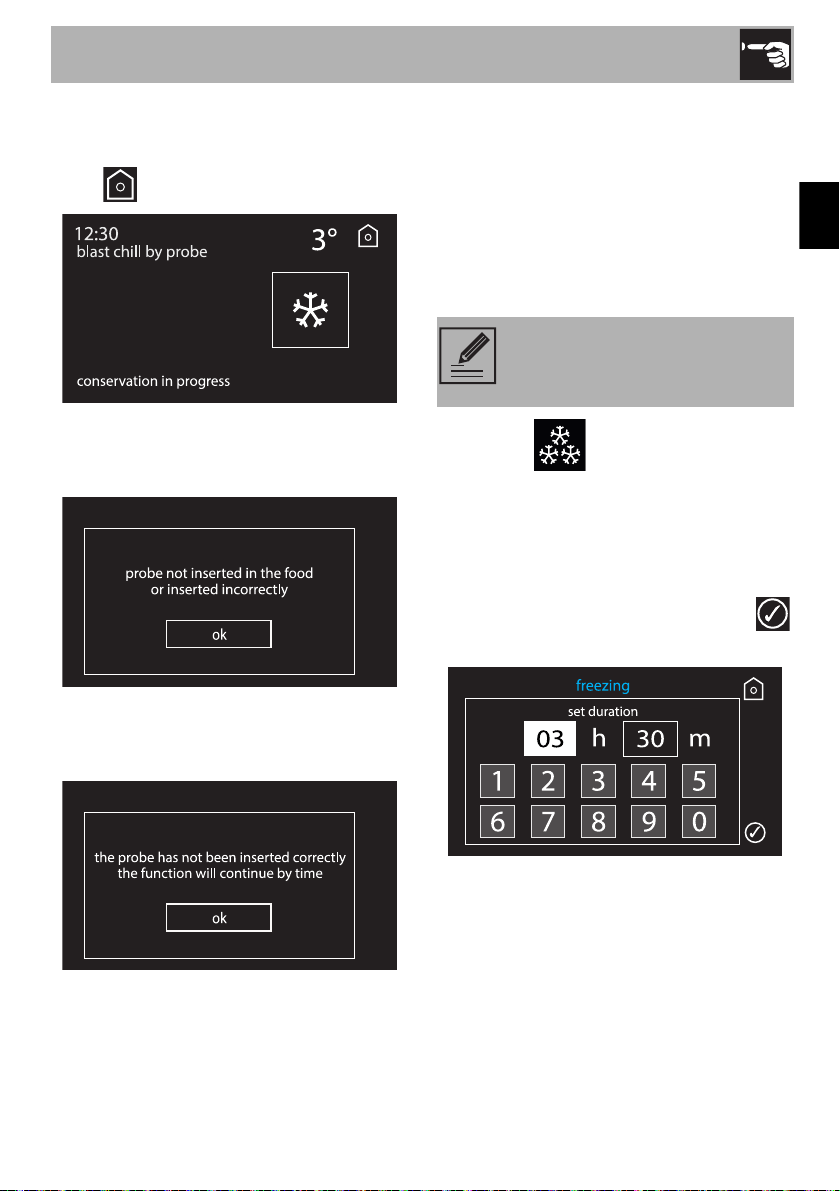
6. Once the function has started, the
following screen will appear. The
screen remains active until the
temperature displayed next to the
probe symbol (25°C) is the same as
the temperature above the function
symbol (3°C).
7. As soon as the temperature of 3°C is
reached, the appliance will beep, and
the function progress bar and the
temperature will no longer be displayed.
Sharp point
Injury hazard
• Handle the probe with care and do not
touch its tip.
Insert the probe transversely,
ensuring at least 3/4 of its length is
inside the foodstuff.
Use
73
EN
8. The appliance automatically switches to
the conservation function and will remain
in this state until the user interrupts it with
the button.
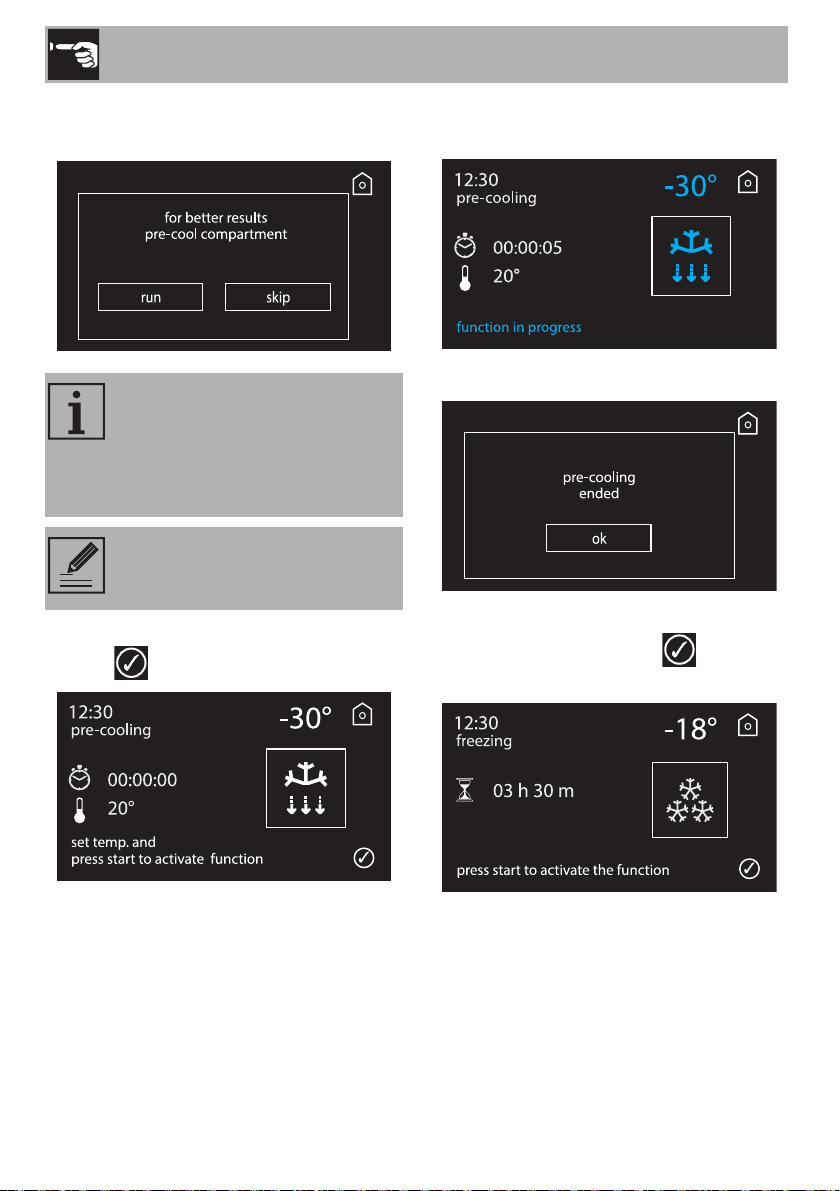
9. If the function is started without the probe
being inserted, the following screen will
appear:
10. Press “ok” and insert the probe. If the
probe has not been (correctly) inserted,
the following screen will be displayed:
11. Open the door and check that the
probe is correctly inserted.
12. If the probe is not inserted, the
appliance will automatically perform
the blast chill by time function for the set
duration.
Freezing
Freezing allows the temperature of foodstuffs
to be rapidly brought down to -18°C while
keeping their flavour, taste and appearance
unaltered.
Perform a pre-cooling function before
beginning freezing to reduce the power
consumption and time taken.
1. Press the symbol from the cooling
functions screen.
2. Setting the required duration. In the
example, a duration of 2 hours 30
minutes has been set: first press the hours
field and enter 0 and 2, then press the
minutes field and enter 3 and 0. Press
to confirm.
If the temperature of the cooked
food is above 100°C, wait for it to
fall below 80°C.
Use
74
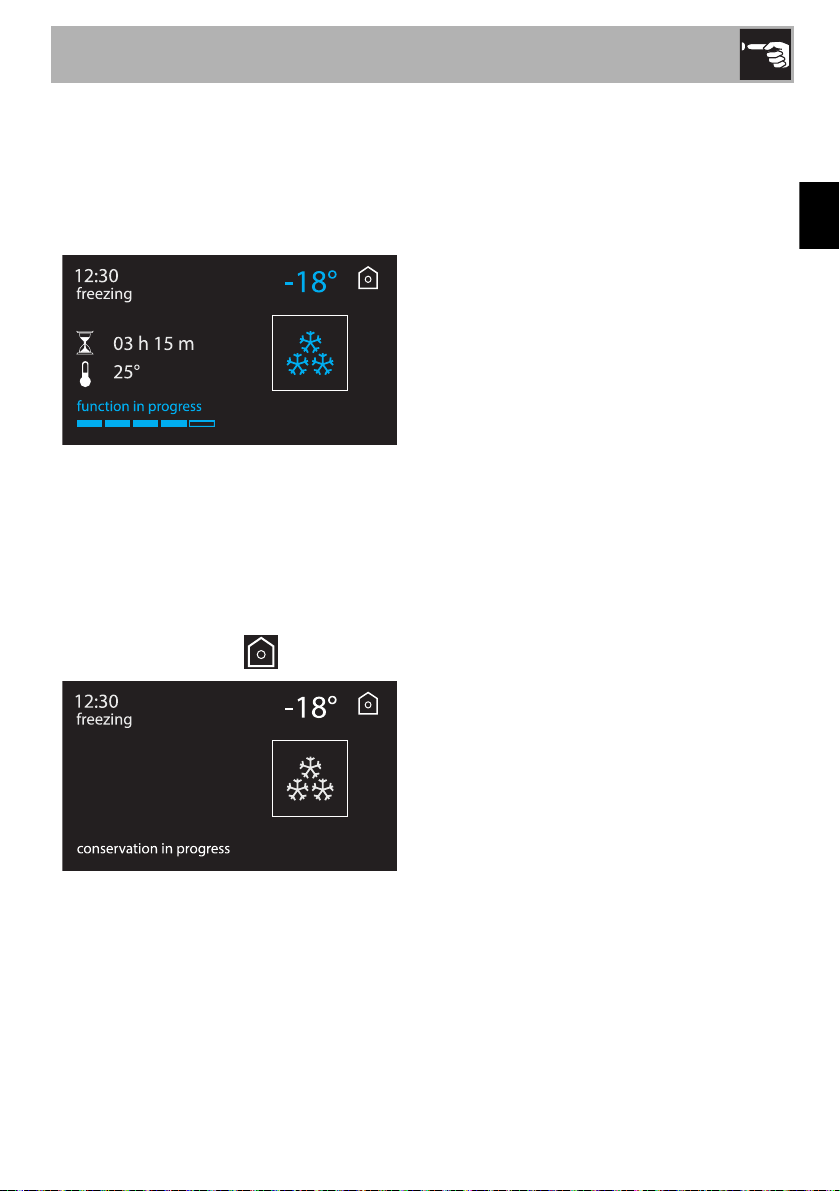
3. The appliance will ask the user to choose
whether or not to perform pre-cooling.
4. Run appliance pre-cooling at -30°C.
Press to confirm.
5. Upon confirmation, the display will show
that appliance pre-cooling is in progress.
6. Once pre-cooling is complete, press “ok”.
7. Place the foods for freezing into the
appliance, and press the button to
start the function.
It is recommended to perform pre-
cooling of the appliance interior to
attain the best results.
The recommended temperature for
pre-cooling is -30°C.
Pre-cooling should be performed
with the appliance empty.
Use
75
EN
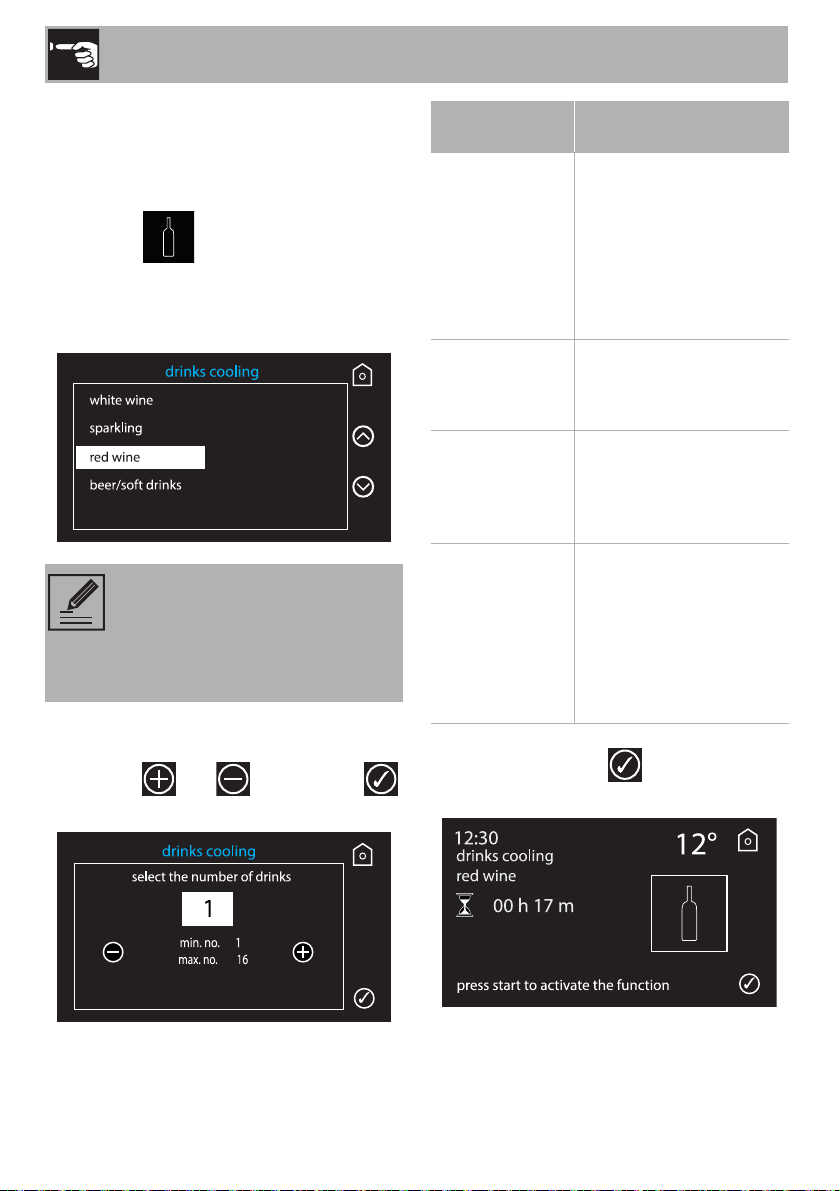
8. Once the function has started, the
following screen will remain active until
the temperature displayed next to the
thermometer symbol (25°C) is the same
as the temperature above the function
symbol (-18°C).
9. As soon as the temperature of -18°C is
reached, the appliance will beep, and
the function progress bar and the
temperature will no longer be displayed.
10. The appliance automatically switches
to the conservation function and will
remain in this state until the user
interrupts it with the button.
Preserving Foodstuffs
• Chilled or frozen foodstuffs must not be
stored inside the appliance.
• Cover and protect foodstuffs with cling
film, hermetic covers or vacuum storage
products in the fridge or freezer.
• Label frozen foodstuffs to be stored in the
freezer for 6-12 months with their
content, date of preparation and expiry
date.
• Chilled foodstuffs should be kept in the
refrigerator at a constant temperature
of +4°C.
• Frozen foodstuffs should be kept in the
freezer at a constant temperature of -18°C.
Use
76
Drinks cooling
This function allows you to chill different
kinds of beverages down to the perfect
drinking temperature.
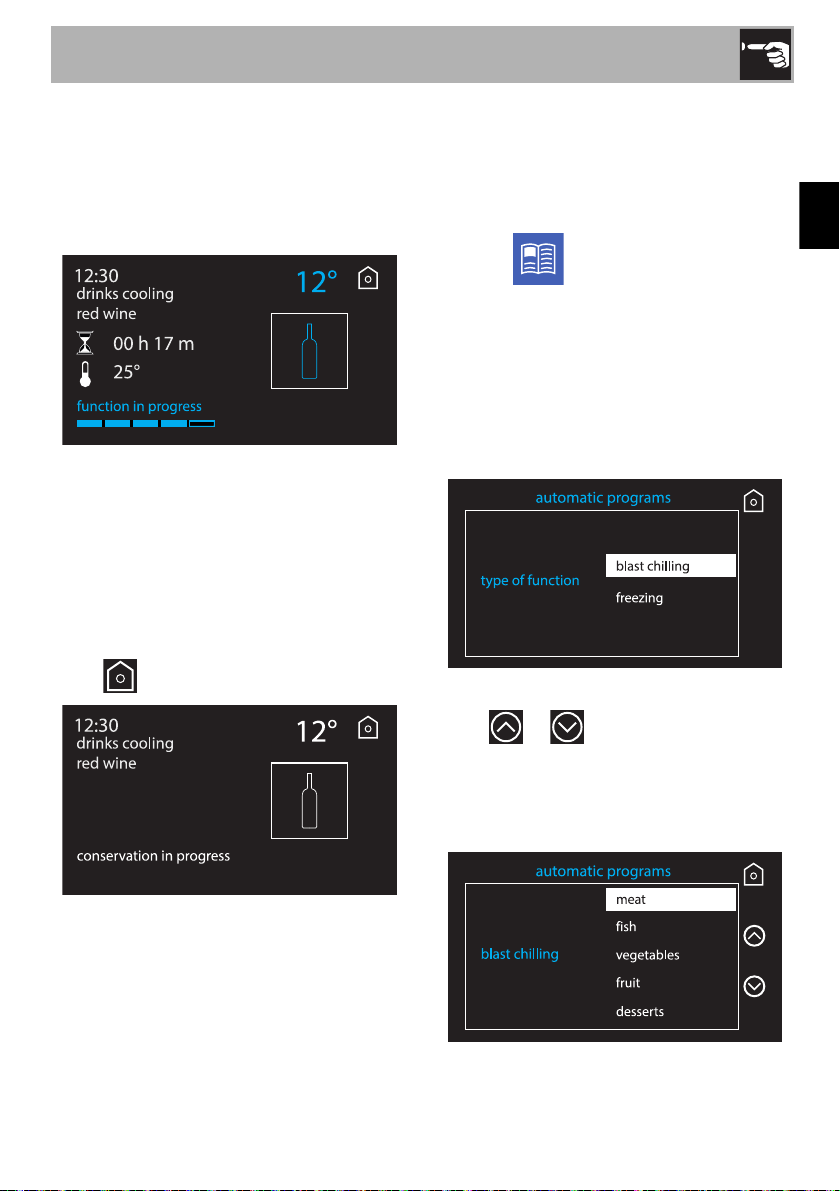
1. Press the symbol from the cooling
functions screen.
2. Press on the name of the drink, for
example red wine.
3. Select the number of bottles to be chilled,
from a minimum of 1 to a maximum of 16,
using the and buttons. Press
to confirm.
4. The screen shows the preset cooling
temperature. Press to start the
function.
It is recommended to store mature
red wines, red straw wines and
red fortified wines at a
temperature of 16-22°C for
optimum consumption.
Setting Suitable for
White wines
• Young white wines
• Complex, mature white
wines
• Straw wines (white)
• White fortified wines
• Young rosé wines
• Young grappa
Sparkling drinks
• Champagne
• Sparkling wines
• Lightly sparkling wines
Red wines
• Young red wines
• Mature rosé wines
• Cask-matured white
wines
Beer/soft drinks
• Eau de vie
•Gin
• Vodka
• Rum
• Tequila
• Liqueurs to be served
cold
Use
77
EN
5. Once the function has started, the
following screen will remain active until
the temperature displayed next to the
thermometer symbol (25°C) is the same
as the temperature above the function
symbol (10°C).
6. As soon as the time has passed and the
set temperature is reached, the
appliance will beep, and the function
progress bar and the temperature will no
longer be displayed.
7. The appliance automatically switches to
the conservation function and will remain
in this state until the user interrupts it with
the button.
3.6 Automatic programs
The automatic programs allow you to start
up the blast chilling and freezing functions
for a series of foods at a preset temperature
for a predefined time.
Press the symbol on the appliance’s
main screen to select the automatic
programs.
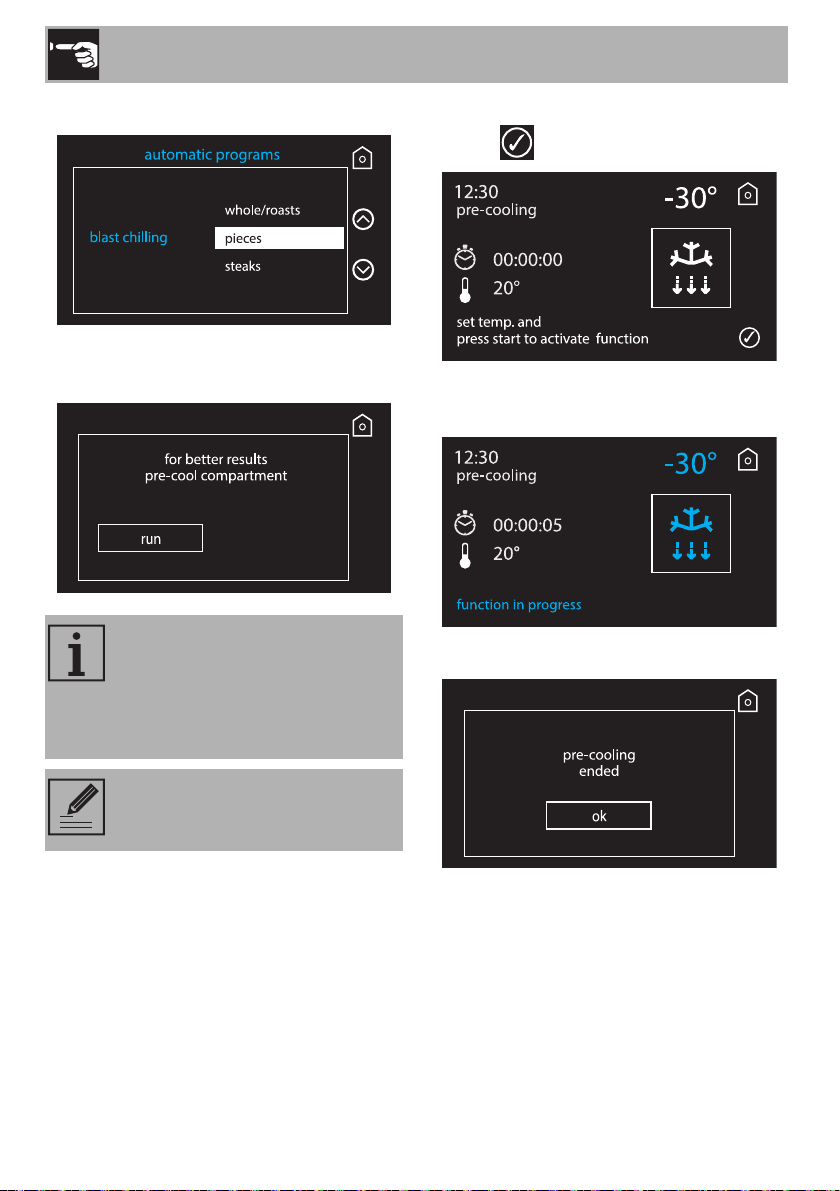
The screen with the symbols of the two
available automatic programs appears.
1. Select the type of operation – blast
chilling or freezing – by pressing the
name of the required function.
2. Once you have selected the function, use
the or button to scroll through
the list of foodstuffs and select the
required one by pressing directly on its
name (in the example, “meat” has been
selected).
Use
78
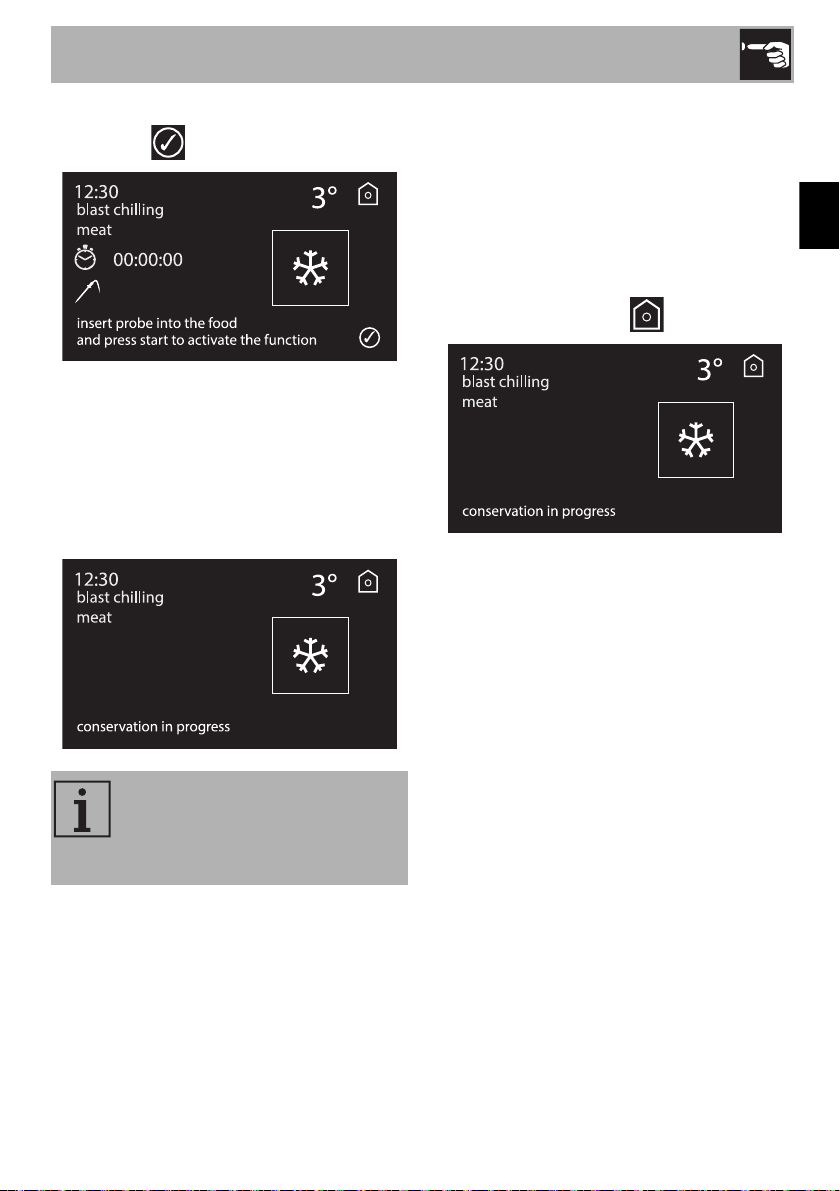
3. Press on the name of the subcategory.
4. The appliance will ask the user to choose
whether or not to perform pre-cooling.
5. Run appliance pre-cooling at -30°C.
Press to confirm.
6. Upon confirmation, the display will show
that appliance pre-cooling is in progress.
7. Once pre-cooling is complete, press “ok”.
Perform appliance pre-cooling to
optimise the results of the recipes
suggested by Smeg.
The recommended temperature for
pre-cooling is -30°C.
Pre-cooling should be performed
with the appliance empty.
Use
79
EN
8. Place the food into the appliance, and
press the button to start the function.
9. Once the function has started, the
following screen will appear. The
screen remains active until the
temperature displayed next to the
thermometer symbol (25°C) is the same
as the temperature above the function
symbol (3°C).
10. As soon as the temperature of 3°C is
reached, the appliance will beep, and
the function progress bar and the
temperature will no longer be
displayed.
11. The appliance automatically switches
to the conservation function and will
remain in this state until the user
interrupts it with the button.
Insert the temperature probe if you
have selected a foodstuff which
requires use of the probe to
perform the function.
Use
80
3.7 Special functions
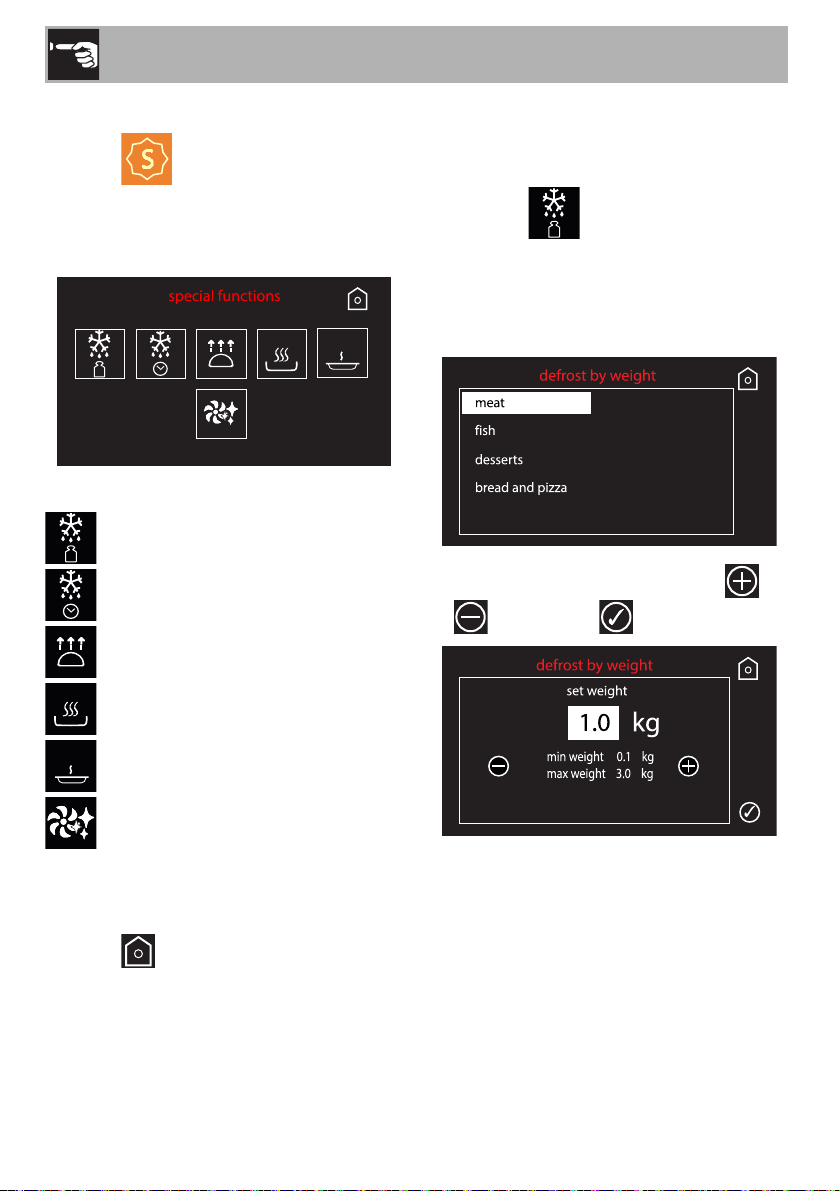
Press the symbol on the appliance’s
main screen to select the special functions.
The screen will display the symbols for the
special functions:
The available special functions are:
Defrost by weight
Defrost by time
Proving
Hot functions
Ready to eat
Automatic cleaning
Press the symbol of the required function to
activate it.
Press the button to return to the main
screen.
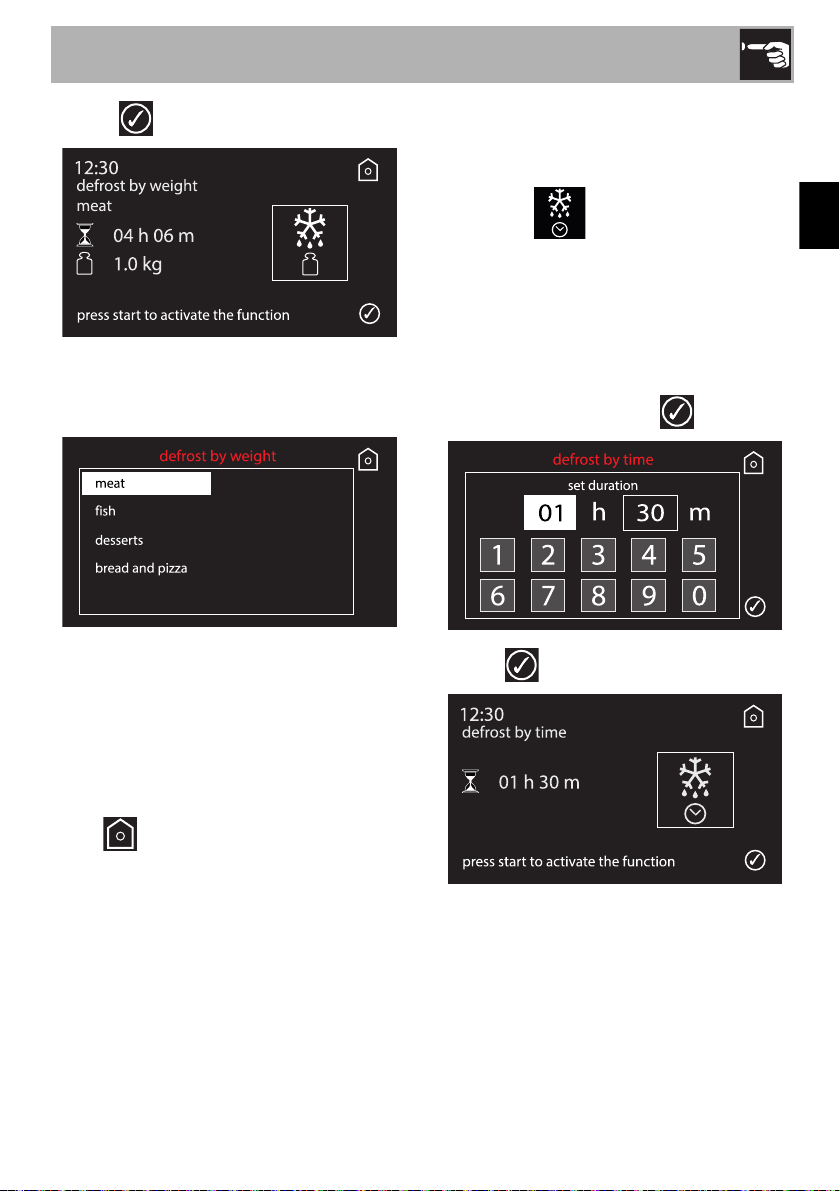
Defrost by weight
This function allows you to defrost food on
the basis of a selectable weight.
1. Press the symbol to select the
“defrost by weight” function from the
main special functions screen.
2. Select the type of food to defrost. Press
on the name of the foodstuff to proceed.
3. Set the required weight using the or
button. Press to confirm.
Use
81
EN
4. Press to start the function.
5. Once the function has been started, the
screen will show the remaining time until
the function completes.
6. When the function has finished, the
appliance will beep, and the function
progress bar and temperature will no
longer be displayed.
7. The appliance automatically switches to
the conservation function and will remain
in this state until the user interrupts it with
the button.
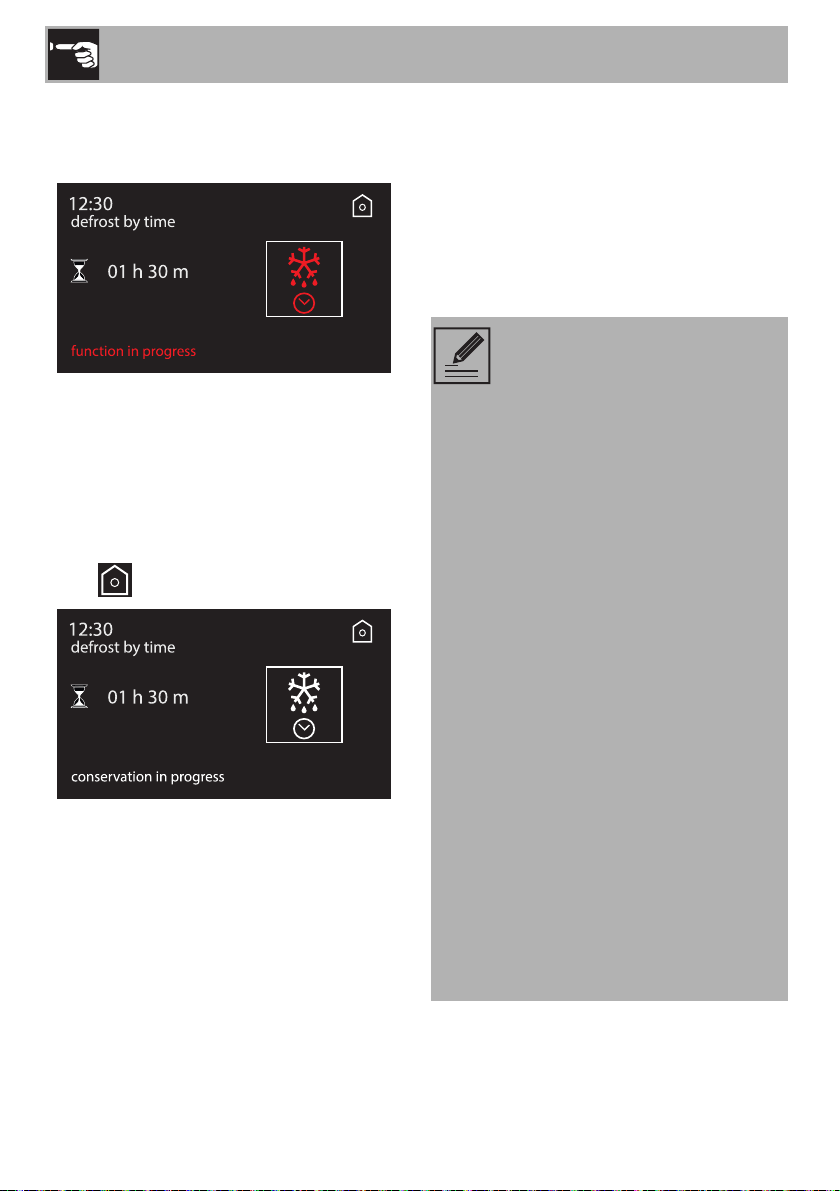
Defrost by time
This function allows you to defrost food on
the basis of a selectable time.
1. Press the symbol to select the
“defrost by time” function from the main
special functions screen.
2. Setting the required duration. In the
example, a duration of 1 hour 30 minutes
has been set: first press the hours field and
enter 0 and 1, then press the minutes field
and enter 3 and 0. Press to confirm.
3. Press to start the function.
Use
82
4. Once the function has been started, the
screen indicating that the function is in
progress will be displayed.
5. When the function has finished, the
appliance will beep, and the function
progress bar and temperature will no
longer be displayed.
6. The appliance automatically switches to
the conservation function and will remain
in this state until the user interrupts it with
the button.
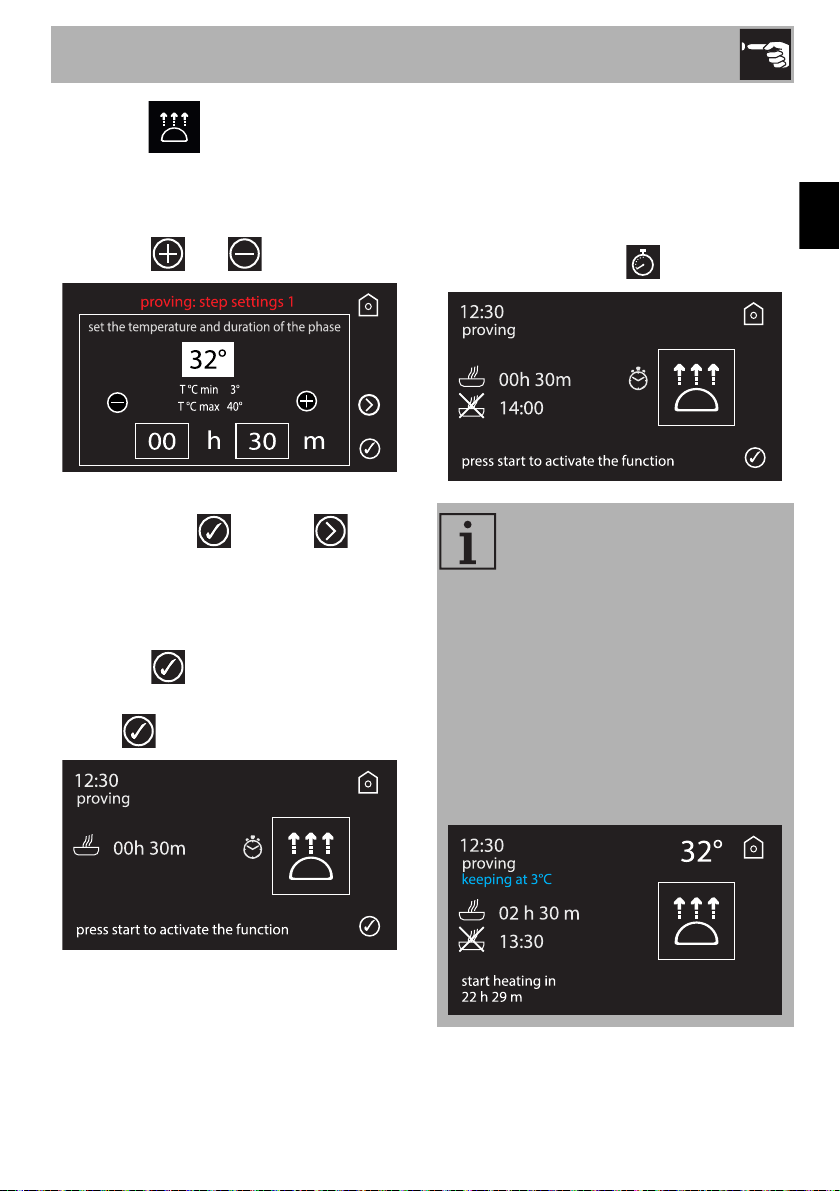
Proving
The proving function allows you to leaven
any kind of dough or batter, offering perfect
results in shorter times.
The proving process can be performed in a
single step, or in three stages with different
temperatures and durations, according to
requirements.
• Use metal or ceramic containers,
or other materials suitable for
temperatures up to 80°C.
• The ideal proving temperature
is 28°C.
• The recommended temperature
for bread/pizza dough is 32°C.
• The recommended temperature
for more delicate doughs, such
as brioche for example, is 27-
28°C.
• For flours with a high W index,
use a smaller quantity of dough
and set a longer proving time.
• Use smaller quantities of yeast,
for example 5 grams in 1 kg of
dough, and prove the dough for
longer to make it more fragrant
and digestible.
• Use a sourdough starter to obtain
fluffier, lighter and more
digestible doughs.
• Reduce the quantity of yeast
used and prove at a constant
temperature for the best dough
proving results.
Use
83
EN
1. Press the symbol to select the
“proving” function from the main special
functions screen.
2. Set the required temperature and time
using the and buttons.
3. At this point it is only possible to confirm
step 1 with the button or button
in order to move on to setting the two
subsequent steps, setting the temperature
and time in the same manner.
4. When you have completed the settings,
press the button to confirm.
5. The following screen will be displayed;
press to start the function.
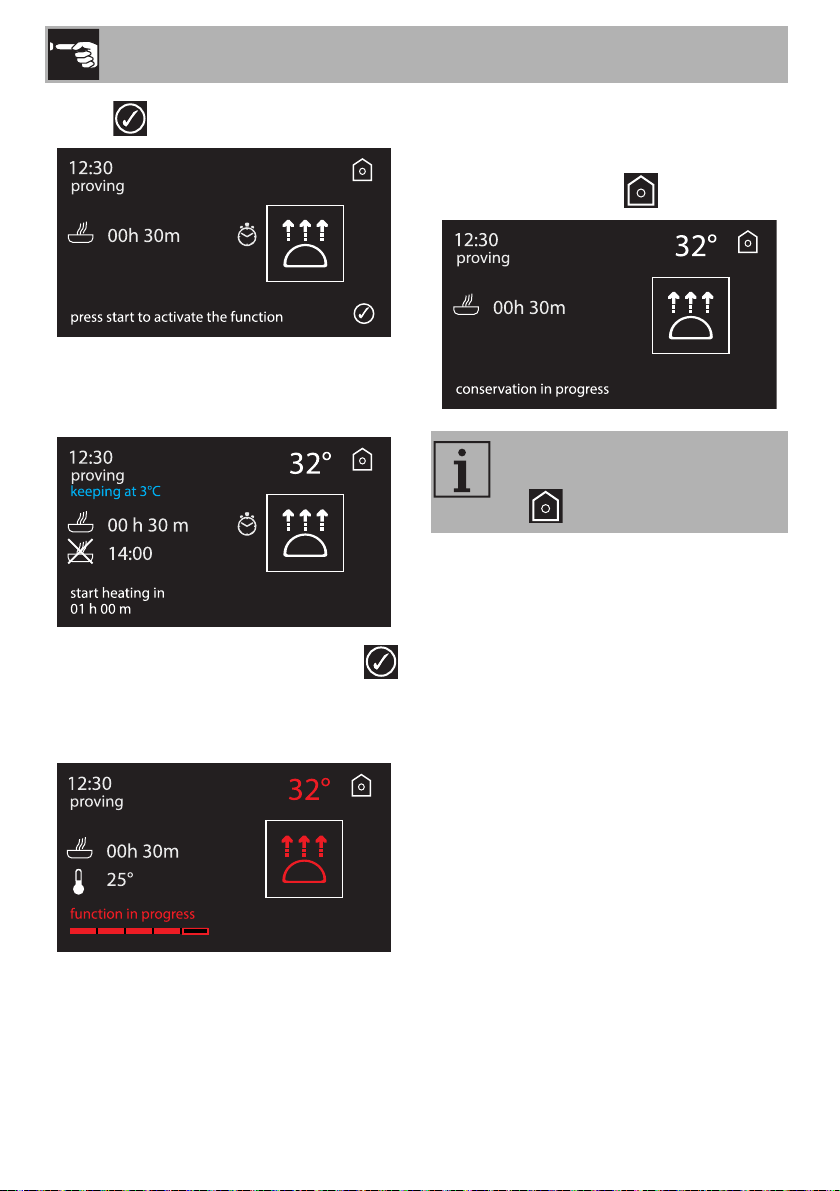
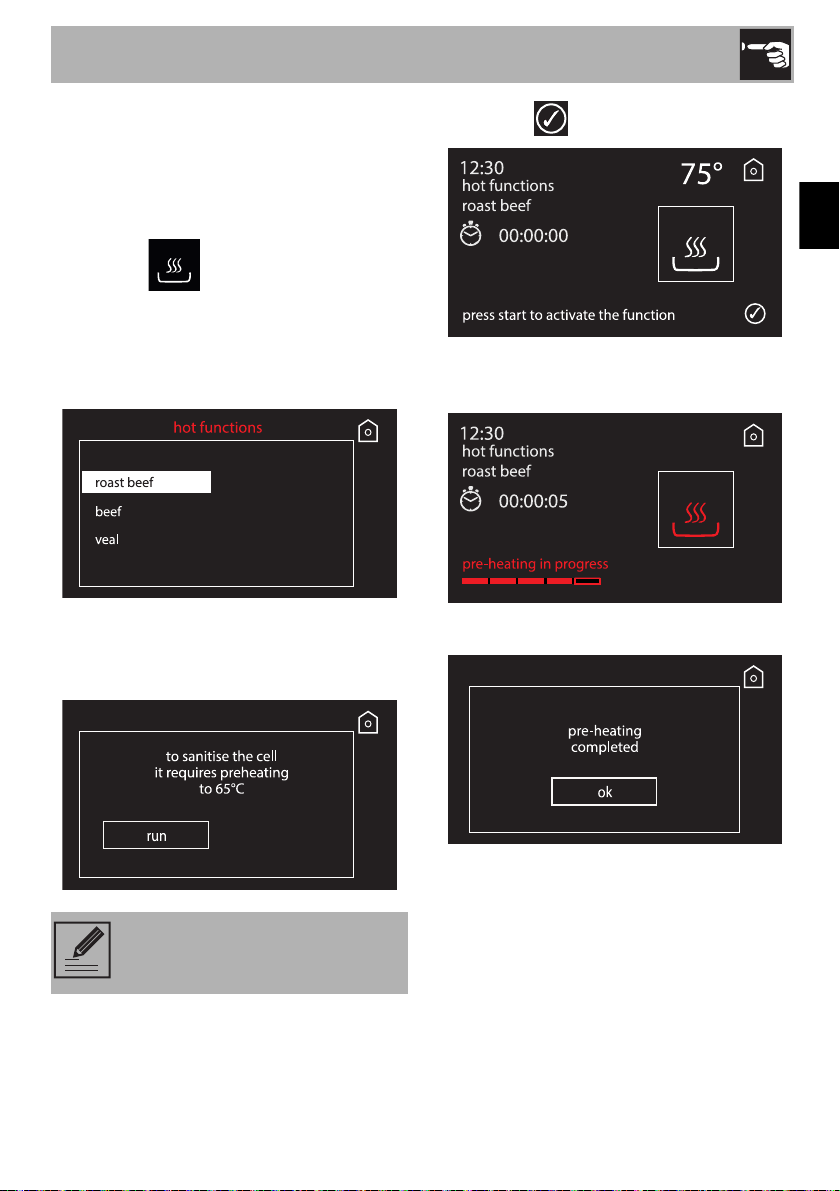
6. If a function end time has been set, the
following screen will be shown giving all
information. The appliance will change
to cooling mode while waiting for the
function to be started. In this condition it is
still possible to modify the function end
time by pressing the button.
When setting the function end time,
take into account the duration of
the function itself.
If, for example, you set the function
at 22:00 with an end time of 23:30
for a function duration set to 2
hours, the appliance will start the
function with a delay of 24 hours,
and the appliance will show the
conservation at 3°C screen while it
waits for the set time to start up the
function.
Use
84
7. Press to start the function.
8. The appliance will enter conservation
mode at 3°C while it waits for the
function start time.
9. If no function end time is set, press the
button to start proving. The screen will be
displayed to show that the function is in
progress.
10. When the function has finished, the
appliance will beep, and the function
progress bar and temperature will no
longer be displayed.
11. The appliance automatically switches
to the conservation function and will
remain in this state until the user
interrupts it with the button.
The function can be interrupted at
any point by pressing and holding
the button for 3 seconds.
Use
85
EN
Hot functions
This function allows you to perform slow,
low-temperature cooking of foods.
Low-temperature cooking brings out all the
food’s qualities, flavours and aromas.
1. Press the symbol to select “hot
functions” from the main special
functions screen.
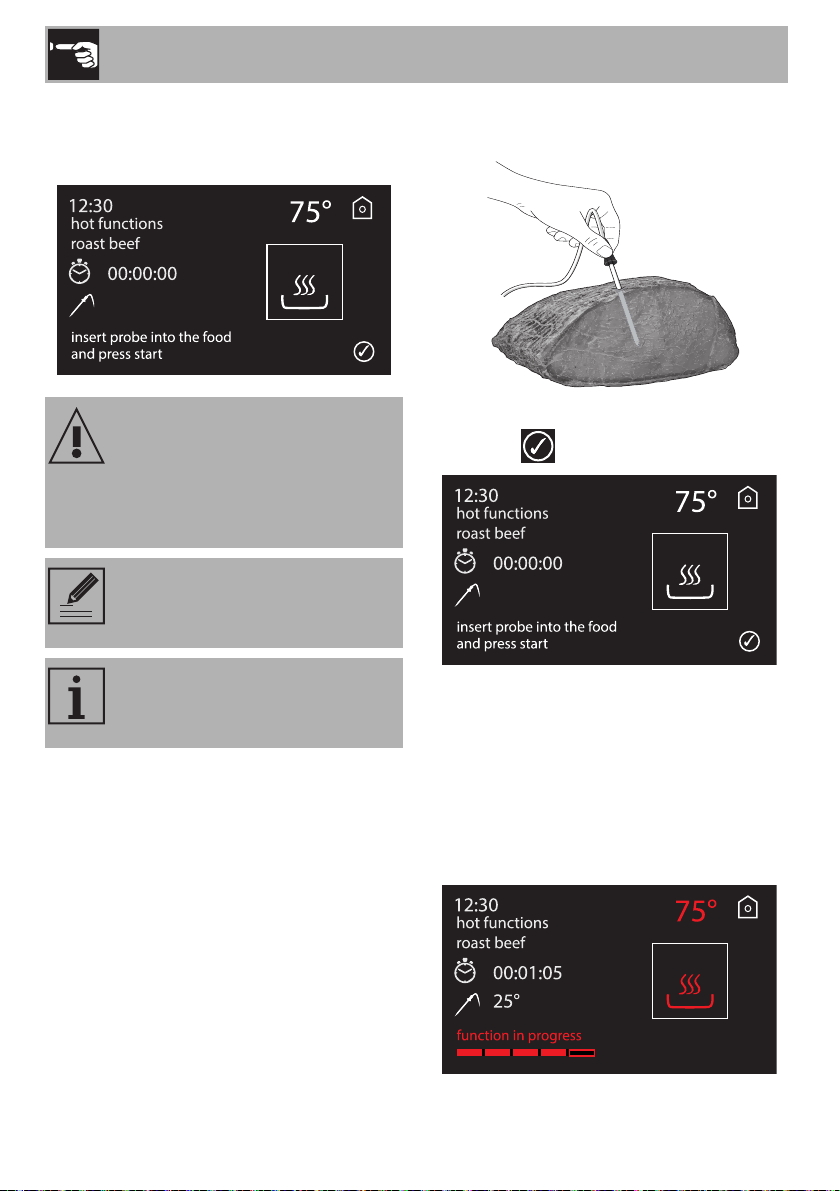
2. Select the type of food you wish to cook
from the list.
3. The appliance will ask to sanitise the interior
with a pre-heating function at 65°C. Press
“run” to proceed.
4. Press the button to start the function.
5. The display will show that appliance pre-
heating is in progress.
6. Once pre-heating is complete, press “ok”.
Pre-cooling should be performed
with the appliance empty.
Use
86
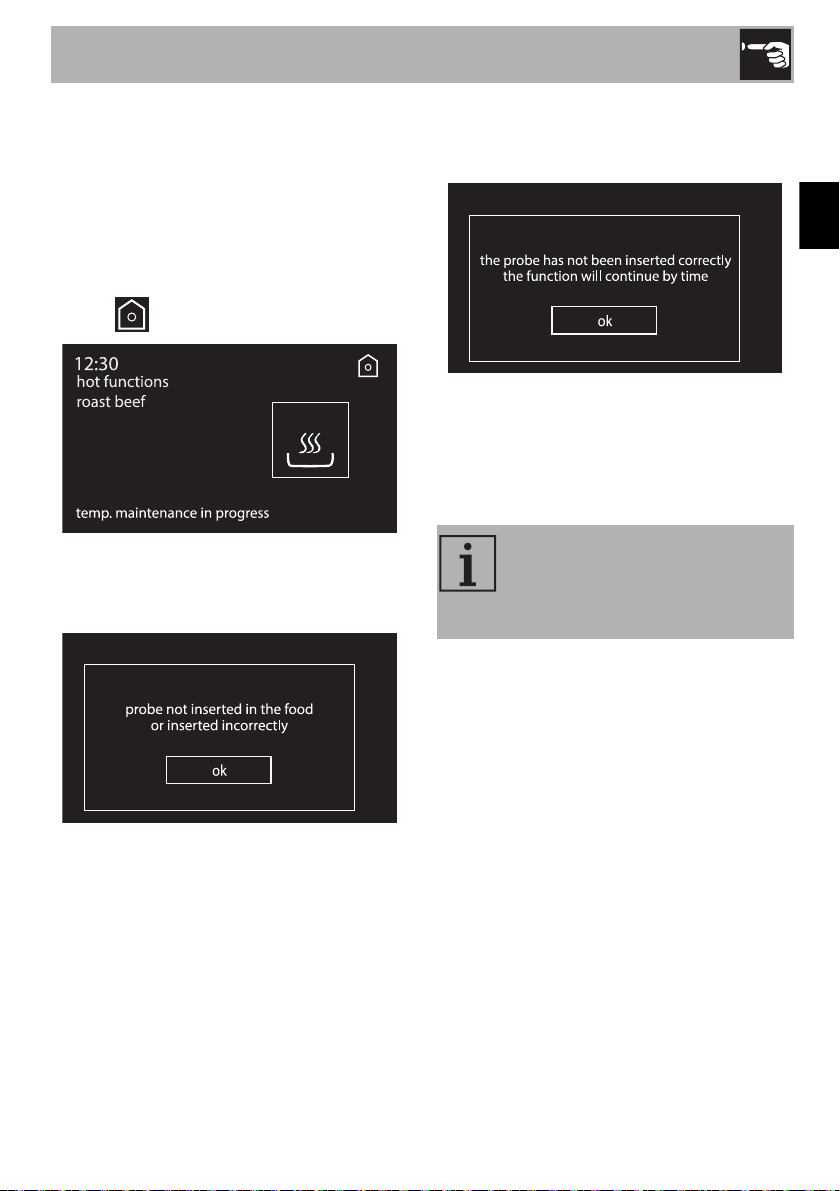
7. The following screen will be displayed to
prompt you to insert the temperature
probe.
8. Insert the temperature probe into the middle
of the food without going through it.
9. After inserting the probe, start the function
with the button.
10. Once the function has started, the
following screen will appear. The
screen remains active until the
temperature displayed next to the
probe symbol (25°C) is the same as
the temperature above the function
symbol, which is different for each
foodstuff.
Sharp point
Injury hazard
• Handle the probe with care and do not
touch its tip.
Insert the probe transversely,
ensuring at least 3/4 of its length is
inside the foodstuff.
For different sized pieces of food,
the probe should be placed in the
thickest area.
Use
87
EN
11. As soon as the temperature of 75°C is
reached, the appliance will beep, and
the function progress bar and the
temperature will no longer be
displayed.
12. The appliance will automatically switch
to maintaining a temperature of 55°C
for 10 hours. To stop the function, press
the button.
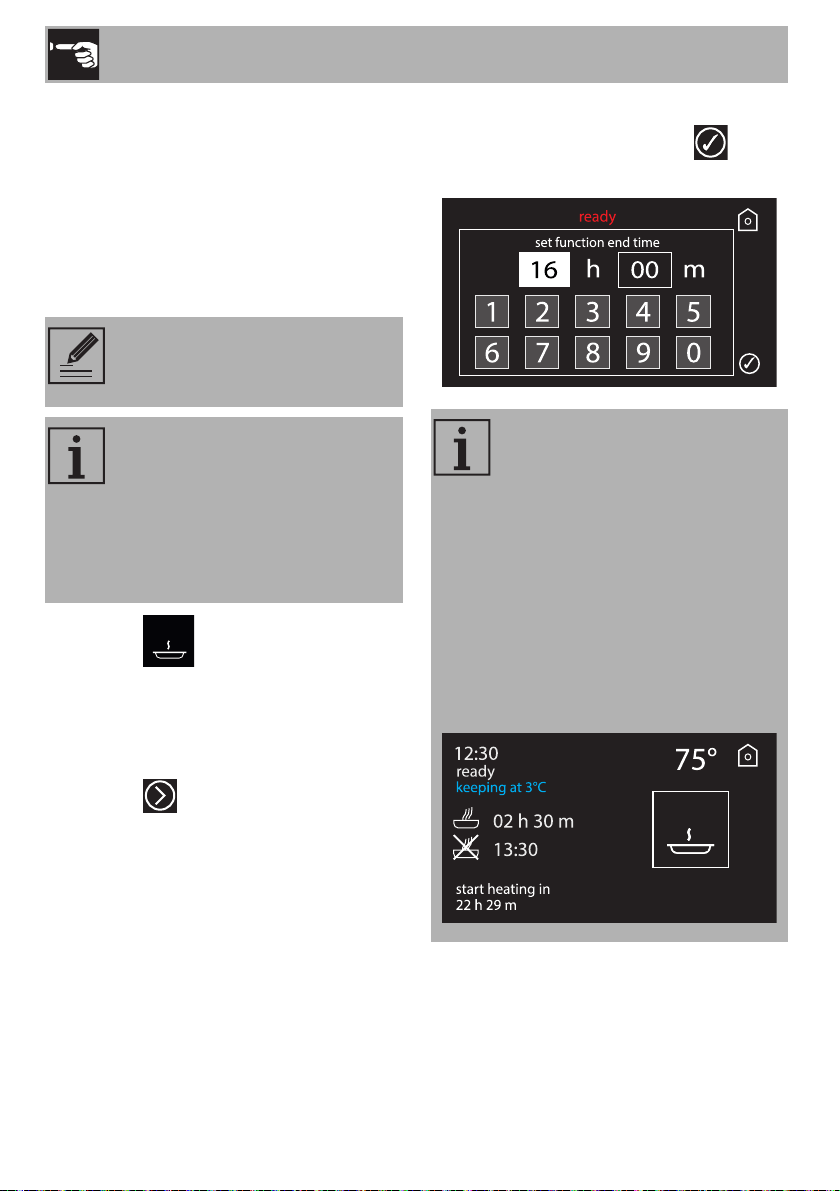
13. If the function is started without the
probe being inserted, the following
screen will appear:
14. Press “ok” and insert the probe. If the
probe has not been (correctly) inserted,
the following screen will be displayed:
15. Open the door and check that the
probe is correctly inserted.
16. If the probe is not inserted, the
appliance will automatically perform
slow cooking for a pre-set duration.
At the end of a hot function, we
recommend browning the dish in a
hot frying pan with a spoonful of oil
for a few minutes.
Use
88
Ready to eat
This function allows you to bring ready-
cooked food to serving temperature at a set
time.
Used for conserving a cooked dish at 3°C,
and if you are away from home the
appliance can heat it up before you return
so that it will be ready at the required time.
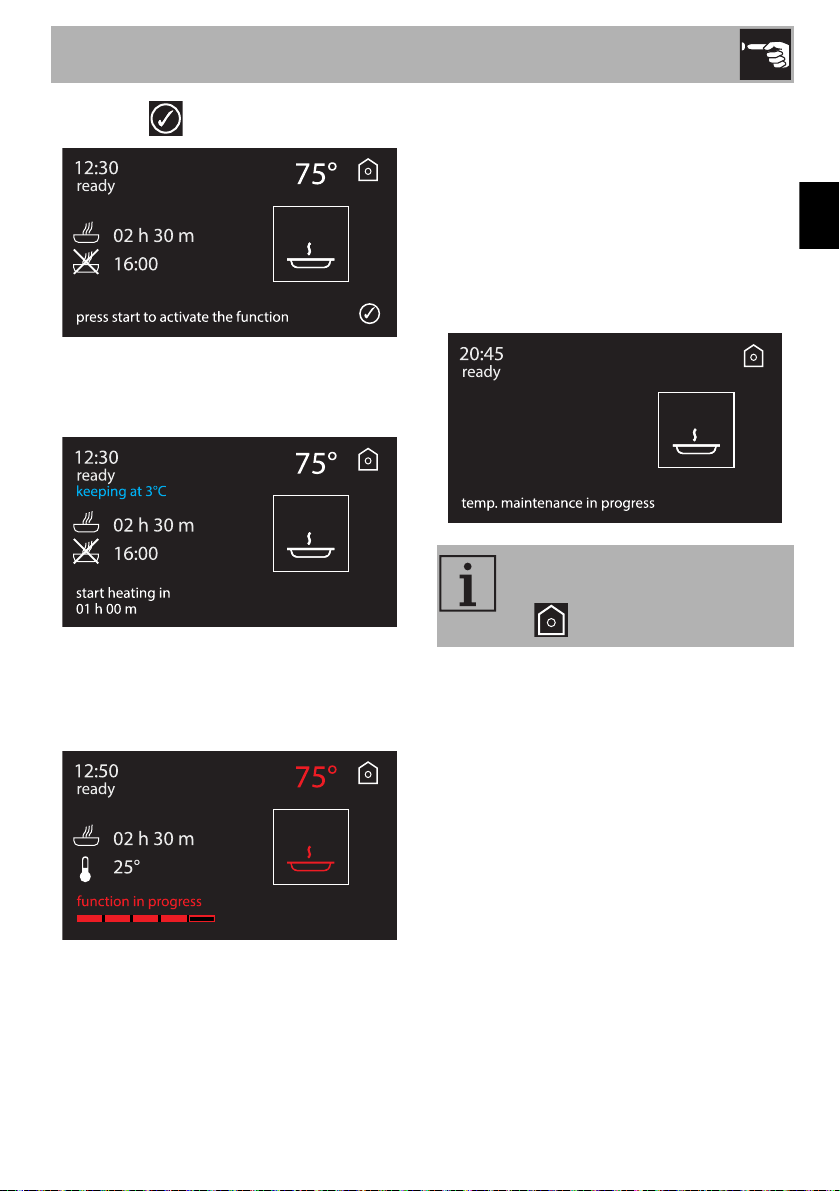
1. Press the symbol to select the
“Ready to eat” function from the main
special functions screen.
2. Place the food in the appliance and
close the door.
3. Press the button to switch to setting
the function end time.
4. Set the time at which you wish the
function to end and press the button
to confirm.
It is recommended to only warm
pre-sliced or portioned food with a
maximum weight of 1 kg.
The time taken to warm the dish
is 2h 30min; as such, it is
recommended to set the function
end time no sooner than the one
suggested by the appliance
(which already takes the 2h 30min
into account).
When setting the function end time,
take into account the duration of
the function itself.
If, for example, you set the function
at 22:00 with an end time of 23:30
for a function duration set to 2
hours, the appliance will start the
function with a delay of 24 hours,
and the appliance will show the
conservation at 3°C screen while it
waits for the set time to start up the
function.
Use
89
EN
5. Press the button to start the function.
6. The appliance will enter conservation
mode at 3°C while it waits for the
function start time.
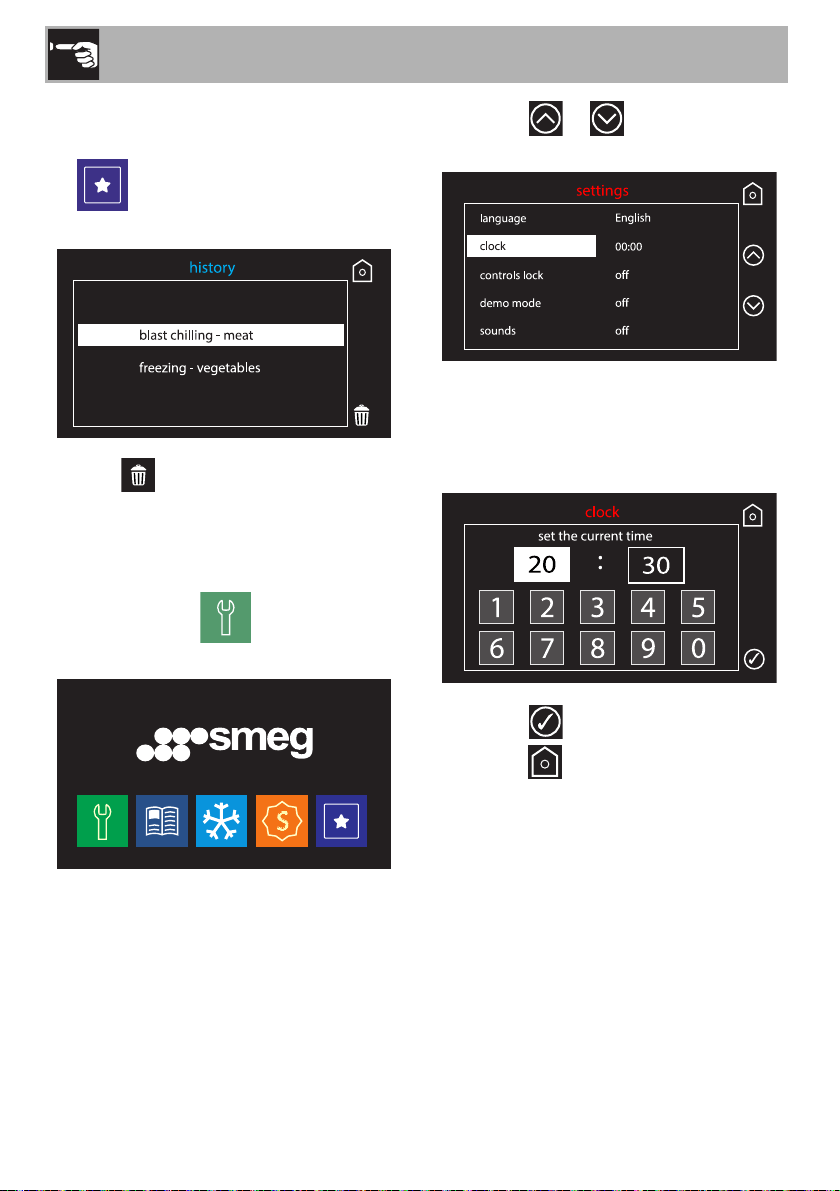
7. Once the function has started, the
following screen will appear. The screen
will remain active until the duration set by
the user has passed.
8. When the function has finished, the
appliance will beep, and the function
progress bar and temperature will no
longer be displayed.
9. Once the temperature has been
reached, and at the end of the set
cooking time, the appliance will
automatically switch to temperature
maintenance.
The function can be interrupted at
any point by pressing and holding
the button for 3 seconds.
Use
90
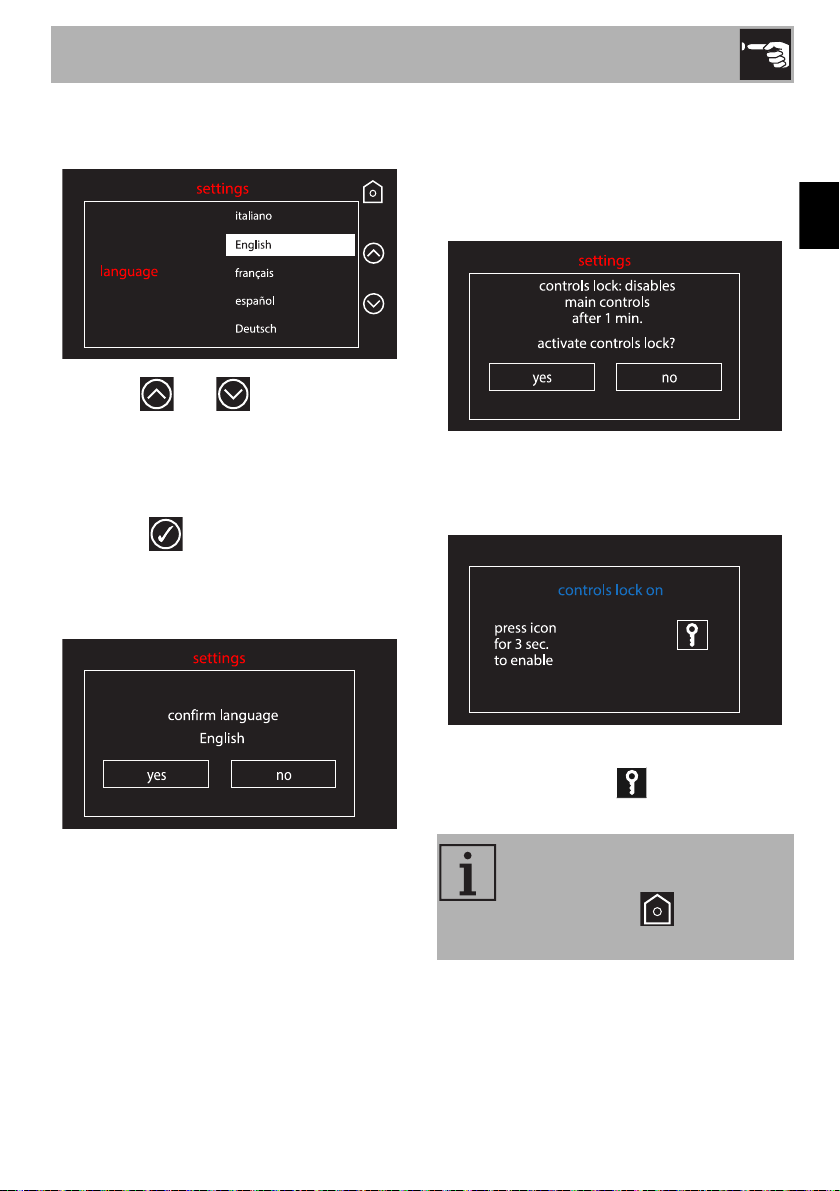
3.8 History
On the appliance’s “main screen”, press
the symbol to view the list of the
last 10 functions used.
Press the waste basket symbol to
delete the history.
3.9 Settings
Select the settings symbol on the
main screen.
1. Press the or buttons and select
clock from the “settings” menu.
2. Enter the current time: In the example, the
current time corresponds to 20:30, press
the hours field and type 2 and 0, then
move to the minutes field and type 3 and 0.
3. Press the button to confirm.
4. Press the button to return to the main
screen.
Use
91
EN
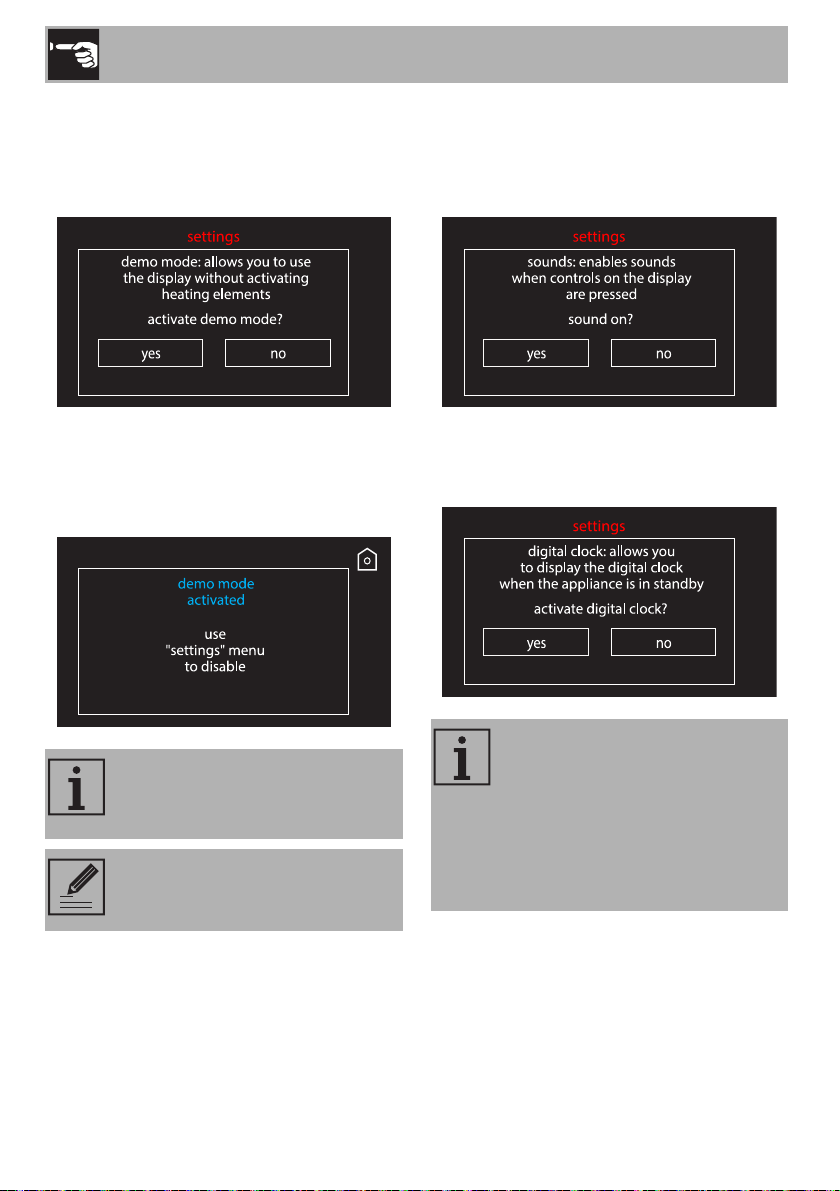
Language
Select the language from the “settings” menu.
1. Use the and buttons to scroll
through the list of available languages
and select the required language.
2. Press on the name of the required
language.
3. Press the button to confirm.
4. A selection confirmation screen will be
displayed: press yes to confirm or no to
cancel.
Controls lock
Allows the appliance to automatically lock
the controls after one minute of normal
operation without any intervention from the
user.
1. Press yes to confirm or no to cancel.
2. The following screen is displayed when
the controls lock is activated.
3. To temporarily exit controls lock mode,
press and hold the button for 3
seconds: an audible warning will sound.
It is also possible to shut off the
appliance with the controls lock
active: press the button for 3
seconds.
Use
92
Demo mode (for showrooms)
This mode disables all the appliance’s
heating elements, while keeping its user
interface operational.
1. Press yes to confirm or no to cancel.
2. When demo mode is activated, the
following screen will be displayed for 3
seconds every 10 minutes.
Sound
The appliance beeps whenever the controls
are pressed. This setting disables these
sounds.
Digital clock
Displays the time in digital format.
If the mode is active, “demo
mode” will be shown on the
display.
To use the appliance normally, set
this mode to OFF.
From any screen of the settings
menu, the appliance will switch to
stand-by mode after 15 seconds
of inactivity.
After two minutes in stand-by
mode, the appliance will switch to
power saving mode.
Cleaning and maintenance
93
EN
4 Cleaning and maintenance
4.1 Instructions
4.2 Cleaning the surfaces
To keep the surfaces in good condition,
they should be cleaned regularly after use.
Let them cool first.
Ordinary daily cleaning
Use neutral detergents that do not contain
abrasives or chlorine-based acids.
Pour the product onto a soft, damp cloth
and wipe the surface; rinse thoroughly and
dry with a soft cloth or a microfibre cloth.
Clean the touchscreen panel with glass-
cleaning products.
Use a soft cloth with a small amount of
detergent and dry thoroughly.
Cleaning the inside of the appliance.
To ensure that foodstuffs remain
uncontaminated, the interior of the
appliance should be cleaned and dried
after each use.
Cleaning and drying the interior of the
appliance is particularly important after
blast chilling and freezing functions in order
to prevent the build-up of unpleasant
odours, which could contaminate the foods.
Use a neutral detergent and a soft cloth.
Avoid using abrasive sponges or scourers
which could damage the internal surface.
Rinse and dry thoroughly.
Improper use
Risk of damage to surfaces
• Do not use steam jets for cleaning the
appliance.
• Do not use cleaning products containing
chlorine, ammonia or bleach on parts
made of steel or that have metallic
surface finishes (e.g. anodizing, nickel-
or chromium-plating).
• Do not use abrasive or corrosive
detergents (e.g. scouring powders, stain
removers and metallic sponges) on
glass parts.
• Do not use rough or abrasive materials
or sharp metal scrapers.
Improper use
Danger of personal injury or
damage to the appliance
• Isolate the electricity supply before
performing cleaning.
• Do not touch the appliance with bare,
damp or wet hands or feet.
• Do not remove the seal on the face of
the appliance.
• Do not use mechanical devices or other
means to speed up the defrosting
process other than those recommended
by the manufacturer.
• Do not damage the refrigerant circuit.
Cleaning and maintenance
94
Cleaning the rack
The grid can be washed in a dishwasher.
Removing rack support frames
Removing the guide frames enables the
sides to be cleaned more easily.
To remove the guide frames:
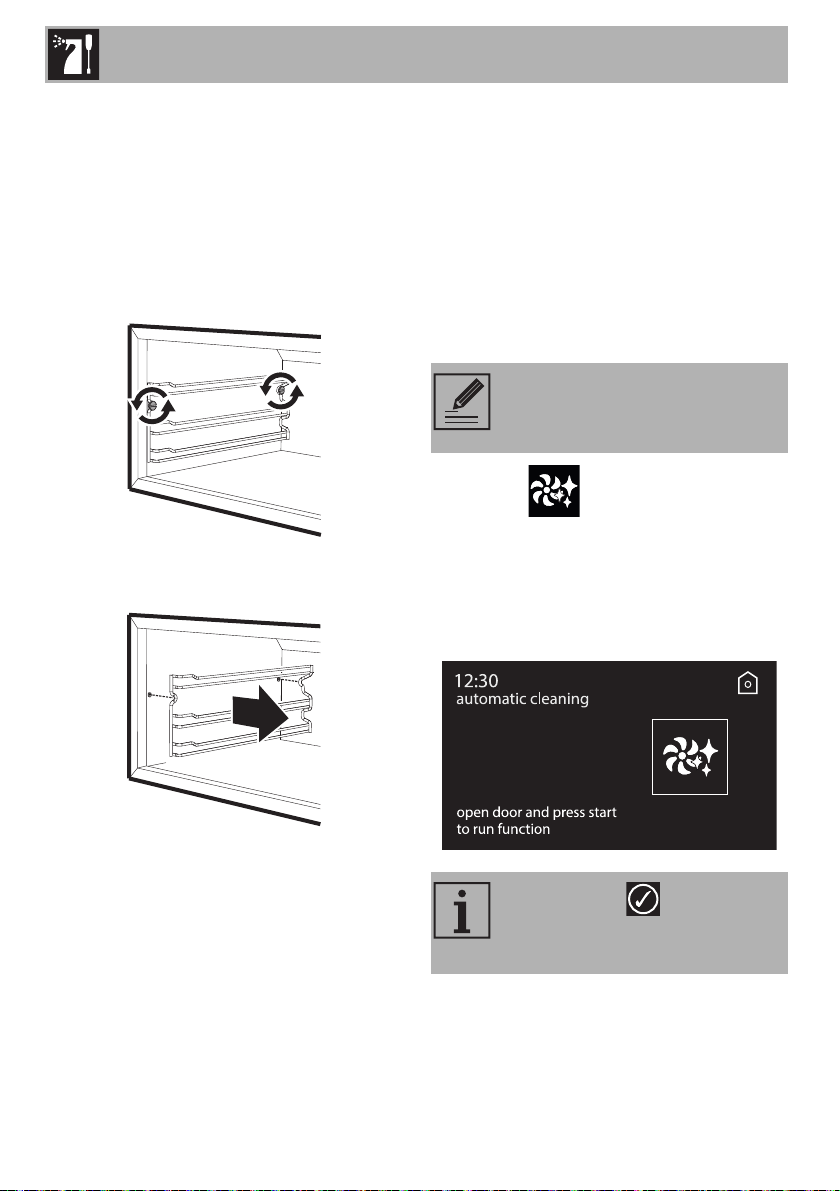
1. Unscrew the frame fastening pins.
2. Pull the frame towards the inside of the
oven to free it from the fastening pins.
3. When cleaning is complete, repeat the
above procedures to put the guide
frames back in.
Cleaning the guide frames
The frames can be removed as described in
the previous section and washed in a
dishwasher.
Automatic cleaning
Automatic cleaning must be performed after
four blast chilling cycles, or after 24 hours
of continuous operation in conservation or
freezing mode.
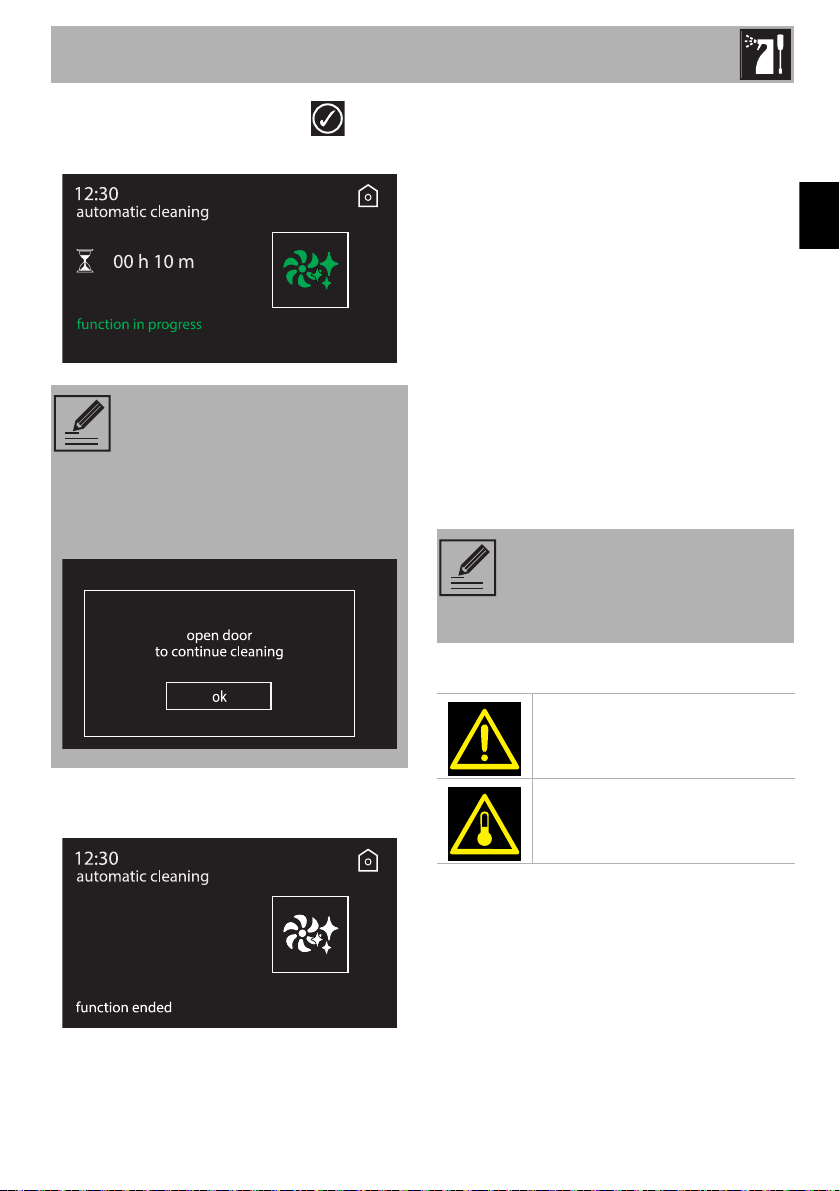
1. Press the symbol to select the
“automatic cleaning” function from the
main special functions screen.
2. The following message will be
displayed, requesting that you open the
door.
Automatic cleaning can only be
performed with the blast chiller’s
door open.
If you press the button without
opening the door, automatic
cleaning will not start up.
Cleaning and maintenance
95
EN
3. Open the door and press the button.
The following screen will be displayed:
4. Once automatic cleaning is complete,
the following screen will be displayed:
5. Dry the interior of the appliance
thoroughly.
4.3 Extraordinary maintenance
What to do if...
The display is completely off:
• Check the mains power supply.
• Check whether an all-pole switch
upstream of the appliance supply line is
in the “ON” position.
The appliance does not cool:
• Check whether it has been set to “demo”
mode (for further details see “Demo
mode (for showrooms)”).
The controls do not respond:
• Check whether it has been set to
“controls lock” mode (for further details
see “Controls lock”).
Malfunction Alarms
Take note of the error, switch off the
appliance and call Technical Support.
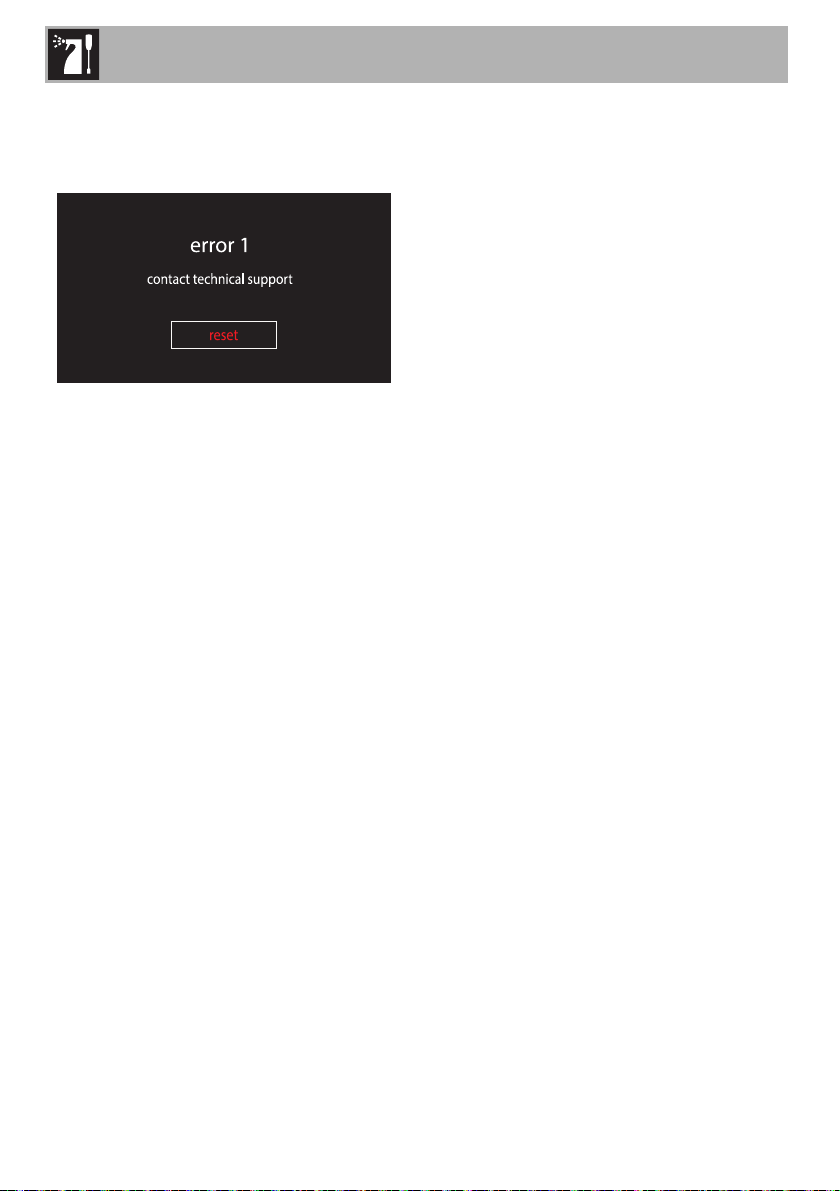
If you accidentally close the door
during automatic cleaning, the
function will not stop and the
appliance will beep once a minute
while displaying the following
message:
If the problem has not been
resolved or in the case of other
types of fault, contact your local
technical support centre.
Blast chilling function
Conservation or Temperature
Maintenance function
Cleaning and maintenance
96
Fault Alarms
An error message is displayed on the
screen, from “error 1” to “error 7”.
This indicates a fault with the appliance.
1. Press the reset button to turn the buzzer
off.
2. Take note of the error, switch off the
appliance and call Technical Support.
Installation
97
EN
5 Installation
5.1 Electrical connection
General information
Check the grid characteristics against the
data indicated on the plate.
The identification plate bearing the
technical data, serial number and brand
name is visibly positioned on the appliance.
Do not remove this plate for any reason.
The appliance operates at 220-240 V~.
Plug the appliance into a power socket
located around 1 - 1.5 metres from the
appliance.
Fixed connection
Fit the power line with an all-pole circuit
breaker in compliance with installation
regulations.
The all-pole circuit breaker should be
located near the appliance and in an easily
reachable position, according to
applicable electrical codes.
Connection with plug and socket
Make sure that the plug and socket are of
the same type. Avoid using adapters and
shunts as these could cause overheating
and a risk of burns.
5.2 Positioning
Power voltage
Danger of electrocution
• Have the electrical connection
performed by authorised technical
personnel.
• The appliance must be connected to
earth in compliance with electrical
system safety standards.
• Disconnect the mains power supply.
Heavy appliance
Crushing hazard
• Position the appliance into the cabinet
cut-out with the help of a second person.
• To prevent hazards due to instability of
the appliance, this must be fastened in
accordance with the instructions.
Pressure on the open door
Risk of damage to the appliance.
• Never use the oven door to lever the
appliance into place when fitting.
• Avoid exerting too much pressure on the
oven door when open.
Heat production during appliance
operation
Risk of fire
• Check that the carcase material is heat
resistant.
• Check that the carcase has the required
openings.
• Do not install the appliance in a recess
which can be closed with a door, or in a
cupboard.
Installation
98
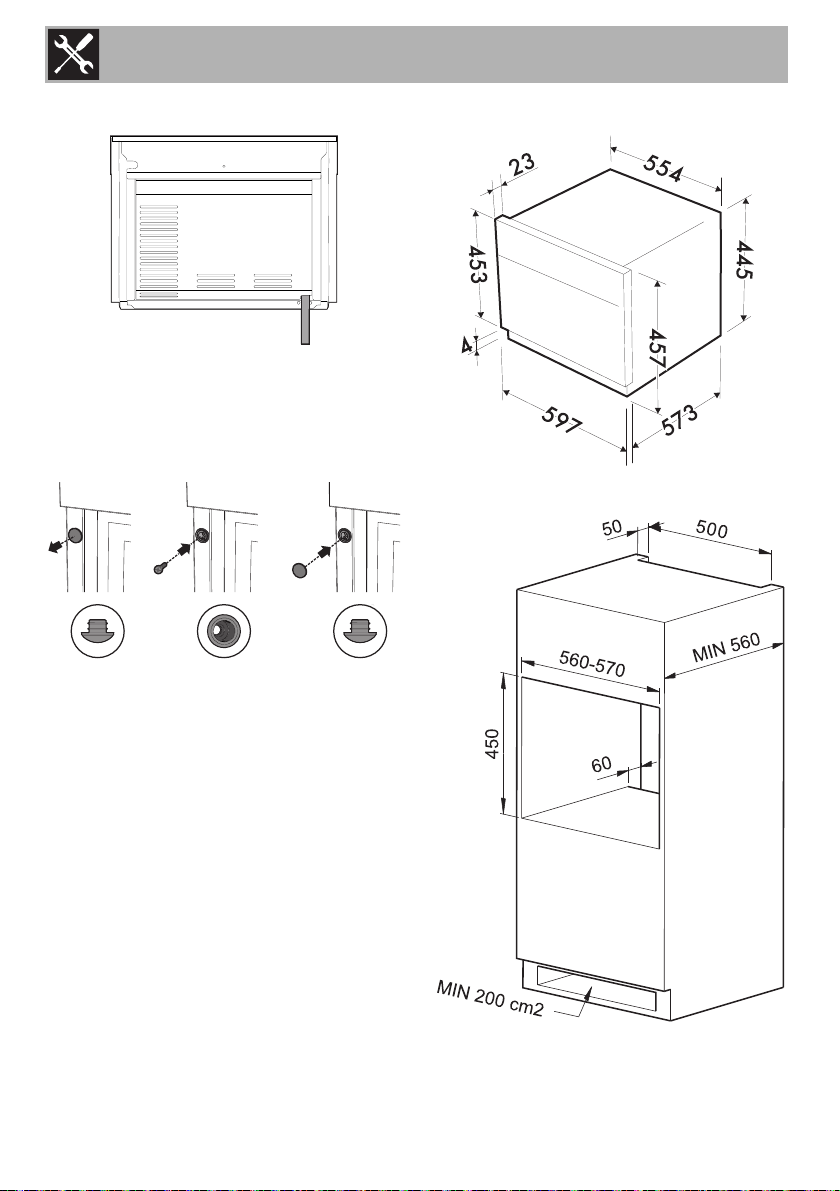
Position of the power cable
(rear view)
Fastening bushings
After positioning the appliance in the recess.
1. Remove the bushing covers on the front
of the appliance.
2. Secure the appliance to the carcase
using the screws.
3. Cover the bushings with the previously
removed covers.
Appliance overall dimensions (mm)
Mounting into a column (mm)