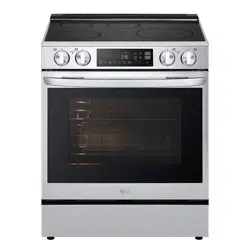
ELECTRIC RANGE
To contact LG Electronics, 24 hours a day,
7 days a week:
1-888-542-2623 (CANADA)
Or visit us on the Web at:
ca.lge.com (Canada)
Printed in Mexico
P/No.: MFL55646606
USER’S GUIDE
Please read this guide
thoroughly before
operating and keep it handy
for reference at all times.
LRE3091ST
LRE3091SB
LRE3091SW
Models

2
INTRODUCTION
IMPORTANT SAFETY INFORMATION ......3-9
Appliance Outlet .............................................................9
PARTS AND FEATURES
Parts And Features ......................................................15
Control Panel Features ................................................16
SURFACE CONTROLS COOKING
Power Outage Message ...............................................10
Hot Surface Indicator ....................................................10
Locations Of the Radiant Surface Elements and
Controls ........................................................................10
Setting Surface Controls ..............................................11
Tips To Protect the Glass Cooktop Surface .................12
Glass Cooktop Surface ................................................12
Cooking Areas ..............................................................13
Using the Proper Cookware .........................................13
Home Canning Tips ......................................................14
MAINTENANCE
Care and Cleaning ..................................................31-32
Cleaning The Glass Cooktop ..................................32-33
Removing and Replacing the Lift-Off Oven Door .........34
Door Care Instructions .................................................34
OPERATING INSTRUCTIONS
Setting the Clock ..........................................................17
Minimum and Maximum Control Pad Settings .............17
Setting the Timer On/Off ..............................................18
Setting Oven Lockout Feature .....................................18
Changing Hour Mode On Clock (12-hr, 24-hr) .............19
Setting Temperature Unit - Fahrenheit or Celsius ........19
Setting Beeper Volume ................................................19
Setting Preheating Alarm Light On / Off .......................20
Thermostat Adjustment ................................................20
Setting Bake .................................................................21
Baking Layer Cakes .....................................................22
Before Using Oven Racks ............................................22
Setting Timed Bake ......................................................23
Setting Delayed Timed Bake ........................................24
Setting Broil ..................................................................25
Recommended Broiling Guide ................................25-26
Turn the Oven Light On / Off ........................................26
Self-Clean ...............................................................27-29
Removing And Replacing the Storage Drawer ............30
Oven Vent ....................................................................30
TROUBLESHOOTING
Before Calling for Service ........................................35-38
WARRANTY
Warranty for Customers in Canada ..............................39
Product Registration Information
Model:
Serial Number:
Date of Purchase:
Staple your receipt here.
THANK YOU!
Congratulations on your
purchase and welcome to the
LG family. Your new LG Electric
range combines precision
cooking features with simple
operation and stylish design.
Follow the operating and care
instructions in this manual and
your range will provide you with
many years of reliable service.
READ ALL INSTRUCTIONS BEFORE USE
SAFETY PRECAUTIONS
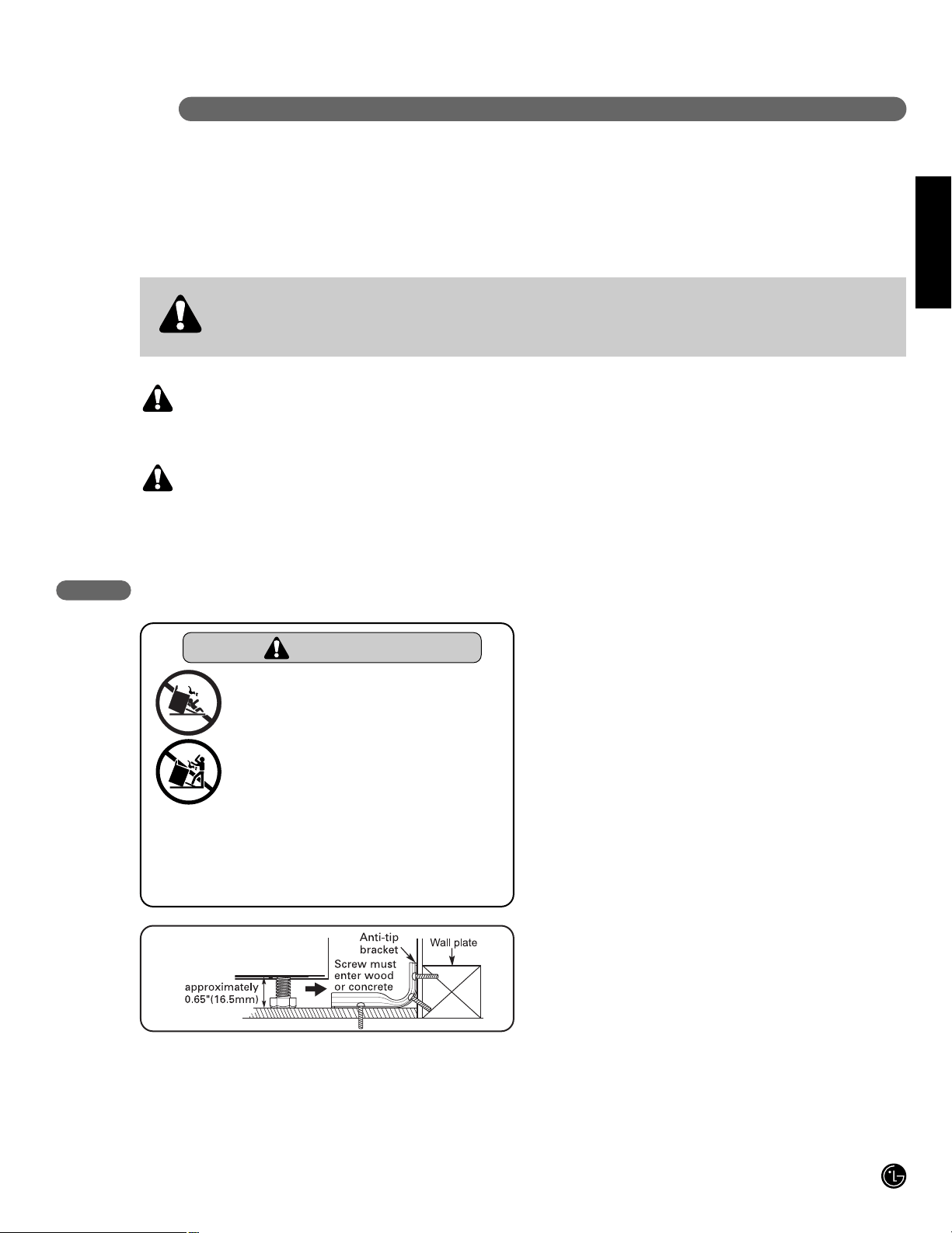
To reduce the risk of tipping of the range, the range
must be secured by properly installing anti-tip
bracket.
• To check that the anti-tip bracket is properly
installed:
Grasp the top rear edge of the range back guard
and carefully attempt to tilt it forward. Verify that
the anti-tip devices are engaged.
• Warming drawer or storage drawer: Remove
drawer and visually inspect that the rear leveling
leg is fully inserted into the anti-tip bracket.
• Refer to the installation manual for proper anti-tip
bracket installation.
• Be certain your appliance is properly installed and
grounded by a qualified technician.
• Do not repair or replace any part of the appliance
unless specifically recommended in the manual.
• All other servicing should be referred to a
qualified technician.
• Always disconnect power to appliance before
servicing by unplugging, removing the fuse or
switching off the circuit breaker.
Read and follow all instructions before using your oven to prevent the risk of fire, electric shock, personal injury,
or damage when using the range. This guide do not cover all possible conditions that may occur. Always
contact your service agent or manufacturer about problems that you do not understand.
WARNING This symbol will alert you to hazards or unsafe practices which
could cause serious bodily harm or death.
CAUTION This symbol will alert you to hazards or unsafe practices which could
cause bodily injury or property damage.
This is the safety alert symbol. This symbol alerts you to potential hazards that can
kill or hurt you and others. All safety messages will follow the safety alert symbol
and either the word WARNING or CAUTION. These words mean:
3
ENGLISH
IMPORTANT SAFETY INFORMATION
WARNING
• DO NOT step or sit on the door.
Install the Anti-Tip Bracket packed
with range.
- The range could be tipped and injury
might result from spilled hot liquid,
food, or the range itself.
- If the range is pulled away from the
wall for cleaning, service, or any
other reason, ensure that the anti-tip
bracket is properly reengaged when
the range is pushed back against the
wall.
4
IMPORTANT SAFETY INFORMATION
SAFETY PRECAUTIONS (cont.)
• DO NOT TOUCH HEATING ELEMENTS OR
INTERIOR SURFACES OF OVEN.
Heating elements may be hot even though they
are dark in color. Interior surfaces of an oven
become hot enough to cause burns. During and
after use, do not touch or let clothing or other
flammable materials contact heating elements or
interior surfaces of oven until they have had
sufficient time to cool. Other surfaces of the
appliance may become hot enough to cause
burns. Among these surfaces are oven vent
openings and surfaces near these openings, oven
doors, and windows of oven doors.
• Use Care When Opening Door.
Let hot air or steam escape before you remove or
replace food in the oven
• Do Not Heat Unopened Food Containers.
Build-up of pressure may cause container to burst
and result in injury.
• Be certain all packing materials are removed
from the appliance before operating.
Keep plastics, clothes, and paper away from parts
of the appliance that may become hot.
• DO NOT force the door open.
This can damage the automatic door locking
system. Use care when opening the oven door
after the self-cleaning cycle. Stand to the side of
the oven when opening the door to allow hot air or
steam to escape. The oven may still be VERY
HOT.
• DO NOT use a steel-wool pad.
It will SCRATCH the surface.
• DO NOT use harsh etching, abrasive cleaners
or sharp metal scrapers to clean the oven
door glass since they can scratch the surface.
It may result in shattering of the glass.
• Be careful when removing and lifting the door.
• DO NOT lift the door by the handle.
The door is very heavy.
• DO NOT step or sit on the door.
Install the anti-tip bracket packed with range.
- The range could be tipped and injury might
result from spilled hot liquid, food, or the range
itself.
- If the range is pulled away from the wall for
cleaning, service, or any other reason, ensure
that the anti-tip bracket is properly reengaged
when the range is pushed back against the wall.
READ ALL INSTRUCTIONS BEFORE USE
• NEVER use your appliance for warming or
heating the room.
• DO NOT use water on grease fires.
Should an oven fire occur, leave the oven
door closed and turn the oven off. If the fire
continues, throw baking soda on the fire or
use a fire extinguisher.
• Use dry pot holders only.
Moist or damp pot holders on hot surfaces
may result in burns from steam. Do not let
the pot holder touch hot heating elements.
Do not use a towel or other bulky cloth.
• Storage in or on appliance.
Flammable materials should not be stored
in an oven or near surface elements.
• Wear proper apparel.
Loose-fitting or hanging garments should
never be worn while using the appliance.
WARNING

READ ALL INSTRUCTIONS BEFORE USE
5
ENGLISH
IMPORTANT SAFETY INFORMATION
ELECTRICAL SAFETY
• Protective Liners. Do not use aluminum foil or
any other material to line the oven bottoms.
Improper installation of these liners may result in
a risk of electric shock or fire.
• Do Not allow aluminum foil or meat probe to
contact heating elements.
• Before replacing your oven light bulb, switch
off the electrical power to the oven at the main
fuse or circuit breaker panel.
Failure to do so can result in severe personal
injury, death, or electrical shock.
• DO NOT line the oven walls, racks, bottom, or
any other part of the oven with aluminum foil
or any other material.
Doing so will disrupt heat distribution, produce
poor baking results and cause permanent
damage to the oven interior (aluminum foil will
melt to the interior surface of the oven.)
• DO NOT place aluminum foil directly on the
oven bottom.
Aluminum foil
WARNING
• Do not place foods directly on the oven
bottom.
WARNING
VENTILATING HOODS
• Keep Oven Vent Ducts Unobstructed.
The oven vent is located above the left rear
surface unit.
This area could become hot during oven use.
Never block this vent and never place plastic or
heat-sensitive items on vent.
PAN PLACEMENT
Doing so will cause permanent damage to the oven
bottom finish.
Heater

6
IMPORTANT SAFETY INFORMATION
READ ALL INSTRUCTIONS BEFORE USE
DEEP FAT FRYERS
• Use extreme caution when moving the grease
kettle or disposing of hot grease.
SURFACE COOKING UNITS
• Use Proper Pan Sizes. This appliance is
equipped with one or more surface units of
different size. Select utensils having flat bottoms
large enough to cover the surface unit heating
element.
The use of undersized utensils will expose a
portion of the heating element to direct contact
and may result in ignition of clothing. Proper
relationship of utensil to burner will also improve
efficiency.
• Never Leave Surface Units Unattended at High
Heat Settings. Boilovers cause smoking and
greasy spillovers that may ignite.
• Glazed Cooking Utensils. Only certain types of
glass, glass/ceramic, ceramic, earthenware, or
other glazed utensils are suitable for range-top
service without breaking due to the sudden
change in temperature.
• Utensil Handles Should Be Turned Inward and
Not Extend Over Adjacent Surface Units. To
reduce the risk of burns, ignition of flammable
materials, and spillage due to unintentional
contact with the utensil, the handle of a utensil
should be positioned so that it is turned inward,
and does not extend over adjacent surface units.
• Be sure you know which control pads operate
each surface unit.
Make sure you turned on the correct surface unit.
SAFETY DURING USE
• Oven Racks. Always place oven racks in
desired position while oven is cool.
• Always use pot holders or oven mitts when
removing food from the oven or cooktop.
You can be burned because cookware and plates
will be hot.
• Use caution with the TIMED BAKE or
DELAYED TIMED BAKE features. Use the
automatic timer when cooking cured or frozen
meats and most fruits and vegetables. Foods
that can easily spoil, such as milk, eggs, fish,
meat or poultry, should be chilled in the
refrigerator first. Even when chilled, they
should not stand in the oven for more than 1
hour before cooking begins, and should be
removed promptly when cooking is
completed.
Eating spoiled food can result in sickness from
food poisoning.
• Should an oven fire occur, leave the oven door
closed and turn the oven off. If the fire
continues, throw baking soda on the fire or
use a fire extinguisher.
• DO NOT put water or flour on the fire.
Flour may be explosive and water can cause a
grease fire to spread and cause personal injury.
• DO NOT use the broiler pan without the grid.
DO NOT cover the grid with aluminum foil.

7
ENGLISH
IMPORTANT SAFETY INFORMATION
CHILD SAFETY
• Children should be kept away from the
oven.
• Accessory parts will become hot when the
broiler is in use.
WARNING
• NEVER leave children alone or
unsupervised near the appliance when it is
in use or is still hot. Children should never
be allowed to sit or stand on any part of the
appliance as they could be injured or
burned.
• NEVER store items of interest to children in
cabinets above an appliance. Children
climbing on the appliance or on the
appliance door to reach items could be
seriously injured.
• Children must be taught that the appliance
and utensils in it can be hot. Let hot utensils
cool in a safe place, out of reach of small
children. Children should be taught that an
appliance is not a toy. Children should not
be allowed to play with controls or other
parts of the appliance.
CAUTION
• DO NOT leave small children unattended
near the appliance.
During the self-cleaning cycle, the outside of
the oven can become very hot to the touch.
CAUTION
GLASS/CERAMIC COOKING SURFACES
• DO NOT TOUCH SURFACE UNITS OR AREAS
NEAR UNITS.
Surface units may be hot even though they are
dark in color. Areas near surface units may
become hot enough to cause burns. During and
after use, do not touch, or let clothing or other
flammable materials contact surface units or
areas near units until they have had sufficient
time to cool. This includes the cooktop and the
area above the oven door.
• Do Not Cook on Broken Cooktop. If cooktop
should break, cleaning solutions and spillovers
may penetrate the broken cooktop and create a
risk of electric shock. Contact a qualified
technician immediately.
• Clean Cooktop With Caution. Do not use
sponges or cloth to wipe spills on a hot cooking
area. Use a proper metal scraper.
• DO NOT use the glass cooktop surface as a
cutting board.
• DO NOT place or store items that can melt or
catch fire on the glass cooktop, even when it is
not being used.
• Always turn the surface units on after placing
cookware.
• DO NOT store heavy items above the cooktop
surface that could fall and damage it.
READ ALL INSTRUCTIONS BEFORE USE

8
IMPORTANT SAFETY INFORMATION
GLASS/CERAMIC COOKING SURFACES (cont.)
• DO NOT place aluminum foil or plastic items such
as salt and pepper shakers, spoon holders, or
plastic wrappings or any other material on the
range when it is in use.
- The hot air from the vent could melt plastics or
ignite flammable items.
• Make sure you turned on the correct surface unit.
• NEVER cook directly on the glass. Always use
cookware.
• Always place the pan in the center of the
surface unit you are cooking on.
NEVER leave surface units unattended at high
heat setting.
- Boilovers cause smoking and greasy spillovers
that may catch on fire.
• Always turn the surface units off before removing
cookware.
• DO NOT use plastic wrap to cover food.
- Plastic may melt onto the surface and be very
difficult to remove.
• DO NOT touch surface units until it has cooled
down.
• The surface elements may still be hot and burns
may occur if the glass surface is touched before it
has cooled down sufficiently.
• Immediately clean the spills on cooking area to
prevent a tough cleaning chore later.
• If cabinet storage is provided directly above
cooking surface, limit it to items that are
infrequently used and can be safely stored in an
area subjected to heat. Temperatures may be
unsafe for items such as volatile liquids, cleaners
or aerosol sprays.
• DO NOT touch surface elements until it has
cooled down sufficiently.
- The surface elements may still be hot and burns
may occur.
• NEVER leave food unattended at high or
medium-high setting. Boilovers can cause
smoking and greasy spillovers may catch on fire.
• When warming foods do not use containers that
seal. Allow venting for heated air to escape
• DO NOT use a steel-wool pad.
- It will scratch the surface.
• DO NOT use scrub pads or abrasive cleaning
pads.
- They may damage your glass cooktop surface.
• Cookware with rough or bottoms can mark or
scratch the cooktop surface.
• Do not slide anything metal or glass across
the cooktop.
• Do not use cookware with dirt or dirt built-up
on the bottom.
READ ALL INSTRUCTIONS BEFORE USE
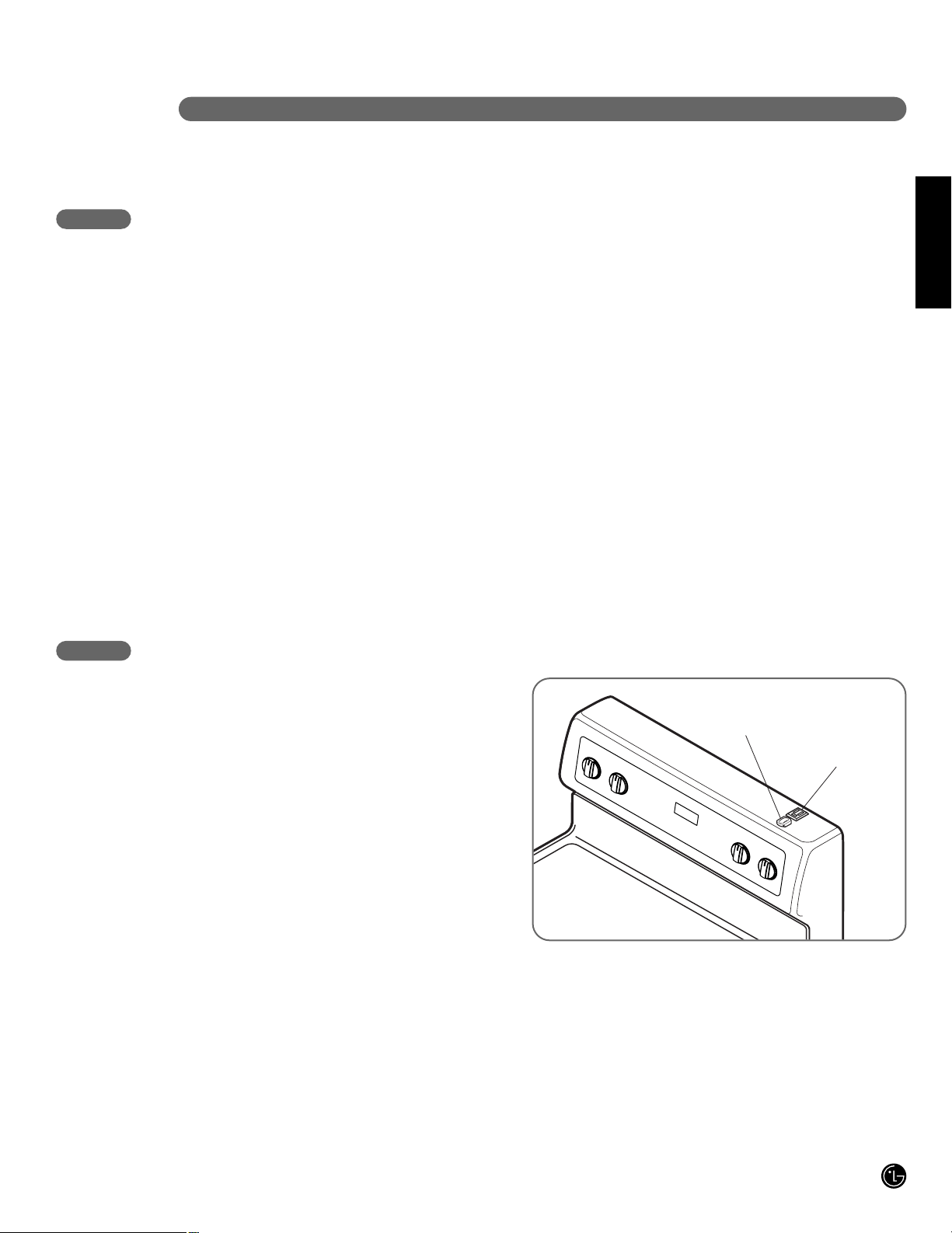
The 120V appliance outlets located on the control
console may be used to run portable appliances
placed on countertops beside the range.
The outlets operate independently and are not
affected by range control settings.
NOTE: Do not place portable appliances on the
cooktop. Damage to the portable appliance could
result if the cooktop is hot.
Appliance Outlet Circuit Breakers:
The circuit breakers for the appliance outlets on
your range are located on top of the control
console. They are rated for 15 amps, that may trip
if the appliance plugged into it exceeds 15 amps.
To reset the circuit breaker, press the switch of
located on the control console.
NOTE: If appliance outlet don ’t operate, test out
your small portable appliance by plugging into
other outlets.
9
ENGLISH
IMPORTANT SAFETY INFORMATION
SAFETY WHEN CLEANING
• Do Not Clean Door Gasket. The door gasket is
essential for a good seal. Care should be taken
not to rub, damage, or move the gasket.
• Do Not Use Oven Cleaners. No commercial
oven cleaner or oven liner protective coating of
any kind should be used in or around any part of
the oven.
• Before self cleaning the oven. Remove broiler
pan, all oven racks, meat probe and any other
utensils from the oven cavity.
• Never keep pet birds in the kitchen. The health
of birds is extremely sensitive to the fumes
released during an oven self-clean cycle. Fumes
may be harmful or fatal to birds. Move birds to
well-ventilated room.
• Clean in the self-clean cycle only parts listed in
this manual. Before self-clean the oven, remove
the broiler pan and any utensils of foods from the
oven.
• It is normal for the cooktop of the range to
become hot during a self-clean cycle. Therefore,
touching the cooktop during a clean cycle should
be avoided.
• Important Instruction. In the event the self clean
error code F is displayed, and three long beeps
sound, the oven is malfunctioning in the self clean
mode. Switch off the electrical power to the main
fuse or breaker and have serviced by a qualified
technician.
• Make sure oven lights are cool before
cleaning.
APPLIANCE OUTLETS
READ ALL INSTRUCTIONS BEFORE USE
Circuit Breakers
Appliance Outlet
10
SURFACE CONTROLS COOKING
POWER OUTAGE MESSAGE
If your oven was set for a timed oven operation and a
power outage occurred, the clock and all programmed
functions must be reset.
The time of day will flash in the display when there
has been a power outage.
Press the Clear/Off pad. Reset the clock with the
correct time of day.
HOT SURFACE INDICATOR WILL
• Come on when the unit is hot to touch after.
• Come on during self-cleaning cycle.
• Stay on even after the unit is turned off.
• Glow until the unit has cooled down to
approximately 150°F.
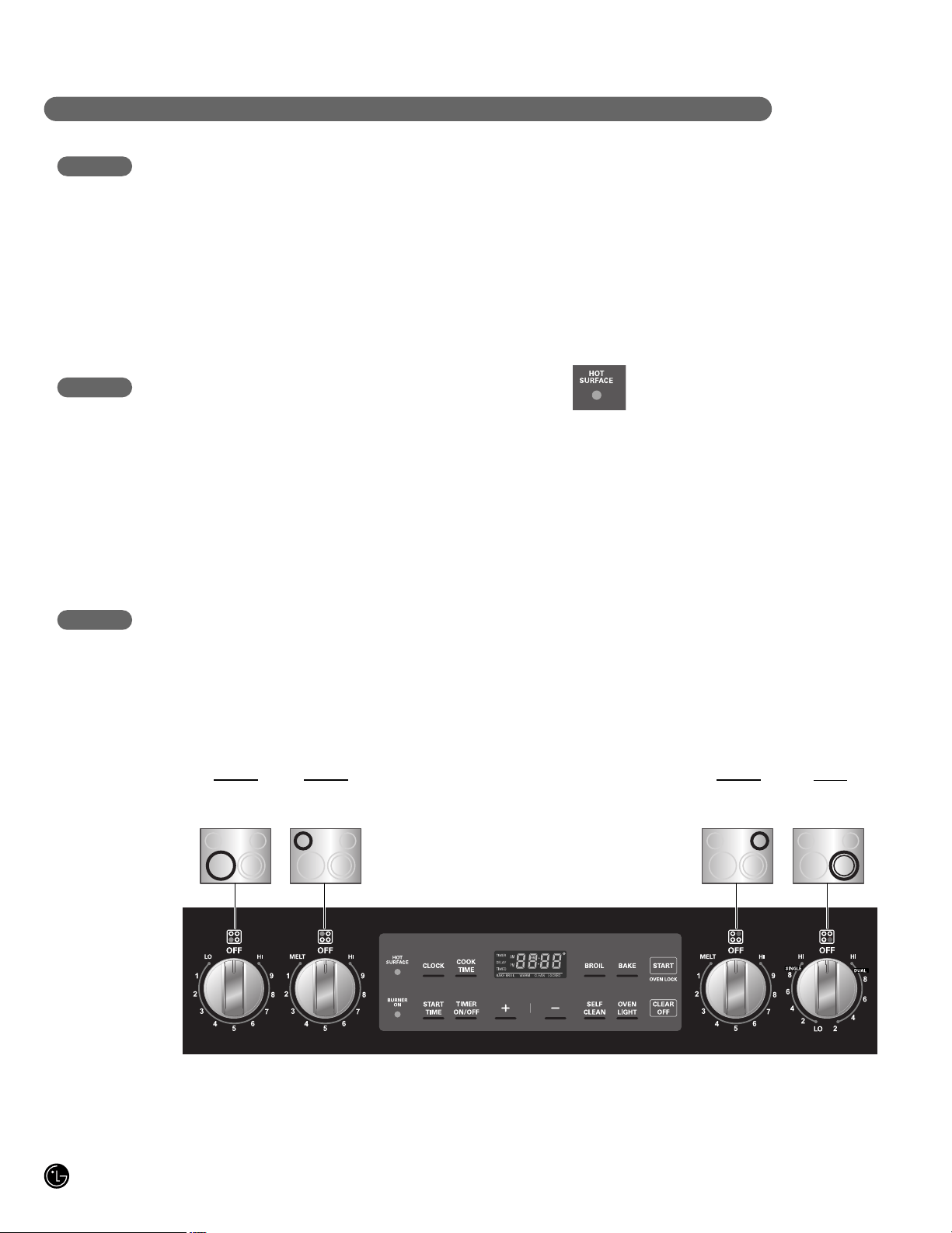
LOCATIONS OF THE RADIANT SURFACE ELEMENTS AND
CONTROLS
The radiant surface elements are located on the
cooktop as below.
TIMER
DELAY
TIMED
BAKE BROIL WARM CLEAN LOCKED
Single
Left Front
Element
Single
Left Rear
Element
Single
Right Rear
Element
Dual
Right Front
Dual Element
22
1
A B
11
ENGLISH
SURFACE CONTROLS COOKING
SETTING SURFACE CONTROLS
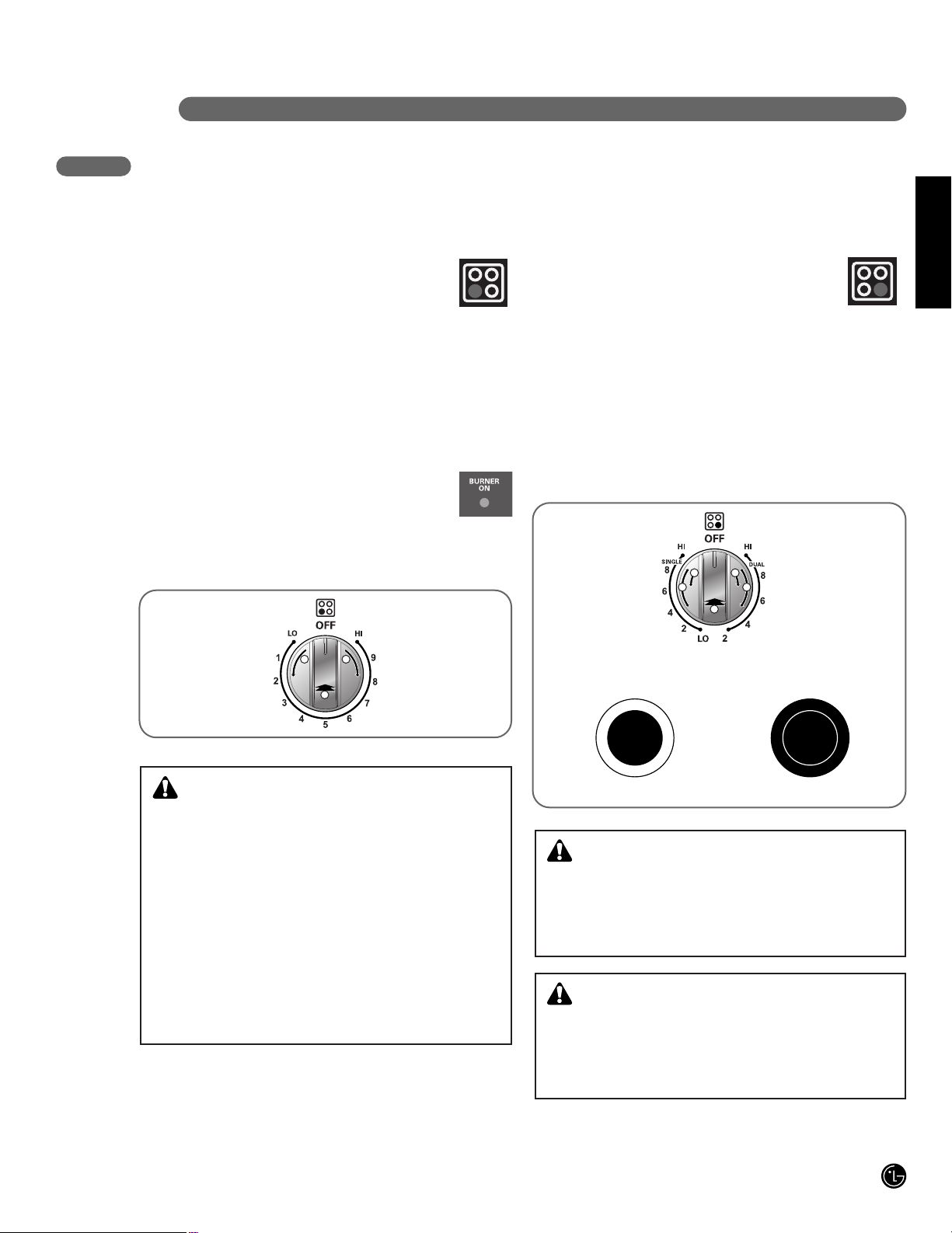
Use to turn on the surface elements. An infinite choice of heat settings is available from Low to High. The knobs can
be set on or between any of the settings.
Place pan on surface element.
Push in and turn the knob in either direction to the
desired heat setting.
• The control panel is marked to identify which
element the knob control. For example, the
graphic above indicates left front element.
There is an element indicator light on
the control panel. When any surface
control knob is turned on, the light will
turn on. The light will turn off when all the
surface elements are turned off.
After cooking, turn knob to OFF. Remove pan.
Dual Element (select modes)
The cooking surface has a dual element located at
the right front of the smoothtop. This allows you to
change the size of the element.
The small element is operated on the left side of the
knob control. To operate the entire element, use the
right side of the knob control, The control for both
element sizes can be set anywhere between Low and
High.
Heating with inner
(smaller) element only
AB
Heating with both
element together
• NEVER leave food unattended at high or
medium-high setting.
- Boilovers can cause smoking and greasy
spillovers may catch on fire.
CAUTION
• DO NOT touch surface elements until they
have cooled down sufficiently.
- The surface elements may still be hot and burns
may occur.
CAUTION
• Use only cookware and dishes recommended
as safe for oven and cooktop use.
• Always use oven mitts when removing food
from the surface element as cookware and
plates will be hot.
• When warming foods do not use containers
that seal. Allow venting for heated air to
escape.
• Do not use plastic wrap to cover foods.
- Plastic may melt onto the surface and be very
difficult to clean.
CAUTION
To turn on a dual surface unit
(Right Front)
To turn on a single surface unit
(Left Front, Left Rear, Right Rear)
2
1
2

12
SURFACE CONTROLS COOKING
TIPS TO PROTECT THE GLASS COOKTOP SURFACE
Cleaning
(See pages 32~33 for more information)
Before first use, clean the cooktop.
Clean your cooktop daily or after each use. This will
keep your cooktop looking good and can prevent
damage.
If a spillover occurs while cooking, immediately clean
the spill from the cooking area while it is hot to
prevent a tough cleaning chore later. Using extreme
care, remove spill with a proper metal scraper.
Do not allow spills to remain on the cooking area or
the cooktop trim for a long period of time.
Do not use abrasive cleansing powders or scouring
pads which will scratch the cooktop.
Do not use chlorine bleach, ammonia, or other
cleansers not specifically recommended for use on
glass-ceramic.
To Prevent Other Damages
Do not allow plastic, sugar, or foods with high sugar
content to melt onto the hot cooktop. Should this
happen, clean immediately. (See Cleaning, pages
32~33.)
Do not let a pan boil dry as this will damage the
surface and pan.
Do not use cooktop as a work surface or cutting
board.
Do not cook food directly on the surface.
To Prevent Marks and Scratches
Do not use glass pans. They may scratch the surface.
Do not place a trivet or wok ring between the surface
and pan. These items can mark or scratch the top.
Do not slide aluminum pans across a hot surface.
The pans may leave marks which need to be
removed promptly.”
(See Cleaning pages 32~33.)
Make sure the surface and the pan bottom are clean
and dry before turning on to prevent scratches.
To prevent scratching or damaging to the glass-
ceramic top, do not leave sugar, salt, or fats on the
cooking area. Wipe the cooktop surface with a clean
cloth or paper towel before using.
Do not slide heavy metal pans across the surface
since these may scratch.
To Prevent Stains
Do not use a soiled dish cloth or sponge to clean the
cooktop surface. A film will remain which may cause
stains on the cooking surface after the area is heated.
Continuously cooking on a soiled surface may/will
result in a permanent stain.
GLASS COOKTOP SURFACE
Glass Cooktop Surface Notes:
• The cooktop may emit light smoke and odor the
first few times the cooktop is used. This is normal.
• Glass cooktops retain heat for a period of time
after the elements are turned off. Turn the
elements off a few minutes before food is completely
cooked and use the retained heat to complete
cooking. When the hot surface light turns off, the
cooking area will cool down enough to touch.
Because of the way they retain heat, the cooktop
elements will not respond to changes in settings as
quickly as coil elements.
• In the event of a potential boilover, remove the pan
from the cooking surface.
• Do not attempt to lift the cooktop.
• The smoothtop surface may appear discolored when
it is hot. This is normal and will disappear when the
surface cools.
13
ENGLISH
SURFACE CONTROLS COOKING
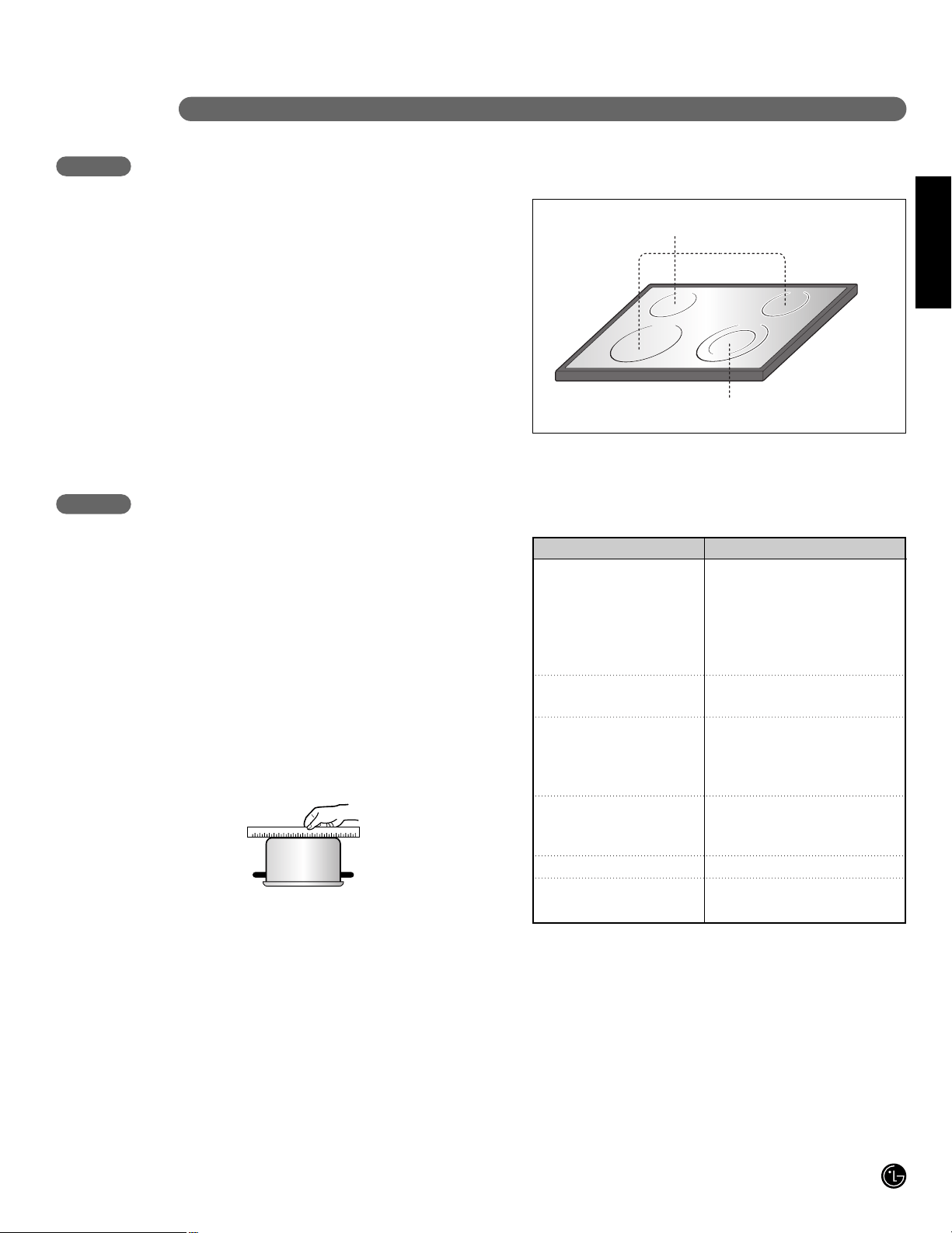
COOKING AREAS
The cooking areas on your range are identified by
permanent circles on the glass cooktop surface. For
the most efficient cooking, fit the pan size to the
element size.
Pans should not extend more than 1/2 to 1-inch
beyond the cooking area.
When a control is turned on, a glow can be seen
through the glass cooktop surface. The element will
cycle on and off to maintain the preset heat
setting, even on Hi.
For more information on cookware, refer to Cookware
Recommendations.
USING THE PROPER COOKWARE
Using the right cookware can prevent many problems,
such as food taking longer to cook or achieving
inconsistent results. Proper pans will reduce cooking
times and cook food more evenly. Stainless steel is
recommended.
Check pans for flat bottoms by using
a straight edge or ruler
Place a ruler across the bottom of the pan.
Hold it up to the light.
No light should be visible under the ruler.
Dual element
Single element
Recommended
Incorrect
Flat bottom and straight
sides.
Heavy-gauge pans.
Pan sizes match the
amount of food to be
prepared and the size
of the surface element.
Weight of handle does
not tilt pan. Pan is well
balanced.
Tight-fitting lids.
Flat bottom woks.
Curved, grooved, or
warped pan bottoms. Pans
with uneven bottoms do
not cook efficiently and
sometimes may not boil
liquid.
Very thin-gauge metal or
glass pans.
Pans are smaller or larger
than the element.
Cookware with loose or
broken handles. Heavy
handles that tilt the pan.
Loose-fitting lids.
Woks with a ring-stand
bottom.
NOTE:
• Do not use a small pan on a large element. Not only
does this waste energy, but it can also result in
spillovers burning onto the cooking area which
requires extra cleaning.
• Do not use non-flat specialty items that are
oversized or uneven such as round bottom woks,
rippled bottom, and/or oversized canners and
griddles.
• Do not use foil or foil-type containers. Foil may melt
onto the glass. If metal melts on the cooktop, do not
use. Call an authorized service agent.

14
SURFACE CONTROLS COOKING
HOME CANNING TIPS
Be sure the canner is centered over the surface
unit. Make sure the canner is flat on the bottom.
The base must not be more than 1 inch larger than
the element. Use of water bath canners with rippled
bottoms may extend the time required to bring the
water to a boil and cooktops may be damaged.
Some canners are designed with smaller bases for
use on smooth top surfaces.
Use the high heat setting only until the water comes
to a boil or pressure is reached in the canner.
Reduce to the lowest heat setting that maintains the
boil, or pressure. If the heat is not turned down,the
cooktop may be damaged.
15
ENGLISH
PARTS AND FEATURES
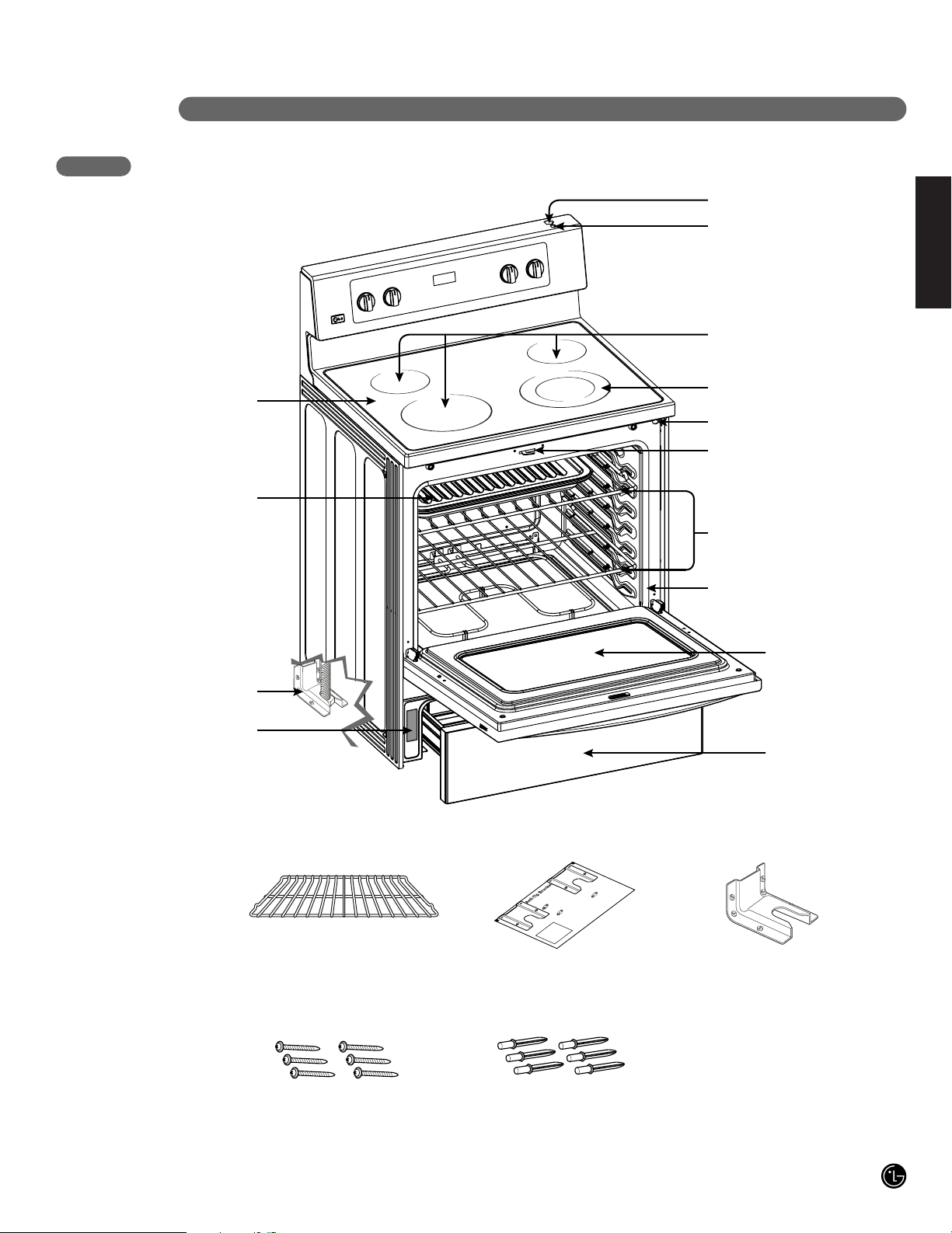
PARTS AND FEATURES
Ceramic glass
Broiler pan and Grid
(Not included in this model)
Anti-tip bracket
Model and serial
number plate
Oven racks (2 ea)
Storage drawer
Oven door
Gasket
Oven racks (2 ea)
Self clean latch
Automatic oven light switch
Dual element
Single element
Appliance outlet
Appliance outlet circuit
breaker
Template
Screws (6 ea)
Anchors (6 ea)
Anti-tip bracket
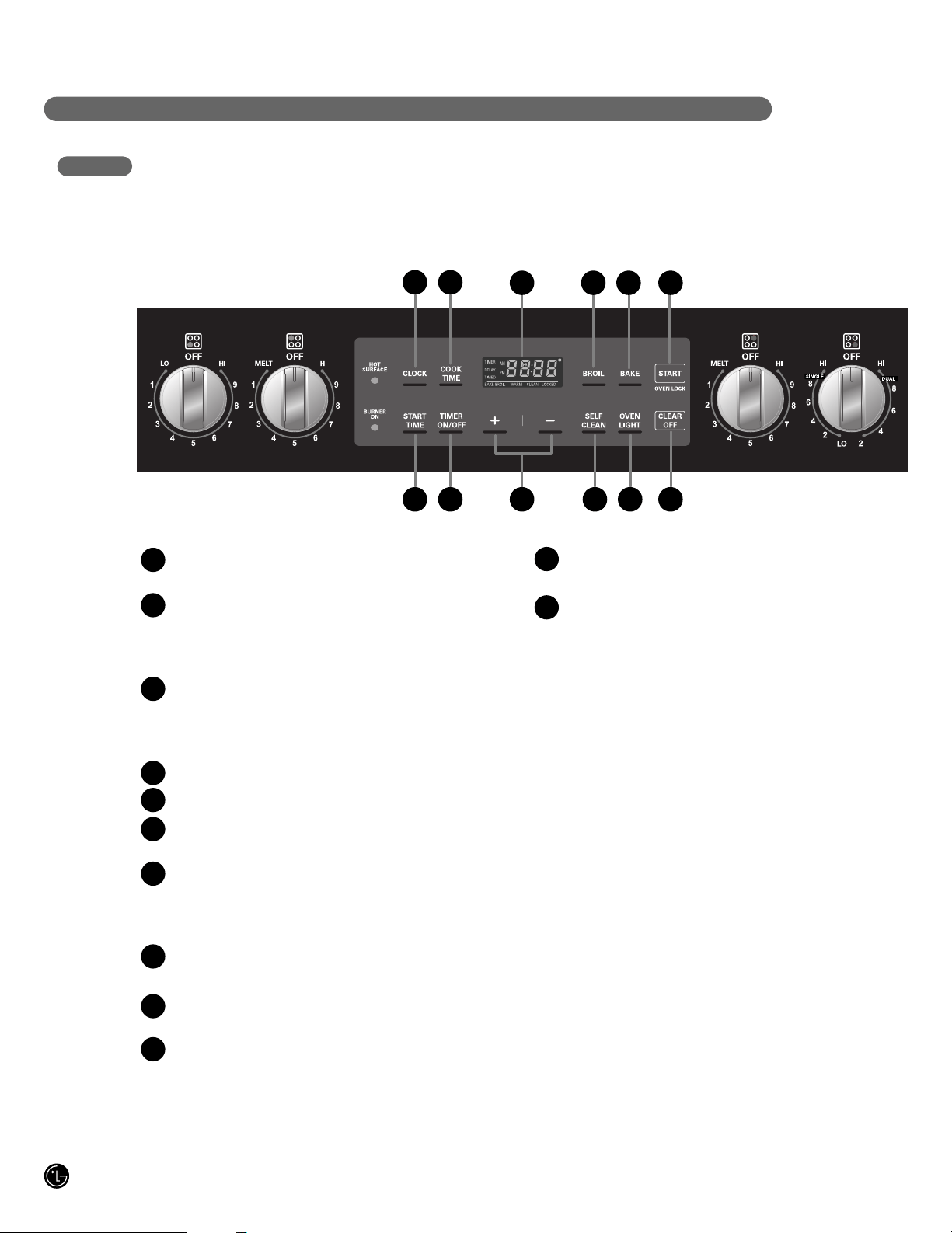
CLOCK Pad: Press before setting the time of
day.
COOK TIME Pad: Press and then use the
number pads to set the amount of time you want
your food to cook. The oven will shut off when the
cooking time has run out.
Display: Shows the time of day, oven
temperature, whether the oven is in the bake,
broil or self-cleaning mode, and the times set for
the timer or automatic oven operations.
BROIL Pad: Press to select the broil function.
BAKE Pad: Press to select the bake function.
START Pad: Must be pressed to start any
cooking or cleaning function.
START TIME Pad: Use along with BAKE, CONV.
BAKE, CONV. ROAST, Cook time, and Self
Clean pads to set the oven to start and stop
automatically at a time you set.
TIMER ON/OFF Pad: Press to select the timer
feature.
+/- Pad: Enters or changes time, oven
temperature. Sets HI or LO broil.
SELF CLEAN Pad: Press to select self-cleaning
function. See the using the Self-Cleaning Oven
section, page 27.
OVEN LIGHT Pad: Press to turn the oven light
on or off.
CLEAR/OFF Pad: Press to cancel all oven
operations except the clock and timer.
NOTE:
If F– and a number appear in the display and
the oven control signals, this indicates a
function error code.
See page 35.
Press the CLEAR/OFF pad. Allow the oven to
cool for one hour. Put the oven back into
operation.
If the function error code repeats, disconnect the
power to the oven and call for service.
If your oven was set for a timed oven
operation and a power outage occurred, the
clock and all programmed functions must be
reset.
The time of day will flash in the display when
there has been a power outage.
16
PARTS AND FEATURES
CONTROL PANEL FEATURES
READ THE INSTRUCTIONS CAREFULLY BEFORE USING THE OVEN. For satisfactory use of your oven,
become familiar with the various features and functions of the oven as described below. Detailed instructions
for each feature and function follow later in this Owner's Manual.
7 8 10 11 129
1 2
4 5 63
1
11
12
2
3
4
5
6
7
8
9
10
SETTING THE CLOCK
17
ENGLISH
OPERATING INSTRUCTIONS
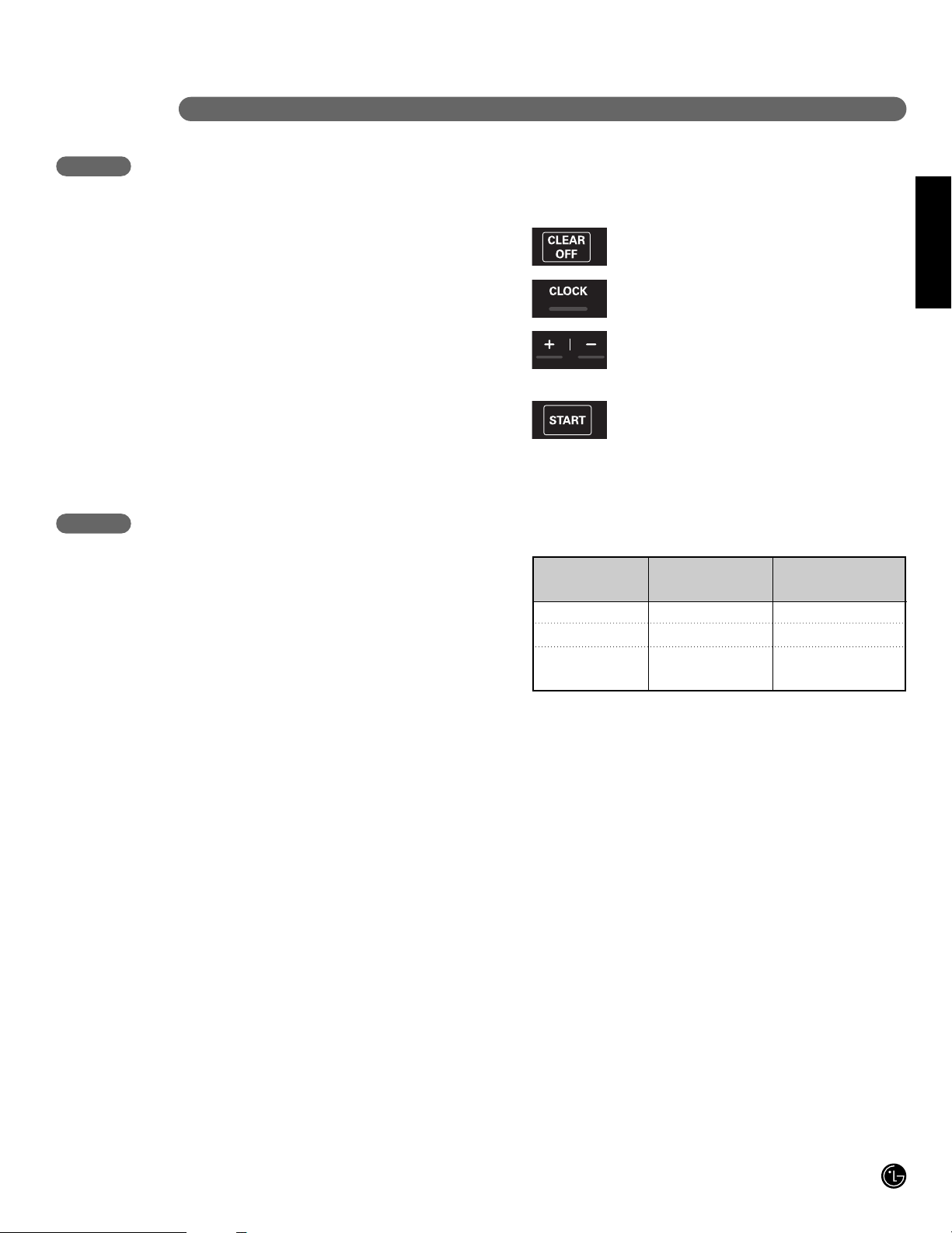
To set the clock:
The CLOCK pad is used to set the clock. The clock
has been preset at the factory for 12 hours operation.
When the range is first plugged in, or when the power
supply to the range has been interrupted, the time of
day in the display will flash. You can make a choice
between 12-hour clock and 24-hour clock (refer to
page 19):
Press CLEAR/OFF.
Press CLOCK.
Press the + or – pad to set the time
of day.
Press START.
The clock will start.
MINIMUM & MAXIMUM CONTROL PAD SETTINGS
All of the features listed have minimum and maximum
time or temperature settings that may be entered into
the control. An entry acceptance beep will sound each
time a control pad is pressed.
An entry error tone (3 short beeps) will sound if the
entry of the temperature or time is below the minimum
or above the maximum settings for the feature.
FEATURE
MIN. TEMP. MAX. TEMP.
BAKE TEMP.
BROIL TEMP.
SELF CLEAN
TIME
170°F / 80°C
LO (400°F)
2 hours
550°F / 285°C
HI (550°F)
4 hours

18
OPERATING INSTRUCTIONS
SETTING THE TIMER ON/OFF
To set the Timer (example for 5 minutes):
The TIMER ON/OFF serves as an extra timer in the
kitchen that will beep when the set time has run out.
It does not start or stop cooking.
The TIMER ON/OFF feature can be used during any
of the other oven control functions.
NOTE:
If the remaining time is not in the display, recall the
remaining time by pressing the Timer on/off.
NOTE:
1. If you press TIMER ON/OFF once, it allows you to
set the time in seconds.
(for example: if you press 50, it means 50 seconds)
2. If you press TIMER ON/OFF twice, it allows you to
set the time in minutes.
(for example: if you press 5, it means 5 minutes)
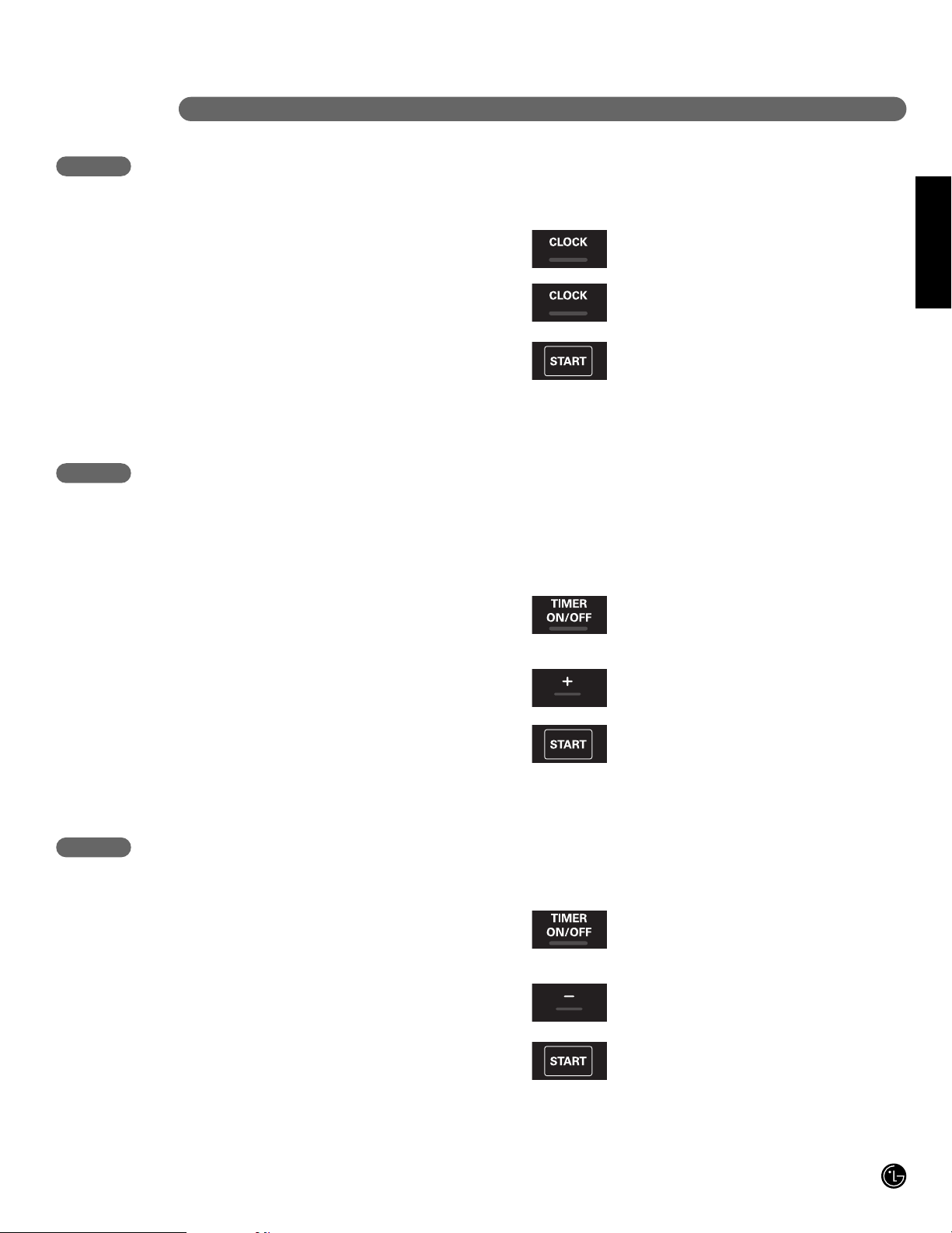
Press TIMER ON/OFF twice.
0:00 and HR inside O will appear
and TIMER will flash in the display.
Press the + or - pad until the correct
time appears in the display.
Press TIMER ON/OFF.
The time will count down with 5:00
and TIMER will show in the display.
NOTE:
If TIMER ON/OFF is not pressed,
the timer will return to the time of
day.
When the set time has run out, End
will show in the display. The clock
will sound with 3 beeps every 15
seconds until TIMER ON/OFF is
pressed.
To cancel the Timer before the set time has
run out:
Press TIMER ON/OFF once.
The display will return to the time of
day.
SETTING OVEN LOCKOUT FEATURE
To activate the Oven Lockout feature:
The START pad controls the Oven Lockout feature.
The Oven Lockout feature automatically locks the
oven door and prevents most oven controls from
being turned ON.
It does not disable the clock, the timer, or the interior
oven light.
Press and hold START for
3 seconds.
2 beeps will sound, DOOR
LOCKED will flash in the display.
Once the oven door is locked the
DOOR LOCKED indicator will stop
flashing and remain on along with
the lock icon( ) light.
To reactivate normal oven operation:
Press and hold START for 3
seconds. A beep will sound
2 times. The DOOR LOCKED will
continue to flash until the oven door
has completely unlocked and the
lock icon( ) light will clear.
The oven is again fully operational.
LOCKED
LOCKED
Your control is set to use a 12-hour clock. If you
would prefer to have a 24-hour clock, follow the steps
below.
TIMER ON/OFF pad control the Fahrenheit or Celsius
temperature display modes. The oven control can be
programmed to display temperatures in Fahrenheit or
Celsius. The oven has been preset at the factory to
display in Fahrenheit.
The beeper volume feature allows you to adjust the
volumes to a more acceptable volume. There are
three possible volume levels.
19
ENGLISH
OPERATING INSTRUCTIONS
CHANGING HOUR MODE ON CLOCK (12-hour or 24-hour)
Changing between 12 and 24 hour clock:
Press and hold the CLOCK pad for
3 seconds.
Press the CLOCK pad to switch
between the 12 and 24 hour clock.
Press START to accept the desired
change.
SETTING BEEPER VOLUME
To set beeper volume:
Press and hold TIMER ON/OFF for
3 seconds. The display will show
Opt,
Press - to switch beeper volume
(Hi, Lo, and OFF.)
Press START to accept the desired
change.
SETTING TEMPERATURE UNIT — FAHRENHEIT OR
CELSIUS
To change display from Fahrenheit to
Celsius or Celsius to Fahrenheit:
Press and hold TIMER ON/OFF for
3 seconds. The display will show
Opt.
Press + to switch between the F
and C.
Press START to accept the desired
change.
20
OPERATING INSTRUCTIONS
SETTING PREHEATING ALARM LIGHT ON/OFF
The interior oven light automatically turn on when the
oven door is opened.
When oven reaches set-temperature after preheat,
the oven notifies preheat-end by flashing oven lamp
until door is opened.
You can activate or deactivate smart oven light
feature. Default Setting is on.
To set smart oven light on/off:
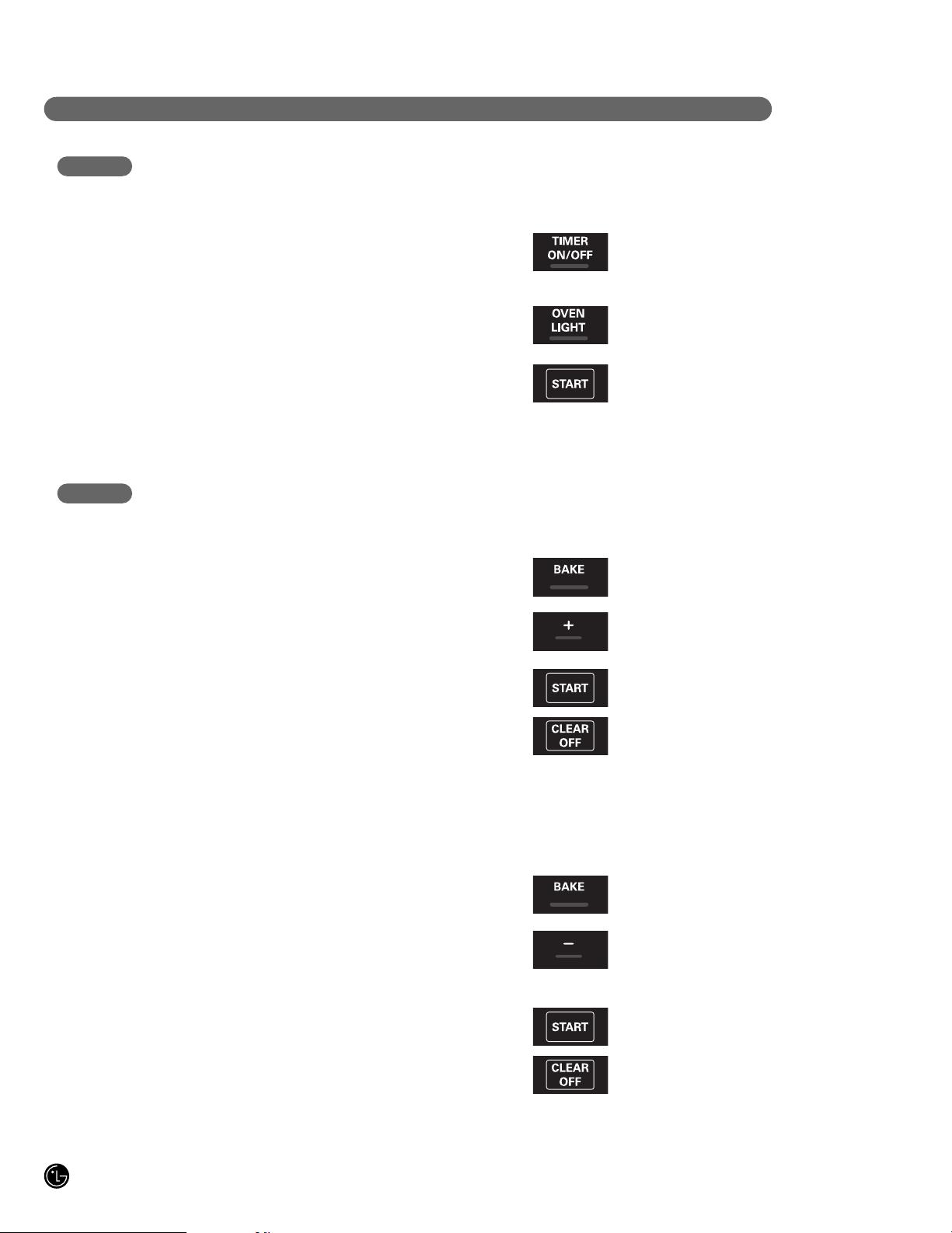
Press and hold TIMER ON/OFF for
3 seconds. The display will show
Opt.
Press OVEN LIGHT to switch
between On and OFF.
Press START to accept the desired
change.
THERMOSTAT ADJUSTMENT
The temperature in the oven has been preset at the
factory. When first using the oven, be sure to follow
recipe times and temperatures. If you think the oven
is too hot or too cool, the temperature in the oven can
be adjusted. Before adjusting, test a recipe by using a
temperature setting that is higher or lower than the
recommended temperature. The baking results
should help you to decide how much of an adjustment
is needed.
The oven temperature can be adjusted from
±35° F (±19° C).
NOTE:
The thermostat adjustments made with this feature
will change just Bake, Convection Bake, and
Convection Roast temperature.
To increase the oven temperature:
Press and hold BAKE for 3
seconds.
To increase temperature, use the +
pad to enter the desired change.
Press START to accept the
temperature change and the display
will return to the time of day.
Press CLEAR/OFF to reject the
change if necessary.
To decrease the oven temperature:
Press and hold BAKE for 3
seconds.
To decrease the temperature, use
the - pad to enter the desired
change.
Press START to accept the
temperature change and the display
will return to the time of day.
Press CLEAR/OFF to reject the
change if necessary.
OPERATING INSTRUCTIONS
ENGLISH
21
To change the Bake Temperature while
cooking
Press the Bake pad.
Then press the + or - pad until the
desired temperature is displayed.
Press START.
SETTING BAKE
The BAKE pad controls normal baking. The oven can
be programmed to bake at any temperature from
170°F to 550°F. Default temperature is 350°F
(175°C).
IMPORTANT NOTE:
Place food in the oven after preheating if the recipe
calls for it. Preheating is so important for good results
when baking cakes, cookies, pastry, and breads.
Press CLEAR/OFF to cancel the Bake feature at any
time.
To set the Bake:
Press BAKE. 350° will appear in
the display and bake will flash.
Select the oven temperature.
Press or press and hold the + or -
pads.
• Press the + pad to increase the
temperature.
• Press the - pad to decrease the
temperature.
Press START to accept the
temperature change
• BAKE will stop flashing and light in
the display.
• 100° or the actual oven
temperature will display. The
temperature will rise in 5°
increments until the preset
temperature is reached.
Allow the oven to preheat for 8-15
minutes.
• When the set oven temperature is
reached, five short beeps will
sound and the oven lamp will flash.
• To recall the set temperature
during preheat, press the Bake
pad.
Place food in center of oven,
allowing a minimum of two inches
between utensil and oven walls.
Check cooking progress. Cook
longer if needed.
When cooking is finished, press
CLEAR OFF.
Remove food from the oven.
22
OPERATING INSTRUCTIONS
BAKING LAYER CAKES
Baking results will be better if baking pans are
centered in the oven as much as possible. If baking
with more than one pan, place the pans so each has
at least 1” to 1
1
/2” of air space around it.
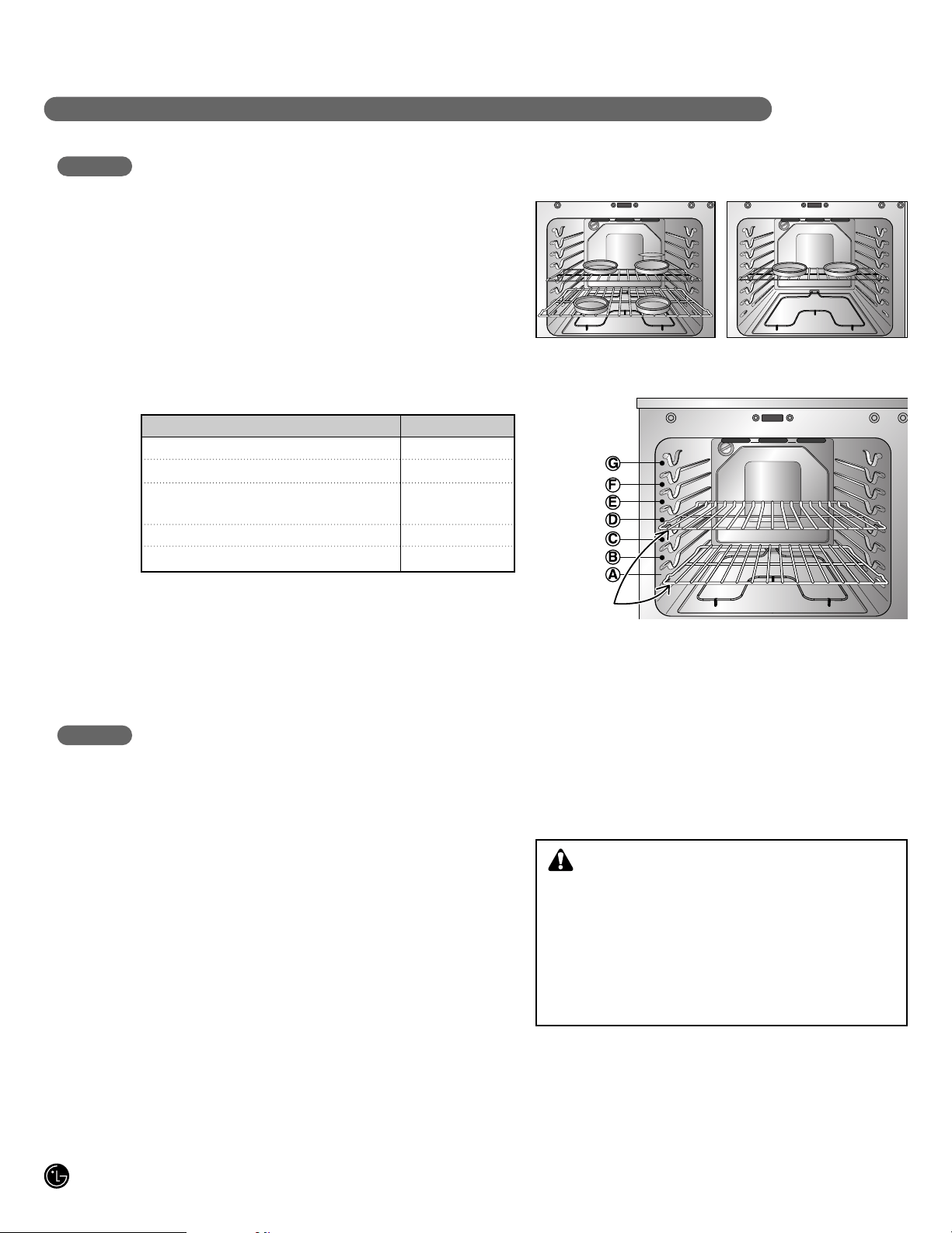
If cooking on multiple racks, place the oven racks in
positions B and D (for 2 racks). Place the cookware
as shown in Figure 1, 2.
BEFORE USING OVEN RACKS
The oven has 2 racks. The racks have stops to be
placed correctly on the supports, those will stop
before coming completely out.
• DO NOT cover a rack with aluminum foil or
any other material or place on the oven
bottom.
- This will result in poor baking by disturbing heat
circulation and may damage the oven bottom.
• Always arrange oven racks when the oven is
cool.
CAUTION
• The oven has 7 rack positions.
Type of Food
Rack Position
Angel food cake, Frozen pies
Bundt or pound cakes
Biscuits, muffins, brownies, cookies,
cupcakes, layer cakes, pies
Casseroles
Turkey, roast, or ham
B
C
D
D
A
To remove racks:
Pull the rack straight out until it stops.
Lift up the front of the rack and pull it out.
To replace racks:
Place the end of the rack on the support.
Tilt the front end up and push the rack in.
Figure 1 Figure 2
Oven Racks
OPERATING INSTRUCTIONS
ENGLISH
• Use caution with the TIMED BAKE or
DELAYED TIMED BAKE features. Use the
automatic timer when cooking cured or frozen
meats and most fruits and vegetables. Foods
that can easily spoil, such as milk, eggs, fish,
meat or poultry, should be chilled in the
refrigerator first. Even when chilled, they
should not stand in the oven for more than 1
hour before cooking begins, and should be
removed promptly when cooking is
completed.
- Eating spoiled food can result in sickness from
food poisoning.
CAUTION
23
SETTING TIMED BAKE
The oven will turn on immediately and cook for a
selected length of time. At the end of the cooking
time, the oven will turn off automatically.
To program the oven to begin baking
immediately and to shut off automatically
(example below to bake at 300°F for 30
minutes):
Be sure the clock is set for the
correct time of day.
Press BAKE. 350° will appear in
the display and bake will flash.
Select the oven temperature.
Press or press and hold the + or -
pads.
• Press the + pad to increase the
temperature.
• Press the - pad to decrease the
temperature.
Press the COOK TIME pad.
• TIMED flashes.
• 0:00 light in the display.
NOTE:
If your recipe requires preheating,
you may need to add additional time
to the length of the baking time.
Press the + or - pad to enter the
desired baking time. While TIMED
is still flashing:
NOTE:
• Baking time can be set for any
amount of time between 1 minute
to 11 hours and 59 minutes.
• The baking time that you entered
will be displayed. (If you select
Cook Time first and then adjust the
Bake Temperature, the oven
temperature will be displayed
instead).
Press START.
BAKE will stop flashing and light in
the display.
The display shows either the oven
temperature that you set or the
baking time countdown.
When the Timed Bake finishes:
End will show in the display. The
oven will shut off automatically.
The control will continue to beep 3
times every minute until
CLEAR/OFF is pressed.
IMPORTANT NOTE:
Place food in the oven after preheating if the recipe
calls for it. Preheating is so important for good results
when baking cakes, cookies, pastry, and breads. After
the oven has reached the desired temperature, long
beeps will sound
5 times and oven lamp will flash. Preheating will take
approximately 10~15 minutes.
24
OPERATING INSTRUCTIONS
The BAKE, COOK TIME and START TIME pads
control the Delayed Timed Bake feature.
The automatic timer of the Delayed Timed Bake will
turn the oven ON and OFF at the time you select in
advance.
SETTING DELAYED TIMED BAKE
To program the oven for a Delay Start and
to shut off automatically:
When the set bake time runs out:
End will show in the display.
The oven will shut off automatically.
The unit will continue to beep 3
times every minute until
CLEAR/OFF is pressed.
Press START.
When the Delay time has expired,
The oven starts
• A short beep will sound once and
DELAY will turn off.
• When the oven turns on at the time
of day you have set, the display will
show oven temperature until it
reaches the selected temperature,
then it will display the baking time
countdown.
NOTE:
• Press CLEAR/OFF to cancel the
Delayed Timed Bake feature at
any time.
• If you would like to check the
times you have set, touch the
START TIME pad to check the
delayed time you have set or
touch the COOK TIME pad to
check the length of baking time
you have set.
Be sure that the clock is set with the
correct time of day.
Arrange interior oven rack(s) and
place the food in the oven.
Press BAKE. 350° will appear in
the display and bake will flash
Select the oven temperature.
Press or press and hold the + or -
pads.
• Press the + pad to increase the
temperature.
• Press the - pad to decrease the
temperature.
NOTE:
If you want to change cook time,
repeat steps 5~6 and press START.
Press the COOK TIME pad.
• TIMED flashes.
• 0:00 light in the display.
Press the + or - pad to enter the
desired baking time.
While TIMED is still flashing.
NOTE:
Baking time can be set for any
amount of time from 1 minute to 11
hours and 59 minutes.
Press START TIME.
DELAY is flashing.
Press the + or - pad to enter the
desired delayed time.
While DELAY is still flashing.
OPERATING INSTRUCTIONS
ENGLISH
25
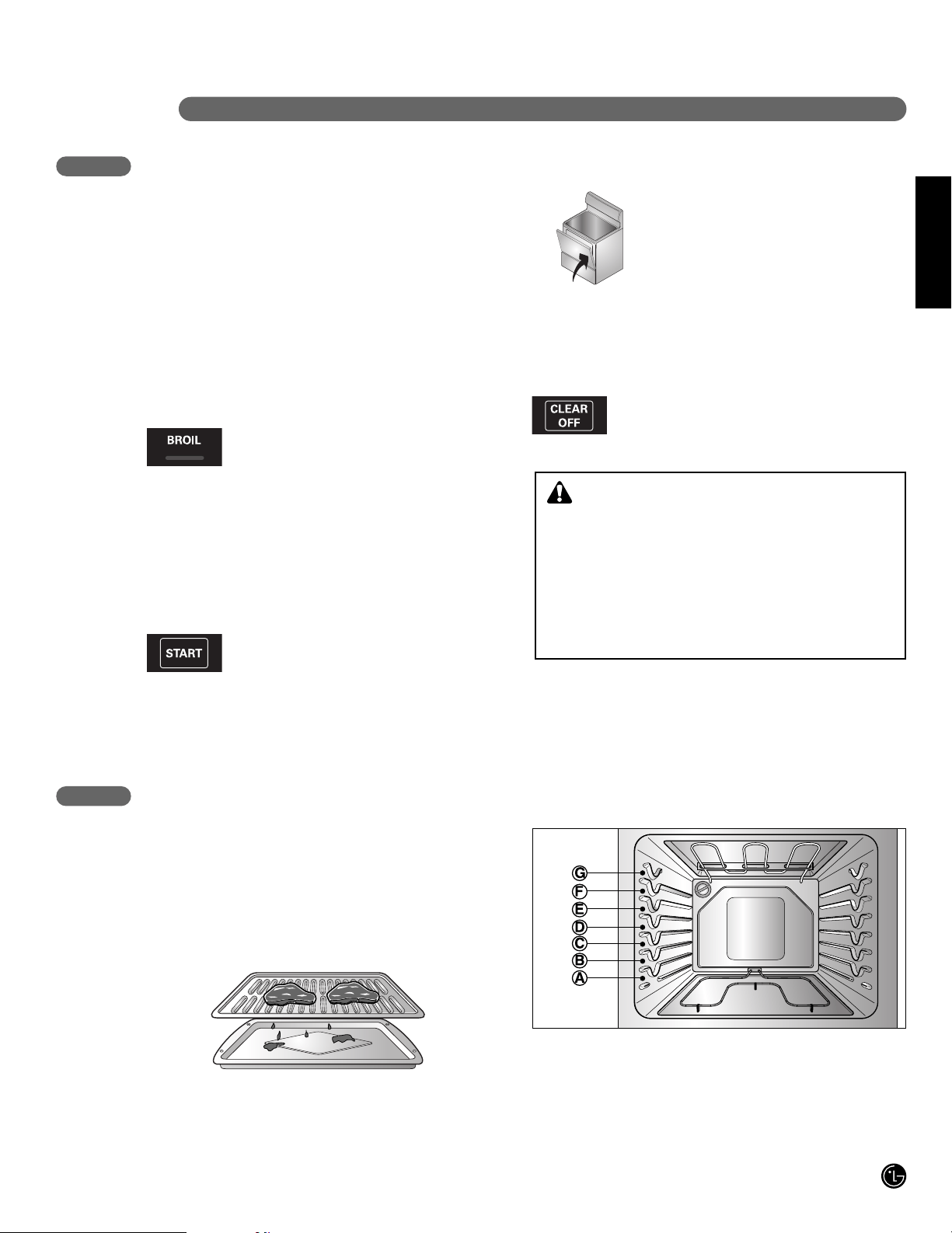
Leave the door open to the broil stop position.
The door will stay open by itself, yet the proper
temperature is maintained in the oven.
SETTING BROIL
To set the oven to broil at the Hi or Lo
setting:
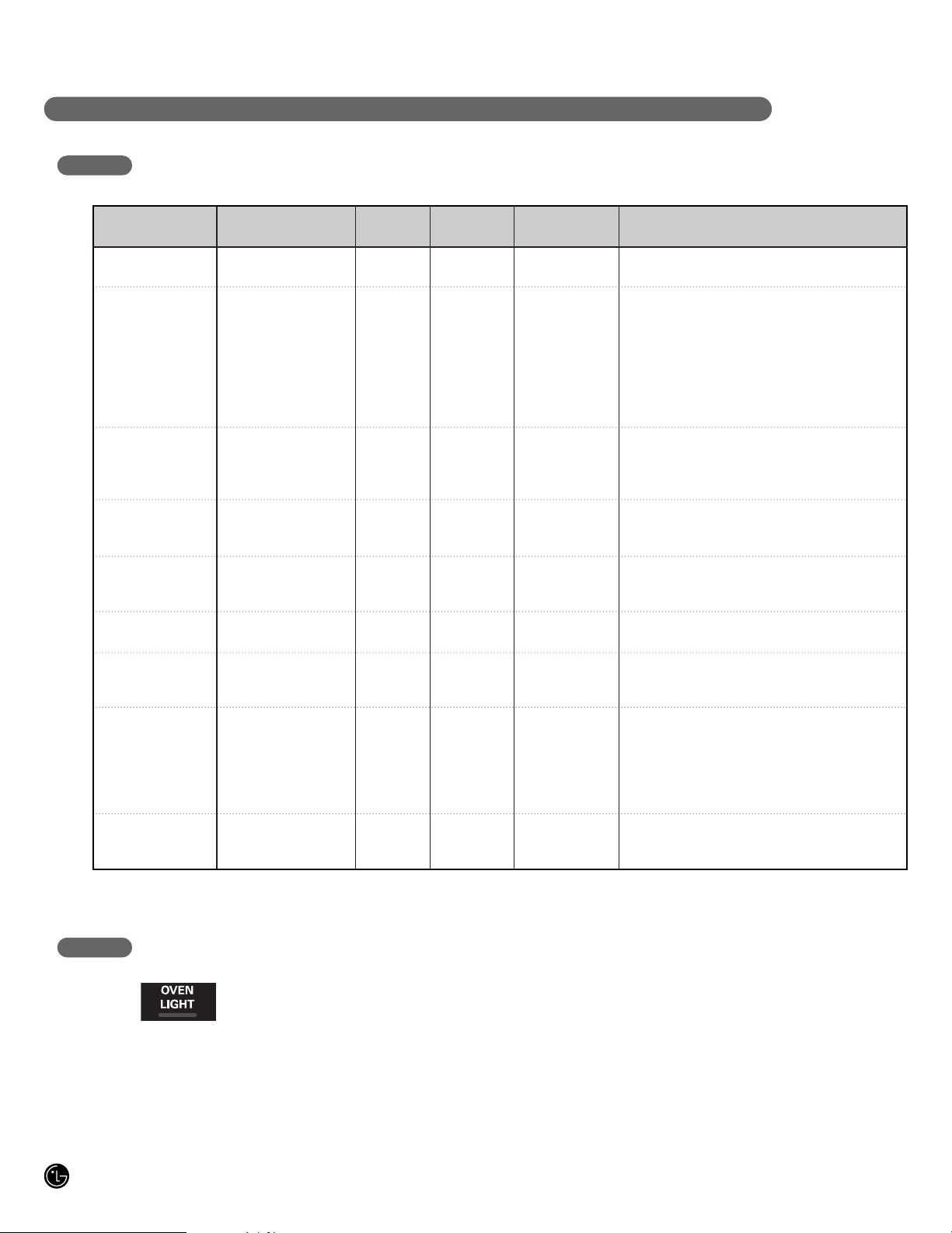
Place the meat or fish on the broiler
grid in the broiler pan.
Follow suggested rack positions in
the Broiling Guide.
Press BROIL once for Hi broil or
twice for Lo broil. BROIL will flash
(or press Broil and press the + or -
pad to scroll through the broil
settings.)
NOTE:
Use Lo to cook foods such as
poultry or thick cuts of meat
thoroughly without over-browning
them.
Press START.
The oven will begin to broil.
BROIL will light in the display
Broil on one side until food is
browned; turn and cook on the other
side.
To cancel broiling or if finished
broiling press CLEAR/OFF.
Broil Stop Position
• Should an oven fire occur, close the oven
door and turn the oven off. If the fire
continues, throw baking soda on the fire or
use a fire extinguisher.
• DO NOT put water or flour on the fire.
- Flour may be explosive and water can cause a
grease fire to spread and cause personal injury.
CAUTION
The size, weight, thickness, starting temperature, and
your preference of doneness will affect broiling times.
This guide is based on meats at refrigerator
temperature.
For best results when broiling, use a pan designed
for broiling. (Refer to Figure 1.)
RECOMMENDED BROILING GUIDE
Figure 1
26
OPERATING INSTRUCTIONS
Food
Quantity and/ or
Thickness
Shelf
Position
First Side
Time (min.)
Second Side
Time (min.)
Comments
Ground Beef
Well Done
Beef Steaks
Rare
Medium
Well Done
Rare
Medium
Well Done
Chicken
Lobster Tails
Fish Fillets
Ham Slices
(precooked)
Pork Chops
Well Done
Lamb Chops
Medium
Well Done
Medium
Well Done
Salmon
Steaks
Space evenly. Up to 8 patties may be
broiled at once.
Steaks less than 1” thick cook through
before browning.
Pan frying is recommended. Slash fat.
Broil skin-side-down first.
Cut through back of shell. Spread open.
Brush with melted butter before
broiling and after half of broiling time.
Handle and turn very carefully. Brush
with lemon butter before and during
cooking, if desired.
Increase time 5 to 10 minutes per side
for 1
1
/2” thick.
Slash fat.
Slash fat.
Grease pan. Brush steaks with melted
butter.
1 lb. (4 patties)
1
/2 to
3
/4” thick
1” thick
1 to 1
1
/2 lbs.
1
1
/2”thick
2 to 2
1
/2 lbs.
1 whole cut up
2 to 2
1
/2 lbs.,
split lengthwise
2 Breasts
2–4
10 to 12 oz. each
1
/4 to
1
/2” thick
1
/2” thick
2 (
1
/2” thick)
2 (1” thick) about
1 lb.
2 (1” thick) about
10 to 12 oz.
2 (1
1
/2” thick)
about 1 lb.
2 (1” thick)
4 (1” thick)
about 1 lb.
F or G
F
F
F
D
D
D
D
C
C
E
D
E
E
E
E
E
E
D
D
4–7
6
7
8
10
12
14
14
20
12–14
5
8–10
8–10
10–12
6
8
11
13
8–10
8–10
3–5
5
5
5
4–6
6–8
8–10
6–8
6–10
Do not turn
over.
3–4
3–5
6–8
8–10
4–6
7–9
9
9–11
5–7
7–9
TO TURN ON or OFF THE OVEN LIGHT
RECOMMENDED BROILING GUIDE
(cont.)
The oven light automatically turns ON
when the door is opened. The oven
light may also be manually turned ON
or OFF by pressing the OVEN LIGHT
pad.
NOTE:
The oven light cannot be turned on if the self-clean
feature is active.
27
ENGLISH
OPERATING INSTRUCTIONS
NOTE:
Remove silver-
colored oven
racks before you
begin the self-
clean cycle.
The self-clean cycle uses above normal cooking
temperatures to clean the oven’s interior
automatically.
It is normal for flare-ups, smoking, or flaming to occur
during cleaning if the oven is heavily soiled. It is better
to clean the oven regularly rather than to wait until
there is a heavy build-up of soil in the oven.
During the cleaning process, the kitchen should be
well ventilated to get rid of normal odors associated
with cleaning.
We recommend venting your kitchen with an open
window or using a ventilation fan or hood during the
first self-clean cycle.
Remove the oven racks, broiler pan, broiler grid, all
cookware, and aluminum foil or any other material
from the oven.
• The silver-colored oven racks can be self-cleaned,
but they will darken, lose their luster, and become
hard to slide. It is recommended to remove all racks
before starting the self-clean cycle.
• Soil on the front frame of the range and outside the
gasket on the door will need to be cleaned by hand.
Clean these areas with hot water, soap-filled steel-
wool pads, or cleansers such as Soft Scrub. Rinse
well with clean water and dry.
• Do not clean the gasket. The fiberglass material of
the oven door gasket cannot withstand abrasion. It
is essential for the gasket to remain intact. If you
notice it becoming worn or frayed, replace it.
• Wipe up any heavy spillovers on the oven bottom.
• Make sure the oven light bulb cover is in place and
the oven light is off.
• Do not leave baking / pizza stone in the oven during
the self-clean cycle.
SELF-CLEAN
The bake element is designed to be tilted up using
your hand from the front of bake element. This will
allow easier access to the oven bottom for cleaning.
Be careful not to raise the element more than 4 or 5
inches from the resting position.
Remove any
debris from
door
Don’t hand
clean oven
door gasket
• DO NOT leave small children unattended near
the appliance.
- During the self-cleaning cycle, the outside of the
range can become very hot to touch.
• Move Birds to another well-ventilated room.
- The health of some birds is extremely sensitive
to the fumes given off during the Self-Cleaning
cycle of any range.
• DO NOT line the oven walls, racks, bottom or
any other part of the range with aluminum foil
or any other material.
- Doing so will destroy heat distribution, produce
poor baking results and cause permanent
damage to the oven interior (aluminum foil will
melt to the interior surface of the oven).
• DO NOT force the door open.
- This can damage the automatic door locking
system. Use care when opening the oven door
after the Self-Cleaning cycle. Stand to the side
of the oven when opening the door to allow hot
air or steam to escape. The oven may still be
VERY HOT.
CAUTION
• The oven bake and broil elements may appear to
have cooled after they have been turned OFF.
The elements may still be hot and burn may occur
if these elements are touched before they have
cooled sufficiently.
CAUTION
Before a Self-Clean Cycle
28
OPERATING INSTRUCTIONS
The SELF-CLEAN pad is used to start a Self-Clean
cycle. When used with START TIME pad, a delayed
Self-Clean cycle may also be programmed. The Self-
Clean function has cycle times of 2, 3, or 4 hours.
To start an immediate Self-Clean cycle and
shut off automatically
During the Self-Clean cycle
• You may see some smoke and smell an odor the
first few times the oven is cleaned. This is normal
and will lessen in time. Smoke may also occur if the
oven is heavily soiled or if a broiler pan was left in
the oven.
• As the oven heats, you may hear sounds of metal
parts expanding and contracting. This is normal and
will not damage the oven.
• Do not force the oven door open when LOCKED is
displayed. The oven door will remained locked until
the oven temperature has cooled. Forcing the door
open will damage the door.
To set a delay start time
Be sure the clock is set with the
correct time of day, the oven is
empty and the oven door is closed.
Touch SELF CLEAN once for a
3-hour clean time, twice for a
2-hour clean time, or 3 times for
4-hour clean time. A 3-hour self-
clean time is recommended for use
when cleaning small, contained
spills. A self-clean time of 4 hours is
recommended for heavily soiled
ovens (or press SELF CLEAN and
press the + or - pad to scroll
through the self-cleaning settings.
Touch START.
The DOOR LOCKED icon will flash.
Once the SELF CLEAN is set, the
oven door will lock automatically.
You will not be able to open the
oven door until the oven is cooled.
The lock will release automatically.
Touch SELF CLEAN. Select the
desired self clean time by touching
SELF CLEAN.
Press START TIME.
DELAY is flashing
Press the + or - pad to enter the
desired delayed time. While DELAY
is still flashing.
Touch START.
DELAY and CLEAN will remain on.
Self-Cleaning cycle will turn on
automatically at the set time.
SELF-CLEAN (cont.)
NOTE:
• A self-clean cannot be used in using the cooktop. If
the cooktop is turned on during the self clean cycle,
the self clean will be canceled automatically and
Ctop on will be displayed.

29
ENGLISH
OPERATING INSTRUCTIONS
If it becomes necessary to stop or interrupt a self-
cleaning cycle due to excessive smoke or fire in the
oven:
When the self-clean cycle is done
• It will not be possible to open the oven door until
oven temperature has cooled.
• It is recommend to use 2 hour self-clean cycle for
light soil, 3 hours cycle for average soil, and 4 hours
cycle for heavy soil.
• Additional time is needed to cool the oven down.
Therefore, the oven door will not release from the
lock position until after it has cooled.
NOTE:
• The hot surface indicator will display on the cooktop
during the Self Clean cycle.
After the Self-Clean cycle
• You may notice some white ash in the oven. Wipe it
off with a damp cloth or a soap-filled steel wool pad
after the oven cools.
These deposits are usually a salt residue that cannot
be removed by the clean cycle.
If the oven is not clean after one clean cycle, repeat
the cycle.
• If oven racks were left in the oven and do not slide
smoothly after a clean cycle, wipe racks and rack
supports with a small amount of vegetable oil to
make them glide easier.
• Fine lines may appear in the porcelain because it
went through heating and cooling. This is normal and
will not affect performance.
Touch CLEAR/OFF.
After the oven has cooled down, the
DOOR LOCK will automatically
release allowing you to open the
oven door.
SELF-CLEAN (cont.)
NOTE:
When using the Self-Clean feature:
• A Self-Clean cycle cannot be started if Oven
Lockout feature is active.
• Once the SELF CLEAN is set, the oven door will
lock automatically. You will not be able to open the
oven door until the oven is cooled. The lock will
release automatically.
• Once the door has been locked the LOCKED
indicator light will stop flashing and remain on.
Allow about 15 seconds for the oven door lock to
close.
• If your clock is set for normal 12 hours display mode
the Delayed Self-Clean can never be set to start
more than 12 hours in advance.To set for a delayed
Self-Clean cycle 12- 24 hours in advance, see page
19 for instructions to set the control for the 24 hours
time of day display mode.
30
OPERATING INSTRUCTIONS
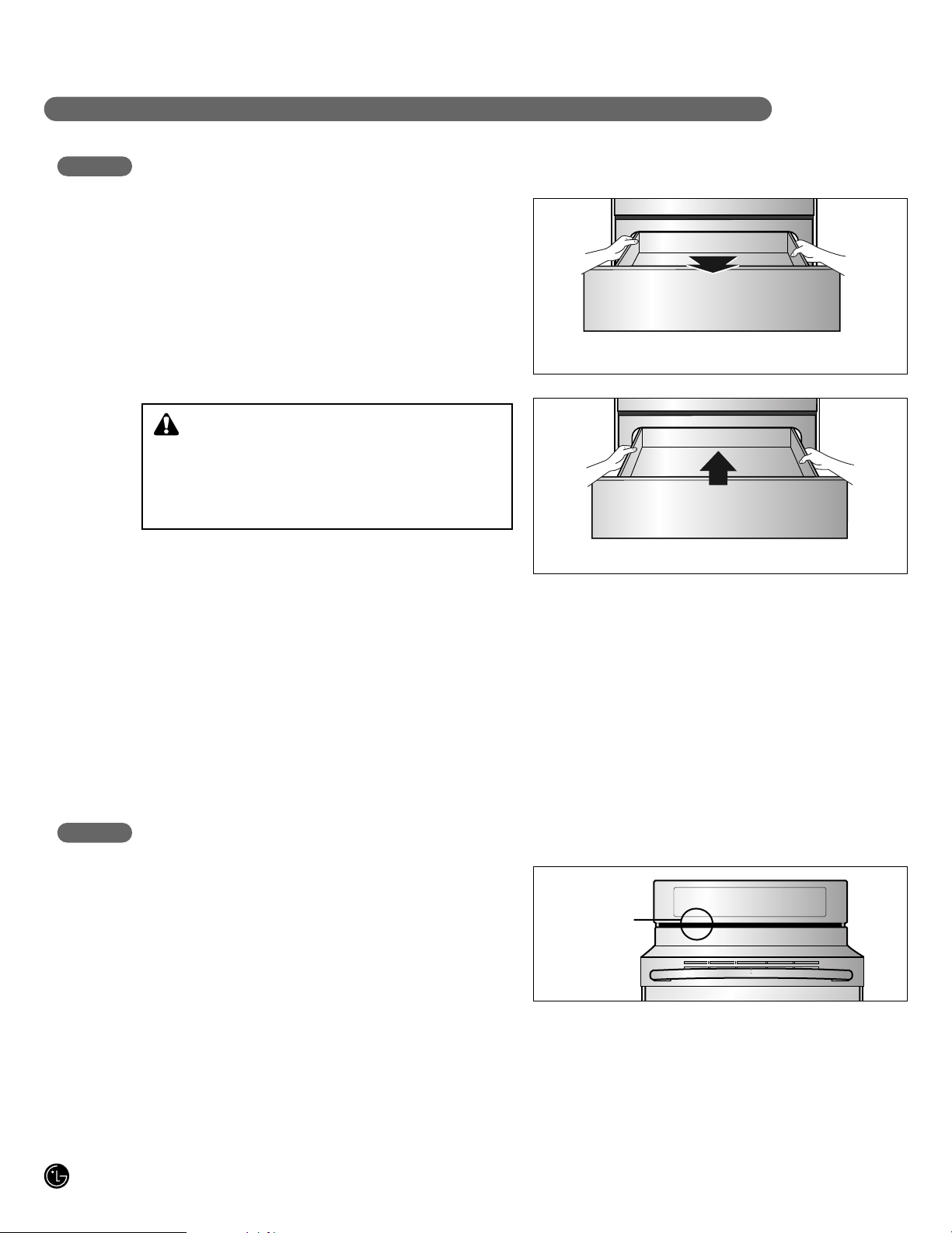
To Remove Storage Drawer:
CAUTION - Turn power OFF before removing the
storage drawer.
Pull the drawer out until it stops.
Lift the front of the drawer until the stops clear the
guides.
Remove the drawer.
To Replace the Storage Drawer:
Place the drawer rails on the guides.
Push the drawer back until it stops.
Lift the front of the drawer and push back until the
stops clear the guides.
Lower the front of the drawer and push back until
it closes.
REMOVING & REPLACING THE STORAGE DRAWER
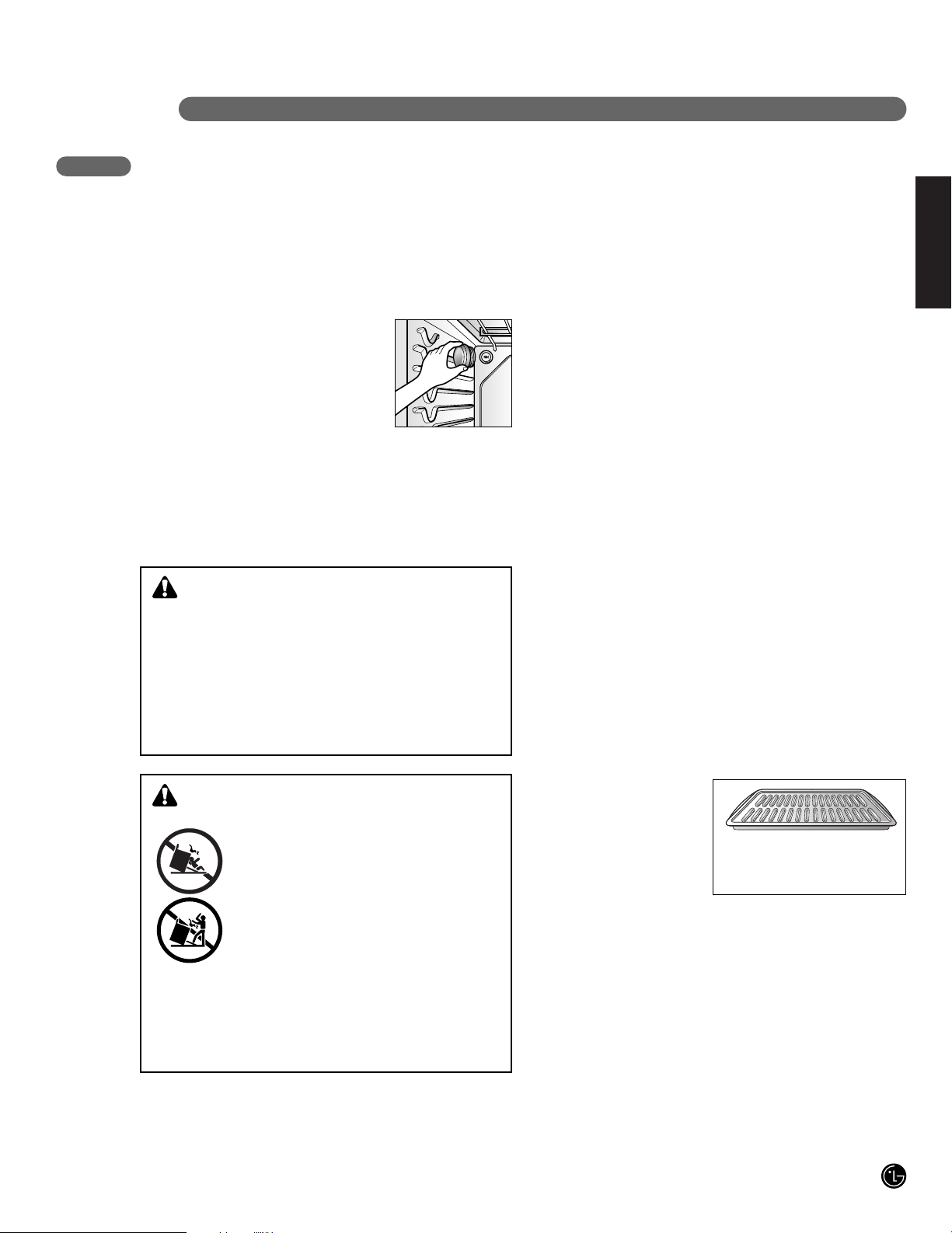
The oven vent is located above the left rear surface
unit.
This area could become hot during oven use.
It is normal for steam to come out of the vent.
The vent is important for proper air circulation.
Never block this vent.
OVEN VENT
Lift the front
Pull the drawer
• Turn POWER OFF before removing the
Warming Drawer.
- Failure to do so can result in severe personal
injury, death, or electrical shock.
WARNING
Oven vent
31
ENGLISH
MAINTENANCE
Changing the Oven Light
The oven light is a standard 40-watt appliance bulb. It
will come on when the oven door is open. When the
oven door is closed, press Oven LIGHT to turn it on or
off. It will not work during the Self-Clean cycle.
Painted and Body Parts, and
Decorative Trim
For general cleaning, use a cloth with hot and soapy
water. For more difficult soils and built-up grease,
apply a liquid detergent directly onto the soil. Leave
on soil for 30 to 60 minutes. Rinse with a damp cloth
and dry.
DO NOT use abrasive cleaners on any of these
materials; they can scratch.
Stainless Steel Surfaces
(on some models)
Do not use a steel-wool pad; it will scratch the
surface.
1. Shake bottle well.
2. Place a small amount of Stainless Steel Appliance
Cleaner or polish on a damp cloth or damp paper
towel.
3. Clean a small area, rubbing with the grain of the
stainless steel if applicable.
4. Dry and buff with a clean, dry paper towel or soft
cloth.
5. Repeat as necessary.
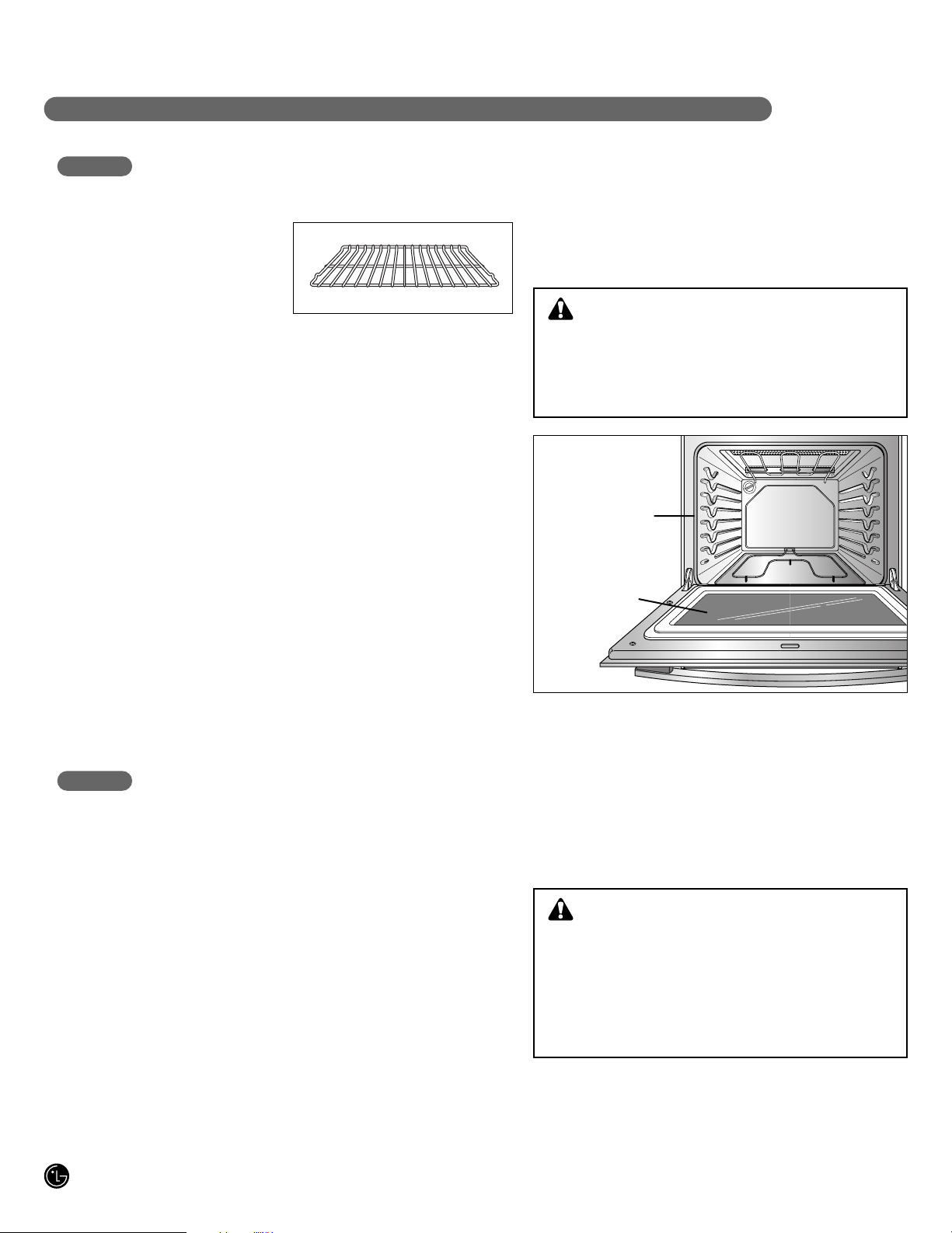
Broiler Pan and Grid
(Not included in this model)
Do not clean the broiler
pan or grid in a self-
cleaning mode.
After broiling, remove the
broiler pan from the
oven. Remove the grid
from the pan. Carefully
pour out the grease from the pan into a proper
container.
Wash and rinse the broiler pan and grid in hot
water with a soap-filled or plastic scouring pad.
If food has burned on, sprinkle the grid with cleaner
while hot and cover with wet paper towels or a
dishcloth. Soaking the pan will remove burned-on
foods.
Both the broiler pan and grid may be cleaned with
a commercial oven cleaner.
Both the broiler pan and grid can also be cleaned in a
dishwasher.
To replace:
• Make sure oven and bulb are cool.
1. Unplug range or disconnect
power.
2. Turn the glass bulb cover in the
back of the oven
counterclockwise to remove.
3. Turn bulb counterclockwise to remove from socket.
4. Replace bulb and bulb cover by turning clockwise.
5. Plug in range or reconnect power.
CARE & CLEANING
• Before replacing your oven light bulb,
DISCONNECT the electrical power to the
range at the main fuse or circuit breaker
panel.
- Failure to do so can result in severe personal
injury, death, or electrical shock.
• Make sure oven and bulb are cool.
WARNING
WARNING
• DO NOT step or sit on the door.
Install the Anti-Tip Bracket packed
with range.
- The range could be tipped and
injury might result from spilled hot
liquid, food, or the range itself.
- If the range is pulled away from the
wall for cleaning, service, or any
other reason, ensure that the Anti-
Tip Device is properly reengaged
when the range is pushed back
against the wall.
Do not store a soiled broiler
pan and grid anywhere in the
range.
32
MAINTENANCE
CARE & CLEANING
(cont.)
Oven Racks
Remove the oven
racks before
operating the self-
clean cycle. Leaving
the racks in place
could cause discoloration, and, if food is spilled into
the tracks, could causes the racks to become stuck. If
left, clean by using a mild, abrasive cleaner. Rinse
with clean water and dry.
If the racks are cleaned in the self-clean cycle, their
color will turn slightly blue and the finish will be dull.
After the self-clean cycle is complete, and the oven
has cooled, rub the sides of the racks with wax paper
or a cloth containing a small amount of oil. This will
make the racks glide easier into the rack tracks.
Oven door
Use soap and water to thoroughly clean the top,
sides, and front of the oven door. Rinse well. You may
use a glass cleaner on the outside glass of the oven
door. DO NOT immerse the door in water. DO NOT
spray or allow water or the glass cleaner to enter the
door vents. DO NOT use oven cleaners, cleaning
powders, or any harsh abrasive cleaning materials on
the outside of the oven door.
DO NOT clean the oven door gasket. The oven door
gasket is made of a woven material which is essential
for a good seal. Care should be taken not to rub,
damage, or remove this gasket.
CLEANING THE GLASS COOKTOP
Normal Daily Use Cleaning
ONLY use Ceramic Cooktop Cleaner on the glass
cooktop. Other creams may not be as effective or
they might damage the surface with scratches or
permanent staining.
To maintain and protect the surface of your glass
cooktop, follow these steps:
1. Before using the cooktop for the first time, clean it
with ceramic cooktop cleaner. This helps protect
the top and makes cleanup easier.
2. Daily use of ceramic cooktop cleaner will help keep
the cooktop looking new.
3. Shake the cleaning cream well. Apply a few drops
of cleaner directly to the cooktop.
4. Use a paper towel clean the entire cooktop surface.
5. Rinse with clear water and use a dry cloth or paper
towel to remove all cleaning residue.
NOTE:
DO NOT heat the cooktop until it has been cleaned
thoroughly.
Do hand
clean door
Don’t hand
clean oven
door gasket
• DO NOT use harsh abrasive cleaners or sharp
metal scrapers to clean the oven door glass
since they can scratch the surface.
- It may result in shattering of the glass.
CAUTION
• DO NOT use scrub pads or abrasive cleaning
pads.
- They may damage your glass cooktop surface.
• For your safety please wear an oven mitt
potholder while cleaning the hot cooking
surface.
CAUTION
33
ENGLISH
MAINTENANCE
CLEANING THE GLASS COOKTOP
(cont.)
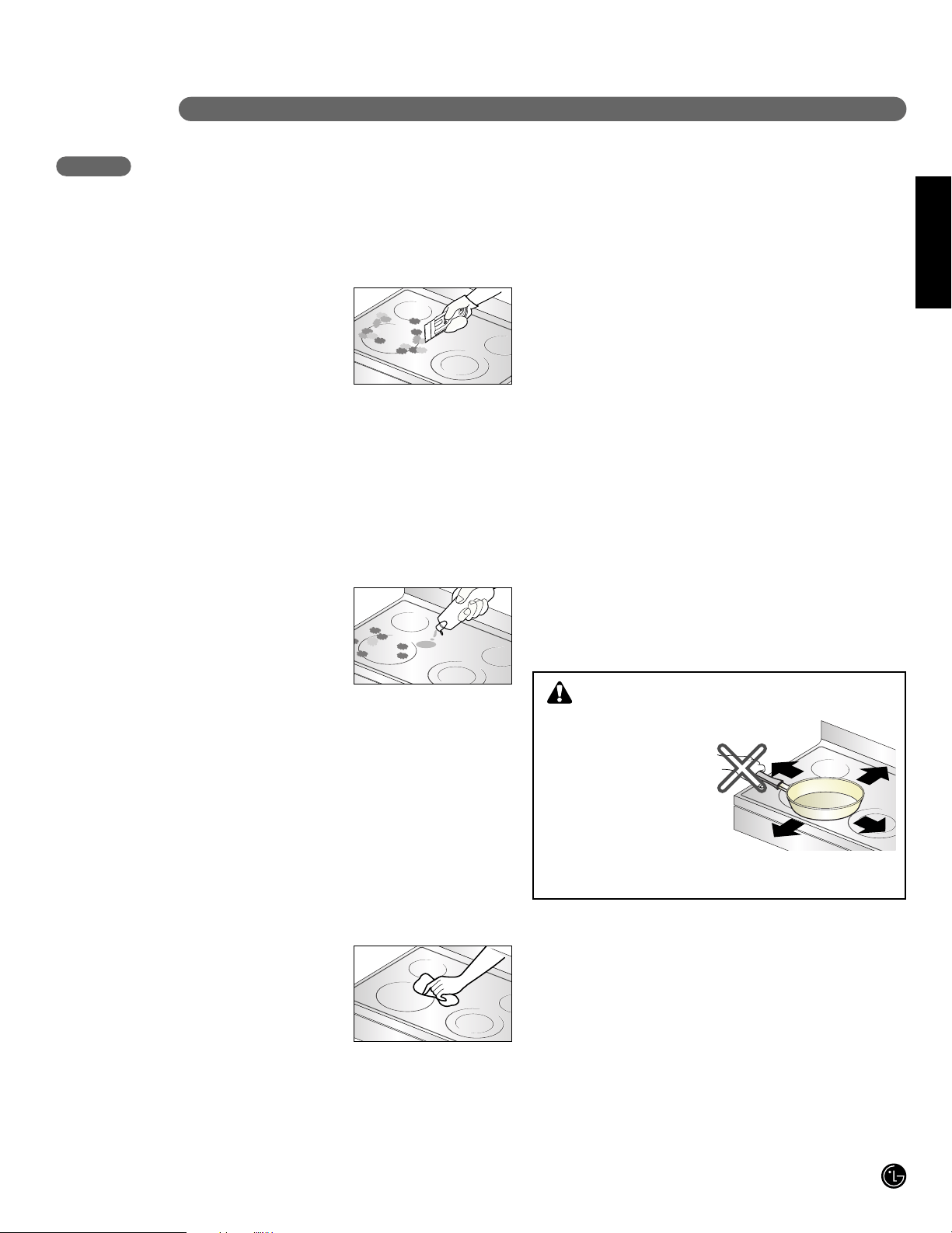
Burned-On Residue
To clean the glass-ceramic
Step. 1
First remove any burnt-on
deposits or spilled food from
your glass-ceramic cooking
surface with a suitable metal
razor scraper (similar to
scraping paint off of your
windowpanes in your home - it will not damage the
decorated cooking surface). Hold the scraper at
approximately a 30˚ angle to the cooktop.
NOTE:
Do not use a dull or nicked blade. For your safety,
please wear an oven mitt potholder while using the
metal scraper.
Step. 2
When the cooking surface has
cooled down apply a few dabs
(about the size of a dime) of
an approved cleaner in each
burner area and work the
cleaning cream over the
cooktop surface with a damp paper towel as if you
were cleaning a window.
NOTE: Approved cleaners
Weiman CookTop Cleaning Cream
(www.weiman.com)
Cerama Bryte (www.ceramabryte.com)
Hope’s Cooktop Cleaning Cream (www.camden-
industrial.com)
Easy-Off 3 in 1 Glass Top Cleaner Spray
(www.easyoff.com).
Step. 3
As a final step, clean with
clear water and wipe the
cooktop surface with a clean,
dry paper towel.
IMPORTANT:
If any sugar or food containing sugar (preserves,
ketchup, tomato sauce, jellies, fudge, candy, syrups,
chocolate, etc.), a plastic item or kitchen foil
accidentally melts on the hot surface of your cooktop,
remove the molten material IMMEDIATELY with a
metal razor scraper (it will not damage the decorated
cooking surface) while the cooking surface is still hot
to avoid the risk of damage to the glass-ceramic
surface. For your safety please wear an oven mitt
potholder while cleaning the hot cooking surface.
Metal Marks and Scratches
1. Be careful not to slide pots and pans across your
cooktop. It will leave metal markings on the cooktop
surface. These marks are removable using the
Ceramic Cooktop Cleaner with the Cleaning Pad
for Ceramic Cooktops.
2. If pots with a thin overlay of aluminum or copper
are allowed to boil dry, the overlay may leave black
discoloration on the cooktop. This should be
removed immediately before heating again or the
discoloration may be permanent.
Cooktop Seal
To clean the cooktop seal around the edges of the
glass, lay a wet cloth on it for a few minutes, then
wipe clean with nonabrasive cleaners.
• Cookware with rough
or uneven bottoms
can mark or scratch
the cooktop surface.
• Do not slide metal or
glass across the
cooktop surface.
• Do not use cookware
with any dirt build up on bottom.
CAUTION
34
MAINTENANCE
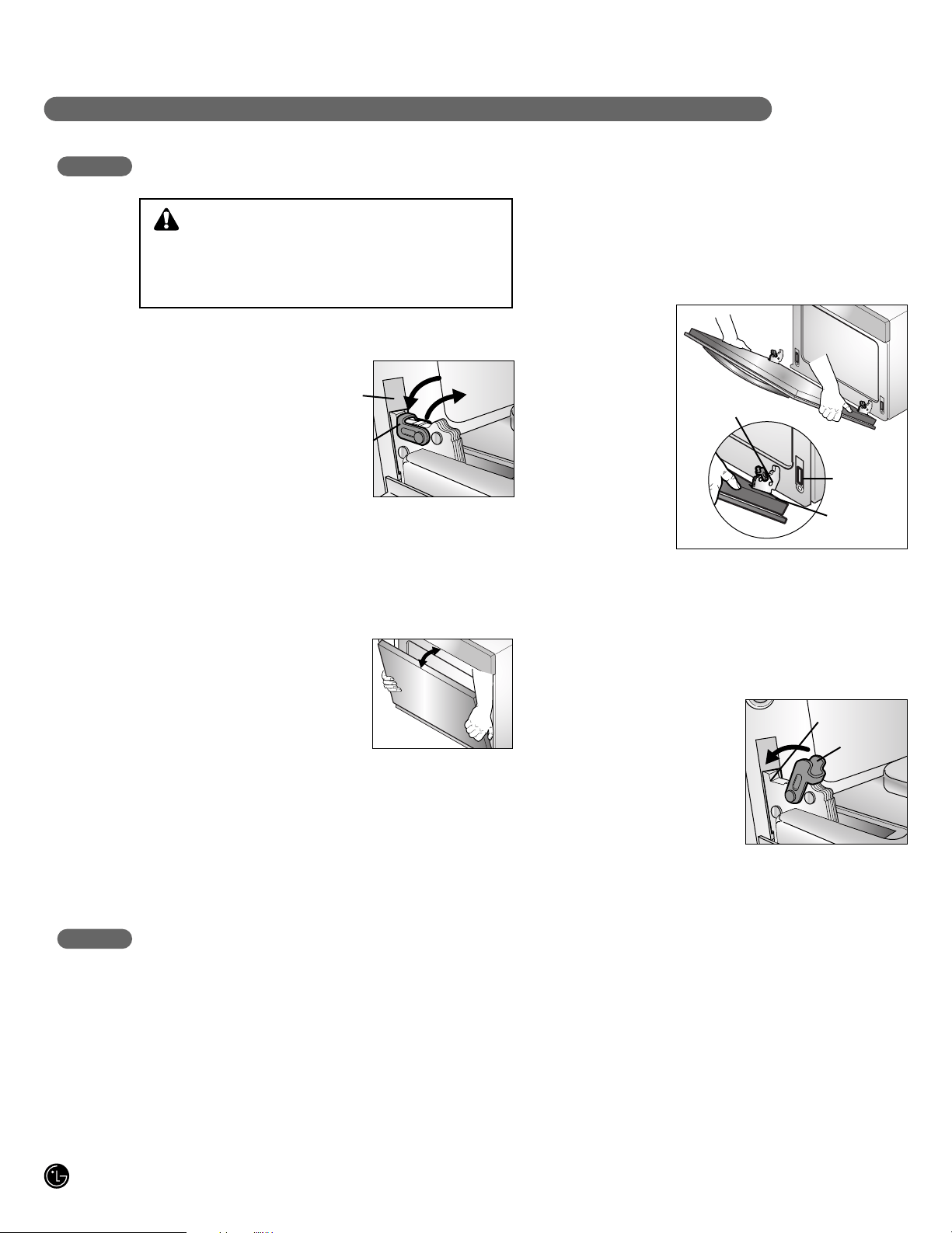
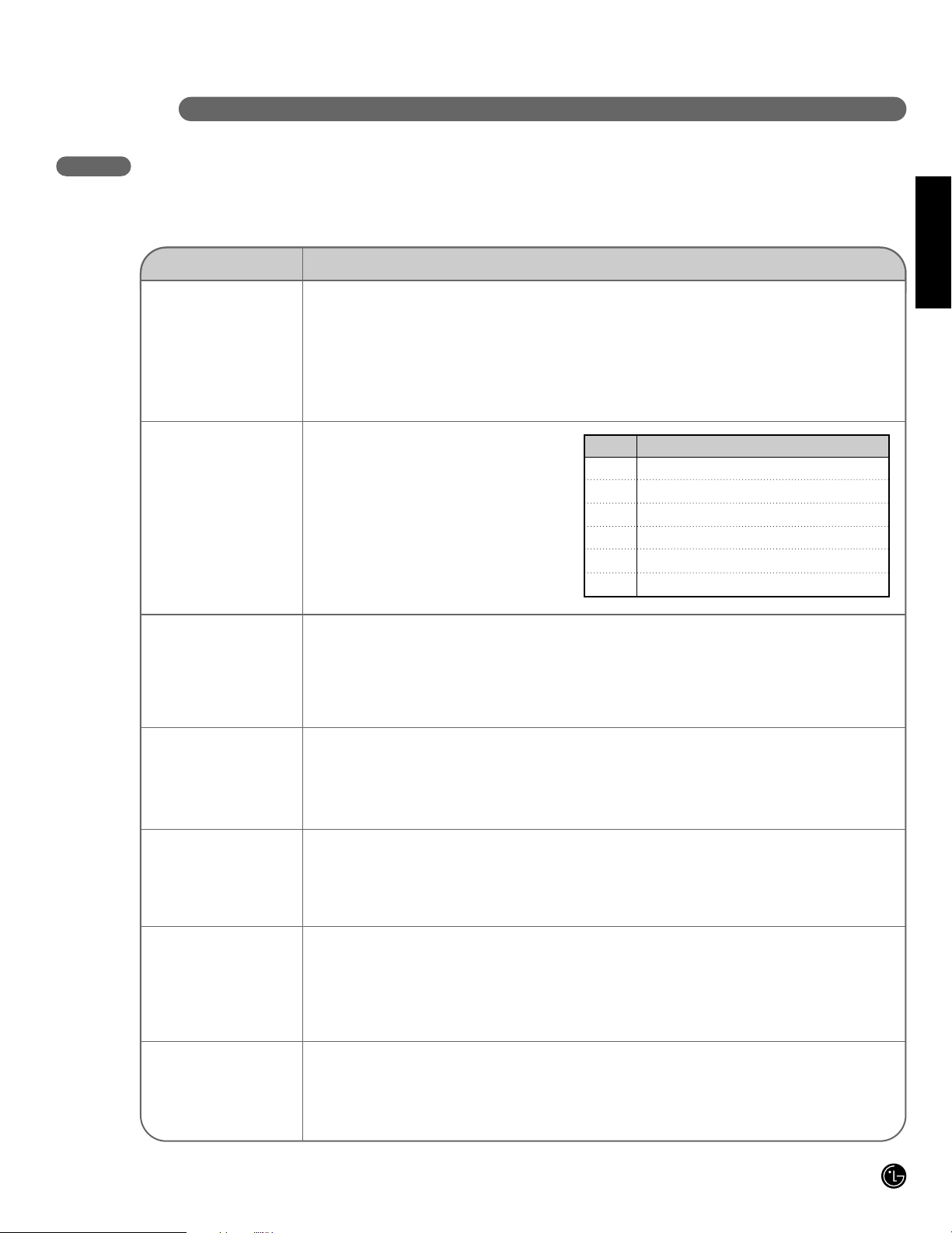
To remove the door:
Step. 1
Open the door fully.
Step. 2
Pull the hinge locks
down toward the door
frame to the unlocked
position.
Step. 3
Firmly grasp both sides of the door at the top.
Step. 4
Close door to the door removal
position, which is approximately
5 degrees.
Step. 5
Lift door up and out until the hinge arm is clear of the
slot.
To replace the door:
Step. 1
Firmly grasp both sides of the door at the top.
Step. 2
With the door at the
same angle as the
removal position,
seat the indentation
of the hinge arm
into the bottom
edge of the hinge
slot. The notch in
the hinge arm must
be fully seated into
the bottom of the
slot.
Step. 3
Open the door fully. If the door will not open fully, the
indentation is not seated correctly in the bottom edge
of the slot.
Step. 4
Push the hinge locks up
against the front frame of the
oven cavity to the locked
position.
Step. 5
Close the oven door.
REMOVING & REPLACING THE LIFT-OFF OVEN DOOR
DOOR CARE INSTRUCTIONS
• Most oven doors contain glass that can break.
Read the following recommendations:
1. Do not close the oven door until all the oven racks
are fully in place.
2. Do not hit the glass with pots, pans, or any other
object.
3. Scratching, hitting, jarring, or stressing the glass
may weaken its structure causing an increased risk
of breakage at a later time.
• Be careful when removing and lifting the door.
• DO NOT lift the door by the handle.
- The door is very heavy.
CAUTION
Slot
Hinge
lock
Lock
Unlock
about 5°
Hinge arm
Indentation
Bottom
edge of
slot
Hinge arm
Hinge lock
35
ENGLISH
TROUBLESHOOTING
BEFORE CALLING FOR SERVICE
Before you call for service, review this list. It may save you time and expense. The list includes common
occurrences that are not the result of defective workmanship or materials in this appliance.
Problem Possible Causes / Solutions
• Poor installation. Place oven rack in center of oven. Place a level on the oven rack.
Adjust leveling legs at base of range until the oven rack is level.
• Be sure floor is level and is strong and stable enough to adequately support range.
• If floor is sagging or sloping, contact a carpenter to correct the situation.
• Kitchen cabinet alignment may make range appear unlevel. Be sure cabinets are
square and have sufficient room for range clearance.
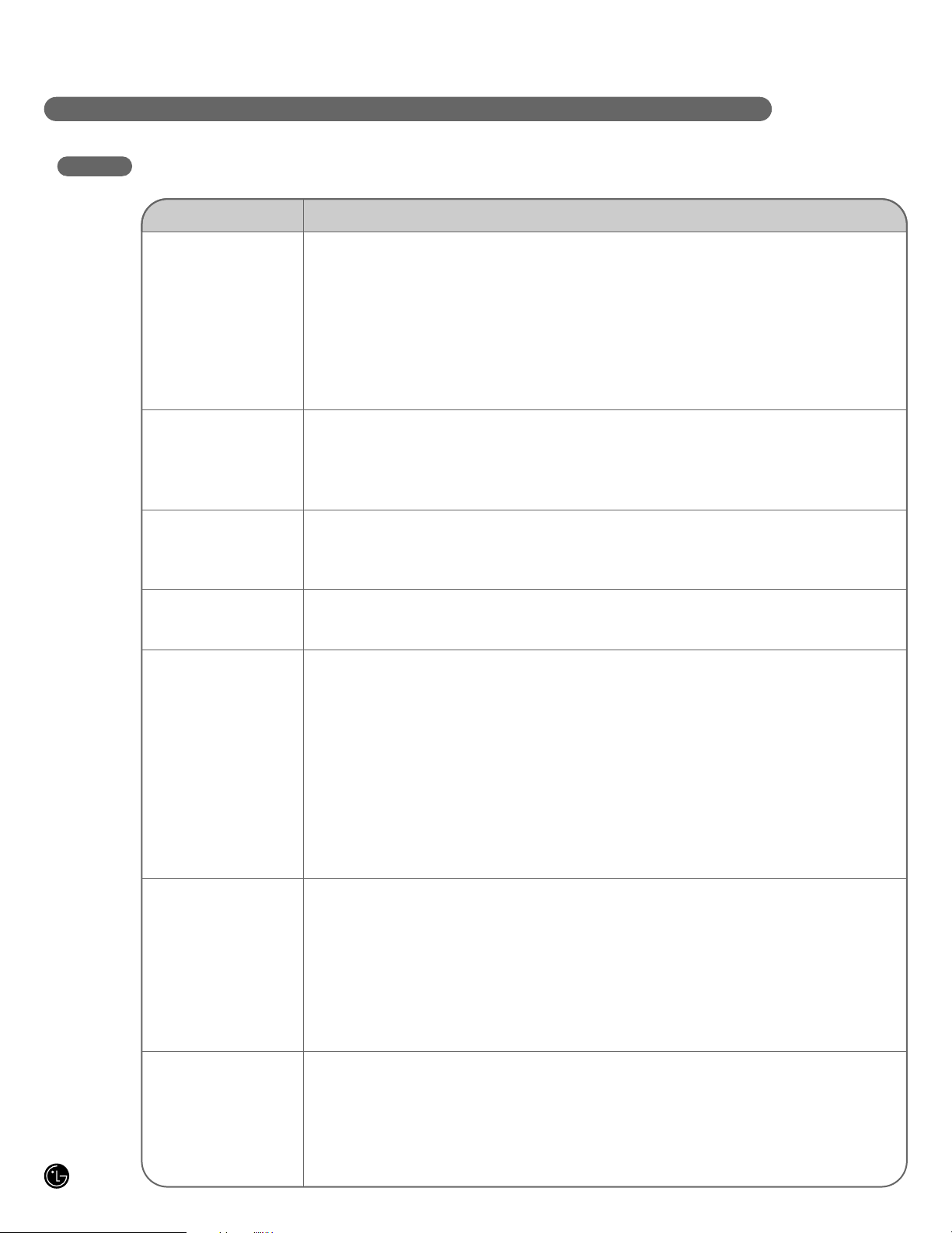
• Electronic control has detected the
fault condition. Press CLEAR/OFF to
clear the display and stop beeping.
Reprogram oven. If fault recurs,
record fault number. Press
CLEAR/OFF and contact a Service
agent.
• Improper cookware being used.
- Use pans which are flat and match the diameter of the surface unit selected.
• In some areas, the power (voltage) may be low.
- Cover pan with a lid until desired heat is obtained.
• A fuse in your home may be blown or the circuit breaker tripped.
- Replace the fuse or reset the circuit breaker.
• Cooktop controls improperly set.
- Check to see the correct control is set for the surface unit you are using.
• This is normal. The unit is still on and hot.
• Food spillovers not cleaned before next use.
- See Cleaning the glass cooktop section.
• Hot surface on a model with a light-colored cooktop.
- This is normal. The surface may appear discolored when it is hot.
This is temporary and will disappear as the glass cools.
• This is normal.
- The element will cycle on and off to maintain the heat setting.
Range is not level.
Oven control beeps
and displays any F
code error.
Surface units will
not maintain a
rolling boil or
cooking is not fast
enough
Surface units do
not work properly
Surface unit stops
glowing when
changed to a lower
setting
Areas of
discoloration on
the cooktop
Frequent cycling
on and off of
surface units
CODE
F-1
F-2
F-3
F-6
F-10
F-11
CAUSE
Open oven sensor
Shorted oven sensor
Shorted keypad
Oven is too hot
Door locking system don’t operate
No heating
36
TROUBLESHOOTING
BEFORE CALLING FOR SERVICE (cont.)
Problem Possible Causes / Solutions
• Plug on range is not completely inserted in the electrical outlet.
- Make sure electrical plug is plugged into a live, properly grounded outlet.
• A fuse in your home may be blown or the circuit breaker tripped.
- Replace the fuse or reset the circuit breaker.
• Oven controls improperly set.
- See the Using the oven section.
• Oven too hot.
- Allow the oven to cool to below locking temperature.
• Make sure cord is plugged correctly into outlet. Check circuit breakers.
• Service wiring is not complete. Contact your appliance Servicer for assistance.
• Power outage. Check house lights to be sure. Call your local electric company for
service.
• The time of day will flash whenever there has been a power interruption to the
appliance. To clear press CLEAR/OFF control pad and be sure to reset the clock
with the correct time of day.
• Replace or tighten bulb. See Changing Oven Light section in this Owner’s
manual.
• Control not set properly. Follow instructions under Setting Oven Controls.
• Make sure oven door is opened to broil stop position.
• Meat too close to the element. Reposition the rack to provide proper clearance
between the meat and the element. Preheat broil element for searing.
• Meat not properly prepared. Remove excess fat from meat. Cut remaining fatty
edges to prevent curling, but do not cut into lean.
• Insert on broiler pan wrong side up and grease not draining. Always place grid on
the broiler pan with ribs up and slots down to allow grease to drip into pan.
• Grease has built up on oven surfaces. Regular cleaning is necessary when broiling
frequently. Old grease or food spatters cause excessive smoking.
• Oven controls improperly set.
- See the using the oven section.
• Rack position is incorrect or the rack is not level.
- See the using the oven section.
• Incorrect cookware or cookware of improper size being used.
- See the using the oven section.
• Oven sensor needs to be adjusted.
- See the adjusting your oven temperature in option section.
• Oven controls improperly set.
- Make sure you press the BROIL pad.
• Improper rack position being used.
- See the Broiling Guide, pages 25 ~ 26.
• Cookware not suited for broiling.
- For best results, use a pan designed for broiling.
Oven will not work
Appliance does not
operate.
The time of day
flashes
Oven light does not
work.
Oven smokes
excessively during
broiling.
Food does not
bake or roast
properly
Food does not broil
properly

37
ENGLISH
TROUBLESHOOTING
BEFORE CALLING FOR SERVICE (cont.)
Problem Possible Causes / Solutions
• Aluminum foil used on the the broiling pan and grid has not been fitted properly and
slit as recommended.
- See the using the oven section.
• In some areas the power (voltage) may be low.
- Preheat the broil element for 10 minutes.
- See the Broiling Guide, page 26.
• Coarse particles such as salt or sand between cooktop and utensils can cause
scratches. Be sure cooktop surface and bottoms of utensils are clean before usage.
Small scratches do not affect cooking and will become less visible with time.
• Cleaning materials not recommended for ceramic-glass cooktop have been used.
See Cleaning The Glass Cooktop in the MAINTENANCE section, page 32.
• Cookware with rough bottom has been used. Use smooth, flat-bottomed cookware.
• Scraping of metal utensils on cooktop surface. Do not slide metal utensils on
cooktop surface. Use a ceramic-glass cooktop cleaning cream to remove the marks.
See Cleaning The Glass Cooktop in the MAINTENANCE section, page 32.
• Boilovers are cooked onto surface. Use the blade scraper to remove soil. See
Cleaning The Glass Cooktop in the MAINTENANCE section, page 32.
• Mineral deposits from water and food. Remove using a ceramic-glass cooktop
cleaning cream. Use cookware with clean, dry bottoms.
• The oven temperature is too high to set a self-clean operation.
- Allow the range to cool and reset the controls.
• Oven controls improperly set.
- See the using the self-cleaning oven section.
• A self-clean cycle cannot be started if the oven lockout feature is active or radiant
surface remains ON.
• Excessive soil.
- Press the CLEAR/OFF pad. Open the windows to rid the room of smoke.
Wait until the self-clean mode is cancelled. Wipe up the excess soil and reset the
clean.
• Oven is too hot.
- Allow the oven to cool below locking temperature.
• Oven controls not properly set.
- See the Self-Clean section, page 28.
• Oven was heavily soiled.
- Clean up heavy spillovers before starting the clean cycle. Heavily soiled ovens
may need to self-clean again or for a longer period of time.
Food does not broil
properly
Scratches or
abrasions on
cooktop surface
Metal marks
Brown streaks or
specks
Areas of
discoloration with
metallic sheen
Oven will not self-
clean
Excessive smoking
during a self clean
cycle
Oven door do not
open after a self
clean cycle
Oven not clean
after a self clean
cycle
38
TROUBLESHOOTING
BEFORE CALLING FOR SERVICE (cont.)
Problem Possible Causes / Solutions
• The self-clean cycle has been selected but the door is not closed.
- Close the oven door.
• The oven door is locked because the temperature inside the oven has not dropped
below the locking temperature.
- Press the CLEAR/OFF pad. Allow the oven to cool.
• When using the convection feature, it is normal to see steam coming out of the
oven vent. As the number of racks or amount of food being cooked increases, the
amount of visible steam will increase.
- This is normal.
• This is normal in a new oven and will disappear in time.
- To speed the process, set a self-clean cycle for a minimum of 3 hours.
See the self-clean section, page 28.
• The shiny, silver-colored racks were cleaned in a self-clean cycle.
- Apply a small amount of vegetable oil to a paper towel and wipe the edges of the
oven racks with the paper towel.
• Make sure the oven vent has not been blocked. See page 30 for location.
• Check to make sure range is level.
• Temperatures often vary between a new oven and an old one.
As ovens age, the oven temperature often drifts and may become hotter or cooler.
See page 20 for instructions on adjusting the oven temperature.
NOTE: It is not recommended to adjust the temperature if only one or two recipes
are in question.
• Oven interior is still hot. Allow about one hour for the oven to cool after the
completion of a self-clean cycle. The door can be opened when the LOCK indicator
word is not displayed.
• The control and door may be locked. See pages 9 and 18 to unlock.
• This is normal when cooking foods high in moisture.
• Excessive moisture was used when cleaning the window.
• The oven makes several low level noises. You may hear the oven relays as they go
on and off. This is normal.
• As the oven heats and cools, you may hear sounds of metal parts expanding and
contracting. This is normal and will not damage your appliance.
• The cooktop and self-clean cannot be used simultaneously.
- A self-clean cannot be used in using the cooktop.
- If turning on the cootop during the self-clean cycle, a self-clean is canceled
automatically.
CLEAN and door
flash in the display
LOCKED is on in
the display when
you want to cook
Steam from the
vent
Burning or oily
odor emitting from
the vent
Oven racks are
difficult to slide
Baking results are
not as expected or
differ from
previous oven
Oven door will not
unlock after self-
clean cycle
Moisture collects
on oven window or
steam comes from
oven vent.
Noises may be
heard.
Ctop and on flash
alternatively
ENGLISH
39
LG ELECTRONICS CANADA, INC.
LG ELECRIC OVEN LIMITED WARRANTY - Canada
WARRANTY: Should your LG Electric Oven (“Product”) fail due to a defect in material or workmanship under normal home use during the warranty period set forth below, LG
Canada will at its option repair or replace the Product upon receipt of proof of original retail purchase. This warranty is valid only to the original retail purchaser of the product
and applies only to a Product distributed in Canada by LG Canada or an authorized Canadian distributor thereof. The warranty only applies to Products located and used within
Canada.
Replacement products and parts are warranted for the remaining portion of the original warranty period or ninety (90) days, whichever is greater.
Replacement products and parts may be new or remanufactured.
LG Authorized Service Center warranties their repair work for thirty (30) days.
LG CANADA’S SOLE LIABILITY IS LIMITED TO THE WARRANTY SET OUT ABOVE. EXCEPT AS EXPRESSLY PROVIDED ABOVE, LG CANADA MAKES NO AND
HEREBY DISCLAIMS ALL OTHER WARRANTIES AND CONDITIONS RESPECTING THE PRODUCT, WHETHER EXPRESS OR IMPLIED, INCLUDING, BUT NOT
LIMITED TO, ANY IMPLIED WARRANTY OR CONDITION OF MERCHANTABILITY OR FITNESS FOR A PARTICULAR PURPOSE, AND NO REPRESENTATIONS
SHALL BE BINDING ON LG CANADA. LG CANADA DOES NOT AUTHORIZE ANY PERSON TO CREATE OR ASSUME FOR IT ANY OTHER WARRANTY
OBLIGATION OR LIABILITY IN CONNECTION WITH THE PRODUCT. TO THE EXTENT THAT ANY WARRANTY OR CONDITION IS IMPLIED BY LAW, IT IS LIMITED
TO THE EXPRESS WARRANTY PERIOD ABOVE.
LG CANADA, THE MANUFACTURER OR DISTRIBUTOR SHALL NOT BE LIABLE FOR ANY INCIDENTAL, CONSEQUENTIAL, SPECIAL, DIRECT OR INDIRECT
DAMAGES, LOSS OF GOODWILL, LOST PROFITS, PUNITIVE OR EXEMPLARY DAMAGES OR ANY OTHER DAMAGE, WHETHER ARISING DIRECTLY OR
INDIRECTLY FROM ANY CONTRACTUAL BREACH, FUNDAMENTAL OR OTHERWISE, OR FROM ANY ACTS OR OMISSIONS, TORT, OR OTHERWISE.
This warranty gives you specific legal rights. You may have other rights which may vary from province to province depending on applicable provincial laws. Any term of this
warranty that negates or varies any implied condition or warranty under provincial law is severable where it conflicts with provincial law without affecting the remainder of this
warranty’s terms.
THIS LIMITED WARRANTY DOES NOT COVER:
1. Service trips to deliver, pick up, or install the product; instructing a customer on operation of the product; repair or replacement of fuses or correction of wiring , or correction of
unauthorized repairs/installation.
2. Failure of the product to perform during power failures and interruptions or inadequate electrical service.
3. Damage caused by leaky or broken water pipes, frozen water pipes, restricted drain lines, inadequate or interrupted water supply or inadequate supply of air.
4. Damage resulting from operating the Product in a corrosive atmosphere or contrary to the instructions outlined in the Product owner’s manual.
5. Damage to the Product caused by accidents, pests and vermin, lightning, wind, fire, floods, or acts of God.
6. Damage resulting from the misuse, abuse, improper installation, repair, or maintenance of the Product. Improper repair includes use of parts not approved or specified by
LG Canada.
7. Damage or product failure caused by unauthorized modification or alteration, or use for other than its intended purpose, or resulting from any water leakage due to improper
installation.
8. Damage or Product failure caused by incorrect electrical current, voltage, commercial or industrial use, or use of accessories, components, or cleaning products that are not
approved by LG Canada.
9. Damage caused by transportation and handling, including scratches, dents, chips, and/or other damage to the finish of your product, unless such damage results from
defects in materials or workmanship and is reported within one (1) week of delivery.
10. Damage or missing items to any display, open box, discounted, or refurbished Product.
11. Products with original serial numbers that have been removed, altered, or cannot be readily determined. Model and Serial numbers, along with original retail sales receipt,
are required for warranty validation.
12. Increases in utility costs and additional utility expenses.
13. Replacement of light bulbs, filters, or any consumable parts.
14. Repairs when your Product is used in other than normal and usual household use (including, without limitation, commercial use, in offices or recreational facilities) or
contrary to the instructions outlined in the Product owner’s manual.
15. Costs associated with removal of the Product from your home for repairs.
16. The removal and reinstallation of the Product if it is installed in an inaccessible location or is not installed in accordance with published installation instructions, including the
Product owner’s and installation manuals.
17. Accessories to the Product such as door bins, drawers, handles, shelves, etc.. Also excluded are parts besides those that were originally included with the Product.
All costs associated with the above excluded circumstances shall be borne by the consumer.
For complete warranty details and customer assistance,
please call or visit our website:
Call 1-888-542-2623 (24 hours a day, 365 days a year) and
select the appropriate option from the menu, or visit our website
at http://www.lg.ca
Write your warranty information below:
Product Registration Information:
Model:
Serial Number:
Date of Purchase:
Electric Oven
One (1) year from the date of original
retail purchase
Parts and Labor
(internal/functional parts only)
WARRANTY PERIOD: (Note: If the original date of purchase can not be verified, the warranty will begin
sixty (60) days from the date of manufacture).
Extended Component Warranty (Parts Only)
(Consumer will be charged for Labor after one (1) year from the date of purchase)
Ninety (90) days from the date
of original retail purchase
One (1) year from the date
of original retail purchase
Cosmetic warranty
( Scratches and dents )
Glass Cook top
Radiant Surface units

40
Memo