ENGLISH FraNçaIS
www.lg.com
MFL33029629
(REV.05 190430)
LRG3061** LRG3193** LRG3060**
OWNER’S MANUAL
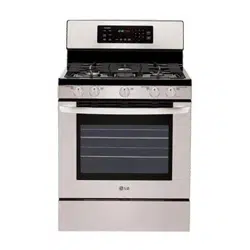
GAS RANGE
Read this owner’s manual thoroughly before operating the appliance
and keep it handy for reference at all times.
•
Do not store or use gasoline or other flammable vapors and liquids in the
vicinity of this or any other appliance.
•
WHAT TO DO IF YOU SMELL GAS
- Do not try to light any appliance.
- Do not touch any electrical switch.
- Do not use any phone in your building.
- Immediately call your gas supplier from a neighbor's phone. Follow the
gas supplier's instructions.
- If you cannot reach your gas supplier, call the fire department.
•
Installation and service must be performed by a qualified installer, service
agency, or the gas supplier.
If the information in this manual is not followed exactly, a fire or explosion
may result causing property damage, personal injury or death.
WARNING
Copyright © 2017 - 2019 LG Electronics Inc. All Rights Reserved.

2
TABLE OF CONTENTS
TABLE OF CONTENTS
3
PRODUCT FEATURES
4
IMPORTANT SAFETY
INSTRUCTIONS
12
PRODUCT OVERVIEW
12 Parts
12 Accessories
13
INSTALLATION
13 Before Installing the Range
14 Installing the Range
16 Providing Adequate Gas Supply
17 Connecting the Range to Gas
18 Electrical Connections
18 Sealing the Openings
19 Assembling the Surface Burners
19 Checking Ignition of the Surface Burners
20 Leveling the Range
20 Engaging the Anti-tip Device
21
OPERATION
21 Gas Surface Burners
22 Burner Locations
22 Using the Gas Surface Burners
22 Setting the Flame Size
23 In Case of Power Failure
23 Range-Top Cookware
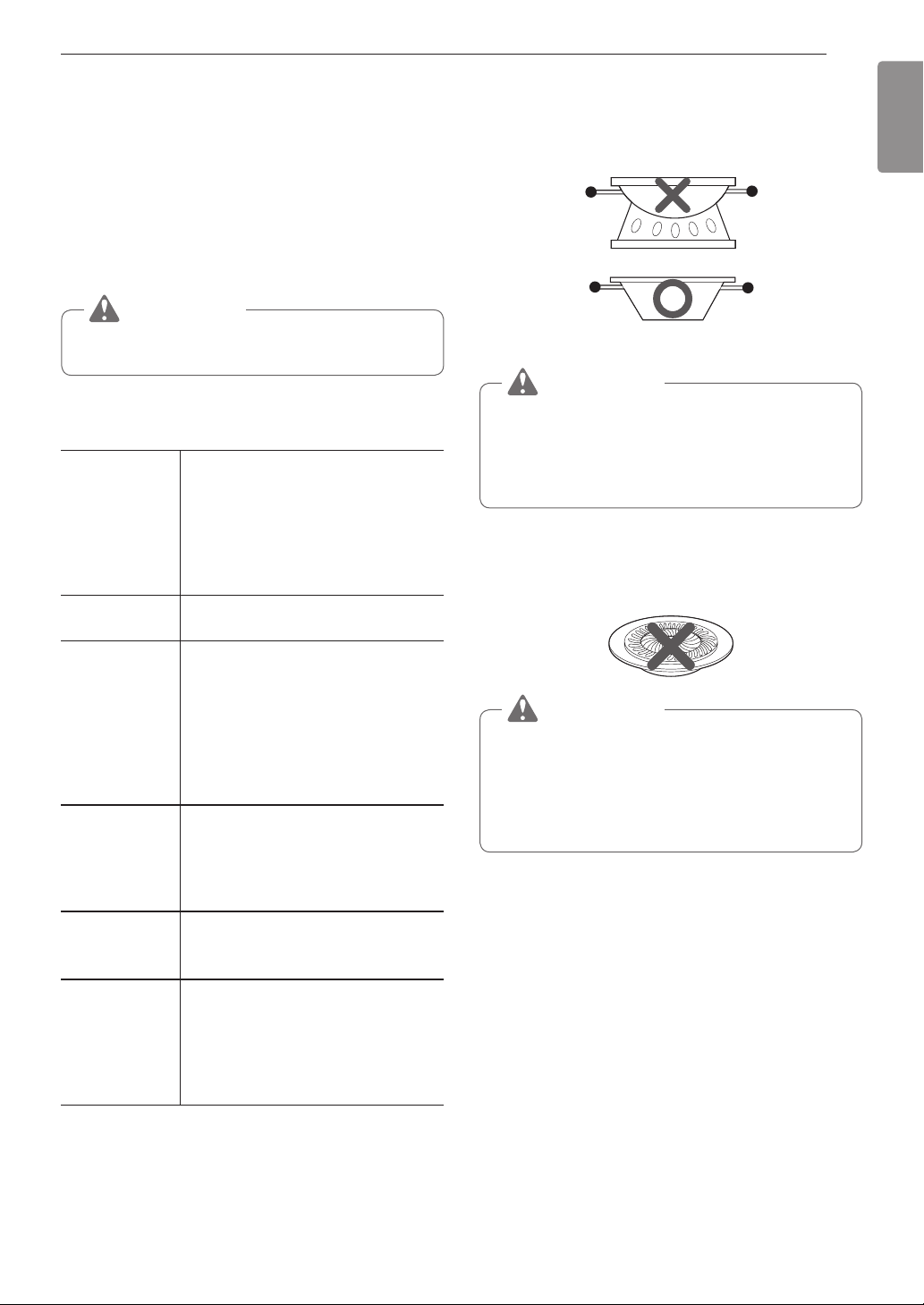
23 Using a Wok
23 Using Stove-Top Grills
24 Using the Griddle
25 The Oven
26 Control Panel Overview
27 Changing Oven Settings
27 Clock
27 Oven Light
27 Minimum & Maximum Default Settings
28 Timer On/Off
28 Settings
-
Setting the Hour Mode
-
Adjusting the Oven Thermostat
-
Turning the Preheat Alarm Light On/Off
-
Adjusting the Beeper Volume
-
Selecting Fahrenheit or Celsius
-
Setting the Convection Auto Conversion
Function (For Model: LRG3193)
30 Lockout
30 Cook Time (Timed Cook)
30 Removing and Replacing the Oven Racks
31 Recommended Baking and Roasting Guide
31 Bake
32 Convection Bake (For Model: LRG3193)
33 Broil
35
MAINTENANCE
35 Gas Surface Burners
36 Burner Grates
36 Cleaning the Cooktop Surface
36 Oven Air Vents
37 Control Panel
37 Front Manifold Panel and Knobs
37 Cleaning the Exterior
38 Door Care Instructions
38 EasyClean
®
40 Changing the Oven Light
40 Removing and Replacing the Lift-Off Oven
Doors and Drawer
42
TROUBLESHOOTING
42 FAQs
44 Before Calling for Service
46
SMART DIAGNOSIS™ FUNCTION
47
LIMITED WARRANTY
3
PRODUCT FEATURES
ENGLISH
PRODUCT FEATURES
Multiple Gas Burner Sizes
Choose a burner to fit the size of the cookware.
Cooking multiple items at once is possible by using different burners at the
same time.
Safe and Convenient Gas Range
Provides safety and convenience for cooking.
EasyClean
®
Useful for easy cleaning.
4
IMPORTANT SAFETY INSTRUCTIONS
IMPORTANT SAFETY INSTRUCTIONS
Read and follow all instructions when using the range to prevent the risk of fire, electric
shock, personal injury, or damage. This guide does not cover all possible conditions that
may occur. Always contact your service agent or manufacturer about problems that you do
not understand.
Download this owner's manual at: http://www.lg.com
This is the safety alert symbol. This symbol alerts you to potential hazards that
can result in property damage and/or serious bodily harm or death.
All safety messages will follow the safety alert symbol and either the word
WARNING or CAUTION. These words mean:
WARNING
-
Indicates a hazardous situation which, if not avoided, could result
in death or serious injury.
CAUTION
-
Indicates a hazardous situation which, if not avoided, could result
in minor or moderate injury.
ANTI-TIP DEVICE
WARNING
•
ALL RANGES CAN TIP
•
INJURY TO PERSONS COULD RESULT
•
INSTALL ANTI-TIP DEVICES PACKED WITH RANGE
•
SEE INSTALLATION INSTRUCTIONS
•
A child or adult can tip the range and be killed.
•
Install the anti-tip device to the structure and/or the range. Verify the anti-tip device
has been properly installed and engaged by following the guide of the Anti tip bracket
template.
•
Engage the range to the anti-tip device by following the guide of the Anti tip bracket
template. Ensure the anti-tip device is re-engaged when the range is moved by
following the guide of the Anti tip bracket template.
•
Re-engage the anti-tip device if the range is moved. Do not operate the range without
the anti-tip device in place and engaged.
•
See installation instructions for details.
•
Failure to do so can result in death or serious burns to children or adults.
•
To avoid tipping, do not step or sit on the door. Install the anti-tip bracket packed with this
range.
- The range could be tipped and injury might result from spilled hot liquid, food, or the
range itself.
- If the range is pulled away from the wall for cleaning, service, or any other reason,
ensure that the anti-tip device is properly reengaged when the range is pushed back
against the wall.
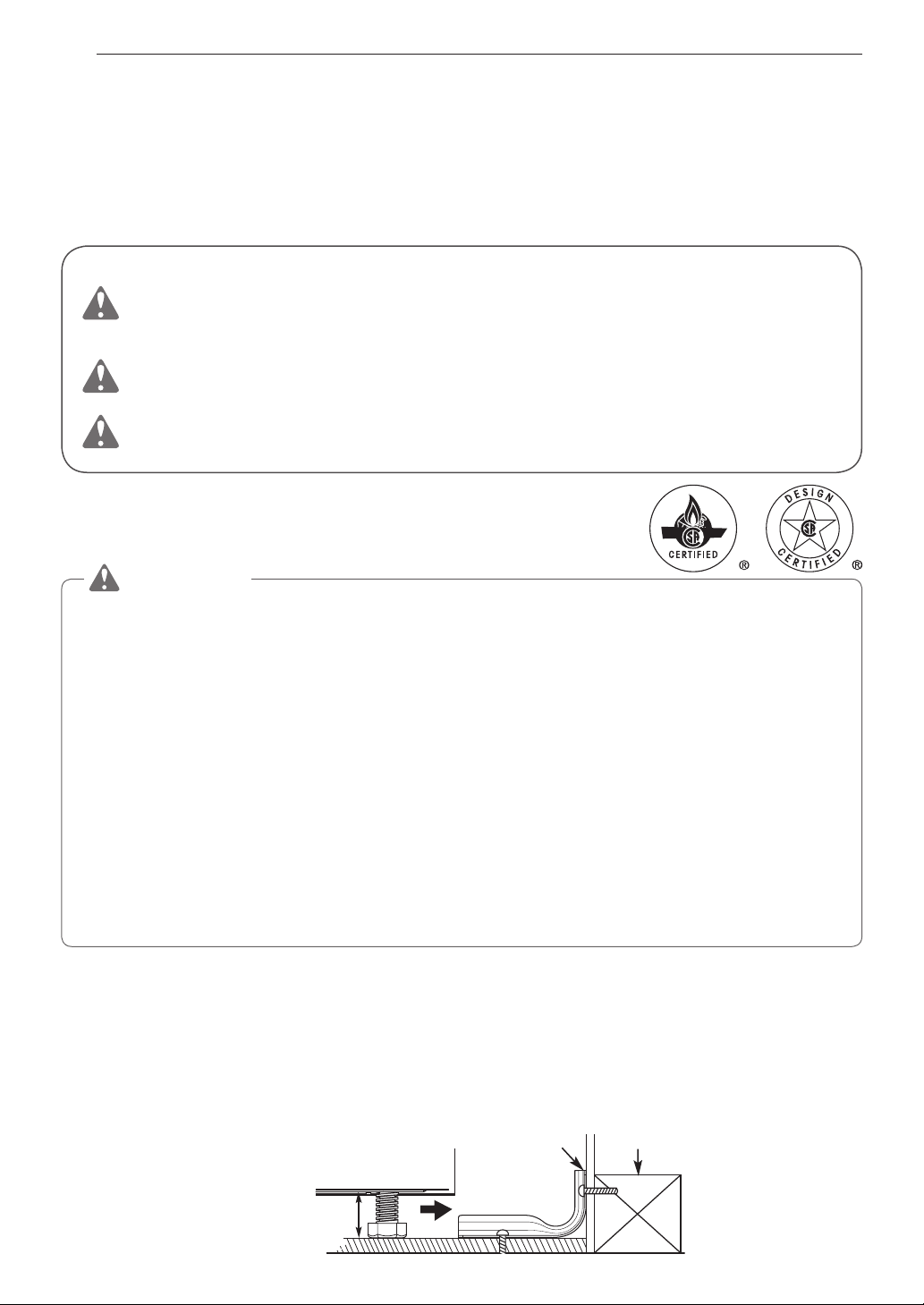
Anti-tip bracket
Approximately
0.65" (16.5 mm)
Screw must
enter wood or
concrete
Wall plate

5
IMPORTANT SAFETY INSTRUCTIONS
ENGLISH
•
To reduce the risk of the range tipping over, the range must be secured by properly
installing the anti-tip device.
•
To check that the anti-tip bracket is properly installed: Remove any items on the cooktop.
Grasp the top rear edge of the range back guard and carefully attempt to tilt it forward.
Verify that the anti-tip device is engaged.
•
Remove the warming or storage drawers and visually inspect that the rear leveling leg is
fully inserted into the anti-tip bracket.
•
Refer to the installation section of the manual for proper anti-tip bracket installation.
IMPORTANT SAFETY NOTICE
Gas appliances can cause minor exposure to four of these substances, namely benzene,
carbon monoxide, formaldehyde and soot, caused primarily by the imperfect combustion
of natural or LP gas. Correctly adjusted burners, indicated by a bluish rather than a yellow
flame, will minimize imperfect combustion. Exposure to these substances can be minimized
by opening windows or using a ventilation fan or hood.
WARNING
•
Never use your range as a space heater to heat or warm the room. Doing so may result
in carbon monoxide poisoning and overheating of the oven.
•
Never wear loose fitting or hanging garments while using the appliance. Be careful
when reaching for items placed in cabinets over the range. Flammable materials could
be ignited if brought in contact with flame or hot oven surfaces and may cause severe
burns.
•
Do not place or use combustible materials such as gasoline or other flammable vapors
and liquids in the vicinity of this or any other appliance.
•
Do not place flammable materials in the oven or near the cooktop.
•
Do not allow cooking grease or other flammable materials in or near the range.
•
Do not use water on grease fires. Never touch a flaming pan. Turn the controls off.
Smother a flaming pan on a surface burner by covering the pan completely with a well-
fitting lid, cookie sheet or flat tray. Use a multi-purpose dry chemical or foam-type fire
extinguisher.
A grease fire can be put out by covering it with baking soda or, if available, by using a
multi-purpose dry chemical or foam-type fire extinguisher.
Flame in the oven or the drawer can be smothered completely by closing the oven door
or drawer and turning the control to off or by using a multi-purpose dry chemical or
foam-type fire extinguisher.
•
Do not use the oven or the drawer for storage.
•
Let the burner grates and other surfaces cool before touching them.
•
Never block the vents (air holes) of the range. They provide the air inlet and outlet
necessary for the range to operate properly with correct combustion. Air openings are
located at the rear of the cooktop, at the top and bottom of the oven door, and at the
bottom of the range.
•
Never obstruct the flow of combustion and ventilation air by blocking the oven vent
or air intakes. Doing so restricts air to the burner and may result in carbon monoxide
poisoning.
•
Never cover any slots, holes or passages in the oven bottom or cover an entire rack
with materials such as aluminum foil. Doing so blocks air flow through the oven and
may cause carbon monoxide poisoning. Aluminum foil linings may also trap heat,
causing a fire hazard.
6
IMPORTANT SAFETY INSTRUCTIONS
WARNING
•
Large scratches or impacts to glass doors can lead to broken or shattered glass.
•
Stepping, leaning or sitting on the doors or drawers of this range can result in serious
injuries and also cause damage to the range. Do not allow children to climb or play
around the range. The weight of a child on an open door may cause the range to tip,
resulting in serious burns or other injury.
•
Leak testing of the appliance must be conducted according to the manufacturer’s
instructions.
•
Gas leaks may occur in the system and result in a serious hazard. Gas leaks may
not be detected by smell alone. Gas suppliers recommend you purchase and install
a UL-approved gas detector. Install and use in accordance with the gas detector
manufacturer’s instructions.
•
Do not use commercial oven cleaners on the oven finish or around any part of the
oven. They will damage the finish.
•
To prevent staining or discoloration, clean appliance after each use.
•
Do not attempt to open or close the door or operate the oven until the door is properly
installed.
•
Never place fingers between the hinge and front oven frame. Hinge arms are spring
mounted. If accidentally hit, the hinge will slam shut against the oven frame and injure
fingers.
CAUTION
•
Items of interest to children should not be placed in cabinets above the range or on
the backsplash of the range - children climbing on the range to reach items could be
seriously injured.
•
Do not leave children alone or unattended where a range is hot or in operation. They
could be seriously burned.
•
Do not let anyone climb, stand or hang on the oven door, warming drawer or cooktop.
They could damage the range or tip it over, causing severe personal injury.
•
Wear gloves when cleaning the range to avoid injury or burns.
•
Do not use the oven for storing food or cookware.
•
To prevent damage to the oven door, do not attempt to open the door when Lock is
displayed.
•
Do not stand or place excessive weight on an open door. This could tip the range,
break the door, or injure the user.
•
Do not use delayed baking for highly perishable foods such as dairy products, pork,
poultry, or seafood.
7
IMPORTANT SAFETY INSTRUCTIONS
ENGLISH
INSTALLATION SAFETY PRECAUTIONS
Have the installer show you the location of the range gas shut-off valve and how to shut it
off if necessary.
WARNING
•
Make sure your range is properly installed and grounded by a qualified installer,
according to the installation instructions. Any adjustment and service should be
performed only by qualified gas range installers or service technicians.
•
Make sure your range is properly adjusted by a qualified service technician or installer
for the type of gas (natural or LP) that is to be used. The range can be converted for
use with either type of gas. See the installation instructions.
•
These adjustments must be done by a qualified service technician according to the
manufacturer’s instructions and all codes and requirements of the authority having
jurisdiction. Failure to follow these instructions could result in serious injury or property
damage. The qualified agency performing these adjustments assumes responsibility for
the conversion.
•
Disconnect the electrical supply before servicing the appliance.
•
Never use the appliance door as a step stool or seat, as this may result in possible
tipping of the appliance and serious injuries.
•
This product should not be installed below ventilation type hood systems that direct air
in a downward direction.
Doing so may cause ignition and combustion problems with the gas burners resulting in
personal injury and may affect the cooking performance of the unit.
•
Plug your range into a 120-volt grounded outlet only. Do not remove the round
grounding prong from the plug. If in doubt about the grounding of the home electrical
system, it is your personal responsibility and obligation to have an ungrounded outlet
replaced with a properly grounded, three-prong outlet in accordance with the National
Electrical Code. Do not use an extension cord with this range.
•
To prevent fire hazard or electrical shock, do not use an adapter plug, an extension
cord, or remove the grounding prong from the electrical power cord. Failure to follow
this warning can cause serious injury, fire or death.
•
To prevent poor air circulation, place the range out of the kitchen traffic path and out of
drafty locations.
•
Do not attempt to repair or replace any part of the range unless it is specifically
mentioned in this manual. All other services should be referred to a qualified technician.
•
Make sure that all packaging materials are removed from the range before operating it
to prevent fire or smoke damage should the packaging material ignite.
8
IMPORTANT SAFETY INSTRUCTIONS
WARNING
•
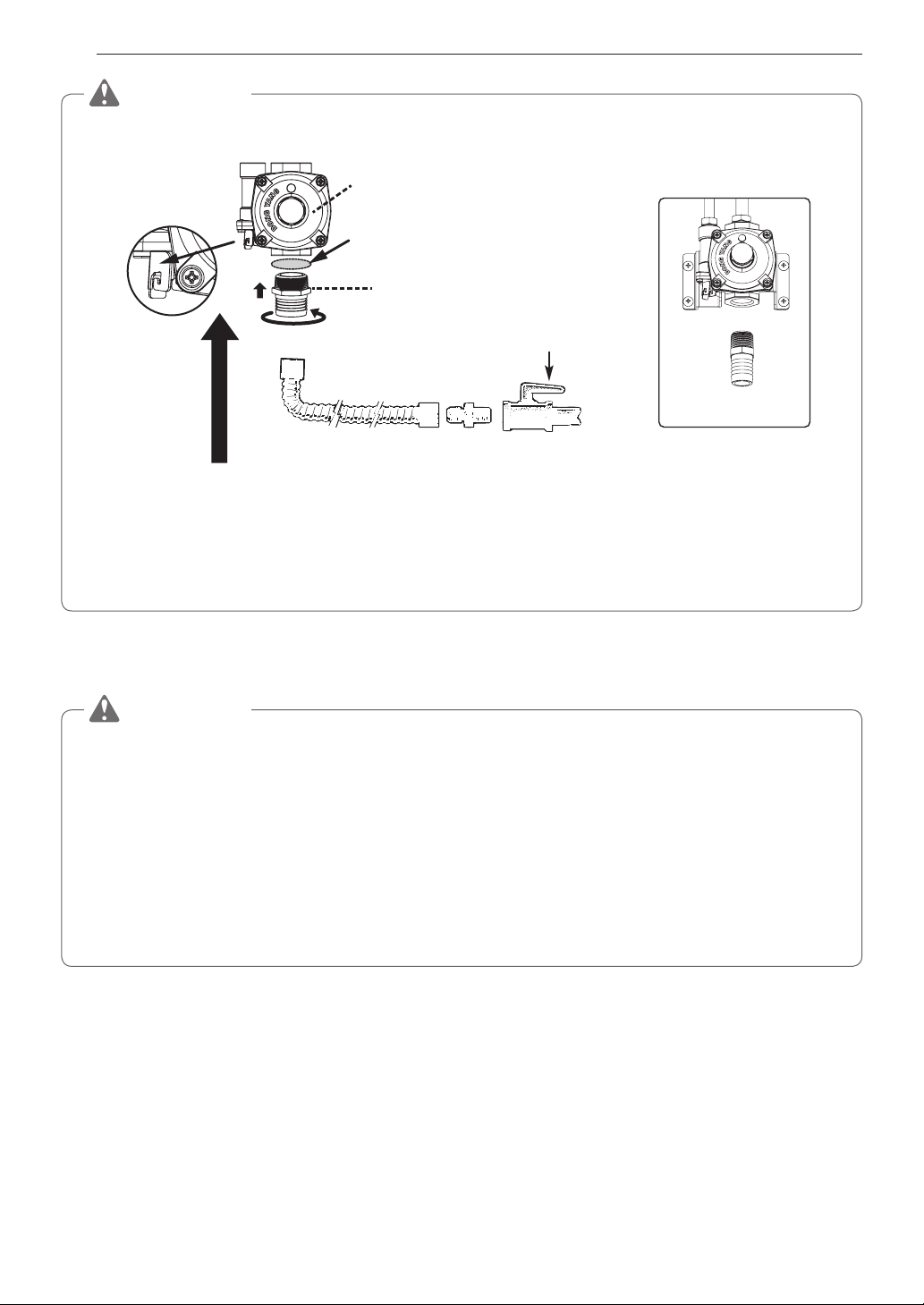
To shut off the gas supply to the range, close the range gas shutoff valve by turning it
clockwise.
Adapter(
1
/
2
"-14 NPT)
1
/
2
" Adapter
Lever open(use)
position
Pressure regulator
Range gas shut-off valve
Remove this label
Gas Flow into Range
Installer: Inform the consumer of the location of the gas shut-off valve.
•
After using the range for an extended period of time high floor temperatures may result.
Many floor coverings will not withstand this kind of use.
•
Never install the range over vinyl tile or linoleum that cannot withstand such type of
use. Never install it directly over interior kitchen carpeting.
SURFACE BURNERS
WARNING
•
Even if the top burner flame goes out, gas is still flowing to the burner until the knob is
turned to the Off position. If you smell gas, immediately open a window and ventilate
the area for five minutes prior to using the burner. Do not leave the burners on
unattended.
•
Use proper pan size. Do not use pans that are unstable or that can be easily tipped.
Select cookware with flat bottoms large enough to cover burner grates. To avoid
spillovers, make sure the cookware is large enough to contain the food properly. This
will both save cleaning time and prevent hazardous accumulations of food, since heavy
spattering or spillovers left on the range can ignite. Use pans with handles that can be
easily grasped and remain cool.
9
IMPORTANT SAFETY INSTRUCTIONS
ENGLISH
CAUTION
•
Be sure that all surface controls are set in the Off position prior to supplying gas to the
range.
•
Never leave the surface burners unattended at high flame settings. Boilovers may
cause smoke and greasy spillovers that may ignite.
•
Always turn the knobs to the Lite position when igniting the top burners and make sure
the burners have ignited.
•
Control the top burner flame size so it does not extend beyond the edge of the
cookware. Excessive flame is hazardous.
•
Only use dry pot holders- moist or damp pot holders on hot surfaces may result in
burns from steam. Do not let pot holders come near open flames when lifting cookware.
Do not use towels or other bulky cloth items. Use a pot holder.
•
If using glass cookware, make sure the cookware is designed for range-top cooking.
•
To prevent burns from ignition of flammable materials and spillage, turn cookware
handles toward the side or back of the range without extending them over adjacent
burners.
•
Never leave any items on the cooktop. The hot air from the vent may ignite flammable
items and will increase pressure in closed containers, which may cause them to burst.
•
Carefully watch foods being fried at a high flame setting.
•
Always heat fat slowly, and watch as it heats.
•
If frying combinations of oils and fats, stir together before heating.
•
Use a deep fat thermometer if possible to prevent overheating fat from heating beyond
the smoking point.
•
Use the least possible amount of fat for effective shallow or deep fat frying. Filling the
pan with too much fat can cause spillovers when food is added.
•
Do not cook foods directly on an open flame on the cooktop.
•
Do not use a wok on the surface burners if the wok has a round metal ring that is
placed over the burner grate to support the wok. This ring acts as a heat trap, which
may damage the burner grate and burner head. It may also cause the burner to work
improperly. This may cause carbon monoxide levels which are higher than what is
allowed by current standards, resulting in a health hazard.
•
Foods for frying should be as dry as possible. Frost or moisture on foods can cause hot
fat to bubble up and spill over the sides of the pan.
•
Never try to move a pan of hot fat, especially a deep fryer. Wait until the fat is cool.
•
Do not place plastic items on the cooktop- they may melt if left too close to the vent.
•
Keep all plastics away from the surface burners.
•
To prevent burns, always be sure that the controls for all burners are in the Off position
and all grates are cool before attempting to remove them.
•
If you smell gas, turn off the gas to the range and call a qualified service technician.
Never use an open flame to locate a leak.
•
Always turn the knobs to the Off position before removing cookware.
•
Do not lift the cooktop. Lifting the cooktop can cause damage and improper operation
of the range.
•
If the range is located near a window, do not hang long curtains that could blow over
the surface burners and catch on fire.
•
Use care when cleaning the cooktop. The pointed metal ends on the electrodes could
cause injury.
10
IMPORTANT SAFETY INSTRUCTIONS
BROILER
Always use a broiler pan and a grid for excess fat and grease drainage. This will help to
reduce splatter, smoke, and flare-ups.
WARNING
When using the broiler, the temperature inside the oven will be extremely high. Take
caution to avoid possible burns by:
•
Keeping the door closed when broiling (refer to Broil section of the manual)
•
Always wearing oven mitts when inserting or removing food items
COOK MEAT AND POULTRY THOROUGHLY
To protect against food-borne illnesses, cook meat and poultry thoroughly—ground beef to at
least an INTERNAL temperature of 160 °F, poultry to at least an INTERNAL temperature of 165
°F and beef, pork, veal & lamb steaks & chops to at least an INTERNAL temperature of 145 °F.
OVEN
When opening the door of a hot oven, stand away from the range. The hot air and steam
that escape can cause burns to hands, face and eyes.
WARNING
•
Never block any slots, holes or passages in the oven bottom or cover an entire rack
with materials such as aluminum foil. Doing so blocks air flow through the oven and
may cause carbon monoxide poisoning. Aluminum foil linings may trap heat, causing a
fire hazard.
•
Do not heat food in closed containers. Pressure inside the container could increase and
cause the container to burst, resulting in injury.
•
Do not line oven walls or bottom with aluminum foil or allow them to contact exposed
heating elements in the oven. Doing so could create a fire hazard or cause damage to
the range.
•
Do not use the oven for storage. Items stored in the oven can catch on fire.
•
Keep the oven free from grease buildup.
•
Insert the oven racks in the desired position while the oven is cool.
•
To prevent burns when removing food, slide racks out until the stop engages, then
remove food items. This may also protect you from getting burnt by touching hot
surfaces of the door or oven walls.
•
When placing or removing a griddle, always wear oven mitts.
•
When using cooking or roasting bags in the oven, follow the manufacturer’s directions.
•
Use only glass cookware that is recommended for use in gas ovens.
•
Always remove the broiler pan from the range after you finish broiling. Grease left in the
pan can catch fire if the oven is used without removing the grease from the broiler pan.
•
If meat is too close to the flame while broiling, the fat may ignite. Trim excess fat to
prevent excessive flare-ups.
•
Make sure the broiler pan is in place correctly to minimize the possibility of grease fires.
•
If you have a grease fire in the broiler pan, press the Clear/Off and keep the oven door
closed to contain the fire until it burns out.
•
For safety and better cooking performance, always bake and broil with the oven door
closed. Open door baking or broiling can cause damage to the knobs or valves.
Do not leave the oven door open during cooking or while the oven is cooling down.

11
IMPORTANT SAFETY INSTRUCTIONS
ENGLISH
ENERGY SAVING TIPS
•
Multiple-rack cooking saves time and energy. Whenever possible, cook foods requiring the
same cooking temperature together in one oven.
•
For optimal performance and energy savings, follow the guides on page 31 for proper rack
and pan placements.
•
Match the size of the cookware to the amount of food being cooked to save energy when
heating. Heating ½ quart of water requires more energy in a 3-quart pot than in a 1-quart
pot.
•
Use cookware with flat bottoms to provide the best contact with the cooktop surface when
cooking on the glass-ceramic cooktop.
•
Match the size of the cooktop burner or element to the size of the cookware in use. Using
a large element for a small pan wastes heating energy, and the exposed surface of the
element is a burn or fire hazard.
•
Reduce energy use by cleaning light oven soils with the EasyClean
®
feature instead of
self-clean.
•
Avoid opening the oven door more than necessary during use. This helps the oven
maintain temperature, prevents unnecessary heat loss, and saves on energy use.
Read all instructions before using the appliance.
SAVE THESE INSTRUCTIONS
12
PRODUCT OVERVIEW
PRODUCT OVERVIEW
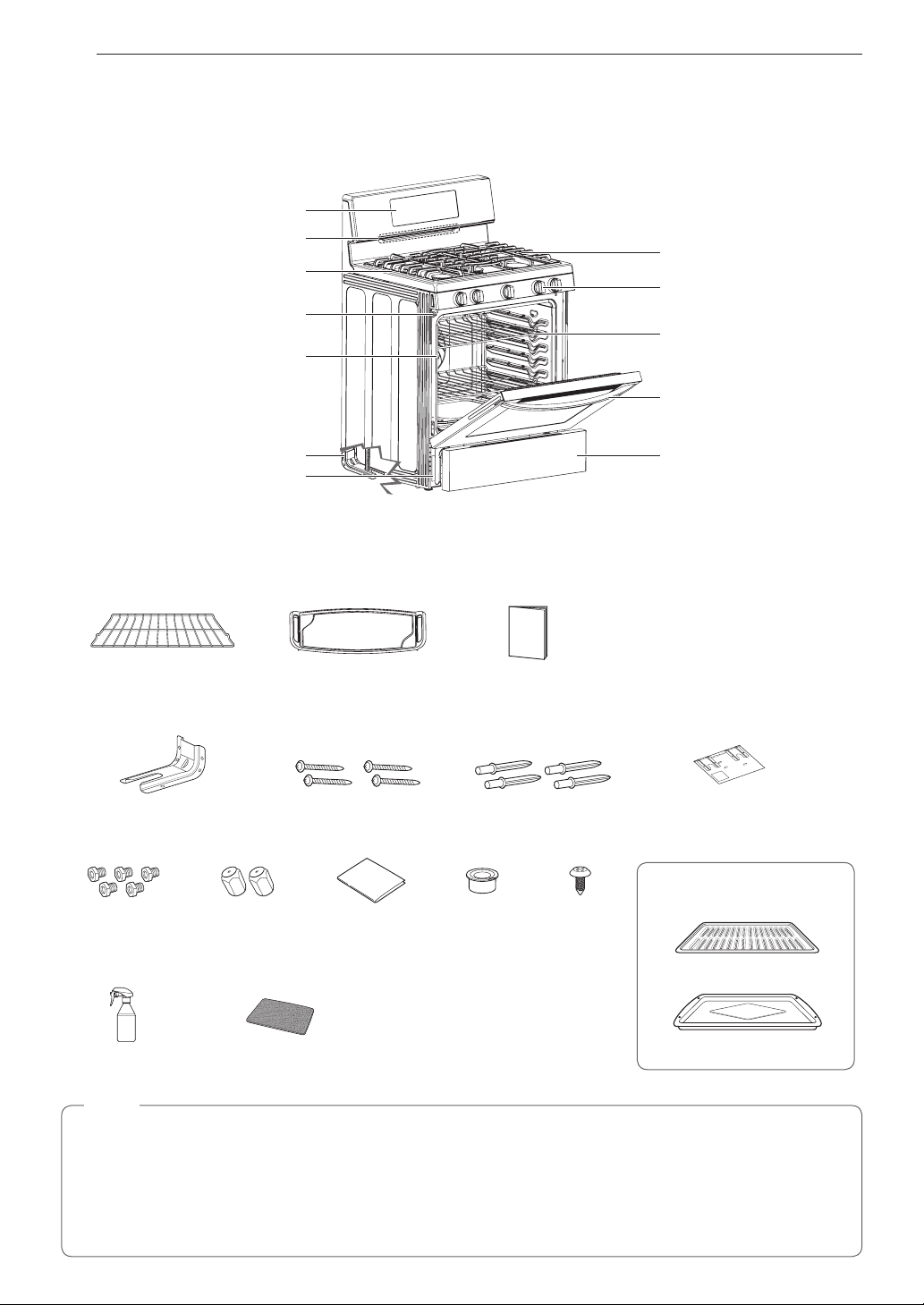
Parts
Grate
Oven control panel
Cooktop
Automatic oven light switch
Door gasket
Anti-tip bracket
Oven vent
Model and serial
number plate
Burner control knob
Rack
Oven door
Storage drawer
Accessories
Included Accessories
Standard rack (2ea) Griddle (1ea)
(LRG3061, LRG3193)
Owner’s manual (1ea)
Anti-tip kit
Anti-tip (1ea) Screws (4ea) Anchors (4ea) Template (1ea)
LP nozzle conversion kit
Optional Accessories
Broiler pan
Grid
Cooktop Nozzles
(5ea)
Oven Nozzles
(2ea)
Installation guide
(1ea)
Choke
(1ea)
Set screw
(1ea)
EasyClean
®
kit (LRG3061, LRG3193)
Spray bottle
(1ea)
Non-scratch scouring pad
(1ea)
NOTE
•
Contact LG Customer Service at 1-800-243-0000 (1-888-542-2623 in Canada) if any accessories are missing.
•
For your safety and for extended product life, only use authorized components.
•
The manufacturer is not responsible for product malfunction or accidents caused by the use of separately
purchased, unauthorized components or parts.
•
The images in this guide may be different from the actual components and accessories, which are subject
to change by the manufacturer without prior notice for product improvement purposes.
13
INSTALLATION
ENGLISH
INSTALLATION
Before Installing the Range
Make sure the range is properly installed and grounded by a qualified installer, according to the installation
instructions. Any adjustment and service should be performed only by qualified gas range installers or service
technicians.
In the Commonwealth of Massachusetts
•
This product must be installed by a licensed plumber or gas fitter.
•
When using ball type gas shut-off valves, they must be the T-handle type.
•
When using a flexible gas connector, it must not exceed 3 feet in length.
Preparing for Installation
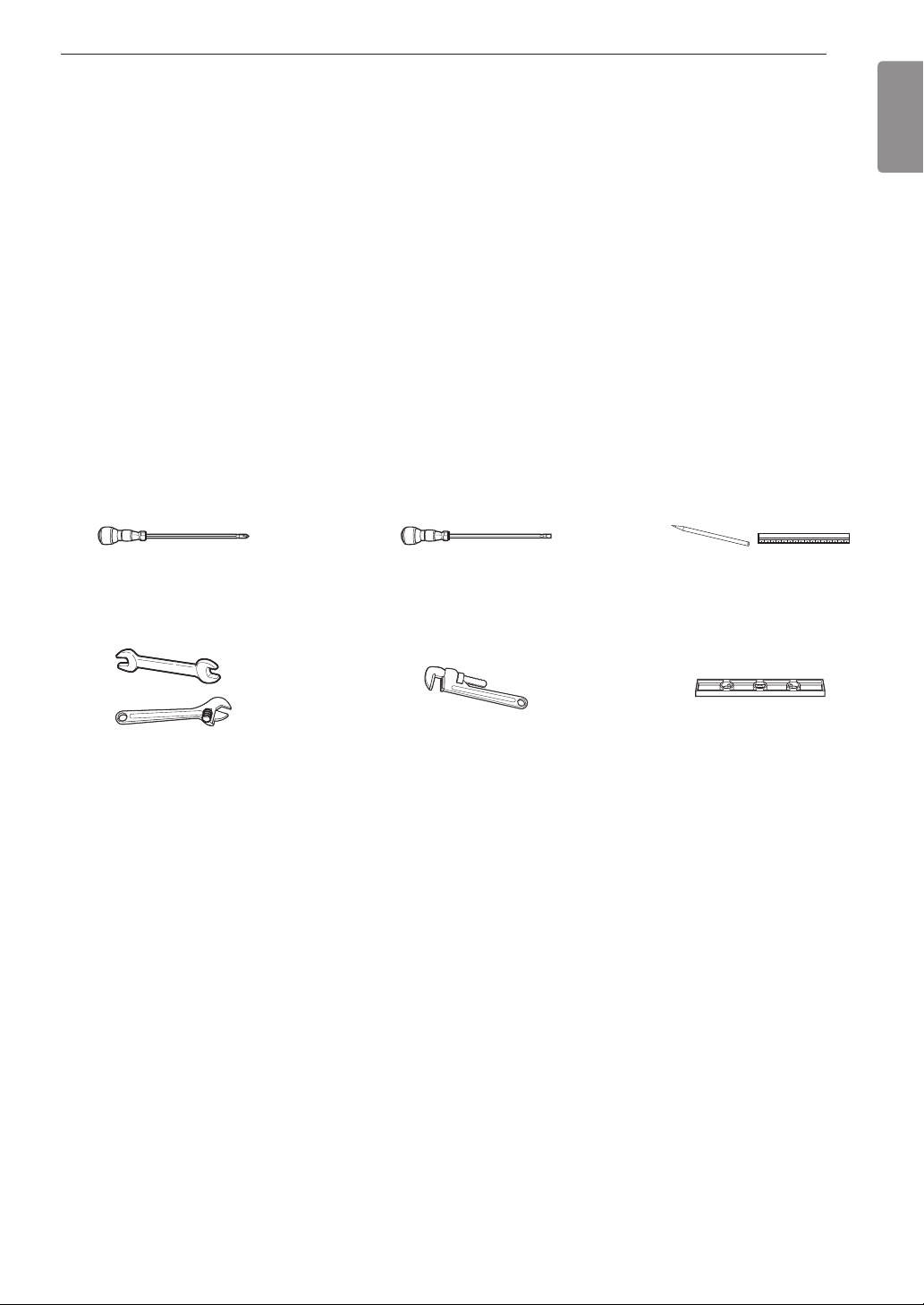
Tools Needed
Phillips screwdriver
Open-end or adjustable
wrench
Pencil and ruler
Level
Flat-blade screwdriver
Pipe wrench (2)
(one for support)
Materials You May Need
•
Gas line shut-off valve
•
Pipe joint sealant that resists action of natural and LP gases
•
Flexible metal appliance connector (
3
/
4
" or
1
/
2
" NPT x
1
/
2
" I.D.)
Never use an old connector when installing a new range.
•
Flare union adapter for connection to gas supply line (
3
/
4
" or
1
/
2
" NPT x
1
/
2
" I.D.)
•
Flare union adapter for connection to pressure regulator on range (
1
/
2
" NPT x
1
/
2
" I.D.)
•
Liquid leak detector or soapy water
•
Lag bolt or
1
/
2
" O.D. sleeve anchor (for concrete floors only)
14
INSTALLATION
Installing the Range
Unpacking and Moving the Range
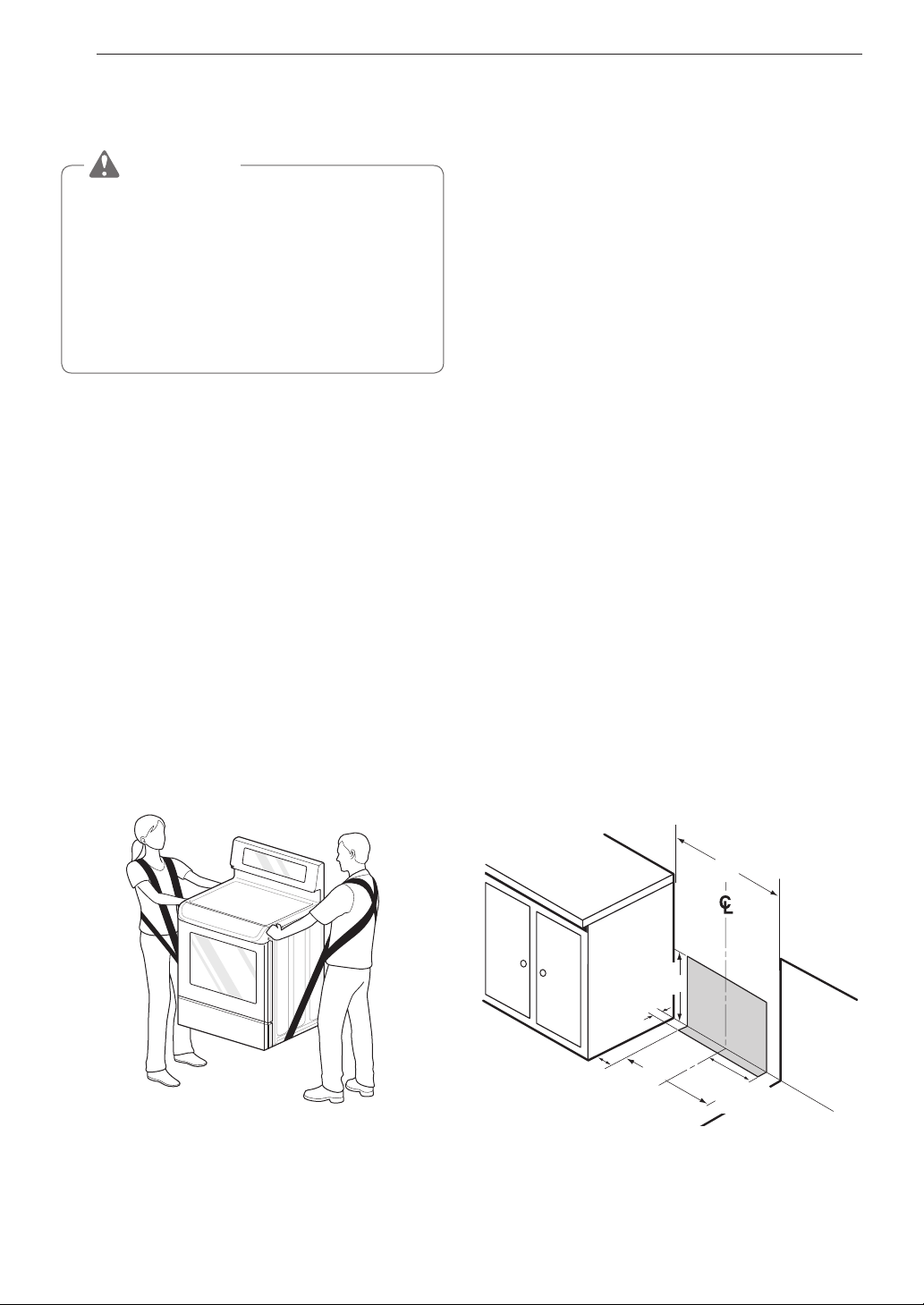
CAUTION
•
You should use two or more people to move
and install the range. (Excessive Weight
Hazard) Failure to do so can result in back or
other injury.
•
Do not use the door handles to push or
pull the range during installation or when
moving the range out for cleaning or
service. Doing so can result in serious damage
to the door of the range.
Remove packing material, tape and any temporary
labels from your range before using. Do not remove
any warning-type labels, the model and serial number
label, or the Tech Sheet that is located on the back of
the range.
To remove any remaining tape or glue, rub the area
briskly with your thumb. Tape or glue residue can also
be easily removed by rubbing a small amount of liquid
dish soap over the adhesive with your fingers. Wipe
with warm water and dry.
Do not use sharp instruments, rubbing alcohol,
flammable fluids, or abrasive cleaners to remove tape
or glue. These products can damage the surface of
your range.
Your range is heavy and can be installed on soft
floor coverings such as cushioned vinyl or carpeting.
Use care when moving the range on this type of
flooring. Use a belt when moving the range to prevent
damaging the floor. Or slide the range onto cardboard
or plywood to avoid damaging the floor covering.
Choosing the Proper Location
Do not locate your range where it may be subject to
strong drafts. Any openings in the floor or wall behind
the range should be sealed. Make sure the openings
around the base of the range that supply fresh air
for combustion and ventilation are not blocked by
carpeting or woodwork.
Your range, like many other household units, is heavy
and can be installed on soft floor coverings such as
cushioned vinyl or carpeting. Use care when moving
the range on this type of flooring.
This appliance must not be installed with a ventilation
system that blows air downward toward the range.
This type of ventilation system may cause ignition and
combustion problems with the gas cooking appliance
resulting in personal injury or unintended operation.
When the floor covering ends at the front of the
range, the area that the range will be installed on
should be built up with plywood to the same level
or higher than the floor covering. This will allow the
range to be moved for cleaning and servicing, as well
as provide proper air flow to the range.
Also, make sure the floor covering can resist
temperatures of at least 167 °F (75 °C). See the
Installation Safety Precautions included in this
manual.
Make sure the wall coverings around your range can
resist the heat generated up to 194 °F (90 °C) by
the range. See the Precautions Safety Precautions
included in this manual.
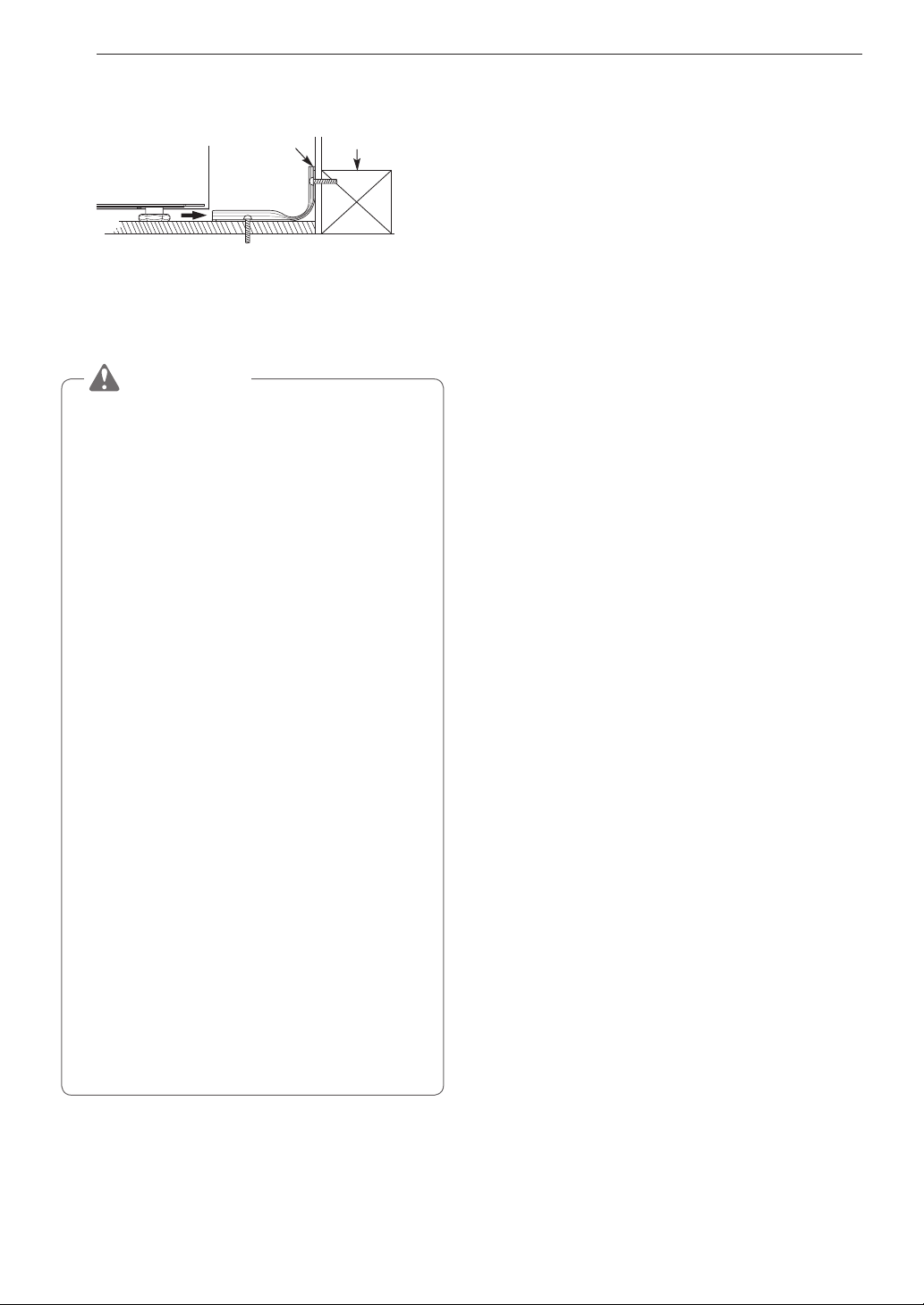
Gas Pipe and Electrical Outlet
Locations
30"
(76.2 cm)
3"
(7.6 cm)
24
1
/
32
"
(61 cm)
12
1
/
32
"
(30.6 cm)
2"
(5.1 cm)
10
7
/
16
"
(26.5 cm)

15
INSTALLATION
ENGLISH
Dimensions and Clearances
Provide proper clearance between the range and adjacent combustible surfaces. These dimensions must be met
for safe use of your range. The location of the electrical outlet and pipe opening (see Gas Pipe and Electrical
Outlet Locations, page 14) may be adjusted to meet specific requirements. The range may be placed with 0"
clearance (flush) at the back wall.
Maximum
depth for
cabinets
above
coutertops
Minimum
clearance
to left wall
Minimum to
cabinets on
either side
of the range
Minimum
clearance
to right wall
Front edge
of the range
side panel
forward from
cabinet
To cabinets
below
cooktop and
at the range
back
Depth with door closed
(includes door handle)
30"
(76.2 cm)
30" (76.2 cm)
Minimum
18"
(45.72 cm)
5"
5" (12.7 cm)
1
/
4
"
(0.6 cm)
27
9
/
16
"
(70 cm)
36
1
/
32
"
(91.5 cm)
Height
47
7
/
16
"
(120.5 cm)
Depth with door open
46
5
/
16
"
(117.5 cm)
30"
(76.2 cm)
13" (33 cm)
0"
Dimensions
Installation Clearances
36"
(91.4 cm)
16
INSTALLATION
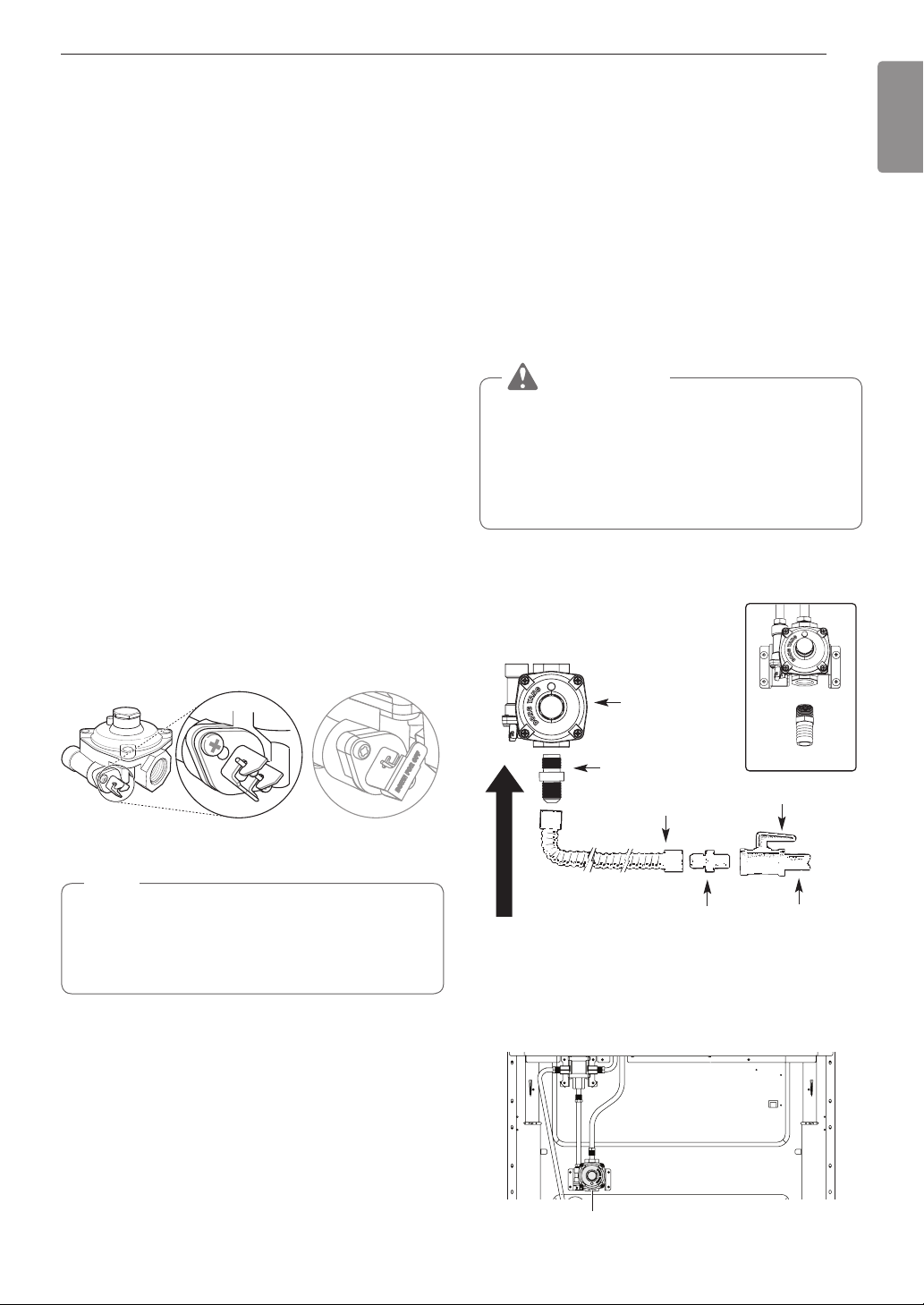
Installing the Anti-tip Device
Anti-tip
bracket
Wall plate
Screw must
enter wood or
concrete
The anti-tip bracket is packaged with an installation
template. The instructions include necessary
information to complete the installation. Read and
follow the range installation instruction sheet.
WARNING
•
Range must be secured with an approved
anti-tip device.
•
The range could be tipped by standing, sitting
or leaning on an open door if the range or
anti-tip device is not properly installed.
•
After installing the anti-tip device, verify that it is
in place by carefully attempting to tilt the range
forward.
•
This range has been designed to meet all
recognized industry tip standards for all normal
conditions.
•
The installation of the anti-tip device must meet
all local codes for securing the appliance.
•
The use of this device does not preclude tipping
of the range when not properly installed.
•
A child or adult can tip the range and be killed.
•
Install the anti-tip device to the structure and/
or the range. Verify the anti-tip device has been
properly installed and engaged by following the
guide of the Anti tip bracket template.
•
Engage the range to the anti-tip device by
following the guide of the Anti tip bracket
template. Ensure the anti-tip device is re-
engaged when the range is moved by following
the guide of the Anti tip bracket template.
•
Re-engage the anti-tip device if the range is
moved. Do not operate the range without the
anti-tip device in place and engaged.
•
See installation instructions for details.
•
Failure to do so can result in death or serious
burns to children or adults.
Providing Adequate Gas
Supply
The range is designed to operate at a pressure of
5" of water column on natural gas or 10" of water
column on LP.
Make sure you are supplying your range with the type
of gas for which it is configured.
This range is convertible for use on natural or LP gas.
When using this range on LP gas, conversion must
be made by a qualified LP installer before attempting
to operate the range.
For proper operation, the pressure of natural gas
supplied to the regulator must be between 5" and 13"
of water column.
For LP gas, the pressure supplied to the regulator
must be between 10" and 13" of water column. When
checking for correct operation of the regulator, the
inlet pressure must be at least 1" more than the
operating (manifold) pressure as given above.
The pressure regulator located at the inlet of the
range must remain in the supply line regardless of
which type of gas is being used.
A flexible metal appliance connector used to connect
the range to the gas supply line should have an I.D.
of
5
/
8
" and a maximum length of 5 feet. In Canada,
flexible connectors must be single wall metal
connectors less than 6 feet in length.
17
INSTALLATION
ENGLISH
Connecting the Range to Gas
Shut off the range gas supply valve before
removing the old range and leave it off until the
new hook-up has been completed.
Because hard piping restricts movement of the range,
the use of a CSA International-certified flexible metal
appliance connector should be used unless local
codes require a hard-piped connection.
A manual valve shall be installed in an accessible
location in the gas piping external to the appliance
for the purpose of turning on or shutting off gas to the
appliance.
Never reuse an old connector when installing a new
range.
To protect against gas leaks, use a qualified pipe joint
sealant on all external threads.
1
Install a male
1
/
2
" or
3
/
4
" flare union adapter to the
NPT internal thread of the manual shut-off valve,
taking care to back-up the shut-off valve to keep
it from turning.
2
Install a male
1
/
2
" flare union adapter to the
1
/
2
"
NPT internal thread at the inlet of the pressure
regulator. Use a backup wrench on the pressure
regulator fitting to prevent damage.
Check that the gas pressure regulator valve is in the
open position.
Lever’s open
position
Lever’s closed
position
NOTE
•
The gas pressure regulator valve is open when
shipped. If the range does not work properly
after installation, make sure the regulator valve
is still open.
3
Connect a flexible metal appliance connector to
the adapter on the range. Position the range to
permit connection at the shut-off valve.
4
When all connections have been made, be sure
all range controls are in the OFF position and the
pressure regulator valve is open before turning
on
the main gas supply valve. Gas leaks may
occur in
your system and create a hazard. Gas
leaks may not
be detected by smell alone.
Check all gas connection joints and fittings for
leaks with a non-corrosive leak detection fluid,
then wipe off.
Gas suppliers recommend you purchase and
install a UL approved gas detector. Install
and use in accordance with the installation
instructions.
WARNING
•
Do not use a flame to check for gas leaks.
•
Isolate the range from the gas supply system
by closing its individual shut-off valve during
any pressure testing of the gas supply system
at test pressures equal to or less than
1
/
2
" psig
(3.5 kPa).
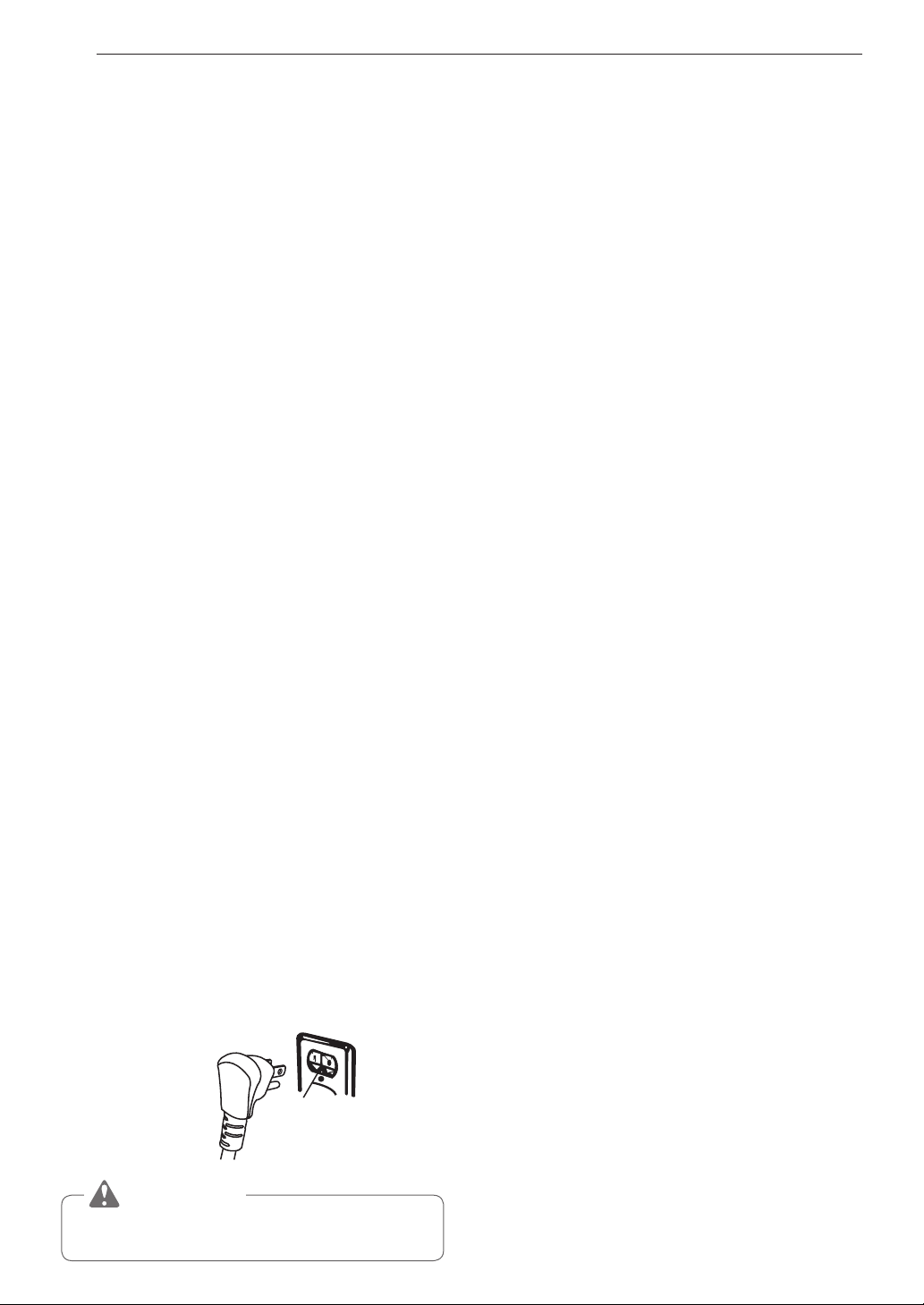
Flexible Connector Hookup
1
/
2
"
Adapter
1
/
2
" Adapter
1
/
2
"
Adapter
Pressure
regulator
Flex connector
(6 ft. max.)
Gas shut-off valve
1
/
2
" or
3
/
4
"
Gas pipe
Gas Flow into Range
Installer: Inform the consumer of the location of the gas
shut-off valve
.
Pressure Regulator Position
Pressure Regulator
18
INSTALLATION
Electrical Connections
Electrical Requirements
120 Volt, 60 Hz, properly grounded dedicated circuit
protected by a 15 or 20 Amp circuit breaker, or slow
blow fuse.
If an external electrical source is utilized, the
appliance, when installed, must be electrically
grounded in accordance with local codes or, in the
absence of local codes, with the National Electrical
Code, ANSI/NFPA 70.
Grounding
IMPORTANT: FOR PERSONAL SAFETY, THIS
APPLIANCE MUST BE PROPERLY GROUNDED.
The power cord of this appliance is equipped with
a 3-prong (grounding) plug which mates with a
standard 3-prong grounding wall receptacle to
minimize the possibility of electric shock hazard from
this appliance.
The customer should have the wall receptacle and
circuit checked by a qualified electrician to make sure
the receptacle is properly grounded.
Where a standard two-prong wall receptacle is
encountered, it is the personal responsibility and
obligation of the customer to have it replaced with a
properly grounded three-prong wall receptacle.
DO NOT, UNDER ANY CIRCUMSTANCES, CUT OR
REMOVE THE THIRD (GROUND) PRONG FROM
THE POWER CORD.
A word about GFCI’s – GFCI’s are not required or
recommended for gas range receptacles.
Ground Fault Circuit Interrupters (GFCI’s) are
devices that sense leakage of current in a circuit
and automatically switch off power when a threshold
leakage level is detected. These devices must
be manually reset by the consumer. The National
Electrical Code requires the use of GFCI’s in kitchen
receptacles installed to serve countertop surfaces.
Performance of the range will not be affected
if operated on a GFCI-protected circuit but the
occasional resetting of the circuit can become an
annoyance.
Ensure proper ground
exists before use
Preferred
Method
CAUTION
Have the circuit checked by a qualified electrician
to make sure the receptacle is properly grounded.
Do not use an adapter plug. Disconnecting of the
power cord places undue strain on the adapter
and leads to eventual failure of the adapter ground
terminal.
Installation must conform with local codes or, in the
absence of local codes, with the National Fuel Gas
Code, ANSI Z223.1/NFPA 54.
The installation of appliances designed for mobile
home installation must conform with the Manufactured
Home Construction and Safety Standard, Title 24
CFR, Part 3280 (formerly the Federal Standard
for Mobile Home Construction and Safety, Title
24, HUD, Part 280) or, when such standard is not
applicable, the Standard for Manufactured Home
Installations, latest edition (Manufactured Home Sites,
Communities and Set-Ups), ANSI A225.1, latest
edition, or with local codes. In Canada, mobile home
installation must be in accordance with the current
CAN/CSA Z240/MH Mobile Home Installation Code.
Sealing the Openings
Seal any openings in the wall and floor after electrical
and gas supplies are completed.
19
INSTALLATION
ENGLISH
Assembling the Surface
Burners
CAUTION
Do not operate the burners without all parts in
place.
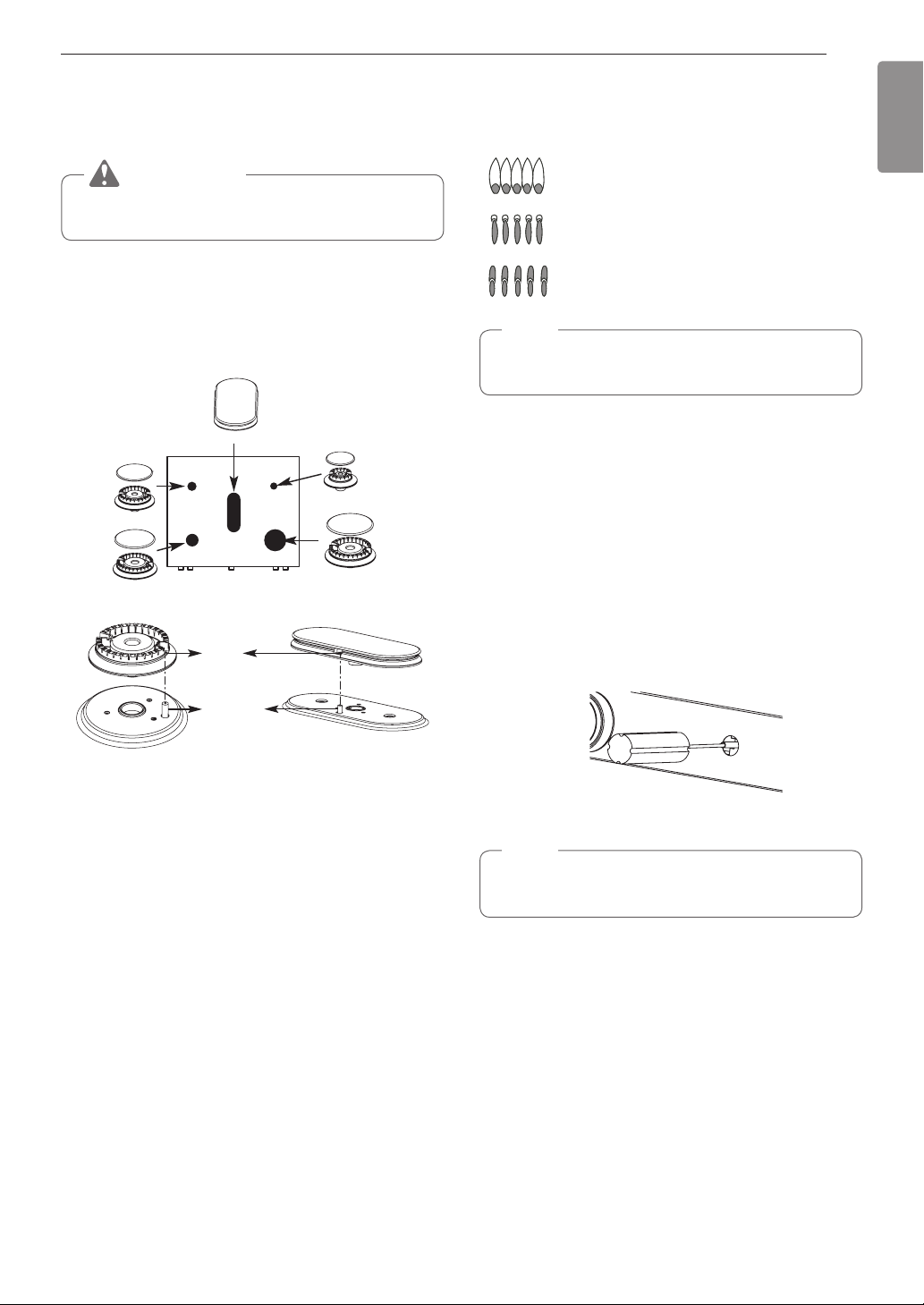
Place the burner caps and heads on the cooktop.
Make sure that the caps and heads are placed in the
correct locations. There is one small, one medium,
one large, and one extra large burner head and cap.
Center Burner
Oval (Center) burner
head/cap assembly
Small burner
head and
cap
Medium
burner
head
and cap
Large burner
head and cap
Front of range
Extra large burner
head and cap
Hole
Electrode
Make sure the hole in the burner head is positioned
over the electrode.
Checking Ignition of the
Surface Burners
Electric Ignition
Select a surface burner knob and simultaneously
push in and turn to the Lite position. You will hear
a clicking sound indicating proper operation of the
spark module.
Once the air has been purged from the supply lines
the burner should ignite within 4 seconds. After the
burner ignites, rotate the knob out of the Lite position.
Try each burner in succession until all burners have
been checked.
Quality of Flames
The combustion quality of the burner flames needs to
be confirmed visually.
A Yellow flames - Call for service.
B Yellow tips on outer cones - This
is normal for LP gas.
C Soft blue flames - This is normal
for natural gas.
NOTE
•
With LP gas, some yellow tipping on outer
cones is normal.
Adjusting the Surface Burner to the
Low Flame (Simmer) Setting
1
Light all surface burners.
2
Turn the knob on the burner being adjusted to
Lo.
3
Remove the knob.
4
Insert a small, flat-blade screwdriver into the
valve shaft.
Center adjustment screw
NOTE
Hold the valve shaft with one hand while turning
the screw to adjust with the other.
5
Replace the knob.
6
Test the flame stability.
Test 1: Turn the knob from Hi to Lo quickly. If the
flame goes out, increase the flame size and test
again.
Test 2: With the burner on a Lo setting, open
and close the oven door quickly. If the flame is
extinguished by the air currents created by the
door movement, increase the flame height and
test again.
7
Repeat steps 1-6 for each surface burner.
20
INSTALLATION
Checking Operation of Bake / Broil
Burners
To check ignition of the Bake burner, follow the steps
below
1
Remove all packing materials from inside the
oven cavity.
2
Press the Bake. 350 °F appears in the display.
3
Press the Start.
It may take between 30 and 90 seconds for the
burner to start heating.
To check ignition of the Broil burner, follow the steps
below
1
Press the Broil. Hi appears in the display.
2
Make sure the door is closed.
3
Press the Start.
It may take between 30 and 90 seconds for the
burner to start heating.
NOTE
Do not try to light either the Bake or Broil burners
during a power outage. The range has an
electrical ignition system and cannot be used
without power.
Adjusting Air Shutters (for LP
Conversions)
The range comes from the factory with the air
shutters adjusted for proper air flow for natural gas.
If converted to LP, follow the instructions provided in
the conversion kit to properly adjust the air shutters.
LP conversion must be performed by a qualified
technician.
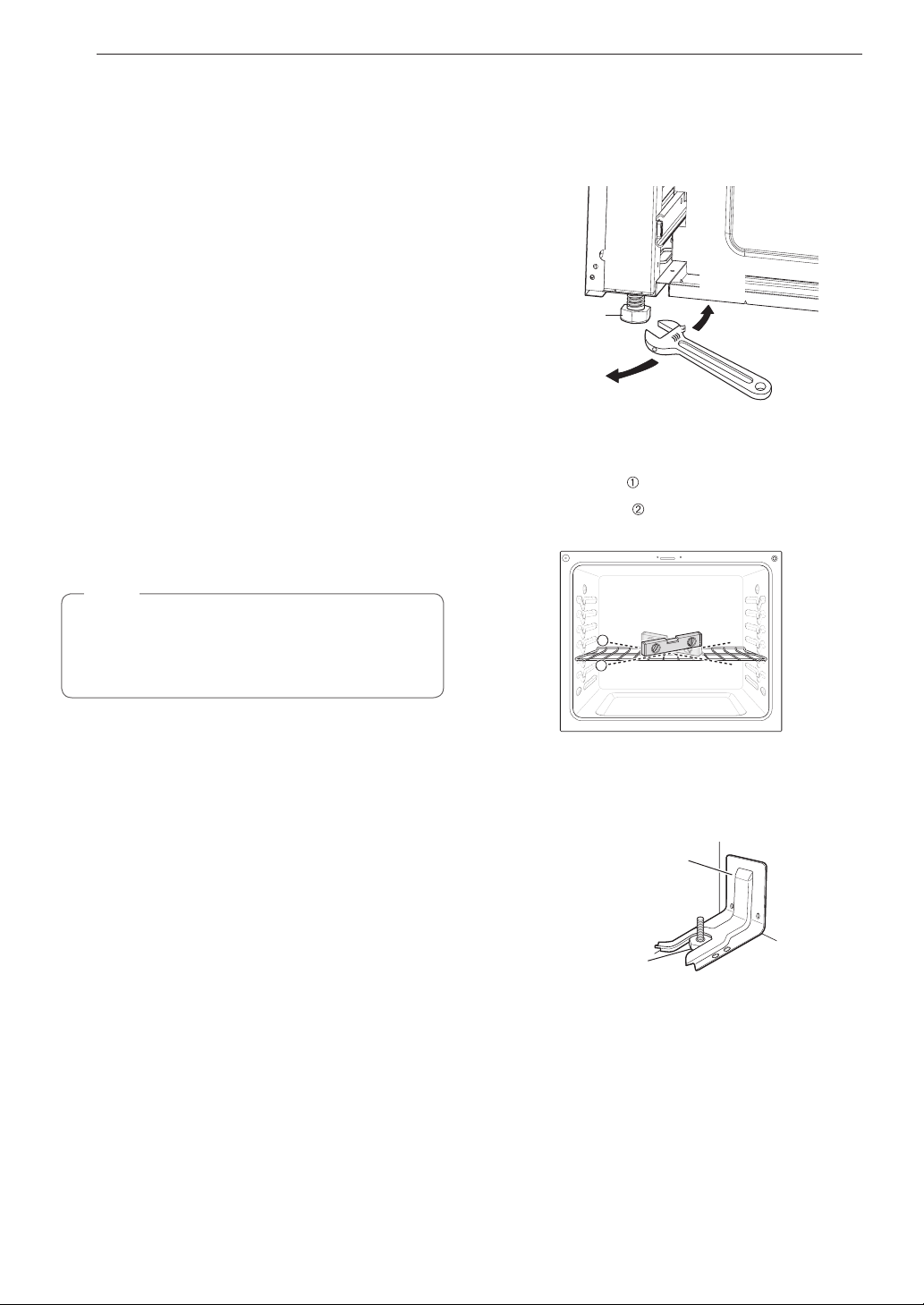
Leveling the Range
Level the range by adjusting the leveling legs.
Extending the legs slightly may also make it easier to
insert the rear leg into the anti-tip bracket.
Leg leveler
Raise range
Lower
range
Use a level to check your adjustments. Place the level
diagonally on the oven rack, and check each direction
for level.
First check direction
.
Then check direction
. If the level doesn’t show level
on the rack, adjust the leveling legs.
1
2
Engaging the Anti-tip Device
Anti-tip
bracket
Leveling leg
1
Slide the range against the wall, making sure
the back leg slides into and engages the anti-tip
bracket.
2
Check for proper installation by grasping
the front edge of the cooktop and carefully
attempting to tilt the range forward.
21
OPERATION
ENGLISH
OPERATION
Gas Surface Burners
Before Use
Read all instructions before using.
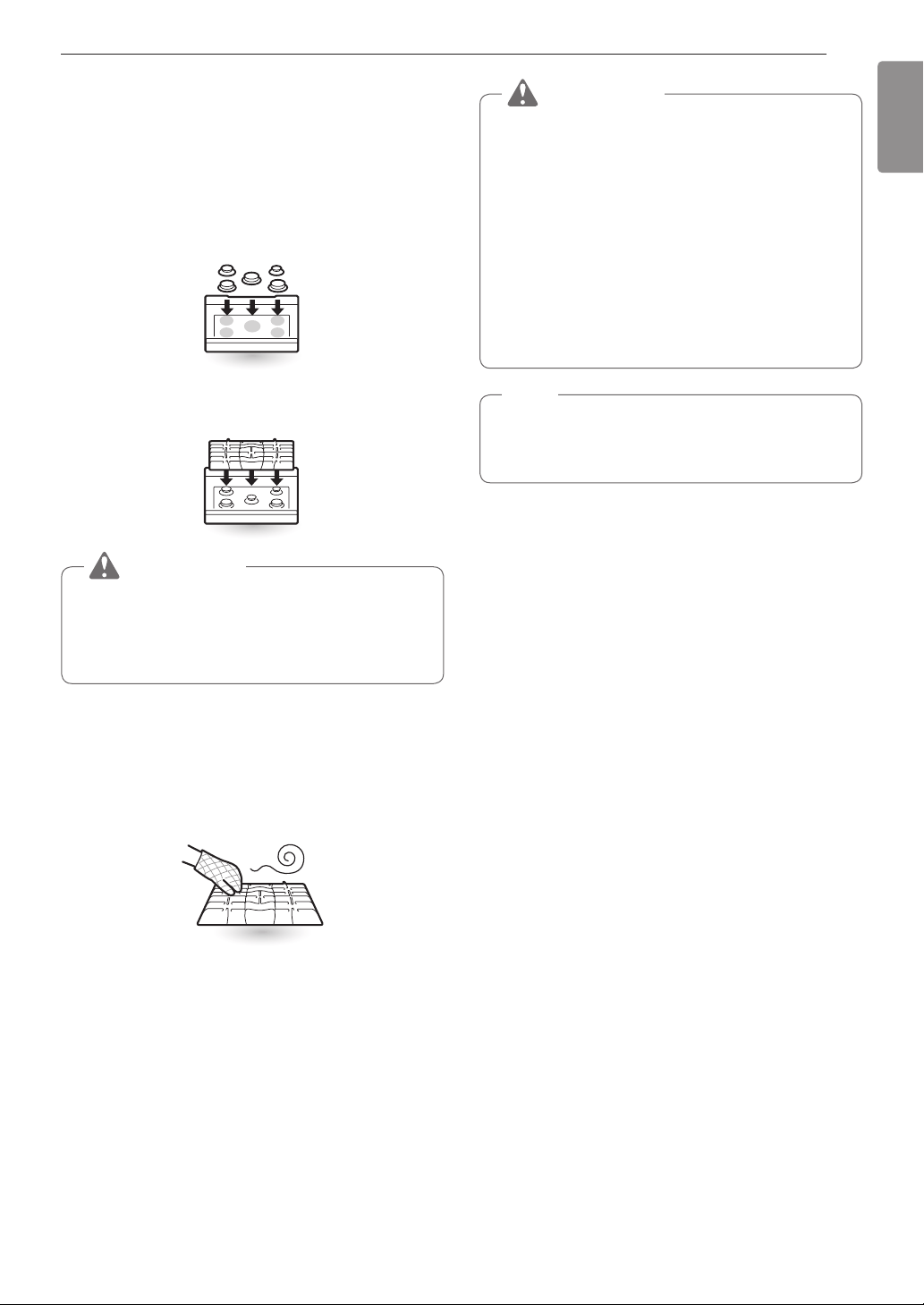
Make sure that all burners are properly placed.
Make sure that all grates are properly placed
before using the burner.
CAUTION
Do not operate the burner for an extended period
of time without cookware on the grate.
The finish on the grate may chip without cookware
to absorb the heat.
Make sure the burners and grates are cool before
touching them, or placing a pot holder, cleaning
cloth, or other materials on them.
Touching grates before they cool down may cause
burns.
CAUTION
WHAT TO DO IF YOU SMELL GAS
•
Open windows.
•
Do not try to light any appliance.
•
Do not touch any electrical switch.
•
Do not use any phone in your building.
•
Immediately call your gas supplier from a
neighbor’s phone. Follow the gas supplier’s
instructions.
•
If you cannot reach your gas supplier, call the
fire department.
NOTE
Electric spark igniters from the burners cause
a clicking noise. All the spark igniters on the
cooktop will activate when igniting just one burner.
22
OPERATION
Burner Locations
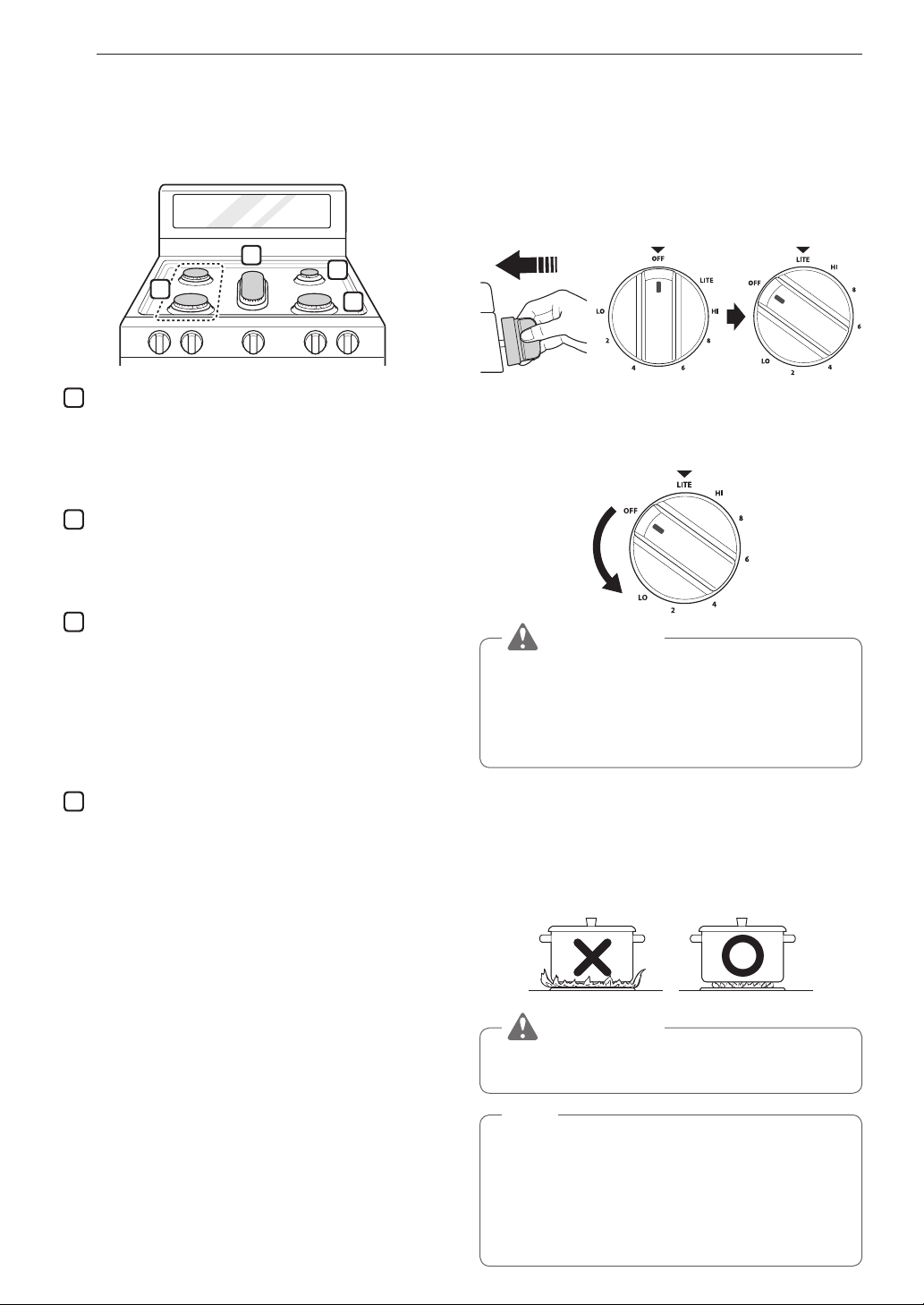
Your gas range cooktop has four or five sealed gas
burners, depending on the model. These can be
assembled and separated. Follow the guide below.
1
4
2
3
1
Medium and Large Burners
The medium and large burners are the primary
burners for most cooking. These general
purpose burners can be turned down from Hi to
Lo to suit a wide range of cooking needs.
2
Small Burner
The smallest burner is used for delicate foods
such as sauces or foods that require low heat for
a long cooking time.
3
Extra Large Burner
The extra large burner is the maximum output
burner. Like the other four burners, it can be
turned down from Hi to Lo for a wide range
of cooking applications. This burner is also
designed to quickly bring large amounts of liquid
to a boil. It can be used with cookware 10 inches
or larger in diameter.
4
Oval Burner
The center, oval burner is for use with a griddle
or oval pots.
Using the Gas Surface Burners
1
Be sure that all of the surface burners and grates
are placed in the correct positions.
2
Place cookware on the grate.
3
Push the control knob and turn to the Lite
position.
The electric spark ignition system makes a
clicking noise.
4
Turn the control knob to control the flame size.
CAUTION
Do not attempt to disassemble or clean around
any burner while another burner is on. All the
burners spark when any burner is turned to Lite.
An electric shock may result causing you to knock
over hot cookware.
Setting the Flame Size
Watch the flame, not the knob, as you reduce heat.
Match the flame size on a gas burner to the cookware
being used for fastest heating.
CAUTION
Never let the flames extend up the sides of the
cookware.
NOTE
•
The flames on the surface burners may burn
yellow in the presence of high humidity, such as
a rainy day or a nearby humidifier.
•
After LP gas conversion, flames can be bigger
than normal when you put a pot on the surface
burner.
23
OPERATION
ENGLISH
In Case of Power Failure
In case of a power failure, you can light the gas
surface burners on the range with a match.
Surface burners in use when an electrical power
failure occurs will continue to operate normally.
1
Hold a lit match to the burner, then push in the
control knob.
2
Turn the control knob to the Lo position.
CAUTION
Use extreme caution when lighting burners with a
match. It can cause burns and other damage.
Range-Top Cookware
Aluminum
Medium-weight cookware is
recommended because it heats
quickly and evenly. Most foods
brown evenly in an aluminum
skillet. Use saucepans with tight
fitting lids when cooking with
minimum amounts of water.
Cast-Iron
If heated slowly, most skillets will
give satisfactory results.
Stainless Steel
This metal alone has poor
heating properties and is usually
combined with copper, aluminum
or other metals for improved heat
distribution. Combination metal
skillets work satisfactorily if they
are used with medium heat as the
manufacturer recommends.
Enamelware
Under some conditions, the
enamel of this cookware may melt.
Follow cookware manufacturer’s
recommendations for cooking
methods.
Glass
There are two types of glass
cookware. Those for oven use only
and those for top-of-range cooking.
Heatproof
Glass Ceramic
Can be used for either surface or
oven cooking. It conducts heat very
slowly and cools very slowly. Check
cookware manufacturer’s directions
to be sure it can be used on gas
ranges.
Using a Wok
If using a wok, use a 14-inch or smaller flat-bottomed
wok. Make sure that the wok bottom sits flat on the
grate.
Use at-bottomed
wok
CAUTION
Do not use a wok support ring. Placing the ring
over the burner or grate may cause the burner
to work improperly, resulting in carbon monoxide
levels above allowable standards. This can be
hazardous to your health.
Using Stove-Top Grills
Do not place stove-top grills on the burner.
CAUTION
Do not use stove top grills on the surface burners.
Using a stove top grill on the surface burner will
cause incomplete combustion and can result
in exposure to carbon monoxide levels above
allowable current standards. This can be a health
hazard.
24
OPERATION
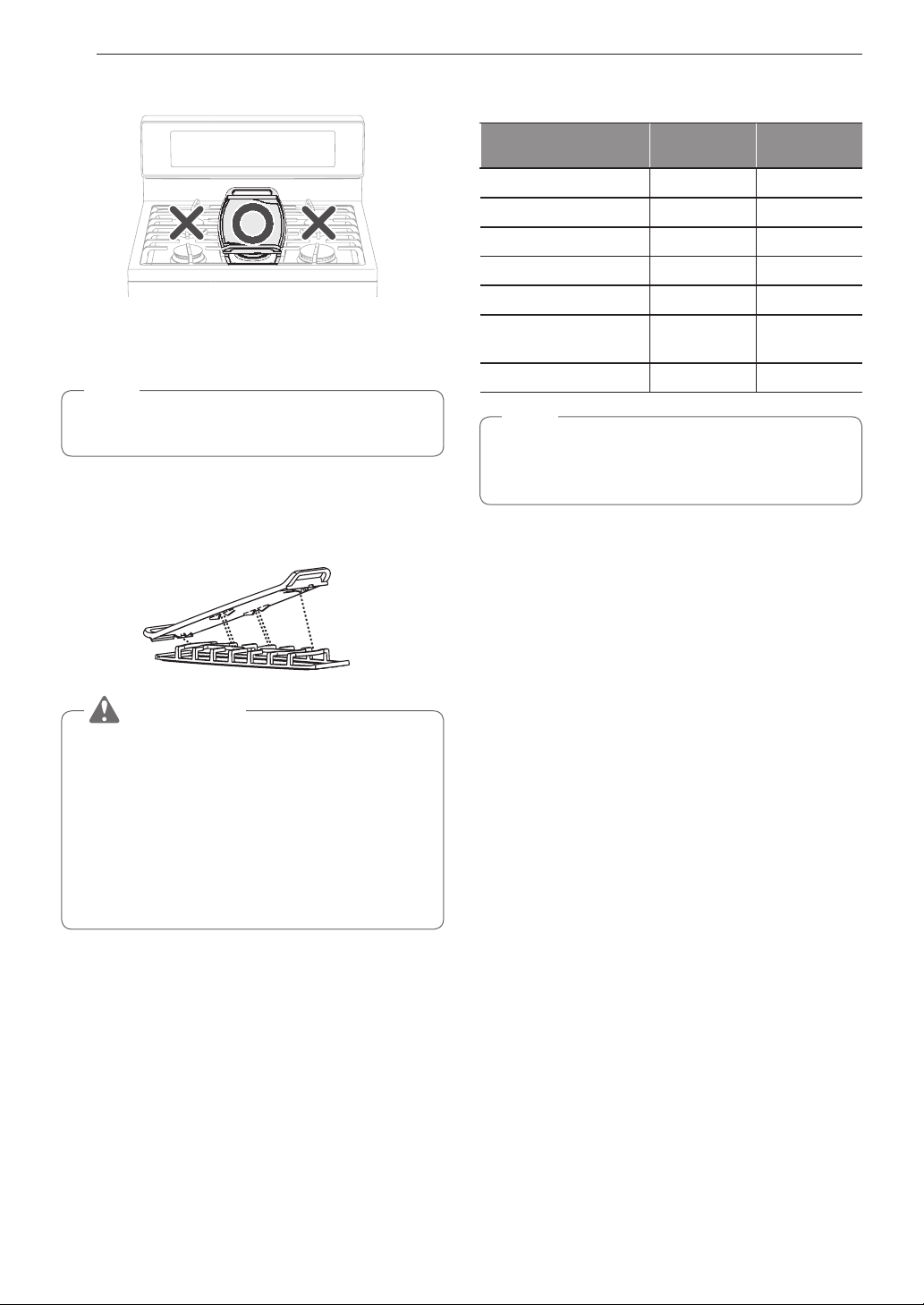
Using the Griddle
The non-stick coated griddle provides an extra-large
cooking surface for meats, pancakes or other food
usually prepared in a frying pan or skillet.
NOTE
It is normal for the griddle to become discolored
over time.
How to Place the Griddle: The griddle can only be
used with the center burner. The griddle must be
properly placed on the center grate, as shown below.
Front
CAUTION
•
Do not remove the center grate when using the
griddle.
•
Do not remove the griddle plate until the
cooktop grates, surfaces and griddle plate have
completely cooled.
•
The griddle plate on the cooktop may become
very hot when using the cooktop, oven or
broiler systems. Always use oven mitts when
placing or removing the griddle plate.
Preheat the griddle according to the guide below and
adjust for the desired setting.
Type of Food
Preheat
Conditions
Cook
Setting
Warming Tortillas - HI
Pancakes HI 10 min. HI
Hamburgers HI 10 min. HI
Fried Eggs HI 5 min. HI
Bacon HI 10 min. HI
Breakfast Sausage
Links
HI 10 min. HI
Hot Sandwiches HI 10 min. HI
NOTE
After cooking on the griddle for an extended
period, adjust the griddle temperature settings as
the griddle retains heat.
IMPORTANT NOTES
•
Avoid cooking extremely greasy foods as grease
spillover can occur.
•
The griddle can become hot when surrounding
burners are in use.
•
Do not overheat the griddle. This can damage the
non-stick coating.
•
Do not use metal utensils that can damage the
griddle surface. Do not use the griddle as a cutting
board.
•
Do not place or store items on the griddle.

25
OPERATION
ENGLISH
The Oven
Before Use
Read all instructions before using.
Make sure the electrical power cord and the gas
valve are properly connected.
Confirm the correct use of the range for the type
of food you will cook.
Make sure you know how to use the oven
(temperature setting, time setting and recipe) for best
results.
CAUTION
WHAT TO DO IF YOU SMELL GAS
•
Open windows.
•
Do not try to light any appliance.
•
Do not touch any electrical switch.
•
Do not use any phone in your building.
•
Immediately call your gas supplier from a
neighbor’s phone. Follow the gas supplier’s
instructions.
•
If you cannot reach your gas supplier, call the
fire department.
NOTE
If using an oven thermometer in the oven cavity,
temperatures may differ from the actual set oven
temperature with all modes.
In case of power failure, do not use the oven.
The oven and broiler cannot be used during a power
outage. If the oven is in use when a power failure
occurs, the oven burner shuts off and cannot be re-
lite until power is restored. Once power is restored,
you will need to reset the oven (or Broil function).
BlackOut
CAUTION
Do not attempt to operate the electric ignition
during an electrical power failure.
Do not block, touch or place items around the
oven vent during cooking.
Your oven is vented through ducts at the center above
the burner grate. Do not block the oven vent when
cooking to allow for proper air flow. Do not touch
vent openings or nearby surfaces during any cooking
operation.
CAUTION
•
Do not place plastic or flammable items on the
cooktop. They may melt or ignite if left too close
to the vent.
•
Do not place closed containers on the cooktop.
The pressure in closed containers may
increase, which may cause them to burst.
•
Metal items will become very hot if they are left
on the cooktop, and could cause burns.
•
Handles of pots and pans on the cooktop may
become hot if left too close to the vent.
Do not cover racks or oven bottom with aluminum
foil.
You may see condensation on the oven door
glass.
As the oven heats up, the heated air in the oven
may cause condensation to appear on the oven
door glass. These water drops are harmless and will
evaporate as the oven continues to heat up.
26
OPERATION
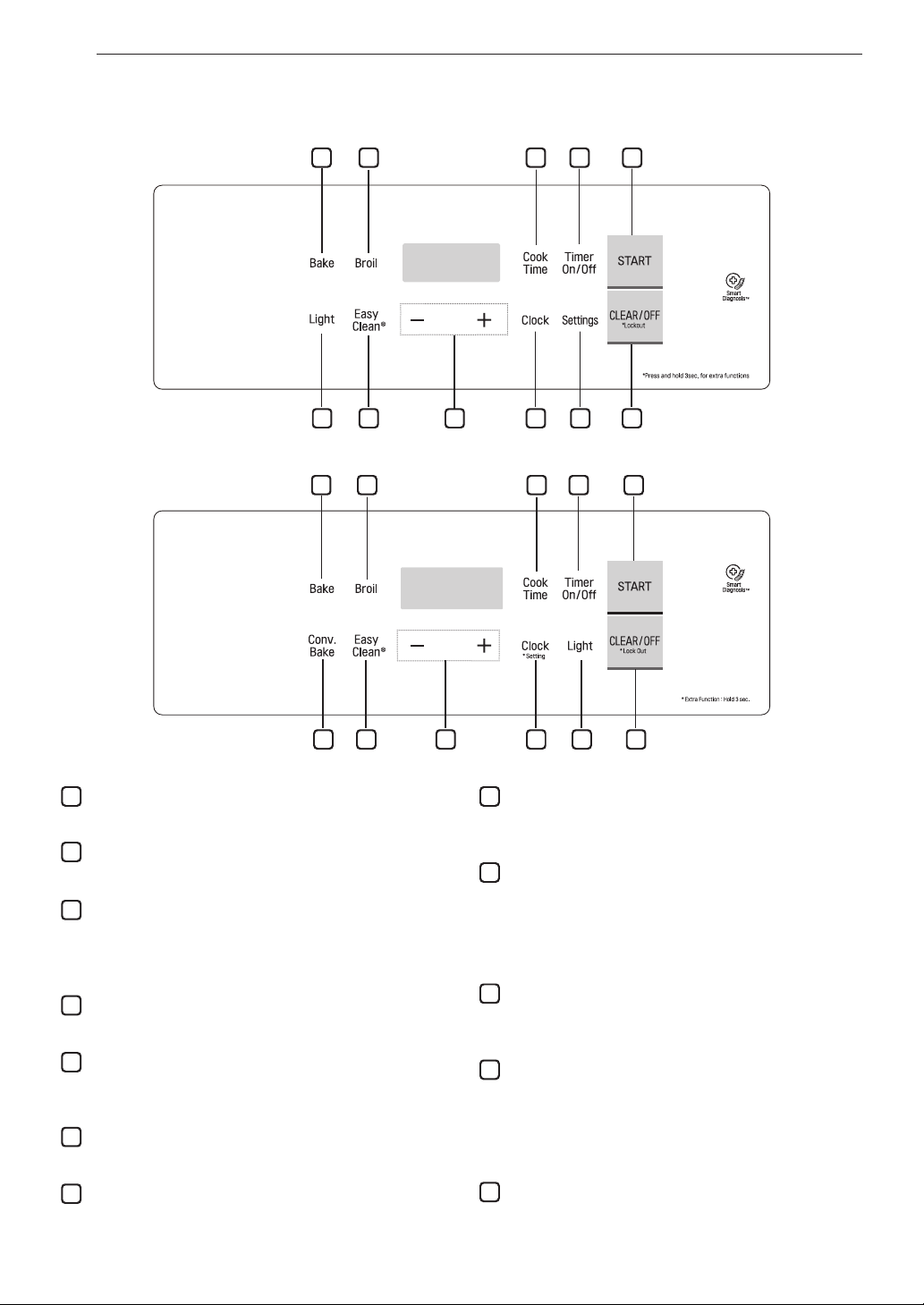
Control Panel Overview
For Model: LRG3061**, LRG3060**
1
6 7 8 9 10 11
2 3 4 5
For Model: LRG3193**
1
12 7 8 9 6 11
2 3 4 5
1
Bake
Press the button to enter the normal bake function.
2
Broil
Press the button to select the broil function.
3
Cook Time
Press and then use the + and – buttons to set the
desired cook time.
The oven shuts off when the cooking time runs out.
4
Timer On/Off
Press to select the timer feature.
5
START
Must be pressed to start any cooking or cleaning
function.
6
Oven Light
Press the button to turn the oven light on or off.
7
EasyClean
®
Cleans a lightly soiled oven automatically. See
EasyClean
®
in the Care and Cleaning section.
8
+/–
Enters or changes time and oven temperature.
Sets HI or LO broil.
9
Clock
•
Press and then use the + and - buttons to set the
time of day.
•
Press and hold the button for 3 seconds to change
the special settings (for model: LRG3193).
10
Setting
Press the Settings key repeatedly to toggle through
and change oven settings.
11
CLEAR OFF / Lockout
•
Press to cancel all oven operations except the
clock and timer.
•
Press and hold the button for 3 seconds to activate/
deactivate the oven Lockout function.
12
Conv. Bake (For Model: LRG3193)
Press the button to select baking wit the convection
function.
27
OPERATION
ENGLISH
Changing Oven Settings
Clock
The clock must be set to the correct time of day in
order for the automatic oven timing functions to work
properly.
1
Press Clock.
2
Press +/– button to set the time of day.
3
Press Start.
NOTE
•
The time of day cannot be changed during a
timed baking.
•
If no other keys are pressed within 25 seconds
of pressing Clock, the display reverts to the
original setting.
•
If the display time is blinking, there may have
been a power failure. Reset the time.
Oven Light
The interior oven light automatically turns on when
the door is opened. Press Light to manually turn the
oven light on.
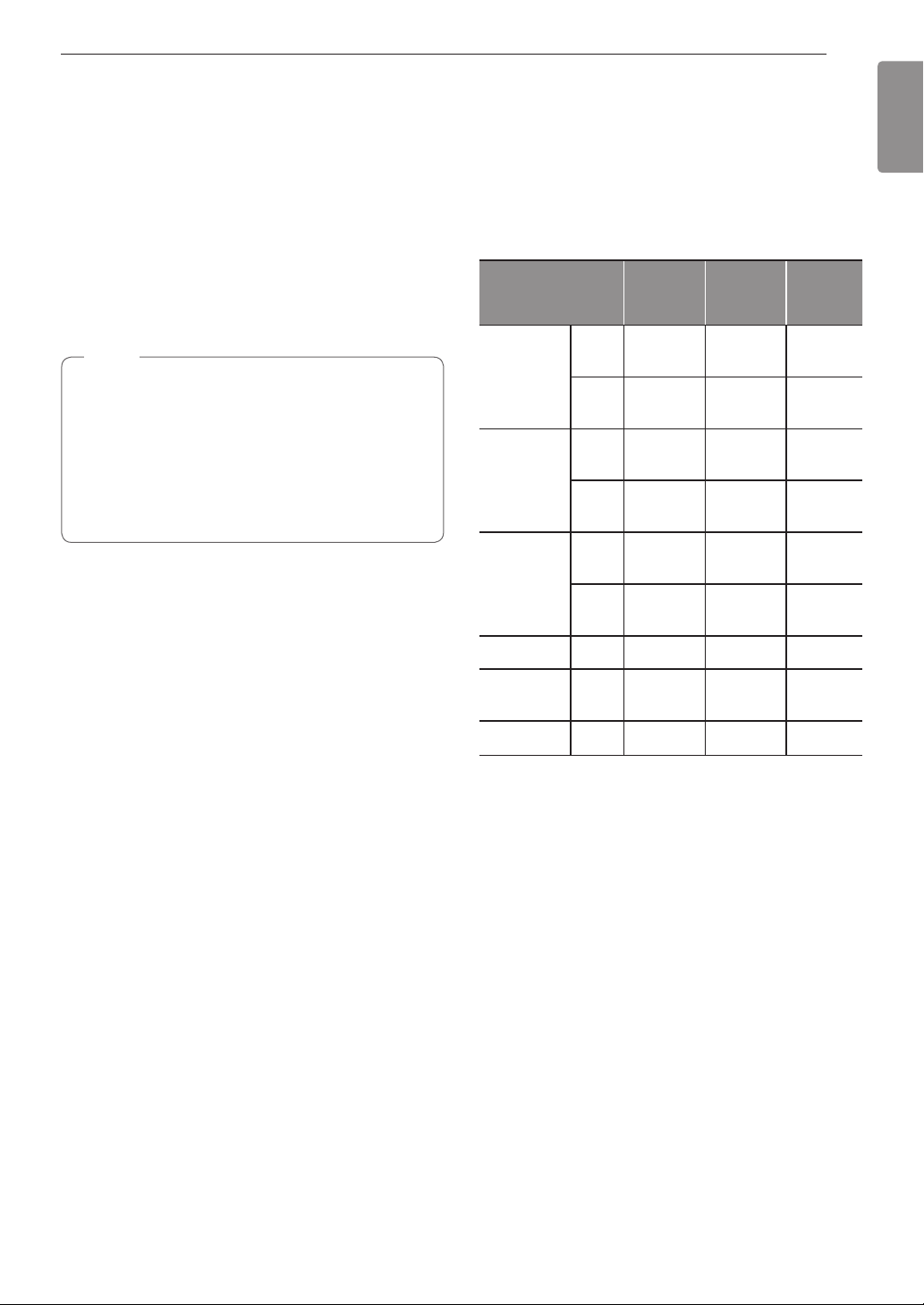
Minimum & Maximum Default Settings
All of the features listed have a minimum and a
maximum time or temperature setting that can be
entered into the control. A beep sounds each time a
button is pressed.
Two short tones sound if the entry of the temperature
or time is below the minimum or above the maximum
setting for the feature.
Feature
min.
Temp. /
Time
max.
Temp. /
Time
Default
Clock
12 Hr.
1:00
Hr. / min.
12:59
Hr. / min.
24 Hr.
0:00
Hr. / min.
23:59
Hr. / min.
Timer
12 Hr.
0:10
min. / sec.
11:59
Hr. / min.
24 Hr.
0:10
min. / sec.
11:59
Hr. / min.
Cook Time
12 Hr.
0:01
Hr. / min.
11:59
Hr. / min.
24 Hr.
0:01
Hr. / min.
11:59
Hr. / min.
Broil Lo Hi
Bake
170 °F /
80 °C
500 °F /
260 °C
350 °F /
175 °C
EasyClean
®
20 min.

28
OPERATION
Timer On/Off
The Timer On/Off feature serves as an extra timer in
the kitchen that beeps when the set time has run out.
It does not start or stop cooking.
The Timer On/Off feature can be used during any of
the other oven control functions.
1
Press Timer On/Off button once to set the time
in hours and minutes, or press the button twice
to set the time in minutes and seconds. TIMER
flashes in the display.
2
Press + or – button until the desired time
appears in the display.
3
Press Timer On/Off to start the Timer. The
remaining time countdown appears in the display.
NOTE
If Timer On/Off is not pressed, the timer returns
to the time of day.
4
When the timer reaches 0:00, End shows in the
display. The clock beeps 15 seconds until the
Timer On/Off button is pressed.
NOTE
If the remaining time is not in the display, recall
the remaining time by pressing Timer On/Off.
Cancelling the Timer
1
Press Timer On/Off once.
The display returns to the time of day.
Settings
For Model: LRG3193
Press and hold Clock for three seconds.
Then press the Clock key repeatedly to toggle
through and change oven settings.
For Model: LRG3061, LRG3060
Press the Settings button repeatedly to toggle
through and change oven settings.
The Settings button allows you to:
•
set the hour mode on the clock (12 or 24 hours)
•
adjust the oven temperature
•
activate/deactivate the preheating alarm light
•
set the beeper volume
•
switch the temperature scale between Fahrenheit
and Celsius
•
Set the Convection Auto Conversion Function
(for model: LRG3193)
Setting the Hour Mode
The control is set to use a 12-hour clock. To reset the
clock to 24-hour mode, follow the steps below.
For Model: LRG3193
1
Press and hold the Clock button for 3 seconds.
2
Press +/– to toggle between a 12-hour and 24-
hour clock.
3
Press Start to accept the change.
For Model: LRG3061, LRG3060
1
Press Settings once.
2
Press +/– to toggle between a 12-hour and 24-
hour clock.
3
Press Start to accept the change.
Adjusting the Oven Thermostat
This oven may cook differently from the one it
replaced. Use the oven for a few weeks to become
more familiar with it before changing the temperature
settings. After becoming more familiar with the oven,
if you notice a pattern of over- or underheating, follow
these steps to adjust the thermostat.
NOTE
To begin, either raise or lower the thermostat
15 °F (8 °C). Try the oven with the new setting. If
the oven still needs adjustment, raise or lower the
thermostat again, using the first adjustment as a
gauge. For example, if the adjustment was too
much, raise or lower the thermostat 10 °F (5 °C).
If the adjustment was not enough, raise or lower
the thermostat 20 °F (12 °C). Proceed in this way
until the oven is adjusted to your satisfaction.

29
OPERATION
ENGLISH
For Model: LRG3193
1
Press and hold the Clock button for 3 seconds.
2
Press Clock repeatedly until AdJU appears in
the display.
3
Using the + button, enter the amount you wish to
increase the temperature.
4
Using the – button, enter the amount you wish to
decrease the temperature.
5
Press Start to accept the change.
For Model: LRG3061, LRG3060
1
Press Settings repeatedly until AdJU appears
in the display.
2
Using the + button, enter the amount you wish to
increase the temperature.
3
Using the – button, enter the amount you wish to
decrease the temperature.
4
Press Start to accept the change.
NOTE
•
This adjustment does not affect the broiling.
The adjustment is retained in memory after
a power failure. The oven thermostat can be
increased (+) or decreased (-) as much as 35
°F or 19 °C.
•
Once the thermostat is increased or decreased,
the display shows the adjusted temperature
until it readjusts.
Turning the Preheat Alarm Light On/Off
When the oven reaches its set temperature, the
preheating alarm light flashes 5 times or until the
oven door is opened.
You can activate or deactivate the preheating alarm
light.
For Model: LRG3193
1
Press and hold the Clock button for 3 seconds.
2
Press Clock repeatedly until PrE appears in the
display.
3
Press +/– to turn the light on/off.
4
Press Start to accept the change.
For Model: LRG3061, LRG3060
1
Press Settings repeatedly until PrE appears in
the display.
2
Press +/– to turn the light on/off.
3
Press Start to accept the change.
Adjusting the Beeper Volume
For Model: LRG3193
1
Press and hold the Clock button for 3 seconds.
2
Press Clock repeatedly until Beep appears in
the display.
3
Press +/– to select Hi, Lo or Off.
4
Press Start to accept the change.
For Model: LRG3061, LRG3060
1
Press Settings repeatedly until Beep appears in
the display.
2
Press +/– to select Hi, Lo or Off.
3
Press Start to accept the change.
Selecting Fahrenheit or Celsius
Set the oven temperature display to show either
Fahrenheit (°F) or Celsius (°C) units. The oven
defaults to Fahrenheit unless changed by the user.
For Model: LRG3193
1
Press and hold the Clock button for 3 seconds.
2
Press Clock repeatedly until Unit appears in the
display.
3
Press +/– to select F (Fahrenheit) or C (Celsius).
4
Press Start to accept the change.
For Model: LRG3061, LRG3060
1
Press Settings repeatedly until Unit appears in
the display.
2
Press +/– to select F (Fahrenheit) or C (Celsius).
3
Press Start to accept the change.

30
OPERATION
Setting the Convection Auto Conversion Function
(For Model: LRG3193)
When using convection bake, the convection auto
conversion feature will automatically convert entered
regular baking temperatures to convection baking
temperatures. This feature is activated so that the
display will show the actual converted temperature.
For example, if you enter a regular recipe temperature
of 350°F and press the START button, the display will
show the converted temperature of 325˚F.
1
Press and hold the Clock button for 3 seconds.
2
Press Clock repeatedly until Auto appears in
the display.
3
Press the +/- button to switch Auto Conversion
on or off.
4
Press START to accept the change.
Lockout
The Lockout feature disables most oven controls. It
does not disable the timer or interior oven light or lock
the oven door.
1
Press and hold the Clear/Off button for three
seconds. A melody sounds and appears
in the display.
2
To deactivate the Lockout feature, press and
hold the Clear/Off button for three seconds.
Cook Time (Timed Cook)
Set the oven to cook for a specific length of time
using the Timed Cook feature. This feature can only
be used with the Bake modes.
Setting a Timed Cook
1
Press Cook Time.
2
Press +/– button to set the time of day.
3
Press the Start button. The clock is set, and the
display reflects the change after a short delay.
Removing and Replacing the Oven
Racks
CAUTION
•
Replace the oven racks before turning the oven
on to prevent burns.
•
Do not cover the racks with aluminum foil, or
any other material, or place anything on the
bottom of the oven. Doing so will result in poor
baking performance and may damage the oven
bottom.
•
Only arrange oven racks when the oven is cool.
Removing Racks
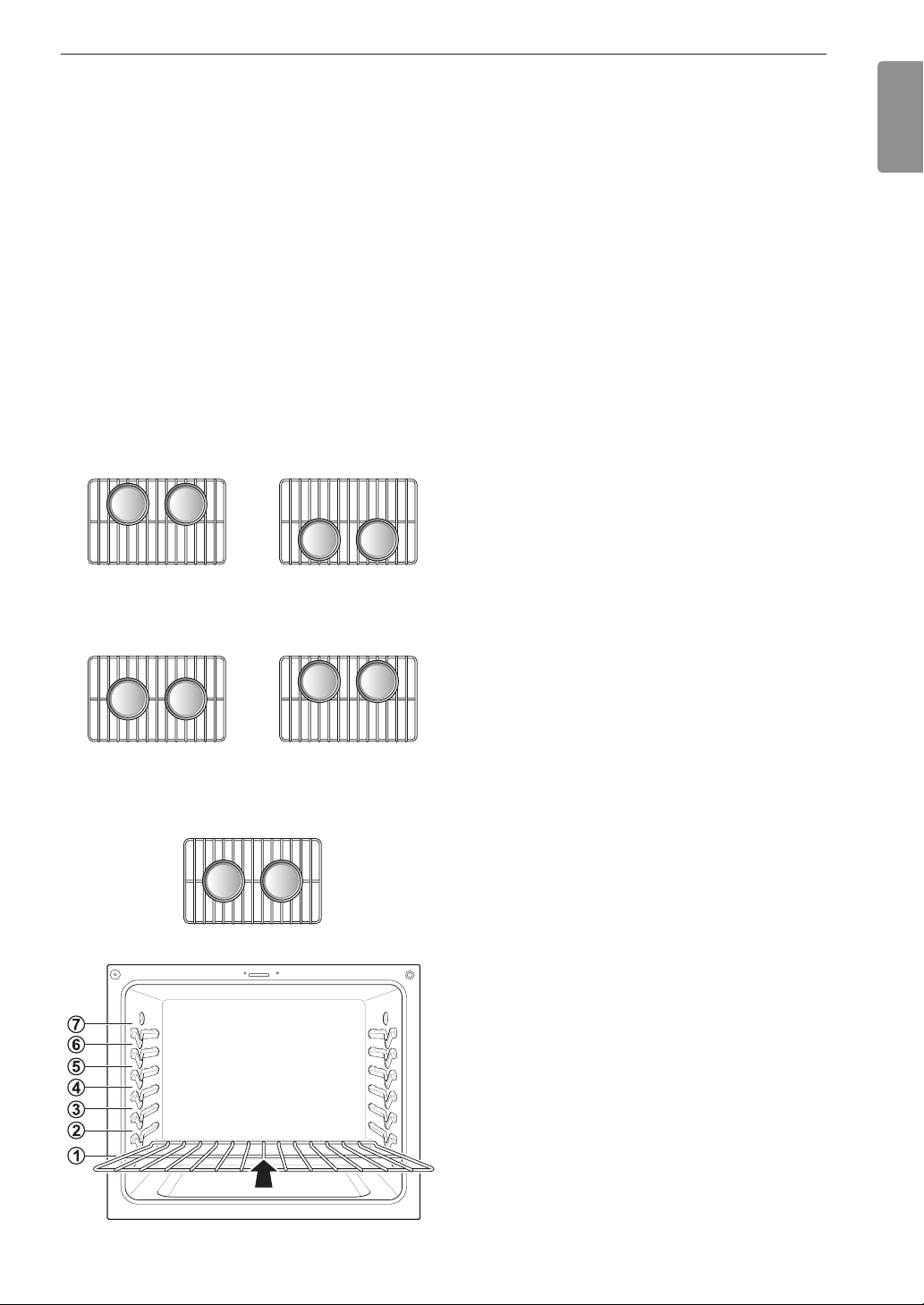
1
While wearing oven mitts, grasp the oven rack*.
2
Pull the rack straight out until it stops.
3
Lift up the front of the rack.
4
Pull out the rack.
* When possible, adjust oven racks before using the
oven. Always wear oven mitts if adjusting racks while
the oven is on.
Replacing Racks
1
While wearing oven mitts, place the end of the
rack on the support*
2
Tilt the front end of the rack up.
3
Push the rack in.
4
Check that the rack is properly in place.
*When possible, adjust oven racks before using the
oven. Always wear oven mitts if adjusting racks while
the oven is on.
31
OPERATION
ENGLISH
Recommended Baking and Roasting
Guide
•
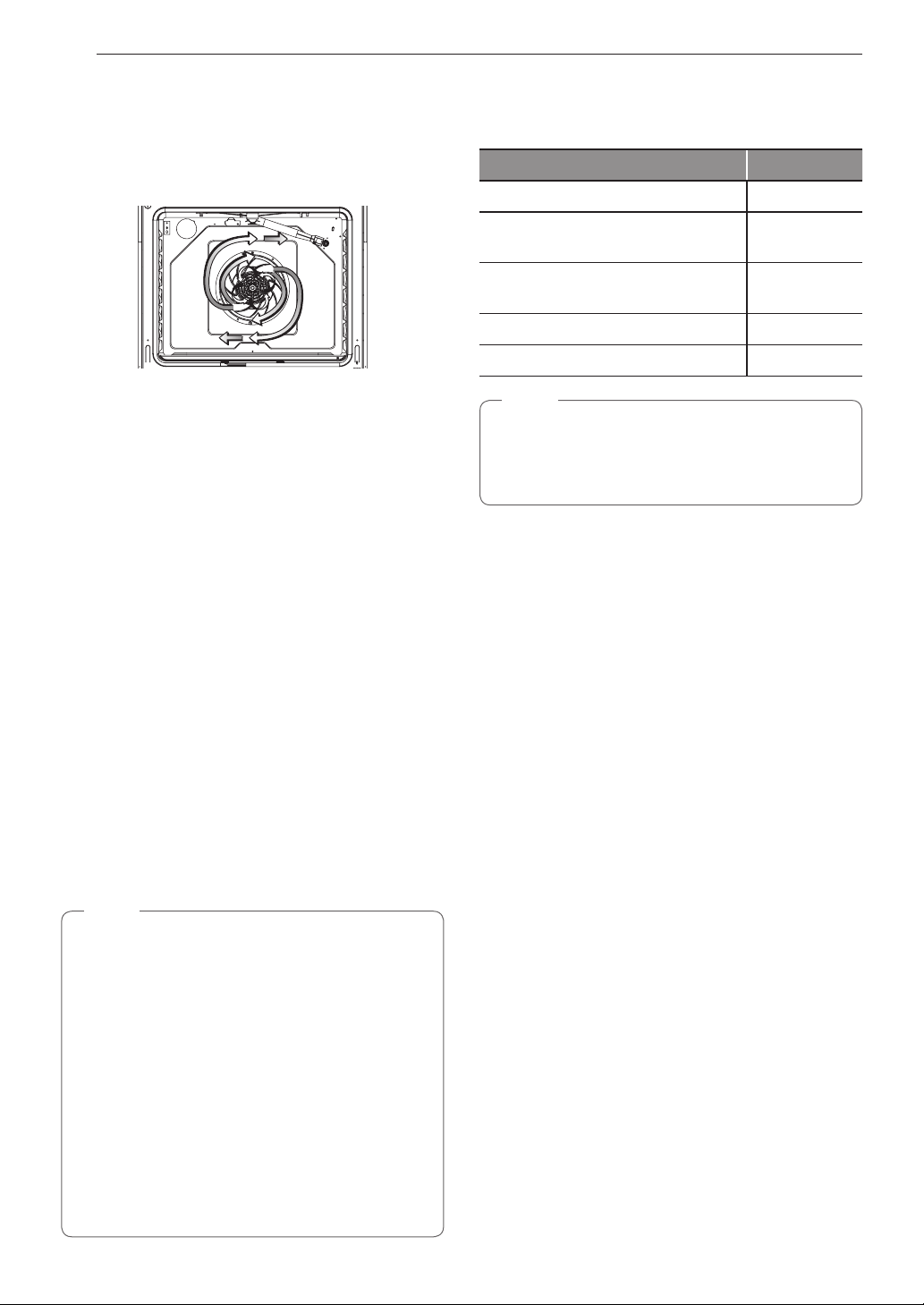
Center pans on racks for best baking results. If
baking with more than one pan, place the pans so
that each one has at least 1" to 1
1
/
2
" of air space
around it. Do not allow pans to touch the walls of
the oven.
•
If cooking on single rack, place the standard rack in
the position suggested in the charts on the following
pages. Center the cookware as shown in the single
rack baking image.
•
If cooking on multiple racks in the oven, place
standard racks in positions 3 and 5. For best
results, place the cookware as shown.
Multiple Rack Baking
For Model: LRG3193
Standard rack
(Position 3)
Standard rack
(Position 5)
For Model: LRG3061, LRG3060
Standard rack
(Position 3)
Standard rack
(Position 5)
Single Rack Baking
Standard rack
Bake
Bake is used to prepare foods such as pastries,
breads and casseroles. The oven can be programmed
to bake at any temperature from 170 °F (80 °C) to
500 °F (260 °C). The default temperature is 350 °F
(175 °C).
1
Press Bake. 350° appears in the display and
BAKE flashes.
2
Select the oven temperature.
Press or press and hold the + or – buttons.
•
Press the + button to increase the
temperature.
•
Press the – button to decrease the
temperature.
3
Press Start to accept the temperature change.
As the oven preheats, the temperature is
displayed and rises in 5-degree increments.
Once the oven reaches the set temperature, a
tone sounds and the oven light blinks on and off.
4
When cooking is complete, press Clear/Off.
5
Remove food from the oven.
Changing the Temperature while Cooking
1
Press Bake.
2
Press + or – button until the desired temperature
is displayed.
3
Press Start.
32
OPERATION
Convection Bake (For Model:
LRG3193)
Convection baking allows for even cooking and
excellent results when using multiple racks at the
same time. It can also shorten the cooking time.
Benefits of Convection Bake
•
Evenly baked results using multiple racks.
•
Faster cooking time.
Setting the Convection Bake Function
1
Press the Conv. Bake button. The display will
flash 350°F.
2
Select the oven temperature. Press or press and
hold the + or - touch pads until the display shows
375°F.
3
Press the START button.
4
When cooking has finished or to cancel, press
the CLEAR OFF button.
As the oven preheats, the display will show increasing
temperatures in 5 degree increments. Once the oven
reaches the set adjusted temperature, a tone will
sound and the oven light will flash on and off.
The display will show the auto converted oven
temperature 350°F, CONV.
NOTE
•
When cooking using the convection cycle, the
oven temperature is automatically reduced
by 25°F. The display will show the changed
temperature.
This feature is called ”AUTO CONVERSION”.
Your range comes with this feature ENABLED.
To DISABLE the auto conversion feature, see
“Setting Convection Auto Conversion Function”
in the Operating Instructions section of this
manual.
•
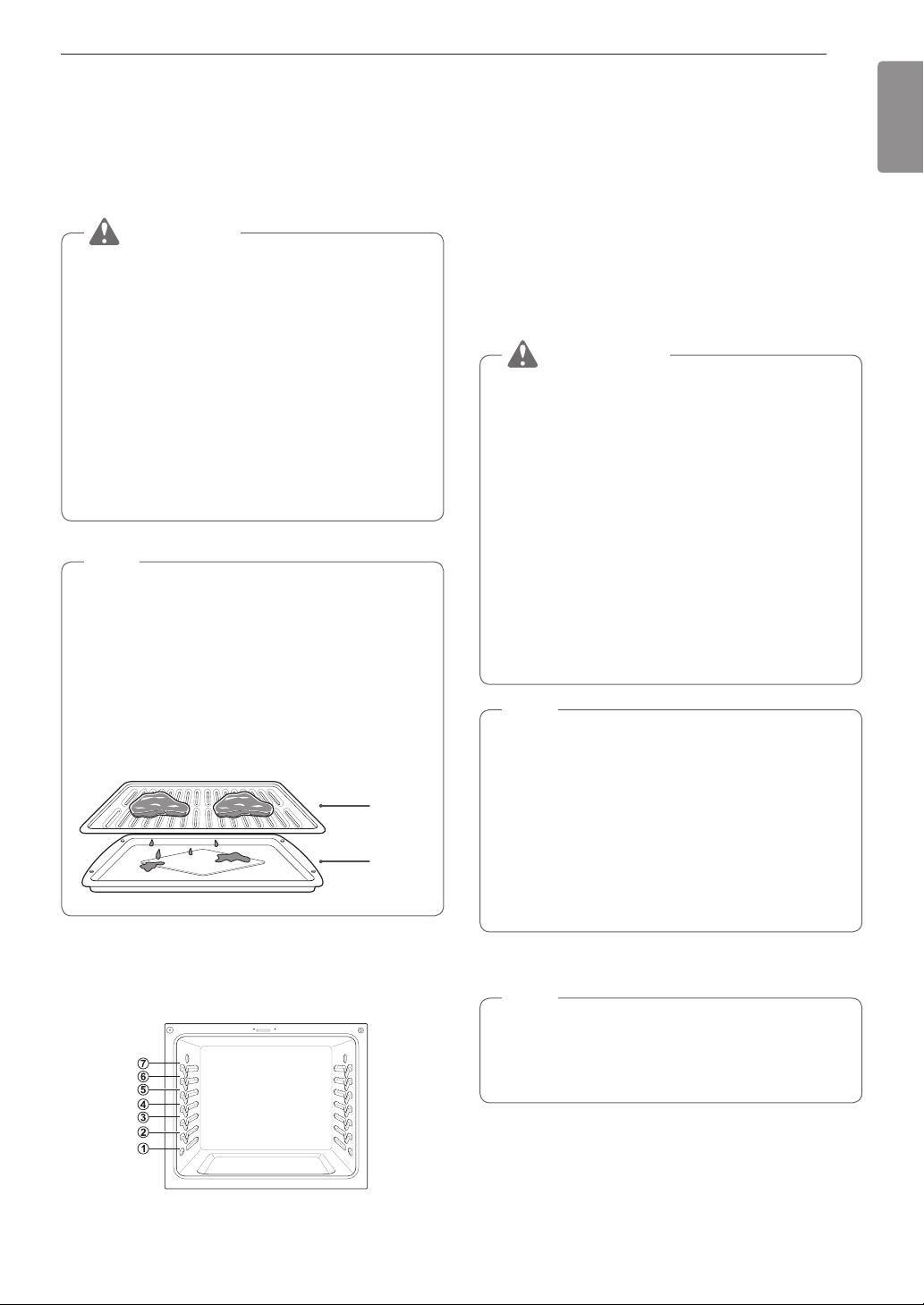
You will hear a fan while cooking with
convection. The fan will stop when the door
is open, but the heat will not turn off. The fan
will not start until the preheat temperature is
reached.
Baking Chart
This chart is only for reference. Adjust the cook time
according to the recipe.
Type of Food Rack Position
Frozen pies (on cookie sheet) 2 or 3
Angel food cake, bundt or pound
cakes
3
Biscuits, muffins, brownies, cookies,
cupcakes, layer cakes, pies
4
Casseroles 4
Roasting 1 or 2
NOTE
•
Because the oven temperature cycles, an oven
thermometer placed in the oven cavity may not
show the same temperature that is set on the
oven.
33
OPERATION
ENGLISH
Broil
The oven is designed for closed-door broiling. Broil
uses an intense heat radiation from the upper gas
burner.
The Broil function works best when broiling thin,
tender cuts of meat (1" or less), poultry or fish.
CAUTION
•
Do not use a broiler pan without a grid. The oil
can cause a grease fire.
•
Do not cover the grid and broiler pan with
aluminum foil. Doing so will cause a fire.
•
Always use a broiler pan and grid for excess fat
and grease drainage. This will help to reduce
splatter, smoke, and flare-ups.
•
Never use a broiler pan that is not thoroughly
cleaned and at room temperature. If your
broiler pan is damaged, warped, or has heavy
permanent soiling, consider replacing it to
reduce the amount of smoke experienced
during broiling.
NOTE
•
Use Lo broil to broil foods such as poultry and
thick cuts of meat.
•
Remove the pan from the oven to cool down for
easy cleaning.
•
For best results, use a pan designed for
broiling, as shown below. The broiler pan will
catch grease spills and the grid will help prevent
grease splatters.
Grid
Broiler pan
When broiling refer to the broiling guide for placing
the rack.
Setting the Oven to Broil
1
Press Broil once for Hi and twice for Lo.
2
Press Start.
3
Allow the broiler to preheat for five minutes.
4
Place food in the oven.
5
Close the oven door. The oven door must be
closed during broiling.
WARNING
When using the broiler, the temperature inside
the oven is extremely hot. Use caution and avoid
possible burns by:
•
Keeping the door closed when broiling
•
Always wearing oven mitts when inserting/
removing food items
Improper use of the broiler may result in
excessive smoke or a grease fire. Improper use
conditions include, but are not limited to:
•
Setting the broiler to a higher power level than
recommended.
•
Using dirty/greasy broiler pans.
•
Broiling beyond recommended cooking times.
NOTE
•
This range is designed for closed-door broiling.
Close the door to set the Broil function. If the
door is open, the Broil function cannot be set
and door appears on the display. Close the
door and reset the Broil function. Opening the
door turns off the broil burner during broiling.
If the door is opened during broiling, the broil
burner turns off after five seconds. The broiler
turns back on automatically once the door is
closed.
6
When broiling is finished, press Clear/Off.
NOTE
During any Broil function, it is normal for the
broiler to cycle on and off. The igniter for the broil
burner on the ceiling of the oven glows orange
periodically during normal broil operation.
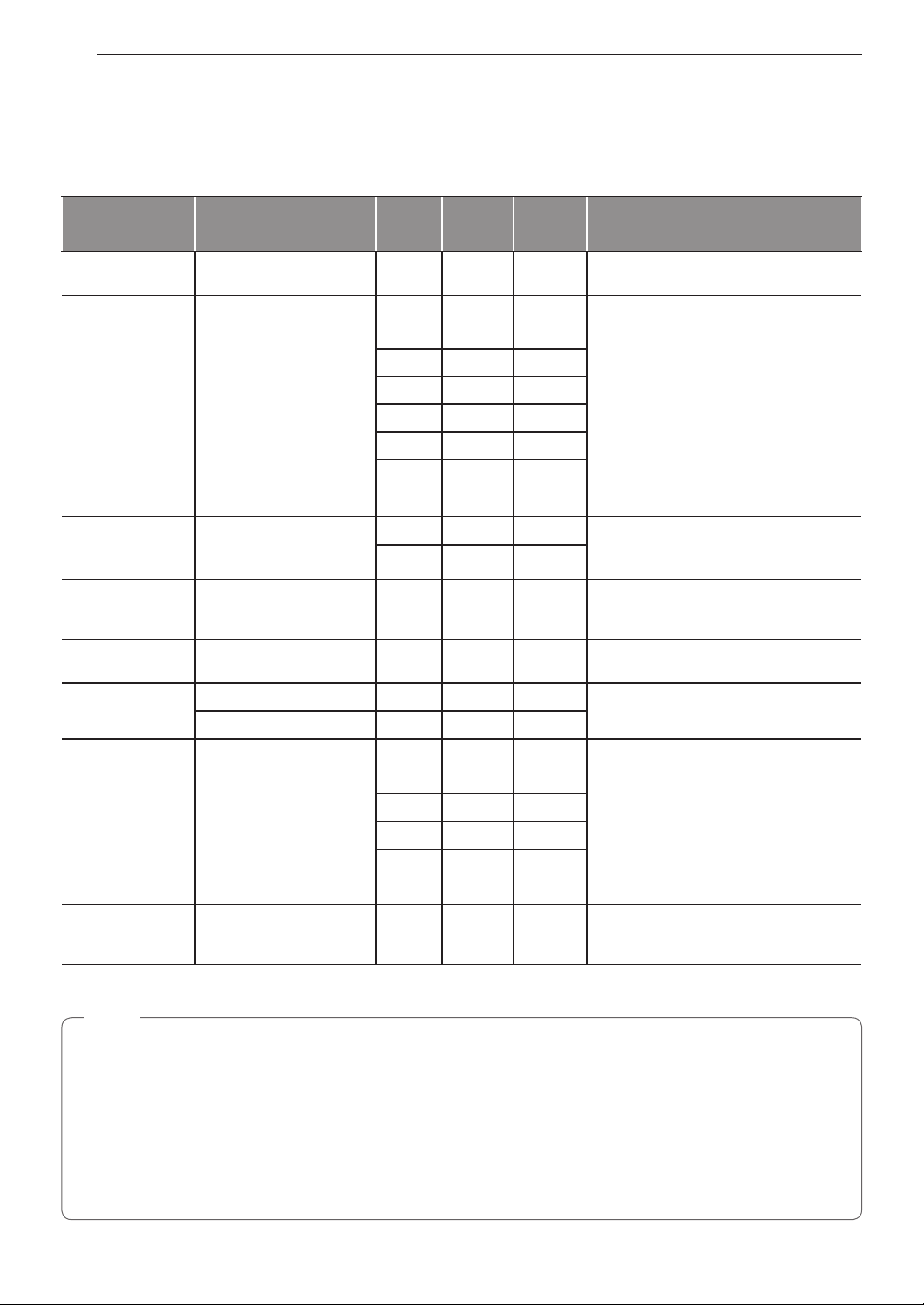
34
OPERATION
Recommended Broiling Guide
The size, weight, thickness, starting temperature, and preference of doneness will affect broiling times. This
guide is based on meats at refrigerator temperature. For best results when broiling, use a pan designed for
broiling.
Food Quantity and/or Thickness
Rack
Position
First Side
(minutes)
Second
Side
(minutes)
Comments
Ground Beef 1 lb. (4 patties)
1
/
2
to
3
/
4
" thick
6 4-6 3-5
Space evenly. Up to 8 patties may be
broiled at once.
Beef Steaks
Rare 6 7 5
Steaks less than 1" thick cook
through before browning. Pan frying is
recommended. Slash fat.
1" thick
1 to 1
1
/
2
lbs.
Medium 6 12 5-6
Well Done 6 13 8-9
Rare
1
1
/
2
" thick
2 to 2
1
/
2
lbs.
4 10 6-7
Medium 4 12-15 10-12
Well Done 4 25 16-18
Toast
1 to 9 pieces
5 1-2 1-2
Chicken
1 whole 2 to 2
1
/
2
lbs.,
split lengthwise
4 bone-in breasts
2 35-40 25 Brush each side with melted butter.
Broil skin-side down.
2 25-30 10-15
Fish Fillets
1
/
4
to
1
/
2
" thick 5 7-8 6 Handle and turn very carefully.
Brush with lemon butter before and during
cooking, if desired.
Ham Slices
(precooked)
1" thick
1
/
2
" thick
3
4
10
7
5
4
Increase time 5 to 10 minutes per side for
1
1
/
2
" thick or home-cured ham.
Pork chops
Well Done
2 (
1
/
2
" thick) 4 10 8 Slash fat.
2 (1" thick) about 1lb. 4 13 8-9
Lamb Chops Slash fat.
Medium
2 (1" thick) about
10 to 12 oz.
5 6 4-7
Well Done 5 10 10
Medium
2 (
1
/
2
" thick) about 1lb.
5 10 4-6
Well done 5 17 12-14
Bacon
1
/
2
lb. (about 8 thin slices) 4 8 3 Arrange in single layer.
Lobster Tails 2-4
6 to 8 oz. each
3 13-16 Do not
turn over.
Cut through back of shell. Spread open.
Brush with melted butter before broiling
and after half of broiling time.
•
This guide is only for reference. Adjust cook time according to preference.
NOTE
The USDA advises that consuming raw or undercooked fish, meat, or poultry can increase the risk of food-
borne illness.
The USDA has indicated the following as safe minimum internal temperatures for consumption:
•
Ground beef : 160 °F (71.1 °C)
•
Poultry: 165 °F (73.9 °C)
•
Beef, veal, pork, or lamb: 145 °F (62.8 °C)
•
Fish / Seafood: 145 °F (62.8 °C)
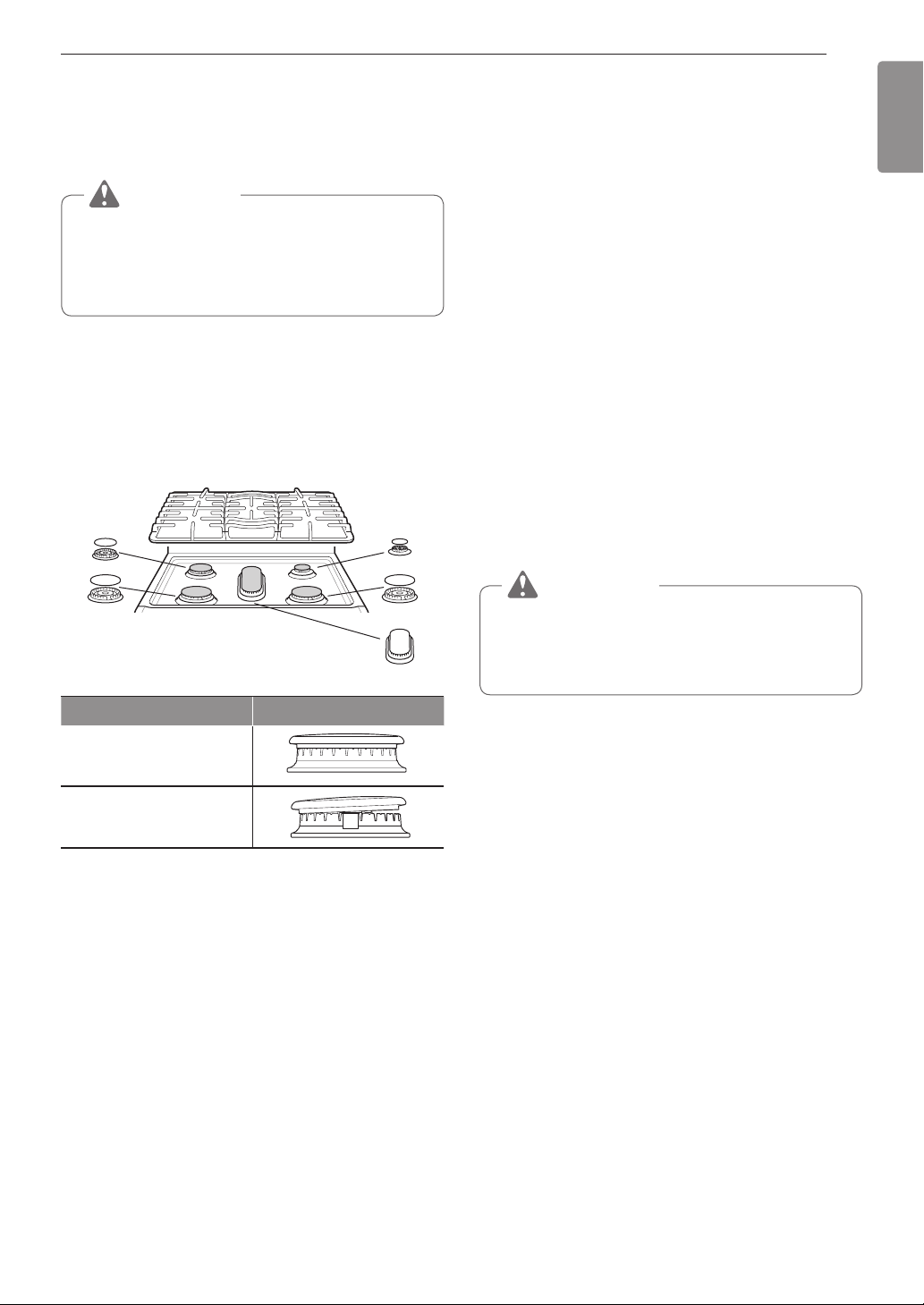
35
MAINTENANCE
ENGLISH
MAINTENANCE
Gas Surface Burners
CAUTION
•
Do not clean this appliance with bleach.
•
To prevent burns, wait until the cooktop has
cooled down before touching any of its parts.
•
Always wear gloves when cleaning the cooktop.
Removing and Replacing the Gas
Surface Burners
Grates and burner heads/caps can be removed for
care and cleaning.
General burner
Burner cap is properly set.
Burner cap is NOT properly
set.
Cleaning Burner Heads/Caps
For even and unhampered flame, the slits in the
burner heads must be kept clean at all times.The
burner heads and caps (and the oval burner head
and cap assembly) can be lifted off. Do not attempt to
remove the oval burner cap.
•
Wash the burner caps in hot soapy water and rinse
with clean water. Run water through the oval burner
from the bottom stem to flush out debris.
•
Use care when cleaning the cooktop. The pointed
metal ends on the electrodes could cause injury.
Hitting an electrode with a hard object may damage
it.
•
To remove burnt-on food, soak the burner heads
in a solution of mild liquid detergent and hot water
for 20–30 minutes. For stubborn stains, use a
toothbrush or wire brush.
•
The burners will not operate properly if the burner
ports or electrodes are clogged or dirty.
•
Burner caps and heads should be cleaned routinely,
especially after excessive spillover.
•
Burners will not light if the cap is removed.
CAUTION
•
Do not hit the electrodes with anything hard.
Doing so could damage them.
•
Do not use steel wool or scouring powders to
clean the burners.
After Cleaning the Burner Heads/
Caps
Shake out any excess water and then let them dry
thoroughly. Placing the oval burner upside down will
allow the water to drain out more easily. Replace
the burner heads and caps over the electrodes on
the cooktop in the correct locations according to
their size. Make sure the hole in the burner head is
positioned over the electrode.
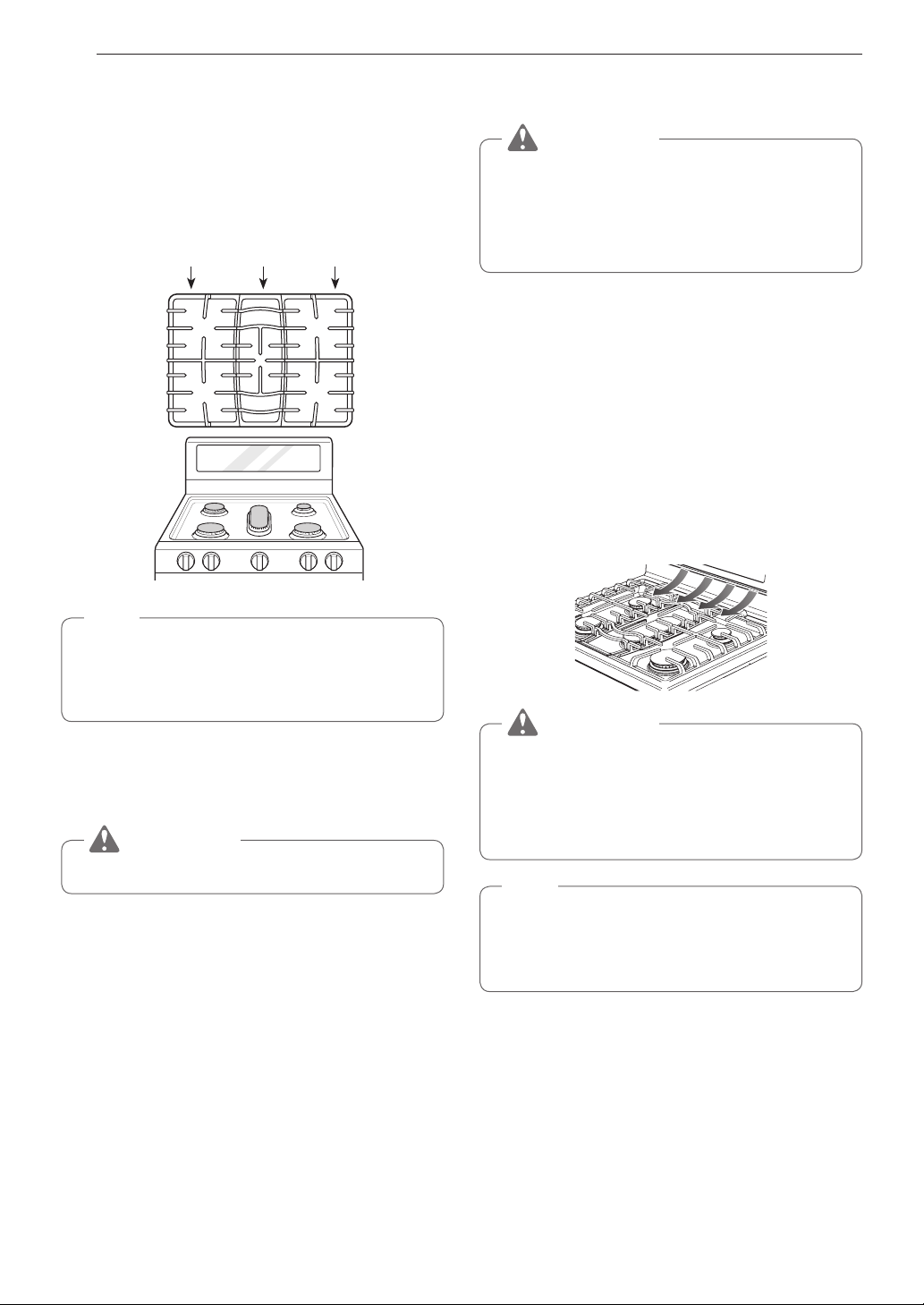
36
MAINTENANCE
Burner Grates
The range consists of three separate professional-
style grates. For maximum stability, these grates
should only be used when in their proper position.
The two side grates can be interchanged from left
to right and front to back. The center grate can be
interchanged from front to back.
Side grate Center grate Side grate
NOTE
Do not operate a burner for an extended period
of time without cookware on the grate. The finish
on the grate may chip without cookware to absorb
the heat.
Cleaning the Burner Grates
CAUTION
•
Do not lift the grates out until they have cooled.
•
Grates should be washed regularly and after
spillovers.
•
Wash the grates in hot, soapy water and rinse with
clean water.
•
The grates are dishwasher safe.
•
After cleaning the grates, let them dry completely
and securely position them over the burners.
Cleaning the Cooktop Surface
CAUTION
•
To avoid burns, do not clean the cooktop
surface until it has cooled.
•
Do not lift the cooktop surface. Lifting the
cooktop surface can lead to damage and
improper operation of the range.
Foods with high acid or sugar content may cause a
dull spot if allowed to set. Wash and rinse soon after
the surface has cooled. For other spills such as oil/
grease spattering, etc., wash with soap and water
when the surface has cooled, then rinse and polish
with a dry cloth.
Oven Air Vents
Air openings are located at the rear of the cooktop,
at the top and bottom of the oven door, and at the
bottom of the range.
CAUTION
•
The edges of the range vent are sharp. Wear
gloves when cleaning the range to avoid injury.
•
Clean ventilating hoods frequently. Grease
should not be allowed to accumulate on the
hood or filter.
NOTE
Do not block the vents and air openings of the
range. They provide the air inlet and outlet that
are necessary for the range to operate properly
with correct combustion.
37
MAINTENANCE
ENGLISH
Control Panel
To prevent activating the control panel during
cleaning, unplug the range. Clean up splatters with
a damp cloth using a glass cleaner. Remove heavier
soil with warm, soapy water. Do not use abrasives of
any kind.
Front Manifold Panel and
Knobs
It is best to clean the manifold panel after each use
of the range. For cleaning, use a damp cloth and mild
soapy water or a 50/50 solution of vinegar and water.
For rinsing, use clean water and polish dry with a soft
cloth.
CAUTION
•
Do not use abrasive cleansers, strong liquid
cleaners, plastic scouring pads or oven
cleaners on the manifold panel. Doing so will
damage the finish.
•
Do not try to bend the knobs by pulling them
up or down, and do not hang a towel or other
objects on them. This can damage the gas
valve shaft.
•
The control knobs may be removed for easy
cleaning.
•
To clean the knobs, make sure that they are in
the Off position and pull them straight off the
stems.
•
To replace the knobs, make sure the knob has
the Off position centered at the top, and slide
the knob directly onto the stem.
NOTE
To prevent scratching, do not use abrasive
cleaners on any of these materials.
Cleaning the Exterior
Painted and Decorative Trim
For general cleaning, use a cloth with hot soapy
water. For more difficult soils and built-up grease,
apply a liquid detergent directly onto the soil. Leave it
on for 30 to 60 minutes. Rinse with a damp cloth and
dry. Do not use abrasive cleaners.
Stainless Steel Surfaces
To avoid scratches, do not use steel wool pads.
1
Place a small amount of stainless steel
appliance cleaner or polish on a damp cloth or
paper towel.
2
Clean a small area, rubbing with the grain of the
stainless steel if applicable.
3
Dry and buff with a clean, dry paper towel or soft
cloth.
4
Repeat as necessary.
NOTE
•
Do not use a steel wool pad; it will scratch the
surface.
•
To clean the stainless steel surface, use warm
sudsy water or a stainless steel cleaner or
polish.
•
Always wipe in the direction of the metal
surface finish.
•
To purchase stainless steel appliance cleaner
or polish, or to locate a dealer near you, call our
toll-free customer service number:
1-800-243-0000 (USA),
1-888-542-2623(CANADA)
or visit our website at: www.lg.com
Oven Door
•
Use soapy water to thoroughly clean the oven door.
Rinse well. Do not immerse the door in water.
•
You may use a glass cleaner on the outside glass
of the oven door. Do not spray water or glass
cleaner on the door vents.
•
Do not use oven cleaners, cleaning powders, or
harsh abrasive cleaning materials on the outside of
the oven door.
•
Do not clean the oven door gasket. The oven door
gasket is made of a woven material that is essential
for a good seal. Care should be taken not to rub,
damage, or remove this gasket.
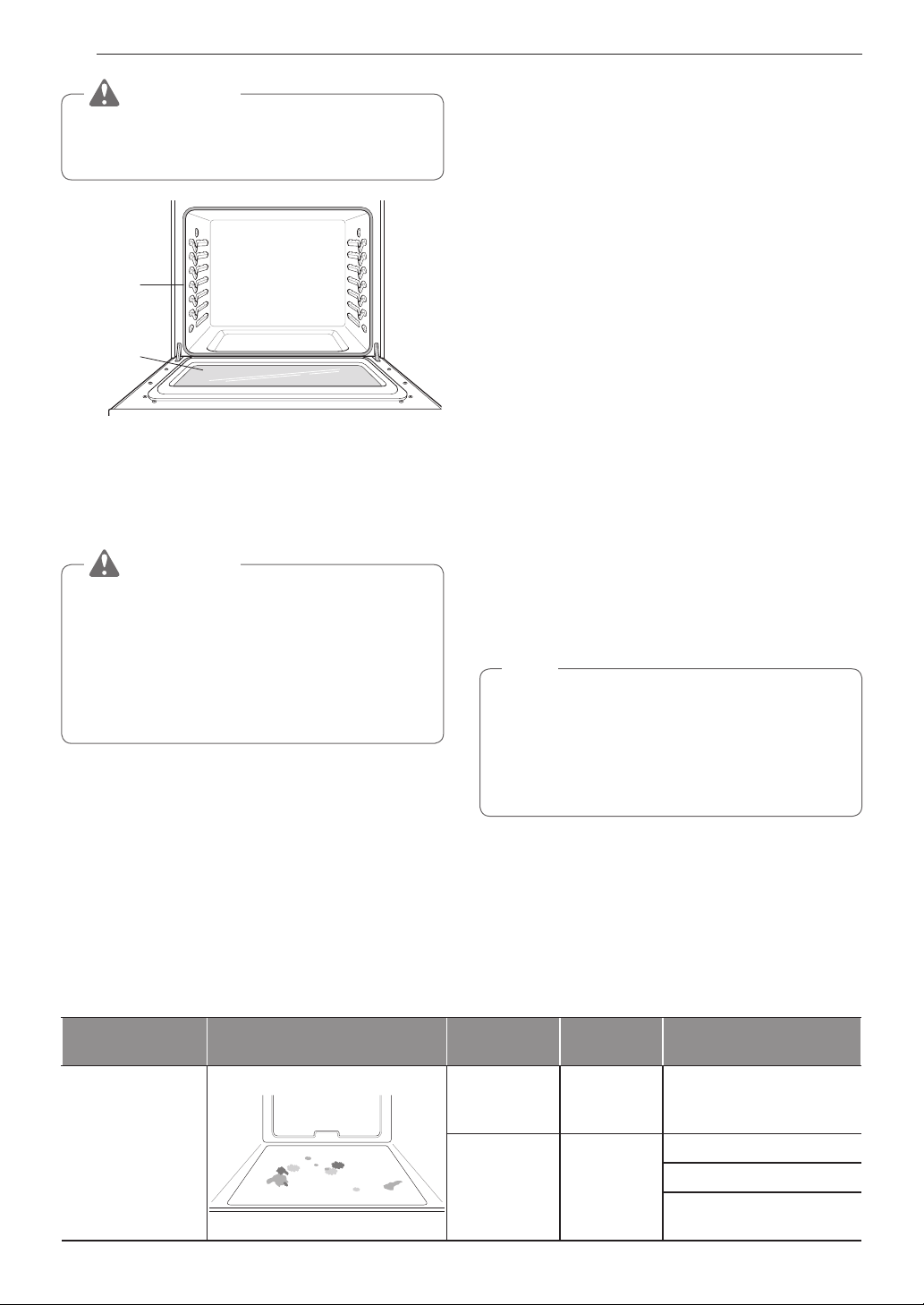
38
MAINTENANCE
CAUTION
Do not use harsh cleaners or harsh abrasive
cleaning materials on the outside of the oven
door. Doing so can cause damage.
Don’t hand
clean oven
door gasket
Do hand
clean door
Door Care Instructions
Most oven doors contain glass that can break.
CAUTION
•
Do not close the oven door until all the oven
racks are fully in place.
•
Do not hit the glass with pots, pans, or any
other object.
•
Scratching, hitting, jarring, or stressing the
glass may weaken its structure causing an
increased risk of breakage at a later time.
Oven Racks
1
Food spilled into the tracks could cause the
racks to become stuck. Clean racks with a mild,
abrasive cleaner.
2
Rinse with clean water and dry.
EasyClean
®
LG’s EasyClean
®
enamel technology provides two
cleaning options for the inside of the range. The
EasyClean
®
feature takes advantage of LG’s new
enamel to help lift soils without harsh chemicals, and
it runs using ONLY WATER for just 20 minutes in low
temperatures to help loosen LIGHT soils before hand-
cleaning.
While EasyClean
®
is quick and effective for small
and LIGHT soils, the Self Clean feature can be
used to remove HEAVY, built up soils. The intensity
and high heat of the Self Clean cycle may result in
smoke which will require the opening up of windows
to provide ventilation. Compared to the more intense
Self Clean process, your LG oven gives you the
option of cleaning with LESS HEAT, LESS TIME, and
virtually NO SMOKE OR FUMES.
Benefits of EasyClean
®
•
Helps loosen light soils before hand-cleaning
•
EasyClean
®
only uses water; no chemical cleaners
•
Makes for a better self-clean experience
- Delays the need for a self-clean cycle
- Minimizes smoke and odors
- Can allow shorter self-clean time
NOTE
Some models do not include a self-clean option.
The EasyClean
®
feature may not be effective in
removing heavy, built-up soils. If the range does
not include a self-clean option, clean the oven
regularly using the EasyClean
®
feature to prevent
heavy, burnt-on soil from building up in the oven.
When to Use EasyClean
®
Suggested
Cleaning Method
Example of Oven Soiling Soil Pattern
Types of
Soils
Common Food Items
That Can Soil Your Oven
EasyClean
®
Small drops or
spots
Cheese
or other
ingredients
Pizza
Light splatter Fat/grease
Steaks, broiled
Fish, broiled
Meat roasted at low
temperatures
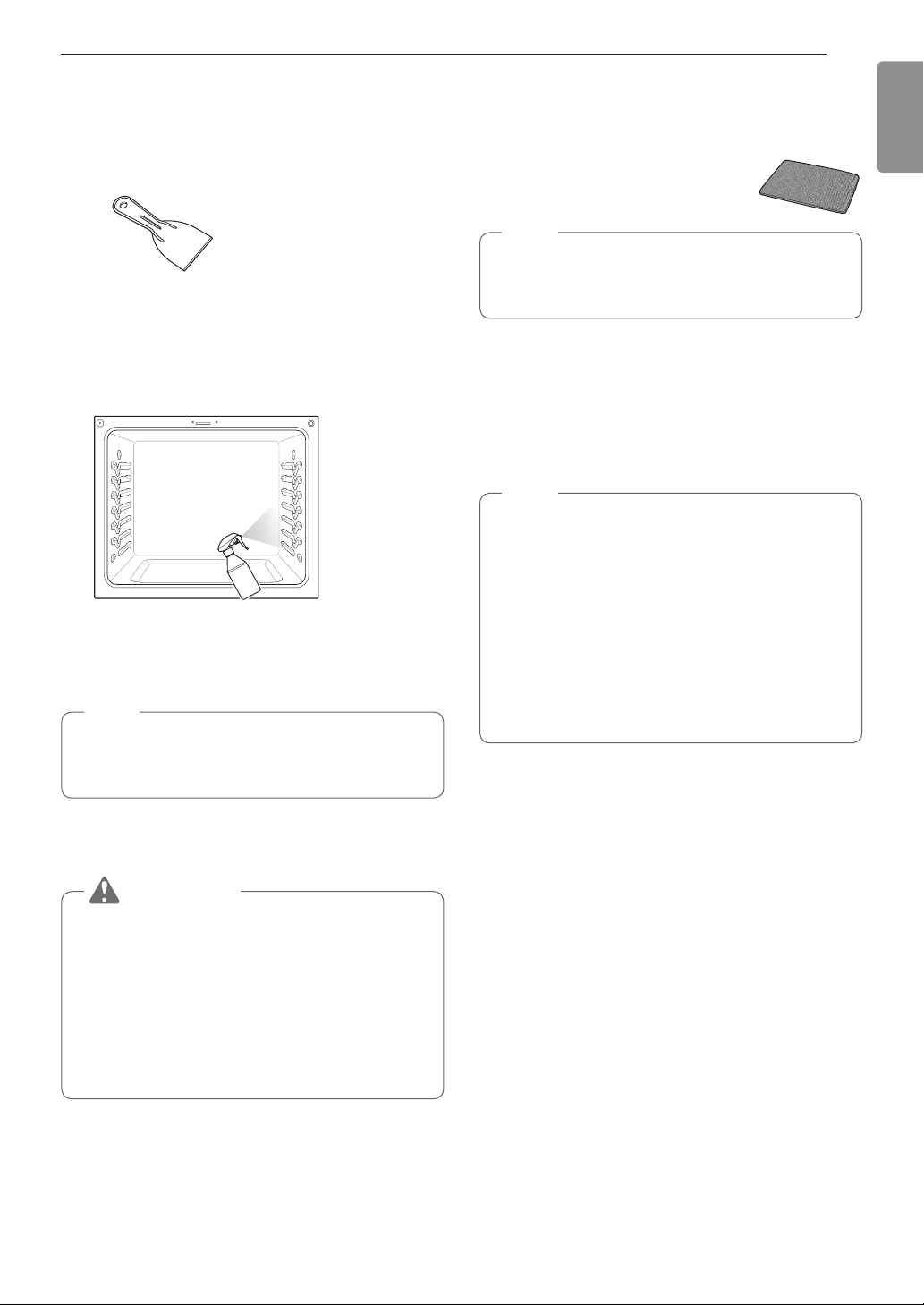
39
MAINTENANCE
ENGLISH
EasyClean
®
Instruction Guide
1
Remove oven racks and accessories from the oven.
2
Scrape off and remove any burnt-on debris with a
plastic scraper.
Suggested plastic scrapers:
•
Hard plastic spatula
•
Plastic pan scraper
•
Plastic paint scraper
•
Old credit card
3
Fill a spray bottle with water and use the spray bottle
to thoroughly spray the inside surfaces of the oven.
4
Use at least
1
/
5
of the water in the bottle to
completely saturate the soil on both the walls and in
the corners of the oven.
5
Spray or pour the remaining water onto the bottom
center of the oven cavity. The indentation on the
oven bottom should be fully covered to submerge all
soils. Add water if necessary.
NOTE
If cleaning multiple ovens, use an entire bottle of water
to clean each oven. Do not spray water directly on the
door. Doing so will result in water dripping to the floor.
6
Close the oven door.
Press EasyClean
®
.
Press Start.
CAUTION
•
Some surfaces may be hot after the EasyClean®
cycle. Wear rubber gloves while cleaning to
prevent burns.
•
During the EasyClean® cycle, the oven becomes
hot enough to cause burns. Wait until the cycle is
over before wiping the inside surface of the oven.
Failure to do so may result in burns.
•
Avoid leaning or resting on the oven door glass
while cleaning the oven cavity.
7
A tone will sound at the end of the 20 minute cycle.
Press Clear/Off to clear the display and end the tone.
8
After the cleaning cycle and during hand-cleaning,
enough water should remain on the oven bottom to
completely submerge all soils. Add water if necessary.
Place a towel on the floor in front of the oven to capture
any water that may spill out during hand-cleaning.
9
Clean the oven cavity immediately after the
EasyClean
®
cycle by scrubbing with a wet, non-scratch
scouring sponge or pad. (The scouring side will not
scratch the finish.) Some water may spill into the
bottom vents while cleaning, but it will
be captured in a pan under the oven
cavity and will not hurt the burner.
NOTE
Do not use any steel scouring pads, abrasive pads
or cleaners as these materials can permanently
damage the oven surface.
10
Once the oven cavity is cleaned, wipe any excess
water with a clean dry towel. Replace racks and
any other accessories.
11
If some light soils remain, repeat the above
steps, making sure to thoroughly soak the soiled
areas. If stubborn soils remain after multiple
EasyClean
®
cycles.
NOTE
•
If you forget to saturate the inside of the oven with
water before starting EasyClean
®
, press Clear/
Off to end the cycle. Wait for the range to cool to
room temperature and then spray or pour water
into the oven and start another EasyClean
®
cycle.
•
The cavity gasket may be wet when the
EasyClean
®
cycle finishes. This is normal. Do not
clean the gasket.
•
If mineral deposits remain on the oven bottom
after cleaning, use a cloth or sponge soaked in
vinegar to remove them.
Cleaning Tips
•
Allow the oven to cool to room temperature before
using the EasyClean
®
cycle. If your oven cavity is
above 150 °F (65 °C), Hot will appear in the display,
and the EasyClean
®
cycle will not be activated until
the oven cavity cools down.
•
Using the rough side of a non-scratch scouring pad
may help to take off burnt-on stains better than a
soft sponge or towel.
•
Certain non-scratch scrubbing sponges, such as
those made of melamine foam, available at your
local stores, can also help improve cleaning.
•
The range should be level to ensure that the bottom
surface of the oven cavity is entirely covered by
water at the beginning of the EasyClean
®
cycle.
•
For best results, use distilled or filtered water. Tap
water may leave mineral deposits on the oven
bottom.
•
Soil baked on through several cooking cycles will
be more difficult to remove with the EasyClean
®
cycle.
•
Do not open the oven door during the EasyClean
®
cycle. Water will not get hot enough if the door is
opened during the cycle.
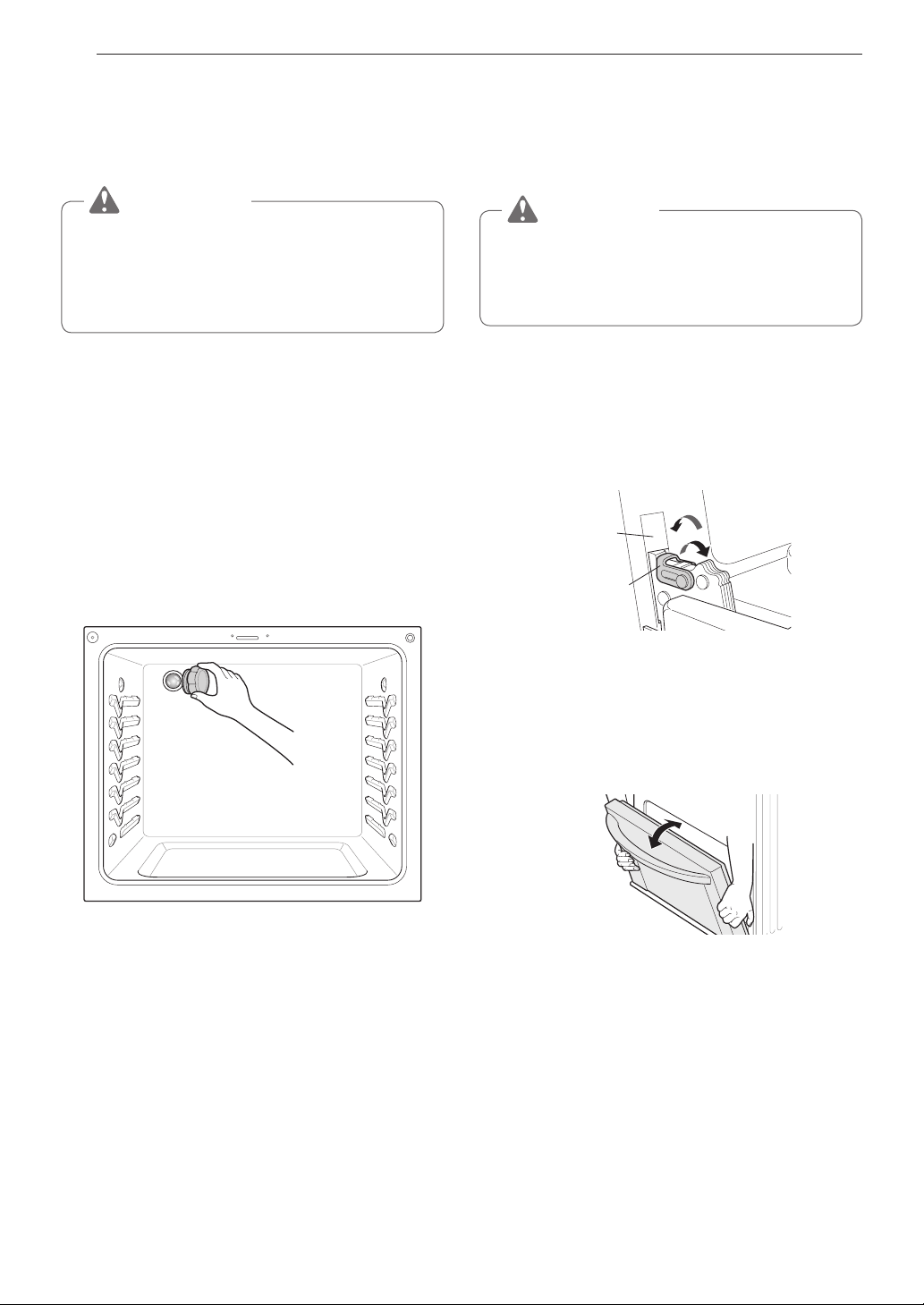
40
MAINTENANCE
Changing the Oven Light
The oven light is a standard 40-watt appliance bulb. It
turns on when the oven door is open. When the oven
door is closed, press Light to turn it on or off.
WARNING
•
Make sure that the oven and bulb are cool.
•
Disconnect the electrical power to the range at
the main fuse or circuit breaker panel. Failure
to do so can result in severe personal injury,
death, or electric shock.
1
Unplug the range or disconnect power.
2
Turn the glass bulb cover in the back of the oven
counterclockwise to remove.
3
Turn the bulb counterclockwise to remove it from
the socket.
4
Insert the new bulb and turn it clockwise.
5
Insert the glass bulb cover and turn it clockwise.
6
Plug in the range or reconnect the power.
Removing and Replacing
the Lift-Off Oven Doors and
Drawer
CAUTION
•
Be careful when removing and lifting the
door.
•
Do not lift the door by the handle. The door
is very heavy.
Removing the Door
1
Fully open the door.
2
Unlock the hinge locks, rotating them as far
toward the open door frame as they will go.
Slot
Lock
Unlock
Hinge
lock
3
Firmly grasp both sides of the door at the top.
4
Close the door to the removal position
(approximately five degrees) which is halfway
between the broil stop position and fully closed.
If the position is correct, the hinge arms will
move freely.
about 5°
5
Lift door up and out until the hinge arms are
clear of the slots.
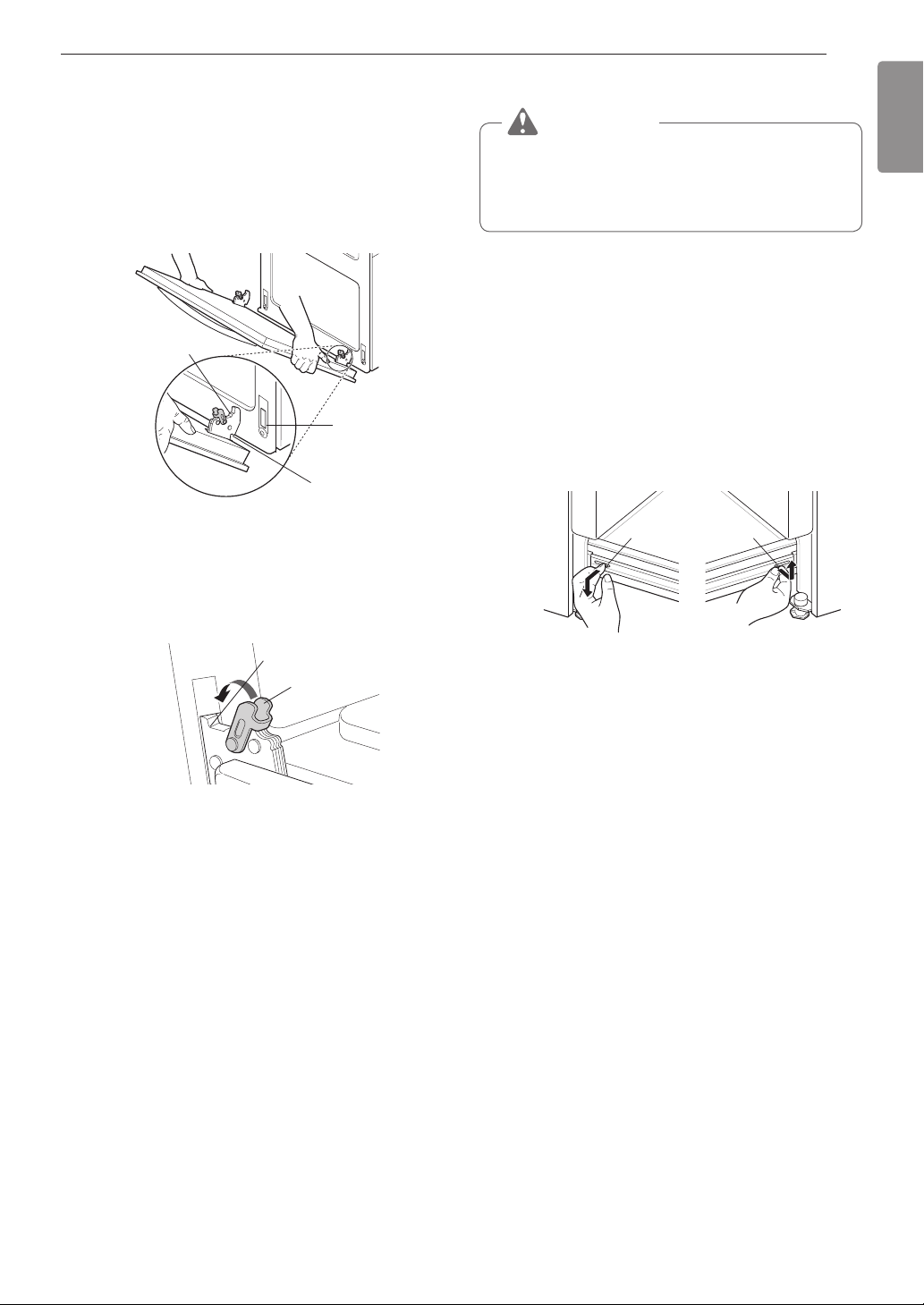
41
MAINTENANCE
ENGLISH
Replacing the Door
1
Firmly grasp both sides of the door at the top.
2
With the door at the same angle as the removal
position, seat the indentation of the hinge arms
into the bottom edge of the hinge slots. The
notch in the hinge arms must be fully seated into
the bottom edge of the slots.
Hinge arm
Indentation
Bottom
edge of slot
3
Open the door fully. If the door will not open fully,
the indentation is not seated correctly in the
bottom edge of the slots.
4
Lock the hinge locks, rotating them back toward
the slots in the oven frame until they lock.
Hinge arm
Hinge lock
5
Close the oven door.
Removing the Drawer
CAUTION
Disconnect the electrical power to the range at
the main fuse or circuit breaker panel. Failure to
do so can result in severe personal injury, death,
or electric shock.
Most cleaning can be done with the drawer in place;
however, the drawer may be removed if further
cleaning is needed. Use warm water to thoroughly
clean.
1
Fully open the drawer.
2
Locate the glide lever on each side of the
drawer. Push down on the left glide lever and
pull up on the right glide lever. You may need to
pull the levers out slightly to bypass the screws
in the glides.
Lever
Push down with nger Pull up with nger
Lever
3
Pull the drawer away from the range.
Replacing the Drawer
1
Pull the bearing glides to the front of the chassis
glides.
2
Align the glide on each side of the drawer with
the glide slots on the range.
3
Push the drawer into the range until the levers
click (approximately 2 inches).
4
Pull the drawer open again to seat the bearing
glides into position.
42
TROUBLESHOOTING
TROUBLESHOOTING
FAQs
What types of cookware are recommended for
use with the cooktop?
•
The pans must have a flat bottom and straight
sides.
•
Only use heavy-gauge pans.
•
The pan size must match the amount of food to be
prepared and the size of the surface element.
•
Use tight fitting lids.
•
Only use flat-bottom woks.
Why do the heating elements appear to be turning
ON and OFF during use of the oven?
Depending on your cooktop element setting or the
temperature selected in your oven it is NORMAL for
the cooking elements to cycle on and off.
My new oven doesn’t cook like my old one. Is
there something wrong with the temperature
settings?
No, your oven has been factory tested and calibrated.
For the first few uses, follow your recipe times and
temperatures carefully. If you still think your new
oven is too hot or too cold, you can adjust the oven
temperature yourself to meet your specific cooking
needs. Refer to the Oven Temperature Adjustment
section in this manual for easy instructions on how to
adjust your thermostat.
Is it normal to hear a clicking noise coming from
the back of my oven when I am using it?
Your new range is designed to maintain a tighter
control over your oven’s temperature. You may hear
your oven’s heating elements click on and off more
frequently on your new oven. This is NORMAL.
Why is the time flashing?
This means that the product has just been plugged
in, or that it has experienced a power interruption. To
clear the flashing time, press any button and reset the
clock if needed.
Can I use aluminum foil to catch drippings in my
oven cavity?
Never use aluminum foil to line the bottom or sides of
the oven or the warming drawer. The foil will melt and
stick to the bottom surface of the oven and will not be
removable. Use a sheet pan placed on a lower oven
rack to catch drippings instead. (If foil has already
melted onto the bottom of the oven, it will not interfere
with the oven’s performance.)
Can I use aluminum foil on the racks?
Do not cover racks with aluminum foil. Covering
entire racks with foil restricts air flow, leading to poor
cooking results. Use a sheet pan lined with foil under
fruit pies or other acidic or sugary foods to prevent
spillovers from damaging the oven finish.
CAUTION
Foil may be used to wrap food in the oven or
warming drawer, but do not allow the foil to come
into contact with the exposed heating/broiling
elements in the oven. The foil could melt or ignite,
causing smoke, fire, or injury.
What should I do if my racks are sticky and have
become hard to slide in and out?
Over time, the racks may become hard to slide in
and out. Apply a small amount of olive oil to the ends
of the racks. This will work as a lubricant for easier
gliding.
What should I do for hard to remove stains on my
cooktop?
The cooktop should be cleaned after every use to
prevent permanent staining. When cooking foods with
high sugar content, such as tomato sauce, clean the
stain off with a scraper while the cooktop is still warm.
Use an oven mitt when scraping to prevent burns.
Refer to the MAINTENANCE section of this owner's
manual for further instruction.

43
TROUBLESHOOTING
ENGLISH
Why aren't the function buttons working?
Make sure that the range is not in Lockout mode.
LOCKED will show in the display if Lockout is
activated. To deactivate Lockout, press and hold
Clear/Off for three seconds.
My range is still dirty after running the
EasyClean
®
cycle. What else should I do?
The EasyClean
®
cycle only helps to loosen light soils
in your oven range to assist in hand-cleaning of your
oven. It does not automatically remove all soils after
the cycle. Some scrubbing of your oven range is
required after running the EasyClean
®
cycle.
I tried scrubbing my oven after running
EasyClean
®
, but some soils still remain. What can
I do?
The EasyClean
®
feature works best when the soils
are fully soaked and submerged in water before
running the cycle and during hand-cleaning. If soils
are not sufficiently soaked in water, it can negatively
affect the cleaning performance. Repeat the
EasyClean
®
process using sufficient water.
Sugar-based and certain greasy soils are especially
hard to clean.
Soils on my oven walls are not coming off. How
can I get my walls clean?
Soils on the side and rear walls of your oven range
may be more difficult to fully soak with water. Try
repeating the EasyClean
®
process with more than
the 1/5 of spray recommended.
Will EasyClean
®
get all of the soils and stains out
completely?
It depends on the soil type. Sugar-based and certain
grease stains are especially hard to clean. Also, if
stains are not sufficiently soaked in water, this can
negatively affect cleaning performance.
Do I need to use the full contents of the spray
bottle for EasyClean
®
?
Yes. It is highly recommended that 4/5 of water be
sprayed or poured on the bottom and an additional
1/5 of water be sprayed on walls and other soiled
areas to fully saturate the soils for better cleaning
performance.
I see smoke coming out of my oven range’s
cooktop vents during EasyClean
®
. Is this normal?
This is normal. This is not smoke. It is actually water
vapor (steam) from the water in the oven cavity. As
the oven heats briefly during EasyClean
®
, the water
in the cavity evaporates and escapes through the
oven vents.
How often should I use EasyClean
®
?
EasyClean
®
can be performed as often as you wish.
EasyClean
®
works best when your oven is LIGHTLY
soiled from such things as LIGHT grease splatter
and small drops of cheese. Please refer to the
EasyClean
®
section in your owner's manual for more
information.
What is required for EasyClean
®
?
A spray bottle filled with water, a scraper, a non-
scratch scrubbing pad and a towel. You should not
use abrasive scrubbers such as heavy-duty scouring
pads or steel wool.
Is it safe for water to spill into the oven bottom
vents during cleaning?
Some water spillage into the oven bottom vents (gas
range) is okay. However, it is recommended to try
avoid spilling too much water into the vents.
44
TROUBLESHOOTING
Before Calling for Service
Before you call for service, review this list. It may save you time and expense. The list includes common
occurrences that are not the result of defective workmanship or materials in this appliance.
Symptoms Possible Cause / Solution
Top burners do not
light or do not burn
evenly.
•
Make sure that the electrical plug is inserted into a live, properly grounded outlet.
•
Remove the burners and clean them. Check the electrode area for burnt on food
or grease. See Cleaning Burner Heads/Caps in the MAINTENANCE section.
•
Make sure that the burner parts are installed correctly.
See Removing and Replacing the Gas Surface Burners in the MAINTENANCE
section.
Burner flames are
very large or yellow.
If the range is connected to LP gas, contact the technician who installed your
range or made the conversion.
Surface burners light
but the oven does not.
Make sure that the oven gas shut-off valve, located behind the range, is fully open.
Food does not bake
or roast properly.
•
Incorrect oven control settings. See Control Panel Overview in the OPERATION
section.
•
Incorrect rack position. See Removing and Replacing the Oven Racks in the
OPERATION section.
•
Incorrect cookware is being used. See Convection Bake in the OPERATION
section.
•
Oven thermostat needs adjustment.
•
See Adjusting the Oven Thermostat in the OPERATION section.
•
Aluminum foil used improperly in the oven. See Removing and Replacing the
Oven Racks.
Food does not broil
properly in the oven.
•
Incorrect oven control settings. See Control Panel Overview in the OPERATION
section.
•
The oven door is not closed. See Broil in the OPERATION section.
•
Aluminum foil used on the broiling pan and grid is not fitted properly.
Oven temperature is
too hot or too cold.
The oven thermostat needs adjustment. See Adjusting the Oven Thermostat in the
OPERATION section.
Clock and timer does
not work.
•
Make sure the electrical plug is inserted into a live, properly grounded outlet.
Replace the fuse or reset the circuit breaker.
•
Improper oven control settings. See Changing Oven Settings in the OPERATION
section.
Oven light does not
work.
•
The light bulb is loose or defective. Tighten or replace the bulb.
•
The plug on the range is not completely inserted in the electrical outlet. Make
sure the electrical plug is inserted into a live, properly grounded outlet.
“Crackling” or
“popping” sound.
•
This is the sound of the metal heating up and cooling down during both the
cooking and cleaning functions. This is normal.
45
TROUBLESHOOTING
ENGLISH
Symptoms Possible Cause / Solution
Oven control beeps
and displays an F
error code.
•
Check the main gas shut-off valve or
the oven gas shut-off valve and call
for service.
•
Remove the power from the range
for five minutes and then reconnect
the power. If the function error code
repeats, call for service.
CODE CAUSE
F-3 Key error
F-9 Oven not heating
Clock is flashing.
Power outage or surge. Reset the clock. If the oven was in use, you must reset it
by pesssing the Clear/Off button. Reset the clock and any cooking function.
Strong odor.
An odor from the insulation around the inside of the oven is normal for the first few
times the oven is used.
Burners are not
lighting properly after
cleaning the cooktop
surface.
Make sure that the burner heads and caps are completely dry and properly
positioned.
When lighting just one
burner, clicking noise
is heard from all the
burners.
This is normal. Electric spark igniters from the burners cause the clicking noise. All
the spark igniters on the cooktop will activate when igniting just one burner.
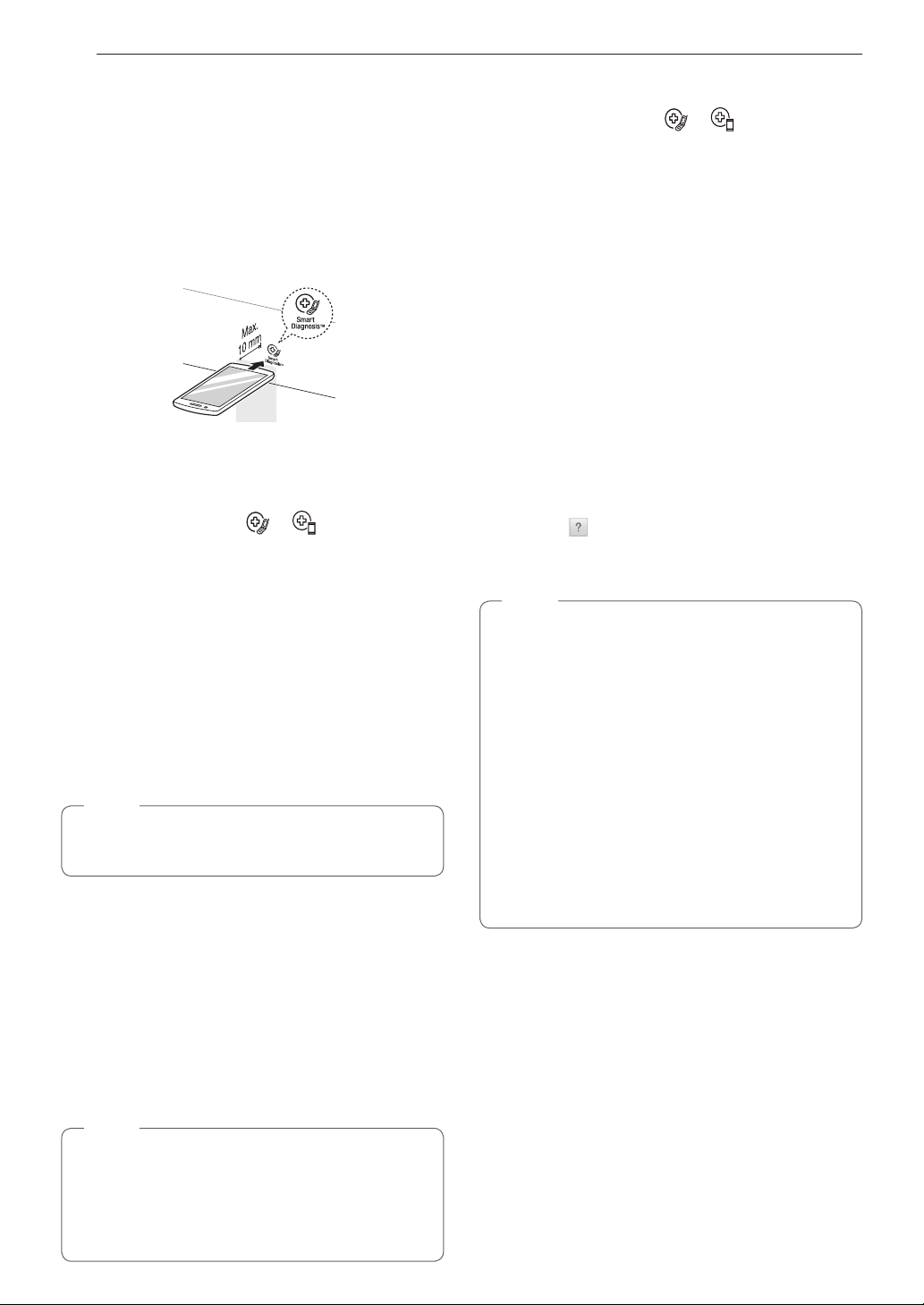
46
SMART DIAGNOSIS™ FUNCTION
SMART DIAGNOSIS™
FUNCTION
Should you experience any problems with the
appliance, it has the capability of transmitting data
via your telephone to the LG Customer Information
Center. NFC or Wi-Fi equipped models can also
transmit data to a smartphone using the LG
SmartThinQ application.
Smart Diagnosis™ through the
Customer Information Center
•
For appliances with the or logo
This method allows you to speak directly to our
trained specialists. The specialist records the data
transmitted from the appliance and uses it to analyze
the issue, providing a fast and effective diagnosis.
1
Call the LG call center at: (LG U.S.) 1-800-243-
0000 (LG Canada) 1-888-542-2623.
2
When instructed to do so by the call center
agent, hold the mouthpiece of the phone over
the Smart Diagnosis™ logo on the machine.
Hold the phone no more than one inch from (but
not touching) the machine.
NOTE
Do not press any other buttons or icons on the
display screen.
3
Press and hold the Start button for three
seconds.
4
Keep the phone in place until the tone
transmission has finished. This takes about 6
seconds and the display will count down the
time.
5
Once the countdown is over and the tones have
stopped, resume your conversation with the call
center agent, who will then be able to assist you
in using the information transmitted for analysis.
NOTE
•
For best results, do not move the phone while
the tones are being transmitted.
•
If the call center agent is not able to get an
accurate recording of the data, you may be
asked to try again.
LG SmartThinQ Smart Diagnosis™
•
For appliances with the or logo
Use the Smart Diagnosis feature in the LG
SmartThinQ application for help diagnosing issues
with the appliance without the assistance of the LG
Customer Information Center.
Follow the instructions in the LG SmartThinQ
application to perform a Smart Diagnosis using your
smartphone.
1
Download the LG SmartThinQ application on
your smart phone.
2
Open the LG SmartThinQ application on your
smart phone. Touch Smart Diagnosis™ button to
advance to the next screen.
3
Follow directions of the application. Using ‘Tag
On’ is recommended but, if it does not work well,
the application will show how to use Audible
Diagnosis.
4
Touch [ ] in the LG SmartThinQ application
for a more detailed guide on how to use the Tag
On function.
NOTE
•
Smart Diagnosis™ cannot be activated unless
the appliance can be turned on using the
Power button. If the appliance cannot be turned
on, troubleshooting must be done without using
Smart Diagnosis™.
•
Call quality differences by region may affect the
function.
•
Use the home telephone for better
communication performance, resulting in better
service.
•
Bad call quality may result in poor data
transmission from your phone to the machine,
which could cause Smart Diagnosis™ to
malfunction.

47
LIMITED WARRANTY
ENGLISH
LIMITED WARRANTY (CANADA)
ARBITRATION NOTICE: THIS LIMITED WARRANTY CONTAINS AN ARBITRATION PROVISION THAT REQUIRES
YOU AND LG TO RESOLVE DISPUTES BY BINDING ARBITRATION INSTEAD OF IN COURT, UNLESS THE LAWS
OF YOUR PROVINCE OR TERRITORY DO NOT PERMIT THAT, OR, IN OTHER JURISDICTIONS, IF YOU CHOOSE
TO OPT OUT. IN ARBITRATION, CLASS ACTIONS AND JURY TRIALS ARE NOT PERMITTED. PLEASE SEE THE
SECTION TITLED “PROCEDURE FOR RESOLVING DISPUTES” BELOW.
Should your LG Gas Oven ("Product") fail due to a defect in materials or workmanship under normal and proper use,
during the warranty period set forth below, LG Electronics Canada, Inc. (“LGECI”) will, at its option, repair or replace
the Product upon receipt of proof of the original retail purchase. This limited warranty is valid only to the original retail
purchaser of the Product and applies only to a Product distributed, purchased and used within Canada, as determined
at the sole discretion of LGECI.
WARRANTY PERIOD: (Note: If the original date of purchase cannot be verified, the warranty will begin
sixty (60) days from the date of manufacture).
Gas Oven
One (1) year from the date of original retail purchase
Parts and Labor (internal/functional parts only)
•
Replacement products and parts are warranted for the remaining portion of the original warranty period or ninety (90)
days, whichever is greater.
•
Replacement products and parts may be new, reconditioned, refurbished, or otherwise factory remanufactured, all at
the sole discretion of LGECI.
•
Proof of original retail purchase specifying the Product model and date of purchase is required to obtain warranty
service under this Limited Warranty.
LGECI’S SOLE LIABILITY IS LIMITED TO THE LIMITED WARRANTY SET OUT ABOVE. EXCEPT AS EXPRESSLY
PROVIDED ABOVE, LGECI MAKES NO, AND HEREBY DISCLAIMS, ALL OTHER WARRANTIES AND
CONDITIONS RESPECTING THE PRODUCT, WHETHER EXPRESS OR IMPLIED, INCLUDING BUT NOT LIMITED
TO, ANY IMPLIED WARRANTY OR CONDITION OF MERCHANTABILITY OR FITNESS FOR A PARTICULAR
PURPOSE, AND NO REPRESENTATIONS SHALL BE BINDING ON LGECI. LGECI DOES NOT AUTHORIZE
ANY PERSON TO CREATE OR ASSUME FOR IT ANY OTHER WARRANTY OBLIGATION OR LIABILITY IN
CONNECTION WITH THE PRODUCT. TO THE EXTENT THAT ANY WARRANTY OR CONDITION IS IMPLIED BY
LAW, IT IS LIMITED TO THE WARRANTY PERIOD SET OUT ABOVE. UNDER NO CIRCUMSTANCES SHALL
LGECI, THE MANUFACTURER OR DISTRIBUTOR OF THE PRODUCT, BE LIABLE FOR ANY INCIDENTAL,
CONSEQUENTIAL, SPECIAL, DIRECT, INDIRECT, PUNITIVE OR EXEMPLARY DAMAGES, INCLUDING,
WITHOUT LIMITATION, LOSS OF GOODWILL, LOST PROFITS, LOSS OF ANTICIPATED PROFITS, LOST
REVENUE, LOSS OF USE, OR ANY OTHER DAMAGE, WHETHER ARISING DIRECTLY OR INDIRECTLY FROM
ANY CONTRACTUAL BREACH, FUNDAMENTAL BREACH, TORT OR OTHERWISE, OR FROM ANY ACTS OR
OMISSIONS. LGECI’S TOTAL LIABILITY, IF ANY, SHALL NOT EXCEED THE PURCHASE PRICE PAID BY YOU
FOR THE PRODUCT.
This Limited Warranty gives you specific legal rights. You may also have other rights that vary from province to
province depending on applicable provincial laws. Any term of this Limited Warranty that negates or varies any implied
condition or warranty under provincial law is severable where it conflicts with such provincial law without affecting the
remainder of this warranty’s terms.
THIS LIMITED WARRANTY DOES NOT COVER:
•
Service trips to i) deliver, pick up, or install or; educate on how to operate the Product; ii) correct wiring or plumbing;
or iii) correct unauthorized repairs or installations of the Product;
•
Damage or failure of the Product to perform during power failures and interrupted or inadequate electrical service;
•
Damage or failure resulting from operating the Product in a corrosive atmosphere or contrary to the instructions
outlined in the Product’s owner’s manual;
•
Damage or failure to the Product caused by accidents, pests and vermin, lightning, wind, fire, floods, acts of God, or
any other causes beyond the control of LGECI or the manufacturer;
•
Damage or failure resulting from misuse, abuse, improper installation, repair, or maintenance of the Product.
Improper repair includes use of parts not authorized or specified by LGECI. Improper installation or maintenance
includes installation or maintenance contrary to the Product’s owner’s manual;.
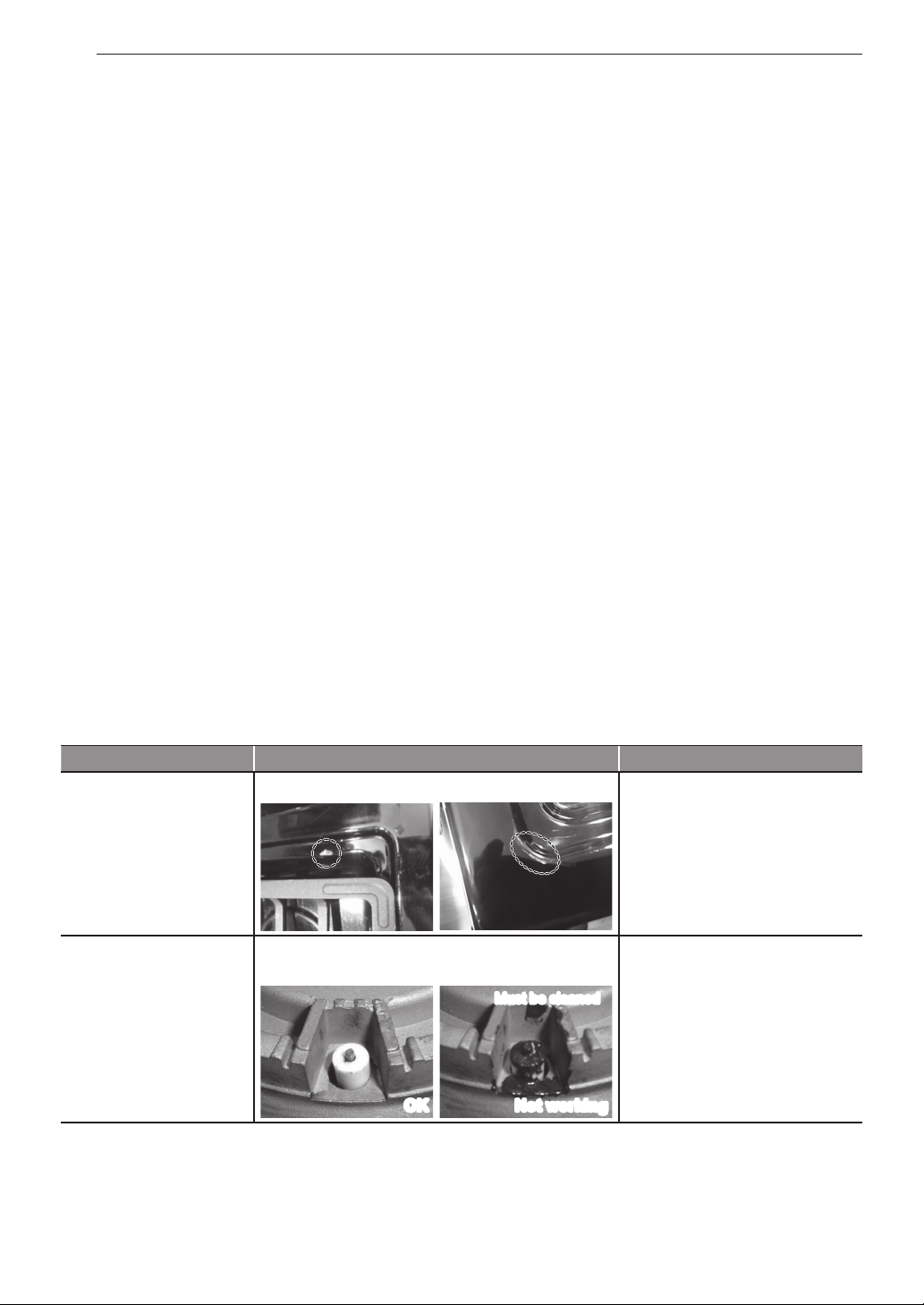
48
LIMITED WARRANTY
•
Damage or failure caused by unauthorized modification or alteration of the Product, or if used for other than the
intended household purpose/use of the Product, or damage or failure resulting from any water leakage due to
improper installation of the Product;
•
Damage or failure caused by incorrect electrical current, voltage or plumbing codes;
•
Damage or failure caused by use that is other than normal household use, including, without limitation, commercial
or industrial use, including use in commercial offices or recreational facilities, or as otherwise outlined in the
Product’s owner’s manual;
•
Damage or failure caused by transportation and handling, including scratches, dents, chips and/or other damage to
the finish of the Product, unless such damage results from defects in materials or workmanship and is reported to
LGECI within one (1) week of delivery of the Products;
•
Damage or missing items to any display, open box, refurbished or discounted Product;
•
Refurbished Product or any Product sold “As Is”, “Where Is”, “With all Faults”, or any similar disclaimer;
•
Products with original serial numbers that have been removed, altered or cannot be readily determined at the
discretion of LGECI;
•
Increases in utility costs and additional utility expenses in any way associated with the Product;
•
Any noises associated with normal operation of the Product;
•
Replacement of light bulbs, filters, fuses or any other consumable parts;
•
Replacement of any part that was not originally included with the Product;
•
Costs associated with removal and/or reinstallation of the Product for repairs; and
•
Shelves, drawers, handle and accessories to the Product, except for internal/functional parts covered under this
Limited Warranty.
•
Conversion of products from natural gas or L.P. gas;
•
Coverage for "in Home" repairs, for products in-warranty, will be provided if the Product is within a 150 km radius
from the nearest authorized service center (ASC), as determined by LG Canada. If your Product is located outside
a 150 km radius from a ASC, as determined by LG Canada, it will be your responsibility to bring the Product, at your
sole expense, to the ASC for in-warranty repair.
Not Covered by Warranty
Problem Cause Prevention
•
Cooktop enamel
chipping off
Improper usage
•
Do not hit enamel cooktop
•
Burners do not light Clogged or dirty burner ports or electrodes will
not allow the burner to operate properly
•
Check and clean the gas
electrode.
OK Not working
Must be cleaned
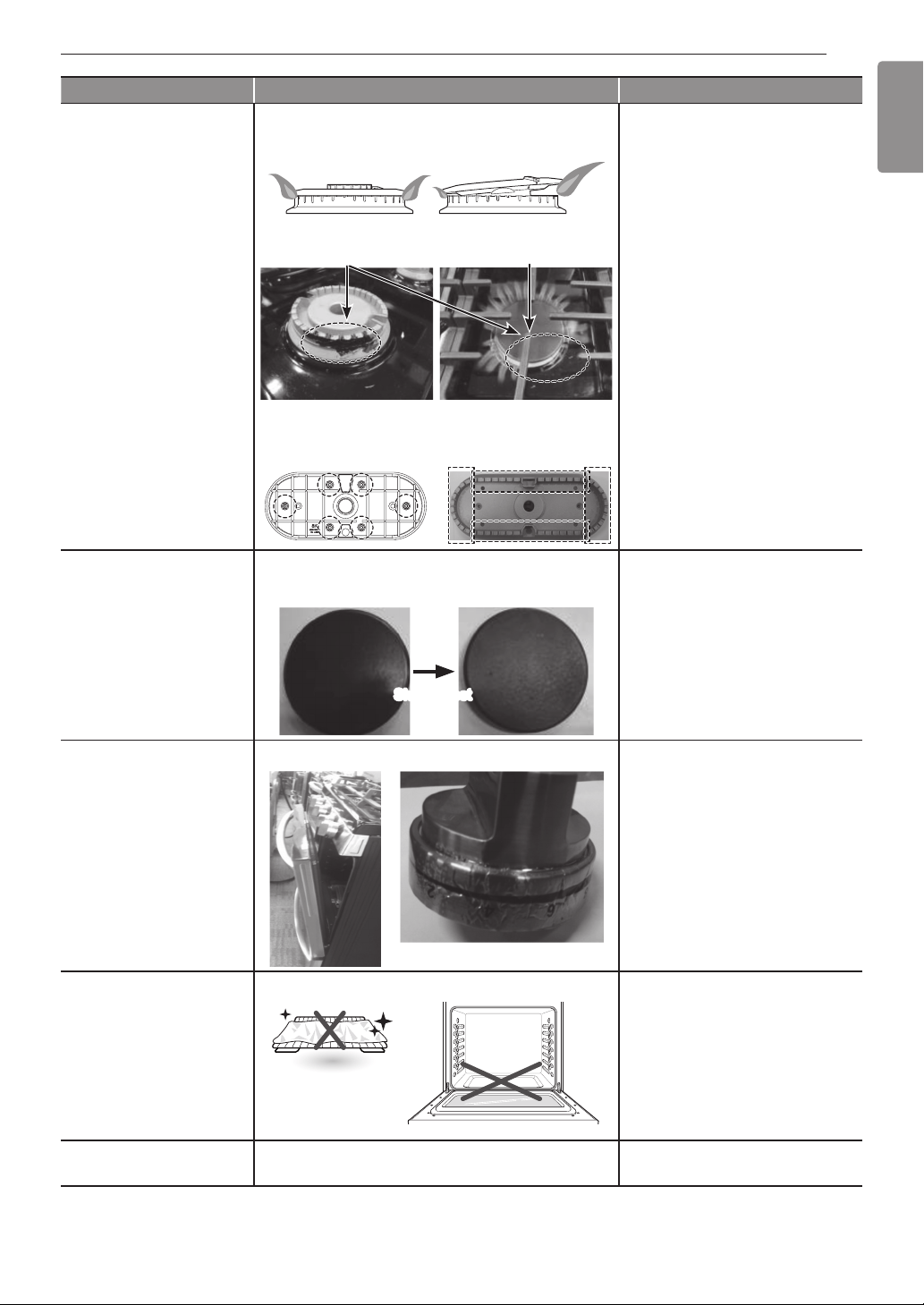
49
LIMITED WARRANTY
ENGLISH
Problem Cause Prevention
•
Uneven flame 1. Improper burner cap installation
•
Check installation of burner
head and cap
Burner cap is
properly seated.
Burner cap is NOT
properly seated.
2. Burner ports clogged by food residue
•
Hardened residue should be
removed using a toothbrush.
Ports blocked by dirt Flames uneven
* Oval burner
•
Oval burner
1) Release 6 nuts
2) Clean residue using
toothbrush
To clean: Release 6 nuts
Clean outside edges with
toothbrush
•
Burner cap color
changes and
becomes dull
1. Scratching
2. Use of detergent or abrasive cleansers
•
Do not use steel wool or
abrasive cleansers to clean.
•
To remove burnt-on food,
soak the burner heads in hot
water for 20–30 minutes. (Do
not use detergent)
Shine is lost
•
Knobs melt Improper usage
•
Do not leave door at stop
position during Broil/Bake
mode or right after cooking.
•
Oven or racks are
stained after using
aluminum foil
Aluminum foil has melted in the oven
•
Never cover the oven bottom
or cover an entire rack with
materials such as aluminum
foil.
•
If the foil has already melted
onto the oven, it will not
affect the performance of the
oven.
•
Flame or power is
weak
Gas pressure may be weak
•
Check with gas supplier first
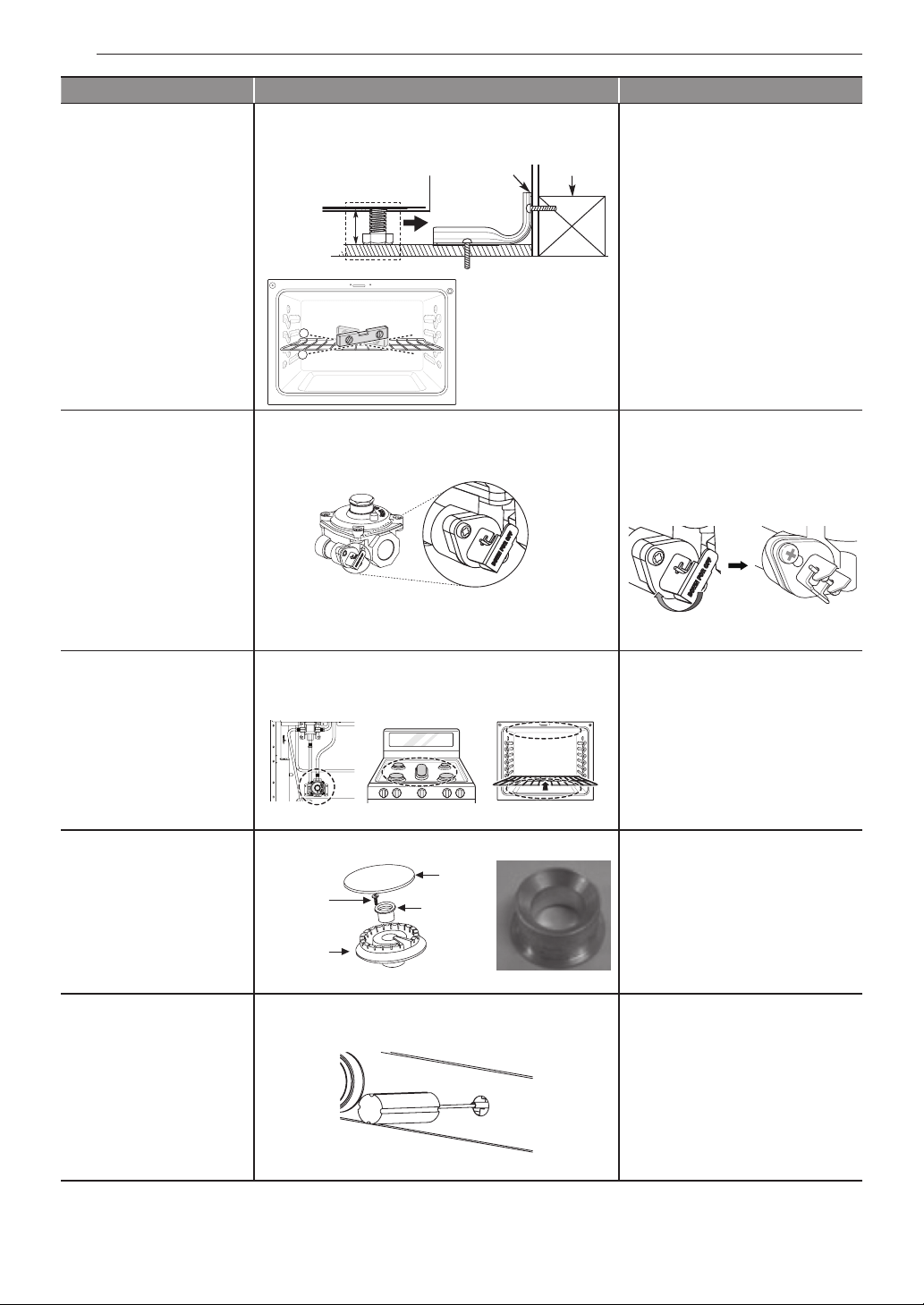
50
LIMITED WARRANTY
Problem Cause Prevention
•
Surface is not level
•
Oven is tipping
1. Range not leveled
2. Anti-tip device not installed correctly
•
Check with installer first
Anti-tip bracket
Approximately
0.65"
(16.5 mm)
Level both sides of range
Screw must
enter wood or
concrete
Wall plate
1
2
Use carpenter’s level to
check level.
•
Oven shows error
code (F9, F19) but
cooktop burners are
working.
The gas pressure regulator valve is closed.
•
Check that the regulator
valve is in the open position.
•
If the regulator valve
is
closed, rotate the lever to
open the valve.
Lever’s closed position
Lever’s open
position
Lever’s closed
position
•
Flames too big on
converted cooktop
(NP
LP)
The installer missed part of the conversion.
(Check 3 parts: regulator, cooktop nozzles,
broil/bake nozzles.)
•
Check with installer first
•
Refer to installation manual
regulator
cooktop nozzles broil/bake nozzles
17K burner needs choke.
•
Check with installer first
•
Refer to installation manual
choke
Burner
cap
Set Screw
Burner
base
Choke
•
Flame is too small or
too large
1. Variable gas pressure
2. Installer did not check
•
Check with installer first
Center adjustment screw
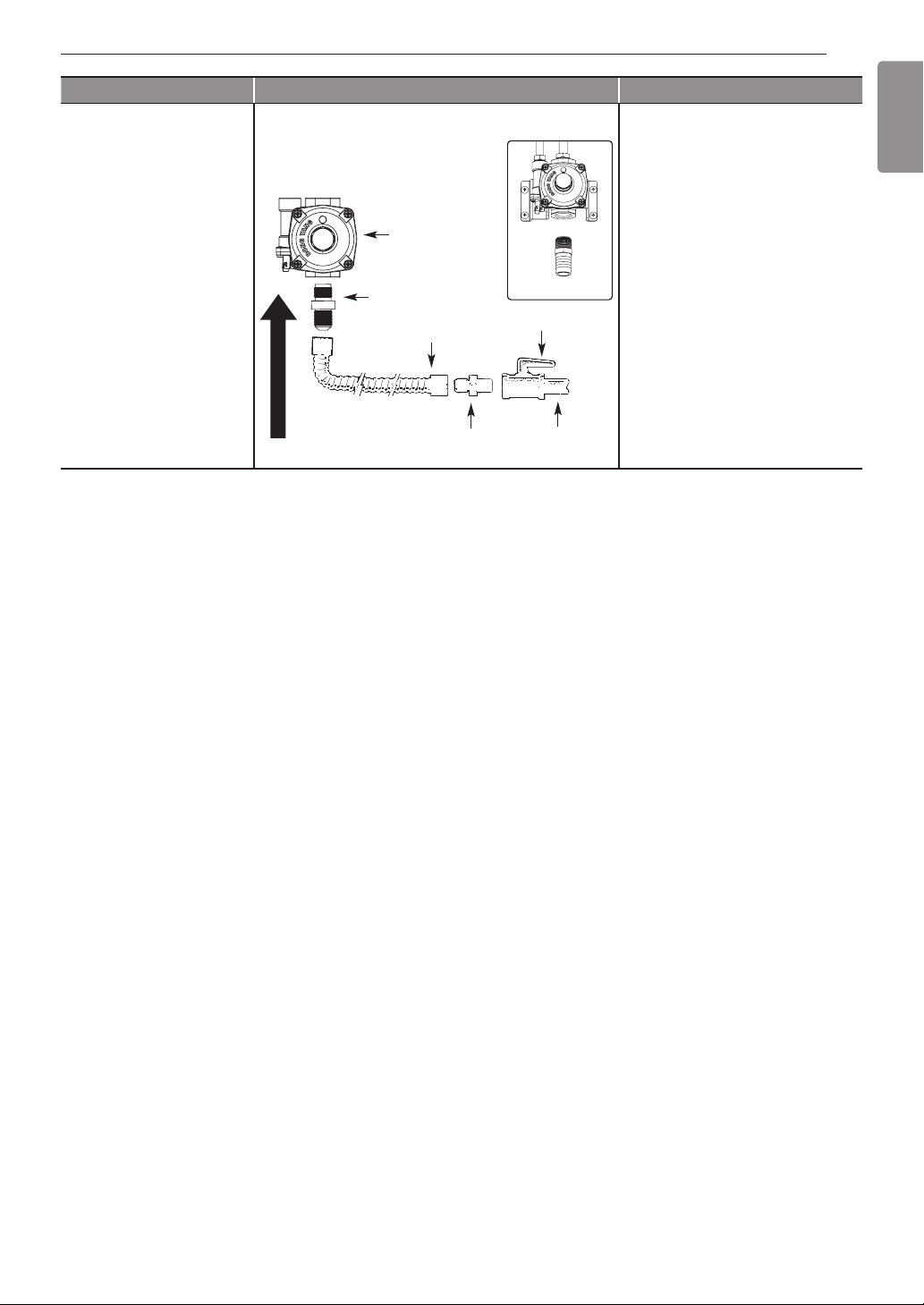
51
LIMITED WARRANTY
ENGLISH
Problem Cause Prevention
•
Gas smell Improper connection
•
Check with installer first
1
/
2
"
Adapter
1
/
2
" Adapter
1
/
2
"
Adapter
Pressure
regulator
Flex connector
(6 ft. max.)
Gas shut-off valve
1
/
2
" or
3
/
4
"
Gas pipe
Gas Flow into Range
Flexible Connector Hookup
All costs and expenses associated with the above excluded circumstances, listed under the heading,
This Limited Warranty Does Not Cover, shall be borne by the consumer.
TO OBTAIN WARRANTY SERVICE AND ADDITIONAL INFORMATION, PLEASE CALL OR VISIT OUR WEBSITE:
Call 1-888-542-2623 (7 A.M. to 12 A.M., 365 days a year) and select the appropriate option from the menu, or
visit our website at http://www.lg.com
PROCEDURE FOR RESOLVING DISPUTES:
EXCEPT WHERE PROHIBITED AT LAW, ALL DISPUTES BETWEEN YOU AND LG ARISING OUT OF OR RELATING
IN ANY WAY TO THIS LIMITED WARRANTY OR THE PRODUCT SHALL BE RESOLVED EXCLUSIVELY THROUGH
BINDING ARBITRATION, AND NOT IN A COURT OF GENERAL JURISDICTION. EXCEPT WHERE PROHIBITED AT
LAW, YOU AND LG BOTH IRREVOCABLY AGREE TO WAIVE THE RIGHT TO A JURY TRIAL AND TO BRING OR
PARTICIPATE IN A CLASS ACTION.
Definitions. For the purposes of this section, references to “LG” mean LG Electronics Canada, Inc., its parents,
subsidiaries and affiliates, and each of their officers, directors, employees, agents, beneficiaries, predecessors
in interest, successors, assigns and suppliers; references to “dispute” or “claim” shall include any dispute, claim
or controversy of any kind whatsoever (whether based in contract, tort, statute, regulation, ordinance, fraud,
misrepresentation or any other legal or equitable theory) arising out of or relating in any way to the sale, condition or
performance of the product or this Limited Warranty.
Notice of Dispute. In the event you intend to commence an arbitration proceeding, you must first notify LG in writing
at least 30 days in advance of initiating the arbitration by sending a letter to LGECI Legal Team at 20 Norelco Drive,
North York, Ontario, Canada M9L 2X6 (the “Notice of Dispute”). You and LG agree to engage in good faith discussions
in an attempt to amicably resolve your claim. The notice must provide your name, address, and telephone number;
identify the product that is the subject of the claim; and describe the nature of the claim and the relief being sought. If
you and LG are unable to resolve the dispute within 30 days of LG’s receipt of the Notice of Dispute, the dispute shall
be resolved by binding arbitration in accordance with the procedure set out herein. You and LG both agree that, during
the arbitration proceeding, the terms (including any amount) of any settlement offer made by either you or LG will not
be disclosed to the arbitrator until the arbitrator determines the dispute.
Agreement to Binding Arbitration and Class Action Waiver. Upon failure to resolve the dispute during the 30 day
period after LG’s receipt of the Notice of Dispute, you and LG agree to resolve any claims between you and LG only
by binding arbitration on an individual basis, unless you opt out as provided below, or you reside in a jurisdiction that
prevents full application of this clause in the circumstances of the claims at issue (in which case if you are a consumer,
this clause will only apply if you expressly agree to the arbitration). To the extent permitted by applicable law, any
dispute between you and LG shall not be combined or consolidated with a dispute involving any other person’s or
entity’s product or claim. More specifically, without limitation of the foregoing, except to the extent such a prohibition is
not permitted at law, any dispute between you and LG shall not under any circumstances proceed as part of a class or
representative action. Instead of arbitration, either party may bring an individual action in small claims court, but that
small claims court action may not be brought on a class or representative basis except to the extent this prohibition is
not permitted at law in your province or territory of jurisdiction as it relates to the claims at issue between you and LG.

52
LIMITED WARRANTY
Arbitration Rules and Procedures. To begin arbitration of a claim, either you or LG must make a written demand for
arbitration. The arbitration will be private and confidential, and conducted on a simplified and expedited basis before
a single arbitrator chosen by the parties under the provincial or territorial commercial arbitration law and rules of the
province or territory of your residence. You must also send a copy of your written demand to LG at LG Electronics,
Canada, Inc., Attn: Legal Department- Arbitration, 20 Norelco Drive, North York, Ontario M9L 2X6. This arbitration
provision is governed by your applicable provincial or territorial commercial arbitration legislation. Judgment may
be entered on the arbitrator’s award in any court of competent jurisdiction. All issues are for the arbitrator to decide,
except that, issues relating to the scope and enforceability of the arbitration provision and to the arbitrability of the
dispute are for the court to decide. The arbitrator is bound by the terms of this provision.
Governing Law. The law of the province or territory of your purchase shall govern this Limited Warranty and any
disputes between you and LG except to the extent that such law is preempted by or inconsistent with applicable
federal or provincial/territorial law. Should arbitration not be permitted for any claim, action, dispute or controversy
between you and LG, you and LG attorn to the exclusive jurisdiction of the courts of the province or territory of your
purchase for the resolution of the claim, action, dispute or controversy between you and LG.
Fees/Costs. You do not need to pay any fee to begin an arbitration. Upon receipt of your written demand for
arbitration, LG will promptly pay all arbitration filing fees unless you seek more than $25,000 in damages, in which
case the payment of these fees will be governed by the applicable arbitration rules. Except as otherwise provided
for herein, LG will pay all filing, administration and arbitrator fees for any arbitration initiated in accordance with the
applicable arbitration rules and this arbitration provision. If you prevail in the arbitration, LG will pay your attorneys’
fees and expenses as long as they are reasonable, by considering factors including, but not limited to, the purchase
amount and claim amount. Notwithstanding the foregoing, if applicable law allows for an award of reasonable
attorneys’ fees and expenses, an arbitrator can award them to the same extent that a court would. If the arbitrator finds
either the substance of your claim or the relief sought in the demand is frivolous or brought for an improper purpose (as
measured by the applicable laws), then the payment of all arbitration fees will be governed by the applicable arbitration
rules. In such a situation, you agree to reimburse LG for all monies previously disbursed by it that are otherwise your
obligation to pay under the applicable arbitration rules. Except as otherwise provided for, LG waives any rights it may
have to seek attorneys’ fees and expenses from you if LG prevails in the arbitration.
Hearings and Location. If your claim is for $25,000 or less, you may choose to have the arbitration conducted solely
(1) on the basis of documents submitted to the arbitrator, (2) through a telephonic hearing, or (3) by an in-person
hearing as established by the applicable arbitration rules. If your claim exceeds $25,000, the right to a hearing will
be determined by the applicable arbitration rules. Any in-person arbitration hearings will be held at the nearest, most
mutually-convenient arbitration location available within the province or territory in which you reside unless you and LG
both agree to another location or agree to a telephonic arbitration.
Severability and Waiver. If any portion of this Limited Warranty (including these arbitration procedures) is
unenforceable, the remaining provisions will continue in full force and effect to the maximum extent permitted by
applicable law. Should LG fail to enforce strict performance of any provision of this Limited Warranty (including these
arbitration procedures), it does not mean that LG intends to waive or has waived any provision or part of this Limited
Warranty.
Opt Out. You may opt out of this dispute resolution procedure. If you opt out, neither you nor LG can require the other
to participate in an arbitration proceeding. To opt out, you must send notice to LG no later than 30 calendar days from
the date of the first consumer purchaser’s purchase of the product by either (i) sending an e-mail to [email protected],
with the subject line: “Arbitration Opt Out;” or (ii) calling 1-800-980-2973. You must include in the opt out e-mail or
provide by telephone: (a) your name and address; (b) the date on which the product was purchased; (c) the product
model name or model number; and
(d) the serial number (the serial number can be found (i) on the product; or (ii) online by accessing https://www.lg.com/
ca_en/support/repair-service/schedule-repair and clicking on “Find My Model & Serial Number”).
In the event that you “Opt Out”, the law of the province or territory of your residence shall govern this Limited
Warranty and any disputes between you and LG except to the extent that such law is preempted by or inconsistent
with applicable federal or provincial/territorial law. Should arbitration not be permitted for any claim, action, dispute or
controversy between you and LG, you and LG agree to attorn to the exclusive jurisdiction of the courts of the province
or territory of your residence for the resolution of the claim, action, dispute or controversy between you and LG.
You may only opt out of the dispute resolution procedure in the manner described above (that is, by e-mail or
telephone); no other form of notice will be effective to opt out of this dispute resolution procedure. Opting out of this
dispute resolution procedure will not affect the coverage of the Limited Warranty in any way, and you will continue to
enjoy the full benefits of the Limited Warranty. If you keep this product and do not opt out, then you accept all terms
and conditions of the arbitration provision described above.
Conflict of Terms. In the event of a conflict or inconsistency between the terms of this Limited Warranty and the End
User License Agreement (“EULA”) in regards to dispute resolution, the terms of this Limited Warranty shall control and
govern the rights and obligations of the parties and shall take precedence over the EULA.
Français
www.lg.com
MFL33029629
LRG3061** LRG3193** LRG3060**
MANUEL DU PROPRIÉTAIRE
CUISINIÈRE À
GAZ
Copyright © 2017 - 2019 LG Electronics Inc. Tous droits réservés.
Veuillez lire attentivement le présent manuel d’utilisation avant de faire fonctionner
l’appareil et conservez-le à portée de la main pour le consulter en tout temps.
•
N’entreposez pas et n’utilisez pas d’essence ou d’autres vapeurs et liquides
inflammables à proximité de cet appareil ou d’autres appareils.
•
CE QU’IL FAUT FAIRE SI VOUS DÉTECTEZ UNE ODEUR DE GAZ
- N’essayez pas d’allumer un appareil.
- Ne touchez aucun interrupteur électrique.
- N’utilisez aucun téléphone à l’intérieur de l’appartement ou de la maison.
- Appelez immédiatement votre fournisseur de gaz à partir du téléphone d’un voisin.
Suivez les directives de votre fournisseur de gaz.
- Si vous n’arrivez pas à joindre votre fournisseur de gaz, appelez le service
d’incendie.
•
L’installation et tout entretien doivent être effectués par un installateur ou un agent
de service qualifié, ou par le fournisseur de gaz.
Si l’information contenue dans ce manuel n’est respectée, un incendie ou une
explosion peut en résulter, entraînant des dommages matériels, des blessures
corporelles graves ou la mort.
AVERTISSEMENT

2
TABLE DES MATIÈRES
TABLE DES MATIÈRES
3
CARACTÉRISTIQUES DE
L’APPAREIL
4
CONSIGNES DE SÉCURITÉ
IMPORTANTES
12
APERÇU DU PRODUIT
12 Pièces
12 Accessoires
13
INSTALLATION
13 Avantd᾿installerlacuisinière
14 Installation de la cuisinière
16 Alimentation en gaz adéquat
17 Branchement de la cuisinière au conduit de gaz
18 Branchements électriques
18 Scellage des ouvertures
19 Assemblage des brûleurs de surface
19 Vérificationdel᾿allumagedesbrûleursde
surface
20 Mise au niveau de la cuisinière
20 Enclenchement du dispositif antibasculement
21
FONCTIONNEMENT
21 Brûleurs de surface au gaz
22 Emplacements des brûleurs
22 Utilisation des brûleurs de surface au gaz
22 Ajustementdel᾿intensitédelaflamme
23 En cas de panne de courant
23 Batterie de cuisine pour utilisation sur la
table de cuisson
23 Utilisationd᾿unwok
23 Utilisation des grils de la table de cuisson
24 Utilisation de la plaque chauffante
25 Four
26 Aperçu du panneau de commande
27 Modification des réglages du four
27 Clock(Horloge)
27 OvenLight(Lampedufour)
27 Réglages minimum et maximum par défaut
28 TimerOn/Off(Marche/Arrêtdelaminuterie)
28 Settings(Réglages)
-
Réglage du mode horaire
-
Réglage de la température du four
-
Activation ou désactivation du voyant
d᾿alarmedepréchauffage
-
Réglageduvolumedel᾿avertisseur
-
Sélection des degrés Fahrenheit ou
Celsius
-
Comment configurer la fonctionnalité
Conversion automatique de la convection
(Pourlemodèle:LRG3193)
30 Lockout(Verrouillage)
30 CookTime[TimedCook](Tempsde
cuisson[Cuissonminutée])
30 Retrait et remise en place des grilles du
four
31 Recommandations pour la cuisson et le
rôtissage au four
31 Bake(Cuisson)
32 Cuissonparconvection(Pourlemodèle:
LRG3193)
33 Broil(Grillage)
35
ENTRETIEN
35 Brûleurs de surface au gaz
36 Foyers de brûleurs
36 Nettoyage de la table de cuisson
36 Évents du four
37 Panneau de contrôle
37 Boutons et panneau du collecteur avant
37 Nettoyagedel᾿extérieur
38 Directivesd᾿entretiendelaporte
38 EasyClean
®
40 Remplacement de la lampe du four
40 Retrait et remise en place de la porte du four et
du tiroir amovibles
42
DÉPANNAGE
42 FAQ
44 Avantd᾿appelerleréparateur
46
FONCTION SMART DIAGNOSIS
MC
47
GARANTIE LIMITÉE
3
CARACTÉRISTIQUES DE L’APPAREIL
Français
CARACTÉRISTIQUES DE L’APPAREIL
Plusieurs tailles de brûleurs au gaz
Choisissez le brûleur le plus approprié en fonction des dimensions de l’ustensile de
cuisson utilisé.
Vouspouvezutiliserplusieursbrûleursenmêmetempspourpréparerdifférentsplats.
Cuisinière à gaz pratique et sécuritaire
Permet de cuisiner de manière pratique et sécuritaire.
Autonettoyage et EasyClean
®
Fonctions utiles facilitant le nettoyage.
4
CONSIGNES DE SÉCURITÉ IMPORTANTES
CONSIGNES DE SÉCURITÉ IMPORTANTES
Lisez et suivez toutes les consignes avant d’utiliser cette cuisinière afin d’éviter tout risque d’incendie,
de décharge électrique, de blessure ou de dommage. Ce guide ne couvre pas toutes les situations
susceptibles de survenir. Communiquez toujours avec votre agent de service ou le fabricant
concernant les problèmes que vous ne comprenez pas.
Vouspouveztéléchargerlemanueldupropriétaireauhttp://www.lg.com
Ceci est le symbole d’alerte de sécurité. Ce symbole vous indique les dangers potentiels
pouvant provoquer des dommages matériels, des blessures corporelles graves ou la mort.
Tous les messages de sécurité seront précédés du symbole d’alerte de sécurité, ainsi que
du mot « AVERTISSEMENT » ou « MISE EN GARDE ». Voici le message que ces mots
véhiculent:
AVERTISSEMENT
-
Indique une situation dangereuse qui, si non évitée, pourrait
entraîner la mort ou des blessures graves.
MISE EN GARDE
-
Indique une situation dangereuse qui, si non évitée, pourrait
entraîner des blessures légères ou de gravité moyenne.
DISPOSITIF ANTIBASCULEMENT
AVERTISSEMENT
•
TOUTE CUISINIÈRE PEUT BASCULER.
•
DES BLESSURES PEUVENT EN RÉSULTER.
•
INSTALLEZ LES SUPPORTS ANTIBASCULEMENT FOURNIS AVEC LA CUISINIÈRE.
•
CONSULTEZLESDIRECTIVESD᾿INSTALLATION.
•
Une personne, enfant ou adulte, peut faire basculer la cuisinière et subir des blessures
mortelles.
•
Installerledispositifantibasculementsurlastructureousurlacuisinière(ousurlesdeux).
•
Vérifier si le dispositif antibasculement est installé et engagé convenablement en suivant le
guide du gabarit de l’équerre antibasculement.
•
Engager la cuisinière dans le dispositif antibasculement en en suivant le guide du gabarit
de l’équerre antibasculement. S’assurer que le dispositif antibasculement est engagé de
nouveau après un déplacement de la cuisinière en suivant le guide du gabarit de l’équerre
antibasculement.
•
Engager de nouveau le dispositif antibasculement si la cuisinière est déplacée. Ne pas utiliser la
cuisinière lorsque le dispositif antibasculement n’est pas installé et engagé.
•
Voir les directives d’installation pour obtenir de plus amples renseignements.
•
Toute omission de le faire expose les enfants et les adultes à un risque de décès ou de brûlures
graves.
•
Pouréviterlebasculement,nelaissezpersonnemonterous᾿asseoirsurlaporte.Installezle
support antibasculement fourni avec cette cuisinière.
- Lacuisinièrepourraitalorsbasculeretdesblessurespourraientêtrecauséespardesliquides
chaudsoudesalimentsrenversés,ouparlacuisinièreelle-même.
- Silacuisinièredoitêtredéplacéeloindumuràdesfinsdenettoyage,deréparationoupourd᾿autres
raisons, veillez à ce que le support antibasculement soit correctement réenclenché au moment de
sa remise en place contre le mur.
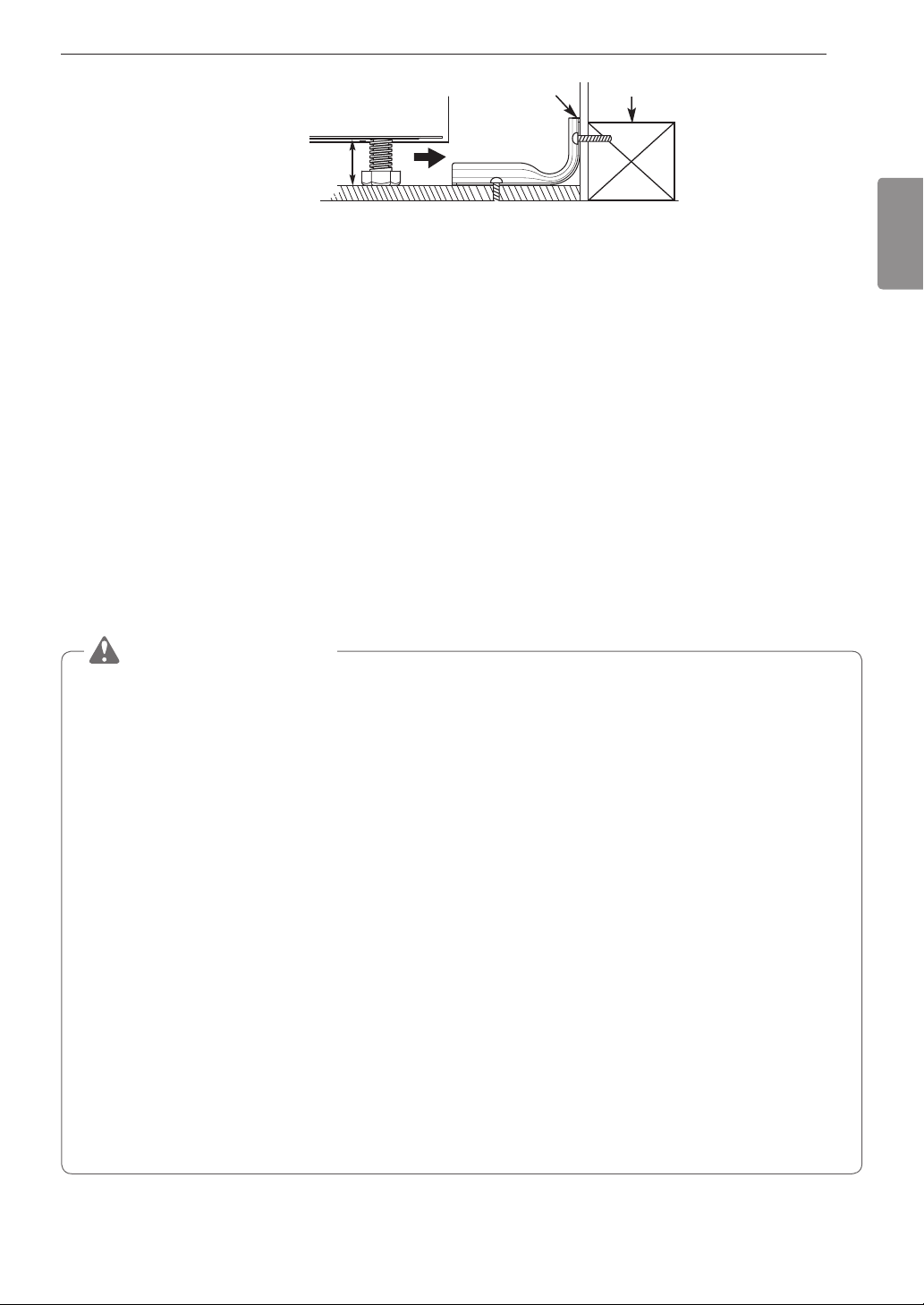
5
CONSIGNES DE SÉCURITÉ IMPORTANTES
Français
Support antibasculement
Environ 0,65 po
(16,5mm)
La vis doit
pénétrer dans le
bois ou le béton
Plaque murale
•
Pourréduirelerisquedebasculementdelacuisinière,celle-cidoitêtrestabiliséeparl᾿installation
adéquate des supports antibasculement.
•
Pour vérifier si le support antibasculement est adéquatement installé, enlevez tout objet de la
tabledecuisson.Saisissezl᾿extrémitéarrièresupérieuredudosseretdelacuisinièreetessayez
delabasculeravecprécautionversl᾿avant.Assurez-vousquelessupportsantibasculementsont
engagés.
•
Retirez le tiroir-réchaud ou le tiroir de rangement et vérifiez visuellement si le pied de nivellement
arrière est bien inséré dans le support antibasculement.
•
Reportez-vousaumanueld᾿installationpourinstallercorrectementlesupportantibasculement
AVIS DE SÉCURITÉ IMPORTANT
Les appareils fonctionnant au gaz peuvent occasionner une exposition mineure à quatre de ces
substances, à savoir le benzène, le monoxyde de carbone, le formaldéhyde et la suie, des substances
issues principalement de la combustion incomplète du gaz naturel ou des gaz de pétrole liquéfiés.
Silesbrûleurssontrégléscorrectement(présenced᾿uneflammebleueetnonjaune),lerisquede
combustionincomplèteestgrandementdiminué.Onpeutlimiterl᾿expositionàcessubstancesen
ouvrantlesfenêtresouenutilisantunventilateurouunehotte.
AVERTISSEMENT
•
N᾿utilisezjamaisvotrecuisinièrepourchaufferouréchaufferlapièce.Celapeutentraînerune
intoxication au monoxyde de carbone et la surchauffe du four.
•
Neportezjamaisdevêtementsamplesoutombantslorsquevousutilisezvotrecuisinière.Soyez
prudent lorsque vous désirez atteindre des objets placés dans des armoires situées au-dessus
delacuisinière.Lesmatériauxinflammablespeuventprendrefeus᾿ilsentrentencontactavec
une flamme ou les surfaces chaudes du four, et causer des brûlures graves.
•
Neplacezpasoun᾿utilisezpasdematériauxcombustibles(commedel᾿essence)oud᾿autres
vapeurs et liquides inflammables à proximité de cet appareil ou de tout autre appareil.
•
Ne placez jamais de matériaux inflammables dans le four ou près de la table de cuisson.
•
Évitezdelaisserdelagraissedecuissonoud᾿autresmatériauxinflammablesàl᾿intérieurouà
proximité de la cuisinière.
•
N᾿éteignezpasunfeudegraisseavecdel᾿eau.Netouchezjamaisunepoêleouunecasserole
enflammée.Fermezl᾿appareil.Surunbrûleurdesurface,étouffezlesflammesd᾿unecasserole
en feu en la recouvrant complètement avec un couvercle ajusté, une plaque à biscuits ou un
plateau. Utilisez un produit chimique sec multifonction ou un extincteur à mousse.
Ilestpossibled᾿éteindreunfeudegraisseenlerecouvrantdebicarbonatedesoudeoubienà
l᾿aided᾿unproduitchimiquesecmultifonctionoud᾿unextincteuràmousse.
Ilestpossibled᾿éteindrelesflammesdanslefourouletiroirenfermantlaportedufourou
dutiroiretenarrêtantl᾿appareil,ouenutilisantunproduitchimiquesecmultifonctionouun
extincteur à mousse.
•
N᾿utilisezpaslefourouletiroirpourrangerdesobjets.
•
Laissez refroidir les grilles des brûleurs et les autres surfaces avant de les toucher.
6
CONSIGNES DE SÉCURITÉ IMPORTANTES
AVERTISSEMENT
•
N᾿obstruezjamaislesévents(trousd᾿aération)delacuisinière.Ilspermettentunecirculation
d᾿airdanslesdeuxsens,cequiestnécessaireaubonfonctionnementdelacuisinièreetpour
unecombustionadéquate.Lesouverturesd᾿aérationsetrouventàl᾿arrièredelatablede
cuisson,auhautetaubasdelaportedufourainsiqu᾿aubasdelacuisinière.
•
N᾿obstruezjamaislefluxd᾿airdecombustionetdeventilationenbloquantl᾿éventoulesentrées
d᾿airdufour.Celalimiteraitlacirculationdel᾿airverslesbrûleursetpourraitentraînerune
intoxication au monoxyde de carbone
•
Nerecouvrezjamaisentièrementunegrilledepapierd᾿aluminiumoud᾿autresmatériaux,etne
couvrez pas les fentes, les trous ou les passages dans le fond du four. Cela bloque la circulation
del᾿airdanslefouretpeutcauseruneintoxicationaumonoxydedecarbone.Lepapier
d᾿aluminiumpeutaussiemprisonnerlachaleuretreprésenterunrisqued᾿incendie.
•
Les rayures importantes ou les chocs sur les portes en verre peuvent causer le bris ou
l᾿éclatementduverre.
•
Lefaitdeposerlespieds,des᾿appuyeroudes᾿asseoirsurlesportesoulestiroirspourrait
causer des blessures graves et aussi endommager la cuisinière. Ne laissez jamais les enfants
grimpersurlacuisinièreoujoueràproximité.Lepoidsd᾿unenfantsuruneporteouvertepeut
faire basculer la cuisinière et entraîner des brûlures ou des blessures graves.
•
L᾿essaid᾿étanchéitédel᾿appareildoitêtreréaliséconformémentauxinstructionsdufabricant.
•
Des fuites de gaz peuvent se produire dans le système et représenter un risque sérieux. Une
fuitedegazpeutnepasêtredétectéeparl᾿odeur.Lesfournisseursdegazrecommandent
d᾿acheteretd᾿installerundétecteurdegazapprouvéparl᾿UL.L᾿installationetl᾿utilisation
doiventêtreconformesauxinstructionsdufabricantdudétecteurdegaz.
•
N᾿appliquezaucunnettoyantàfourcommercialsurlefinidufournisurtouteautrepartiede
celui-ci. Cela endommagerait le fini.
•
Pouréviterl᾿apparitiondetachesouladécoloration,nettoyezl᾿appareilaprèschaqueutilisation.
•
N᾿essayezpasd᾿ouvriroudefermerlaportenid᾿utiliserlefourtantquelaporten᾿estpas
installée correctement.
•
Ne mettez jamais les doigts entre une charnière et le cadre avant du four. Les bras de la
charnière sont montés sur ressort. Si elle est accrochée accidentellement, la charnière se
refermera brusquement contre le cadre du four et causera des blessures aux doigts.
MISE EN GARDE
•
Touslesobjetsrevêtantunintérêtpourlesenfantsnedoiventpasêtreplacésdansdesarmoires
situéesau-dessusd᾿unecuisinièreousurledosseretdecelle-ci.Engrimpantsurlacuisinière
pourattrapercesobjets,lesenfantsrisquentd᾿êtreblessésgravement.
•
Nelaissezpaslesenfantsseulsousanssurveillanceprèsd᾿unecuisinièrechaudeouen
marche. Ils pourraient subir de graves brûlures.
•
Neleslaissezpassesuspendreauxcomposantsdelacuisinière(portedufour,tiroir-réchaud,
tabledecuisson),ygrimperous᾿ytenir.Celapourraitendommagerlacuisinièreoulafaire
basculer et ainsi entraîner des blessures graves.
•
Portezdesgantspournettoyerlacuisinièreafind᾿éviterlesblessuresoulesbrûlures.
•
N᾿utilisezpaslefourpourrangerdesalimentsoudesplatsdecuisson.
•
Pouréviterd᾿endommagerlaportedufour,n᾿essayezpasdel᾿ouvrirlorsquel᾿indicationLock
(Verrouillage)estaffichée.
•
Ne posez pas un poids excessif sur la porte ouverte ou ne montez pas sur celle-ci. Cela peut
faire basculer la cuisinière, casser la porte ou vous blesser.
•
N᾿utilisezpaslacuissonprogramméeendifférépourdesalimentstrèspérissablescommeles
produits laitiers, le porc, la volaille ou les fruits de mer.
7
CONSIGNES DE SÉCURITÉ IMPORTANTES
Français
PRÉCAUTIONS DE SÉCURITÉ POUR L’INSTALLATION
Demandezàl’installateurdevousmontreroùsetrouvelerobinetd’arrêdugazdelacuisinièeet
comment le fermer, si néessaire.
AVERTISSEMENT
•
Assurez-vous que votre cuisinière est installée et mise à la terre correctement par un installateur
qualifiéetconformémentauxinstructionsd᾿installation.Touslestravauxderéglageoude
réparationdoiventêtreréalisésexclusivementpardesinstallateursdecuisinièresàgazoudes
techniciens qualifiés.
•
Assurez-vous que votre cuisinière a été réglée correctement par un technicien ou un installateur
qualifiéselonletypedegaz(dugaznatureloudesgazdepétroleliquéfiés)quiserautilisé.
Votrecuisinièrepeutêtretransforméepouruneutilisationavecl᾿undesdeuxtypesdegaz.
Reportez-vousauxinstructionsd᾿installation.
•
Cesréglagesdoiventêtreréalisésparuntechnicienqualifiéetconformémentauxinstructionsdu
fabricantetàl᾿ensembledescodesetdesprescriptionsdel᾿autoritéjuridiquementcompétente.
Le non-respect de ces consignes peut causer des blessures graves ou des dommages matériels.
L᾿agencequalifiéeréalisantcesréglagesassumelaresponsabilitédelaconversion.
•
Débranchezl᾿alimentationélectriqueavantderéparerl᾿appareil.
•
N᾿utilisezjamaislaportedel᾿appareilenguised᾿escabeauoudesiège,carcelapeutfaire
basculerl᾿appareiletcauserdesblessuresgraves.
•
Ceproduitnedoitpasêtreinstalléendessousd᾿unehottedeventilationquidirigel᾿airvers
lebas.Celapeutentraînerdesproblèmesd᾿allumageetdecombustiondesbrûleursaugaz,
provoquantdesblessures,etpeutaffecterlesperformancesdecuissondel᾿appareil.
•
Branchez votre cuisinière uniquement sur une prise de 120 volts mise à la terre. Ne retirez pas
labrochedemiseàlaterrerondeducordond᾿alimentation.Encasdedouteconcernantlamise
àlaterredusystèmeélectriquedubâtiment,vousêtespersonnellementresponsableetobligé
de faire remplacer toute prise sans mise à la terre par une prise à trois broches mise à la terre
correctementetconformémentauCodenationaldel᾿électricité.N᾿utilisezpasderallongeavec
cette cuisinière.
•
Afind᾿évitertoutrisqued᾿incendieoudedéchargeélectrique,n᾿utilisezpasdefiched᾿adaptation
ouderallonge,etneretirezpaslabrochedemiseàlaterreducordond᾿alimentationélectrique.
Le non-respect de cet avertissement peut provoquer des blessures graves, un incendie ou la
mort.
•
Pouréviterunemauvaisecirculationdel᾿air,placezlacuisinièrehorsdelatrajectoiredela
circulationdanslacuisineetdesemplacementsexposésauxcourantsd᾿air.
•
N᾿essayezpasderéparerouderemplacerunepiècedevotrecuisinière,saufsicelaest
explicitementmentionnédanscemanuel.Touteautreréparationdoitêtreconfiéeàuntechnicien
qualifié.
•
Assurez-vousquetouslesmatériauxd᾿emballageontétéretirésdelacuisinièreavantde
l᾿utiliser,sansquoiilspourraients᾿enflammeretlesflammesoulafuméepourraientcauserdes
dommages.
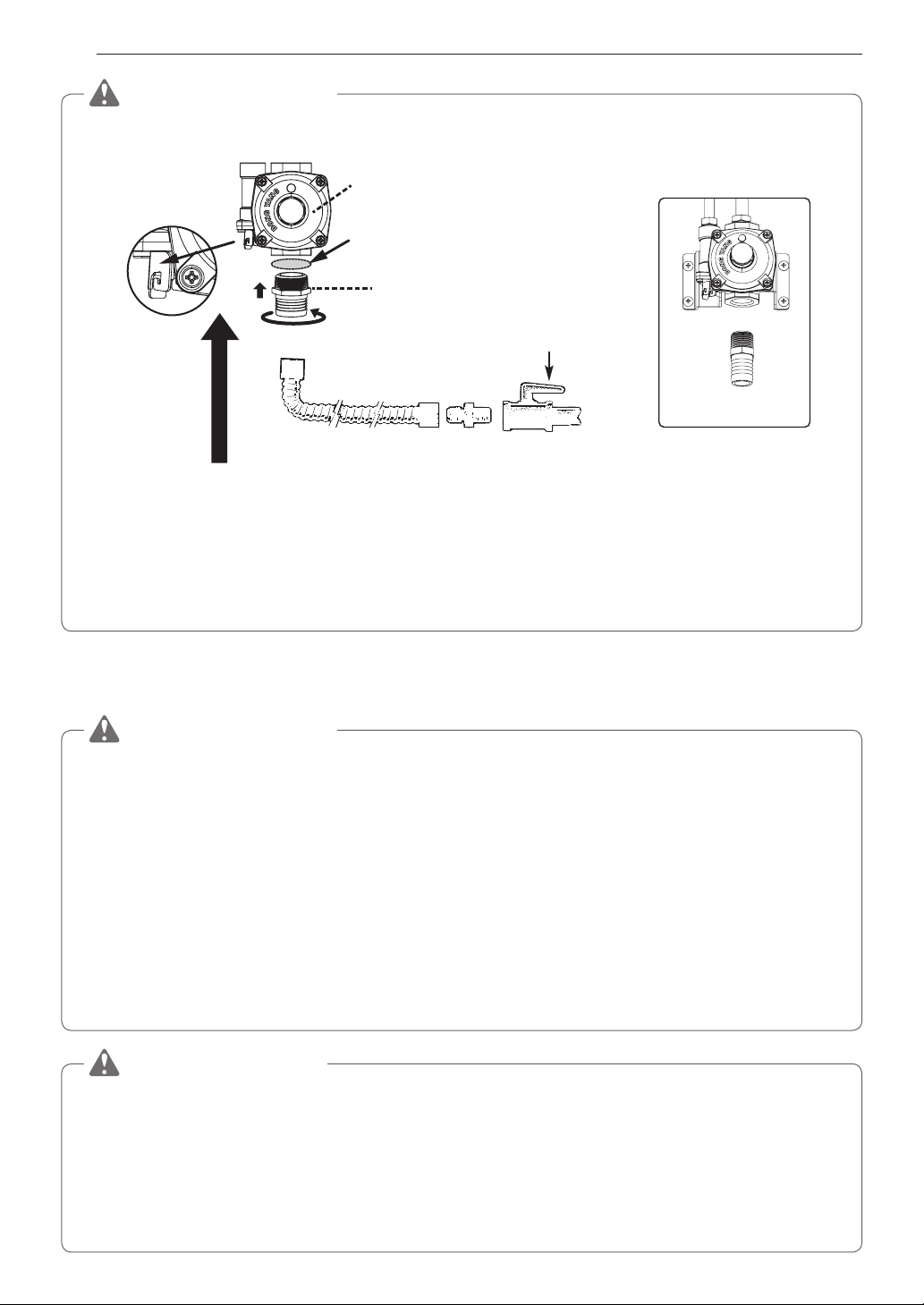
8
CONSIGNES DE SÉCURITÉ IMPORTANTES
AVERTISSEMENT
•
Pour couper l’alimentation en gaz de la cuisinièe, fermez la vanne d’alimentation en gaz de la
cuisinière en la tournant dans le sens des aiguilles d’ne montre.
Raccord(
1
/
2
po-14NPT)
1
/
2
po Raccord
D’ouverture
(utilisation)dulevier
Régulateur de pression
Robinetd’arrêtdugaz
Retirez cette étiquette
Débit de gaz dans la cuisinière
Installateur:Informezleclientdel’emplacementdurobinetd’arrêtdugaz.
•
Si vous utilisez votre cuisinière pendant une longue période, il se peut que le plancher devienne
chaud.Denombreuxrevêtementsdesolnesontpasfaitspourcegenred᾿usage.
•
N᾿installezjamaislacuisinièresurdescarreauxenvinyleousurdulinoquineseraientpas
faitspourrésisteràcegenred᾿usage.N᾿installezjamaislacuisinièredirectementsuruntapis
intérieur de cuisine.
BRÛLEURS DE SURFACE
AVERTISSEMENT
•
Mêmesilaflammedubrûleurs᾿éteint,legazcirculetoujoursjusqu᾿aubrûleurtantquelebouton
n᾿estpasenpositionOff.Sivoussentezuneodeurdegaz,ouvrezimmédiatementlafenêtre
etaérezlapiècependantcinqminutesavantd᾿utiliserlebrûleur.Nelaissezpaslesbrûleurs
allumés sans surveillance.
•
Utilisez des casseroles de la taille adaptée.N᾿utilisezpasdecasserolesquinesontpas
stables ou qui peuvent basculer facilement. Choisissez une casserole avec un fond plat et
suffisamment large pour recouvrir les grilles des brûleurs. Pour prévenir des débordements,
veillez à ce que la casserole soit suffisamment large pour contenir les aliments comme il
sedoit.Celadiminueraletempsdenettoyageetempêcheradesdépôtsdenourriturequi
peuvents᾿avérerdangereuxpuisquelesrestesforméspardegrosseséclaboussuresoudes
débordements et se trouvant sur la cuisinière peuvent prendre feu. Utilisez des casseroles avec
despoignéesquipeuventêtrefacilementsaisiesetquirestentfroides.
MISE EN GARDE
•
Assurez-vous que toutes les commandes sont en position Offavantd᾿alimenterlacuisinièreen
gaz.
•
Ne laissez jamais les brûleurs de surface sans surveillance à des réglages de feu vif. Le
débordement de liquide en ébullition peut causer de la fumée et les débordements de corps gras
peuvents᾿enflammer.
•
Lorsque vous allumez les brûleurs de surface, tournez toujours les boutons à la position Lite et
assurez-vous que les brûleurs sont bien allumés.
9
CONSIGNES DE SÉCURITÉ IMPORTANTES
Français
MISE EN GARDE
•
Limitezlahauteurdelaflammedesbrûleursdesurfacedesortequ᾿ellenedépassepasle
rebord des casseroles. Une flamme trop forte est dangereuse.
•
Utilisez toujours des poignées sèches, car une poignée humide ou mouillée sur une surface
chaudepeutproduiredelavapeuretprovoquerdesbrûlures.N᾿approchezpaslespoignées
tropprèsdelaflammenuelorsquevoussoulevezunecasserole.N᾿utilisezpasdetorchonsou
de tissus épais. Utilisez plutôt une poignée.
•
Sivousutilisezdesustensilesdecuisineenverre,assurez-vousqu᾿ilssontconçuspourlatable
de cuisson.
•
Pour éviter les brûlures causées par les matériaux inflammables et les déversements, orientez
lespoignéesdescasserolesverslecôtéoul᾿arrièredelacuisinièreenévitantdeleslaisserau-
dessus des brûleurs adjacents.
•
Nelaissezaucunobjetsurlatabledecuisson.L᾿airchaudprovenantdel᾿éventpeutenflammer
les objets inflammables ou augmenter la pression dans des récipients fermés et les faire éclater.
•
Surveillez attentivement les aliments en cours de friture sur une flamme réglée au maximum.
•
Chauffeztoujourslesmatièresgrasseslentement,etsurveillez-lespendantqu᾿elleschauffent.
•
Sivousutilisezunmélanged᾿huilesetdegraissespourlafriture,veillezàbienlesmélanger
avant de les faire chauffer.
•
Si possible, utilisez un thermomètre de friture pour éviter que les graisses chauffent au-delà du
point de fumée.
•
Utilisez la plus petite quantité possible de matières grasses pour obtenir une friture plate ou une
fritureenbainefficace.Unepoêlequicontienttropdematièresgrassespeutoccasionnerdes
déversements lorsque la nourriture est ajoutée.
•
Necuisezjamaislesalimentsdirectementsurlaflammenueàmêmelatabledecuisson.
•
N᾿utilisezpasdewokavecsupportmétalliquerondplacéau-dessusdelagrilled᾿unbrûleur
desurface.Cetanneauemprisonnelachaleur,cequipeutendommagerlagrilleetlatêtedu
brûleur. Cela peut entraîner le dysfonctionnement du brûleur. Cela peut aussi entraîner une
hausse des niveaux de monoxyde de carbone au-dessus des seuils autorisés et comporter des
risques pour la santé.
•
Lesalimentsdestinésàêtrefritsdoiventêtreaussisecsquepossible.Laprésencedegelou
d᾿humiditésurlesalimentspeutfairebouillonnerlagraissechaudequipeutdéborderdela
casserole.
•
N᾿essayezjamaisdedéplacerunecasserolerempliedegraissechaude,enparticulierune
friteuse. Attendez que la graisse soit froide.
•
Neplacezjamaisd᾿objetsenplastiquesurlatabledecuisson,carilspourraientfondres᾿ilssont
laisséstropprèsdel᾿évent.
•
Tenez tout objet en plastique éloigné des brûleurs de surface.
•
Pour éviter de vous brûler, assurez-vous que chaque commande de brûleur est à la position Off
etquetouteslesgrillessontfroidesavantd᾿essayerdelesenlever.
•
Sivoussentezuneodeurdegaz,coupezl᾿arrivéedegazdelacuisinièreetappelezun
technicienqualifié.N᾿utilisezjamaisdeflammenuepourlocaliserunefuite.
•
Tournez toujours le bouton à la position Off avant de retirer une casserole.
•
Ne soulevez pas la table de cuisson. Le fait de soulever la table de cuisson peut endommager la
cuisinière et provoquer son dysfonctionnement.
•
Silacuisinièresetrouveàproximitéd᾿unefenêtre,n᾿installezpasderideauxlongs,carlevent
pourrait les pousser au-dessus des brûleurs de surface et ils pourraient prendre feu.
•
Faites attention lorsque vous nettoyez la table de cuisson. Les pointes de métal des électrodes
pourraient causer des blessures.
10
CONSIGNES DE SÉCURITÉ IMPORTANTES
GRIL
Utiliseztoujoursunelèchefriteetunegrillepourledrainagedel᾿excédentdegrasetdematières
grasses. Ceci permettra de réduire les projections, la fumée et les flambées.
AVERTISSEMENT
Lorsdel᾿utilisationdugril,latempératureàl᾿intérieurdufourestextrêmementchaude.Pouréviter
toutebrûlure:
•
gardezlaporteferméelorsdel᾿utilisationdugril(consultezlasection«Gril»dupréentmanuel);
portez toujours des gants de cuisine lorsque vous placez ou retirez des aliments dans le four.
BIEN CUIRE LA VIANDE ET LA VOLAILLE
Pour éviter les maladies causées par la nourriture, cuisez à fond les viandes et la volaille, soit à une
températureINTERNEminimalede160°Fetde165°Frespectivement;cuisezlessteaksetles
côelettesdeboeuf,deporc,deveauetd᾿gneauàunetempéatureINTERNEminimalede145°F.
FOUR
Sivousouvrezlaported᾿unfourchaud,nevousapprochezpastropprèsdelacuisinière.L᾿airchaud
etlavapeurquis᾿échappentpeuventcauserdesbrûluresauxmains,auvisageetauxyeux.
AVERTISSEMENT
•
N᾿obstruezjamaislesfentes,lestrousoulespassagesdelapartieinférieuredufouretne
recouvrezpasunegrillecomplètedematériauxcommedupapierd᾿aluminium.Celabloque
lacirculationdel᾿airdanslefouretpeutcauseruneintoxicationaumonoxydedecarbone.Le
papier d'aluminium peut emprisonner la chaleur et représenter un risque d'incendie.
•
Neréchauffezpaslesalimentsdansunrécipientfermé.Lapressioncroissanteàl᾿intérieurdu
récipient pourrait le faire éclater et causer des blessures.
•
Nerecouvrezpaslesparoisoulefonddufouravecdupapierd᾿aluminiumetnelaissezpas
dupapierd᾿aluminiumtoucherlesélémentschauffantsàl᾿intérieurdufour.Celapourrait
représenterunrisqued᾿incendieouendommagerlacuisinière.
•
N᾿utilisezpaslefourcommeespacederangement.Lesarticlesrangésdanslefourpeuvent
prendre feu.
•
Nelaissezpaslagraisses᾿accumulerdanslefour.
•
Insérez les grilles du four dans la position souhaitée quand le four est froid.
•
Pouréviterdevousbrûlerlorsquevousretirezlesalimentsdufour,faitesd᾿abordglisserles
grillesversl᾿extérieurjusqu᾿auxbutées.Ainsi,enplus,vousnerisquerezpasdevousbrûlersur
les surfaces chaudes de la porte ou sur les parois du four.
•
Lorsque vous insérez ou retirez une grille, portez toujours des gants de cuisine.
•
Suivezlesconsignesdufabricantlorsdel᾿utilisationdesachetsdecuissonouderôtissage.
•
Utilisez uniquement des plats en verre recommandés pour les fours à gaz.
•
Retirez toujours la lèchefrite de la cuisinière une fois la cuisson au gril terminée. Les résidus de
graisseprésentsdanslalèchefritepeuvents᾿enflammersilefourestutilisésansquevousne
les ayez retirés au préalable.
•
Silaviandeesttropprèsdelaflammependantlacuissonaugril,lagraissepeuts᾿enflammer.
Enlevezl᾿excédentdegraissepouréviteruneflambée.
•
Assurez-vous que la lèchefrite est correctement en place afin de minimiser le risque que la
graisses᾿enflamme.
11
CONSIGNES DE SÉCURITÉ IMPORTANTES
Français
AVERTISSEMENT
•
S᾿ilseproduitunfeudegraissedanslalèchefrite,appuyezsurlatoucheClear/Off et laissez la
portedufourferméedemanièreàcontenirlefeujusqu᾿àcequ᾿ils᾿éteigne.
•
Par mesure de sécurité et pour une efficacité de cuisson optimale, laissez toujours la porte
fermée pendant la cuisson au four et au gril. Cuire au four ou au gril pendant que la porte est
ouverte peut endommager les boutons ou les robinets.
Ne laissez pas la porte du four ouverte pendant la cuisson ou le refroidissement du four.
TRUCS ÉCONERGÉTIQUES
•
Lacuissonsurplusieursgrillespermetd᾿économisertempseténergie.Danslamesuredupossible,
faitescuiredanslemêmefourlesalimentsquiexigentlamêmetempérature.
•
Pour optimiser le rendement et les économies, suivez les étapes du guide à la page 31 pour savoir
comment disposer la grille et les casseroles adéquatement.
•
Utilisezl᾿ustensiledelataillecorrespondantauplatàcuisinerpouréconomiserdel᾿énergiependant
lacuisson.Chaufferunedemi-pinted᾿eau(env.473ml)dansunchaudrondetroispintesexigeplus
d᾿énergiequedansunchaudrond᾿unepinte.
•
Pour un meilleur contact avec la table de cuisson en vitrocéramique, utilisez des ustensiles de
cuisson à fond plat.
•
Utilisezl᾿élémentdelatabledecuissonoul᾿élémentchauffantdelataillecorrespondantauplatà
cuisiner.L᾿utilisationdechaudronspluspetitsquel᾿élémentdelatabledecuissonestuneperte
d᾿énergie,etlasurfacedel᾿élémentexposéeconstitueunrisquedebrûlureoud᾿incendie.
•
Ilestpossiblederéduirelaconsommationd᾿énergieennettoyantlessaletéslégèresdanslefour
avec la fonction EasyClean
®
plutôtqu᾿aveccelled᾿autonettoyage.
•
Évitezd᾿ouvrirlaportedufourinutilementpendantqu᾿ilestenmarche.Celaaideàmaintenirla
températuredufour,àéviterqu᾿ilperdesachaleurinutilementetàéconomiserdel᾿énergie.
Veuillez lire toutes les instructions avant d᾿utiliser cet appareil.
SAVE THESE INSTRUCTIONS
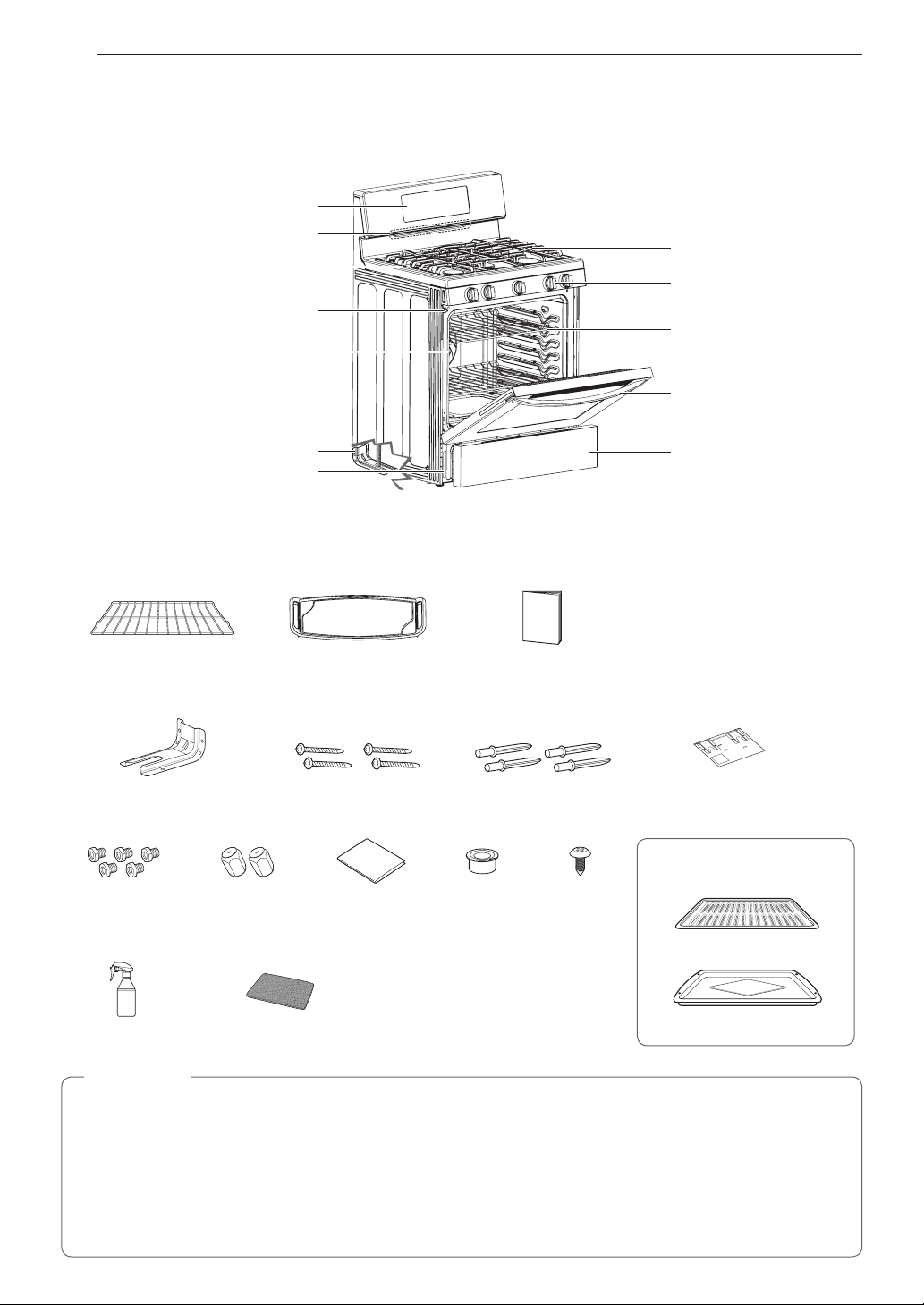
12
APERÇU DU PRODUIT
APERÇU DU PRODUIT
Pièces
Foyer
Panneau de contrôle du four
Table de cuisson
Interrupteur d’éclairage
automatique du four
Joint d’étanchéité de la porte
Support antibasculement
Ventilation du four
Plaqued’identicationdu
modèle et du numéro de série
Bouton de contrôle
du brûleur
Grille
Porte du four
Tiroir-réchaud
Accessoires
Accessoires inclus
Grillestandard(2ch.) Plaque(1ch.)
(LRG3061,LRG3193)
ManuelDuPropriétaire(1ch.)
Ensemble anti-basculement
Supportantibasculement(1ch.) Vis(4ch.) Piècesd᾿ancrage(4ch.) Gabarit(1ch.)
Ensemble de conversion de buse GPL
Accessoires facultatifs
Lèchefrite
Plaque chauffante
Buses de surface de
cuisson(5ch.)
Buses de four
(2ch.)
Guide d’installation
(1ch.)
Détendeur
(1ch.)
Vis de serrage
(1ch.)
Ensemble EasyClean
MC
(LRG3061, LRG3193)
Flacon pulvérisateur
(1ch.)
Tampon à récurer antirayure
(1ch.)
REMARQUE
•
CommuniquezavecleserviceàlaclientèledeLGau1800243-0000(1888542-2623auCanada)s᾿ilmanquedes
accessoires.
•
Pour votre sécurité et pour assurer la longévité du produit, utilisez exclusivement les composants autorisés.
•
Lefabricantdéclinetouteresponsabilitéencasdedysfonctionnementduproduitoud᾿accidentsconsécutifsàl᾿utilisationde
pièces non autorisées et achetées de façon isolée.
•
Lesillustrationsfourniesdanscemanuelpeuventêtredifférentesdescomposantsetdesaccessoiresréels,lesquelspeuvent
fairel᾿objetdemodificationsparlefabricantsansavispréalableàdesfinsd᾿améliorationduproduit.
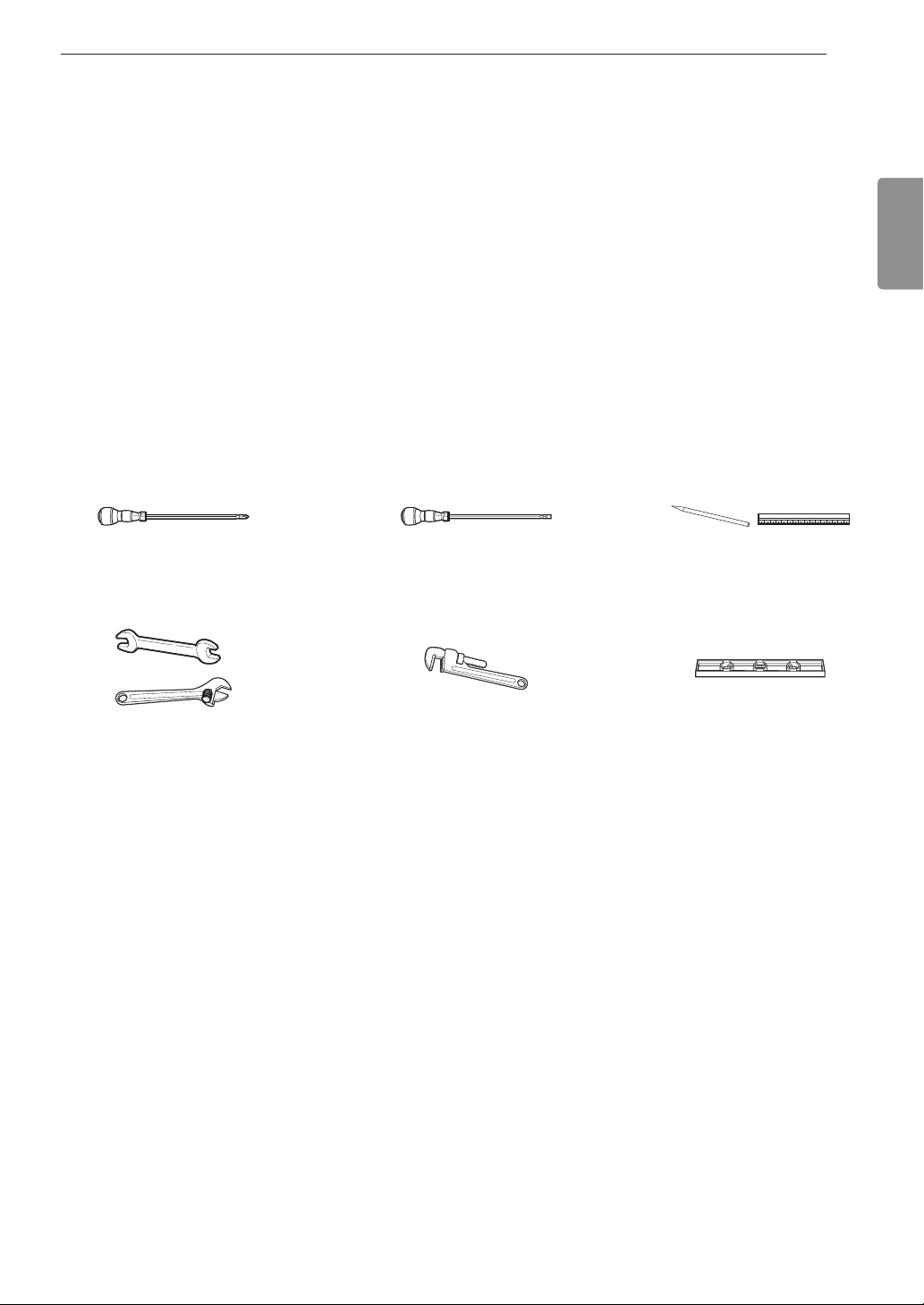
13
INSTALLATION
Français
INSTALLATION
Avant d᾿installer la cuisinière
Assurez-vous que votre cuisinière est installée et mise à la terre correctement par un installateur qualifié et conformément aux
instructionsd᾿installation.Touslestravauxderéglageouderéparationdoiventêtreréalisésexclusivementpardesinstallateursde
cuisinières à gaz ou des techniciens qualifiés.
Dans le Commonwealth du Massachusetts
•
Ceproduitdoitêtreinstalléparunplombierouunmonteurd᾿installationsaugazautorisé.
•
Lorsdel᾿utilisationderobinetsd᾿arrêtdelaconduitedegazdutypeàbille,letypeàmancheenformedeTdoitêtreutilisé.
•
Lorsdel᾿utilisationd᾿unconnecteurdegazflexible,celui-cinedoitpasmesurerplusde3piedsdelongueur.
Préparation en vue de l᾿installation
Outils nécessaires
Tournevis Phillips
Clé à molette ou clé ajustable
Crayon et règle
Niveau
Tournevis plat
Cléàtube(2)
(unepourlesupport)
Matériel dont vous pourriez avoir besoin
•
Robinetd᾿arrêtdelaconduitedegaz
•
Scellantdejointdeconduiterésistantàl᾿actiondugaznatureloudesgazdepétroleliquéfiés
•
Connecteurd᾿appareildemétalflexible(
3
/
4
po ou NPT de
1
/
2
po x diamètre intérieur de
1
/
2
po)
N᾿utilisezjamaisunvieuxconnecteurlorsquevousinstallezunenouvellecuisinière.
•
Raccordunionévasépourbranchementauconduitd᾿alimentationengaz(
3/
4
po ou NPT de
1
/
2
po x diamètre intérieur de
1/
2
po)
•
Raccordunionévasépourbranchementaurégulateurdepressiondelacuisinière(NPTde
1
/
2
po x diamètre intérieur de
1
/
2
po)
•
Détecteur de fuite liquide ou eau savonneuse
•
Tire-fondouancragespourlamaçonneried᾿undiamètreextérieurde
1
/
2
po(pourplanchersdebétonseulement)
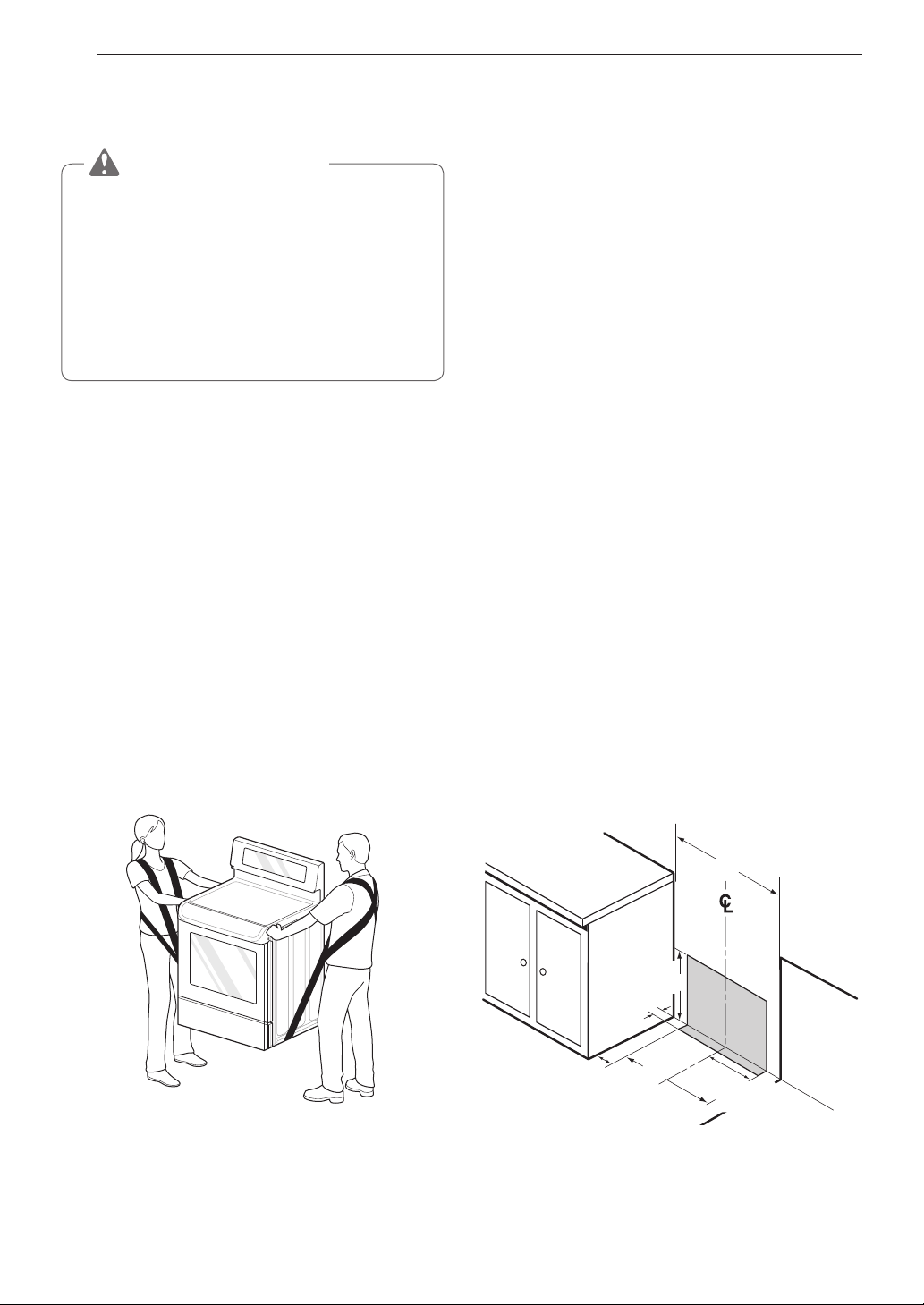
14
INSTALLATION
Installation de la cuisinière
Déballer et déplacer la cuisinière
MISE EN GARDE
•
Le déplacement et l᾿installation de la cuisinière
devraient être assurés par deux personnes ou
plus. (Danger lié au grand poids de l᾿appareil) Le
non-respect de cette consigne peut occasionner des
blessuresaudosoud᾿autresblessures.
•
N᾿utilisez pas les poignées de la porte pour pousser
ou tirer l᾿appareil au cours de l᾿installation ou pour
déplacer l᾿appareil pour le nettoyer ou le réparer.
Ceci pourrait entraîner des dommages à la porte du
four.
Retirezl᾿emballage,lerubanetlesétiquettestemporairesde
lacuisinièreavantdel᾿utiliser.Neretirezpaslesétiquettes
d᾿avertissement,l᾿étiquettesignalétiqueaffichantlemodèleet
lenumérodesérieoulafichetechniqueapposéeàl᾿arrièrede
la cuisinière.
Frottez énergiquement avec le pouce pour retirer le ruban ou
la colle restés à la surface. On peut aussi facilement retirer le
ruban ou la colle en les frottant avec les doigts après y avoir
versédusavonliquideàvaisselle.Nettoyezlasurfaceàl᾿eau
tièdeetessuyez-lapourqu᾿ellesoitsèche.
Neretirezpaslerubanoulacolleaumoyend᾿instruments
pointus,d᾿alcoolàfriction,deliquidesinflammablesoude
nettoyants abrasifs. Ces produits peuvent endommager la
surface de la cuisinière.
Lacuisinièreestlourdeetpeutêtreinstalléesurun
revêtementdesolmoucommeduvinylecoussinéoudela
moquette. Déplacez la cuisinière avec prudence sur ce type
derevêtementdesol.Utilisezuneceinturepourdéplacerla
cuisinière sans endommager le sol. Ou encore, faites glisser
la cuisinière sur un carton ou une planche de bois pour éviter
d᾿endommagerlerevêtementdesol.
Choix de l᾿emplacement adéquat
Neplacezpasvotrecuisinièreàunendroitoùellepourraitêtre
exposéeàdefortscourantsd᾿air.Touteouvertureduplancher
oud᾿unmurderrièrelacuisinièredoitêtrescellée.Assurez-
vous que les ouvertures autour de la base de la cuisinière
quiserventàfournirdel᾿airfraispourlacombustionetla
ventilation ne sont pas bloquées par un tapis ou des boiseries.
Comme plusieurs autres appareils ménagers, la cuisinière
estlourdeetpeutêtreinstalléesurunrevêtementdesolmou
comme du vinyle coussiné ou de la moquette. Déplacez la
cuisinièreavecprudencesurcetypederevêtementdesol.
Cetappareilnedoitpasêtreinstalléavecunsystèmede
ventilationquidirigel᾿airverslebasetverslacuisinière.
Ce type de système de ventilation peut causer des problèmes
d᾿allumageetdecombustionàl᾿appareildecuissonaugaz.
Il peut en résulter des blessures ou un fonctionnement non
désiré.
Lorsquelerevêtementdeplancherseterminedevantla
cuisinière,l᾿espacesurlequellacuisinièreserainstalléedoit
êtresurélevéavecducontreplaquéafinqu᾿ellesoitàlamême
hauteurquelerevêtementouplushaut.Celapermettraàla
cuisinièred᾿êtredéplacéeauxfinsdenettoyageetd᾿entretien,
enplusd᾿assurerunebonnecirculationd᾿air.
Deplus,assurez-vousquelerevêtementdeplancherpuisse
résisteràdestempératuresd᾿aumoins167°F(75°C).
Consultez
lesconsignesdesécuritépourl᾿installationcomprisesdansle
présent manuel.
Assurez-vousquelesrevêtementsmurauxautourdevotre
cuisinière puissent résister à la chaleur générée par la
cuisinière,soitjusqu᾿à194°F(90°C).Consultezlesconsignes
desécuritépourl᾿installationcomprisesdansleprésent
manuel.
Emplacements de la conduite de gaz et
de la prise électrique
30 po
(76,2cm)
3 po
(7,6cm)
24
1
/
32
po
(61cm)
12
1
/
32
po
(30,6cm)
2 po
(5,1cm)
10
7
/
16
po
(26,5cm)
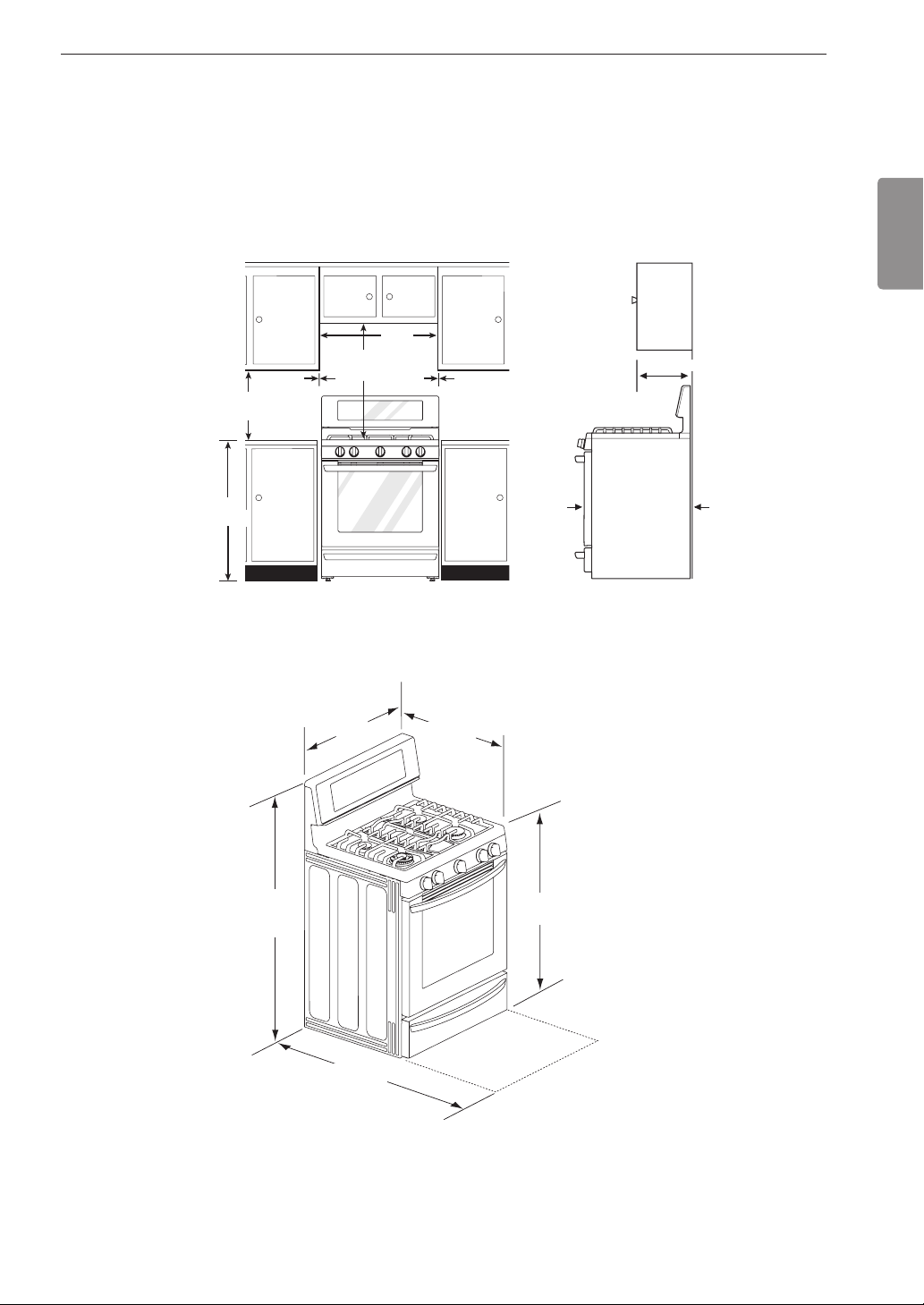
15
INSTALLATION
Français
Dimensions et dégagements
Laissezunespacesuffisantentrelacuisinièreetlessurfacescombustiblesadjacentes.Cesdimensionsdoiventêtrerespectées
pouruneutilisationsécuritairedevotrecuisinière.L᾿emplacementdelapriseélectriqueetdel᾿ouverturedeconduite(voirlasection
«Emplacementsdelaconduitedegazetdelapriseélectrique»,àlapage14)peutêtreajustépourrépondreauxbesoinsprécis.
Lacuisinièrepeutêtreplacéeà0po(accotée)dumurarrière.
Profondeur
maximale
pour les
armoires au-
dessus des
comptoirs
Distance
minimale entre
l’appareil et le
mur gauche
Distance
minimale
entre les
côtés de la
cuisinière et
les armoires
Distance
minimale entre
l’appareil et le
mur droit
Partie avant
du panneau
latéral de la
cuisinière
devant
l᾿armoire
Pour les
armoires au-
dessous des
comptoirs et à
l᾿arrièredela
cuisinière
Profondeur avec porte fermée
(ycomprislapoignée)
30 po
(76,2cm)
30po(76,2cm)
Minimum
18 po
(45,72cm)
5 po
5po(12,7cm)
1
/
4
po
(0,6cm)
27
9
/
16
po
(70cm)
36
1
/
32
po
(91,5cm)
Hauteur
47
7
/
16
po
(120,5cm)
Profondeur avec la porte ouverte
46
5
/
16
po(117,5cm)
30 po
(76,2cm)
13po(33cm)
0 po
Dimensions
Dégagements pour l᾿installation
36 po
(91,4cm)
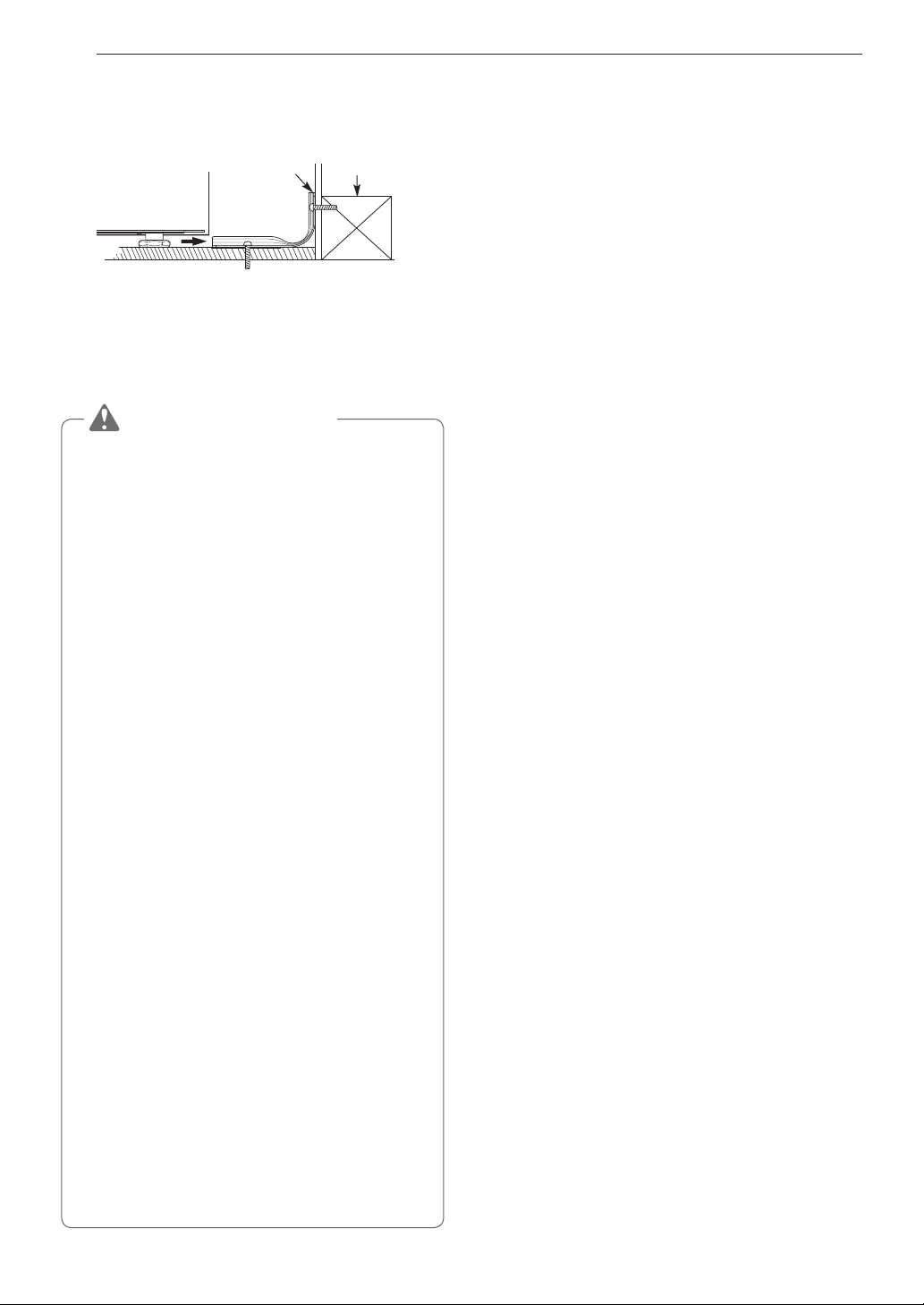
16
INSTALLATION
Installation du dispositif
antibasculement
Support
antibasculement
Plaque murale
La vis doit
pénétrer dans le
bois ou le béton.
Lesupportantibasculementsetrouvedansl᾿emballage,
accompagnédugabaritd᾿installation.Lesinstructions
contiennent les renseignements nécessaires pour effectuer
l᾿installation.Lisezlefeuilletd᾿instructionsd᾿installationdela
cuisinière et suivez les étapes.
AVERTISSEMENT
•
Lacuisinièredoitêtrefixéeàl᾿aided᾿unsupport
antibasculement approuvé.
•
Silacuisinièreoulesupportantibasculementn᾿est
pas bien installé, la cuisinière pourrait basculer si une
personneposelespieds,s᾿appuieous᾿assoitsurla
porte ouverte.
•
Aprèsl᾿installationdusupportantibasculement,vérifiez
qu᾿ilestenplaceententantdebasculerlacuisinière
versl᾿avant.
•
La cuisinière a été conçue pour répondre à toutes
lesnormesdebasculementdel᾿industriedansdes
conditions normales.
•
L᾿installationdusupportantibasculementdoitrépondre
àtouslescodeslocauxrelatifsàlafixationd᾿appareils.
•
L᾿utilisationdecesupportneprotègepascontrele
basculementdelacuisinièresil᾿installationn᾿estpas
adéquate.
•
Une personne, enfant ou adulte, peut faire basculer la
cuisinière et subir des blessures mortelles.
•
Installer le dispositif antibasculement sur la structure
ousurlacuisinière(ousurlesdeux).Vérifiersile
dispositif antibasculement est installé et engagé
convenablement en suivant le guide du gabarit de
l’équerre antibasculement.
•
Engager la cuisinière dans le dispositif antibasculement
en en suivant le guide du gabarit de l’équerre
antibasculement. S’assurer que le dispositif
antibasculement est engagé de nouveau après un
déplacement de la cuisinière en suivant le guide du
gabarit de l’équerre antibasculement.
•
Engager de nouveau le dispositif antibasculement si
la cuisinière est déplacée. Ne pas utiliser la cuisinière
lorsque le dispositif antibasculement n’est pas installé et
engagé.
•
Voir les directives d’installation pour obtenir de plus
amples renseignements.
•
Toute omission de le faire expose les enfants et les
adultes à un risque de décès ou de brûlures graves.
Alimentation en gaz adéquat
Votre cuisinière est conçue pour fonctionner à une pression
de5podecolonned᾿eaupourlegaznatureloude10pode
colonned᾿eaupourlesgazdepétroleliquéfiés.
Assurez-vousd᾿alimentervotrecuisinièreavecletypedegaz
pour lequel elle est configurée.
Cette cuisinière est convertible pour utilisation au gaz naturel
ou aux gaz de pétrole liquéfiés. Avant que vous tentiez de faire
fonctionner cette cuisinière avec des gaz de pétrole liquéfiés,
un installateur de gaz de pétrole liquéfiés qualifié doit effectuer
la conversion.
Pourquel᾿appareilfonctionneadéquatement,lapressiondu
gaznaturelfournieaurégulateurdoitêtreentre5poet13po
decolonned᾿eau.
Dans le cas des gaz de pétrole liquéfiés, la pression du gaz
naturelfournieaurégulateurdoitêtreentre10poet13pode
colonned᾿eau.Lorsdelavérificationdubonfonctionnement
durégulateur,lapressiond᾿entréedoitêtred᾿aumoins1pode
plusquelapressiondeservice(collecteur),commeindiqué
ci-dessus.
Lerégulateurdepressionsituéàl᾿entréedelacuisinièredoit
demeurerdansleconduitd᾿alimentation,peuimporteletype
de gaz utilisé.
Leconnecteurd᾿appareilmétalliqueflexibleutilisépour
brancherlacuisinièreauconduitd᾿alimentationengazdoit
avoir un diamètre intérieur de
5
/
8
po et une longueur maximale
de5pi.AuCanada,lesconnecteursflexiblesdoiventêtredes
connecteursmétalliquesmurauxsimplesd᾿unelongueurde
moins de 6 pi.
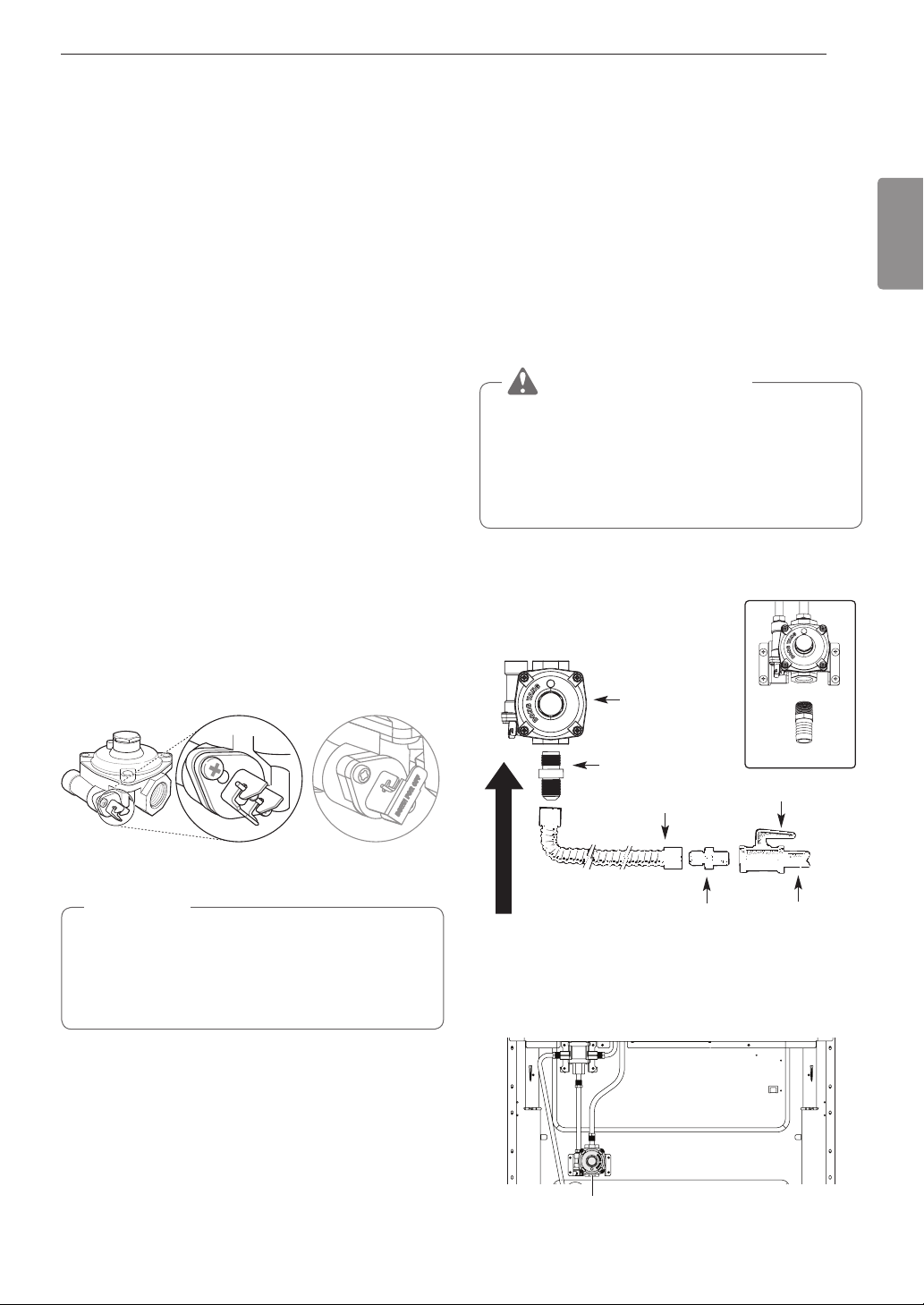
17
INSTALLATION
Français
Branchement de la cuisinière
au conduit de gaz
Fermezlerobinetd᾿alimentationengazdelacuisinièreavant
deretirerl᾿anciennecuisinièreetlaissez-leferméjusqu᾿àce
que le nouveau branchement ait été fait.
Comme des conduites rigides restreignent le déplacement
delacuisinière,ilestrecommandéd᾿utiliserunconnecteur
d᾿appareilmétalliqueflexiblecertifiéparlaCSAàl᾿échelle
internationale, sauf si les codes locaux requièrent un
branchementàl᾿aidedeconduitesrigides.
Unrobinetmanueldoitêtreinstalléàunendroitaccessible
danslacanalisationdegazàl᾿extérieurdel᾿appareilpour
permettred᾿ouvriretdefermerl᾿alimentationengaz.
Ne réutilisez jamais un vieux connecteur lorsque vous installez
une nouvelle cuisinière.
Pour vous protéger contre les fuites de gaz, utilisez un scellant
de joint de conduite homologué sur tous les filets extérieurs.
1
Installez un raccord union évasé mâle de
1
/
2
po ou
de
3
/
4
podanslefiletintérieurNPTdurobinetd᾿arrêt,
enfaisantattentionderetirerlerobinetd᾿arrêtpour
l᾿empêcherdetourner.
2
Installez un raccord union évasé mâle de
1
/
2
po sur le
filet intérieur NPT de
1
/
2
poàl᾿entréedurégulateurde
pression.Pouréviterd᾿endommagerl᾿appareil,utilisez
une clé supplémentaire sur le raccord du régulateur de
pression.
Assurez-vous que la vanne du régulateur de pression de gaz
est en position ouverte.
Position ouverte du
levier
Position fermée du
levier
REMARQUE
•
Lors de l’expédition, la vanne du régulateur de pression
de gaz est en position ouverte. Si la cuisinière ne
fonctionne pas correctement après l’installation,
assurez-vous que la vanne du régulateur est toujours
ouverte.
3
Branchezunconnecteurd᾿appareilmétalliqueflexibleà
l᾿adaptateursurlacuisinière.Positionnezlacuisinière
pourpermettrelebranchementaurobinetd᾿arrêt.
4
Lorsque tous les branchements ont été effectués,
assurez-vous que toutes les commandes de la cuisinière
sont en position fermée et que la vanne du régulateur de
pression est ouverte avant d’ouvrir la vanne d’alimentation
principale en gaz. Des fuites de gaz peuvent se produire
dansvotresystèmeetêtredangereuses.Unefuitede
gazpeutnepasêtredétectéeparl'odeur.
Vérifiez tous les joints de branchement de gaz et les
raccordspourydétecterdesfuitesàl᾿aided᾿unliquide
de détection de fuite non corrosif, puis essuyez les joints.
Lesfournisseursdegazrecommandentd᾿acheter
etd᾿installerundétecteurdegazapprouvéparl᾿UL.
L᾿installationetl᾿utilisationdoiventêtreconformesaux
instructionsd᾿installation.
AVERTISSEMENT
•
N᾿utilisezpasdeflammepourvérifierlesfuitesdegaz.
•
Isolezlacuisinièredusystèmed᾿alimentationengaz
enfermantsonrobinetd᾿arrêtindividuellorsdetoute
vérificationdepressiondusystèmed᾿alimentationen
gaz à des pressions égales ou inférieures à
1
/
2
po psig
(3,5kPa).
Raccordement du connecteur flexible
1
/
2
po Raccord
1
/
2
po Raccord
1
/
2
po Raccord
Régulateur de
pression
Connecteurexible
(6pimaximum)
Robinetd’arrêtdugaz
Conduite de gaz de
1
/
2
po ou de
3
/
4
po
Débit de gaz dans la cuisinière
Installateur:Informezleclientdel’emplacementdurobinetd’arrêdu
gaz.
Position du régulateur de pression
Régulateur de pression
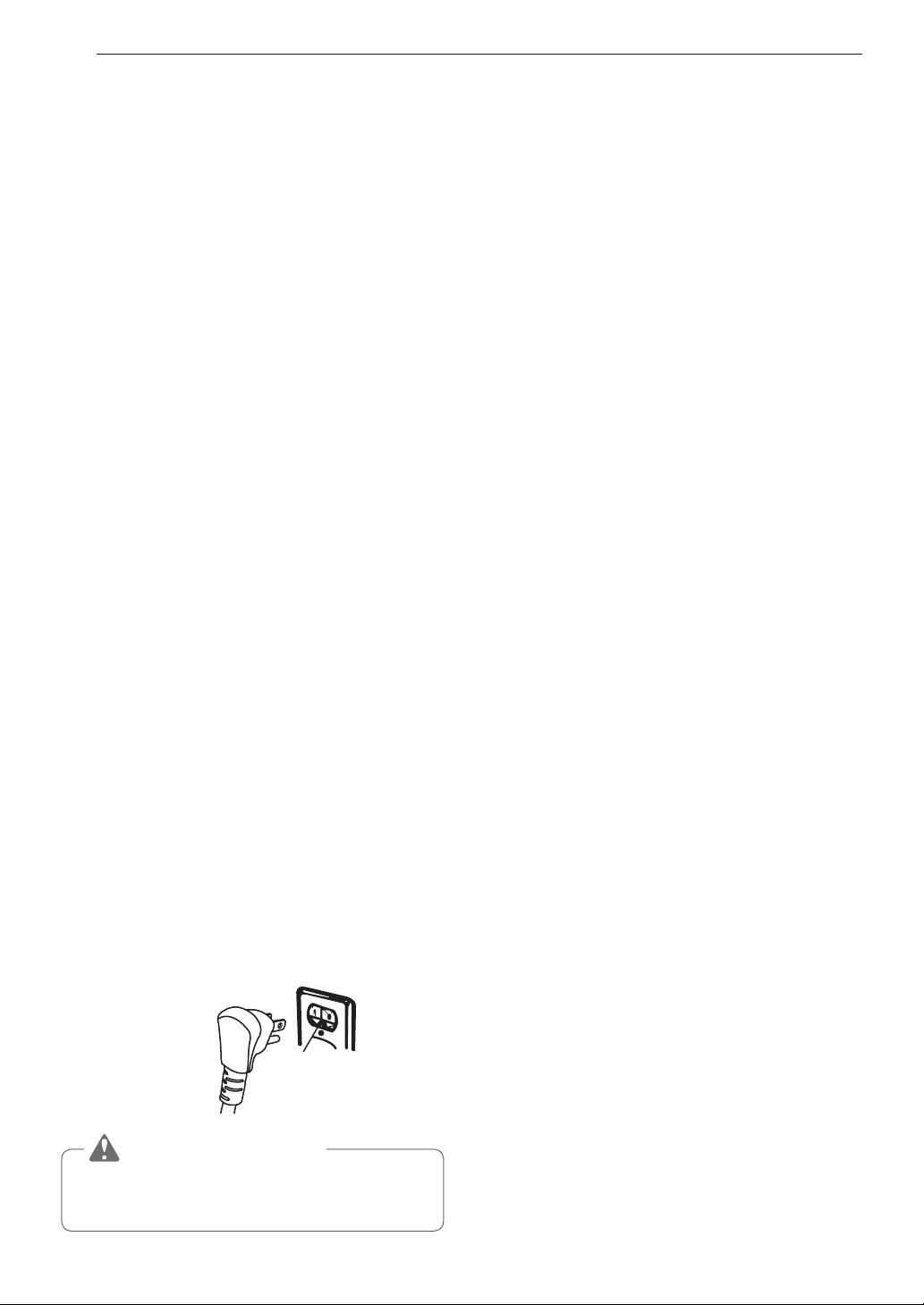
18
INSTALLATION
Branchements électriques
Conditions de l᾿alimentation
Circuitdédié,adéquatementmisàlaterre,de120volts,60Hz
protégé par un disjoncteur de 15 ou 20 ampères ou un fusible
à fusion lente.
Si une source électrique externe est utilisée lors de
l᾿installation,l᾿appareildoitêtremisàlaterreconformément
aux codes locaux, ou, à défaut de codes locaux, à la norme
ANSI/NFPA70duCodenationaldel᾿électricité.
Mise à la terre
IMPORTANT:POURDESRAISONSDESÉCURITÉ
PERSONNELLE, CET APPAREIL DOIT ÊTRE
CORRECTEMENT MIS À LA TERRE.
Lecordond᾿alimentationdecetappareilestmunid᾿uneprise
àtroisbroches(miseàlaterre)correspondantàuneprise
murale de mise à la terre à trois broches afin de minimiser la
possibilité de danger de décharge électrique provenant de cet
appareil.
Le client doit faire vérifier la prise murale et le circuit par un
électricienqualifiépours᾿assurerquelapriseestcorrectement
mise à la terre.
S᾿iltrouveuneprisemuraleàdeuxbroches,leclientala
responsabilitépersonnelleetl᾿obligationdelafaireremplacer
par une prise murale à trois broches correctement mise à la
terre.
VOUS NE DEVEZ EN AUCUN CAS COUPER OU RETIRER
LATROISIÈMEBROCHE(MISEÀLATERRE)DUCORDON
D᾿ALIMENTATION.
Des disjoncteurs de fuite de terre ne sont pas requis ou
recommandés pour les prises de cuisinière au gaz.
Les disjoncteurs de fuite de terre sont des appareils qui
détectentlesfuitesdecourantd᾿uncircuitetéteignent
automatiquementlecourantlorsqu᾿unseuildefuiteest
détecté.Cesappareilsdoiventêtremanuellementréinitialisés
parleclient.LeCodenationaldel᾿électricitéexigel᾿utilisation
de disjoncteurs de fuite de terre pour des prises de cuisine
installées sur des surfaces de comptoir.
Le rendement de la cuisinière ne sera pas affecté si elle
fonctionne sur un circuit protégé par un disjoncteur de fuite de
terre,maislaréinitialisationoccasionnelleducircuitpeutêtre
embêtante.
Assurez-vous que la
mise à la terre a été
effectuée adéquatement
avantl᾿utilisation.
Méthode suggérée
MISE EN GARDE
Faites vérifier la prise murale et le circuit par un électricien
qualifié pour vous assurer que la prise est correctement
mise à la terre.
N᾿utilisezpasdeprised᾿adaptateur.Ledébranchementdu
cordond᾿alimentationexerceunepressionexcessivesur
l᾿adaptateuretcauseladéfaillanceéventuelledelabornede
terredel᾿adaptateur.
L᾿installationdoitêtreconformeauxcodeslocaux,ou,àdéfaut
de codes locaux, à la norme ANSI Z223.1/NFPA 54 du National
Fuel Gas Code.
L᾿installationd᾿appareilsconçuspouruneinstallationdans
une maison mobile doit respecter la norme de réglementation
américainesurlesmaisonspréfabriquées(Manufactured
HomeConstructionandSafetyStandard,Title24CFR,
Part3280[anciennementlaFederalStandardforMobileHome
ConstructionandSafety,Title24,HUDPart280])oubien,
quandunetellenormen᾿estpasapplicable,ladernièreédition
de la norme sur les installations de maisons préfabriquées
ANSIA225.1(ManufacturedHomeSites,Communitiesand
Set-Ups)oulescodeslocaux.AuCanada,l᾿installationdans
unemaisonmobiledoitêtreconformeauxnormesd᾿installation
dansdesmaisonsfabriquéesenusineCAN/CSAZ240/MH.
Scellage des ouvertures
Scellez toutes les ouvertures du mur et du plancher une fois
lesbranchementsdel᾿alimentationenélectricitéetengaz
terminés.
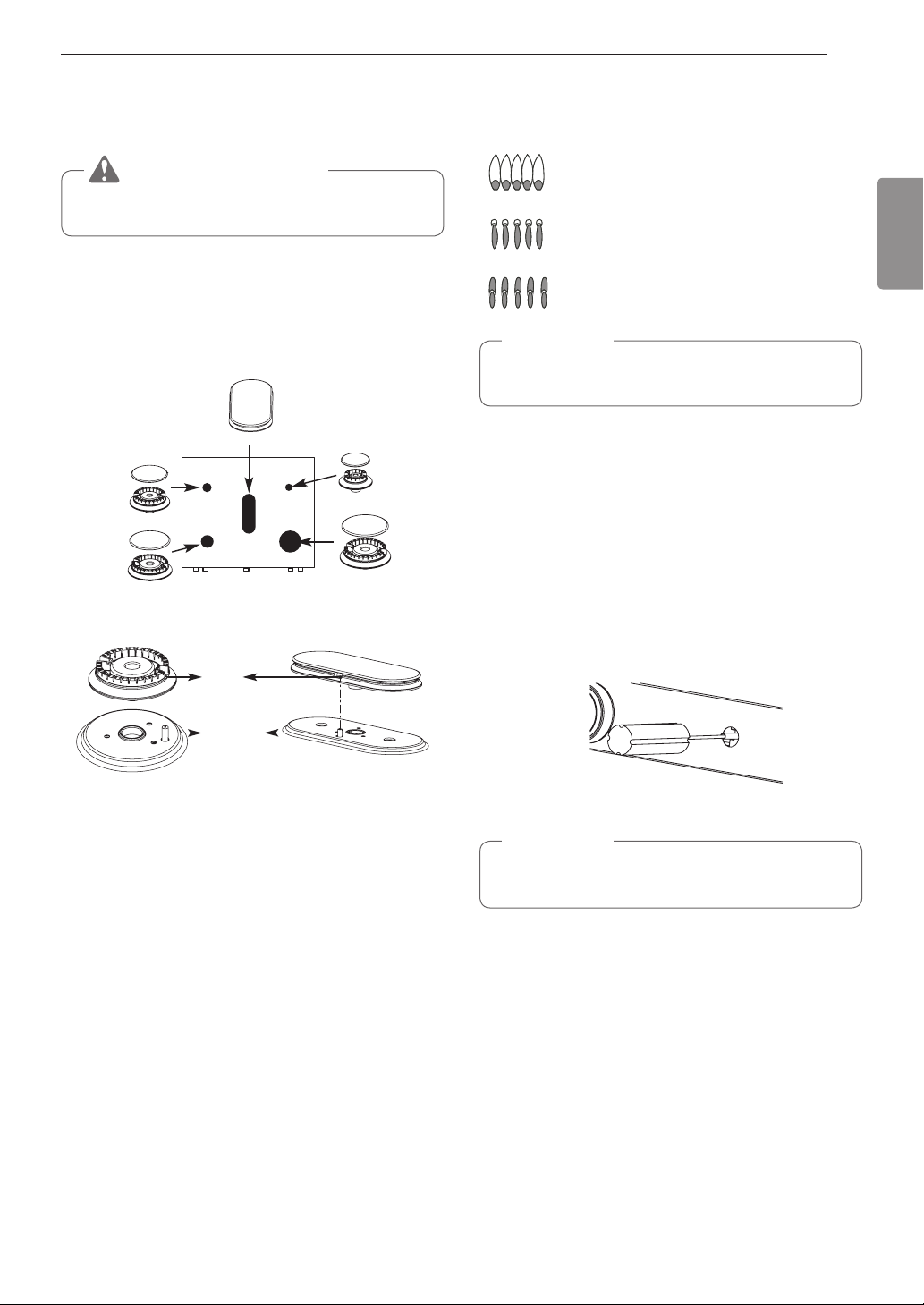
19
INSTALLATION
Français
Assemblage des brûleurs de
surface
MISE EN GARDE
Ne faites pas fonctionner les brûleurs sans que toutes les
pièces soient en place.
Placezlescapuchonsdesbrûleursetlestêtessurlatablede
cuisson.Assurez-vousquelescapuchonsetlestêtessont
placésauxbonsendroits.Ilyauncapuchonetunetêtepour
le petit, le moyen, le grand et le très grand brûleur ainsi que
pourceluiducentre(oval).
Brûleur central
Assemblage de la
tête/ducapuchondu
brûleurcentral(ovale)
Têteet
capuchon
de brûleur
de petite
taille
Têteet
capuchon
de brûleur
de taille
moyenne
Têteetcapuchon
de brûleur de
grande taille
Avant de la
cuisinière
Têteetcapuchon
de brûleur de très
grande taille
Trou
Électrode
Assurez-vousquel᾿ouverturedelatêtedubrûleurestbien
au-dessusdel᾿électrode.
Vérification de l᾿allumage des
brûleurs de surface
Allumage électrique
Sélectionnez un bouton de brûleur et enfoncez celui-ci tout en
le tournant en position Lite. Vous entendrez un clic indiquant le
bonfonctionnementdumoduled᾿allumage.
Unefoisl᾿airpurgédesconduitesd᾿alimentation,lebrûleur
devraits᾿allumerdanslesquatresecondes.Unefoislebrûleur
allumé, tournez le bouton en position Lite. Essayez chaque
brûleursuccessivementjusqu᾿àcequechacund᾿entreeuxait
été vérifié.
Qualité des ammes
Laqualitédelacombustiondesflammesdubrûleurdoitêtre
confirmée visuellement.
A Flammes jaunes – Appelez un technicien.
B Pointes jaunes sur les cônes externes –
Cela est normal pour les gaz de pétrole
liquéfiés.
C Douces flammes bleues – Cela est
normal pour le gaz naturel.
REMARQUE
•
Dans le cas des gaz de pétrole liquéfiés, des pointes
jaunes sur les cônes externes sont normales.
Ajustement des brûleurs de surface à
une amme basse (Mijoter)
1
Allumez tous les brûleurs.
2
Tournez le bouton du brûleur qui est ajusté à Lo.
3
Retirez le bouton.
4
Insérezunpetittournevisàtêteplatedanslatigedela
soupape.
Vis de réglage centrale
REMARQUE
Retenez la tige de la soupape avec une main tout en
tournantlavispourl᾿ajusteravecl᾿autremain.
5
Replacez le bouton.
6
Vérifiez la stabilité de la flamme.
Vérification1:TournezrapidementleboutondeHi à Lo.
Silaflammes᾿éteint,augmentezlatailledelaflammeet
revérifiez.
Vérification2:AveclebrûleuràLo, ouvrez et fermez
rapidement la porte du four. Si la flamme est éteinte par
lescourantsd᾿aircréésparlemouvementdelaporte,
augmentez la taille de la flamme et vérifiez à nouveau.
7
Répétez les étapes 1 à 6 pour chaque brûleur.
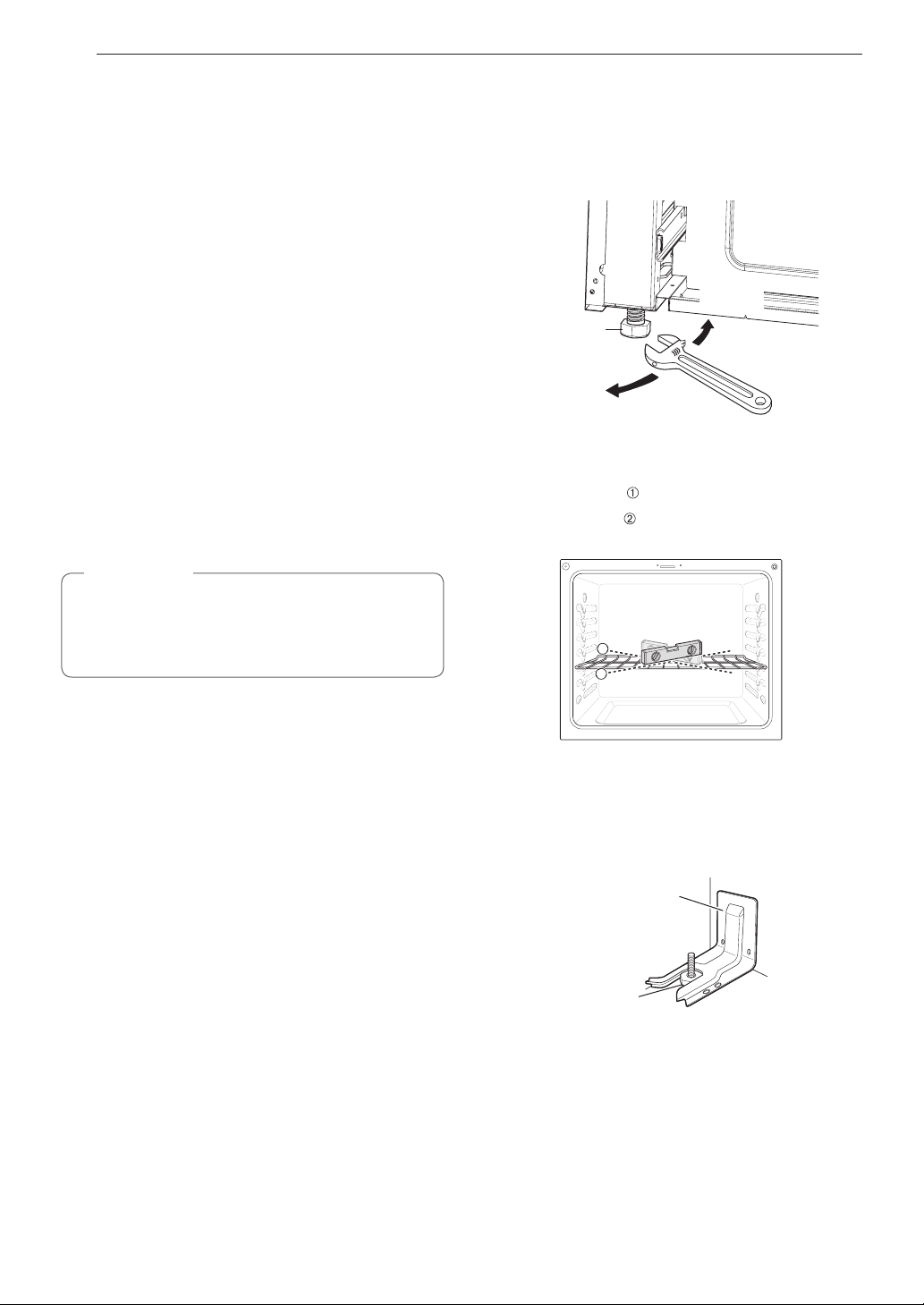
20
INSTALLATION
Vérication du fonctionnement des
brûleurs de cuisson et de grillage
Pour vérifier le brûleur de cuisson, suivez les étapes
ci-dessous:
1
Retireztoutl᾿emballagedelacavitédufour.
2
Appuyez sur Bake.350°Fs᾿afficheàl᾿écran.
3
Appuyez sur Start.
Cela peut prendre de 30 à 90 secondes avant que le brûleur
commencer à chauffer.
Pour vérifier le brûleur de grillage, suivez les étapes
ci-dessous:
1
Appuyez sur Broil. L᾿indicationHiapparaîtàl᾿écran.
2
Assurez-vous que la porte est fermée.
3
Appuyez sur Start.
Cela peut prendre de 30 à 90 secondes avant que le brûleur
commencer à chauffer.
REMARQUE
N᾿essayezpasd᾿allumerlesbrûleursdecuissonoude
grillagependantunepanned᾿électricité.Lacuisinièreaun
systèmed᾿allumageélectriqueetnepeutpasêtreutilisée
sans courant.
Ajustement des obturateurs d᾿air (pour
conversion en cuisinière aux gaz de
pétrole liquéés)
Lacuisinièreestconfiguréeenusineaveclesobturateursd᾿air
ajustéspourunecirculationd᾿airadéquatepourlegaznaturel.
Si elle est convertie en cuisinière aux gaz de pétrole liquéfiés,
suivez les instructions fournies dans la trousse de conversion
pourajusteradéquatementlesobturateursd᾿air.Laconversion
encuisinièreauxgazdepétroleliquéfiésdoitêtreeffectuée
par un technicien qualifié.
Mise au niveau de la cuisinière
Mettez la cuisinière au niveau en réglant les pieds de
nivellement. Le fait de dévisser un peu les pieds de nivellement
arrière pourrait faciliter leur insertion dans le support
antibasculement.
Réglage des
pieds
Soulever la
cuisinière
Baisser la
cuisinière
Utilisez un niveau pour vérifier les réglages. Placez le niveau
en diagonale sur la grille du four pour vérifier le niveau dans
chaque sens.
Vérifiezd᾿abordlesens
.
Vérifiez ensuite le sens
. Si le niveau ne montre pas que la
grille est au niveau, réglez les pieds de nivellement.
1
2
Enclenchement du dispositif
antibasculement
Support
antibasculement
Pied de
nivellement
1
Glissez la cuisinière contre le mur en vous assurant que
le pied arrière glisse dans le support antibasculement.
2
Vérifiez si la cuisinière est bien installée en agrippant
la partie avant de la table de cuisson et en tentant
doucementdebasculerlacuisinièreversl᾿avant.
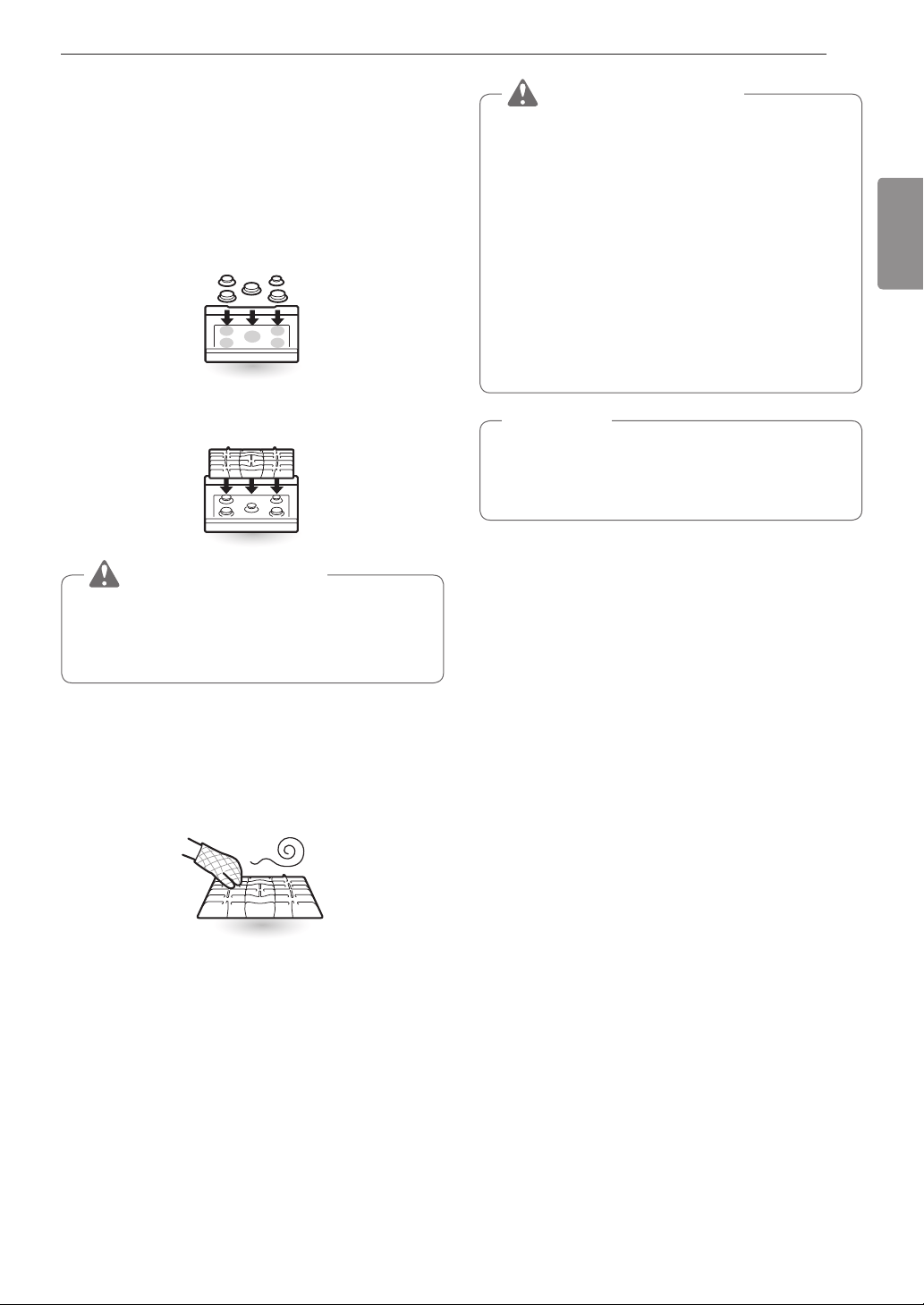
21
FONCTIONNEMENT
Français
FONCTIONNEMENT
Brûleurs de surface au gaz
Avant l᾿utilisation
Liseztouteslesinstructionsavantd᾿utiliserleproduit.
Assurez-vous que tous les brûleurs sont correctement
installés.
Assurez-vous que toutes les grilles sont correctement
installées avant d᾿utiliser le brûleur.
MISE EN GARDE
N᾿utilisezpaslebrûleurpendantunepériodeprolongée
sans casserole sur le foyer.
Lefinidufoyerpourraits᾿ébréchersiaucunecasserole
n᾿absorbesachaleur.
Assurez-vous que les brûleurs et les grilles sont refroidis
avant de placer votre main, la poignée, le chiffon de
nettoyage ou d᾿autres objets sur les brûleurs et les grilles.
Toucherlesgrillesavantqu᾿ellesrefroidissentpeutcauserdes
brûlures.
MISE EN GARDE
CE QU᾿IL FAUT FAIRE SI VOUS DÉTECTEZ UNE
ODEUR DE GAZ
•
Ouvrezlesfenêtres.
•
N᾿essayezpasd᾿allumerunappareil.
•
Ne touchez aucun interrupteur électrique.
•
N᾿utilisezaucuntéléphoneàl᾿intérieurdel᾿appartement
ou de la maison.
•
Appelez immédiatement votre fournisseur de gaz à
partirdutéléphoned᾿unvoisin.Suivezlesdirectivesde
votre fournisseur de gaz.
•
Sivousn᾿arrivezpasàjoindrevotrefournisseurdegaz,
appelezleserviced᾿incendie.
REMARQUE
Les allumeurs à étincelle électrique des brûleurs causent
un clic. Tous les allumeurs à étincelle de la table de
cuissons᾿activerontmêmesivousn᾿allumezqu᾿un
brûleur.
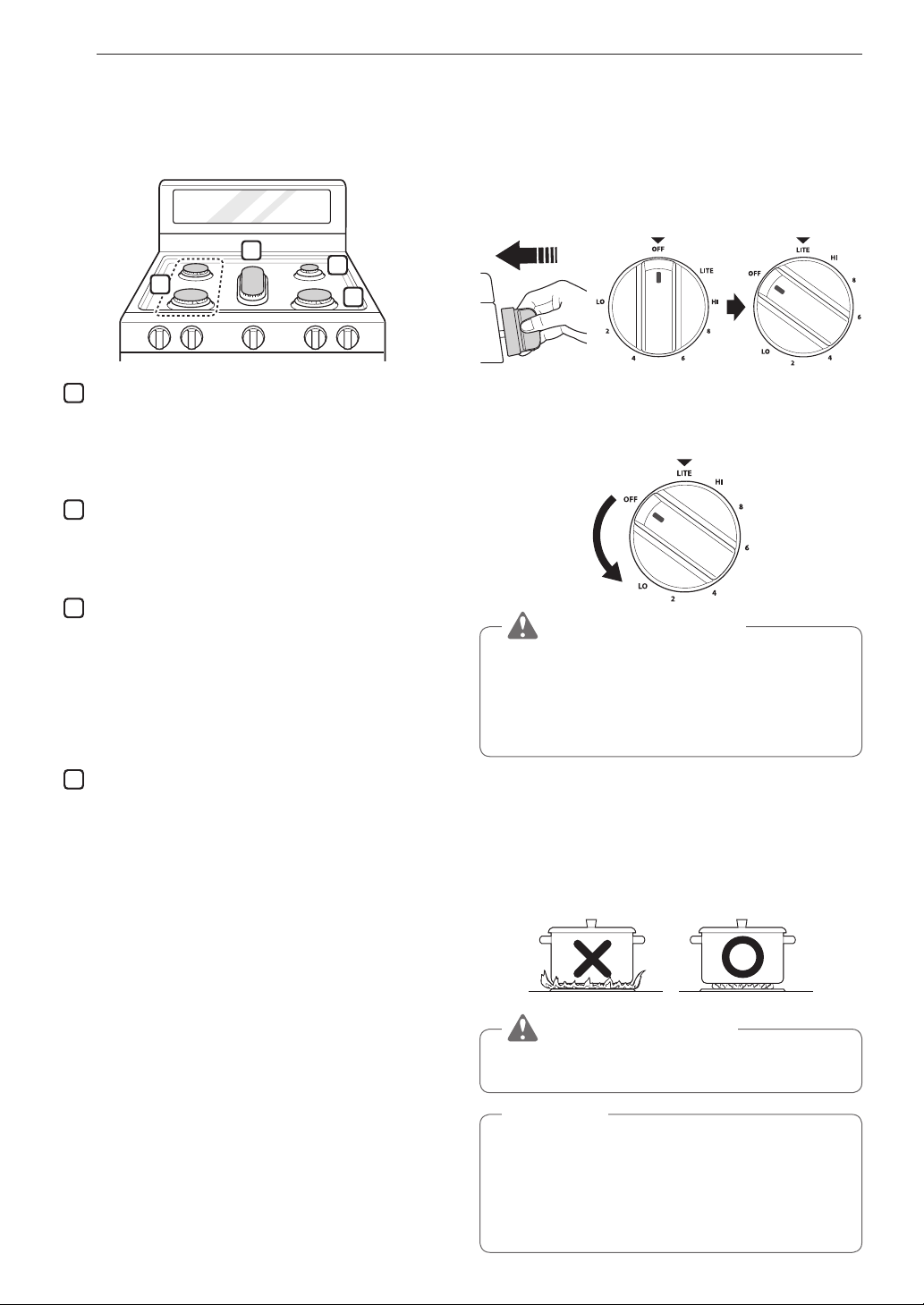
22
FONCTIONNEMENT
Emplacements des brûleurs
La table de cuisson de votre cuisinière au gaz possède quatre
oucinqbrûleursscellés,selonlemodèle.Ceux-cipeuventêtre
montés et démontés. Suivez les instructions ci-dessous.
1
4
2
3
1
Grand et moyen brûleurs
Le grand et le moyen brûleurs sont les brûleurs
principaux pour la plupart des opérations de cuisson. Ces
brûleurspolyvalentspeuventêtreréglésdeHi à Lo pour
répondre aux diverses exigences en matière de cuisson.
2
Petit brûleur
Le plus petit brûleur est utilisé pour des mets délicats
comme les sauces ou des aliments qui nécessitent une
température faible pour une cuisson de longue durée.
3
Très grand brûleur
Le très grand brûleur est celui qui offre un rendement
maximum.Toutcommelesautresbrûleurs,ilpeutêtre
réglé de Hi à Lopourunegrandevariétéd᾿applications
culinaires. Ce brûleur est également conçu pour faire
bouillir rapidement une grande quantité de liquide. Il peut
êtreutiliséavecunecasserolede10pooud᾿undiamètre
plus grand.
4
Brûleur ovale
Lebrûleurovale(aucentre)estdestinéàêtreutiliséavec
uneplaqueàcuissonouunepoêleovale.
Utilisation des brûleurs de surface au gaz
1
Assurez-vous que tous les éléments de cuisson et que
toutes les grilles sont placés dans la position appropriée.
2
Placezl᾿ustensiledecuissonsurlagrille.
3
Appuyezsurleboutondecommandeettournezjusqu᾿à
la position Lite.
Vousentendrezunclicprovenantdusystèmed᾿allumage
par étincelle électrique.
4
Tournez le bouton pour régler la taille de la flamme.
MISE EN GARDE
N᾿essayezpasdedémonteroudenettoyerlescontours
d᾿unbrûleurlorsqu᾿unautrebrûleurestallumé.Lorsque
vous réglez un brûleur sur Lite, tous les autres brûleurs
émettent des étincelles. Il y a un risque de décharge
électrique qui pourrait vous amener à faire tomber une
casserole chaude.
Ajustement de l᾿intensité de la amme
Observez la flamme et non le bouton lorsque vous réduisez
lachaleur.Lorsquevousavezbesoind᾿unchauffagerapide,
la taille de la flamme du brûleur au gaz doit correspondre à la
taille de la casserole que vous utilisez.
MISE EN GARDE
Ne laissez jamais les flammes dépasser les bords de la
casserole.
REMARQUE
•
Les flammes des brûleurs peuvent sembler jaunes en
présenced᾿untauxélevéd᾿humidité,parexemplelorsd᾿une
journée pluvieuse ou si un humidificateur est à proximité.
•
Après la conversion aux gaz de pétrole liquéfiés, les
flammespeuventêtreplusgrossesquelanormale
lorsque vous mettez une casserole sur le brûleur.
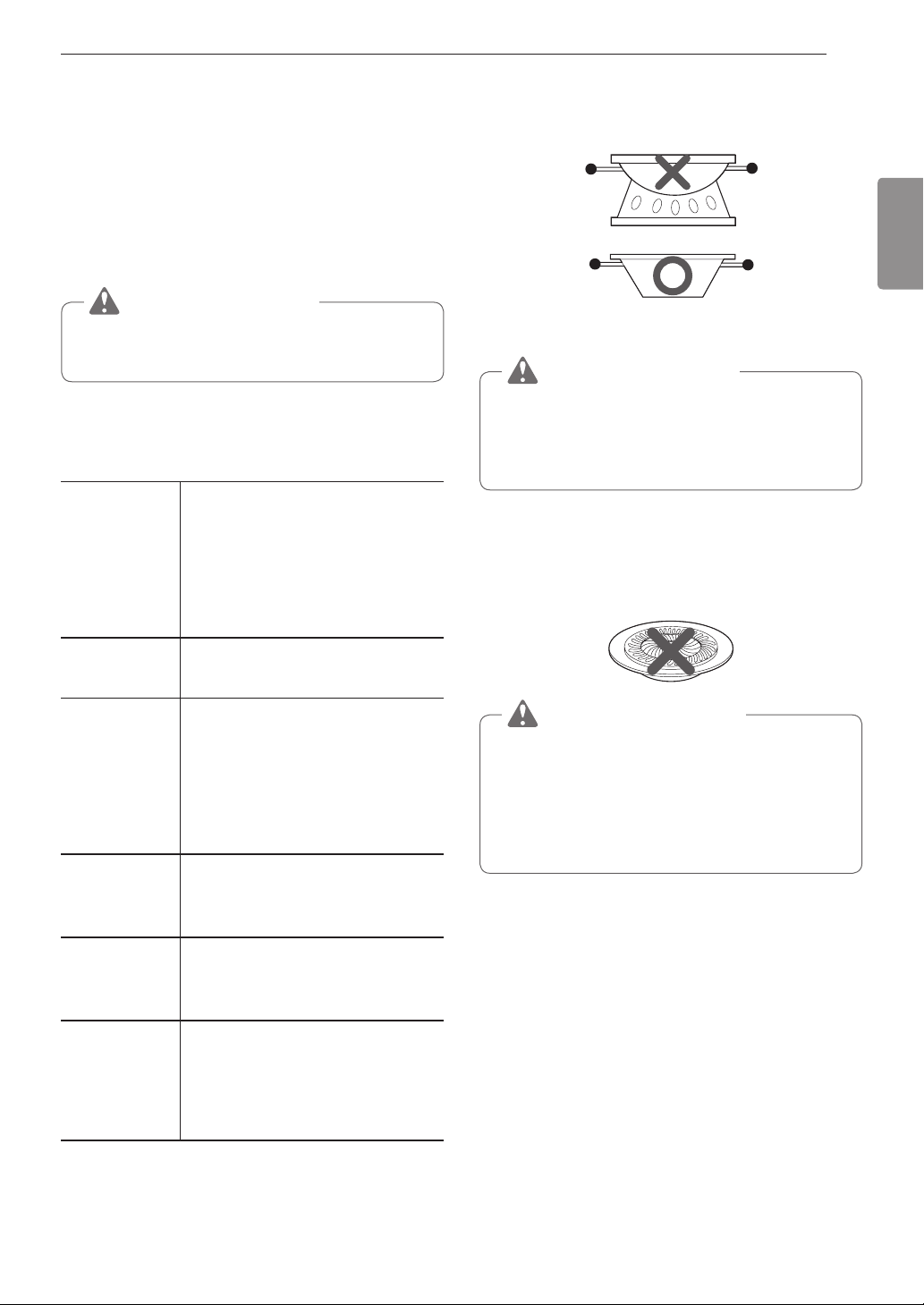
23
FONCTIONNEMENT
Français
En cas de panne de courant
En cas de panne de courant, vous pouvez allumer les brûleurs
devotrecuisinièreàl᾿aided᾿uneallumette.
Lesbrûleursquifonctionnentdéjàlorsqu᾿unepannedecourant
se produit continueront à fonctionner normalement.
1
Maintenezl᾿allumettealluméeàproximitédubrûleur,
puis enfoncez le bouton de commande.
2
Tournez le bouton de commande en position Lo.
MISE EN GARDE
Faitespreuved᾿uneextrêmeprudenceenallumantdes
brûleursàl᾿aided᾿uneallumette.Sinon,vousrisquezde
vousbrûleroudesubird᾿autresblessures.
Batterie de cuisine pour utilisation sur
la table de cuisson
Aluminium
Une casserole de poids moyen est
recommandéeparcequ᾿ellechauffe
rapidement et de manière uniforme.
La plupart des aliments brunissent
uniformémentdansunepoêleen
aluminium. Utilisez des casseroles avec
des couvercles hermétiques pour cuire
avecunepetitequantitéd᾿eau.
Fonte
Si elles sont chauffées lentement, la
plupartdespoêlesfournissentdes
résultats satisfaisants.
Acier inoxydable
Ce métal est un mauvais conducteur de
chaleur. On le combine habituellement
aucuivre,àl᾿aluminiumouàd᾿autres
métaux pour améliorer la distribution de la
chaleur.Lespoêlesenmétauxcombinés
donnent normalement de bons résultats
à feu moyen, comme le recommande le
fabricant.
Émail
Danscertainesconditions,l᾿émailde
certaines casseroles peut fondre. Suivez
les recommandations du fabricant de la
casserole pour les méthodes de cuisson.
Verre
Ilexistedeuxtypesdeplatsenverre:
ceux qui sont utilisés uniquement pour
le four et ceux qui sont destinés à une
cuisson sur la table de cuisson.
Vitrocéramique
calorifuge
Peutêtreutilisésurlatabledecuisson
ou dans le four. Conduit la chaleur très
lentement et se refroidit aussi lentement.
Consultez les directives du fabricant de la
casserolepourvousassurerqu᾿ellepeut
êtreutiliséesurdescuisinièresàgaz.
Utilisation d᾿un wok
Utilisezunwokde14pooumoinsetàfondplat.Assurez-vous
quelefondduwokestbienàplatsurlagrille
Utilisez des ustensiles de cuisson
dotésd᾿unfondplat
MISE EN GARDE
N᾿utilisezpasd᾿anneaudesupportpourwok.Lefaitde
placerl᾿anneausurlebrûleuroulagrillepourraitaltérer
le fonctionnement du brûleur, causant des niveaux
de monoxyde de carbone plus élevés que la norme
recommandée.Celapeutêtredangereuxpourvotresanté.
Utilisation des grils de la table de
cuisson
Ne placez pas les grils de la table de cuisson sur le brûleur.
MISE EN GARDE
N᾿utilisezpaslesgrilsdelatabledecuissonsurvos
brûleurs de surface. Si vous utilisez le gril de la table de
cuisson sur le brûleur de surface, cela provoquera une
combustion insuffisante et pourrait entraîner une exposition
à des niveaux de monoxyde de carbone audessus des
seuilsadmissibles.Celapeutêtredangereuxpourvotre
santé.
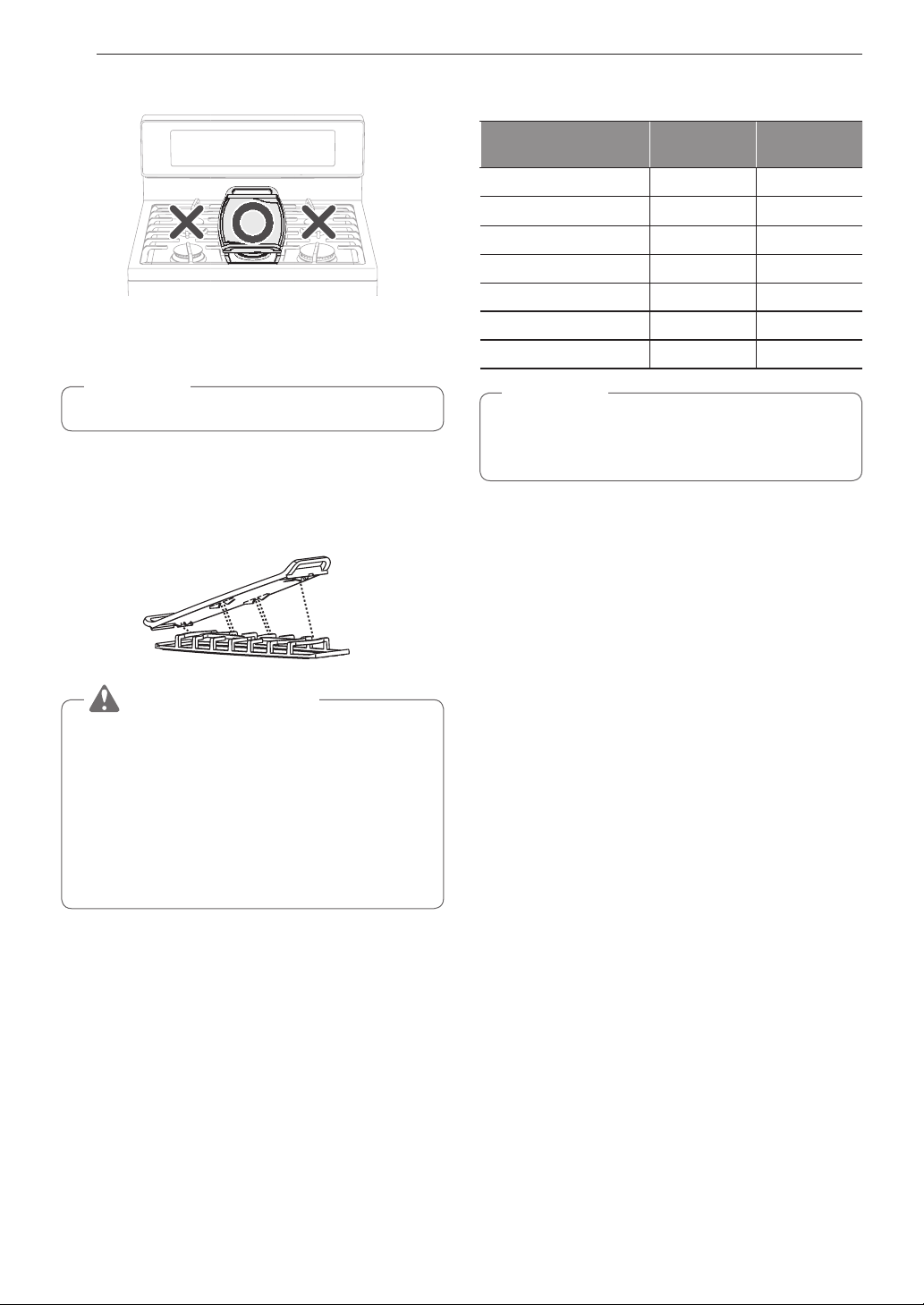
24
FONCTIONNEMENT
Utilisation de la plaque chauffante
Laplaqueavecrevêtementantiadhésifoffreunetablede
cuissonextralargepourlesviandes,lescrêpesoud᾿autres
alimentsgénéralementpréparésavecunepoêleàfrire.
REMARQUE
Il est normal que la plaque se décolore au fil du temps.
Comment disposer la plaque :Laplaquepeutuniquement
êtreutiliséeaveclebrûleurcentral.Elledoitêtreplacée
correctement sur le foyer central, comme indiqué dans le
schéma ci-dessous.
Avant
MISE EN GARDE
•
Neretirezpaslefoyercentrallorsdel᾿utilisationdela
plaque.
•
Neretirezpaslaplaquechauffantejusqu᾿àceque
les grilles de cuisson, la table de cuisson et la plaque
chauffante soient complètement refroidies.
•
La plaque sur la table de cuisson peut devenir très
chaudelorsdel᾿utilisationdelatabledecuisson,du
four ou du gril. Utilisez toujours des gants de cuisine
pour placer ou retirer la plaque.
Préchauffez la plaque conformément aux instructions
ci-dessous et ajustez le réglage souhaité.
Type d᾿aliment Préchauffage
Réglage de
cuisson
Réchauffage de tortillas - Élevé
Crêpes Élevé 10 min Élevé
Hamburgers Élevé 10 min Élevé
Œufspoêlés Élevé 5 min Élevé
Bacon Élevé 10 min Élevé
Saucisses Élevé 10 min Élevé
Sandwichschauds Élevé 10 min Élevé
REMARQUE
Après la cuisson sur la plaque pendant une période
prolongée, ajustez les réglages de température de la
plaquepourqu᾿elleconservelachaleur.
REMARQUES IMPORTANTES
•
Évitez de cuisiner des aliments trop gras, car la graisse
risque de couler.
•
La plaque peut devenir chaude si les brûleurs adjacents sont
utilisés.
•
Ne surchauffez pas la plaque. Cela peut endommager le
revêtementantiadhésif.
•
N᾿utilisezpasdesustensilesenmétalpouvantendommager
lasurfacedelaplaque.N᾿utilisezpaslaplaqueenguisede
planche à découper.
•
Neplacezpasetnestockezpasd᾿objetssurlaplaque.
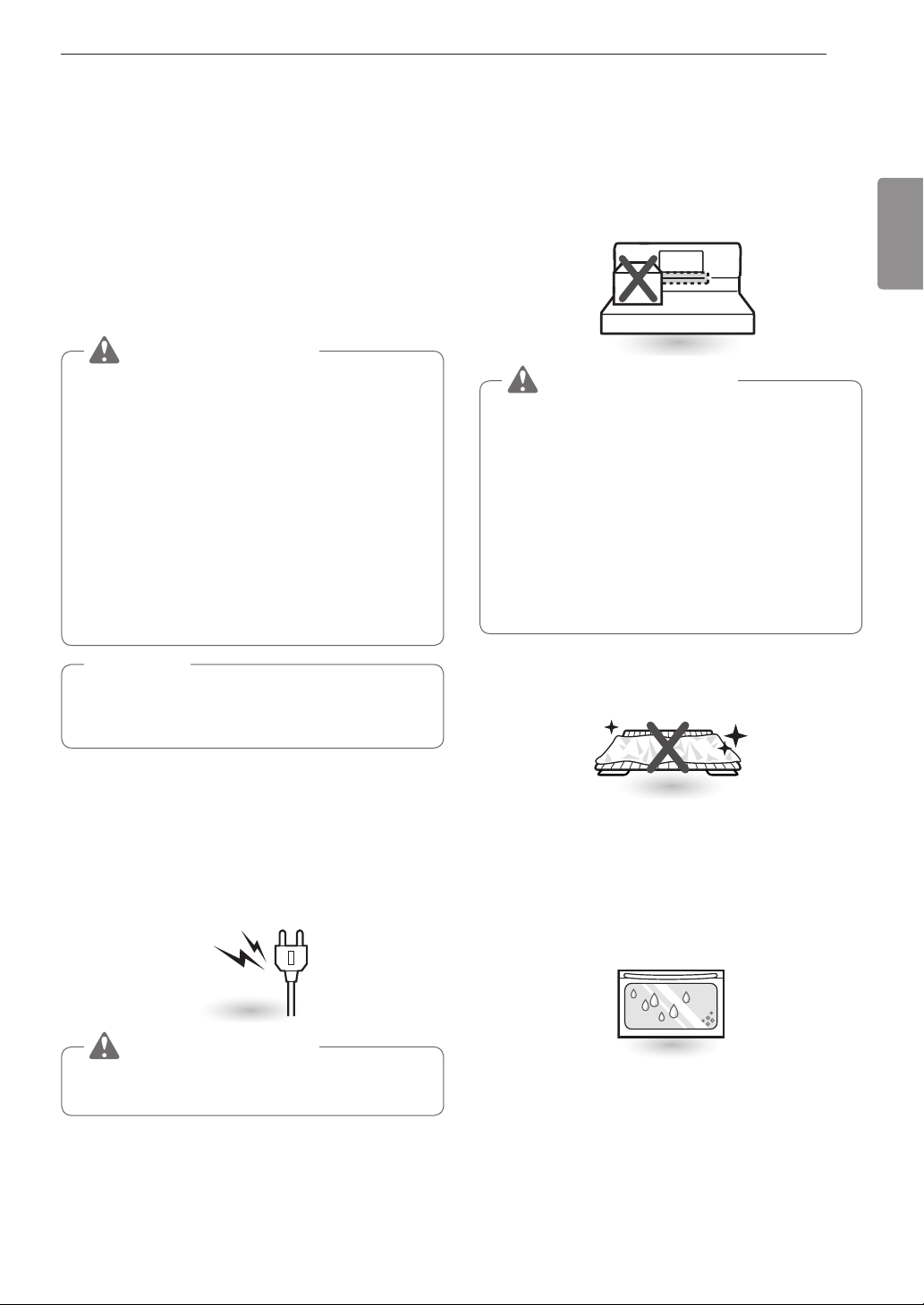
25
FONCTIONNEMENT
Français
Four
Avant l᾿utilisation
Liseztouteslesinstructionsavantd᾿utiliserleproduit.
Assurez-vous que le cordon d᾿alimentation électrique et le
robinet de gaz sont raccordés correctement.
Assurez-vous que la cuisinière est correctement utilisée
en fonction du type d᾿aliments que vous voulez préparer.
Assurez-vous que la cuisinière est correctement utilisée en
fonctiondutyped᾿alimentsquevousvoulezpréparer.
MISE EN GARDE
CE QU᾿IL FAUT FAIRE SI VOUS DÉTECTEZ UNE
ODEUR DE GAZ
•
Ouvrezlesfenêtres.
•
N᾿essayezpasd᾿allumerunappareil.
•
Ne touchez aucun interrupteur électrique.
•
N᾿utilisezaucuntéléphoneàl᾿intérieurdel᾿appartement
ou de la maison.
•
Appelez immédiatement votre fournisseur de gaz à
partirdutéléphoned᾿unvoisin.Suivezlesdirectivesde
votre fournisseur de gaz.
•
Sivousn᾿arrivezpasàjoindrevotrefournisseurdegaz,
appelezleserviced᾿incendie.
REMARQUE
Lorsque vous utilisez un thermomètre de four dans
la cavité du four, la température peut différer de la
température réglée, et ce, sur tous les modes.
En cas de panne de courant, n᾿utilisez pas le four.
Lefouretlegrilnepeuventpasêtreutiliséspendantune
pannedecourant.Silefourestdéjàencoursd᾿utilisation
lorsque la panne de courant se produit, le brûleur du four
s᾿éteintetnepeutpasêtrerallumétantquelecourantn᾿est
pas rétabli. Une fois le courant rétabli, vous devrez réinitialiser
lefour(oulafonctiondegrillage).
Panne de
courant
MISE EN GARDE
N᾿essayezpasd᾿utiliserl᾿allumageélectriquependantune
panne de courant.
N᾿obstruez pas et ne touchez pas l᾿évent du four et ne
placez pas d᾿objets autour de celui-ci lors de la cuisson.
Votre four est aéré grâce à des conduites au centre et au-
dessusdelagrilledubrûleur.N᾿obstruezpasl᾿éventdufour
lorsd᾿unecuissonpourpermettreunecirculationcorrectede
l᾿air.Netouchezpaslesouverturesdel᾿éventoulessurfaces
proches pendant la cuisson.
MISE EN GARDE
•
Neplacezpasd᾿objetsenplastiqueouinflammablessur
latabledecuisson.Ilspeuventfondreous᾿enflammer
s᾿ilssontplacéstropprèsdel᾿évent.
•
Ne placez pas de récipients fermés sur la table de
cuisson.Lapressionàl᾿intérieurdesrécipientsfermés
peut augmenter et faire éclater le couvercle.
•
Tout objet métallique laissé sur la table de cuisson peut
devenir très chaud et ainsi provoquer des brûlures.
•
Lespoignéesdecasserolesoudepoêlespeuvent
devenir chaudes si elles sont placées trop près de
l᾿évent.
Ne couvrez pas les grilles ou le fond du four avec du
papier d᾿aluminium.
Il est possible que vous remarquiez de la condensation
dans la vitre de la porte.
Pendantquevotrefourpréchauffe,l᾿airchauffédanslefour
peut faire apparaître de la condensation dans la vitre de la
porte.Cesgouttesd᾿eausontsansdangerets᾿évaporerontau
fur et à mesure que le four continue de préchauffer.
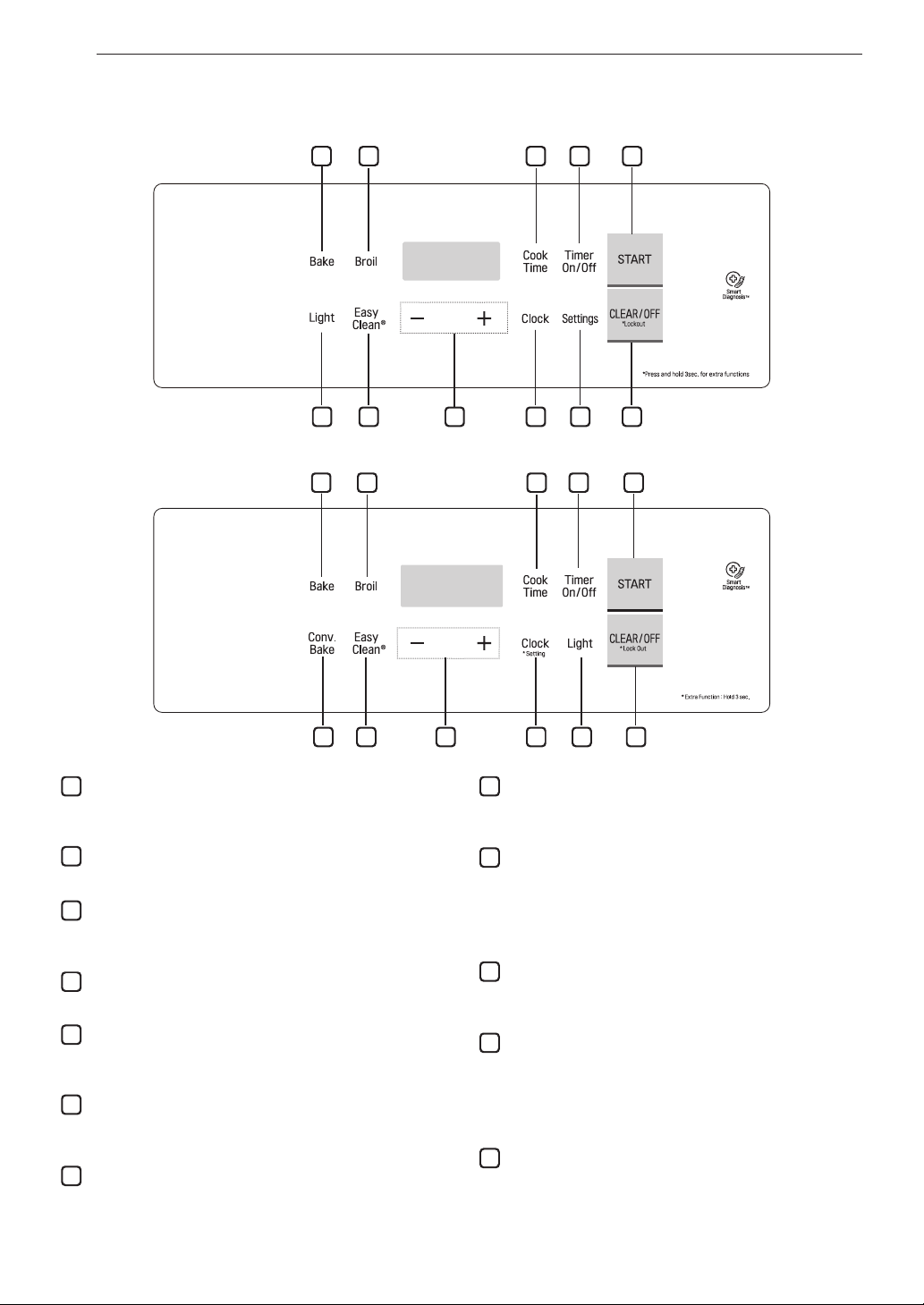
26
FONCTIONNEMENT
Aperçu du panneau de commande
Pour le modèle: LRG3061**, LRG3060**
1
6 7 8 9 10 11
2 3 4 5
Pour le modèle: LRG3193**
1
12 7 8 9 6 11
2 3 4 5
1
Bake
Appuyez sur le bouton pour accéder à la fonction de cuisson
normale.
2
Broil
Appuyez sur le bouton pour sélectionner la fonction de gril.
3
Cook Time
Appuyez sur les touches + et - pour régler le temps de cuisson.
Le four s’éteint lorsque le temps de cuisson est terminé.
4
Timer On/Off
Appuyez sur le bouton pour sélectionner la fonction de minuterie.
5
START
Il faut appuyer sur la touche pour démarrer toute fonctionnalité
de cuisson ou de nettoyage.
6
Oven Light
Appuyez sur le bouton pour allumer la lumière du four ou
l'éteindre.
7
EasyClean
®
Nettoie automatiquement un four légèrement sale. Reportez-
vous à la fonction EasyClean
®
dans la section Entretien et
nettoyage.
8
+/–
Règle ou modifie la durée de la minuterie et la température du
four.RèglelafonctiondegrillageàHI(élevé)ouLO(bas).
9
Clock
•
Appuyez sur les touches + et - pour régler l’heure.
•
Appuyez sur la touche et maintenez-la enfoncée pendant
3secondespourmodifierlesréglagesspéciaux.(Pourle
modèle:LRG3193)
10
Setting
AppuyezsurlatoucheSettings(réglages)plusieursfoispour
faire défiler les réglages du four et les modifier.
11
CLEAR OFF / Lockout
•
Appuyez sur le bouton pour annuler toutes les commandes
du four, sauf l'horloge et la minuterie.
•
AppuyezsurlatoucheSettings(réglages)plusieursfoispour
faire défiler les réglages du four et les modifier.
12
Conv. Bake (Pour le modèle: LRG3193)
Appuyez sur le bouton pour sélectionner la cuisson avec la
fonction de convection.
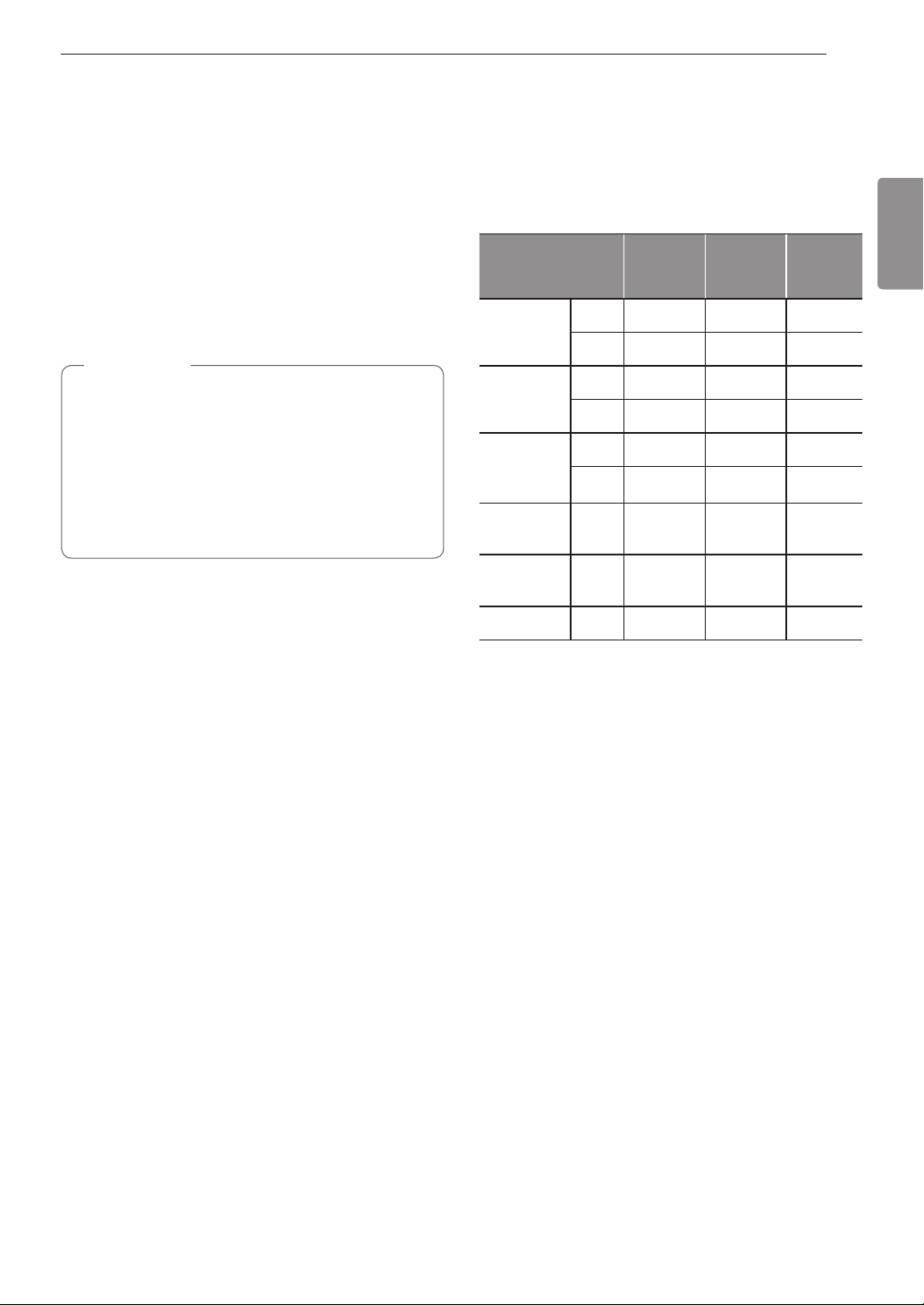
27
FONCTIONNEMENT
Français
Modification des réglages du
four
Clock (Horloge)
L᾿horlogedoitêtrerégléeàlabonneheuredujourafinqueles
fonctions de minuterie automatique du four fonctionnent bien.
1
Appuyez sur Clock.
2
Appuyez sur la touche +/- pour régler l’heure.
3
Appuyez sur Start.
REMARQUE
•
L’heurenepeutpasêtrechangéedurantunecuisson
minutée.
•
Sionn᾿appuiesuraucunetouchenumériquedansles
25 secondes après avoir appuyé sur la touche Clock,
l᾿affichageretourneauréglageinitial.
•
Sil᾿heureaffichéeclignote,c᾿estqu᾿ilyaeu
probablementunepanneélectrique.Réglezl᾿heurede
nouveau.
Oven Light (Lampe du four)
L᾿éclairageintérieurdufours᾿allumeautomatiquementdès
quel᾿onouvrelaportedufour.AppuyezsurLight pour allumer
manuellement la lampe du four.
Réglages minimum et maximum par
défaut
Toutes les fonctions répertoriées ont des valeurs de réglage
minimum et maximum en termes de temps ou de température
qu᾿ilestpossibled᾿entrerdanslacommande.Unsignal
sonoreretentitchaquefoisquel᾿onappuiesurunetouchede
commande.
Caractéristique
Temp./
durée
minimale
Temp./
durée
maximale
Par
défaut
Clock
(Horloge)
12 h 1 h 00 min 12 h 59 min
24 h 0 h 00 min 23 h 59 min
Timer
(Minuterie)
12 h 00 min 10 s 11 h 59 min
24 h 00 min 10 s 11 h 59 min
CookTime
(Tempsde
cuisson)
12 h 0 h 01 min 11 h 59 min
24 h 0 h 01 min 11 h 59 min
Broil
(Grillage)
Bas Élevé
Bake
(Cuisson)
170 °F /
80 °C
500 °F /
260 °C
350 °F /
175 °C
EasyClean
®
20 min.

28
FONCTIONNEMENT
Timer On/Off (Marche/Arrêt de la
minuterie)
LafonctionMarche/Arrêtdelaminuteriesertdeminuterie
suplémentaire dans la cuisine et émet un signal sonore
lorsque le temps réglé est écoulé. La minuterie ne permet pas
d᾿allumeroud᾿éteindrelefour.
OnpeututiliserlestouchesMarche/Arrêtdelaminuteriedu
four avec toutes les autres fonctions des commandes du four.
1
Appuyez sur la touche Timer On/Off (minuterieMarche/
Arrêt)delaminuteriepourréglerl’heureetlesminutes
ou appuyez sur la touche deux fois pour régler les
minutesetlessecondes.LemessageTIMER(minuterie)
clignote sur l’écran.
2
Appuyez sur les touches + ou – jusqu’à ce que l’heure
souhaitée s’affiche à l’écran.
3
Appuyez sur la touche Timer On/Off (minuterieMarche/
Arrêt)pourdémarrerlaminuterie.Lecompteàrebours
du temps restant s’affiche.
REMARQUE
Sionn᾿appuiepassurTimer On/Off, la minuterie revient
àl᾿heuredujour.
4
Lorsqueletempsrégléestécoulé(0:00),lemessage
End(fin)s’afficheàl’écran.Laminuterieémetunsignal
sonore toutes les 15 secondes jusqu’à ce que vous
appuyiezsurlatoucheMarche/Arrêtdelaminuterie.
REMARQUE
Siletempsrestantn᾿estpasaffiché,appuyezsurla
touche Timer On/Offpourl᾿afficherànouveau.
Annulation de la minuterie
1
Appuyez sur Timer On/Off une fois.
L᾿affichagerevientàl᾿heuredujour
Settings (Réglages)
Pour le modèle: LRG3193
Appuyez sur la touche Clock(horloge)etmaintenez-la
enfoncée pendant trois secondes.
Appuyez ensuite sur la touche Clock(horloge)plusieursfois
pour faire défiler les réglages du four et les modifier.
Pour le modèle: LRG3061, LRG3060
Appuyez sur la touche Settings plusieurs fois pour faire défiler
les réglages du four et les modifier.
La touche Settingsvouspermetceci:
•
réglerlemoded᾿affichagedel᾿horloge(12ou24heures)
•
régler la température du four
•
activer ou désactiver le voyant de préchauffage
•
régler le volume du signal sonore
•
changerl᾿échelledetempérature(degrésFahrenheitou
Celsius
•
Comment configurer la fonctionnalité Conversion
automatiquedelaconvection(Pourlemodèle:LRG3193)
Réglage du mode horaire
Cettecommandeestrégléepourl᾿utilisationd᾿unehorlogeen
mode 12 heures. Pour utiliser une horloge en mode 24 heures,
suivez les étapes ci-après.
Pour le modèle: LRG3193
1
Appuyez sur la touche Clock et maintenez-la enfoncée
pendant trois secondes
2
Appuyez sur +/– pour choisir entre une horloge de 12
heures et une horloge de 24 heures.
3
Appuyez sur la touche Start(démarrer)pouraccepter
cette modification.
Pour le modèle: LRG3061, LRG3060
1
Appuyez sur Settings.
2
Appuyez sur +/– pour passer du mode 12 heures au
mode 24 heures.
3
Appuyez sur Start pour accepter cette modification.
Réglage de la température du four
Il est possible que votre nouveau four ait une cuisson différente
de celle de votre four précédent. Avant de modifier les réglages
de température, familiarisez-vous avec votre nouveau four
enl᾿utilisantpendantquelquessemaines.Aprèsquoi,sivous
trouvezqu᾿ilestencoretropchaudoutropfroid,vouspourrez
ajustervous-mêmelatempérature.
REMARQUE
Pour commencer, montez ou baissez le thermostat de
15°F(8°C).Essayezlenouveaurélage.Silefour
néessited᾿utresajustements,montezoubaissezle
thermostat encore, en vous servant du premier rélage
pour vous guider. Par exemple, si le premier rélage éait
exagéémontezoubaissezlethermostatde10°F(5°C).
Si le premier rélage éait insuffisant, montez ou baissez le
thermostatde20°F(12°C).Procéezainsijusqu᾿àceque
le four soit réglé à votre satisfaction.

29
FONCTIONNEMENT
Français
Pour le modèle: LRG3193
1
Appuyez sur la touche Clock et maintenez-la enfoncée
pendant trois secondes.
2
Appuyez sur Clockplusieursfoisjusqu᾿àcequeAdJU
s᾿afficheàl᾿écran.
3
À l’aide de la touche +, augmentez la température au
degré souhaité.
4
À l’aide de la touche –, Diminution la température au
degré souhaité.
5
Appuyez sur Start pour accepter cette modification.
Pour le modèle: LRG3061, LRG3060
1
Appuyez sur Settingsplusieursfoisjusqu᾿àceque
AdJUs᾿afficheàl᾿écran.
2
À l’aide de la touche +, augmentez la température au
degré souhaité.
3
À l’aide de la touche –, Diminution la température au
degré souhaité.
4
Appuyez sur Start pour accepter cette modification.
REMARQUE
•
Ce réglage ne modifiera pas les températures de
grillagenid᾿autonettoyage.Ceréglageresteraconservé
danslamémoiremêmeaprèsunepanneélectrique.Le
thermostatdufourpeutêtreaugmenté(+)oudiminué(-)
jusqu᾿àconcurrencede35°Fou19°C.
•
Une fois que le thermostat est augmentéou diminué
latempéaturemodifiés᾿fficherajusqu᾿àcequ᾿llesoit
modifiée de nouveau.
Activation ou désactivation du voyant d᾿alarme de
préchauffage
Quand le four atteint la température demandée, le voyant de
préchauffageclignotejusqu᾿àl᾿ouverturedelaportedufour.
Vouspouvezactiveroudésactiverlevoyantd᾿alarmede
préchauffage.
Pour le modèle: LRG3193
1
Appuyez sur la touche Clock et maintenez-la enfoncée
pendant trois secondes.
2
Appuyez sur Clockplusieursfoisjusqu᾿àcequePrE
s᾿afficheàl᾿écran.
3
Appuyez sur +/– pour allumer ou éteindre l’éclairage.
4
Appuyez sur Start pour accepter cette modification.
Pour le modèle: LRG3061, LRG3060
1
Appuyez sur Settingplusieursfoisjusqu᾿àcequePrE
s᾿afficheàl᾿écran.
2
Appuyez sur +/– pour allumer ou éteindre l’éclairage.
3
Appuyez sur Start pour accepter cette modification.
Réglage du volume de l᾿avertisseur
Pour le modèle: LRG3193
1
Appuyez sur la touche Clock et maintenez-la enfoncée
pendant trois secondes.
2
Appuyez sur Clockplusieursfoisjusqu᾿àcequeBeep
s᾿afficheàl᾿écran.
3
Appuyez sur +/–poursélectionnerlesmodesHi,Loou
Off(élevé,basouarrêté).
4
Appuyez sur Start pour accepter cette modification.
Pour le modèle: LRG3061, LRG3060
1
Appuyez sur Settingplusieursfoisjusqu᾿àcequeBeep
s᾿afficheàl᾿écran.
2
Appuyez sur +/– pour sélectionner les modes Hi, Lo ou
Off(élevé,basouarrêté).
3
Appuyez sur Start pour accepter cette modification.
Sélection des degrés Fahrenheit ou Celsius
Réglezl᾿affichagedelatempératuredufourpourafficherles
degrésFahrenheit(°F)ouCelsius(°C).Lestempéaturespar
défaut du four sont en Fahrenheit sauf si elles ont été changés
parl᾿tilisateur.
Pour le modèle: LRG3193
1
Appuyez sur la touche Clock et maintenez-la enfoncée
pendant trois secondes.
2
Appuyez sur Clockplusieursfoisjusqu᾿àcequeUnit
s᾿afficheàl᾿écran.
3
Appuyez sur +/– pour sélectionner F(Fahrenheit)ouC
(Celsius).
4
Appuyez sur Start pour accepter cette modification.
Pour le modèle: LRG3061, LRG3060
1
Appuyez sur Settingsplusieursfoisjusqu᾿àcequeUnit
s᾿afficheàl᾿écran.
2
Appuyez sur +/– pour sélectionner F(Fahrenheit)ouC
(Celsius).
3
Appuyez sur Start pour accepter cette modification.

30
FONCTIONNEMENT
Comment configurer la fonctionnalité Conversion
automatique de la convection (Pour le modèle: LRG3193)
Lorsque vous utilisez la cuisson par convection, la fonctionnalité
Conversion automatique de la convection convertit
automatiquement les températures de cuisson régulière saisies
vers des températures de cuisson par convection. Cette
fonctionnalité est activée afin que la température convertie
s’affichage à l’écran. Par exemple, si vous saisissez une
température régulière de 350 °F pour une recette et que vous
appuyezsurlatoucheSTART(démarrer),l’écranafficheune
température convertie de 325 °F.
1
Appuyez sur la touche Clock et maintenez-la enfoncée
pendant trois secondes.
2
Appuyez sur Clockplusieursfoisjusqu᾿àcequeAuto
s᾿afficheàl᾿écran.
3
Appuyez sur la touche +/– pour activer ou désactiver la
fonctionnalité Conversion automatique.
4
Appuyez sur Start pour accepter cette modification.
Lockout (Verrouillage)
La fonctionnalité Verrouillage désactive la plupart des
commandes du four. La fonctionnalité ne désactive pas la
minuterie ou l’éclairage intérieur du four et elle ne verrouille
pas la porte du four.
1
Appuyez sur la touche Clear/Off(effacer/éteindre)et
maintenez-la enfoncée pendant 3 secondes. L’appareil
émet une mélodie et le message (verrouillé)
s’affiche à l’écran.
2
Pour désactiver la fonctionnalité Verrouillage, appuyez
sur la touche Clear/Off(effacer/éteindre)etmaintenez-la
enfoncée pendant 3 secondes.
Cook Time [Timed Cook] (Temps de
cuisson [Cuisson minutée])
Réglezlefourpourunecuissond᾿uneduréedéterminéeà
l᾿aidedelafonctionCuissonminutée.Cettefonctionpeutêtre
utilisée uniquement avec les modes Bake.
Réglage de la durée de cuisson
1
Appuyez sur Cook Time.
2
Appuyez sur la touche +/– pour régler l'heure.
3
Appuyez sur la touche Start(démarrer).Laminuterieest
réglée et l’écran indique le changement après un bref
délai.
Retrait et remise en place des grilles
du four
MISE EN GARDE
•
Replacezlesgrillesdufouravantd᾿allumerlefourpour
prévenir les brûlures.
•
Necouvrezpaslesgrillesavecdupapierd᾿aluminium
ou tout autre matériau, et ne placez rien au fond du four.
Cela pourrait nuire à la cuisson et pourrait endommager
le fond du four.
•
Attendez que le four soit froid pour placer les grilles.
Retrait des grilles
1
Saisissezlagrilledufouràl᾿aidedegantsdecuisine*.
2
Tirezlagrillejusqu᾿àcequ᾿ellesebloque.
3
Soulevezl᾿avantdelagrille.
4
Retirez la grille.
*Lorsquepossible,ajustezlesgrillesavantd᾿utiliserlefour.
Portez toujours des gants de cuisine lorsque vous ajustez les
grilles pendant que le four est allumé.
Remise en place des grilles du four
1
Àl᾿aidedegantsdecuisine,placezl᾿extrémitédela
grillesurlesupport*.
2
Inclinezl᾿extrémitéavantdelagrilleverslehaut.
3
Poussezlagrilleàl᾿intérieur.
4
Vérifiez que la grille est correctement en place.
*Lorsquepossible,ajustezlesgrillesavantd᾿utiliserlefour.
Portez toujours des gants de cuisine lorsque vous ajustez les
grilles pendant que le four est allumé.
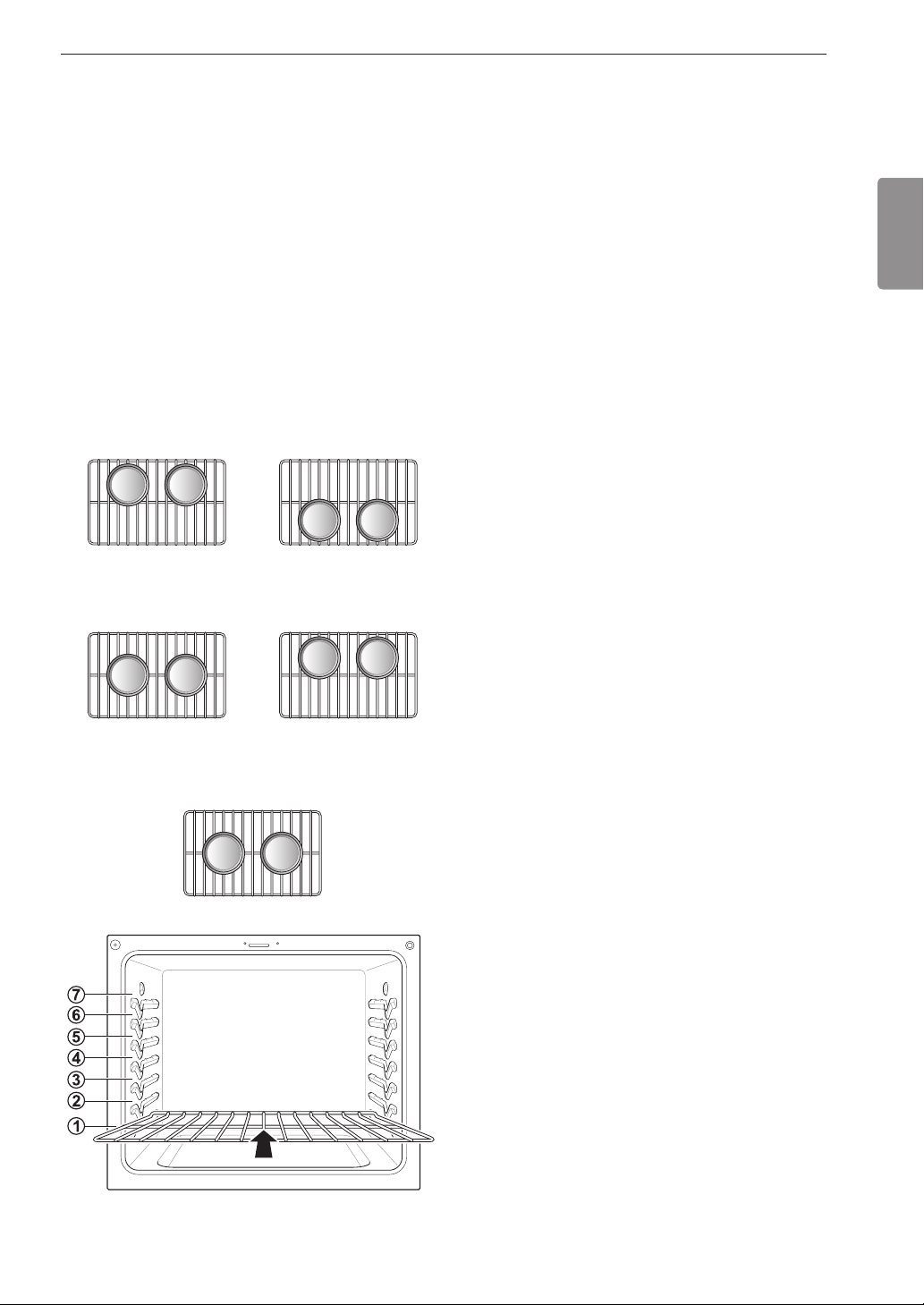
31
FONCTIONNEMENT
Français
Recommandations pour la cuisson et
le rôtissage au four
•
Centrez les plats sur les grilles pour des résultats de cuisson
optimaux. Si vous cuisez plusieurs plats, placez ceux-ci en
laissantsuffisammentd᾿espaceautourd᾿eux(1poà1
1
/
2
po).Assurez-vousquelesplatsnetouchentpaslesparois
du four.
•
Si vous utilisez une seule grille, placez la grille standard à la
position proposée dans les tableaux des pages suivantes.
Centrezleplatsurlagrillesupérieurecommel᾿indique
l᾿imagedelacuissonàplusieursgrilles.
•
Si vous utilisez plusieurs grilles dans le four, placez les
grilles standard aux positions 3 et 5. Pour obtenir de
meilleurs résultats, placez le plat comme indiqué.
Cuisson à plusieurs grilles
Pourlemodèle:LRG3193
Grille standard
(Position3)
Grille standard
(Position5)
Pourlemodèle:LRG3061,LRG3060
Grille standard
(Position3)
Grille standard
(Position5)
Cuisson à une grille
Grille standard
Bake (Cuisson)
La fonction Cuisson sert à préparer notamment des pâtisseries,
dupainetdesragoûts.Lefourpeutêtreprogrammépourcuire
àn᾿importequelletempératuresituéeentre170°F(80°C)et
500°F(260°C).Latempéaturepardéautest350°F(175°C).
1
Appuyez sur la touche Bake(cuire).350°s’afficheà
l’écranetlemessageBAKE(cuire)clignote.
2
Réglez la température du four.
Appuyez sur la touche + ou – à plusieurs reprises ou
maintenez-la enfoncée.
•
Appuyez sur la touche + pour augmenter la
température.
•
Appuyez sur la touche – pour diminution la
température.
3
Appuyez sur Start(démarrer)pouraccepterce
changement de température.
Pendant que le four préchauffe, la température s’affiche
et augmente par tranche de 5 degrés.
Une fois que le four a atteint la température établie,
un signal sonore se fait entendre et la lampe du four
clignote.
4
Quand la cuisson est terminée, appuyez sur Clear/Off.
5
Enlevez la nourriture du four.
Modification de la température pendant la cuisson
1
Appuyez sur Bake.
2
Appuyez sur la touche + ou – jusqu’à l’obtention de la
température souhaitée.
3
Appuyez sur Start.
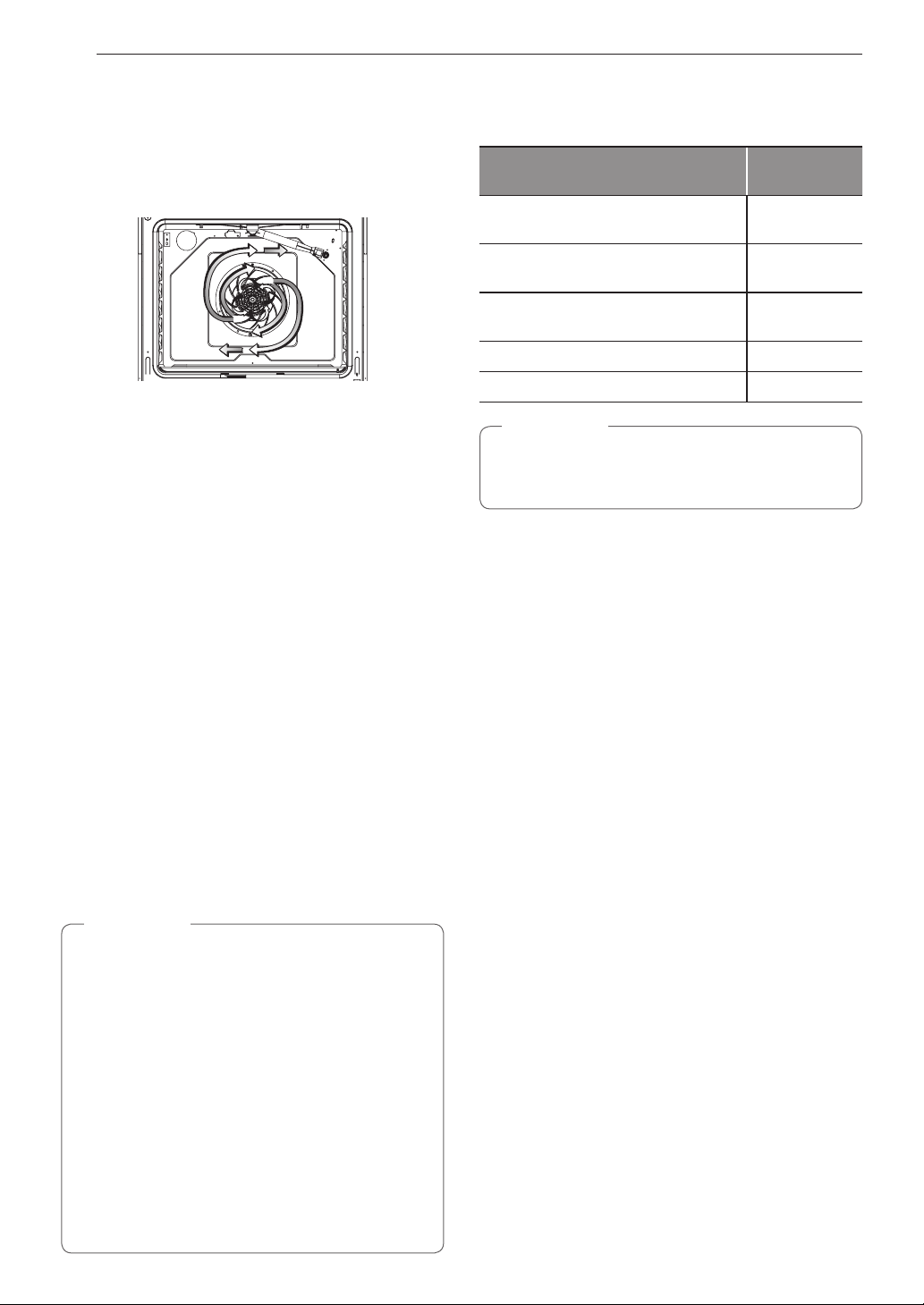
32
FONCTIONNEMENT
Cuisson par convection (Pour le
modèle : LRG3193)
La cuisson par convection permet une cuisson uniforme et
l’obtention d’excellents résultats lorsque vous utilisez plusieurs
grillesenmêmetemps.Ellepeutégalementréduireletemps
de cuisson.
Avantages de la Cuisson Par Convection
•
Des résultats de cuisson uniformes lorsque vous utilisez
plusieursgrillesenmêmetemps.
•
Un temps de cuisson plus rapide.
Réglage de la fonctionnalité Cuisson Par Convection
1
Appuyez sur la touche Conv. Bake(cuissonpar
convection).350 °F clignote à l’écran.
2
Réglez la température du four. Appuyez sur la touche
+ ou – à plusieurs reprises ou maintenez-la enfoncée
jusqu’à ce que l’écran affiche 375 °F.
3
Appuyez sur Start.
4
Une fois que la cuisson est terminée ou pour l’annuler,
appuyez sur la touche CLEAR/OFF(effacer/éteindre).
Pendant que le four préchauffe, l’écran affiche la température
qui augmente par tranche de 5 degrés. Une fois que le four a
atteint la température ajustée établie, un signal sonore se fait
entendre et la lampe du four clignote.
L’écran affiche la température du four convertie
automatiquement à 350 °F, CONV.
REMARQUE
•
Lors de la cuisson à l’aide du cycle de convection, la
température du four est automatiquement réduite de
25 °F. Le changement de température s’affiche à l’écran.
Cette fonctionnalité est connue sous le nom de
« CONVERSION AUTOMATIQUE ».
Cette fonctionnalité est ACTIVÉE pour cette cuisinière.
Pour DÉSACTIVER la fonctionnalité Conversion
automatique, consultez la rubrique « Comment
configurer la fonctionnalité Conversion automatique de
convection » dans la section Directives d’utilisation du
présent manuel.
•
Vous allez entendre un ventilateur lors de la cuisson
parconvection.Leventilateurs’arrêtelorsquelaporte
estouverte,maislachaleurcontinued’êtrediffusée.Le
ventilateur ne démarre pas tant que la température de
préchauffage n’est pas atteinte.
Tableau de cuisson
Ce tableau est présenté à titre de référence seulement. Réglez
le temps de cuisson selon la recette.
Aliment Position de la
grille
Tartescongelées(suruneplaqueà
biscuits)
2 ou 3
Gâteau des anges, Bundt ou quatre-
quarts
3
Biscuits,muffins,brownies,petitsgâteaux,
gâteaux étagés, tartes
4
Plats mijotés 4
Rôtissage 1 ou 2
REMARQUE
•
En raison des cycles de température du four, un
thermomètre placé dans la cavité du four peut indiquer
une température différente de celle que le four affiche.
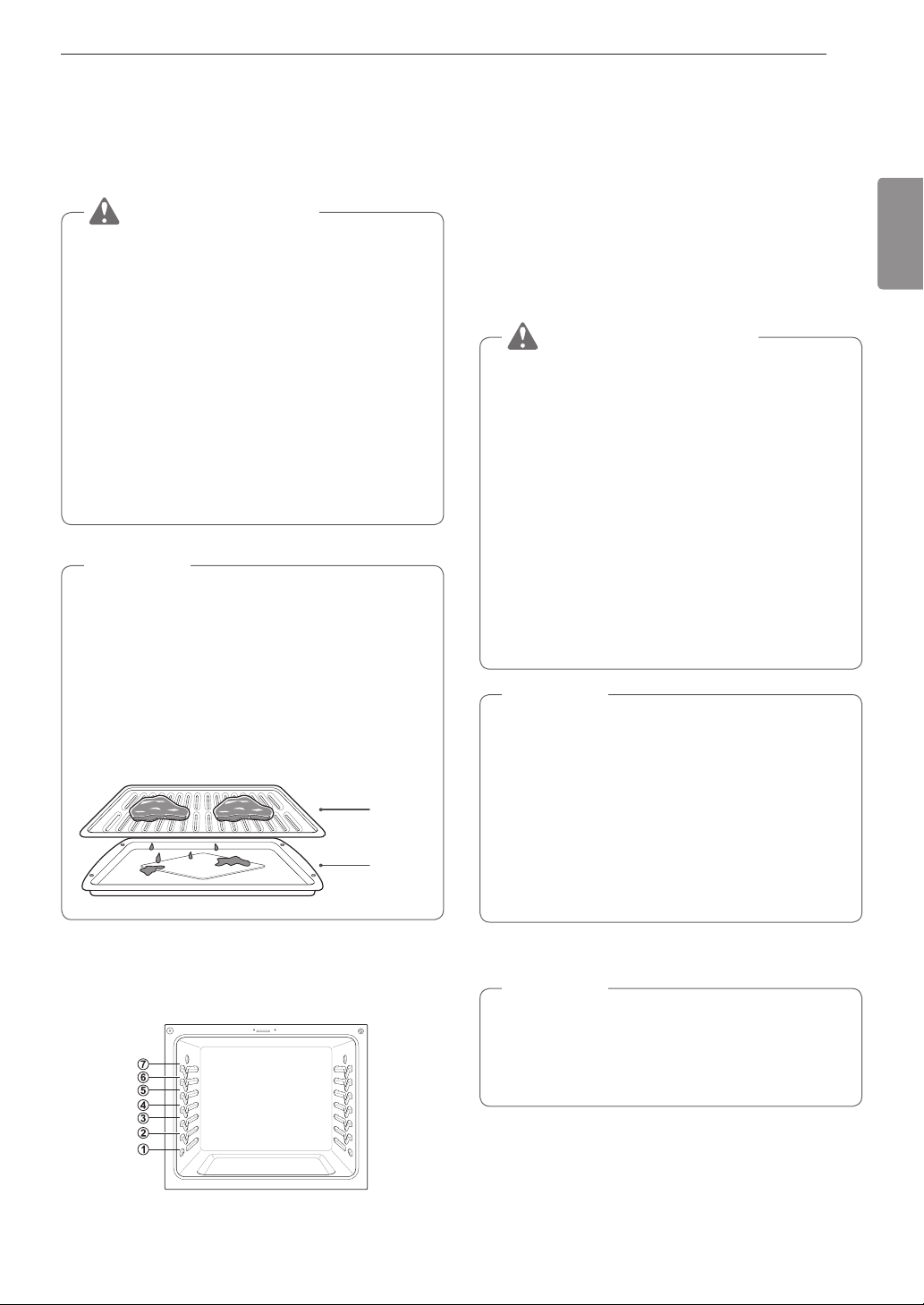
33
FONCTIONNEMENT
Français
Broil (Grillage)
la porte fermée. La fonction de grillage utilise un rayonnement
de chaleur intense provenant du brûleur de gaz supérieur.
Ce mode fonctionne parfaitement avec des morceaux fins et
tendresdeviande(1pooumoins),devolailleoudepoisson.
MISE EN GARDE
•
N᾿utilisezpasunelèchefritesanslagrille. Le gras
pourrait causer un feu de graisse.
•
Ne couvrez pas la grille ni la lèchefrite de papier
d᾿aluminium.Cecipourraitcauserunfeu.
•
Utilisez toujours une lèchefrite et une grille pour le
drainagedel᾿excédentdegrasetdematièresgrasses.
Ceci permettra de réduire les projections, la fumée et
les flambées.
•
N᾿utilisezjamaisunelèchefritequin᾿apasété
soigneusement nettoyéeetquin᾿estpasàla
température de la pièce. Si votre lèchefrite est
endommagée, bosselée ou très souillée de façon
permanente, pensez à la remplacer afin de réduire
les émissions de fumée qui se produisent pendant la
cuisson au grilloir.
REMARQUE
•
Réglez le four à Lo broil pour griller la volaille et les
tranches épaisses de viande.
•
Retirez la lèchefrite du four pour la faire refroidir, ce qui
facilite le nettoyage.
•
Pour des résultats optimaux, utilisez une lèchefrite
conçuepourlacuissonaugrilloir,telqu᾿illustré
ci-dessous. La lèchefrite récupérera les suintements de
gras, et la grille permettra de prévenir les projections de
graisse.
Grille
Lèchefrite
En ce qui concerne la fonction de grillage, consultez le guide
de grillage pour placer la grille
Réglage du four pour le grillage
1
Appuyez sur Broil une fois pour Hi et deux fois pour Lo.
2
Appuyez sur Start.
3
Laissez préchauffer le gril cinq minutes.
4
Placez les aliments à cuire dans le four.
5
Fermezlaportedufour.Laportedufourdoitêtrefermée
aucoursdel᾿utilisationdugril.
AVERTISSEMENT
Lorsque vous utilisez le grilloir, la température du four est
extrêmementélevée.Pourévitertoutebrûlure:
•
Gardez la porte du four fermée pendant la cuisson au
grilloir.
•
Portez toujours des gants de cuisine pour mettre des
aliments au four ou les en retirer.
L᾿utilisationinappropriéedelafonctiondegrillagepeut
causer de la fumée excessive ou un feu de graisse. Parmi
lesconditionsd᾿utilisationnonadéquates,onretrouve:
•
Le réglage du grilloir à une température plus élevée que
celle recommandée.
•
L᾿utilisationdelèchefritesgraisseusesousales.
•
La cuisson au grilloir plus longue que la durée de
cuisson recommandée.
REMARQUE
•
Cette cuisinière est conçue pour utiliser la fonction de
grillage avec la porte fermée. Fermez la porte pour
régler la fonction de grillage. Si la porte est ouverte, la
fonctiondegrillagenepeutpass᾿activeretlemotdoor
apparaîtra sur l᾿écran. Fermez la porte et réinitialisez la
fonction.L᾿ouverturedelaporteéteintlesélémentsde
grillage lors de la cuisson au gril. Si la porte est ouverte
pendant la cuisson au gril, les éléments de grillage
s᾿éteignentauboutdecinqsecondes.Leséléments
se rallument automatiquement dès que la porte est
refermée.
6
Lorsque le grillage est terminé, appuyez sur Clear/Off.
REMARQUE
Pendant la fonction Grillage, il est normal que le
grilloirs᾿allume,s᾿éteigneetserallume.L᾿allumeur
du grilloir se trouvant dans la partie supérieure du four
passe régulièrement à la couleur orange pendant le
fonctionnement normal du grilloir.
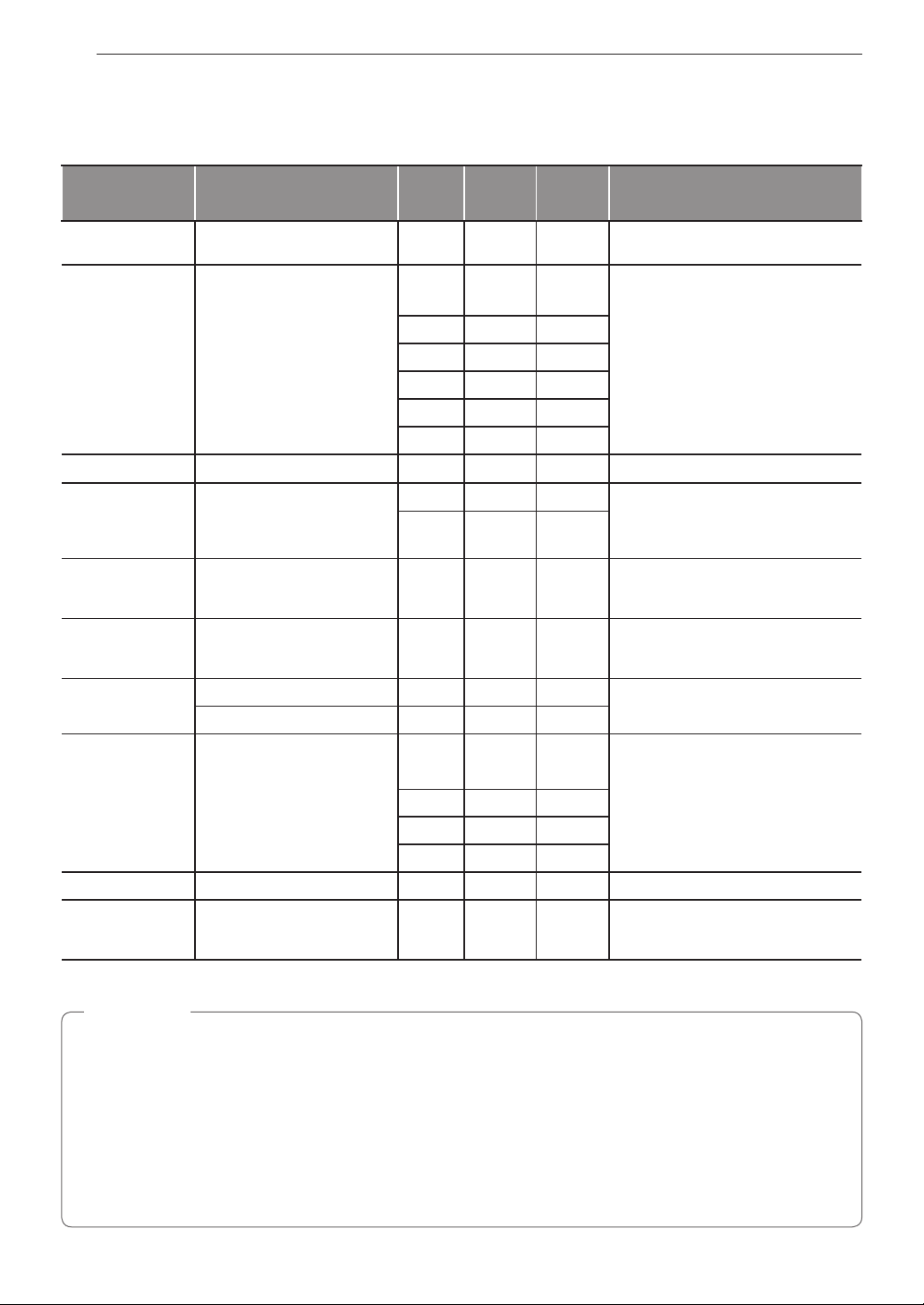
34
FONCTIONNEMENT
Guide de grillage recommandé
Lataille,lepoids,l᾿épaisseur,latempératurededépartetvospréférencesdecuissonmodifientletempsdegrillage.Lesduréesde
cuissonontétéétabliesd᾿aprèsdestempératuresdeviandesconservéesauréfrigérateur.Pourobtenirdemeilleursrésultatsde
grillage, utilisez une lèchefrite conçue pour le grillage.
Aliment Quantité ou épaisseur
Position
de la
grille
Premier
côté
(minutes)
Deuxième
côté
(minutes)
Commentaires
Bœuf haché
Bien cuit
1lb(4galettes)
1
/
2
à
3
/
4
pod᾿épaisseur
6 4 à 6 3 à 5
Espacez uniformément. On peut faire
grillerjusqu᾿àhuitgalettesàlafois.
Bifteck
Saignant 6 7 5
Lesbiftecksdemoinsde1pod᾿épaisseur
cuisent complètement avant de brunir.
Lacuissonàlapoêleestrecommandée.
Dégraissez.
1pod᾿épaisseur
De 1 à 1
1
/
2
lb
À point 6 12 5 à 6
Bien cuit 6 13 8 à 9
Saignant
1
1
/
2
pod᾿épaisseur
De 2 à 2
1
/
2
lb
4 10 6 à 7
À point 4 12 à 15 10 à 12
Bien cuit 4 25 16 à 18
Pain grillé
De 1 à 9 tranches
5 1 à 2 1 à 2
Poulet
1 poulet entier de 2
à
2
1
/
2
lb, découpé sur la
longueur, 4 poitrines avec os
2 35 à 40 25 Badigeonnez chaque côté de beurre
fondu.
Grillez avec le côté de la peau en
dessous.
2 25 à 30 10 à 15
Filets de poisson
1
/
4
po à
1
/
2
pod᾿épaisseur 5 7 à 8 6 Manipulez et tournez avec soin.
Badigeonnez de beurre au citron avant et
pendantlacuisson(facultatif).
Tranches de jambon
(précuites)
1pod᾿épaisseur
1
/
2
pod᾿épaisseur
3
4
10
7
5
4
Augmentez le temps de cuisson de 5 à 10
minutes par côté pour du jambon de
1
1
/
2
pod᾿épaisseuroudujambonfumé.
Côtelettes de porc
Bien cuit
2(
1
/
2
pod᾿épaisseur) 4 10 8 Dégraissez.
2(1pod᾿épaisseur),environ1lb 4 13 8 à 9
Côtelettes d᾿agneau Dégraissez.
À point 2(1pod᾿épaisseur),environ10
à 12 oz
5 6 4 à 7
Bien cuit 5 10 10
À point
2(
1
/
2
pod᾿épaisseur),environ
1 lb
5 10 4 à 6
Bien cuit 5 17 12 à 14
Bacon
1
/
2
lb(environ8tranchesminces) 4 8 3 Placez sur une seule couche.
Queues de homard De 2 à 4
De 6 à 8 oz chacune
3 13 à 16 Ne pas
tourner
Coupez le dos de la carapace. Écartez.
Badigeonnez de beurre fondu avant le
grillage et à la mi-temps de grillage.
•
Ce guide est offert à titre de référence seulement. Réglez le temps de cuisson selon vos préférences.
REMARQUE
Ledépartementdel᾿AgriculturedesÉtats-Unisindiquequelaconsommationdepoisson,deviandeoudevolaillecrusoupas
assezcuitspeutaccroîtrelesrisquesdemaladied᾿originealimentaire.
Ledépartementdel᾿Agricultureaindiquél᾿utilisationdestempératuresinternesminimalessécuritairessuivantespourla
consommation:
•
Bœuf:160°F(71,1°C)
•
Volaille:165°F(73,9°C)
•
Bœuf,veau,porcouagneau:145°F(62,8°C)
•
Poisson/fruitsdemer:145°F(62,8°C)
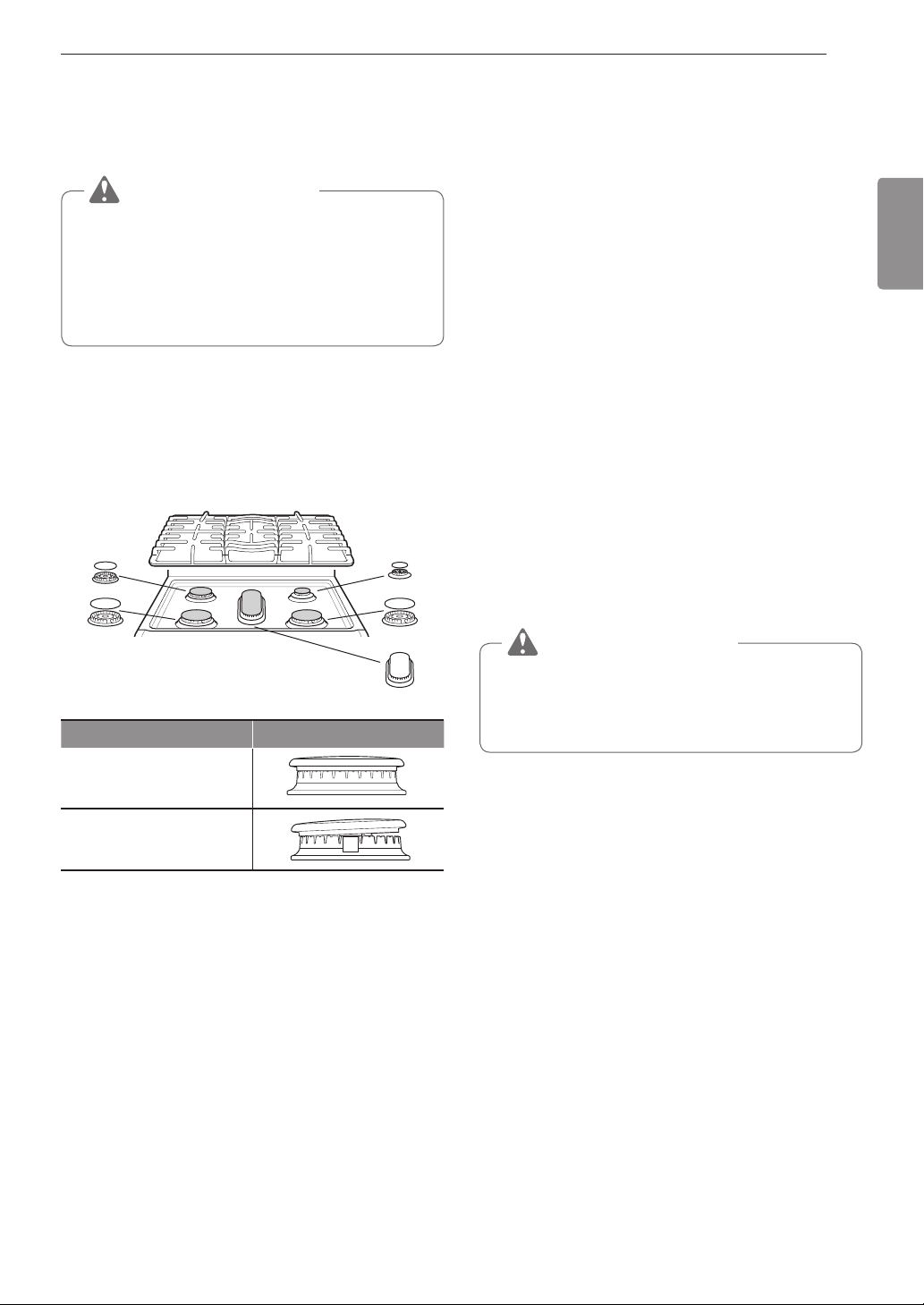
35
MAINTENANCE
Français
ENTRETIEN
Brûleurs de surface au gaz
MISE EN GARDE
•
Ne nettoyez pas cet électroménager avec un produit
javellisant.
•
Pour prévenir les brûlures, attendez que la table de
cuissonaitrefroidiavantd᾿enmanipulerlespièces.
•
Portez toujours des gants pour nettoyer la table de
cuisson.
Retrait et remplacement des brûleurs
de surface au gaz
Lesfoyersainsiquelestêtesetlescapuchonsdesbrûleurs
peuventêtreretiréspourl᾿entretienetlenettoyage.
Brûleur polyvalent
Le capuchon de brûleur est
correctement installé.
Lecapuchondebrûleurn᾿est
PAS correctement installé.
Nettoyage des têtes et des capuchons
des brûleurs
Pour obtenir des flammes uniformes et libres, les fentes de la
têtedubrûleurdoiventêtrepropresentouttemps.Pourretirer
lestêtesetlescapuchonsdesbrûleur(etl᾿assemblagedu
brûleurovale),ilsuffitdelessoulever.Netentezpasderetirer
le capuchon du brûleur ovale.
•
Lavezlescapuchonsdesbrûleursàl᾿eauchaude
savonneuseetrincez-lesàl᾿eauclaire.Faitescoulerde
l᾿eaudanslebrûleurovaleplacétêteenbaspourquel᾿eau,
en pénétrant par la tige, élimine les résidus.
•
Faites attention lorsque vous nettoyez la table de cuisson.
Les pointes de métal des électrodes pourraient causer des
blessures. Ne frappez pas les électrodes avec un objet dur,
car cela risquerait de les abîmer.
•
Pourretirerlesdépôtsd᾿alimentsbrûlés,laisseztremper
lestêtesdesbrûleursdansunesolutiond᾿eauchaudeetde
détergent liquide doux pendant 20 ou 30 minutes. Pour les
taches rebelles, utilisez une brosse à dents ou une brosse
métallique.
•
Les brûleurs ne fonctionneront pas correctement si leurs
orifices sont bouchés ou si les électrodes sont encrassées.
•
Lescapuchonsetlestêtesdesbrûleursdoiventêtre
nettoyésrégulièrement,enparticulieraprèsqu᾿une
casserole ait débordé.
•
Lesbrûleursnes᾿allumerontpassileurcapuchonestretiré.
MISE EN GARDE
•
Ne frappez pas les électrodes avec un objet dur. Cela
pourrait les endommager.
•
N᾿utilisezpasdelained᾿acieroudepoudresabrasives
pour nettoyer les brûleurs.
Après le nettoyage des têtes et des
capuchons des brûleurs
Secouez-lespouréliminerl᾿eaurésiduelle,puislaissez-les
séchercomplètement.Placezlebrûleurovaletêteenbas,ce
quipermettraàl᾿eaudes᾿échapperplusfacilement.Remettez
lestêtesetlescapuchonsdesbrûleurssurlesélectrodesdela
tabledecuissonàl᾿emplacementcorrespondantàleurtaille.
Assurez-vousquel᾿ouverturedelatêtedebrûleurestbien
au-dessusdel᾿électrode.
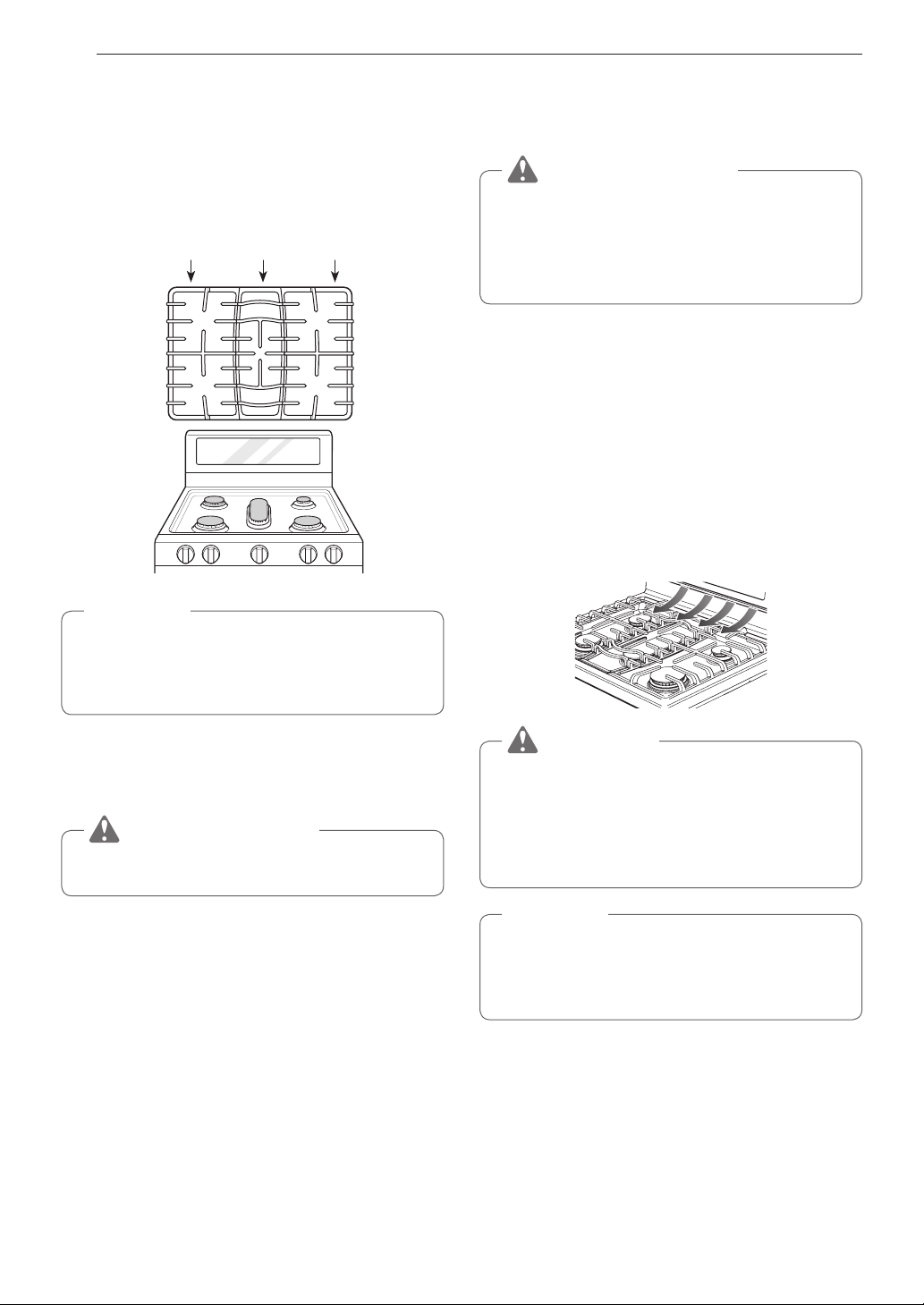
36
MAINTENANCE
Foyers de brûleurs
La cuisinière est composée de trois foyers distincts de type
professionnel. Pour une stabilité maximale, ces foyers ne
doiventêtreutilisésquelorsqu᾿ilssontplacéscorrectement.
Les deux foyers latéraux sont interchangeables, tant de
gaucheàdroitequedel᾿avantàl᾿arrière.Lefoyercentralpeut
êtrepermuté,soitàl᾿avantouàl᾿arrière.
Foyer latéral Foyer central Foyer latéral
REMARQUE
N᾿utilisezpaslebrûleurpendantunepériodeprolongée
sans déposer une casserole sur le foyer. Le fini du foyer
pourraits᾿ébréchersiaucunecasserolen᾿absorbesa
chaleur.
Nettoyage des foyers de brûleurs
MISE EN GARDE
•
Attendez que les foyers aient refroidi avant de les
retirer.
•
Lesfoyersdoiventêtrenettoyésrégulièrementetchaque
fois que des aliments sont renversés.
•
Lavezlesfoyersàl᾿eauchaudesavonneuseetrincez-lesà
l᾿eauclaire.
•
Les foyers sont lavables au lave-vaisselle.
•
Après le nettoyage des foyers, laissez-les sécher
complètement et placez-les soigneusement sur les brûleurs.
Nettoyage de la table de
cuisson
MISE EN GARDE
•
Pour éviter les brûlures, ne nettoyez la table de cuisson
quelorsqu᾿ellearefroidi.
•
Ne tentez pas de soulever la table de cuisson.
Cela pourrait causer des dommages et le mauvais
fonctionnement de la cuisinière.
Les aliments très acides ou sucrés risquent de ternir la table de
cuissons᾿ilsnesontpasnettoyésrapidement.Lavezetrincez
latabledecuissondèsqu᾿ellearefroidi.Quantauxautres
taches,tellesleséclaboussuresd᾿huileoudegraisse,elles
doiventêtreenlevéesausavonetàl᾿eaudèsquelatablede
cuissonarefroidi,etêtrerincéesetessuyéesauchiffonsec.
Évents du four
Lesouverturesd᾿aérationsetrouventàl᾿arrièredelatablede
cuisson,auhautetaubasdelaportedufourainsiqu᾿aubas
de la cuisinière.
MISE EN GARDE
•
Les rebords des évents de la cuisinière sont
coupants. Portez des gants lorsque vous nettoyez la
cuisinière,afind᾿éviterlesblessures.
•
Nettoyezlahotted᾿aspirationfréquemment.Vousne
devezpaslaisserlagraisses᾿accumulersurlahotteou
sur le filtre.
REMARQUE
Nebloquezpasleséventsetlesouverturesd᾿aérationde
lacuisinière.Ilspermettentunecirculationd᾿airdansles
deux sens, ce qui est nécessaire au bon fonctionnement
de la cuisinière et pour une combustion adéquate.
37
MAINTENANCE
Français
Panneau de contrôle
Pouréviterd᾿activerlepanneaudecontrôlelorsdunettoyage,
débranchez la cuisinière. Nettoyez les éclaboussures avec
un chiffon humide et du produit à vitre. Nettoyez les parties
excessivementsouilléesavecdel᾿eauchaudesavonneuse.
N᾿utilisezaucunproduitabrasif.
Boutons et panneau du
collecteur avant
Il est recommandé de nettoyer le panneau du collecteur après
chaque utilisation de la cuisinière. Pour le nettoyage, utilisez
unchiffonhumideetdel᾿eausavonneuseouunesolution
composéed᾿unepartdevinaigrepourunepartd᾿eau(50/50).
Pourlerinçage,utilisezdel᾿eauclaireetfrottezàsecàl᾿aide
d᾿unchiffondouxpourpolirlepanneauetlesboutons.
MISE EN GARDE
•
N᾿utilisezpasdeproduitsnettoyantsabrasifs,de
nettoyantsliquidesforts,delainesd᾿acieroudeproduits
nettoyants pour four sur le panneau du collecteur avant.
Cela pourrait endommager le fini.
•
Évitez de déformer les boutons en les tirant vers le haut
ou vers le bas, et ne les utilisez pas pour suspendre des
serviettesoud᾿autresobjets.Celapourraitendommager
la tige du robinet de gaz.
•
Il est possible de retirer les boutons pour en faciliter le
nettoyage.
•
Pournettoyerlesboutons,assurez-vousqu᾿ilssontàla
position Off et retirez-les des tiges en tirant simplement.
•
Pour replacer les boutons, assurez-vous que la
position Off du bouton est centrée au haut, et insérez le
bouton directement sur la tige.
REMARQUE
Pourprévenirleségratignures,n᾿utilisezpasdenettoyants
abrasifs sur ces pièces.
Nettoyage de l᾿extérieur
Garnitures peintes et décoratives
Pourunnettoyagegénéral,utilisezunchiffonavecdel᾿eau
savonneuse chaude. Pour des saletés plus coriaces et une
accumulation de graisse, appliquez un détergent liquide
directement sur la saleté. Laissez agir le détergent pendant
30 à 60 minutes. Rincez avec un chiffon humide et séchez.
N᾿utilisezpasdesproduitsànettoyerabrasifs.
Surfaces en acier inoxydable
Pouréviterleségratignures,n᾿utilisezpasdetamponsenlaine
d᾿acier.
1
Placez une petite quantité de détergent ou de produit à
polir pour les appareils en acier inoxydable sur un chiffon
humide ou un papier essuie-tout.
2
Nettoyez une petite surface, en frottant dans le sens des
fibresdel᾿acierinoxydable,s᾿ilyalieu.
3
Séchez et polissez avec un essuie-tout ou un chiffon
doux propre et sec.
4
Répétez au besoin.
REMARQUE
•
N᾿utilisezpasdetamponsenlained᾿acier,carils
égratigneraient les surfaces.
•
Pour nettoyer les surfaces en acier inoxydable, utilisez
del᾿eautièdesavonneuseouencoredudétergentouun
produitàpolirpourl᾿acierinoxydable.
•
Essuyez toujours une surface métallique dans le sens
des fibres du fini.
•
Pourl᾿achatdedétergentoud᾿unproduitàpolirpour
les appareils en acier inoxydable, ou encore pour
trouver un fournisseur dans votre localité, appelez notre
service à la clientèle en composant le numéro sans frais
suivant:1800243-0000(États-Unis),1888542-2623
(Canada),ouvisiteznotresiteWebàl᾿adresse
www.lg.com.
Porte du four
•
Utilisezdel᾿eausavonneusepournettoyerlaportedufour
enprofondeur.Rincezbien.N᾿immergezpaslaportedans
l᾿eau.
•
Vous pouvez utiliser un produit de nettoyage pour vitre sur la
vitre extérieure de la porte du four. Ne vaporisez pas d᾿eau
ou un produit de nettoyage pour vitre sur les évents de la
porte.
•
N᾿utilisezpasdesproduitsdenettoyagepourfour,des
poudres de nettoyage ou des matériaux de nettoyage
abrasifssurl᾿extérieurdelaportedufour.
•
Nenettoyezpaslejointd᾿étanchéitédelaportedufour.Ce
joint est fait d᾿un matériau tissé, lequel est essentiel pour un
scellement adéquat. Veillez à ne pas frotter, endommager ou
enlevercejointd᾿étanchéité.
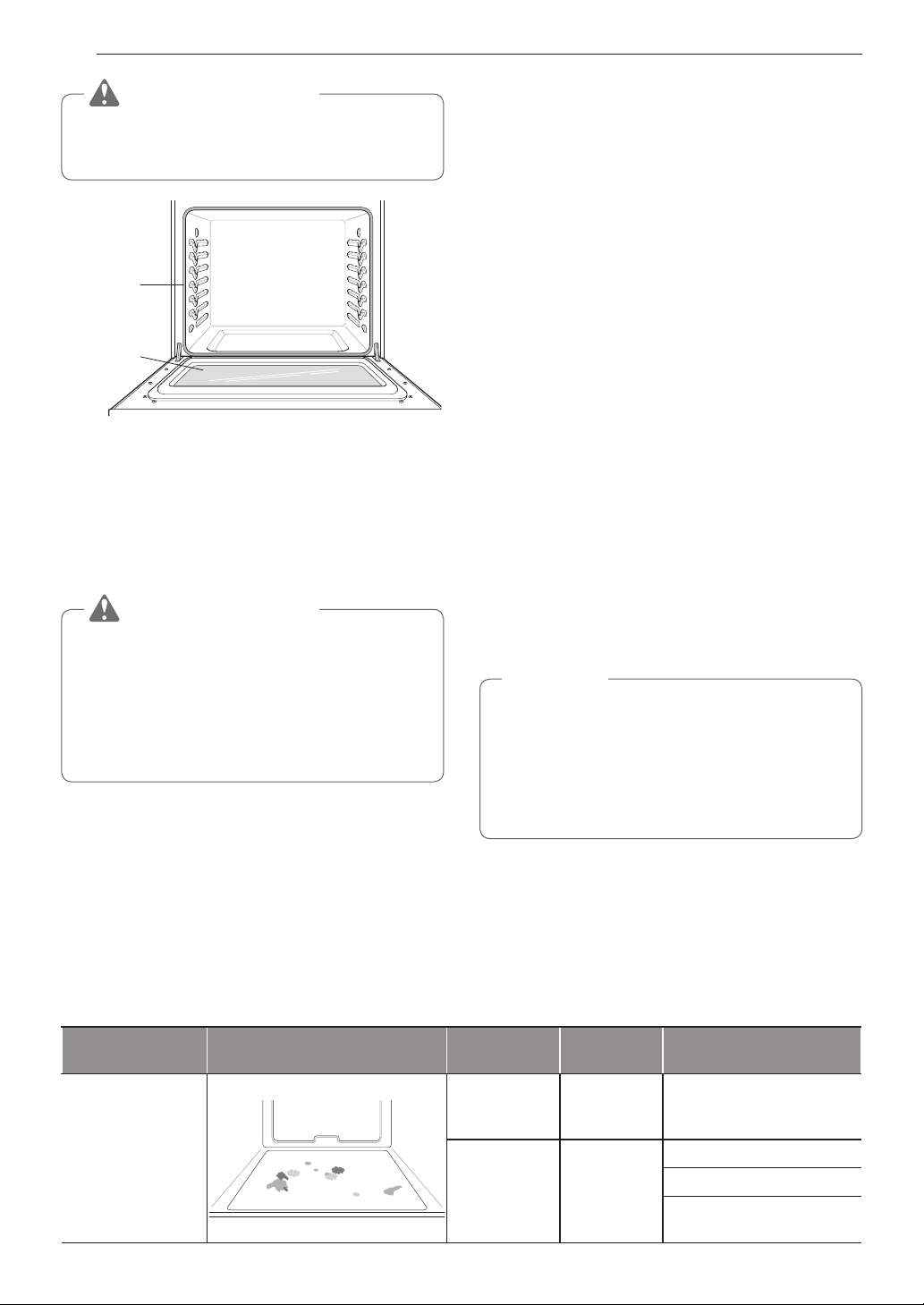
38
MAINTENANCE
MISE EN GARDE
N᾿utilisezpasdesproduitsdenettoyageagressifsoudes
matériauxdenettoyageabrasifssurl᾿extérieurdelaporte
du four. Ceci pourrait causer des dommage.
ÉVITEZ de
nettoyer
le joint
d᾿étanchéité
de la porte du
four à la main.
Nettoyez la
porte du four
à la main.
Directives d᾿entretien de la
porte
La plupart des portes de four contiennent du verre pouvant se
briser.
MISE EN GARDE
•
Ne fermez pas la porte du four tant que toutes les grilles
du four ne sont pas en place.
•
Ne frappez pas le verre avec des marmites, des
casserolesoud᾿autresobjets.
•
Lefaitd᾿érafler,deheurter,desecoueroudecomprimer
le verre pourrait en affaiblir la structure et augmenter le
risque de bris dans le futur
Grilles du four
1
Les aliments renversés dans les montants des grilles
pourraient coincer les grilles. Nettoyez tout déversement
avec un produit faiblement abrasif.
2
Rincezlesgrillesetlesmontantsàl᾿eauclaireetséchez-
les.
EasyClean
®
Latechnologied᾿émailEasyClean
®
de LG permet deux
méthodesdenettoyagepourl᾿intérieurdelacuisinière.La
fonction EasyClean
®
tire profit du nouvel émail de LG pour
délogerlessaletéssansproduitschimiquesagressifs;en
seulement10minutes,àl᾿aided᾿EAUUNIQUEMENTetà
basse température, elle aide à déloger les saletés LÉGÈRES
avant le nettoyage à la main.
La fonction EasyClean
®
est rapide et efficace pour les saletés
petitesetLÉGÈRES,tandisquelafonctiond᾿autonettoyage
permetd᾿enleverlesGROSSESsaletésincrustées.L᾿intensité
etlachaleurélevéeducycled᾿autonettoyagepeuvent
provoquerdelafuméenécessitantl᾿ouverturedefenêtres
pourl᾿aération.Enplusduprocessusd᾿autonettoyageintense,
LG vous offre une option de nettoyage qui exige MOINS DE
CHALEUR,MOINSDETEMPSetquineproduitpresque
AUCUNE FUMÉE OU ÉMANATION.
Avantages de la fonction EasyClean
®
•
Permet de détacher la saleté légère avant le nettoyage à la
main.
•
EasyClean
®
n᾿utilisequedel᾿eauetnenécessiteaucun
produit chimique.
•
Rendl᾿autonettoyageplusfacile
- retardelanécessitéducycled᾿autonettoyage;
- minimiselafuméeetlesodeurs;
- permetdestempsd᾿autonettoyagepluscourts.
REMARQUE
Certains modèles ne sont pas dotés de la fonctionnalité
Autonettoyage. La fonctionnalité EasyClean
®
pourraitêtre
insuffisante pour les grosses saletés incrustées. Si votre
four n’est pas doté d’un mode d’autonettoyage, nettoyez-le
régulièrement en utilisation la fonctionnalité EasyClean
®
afind’empêcherl’accumulationdegrossessaletés
incrustées sur les parois.
Quand utiliser la fonction EasyClean
®
Méthode de
nettoyage suggérée
Exemple d᾿encrassement du four
Modèle de
saleté
Type de saleté
Aliments courants qui
peuvent souiller votre four
EasyClean
®
Petites gouttes
ou taches
Fromage
ou autres
ingrédients
Pizza
Petite
éclaboussure
Matière grasse
/ graisse
Steaks,grillés
Poisson, grillé
Viande rôtie à basse
température
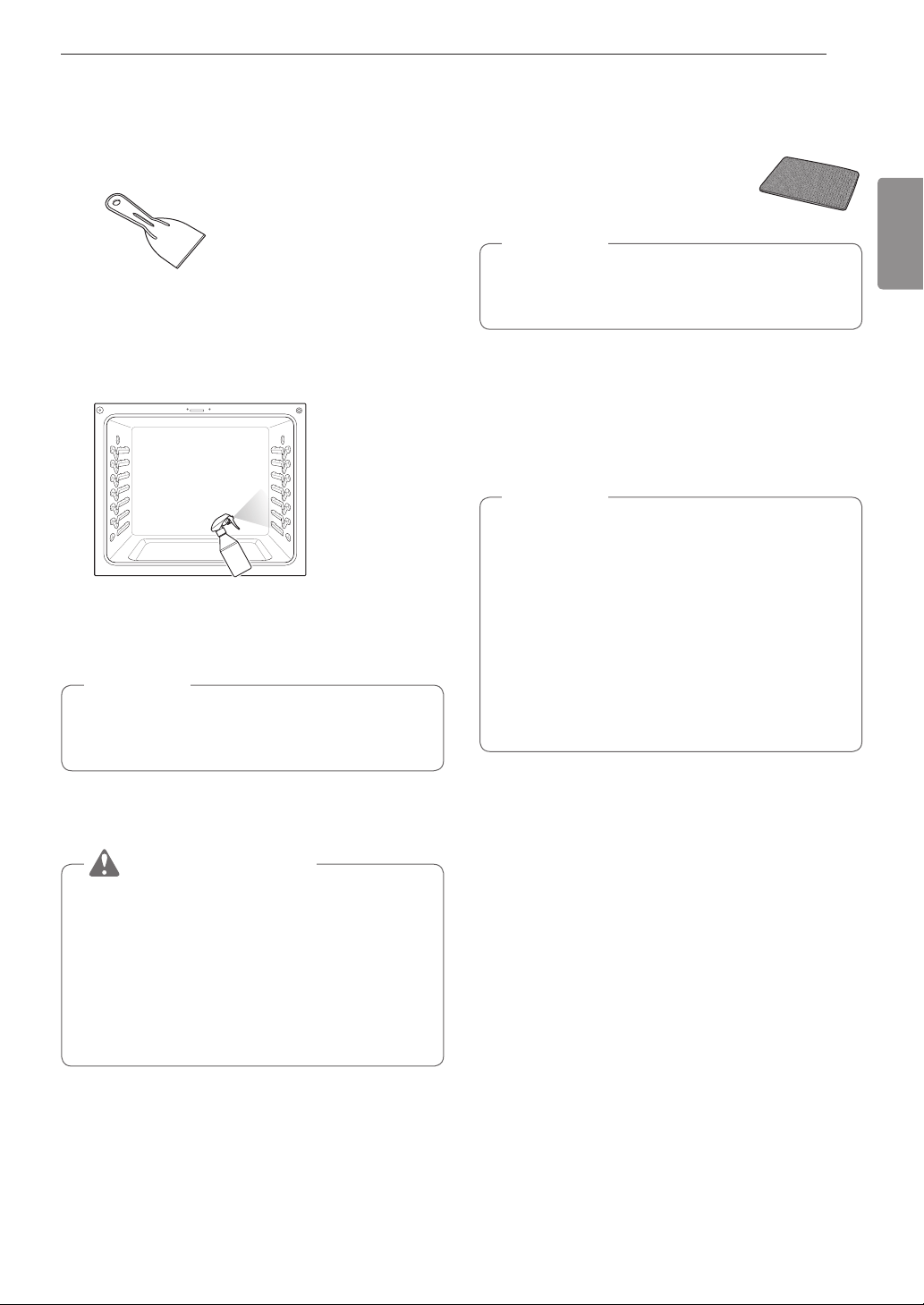
39
MAINTENANCE
Français
Guide d'instructions EasyClean
®
1
Retirez les grilles et les accessoires du four.
2
Grattez et retirez tout débris incrusté avec un grattoir de
plastique.
Grattoirsdeplastiquesuggérés:
•
Une spatule de plastique rigide
•
Unracloiràpoêleenplastique
•
Un grattoir à peinture en plastique
•
Une vieille carte de crédit
3
Remplissez un vaporisateur d’eau et pulvérisez
abondamment toutes les surfaces intérieures du four.
4
Utilisez au moins
1
/
5
de l’eau du vaporisateur pour saturer
complètement la saleté sur les parois latérales et dans
les coins.
5
Vaporisez ou versez les
4
/
5
d’eau restantes dans le centre
inférieur de la cavité du four. Les renfoncements sur la partie
inférieuredufourdevraientêtreentièrementrecouvertsafin
d’immerger toute la saleté. Ajoutez de l’eau au besoin.
REMARQUE
Utilisezlamêmequantitéd’eauchaquefoisquevousnettoyez
une cavité de four. Ne vaporisez pas d’eau directement sur la
porte. Autrement, de l’eau coulera sur le plancher.
6
Fermez la porte du four.
Appuyez sur la touche EasyClean
®
.
Appuyez sur Start.
MISE EN GARDE
•
Certainessurfacespeuventêtretrèschaudesaprès
le cycle EasyClean
®
. Portez des gants de caoutchouc
pendantlenettoyageafind᾿éviterlesbrûlures.
•
Pendant le cycle EasyClean
®
, le four devient assez
chaud pour causer des brûlures. Attendez la fin du
cycleavantd᾿ssuyerlasurfaceinternedufour.Nepas
respecter cette directive pourrait causer des brûlures.
•
Évitez de vous appuyer sur la porte en vitre du four
pendant le nettoyage de celui-ci.
7
Une tonalité se fera entendre à la fin du cycle de 20
minutes. Appuyez sur la touche Clear/Off pour effacer
l᾿affichageetarrêterlatonalité.
8
À la fin du cycle de nettoyage et durant le nettoyage à la
main,ildevraitresterassezd᾿eaudanslapartieinférieure
du four pour submerger complètement toutes les saletés.
Ajoutezdel᾿eauaubesoin.Placezuneserviettesurle
plancherdevantlefourpourrecueillirl᾿eauquipourrait
s᾿écoulerpendantlenettoyageàlamain.
9
Immédiatement après le cycle EasyClean
®
, nettoyez la
cavité du four avec une éponge ou un tampon à récurer
antiégratignure mouillé. (Lecôtérécurantnecauserapasde
rayuressurlefini.)Del᾿eaupeuts᾿écoulerdanslesévents
inférieurs pendant le nettoyage, mais sera
recueillie dans un bac sous la cavité du
fouretn᾿endommagerapasl᾿élémentde
cuisson.
REMARQUE
N᾿utilisezpasdetamponsàrécurerenmétal,detampons
ou de nettoyants abrasifs, car ces matériaux peuvent
endommager de façon permanente la surface du four.
10
Une fois que la cavité du four est propre, essuyez tout
excèsd᾿eauavecuneserviettesècheetpropre.Replacez
les grilles et les autres accessoires
11
S᾿ilresteunpeudesaletés,répétezlesétapesci-dessus,
envousassurantd᾿épongerentièrementlesrégions
souillées.S᾿ilrestedessaletéstenacesaprèsplusieurs
cycles EasyClean
®
,exécutezlecycled᾿autonettoyage
REMARQUE
•
Sivousavezoubliédesaturerl᾿intérieurdufouravecde
l᾿eauavantdedémarrerlecycleEasyClean
®
, appuyez
sur le bouton Clear/Offafind᾿arrêterlecycle.Attendez
que la cuisinière refroidisse à la température de la pièce,
vaporisezouversezdel᾿eaudanslefour,etdémarrezun
autre cycle EasyClean
®
.
•
Lejointdelacavitédufourpeutêtremouilléàlafindu
cycle EasyClean
®
. Cela est normal. Ne nettoyez pas le
joint.
•
Si des dépôts minéraux demeurent sur la paroi inférieure
du four après le nettoyage, utilisez un linge ou une éponge
mouillée dans le vinaigre afin de retirer les dépôts.
Conseils pour le nettoyage
•
Laissez le four refroidir à la température ambiante avant
d’utiliser le cycle EasyClean
®
.LemessageHot(chaud)s’affiche
et le cycle EasyClean
®
ne démarre pas tant que la température
delacavitédufourestsupérieureà65°C(150°F).
•
L’utilisation du côté rugueux d’un tampon à récurer qui ne
provoque pas de rayures peut aider à mieux enlever les taches
incrustées qu’avec une éponge ou une serviette.
•
Certaines éponges à récurer qui ne provoquent pas de rayures,
comme celles fabriquées en mousse de mélamine, en vente
à votre supermarché local, peuvent également améliorer le
nettoyage.
•
Lacuisinièredoitêtreauniveaupourassurerquelefond
du four est entièrement recouvert d’eau au début du cycle
EasyClean
®
.
•
Pour de meilleurs résultats, utilisez de l’eau distillée ou filtrée.
L’eau du robinet pourrait laisser des dépôts minéraux sur la
paroi inférieure du four.
•
La saleté recuite pendant plusieurs cycles de cuisson sera plus
difficile à enlever au moyen du cycle EasyClean
®
.
•
N’ouvrez pas la porte du four pendant que le cycle EasyClean
®
est en marche. L’eau ne deviendra pas assez chaude si la
porte s’ouvre durant le cycle.
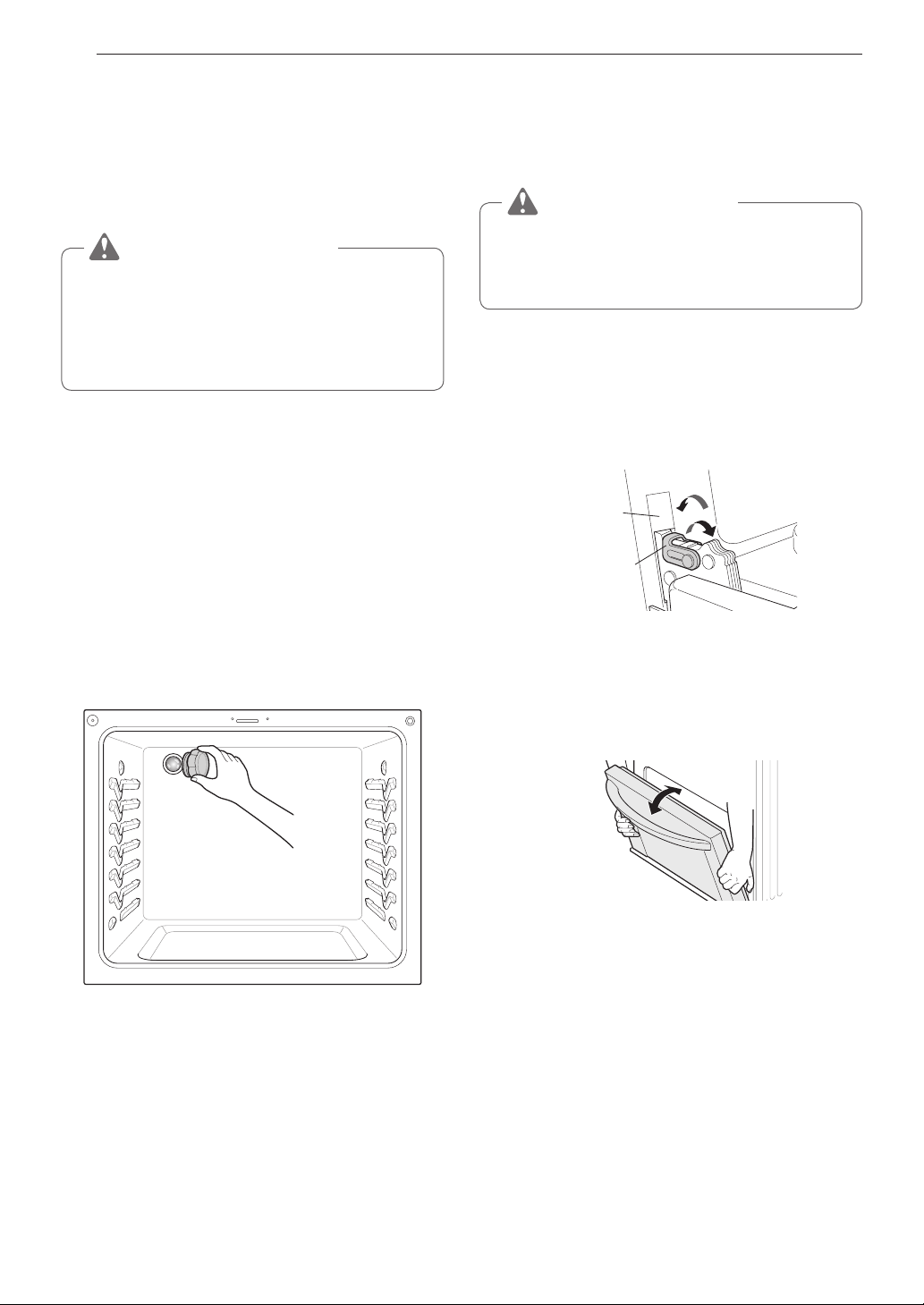
40
MAINTENANCE
Remplacement de la lampe du
four
Lalampedufourestuneampoulede40wattsstandard.Elle
s᾿allumelorsqu᾿onouvrelaportedufour.Pourl᾿allumerou
l᾿éteindrelorsquelaportedufourestfermée,appuyezsurle
bouton Light.
AVERTISSEMENT
•
Assurez-vousquelefouretl᾿ampouleontrefroidi.
•
Déconnectez le courant électrique de la cuisinière
à partir du fusible principal ou du panneau des
disjoncteurs. Le non-respect de cette consigne peut
occasionner des blessures corporelles graves, la mort
ou un choc électrique.
1
Débranchez la cuisinière ou coupez le courant électrique.
2
Tournezlecouvercledel᾿ampouleenverresituéà
l᾿arrièredufourdanslesensantihorairepourleretirer.
3
Tournezl᾿ampouledanslesensantihorairepourl᾿enlever
de la douille.
4
Insérez la nouvelle ampoule et tournez-la dans le sens
horaire.
5
Insérezlecouvercledel᾿ampouleenverreettournez-le
dans le sens horaire.
6
Branchez la cuisinière ou rebranchez le courant
électrique.
Retrait et remise en place de
la porte du four et du tiroir
amovibles
MISE EN GARDE
•
Faites attention lorsque vous enlever et soulever la
porte.
•
Ne soulevez pas la porte par la poignée. La porte est
très lourde.
Retrait de la porte
1
Ouvrez complètement la porte.
2
Dégagez les verrous de charnière en les faisant pivoter
jusqu᾿àcequ᾿ilss᾿appuientsurlecadre.
Fente
Verrouiller
Déverrouiller
Verrou de
charnière
3
Saisissez fermement les deux côtés de la porte par le
haut.
4
Placezlaporteenpositionderetrait(ferméeà5degrés
environ),soitàmi-cheminentrel᾿interruptiondugril
et la fermeture. Si la position est correcte, les bras de
charnière bougent librement.
environ 5°
5
Soulevezlaporteverslehautetl᾿extérieurjusqu᾿àce
que les bras de charnière soient complètement sortis des
fentes.
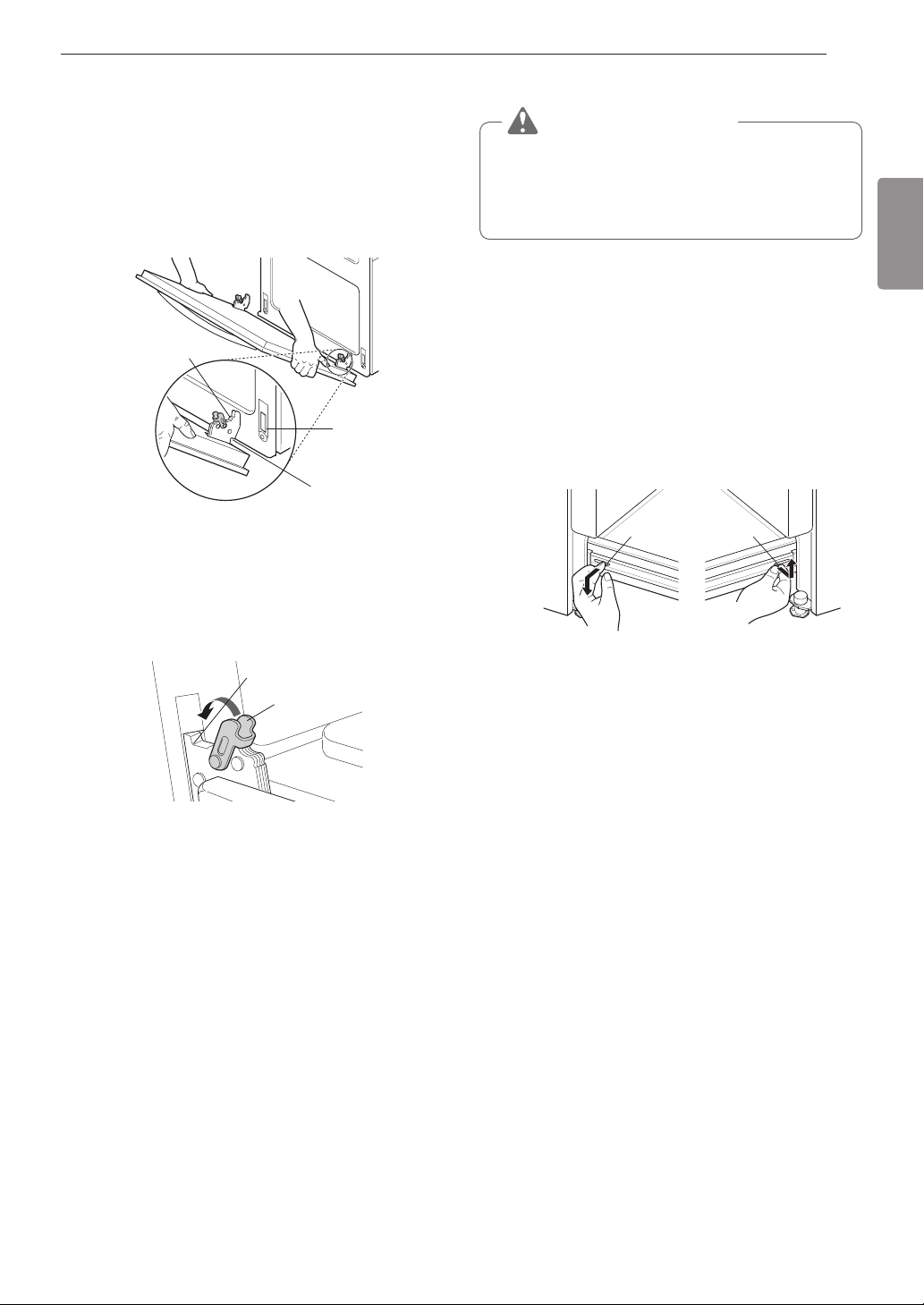
41
MAINTENANCE
Français
Remise en place de la porte
1
Saisissez fermement les deux côtés de la porte par le
haut.
2
Quand la porte est au même angle que lorsque vous
l᾿avez enlevée, placez le cran des bras de charnière sur
le bord inférieur des fentes de charnière. Le cran des
bras de charnière doit bien reposer sur le bord inférieur
des fentes.
Bras de
charnière
Cran
Bord inférieur
de la fente
3
Ouvrez complètement la porte. Si la porte ne s᾿ouvre pas
complètement, c᾿est que le cran n᾿est pas bien placé sur
le bord inférieur des fentes.
4
Enclenchez les verrous de charnière en les faisant
pivoter en arrière vers les fentes du cadre du four jusqu᾿à
ce qu᾿ils soient engagés.
Bras de charnière
Verrou de charnière
5
Fermez la porte du four.
Retirer le tiroir
MISE EN GARDE
Déconnectez le courant électrique de la cuisinière à partir
du fusible principal ou du panneau des disjoncteurs.
Le non-respect de cette consigne peut occasionner
des blessures corporelles graves, la mort ou un choc
électrique.
La plupart des opérations de nettoyage peuvent être effectuées
lorsque le tiroir est en place; toutefois, le tiroir peut être retiré si
un nettoyage plus en profondeur est nécessaire. Servez-vous
d᾿eau chaude pour nettoyer à fond.
1
Ouvrez complètement le tiroir.
2
Repérez les leviers de glissement de chaque côté du
tiroir. Poussez vers le bas le levier de glissement de
gauche, et tirez vers le haut le levier de glissement de
droite. Vous devrez peut-être tirer légèrement sur les
leviers pour contourner les vis des glissières.
Levier
Poussez vers le bas
avec un doigt
Tirez vers le haut avec
un doigt
Levier
3
Enlevez le tiroir.
Remise en place du tiroir
1
Tirez sur les roulements à billes pour les amener à
l᾿avant des glissières du châssis.
2
Alignez les glissières de chaque côté du tiroir avec les
fentes sur la cuisinière.
3
Poussez le tiroir dans la cuisinière jusqu᾿à ce que les
leviers fassent entendre un clic (environ 2 pouces).
4
Ouvrez encore une fois le tiroir pour que les roulements
à billes soient en position.
42
DÉPANNAGE
DÉPANNAGE
FAQ
Quels types d᾿ustensiles de cuisine sont recommandés
pour la table de cuisson?
•
Les casseroles doivent avoir un fond plat et des côtés droits.
•
Utilisez seulement des casseroles très épaisses.
•
La grandeur de la casserole doit correspondre à la quantité
denourritureàêtrepréparéeetàlagrandeurdel᾿élément
de la table de cuisson.
•
Utilisez des couvercles hermétiques.
•
Utilisezdeswoksàfondplatseulement.
Pourquoi les éléments de cuisson semblent-ils fonctionner
par intermittence pendant l᾿utilisation de la table de
cuisson ou du four?
Selonleréglagedel᾿élémentdecuissondelatabledecuisson
ou la température sélectionnée pour le four, il est NORMAL
que les éléments de cuisson fonctionnent par intermittence.
Mon nouveau four ne fonctionne pas comme mon ancien
four. Y a-t-il quelque chose qui ne fonctionne pas bien
avec les réglages de température?
Non, votre four a été testé en usine et calibré. Les premières
fois que vous utilisez votre appareil, suivez les temps et les
températures de vos recettes avec attention. Si vous croyez
toujoursquevotrenouveaufouresttropchaudouqu᾿iln᾿est
pas assez chaud, vous pouvez ajuster la température selon vos
besoins. Consultez la section « Ajustement de la température
du four » de ce manuel pour obtenir des instructions faciles sur
le réglage du thermostat.
Est-ce normal d᾿entendre un bruit de cliquetis qui provient
de l᾿arrière de mon four pendant que je l᾿utilise?
Votre nouvelle cuisinière assure un contrôle plus strict de la
température du four. Votre nouvelle cuisinière émet un clic plus
fréquemmentaurythmedel᾿intermittencedesélémentsde
cuisson du four. Cela est NORMAL.
Pourquoi l᾿heure clignote-t-elle?
Cecisignifiequeleproduitvientd᾿êtrebranchéouqu᾿ilyaeu
unepannedecourant.Afind᾿arrêterleclignotement,appuyez
surn᾿importequelletoucheetréglezl᾿heure,aubesoin.
Puis-je utiliser du papier d᾿aluminium pour recueillir les
égouttements dans la cavité de mon four?
N᾿utilisezjamaisdepapierd᾿aluminiumpourprotégerlefond
oulescôtésdufouroudutiroir-réchaud.L᾿aluminiumva
fondre et coller à la surface inférieure du four et il ne sera plus
possibledel᾿enlever.Placezplutôtuneplaqueàpâtisseriesur
unegrilleinférieuredufourpourrecueillirleségouttements.(Si
l᾿aluminiumadéjàfondudanslefonddufour,celan᾿aurapas
d᾿incidencesurlaperformancedufour.)
Puis-je utiliser du papier d᾿aluminium sur les grilles?
Necouvrezpaslesgrillesdepapierd᾿aluminium.Cela
bloqueralacirculationdel᾿air,entraînantunemauvaisecuisson
des aliments. Placez une plaque à pâtisserie recouverte de
papierd᾿aluminiumsouslestartesauxfruitsoulesautres
alimentscontenantbeaucoupd᾿acideoudesucrepournepas
endommager le fini du four avec les déversements.
MISE EN GARDE
Dupapierd᾿aluminiumpeutêtreutilisépourenvelopper
les aliments dans le four ou le tiroir-réchaud, mais il ne
doit pas entrer en contact avec les éléments chauffants ou
degrillageexposésdanslefour.Lepapierd᾿aluminium
peutfondreous᾿enflammer,provoquantdelafumée,un
incendie, ou encore des blessures.
Que dois-je faire si mes grilles sont devenues collantes et
difficiles à glisser à l᾿intérieur et hors du four?
Avec le temps, les grilles pourraient devenir difficiles à glisser à
l᾿intérieurethorsdufour.Appliquezunepetitequantitéd᾿huile
d᾿olivesurlesextrémitésdesgrilles.Celafonctionneracomme
un lubrifiant pour faciliter le glissement.
Que devrais-je faire pour enlever les taches tenaces de ma
table de cuisson?
Latabledecuissondoitêtrenettoyéeaprèschaqueutilisation
pour prévenir un maculage permanent. Lorsque vous faites
cuire des aliments à forte teneur en sucre, comme de la
sauce tomate, il est recommandé de nettoyer les taches avec
un grattoir alors que la table de cuisson est encore chaude.
Utilisez des gants de cuisine pour éviter de vous brûler en
maniant le grattoir. Reportez-vous à la section « Entretien » de
ce manuel du propriétaire pour des instructions plus détaillées.

43
DÉPANNAGE
Français
Pourquoi les boutons de contrôle ne fonctionnent-ils pas?
Assurez-vous que la cuisinière n’est pas en mode Verrouillage.
Le message LOCKED(verrouillé)s’afficheàl’écransilemode
Verrouillage est activé. Pour désactiver le verrouillage du four,
maintenez la touche Clear/Off(effacer/éteindre)enfoncée
pendant 3 secondes.
Ma cuisinière est toujours sale après un cycle EasyClean
®
.
Qu᾿est-ce que je devrais faire d᾿autre?
Le cycle EasyClean
®
soulève simplement la saleté légère
de votre four pour en faciliter le nettoyage à la main. Il ne
retire pas automatiquement toute la saleté après le cycle.
Vous devrez frotter la cuisinière après avoir utilisé le cycle
EasyClean
®
.
J᾿ai essayé de frotter mon four après le cycle EasyClean
®
,
mais il reste de la saleté. Qu᾿est-ce que je peux faire?
Le cycle EasyClean
®
fonctionne mieux lorsque les saletés
sontimbibéesd᾿eauetsubmergéesavantlelancementdu
cycleetpendantlenettoyageàlamain.Silasaletén᾿est
passuffisammenttrempéedansl᾿eau,celapeutaffecter
négativement la performance de nettoyage. Répétez le
processus EasyClean
®
enutilisantsuffisammentd᾿eau.
Certaines saletés à base de sucre et certaines graisses sont
très difficiles à nettoyer.
Les saletés sur les parois de mon four ne partent pas.
Comment puis-je nettoyer les parois?
Les saletés sur les parois du fond et des côtés de votre four
peuventêtreplusdifficilesàtremperdansl᾿eau.Essayezde
répéter le processus EasyClean
®
en vaporisant plus que le
quartdetassed'eau(1/5)danslabouteillerecommandé.
Le processus EasyClean
®
fera-t-il disparaître totalement
les saletés et les taches?
Cela dépend du type de saletés. Certaines taches à base de
sucre et certaines graisses sont très difficiles à nettoyer. De
plus, si les taches ne sont pas suffisamment imprégnées d᾿eau,
cela peut affecter négativement le rendement du nettoyage.
Dois-je utiliser le contenu d’eau au complet du flacon pour
EasyClean
®
?
Oui. Il est fortement recommandé de pulvériser ou de verser
unetassed'eau(4/5)danslabouteillesurlefonddufouret
d᾿envaporiserunquartdetasse(1/5)surlesparoisetles
autres surfaces sales afin de saturer les saletés pour obtenir
une efficacité de nettoyage supérieure.
De la fumée sort par les évents du four, sur la table de
cuisson, au cours du cycle EasyClean
®
. Est-ce que c᾿est
normal?
Celaestnormal.Cen᾿estpasdelafumée.Cesontdes
vapeursd᾿eauprovenantdel᾿eaudanslacavitédufour.
Étant donné que le four chauffe brièvement pendant le cycle
EasyClean
®
,l᾿eaudanslacavités᾿évaporeets᾿échappepar
les évents du four.
À quelle fréquence devrais-je utiliser
le cycle EasyClean
®
?
Le cycle EasyClean
®
peutêtreeffectuéaussisouventque
vous le désirez. Le cycle EasyClean
®
fonctionne mieux lorsque
lefourestLÉGÈREMENTsouilléd᾿éclaboussuresLÉGÈRES
de graisse et de petites gouttes de fromage, par exemple.
Veuillez consulter la section « EasyClean
®
» de votre manuel
pourplusd᾿information.
Quels sont les accessoires requis pour le cycle
EasyClean
®
?
Un flacon pulvérisateur rempli d'eau, un grattoir, un tampon
à récurer anti-rayures et une serviette. Vous ne devriez pas
utiliser de récureur abrasif comme les tampons à récurer
robustesoulalained᾿cier.
Est-il sécuritaire que de l᾿eau se répande dans les évents
inférieurs du four pendant le nettoyage?
Ilestsécuritairequedel᾿eauserépandedanslesévents
inférieursdufour.Ilestcependantrecommandéd᾿éviterd᾿yen
répandre une grande quantité.
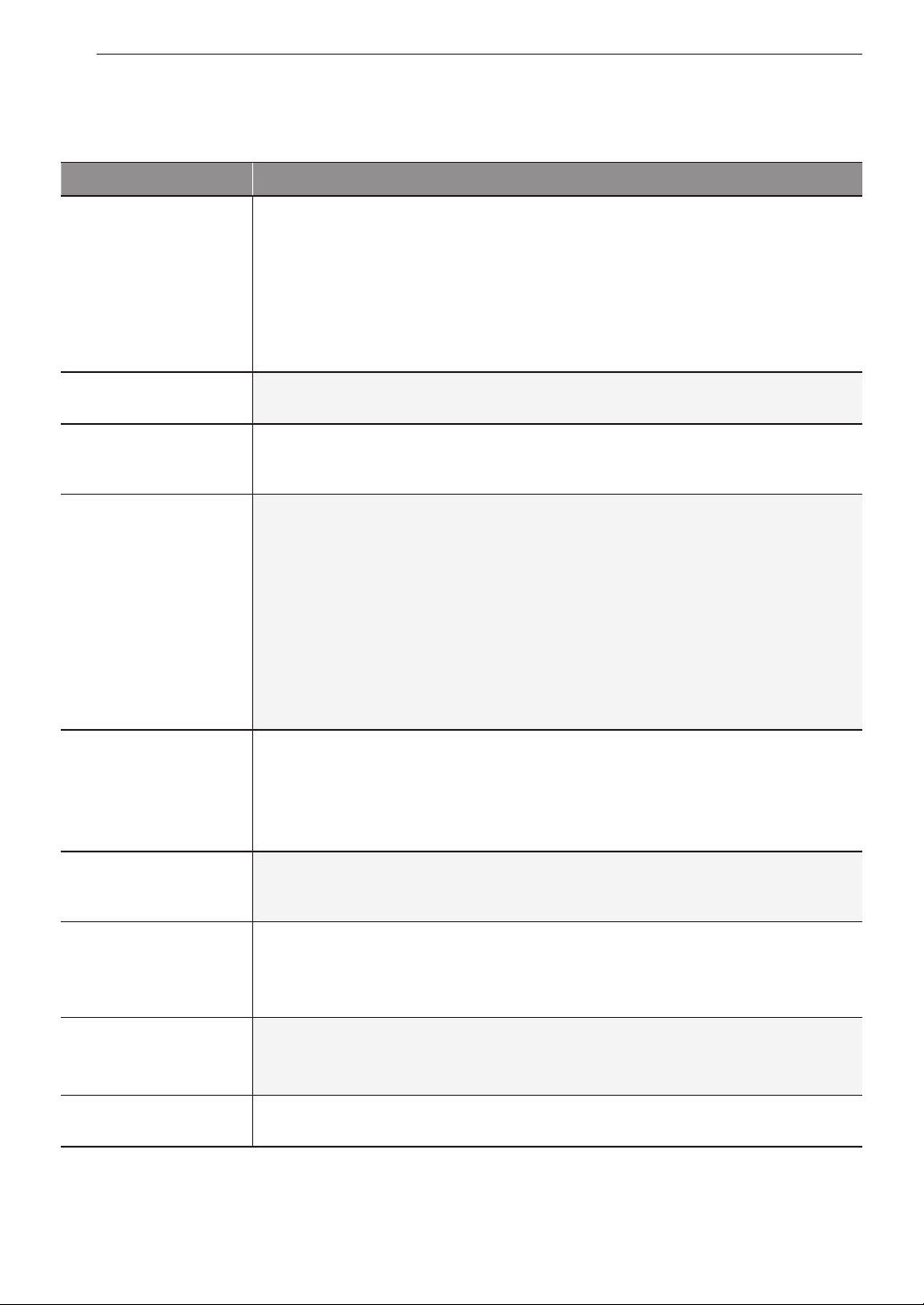
44
DÉPANNAGE
Avant d᾿appeler le réparateur
Avantd᾿appelerleréparateur,examinezlalisteci-après.Celapeutvouspermettred᾿économisertempsetargent.Lalistecomprend
desproblèmescourantsquinesontpaslerésultatd᾿undéfautdematériauxoudefabricationdel᾿appareilélectroménager.
Problèmes Cause possible et solution
Les brûleurs de la table
de cuisson ne s᾿allument
pas ou ne brûlent pas
uniformément.
•
Assurez-vous que la fiche électrique est branchée dans une prise sous tension correctement
mise à la terre.
•
Retirezlesbrûleursetnettoyez-les.Vérifiezlazonedesélectrodes;ilpourraityavoirdes
aliments ou de la graisse brûlés. Reportez-vous à la section « Entretien », sous « Nettoyage
destêtesetdescapuchonsdesbrûleurs».
•
Assurez-vous que les parties du brûleur sont installées correctement.
Reportez-vous à « Retrait et remplacement des brûleurs de surface au gaz » dans la section
« Entretien ».
Les flammes des brûleurs
sont énormes ou jaunes.
Si la cuisinière est reliée à une arrivée de gaz de pétrole liquéfiés, communiquez avec le
technicien qui a installé votre cuisinière ou effectué la conversion.
Les brûleurs de surface
s᾿allument, mais le four
ne s᾿allume pas.
Vérifiezquelerobinetdegazdufour,situéàl᾿arrièredelacuisinière,estgrandouvert.
Les aliments ne cuisent
pas ou ne rôtissent pas
comme il se doit.
•
Réglages du four incorrects. Reportez-vous au paragraphe « Aperçu du panneau de
commande », dans la section « Fonctionnement ».
•
La position de la grille est incorrecte. Reportez-vous au paragraphe « Retrait et remise en
place des grilles du four », dans la section « Fonctionnement ».
•
Batterie de cuisine incorrecte. Reportez-vous à « Cuisson par convection » dans la section
« Fonctionnement ».
•
Lethermostatdufourdoitêtreréglé.
•
Reportez-vous à « Réglage du thermostat du four » dans la section « Fonctionnement ».
•
Dupapierd᾿aluminiumaétéutilisédemanièreinappropriéedanslefour.Reportez-vousà
« Retrait et remise en place des grilles du four ».
Les aliments ne grillent
pas bien dans le four.
•
Réglages du four incorrects. Reportez-vous au paragraphe « Aperçu du panneau de
commande », dans la section « Fonctionnement ».
•
Laportedufourn᾿estpasfermée.Reportez-vousà«Grillage»danslasection
« Fonctionnement ».
•
Lepapierd᾿aluminiumdelaplaquechauffanteetdelalèchefriten᾿estpasbienajusté.
La température du four
est trop élevée ou trop
basse.
Lethermostatdufourdoitêtreréglé.Reportez-vousà«Réglageduthermostatdufour»dansla
section « Fonctionnement ».
L᾿horloge et la minuterie
ne fonctionnent pas.
•
Vérifiez que la prise de courant est branchée à une prise sous tension et reliée à la terre.
Remplacez le fusible ou réenclenchez le disjoncteur.
•
Réglages du four incorrects. Reportez-vous à « Modification des réglages du four » dans la
section « Fonctionnement ».
La lampe de four ne
fonctionne pas.
•
L᾿ampouleestdévisséeoudéfectueuse.Resserrezouremplacezl᾿ampoule.
•
Lafichedelacuisinièren᾿estpascomplètementinséréedanslapriseélectrique.Vérifiezque
la prise de courant est branchée à une prise sous tension et reliée à la terre.
Bruits secs ou
« craquements »
•
Ces sons sont produits par le métal qui se dilate en chauffant et se contracte en refroidissant,
pendant la cuisson et le nettoyage. Cela est normal.
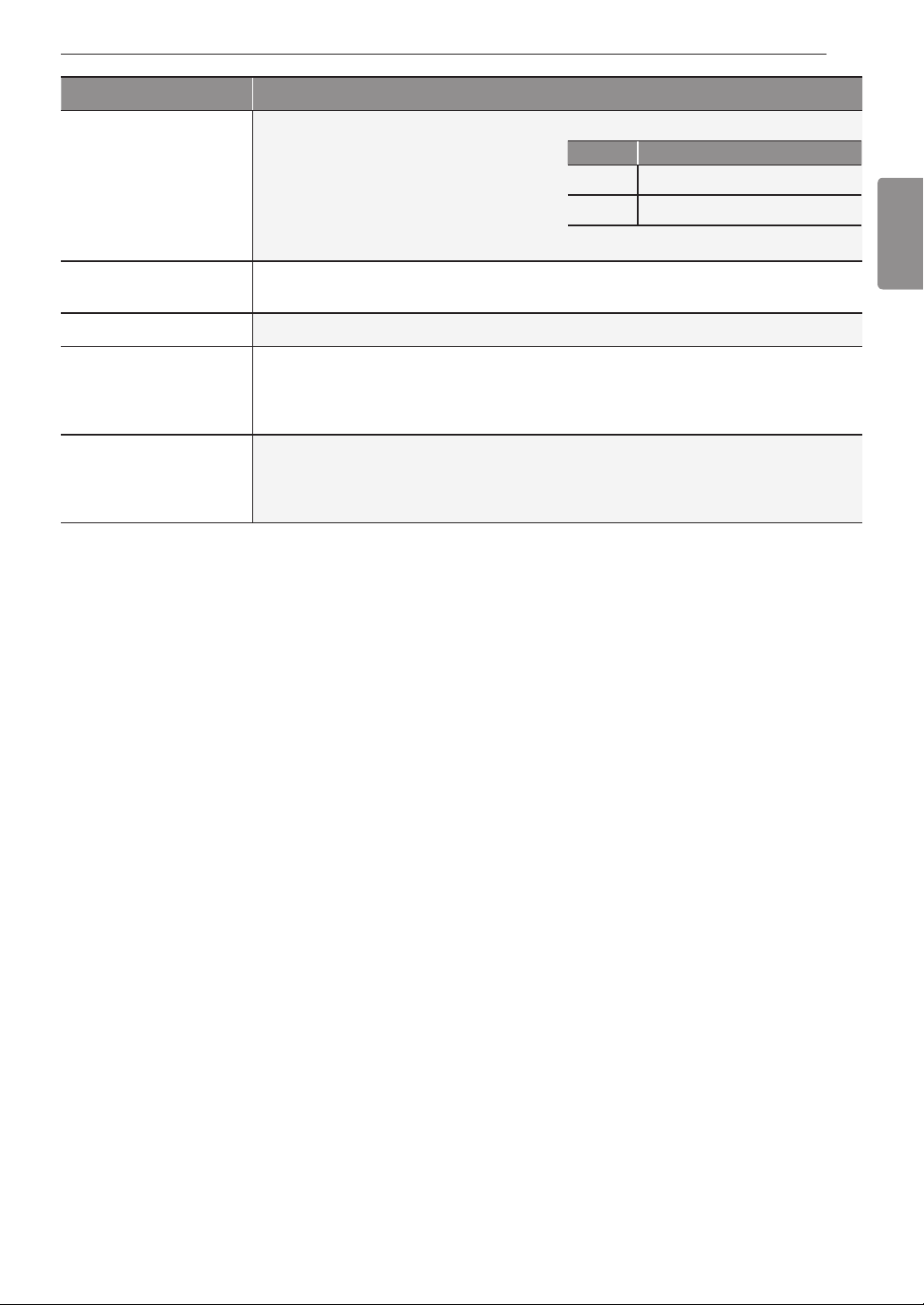
45
DÉPANNAGE
Français
Problèmes Cause possible et solution
Le four émet un bip et
affiche un code d᾿erreur F.
•
Vérifiezlerobinetprincipald᾿arrêtdugaz
et celui du four, puis appelez le service de
réparation.
•
Coupezl᾿alimentationélectriquedela
cuisinière pendant cinq minutes, puis
rebranchez-la. En cas de répétition du code
d᾿erreur,appelezleservicederéparation.
CODE CAUSE
F-3 Erreur liée à une touche
F-9 Le four ne chauffe pas.
L᾿horloge clignote.
Pannedecourantousurtension.Remettezl᾿horlogeàl᾿heure.Silefourétaitenmarche,vous
devez le remettre à zéro en appuyant sur Clear/Off.Réglezl᾿horlogeetlesfonctionsdecuisson.
Odeur forte Lorsdespremièresutilisationsdufour,ilestnormaldesentirl᾿odeurdel᾿isolationintérieure.
Les brûleurs ne s᾿allument
pas correctement après le
nettoyage de la table de
cuisson.
Vérifiezquelestêtesetlescapuchonsdesbrûleurssontcomplètementsecsetbienenplace.
Lorsque vous n᾿allumez
qu᾿un brûleur, un clic se
fait entendre de tous les
brûleurs.
Celaestnormal.Lesallumeursàétincelleélectriquedesbrûleurssontàl᾿origineduclic.Tousles
allumeursàétincelledelatabledecuissons᾿activerontmêmesivousn᾿allumezqu᾿unbrûleur.
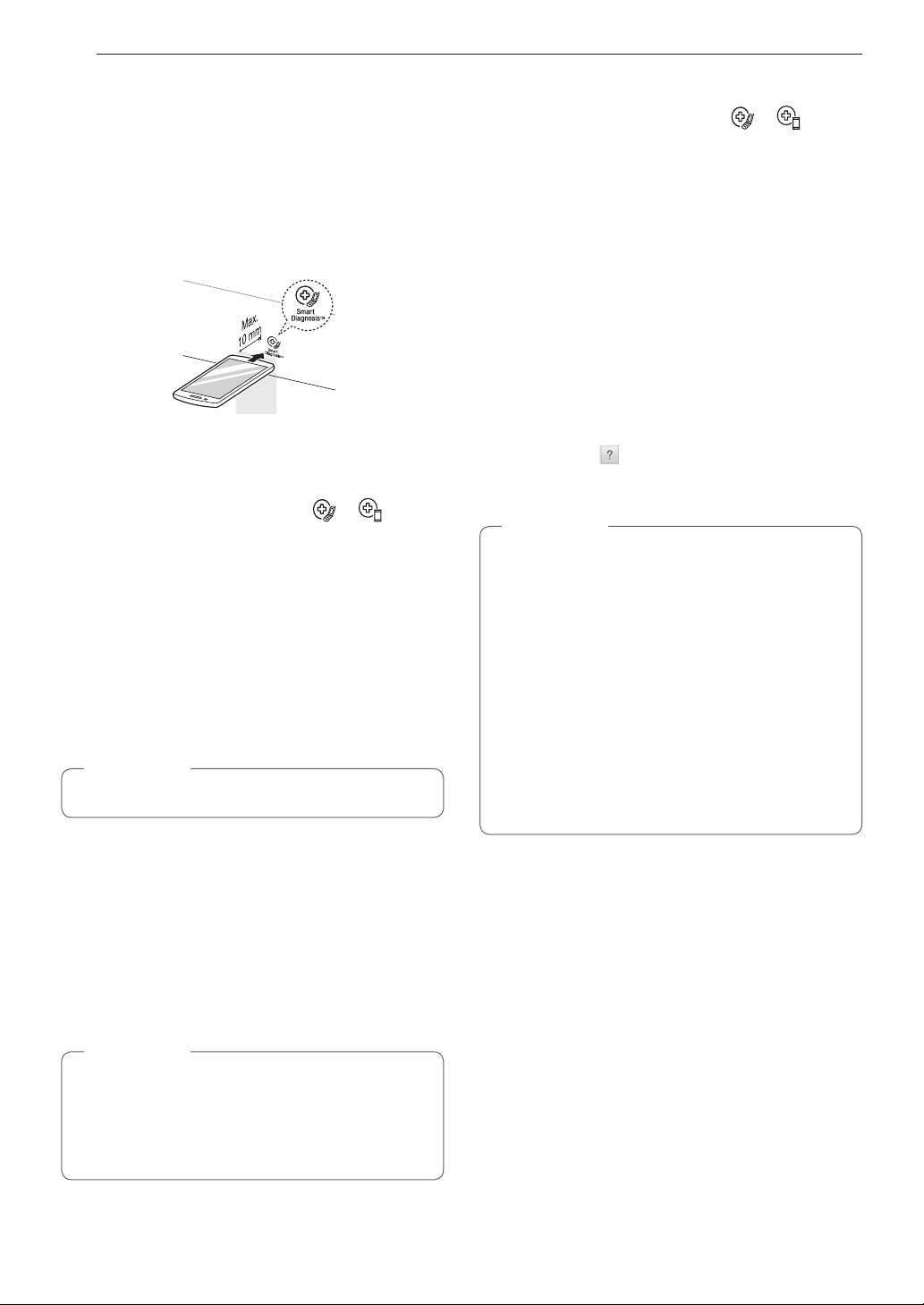
46
FONCTION SMART DIAGNOSIS
MC
FONCTION SMART
DIAGNOSIS
MC
Si vous éprouvez des problèmes avec votre électroménager,
celui-ci a la capacité de transmettre des données au centre
d’information à la clientèle de LG par l’intermédiaire de votre
téléphone. Les modèles équipés de la technologie NFC ou
duWi-Fipeuventégalementtransmettredesdonnéesàun
téléphone intelligent à l’aide de l’application LG SmartThinQ.
Smart Diagnosis
MC
– diagnostic par le
Centre dʼinformation à la clientèle
•
Pour les électroménagers avec le logo ou .
Cette méthode vous permet de parler directement à l’un
de nos spécialistes formés. Le spécialiste enregistre les
données transmises par l’appareil et les utilise pour analyser le
problème, fournissant ainsi un diagnostic rapide et efficace.
1
AppelezlecentredeserviceLG:auCanada,1-888-542-
2623;auxÉtats-Unis,1-800-243-0000.
2
Lorsque l'agent du centre de service le demande,
tenez le microphone du téléphone près du logo Smart
Diagnosis
MC
sur la cuisinière. Tenez-le à moins de 1 po
(2,5cm),maissanstoucherlacuisinière.
REMARQUE
Ne touchez aucun autre bouton ou icône sur l'écran.
3
Appuyez sur Start et maintenez la touche enfoncée
pendant trois secondes.
4
Tenez le téléphone en place jusqu'à ce que la
transmissionsonores'arrête.Ilfautenvironsixsecondes
et on voit le décompte sur l'afficheur.
5
Unefoisledécompteetlatransmissionsonorearrêtés,
reprenez la conversation avec l'agent du centre de
service, qui sera alors en mesure de vous aider grâce à
l'analyse des données transmises.
REMARQUE
•
Pour obtenir les meilleurs résultats, évitez de bouger le
téléphone pendant la transmission sonore.
•
Si l'agent du centre de service n'a pas pu obtenir un
enregistrement exact des données, il se peut qu'il vous
demande d'essayer de nouveau.
LG SmartThinQ et Smart Diagnosis
MC
•
Pour les électroménagers avec le logo ou
Utilisez la fonction Smart Diagnosis de l’application LG
SmartThinQ pour vous aider à diagnostiquer les problèmes
avec l’appareil sans l’assistance du centre d’information à la
clientèle de LG.
Suivez les instructions de l’application LG SmartThinQ pour
effectuer un diagnostic intelligent à l’aide de votre téléphone
intelligent.
1
Téléchargez l’application LG SmartThinQ sur votre
téléphone intelligent.
2
Ouvrez une session LG SmartThinQ. Appuyez sur Smart
Diagnosis
MC
pour passer à l’écran suivant.
3
Suivez les instructions de l’application. l’application
expliquera comment utiliser le diagnostic sonore
4
Appuyezsur[ ]dansl’applicationLGSmartThinQ
afin d’obtenir un guide plus détaillé sur la fonction Smart
Diagnosis.
REMARQUE
•
La fonction Smart Diagnosis
MC
nepeutêtreactivéeque
sil’appareilpeutêtremissoustensionàl’aidedela
touche Power.Sil’appareilnepeutpasêtremissous
tension,ledépannagedoitêtreeffectuésansutiliserla
fonction Smart Diagnosis
MC
.
•
Les différences de qualité entre régions peuvent affecter
la fonction.
•
Vous obtiendrez une meilleure qualité de communication
et un meilleur service si vous utilisez votre téléphone
fixe.
•
Une mauvaise qualité d'appel peut causer une mauvaise
transmission des données entre votre téléphone et la
cuisinière, et donc un mauvais fonctionnement de la
fonction Smart Diagnosis
MC
.

47
GARANTIE LIMITÉE
Français
GARANTIE LIMITÉE (CANADA)
AVISD'ARBITRAGE:LAPRÉSENTEGARANTIELIMITÉECONTIENTUNEDISPOSITIONSURL'ARBITRAGEQUIEXIGEQUE
LERÈGLEMENTDESDIFFÉRENDSENTREVOUSETLGS’EFFECTUEPARARBITRAGEEXÉCUTOIREPLUTÔTQUEDEVANT
UN TRIBUNAL, À MOINS QUE LES LOIS DE VOTRE PROVINCE OU TERRITOIRE L'INTERDISENT OU QUE, DANS UN AUTRE
TERRITOIRE DE COMPÉTENCE, VOUS VOUS PRÉVALIEZ D'UNE OPTION DE RETRAIT. LES RECOURS COLLECTIFS ET LES
PROCÈS DEVANT JURY NE SONT PAS AUTORISÉS PAR LE PROCESSUS D'ARBITRAGE. VEUILLEZ VOUS RÉFÉRER CI-DESSOUS
À L'ARTICLE « PROCÉDURE DE RÈGLEMENT DE DIFFÉREND ».
SivotrecuisinièreàgazLG(«Produit»)atombéenpanneenraisond'undéfautdematériauxoudefabricationsousuneutilisation
normaleetappropriée,pendantlapériodedegarantieindiquéeci-dessous,LGElectronicsCanadaInc.(«LGECI»),àsongré,réparera
ou remplacera le «Produit» après réception de la preuve d'achat originale au détail. Cette garantie limitée est valable uniquement qu’à
l'acheteur original du «Produit» du détaillant et s'applique uniquement à un produit distribué, acheté et utilisé au Canada, tel que déterminé à
la seule discrétion de «LGECI».
PÉRIODE DE GARANTIE : (Remarque : Si la date d’achat originale ne peut pas être vérifiée, la garantie débutera
soixante (60) jours suivant la date de fabrication.)
Cuisinière à gaz
Un(1)anàcompterdeladated’achatinitiale
Piècesetmain-d’œuvre(piècesinternesfonctionnellesseulement)
•
Lesproduitsetpiècesderemplacementsontgarantispourlaportionrestantedelapériodedegarantieoriginaleouquatre-vingt-dix(90)
jours, selon la période la plus longue.
•
Lesproduitsetpiècesderechangepeuventêtreneufs,reconditionnés,remisàneufouautrementfabriquésenusine,tousàlaseule
discrétion de «LGECI».
•
La preuve de l'achat de détail original spécifiant le modèle du produit et la date d'achat est requise pour obtenir un service sous garantie
en vertu de la présente garantie limitée.
LA RESPONSABILITÉ DE LGECI EST LIMITÉE À LA GARANTIE LIMITÉE EXPRIMÉE CI-DESSUS. SAUF TEL QU’EXPRESSÉMENT FOURNI
CI-DESSUS, LGECI DÉCLINE TOUTE AUTRE GARANTIE ET CONDITION CONCERNANT LE PRODUIT, EXPLICITE OU IMPLICITE, Y
COMPRIS, MAIS SANS S'Y LIMITER, TOUTE GARANTIE IMPLICITE OU CONDITION DE QUALITÉ MARCHANDE OU D'ADAPTATION À UN
USAGE PARTICULIER, ET AUCUNE REPRÉSENTATION NE SERA LIÉE À LGECI. LGECI N'AUTORISE AUCUNE PERSONNE À CRÉER
OU ENSOSSER À SA PLACE QUELCONQUE AUTRE OBLIGATION DE GARANTIE OU RESPONSABILITÉ RELATIVE AU PRODUIT. DANS
LA MESURE OÙ TOUTE GARANTIE OU CONDITION EST IMPLICITE PAR LA LOI, ELLE EST LIMITÉE À LA PERIODE DE GARANTIE
DÉCLARÉE CI-DESSUS. EN AUCUN CAS, LGECI, LE FABRICANT OU LE DISTRIBUTEUR DU PRODUIT, NE SERA TENU RESPONSABLE DE
TOUT DOMMAGE ACCESSOIRE, CONSÉCUTIF, SPÉCIAL, DIRECT, INDIRECT, PUNITIF OU EXEMPLAIRE, Y COMPRIS, SANS LIMITATION,
LA PERTE DE COTE D’ESTIME, PERTE DE PROFITS, PERTE DE PROFITS ANTICIPÉS, PERTE DE REVENUS, PERTE D'UTILISATION OU
DE TOUT AUTRE DOMMAGE, QU'IL SOIT PROVENU DIRECTEMENT OU INDIRECTEMENT DE TOUTE INFRACTION CONTRACTUELLE,
VIOLATION FONDAMENTALE, DÉLICTUELLE OU AUTRE, OU DE TOUT ACTE OU OMISSION. LA RESPONSABILITÉ TOTALE DE LGECI, S’IL
EN EST, N’OUTREPASSERA PAS LE PRIX D'ACHAT PAYÉ PAR VOUS POUR LE PRODUIT.
Cette garantie limitée vous donne des droits légaux spécifiques. Vous pouvez également avoir d'autres droits qui varient d'une province à
l'autre selon les lois provinciales applicables. Tout terme de cette Garantie limitée qui nie ou modifie toute condition ou garantie implicite en
vertu de la loi provinciale est divisible lorsqu'elle est en conflit avec cette loi provinciale sans affecter le reste des termes de cette garantie.
LA PRÉSENTE GARANTIE LIMITÉE NE COUVRE PAS CE QUI SUIT :
•
Toutdéplacementdutechnicienpour:i)livrer,reprendre,installerou;éduquercommentutiliserleProduit;ii)corrigerlecâblageou
plomberie;ouiii)rectifiertouteréparationouinstallationnon-autoriséeduProduit;
•
DommageoupanneduProduitàperformerlorsdepannedecourantetserviceélectriqueinadéquatouinterrompu;
•
Dommage ou panne résultant de l’utilisation du Produit dans un environnement corrosif ou contraire aux instructions détaillées dans le
manueld’utilisationduProduit;
•
Dommage ou panne du Produit en raison d’accidents, ravageurs et parasites, foudre, vent, feu, inondations, actes de Dieu ou toute autre
raisonhorsducontrôledeLGECIoudufabricant;
•
Dommage ou panne résultant d’utilisation inappropriée ou abusive ou d’installation, réparation ou entretien imparfait du Produit.
Réparation imparfaite inclut l’utilisation de pièces non autorisées ou spécifiées par LGECI. Installation ou entretien imparfait inclut toute
installationouentretiencontraireauxinstructionsdétailléesaumanueld’utilisationduProduit’;
•
Dommage ou panne en raison de modification ou altération non autorisée du Produit, ou si utilisé pour fins autres que celle d’appareil
ménagerdomestique,oudommageoupannerésultantdetoutefuited'eaudueàunemauvaiseinstallationduproduit;
•
Dommageoupanneenraisondecourantélectrique,tensionoucodesdeplomberieincorrects;
•
Dommage ou panne en raison d’utilisation autre que celle d’appareil ménager domestique normale, incluant, sans limite, l’utilisation commerciale
ouindustrielle,incluantl’utilisationaubureaucommercialoucentrerécréatif,oudétailléeautrementaumanueld’utilisationduProduit;
•
Dommage ou panne provoqué par le transport et manipulation, incluant rayures, bosses, écaillage et/ou autre endommagement à la
finition du Produit, à moins queteldommageaitrésultédefabricationoumatériauxdéfectueuxetrapporteràLGECIdansla(1)semaine
suivantlivraisonduProduit;
•
DommageorarticlesabsentsdetoutProduitdémonstrateur,boîteouverte,réusinéouescompté;
•
ProduitréusinéoutoutProduitvendu“Telquel”,“Oùest”,“Avectousdéfauts”,outoutemiseengardesimilaire;
•
Produitdontlenumérodesérieoriginalaitétéretiré,altéréounepeutêtrefacilementdéterminéàladiscrétiondeLGECI;
•
Augmentationdelafactured’électricitéetdépensesadditionnellesd’utilitédequelquemanièreassociéeauProduit;
•
ToutbruitassociéaufonctionnementnormalduProduit;
•
Remplacementdesampoules,filtres,fusiblesoutoutautreélémentconsommable;
•
Remplacementdetoutepiècen’étantpasoriginalementinclueavecleProduit;
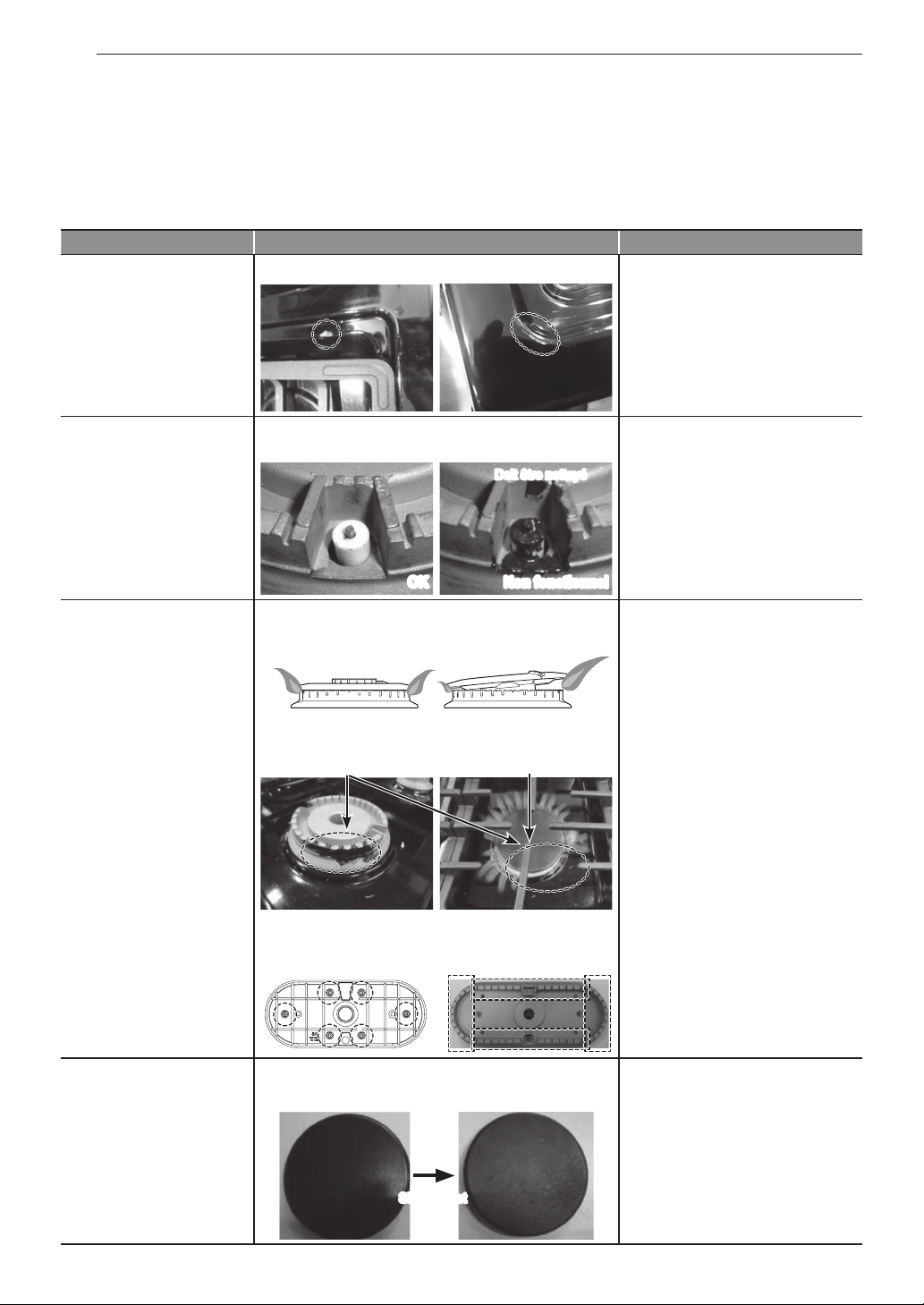
48
GARANTIE LIMITÉE
•
Coûtsassociésairetraitet/ouréinstallationduProduitpourfinsderéparation;et
•
Les clayettes, tiroirs, poignées et accessoires du Produit, sauf les pièces internes / fonctionnelles couvertes par cette garantie limitée.
•
Conversiondel’électroménagerdugaznaturelaugazpropaneliquéfié;
•
Couverturepourréparationsàdomicile,pourproduitsousgarantie,serafourniesileProduitsetrouvedansunrayonde150kmdu
centredeserviceautorisé(ASC)leplusprès,telquedéterminéparLGCanada.SivotreProduitestsituéàl’extérieurdurayonde150
kmd’uncentredeserviceautorisé,telquedéterminéparLGCanada,ileniradevotreresponsabilitéd’apportervotreProduit,àvosfrais,
aucentredeservice(ASC)pourréparationsousgarantie.
Non couvert par la garantie
Problème Cause Prévention
•
Écaillage de l'émail de la
table de cuisson
Utilisation incorrecte
•
Ne pas frapper la table de cuisson
en émail
•
Les brûleurs ne s'allument
pas
Les ports de brûleur bouchés ou sales ou les électrodes ne
permettent pas le fonctionnement adéquat du brûleur.
•
Vérifier et nettoyer l'électrode à gaz.
OK Non fonctionnel
Doitêtrenettoyé
•
Flamme inégale. 1. Installation incorrecte du chapeau du brûleur
•
Vérifierl'installationdelatêteetdu
chapeau de brûleur
Le chapeau du brûleur est
correctement en place.
Le chapeau du brûleur n'est
pas correctement en place.
2. Les ports du brûleur sont bouchés par des résidus de
nourriture
•
Lesrésidusdurcisdoiventêtre
enlevés avec une brosse à dents.
Les ports sont bloqués par la saleté
Flammes inégales
*Brûleurovale
•
Brûleur ovale
1)Libérerles6écroux
2)Nettoyerlesrésidusavecune
brosse à dents
Pournettoyer:libérerles6écroux
Nettoyer la pièce rouge avec une
brosse à dents
•
Le brûleur change de
couleur et perd du lustre
1. Égratignure
2. Utilisation d'un détergent ou de nettoyants abrasifs
•
Ne pas utiliser une laine d'acier ou
des nettoyants abrasifs.
•
Pour enlever la nourriture brûlée,
tremperlestêtesdebrûleurdans
de l'eau chaude pendant 20 à
30minutes.(Nepasutiliserde
détergent)
Shine is lost
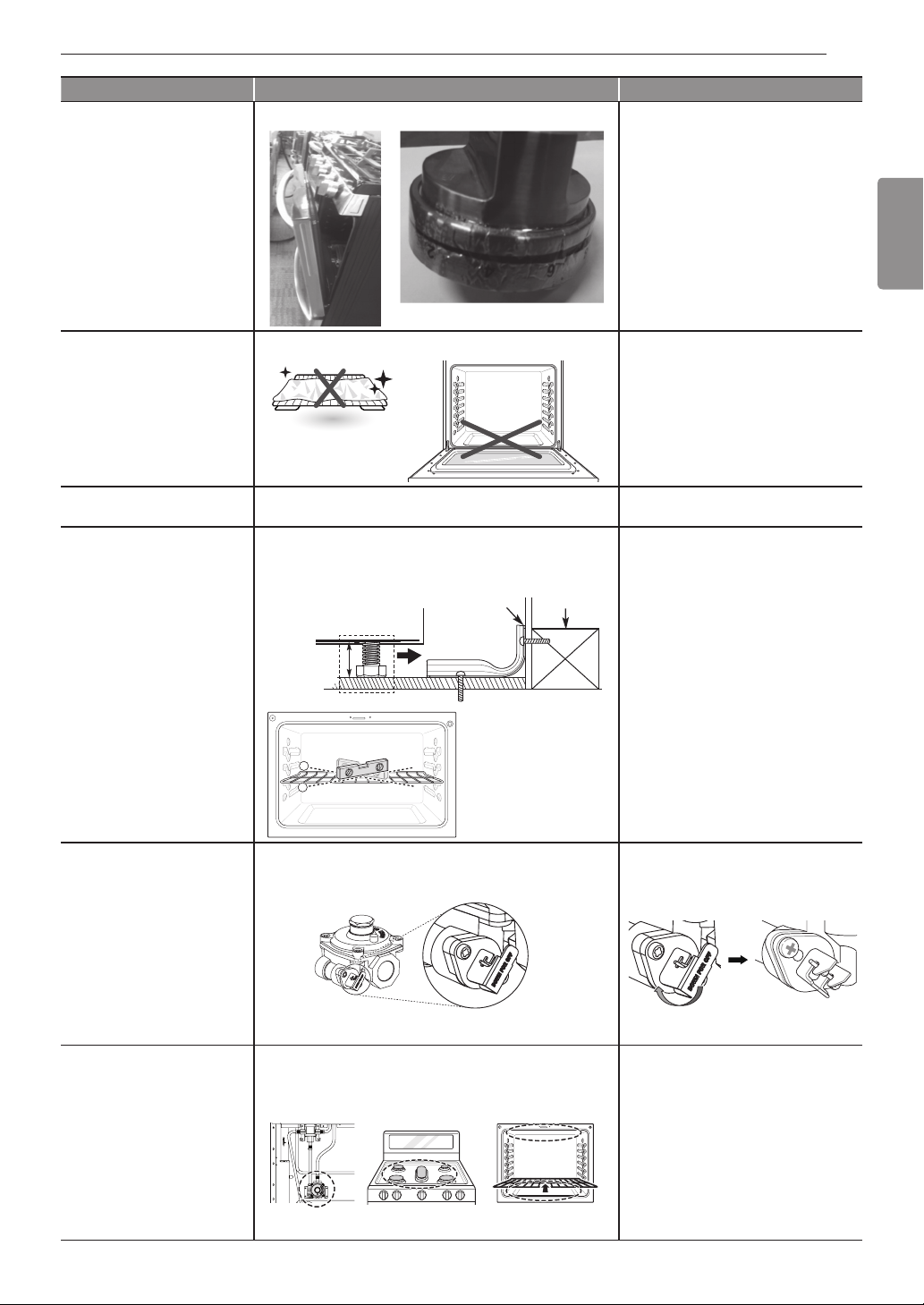
49
GARANTIE LIMITÉE
Français
Problème Cause Prévention
•
Les boutons fondent Utilisation incorrecte
•
Ne pas laisser à porte à une position
d'arrêtlorsdumodeGril/Cuissonou
juste après la cuisson.
•
Le four ou les grilles sont
tachées après utilisation de
papier d'aluminium
Le papier d'aluminium a fondu dans le four
•
Ne jamais couvrir le bas du four
ou une grille au complet avec
des produits comme du papier
d'aluminium
•
Si le papier d'aluminium est déjà
fondu dans le four, cela n'affecte
pas la performance de ce dernier.
•
La flamme ou l'alimentation
est faible
Lapressiondugazpeutêtrefaible
•
Vérifier avant tout avec le
fournisseur de gaz
•
La surface n'est pas à
niveau
•
Le four penche
1. Le fourneau n'est pas à niveau
2.
Le dispositif anti-basculement n'est pas installé correctement
•
Vérifier premièrement avec
l'installateur
Support
anti-basculement
Environ
16,5 mm
(0,65po)
Mettre à niveau les deux
côtés du four
La vis doit
entrer dans le
bois ou le béton
Plaque
murale
1
2
Utiliser un niveau de
charpentierpourvérierla
mise à niveau.
•
Le four montre le code
d'erreur(F9,F19)mais
les brûleurs de la table de
cuisson fonctionnent.
La vanne du régulateur de pression de gaz est en position
fermée.
•
Assurez-vous que la vanne du
régulateur est en position ouverte.
•
Si la vanne du régulateur est fermée,
tournez le levier pour l’ouvrir.
Position fermée du levier
Position ouverte
du levier
Position fermée
du levier
•
Les flammes sont trop
grosses sur une surface
decuissonconvertie(gaz
naturelaupropaneliquide)
L'installateur a oublié une partie du processus de
conversion.
(Vérifier3pièces:régulateur,valvedelasurfacede
cuisson,valvedugril/cuisson.)
•
Vérifier premièrement avec
l'installateur
•
Consulter le manuel d'installation
régulateur
valve de la surface
de cuisson
valve du gril/cuisson
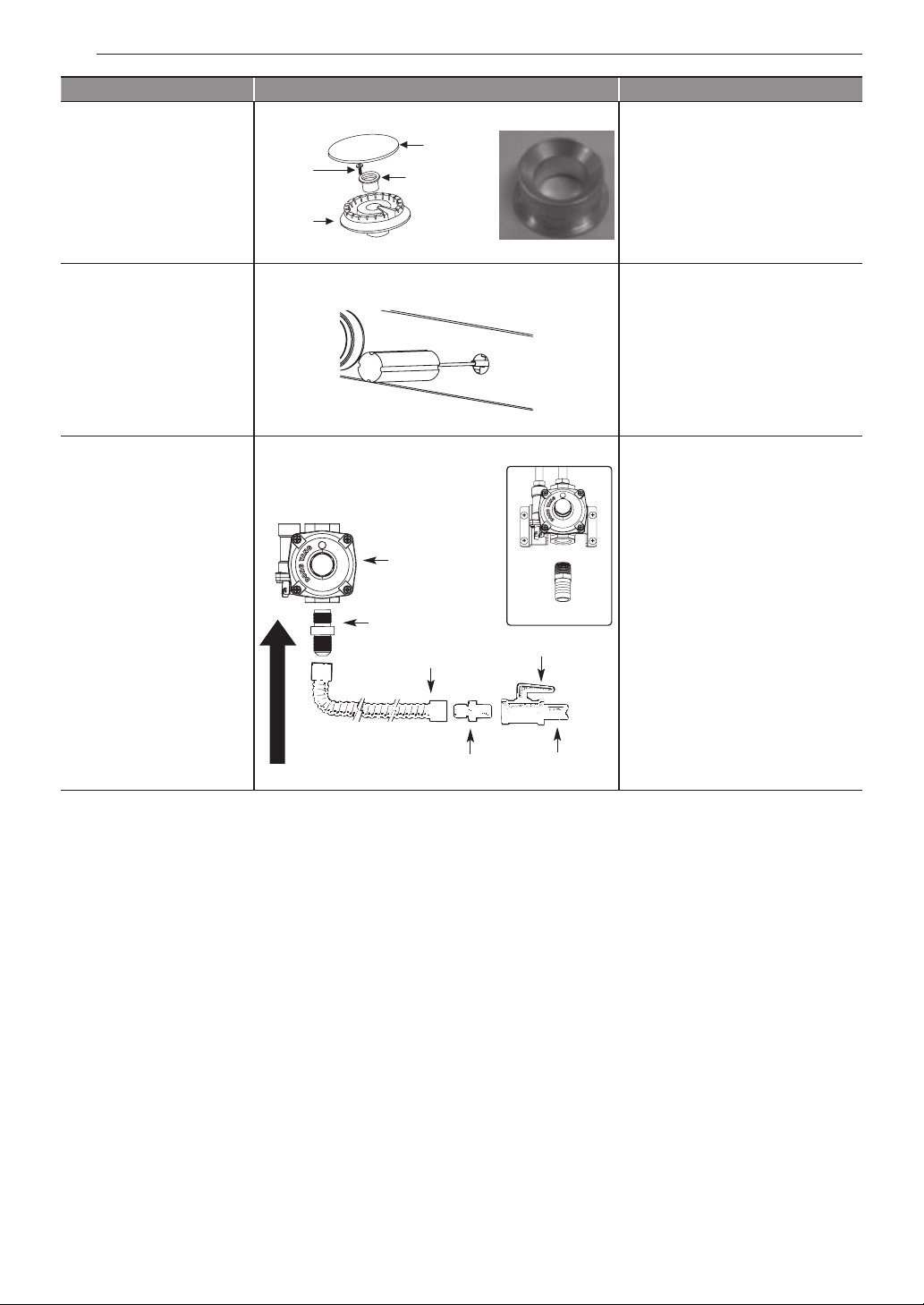
50
GARANTIE LIMITÉE
Problème Cause Prévention
Brûleur 17K a besoin d'une Détendeur.
•
Vérifier premièrement avec
l'installateur
•
Consulter le manuel d'installation
Détendeur
Capuchon
du brûleur
Vis à
pression
Base du
brûleur
Détendeur
•
La flamme est trop petite
ou trop grosse
1. Pression de gaz variable
2. L'installateur n'a pas vérifié
•
Vérifier premièrement avec
l'installateur
Vis de réglage central
•
Odeur de gaz Raccordement incorrect
•
Vérifier avant tout avec l'installateur
1
/
2
po Raccord
1
/
2
po Raccord
1
/
2
po Raccord
Régulateur de
pression
Connecteurexible
(6pimaximum)
Robinetd’arrêtdugaz
Conduite de gaz de
1
/
2
po ou de
3
/
4
po
Débit de gaz dans la cuisinière
Branchement de connecteur flexible
Tous coûts et dépenses associés aux circonstances exclues ci-dessus, énumérés sous la rubrique “Cette garantie limitée ne
couvre pas” sont à la charge du consommateur.
AFIN D’OBTENIR SOUTIEN DE GARANTIE ET INFORMATIONS SUPPLÉMENTAIRES VEUILLEZ NOUS APPELER OU VISITER NOTRE
SITEWEB:
Sansfrais:1-888-542-2623(7hàminuit–l’annéelongue)etsélectionnezl’optionappropriéeaumenu,ou;Visitezlesitewebà:
http://www.lg.com
PROCÉDURE DE RÈGLEMENT DE DIFFÉREND :
SAUF LA OÙ LA LOI L'INTERDIT, TOUT DIFFÉREND ENTRE VOUS ET LG ASSOCIÉ DE QUELQUE FAÇON QUE CE SOIT À LA
PRÉSENTEGARANTIELIMITÉESERÈGLEEXCLUSIVEMENTPARARBITRAGEEXÉCUTOIREPLUTÔTQUEDEVANTUNTRIBUNAL
DE DROIT COMMUN. SAUF LA OÙ LA LOI L'INTERDIT, VOUS ET LG RENONCEZ IRRÉVOCABLEMENT À TOUT DROIT À UN PROCÈS
DEVANTJURY,AINSIQU'ÀEXERCERUNRECOURSCOLLECTIFOUÀYPARTICIPER.
Définitions. Aux fins du présent article, « LG » désigne LG Electronics Canada Inc., ses sociétés mères, ses filiales et ses sociétés
affiliéesettousleursdirigeants,administrateurs,employés,agents,bénéficiaires,détenteursprécédentsdesmêmesdroits,successeurs,
cessionnairesetfournisseurs;«différend»et«réclamation»englobenttoutdifférend,réclamationoulitigedequelquesortequece
soit(fondéssuruneresponsabilitécontractuelle,délictuelle,légale,réglementaireoudécoulantd'uneordonnance,parfraude,fausse
représentationousousquelquerégimederesponsabilitéquecesoit)découlantdequelquefaçonquecesoitdelavente,desconditionsou
de l'exécution du produit ou de la présente Garantie limitée.
Avis de différend. Si vous prévoyez engager une procédure d’arbitrage, vous devez d’abord envoyer à LG un préavis écrit d’au moins 30
joursàl’adressesuivante:ÉquipejuridiqueLGECI,NorelcoDrive,NorthYork,Ontario,CanadaM9L2X6(l’«avisdedifférend»).Vouset
LG convenez de discuter en toute bonne foi pour tenter de régler le différend à l’amiable. L’avis doit mentionner votre nom, votre adresse,
votre numéro de téléphone, le produit faisant l’objet de la réclamation, la nature de la réclamation et la réparation demandée. Si vous et
LGneparvenezpasàréglerledifférenddansles30jourssuivantlaréceptiondel’avisdedifférendparLG,ledifférenddoitêtreréglépar
arbitrage exécutoire conformément à la procédure établie aux présentes. Vous et LG convenez que, tout au long du processus d’arbitrage,
lesmodalités(ycomprislesmontants)detouteoffrederèglementformuléeparvousouparLGneserontpasdivulguéesàl’arbitreet
resteront confidentielles à moins d’accord contraire entre les deux parties ou que l’arbitre règle le différend.

51
GARANTIE LIMITÉE
Français
Entente d'arbitrage exécutoire et renonciation à un recours collectif.Silaréclamationn’apuêtrerégléedansles30jourssuivantla
réception de l’avis de différend par LG, vous et LG convenez de ne régler les réclamations vous opposant que par arbitrage exécutoire au
cas par cas, à moins que vous vous prévaliez de l'option de retrait évoquée plus haut ou que vous résidiez dans un territoire de compétences
quiinterditlapleineapplicationdecetteclausedanslecasderéclamationsdecetype(danslequelcas,sivousêtesunconsommateur,
cetteclausenes'appliqueraquesivousacceptezexpressémentl'arbitrage).Danslamesureoùlaloienvigueurlepermet,aucundifférend
entrevousetLGnepeutêtrecombinéouregroupéavecundifférendfaisantintervenirleproduitoularéclamationd'unepersonneouentité
tierce. Plus précisément et sans limiter la portée de ce qui précède, sauf dans la mesure où une telle interdiction n'est pas autorisée en droit,
enaucuncasundifférendentrevousetLGnepeutêtretraitédanslecadred'unrecourscollectif.Aulieudel'arbitrage,lespartiespeuvent
intenteruneactionindividuelledevantunecourdespetitescréances,maiscetteactionnepeutpasêtreintentéedanslecadred'unrecours
collectif, sauf dans la mesure où une telle interdiction n'est pas autorisée en droit dans votre province ou territoire de compétences pour une
réclamation en cause qui nous oppose.
Règles et procédures d'arbitrage. Pour soumettre une réclamation à un arbitrage, l'une des deux parties, soit vous ou LG, doit déposer
une demande écrite à cet effet. L'arbitrage est privé et confidentiel et s'effectue selon une procédure simplifiée et accélérée devant un
arbitre unique choisi par les parties conformément aux lois et règlements en vigueur portant sur l'arbitrage commercial de votre province ou
territoire de résidence. Vous devez également envoyer une copie de votre demande écrite à LG Electronics Canada Inc., Legal Department
-Arbitration,20NorelcoDrive,NorthYork,OntarioM9L2X6.Laprésentedispositionsurl'arbitrageestrégieparlesloisetrèglements
sur l'arbitrage commercial applicables de votre province ou territoire. La sentence arbitrale peut donner lieu à un jugement de n'importe
quel tribunal compétent. Toutes les décisions relèvent de l'arbitre, à l'exception des questions associées à la portée et à l'applicabilité de la
disposition sur l'arbitrage et à l'arbitrabilité du différend, qui sont du ressort du tribunal. L'arbitre est tenu de respecter les modalités de la
présente disposition.
Droit applicable. Les lois de votre province ou territoire de’achat régissent la présente Garantie limitée et tout différend entre nous, sauf
dans la mesure où de telles lois sont supplantées par des lois fédérales, provinciales ou territoriales applicables ou sont incompatibles avec
ces dernières. Si l'arbitrage n'est pas autorisé pour régler une réclamation, une poursuite, un différend ou un litige nous opposant, nous
nous en remettrons à la compétence exclusive des tribunaux de votre province ou territoire de’achat compétence pour le règlement de la
réclamation, de la poursuite, du différend ou du litige nous opposant.
Frais et coûts. Aucuns frais ne sont exigibles pour entamer une procédure d'arbitrage. À la réception de votre demande d'arbitrage écrite,
LGréglerarapidementlatotalitédesfraisdedépôtdelademanded'arbitrage,saufsivousréclamezdesdommages-intérêtssupérieursà
25 000 $. Dans ce cas, le paiement de ces frais sera régi par les règles d'arbitrage applicables. Sauf disposition contraire aux présentes,
LG paiera tous les frais de dépôt de demande et d'administration ainsi que les honoraires de l'arbitre conformément aux règles d'arbitrage
applicables et à la présente disposition sur l'arbitrage. Si vous remportez l'arbitrage, LG règlera vos frais et honoraires juridiques après avoir
déterminé s’ils sont raisonnables en se fondant sur des facteurs comme, entre autres, le montant de l’achat et le montant de la réclamation.
Sil'arbitrejugequelemotifdelaréclamationoulesréparationsdemandéessontfutilesousefondentsurdesmotifsdéplacés(auregard
desloisapplicables),lepaiementdetouslesfraisd'arbitrageserarégiparlesrèglesd'arbitrageapplicables.Dansuntelcas,vousacceptez
de rembourser à LG la totalité des montants versés qu'il vous revient autrement de payer en vertu des règles d'arbitrage applicables. Sauf
disposition contraire et si elle remporte l'arbitrage, LG renonce à tous ses droits de vous réclamer des frais et horaires juridiques.
Audience et lieu de l'arbitrage. Si votre réclamation est égale ou inférieure à 25 000 $, vous pouvez opter pour un arbitrage conduit selon
l'unedesmodalitéssuivantesuniquement:1)surexamendesdocumentsremisàl'arbitre,2)paraudiencetéléphoniqueou3)paraudience
en personne selon les dispositions des règles d'arbitrage applicables. Si votre réclamation dépasse 25 000 $, le droit à une audience sera
défini par les règles d'arbitrage applicables. Les audiences arbitrales en personne se tiendront à l'endroit le plus proche et le plus pratique
pour les deux parties situé dans votre province ou votre territoire de résidence, sauf si nous convenons mutuellement d'un autre lieu ou d'un
arbitrage par téléphone.
Dissociabilité et renonciation.SiunepartiedelaprésenteGarantielimitée(ycomprislesprésentesprocéduresd'arbitrage)n'estpas
applicable, les dispositions restantes demeurent en vigueur dans la mesure permise par la loi applicable. Le fait de ne pas exiger la stricte
exécutiond'unedispositiondelaprésenteGarantielimitée(ycomprislesprésentesprocéduresd'arbitrage)nesignifiepasquenousayons
renoncé ni que nous ayons l'intention de renoncer à toute disposition ou partie de la présente Garantie limitée.
Option de retrait. Vous pouvez vous retirer de la présente procédure de règlement de différend. Dans ce cas, ni vous ni LG ne pouvez
imposer à l'autre partie de participer à une procédure d'arbitrage. Pour vous prévaloir de l'option de retrait, vous devez envoyer un préavis à
LGdanslestrente(30)jourscivilsàcompterdeladatedel'achatduproduitparlepremieracheteuri)dansuncourrieladresséàoptout@
lge.cometdontlaligned'objetportelamention«Retraitdel'arbitrage»ouii)encomposantle1-800-980-2973.Quecesoitparcourrielou
partéléphone,vousdevrezdonnera)votrenometvotreadresse;b)ladated'achatduproduit;c)lenomoulenumérodemodèleduproduit
etd)lenumérodesérie[qu’ilestpossibledetrouveri)surleproduitouii)enliqneauhttps://www.lg.com/ca_fr/soutien/reparation-garantie/
demande-reparation,Trouvermesnumérosdemodèleetdesérie].
Si vous vous prévalez de l'option de retrait, les lois de votre province ou territoire de résidence régissent la présente Garantie limitée et tout
différend entre nous, sauf dans la mesure où de telles lois sont supplantées par des lois fédérales, provinciales ou territoriales applicables
ou sont incompatibles avec ces dernières. Si l'arbitrage n'est pas autorisé pour régler une réclamation, une poursuite, un différend ou un
litige nous opposant, nous nous en remettrons à la compétence exclusive des tribunaux de votre province ou territoire de compétence pour
le règlement de la réclamation, de la poursuite, du différend ou du litige nous opposant.
Vousnepouvezvousprévaloirdel'optionderetraitquedelamanièredécriteplushaut(c'est-à-direparcourrieloupartéléphone).Aucun
autre type d'avis ne sera pris en compte pour le retrait de la présente procédure de règlement de différend. Le fait de se retirer de la
présente procédure de règlement de différend ne compromet d'aucune façon la protection accordée en vertu de la Garantie limitée, et vous
continuerez à jouir de tous les avantages prévus par la Garantie limitée. Si vous conservez ce produit sans vous prévaloir de l'option de
retrait, vous acceptez les conditions générales de la disposition sur l'arbitrage énoncée ci-dessus.
Conflit de modalités. En cas de conflit ou d'incompatibilité entre les modalités de la présente garantie limitée et le contrat de licence
d'utilisation(CLU)encequiconcernelerèglementdesdifférends,lesmodalitésdelaprésentegarantielimitéecontrôlentetrégissentles
droits et obligations des parties et ont préséance sur le CLU.
LG Customer Information Center
Register your product Online!
www.lg.com
1-800-243-0000
USA
1-888-542-2623
CANADA
Printed in Mexico