1
Projector
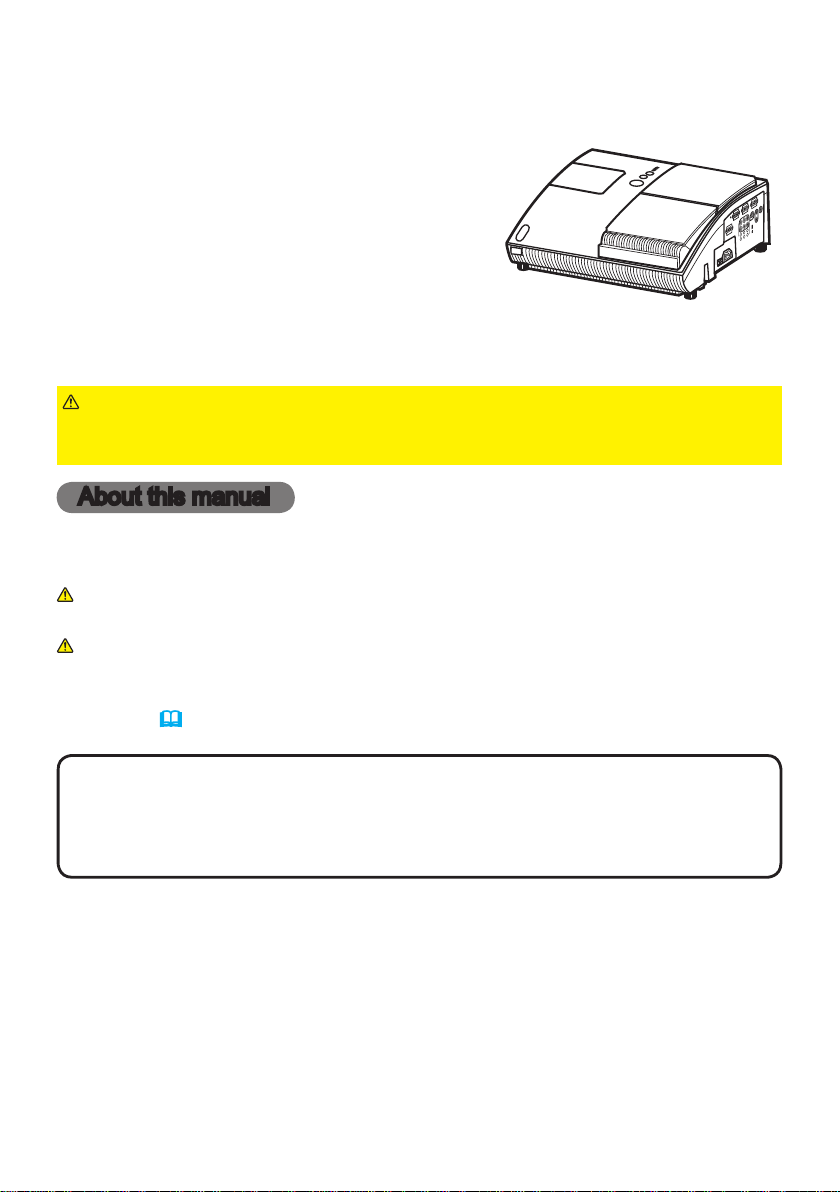
CP-A52
User's Manual (detailed)
Operating Guide
Thank you for purchasing this projector.
►Before using this product, please read all manuals for this
product. Be sure to read “Safety Guide” rst. After reading them, store them in a
safe place for future reference.
WARNING
• The information in this manual is subject to change without notice.
• The manufacturer assumes no responsibility for any errors that may appear in
this manual.
• The reproduction, transfer or copy of all or any part of this document is not
permitted without express written consent.
NOTE
Trademark acknowledgment
• Mac
®
is registered trademarks of Apple Inc.
• VESA and DDC are trademarks of Video Electronics Standard Association.
• Windows
®
is a registered trademark of Microsoft Corporation in the U.S. and/or
other countries.
All other trademarks are the properties of their respective owners.
Various symbols are used in this manual. The meanings of these symbols are
described below.
About this manual
WARNING
CAUTION
This symbol indicates information that, if ignored, could possibly
result in personal injury or even death due to incorrect handling.
This symbol indicates information that, if ignored, could possibly
result in personal injury or physical damage due to incorrect
handling.
Please refer to the pages written following this symbol.

2
Contents
Contents
About this manual ...........1
Contents . . . . . . . . . . . . . . . . . .2
Projector features ...........3
Preparations ...............3
Contents of package .............3
Part names . . . . . . . . . . . . . . . .4
Projector . . . . . . . . . . . . . . . . . . . . . . 4
Control buttons . . . . . . . . . . . . . . . . . 5
Ports . . . . . . . . . . . . . . . . . . . . . . . . . 5
Remote control . . . . . . . . . . . . . . . . . 6
Setting up . . . . . . . . . . . . . . . . .7
Arrangement ...................7
Connecting with your devices .....10
Connecting with a power supply ...12
Using the security bar and slot . . . . 13
Using the cable cover ...........13
Remote control ............14
Preparing for the remote control ...14
Changing the frequency of remote control signal
. 15
Power on/off . . . . . . . . . . . . . .16
Turning on the power . . . . . . . . . . . 16
Turn off the power ..............17
Operating . . . . . . . . . . . . . . . .18
Adjusting the volume ............18
Temporarily muting the sound .....18
Selecting an input signal .........18
Searching an input signal . . . . . . . . 19
Selecting an aspect ratio .........19
Adjusting the projection position ...20
Adjusting the zoom .............20
Adjusting the picture position . . . . . 20
Adjusting the focus . . . . . . . . . . . . . 21
Using the automatic adjustment feature
. 21
Correcting the keystone distortions
. 22
Using the magnify feature ........23
Freezing the screen . . . . . . . . . . . . 23
Temporarily blanking the screen ...23
Using the menu function .........24
EASY MENU. . . . . . . . . . . . . . .26
As p e c t , D-z o o m , Ke y s t o n e
,
Ke y s t o n e , pe r f e c t f i t ,
pi c t u r e m o D e , Br i g h t n e s s , co n t r A s t ,
c
o l o r , ti n t , sh A r p n e s s , Wh i s p e r ,
m
i r r o r , re s e t , fi l t e r t i m e ,
l
A n g u A g e ,
Go to Advanced Menu
...
PICTURE menu . . . . . . . . . . . .28
Br i g h t n e s s , co n t r A s t , gA m m A ,
c
o l o r t e m p , co l o r , ti n t ,
s
h A r p n e s s , my m e m o r y
IMAGE menu . . . . . . . . . . . . . .31
As p e c t , ov e r s c A n , v p o s i t i o n ,
h
p o s i t i o n , h p h A s e , h s i z e ,
A
u t o A D j u s t e x e c u t e
INPUT menu . . . . . . . . . . . . . .33
pr o g r e s s i v e , vi D e o n r , co l o r s p A c e ,
c
o m p o n e n t , vi D e o f o r m A t , fr A m e l o c K ,
c
o m p u t e r i n, re s o l u t i o n
SETUP menu ..............36
D-z o o m , D-s h i f t v, D-s h i f t h,
K
e y s t o n e
, Ke y s t o n e , pe r f e c t f i t ,
W
h i s p e r , mi r r o r , st A n D B y m o D e ,
m
o n i t o r o u t
AUDIO menu . . . . . . . . . . . . . .39
vo l u m e , sp e A K e r , Au D i o
SCREEN menu .............40
lA n g u A g e , me n u p o s i t i o n , Bl A n K ,
s
t A r t u p ,
M
yScreen
, M
yScreen Lock
,
m
e s s A g e , so u r c e n A m e , te m p l A t e
OPTION menu . . . . . . . . . . . . .44
Au t o s e A r c h , Au t o o n , Au t o o f f ,
l
A m p t i m e , fi l t e r t i m e , my B u t t o n ,
m
y s o u r c e , se r v i c e , se c u r i t y
C.C. (Closed Caption) menu . .57
Di s p l A y , mo D e , ch A n n e l
Maintenance ..............58
Replacing the lamp .............58
Maintaining the air-lter ..........60
Caring for the mirror and lens .....62
Other care ....................63
Troubleshooting . . . . . . . . . . .64
Related messages . . . . . . . . . . . . . 64
Regarding the indicator lamps . . . . 65
Shutting the projector down . . . . . . 66
Resetting all settings ............66
Phenomena that may be easy
to be mistaken for machine defects
. . 67
Specications .............70
3
Projector features / Preparations
• Keep the original packing materials, for future reshipment. Be sure
to use the original packing materials when moving the projector. Use special
caution for the lens.
NOTE
Projector features
This product realizes the large projection image of various image signals, even if
in a small space. This product can offer you convenience and various uses by the
following features.
Preparations
Contents of package
Please see the “Checking the contents” section in the User’s Manual (concise)
which is a book. Your projector should come with the items shown there. Contact
immediately your dealer if anything is missing.
ü The unique lens and mirror system realizes ultra short distance projection,
which gives you more various way of use.
ü The motorized lens door offers you very simple use of the projector.
4
Part names
Part names
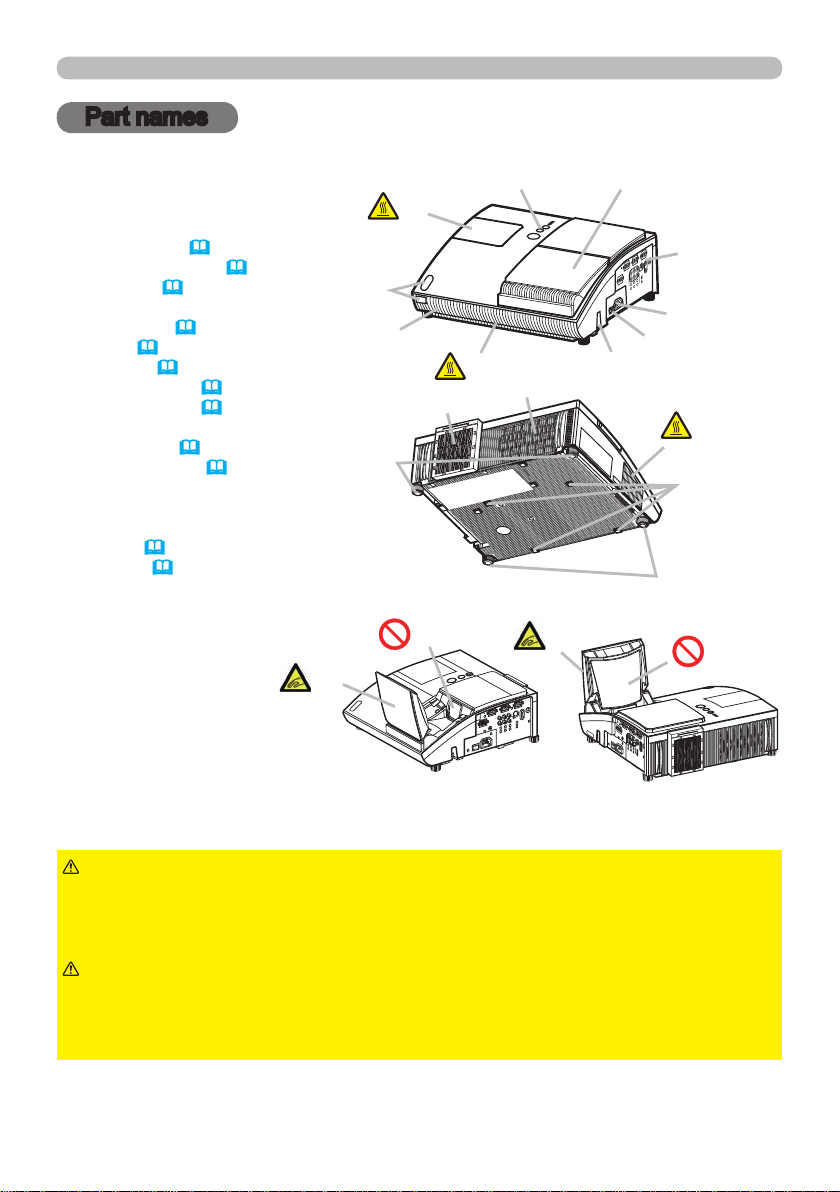
Projector
(1) Control buttons
(See the following page.)
(2) Lamp cover (
58)
(3) Remote sensors (
14)
(4) Speaker (
39)
(5) Exhaust vents
(6) Lens door (
16, 17, 62)
(7) Ports (
5, 10)
(8) AC inlet (
12)
(9) Power switch (
16, 17)
(10) Security bar (
13)
(11) Intake vents
(12) Filter unit (
60, 70)
(13) Elevator feet (
20)
(14) Internal threads
These are threads for optional
mounting accessories.
(15) Lens (
16, 62, 70)
(16) Mirror (
16, 62)
►Be careful not to pinch your nger with the lens door, to
prevent an injury.
►Never look into the projection lens or mirror while the projection lamp lights,
since the projection lamp ray may cause a trouble on your eyes.
WARNING
►Do not touch the lamp cover or approach the exhaust vents
while using the projector and for a while after use, to prevent a burn.
►Do not cover, block, or plug up the vents to keep normal ventilation. Do not
place anything that can stick or be sucked to the vents, around the intake vents.
CAUTION
(1)
(2)
(3)
(4)
(7)
(10)
(9)
(8)
(11)
(6)
(5)
(13)
(12)
(15)
(16)
(5)
(14)
(13)
(6)
(6)
5
MONITOR OUT
COMPUTER IN2
COMPUTER IN1
CONTROL
AUDIO
OUT
S-VIDEO
Y CB/PB CR/PR
VIDEO L R
AUDIO IN3
AUDIO IN
1
2
Part names
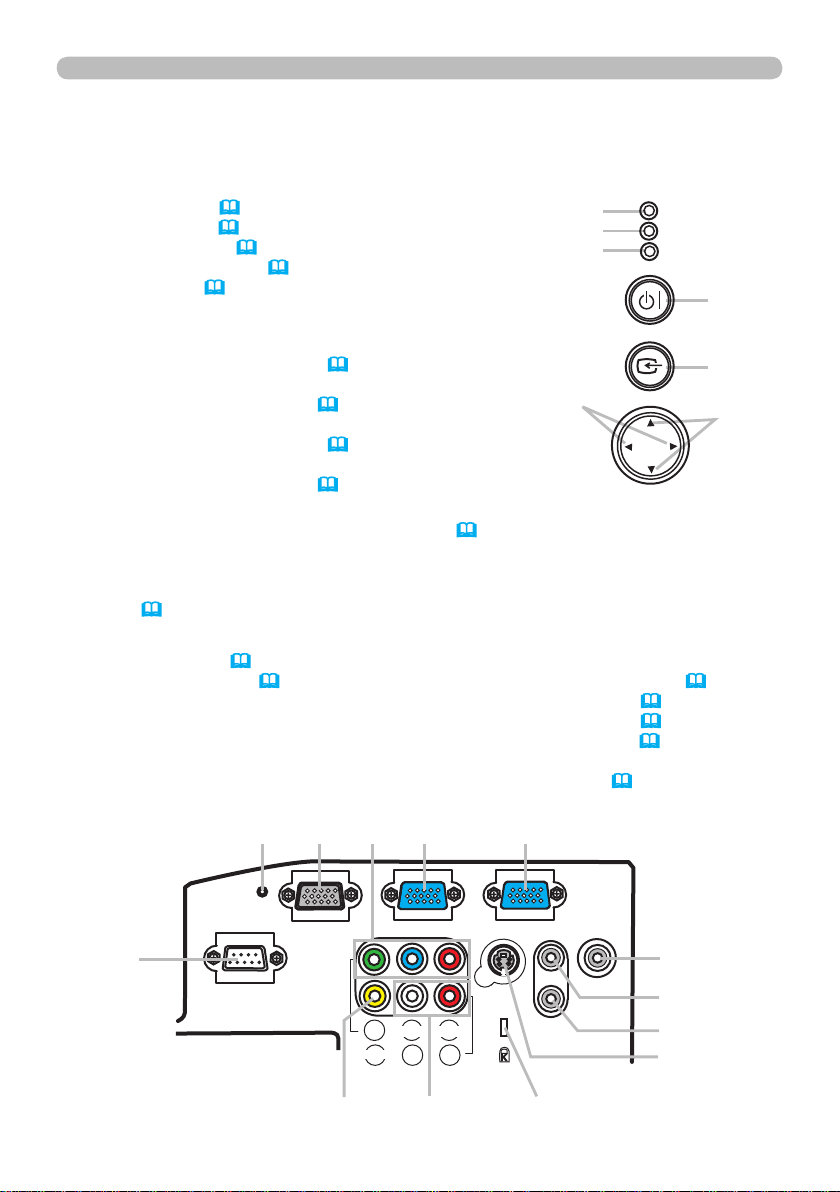
Control buttons
(1) LAMP indicator (65, 66)
(2) TEMP indicator (
65, 66)
(3) POWER indicator (
16, 17, 65, 66)
(4) STANDBY/ON button (
16, 17)
(5) INPUT button (
18)
Buttons ◄/►/▲/▼
(6) FOCUS +/- buttons
when no menu is displayed (
21), or
Cursor ◄, ► buttons
when a menu is displayed (
24).
(7) MENU buttons
when no menu is displayed (
24), or
Cursor ▲, ▼ buttons
when a menu is displayed (
24).
The ◄/►/▲/▼ buttons on the projector work only as
the cursor buttons while the template is displayed (
43).
Ports (10, Technical's 3 to 6)
(1) Shutdown switch (
17, 66)
(2) MONITOR OUT port (
38)
(3) Y, C
B/PB, CR/PR
(Component video) ports
(4) COMPUTER IN2 port
(5) COMPUTER IN1 port
(6) CONTROL port
(7) VIDEO port
(8) AUDIO IN3 (L,R) ports (
39)
(9) AUDIO OUT port (
39)
(10) AUDIO IN1 port (
39)
(11) AUDIO IN2 port (
39)
(12) S-VIDEO port
(13) Security slot (
13)
(1)
(2)
(3)
(4)
(5)
(7)
(6)
LAMP
TEMP
POWER
STANDBY/ON
INPUT
MENU
FOCUS - + FOCUS
(1) (2) (3) (4) (5)
(9)
(10)
(11)
(6)
(7) (8)
(12)
(13)
6
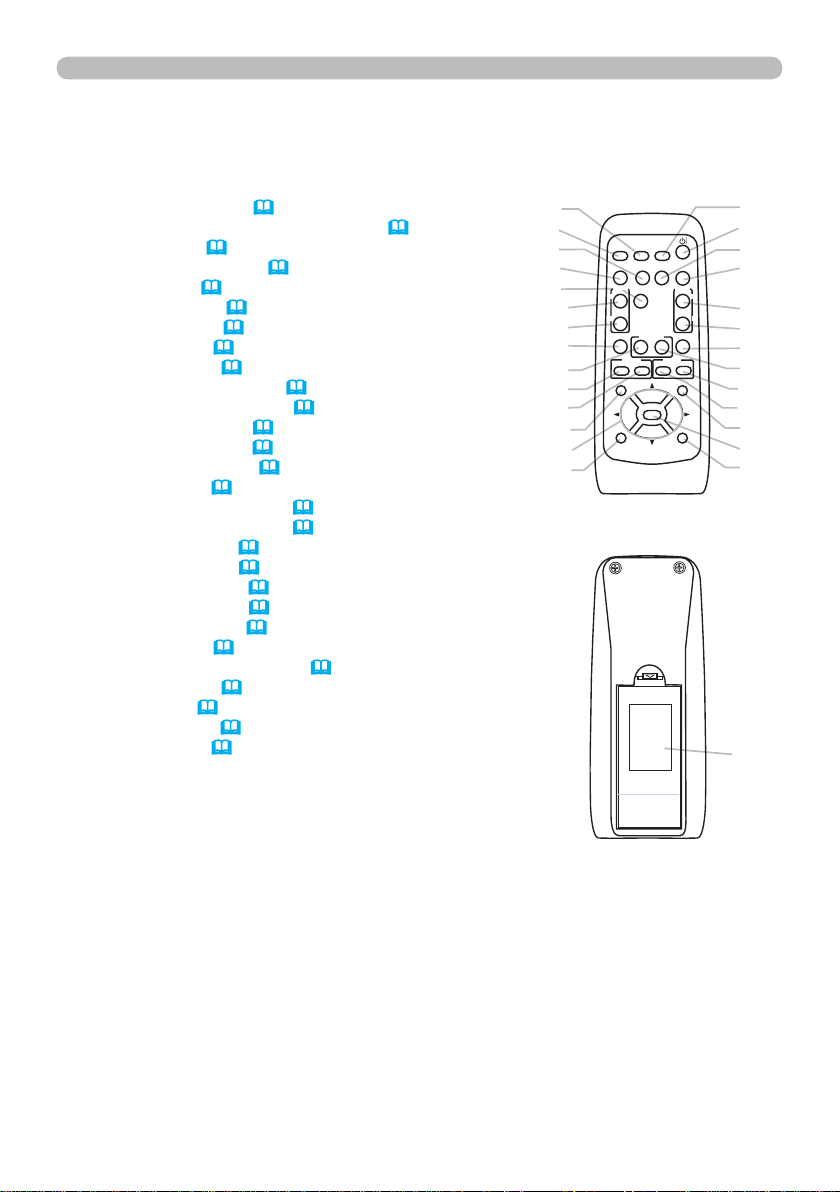
Part names
Remote control
Back of
the remote control
(1)
(3)
(5)
(7)
(9)
(10)
(11)
(14)
(16)
(18)
(19)
(22)
(24)
(26)
(2)
(4)
(6)
(8)
(12)
(13)
(15)
(17)
(21)
(20)
(23)
(25)
(27)
(28)
(1) COMPUTER button (18)
(2) MY SOURCE/DOC.CAMERA button (
18, 46)
(3) VIDEO button (
18)
(4) STANDBY/ON button (
16, 17)
(5) AUTO button (
21)
(6) SEARCH button (
19)
(7) ASPECT button (
19)
(8) BLANK button (
23)
(9) FREEZE button (
23)
(10) MAGNIFY - ON button (
23)
(11) MAGNIFY - OFF button (
15, 23)
(12) VOLUME + button (
18)
(13) VOLUME – button (
15, 18)
(14) KEYSTONE button (
22)
(15) MUTE button (
18)
(16) MY BUTTON - 1 button (
46)
(17) MY BUTTON - 2 button (
46)
(18) FOCUS – button (
21)
(19) FOCUS + button (
21)
(20) D-ZOOM – button (
20)
(21) D-ZOOM + button (
20)
(22) POSITION button (
20, 23)
(23) MENU button (
24, 25)
(24) ▲/▼/◄/► cursor buttons (
24, 25)
(25) ENTER button (
24, 25)
(26) ESC button (
15, 24, 25)
(27) RESET button (
15, 24, 25)
(28) Battery cover (
14)
VIDEO
DOC.CAMERA
KEYSTONE
ASPECT SEARCH
BLANK
MUTE
MY BUTTON
POSITION
12
ESC
ENTER
MENU
RESET
COMPUTER
MY SOURCE/
AUTO
MAGNIFY
VOLUME
ON
OFF
㧗
FREEZE
FOCUS D-ZOOM
- + - +
7
Setting up
Setting up
Arrangement
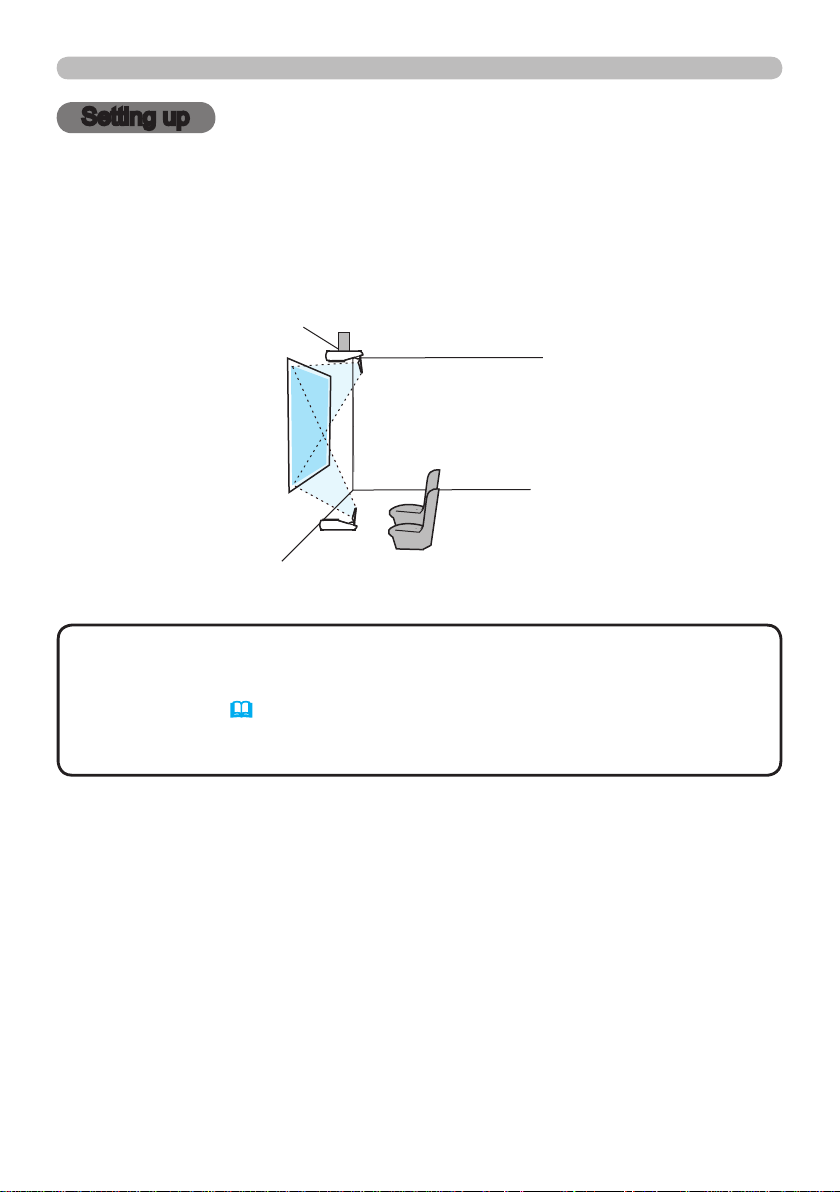
Install the projector in a stable, cool, dry and airy place, keeping a space of 30 cm
or more between the sides of the projector and other objects such as walls.
Refer to the following to decide the projection style. For the case of installation
in a special state such as ceiling mount, the specied mounting accessories and
service may be required. Before installing the projector, consult your dealer about
your installation.
(2) Ceiling mount
(1) Usual use
• When installing the projector, conrm that there is nothing that blocks
the projection light between the projector and the screen.
• When installing the projector, check that the remote sensors are not exposed
to any strong ray (14).
• Install the projector in the way specied in this manual. Otherwise the
projection lamp may not light.
NOTE
8
Setting up
A
C2
C1
B2
B1
A
C2
C1
B2
B1
Table for 4:3 screen
Table for 16:9 screen
(1)
(2)
inch cm inch cm inch cm inch cm inch
48 * 0.5 *(0.2) 38.3 15 24.4 10 98.2 39
50 2.0 1 39.8 16 25.2 10 101.9 40
60 9.6 4 47.4 19 28.9 11 120.4 47
70 17.2 7 55.0 22 32.6 13 139.3 55
80 24.8 10 62.6 25 36.2 14 158.2 62
90 32.4 13 70.2 28 39.9 16 177.1 70
100 39.9 16 77.7 31 43.6 17 196.0 77
120 55.0 22 92.8 37 50.9 20 234.0 92
150 77.7 31 115.5 45 62.0 24 291.0 115
200 115.5 45 153.3 60 80.4 32 385.7 152
(±8%)
inch cm inch cm inch cm inch cm inch
44 * 0.5 *(0.2) 38.3 15 33.6 13 88.9 35
50 5.4 2 43.2 17 37.3 15 99.9 39
60 13.7 5 51.5 20 43.5 17 118.3 47
70 22.0 9 59.8 24 49.6 20 136.8 54
80 30.2 12 68.0 27 55.7 22 155.3 61
90 38.5 15 76.3 30 61.8 24 173.9 68
100 46.6 18 84.4 33 67.9 27 192.3 76
120 63.1 25 100.9 40 80.1 32 229.5 90
150 87.8 35 125.6 49 98.4 39 285.3 112
200 129.0 51 166.8 66 129.0 51 378.2 149
(±8%)
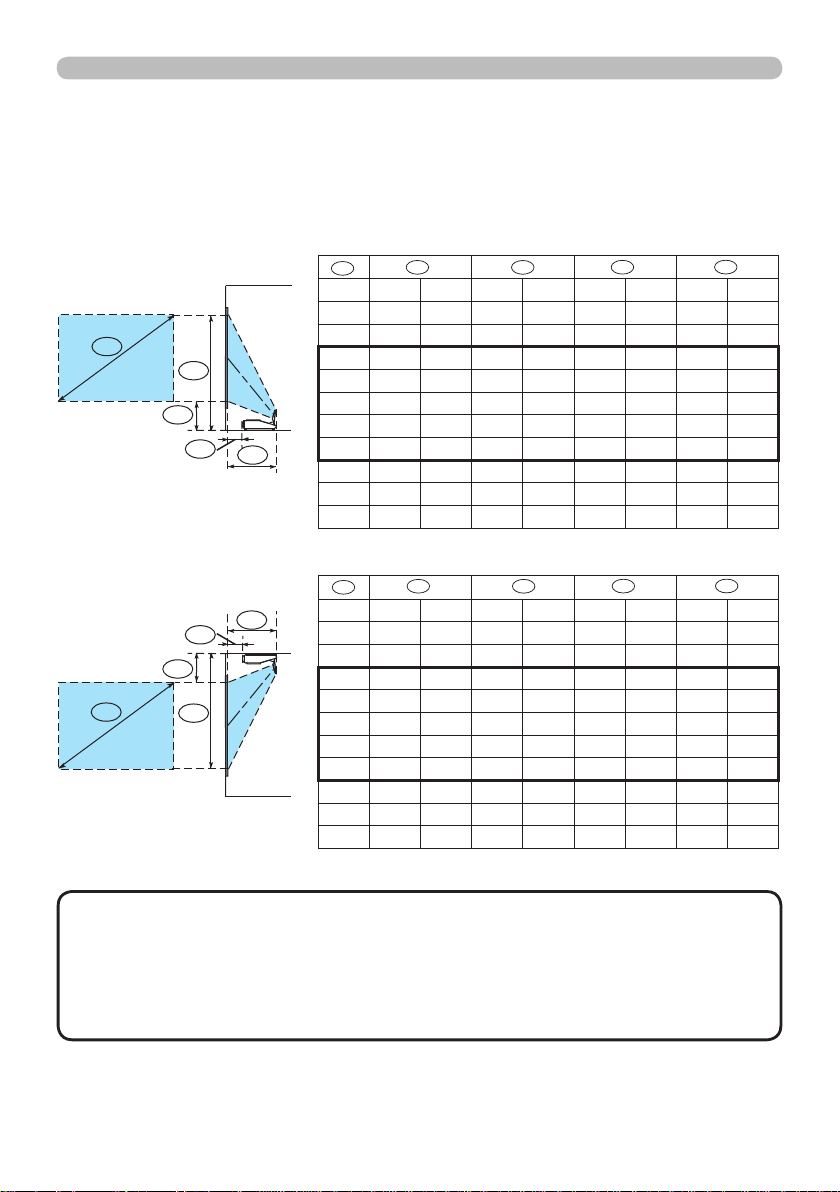
Refer to the following for the projection distance.
The values shown in the table are calculated for a full size screen: 1024x768.
A
B1
B2
C1
C2
A
B1
B2
C1
C2
• It is recommended to adjust the screen size from 60 inch to 100 inch
diagonal. The screen image adjusted out of this range, either smaller or larger,
may be deteriorated.
• The screen position may be shifted after installation if the projector is
suspended on a ceiling or somewhere, since the body of this projector is made
of plastics. If readjustment is necessary, consult with your dealer or installater.
NOTE
Arrangement (continued)

9
Setting up
►Place the projector in a stable horizontal position. If the
projector falls or is knocked over it could cause injury and/or damage to the
projector. Using a damaged projector could then result in re and/or electric
shock.
• Do not place the projector on an unstable, slanted or vibrational surface such
as a wobbly or inclined stand.
• Do not place the projector on its side, front or rear position.
• Consult with your dealer before a special installation such as suspending from
a ceiling or somewhere else.
►Place the projector in a cool place, and ensure that there is sufcient
ventilation. The high temperature of the projector could cause re, burns and/or
malfunction of the projector.
• Do not stop-up, block or cover the projector's vents.
• Keep a space of 30 cm or more around the projector from other objects such
as walls.
• Do not place the projector on metallic thing or anything weak in heat.
• Do not place the projector on carpet, cushions or bedding.
• Do not place the projector in direct sunlight or near hot objects such as heaters.
• Do not place anything near the lens door, lens, mirror, vents. or on the top of
the projector.
• Do not place anything that may be sucked into or stick to the vents on the rear
and bottom of the projector. This projector has some intake vents on the rear
and bottom.
►Do not place the projector anyplace where it may get wet. Getting the projector
wet or inserting liquid into the projector could cause re, electric shock and/or
malfunction of the projector.
• Do not place the projector in a bathroom or the outdoors.
• Do not place anything containing liquid near the projector.
WARNING
►Avoid placing the projector in smoky, humid or dusty place.
Placing the projector in such places could cause re, electric shock and/or
malfunction of the projector.
• Do not place the projector near humidiers, smoking spaces or a kitchen.
►Position the projector to prevent light from directly hitting the projector's remote
sensor.
CAUTION
Arrangement (continued)
10
Setting up
(continued on next page)
MONITOR OUT
COMPUTER IN2
COMPUTER IN1
CONTROL
AUDIO
OUT
S-VIDEO
Y CB/PB CR/PR
VIDEO L R
AUDIO IN3
AUDIO IN
1
2
RGB OUT
AUDIO
OUT
AUDIO
OUT
RS-232C
Y CB/PB CR/PR
COMPONENT VIDEO OUT
L R
AUDIO OUT
L R
AUDIO OUT
L R
AUDIO OUT
S-VIDEO
OUT
VIDEO
OUT
RGB OUT
AUDIO IN
RGB IN
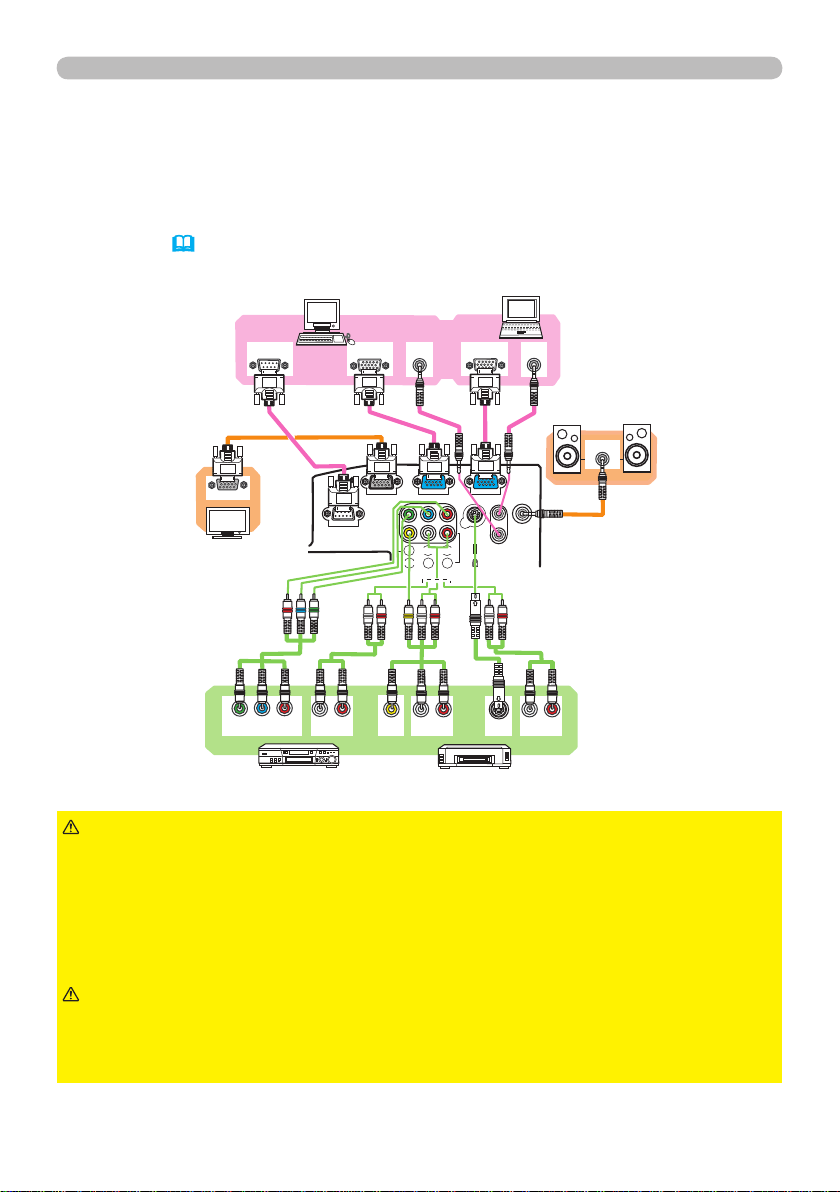
Connecting with your devices
Before connecting them, make sure that the devices are suitable to connect with
this projector, and prepare the required signal cables and adapters. Consult your
dealer if the accessory that is not included in this product is required. Refer to the
following for connection. If you want to use the cable cover, see the Using the
cable cover (
13).
PCs
Speakers
(with an amplier)
Monitor
VCR/DVD
players
►Use only the accessories contained in this product or
recommended by your dealer. Do not modify the projector or accessories.
►For the cable with a ferrite core only at one end, connect the end with the core
to the projector. The cables may be required a specic length or a ferrite core by
the regulations.
►Be careful not to damage the cables. Route the cables so that they are not
likely to be walked on or pinched by items placed upon or against them.
WARNING
►Do not connect or disconnect the projector with devices while
they are connected to a power supply, except for the cases directed by the
manuals.
►Be careful not to set a connector into a wrong port or with a wrong way.
CAUTION

11
Setting up
Connecting your devices (continued)
• Be sure to read the manuals for devices before connecting them to the
projector, and make sure that all the devices are suitable to be connected with this
product. Before connecting to a PC, check the signal level, the signal timing, and the
resolution.
- Some signal may need an adapter to input this projector.
- Some PCs have multiple screen display modes that may include some signals which
are not supported by this projector.
- Although the projector can display signals with resolution up to UXGA (1600X1200),
the signal will be converted to the projector’s panel resolution before being displayed.
The best display performance will be achieved if the resolutions of the input signal and
the projector panel are identical.
• While connecting, make sure that the shape of the cable's connector ts the port to
connect with. And be sure to tighten the screws on connectors with screws.
• When connecting a laptop PC to the projector, be sure to activate the PC’s external
RGB output. (Set the laptop PC to CRT display or to simultaneous LCD and CRT
display.) For details on how this is done, please refer to the instruction manual of the
corresponding laptop PC.
• When the picture resolution is changed on a PC depending on an input, automatic
adjustment function may take some time and may not be completed. In this case,
you may not be able to see a check box to select “Yes/No” for the new resolution on
Windows. Then the resolution will go back to the original. It might be recommended to
use other CRT or LCD monitors to change the resolution.
• In some cases, this projector may not display a proper picture or display any picture on
screen. For example, automatic adjustment may not function correctly with some input
signals. An input signal of composite sync or sync on G may confuse this projector, so
the projector may not display a proper picture.
NOTE
About Plug-and-Play capability
Plug-and-Play is a system composed of a PC, its operating system and peripheral
equipment (i.e. display devices). This projector is VESA DDC 2B compatible. Plug-and-
Play can be used by connecting this projector to a PC that is VESA DDC (display data
channel) compatible.
• Take advantage of this feature by connecting an computer cable to the COMPUTER
IN1 port (DDC 2B compatible). Plug-and-Play may not work properly if any other type of
connection is attempted.
• Please use the standard drivers in your PC as this projector is a Plug-and-Play monitor.
12
Setting up
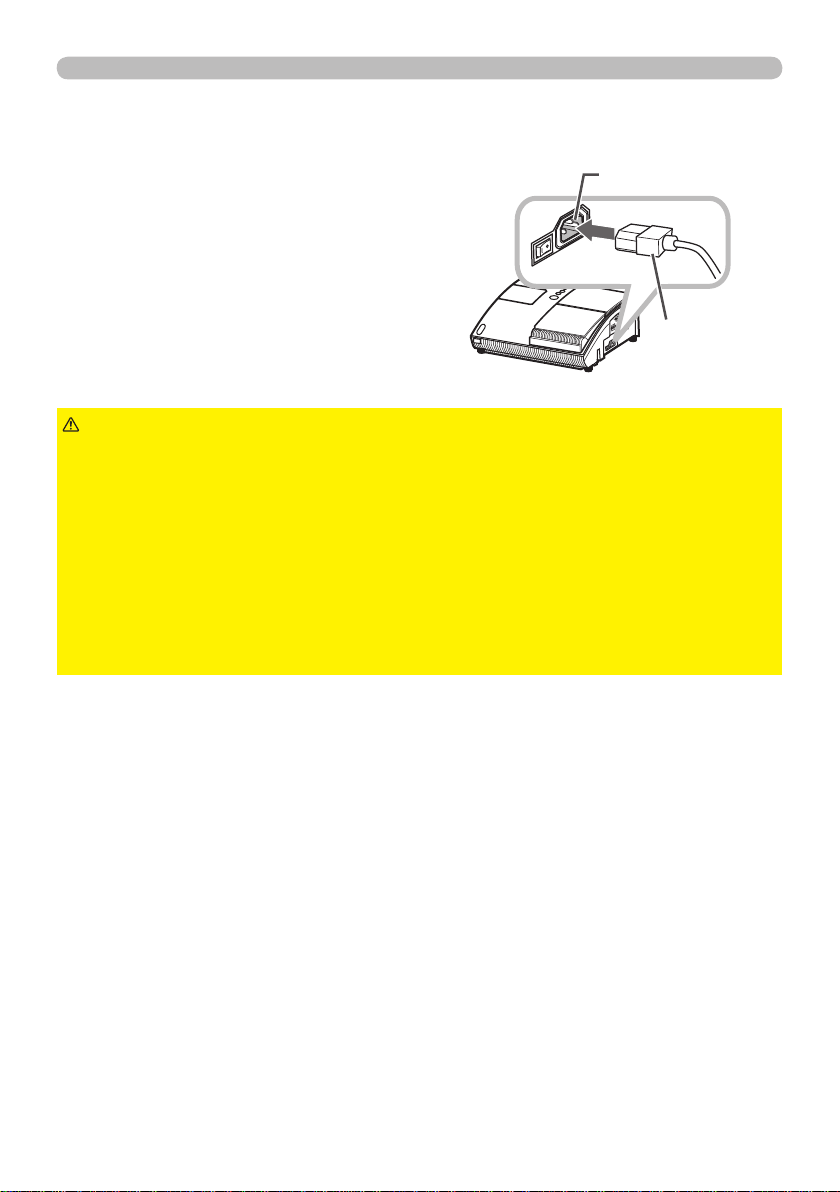
Connecting with a power supply
Before connection, conrm that the power
outlet is suitable for this projector and the
power cord.
Then follow the procedure below for
connection.
AC Inlet
Power cord
(with the socket)
1.
Insert the end of the power cord with the
socket into the AC inlet of the projector.
2.
Plug the other end of the power cord into
a power outlet.
►Be careful of operation for a power supply not to cause an
electric shock or a re.
• Do not handle the power cord with the wet hand.
• Use this product with only the type of power supply indicated on the projector.
• Use a power outlet that is close to the projector and easily accessible.
• Connect rmly the power cord not to result in loose connection. Do not use a
loose or unsound power outlet.
• Do not overload the outlet, since overloading can result in a risk of re or
electric shock.
• Use only the power cord contained in this product unless it is damaged. If it is
damaged, consult your dealer to get new one. Do not modify the power cord.
WARNING
13
Setting up
►Be careful not to pinch the cables in the cable cover, to
prevent damage to the cables.
CAUTION
• These are not provided as
comprehensive theft preventions but
supplemental measures.
NOTE
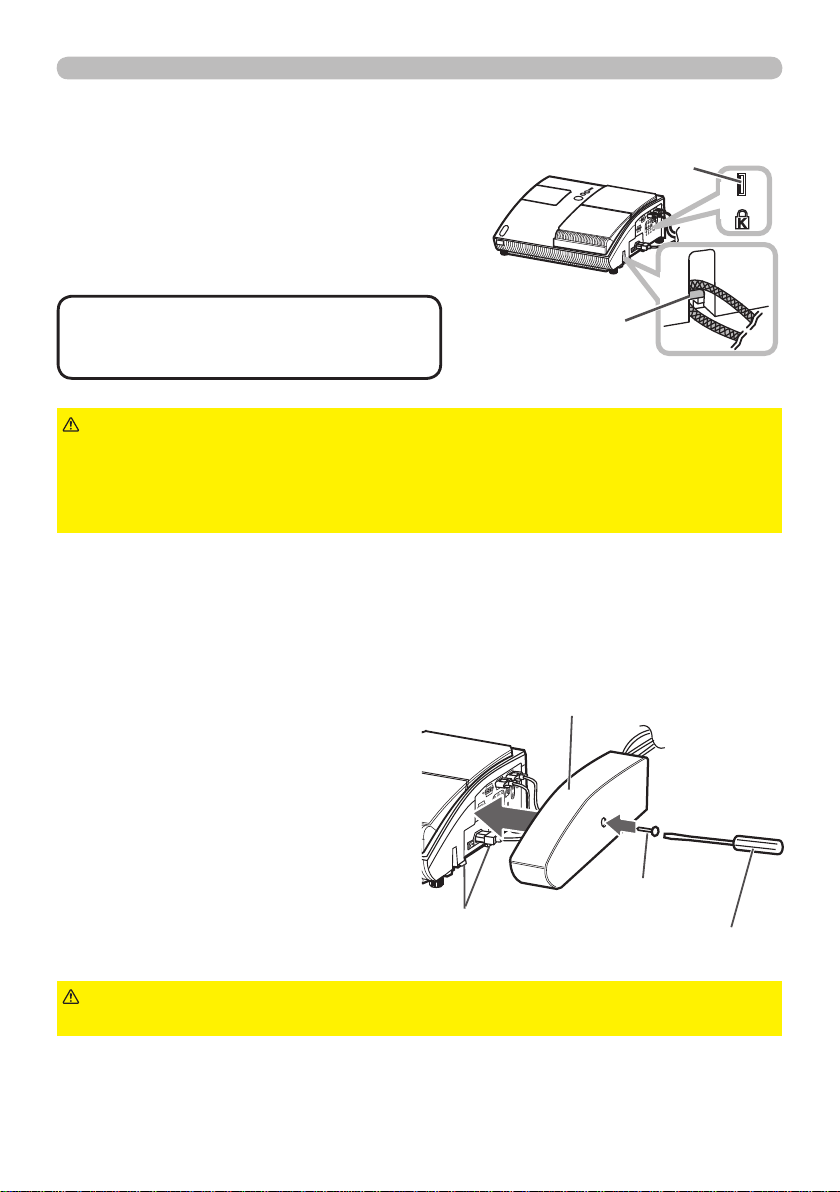
Using the security bar and slot
This projector has the security bar for a
commercial anti-theft chain or wire up to 10
mm in diameter, and also the security slot for
the Kensington lock.
For details, see the manual of the security
tool.
Security slot
Security bar
Using the cable cover
Utilize the cable cover as the guard and blind for the connecting parts.
Cable cover
Screw
Interlocking parts
Screw driver
►Do not place the anti-theft chain or wire near the projector’s
exhaust vents, since the chain or wire heated by the hot exhaust gas may cause
a burn.
►Do not use the security bar or slot for the purpose of fall prevention, since
these are not designed for it.
WARNING
1.
Connect the signal cables and the
power cord to the projector rst.
2.
Attach the cable cover to the
projector, uniting the interlocking
parts.
3.
Tighten the screw to x the cable
cover.
4.
Connect the other ends of the
cables to other devices, and plug
the power cord to the power outlet.
14
Remote control
Remote control
►
Be careful of handling a battery, as a battery can cause explosion,
cracking or leakage, which could result in a re, an injury, and environment pollution.
•
Use only the specied and new battery. Do not use a battery with damage, such
as a scratch, a dent, rust or leakage. Do not mix a new battery with used one.
•
When a battery leaked, wipe the leakage out well with a waste cloth. If the
leakage adhered to your body, immediately rinse it well with water. When a battery
leaked in the battery holder, replace the batteries after wiping the leakage out.
•
Make sure the plus and minus terminals are correctly aligned when loading a battery.
• Do not work on a battery; for example recharging or soldering.
• Do not keep the batteries put into the remote control when the remote control
is not used for a long while. Keep a battery in a dark, cool and dry place. Never
expose a battery to a re or water.
• Obey the local laws on disposing a battery.
WARNING
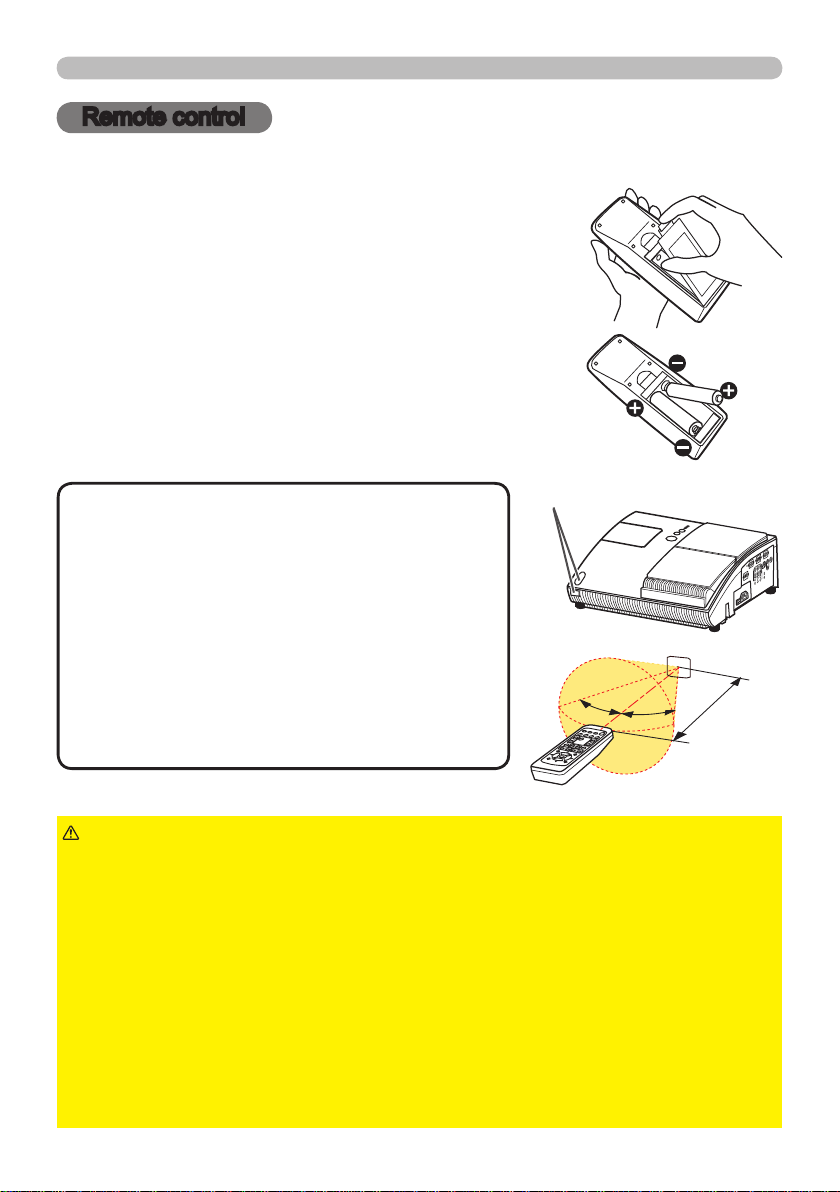
• Try changing the batteries when the
remote control malfunctions.
• This remote control works with the remote
sensors on the projector using infrared light
(Class 1 LED). The active sensor senses the
remote control signal assigned within 60 degrees
to right and left, and within 3 meters.
• The remote control signal reected in the
screen or the like may be available.
• Prevent the remote sensors from being hit by
a strong ray. It may cause malfunction of the
projector and remote control.
NOTE
Preparing for the remote control
The accessory remote control needs batteries. Use the
batteries included in this product or two new batteries of
the specied type: HITACHI MAXELL, part number LR6
or R6P. Follow the following procedure.
Remote sensors
3 m
(approx.)
30º
30º
1.
Remove the battery cover in the back of the remote
control.
2.
Put the batteries into the battery holder, according to
the polarity markings (+) and (-) inside the holder.
3.
Put the battery cover back to the former state.

15
VIDEO
DOC.CAMERA
KEYSTONE
ASPECT SEARCH
BLANK
MUTE
MY BUTTON
POSITION
12
ESC
ENTER
MENU
RESET
COMPUTER
MY SOURCE/
AUTO
MAGNIFY
VOLUME
ON
OFF
㧗
FREEZE
FOCUS D-ZOOM
- + - +
Remote control
Changing the frequency of remote control signal
The accessory remote control has the two choices on signal
frequency Mode 1:NORMAL and Mode 2:HIGH. If the remote
control does not function properly, attempt to change the
signal frequency.
In order to set the Mode, please keep pressing the
combination of two buttons listed below simultaneously for
about 3 seconds.
(1)(2)
(1) Set to Mode 1:NORMAL... VOLUME- and RESET buttons
(2) Set to Mode 2:HIGH... MAGNIFY OFF and ESC buttons
Please remember that the REMOTE FREQ. in the SERVICE
item of the OPTION menu (
48) of the projector to be controlled
should be set to the same mode as the remote control.
16
VIDEO
DOC.CAMERA
KEYSTONE
ASPECT SEARCH
BLANK
MUTE
MY BUTTON
POSITION
1 2
ESC
ENTER
MENU
RESET
COMPUTER
MY SOURCE/
AUTO
MAGNIFY
VOLUME
ー
ON
OFF
+
FREEZE
FOCUS D-ZOOM
- + - +
LAMP
TEMP
POWER
STANDBY/ON
INPUT
Power on/off
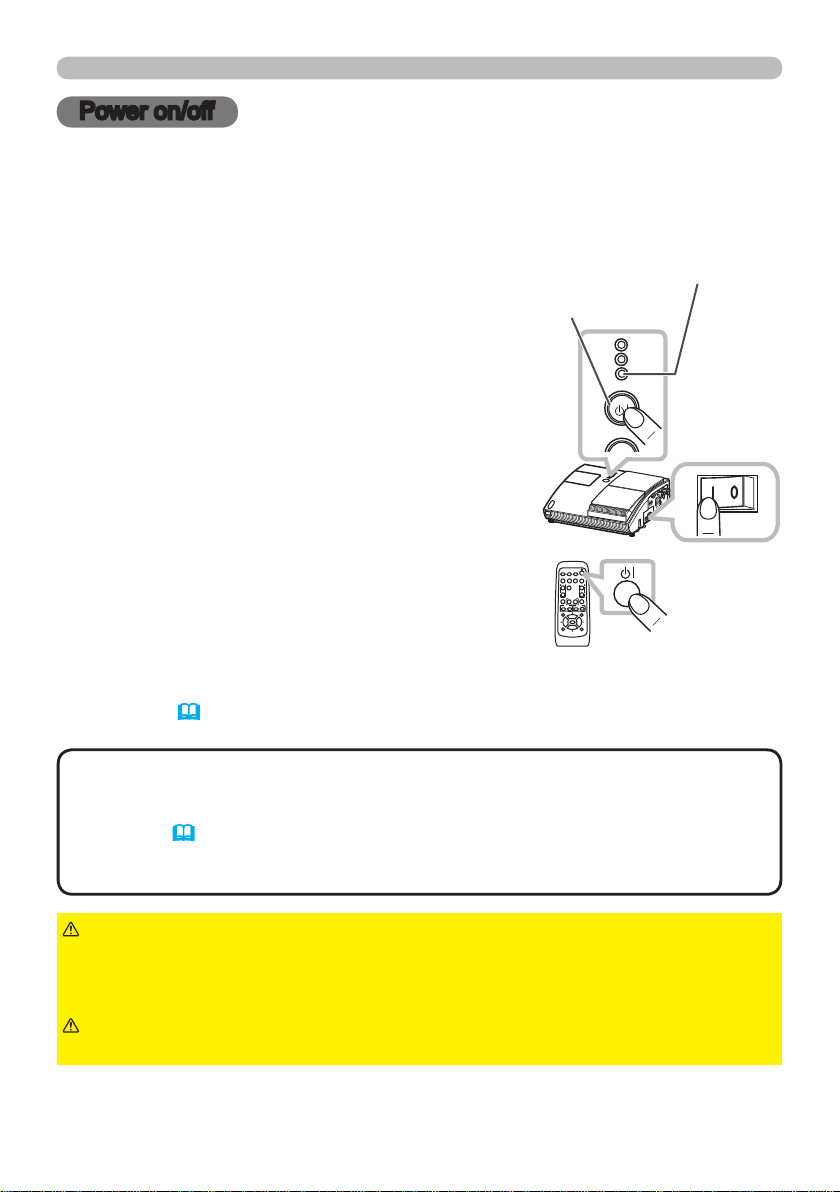
1.
Press the side marked " I " of the power
switch, as the power-on position.
The POWER indicator lights up in orange.
2.
Conrm that there is nothing that the lens
door hits while opening.
Then, press the STANDBY/ON button (on
the projector or remote control).
The lens door opens, the projection lamp
lights up, and the POWER indicator begins to
blink green.
Power on/off
To display the picture, select an input signal according to the section “Selecting an
input signal” (18).
►
Never look into the projection lens or mirror while the projection
lamp lights, since the projection lamp ray may cause a trouble on your eyes.
►Do not touch around the lamp cover and the exhaust vents during use or just
after use, since it is too hot.
WARNING
Turning on the power
Turn on the projector and the connected devices. Turn on the projector ahead of
other connected devices, unless mentioned in the manuals.
For this projector, follow the procedure below.
POWER indicator
STANDBY/ON button
Power
switch
STANDBY/ON button
When the projector starts completely, the indicator
will turn steady green.
• When the AUTO ON of the OPTION menu is set to the TURN ON,
and the power was turned off by the power switch last time, turning the power
switch on makes the projection lamp light on without pushing the STANDBY/
ON button (
44).
• Install the projector in the way specied in this manual. Otherwise the
projection lamp may not light.
NOTE
►Be careful not to pinch your nger with the lens door, as it may
cause an injury.
CAUTION
● For a couple of seconds after the POWER
indicator lights up, wait to use the control
buttons (on the projector and remote control).
The buttons may not work soon.
17
VIDEO
DOC.CAMERA
KEYSTONE
ASPECT SEARCH
BLANK
MUTE
MY BUTTON
POSITION
1 2
ESC
ENTER
MENU
RESET
COMPUTER
MY SOURCE/
AUTO
MAGNIFY
VOLUME
ー
ON
OFF
+
FREEZE
FOCUS D-ZOOM
- + - +
LAMP
TEMP
POWER
STANDBY/ON
INPUT
Power on/off
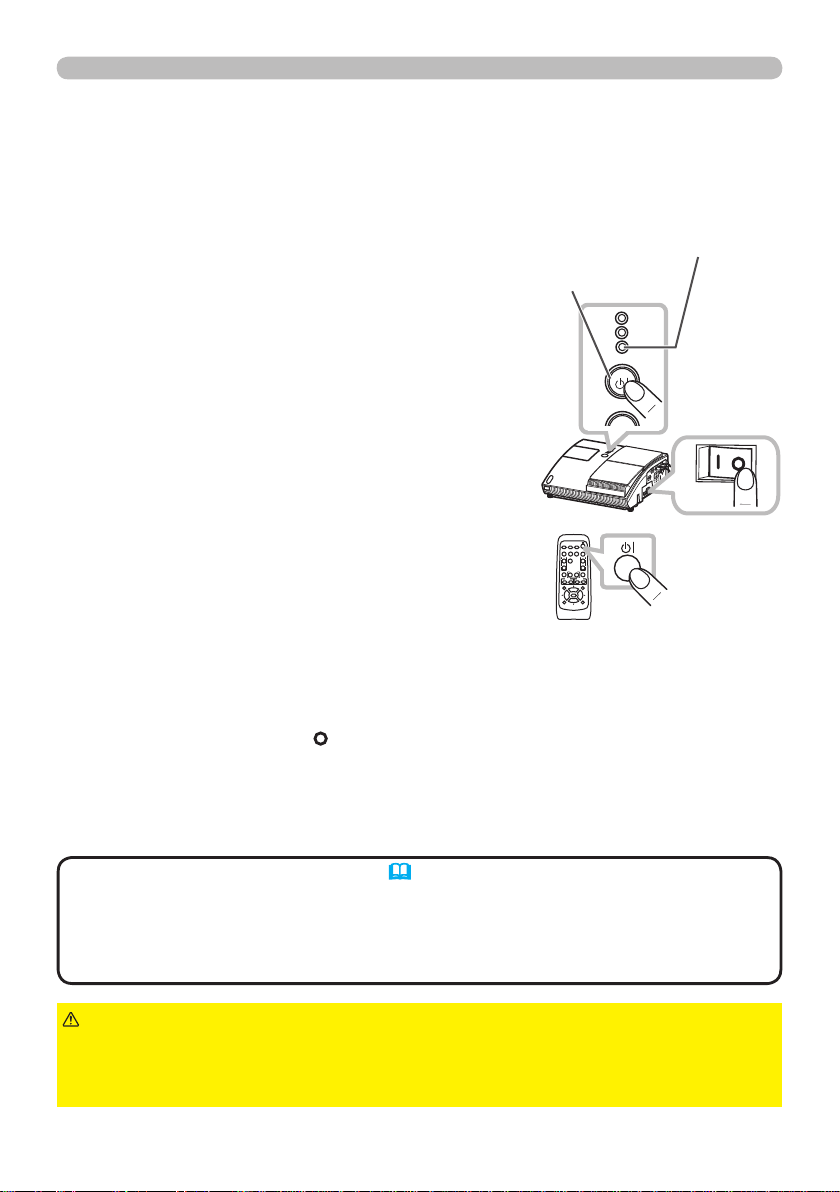
Turn off the power
Turn the projector off after turning off the other connected devices, unless
mentioned in the manuals. For this projector, follow the procedure below.
When you will not use the projector for a long while, unplug and separate the
power cord from the power outlet, for safety purposes.
Power
switch
STANDBY/ON button
1.
Press the STANDBY/ON button (on the
projector or remote control).
The “Power off?” dialog appears on the
screen for about 5 seconds.
2.
Conrm that there is nothing that the lens
door hits while closing.
Then press the STANDBY/ON button again
while the message appears.
The projection lamp goes off, the lens door
closes, and the POWER indicator begins to
blink orange.
3.
Press the side marked " " of the power switch, as the power-off position.
The POWER indicator goes off.
• Use the shutdown switch (66) only when the projector is not turned
off by normal procedure.
• Do not turn the projector on for about 10 minutes or more after turning it off.
Turning the projector on again too soon could shorten the lifetime of some
consumable parts of the projector.
NOTE
►Be careful not to pinch your nger with the lens door, to
prevent an injury.
►Do not touch the lamp cover or approach the exhaust vents while using the
projector and for a while after use, to prevent a burn.
CAUTION
POWER indicator
STANDBY/ON button
● For cooling the projector down, wait for the
POWER indicator to stop blinking and turn
steady orange.
The projector can be turned off without
waiting for cooling down. However, the
manufacture recommends cooling the
projector down enough.
Do not turn the projector on for about 10
minutes or more after turning it off to prevent
shortening its life.
18
INPUT
MENU
VIDEO
DOC.CAMERA
KEYSTONE
ASPECT SEARCH
BLANK
MUTE
MY BUTTON
POSITION
12
ESC
ENTER
MENU
RESET
COMPUTER
MY SOURCE/
AUTO
MAGNIFY
VOLUME
ON
OFF
㧗
FREEZE
FOCUS D-ZOOM
- + - +
VIDEO
DOC.CAMERA
KEYSTONE
ASPECT SEARCH
BLANK
MUTE
MY BUTTON
POSITION
12
ESC
ENTER
MENU
RESET
COMPUTER
MY SOURCE/
AUTO
MAGNIFY
VOLUME
ON
OFF
㧗
FREEZE
FOCUS D-ZOOM
- + - +
VIDEO
DOC.CAMERA
KEYSTONE
ASPECT SEARCH
BLANK
MUTE
MY BUTTON
POSITION
12
ESC
ENTER
MENU
RESET
COMPUTER
MY SOURCE/
AUTO
MAGNIFY
VOLUME
ON
OFF
㧗
FREEZE
FOCUS D-ZOOM
- + - +
COMPUTER IN 1 COMPUTER IN 2
VIDEO
S-VIDEO
COMPONENT (Y, CB/PB, CR/PR)
Operating
Operating
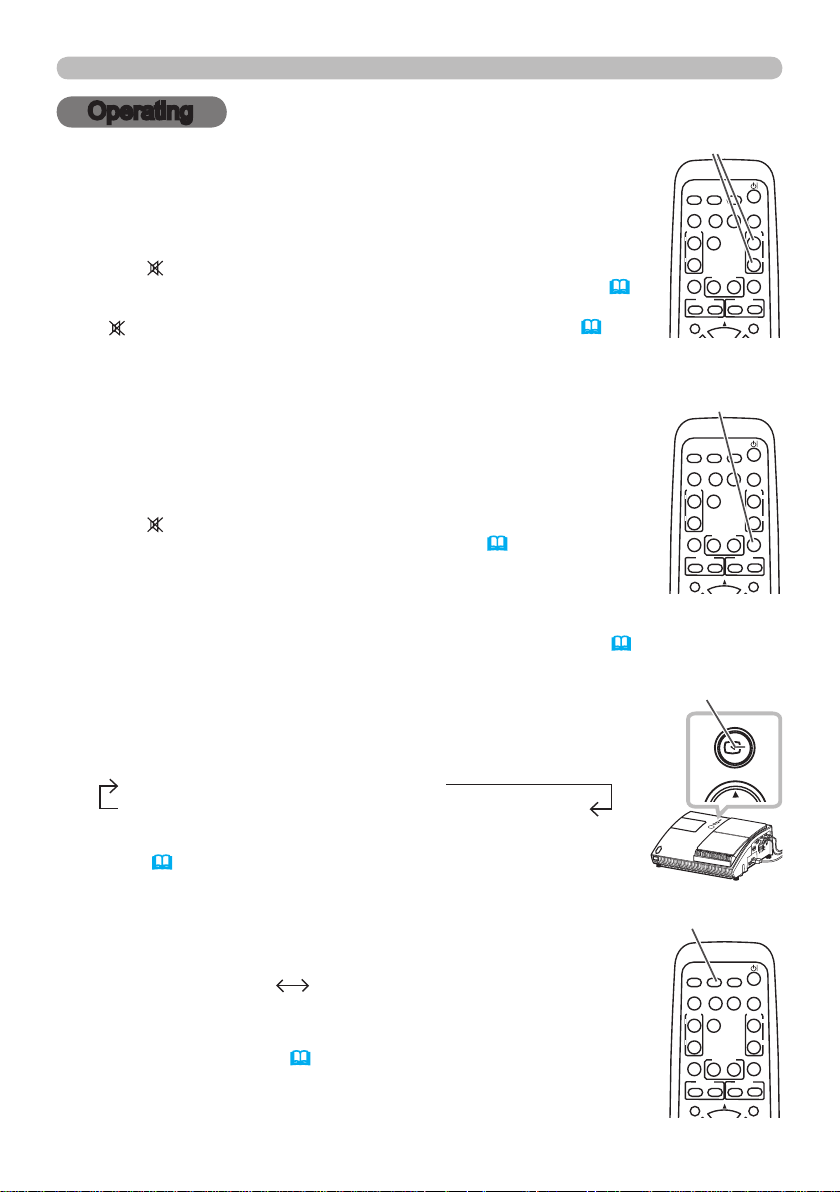
1.
Press INPUT button on the projector.
Each time you press the button, the projector switches its input
port from the current port as below.
Selecting an input signal
COMPUTER IN 1 COMPUTER IN 2
1.
Press COMPUTER button on the remote control.
Each time you press the button, the projector switches its input
port from the current port as below.
● While TURN ON is selected for AUTO SEARCH item in OPTION
menu, the projector will keep checking every port sequentially till an
input signal is detected (
44). If COMPUTER button is pushed when
VIDEO, S-VIDEO or COMPONENT port is selected, the projector will
check COMPUTER IN1 port rst.
(continued on next page)
COMPUTER button
VOLUME+/- button
INPUT button
MUTE button
● While TURN ON is selected for AUTO SEARCH item in OPTION
menu (
44), the projector will keep checking the ports in above
order repeatedly till an input signal is detected.
1.
Adjusting the volume
Use the VOLUME +/VOLUME - buttons to adjust the volume.
A dialog will appear on the screen to aid you in adjusting the volume.
If you do not do anything, the dialog will automatically disappear after
a few seconds.
● When
is selected for current picture input port, the volume
adjustment is disabled. Please see AUDIO item of AUDIO menu (
39).
●
When the projector is in the standby mode, the volume can be adjusted
if
is not selected for the AUDIO OUT STANDBY of AUDIO (39).
1.
Press MUTE button on the remote control.
A dialog will appear on the screen indicating that you have muted the
sound.
To restore the sound, press the MUTE, VOLUME + or VOLUME -
button. Even if you do not do anything, the dialog will automatically
disappear after a few seconds.
Temporarily muting the sound
● When is selected for current picture input port, the sound is always
muted. Please see AUDIO item of AUDIO menu (
39).
●
When the sound is muted while a signal from VIDEO(NTSC),
S-VIDEO(NTSC), COMPONENT(480i@60), COMPUTER IN1
(480i@60) or COMPUTER IN2(480i@60) port is selected, the C.C.
(Closed Caption) is automatically activated if the DISPLAY item of the C.C.
menu is set to AUTO and the input signal supports the C.C. feature (
57).
19
VIDEO
DOC.CAMERA
KEYSTONE
ASPECT SEARCH
BLANK
MUTE
MY BUTTON
POSITION
12
ESC
ENTER
MENU
RESET
COMPUTER
MY SOURCE/
AUTO
MAGNIFY
VOLUME
ON
OFF
㧗
FREEZE
FOCUS D-ZOOM
- + - +
VIDEO
DOC.CAMERA
KEYSTONE
ASPECT SEARCH
BLANK
MUTE
MY BUTTON
POSITION
12
ESC
ENTER
MENU
RESET
COMPUTER
MY SOURCE/
AUTO
MAGNIFY
VOLUME
ON
OFF
㧗
FREEZE
FOCUS D-ZOOM
- + - +
VIDEO
DOC.CAMERA
KEYSTONE
ASPECT SEARCH
BLANK
MUTE
MY BUTTON
POSITION
12
ESC
ENTER
MENU
RESET
COMPUTER
MY SOURCE/
AUTO
MAGNIFY
VOLUME
ON
OFF
㧗
FREEZE
FOCUS D-ZOOM
- + - +
Operating
1.
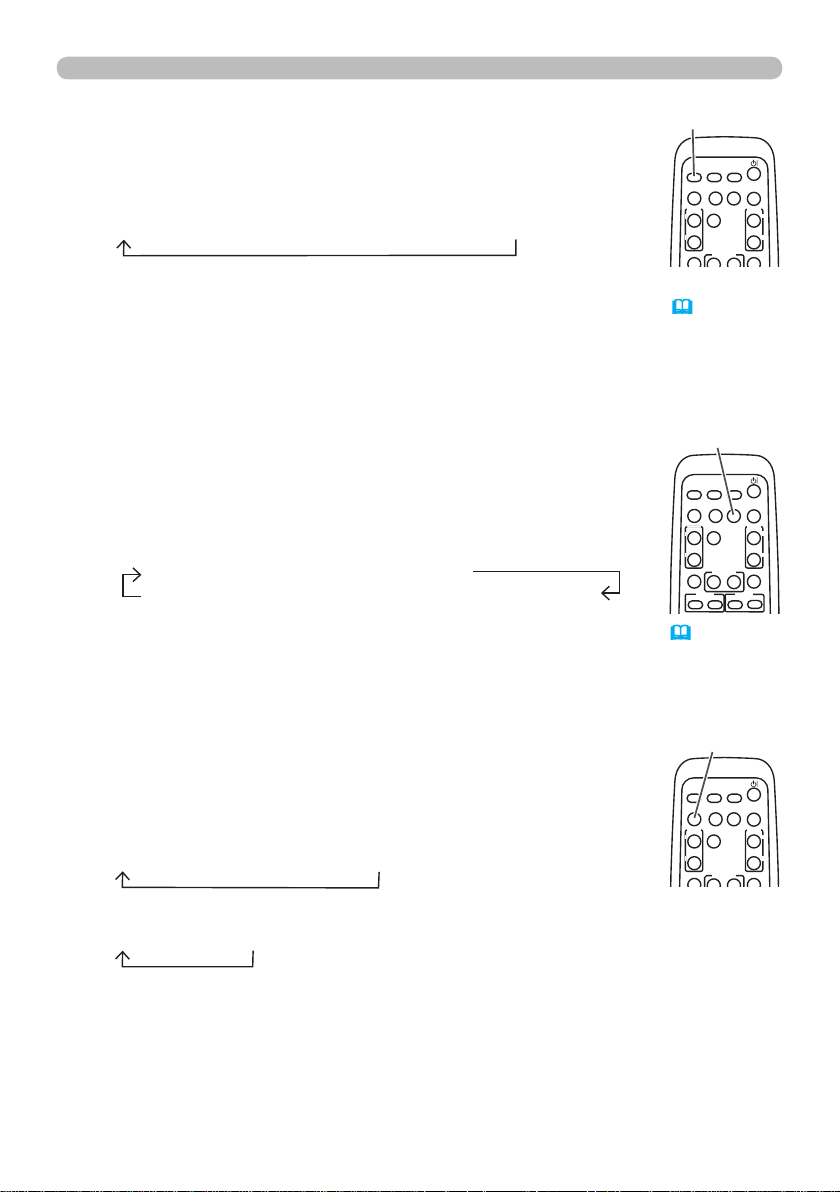
Press VIDEO button on the remote control.
Each time you press the button, the projector switches its input
port from the current port as below.
Selecting an input signal (continued)
●
While TURN ON is selected for AUTO SEARCH item in OPTION menu, the projector
will keep checking every port sequentially till an input signal is detected (
44). If
VIDEO button is pushed when COMPUTER IN1 or COMPUTER IN2 port is selected,
the projector will check COMPONENT port rst.
1.
Press ASPECT button on the remote control.
Each time you press the button, the projector switches the mode
for aspect ratio in turn.
Selecting an aspect ratio
● ASPECT button does not work when no proper signal is inputted.
● NORMAL mode keeps the original aspect ratio setting.
COMPONENT (Y, CB/PB, CR/PR) S-VIDEO VIDEO
1.
Press SEARCH button on the remote control.
The projector will start to check its input ports as below in order to
nd any input signals.
When an input is found, the projector will stop searching and
display the image. If no signal is found, the projector will return to
the state selected before the operation.
Searching an input signal
● While TURN ON is selected for AUTO SEARCH item in OPTION menu (44), the
projector will keep checking the ports in above order repeatedly till an input signal is
detected.
For a computer signal
NORMAL 4:3 16:9 16:10
For a video signal, s-video signal or component video signal
4:3 16:9 14:9
For no signal
4:3 (xed)
VIDEO button
SEARCH button
ASPECT button
COMPUTER IN 1 COMPUTER IN 2
VIDEO
S-VIDEO
COMPONENT (Y, CB/PB, CR/PR)
20
VIDEO
DOC.CAMERA
KEYSTONE
ASPECT SEARCH
BLANK
MUTE
MY BUTTON
POSITION
12
ESC
ENTER
MENU
RESET
COMPUTER
MY SOURCE/
AUTO
MAGNIFY
VOLUME
ON
OFF
㧗
FREEZE
FOCUS D-ZOOM
- + - +
VIDEO
DOC.CAMERA
KEYSTONE
ASPECT SEARCH
BLANK
MUTE
MY BUTTON
POSITION
12
ESC
ENTER
MENU
RESET
COMPUTER
MY SOURCE/
AUTO
MAGNIFY
VOLUME
ON
OFF
㧗
FREEZE
FOCUS D-ZOOM
- + - +
Operating
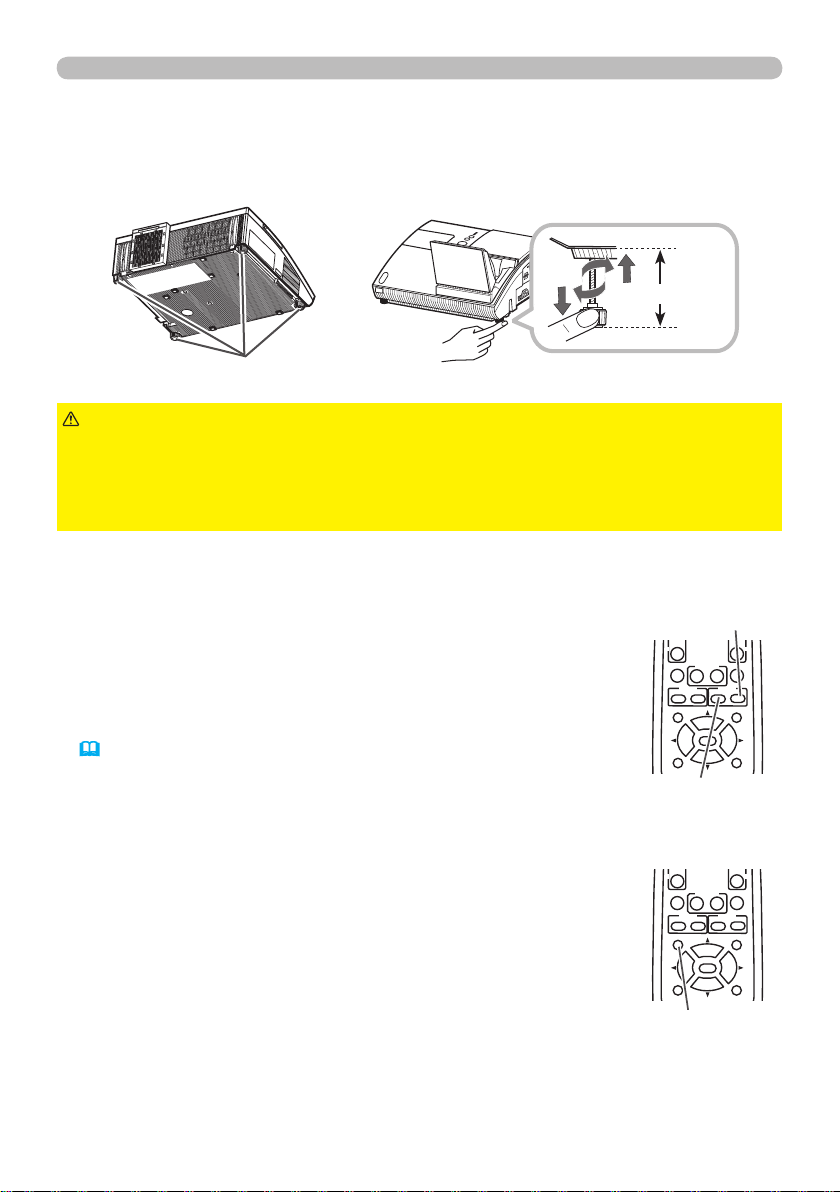
►
Do not lengthen the elevator feet to 43 mm or more. The foot
lengthened exceeding the limit may come off from the projector, and result in an injury.
►Tilt the projector with these elevating feet only.
►Do not tilt the projector over 5 degrees, when it is suspended from a ceiling or
somewhere.
CAUTION
Adjusting the projection position
This projector has four elevator feet in the bottom. Use them to adjust the
projection position.
Adjusting the zoom
Press the D-ZOOM + or D-ZOOM – button on the remote control to
display D-ZOOM dialog on screen.
Use the D-ZOOM + and D-ZOOM – buttons to adjust the picture size.
To nish the operation, do not touch these buttons for a few seconds
until the dialog is disappeared.
D-ZOOM + button
D-ZOOM – button
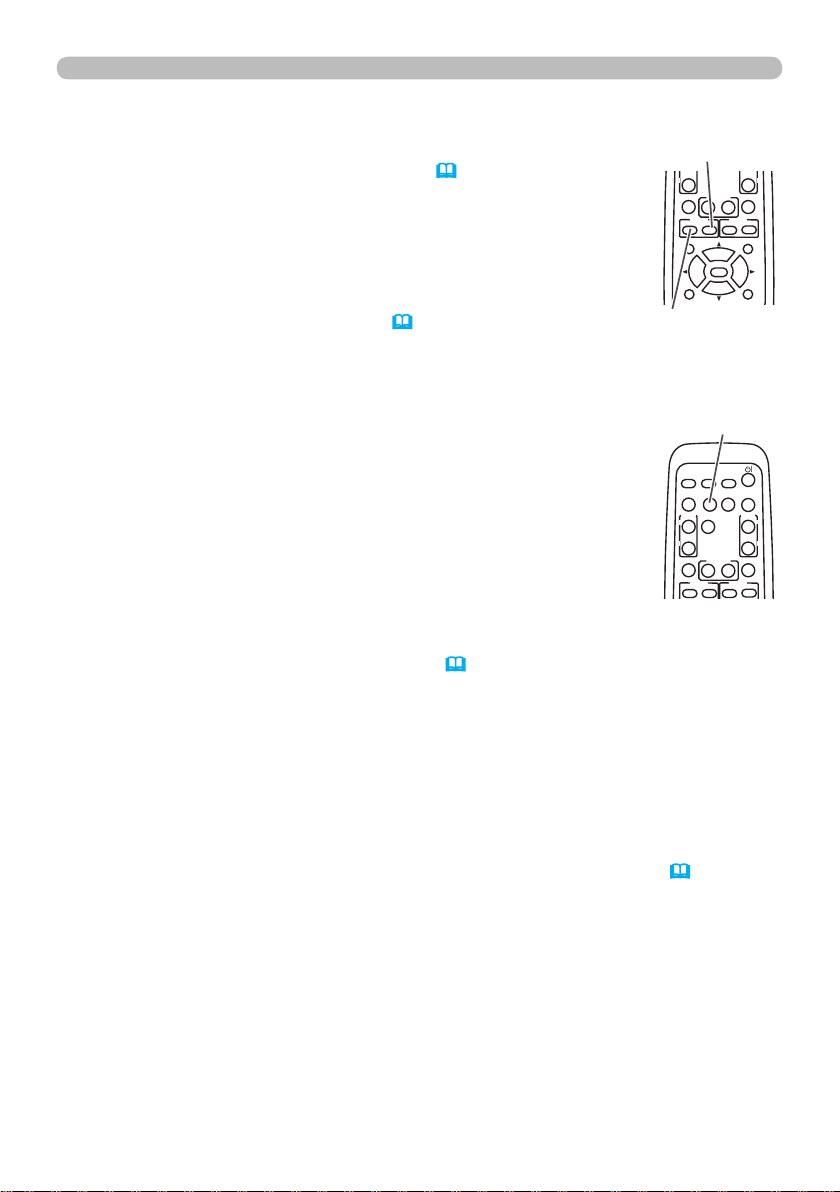
Adjusting the picture position
Press the POSITION button on the remote control while no menu is
on screen, to display the D-SHIFT dialog on screen. Use the ▲, ▼,
◄ and ► buttons to adjust the picture position. Press the POSITION
button again to nish this operation.
POSITION button
● If you want to expand a part of the image, use the magnify function
(
23).
● This is a function to shift the position of the shrunken picture by the
zoom function.
● The function is not available, if any menu is displayed on screen.
● The function is not available, if the D-ZOOM is adjusted to 100 (full
screen) on its dialog.
COMPUTER OUT
COMPUTER IN2
COMPUTER IN1
CONTROL
AUDIO
OUT
S-VIDEO
Y C
B
/P
B
C
R
/P
R
VIDEO L R
AUDIO IN3
AUDIO IN
1
2
Elevator feet
max. 43 mm
21
VIDEO
DOC.CAMERA
KEYSTONE
ASPECT SEARCH
BLANK
MUTE
MY BUTTON
POSITION
12
ESC
ENTER
MENU
RESET
COMPUTER
MY SOURCE/
AUTO
MAGNIFY
VOLUME
ON
OFF
㧗
FREEZE
FOCUS D-ZOOM
- + - +
VIDEO
DOC.CAMERA
KEYSTONE
ASPECT SEARCH
BLANK
MUTE
MY BUTTON
POSITION
12
ESC
ENTER
MENU
RESET
COMPUTER
MY SOURCE/
AUTO
MAGNIFY
VOLUME
ON
OFF
㧗
FREEZE
FOCUS D-ZOOM
- + - +
Operating
1.
Press AUTO button on the remote control.
Pressing this button performs the following.
Using the automatic adjustment feature
For a computer signal
The vertical position, the horizontal position and the horizontal
phase will be automatically adjusted.
Make sure that the application window is set to its maximum size
prior to attempting to use this feature. A dark picture may still be
incorrectly adjusted. Use a bright picture when adjusting.
For a video signal and s-video signal
The video format best suited for the respective input signal will be selected
automatically. This function is available only when the AUTO is selected for the
VIDEO FORMAT item in the INPUT menu (
34). The vertical position and horizontal
position will be automatically set to the default.
● The automatic adjustment operation requires approx. 10 seconds. Also please note
that it may not function correctly with some input. When this function is performed for
a video signal, a certain extra such as a line may appear outside a picture.
● The items adjusted by this function may vary when the FINE or DISABLE is selected
for the AUTO ADJUST item of the SERVICE item in the OPTION menu (
47).
AUTO button
For a component video signal
The vertical position, horizontal position and horizontal phase will be automatically set
to the default.
Adjusting the focus
Press the FOCUS + or FOCUS – button on the remote control, or
FOCUS + or FOCUS – button on the projector (
5) while no menu
is on screen, to display the FOCUS box on screen. Use the FOCUS
+ and FOCUS – buttons to adjust the screen focus. After the focus
adjustment, wait for a while until the FOCUS box is disappeared, if
you want to display any other menu on screen by pushing the MENU
button on the projector.
● The ◄/►/▲/▼ buttons on the projector work only as the cursor
buttons while the template is displayed (
43).
FOCUS + button
FOCUS – button
22
VIDEO
DOC.CAMERA
KEYSTONE
ASPECT SEARCH
BLANK
MUTE
MY BUTTON
POSITION
12
ESC
ENTER
MENU
RESET
COMPUTER
MY SOURCE/
AUTO
MAGNIFY
VOLUME
ON
OFF
㧗
FREEZE
FOCUS D-ZOOM
- + - +
Operating
KEYSTONE button
1.
Press KEYSTONE button on the remote control. A dialog
will appear on the screen to aid you in correcting the
distortion.
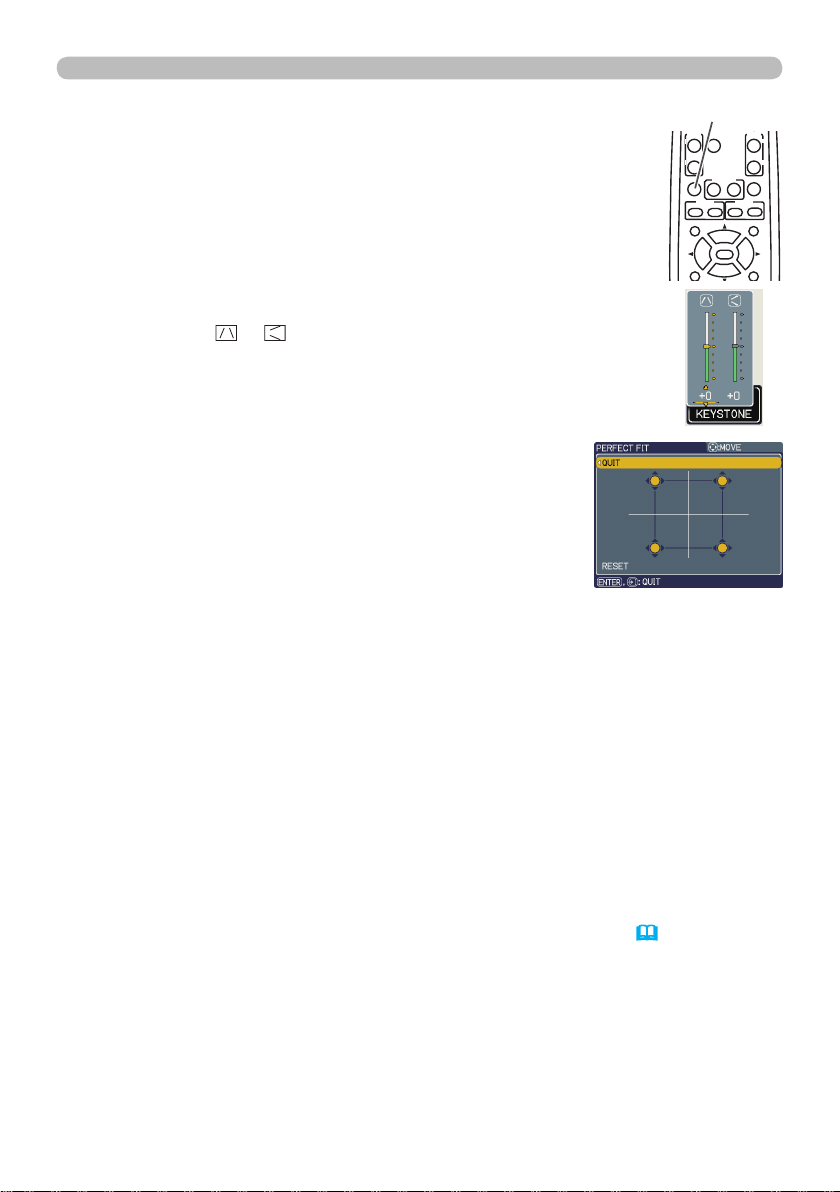
Correcting the keystone distortions
2.
Use the ▲/▼ cursor buttons to select, MANUAL or
PERFECT FIT operation, and press the ► button to
perform the following.
(1) MANUAL displays a dialog for keystone correction.
Use the ◄/► cursor buttons to select the direction
to correct (
or ) then use the ▲/▼ buttons for
adjustment.
(2) PERFECT FIT displays a dialog for the shape
adjustment of the projected image in each of the
corners.
1) Choose the corner to adjust using the ▲/▼/◄/►
buttons and press the ENTER or INPUT button.
2) Use the ▲/▼/◄/► buttons to adjust the position of
the corner.
Press the ENTER or INPUT button to exit the
adjustment of the corner.
3) To adjust another corner, follow the same procedure
from 1) above.
To reset the adjustment of all the corners, select
RESET using the ▲/▼ buttons and press the ENTER
or INPUT button.
● While the positions of the corners are adjusted with PERFECT FIT, keystone
adjustment feature is unavailable. To correct the keystone distortion, reset the
adjustment of all the corners.
● The adjustable range of this function will vary among inputs. For some input, this
function may not work well.
● When the zoom adjustment is set to the TELE (telephoto focus), this function may
be excessive. This function should be used when the zoom adjustment is set to
the full WIDE (wide-angle focus) whenever possible.
● This function will be unavailable when Transition Detector is on (
53).
To close the dialog and complete this operation, press KEYSTONE button again.
Even if you do not do anything, the dialog will automatically disappear after a few
seconds.
23
VIDEO
DOC.CAMERA
KEYSTONE
ASPECT SEARCH
BLANK
MUTE
MY BUTTON
POSITION
12
ESC
ENTER
MENU
RESET
COMPUTER
MY SOURCE/
AUTO
MAGNIFY
VOLUME
ON
OFF
㧗
FREEZE
FOCUS D-ZOOM
- + - +
VIDEO
DOC.CAMERA
KEYSTONE
ASPECT SEARCH
BLANK
MUTE
MY BUTTON
POSITION
12
ESC
ENTER
MENU
RESET
COMPUTER
MY SOURCE/
AUTO
MAGNIFY
VOLUME
ON
OFF
㧗
FREEZE
FOCUS D-ZOOM
- + - +
VIDEO
DOC.CAMERA
KEYSTONE
ASPECT SEARCH
BLANK
MUTE
MY BUTTON
POSITION
12
ESC
ENTER
MENU
RESET
COMPUTER
MY SOURCE/
AUTO
MAGNIFY
VOLUME
ON
OFF
㧗
FREEZE
FOCUS D-ZOOM
- + - +
• The zoom level can be nely adjusted. Closely watch the screen to nd the
level you want.
NOTE
1.
Press the ON button of MAGNIFY on the remote control.
The “MAGNIFY” indication will appear on the screen and the
projector will go into the MAGNIFY mode. When the ON button of
MAGNIFY is pressed rst after the projector is started, the picture will
be zoomed twice. The indication will disappear in several seconds
with no operation.
Using the magnify feature
2.
Use the ▲/▼ cursor buttons to adjust the zoom level. To move
the zoom area, press the POSITION button in the MAGNIFY mode, then use the
▲/▼/◄/► cursor buttons to move the area. And to nalize the zoom area, press the
POSITION button again.
To exit from the MAGNIFY mode and restore the screen to normal, press the OFF
button of MAGNIFY on the remote control.
● The projector automatically exits from the MAGNIFY mode when the input signal is
changed or when the display condition is changed.
● In the MAGNIFY mode, the keystone distortion condition may vary, it will be restored
when the projector exits from the MAGNIFY mode.
MAGNIFY
ON/OFF button
Operating
1.
Press BLANK button on the remote control.
The BLANK screen will be displayed instead of the screen of input
signal. Please refer to BLANK item in SCREEN menu (
40).
To exit from the BLANK screen and return to the input signal screen,
press BLANK button again.
Temporarily blanking the screen
● The projector automatically exits from the BLANK mode when some control buttons
are pressed.
• The sound is not connected with the BLANK screen function.
If necessary, set the volume or mute rst.
• If you want to make the screen blank and the sound muted at the same time, use AV
Mute function that is required to be assigned to one of the MY BUTTON on the remote
in advance (
46).
NOTE
1.
Press the FREEZE button on the remote control.
The “FREEZE” indication will appear on the screen (however, the
indication will not appear when the TURN OFF is selected for the
MESSAGE item in the SCREEN menu (
42)), and the projector will
go into the FREEZE mode, which the picture is frozen.
To exit the FREEZE mode and restore the screen to normal, press
the FREEZE button again.
Freezing the screen
● The projector automatically exits from the FREEZE mode when some control buttons
are pressed.
● If the projector continues projecting a still image for a long time, the LCD panel might
possibly be burned in. Do not leave the projector in the FREEZE mode for too long.
FREEZE button
BLANK button
24
VIDEO
DOC.CAMERA
KEYSTONE
ASPECT SEARCH
BLANK
MUTE
MY BUTTON
POSITION
12
ESC
ENTER
MENU
RESET
COMPUTER
MY SOURCE/
AUTO
MAGNIFY
VOLUME
ON
OFF
㧗
FREEZE
FOCUS D-ZOOM
- + - +
VIDEO
DOC.CAMERA
KEYSTONE
ASPECT SEARCH
BLANK
MUTE
MY BUTTON
POSITION
1 2
ESC
ENTER
MENU
RESET
COMPUTER
MY SOURCE/
AUTO
MAGNIFY
VOLUME
ON
OFF
㧗
FREEZE
FOCUS D-ZOOM
- + - +
COMPUTER OUT
COMPUTER IN2
COMPUTER IN1
CONTROL
AUDIO
OUT
S-VIDEO
Y C
B
/P
B
C
R
/P
R
VIDEO L R
AUDIO IN3
AUDIO IN
1
2
LAMP
TEMP
POWER
STANDBY/ON
INPUT
MENU
FOCUS - + FOCUS
Operating
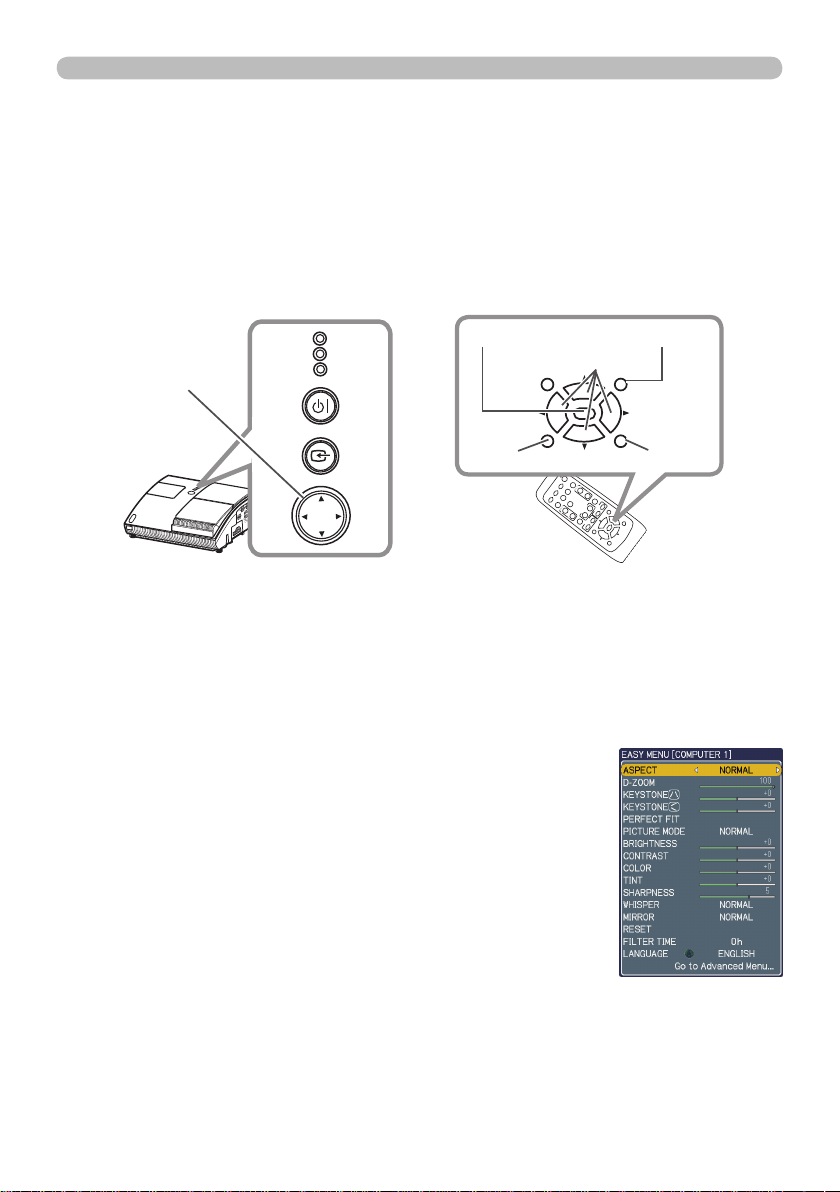
1.
Press the MENU button on the remote control or the projector.
The Advanced Menu or EASY MENU, which has priority just after powered
on will appear.
If you want to move the menu position, use the cursor buttons after pressing
the POSITION button. While the projector is displaying any menu, the MENU
button on the projector works as the cursor buttons.
Using the menu function
2.
If you want to change it to the Advanced Menu,
select the Go to Advanced Menu...
This projector has the following menus:
PICTURE, IMAGE, INPUT, SETUP, AUDIO, SCREEN, OPTION, C.C. and EASY
MENU.
EASY MENU consists of functions often used, and the other menus are classied
into each purpose and brought together as the Advanced Menu.
Each of these menus is operated using the same methods. The basic operations
of these menus are as follows.
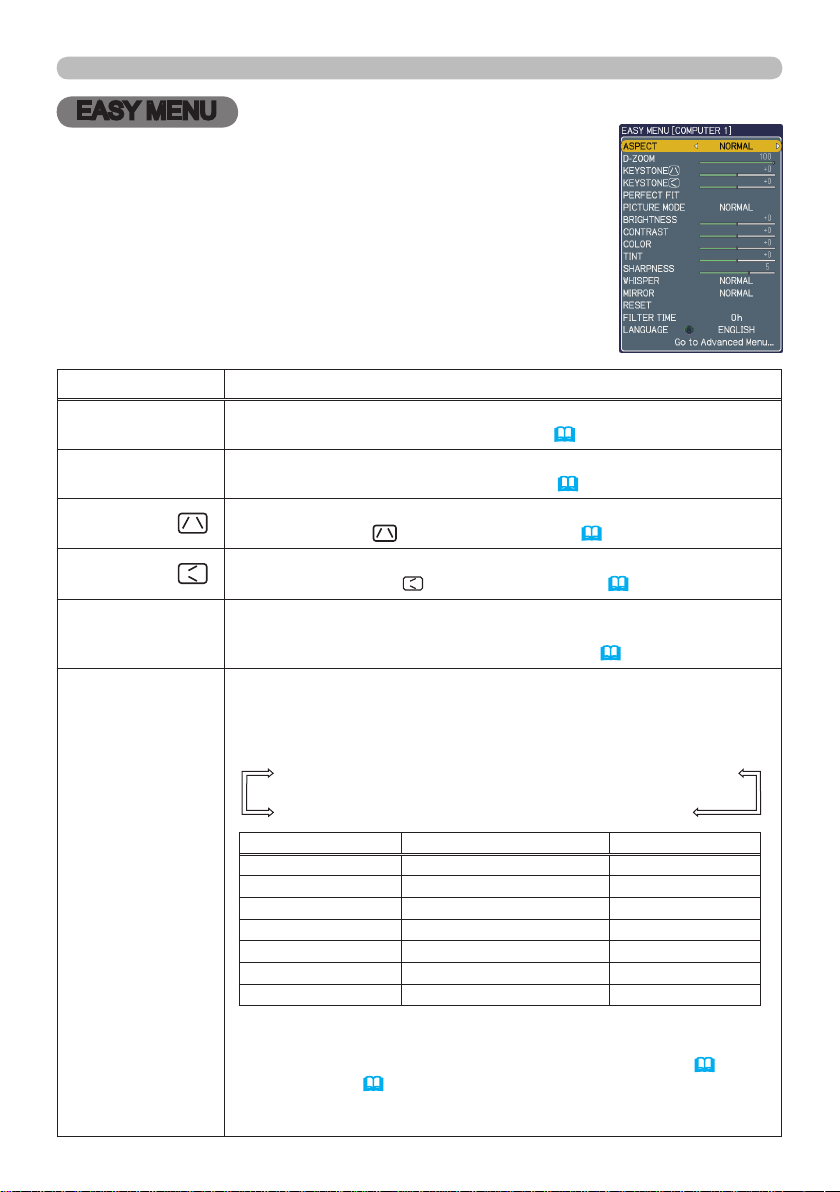
In the EASY MENU
EASY MENU
3.
Use the ▲/▼ cursor buttons to select an item to
operate.
4.
Use the ◄/► cursor buttons to operate the item.
MENU button
RESET button
ENTER button MENU button
Cursor buttons
ESC button
(continued on next page)

25
Operating
Using the menu function (continued)
● Some functions cannot be performed when a certain input port is selected, or
when a certain input signal is displayed.
● When you want to reset the operation, press RESET button on the remote
control during the operation. Note that some items (ex. LANGUAGE, H
PHASE, VOLUME) cannot be reset.
● In the Advanced Menu, when you want to return to the previous display, press
the ◄ cursor button or ESC button on the remote control.
5.
Press MENU button on the remote control again to close the menu and
complete this operation. Even if you do not do anything, the dialog will
automatically disappear after about 10 seconds.
2.
Use the ▲/▼ cursor buttons to select a menu.
If you want to change it to the EASY MENU, select
EASY MENU.
Then press the ► cursor button, or ENTER button to
select an item. The lower layer menu of the selected
item will appear.
In the Advanced Menu
3.
Use the ▲/▼ cursor buttons to select an item to operate.
Then press the ► cursor button, or ENTER button to progress. The operation
menu of the selected item will appear.
4.
Use the ▲/▼ cursor buttons to operate the item.
Advanced Menu
26
EASY MENU
EASY MENU
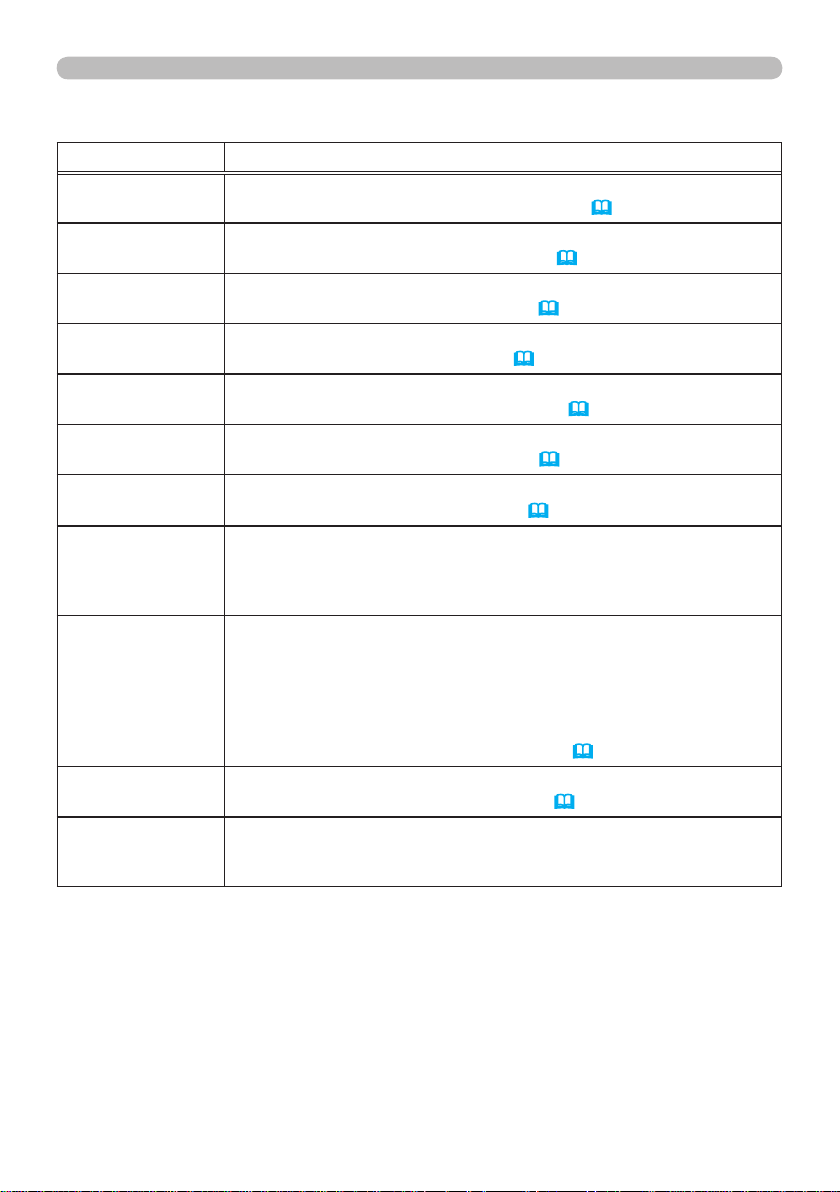
From the EASY MENU, items shown in the table below
can be performed.
Select an item using the ▲/▼ cursor buttons. Then
perform it according to the following table.
Item Description
ASPECT
Using the ◄/► buttons switches the mode for aspect ratio.
See the ASPECT item in IMAGE menu
(
31).
D-ZOOM
Using the ◄/► buttons adjusts the zoom.
See the D-ZOOM item in SETUP menu (
36).
KEYSTONE
Using the ◄/► buttons corrects the vertical keystone distortion.
See KEYSTONE
item in SETUP menu
(
36).
KEYSTONE
Using the ◄/► buttons corrects the horizontal keystone distortion.
See the KEYSTONE
item in SETUP menu
(
36).
PERFECT FIT
Using the ► button displays the dialog for the shape adjustment of
the projected image in each of the corners.
See the PERFECT FIT item in SETUP menu
(
37).
PICTURE MODE
Using the ◄/► buttons switches the picture mode.
The picture modes are combinations of GAMMA and COLOR
TEMP settings. Choose a suitable mode according to the projected
source.
NORMAL
ó
CINEMA
ó
DYNAMIC
ó
BOARD(BLACK)
DAYTIME
ó
WHITEBOARD
ó
BOARD(GREEN)
COLOR TEMP GAMMA
NORMAL #2 MID DEFAULT #1 DEFAULT
CINEMA #3 LOW DEFAULT #2 DEFAULT
DYNAMIC #1 HIGH DEFAULT #3 DEFAULT
BOARD(BLACK) #4 Hi-BRIGHT-1 DEFAULT #4 DEFAULT
BOARD(GREEN) #5 Hi-BRIGHT-2 DEFAULT #4 DEFAULT
WHITEBOARD #2 MID DEFAULT #5 DEFAULT
DAYTIME #6 Hi-BRIGHT-3 DEFAULT #6 DEFAULT
• When the combination of GAMMA and COLOR TEMP differs
from pre-assigned modes above, the display on the menu for the
PICTURE MODE is “CUSTOM”. Please refer to GAMMA (
28) and
COLOR TEMP (
29) items in PICTURE menu.
• When this function is performed, a certain extra such as a line
may appear.
(continued on next page)
27
EASY MENU
EASY MENU (continued)
Item Description
BRIGHTNESS
Using the ◄/► buttons adjusts the brightness.
See BRIGHTNESS item in PICTURE menu
(
28).
CONTRAST
Using the ◄/► buttons adjusts the contrast.
See CONTRAST item in PICTURE menu
(
28).
COLOR
Using the ◄/► buttons adjusts the strength of whole color.
See COLOR item in PICTURE menu
(
29).
TINT
Using the ◄/► buttons adjusts the tint.
See TINT item in PICTURE menu
(
29).
SHARPNESS
Using the ◄/► buttons adjusts the sharpness.
See SHARPNESS item in PICTURE menu
(
30).
WHISPER
Using the ◄/► buttons turns off/on the whisper mode.
See WHISPER item in SETUP menu
(
37).
MIRROR
Using the ◄/► buttons switches the mode for mirror status.
See MIRROR item in SETUP menu
(
37).
RESET
Performing this item resets all of EASY MENU items except FILTER
TIME and LANGUAGE.
Pressing the RESET button or the ► button displays a dialog. To
reset, select RESET using the ▲ button performs resetting.
FILTER TIME
The usage time of the air-lter is shown in the menu.
Performing this item resets the lter time which counts usage time
of the air-lter.
Pressing the RESET button or the ► button displays a dialog. To
reset the lter time, select RESET using the ▲ button performs
resetting.
See FILTER TIME item in OPTION menu
(
45).
LANGUAGE
Using the ◄/► buttons changes the display language.
See LANGUAGE item in SCREEN menu
(
40).
Go to
Advanced Menu...
Select
“
Go to Advanced Menu…
”
on the menu, and press the
►
or ENTER button to use the menu of PICTURE, IMAGE, INPUT,
SETUP, AUDIO, SCREEN, OPTION or C.C..
28
PICTURE menu
PICTURE menu
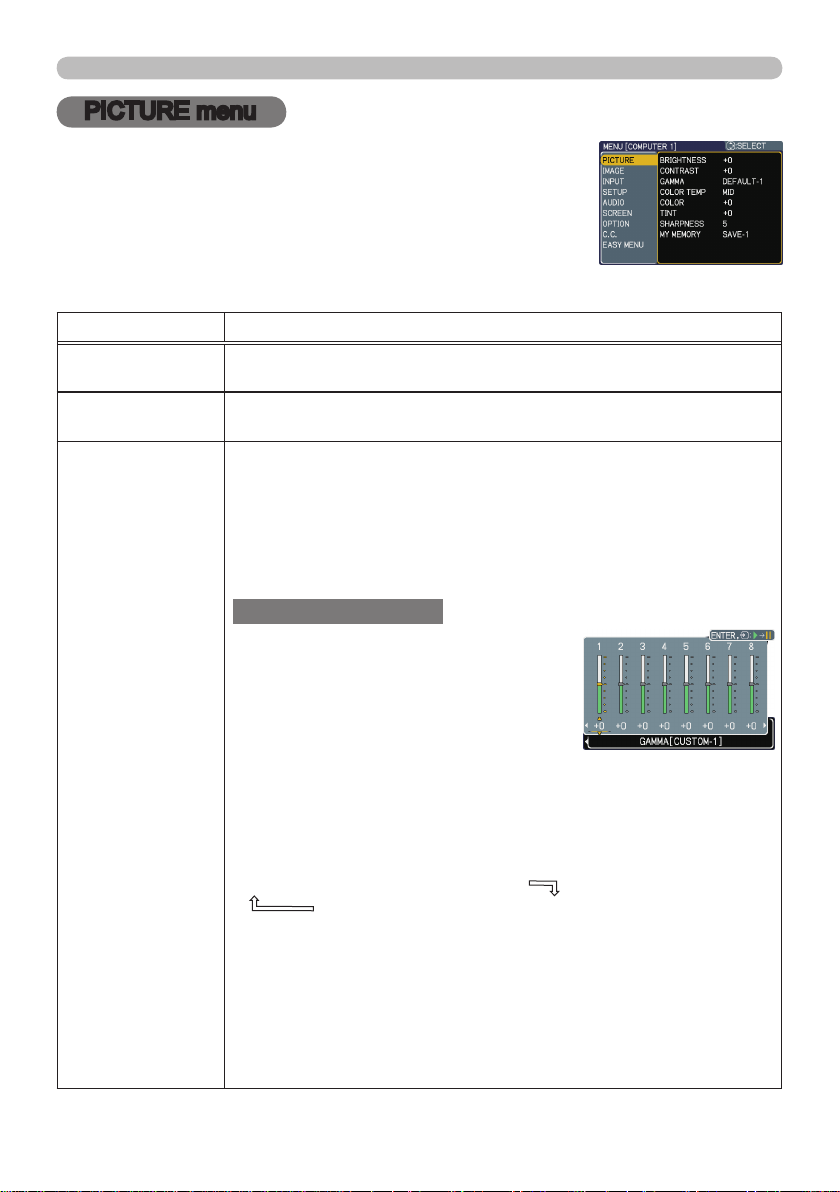
From the PICTURE menu, items shown in the table below
can be performed.
Select an item using the ▲/▼ cursor buttons, and press
the ► cursor button or ENTER button to execute the item.
Then perform it according to the following table.
Item Description
BRIGHTNESS
Using the ▲/▼ buttons adjusts the brightness.
Light
ó
Dark
CONTRAST
Using the ▲/▼ buttons adjusts the contrast.
Strong
ó
Weak
GAMMA
Using the ▲/▼ buttons switches the gamma mode.
To adjust CUSTOM
Selecting a mode whose name includes
CUSTOM and then pressing the ► button
or the ENTER button displays a dialog to
aid you in adjusting the mode.
This function is useful when you want to
change the brightness of particular tones.
Choose an item using the ◄/► buttons, and
adjust the level using the ▲/▼ buttons.
You can display a test pattern for checking the effect of your
adjustment by pressing the ENTER button.
Each time you press the ENTER button, the pattern changes as below.
No pattern
ð
Gray scale of 9 steps
Ramp
Gray scale of 15 steps
The eight equalizing bars correspond to eight tone levels of the test
pattern (Gray scale of 9 steps), except the darkest in the left end.
If you want to adjust the 2nd tone from left end on the test pattern
use the equalizing adjustment bar “1”. The darkest tone at the left
end of the test pattern cannot be controlled with any of equalizing
adjustment bar.
•
When this function is performed, lines or other distortion may appear.
#1 DEFAULT
#1 CUSTOM
#2 DEFAULT
#2 CUSTOM
#3 DEFAULT
#3
CUSTOM
#5 CUSTOM
#5
DEFAULT
#4
CUSTOM
#4
DEFAULT
#6
CUSTOM
#6
DEFAULT
(continued on next page)
29
PICTURE menu
PICTURE menu (continued)
Item Description
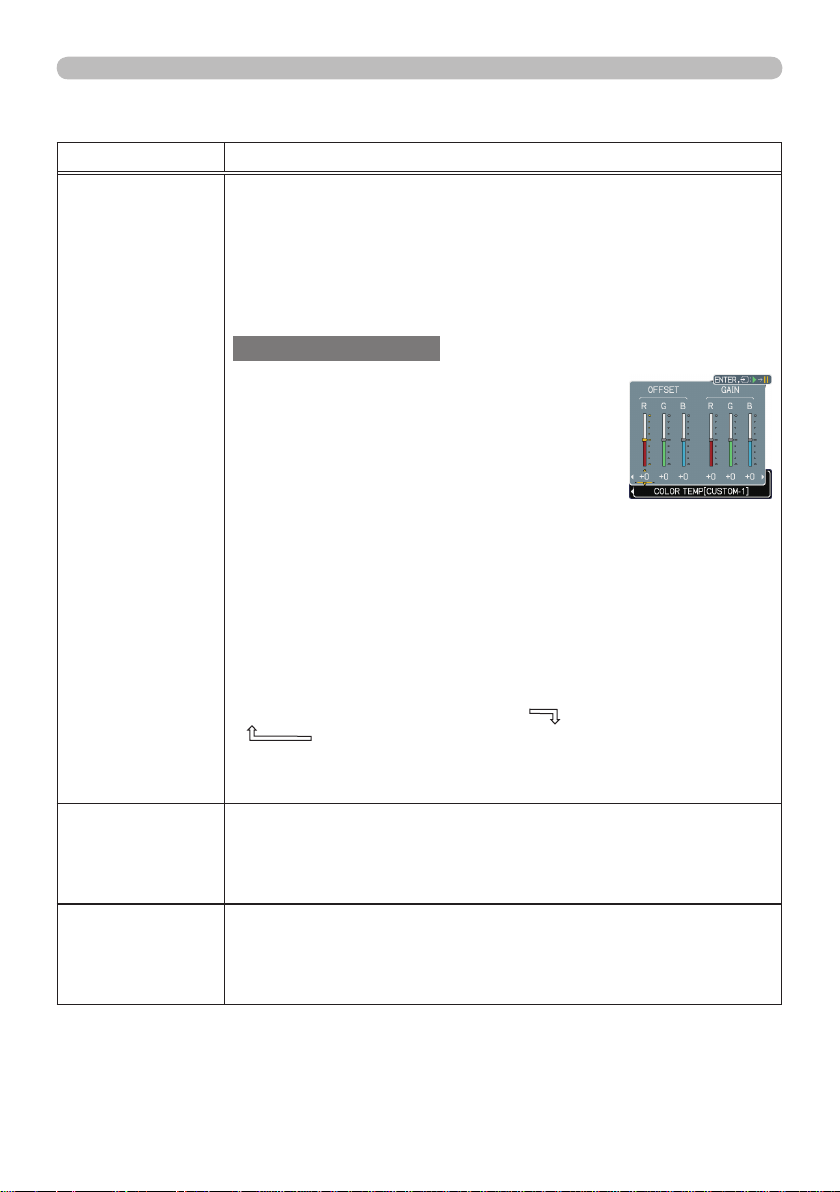
COLOR TEMP
Using the ▲/▼ buttons switches the color temperature mode.
To adjust CUSTOM
Selecting a mode whose name includes
CUSTOM and then pressing the ► button or the
ENTER button displays a dialog to aid you in
adjusting the OFFSET and GAIN of the selected
mode.
OFFSET adjustments change the color intensity
on the whole tones of the test pattern.
GAIN adjustments mainly affect color intensity
on the brighter tones of the test pattern.
Choose an item using the ◄/► buttons, and adjust the level using
the ▲/▼ buttons.
You can display a test pattern for checking the effect of your
adjustment by pressing the ENTER button.
Each time you press the ENTER button, the pattern changes as
below.
No pattern
ð
Gray scale of 9 steps
Ramp
Gray scale of 15 steps
• When this function is performed, lines or other distortion may
appear.
COLOR
Using the ▲/▼ buttons adjusts the strength of whole color.
Strong
ó
Weak
• This item can be selected only for a video signal, s-video, or
component video signal.
TINT
Using the ▲/▼ buttons adjusts the tint.
Greenish
ó
Reddish
• This item can be selected only for a video signal, s-video, or
component video signal.
#2 MID CUSTOM
#3 LOW DEFAULT
#3 LOW CUSTOM
#1 HIGH DEFAULT
#1 HIGH CUSTOM
#2 MID DEFAULT
#6 Hi-BRIGHT-3 CUSTOM
#6 Hi-BRIGHT-3 DEFAULT
#5 Hi-BRIGHT-2 CUSTOM
#5 Hi-BRIGHT-2 DEFAULT
#4 Hi-BRIGHT-1 CUSTOM
#4 Hi-BRIGHT-1 DEFAULT
(continued on next page)
30
PICTURE menu
PICTURE menu (continued)
Item Description
SHARPNESS
Using the ▲/▼ buttons adjusts the sharpness.
Strong
ó
Weak
• There may be some noise and/or the screen may icker for a
moment when an adjustment is made. This is not a malfunction.
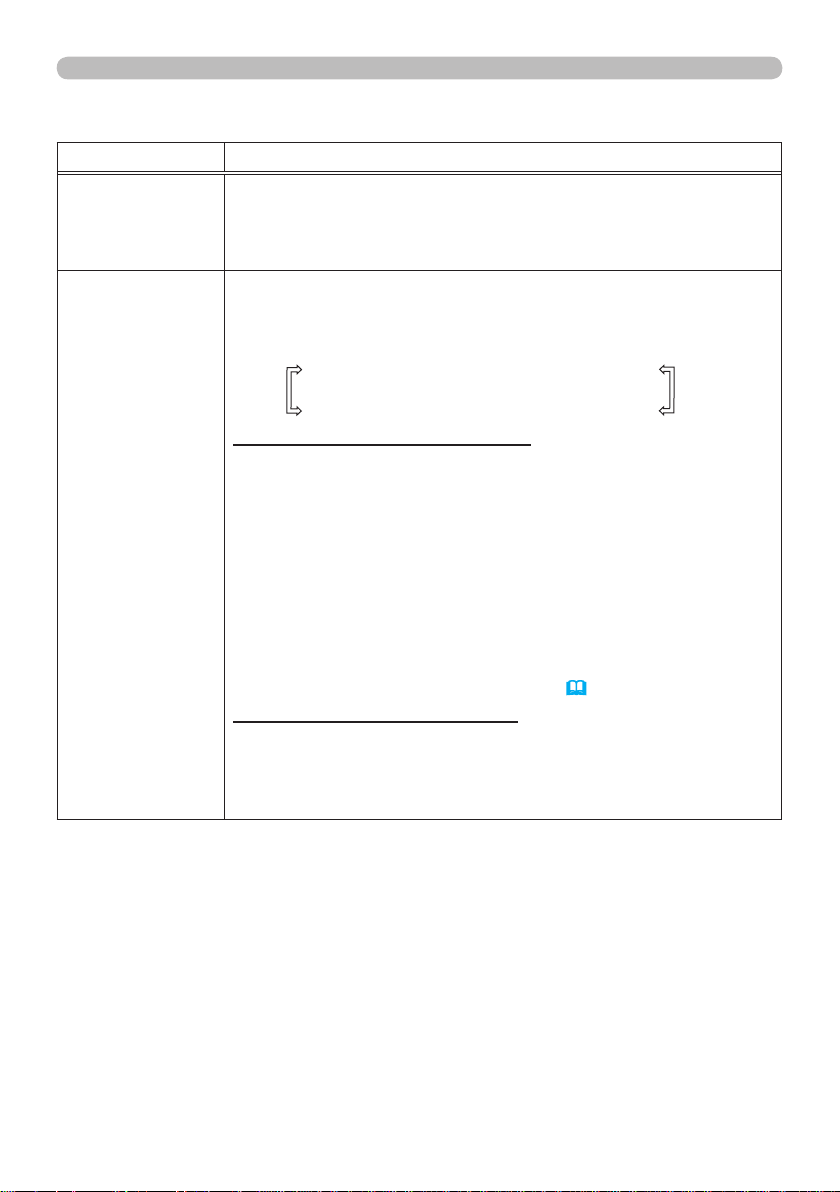
MY MEMORY
This projector has 4 memories for adjustment data (for all the items
of PICTURE menu).
Selecting a function using the ▲/▼ buttons and pressing the ► or
ENTER button performs each function.
LOAD-1
ó
LOAD-2
ó
LOAD-3
ó
LOAD-4
SAVE-4
ó
SAVE-3
ó
SAVE-2
ó
SAVE-1
LOAD-1, LOAD-2, LOAD-3, LOAD-4
Performing a LOAD function loads the data from the memory linked
in the number included in the function’s name, and adjusts the
picture automatically depending on the data.
• The LOAD functions whose linked memory has no data are
skipped.
• Remember that the current adjusted condition will be lost by
loading data. If you want to keep the current adjustment, please
save it before performing a LOAD function.
• There may be some noise and the screen may icker for a
moment when loading data. This is not malfunction.
• You can perform the LOAD function using MY BUTTONs. Please
see MY BUTTON item in OPTION menu (
46).
SAVE-1, SAVE-2, SAVE-3, SAVE-4
Performing a SAVE function saves the current adjustment data into
the memory linked in the number included in the function’s name.
• Remember that the current data being stored of a memory will be
lost by saving a new data into the memory.
31
IMAGE menu
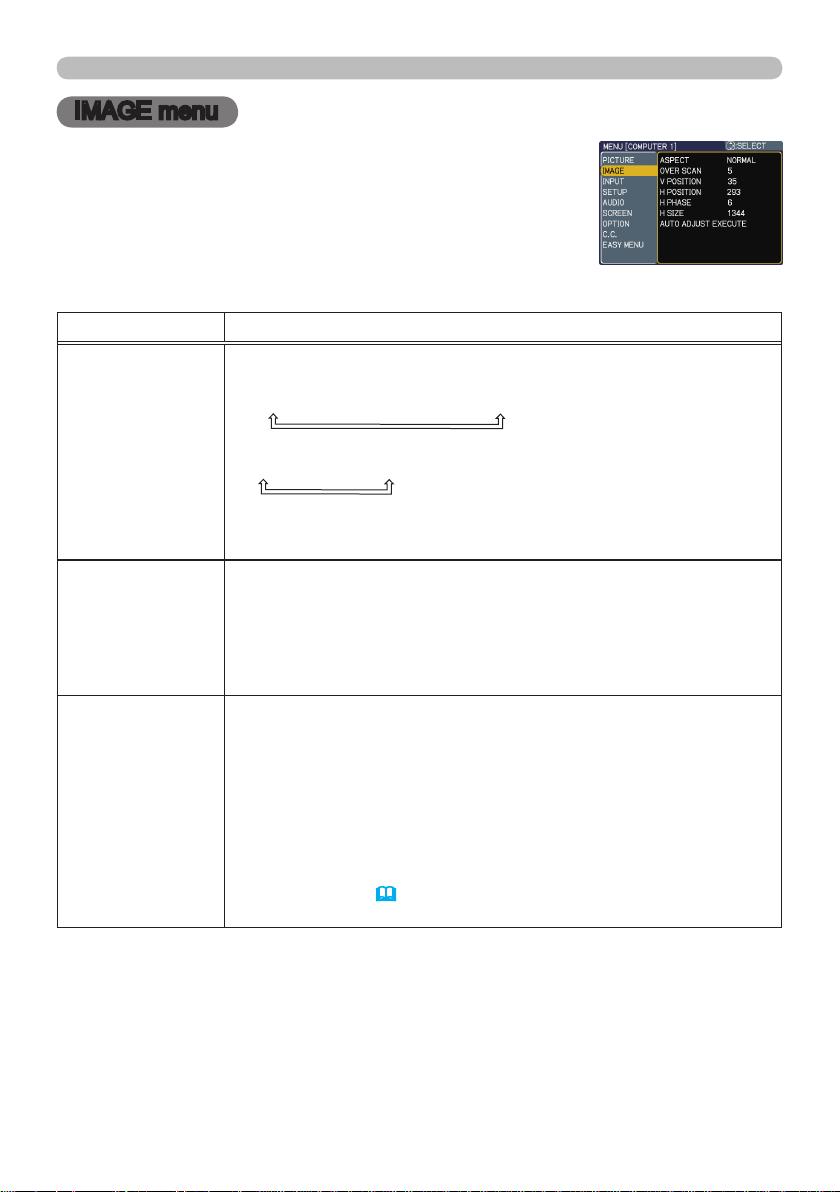
IMAGE menu
From the IMAGE menu, items shown in the table below
can be performed.
Select an item using the ▲/▼ cursor buttons, and press
the ► cursor button or ENTER button to execute the item.
Then perform it according to the following table.
Item Description
ASPECT
Using the ▲/▼ buttons switches the mode for aspect ratio.
For a computer signal
NORMAL
ó
4:3
ó
16:9
ó
16:10
For a Video signal, S-video signal or Component video signal
4:3
ó
16:9
ó
14:9
For no signal
4:3 (xed)
• The NORMAL mode keeps the original aspect ratio of the signal.
OVER SCAN
Using the ▲/▼ buttons adjusts the over-scan ratio.
Large (It reduces picture)
ó
Small (It magnies picture)
• This item can be selected only for a video, s-video and component
video signal.
• When this adjustment is too large, certain degradation may appear
at the frame area of the picture. In such a case, please adjust small.
V POSITION
Using the ▲/▼ buttons adjusts the vertical position.
Up
ó
Down
• Over-adjusting the vertical position may cause noise to appear
on the screen. If this occurs please reset the vertical position to the
default setting.
Pressing RESET button when V POSITION is selected will reset V
POSITION to the default setting.
• When this function is performed on a video signal, s-video signal,
or component video signal, the range of this adjustment depends
on OVER SCAN (
above) setting. It is not possible to adjust when
OVER SCAN is set to 10.
(continued on next page)
32
IMAGE menu
IMAGE menu (continued)
Item Description
H POSITION
Using the ▲/▼ buttons adjusts the horizontal position.
Left
ó
Right
• Over-adjusting the horizontal position may cause noise to appear
on the screen. If this occurs please reset the horizontal position to
the default setting. Pressing RESET button when H POSITION is
selected will reset H POSITION to the default setting.
• When this function is performed on a video signal, s-video signal,
or component video signal, the range of this adjustment depends on
OVER SCAN (
31) setting. It is not possible to adjust when OVER
SCAN is set to 10.
H PHASE
Using the ▲/▼ buttons adjusts the horizontal phase to eliminate icker.
Right
ó
Left
• This item can be selected only for a computer signal or component
video signal.
H SIZE
Using the ▲/▼ buttons adjusts the horizontal size.
Large
ó
Small
•
This item can be selected only for a computer signal.
• When this adjustment is excessive, the picture may not be
displayed correctly. In such a case, please reset the adjustment by
pressing the RESET button during this operation.
AUTO ADJUST
EXECUTE
Executing this item performs the automatic adjustment feature.
For a computer signal
The vertical position, the horizontal position and the horizontal
phase (
32) will be automatically adjusted. Make sure that the
application window is set to its maximum size prior to attempting to
use this feature. A dark picture may still be incorrectly adjusted. Use
a bright picture when adjusting.
For a video signal and s-video signal
The video format best suited for the respective input signal will
be selected automatically. This function is available only when
the AUTO is selected for the VIDEO FORMAT item in the INPUT
menu (
34). The vertical position and horizontal position will be
automatically set to the default.
For a component video signal
The vertical position, horizontal position and horizontal phase will
be automatically set to the default.
• The automatic adjustment operation requires approx. 10 seconds.
Also please note that it may not function correctly with some input.
When this function is performed for a video signal, a certain extra
such as a line may appear outside a picture.
• The items adjusted by this function may vary when the FINE or
DISABLE is selected for the AUTO ADJUST item of the SERVICE
item in the OPTION menu (
47).
33
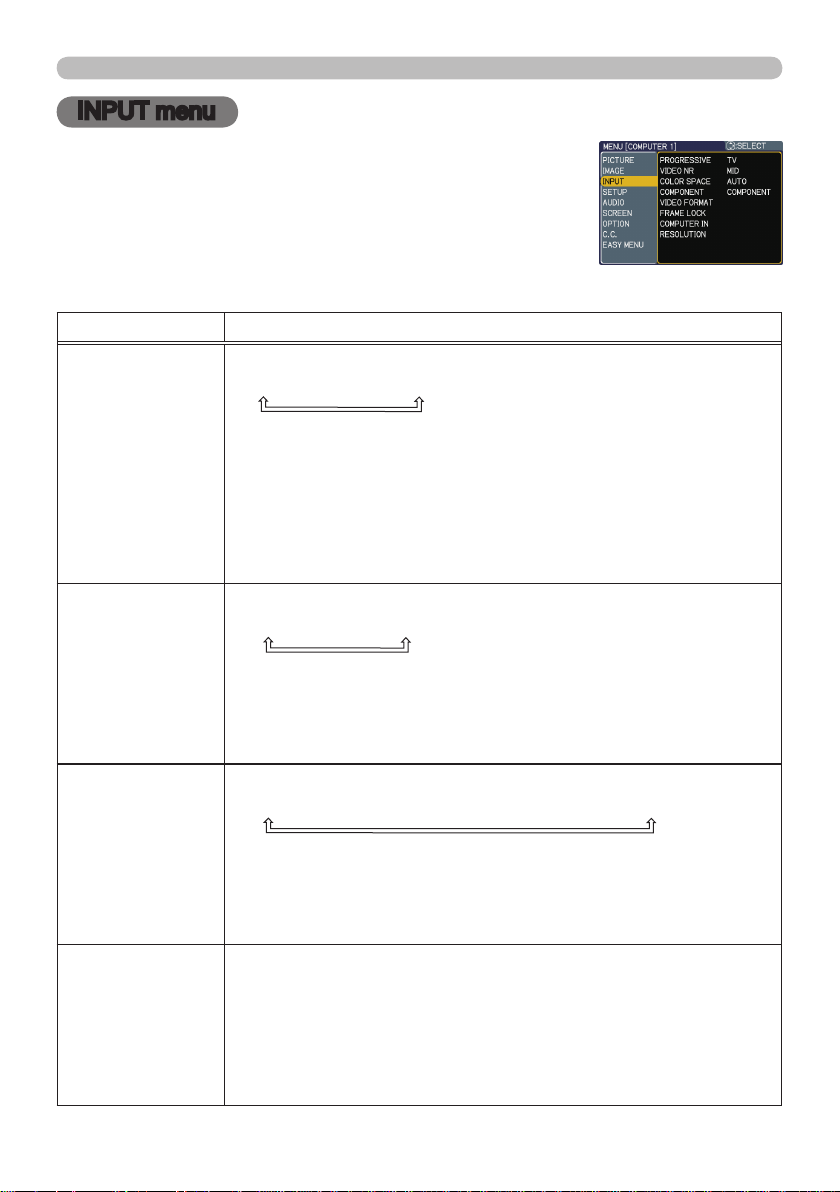
INPUT menu
INPUT menu
From the INPUT menu, items shown in the table below
can be performed.
Select an item using the ▲/▼ cursor buttons, and press
the ► cursor button or ENTER button to execute the item.
Then perform it according to the following table.
Item Description
PROGRESSIVE
Using the ▲/▼ buttons switches the progress mode.
TV
ó
FILM
ó
TURN OFF
• This function is performed only for an interlaced signal at the
VIDEO or S-VIDEO input, and for 480i@60 or 576i@50 signal at
the COMPONENT VIDEO input.
• When TV or FILM is selected, the screen image will be sharp.
FILM adapts to the 2-3 Pull-Down conversion system. But these
may cause a certain defect (for example, jagged line) of the picture
for a quick moving object. In such a case, please select TURN OFF,
even though the screen image may lose the sharpness.
VIDEO NR
Using the ▲/▼ buttons switches the noise reduction mode.
HIGH
ó
MID
ó
LOW
• This function is performed only for the VIDEO or S-VIDEO input,
and for 480i@60 or 576i@50 signal at the COMPONENT VIDEO
input.
• When this function is excessive, it may cause a certain
degradation of the picture.
COLOR SPACE
Using the ▲/▼ buttons switches the mode for color space.
AUTO
ó
RGB
ó
SMPTE240
ó
REC709
ó
REC601
• This item can be selected only for a computer signal or component
video signal except SCART RGB signal.
• The AUTO mode automatically selects the optimum mode.
• The AUTO operation may not work well at some signals. In such a
case, it might be good to select a suitable mode except AUTO.
COMPONENT
Using the ▲/▼ buttons switches the function of the COMPONENT
(Y, C
B/PB, CR/PR) port.
COMPONENT
ó
SCART RGB
When the SCART RGB is selected, COMPONENT (Y, C
B/PB, CR/
P
R) and VIDEO ports will function as a SCART RGB port. A SCART
cable is required for a SCART RGB input to the projector. For your
reference, see the TECHNICAL part.
(continued on next page)
34
INPUT menu
INPUT menu (continued)
Item Description
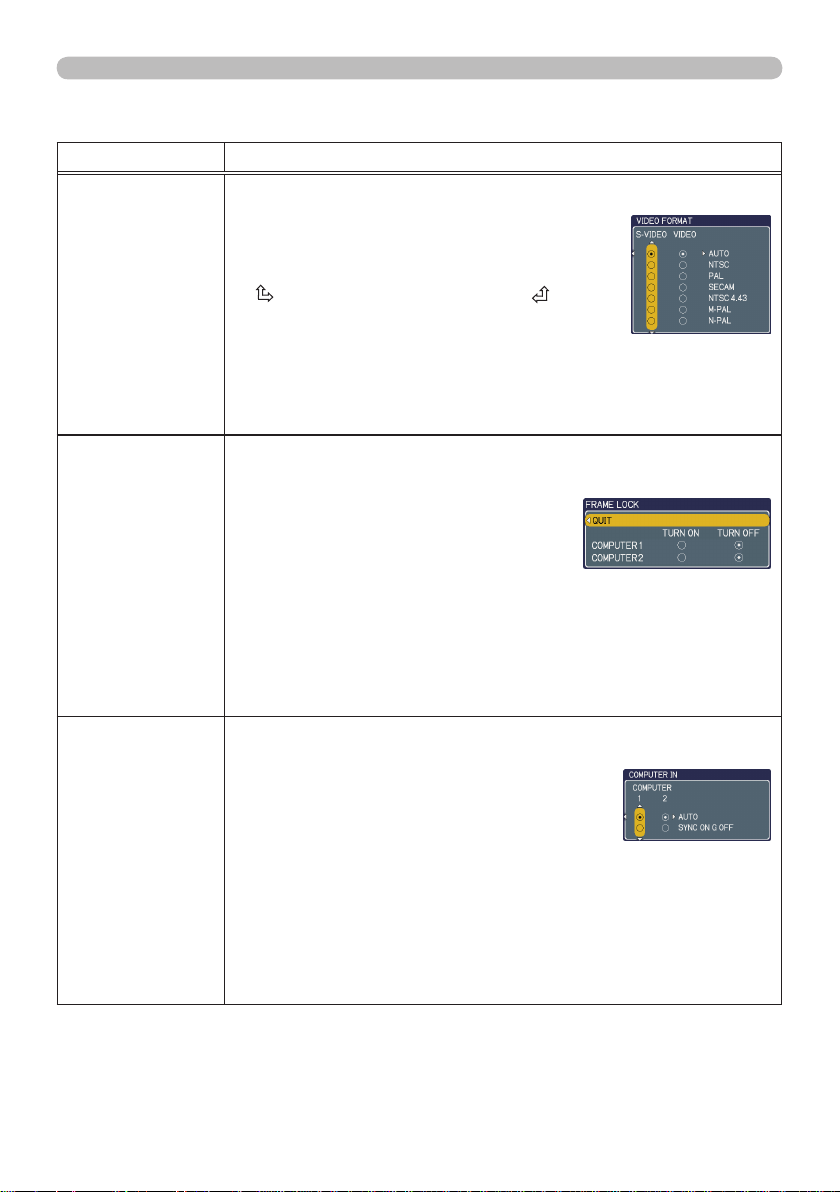
VIDEO FORMAT
The video format for S-VIDEO port and VIDEO port can be set.
(1) Use the ◄/► buttons to select the input port.
(2) Using the ▲/▼ buttons switches the mode
for video format.
AUTO
ó
NTSC
ó
PAL
ó
SECAM
N-PAL
ó
M-PAL
ó
NTSC4.43
• This item is performed only for a video signal
from VIDEO port or S-VIDEO port.
• The AUTO mode automatically selects the optimum mode.
• The AUTO operation may not work well for some signals. If the
picture becomes unstable (e.g. an irregular picture, lack of color),
please select the mode according to the input signal.
FRAME LOCK
Set the frame lock function on/off for each port.
(1) Using the ▲/▼ buttons to select one of
following ports.
COMPUTER (IN)1
ó
COMPUTER (IN)2
(2) Using the ◄/► buttons to turns the
frame lock function on/off.
TURN ON
ó
TURN OFF
• This item can be performed only on a signal with a vertical
frequency of 50 to 60 Hz.
• When the TURN ON is selected, a moving pictures are displayed
more smoothly.
• This function may cause a certain degradation of the picture. In
such a case, please select TURN OFF.
COMPUTER IN
The computer input signal type for COMPUTER IN1 and IN2 ports
can be set.
(1) Use the ◄/► buttons to select the input
port to be set.
COMPUTER (IN)1
ó
COMPUTER (IN)2
(2) Use the ▲/▼ buttons to select the
computer input signal type.
AUTO
ó
SYNC ON G OFF
Selecting AUTO allows reception of sync on G signal.
• When AUTO is selected, the picture may be distorted with certain
input signals. In such a case, remove the signal connector rst
and select SYNC ON G OFF on the menu, and then reconnect the
signal.
(continued on next page)
35
INPUT menu
INPUT menu (continued)
Item Description
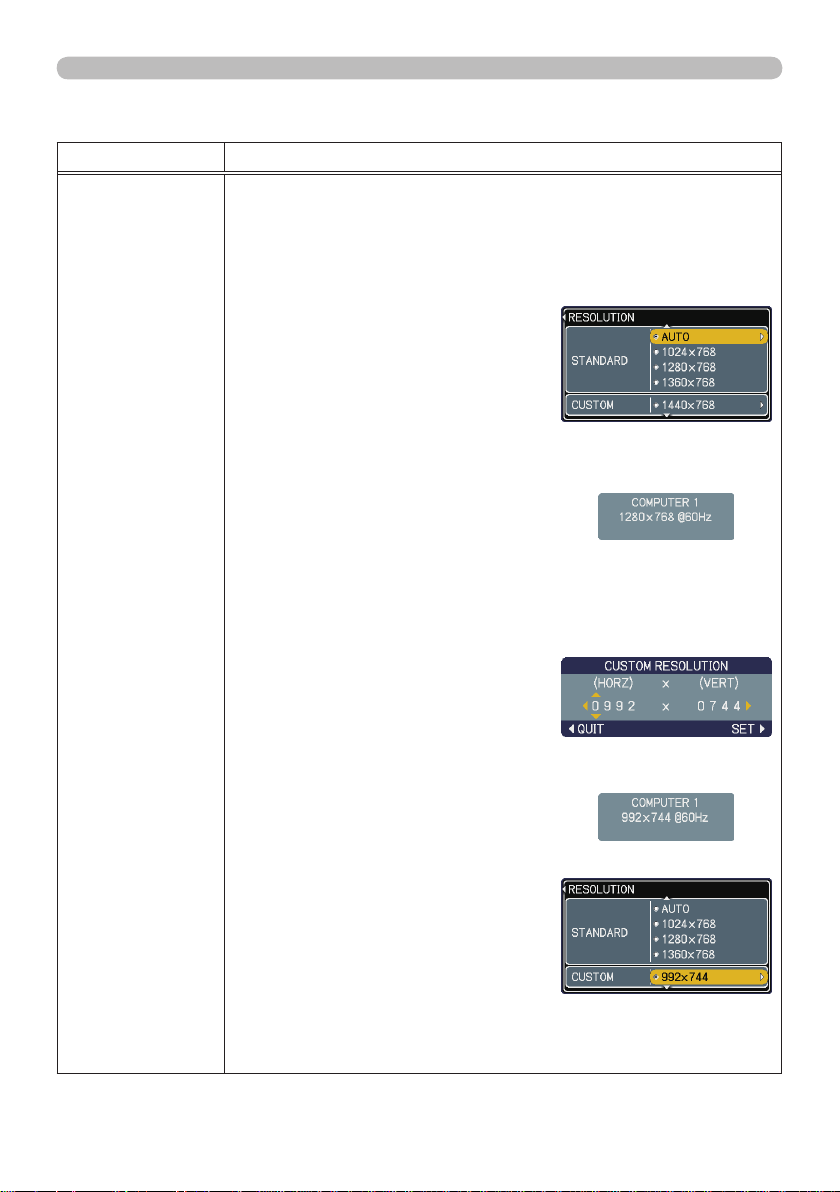
RESOLUTION
The resolution for the COMPUTER IN1 and IN2 input signals can
be set on this projector.
(1) In the INPUT menu select the RESOLUTION using the ▲/▼
buttons and press the ► button.
The RESOLUTION menu will be displayed.
(2) In the RESOLUTION menu, select
the resolution you wish to display using
the ▲/▼ buttons.
Selecting AUTO will set a resolution
appropriate to the input signal.
(3) STANDARD
Pressing the ► or ENTER button when
selecting a STANDARD resolution will
automatically adjust the horizontal and
vertical positions, clock phase and
horizontal size and automatically select
an aspect ratio.
(3) CUSTOM
(3)-1 To set a custom resolution use the
▲/▼ buttons to select the CUSTOM
and the CUSTOM RESOLUTION
box will be displayed. Set the
horizontal (HORZ) and vertical
(VERT) resolutions using the ▲/▼
/◄/► buttons. It is not guaranteed
to work this function properly on any
resolutions.
(3)-2 To save the setting place the
cursor on the right-most digit and
press the ► button.
The horizontal and vertical positions,
clock phase and horizontal size will
be automatically adjusted.
(3)-3 To revert back to the previous
resolution without saving changes
place the cursor on the left-most
digit and press the ◄ button.
The screen will then return to the
RESOLUTION menu displaying the
previous resolution.
• For some pictures, this function may not work well.
STANDARD
↓
CUSTOM
↓
36
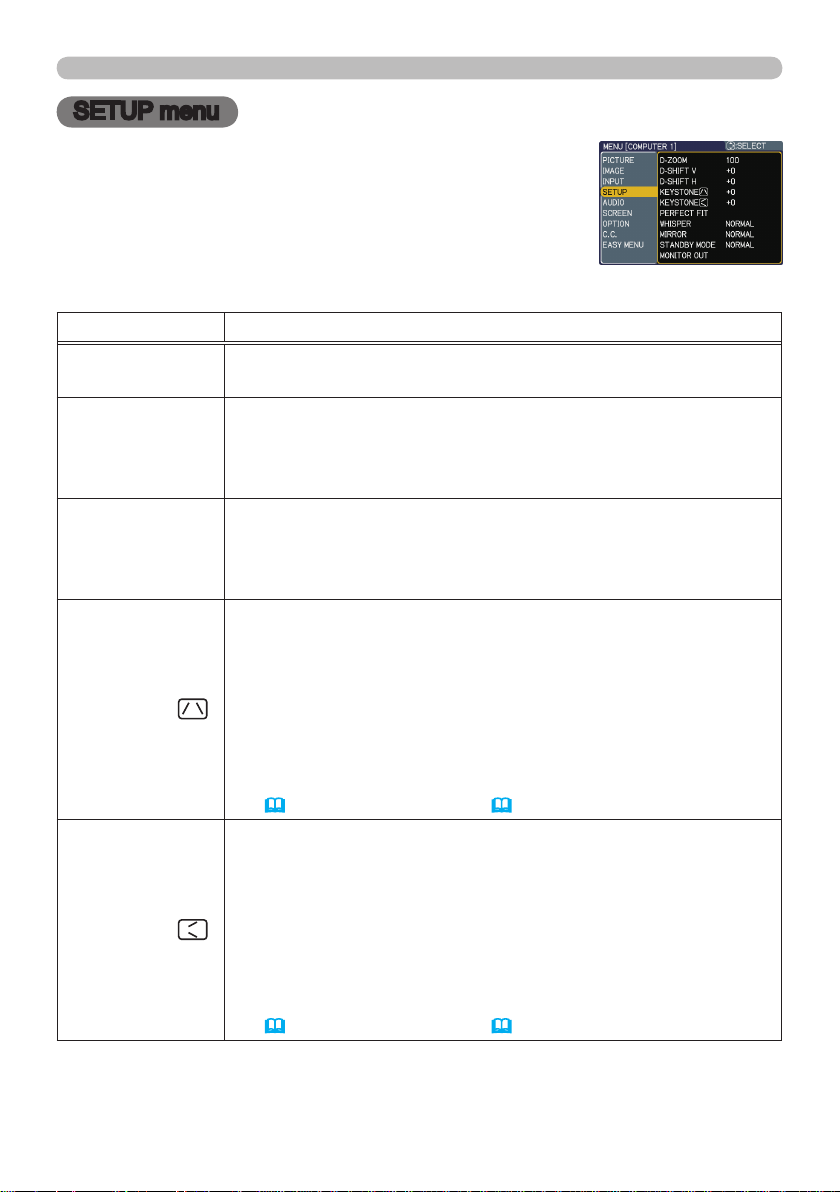
SETUP menu
SETUP menu
From the SETUP menu, items shown in the table below
can be performed.
Select an item using the ▲/▼ cursor buttons, and press
the ► cursor button or the ENTER button to execute the
item. Then perform it according to the following table.
Item Description
D-ZOOM
Using the ▲/▼ buttons adjusts the zoom.
Large
ó
Small
D-SHIFT V
Using the ▲/▼ buttons adjusts the vertical picture position.
Up
ó
Down
• The function is not available, if the D-ZOOM is adjusted to 100 (full
screen) on its dialog.
D-SHIFT H
Using the ▲/▼ buttons adjusts the horizontal picture position.
Right
ó
Left
• The function is not available, if the D-ZOOM is adjusted to 100 (full
screen) on its dialog.
KEYSTONE
Using the ▲/▼ buttons corrects the vertical keystone distortion.
Shrink the top of the image
ó
Shrink the bottom of the image
• The adjustable range of this function will vary among inputs. For
some input, this function may not work well.
• When the zoom adjustment is set to the TELE (telephoto focus),
this function may be excessive. This function should be used when
the zoom adjustment is set to the full WIDE (wide-angle focus)
whenever possible.
• This function will be unavailable when the Transition Detector is
on (
53) or the PERFECT FIT (
37) is adjusted.
KEYSTONE
Using the ▲/▼ buttons corrects the horizontal keystone distortion.
Shrink the right of the image
ó
Shrink the left of the image
• The adjustable range of this function will vary among inputs. For
some input, this function may not work well.
• When the zoom adjustment is set to the TELE (telephoto focus),
this function may be excessive. This function should be used when
the zoom adjustment is set to the full WIDE (wide-angle focus)
whenever possible.
• This function will be unavailable when the Transition Detector is
on (
53) or the PERFECT FIT (
37) is adjusted.
(continued on next page)

37
Item Description
PERFECT FIT
This item allows you to adjust the shape of the projected image in
each of the corners.
(1) Choose the corner to adjust using
the ▲/▼/◄/► buttons and press the
ENTER or INPUT button.
(2) Use the ▲/▼/◄/► buttons to adjust
the position of the corner.
Press the ENTER or INPUT button to
exit the adjustment of the corner.
(3) To adjust another corner, follow the
same procedure from (1) above.
To reset the adjustment of all the corners, select RESET using
the ▲/▼ buttons and press the ENTER or INPUT button.
• While this item is adjusted, keystone adjustment feature (
36) is
unavailable. To correct the keystone distortion, reset the adjustment
of all the corners.
• The adjustable range of this correction will vary among inputs. For
some input, this function may not work well.
• This function will be unavailable when the Transition Detector is
on (
53).
WHISPER
Using the ▲/▼ buttons turns off/on the whisper mode.
NORMAL ó WHISPER
• When WHISPER is selected, acoustic noise and screen brightness
are reduced.
MIRROR
Using the ▲/▼ buttons switches the mode for mirror status.
NORMAL ó H:INVERT ó V:INVERT ó H&V:INVERT
If the Transition Detector is TURN ON and MIRROR status is
changed, Transition Detector Alarm (
53) will be displayed when
projector is restarted after the power switch is turned off.
SETUP menu
SETUP menu (continued)
(continued on next page)
38
SETUP menu
SETUP menu (continued)
Item Description
STANDBY MODE
Using ▲/▼ buttons switches the standby mode setting between
NORMAL and SAVING.
NORMAL
ó
SAVING
When SAVING is selected, the power consumption in the standby
mode is lowered with some functional restriction as below:
• When SAVING is selected, the communication control (RS-232C)
is disabled except to turn the projector on while the projector is in
the standby mode.
• When SAVING is selected, AUDIO OUT STANDBY setting of
AUDIO (
39) is invalid, and no signal is output from AUDIO OUT
ports in the standby mode.
MONITOR OUT
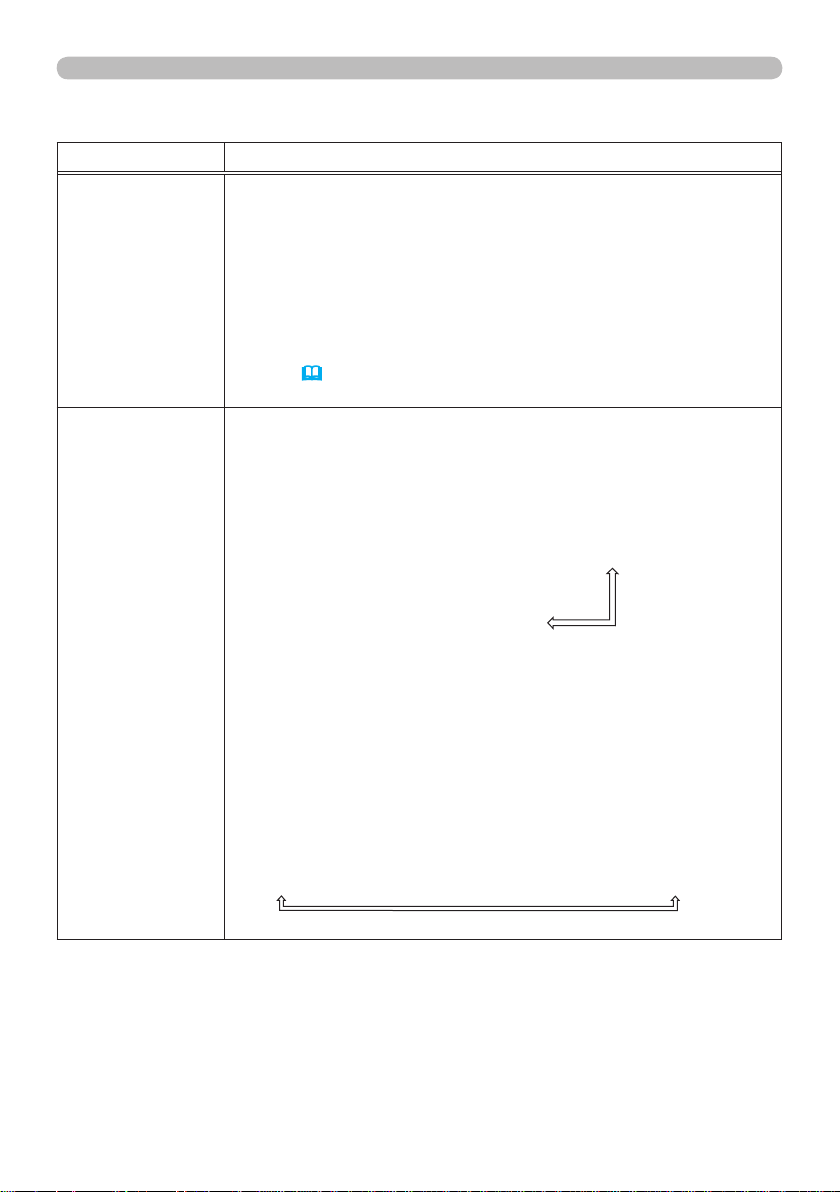
The combination of a picture shown on screen and output from the
MONITOR OUT port can be arranged in the menu.
The picture coming into the port selected in the (2) is output to the
MONITOR OUT port while an image from the port chosen in the (1)
is on screen.
(1) Choose a picture input port using ▲/▼ buttons.
• Choose STANDBY, to select the output signal from the MONITOR
OUT port in the standby mode.
• While QUIT is selected, pressing the ◄ button returns to the
previous menu.
(2) Select one of the COMPUTER IN ports using ◄/► buttons.
Choosing the COMPUTER 1 allows the following choice.
1 (COMPUTER IN1)
ó
OFF
Choosing the COMPUTER 2 allows the following choice.
2 (COMPUTER IN2)
ó
OFF
Choosing other input or STANDBY allows the following choice.
1 (COMPUTER IN1)
ó
2 (COMPUTER IN2)
ó
OFF
• OFF disables the MONITOR OUT port.
QUIT
ó
COMPUTER(IN)1
ó
COMPUTER(IN)2
STANDBY
VIDEO
ó
S-VIDEO
ó
COMPONENT
(Y, CB/PB, Cr/Pr)
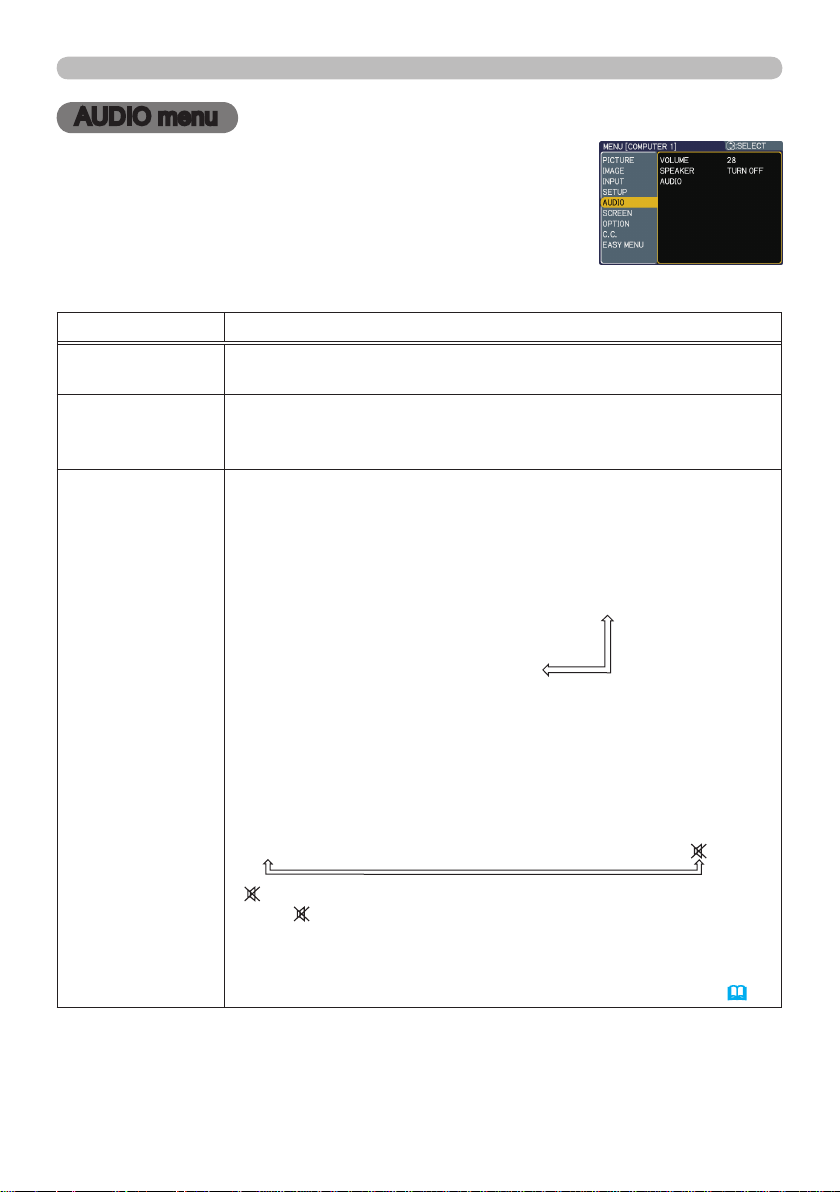
39
AUDIO menu
AUDIO menu
From the AUDIO menu, items shown in the table below
can be performed. Select an item using the ▲/▼ cursor
buttons, and press the ► cursor button or the ENTER
button to execute the item. Then perform it according to
the following table.
Item Description
VOLUME
Using the ▲/▼ buttons adjusts the volume.
High
ó
Low
SPEAKER
Using the ▲/▼ buttons turns on/off the built-in speaker.
TURN ON
ó
TURN OFF
When TURN OFF is selected, the built-in speaker does not work.
AUDIO
The combination of a picture and audio input port can be arranged
in the menu.
The audio coming into the port selected in the (2) is output while an
image from the port chosen in the (1) is on screen.
(1) Choose a picture input port using the ▲/▼ buttons.
• Choose AUDIO OUT STANDBY, to select the audio output to the
AUDIO OUT port in the standby mode. The built-in speaker does
not work in the standby mode.
• While QUIT is selected, pressing the ◄ button returns to the
previous menu.
(2) Select one of the AUDIO IN ports using ◄/► buttons.
1 (AUDIO IN1)
ó
2 (AUDIO IN2)
ó
3 (AUDIO IN3)
ó
• disables the audio output.
•
When is selected to VIDEO(NTSC), S-VIDEO(NTSC),
COMPONENT(480i@60), COMPUTER IN1(480i@60) and
COMPUTER IN2(480i@60), the C.C.(Closed Caption) is automatically
activated, if the C.C. is set to AUTO in the DISPLAY menu of the C.C.
menu and the signal from the input port supports the C.C. feature (
57).
QUIT
ó
COMPUTER(IN)1
ó
COMPUTER(IN)2
AUDIO OUT STANDBY
VIDEO
ó
S-VIDEO
ó
COMPONENT
(Y, CB/PB, Cr/Pr)

40
SCREEN menu
SCREEN menu
From the SCREEN menu, items shown in the table below
can be performed.
Select an item using the ▲/▼ cursor buttons, and press
the ► cursor button or ENTER button to execute the item.
Then perform it according to the following table.
Item Description
LANGUAGE
Using the ▲/▼ buttons switches the OSD (On Screen Display) language.
ENGLISH � FRANÇAIS � DEUTSCH � ESPAÑOL
MENU POSITION
Using the ▲/▼/◄/► buttons adjusts the menu position.
To quit the operation, press MENU button on the remote control or
keep no operation for about 10 seconds.
BLANK
Using the ▲/▼ buttons switches the mode for the BLANK screen.
The BLANK screen is a screen for the temporarily blanking feature
(
23). It is displayed by pressing BLANK button.
MyScreen
ó
ORIGINAL
ó
BLUE
ó
WHITE
ó
BLACK
Feature
MyScreen
Screen can be registered by the MyScreen item
(
41)
.
ORIGINAL Screen preset as the standard screen.
BLUE, WHITE,
BLACK
Plain screens in each color.
• To avoid remaining as an afterimage, the MyScreen or ORIGINAL
screen will change to the plain black screen after several minutes.
START UP
Using the ▲/▼ buttons switches the mode for the start-up screen.
The start-up screen is a screen displayed when no signal or an
unsuitable signal is detected.
MyScreen
ó
ORIGINAL
ó
TURN OFF
Feature
MyScreen
Screen can be registered by the MyScreen item
(
41)
.
ORIGINAL Screen preset as the standard screen.
TURN OFF Plain black screen.
• To avoid remaining as an afterimage, the MyScreen or ORIGINAL
screen will change to the BLANK screen (
40) after several
minutes. If also the BLANK screen is the MyScreen or ORIGINAL,
the plain black screen is instead used.
• When the TURN ON is selected to the MyScreen PASSWORD of
SECURITY item in OPTION menu (
50), the START UP is fixed to
MyScreen.
(continued on next page)
...
(shown in the LANGUAGE dialog)
...
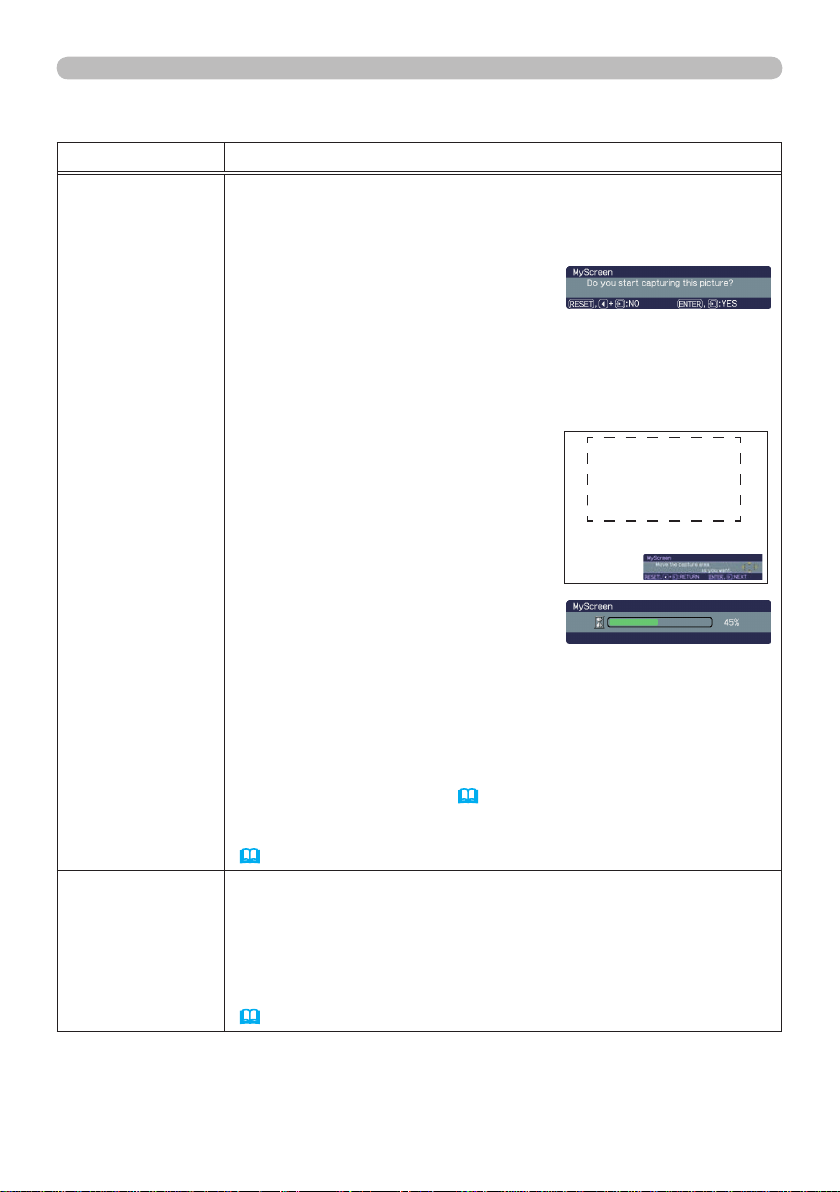
41
SCREEN menu
SCREEN menu (continued)
Item Description
MyScreen
This item allows you to capture an image for use as a MyScreen
image which can be used as the BLANK screen and START UP
screen. Display the image you want to capture before executing the
following procedure.
1. Selecting this item displays a dialog
titled “MyScreen”. It will ask you if
you start capturing an image from
the current screen.
Please wait for the target image to be displayed, and press the
ENTER button when the image is displayed. The image will
freeze and the frame for capturing will appear.
To stop performing, press the RESET or ESC button.
2. Using the ▲/▼/◄/► buttons adjusts
the frame position.
Please move the frame to the position
of the image which you want to use.
The frame may not be able to be
moved for some input signals.
To start registration, press the ENTER
button.
To restore the screen and return to
the previous dialog, press the RESET
or ESC button.
Registration takes several minutes.
When the registration is completed, the registered screen and
the following message are displayed for several seconds:
“MyScreen registration is nished.”
If the registration failed, the following message is displayed:
“A capturing error has occurred. Please try again.”
• This function cannot be selected when the TURN ON is selected
to the MyScreen Lock item (
below).
• This function cannot be selected when TURN ON is selected to
the MyScreen PASSWORD of SECURITY item in OPTION menu
(
50).
MyScreen Lock
Using the ▲/▼ buttons turns on/off the MyScreen lock function.
TURN ON
ó
TURN OFF
When the TURN ON is selected, the MyScreen item is locked. Use
this function for protecting the current MyScreen.
• This function cannot be selected when TURN ON is selected to
the MyScreen PASSWORD of SECURITY item in OPTION menu
(
50).
(continued on next page)
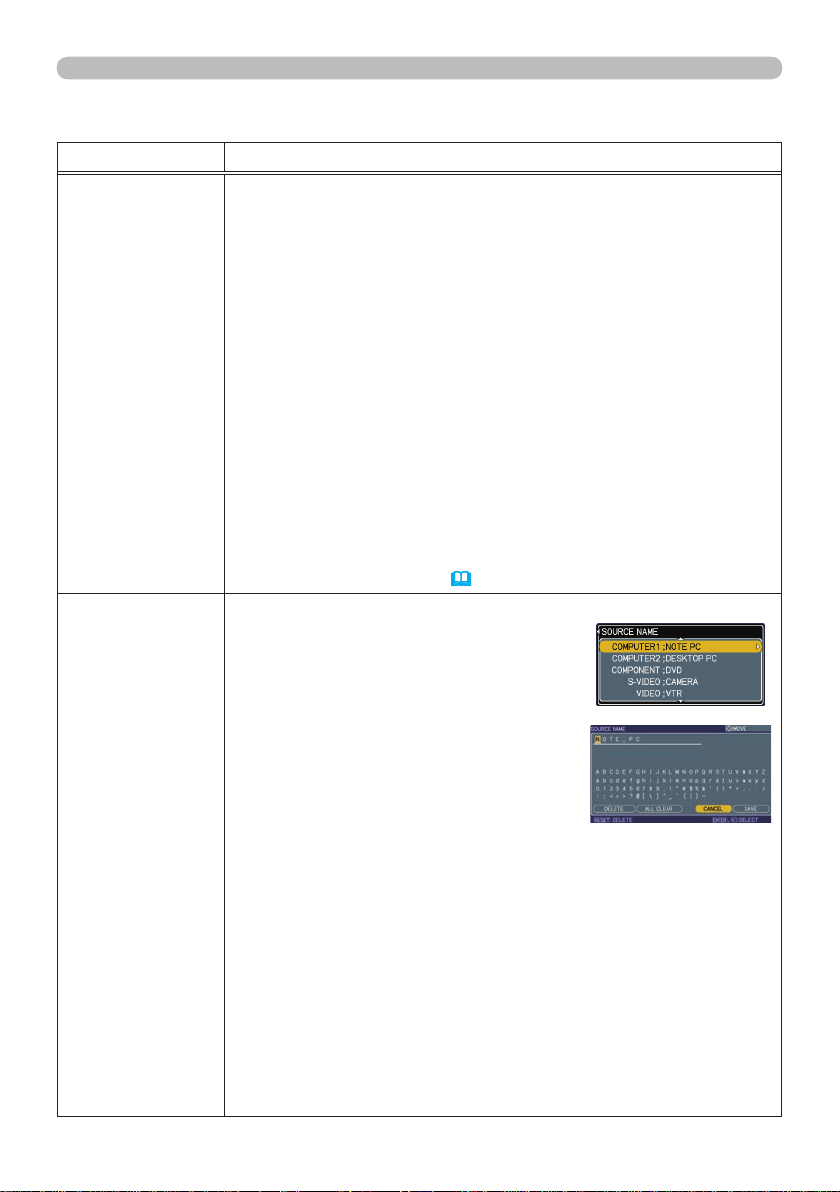
42
SCREEN menu
SCREEN menu (continued)
Item Description
MESSAGE
Using the ▲/▼ buttons turns on/off the message function.
TURN ON
ó
TURN OFF
When the TURN ON is selected, the following message function works.
“AUTO IN PROGRESS” while automatically adjusting
“NO INPUT IS DETECTED”
“SYNC IS OUT OF RANGE”
“INVALID SCAN FREQ.”
“Searching…” while searching for the input
“Detecting…” while an input signal is detected
The indication of the input signal displayed by changing
The indication of the aspect ratio displayed by changing
The indication of the PICTURE MODE displayed by changing
The indication of the MY MEMORY displayed by changing
The indication of the TEMPLATE displayed by changing
The indication of "+++ FOCUS +++" displayed by changing
The D-ZOOM dialog displayed by changing
The indication of “FREEZE” and “II” while the projector is in the FREEZE mode.
• If the projector goes into the FREEZE mode while the TURN OFF
is selected, the picture on screen is frozen without any messages,
which is not a malfunction (
23).
SOURCE NAME
Each input port for this projector can have a name applied to it.
(1)
Use the
▲/▼
buttons on the SCREEN menu to
select SOURCE NAME and press the
►
button.
The SOURCE NAME menu will be displayed.
(2) Use the ▲/▼ buttons on the SOURCE
NAME menu to select the port to be named
and press the ► button. Right side of the
menu is blank until a name is specied.
The SOURCE NAME dialog will be displayed.
(3)
The current name will be displayed on the
rst line. Use the
▲/▼/◄/►
buttons and the
ENTER or INPUT button to select and enter characters. The RESET
button can be used to erase 1 character at a time. Also if you move the
cursor to DELETE or ALL CLEAR on screen and push the ENTER or
INPUT button, 1 character or all characters will be erased. The name can
be a maximum of 16 characters.
(4)
To change an already inserted character, press the (
▲
) button to
move the cursor to the rst line, and use the
◄/►
buttons to move the
cursor on the character to be changed.
After pressing the ENTER or INPUT button, the character is selected.
Then, follow the same procedure as described at the item (3) above.
(5) To nish entering text, move the cursor to the SAVE on screen
and press the ENTER or INPUT button. To revert to the previous
name without saving changes, move the cursor to the CANCEL on
screen and press the ENTER or INPUT button.
(continued on next page)
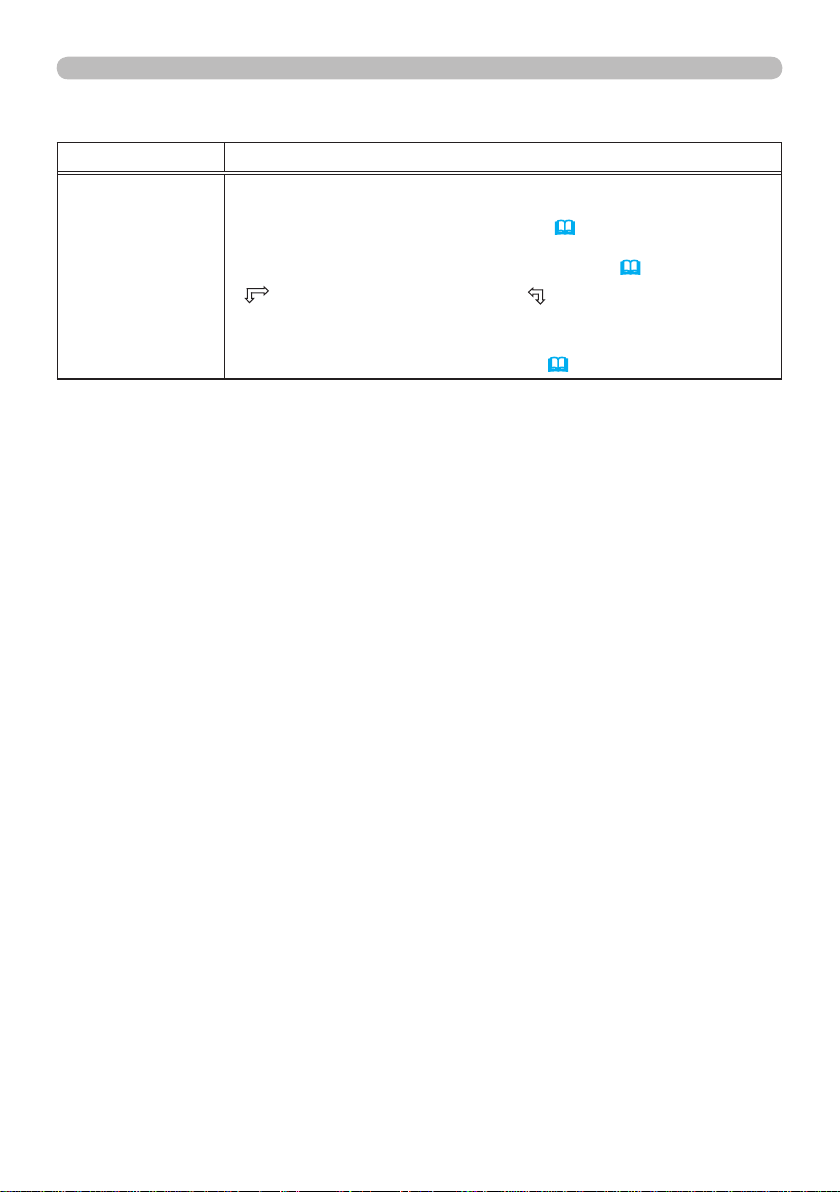
43
SCREEN menu
SCREEN menu (continued)
Item Description
TEMPLATE
Using the ▲/▼ buttons switches the mode for the template screen.
Press the ► button to display the selected template, and press the
◄ button to close the displayed screen (
5).
The last selected template is displayed when the MY BUTTON
allocated to the TEMPLATE function is pressed (
46).
TEST PATTERN
ó
DOT-LINE1
DOT-LINE4
ó
DOT-LINE3
ó
DOT-LINE2
• To focus the picture, use the FOCUS+/- buttons on the remote
control while the template is displayed (
21).
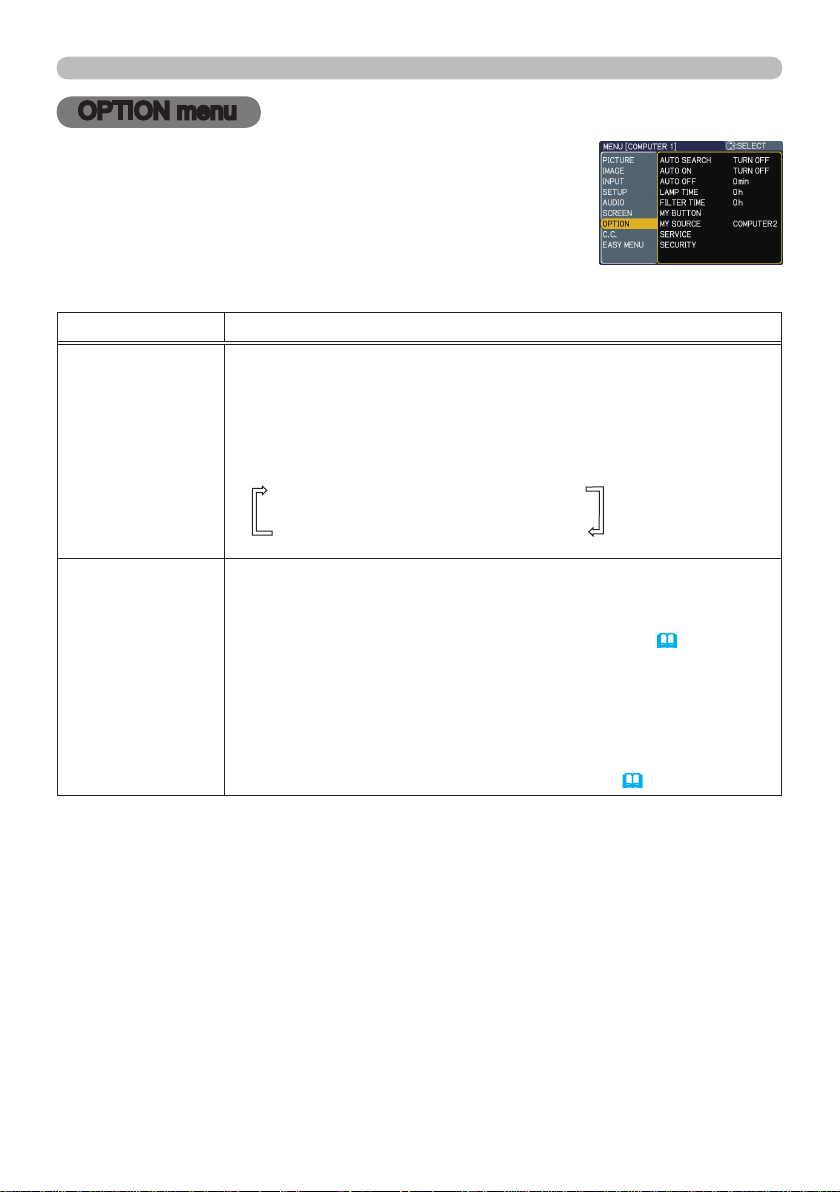
44
OPTION menu
OPTION menu
From the OPTION menu, items shown in the table below
can be performed.
Select an item using the ▲/▼ cursor buttons, and press
the ► cursor button or ENTER button to execute the item,
except for the items LAMP TIME and FILTER TIME. Then
perform it according to the following table.
Item Description
AUTO SEARCH
Using the ▲/▼ buttons turns on/off the automatic signal search function.
TURN ON
ó
TURN OFF
When the TURN ON is selected, detecting no signal automatically
cycles through input ports in the following order. The search is
started from the current port. Then when an input is found, the
projector will stop searching and display the image.
COMPUTER IN1
ð
COMPUTER IN2
VIDEO
S-VIDEO
COMPONENT
AUTO ON
Using the ▲/▼ buttons turns on/off the AUTO ON function.
TURN ON
ó
TURN OFF
When set to the TURN ON, the lamp in projector will be
automatically turned on without the usual procedure (
16), only
when the projector is supplied with the power after the power was
cut while the lamp was on.
• This function does not work as long as the power has been
supplied to the projector while the lamp is off.
• After turning the lamp on by the AUTO ON function, if neither input
nor operation is detected for about 30 minutes, the projector is
turned off, even though the AUTO OFF function (
45) is disabled.
(continued on next page)
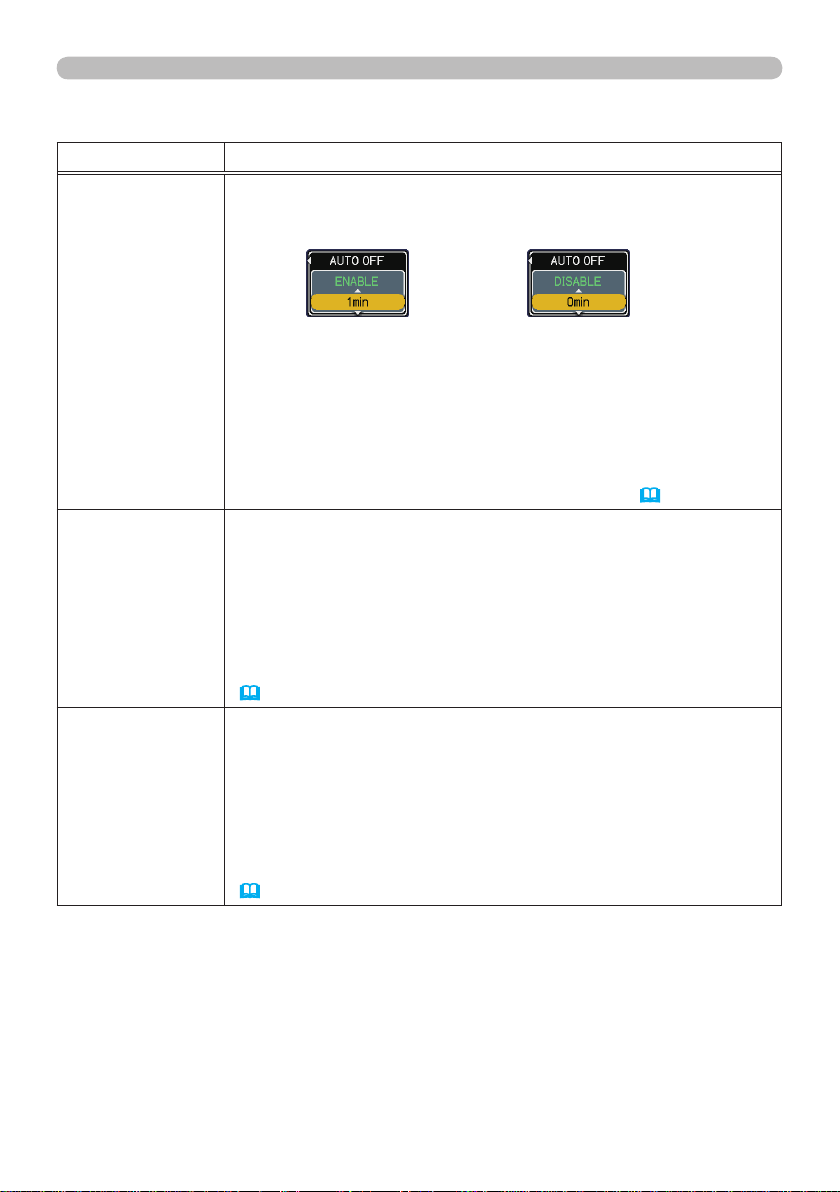
45
OPTION menu
OPTION menu (continued)
Item Description
AUTO OFF
Using the ▲/▼ buttons adjusts the time to count down to
automatically turn the projector off.
Long (max. 99 minutes)
ó
Short (min. 0 minute = DISABLE)
When the time is set to 0, the projector is not turned off automatically.
When the time is set to 1 to 99, and when the passed time with no-
signal or an unsuitable signal reaches at the set time, the projector
lamp will be turned off.
If one of the projector's buttons or the remote control buttons
is pressed or one of the commands (except get commands) is
transmitted to the CONTROL port during the corresponding time,
projector will not be turned off.
Please refer to the section “Turning off the power” (
17).
LAMP TIME
The lamp time is the usage time of the lamp, counted after the last
resetting. It is shown in the OPTION menu.
Pressing RESET button or the ► button displays a dialog.
To reset the lamp time, select RESET using the ▲ button.
RESET
CANCEL
• Please reset the lamp time only when you have replaced the lamp,
for a suitable indication about the lamp.
• For the lamp replacement, see the section "Replacing the lamp"
(
58).
FILTER TIME
The lter time is the usage time of the air-lter, counted after the
last resetting. It is shown in the OPTION menu.
Pressing the RESET button or the ► button displays a dialog.
To reset the lter time, select the RESET using the ▲ button.
RESET
CANCEL
•
Please reset the lter time only when you have cleaned or replaced
the air-lter, for a suitable indication about the air-lter.
• For the air-lter cleaning, see the section "Maintaining the air-lter"
(
60).
(continued on next page)
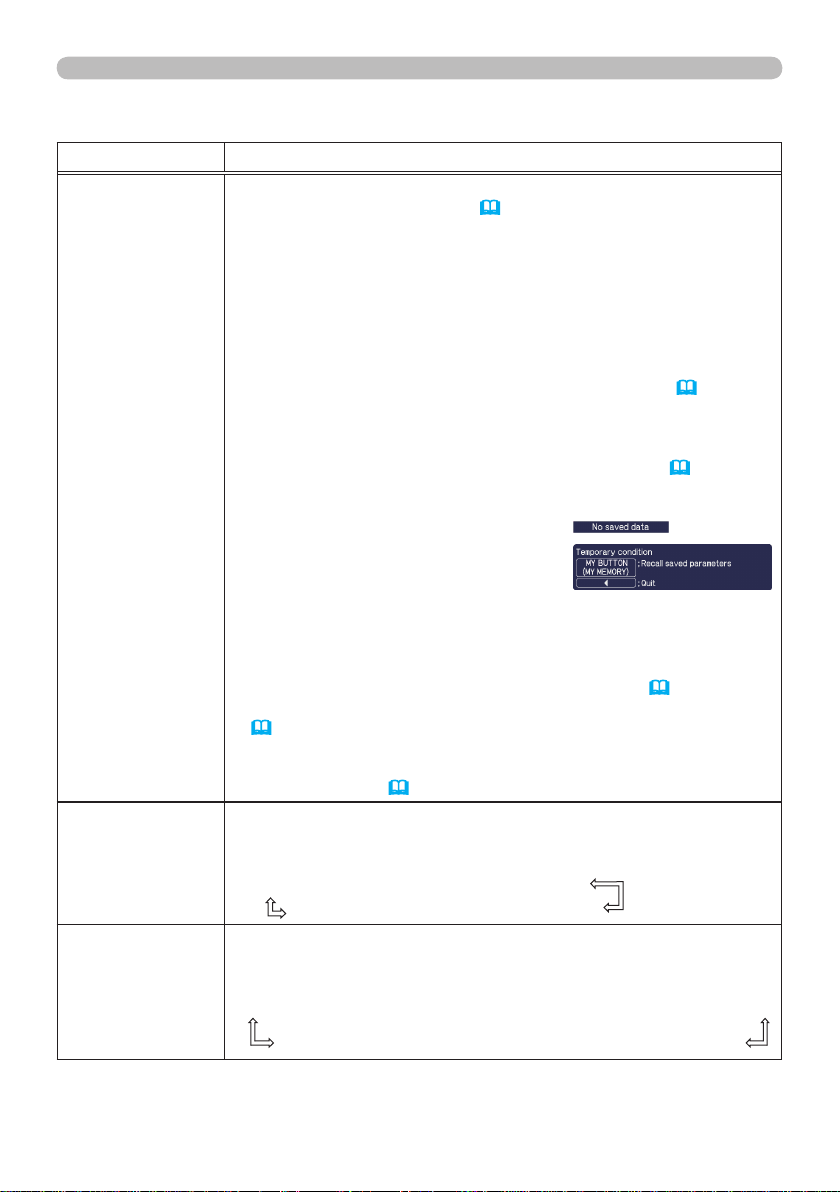
46
Item Description
MY BUTTON
This item is to assign one of the following functions to MY BUTTON
1 and 2 on the remote control (
6).
Choose 1 or 2 on the MY BUTTON menu using the ◄/► button
rst. Then using the ▲/▼ buttons sets one of the following functions
to the chosen button.
• COMPUTER1: Sets port to COMPUTER IN1.
• COMPUTER2: Sets port to COMPUTER IN2.
• COMPONENT: Sets port to COMPONENT (Y, C
B/PB, Cr/Pr)
• S-VIDEO: Sets port to S-VIDEO.
• VIDEO: Sets port to VIDEO.
•
INFORMATION: Displays the INPUT -INFORMATION-
(
48)
(
when
an input signal is found)
or nothing.
While the dialog is shown, pressing again the button closes the
dialog.
• MY MEMORY: Loads one of adjustment data stored (
30).
When more than one data are saved, the adjustment changes
every time the MY BUTTON is pushed.
When no data is saved in memory, the
dialog "No saved data" appears.
When the current adjustment is not
saved to memory, the dialog as shown
in the right appears.
If you want to keep the current adjustment, please press the
◄ button to quit. Otherwise loading a data will lose the current
adjusted condition.
• PICTURE MODE: Changes the PICTURE MODE (
26).
• FILTER RESET: Displays the lter time reset conrmation dialog
(
45).
• AV MUTE: Turns the picture and audio on/off.
• TEMPLATE: Makes the template pattern selected to the
TEMPLATE item (
43) appear or disappear.
MY SOURCE
Using ▲/▼ buttons selects the picture input port to be selected with
pressing the MY SOURCE/DOC.CAMERA button on the remote control.
Select the picture input that is connected with a document camera.
COMPUTER (IN)1
ó
COMPUTER (IN)2
VIDEO
ó
S-VIDEO
ó
COMPONENT
SERVICE
Selecting this item displays the SERVICE menu.
Select an item using the ▲/▼ buttons, and press the ► button or
the ENTER button to execute the item.
FAN SPEED
ó
AUTO ADJUST
ó
GHOST
ó
FILTER MESSAGE
ó
KEY LOCK
ó
FOCUS LOCK
FACTORY RESET
ó
I NFORMATION
ó
REMOTE FREQ.
ó
REMOTE RECEIV.
OPTION menu
OPTION menu (continued)
(continued on next page)
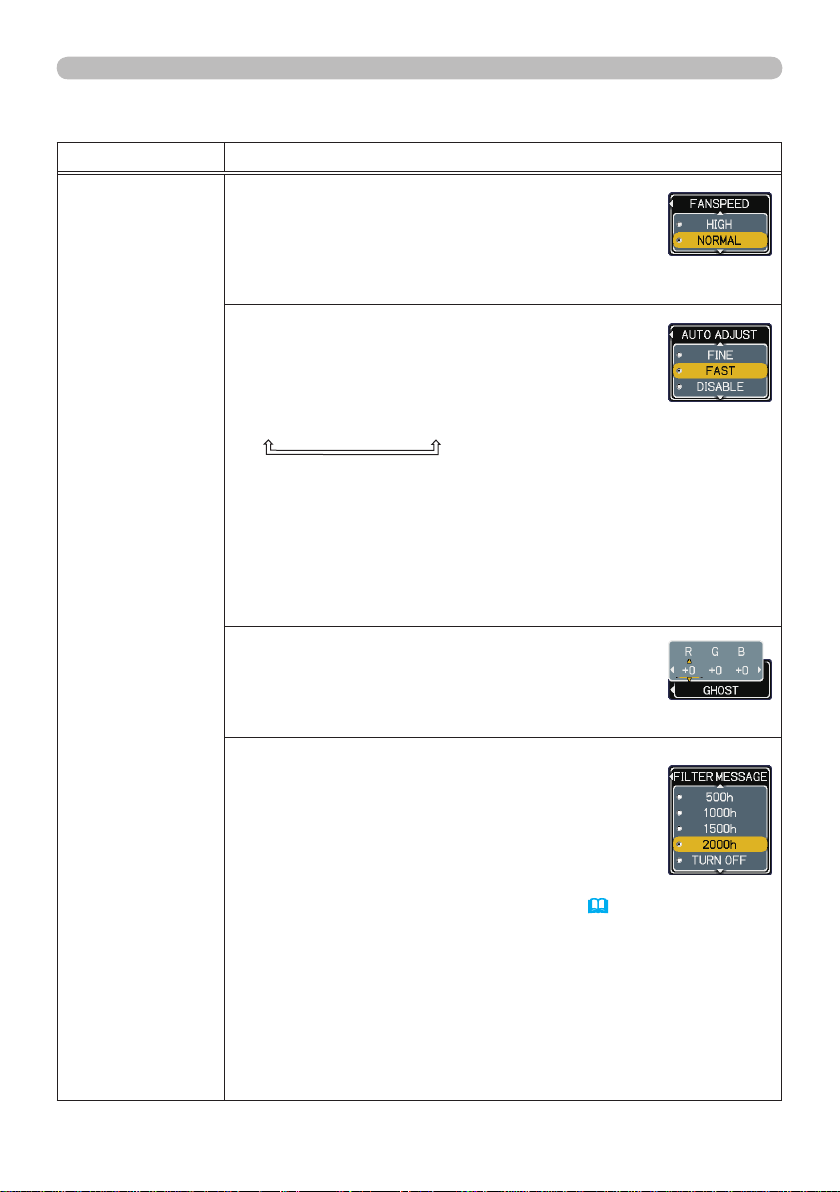
47
OPTION menu
OPTION menu (continued)
Item Description
SERVICE
(continued)
FAN SPEED
Using the ▲/▼ buttons the rotation speed of the
cooling fans. The HIGH is the mode for use at
highlands etc. Note that the projector is noisier when
the HIGH is selected.
HIGH
ó
NORMAL
AUTO ADJUST
Using the ▲/▼ buttons to select one of the mode.
When the DISABLE is selected, the H/V.POSITION,
H.SIZE and H.PHASE will be set to the default value
if the automatic adjustment function is executed.
FINE
ó
FAST
ó
DISABLE
FINE: Finer tuning including H.SIZE adjustment.
FAST: Faster tuning, setting H.SIZE to prearranged data for the
input signal.
• Depending on conditions, such as input image, signal cable to
the projector, environment around the projector, etc., the automatic
adjustment may not work correctly. In such a case, please
choose DISABLE to disable the automatic adjustment, and make
adjustment manually.
GHOST
1. Select a color element of ghost using the ◄/►
buttons.
2. Adjust the selected element using the ▲/▼ buttons
to disappear ghost.
FILTER MESSAGE
Use the ▲/▼ button to set the timer for the interval to
show the message for cleaning up the air-lter.
500h
ó
1000h
ó
1500h
ó
2000h
ó
TURN OFF
After choosing an item except TURN OFF, the
message “REMINDER *** HRS PASSED AFTER THE
LAST FILTER CHECK” will appear after the timer
reaches the interval time set by this feature (
64).
When the TURN OFF is chosen, the message will not appear.
Utilize this feature to keep the air-lter clean, setting the suitable
time according to your environment of this projector.
• Please check and clean the air-lter periodically, even if there is no
message. If the air-lter becomes to be blocked by dust or others,
the internal temperature will rise, which could cause malfunction, or
reduce the lifetime of the projector.
• Please be careful with the operating environment of the projector
and the condition of the air-lter.
(continued on next page)
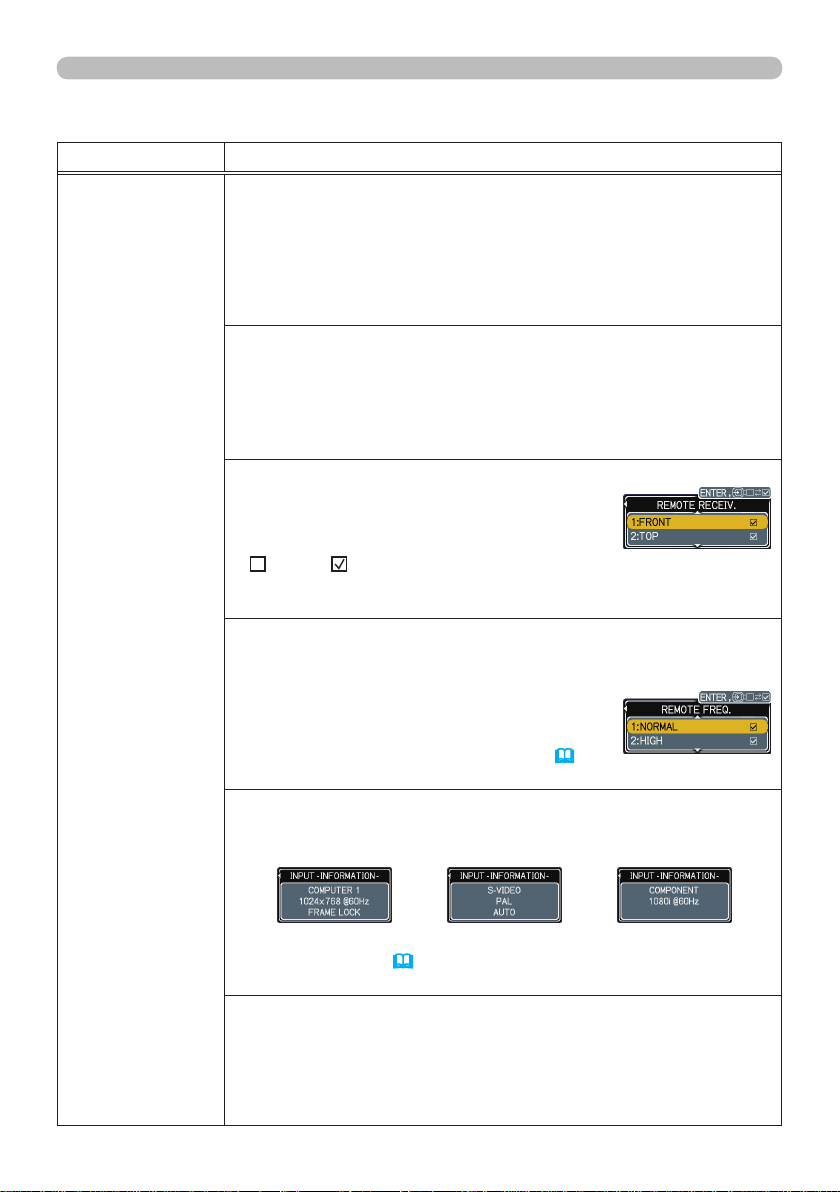
48
OPTION menu
OPTION menu (continued)
Item Description
SERVICE
(continued)
KEY LOCK
Using the ▲/▼ buttons turns on/off the key lock feature. When
TURN ON is selected, the buttons on the projector except the
STANDBY/ON button are locked.
TURN ON
ó
TURN OFF
• Please use to avoid a mischief and touching accidentally. This
function does not have any effect on the remote control.
FOCUS LOCK
Use the ▲/▼ buttons turns on/off the focus lock feature. When
TURN ON is selected, the FOCUS +/- buttons on the remote and
projector are disabled.
TURN ON
ó
TURN OFF
•
Please use the function to avoid a mischief and touching accidentally.
REMOTE RECEIV.
(1) Select a remote sensor using ▲/▼ buttons.
1:FRONT
ó
2:TOP
(2) Switch it using the ENTER or INPUT button.
(off)
ó
(on)
• A sensor cannot be turned off when the other one is off. Always at
least one sensor is on.
REMOTE FREQ.
Use the ▲/▼ button to change the projector's remote sensor setting.
1:NORMAL
ó
2:HIGH
Items with a checkmark are on. The factory
default setting is for both 1:NORMAL and 2:HIGH
to be on. If the remote control does not function
correctly set this to either only 1 or only 2 (
15).
Neither can be turned off at the same time.
INFORMATION
Selecting this item displays a dialog titled “INPUT -INFORMATION-”.
It shows the information about the current input.
• The “FRAME LOCK” message on the dialog means the frame lock
function is working (
34).
• This item can't be selected for no signal and sync out.
FACTORY RESET
Selecting RESET using the button ▲ performs this function. By
this function, all the items in all of menus will collectively return to
the initial setting. Note that the items LAMP TIME, FILTER TIME,
LANGUAGE and SECURITY settings are not reset.
RESET
CANCEL
(continued on next page)
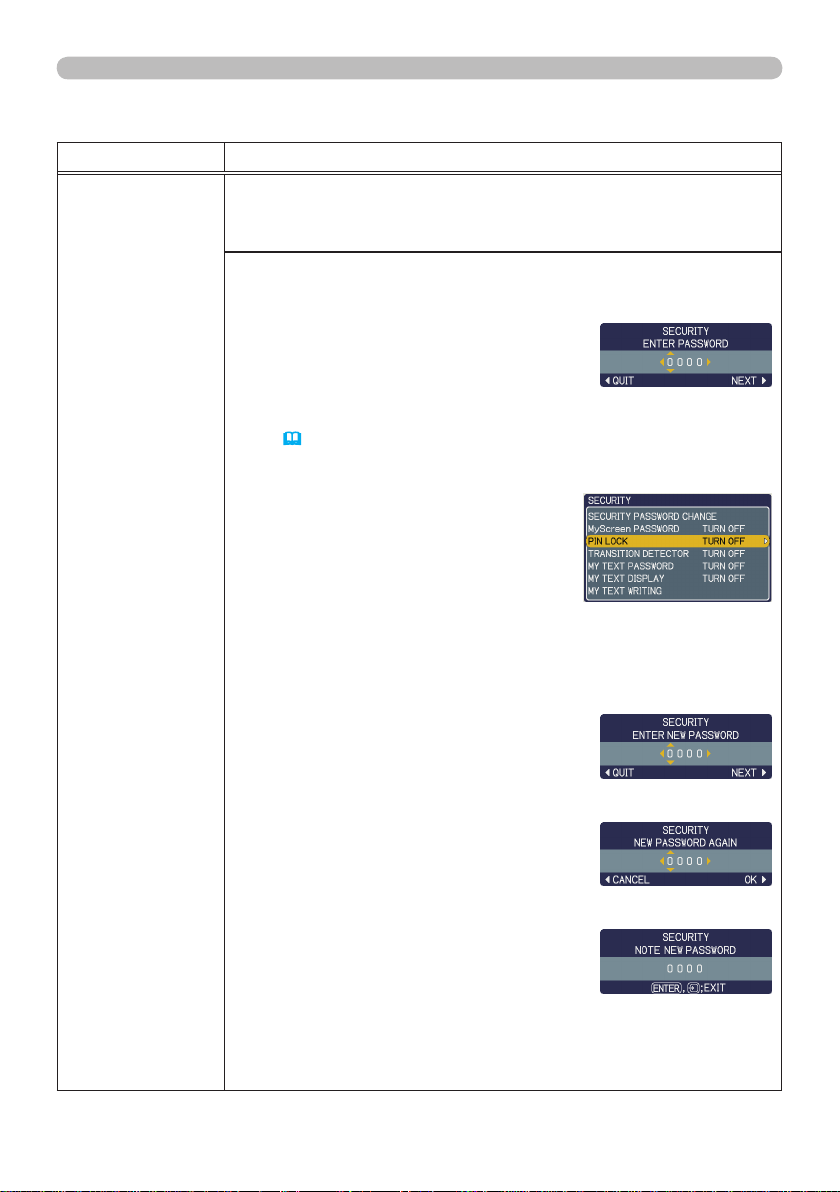
49
OPTION menu
OPTION menu (continued)
Item Description
SECURITY
This projector is equipped with security functions.
User registration is required before using the security functions.
Please contact your local dealer.
1. Using Security Features
1.1 Inputting the PASSWORD
1.1-1 Use the ▲/▼ buttons on the OPTION
menu to select SECURITY and press the
► button. The ENTER PASSWORD box
will be displayed.
The factory default PASSWORD is 5310.
This PASSWORD can be changed (1.2 Changing the PASSWORD
(
below)).
• It is strongly recommended the factory default PASSWORD to be
changed as soon as possible.
1.1-2 Use the ▲/▼/◄/► buttons to enter
the registered PASSWORD. Move the
cursor to the right side of the ENTER
PASSWORD box and press the ► button
to display the SECURITY menu.
If an incorrect PASSWORD is input the
ENTER PASSWORD box will be displayed again. If incorrect
PASSWORD is input 3 times the projector will turn off. Afterwards the
projector will turn off every time an incorrect PASSWORD is input.
1.2 Changing the PASSWORD
1.2-1 Use the ▲/▼ buttons on the SECURITY
menu to select SECURITY PASSWORD
CHANGE and press the ► button to display
the ENTER NEW PASSWORD box.
1.2-2 Use the ▲/▼/◄/► buttons to enter the new PASSWORD.
1.2-3 Move the cursor to the right side of the
ENTER NEW PASSWORD box and
press the ► button to display the NEW
PASSWORD AGAIN box, enter the same
PASSWORD again.
1.2-4 Move the cursor to the right side of the NEW
PASSWORD AGAIN box and press the ►
button and the NOTE NEW PASSWORD
box will be displayed for about 20 seconds,
please make note of the PASSWORD
during this time.
Pressing the ENTER button will close the NOTE NEW PASSWORD
box.
• Please do not forget your PASSWORD.
(continued on next page)
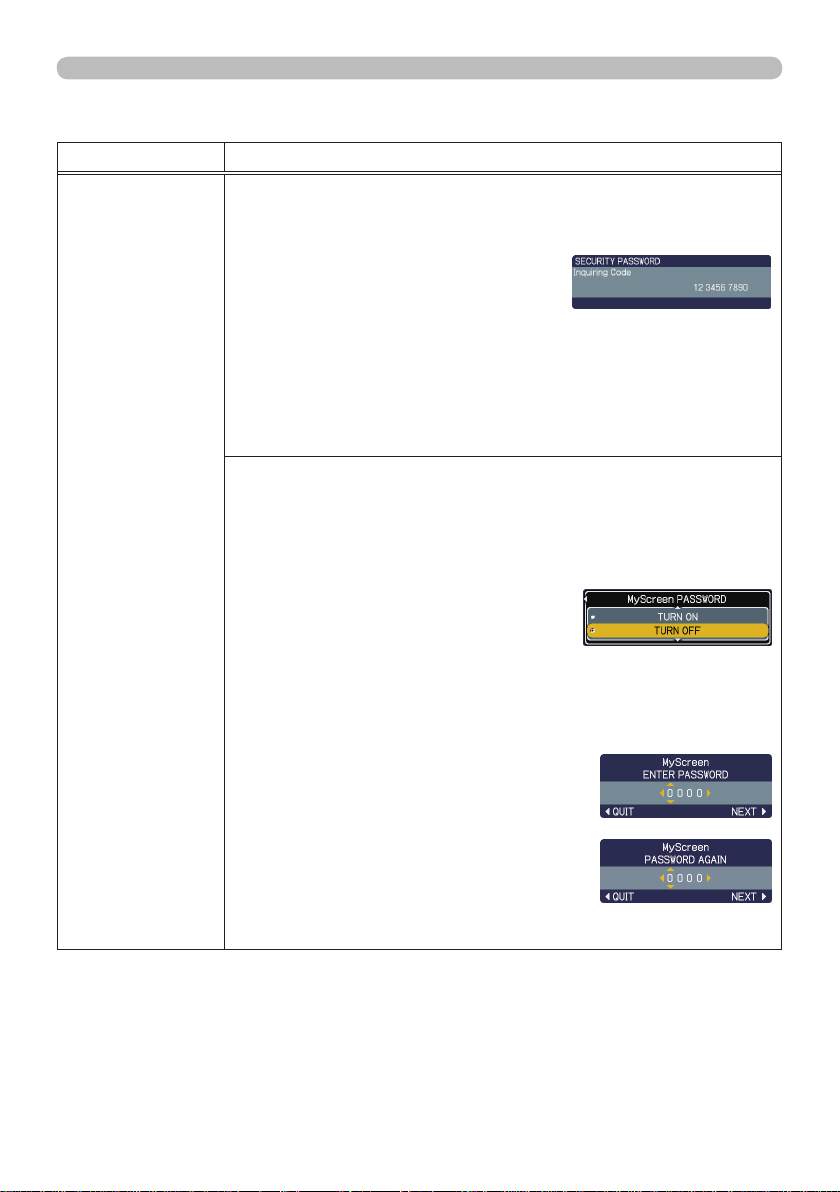
50
OPTION menu
OPTION menu (continued)
Item Description
SECURITY
(continued)
1.3 If you have forgotten your PASSWORD
1.3-1 Follow the procedure in 1.1-1 to display the
ENTER PASSWORD box.
1.3-2 While the ENTER PASSWORD box is
displayed, press and hold the RESET
button for about 3 seconds or press and
hold the INPUT and ► buttons on the
projector for about 3 seconds.
The 10-digit Inquiring Code will be displayed.
• If there is no key input for about 55 seconds while the Inquiring Code is
displayed the menu will close. If necessary repeat the process from 1.3-1.
1.3-3 Contact your dealer with the 10-digit Inquiring Code. Your PASSWORD
will be sent after your user registration information is conrmed.
2. Using the MyScreen PASSWORD Function
The MyScreen PASSWORD function can be used to prohibit access to the
MyScreen function and prevent the currently registered MyScreen image
from being overwritten.
2.1 Turning on the MyScreen
PASSWORD
Function
2.1-1 Use the ▲/▼ buttons on the SECURITY
menu to select MyScreen PASSWORD
and press the ► button to display the
MyScreen PASSWORD on/off menu.
2.2 Setting the PASSWORD
2.2-1 Display the MyScreen PASSWORD on/off menu using the procedure
in 2.1-1.
2.2-2 Use the ▲/▼ buttons on the MyScreen
PASSWORD on/off menu to select TURN ON.
The ENTER PASSWORD box (small) will be
displayed.
2.2-3 Use the ▲/▼/◄/► buttons to enter the
PASSWORD.
Move the cursor to the right side of the ENTER
PASSWORD box (small) and press the ►
button to display the PASSWORD AGAIN box,
enter the same PASSWORD again.
(continued on next page)
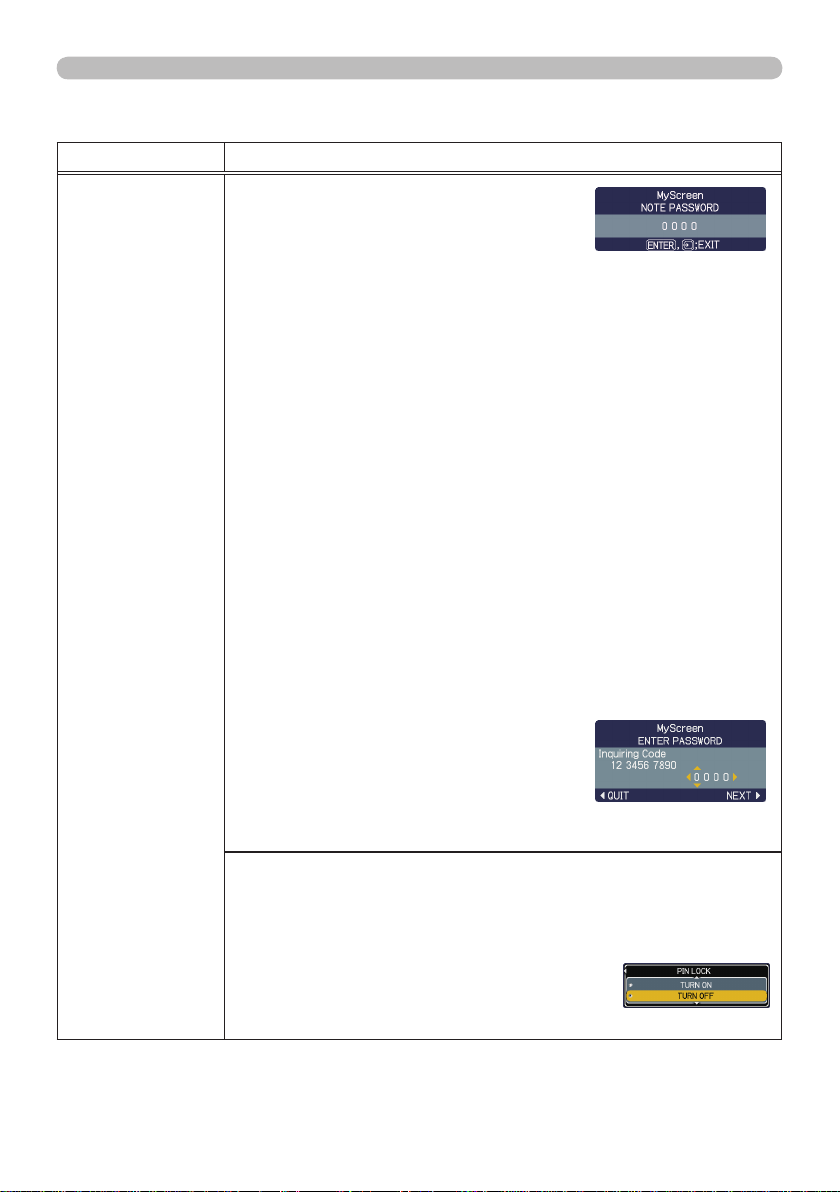
51
OPTION menu
OPTION menu (continued)
Item Description
SECURITY
(continued)
2.2-4 Move the cursor to the right side of the
PASSWORD AGAIN box and press the
► button to display the PASSWORD for
about 20 seconds, please make note of the
PASSWORD during this time.
Pressing the ENTER button will return to
MyScreen PASSWORD on/off menu.
When a PASSWORD is set for MyScreen:
•
The MyScreen registration function (and menu) will be unavailable.
•
The MyScreen Lock menu will be unavailable.
•
The START UP setting will be locked on MyScreen (and the menu will
be unavailable).
Turning the MyScreen PASSWORD off will allow normal operation of
these functions.
•
Please do not forget your MyScreen PASSWORD.
2.3 Turning the PASSWORD off
2.3-1 Follow the procedure in 2.1-1 to display the MyScreen PASSWORD
on/off menu.
2.3-2 Select TURN OFF to display the ENTER PASSWORD box (large).
Enter the registered PASSWORD and the screen will return to the
MyScreen on/off menu.
If an incorrect PASSWORD is input the menu will close. If necessary
repeat the process from 2.3-1.
2.4 If you have forgotten your PASSWORD
2.4-1 Follow the procedure in 2.1-1 to display the MyScreen PASSWORD
on/off menu.
2.4-2 Select TURN OFF to display the ENTER
PASSWORD box (large). The 10-digit
Inquiring Code will be displayed inside the
box.
2.4-3 Contact your dealer with the 10-digit Inquiring Code. Your PASSWORD
will be sent after your user registration information is conrmed.
3. Using the PIN LOCK Function
PIN LOCK is a function which prevents the projector from being used unless
a registered Code is input.
3.1 Registering the PIN Code
3.1-1 Use the ▲/▼ buttons on the SECURITY menu
to select PIN LOCK and press the ► button
or the ENTER button to display the PIN LOCK
on/off menu.
(continued on next page)
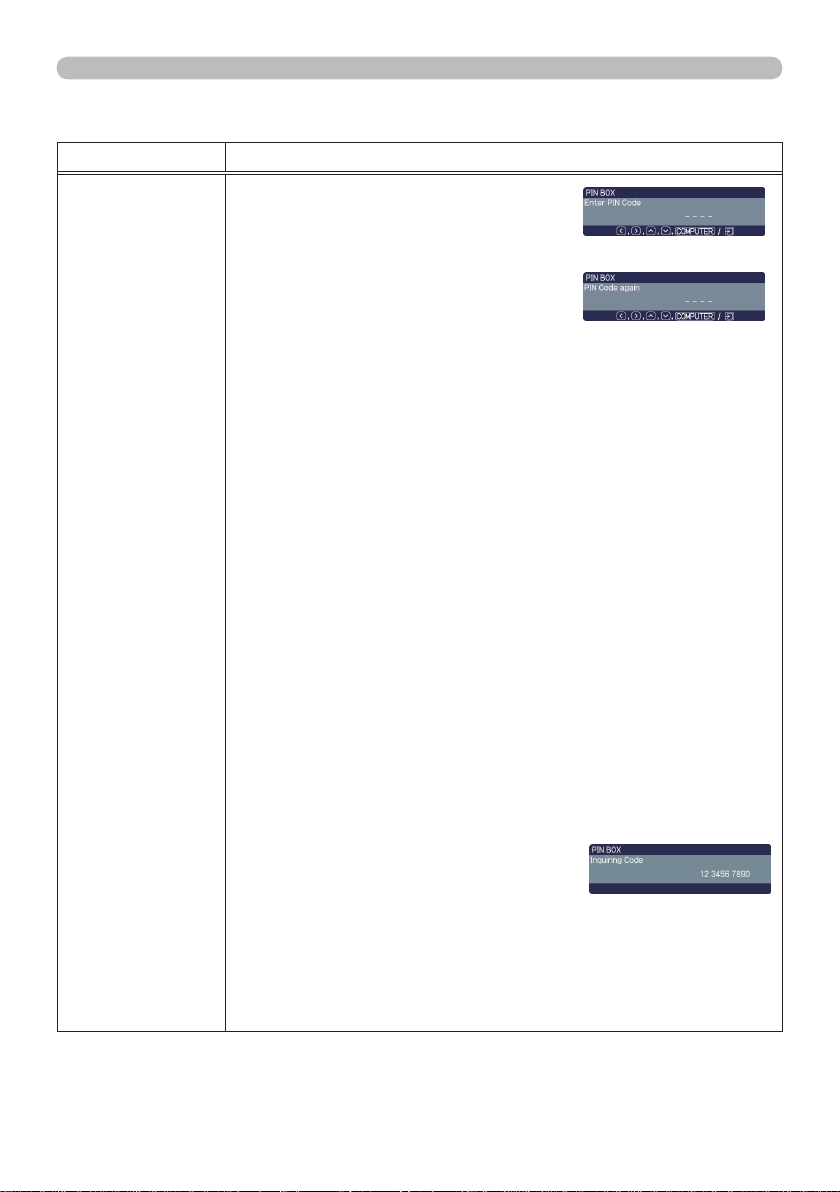
52
OPTION menu
OPTION menu (continued)
Item Description
SECURITY
(continued)
3.1-2 Use the ▲/▼ buttons on the PIN LOCK
on/off menu to select TURN ON and the
PIN BOX will be displayed.
3.1-3 Input a 4 part PIN Code using the ▲, ▼,
◄, ►, COMPUTER and INPUT buttons.
A PIN Code again box will appear. Reenter
the same PIN Code. This will complete the
PIN Code registration.
•
If there is no key input for about 55 seconds while the PIN BOX or the
PIN Code again box are displayed the menu will close. If necessary
repeat the process from 3.1-1.
Afterwards, anytime the projector is restarted after AC power is turned off
the PIN BOX will be displayed. Enter the registered PIN Code.
The projector can be used after entering the registered PIN Code. If an
incorrect PIN Code is input the PIN BOX will be displayed again.
If an incorrect PIN Code is input 3 times the projector will turn off.
Afterwards the projector will turn off every time an incorrect PIN Code is
input. The projector will also turn off if there is no key input for about 5
minutes while the PIN BOX is displayed.
This function will activate only when the projector is started after AC
power is turned off.
•
Please do not forget your PIN Code.
3.2 Turning Off the PIN LOCK Function
3.2-1 Follow the procedure in 3.1-1 to display the PIN LOCK on/off menu.
Use the ▲/▼ buttons to select TURN OFF and the PIN BOX will be
displayed.
Enter the registered PIN Code to turn the PIN LOCK function off.
If an incorrect PASSWORD is input 3 times, the projector will be shut
down.
3.3 If you have forgotten your PIN Code
3.3-1 While the PIN BOX is displayed, press and
hold the RESET button for 3 seconds or
press and hold the INPUT and ► buttons
for 3 seconds. The 10-digit Inquiring Code
will be displayed.
•
If it passes for about 5 minutes after the PIN BOX is displayed the
projector will turn off.
3.3-2 Contact your dealer with the 10-digit Inquiring Code. Your PASSWORD
will be sent after your user registration information is conrmed.
(continued on next page)

53
OPTION menu
OPTION menu (continued)
Item Description
SECURITY
(continued)
4. Using the Transition Detector Function
While the Transition Detector function is ON, when power switch is started
to supply to the projector, it might react as below.
• Transition Detector alarm shown below might appear on screen, if the
projector has been moved or re-installed.
• Transition Detector alarm might appear on screen, if the MIRROR setting
has been changed.
• Keystone adjustment feature and the adjustment of the PERFECT FIT
have been prohibited as long as the Transition Detector function is on.
4.1 Turning On the
Transition Detector
Function
4.1-1
Use the ▲/▼ buttons on the SECURITY
menu to select TRANSITION DETECTOR and
press the ► or the ENTER button to display
the TRANSITION DETECTOR on/off menu.
Select TURN ON and the current angle and
mirror setting will be recorded.
• This feature may not function properly if the projector is not in a stable
position when TURN ON is selected.
4.1-2 When the projector is turned on, if this
function is set to TURN ON and if the
setting condition of the projector (normal
use or ceiling mounted) or mirror setting
is changed from previous record, the
Transition Detector alarm will be displayed
and the projector will not display the input
image.
Set the Transition Detector off in the SECURITY menu to display the input
signal.
If the Transition Detector alarm is displayed for about 5 minutes the lamp
will turn off. This function will activate only when the projector is started
after turning off the AC power.
4.2 Setting the
Transition Detector
PASSWORD
4.2-1 Use the ▲/▼ buttons on the SECURITY menu to select TRANSITION
DETECTOR and press the ► or the ENTER button to display the
TRANSITION DETECTOR on/off menu.
4.2-2 Use the ▲/▼ buttons on the TRANSITION
DETECTOR on/off menu to select TURN
ON. The ENTER PASSWORD box (small)
will be displayed.
4.2-3 Use the ▲/▼/◄/► buttons to enter a
PASSWORD. Move the cursor to the right
side of the ENTER PASSWORD box (small)
and press the ► button to display the
PASSWORD AGAIN box, enter the same
PASSWORD again.
(continued on next page)
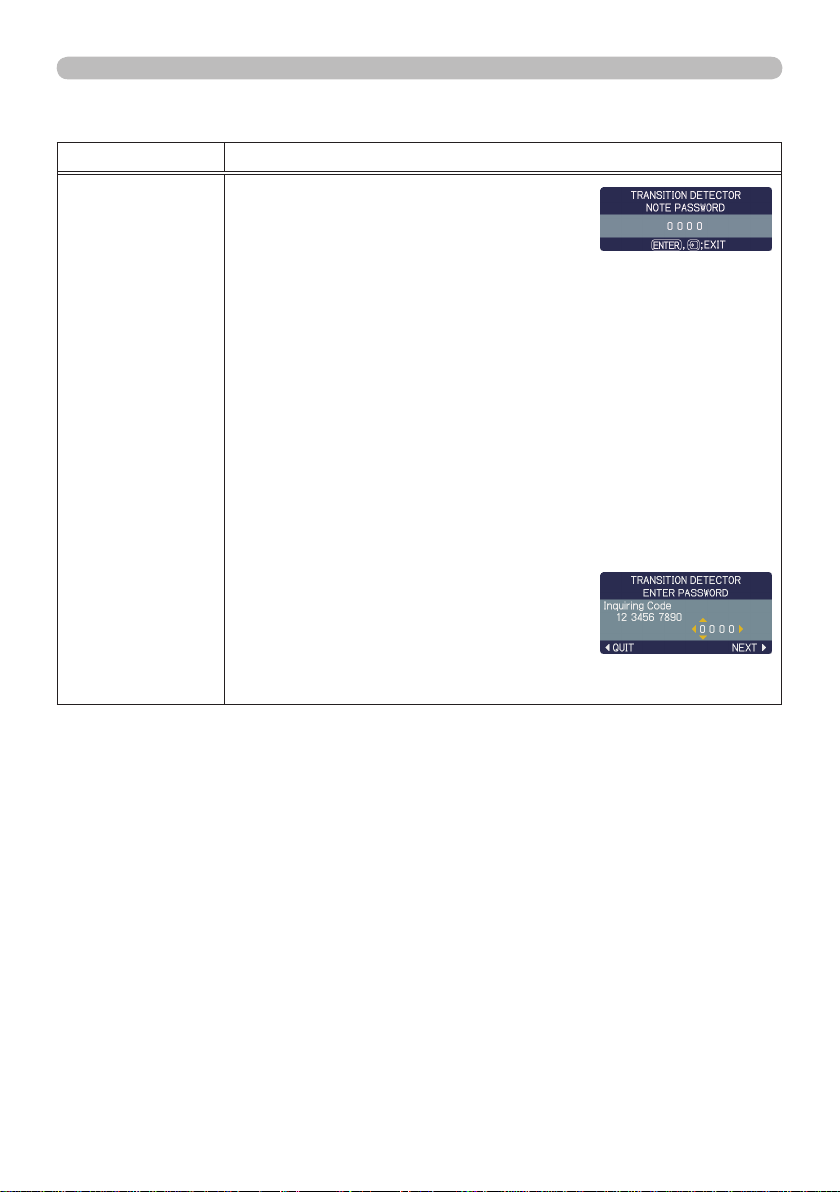
54
OPTION menu
OPTION menu (continued)
Item Description
SECURITY
(continued)
4.2-4 Move the cursor to the right side of the
PASSWORD AGAIN box and press the
► button to display the PASSWORD for
about 20 seconds, please make note of the
PASSWORD during this time.
Pressing the ENTER button will return to the TRANSITION DETECTOR
on/off menu.
• Please do not forget your Transition Detector PASSWORD.
4.3 Setting the Transition Detector off
4.3-1 Follow the procedure in 4.1-1 to display the TRANSITION DETECTOR
on/off menu.
4.3-2 Select TURN OFF to display the ENTER PASSWORD box (large).
Enter the registered PASSWORD and the screen will return to the
TRANSITION DETECTOR on/off menu. If an incorrect PASSWORD is
input the menu will close. If necessary repeat the process from 4.3-1.
4.4 If you have forgotten your PASSWORD
4.4-1 Follow the procedure in 4.1-1 to display the TRANSITION DETECTOR
on/off menu.
4.4-2 Select TURN OFF to display the ENTER
PASSWORD box (large). The 10-digit
Inquiring Code will be displayed inside the
box.
4.4-3 Contact your dealer with the 10-digit Inquiring Code. Your PASSWORD
will be sent after your user registration information is conrmed.
(continued on next page)
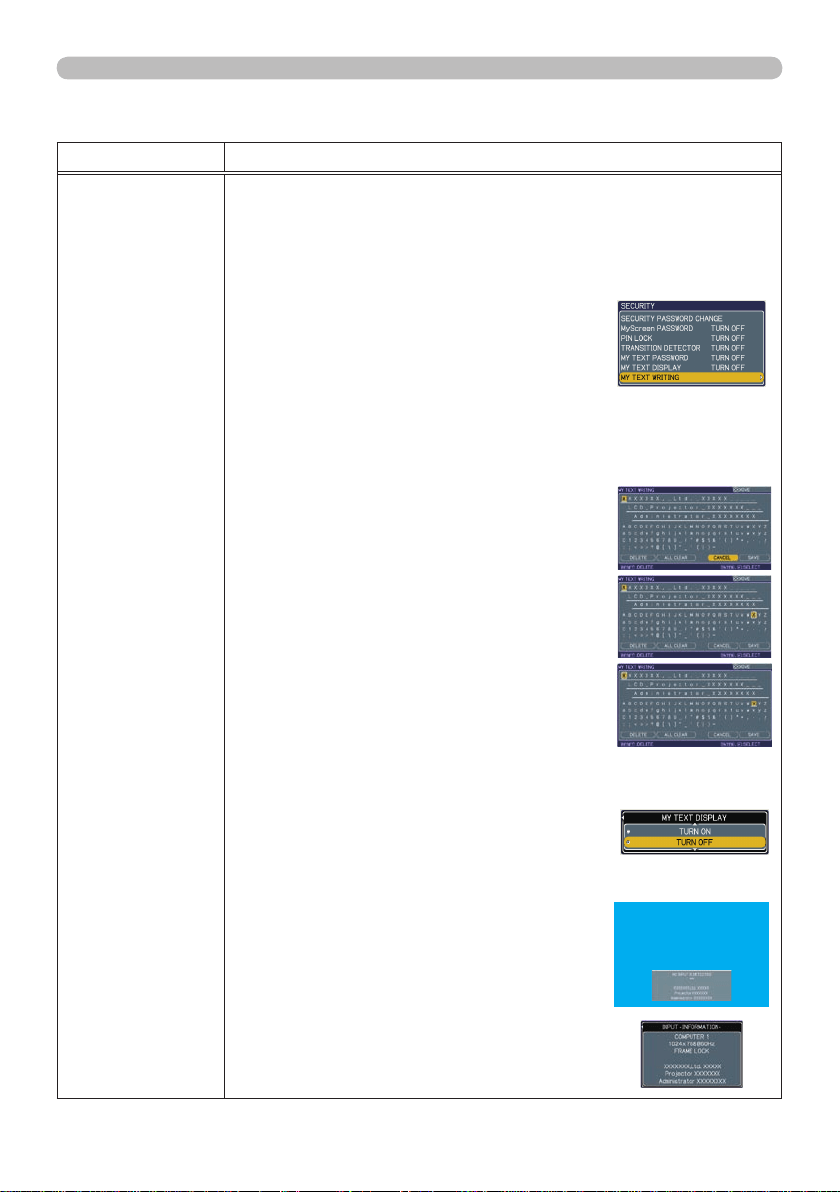
55
Item Description
SECURITY
(continued)
5. Using the MY TEXT PASSWORD function
This item allows you to display your own message (MY TEXT) on the START
UP screen and INPUT-INFORMATION. It can be protected by a password to
prevent it from being overwritten.
5.1 Writing the MY TEXT
(1) Use the ▲/▼ buttons on the SECURITY menu
to select the MY TEXT WRITING menu and
press the ► button. The MY TEXT WRITING
dialog will be displayed.
(2)
The current MY TEXT will be displayed on the rst 3
lines. If not yet written, the lines will be blank.
Use the
▲/▼/◄/►
buttons and the ENTER or INPUT button to select and enter
characters. The RESET button can be used to erase 1 character at a time. Also if
you move the cursor to DELETE or ALL CLEAR on screen and push the ENTER
or INPUT button, 1 character or all characters will be erased. The MY TEXT can
be input up to 24 characters on each line.
(3) To change an already inserted character, press
the ▲/▼ button to move the cursor to one of
the rst 3 lines, and use the ◄/► buttons to
move the cursor on the character to be changed.
After pressing the ENTER or INPUT button, the
character is selected. Then, follow the same
procedure as described at the item (2) above.
(4) To nish entering text, move the cursor to the
SAVE on screen and press the ENTER or INPUT
button. To revert to the previous MY TEXT
without saving changes, move the cursor to the
CANCEL on screen and press the ENTER or
INPUT button.
•
The MY TEXT WRITING function is available only when the MY TEXT
PASSWORD function is set to TURN OFF.
5.2 Displaying the MY TEXT
(1) Use the ▲/▼ buttons on the SECURITY menu
to select the MY TEXT DISPLAY menu and
press the ► button to display the MY TEXT
DISPLAY on/off menu.
(2) Use the ▲/▼ buttons on the MY TEXT DISPLAY
on/off menu to select on or off.
TURN ON
ó
TURN OFF
When it is set TURN ON, the MY TEXT will be
displayed on the START UP screen. Whichever
is selected, the MY TEXT will be displayed on the
INPUT-INFORMATION- when the INFORMATION
on the SERVICE menu is chosen.
• This function is available only when the MY TEXT
PASSWORD function is set to the TURN OFF.
MY TEXT DISPLAY on/off
menu
OPTION menu
OPTION menu (continued)
(continued on next page)
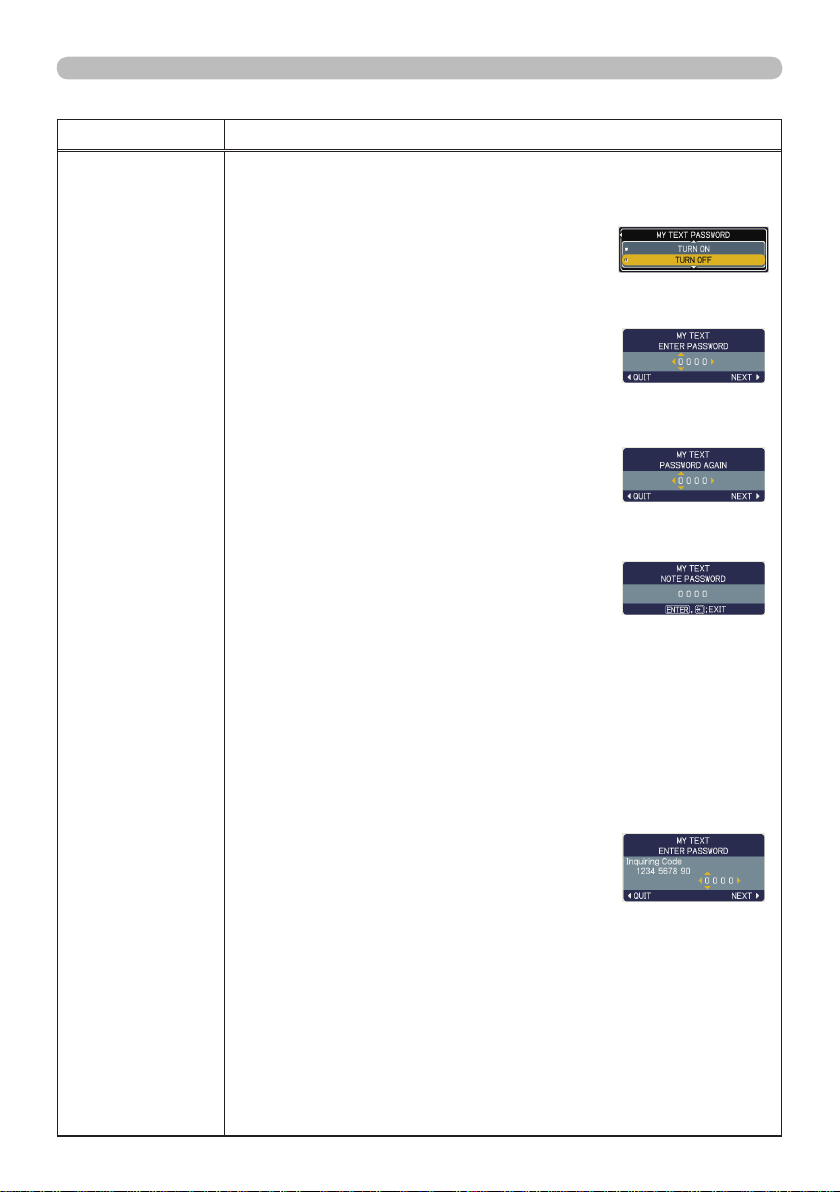
56
Item Description
SECURITY
(continued)
5.3 Turning on the MY TEXT PASSWORD
The MY TEXT PASSWORD function can prevent the MY TEXT from being overwritten.
5.3-1 Turning on the MY TEXT PASSWORD function
(1) Use the ▲/▼ buttons on the SECURITY menu
to select the MY TEXT PASSWORD menu and
press the ► button to display the MY TEXT
PASSWORD on/off menu.
5.3-2 Setting the MY TEXT PASSWORD
(1) Display the MY TEXT PASSWORD on/off menu
using the procedure in 5.3-1
(2) Use the ▲/▼ buttons on the MY TEXT
PASSWORD menu to select TURN ON. The
ENTER PASSWORD BOX (small) will be
displayed.
(3) Use the ▲/▼/◄/► buttons to enter the
PASSWORD. Move the cursor to the right side of
the ENTER PASSWORD BOX (small) and press
the ► button to display the PASSWORD AGAIN
BOX, and then enter the same PASSWORD
again.
(4) Move the cursor to the right side of the
PASSWORD AGAIN BOX and press ► button to
display the PASSWORD for about 20 seconds,
then please make note of the PASSWORD
during this time.
Pressing the ENTER button on the remote control
or INPUT button on the projector will return to the
MY TEXT PASSWORD on/off menu. When the
PASSWORD is set for the MY TEXT;
• The MY TEXT DISPLAY menu will be unavailable, which can prohibit
changing the DISPLAY setting.
• The MY TEXT WRITING menu will be unavailable, which can prevent the
MY TEXT from being overwritten.
5.3-3 Turning the MY TEXT PASSWORD off
(1) Follow the procedure in 5.3-1 to display the MY
TEXT PASSWORD on/off menu.
(2) Select TURN OFF to display the ENTER
PASSWORD BOX (large). Enter the registered
PASSWORD and the screen will return to the
MY TEXT PASSWORD on/off menu.
If an incorrect PASSWORD is input, the menu will close. If necessary, repeat
the process from 5.3-3(1)
5.3.4 If you have forgotten your PASSWORD.
(1) Follow the procedure in 5.3-1 to display the MY TEXT PASSWORD
on/off menu.
(2) Select TURN OFF to display the ENTER PASSWORD BOX (large). The
10 digit inquiring code will be displayed inside the box.
(3) Contact your dealer with the 10 digit inquiring code. Your PASSWORD
will be sent after your user registration information is conrmed.
ENTER PASSWORD BOX
(large)
ENTER PASSWORD BOX
(small)
PASSWORD AGAIN BOX
NOTE PASSWORD BOX
MY TEXT PASSWORD
OPTION menu
OPTION menu (continued)
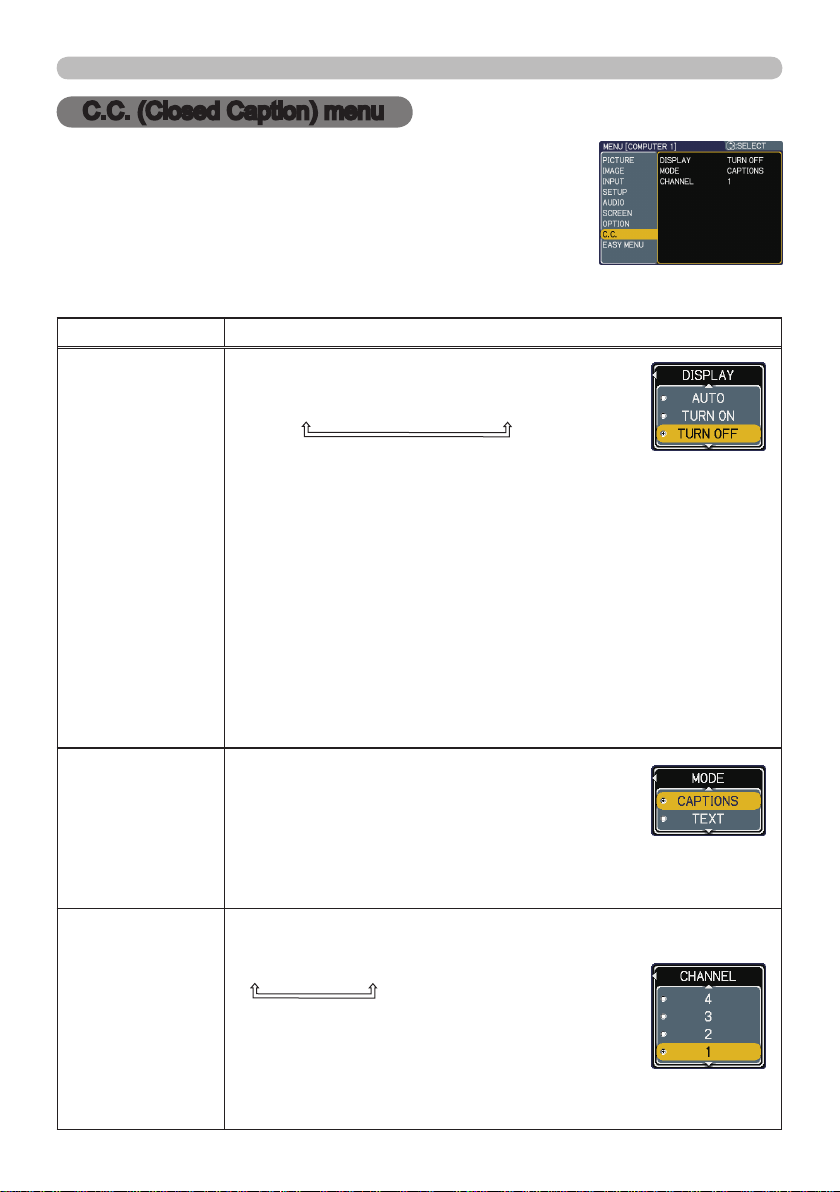
57
C.C. (Closed Caption) menu
The closed caption setting can be changed through C.C. menu
in the advance menu. Please select the item that you will change
using ▲/▼ cursor buttons.
• The C.C. (Closed Caption) is the function that displays a
transcript or dialog of the audio portion of a video, les or other
presentation or other relevant sounds. It is required to have NTSC
format video or 480i@60 Component video source supporting C.C.
feature to utilize this function.
C.C. (Closed Caption) menu
Item Description
DISPLAY
Select Closed Caption DISPLAY setting from
following options using ▲/▼buttons.
TURN OFF
ó
TURN ON
ó
AUTO
TURN OFF: Closed Caption is OFF
TURN ON: Closed Caption is ON
AUTO: Closed Caption automatically displays when the
volume is muted.
• The caption is not displayed when the OSD menu is active.
•
The Closed Caption is the function to display the dialogue, narration,
and / or sound effects of a television program or other video sources. The
Closed Caption availability is depending upon broadcaster and/or content.
• The caption is available if the video source is NTSC format and
the video format selection is AUTO or NTSC on the INPUT menu,
when either VIDEO or S-VIDEO is selected as input port.
• The caption is also available if 480i@60 video signal is input from
COMPONENT port, when it is selected as input port.
• It may not work properly, depending on equipment or signal
source. In this case, please turn off the Closed Caption.
MODE
Select Closed Caption MODE setting from
following options using ▲/▼buttons.
CAPTIONS
ó
TEXT
CAPTIONS: Display Closed Caption
TEXT:
Display Text data, which is for additional information such as
news reports or a TV program guide. The information covers the
entire screen. Not all of the C.C. program has Text information.
CHANNEL
Select Closed Caption CHANNEL from following options using
▲/▼buttons.
1
ó
2
ó
3
ó
4
1: Channel 1, primary channel / language
2: Channel 2
3: Channel 3
4: Channel 4
The channel data may vary, depending on the content. Some
channel might be used for secondary language or empty.
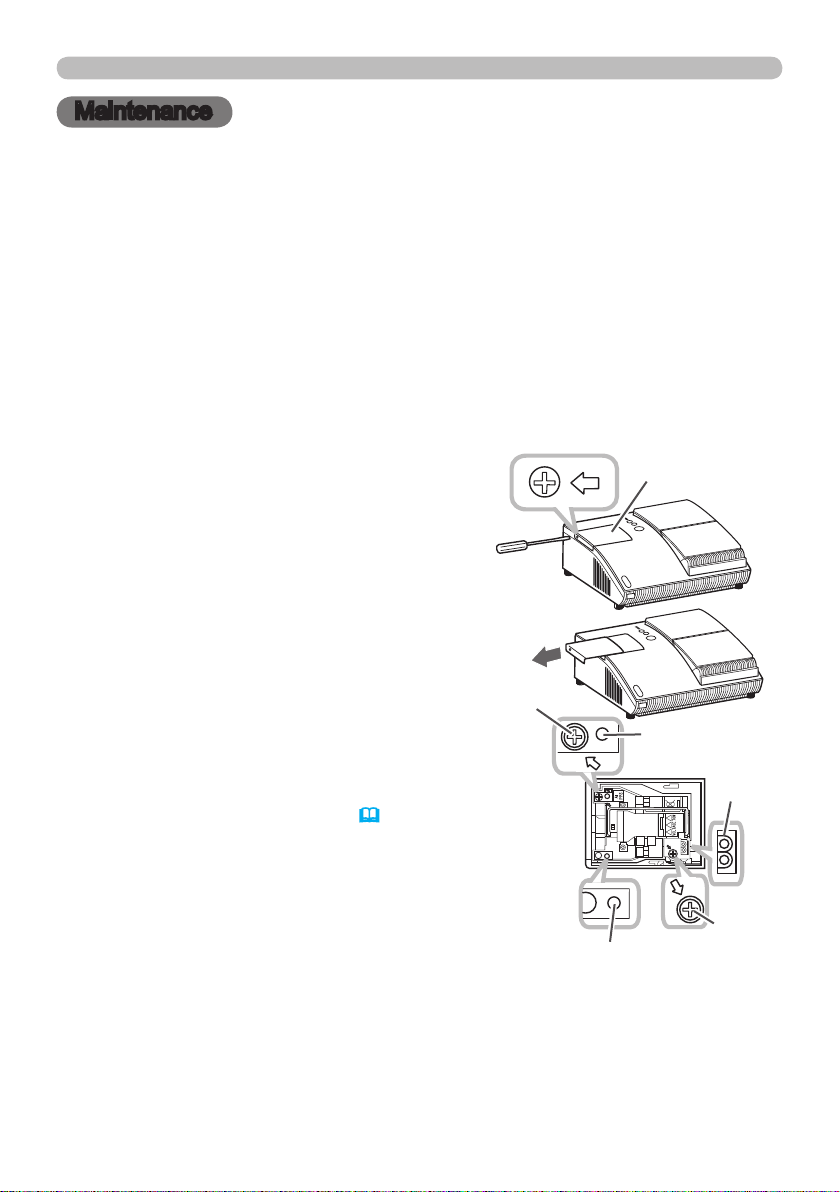
58
Maintenance
Maintenance
2.
Loosen the screw (marked by arrow) of the
lamp cover, and then slide the lamp cover to
the side to remove it.
3.
Loosen the 2 screws (marked by arrows) of
the lamp, and slowly pick up the lamp by the
handles.
4.
Insert the new lamp, with cautions not to
touch the inside of the lamp house. When
inserting, pay attention to the socket position
rst, and to the pins for positioning next.
5.
Tighten rmly the 2 screws of the lamp that
are loosened in the previous process to lock
it in place.
6.
Slide the lamp cover into place and rmly
tighten the screw of the lamp cover.
7.
Plug in and restart the projector (12, 16).
Then, reset the lamp time (which is the time
counter for the lamp use).
Replacing the lamp
The projection lamp has nite product life that is different in each lamp. Please replace the
lamp as soon as possible when the pictures appear dark, or when the color tone is poor.
Using the lamp for long periods of time may make the lamp burned out or broken.
Preparation of a spare lamp and early replacement are recommended. To prepare the new
lamp, call your dealer and tell the type number: DT00893
(1) Press the ▲ or ▼ button on the projector
or the
MENU button on the remote control.
The “
EASY MENU” appears.
(2) Point at the “
Go to Advanced Menu …”
in the menu using the ▲ or ▼ button, then
press the ► button. “
MENU” appears.
(3) Pointed at the “
OPTION” in the left column using the ▲ or ▼ button, then press
the ► button. The cursor moves to the right column.
(4) Pointed at the “
LAMP TIME” using the ▲ or ▼ button, then press the ► button.
A dialog appears.
(5) Press the ▲ button to select the “
RESET” on the dialog. It performs resetting the
lamp time.
When the projector is mounted on a ceiling or somewhere over your head, or when the
lamp may have been broken, be sure to refer replacement to your dealer or service person,
since it may be dangerous.
Only in case of replacement by yourself, follow the following procedure.
1.
Turn the projector off and unplug the power cord from the power outlet.
And cool the projector down by leaving it for about 45 minutes as it is.
Lamp house
(inside of the
lamp cover)
Lamp cover
Screw
Pin for
positioning
Socket
Screw
Pin for positioning
59
Maintenance
Replacing the lamp (continued)
HIGH VOLTAGE
HIGH TEMPERATURE
HIGH PRESSURE
►The projector uses a high-pressure mercury glass lamp. The
lamp can break with a loud bang, or burn out, if jolted or scratched, handled
while hot, or worn over time. Note that each lamp has a different lifetime, and
some may burst or burn out soon after you start using them. In addition, when
the bulb bursts, it is possible for shards of glass to y into the lamp housing, and
for gas containing mercury to escape from the projector’s vent holes.
About disposal of a lamp: This product contains a mercury lamp; do not put it in a
trash. Dispose of it in accordance with environmental laws.
• For lamp recycling, go to www.lamprecycle.org (in the US).
• For product disposal, contact your local government agency or www.eiae.org
(in the US) or www.epsc.ca (in Canada).
For more information, call your dealer.
WARNING
• Please reset the lamp time only when you have replaced the lamp,
for a suitable indication about the lamp.
NOTE
• If the lamp should break (it will male a loud bang when it does), unplug the
power cord from the outlet, and make sure to request a replacement lamp from
your dealer. Note that shards of glass could damage the projector’s internals,
or cause injury during handling, so please do not try to clean the projector or
replace the lamp yourself.
• If the lamp should break (it will male a loud bang when it does), ventilate the
room well, and make sure not to breathe the gas that comes out of the projector
vents or get it in your eyes or mouth.
• Before replacing the lamp, turn the projector off and unplug the power cord,
then wait for at least 45 minutes for the lamp to cool sufciently. Handling the
lamp while hot can cause burns, as well as damaging the lamp.
• Never unscrew except the appointed (marked by an arrow) screw.
• Do not open the lamp cover while the projector is suspended from a ceiling
or somewhere over your head. This is dangerous, since if the lamp’s bulb has
broken, the shards will fall out when the cover is opened. In addition, working
in high places is dangerous, so ask your local dealer to have the lamp replaced
even if the bulb is not broken.
• Do not use the projector with the lamp cover removed. At the lamp replacing,
make sure that the screws are screwed in rmly. Loose screws could result in
damage or injury.
• Use only the lamp of the specied type.
• If the lamp breaks soon after the rst time it is used, it is possible that there
are electrical problems elsewhere besides the lamp. If this happens, contact
your local dealer or service representative.
•
Handle with care: jolting or scratching could cause the lamp bulb to burst during use.
• Using the lamp for long periods of time, could cause it dark, not to light up or
to burst. When the pictures appear dark, or when the color tone is poor, please
replace the lamp as soon as possible. Do not use old (used) lamps; this is a
cause of breakage.
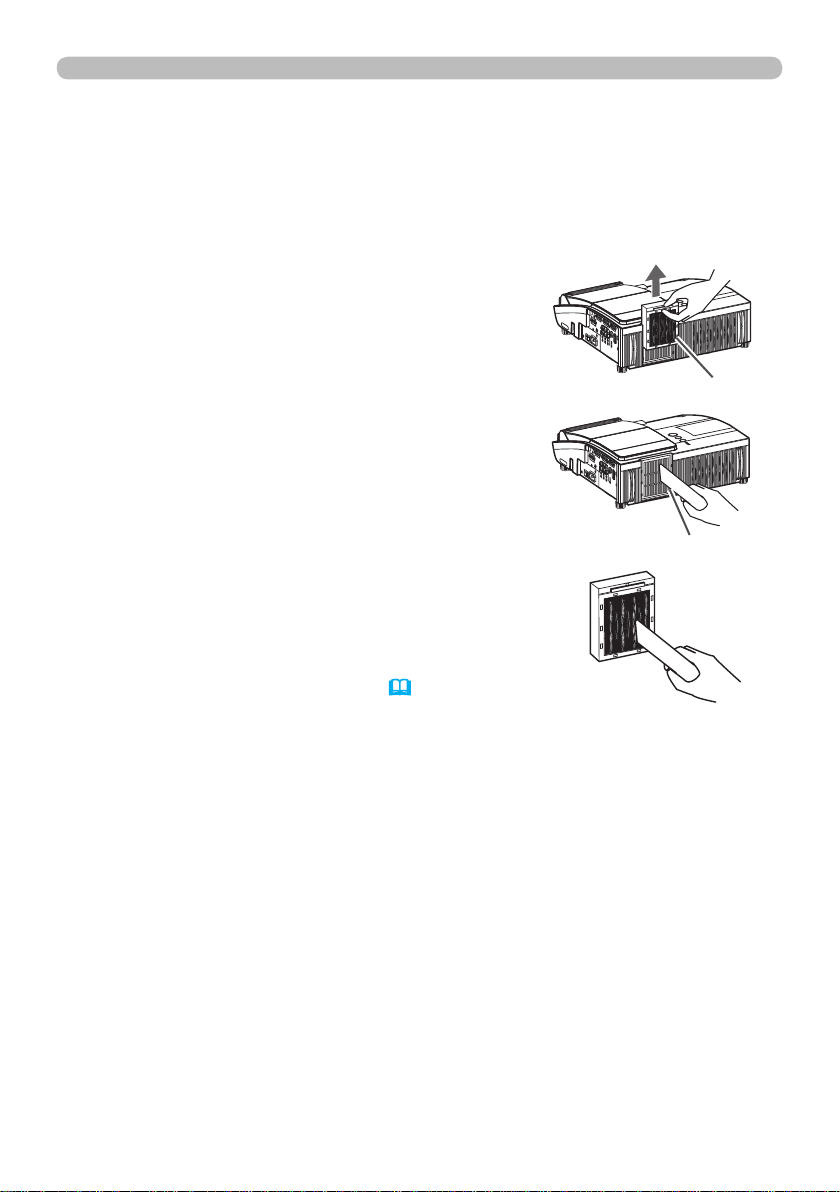
60
Maintenance
1.
Turn the projector off and unplug the power
cord from the power outlet. And cool the
projector down by leaving it for a while as it is.
2.
Use the vacuum cleaner on and around the
lter unit.
3.
Slide the lter unit upward to take it off from the
projector.
4.
Use the vacuum cleaner on the intake vents of
the projector.
5.
Use the vacuum cleaner on the cover side of the
filter unit. Do not vacuum the air-filter directly,
since the cleaner may inhale the air-filter.
When the air-filter is damaged or too soiled,
prepare the new filter unit.
6.
Make sure that there is the air-filter inside, then
slide the filter unit into place.
7.
Plug in and restart the projector (12, 16).
(continued on next page)
Maintaining the air-lter
Please check and clean the air-lter periodically, for keeping normal ventilation.
When the indicators or a message prompts you to clean the air-lter, comply with
it as soon as possible.
When it is damaged or too soiled, replace the lter unit. To prepare the new lter
unit, call your dealer and tell the type number: UX35381
Then, reset the lter time (which is the time counter for the air-lter use).
(1) Press the ▲ or ▼ button on the projector or the MENU button on the
remote control. The “EASY MENU” appears.
(2) Point at the “FILTER TIME” in the menu using the ▲ or ▼ button, then
press the ► button. A dialog appears.
(3) Press the ▲ button to select the “RESET” on the dialog. It performs
resetting the lter time.
Filter unit
Intake vents

61
Maintenance
Maintaining the air-lter (continued)
►Before taking care of the air-lter, make sure the power switch
is off and the power cable is not plugged in, then allow the projector to cool
sufciently. Taking care of the air-lter in a high temperature state of the projector
could cause an electric shock, a burn or malfunction to the projector.
►Use only the air-lter unit of the specied type. Do not use the projector
without the air-lter or the lter cover. It could result in a re or malfunction to the
projector.
►Clean the air-lter periodically. If the air-lter becomes clogged by dust or the
like, internal temperatures rise and could cause a re, a burn or malfunction to
the projector.
WARNING
• A lter unit of specied type will come with the replacement lamp
for this projector. Replacing the lter unit at the same time with the lamp is
recommended.
• Please reset the lter time only when you have cleaned the air-lter, for a
suitable indication about the air-lter.
• The projector may display the message such as “CHECK THE AIR FLOW” or
turn off the projector, to prevent the internal heat level rising.
NOTE
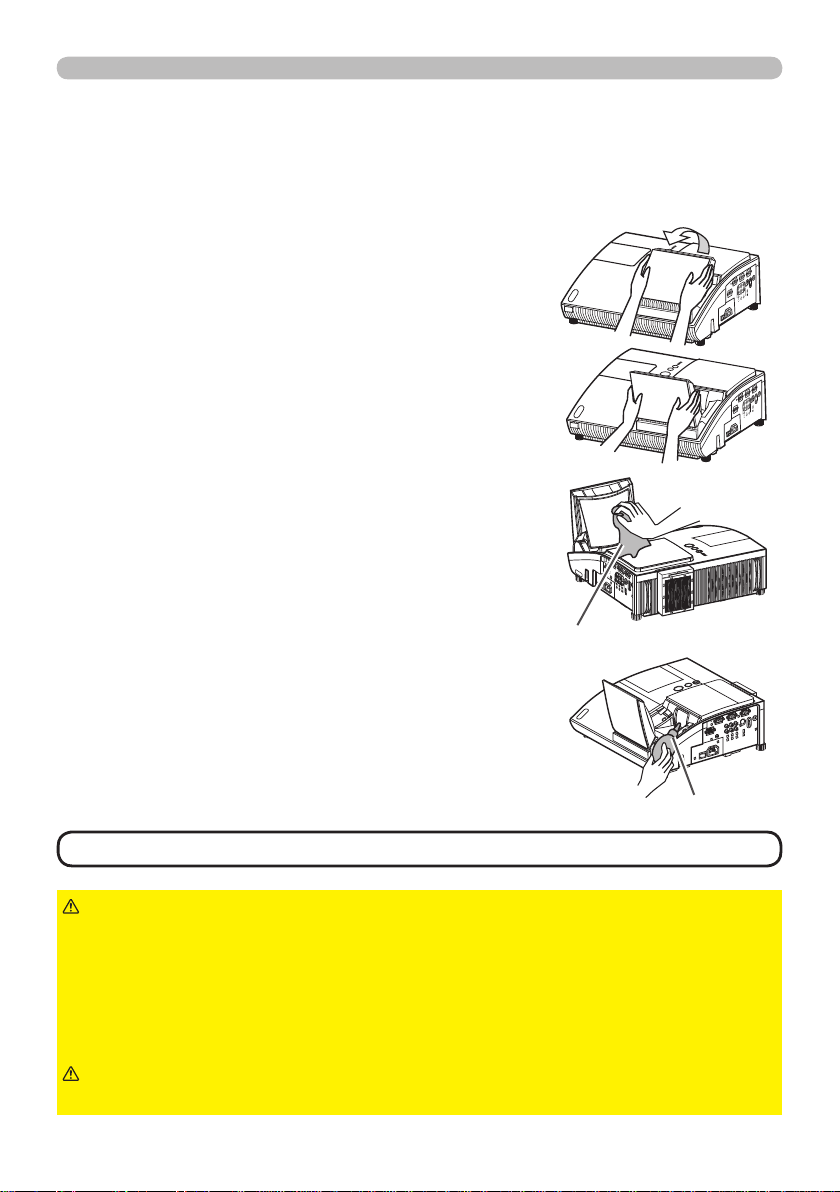
62
Maintenance
COMPUTER OUT
COMPUTER IN2
COMPUTER IN1
CONTROL
AUDIO
OUT
S-VIDEO
Y C
B
/P
B
C
R
/P
R
VIDEO L R
AUDIO IN3
AUDIO IN
1
2
COMPUTER OUT
COMPUTER IN2
COMPUTER IN1
CONTROL
AUDIO
OUT
S-VIDEO
Y C
B
/P
B
C
R
/P
R
VIDEO L R
AUDIO IN3
AUDIO IN
1
2
Caring for the mirror and lens
If the projection mirror or lens is awed, soiled or fogged, it could cause
deterioration of display quality. Please take care of the mirror and lens, being
cautious of handling.
Cleaning cloth
Blower
1.
Turn the projector off and unplug the power cord
from the power outlet. And cool the projector
down by leaving it for a while as it is.
2.
The lens door can be opened manually.
Please hold both side of the lens door and slowly
open it until it is locked with clicking sound.
3.
Wipe softly the mirror and lens with a cleaning
cloth for lens on the market, being careful not to
give any damage on the mirror and lens.
For around edge of the mirror and lens where
might be difcult to be wiped out, please use an
air blower for cameras on the market to clean up.
4.
To close the lens door properly, please take the
following procedure.
(1) Plug in the projector.
(2) Turn on the power switch.
Even though the lens door starts to close, it
might not be closed properly.
(3) Press the STANDBY/ON button, so that the
lamp starts to light up.
(4) After the POWER indicator turns to steady
green, press the STANDBY/ON button twice to
turn off the projector.
The lens door will close properly.
• When the lens door is closed manually, it may not shut properly.NOTE
►Before caring for the projection mirror and lens, turn the
projector off and unplug the power cord, then cool the projector sufciently.
►Do not use a vacuum cleaner to clean the projection mirror or lens, since it
might give some damage.
►Do not use cleaners or chemicals other than those specied in this manual.
Especially the mirror has to be paid special attention, since these materials might
give serious damage on the mirror.
WARNING
►Be careful not to pinch your nger with the lens door, to
prevent an injury.
CAUTION

63
Maintenance
Other care
In order to ensure the safe use of your projector, please have it cleaned and
inspected by your dealer about once every year.
►Before caring, make sure the power cord is not plugged in,
and then allow the projector to cool sufciently. The care in a high temperature
state of the projector could cause a burn and/or malfunction to the projector.
►Never try to care for the inside of the projector personally. Doing is so
dangerous.
►Avoid wetting the projector or inserting liquids in the projector. It could result in
a re, an electric shock, and/or malfunction to the projector.
• Do not put anything containing water, cleaners or chemicals near the projector.
• Do not use aerosols or sprays.
WARNING
►Please take right care of the projector according to the
following. Incorrect care could cause not only an injury but adverse inuence
such as discoloration, peeling paint, etc.
►Do not use cleaners or chemicals other than those specied in this manual.
►Do not polish or wipe with hard objects.
CAUTION
Inside of the projector
1.
Turn the projector off, and unplug the power cord. Allow the projector to cool
sufciently.
2.
After making sure that the projector is cool adequately, lightly wipe with gauze
or a soft cloth.
If the projector is extremely dirty, dip soft cloth in water or a neutral cleaner
diluted in water, and wipe lightly after wringing well. Then, wipe lightly with a
soft, dry cloth.
Incorrect care could have adverse inuence such as discoloration, peeling paint,
etc.
Caring for the cabinet and remote control
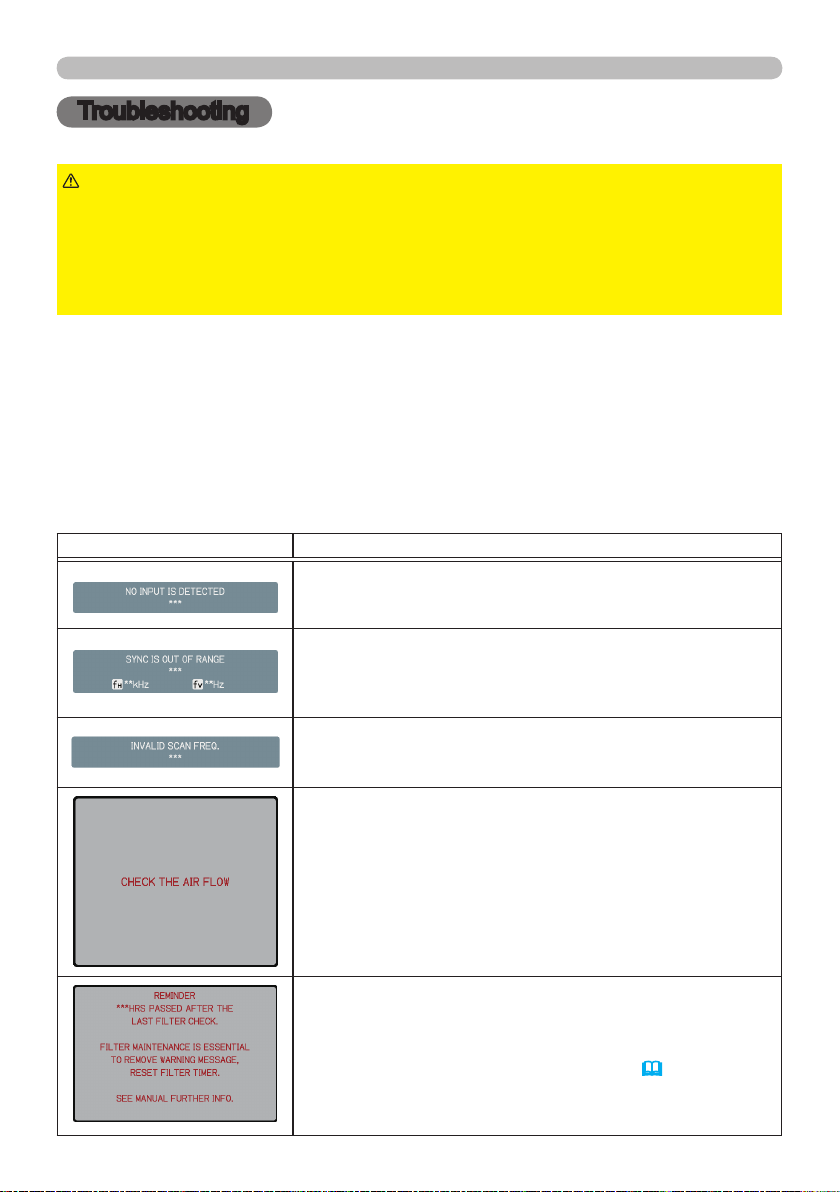
64
Troubleshooting
Troubleshooting
If an abnormal operation should occur, stop using the projector immediately.
Otherwise if a problem occurs with the projector, the following checks and
measures are recommended before requesting repair.
If this does not resolve the problem, please contact your dealer or service
company. They will tell you what warranty condition is applied.
►Never use the projector if abnormal operations such as
smoke, strange odor, excessive sound, damaged casing or elements or cables,
penetration of liquids or foreign matter, etc. should occur. In such cases,
immediately turn off the power switch and then disconnect the power plug from
the power outlet. After making sure that the smoke or odor has stopped, contact
to your dealer or service company.
WARNING
Related messages
When some message appears, check and cope with it according to the following
table. Although these messages will be automatically disappeared around several
minutes, it will be reappeared every time the power is turned on.
Message Description
There is no input signal.
Please conrm the signal input connection, and the status
of the signal source.
The horizontal or vertical frequency of the input signal
is not within the specied range.
Please conrm the specs for your projector or the signal
source specs.
An improper signal is input.
Please conrm the specs for your projector or the signal
source specs.
The internal temperature is rising.
Please turn the power off, and allow the projector to cool
down at least 20 minutes. After having conrmed the
following items, please turn the power ON again.
• Is there blockage of the air passage aperture?
• Is the air-lter dirty?
• Does the peripheral temperature exceed 35°C?
If the same indication is displayed after the remedy, please set
FAN SPEED of the SERVICE item in the OPTION menu to HIGH.
A note of precaution when cleaning the air-lter.
Please immediately turn the power off, and clean or change
the air-lter referring to the “Maintaining the air-lter” section
of this manual. After you have cleaned or changed the air-
lter, please be sure to reset the lter time (
45, 60).
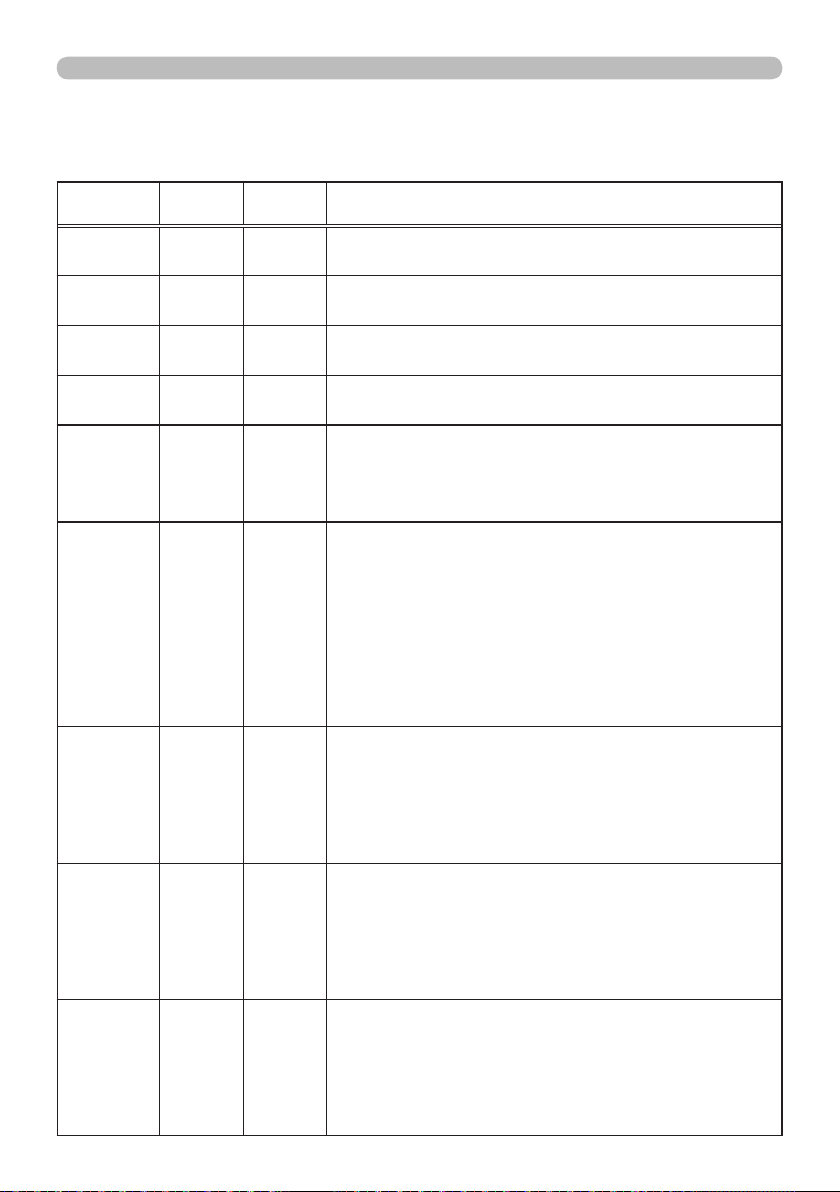
65
Troubleshooting
Regarding the indicator lamps
When operation of the LAMP, TEMP and POWER indicators differs from usual,
check and cope with it according to the following table.
POWER
indicator
TEMP
indicator
LAMP
indicator
Description
Lighting
In Orange
Turned
off
Turned
off
The projector is in a standby state.
Please refer to the section “Power on/off”.
Blinking
In Green
Turned
off
Turned
off
The projector is warming up.
Please wait.
Lighting
In Green
Turned
off
Turned
off
The projector is in an on state.
Ordinary operations may be performed.
Blinking
In Orange
Turned
off
Turned
off
The projector is cooling down.
Please wait.
Blinking
In Red
(discre-
tionary)
(discre-
tionary)
The projector is cooling down. A certain error has
been detected.
Please wait until POWER indicator nishes blinking,
and then perform the proper measure using the item
descriptions below.
Blinking
In Red
or
Lighting
In Red
Turned
off
Lighting
In Red
The lamp does not light, and there is a possibility that
interior portion has become heated.
Please turn the power off, and allow the projector to
cool down at least 20 minutes. After the projector has
sufciently cooled down, please make conrmation of the
following items, and then turn the power on again.
• Is there blockage of the air passage aperture?
• Is the air-lter dirty?
• Does the peripheral temperature exceed 35°C?
If the same indication is displayed after the remedy,
please change the lamp referring to the section “Lamp”.
Blinking
In Red
or
Lighting
In Red
Turned
off
Blinking
In Red
The lamp cover has not been properly xed.
Please turn the power off, and allow the projector to cool down
at least 45 minutes. After the projector has sufciently cooled
down, please make conrmation of the attachment state of the
lamp cover. After performing any needed maintenance, turn
the power on again. If the same indication is displayed after
the remedy, please contact your dealer or service company.
Blinking
In Red
or
Lighting
In Red
Blinking
In Red
Turned
off
The cooling fan is not operating.
Please turn the power off, and allow the projector to cool down at
least 20 minutes. After the projector has sufciently cooled down,
please make conrmation that no foreign matter has become
caught in the fan, etc., and then turn the power on again.
If the same indication is displayed after the remedy,
please contact your dealer or service company.
Lighting
In Red
Turned
off
Turned
off
The lens door is not opened or closed properly.
One of the followings has been happened.
•
The lens door is not opened properly, when the projector is turned on.
•
The lens door is not closed properly, when the projector is turned off.
•
The lens door position is shifted, while the projector is working.
Restart the projector, after conrming that there is nothing
that the lens door hits while opening or closing.
(continued on next page)
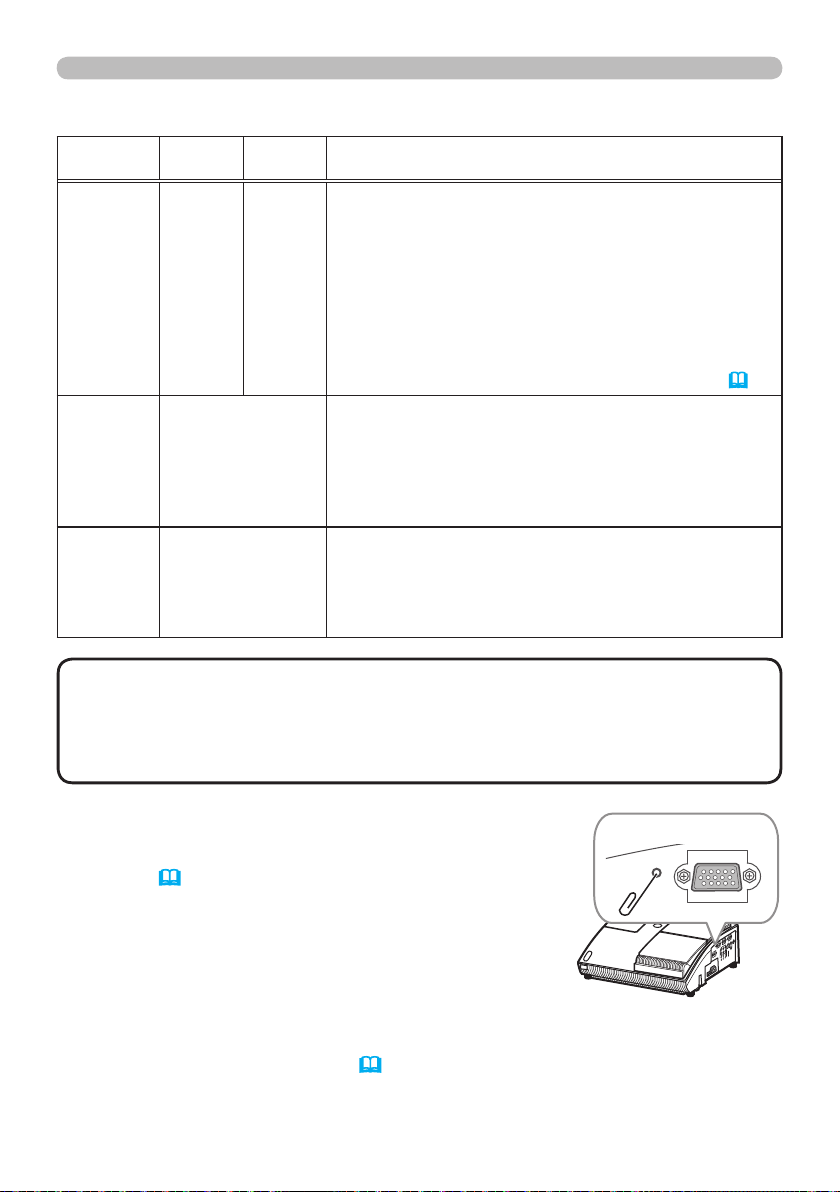
66
Troubleshooting
Regarding the indicator lamps (continued)
• When the interior portion has become overheated, for safety purposes,
the projector is automatically shut down, and the indicator lamps may also be
turned off. In such a case, disconnect the power cord, and wait at least 45 minutes.
After the projector has sufciently cooled down, please make conrmation of the
attachment state of the lamp and lamp cover, and then turn the power on again.
NOTE
POWER
indicator
TEMP
indicator
LAMP
indicator
Description
Blinking
In Red
or
Lighting
In Red
Lighting
In Red
Turned
off
There is a possibility that the interior portion
has become heated.
Please turn the power off, and allow the projector to cool down at least
20 minutes. After the projector has sufciently cooled down, please make
conrmation of the following items, and then turn the power on again.
• Is there blockage of the air passage aperture?
• Is the air-lter dirty?
• Does the peripheral temperature exceed 35°C?
If the same indication is displayed after the remedy, please set
FAN SPEED of SERVICE item in OPTION menu to HIGH
(
47)
.
Lighting
In Green
Simultaneous
blinking in Red
It is time to clean the air-lter.
Please immediately turn the power off, and clean or
change the air-lter referring to the section “Maintaining
the air-lter”. After cleaning or changing the air-lter,
please be sure to reset the lter timer.
After the remedy, reset the power to ON.
Lighting
In Green
Alternative
blinking in Red
There is a possibility that the interior portion
has become overcooled.
Please use the unit within the usage temperature
parameters (5°C to 35°C).
After the treatment, reset the power to ON.
Shutting the projector down
Only when the projector can not be turned off by usual
procedure (17), please push the shutdown switch using
a pin or similar, and disconnect the power plug from the
power outlet. Before turning it on again, wait at least 10
minutes to make the projector cool down enough.
Resetting all settings
When it is hard to correct some wrong settings, the FACTORY RESET function of
SERVICE item in OPTION menu (48) can reset all settings(except LANGUAGE,
FILTER TIME, LAMP TIME, FILTER MESSAGE settings and etc.) to the factory
default.
MONITOR OUT
Shutdown switch
67
Troubleshooting
Phenomena that may be easy to be mistaken for machine defects
About the phenomenon confused with a machine defect, check and cope with it
according to the following table.
Phenomenon Cases not involving a machine defect
Reference
page
Power does not
come on.
The electrical power cord is not plugged in.
Correctly connect the power cord.
12
The main power source has been interrupted during
operation such as by a power outage (blackout), etc.
Please disconnect the power plug from the power outlet,
and allow the projector to cool down at least 10 minutes,
then turn the power on again.
12, 16
Either there is no lamp and/or lamp cover, or either
of these has not been properly xed.
Please turn the power off and disconnect the power plug from
the power outlet, and allow the projector to cool down at least
45 minutes. After the projector has sufciently cooled down,
please make conrmation of the attachment state of the lamp
and lamp cover, and then turn the power on again.
58
Neither sounds
nor pictures are
outputted.
The signal cables are not correctly connected.
Correctly connect the connection cables.
10
Signal source does not correctly work.
Correctly set up the signal source device by referring to the
manual of the source device.
–
The input changeover settings are mismatched.
Select the input signal, and correct the settings.
18, 19
The BLANK function for pictures and the MUTE
function for sounds are working.
The BLANK and MUTE, or AV Mute may be active. Refer
to the item “Sound does not come out” and “No pictures
are displayed” on the next page to turn off the MUTE and
BLANK functions.
18, 23
(continued on next page)

68
Troubleshooting
Phenomena that may be easy to be mistaken for machine defects (continued)
Phenomenon Cases not involving a machine defect
Reference
page
Sound does not
come out.
The signal cables are not correctly connected.
Correctly connect the audio cables.
10
The MUTE function is working.
Restore the sound pressing MUTE or VOLUME+/- button
on the remote control.
18
The volume is adjusted to an extremely low level.
Adjust the volume to a higher level using the menu function
or the remote control.
18
The AUDIO/SPEAKER setting is not correct.
Correctly set the AUDIO/SPEAKER in AUDIO menu.
39
No pictures are
displayed.
The lens door is not fully opened.
Turn the projector off, and then turn it on again to make sure
that the door is opened correctly.
16, 17,
62
The signal cables are not correctly connected.
Correctly connect the connection cables.
10
The brightness is adjusted to an extremely low level.
Adjust BRIGHTNESS to a higher level using the menu
function.
27, 28
The computer cannot detect the projector as a plug
and play monitor.
Make sure that the computer can detect a plug and play
monitor using another plug and play monitor.
11
The BLANK screen is displayed.
Press BLANK button on the remote control.
23, 40
(continued on next page)
69
Troubleshooting
• Although bright spots or dark spots may appear on the screen, this
is a unique characteristic of liquid crystal displays, and it does not constitute or
imply a machine defect.
NOTE
Phenomena that may be easy to be mistaken for machine defects (continued)
Phenomenon Cases not involving a machine defect
Reference
page
Video screen
display freezes.
The FREEZE function is working.
Press FREEZE button to restore the screen to normal.
23
Colors have a
faded- out
appearance, or
Color tone is
poor.
Color settings are not correctly adjusted.
Perform picture adjustments by changing the COLOR
TEMP, COLOR, TINT and/or COLOR SPACE settings,
using the menu functions.
27, 29,
33
COLOR SPACE setting is not suitable.
Change the COLOR SPACE setting to AUTO, RGB,
SMPTE240, REC709 or REC601.
33
Pictures appear
dark.
The brightness and/or contrast are adjusted to an
extremely low level.
Adjust BRIGHTNESS and/or CONTRAST settings to a
higher level using the menu function.
27, 28
The whisper function is working.
Select NORMAL for WHISPER item in the SETUP menu.
27, 37
The lamp is approaching the end of its product
lifetime.
Replace the lamp.
58, 59
Pictures appear
blurry.
Either the focus and/or horizontal phase settings are
not properly adjusted.
Adjust the focus using the focus ring, and/or H PHASE
using the menu function.
21, 32
The lens or mirror is dirty or misty.
Clean the lens or mirror referring to the section “Caring for
the lens”.
62
RS-232C does
not work.
The SAVING function is working.
Select NORMAL for STANDBY MODE item in the SETUP
menu.
38
70
Specications
Specications
Specications
Item Specications
Product name Liquid crystal projector
Liquid
Crystal
Panel
Panel size 1.6 cm (0.63 type)
Drive system TFT active matrix
Pixels 786,432 pixels (1024 horizontal x 768 vertical)
Lens f=5.1 mm
Lamp 220 W UHB
Audio output 7 W
Power supply AC 100-120V/3.6A, AC 220-240V/1.5A
Power consumption 340W
Temperature range 5~35°C (operating)
Ports
COMPUTER IN1 .......................... D-sub 15 pin mini x 1
COMPUTER IN2 .......................... D-sub 15 pin mini x 1
Y, C
B/PB, CR/PR (Component video) .................. RCA x 3
S-VIDEO .............................................mini DIN 4 pin x 1
VIDEO ............................................................... RCA x 1
MONITOR OUT ............................ D-sub 15 pin mini x 1
AUDIO IN1.............................................. Stereo mini x 1
AUDIO IN2.............................................. Stereo mini x 1
AUDIO IN3 (L, R) .............................................. RCA x 2
AUDIO OUT ............................................ Stereo mini x 1
CONTROL .............................................. D-sub 9 pin x 1
Optional parts
Lamp: DT00893
Filter unit: UX35381
Soft case: CA100
* For more information, contact to your dealer.
Weight (mass) 5.8 kg (approx.)
Size
397 (W) x 131 (H) x 356 (D) mm
*Excluding protrusions. Please refer to the following
gure.
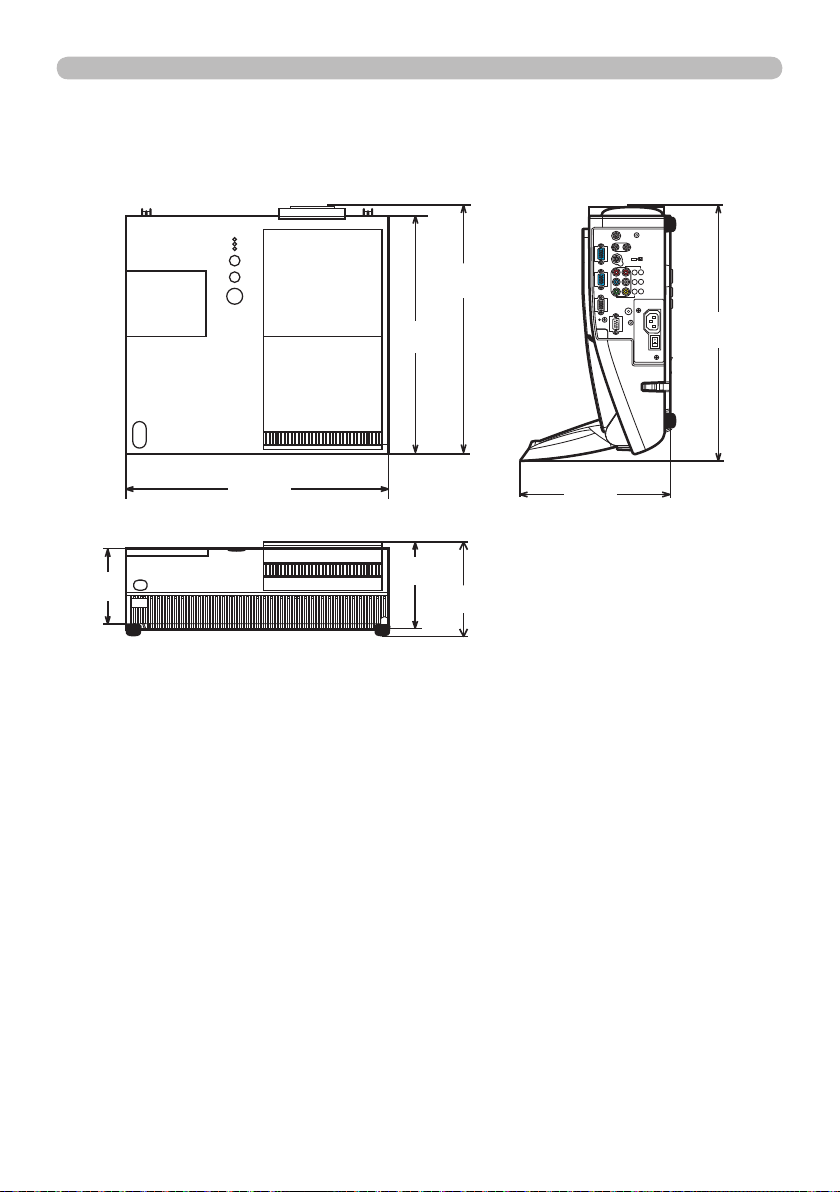
71
Specications
Specications (continued)
[unit: mm]
356
131
379
225
391
139
113
397