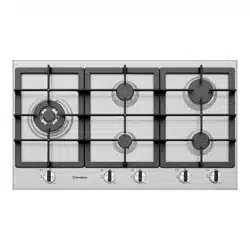
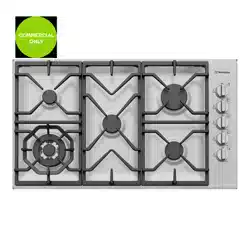
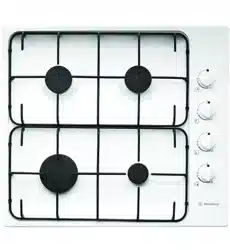
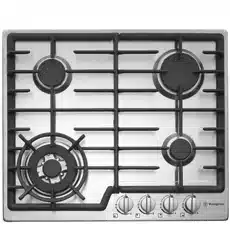
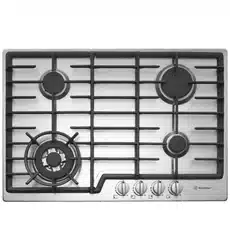
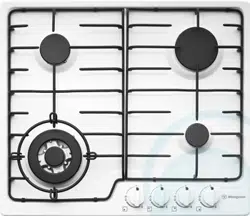
User manual Gas Cooktop
-988416.png)
INSTALLATION
-421486.png) CAUTION
CAUTION
You must read these warnings carefully before installing or using the cooktop. If you need assistance, contact our Customer Care Department.
The manufacturer will not accept liability, should the instructions below or any other safety instructions incorporated in this book be ignored.
Installation
- An authorised person must install this appliance and MUST provide a certificate of compliance. This certificate should be retained along with purchase information.
- Before using the appliance, ensure that all packing materials are removed from the appliance.
- In order to avoid any potential hazard, the installation instructions in this booklet, and any labels on the appliance must be followed.
- Ensure that all specified vents, openings and air spaces are not blocked.
- Where the appliance is built into a benchtop, the benchtop material must be capable of withstanding 85°C.
- Ensure that the duplicate rating label (in the instruction pack) is attached to a readily-accessible adjacent surface, so that the cooktop can be easily identified in the case of a service call.
Servicing
- Servicing MUST only be carried out by authorised personnel.
- To maintain safe operation, it is recommended that the product be inspected every five years by an authorised service person.
- If the supply cord is damaged, it must be replaced by an authorised service person in order to avoid a hazard.
Cleaning
- Always ensure the appliance is turned off before cleaning.
- This appliance contains aluminium fittings. Do not use caustic-based cleaners.
- Do not use steam cleaners, as this may cause moisture build up on electrical components.
- Always clean the appliance immediately after any food spillage.
CAUTION
DO NOT place burners in a dishwasher.
USING YOUR COOKTOP
Controls
Each burner is controlled by a control knob. The markings on the control panel indicate which burner the knob controls, and the settings for that burner. (See Figure 2).
NOTE: Gas controls turn anticlockwise from ‘Off’ and have limited movement.
-632820.png)
Lighting burners
Electronic Ignition
These cooktops are fitted with mains powered electronic ignition. When the appliance has been connected and the power is on, depressing any knob will release sparks to all burners. To light a burner, depress the corresponding knob and turn to the ‘High’ -588613.png) position (while depressing the knob). pushing down as far as possible for approximately 5 seconds. If the flame goes out when the knob is released, simply depress the knob again, this time holding it down with slightly more force for the same length of time. The height of the flame can be varied by turning the control knob toward the ‘Low’
position (while depressing the knob). pushing down as far as possible for approximately 5 seconds. If the flame goes out when the knob is released, simply depress the knob again, this time holding it down with slightly more force for the same length of time. The height of the flame can be varied by turning the control knob toward the ‘Low’ -519050.png) position.
position.
NOTE: When the wok burner is turned to low the smaller inner ring stays lit. This is a normal function of the dual work burner to provide a very low power flame option.
WARNING
- Keep hands clear of burners when lighting.
- If burner does not light within 5 seconds, turn knob to ‘Off’ position, allow gas to disperse, then try lighting again.
- Burners MUST be operated between ‘HIGH’ and ‘LOW’ settings only. In the absence of electrical power, carry out the ignition directly to the burner with a hand-held ignition source.
Choice of burners
For your convenience there is a choice of burners:
- A small burner for special low heat and slow cooking.
- A medium burner for normal cooking and simmering. one on 4-burner models and two on 5-burner models).
- A large burner for fast heating and large pots and pans.
- A wok burner for very fast heating using a wok or large pot or pan.
To conserve gas, place the pan centrally over the burner and adjust the flame so that it does not extend past the edge of the pan (Figure 3). Do not boil food too rapidly. A vigorous boil will not cook food any faster, and will waste energy.
Pots and pans
All common pots and pans: aluminium, stainless steel, cast iron, ceramic etc., may be used on your new gas model cooktop. Ensure that the pots or pans are steady and have flat bases to avoid dangerous spill-over of hot liquids and wasted energy. A wok support has been supplied with this appliance for use when cooking with a round-bottom wok. The support is not necessary when cooing with a flat-bottom wok.
-57981.png)
CAUTION
Never use asbestos mats, wire mats or grids, aluminium foil as it can lead to overheating, cracked enamel. The warranty will be void if these items are used and cause a failure. Woks should only be used on the wok burner and wok support trivet.
CARE AND CLEANING
WARNING
Ensure the appliance is off and cool before cleaning.
Enamel
Persistent stains may require rubbing with a nylon scourer or creamed powder cleansers. Household enamel cleaners are available, follow the manufacturer’s instructions in their use.
CAUTION
Harsh abrasive cleaners, powder cleaners, steel wool or wax polishes should not be used.
Stainless steel
NOTE: Ensure any oil is cleaned off the hob before first use, otherwise it may cause the hob to turn a yellowish colour.
All grades of stainless steel may stain, discolour or attain an adhering layer of grime in normal operation. To achieve maximum surface appearance, stainless steel must be kept clean by regularly using the following cleaning procedures, thus ensuring good performance and long service life. Wash with warm soapy water and rinse with clean water. Where the stainless steel has become extremely dirty with signs of surface discolouration, (due to periods of neglect or misuse) use a stainless steel cleaner.
CAUTION
DO NOT use abrasive scourers or steel wool. When removing these stains be sure to follow the polish or brushing lines.
Trivets and burners
The burners and trivets are removable for easy cleaning.
NOTE: When refitting the burners, ensure that they are correctly seated.
Ensure burners are thoroughly dried after cleaning or spillage. When cleaning the burners, ensure that all the flame ports are free of any blockage. If necessary, use a toothpick or brush to clear ports. The outer surface of the burners have a polished finish and extra care needs to be taken to avoid scratching this surface during cleaning. In instances of heavy soiling, it may be necessary to apply a non-abrasive cleaning compound and rub with a cloth until the soiling is removed and then finish with a soft, dry cloth.
NOTE: DO NOT place burners in the dishwasher.
Ignition
Gently clean the spark plug and flame safe guard sensor with a damp cloth to avoid lighting difficulties. Ensure the electrode is dry before use.
Injector
Ensure the injector remains free of any foreign material. If necessary, use a thin piece of wire to clear the orifice.
TROUBLESHOOTING
If you have a problem with the cooktop, check the table below. You may be able to solve the problem and this will save you from paying for a service call. You will have to pay for a service call even in the warranty period if the problem is one listed below.
Burner will not light even though the sparker is working.
- Knob not held down long enough in ‘High’ position for flame safeguard to engage
- Repeat lighting procedure and hold knob down for 5 seconds in ‘High’ position (refer page 4)
- Gas supply valve turned off
- Turn on gas supply to appliance
- Wrong knob turned
- Ensure the knob you are turning corresponds to the burner you want to light
- Port blockage in ignition area
- Ensure that ports in ignition area are clean and dry
- Ignition spark plugs wet or dirty
- Dry or clean ignition spark plugs
No spark is obtained when control knob is activated
- Electricity supply is disconnected or switched off
- Switch on electricity or check fuses
- Ignition spark plugs wet or dirty
- Dry or clean ignition spark plugs
Flames uneven or tending to lift
- Flame ports blocked or wet
- Burner incorrectly fitted
- Ensure this component is fitted correctly
Flames not staying on when knob released
- Knob not held down long enough in ‘High’ position for flame safeguard to engage
- Repeat lighting procedure and hold knob down for 5 seconds in ‘High’ position (refer page 4)
- Knob not set between ‘High’ and ‘Low’
- Knob MUST be set between these positions
- Dirt or spillage on flame safeguard sensor
- Clean flame safe guard sensor tip
Low heat, slow cooking
- Incorrect cooking pot or pan being used
- Refer to Figure 3 (page 5)
Benchtop or knobs overheating
- Incorrect cooking pot or pan used
- Check Figure 3 for correct pot or pan to be used
- Pot or pan not located on burner properly
- Ensure pot or pan is centrally located on burner
Cooktop stainless steel discoloured
- Pot or pan being used is too large
- Ensure pot sizes used are as per user manual requirements. Clean with STEEL POWER (available through spare parts)
Outer ring of wok burner goes out when set to low
- This is not a failure. This is a function of the dual wok burner to give a very low power flame option
- Burner is functioning as intended
INSTALLATION INSTRUCTIONS
This appliance must be installed by an authorised person and in compliance with:
- AS/NZS 5601.1 Gas Installations Part 1: General Installations, and AS/NZS 5601.2 Gas Installations Part 2: LP Gas installations in caravans and boats for non-propulsive purposes, or the relevant installation code for gas appliances in your country.
- The local gas fitting regulations, municipal building codes, electrical wiring regulations and any other relevant statutory regulations.
- The particular instructions as given below
- CAUTION
- Cooktops are supplied for use with natural gas (NG). To use with LPG the injectors MUST be changed using the conversion kit supplied. Refer LP Conversion on page 12 and 13.
- A certificate of compliance MUST be given to the customer after the appliance is successfully installed.
- This appliance must be earthed.
-230117.png)
-902408.png)
INSTALLATION PROCEDURE
1. The bench cutout should be made as per cutout dimensions in Figure 4.
2. Adjacent walls, cupboards and protection for combustible materials.
Ensure that the appliance is installed in accordance with AS/NZS 5601.1, or AS/NZS 5601.2 with regard to clearances to combustible surfaces and materials, and clearances to rangehoods and exhaust fans.
To ensure clearances of 200mm from burners to vertical combustible surfaces observe the minimum dimensions shown in Figure 5.
Rangehoods and exhaust fans shall be installed in accordance with the manufacturer’s relevant instructions. However, in no case shall the clearance between the highest part of the hob of the gas cooking appliance and a range hood be less than 600mm or, for an overhead exhaust fan, 750mm. Clearances to combustible surfaces may be reduced if combustible surfaces are protected in accordance with AS/NZS 5601.1, or AS/NZS 5601.2.
3. Optional Barrier
A barrier can be installed to prevent accidental contact with the cooktop base, where the base of the cooktop is accessible from below (i.e. inside a cupboard, etc). An impression has been incorporated into the base to ensure a minimum clearance of 15mm is maintained between the base and the barrier. This barrier may be made of any non-combustible, rigid material.
Note: An alternative to the above is to purchase a barrier shield from Electrolux spare parts (P/No. ACC 072) which can be fitted directly to the underside of the product. This shield protects the user from accidently touching certain areas of the product. Barrier protection is not necessary if the product is installed above an underbench oven or similar appliance and/or if the cupboard construction is such that the underside of the cooktop is not accessible.
4. MASTIC TAPE has been provided and is to be placed around the bench cutout as specified in Figure 6. Take care to ensure that the seals meet without overlapping.
5. Fit the pull down clamps supplied to ensure that the cooktop cannot move after installation.
6. Remove any excess seal visible after installation
- Place the seals supplied around the bench cut-out as shown in Figure 6, taking care that the seals meet without overlapping.
- Fit the pull-down clamps supplied to ensure that the cooktop cannot move after installation.
WARNING
Failure to fix the cooktop to the bench could result in loosening of the gas connection through movement of the cooktop and a gas leak may result.
- Use the 4 clamps and screws supplied in the parts bag for 4 burner models, and 6 clamps and screws for 5 burner models.
- To assemble, attach the clamps to each corner of the burner box via the screws provided.
- Fix the clamps as shown in Figure 7.
- Remove excess seal.
- If the benchtop is less than the standard 33mm thickness, use a packer between the bench and the pull down clamps to ensure the cooktop is properly secured.
-904777.png)
NOTE: Distances shown to adjacent walls/surfaces are for the distance to a combustible surface. If the surface is not combustible the measurement can be smaller than that shown.
-936199.png)
-290752.png)
GAS CONNECTION
CAUTION
This appliance is supplied for use with Natural Gas. However, it can be converted for use with LPG. Refer to LP conversion on pages 12 and 13.
Supply pipe sizing
The total hourly gas consumption for the appliance is shown on the data label. The required supply pressure (i.e. at inlet to appliance regulator) for each gas type is shown on the data label, and given in Technical Data table. Use this information in conjunction with the length of run, number of elbows, tees and bends, the available service pressure and the supply requirements of other installed appliances to determine a suitable pipe size. For assistance in this matter refer to the appropriate section of AS/NZS 5601.1 or AS/NZS 5601.2.
An AGA certified class B or D flexible connection may be used to connect the cooktop in accordance with AS/ NZS 5601.1, in particular section 5.9 and clause 6.10.1.8, or AS/NZS 5601.2, in particular section 2.11. Where a hose assembly is used and the cooktop is in the installed position, the hose assembly shall be suitable for connection to a fixed consumer piping outlet located at a point 800 – 850mm above the floor and in the region outside the width of the appliance to a distance of 250mm. The point of connection to consumer piping must be accessible with appliance installed.
Elbow positioning
It is possible to reposition the elbow if required by loosening the locking nut and elbow by using two spanners. Re-tighten the entire assembly after the elbow has been repositioned. When fitting elbow to appliance, ensure that the sealing washer is fitted.
OPERATION ON N.G./S.N.G.
Regulator
An appliance regulator is provided. The regulator must be positioned so that the pressure test nipple is accessible when the appliance is installed. Connect the gas supply to the 1/2 B.S.P. internal thread inlet of the regulator. Refer to ‘bench cutout’ (Figure 4) for connection point position.
Assembly of Regulator
The assembly of the regulator to the cooktop manifold is achieved via the elbow union and sealing washer supplied, refer to figure 9 (page 11).
The 1/2 parallel thread connects to the manifold, and the sealing washer is placed between the manifold end and the flat face on the elbow.
The 1/2 tapered thread connects to the outlet of the regulator, and is sealed on the thread using approved thread sealing tape or approved thread sealing compound.
The inlet of the regulator is a 1/2 parallel thread and is connected to consumer piping or hose assembly.
Regulators are supplied pre-adjusted and configured by the component maker for use with Natural Gas. The appliance installer is not required to make an adjustment to obtain the correct outlet pressure setting.
An arrow on the base of the regulator indicates the direction of gas flow when the inlet and outlet of the regulator is orientated correctly. When the regulator has been fitted check for leaks from the connections with soapy water.
Checking the gas supply
- Check the manometer zero point is correct.
- Connect the manometer to the cooktop pressure point. This is located on the regulator.
- Turn on the gas supply and electricity and try to ignite the gas.
IMPORTANT
It will take additional time to light the gas for the first time as air needs to be purged from the pipes.
4. With the appliance operating check the outlet pressure:
- when all burners of the appliance are operating at maximum,
- when the smallest burner of the appliance is operating at minimum.
Under these conditions the outlet pressure should not vary from the nominal outlet pressure of 1.00kPa by more than +/–0.20kPa.
If the regulator appears to not be performing satisfactorily, then check the following points.
- If the outlet pressure is consistently too low then the inlet pressure may be too low and adjustment of an upstream regulator may be needed, or an upstream regulator or valve with insufficient flow capacity may be present in the gas supply line. If this is suspected then it may be necessary to repeat the checks whilst measuring both the inlet and outlet pressure to determine if the inlet pressure is in the range 1.13 – 5kPa.
- Check that the regulator has been fitted to the gas supply line in the correct orientation, the arrow on the base of the body indicates the direction of gas flow. Once these checks have been completed, if the regulator still fails to perform in a satisfactory manner it should be replaced.
-483551.png)
-359811.png)
ELECTRICAL CONNECTION (220-240 VOLTS)
The appliance is supplied with a standard 7.5Amp service cord terminated by a 3-pin plug for connection to a standard household socket. The electrical supply is required to power the electronic ignition system.
NOTE: It will be necessary for servicing purposes to disconnect the electrical power supply. The power point should therefore be accessible after the appliance is installed, as specified in the local wiring regulations.
Figure 10 is a schematic of the wiring in the appliance.
The weight of the unit is printed on the appliance packaging label.
-615117.png)
Use of Hose Assemblies
Ensure that the hose assembly is restrained from accidental contact with the flue outlet of an underbench oven or any other hot surface of an adjacent appliance.
TESTING APPLIANCE OPERATION
After installation, test the appliance and ensure that it operates correctly before handing it over to the customer. The following procedure is recommended:
1. Turn on the gas and electricity supply and attempt ignition on all burners, both separately and in combination. (For correct procedure, refer to page 4). Note that additional time needs to be allowed for the initial lighting as air has to be purged from the pipes.
2. Observe the flame appearance on each burner. (Figure 12) If it is much larger or much smaller than expected, the injector size and supply pressure require checking. Where a flame is unsatisfactory, refer to the Troubleshooting Guide (Page 6) to correct the fault. If the Troubleshooting Guide does not solve the problem, call the Service Centre.
-422852.png)
3. Once all the previous tests are satisfactory, check the turndown (minimum or low) setting on each burner, as this may need adjustment. Valves have a by pass controlling screw, which may be accessed by removing the knob. This screw will be located on a particular area of the valve. (Refer Figure 13). Normally, this will have been correctly set at the factory for use on NG (Natural Gas) and should not require adjustment.
If the appliance has been converted to LPG, then the bypass screw will have to be screwed in until a small, stable flame results.
-720021.png)
Please ensure the supply pressure has been checked PRIOR to any adjustment.
4. If the appliance cannot be adjusted to perform safely, inform the customer of the problem and affix an appropriate warning notice to the appliance. If the fault appears to be dangerous the appliance should be disconnected. If a minor fault exists, the customer may wish to use the appliance while awaiting service.
If a fault cannot be fixed, please call the Service Centre.
5. The customer should be advised that, in the event of a fault, the local Service Organisation or the retailer from whom the appliance was purchased should be contacted.
6. When satisfied that the unit is operating correctly, turn off and instruct the customer on correct operation as outlined in this booklet. Ask the customer to operate the controls to ensure that the correct procedure is understood.