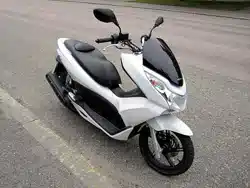
Honda 2020 Ruckus NPS50 Street Scooter
Product's Documents
Below are documents related to this product, you can read online or download:
- Owner's manual - (English) Read Online | Download pdf
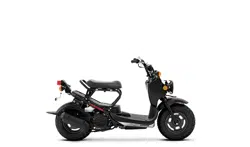
Scooter Manual
Start your engine using the following procedure, regardless of whether the engine is cold or warm.
NOTICE
 (Run) position.
To Start the Engine with Electric Starter
5. Press the start button with the throttle completely closed. Release the start button as soon as the engine starts.

To Start the Engine with Kickstarter
5. With the throttle closed, operate the kickstarter with a rapid, continuous motion.
→ Allowing the kickstarter to snap back freely against the pedal stop can damage the engine case.
→ Raise the kickstarter pedal after the kickstarter lever is returned to the stop.

If the engine does not start: Open the throttle 1/8 - 1/4 turn while starting the engine

Starting the Vehicle
1. Push the vehicle forward off the center stand.
→ Lock the rear brake lock.
→ Keep throttle closed.
2. Get on the vehicle.
→ Mount the vehicle from the left side, keeping at least one foot on the ground.
3. Release the rear brake lock.
→ To prevent unexpected movement, squeeze brake levers.
4. Acceleration and deceleration
To accelerate: Open the throttle slowly.
To decelerate: Close the throttle

Close the throttle and apply the front and rear brake levers together.
Do not apply the brake lock while riding.
It may cause the wheel to lock, reducing control of the vehicle.

Fuel type: Unleaded gasoline only
Recommended fuel octane number: Pump Octane Number (PON) 86 or higher.
Tank capacity: 1.32 US gal (5.0 L)
Opening the Fuel Fill Cap

Closing the Fuel Fill Cap
WARNING
Gasoline is highly flammable and explosive. You can be burned or seriously injured when handling fuel.
The helmet holder is located at the left seat rail.

Insert the ignition key and turn it counterclockwise.
WARNING
Riding with a helmet attached to the holder can interfere with the rear wheel or suspension and could cause a crash in which you can be seriously hurt or killed.
Use the helmet holder only while parked. Do not ride with a helmet secured by the holder.

Push the seat hook and lift the seat.
Lower the seat. Push down on the left side of the seat until it locks.
Make sure the seat is securely closed.
The document bag is in the owner’s manual storage compartment on the underside of the seat.

To open
Keeping your vehicle well-maintained is absolutely essential to your safety and to protect your investment, obtain maximum performance, avoid breakdowns, and reduce air pollution. Maintenance is the owner's responsibility. Be sure to inspect your vehicle before each ride, and perform the periodic checks specified in the Maintenance Schedule
WARNING
Improperly maintaining your vehicle or failing to correct a problem before you ride can cause a crash in which you can be seriously hurt or killed.
Always follow the inspection and maintenance recommendations and schedules in this owner's manual.
The maintenance schedule specifies the maintenance requirements necessary to ensure safe, dependable performance, and proper emission control.
Maintenance work should be performed in accordance with Honda's standards and specifications by properly trained and equipped technicians. Your dealer meets all of these requirements. All scheduled maintenance is considered a normal owner operating cost and will be charged to you by your dealer. Keeping an accurate maintenance record will help ensure your vehicle is properly maintained.
Make sure whoever performs the scheduled maintenance completes the maintenance record. Retain all service documents. If you sell your vehicle, these service documents should be transferred with the vehicle to the new owner

 | Intermediate. We recommend service by your dealer, unless you have the necessary tools and are mechanically skilled. Procedures are provided in an official Honda Service Manual (2 P. 100). |
 | Technical. In the interest of safety, have your vehicle serviced by your dealer. |
 | Inspect (clean, adjust, lubricate, or replace, if necessary)
|
 | Replace |
 | Clean |

Notes:
*1 : At higher odometer readings, repeat at the frequency interval established here.
*2 : Service more frequently when riding in unusually wet or dusty areas.
*3 : Service more frequently when riding in rain or at full throttle.
*4 : Replace every 2 years. Replacement requires mechanical skill.
To ensure safety, it is your responsibility to perform a pre-ride inspection and make sure that any problem you find is corrected. A preride inspection is a must, not only for safety, but because having a breakdown, or even a flat tire, can be a major inconvenience.
Check the following items before you get on your vehicle:
Check the following items if you are carrying a cargo:
Check the following items after you get on your vehicle:
Check the following items at regular intervals:
You should also perform other periodic maintenance checks at least once a month regardless of how often you ride, or more often if you ride frequently.
Also, check the odometer reading against the Maintenance Schedule and perform all maintenance that is due
Your vehicle has a maintenance-free type battery. You do not have to check the battery electrolyte level or add distilled water. Clean the battery terminals if they become dirty or corroded.
Do not remove the battery cap seals. There is no need to remove the cap when charging.
NOTICE
An improperly disposed of battery can be harmful to the environment and human health.
Always confirm local regulations for proper battery disposal instruction.
What to do in an emergency
If any of the following occur, immediately see your doctor.
WARNING
The battery gives off explosive hydrogen gas during normal operation.
A spark or flame can cause the battery to explode with enough force to kill or seriously hurt you.
Wear protective clothing and a face shield, or have a skilled mechanic do the battery servicing.
WARNING: Battery posts, terminals, and related accessories contain lead and lead compounds
Wash your hands after handling.

4. After cleaning, reinstall the battery.
The battery has a limited life span. Consult your dealer about when you should replace the battery. Always replace the battery with another maintenance-free battery of the same type.
If you use electrical accessories that drain the battery or you do not ride frequently, we recommend that you charge the battery every days using a charger designed specifically for your Honda, which can be purchased from your dealer. Read the information that came with your battery charger and follow the instructions on the battery. Avoid using an automobile-type battery charger, as these can overheat a motorcycle battery and cause permanent damage.
Make sure the ignition switch is in the OFF position before charging the battery.
NOTICE Improper charging can damage the battery. If you can’t charge the battery or it appears unable to hold a charge, contact your dealer.
NOTICE Jump starting using an automobile battery can damage your vehicle's electrical system and is not recommended. Bump starting is also not recommended.
NOTICE Installing non-Honda electrical accessories can overload the electrical system, discharging the battery and possibly damaging the system.
Fuses protect the electrical circuits on your vehicle. If something electrical on your vehicle stops working, check for and replace any blown fuses.
Turn the ignition switch to the OFF position to remove and inspect fuses. If a fuse is blown, replace with a fuse of the same rating. For fuse ratings, see “Specifications.”

NOTICE Replacing a fuse with one that has a higher rating greatly increases the chance of damage to the electrical system.
If a fuse fails repeatedly, you likely have an electrical fault. Have your vehicle inspected by your dealer
Engine oil consumption varies and oil quality deteriorates according to riding conditions and time elapsed.
Check the engine oil level regularly, and add the recommended engine oil if necessary. Dirty oil or old oil should be changed as soon as possible.
If you use non-Honda engine oil, check the label to make sure that the oil satisfies all of the following standards:
*1. The JASO T 903 standard is an index for engine oils for 4-stroke motorcycle engines. There are two classes: MA and MB. For example, the following label shows the MA classification

*2. The SAE standard grades oils by their viscosity.
*3. The API classification specifies the quality and performance rating of engine oils. Use SG or higher oils, excluding oils marked as “Energy Conserving” or “Resource Conserving” on the circular API service symbol.

Pro Honda HP Coolant is a pre-mixed solution of antifreeze and distilled water.
Concentration: 50% antifreeze and 50% distilled water
A concentration of antifreeze below 40% will not provide proper corrosion and cold temperature protection.
A concentration of up to 60% will provide better protection in colder climates.
NOTICE
Using coolant not specified for aluminum engines or tap/mineral water can cause corrosion.
Service more frequently when riding in rain, at full throttle, or after the vehicle is washed or overturned. Service if the deposit level can be seen in the transparent section of the drain tube.
If the drain tube overflows, the air filter may become contaminated with engine oil causing poor engine performance
Visually inspect your tires and use an air pressure gauge to measure the air pressure at least once a month or any time you think the tires look low. Always check air pressure when your tires are cold.
 | Inspect the tires for cuts, slits, or cracks that exposes fabric or cords, or nails or other foreign objects embedded in the side of the tire or the tread. Also inspect for any unusual bumps or bulges in the side walls of the tires. |
| Inspect the tires for signs of abnormal wear on the contact surface. |  |
Inspect the tread wear indicators. If they become visible, replace the tires immediately.

WARNING
Riding on tires that are excessively worn or improperly inflated can cause a crash in which you can be seriously hurt or killed.
Follow all instructions in this owner's manual regarding tire inflation and maintenance.
Have your tires replaced by your dealer.
Follow these guidelines whenever you replace tires.
The rims are designed for tubeless tires, and during hard acceleration or braking, a tubetype tire could slip on the rim and cause the tire to rapidly deflate.
WARNING
Installing improper tires on your vehicle can adversely affect handling and stability, and can cause a crash in which you can be seriously hurt or killed.
Always use the size and type of tires recommended in this owner's manual.
The service life of your tires is dependent on many factors, including, but not limited to, riding habits, road conditions, vehicle loading, tire air pressure, maintenance history, speed, and environmental conditions (even when the tires are not in use).
In addition to your regular inspections and maintenance, it is recommended that you have annual inspections performed once the tires reach 5 years old. It is also recommended that all tires be removed from service after 10 years from the date of manufacture, regardless of their condition or state of wear.
The last four digits of the TIN (tire identification number) indicate the date of manufacture.
The tire identification number (TIN) is a group of numbers and letters located on the sidewall of the tire.

DOT XXXX XXXX 22 09
DOT: This indicates that the tire meets all requirements of the U.S. Department of Transportation.
 XXXX: XXXX: | Factory code |
 XXXX: XXXX: | Tire type code |
 22 09: 22 09: | Date of manufacture (week & year). Example: week 22 in year 09. |

This vehicle is equipped with a viscous type air cleaner element which cannot be cleaned with compressed air or otherwise without degrading its performance.
If the filter becomes dirty, replace it with a new one.


.Removal
Make sure the ignition switch is in the OFF position.
Installation
Install the parts in the reverse order of removal. Always connect the positive + terminal first. Make sure that bolts and nuts are tight.

Removal
Installation
Install the parts in the reverse order of removal.


Removal
Installation
Install the parts in the reverse order of removal.
Use only the recommended type of spark plug in the recommended heat range.
NOTICE Using a spark plug with an improper heat range can cause engine damage.

7. Install the parts in the reverse order of removal. → When reinstalling the spark plug cap, take care to avoid pinching any cables or wires.

If the engine oil is below or near the lower level mark, add the recommended engine oil.
1. Remove the oil fill cap/dipstick. Add the recommended oil until it reaches the upper level mark.
2. Securely reinstall the oil fill cap/dipstick.
NOTICE Overfilling with oil or operating with insufficient oil can cause damage to your engine. Do not mix different brands and grades of oil.
For the recommended oil and oil selection guidelines, see “Maintenance Fundamentals.”


10. Install the oil strainer screen, spring and oil plug and tighten.
Torque: 15 lbf·ft (20 N·m, 2.0 kgf·m)
11. Install a new sealing washer onto the drain bolt. Tighten the drain bolt.
Torque: 18 lbf·ft (24 N·m, 2.4 kgf·m)
12. Fill the crankcase with the recommended oil and install the oil fill cap/dipstick.
| Required oil When changing oil & cleaning the strainer screen: 0.7 US qt (0.7 L) When changing oil only: 0.6 US qt (0.6 L) |
13. Check the oil level
14. Check that there are no oil leaks.
The best way to assure proper carburetion is to see your dealer for regularly scheduled servicing, including carburetor adjustment.
Remember, idle speed adjustment is not a cure-all” for other problems in your engine's fuel-delivery system. Adjusting the idle will not compensate for a fault elsewhere.
The engine must be at normal operating temperature for accurate idle speed adjustment. 10 minutes of stop-and-go riding is sufficient.
| Idle speed (In neutral): 2,000 ± 100 rpm |

Use a new Honda Genuine air cleaner element or an equivalent specified for your vehicle.
NOTICE
Using the wrong air cleaner element may cause premature engine wear or performance problems.


Check the coolant level in the reserve tank while the engine is cold.

If the coolant level is dropping noticeably or the reserve tank is empty, you likely have a serious leak. Have your vehicle inspected by your dealer.
If the coolant level is below the LOWER level mark, add the recommended coolant until the level reaches the UPPER level mark.
Add fluid only from the reserve tank cap and do not remove the radiator cap.

WARNING Removing the radiator cap while the engine is hot can cause the coolant to spray out, potentially scalding you. Always let the engine and radiator cool down before removing the radiator cap.
Have your dealer change the coolant unless you have the proper tools and are mechanically qualified.
| Freeplay at the tip of the brake levers: 3/8 - 13/16 in (10 - 20 mm) |

Check the brake cable for kinks or signs of wear. If necessary have it replaced by your dealer.
Lubricate the brake cable with a commercially available cable lubricant to prevent premature wear and corrosion.
Make sure the brake arm, spring and fastener are in good condition
Adjust the freeplay of the brake lever with the front wheel pointed straight ahead.
Make sure the cut-out on the adjusting nut is seated on the brake arm pin when adjusting the freeplay.

If proper adjustment cannot be obtained by this method, see your dealer.
1. Adjust by turning the rear brake adjusting nut a half-turn at a time.

2. Apply the brake several times and check for free wheel rotation after the brake lever is released.
3. Push the brake arm to confirm that there is a gap between the rear brake adjusting nut and brake arm pin.

After adjustment, confirm the freeplay of the brake lever.
Make sure the brake arm, spring and fastener are in good condition.
NOTICE
Do not turn the adjuster beyond its natural limits.
Adjust the freeplay of the brake lever with the front wheel pointed straight ahead. Make sure the cut-out on the adjusting nut is seated on the brake arm pin when adjusting the freeplay

If proper adjustment cannot be obtained by this method, see your dealer.
1. Adjust by turning the front brake adjusting nut a half-turn at a time.

2. Apply the brake several times and check for free wheel rotation after the brake lever is released.
3. Push the brake arm to confirm that there is a gap between the front brake adjusting nut and brake arm pin.

After adjustment, confirm the freeplay of the brake lever.
Make sure the brake arm, spring and fastener are in good condition.
NOTICE
Do not turn the adjuster beyond its natural limits.
The front and rear brake are equipped with a brake wear indicator.


When the brake is applied, an arrow attached to the brake arm moves toward a reference mark on the brake panel. If the arrow aligns with the reference mark on full application of the brake, the brake shoes must be replaced. See your dealer for this service.
When the brake service is necessary, see your dealer. Use only Honda Genuine Parts or its equivalent.
With the engine off, check that the throttle rotates smoothly from fully closed to fully open in all steering positions and throttle freeplay is correct. If the throttle does not move smoothly, close automatically, or if the cable is damaged, have the vehicle inspected by your dealer.
| Freeplay at the throttle grip flange: 1/16 - 1/4 in (2 - 6 mm) |


You can adjust vertical aim of the headlights for proper alignment by moving the headlight guard. To move the headlight guard, loosen the bolts. Tighten the bolts after adjustment. Obey local laws and regulations.

 (Run) position.
 If the problem continues, have your vehicle inspected by your dealer.
The engine is overheating when the following occurs:
If this occurs, pull safely to the side of the road and perform the following procedure.
Extended fast idling may cause the high coolant temperature indicator to come on.
NOTICE
Continuing to ride with an overheated engine can cause serious damage to the engine.
Repairing a puncture or removing a wheel requires special tools and technical expertise. We recommend you have this type of service performed by your dealer.
After an emergency repair, always have the tire inspected/replaced by your dealer.
If your tire has a minor puncture, you can make an emergency repair using a tubeless tire repair kit.
Follow the instructions provided with the emergency tire repair kit.
Riding your vehicle with a temporary tire repair is very risky. Do not exceed 30 mph km/h). Have the tire replaced by your dealer as soon as possible.
WARNING
Riding your vehicle with a temporary tire repair can be risky. If the temporary repair fails, you can crash and be seriously injured or killed.
If you must ride with a temporary tire repair, ride slowly and carefully and do not exceed 30 mp
Battery Goes Dead
Charge the battery using a motorcycle battery charger.
Remove the battery from the vehicle before charging.
Do not use an automobile-type battery charger, as these can overheat a motorcycle battery and cause permanent damage. If the battery does not recover after recharging, contact your dealer.
NOTICE
Jump starting using an automobile battery can damage your vehicle's electrical system and is not recommended.
Bump starting is also not recommended.
Burned-out Light Bulb
Follow the procedure below to replace a burned-out light bulb.
Turn the ignition switch to the OFF or LOCK position.
Allow the bulb to cool before replacing it.
Do not use bulbs other than those specified.
Check the replacement bulb for correct operation before riding.
Headlight Bulb

Do not touch the glass surface with your fingers. If you touch the bulb with your bare hands, clean it with a cloth moistened with isopropyl (rubbing) alcohol.
Brake/Taillight Bulb

Front/Rear Turn Signal Bulb

Blown Fuse
Before handling fuses, see “Inspecting and Replacing Fuses.”
Fuse Box Fuses

NOTICE
If a fuse fails repeatedly, you likely have an electrical problem. Have your vehicle inspected by your dealer.