
Amcrest IP2M-858W / IP2M-858B
2MP Outdoor WiFi PTZ Speed Dome Camera
User Manual
Version: 1.0.3
Revised October 19
th
, 2018

2
Contents
Welcome .............................................................................................................. 4
Important Security Warning ................................................................................ 4
Important Safeguards and Warnings ................................................................... 5
1. Features and Specifications ............................................................................ 6
1.1 Overview..................................................................................................... 6
1.2 Features ...................................................................................................... 6
2. Device Overview .............................................................................................. 7
3. Connection & Installation ................................................................................ 8
3.1 Connection Guide ....................................................................................... 8
3.2. Installation Guide ...................................................................................... 8
3.3 MicroSD card Installation ........................................................................... 9
3.4 Physical Installation Guide ....................................................................... 10
4. Camera Access Setup ..................................................................................... 13
4.1 Default Username and Password ............................................................. 13
4.2 Camera setup methods ............................................................................ 13
4.3. App Setup ................................................................................................ 14
4.4 Desktop Access Setup ............................................................................... 23
4.5 Amcrest Cloud Desktop Setup .................................................................. 25
4.6 Web Access Setup (AmcrestView.com) ................................................... 25
4.7 Remote Web Access Setup ....................................................................... 34
5. Web Operation and Interface ........................................................................ 38
5.1. Live ........................................................................................................... 38
5.3 Playback .................................................................................................... 43
5.4. Cloud Storage .......................................................................................... 44
5.5.1 Camera .................................................................................................. 45
5.5.1.2. Profile Management ......................................................................... 52
5.5.2 Video...................................................................................................... 53
5.5.3. Audio .................................................................................................... 58

3
5.6. Network ................................................................................................... 59
5.6.4. DDNS ..................................................................................................... 63
5.7. PTZ ........................................................................................................... 73
5.8. Event ........................................................................................................ 75
5.9. Storage .................................................................................................... 86
5.9.2 Destination ............................................................................................ 88
5.10. System ................................................................................................... 92
5.11. Information ........................................................................................... 98
5.5 Alarm .......................................................................................................... 101
5.6 Logout ........................................................................................................ 101
6. FAQs/Troubleshooting ................................................................................. 102
Glossary of Terms ............................................................................................ 104
FCC Statement ................................................................................................. 106
IC Warning Statement ..................................................................................... 107
Appendix A: Toxic or Hazardous Materials or Elements ................................. 107

4
Welcome
Thank you for purchasing an Amcrest Speed Dome PTZ camera!
This user manual is designed to be a reference tool for the installation
and operation of your IP camera.
Here you can find information about the camera’s features and
functions, as well as information to aid in troubleshooting.
Many of the setup and installation sections below have
corresponding videos on YouTube
To access the setup videos, please go to http://amcrest.com/videos
For access to the quick start guide and other support information, go
to http://amcrest.com/support To contact Amcrest support, please
do one of the following:
Visit http://amcrest.com/contacts and use the email form
Call Amcrest Support using one of the following numbers
Toll Free: (888)212-7538
International Callers (Outside of US): +1-713-8938956
USA: +1-713-893-8956
Canada: 437-888-0177
UK: 203-769-2757
Email Amcrest Customer Support [email protected]
Important Security Warning
To keep your Amcrest camera secure and prevent unauthorized access,
please make sure to follow the steps below:
• Always make sure that your camera has
the latest firmware as listed on
www.amcrest.com/firmware
• Never use the default password for your camera. Always ensure
that your password is at least 8-10 characters long and contains
a combination of lowercase characters, uppercase characters as
well as numbers.

5
Important Safeguards and Warnings
1.Electrical Safety
All installation and operation should conform to your local
electrical safety codes.
The product must be grounded to reduce the risk of
electric shock. We assume no liability or responsibility
for any fires or electrical shock caused by improper
handling or installation.
2.Transportation Security
Heavy stress, violent vibrations, and excess moisture should not
occur during transportation, storage, and installation of the
device.
3.Installation
Handle the device with care. Do not apply power to the camera
before completing installation. Do not place objects on top of
the camera.
4.Repair Professionals
All the examination and repair work should be done by qualified
service engineers.
We are not liable for any problems caused by unauthorized
modifications or user-attempted repair.
5.Environment
The camera should be kept in a cool, dry place away from direct
sunlight, flammable materials, explosive substances, etc.
This product should be transported, stored, and used only
in the specified environments as stated above. Do not aim
the camera at a strong light source, as it may cause
overexposure of the picture, and may affect the longevity
of the camera’s sensors.
Ensure that the camera is in a well-ventilated area to prevent
overheating.
6. Operation and Maintenance
Do not touch the camera sensor or lens directly.
To clean dust or dirt off the lens, use an air blower or a
microfiber cloth.
7. Accessories

6
Be sure to use only the accessories recommended by
manufacturer. Before installation, please open the package
and check to ensure that all the components are present.
Contact the retailer that you purchased from, or Amcrest directly
if anything is broken or missing in the package.
1. Features and Specifications
1.1 Overview
The Amcrest Outdoor Speed Dome PTZ camera is an
excellent tool for digital surveillance that can be useful to a
wide variety of users. The camera connects to any router
and uses an internet connection to allow the user to access
all of its functionality from many internet connected
devices. It’s easy to use and can be set up in a relatively
small amount of time. It has various functions such as
recording, playback, and monitoring functionality and it
synchronizes audio and video by default.
This Outdoor Speed Dome PTZ camera adopts a high-quality
design to achieve high levels of reliability and security. It can
be configured to work locally, as well as remotely over the
internet.
1.2 Features
The Amcrest Outdoor Speed Dome PTZ camera has the following
features:
Network Access
The Outdoor Speed Dome PTZ camera connects to a wide
variety of routers to connect to the internet, using a wired
PoE connection. Once setup, the camera can be accessed
remotely from a wide variety of internet connected devices,
including PCs, iPhones, iPads, Android tablets, and Android
phones.
Cloud Storage Functionality
The Outdoor Speed Dome PTZ camera can record video and
audio streams to the Amcrest Cloud service to enable long-
term storage for recordings. Amcrest Cloud also allows the
user to easily find and download recorded video for
playback from any internet connected PC or Mac computer.
7
Advanced Playback Function
This device supports real-time recording and supports
searching through recorded footage, fast forward playback,
and downloading of videos and screenshots. The Outdoor
Speed Dome PTZ camera can also playback in slow motion,
backwards, and frame by frame as needed. When recording,
the Outdoor Speed Dome PTZ network camera shows a
date/time overlay to ensure accurate viewing of events
when they occurred. Lastly, the Outdoor PTZ camera can
support video enlargement of certain zones within a stream.
Advanced Network Protocol Support
The Outdoor Speed Dome PTZ camera is UPnP compatible,
and includes functionality for use with PPPoE, DDNS, and
other protocols to allow remote and local connection with a
large variety of network hardware. Note: There may be
slight differences in functionality due to the existence of
different product series.
2. Device Overview
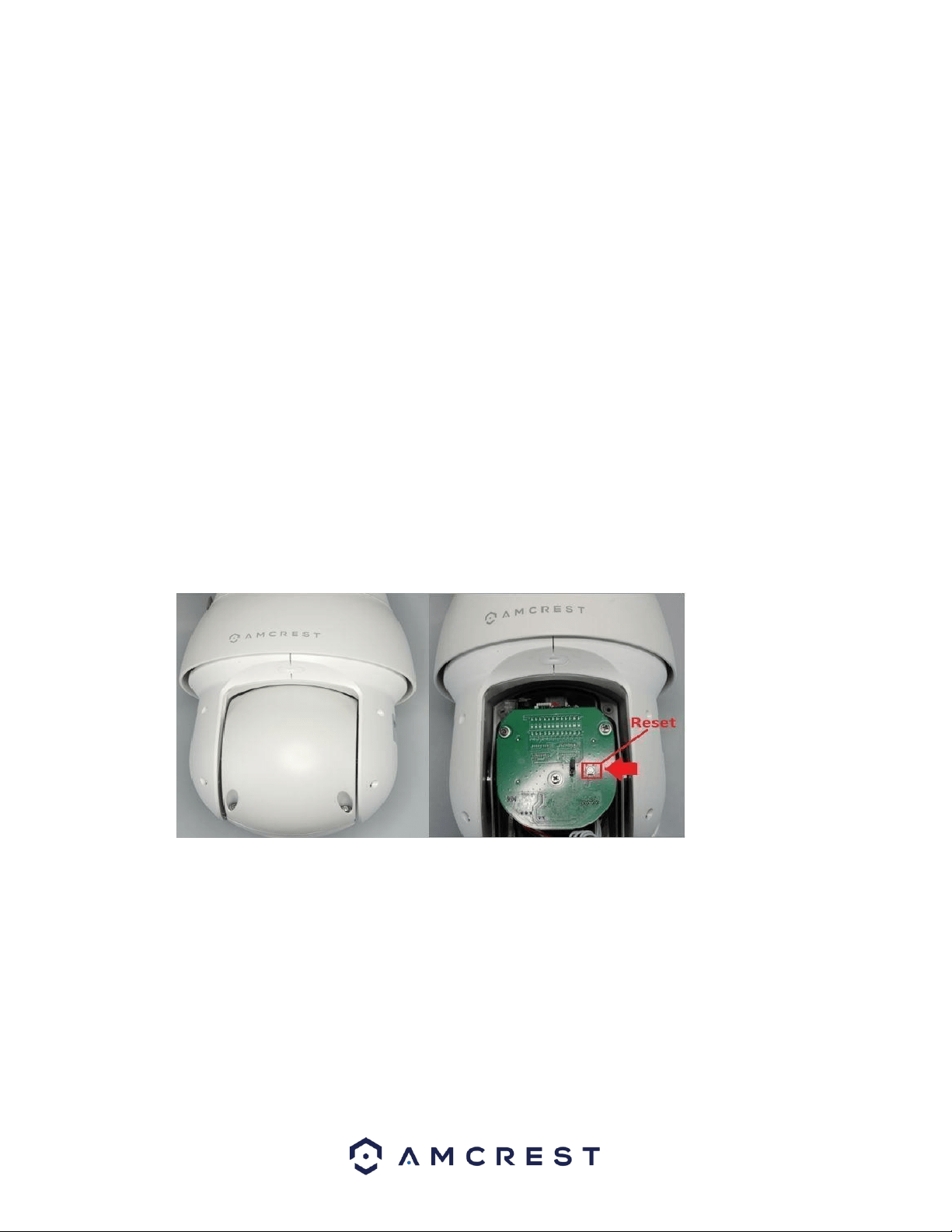
The diagram below shows the camera’s rear panel.
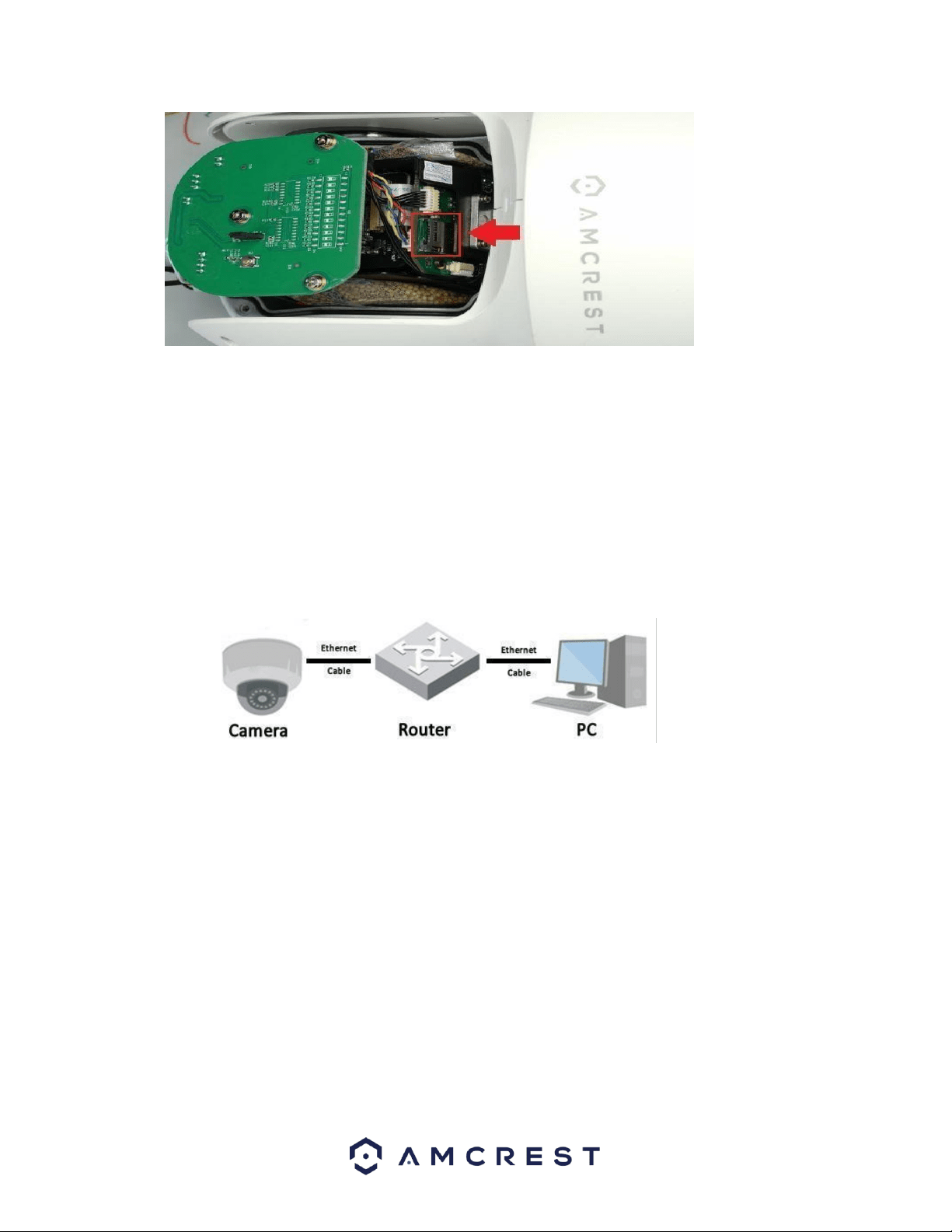
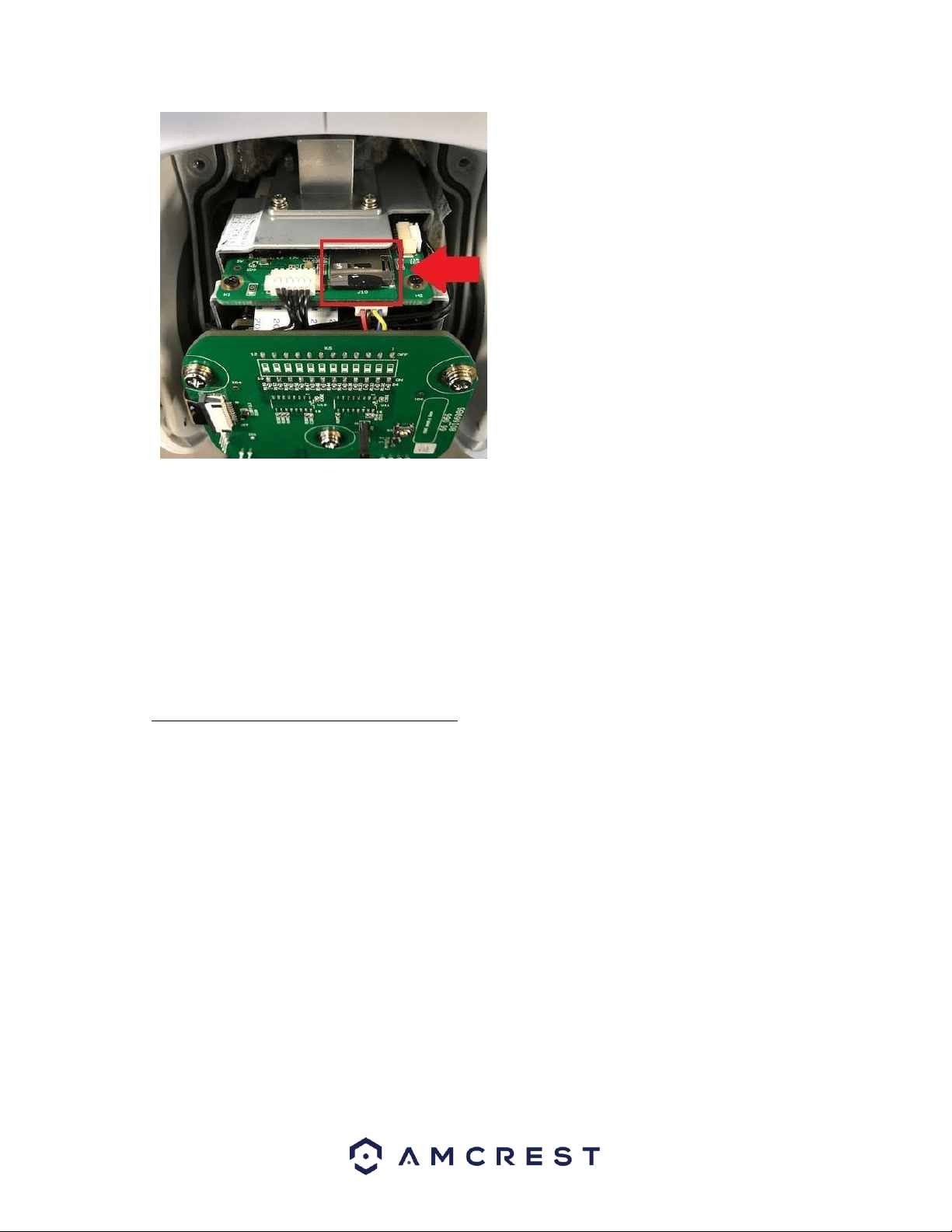
The images below show the microSD card slot for the camera.
The microSD card slot can be found on the board behind the
reset switch:
8
3. Connection & Installation
This section provides information about the connection and
installation of the Amcrest Outdoor PTZ camera.
Note: This is a POE+ device and requires a POE+ compatible
router/switch to function.
3.1 Connection Guide
The camera initially should be connected via the following
method:
3.2. Installation Guide
Important Notice: Prior to installation ensure that the
installation environment can support at least 3 times the weight
of the camera.
When accessing your camera, you will notice a few additional
wiring connections associated with the device. These
connections contain a power connection and ground, an
Ethernet connection, audio wires, and alarm wiring.
POWER - This connection is optional for this device since the
device will draw power via an Ethernet cable (PoE) however,
the option is there. The camera will require a basic 12V DC
power adapter. This wire also has a optional grounding
(EARTH) wire for additional grounding of the unit.

9
Ethernet Connection - This connection is used to transmit data and transmit
PoE power to the unit. The unit is PoE + (802.3at) compatible.
AUDIO - This connection provides two-way audio to the unit. The red
wire is for AUDIO OUT, the white wire is for AUDIO IN, and the black
wire is there to ground the audio.
ALARM - This connection provides alarm in and alarm out features to an
external alarm or security system. The basic overview of these wires are
as follows:
Blue
Alarm OUT1
Green
Alarm COM1 (Communication
Port)
Yellow & Green
Alarm Ground
Red
Alarm IN1
Brown
Alarm IN2
3.3 MicroSD card Installation
To install a microSD card into your camera, please refer to the
step by step guide below.
Note: Please refer to section 2, Device Overview, for more
details on how to access the microSD card slot.
1. Locate the microSD card slot can be found on the board
behind the reset switch.
2. Slide the microSD card into the SD card slot, gold pins down.
10
3. Gently press the card into place within the slot to click and lock the
microSD card into place.
3.4 Physical Installation Guide
This installation guide will highlight how to properly install and mount your camera in several different
environments. These environments included; wood, masonry (brick /block walls), and cement. Prior to installation,
please ensure that the installation environment can support at least three times the weight of the camera and the
installation bracket.
Note: There are 3 carabiners included with the camera. These carabiners will be used to provide additional support
to the camera after installation. To install, link one carabiner to the mounting bracket then link the third carabiner
to the camera.
The camera will come with proper installation materials such as screws and anchors already, however, if
replacements are needed a 9/16 lag bolt, masonry anchor, cement anchor will be required.
Please ensure the following tools are available and ready for use:
o Power Drill/impact Drill
o 9/16 Drill Bit (Masonry)
o 9/16 Hex Head Drill Bit
o Marker or Sharpie
o Hammer/Impact
o Safety Glasses
o 3/16 Allen wrench
o 1” Paddle Bit (In-wall Installation)
Note: In-wall installation is when the cables run hidden inside the ceiling
or wall.

11
3.4.1 Wood Installation
1. Using a 3/16 Allen wrench, remove the three security screws from
the mounting bracket of the camera to remove the unit from its base.
2. Using the mounting bracket, mark holes in the appropriate areas you
would like to mount the camera.
3. Remove the mounting bracket and using a 1” paddle bit, drill a hole
into the center of the surface area.
4. Run the camera wiring through the mounting bracket and to the
applied 1” hole created for in-wall installation.
5. Using a 9/16 drill bit, drill additional holes into each marked area to
insert the appropriate lag bolt screws.
6. Align the mounting bracket to the drilled holes and place a 5/16 lag
bolt into the mounting bracket holes.
7. Using a 9/16 Hex Head drill bit, drill the lag bolts into the applied
holes to secure the camera to the surface area.
8. Secure the camera back to the mounting bracket with the three
provided bolts using a 3/16 Allen wrench.
3.4.2 Masonry Installation (Brick/Block)
1. Using a 3/16 Allen wrench, remove the three security screws from the
mounting bracket of the camera to remove the unit from its base.
2. Using the mounting bracket, mark holes in the appropriate areas you
would like to mount the camera.
3. Remove the mounting bracket and using a 1” masonry paddle bit, drill
a hole into the center of the surface area.
4. Run the camera wiring through the mounting bracket and to the
applied 1” hole created for in-wall installation.
5. Using a 9/16 masonry bit, drill a hole into each marked area to insert
the appropriate sleeve anchors.
6. Align the mounting bracket to the drilled holes and place the 9/16
sleeve anchors to the mounting bracket.
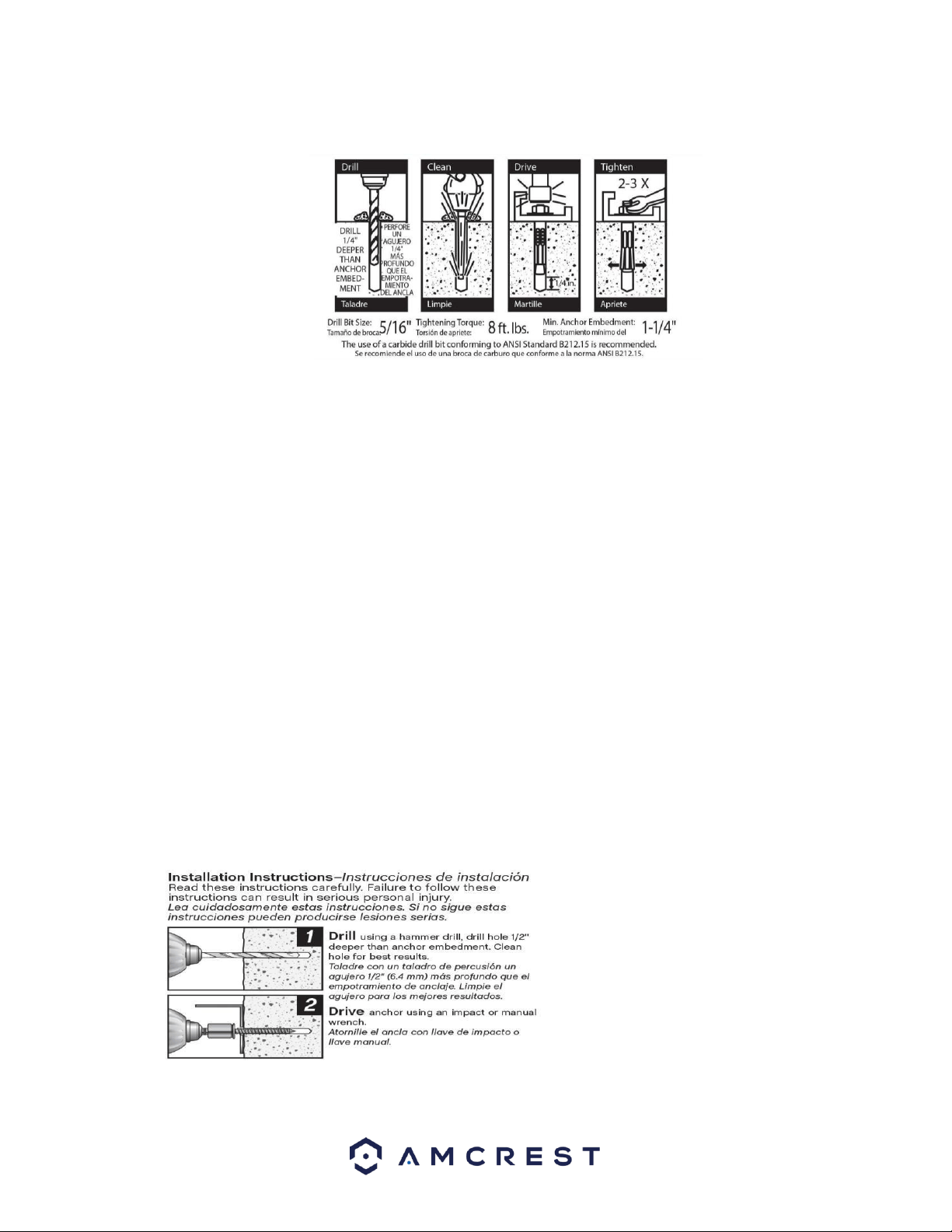
7. Using a hammer, drive the sleeve anchors into the hole, the tightening
torque applied should be roughly 8ft lbs. for each anchor.
8. Tighten the anchors down to secure and lock the sleeve anchors into
the surface area. This should only require about two to three turns to
secure each sleeve anchor into place.
9. Secure the camera back to the mounting bracket with the three
provided bolts using a 3/16 Allen wrench.
12
Note: For a more detailed representation of the process, please
refer to figure 3.4.2 below:
Figure 3.4.2
3.4.3 Cement Installation
1. Using a 3/16 Allen wrench, remove the three security screws from the
mounting bracket to remove the unit from its base.
2. Using the mounting bracket, mark holes in the appropriate areas you
would like to mount the camera.
3. Remove the mounting bracket and using a 1” drill bit, drill a hole into
the center of the surface area.
4. Run the camera wiring through the mounting bracket and to the
applied 1” hole created for in-wall installation.
5. Using a 9/16 drill bit, drill a hole into each marked area to insert the
appropriate concrete anchor screw into the hole.
6. Align the mounting bracket to the drilled holes and place the 9/16
concrete anchor screw to the mounting bracket.
7. Using an impact or manual wrench, drive the concrete anchors into the
appropriate hole to secure the bracket to the surface area.
8. Secure the camera back to the mounting bracket with the three
provided bolts using a 3/16 Allen wrench.
Note: For a more detailed representation of the process, please refer to
figure 3.4.3 below:
Figure 3.4.3

13
4. Camera Access Setup
This section of the guide will provide the user with information on how to
setup access to the camera through any of the following methods.
4.1 Default Username and Password
To login to the system for the first time, use one of the following default
username/password combinations. Once you’ve successfully logged in, it
is highly recommended to change the password for security reasons.
Username: admin
Password: admin
Note: Logging in for the first time will prompt the user to
change the password to the admin account.
4.2 Camera setup methods
To make your experience with the Amcrest camera easy and
simple, we've provided multiple ways to set up, view, and
operate your camera depending on your needs. Please follow
the instructions on this page to set up your camera in the way
that works best for you.
4.2.1. Setting Up Your Camera on a Mobile Device
If setting up your camera for the first time, please follow the instructions
as outlined in section 4.3. App Setup. This section will walk you through
how to setup your camera on the Amcrest Cloud as well as the Amcrest
View Pro app. This will allow you to view your camera from your mobile
device, anywhere, anytime.
4.2.2. Accessing your camera using multiple mobile devices
If you followed the app setup instructions in section 4.3.1 to
initially set up your camera and would like to add the camera to
another smartphone or tablet, follow the instructions as outlined
on section 4.3.3 using your other devices.
4.2.3. Configuring advanced settings on your camera
If you would like to configure your camera to enable advanced features
such as motion detection, e-mail alerts, FTP, image adjustments,
scheduling, and more, please follow the instructions as outlined on
section 4.4 (Desktop access setup).
14
4.2.3. Using Amcrest Cloud for remote viewing.
Amcrest Cloud is our optional cloud storage and playback service which
allows you to access recorded footage from any device. We offer 4
hours of free storage for your first camera. Please follow the
instructions as outlined on section 4.5 (Amcrest Cloud setup) to sign up
for our Amcrest Cloud service and get 4 hours of free storage.
4.2.4. Using plug-and-play for remote web access
AmcrestView.com is a web portal that allows you to view your cameras
and recordings quickly and easily from anywhere in the world using a
web browser. Use AmcrestView.com if you need to simply check-in at
a moment's notice. If you would like to use AmcrestView.com, please
follow the instructions outlined on section 4.7 (Remote web access
setup).
4.3. App Setup
Amcrest cameras can be used on your mobile device using the following apps:
• Amcrest Cloud
• Amcrest View Pro
Both apps are free and available in the App Store and Google Play store. Please note, each app requires an iOS 6.0
or later version. Android will require a 3.0 or later version OS to run these apps.
For purposes of this guide, we will use iOS, though both apps. The App Interface may differ slightly from the
screenshots below as updates are released. Below, you'll find instructions on how to set up your camera up on the
Amcrest cloud app as well as the Amcrest View Pro app.
4.3.1. Amcrest Cloud App Setup
Amcrest Cloud allows you to access your device from anywhere in the world. Please note, you
will need an Amcrest Cloud account to proceed with Amcrest Cloud app setup. You can register
for a cloud account in the Amcrest Cloud app or from the Amcrest Cloud website at
amcrestcloud.com
• Please make sure your camera is plugged into a power source and your Ethernet cable is connected from
the camera to your router.
• Make sure your camera and mobile device are on the same network during setup.
• To ensure the camera connects to the cloud, a reboot of your camera is recommended.
To add your camera onto the Amcrest Cloud app, follow these steps:
1. Download and open the Amcrest Cloud app from the App Store or Play Store
15
Note: Connect your mobile device to the same network that your camera is on.
3. Register for an Amcrest Cloud account. To register click on Sign Up and fill out the form to
complete registration.
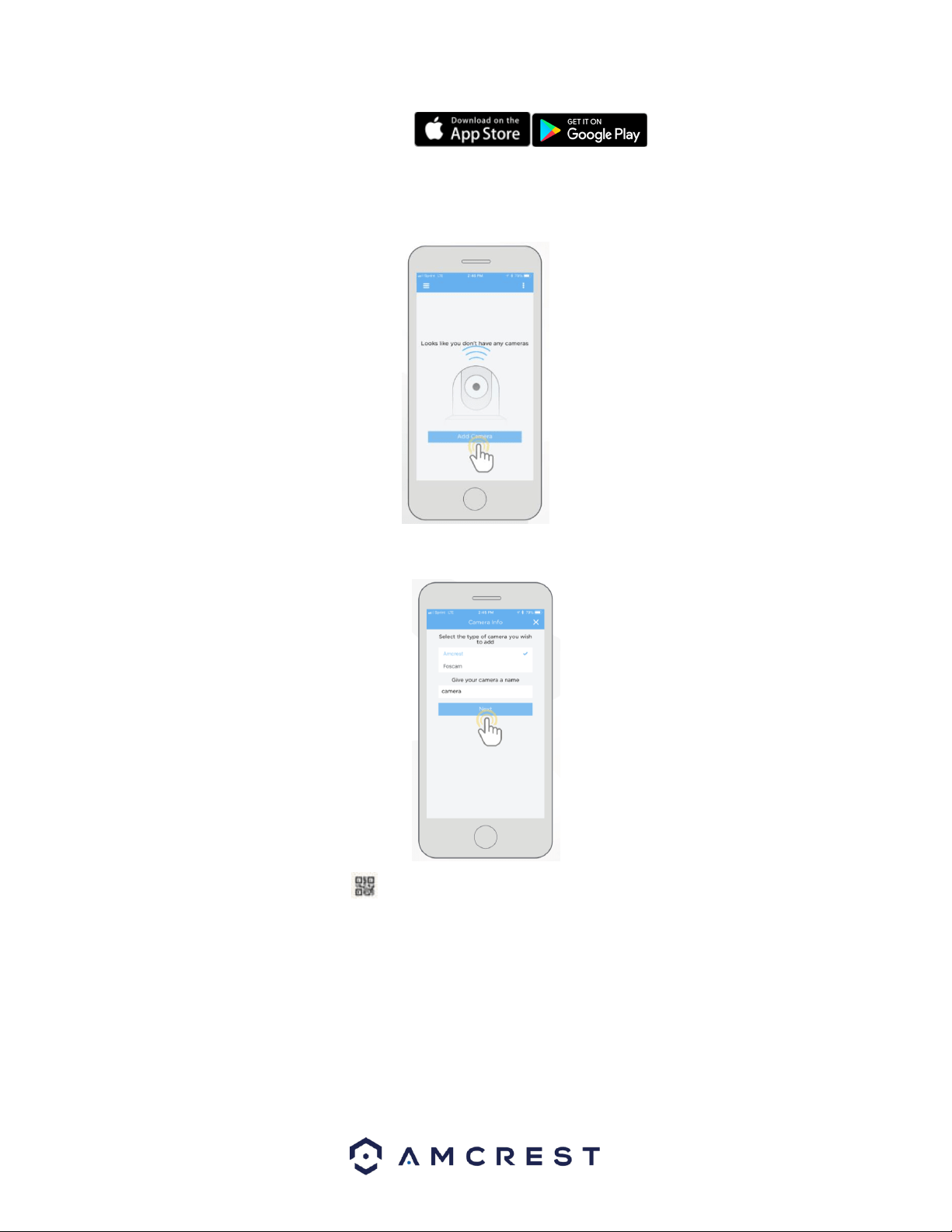
4. Tap on Add Camera.
5. Give your camera a name (Ex. Garage, Living Room, Kitchen, etc.) and tap Next to continue.
6. Scan the QR code on the back/side/bottom of the camera or manually enter the camera’s
serial number into the Enter camera S/N (serial number) field. Press Next to continue.
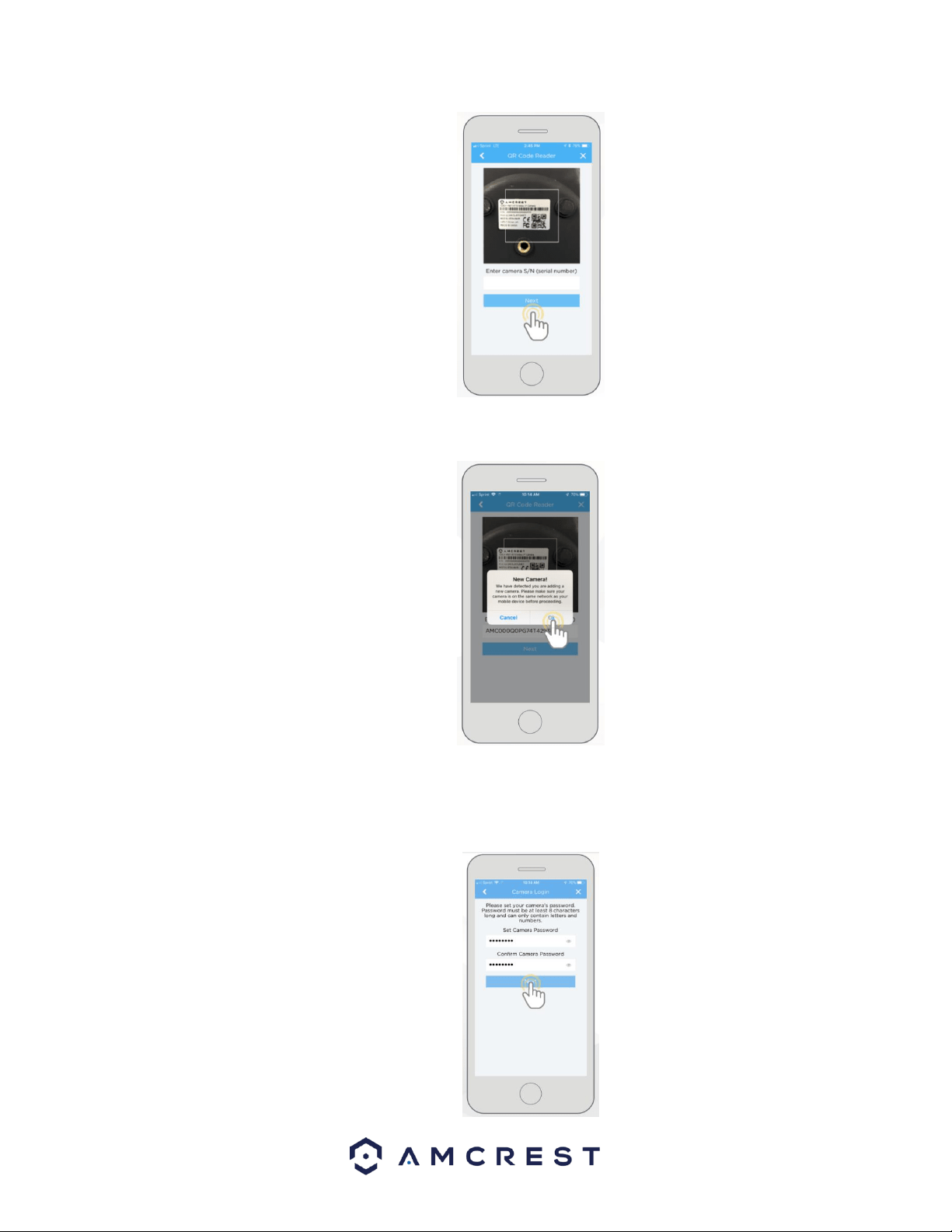
16
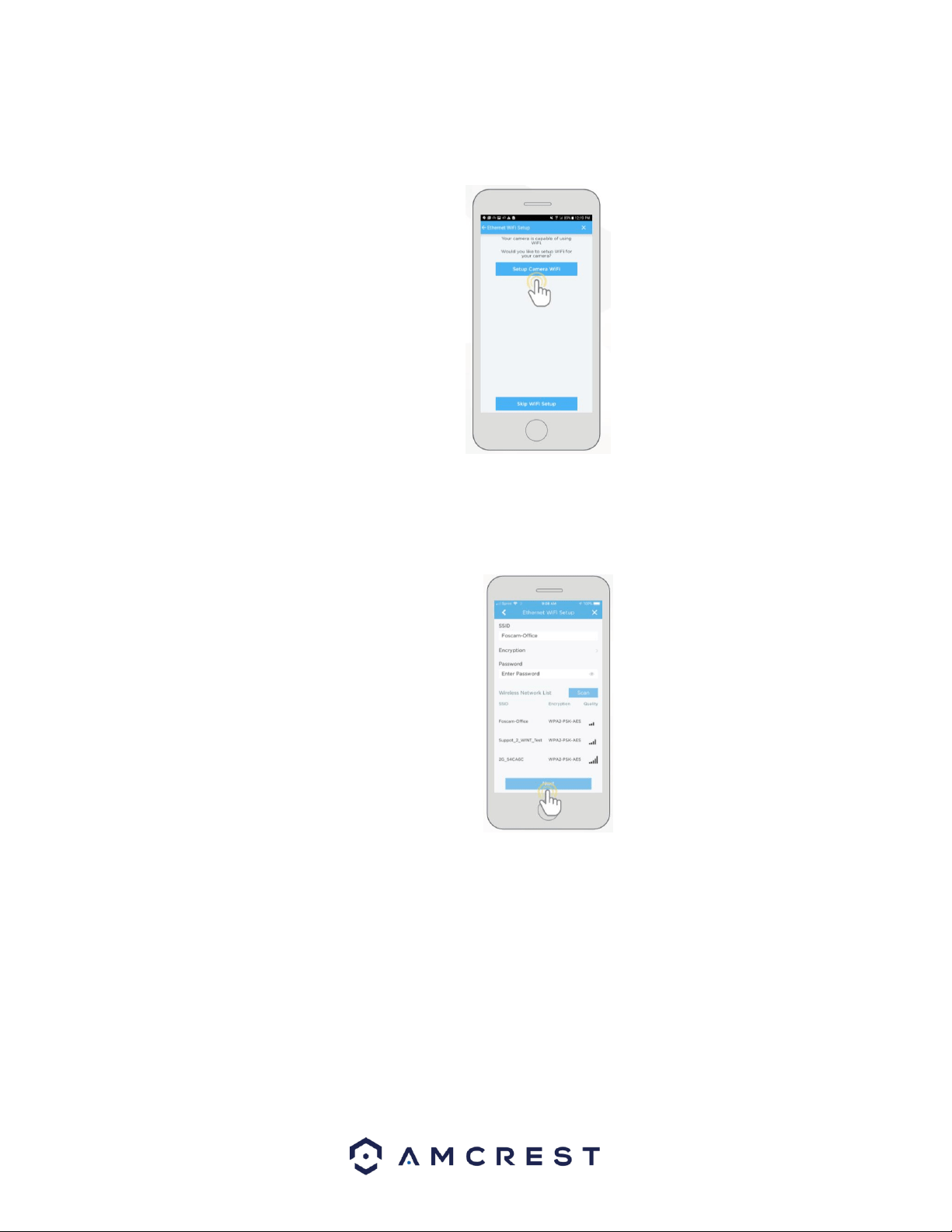
7. If you are adding a new camera that does not have a set password the app will automatically
detect that a new camera is being added. Tap OK to proceed.
8. Set a new password for your camera. The password must be between 8 to 32 characters long
and contain only letters and numbers. When you have finished setting the password for your
camera, enter the password again in the Confirm Camera Password section. Tap Next to
continue.
17
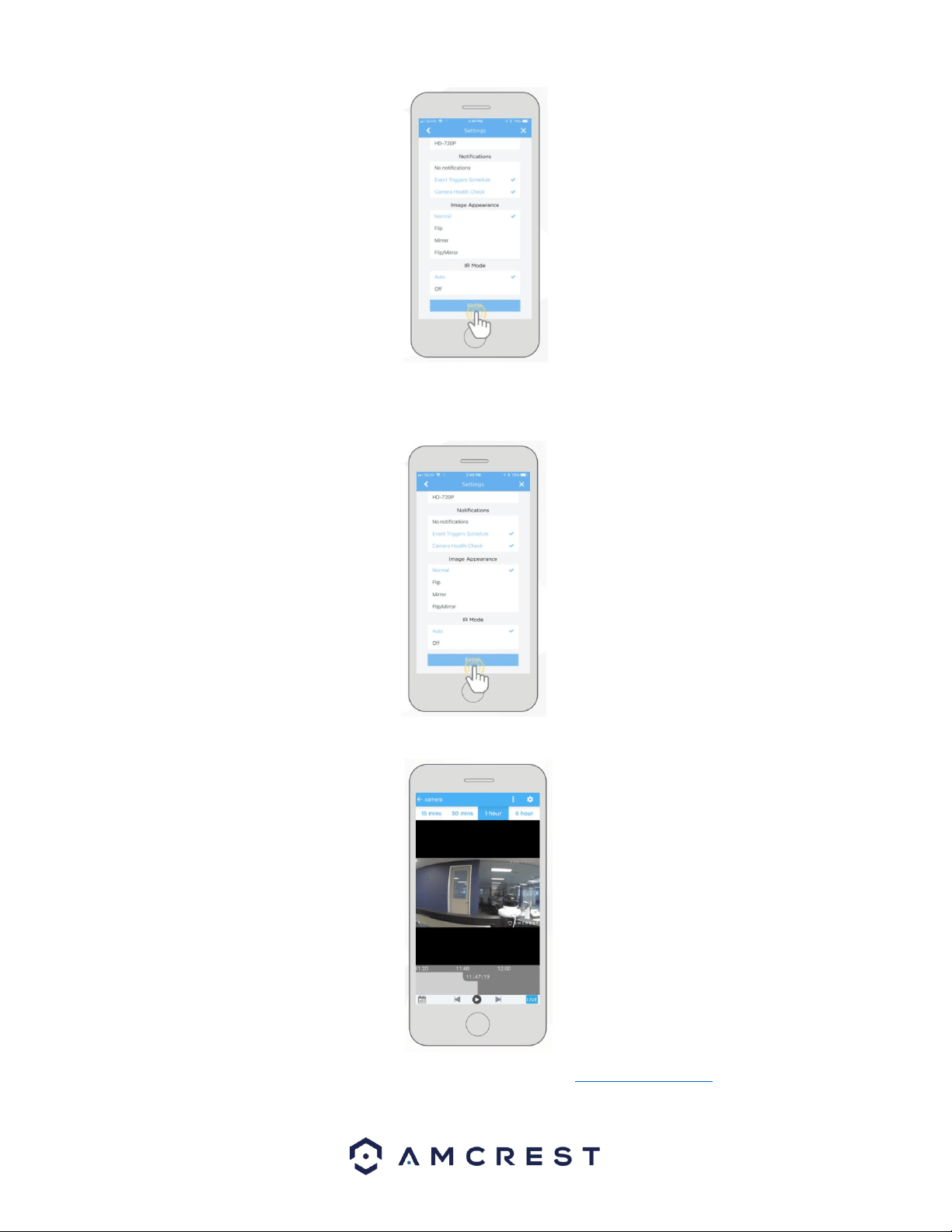
9. If you are connecting a WiFi camera to the Amcrest Cloud and would like to enable WiFi via the
Ethernet WiFi Setup method, tap Setup Camera WiFi. Additionally, if you would like to skip the
WiFi process and have your WiFi camera running solely as a wired device, tap on Skip WiFi Setup.
10. If you wish to enable WiFi on your WiFi camera, tap Scan to scan and select your WiFi
network from the WiFi Network List. Enter the password for your WiFi network onto the
Password field. When the WiFi password has been entered, tap Next to continue.
Note: For Android 8.0 and above users, you will have to enable location permissions to be able to
scan for your WiFi network.
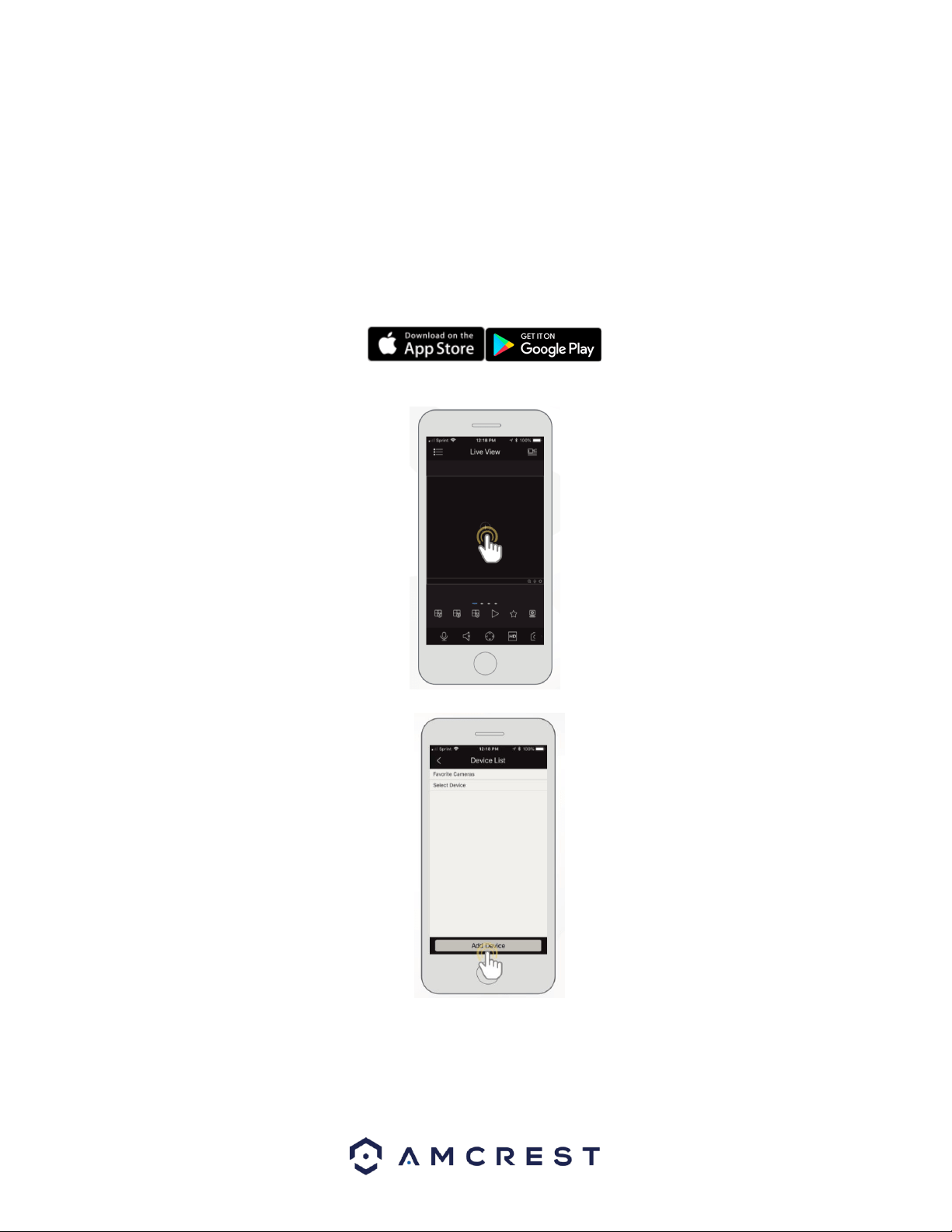
11. Confirm and adjust any needed settings for your camera. When all settings have been
confirmed, tap Finish.
19
4.3.2. Amcrest View Pro Setup
To add your WiFi camera to the Amcrest View Pro app follow these steps:
• Make sure your camera is plugged into a power source and your Ethernet cable is
connected from the camera to your router.
• Make sure your camera and mobile device are on the same network during setup.
1. Download and open the Amcrest View Pro app from the App Store or Play Store.
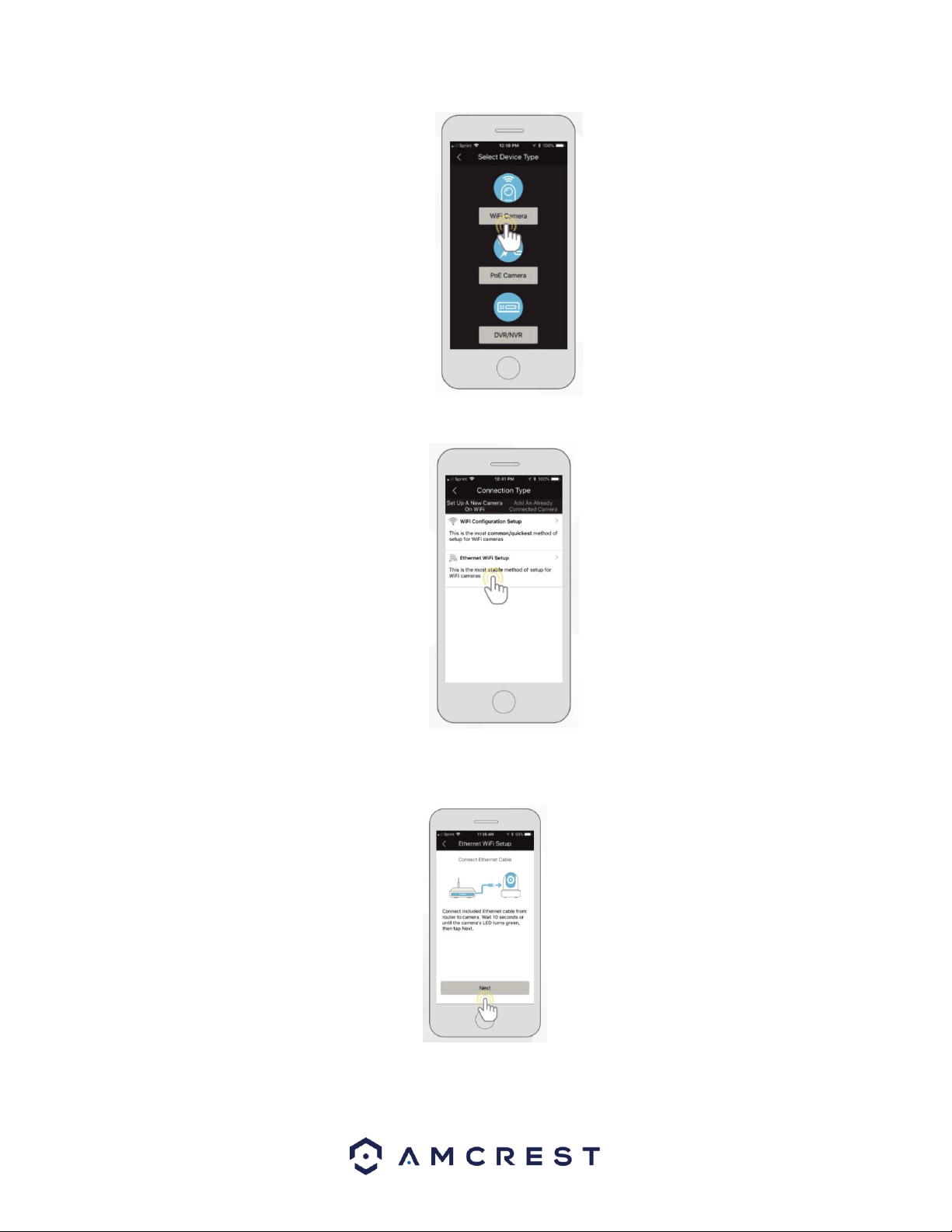
2. Open the app and tap on the + symbol in the middle of the screen to begin adding your PoE device.
3. Tap on Add Device to add a new device to your app.
4. Tap on WiFi Camera.
20
5. Select your connection type, in this case, select the left tab Set Up A New Camera On WiFi or Connect New
Device (on Android) to begin adding the device to the app. Tap Ethernet WiFi Setup to continue.
6. Ensure an Ethernet cable is connected from the router to the camera and the included power
adapter is connected to the device. Allow the device to initialize (if applicable) and press Next to
continue.
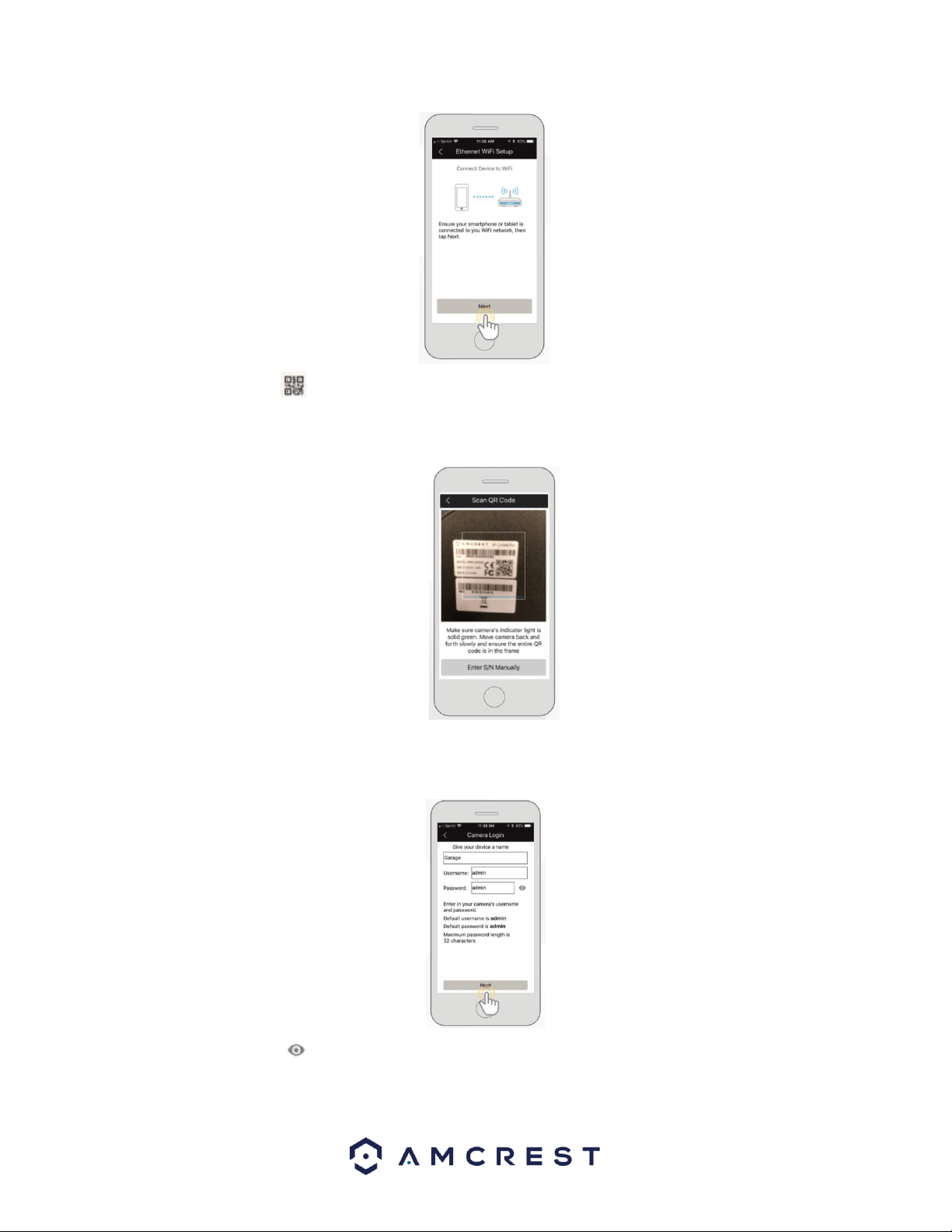
7. Ensure your smartphone or tablet is connected to the same WiFi network as your camera. Tap Next
to continue.
21
8. Scan the QR code on the back/side/bottom of the camera or manually enter the camera’s serial
number into the Enter camera S/N (serial number) field. Press Next to continue.
Note: Android users, tap on Scan QR Code to access the QR code reader.
9. Give the camera a name (e.g. Garage, Kitchen, Living Room, etc.) and provide the username and password for
your camera. The default username and will be admin. Tap Next to continue.
Note: You can tap on the icon to verify the password.
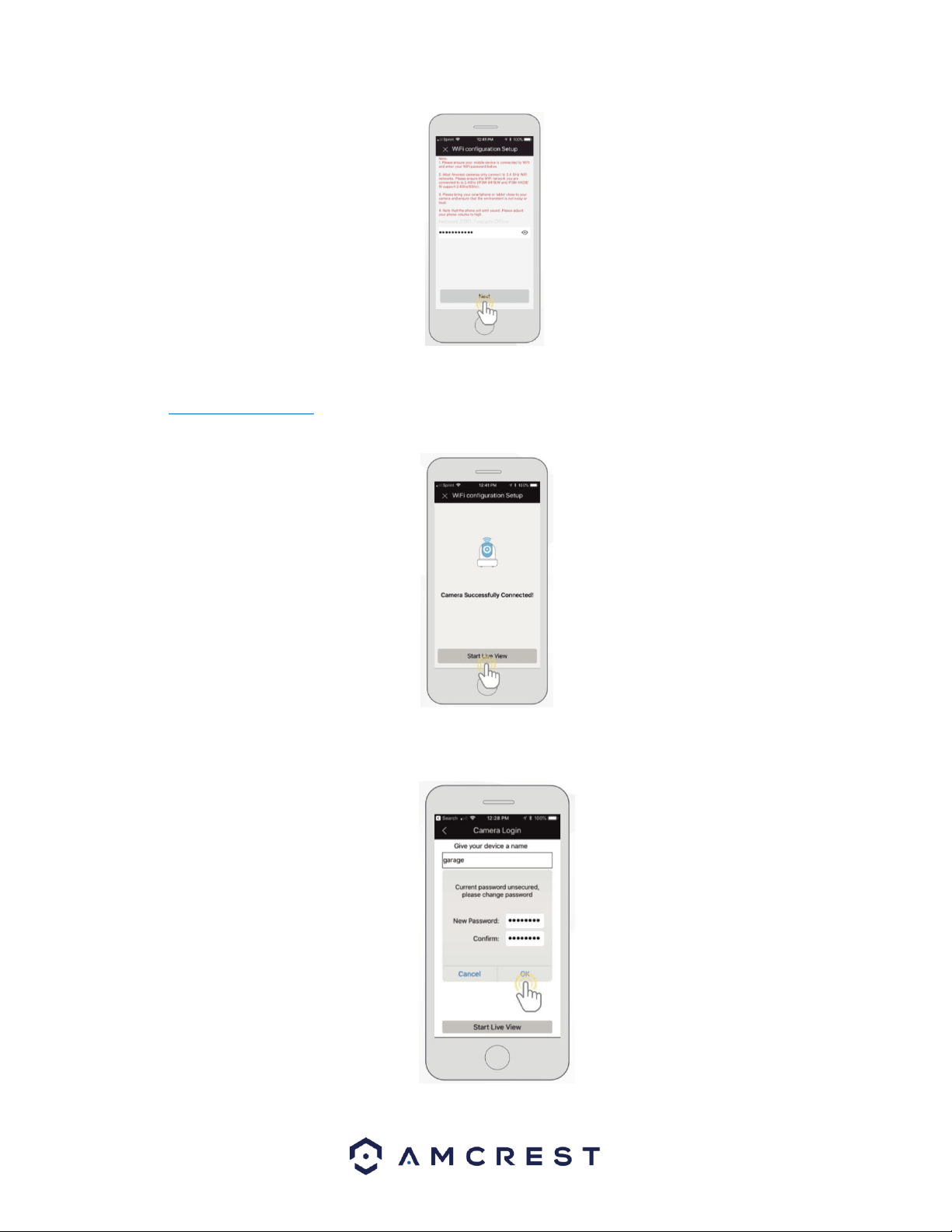
10. Enter the WiFi Password for your WiFi network in the Network SSID field. Press Next to continue.
22
Note: For Android 8.0 and above users, you will need to enable location permissions to be able to
locate and scan for your WiFi network. For more information on how to locate an SSID visit:
amcrest.com/androidP
11. Tap Start Live View.
12. The app will prompt you to change the password for your camera. Enter a password between 8 and 32
characters and confirm the password. Press OK to continue.
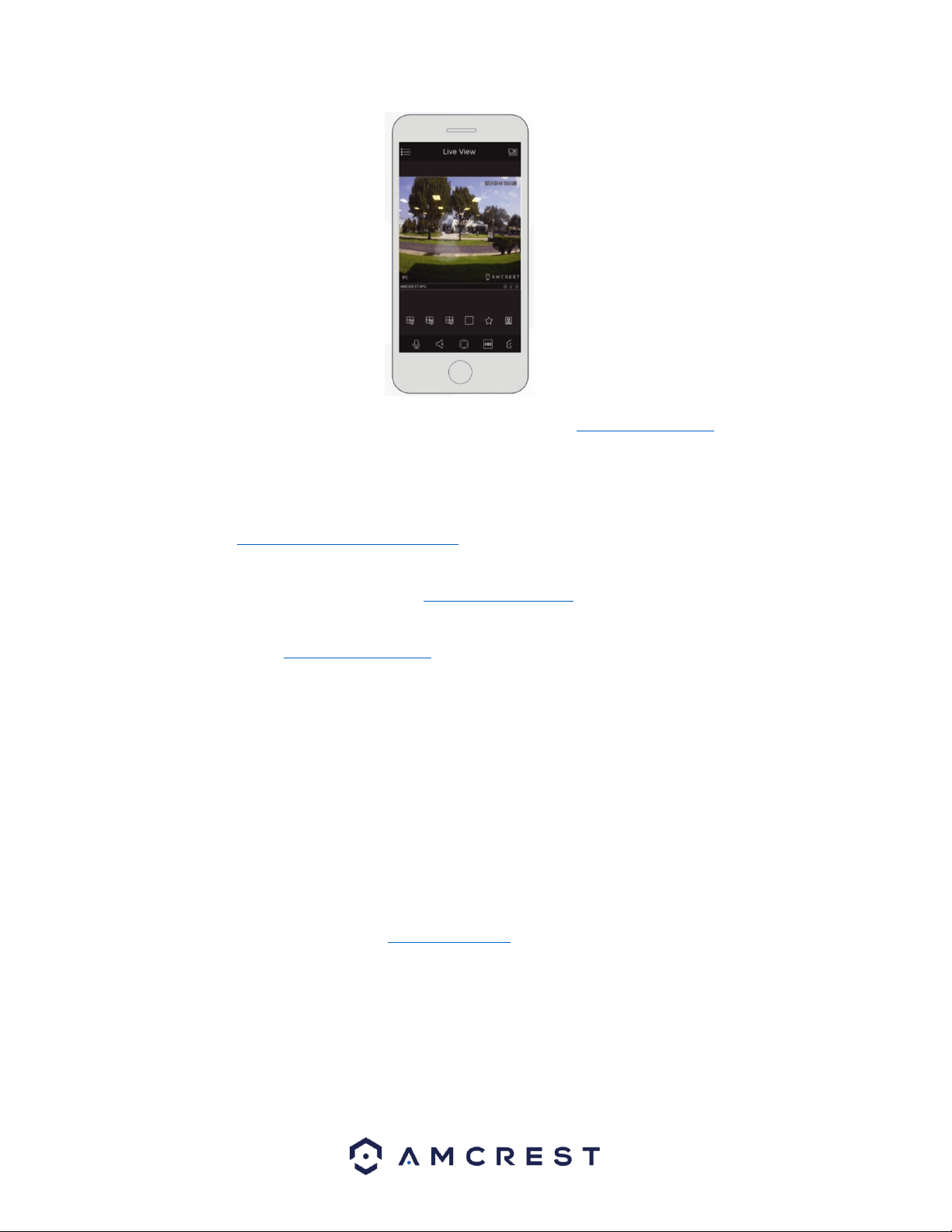
Your camera is not set up and ready for use on the Amcrest View Pro app.
23
For more information about Amcrest View Pro and its functionalities visit amcrest.com/support
For more information on alternative setup methods for your camera in the Amcrest View Pro app visit the
following links:
IP/Domain/DDNS App Setup: Used to establish a connection without using P2P. For more information on this
setup method visit, amcrest.com/IPDomainDDNSsetup
WiFi Configuration Setup: Used as a secondary option for establishing a WiFi connection to a WiFi camera.
For more information on this setup method visit, amcrest.com/wificonfig
P2P Setup: Used for setting up already connected devices to the Amcrest View Pro app. For more information
on this setup method visit, amcrest.com/p2psetup
4.4 Desktop Access Setup
Access your camera and all its features and settings on your local network using Internet
Explorer, Firefox, or Safari on Windows or Mac.
This method of accessing the camera’s interface is necessary to setup remote access. Ensure
that the following items are completed:
Note: Make sure the camera and the PC are on the same network before proceeding.
• Use one of the following web browsers: Safari, Internet Explorer, or Mozilla Firefox
(Google Chrome support in Development).
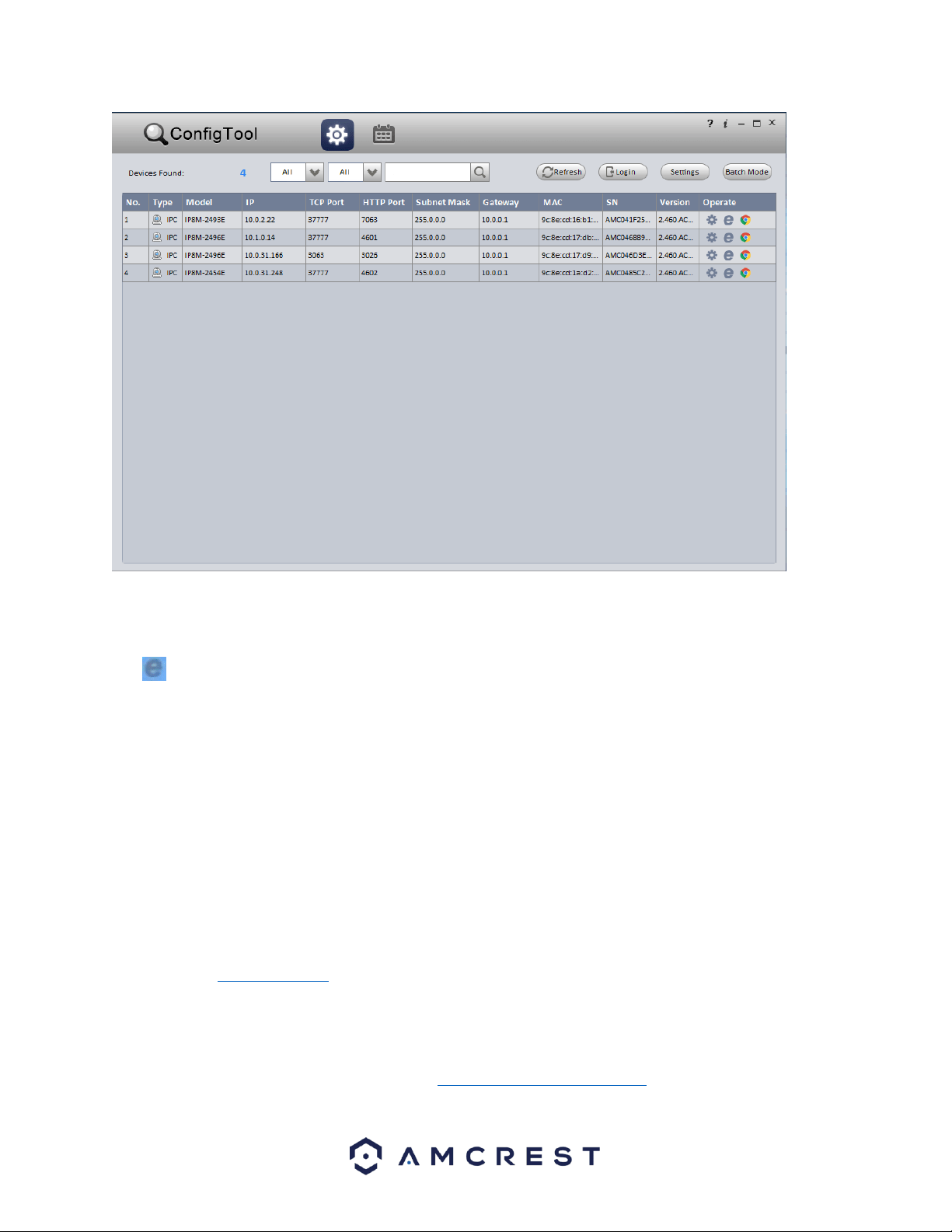
To easily connect to the camera’s interface, install and run the Amcrest IP Config tool. You
can download the IP Config software from www.amcrest.com under the “Support” tab,
Apps & Software. The IP Config tool’s interface looks like the below image:
24
After launching the IP Config tool, click the Refresh button to bring up the cameras on the
network.
Double click the camera’s line item to login and connect to the camera. Once logged in, click
the icon to open the camera’s interface in a web browser.
Log in to the camera using your login credentials (default username and password are
both “admin”). If this is your first-time logging into the camera, you will be prompted to
change your password. Please select a password that is at least 8 characters long, and one
that uses a combination of uppercase letters, lowercase letters, and numbers.
When opening the camera’s interface, the browser may prompt you to install a plugin. The
plugins are necessary for using the camera’s interface. Click install to download the plugin,
and then click on the plugin installation file to install the plugin. If the browser prompts
you to allow the plugin to work on the computer, hit Allow to ensure the plugin can run
successfully.
The camera is now successfully set up for live viewing!
For quick and easy remote access on your PC or Mac, please use amcrestcloud.com
(section 4.5) or amcrestview.com (section 4.6).
To setup advanced remote access via UPnP/DDNS or Port Forwarding see section 4.7.1 and
4.7.2.
For additional assistance, please contact us at www.amcrest.com or give us a call at 1-888-
212-7538. Step by step video tutorials available at http://www.amcrest.com/videos

25
4.5 Amcrest Cloud Desktop Setup
Amcrest cameras can sync with Amcrest Cloud; a service that stores recorded video
streams to enable long-term storage. Amcrest Cloud also allows the user to easily find and
download recorded video for playback from any internet connected PC or Mac computer.
For more information on how to setup your camera on Amcrest Cloud on the web, visit
amcrest.com/cloudwebsetup or follow the steps provided below:
1. Connect the camera to power and wait 30 seconds for the camera to start-up and
initialize.
2. Using a web browser on your PC or Mac, visit www.amcrest.com/cloud and register
for a cloud account. Once registered, click the “Add Camera” button. Select
“Amcrest”, give the camera a name, and enter the camera’s SN (located on the
bottom of the camera), then click “Next”.
3. On the settings page, you can adjust optional preferences for your camera. Once
settings have been adjusted, click “Finish”. Your camera is now successfully set up for
cloud access and storage.
4. View your camera live or watch recorded clips using the menu button on the top of
the page. You can also use the Amcrest Cloud app on iOS and Android to add more
cameras, play recordings, and view your camera live, from anywhere. For more
information visit amcrest.com/support
For additional assistance, please contact us at www.amcrest.com
or give us a call at 1-888-212-7538. Step by step video tutorials
available at http://www.amcrest.com/videos
4.6 Web Access Setup (AmcrestView.com)
You can access your camera through a computer using the P2P web portal
AmcrestView.com for quick plug and play access. It uses the same
technology as the Amcrest View mobile app and is an easy, non-technical
setup method.
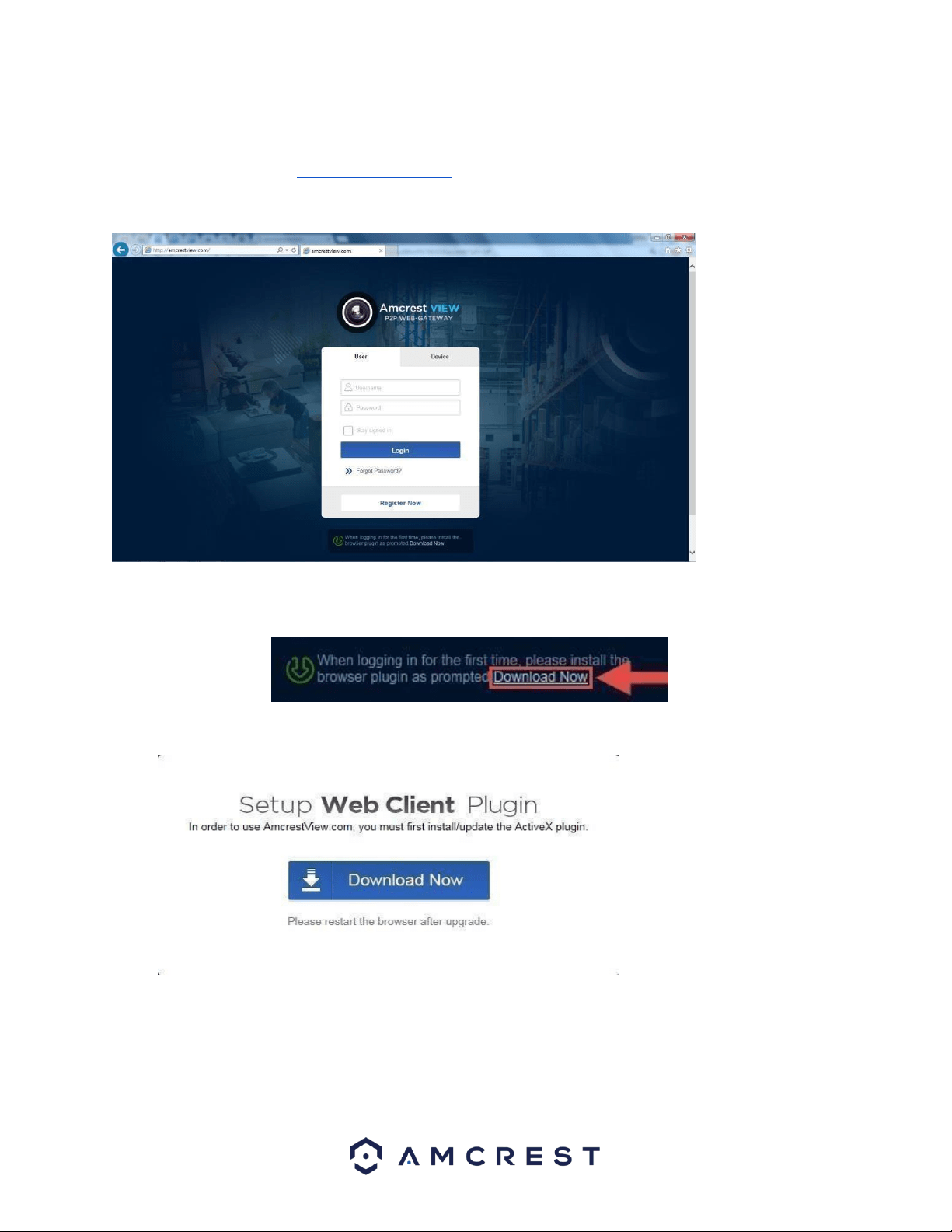
There are 2 methods of accessing your camera using AmcrestView.com:
the user method (registering an account for login), and the device
method (instant direct access using the serial number).
Both methods require that the Amcrest browser plugin be installed for
AmcrestView.com.
26
4.6.1 Installing the AmcrestView.com browser plugin
Open Internet Explorer, type ”www.amcrestview.com” into the search
bar, and hit Enter. This will take you to the login screen:
Once you’re on the login page, you will see a message about
installing the plugin below the login box. Click Download Now:
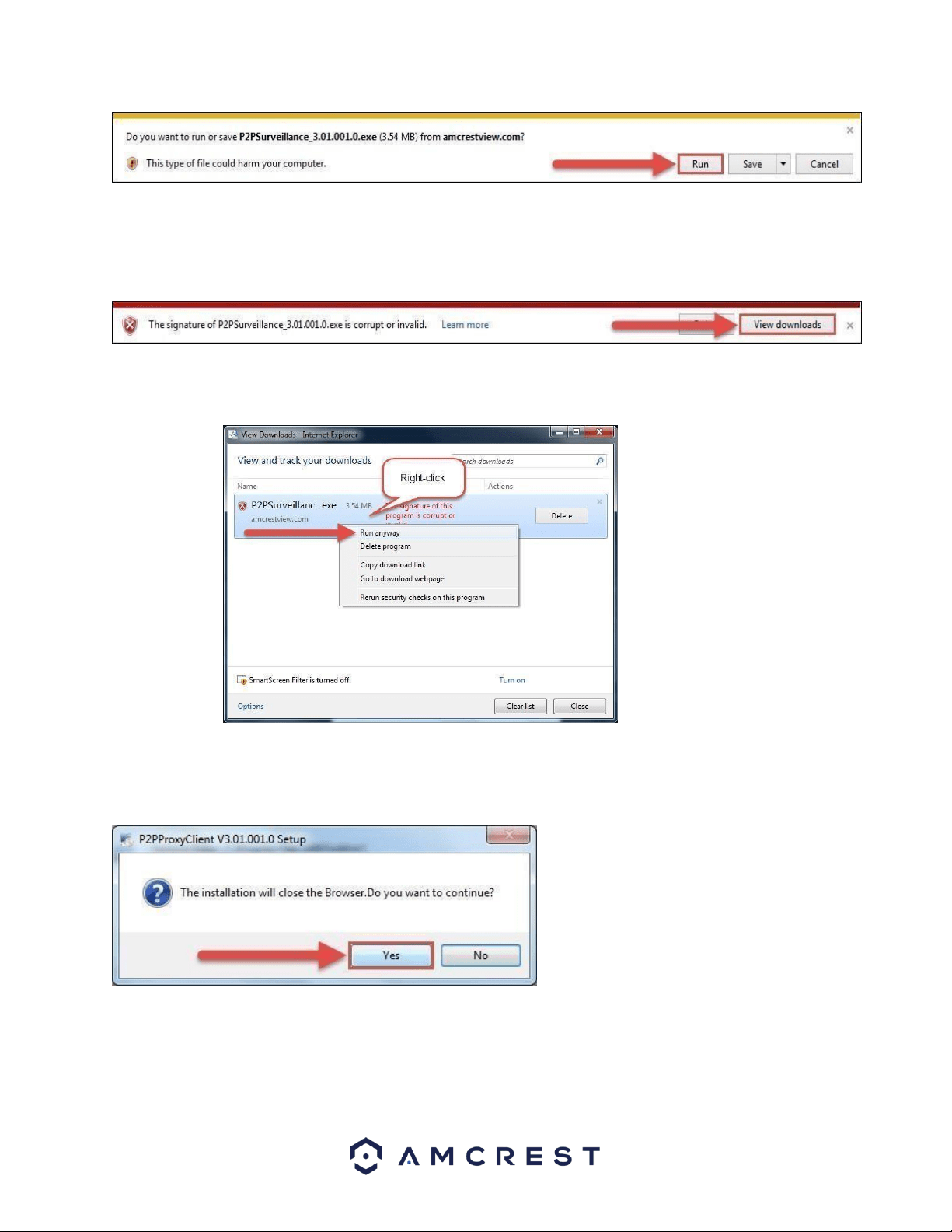
This will take you to another page where you will need to click
the Download Now button:
You will be prompted by the browser to install the plugin. Click
Run:
27
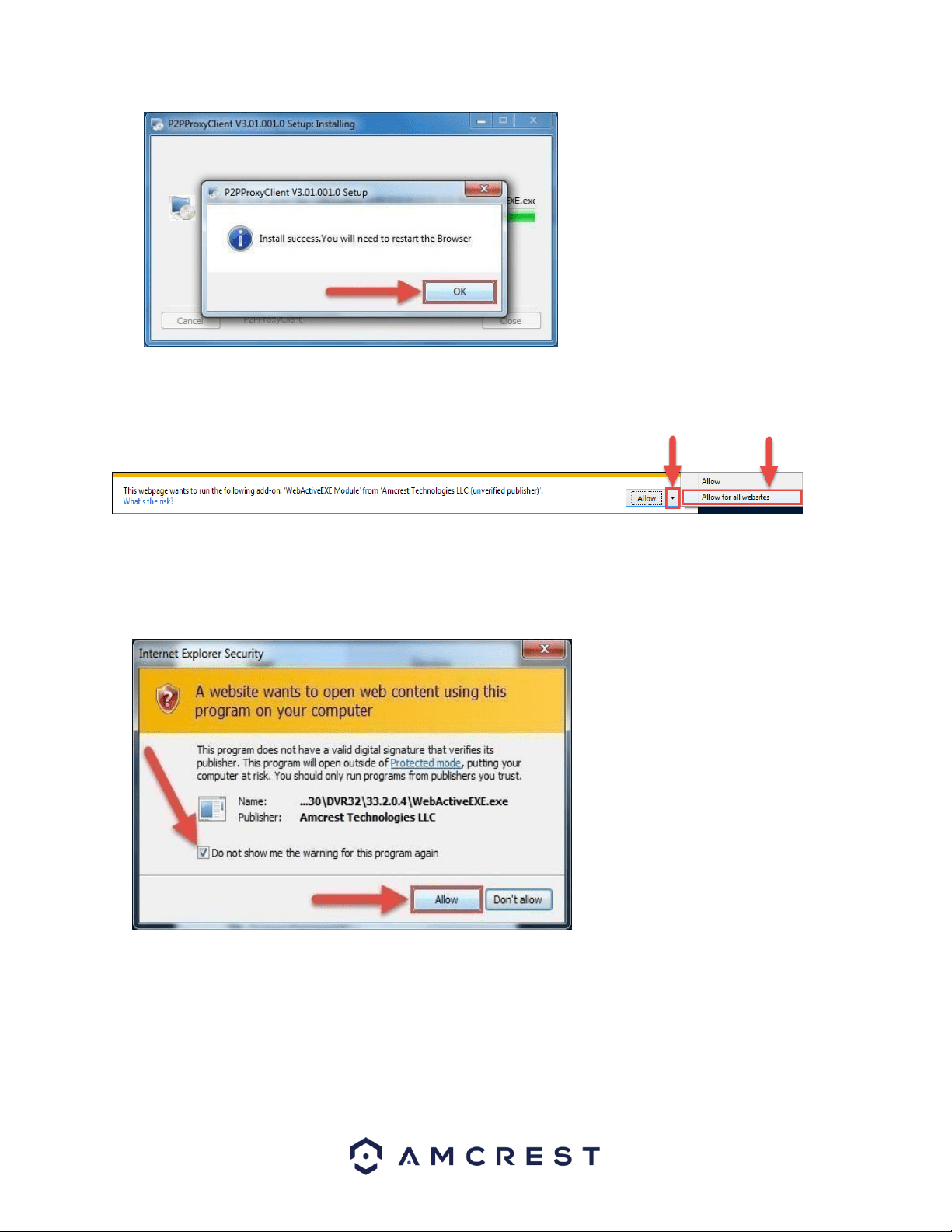
You may be prompted to verify this download. This software is
not harmful to your computer and will not make any
unwanted changes. To verify, start by clicking View
Downloads:
In the View Downloads page, right click the plugin, then click
Run Anyway.
The plugin will close your browser sessions to install. Save any pages,
then click Yes:
On the next prompt, it will say the install was successful and ask you to
restart your browser. Click OK:
28
You will be taken back to the login page and see another notification
from your browser asking you to allow this plugin on this web page.
Click the small arrow next to Allow, then click Allow for all websites:
Another popup will appear asking you to allow this plugin. Mark the
checkbox next to Do not show me the warning for this program again,
then click Allow:
Now the plugin has been installed successfully and you can continue to
register for an account for camera access through AmcrestView.com
4.6.2 User method
The user method requires that you first install the Amcrest browser
plugin for AmcrestView.com. Then, you can register for an account to set
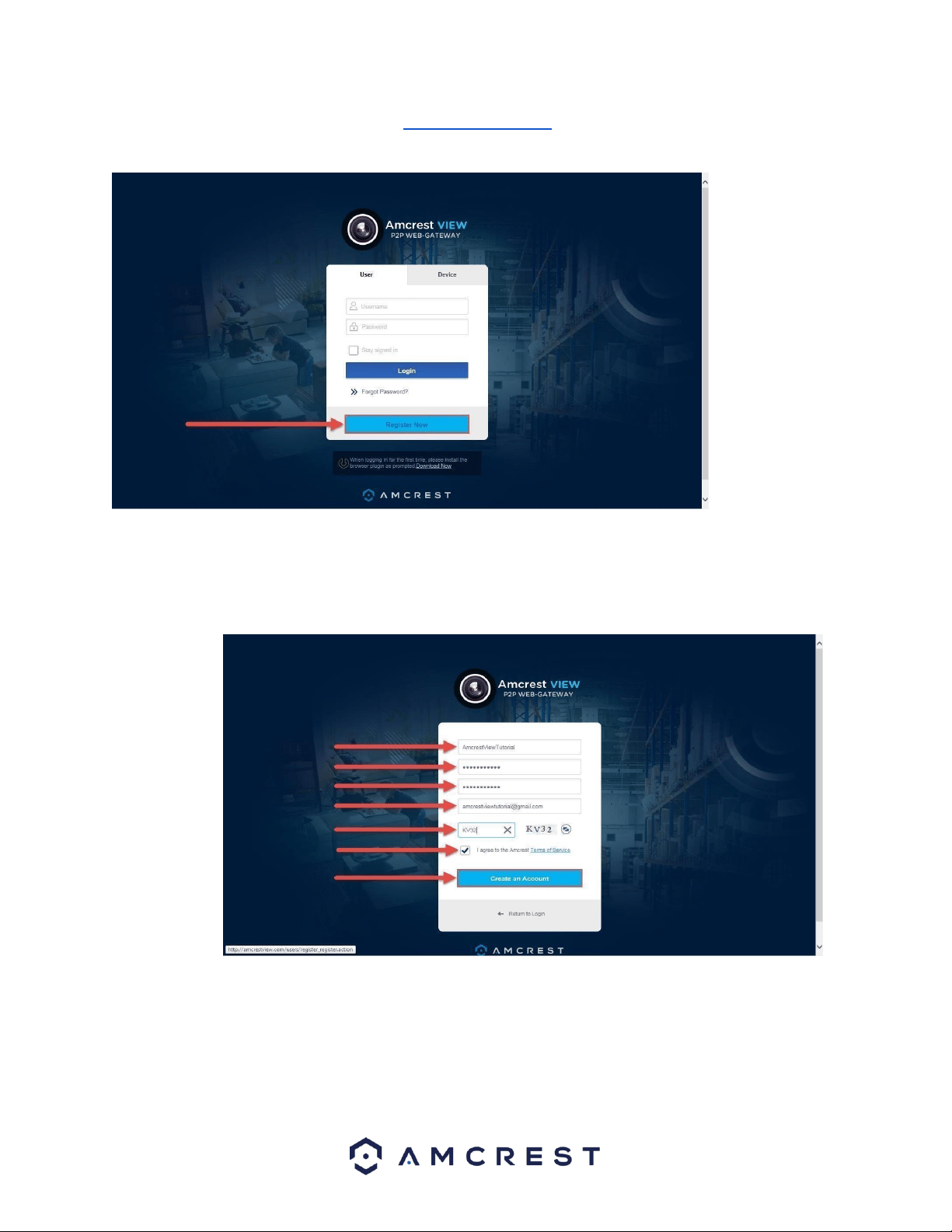
29
up your camera. 1. On the main login screen, www.amcrestview.com,
click the Register Now button:
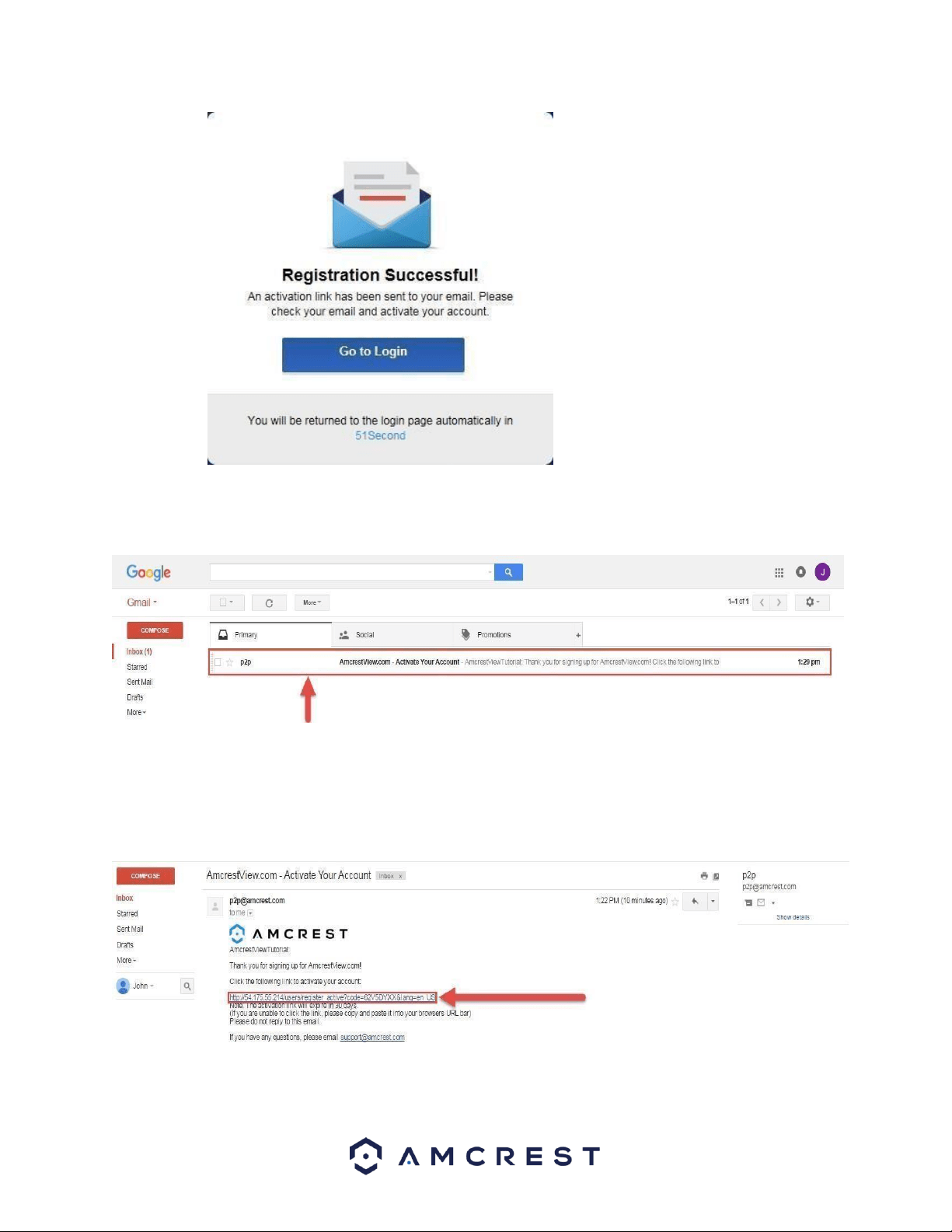
You will be taken to the registration form. Enter your Username,
Password, then Confirm Password, type your Email, enter the
Verification Code, make sure the box is checked confirming you’ve read
the ‘Amcrest Terms of Service’, then click Create an Account:
You will see the Registration Successful message and a
confirmation email will be sent to you:
30
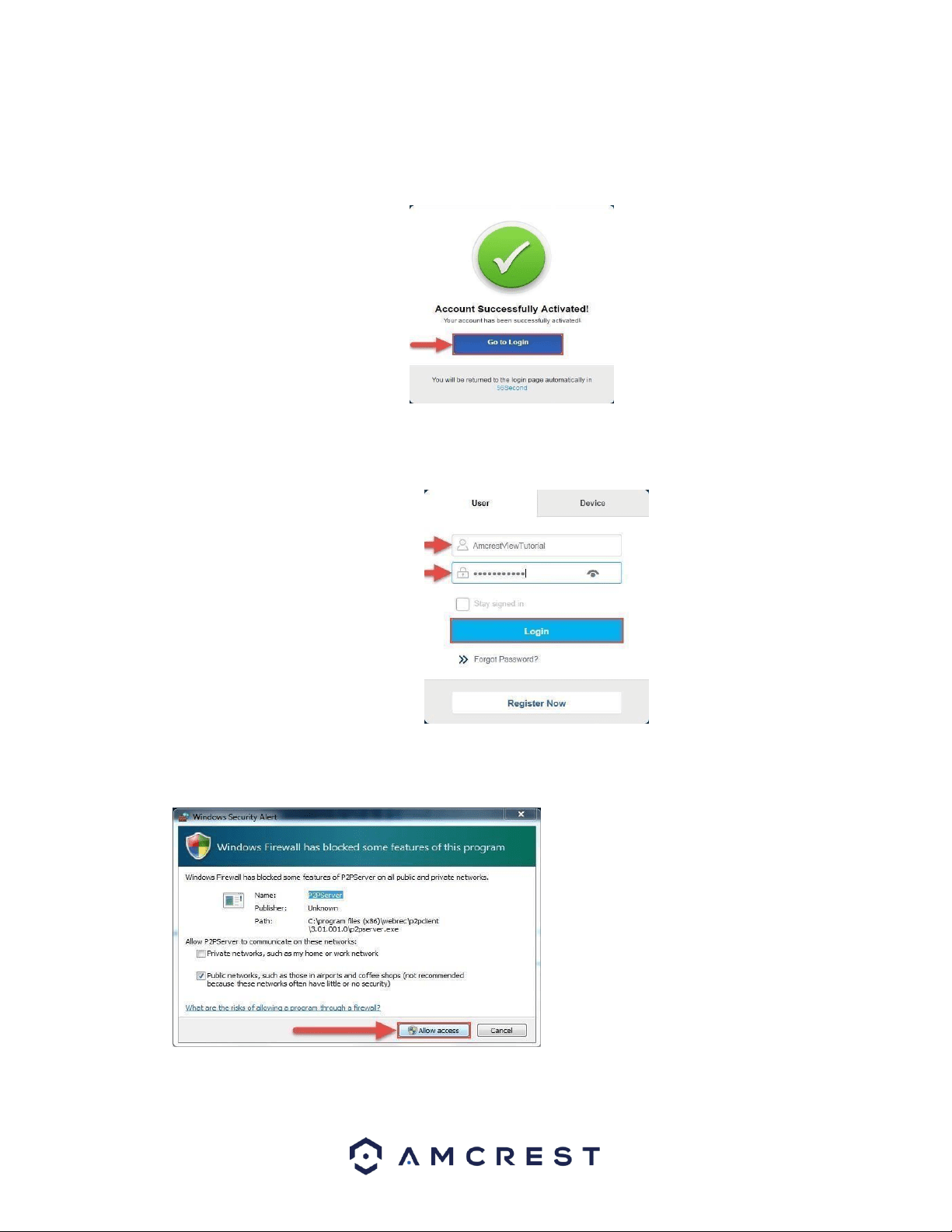
Check your email, and click the confirmation email from
AmcrestView.com:
2. Once you’ve opened the email,
click the confirmation link inside
to complete your registration:
31
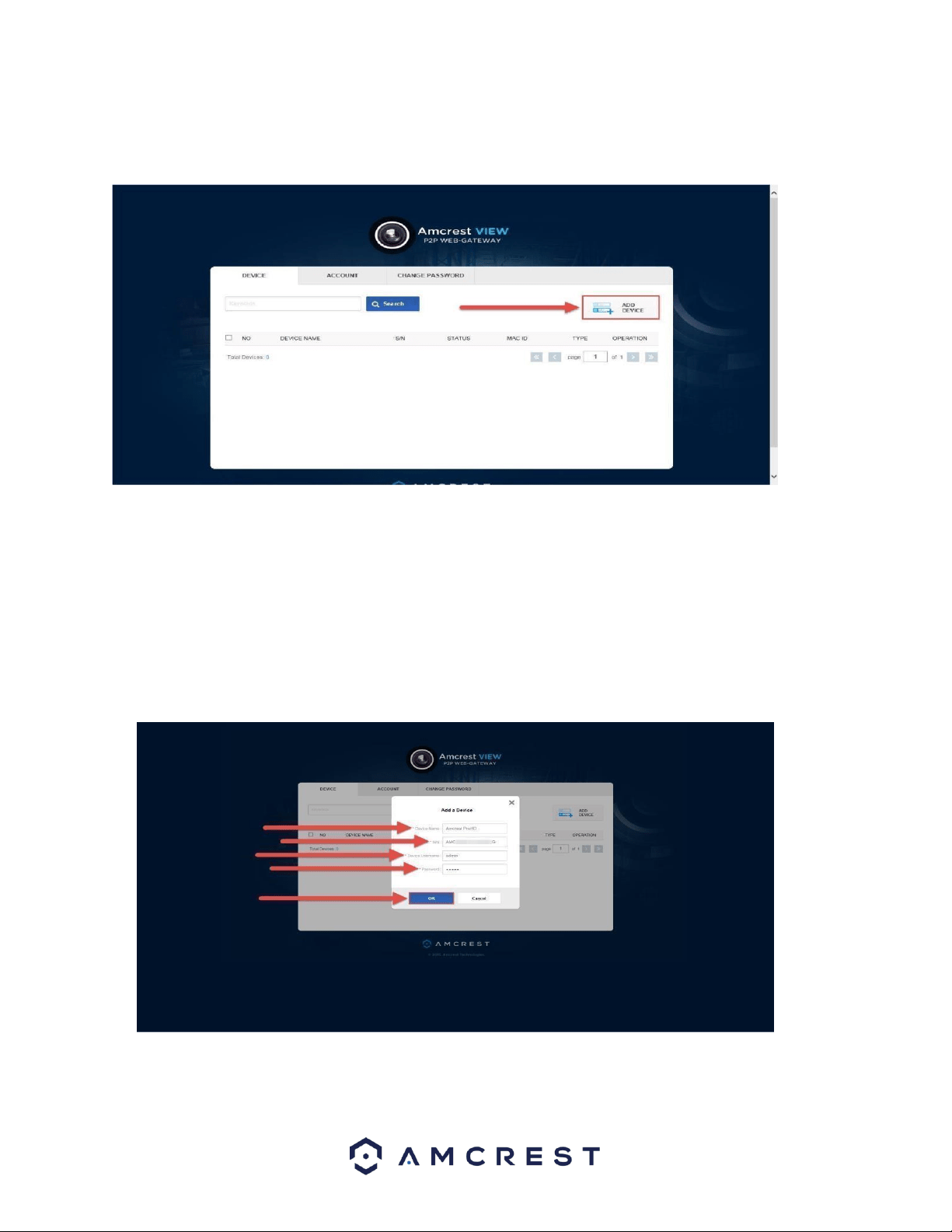
You will be taken back to AmcrestView.com and shown
confirmation that your account has been activated. Click Go
to Login:
You will be taken back to the login screen. Enter your new
AmcrestView.com username and password, then click Login:
A popup will appear from your Windows Firewall. Click Allow
access:
32
You will be taken to the main screen of your account. From here, click the
Add Device button:
Now you can enter your camera’s information. Enter a Device Name (this
can be anything).
Then, fill in the S/N (serial number) this can be found on the sticker
attached to the bottom of your camera or through the web interface
(click the “i” icon in the top bar, then click Version).
Enter your username and password for the camera, not the username
and password you just created for AmcrestView.com. Finally, click OK:
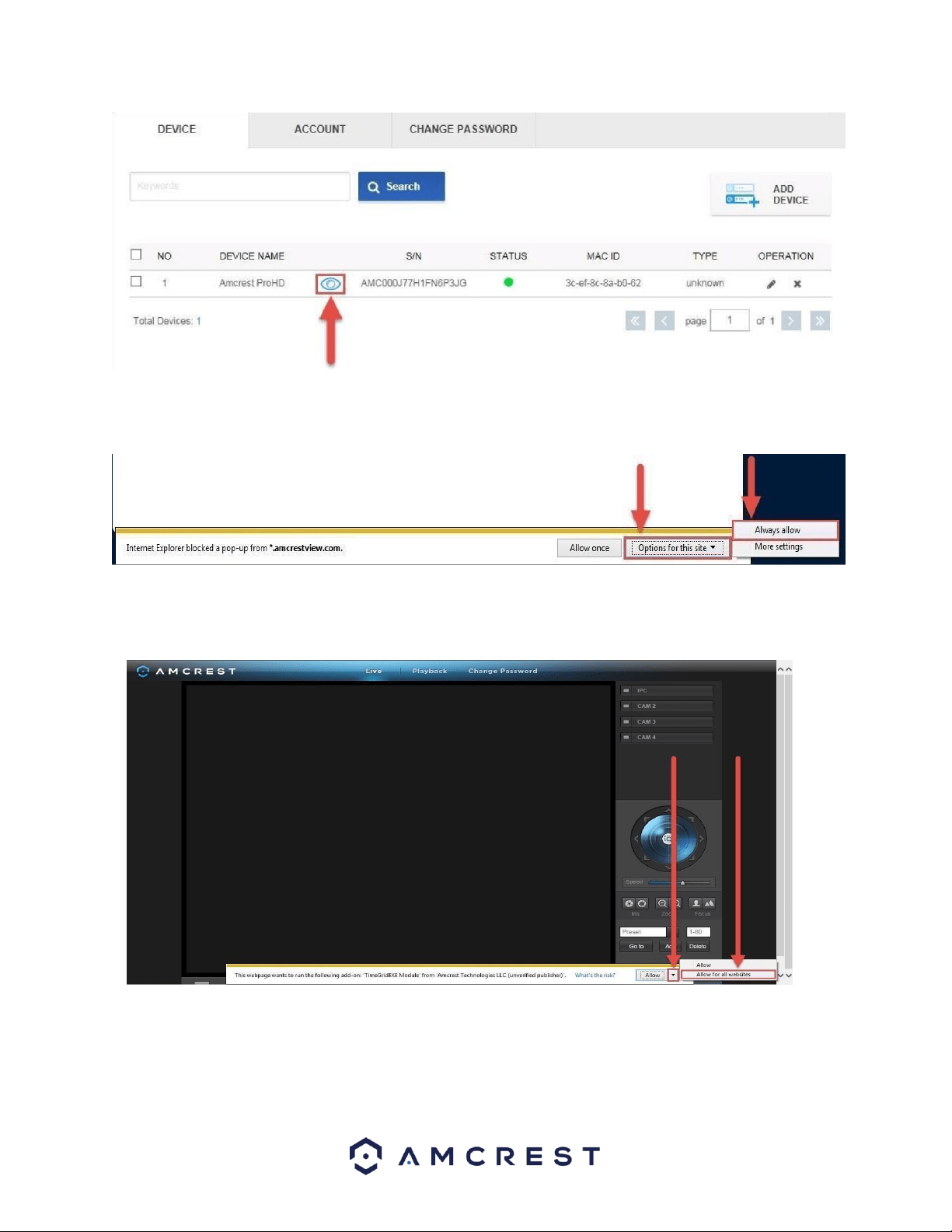
You will then see your camera added to the device list on the main screen. Click the ‘eye’ icon to view the live feed:
33
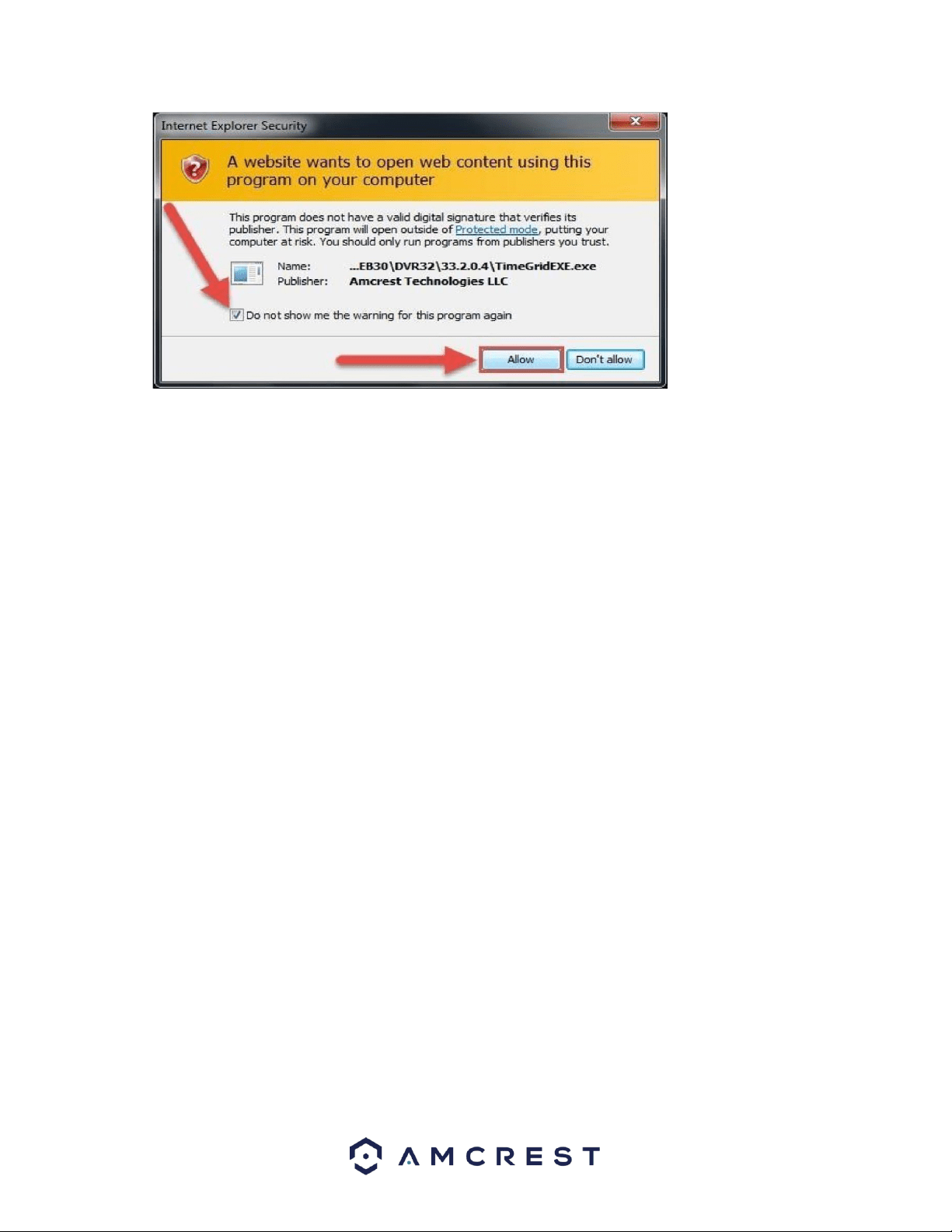
Your browser will give you a notification asking you to allow popups from
AmcrestView.com. Click Options for this site, then click Always allow:
You will be taken to the live view page and given a notification to allow
the plugin to pull the video feed through here. Click the small arrow to
the right of Allow, then click Allow for all websites:
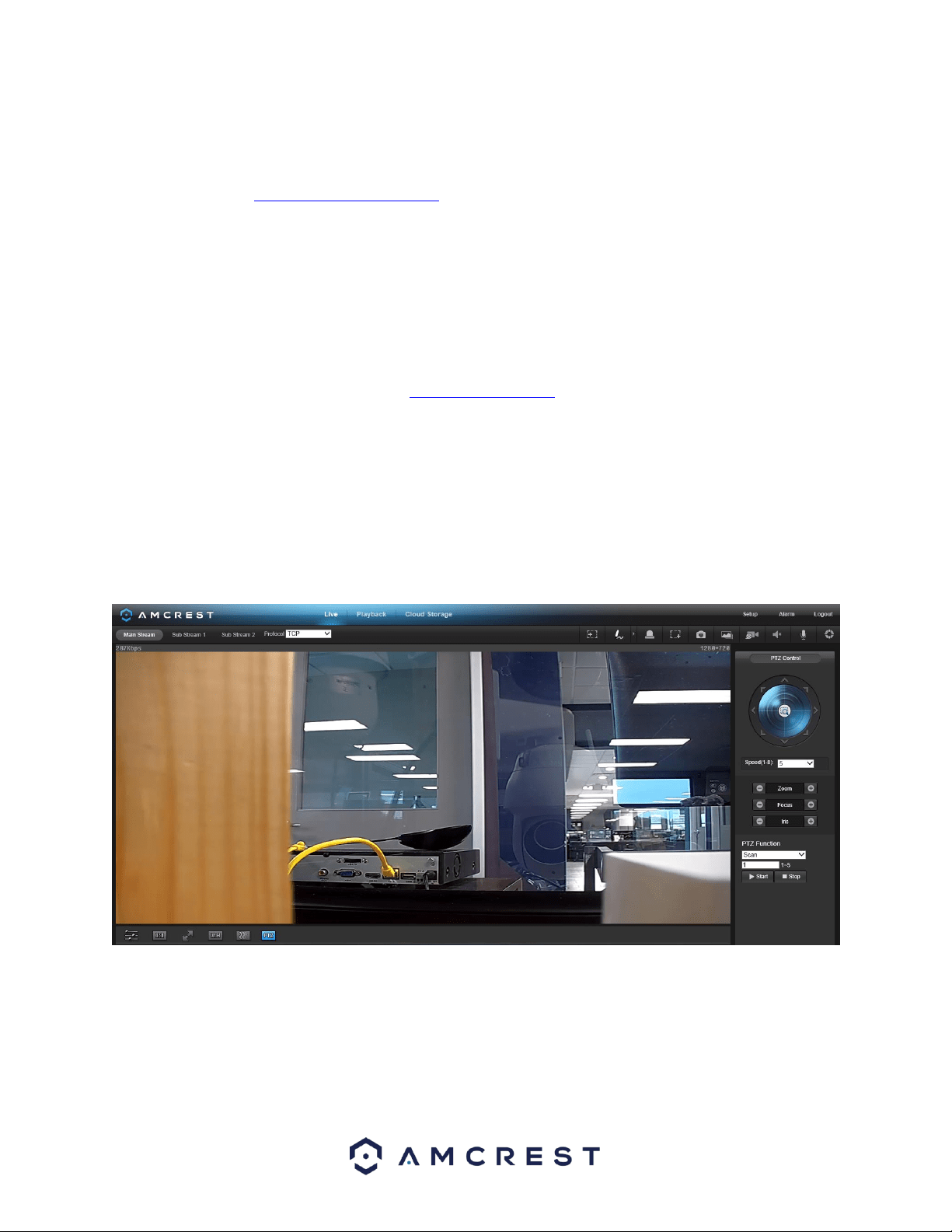
A final popup will appear asking you to confirm that you allow this plugin
on your browser. Mark the checkbox next to Do not show me the
warning for this program again, then click Allow:
34
Now you can enable any of your added cameras to see their live feeds. In
the top right panel, there is a channel list. Click the small square icon to
enable your feed for an added camera to see the video feed:
Click the “S” to change it to an “M” which stands for “Main Stream”
and will give you a full HD quality video stream. To go back to “Sub
Stream”, for lower quality video (that works better on slower internet
connections), click the “M” and change it to an “S” again.
4.7 Remote Web Access Setup
There are two main methods for setting up remote access: UPnP/DDNS,
and Port Forwarding.
4.7.1 UPnP/DDNS Remote Web Access Setup
Using Universal Plug and Play (UPnP) and Dynamic Domain Name
Server (DDNS) functionality is the easiest way to setup stable remote
access. For this method, your router should support the UPnP
networking protocol and the protocol should be enabled. Please refer
to your router manufacturer’s documentation to learn how to enable
UPnP on your router.
Below is a step-by-step walkthrough that details how to setup the
Amcrest PoE cameras for Remote Web Access using UPnP and DDNS:
1. Login to your camera’s web interface, open the main menu then go
to Setup -> Network.
2. Using the left hand menu, go to the Connection menu, and write
down the HTTP port. It is recommended to ensure the port number is at
least 5 digits long to prevent any port conflicts. If need be, change the

35
port to a 5-digit number that is less than 65535, note the number
down, and click save before proceeding to the next step.
3. The system will prompt you to reset the camera. Click OK and wait
for the camera to restart.
4. Restarting the camera may cause the device to use another IP
address. Use the included IP Config tool to find the IP address as
detailed in section 4.4.1.
5. Login to your camera, open the main menu then go to Setup ->
Network.
6. Click the Connections menu item on the left hand menu and
ensure that the HTTP port has changed.
7. Click the DDNS menu item on the left hand menu, pick
Amcrest DDNS from the drop down box, click the checkbox
next to Server Type, and then click the Save button on the
bottom right.
8. To set a custom DDNS name, fill out the Domain name and
save the settings. .
9. Write down the entire Domain Name field, including the
white text that says .amcrestddns.com
10. Click the UPnP menu item on the left hand menu and click
the enable checkbox at the top.
11. While in the UPnP menu, double click the HTTP port, and
change both the internal and external HTTP ports to match the
number that was used in step 2.
12. Uncheck the last 4 checkboxes in the PAT table on the
UPnP menu.
13. Click apply, then exit this menu to go back to the main
menu, then reenter the UPnP menu, and ensure the UPnP
status says, “Mapping Successful”.
14. Open a web browser and enter in the DDNS domain name
address from step 9, enter in a colon, then type the port
number from step 4 on to the end.
For example, if the DDNS domain name is
http://abc123456789.amcrestddns.com and your HTTP Port is
33333, the URL would be
http://abc123456789.amcrestddns.com:33333
15. The browser may prompt you to install a plugin. Click install
to download the plugin, and then click on the plugin installation
file to install the plugin.

36
16. If the browser prompts you to allow the plugin to work on
the computer, hit Allow to ensure the plugin can run
successfully.
17. Enter in login details into the username and password fields
and click login.
If the process above is not working, please contact
Amcrest Support via one of the following options:
o Visit http://amcrest.com/contacts and use the email
form
o Call Amcrest Support using one of the following
numbers Toll Free: (888)212-7538
International Callers (Outside of US): +1-713-893-8956
USA: (888) 212-7538
Canada: 437-888-0177
UK: 203-769-2757
Email Amcrest Customer Support
4.7.2 Port Forwarding Remote Web Access Setup
Port Forwarding is an alternative method to setting up remote access for
Amcrest PoE cameras. This method should only be used if the
UPnP/DDNS Remote Access method did not work.
Below is a step-by-step walkthrough that details how to setup the camera
for Remote Web Access using Port Forwarding:
1. Login to your camera, open the main menu then go to Setup ->
Network.
2. Open the TCP/IP settings screen.
3. By default, the camera has the mode set to DHCP. Ensure that DHCP is
selected. The IP Address,
4. Subnet Mask, Default Gateway, Preferred DNS, and Alternate DNS
should all be 0s if DHCP is selected.
5. Click Save to save these settings. This should now open the main
menu.
6. From the main menu, go to Setup -> Network.
7. On the TCP/IP settings screen, the IP Address, Subnet Mask, Default
Gateway, Preferred DNS, and Alternate DNS should all be populated.
8. Click the radio button next to Static, to change the mode to Static.
9. Write down the IP Address that is currently in the IP address field.

37
10. Click the Save button.
11. Using the left hand menu, go to the Connection menu, and write
down the TCP, UDP, and HTTP port number. It is recommended to ensure
that these port numbers are at least 5 digits long to prevent any port
conflicts. If need be, change each of these port numbers to a 5-digit
number that is less than 65535, note the numbers down, and click save
before proceeding to the next step.
12. Go to http://www.canyouseeme.org/ and check to ensure
each of the port numbers specified in step 10 is open.
13. Write down the manufacturer name, brand, and model
name for the router that the camera is connected to, and then
proceed to http://www.portforward.com on your web browser.
14. Open the port forwarding guide section on the left hand side
menu.
15. Find the router brand name in the list and click it.
16. Find the router model number and click it.
17. Click the Default Guide link near the middle of the page.
18. This guide will help you take the step necessary to port
forward on the router. Follow these steps, and then return to the
camera.
19. Login to your camera, open the main menu then go to Setup
-> Network.
20. Click the DDNS menu item on the left hand menu, pick
Amcrest DDNS from the drop down box, click the checkbox next
to Server Type, and then click the Save button on the bottom
right.
21.To set a custom DDNS name, fill out the Domain Name field
and click Save.
22. Write down the entire Domain Name field, including the
white text that says.amcrestddns.com
23. Open a web browser and enter in the DDNS domain name
address from step 21, enter in a colon, then type the HTTP port
number from step 10 on to the end.
For example, if the DDNS domain name is
http://abc123456789.amcrestddns.com and your HTTP Port is
33333, the URL would be
http://abc123456789.amcrestddns.com:33333
24. Enter in login details into the username and password fields
and click login.
38
If the process above is not working, please contact Amcrest
Support via one of the following options:
o Visit http://amcrest.com/contacts and use the email
form
Call Amcrest Support using one of the following numbers
Toll Free: (888)212-7538
International Callers (Outside of US): +1-713-893-8956
USA: (888) 212-7538
Canada: 437-888-0177
UK: 203-769-2757
Email Amcrest Customer Support [email protected]
5. Web Operation and Interface
This section of the manual details the camera’s interface, as well as all
the operations the camera can perform in the camera’s web user
interface.
The main interface of the camera contains 6 major tabs on the top of the
screen. By default, the interface opens on the Live tab.
5.1. Live
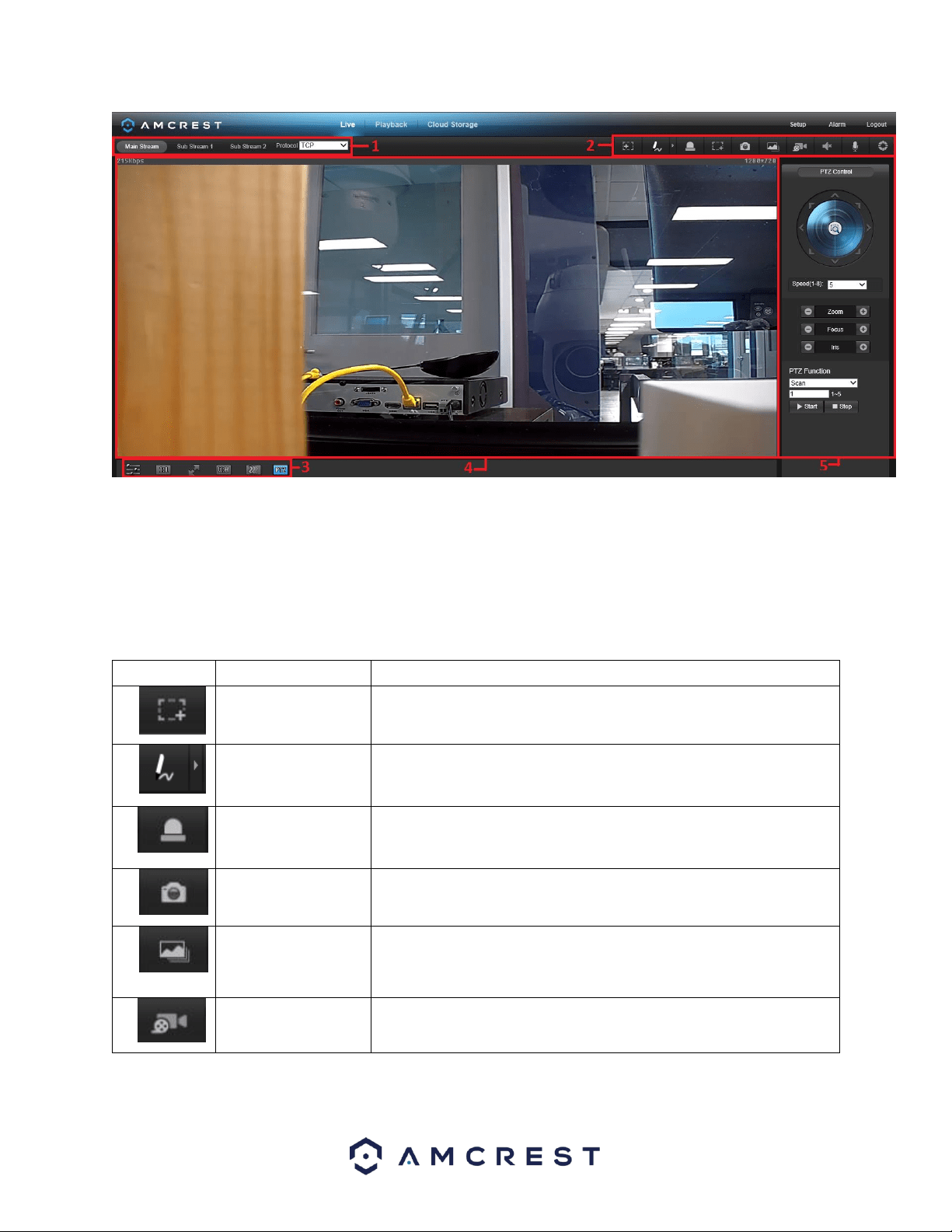
The Live tab allows the user to see a live video feed from the camera. The
live tab has 5 main sections:
39
Section 1: This bar allows the user to select which stream type and which
protocol they want to choose.
Section 2: The functions bar allows the user to perform different camera
functions while in live mode. See the table below for an explanation of
the different functions available:
Button
Function Name
Function Description
Digital Zoom
Click this button to activate the zone selection function. This
allows the user to use the mouse to select a zone to zoom in on.
Description
Click this button to apply descriptions to events caught on the live
view screen. A pencil icon will appear which allows the user to
draw or highlight events.
Alarm Output
Click this button to generate an alarm output signal. This button
becomes red/grey depending on alarm output activation or
cancellation.
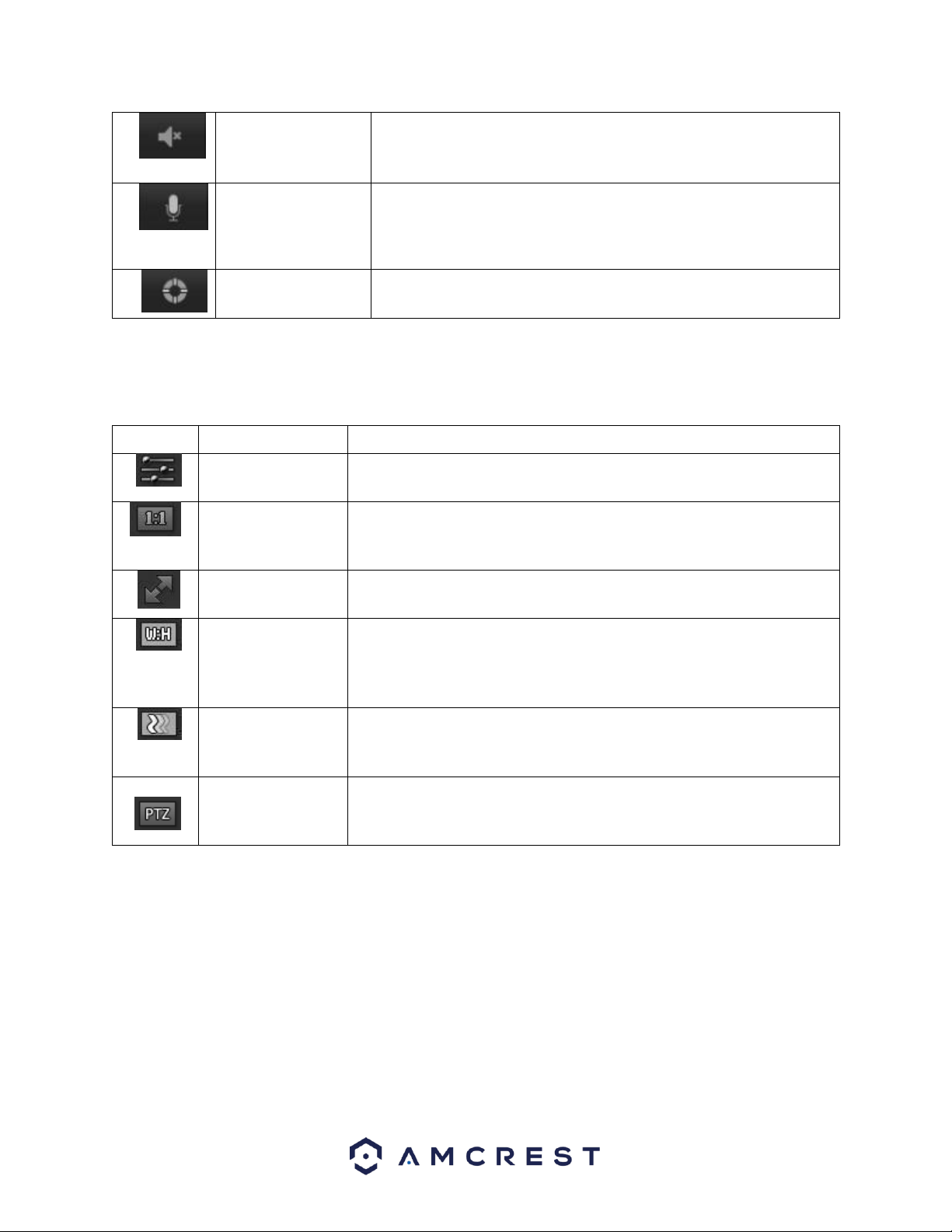
Snapshot
Click this button to take a screenshot of the live feed. The picture is
saved at the path specified in Setup -> Camera -> Video -> Path.
Triple Snapshot
Click this button to take 1 screenshot per second for 3 seconds. The
pictures are saved at the path specified in Setup -> Camera -> Video
-> Path.
Manual Record
Click this button to manually record video. The video is saved at the
path specified in Setup -> Camera -> Video -> Path.
40
Audio
Click this button to enable or disable audio output from the camera.
This feature allows the user to listen in on the audio the camera’s
microphone is picking up.
Bidirectional Talk
Click and hold this button to enable bidirectional talk. This feature
allows the user to broadcast audio from their computer to the
camera. While this is active, the camera’s speaker is shut off to keep
audio quality high.
Help
Click this button to open a window that details the buttons and
functions shown on this screen.
Section 3: This bar allows the user to change video settings for the live
playback screen. See the below table for an explanation of the video
settings:
Button
Function Name
Function Description
Image Adjustment
This button opens the image adjustment toolbar, which allows the user to
adjust brightness, contrast, saturation, and hue for the live feed’s picture.
Adapt/Original Size
This button allows the user to switch between displaying the original size
of the stream in its set resolution, or to adapt to the size of the monitor
display the feed is being viewed on.
Full Screen
This button allows the user to make the live feed go into full screen mode.
Double click the mouse or click the ESC button to exit full screen mode.
Width/Height Ratio
This button allows the user to change the width/height ratio for the live
feed. The options are Original and Adaptive. Original uses the aspect ratio
of the stream’s set resolution, and adaptive fits the feed to the aspect
ratio of the monitor display the feed is being viewed on.
Stream Fluency
This button allows the user to change the stream fluency. There are 3
options. Realtime reduces delay and decreases fluency, and Fluency has a
larger delay, but the video stream becomes more fluid.
Pan Tilt Zoom
This button allows the user to show or hide the pan tilt zoom control panel
on the live view screen. For more information on the features listed in this
menu, refer to section 5.2. of this user manual.
Section 4: This section of the Live tab shows the picture that the
camera is broadcasting. The bitrate is shown in the top left corner, the
native resolution is shown in the top right corner, the time stamp is
shown below the native resolution, and the camera type is shown in
the bottom left corner.
Section 5: This section of the Live tab shows the PTZ functionality of the
camera. For more information on the features listed in this menu, refer
to section 5.2. of this user manual.
41
5.2 PTZ
The PTZ tab allows the user to change the position of the camera. Below
is a screenshot of the PTZ tab:
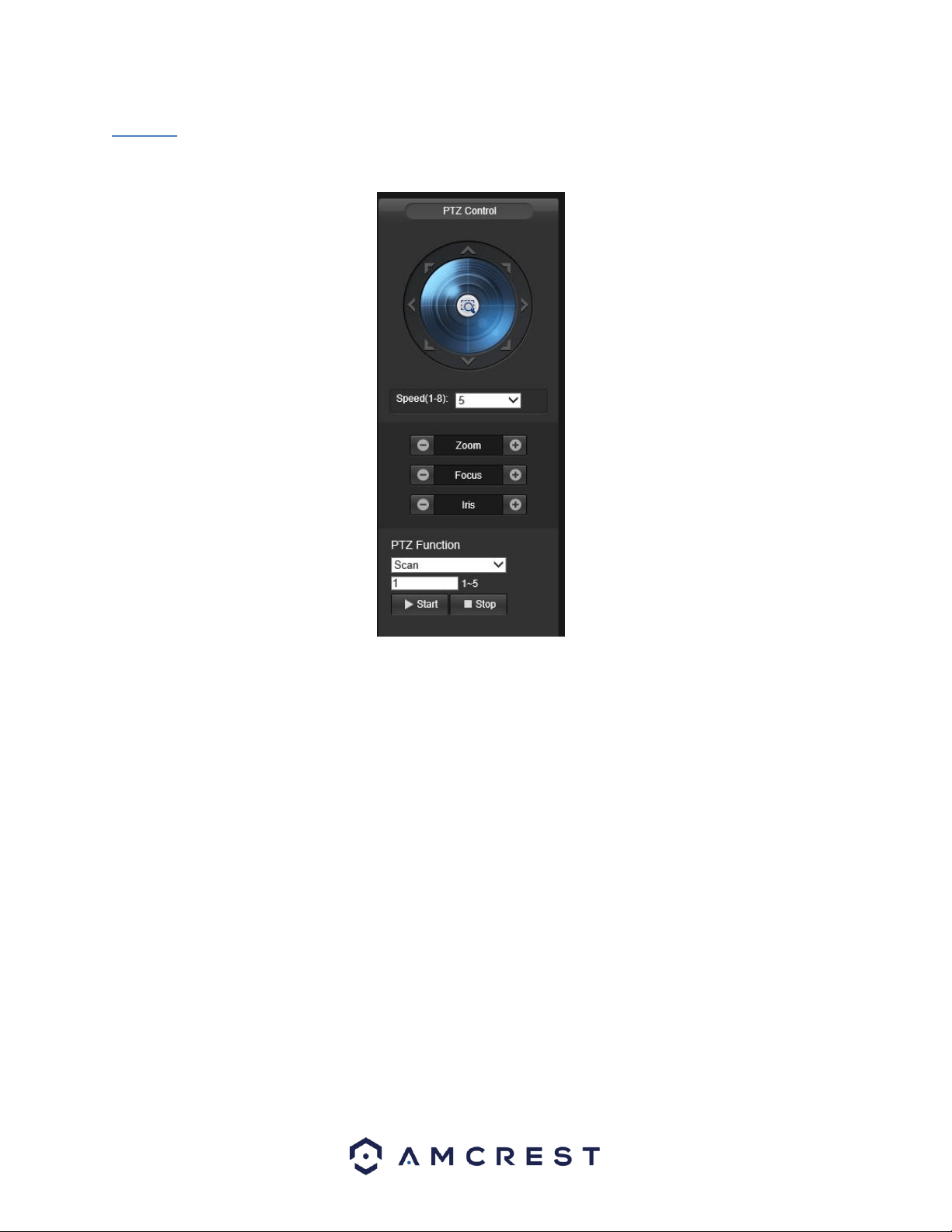
The PTZ control panel allows the user to position the camera in
different ways
The arrows on the PTZ control panel allow the user to move the camera’s
position in a specific direction. The button in the middle of the direction
arrow allows the user to select an area in the live view to zoom in on.
The speed dropdown box allows the user to control the speed at which
the camera moves. The values range from 1 to 8, 8 being the fastest.
The zoom, focus, and iris buttons allow the user to digitally zoom in and
out, focus, and just the camera’s image on the live screen.
The dropdown box under PTZ Function allows the user to configure
presets, scans, tours, etc. Preset allows the user to designate specific
PTZ positions for the camera. To create and manage presets, follow the
steps below:
o Configure the camera positioning as needed.
o Input the preset number, and then click the + Add
button
o Click - Del to delete the current preset.

42
o Click Go To access a preset.
Tour allows the user to string multiple presets together. To create and
manage tours, follow the steps below:
o Ensure you have more than 1 preset configured already.
o Input the tour value and click Start.
o Input the preset value and then click the Add Preset button to
add a preset.
o Continue adding presets as needed.
o Click Del Preset to remove a preset from the tour.
o Click - Del to delete the entire tour.
Pattern allows the user to set specific PTZ patterns. The set patterns allow
the camera to move in specific or focus on specific areas automatically. To
create a pattern, follow these steps:
o From the PTZ Function dropdown box, select Pattern
o Ensure you have a preset initially setup for the camera.
o Input the preset value and click Start.
o To stop the pattern, click Stop.
Pan allows the user to set pan presets. The set pan preset allows the
camera to pan to specific areas automatically. To create a pan, follow
these steps:
o From the PTZ Function dropdown box, select Pan.
o Ensure you have a preset initially setup for the camera.
o Input the preset value and click Start.
o To stop the pattern, click Stop.
Assistant allows the use to set assigned presets via an auxiliary device.
This function may vary model to model and may not be available in every
model camera. To establish an assistant preset, follow the steps provided
below:
o From the PTZ Function dropdown box, select Assistant.
o Ensure you have a preset initially setup for the camera.
o Input the preset value and click Aux On.
o To stop the pattern, Aux Off.
Position ABS allows the user to set horizontal, vertical, and zoom values.
Once set, the camera will zoom to the indicated input values. To set a
position ABS preset follow the steps provided below:
o From the PTZ Function dropdown box, select position ABS.
o Type in the horizontal angle value, this can range from 0 ~ 3600.
o Type in the vertical angle value, this can range from 150 ~ 900.
o Type in the zoom value, this can range from 1 ~ 128.
43
o Click Go To to have to have the camera position itself to the
entered values.
5.3 Playback
The Playback tab allows the user to playback the camera’s recorded
video. Below is a screenshot of the Playback tab:
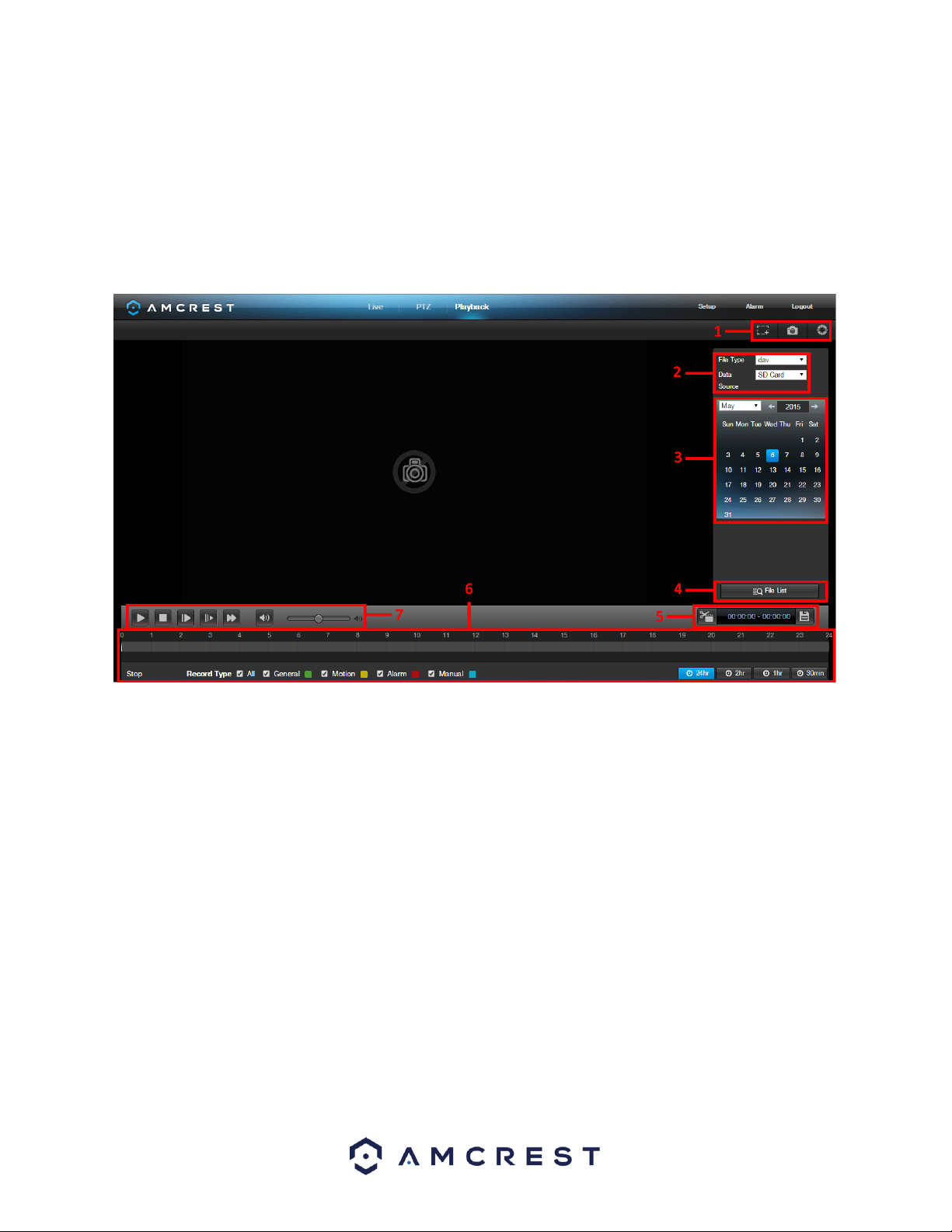
This is the interface for the playback menu. There are 7 main sections:
Quick Actions: This panel allows the user to zoom in on playback
footage, take a snapshot of the playback footage, or open the help
menu.
File Menu: This panel allows the user to select a file type and data
source.
Calendar: This panel allows the user to pick a date that they would like
to playback video from. When a date has recorded footage available,
it’s green. The current date is blue, unless it has recorded footage, then
it’s a lighter green.
File List: This button opens a file list of all recorded video for a specific
date range. From here, the user can download these videos to their PC.
Trim Panel: This panel allows the user to trim playback video for
download. By specifying time stamps, the user can trim down.
Recorded Video Panel: This panel allows the user to specify what type
of video they would like to playback and it also allows the user to select
44
where to start playback from. The buttons on the bottom right allow
the user to select a zoom level.
Playback Bar: This panel allows the user to control playback. It also
allows the user to control playback speed, and playback volume.
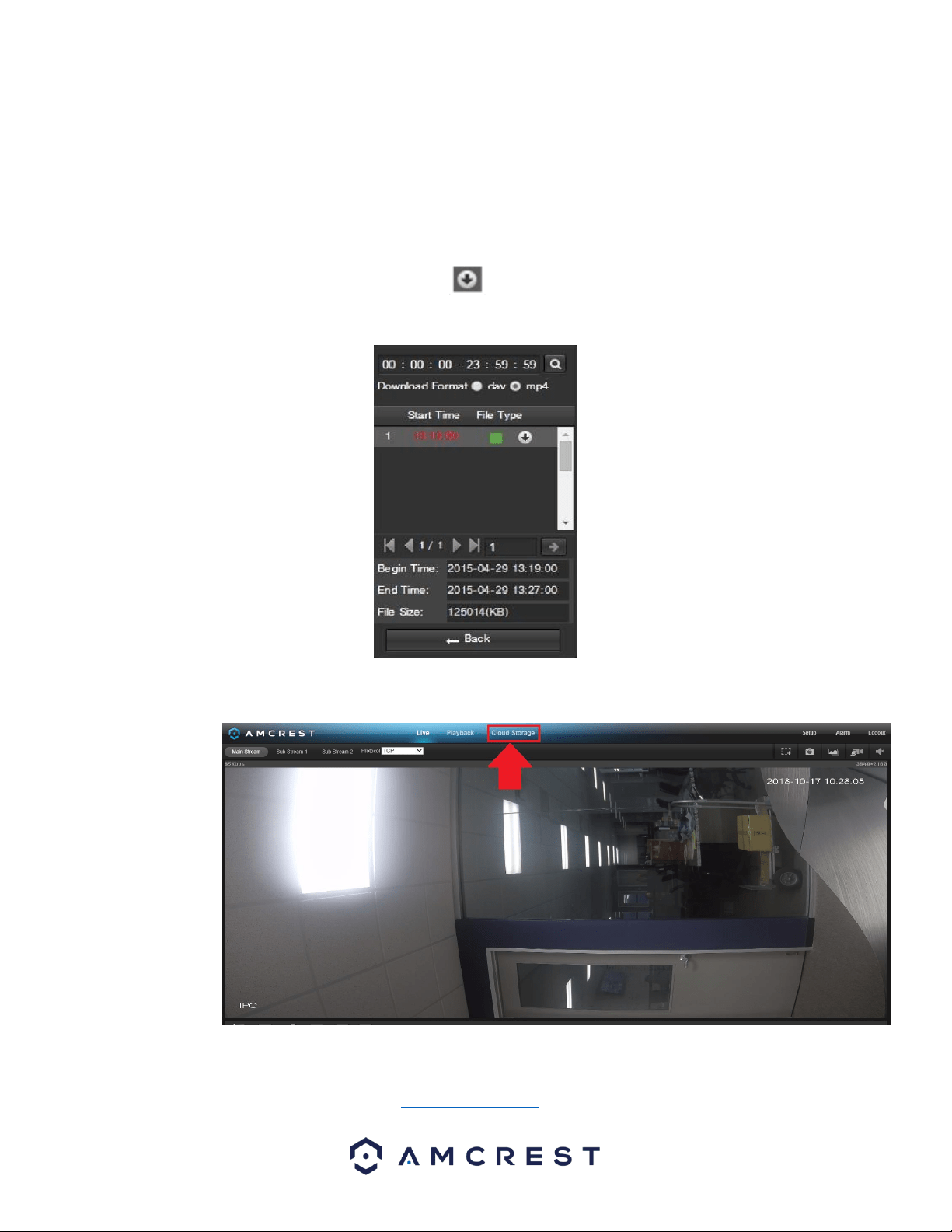
Clicking the File List opens the following screen on the sidebar:
This allows the user to select files for download. Select the files by
clicking the checkbox next to each file, and then click to
download the files to your computer
5.4. Cloud Storage
The Cloud Storage tab allows the user quick access to the Amcrest Cloud website.
At this website (amcrestcloud.com) users can register for new accounts as well as view or modify existing
accounts.
For more information on Amcrest Cloud visit: amcrest.com/support
45
5.5. Setup
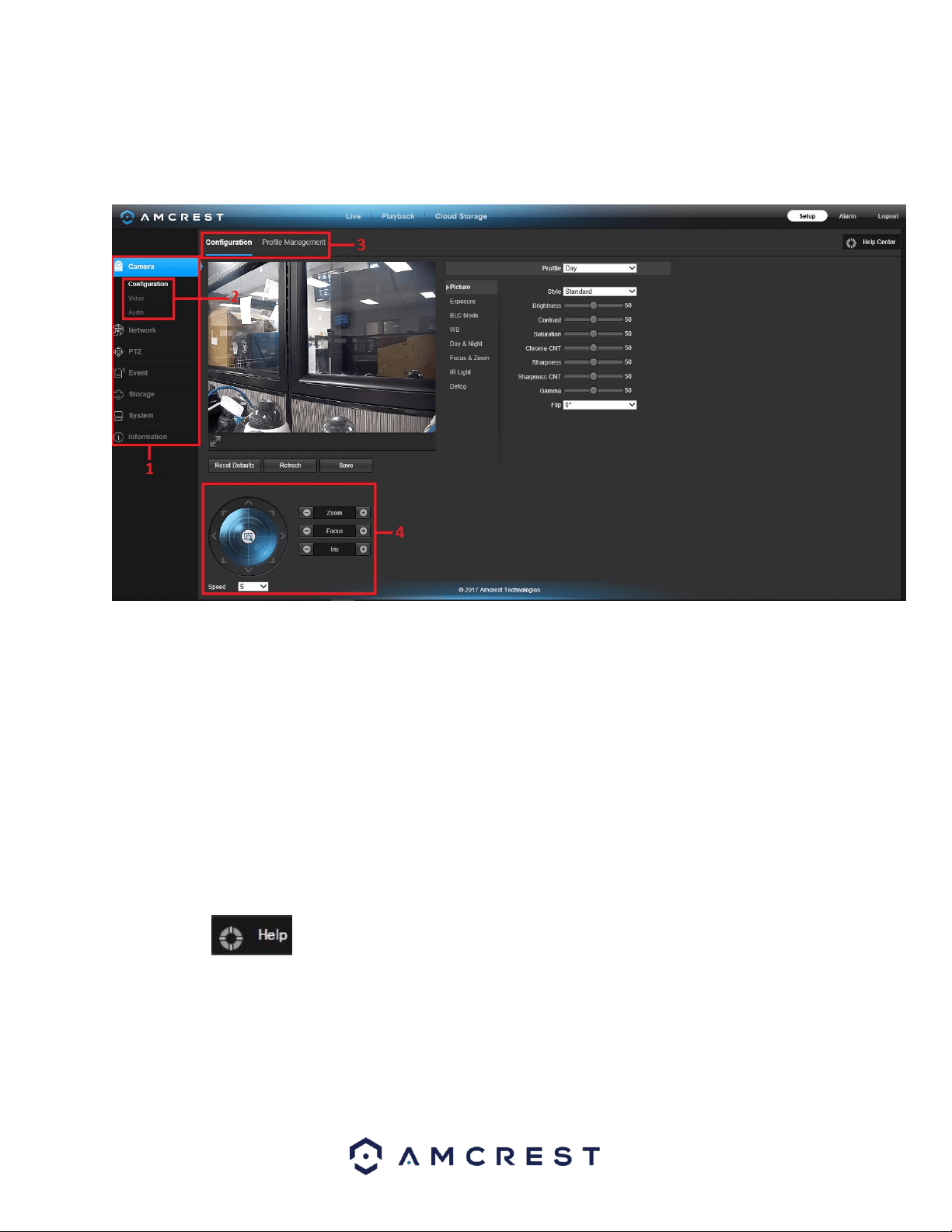
The Setup tab allows the user to change different camera settings
Below is a screenshot of the setup tab:
There are 4 main sections to note in the Setup tab:
Menu Bar: The menu bar is composed of menu sections, which when
clicked display any menu items that fall under their category.
Menu Items: These menu items each open a different menu that allows
the user to change specific settings for the camera.
Menu Tab: These tabs open menu options for certain menu items.
PTZ Control Panel: This panel allows the user quick access to PTZ
functions.
Note: To view additional information about any of the information in the
menu, click the button near the top right corner. In the rest
of section 5.4, we will be exploring all the different menus that are
available through web access.
5.5.1 Camera
This menu section allows the user to change different camera settings for
video, audio, and to manage image profiles.
46
5.5.1.1 Configuration
This menu allows the user to configure image profiles for normal, day,
and night usage.
5.5.1.1.1. Picture
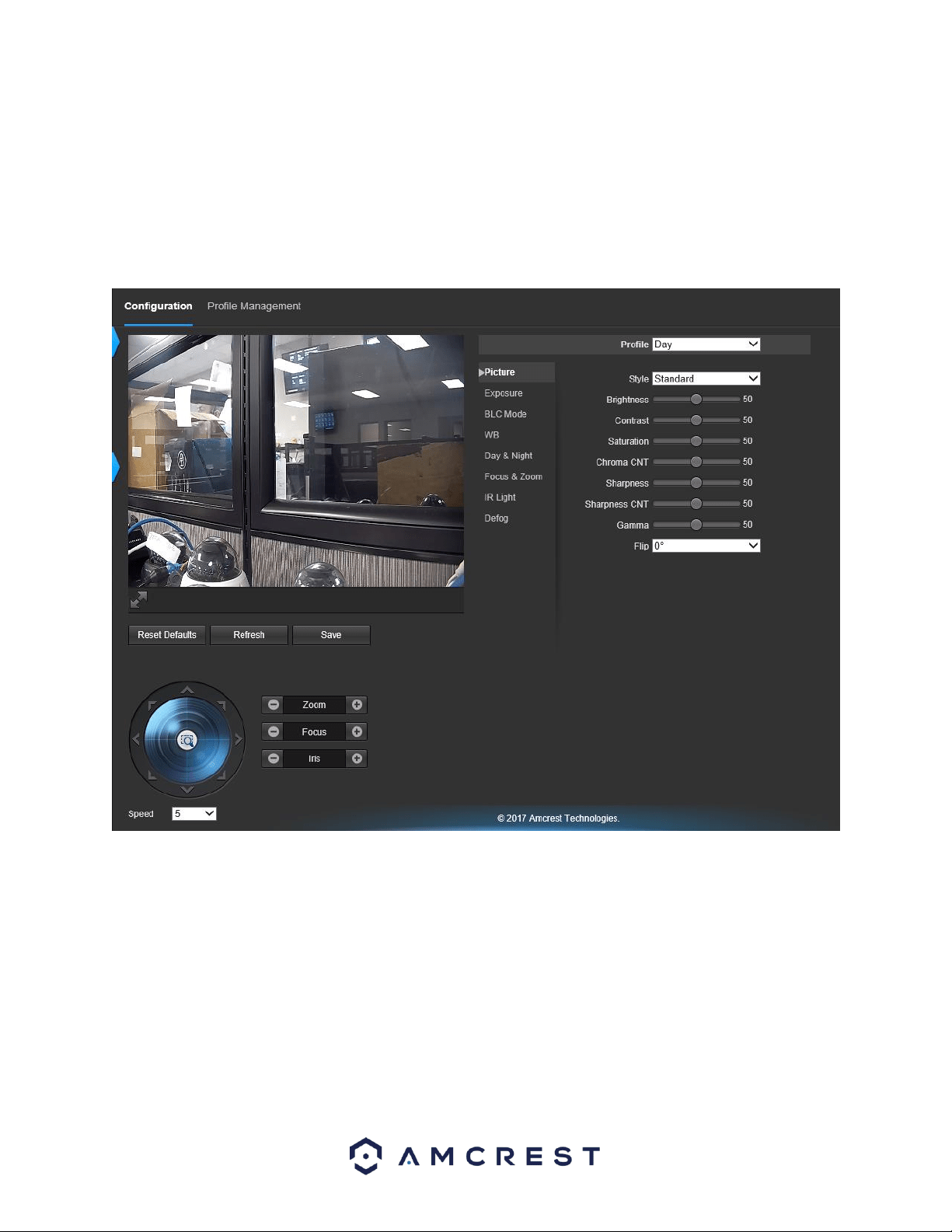
Below is a screenshot that shows the Configuration tab in the
Configuration menu item:
Below is an explanation for each of the fields on the Configuration tab in
the Configuration menu item:
Profile: This dropdown box allows the user to select which profile to
modify. The 3 options are Day, Night, and Normal.
Style: This dropdown box allows the user to select which style they
would like to view the live view screen in. The options are; Soft,
Standard, and Vivid.
Brightness: This slider is used to adjust playback and recorded video
window brightness. The value ranges from 0 to 100. The default value is
50. The larger the number, the brighter the video is. When you input the
value here, the bright section and the dark section of the video will be

47
adjusted accordingly. You can use this function when the whole video is
too dark or too bright. Please note the video may become hazy if the
value is too high. The recommended value ranges from 40 to 60.
Contrast: This slider is used to adjust playback and recorded video
window contrast. The value ranges from 0 to 100. The default value is
50. The larger the number is, the higher the contrast is. You can use this
function when the whole video brightness is OK but the contrast is not
correct. Please note the video may become hazy if the value is too low.
If this value is too high, the dark section may lack brightness while the
bright section may over expose. The recommended value ranges from
40 to 60.
Saturation: This slider is used to adjust playback and recorded video
window saturation. The value ranges from 0 to 100. The default value is
50. The larger the number, the stronger the color is. This value has no
effect on the general brightness of the whole video. The video color may
become too strong if the value is too high. For the grey part of the
video, distortion may occur if the white balance is not accurate. Please
note the video may not be clear if the value is too low. The
recommended value ranges from 40 to 60.
Chroma CNT: This slider is used to adjust how pure or monochromatic
the image will be compared to a white surface. The value ranges from 0
to 100. The default value is 50. The larger the number, the stronger the
purity of the color. The value has no effect on general brightness or
clarity of the video stream however, if the values are too high it could
cause stream issues. It is recommended to keep this value at the default
setting of 50 to avoid streaming issues.
Sharpness: This slider is used to adjust the sharpness of the video. The
value ranges from 0 to 100. The larger the value is, the clearer the edges
are and vice versa. Note: The higher the value, the higher likelihood of
picture noise occurring. The default value is 50 and the recommended
value ranges from 40 to 60.
Sharpness CNT: This slider is used to adjust how pure or monochromatic
the sharpness of the image will be compared to a white surface. The
default value is 50. The larger the number, the stronger the purity of the
sharpness. The value has no effect on general brightness or clarity of the
video stream however, if the values are too high it could cause stream
issues. It is recommended to keep this value at the default setting of 50
to avoid streaming issues.
Gamma: This slider is used to adjust the gamma of the video. The larger
the number, the brighter the video is. The default value is 50 and the
recommended value ranges from 40 to 60.

48
Flip: This dropdown box allows the user to flip the video feed picture.
Flipping the picture is recommended only if the camera is mounted
upside down.
To reset to default settings, click the Reset Defaults button. To refresh
the screen, click on Refresh. To save the settings, click the Save button.
5.5.1.1.2. Exposure
This menu allows users to select and adjust key exposure features. For more information on the items listed in this
menu, refer to the information provided below.
Profile: This dropdown box allows the user to select which profile to
modify. The 3 options are Day, Night, and Normal.
Anti-Flicker: These radio buttons allow the user to select what type of
antiflicker technology should be used for the video feed. The three
options are 50 Hz, 60 Hz, and Outdoor. The desired option should offset
any flickering effect caused by the electrical current used in the specific
area.
Mode: This dropdown box allows the user to select different exposure
settings such as, Auto, Aperture Priority, Shutter Priority, Gain Priority or
manual settings. For more information on these settings, refer to the
information provided below:
o Auto: Allows the user to automatically set exposure settings
based on surrounding environments.
o Aperture Priority: Allows the use to set aperture settings in the
camera. This allows the camera to automatically detect shutter
speeds based on surrounding environments. The default iris
setting is 10 ~ 50, however, it can range from 0 ~ 100.
o Shutter Priority: Allows the user to set shutter settings in the
camera. This allows the camera to automatically detect optimal
aperture settings based on surrounding environments. The
default shutter speed is 1/30, however, it can range to
1/30000.
o Gain Priority: Allows the user to prioritize gain levels based on
the surrounding environment of the camera. The default gain
value is from 0 ~ 50, however, can range from 0 ~ 100.
o Manual: Allows the user to manually control and adjust
aperture, shutter, and gain priorities. Each value will be set to
default unless modified by the user.
AE Recovery: Allows the user to set a period of time after which the
camera’s exposure settings will be reset. This option defaults at 15
minutes, however, if activated can range up to 2 hours.
2D NR: This radio button allows the user to turn the 2D Noise Reduction
feature on or off.

49
Grade: This slider allows the user to specify the level of 2D noise
reduction level. The value ranges from 1 -50
3D NR: This radio button allows the user to turn the 3D Noise Reduction
feature on or off.
3D NR Level: This slider allows the user to specify the 3D Noise
Reduction level. The value ranges from 1-50.
To reset to default settings, click the Reset Defaults button. To refresh
the screen, click on Refresh. To save the settings, click the Save button.
5.5.1.1.3. BLC Mode
This menu allows the user to set backlight composition settings to enhance image quality. For more information on
the items provided in this menu, refer to the information provided below.
Profile: This dropdown box allows the user to select which profile to
modify. The 3 options are Day, Night, and Normal.
Mode: These modes allow the user to set compensation settings within the camera. The items listed in this
dropdown box are; BLC, HLC, and WDR.
o BLC: Stands for backlight compensation. Select this option to optimize exposure in the foreground and
background of the video stream.
o HLC: Stands for highlight compensation. Select this option to reduce glare or other high-level light spots.
This is typically useful for night vision or in other dark or low-level light environments.
o WDR: Stands for Wide Dynamic Range. Like BLC, select this option to help balance out washed out video
due to high-levels of natural light in the environment.
To reset to default settings, click the Reset Defaults button. To refresh the screen, click on Refresh. To save the
settings, click the Save button.
5.5.1.1.4. WB
This menu allows the user to apply white balance presets to the video stream. The different options in this menu
are; auto, indoor, outdoor, ATW, customized, sodium lamp, sunny, night. For more information on the items listed
in this menu refer to the information provided below.
o Auto: Allows the user to automatically set white balance settings based on surrounding environments
o Indoor: Allows the user to set preset settings for indoor use.
o Outdoor: Allows the user to set preset white balance settings for outdoor use.
o ATW: Stands for auto tracing white balance. This setting allows the user to allow the camera to
automatically detect white balance values based on the surrounding environment of the camera. This can
be set for indoor or outdoor use.
o Customized: Allows the user to adjust the red and blue colors of the video stream. The default settings for
both values are 50, but they can range from 0 ~ 100.
o Sodium Lamp: Allows the white balance of the video stream to be adjust according to light and dark
environments. The overall effect is based on the concept of a sodium lamp which adjusts different light
spectrums of the video stream based on its surrounding environment.
o Sunny: Allows the user to automatically set white balance settings based on heavily lite or sunny
environments.
o Night: Allows the user to automatically set white balance settings based on low light or dark environments.

50
To reset to default settings, click the Reset Defaults button. To refresh the screen, click on Refresh. To save the
settings, click the Save button.
5.5.1.1.5. Day & Night
Used to determine when black and white mode is turned on in a dark environment. Below is a screenshot of this
menu:
Profile: This dropdown box allows the user to select which profile to
modify. The 3 options are Day, Night, and Normal.
Type: These radio buttons are used to
Mode: This menu allows user to select day & night presets based on the surrounding environment of the camera.
For more information on the items listed in this field, refer to the information provided below:
o Auto: Uses day and night sensitivity settings to change between color mode, infrared, and black& white
modes.
o Color - Always represents picture in color, does not use IR or black and white mode. Performs poorly in
dimly lit areas unless you are using the Starlight series cameras.
o Black & White: Allows the user to set the video stream to black and white, however, if the illuminated
image is too dark it will switch to IR mode.
Sensitivity: This option allows the user to change the Day/Night Sensitivity of the
camera. The three options are Low, Middle, and High. The higher the sensitivity, the
quicker the camera will change into another mode depending on the light levels.
Delay: This dropdown box allows the user to set a delay in seconds for how long it
takes to switch between Day and Night modes. The values range from 2 seconds to 10
seconds.
To reset to default settings, click the Reset Defaults button. To refresh the screen, click
on Refresh. To save the settings, click the Save button.
5.5.1.1.6. Focus & Zoom
This menu allows the user to adjust digital focus and zoom settings.
Profile: This dropdown box allows the user to select which profile to
modify. The 3 options are Day, Night, and Normal.
Digital Zoom: These radios buttons allow the user to turn digital zoom
on and off.
Zoom Speed: This slider allows the user to adjust the zoom speed of the
lens. The default should be 100, but it can range from 0 ~ 100.
Mode: This dropdown menu is used to set focus settings for the camera.
The items listed in this menu are as follows:
o Auto: Allows the user to set auto focus settings for the camera.

51
o Semi Auto: Allows the user to set focus settings as well as
having the camera automatically detect optimal focus settings.
o Manual: Allows the user to have full manual control of focus
control settings.
Focus Limit: Allows the user to set focus limits (in cm) within the
camera. The default is set to auto, which automatically will control focus
limits, however, the settings can range from 5cm ~ 10cm.
Sensitivity: This menu allows the user to set sensitivity settings for focus
limits. The camera is usually set to Default which allows the focus limits
to be adjusted automatically, however, they can also be set to high or
low.
Reset Lens: This option allows the user to reset their focus & zoom
settings to default.
To reset to default settings, you can also click the Reset Defaults button. To refresh the
screen, click on Refresh. To save the settings, click the Save button.
5.5.1.1.7. IR Light
This menu allows users to choose different modes for the infrared light.
Profile: This dropdown box allows the user to select which profile to
modify. The 3 options are Day, Night, and Normal.
Mode: Allows the user to choose between different IR modes:
o Manual: Allows the user to adjust near and far light between
values of 0 ~ 100.
o ZoomPrio: Allows the user to adjust correction settings for IR
functionality. The default value is 50, however, it can range
from 0 ~ 100.
o Smart IR: Allows the user to automatically set the camera’s IR
lights to on and off positions based on Day & Night conditions.
o OFF: Permanently turns off the IR lights.
To reset to default settings, you can also click the Reset Defaults button.
To refresh the screen, click on Refresh. To save the settings, click the
Save button
5.5.1.1.8. Defog
This menu allows the user to set defog settings which can be useful in foggy or hazy weather. For more
information on this feature refer to the information provided below:
Profile: This dropdown box allows the user to select which profile to
modify. The 3 options are Day, Night, and Normal.
Mode: Allows the user to adjust defog settings.
o OFF: Allows the user to turn off defog mode.
o Manual: Allows the user to manually control defog settings.
52
o Auto: Allows the user to let the camera automatically detect
defog settings.
To reset to default settings, you can also click the Reset Defaults button.
To refresh the screen, click on Refresh. To save the settings, click the
Save button
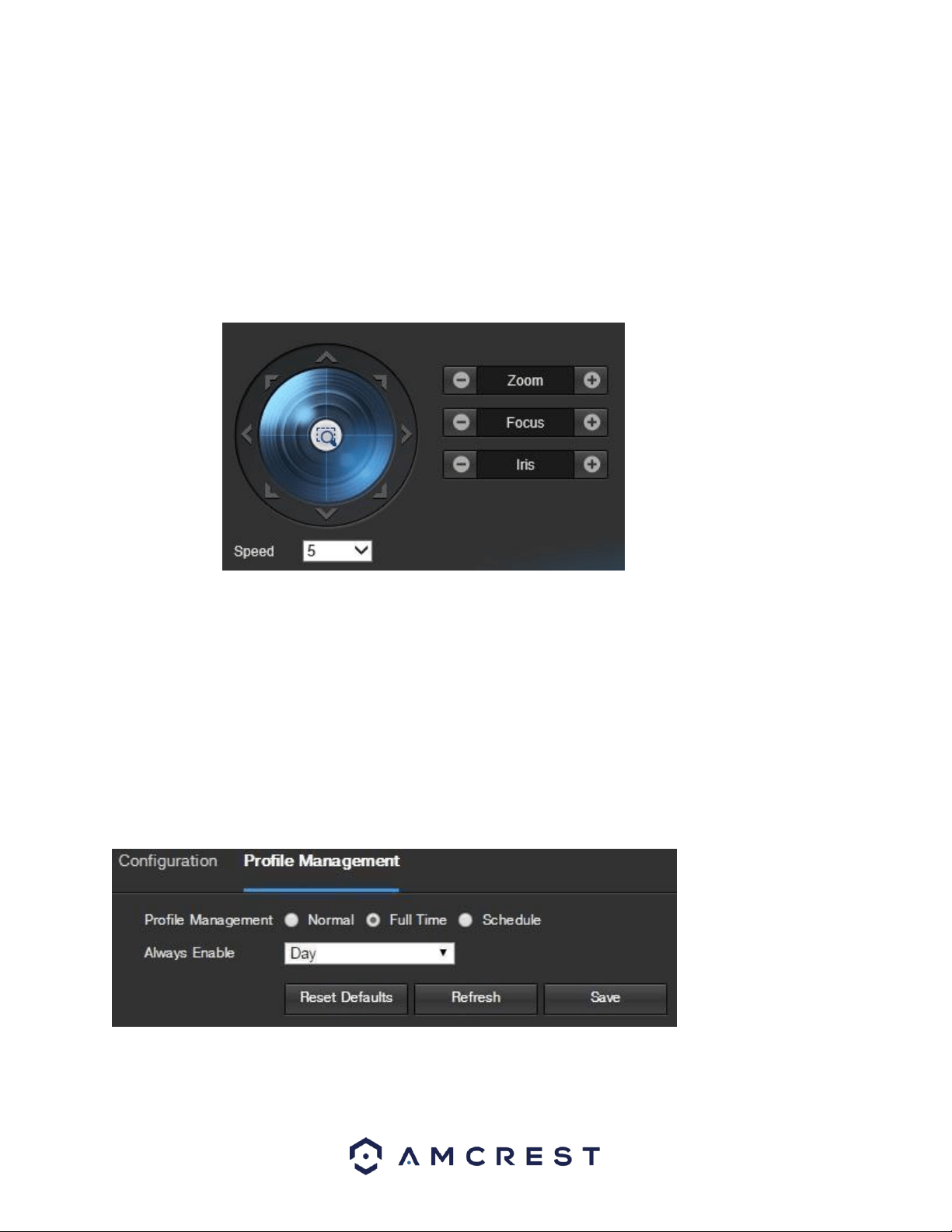
5.5.1.1.9. PTZ Control Panel
This option provides the user quick access to their PTZ settings. Use the video screen in the configuration menu to
monitor PTZ operations.
The arrows on the PTZ control panel allow the user to move the camera’s
position in a specific direction. The button in the middle of the direction
arrow allows the user to select an area in the live view to zoom in on.
The speed dropdown box allows the user to control the speed at which
the camera moves. The values range from 1 to 8, 8 being the fastest.
The zoom, focus, and iris buttons allow the user to digitally zoom in and
out, focus, and just the camera’s image on the live screen.
5.5.1.2. Profile Management
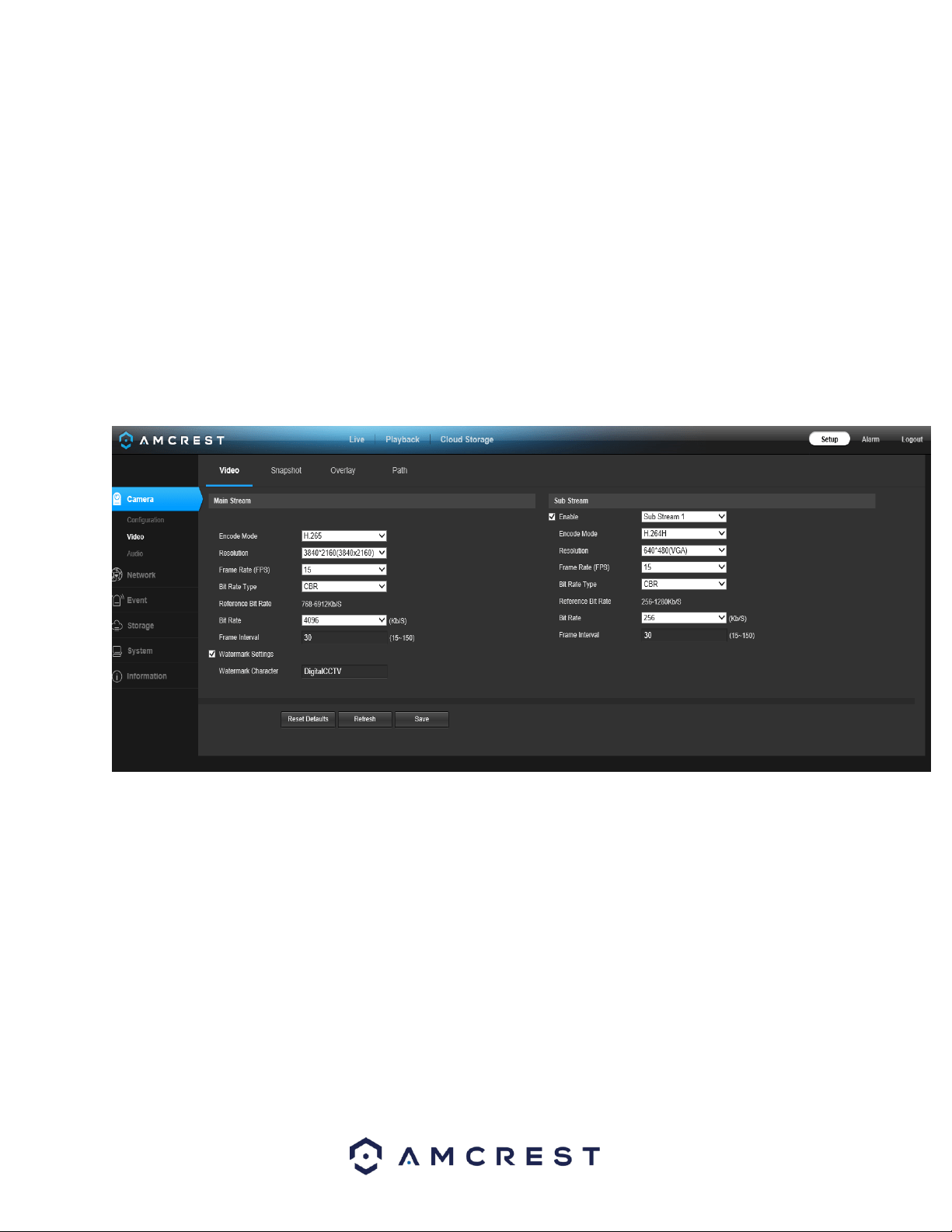
Below is a screenshot that shows the Profile Management tab in the
Configuration menu item:
Below is an explanation for each of the fields on the Profile Management tab in the
Configuration menu item:
53
• Profile Management: This set of radio buttons allow the user to set what basis the
profile management settings run on. There are 3 options: Normal, Full Time, and
Schedule. Normal means that the system can automatically alternate between night
and day based on the profiles for each.
Full Time means that the system sticks to one profile the entire time it is running.
Schedule allows the user to dictate which times of the day are designated for the day
profile and the night profile.
To reset to default settings, click the Reset Defaults button. To refresh the
page, click the Refresh button. To save the settings, click the Save button.
5.5.2 Video
Below is a screenshot that shows the Video tab in the Video menu item:
Below is an explanation for each of the fields on the Video tab in the Video menu item:
• Encode Mode: This dropdown box allows the user to select a compression protocol.
The system supports H.264 and MJPEG video compression protocols.
• Resolution: This dropdown box allows the user to set the resolution. The system
supports various resolutions and they can be selected from this dropdown list.
• Frame Rate (FPS): This dropdown box allows the user to select a frame rate. Frame
rate settings are measured in frames per second (FPS) and can range from 1f/s to
25f/s in PAL mode and 1f/s to 30f/s in NTSC mode.
• Bit Rate Type: This dropdown box allows the user to select a bit rate type. The system
supports two bit rate types: CBR and VBR. In VBR mode, video quality can be set.
54
• Reference Bit Rate: This is the recommended bit rate value according to the
resolution and frame rate selected.
• Bit Rate: This dropdown box allows the user to select a bit rate.
• Frame Interval: This field allows the user to set the P frame amount between two I
frames. The value ranges from 1 to 150 seconds. Default value is 50. Recommended
value is frame rate *2.
• Watermark Settings: This function allows the user to verify if the video has been
tampered with.
• Watermark Character: This field allows the user to set the watermark’s text. The
default string is Digital CCTV. The maximum length is 85 characters. This string can
only include numbers, characters, and underscores.
Sub Stream is a lower quality stream that allows the feed to take up less resources and
bandwidth when streaming. The Main Stream and the Sub Stream have the same fields.
Sub Stream can be enabled by checking the box next to Enable.
To reset to default settings, click the Reset Defaults button. To refresh the page, click the
Refresh button. To save the settings, click the Save button.
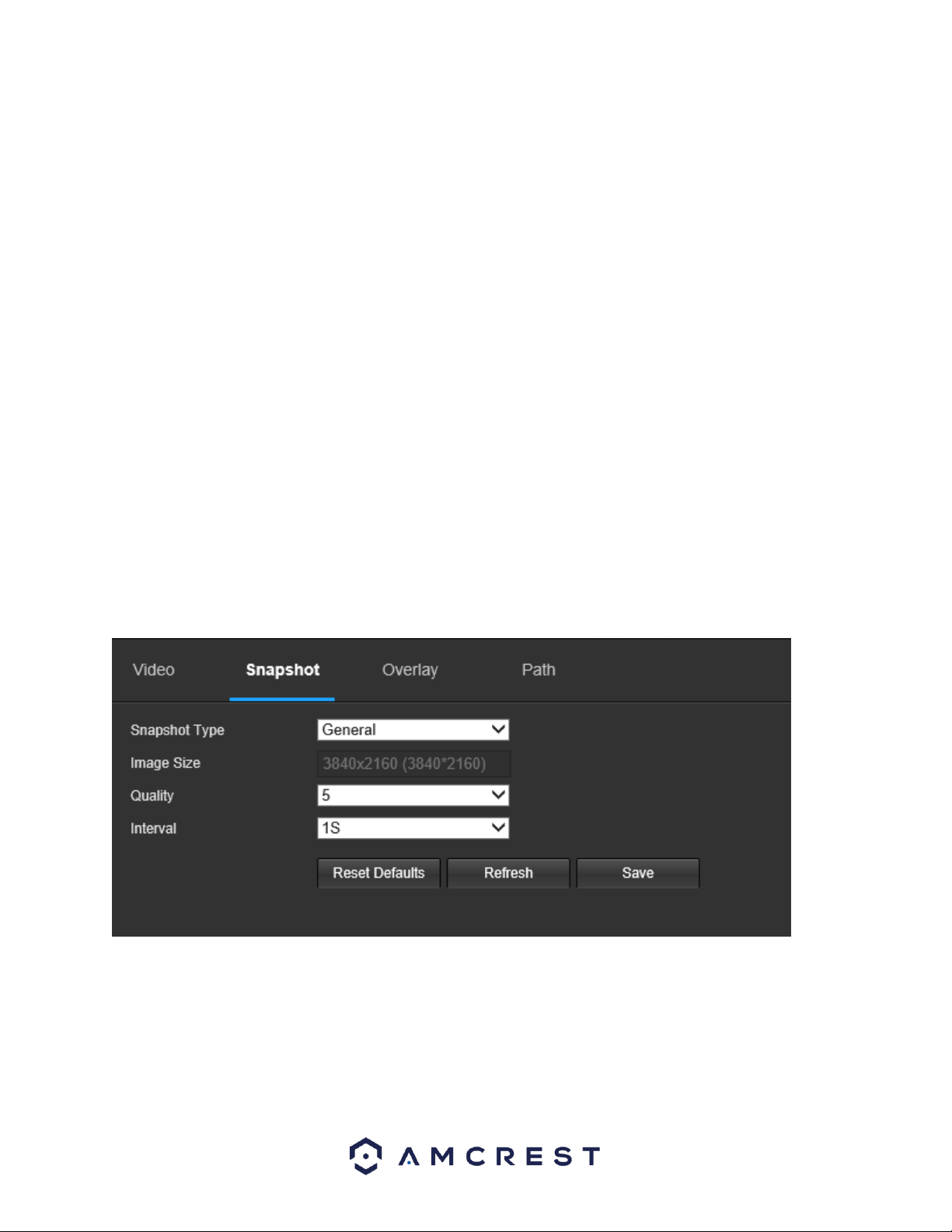
5.5.2.1. Snapshot
Below is a screenshot that shows the Snapshot tab in the Video menu item:
Below is an explanation for each of the fields on the Snapshot tab in the Video menu item:
• Snapshot Type: This dropdown box allows the user to select a snapshot mode. There
are two snapshot modes:
▪ General: Snapshots are taken as scheduled.
▪ Event: Snapshots occur when a motion detection alarm or
tampering alarm is triggered
55
• Image Size: This dropdown box shows the image size. By default, the screenshot size
is the same size as the video feed’s resolution.
• Quality: This dropdown box allows the user to select image quality. Quality is adjusted
on a scale of
1-6.
• Interval: This is to set snapshot frequency. The value ranges from 1 to 7 seconds. The
maximum setting for a customized interval is 3600s/picture.
To reset to default settings, click the Reset Defaults button. To refresh the page, click the
Refresh button. To save the settings, click the Save button.
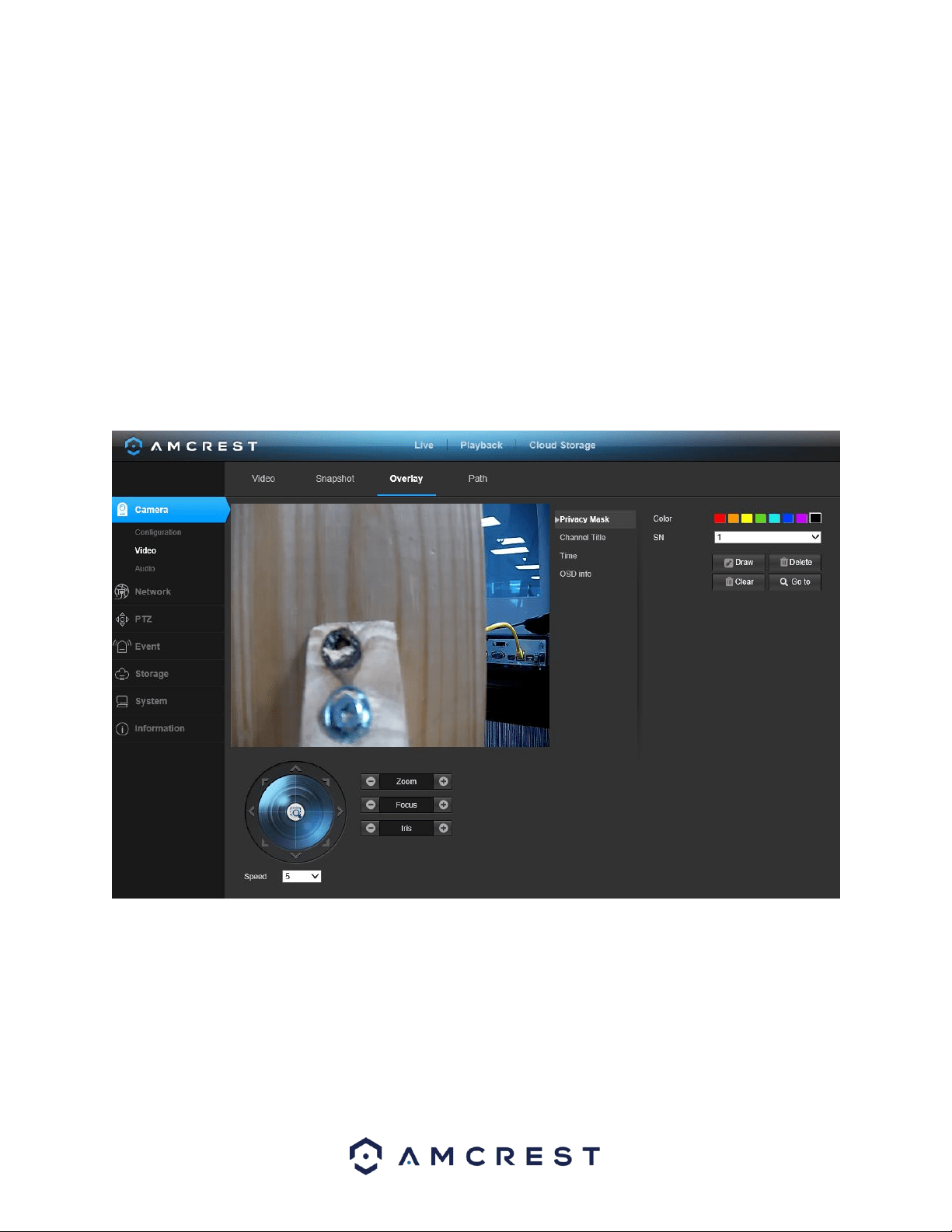
5.5.2.2. Overlay
Below is a screenshot that shows the Overlay tab in the Video menu item:
The menu on the left allows the user to select which overlay to modify. Privacy Masking,
Channel Title, Time, and Text Overlay can all be modified in this menu.
For Privacy Masking, use the Draw tool to draw areas on the live view screen that you
wish to mask. Each area can be denoted with a specific color is necessary. To delete the
privacy mask, press Delete, to clear a mask press Clear to access a specific set privacy
mask, press Go To.
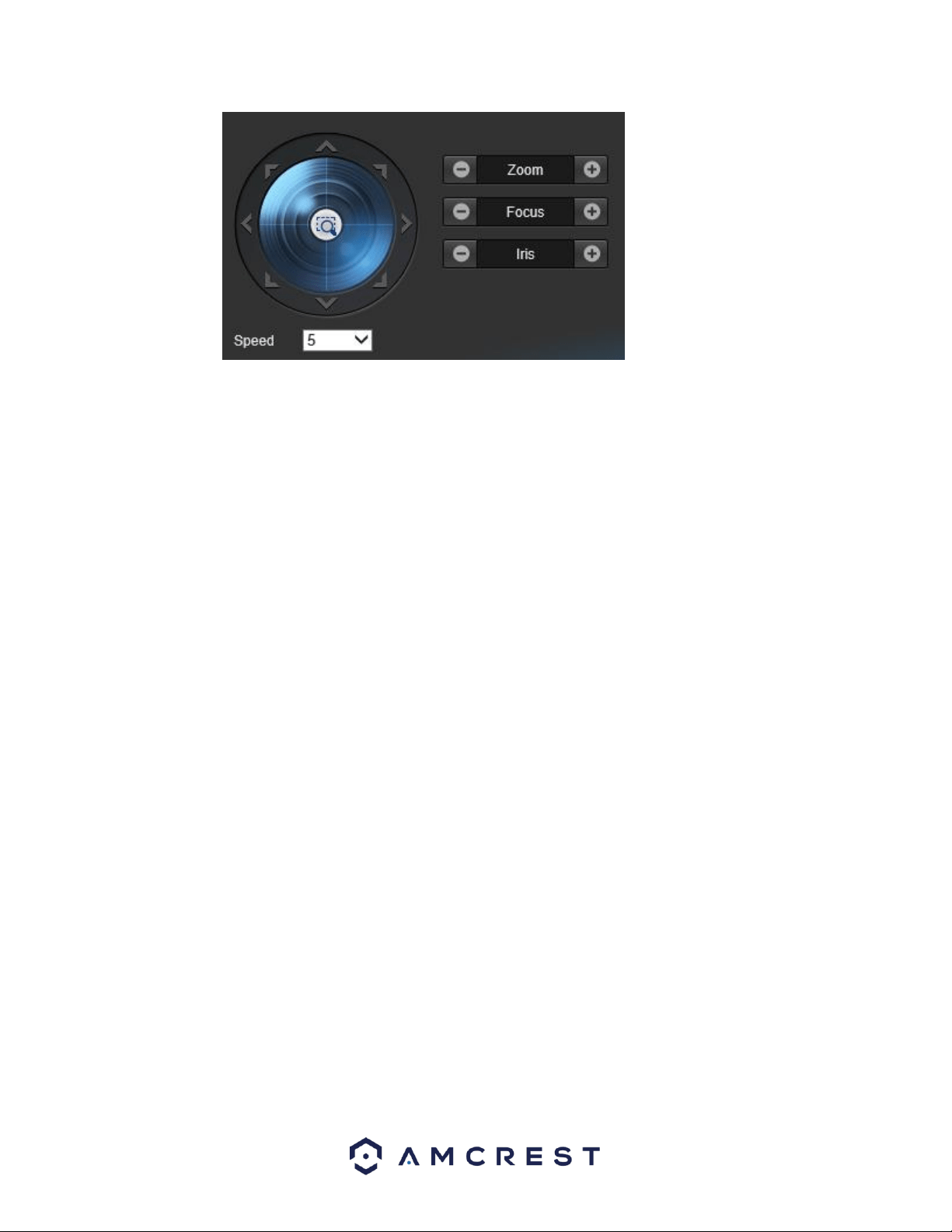
In this field you will also notice an additional quick access to the PTZ control panel.
56
The arrows on the PTZ control panel allow the user to move the camera’s
position in a specific direction. The button in the middle of the direction
arrow allows the user to select an area in the live view to zoom in on.
The speed dropdown box allows the user to control the speed at which
the camera moves. The values range from 1 to 8, 8 being the fastest.
The zoom, focus, and iris buttons allow the user to digitally zoom in and
out, focus, and just the camera’s image on the live screen.
For Channel Title, the radio button enables or disables the feature. The Input Channel Title
field allows the channel title to be modified.
For Time, the radio button enables or disables the feature. Clicking the Display Weekdays
checkbox will show the weekday at the end of the timestamp.
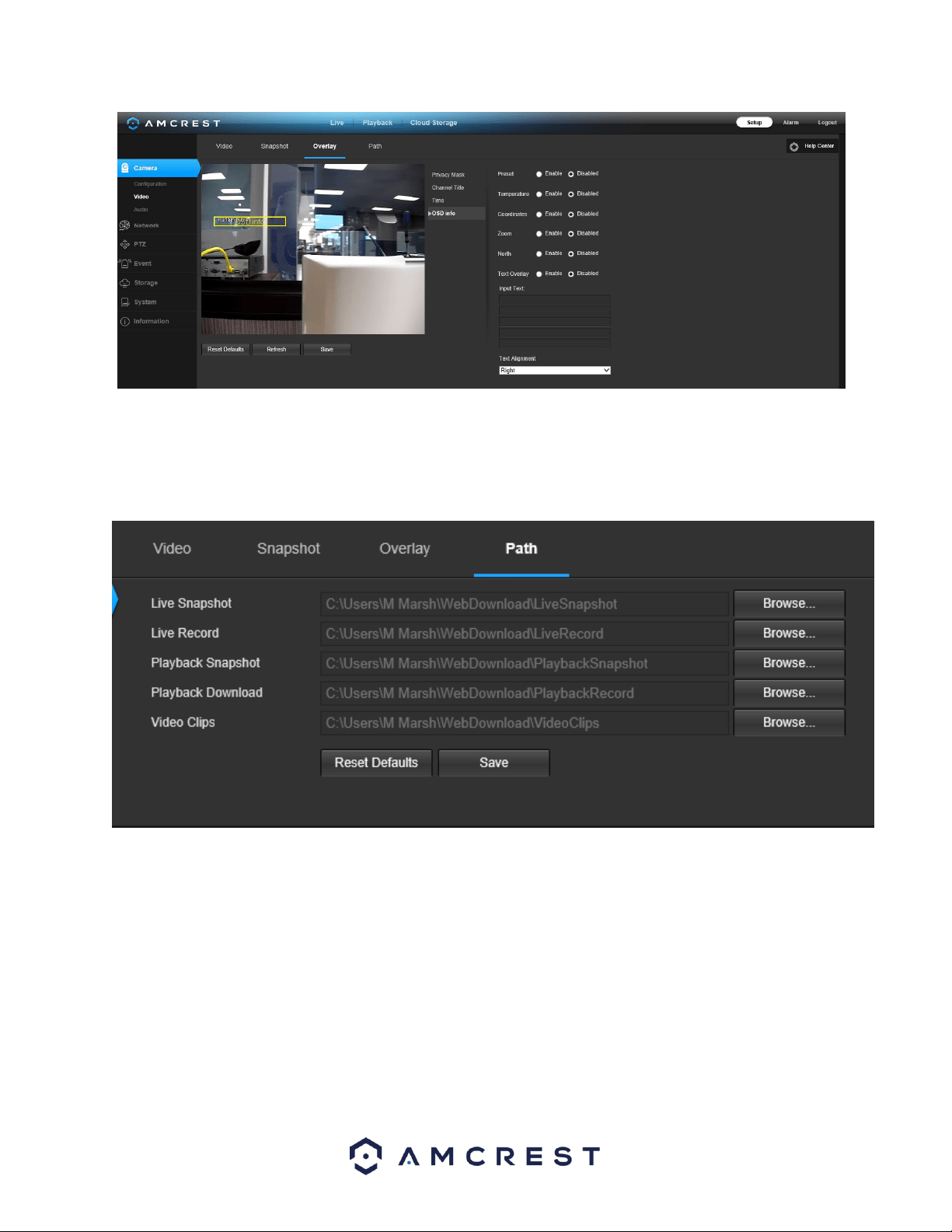
For OSD info, the Input Text box allows the user to enter multiple lines of text as needed,
and the Text Alignment dropdown box allows the user to align the text either right or left.
The above radio buttons for, preset, temperature, coordinates, zoom, north, and text
overlay, will be associated with the OSD settings if enabled. Below is a screenshot of this
menu:
57
To reset to default settings, click the Reset Defaults button. To refresh the page, click the
Refresh button. To save the settings, click the Save button.
5.5.2.3. Path
Below is a screenshot that shows the Path tab in the Video menu item:
Below is an explanation for each of the fields on the Path tab in the Video menu item:
• The Live Snapshot field allows the user to select where to save live snapshots to. Click
the Browse button to select a different destination folder.
• The Live Record field allows the user to select where to save live recordings to. Click
the Browse button to select a different destination folder.
• The Playback Snapshot field allows the user to select where to save playback
snapshots to. Click the Browse button to select a different destination folder.
• The Playback Download field allows the user to select where to save playback video
downloads to. Click the Browse button to select a different destination folder.
58
• The Video Clips field allows the user to select where to save video clips to. Click the
Browse button to select a different destination folder.
To reset to default settings, click the Reset Defaults button. To save the settings, click the
Save button.
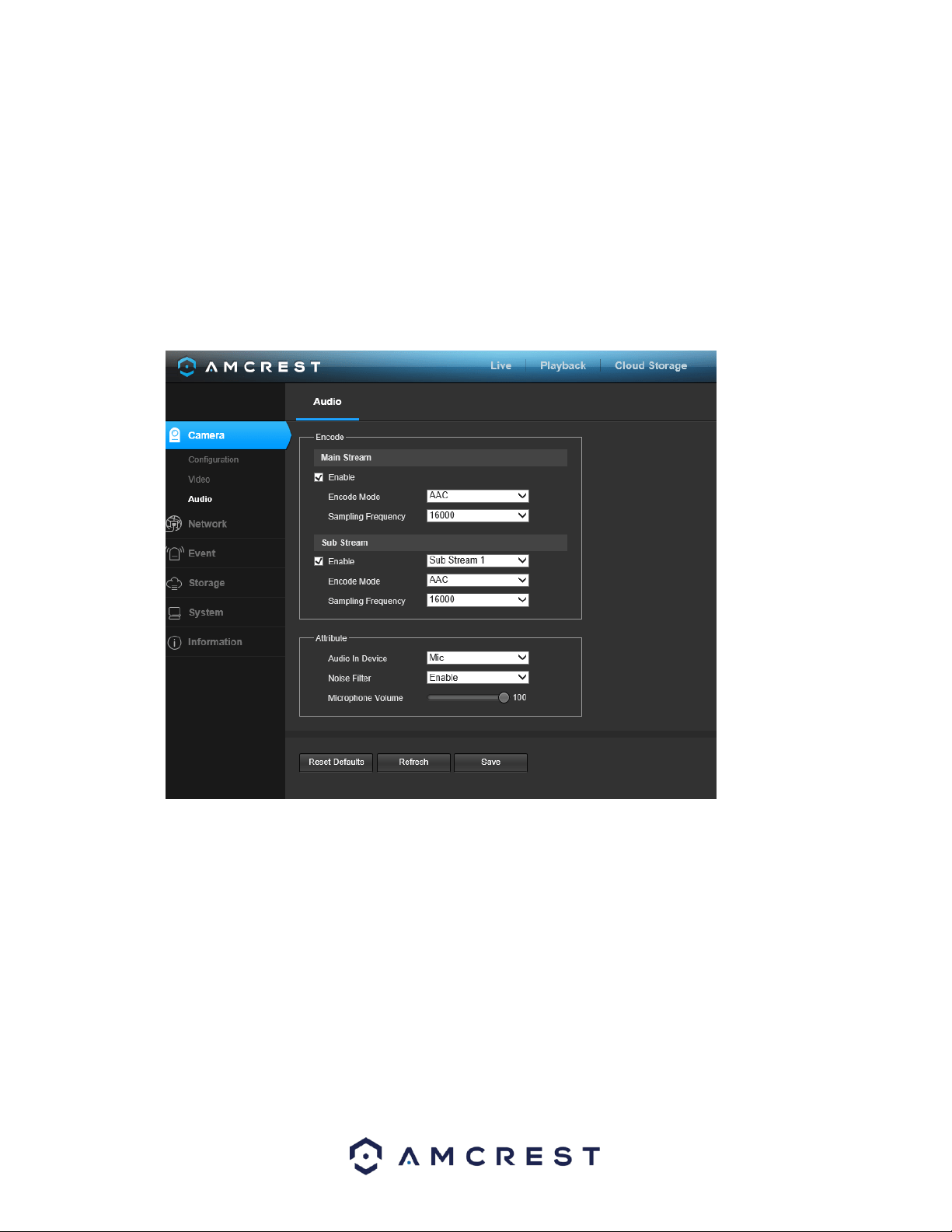
5.5.3. Audio
This menu allows the user to modify audio settings for the camera. Below is a screenshot
that shows the Audio menu item under the Camera menu section:
Below is an explanation for each of the fields on the Audio menu:
• Enable: This checkbox allows the user to enable audio recording.
• Encode Mode: This dropdown box allows the user to select what audio format the
audio should be recorded in.
• Sampling Frequency: This dropdown box allows the user to select a sampling
frequency for the audio. The options are 8k and 16k. 16k audio sampling allows for
higher sound quality.
• Audio in Device: This field allows the user to select what source to get audio from.
The default is the camera’s built-in mic. Alternatively, the line in mic can be selected.
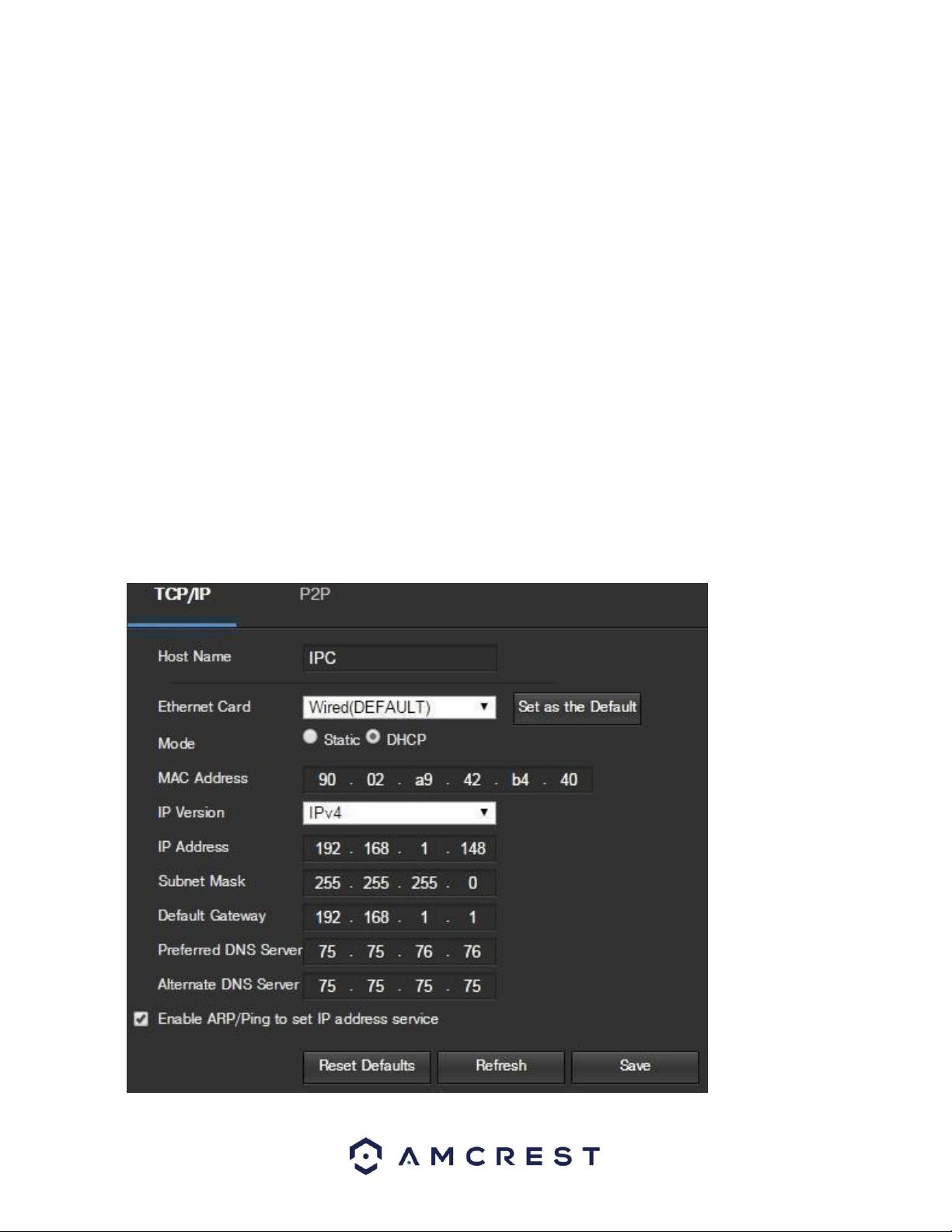
59
• Noise Filter: This dropdown box allows the user to enable or disable the audio noise
filter function. This function provides cleaner audio quality when enabled.
• Microphone Volume: This slider allows the user to select the microphone volume. The
value ranges from 0 to 100. The default value is 50.
To reset to default settings, click the Reset Defaults button. To refresh the page, click the
Refresh button. To save the settings, click the Save button.
5.6. Network
This menu section allows the user to change network settings for the camera.
5.6.1 TCP/IP
The TCP/IP menu item has two tabs: TCP/IP and P2P.
TCP/IP stands for Transmission Control Protocol/Internet Protocol and it is the
language/protocol that allows communication between internet connected devices,
whether on a local network, or a on the Internet at large. This screen allows for TCP/IP
settings to be modified for the camera to establish a connection to the network. Below is a
screenshot of the TCP/IP settings tab:

60
Below is an explanation of the fields on the TCP/IP settings tab:
• Host Name: This text field allows the user to change the host device name for the camera.
This field supports a maximum of 15 characters.
• Ethernet Card: This dropdown box allows the user to select which internet access device to
use. If the device is connected to a wired connection and a wireless one at the same time,
then this box will have options to pick either of the connections. The Set as Default button
allows the user to select one of the connection methods as the default one.
• Mode: Static vs DHCP: This radio button allows the user to choose between a static IP
address, and a dynamic IP address. DHCP stands for Dynamic Host Configuration Protocol,
and this enables the camera to automatically obtain an IP address from another network
device such as a server or more commonly, a router. When the DHCP function is enabled,
the user cannot modify the IP address, Subnet Mask, or Default Gateway, as these values
are obtained from the DHCP function. To view the current IP address, DHCP needs to be
disabled. Note: When PPPoE is enabled, modification of the IP Address, Subnet Mask, and
Gateway becomes prohibited.
• MAC Address: This field shows the camera’s MAC address, which is unique to this device.
This number is read only and is used to access a local area network (LAN).
• IP Version: This dropdown allows the user to select the IP version. The two options are
IPV4 and
IPV6.
• IP Address: This field allows the user to enter a custom IP address.
• Subnet Mask: This field allows the user to enter a custom subnet mask.
• Default Gateway: This field allows the user to enter a custom default gateway.
• Preferred DNS Server: This field allows the user to enter the preferred DNS server
IP address.
• Alternate DNS Server: This field allows the user to enter the alternate DNS server IP
address.
• Enable ARP/Ping to set IP Address Service: This checkbox allows the user to enable the
ARP/Ping service to change the IP address service. For more information on this feature,
click the help button while on the TCP/IP settings tab.
To reset to default settings, click the Reset Defaults button. To refresh the page, click the Refresh button. To save
the settings, click the Save button.
5.6.1.1. P2P
The P2P settings screen is where users can use a QR code to connect their smartphone or tablet to the camera.
This feature needs to be enabled for use with the Amcrest View app, Amcrest Cloud, or AmcrestView.com. Below
is a screenshot of the P2P settings tab:
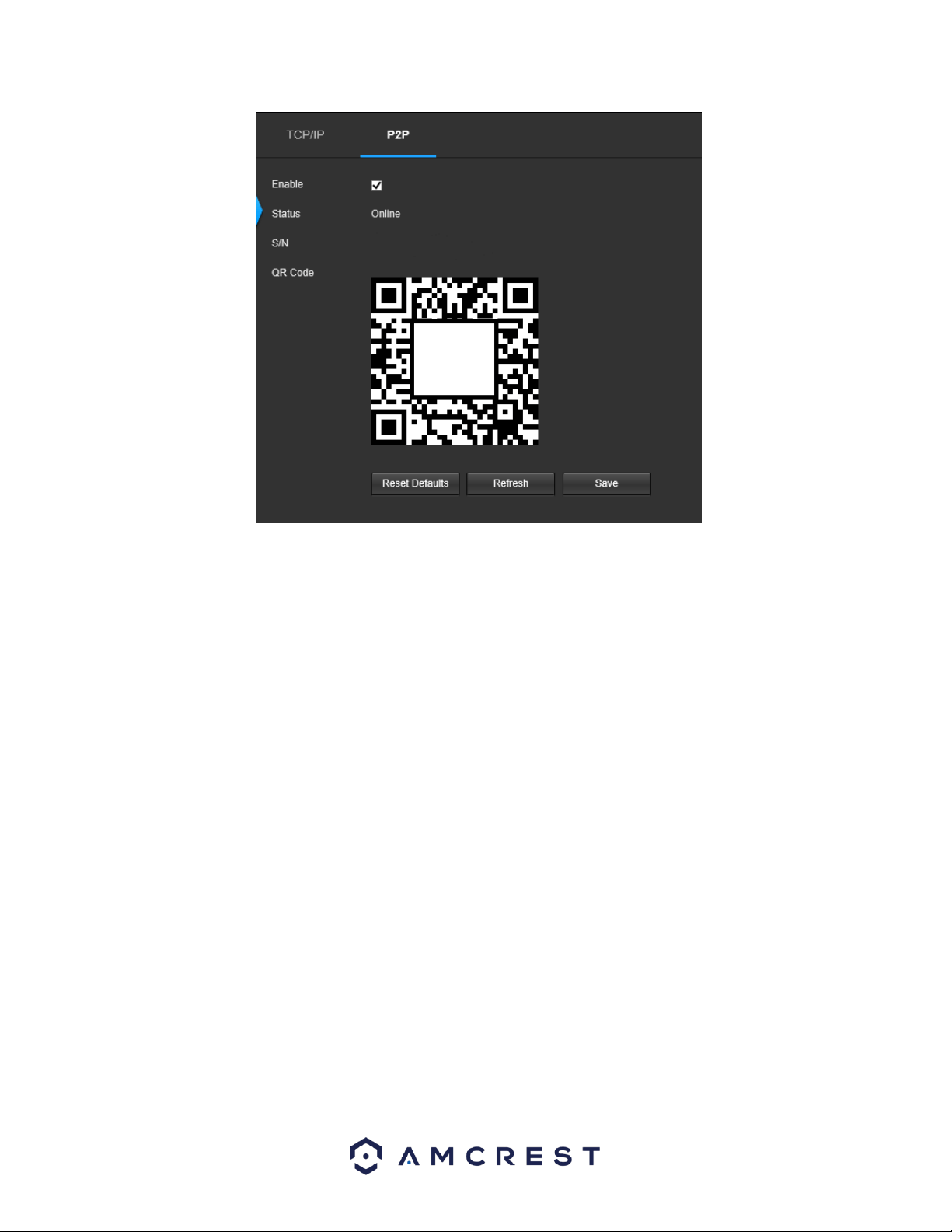
61
Below is an explanation of the fields on the P2P settings tab:
Enable: This checkbox allows the user to enable the P2P feature for the camera. This feature must be enabled
for the camera to connect to a smartphone or tablet via the Amcrest View app. It is enabled by default.
• Status: This field displays the status of the P2P connection. Once the camera is connected to a device, this
field should display the word Online.
• S/N: This field displays the Token ID for the camera. The Token ID can be used to manually enter the camera’s
information on a mobile or tablet device in case the QR code scanning feature cannot be used.
• QR Code: This image is a Quick Response (QR) code. By scanning this image using the Amcrest View app, this
camera can establish a connection with the app.
To reset to default settings, click the Reset Defaults button. To refresh the page, click the Refresh button. To save
the settings, click the Save button.
5.6.2. Connection
The Connection menu item has two tabs: Connection and ONVIF.
The Connection tab is where users can configure port connections. Below is a screenshot of the Connection
settings tab:
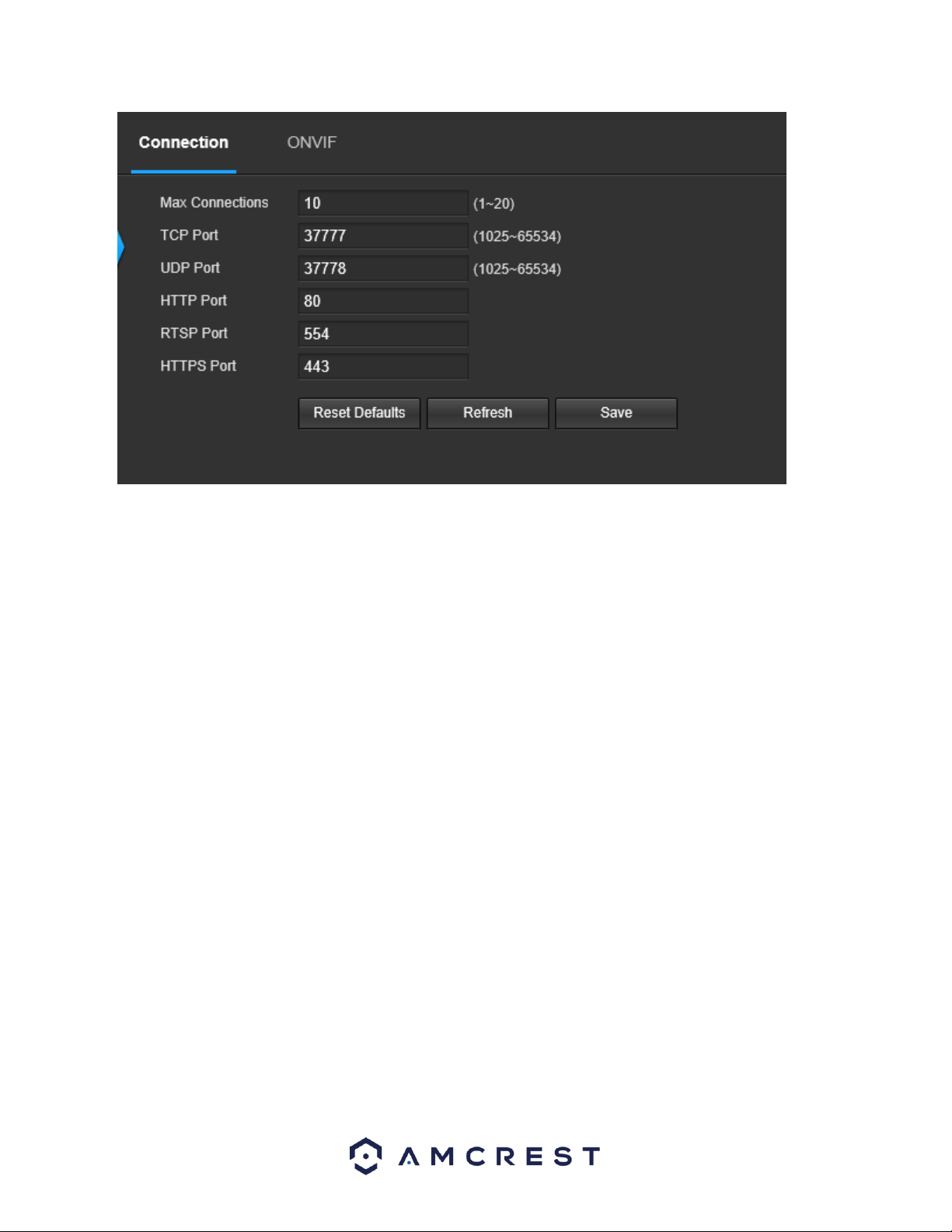
62
Below is an explanation of the fields on the Connection settings tab:
• Max Connections: This field allows the user to specify the maximum number of users that can be connected
to the camera at the same time. The maximum number of users the camera can support at one time is 20.
• TCP Port: This field designates the Transmission Control Protocol (TCP) port number. The default value is
37777.
• UDP Port: This field designates the User Datagram Protocol (UDP) port number. The default value is
37778.
HTTP Port: This field designates the Hypertext Transfer Protocol (HTTP) port number. The default value is 80.
• RTSP Port: This field designates the Real Time Streaming Protocol (RTSP) port number. The default value is
554.
• HTTPS: This field enables the use of the HTTPS protocol for accessing the camera.
• HTTPS Port: This field designates the Hypertext Transfer Protocol Secure (HTTPS) port number. The default
value is 443.
To reset to default settings, click the Reset Defaults button. To refresh the page, click the Refresh button. To save
the settings, click the Save button.
5.6.2.1. ONVIF
The ONVIF tab is where users can configure authentication via the ONVIF standard. Below is a screenshot of the
ONVIF settings tab:
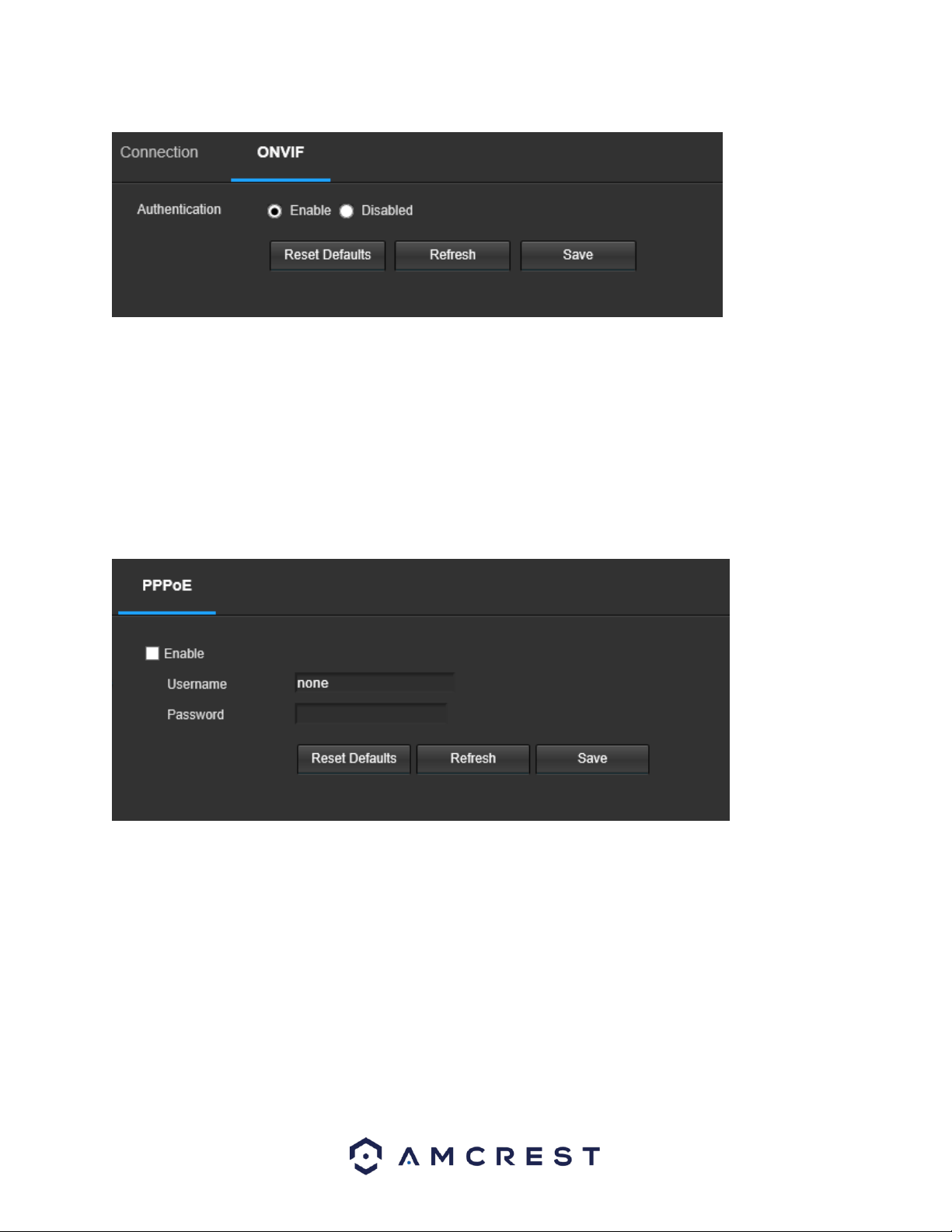
63
To enable ONVIF, click the radio button next to Enable, and then click the save button.
To reset to default settings, click the Reset Defaults button. To refresh the page, click the Refresh button. To save
the settings, click the Save button.
5.6.3. PPPoE
PPPoE stands for Point-to-Point Protocol over Ethernet. This screen allows users to configure PPPoE connections.
Below is a screenshot of the PPPoE screen:
To enable PPPoE, click the enable checkbox, and fill in the username and password fields, then click Save. To reset
to default settings, click the Reset Defaults button. To refresh the page, click the Refresh button. To save the
settings, click the Save button.
5.6.4. DDNS
DDNS stands for Dynamic Domain Name Server. This technology is used to automatically
update name servers in real time to help the camera maintain a persistent address despite
changes in location or configuration. What this means is that even when the camera is
restarted, moved, or reconfigured, it can keep the same IP address, thus allowing remote
users uninterrupted access to the camera, rather than having to request a new IP address
to use for remote access anytime a change is made.
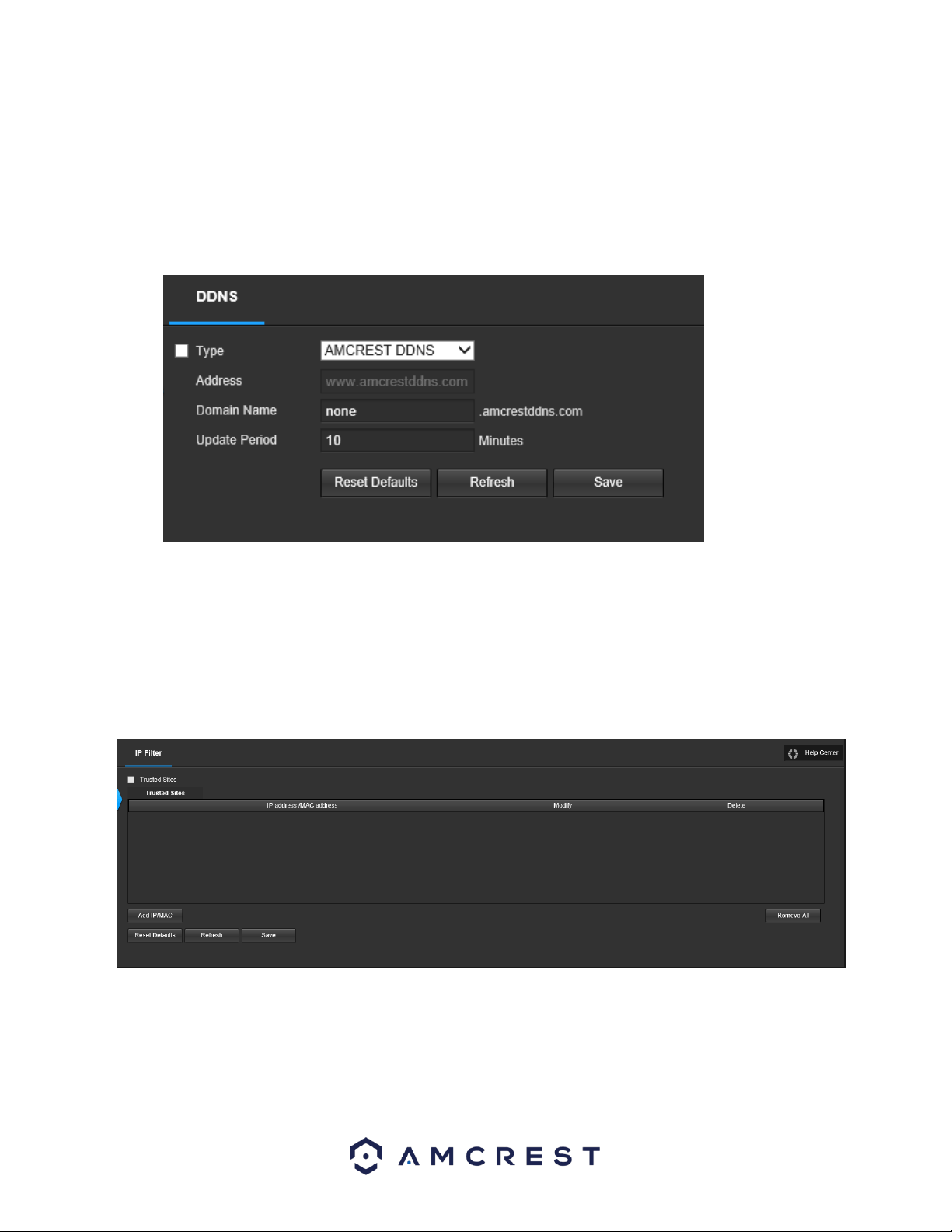
64
To use this feature, users will need to setup an account with a DDNS service. The camera
supports a variety of DDNS services such as AmcrestDDNS, NO-IP DDNS, CN99 DDNS, and
Dyndns DDNS. Based on which service is selected, different options may show on this
screen. For purposes of this guide, AmcrestDDNS will be used. AmcrestDDNS is a free
DDNS service provided by Amcrest, and it must be renewed every year. A renewal
reminder email will be sent to the email entered in the username field below.
Below is a screenshot of the DDNS settings screen, configured to AmcrestDDNS:
To reset to default settings, click the Reset Defaults button. To refresh the page, click the
Refresh button. To save the settings, click the Save button.
5.6.5. IP Filter
This screen allows for the filtering of IP addresses, either blocking them, or granting them
access to the camera. This feature helps make the camera more secure by limiting remote
access only to approved users. Below is a screenshot of the IP Filter screen:
Below is an explanation of fields on the IP Filter settings screen:
• Trusted Sites: This checkbox allows the user to enable the IP Filter feature for trusted
sites.
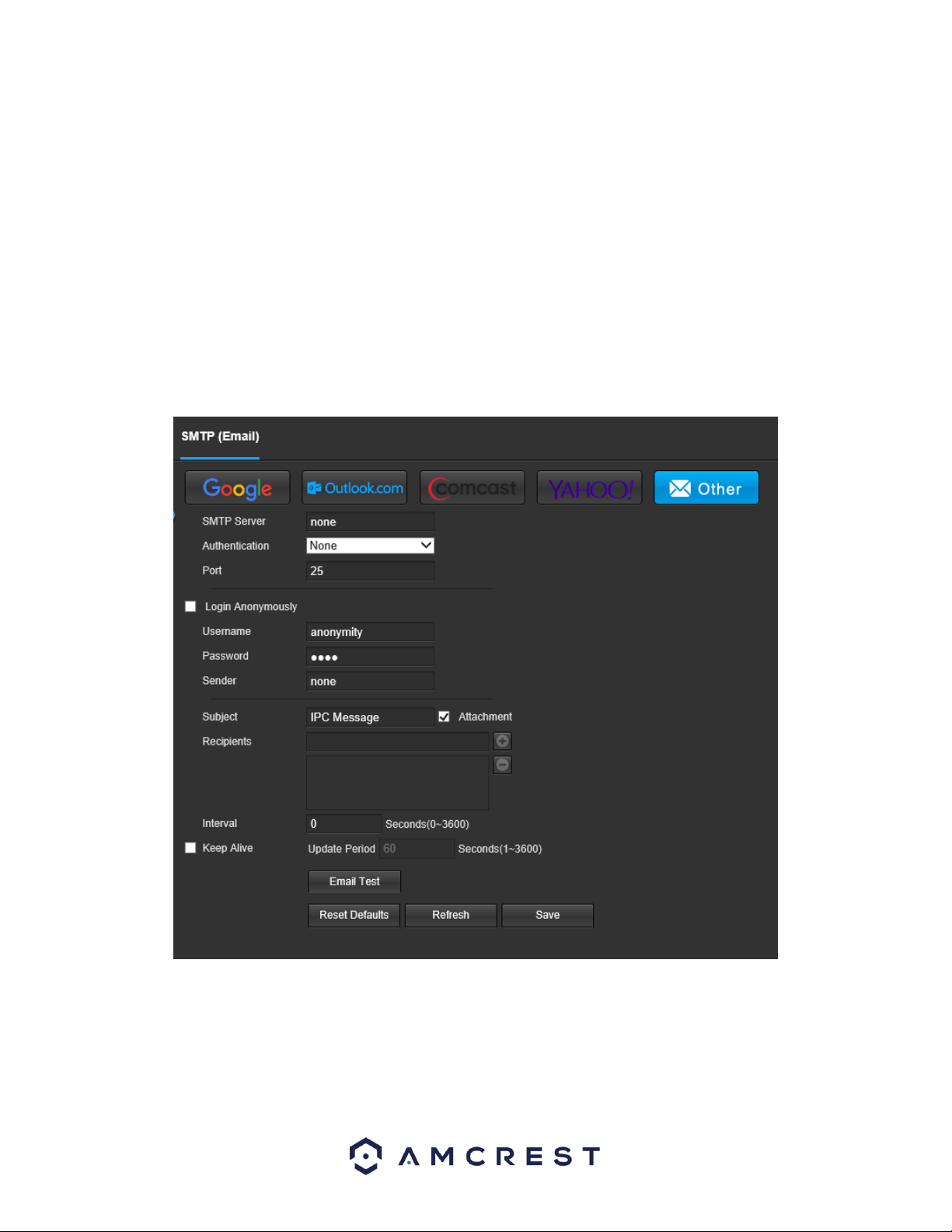
65
• Add IP/MAC: This button opens a popup that allows the user to add IP or MAC
addresses to the trusted site list. Note: When accessing the camera externally, please
add the MAC address of the router on the PC end.
• Remove All: This button allows the user to remove all sites from the trusted IP/MAC
list.
To reset to default settings, click the Reset Defaults button. To refresh the page, click the
Refresh button. To save the settings, click the Save button.
5.6.6. SMTP (Email)
This screen allows for the configuring of email settings to permit the camera to send
emails when an alarm is triggered. Below is a screenshot of the email settings screen:
Below is an explanation of fields on the SMTP (Email) settings screen:
• SMTP Server: SMTP stands for Simple Mail Transfer Protocol. This field allows the
user to enter the SMTP server used by the email service.
• Port: This field allows the user to enter the port that corresponds to the selected
SMTP server.

66
• Login Anonymously: This checkbox allows the user to anonymously login to the
server.
• Username: This field allows the user to enter the SMTP username.
• Password: This field allows the user to enter the password associated with the SMTP
username.
• Sender: This field allows the user to enter the sender email address. This email
address will be the one that sends out all emails pertaining to the alerts and alarm
emails sent by the camera.
• Authentication: This dropdown box allows the user to select an encryption type.
There are two types of email encryption protocols that are available.
• SSL: Secure Socket Layer
• TLS: Transport Layer Security
• Subject: This field allows the user to define the subject line of the email that is sent to
the receivers.
• Recipients: This field allows the user to enter the receiver email address. These email
addresses are the ones that will receive any emails pertaining to alert and alarm
emails sent by the camera. Up to 3 email addresses can be entered in this field.
Interval: This field allows the user to define, in seconds, how long the system should
wait between sending emails. This prevents multiple emails from being sent out.
• Keep Alive: This checkbox allows the user to enable a function to periodically check in
with the SMTP server to ensure it can connect correctly.
• Email Test: This button causes the system to automatically send out an email to test
the connection is OK or not. Prior to the email test, please save the email setup
information.
To reset to default settings, click the Reset Defaults button. To refresh the page, click the
Refresh button. To save the settings, click the Save button.
5.6.7. UPnP
UPnP stands for Universal Plug and Play, and it is a protocol used to easily connect devices
to the internet. In the case of this camera, it allows the camera to connect to the router in
an easy manner to quickly allow for remote access. Below is a screenshot of the UPnP
settings screen:
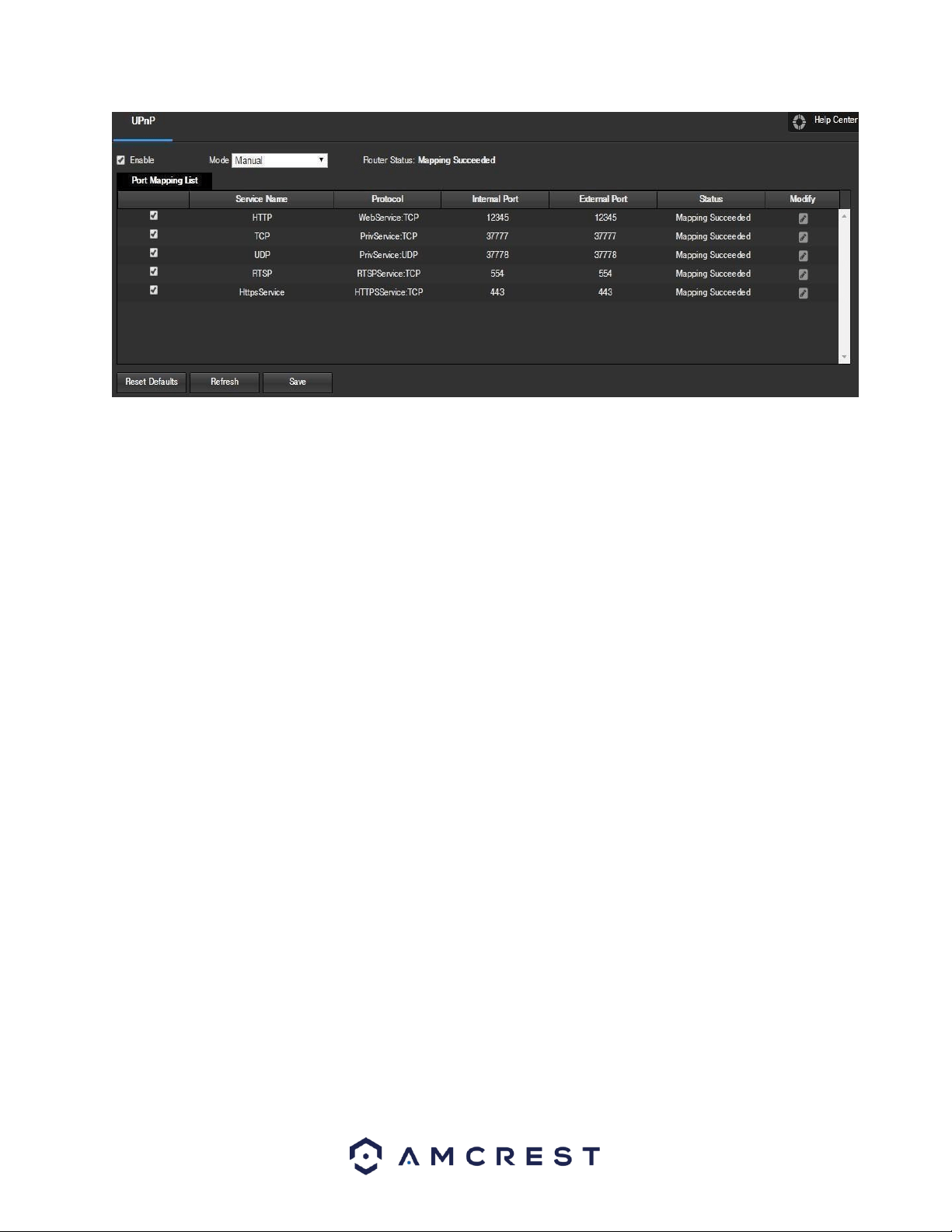
67
Below is an explanation of fields on the UPnP settings screen:
• Enable: This checkbox allows the user to enable the UPnP function.
• Router State: This field shows the UPnP status and has two options: Unknown: This
means that
UPnP mapping has failed. Successful: This means that UPnP mapping has succeeded.
• Port Mapping List: This table is used to show how the ports for each protocol listed
below have been remapped by the UPnP protocol.
o The first column shows the checkboxes to enable the corresponding service on
the table.
o The second column shows the name of the services. To edit this, double click on
the service line item.
o The third column shows the name of the protocol used by that service. To edit
this, click the pencil button in the modify column for that line item.
o The fourth column shows the Internal Port used by that service to establish
communication from the router to the camera. To edit this, click the pencil
button in the modify column for that line item.
o The fifth column shows the External Port used by that service to establish
communication from the router to the internet. To edit this, click the pencil
button in the modify column for that line item.
o The sixth column shows the status of the protocol. If the protocol was mapped
successfully, this field will say “Mapping Succeeded”.
o The seventh column allows the user to open a dialog box and edit the service’s
information.
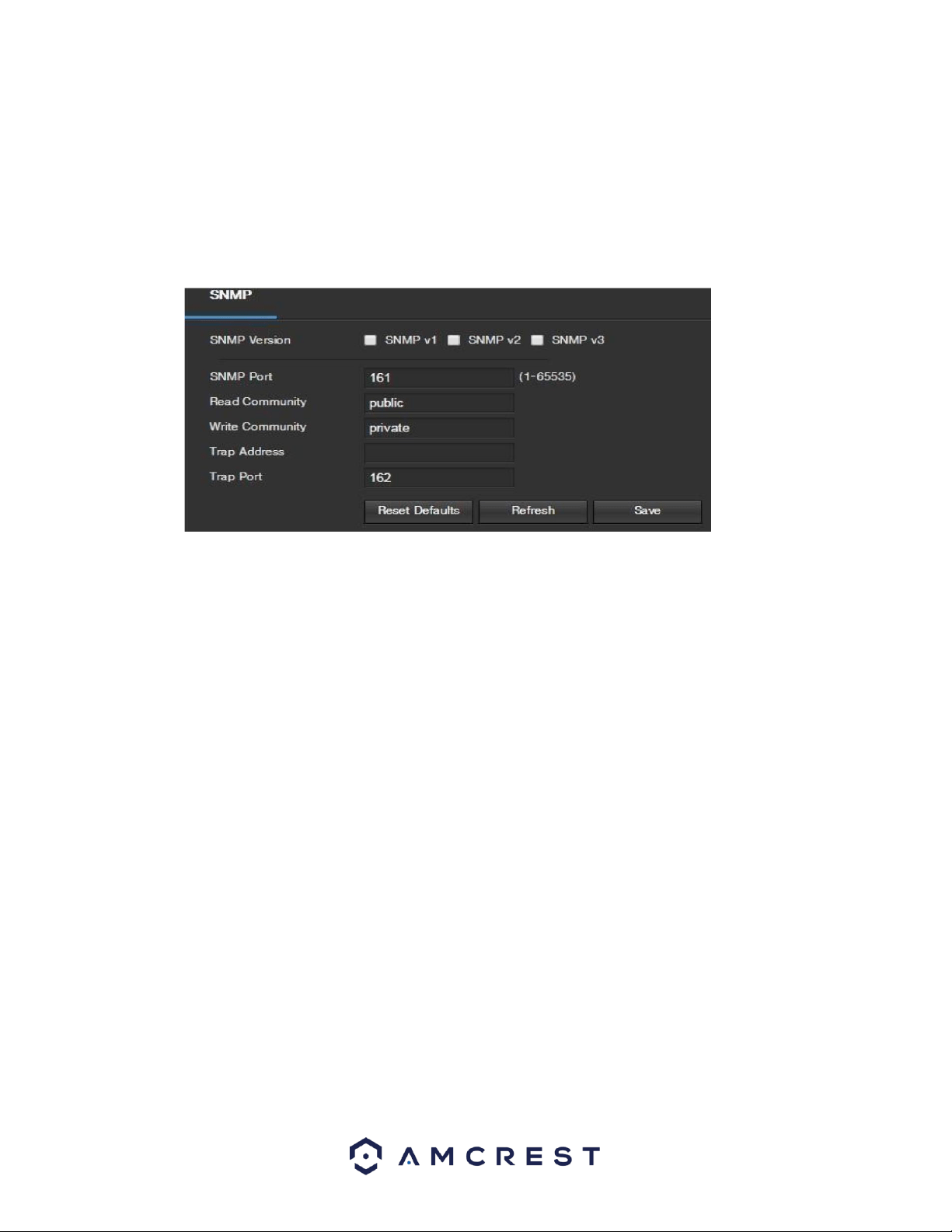
68
To reset to default settings, click the Reset Defaults button. To refresh the page, click the Refresh
button. To save the settings, click the Save button.
5.6.8. SNMP
SNMP stands for Simple Network Management Protocol. This protocol is used to provide a basic
framework to allow connection between various network devices. Below is a screenshot of the
SNMP settings screen:
Below is an explanation of fields on the SNMP settings screen:
• SNMP Version: These checkboxes allow the user to select the SNMP version to use.
SNMP Port: This field allows the user to write in a port for SNMP to use. The port can
range from anywhere from 1 to 65535.
• Read Community: This field shows which SNMP community has read access.
• Write Community: This field shows which SNMP community has write access.
• Trap Address: This field allows the user to write in a trap address.
• Trap Port: This field allows the user to write in a trap port number. The trap port
number should not be the same as the SNMP port.
To reset to default settings, click the Reset Defaults button. To refresh the page, click the Refresh
button. To save the settings, click the Save button.
5.6.9. Bonjour
Bonjour is Apple's implementation of Zero-configuration networking (Zeroconf), a group of
technologies that includes service discovery, address assignment, and hostname resolution.
Below is a screenshot of the Bonjour settings screen:
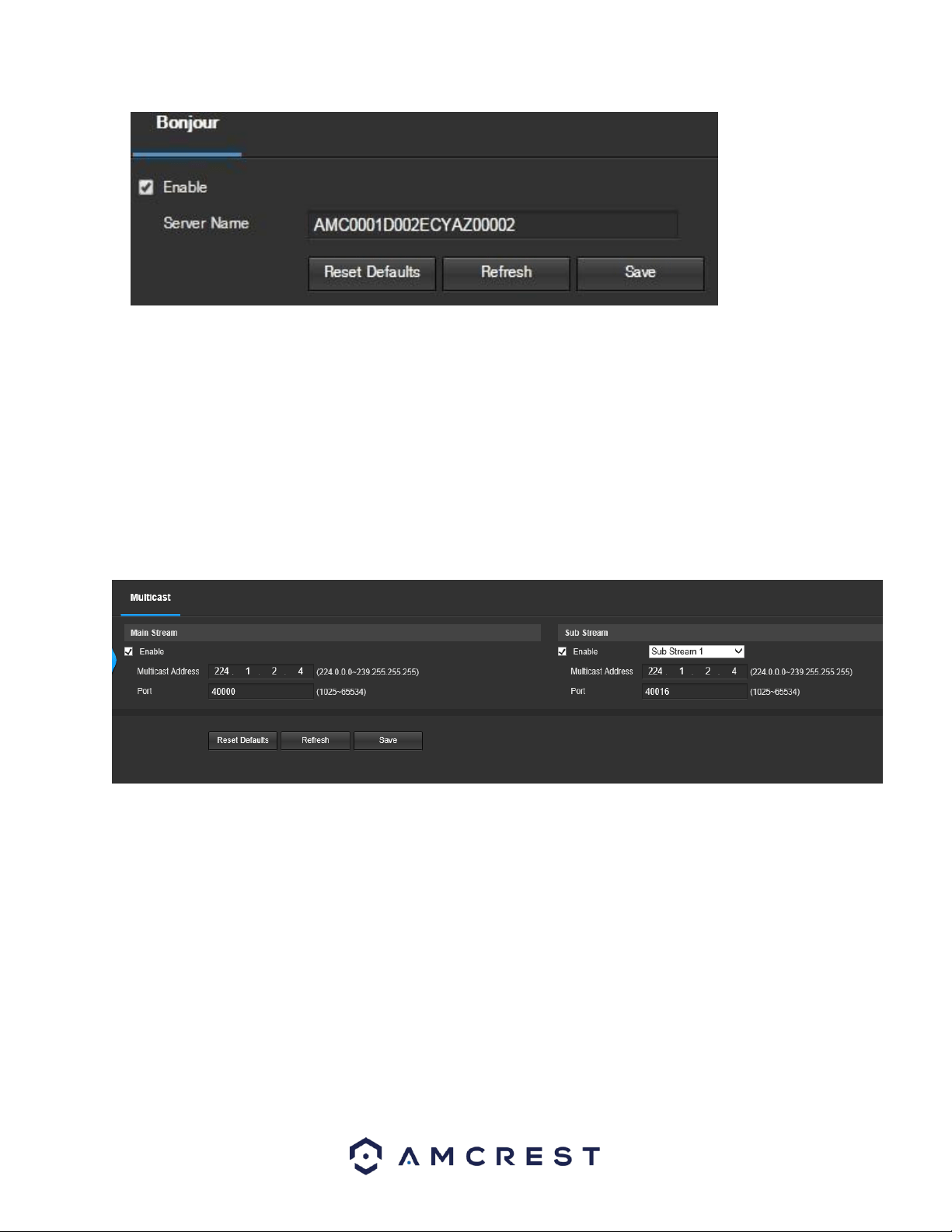
69
Click the checkbox next to Enable to the Bonjour functionality. The Server Name field allows the
user to specify what name to use to connect devices via the Bonjour protocol.
To reset to default settings, click the Reset Defaults button. To refresh the page, click the Refresh
button. To save the settings, click the Save button.
5.6.10. Multicast
Multicast is a feature that enables the camera to broadcast its live view to multiple
computers on the same network. Below is a screenshot of the multicast screen:
Below is an explanation of the fields in the Multicast settings screen:
• Enable: This checkbox allows the user to enable Multicast functionality.
• Multicast Address: This field allows the user to enter a multicast address.
• Port: This field allows the user to enter a multicast port.
To reset to default settings, click the Reset Defaults button. To refresh the page, click the Refresh
button. To save the settings, click the Save button.
5.6.11. WiFi
The WiFi feature on this camera allows it to connect to a network wirelessly. Below is a
screenshot of the WiFi tab on the WiFi menu:
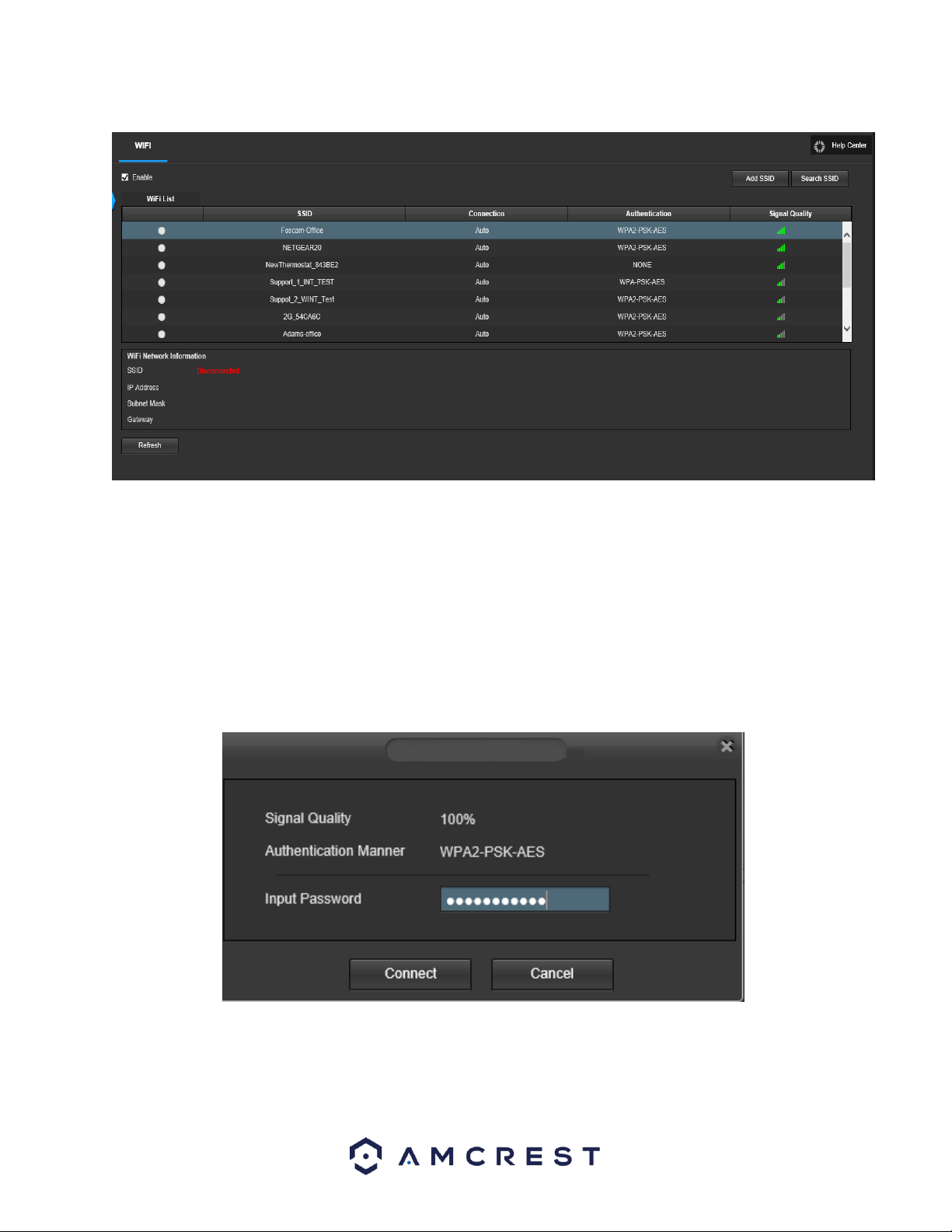
70
Below is an explanation of the fields on the WiFi tab of the WiFi menu:
● Enable: This checkbox allows the user to enable WiFi functionality.
● Add SSID: This button allows the user to manually enter in an SSID.
● Search SSID: This button allows the user to search for more SSIDs.
● Refresh: This button obtains the most recent WiFi network information.
To connect to a WiFi network, click the line item for your WiFi network and enter the
WiFi password. Click on Connect to connect the camera to your WiFi network.
Allow the device to connect to your WiFi network. Once complete, the SSID field will
show a green Connected prompt:
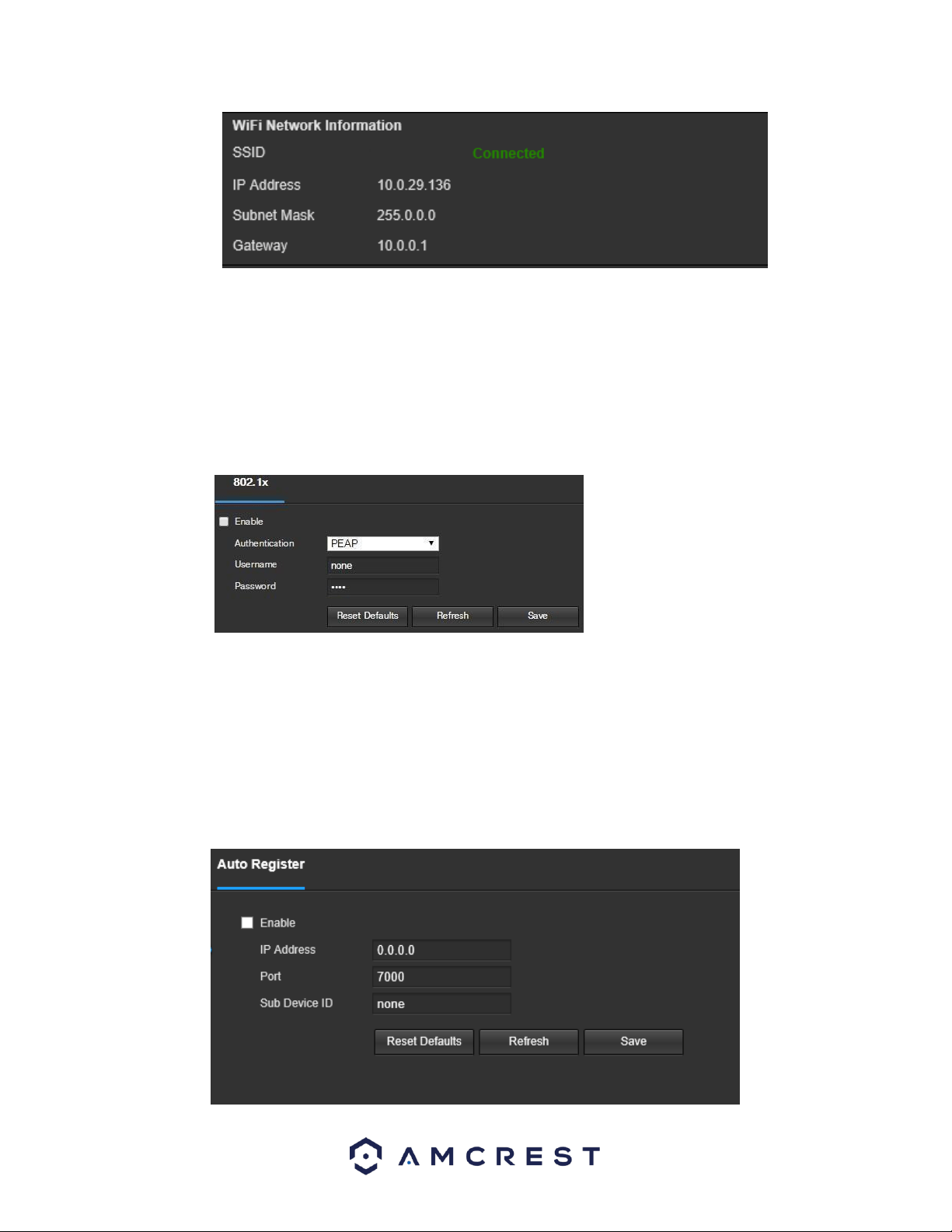
71
The WiFi camera will now be connected to your WiFi network. You can
now remove the Ethernet cable from the device. Please note, the IP
address listed in the WiFi Network Information menu will be the IP
address used to access your camera wirelessly.
5.6.12. 802.1x
802.1x is an authentication method for connecting to a network. Below is a screenshot of the
802.1x screen:
To enable 802.1x, click the checkbox next to Enable. An authentication method can be chosen from the
dropdown box, and a username and password can be entered in their respective fields.
To reset to default settings, click the Reset Defaults button. To refresh the page, click the Refresh
button. To save the settings, click the Save button.
5.6.13. Auto Register
The Auto Register menu allows the user to auto accept IP addresses and sub device IDs to the system. Below is a
screenshot of this menu:
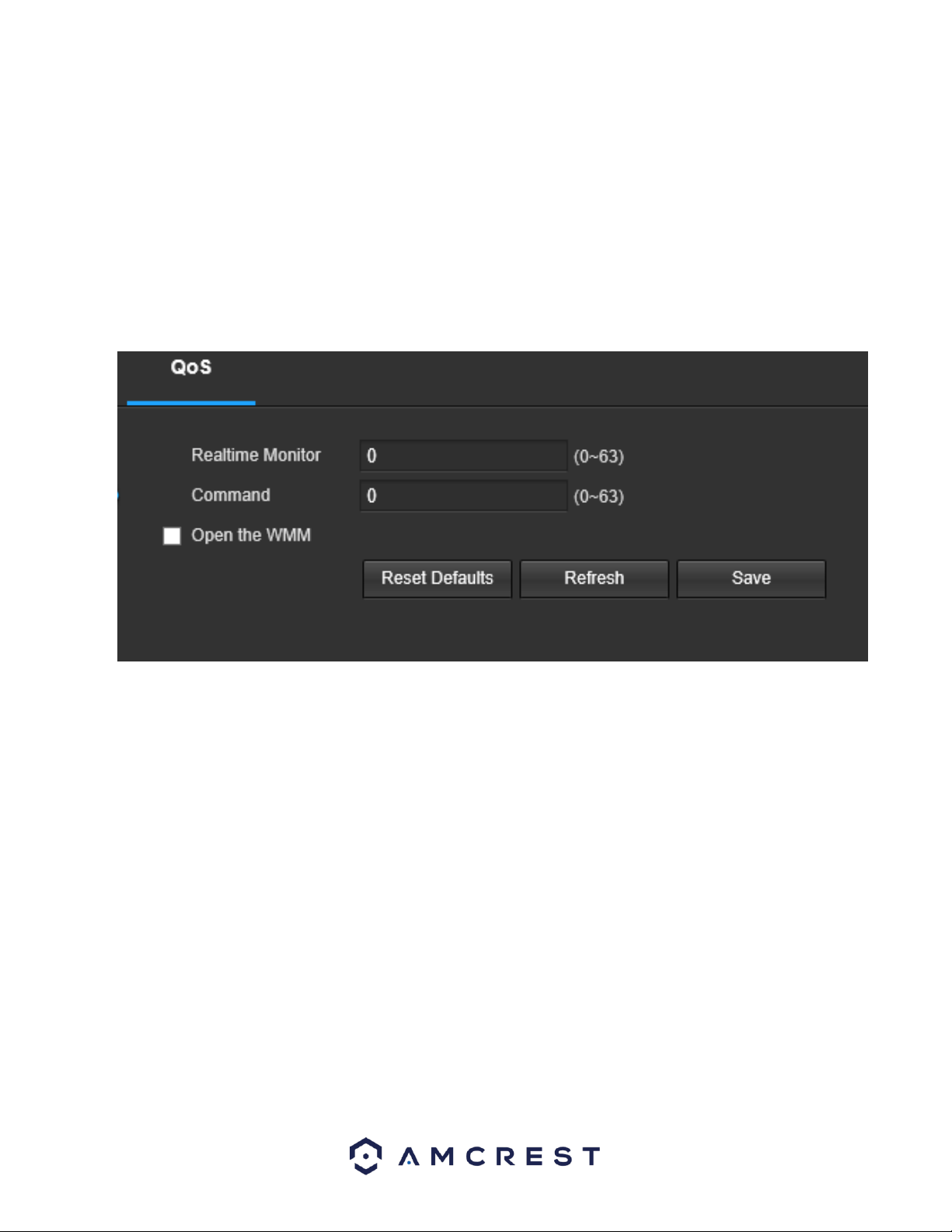
72
To enable this feature, click the Enable checkbox. Enter the IP address of the device you wish to auto register, the
port number of that device and the sub device ID. The sub device ID can be the device ID of the unit being
registered.
To reset to default settings, click the Reset Defaults button. To refresh the page, click the Refresh
button. To save the settings, click the Save button.
5.6.14. QoS
QoS stands for Quality of Service and it refers to the overall performance of a computer network,
particularly the performance seen by the users of the network. Below is a screenshot of the QoS
screen:
Below is an explanation of the fields on the QoS screen:
• Realtime Monitor: This field allows the user to enter in a priority value for real time
monitoring packets. The range is between 0-63.
• Command: This field allows the user to enter in a priority value for command packets.
The range is between
063.
To reset to default settings, click the Reset Defaults button. To refresh the page, click the Refresh
button. To save the settings, click the Save button.
5.6.15. HTTPS
This menu allows the user to enable and create HTTPS certificates. Below is a screenshot of this menu:
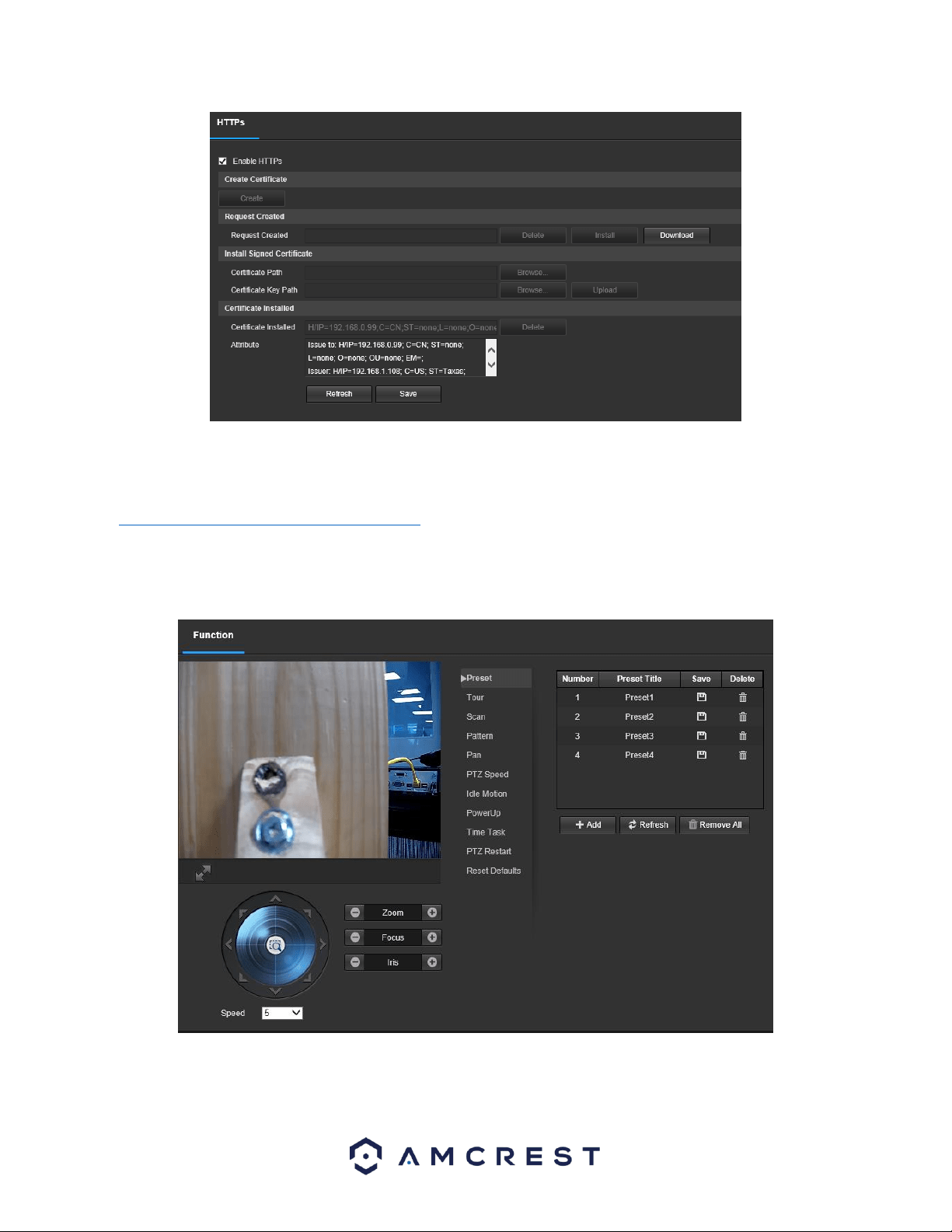
73
Before you create certificate or download certificate, from main window->Setup->Network
>Connection, set the HTTPS port values and then check the box to enable HTTPS
For more information on how to setup HTTPS in the web user interface visit
https://www.youtube.com/watch?v=gkjlaf-Iuso
5.7. PTZ
This menu allows the user to set PTZ presets, tours, scans, patterns, pan settings, and other PTZ related functions
to the camera. Below is a screenshot of this menu:
Below is an explanation of the features listed in this menu:
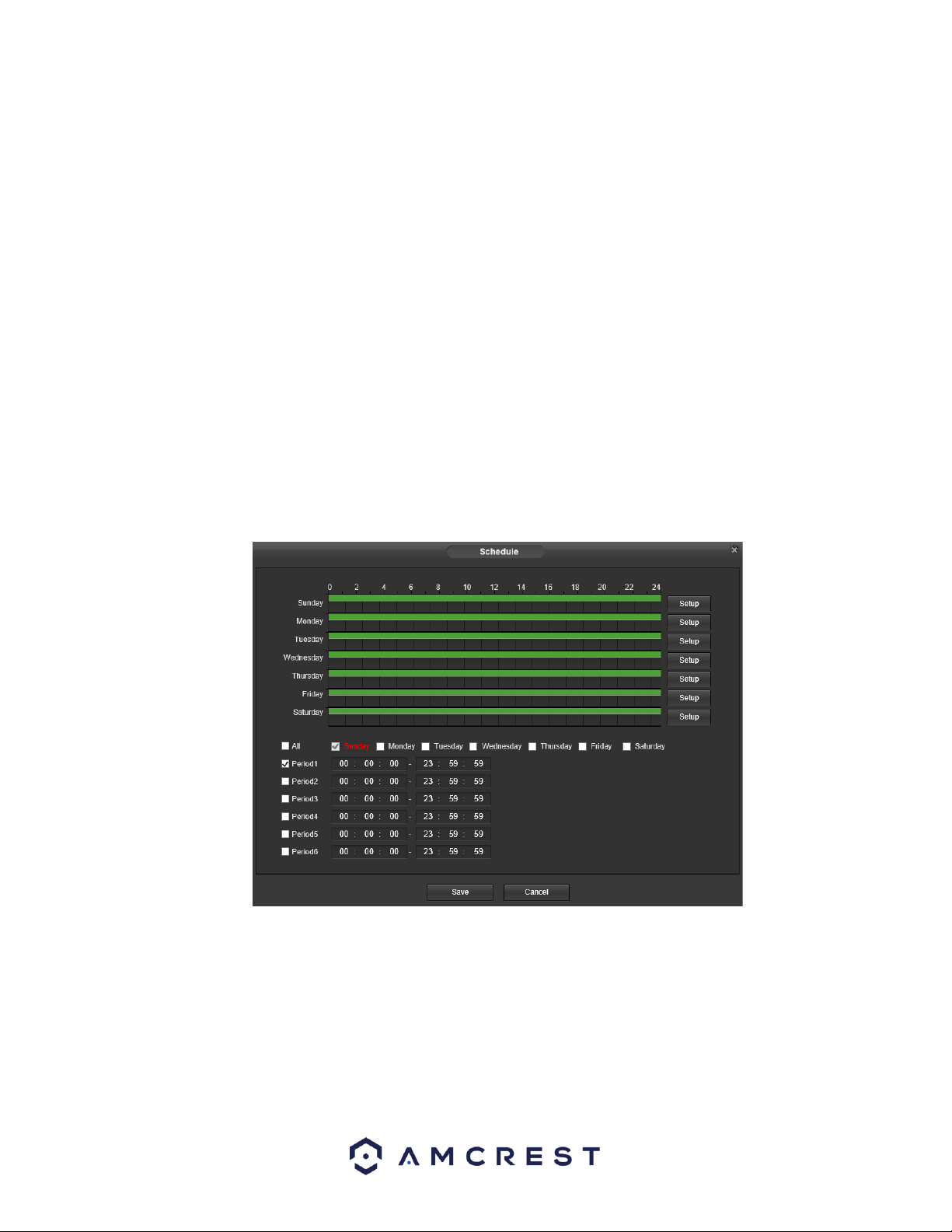
74
o Preset: Allows the user to add and delete preset options for PTZ functionality. To begin
adding a preset to your camera, click the Add button. To refresh the screen click Refresh, to
delete a preset, press Delete or to remove all the presets, click Remove All.
o Tour: Allows the user to string multiple presets together. For more information on setting up
tours, visit section 5.2 PTZ of this user manual.
o Scan: Allows the user to set automatic scan presets to the camera. For more information on
setting a scan preset visit section 5.2. PTZ of this user manual
o Pattern: Allows the user to set specific PTZ pattern presets to the camera. For more
information on setting PTZ patterns visit section 5.2 PTZ of this user manual.
o Pan: Allows the user to adjust pan speeds related to established pan presets. For more
information on pan presets visit section 5.2 of this user manual.
o PTZ Speed: Allows the user to adjust pan, tilt, and zoom speeds. There are 3 separate PTZ
speeds for this function; Low, Middle, and High.
o Idle Motion: Allows the user to set intervals of idle time before the preset quits. The idle
time can be set from 1 ~ 60 minutes.
o Time Task: Allows the user to set scheduled periods for PTZ presets to occur. To set a
schedule, click the Enable check box and select the time task action from the Task Set menu.
If you want the time task to automatically return to a specific position in a certain period of
time, enter the value in the AutoHome field. This option is set to default every 30 seconds,
however, this can be adjusted from 5 ~ 3600 seconds. Once this value is set, click the
Scheduled button:
Click and drag to set motion detection for certain days of the week. Also, periods of motion
detection can be set for each day and enabled using the period settings on the bottom half
of the screen. There are a total of 6 periods that can be set. Once you have completed the
time task schedule, click the Save button to save the settings to your camera.
o PTZ Restart: Allows the user to refresh and restart the PTZ function being performed. To
restart the PTZ function, click the PTZ Restart button.
o Reset Defaults: Allows the user to reset all PTZ functions set in the camera to default. Click
the Reset Default button to reset any set PTZ functions.
In this field you will also notice an additional quick access to the PTZ control panel.
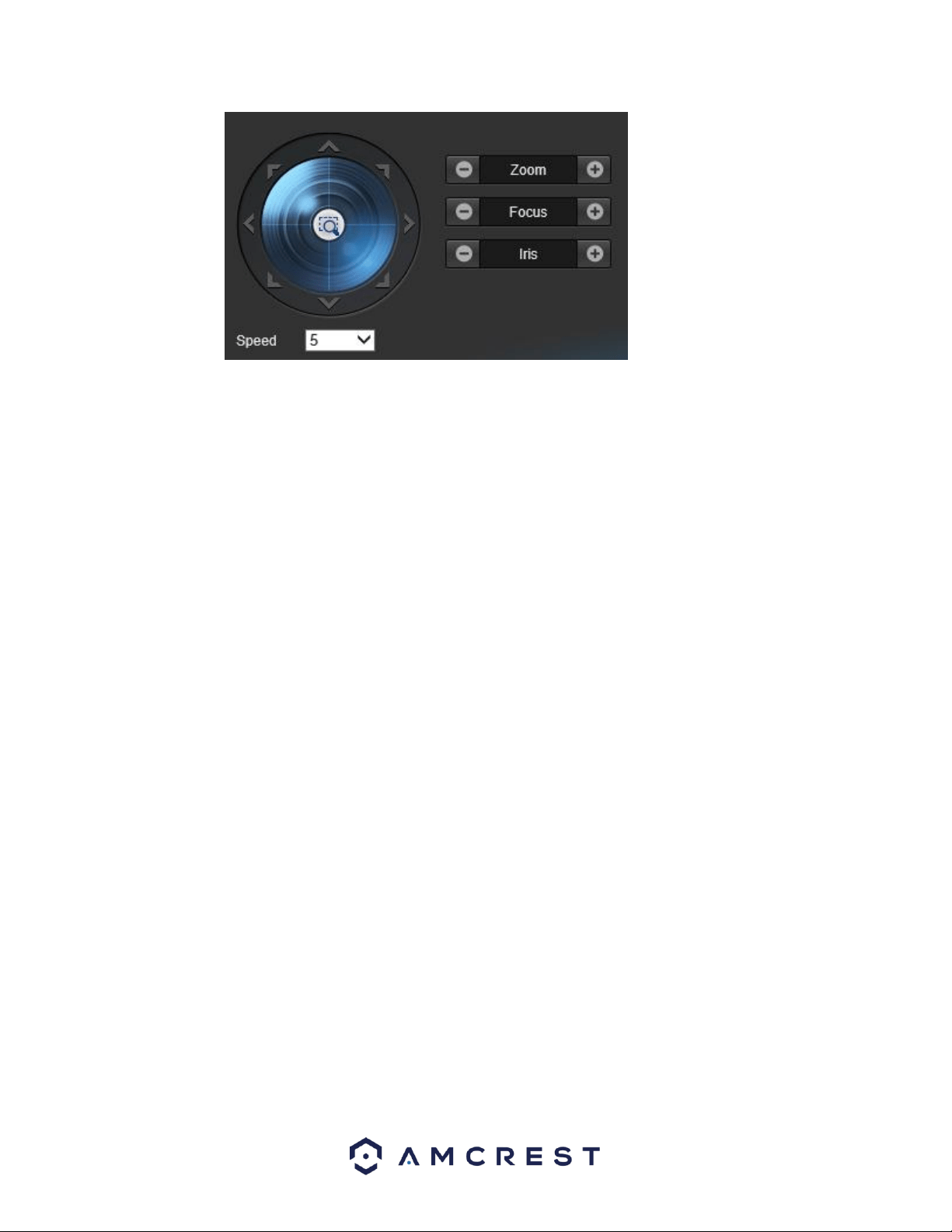
75
The arrows on the PTZ control panel allow the user to move the camera’s
position in a specific direction. The button in the middle of the direction
arrow allows the user to select an area in the live view to zoom in on. The
speed dropdown box allows the user to control the speed at which the
camera moves. The values range from 1 to 8, 8 being the fastest.
The zoom, focus, and iris buttons allow the user to digitally zoom in and
out, focus, and just the camera’s image on the live screen.
To reset to default settings, click the Reset Defaults button. To refresh the
page, click the Refresh button. To save the settings, click the Save button.
5.8. Event
This menu section allows the user to change different settings for triggering events.
5.8.1 Video Detection
The video detection menu has two tabs: Motion Detect and Video Tamper.
5.8.1.1 Motion Detect
This tab allows the user to modify motion detection settings. Below is a screenshot of the Motion
Detect tab:
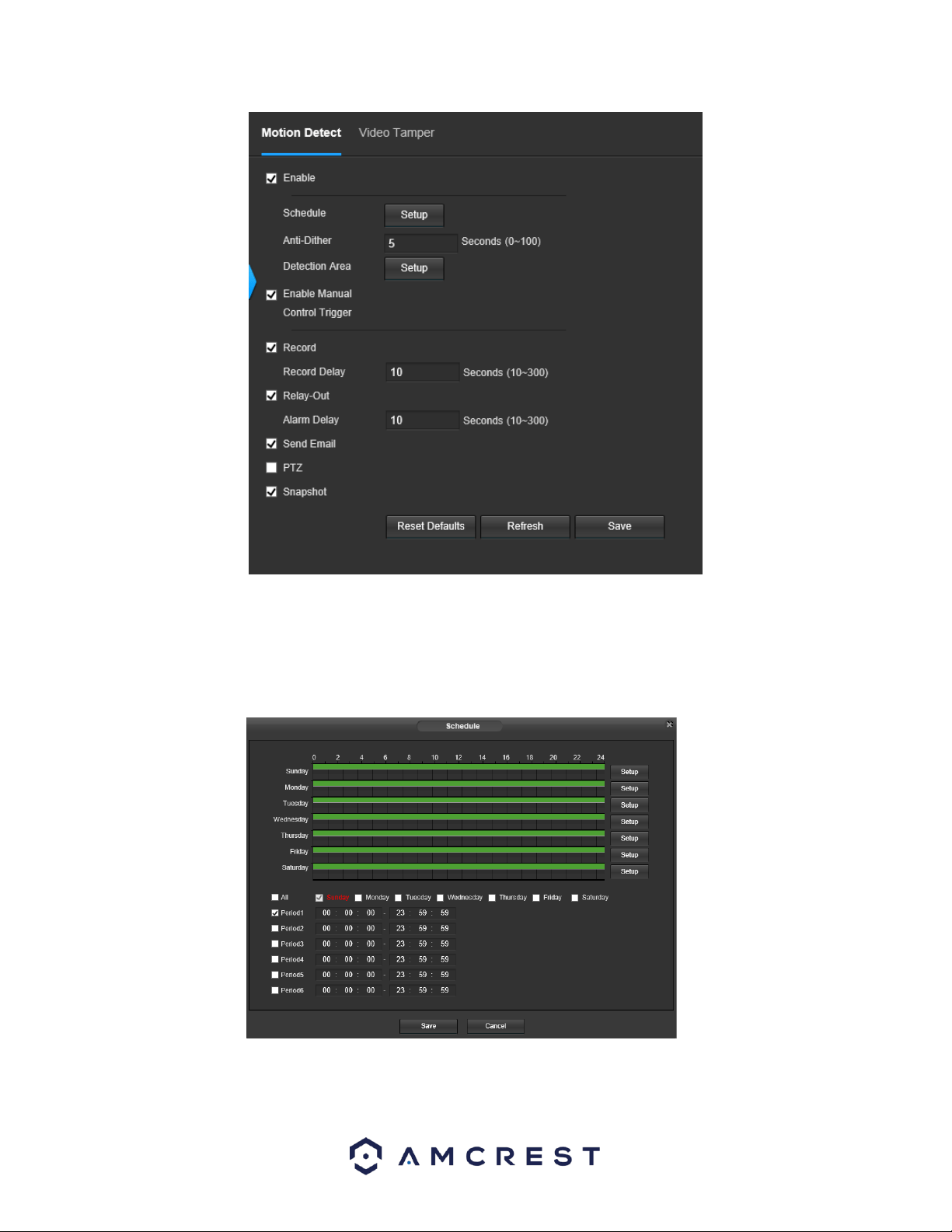
76
Below is an explanation of the fields on the Motion Detect tab:
• Enable: This checkbox enables motion detection for the camera.
• Schedule: Clicking this button opens a weekly schedule that can be used to set times.
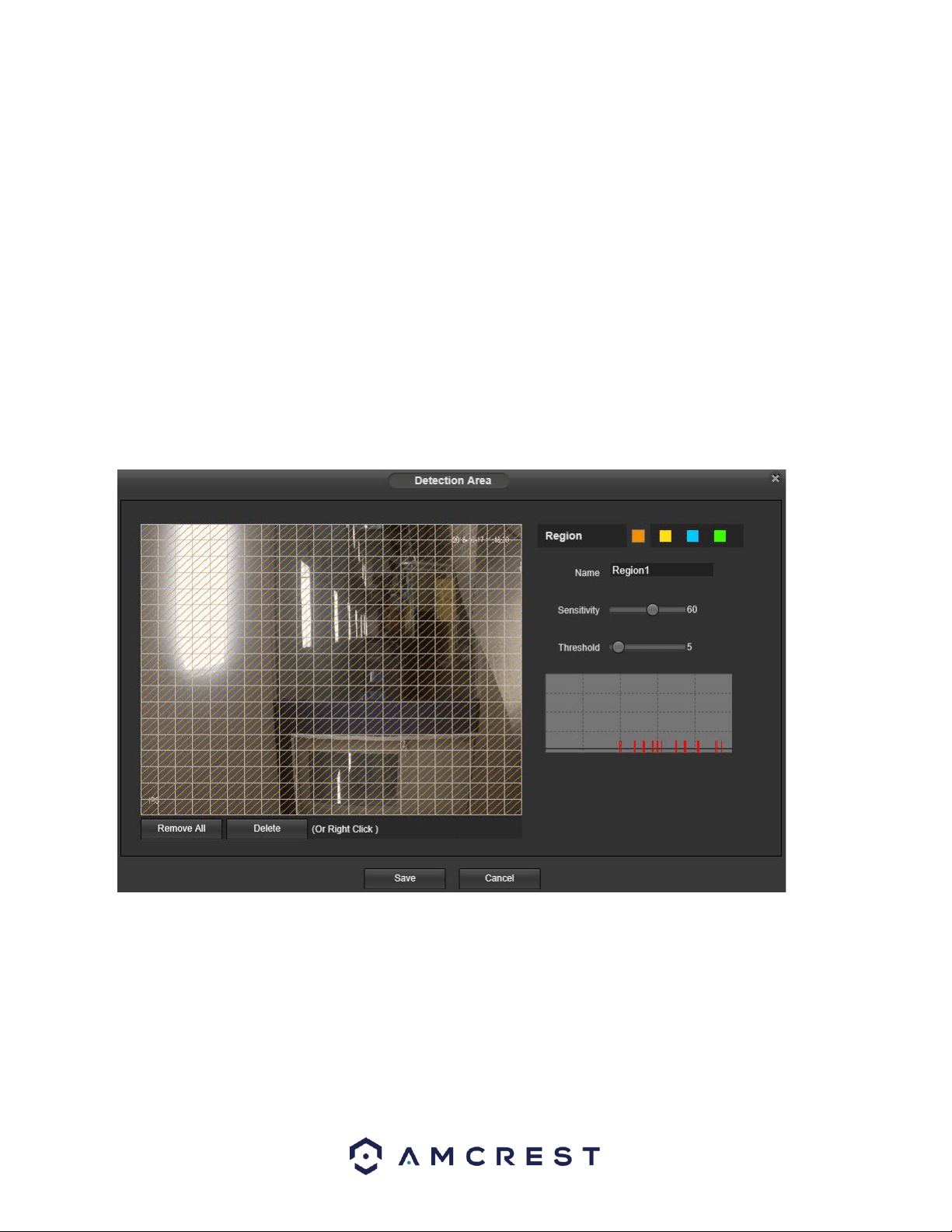
77
o Click and drag to set motion detection for certain days of the week. Also, periods of motion
detection can be set for each day and enabled using the period settings on the bottom half
of the screen. There are a total of 6 periods that can be set.
Anti-Dither: This field allows the user to set the anti-dither time. The values in this field can range
from 5 to 600 seconds. This time value controls how long the alarm signal lasts. Based on motion
detection, a buzzer can go off, a tour can begin, , a snapshot can be taken, or the camera can begin
recording.
o For example, if the anti-dither time is set to 10 seconds, each alarm may last 10 seconds if
the local alarm is activated. During the process, if the system detects another local alarm
signal at the fifth second, the buzzer, tour, snapshot, record channel functions will begin
another 10 seconds while the screen prompt, alarm upload, email will not be activated
again. After 10 seconds, if system detects another alarm signal, it can generate a new alarm
since the anti-dither time has expired.
• Detection Area: Clicking this button opens a pop-up screen that can be used to set detection areas.
o When the setup button is clicked, a live stream of the video is shown. The user can then set
up to 4 regions, each with their own region name, sensitivity (1-100), and threshold (1-100). Each
region has a specific color, and the region selector tool is displayed when the mouse is moved to
the top of the screen.
Sensitivity is the amount of change required to increase the motion detected by a percentage.
The lower the sensitivity, the more movement is required to trigger an alarm.
Threshold is the level that the motion detection needs to reach to trigger an alarm. The
lower the threshold, the more likely that motion will trigger an alarm.

78
To designate a zone, click and drag the mouse over the area desired. When a colored box is
displayed over the live feed, that area is now enabled for motion detection.
After the motion detection zone is set, click the enter button to exit the motion
detection screen.
Remember to click the save button on the motion detection settings screen, otherwise the
motion detection zones will not go into effect. Clicking the cancel button to leave the motion
detection zone and will not save the zone setup.
• Enable Manual Control Trigger: This checkbox allows the user to enable manual PTZ control triggered
events.
• Record: This checkbox allows the user to enable the camera to record video when a motion detection
alarm is triggered.
• Record Delay: This field specifies in seconds how long the delay between alarm activation and
recording should be.
• Relay Out: This checkbox allows the user to enable the camera to trigger a connected alarm
(connected to the alarm port on the back of the camera) when a motion detection alarm is triggered.
• Alarm Delay: This field specifies in seconds how long the delay between alarm activation and Relay
alarm activation should be.
• Send Email: This checkbox allows the user to enable the camera to send an email when a motion
detection alarm is triggered.
• PTZ: This checkbox allows the user to enable PTZ events to be sent from the camera. This event can
be sent via email alerts or via the web interface directly.
• Snapshot: This checkbox allows the user to enable the camera to take a snapshot when a motion
detection alarm is triggered.
To reset to default settings, click the Reset Defaults button. To refresh the page, click the Refresh button. To
save the settings, click the Save button.
5.8.1.2 Video Tampering
This tab allows the user to modify video tamper settings. Below is a screenshot of the
Video Tamper tab:
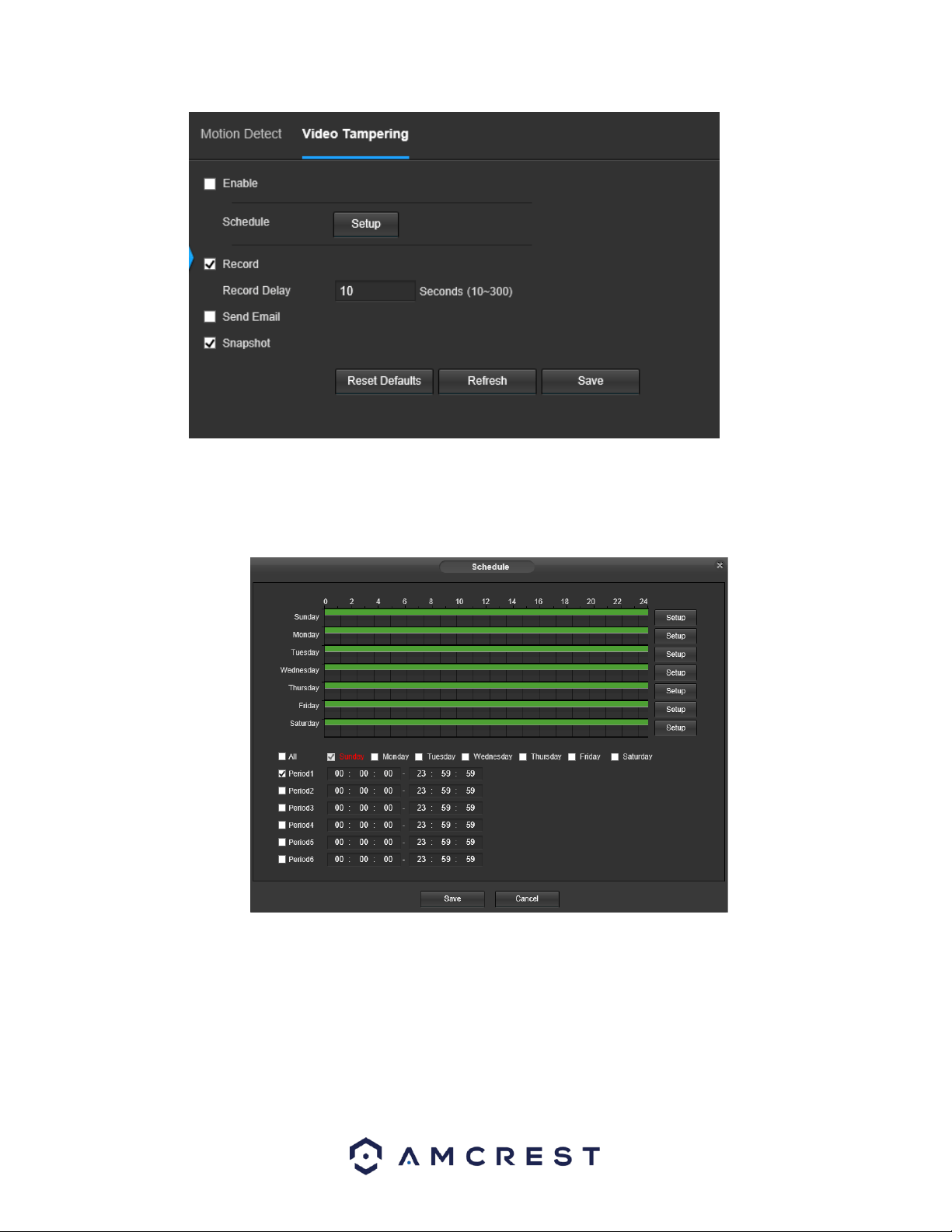
79
Below is an explanation of the fields on the Video Tamper tab:
• Enable: This checkbox enables a video tamper alarm for the camera.
• Schedule: Clicking this button opens a weekly schedule that can be used to set times.
o Click and drag to set video tampering for certain days of the week. Also, periods of video
tampering can be set for each day and enabled using the period settings on the bottom half
of the screen. There are a total of 6 periods that can be set.
• Record: This checkbox allows the user to enable the camera to record video when a
video tampering alarm is triggered.
• Record Delay: This field specifies in seconds how long the delay between alarm
activation and recording should be.
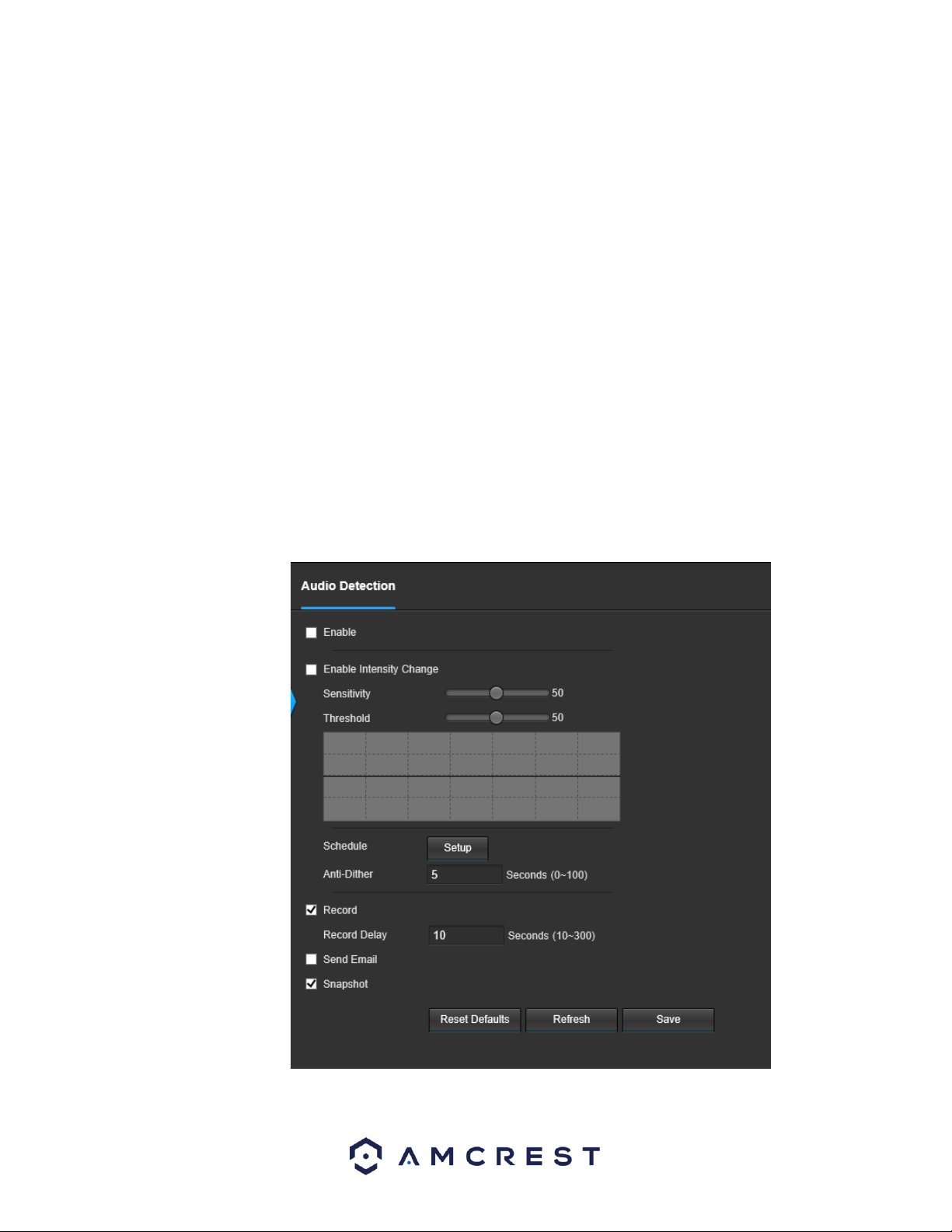
80
• Relay Out: This checkbox allows the user to enable the camera to trigger a connected
alarm (connected to the alarm port on the back of the camera) when a video tamper
alarm is triggered.
• Alarm Delay: This field specifies in seconds how long the delay between alarm
activation and Relay alarm activation should be.
• Send Email: This checkbox allows the user to enable the camera to send an email
when a video tampering alarm is triggered.
• PTZ: This checkbox allows the user to enable PTZ events to be sent from the camera.
This event can be sent via email alerts or via the web interface directly.
• Snapshot: This checkbox allows the user to enable the camera to take a snapshot
when a video tampering alarm is triggered.
To reset to default settings, click the Reset Defaults button. To refresh the page, click the Refresh button. To save
the settings, click the Save button.
5.8.2. Audio Detection
This menu allows the user to modify audio detection settings. Below is a screenshot of the Audio Detect screen:
Below is an explanation of the fields on the Audio Detect tab:
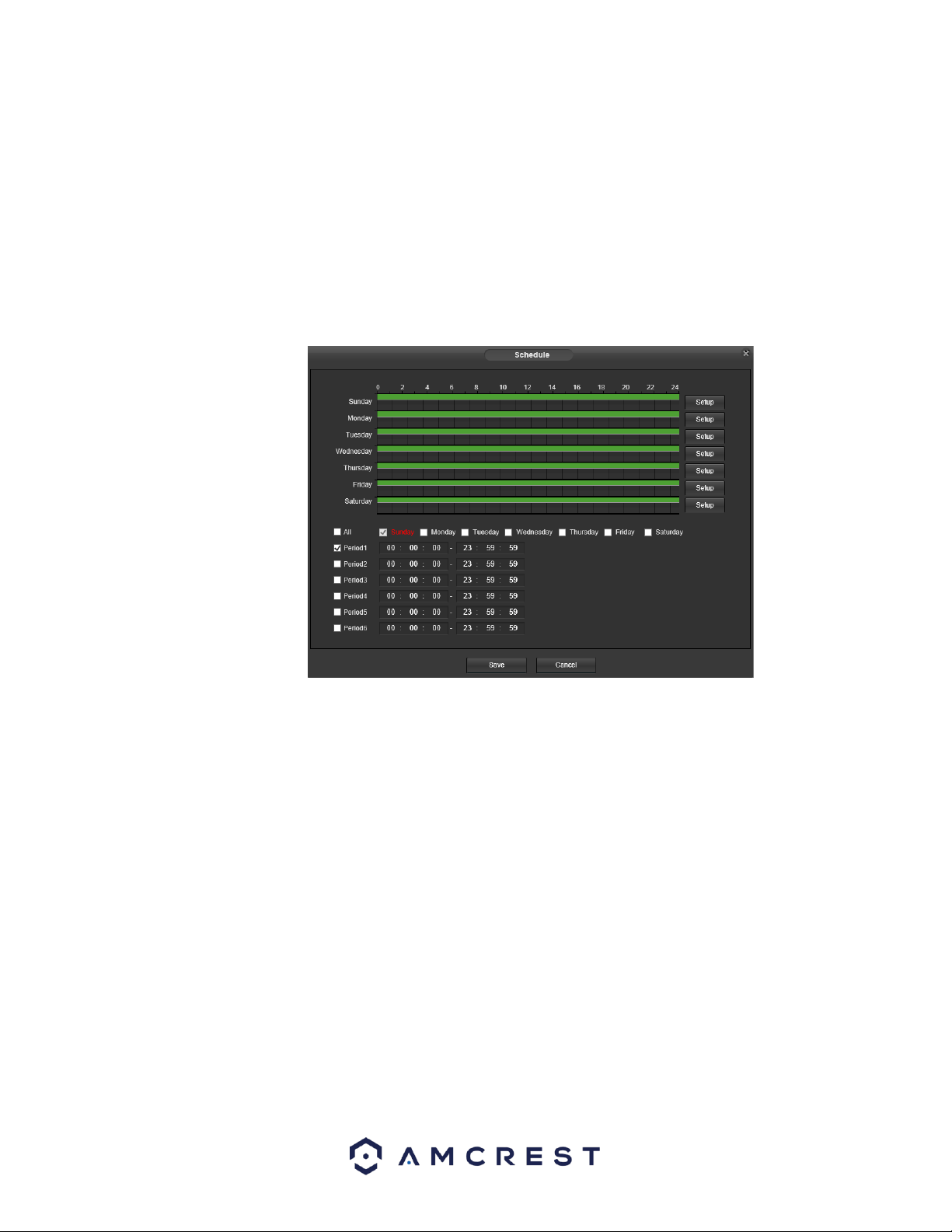
81
• Enable: This checkbox enables an audio detection alarm for the camera. Enable Intensity Change: This
checkbox enables intensity change for the camera audio. o Sensitivity is the amount of change required to
increase the audio detected by a percentage. The lower the sensitivity, the more audio variance is
required to trigger an alarm.
• Enable Intensity Change: This checkbox enables the user to adjust sensitivity and threshold settings for
audio detection.
o Sensitivity: The higher the sensitivity, the more likely that audio will trigger an alarm.
o Threshold: The lower the threshold, the more likely that audio will trigger an alarm.
● Schedule: Clicking this button opens a weekly schedule that can be used to set times.
o Click and drag to set audio tampering for certain days of the week. Also, periods of audio detection can
be set for each day and enabled using the period settings on the bottom half of the screen. There are a
total of 6 periods that can be set. 93.
● Anti-Dither: This field allows the user to set the anti-dither time. The values in this field can
range from 5 to 600 seconds. This time value controls how long the alarm signal lasts. Based on
audio detection, a buzzer can go off, a tour can begin, PTZ can be activated, a snapshot can be
taken, or the camera can begin recording.
o For example, if the anti-dither time is set to 10 seconds, each alarm may last 10 seconds if the local
alarm is activated. During the process, if the system detects another local alarm signal at the fifth second,
the buzzer, tour, PTZ activation, snapshot, record channel functions will begin another 10 seconds while
the screen prompt, alarm upload, email will not be activated again. After 10 seconds, if system detects
another alarm signal, it can generate a new alarm since the anti-dither time has expired.
• Record: This checkbox allows the user to enable the camera to record video when an audio detection
alarm is triggered.
• Record Delay: his field specifies in seconds how long the delay between alarm activation and recording
should be.
• Send Email: This checkbox allows the user to enable the camera to send an email when an audio
detection alarm is triggered.
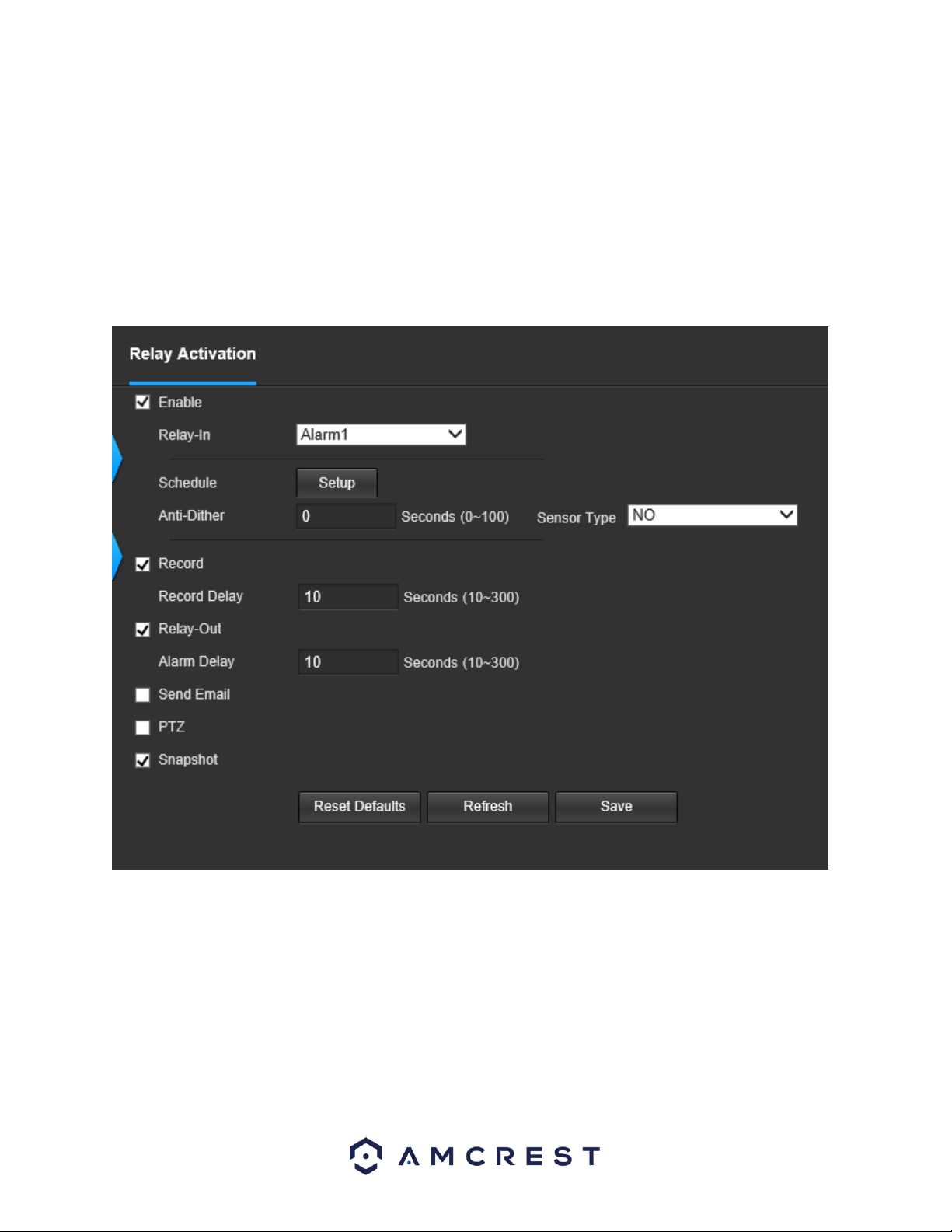
82
• PTZ: This checkbox allows the user to enable PTZ events to be sent from the camera. This event can be
sent via email alerts or via the web interface directly.
• Snapshot: This checkbox allows the user to enable the camera to take a snapshot when an audio
detection alarm is triggered.
To reset to default settings, click the Reset Defaults button. To refresh the page, click the Refresh button. To
save the settings, click the Save button.
5.8.3. Alarm
This menu allows the user to set and schedule replay activated alarms. Below is a screenshot of this menu:
Below is a description of each field in this menu:
• Enable: Allows the user to enable the relay activation function
• Relay-In: Allows the user to set specific relayed alarms to the camera.
• Schedule: Clicking this button opens a weekly schedule that can be used to set times.
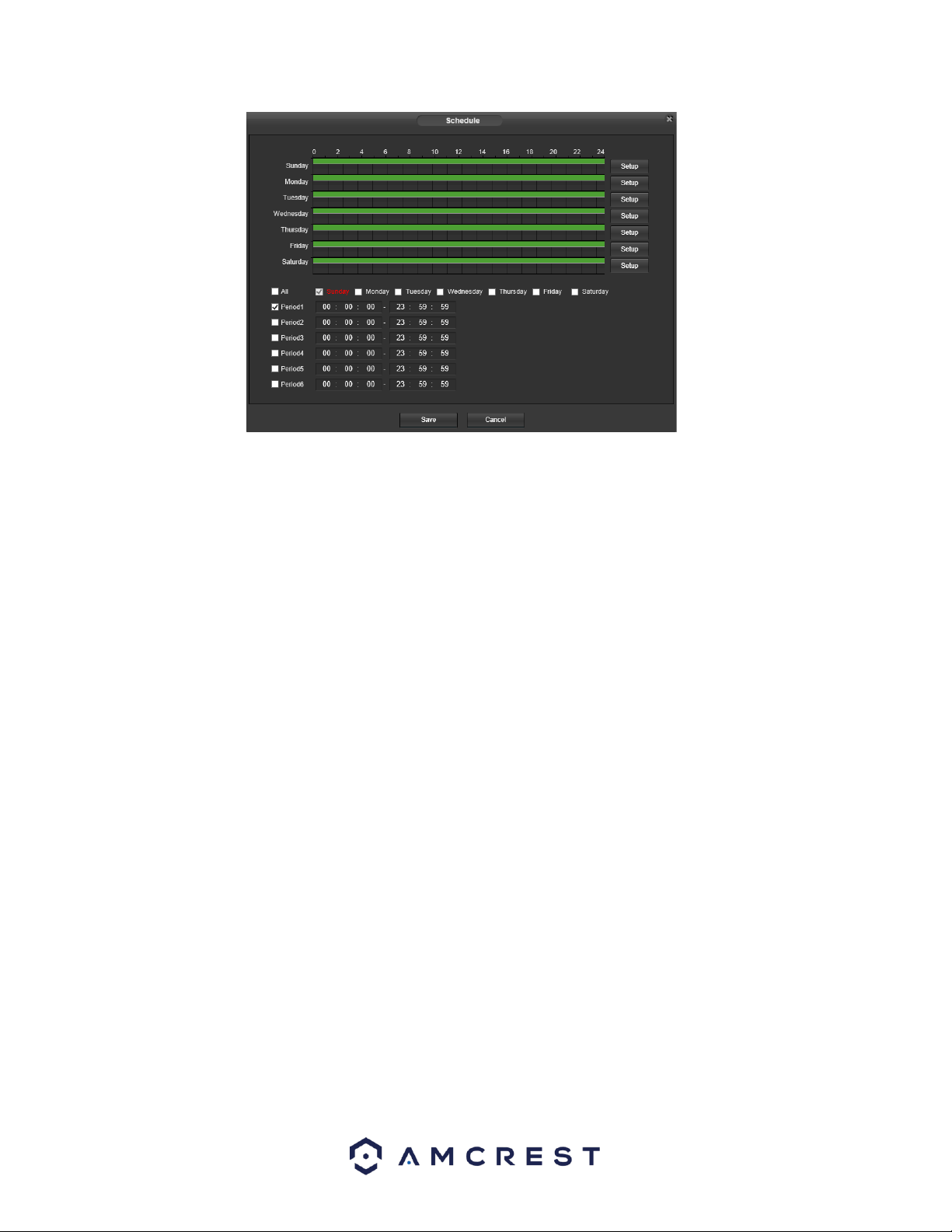
83
Click and drag to set motion detection for certain days of the week. Also, periods of motion
detection can be set for each day and enabled using the period settings on the bottom half of the
screen. There are a total of 6 periods that can be set.
• Anti-Dither: This field allows the user to set the anti-dither time. The values in this field can
range from 5 to 600 seconds. This time value controls how long the alarm signal lasts. Based on
motion detection, a buzzer can go off, a tour can begin, , a snapshot can be taken, or the camera
can begin recording.
For example, if the anti-dither time is set to 10 seconds, each alarm may last 10 seconds if the local alarm is
activated. During the process, if the system detects another local alarm signal at the fifth second, the buzzer,
tour, snapshot, record channel functions will begin another 10 seconds while the screen prompt, alarm
upload, email will not be activated again. After 10 seconds, if system detects another alarm signal, it can
generate a new alarm since the anti-dither time has expired.
• Record: This checkbox allows the user to enable the camera to record video when an audio detection
alarm is triggered.
• Record Delay: his field specifies in seconds how long the delay between alarm activation and recording
should be.
• Relay Out: This checkbox allows the user to enable the camera to trigger an alarm when an alarm is
detected.
• Send Email: This checkbox allows the user to enable the camera to send an email when an audio
detection alarm is triggered.
• PTZ: This checkbox allows the user to enable PTZ events to be sent from the camera. This event can be
sent via email alerts or via the web interface directly.
• Snapshot: This checkbox allows the user to enable the camera to take a snapshot when an audio
detection alarm is triggered.
To reset to default settings, click the Reset Defaults button. To refresh the page, click the Refresh button. To
save the settings, click the Save button.
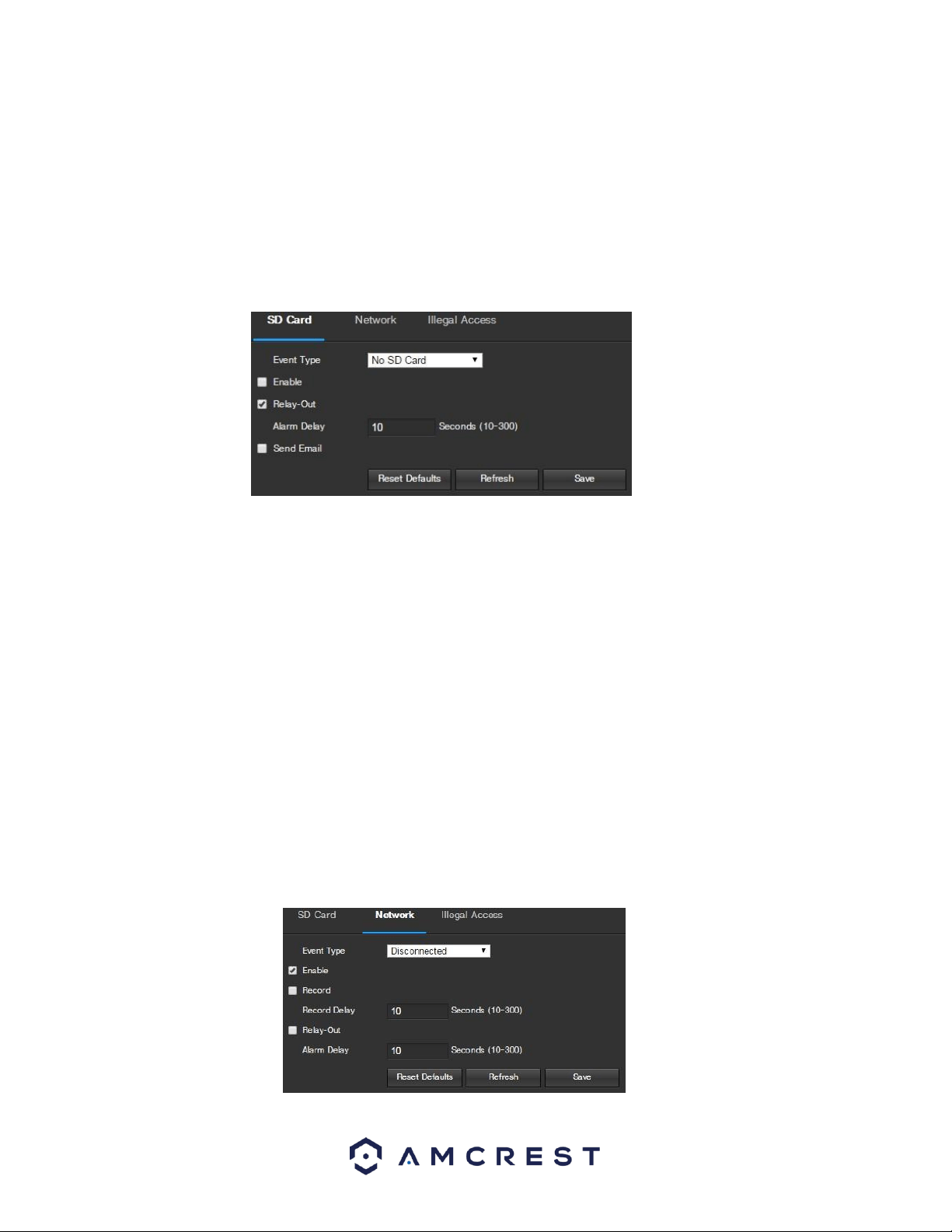
84
5.8.4. Abnormality
This menu allows the user to adjust abnormality event settings. This menu has 3 tabs: SD
Card, Network, and Illegal Access.
5.8.4.1 SD Card
This tab allows the user to set the camera’s response to an SD card related abnormality. Below is a
screenshot of the SD card tab screen:
Below is an explanation of the fields on the SD Card settings tab:
• Event Type: This dropdown box allows the user to select which SD card abnormality to set event triggers
for. The 3 options are No SD Card, SD Card Error, and Capacity Warning.
• Enable: This checkbox enables the SD Card abnormality trigger for the camera.
• Relay Out: This checkbox allows the user to enable the camera to trigger an alarm when an SD Card
abnormality is detected.
• Alarm Delay: This field specifies in seconds how long the delay between alarm activation and relay
alarm activation should be.
• Send Email: This checkbox allows the user to enable the camera to send an email when an SD Card
abnormality is detected.
To reset to default settings, click the Reset Defaults button. To refresh the page, click the Refresh button. To
save the settings, click the Save button.
5.8.4.2. Network
This tab allows the user to set the camera’s response to a Network related abnormality. Below is a
screenshot of the Network tab screen:
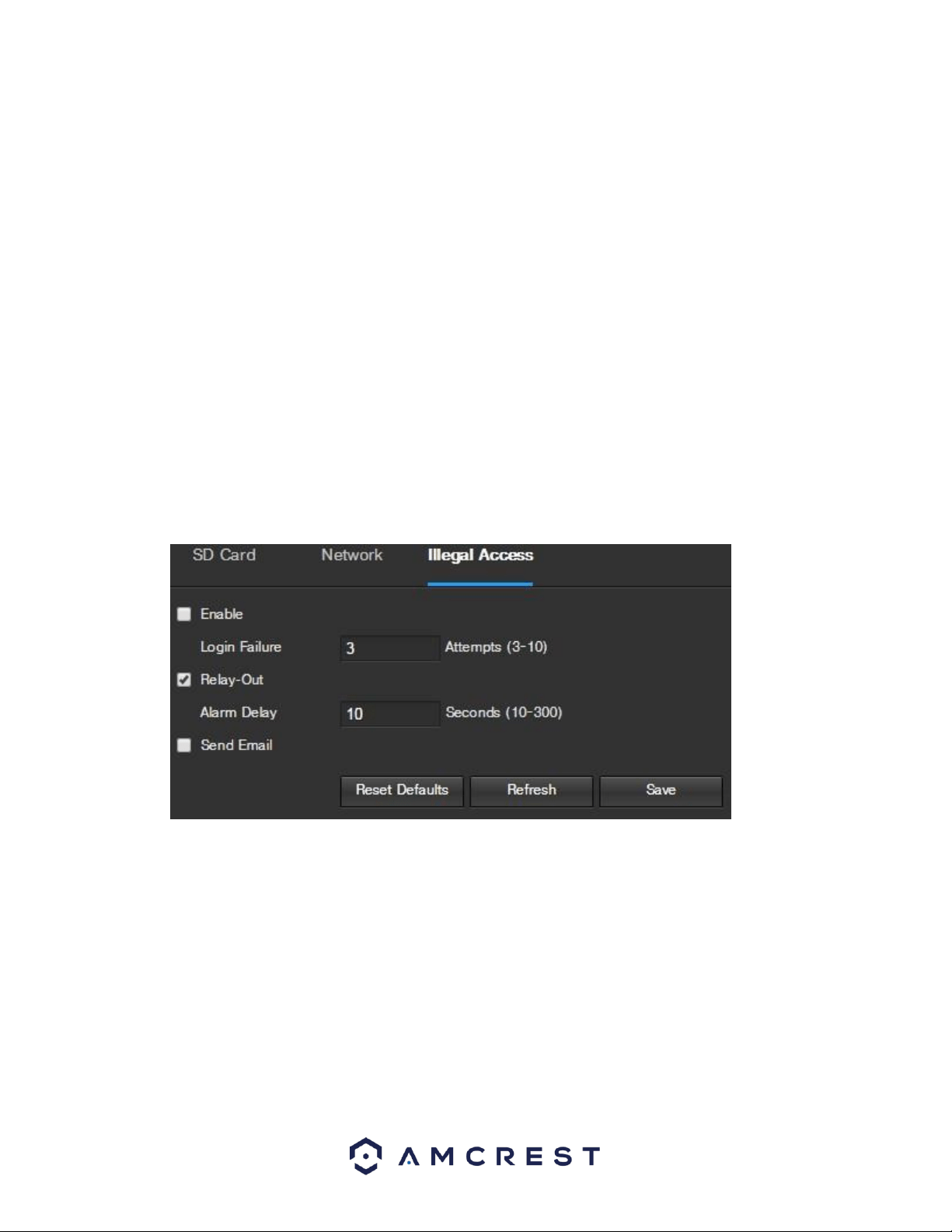
85
Below is an explanation of the fields on the Network settings tab:
• Event Type: This dropdown box allows the user to select which Network abnormality to set event
triggers for. The 2 options are Disconnection and IP Conflict.
• Enable: This checkbox enables the Network abnormality trigger for the camera.
• Record: This checkbox allows the user to enable the camera to record video when a network
abnormality is detected.
• Record Delay: This field specifies in seconds how long the delay between alarm activation and recording
should be.
• Relay Out: This checkbox allows the user to enable the camera to trigger an alarm when a network
abnormality is detected.
• Alarm Delay: This field specifies in seconds how long the delay between alarm activation and relay
alarm activation should be.
To reset to default settings, click the Reset Defaults button. To refresh the page, click the Refresh button. To save
the settings, click the Save button.
5.8.4.3 Illegal Access
This tab allows the user to set the camera’s response to an Illegal Access related abnormality. Below is a
screenshot of the Illegal Access tab screen:
Below is an explanation of the fields on the Illegal Access settings tab:
• Enable: This checkbox enables the Illegal Access abnormality trigger for the camera.
• Login Failure: This field allows the user to specify how many failed login attempts must be attempted to
trigger an Illegal Access abnormality event.
• Relay Out: This checkbox allows the user to enable the camera to trigger an alarm when illegal access is
detected.
• Alarm Delay: This field specifies in seconds how long the delay between alarm activation and relay
alarm activation should be.
• Send Email: This checkbox allows the user to enable the camera to send an email when illegal access is
attempted.
To reset to default settings, click the Reset Defaults button. To refresh the page, click the
Refresh button. To save the settings, click the Save button.
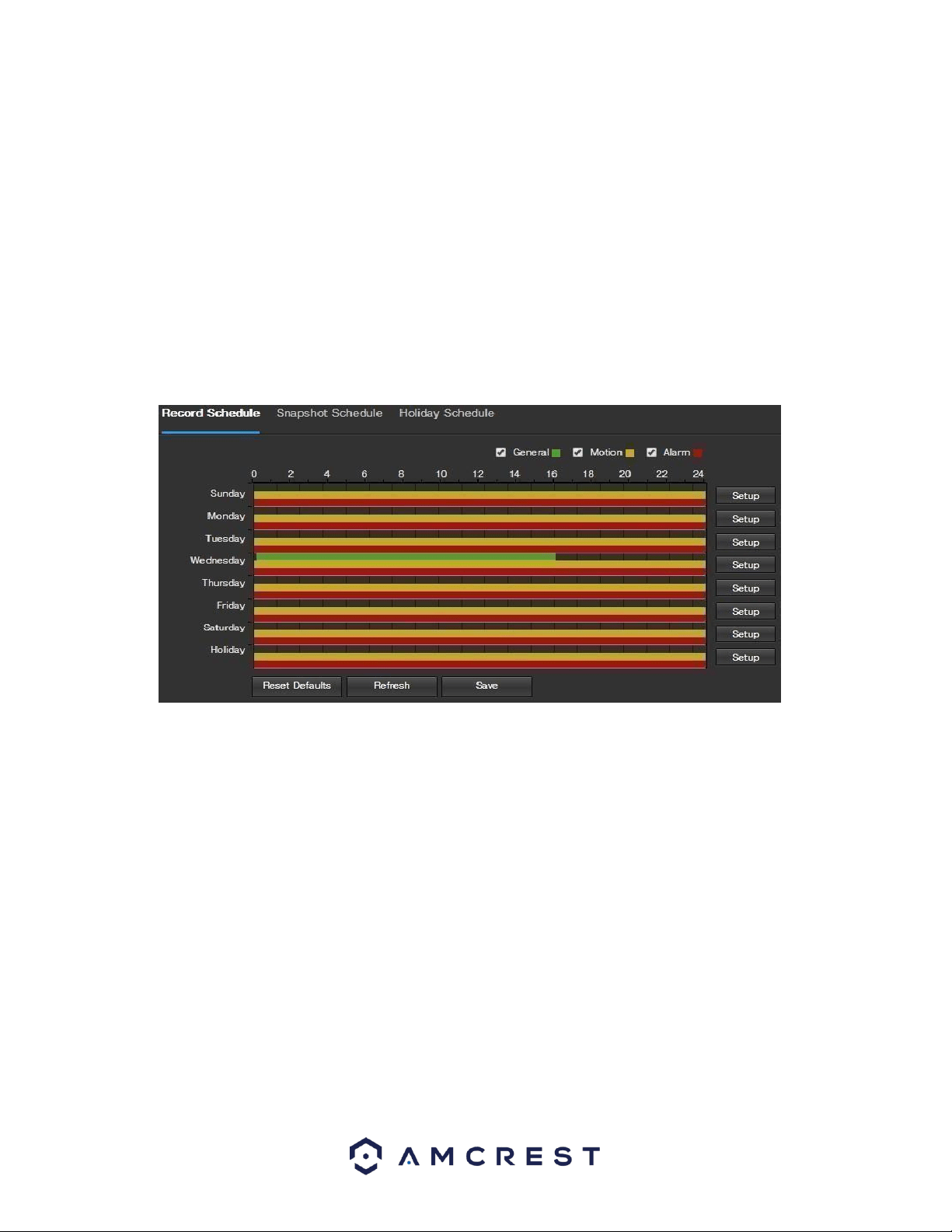
86
5.9. Storage
This menu section allows the user to change storage settings for the camera.
5.9.1 Schedule
The schedule menu manages the recording schedule for the camera. This menu has 3 tabs:
Record Schedule, Snapshot Schedule, and Holiday Schedule.
5.9.1.1 Record Schedule
This tab is where video recording settings are configured. Below is a screenshot of the
Record Schedule settings screen:
Below is an explanation of the fields on the Record Schedule settings tab:
Record Type: These checkboxes allow the user to select which recording type they want to
configure on the schedule. There are 3 types of recordings:
o General: General recording means that the camera captures all footage for
the specified time period. General recording is represented by the color
green.
o Motion: Motion Detection recording means that the camera captures only
footage when the motion detection alarm is activated. Motion recording is
represented by the color yellow.
o Alarm: Alarm recording means that the camera captures only footage when
an alarm is activated. Alarm recording is represented by the color red.
• Video Recording Schedule: To specify a video recording range, first select the type of
recording desired, then click and drag on time bar for the desired date. To edit
multiple days at once, drag the cursor further up or down to cover the other days.
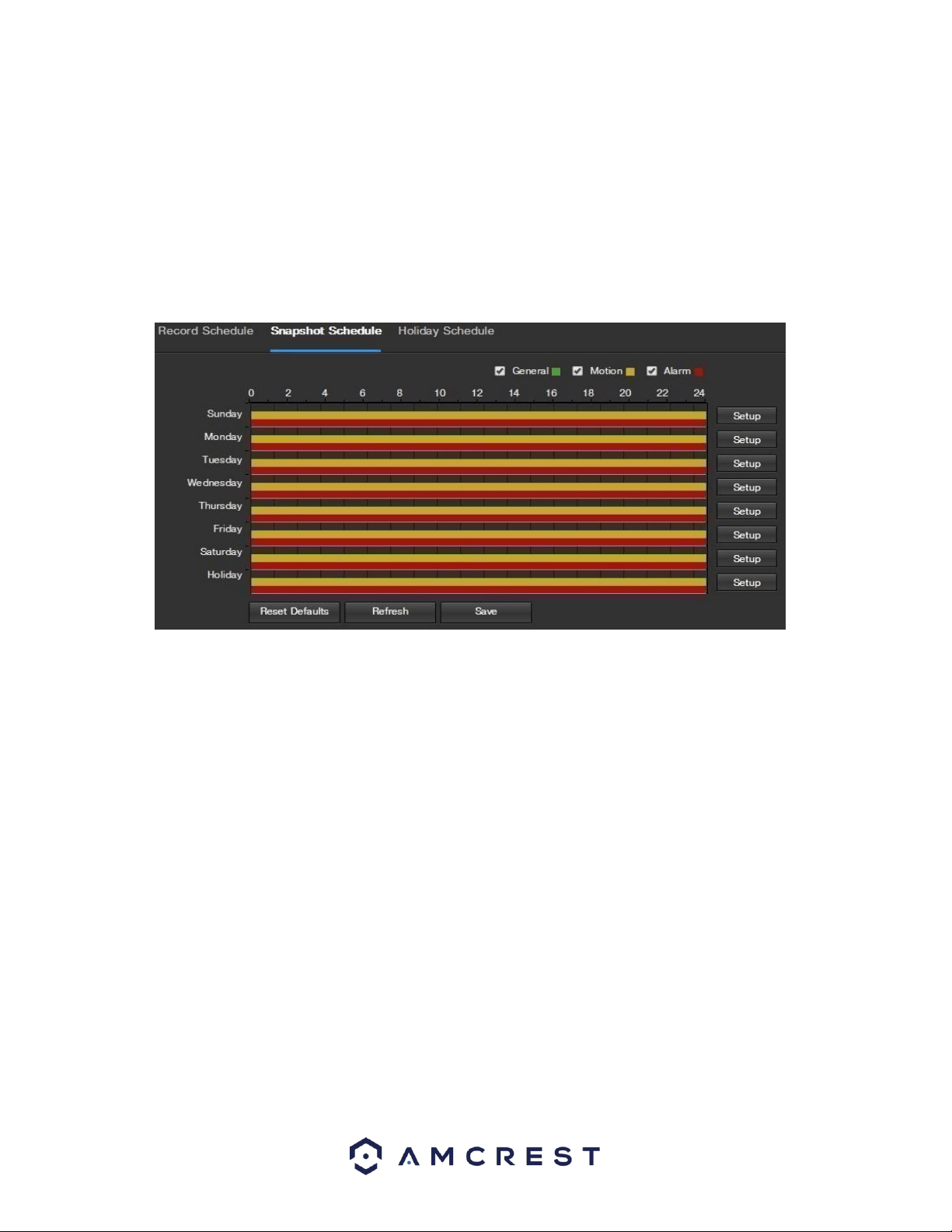
87
o Setup: Clicking this button opens a screen that allows for recording periods to be set
for each day and for each recording type. There are a total of 6 periods that can be
set.
To reset to default settings, click the Reset Defaults button. To refresh the page, click the
Refresh button. To save the settings, click the Save button.
5.9.1.2 Snapshot Schedule
This tab is where snapshot recording settings are configured. Below is a screenshot of the
Snapshot Schedule settings screen:
Below is an explanation of the fields on the Snapshot Schedule settings tab:
• Record Type: These checkboxes allow the user to select which snapshot type they
want to configure on the schedule. There are 3 types of snapshots:
o General: General means that the camera will take snapshots during the
specified time period. General recording is represented by the color green.
o Motion: Motion Detection means that the camera only takes snapshots
when the motion detection alarm is activated. Motion recording is
represented by the color yellow.
o Alarm: Alarm means that the camera only takes snapshots when an alarm is
activated. Alarm recording is represented by the color red.
• Snapshot Recording Schedule: To specify a snapshot range, first select the type of
snapshot desired, then click and drag on time bar for the desired date. To edit
multiple days at once, drag the cursor further up or down to cover the other days.
o Setup: Clicking this button opens a screen that allows for snapshot periods to
be set for each day and for each snapshot type. There are a total of 6 periods
that can be set.
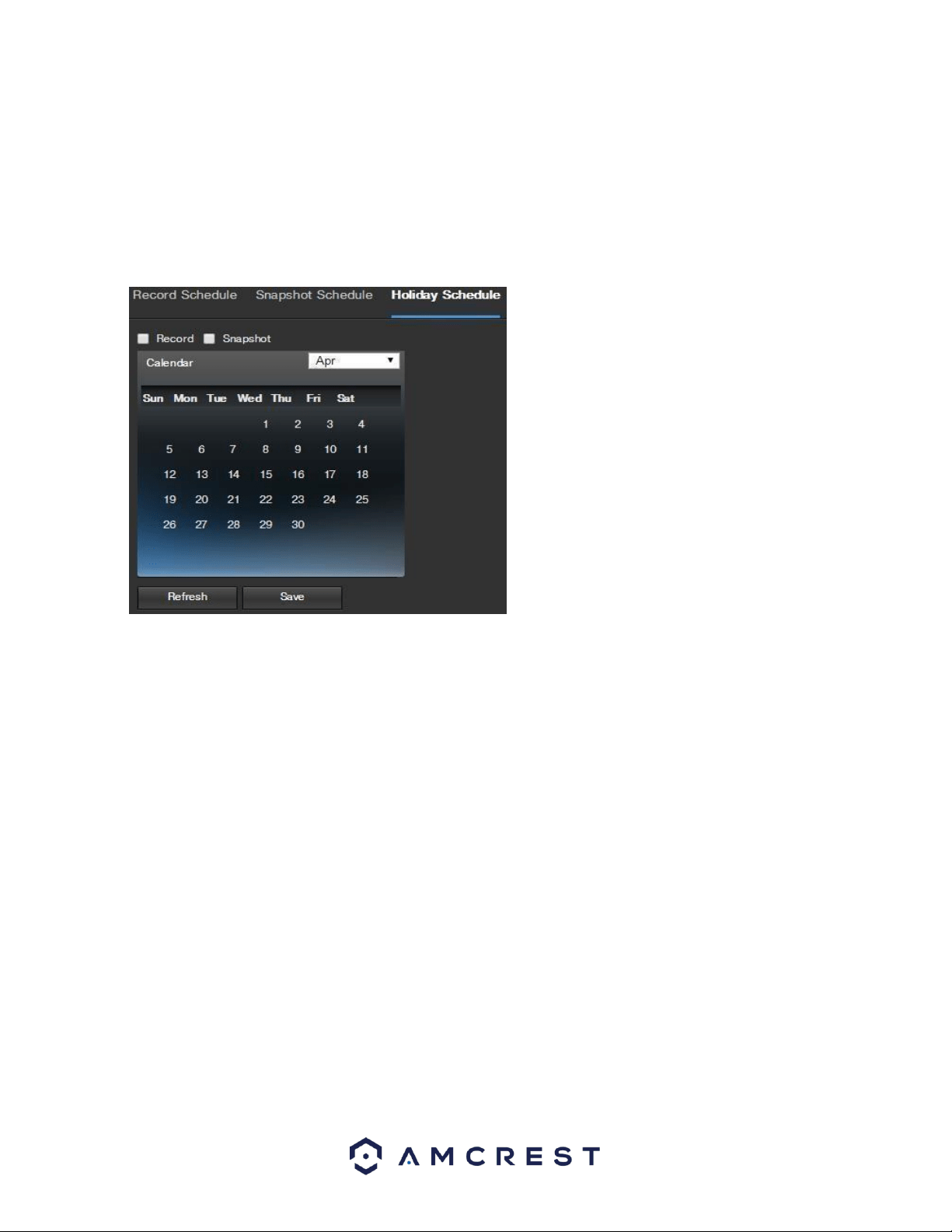
88
To reset to default settings, click the Reset Defaults button. To refresh the page, click the
Refresh button. To save the settings, click the Save button.
5.9.1.3. Holiday Schedule
This tab is where holiday settings are configured. Below is a screenshot of the Holiday
Schedule settings screen:
Below is an explanation of the fields on the Holiday Schedule settings tab:
• Record Type: These checkboxes allow the user to select which recording type they want to
configure on the schedule. There are 2 types of recordings:
o Record: This checkbox is referring to video recording.
o Snapshot: This checkbox is referring to snapshot recording.
• Calendar: This calendar allows the user to select days to designate as holidays. Once a day
is designated, it can be customized to stop recording or snapshots for that day by using the
Record and Snapshot checkboxes.
To refresh the page, click the Refresh button. To save the settings, click the Save button.
5.9.2 Destination
This menu controls where recorded media is stored. There are 4 tabs in this menu: Path,
SD Card, FTP, and NAS.
5.9.2.1 Path
This tab is where the user can designate a path for recorded video and snapshots to reside
in. Below is a screenshot of the Path tab:
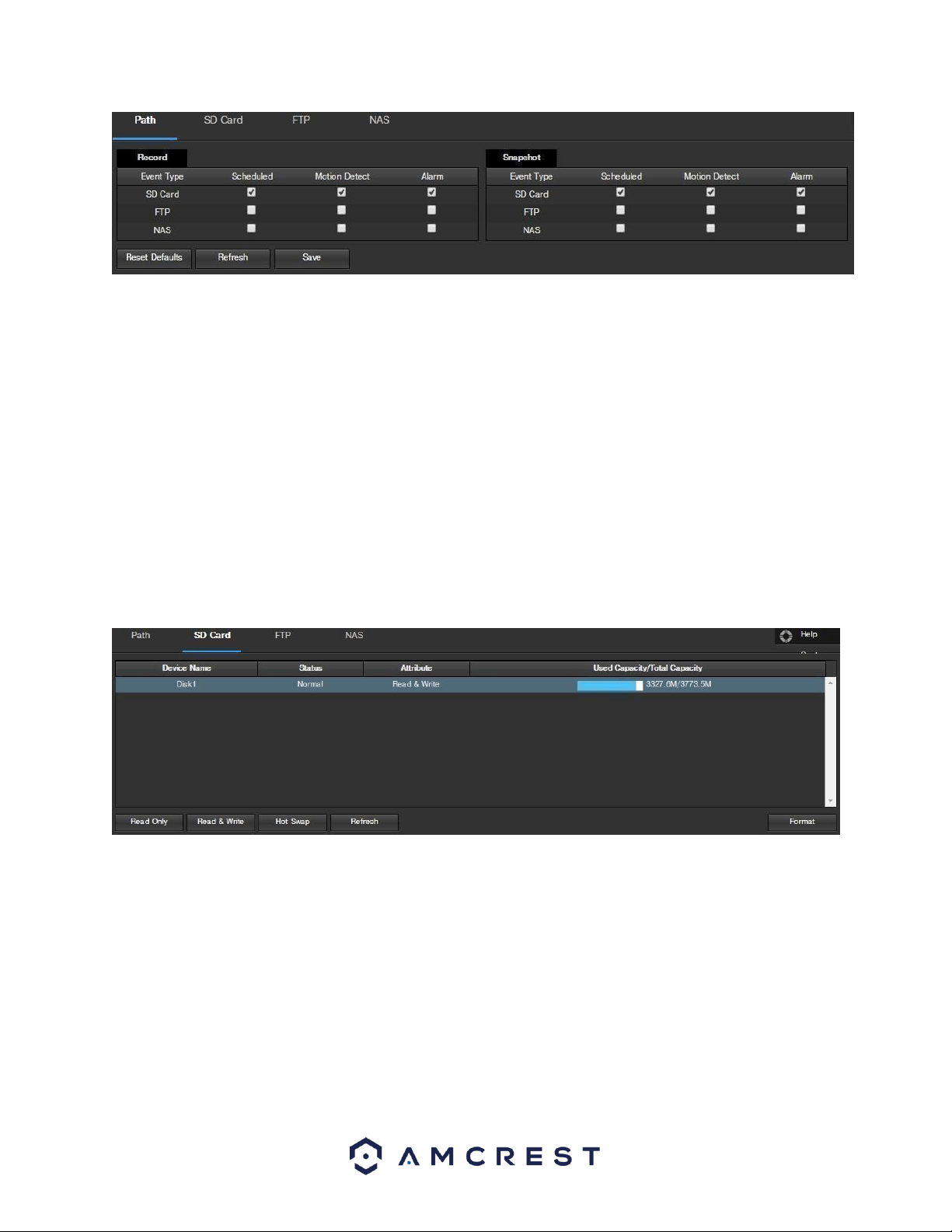
89
Below is an explanation of the fields on the Path settings tab:
• Event Type: This column designates storage options available to the camera. The
options are SD Card, FTP, and NAS.
• Record Type: These columns designate which recording type should be recorded to
which event type. Check the box at the intersection of the record type and event type
to designate where that recording should be sent to.
To reset to default settings, click the Reset Defaults button. To refresh the page, click the
Refresh button. To save the settings, click the Save button.
5.9.2.2. SD Card
This tab is where the user can change SD card settings. Below is a screenshot of the SD
Card tab:
Below is an explanation of the fields on the SD Card settings tab:
• Device Name: This column designates the name of the SD card that is currently in the
camera.
• Status: This column designates the status of the SD card.
• Attribute: This column designates the read/write attributes for the SD card. By
default, this is Read &
Write.
• Used Capacity/Total Capacity: This column shows the available memory on the SC
card.
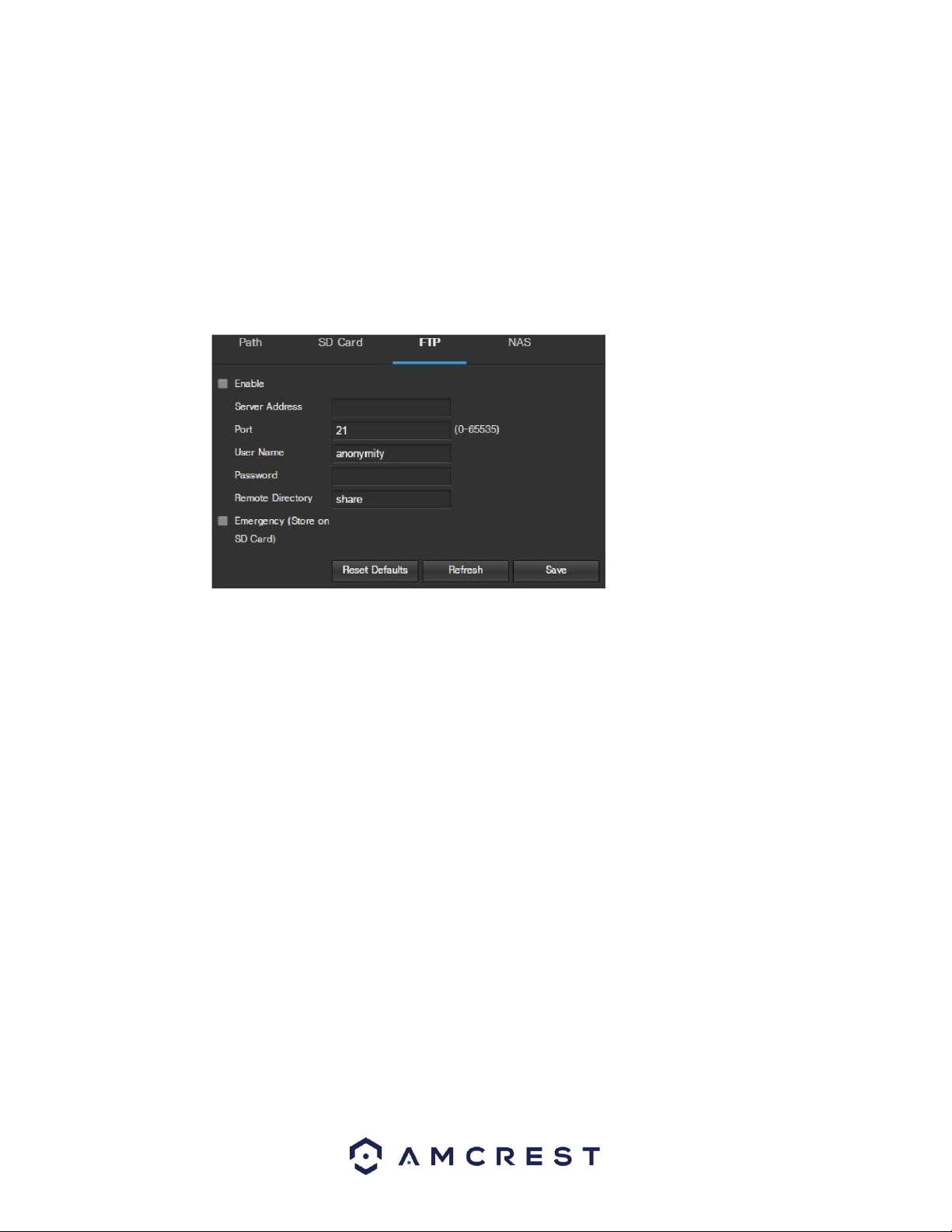
90
Read Only: This button allows the user to designate an SD card as read only.
• Hot Swap: This button allows the user to physically remove the SD card and replace it
with another safely.
• Refresh: This button refreshes the SD card table.
• Format: This button formats the SD card.
5.9.2.3 FTP
This tab is where the user can change FTP settings. Below is a screenshot of the FTP tab:
Below is an explanation of the fields on the FTP settings tab:
• Enable: This checkbox allows the user to enable FTP uploading for the camera’s
recorded media.
• Server Address: This field allows the user to designate a DDNS address for the FTP
server.
• Port: This field allows the user to designate the port number for the FTP server.
• User Name: This field allows the user to input the username used to login to the FTP
server.
• Password: This field allows the user to input the password used to login to the FTP
server.
• Remote Directory: This field allows the user to specify a remote directory on the FTP
to send the recorded media to.
• Emergency (Store on SD Card): This checkbox allows the camera to store recorded
media on the SD card in case the FTP server is unavailable.
To reset to default settings, click the Reset Defaults button. To refresh the page, click the
Refresh button. To save the settings, click the Save button.
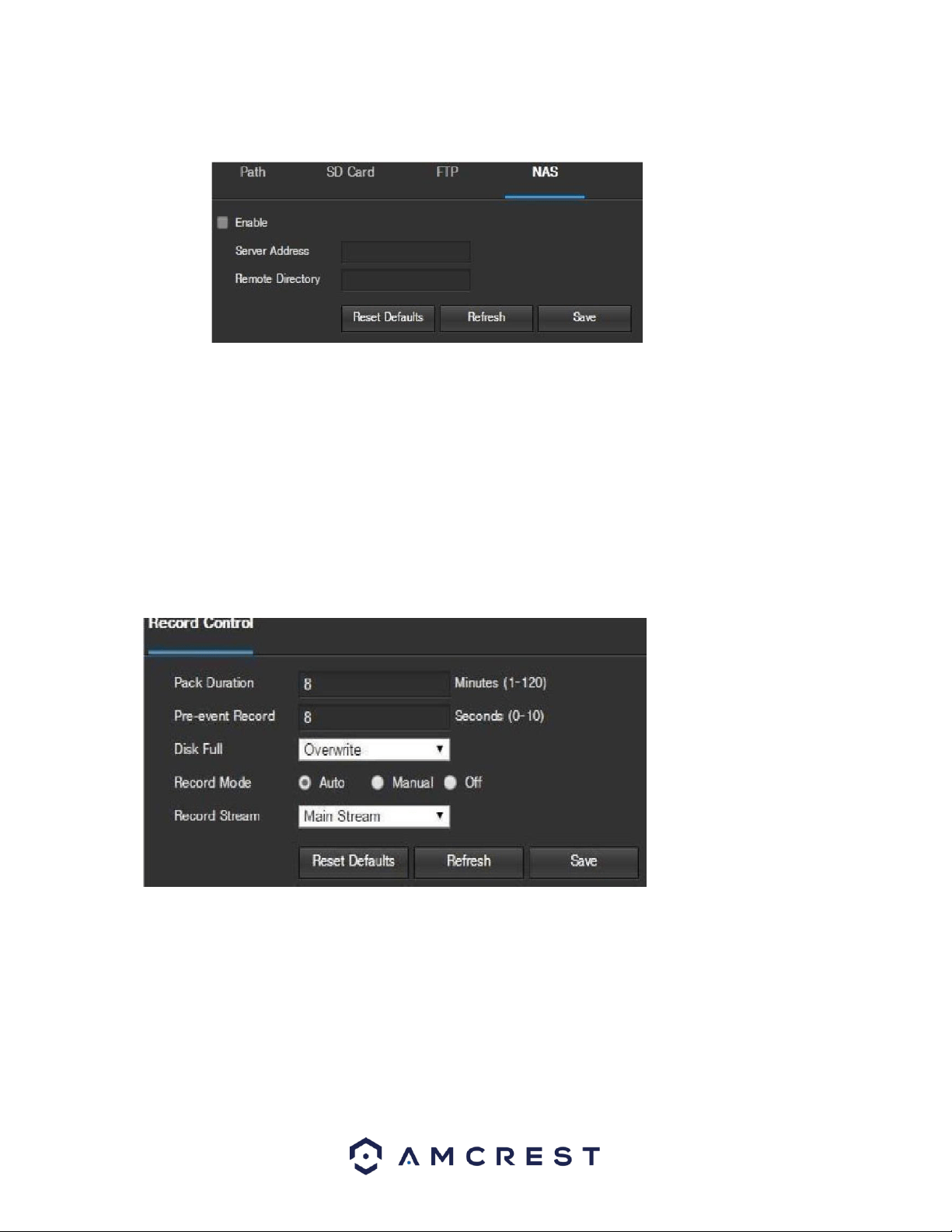
91
5.9.2.4 NAS
This tab is where the user can change NAS settings. Below is a screenshot of the NAS tab:
Below is an explanation of the fields on the NAS settings tab:
• Enable: This checkbox allows the user to enable NAS uploading for the camera’s
recorded media. • Server Address: This field allows the user to designate a DDNS
address for the NAS server/device.
• Remote Directory: This field allows the user to specify a remote directory on the NAS
to send the recorded media to.
To reset to default settings, click the Reset Defaults button. To refresh the page, click the
Refresh button. To save the settings, click the Save button.
5.9.3 Record Control
This menu is where general recording settings are configured. Below is a screenshot of the record
control menu:
Below is an explanation of the fields on the Record Control settings tab:
• Pack Duration: This field allows the user to set how many minutes each file is
comprised of.
• Pre-event Record: This field allows the user to specify how many seconds before an
event should be recorded.
Disk Full: This dropdown box allows the user to designate what the camera should do
when the disk is full. There are 2 options: Overwrite or Stop.
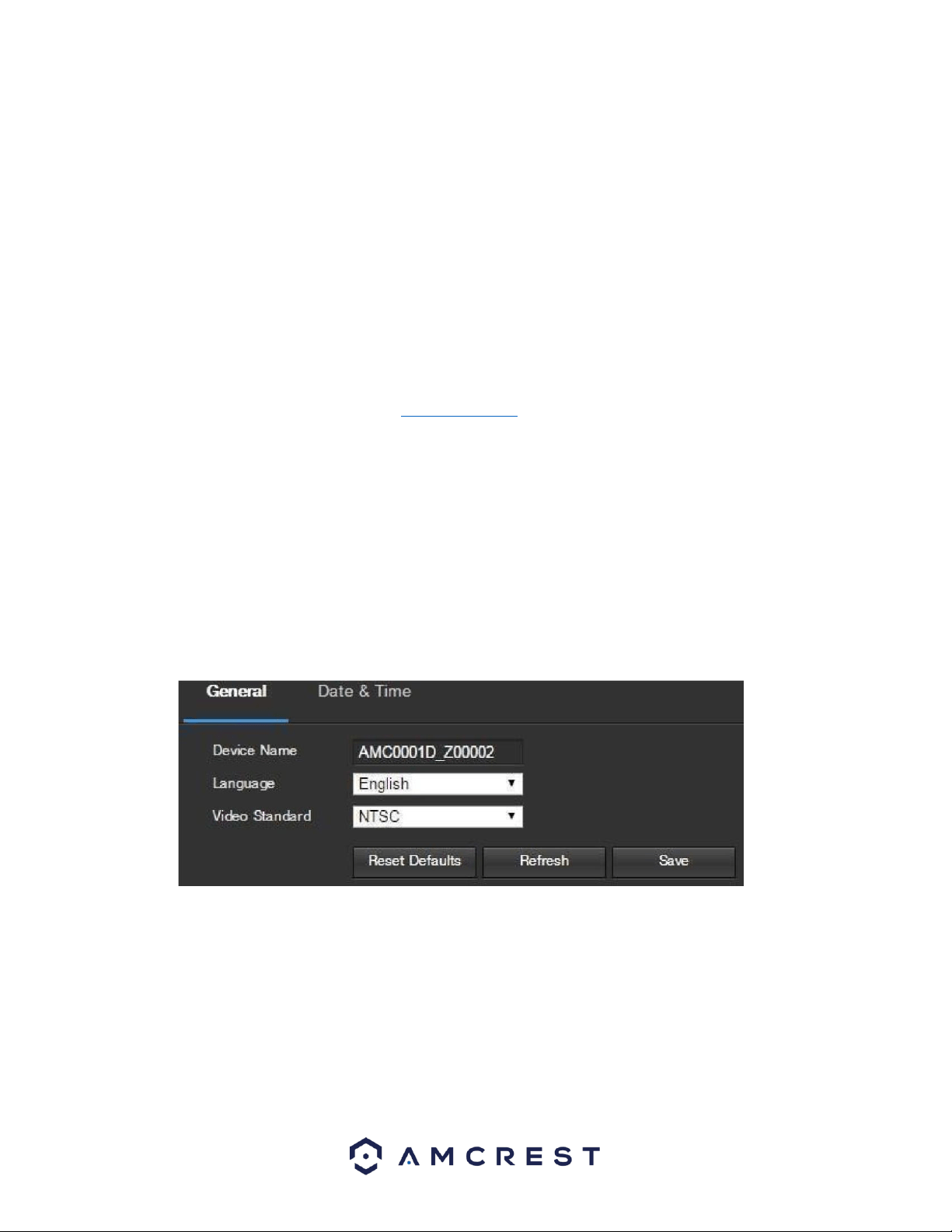
92
• Record Mode: This set of radio buttons allows the user to designate the recording
mode. The options are Auto, Manual, and Off.
Record Stream: This dropdown box allows the user to specify which stream to record.
The options are main stream and sub stream.
To reset to default settings, click the Reset Defaults button. To refresh the page, click the
Refresh button. To save the settings, click the Save button.
5.9.4. Cloud Storage
This menu redirects the user to the Amcrest Cloud web site. At this website (amcrestcloud.com) users can register
for new accounts as well as view or modify existing accounts.
For more information on Amcrest Cloud visit: amcrestcloud.com
5.10. System
This menu section allows the user to change general settings for the camera.
5.10.1 General
This menu controls where general settings are configured. There are 2 tabs in this menu:
General and Date & Time.
5.10.1.1 General
This tab is where the user can configure some basic camera settings. Below is a screenshot of the
General tab:
Below is an explanation of the fields on the General settings tab:
• Device Name: This field allows the user to change the device’s name.
• Language: This dropdown box allows the user to change the language used in the
camera.
Video Standard: This dropdown box allows the user to select either the NTSC or PAL video
standard.
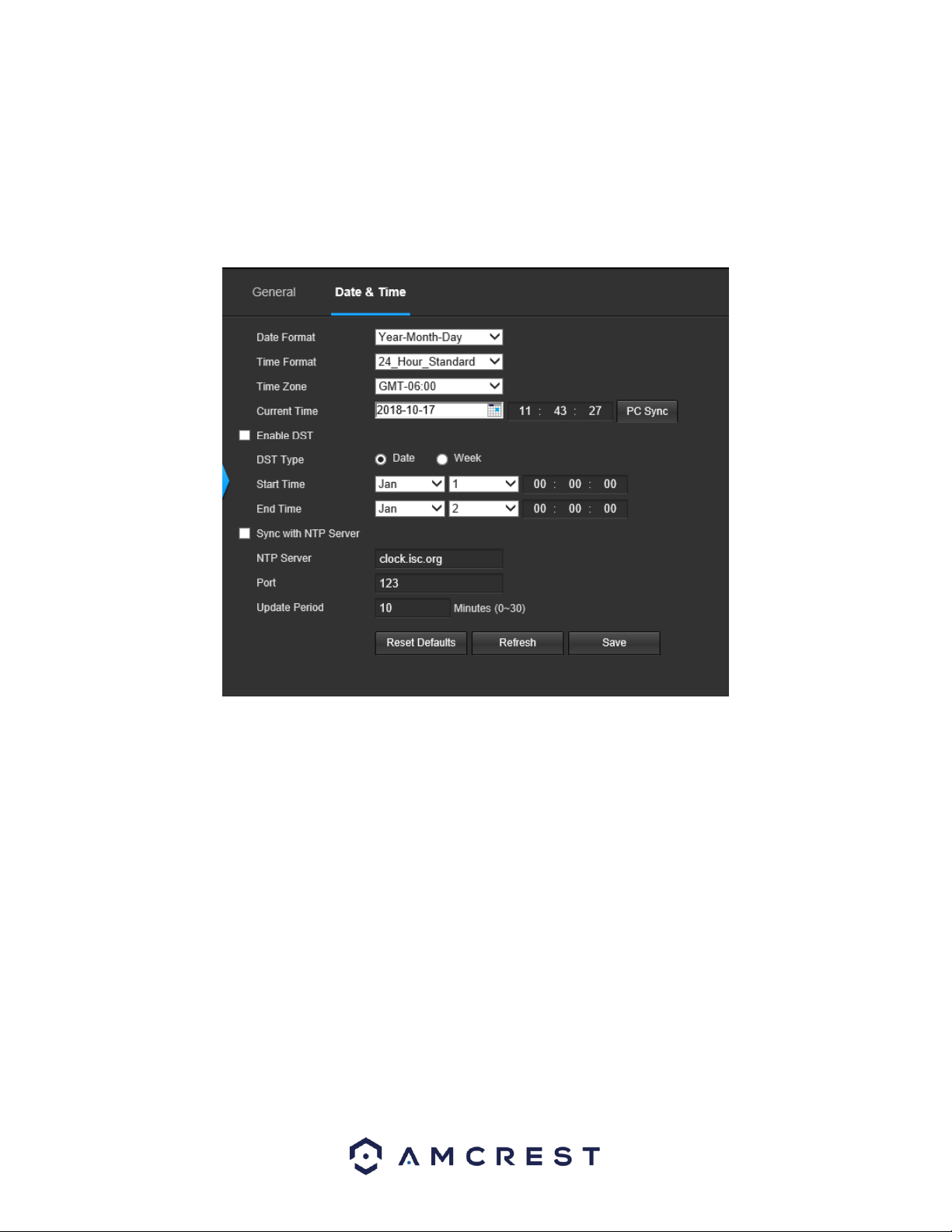
93
To reset to default settings, click the Reset Defaults button. To refresh the page, click the
Refresh button. To save the settings, click the Save button.
5.10.1.2 Date & Time
This tab is where the user can configure the date and time settings for the camera. Below
is a screenshot of the Date & Time tab:
Below is an explanation of the fields on the Date & Time settings tab:
• Date Format: This dropdown box allows the user to change the date format used in
the camera.
• Time Format: This dropdown box allows the user to change the time format used in
the camera.
• Time Zone: This dropdown box allows the user to change the time zone used in the
camera.
• Current Time: This field allows the user to enter in the date and time manually.
Clicking the PC Sync button allows the camera to sync with a Network Time Protocol
(NTP) server.
• Enable DST: This checkbox allows the user to enable daylight savings time for the
camera.
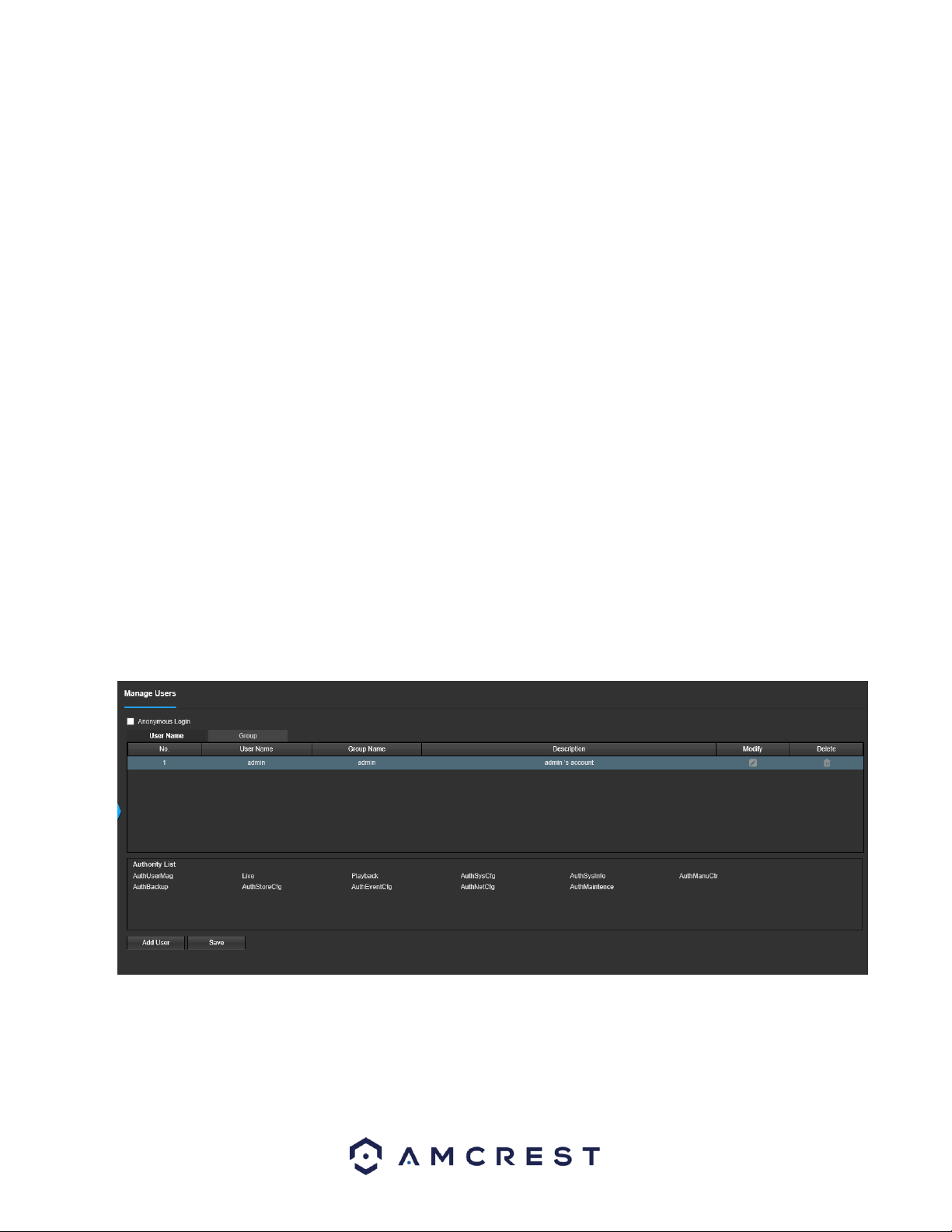
94
• DST Type: This radio button allows the user to select whether DST is based on the
week, or a specific day.
• Start Time: This dropdown box and field allow the user to enter in the start time for
DST.
• End Time: This dropdown box and field allow the user to enter in the end time for
DST.
Synchronize with NTP: This checkbox allows the user to enable the camera’s
synchronization with an NTP server.
• NTP Server: This field allows the user to enter in an NTP server.
• Port: This field allows the user to enter in the port number for the NTP server.
Update Period: This field allows the user to enter in the update period time. This
number designates how frequently the camera pings the NTP server to ensure it has
the correct time. The range is from 0-30 minutes.
To reset to default settings, click the Reset Defaults button. To refresh the page, click the
Refresh button. To save the settings, click the Save button.
5.10.2. Manage Users
This menu allows the user to change the user accounts on the camera. By default, the camera
only has the admin account which has all rights/authorities. Additional accounts can be created
on this screen. Below is a screenshot of the account screen:
Below is an explanation of the fields on the Account screen:
• Anonymous Login: This checkbox allows the user to enable the anonymous login
feature. This allows all user account names to remain hidden on this screen.
• User Name: This tab shows the usernames available on the camera.
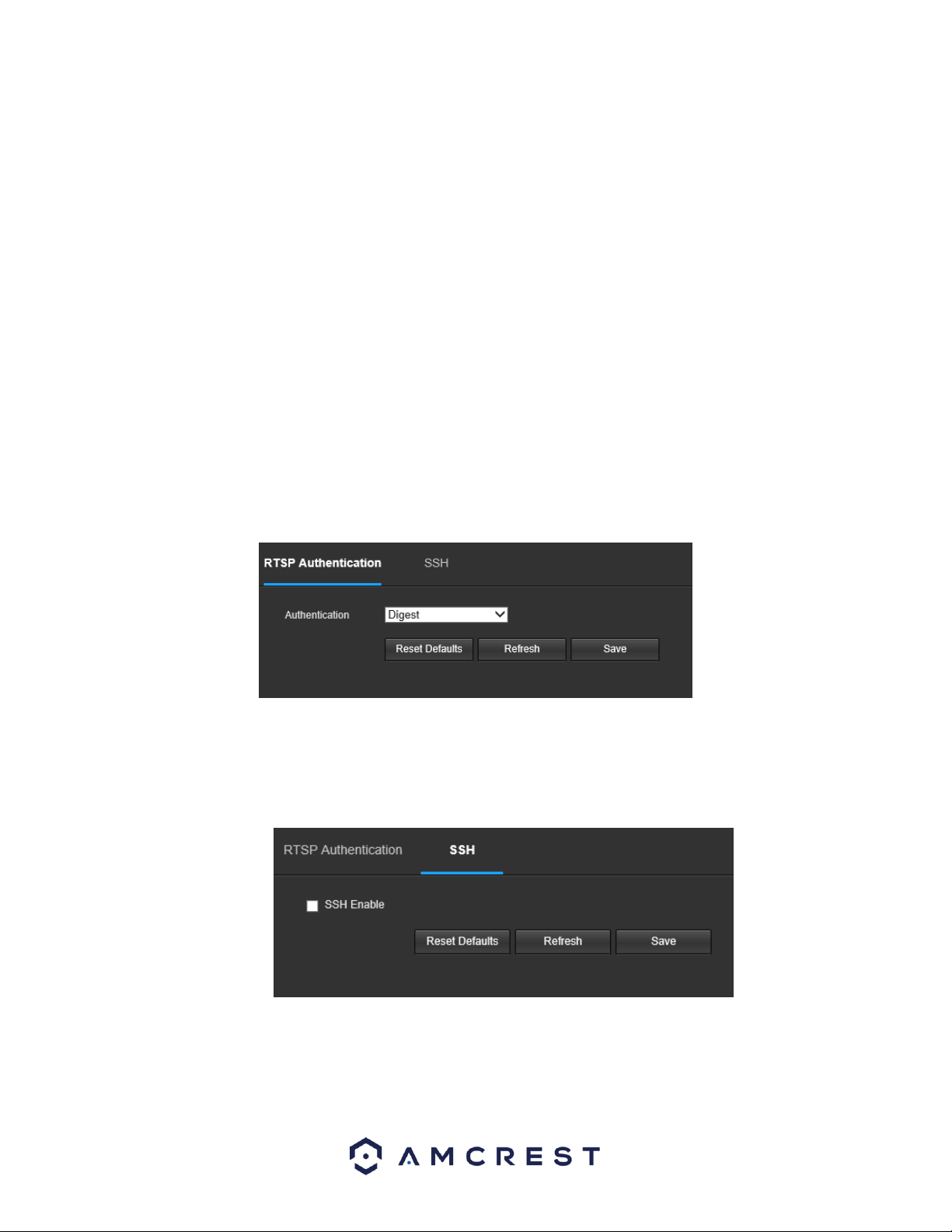
95
• Group: This tab shows the user groups available on the camera.
• No.: This column shows the user’s number on the user list.
User Name: This column shows the usernames of the different accounts on the camera.
• Group Name: This column shows the group of the different accounts on the camera.
• Description: This column shows a description of the account.
• Modify: This column allows the user to modify the user account.
• Delete: This column allows the user to delete a user account. Note: The admin
account cannot be deleted.
• Authority List: This box shows which user rights/authorities are assigned to an
account.
• Add User: This button allows the user to add a new user to the camera.
5.10.3 Safety
This menu allows the user to set basic RTSP and SSH authentications for the camera. Below is a screenshot of this
menu:
Below is an explanation of the settings in the RTSP Authentication field:
• RTSP Authentication: Allows the user to set basic and digest RTSP authentications. To save an
authentication to the camera click on the Save button.
• SSH: This checkbox allows the user to enable secure shell authentication protocols from the camera.
Below is a screenshot of this menu:
5.10.4 Default Settings
This screen allows the user to reset the camera and all its settings to the factory settings.
Below is a screenshot of the Default screen:
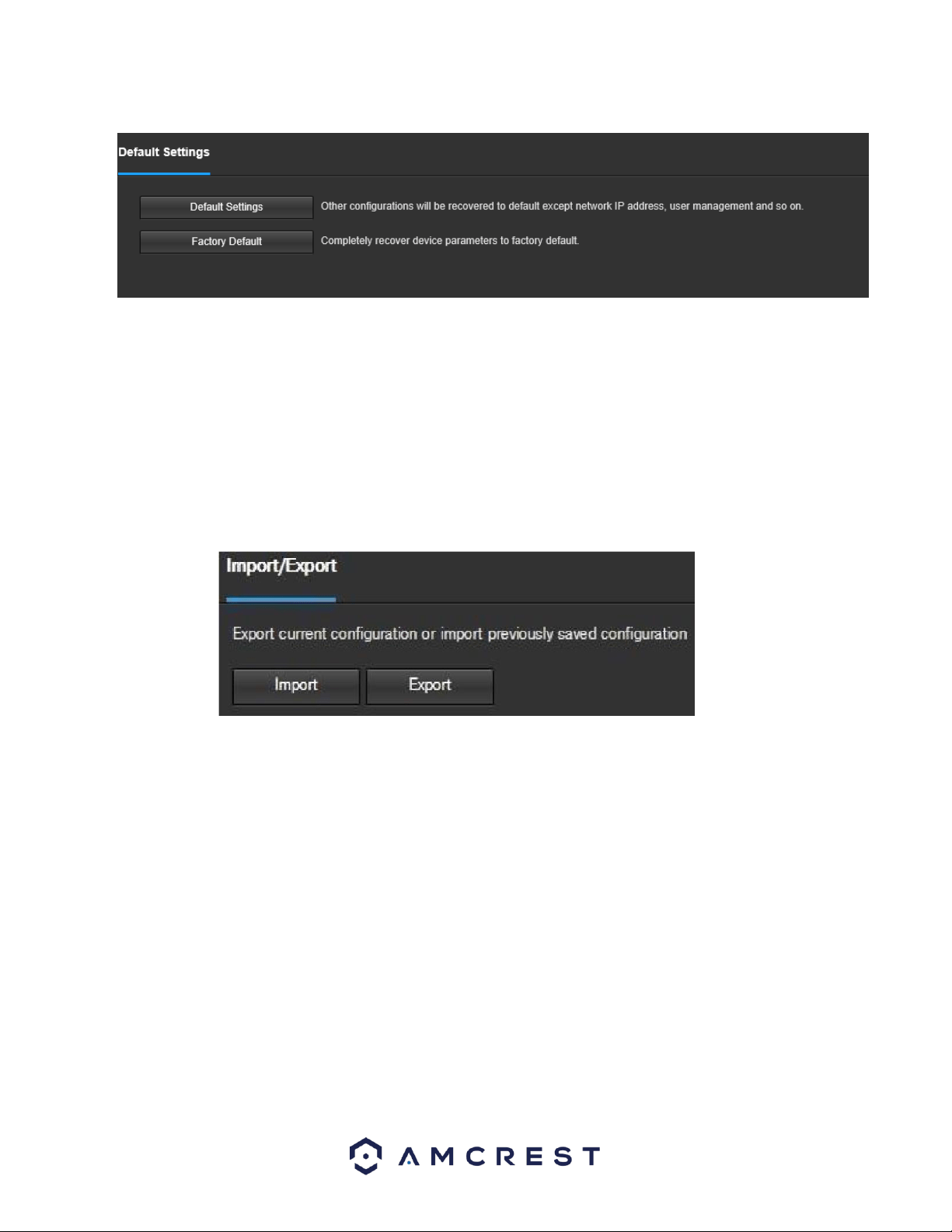
96
Below is an explanation of the items listed in this field:
Default Settings: Only the IP address, user management, and other settings can be
recovered after reset.
Factory Default: Completely resets the camera to factory default settings. No settings can
be recovered after the camera has been returned to its factory default settings.
5.10.5. Import/Export
This screen allows the user to import or export settings from the camera. Below is a
screenshot of the Import/Export screen:
To import settings, click the Import button. To export settings, click the Export button.
5.10.6. Auto Maintain
This screen allows the user to set auto maintenance settings for the camera. Below is a
screenshot of the
Auto Maintain screen:
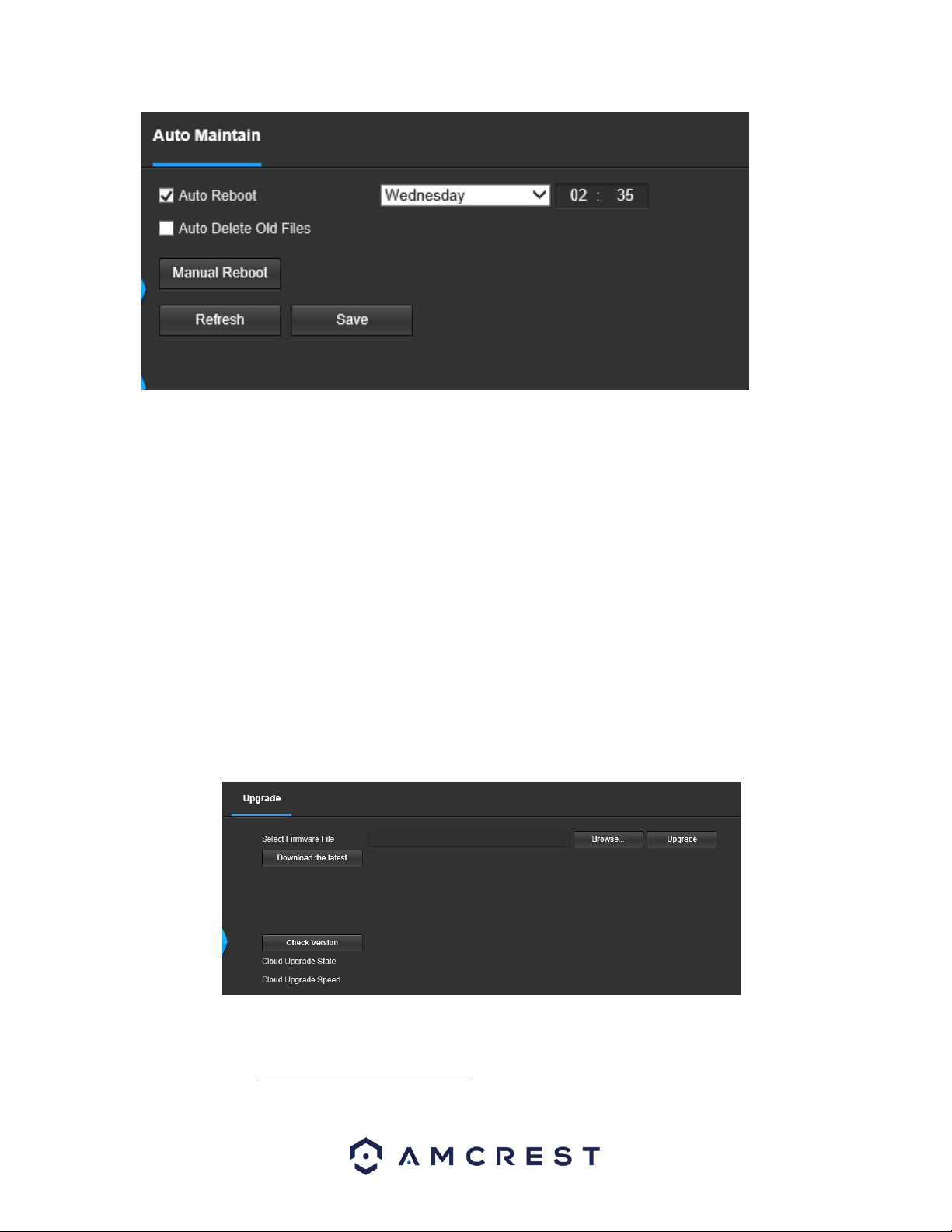
97
Below is an explanation of the fields on the Auto Maintain screen:
• Auto Reboot: This checkbox allows the user to enable the auto reboot function. The
dropdown box and field to the right of this checkbox allow the user to specify what
date and time of the week the camera will auto reboot.
• Auto Delete Old Files: This checkbox allows the user to enable the auto deletion of
old files on the camera.
• Manual Reboot: This button allows the user to manually reboot the camera.
To refresh the page, click the Refresh button. To save the settings, click the Save button.
5.10.7. Upgrade
This menu allows the user to upgrade the camera’s firmware. Below is a screenshot of the
Upgrade screen:
To upgrade the firmware for your camera, follow the steps provided below:
• Go to amcrest.com/firmware-subscribe
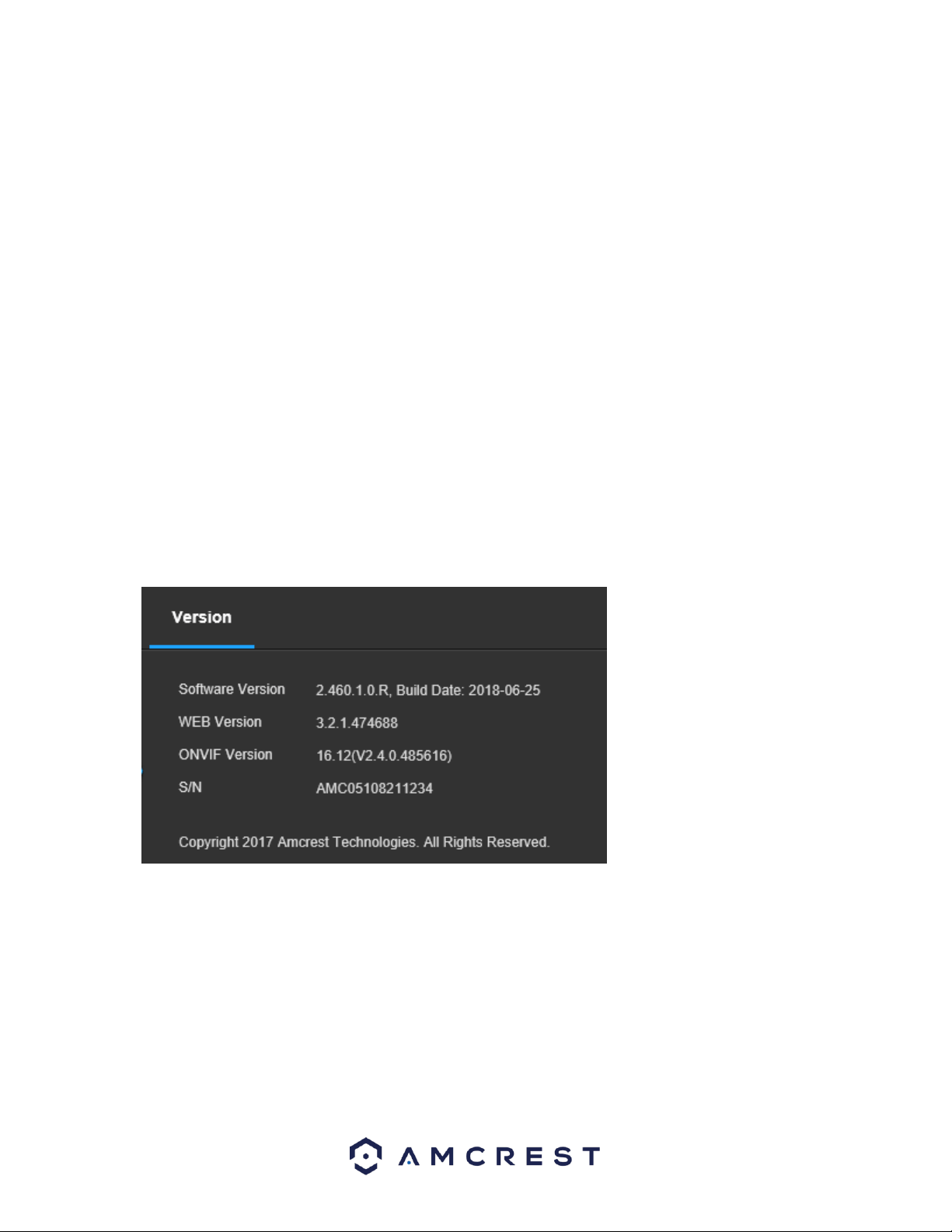
98
• Search for the model number of your camera and download the latest
firmware file.
• Return to the web user interface for your camera and press the Browse
button to locate and import the firmware file you just downloaded.
• Once the firmware file has been imported, click Upgrade.
• The device will reset, return to the web user interface. The upgrade is now
complete.
Note: When upgrading the camera’s firmware, do not disconnect the internet or power
from the camera.
5.11. Information
This menu section allows the user to view information about the camera for reference
purposes.
5.11.1 Version
This screen allows the user to see various information about the camera’s software
versions, as well as other information. Below is a screenshot of the camera’s version screen:
On this screen, software version, web interface version, and ONVIF version are
displayed. Also, the S/N (Token ID) is displayed here.
5.11.2. Log
This screen is where the camera’s activity log is kept. Below is a screenshot of the Log screen:
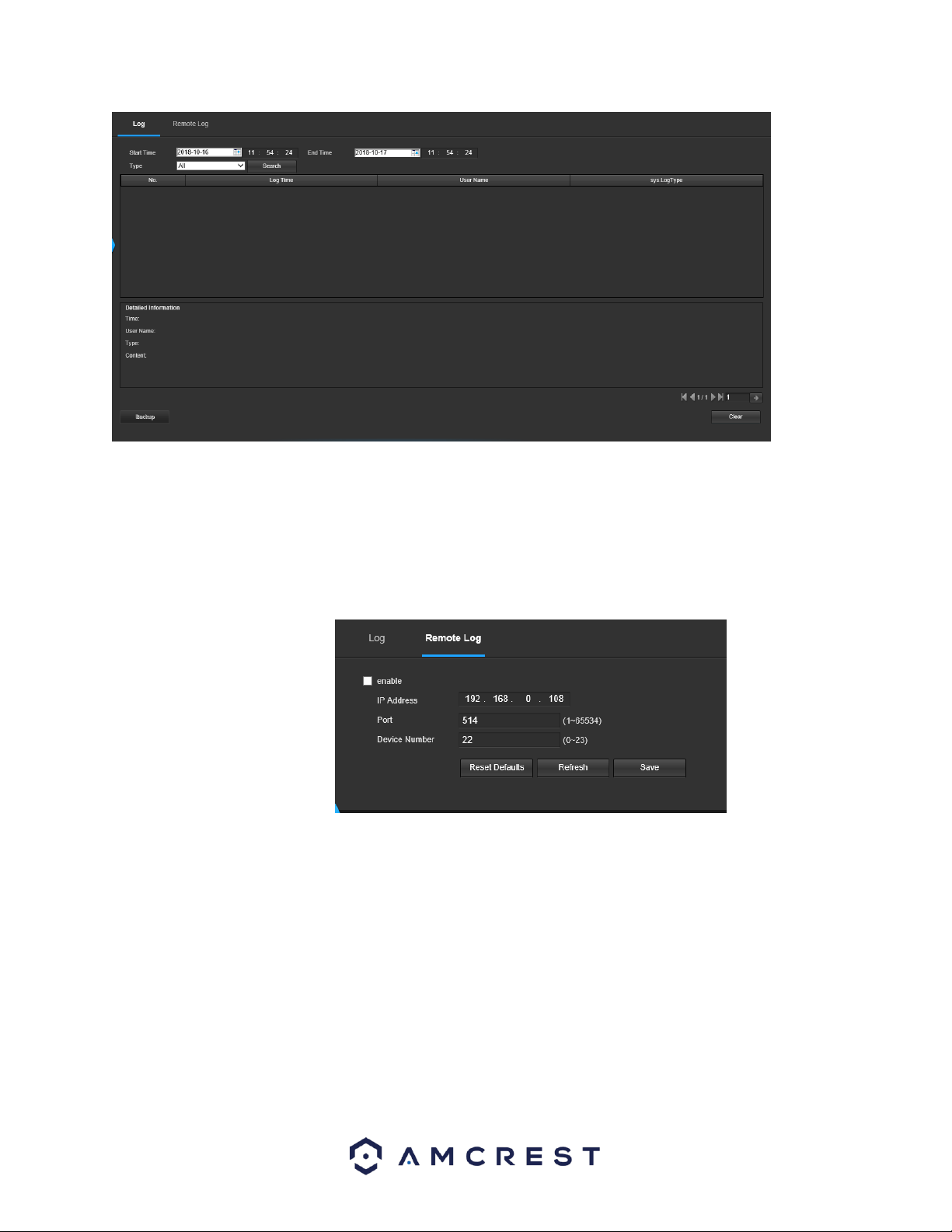
99
To view logs for a specific time period, modify the start time and end time fields, choose
the type of event (system, setting, data, event, record, manage users, clear log), and click
search.
To backup the log, click the Backup button. To clear the log, click the Clear button.
5.11.2.1. Remote Log
This tab allows the user to enable and access remote logs within the camera. Below is a screenshot of this menu:
To use this menu, check the enable check box to enable remote log functionality. Enter the IP address, port
number and device number of the device you would like to pull remote logs from.
To save your settings, click Save. If you would like to refresh the screen to show applied settings, click Refresh. To
set the screen back to its original default settings, click Reset Defaults.
5.11.3 Online Users
This screen allows the user to see which users are online. Below is a screenshot of the
Online Users screen:
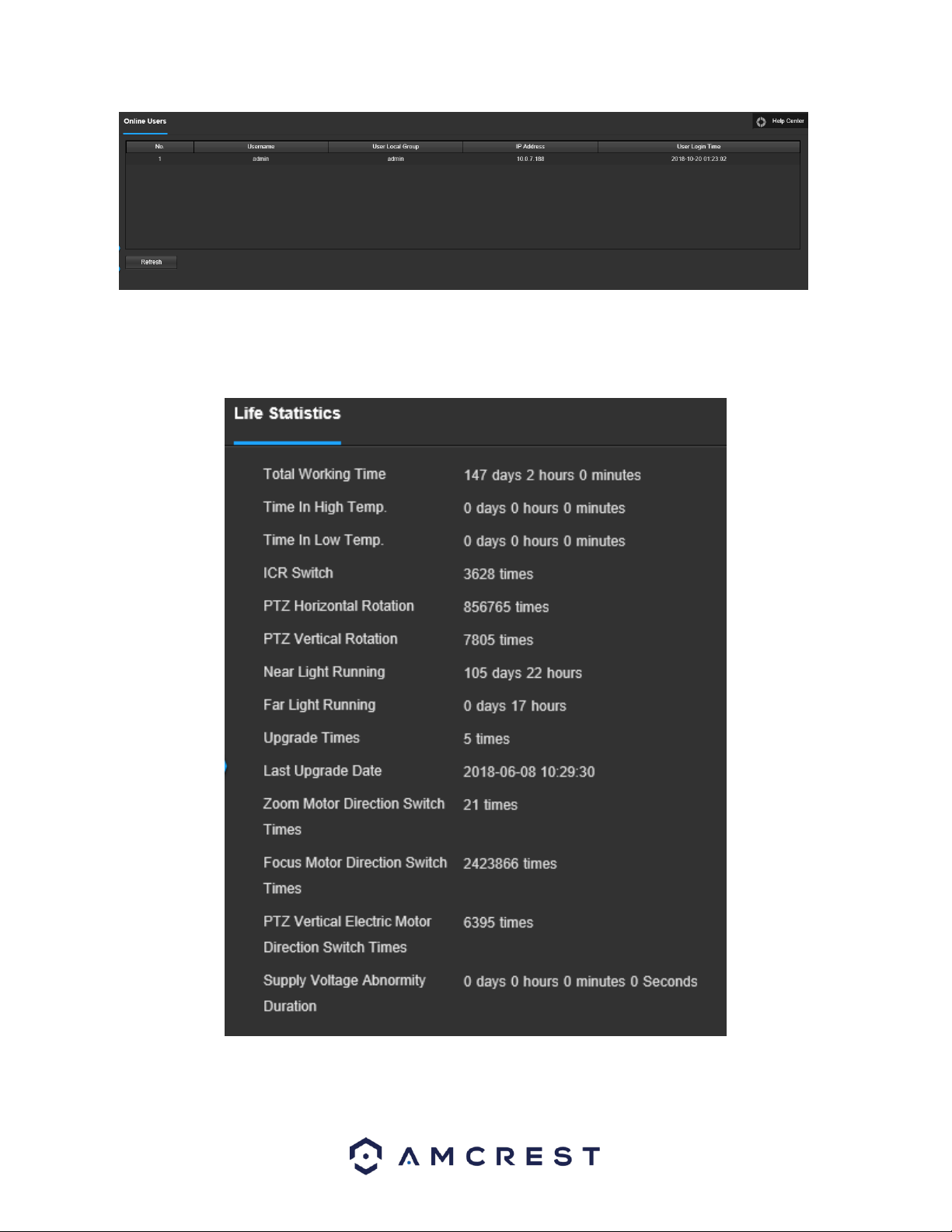
100
5.11.4. Life Statistics
This menu allows users to see full life details of the camera. Below is a screenshot of the
items found in this menu:
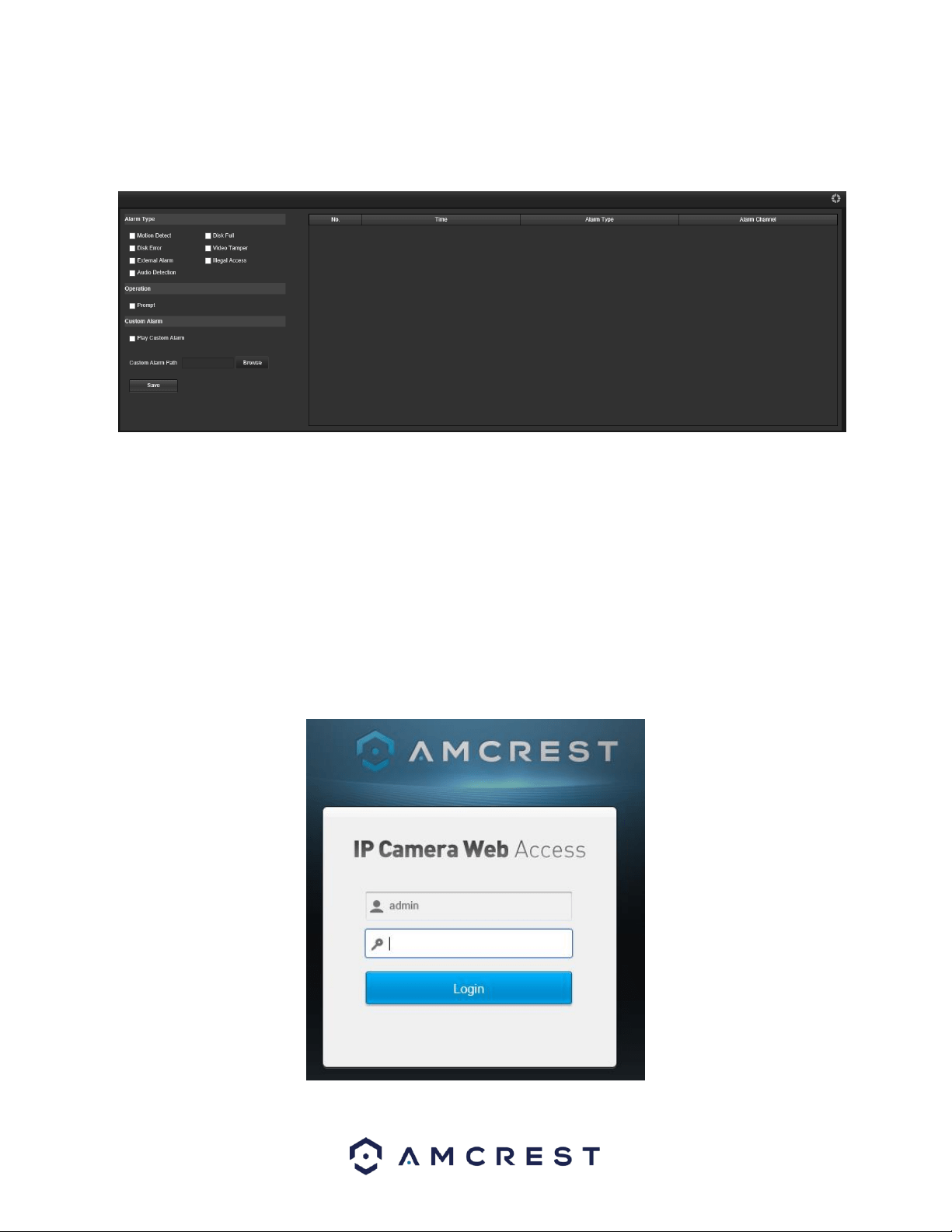
101
5.5 Alarm
This screen is where the alarm log is kept. Below is a screenshot of the alarm screen:
The table on the right shows the alarm log and all the alarm instances that have occurred.
The checkboxes allow the user to narrow down which alarms they want to see in the alarm
log. Clicking the checkbox next to Prompt will cause the system to pop up a dialog box
anytime an alarm is triggered.
Clicking the checkbox next to Play Custom Alarm will use a custom alarm sound for the
alarm prompt. Click the Browse button to search for a custom alarm sound to use.
5.6 Logout
Clicking the logout button will log out the user.

102
6. FAQs/Troubleshooting
1. The camera does not boot up properly.
Below are a few possible reasons why this may be occurring:
• The power input is not correct voltage.
• The power cable connection is not secured correctly.
• The firmware was upgraded incorrectly.
2. Camera often automatically shuts down or stops running.
Below are a few possible reasons why this may be occurring:
• The input voltage is too low or is not stable.
• The insides of the camera have accumulated too much dust.
• The temperature is either too hot or too cold.
• The hardware is malfunctioning.
3. Real-time video color is distorted.
Below are a few possible reasons why this may be occurring:
• The camera is not compatible with the monitor.
• The camera color or brightness settings are not correctly configured.
4. The timestamp is not displaying the correct time.
The time and date settings may not be configured correctly. You can take the following
steps to resolve the issue:
• Log into your camera’s web user interface via a laptop or PC.
• Navigate to Setup>>System>>General
• Click on the Date & Time tab.
• Click on PC Sync to sync the date and time.
• Click Save to save and apply the new date and time settings.
5. Motion detection does not work.
Below are a few possible reasons why this may be occurring:
• The motion detection time period may be incorrectly configured.
• Motion detection zone setup is not correctly configured.
• Motion detection sensitivity is too low.
6. Web Access isn't working.

103
Below are a few possible reasons why this may be occurring:
• Windows version is pre -Windows 2000 service pack 4. Use a more recent version
of Windows.
• ActiveX controls have been disabled.
• The PC is not using DirectX 8.1 or higher. Upgrade to a more recent version of
DirectX.
• The camera is having network connection errors.
• Web access may be setup incorrectly.
• The username or password may be incorrect.
7. Web Access live view is only displaying a static picture.
Below are a few possible reasons why this may be occurring:
• The network speed is not enough to transfer video data via web access.
• The client PC may have limited resources.
• Multicast mode may be causing this issue.
• A privacy mask or screensaver may be enabled.
• The logged in user may not have enough rights to monitor real-time playback.
• The camera’s local video output quality is not enough.
8. Network connection is not stable.
Below are a few possible reasons why this may be occurring:
• The network is not stable.
• There may be an IP address conflict.
• There may be a MAC address conflict.
• The PC or camera network card may be defective.
• The Ethernet cable is too long
9. The alarm signal cannot be disarmed.
Below are a few possible reasons why this may be occurring:
• An alarm may be setup incorrectly.
• An alarm output may have been manually opened.
• There may be an error in the camera’s firmware.
10. Alarms are not working.
Below are a few possible reasons why this may be occurring:
• The alarm is not setup correctly.

104
• The alarm cable is not connected correctly.
• The alarm input signal is not correctly configured.
• There are two loops connected to one alarm device.
11. Downloaded files cannot be played back.
Below are a few possible reasons why this may be occurring:
• The media player software on the PC may not be able to read the file format.
• The PC may not have DirectX 8.1 or higher.
• The PC may not have Windows XP or higher.
12. When I login via HTTPS, a dialogue says the certificate has expired or is not valid yet.
• Ensure the PC has the same time as the camera’s system time.
Glossary of Terms
• Abnormality – Any malfunction in terms of storage of data to the SD card.
• Alarm Delay – The gap in time between alarm activation and Relay alarm activation.
• Alternate Gateway – The node on the computer network that the network software uses when an IP address
does not match any other routes in the routing table, and when the default gateway is not available.
Anti-Dither – This time value controls how long the alarm signal lasts. The values in this field can range from 5
to 600 seconds. Based on motion detection, a buzzer can go off, a tour can begin, a snapshot can be taken, or
the camera can begin recording.
• DDNS – Stands for Dynamic Domain Name System. DDNS is a method of automatically updating a name
server in the Domain Name System (DNS), often in real time, with the active DNS configuration of its
configured hostnames, addresses or other information.
• Default Gateway – The node on the computer network that the network software uses when an IP address
does not match any other routes in the routing table.
• DHCP – Dynamic Host Configuration Protocol is a network protocol that enables a server to automatically
assign an IP address to a computer from a defined range of numbers (i.e., a scope) configured for a given
network.
• Fluency – Fluency described the lack of stuttering or excessive delay in a video stream. Fluency usually comes
at the expense of video quality when a network is constrained.
• IP Address – Internet Protocol Address is a unique numerical label assigned to each device connected to a
computer network. The IP address allows communication between different devices on a network.

105
• Main Stream – Main Stream is the main streaming protocol for the camera. Main stream uses more
bandwidth and attempts to keep quality and fluency high.
• NO/NC – Normally Open and Normally Closed are options for sensor type. These settings allow for different
exposure types when capturing video and still images.
• NTP – Network Time Protocol is a networking protocol for clock synchronization between computer systems
over packet-switched, variable-latency data networks.
• P2P – Peer-to-Peer is a decentralized communications model in which each party has the same capabilities
and either party can initiate a communication session.
• PPPoE – Point to Point Protocol over Ethernet is a network protocol for encapsulating Point to Point Protocol
data packets inside Ethernet frames.
• QR Code – Quick Response code is a type of digital barcode that enables devices to share complex data
strings quickly.
• Record Delay – Record Delay specifies in seconds how long the delay between alarm activation and recording
should be.
• Relay Out – Relay Out triggers a connected alarm (connected to the alarm port on the back of the camera)
when an alarm on the camera is triggered.
• S/N – S/N stands for serial number. The S/N is unique to each camera and can be used to connect to different
Amcrest apps and services to provide different methods of access to the camera.
• Sensitivity – Sensitivity is the amount of change required to increase the motion detected by a percentage.
The lower the sensitivity, the more movement is required to trigger an alarm.
• SMTP – Simple Main Transfer Protocol is an Internet standard for electronic mail (e-mail) transmission.
• Static IP – An IP address that does not change.
• Sub Stream – Sub Stream is an alternative streaming protocol for the camera. Sub stream uses less
bandwidth and attempts to keep fluency high at the expense of quality.
• Subnet Mask – a 32-bit number that masks an IP address, and divides the IP address into network address
and host address.
• TCP/IP – TCP/IP stands for Transmission Control Protocol/Internet Protocol and it is the language/protocol
that allows communication between internet connected devices, whether on a local network, or a on the
Internet at large.
• Threshold – Threshold is the level that the motion detection needs to reach to trigger an alarm.
• UPnP – UPnP stands for Universal Plug and Play, and it is a protocol used to easily connect devices to the
internet.

106
• Video Tamper – Video Tamper refers to any major changes happening to the video feed such as it being
blocked out, interfered with, or disconnected.
FCC Statement
1. This device complies with Part 15 of the FCC Rules. Operation is subject to the following two conditions:
(1) this device may not cause harmful interference, and (2) this device must accept any interference received,
including interference that may cause undesired operation.
2. The user’s manual or instruction manual for an intentional or unintentional radiator shall caution the user
that changes, or modifications not expressly approved by the party responsible for compliance could void the
user's authority to operate the equipment. In cases where the manual is provided only in a form other than
paper, such as on a computer disk or over the Internet, the information required by this section may be included
in the manual in that alternative form, provided the user can reasonably be expected to have the capability to
access information in that form.
3. (b) For a Class B digital device or peripheral, the instructions furnished the user shall include the following
or similar statement, placed in a prominent location in the text of the manual: NOTE: This equipment has been
tested and found to comply with the limits for a Class B digital device, pursuant to Part 15 of the FCC Rules. These
limits are designed to provide reasonable protection against harmful interference in a residential installation. This
equipment generates, uses and can radiate radio frequency energy and, if not installed and used in accordance
with the instructions, may cause harmful interference to radio communications. However, there is no guarantee
that interference will not occur in a particular installation. If this equipment does cause harmful interference to
radio or
television reception, which can be determined by turning the equipment off and on, the user is encouraged to try
to correct the interference by one or more of the following measures: -- Reorient or relocate the receiving
antenna. -- Increase the separation between the equipment and receiver. -- Connect the equipment into an
outlet on a circuit different from that to which the receiver is connected. -- Consult the dealer or an experienced
radio/TV technician for help.
4. RF exposure warning This equipment must be installed and operated in accordance with provided
instructions and the antenna(s) used for this transmitter must be installed to provide a separation distance of at
least 20 cm from all persons and must not be co-located or operating in conjunction with any other antenna or
transmitter.
End-users and installers must be provided with antenna installation instructions and transmitter operating
conditions for satisfying RF exposure compliance.

107
IC Warning Statement
TThis device complies with Industry Canada’s licence-exempt RSSs. Operation is subject to the following two
conditions: (1) This device may not cause interference; and (2) This device must accept any interference,
including interference that may cause undesired operation of the device. Le présent appareil est conforme aux
CNR d'Industrie Canada applicables aux appareils radio exempts de licence. L'exploitation est autorisée aux deux
conditions suivantes : (1) l'appareil ne doit pas produire de brouillage, et (2) l'utilisateur de l'appareil doit
accepter tout brouillage radioélectrique subi, même si le brouillage est susceptible d'en compromettre le
fonctionnement. This equipment complies with IC RSS-102 radiation exposure limits set forth for an
uncontrolled environment. This equipment should be installed and operated with a minimum distance of 20cm
between the radiator and any part of your body. Pour se conformer aux exigences de conformité CNR 102 RF
exposition, une distance de séparation d'au moins 20 cm doit être maintenue entre l'antenne de cet appareil
ettoutes les personnes.
Appendix A: Toxic or Hazardous Materials or Elements
Component
Name
Toxic or Hazardous Materials or Elements
Pb
Hg
Cd
Cr VI
PBB
PBDE
Sheet
Metal(Case)
○
○
○
○
○
○
Plastic Parts
(Panel)
○
○
○
○
○
○
Circuit Board
○
○
○
○
○
○
Fastener
○
○
○
○
○
○
Wire and
Cable/Ac
Adapter
○
○
○
○
○
○

108
Packing
Material
○
○
○
○
○
○
Accessories
○
○
○
○
○
○
O: Indicates that the concentration of the hazardous substance in all homogeneous materials in the parts is below
the relevant threshold of the SJ/T11363-2006 standard.
X: Indicates that the concentration of the hazardous substance of at least one of all homogeneous
materials in the parts is above the relevant threshold of the SJ/T11363-2006 standard. During the
environmental-friendly use period (EFUP) period, the toxic or hazardous substance or elements
contained in products will not leak or mutate so that the use of these (substances or elements) will
not result in any severe environmental pollution, any bodily injury or damage to any assets. The
consumer is not authorized to process such kind of substances or elements, please return to the
corresponding local authorities to process according to your local government statutes.
O: Indicates that the concentration of the hazardous substance in all homogeneous materials in the parts is
below the relevant threshold of the SJ/T11363-2006 standard.
X: Indicates that the concentration of the hazardous substance of at least one of all
homogeneous materials in the parts is above the relevant threshold of the SJ/T11363-2006
standard. During the environmental-friendly use period (EFUP) period, the toxic or hazardous
substance or elements contained in products will not leak or mutate so that the use of these
(substances or elements) will not result in any severe environmental pollution, any bodily injury
or damage to any assets. The consumer is not authorized to process such kind of substances or
elements, please return to the corresponding local authorities to process according to your local
government statutes.
Note:
• To view setup videos for many of the steps outlined in this guide, go to
http://amcrest.com/videos
• This user manual is for reference only. Slight differences may be found in the
user interface.
• All the designs and software here are subject to change without prior written
notice.
• All trademarks and registered trademarks mentioned are the properties of their
respective owners.
To contact Amcrest support, please do one of the following:

109
• Visit http://amcrest.com/contacts and use the email form
• Call Amcrest Support using one of the following numbers Toll Free US: (888) 212-
7538
International Callers (Outside of US): +1-713-893-8956
USA: 713-893-8956
Canada: 437-888-0177
UK: 203-769-2757
• Email Amcrest Customer Support [email protected]
Copyright Amcrest
©
2018