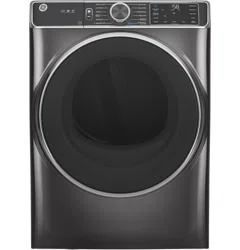
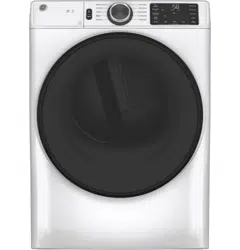
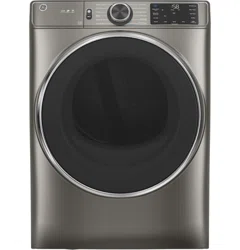
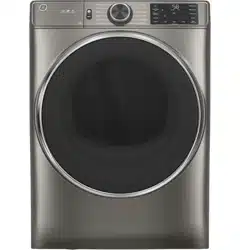
User Manual Dryer
Getting started
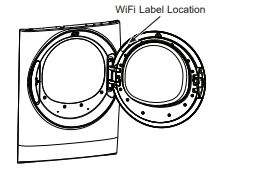
WiFi Connect (For customers in the United States only - on some models)
Your dryer is GE Appliances WiFi Connect enabled. Visit geappliances.com/connect and enter your model number to show you the proper steps to connect your appliance. Please visit GEAppliances.com/connect to learn more about connected appliance features, to learn what connected appliance app’s will work with your smartphone. WiFi Connectivity: For assistance with the appliance or the ConnectPlus network connectivity, please call GE Appliances at 800.GE.CARES.
Quick Start:
Step 1
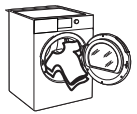
- Clean lint filter
- Loosely add items.
- Close door.
NOTE: Dryer will not start with door open.
Step 2
- If the screen is dark, press the Power pad to “wake up” the display

Step 3
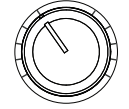
- Select a sensor dry cycle. (Defaults are set for each dry cycle. These default settings can be changed. See the cycle descriptions for more information.)
OR
- Select TIMED DRY and set Time, Temp and Level.
Step 4
- Press the Start/ Pause pad.

Features and appearance will vary.
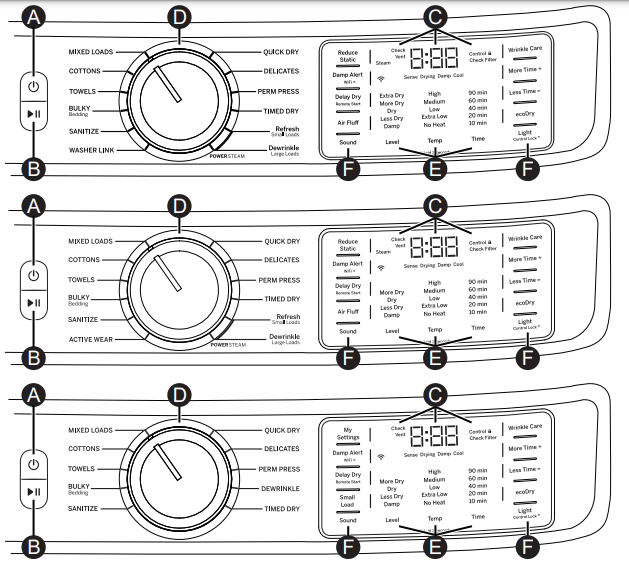
A. Power Press to “wake up” the display. If the display is active, press to put the dryer into idle mode.
NOTE: Pressing Power does not disconnect the appliance from the power supply.
B. Start and Pause Press Start to begin the cycle. NOTE: The door must be closed for the dryer to start the cycle. Pressing Start again will pause the cycle, the Start light will blink and “Pause” will display. To continue the cycle, press Start again.
C. Display and Status Lights The display shows the approximate time remaining until the end of the cycle and the dryer cycle status (Sense, Drying, Damp and Cool). In addition, the display will show:
 (WiFi) : Will allow your appliance to communicate with your smartphone for remote appliance monitoring control and notifications.
Controls  : The dryer is locked - will blink once if you press any pad or turn the cycle knob
Check Filter : The Check Filter light will stay on for 15 seconds after the cycle stops.
Check Vent : The Check Vent light indicates an issue has been found due to reduced airflow from a possible blocked or restricted vent. Checking and/or cleaning the vent system is recommended. See the, “Check Vent” light is on in the Troubleshooting Tips section.
D
Drying Cycles :
- Sensor cycles automatically determine fabric dryness.
- Timed cycles run for the selected time
MIXED LOADS : For loads consisting of cottons and poly-blends
COTTONS : For cottons and most linens. NOTE: ENERGY STAR® models are tested on COTTONS cycle with default settings (Temp setting on Low, Level setting on Dry, and ecoDry default on).
TOWELS : For most towels and linens.
BULKY : For large coats, bed spreads, mattress covers, sleeping bags, and similar large/bulky items such as blankets, comforters, jackets, and small rugs.
SANITIZE : This option reduces certain types of bacteria including: Staphylococcus aureus, Pseudomonas aeruginosa and Klebsiella pneumoniae. The anti-bacterial process occurs when high heat is used during a portion of the drying cycle; cool down also will be longer to protect you from a hot garment. NOTE: Do not use this cycle on delicate fabrics.
WASHER LINK (on some models) : When selected (and if connected to a compatible washer through WiFi communication) the dryer receives load information from the washer to automatically make cycle, dryness, temperature and time recommendations to optimize drying.
ACTIVE WEAR : Clothing worn for active sports exercise and some casual wear. Fabrics include new technology finishes and stretch fibers such as Spandex. Also for clothing labeled Easy Care or Perma Press: For wrinkle-free and permanent press items.
QUICK DRY : For small loads that are needed in a hurry, such as sport or school uniforms. Can also be used if the previous cycle left some items damp, such as collars or waistbands. NOTE: On some models, the time remaining in the cycle will show counting down in the display.
DELICATES : For delicate items, special-care fabrics and knits.
PERM PRESS : For wrinkle-free, permanent press and special sports items that need extra drying care.
DEWRINKLE : For removing wrinkles from items that are dry or slightly damp. This cycle is not recommended for delicate fabrics.
STEAM Dewrinkle (on some models) : For use with larger loads than STEAM Refresh. Ideal for loads left in the dryer for an extended time. STEAM Dewrinkle is recommended for larger loads (9-13 garments). NOTE: Steam cycles are not intended for use with towels. Important - the temperature setting must be set to High and water must be turned on before running the STEAM Dewrinkle cycle.
STEAM Refresh (on some models) : For slightly wrinkled dry garments. Significantly reduces wrinkles. After the STEAM Refresh cycle, the unit will beep (if Sound is selected) and display “00.” STEAM Refresh is recommended for small loads (3-5 garments). NOTE: Steam cycles are not intended for use with towels. NOTE: A single extremely light fabric item may need to have an additional item included in the STEAM Refresh cycle to achieve optimum results. Important - the temperature setting must be set to High and water must be turned on before running the STEAM Refresh cycle.
TIMED DRY : Use to set your own dry time. To use:
1. Turn cycle dial to TIMED DRY.
2. Increase the drying time by pressing the Time pad. NOTE: This pad only increases the time. When max time is reached, pressing the pad again will reset the counter to the lowest setting.
3. Select the Temp.
4. Close the door.
5. Press Start/Pause pad.
E
Settings
Individual settings for cycle minutes (Time), dryness level (Level) and temperature (Temp) can be set from the minimum (lowest in column) to maximum (highest in column). In general, the higher up the column, the more energy will be used. NOTE: The selected cycle set Time can be further adjusted, in one minute increments, by pressing the More Time + and Less Time - pads.
Dryness Level - Selection only used for Sensor cycles. Timed cycles run for the selected time.
Extra Dry: Use for heavy-duty fabrics or items that should be very dry, such as towels.
More Dry : Use for heavy-duty or mixed type fabrics.
Dry : Use for a normal dryness level suitable for most loads. This is the preferred cycle for energy savings.
Less Dry : Use for lighter fabrics.
Damp : For leaving items partially damp.
Temperature
High : For regular to heavy cottons. NOTE: STEAM Dewrinkle and STEAM Refresh require the High temperature setting.
Medium : For synthetics, blends, delicates and items labeled permanent press.
Low : For delicates, synthetics and items labeled tumble dry low.
Extra Low : For lingerie and special-care fabrics.
No Heat : For fluffing items without heat. For use only with the AIR FLUFF cycle.
F
Options
Reduce Static (on some models)
When selected, the dryer will spray a mist of water onto the load, at the end of the drying cycle, to reduce static. This option is not available with BULKY, SANITIZE or STEAM cycles.
Damp Alert (Damp Alert/WiFi pad)
This option causes the dryer to beep when clothes have dried to a damp level. Remove items that you wish to hang dry. The Damp Alert will only beep when this option is selected (but the dry cycle will keep running). Removing clothes and hanging them when they are damp, can reduce the need to iron some items.
Delay Dry
Press the Delay Dry pad to set the delay start time in 1 hour increments up to 24 hours, and then back to clear (0 hours). After selecting the delay start time, press Start and the delay time will count down the time remaining until the cycle starts. NOTE: To set the amount of delay time faster, you can press and hold the Delay Dry pad.
Delay Dry for WiFi Connected Dryers
You have two options to set Delay Dry using your smartphone.
Option 1: Follow Delay Dry instructions. You can use the GE Appliances Laundry App to adjust the amount of time via your smartphone.
Option 2 - Remote Start: Set your dryer to “AP” using the Delay Dry pad. This allows you to use the GE Appliances Laundry App via your smartphone to start your dryer remotely at the time of your choosing. If the dryer is set to AP with no activity, it will start the dryer 24 hours later.
Air Fluff (on some models)
Provides 10 minutes of tumbling time with no heat. NOTE: On models without AIR FLUFF cycle, select TIMED DRY and set Temp to No Heat.
Sound
Use the Sound pad to change the volume of the pad presses and the end of cycle signal. Press the pad until you reach the desired volume or off. The clothes should be removed when the end of cycle signal goes off so wrinkles do not set in. NOTE:
- Remove garments promptly at the sound of signal. Place clothes on hangers so wrinkles will not set in.
- Use the Sound especially when drying fabrics like polyester, knits and permanent press. These fabrics should be removed so wrinkles will not set in.
Wrinkle Care
Use this option to minimize the wrinkles in clothes. It provides 1 hour of no-heat tumbling after the clothes are dry. If you are using the cycle Sound and you select the Wrinkle Care option, a signal will sound at the end of the drying time and several times during the Wrinkle Care cycle. This will remind you that it is time to remove the clothes.
More Time + / Less Time -
The selected cycle set Time can be further adjusted, in one minute increments, by pressing the More Time + and Less Time - pads.
ecoDry
Available for BULKY, TOWELS, COTTONS, MIXED LOADS, ACTIVE WEAR and DELICATES. When the ecoDry pad is pressed, cycle settings change to reduce the total energy consumption of the selected sensor cycle. NOTE: Cycle times will change when ecoDry is selected. The ecoDry option will default to on for COTTONS. For optimal energy savings, turn ecoDry on. For optimal drying times, turn ecoDry off. NOTE: Energy savings will vary across loads and cycles.
Light
The drum light will turn on if the Light pad is pressed or the door is opened. It will turn off when the door is shut, the Light pad is pressed again or after 5 minutes if the door is left open.
Small Load (on some models)
Select to use for a small load with any sensor cycle (except SANITIZE).
My Settings
As the cycle selector knob is turned, the Time (timed dry), Level (dryness level) and Temp (temperature) settings change to automatic pre-set default settings. If you desire a different setting, press the appropriate pad(s). Then press and hold the My Settings pad for 3 seconds and the dryer will “remember” these settings for that Knob Selection. In the future, when you turn the selector knob to that cycle, your settings will be automatically recalled. NOTE: Signal sound cannot be set for My Settings.
Control Lock
You can lock the controls to prevent any selections from being made. Or you can lock the controls after you have started a cycle. Children cannot accidentally start the dryer by touching pads with this option selected. To lock/unlock the dryer controls, press and hold the Light pad for 3 seconds. The control lock icon will flash while locking/unlocking, stay on when locked, and turn off when unlocked. NOTE: The Power pad can still be used when the machine is locked.
WiFi (Damp Alert/WiFi pad)
Press and hold the Damp Alert/WiFi pad for 3 seconds to activate.
Loading
Sorting and Loading Hints
As a general rule, if clothes are sorted properly for the washer, they are sorted properly for the dryer. Try also to sort items according to size. For example, do not dry a sheet with socks or other small items. Do not add fabric softener sheets once the load has become warm. They may cause fabric softener stains. Bounce® Fabric Conditioner Dryer Sheets have been approved for use in this dryer when used in accordance with the manufacturer’s instructions. Do not overload. This wastes energy and causes wrinkling.
Drying Rack (on some models)
A handy drying rack may be used for drying delicate items such as washable sweaters. To install the drying rack, place the rack all the way into the dryer drum and fit its feet down and securely into place in the dryer.
NOTES:
- The drying rack must be used with the TIMED DRY cycle. Use with sensor cycles may result in damp items or extended cycle times.
- Do not use this drying rack when there are other clothes in the dryer.
- If your model did not come with a drying rack, order WE02X29449 on-line at GEApplianceparts.com, 24 hours a day or by phone at 877.959.8688 during normal business hours

Care and cleaning
Interior and Duct
The interior of the appliance and exhaust duct should be cleaned once a year by qualified service personnel. The Exhaust Duct: Inspect and clean the exhaust ducting at least once a year to prevent clogging. A partially clogged exhaust can lengthen the drying time.
Follow these steps:
1 Turn off electrical supply by disconnecting the plug from the wall socket.
2 Disconnect the duct from the dryer.
3 Vacuum the duct with the hose attachment and reconnect the duct.
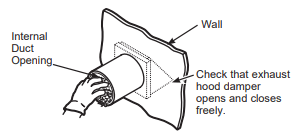
The Exhaust Hood: Check with a mirror that the inside flaps of the hood move freely when operating. Make sure that there is no wildlife (birds, insects, etc.) nesting inside the duct or hood.
Exterior
Wipe or dust any spills or washing compounds with a damp cloth. Dryer control panel and finishes may be damaged by some laundry pretreatment soil and stain remover products. Apply these products away from the dryer. The fabric may then be washed and dried normally. Damage to your dryer caused by these products is not covered by your warranty.
Lint Filter
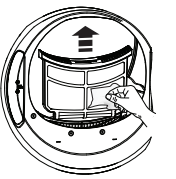
Clean the lint filter before each use. Remove by pulling straight up. Run your fingers across the filter. A waxy buildup may form on the lint filter from using dryer added fabric softener sheets. To remove this buildup, wash the lint screen in warm, soapy water. Dry thoroughly and replace. Vacuum the lint from the dryer lint filter area if you notice a change in dryer performance. NEVER OPERATE THE DRYER WITHOUT ITS FILTER IN PLACE.
Stainless Steel
To clean stainless steel surfaces use a damp cloth with a mild, non-abrasive cleaner suitable for stainless steel surfaces. Remove the cleaner residue and then dry with a clean cloth. The stainless steel used to make the dryer drum provides the highest reliability available in a GE Appliances dryer. If the dryer drum should be scratched or dented during normal use, the drum will not rust or corrode. These surface blemishes will not affect the function or durability of the drum.
Drum Light
The drum light is an LED light. Replacement must be done by a qualified technician.
Installation Instructions
UNPACKING YOUR DRYER
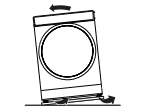
Tilt the dryer sideways and remove the foam shipping pads by pulling at the sides and breaking them away from the dryer legs. Be sure to remove all of the foam pieces around the legs. Remove the bag containing the literature.
DRYER DIMENSIONS
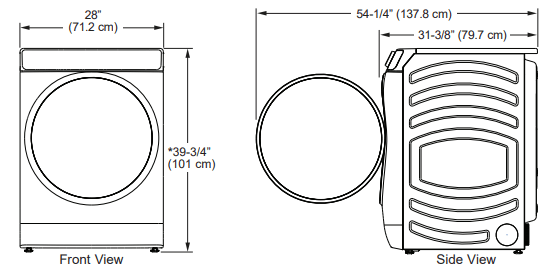
*NOTE:
With leveling legs retracted: 39-3/4 (101 cm).
With leveling legs fully extended: 40-5/8 (103.1 cm).
With Optional Pedestal: 55-1/2” (141 cm) Min. - 56-5/8” (143.8 cm) Max. Stacked: 79-1/8” (201 cm).
STEAM WATER HOSES (for steam dryer models only):
GE Appliances strongly recommends the use of factory specified parts. These hoses are manufactured and tested to meet GE Appliances specifications. GE Appliances strongly recommends the use of new water supply hoses. Hoses degrade over time and need to be replaced every 5 years to reduce the risk of hose failures and water damage. Parts and Accessories Order on-line at GEApplianceparts.com, 24 hours a day or by phone at 877.959.8688 during normal business hours.
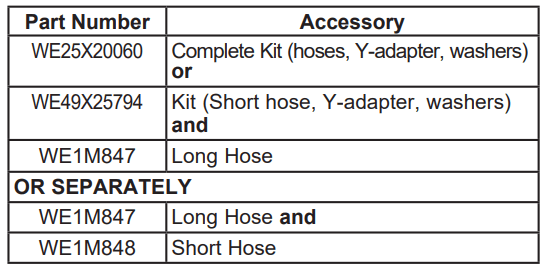
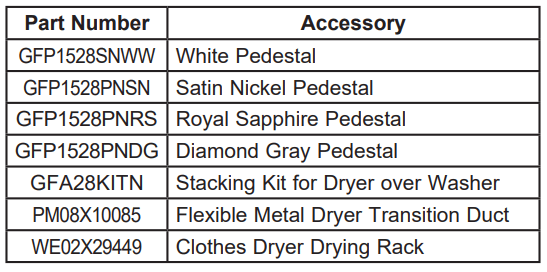
ACCESSORIES:
Order on-line at GEApplianceparts.com, 24 hours a day or by phone at 877.959.8688 during normal business hours.
REQUIREMENTS FOR ALCOVE OR CLOSET INSTALLATION
- The dryer MUST be vented to the outdoors.
- Minimum clearance between dryer cabinet and adjacent walls or other surfaces is:
0” either side*
0” front
0” rear
0” top
*For improved performance, a 1/2” clearance is suggested on each side.
- The rear of the dryer should face a wall.
- Consideration must be given to provide adequate clearance for installation and service.
- Closet doors must be louvered or otherwise ventilated and have at least 60 square inches of open area. If the closet contains both a washer and a dryer, doors must contain a minimum of 120 square inches of open area.
NOTE: WHEN THE EXHAUST DUCT IS LOCATED AT THE REAR OF THE DRYER, THE CONFIGURATION OF THE DUCTING MAY REQUIRE GREATER CLEARANCE.
Gas Dryers Only:
- No other fuel burning appliance shall be installed in the same closet as a gas dryer.
- The dryer must be disconnected from the gas supply piping during pressure testing at pressures greater than 1/2 psi (3.5 kPa).
- A 1/8 inch NPT minimum plugged tapping, accessible for test gauge connection, must be installed immediately upstream of the gas supply connection to the dryer.
MINIMUM CLEARANCE OTHER THAN ALCOVE OR CLOSET INSTALLATION
Minimum clearance to combustible surfaces and for air opening are: 0” both sides*, 0” rear and 0” top. *For improved performance, a 1/2” clearance is suggested on each side. The rear of the dryer should face a wall. Consideration must be given to provide adequate clearance for installation and service.
MOBILE OR MANUFACTURED HOME INSTALLATION
- Installation MUST conform to the MANUFACTURED HOME CONSTRUCTION AND SAFETY STANDARD, TITLE 24, PART 3280 or STANDARD FOR MOBILE HOMES CAN/CSA-Z240 MH, or, when such standards are not applicable, with AMERICAN NATIONAL STANDARD FOR MOBILE HOME, ANSI/NFPA NO. 501B.
- The dryer MUST be vented to the outdoors.
- The exhaust vent MUST be securely fastened to a non-combustible portion of the mobile home.
- The vent MUST NOT be terminated beneath a mobile or manufactured home.
- The vent duct material MUST BE METAL.
- KIT 14-D346-33 MUST be used to attach the dryer securely to the structure.
- The vent MUST NOT be connected to any other duct, vent or chimney.
- DO NOT use sheet metal screws or other fastening devices which extend into the interior of the exhaust vent.
- Provide an opening with a free area of at least 25 square inches for introduction of outside air into the dryer room.
- See the sections for electrical connection information.
CONNECTING INLET HOSES (for steam dryer models only)
CONNECTING INLET HOSES
To produce steam, the dryer must connect to the cold water supply. Since the washer must also connect to the cold water, a “Y” connector is inserted to allow both inlet hoses to make that connection at the same time.
NOTE: Use new inlet hoses; never use old hoses.
1. Turn the cold water faucet off. Remove the washer inlet hose from the washer fill valve connector (cold).
2. Ensure the rubber flat washer is in place and attach one female coupling of the short hose provided onto the washer fill valve connector. Tighten by hand until firmly seated.
3. Attach one male end of the “Y” connector to the other female coupling of the short hose. Ensure the rubber flat washer is in place. Tighten by hand until firmly seated.
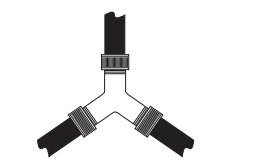
4. Insert the filter screen in the coupling of the washer’s inlet hose. If a rubber flat washer is already in place remove it before installing the filter screen. Attach this coupling to one male end of the ‘’Y’’ connector. Tighten by hand until firmly seated.
5. Ensure the rubber flat washer is in place and attach a 4 ft. to 6 ft. long water inlet hose (may need to be purchased separately) to one male end of the ‘’Y’’ connector. Tighten by hand until firmly seated.
6. Ensure the rubber flat washer is in place and attach the other end of the dryer’s long inlet hose to the fill valve connector at the bottom of the dryer back panel. Tighten by hand until firmly seated.
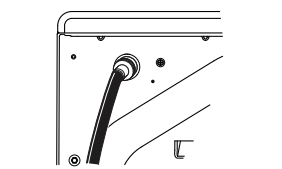
7. Using pliers, tighten all the couplings with an additional two–thirds turn.
NOTE: Do not overtighten. Damage to the couplings may result.
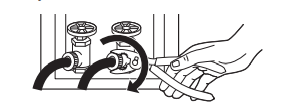
8. Turn the water faucet on.
9. Check for leaks around the ‘’Y’’ connector, faucet and hose couplings.
WATER SUPPLY REQUIREMENTS
Hot and cold water faucets MUST be installed within 42 in. (107 cm) of your washer’s water inlet. The faucets MUST be 3/4 in. (1.9 cm) garden hose-type so inlet hoses can be connected. Water pressure MUST be between 10 and 120 pounds per square inch. Your water department can advise you of your water pressure.
NOTE: A water softener is recommended to reduce buildup of scale inside the steam generator if the home water supply is very hard.
CONNECTING A GAS DRYER (skip for electric dryers)
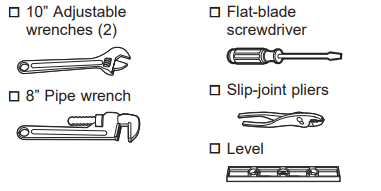
TOOLS YOU WILL NEED
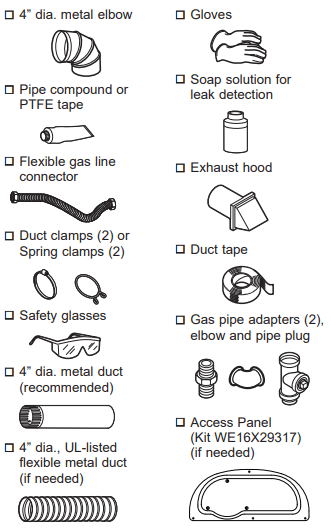
MATERIALS YOU WILL NEED
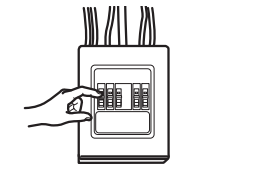
- Before beginning the installation, turn off the circuit breaker(s) or remove the dryer’s circuit fuse(s) at the electrical box. Be sure the dryer cord is unplugged from the wall.
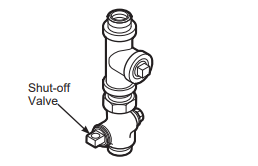
- Turn the dryer’s gas shut-off valve in the supply line to the OFF position.
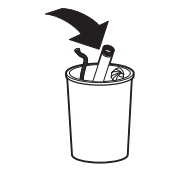
- Disconnect and discard old flexible gas connector and ducting material.
GAS REQUIREMENTS
- The installation must conform with local codes, or in the absence of local codes, with the National Fuel Gas Code, ANSI Z223.1/ NFPA 54, or the Natural Gas and Propane Installation Code, CSA B149.1.
DRYER GAS SUPPLY CONNECTION
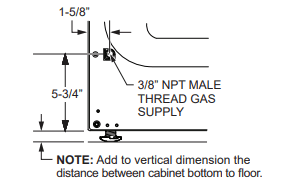
You must use with this dryer a flexible metal connector (listed connector ANSI Z21.24 / CSA 6.10). The length of the connect shall not exceed 4 ft.
GAS SUPPLY
- A 1/8” National Pipe Taper thread plugged tapping, accessible for test gauge connection, must be installed immediately upstream of the gas supply connection to the dryer. Contact your local gas utility should you have questions on the installation of the plugged tapping.
- Supply line is to be 1/2” rigid pipe and equipped with an accessible shutoff within 6 feet of, and in the same room with, the dryer.
- Use pipe thread compound appropriate for natural or LP gas or use PTFE tape.
- Connect flexible metal connector to dryer and gas supply.
ADJUSTING FOR ELEVATION
- Gas clothes dryers input ratings are based on sea level operation and need not be adjusted for operation at or below 2000 ft. elevation. For operation at elevations above 2000 ft., input ratings should be reduced at a rate of 4 percent for each 1000 ft. above sea level.
- Installation must conform to local codes and ordinances or, in their absence, the NATIONAL FUEL GAS CODE, ANSI Z223.
CONNECTING THE DRYER TO THE GAS SUPPLY
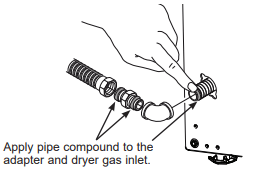
A. Install a female 3/8” NPT elbow at the end of the dryer gas inlet. Install a 3/8” flare union adapter to the female elbow.
IMPORTANT: Use a pipe wrench to securely hold on to the end of the dryer gas inlet to prevent twisting the inlet.
NOTE: Apply pipe compound or PTFE tape to the threads of the adapter and dryer gas inlet.
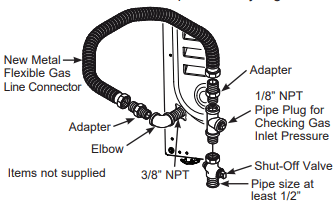
B. Attach the flexible metal gas line connector to the adapter.
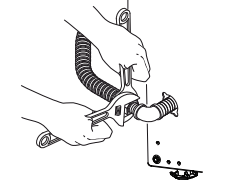
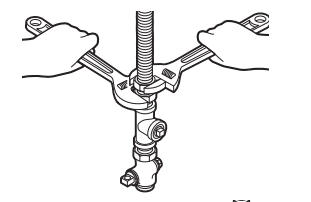
C. Tighten the flexible gas line connection, using two adjustable wrenches.
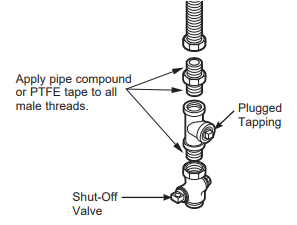
D. Install a 1/8” NPT plugged tapping to the dryer gas line shut-off valve for checking gas inlet pressure. Install a flare union adapter to the plugged tapping.
NOTE: Apply pipe compound or PTFE tape to the threads of the adapter and plugged tapping
E. Tighten all connections, using two adjustable wrenches. Do not overtighten
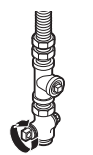
F. Open the gas shut-off valve.
TEST FOR LEAKS
Never use an open flame to test for gas leaks.
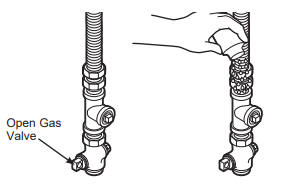
Check all connections for leaks with soapy solution or equivalent. Apply a soap solution. The leak test solution must not contain ammonia, which could cause damage to the brass fittings. If leaks are found, close the valve, retighten the joint and repeat the soap test.
ELECTRICAL CONNECTION INFORMATION FOR GAS DRYERS
- Circuit – Individual properly polarized and grounded 15 or 20 amp circuit breaker or time-delay fuse.
- Power Supply – 2-wire plus ground, 120 Volt, single phase, 60 Hz, alternating current.
- Outlet Receptacle – Properly grounded 3-prong receptacle to be located so the power cord is accessible when the dryer is in an installed position. If a 2-prong receptacle is present, it is the owner’s responsibility to have a licensed electrician replace it with a properly grounded 3-prong grounding type receptacle.
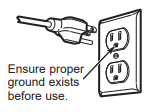
- Dryer must be electrically grounded in accordance with local codes and ordinances, or in the absence of local codes, with the latest edition of the NATIONAL ELECTRICAL CODE, ANSI/NFPA NO. 70 or CANADIAN ELECTRICAL CODE, CSA C22.1. Check with a licensed electrician if you are not sure that the dryer is properly grounded.
- If required by local codes, an external 18 gauge or larger copper ground wire (not provided) may be added. Attach to dryer cabinet with a #8-18 x ½” sheet metal screw (available at any hardware store) to rear of dryer as illustrated.
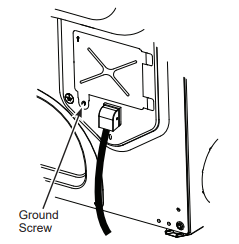
GROUNDING INSTRUCTIONS
This dryer must be grounded. In the event of a malfunction or breakdown, grounding will reduce the risk of electric shock by providing a path of least resistance for electric current. This dryer uses a cord having an equipment-grounding conductor and a grounding plug. The plug must be plugged into an appropriate outlet that is properly installed and grounded in accordance with all local codes and ordinances.
Warning : Improper connection of the equipment-grounding conductor can result in a risk of electric shock. Check with a qualified electrician, or service representative or personnel, if you are in doubt as to whether the appliance is properly grounded. DO NOT modify the plug on the power supply cord. If it will not fit the outlet, have a proper outlet installed by a qualified electrician.
CONNECTING AN ELECTRIC DRYER (Skip for gas dryers and if your dryer already has a power cord attached)
TOOLS YOU WILL NEED
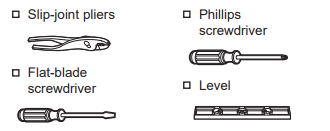
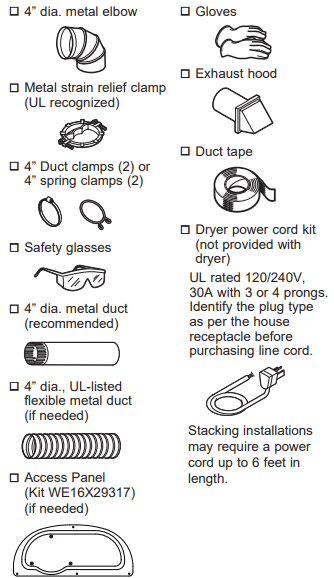
MATERIALS YOU WILL NEED
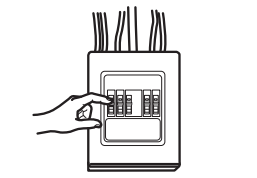
Before making the electrical connection, turn off the circuit breaker(s) or remove the dryer’s circuit fuse(s) at the electrical box. Be sure the dryer cord is unplugged from the wall. NEVER LEAVE THE ACCESS COVER OFF THE TERMINAL BLOCK.
POWER CORDS
GE Appliances strongly recommends the use of factory specified parts. Select the power cord to fit your installation requirements.
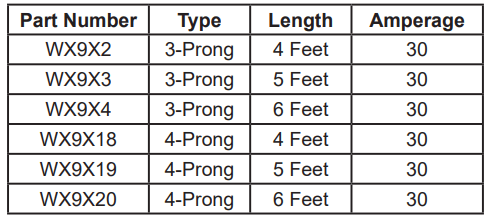
ELECTRICAL CONNECTION INFORMATION FOR ELECTRIC DRYERS
For electrical connections using a power cord:
Use a new UL-listed 240V 30 amp dryer power supply cord with closed ring terminals or spade terminals with upturned ends. Use a UL-listed strain relief. Disconnect power before making electrical connections. Connect neutral wire (white or center wire) to center terminal. Ground wire (green or bare wire) must be connected to green ground connector. Connect remaining two supply wires to remaining two terminals. Securely tighten all electrical connections. Replace the terminal block cover. Failure to do so can result in death, fire or electrical shock.
GROUNDING INSTRUCTIONS
For a grounded, cord-connected dryer: This dryer must be grounded. In the event of a malfunction or breakdown, grounding will reduce the risk of electric shock by providing a path of least resistance for electric current. This dryer uses a cord having an equipment-grounding conductor and a grounding plug. The plug must be plugged into an appropriate outlet that is properly installed and grounded in accordance with all local codes and ordinances.
Warning : Improper connection of the equipment-grounding conductor can result in a risk of electric shock. Check with a qualified electrician, or service representative or personnel, if you are in doubt as to whether the appliance is properly grounded. DO NOT modify the plug on the power supply cord. If it will not fit the outlet, have a proper outlet installed by a qualified electrician
For direct wire connections:
Use 10 gauge copper wire. Use a UL-listed strain relief. Disconnect power before making electrical connections. Connect neutral wire (white or center wire) to center terminal. Ground wire (green or bare wire) must be connected to green ground connector. Connect remaining two supply wires to remaining two terminals. Securely tighten all electrical connections. Replace the terminal block cover. Failure to do so can result in death, fire or electrical shock.
GROUNDING INSTRUCTIONS
For a permanently connected dryer: This dryer must be connected to a grounded metal, permanent wiring system, or an equipment-grounding conductor must be run with the circuit conductors and connected to the equipment-grounding terminal on the appliance.
Warning : Improper connection of the equipment-grounding conductor can result in a risk of electric shock. Check with a qualified electrician, or service representative or personnel, if you are in doubt as to whether the appliance is properly grounded.
CONNECTING DRYER USING 4-WIRE CONNECTION (MUST BE USED FOR MOBILE HOME INSTALLATION)
NOTE: Since January 1, 1996, the National Electrical Code requires that new constructions use a 4-wire connection to an electric dryer. A 4-wire cord must also be used where local codes do not permit grounding through the neutral. 3-wire connection is NOT for use on new construction
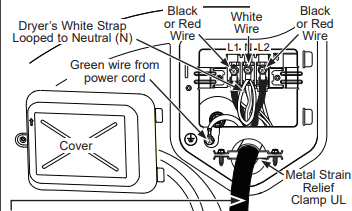
4 #10 AWG minimum copper conductors or 120/240V 30A power supply cord kit marked for use with dryers and provided with closed loop or spade terminals with upturned ends (not supplied).
1. Turn off the circuit breaker(s) (30 amp) or remove the dryer’s circuit fuse at the electrical box.
2. Be sure the dryer cord is unplugged from the wall receptacle.
3. Remove the power cord cover located at the lower back.
4. Remove green ground screw and retain for use in Step 7. Leave one end of the short white strap loose until Step 6. Remove center screw (marked N) in terminal block.
5. Place the UL-recognized metal strain relief clamp to power cord entry hole. Bring power cord through strain relief clamp.
6. Connect power cord as follows: A. Connect the 2 hot lines to the outer screws of the terminal block (marked L1 and L2). B. Connect the neutral (white) line and the loose end of the short white strap to the center of the terminal block (marked N).
7. Attach ground wire of power cord with the green ground screw (hole to left of strain relief clamp). Tighten all terminal block screws (3) securely.
8. Properly secure power cord to strain relief clamp.
9. Reinstall the cover
CONNECTING DRYER USING 3-WIRE CONNECTION
If required, by local code, install external ground (not provided) to grounded metal, cold water pipe, or other established ground determined by a qualified electrician.
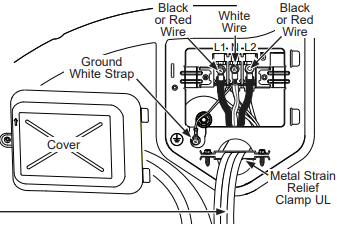
3 #10 AWG minimum copper conductors or 120/240V 30A power supply cord kit marked for use with dryers and provided with closed loop or spade terminals with upturned ends (not supplied)
3-wire Connection
Not for use in Canada.
DO NOT use for Mobile Home Installations.
NOT for use on new construction.
NOT for use on recreational vehicles.
NOT for use in areas where local codes prohibit grounding through the neutral conduction.
1. Turn off the circuit breaker(s) (30 amp) or remove the dryer’s circuit fuse at the electrical box.
2. Be sure the dryer cord is unplugged from the wall receptacle.
3. Remove the power cord cover located at the lower back.
4. Place the UL-recognized metal strain relief clamp to power cord entry hole. Bring power cord through strain relief clamp.
5. Connect power cord as follows: A. Connect the 2 hot lines to the outer screws of the terminal block (marked L1 and L2). B. Connect the neutral (white) line to the center of the terminal block (marked N).
6. Be sure ground white strap is connected to green ground screw on cabinet rear. Tighten all terminal block screws (3) securely.
7. Properly secure power cord to strain relief clamp.
8. Reinstall the cover.
EXHAUSTING THE DRYER
TOOLS AND MATERIALS YOU WILL NEED TO INSTALL EXHAUST DUCT
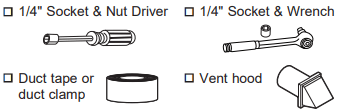
PARTS AVAILABLE FROM GEAPPLIANCEPARTS.COM OR LOCAL SERVICE ORGANIZATIONS
WE16X29317 Dryer Venting Kit
PM8X85 Outdoor exhaust hood
WX08X10130 4” Dryer exhaust clamp
CONNECTING THE DRYER TO HOUSE VENT
RIGID METAL TRANSITION DUCT
- For best drying performance, a rigid metal transition duct is recommended.
- Rigid metal transition ducts reduce the risk of crushing and kinking.
UL-LISTED FLEXIBLE METAL CLOTHES DRYER TRANSITION DUCT
- If rigid metal cannot be used, then UL-listed flexible metal clothes dryer transition duct (GE Appliances part – PM08X10085) can be used.
- Never install transition duct in walls, ceilings, floors or other enclosed spaces.
- Total length of transition duct should not exceed 8’ (2.4 m).
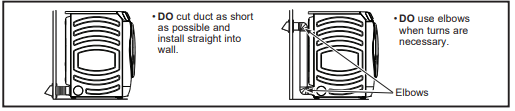
- For many applications, installing elbows at both the dryer and the wall is highly recommended (see illustrations in next section). Elbows allow the dryer to sit close to the wall without kinking and/or crushing the transition duct, maximizing drying performance.
- Avoid resting the duct on sharp objects.
UL-LISTED FLEXIBLE METAL (FOIL-TYPE) TRANSITION DUCT
- In special installations, it may be necessary to connect the dryer to the home exhaust vent using flexible metal (foil-type) transition duct. UL– LISTED universal flexible dryer transition duct (GE Appliances parts – PM8X73 or WX8X73) may be used ONLY in installations where rigid metal or flexible metal transition ducting cannot be used AND where a 4” diameter can be maintained throughout the entire length of the transition duct.
- In Canada and the United States, only transition ducts that comply with “UL 2158A STANDARD FOR CLOTHES DRYER TRANSITION DUCT” shall be used.
- Avoid resting the duct on sharp objects.
- For best drying performance:
1. Slide one end of the duct over the clothes dryer outlet pipe.
2. Secure the duct with a clamp.
3. With the dryer in its permanent position, extend the duct to its full length. Allow 2” of duct to overlap the exhaust pipe. Cut off and remove excess duct. Keep the duct as straight as possible for maximum airflow.
4. Secure the duct to the exhaust pipe with the other clamp.

EXHAUST LENGTH
Using exhaust longer than specified length will: • Increase the drying times and the energy cost.
- Reduce the dryer life.
- Accumulate lint, creating a potential fire hazard.
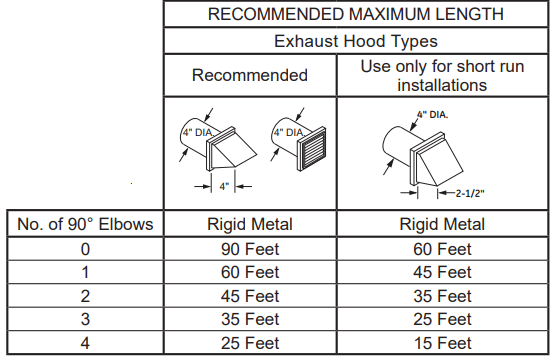
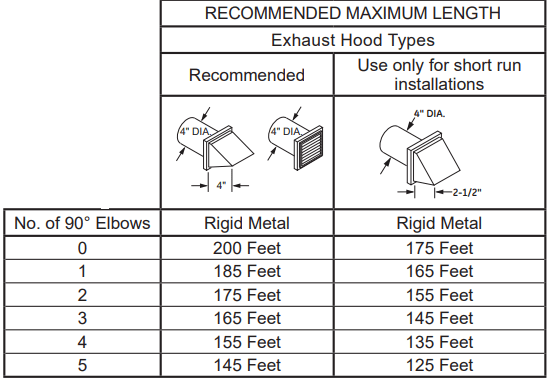
The correct exhaust installation is YOUR RESPONSIBILITY. Problems due to incorrect installation are not covered by the warranty. The MAXIMUM ALLOWABLE length of the exhaust system depends upon the type of duct, number of turns, the type of exhaust hood (wall cap) and all conditions noted on the chart.
- Internal elbows added for side or bottom vent conversions must be included in the total elbow count.
- Any elbow greater than 45° should be treated as a 90° elbow; one elbow of 45° or less may be ignored.
- Two 45° elbows will be treated like one 90° elbow.
- For the side exhaust installations, add one 90° elbow to the chart.
- For every additional 90° elbow, reduce the allowable vent system length by 10 feet.
- When calculating the total vent system length, you must add all the straight portions and elbows of the system (including the transition duct).
EXHAUST SYSTEM CHECKLIST
HOOD OR WALL CAP
- Terminate in a manner to prevent back drafts or entry of birds or other wildlife.
- Termination should present minimal resistance to the exhaust airflow and should require little or no maintenance to prevent clogging.
- Wall caps must be installed at least 12” above ground level or any other obstruction with the opening pointed down.
SEPARATION OF TURNS
- For best performance, separate all turns by at least 4 ft. of straight duct, including distance between last turn and dampened exhaust hood (wall cap).
SEALING OF JOINTS
- All joints should be tight to avoid leaks. The male end of each section of duct must point away from the dryer.
- Duct joints should be made air- and moisture-tight by wrapping the overlapped joints with duct tape or aluminum tape.
- Do not assemble ductwork with any fasteners that extend into the duct. These fasteners can accumulate lint, creating a potential fire hazard.
- Horizontal runs should slope down towards the outdoors 1/4” per foot.
- Provide an access for inspection and cleaning of the exhaust system, especially at turns and joints. Exhaust system shall be inspected and cleaned at least once a year.
INSULATION
- Ductwork that runs through an unheated area or is near air conditioning should be insulated to reduce condensation and lint build-up.
BEFORE YOU BEGIN
- Remove and discard existing plastic or metal foil duct and replace with UL-listed duct.
- Remove any lint from the wall exhaust opening.
STANDARD REAR EXHAUST
We recommend that you install your dryer before installing your washer. This will permit direct access for easier exhaust connection. Slide the end of the exhaust duct on the back of the dryer and secure with duct tape or a hose clamp.
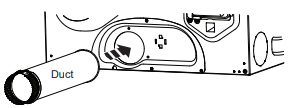
NOTE: We strongly recommend using rigid metal exhaust duct. However, if flexible ducting is used it must be UL-Listed metal, not plastic.
• For straight line installation, connect the dryer exhaust to the external exhaust hood using duct tape or clamp.
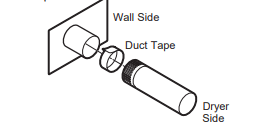
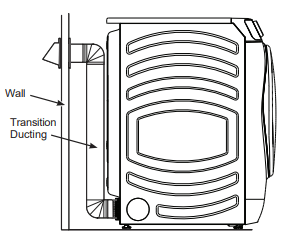
RECOMMENDED CONFIGURATION TO MINIMIZE EXHAUST BLOCKAGE
Using duct elbows will prevent duct kinking and collapsing.
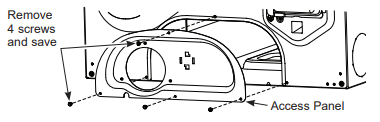
SIDE VENTING
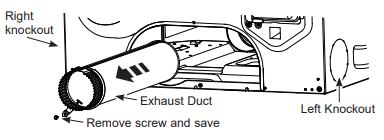
- Remove the 4 screws that secure the access panel and save. Remove the access panel.
- Detach and remove the right or left side knockout as desired. Remove the screw that secures the dryer exhaust duct and save. Pull the exhaust duct out of the drye
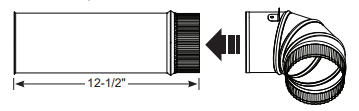
- Locate the 12-1/2” exhaust duct and elbow duct from the kit and assemble together. Apply duct tape around the joint to eliminate leaks between ducts.
- Insert and connect the elbow/exhaust duct assembly to the blower housing and orient the elbow for either left or right venting.
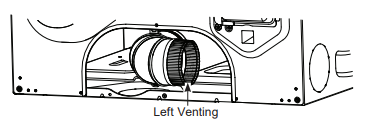
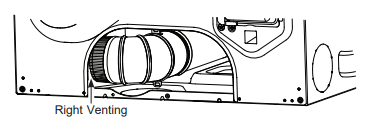
- Locate the bracket from the kit.
- Remove the adhesive liner from the bottom of the bracket and position it behind the elbow duct tab.
- Press down firmly to secure the bracket to the bottom of the dryer.
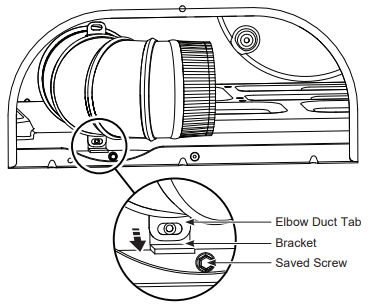
- Using one of the screws from earlier, secure the elbow duct tab to the bracket.
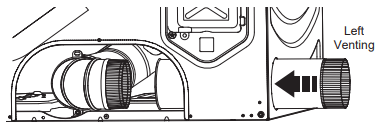
For LEFT venting:
- Locate the 15-1/2” exhaust duct from the kit.
- Insert exhaust duct through knockout opening on the LEFT side of dryer.
- Assemble exhaust duct to elbow duct.
- Wrap the joint with duct tape to avoid air leaks.
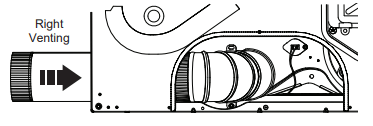
For RIGHT venting:
- Locate the 9-1/2” exhaust duct from the kit.
- Insert exhaust duct through knockout opening on the RIGHT side of dryer.
- Assemble exhaust duct to elbow duct.
- Wrap the joint with duct tape to avoid air leaks.
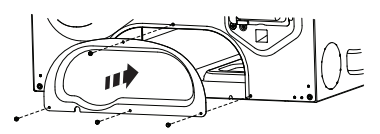
- Install the new access panel from the kit.
- Secure access panel with 4 screws saved from earlier
BOTTOM VENTING
Dryer Exhaust to the bottom of cabinet for Gas and Electric models WITHOUT Built-In Pedestal™.
- Remove the 4 screws that secure the access panel and save. Remove the access panel.

- Remove the screw that secures the dryer exhaust duct and save. Pull the exhaust duct out of the dryer

- Detach and remove the bottom knockout
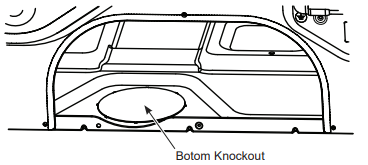
- Locate the 12-1/2” exhaust duct and elbow duct from the kit and assemble together. Apply duct tape around the joint to eliminate leaks between ducts.
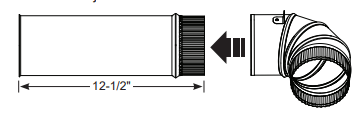
- Insert and connect the elbow/exhaust duct assembly to the blower housing and insert the elbow through the bottom knockout.
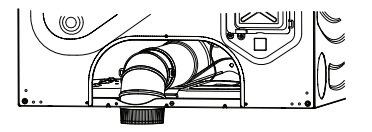
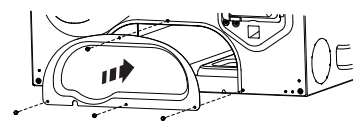
- Install the new access panel from the kit.
- Secure access panel with 4 screws saved from earlier.
FINAL SETUP
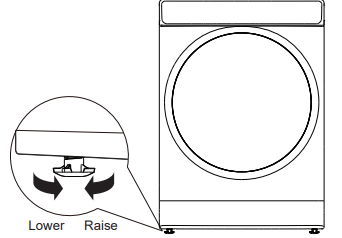
1. LEVEL THE DRYER
Stand the dryer upright near the final location and adjust the four leveling legs at the corners to ensure that the dryer is level from side to side and front to rear.
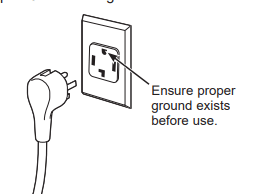
2. PLUG DRYER IN
NOTE: Stacking installations may require a power cord up to 6 feet in length.
3. DRYER START-UP
Press the Power pad.

NOTE: If the dryer has been exposed to temperatures below freezing for an extended period of time, allow it to warm up before pressing Power. Otherwise, the display will not come on. The dryer is now ready for use.
REVERSING THE DOOR SWING (Optional)
BEFORE YOU START
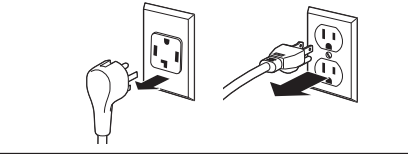
Unplug the dryer from its electrical outlet.
TOOLS YOU WILL NEED

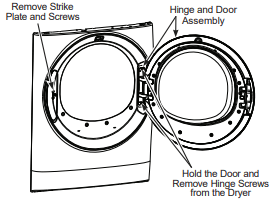
1. REMOVE THE STRIKE PLATE AND DOOR ASSEMBLY
- Open the dryer door.
- Remove the two screws from the strike plate using a T-25 torx driver.
- Remove the strike plate and set it aside.
- While supporting the door, remove the two screws from the hinge in the dryer face using a 1/4” nut driver.
- Lift the door assembly to remove it from the dryer face and set it aside on a protective surface.
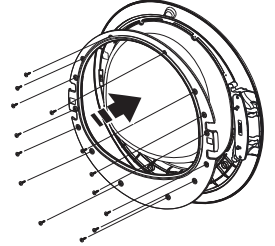
2. REMOVE THE INNER DOOR
- Remove the 14 screws from the inner door frame using a Phillips-head screwdriver and set them aside.
- Remove the inner door frame from the outer door.
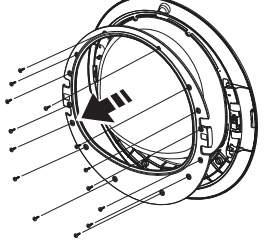
3. REMOVE, ROTATE AND REPLACE THE HANDLE AND HINGE INTO THE OPPOSITE SIDES
- Lift the handle and the hinge out of the door pockets.
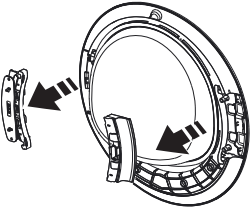
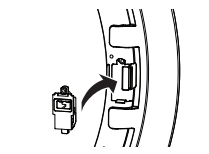
NOTE: Make sure the latch remains seated inside the handle. If it moves or falls out, seat it back into place.
- Rotate the handle and hinge, and replace them back into the pockets on the opposite sides.
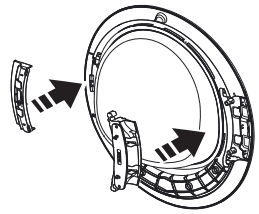
4. REPLACE THE INNER DOOR
- Replace the inner door frame into the outer door.
- Replace the 14 screws into the inner door, using a Phillips-head screwdriver, securing it to the outer door.
NOTE: Make sure the gasket is properly seated on the inner door frame when replaced.
5. REPLACE THE STRIKE PLATE AND DOOR ASSEMBLY
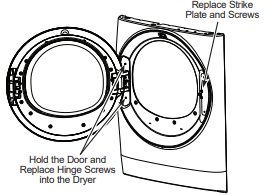
- On the opposite side from where removed, replace the strike plate with its two screws using a T-25 torx driver.
- Lift the door assembly into place and secure it onto the dryer face with its two screws using a 1/4” nut driver.
- Close the dryer door.
NOTE: Make sure the door opens and closes correctly. If not, repeat all steps making sure the gasket, all parts, and screws are securely seated.
STACKING THE WASHER AND DRYER (if desired)
If you are planning to stack the washer and dryer, order Stacking Kit number GFA28KITN to be used for this dryer. Kit sold separately
INSTALLATION PREPARATION
Remove the packaging. Flatten the product carton to use as a pad to lay the dryer down on its back or side. Continue using the carton to protect the finished floor in front of the installation location
REQUIREMENTS FOR ALCOVE OR CLOSET INSTALLATION
- The dryer MUST be vented to the outdoors.
- Minimum clearance between dryer cabinet and adjacent walls or other surfaces is:
0” either side*
0” front
0” rear
0” top
- The rear of the dryer should face a wall.
- Consideration must be given to provide adequate clearance for installation and service.
- Closet doors must be louvered or otherwise ventilated and have at least 60 square inches of open area. If the closet contains both a washer and a dryer, doors must contain a minimum of 120 square inches of open area.
NOTE: WHEN THE EXHAUST DUCT IS LOCATED AT THE REAR OF THE DRYER, THE CONFIGURATION OF THE DUCTING MAY REQUIRE GREATER CLEARANCE.
Gas Dryers Only:
- No other fuel burning appliance shall be installed in the same closet as a gas dryer.
- The dryer must be disconnected from the gas supply piping during pressure testing at pressures greater than 1/2 psi (3.5 kPa).
- A 1/8 inch NPT minimum plugged tapping, accessible for test gauge connection, must be installed immediately upstream of the gas supply connection to the dryer.
MINIMUM CLEARANCE OTHER THAN ALCOVE OR CLOSET INSTALLATION
Minimum clearance to combustible surfaces and for air opening are: 0” both sides*, 0” rear and 0” top. The rear of the dryer should face a wall. Consideration must be given to provide adequate clearance for installation and service.
STACKING THE WASHER AND DRYER (Optional Kit GFA28KITN)
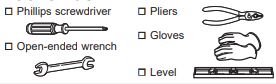
TOOLS YOU WILL NEED
CONTENTS

1. REMOVE THE DRYER LEVELING LEGS
A. Carefully lay the dryer on its back or side. Use the packing material so you don’t scratch the finish on the dryer.
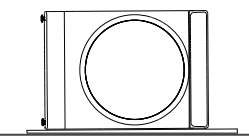
B. Use an open-end wrench or pliers to remove the dryer leveling legs. NOTE: Retain the leveling legs for future use
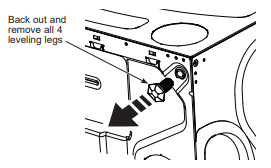
2. INSTALL SPACERS TO THE DRYER BOTTOM
Locate a spacer on the bottom side with its holes over the leveling leg holes. Attach spacer using 2 screws. Attach the second spacer on the other bottom side using 2 screws. NOTE: The arrows on the spacers should point to the outside.
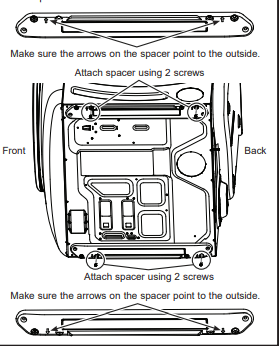
3. INSTALL THE APPROPRIATE BRACKETS TO THE WASHER
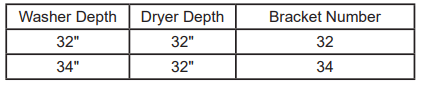
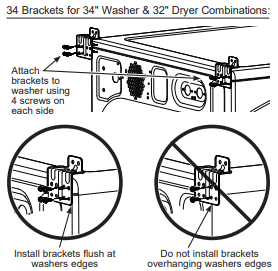
Select the appropriate brackets for your model sizes. Using the outside holes in the bracket, attach it to the top left corner of the washer back using 4 screws. Repeat on the top right corner of the washer back.
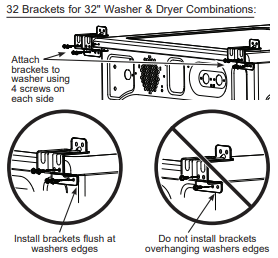
OR
4. PREPARE THE WASHER AND DRYER
A. Place the washer in the approximate final installation location.
B. Make sure the washer is level. Refer to the washer Installation Instructions for details.
C. Upright the dryer.
D. Reverse the washer and dryer door swings, if desired, before stacking the dryer on the washer. See the washer and dryer Installation Instructions for details
5. INSTALL THE DRYER AND THE BRACKET ON THE WASHER
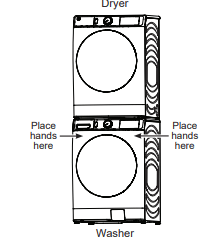
A. Lift the dryer onto the top of the washer. Be sure to lift the dryer high enough to clear the washer control panel. Be careful not to scratch the top of the washer with the spacers. Protect the washer control panel with cardboard or other protection.
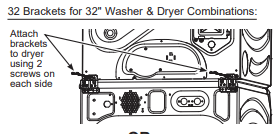
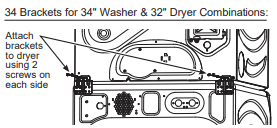
B. Align the holes in the back of the dryer with the holes in the bracket sticking up from the washer. Attach both brackets to the dryer with 2 screws on each side
OR
6. FINALIZE THE INSTALLATION
A. Refer to the washer Installation Instructions to complete the washer installation.
B. Refer to the dryer Installation Instructions to complete the dryer installation.
C. Carefully slide or walk the stacked washer and dryer into place. Use felt pads or other sliding device to assist moving and to protect flooring.
D. Verify the units are level. Make adjustments to the washer feet if necessary to level. It is always best to set the washer feet to the minimum height necessary to level the washer and dryer properly.
Troubleshooting Tips
| Problem |
Possible Cause |
What To Do |
| Dryer shakes or makes noise |
Some shaking/noise is normal. Dryer may be sitting unevenly |
Move dryer to an even floor space, or adjust leveling legs as necessary until even. |
| Clothes take too long to dry |
Improper or obstructed ducting |
Check the Installation Instructions to make sure the dryer venting is correct. Make sure ducting is clean, free of kinks and unobstructed. Check to see if outside wall damper operates easily. |
| Improper sorting |
Separate heavy items from lightweight items (generally, a well-sorted washer load is a well-sorted dryer load). |
| Large loads of heavy fabrics (like beach towels) |
Large, heavy fabrics contain more moisture and take longer to dry. Separate large, heavy fabrics into smaller loads to speed drying time. |
| Controls improperly set |
Match control settings to the load you are drying. |
| Lint filter is full |
Clean lint filter before every load |
| Blown fuses or tripped circuit breaker |
Replace fuses or reset circuit breakers. NOTE: Some electric dryers use 2 fuses/breakers, make sure both are operating. |
| Overloading/combining loads |
Do not put more than one washer load in the dryer at a time. |
| Underloading |
If you are drying only one or two items, add a few items to ensure proper tumbling. |
| ecoDry is enabled |
The ecoDry feature is designed to operate your dryer in the most energy efficient mode, which is not always the fastest mode. In some instances, dry times may be extended to reduce overall energy usage for the cycle. |
| The Dry dryness level was chosen but load is still damp |
Load consists of a mixture of heavy and light fabrics |
When combining heavy and light fabrics in a load, choose More Dry |
| Exhaust system is blocked |
Inspect and clean exhaust system |
| Dryer doesn’t start |
Control panel is “asleep” |
This is normal. Press Power to activate the control panel |
| Dryer is unplugged |
Make sure the dryer plug is pushed completely into the outlet. |
| Fuse is blown/circuit breaker is tripped |
Check the building’s fuse/circuit breaker box and replace fuse or reset breaker. NOTE: Some electric dryers use two fuses/ breakers, make sure both are operating. |
| Dryer was accidentally paused when starting Delay Dry |
If the light on the Start/Pause pad is flashing, the dryer is paused. Press Start/Pause to restart the countdown. |
| No numbers displayed during cycle, only lights |
Dryer is continuously monitoring the amount of moisture in the clothes |
This is normal. When the dryer senses a low level of moisture in the load, the dryer will display the dry time remaining. |
| Time Remaining jumped to a lower number |
The estimated time may change when a smaller load than usual is drying |
This is normal. |
| Cannot make a selection and the dryer beeps twice |
The dryness Level, Temp or option that you are trying to select is incompatible with the chosen dry cycle |
This is normal. |
| Dryer is running but 00 is displayed in Time Remaining |
The Wrinkle Care option was chosen |
This is normal. During extended tumbling, the time remaining is not displayed. The extended tumbling option lasts approximately 60 minutes |
| “Check Vent” light is on |
Lint filter is full |
Clean lint filter, dry a load on an automatic cycle and verify that light turns off |
| Improper or obstructed ducting |
Check the Installation Instructions to make sure the dryer venting is correct. Make sure ducting is clean, free of kinks and unobstructed. Check to see if outside wall damper operates easily. Dry a load on an automatic cycle and verify that light turns off |
| Exhaust system is blocked |
Inspect and clean the exhaust system. Dry a load on an automatic cycle and verify that light turns off |
| Dryer doesn’t heat |
Fuse is blown/circuit breaker is tripped; the dryer may tumble but not heat |
Check the building’s fuse/circuit breaker box and replace both fuses or reset both breakers. Your dryer may tumble if only one fuse is blown or one breaker tripped. NOTE: Some electric dryers use 2 fuses/breakers, make sure both are operating. |
| Gas service is off (gas models only) |
Make sure gas shutoff at dryer and main shutoff are fully open. |
| LP gas supply tank is empty or there has been a utility interruption of natural gas (gas models only) |
Refill or replace tank. Dryer should heat when utility service is restored. |
| No heat temperature selected |
Select another heat setting |
| Inconsistent drying times |
Type of heat |
Drying time will vary according to the type of heat used. If you recently changed from an electric to a gas (natural or LP) dryer, or vice versa, the drying time could be different. |
| Type of load and drying conditions |
The load size, types of fabric, wetness of clothes and the length and condition of the exhaust system will affect drying times. |
| Clothes are still wet and dryer shut off after a short time |
The door was opened mid-cycle. The load was then removed from the dryer and a new load put in without selecting a new cycle |
A dry cycle must be reselected each time a new load is put in. |
| Small load |
When drying 3 items or less, choose QUICK DRY or TIMED DRY. |
| Load was already dry except for collars and waistbands |
Choose QUICK DRY or TIMED DRY to dry damp collars and waistbands. In the future, when drying a load with collars and waistbands, choose More Dry. |
| Dryer is not level |
Move dryer to an even floor space or adjust leveling legs as necessary until even |
| Clothes are wrinkled |
Overdrying |
Select a shorter drying time. Remove items while they still hold a slight amount of moisture. Select a Less Dry or Damp setting. |
| Letting items sit in dryer after cycle ends |
Remove items when cycle ends and fold or hang immediately, or use the Wrinkle Care option |
| Overloading |
Separate large loads into smaller ones. |
| Clothes shrink |
Improper use of fabric softener |
Follow directions on fabric softener package. |
| Drying dirty items with clean ones |
Use your dryer to dry only clean items. Dirty items can stain clean items and the dryer. |
| Clothes were not completely clean |
Sometimes stains which cannot be seen when the clothes are wet appear after drying. Use proper washing procedures before drying. |
| Greasy spots on clothes |
Improper use of fabric softene |
Follow directions on fabric softener package. |
| Drying dirty items with clean ones |
Use your dryer to dry only clean items. Dirty items can stain clean items and the dryer. |
| Clothes were not completely clean |
Sometimes stains which cannot be seen when the clothes are wet appear after drying. Use proper washing procedures before drying |
| Lint on clothes |
Lint filter is full |
Clean lint screen before each load. |
| Improper sorting |
Sort lint producers (like chenille) from lint collectors (like corduroy). |
| Static electricity can attract lint |
See suggestions in this section under Static occurs. |
| Overloading |
Separate large loads into smaller ones. |
| Paper, tissue, etc., left in pockets |
Empty all pockets before laundering clothes. |
| Static occurs |
No fabric softener was used |
Try a fabric softener. Bounce® Fabric Conditioner Dryer Sheets have been approved for use in all GE Appliances dryers when used in accordance with the manufacturer’s instructions. |
| Overdrying |
Try a fabric softener. Adjust setting to Less Dry or Damp. |
| Synthetics, permanent press and blends can cause static |
Try a fabric softener. |
| Collars and waistbands still wet at end of cycle |
The dryness monitor senses that the body of the clothes is dry |
Choose QUICK DRY or TIMED DRY to dry damp collars and waistbands. In the future, when drying a load with collars and waistbands, choose More Dry. |
| Slight variation in metallic color |
This is normal |
Due to the metallic properties of paint used for this unique product, slight variations of color may occur due to viewing angles and lighting conditions. |
| Dryer continues to tumble after display says Complete |
Wrinkle Care was selected |
Ensure Wrinkle Care option is not selected. For the Steam Refresh cycle, Wrinkle Care will automatically be turned on and cannot be turned off. |
| foggy to see clothes during a steam cycle |
Steam condenses on inner door |
This is normal. |
| Water seen on inside of door and top of lint filter when opening door after steam cycle |
Steam condenses on these surfaces |
This is normal. |
| Small areas on clothes are damp after steam cycle |
Steam condenses on inner drum |
If using the STEAM Dewrinkle cycle, manually reduce the cycle time. If using the STEAM Refresh cycle, add more garments to the load. |
| Small amount of water on floor in front of dryer |
Inadequate load size for steam cycle selected, excess steam condenses inside cabinet and leaks out |
If using the STEAM Dewrinkle cycle, manually reduce the cycle time. If using the STEAM Refresh cycle, add more garments to the load. |
| Water on floor in back of dryer |
Loose water hose connection |
Tighten connection. |
| Hose missing rubber washer at connection with valve |
Install rubber washer provided with hose. |
| Water drips from door when opened after a Steam Cycle |
Steam condenses on inner door |
This is normal. |
| Cannot see steam at beginning of cycle |
Steam released at different times in the cycle |
This is normal. |
| Cannot see steam during cycle |
The steam nozzle might be clogged with debris from your water supply |
Call GE Appliances at 877.959.8688 to order nozzle replacement kit WE25M71 or to request a technician to replace this for you |
| Garments still wrinkled after steam cycle |
Too many garments |
Load fewer garments; manually increase time |
| Lint filter not clean |
Clean lint filte |
| Load is children/infant garments |
Use the Steam Refresh cycle |