
Online Edition for Part no. 01 41 2 600 775 - © 08/08 BMW AG

M6 Owner's Manual for Vehicle
Congratulations, and thank you for choosing a BMW M6.
Thorough familiarity with your vehicle will provide you with
enhanced control and security when you drive it. We therefore
have this request:
Please take the time to read this Owner's Manual and familiarize
yourself with the information that we have compiled for you
before starting off in your new vehicle. It contains important data
and instructions intended to assist you in gaining maximum use
and satisfaction from your BMW M6's unique range of technical
features. The manual also contains information on maintenance
designed to enhance operating safety and contribute to main-
taining the value of your BMW M6 throughout an extended ser-
vice life.
This manual is supplemented by a Service and Warranty Informa-
tion Booklet for US models or a Warranty and Service Guide
Booklet for Canadian models.
We wish you an enjoyable driving experience.
BMW AG
Online Edition for Part no. 01 41 2 600 775 - © 08/08 BMW AG

© 2008 Bayerische Motoren Werke
Aktiengesellschaft
Munich, Germany
Reprinting, including excerpts, only with the
written consent of BMW AG, Munich.
US English VIII/08, 03 10 510
Printed on environmentally friendly paper,
bleached without chlorine, suitable for recycling.
Online Edition for Part no. 01 41 2 600 775 - © 08/08 BMW AG

Reference At a glanceControlsDriving tipsCommunications NavigationEntertainmentMobility
Contents
The fastest way to find specific topics is to use
the index, refer to page 248.
Using this Owner's Manual
4 Notes
7 Reporting safety defects
At a glance
10 Cockpit
16 iDrive
24 Voice command system
Controls
30 Opening and closing
47 Adjusting
58 Transporting children safely
60 Driving
70 Everything under control
82 Technology for comfort, convenience
and safety
97 Lamps
102 Climate
109 Practical interior accessories
Driving tips
118 Things to remember when driving
122 BMW M6 Engineering
Navigation
126 Starting navigation system
128 Destination entry
140 Destination guidance
149 What to do if …
Entertainment
152 On/off and tone
156 Radio
163 Satellite radio
166 CD player and CD changer
172 AUX-IN connection
173 USB-audio interface/mobile phone audio
interface
Communications
178 Telephoning
193 BMW Assist
Mobility
204 Refueling
206 Wheels and tires
212 Under the hood
218 Maintenance
220 Care
224 Replacing components
233 Giving and receiving assistance
Reference
240 Technical data
244 Short commands of voice command
system
248 Everything from A to Z
Online Edition for Part no. 01 41 2 600 775 - © 08/08 BMW AG

Notes
4
Notes
Using this Owner's Manual
We have made every effort to ensure that you
are able to find what you need in this Owner's
Manual as quickly as possible. The fastest way
to find specific topics is to refer to the detailed
index at the back of the manual. If you wish to
gain an initial overview of your vehicle, you will
find this in the first chapter.
Should you sell your BMW some day, please
remember to hand over the Owner's Manual
as well; it is an important component of your
vehicle.
Additional sources of information
Should you have any other questions, your
BMW center will be happy to advise you.
You can find information on BMW, e.g. technol-
ogy, on the Internet at www.bmwusa.com.
Symbols used
Indicates precautions that must be fol-
lowed precisely in order to avoid the pos-
sibility of personal injury and serious damage to
the vehicle.<
Indicates information that will assist you
in gaining the optimum benefit from your
vehicle and enable you to care more effectively
for your vehicle.<
Refers to measures that can be taken to
help protect the environment.<
< Marks the end of a specific item of informa-
tion.
* Indicates special equipment, country-spe-
cific equipment and optional accessories, as
well as equipment and functions not yet avail-
able at the time of printing.
"..." Identifies Control Display texts used to
select individual functions.
These sections contain information on using
the voice activation system.
{...} Verbal instructions to use with the voice
activation system.
{{...}} Identifies the answers generated by the
voice activation system.
Symbols on vehicle components
Indicates that you should consult the rel-
evant section of this Owner's Manual for
information on a particular part or assembly.
Online Edition for Part no. 01 41 2 600 775 - © 08/08 BMW AG

5
Reference At a glanceControlsDriving tipsCommunications NavigationEntertainmentMobility
The individual vehicle
When purchasing your BMW, you have decided
in favor of a model with individualized equip-
ment and features. This Owner's Manual
describes all equipment offered for the
BMW M6.
Please bear in mind that the manual may con-
tain information on accessories and equipment
that you have not specified for your own vehicle.
Sections describing options and special equip-
ment are marked by asterisks
* to assist you in
identifying possible differences between the
descriptions in this manual and your own vehi-
cle's equipment.
If equipment in your BMW is not described in
this Owner's Manual, please refer to the accom-
panying Supplementary Owner's Manuals.
Editorial notice
BMW pursues a policy of continuous, ongoing
development that is conceived to ensure that
our vehicles continue to embody the highest
quality and safety standards combined with
advanced, state-of-the-art technology. For this
reason, it is possible that the features described
in this Owner's Manual could differ from those
on your vehicle.
Online Edition for Part no. 01 41 2 600 775 - © 08/08 BMW AG

Notes
6
For your own safety
Maintenance and repairs
Advanced technology, e.g. the use of
modern materials and high-performance
electronics, requires specially adapted mainte-
nance and repair methods. Therefore, have cor-
responding work on your BMW performed only
by your BMW center or a workshop that works
according to BMW repair procedures with cor-
respondingly trained personnel. If this work is
not carried out properly, there is a danger of
subsequent damage and related safety haz-
ards.<
California Proposition 65 Warning
California law requires us to issue the following
warning:
Engine exhaust and a wide variety of
automobile components and parts,
including components found in the interior fur-
nishings in a vehicle, contain or emit chemicals
known to the State of California to cause cancer
and birth defects and reproductive harm. In
addition, certain fluids contained in vehicles and
certain products of component wear contain or
emit chemicals known to the State of California
to cause cancer and birth defects or other
reproductive harm.
Battery posts, terminals and related accesso-
ries contain lead and lead compounds. Wash
your hands after handling.
Used engine oil contains chemicals that have
caused cancer in laboratory animals. Always
protect your skin by washing thoroughly with
soap and water.<
Parts and accessories
For your own safety, use genuine parts
and accessories approved by BMW.
When you purchase accessories tested and
approved by BMW and Genuine BMW Parts,
you simultaneously acquire the assurance that
they have been thoroughly tested by BMW to
ensure optimum performance when installed
on your vehicle.
BMW warrants these parts to be free from
defects in material and workmanship.
BMW will not accept any liability for damage
resulting from installation of parts and accesso-
ries not approved by BMW.
BMW cannot test every product made by other
manufacturers to verify if it can be used on a
BMW safely and without risk to either the vehi-
cle, its operation or its occupants.
Genuine BMW Parts, BMW Accessories and
other products approved by BMW, together
with professional advice on using these items,
are available from all BMW centers.
Installation and operation of non-BMW
approved accessories such as alarms, radios,
amplifiers, radar detectors, wheels, suspension
components, brake dust shields, telephones,
including operation of any mobile phone from
within the vehicle without using an externally
mounted antenna, or transceiver equipment
such as CBs, walkie-talkies, ham radios or the
like may cause extensive damage to the vehicle,
compromise its safety, interfere with the vehi-
cle's electrical system, or affect the validity of
the BMW Limited Warranty. See your BMW
center for additional information.<
Maintenance, replacement, or repair of
the emission control devices and sys-
tems may be performed by any automotive
repair establishment or individual using any cer-
tified automotive part.<
Online Edition for Part no. 01 41 2 600 775 - © 08/08 BMW AG

7
Reference At a glanceControlsDriving tipsCommunications NavigationEntertainmentMobility
Service and warranty
We recommend that you read this publication
thoroughly.
Your BMW is covered by the following warran-
ties:
> New Vehicle Limited Warranty
> Rust Perforation Limited Warranty
> Federal Emissions System Defect Warranty
> Federal Emissions Performance Warranty
> California Emission Control System Limited
Warranty
Detailed information about these warranties is
listed in the Service and Warranty Information
Booklet for US models or in the Warranty and
Service Guide Booklet for Canadian models.
Reporting safety defects
For US customers
The following applies only to vehicles owned
and operated in the US.
If you believe that your vehicle has a defect
which could cause a crash or could cause injury
or death, you should immediately inform the
National Highway Traffic Safety Administration
(NHTSA) in addition to notifying BMW of North
America, LLC, P.O. Box 1227, Westwood, New
Jersey 07675-1227, Telephone (800) 831-
1117.
If NHTSA receives similar complaints, it may
open an investigation, and if it finds that a safety
defect exists in a group of vehicles, it may order
a recall and remedy campaign. However,
NHTSA cannot become involved in individual
problems between you, your dealer, or BMW of
North America, LLC.
To contact NHTSA, you may call the Vehicle
Safety Hotline toll-free at 1-888-327-4236
(TTY: 1-800-424-9153); go to
http://www.safercar.gov; or write to: Adminis-
trator, NHTSA, 400 Seventh Street, SW.,
Washington, DC 20590. You can also obtain
other information about motor vehicle safety
from http://www.safercar.gov
For Canadian customers
Canadian customers who wish to report a
safety-related defect to Transport Canada,
Defect Investigations and Recalls, may call 1-
800-333-0510 toll-free from anywhere in Can-
ada or 1-613-993-9851 from the Ottawa region
and from other countries, or contact Transport
Canada by mail at: Transport Canada, ASFAD,
Place de Ville, Tower C, 330 Sparks Street,
Ottawa, ON, K1A 0N5.
You can also obtain other information about
motor vehicle safety from http://www.tc.gc.ca
Online Edition for Part no. 01 41 2 600 775 - © 08/08 BMW AG
Online Edition for Part no. 01 41 2 600 775 - © 08/08 BMW AG

At a glance
This overview of buttons, switches and displays
is intended to familiarize you with your vehicle's
operating environment.
The section will also assist you in becoming
acquainted with the control concepts
and options available for operating.
At a glance
Online Edition for Part no. 01 41 2 600 775 - © 08/08 BMW AG
Cockpit
10
Cockpit
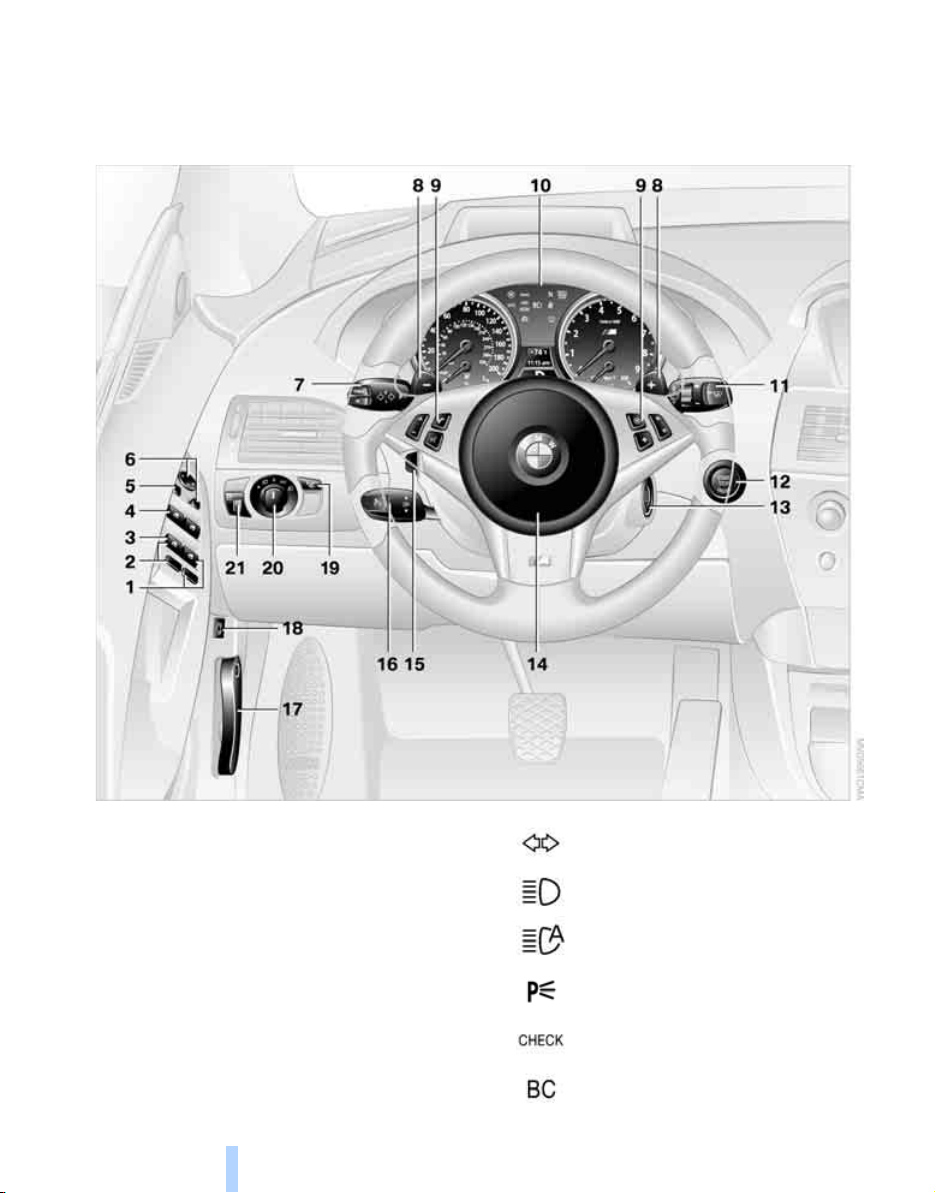
Around the steering wheel: controls and displays
1 Convertible: opening and closing rear
window 41
2 Convertible: opening and closing windows
together 41
3 Convertible: opening and closing rear
windows 40
4 Opening and closing front windows 40
5 Folding exterior mirrors in and out
* 53
6 Adjusting exterior mirrors 53
Automatic curb monitor 54
7
Turn signals 66
High beams, headlamp flasher 99
High-beam assistant
* 99
Parking lamps
* 99
Check Control 75
Computer 71
Online Edition for Part no. 01 41 2 600 775 - © 08/08 BMW AG
At a glance
11
Reference ControlsDriving tipsCommunications NavigationEntertainmentMobility
8 Shift paddles 64
9 Buttons on steering wheel
10 Instrument cluster 12
13 Ignition lock 60
14 Horn, entire surface
17 Releasing hood 212
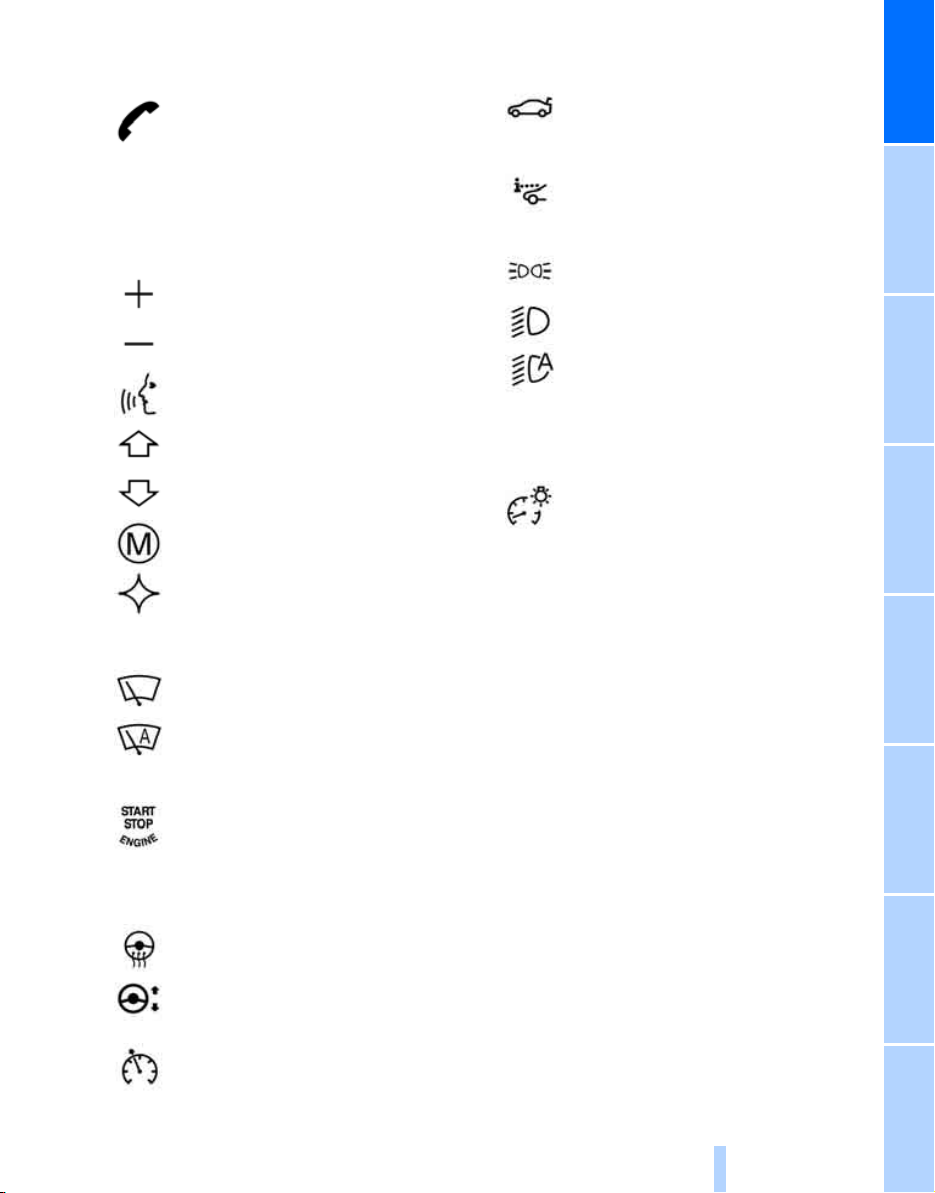
Mobile phone
* 178:
> Press: accepting and ending
call, starting dialing
* for
selected phone number and
redialing if no phone number is
selected
> Press and hold: redialing
Volume
Activating/deactivating voice com-
mand system
* 24
Changing radio station 156
Selecting music track 167
Scrolling in phone book and in lists
with stored phone numbers
MDrive, call up individual
settings 55
Individually programmable 55
11
Windshield wipers 67
Rain sensor 67
12
Starting/stopping engine and
switching ignition on/off 60
15
Steering wheel heater
* 54
Steering wheel adjustment 54
16
Cruise control 68
18
Opening luggage compartment
lid 35
19
Head-Up Display
* 94
20
Parking lamps 97
Low beams 97
Welcome lamps 97
Automatic headlamp control 97
Daytime running lamps
* 98
Welcome lamps 97
Adaptive Head Light
* 99
High-beam assistant
* 99
21
Instrument lighting 101
Online Edition for Part no. 01 41 2 600 775 - © 08/08 BMW AG
Cockpit
12
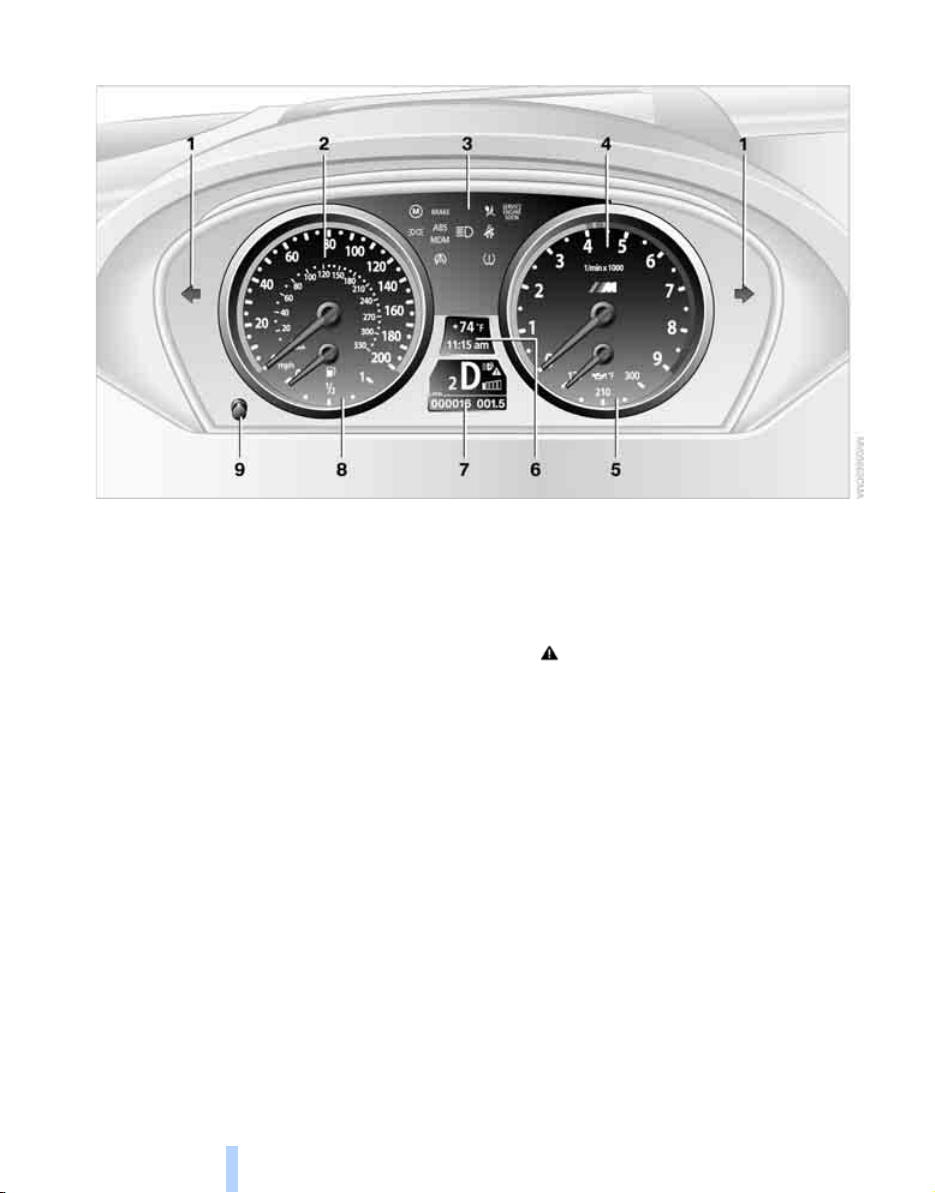
Instrument cluster
1 Indicator lamps for turn signals
2 Speedometer
3 Indicator and warning lamps 13
4 Tachometer 70
5 Engine oil thermometer 71
6 Display for
> Computer 71
Engine oil level 214
> Indicator and warning lamps 75
> Speed of cruise control 69
7 Display for
> Sequential Manual Transmission with
Drivelogic 64
> Engine oil level for manual
transmission 214
> Check Control message present 75
> Odometer and trip odometer 70
> Date and remaining travel distance
for service requirements 73
> High-beam assistant
* 99
8 Fuel gauge 71
9 Resetting trip odometer 70
Online Edition for Part no. 01 41 2 600 775 - © 08/08 BMW AG
At a glance
13
Reference ControlsDriving tipsCommunications NavigationEntertainmentMobility
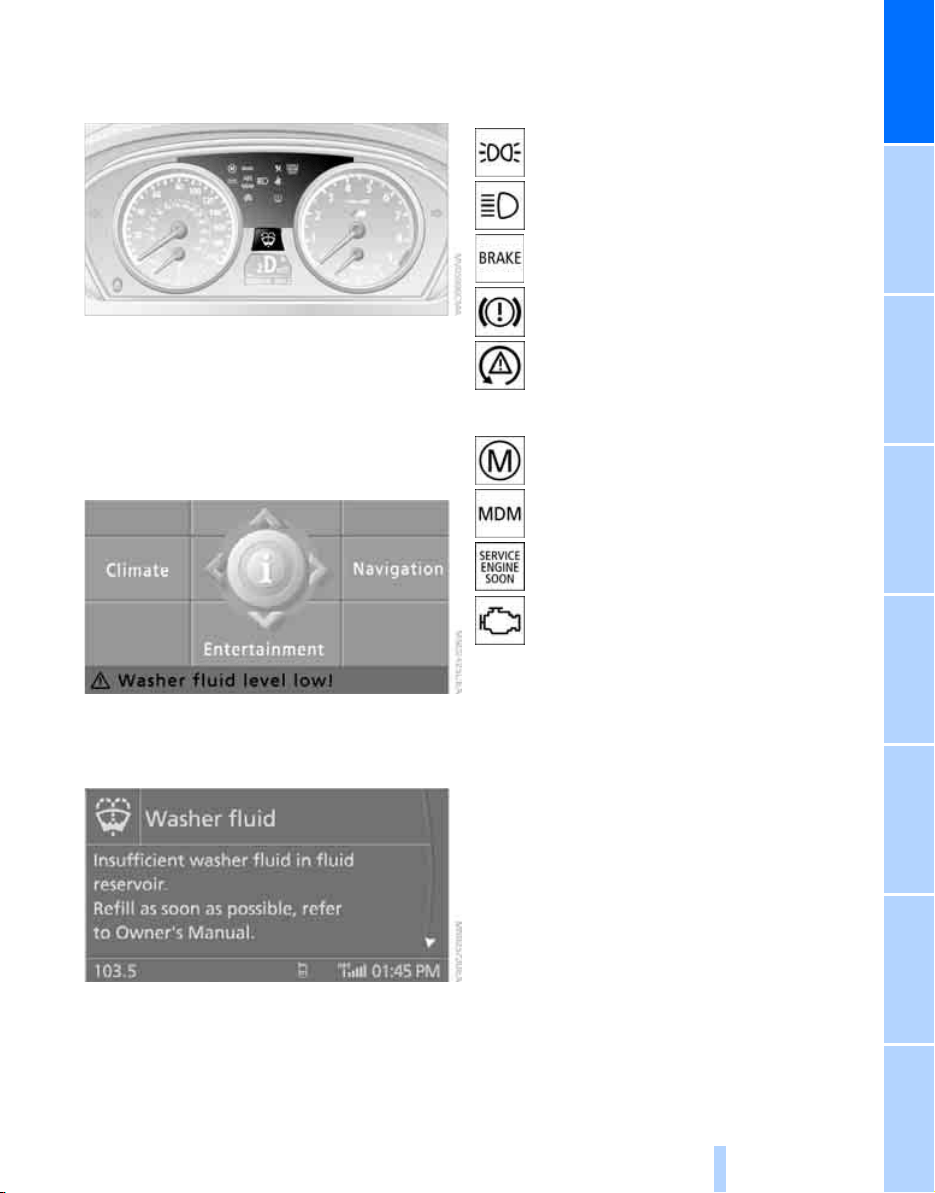
Indicator and warning lamps
The concept
The indicator and warning lamps can light up in
different combinations and colors.
Some lamps are tested for proper function by
briefly lighting up during starting of the engine
or when the ignition is switched on.
Explanatory text messages
Text messages at the bottom edge of the Con-
trol Display explain the meaning of the dis-
played indicator and warning lamps.
Additional information, e.g. on the cause and
elimination of a malfunction, can be opened via
the Check Control system, refer to page 75.
In urgent cases, this information will be shown
as soon as the corresponding lamp comes on.
Indicator lamps without text messages
The following indicator lamps signal particular
functions:
Parking lamps/low beams 97
High beams/headlamp flasher 99
Handbrake applied 62
Handbrake applied for Canadian mod-
els
Lamp flashes:
DSC controls the drive and braking
forces for maintaining vehicle
stability 84
MDrive 55
M Dynamic Mode 84
Exhaust-gas values 219
Exhaust-gas values for Canadian
models 219
Online Edition for Part no. 01 41 2 600 775 - © 08/08 BMW AG
Cockpit
14
Around the center console: controls and displays
Online Edition for Part no. 01 41 2 600 775 - © 08/08 BMW AG
At a glance
15
Reference ControlsDriving tipsCommunications NavigationEntertainmentMobility
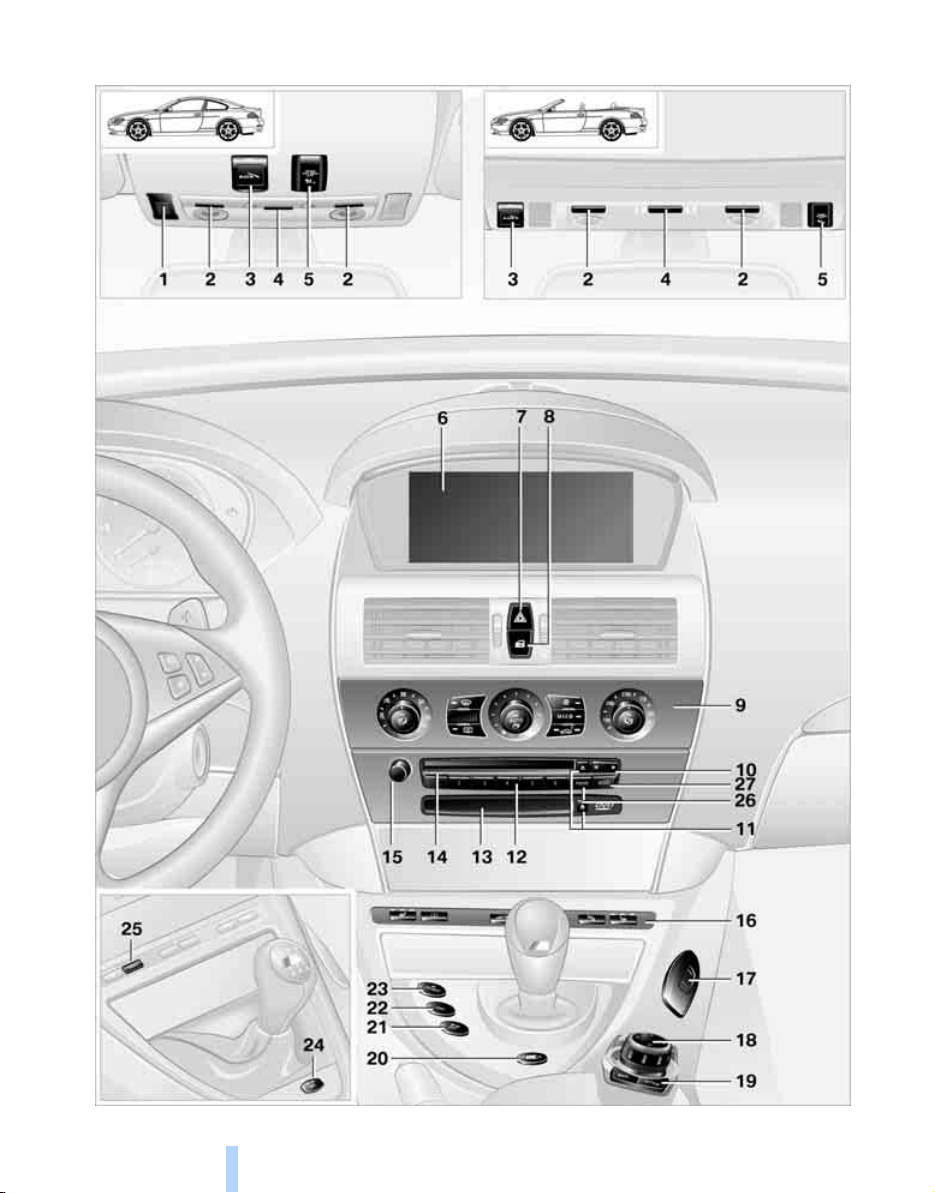
1 Microphone for hands-free mode for tele-
phone
* and voice command system* 24
Convertible: microphone on steering col-
umn
2 Reading lamps 101
3 SOS: initiating
an emergency request 233
4 Interior lamps 101
5 Passenger airbag status lamp 92
6 Control Display 16
7 Hazard warning flashers
8 Central locking system 34
9 Automatic climate control 102
10 Changing
> radio station 156 156
> track 167 167
11 Ejecting
> navigation DVD
* 126
> audio CD 167 166
12 Programmable memory buttons 22
13 Drive for navigation system DVD with Pro-
fessional
* navigation system 126
14 Drive for audio CDs 166 166
15 Entertainment sound output on/off
and adjusting volume 167 167
17 Bracket for cup holder
* 112
18 Controller 16
Can be turned, pressed, or moved in four
directions
19 Opening start menu on Control Display 18
20 Drivelogic of Sequential Manual
Transmission 64
21 EDC Electronic Damper Control for
Sequential Manual Transmission 86
22 DSC Dynamic Stability Control for Sequen-
tial Manual Transmission 84
23 M Engine Dynamic Control POWER for
Sequential Manual Transmission 65
24 EDC Electronic Damper Control for manual
transmission
* 86
25 MDM
> M Dynamic Mode for manual
transmission
* 84
> Switching DSC on and off in manual
transmission
* 85
26 Selecting AM or FM waveband
27 Selecting radio, CD and CD changer
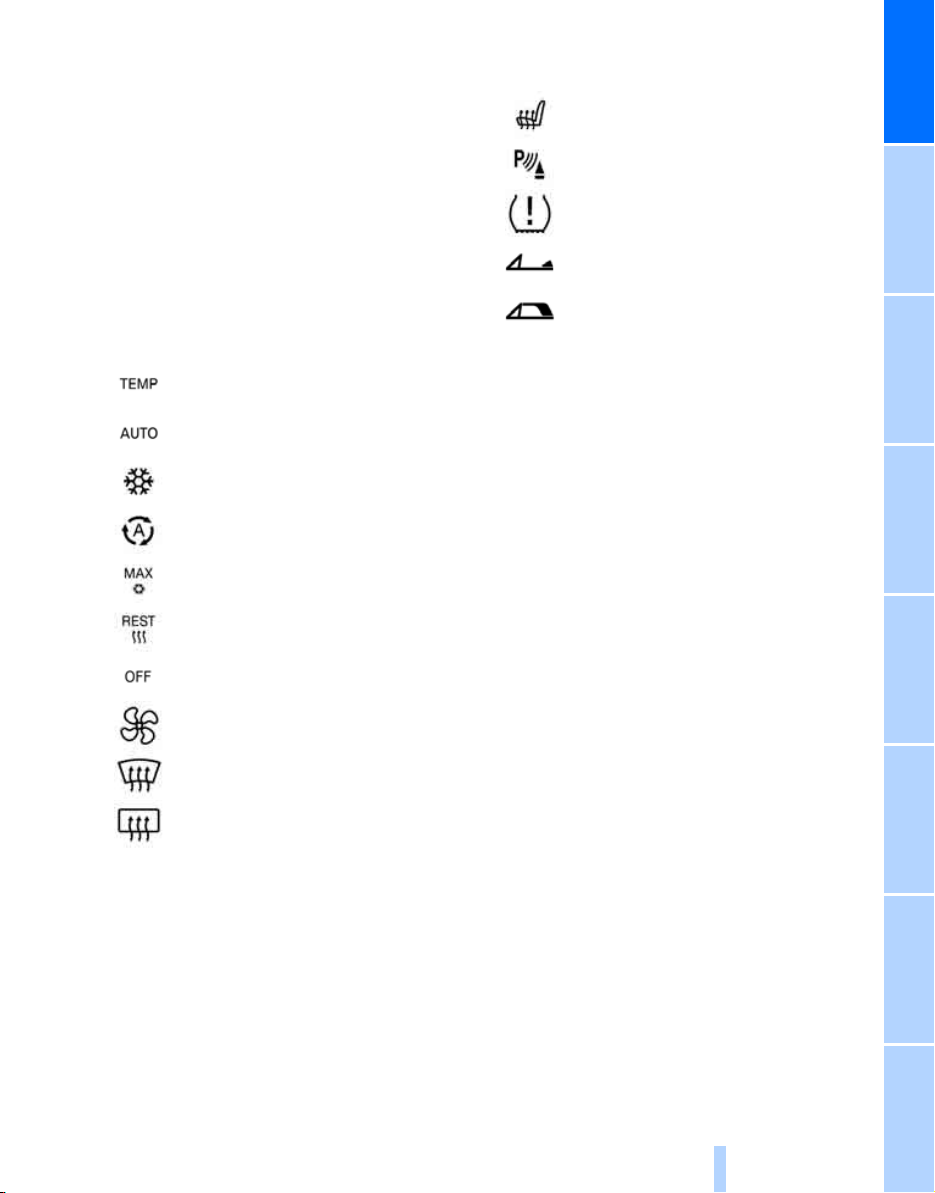
Temperature setting, left/
right 103
Automatic air distribution and
volume 103
Cooling function 105
AUC Automatic recirculated-air
control/recirculated-air mode 105
Maximum cooling 105
Residual heat mode 106
Switching off automatic climate
control 106
Air volume 104
Defrosting windows and removing
condensation 104
Rear window defroster 104
16
Heated seats 53
PDC Park Distance Control
* 82
Flat Tire Monitor 87
Convertible: opening the convert-
ible top 43
Convertible: closing the convertible
top 43
Online Edition for Part no. 01 41 2 600 775 - © 08/08 BMW AG
iDrive
16
iDrive
iDrive combines the functions of a large number
of switches. This allows these functions to be
operated from a central position. The following
section provides an introduction to basic menu
navigation. The control of the individual func-
tions is described in connection with the rele-
vant equipment.
Controls
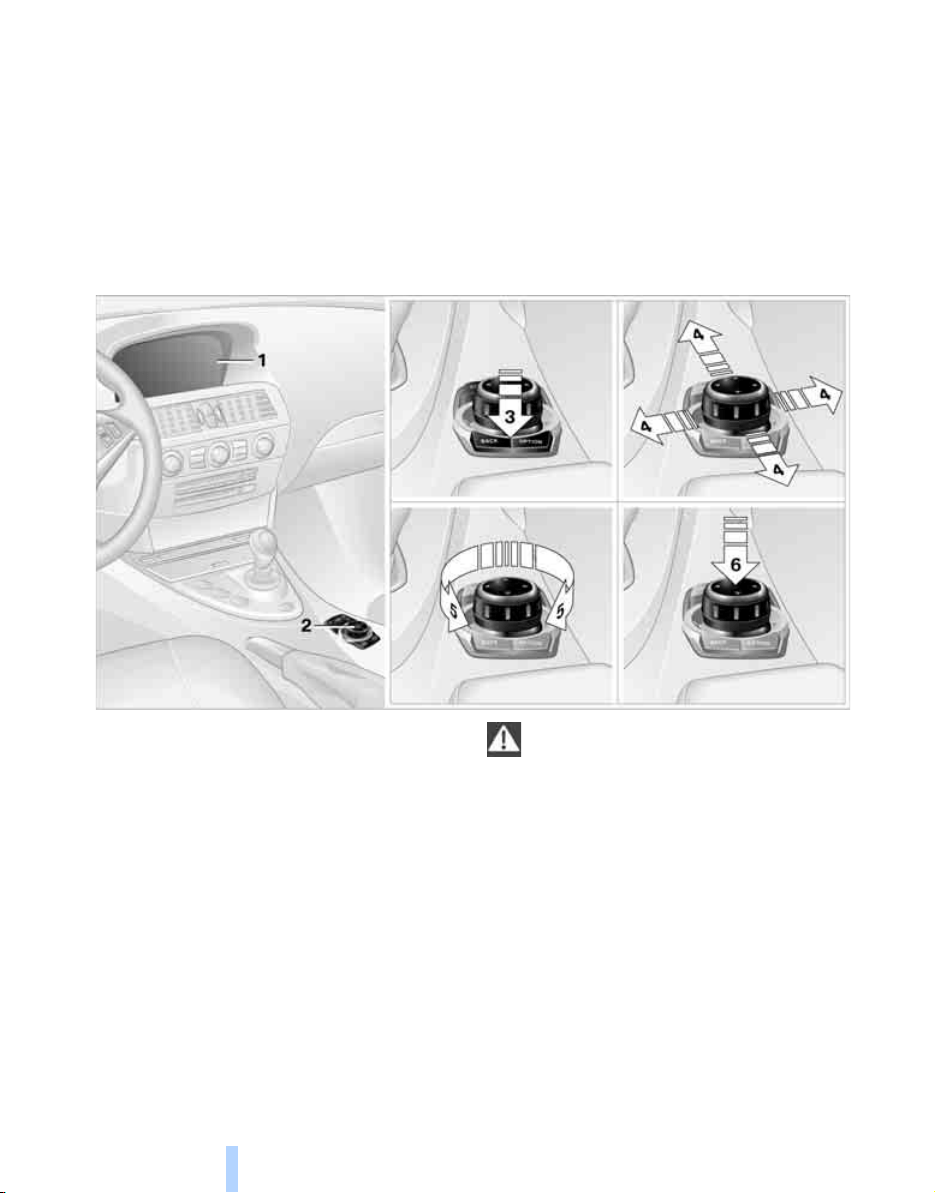
1 Control Display
2 Controller with buttons
You can use the buttons to open the menus
directly. The controller can be used to
select the menu items and create settings.
> Call up a menu directly, arrow 3
> Move in four directions, arrows 4
> Turn, arrow 5
> Press, arrow 6
To avoid posing an unnecessary hazard
due to inattention, both to your own vehi-
cle's occupants and to other road users: never
attempt to use the controls or make entries
unless traffic and road conditions allow.<
Online Edition for Part no. 01 41 2 600 775 - © 08/08 BMW AG

At a glance
17
Reference ControlsDriving tipsCommunications NavigationEntertainmentMobility
Button Function
MENU Opens the main menu
RADIO Opens the Radio menu
CD Opens the last Entertainment menu, e.g. CD or
AUX
NAV Opens the Navigation menu
From the Navigation menu: opens the main
menu
TEL Opens the Telephone menu
BACK Opens the previous menu
Not available from the main menu
OPTION Opens the Options menu
Online Edition for Part no. 01 41 2 600 775 - © 08/08 BMW AG
iDrive
18
Menu overview
Communication
> Telephone*
> BMW Assist* or BMW TeleServices*
Navigation or onboard information
> Navigation system*
> Onboard information, e.g. for displaying
the average fuel consumption
Entertainment
> Radio
> CD player and CD changer
*
> USB-audio interface* for external audio
device
Climate
> Vent settings
> Automatic programs
> Parked car operation
menu
> Switching off Control Display
> Tone and display settings
> Settings for your vehicle, e.g. for MDrive, or
settings for the central locking system
> Display of maintenance intervals and dead-
lines for legally mandated inspections
> Settings for telephone
Basic operation
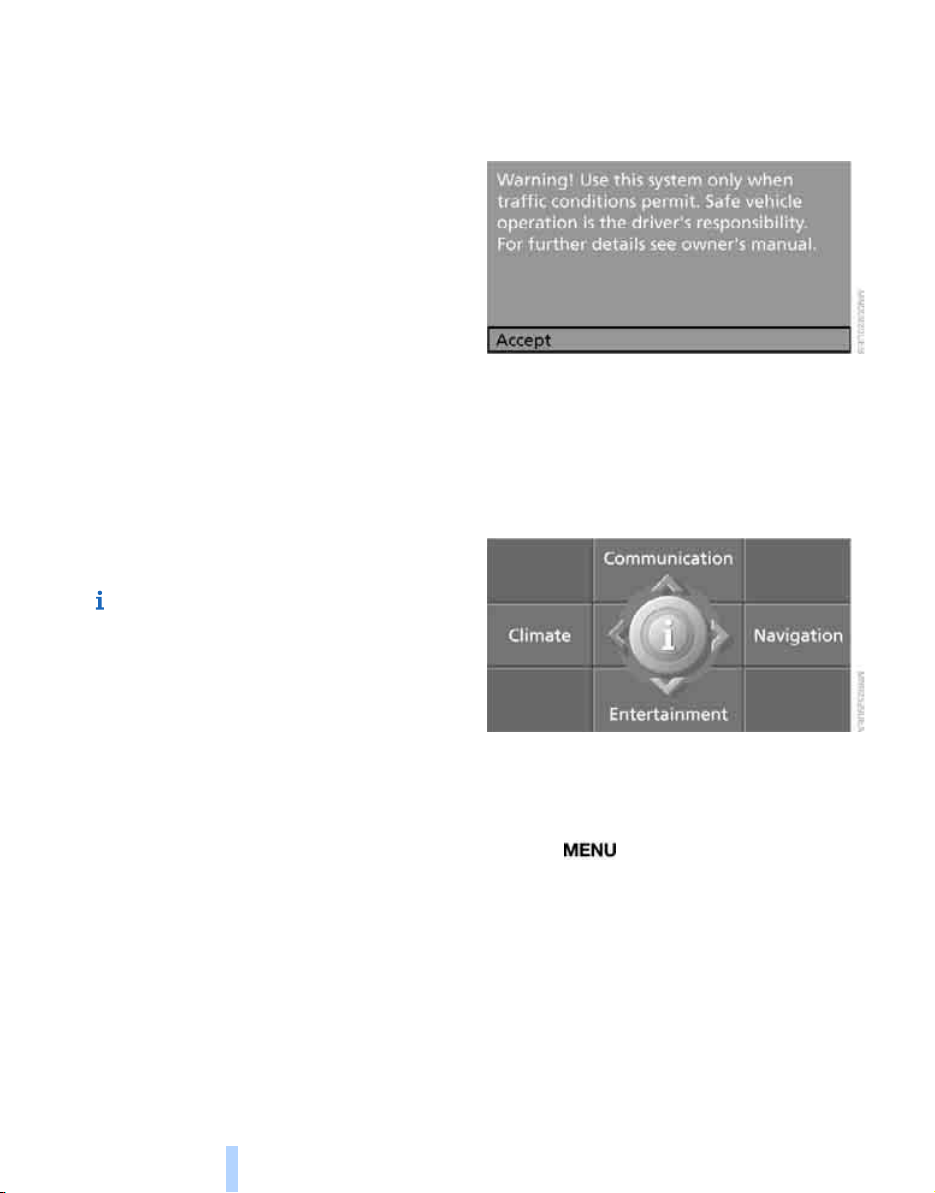
From radio readiness, refer to page 60, the fol-
lowing message is shown on the Control Dis-
play:
To hide the message:
Press the controller.
This displays the start menu.
The message is hidden after approx. 10 sec-
onds.
Start menu
You can call up all the functions of iDrive using
five menu items.
Opening start menu
Press the button.
Online Edition for Part no. 01 41 2 600 775 - © 08/08 BMW AG
At a glance
19
Reference ControlsDriving tipsCommunications NavigationEntertainmentMobility
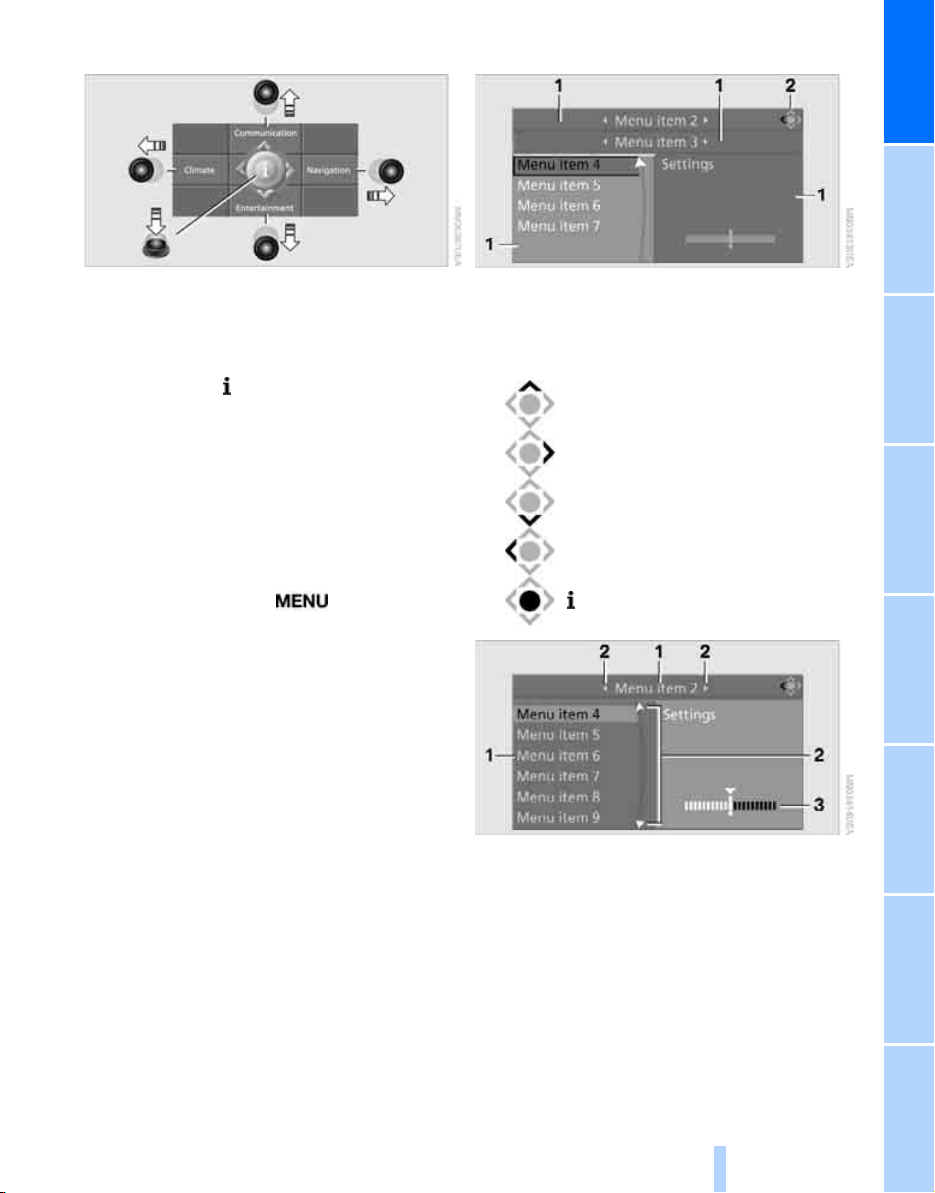
Opening menu items of the start menu
In the start menu, you can open the Communi-
cation, Navigation, Entertainment and Climate
menu items by moving the controller to the left,
right, front or rear.
You can open the menu by pressing the con-
troller.
Comfort opening of menu items
Comfort opening offers you:
> Opening of a menu item of the start menu in
the last display shown
> Direct changing between Communication,
Navigation, Entertainment and Climate
without pressing the button
To do so, move the controller in the corre-
sponding direction and hold it there for longer
than 2 seconds or use the buttons on the con-
troller.
Displays in menu
1 Each menu is divided into fields.
The respective active field is highlighted.
2 A symbol indicates the last selected menu
item of the start menu:
1 Menu items are usually grouped in horizon-
tal or vertical lists.
2 In these lists, arrows indicate the possibility
of accessing other menu items that are not
currently visible.
3 Settings are displayed graphically or
numerically.
Communication
Navigation or onboard information
Entertainment
Climate
menu
Online Edition for Part no. 01 41 2 600 775 - © 08/08 BMW AG
iDrive
20
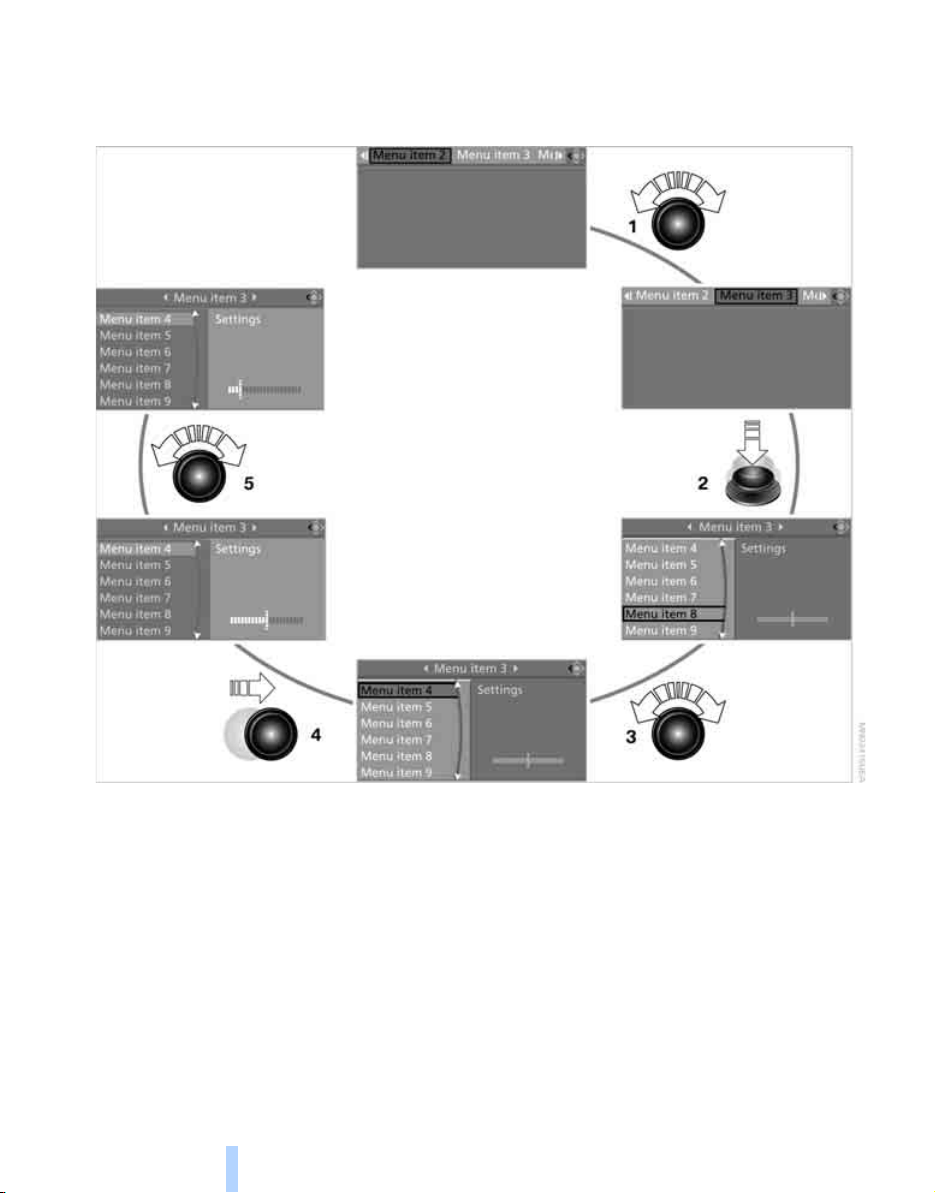
Operating principle at a glance
Basic operation via iDrive is described in this
view.
You can view the individual steps under Set-
tings on Control Display, Setting time, refer to
page 79.
1 Selecting menu item:
> Turn the controller; the highlight moves
> Menu items shown in white can be
selected by highlighting
2 Activating menu item:
> Press the controller
> New menu items are displayed or the
function is carried out
3 Selecting menu item: refer to 1
4 Changing between fields:
> Briefly move the controller to the left,
right, front or back
> Release controller
> Active field appears lighter
5 Adjusting settings:
> Turn controller
> Graphic display, numerical value or text
displays can be changed
> Confirmation by changing field
Online Edition for Part no. 01 41 2 600 775 - © 08/08 BMW AG
At a glance
21
Reference ControlsDriving tipsCommunications NavigationEntertainmentMobility
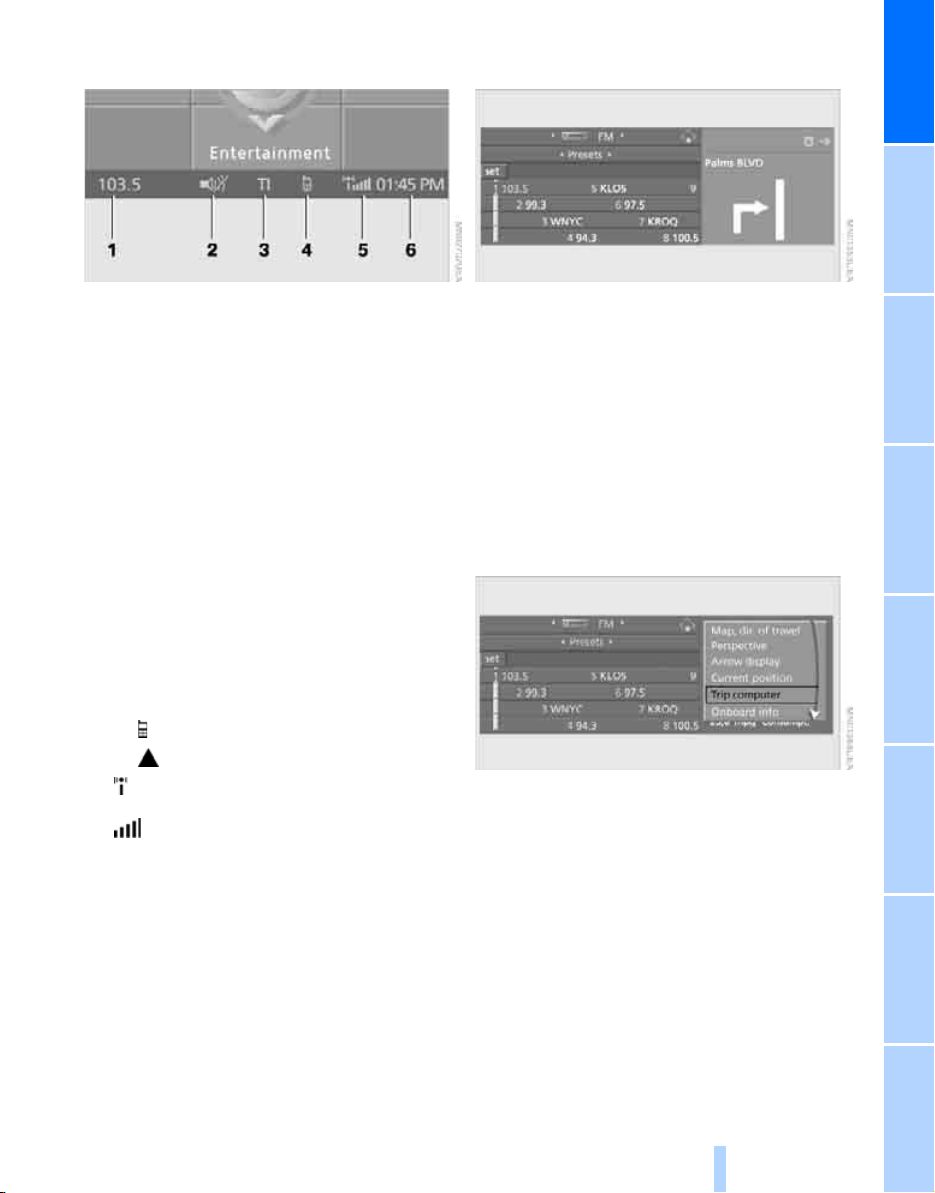
Status information
1 Display for:
> Entertainment:
Radio, CD, AUX, USB-audio interface
*
> Telephone* in "Communication":
Name of linked mobile phone, network
search or no network
> "BMW Assist"
*:
Active voice connection with a
BMW Assist service
2 Entertainment sound output off
3 Station that transmits traffic information is
received
*:
"TI":
Traffic information for the navigation sys-
tem
can be received and transmission is
switched on
4 Display for:
> New entries present in "Missed calls"
*
> Roaming active
5 Telephoning
* is possible if the mobile
phone is paired in the vehicle
Reception strength of mobile phone
network, dependent on mobile phone
6 Time
Other displays:
The status information is temporarily hidden
when there are Check Control instructions or
inputs via the voice command system
*.
Assistance window*
Additional information appears in the assis-
tance window:
> the computer or the trip computer
> the arrow or map view with a navigation sys-
tem
*
> the current position
Selecting display
1. Move the controller to the right to change to
the assistance window and press the con-
troller.
2. Select a menu item.
3. Press the controller.
Online Edition for Part no. 01 41 2 600 775 - © 08/08 BMW AG
iDrive
22
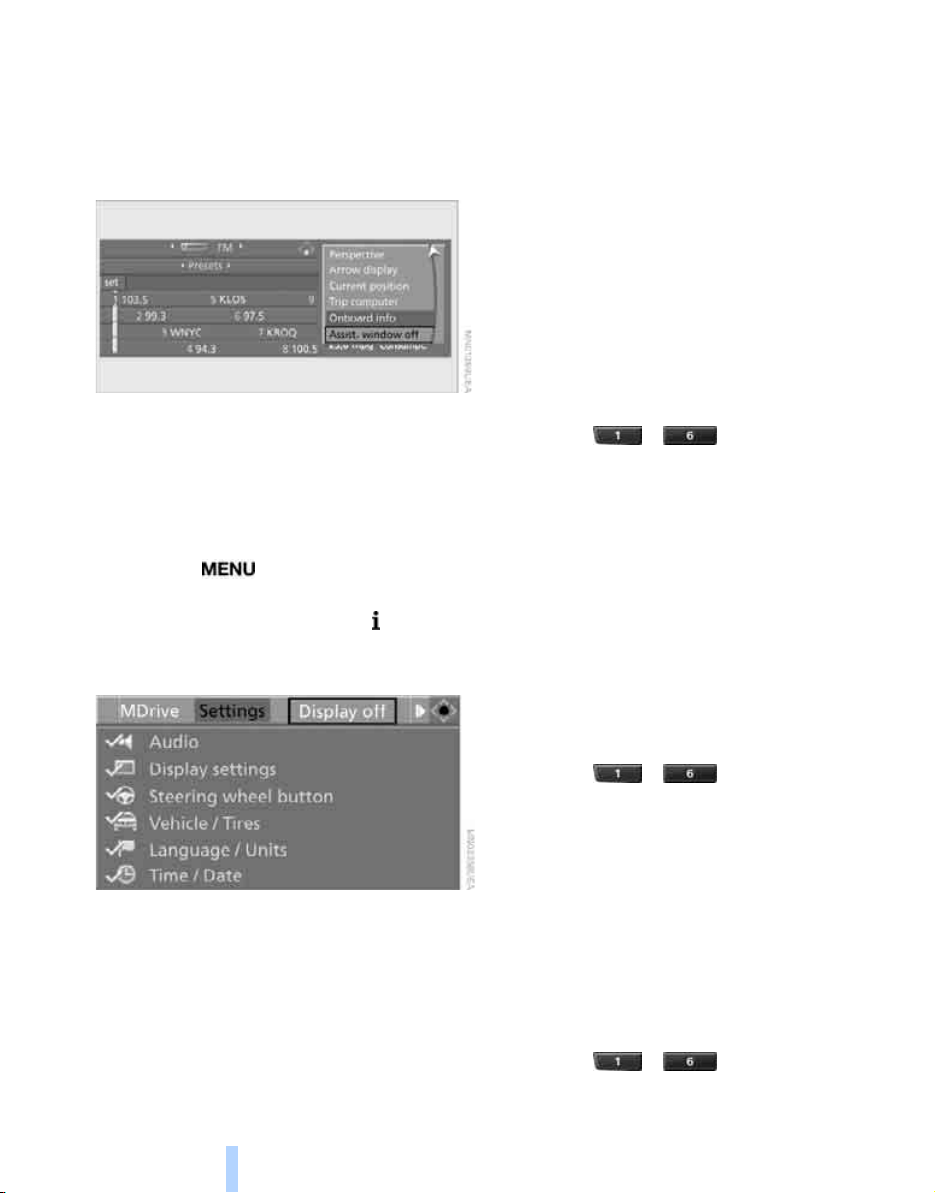
Switching assistance window off/on
1. Move the controller to the right to change to
the assistance window and press the con-
troller.
2. Select "Assist. window off" and press the
controller.
To switch on, change to the assistance window
and press the controller.
Switching Control Display
off/on
1. Press the button.
This opens the start menu.
2. Press the controller to open the menu.
3. Select "Display off" and press the control-
ler.
To switch on, press the controller.
Programmable memory
buttons
You can save and request certain functions of
iDrive on the programmable memory buttons:
> Destinations of navigation
> Telephone, phone numbers
> Entertainment:
> radio station
> CD
> CD compartment of CD changer
*
> AUX
> USB-audio interface
*
The assignment of the programmable buttons
is stored for the remote control currently in use.
Saving function
Destinations of navigation
1. Select navigation destination, e.g. in the
destination list or the address book.
2. Press the ... button longer
than 2 seconds.
Special features:
> With the destination guidance system and
the map view started, the current destina-
tion is stored.
> During destination entry via a map, the
coordinates at the cursor are stored, not the
current destination.
Telephone, phone numbers
1. Enter the phone number or select it in a list
of the stored phone numbers, e.g. of the A-
Z list.
2. Press the ... button longer
than 2 seconds.
If a name is assigned to the phone number, the
name will also be stored.
Entertainment
In the Entertainment menu, the sound source
currently heard, e.g. a radio station, is stored,
regardless of the selection on the Control Dis-
play.
1. Select the desired function, e.g. radio sta-
tion or CD.
2. Press the ... button longer
than 2 seconds.
Online Edition for Part no. 01 41 2 600 775 - © 08/08 BMW AG
At a glance
23
Reference ControlsDriving tipsCommunications NavigationEntertainmentMobility
If the vehicle is equipped with two drives,
the current track is stored for CDs with
compressed audio files.<
Running function
Press the ... button.
When selecting a phone number, the connec-
tion is also established, or the destination guid-
ance is started when a navigation destination is
selected.
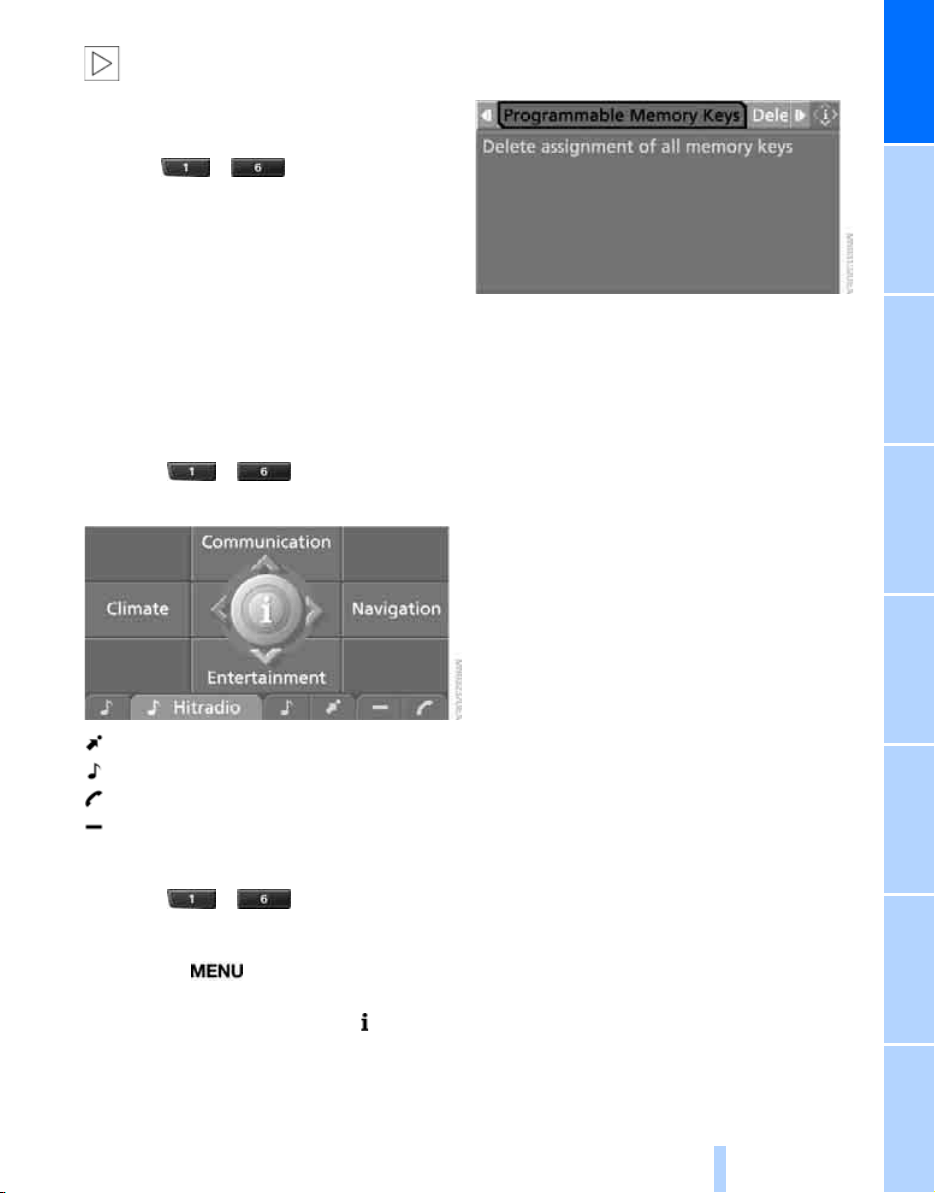
Displaying button assignment
You can display the assignment of the buttons
by touching them with your finger. Please do
not wear gloves when doing so. Touching with
an object, e.g. a pen, does not function.
Displaying short info
Touch the ... button.
The assignment of the buttons is displayed.
Destination of navigation system
Entertainment source
Telephone, phone number
Not assigned
Displaying detailed information
Touch the ... button longer.
Deleting button assignments
1. Press the button.
This opens the start menu.
2. Press the controller to open the menu.
3. Select "Settings" and press the controller.
4. Select "Vehicle / Tires" and press the con-
troller.
5. Select "Programmable Memory Keys" and
press the controller.
6. Select "Delete assignment of all memory
keys" and press the controller.
7. Confirm with "Yes".
Online Edition for Part no. 01 41 2 600 775 - © 08/08 BMW AG
Voice command system
24
Voice command system
The concept
The voice command system allows you to con-
trol operation of various vehicle systems with-
out taking your hands off the steering wheel.
Individual menu items on the Control Display
can be spoken as commands. This frees you of
having to use the controller.
The voice command system transforms your
oral commands into control signals for the
selected systems and provides support in the
form of instructions or questions.
The voice command system includes a special
microphone.
The microphone is located:
> Near the interior rearview mirror in the
Coupe, refer to page 14
> On the steering column in the Convertible
Precondition
Via iDrive, set the language that applies for the
voice command system in order to enable iden-
tification of the spoken commands. To set the
language of iDrive, refer to page 80.
Symbols in Owner's Manual
Voice commands
Activating voice command system
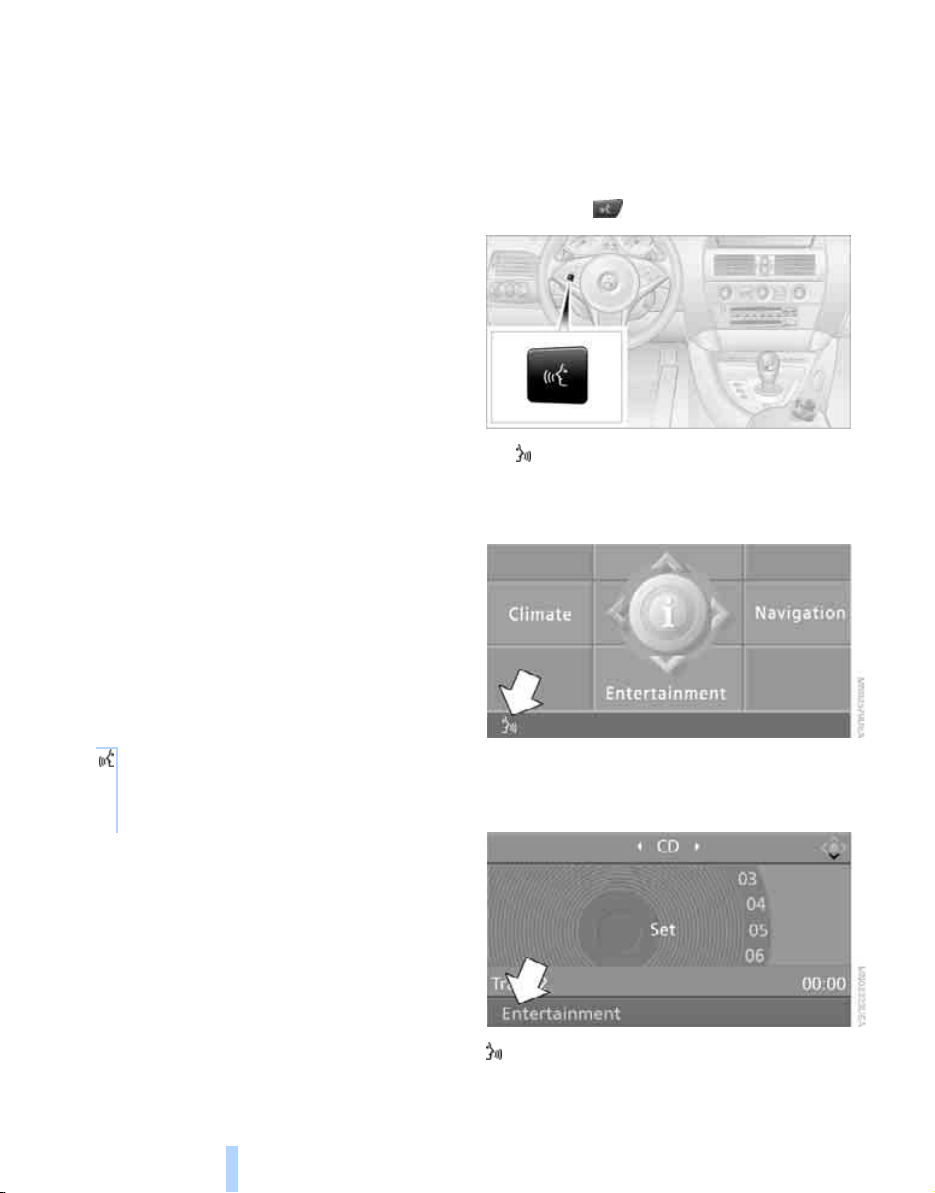
1. Press the button.
This symbol on the Control Display and
an acoustic signal tell you that the voice
command system can respond to com-
mands.
2. Say the command.
The command is displayed on the Control
Display.
This symbol is shown on the Control Display
when you can input additional commands.
*
{...} Say the specified commands word for
word.
{{...}} Indicates responses of the voice
command system.
Online Edition for Part no. 01 41 2 600 775 - © 08/08 BMW AG
At a glance
25
Reference ControlsDriving tipsCommunications NavigationEntertainmentMobility
If no other commands are possible, then oper-
ate the equipment via iDrive.
Terminating or canceling voice
command
Press the button on the steering wheel
or
Commands
Having possible commands read aloud
You can have the system read aloud the possi-
ble commands related to the selected menu
item on the Control Display.
To have the system list the possible com-
mands:
For instance, if you have selected "CD", the
commands available for operating the CD
player and CD changer
* are read out.
Opening help
Using alternative commands
There are often a number of commands to run a
function, e.g.:
Running functions directly with short
commands
With short commands you can run certain func-
tions directly, regardless of which menu item is
selected, refer to page 244.
Opening start menu
An example: selecting a track
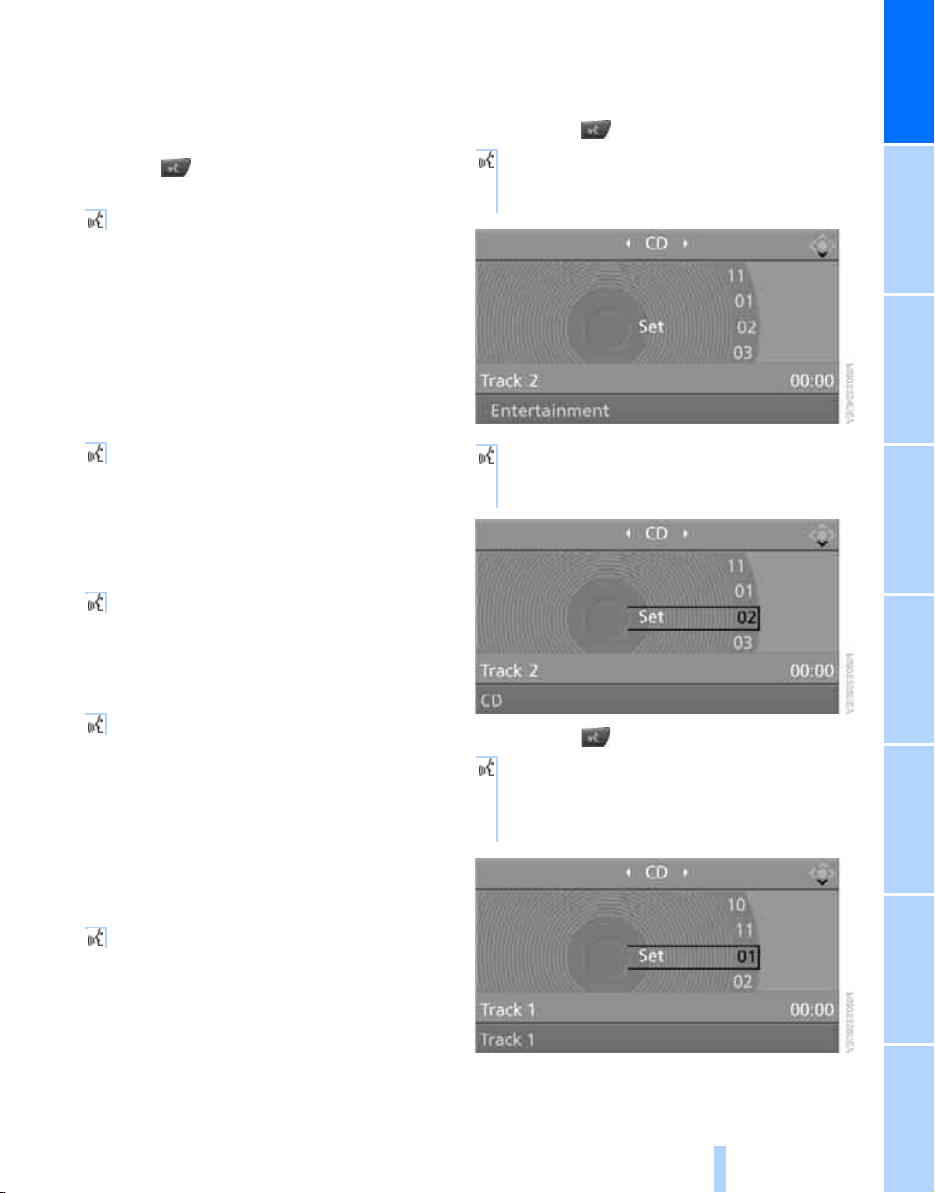
1. Switch on Entertainment sound output if
necessary.
2. Press the button on the steering wheel.
5. Press the button on the steering wheel.
{Cancel}
{Options}
{Help}
{Radio on} or {Turn radio on}
{Main menu}
3. {Entertainment}
The system says:
{{Entertainment}}
4. {CD}
The system says:
{{CD on}}
6. Select a track, e.g.:
{Track 1}
The system says:
{{Track 1}}
Online Edition for Part no. 01 41 2 600 775 - © 08/08 BMW AG

Voice command system
26
Notes
The mobile phone can also be operated
with voice commands, refer to
page 189.<
For voice commands, bear the following in
mind:
> Say the commands and numbers smoothly
and at normal volume, avoiding excessive
emphasis and pauses. This also applies to
spelling when entering the destination.
> Always issue commands in the language of
the voice command system.
> When selecting a radio station, use the
common pronunciation of the station name.
> For entries in the voice-activated phone
book, only use names in the language of the
voice command system and do not use
abbreviations.
> Keep the doors, windows and convertible
top closed to prevent interference from
ambient noise.
> Avoid background noises in the vehicle
while speaking.
Online Edition for Part no. 01 41 2 600 775 - © 08/08 BMW AG

Online Edition for Part no. 01 41 2 600 775 - © 08/08 BMW AG
Controls
This chapter is intended to provide you with
information for complete control of your vehicle.
Its extensive array of features and accessories,
both for driving and for your own safety,
comfort and convenience, are described here.
Controls
Online Edition for Part no. 01 41 2 600 775 - © 08/08 BMW AG
Opening and closing
30
Opening and closing
Keys/remote control
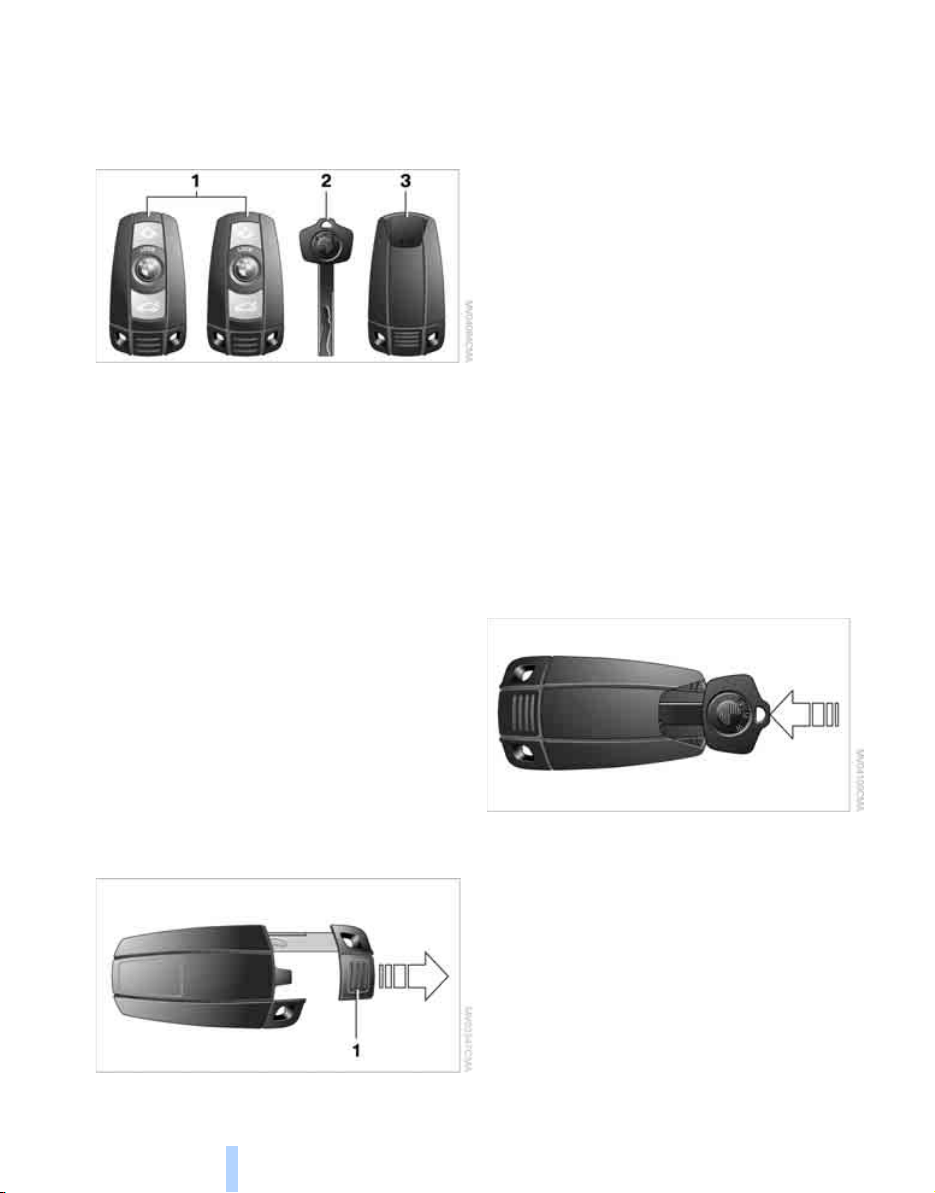
1 Remote control with integrated key
2 Spare key
3 Adapter for spare key, in glove compart-
ment
Remote control with integrated key
Each remote control contains a battery which is
charged in the ignition lock while driving. Drive a
longer distance with each remote control at
least twice a year to keep the battery charged.
For comfort access
*, the remote control con-
tains a replaceable battery, refer to page 40.
Depending on which remote control is detected
by the vehicle during unlocking, different set-
tings are activated and executed in the vehicle,
refer to Personal Profile, page 30.
Information on the required for maintenance is
also stored in the remote control, refer to Ser-
vice data in remote control, page 218.
Integrated key
Press button 1 to unlock the key.
The integrated key fits the following locks:
> Hotel function, refer to page 35
> Driver's door, refer to page 34
> Luggage compartment lid, refer to page 35
New remote controls
To obtain additional or replace lost keys, new
remote controls with an integrated key are
available at your BMW center.
Spare key
Store the spare key in a safe place such as your
wallet. This key is not intended for regular use.
The spare key and integrated key of the remote
control fit the same locks.
Adapter for spare key
The adapter is required so that the vehicle can
be started with the spare key or radio readiness
can be switched on.
Remove the adapter from the holder in the
glove compartment and slide the spare key into
the adapter before use.
Personal Profile
The concept
You can set a number of functions of your BMW
individually according to your preferences. Per-
sonal Profile ensures that most of these set-
tings are stored for the remote control currently
in use without you having to do anything. When
Online Edition for Part no. 01 41 2 600 775 - © 08/08 BMW AG

Controls
31
Reference At a glanceDriving tipsCommunications NavigationEntertainmentMobility
the vehicle is unlocked, the corresponding
remote control is detected and the settings
stored for it are called up and carried out.
This means that you will always find your BMW
set to your own personal settings even if
another person with his/her own remote control
and settings has used the vehicle since the last
time you drove it. The individual settings are
stored for a maximum of four remote controls,
for two with comfort access
*.
Personal Profile settings
Details on the settings are provided on the
specified pages.
> Behavior of the central locking system
when unlocking vehicle, refer to page 32
> Automatic locking of the vehicle, refer to
page 34
> Programming button on steering wheel,
refer to page 55
> Displays on Control Display:
> 12h/24h clock mode, refer to page 79
> Date format, refer to page 80
> Brightness of the Control Display, refer
to page 80
> Units of measure for consumption,
route/distances, temperature and pres-
sure, refer to page 80
> Language on the Control Display, refer
to page 80
> Lighting settings:
> Triple turn signal activation, refer to
page 66
> Welcome lamps, refer to page 97
> Pathway lighting, refer to page 98
> Daytime running lamps
*, refer to
page 98
> High-beam assistant
*, refer to page 99
> Drivelogic driving program in the Sequential
mode, refer to page 64
> Individual settings for MDrive, refer to
page 55
> PDC Park Distance Control
*: optical warn-
ing, refer to page 83
> Head-Up Display
*: selection and bright-
ness of display, refer to page 94
> Automatic climate control: for AUTO pro-
gram and intensity, cooling function, and
automatic recirculated air control/recircu-
lated air mode, temperature, air distribution,
temperature in the upper body region, refer
to page 103
> Navigation system
*: voice instructions for
destination guidance, refer to page 143
In addition, the following, most recently
selected settings are recalled during unlocking:
> Programmable memory buttons: selecting
stored functions, refer to page 22
> Driver's seat, exterior-mirror and steering-
wheel position, refer to page 49
> Audio sources: volume and tone settings,
refer to page 153
> Radio: display of stored stations, refer to
page 156
> Phone: adjusting volume, refer to page 184
Central locking system
The concept
The central locking system functions when the
driver's door is closed.
The system simultaneously engages and
releases the locks on the following:
> Doors
> Compartment in the front center console
> Luggage compartment lid
> Fuel filler door
Operating from outside
> Via the remote control
> Using door lock
> With comfort access
* via the door handles
These actions operate the anti-theft system
* at
the same time. It prevents the doors from being
Online Edition for Part no. 01 41 2 600 775 - © 08/08 BMW AG
Opening and closing
32
unlocked using the lock buttons or door han-
dles. The interior lamps and the courtesy lamps
are also switched on and off with the remote
control. The alarm system
is armed/disarmed at
the same time.
You can find more detailed information on the
alarm system
on page 37.
Operating from inside
Via the central locking button, refer to page 34.
The fuel filler door
and the compartment in the
front center console are not locked, refer to
page 34.
In the event of a serious accident, the central
locking system unlocks automatically. In addi-
tion, the hazard warning flashers and interior
lamps come on.
Opening and closing:
Using remote control
Persons or animals left unattended in a
parked vehicle can lock the doors from
the inside. Always take along the remote control
when leaving the vehicle so that the vehicle can
then be opened from the outside.<
Unlocking
Press the button.
The interior lamps, the courtesy lamps
*, and
the welcome lamps are switched on.
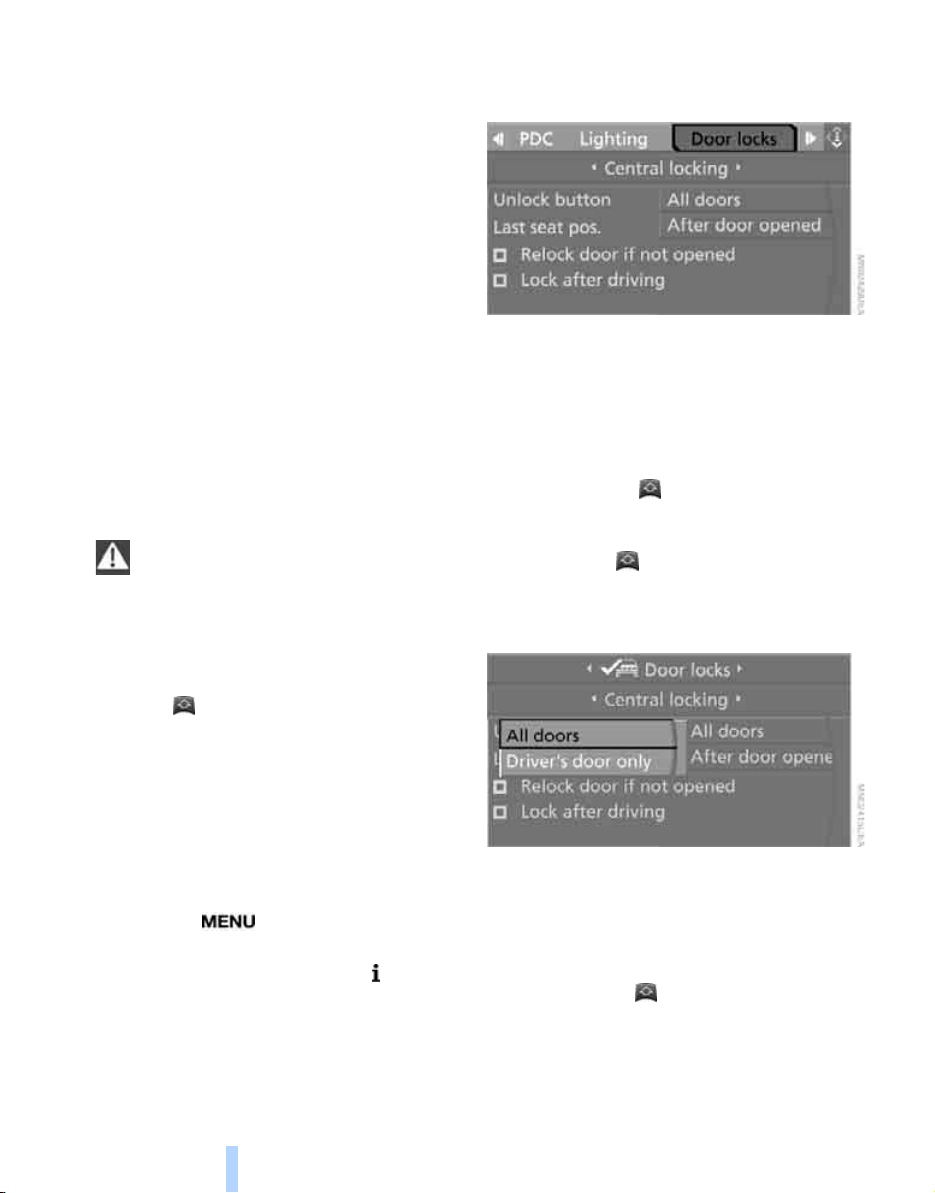
Setting unlocking behavior
You can set whether the first press of the button
unlocks only the driver's door or the entire vehi-
cle.
iDrive, for operating principle refer to page 16.
1. Press the button.
This opens the start menu.
2. Press the controller to open the menu.
3. Select "Settings" and press the controller.
4. Select "Vehicle / Tires" and press the con-
troller.
5. Change to upper field if necessary. Turn the
controller until "Door locks" is selected and
press the controller.
6. Select "Central locking" and press the con-
troller.
7. Select "Unlock button" and press the con-
troller.
8. Select a menu item:
> "All doors"
Pressing the button once unlocks the
entire vehicle.
> "Driver's door only"
*
Press the button once to unlock only
the driver's door and the fuel filler door.
Pressing the button twice unlocks the
entire vehicle.
9. Press the controller.
The setting is stored for the remote control cur-
rently in use.
Comfort opening mode
Press and hold the button:
> Coupe: the windows are opened.
> Convertible: the windows and the convert-
ible top are opened.
Online Edition for Part no. 01 41 2 600 775 - © 08/08 BMW AG
Controls
33
Reference At a glanceDriving tipsCommunications NavigationEntertainmentMobility
Watch the convertible top during the
opening process to be sure that no
one is injured. Releasing the button stops
the operation.<
Locking
Press the button.
Do not lock the vehicle from the outside if
persons are inside, as unlocking from the
inside is not possible without special knowl-
edge.<
Switching on interior lamps
With vehicle locked:
Press the button.
You can also use this function to locate your
vehicle in parking garages etc.
Panic mode*
You can trigger the alarm system in case of dan-
ger:
Press the button for at least 3 seconds.
Switching off alarm: press any button.
Opening luggage compartment lid
Press the button for approx. 1 second.
The luggage compartment lid opens, regard-
less of whether it was previously locked or
unlocked.
A previously locked luggage compart-
ment lid is also locked again after closing.
Coupe: during opening, the luggage compart-
ment lid pivots back and up. Make sure that
adequate clearance is available before open-
ing.<
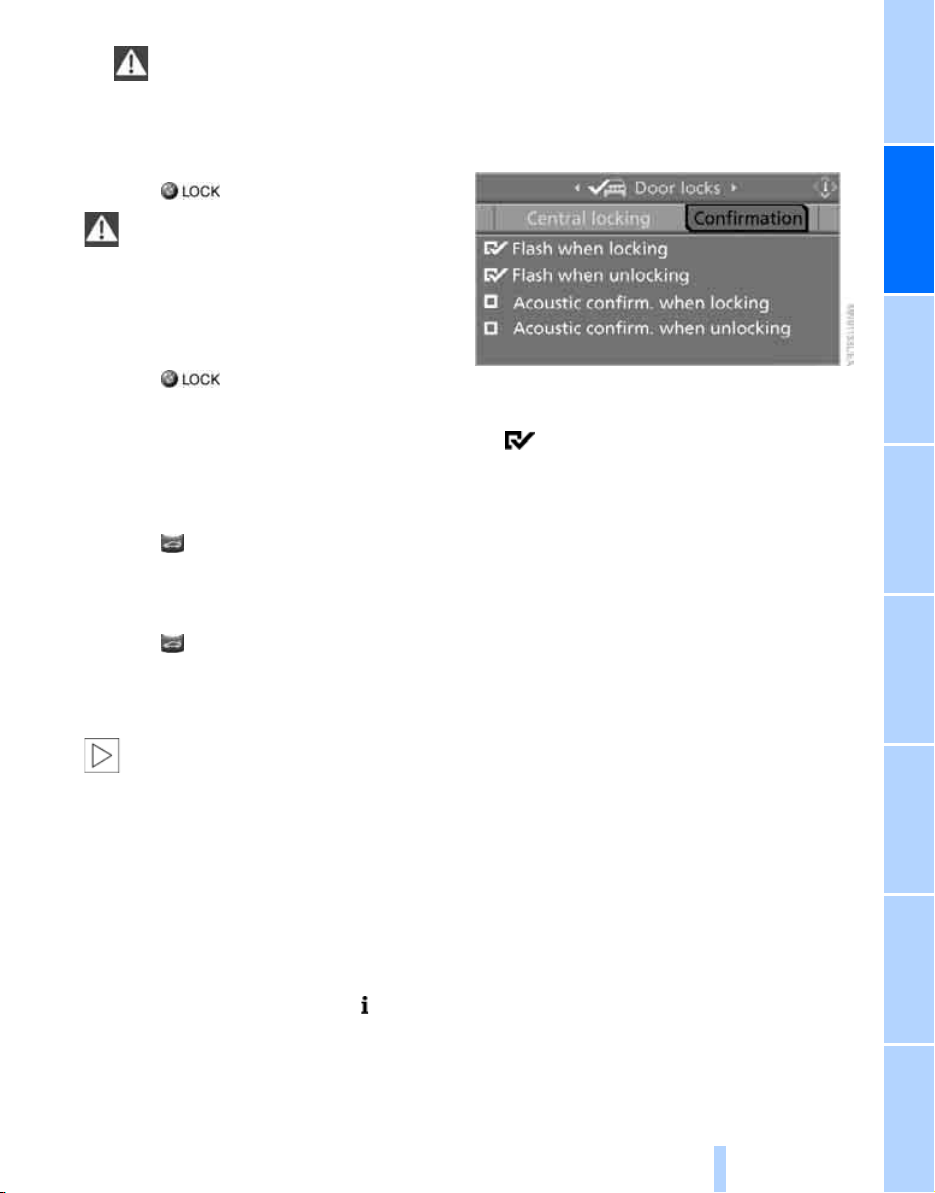
Confirmation signals
You can activate or deactivate the confirmation
signals.
1. Open the start menu.
2. Press the controller to open the menu.
3. Select "Settings" and press the controller.
4. Select "Vehicle / Tires" and press the con-
troller.
5. Change to upper field if necessary. Turn the
controller until "Door locks" is selected and
press the controller.
6. Select "Confirmation" and press the con-
troller.
7. Select the desired signal.
8. Press the controller.
The signal is activated.
Malfunction
The remote control may malfunction due to
local radio waves. Should the remote control fail
to operate due to interference of this kind,
unlock and lock the vehicle via the door lock
using a key.
If it is no longer possible to lock the vehicle
using the remote control, then the battery is
discharged. Use this remote control during an
extended drive; this will recharge the battery,
refer to page 30.
For US owners only
The transmitter and receiver units comply with
part 15 of the FCC/Federal Communication
Commission regulations. Operation is gov-
erned by the following:
FCC ID:
LX8766S
LX8766E
LX8CAS
LX8CAS2
Compliance statement:
This device complies with part 15 of the FCC
Online Edition for Part no. 01 41 2 600 775 - © 08/08 BMW AG
Opening and closing
34
Rules. Operation is subject to the following two
conditions:
> This device must not cause harmful inter-
ference, and
> this device must accept any interference
received, including interference that may
cause undesired operation.
Any unauthorized modifications or
changes to these devices could void the
user's authority to operate this equipment.<
Opening and closing:
Using door lock
Do not lock the vehicle from the outside if
persons are inside, as unlocking from the
inside is not possible without special knowl-
edge.<
When unlocking
1. Turning the key once unlocks the driver's
door and the fuel filler door.
2. A second turn of the key unlocks the pas-
senger door and luggage compartment lid.
Convenient operation
You also have the option of operating the win-
dows and the convertible top on the Convertible
from the driver's door lock.
Turn and hold the key in the positions for
unlocking or locking.
Keep a close eye on the closing process
and also on the opening process of the
convertible top to be sure that no one is injured.
Releasing the key stops the operation.<
Manual operation
In the event of an electrical malfunction, you can
turn a key all the way to the right or left in the
door lock to lock or unlock the driver's door.
Opening and closing: from
inside
This button serves to unlock or lock doors and
the luggage compartment lid, but does not acti-
vate the anti-theft system. The fuel filler door
remains unlocked.
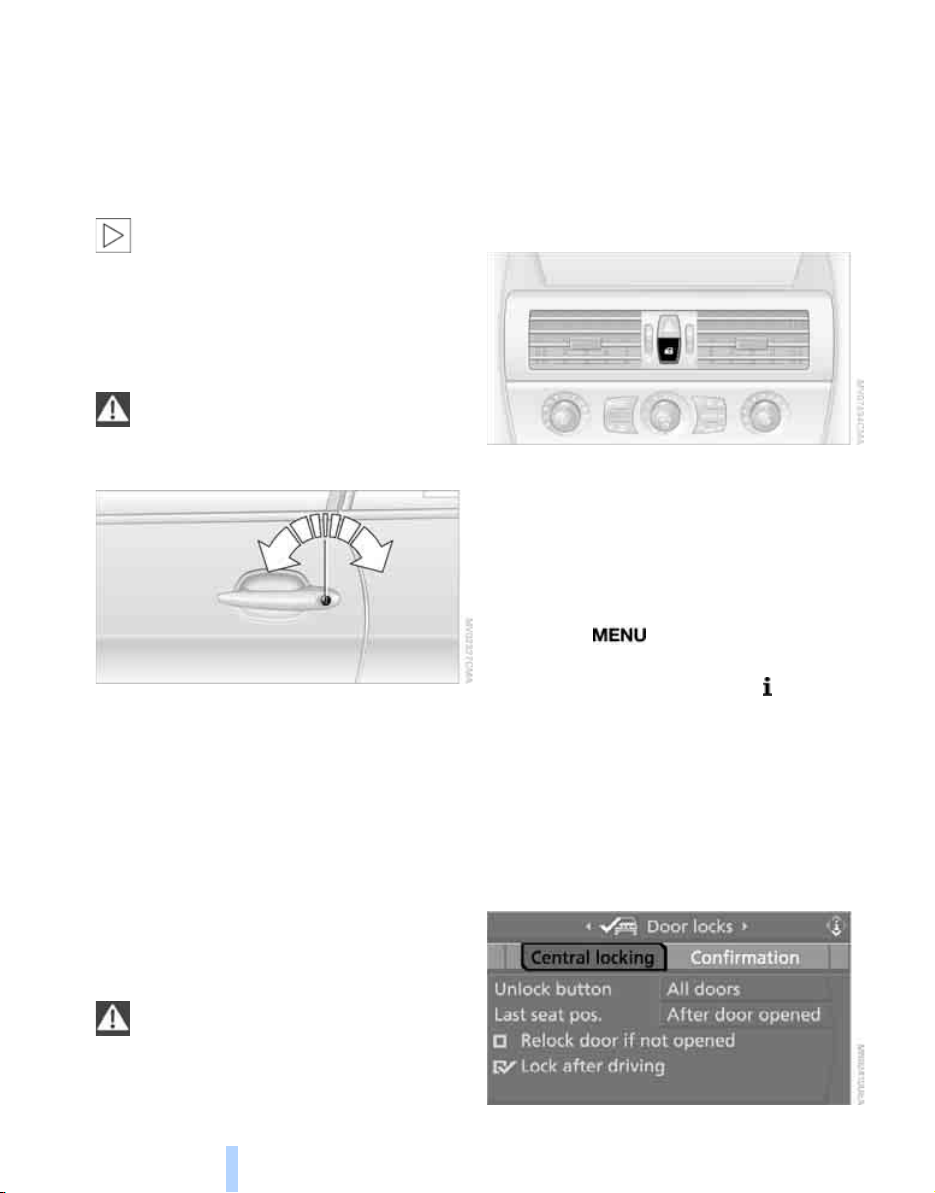
Automatic locking
iDrive, for operating principle refer to page 16.
1. Press the button.
This opens the start menu.
2. Press the controller to open the menu.
3. Select "Settings" and press the controller.
4. Select "Vehicle / Tires" and press the con-
troller.
5. Change to upper field if necessary. Turn the
controller until "Door locks" is selected and
press the controller.
6. Select "Central locking" and press the con-
troller.
Online Edition for Part no. 01 41 2 600 775 - © 08/08 BMW AG
Controls
35
Reference At a glanceDriving tipsCommunications NavigationEntertainmentMobility
7. Select a menu item:
> "Relock door if not opened"
The central locking system locks again
after a short time if no door has been
opened.
> "Lock after driving"
The central locking system locks the
vehicle as soon as you start to drive.
8. Press the controller.
The setting is selected.
The setting is stored for the remote control cur-
rently in use.
Unlocking and opening
> Either unlock both doors at the same time
with the button for the central locking sys-
tem and then pull the door handle above the
armrest or
> pull on the door handle of each door twice:
the first time unlocks the door, the second
time opens it.
Locking
> Use the central locking button to lock both
of the doors simultaneously, or
> press down the lock button of a door.
To prevent you from being locked out, the
open driver's door cannot be locked using
the lock button.
Persons or animals left unattended in a
parked vehicle can lock the doors from
the inside. Always take along the remote control
when leaving the vehicle so that the vehicle can
then be opened from the outside.<
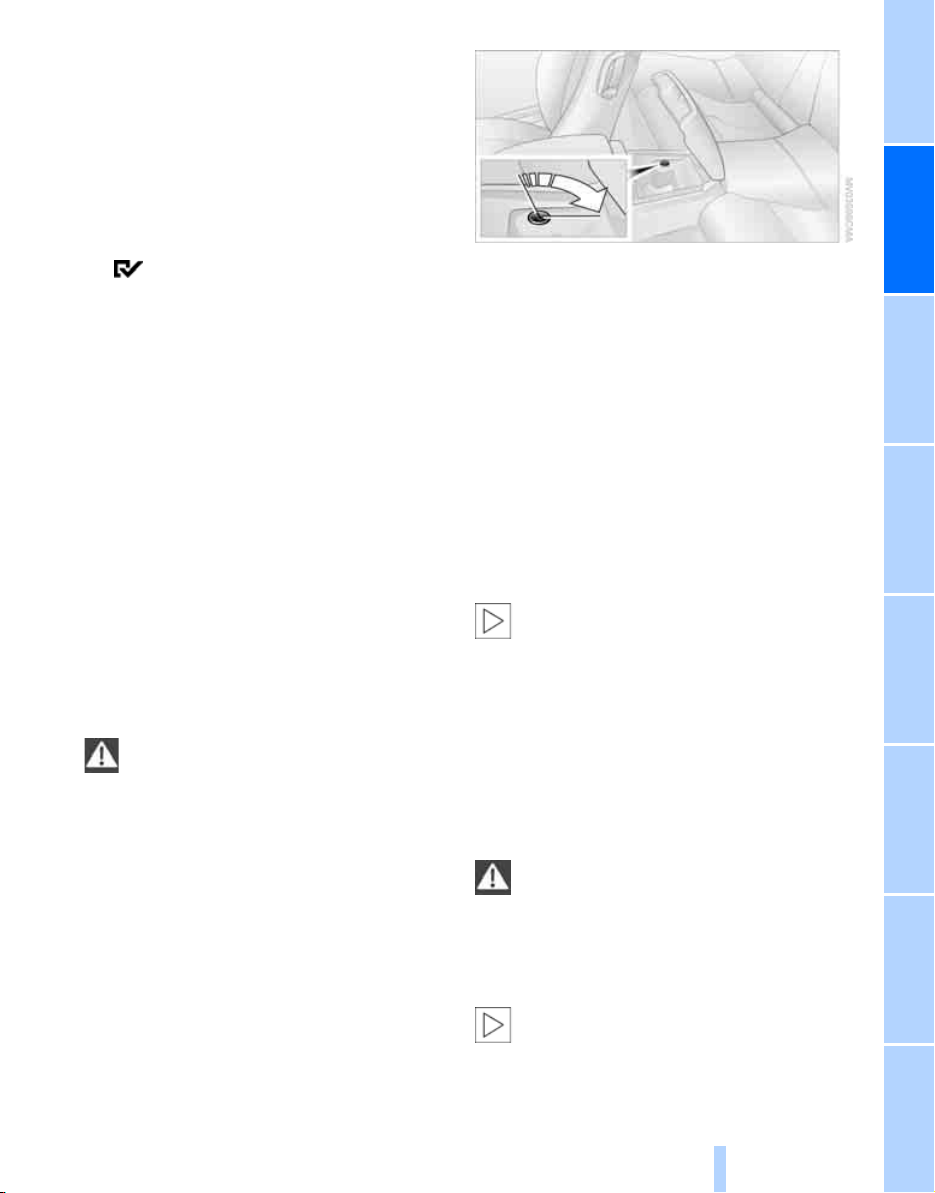
Hotel function
The hotel function locks the compartment in
the front center console and the luggage com-
partment lid separately and disconnects them
from the central locking system. If you hand
over the remote control without the integrated
key, refer to page 30, e.g. at a hotel, then this
prevents access to the luggage compartment
and to the compartment in the front center con-
sole.
Turn the key to the right, refer to illustration,
until the key slot points in the direction of travel
and then remove:
The hotel function is activated after subsequent
locking or unlocking of the vehicle. The system
locks the luggage compartment lid and the
compartment in the front center console and
disconnects them from the central locking sys-
tem.
Unlocking manually
In order to manually unlock the compartment in
the front center console in the event of an elec-
trical malfunction, turn the key all the way to the
right until it reaches the stop.
If unlocking was manual, return the lock to
the home position, i.e. all the way back to
the left, before reactivating the hotel function.<
Doors
Automatic soft closing*
To close the doors, merely push them gently.
The closing process will then be carried out
automatically.
Make sure that the closing path of the
doors is clear; otherwise injuries may
result.<
Luggage compartment lid
During opening, the luggage compart-
ment lid pivots back and up. Make sure
that adequate clearance is available before
opening.<
Online Edition for Part no. 01 41 2 600 775 - © 08/08 BMW AG
Opening and closing
36
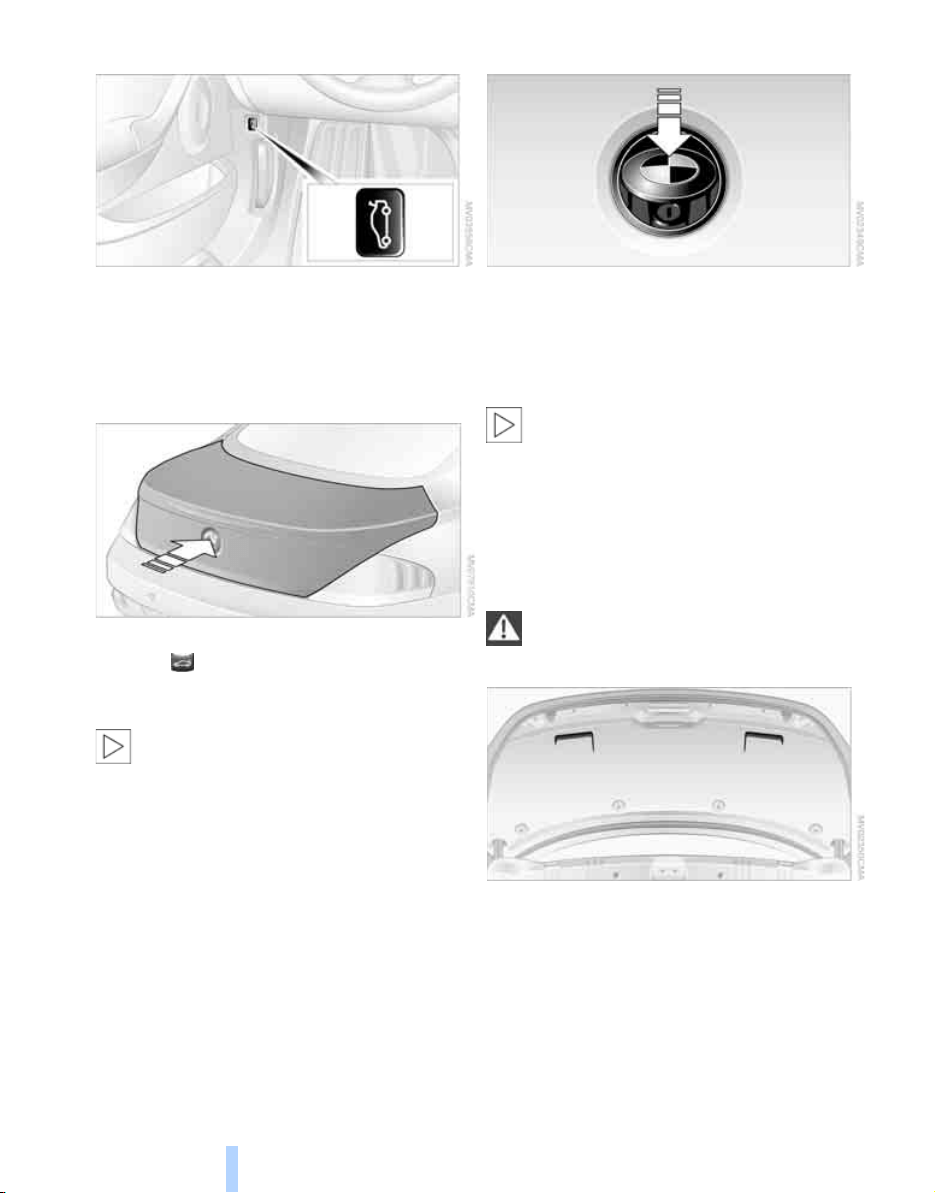
Opening from inside
Press the button:
The luggage compartment lid opens, provided
that it is not locked or the hotel function is not
activated, refer to the above section.
Opening from outside
Press the upper half of the BMW emblem or
press the button on the remote control for
approx. 1 second: the luggage compartment lid
opens.
Convertible: if the convertible top is not
completely open or closed, then the lug-
gage compartment lid cannot be opened, refer
to page 43.<
Unlocking manually
The luggage compartment lid lock is located
under the BMW emblem. All keys, refer to
page 30, fit the luggage-compartment lid lock.
Turn the key toward the right up to the stop: the
luggage compartment lid opens.
If you use the lock to open the luggage
compartment lid while the alarm system
is armed, the alarm will be triggered. To prevent
this, you should deactivate the alarm before-
hand.
If the alarm is inadvertently triggered: switch off
the alarm, refer to page 37.<
Closing
Make sure that the closing path of the
luggage compartment lid is clear; other-
wise, injuries may result.<
The handle recesses on the interior trim of the
luggage compartment lid make it easier to pull
down.
Online Edition for Part no. 01 41 2 600 775 - © 08/08 BMW AG
Controls
37
Reference At a glanceDriving tipsCommunications NavigationEntertainmentMobility
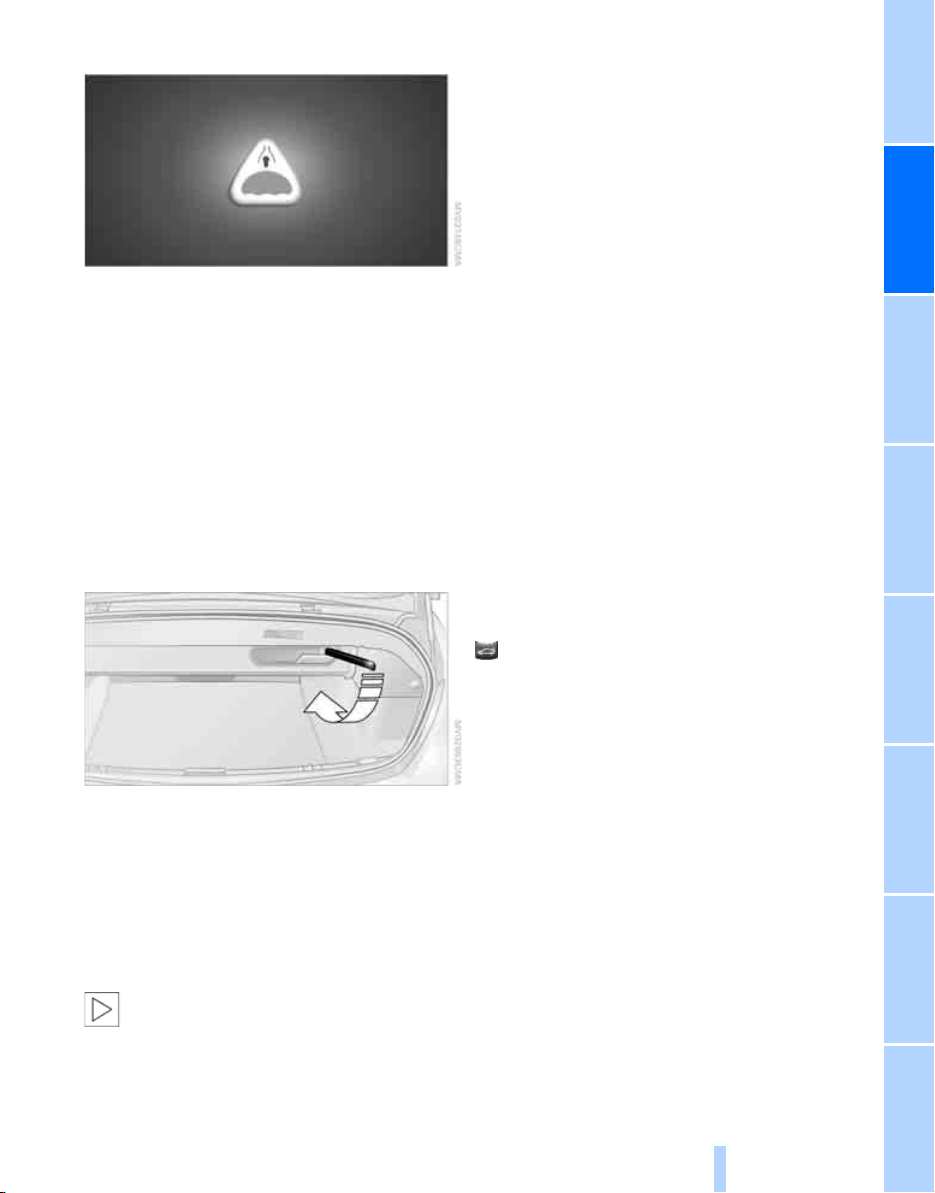
Emergency release
Pull the lever in the cargo bay. The luggage
compartment lid is unlocked.
Luggage compartment
There are four lashing eyes on the inner corners
of the luggage compartment for securing lug-
gage nets
* or securing straps to fix luggage in
position.
Also refer to Securing cargo, page 121.
Convertible: increasing luggage
compartment capacity
With the convertible top closed, you can
increase the luggage compartment capacity:
To do so, unfold the handle and press it down-
ward in the direction of travel, refer to arrow.
This moves the convertible top compartment
floor into the raised position.
Before opening the convertible top, carry out
this procedure in reverse order.
The convertible top cannot be opened if
the convertible top compartment floor is
in the raised position.<
Alarm system
The concept
The vehicle alarm system responds:
> To the opening of a door, the hood, or the
luggage compartment lid
> To movements in the vehicle interior: inte-
rior motion sensor, refer to page 38
> To changes in the vehicle's tilt if someone
attempts to steal the wheels or tow the
vehicle
> To interruptions in battery voltage
Unauthorized operations are briefly signaled by
the alarm system:
> with an acoustic alarm
> by switching on
the hazard warning flashers
> by flashing the high beams
Arming and disarming alarm system
When you lock or unlock the vehicle, either with
the remote control or at the door lock, the alarm
system is armed or disarmed at the same time.
You can open the luggage compartment lid,
even with the system armed, by using the
button of the remote control, refer to
page 33. When the luggage compartment lid is
closed, it is once again locked and monitored.
Switching off alarm
> Unlock the vehicle using the remote control,
refer to page 32, or
> insert the remote control all the way into the
ignition lock.
Online Edition for Part no. 01 41 2 600 775 - © 08/08 BMW AG
Opening and closing
38
Indicator lamp displays
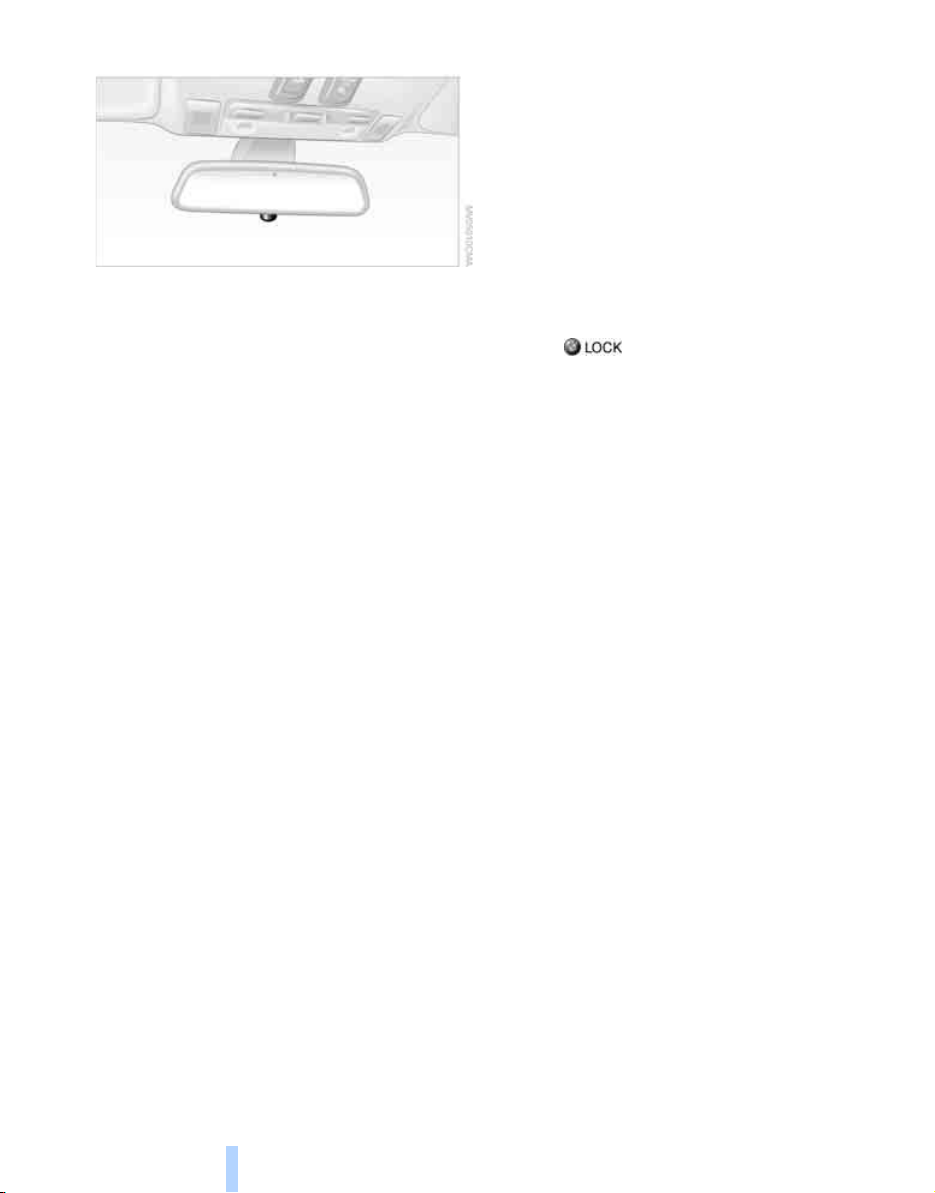
> The indicator lamp below the interior rear-
view mirror flashes continuously: the sys-
tem is armed.
> The indicator lamp flashes after locking: the
doors, hood or luggage compartment lid are
not properly closed. Even if you do not close
the alerted area, the system begins to mon-
itor the remaining areas, and the indicator
lamp flashes continuously after approx.
10 seconds. However, the interior motion
sensor is not activated.
> The indicator lamp goes out after unlocking:
your vehicle has not been disturbed while
you were away.
> The indicator lamp flashes after unlocking
until the remote control is inserted into the
ignition lock, however for a maximum of
approx. 5 minutes: your vehicle has been
disturbed while you were away.
Tilt alarm sensor
The tilt of the vehicle is monitored. The alarm
system reacts, e.g. in case of an attempted
wheel theft or towing.
Interior motion sensor
Coupe:
The condition for proper operation of the inte-
rior motion sensor is closed windows.
Convertible:
Monitors the interior up to the height of the seat
cushions. This means that the alarm system,
including the interior motion sensor, is armed
even if the convertible top is open. Falling
objects, e.g. leaves, can trigger false alarms,
refer to Avoiding unintentional alarms.
Avoiding unintentional alarms
The tilt alarm sensor and interior motion sensor
may be switched off at the same time. This pre-
vents unintentional alarms, e.g. in the following
situations:
> In two-level garages
> When transporting on car-carrying trains,
by sea or on a trailer
> When animals are to remain in the vehicle
Switching off tilt alarm sensor and
interior motion sensor
Press the button on the remote control
again as soon as the vehicle is locked.
The indicator lamp lights up briefly and then
flashes continuously. The tilt alarm sensor and
the interior motion sensor are switched off until
the next time the vehicle is unlocked and subse-
quently locked again.
Comfort access*
Comfort access allows you to access your vehi-
cle without having to hold the remote control in
your hand. It is sufficient to carry the remote
control with you, e.g. in your jacket pocket. The
vehicle automatically detects the associated
remote control in the immediate vicinity or in
the interior.
Comfort access supports the following func-
tions:
> Unlocking/locking vehicle
> Comfort closing with Coupe
> Opening luggage compartment lid sepa-
rately
> Starting engine
Functional requirement
> The vehicle or the luggage compartment lid
can only be locked if the vehicle detects that
the remote control you are carrying is out-
side the vehicle.
> The next unlocking and locking cycle is not
possible until after approx. 2 seconds.
Online Edition for Part no. 01 41 2 600 775 - © 08/08 BMW AG
Controls
39
Reference At a glanceDriving tipsCommunications NavigationEntertainmentMobility
> The engine can only be started if the vehicle
detects that the remote control is located in
the vehicle.
Comparison with ordinary remote
control
You can control the functions mentioned previ-
ously with the comfort access or by pressing
the buttons on the remote control. Therefore,
please familiarize yourself with the information
on opening and closing beginning on page 30
beforehand.
The special features when using comfort
access are described in the following.
Should a short delay occur when opening
or closing the windows or the convertible
top, the system is checking whether a remote
control is located in the vehicle. Please repeat
opening or closing if necessary.<
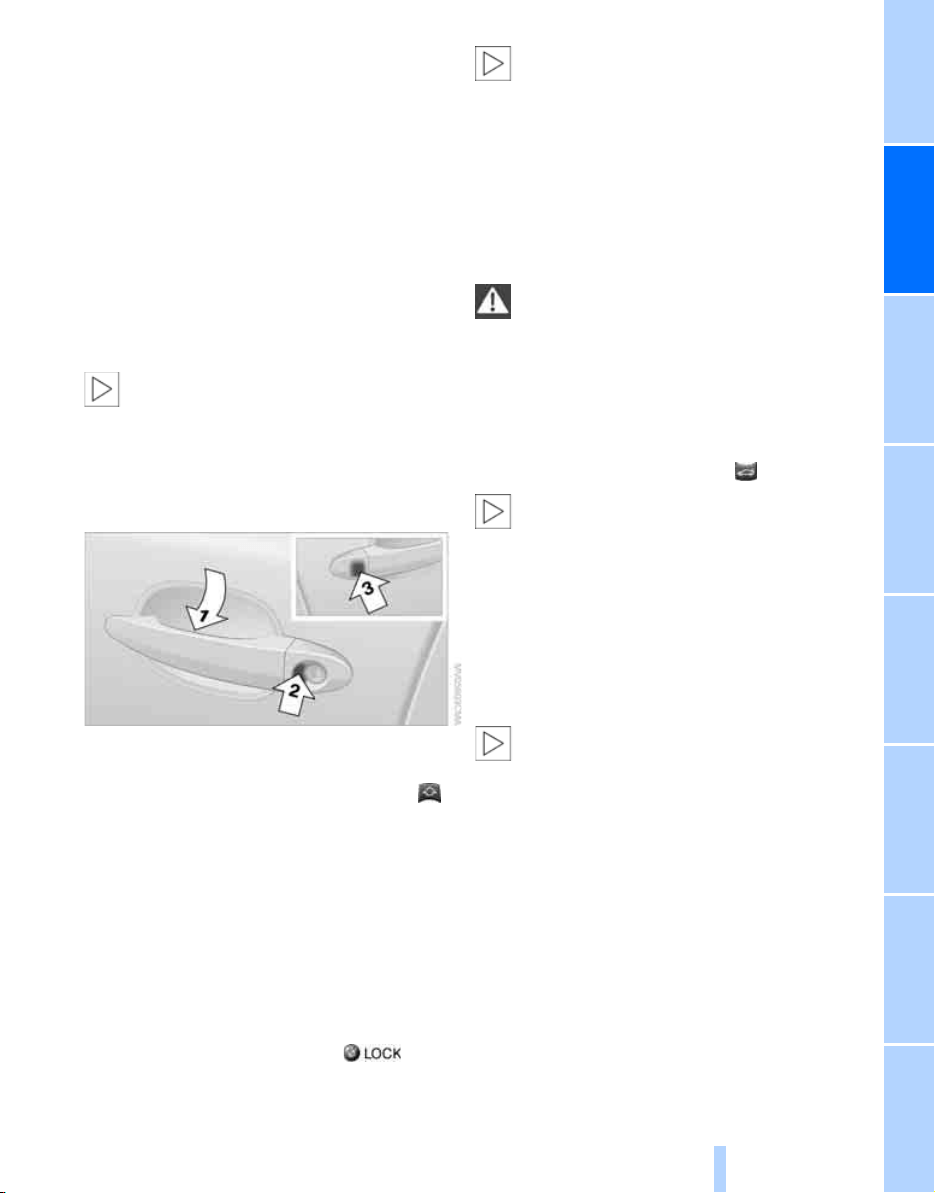
Unlocking
Grasp a door handle fully, refer to arrow 1, but
do not touch the surfaces, arrow 2 or 3 when
doing so. This corresponds to pressing the
button.
Locking
> On the driver's door, touch the highlighted
surface, arrow 2, with a finger for approx.
1 second, but do not grasp the door handle.
> On the front passenger door, touch the
highlighted surface, arrow 3, with the back
of your hand for approx. 1 second, but do
not grasp the door handle.
This corresponds to pressing the but-
ton.
Please make sure that the ignition and all
electronic systems/consumers are
switched off before locking to save the bat-
tery.<
Coupe: Comfort closing
Hold a finger or the back of your hand against
the surface, arrow 2 or 3, but do not grasp the
door handle while doing so.
The windows are closed.
Watch during the closing process to be
sure that no one is injured. Removing the
hand from the door handle stops the closing
process immediately.<
Opening luggage compartment lid
separately
Press the upper half of the BMW emblem.
This corresponds to pressing the button.
If a remote control accidentally left in the
luggage compartment is detected inside
the locked vehicle after the luggage compart-
ment lid has been closed, then the luggage
compartment lid opens again. The hazard warn-
ing flashers flash and a signal
* sounds.<
Switching on radio readiness
By pressing the Start/Stop button, you switch
on the radio readiness, refer to page 60.
When doing so, do not depress the brake
or clutch pedal, otherwise the engine will
start immediately.<
Starting engine
You can start the engine or switch on the igni-
tion if a remote control is located in the interior
of the vehicle. It need not be inserted in the igni-
tion lock, refer to page 60.
If you take the remote control with you when
leaving the vehicle with the engine running, a
warning lamp lights up. In addition, a message
appears on the Control Display. As long as no
remote control is detected, it is only possible to
restart the engine within approx. 10 seconds
after it is switched off.
Online Edition for Part no. 01 41 2 600 775 - © 08/08 BMW AG
Opening and closing
40
Malfunction
The comfort access function may malfunction
due to local radio waves. If this occurs, then
open or close the vehicle with the buttons on
the remote control or with a key. To start the
engine following this, insert the remote control
in the ignition lock.
When unlocking or locking/comfort closing do
not simultaneously grasp the door handle and
touch the surfaces, arrow 2 or 3. Otherwise, you
may limit the function.
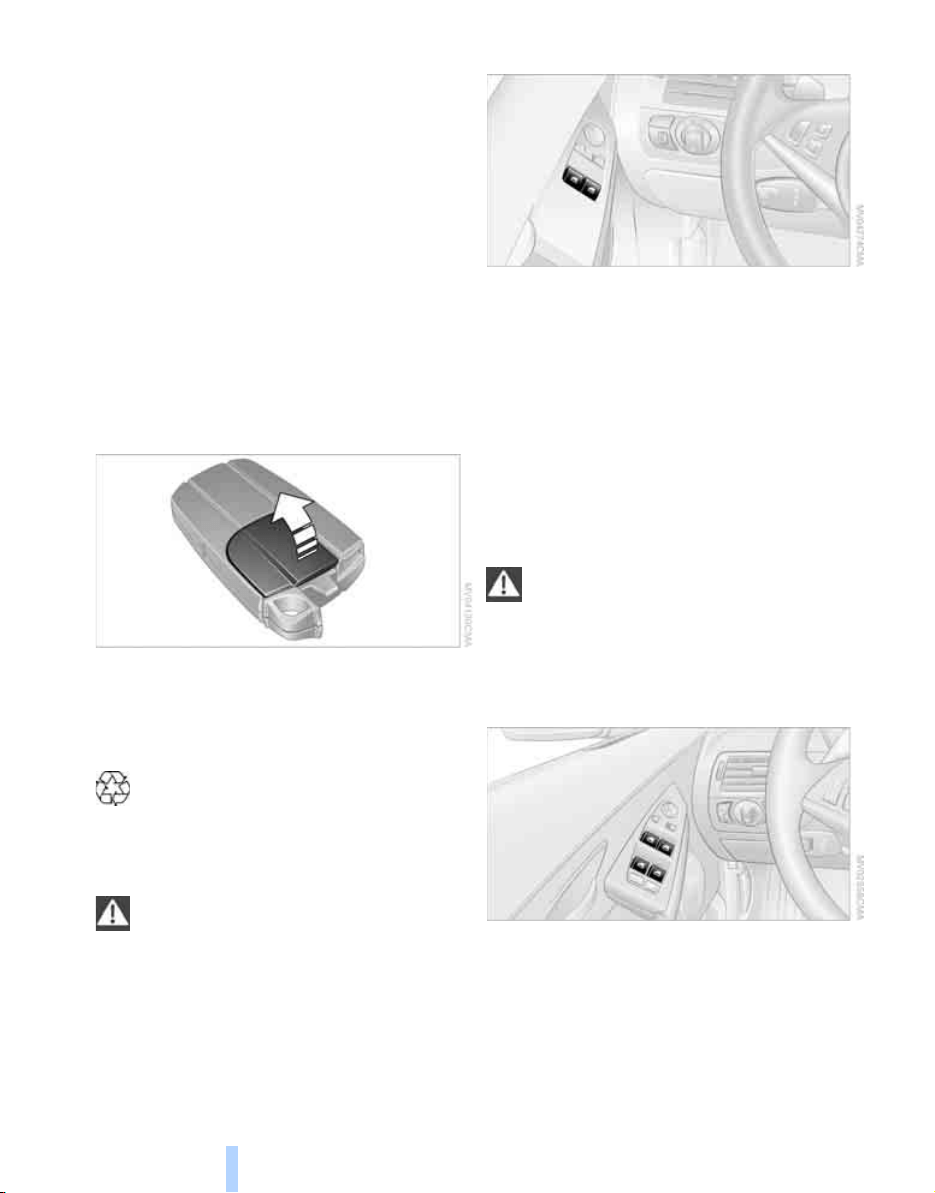
Replacing battery
If the battery of the remote control is dead, a
message will appear in the Control Display.
1. Remove integrated key from remote con-
trol, refer to page 30.
2. Remove cover.
3. Lay in new battery with positive side facing
upward.
4. Press cover closed.
Return used battery to a recycling collec-
tion point or to your BMW center.<
Windows
To prevent injuries, exercise care when
closing the windows and keep them in
your field of vision until they are shut.
Always take along the remote control when you
leave the vehicle, otherwise children could, for
example, operate the windows and injure them-
selves.<
Coupe: Opening, closing
> Press switch to resistance point:
The window continues to open as long as
you keep the switch pressed.
> Press the switch beyond the resistance
point:
The window opens automatically. Pressing
the switch again stops the opening move-
ment.
You can close the windows in the same manner
by pulling the switch.
Convertible: Opening, closing
To close the side windows while the vehi-
cle is being driven, always close the rear
windows first or all four windows simulta-
neously; otherwise, the windows cannot close
tightly at higher speeds.<
Individually
> Press switch to resistance point:
The window continues to open as long as
you keep the switch pressed.
> Press the switch beyond the resistance
point:
The window opens automatically. Pressing
the switch again stops the opening move-
ment.
Online Edition for Part no. 01 41 2 600 775 - © 08/08 BMW AG
Controls
41
Reference At a glanceDriving tipsCommunications NavigationEntertainmentMobility
You can close the windows in the same manner
by pulling the switch. The rear windows cannot
be closed automatically.
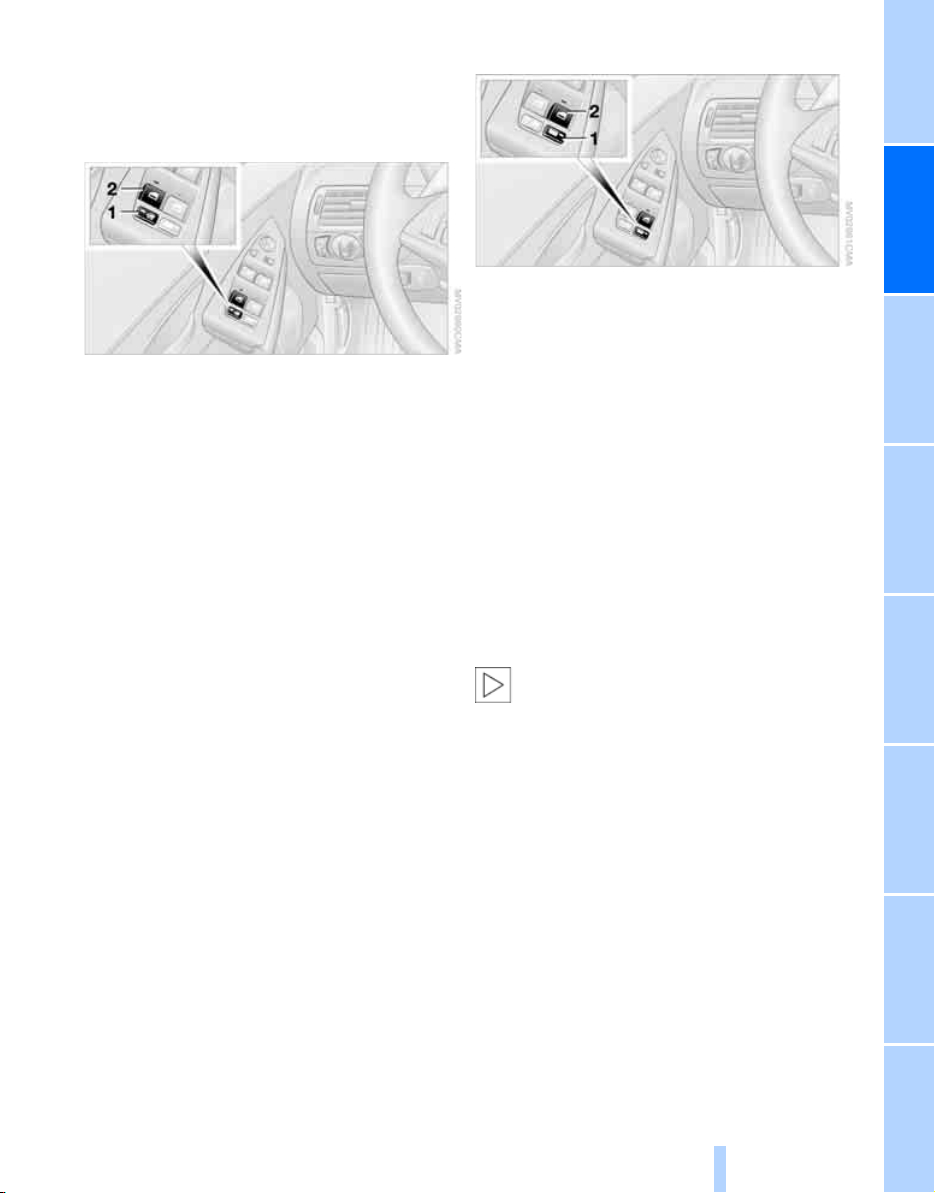
Together
1. Briefly press button 1:
The LEDs in button 1 and switch 2 light up
for approx. 10 seconds.
2. Press switch 2:
> Down to the resistance point:
All windows, including the rear window,
continue to open as long as you press
the switch.
You can close the windows in the same
manner by pulling the switch.
> Press the switch beyond the resistance
point:
All windows open automatically. Press-
ing the switch again stops the opening
movement.
Briefly press button 1 again to deactivate the
function. The LEDs go out.
Rear window
1. Briefly press button 1:
The LEDs in button 1 and switch 2 light up
for approx. 10 seconds.
2. Press switch 2:
> Down to the resistance point:
The rear window continues to open for
as long as you hold down the switch.
You can close the rear window in the
same manner by pulling the switch.
> Press the switch beyond the resistance
point:
The rear window opens automatically.
Pressing the switch again stops the
opening movement.
Briefly press button 1 again to deactivate the
function. The LEDs go out.
The rear window opens and closes auto-
matically when you open or close the con-
vertible top.<
For information on using the convenient opera-
tion mode at the door lock or with the remote
control, refer to page 32 or 34.
Coupe: For information on comfort closing with
comfort access, refer to page 39.
After switching off ignition
You can still operate the windows with the
remote control removed or the ignition
switched off for approx. 1 minute, as long as
neither of the doors has been opened.
Pinch protection system
If the closing force exceeds a specific value as a
window closes, the closing action is interrupted
and the window reopens slightly.
Online Edition for Part no. 01 41 2 600 775 - © 08/08 BMW AG

Opening and closing
42
Despite the pinch protection system,
inspect the window's travel path prior to
closing it, as the safety system might fail to
detect certain kinds of obstructions, such as
thin objects, and the window would continue
closing.
Do not install any accessories in the range of
movement of the windows, otherwise the pinch
protection system will be impaired.
Convertible: the rear side windows and rear
window are not equipped with a pinch protec-
tion system. Therefore, watch the rear side win-
dows and the rear window during closing, oth-
erwise injuries can occur.<
Closing without pinch protection
system
In case of danger from outside or if, for example,
ice on the window prevents normal closing, pro-
ceed as follows:
1. Pull the switch beyond the resistance point
and hold. The pinch protection system is
limited and the window opens slightly if the
closing force exceeds a certain value.
2. Pull the switch beyond the resistance point
and hold again within approx. 4 seconds.
The window closes without the pinch pro-
tection system.
Convertible: Top
The fully automatic convertible top combines
secure weather protection with simple and con-
venient operation.
Here are a few tips for getting the maximum
pleasure from your Convertible:
> It is advisable to close the convertible top
when the vehicle is parked. The closed con-
vertible top not only protects the passenger
compartment from unforeseen weather
damage, it also provides a certain amount of
protection from theft. Nonetheless, even if
the convertible top is closed, only keep
valuables in the locked luggage compart-
ment.
> Do not attach luggage rack systems to the
convertible top.
In order to avoid damage, do not move the
convertible top at temperatures below
+147/–106.
Do not leave the convertible top in its storage
compartment for longer than one day when wet;
otherwise, damage from moisture can occur.
Do not place any objects on the convertible top;
otherwise, if the top were to be operated, these
objects could fall off and lead to damage or
injury.
Never move the convertible top when the roll-
over protection system is raised.
Driving without having completed the opening
or closing action can lead to damage or injury.
Do not place hands in the top mechanism dur-
ing the opening and closing action. Keep chil-
dren away from the travel path of the convert-
ible top.
For safety reasons, do not move the convertible
top unless the vehicle is stationary.<
If you have initiated top movement with
the vehicle at a stop and then start to
drive, e.g. at a traffic light, you can continue the
initiated operation up to a speed of 20 mph/
30 km/h:
To do so, press and hold the corresponding
button.<
Partial vacuums that occur at higher
speeds in the passenger compartment
can make the convertible top flap. Use the auto-
matic climate control to increase the air volume
so that a partial vacuum in the vehicle does not
occur.<
Prior to opening and closing
> Observe the safety precautions above.
> Ensure that the convertible top compart-
ment floor in the luggage compartment is
folded down, refer to page 37, as otherwise
the convertible top cannot be opened.
> Make sure that the luggage compartment
lid is closed.
Online Edition for Part no. 01 41 2 600 775 - © 08/08 BMW AG
Controls
43
Reference At a glanceDriving tipsCommunications NavigationEntertainmentMobility
Opening and closing
From radio readiness, refer to page 60, with the
vehicle stationary:
To avoid putting excessive strain on the
battery, only move the convertible top
when the engine is running if possible.
Before closing the convertible top, remove for-
eign objects from the windshield frame, as
these might inhibit closing of the convertible
top.<
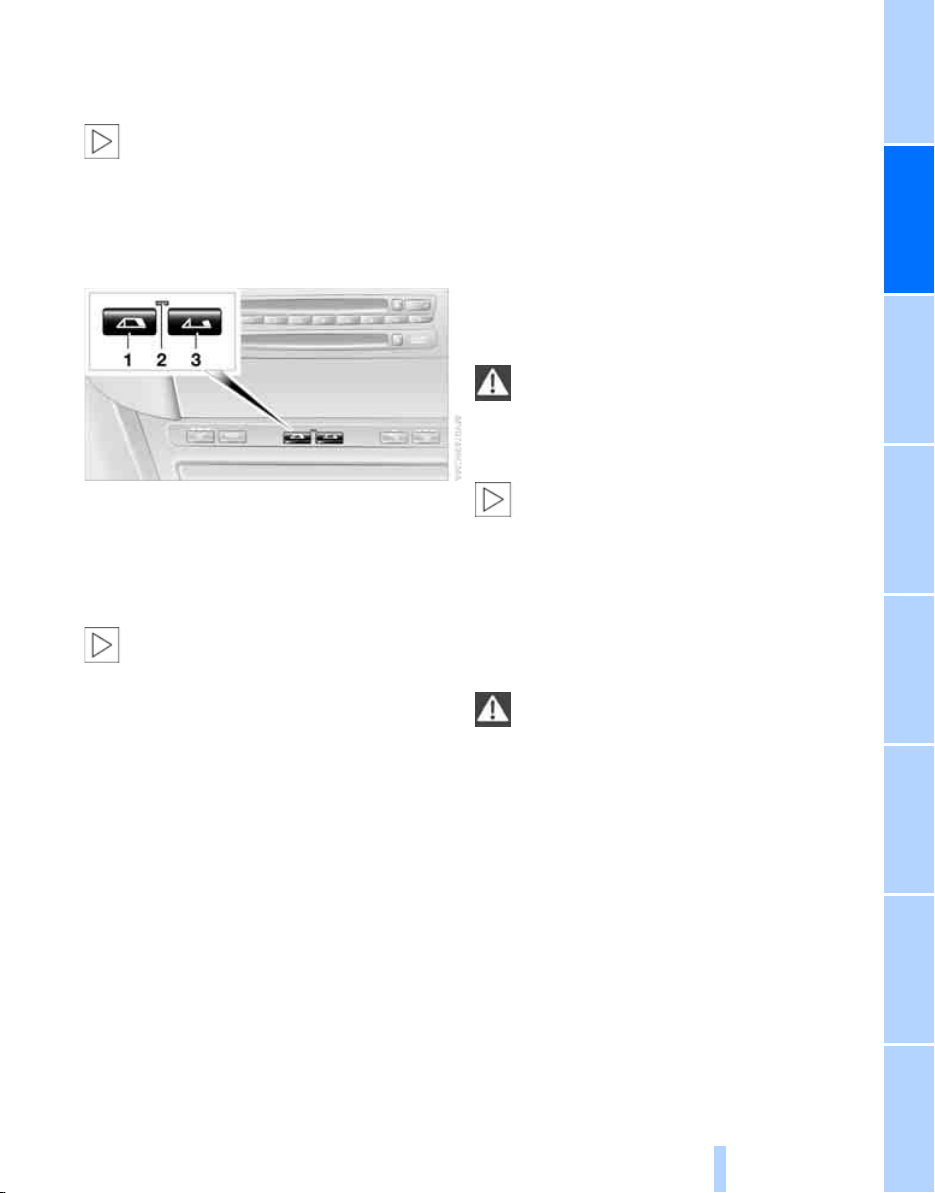
1 To close, press and hold the button until the
process is complete
2 LED
3 To open, press and hold the button until the
process is complete
When the button for operating the con-
vertible top is pressed, the side windows
move down all the way and the rear window is
lowered completely.
If the convertible top is not completely open or
closed, then the luggage compartment lid can-
not be opened.<
LED
In the following situations, in addition to the
LED, a message appears in the Control Display
and an acoustic signal may sound:
> During convertible top operation, the LED
lights up green. It goes out as soon as the
opening or closing action is finished.
> If the LED flashes red when you release the
button, the opening or closing action has
not yet finished.
> If the LED lights up red when the button is
pressed, either the convertible top com-
partment floor in the luggage compartment
is in the raised position or a malfunction has
occurred. The convertible top cannot be
moved.
Interruption
The automatic sequence of movements is
interrupted if the button for top operation is
released. The sequence can be continued in
the desired direction by pressing the appropri-
ate button.
If the opening or closing action is interrupted for
a longer period, the convertible top remains in
that position for approx. 15 minutes before it
slowly moves to a stable position.
A convertible top which is not completely
opened or closed presents a danger.
Do not interrupt and continue the closing action
several times in succession; otherwise, the top
mechanism can be damaged.<
If the convertible top is not completely
open or closed, then the luggage com-
partment lid cannot be opened.<
Convenient operation with remote
control and via door lock
Refer to pages 32 and 34.
Closing manually
Only close the convertible top manually if
absolutely necessary; never open it man-
ually. The convertible top compartment lid can-
not be locked in the event of an electrical mal-
function and would open while the vehicle is
being driven.
Improper handling can lead to damage.<
Before closing
1. Open luggage compartment lid.
2. Take the Allen wrench and the screwdriver
from the onboard tool kit, refer to page 224.
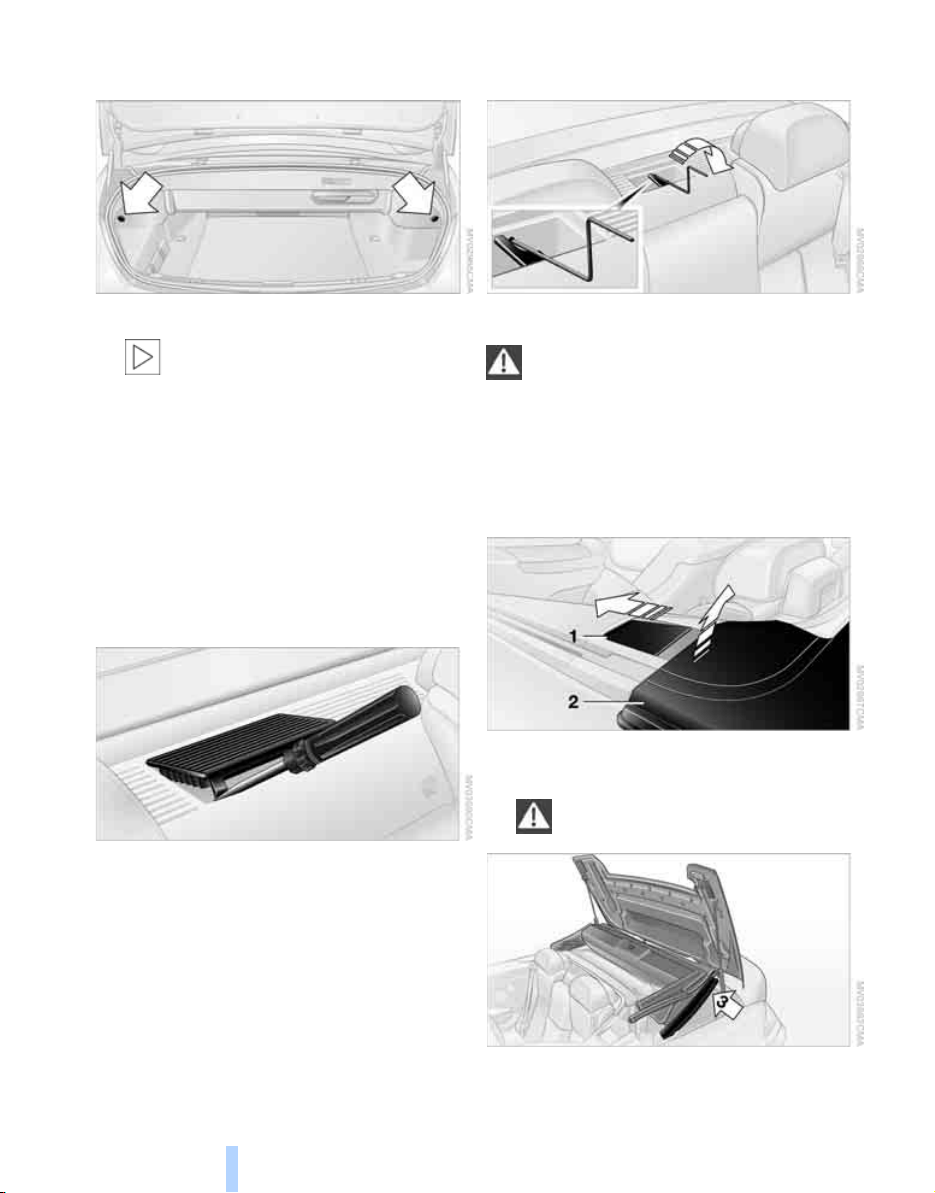
3. Pry out the two buttons in the luggage com-
partment with the screwdriver and then pull
Online Edition for Part no. 01 41 2 600 775 - © 08/08 BMW AG
Opening and closing
44
firmly. This unlocks the convertible top
compartment lid.
4. Close luggage compartment lid.
During manual convertible top opera-
tion, the luggage compartment lid
cannot be opened.<
5. Completely open the side windows and the
rear window.
If the rear window cannot be opened using
the switch, it must be lowered manually.
Opening rear window manually
1. Pry out the cover between the rear head
restraints. To do so, place the screwdriver
as close as possible to the locking ele-
ments, as shown in the illustration.
2. Insert the Allen wrench as far as possible
into the opening and turn firmly in the direc-
tion indicated by the arrow until the rear
window is completely open.
Closing
Perform the following work steps with the
assistance of a second person and with
the doors open, otherwise injury and damage to
the convertible top can occur.<
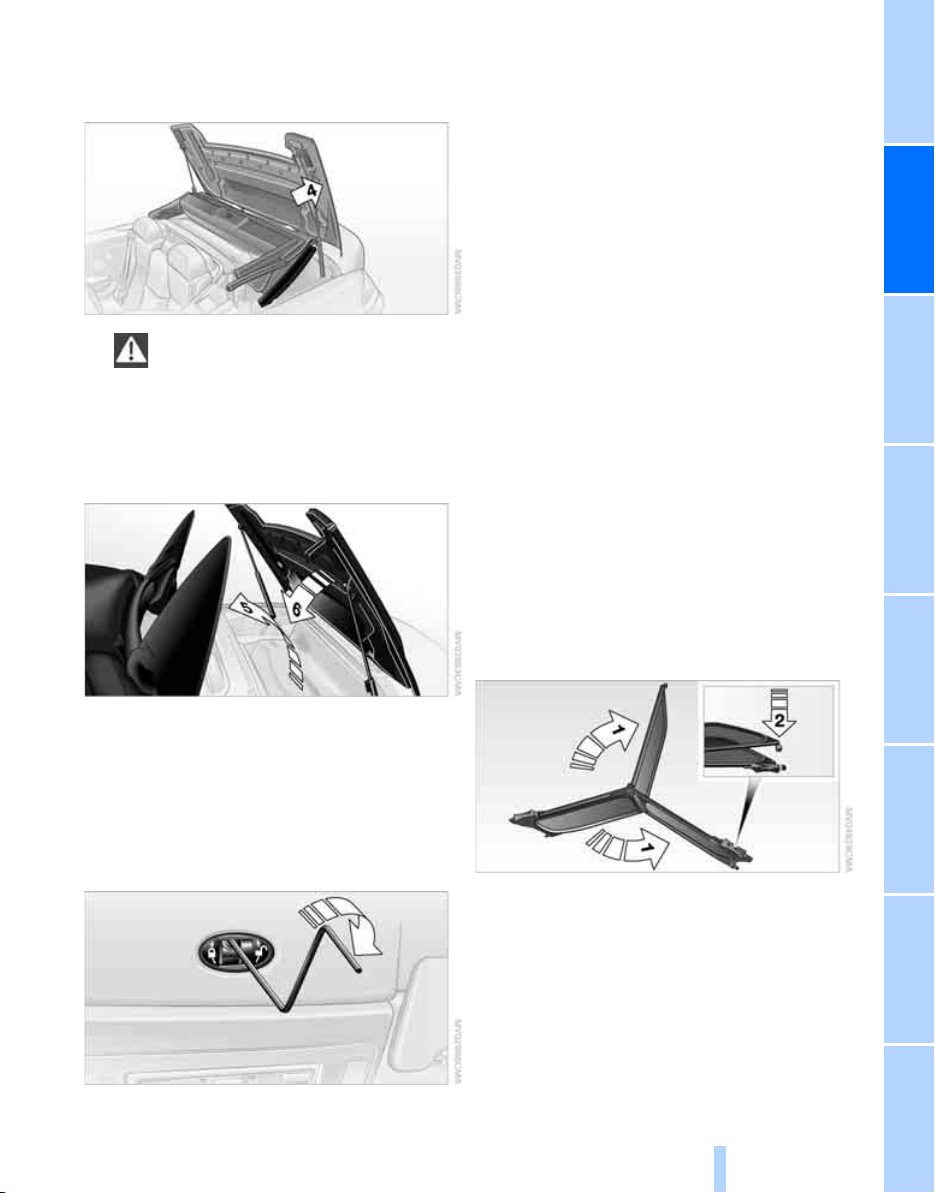
1. Push the cover 1 on the left and right of the
side panel forward. Reach into the resulting
openings and raise the convertible top
compartment lid 2 as far as it will go.
2. Grasp the top with both hands at the left and
right side frame, arrow 3.
Only lift out the top by the side frame,
otherwise the top may be damaged.<
3. Together with the other person, pull the two
sides of the convertible top out simulta-
Online Edition for Part no. 01 41 2 600 775 - © 08/08 BMW AG
Controls
45
Reference At a glanceDriving tipsCommunications NavigationEntertainmentMobility
neously and pivot forward. When doing so,
keep the convertible top compartment lid
open, arrow 4, e.g. with your shoulder.
Do not carry out the next operation,
raising top ends, until the top has
been swung forward, otherwise damage
can occur.<
4. Raise the two convertible top ends as far as
possible, arrow 5, and close the convertible
top compartment lid, arrow 6.
5. Fold the top ends down onto the convert-
ible top compartment lid.
6. From the interior, take out the cover in the
center of the front top frame; use a screw-
driver if necessary.
7. Insert the Allen wrench into the opening
provided.
8. From the outside, both persons pull the
front frame of the convertible top down-
ward, as simultaneously as possible on the
two sides.
9. Turn the Allen wrench in the direction of the
arrow until the front convertible top frame is
locked to the windshield frame.
The rear convertible top ends are automati-
cally pressed onto the convertible top com-
partment lid and close tightly with tension.
10. If necessary, close the rear window again
manually in the same way as above.
Wind deflector*
The wind deflector keeps the air movement in
the passenger compartment to a minimum
when the convertible top is open, thus enabling
pleasant driving even at higher speeds.
The wind deflector is stowed in a protective
sleeve in the luggage compartment. Short
instructions for use are also provided on the
protective sleeve.
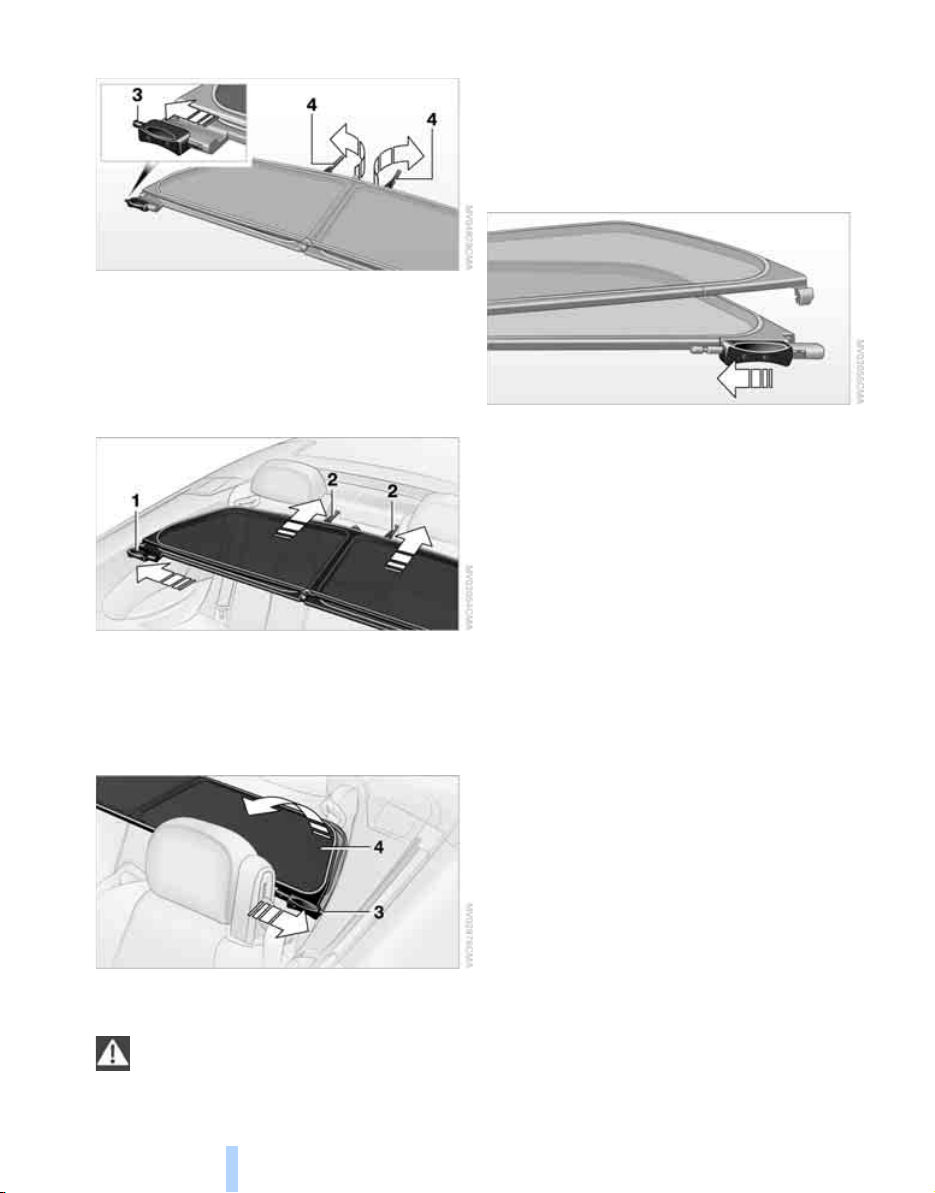
Before installing
1. Remove the wind deflector from the protec-
tive sleeve and fold it open, refer to
arrows 1.
2. Press the upper and lower section together
until the locking device engages, refer to
arrow 2.
Online Edition for Part no. 01 41 2 600 775 - © 08/08 BMW AG
Opening and closing
46
3. Push the securing pin 3 out until it engages.
4. Unfold the rear mounts 4.
Installing
1. Insert the securing pin 1 of the wind deflec-
tor into the appropriate opening on the right
side of the vehicle.
2. Guide the rear mounts 2 into the recepta-
cles provided.
3. Push the securing pin 3 on the left side into
the appropriate opening until it snaps into
place.
4. Fold up the upper half 4 of the wind deflec-
tor.
With wind deflector fitted: do not incline
the front seat backrests too far backward
if the seat is to be moved back to the end posi-
tion. Otherwise, the wind deflector will be dam-
aged.<
Removing
The same as installing, but in reverse order.
Folding up
1. Push the handle of the securing pin on the
wind deflector on the left side of the vehicle
all the way back and release the locking
mechanism.
2. Fold in the upper and lower section.
Online Edition for Part no. 01 41 2 600 775 - © 08/08 BMW AG

Controls
47
Reference At a glanceDriving tipsCommunications NavigationEntertainmentMobility
Adjusting
Sitting safely
The ideal sitting position can make a vital con-
tribution to relaxed, fatigue-free driving. In the
interaction with the safety belts, the head
restraints and the airbags, the sitting position
plays an important role in an accident. To
ensure that the safety systems operate with
optimal efficiency, we strongly urge you to
observe the instructions contained in the fol-
lowing section.
For additional information on Transporting chil-
dren safely, refer to page 58.
Airbags
Always maintain an adequate distance
between yourself and the airbags. Always
hold the steering wheel by its rim with hands at
the 9 o'clock and 3 o'clock positions to mini-
mize the risk of injuries to your hands and arms
in the event of airbag deployment.
No one and nothing is to come between the air-
bags and the seat occupant.
Do not use the cover of the front airbag on the
front passenger side as a storage area. Make
sure that the front passenger is sitting correctly
and does not rest feet or legs on the instrument
panel, otherwise leg injuries can occur if the
knee and front airbags are triggered.
Make sure that occupants do not rest their head
on the side or head airbags, otherwise injuries
can occur if the airbags are triggered.<
Even if you adhere to all the instructions, inju-
ries resulting from contact with airbags cannot
be fully excluded, depending on the circum-
stances. The ignition and inflation noise may
provoke a mild hearing loss in extremely sensi-
tive individuals. This effect is usually only tem-
porary.
For airbag locations and additional information
on airbags, refer to page 91.
Head restraints
A correctly adjusted head restraint reduces the
risk of spinal injury in the event of an accident.
Adjust the head restraint so that its center
is approx. at ear level. Otherwise there is
increased danger of injury in the event of an
accident.<
Head restraints, refer to page 50.
Safety belt
Before every drive, make sure that safety belts
are being worn at all of the occupied seats. Air-
bags complement the safety belt as an addi-
tional safety device, but they do not represent a
substitute.
Your vehicle has four seats that are each
equipped with a safety belt.
Never allow more than one person to
wear a single safety belt. Never allow
infants or small children to ride in a passenger's
lap. Make sure that the belt lies low around the
hips in the lap area and does not press on the
abdomen. The safety belt must not lie across
the neck, rub against sharp edges, be routed
over solid or breakable objects or be pinched.
Wear the safety belt without twisting, snugly
across the lap and shoulders, as close to the
body as possible. Otherwise the belt can slip
over the hips in the lap area in a frontal impact
and injure the abdomen. Avoid wearing clothing
that prevents the belt from fitting properly and
pull the belt in the upper body area periodically
to readjust the tension, in order to avoid a
reduction in the restraint of the safety belt.<
Safety belts refer to page 52.
Seats
Note before adjusting
Never attempt to adjust your seat while
the vehicle is moving. The seat could
respond with unexpected movement and the
Online Edition for Part no. 01 41 2 600 775 - © 08/08 BMW AG
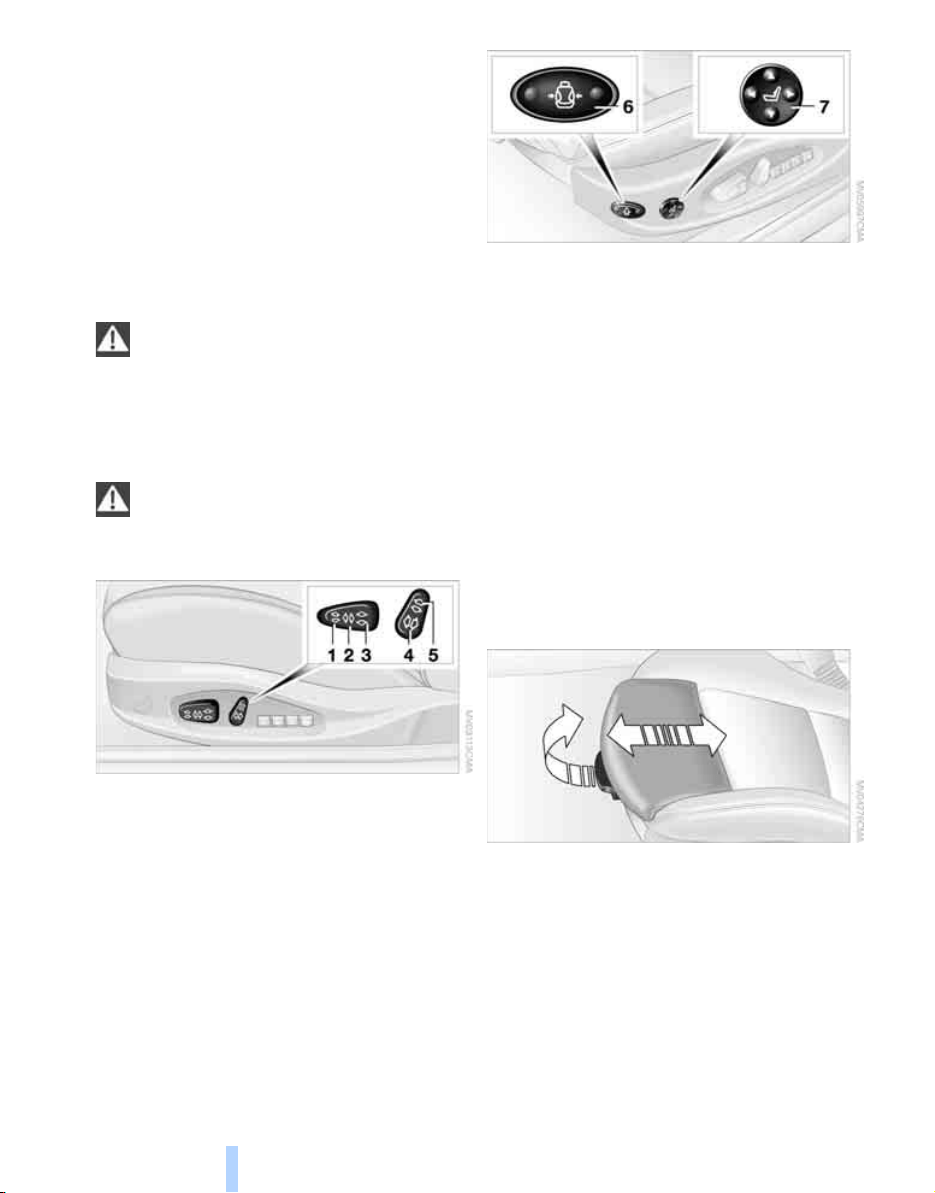
Adjusting
48
ensuing loss of vehicle control could lead to an
accident.
Also on the passenger side, do not incline the
backrest too far to the rear while the vehicle is
being driven, otherwise there is a danger in the
event of an accident of sliding under the safety
belt, eliminating the protection normally pro-
vided by the belt.<
Please follow the instructions on damage to
safety belts provided on page 53 and the infor-
mation on the active front head restraints on
page 50.
Convertible: with the wind deflector fitted,
do not incline the front seat backrests too
far backward if the seat is to be moved back to
the end position. Otherwise, the wind deflector
will be damaged.<
Adjusting seat
To ensure that the safety systems con-
tinue to provide optimized protection,
please observe the adjustment instructions on
page 47.<
1 Angle
2 Longitudinal direction
3 Height
4 Backrest
5 Convertible: head restraints, refer to
page 51
6 Coupe: Backrest width
7 Lumbar support
Lumbar support
You can also adjust the contours of the backrest
to obtain additional support in the lumbar
region.
The upper hips and spinal column receive sup-
plementary support to help you maintain a
relaxed, upright sitting position.
> Increase or decrease curvature:
press front or rear section of switch.
> Move curvature up or down:
press upper or lowers section of switch.
Thigh support
You can also adjust the thigh support manually:
Pull the lever and adjust the thigh support in the
longitudinal direction.
Online Edition for Part no. 01 41 2 600 775 - © 08/08 BMW AG
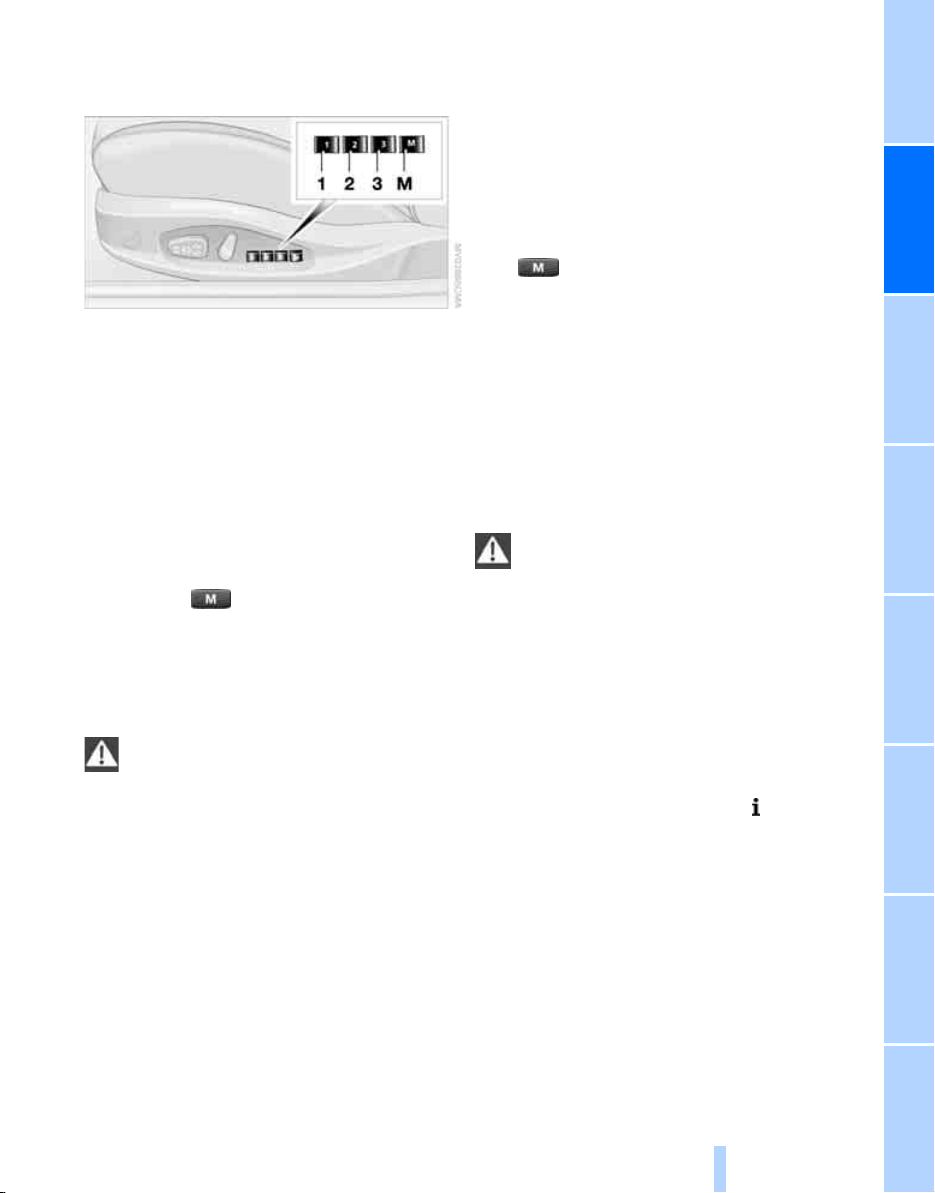
Controls
49
Reference At a glanceDriving tipsCommunications NavigationEntertainmentMobility
Seat, mirror and steering
wheel memory
You can store and select three different adjust-
ment settings for the driver's seat, exterior mir-
rors and steering wheel.
The adjustments of the lumbar support and the
backrest width are not stored in the memory.
Storing
1. Switch on radio readiness or ignition, refer
to page 60.
2. Set the desired seat, exterior mirror and
steering wheel positions.
3. Press the button:
The LED in the button lights up.
4. Press the desired memory button 1, 2 or 3:
The LED goes out.
Requesting
Do not request a position from the mem-
ory while the vehicle is moving. There is a
risk of accident from unexpected movement of
the seat or steering wheel.<
Comfort mode
1. Open the driver's door after unlocking or
switch on radio readiness, refer to page 60.
2. Briefly press the desired memory button 1,
2 or 3.
The system cancels the adjustment procedure
when you briefly press one of the seat adjust-
ment switches or one of the memory buttons.
The adjusting procedure for the steering wheel
is interrupted if you briefly press the switch for
the steering wheel adjustment in any direction,
refer to page 54.
Safety feature
1. Close the driver's door and switch ignition
on or off, refer to page 60.
2. Press the desired memory button 1, 2 or 3
and maintain pressure until the adjustment
process has been completed.
If the button was pressed inadvertently:
press the button again; the LED goes out.
Requesting with remote control
The last positions of the driver's seat, external
rearview mirrors, and steering wheel are stored
for the remote key currently in use.
You can select
* when the position is requested.
> Request when unlocking vehicle
> Request when opening driver's door. In the
Convertible, only this function is used.
When using this feature, always make
sure that the footwell behind the driver's
seat is empty and unobstructed. Failure to do
so could cause injury to persons or damage to
objects behind the seat as a result of a rearward
movement of the seat.<
The system cancels the adjustment procedure
when you briefly press one of the seat adjust-
ment switches or one of the memory buttons.
iDrive, for operating principle refer to page 16.
1. Open the start menu.
2. Press the controller to open the menu.
3. Select "Settings" and press the controller.
4. Select "Vehicle / Tires" and press the con-
troller.
Online Edition for Part no. 01 41 2 600 775 - © 08/08 BMW AG
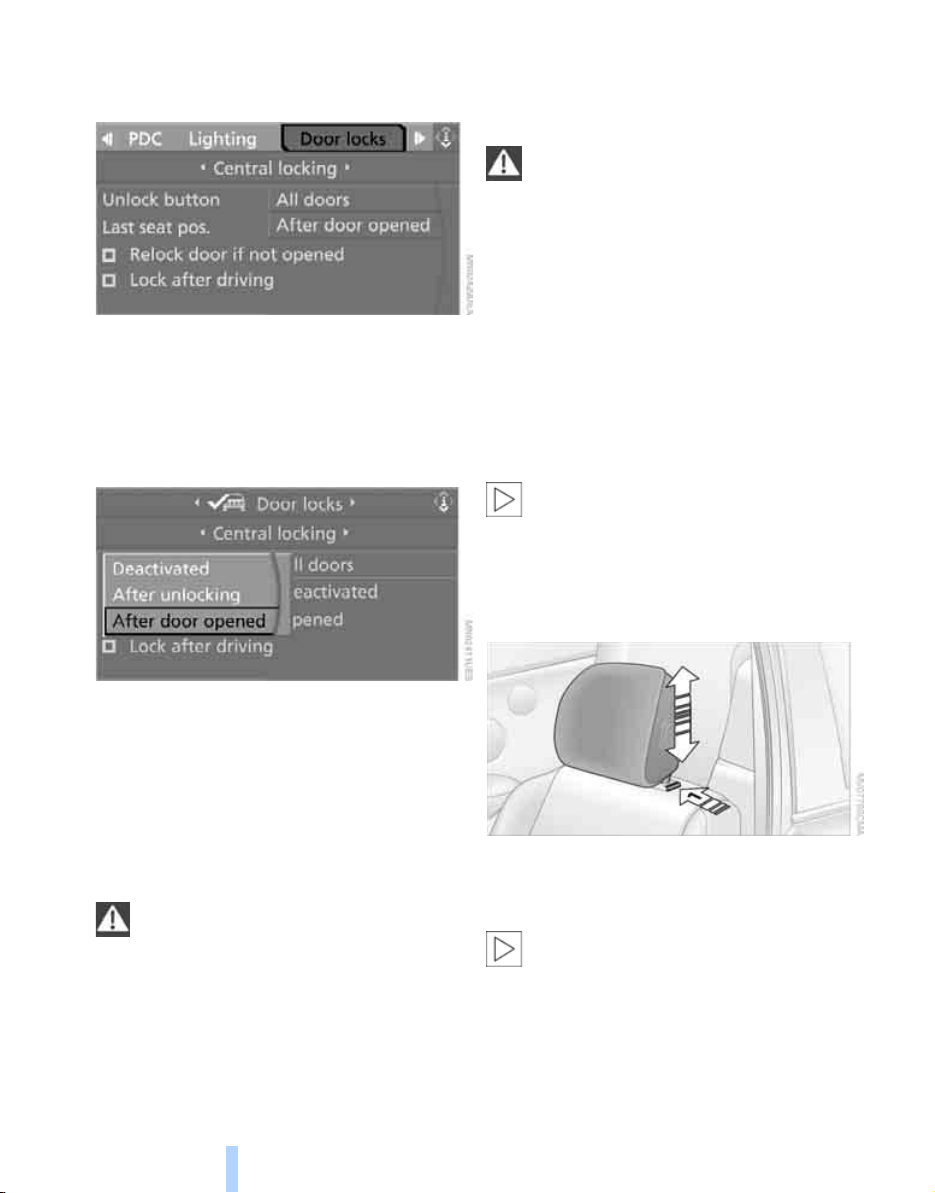
Adjusting
50
5. Change to upper field if necessary. Turn the
controller until "Door locks" is selected and
press the controller.
6. Select "Central locking" and press the con-
troller.
7. Select "Last seat pos." and press the con-
troller.
8. Select "After unlocking"
* or "After door
opened".
9. Press the controller.
To cancel the request:
Select "Deactivated" and press the controller.
Front head restraints
A correctly adjusted head restraint reduces the
risk of spinal injury in the event of an accident.
Adjust the head restraint so that its center
is approximately at ear level. Otherwise
there is increased danger of injury in the event
of an accident.Only remove the head restraints
if no one will be sitting on the seat in question.
Reinstall the head restraints before transport-
ing passengers, as otherwise the head restraint
cannot provide its protective function.<
Active front head restraints
In the event of a rear-end collision of sufficient
severity, the active head restraint reduces the
distance to the head.
Do not use seat covers or head restraint
covers that could impede the proper
functioning of the active head restraint. Other-
wise, there is no assurance that the active head
restraint will perform its protective function and
it is not possible to take advantage of its injury-
reducing potential in the event of a rear-end
collision.
Have the active head restraints reset after they
are triggered in a rear-end collision. Only have
this work carried out by a BMW center or a
workshop that works according to BMW repair
procedures with correspondingly trained per-
sonnel. Otherwise, this safety equipment will
not function properly.<
Please contact a BMW center if you wish
to have the front head restraints removed
and installed.<
Coupe
Height adjustment
> To raise: pull the head restraint upward.
> To lower: slide the head restraint down-
ward.
To reach the lowest position, press the
button, refer to arrow 1.<
Online Edition for Part no. 01 41 2 600 775 - © 08/08 BMW AG
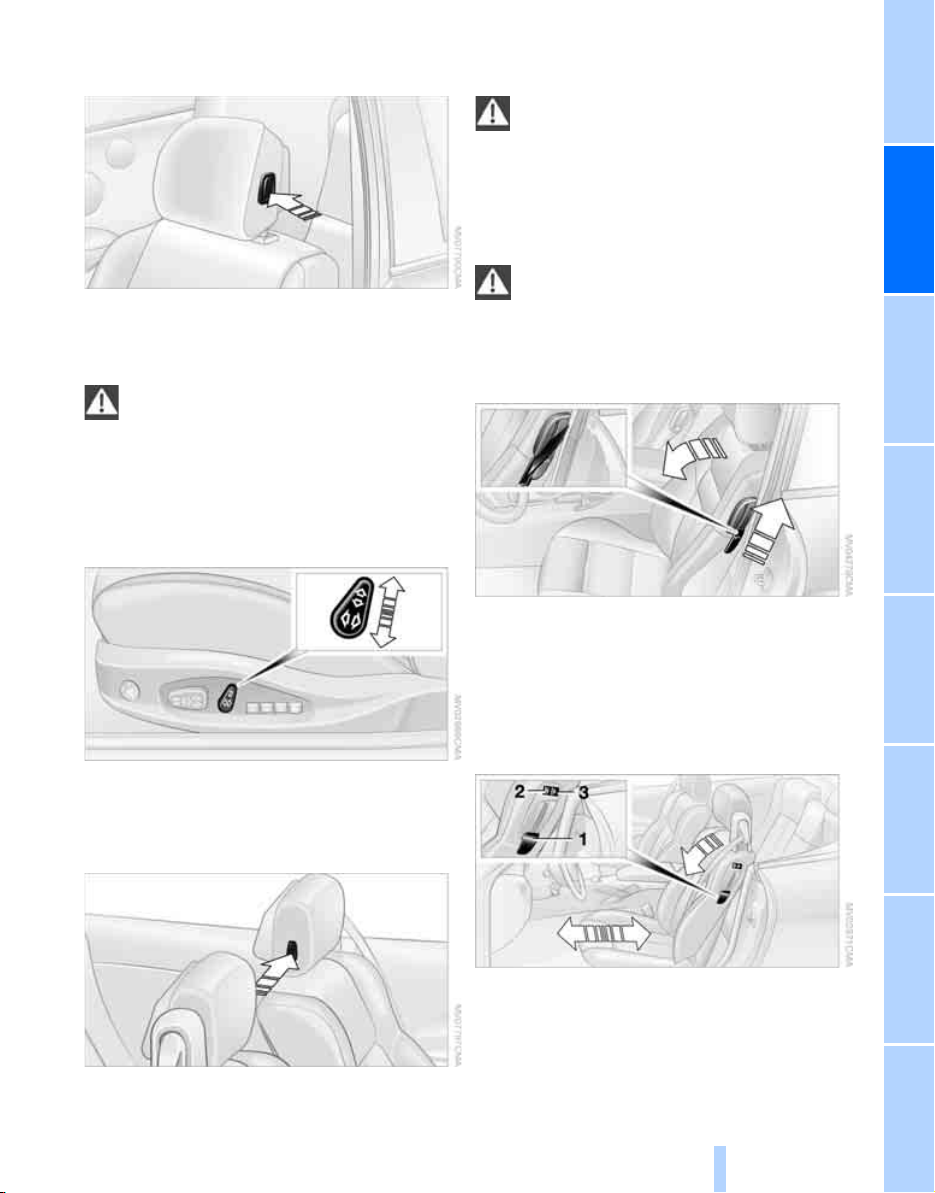
Controls
51
Reference At a glanceDriving tipsCommunications NavigationEntertainmentMobility
Front seats: adjusting distance to the
back of the head
> Forward: pull up.
> Back: push the button and slide the head-
rest cushion toward the rear.
Do not place any objects behind the
headrest cushion. Otherwise, you can
impair the proper function of the head
restraint.<
Convertible
Adjusting height
Move the switch up or down.
Front seats: adjusting distance to the
back of the head
> Forward: pull up.
> Back: push the button and slide the head-
rest cushion toward the rear.
Do not place any objects behind the
headrest cushion. Otherwise, you can
impair the proper function of the head
restraint.<
Entering rear
Before starting to drive, fold backrests
back, otherwise there is the danger of
accident due to an unexpected movement of
the seat.<
Coupe: releasing backrest
Pull the lever upward and fold the backrest for-
ward.
The lever is designed so that the safety belt can
be hooked onto it. This enables you to fasten
the safety belt more conveniently.
Convertible: releasing backrest
The belt system integrated in the seat makes it
easier to get in back.
Online Edition for Part no. 01 41 2 600 775 - © 08/08 BMW AG
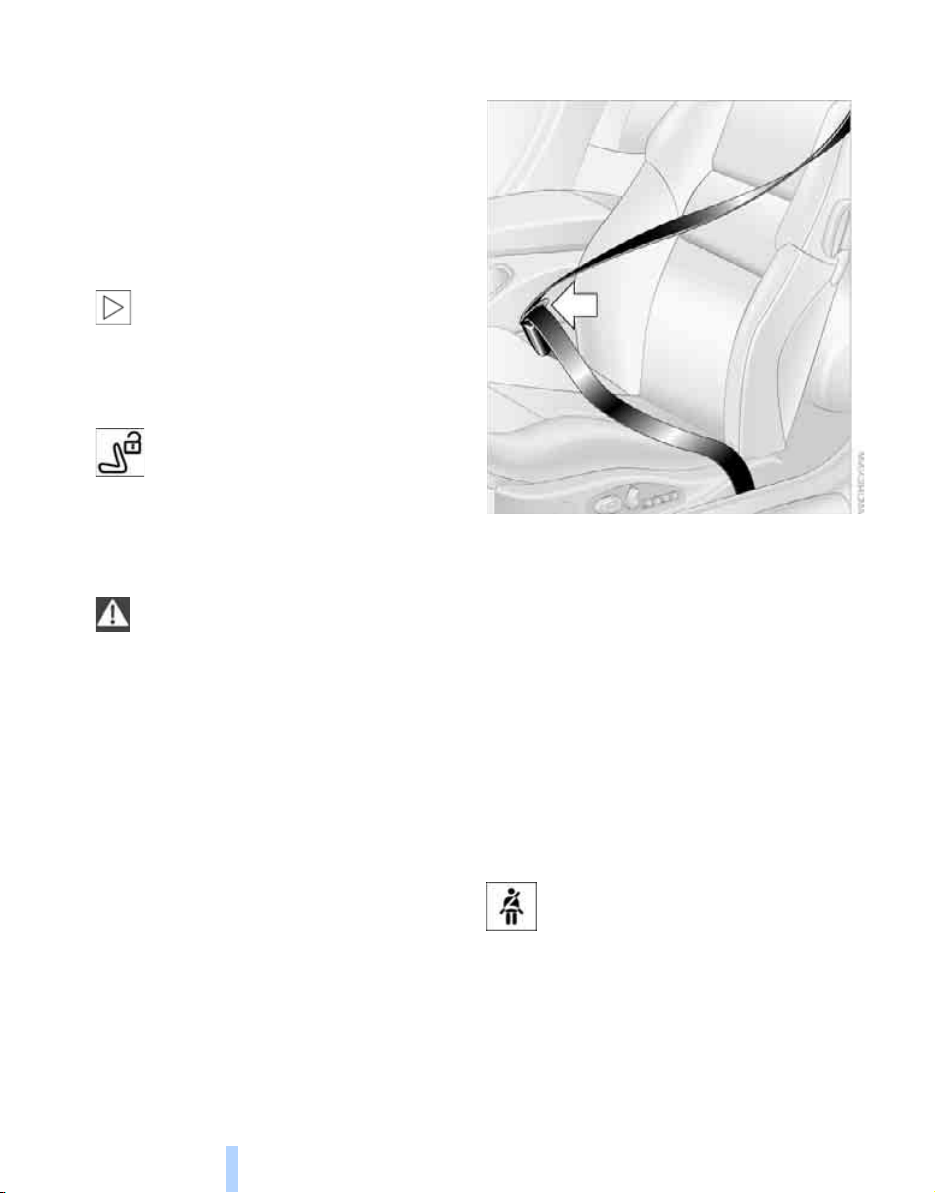
Adjusting
52
1. Pull lever 1 up and fold the backrest for-
ward.
2. Press and hold button 2 until the seat has
moved into the desired position.
3. After passengers have entered the rear, fold
the backrest back and lock it in place.
4. Press and hold button 3 until the seat has
moved back into its previous position. If you
release button 3 before this, the seat stops
in its current position.
You can lock the backrest in place when it
is folded forward. This is useful, for exam-
ple, when you get into the vehicle while it is
parked on a hill. Press the backrest until it audi-
bly locks into place. To fold it back, you do not
need to use lever 1 to release it.<
Lock backrest warning lamp:
Lights up when the backrest is not
locked. At the same time, a message is
shown on the Control Display.
Safety belts
To ensure that the safety systems con-
tinue to provide optimized protection,
please observe the adjustment instructions on
page 47.<
Before every drive, make sure that safety belts
are being worn at all of the occupied seats. Air-
bags complement the safety belt as an addi-
tional safety device, but they do not represent a
substitute.
Fastening
Make sure you hear the latch plate engage in
the belt buckle.
Releasing
1. Grasp the belt firmly.
2. Press the red button in the buckle.
3. Guide the belt into its reel.
The shoulder strap's anchorage point will be in
the correct position for adults of every build if
the seat is correctly adjusted, refer to page 47.
Safety belt reminder for driver's seat
and passenger seat*
The indicator lamp lights up and a sig-
nal sounds. A message also appears on
the Control Display. Please check
whether safety belts are being worn correctly.
The safety belt reminder is operative at speeds
above approx. 5 mph/8 km/h. It can also be acti-
vated if objects are placed on the passenger
seat.
Online Edition for Part no. 01 41 2 600 775 - © 08/08 BMW AG
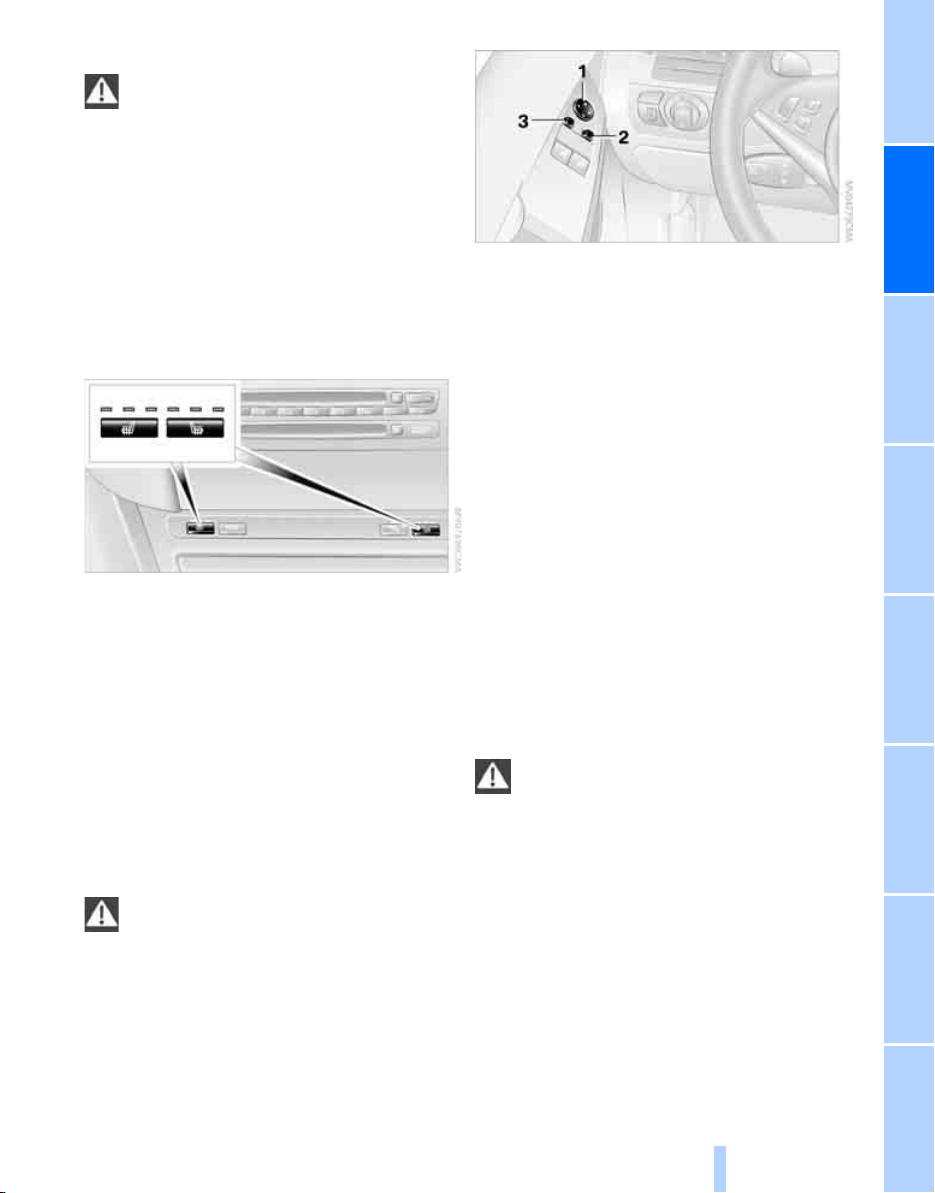
Controls
53
Reference At a glanceDriving tipsCommunications NavigationEntertainmentMobility
Damage to safety belts
When subjected to strain due to an acci-
dent or in the event of damage, replace
the safety belts, the belt tensioners, and any
child restraint systems and have the belt anchor
points checked. Only have this work carried out
at a BMW center or at a workshop that works
according to BMW repair procedures with cor-
respondingly trained personnel. Otherwise cor-
rect operation of this safety equipment is not
guaranteed.<
Heated seats
Press once for each temperature level. The
maximum temperature is supplied when three
LEDs are lit.
The temperature is reduced and if need be, the
heating is switched off in order to reduce the
load on the battery. The LEDs remain lit.
To switch off:
Press the button longer.
Mirrors
Exterior mirrors
The mirror on the passenger's side is
more curved than the driver's mirror.
Objects reflected in the mirror are closer than
they appear. Do not estimate the distance of
following traffic based on what you see in the
mirrors, otherwise there is an increased acci-
dent risk.<
1 Adjusting
2 Switching to the other mirror or to the auto-
matic curb monitor
3 Folding mirrors in and out
*
Storing the mirror positions, refer to Seat, mir-
ror and steering wheel memory on page 49.
Adjusting manually
You can also adjust the mirrors manually by
pressing against the outer edges of their mirror
glass.
Folding exterior mirrors in and out
Pressing button 3 allows you to fold mirrors
in and out up to a speed of approx. 20 mph/
30 km/h. This is advantageous, for example, in
car washes, narrow streets or for bringing mir-
rors that have been manually folded in back into
the correct position. Mirrors that were folded in
are folded out automatically at a speed of
approx. 25 mph/40 km/h.
Before going through a car wash, fold the
mirrors in manually, or with button 3, oth-
erwise they could be damaged, depending on
the width of the car wash system.<
Automatic heating
Below a certain outdoor temperature, both
exterior mirrors are heated whenever the
engine is running or the ignition is switched on.
Online Edition for Part no. 01 41 2 600 775 - © 08/08 BMW AG
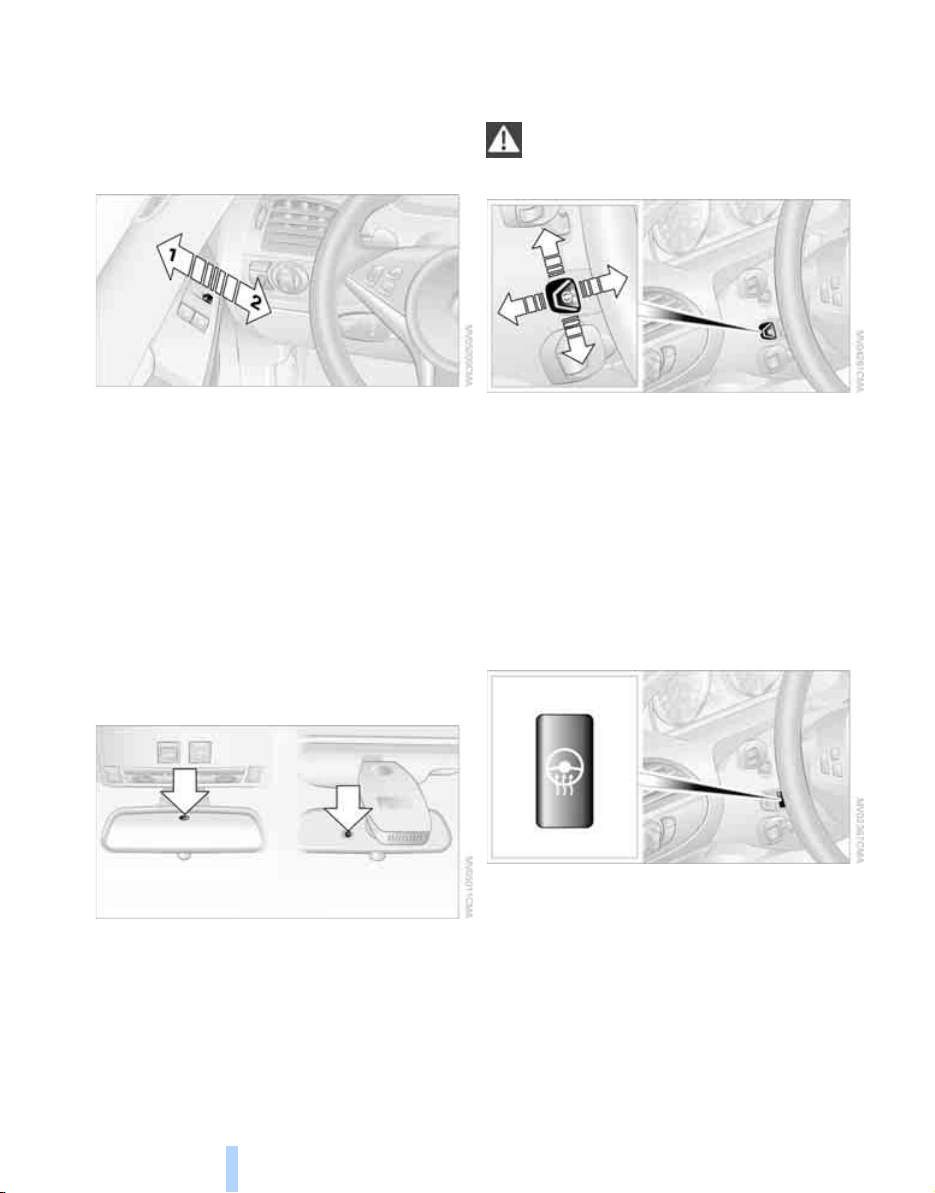
Adjusting
54
Tilting down passenger-side mirror –
automatic curb monitor
Activating
1. Slide switch into the driver's side mirror
position, arrow 1.
2. Shift into reverse or move selector lever into
position R.
The mirror glass tilts downward somewhat
on the passenger's side. This allows the
driver to see the area immediately adjacent
to the vehicle – such as a curb – when park-
ing, etc.
Deactivating
Slide switch into the passenger side mirror
position, arrow 2.
Interior and exterior mirrors,
automatic dimming feature
This feature is controlled by two photocells in
the inside rearview mirror, one on the front and
one on the back.
For trouble-free operation, keep the photocells
clean and do not cover the area between the
interior rearview mirror and the windshield. Do
not attach stickers of any kind to the windshield
in front of the mirror, either.
Steering wheel
Adjusting
Do not adjust the steering wheel while the
vehicle is moving. There is a risk of acci-
dent as the result of unexpected movement.<
The steering wheel can be adjusted in four
directions.
Storing the steering-wheel position, refer to
Seat, mirror and steering wheel memory,
page 49.
Easy entry/exit
To facilitate entry and exit, the steering wheel
temporarily moves into the uppermost position.
Steering wheel heating*
Press the button.
When the steering wheel heater is operating,
the LED in the button lights up.
Online Edition for Part no. 01 41 2 600 775 - © 08/08 BMW AG
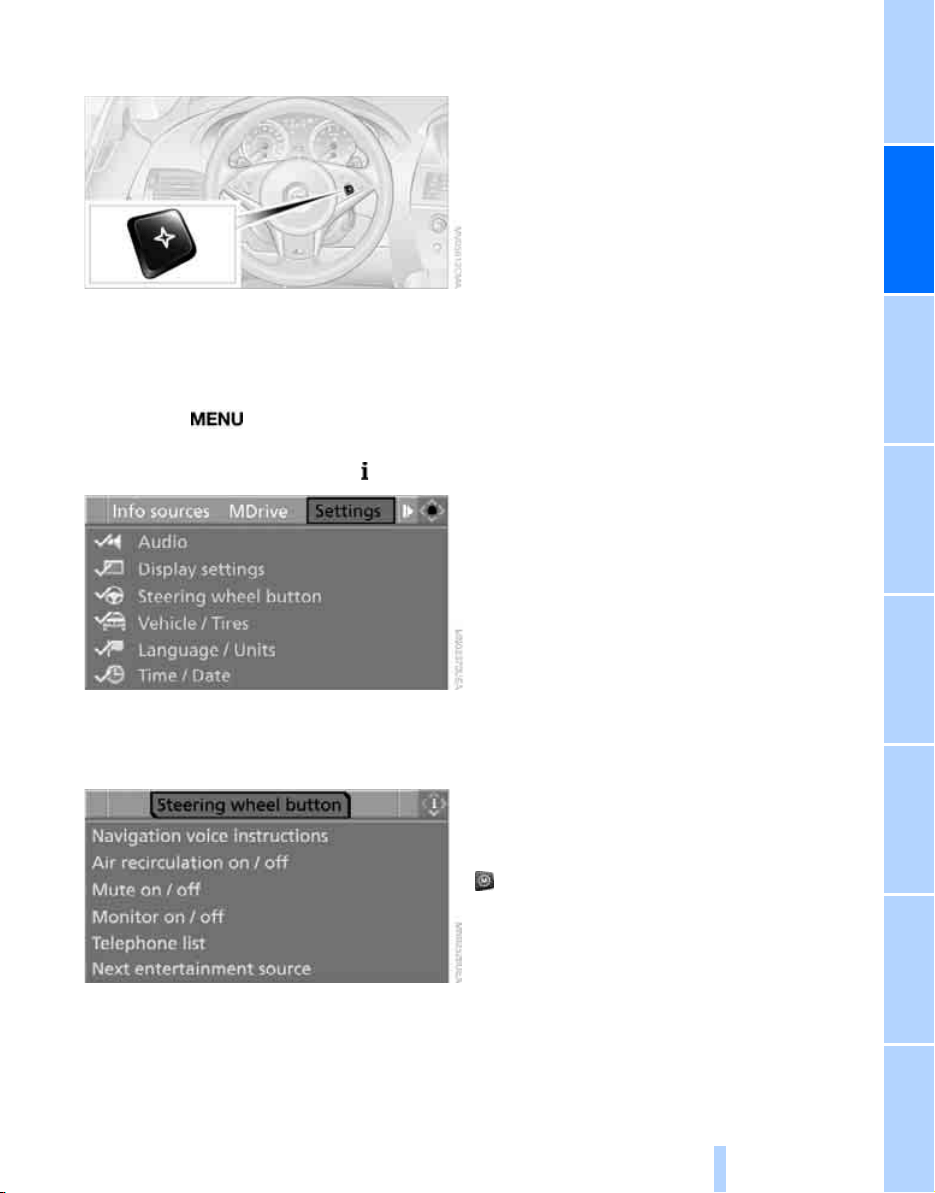
Controls
55
Reference At a glanceDriving tipsCommunications NavigationEntertainmentMobility
Programmable button on steering
wheel
You can program the button individually.
The setting is stored for the remote control cur-
rently in use.
iDrive, for operating principle refer to page 16.
1. Press the button.
This opens the start menu.
2. Press the controller to open the menu.
3. Select "Settings" and press the controller.
4. Select "Steering wheel button" and press
the controller.
A list of different functions appears:
> "Navigation voice instructions"
Voice messages from the navigation
system
*
> "Air recirculation on / off"
To permanently shut off outside air, refer
to AUC Automatic recirculated-air con-
trol on page 105
> "Mute on / off"
To mute the audio sources
> "Monitor on / off"
To switch the Control Display on/off
> "Telephone list"
*
To show/hide the phone book or last dis-
played list of stored phone numbers
> "Next entertainment source"
To change the audio source
5. Select the desired function unit and press
the controller.
Operating function
Press the button on the steering wheel.
If you have programmed "Navigation voice
instructions" for the button:
> To switch voice instructions on/off:
Press button longer.
> To repeat the last voice instruction:
Press the button.
MDrive
With MDrive you can configure several individ-
ual settings for your vehicle on the Control Dis-
play and activate them simultaneously with the
button on the steering wheel.
Configuring settings
With the ignition switched on you can change
the settings of MDrive on the Control Display.
iDrive, for operating principle refer to page 16.
Online Edition for Part no. 01 41 2 600 775 - © 08/08 BMW AG
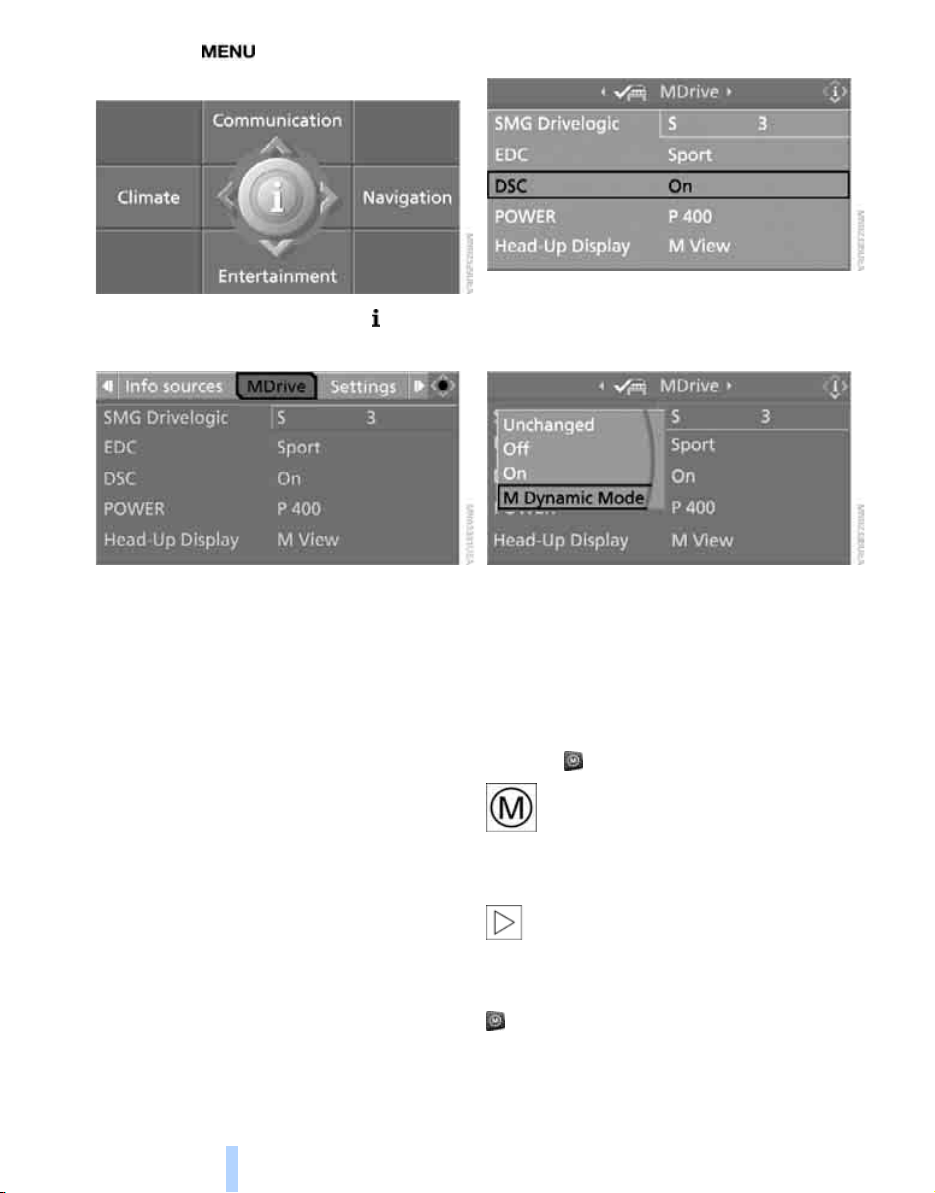
Adjusting
56
1. Press the button.
This opens the start menu.
2. Press the controller to open the menu.
3. Select "MDrive" and press the controller.
The functions contained in MDrive are dis-
played:
> "SMG Drivelogic"
Sequential Manual Transmission with
Drivelogic: shifting modes and Drive-
logic driving programs, refer to page 64
> "EDC"
Programs of the Electronic Damping
Control, refer to page 86
> "DSC"
Dynamic Stability Control and
M Dynamic Mode, refer to page 84
> "POWER"
Programs of the M Engine Dynamics
Control, refer to page 65
> "Head-Up Display"
*
Views of the Head-Up Display, refer to
page 94
You can reset all settings for MDrive to their
default values:
> "Reset to default"
4. Select the desired function.
5. Press the controller.
6. Turn the controller to select the desired set-
ting.
"Unchanged" retains the current setting
made outside of MDrive.
7. Press the controller.
The setting is stored for the remote control cur-
rently in use.
Activating settings
Press the button on the steering wheel.
The indicator lamp in the instrument
cluster lights up. The settings made on
the Control Display for the functions
contained in MDrive are active.
Pressing the button again deactivates MDrive.
If the indicator lamp flashes after the but-
ton was pressed, MDrive was unable to
respond because the ABS Antilock Brake Sys-
tem or DSC Dynamic Stability Control are cur-
rently regulating driving stability. Press the
button again when the indicator lamp no
longer flashes.<
Even with MDrive activated, you can change
individual settings outside MDrive, e.g. with the
Online Edition for Part no. 01 41 2 600 775 - © 08/08 BMW AG

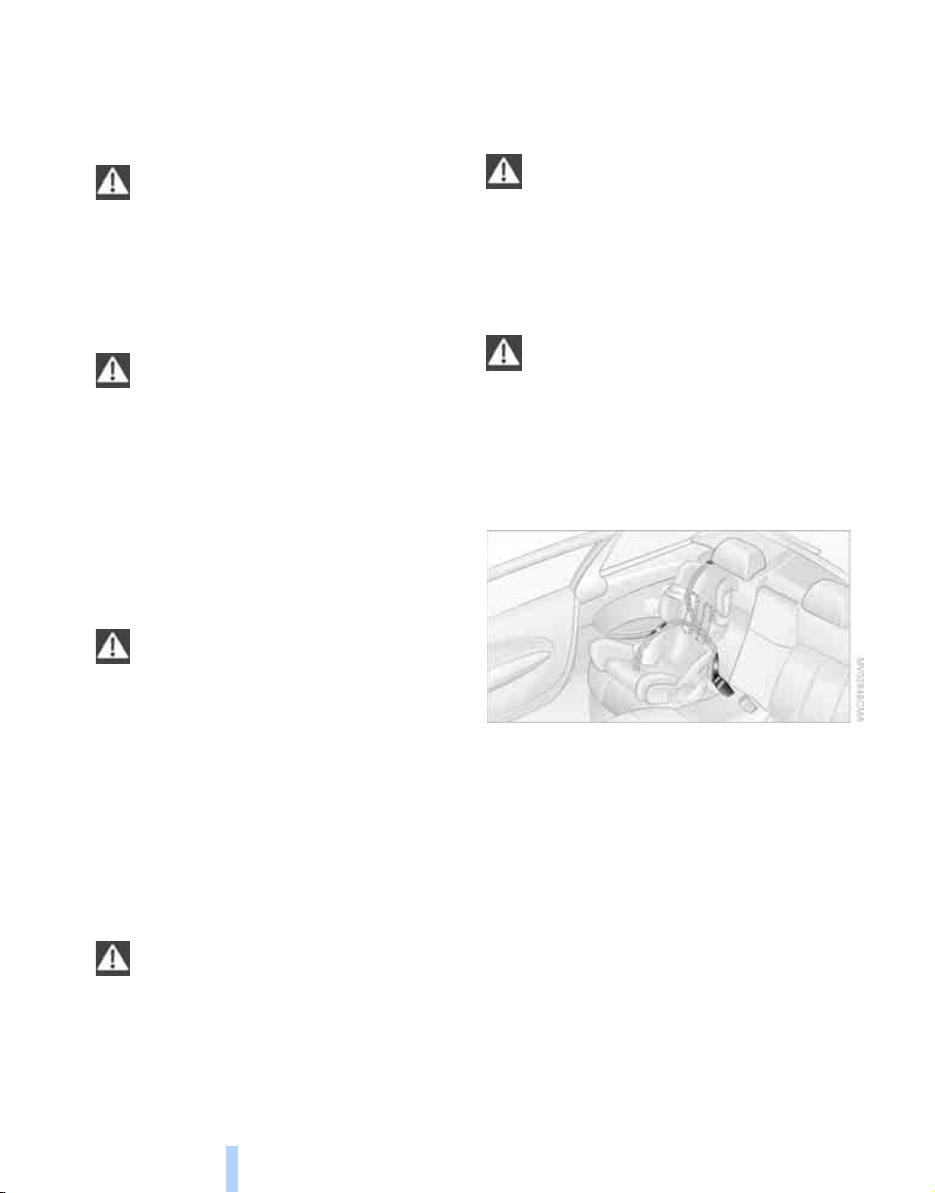
Transporting children safely
58
Transporting children safely
The right place for children
Do not leave children unattended in the
vehicle, otherwise they could endanger
themselves and other persons, e.g. by opening
the doors.<
Children always in the rear
Accident research shows that the safest place
for children is on the rear seat.
Children younger than 13 years of age or
with a height under 5 ft/150 cm may only
be transported in the rear in child restraint sys-
tems which correspond to the age, weight and
height of the child. Otherwise there is an
increased danger of injury in an accident.<
Children 13 years of age or older must wear a
safety belt as soon as a suitable child restraint
system can no longer be used due to their age,
size and weight.
Exception for front passenger seat
Should it be necessary to use a child
restraint system on the front passenger
seat, the front, knee and side airbags on the
passenger side must be deactivated before
doing so. Otherwise, there is an increased risk
of injury to the child if the airbags are triggered,
even with a child restraint system.<
For more information on automatic deactivation
of the front passenger airbags, refer to page 92.
Installing child restraint
systems
Follow child restraint system manufac-
turer's instructions for the selection,
installation and use of child restraint systems.
Otherwise, the degree of protection they offer
may be reduced.<
On front passenger seat
After mounting a child restraint system on
the front passenger seat, make sure that
the front and side airbags on the front passen-
ger side are deactivated, as otherwise there is
an increased risk of injury if the airbags are trig-
gered.<
Backrest width
Before mounting a child restraint system
on the front passenger seat, the backrest
width adjustment must be completely open.<
1. Adjust the backrest width to the fully open
position, refer to page 48.
2. Install child's seat.
Child seat security
All rear safety belts and the safety belt for the
front passenger can be locked against pulling
out to secure child restraint systems.
Locking safety belt
1. Secure the child restraint system with the
belt.
2. Pull out the belt webbing completely.
3. Allow the belt webbing to retract and pull
taut against the child restraint system. The
safety belt is locked.
Unlocking safety belt
1. Open the belt buckle.
2. Remove the child restraint system.
Online Edition for Part no. 01 41 2 600 775 - © 08/08 BMW AG
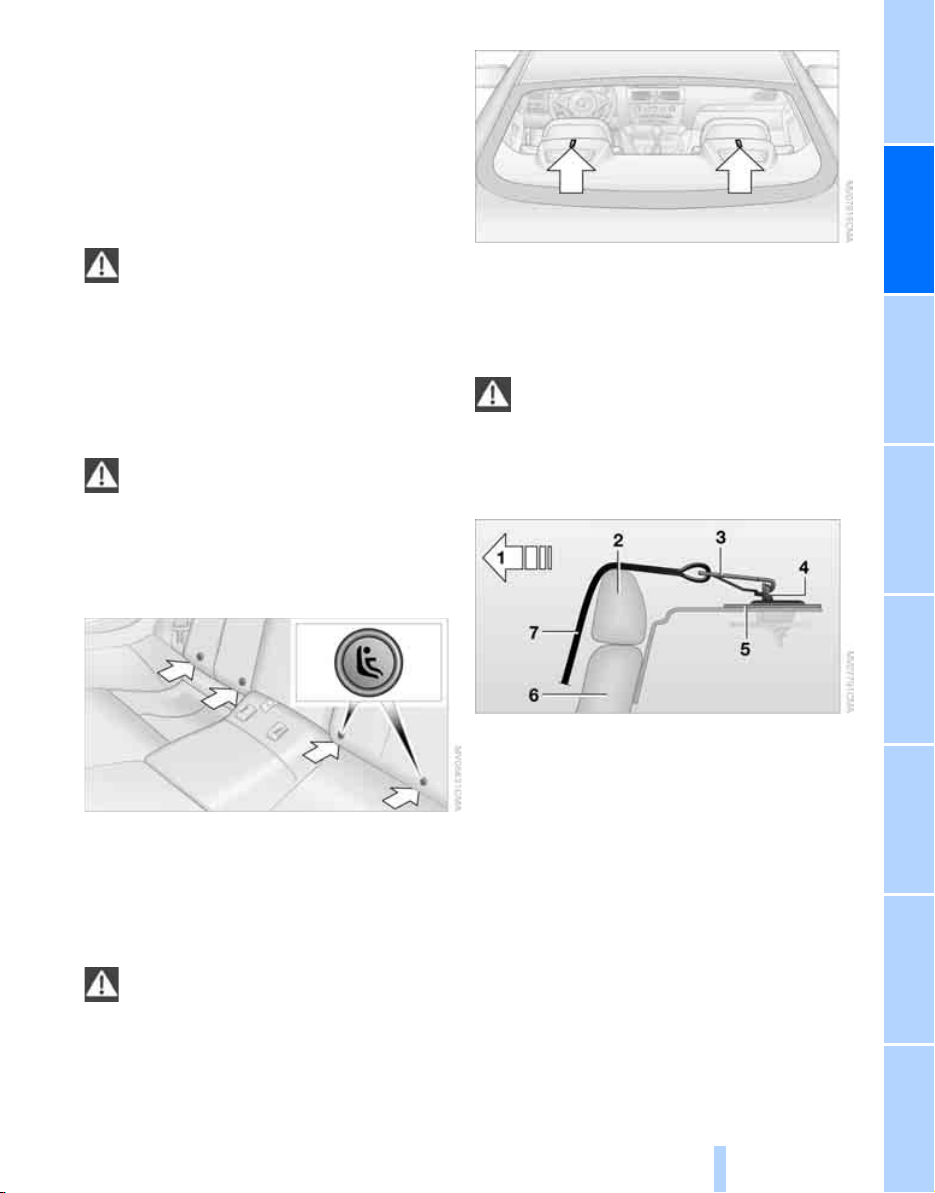
Controls
59
Reference At a glanceDriving tipsCommunications NavigationEntertainmentMobility
3. Allow the belt webbing to retract com-
pletely.
LATCH child restraint fixing
system
LATCH: Lower Anchor and Tethers for Chil-
dren.
Follow the system manufacturer's
instructions on installation and use of
LATCH child restraint systems in order not to
impair their protective function.<
Anchor points for LATCH mounts
Before attaching the LATCH child's seat, pull
the belt away from the region of the child
restraint fixing system.
Make sure that both of the lower LATCH
mounts have properly clicked into place
and that the child restraint system is resting
snugly against the backrest. Otherwise, the
protective action may be impeded.<
Rear seats
The mounting points for the LATCH anchors
are located at the positions indicated by arrows
in the gap between the seat and the backrest.
Coupe: child restraint system with
tether strap
Only use the top tether-strap mounting
points to secure child restraint systems,
otherwise the mounting points could be dam-
aged.<
There are two additional mounting points for
child restraint systems with a tether strap, refer
to arrows.
Placement of tether strap
Make sure that the tether strap is not
routed over sharp edges and does not
twist on its way to the upper mounting point;
otherwise, the belt may not properly secure the
child restraint system in the event of an acci-
dent.<
1 Direction of travel
2 Head restraints
3 Tether strap hook
4 Mounting point
5 Rear window shelf
6 Backrest
7 Tether strap of child restraint system
Before using the mounting points, fold the head
restraint
* into its raised position.
1. Slide the head restraint into the bottom
position.
2. Guide the tether strap over the head
restraint.
3. Attach the tether strap hook to the mount-
ing point.
Online Edition for Part no. 01 41 2 600 775 - © 08/08 BMW AG
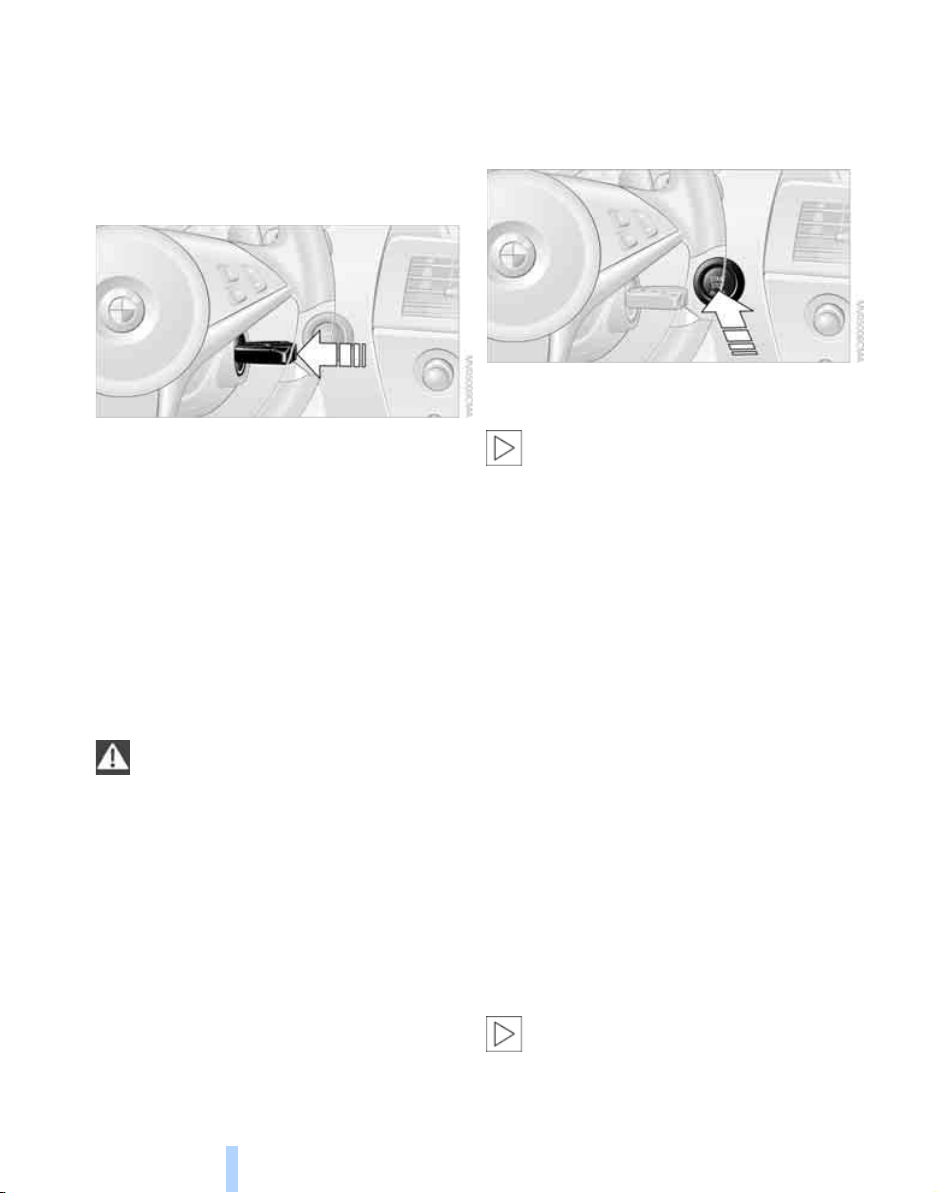
Driving
60
Driving
Ignition lock
Inserting remote control into ignition
lock
Insert the remote control as far as possible into
the ignition lock.
Radio readiness switches on.
Some electronic systems/consumers are ready
for operation.
Comfort access*
With comfort access, only insert the remote
control into the ignition lock in exceptional
cases, refer to page 38.
Removing remote control from ignition
lock
Do not pull the remote control out of the
ignition lock using force, as otherwise
damage may result.<
Before removing the remote control, first press
it in as far as possible to release the locking
device.
The ignition is switched off if it was still
switched on.
Start/Stop button
Pressing the Start/Stop button switches the
radio readiness or the ignition on and off.
Manual transmission: the engine starts
when you depress the brake pedal while
pressing the Start/Stop button.
Sequential Manual Transmission: the engine
starts when you press the Start/Stop button
with the brake depressed and the selector lever
in position P or N.<
Radio readiness
Some electronic systems/consumers are ready
for operation. The last information of the com-
puter selected is displayed in the instrument
cluster.
Radio readiness is switched off:
> when the remote control is removed from
the ignition lock
> with comfort access
* by touching the sur-
face on the door handle, refer to Locking on
page 39
Ignition on
All electronic systems/consumers are ready for
operation. The odometer and the trip odometer
are displayed in the instrument cluster, refer to
page 70.
Please switch off the ignition and the
electronic systems/consumers which are
not required when the engine is not running to
save the battery.<
Online Edition for Part no. 01 41 2 600 775 - © 08/08 BMW AG
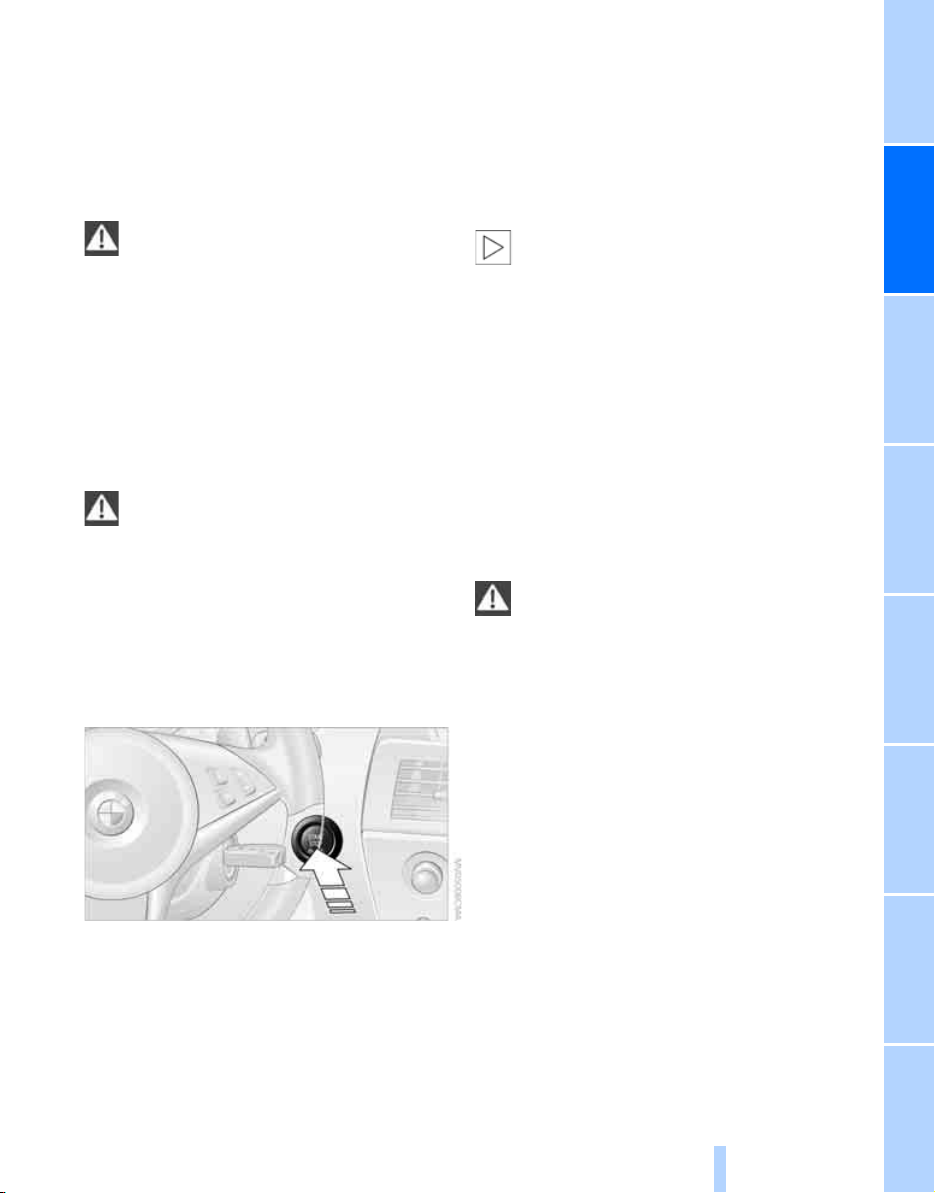
Controls
61
Reference At a glanceDriving tipsCommunications NavigationEntertainmentMobility
Radio readiness and ignition switched
off
All indicator and warning lamps in the instru-
ment cluster go out.
Starting engine
Do not run the engine in closed rooms,
otherwise the inhalation of toxic exhaust
gases can cause unconsciousness and death.
The exhaust gases contain carbon monoxide,
an odorless and colorless, but highly toxic gas.
Never leave an unattended vehicle with the
engine running, as such a vehicle represents a
potential safety hazard.
Before leaving the vehicle with the engine run-
ning, shift into neutral
* or move the selector
lever into position N and firmly apply the hand-
brake, otherwise the vehicle can begin to roll.<
Avoid frequent starting in quick succes-
sion or repeated starting attempts in
which the engine does not start. Otherwise, the
fuel is not burned or inadequately burned and
there is a danger of overheating and damaging
the catalytic converter.<
Do not allow the engine to warm up by leaving it
running while the vehicle remains stationary.
Instead, begin to drive at a moderate engine
speed.
Manual transmission*
Remote control in ignition lock or with comfort
access in vehicle, refer to page 38.
1. Depress brake pedal.
2. Depress the clutch pedal and shift into
idling position.
3. Press the Start/Stop button.
Sequential Manual Transmission with
Drivelogic
Remote control in ignition lock or with comfort
access in vehicle, refer to page 38.
1. Depress brake pedal.
2. Place selector lever in position N.
3. Press the Start/Stop button.
If the engine does not start, shift back to
the last selector lever position selected,
refer to the instrument cluster display or the
selector lever. Then select position N.
You cannot start off with the hood open.
When the engine is cold, the exhaust system
has a slightly metallic undertone due to the sys-
tem design.<
After every engine start, the Sequential mode is
activated in Drivelogic driving program 3 when
the selector lever is pushed to the right into
drive position Β and the brake pedal is pressed.
Switching engine off
When leaving the vehicle, always take the
remote control with you.
When parking, firmly apply the handbrake, as
otherwise the vehicle could roll.<
Manual transmission*
1. Press the Start/Stop button with the vehicle
stopped.
2. Shift into first gear or reverse.
3. Firmly apply the handbrake.
4. Remove the remote control from the igni-
tion lock, refer to page 60.
Sequential Manual Transmission with
Drivelogic
1. Firmly apply the handbrake.
2. Shift into a driving position.
3. Press the Start/Stop button.
If N is engaged when switching off the
engine, this will be pointed out to you opti-
cally and acoustically.
Online Edition for Part no. 01 41 2 600 775 - © 08/08 BMW AG
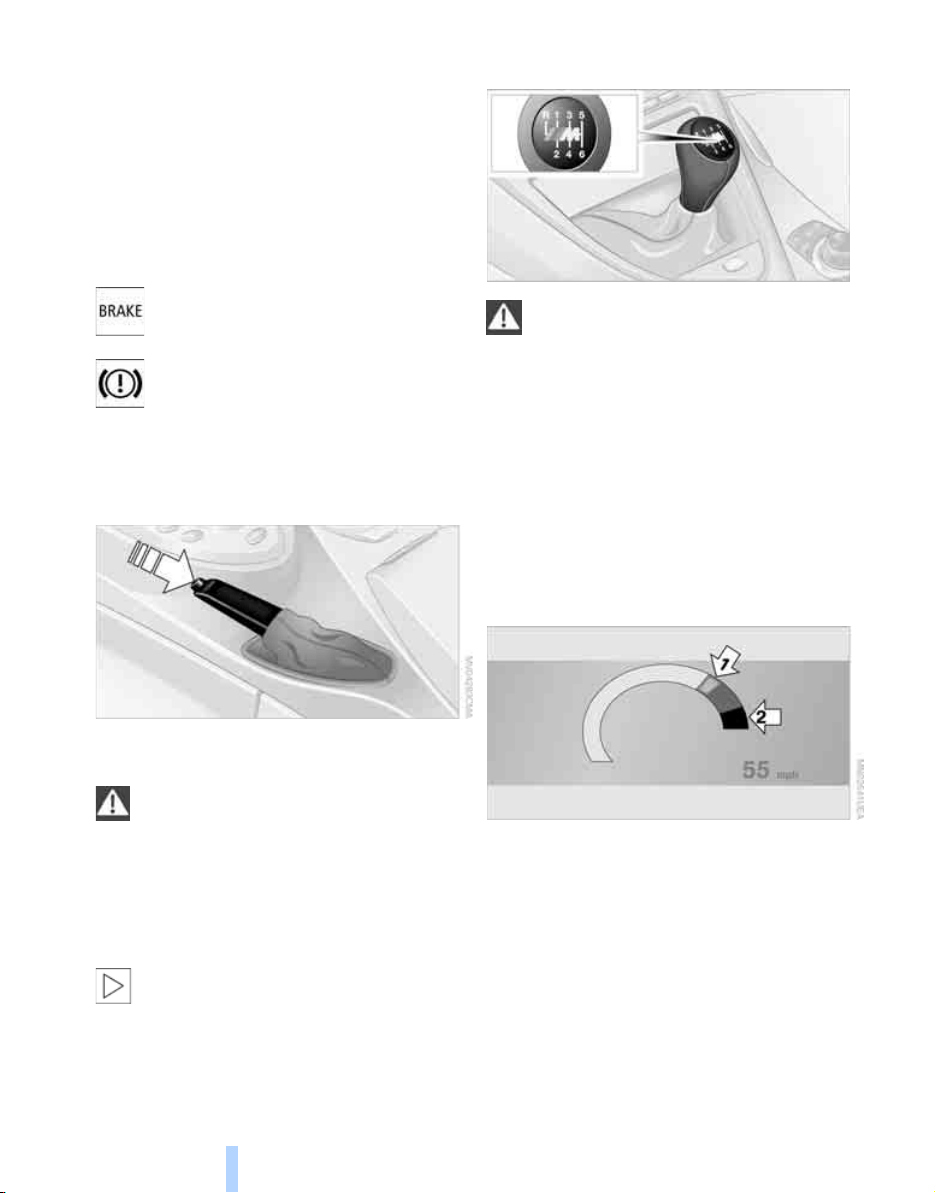
Driving
62
4. Remove the remote control from the igni-
tion lock, refer to page 60.
Handbrake
The handbrake is primarily intended to prevent
the vehicle from rolling while parked; it brakes
the rear wheels.
Indicator lamp
The indicator lamp lights up, and a sig-
nal sounds when you drive away. The
handbrake is applied.
Indicator lamp for Canadian models.
Applying
The lever locks in position automatically.
Releasing
Pull slightly upwards, press the button and
lower the lever.
If exceptional circumstances should
make it necessary to apply the handbrake
while the vehicle is in motion, do not pull it too
firmly. In doing so, continuously press the but-
ton of the handbrake lever. Otherwise, too firm
an application of the handbrake can lock up the
rear wheels and cause the rear of the vehicle to
swerve.<
To prevent corrosion and one-sided brak-
ing action, occasionally apply the hand-
brake lightly when the vehicle is slowly coming
to a stop if the traffic conditions are suitable.
The brake lamps do not light up when the hand-
brake is applied.<
Manual transmission*
While shifting in the 5th/6th gear lane,
press the gearshift lever toward the right,
otherwise accidental shifting into the 3rd or 4th
gear could result in engine damage.<
When shifting into 1st gear, you may feel a
slight jolt. This part of normal operation and no
reason for concern.
Reverse gear
Select only when the vehicle is stationary.
When pressing the gearshift lever to the left,
overcome some resistance.
Shift lights
To achieve the best vehicle acceleration with a
sporty driving style, shift lights in the Head-Up
Display
* indicate the optimum shifting point
briefly before reaching the maximum rpm. Refer
to Shift lights, page 65.
Online Edition for Part no. 01 41 2 600 775 - © 08/08 BMW AG
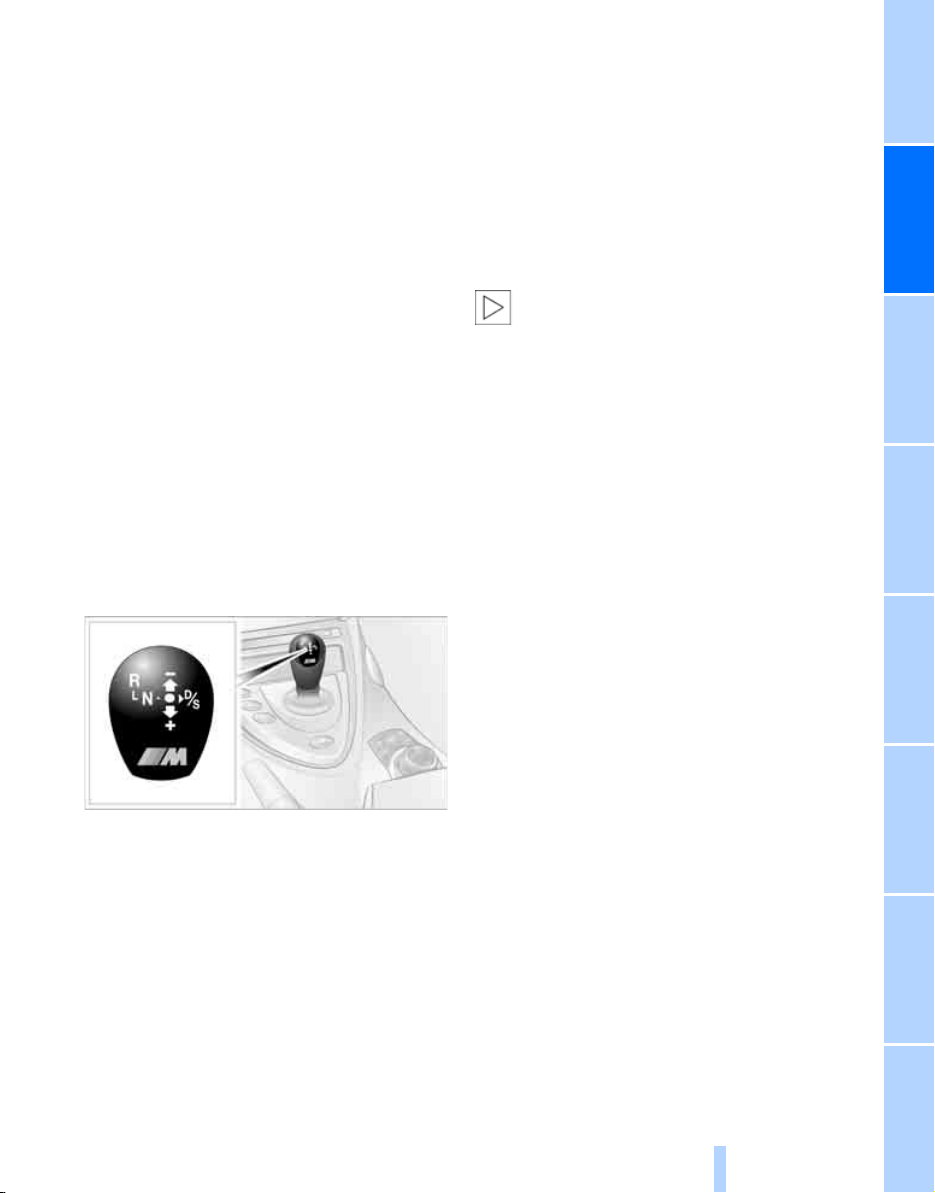
Controls
63
Reference At a glanceDriving tipsCommunications NavigationEntertainmentMobility
Sequential Manual
Transmission with Drivelogic
The concept
The SMG Sequential Manual Transmission
with Drivelogic is an automated manual trans-
mission in which an electrohydraulic system
handles the clutching and gear changes.
The Sequential Manual Transmission is oper-
ated with the selector lever and two shift pad-
dles on the steering wheel.
It offers you the following functions:
> Optional manual or automatic operation:
Sequential mode or Drive mode
> Selection option between different driving
programs, Drivelogic, refer to page 64
> Upshift display, shift lights, refer to page 65
> Automatic downshifting and prevention of
incorrect shifting even in Sequential opera-
tion
> Automatic double clutching
Selector lever positions
> R: Reverse gear
> N: Neutral
> Β: Drive position:
> +: manual upshifting
> –: manual downshifting
> D/S: switch between Drive mode and
Sequential mode
Shiftlock
Press the brake pedal before shifting out of N;
the shift command will not be executed unless
the brake is applied.
R Reverse
Select only when the vehicle is stationary.
N Idle
Always select before starting engine.
If the driving situation requires, e.g. when down-
shifting on a slippery road surface, the Sequen-
tial Manual Transmission automatically
clutches and then declutches again, i.e. it is not
necessary to manually shift into idling mode.
The system shifts into N when you open
the driver's door or the hood with the
engine running and do not operate pedals, shift
paddles or the selector lever. To begin driving
after closing the driver's door or the hood, first
shift the selector lever into the N position, and
then shift into drive.<
S Sequential mode
You can shift up and down using the shift pad-
dles or the selector lever. You do not need to
remove your foot from the accelerator to do so.
Shifting from Sequential mode to Drive mode:
press selector lever to the right toward D/S.
To switch back into the Sequential mode: shift
using the shift paddles or the selector lever or
press selector lever to the right toward D/S
again.
Starting off is also possible on a level road sur-
face in second gear, e.g. in case of ice.
In the following situations, the Sequential Man-
ual Transmission thinks for you:
> Upshifts and downshifts are executed only
when they will result in a plausible combina-
tion of engine and vehicle speed; thus, for
example, a downshift that would cause the
engine to overrev will not be executed by
the system.
> When the vehicle is stationary, the trans-
mission automatically downshifts into first
gear.
> Shortly before dropping below a gear-
dependent minimum speed, the transmis-
sion downshifts automatically even without
your intervention.
Online Edition for Part no. 01 41 2 600 775 - © 08/08 BMW AG
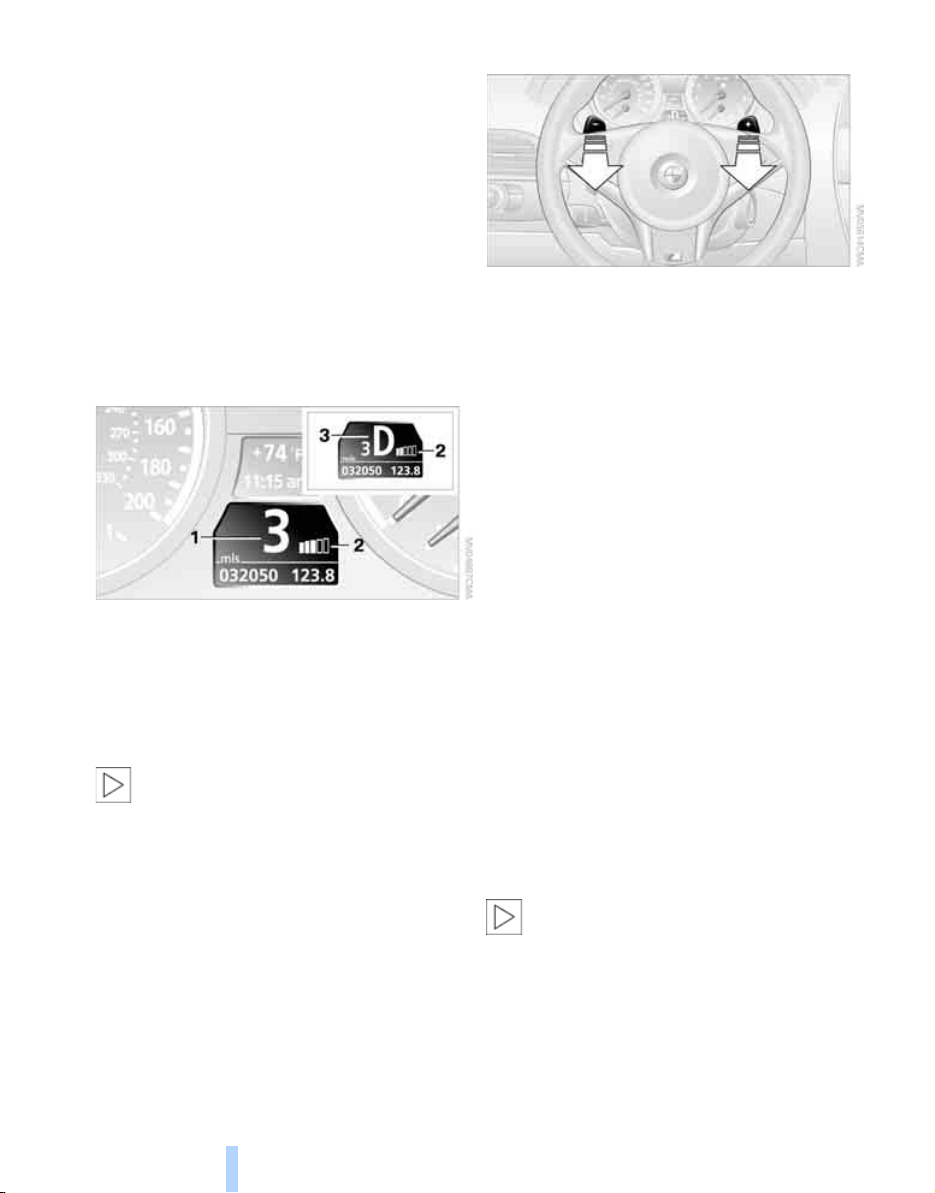
Driving
64
D Drive mode
In the Drive mode, all forward gears are shifted
automatically.
Shifting from Sequential mode to Drive mode:
shift using the shift paddles or the selector
lever, or press the selector level to the right in
the D/S direction.
Shifting back to Drive mode: press the selector
lever to the right in the D/S direction again.
Kick-down: for rapid acceleration, e.g. when
passing, press the accelerator pedal as far
down as it will go. You achieve maximum accel-
eration.
Displays in instrument cluster
1 Gear 1 to 7, R, N engaged
2 Selected driving program,
matches the number of illuminated fields,
refer to Drivelogic on page 64
3 In drive mode, the currently selected gear
followed by a D is displayed.
The gear display flashes when you open
the driver's door with the engine running.
If you do not subsequently operate the pedals,
shift paddles, or selector lever, then the system
shifts into N.<
Gear changes
Using selector lever
> To upshift, pull the selector lever back.
> To downshift, push the selector lever for-
ward.
Using shift paddles on steering wheel
> To upshift, briefly pull the right shift
paddle +.
> To downshift, briefly pull the left shift
paddle –.
Drivelogic
With Drivelogic various driving programs are
available to you.
Each time you change between the Sequential
mode and the Drive mode, the driving program
last selected in the respective mode is active.
Exception: after the first change from the
Sequential to the Drive mode, driving program 3
is active.
In Drive mode
There are five different driving programs, rang-
ing from relaxed 1 to sporty/highly dynamic 5.
In Sequential mode
You can choose from six driving programs from
balanced/dynamic 1 to sporty/purist 6.
Program 6 is only available when the DSC
Dynamic Stability Control is deactivated, refer
to page 84. If DSC is activated, then the system
switches from program 6 to program 5.
To maintain vehicle stability, always acti-
vate DSC whenever possible.<
Selecting driving program with button
in center console
Press the button repeatedly until the desired
drive program is displayed in the instrument
cluster, refer to page 64.
Online Edition for Part no. 01 41 2 600 775 - © 08/08 BMW AG
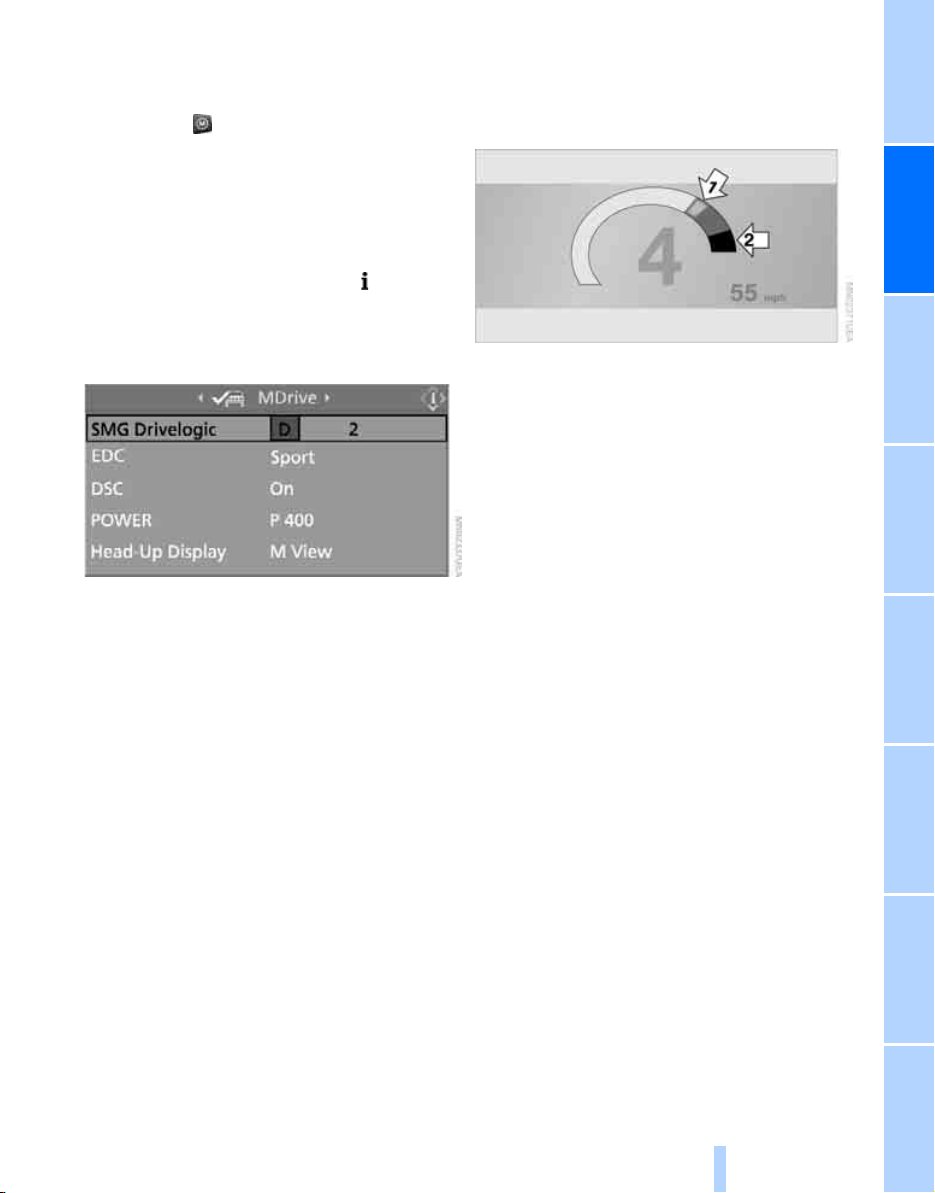
Controls
65
Reference At a glanceDriving tipsCommunications NavigationEntertainmentMobility
Selecting driving program via button
on steering wheel
You can also activate your preferred driving pro-
gram with the button on the steering wheel,
refer to MDrive on page 55.
With the ignition switched on you can change
the settings of MDrive on the Control Display.
iDrive, for operating principle refer to page 16.
1. Open the start menu.
2. Press the controller to open the menu.
3. Select "MDrive" and press the controller.
4. Select "SMG Drivelogic" and press the con-
troller. The first setting is selected.
5. Turn controller to set Drive mode or
Sequential mode.
"Unchanged" retains the current settings
made outside of MDrive.
6. Press controller to select driving programs.
7. Turn controller to set driving program.
8. Press the controller.
Shift lights
To achieve the best vehicle acceleration with a
sporty driving style in the Sequential mode,
shift lights in the Head-Up Display
* indicate the
optimum shifting point briefly before reaching
the maximum rpm.
1. Activate the Head-Up Display, refer to
page 94
2. Select the "M View" display on the Head-
Up Display.
The current engine speed is highlighted on
the tachometer.
3. When approaching the maximum rpm, yel-
low illuminated fields 1 of the tachometer
consecutively indicate the approaching
upshift point.
4. At the very latest, shift when the field 2
lights up in red.
When the permissible maximum rpm is
reached, the entire tachometer begins to flash.
When the maximum rpm is exceeded, the fuel
supply is cut off to protect the engine. Always
avoid engine speeds in this range.
M Engine Dynamic Control
With M Engine Dynamic Control you can influ-
ence how sporty the reaction of your vehicle to
accelerator pedal movements is to be. Three
programs are available for engine control.
"P 400" program
In the "P 400" program, the engine reacts gen-
tly to the movement of the accelerator pedal.
This is, for example, ideal for city driving or driv-
ing on snow. In the process, the fuel consump-
tion is minimal and the engine output is
reduced.
Online Edition for Part no. 01 41 2 600 775 - © 08/08 BMW AG
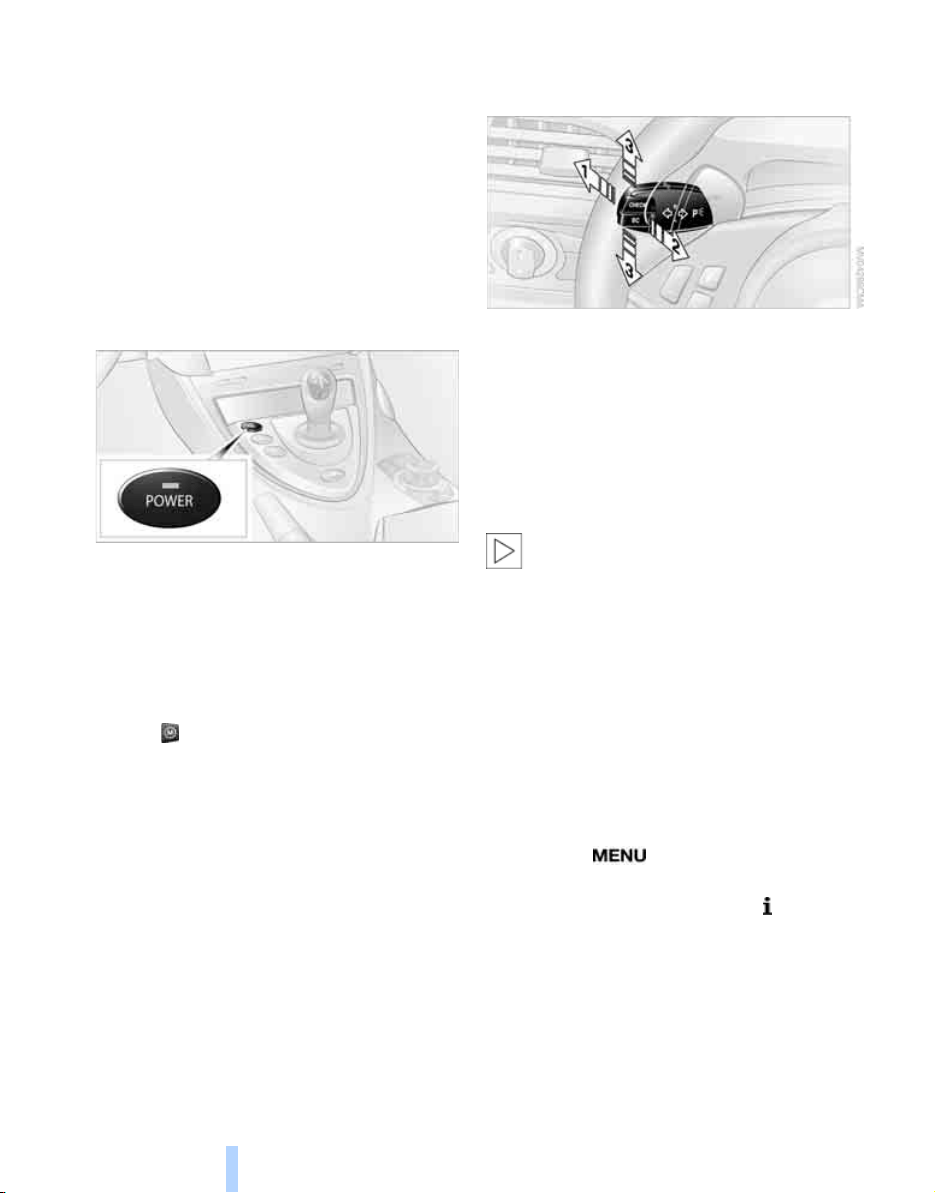
Driving
66
"P 500" program
The "P 500" program provides maximum per-
formance and more spontaneous reaction of
the engine to accelerator pedal movements.
"P 500 Sport" program
In the "P 500 Sport" program, the engine
responds to accelerator pedal movements with
a high degree of spontaneity and uncompro-
mising sportiness while exhibiting maximum
performance.
Selecting program
The "P 400" program is activated after each
engine start.
Press the POWER button to activate the
"P 500" program. Pressing the POWER button
repeatedly switches between the programs
"P 400" and "P 500".
You can also activate your preferred program
with the button on the steering wheel, refer
to MDrive on page 55. You can only activate the
"P 500 Sport" program with MDrive.
For the programs "P 500" and
"P 500 Sport", the LED in the POWER button
lights up.
Turn signals/
headlamp flasher
1 High beams
2 Headlamp flasher
3 Turn signals
Using turn signals
Press the lever beyond the resistance point.
To turn off manually, press the lever to the
resistance point.
Atypically rapid flashing of the indicator
lamp indicates the failure of a turn signal
lamp.<
Signaling briefly
Press lever to resistance point and hold for as
long as you wish to signal.
Triple turn signal activation
Press the lever to the resistance point; the turn
signal flashes three times.
You can activate or deactivate this function.
iDrive, for operating principle refer to page 16.
1. Press the button.
This opens the start menu.
2. Press the controller to open the menu.
3. Select "Settings" and press the controller.
4. Select "Vehicle / Tires" and press the con-
troller.
Online Edition for Part no. 01 41 2 600 775 - © 08/08 BMW AG
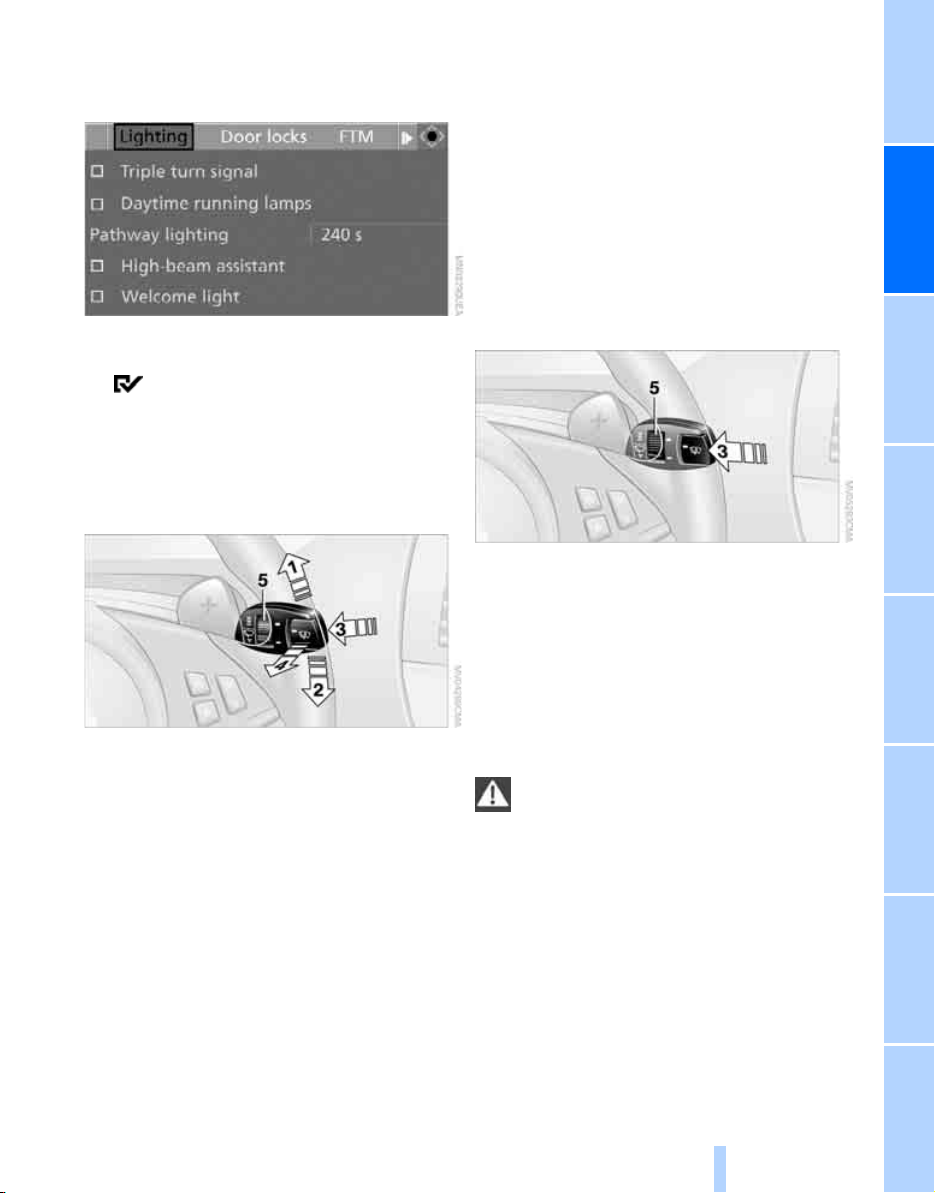
Controls
67
Reference At a glanceDriving tipsCommunications NavigationEntertainmentMobility
5. Change to upper field if necessary. Turn the
controller until "Lighting" is selected and
press the controller.
6. Select "Triple turn signal" and press the
controller.
Triple turn signaling is activated.
The setting is stored for the remote control cur-
rently in use.
Wiper system
1 Switching on wipers
2 Switching off wipers or brief wipe
3 Activating/deactivating rain sensor
4 Cleaning windshield and headlamps
5 Adjusting rain sensor sensitivity level
Switching on wipers
Pull the lever upward, arrow 1.
The lever automatically returns to its initial posi-
tion when released.
Normal wiper speed
Press once.
The system reverts to operation in the intermit-
tent mode when the vehicle is stationary.
Fast wiper speed
Press twice or press beyond the resistance
point.
The system reverts to normal speed when the
vehicle is stationary.
Rain sensor
The wiper operation is controlled automatically
as a function of the rain intensity. The rain sen-
sor is located on the windshield, directly in front
of the interior rearview mirror.
Activating rain sensor
Press the button, arrow 3. The LED in the but-
ton lights up.
Adjusting rain sensor sensitivity level
Turn the knurled wheel 5.
Deactivating rain sensor
Press the button again, arrow 3. The LED goes
out.
Deactivate the rain sensor when passing
through an automatic car wash. Failure to
do so could result in damage caused by undes-
ired wiper operation.<
Cleaning windshield and headlamps
Pull the lever, arrow 4.
The system sprays washer fluid against the
windshield and activates the wipers for a brief
period.
When the vehicle lighting is switched on, the
headlamps are simultaneously washed at
appropriate intervals.
Online Edition for Part no. 01 41 2 600 775 - © 08/08 BMW AG
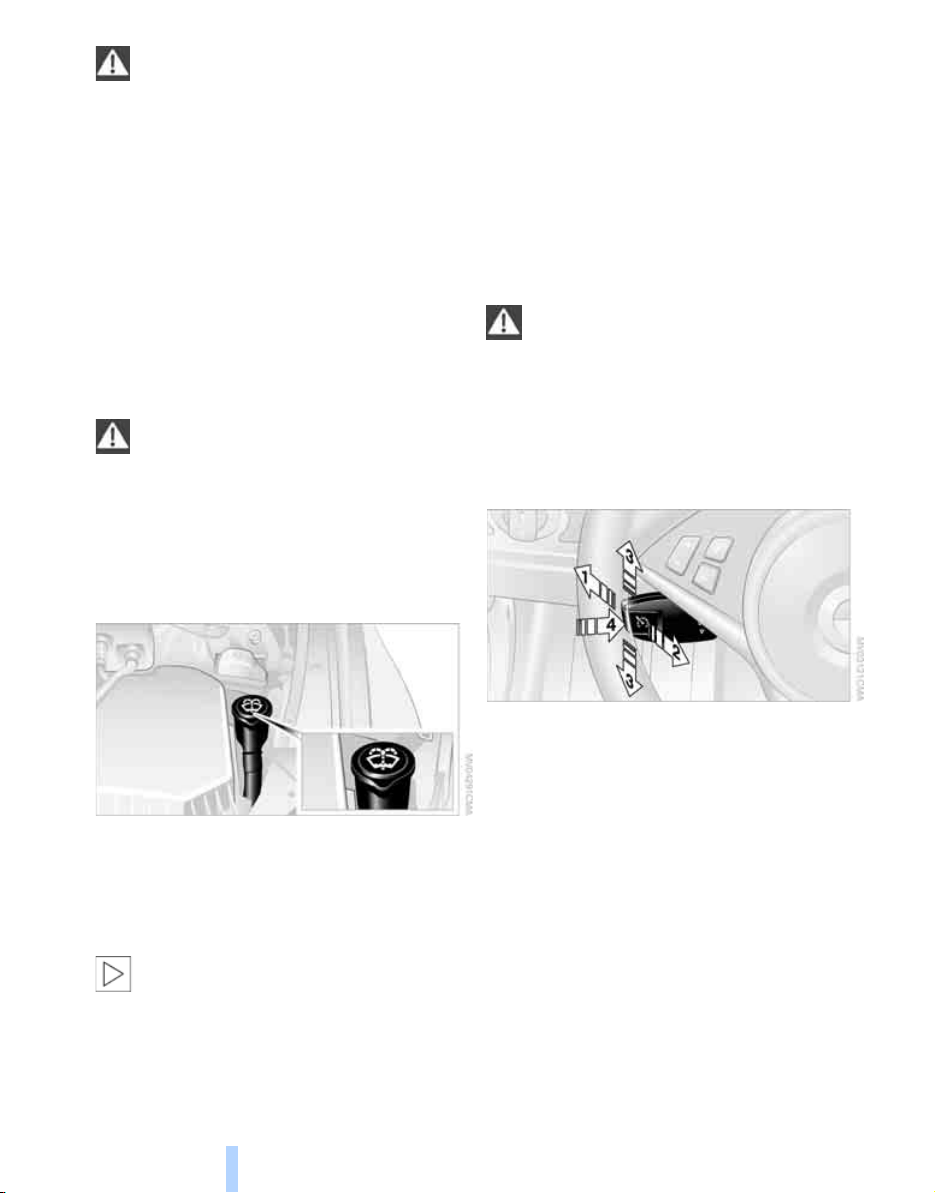
Driving
68
Do not use the washing mechanisms if
there is any danger that the fluid will
freeze on the windshield. If you do so, your
vision could be obscured. To avoid freezing,
use a washer fluid antifreeze, refer to Washer
fluid. Do not use washing mechanisms when
the washer fluid reservoir is empty, otherwise
you will damage the washer pump.<
Windshield washer nozzles
The windshield washer nozzles are heated
when the engine is running or the ignition is
switched on.
Washer fluid
Washer fluid antifreeze is flammable. For
this reason, keep it away from ignition
sources and store only in the closed original
container out of reach of children. Otherwise,
there is the danger of bodily injury. Always
observe the instructions for use provided on the
containers.<
Filler neck for washer fluid
All washer nozzles are supplied from one reser-
voir.
Fill with water and – if required – with a washer
antifreeze, according to manufacturer's recom-
mendations.
In order to maintain the mixture ratio, mix
the washer fluid before filling.<
Capacity
Capacity approx. 5.3 US quarts/5 liters.
Cruise control
The concept
The cruise control is available for use at speeds
of approx. 20 mph/30 km/h and higher. The
vehicle stores and maintains the speed that you
set using the lever mounted on the steering col-
umn. If the engine braking effect is insufficient
on a downhill grade, the set speed may be
exceeded. Speed can drop on uphill grades if
the engine output is insufficient.
Do not use the cruise control under driv-
ing conditions that do not permit a con-
stant speed, e.g. when driving on winding
roads, in heavy traffic or in poor road conditions
such as snow, rain, ice, loose road surface, and
poor visibility. Otherwise you could loose con-
trol of the vehicle and cause an accident.<
One lever for all functions
1 Maintaining, storing and increasing speed
2 Maintaining speed, storing speed, and
decelerating
3 Interrupting and deactivating system
4 Resuming stored speed
Maintaining, storing and increasing
speed
Press lever to resistance point, arrow 1:
The speed currently being driven is maintained
and stored. The display 1 in the speedometer,
see below, indicates this regulated speed.
Every time you press the lever, the vehicle's
speed increases by roughly 1 mph/1 km/h.
Press lever to resistance point for a longer time:
The vehicle accelerates without pressure on
the accelerator pedal. The system maintains
Online Edition for Part no. 01 41 2 600 775 - © 08/08 BMW AG
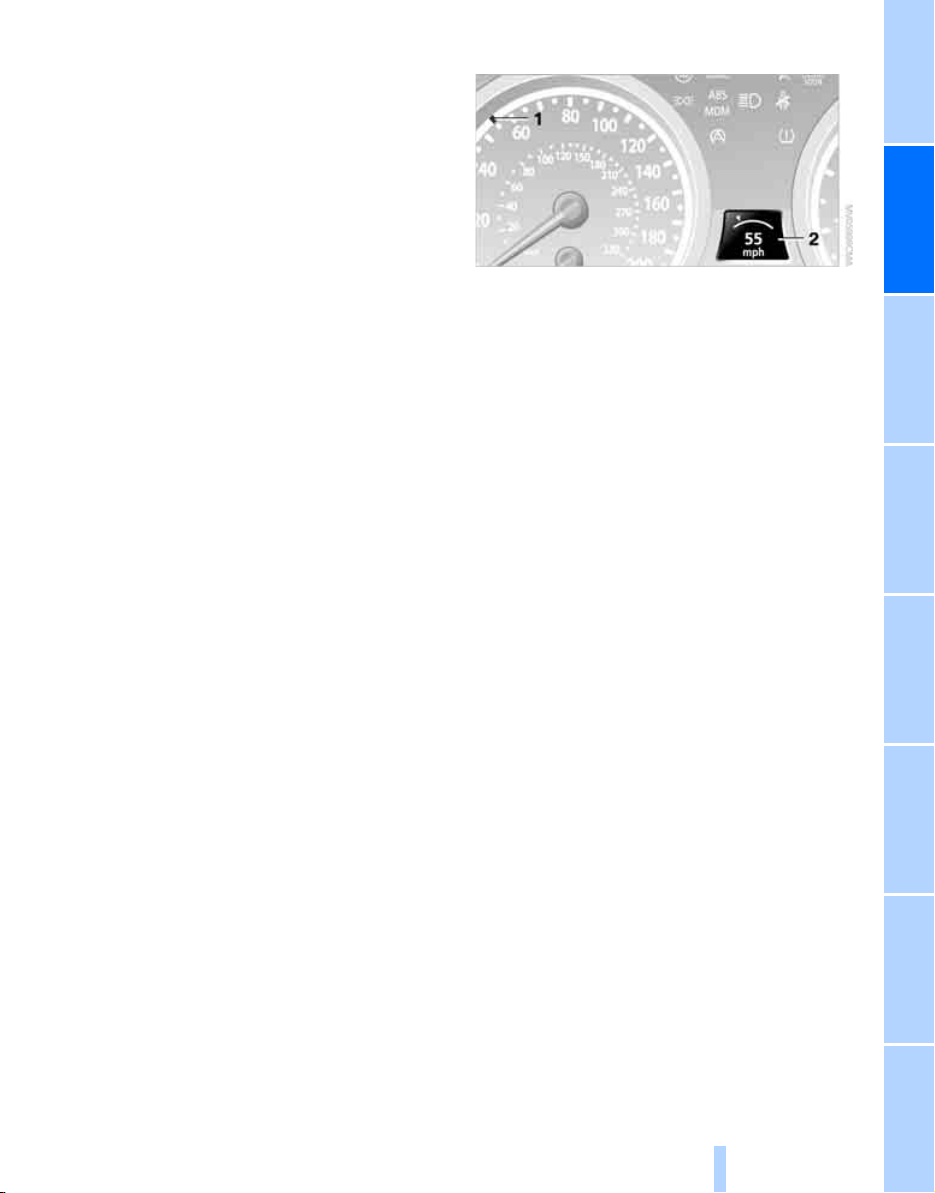
Controls
69
Reference At a glanceDriving tipsCommunications NavigationEntertainmentMobility
and stores your current speed as soon as you
release the lever.
Press the lever beyond the resistance point:
The speed is increased to the next fives posi-
tion in the mph display or the next tens position
in the km/h display.
Press and hold the lever beyond the resistance
point:
The vehicle accelerates more quickly.
Maintaining speed, storing speed, and
decelerating
Pull the lever, arrow 2:
Functions are the same as 1; the speed is
reduced.
Interrupting system
Press the lever up or down, arrow 3.
The display 1 in the speedometer changes
color.
In addition, the system is interrupted:
> when you apply the brakes, even with the
handbrake
> when you clutch
> when you shift using the shift paddles or the
selector lever
> when the DSC comes on
Resuming stored speed
Press button 4:
The stored speed is resumed and maintained.
Deactivating system
> Press the lever up or down twice, arrow 3
> Switch off the ignition
The speed stored in the memory is deleted.
Displays in instrument cluster
1 Stored speed
2 Selected speed is displayed briefly
Online Edition for Part no. 01 41 2 600 775 - © 08/08 BMW AG
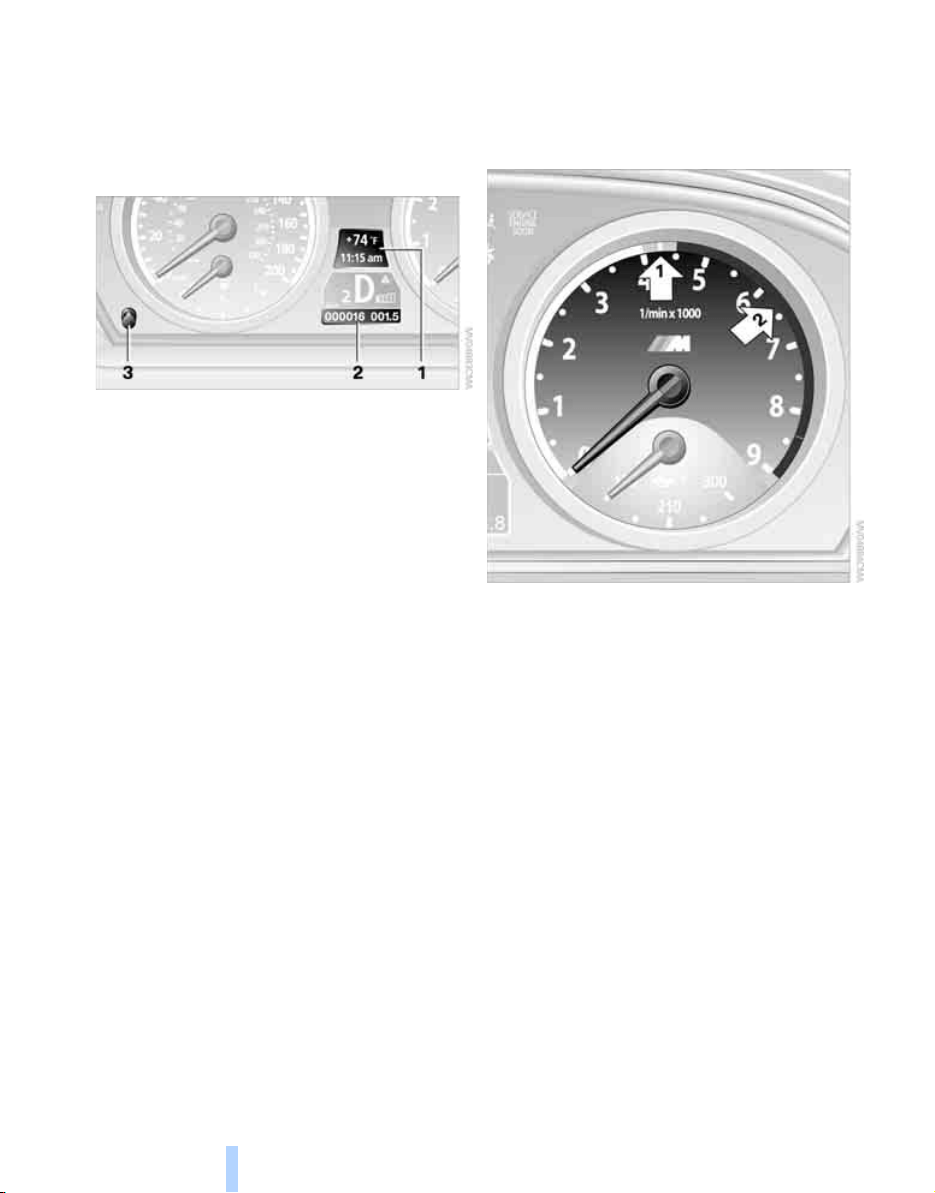
Everything under control
70
Everything under control
Odometer, outside
temperature display, clock
1 Time, outside temperature, refer to Com-
puter on page 71
2 Odometer and trip odometer
3 Press button:
> with ignition switched on, trip odometer
is reset
> with ignition switched off, odometer is
briefly displayed
Tachometer
The advance warning field, arrow 1, and the red
warning field, arrow 2, change depending on
the engine temperature. As the engine temper-
ature rises, the permissible engine speed also
increases. Avoid allowing the engine speed to
rise as far as the orange warning field whenever
possible.
Be sure to avoid engine speeds in the red warn-
ing field. At high revs in this range, the flow of
fuel is interrupted to protect the engine.
Coolant temperature
Should the coolant, and with it the engine
become too hot, a warning lamp lights up. In
addition, a message appears on the Control
Display.
Checking coolant level, refer to page 217.
Online Edition for Part no. 01 41 2 600 775 - © 08/08 BMW AG
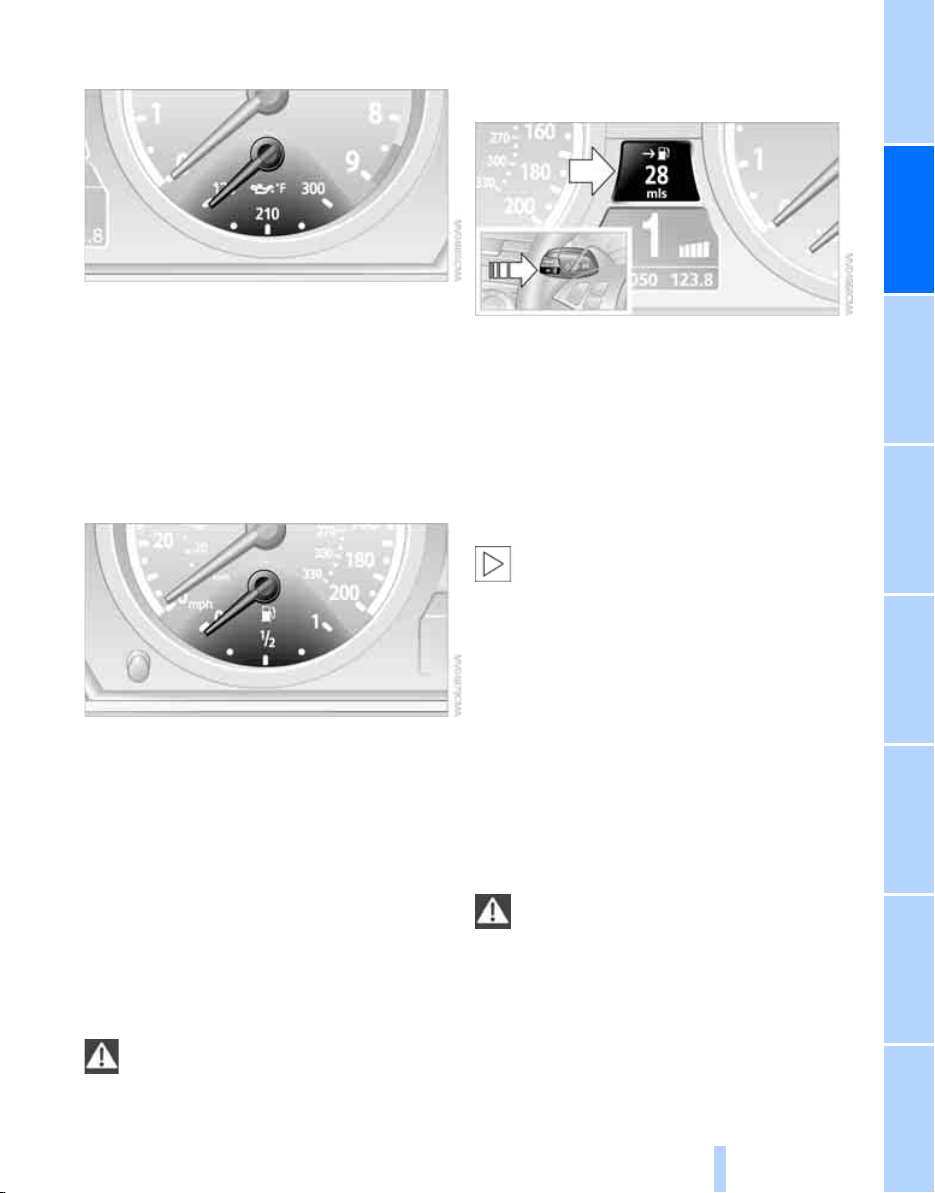
Controls
71
Reference At a glanceDriving tipsCommunications NavigationEntertainmentMobility
Engine oil temperature*
The general operating temperature lies
between 1757/806 and 2507/1206. Do
not exceed a value of approx. 2657/1306.
If the engine oil temperature is too high, the per-
missible engine speed, and with it the available
engine output is reduced.
Fuel gauge
Fuel tank capacity: approx. 18.5 US gal/
70 liters. You will find information on refueling
on page 204.
If the tilt of the vehicle varies for a longer period,
when you are driving in mountainous areas, for
example, the indicator may fluctuate slightly.
Reserve
After the reserve quantity has been reached, a
message briefly appears on the Control Display;
the remaining range is shown in the computer.
Below a range of approx. 30 miles/50 km, the
message remains on the Control Display.
Refuel as soon as possible once your
cruising range falls below 30 miles/
50 km, otherwise engine functions are not
ensured and damage can occur.<
Computer
Displays in instrument cluster
Press the button on the turn signal lever.
The following information is displayed in the
specified order:
> Time and outside temperature
> Cruising range
> Average fuel consumption
> Oil level, refer to Checking engine oil level
on page 214
Manual transmission:
The cruising range, average fuel con-
sumption and oil level are shown in the lower
display in place of the gear indicator.
It is possible to change between the time and
data display by pressing the CHECK button.<
Time
To set the time, refer to page 78.
Outside temperature warning
If the display drops to +377/+36, a signal
sounds and a warning lamp lights up. A mes-
sage appears on the Control Display. There is
an increased danger of ice.
Even at temperatures above +377/
+36 ice can form. Therefore, drive care-
fully, e.g. on bridges and sections of road in the
shade, otherwise there is an increased accident
risk.<
You can set the unit of measure 7 or 6 on the
Control Display, refer to Units of measure on
page 80.
Online Edition for Part no. 01 41 2 600 775 - © 08/08 BMW AG
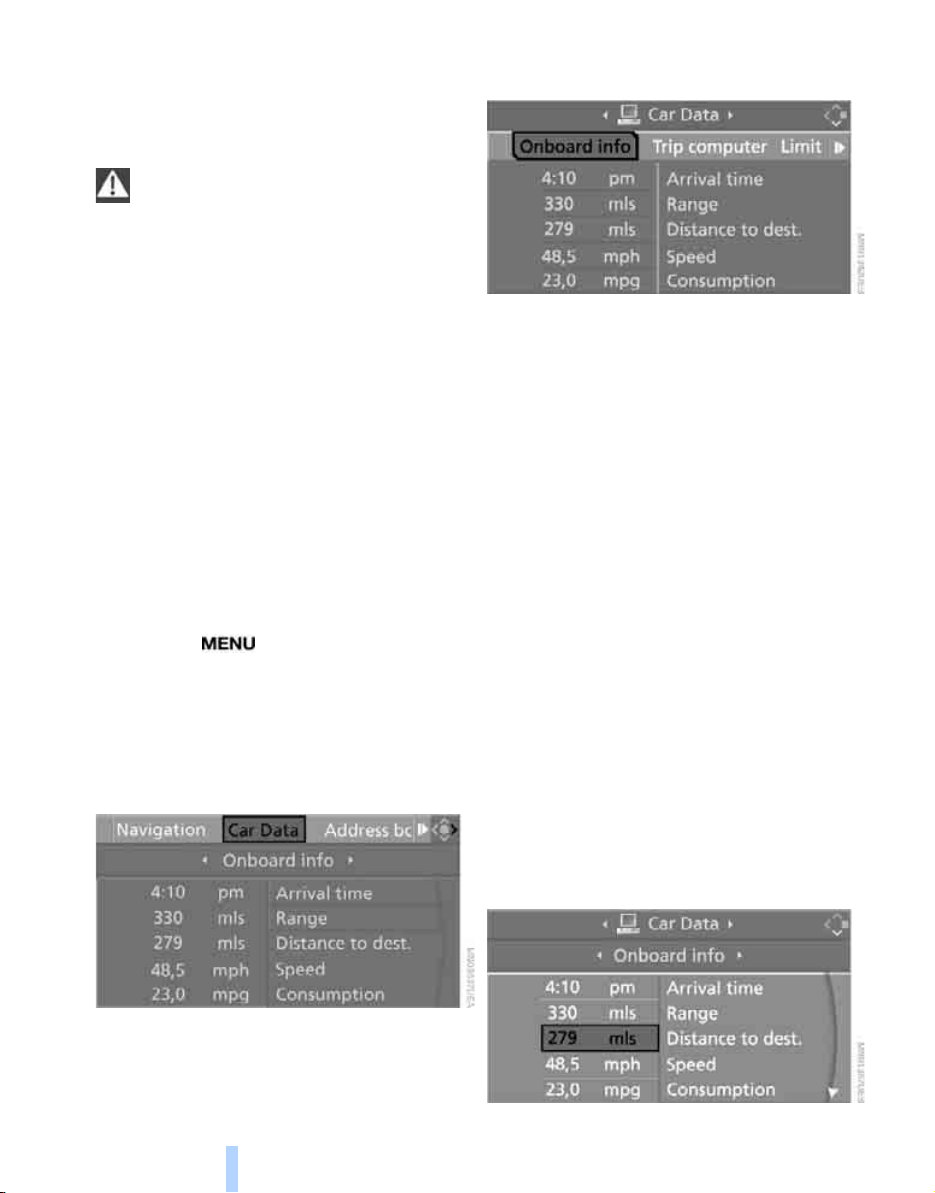
Everything under control
72
Cruising range
Displays the estimated cruising range available
with the remaining fuel. The range is projected
based on the driving style over the last 20 miles/
30 km.
Refuel as soon as possible once your
cruising range falls below 30 miles/
50 km, otherwise engine functions are not
ensured and damage can occur.<
Average fuel consumption
The average fuel consumption is calculated for
the time during which the engine is running.
To reset average fuel consumption: press BC
button on turn signal lever for approx. 2 sec-
onds.
For different routes
You can display the average speed for two dif-
ferent routes on the Control Display, refer to the
following and to Trip computer.
Displays on Control Display
You can also call up the computer via iDrive, for
operating principle refer to page 16.
1. Press the button.
This opens the start menu.
2. Move the controller to the right to open
"Navigation".
Without navigation system
*: Open "Car
Data".
3. Select "Car Data" and press the controller.
4. Select "Onboard info" and press the con-
troller.
> Estimated time of arrival at destination and
remaining distance:
> Entering a distance manually in the com-
puter, see below.
> Entering a destination in the navigation
system
*, refer to page 128.
> Cruising range
> Average speed
> Average fuel consumption
Periods with the vehicle parked and the engine
switched off are not included in the calculations
of average speed.
Resetting values
You can reset the values for the average speed
and average fuel consumption:
1. Select the respective menu item and press
the controller.
2. To confirm your selection, press the con-
troller again.
Entering a distance manually
1. Select "Distance to dest." and press the
controller.
Online Edition for Part no. 01 41 2 600 775 - © 08/08 BMW AG
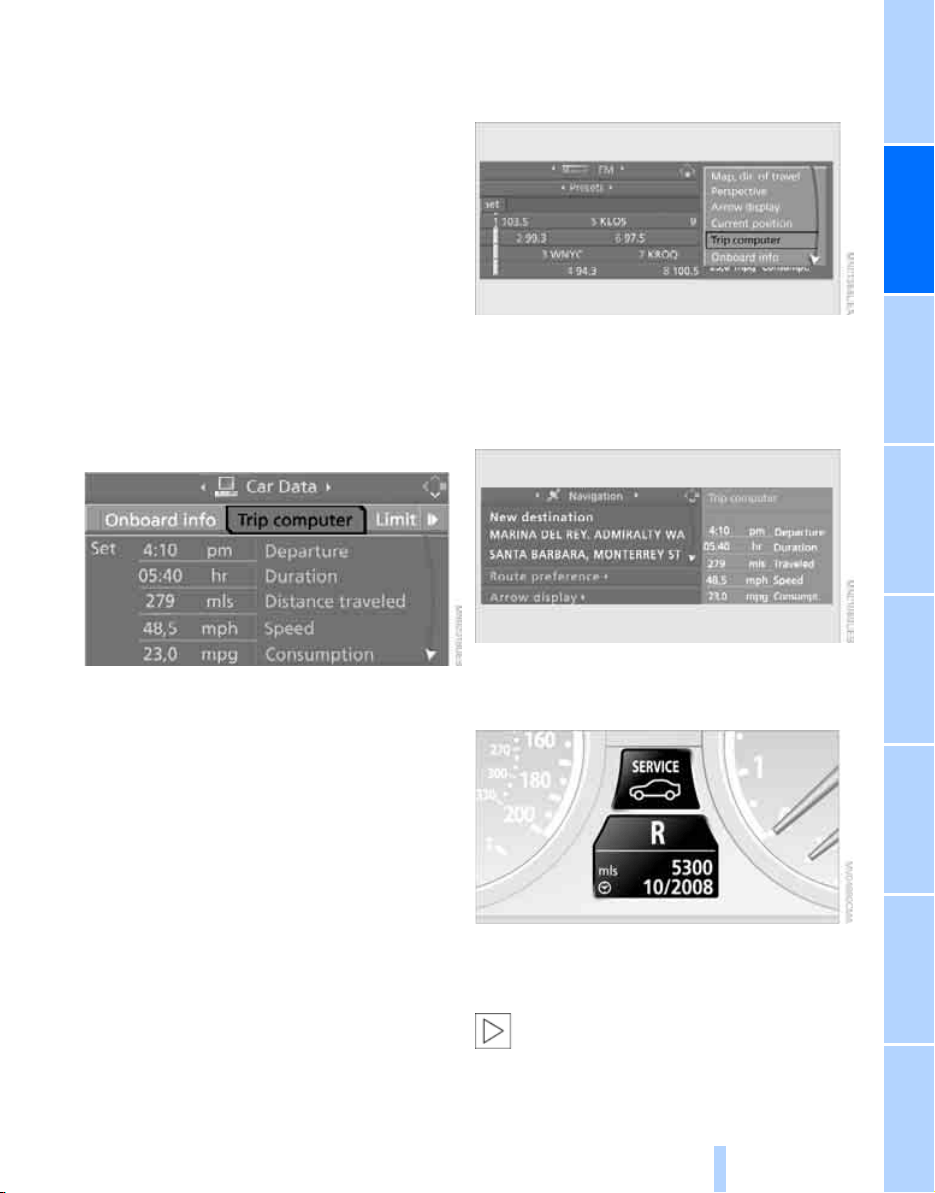
Controls
73
Reference At a glanceDriving tipsCommunications NavigationEntertainmentMobility
2. Turn the controller to select the distance
to your destination.
3. Press the controller to apply the setting.
The distance is automatically preset during the
destination guidance of the navigation sys-
tem
*.
Trip computer
The trip computer is suitable, for example, for a
vacation trip.
1. Open the start menu.
2. Open "Navigation".
Without navigation system
*: Open "Car
Data".
3. Select "Car Data" and press the controller.
4. Select "Trip computer" and press the con-
troller.
> Departure time
> Driving time
> Distance traveled
> Average speed
> Average fuel consumption
Switching trip computer on/off and resetting
all values:
1. Select "Set" and press the controller.
2. Select the desired menu item and press the
controller.
Display options
You can display the computer or the trip com-
puter in the assistance window.
1. Move the controller to the right to change to
the assistance window and press the con-
troller.
2. Select a menu item:
> "Onboard info"
> "Trip computer".
3. Press the controller.
Service requirements
The remaining driving distance and the date for
the next maintenance are displayed briefly with
the ignition switched on.
Your BMW Service Advisor can deter-
mine your vehicle's current service
requirements by reading out the data stored in
the remote control.<
Online Edition for Part no. 01 41 2 600 775 - © 08/08 BMW AG
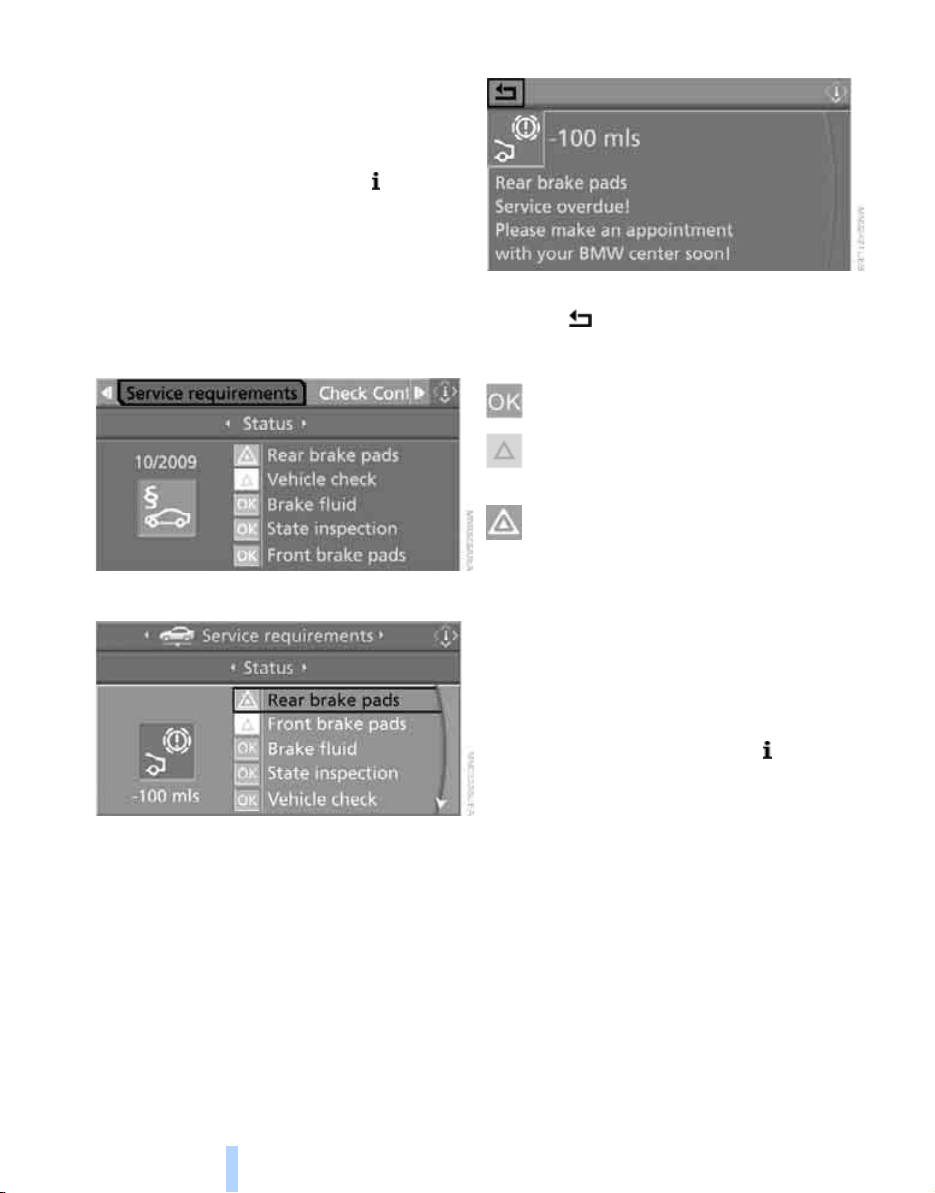
Everything under control
74
Additional information
You can view more detailed information by
using the Control Display, for operating princi-
ple refer to page 16.
1. Open the start menu.
2. Press the controller to open the menu.
3. Select "Info sources" and press the control-
ler.
4. Select "Service Info" and press the control-
ler.
5. Change to upper field if necessary. Turn the
controller until "Service requirements" is
selected and press the controller.
6. Select "Status" and press the controller.
The display shows a list of selected service and
maintenance procedures, as well as legally
mandated official inspections.
You can request more detailed information on
every entry.
Select the entry and press the controller.
To exit from the menu:
Select the arrow and press the controller.
Symbols
No service is currently required.
The deadline for service or an official
inspection is approaching. Please
arrange a service appointment.
The service deadline has already passed.
Entering deadlines for legally required
inspections*
Make sure the date on the Control Display is set
correctly, refer to page 79; otherwise, the effec-
tiveness of CBS Condition Based Service is not
ensured.
1. Open the start menu.
2. Press the controller to open the menu.
3. Select "Info sources" and press the control-
ler.
4. Select "Service Info" and press the control-
ler.
5. Change to upper field if necessary. Turn the
controller until "Service requirements" is
selected and press the controller.
6. Select "Status" and press the controller.
Online Edition for Part no. 01 41 2 600 775 - © 08/08 BMW AG
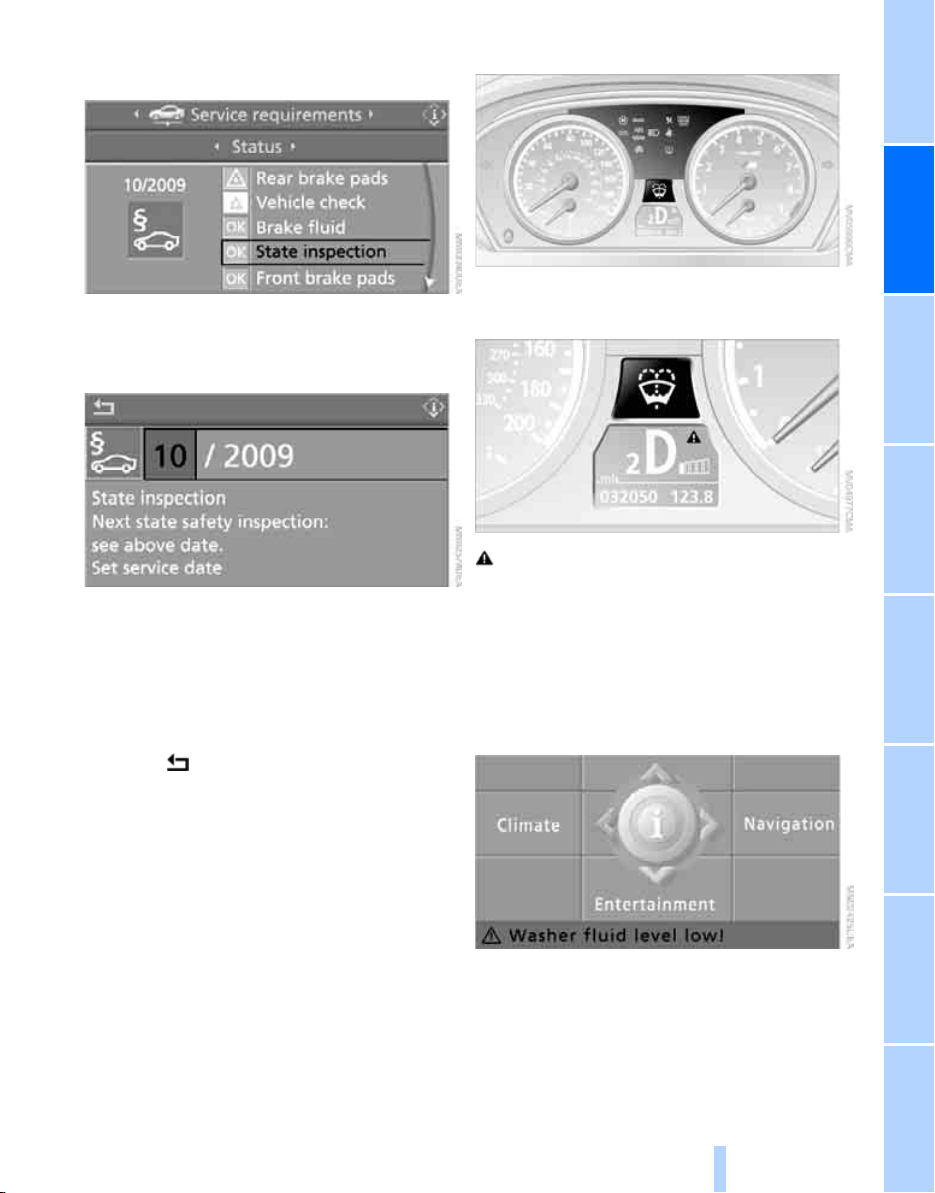
Controls
75
Reference At a glanceDriving tipsCommunications NavigationEntertainmentMobility
7. Select "State inspection" and press the
controller.
8. Select "Set service date" and press the
controller. The month is selected.
9. Turn the controller to make the adjustment.
10. Press the controller to apply the setting.
The year is selected.
11. Turn the controller to make the adjustment.
12. Press the controller to apply the setting.
The date entry is stored.
To exit from the menu:
Select the arrow and press the controller.
Check Control
The concept
The Check Control monitors functions in the
vehicle and issues a message if there is a mal-
function in the monitored systems. This kind of
Check Control message consists of indicator
and warning lamps in the instrument cluster,
and if necessary an acoustic signal and text
messages at the bottom of the Control Display.
Indicator and warning lamps
The indicator and warning lamps can light up in
different combinations and colors.
This symbol means that a Check Control
message has been generated. The symbol con-
tinues to be visible even when the Check Con-
trol message disappears after a short time. The
warning lamps and text messages are stored
and can be displayed later, also refer to
page 76.
Explanatory text messages
Text message at the bottom edge of the Con-
trol Display explain the meaning of the dis-
played indicator and warning lamps.
Online Edition for Part no. 01 41 2 600 775 - © 08/08 BMW AG
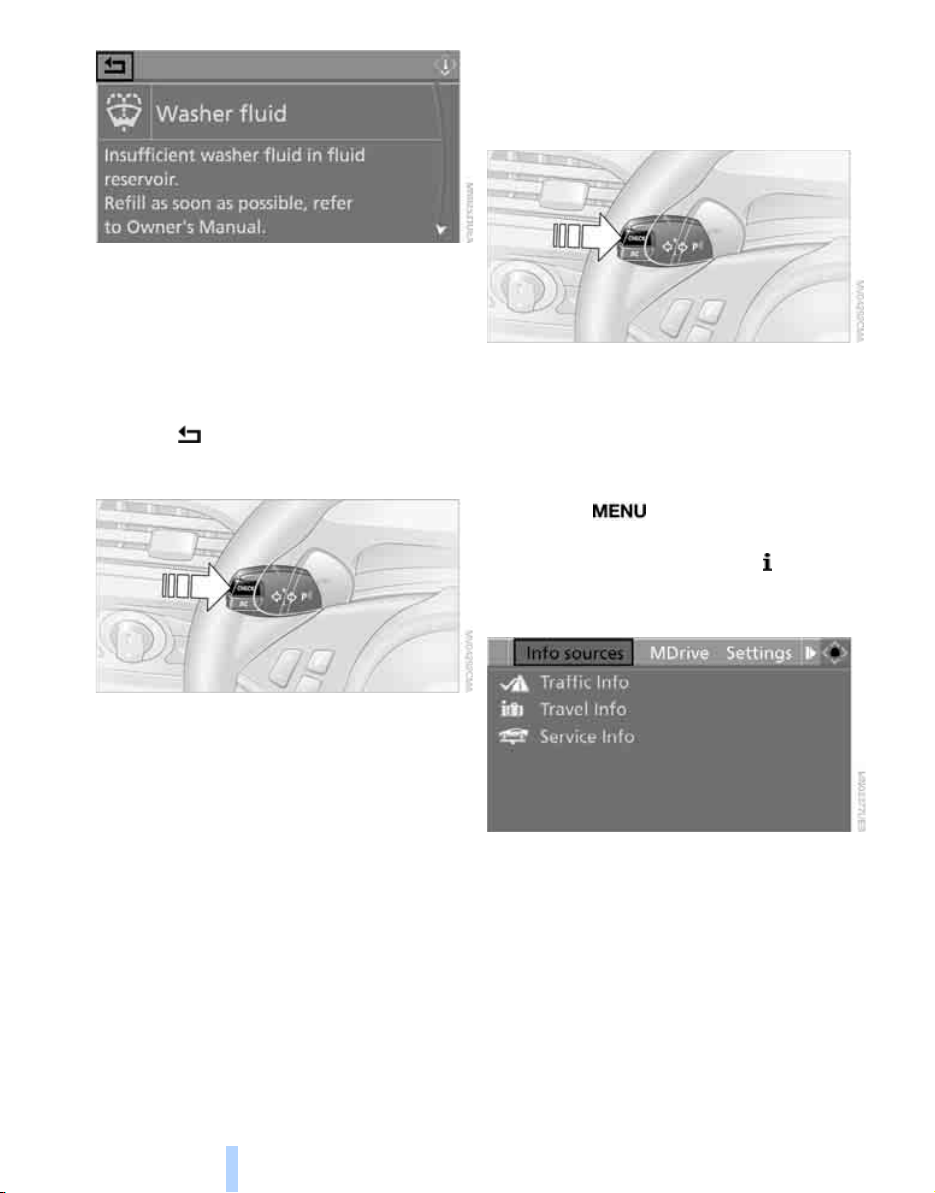
Everything under control
76
For most Check Control messages, you can
view more information later, e.g. regarding the
cause of a malfunction and how to respond;
refer to the information provided below.
In urgent cases, this information will be shown
as soon as the corresponding lamp lights up.
To exit the displayed information:
Select the arrow and press the controller.
Hiding Check Control messages
Press the CHECK button on turn signal lever.
Some Check Control messages are displayed
until the malfunctions have been rectified. They
cannot be hidden. If a number of malfunctions
occur simultaneously, they are displayed in
succession.
Other messages are hidden after approx.
20 seconds, but remain stored.
Displaying stored Check Control
messages
1. Press the button longer:
The first stored message is displayed.
2. Press the button:
When the button is pressed again, a differ-
ent message is displayed.
Displaying supplementary information
iDrive, for operating principle refer to page 16.
1. Press the button.
This opens the start menu.
2. Press the controller to open the menu.
3. Turn the controller until "Info sources" is
selected and press the controller.
4. Turn the controller until "Service Info" is
selected and press the controller.
Online Edition for Part no. 01 41 2 600 775 - © 08/08 BMW AG
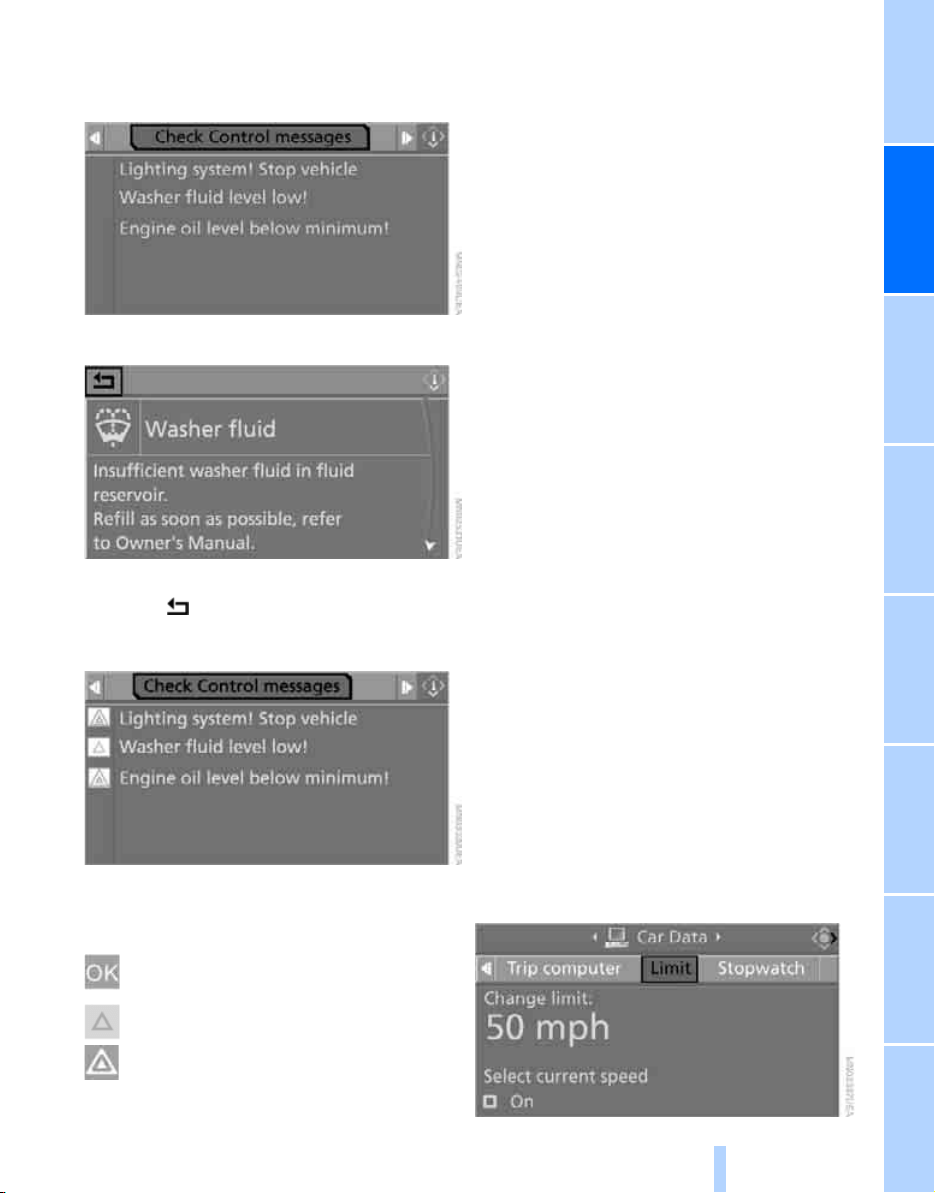
Controls
77
Reference At a glanceDriving tipsCommunications NavigationEntertainmentMobility
5. Change to upper field if necessary. Turn the
controller until "Check Control messages"
is selected and press the controller.
6. Select a message and press the controller.
To exit from the menu immediately:
Select the arrow and press the controller.
Displaying the urgency of malfunctions
Depending on the equipment, the stored Check
Control messages are also displayed with the
following symbols:
No malfunctions detected in the moni-
tored systems.
Malfunctions are present in the moni-
tored systems. Depending on the mal-
function, supplementary information is
shown on the Control Display.
The symbols also indicate the status of the ser-
vice requirements display, refer to page 73.
Displays after completion of trip
Malfunction reports generated during the trip
are shown consecutively when you switch off
the ignition.
Before the display disappears, you can display
the messages once again. Press the CHECK
button for approx. 2 seconds. If several mes-
sages are present, you can continue to press
the CHECK button to view them in succession.
The display goes out:
> after a short time
> when you press the CHECK button again
for approx. 2 seconds
Speed limit
You can enter a speed and a Check Control
message indicates when you have reached this
speed. This enables you, for example, to
receive warnings if you exceed a speed limit in
an urban area.
You are only warned of reaching this speed a
second time if your vehicle speed falls below it
again by at least 3 mph/5 km/h.
Displaying, setting or changing limit
iDrive, for operating principle refer to page 16.
1. Open the start menu.
2. Open "Navigation".
Without navigation system
*: Open "Car
Data".
3. Select "Car Data" and press the controller.
4. Select "Limit" and press the controller.
Online Edition for Part no. 01 41 2 600 775 - © 08/08 BMW AG
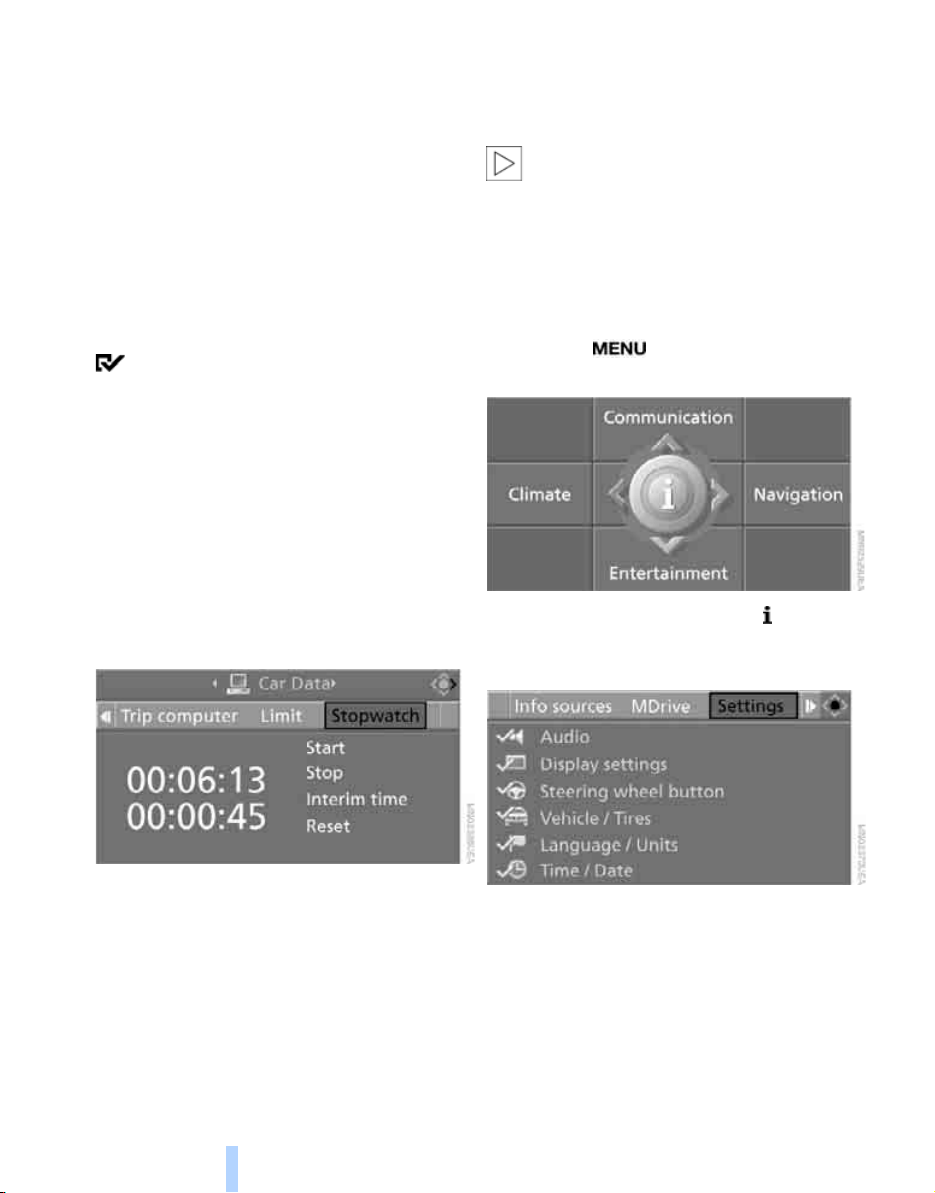
Everything under control
78
5. Select the speed value and press the con-
troller.
6. Turn the controller to set the limit.
7. Press the controller to apply the setting.
The limit is activated.
Applying your current speed as limit
Select "Select current speed" and press the
controller. The system adopts your current
speed as the limit.
Activating/deactivating limit
Select "On" and press the controller.
The limit is activated.
Stopwatch
iDrive, for operating principle refer to page 16.
1. Open the start menu.
2. Open "Navigation".
Without navigation system
*: Open "Car
Data".
3. Select "Car Data" and press the controller.
4. Select "Stopwatch" and press the control-
ler.
Starting, stopping, or resetting
> Select "Start" and press the controller.
The stopwatch starts at the displayed time.
> Select "Reset" and press the controller.
The stopwatch is reset and it restarts if it
was running beforehand.
> Select "Stop" and press the controller.
This stops the timer.
Taking an intermediate time reading
Select "Interim time" and press the controller.
The interim time appears below the ongoing
primary stopwatch count.
All of the other functions remain available
even while the stopwatch is running. The
stopwatch continues operation in the back-
ground.<
Settings on Control Display
iDrive, for operating principle refer to page 16.
1. Press the button once or twice until
the start menu appears.
2. Press the controller to open the menu.
3. Turn the controller until "Settings" is
selected and press the controller.
Online Edition for Part no. 01 41 2 600 775 - © 08/08 BMW AG
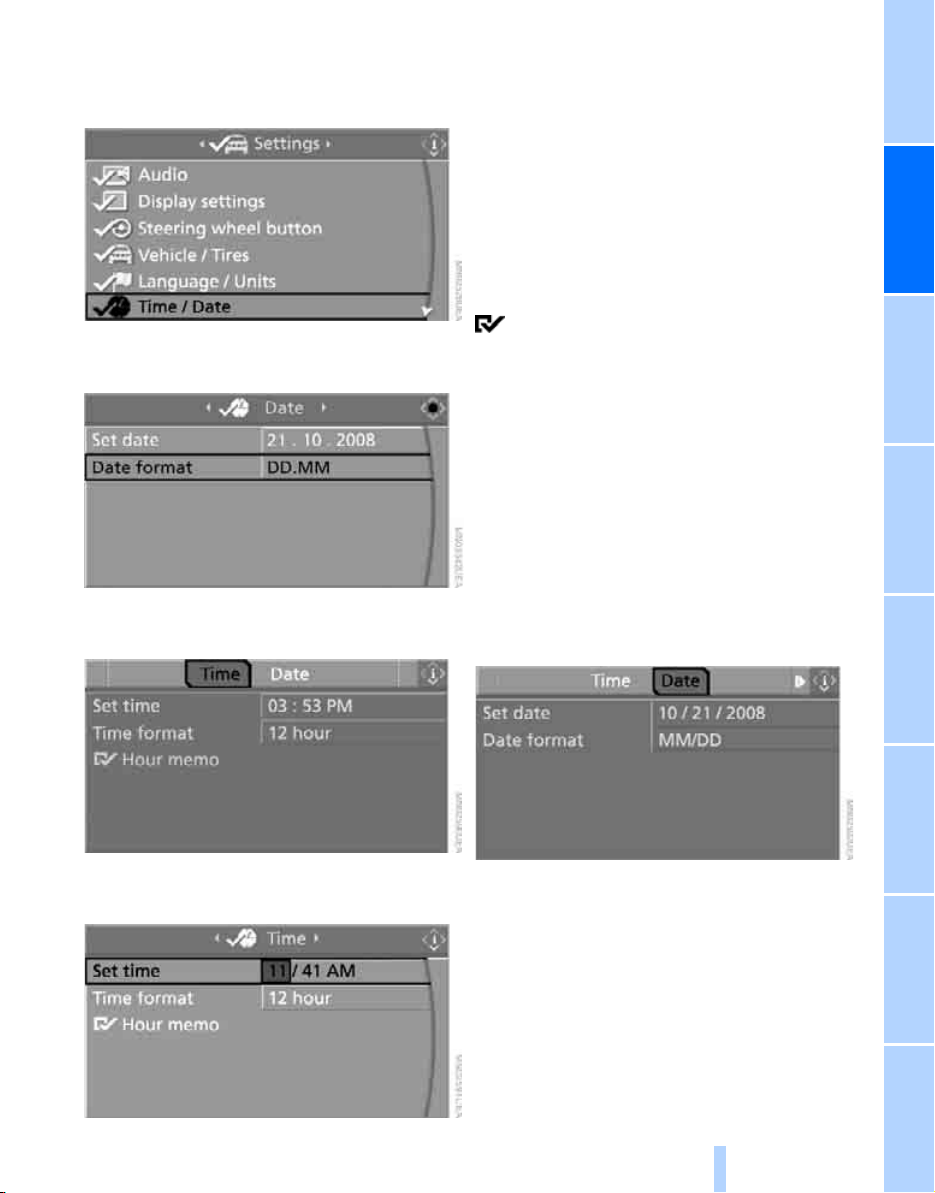
Controls
79
Reference At a glanceDriving tipsCommunications NavigationEntertainmentMobility
Setting time
1. Turn the controller until "Time / Date" is
selected and press the controller.
2. Move the controller forward once if neces-
sary to change to the first field from the top.
3. Turn the controller until "Time" is selected
and press the controller.
4. Turn the controller until "Set time" is
selected and press the controller.
Making settings
1. Turn the controller to set the hours and
press the controller.
2. Turn the controller to set the minutes and
press the controller.
The changed time is stored.
Switching on hour signal*
You will hear three tones just before the top of
each hour.
Select "Hour memo" and press the controller.
The hour signal is activated.
The setting is stored for the remote control cur-
rently in use.
Setting 12h/24h format
1. Select "Time format" and press the control-
ler.
2. Select the desired format and press the
controller.
The setting is stored for the remote control cur-
rently in use.
Setting date
1. Select "Date" and press the controller.
2. Select "Set date" and press the controller.
The first setting of the date display is
selected.
3. Turn the controller to make the adjustment.
4. Press the controller to apply the setting.
The next setting is selected.
5. Make the remaining adjustments. After the
last adjustment, the date is stored.
Online Edition for Part no. 01 41 2 600 775 - © 08/08 BMW AG
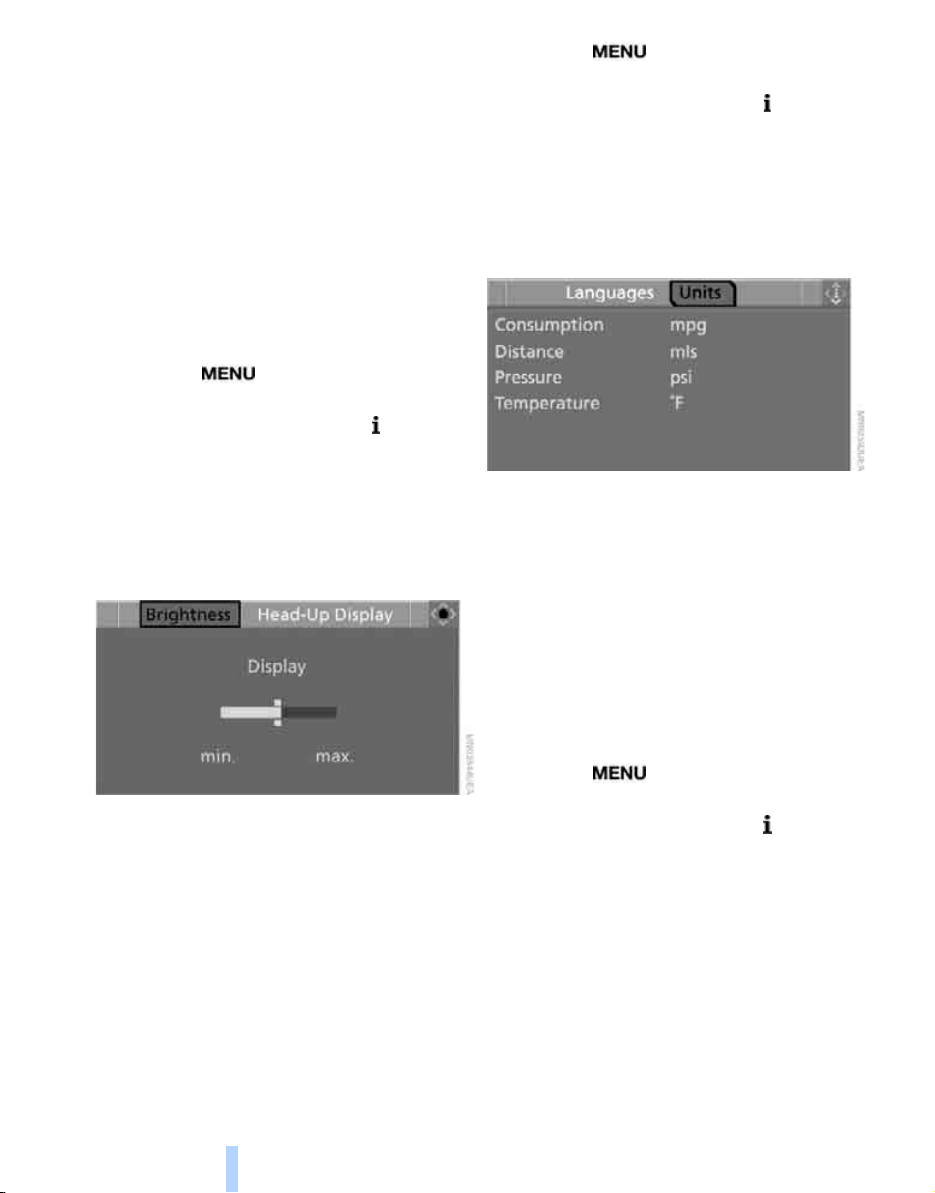
Everything under control
80
Setting date format
1. Select "Date format" and press the control-
ler.
2. Select the desired format and press the
controller.
The setting is stored for the remote control cur-
rently in use.
Brightness of Control Display
The brightness is automatically adapted to the
ambient lighting conditions. However, you can
change the basic setting.
iDrive, for operating principle refer to page 16.
1. Press the button.
This opens the start menu.
2. Press the controller to open the menu.
3. Select "Settings" and press the controller.
4. Select "Display settings" and press the
controller.
5. Change to upper field if necessary. Turn the
controller until "Brightness" is selected and
press the controller.
6. If necessary, move the controller to the right
to select "Display".
7. Turn the controller until the desired setting
is selected.
The setting is stored for the remote control cur-
rently in use.
Units of measure
You can change the units of measure for con-
sumption, distances, temperature and pres-
sure.
iDrive, for operating principle refer to page 16.
1. Press the button.
This opens the start menu.
2. Press the controller to open the menu.
3. Select "Settings" and press the controller.
4. Select "Language / Units" and press the
controller.
5. Change to upper field if necessary. Turn the
controller until "Units" is selected and press
the controller.
6. Select the menu item to be set.
7. Press the controller.
8. Select the desired unit of measure and
press the controller.
The settings are stored for the remote key cur-
rently in use.
Language on Control Display
You can change the language of the text dis-
plays.
iDrive, for operating principle refer to page 16.
1. Press the button.
This opens the start menu.
2. Press the controller to open the menu.
3. Select "Settings" and press the controller.
4. Select "Language / Units" and press the
controller.
Online Edition for Part no. 01 41 2 600 775 - © 08/08 BMW AG
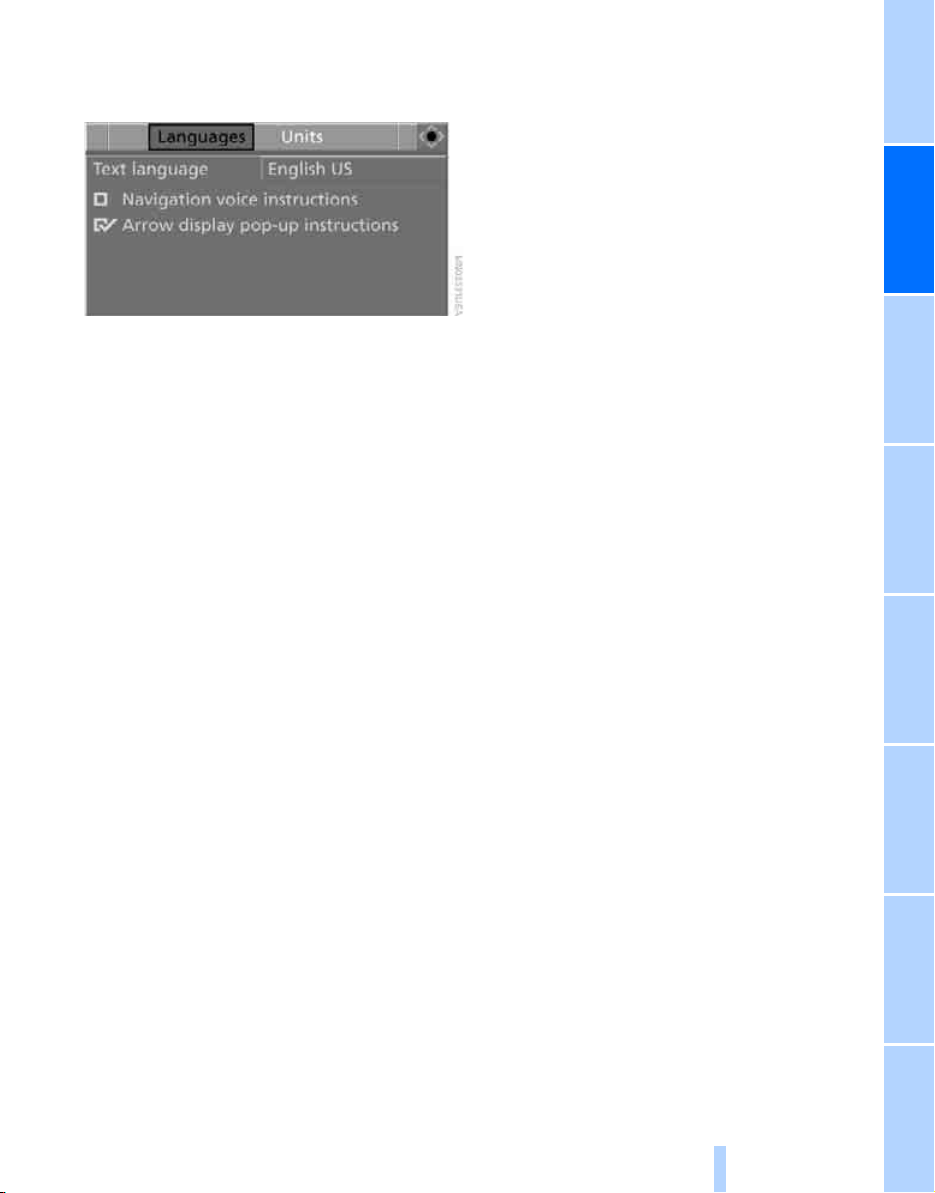
Controls
81
Reference At a glanceDriving tipsCommunications NavigationEntertainmentMobility
5. Change to upper field if necessary. Turn the
controller until "Languages" is selected and
press the controller.
6. Select "Text language" and press the con-
troller.
7. Select and activate the desired language by
pressing the controller.
The setting is stored for the remote control cur-
rently in use.
Online Edition for Part no. 01 41 2 600 775 - © 08/08 BMW AG
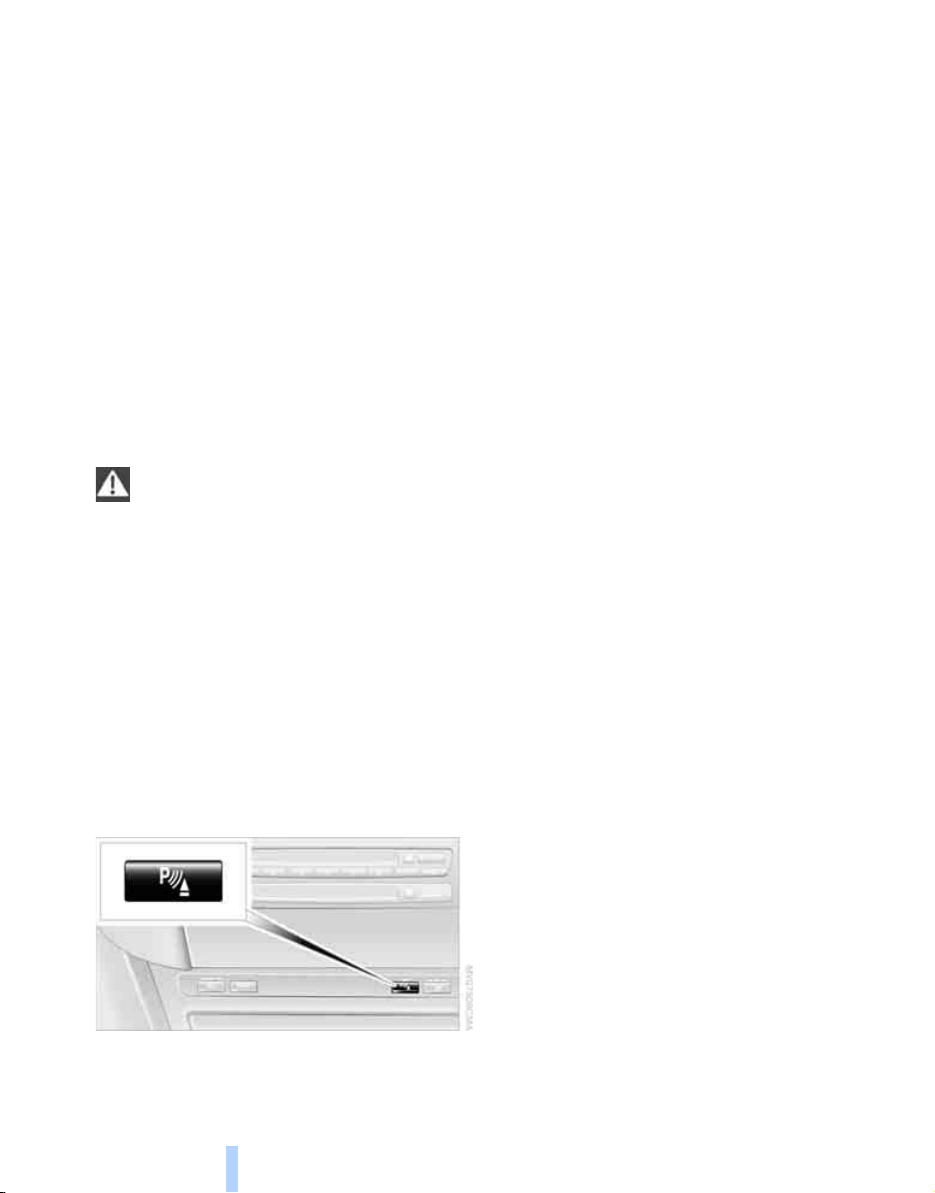
Technology for comfort, convenience and safety
82
Technology for comfort, convenience and
safety
PDC Park Distance Control*
The concept
The PDC assists you when you are parking.
Acoustic signals and an optical display
* alert
you to the approach of an object from behind
your vehicle. To measure the distance, there
are four ultrasonic sensors in each bumper.
The range of these sensors is approx. 7 ft/2 m.
However, an acoustic warning first sounds for
the sensors at the front and at the two rear cor-
ners at approx. 24 in/60 cm, and for the center
rear sensors at approx. 5 ft/1.50 m.
PDC is a parking aid that can indicate the
presence of objects when they are being
approached slowly, as is usually the case when
parking. Avoid approaching an object at high
speed, otherwise the physical circumstances
would mean that the system warning was too
late.<
Switching on automatically
The system starts to operate approx. one sec-
ond after you shift into reverse or move the
selector lever into position R with the engine
running or the ignition switched on.
Wait this short time before driving off.
Switching on manually
Press the button; the LED lights up.
Manual deactivation
Press the button again; the LED goes out.
Automatic deactivation
After driving approx. 165 ft/50 m or at over
approx. 20 mph/30 km/h, the system is
switched off and the LED goes out. You can
reactivate the system manually as needed.
Signal tones
When nearing an object, the position is corre-
spondingly indicated by an interval tone. Thus,
an object detected to the left rear of the vehicle
will be indicated by a signal tone from the left
rear speaker, etc. As the distance between
vehicle and object decreases, the intervals
between the tones become shorter. If the dis-
tance to the nearest object falls to below
roughly 1 ft/30 cm, then a continuous tone
sounds.
An intermittent tone is interrupted after approx.
3seconds:
> if you remain in front of an object that was
only detected by one of the corner sensors
> if you drive parallel to a wall
Malfunction
The LED in the button flashes and a message
appears on the Control Display. PDC is mal-
functioning. Have the system checked.
To prevent this problem, keep the sensors
clean and free of ice or snow in order to ensure
that they will continue to operate effectively. Do
not spray the sensors with high-pressure clean-
ing jets for long periods and maintain a distance
of at least 4 in/10 cm to them.
Exhaust gases near the rear sensors can cause
a signal tone to sound.
Online Edition for Part no. 01 41 2 600 775 - © 08/08 BMW AG
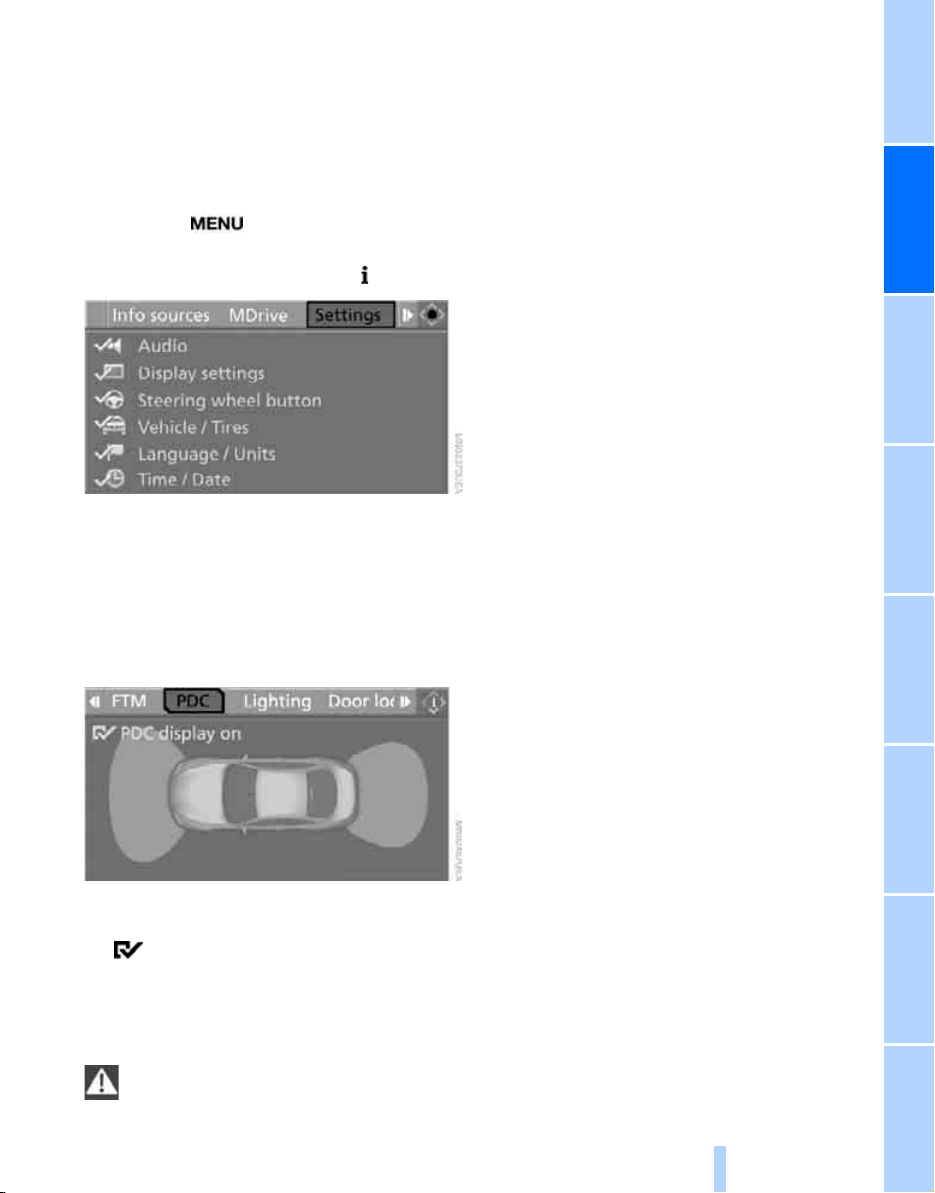
Controls
83
Reference At a glanceDriving tipsCommunications NavigationEntertainmentMobility
PDC with visual warning*
You can also have the system show distances
to objects on the Control Display. Objects that
are farther away are already shown there before
a signal tone sounds. The setting is stored for
the remote control currently in use.
iDrive, for operating principle refer to page 16.
1. Press the button.
This opens the start menu.
2. Press the controller to open the menu.
3. Turn the controller until "Settings" is
selected and press the controller.
4. Turn the controller until "Vehicle / Tires" is
selected and press the controller.
5. Change to upper field if necessary. Turn the
controller until "PDC" is selected and press
the controller.
6. Select "PDC display on" and press the con-
troller.
The PDC screen is activated.
The display appears on the Control Display as
soon as PDC is activated.
System limits
Even with PDC, final responsibility for
estimating the distance between the
vehicle and any obstacles always remains with
the driver. Even when sensors are provided,
there is a blind spot in which objects can no
longer be detected. The system is also subject
to the physical limits that apply to all forms of
ultrasonic measurement, such as those
encountered with tow bars and trailer cou-
plings, or thin and wedge-shaped objects etc.
Low objects already displayed, e.g. curbs, can
also disappear from the detection area of the
sensors again before or after a continuous tone
already sounds. Higher, protruding objects, e.g.
ledges, cannot be detected. For this reason,
drive with care; otherwise, there is a danger of
personal injury or property damage.
Loud sources of sound, inside and outside the
vehicle, could drown out the PDC signal tone.<
Driving stability control
systems
Your BMW is equipped with an extended array
of systems designed to enhance and maintain
vehicle stability under extreme conditions.
ABS Antilock Brake System
ABS prevents locking of the wheels during
braking. Safe steering response is maintained
even during full braking. Active safety is thus
increased.
The ABS is operational every time you start the
engine. For information on safe braking, refer to
page 119.
CBC Cornering Brake Control
When braking during curves or when braking
during a lane change, driving stability and steer-
ing response are improved further.
Electronic brake-force distribution
The system controls the brake pressure in the
rear wheels to ensure stable braking behavior.
Brake assistant
When you apply the brakes rapidly, this system
produces maximum braking force boosting and
Online Edition for Part no. 01 41 2 600 775 - © 08/08 BMW AG
Technology for comfort, convenience and safety
84
thus helps to achieve the shortest possible
braking distance during full braking maneuvers.
This system exploits all of the benefits provided
by ABS.
Do not reduce the pressure on the brake pedal
for the duration of the full braking.
DSC Dynamic Stability Control
DSC optimizes vehicle stability and traction. It
also detects unstable driving states such as
understeering and oversteering, and helps
keep the vehicle on course within the physical
limits by reducing the engine output and by
braking at the wheels.
The DSC is operational every time you start the
engine.
The laws of physics cannot be repealed,
even with DSC. An appropriate driving
style always remains the responsibility of the
driver. Therefore, do not reduce the additional
safety margin further by taking risks.<
Indicator lamp
The indicator lamp goes out shortly
after the engine is started.
The indicator lamp flashes: DSC con-
trols the drive forces and brake forces.
The indicator lamp stays lit: DSC is deactivated.
M Dynamic Mode MDM
The M Dynamic Mode is a mode of the DSC
Dynamic Stability Control. It enables driving
with greater longitudinal and lateral accelera-
tion on dry road surfaces, however with limited
vehicle stability. The system does not provide
stabilizing intervention by reducing the engine
output and braking at the wheels until the abso-
lute driving limit is reached. Steering correc-
tions by the driver may also be required in this
driving state.
The M Dynamic Mode is deactivated each time
the engine is started.
With the M Dynamic Mode activated, sta-
bilizing interventions are only carried out
to a reduced degree.<
To maintain vehicle stability, drive with
DSC activated and the M Dynamic Mode
deactivated whenever possible.<
Indicator lamp
The indicator lamp goes out shortly
after the engine is started. The indica-
tor lamp stays lit: M Dynamic Mode is
activated.
The indicator lamp lights up continuously and
the DSC indicator lamp flashes: the M Dynamic
Mode is active and controls the drive and brak-
ing forces.
Activating MDM
You activate the M Dynamic Mode with the
button on the steering wheel, refer to MDrive on
page 55.
With the ignition switched on you can change
the settings of MDrive on the Control Display.
iDrive, for operating principle refer to page 16.
1. Press the button.
This opens the start menu.
2. Press the controller to open the menu.
3. Select "MDrive" and press the controller.
4. Select "DSC" and press the controller.
Online Edition for Part no. 01 41 2 600 775 - © 08/08 BMW AG
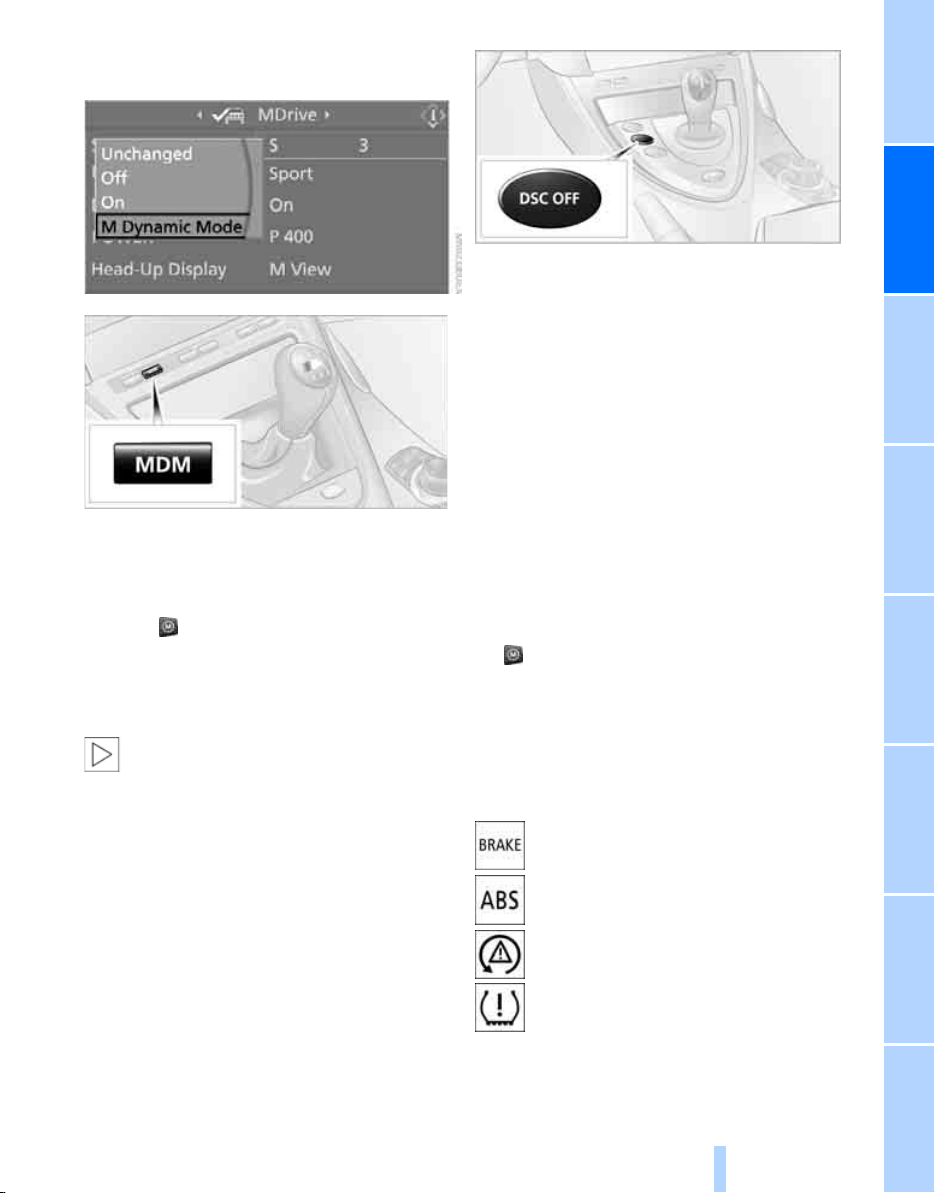
Controls
85
Reference At a glanceDriving tipsCommunications NavigationEntertainmentMobility
5. Select "M Dynamic Mode" and press the
controller.
You can also activate and deactivate the
M Dynamic Mode with the MDM button.
Deactivating MDM again
Press the button on the steering wheel or the
MDM button
* again; the MDM indicator lamp
goes out.
Deactivating DSC*
To maintain vehicle stability, drive with
the system activated whenever possi-
ble.<
When rocking free or starting off from deep
snow or on loose road surfaces, it can be useful
to briefly deactivate DSC.
Press the DSC OFF button; the DSC indicator
lamp lights up continuously. DSC and MDM are
deactivated.
A message appears on the Control Display.
Please note any supplementary information
that appears there.
Manual transmission
*:
Press and hold the MDM button.
Under unfavorable traction conditions, the
engine output may be briefly reduced even
when DSC is deactivated.
Reactivating DSC
Press the DSC OFF button; the indicator lamp
in the instrument cluster goes out.
You can also activate and deactivate DSC with
the button on the steering wheel, refer to
MDrive on page 55.
Manual transmission
*:
Press the MDM button.
Malfunction in driving-stability control
systems
The warning lamp for the brake system
lights up yellow, together with the indi-
cator lamps for ABS, DSC, and for the
Tire Pressure Monitor or Flat Tire Mon-
itor. A message appears on the Control
Display. The driving stability control
systems have failed. While you may
continue, you should remember to pro-
ceed cautiously and drive defensively
while avoiding full brake applications.
The Tire Pressure Monitor or the Flat Tire Mon-
itor is also malfunctioning. Have the system
checked as soon as possible.
Online Edition for Part no. 01 41 2 600 775 - © 08/08 BMW AG
Technology for comfort, convenience and safety
86
Display of the previously described
malfunction in Canadian models.
The DSC warning lamp lights up. A
malfunction has occurred in DSC
including MDM. The stability mainte-
nance functions are no longer available. The
vehicle remains operational. Have the system
checked as soon as possible.
The brake system warning lamp lights
up yellow. A message appears on the
Control Display. The brake assistant is
defective. Have the system checked as soon as
possible.
Display of the previously described
malfunction in Canadian models.
Starting off
On slopes
The starting assistant enables you to start off
conveniently on slopes. The handbrake is not
required for this purpose.
1. Hold the vehicle with the brake.
2. Release the brake and begin to drive imme-
diately.
After releasing the brake, begin to drive
immediately; otherwise, the starting
assistant no longer holds the vehicle after
approx. 2 seconds and your vehicle will start to
roll backward.<
Start off quickly on slopes. Do not hold
the vehicle on a hill by pressing the accel-
erator, but apply the footbrake or handbrake
instead. Otherwise overheating and heavy wear
can result in the area of the Sequential Manual
Transmission.<
To protect the clutch of the Sequential Manual
Transmission from overheating, the starting-off
behavior is changed under heavy loading, e.g. a
rapid succession of starts on slopes. This can
be noticed from shaking during starting off.
On a slippery surface
1. Select the "P 400" program of M Engine
Dynamic Control, refer to page 65.
2. Gently press accelerator pedal to prevent
wheels from spinning when starting off.
Clutch protection with manual
transmission
Be sure to avoid riding the clutch for longer peri-
ods.
Your BMW M6 is equipped with an overload
protection for the clutch. Riding the clutch for
longer periods is detected and the engine man-
agement system limits the engine speed to pro-
tect the clutch. This can result in the vehicle fail-
ing to accelerate when the clutch pedal is
partially depressed.
EDC Electronic Damping
Control
The concept
If the influencing variables such as road surface
quality or operating conditions such as steer-
ing, braking etc. change, the damping automat-
ically adjusts to the new conditions within a
fraction of a second.
You can choose from three programs.
"Comfort" program
Select the "Comfort" program if you want com-
fort-oriented coordination of shock absorbers
and steering.
"Normal" program
The "Normal" program offers control that is bal-
anced between comfort and sportiness.
Online Edition for Part no. 01 41 2 600 775 - © 08/08 BMW AG
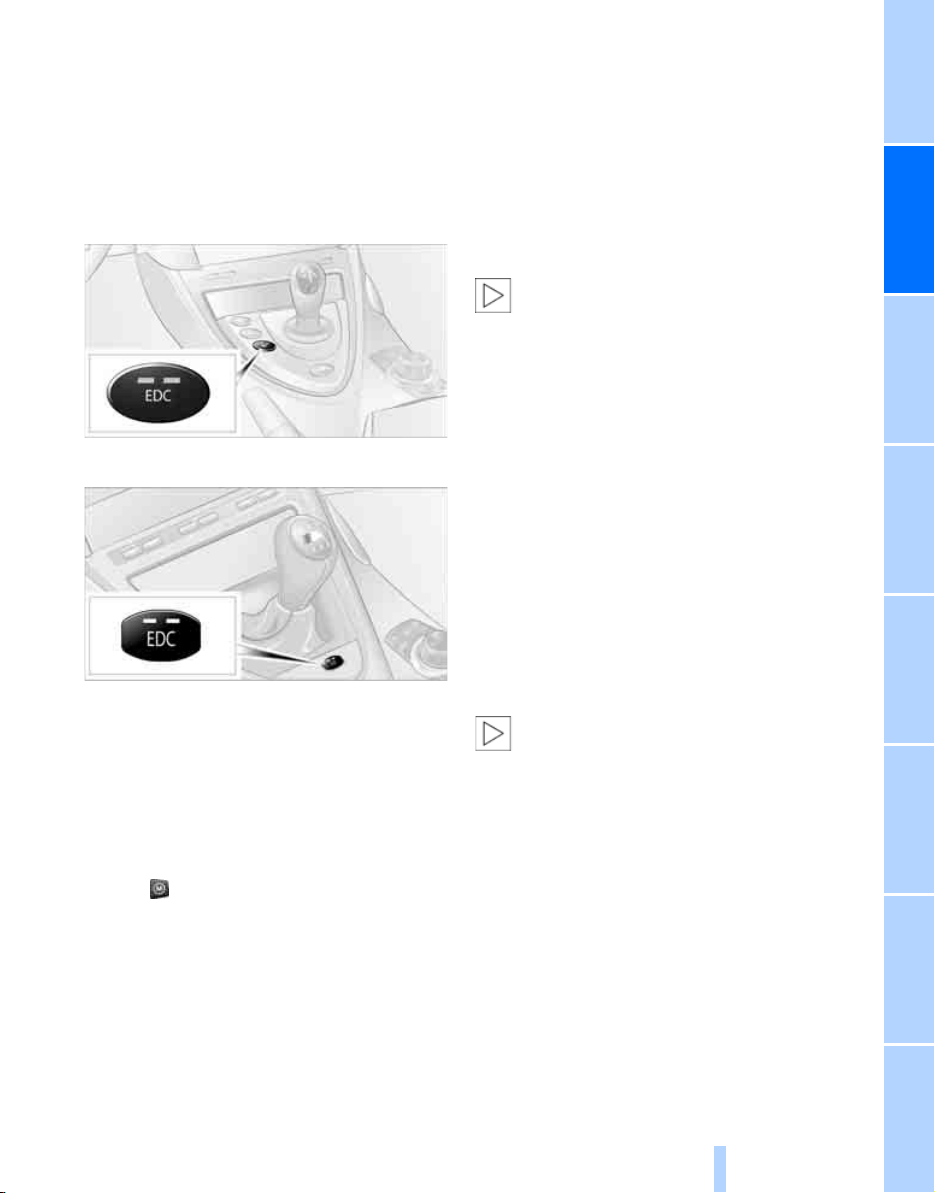
Controls
87
Reference At a glanceDriving tipsCommunications NavigationEntertainmentMobility
"Sport" program
Select the "Sport" program if you want a con-
sistently sporty coordination of shock absorb-
ers and steering.
Selecting program
Sequential Manual Transmission with Drive-
logic:
Manual transmission:
Press the EDC button repeatedly:
> "Comfort": LED off.
> "Normal": one LED lights up.
> "Sport": both LEDs light up.
The last selected program is active each time
the engine is started.
You can also activate your preferred program
with the button on the steering wheel, refer
to MDrive on page 55.
FTM Flat Tire Monitor*
The concept
The Flat Tire Monitor detects a pressure loss in
one tire by comparing the speeds of the individ-
ual wheels during driving.
In the event of a pressure loss, there is a change
in the rolling circumference and therefore the
rotation speed of the corresponding wheel. The
system detects this change and reports it as a
flat tire.
Functional requirement
To ensure the reliable signaling of a flat tire, the
system must be initialized at the correct tire
inflation pressure.
The initialization must be repeated after
every correction of the tire inflation pres-
sure and after every tire or wheel change.<
System limits
The Flat Tire Monitor cannot indicate sudden
severe tire damage caused by outside factors
and does not detect a natural, even pressure
drop in all four tires.
In the following situations, the system could be
delayed or malfunction:
> System has not been initialized
> Driving on snowy or slippery road surface
> Sporty driving style: slip in the drive wheels,
high lateral acceleration
> Driving with snow chains
*
Initializing system
The initialization finishes during driving,
which can be interrupted at any time.
When driving resumes, the initialization is con-
tinued automatically. The system is initialized
after this activation phase. The system is not
initialized when traveling with snow chains
*.<
With Sequential Manual Transmission via the
button in the center console:
1. Start the engine, but do not start driving.
2. Press the button for approx. 5 seconds.
After the button is released, the warning
lamp lights up in yellow for several seconds
in the instrument cluster, refer to Message
with low tire inflation pressure The mes-
Online Edition for Part no. 01 41 2 600 775 - © 08/08 BMW AG
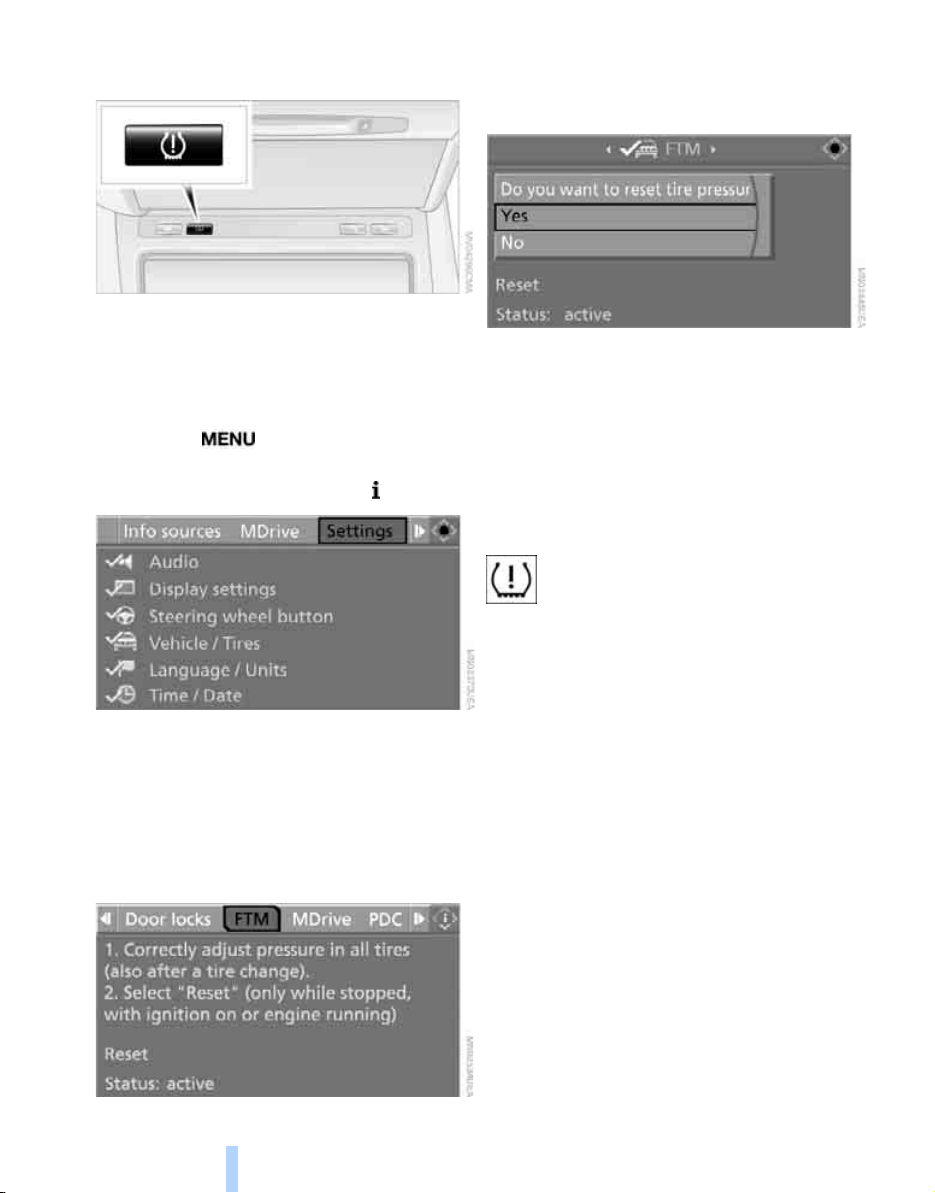
Technology for comfort, convenience and safety
88
sage "Initializing FTM ..." appears on the
Control Display for a few seconds.
3. Start to drive.
The initialization finishes during driving
without feedback.
Via iDrive, for operating principle refer to
page 16:
1. Press the button.
This opens the start menu.
2. Press the controller to open the menu.
3. Turn the controller until "Settings" is
selected and press the controller.
4. Select "Vehicle / Tires" and press the con-
troller.
5. Change to upper field if necessary. Turn the
controller until "FTM" is selected and press
the controller.
6. Start the engine, but do not start driving.
7. Select "Reset" and press the controller.
8. Select "Yes" and press the controller.
The message "resetting FTM …" is dis-
played for a few seconds. The warning lamp
in the instrument cluster lights up yellow for
a few seconds.
9. Start to drive.
The initialization finishes during driving
without feedback.
Indication of a flat tire
The warning lamp lights up red. A mes-
sage appears on the Control Display.
In addition, an acoustic signal sounds.
There is a flat tire or extensive inflation pressure
loss.
1. Reduce speed and stop the vehicle care-
fully. Avoid sudden braking and steering
maneuvers.
2. Identify damaged tire. To do this, check the
tire inflation pressure using the M Mobility
System, refer to Producing tire inflation
pressure on page 228.
3. Repair flat tire with M Mobility System, refer
to page 226, or replace the damaged wheel,
refer to Changing wheels on page 228.
TPM Tire Pressure Monitor*
The concept
TPM checks the tire inflation pressure in the
four mounted tires. The system reports when
the tire inflation pressure has dropped consid-
erably in one or several tires.
Online Edition for Part no. 01 41 2 600 775 - © 08/08 BMW AG
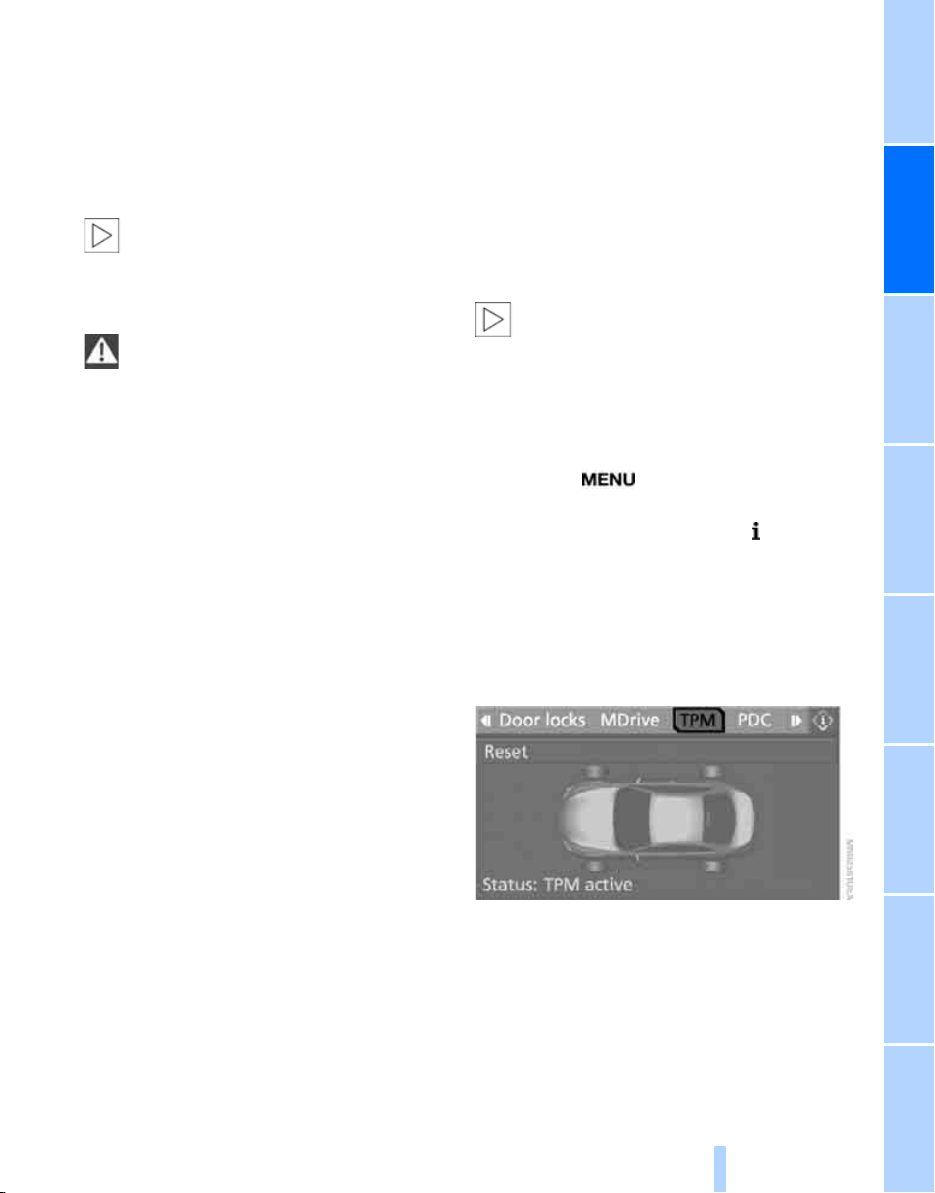
Controls
89
Reference At a glanceDriving tipsCommunications NavigationEntertainmentMobility
Functional requirement
In order to assure the reliable reporting of a flat
tire, the system must have been reset with the
correct tire inflation pressure.
Always use wheels with TPM electronics, oth-
erwise fault-free operation of the system is not
ensured.
Reset the system again after each correc-
tion of the tire inflation pressure and after
every tire or wheel change.<
System limits
TPM cannot announce sudden serious
tire damage caused by external influ-
ences.<
The system does not function properly if it has
not been reset, e.g. a flat tire is reported despite
correct tire inflation pressures.
The system is inactive and cannot display a flat
tire if a wheel has been mounted without TPM
electronics, or if TPM is temporarily interfered
with by other systems or devices which use the
same radio frequency.
Status display on Control Display
The tire and system status is indicated by the
color of the tires.
TPM takes the fact that the tire pressure
changes during driving into account. A correc-
tion is only required if requested by TPM with
the color.
Green
The tire pressure matches the learned set state.
"TPM active" appears on the Control Display.
One wheel is yellow
Flat tire or a major drop in inflation pressure in
the indicated tire. A message appears on the
Control Display.
All wheels are yellow
Flat tire or a major drop in inflation pressure in
several tires. A message appears on the Control
Display.
Gray
The system cannot detect a flat tire.
Reasons for this can be:
> TPM is being reset
> Temporary interference due to systems or
devices which use the same radio fre-
quency
> Malfunction
Resetting system
Reset the system again after each correc-
tion of the tire inflation pressure and after
every tire or wheel change.<
Resetting finishes during driving, which can be
interrupted at any time. When driving resumes,
resetting is continued automatically.
iDrive, for operating principle refer to page 16.
1. Press the button.
This opens the start menu.
2. Press the controller to open the menu.
3. Select "Settings" and press the controller.
4. Select "Vehicle / Tires" and press the con-
troller.
5. Change to upper field if necessary. Turn the
controller until "TPM" is selected and press
the controller.
6. Start the engine, but do not start driving.
7. Select "Reset" and press the controller.
Online Edition for Part no. 01 41 2 600 775 - © 08/08 BMW AG
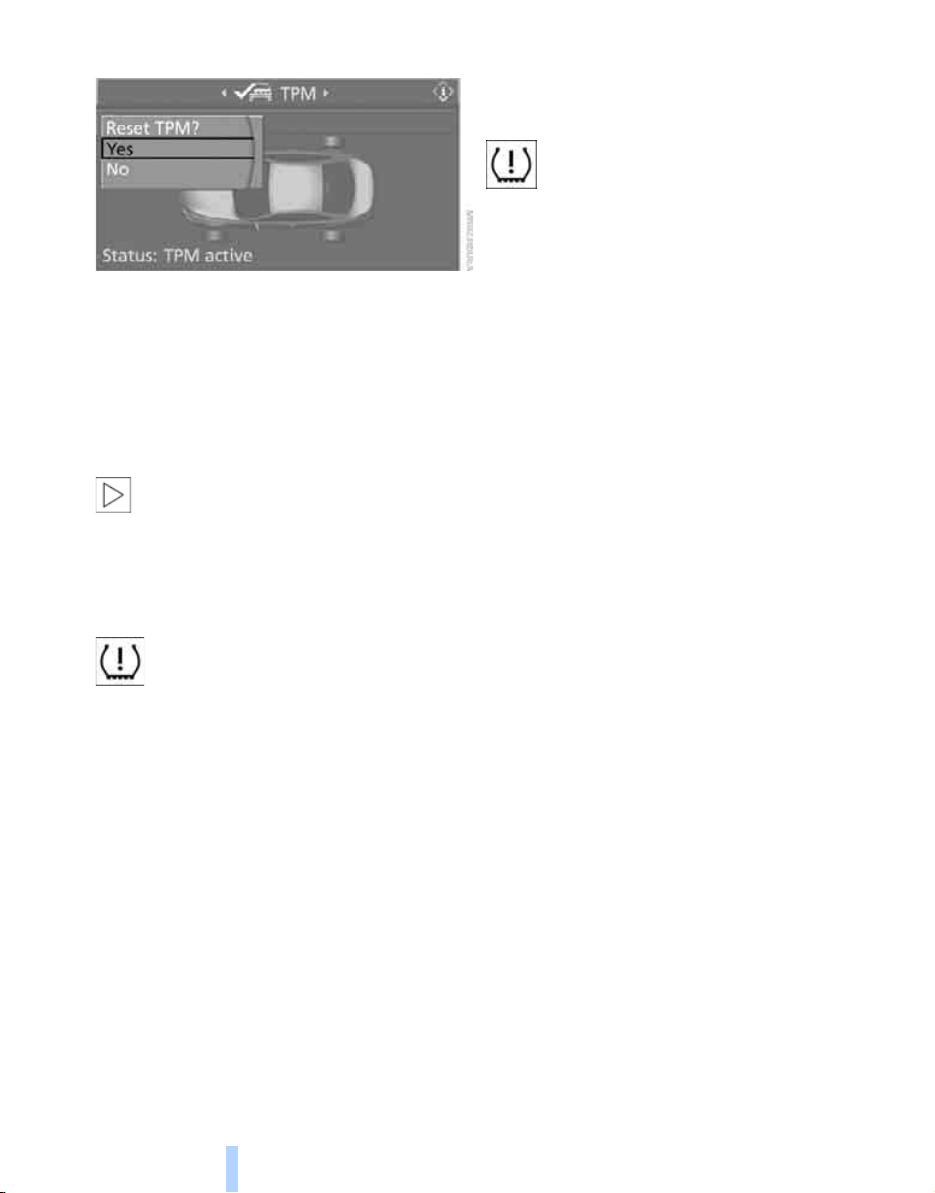
Technology for comfort, convenience and safety
90
8. Select "Yes" and press the controller.
9. Start to drive.
The tires are shown in gray and "Resetting
TPM..." is displayed.
After a few minutes of driving, the set tire infla-
tion pressures in the tires are applied as the set
values to be monitored. Resetting finishes dur-
ing driving. The tires are shown in green on the
Control Display.
If a flat tire is detected during resetting
and applying the tire inflation pressures,
all tires are shown in yellow on the Control Dis-
play. The message "Tire low!" is displayed.<
Message with low tire inflation
pressure
The warning lamp lights up yellow. A
message appears on the Control Dis-
play. In addition, an acoustic signal
sounds. There is a flat tire or extensive inflation
pressure loss.
1. Reduce speed and stop the vehicle care-
fully. Avoid sudden braking and steering
maneuvers.
2. If all four wheels are shown in yellow, iden-
tify the damaged tire on the vehicle.
3. Repairing flat tire with M Mobility System,
refer to page 226, or replace the damaged
wheel or wheels, refer to Changing wheels*
on page 228.
The spare tire
* is equipped with the necessary
TPM electronics and is also monitored after
mounting and after resetting the system.
Have the tire replaced by a BMW center or a
workshop informed on handling TPM which
works according to BMW repair procedures
with correspondingly trained personnel.
Malfunction
The yellow warning lamp flashes and
then lights up continuously. The tires
are shown in gray on the Control Dis-
play and a message is displayed. No flat tire can
be detected.
A message like this is displayed in the following
situations:
> In case of a malfunction;
have the system checked.
> If a wheel is mounted without TPM elec-
tronics.
> If TPM is temporarily interfered with by
other systems or devices which use the
same radio frequency.
Declaration according to NHTSA/
FMVSS 138 Tire Pressure Monitoring
Systems
Each tire, including the spare*, should be
checked monthly when cold and inflated to the
inflation pressure recommended by the vehicle
manufacturer on the vehicle placard or tire infla-
tion pressure label. If your vehicle has tires of a
different size than the size indicated on the
vehicle placard or tire inflation pressure label,
you should determine the proper tire inflation
pressure for those tires. As an added safety fea-
ture, your vehicle has been equipped with a tire
pressure monitoring system, TPMS, that illumi-
nates a low tire pressure telltale when one or
more of your tires are significantly underin-
flated. Accordingly, when the low tire pressure
telltale illuminates, you should stop and check
your tires as soon as possible, and inflate them
to the proper pressure. Driving on a significantly
underinflated tire causes the tire to overheat
and can lead to tire failure. Underinflation also
reduces fuel efficiency and tire tread life, and
may affect the vehicle's handling and stopping
ability. Please note that the TPMS is not a sub-
stitute for proper tire maintenance, and it is the
driver's responsibility to maintain correct tire
pressure, even if underinflation has not reached
Online Edition for Part no. 01 41 2 600 775 - © 08/08 BMW AG
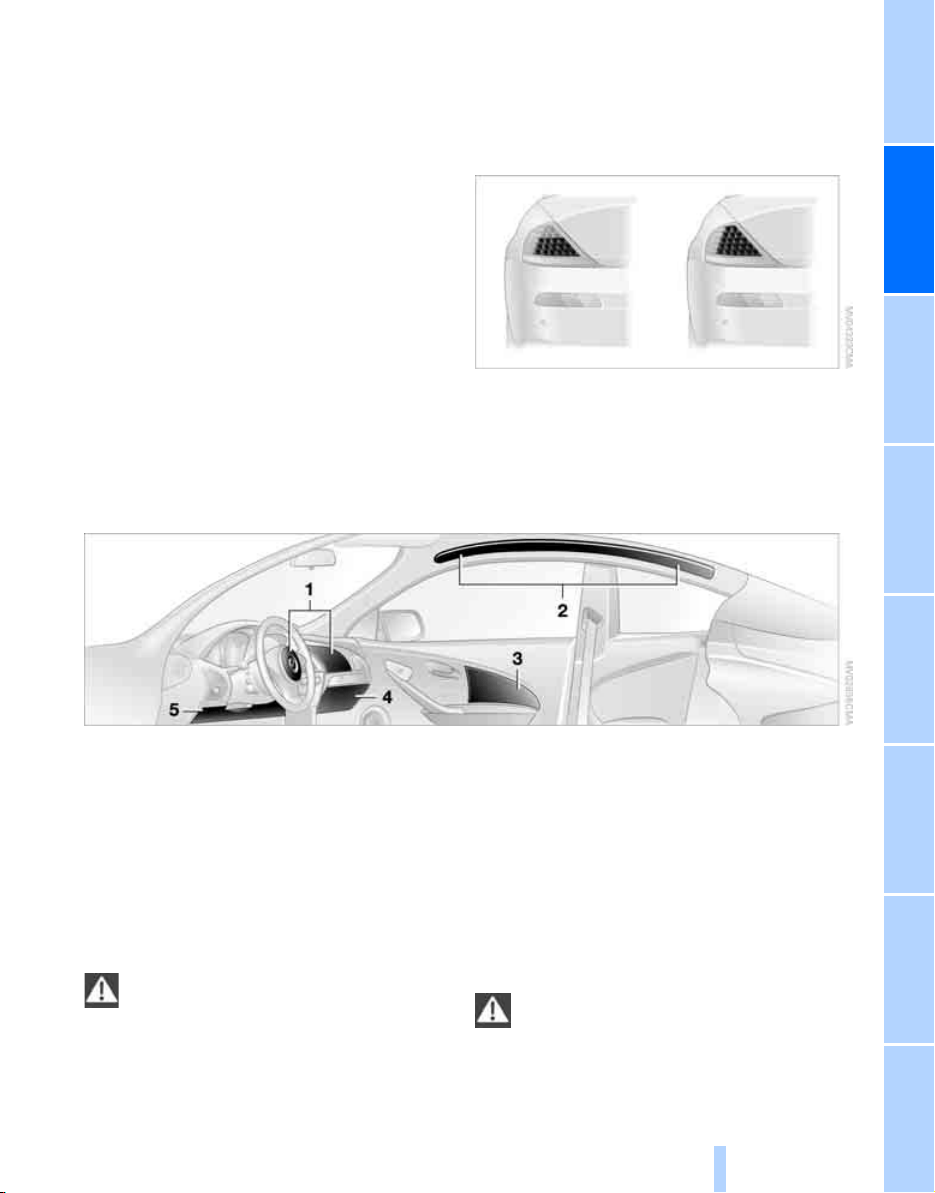
Controls
91
Reference At a glanceDriving tipsCommunications NavigationEntertainmentMobility
the level to trigger illumination of the TPMS low
tire pressure telltale.
The TPMS malfunction indicator is combined
with the low tire pressure telltale. When the sys-
tem detects a malfunction, the telltale will flash
for approximately one minute and then remain
continuously illuminated. This sequence will
continue upon subsequent vehicle startups as
long as the malfunction exists. When the mal-
function indicator lights up, the system may not
be able to detect or signal low tire pressure as
intended. TPMS malfunctions may occur for a
variety of reasons, including the installation of
replacement or alternate tires or wheels on the
vehicle that prevent the TPMS from functioning
properly. Always check the TPMS malfunction
telltale after replacing one or more tires or
wheels on your vehicle to ensure that the
replacement or alternate tires and wheels allow
the TPMS to continue to function properly.
Brake force display
> On the left: normal braking.
> On the right: heavy braking.
Airbags
The following airbags are located under the
marked covers:
1 Front airbags
2 Coupe: Head airbags
3 Side airbags
4 Knee airbag
5 Knee airbag
Protective action
To ensure that the safety systems con-
tinue to provide optimized protection,
please observe the adjustment instructions on
page 47.<
The front airbags help protect the driver and
front passenger by responding to frontal
impacts in which safety belts alone cannot pro-
vide adequate restraint. When needed, the
head and side airbags help provide protection in
the event of side impact. The relevant side air-
bag supports the side upper body area. The
head air bag supports the head. The knee air-
bag protects the legs from colliding with the
cockpit.
The airbags are deliberately not triggered in
every impact situation, e.g. less severe acci-
dents or rear-end collisions.
Do not apply adhesive materials to the
cover panels of the airbags, cover them or
modify them in any other way. Do not attempt to
remove the airbag restraint system from the
vehicle. Do not modify or tamper with either the
wiring or the individual components in the air-
Online Edition for Part no. 01 41 2 600 775 - © 08/08 BMW AG
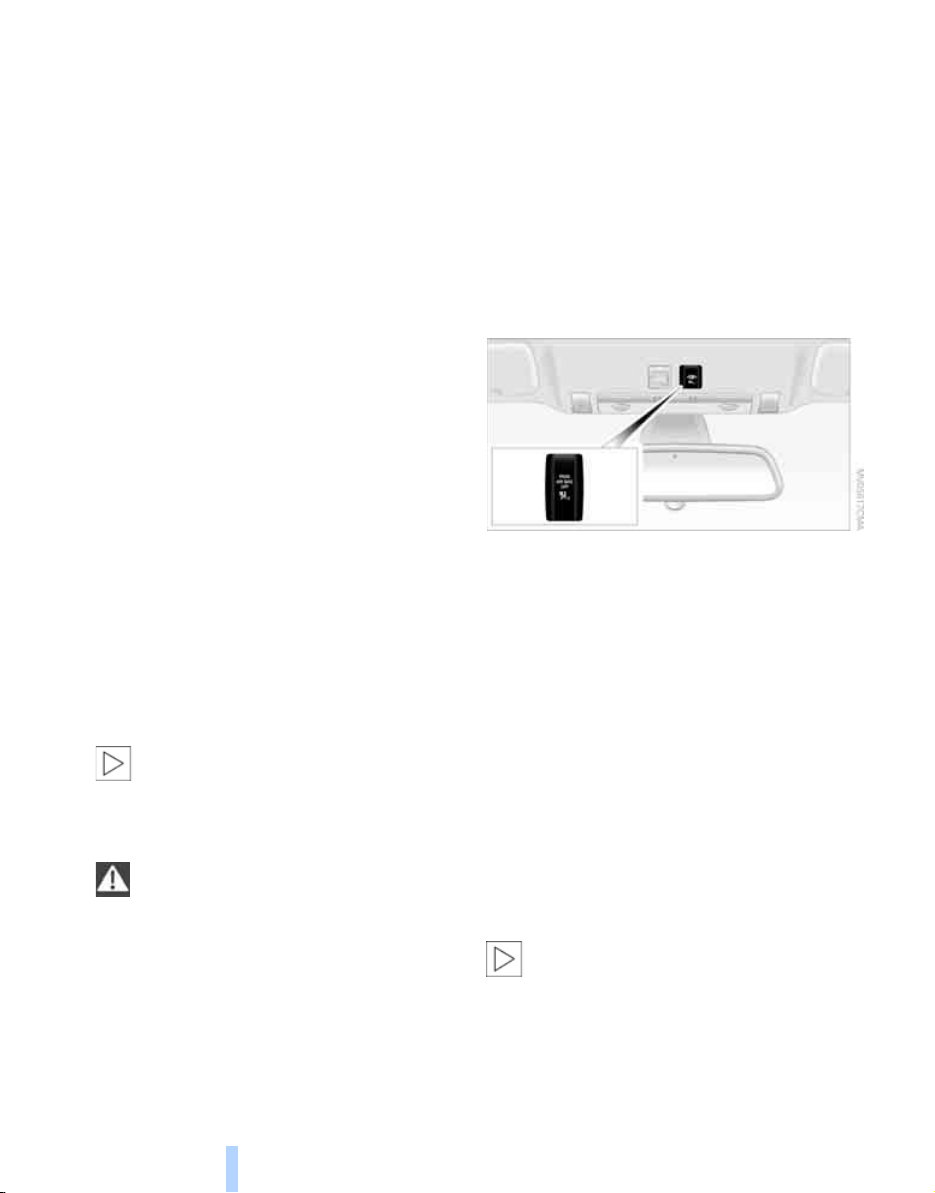
Technology for comfort, convenience and safety
92
bag system. This category includes the uphol-
stery in the center of the steering wheel, on the
instrument panel, the side trim panels on the
doors and on the Coupe, the roof pillars along
with the sides of the headliner. Do not attempt
to remove or dismantle the steering wheel.
Do not touch the individual components
directly after the system has been triggered,
because there is a danger of burns.
In the event of malfunctions, deactivation, or
triggering of the airbag restraint system, have
the testing, repair, removal, and disposal of air-
bag generators executed only by a BMW center
or a workshop that works according to BMW
repair procedures with correspondingly trained
personnel and has the required explosives
licenses. Otherwise unprofessional attempts to
service the system could lead to failure in an
emergency or undesired airbag triggering,
either of which could result in personal injury.<
Warnings and information on the airbags is also
provided on the sun visors.
Automatic deactivation of front
passenger airbags
The occupation of the seat is detected by eval-
uating the impression on the occupied seat sur-
face of the front passenger seat. The system
correspondingly activates or deactivates the
front, knee and side airbags on the front pas-
senger side.
The current status of the front passenger
airbag, i.e. deactivated or activated, is
indicated by the indicator lamp over the interior
rearview mirror, refer to Operating state of front
passenger airbags in the following.<
Before transporting a child in the front
passenger seat, read the safety informa-
tion and follow the instructions under Trans-
porting children safely, refer to page 58.
The front, knee and side airbags on the front
passenger side can be deactivated for teenag-
ers and adults in certain sitting positions; the
indicator lamp for the front passenger airbags
lights up when this occurs. In these cases,
change the sitting position so that the front pas-
senger airbags are activated and the indicator
lamp goes out. If the desired status cannot be
produced by changing the sitting position,
transport the corresponding person in the rear
seat.
Do not fit seat covers, seat cushion padding,
ball mats or other items onto the front passen-
ger seat unless they are specifically recom-
mended by BMW. Do not lay objects under the
seat which could press against the seat from
below. Otherwise a correct evaluation of the
occupied seat surface cannot be ensured.<
Operating state of front passenger
airbags
The illustration here shows a possible arrange-
ment in the Coupe. With some vehicle equip-
ment packages or in the Convertible, the
arrangement of the switches and indicator
lamps may differ somewhat.
The indicator lamp for the front passenger air-
bags indicates the operating status of the front,
knee and side airbags on the front passenger
side depending on whether the seat is occu-
pied. The indicator lamp shows whether the
front passenger airbags are activated or deacti-
vated.
> The indicator lamp lights up when a child in
a child restraint system intended for the
purpose is properly detected on the seat.
The front, knee and side airbags on the front
passenger side are deactivated.
Most child's seats are detected by the
system. Especially the child's seats
required by the NHTSA at the time the vehicle is
manufactured. After installing a child's seat,
make sure that the indicator lamp for the front
passenger airbags lights up. This indicates that
the child's seat has been detected and the front
passenger airbags are not activated.<
Online Edition for Part no. 01 41 2 600 775 - © 08/08 BMW AG
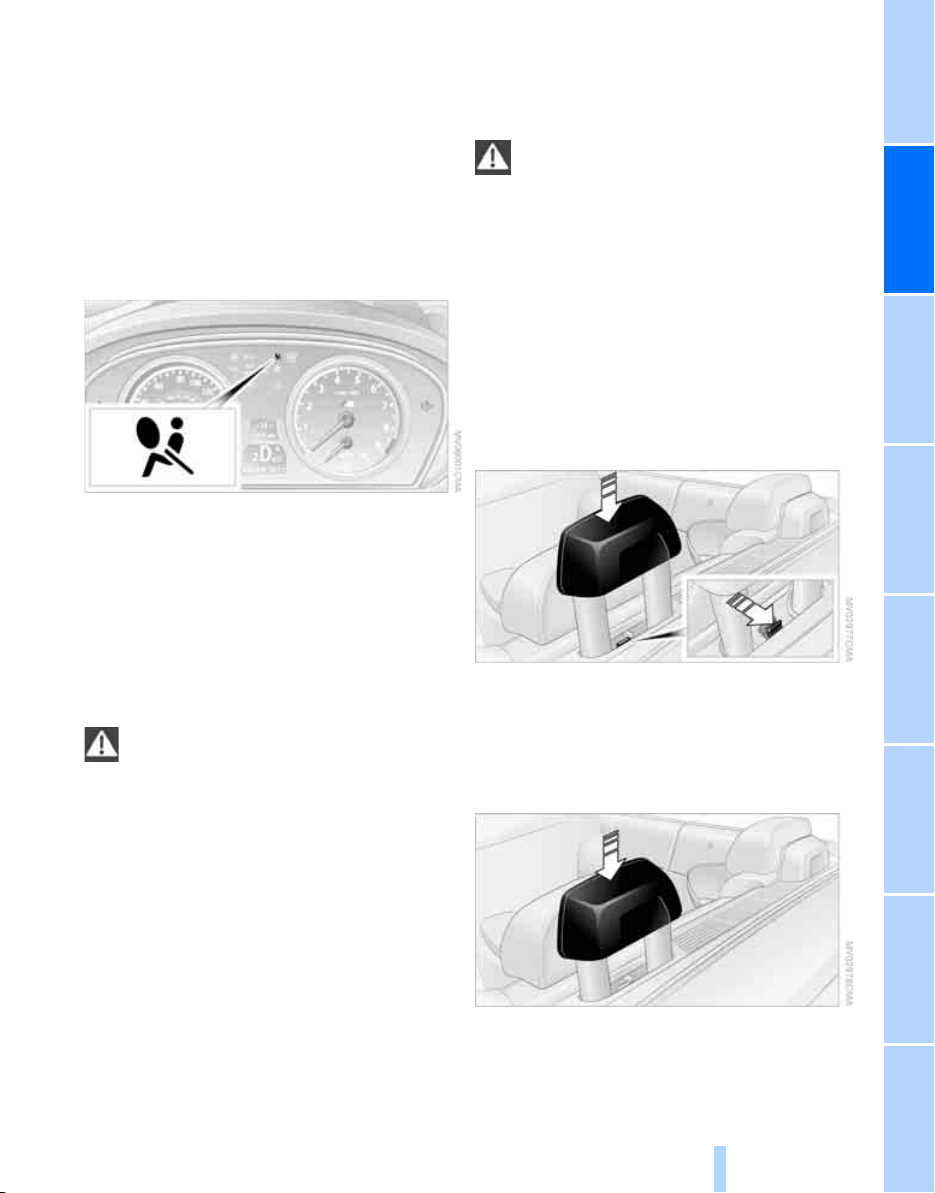
Controls
93
Reference At a glanceDriving tipsCommunications NavigationEntertainmentMobility
> The indicator lamp does not light up if, for
example, the system detects a person of
sufficient size seated correctly on the seat.
The front, knee and side airbags on the front
passenger side are activated.
> The indicator lamp does not light up when
the seat is empty.
But the front, knee and side airbags on the
front passenger side are still deactivated.
Operational readiness of airbag system
From radio readiness, refer to page 60, the
warning lamp lights up briefly, indicating the
operational readiness of the entire airbag sys-
tem and the safety belt tensioners.
Airbag system malfunction
> Warning lamp does not light up from radio
readiness.
> Warning lamp lights up continuously.
Have the airbag system checked immedi-
ately in case of a malfunction, otherwise
there is a danger that the airbag system may not
respond in the expected manner in an accident
despite an impact of corresponding intensity.<
Convertible: rollover
protection system
The rollover protection system is automatically
activated in the event of an accident or a critical
driving situation, extreme inclination on the lon-
gitudinal axis, or loss of ground contact. The
rollover bars located behind the rear head
restraints are deployed within fractions of a sec-
ond.
As a supplement to the rollover bar integrated
into the windshield frame, the rollover protec-
tion system ensures that all vehicle occupants
have the necessary headroom.
Always keep the path of movement of the
rollover protection system clear.
In minor accidents, you are protected by the
fastened safety belt and, depending on acci-
dent severity, by the safety belt tensioner and
multi-phase airbag retention system.<
Lowering
If the rollover protection system experienced no
impact after automatic activation, then it can be
lowered again. No tools are necessary for this
purpose.
1. Press the release backward and hold in that
position.
2. Press the rollover protection unit halfway
down from above.
3. Let go of the release.
4. Press the rollover protection unit down until
it snaps into place.
5. Use the same procedure for the second roll-
over protection unit.
Have the rollover protection system checked
after unexpected triggering.
Online Edition for Part no. 01 41 2 600 775 - © 08/08 BMW AG
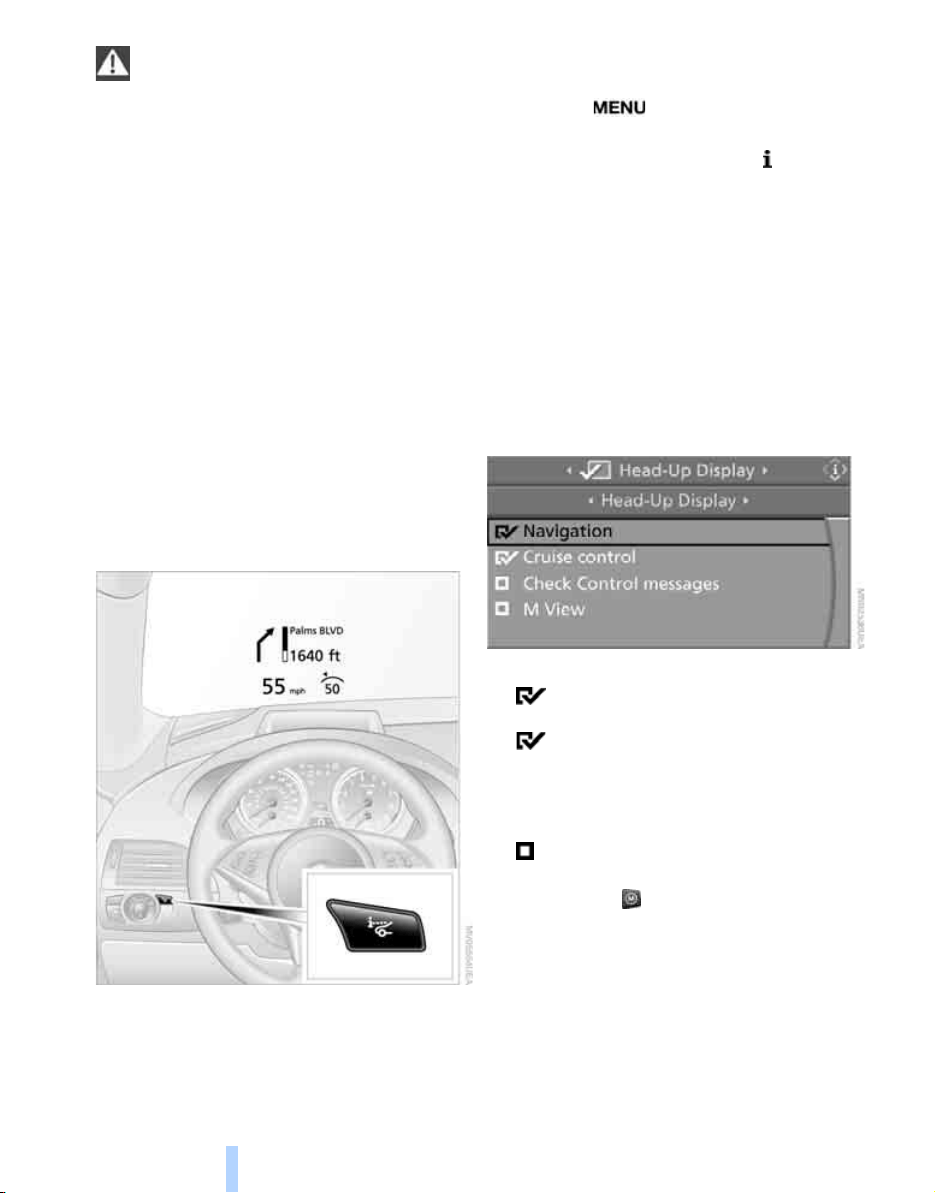
Technology for comfort, convenience and safety
94
Never move the convertible top when the
rollover protection system is raised.
No changes of any nature may be made to the
individual components of the rollover protec-
tion system and wiring.
Work on the rollover protection system may
only be performed at a BMW center.
Unprofessional attempts to service the system
can lead to failure or malfunction.
For a system check and to ensure long-term
functioning, you must comply with the mainte-
nance intervals of the service requirements,
refer to page 73.<
Head-Up Display*
The concept
With the Head-Up Display important informa-
tion is projected into the driver's field of view,
e.g. navigation instructions. This enables you to
take in this information without looking away
from the road.
Switching on/off
Press the button.
Selecting displays
iDrive, for operating principle refer to page 16.
1. Press the button.
This opens the start menu.
2. Press the controller to open the menu.
3. Select "Settings" and press the controller.
4. Select "Display settings" and press the
controller.
5. Change to upper field if necessary. Turn the
controller until "Head-Up Display" is
selected and press the controller.
6. Change into the second field from the top.
Turn the controller until "Head-Up Display"
is selected and press the controller.
7. Select desired information of Head-Up Dis-
play.
8. Press the controller.
The information appears in the Head-
Up Display.
"M View": the M view appears in the
Head-Up Display.
Information unavailable in the M view
appears on the Control Display in gray and
cannot be selected.
"M View": the default view is displayed.
The M view for the Head-Up Display can also be
selected with the button on the steering
wheel, refer to MDrive on page 55.
The settings are stored for the remote control
currently in use.
Online Edition for Part no. 01 41 2 600 775 - © 08/08 BMW AG
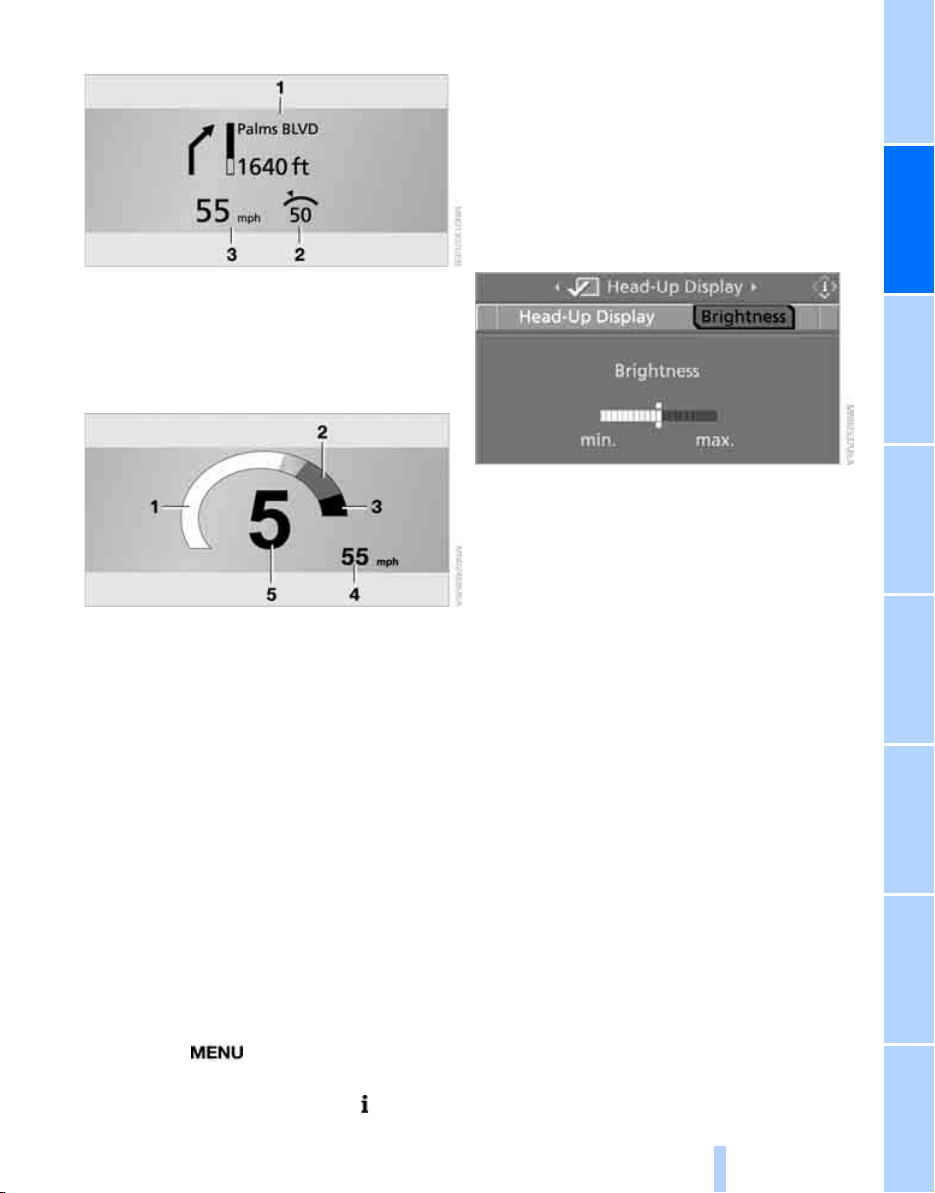
Controls
95
Reference At a glanceDriving tipsCommunications NavigationEntertainmentMobility
Default view
1 Navigation instructions
2 Stored desired speed of cruise control
3 Speed
M view
1 Current engine speed, highlighted
2 Advance warning field of tachometer
3 Red warning field of tachometer, also refer
to Tachometer on page 70
4 Speed
5 Gear display
For information on the shift lights in the
tachometer, refer to page 65.
Setting brightness
The brightness of the display is adapted to the
ambient lighting conditions. However, you can
change the base setting.
With the low beams switched on, the brightness
can also be adjusted with the knurled wheel of
the instrument lighting.
iDrive, for operating principle refer to page 16.
1. Press the button.
This opens the start menu.
2. Press the controller to open the menu.
3. Select "Settings" and press the controller.
4. Select "Display settings" and press the
controller.
5. Change to upper field if necessary. Turn the
controller until "Head-Up Display" is
selected and press the controller.
6. Change into the second field from the top.
Turn the controller until "Brightness" is
selected and press the controller.
7. Turn the controller until the desired setting
is selected.
The setting is stored for the remote control cur-
rently in use.
Notes
The visibility of the displays in the Head-Up Dis-
play is influenced by:
> Sunglasses with certain polarization filters
> Certain seating positions
> Objects on the cover of the Head-Up Dis-
play
> Wet road surface and unfavorable lighting
conditions
If the image is distorted, please have the base
setting checked at a BMW center.
Special windshield
The windshield is part of the system. The shape
of the windshield complies with the require-
ments of the Head-Up Display to enable a pre-
cise display. A film in the windshield prevents
double images from being displayed.
Windshield replacement should be carried out
by a BMW center or a workshop that works
according to BMW repair procedures with cor-
respondingly trained personnel.
Online Edition for Part no. 01 41 2 600 775 - © 08/08 BMW AG
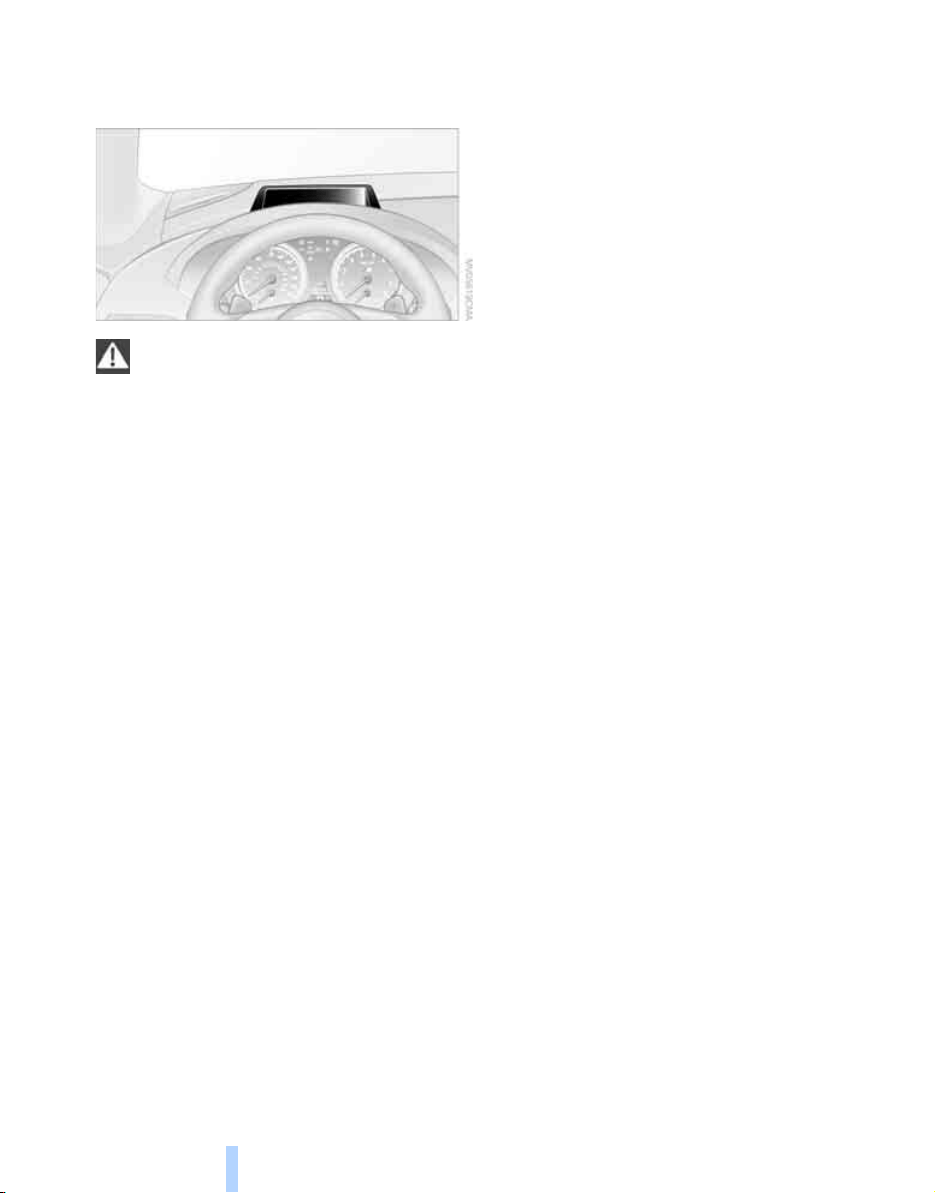
Technology for comfort, convenience and safety
96
Care instructions
You can find valuable information on this topic
under Care, starting on page 220.
Only clean the cover of the Head-Up Dis-
play with a soft, nonabrasive cloth or with
a display cleaning cloth; otherwise, you may
damage it.<
Online Edition for Part no. 01 41 2 600 775 - © 08/08 BMW AG
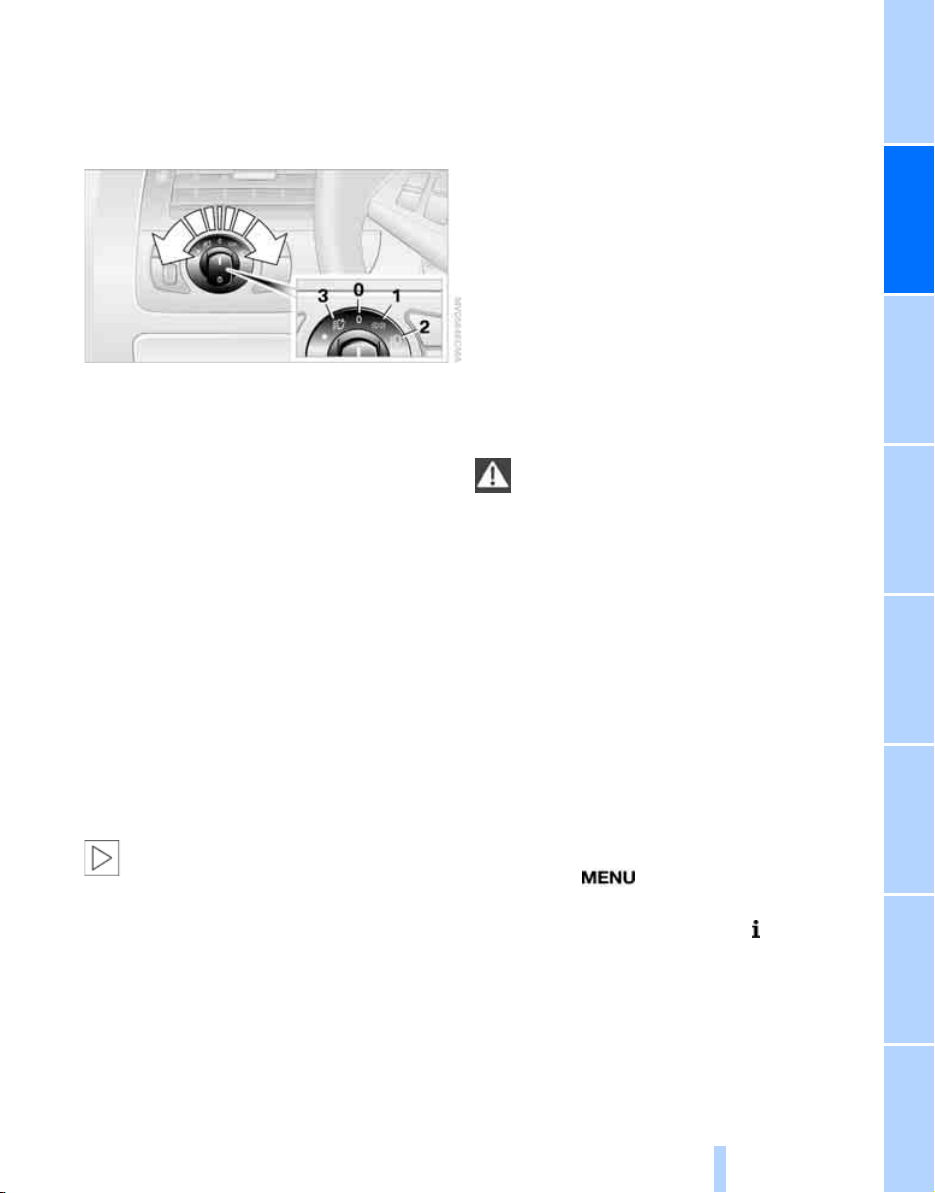
Controls
97
Reference At a glanceDriving tipsCommunications NavigationEntertainmentMobility
Lamps
Parking lamps/low beams
0 Lights off and daytime running lamps*
1 Parking lamps and daytime running lamps*
2 Low beams and welcome lamps
3 Automatic headlamp control, daytime run-
ning lamps
*, welcome lamps, Adaptive
Head Light
* and high-beam assistant*
If you open the driver's door with the ignition
switched off, the exterior lighting is switched off
when the light switch is in position 2 or 3. The
daytime running lamps have already been
switched off at the same time as the ignition.
For this reason, switch on the side marker
lamps as needed, switch position 1; otherwise,
the vehicle is not lit.
Parking lamps
In switch position 1, the front, rear and side
vehicle lighting is switched on. You can use the
parking lamps for parking.
The parking lamps drain the battery. Do
not leave them switched on for long peri-
ods of time, otherwise it may no longer be pos-
sible to start the engine. It is preferable to
switch on the roadside parking lamps on one
side, refer to page 99.<
Low beams
The low beams light up when the light switch is
in position 2 and the ignition is on.
Automatic headlamp control
In switch position 3, the system activates the
low beams and switches them on or off in
response to changes in ambient light condi-
tions, for instance, in a tunnel, at dawn and dusk
and in case of precipitation. Adaptive Head
Light
* is active. The LED next to the symbol
lights up when the low beams are on.
You can also activate the daytime running
lamps, refer to page 98. In the situations
described above, the lamps then switch to low
beams.
A blue sky with the sun low on the horizon can
cause the lights to be switched on.
The automatic headlamp control cannot
serve as a substitute for your personal
judgment in determining when the lamps
should be switched on in response to ambient
lighting conditions. For example, the sensors
cannot detect fog of hazy weather. To avoid
safety risks, you should always switch on the
low beams manually under these conditions.<
Welcome lamps
If you leave the light switch in position 2 or 3
when parking the vehicle, then when you unlock
the vehicle, the parking lamps and interior light-
ing remain illuminated for a brief time.
Activating/deactivating welcome
lamps
iDrive, for operating principle refer to page 16.
1. Press the button.
This opens the start menu.
2. Press the controller to open the menu.
3. Select "Settings" and press the controller.
4. Select "Vehicle / Tires" and press the con-
troller.
Online Edition for Part no. 01 41 2 600 775 - © 08/08 BMW AG
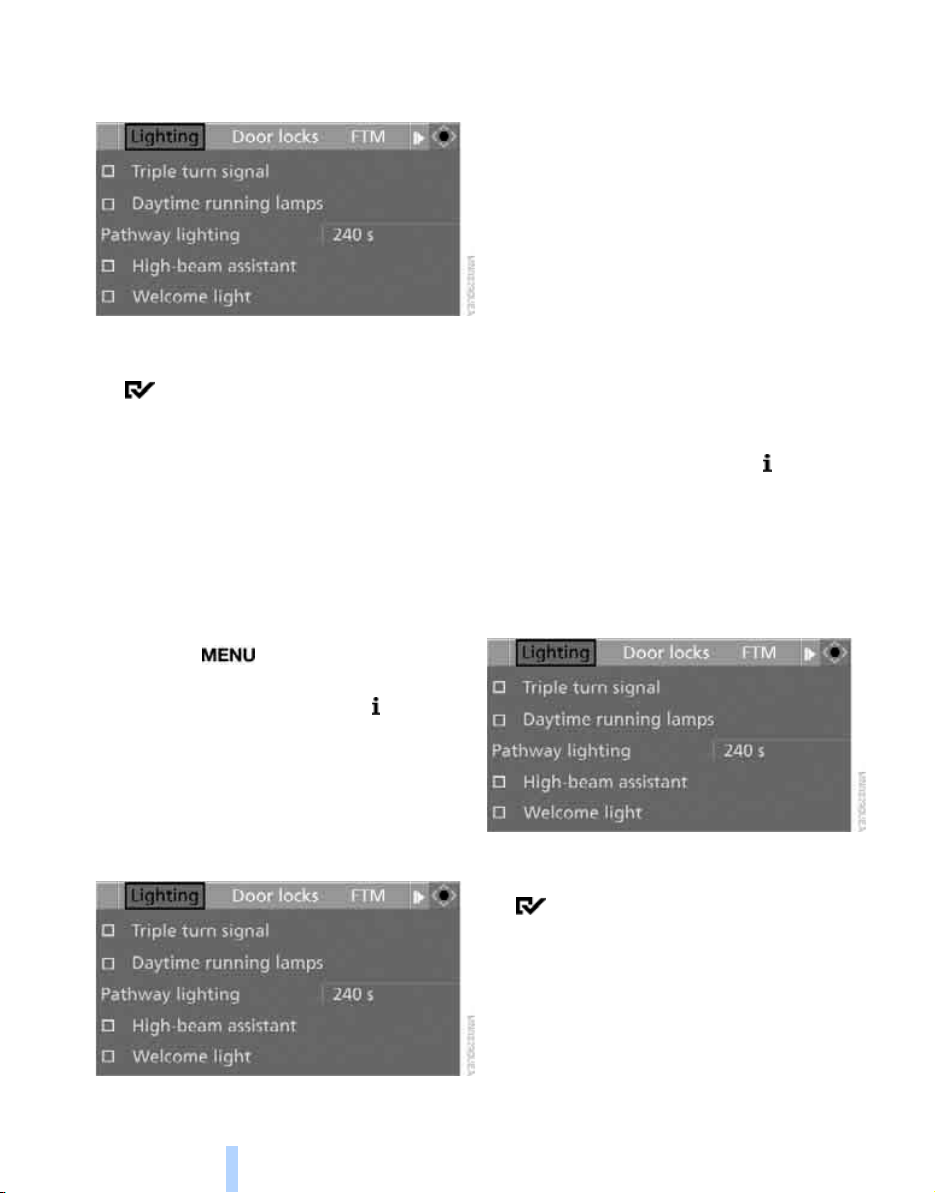
Lamps
98
5. Change to upper field if necessary. Turn the
controller until "Lighting" is selected and
press the controller.
6. Select "Welcome light" and press the con-
troller.
The welcome lamps are switched on.
The setting is stored for the remote control cur-
rently in use.
Pathway lighting
When you activate the headlamp flasher after
parking the vehicle and switching off the lamps,
the low beams will come on for a brief period.
You can set the duration or deactivate the func-
tion via iDrive.
iDrive, for operating principle refer to page 16.
1. Press the button.
This opens the start menu.
2. Press the controller to open the menu.
3. Select "Settings" and press the controller.
4. Select "Vehicle / Tires" and press the con-
troller.
5. Change to upper field if necessary. Turn the
controller until "Lighting" is selected and
press the controller.
6. Select "Pathway lighting" and press the
controller.
7. Turn the controller to select the desired
duration.
8. Press the controller to apply the setting.
The setting is stored for the remote control cur-
rently in use.
Daytime running lamps*
The daytime running lamps light up in
position 0, 1 and 3. If the light switch remains in
position 1, the parking lamps light up after the
ignition is switched off.
Activating/deactivating daytime
running lamps*
1. Open the start menu.
2. Press the controller to open the menu.
3. Select "Settings" and press the controller.
4. Select "Vehicle / Tires" and press the con-
troller.
5. Change to upper field if necessary. Turn the
controller until "Lighting" is selected and
press the controller.
6. Select "Daytime running lamps" and press
the controller.
The daytime running lamps are
switched on.
The setting is stored for the remote control cur-
rently in use.
Online Edition for Part no. 01 41 2 600 775 - © 08/08 BMW AG
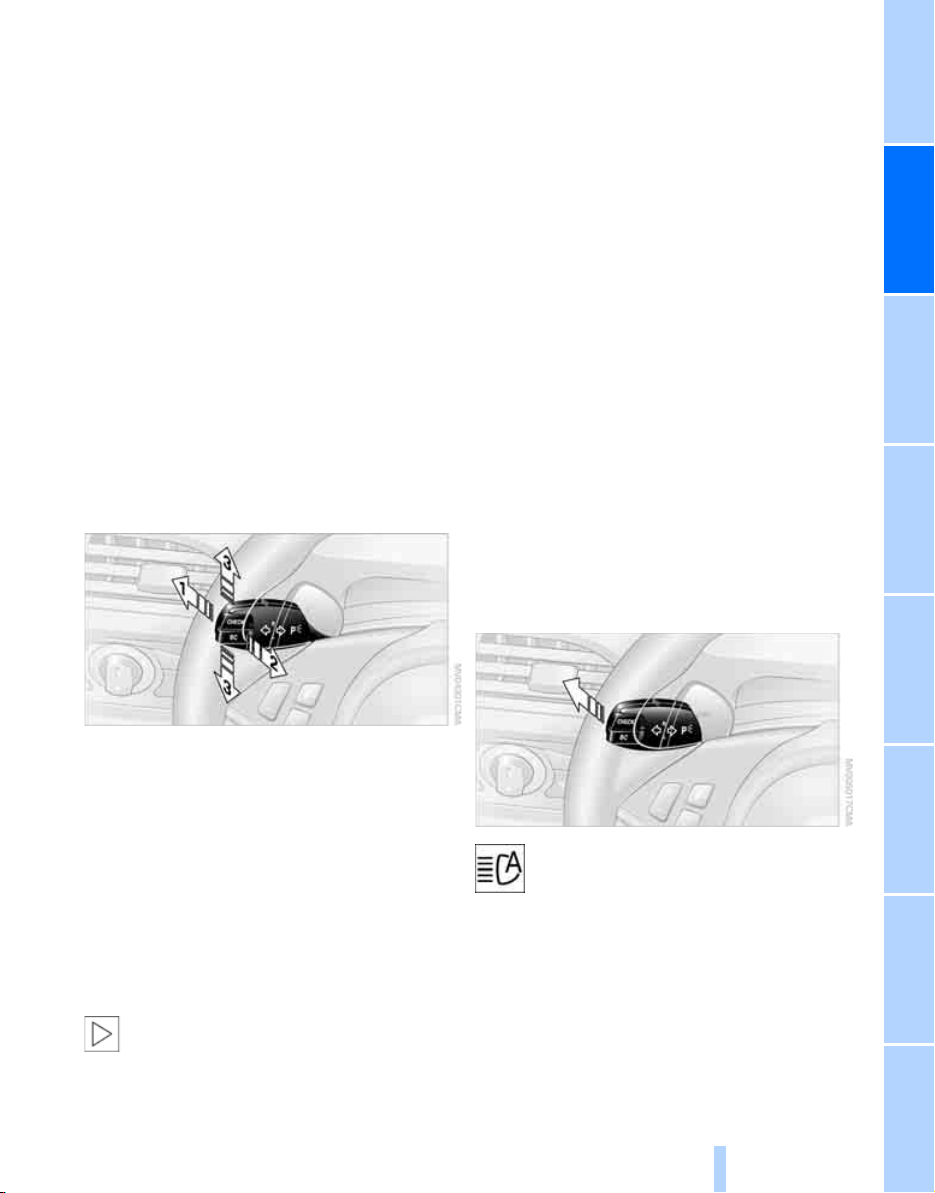
Controls
99
Reference At a glanceDriving tipsCommunications NavigationEntertainmentMobility
Adaptive Head Light*
The concept
Adaptive Head Light is a variable headlamp
control system that enables better illumination
of the road surface. Depending on the steering
angle and other parameters, the light from the
headlamp follows the course of the road.
Activating Adaptive Head Light
With the ignition switched on, turn the light
switch into position 3, refer to page 97.
To avoid blinding oncoming traffic, the Adaptive
Head Light is not active when driving in reverse
and points toward the passenger side when the
vehicle is stopped.
High beams/
roadside parking lamps
1 High beams
2 Headlamp flasher
3 Roadside parking lamps
Roadside parking lamps, left or right*
You also enjoy the option of lighting up just one
side of your vehicle when parking.
Switching on
After parking the vehicle, press the lever up or
down beyond the resistance point, arrow 3.
The roadside parking lamps drain the bat-
tery. Do not leave them switched on for
long periods of time, otherwise it may no longer
be possible to start the engine.<
Switching off
Briefly press the lever in the opposite direction
up to the resistance point, arrow 3.
High-beam assistant*
The concept
This system automatically switches the high
beams on and off. A sensor on the front side of
the inside rearview mirror controls the process.
The assistant makes sure that the high beams
are switched on whenever traffic conditions
permit. This relieves you of the burden of con-
stantly switching back and forth and simulta-
neously provides you with the best possible vis-
ibility. Naturally, you can intervene at any time to
switch the high beams on and off as usual.
Activating system
1. Turn the light switch to position 3, refer to
page 97.
2. With the low beams switched on, briefly
press the turn signal lever in the high-beam
direction.
The indicator lamp in the instrument
cluster lights up when the high-beam
assistant is activated. The system
automatically switches between high beams
and low beams, reacting to oncoming traffic,
vehicles ahead of you, and sufficiently lit areas,
e.g. in built-up zones.
Manually switching between high
beams and low beams
If you wish or the situation requires, you can
intervene at any time.
Online Edition for Part no. 01 41 2 600 775 - © 08/08 BMW AG

Lamps
100
> If the high-beam assistant has switched on
the high beams, but you wish to use the low
beams, just switch on the low beams with
the turn signal lever. This deactivates the
high-beam assistant.
In order to reactivate the system, briefly
press the turn signal lever in the high-beam
direction.
> If the high-beam assistant has switched on
the low beams, but you wish to use the high
beams, simply switch on the high beams as
usual. This deactivates the system and it is
up to you to switch back to low beams.
In order to reactivate the system, briefly
press the turn signal lever in the high-beam
direction.
> When the low beams are on, use the head-
lamp flasher as usual.
System limits
The high-beam assistant is designed to
maximize the amount of time that high
beams can be safely used and to quickly switch
back to low beams when traffic approaches.
The system cannot completely replace driver
intervention when unusual conditions are
encountered. For this reason, switch to low
beams when circumstances so dictate. Failure
to do so can pose a safety risk.<
Below are a few examples of situations in which
the system may not react or may only function
to a limited degree, requiring personal interven-
tion:
> in extremely unfavorable weather condi-
tions such as fog or heavy precipitation
> in sensing road users with poor inherent
illumination such as pedestrians, cyclists,
equestrians, horse-drawn vehicles, railroad
or shipping traffic close to the road, and at
deer crossings
> in tight curves, on steep crests or dips, with
cross-traffic, or with partially hidden
oncoming traffic on divided highways
> in poorly illuminated areas and in the pres-
ence of highly reflective signs
> in the low speed range
> when the windshield is fogged up, dirty or
covered with stickers, decals etc. in the area
of the inside rearview mirror
> when the sensor is dirty. Clean the sensor
on the front side of the inside rearview mir-
ror with a cloth slightly moistened with glass
cleaner
Moreover, no system can operate without limi-
tations. High-beam assistant operation is sub-
ject to conditions that may reduce the system's
ability to recognize the difference between
actual vehicle head lamps or tail lamps and, for
example, highly reflective signs, markers, and
streetlights. To be on the safe side, the system
may periodically interpret these situations as
conditions that require low beams. Below are
some of the situations in which premature
switching to low beams can occur:
> approaching large and/or highly reflective
signs
> approaching certain lights, such as drive-
way lighting and porch lights
> approaching certain traffic signals
> approaching large reflective markers
In these situations, the system may interpret
the above conditions as a vehicle ahead requir-
ing a switch to low beams. When the conditions
return to normal, the system will reactivate the
high beams.
The high-beam assistant cannot replace the
driver's responsibility for complying with state
laws on high-beam switching or for adapting to
visibility and traffic conditions.
Switching off via iDrive
iDrive, for operating principle refer to page 16.
1. Press the button.
This opens the start menu.
2. Press the controller to open the menu.
3. Select "Settings" and press the controller.
4. Select "Vehicle / Tires" and press the con-
troller.
Online Edition for Part no. 01 41 2 600 775 - © 08/08 BMW AG
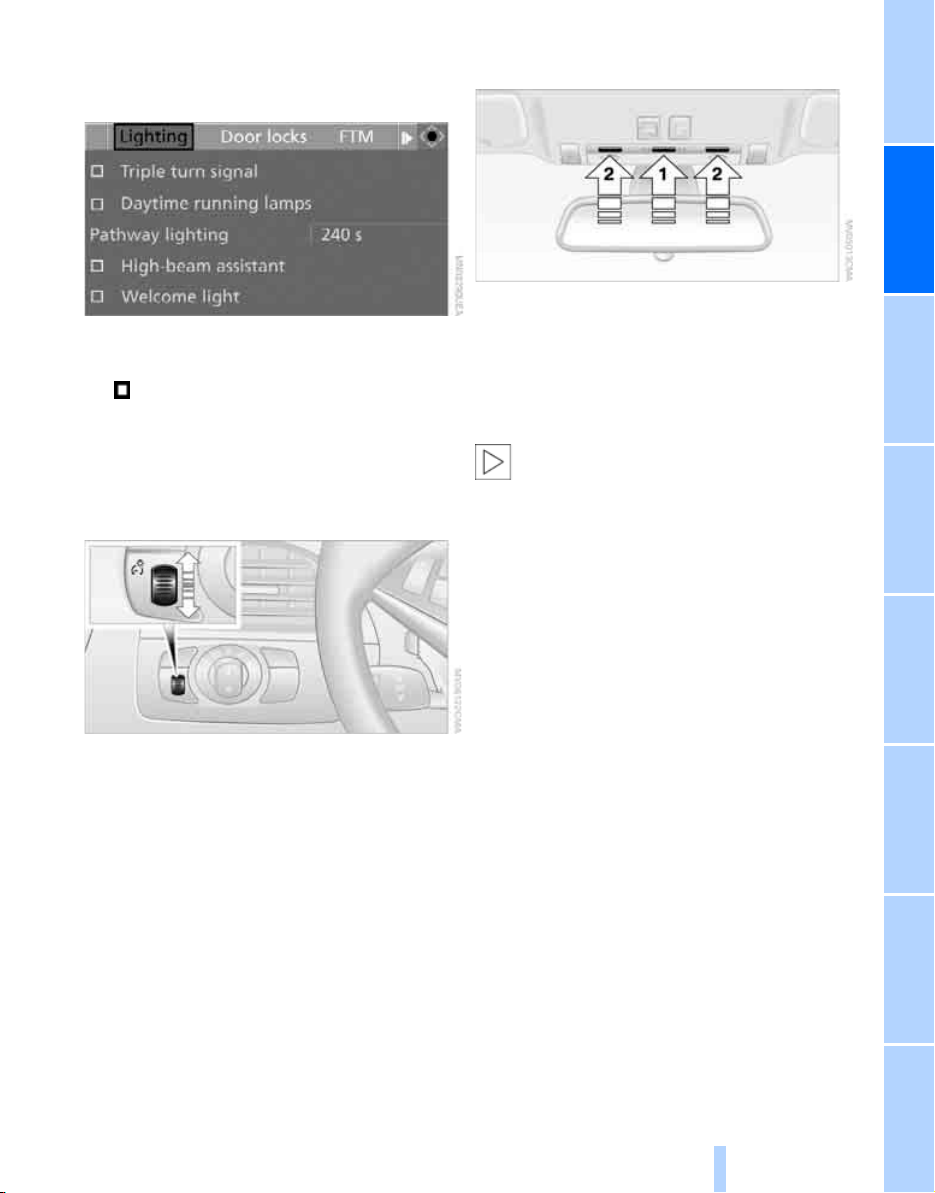
Controls
101
Reference At a glanceDriving tipsCommunications NavigationEntertainmentMobility
5. Change to upper field if necessary. Turn the
controller until "Lighting" is selected and
press the controller.
6. Select "High-beam assistant" and press
the controller.
High-beam assistant is switched off.
The setting is stored for the remote control cur-
rently in use.
Instrument lighting
The lighting intensity can be adjusted with the
knurled wheel with the parking lamps/low
beams switched on.
Interior lamps
Control of the interior lamps, footwell lamps,
door entry lighting, courtesy lamps
and sill
panel lighting
is automatic.
With the courtesy lamps,
LED lights are pro-
vided in the outside rearview mirrors to illumi-
nate the exterior area around the doors.
To protect the battery, all lamps in the
vehicle are switched off approx. 15 min-
utes after radio readiness is switched off, refer
to Start/Stop button on page 60.<
Switching interior lamps on and off
manually
Press button 1.
If the interior lamps, footwell lamps, door entry
lighting, courtesy lamps and sill panel lighting
are to remain switched off continually, press the
button for approx. 3 seconds.
Reading lamps
The reading lamps are beside the interior lamp:
You can turn them on and off using buttons 2
located next to the lamps.
Online Edition for Part no. 01 41 2 600 775 - © 08/08 BMW AG
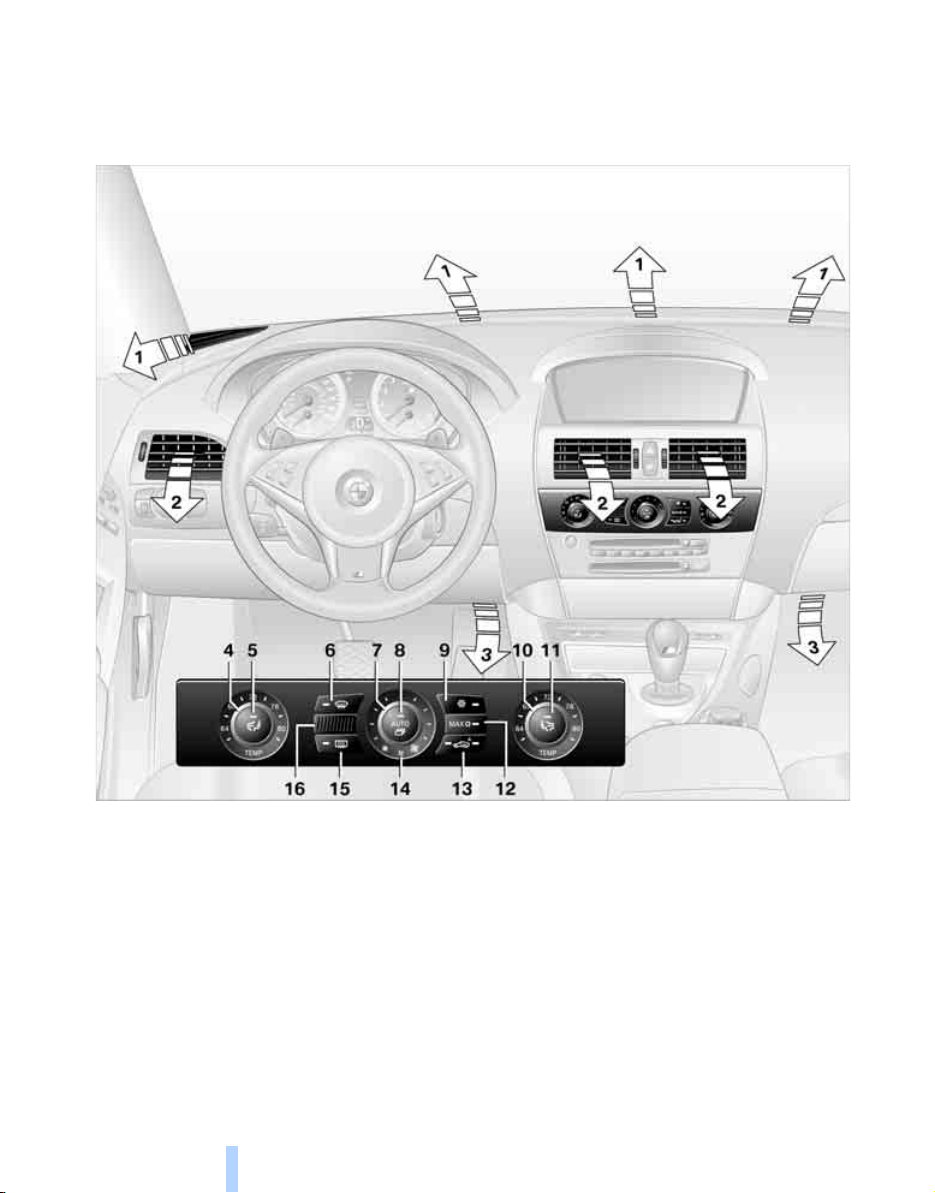
Climate
102
Climate
Automatic climate control
1 Air directed toward the windshield and side
windows
2 Air for the upper body area, refer to Ventila-
tion on page 106
3 Air to footwell
4 Temperature, left side of passenger com-
partment
5 Manual air distribution, driver's side
6 Defrosting windows and removing conden-
sation
7 Manual air volume, switching off automatic
climate control, residual heat utilization
8 AUTO program
9 Switching cooling function on and off man-
ually
10 Temperature, right side of passenger com-
partment
11 Manual air distribution, front passenger side
12 Maximum cooling
13 AUC Automatic recirculated-air control/
recirculated-air mode
14 LED for residual heat utilization and parked-
car ventilation system
15 Rear window defroster
Online Edition for Part no. 01 41 2 600 775 - © 08/08 BMW AG
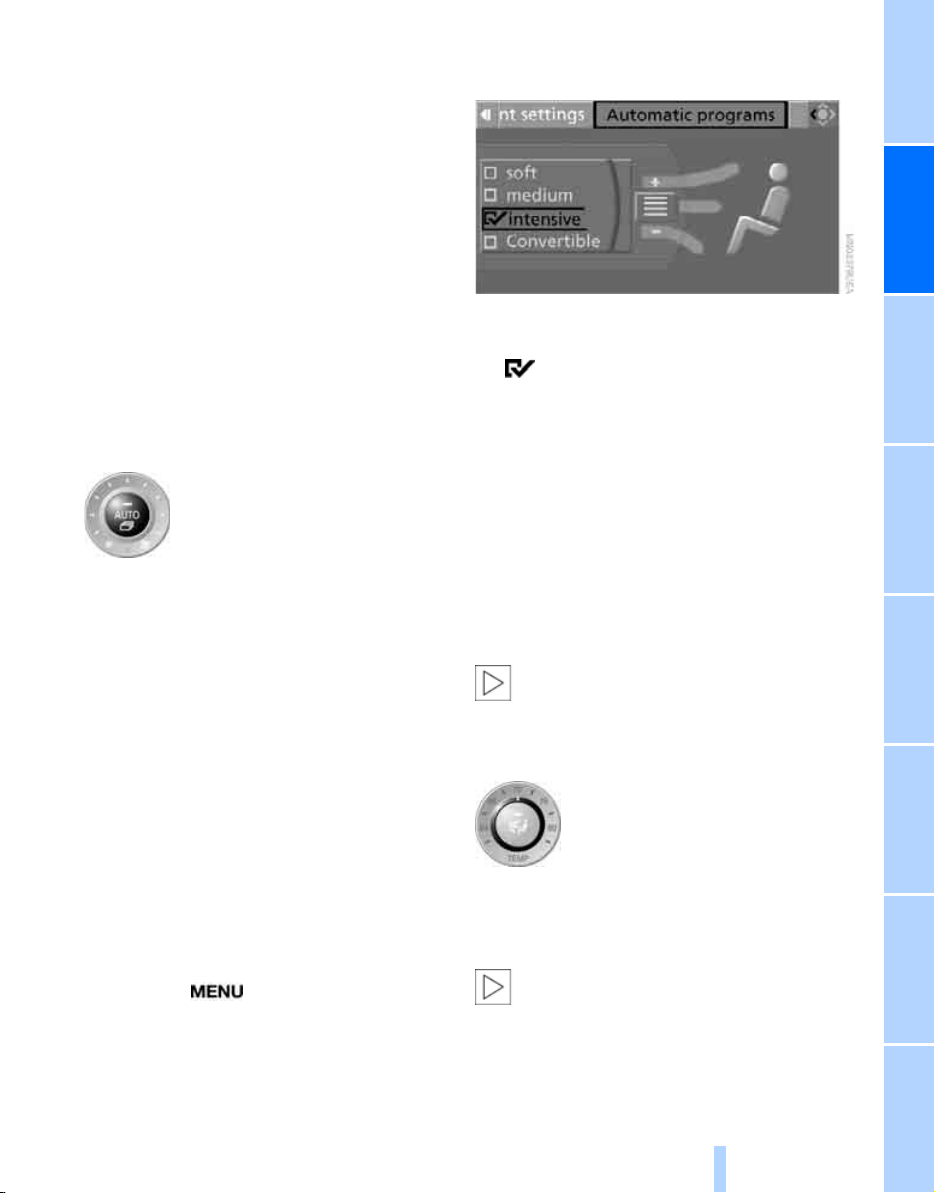
Controls
103
Reference At a glanceDriving tipsCommunications NavigationEntertainmentMobility
16 Air grill for interior temperature sensor –
please keep clear and unobstructed
The current setting for air distribution is dis-
played on the Control Display.
A congenial climate
The AUTO program offers the optimum air dis-
tribution and air volume for virtually all condi-
tions, refer to AUTO program below. Now you
only need to select an interior temperature
pleasant to you.
The following sections contain more detailed
information on the available setting options.
Most settings are stored for the remote control
currently in use, also refer to Personal Profile
settings on page 31.
AUTO program
The AUTO program handles the
adjustment of air volume and air
distribution to the windshield and
side windows, in the direction of
the upper body and in the footwell.
It also adapts your instructions for the tempera-
ture to outside influences throughout the year.
The cooling function is switched on along with
the AUTO program. At the same time, a con-
densation sensor controls the program in such
a way that window condensation is prevented
as much as possible.
Intensity of AUTO program
You can adjust the intensity of the AUTO pro-
gram by repeatedly pressing the AUTO button.
The respective current setting is briefly dis-
played on the Control Display when the button
is pressed.
You can also adjust the intensity of the AUTO
program via iDrive.
iDrive, for operating principle refer to page 16.
1. Press the button.
This opens the start menu.
2. Move the controller to the left to open "Cli-
mate".
3. Select "Automatic programs" and press the
controller.
4. Select the desired intensity and press the
controller.
The marked intensity of the automatic
program is switched on.
Convertible program*
When the convertible top is opened, the con-
vertible program can also be selected. In the
convertible program, the automatic climate
control is optimized for driving with the convert-
ible top open. In addition, the air volume is
increased as the speed increases.
If the convertible program has been selected,
it is automatically active every time the top is
opened.
The effect of the convertible program can
be greatly enhanced if the wind deflector
is installed.<
Temperature
Set the desired temperature indi-
vidually on the driver's and front
passenger side.
The automatic climate control
achieves this temperature as quickly as possi-
ble at any time of year, if necessary with the
maximum cooling or heating capacity, and then
keeps it constant.
When changing between different tem-
perature settings in rapid succession, the
automatic climate control does not have suffi-
cient time to adjust the set temperature.<
Online Edition for Part no. 01 41 2 600 775 - © 08/08 BMW AG
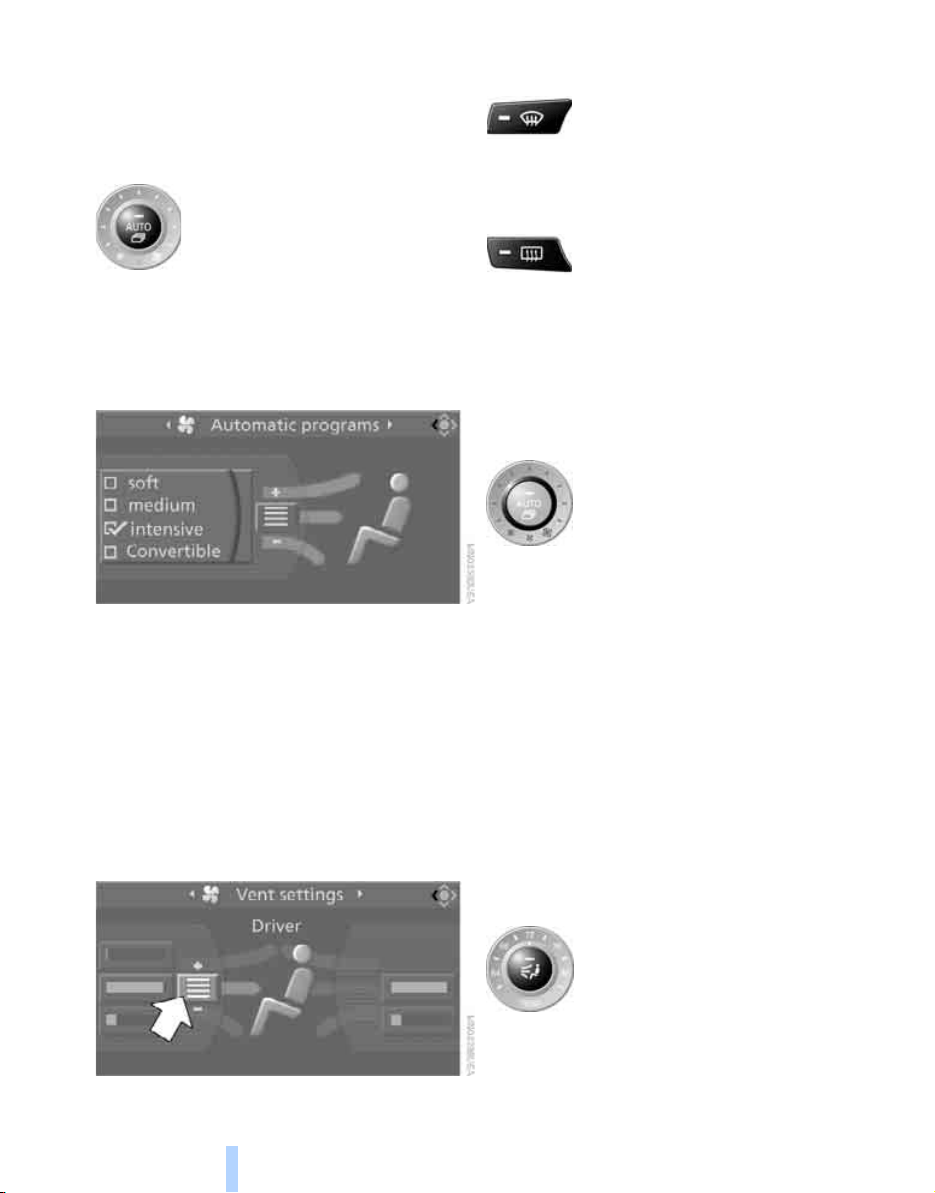
Climate
104
In the highest setting you activate the maximum
heating output, regardless of the outside tem-
perature.
Adjusting temperature in upper body
region
1. Press the button to display the current set-
ting on the Control Display.
2. Select the field by moving the controller and
turning the controller to adjust the temper-
ature.
You can also adjust the temperature in the
upper body region with iDrive.
iDrive, for operating principle refer to page 16.
1. Open the start menu.
2. Open "Climate".
3. Select "Vent settings" and press the con-
troller.
4. Select the field by moving the controller and
turning the controller to adjust the temper-
ature.
Defrosting windows and removing
condensation
Quickly remove ice and condensa-
tion from the windshield and front
side windows.
To do this, also switch on the cooling function.
Rear window defroster
The rear window defroster
switches off after a while.
Convertible: the rear window
defroster is only activated when the rear win-
dow is closed.
Depending on the vehicle equipment, upper
wires are used as an antenna and are not part of
the rear window defroster.
Air volume, manual
You can adjust the air volume by
turning. You can reactivate the
automatic mode for the air volume
with the AUTO button.
The air quantity is reduced and if need be, the
ventilation is switched off in order to reduce the
load on the battery. The display stays the same.
Air distribution, manual
You can route the air flowing out into the vehicle
interior via various programs, separately for the
driver's and passenger's side:
> Upper body region
> Upper body region and footwell
> Footwell
> Driver's side: windows and footwell
> Individual program
Selecting program
Press the button repeatedly until
the desired air distribution of the
respective program is shown on
the Control Display.
Adjusting air distribution individually –
individual program
Your settings are stored in this program.
Online Edition for Part no. 01 41 2 600 775 - © 08/08 BMW AG
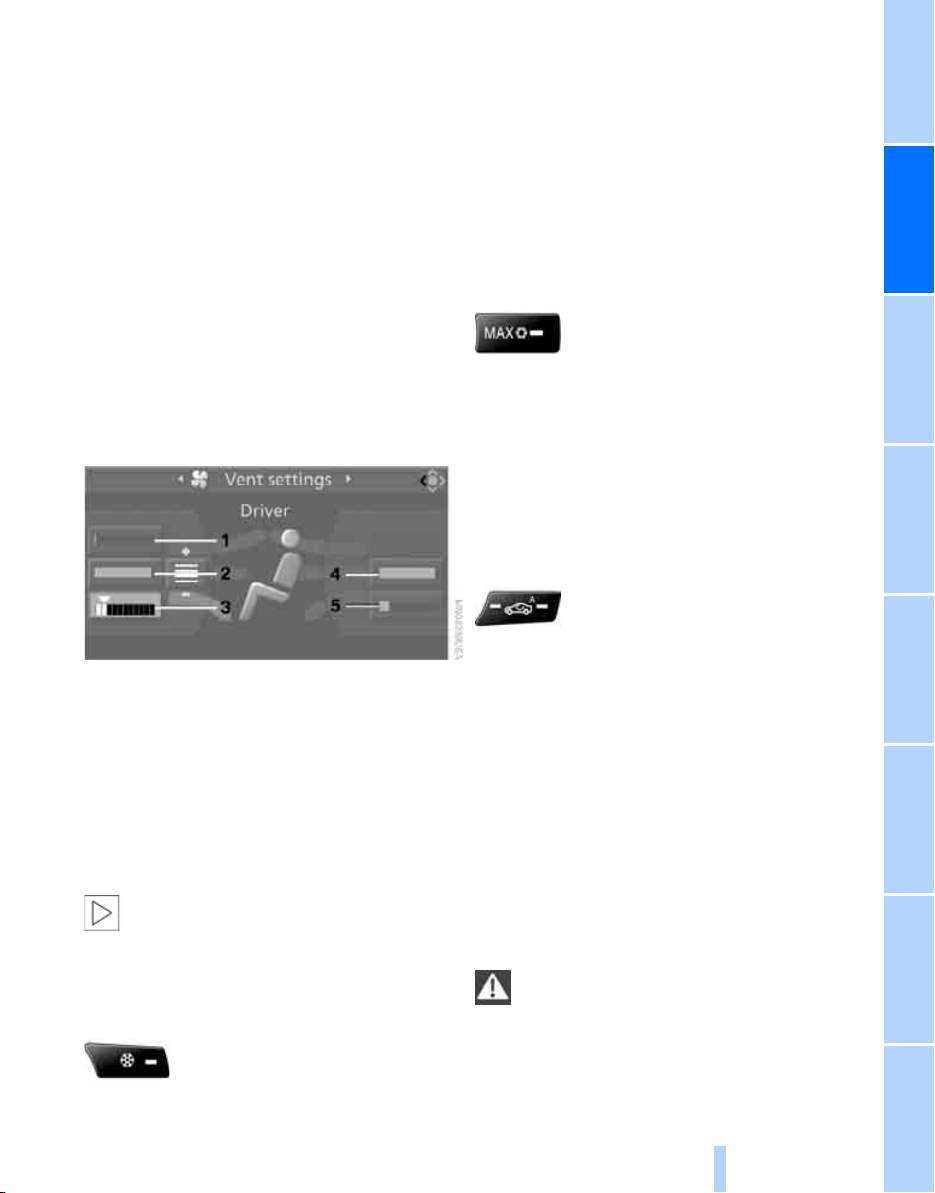
Controls
105
Reference At a glanceDriving tipsCommunications NavigationEntertainmentMobility
iDrive, for operating principle refer to page 16.
1. Open the start menu.
2. Open "Climate".
3. Select "Vent settings" and press the con-
troller.
The driver's and front passenger side can
be adjusted separately with the fields on the
right or left side.
4. Select the driver's or front passenger side
if necessary.
Move the controller to the right or left
repeatedly until the driver's or front passen-
ger side is selected.
5. Select the desired field by moving the con-
troller.
6. Turn the controller to adjust the air distribu-
tion.
Driver's side:
1 Air directed toward the windshield and side
windows
2 Air for the upper body
3 Air to footwell
Front passenger side:
4 Air for the upper body
5 Air to footwell
Pressing the AUTO button cancels the
manual air distribution settings.<
The automatic mode for the air volume remains
effective with manual air distribution.
Switching cooling function on and off
The cooling function cools and
dehumidifies the incoming air
before also reheating it as
required, according to the temperature setting.
This function is only available when the engine
is running.
The cooling function helps to avoid condensa-
tion on the window surfaces or to quickly
remove them.
Depending on the weather, the windshield may
fog over briefly when the engine is started.
The cooling function is also switched on with
the AUTO program.
Maximum cooling
Maximally cooled air is obtained as
quickly as possible at an outside
temperature above approx. 327/
06 and with the engine running.
At the lowest temperature, the automatic cli-
mate control switches into recirculating air
mode. The maximum air volume flows out of the
vents for the upper body. Therefore, open these
vents for maximum cooling.
AUC Automatic recirculated-air
control/recirculated-air mode
You can respond to pollutants or
unpleasant odors in the immediate
environment by suspending the
supply of outside air. The system then recircu-
lates the air currently within the vehicle. During
AUC operation, a sensor detects pollutants in
the outside air and controls the shut-off auto-
matically.
By pressing the button repeatedly, you can
request three operating modes:
> LED off: outside air flows in continuously.
> Right LED on, AUC mode: the system
detects pollutants in the outside air and
shuts off the supply as needed.
> Left LED on, recirculated-air mode: the
supply of outside air is permanently shut off.
Should the windows fog up in the recircu-
lated-air mode, press the AUTO button or
switch off the recirculated-air mode and
increase the air volume if necessary.
The recirculated-air mode should not be used
over an extended period of time, as the air qual-
Online Edition for Part no. 01 41 2 600 775 - © 08/08 BMW AG
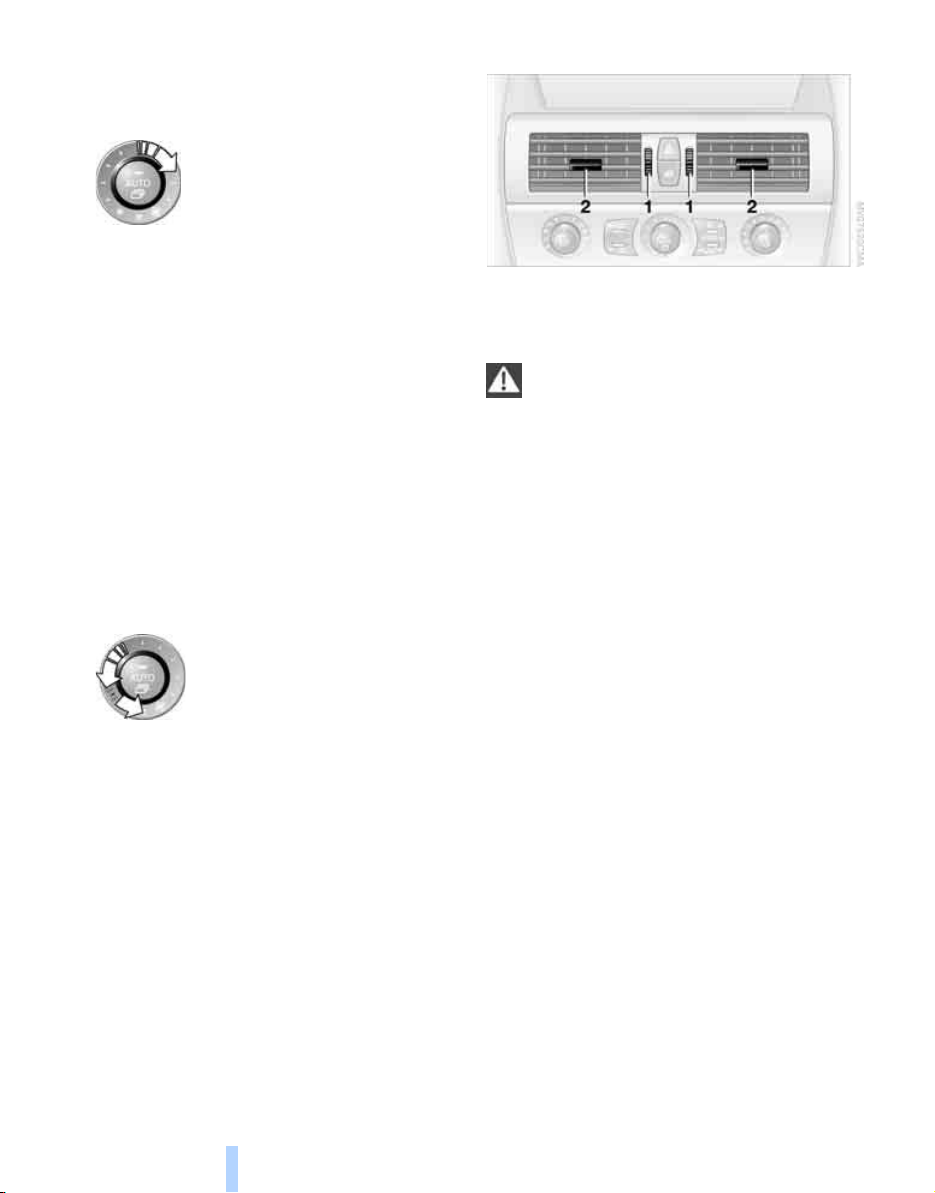
Climate
106
ity inside the vehicle deteriorates continu-
ously.<
Residual heat
The heat stored in the engine is
used to heat the passenger com-
partment, e.g. while stopped at a
school to pick up a child.
1. Switch off the engine.
2. Turn to the right, refer to arrow.
The function can be switched on when the fol-
lowing conditions are met:
> up to 15 minutes after switching off the
engine
> with engine at operating temperature
> with sufficient battery voltage
> at an outside temperature below 777/
256
From radio readiness the interior temperature,
the air volume and the air distribution can be
set.
Switching automatic climate control on
and off
1. Turn to the left to minimum air volume.
2. After approx. 1 second, turn to the left
again.
You switch on the system again by pressing any
button of the automatic climate control.
Ventilation
1 Knurled wheels to smoothly open and close
vent outlets
2 Levers to change the vent outlet direction
Do not drop any foreign objects into the
vent outlets; otherwise, they could be cat-
apulted outwards and cause injuries.<
Ventilation for cooling
Adjust the vent outlets to direct the flow of cool
air in your direction, for instance, if the interior
has become too warm, etc.
Draft-free ventilation
Set the vent outlets so that the air flows past
you and is not directed straight at you.
Microfilter/activated-charcoal filter
The microfilter removes dust and pollen from
the incoming air. The activated-charcoal filter
provides additional protection by filtering gas-
eous pollutants from the outside air. Your BMW
center replaces this combined filter as a stan-
dard part of your scheduled maintenance.
You can have more detailed information shown
on the Control Display, refer to page 73.
Parked car ventilation
The concept
The parked car ventilation blows air into the
passenger compartment to lower interior tem-
peratures.
It is ready to use in the parked car mode at any
outside temperature.
Online Edition for Part no. 01 41 2 600 775 - © 08/08 BMW AG

Controls
107
Reference At a glanceDriving tipsCommunications NavigationEntertainmentMobility
You can set two different times for the system
to start. The parked car ventilation can also be
switched on and off directly. It remains
switched on for 30 minutes.
Since the system uses a substantial amount of
electrical current, you should refrain from acti-
vating it twice in succession without allowing
the battery to be recharged in normal operation
between use.
The air emerges through the upper body region
vent outlets in the instrument panel. Therefore,
please open the vent outlets.
The parked car ventilation is operated via iDrive.
Switching on and off directly
iDrive, for operating principle refer to page 16.
1. Open the start menu.
2. Move the controller to the left to open "Cli-
mate".
3. Select "Parked car operation" and press the
controller.
4. Select "Automatic ventilation" and press
the controller.
5. Select "Parked car ventilation" and press
the controller.
The parked car ventilation is switched on.
The symbol on the display of the automatic
climate control flashes.
Preselecting activation times
1. Open the start menu.
2. Move the controller to the left to open "Cli-
mate".
3. Select "Parked car operation" and press the
controller.
4. Select "Activation time" and press the con-
troller.
5. Move the controller to the left or right to
select "Timer 1" or "Timer 2".
6. Select the time and press the controller.
The first setting of the time display is
selected.
7. Turn the controller to make the adjustment.
8. Press the controller to apply the setting.
The next setting is selected.
9. Make the remaining adjustments. After the
last adjustment, the time is stored.
Activating activation time
Move the controller to the left or right to select
"Timer 1" or "Timer 2" and then press the con-
troller.
Online Edition for Part no. 01 41 2 600 775 - © 08/08 BMW AG

Climate
108
The switch-on time is activated.
The symbol on the display of the automatic
climate control lights up.
The symbol on the display of the automatic
climate control flashes when the parked car
ventilation has switched on.
The parked car ventilation is only avail-
able for activation within the next
24 hours. Please reactivated it after this time.<
Online Edition for Part no. 01 41 2 600 775 - © 08/08 BMW AG
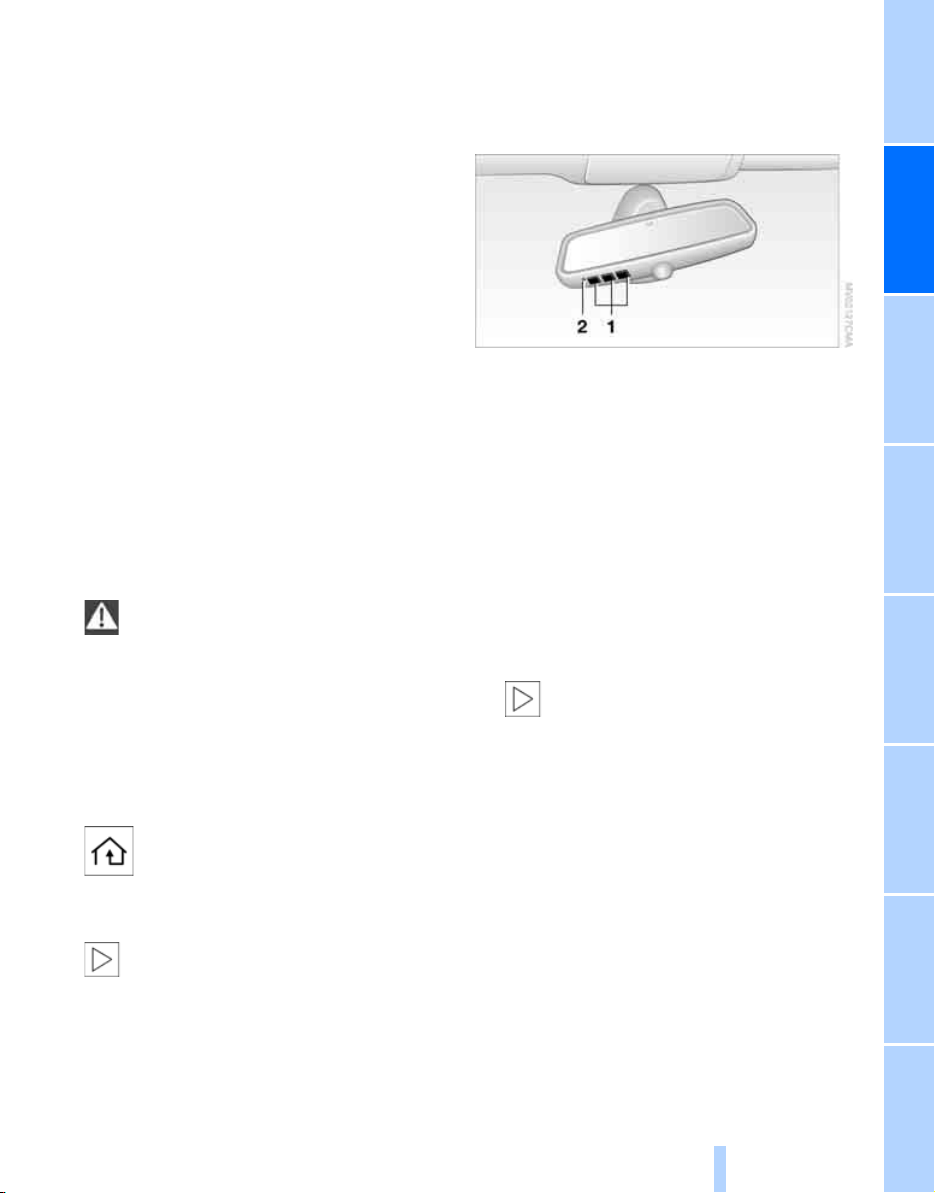
Controls
109
Reference At a glanceDriving tipsCommunications NavigationEntertainmentMobility
Practical interior accessories
Integrated universal remote
control*
The concept
The integrated universal remote control can
replace as many as three hand-held transmit-
ters for various remote-controlled accessories,
such as garage and gate or lighting systems.
The integrated universal remote control regis-
ters and stores signals from the original hand-
held transmitters.
The signal of an original hand-held transmitter
can be programmed on one of the three mem-
ory buttons 1. After this, the programmed
memory button 1 will operate the system in
question. The LED 2 flashes to confirm trans-
mission of the signal.
Should you sell your vehicle one day, be sure to
delete the stored programs beforehand for your
safety, refer to page 110.
To prevent possible damage or injury,
before programming or using the inte-
grated universal remote control, always inspect
the immediate area to make certain that no peo-
ple, animals or objects are within the travel
range of the device. Also, comply with the
safety precautions of the original hand-held
transmitter.<
Checking compatibility
If you see this symbol on the packaging
or in the manual supplied with the orig-
inal hand-held transmitter, it is safe to
assume that it is compatible with the integrated
universal remote control.
If you have additional questions, please
contact your BMW center or call:
1-800-355-3515.
Information is also provided on the Internet at:
www.bmwusa.com or
www.homelink.com.
HomeLink is a registered trademark of Johnson
Controls, Inc.<
Programming
1 Memory buttons
2 LED
Fixed-code hand-held transmitters
1. Switch on ignition, refer to page 60.
2. When starting operation for the first time:
Press the left and right-hand memory
button 1 for approx. 20 seconds until the
LED 2 flashes quickly. All stored programs
are deleted.
3. Hold the original hand-held transmitter at a
distance of approx. 4 in/10 cm to 12 in/
30 cm from the memory buttons 1.
The required distance between the
hand-held transmitter and the mem-
ory buttons 1 depends on the relevant sys-
tem of the original hand-held transmitter
used.<
4. Simultaneously press the transmit button
on the original hand-held transmitter and
the desired memory button 1 on the inte-
grated universal remote control. The LED 2
flashes slowly at first. As soon as the LED 2
flashes rapidly, release both buttons. If the
LED 2 does not flash rapidly after approx.
15 seconds, alter the distance and repeat
the step.
5. To program other original hand-held trans-
mitters, repeat steps 3 and 4.
The corresponding memory button 1 is now
programmed with the signal of the original
hand-held transmitter.
Online Edition for Part no. 01 41 2 600 775 - © 08/08 BMW AG
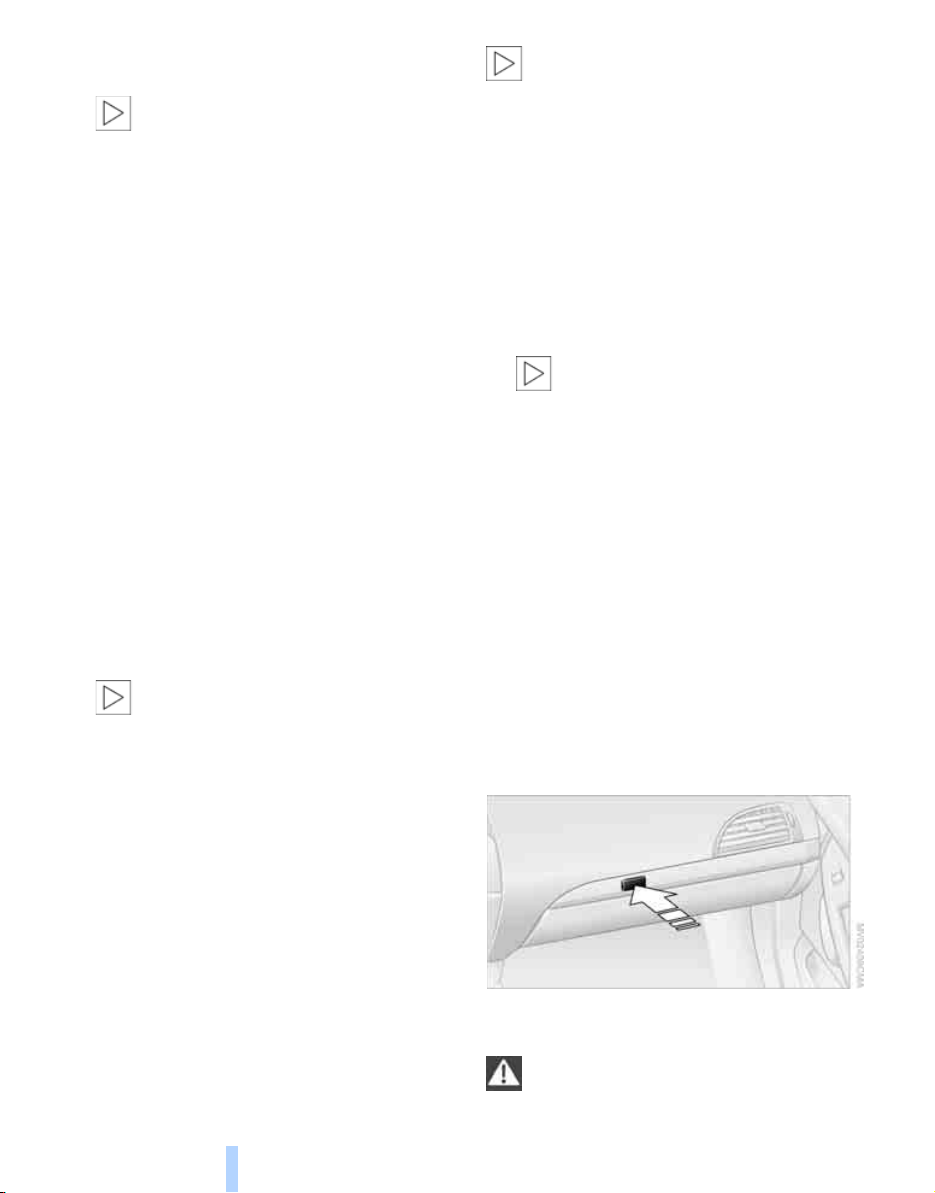
Practical interior accessories
110
You can operate the device when the engine is
running or when the ignition is switched on.
If the device fails to function even after
repeated programming, check whether
the original hand-held transmitter uses an alter-
nating-code system. To do so, either read the
instructions for the original hand-held transmit-
ter or hold down the programmed memory
button 1 of the integrated universal remote
control. If the LED 2 on the integrated universal
remote control flashes rapidly for a short time
and then remains lit for approx. 2 seconds, this
indicates that the original hand-held transmitter
uses an alternating-code system. In the case of
an alternating-code system, program the mem-
ory buttons 1 as described at Alternating-code
hand-held transmitters.<
Alternating-code hand-held
transmitters
To program the integrated universal remote
control, consult the operating instructions for
the equipment to be set. You will find informa-
tion there on the possibilities for synchroniza-
tion.
When programming hand-held transmitters
that employ an alternating code, please observe
the following supplementary instructions:
Programming will be easier with the aid of
a second person.<
1. Park your vehicle within the range of the
remote-controlled device.
2. Program the integrated universal remote
control as described above in the section
Fixed-code hand-held transmitters.
3. Locate the button on the receiver of the
device to be set, e.g. on the drive unit.
4. Press the button on the receiver of the
device to be set. After step 4, you have
approx. 30 seconds for step 5.
5. Press the programmed memory button 1
of the integrated universal remote control
three times.
The corresponding memory button 1 is now
programmed with the signal of the original
hand-held transmitter.
If you have any additional questions,
please contact your BMW center.<
Deleting all stored programs
Press the left and right-hand memory button 1
for approx. 20 seconds until the LED 2 flashes.
All stored programs are deleted.
Individual programs cannot be deleted.
Rememorizing individual programs
1. Hold the original handheld remote control
approx. 4 in/10 cm to 12 in/30 cm away
from the memory buttons 1.
The required distance between the
hand-held transmitter and the mem-
ory buttons 1 depends on the relevant sys-
tem of the original hand-held transmitter
used.<
2. Press the desired memory button 1 of the
integrated universal remote.
3. If the LED 2 flashes slowly after approx.
20 seconds, press the command button of
the original hand-held transmitter. As soon
as the LED 2 flashes rapidly, release both
buttons. If the LED 2 does not flash rapidly
after approx. 15 seconds, alter the distance
and repeat the step.
Glove compartment
Opening
Press the button. The glove compartment
opens automatically and the lamps come on.
To prevent injury in the event of an acci-
dent while the vehicle is being driven,
Online Edition for Part no. 01 41 2 600 775 - © 08/08 BMW AG
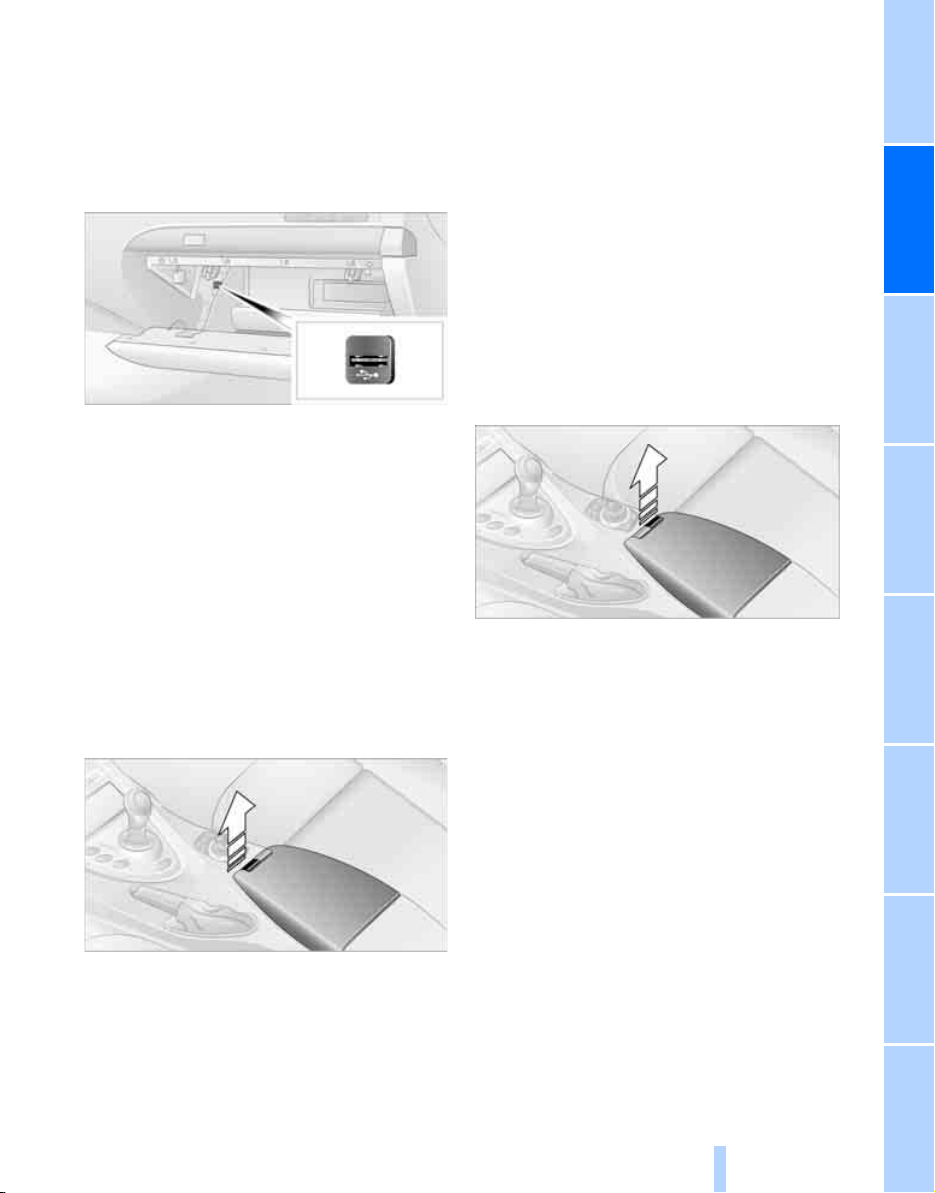
Controls
111
Reference At a glanceDriving tipsCommunications NavigationEntertainmentMobility
close the glove compartment immediately after
use.<
Closing
Fold up the lid.
USB interface for data transmission
Port for importing and exporting data on USB
devices, e.g. music collections.
Observe the following when connecting:
> Do not use force when plugging the con-
nector into the USB-audio interface.
> Do not connect devices such as fans or
lamps to the USB-audio interface.
> Do not connect USB hard disks.
> Do not use the USB interface to recharge
external devices.
Center armrest
A storage compartment is located in the arm-
rest between the front seats. This compartment
is integrated into the central locking system and
can also be locked separately using the hotel
function, refer to page 35.
To open the cover:
Pull the left button. The cover opens and can be
folded upward.
Depending on the version, the storage com-
partment can be equipped with a correspond-
ing cradle
* for the telephone or mobile phone.
Connection for external audio device
A connection for an external audio device is
located in the storage compartment. You can,
for example, connect a CD player or an MP3
player, and play the sound via the vehicle
speakers, refer to page 172.
Adjusting height
The center armrest can be set in two positions.
Pull the right button:
Move the armrest upward or downward and
lock it in the desired position.
Online Edition for Part no. 01 41 2 600 775 - © 08/08 BMW AG
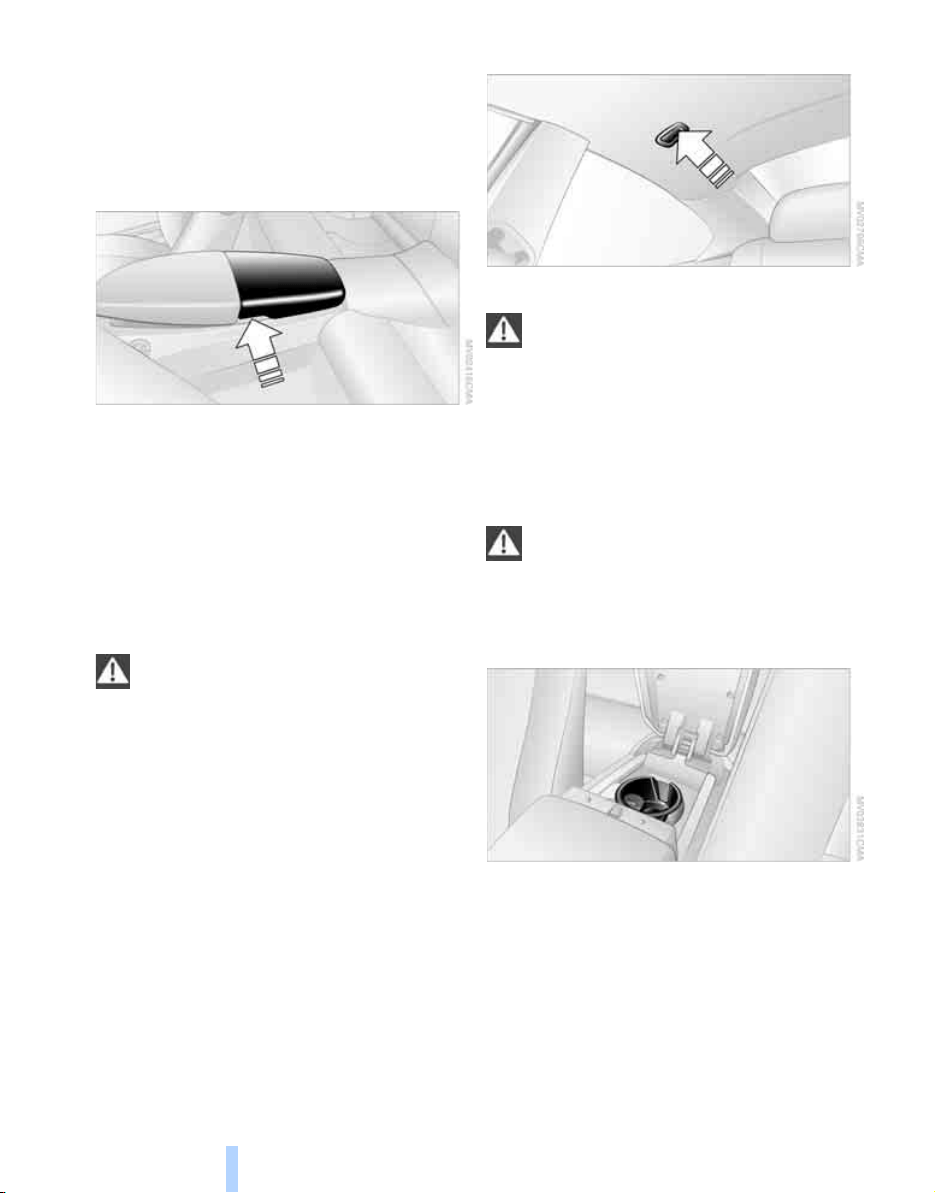
Practical interior accessories
112
Storage compartments
Storage compartments in the
passenger compartment
Storage compartment behind center
armrest
To open, raise the cover at the left or right edge.
The compartment contains the cup holder
and
the lock for the hotel function, refer to page 35.
Other compartments and nets
Other compartments are provided in the doors
as well as in the front center console
*.
Ticket pockets are located in the sun visors.
Storage nets are located on the backrests of the
front seats and in the passenger footwell
*.
To prevent the risk of injury during an
accident, do not stow hard or sharp-
edged items in the nets.<
Storage compartments in the luggage
compartment
You have the following storage options in the
luggage compartment:
> Storage compartment in the right side trim
panel, which is also suitable, if you so
desire, for accommodating the vehicle liter-
ature.
> Net at the loading lip for smaller items.
Coupe: Clothes hooks
To fold down, press at the top edge.
When hanging clothing on the hooks,
ensure that it will not obstruct the driver's
vision. Do not hang heavy objects on the hooks.
If you do so, they could cause personal injury to
occupants during braking or evasive maneu-
vers.<
Cup holders
Use lightweight, unbreakable containers
and do not transport hot beverages. Oth-
erwise, there is an increased risk of injury in the
event of an accident. Do not force containers
that are too large into the cup holders, other-
wise damage could result.<
The compartment of the rear center console
contains a built-in cup holder and a removable
one.
Online Edition for Part no. 01 41 2 600 775 - © 08/08 BMW AG
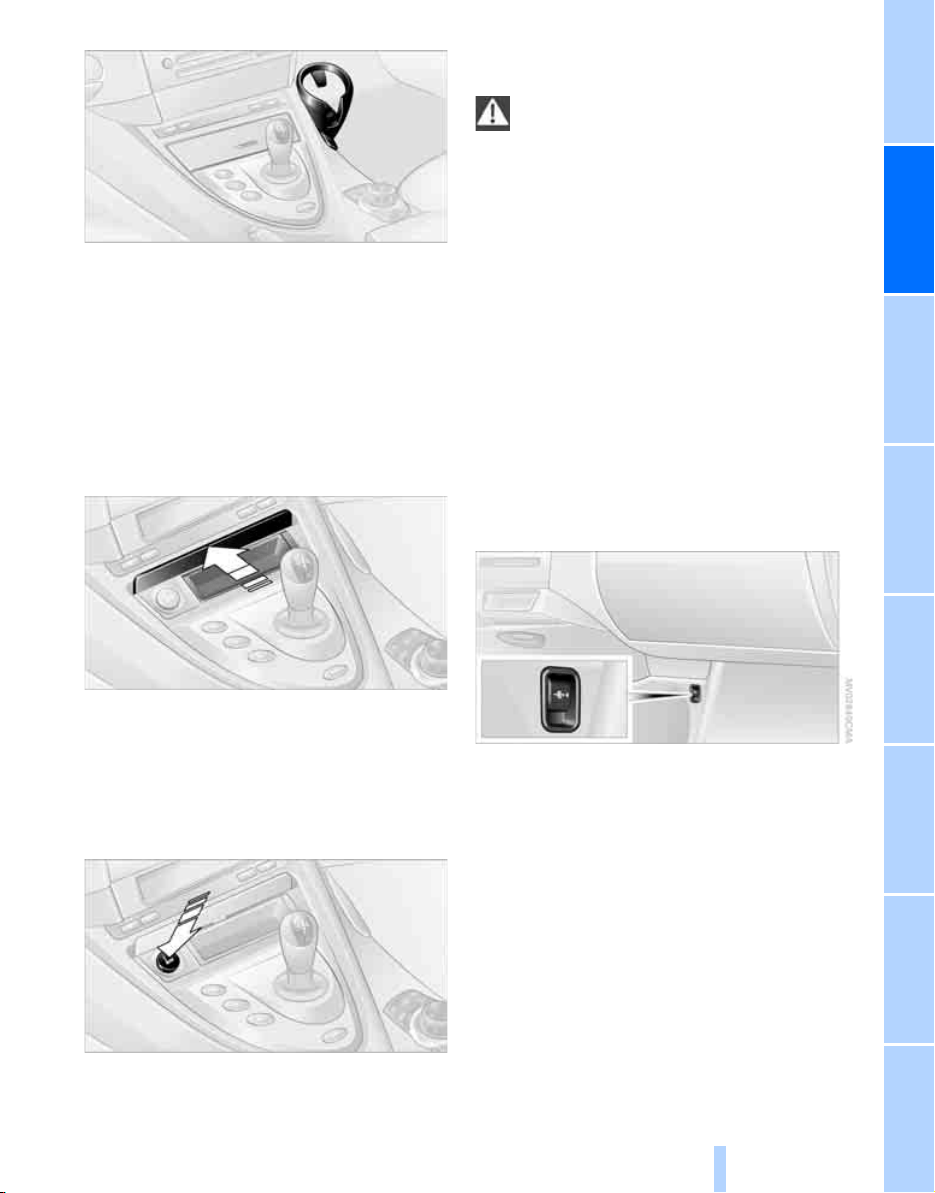
Controls
113
Reference At a glanceDriving tipsCommunications NavigationEntertainmentMobility
The removable cup holder can be inserted into
the side of the center console.
Ashtray
Opening
Press the trim strip of the cover.
Emptying
Press the opened cover beyond the resistance
point, refer to arrow: the ashtray lifts up for
removal.
Cigarette lighter
Press in the lighter with the engine running or
the ignition switched on.
The lighter can be removed as soon as it pops
back out.
Hold or touch the hot cigarette lighter by
the knob only. Holding or touching it in
other areas could result in burns.
Always take along the remote control when you
leave the vehicle, otherwise children could, for
example, use the lighter and burn themselves.<
Connecting electrical devices
Socket
With the engine running or the ignition switched
on, the cigarette lighter socket can be used as a
power outlet for hand flashlights, car vacuum
cleaners, etc., with power ratings of up to
approx. 200 W at 12 V. Avoid damaging the
socket due to inserting plugs of different
shapes or sizes.
In front passenger footwell
Access to the socket:
Fold open the cover.
Ski bag*
The ski bag permits safe and clean transport of
up to two pairs of standard skis or one snow-
board.
You can use the ski bag to stow skis up to 6.9 ft/
2.10 m long.
Online Edition for Part no. 01 41 2 600 775 - © 08/08 BMW AG
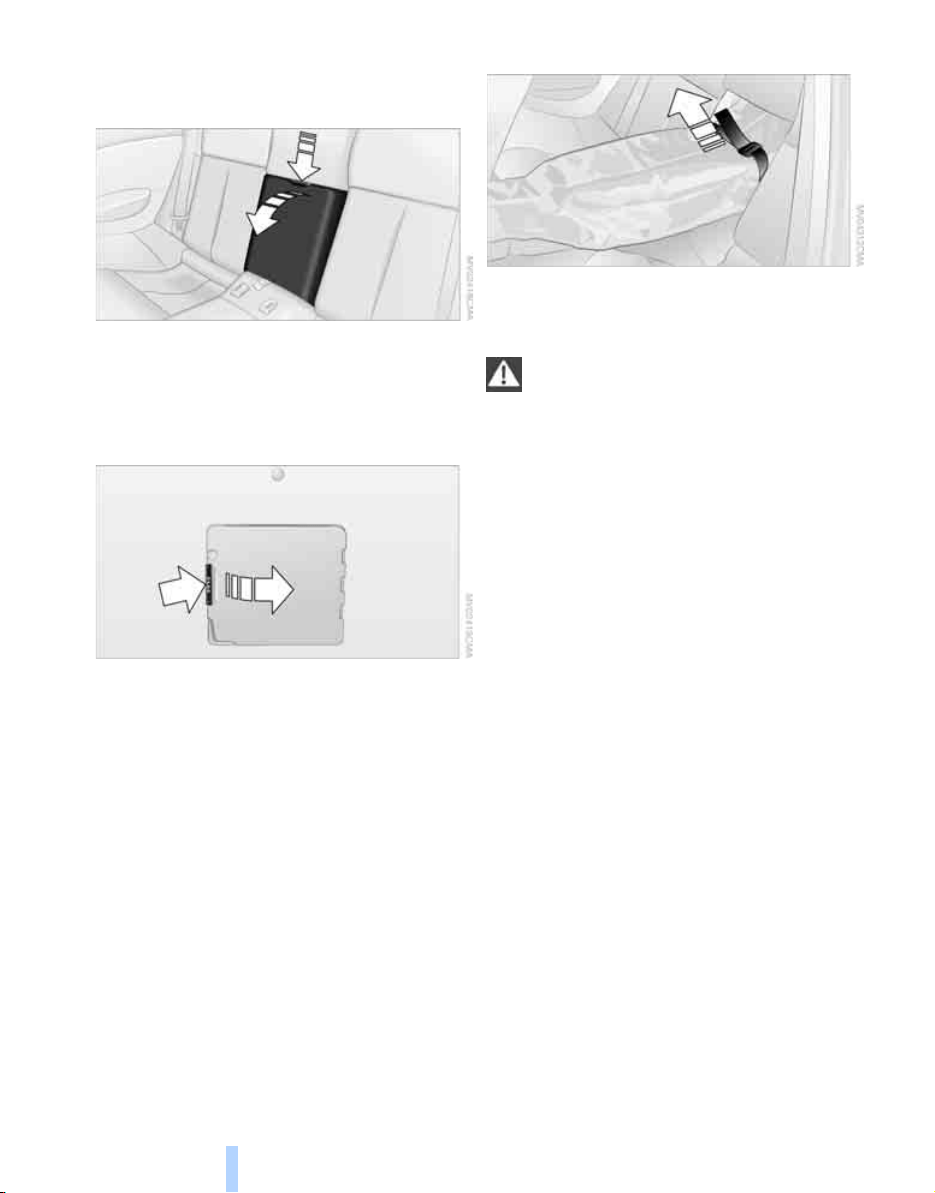
Practical interior accessories
114
Loading
1. Press the button downward and pull the
filler element forward.
2. Extend the ski bag between the front seats.
The zipper facilitates access to the stowed
items and drying of the ski bag.
3. Press the button in the luggage compart-
ment.
4. Open the loading flap and use the magnetic
holder to secure it to the rear panel.
To stow the ski bag, perform the above steps in
reverse order.
Only stow clean skis in the ski bag. Wrap sharp
edges to prevent damage.
Securing cargo
After loading, secure the ski bag and its con-
tents. Tighten the retaining strap on the ten-
sioning buckle for this purpose.
Secure the ski bag in this way. If you fail to
do so, it could endanger vehicle occu-
pants during braking or evasive maneuvers.
To refit the filler element, insert the two tabs at
the bottom into the strip and press the filler ele-
ment back into place. Make sure that you do not
damage the rear seat upholstery.<
Online Edition for Part no. 01 41 2 600 775 - © 08/08 BMW AG


Online Edition for Part no. 01 41 2 600 775 - © 08/08 BMW AG

Driving tips
This section provides you with information
useful in dealing with specific driving and
operating conditions.
Driving tips
Online Edition for Part no. 01 41 2 600 775 - © 08/08 BMW AG

Things to remember when driving
118
Things to remember when driving
Break-in period
Moving parts need breaking-in time to adjust to
each other. To ensure that your vehicle contin-
ues to provide optimized economy of operation
throughout an extended service life, we request
that you devote careful attention to the follow-
ing section.
Do not use the driving programs 5 and 6, refer
to Drivelogic on page 64, during break-in.
Engine and differential
Always obey all official speed limits.
Up to 1,200 miles/2,000 km
Drive at changing engine and driving speeds,
however do not exceed 5,500 rpm or 105 mph/
170 km/h.
Avoid full-throttle operation and use of the
transmission's kick-down mode during these
initial miles.
From 1,200 miles/2,000 km to
3,000 miles/5,000 km
The engine and driving speed can gradually be
increased up to a continuous vehicle speed of
135 mph/220 km/h. Only drive at top speed
briefly, e.g. when passing.
Transmission
The function of the transmission is only at its
optimized level after driving a distance of
approx. 300 miles/500 km. Do not exceed
engine speeds of 5,500 rpm during this time.
Tires
Due to technical factors associated with their
manufacture, tires do not achieve their full trac-
tion potential until after an initial break-in
period. Therefore, drive reservedly during the
first 200 miles/300 km.
Brake system
Brakes require an initial break-in period of
approx. 300 miles/500 km to achieve optimized
contact and wear patterns between brake pads
and rotors. Drive in a reserved manner during
this break-in period.
Clutch
The function of the clutch is only at its opti-
mized level after a distance driven of approx.
300 miles/500 km. With manual transmission:
During this break-in period, engage the clutch
gently.
Following part replacement
Observe the break-in instructions again if com-
ponents mentioned above must be replaced
after subsequent driving operation.
General driving notes
Ground clearance
Make sure that sufficient ground clear-
ance is available. To drive down curbs,
select the "Sport" program of the EDC Elec-
tronic Damping Control, refer to page 86, to
keep the ground clearance as uniform as possi-
ble. Otherwise the vehicle may be damaged.<
Closing luggage compartment lid
Only drive with the luggage compartment
lid completely closed, otherwise exhaust
can penetrate into the passenger compart-
ment.<
If it is absolutely necessary to drive with the lug-
gage compartment lid open:
1. Coupe: close both windows.
Convertible: with closed top, close all win-
dows.
2. Increase the air volume of the automatic cli-
mate control to a high level, refer to
page 104.
Online Edition for Part no. 01 41 2 600 775 - © 08/08 BMW AG

Driving tips
119
Reference At a glanceControlsCommunications NavigationEntertainmentMobility
Hot exhaust system
As in all vehicles, extremely high temper-
atures are generated on the exhaust sys-
tem. Do not remove the heat shields installed
adjacent to it, and never apply undercoating to
them. When driving, standing at idle and while
parking take care to avoid possible contact
between the hot exhaust system and any highly
flammable materials such as hay, leaves, grass,
etc. Such contact could lead to a fire, and with it
the risk of serious property damage as well as
personal injury. Do not touch hot exhaust tail
pipes. Otherwise there is a risk of burns.<
Hydroplaning
When driving on wet or slushy roads,
reduce road speed. If you do not, a wedge
of water can form between tires and road sur-
face. This phenomenon is referred to as hydro-
planing, and is characterized by a partial or
complete loss of contact between the tires and
the road surface, ultimately undermining your
ability to steer and brake the vehicle.<
The risk of hydroplaning increases as the tread
depth of the tires decreases, refer also to Mini-
mum tire tread on page 209.
Driving through water
Do not drive through water on the road if it
is deeper than 1 ft/30 cm, and then only at
walking speed at the most. Otherwise, the vehi-
cle's engine, the electrical systems and the
transmission may be damaged.<
Braking safely
Your BMW is equipped with ABS as a standard
feature. In situations that require it, it is best to
brake with full force. Since the vehicle maintains
steering responsiveness, you can still avoid
possible obstacles with a minimum of steering
effort.
The pulsing of he brake pedal indicates that the
ABS is controlling braking.
In certain braking situations the perforated
brake rotors can cause operating noises which,
however, have not effect on the performance
and operating safety of the brake system.
Do not drive with your foot resting on the
brake pedal. Even light but consistent
pedal pressure can lead to high temperatures,
brake wear and possibly even brake failure.<
Driving in wet conditions
When roads are wet or there is heavy rain,
briefly exert gentle pressure on the brake pedal
every few miles. Monitor traffic conditions to
ensure that this maneuver does not endanger
other road users. The heat generated in this
process helps dry the pads and rotors to ensure
that full braking efficiency will then be available
when you need it.
Hills
To prevent overheating and thus reduced
efficiency of the brake system, downshift
to a gear in which only minimal brake applica-
tions are needed when descending long or
steep downhill stretches. Even light but consis-
tent pressure on the brake can lead to high tem-
peratures, brake wear and possibly even brake
failure.<
Sequential Manual Transmission: do not
drive in idle or with the engine switched
off, otherwise there will be no engine braking
action or support of the braking force and steer-
ing.
Manual transmission: do not drive with the
clutch depressed, in idle or with the engine
switched off, otherwise there will be no engine
braking action or support of the braking force
and steering.
Never allow floor mats, carpets or any other
objects to protrude into the area of movement
of the pedals and impair their operation.<
Corrosion on brake rotors
When the vehicle is driven only occasionally,
during extended periods when the vehicle is not
used at all, and in operating conditions where
brake applications are less frequent, there is an
increased tendency for corrosion to form on
rotors, while contaminants accumulate on the
brake pads. This occurs because the minimum
pressure which must be exerted by the pads
Online Edition for Part no. 01 41 2 600 775 - © 08/08 BMW AG
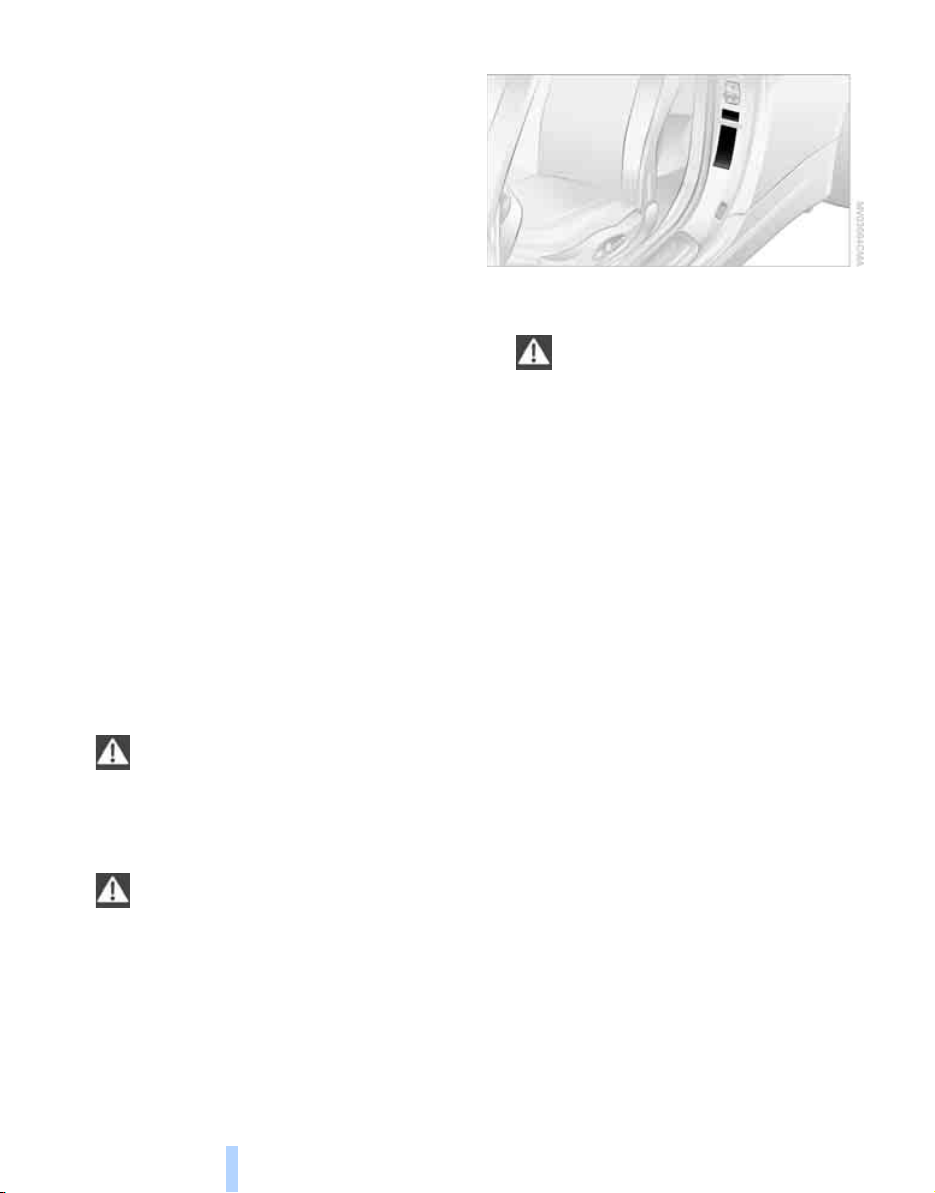
Things to remember when driving
120
during brake applications to clean the rotors is
not reached.
This can also lead to long-lasting decreases in
comfort and squeaking noise during braking.
These decreases in comfort can also be pro-
duced by long braking maneuvers with a low
pedal pressure.
Should corrosion form on the brake rotors, the
brakes will tend to respond with a pulsating
effect that even extended application will fail to
cure.
For technical information about the brake sys-
tem, refer to page 122.
When vehicle is parked
Condensation forms in the air conditioner sys-
tem during operation, and then exits under the
vehicle. Traces of condensed water under the
vehicle are therefore normal.
Before driving into a car wash
Fold in the exterior mirrors, refer to page 53,
otherwise they could be damaged due to the
width of the vehicle.
You can find valuable information on this topic
under Care, starting on page 220.
Cargo loading
To avoid loading the tires beyond their
approved carrying capacity, never over-
load the vehicle. Overloading can lead to over-
heating and increases the rate at which damage
develops inside the tires. The ultimate result
can assume the form of a sudden blow-out.<
Make sure that no fluids leak in the cargo
bay; otherwise the vehicle could be dam-
aged.<
Determining loading limit
1. Locate the following statement on your
vehicle's placard
*:
The combined weight of occupants
and cargo should never exceed
XXX lbs. or YYY kg, as otherwise the vehicle
may be damaged and unstable driving con-
ditions may result.<
2. Determine the combined weight of the
driver and passengers that will be riding in
your vehicle.
3. Subtract the combined weight of the driver
and passengers from XXX lbs. or YYY kg.
4. The resulting figure equals the available
amount of cargo and luggage load capacity.
For example, if the XXX amount equals
800 lbs. and there will be four 150-lb. pas-
sengers in your vehicle, the amount of avail-
able cargo and luggage load capacity is
200 lbs.:
800 lbs. minus 600 lbs. = 200 lbs.
5. Determine the combined weight of luggage
and cargo being loaded on the vehicle. That
weight may not safely exceed the available
cargo and luggage load capacity calculated
in step 4.
6. If your vehicle will be towing a trailer, part of
the load from your trailer will be transferred
to your vehicle. Consult the manual for
transporting a trailer to determine how this
may reduce the available cargo and luggage
load capacity of your vehicle.
Online Edition for Part no. 01 41 2 600 775 - © 08/08 BMW AG
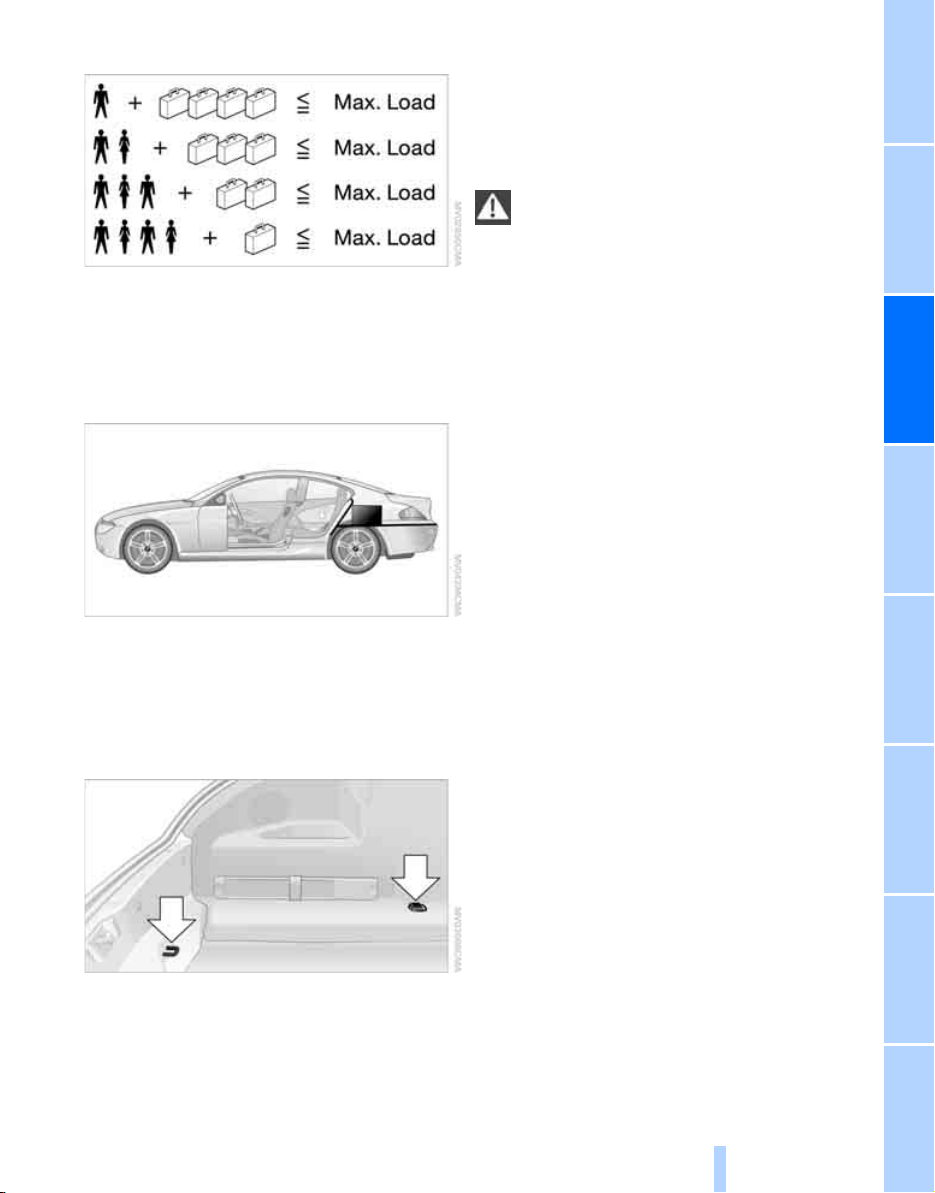
Driving tips
121
Reference At a glanceControlsCommunications NavigationEntertainmentMobility
Load
The permissible load is the total of the weight of
occupants and cargo/luggage. The greater the
weight of occupants, the less cargo/luggage
can be transported.
Stowing cargo
> Place heavy cargo as far forward and as low
as possible, placing it directly behind the
bulkhead behind the rear seats.
> Cover sharp edges and corners.
Securing cargo
> Use the luggage net* or securing straps to
hold down small and lightweight luggage
and cargo.
> Heavy-duty cargo straps
* for securing
larger and heavier objects are available at
your BMW center. Four lashing eyes
mounted in the cargo bay are used to
secure these heavy-duty cargo straps, refer
to illustration.
> Please observe the special instructions
supplied with the heavy-duty cargo straps.
Position and secure the cargo as
described above, so that it cannot endan-
ger the vehicle's occupants, for example if sud-
den braking or evasive maneuvers are neces-
sary.
Never exceed either the approved gross vehicle
weight or either of the approved axle loads, refer
to page 243, as excessive loads can pose a
safety hazard, and may also place you in viola-
tion of traffic safety laws.
You should never transport unsecured heavy or
hard objects in the passenger compartment, as
they could fly around and pose a safety hazard
to the vehicle's occupants during abrupt brak-
ing or evasive maneuvers.
Use only the lashing eyes pictured to fasten the
heavy-duty cargo straps. Do not secure cargo
with the upper attachment points for LATCH,
refer to page 59; otherwise, you could damage
them.<
Pad on base of luggage compartment
You can use the pad as needed, for example to
transport soiled objects. The rubberized side is
washable and has an anti-skid effect.
Online Edition for Part no. 01 41 2 600 775 - © 08/08 BMW AG
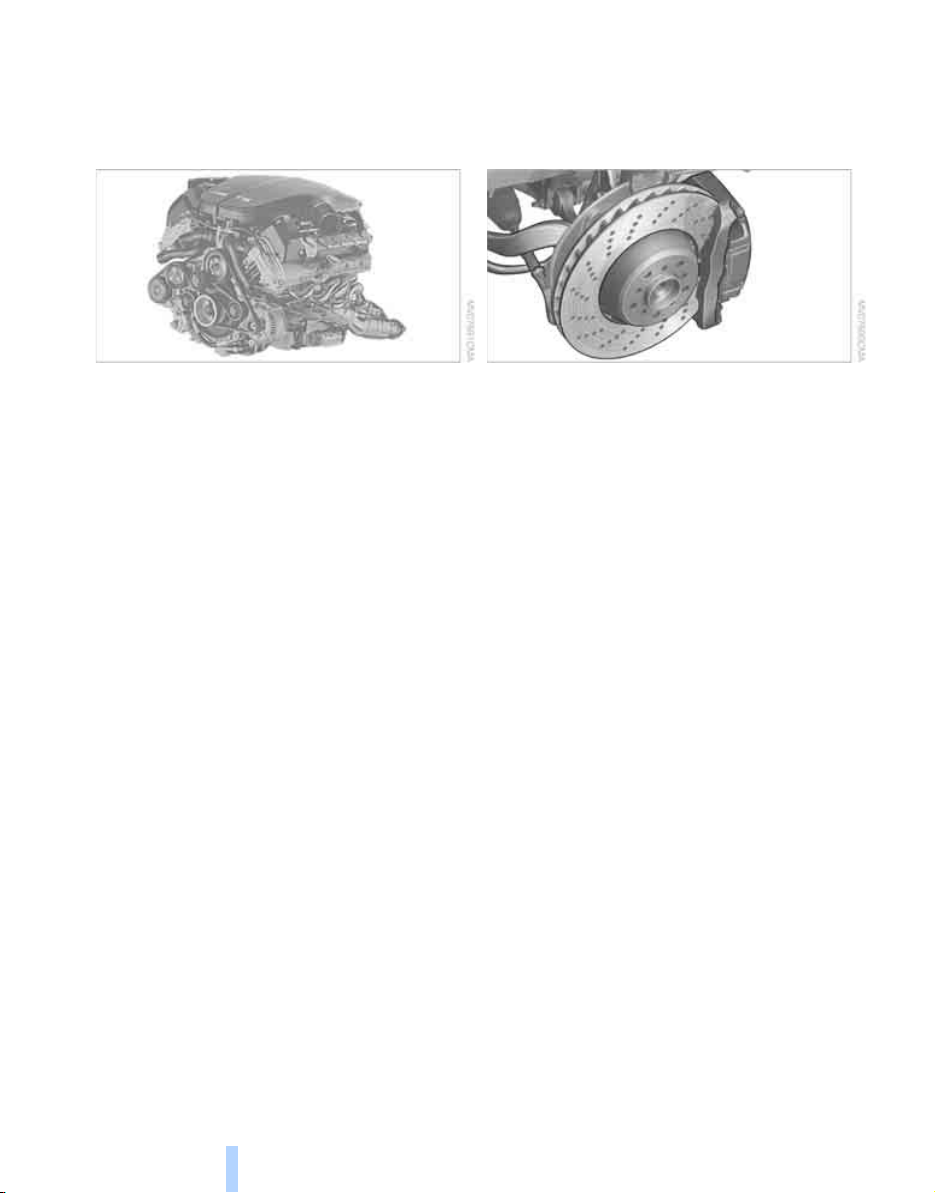
BMW M6 Engineering
122
BMW M6 Engineering
V10 High Output Engine
With a 305 cu in/5 liter displacement, the high-
speed V10 engine generates a maximum out-
put of 373 kW and a maximum torque of
384 lb ft/520 Nm. Its spontaneous response
characteristics yield a very broad usable engine
speed range. At the maximum engine speed of
8,250 rpm, the flow of fuel is interrupted in
order to protect the engine. Due to the powerful
engine dynamics, when the vehicle is at rest,
the maximum engine speed is limited to
7,000 rpm.
Warming up
The emissions control system causes the
V10 high-output engine to have slightly
rougher running characteristics during its
warm-up phase.
When the engine is cold, the exhaust system
has a slightly metallic undertone due to the sys-
tem design.
For additional information on warming up, refer
to Tachometer on page 70 and Engine oil tem-
perature on page 71.
Compound brake
Your BMW M6 has a high-performance brake
system with perforated compound brake rotors.
Due to the special structural features of these
brake rotors, function noises occur during brak-
ing, but this has no effect on the performance,
operating safety, and stability of the brakes.
Braking correctly
In order to keep the brake system in optimum
condition, it is useful to put them under load at
regular intervals in accordance with the nature
of the vehicle.
Also refer to Corrosion on brake rotors on
page 119.
Drive train
In your BMW M6, particular importance was
attached to the direct connection of the engine
to the drive system. Due to the torsionally rigid
design of the drive train, the transmission of the
torque is also audible, as is customary in a
sports car. As a result, load shifts can be dis-
tinctly audible. This does not in any way impair
the function or the service life of the compo-
nents.
Online Edition for Part no. 01 41 2 600 775 - © 08/08 BMW AG

Online Edition for Part no. 01 41 2 600 775 - © 08/08 BMW AG

Navigation
This chapter describes how you can enter
destinations and specify your route so that your
navigation system guides you reliably to your
destination.
Navigation
Online Edition for Part no. 01 41 2 600 775 - © 08/08 BMW AG
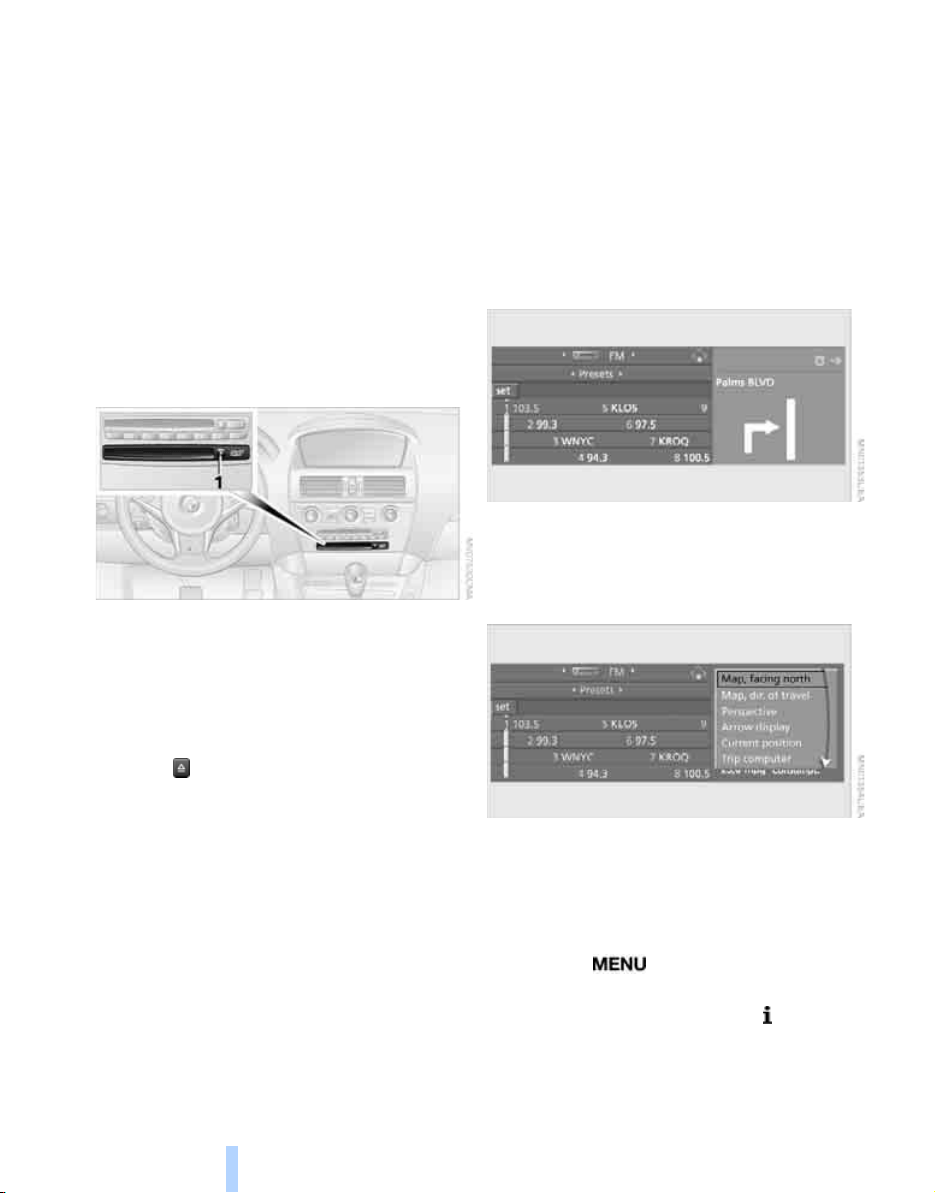
Starting navigation system
126
Starting navigation system
Your navigation system can use satellites to
ascertain the precise position of your vehicle
and guide you reliably to any destination you
enter.
Navigation DVD
The navigation system requires a special navi-
gation DVD. The latest version is available at
your BMW center.
Inserting navigation DVD
1. Insert the navigation DVD with the labeled
side up. The navigation DVD is retracted.
2. Allow several seconds for the system to
scan the data from the DVD.
Removing navigation DVD
1. Press button 1.
The DVD emerges slightly from the drive.
2. Remove the DVD.
If the DVD is not ejected from the drive, it is pos-
sible that it is blocked. In this case a message is
also shown on the Control Display.
Display in assistance window
You can display the route or the current position
in the assistance window. This display remains
visible even if you change to another applica-
tion.
1. Move the controller to the right to enter the
assistance window.
2. Press the controller.
Other menu items are displayed.
3. Select the desired route view or "Current
position".
4. Press the controller.
Displaying arrow view in map view*
If the navigation system suggests a change of
direction, the arrow view is briefly displayed.
1. Press the button.
This opens the start menu.
2. Press the controller to open the menu.
3. Turn the controller until "Settings" is
selected and press the controller.
*
Online Edition for Part no. 01 41 2 600 775 - © 08/08 BMW AG
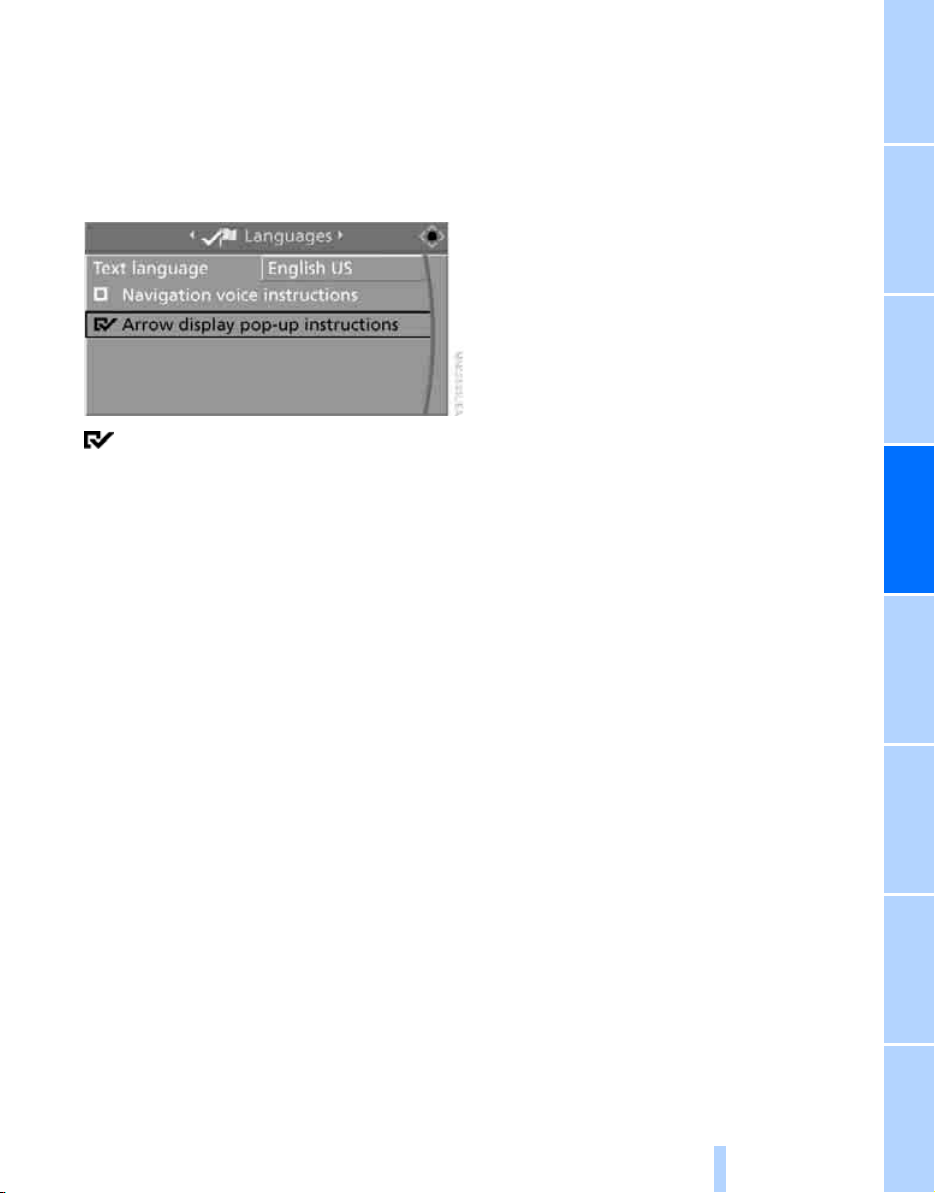
Navigation Driving tips
127
Reference At a glanceControlsCommunications EntertainmentMobility
4. Turn the controller until "Language / Units"
is selected and press the controller.
5. Change to upper field if necessary. Turn the
controller until "Languages" is selected and
press the controller.
6. Select "Arrow display pop-up instructions"
and press the controller.
The arrow view appears in the assistance
window.
Online Edition for Part no. 01 41 2 600 775 - © 08/08 BMW AG
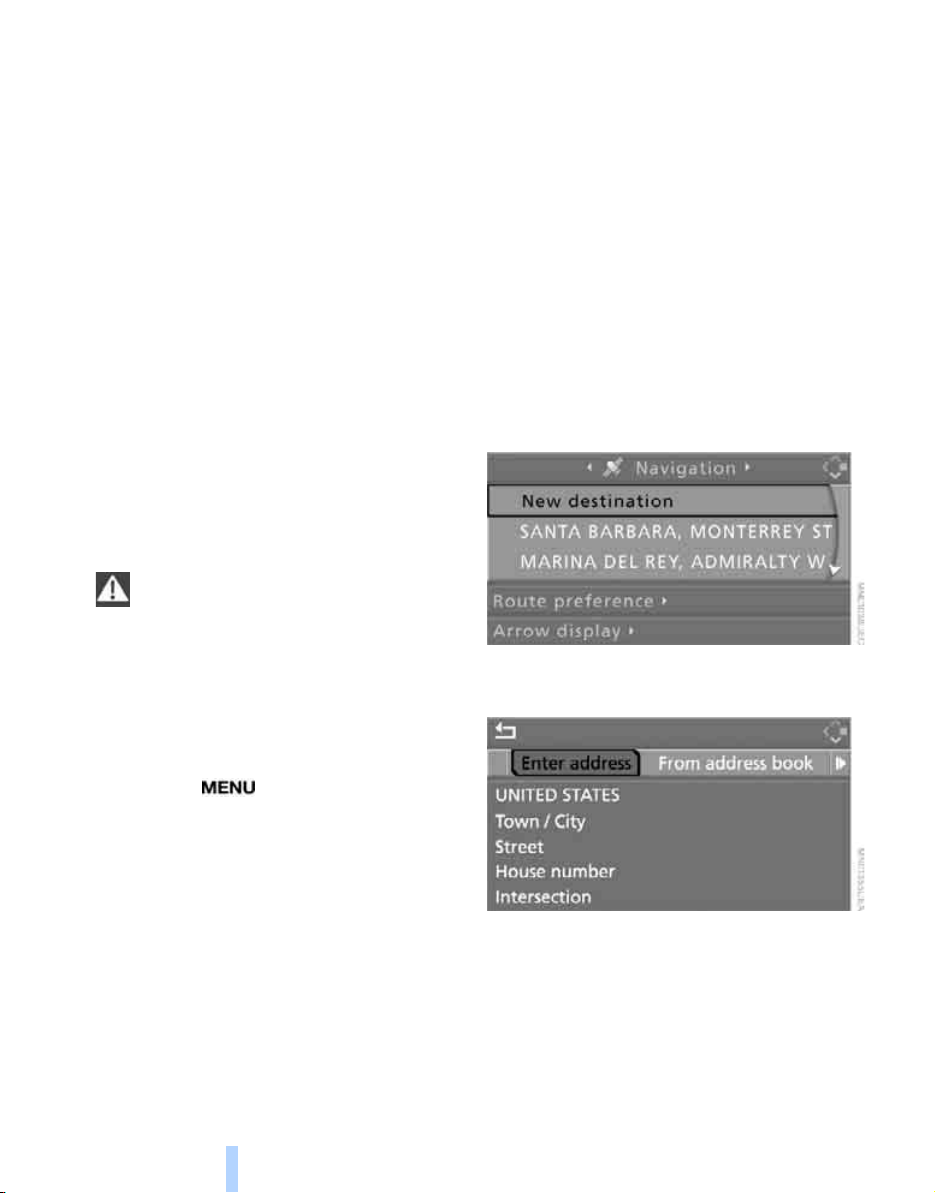
Destination entry
128
Destination entry
In entering your destination you can select from
among the following options:
> Entering a destination manually, see below
> Entering destination via voice*, refer to
page 131
> Selecting destination using information,
refer to page 134
> Selecting destination from a list, refer to
Destination list, page 135
> Selecting destination from address book,
refer to page 136
> Selecting home address, refer to page 138
After selecting your destination you can pro-
ceed to start the destination guidance, refer to
page 140.
You can also store a navigation destination on
the programmable memory buttons, refer to
page 22.
Enter data only when the vehicle is sta-
tionary, and always give priority to the
applicable traffic regulations in the event of any
contradiction between traffic and road condi-
tions and the instructions issued by the naviga-
tion system. If you do not observe this precau-
tion, you can endanger the vehicle occupants
and other road users.<
iDrive, for operating principle refer to page 16.
1. Press the button.
This opens the start menu.
2. Move the controller to the right to open
"Navigation".
3. Select "Navigation" and press the control-
ler.
The Control Display shows:
> the arrow view or map view during destina-
tion guidance
> the destination list when destination guid-
ance is switched off
Entering a destination
manually
The system's word matching principle makes it
easier for you to enter the names of streets or
towns, refer to page 139. This allows you to
enter different spellings and completes your
entry so that stored names can be called up
quickly.
1. Change to upper field if necessary. Turn the
controller until "Navigation" is selected and
press the controller.
"New destination" is selected.
2. Press the controller.
3. Select "Enter address" and press the con-
troller.
The system also supports you with the follow-
ing features:
> If you do not enter a street, the system will
guide you to the downtown area of a town/
city.
> You can skip the entry of country and local-
ity if the current entries should be retained
for your new destination.
Online Edition for Part no. 01 41 2 600 775 - © 08/08 BMW AG
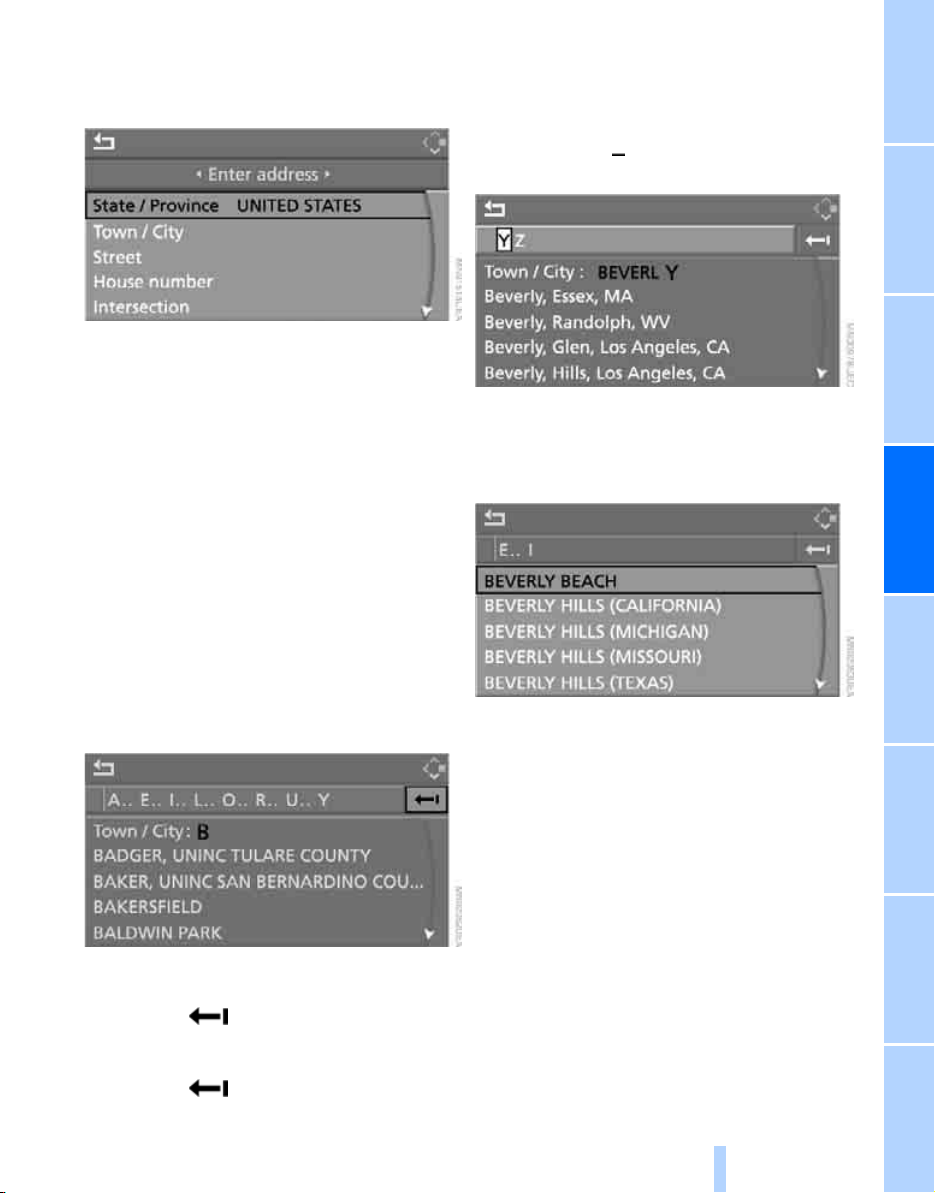
Navigation Driving tips
129
Reference At a glanceControlsCommunications EntertainmentMobility
Selecting country
1. Select "State / Province" or the displayed
country and press the controller.
The list of available countries appears on
the display.
2. Select the country of destination and press
the controller.
In order to be able to start the destination guid-
ance, at least the town/city of the destination or
its zip code must be entered.
Entering destination via town/city
name
1. Select "Town / City" or the displayed town/
city and press the controller.
2. Select the starting letter and press control-
ler.
A list of all towns/cities starting with this let-
ter appears on the Control Display.
3. To delete the letter entered if necessary:
> Delete individual numbers or letters:
Move the controller toward the right to
select and press the controller.
> Delete all numbers or letters:
Move the controller toward the right to
select and press and hold the con-
troller.
4. If necessary, enter more letters.
The list gradually grows smaller each time
you enter a new letter.
> Enter blank space if necessary:
Select the symbol and press the con-
troller.
5. Change to the third field from the top if nec-
essary. Turn the controller until the town/
city name is selected from the list and press
the controller.
Online Edition for Part no. 01 41 2 600 775 - © 08/08 BMW AG
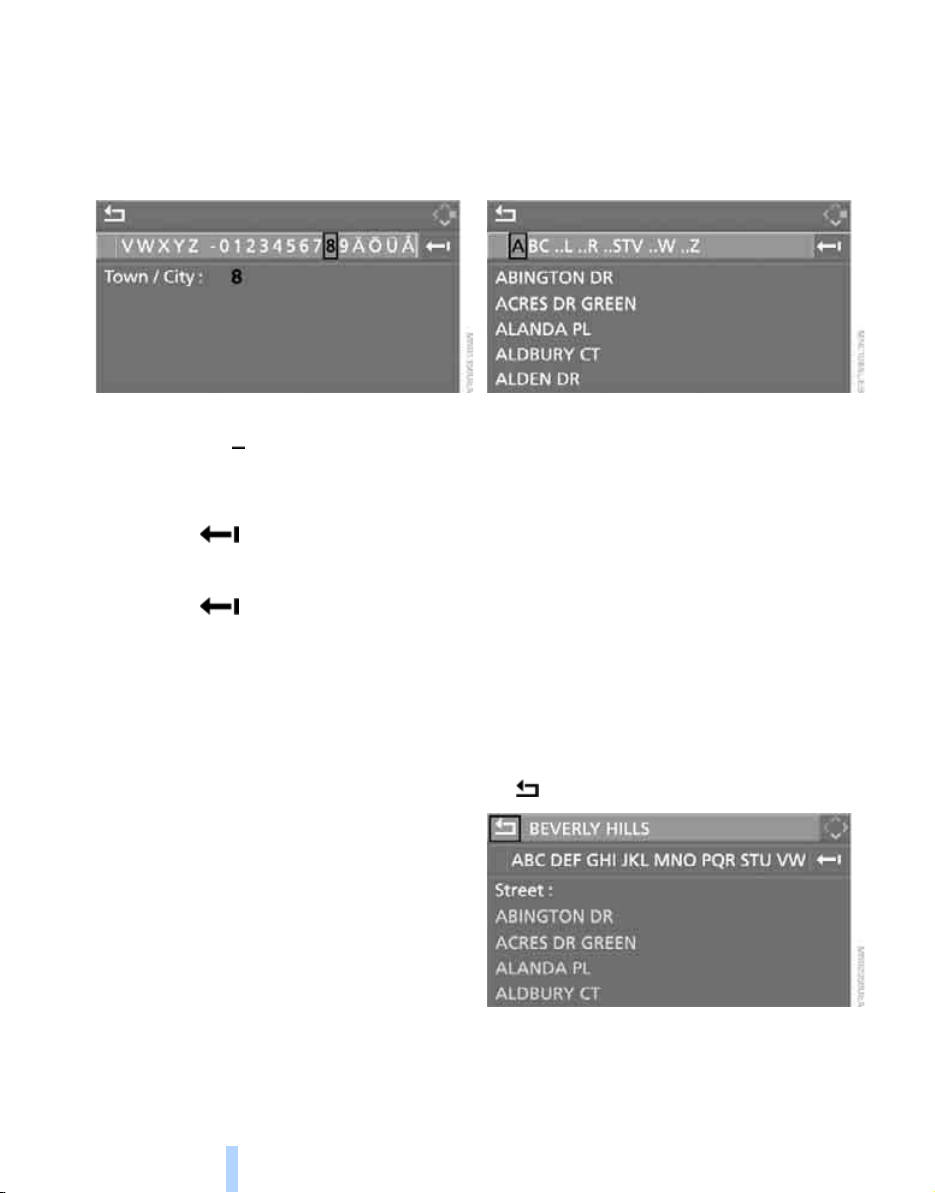
Destination entry
130
Entering destination by zip code
1. Select "Town / City" and press the control-
ler.
2. Enter the zip code:
Select the desired digits and press the con-
troller.
> Enter a blank space:
Select the symbol and press the con-
troller.
> Delete individual numbers or letters:
Move the controller toward the right to
select and press the controller.
> Delete all numbers or letters:
Move the controller toward the right to
select and press and hold the con-
troller.
3. Select the zip code and press the controller.
The corresponding destination is displayed.
4. Change into the third field from the top.
Turn the controller until the destination is
selected and press the controller.
Entering street, house number and
intersection
After the street you can also enter the intersec-
tion or the house number.
Entering street and intersection
1. Select "Street" or the street displayed and
press the controller.
2. Enter the street.
The street is entered exactly like the desti-
nation.
The intersection is entered in the same way as
the street.
Entering a street without entering
destination
You can also enter a street without entering a
destination. In this case all streets of the
entered country are offered for selection. The
related town/city is displayed after the street
name.
If a town/city has already been entered, you can
undo this entry. This may be practical if the
desired street does not exist in the entered des-
tination, because, for example, it belongs to
another part of the town/city.
1. Change to upper field.
The arrow is selected.
Online Edition for Part no. 01 41 2 600 775 - © 08/08 BMW AG
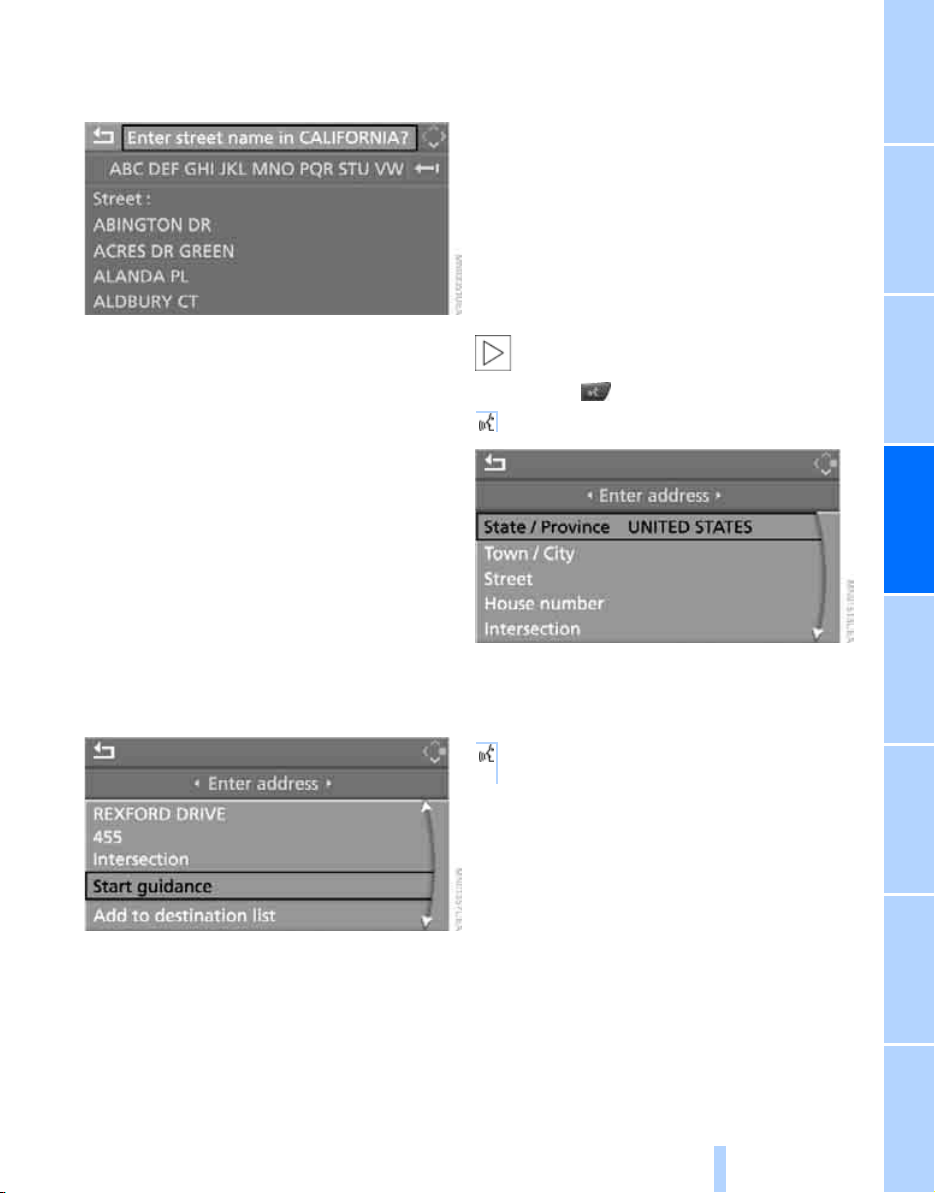
Navigation Driving tips
131
Reference At a glanceControlsCommunications EntertainmentMobility
2. Turn the controller to the right until the
request for the entry of a street in the coun-
try appears and press the controller.
3. Change to the second field from the top and
enter the street.
Entering house number
All house numbers stored for the street on the
navigation DVD can be entered.
1. Select "House number" and press the con-
troller.
2. Enter the house number:
Select the desired digits and press the con-
troller.
3. Change into the third field from the top.
Turn the controller until the house number
is selected and press the controller.
Starting destination guidance with
manual destination entry
> Select "Start guidance" and press the con-
troller.
Destination guidance starts immediately.
> If the destination guidance does not need to
be started immediately:
Select "Add to destination list" and press
the controller.
The destination is stored in the destination
list, refer to page 135.
Entering destination via
voice*
You can enter a desired destination via the
voice command system. When entering the
destination, it is possible to change between
voice command and iDrive at any time. Reacti-
vate the voice command function for this pur-
pose if necessary.
With {Options} you can have the possible
commands read aloud.<
1. Press the button on the steering wheel.
Selecting country
1. Wait for the system to ask for the country of
destination.
Say the name of the country of destination in
the language of the voice command system.
Entering destination
The destination can be spelled or entered as an
entire word.
Spelling destination
To enter the destination, spell it using the
orthography of the country of destination.
Pronounce the letters smoothly and at normal
2. {Enter address}
2. Say the name of the country of destina-
tion.
Online Edition for Part no. 01 41 2 600 775 - © 08/08 BMW AG
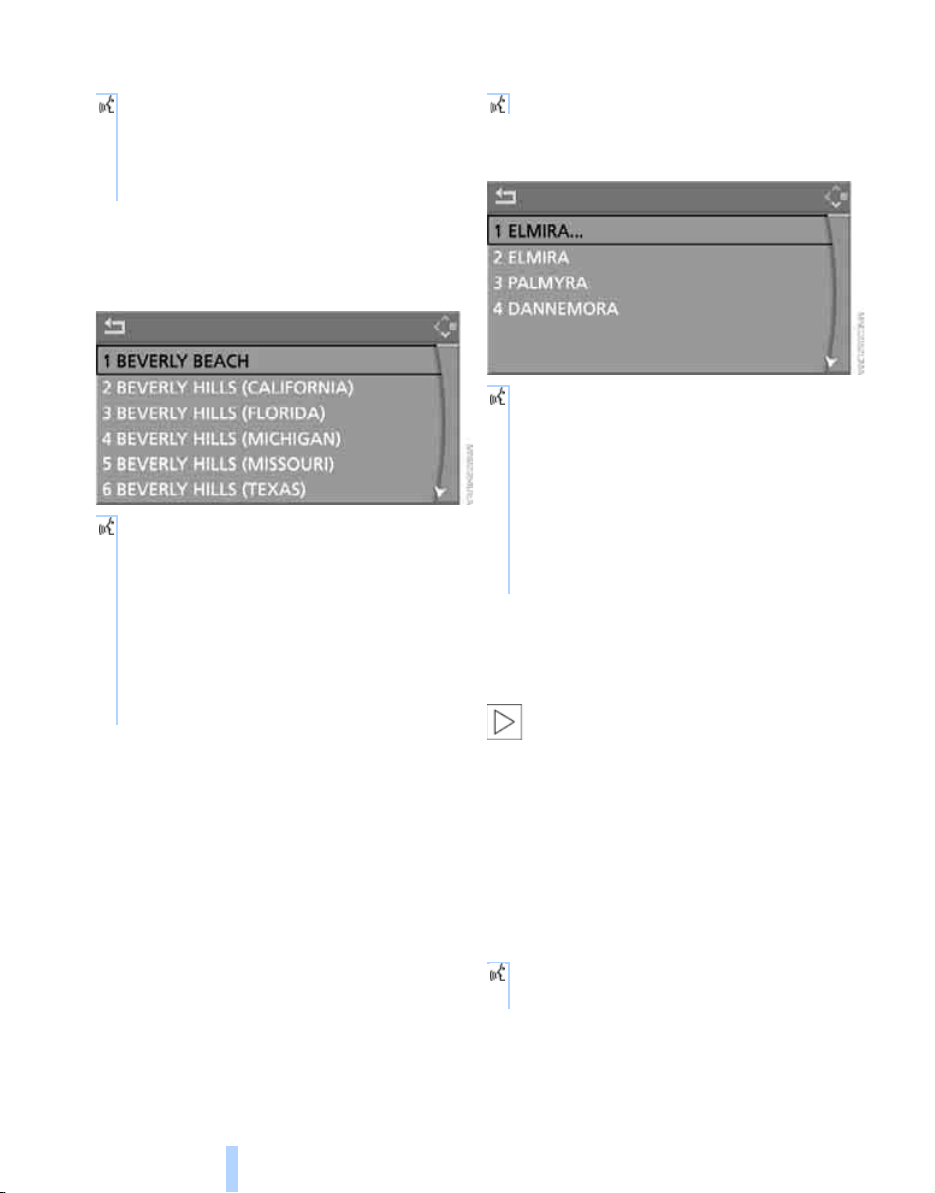
Destination entry
132
volume, avoiding excessive emphasis and
pauses.
The system can suggest up to 20 destina-
tions that match your entries. Up to
6 entries are displayed at once on the Con-
trol Display.
The town/city can also be selected from the list
via iDrive:
Turn the controller until the destination is
selected and press the controller.
Entering the destination as an entire
word*
Towns/cities and streets located in the region
where the language of the voice command sys-
tem is spoken can be entered as an entire word.
Example: to enter a US destination as an entire
word, the system language must be English.
Speak smoothly and at normal volume, avoiding
excessive emphasis and pauses.
1. Wait for the system to request the destina-
tion.
The system can suggest up to 6 destina-
tions that match your entries.
The town/city can also be selected from the list
via iDrive:
Turn the controller until the destination is
selected and press the controller.
Destinations that sound the same which
cannot be differentiated by the system
are summarized in a separate list and shown as
a destination followed by three dots.
Select this entry with {Yes} if necessary. Then
select the desired town/city from this list.<
Entering street and house number
The street is entered in the same way as the
destination.
To enter the house number:
Up to 4-digit house numbers can be entered.
Say the house number as individual numbers.
1. Spell town/city name:
Say at least the first three letters of the
destination. The more letters you say,
the more exactly the system recognizes
the town/city.
A destination is suggested by the system.
2. Select town/city:
> Select highlighted town/city: {Yes}
> Select other town/city: {No}
> Select entry, e.g. {Entry 3}
> To show other entries in the list:
{Next page}
> To respell the town/city: {Repeat}
2. Say the name of the destination.
A destination is suggested by the system.
3. Select town/city:
> Select highlighted town/city: {Yes}
> Select other town/city: {No}
> Select entry, e.g. {Entry 3}
> To reenter the town/city: {Repeat}
> To enter the town/city by spelling:
{Spell}
1. {House number}
2. Say the house number.
Online Edition for Part no. 01 41 2 600 775 - © 08/08 BMW AG
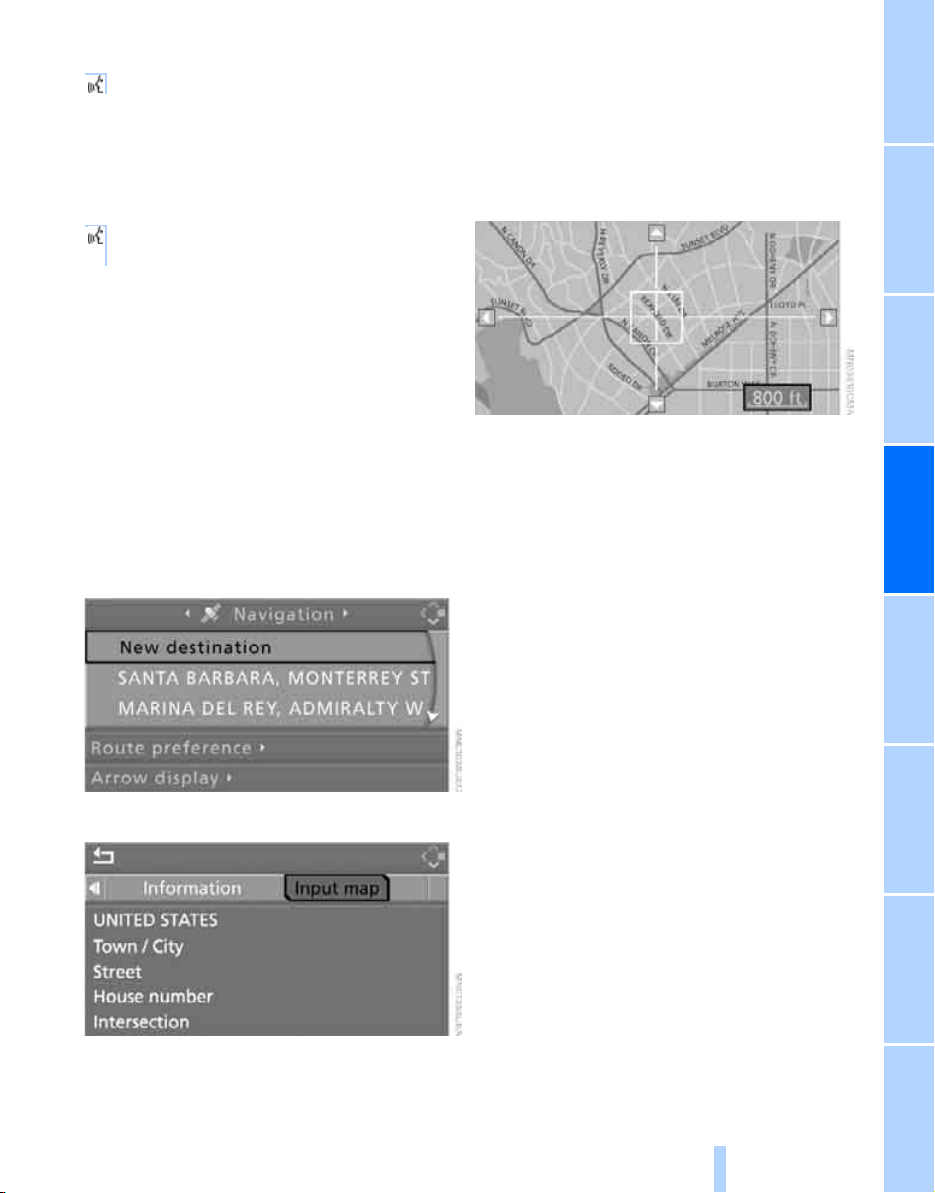
Navigation Driving tips
133
Reference At a glanceControlsCommunications EntertainmentMobility
Starting destination guidance
Destination guidance starts immediately.
Saving destination
The destination is added to the destination list
or can be stored in the address book.
Map-guided destination
selection
If you only know the location of the town/city or
street of the destination, then you can enter the
destination by using a map. You can use the
cursor to select the destination on the map and
then adopt it into the destination guidance.
1. Select "Navigation" and press the control-
ler.
"New destination" is selected.
2. Press the controller.
3. Select "Input map" and press the controller.
A section of a map is displayed on the Con-
trol Display:
> During destination guidance, around the
current destination
> With the destination guidance deacti-
vated, around the last destination
entered
4. Select destination with cursor.
> Changing scale: turn the controller.
> Moving map: move the controller in the
required direction.
The controller can be moved to the left,
right, forwards and backwards.
5. To adopt or store the destination in the des-
tination guidance system, press the con-
troller.
The selected destination and other menu
items are displayed.
{Start guidance}
{Add to destination list} or
{Add to address book}
Online Edition for Part no. 01 41 2 600 775 - © 08/08 BMW AG
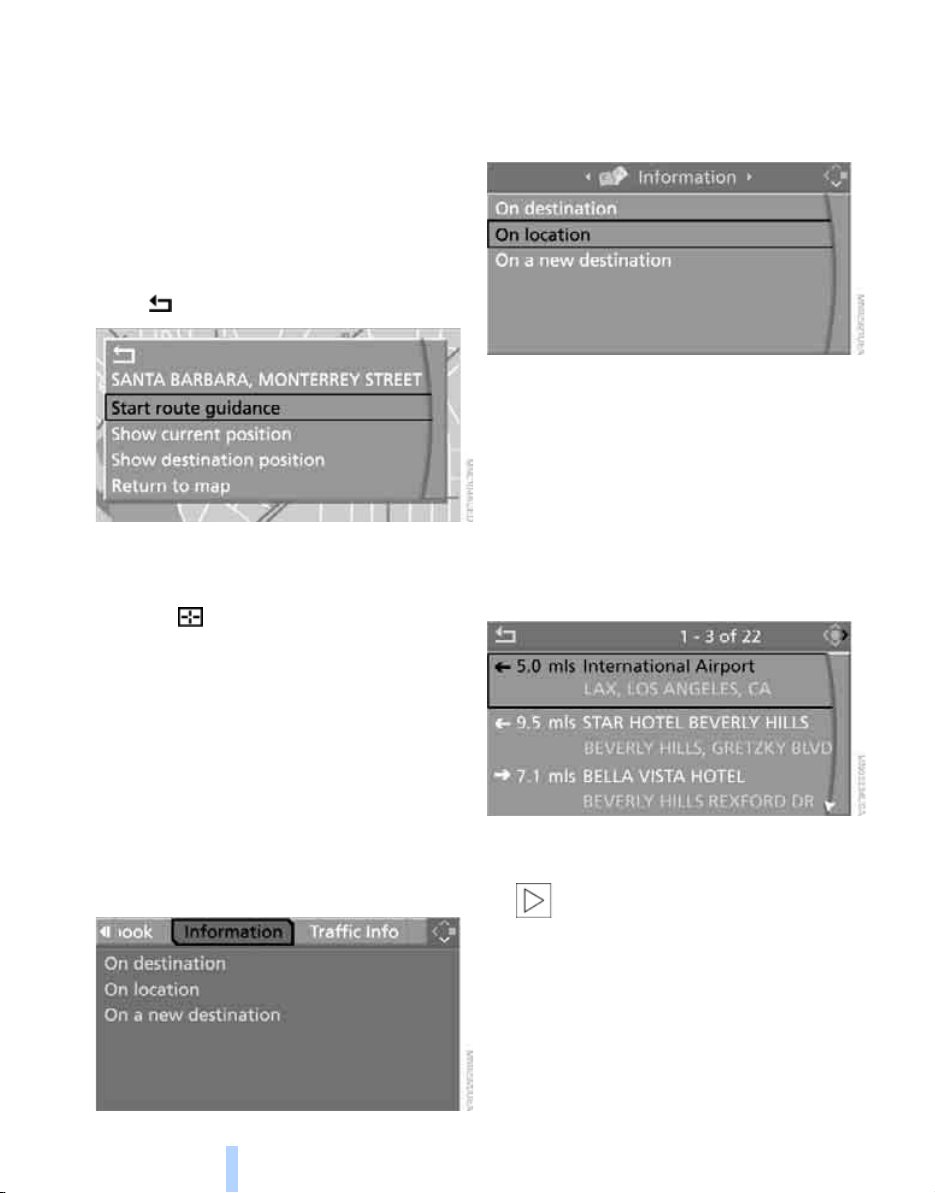
Destination entry
134
6. Select the desired menu item:
> "Start route guidance" starts destination
guidance.
> "Show current position" places your
current position at the center of the map.
> "Show destination position" places the
current destination at the center of the
map.
> "Return to map" changes back to the
"Input map".
> Exit the menu.
7. Press the controller.
The map for the destination entry can also be
displayed in the map display:
Select the symbol and press the controller.
Selecting destination using
information
You can obtain a display of selected destina-
tions, e.g. hotels, sights or hospitals, and adopt
them into the destination guidance.
1. Select "Navigation" and press the control-
ler.
2. Select "Information" and press the control-
ler.
3. Select location:
> "On destination"
> "On location"
> "On a new destination"
4. Press the controller.
5. Make your selection, e.g. "Hotels and res-
taurants", and press the controller.
6. Enter search criteria if necessary, e.g. the
maximum distance from the current loca-
tion.
7. Select "<Start search>" and press the con-
troller.
These destinations are displayed on the
Control Display.
8. Select a destination and press the control-
ler.
The scope of the information and
symbols is dependent on the respec-
tive navigation DVD.<
9. Select the desired menu item:
> To adopt the address in the destination
list and start the destination guidance:
Online Edition for Part no. 01 41 2 600 775 - © 08/08 BMW AG
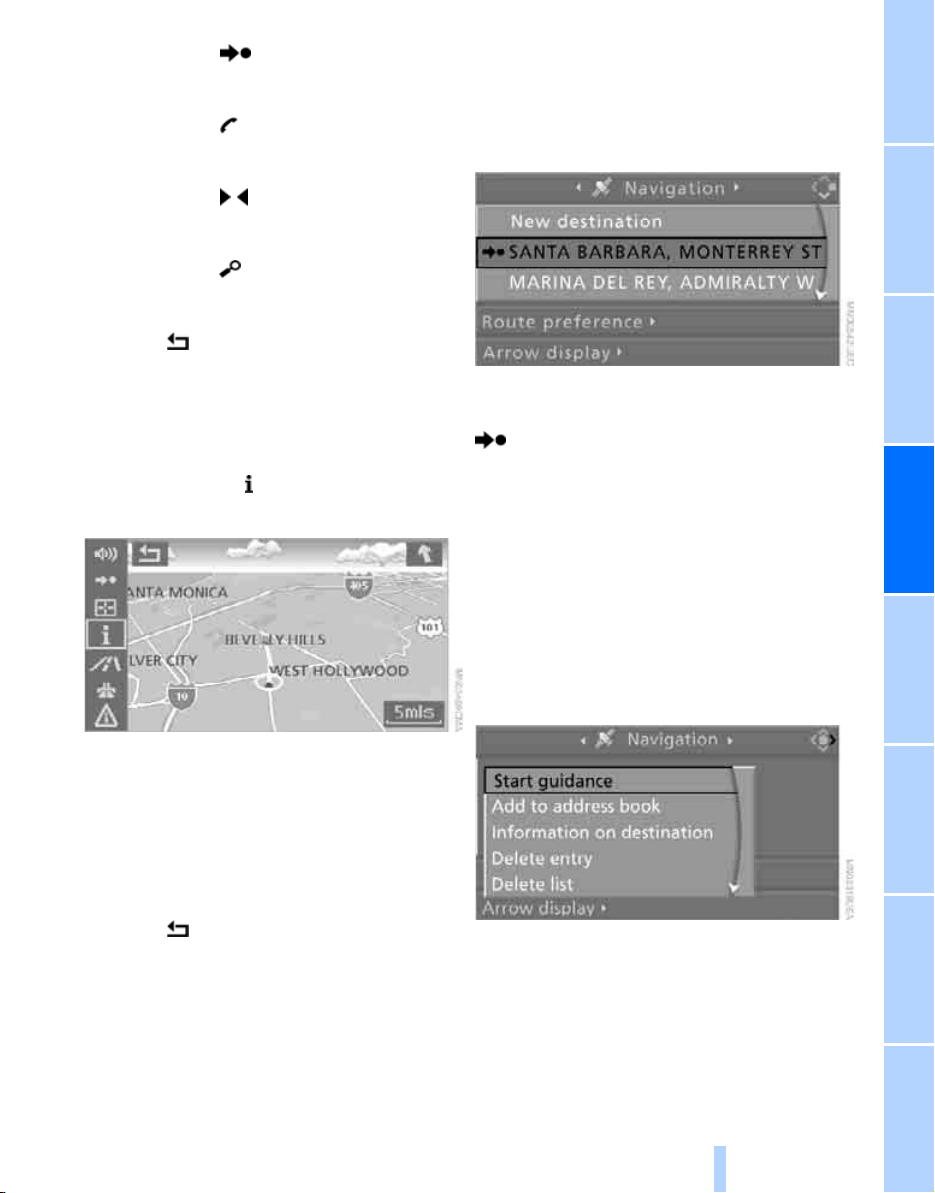
Navigation Driving tips
135
Reference At a glanceControlsCommunications EntertainmentMobility
Select the symbol and press the
controller.
> To establish a telephone connection:
Select the symbol and press the con-
troller.
> To display additional destinations:
Select the symbol and press the
controller.
> To start a new search:
Select the symbol and press the con-
troller.
To exit the menu:
Select the arrow and press the controller.
Symbols in map view
If, for example, you have selected the category
Hotels, the hotels are shown on the map as
symbols.
To hide the symbols in the map view:
1. Select the symbol and press the controller.
2. Select "Hide map icons" and press the con-
troller.
The symbols are hidden.
To display the symbols:
Select "Show map icons" and press the con-
troller.
To exit the menu:
Select the arrow and press the controller.
Destination list
The last 20 entered destinations are shown in
the destination list. You can display these desti-
nations and adopt them in the destination guid-
ance system.
For example, to plan a longer route, you can
store all destinations you want to drive to in
advance in the destination list, refer to Entering
a destination manually on page 128.
Select "Navigation" and press the controller.
The last destination entered is the first item in
the destination list.
This symbol indicates the current destina-
tion during destination guide.
To display additional destinations from the des-
tination list:
turn the controller.
Applying destination in destination
guidance system
1. Select the desired destination and press
the controller.
2. Select "Start guidance" and press the con-
troller.
Online Edition for Part no. 01 41 2 600 775 - © 08/08 BMW AG
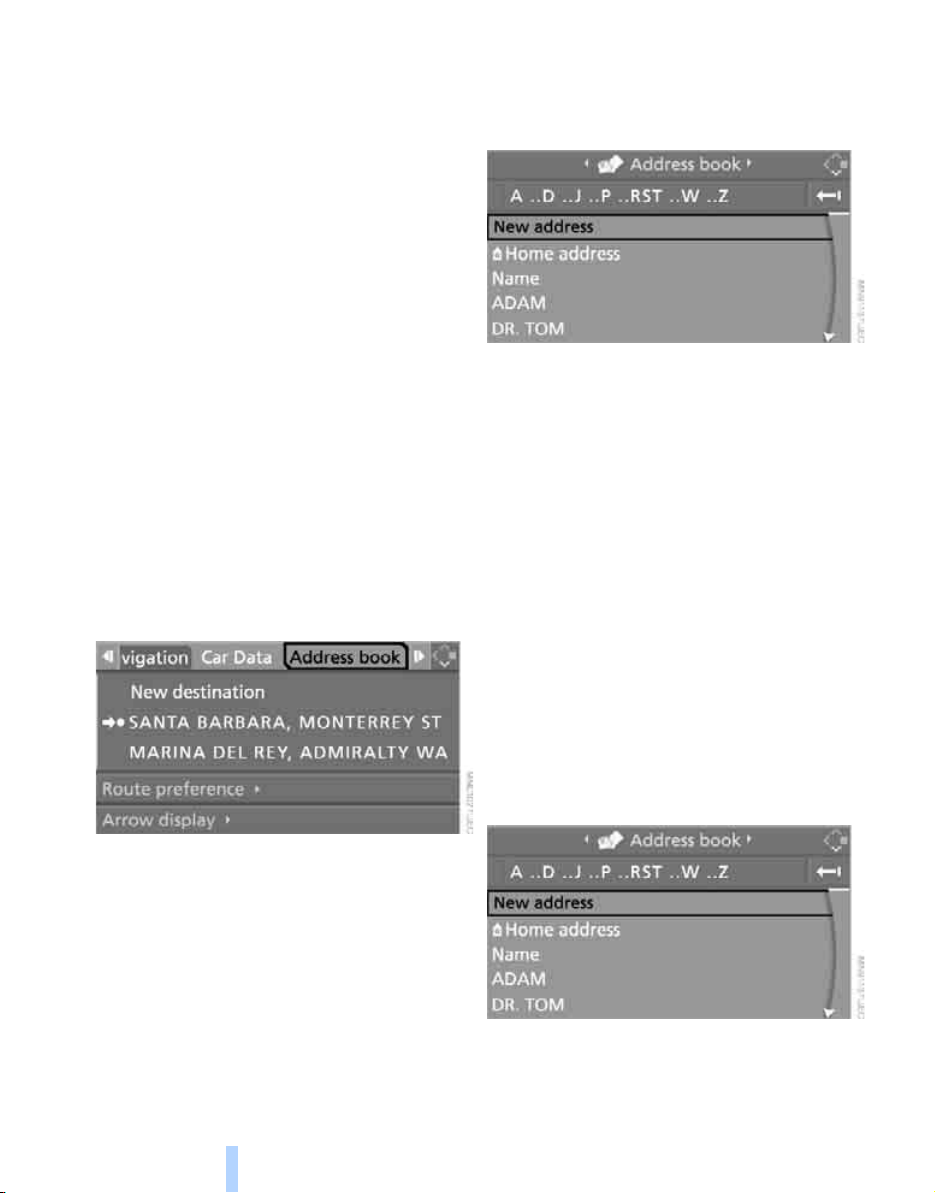
Destination entry
136
Editing destination list
1. Select the desired destination in the desti-
nation list and press the controller.
2. The selected destination can be edited:
> Store entry:
Select "Add to address book".
> Display information on destination:
Select "Information on destination".
> Delete entry:
Select "Delete entry".
> Delete all entries:
Select "Delete list". The destination
guidance is switched off.
> Change entry:
Select "Edit". For operation, refer to
Entering destination via town/city name,
page 129.
3. Press the controller.
Address book
Opening address book
iDrive, for operating principle refer to page 16.
Select "Address book" and press the controller.
Storing destinations in address book
You can store approx. 100 destinations in the
address book.
1. Select "Address book" and press the con-
troller.
2. Select "New address" and press the con-
troller.
3. Select "Enter address" and press the con-
troller.
4. Enter name and address, also refer to
Entering a destination manually, page 128.
5. Select "Store in address book" and press
the controller.
The entry is stored in the address book.
You can also store a destination from the desti-
nation list in the address book, refer to
page 135.
Storing current position*
The current position can be adopted into the
address book.
1. Select "Address book" and press the con-
troller.
2. Change into the third field from the top.
Turn the controller until "New address" is
selected and press the controller.
3. Select "Use current location as address"
and press the controller.
The name given can be changed. For oper-
Online Edition for Part no. 01 41 2 600 775 - © 08/08 BMW AG
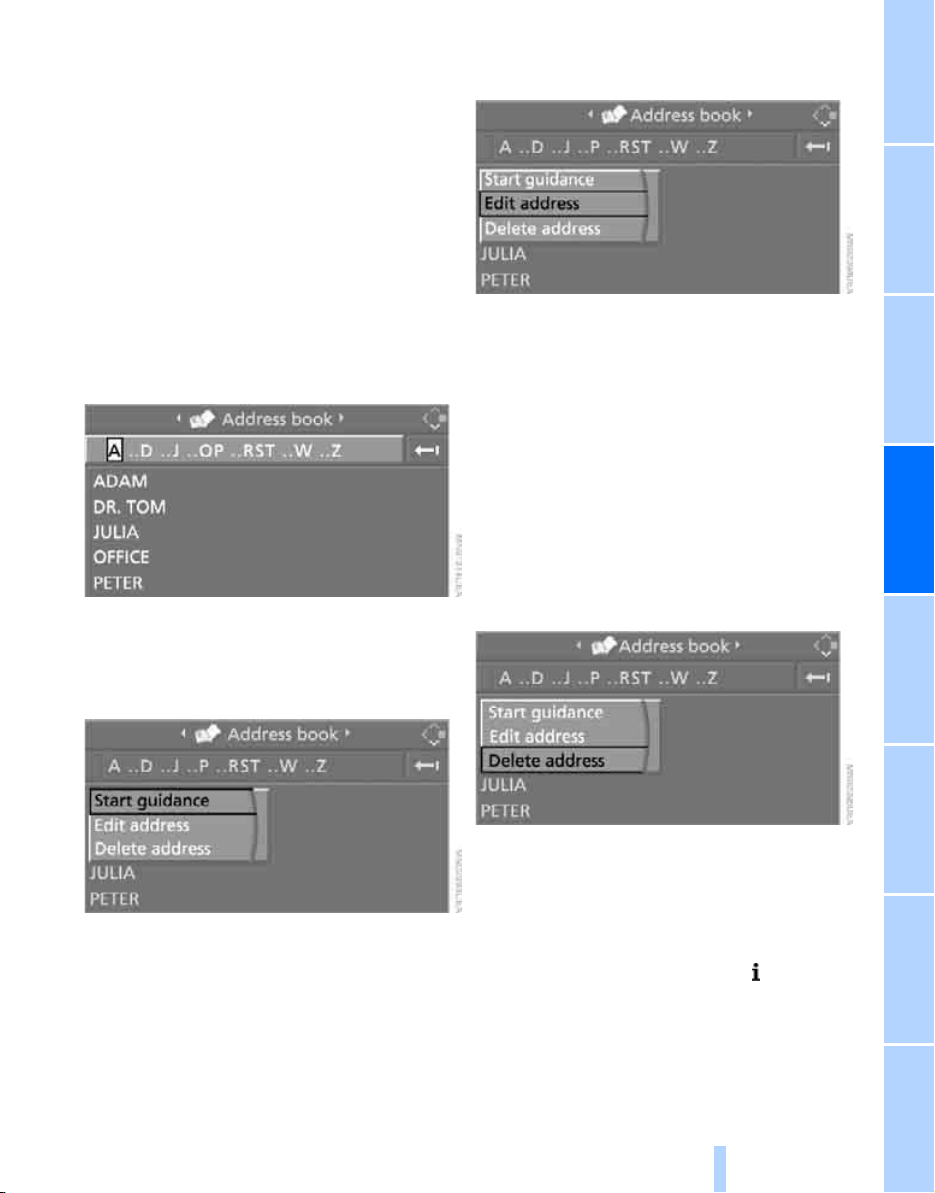
Navigation Driving tips
137
Reference At a glanceControlsCommunications EntertainmentMobility
ation, refer to Entering a destination manu-
ally, page 128.
4. Select "Store in address book" and press
the controller.
You can also enter your current position into the
address book if you have left the sector covered
by the navigation DVD. In this case, you must
enter a name.
Selecting destinations from address
book
1. Select "Address book" and press the con-
troller.
The stored entries appear on the Control
Display.
2. Select the entry and press the controller.
To start the destination guidance:
Select "Start guidance" and press the control-
ler.
Changing destinations from address
book
1. Select "Address book" and press the con-
troller.
2. Select the entry and press the controller.
3. Select "Edit address" and press the con-
troller.
4. Change entry.
For operation, refer to Entering a destina-
tion manually, page 128.
5. Select "Store in address book" and press
the controller.
Deleting individual destinations from
address book
1. Select "Address book" and press the con-
troller.
2. Select the entry and press the controller.
3. Select "Delete address" and press the con-
troller.
4. Select "Yes" and press the controller.
Deleting all destinations from address
book
1. Open the start menu.
2. Press the controller to open the menu.
3. Select "Settings" and press the controller.
4. Select "Vehicle / Tires" and press the con-
troller.
Online Edition for Part no. 01 41 2 600 775 - © 08/08 BMW AG
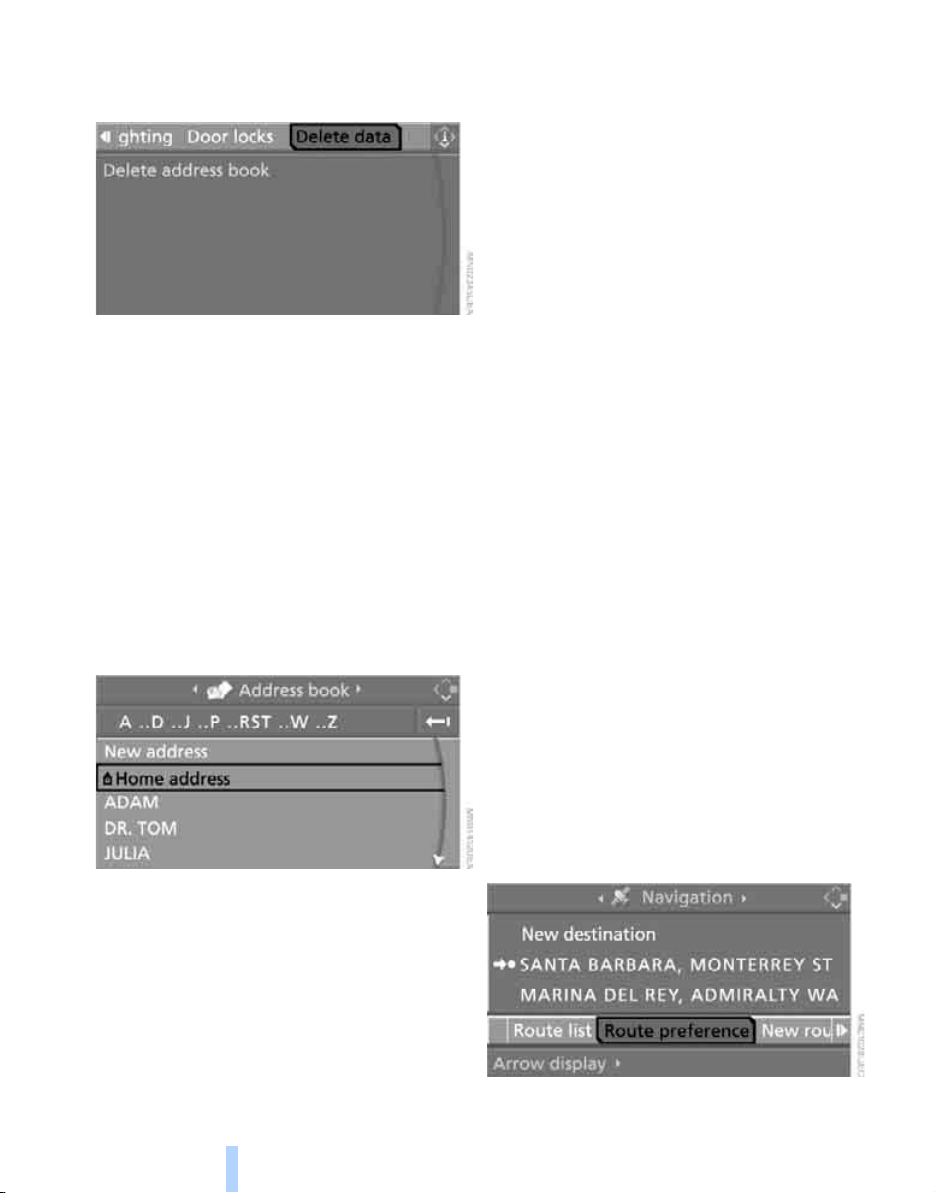
Destination entry
138
5. Change to upper field if necessary. Turn the
controller until "Delete data" is selected and
press the controller.
6. Select "Delete address book" and press the
controller.
7. Select "Yes" and press the controller.
Storing home address
You can store your current position or the cur-
rent destination as the home address in the
address book. This entry occupies the second
position in the address book.
1. Select "Address book" and press the con-
troller.
2. Change into the third field from the top.
Turn the controller until "Home address" is
selected and press the controller.
3. Select "Use current location as address", or
"Save current destination" during the desti-
nation guidance, and press the controller.
4. Select "Store in address book" and press
the controller.
Adopting home address as destination
1. Select "Home address" and press the con-
troller.
2. Select "Start guidance" and press the con-
troller.
Changing home address
1. Select "Home address" and press the con-
troller.
2. Select "Edit address" and press the con-
troller. For operation, refer to Entering a
destination manually, page 128.
Selecting route
You can influence the calculated route by
choosing certain route criteria. You can change
the route criteria as often as you like while
entering the destination and whenever the des-
tination guidance is active.
The route is planned according to fixed rules.
The type of road is taken into account, e.g.
whether it is a highway or a winding road. The
road types are stored on the navigation DVD.
As a result, the routes recommended by the
navigation system may not always be the same
ones that you would choose based on personal
experience.
Changing route criteria
1. Select "Navigation" and press the control-
ler.
2. Change into the third field from the top.
Turn the controller until "Route preference"
is selected and press the controller.
Online Edition for Part no. 01 41 2 600 775 - © 08/08 BMW AG
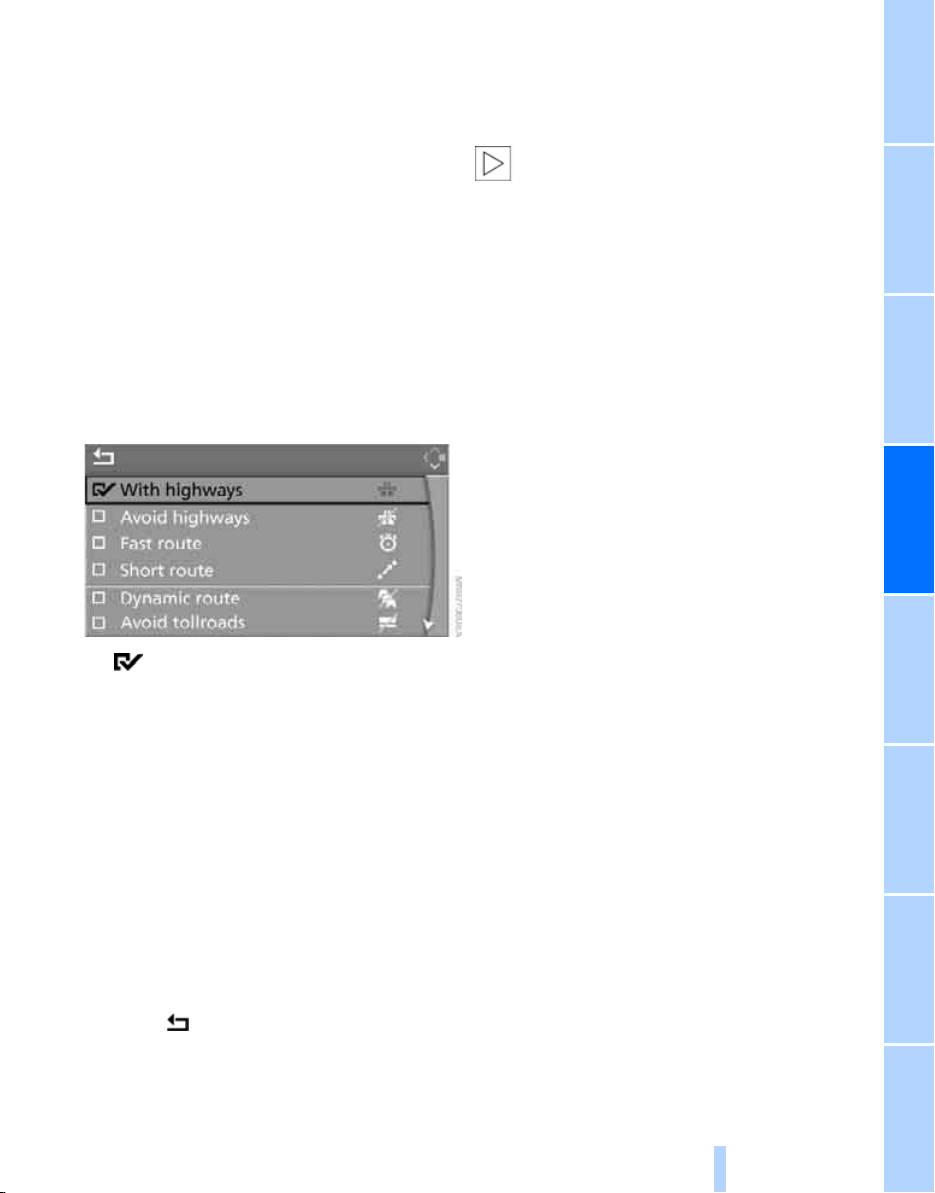
Navigation Driving tips
139
Reference At a glanceControlsCommunications EntertainmentMobility
The various criteria are listed on the Control
Display.
3. Select a route criterion for the route:
> "With highways"
Freeways and major traffic arteries are
given priority.
> "Avoid highways"
Freeways are avoided where possible.
> "Fast route"
Fast route, being a combination of the
shortest possible route and the fastest
roads.
> "Short route"
Short route, irrespective of how fast or
slow progress will be.
4. Press the controller.
The route criterion is selected.
5. If necessary, select an additional route cri-
terion and then press the controller:
> "Dynamic route"
Automatic rerouting due to traffic
obstructions. Depending on road type
and the kind and length of the traffic
obstruction, the route can also be calcu-
lated so that it passes through the traffic
obstruction.
> "Avoid tollroads"
Tollroads are avoided where possible.
> "Avoid ferries"
Ferries are avoided where possible.
To exit the menu:
Select the arrow and press the controller.
The route criteria can also be changed in the
arrow or map view:
1. Select the symbol for the route criterion and
press the controller.
2. Select a route criterion and press the con-
troller.
If the route criterion "Avoid highways",
"Avoid tollroads", or "Avoid ferries" is
selected, the calculation time for the route can
increase considerably.<
Word matching principle
The system supports the word matching princi-
ple to make it easier for you to enter the names
of streets or towns. The system runs ongoing
checks, comparing your destination entries
with the data stored on the navigation DVD as
the basis for instant response. The user bene-
fits include:
> Names of specific locations can also vary
from the official versions if you are using a
spelling that is customary in another coun-
try.
Example:
Instead of the German spelling "München"
you can also enter the English spelling
"Munich" or the Italian spelling "Monaco".
> When you are entering the names of towns
and streets, the system will complete them
as soon as enough letters are available to
ensure unambiguous identification.
> The system only accepts name entries
beginning with letters that are stored on the
navigation DVD. The system will not accept
non existent names and addresses.
Online Edition for Part no. 01 41 2 600 775 - © 08/08 BMW AG
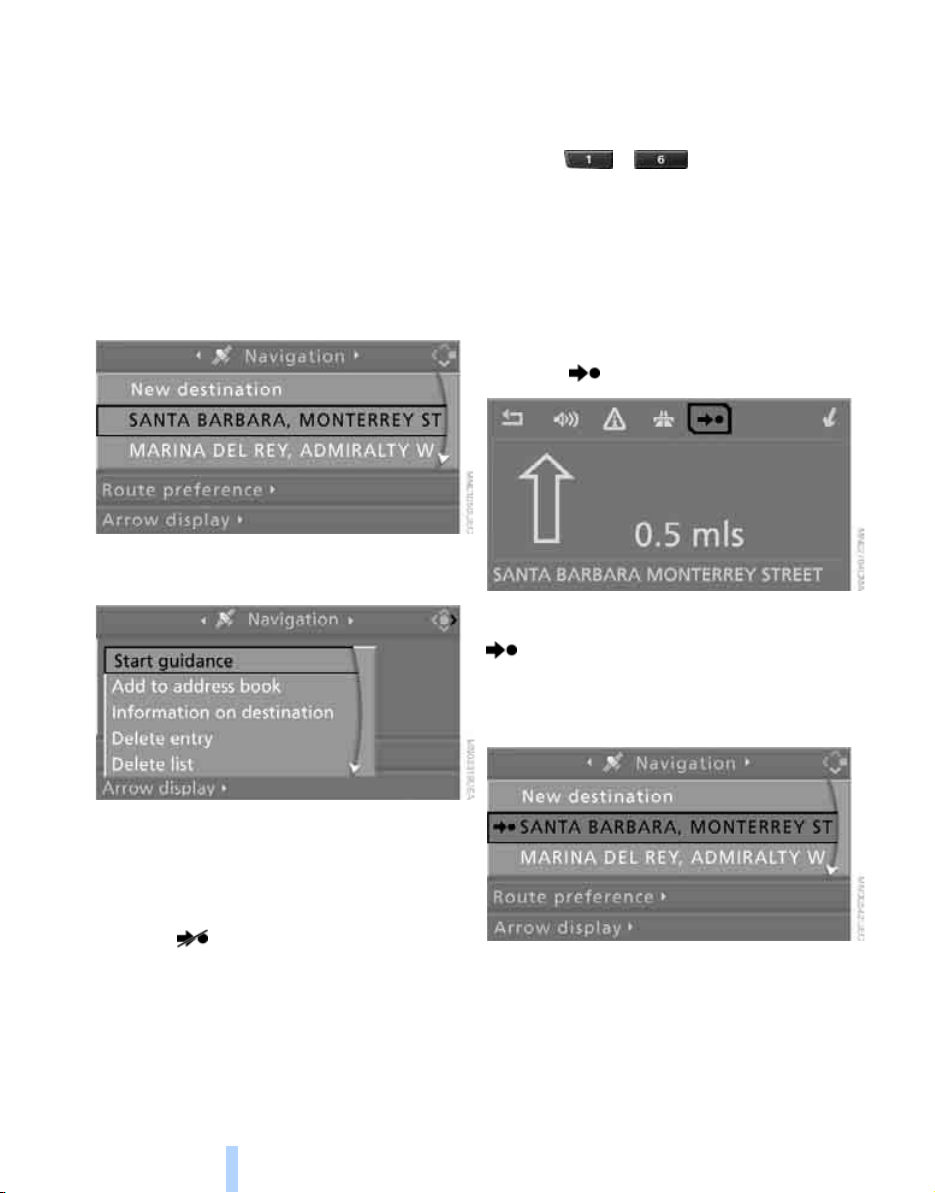
Destination guidance
140
Destination guidance
Starting destination
guidance
1. Change to upper field if necessary. Turn the
controller until "Navigation" is selected and
press the controller.
2. Select a destination from the destination list
and press the controller or enter a new des-
tination, refer to page 128.
3. Select "Start guidance" and press the con-
troller.
After the route has been calculated, destination
guidance is indicated by arrows or a map dis-
play on the Control Display.
The destination guidance can also be started in
the arrow or map view:
Select the symbol and press the controller.
During destination guidance, you can operate
other equipment via iDrive at any time. You will
be punctually notified of a change of direction
by spoken instructions and the display of the
direction arrow.
About programmable memory buttons
Press the ... button on which the
desired destination is stored. Also refer to
page 23.
Terminating/continuing
destination guidance
In arrow or map display
Select the symbol and press the controller.
In destination list
This symbol indicates the current destina-
tion.
1. Select the current destination and press the
controller.
Online Edition for Part no. 01 41 2 600 775 - © 08/08 BMW AG
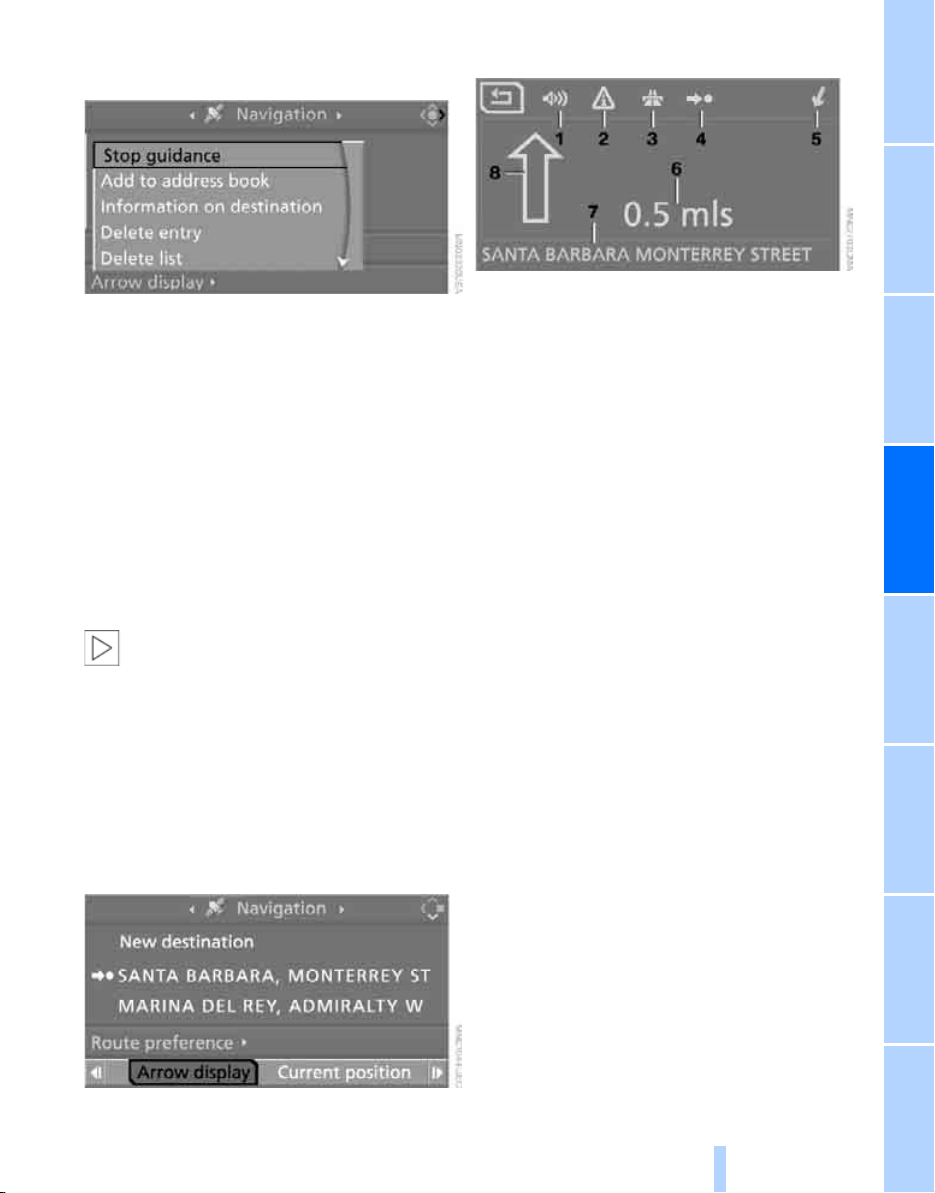
Navigation Driving tips
141
Reference At a glanceControlsCommunications EntertainmentMobility
2. Select "Stop guidance" and press the con-
troller.
When you park the vehicle before reaching the
entered destination, the following question is
displayed before beginning the next trip:
"Continue guidance to destination?".
The destination guidance starts automatically
after a short time.
To start the destination guidance:
Select "Yes" and press the controller.
Displaying route
You have the option of displaying various views
of the route during destination guidance.
From another menu, you can change
directly to the screen last displayed,
refer to Comfort opening of menu items,
page 19.<
Displaying arrow display
1. Select "Navigation" and press the control-
ler.
2. Change into the fourth field from the top.
Turn the controller until "Arrow display" is
selected and press the controller.
The arrow display is shown.
1 Switching voice instructions on/off
2 Manually displaying traffic information
*
3 Selecting route criteria
4 Starting/ending destination guidance
5 Arrow to destination from a bird's eye view
6 Distance to the next change of direction
7 Current position
8 Direction of travel
> Outline arrow:
Destination guidance on the calculated
route.
> Solid arrow:
Arrow shows the route to be calculated
from a bird's eye view when the vehicle
is not located in an area contained on the
navigation DVD, e.g. in a parking struc-
ture.
Depending on the equipment, the estimated
time of arrival and the distance to the destina-
tion are displayed in the top or bottom line of the
Control Display.
Before a change in direction, the representation
of the arrow changes.
Online Edition for Part no. 01 41 2 600 775 - © 08/08 BMW AG
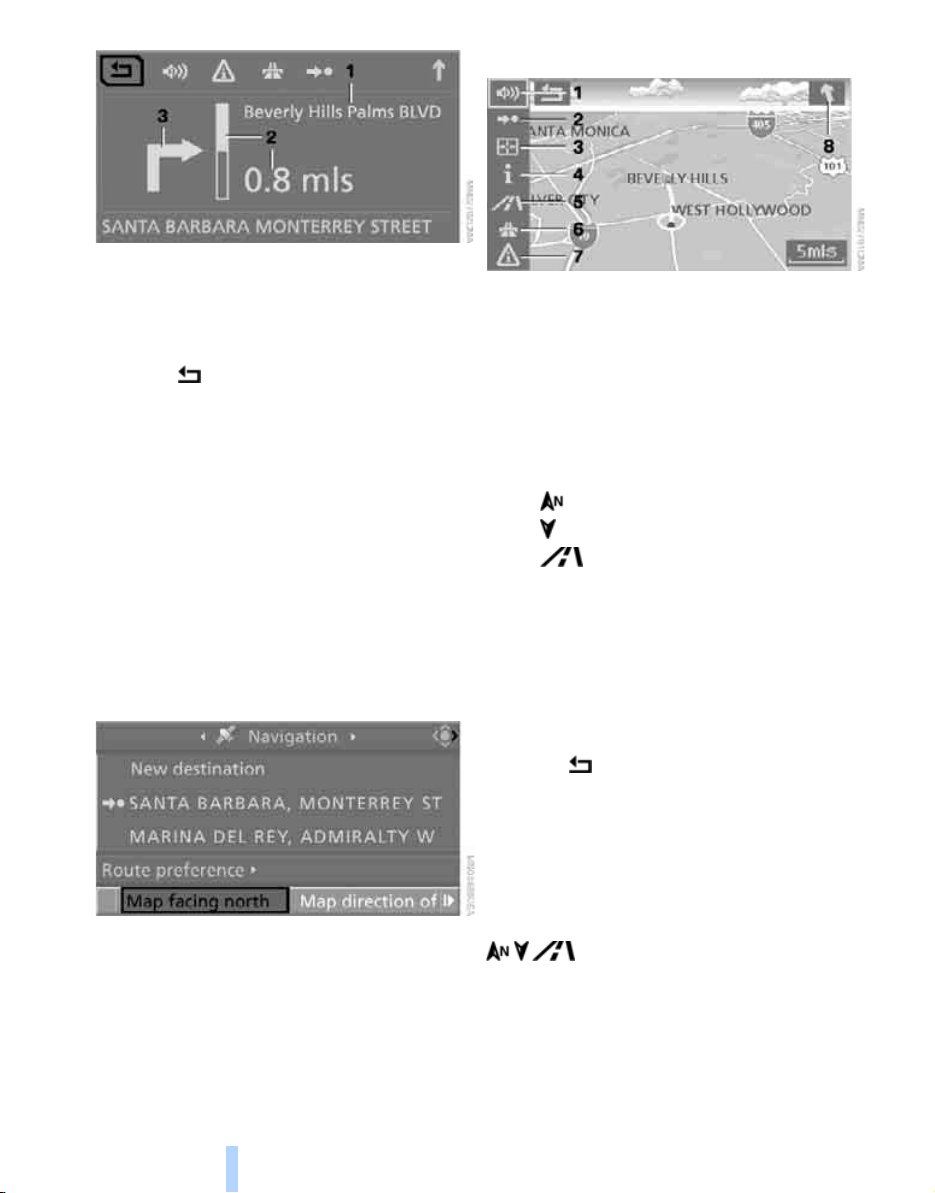
Destination guidance
142
1 Street name for change of direction
2 Distance up to change of direction
3 Change of direction
To exit the menu:
Select the arrow and press the controller.
Displaying map view
You can have your current position displayed on
a map. After starting the destination guidance,
the planned route is shown on the map.
1. Select "Navigation" and press the control-
ler.
2. Change into the fourth field from the top.
Turn the controller until the desired map
view is selected:
> "Map facing north"
> "Map direction of travel"
> "Perspective"
3. Press the controller.
1 Switching voice instructions on/off
2 Starting/ending destination guidance
3 Map-guided destination selection
4 Displaying the menu in which the informa-
tion last selected can be displayed/hidden,
refer to Selecting destination via informa-
tion on page 134
5 Changing map display
> "Map facing north"
> "Map direction of travel"
> "Perspective"
6 Changing route criteria
7 Manually displaying traffic information
*
8 Arrow to destination from a bird's eye view
The estimated time of arrival and the distance
to the destination are shown in the bottom line
of the Control Display.
To exit the menu:
Select the arrow and press the controller.
At scales of less than 250 miles/500 km, you
have the option of deciding whether to orient
the map to north or toward your current direc-
tion of travel. At scales of 250 miles/500 km or
greater, the map always points toward north.
Changing map display
Select the corresponding symbol and press the
controller.
The next map display is displayed.
Changing scale
Turn the controller to adjust the scale.
Online Edition for Part no. 01 41 2 600 775 - © 08/08 BMW AG
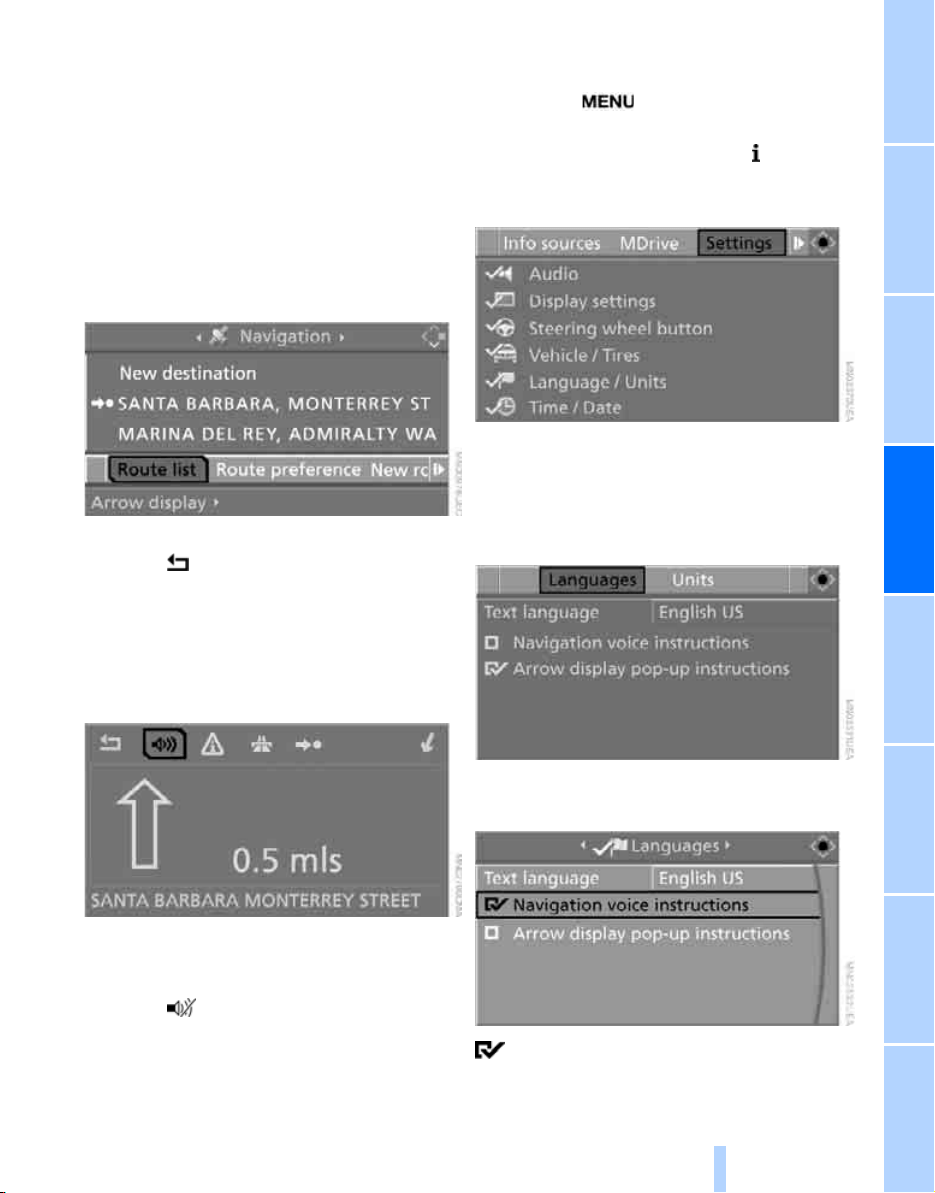
Navigation Driving tips
143
Reference At a glanceControlsCommunications EntertainmentMobility
Displaying streets and towns/cities of
route
You can have the roads and towns along the
route displayed during destination guidance.
The distances remaining to be traveled on each
individual road are also displayed.
1. Select "Navigation" and press the control-
ler.
2. Change into the third field from the top.
Turn the controller until "Route list" is
selected and press the controller.
To exit the menu:
Select the arrow and press the controller.
Destination guidance via
voice instructions
Switching voice instructions on/off
During destination guidance, voice instructions
can be switched on or off in the arrow or map
view:
Select the symbol and press the controller.
To switch the voice instructions on and off at
any time:
1. Press the button.
This opens the start menu.
2. Press the controller to open the menu.
3. Turn the controller until "Settings" is
selected and press the controller.
4. Turn the controller until "Language / Units"
is selected and press the controller.
5. Change to upper field if necessary. Turn the
controller until "Languages" is selected and
press the controller.
6. Select "Navigation voice instructions" and
press the controller.
The voice instructions are switched on.
The setting is stored for the remote control cur-
rently in use
*.
Online Edition for Part no. 01 41 2 600 775 - © 08/08 BMW AG
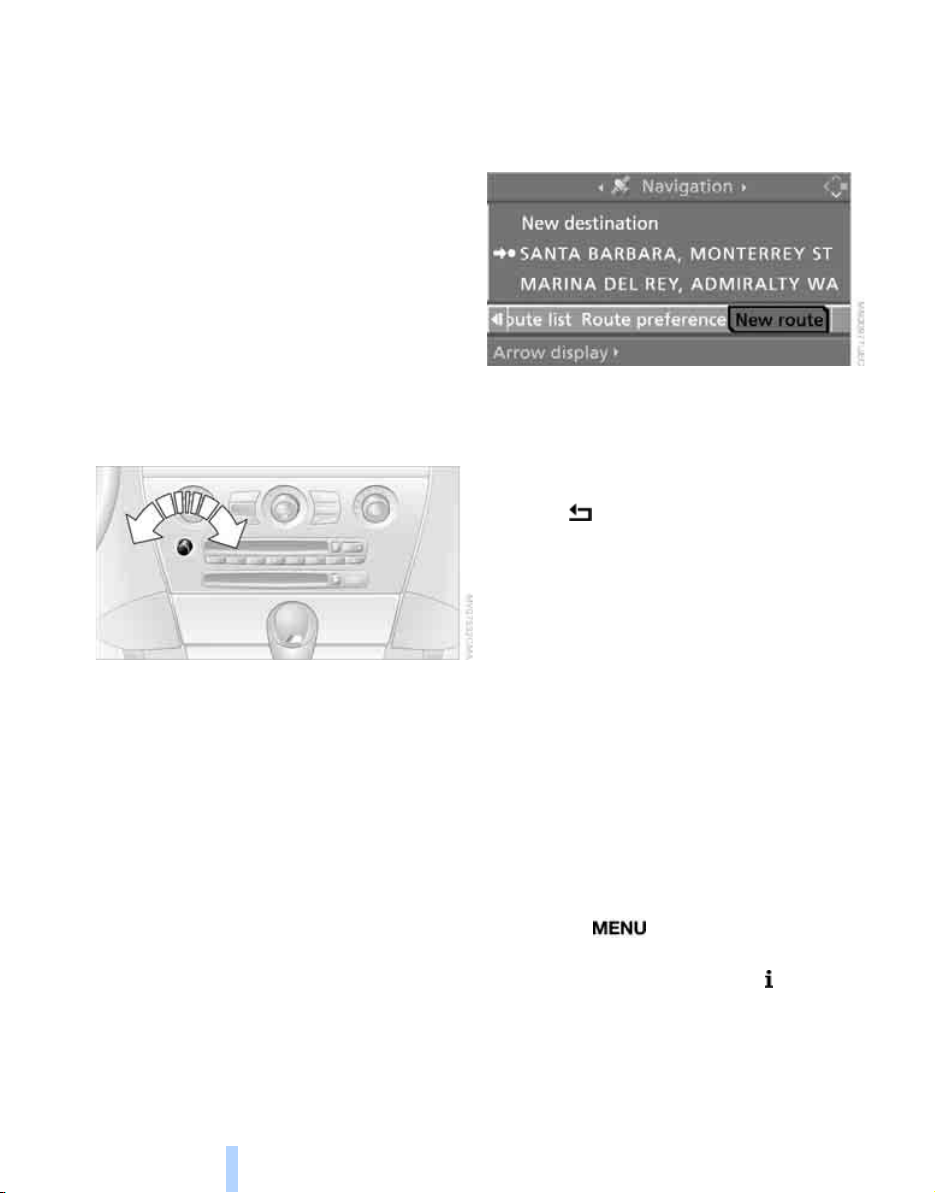
Destination guidance
144
Repeating and canceling voice
instructions
With the programmable button on the steering
wheel, you can also make the following set-
tings, refer to page 55:
> Repeat the voice instruction:
Press button.
> Switch voice instructions on/off:
Press button longer.
Setting volume of voice instructions
The volume can only be adjusted while a voice
instruction is being output.
1. Repeat the last voice instruction, if neces-
sary.
2. Turn the knob during the voice instruction
to select the desired volume.
This volume is independent of the volume of the
audio sources.
The setting is stored for the remote control cur-
rently in use.
Bypassing route sections
During destination guidance, you can revise the
navigation system's route recommendations to
avoid particular stretches of road. Enter the
number of miles/kilometers that you want to
travel before returning to the original route.
1. Select "Navigation" and press the control-
ler.
2. Change into the third field from the top.
Turn the controller until "New route" is
selected and press the controller.
3. Turn the controller to enter the desired
number and press the controller.
The route is recalculated.
To exit from the menu without changing the
route:
Select the arrow and press the controller.
Traffic information*
In many congested areas, you can receive traf-
fic information transmitted by radio stations.
The traffic conditions are monitored by traffic
management centers and the traffic information
is periodically updated.
During destination guidance, the traffic infor-
mation relevant to your planned route is auto-
matically displayed. Whether destination guid-
ance is active or not, you can have the traffic
information displayed in the map view or in the
traffic info list.
Switching reception of traffic
information on/off
1. Press the button.
This opens the start menu.
2. Press the controller to open the menu.
Online Edition for Part no. 01 41 2 600 775 - © 08/08 BMW AG
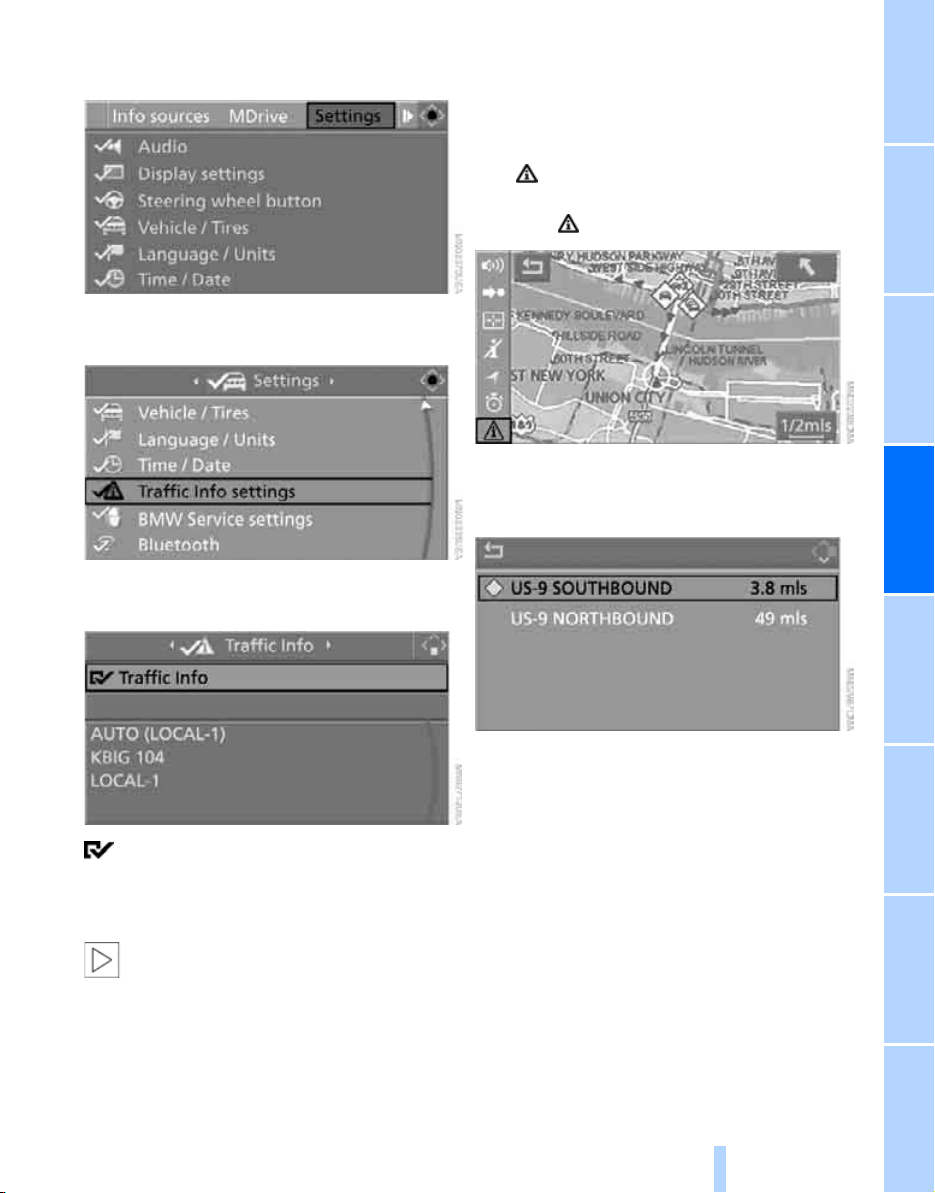
Navigation Driving tips
145
Reference At a glanceControlsCommunications EntertainmentMobility
3. Turn the controller until "Settings" is
selected and press the controller.
4. Turn the controller until "Traffic Info set-
tings" is selected and press the controller.
5. Select "Traffic Info" and press the control-
ler.
The traffic information can be received and
displayed.
"AUTO": automatic selection of the Traffic Info
station with the best reception.
Depending on the station, either the sta-
tion name, frequency, local number or
other information is displayed.<
Manually displaying traffic information
During destination guidance
During destination guidance, traffic information
can be displayed in the arrow or map view.
If the symbol is shown with a red border, traf-
fic information is available for the planned route.
Select the symbol and press the controller.
During destination guidance, the traffic infor-
mation on the planned route is marked with a
yellow diamond.
First the traffic information along the planned
route is shown sorted according to the distance
to the current vehicle position.
With destination guidance switched off
1. Open the start menu.
2. Move the controller to the right to open
"Navigation".
Online Edition for Part no. 01 41 2 600 775 - © 08/08 BMW AG
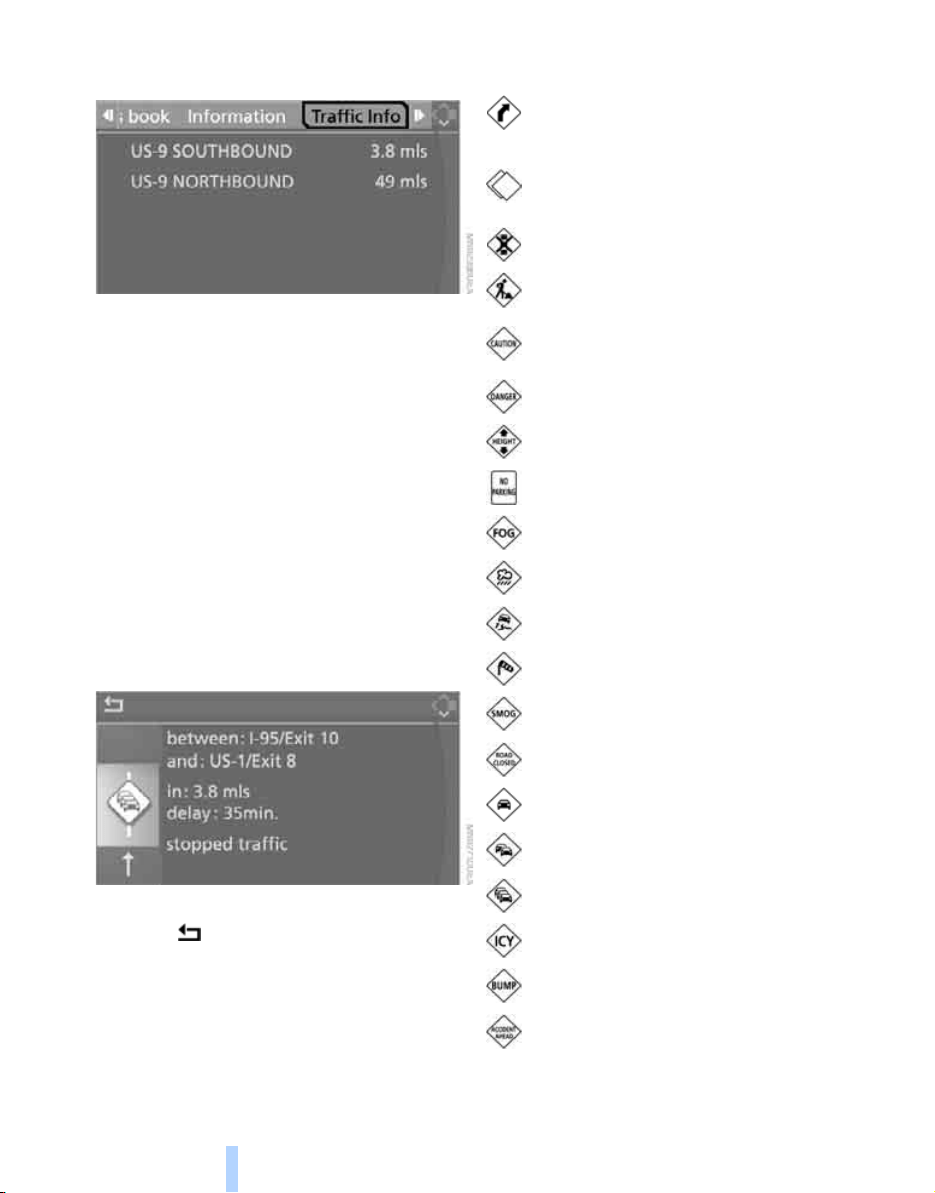
Destination guidance
146
3. Select "Traffic Info" and press the control-
ler.
First the traffic information along the planned
route is shown sorted according to the distance
to the current vehicle position.
Depiction of traffic information in map
view
The traffic information symbols are shown in
the map view up to a scale of 100 miles/200 km.
The section of the route affected by a traffic
report as well as the number for the type of inci-
dent are displayed and hidden. This occurs as a
function of the scale selected.
Displaying detailed traffic information
Select a traffic information item from the list and
press the controller.
To exit from the menu:
Select the arrow and press the controller.
Symbols for traffic information
Traffic event with map scales greater
than 5 miles/10 km, arrow points in
the direction of travel concerned.
Several traffic events have been
received. Select a smaller scale to
display these individually.
Traffic light failure
Roadwork
General traffic obstruction
Transport of hazardous load
Vehicle on wrong carriage way
Danger
Low clearance
No parking
Fog
Heavy rain
Slippery road
Cross winds
Smog
Road close
Slow traffic
Traffic back up
Stopped traffic
Icy roads
Uneven surface
Accident
Online Edition for Part no. 01 41 2 600 775 - © 08/08 BMW AG
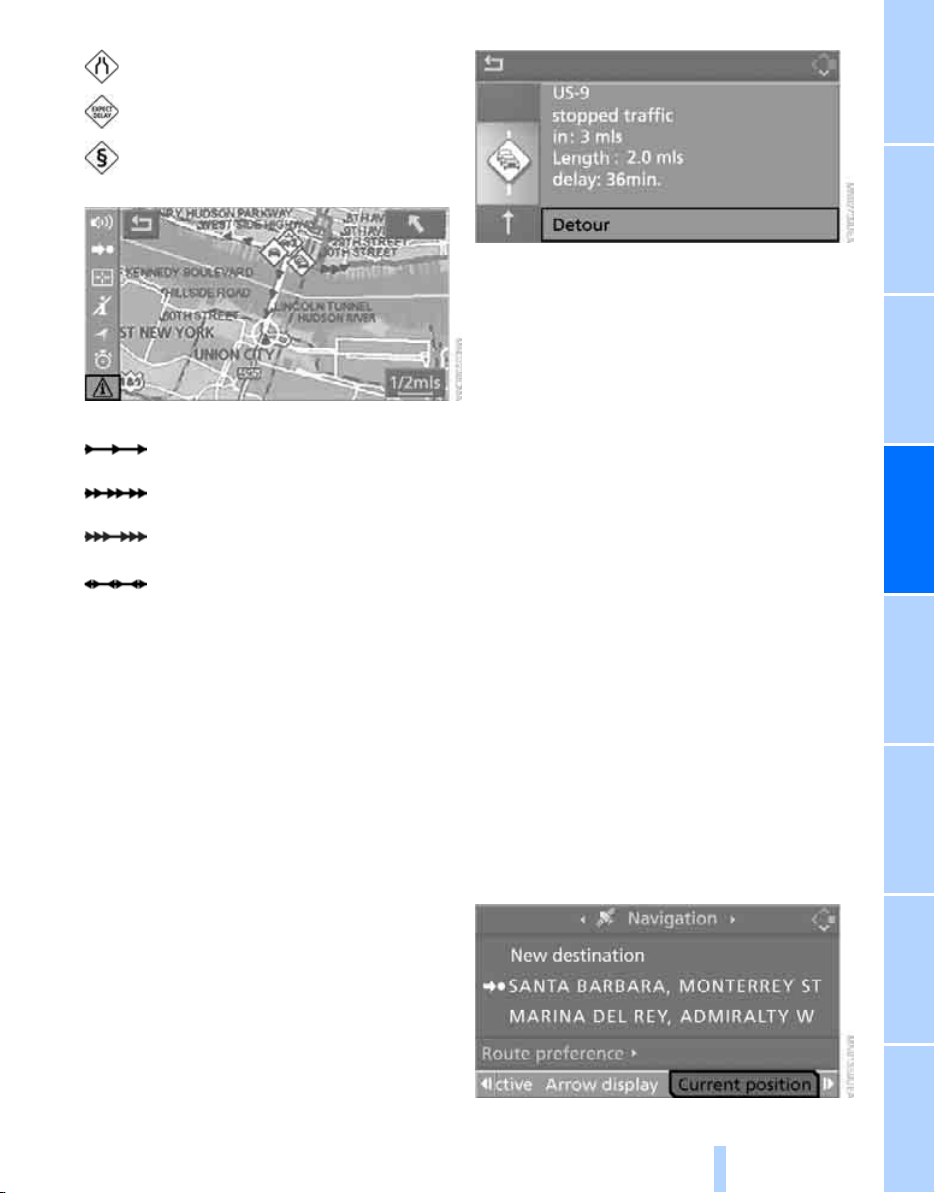
Navigation Driving tips
147
Reference At a glanceControlsCommunications EntertainmentMobility
Traffic information during destination
guidance
System response will vary depending on
whether or not "Dynamic route" is selected,
refer to page 138.
Displaying traffic obstructions
If a traffic obstruction is reported to the naviga-
tion system and "Dynamic route" is not
selected, you will be provided with specific
information beginning at a distance of approx.
25 miles/40 km, e.g. the length of the conges-
tion.
The last possible junction will be displayed
shortly before this.
Select "Detour" and press the controller.
The navigation system determines a new route
to avoid the traffic jam.
This information is also displayed if you have
called up a different application on the Control
Display.
Dynamic route planning
When "Dynamic route" is selected, the route
will be changed automatically in the event of a
traffic obstruction. The system does not point
out traffic obstructions along the original route.
Depending on road type as well as the nature
and extent of the traffic obstruction, the calcu-
lated route may also lead through the traffic
obstruction.
Displaying current position
You can have your current position displayed
even when the destination guidance is
switched off.
1. Select "Navigation" and press the control-
ler.
2. Change into the fourth field from the top.
Turn the controller until "Current position"
is selected and press the controller.
Lane closure
Delay
Police checkpoint
Slow traffic or other event
Stop-and-go traffic
Stopped traffic
Traffic event in both directions of
travel
Online Edition for Part no. 01 41 2 600 775 - © 08/08 BMW AG
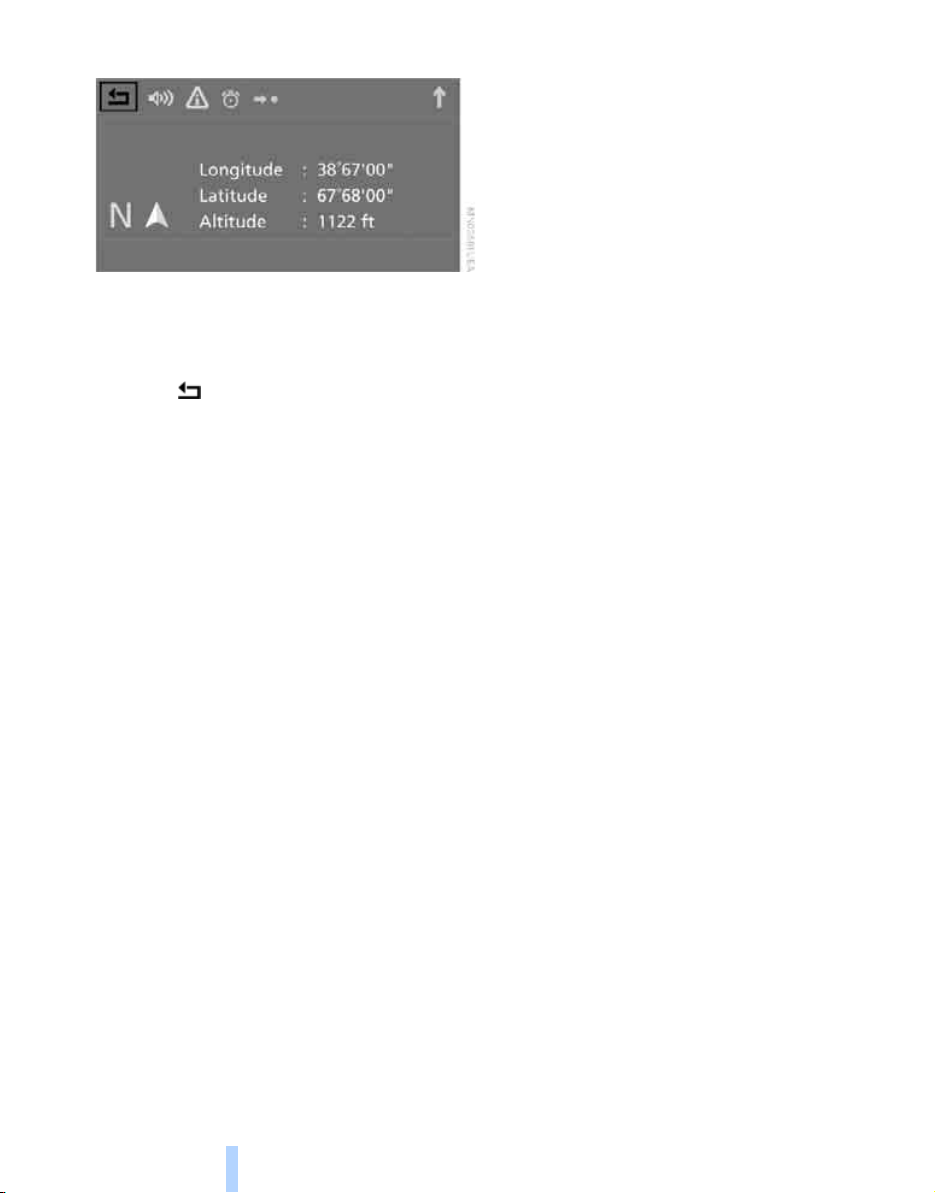
Destination guidance
148
The current position of your BMW is displayed.
If the navigation system is unable to identify a
town/city, your current map coordinates will
appear.
To exit the menu:
Select the arrow and press the controller.
You can also have the current position dis-
played on a map, refer to page 142.
Online Edition for Part no. 01 41 2 600 775 - © 08/08 BMW AG

Navigation Driving tips
149
Reference At a glanceControlsCommunications EntertainmentMobility
What to do if …
What to do if …
> a navigation DVD is inserted, but an instruc-
tion to insert the DVD appears on the Con-
trol Display?
The navigation DVD may not be the correct
DVD for the navigation system. This infor-
mation is indicated on the DVD label.
> you request the current position of your
vehicle, but do not receive a precise dis-
play?
The system is unable to receive enough
GPS signals at your current position due to
obstructions, your position is not yet avail-
able on your navigation DVD, or the system
is in the process of calculating your posi-
tion. Reception is best when you have an
unobstructed view to the sky.
> the destination guidance does not accept a
destination?
The data of the destination is not stored on
the navigation DVD that is loaded. Select a
destination that is as close as possible to
the original.
> the destination guidance does not accept
an address without the street name?
On the navigation DVD, no downtown area
can be determined for the city or town
entered. Enter any street, or a destination
such as the railway station in the selected
town, and then start the destination guid-
ance.
> you want to enter a destination for the des-
tination guidance, but it is not possible to
select the letters for your desired entry?
The data of the destination is not stored on
the navigation DVD that is loaded. In this
case, the system will not offer you any let-
ters to choose from. Select a destination
that is as close as possible to the original.
> the system stops furnishing directions on
which way to turn as you approach intersec-
tions?
You are driving in an area that has not yet
been completely recorded on the naviga-
tion DVD. Instead of an arrow indicating a
turn, you will see an arrow which indicates
the general direction of your planned route.
Or you have left the recommended route
and the system requires a few seconds to
calculate a new recommended route.
> the navigation system does not react to
entries?
If the battery was disconnected, it takes
about 10 minutes before the system is once
again operational.
Online Edition for Part no. 01 41 2 600 775 - © 08/08 BMW AG
Online Edition for Part no. 01 41 2 600 775 - © 08/08 BMW AG

Entertainment
This chapter describes how to operate the radio
and CD player and how to create their tone
settings.
Entertainment
Online Edition for Part no. 01 41 2 600 775 - © 08/08 BMW AG
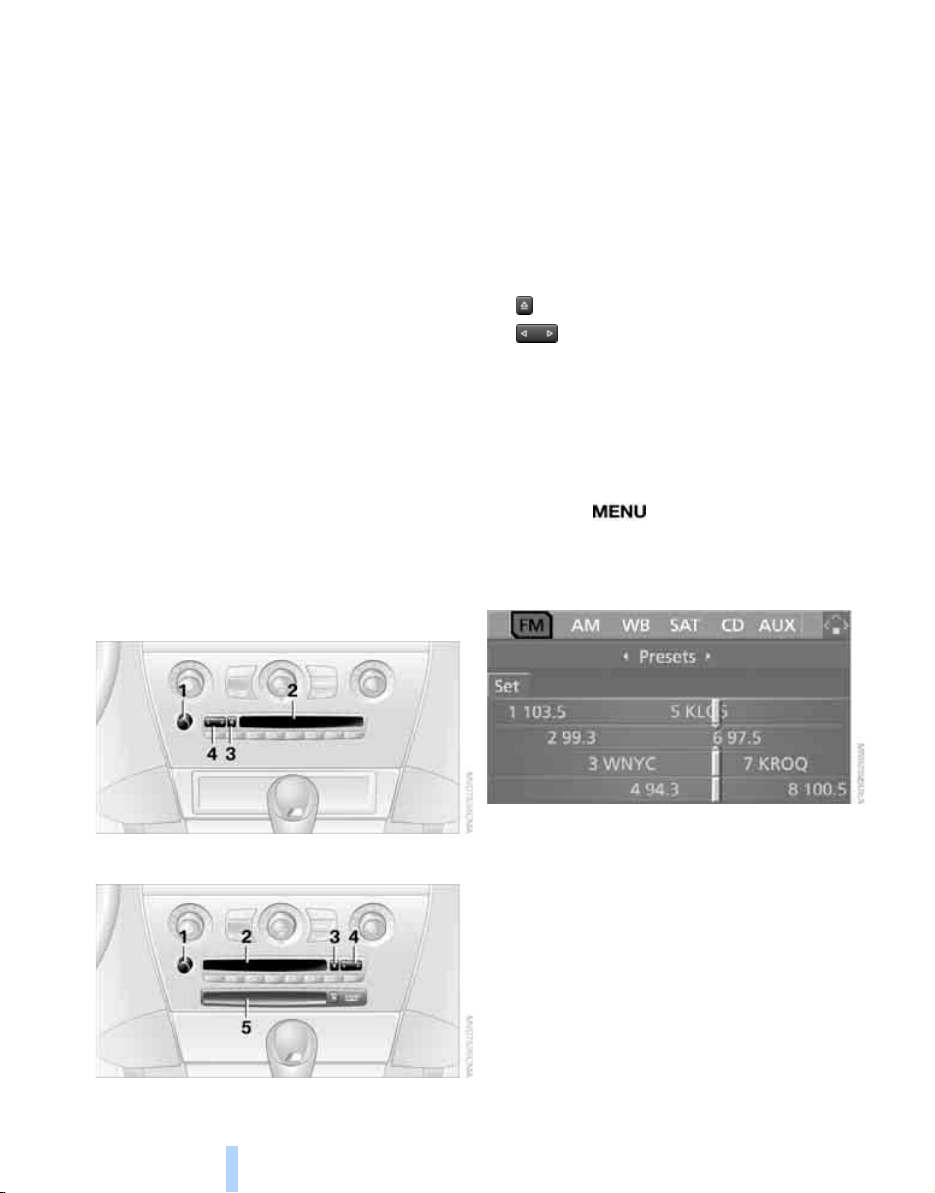
On/off and tone
152
On/off and tone
The following audio sources have shared con-
trols and setting options:
> Professional
* radio or
Business radio
> CD player
> CD changer
*
Controls
The audio sources can be operated using:
> Buttons in the area of the CD player
> iDrive
> Buttons on steering wheel, refer to page 11
> Programmable memory buttons, refer to
page 22
Buttons near CD player
The layout of the buttons can vary depending
on your vehicle's equipment.
One drive:
Two drives:
1 Entertainment sound output on/off, volume
> Press: switch on/off.
When the system is switched on, the
most recently selected radio station or
CD track is played.
> Turn: adjust volume.
2 Drive for audio CDs
3 Eject CD
4 Station scan/track search
> Change radio station.
> Select track for CD player and
CD changer.
5 Drive for navigation DVDs
Operation via iDrive
1. Press the button.
This opens the start menu.
2. Move the controller backwards to open
"Entertainment".
You have the following choices:
> "FM" and "AM": radio reception
> "WB": weatherband station
> "SAT": satellite radio
> "CD": CD player or CD changer
*
> "AUX": AUX-IN connection
> USB-audio interface
*
> "Set": depending on the audio source,
other adjustments can be made, e.g. with
the radio: update station with strongest
reception, store station, tone control, sam-
ple stations.
Online Edition for Part no. 01 41 2 600 775 - © 08/08 BMW AG
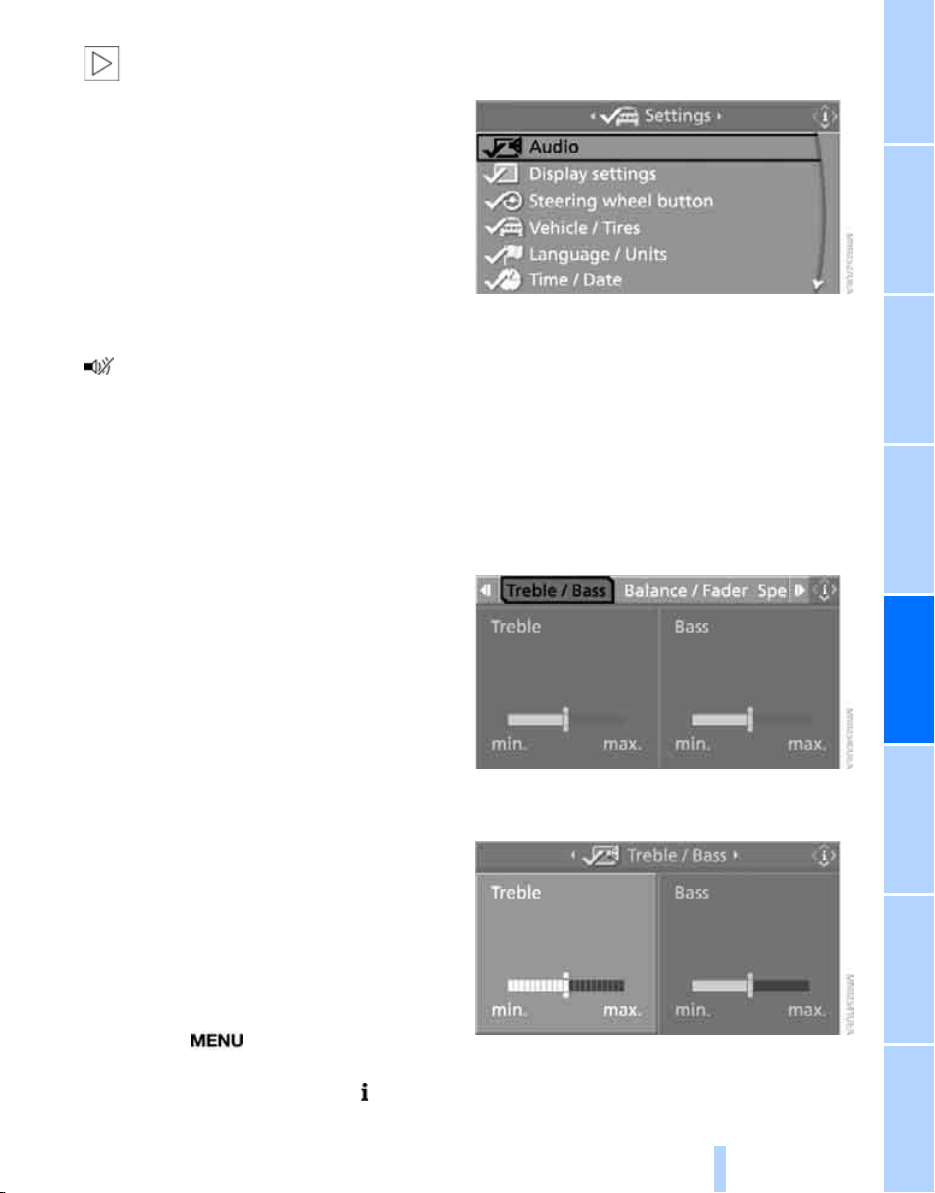
NavigationEntertainment Driving tips
153
Reference At a glanceControlsCommunicationsMobility
From another menu, you can change
directly to the screen last displayed,
refer to Comfort opening of menu items,
page 19.<
From radio readiness, the selected audio
source is stored for the remote control currently
in use.
Switching on/off
To switch the Entertainment sound output on
and off:
Press knob 1 next to the CD player.
This symbol on the Control Display indi-
cates that sound output is switched off.
For a single drive, the sound output is available
for approx. 20 minutes with the ignition
switched off.
Switch on the sound output again for this pur-
pose.
Adjusting volume
Turn knob 1 next to the CD player until the
desired volume is set.
You can also adjust the volume with the buttons
on the steering wheel, refer to page 11.
From radio readiness, the setting is stored for
the remote control currently in use.
Tone control
You can alter various tone settings, e.g. treble
and bass, or the speed-dependent volume
increase.
The tone settings are set for all audio sources at
once.
From radio readiness, the settings are stored
for the remote control currently in use.
Changing tone settings
1. Press the button.
This opens the start menu.
2. Press the controller to open the menu.
3. Turn the controller until "Settings" is
selected and press the controller.
4. Select "Audio" and press the controller.
The tone settings can also be selected if you
have called up "Entertainment" in the start
menu:
Select "Set" and then "Tone", pressing the
controller after each selection.
Treble and bass
1. Change to upper field if necessary. Turn the
controller until "Treble / Bass" is selected
and press the controller.
2. Move the controller to the left or right to
select "Treble" or "Bass".
3. Turn the controller until the desired setting
is selected.
Online Edition for Part no. 01 41 2 600 775 - © 08/08 BMW AG
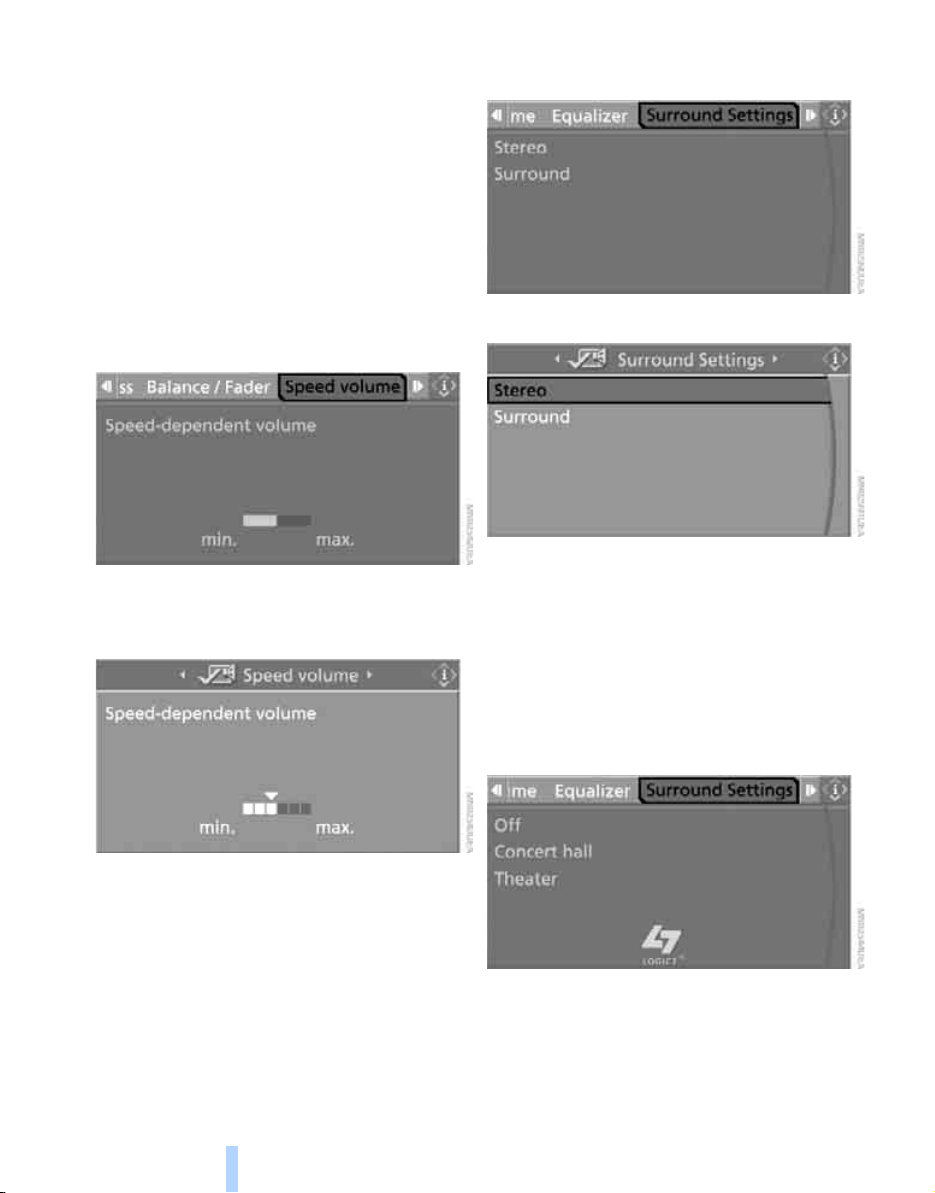
On/off and tone
154
Balance and fader
You can adjust the volume distribution in the
same manner as "Treble / Bass".
> "Balance": left/right volume distribution
> "Fader": front/rear volume distribution
Speed-dependent volume control
The speed-dependent volume control
increases the volume with increasing speed.
You can set various stages for the increase in
volume.
1. Select "Speed volume" and press the con-
troller.
2. Turn the controller:
The adjustment is applied; the field can be
changed.
Individual high-end sound system*
You can choose between Stereo and Surround.
1. Select "Surround Settings" and press the
controller.
2. Select "Stereo" or "Surround".
3. Press the controller.
The spatial sound effect is activated.
Professional LOGIC7 HiFi System*
You can select a spatial sound effect that
improves the spatial acoustics in all frequency
ranges.
1. Select "Surround Settings" and press the
controller.
Online Edition for Part no. 01 41 2 600 775 - © 08/08 BMW AG
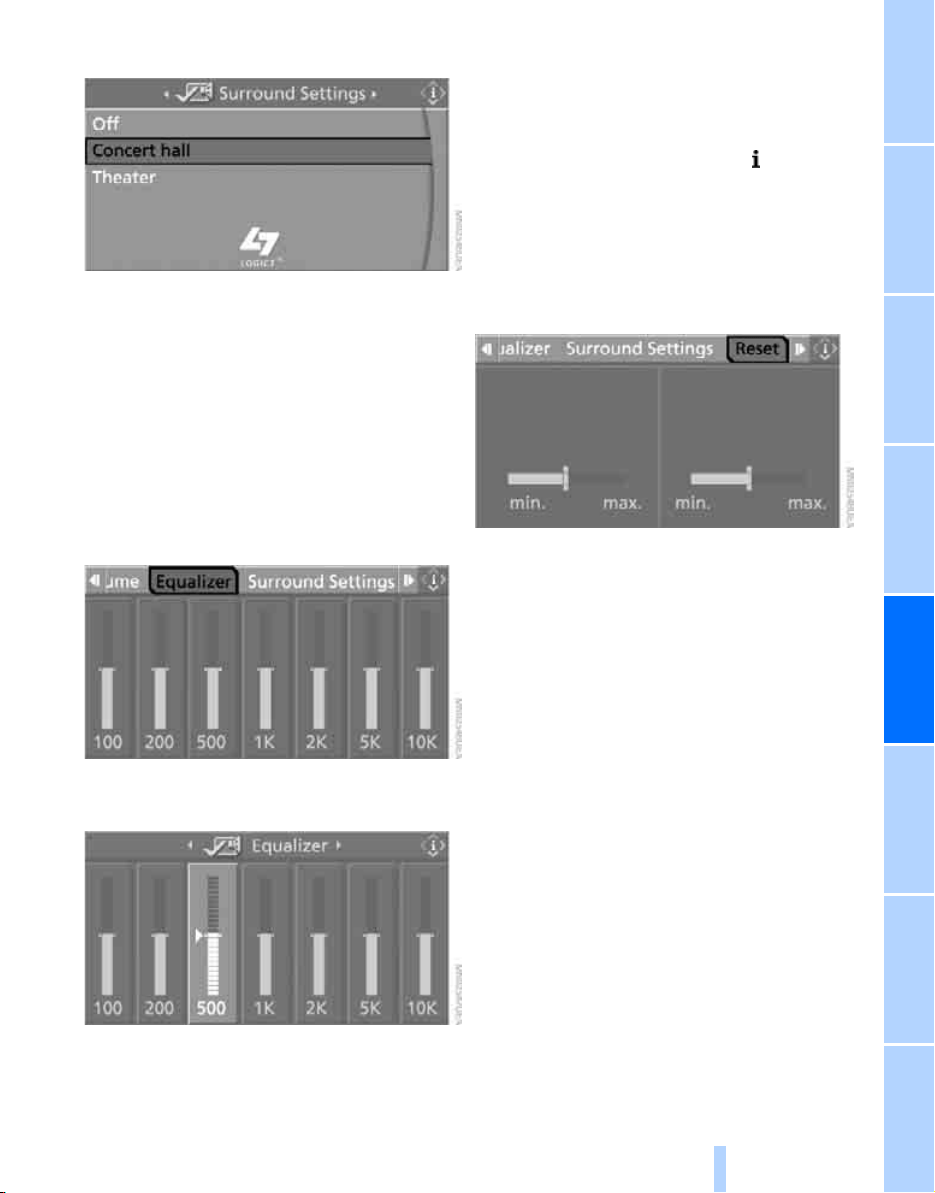
NavigationEntertainment Driving tips
155
Reference At a glanceControlsCommunicationsMobility
2. Select "Concert hall" or "Theater".
3. Press the controller.
LOGIC7 spatial sound is switched on.
To cancel the spatial sound effect:
Select "Off" and press the controller.
LOGIC7 and the LOGIC7 logo are registered
trade marks of Lexicon, Inc., a company of the
Harman International Group.
Equalizer*
You can set individual sound frequency ranges.
1. Select "Equalizer" and press the controller.
2. Move the controller to the left or right to
select the desired frequency range.
3. Turn the controller until the desired setting
is selected.
Resetting tone settings
You can reset all tone settings to the default
settings.
1. Open the start menu.
2. Press the controller to open the menu.
3. Turn the controller until "Settings" is
selected and press the controller.
4. Select "Audio" and press the controller.
5. Change to upper field if necessary. Turn the
controller until "Reset" is selected and
press the controller.
With two drives: Select "Yes".
Online Edition for Part no. 01 41 2 600 775 - © 08/08 BMW AG
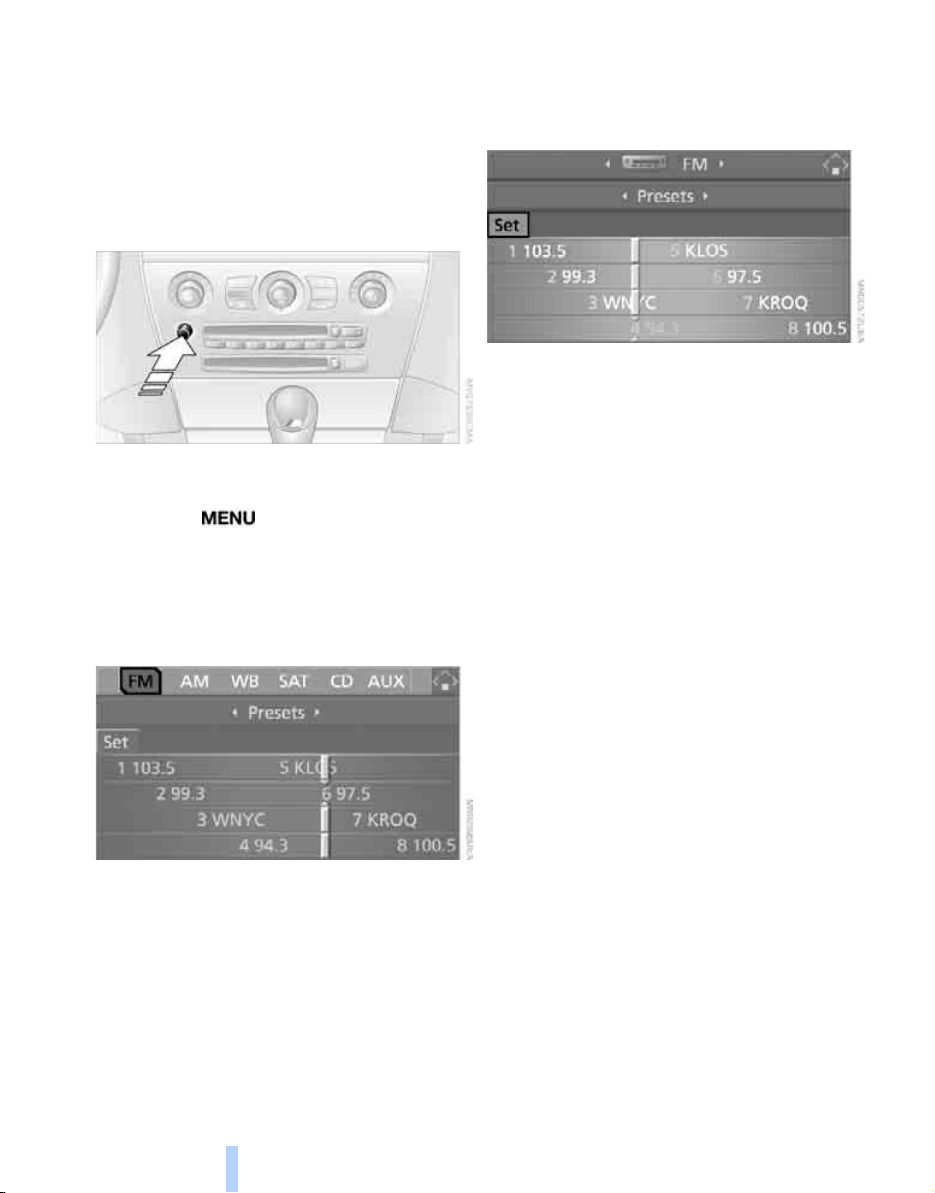
Radio
156
Radio
Your radio provides reception of the FM and AM
wavebands.
Listening to radio
Press the button if the sound output is switched
off.
1. Press the button.
This opens the start menu.
2. Move the controller backwards to open
"Entertainment".
3. Change to upper field if necessary. Turn the
controller until "FM" or "AM" is selected.
4. Press the controller.
Stations are shown on the Control Display on
the basis of various selection criteria, e.g. "Pre-
sets".
If "Autostore" does not display any stations or if
the stations displayed can no longer be
received, update the stations with the strongest
signal, refer to page 158.
Changing stations
Turn the controller.
In addition to the stations currently displayed,
you can have stations with another selection
criterion displayed.
Professional radio*
You can choose from the following selection
criteria:
> "All stations":
Stations that can currently be received in
the "FM" waveband.
> "Autostore":
Stations with the best reception on the
"AM" waveband.
> "Presets":
Stations you have previously stored, refer to
page 158.
> "Manual":
To set stations that can be received in addi-
tion to those displayed, refer to Selecting
frequency manually on page 157.
Business radio
You can choose from the following selection
criteria:
> "Autostore":
Stations with the strongest signal, refer to
page 158.
> "Presets":
Stations you have previously stored, refer to
page 158.
Online Edition for Part no. 01 41 2 600 775 - © 08/08 BMW AG
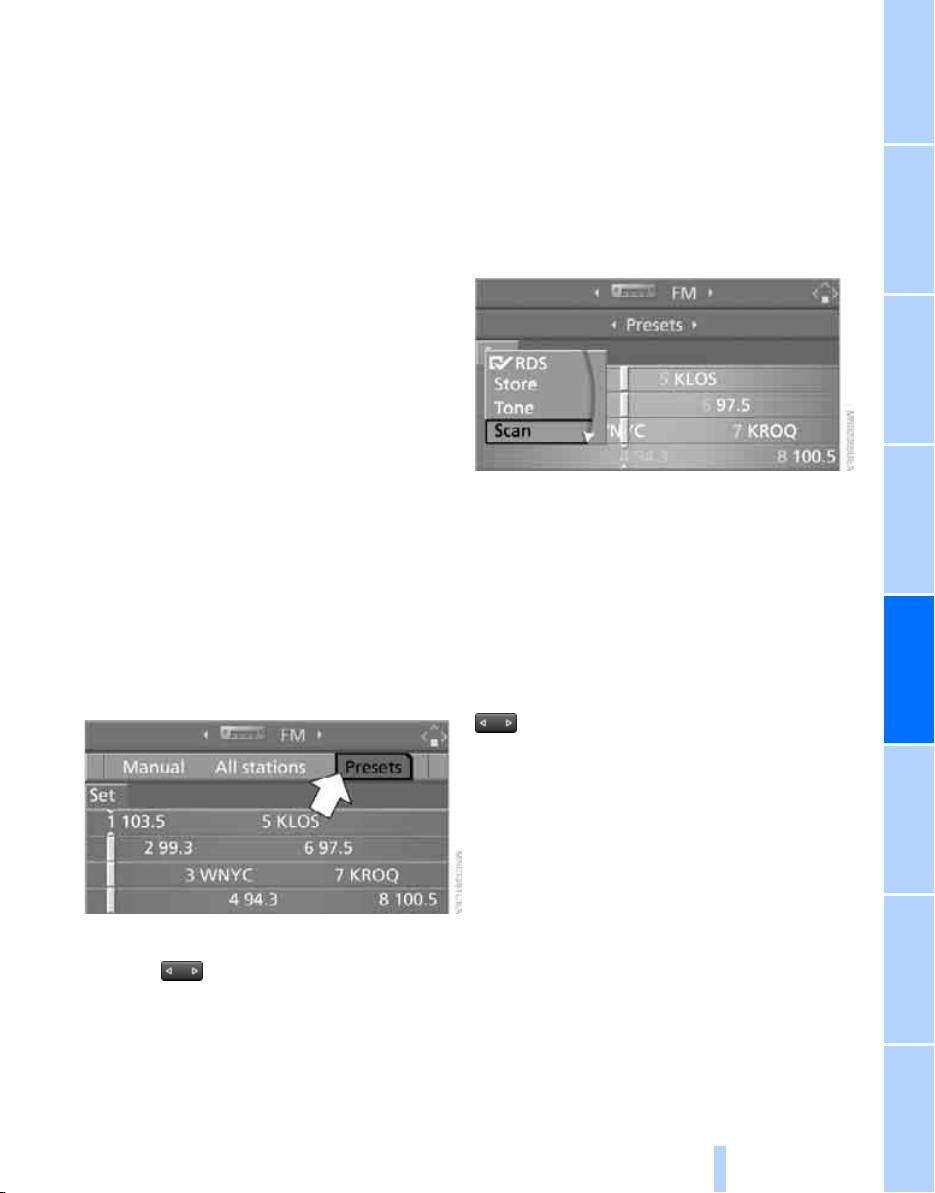
NavigationEntertainment Driving tips
157
Reference At a glanceControlsCommunicationsMobility
> "Manual":
To set stations that can be received in addi-
tion to those displayed, refer to Selecting
frequency manually on page 157.
Changing selection criteria
In addition to the stations currently displayed,
you can have stations with another selection
criterion displayed.
You can choose from the following selection
criteria:
> "All stations":
Stations that can currently be received in
the "FM" waveband.
> "Autostore":
Stations with the best reception on the
"AM" waveband.
> "Presets":
Stations you have previously stored, refer to
page 158.
> "Manual":
To set stations that can be received in addi-
tion to those displayed, refer to Selecting
frequency manually on page 157.
1. Change into the second field from the top.
2. Turn the controller until the desired selec-
tion criterion is selected and press the con-
troller.
Buttons next to CD player
Press the button for the corresponding
direction.
The system changes to the next displayed sta-
tion.
You can also change stations with the buttons
on the steering wheel, refer to page 11.
Sampling stations, scan
The system plays a brief sample from each of
the stations on the current waveband.
1. Select "FM" or "AM" and press the control-
ler.
"Set" is selected.
2. Press the controller.
Other menu items are displayed.
3. Select "Scan" and press the controller.
The stations are sampled.
To end sampling:
1. Press the controller.
2. Select "Scan" and press the controller.
This cancels sampling of the stations, and the
radio remains on the current station.
Buttons next to CD player
To sample the stations, press and hold the
button for the corresponding direction.
To stop scanning, press the button again.
Selecting frequency manually
With "Manual" you can select stations that are
received in addition to those displayed.
1. Select "FM" or "AM" and press the control-
ler.
2. Change into the second field from the top.
Online Edition for Part no. 01 41 2 600 775 - © 08/08 BMW AG
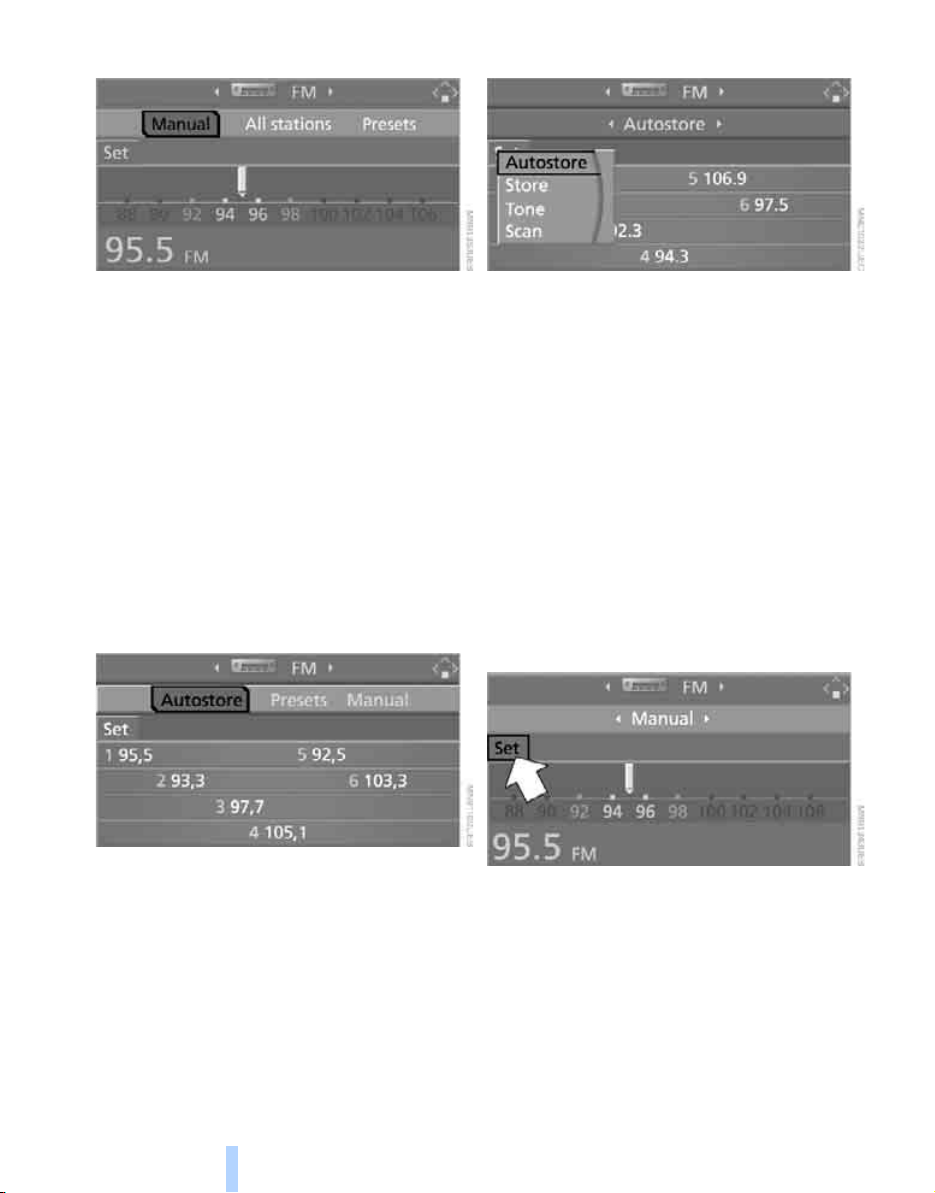
Radio
158
3. Select "Manual" and press the controller.
4. Turn the controller to set a certain fre-
quency.
Updating stations with best reception
Radio Professional on "AM" and Radio Busi-
ness:
If you are on a longer journey and leave the
transmission range of the stations originally set,
you can update the list of stations with the best
reception.
1. Select "FM" or "AM" and press the control-
ler.
2. Change into the second field from the top.
3. Select "Autostore" and press the controller.
"Set" is selected.
4. Press the controller.
Other menu items are displayed.
5. Select "Autostore" and press the controller.
The display of the stations with the best recep-
tion is updated. The frequencies of the stations
are displayed.
Storing stations
Via iDrive
1. Select "FM" or "AM" and press the control-
ler.
2. Change into the second field from the top.
Turn the controller until the desired selec-
tion criterion is selected and press the con-
troller.
3. Select the desired frequency or station.
"Set" is selected.
4. Press the controller.
Other menu items are displayed.
Online Edition for Part no. 01 41 2 600 775 - © 08/08 BMW AG
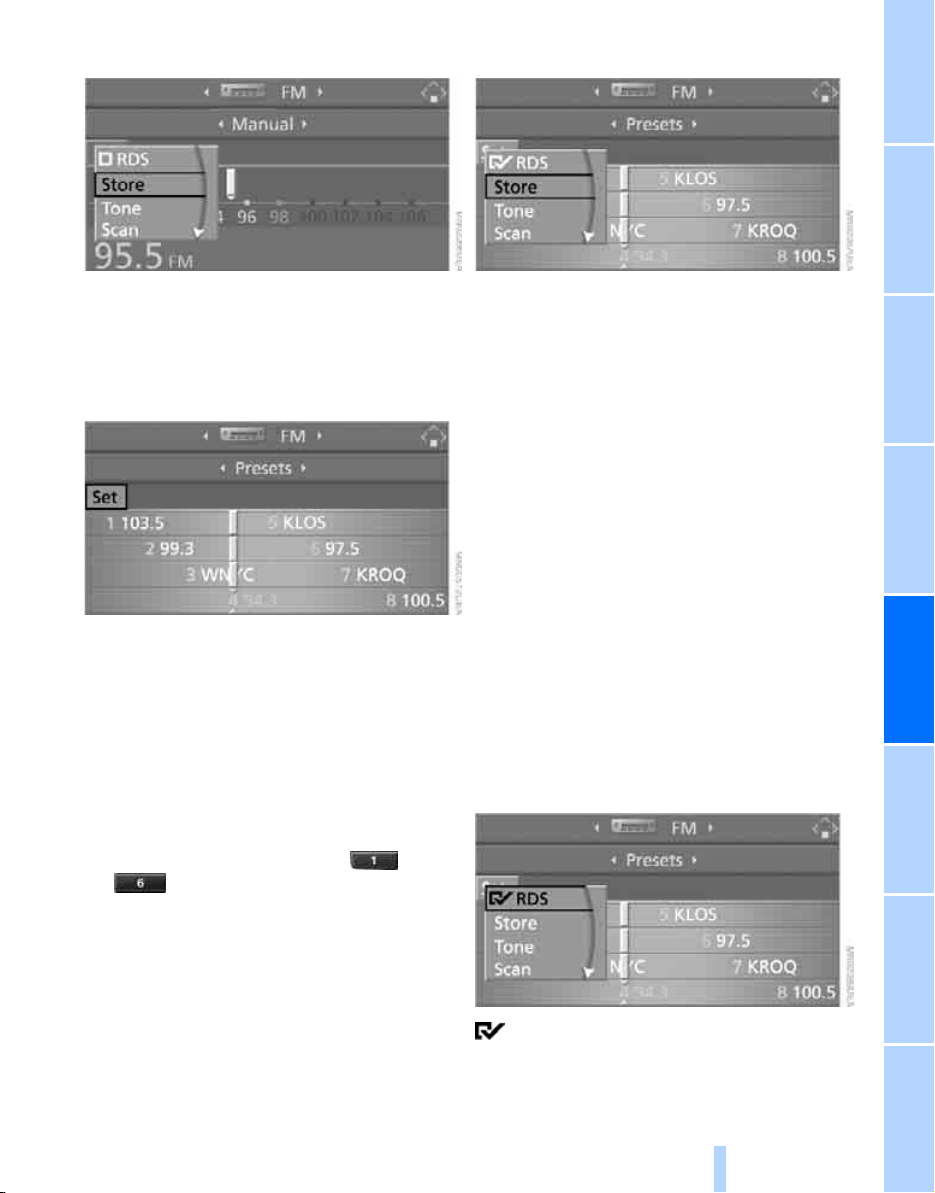
NavigationEntertainment Driving tips
159
Reference At a glanceControlsCommunicationsMobility
5. Select "Store" and press the controller.
"Presets" is displayed.
6. Turn the controller until the desired mem-
ory position is selected.
7. Press the controller.
The station is stored.
The stations of the last selection criterion are
displayed once again after a short time.
From radio readiness, the stations are stored
for the remote control currently in use.
About programmable memory buttons
You can also store a station on the programma-
ble memory buttons, also refer to page 22.
1. Select a station.
2. Press and hold desired button ...
.
Changing a memory position
1. Select "Presets" and press the controller.
2. Select the desired station.
"Set" is selected.
3. Press the controller.
Other menu items are displayed.
4. Select "Store" and press the controller.
5. Turn the controller until the desired mem-
ory position is selected.
The number of the memory position
appears beside the name or frequency of
the station.
6. Press the controller.
The station is stored.
RDS Radio Data System
In the FM frequency range, additional informa-
tion is transmitted via RDS. If the reception con-
ditions are good, the station names are shown
on the Control Display. If the reception is weak
or disrupted, it can take some time before the
station names are displayed.
Switching RDS on/off*
1. Select "FM" and press the controller.
"Set" is selected.
2. Press the controller.
Other menu items are displayed.
3. Select "RDS" and press the controller.
RDS is activated.
The setting is stored for the remote control cur-
rently in use.
Online Edition for Part no. 01 41 2 600 775 - © 08/08 BMW AG
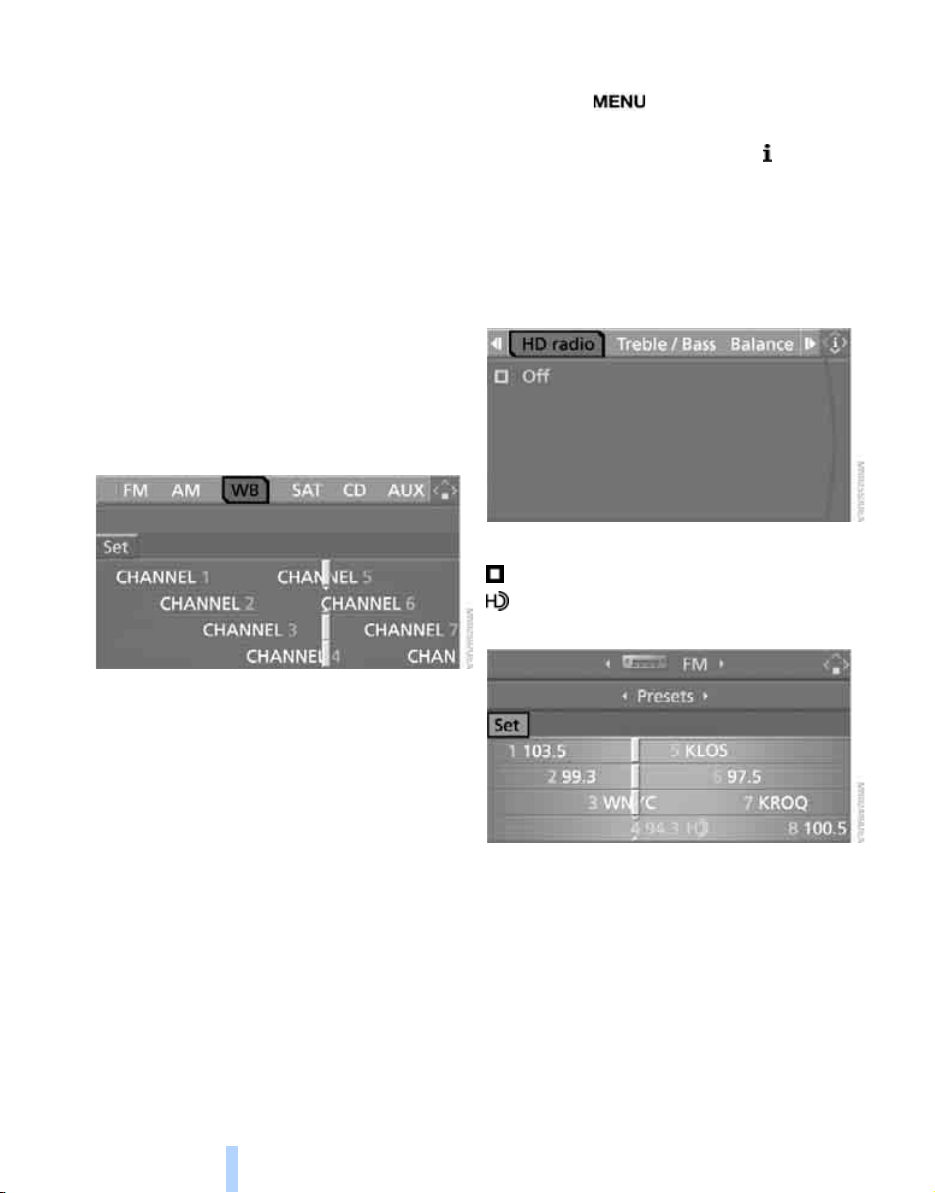
Radio
160
Weather news flashes*
Weather Radio is a service of the National Oce-
anic and Atmospheric Administration (NOAA)
of the US Department of Trade. Weather news
flashes are repeated every 4 to 6 minutes and
are routinely updated at intervals of 1 to
3 hours, and more often when necessary. Most
stations operate 24 hours a day. In case of a
storm, the National Weather Service interrupts
the routine weather news and transmits special
warning messages instead. If you have a ques-
tion about NOAA Weather Radio, please con-
tact the nearest office of the National Weather
Service. Details are also provided on the Inter-
net at www.nws.noaa.gov.
Calling up weather news flashes
1. Select "WB" and press the controller.
2. Select a station.
The station for weather news flashes may be
unavailable in some regions.
High Definition Radio*
Many stations transmit both analog and digital
signals. You can receive these stations digitally
and with improved sound quality.
A digital radio network must be available in
order to receive digital stations.
HD Radio™ technology is manufactured under
license from iBiquity Digital Corp. U.S. and For-
eign Patents. HD Radio™ and the HD and HD
Radio logos are proprietary trademarks of iBi-
quity Digital Corp.
Activating/deactivating digital radio
reception
1. Press the button.
This opens the start menu.
2. Press the controller to open the menu.
3. Turn the controller until "Settings" is
selected and press the controller.
4. Select "Audio" and press the controller.
5. Change to upper field. Turn the controller
until "HD radio" is selected and press the
controller.
6. Select "Off" and press the controller.
The reception of digital stations is activated.
This symbol is displayed when a station is
being received digitally.
With some stations the digital signals are not
transmitted simultaneously with the analog sig-
nals. If you are in an area in which the selected
station is not continuously received digitally,
playback changes between analog and digital
reception. This can result in repetitions or inter-
ruptions. In this case it may be advisable to
deactivate digital radio reception.
Online Edition for Part no. 01 41 2 600 775 - © 08/08 BMW AG
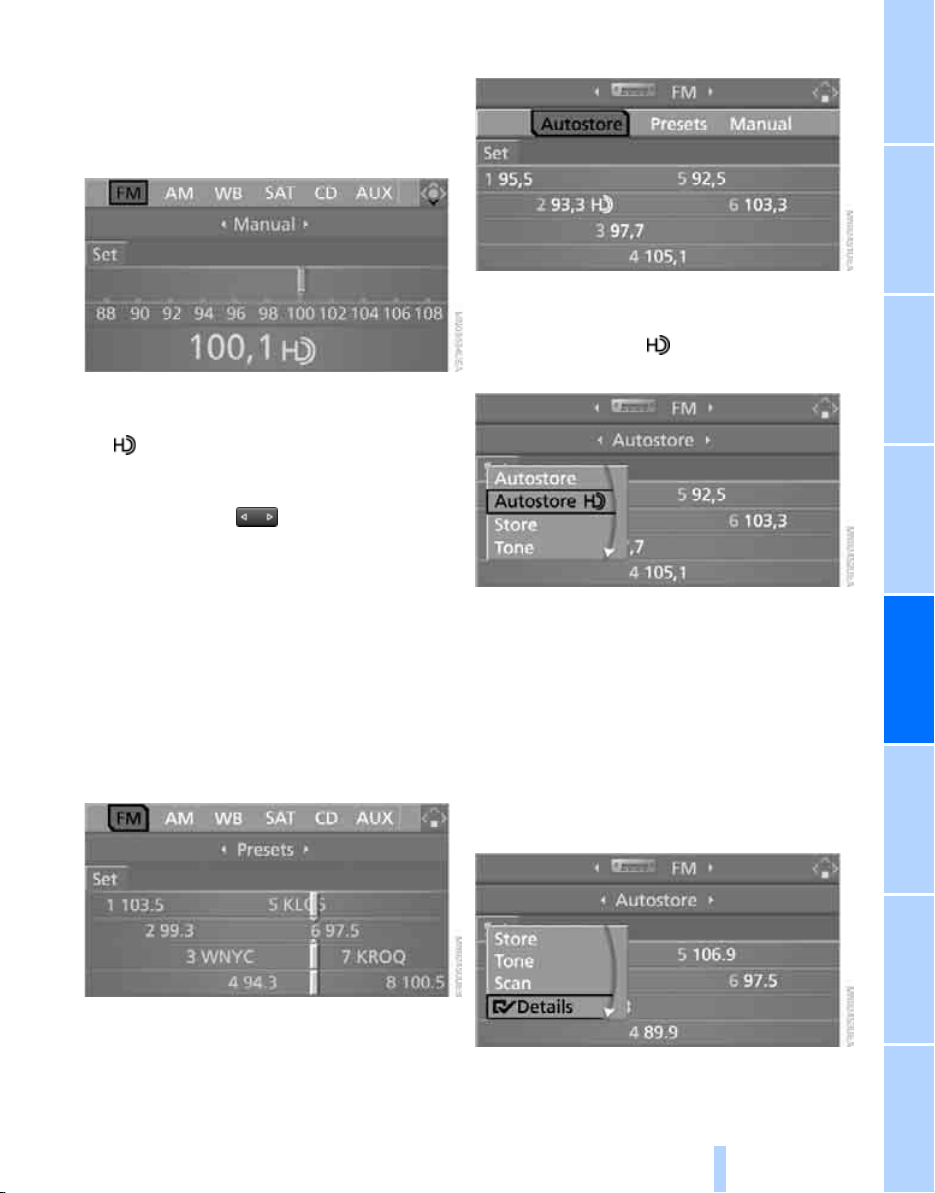
NavigationEntertainment Driving tips
161
Reference At a glanceControlsCommunicationsMobility
Selecting programs of a digital station*
Some stations transmit several programs. To
select one of these programs:
1. Select "FM" or "AM" and press the control-
ler.
2. Select "Manual" and press the controller.
3. Select a station that is received digitally.
This symbol is displayed when a station
is being received digitally.
4. Switch to the next program of the digital
station with the buttons on the radio
or the steering wheel.
You can store a station, refer to page 158.
Updating stations offering digital
reception
If you are on a longer journey and leave the
transmission range of the stations originally set,
you can update the list of stations with the best
reception.
1. Select "FM" or "AM" and press the control-
ler.
2. Change into the second field from the top.
3. Select "Autostore" and press the controller.
4. Press the controller.
Other menu items are displayed.
5. Select "Autostore " and press the con-
troller.
The display of the stations offering digital
reception is updated. This can take up to 2 min-
utes.
Displaying additional information
With the digital stations, additional information
on the current track is displayed, e.g. the name
of the artist.
1. Select a station and press the controller.
2. Select "Details" and press the controller.
Online Edition for Part no. 01 41 2 600 775 - © 08/08 BMW AG
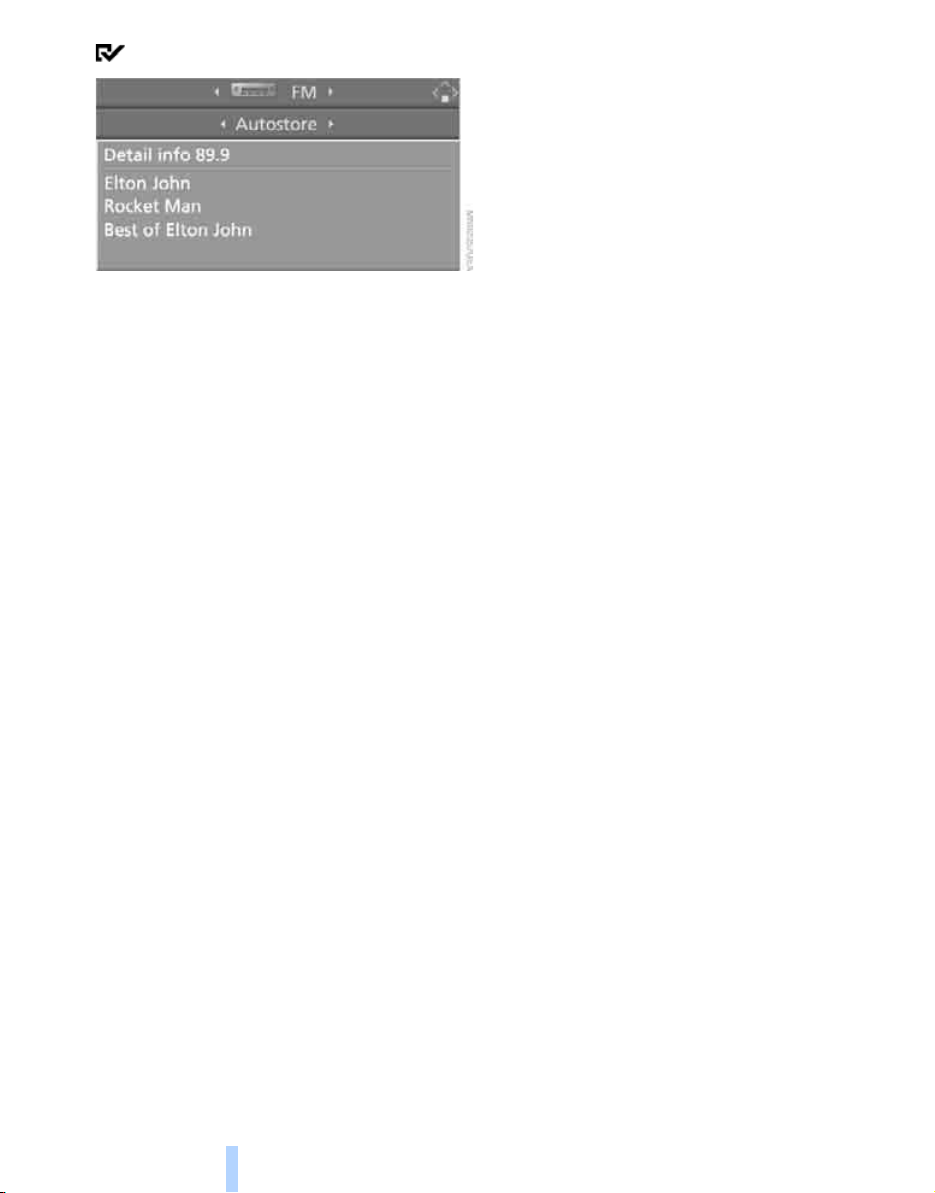
Radio
162
The information is displayed.
If a digital station is received again when the
station is changed, the additional information
will be displayed again following a brief interrup-
tion.
Online Edition for Part no. 01 41 2 600 775 - © 08/08 BMW AG
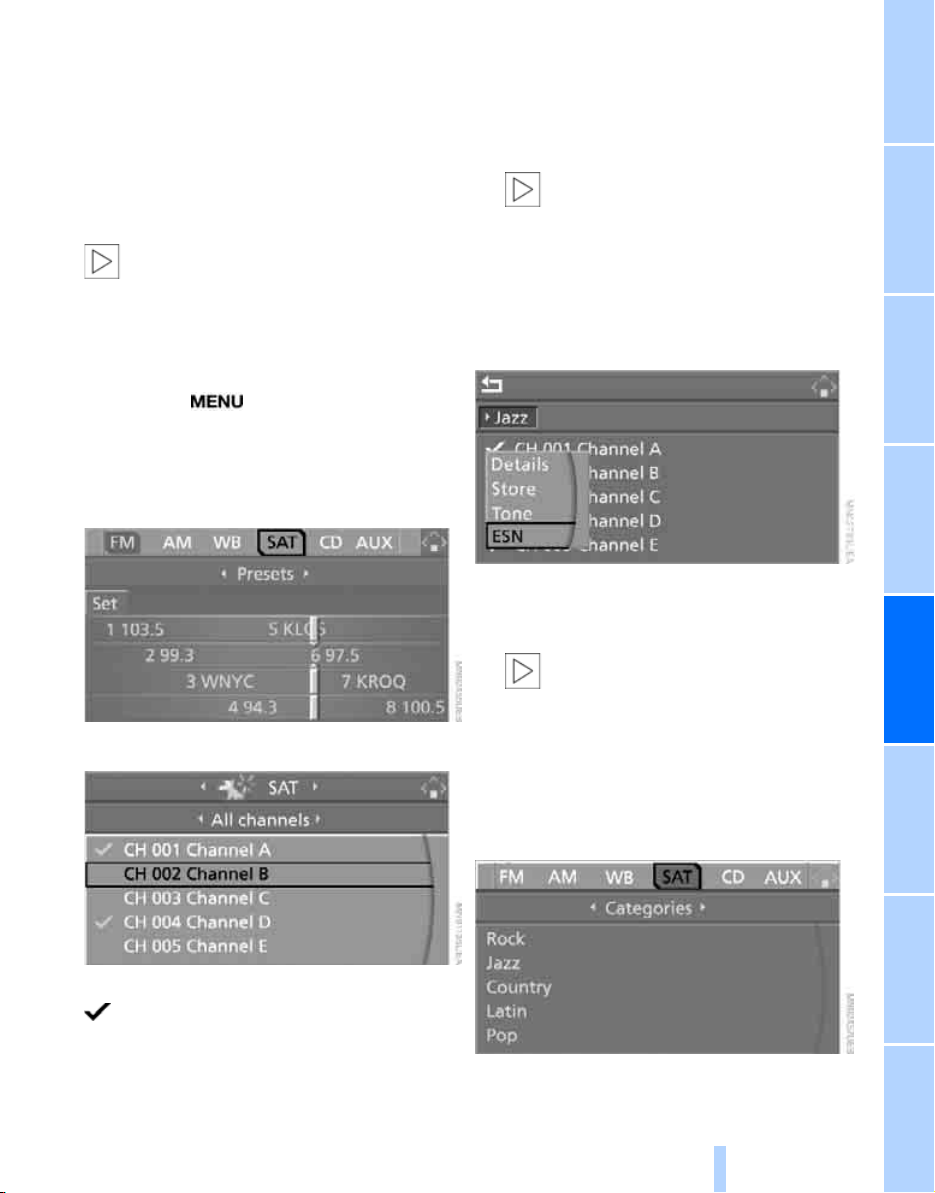
NavigationEntertainment Driving tips
163
Reference At a glanceControlsCommunicationsMobility
Satellite radio
You can receive over 100 different channels
with high sound quality.
The channels are offered to you in predefined
packages. To receive the channels of your
choice, you must have this package enabled.
With this new technology the signal may
fail, causing interruptions in reception.<
Enabling or disabling
channels
1. Press the button.
This opens the start menu.
2. Move the controller backwards to open
"Entertainment".
3. Select "SAT".
4. Press the controller.
The channels are displayed.
These channels are enabled.
Enabling
1. Select a channel that has not yet been
enabled and press the controller.
A telephone number and the electronic
serial number, ESN, are displayed.
The electronic serial number is
required for enabling or disabling.<
2. To enable the channels:
Dial the phone number.
Disabling
1. Select an enabled channel and press the
controller.
2. Select "ESN" and press the controller.
The electronic serial number, ESN, is dis-
played.
The electronic serial number is
required for disabling.<
3. To disable the channels:
Dial the phone number.
Selecting and storing channel
1. Select "SAT" and press the controller.
Channels or categories appear in the Con-
trol Display.
*
Online Edition for Part no. 01 41 2 600 775 - © 08/08 BMW AG
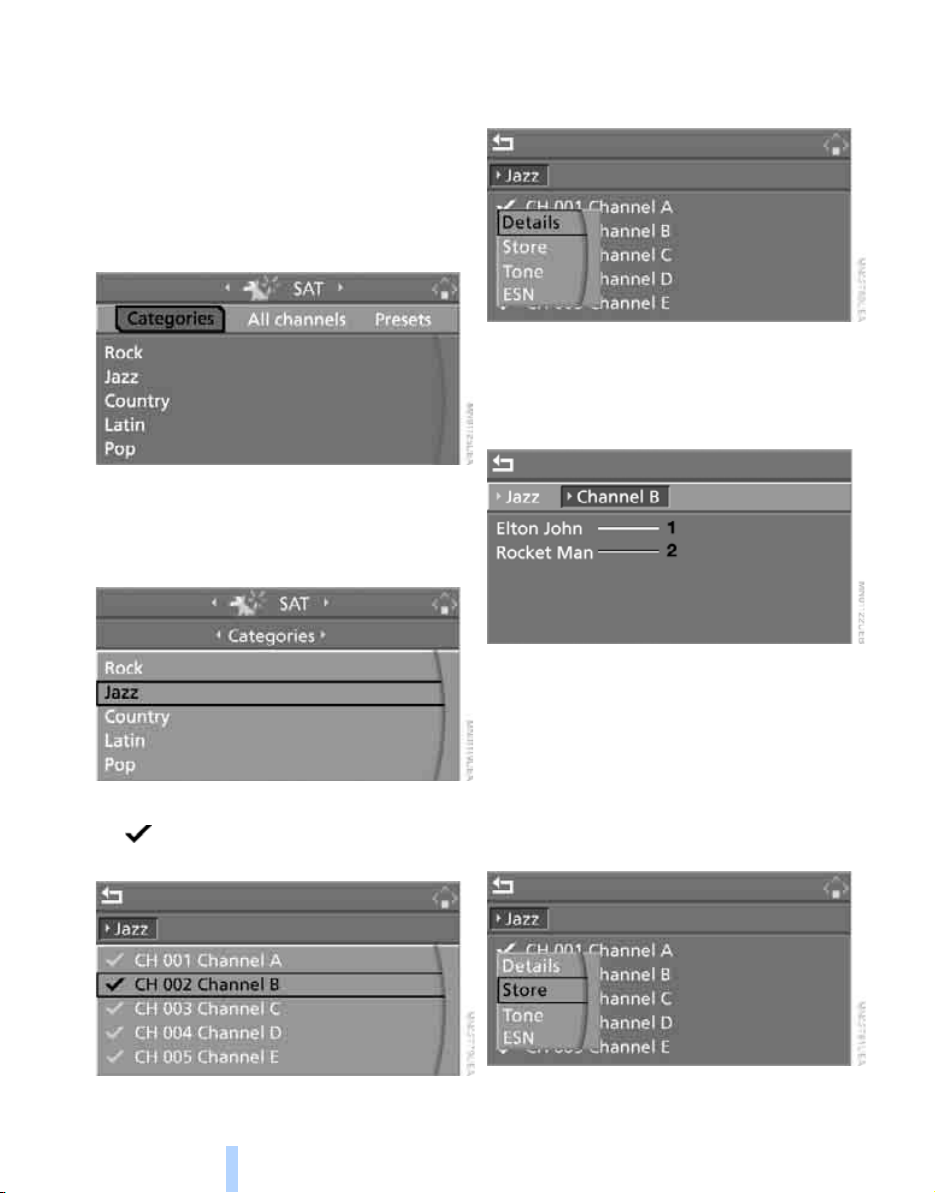
Satellite radio
164
2. Select a menu item:
> "Presets":
Up to twelve channels you have stored
previously.
> "All channels":
All channels are displayed.
> "Categories":
All channels, sorted by category, e.g.
news, jazz.
3. Press the controller.
4. If "Categories" has been selected:
Select the desired category and press the
controller.
The channels of this category are displayed.
5. Select a channel marked with this sym-
bol.
6. Press the controller.
Other menu items are displayed.
7. Select "Details" and press the controller.
Additional information
The name of the channel and additional infor-
mation on the current track are displayed, e.g.
the name of the artist.
1 Artist
2 Track
Storing channel
1. Select desired channel.
2. Press the controller.
Other menu items are displayed.
3. Select "Store" and press the controller.
"Presets" is displayed.
Online Edition for Part no. 01 41 2 600 775 - © 08/08 BMW AG
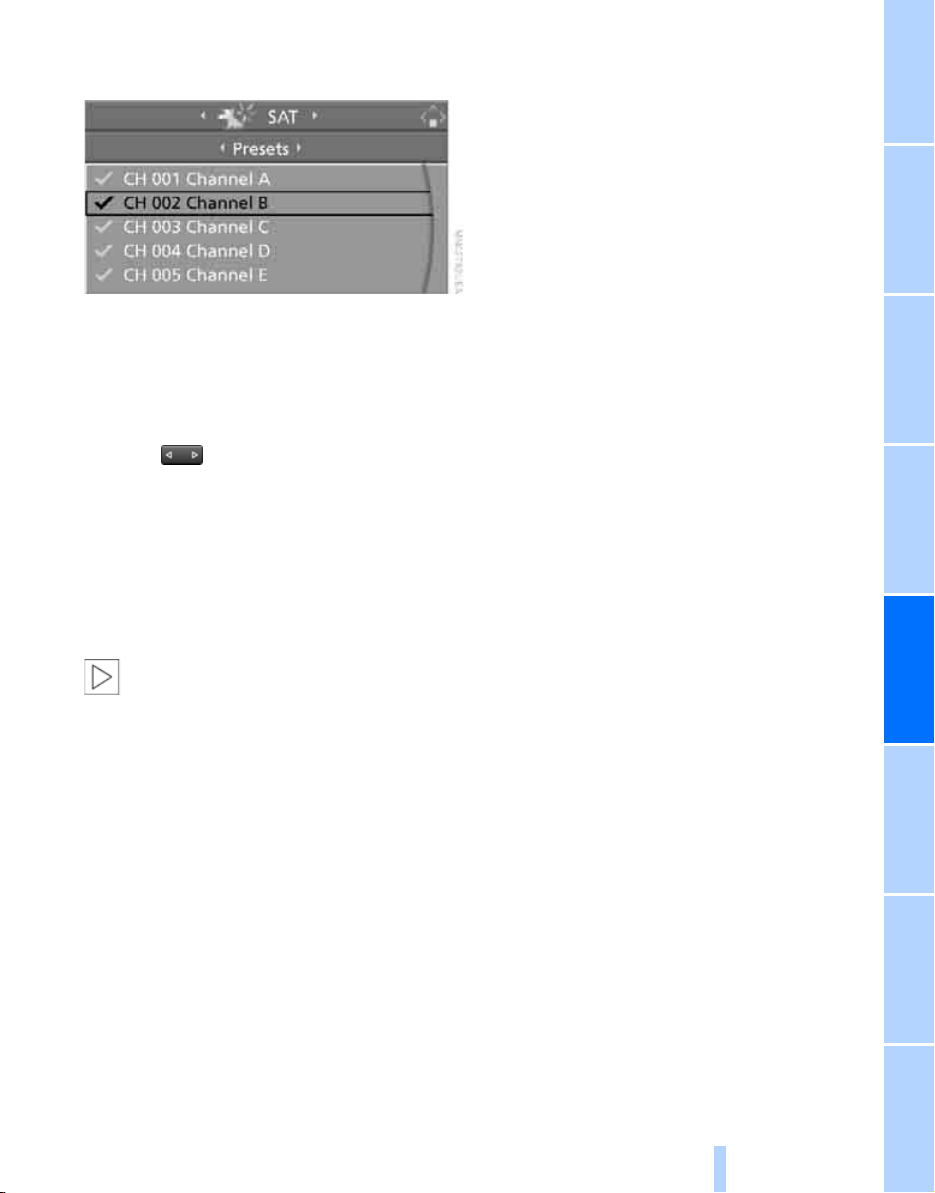
NavigationEntertainment Driving tips
165
Reference At a glanceControlsCommunicationsMobility
4. Turn the controller to select a memory loca-
tion and press the controller.
The channel is stored. The channels of the last
selection criterion are displayed once again
after a short time.
Changing channel with buttons next to
CD player
Press the button for the corresponding
direction.
The system changes to the next enabled chan-
nel.
Notes
If no signal can be received for more than 4 sec-
onds, a message is displayed on the Control
Display.
Reception may not be possible for certain
reasons, e.g. environmental influences or
topographical conditions. The satellite radio
has no influence on this.
The signal may not be available in tunnels or
underground garages, next to tall buildings,
near trees, mountains or other sources of radio
interference.
Reception is usually possible again as soon as
the signal is available again.<
Online Edition for Part no. 01 41 2 600 775 - © 08/08 BMW AG
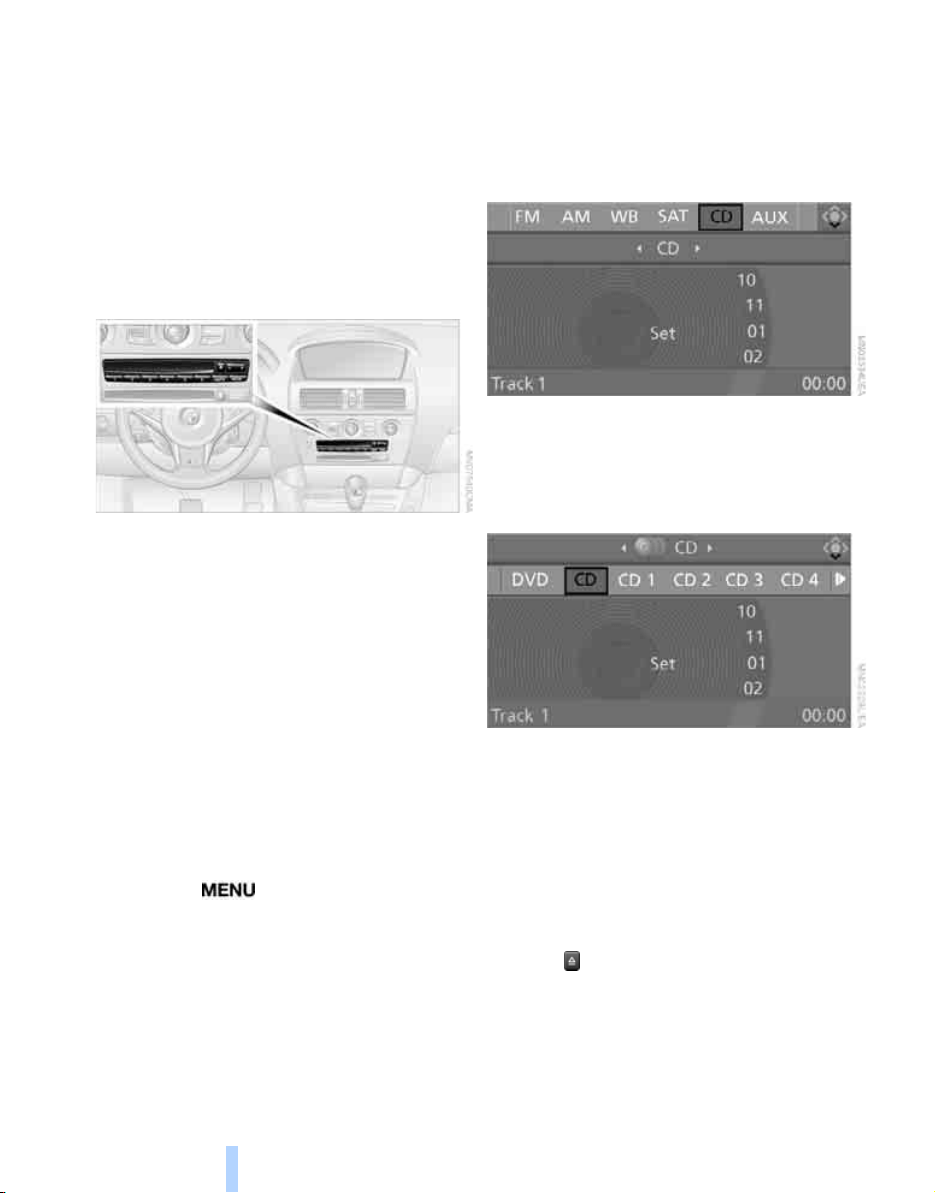
CD player and CD changer
166
CD player and CD changer
Listening to CDs
Compressed audio files*
CDs with compressed audio files, i.e. MP3, can
be played by the CD player, but not by the CD
changer.
CD player: starting CD
With two drives:
The upper drive is for audio CDs.
Inserting CD
Insert the CD into the drive with the labeled side
up. The CD is retracted.
Playback starts automatically if the sound out-
put is on. For CDs with compressed audio files,
it can take up to approx. 1 minute to read in the
data depending on the directory structure.
Via iDrive
To start playback when there is already a CD in
the drive:
iDrive, for operating principle refer to page 16.
1. Press the button.
This opens the start menu.
2. Move the controller backwards to open
"Entertainment".
3. Change to upper field if necessary. Turn the
controller until "CD" is selected and press
the controller.
4. With a CD changer, change to the second
field from the top and turn the controller
until "CD" is selected and press the control-
ler.
The CD player is started.
Playback starts automatically if the sound out-
put is switched on.
About programmable memory buttons
You can store the CD player function on the
programmable memory buttons. To start the
CD player, refer to page 22.
Eject CD
Press the button next to CD player.
The CD emerges slightly from the drive.
CD changer: starting CD
Fill the CD magazine and insert, refer to
page 170.
*
Online Edition for Part no. 01 41 2 600 775 - © 08/08 BMW AG
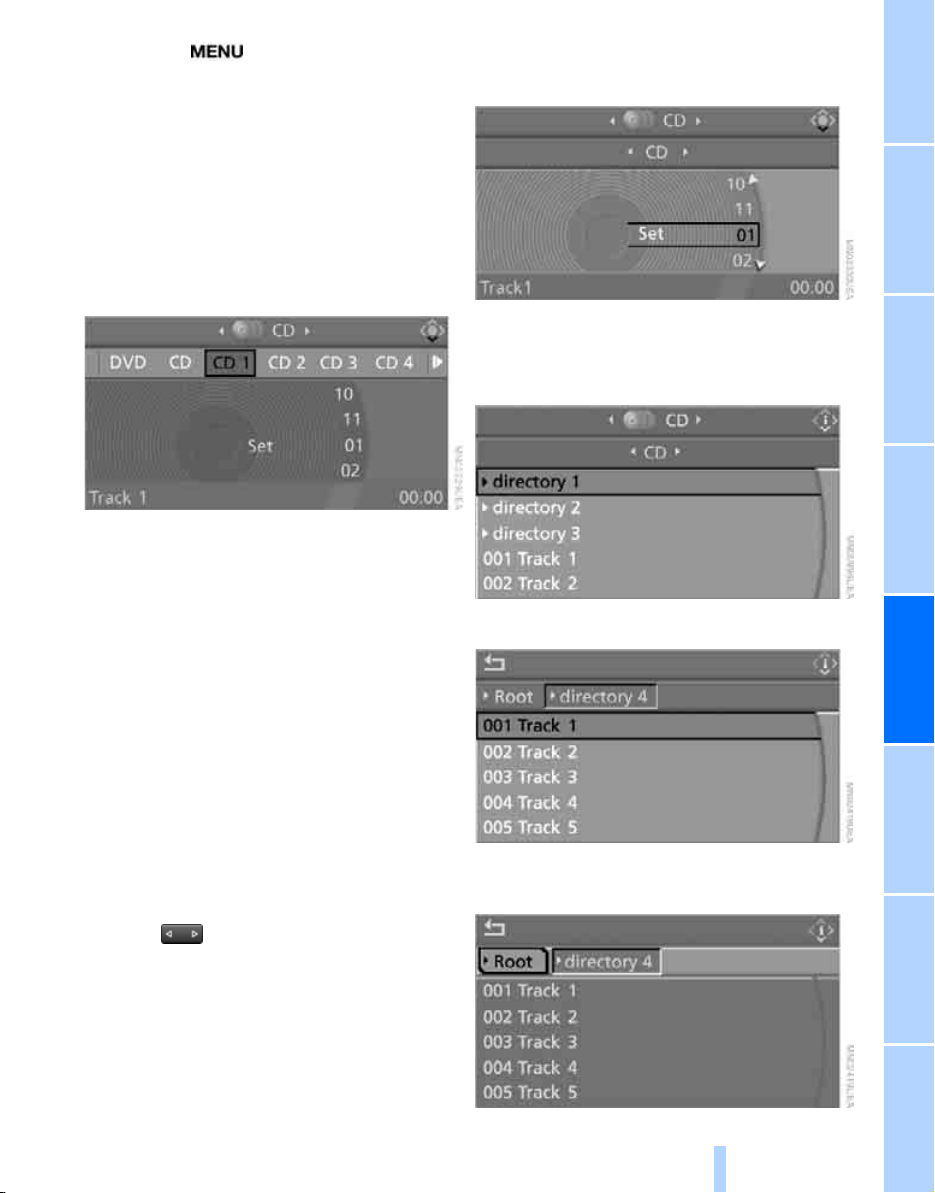
NavigationEntertainment Driving tips
167
Reference At a glanceControlsCommunicationsMobility
1. Press the button.
This opens the start menu.
2. Move the controller backwards to open
"Entertainment".
3. Change to upper field if necessary. Turn the
controller until "CD" is selected and press
the controller.
4. Change to the second field from the top if
necessary. Turn the controller until the
desired CD, CD 1 - 6, is selected and press
the controller.
At the end of the last track, the next CD will be
selected.
If the CD magazine has been newly filled, play-
back begins with the lowest CD, e.g. CD 1,
track 1.
The CD magazine's load status is indicated on
the Control Display.
About programmable memory buttons
You can store a CD compartment of the CD
changer on the programmable memory but-
tons. To start the CD changer, refer to page 22.
Selecting a track
Buttons next to CD player
Press the button for the corresponding
direction repeatedly until you reach the desired
track.
The CD will start play at the start of the track.
The track is displayed on the Control Display.
You can also change the track with buttons on
the steering wheel, refer to page 11.
Via iDrive
Select a track by turning the controller.
Compressed audio files*
1. Select the directory if necessary and press
the controller.
2. Select the track and press the controller.
To change the directory:
Select the directory and press the controller.
Online Edition for Part no. 01 41 2 600 775 - © 08/08 BMW AG
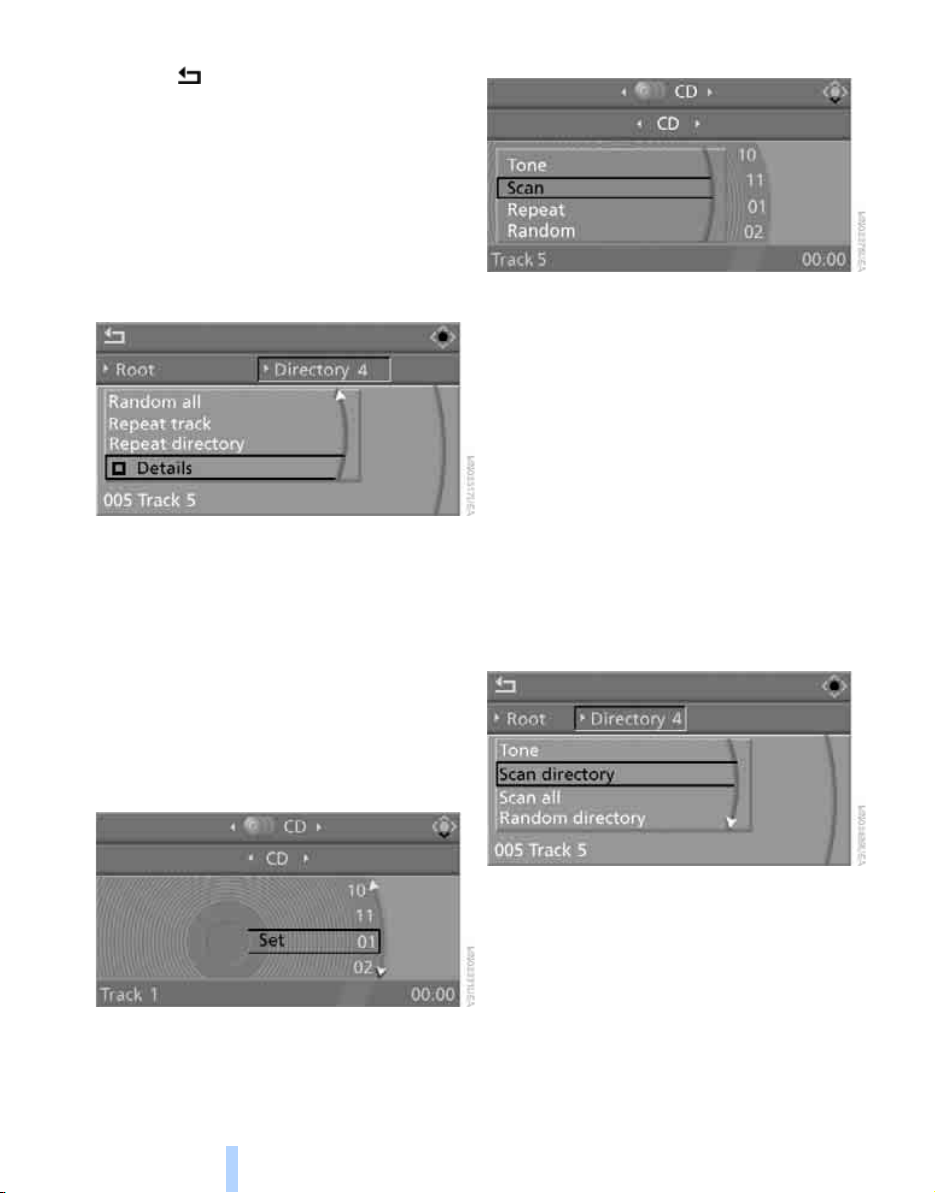
CD player and CD changer
168
To exit from the menu:
Select the arrow and press the controller.
You can also store a particular track on the pro-
grammable memory buttons, refer to page 22.
Displaying information on track*
With compressed audio files, you can display
any information stored on the current track, e.g.
the name of the artist.
1. Press the controller.
2. Select "Details" and press the controller.
The information for the current track are dis-
played.
From radio readiness, the setting is stored for
the remote control currently in use.
Sampling tracks, scan
The system plays a brief sample from each of
the tracks on the current CD.
1. Select "Set" and press the controller.
Other menu items are displayed.
2. Select "Scan" and press the controller.
To end sampling:
1. Press the controller.
2. Select "Scan" and press the controller.
This cancels sampling of the tracks, and the
player remains on the current track.
Compressed audio files*
1. Select the current track and press the con-
troller.
2. Select the desired menu item:
> To sample all tracks of the current direc-
tory, select "Scan directory" and press
the controller.
> To sample all tracks of the CD, select
"Scan all" and press the controller.
To end sampling:
1. Press the controller.
2. Select "Scan directory" or "Scan all" and
press the controller.
This cancels sampling, and the player remains
on the current track.
Online Edition for Part no. 01 41 2 600 775 - © 08/08 BMW AG
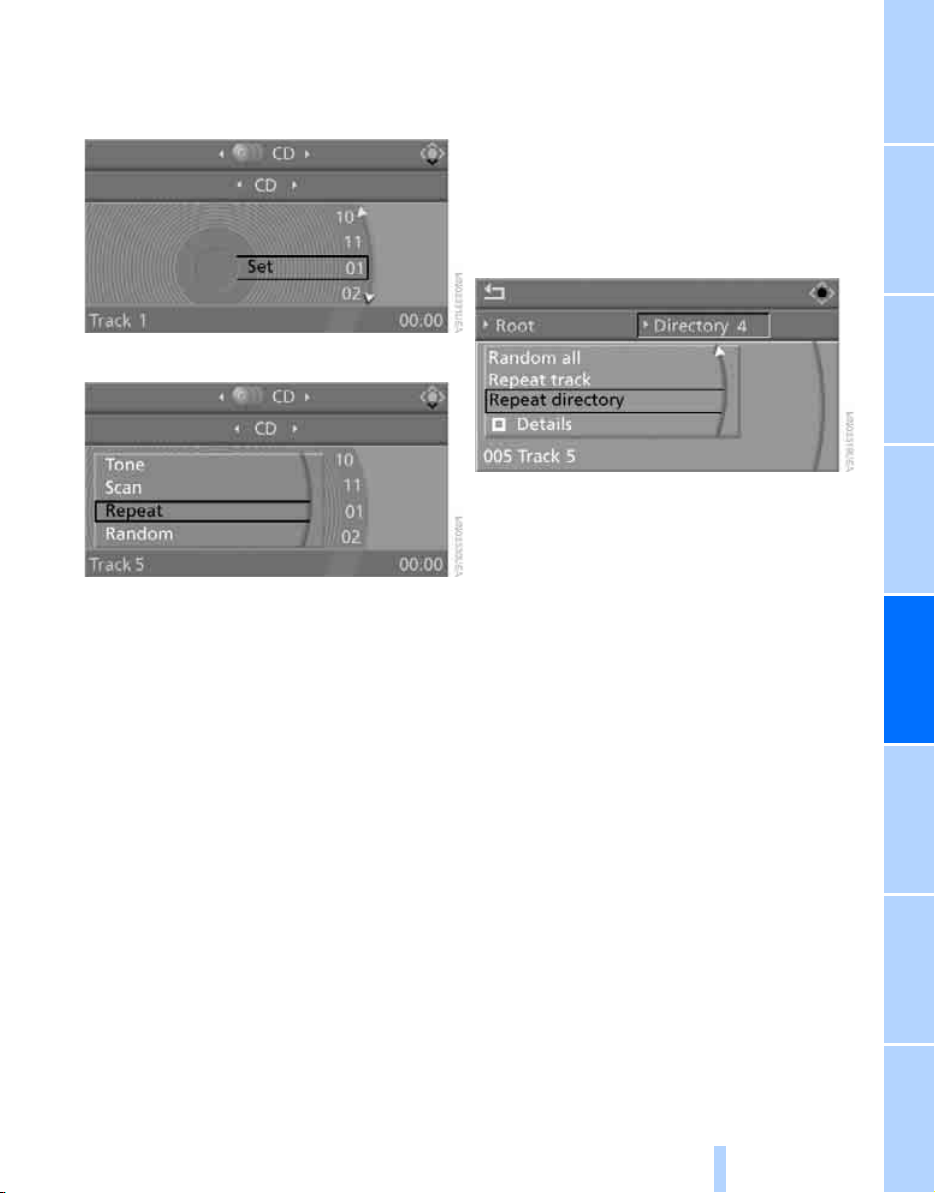
NavigationEntertainment Driving tips
169
Reference At a glanceControlsCommunicationsMobility
Repeating a track
1. Select "Set" and press the controller.
Other menu items are displayed.
2. Select "Repeat" and press the controller.
The current track on the CD is repeated.
To stop repeating:
1. Press the controller again.
2. Select "Repeat" and press the controller.
Compressed audio files*
1. Select the current track and press the con-
troller.
2. Select the desired menu item:
> To repeat the selected track, select
"Repeat track" and press the controller.
> To repeat all tracks of the current direc-
tory, select "Repeat directory" and press
the controller.
To stop repeating:
1. Press the controller.
2. Select "Repeat track" or "Repeat directory"
and press the controller.
Random play sequence
In this mode, the tracks on the current CD are
played once in a random sequence.
1. Select "Set" and press the controller.
Other menu items are displayed.
2. Select "Random" and press the controller.
To stop random function:
1. Press the controller.
2. Select "Random" and press the controller.
Online Edition for Part no. 01 41 2 600 775 - © 08/08 BMW AG
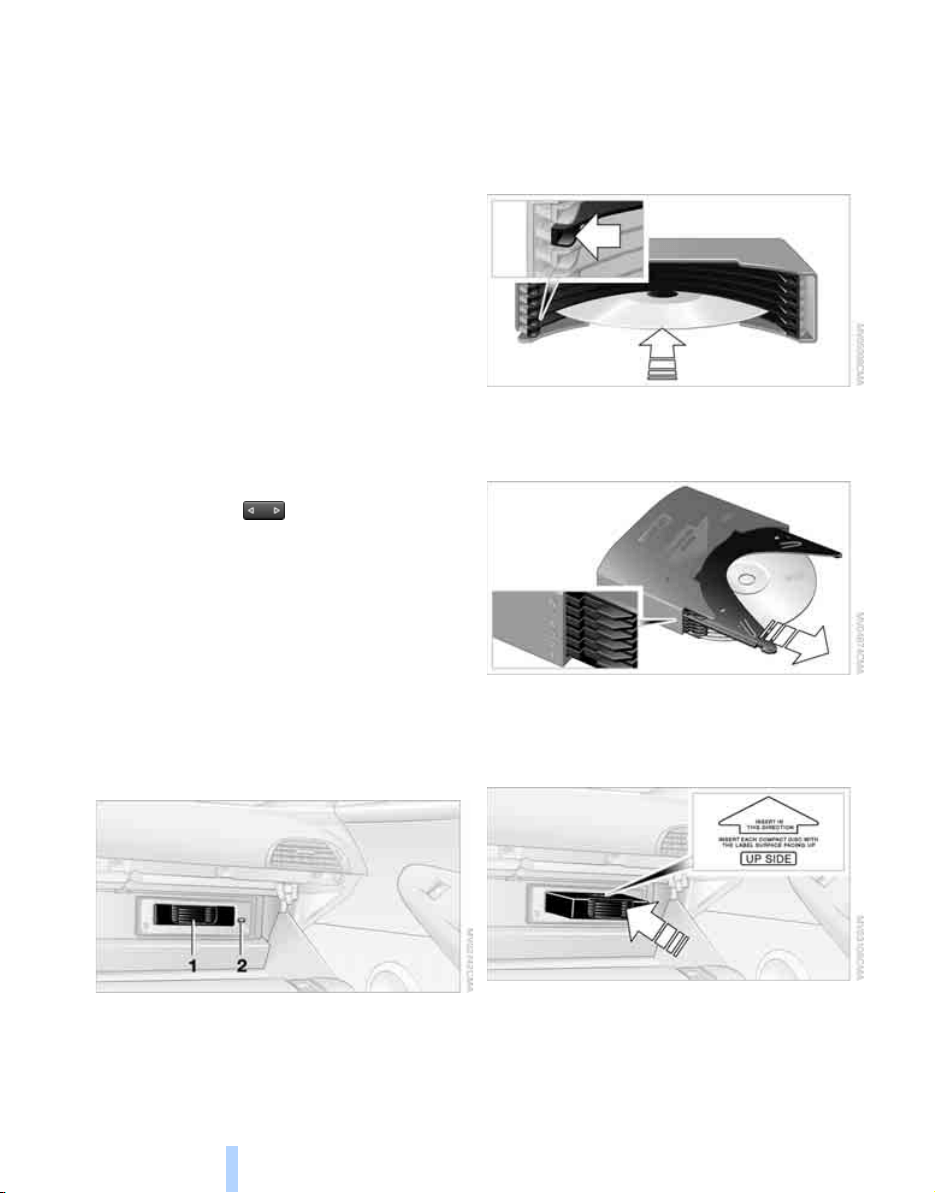
CD player and CD changer
170
Compressed audio files*
1. Select the current track and press the con-
troller.
2. Select the desired menu item:
> To play all tracks of the current directory
in random order, select "Random direc-
tory" and press the controller.
> To play all tracks of the CD in random
order, select "Random all" and press the
controller.
To stop random function:
1. Press the controller.
2. Select "Random directory" or "Random all"
and press the controller.
Fast forward/reverse
Buttons next to CD player:
Press and hold the button for the corre-
sponding direction.
CD magazine
The BMW CD changer for six CDs is installed in
the glove compartment.
Removing CD magazine
To insert CDs into the CD magazine 1 or
remove them from it, you must first remove the
magazine from the CD changer:
Press button 2: the CD magazine 1 slides out.
Wait at least 2 seconds before pushing in the
magazine again so that the inserted CDs can be
read in again.
Inserting/removing CDs into/from
CD magazine
When inserting or removing CDs, remember to
hold them by their edges, taking care to avoid
touching the data side with its reflective CD
memory surface.
Inserting CDs:
Insert one CD into each compartment of the
magazine with the labeled side up.
Removing CDs:
Pull out the desired tray and remove the CD.
Inserting CD magazine
Push in the CD magazine as far as possible in
the direction of the arrow.
The CD changer reads in the loaded CDs and is
then ready for operation.
Online Edition for Part no. 01 41 2 600 775 - © 08/08 BMW AG

NavigationEntertainment Driving tips
171
Reference At a glanceControlsCommunicationsMobility
Notes
BMW CD/DVD players and changers are
officially designated Class 1 laser prod-
ucts. Do not operate if the cover is damaged,
otherwise severe eye damage can result.
Do not use self-recorded CDs/DVDs with labels
applied as these can become detached during
playback due to heat buildup and can cause
irreparable damage to the device.
Only use round CDs/DVDs with a standard
diameter of 4.7 in/12 cm and do not play CDs/
DVDs with an adapter, e.g. CD singles, as other-
wise the CD/DVD or the adapter can jam and
may no longer eject properly.
Do not use a combined CD/DVD, e.g. DVD
Plus
,
otherwise the CD/DVD can jam and will no
longer eject.<
General malfunctions
BMW CD/DVD changers and players have been
optimized for performance in vehicles. In some
instances they may be more sensitive to faulty
CDs/DVDs than stationary devices would be.
If a CD/DVD cannot be played, first check
whether it has been inserted correctly.
Humidity
High levels of humidity can lead to condensa-
tion on the CD/DVD or the laser's scan lens and
temporarily prevent playback.
Malfunctions with individual CDs/DVDs
If malfunctions occur only with particular CDs/
DVDs, this can be due to one of the following
causes.
Self-recorded CDs/DVDs
Possible reasons for malfunctions with self-
recorded CDs/DVDs are, e.g. inconsistent data-
creation or recording processes, or poor quality
or high age of the CD/DVD blank.
Only label CDs/DVDs on the upper side with a
pen intended for this purpose.
Damaged CDs/DVDs
Avoid fingerprints, dust, scratches and mois-
ture.
Store CDs/DVDs in a sleeve.
Do not subject CDs/DVDs to temperatures over
1227/506, high levels of humidity or direct
sunlight.
CDs/DVDs with copy protection
CDs/DVDs are often provided with a copy pro-
tection feature by the manufacturer. This can
mean that some CDs/DVDs cannot be played or
can only be played to a limited extent.
Care
If necessary, clean the reflective scanning side
of the CDs/DVDs with a commercially available
cleaning cloth by wiping in straight lines from
the center outward.
Online Edition for Part no. 01 41 2 600 775 - © 08/08 BMW AG
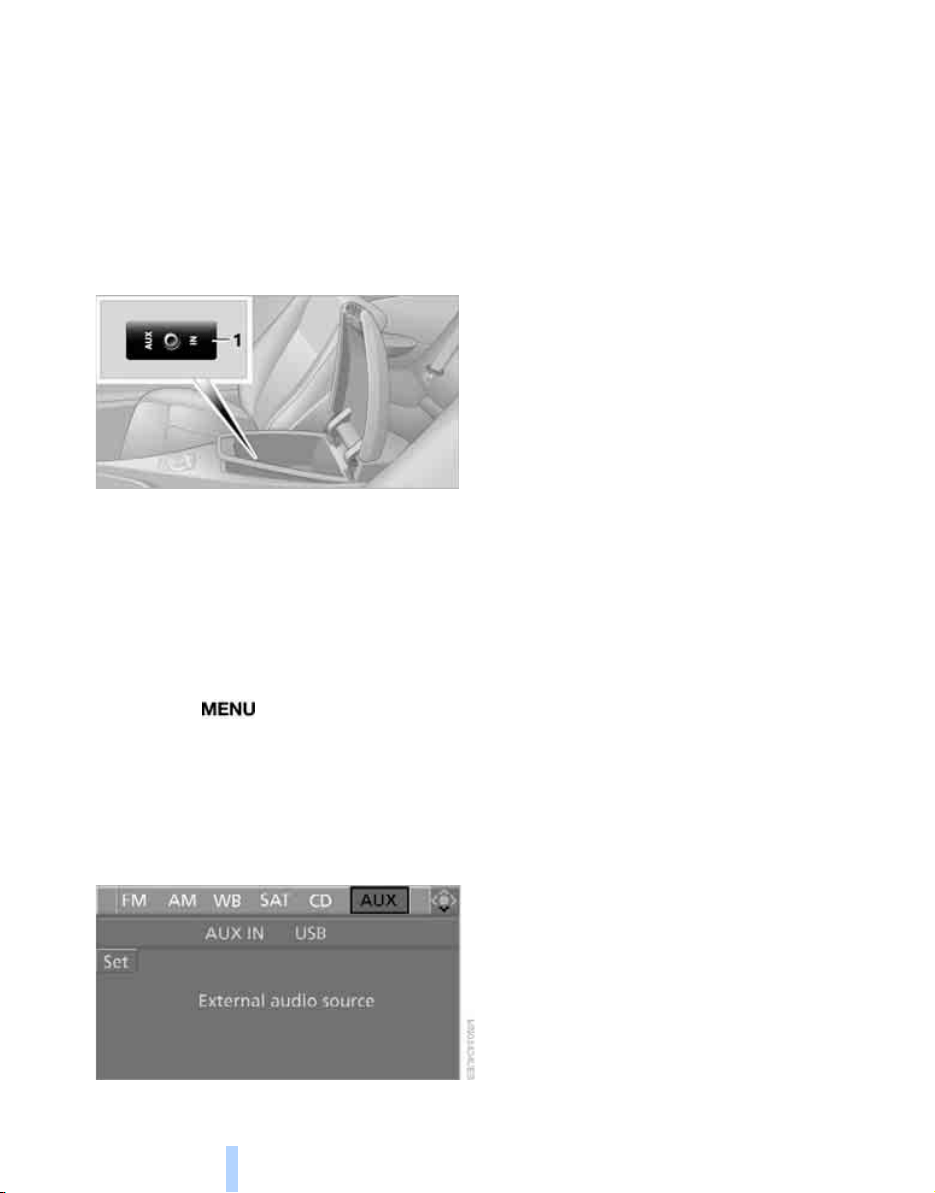
AUX-IN connection
172
AUX-IN connection
You can connect an external audio device, e.g.
an MP3 player, and play the sound via the vehi-
cle speakers. The sound can be adjusted via
iDrive.
Connecting
For audio playback via the vehicle speakers,
connect the headphones or the line-out con-
nection of the device to the socket 1 with a
1/8 in/3.5 mm jack plug.
Starting audio playback
The audio device must be switched on.
1. Press the button.
This opens the start menu.
2. Move the controller backwards to open
"Entertainment".
3. Change to upper field if necessary. Turn the
controller until "AUX" is selected and press
the controller.
4. Select "AUX IN" and press the controller.
5. Adjust volume and sound if necessary.
About programmable memory buttons
You can save the audio AUX function on the
programmable memory buttons. To start audio
playback, refer to page 22.
Online Edition for Part no. 01 41 2 600 775 - © 08/08 BMW AG
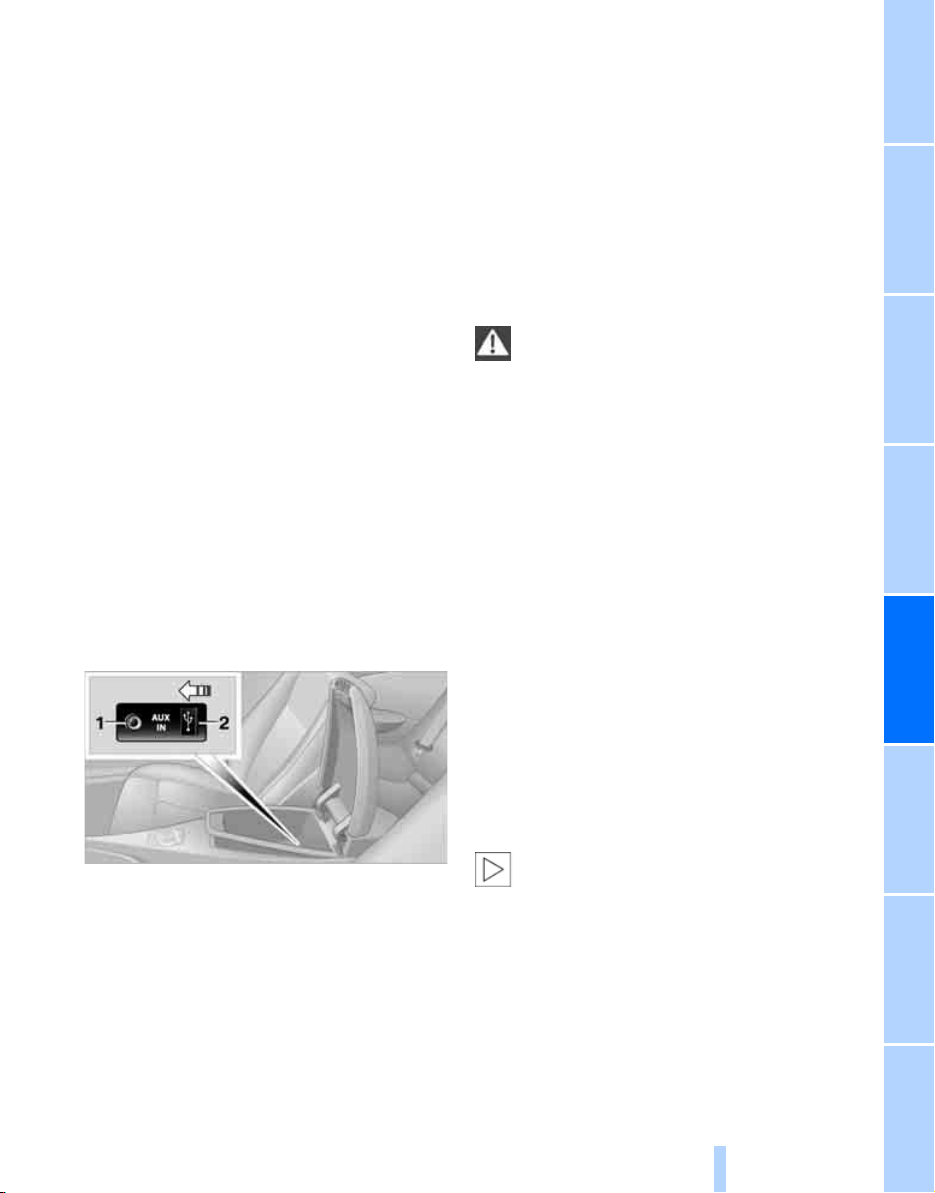
NavigationEntertainment Driving tips
173
Reference At a glanceControlsCommunicationsMobility
USB-audio interface/mobile phone audio
interface
You can connect audio devices, e.g. an iPod/
iPhone or a USB device (MP3 player, USB flash
drive), to the USB-audio interface. You can then
operate these via iDrive.
When using an iPhone/mobile phone as a
music player, connect the device to the snap-in
adapter, refer to the separate operating instruc-
tions. Playback is only possible if a device is not
connected to the USB-audio interface.
The system can play back common audio files,
e.g. MP3, WMA, WAV (PCM) and AAC, as well
as playback lists in the M3U format.
Due to the large number of audio devices avail-
able on the market, operation via the vehicle
cannot be ensured for every audio device.
Ask your BMW center which audio devices are
suitable.
Connecting
Lift up the center armrest.
1 Connection for audio playback:
1/8 in/3.5 mm jack plug
2 USB-audio interface
iPod/iPhone
To connect the iPod/iPhone, use the BMW
cable adapter for the Apple iPod/iPhone. For
more information, please contact a BMW center
or consult our website: bmwusa.com
To play audio tracks over the vehicle's loud-
speaker system, connect the iPod/iPhone to
ports 1 and 2.
The iPod/iPhone menu structure is supported
by the USB-audio interface.
USB device
To connect the device, use a flexible
adapter cable to protect the USB-audio
interface and your USB device against physical
damage.<
For audio playback via the vehicle speakers,
connect the USB device to the connection 1.
After connecting for the first time, the informa-
tion of all tracks (e.g. artist, music genre) and
the playback lists of the USB device are trans-
ferred to the vehicle. This process can take
some time. The time required is dependent on
the USB device and on the number of tracks.
During the transfer you can select the tracks via
the directories and file names.
Following the transfer you can call up the tracks
via the information and playback lists.
Information from up to four USB devices can be
stored in the vehicle, or a total of approx. 16 000
tracks.
If a fifth USB device is connected, the informa-
tion of the tracks of the first USB device stored
in the vehicle is deleted.
Music tracks with integrated Digital
Rights Management (DRM) cannot be
played.<
Starting audio playback
Via iDrive
If the audio device has a device name, this will
be displayed if possible.
*
Online Edition for Part no. 01 41 2 600 775 - © 08/08 BMW AG
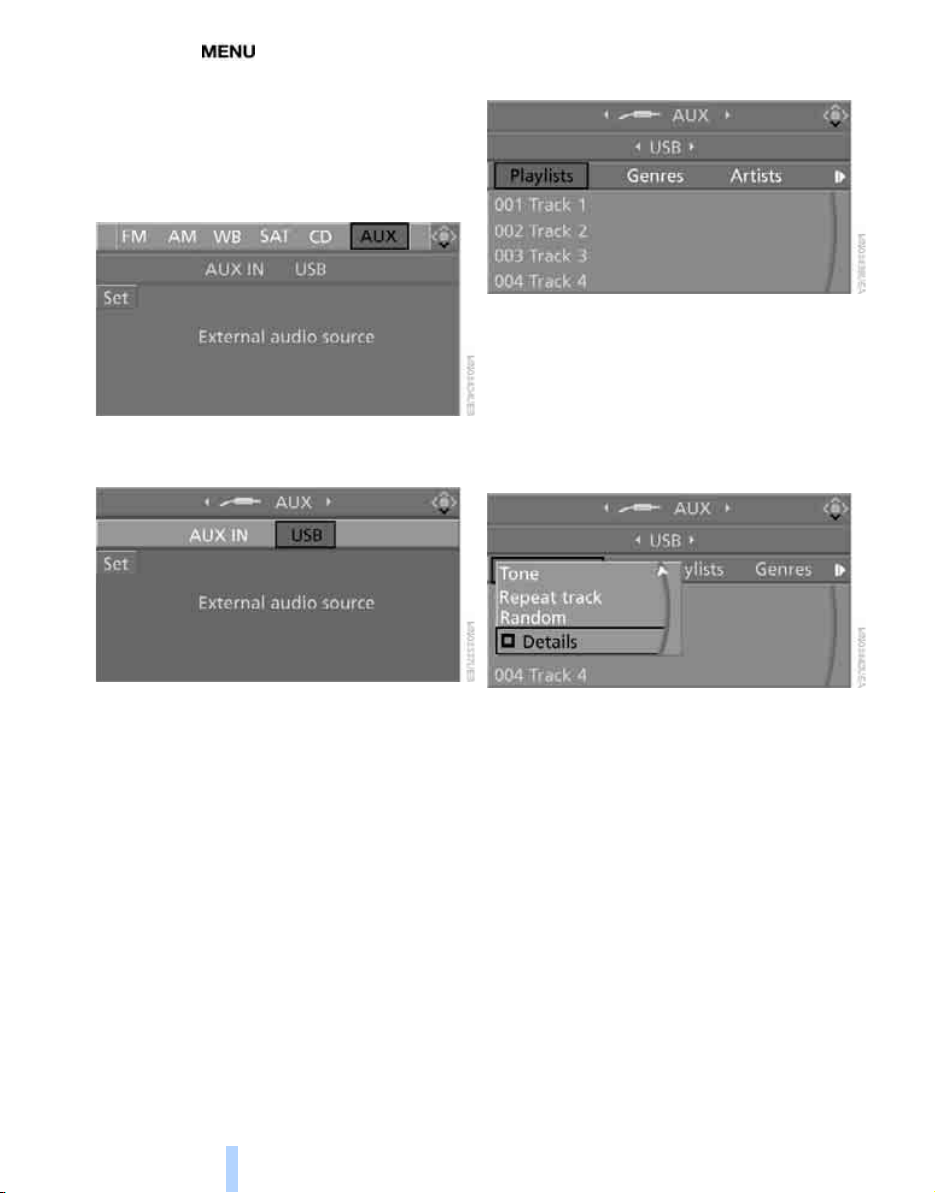
USB-audio interface/mobile phone audio interface
174
1. Press the button.
This opens the start menu.
2. Move the controller backwards to call up
"Entertainment".
3. Change to upper field if necessary. Turn the
controller until "AUX" is selected and press
the controller.
4. Select "USB" or the name of the audio
device and press the controller.
5. The playback starts with the first track.
About programmable memory buttons
You can store the "USB" function on the pro-
grammable memory keys to start audio play-
back, refer to page 22.
Selecting a track
You can call up the tracks via the playback lists
and information. With USB devices you can also
call up the tracks via the file directory.
1. Make your selection, e.g. "Playlists" or "Art-
ists", and press the controller.
2. Select the track and press the controller.
Displaying information on track
You can display any information stored on the
current track, e.g. the name of the artist.
1. Press the controller during playback.
2. Select "Details" and press the controller.
The information for the current track are dis-
played.
Online Edition for Part no. 01 41 2 600 775 - © 08/08 BMW AG
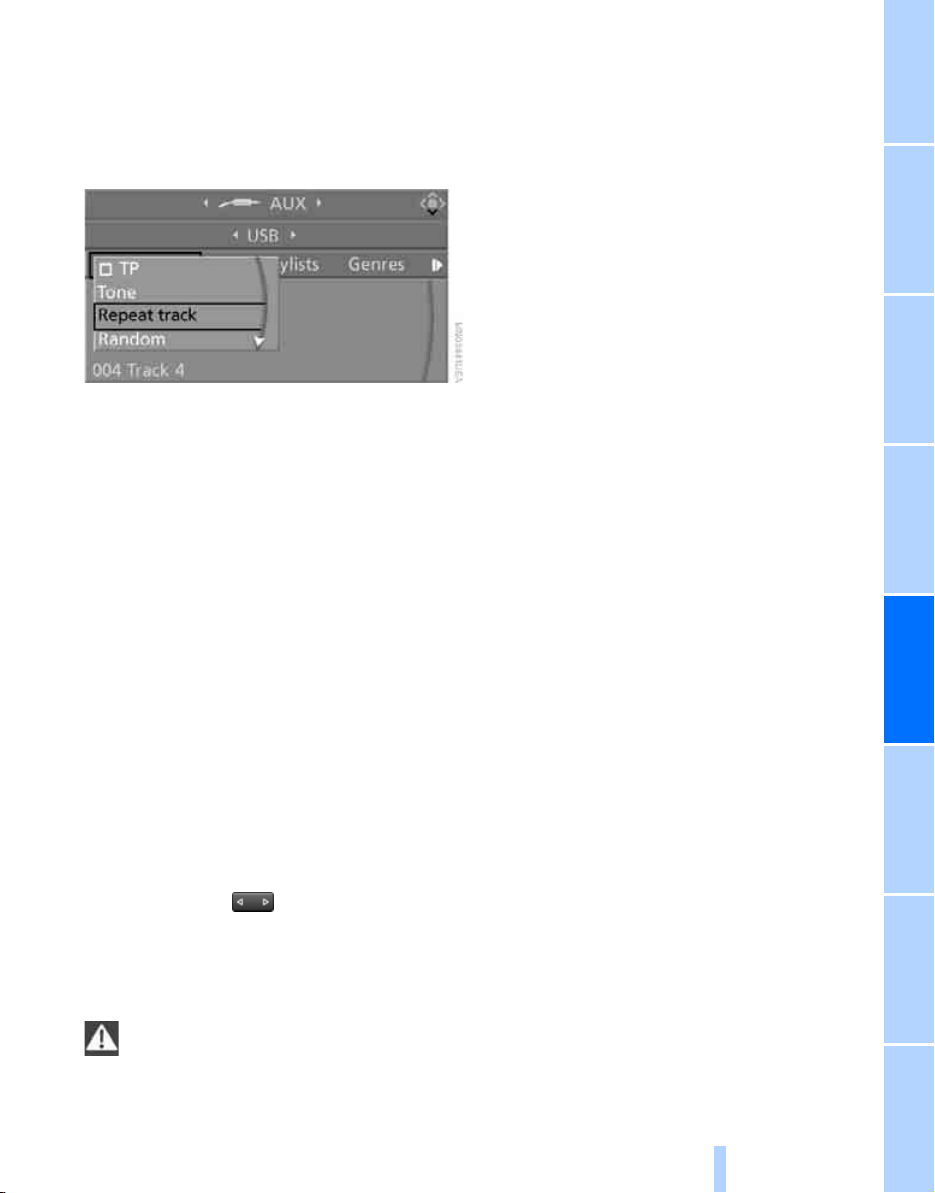
NavigationEntertainment Driving tips
175
Reference At a glanceControlsCommunicationsMobility
Repeating a track
1. Select the current track and press the con-
troller.
2. Select "Repeat track" and press the con-
troller.
To stop repeating:
1. Press the controller.
2. Select "Repeat track" and press the con-
troller.
Random play sequence
You can play back the tracks of the selected list
in random order, e.g. all tracks of an artist.
1. Select the current track and press the con-
troller.
2. Select "Random" and press the controller.
End random playback:
1. Press the controller.
2. Select "Random" and press the controller.
Fast forward/reverse
Buttons next to CD player:
Press and hold the button for the corre-
sponding direction.
Notes
Do not subject the audio device to
extreme environmental conditions, e.g.
extremely high temperatures, refer to the oper-
ating instructions of the audio device. Other-
wise, the audio device can be damaged and the
resulting distraction can reduce road safety
while driving.<
Depending on the configuration of the audio
files, e.g. bit rates greater than 256 Kbit/s,
proper playback cannot always be ensured.
Connecting instructions
> The USB/audio interface supplies the con-
nected audio device with power, provided
the audio device supports this function. It is
therefore unnecessary to connect the audio
device to a socket in the vehicle during
operation.
> Do not use force when plugging the con-
nector into the USB-audio interface.
> Do not connect devices such as fans or
lamps to the USB-audio interface.
> Do not connect USB hard disks.
> Do not use the audio interface to recharge
external devices.
Online Edition for Part no. 01 41 2 600 775 - © 08/08 BMW AG
Online Edition for Part no. 01 41 2 600 775 - © 08/08 BMW AG

Communications
This chapter summarizes how to operate your
mobile phone using iDrive or voice control and
how to use BMW Assist or BMW TeleServices.
Communications
Online Edition for Part no. 01 41 2 600 775 - © 08/08 BMW AG

Telephoning
178
Telephoning
The concept
Your BMW is equipped with a full mobile phone
preparation package. After pairing a suitable
mobile phone in the vehicle once, you can oper-
ate the mobile phone via iDrive, with the buttons
on the steering wheel and by voice.
A mobile phone that has been paired once is
automatically detected again with the engine
running or the ignition switched on as soon as
it is in the vehicle interior. The logon data of up
to four mobile phones can be stored simulta-
neously. If several mobile phones are detected
simultaneously, the respective last mobile
phone paired can be operated via the vehicle.
Using a phone in your vehicle
Using snap-in adapter*
The so-called snap-in adapter, a mobile phone
cradle, enables the battery to be charged and
the mobile phone to be connected to the exter-
nal antenna of your vehicle. This ensures
improved network reception and a consistent
voice reproduction quality. Ask your BMW cen-
ter which mobile phones snap-in adapters are
offered for.
For your safety
A car phone makes life more convenient in
many ways, and can even save lives in an emer-
gency. While you should consult your mobile
phone's separate operating instructions for a
detailed description of safety precautions and
information, we request that you direct your
particular attention to the following:
Only make entries when traffic conditions
allow you to do so. Do not hold the mobile
phone in your hand while you are driving; use
the hands-free system instead. If you do not
observe this precaution, your being distracted
can endanger vehicle occupants and other road
users.<
Suitable mobile phones
Ask your BMW center which mobile phones
with a Bluetooth interface are supported by the
mobile phone preparation package or which
mobile phones snap-in adapters are available
for. These mobile phones support the functions
described in this Owner's Manual with a certain
software version. Malfunctions can occur with
other mobile phones.
Care instructions
You can find valuable information on this topic
under Care, starting on page 206 and the sepa-
rate operating instructions for the mobile
phone.
Operating options
You can operate the mobile phone* using:
> Buttons on steering wheel, refer to page 11
> iDrive, refer to page 16
> Voice commands, refer to page 189
> Programmable memory buttons, refer to
page 22
Avoid operating a mobile phone detected by
the vehicle with the keypad of the mobile
phone, otherwise malfunctions can occur.
Placing phone calls with BMW Assist
system*: BMW Assist calls
You can use the BMW Assist system via the
hands-free unit for BMW Assist calls.
When the status information "BMW Assist" or
"BMW Service" is displayed in "Communica-
tion", only BMW Assist calls are possible.
It may not be possible to establish a telephone
connection using the mobile phone while a con-
nection is being established to BMW Assist or
while a call to BMW Assist is already in
progress. If this happens, you must log off the
*
Online Edition for Part no. 01 41 2 600 775 - © 08/08 BMW AG
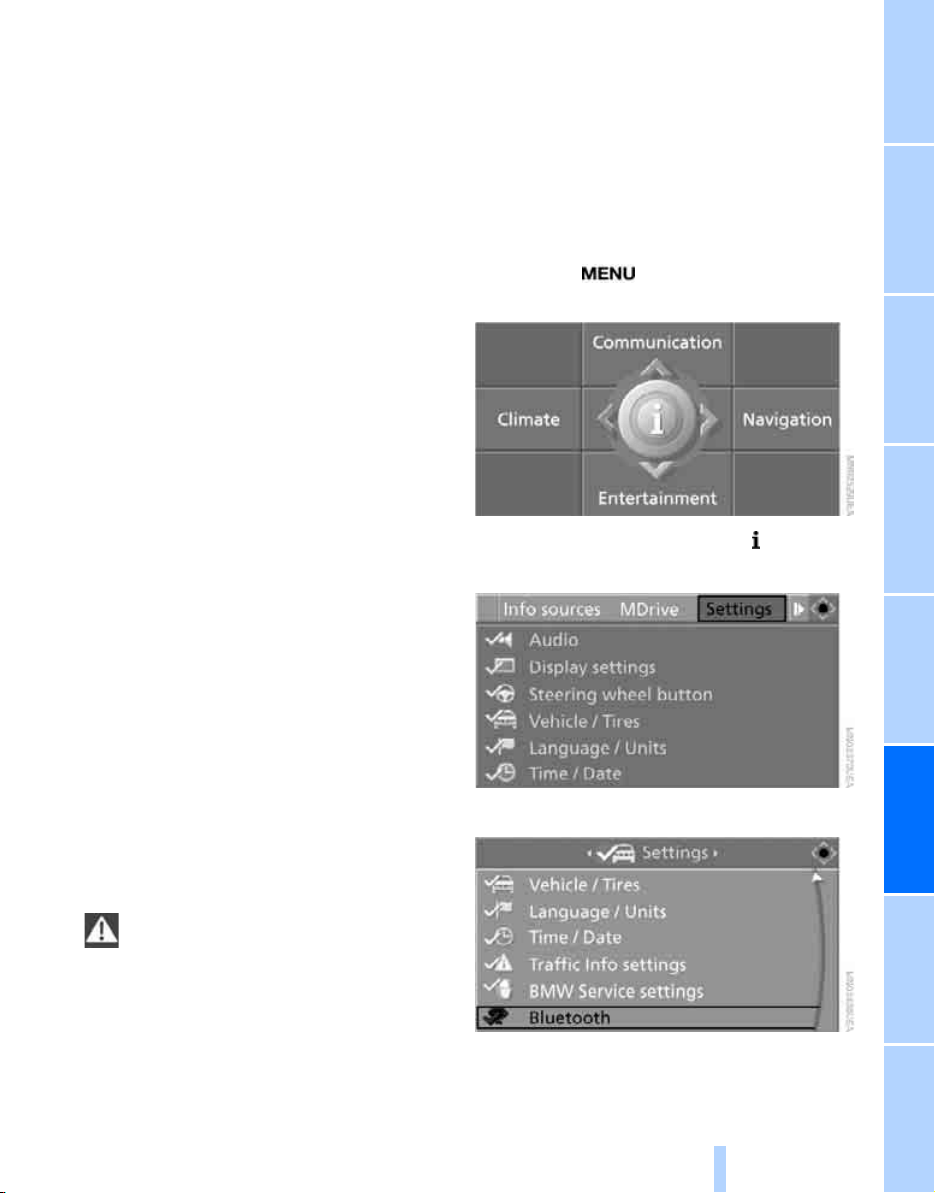
179
EntertainmentReference At a glanceControlsDriving tipsCommunications NavigationMobility
mobile phone from the vehicle if you wish to
place a call with the mobile phone.
Commissioning
Pairing mobile phone in vehicle
The following prerequisites must be met:
> Suitable mobile phone: the mobile phone is
supported by the full mobile phone prepara-
tion package. Information on this subject is
also provided on the Internet at:
bmwusa.com
> The mobile phone is ready to operate.
> The Bluetooth link on the vehicle, refer to
page 183, and on the mobile phone is
active.
> Depending on the mobile phone, the mobile
phone may need presetting: e.g. using the
following menu items:
> Bluetooth activated
> Connection must be allowed without
requiring further confirmation
> Reconnect
> Depending on the mobile phone model, the
setting energy saving mode can, for exam-
ple, result in vehicle failing to detect the
paired mobile phone.
> For pairing purposes, define any 4-16-digit
number as a Bluetooth passkey,
e.g. 25081107. A long and complex num-
ber offers the best protection against unau-
thorized access. This Bluetooth passkey is
no longer required after pairing is success-
ful.
> The ignition is switched on.
Only pair the mobile phone with the vehi-
cle stopped, otherwise the passengers
and other road users can be endangered due to
a lack of attentiveness on the part of the
driver.<
Switching on ignition
1. Insert the remote control as far as possible
into the ignition lock.
2. Switch on the ignition by pressing the Start/
Stop button without depressing the brake
or clutch pedal.
Preparation via iDrive
iDrive, for operating principle refer to page 16.
3. Press the button to open the start
menu.
4. Press the controller to open the menu.
5. Select "Settings" and press the controller.
6. Select "Bluetooth" and press the controller.
Online Edition for Part no. 01 41 2 600 775 - © 08/08 BMW AG
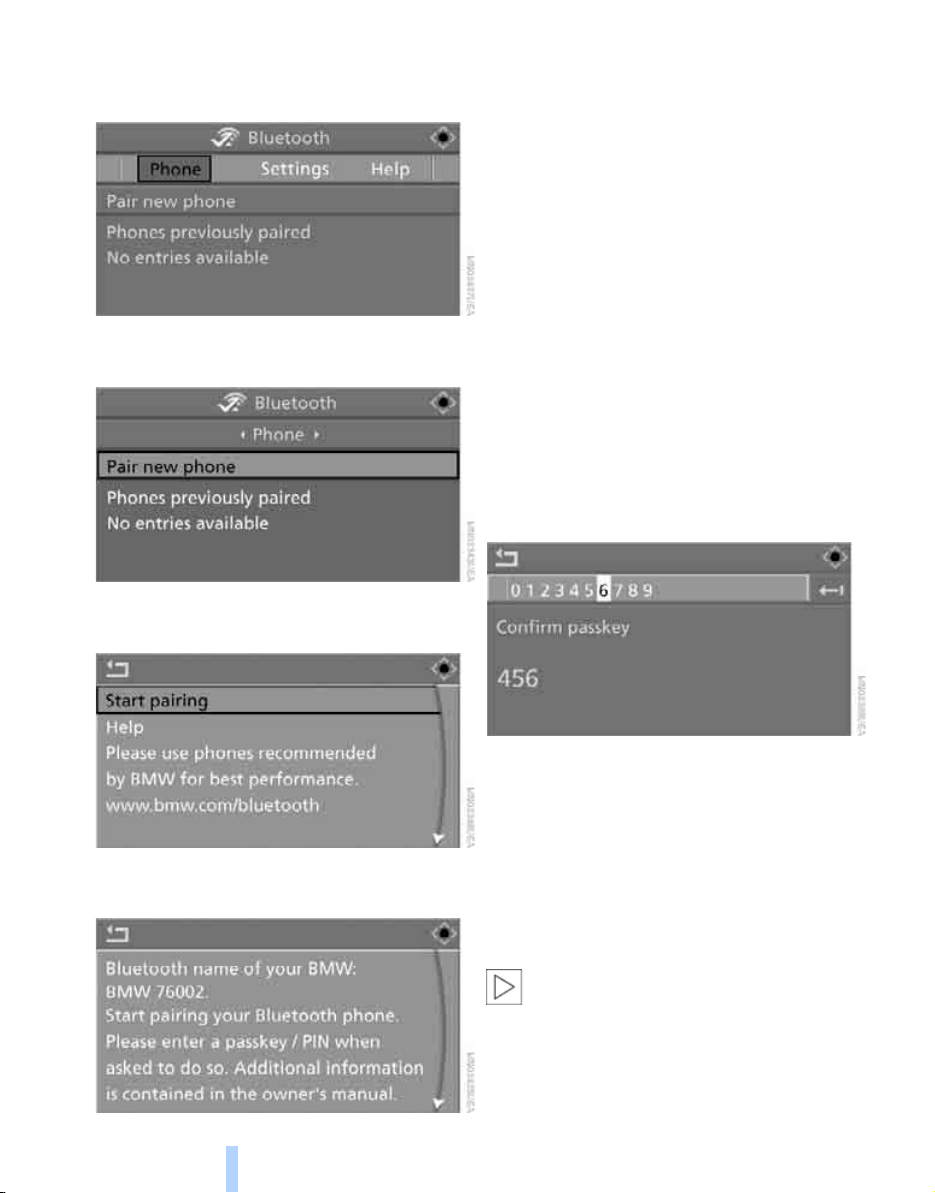
Telephoning
180
7. Move the highlight marker to the second
field from the top, select "Phone" and press
the controller.
8. Select "Pair new phone" and press the con-
troller.
9. Select "Start pairing" and press the control-
ler.
The Bluetooth name of the vehicle is dis-
played.
Preparation with mobile phone
10. Additional operations must be carried out
on the mobile phone and differ depending
on the model, refer to the operating instruc-
tions of your mobile phone, e.g. find, con-
nect or pair under Bluetooth device. The
Bluetooth name of the vehicle is also shown
on the mobile phone display.
11. Select the Bluetooth name of the vehicle on
the mobile phone display.
Pairing
Depending on your mobile phone, you will first
be requested consecutively via the display of
your mobile phone or iDrive to enter the Blue-
tooth passkey you specified.
12. Enter the Bluetooth passkey.
Depending on the mobile phone, approx.
30 seconds are available for entering the
Bluetooth passkey on the mobile phone
and on the Control Display.
13. Move the highlight marker to the third field
from the top, select "Confirm passkey" and
press the controller.
14. Wait several seconds until the "Communi-
cation" menu is displayed.
The next time you use the mobile phone inside
the vehicle, it will be recognized within a few
minutes as long as the engine is running or the
ignition is switched on.
With some mobile phone models it may
be necessary to make certain settings for
a permanent Bluetooth link, e.g. via the menu
item Authorization or Secure connection. Refer
to the operating instructions of your mobile
phone.<
Online Edition for Part no. 01 41 2 600 775 - © 08/08 BMW AG
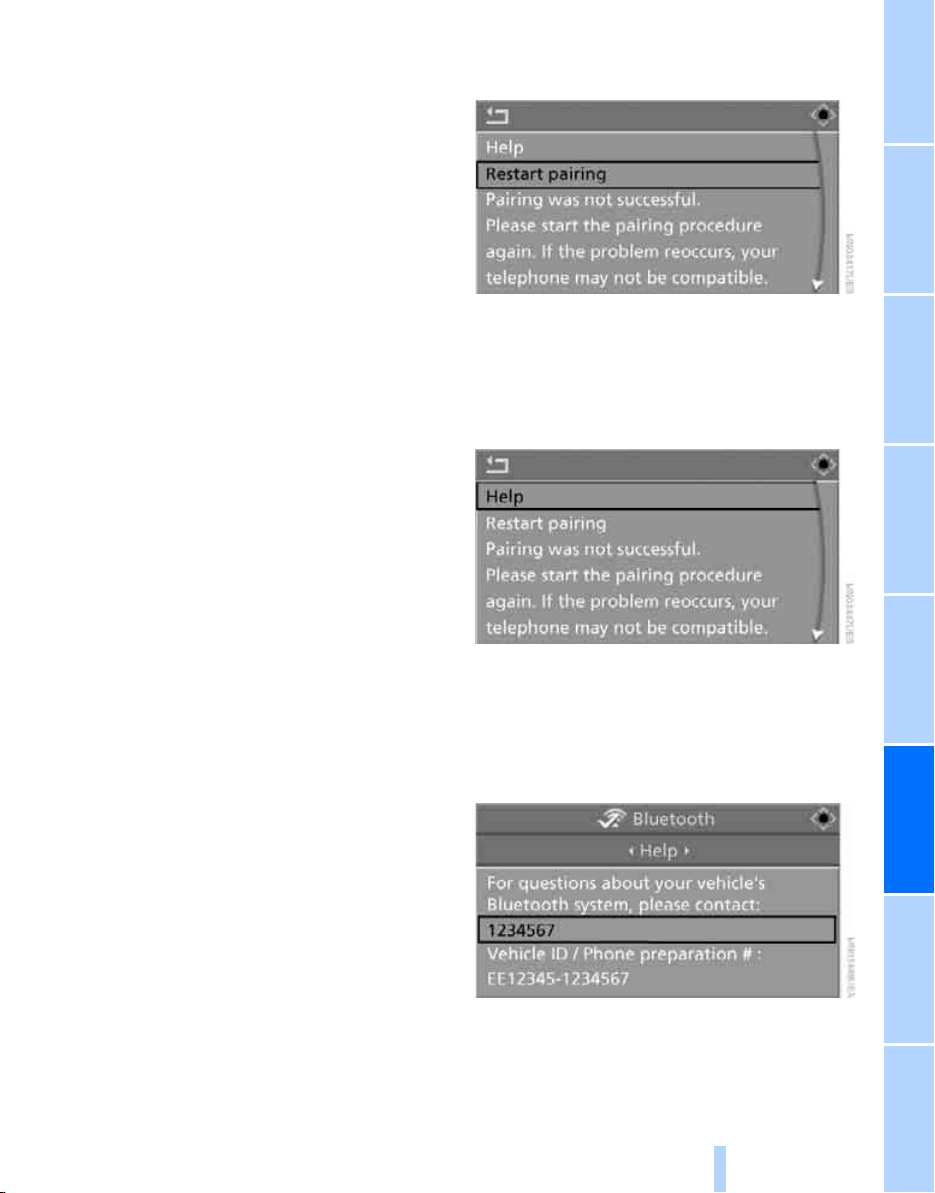
181
EntertainmentReference At a glanceControlsDriving tipsCommunications NavigationMobility
As soon as a mobile phone is detected by the
vehicle, the phone book entries stored on the
SIM card or on your mobile phone are transmit-
ted to your vehicle. This transmission is depen-
dent on your mobile phone, refer to the operat-
ing instructions of your mobile phone if
necessary, and can take several minutes.
If not all phone book entries are displayed:
> Transfer all phone book entries from the
SIM card to the mobile phone if necessary.
> It may not be possible to display phone
book entries with special characters.
Up to four mobile phones can be paired consec-
utively. When you pair a fifth mobile phone, the
pairing data of the mobile phone for which the
pairing data were stored first in the vehicle will
be deleted.
Checking if pairing is unsuccessful
> Is the mobile phone supported by the
mobile phone preparation package? Infor-
mation on this subject is also provided on
the Internet at: www.bmwusa.com.
> Do the Bluetooth passkeys on the mobile
phone and the vehicle match? The same
Bluetooth passkey must be entered both on
the mobile phone display and via iDrive.
> Have you required longer than 30 seconds
to enter the Bluetooth passkey?
> Only a limited number of devices can be
connected to the mobile phone. Delete the
connection to other devices if necessary.
> The mobile phone no longer reacts? Switch
the mobile phone off and then on again or
disconnect the power supply.
To repeat pairing:
1. Select "Restart pairing" and press the con-
troller.
2. Repeat steps 9 to 14.
If pairing was repeatedly unsuccessful, contact
BMW Customer Relations.
To call BMW Customer Relations:
Select "Help" and press the controller.
The phone number of BMW Customer Rela-
tions and information required for pairing is
shown on the display. With mobile phones
already paired, you can select the phone num-
ber of BMW Customer Relations to establish
the connection.
List of paired mobile phones
The mobile phones for which the vehicle has
stored the pairing data can be displayed. If sev-
eral paired mobile phones are detected by the
Online Edition for Part no. 01 41 2 600 775 - © 08/08 BMW AG
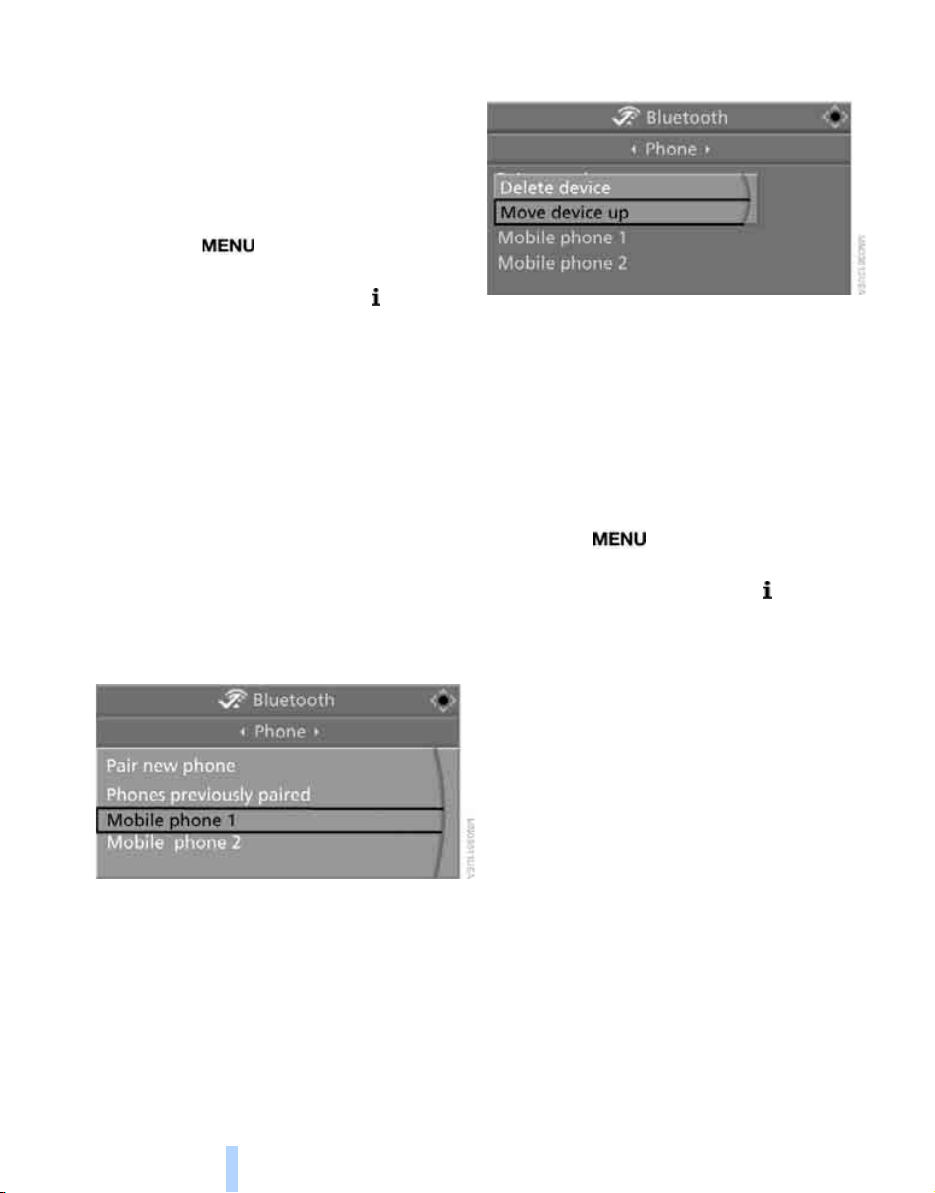
Telephoning
182
vehicle simultaneously, you can operate the
mobile phone highest up in the list via the vehi-
cle.
You can change the order of the mobile phones
in the list. As long as a mobile phone is selected
in this list, the mobile phones cannot be oper-
ated via the vehicle.
iDrive, for operating principle refer to page 16.
1. Press the button to open the start
menu.
2. Press the controller to open the menu.
3. Select "Settings" and press the controller.
4. Select "Bluetooth" and press the controller.
5. Move the highlight marker to the second
field from the top, select "Phone" and press
the controller.
6. Select the desired mobile phone.
With two drives:
> Move the controller backwards to
change into the bottom field.
> Select the desired mobile phone and
press the controller.
With a single drive:
> Select the desired mobile phone and
press the controller.
7. Select "Move device up" and press the con-
troller.
The selected mobile phone is moved
upward by one position.
Unpairing mobile phone from vehicle
If you no longer want to operate a mobile phone
via the vehicle, you can delete the pairing data
of the mobile phone.
iDrive, for operating principle refer to page 16.
1. Switch off the mobile phone.
2. Press the button to open the start
menu.
3. Press the controller to open the menu.
4. Select "Settings" and press the controller.
5. Select "Bluetooth" and press the controller.
"Bluetooth" is selected.
6. Move the highlight marker to the second
field from the top, select "Phone" and press
the controller.
7. Select the desired mobile phone.
With two drives:
> Move the controller backwards to
change into the bottom field.
> Select the desired mobile phone and
press the controller.
Online Edition for Part no. 01 41 2 600 775 - © 08/08 BMW AG
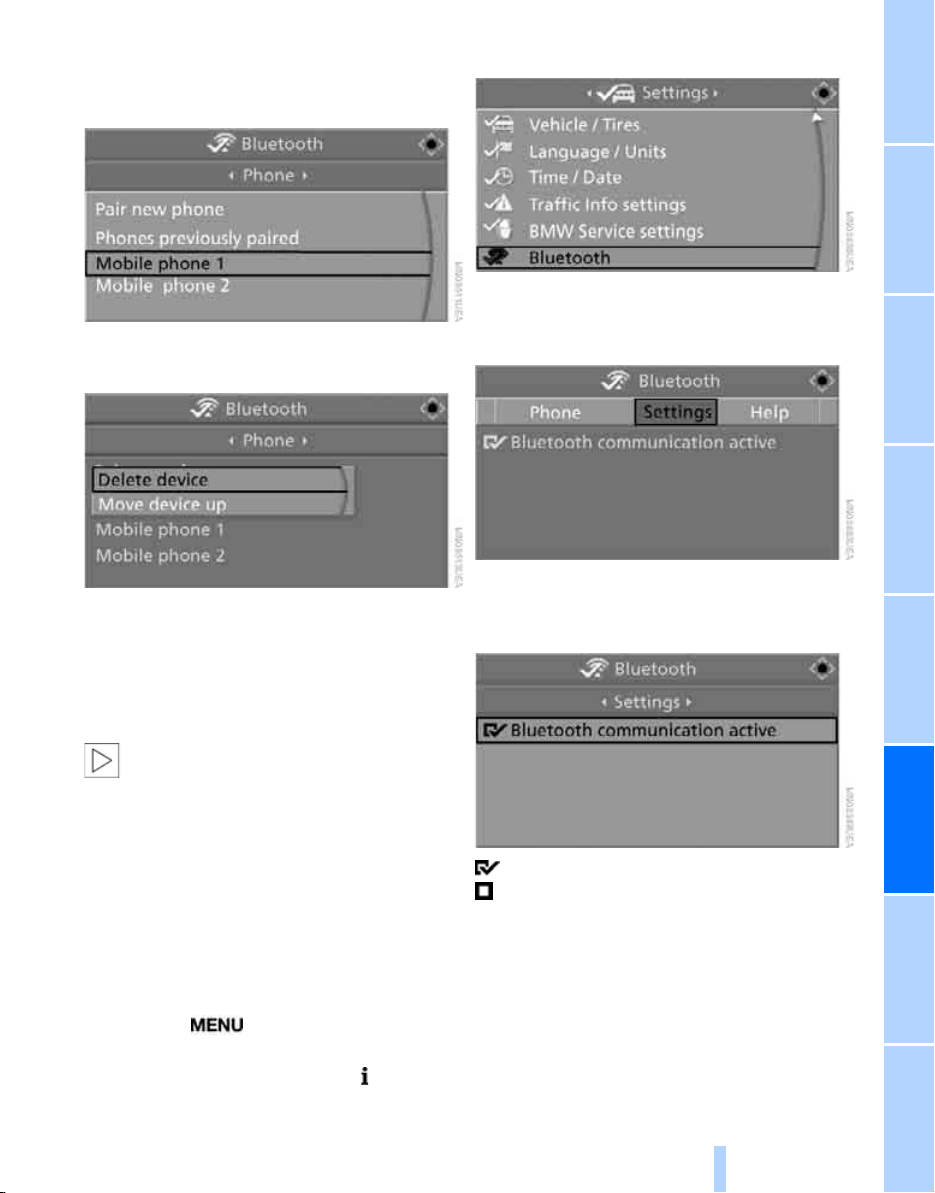
183
EntertainmentReference At a glanceControlsDriving tipsCommunications NavigationMobility
With a single drive:
> Select the desired mobile phone and
press the controller.
8. Select "Delete device" and press the con-
troller.
The unpaired mobile phone is deleted from
the list.
The phone book entries and the lists of
stored phone numbers are also deleted.
Activating/deactivating Bluetooth link
Bluetooth technology is not approved in
all countries. Observe the applicable local
regulations. Temporarily deactivate the Blue-
tooth link between the vehicle and the mobile
phone if necessary.
If the Bluetooth link is deactivated, you cannot
operate your mobile phone via the vehicle and
other devices with a Bluetooth interface can be
used via the mobile phone, e.g. a laptop com-
puter.<
To temporarily deactivate the Bluetooth link
between the vehicle and your mobile phone:
1. Press the button to open the start
menu.
2. Press the controller to open the menu.
3. Select "Settings" and press the controller.
4. Select "Bluetooth" and press the controller.
5. Move the highlight marker to the second
field from the top, select "Settings" and
press the controller.
6. Select "Bluetooth communication active"
and press the controller to activate or deac-
tivate the link.
The Bluetooth link is activated.
The Bluetooth link is deactivated.
Online Edition for Part no. 01 41 2 600 775 - © 08/08 BMW AG
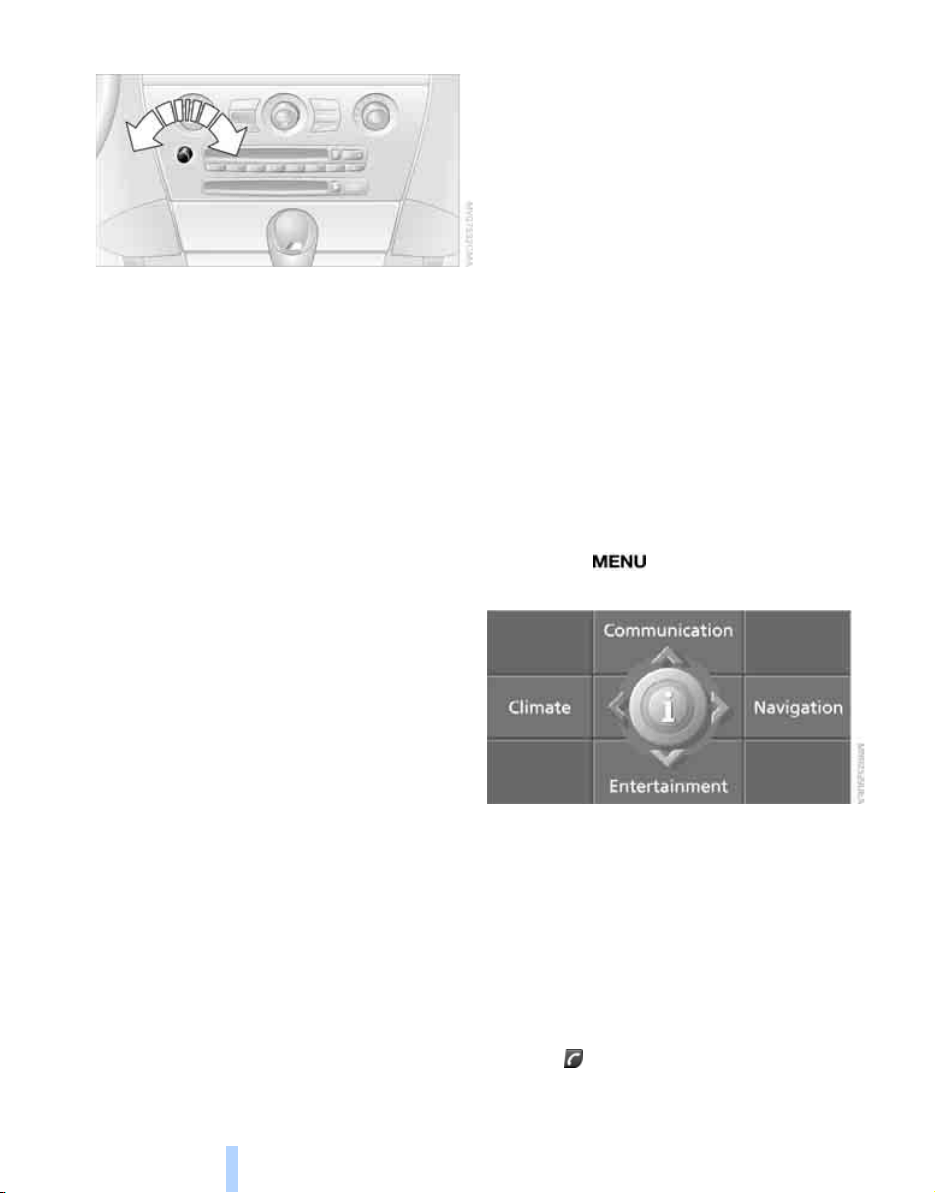
Telephoning
184
Adjusting volume
Turn the knob during a call to select the desired
volume.
This volume for the hands-free system is main-
tained, even if the other audio sources are set to
minimum volume.
You can also adjust the volume with the buttons
on the steering wheel, refer to page 11.
The setting is stored for the remote control cur-
rently in use.
Operation via iDrive
You can operate the following functions via
iDrive:
> Accepting/refusing a call
> Dialing phone numbers
> Dialing phone numbers from the phone
book
> Dialing stored phone numbers, e.g. from the
list of accepted calls.
> Ending a call
When the ignition is switched off or in radio
readiness, e.g. after taking the remote control
out of the ignition lock, you can continue an
ongoing call via the hands-free system for sev-
eral minutes.
Speech quality
If the person you are talking to cannot under-
stand you well, this may be due to excessively
loud background noises. The full mobile phone
preparation package can compensate for these
noises to a certain degree. To optimize the
speech quality during a call, we recommend
that you:
> Reduce background noises, e.g. by closing
the windows, reducing the air volume of the
automatic climate control or pointing the
opened front vent outlets downward
> Reduce volume of hands-free system
Requirements
> The logon data of the mobile phone are
stored in the vehicle and the mobile phone
is ready to operate.
> The engine is running or the ignition is
switched on.
> The mobile phone is detected by the vehi-
cle.
Opening Communication
Many of the functions described below are con-
trolled using the "Communication" menu.
iDrive, for operating principle refer to page 16.
1. Press the button to open the start
menu.
2. Move the controller forward to open "Com-
munication".
Receiving calls
If you have the phone number of the caller
stored in the phone book and the phone num-
ber has been transmitted, the name of the entry
is displayed.
Accepting a call
Press the button on the steering wheel.
Alternative:
Online Edition for Part no. 01 41 2 600 775 - © 08/08 BMW AG
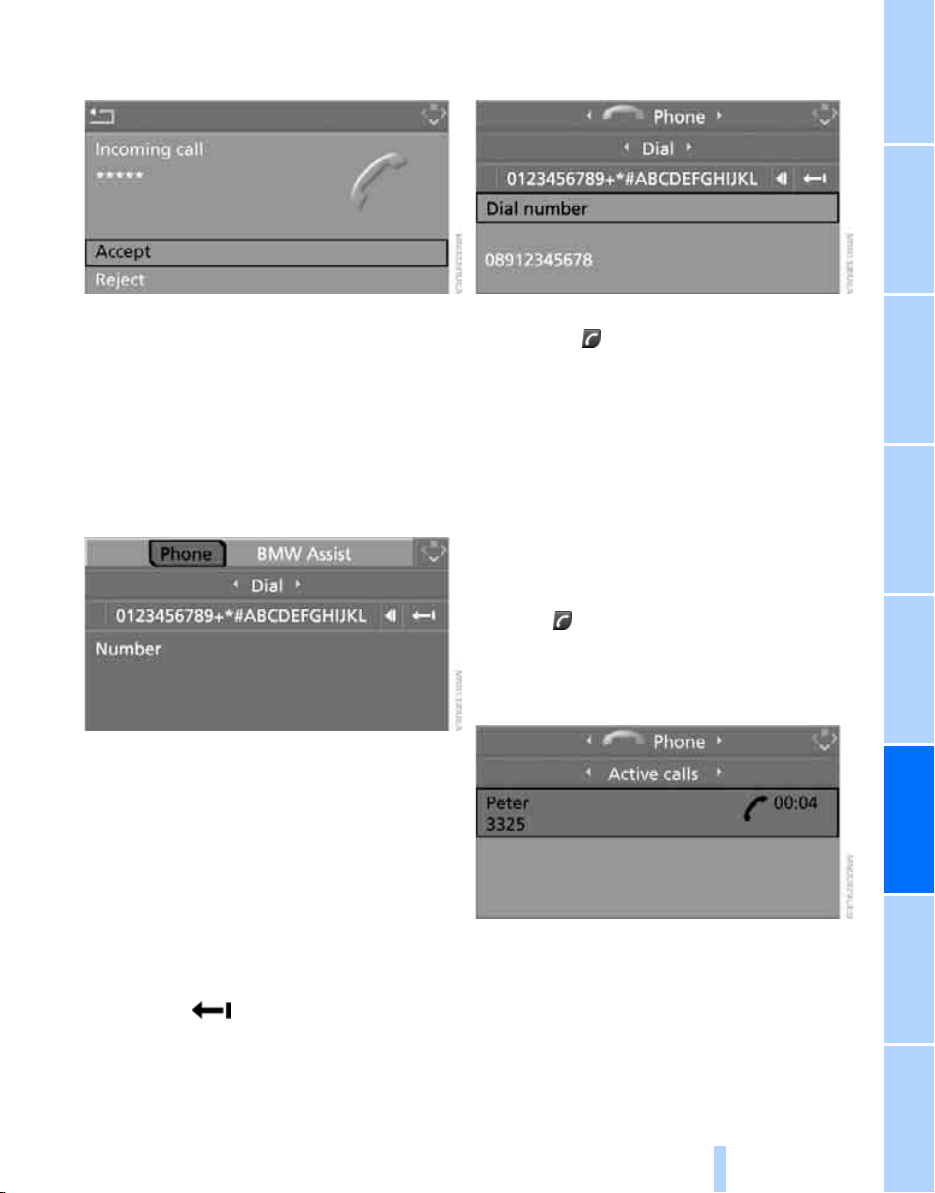
185
EntertainmentReference At a glanceControlsDriving tipsCommunications NavigationMobility
"Accept" is selected.
Press the controller.
Rejecting a call
Select "Reject" and press the controller.
The caller is diverted to your mailbox if it has
been activated.
Calling
Dialing phone numbers
1. Select "Phone" and press the controller.
2. Select "Dial" and press the controller.
3. Enter the desired phone number by dialing
the individual digits and pressing the con-
troller.
Always enter the complete phone number
consisting of national dialing code, area
code, and phone number.
The letters correspond to the digits on the
keypad of the mobile phone.
To delete the last digit:
Move the controller toward the right to
select the arrow and press the control-
ler.
4. Select "Dial number" and press the control-
ler.
Alternative:
Press the button on the steering wheel.
For your phone number to be displayed to the
person you are calling, the display of phone
numbers must be enabled by your service pro-
vider.
About programmable memory buttons
You can store and request phone numbers
using the programmable memory buttons, refer
to page 22.
Ending a call
Press the button on the steering wheel.
Alternative:
1. Select the phone number and press the
controller.
Online Edition for Part no. 01 41 2 600 775 - © 08/08 BMW AG
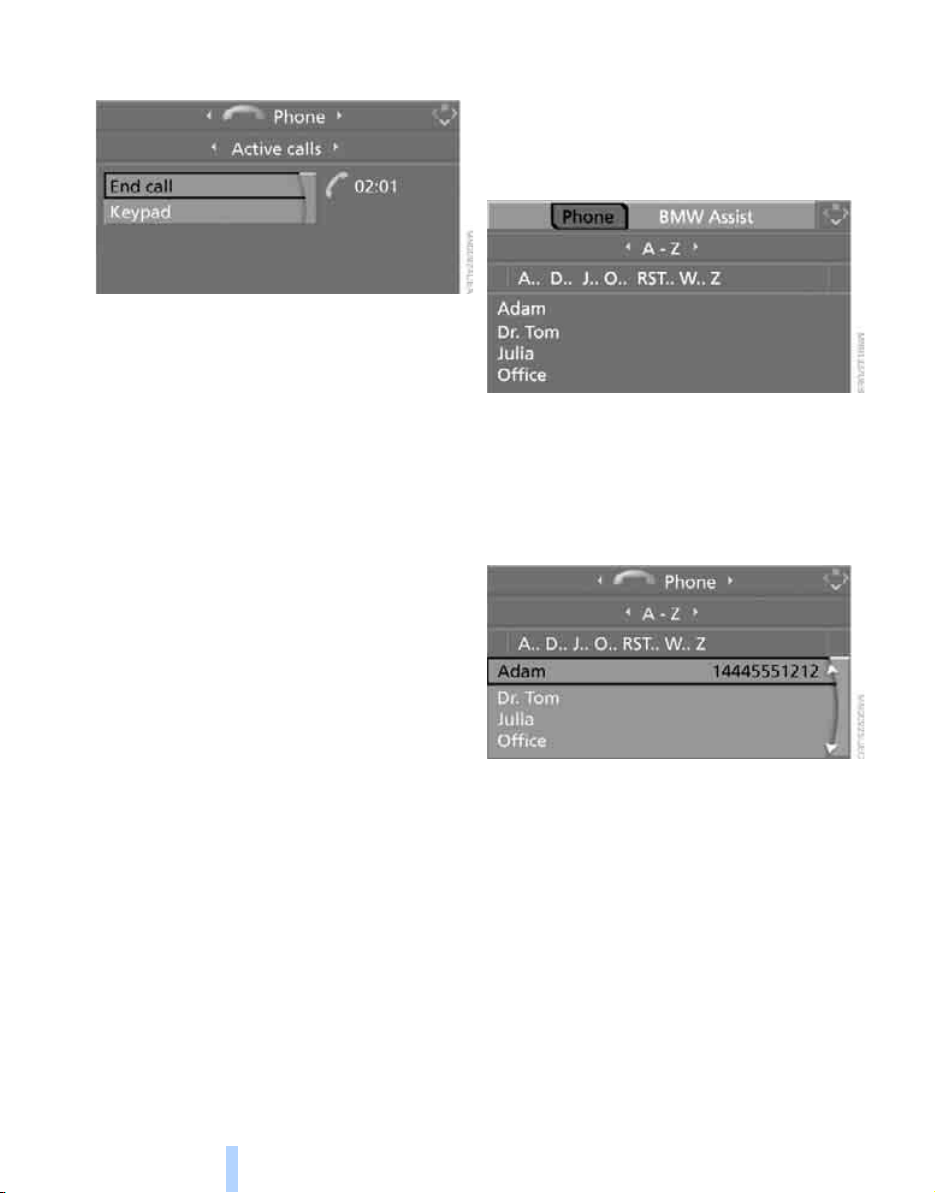
Telephoning
186
2. "End call" is selected:
Press the controller.
Dialing a phone number from phone
book or a phone number stored in a list
Phone numbers you have called, incoming calls
and the entries of the phone book are stored in
lists when the mobile phone is connected to the
vehicle via Bluetooth. If the caller is entered in
the phone book, the name of the entry is dis-
played instead of the phone number.
You can select the desired subscriber from the
list and establish the connection.
Five lists are available:
> "A - Z"
The entries in your mobile phone's phone
book, consisting of names and phone num-
bers, are sorted alphabetically.
> "Top 8"
The eight numbers dialed most frequently
from the "A - Z" phone book are automati-
cally stored in the Top 8 list.
> "Redial"
The last eight phone numbers you dialed
are automatically stored. The last number
dialed is at the top of the list.
> "Missed calls"
The phone numbers of the last eight calls
that were not accepted are stored. This
requires the telephone number of the caller
to have been sent.
> "Received calls"
The phone numbers of the last eight
accepted calls are stored. This requires the
telephone number of the caller to have been
sent.
Dialing a phone number from phone
book
The "A - Z" list is available for your phone book
entries. The phone book entries appear on the
Control Display.
1. Select "Phone" and press the controller.
2. Select "A - Z" and press the controller.
3. To limit the number of displayed entries,
select the first letter of the desired entry and
press the controller.
4. Select the desired entry and press the con-
troller.
5. Select "Call" and press the controller.
The system dials the number.
If different phone numbers are stored in the
mobile phone under one name, e.g. office and
home, the name is shown once for each phone
number.
You can change a phone number stored in the
phone book, e.g. to call a specific extension:
1. Select "Phone" and press the controller.
2. Select "A - Z" and press the controller.
3. Select the desired entry and press the con-
troller.
4. Select "Add digits" and press the controller.
5. Change the phone number.
Online Edition for Part no. 01 41 2 600 775 - © 08/08 BMW AG
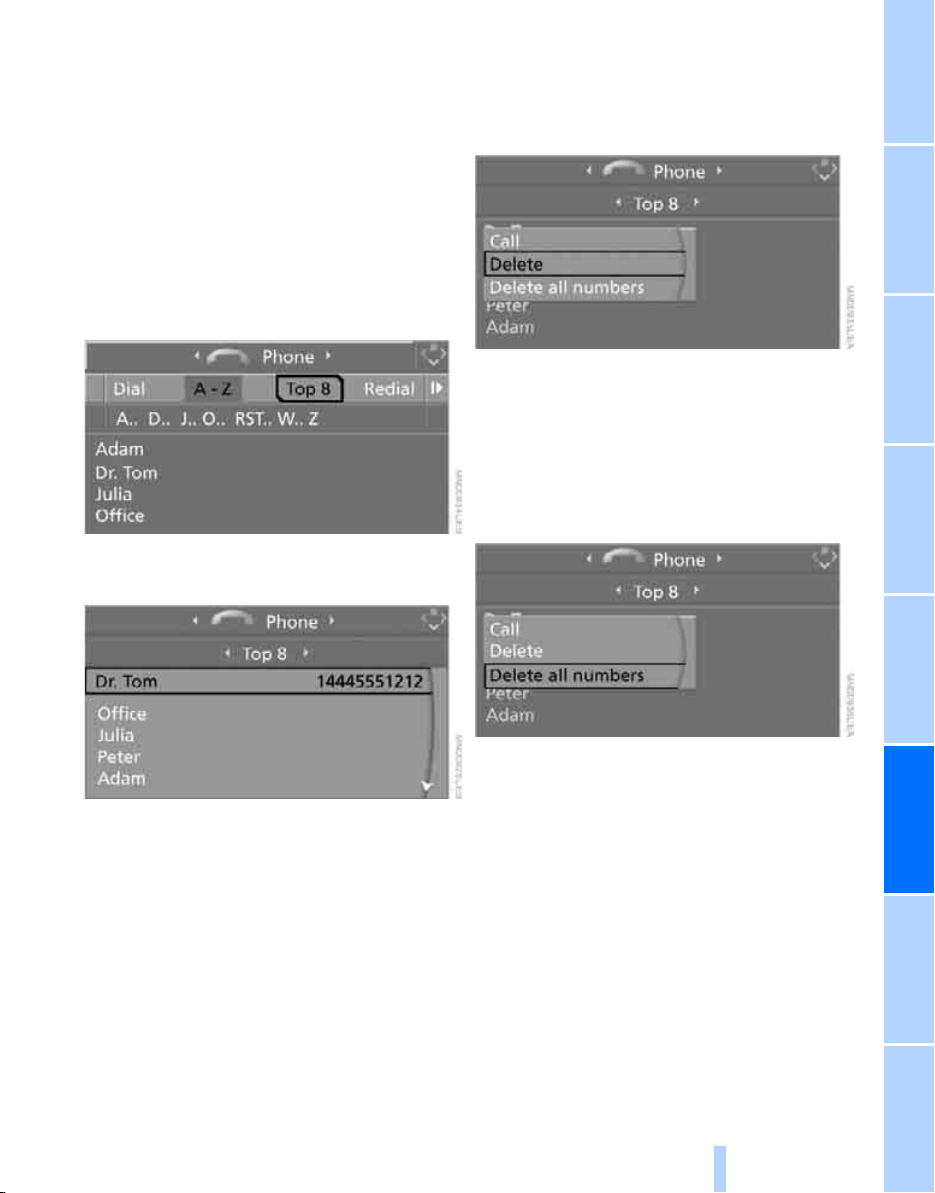
187
EntertainmentReference At a glanceControlsDriving tipsCommunications NavigationMobility
6. Select "Dial number" and press the control-
ler.
Dialing a phone number stored in a list
To select an entry and establish a connection:
1. Select "Phone" and press the controller.
2. Select list and press the controller:
> "Top 8"
> "Redial"
> "Missed calls"
> "Received calls"
3. Select the desired entry and press the con-
troller.
4. Select "Call" and press the controller.
The system dials the number.
Deleting individual entries
1. Select the desired entry from the list and
press the controller.
2. Select "Delete" and press the controller.
The entry is deleted.
Deleting entire list
1. Select an entry from the list and press the
controller.
2. Select "Delete all numbers" and press the
controller.
3. If applicable, select "Yes" and press the
controller.
The list is deleted.
BMW Contact*
If you are not enabled for BMW Assist, you can
have several service phone numbers displayed:
> BMW Roadside Assistance
* when you
require breakdown assistance
> BMW center, e.g. when you want to make
an appointment for service
> BMW Customer Relations
* for information
on all aspects of your vehicle
If BMW Assist is enabled, refer to page 193.
Online Edition for Part no. 01 41 2 600 775 - © 08/08 BMW AG
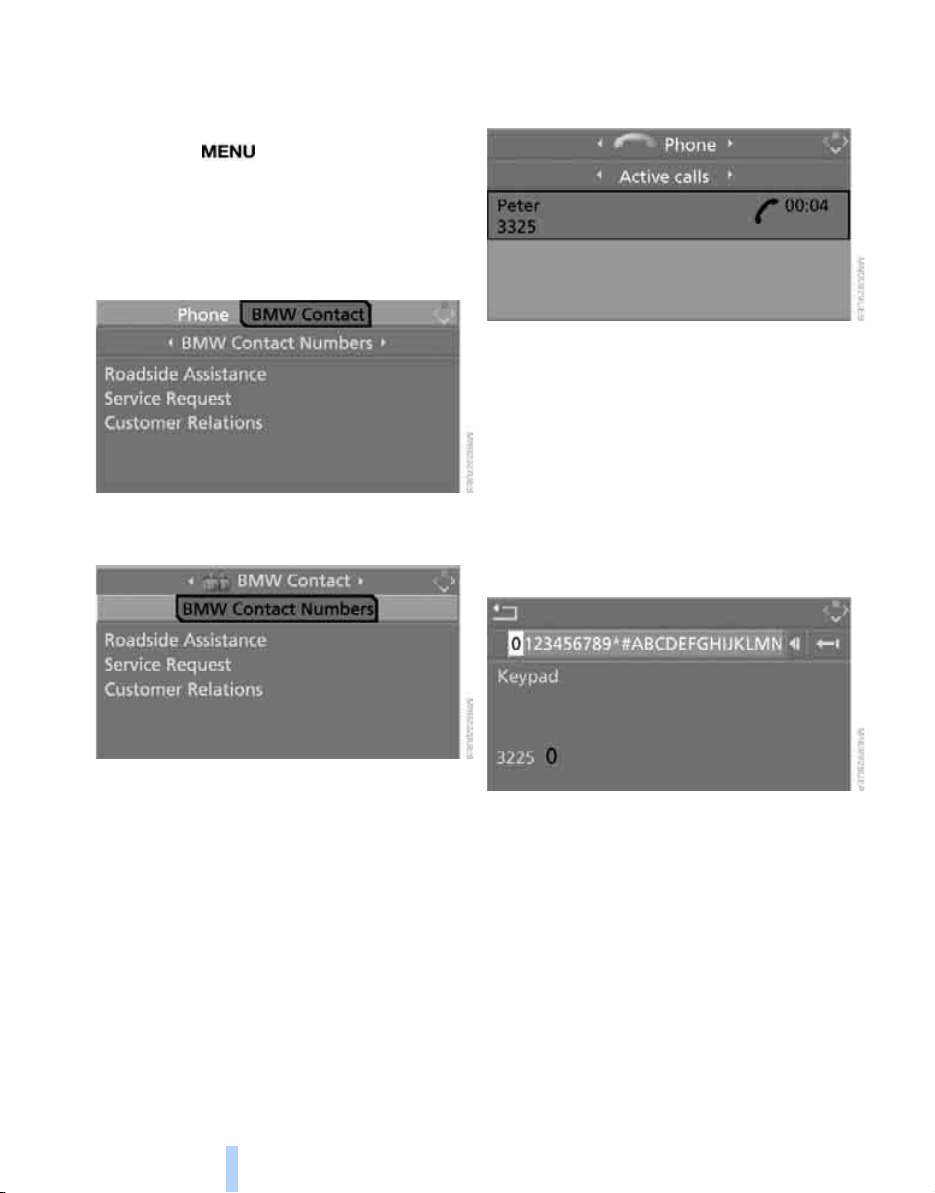
Telephoning
188
You can dial the displayed service phone num-
bers if your mobile phone is paired in the vehi-
cle:
iDrive, for operating principle refer to page 16.
1. Press the button.
This opens the start menu.
2. Move the controller forward to select
"Communication".
3. Select "BMW Contact" and press the con-
troller.
4. Select "BMW Contact Numbers" and press
the controller.
5. Select one of the following menu items and
press the controller:
> "Roadside Assistance"
> "Customer Relations"
> "Service Request"
6. Select "Call" and press the controller.
Contact is established.
Transmitting phone number via tone
dialing method
The tone dialing method is required for access
to network services or for controlling devices,
e.g. remote checking of an answering machine.
This function is available when a connection
has been established.
1. Establish connection.
2. With a single drive:
Press the controller.
Select "Keypad" and press the controller.
With two drives:
Move the controller backwards until the
bottom field is selected.
3. Select the desired character
and press the
controller.
Each character is sent immediately and
confirmed by a tone depending on the
mobile phone model.
Changing between mobile
phone and hands-free system
From mobile phone to hands-free
system*
You can continue calls begun outside the Blue-
tooth range of the vehicle via the hands-free
system when the motor is running or the igni-
tion is switched on. Depending on your mobile
phone, the system automatically changes over
to the hands-free mode.
Online Edition for Part no. 01 41 2 600 775 - © 08/08 BMW AG

189
EntertainmentReference At a glanceControlsDriving tipsCommunications NavigationMobility
For mobile phones that do not automatically
change over to the hands-free mode:
Depending on the mobile phone model used,
the conversation can be continued via the
hands-free system if necessary. Refer to the
display on your mobile phone and/or your
mobile phone's operating instructions.
From hands-free system to mobile
phone
When you telephone via the hands-free system,
you can also continue the call via the mobile
phone if necessary, depending on the mobile
phone model. Act according to what is shown
on the mobile phone display, refer to the oper-
ating instructions of your mobile phone.
As an alternative, you can deactivate the Blue-
tooth link.
Depending on your mobile phone model, poor
reception of the wireless communications net-
work can result in the system changing from the
hands-free system to the mobile phone.
Operation by voice*
The concept
You can operate your mobile phone without
having to remove your hands from the steering
wheel. When making your entries, you will be
supported by announcements or questions in
many cases.
The same prerequisites as for operation via
iDrive apply, refer to page 184.
Voice commands
Activating system
1. Briefly press the button on the steering
wheel.
An acoustic signal indicates that you can
say commands.
2. Say the command.
Ending/canceling operation by voice
Press the button on the steering wheel
or
In dialogs where text is spoken, not a command,
e.g. a name, canceling is only possible using the
button on the steering wheel.
Having possible commands read aloud
The system understands default commands
that must be spoken word for word.
You can have the possible commands spoken
by the system at any point:
Using alternative commands
There are often a number of commands to run a
function, e.g.:
The system recognizes digits from zero to nine.
You can say each digit individually or group
them into a sequence to accelerate the input.
Example: Dialing phone numbers
To start the dialog:
Press the button on the steering wheel.
{Cancel}.
{Help}.
{Dial name} or {Name}.
You say The voice control answers
{Dial number}{{Please say the number}}
e.g. {123 456 7890} Depending on equipment:
{{123 456 7890. Continue?}} or
{{123 456 7890. And next?}}
{Dial}{{Dialing number}}
Online Edition for Part no. 01 41 2 600 775 - © 08/08 BMW AG
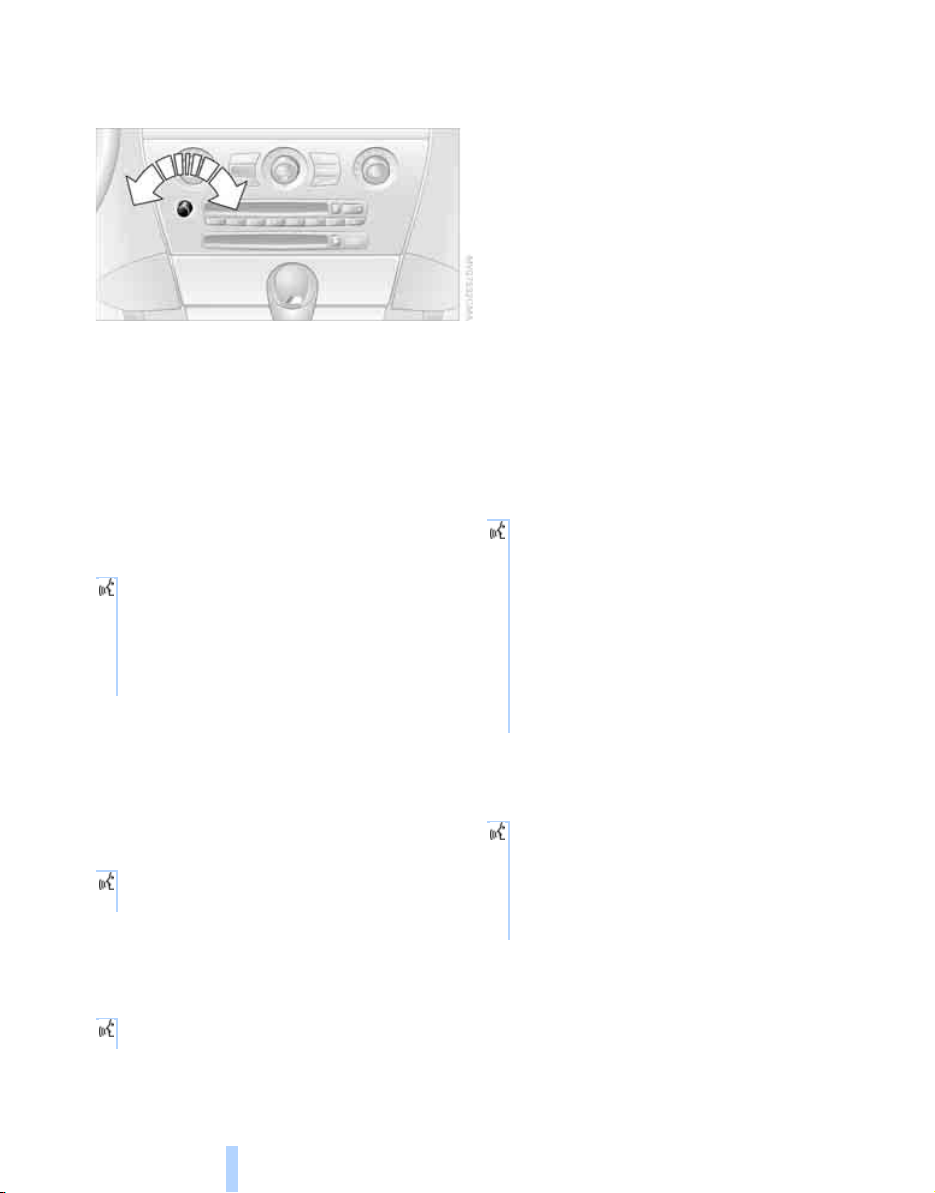
Telephoning
190
Setting volume of instructions
You can adjust the volume for the instructions
from the system:
Turn the knob during instructions.
This volume for the instructions is maintained,
even if the other audio sources are set to mini-
mum volume.
The setting is stored for the remote control cur-
rently in use.
Calling
Dialing phone numbers
The connection to the desired subscriber is
established.
Correcting phone number
After the last spoken sequence of digits has
been repeated by the system, you can delete
this sequence of digits.
The command {Correct number} can be
repeated as often as you like.
Deleting phone number
All digits entered up to this point are deleted.
Voice phone book
Operating by voice command requires a per-
sonal voice phone book.
> With separate drives for audio CDs and nav-
igation DVDs, the entries are automatically
adopted from your mobile phone's memory.
> With a single drive, the entries must be
input by voice and are independent of your
mobile phone's memory. In this case, it is
not possible to use voice command either
to call phone numbers stored in the mobile
phone or to store new numbers. Up to
50 entries can be set up. An entry always
consists of a name and phone number.
Creating and editing voice phone
book*
Store entry:
An entry always consists of a name and phone
number.
Delete entry:
You can delete any entry from the voice phone
book.
Delete all entries:
1. {Dial number}.
2. Say the phone number.
For telephone calls abroad, say {Plus}
and then the country code.
3. {Dial}.
{Correct number}.
The digits are deleted.
{Delete}
1. {Save name}.
2. Speak the name.
The spoken length of the names in the
phone book must not exceed approx.
2seconds.
3. Speak the phone number after being
requested to do so by the system.
4. To store the phone number:
{Save}.
1. {Delete name}.
The dialog for deleting an entry is
opened.
2. Say the name when prompted.
3. Confirm the prompt with {Yes}.
Online Edition for Part no. 01 41 2 600 775 - © 08/08 BMW AG
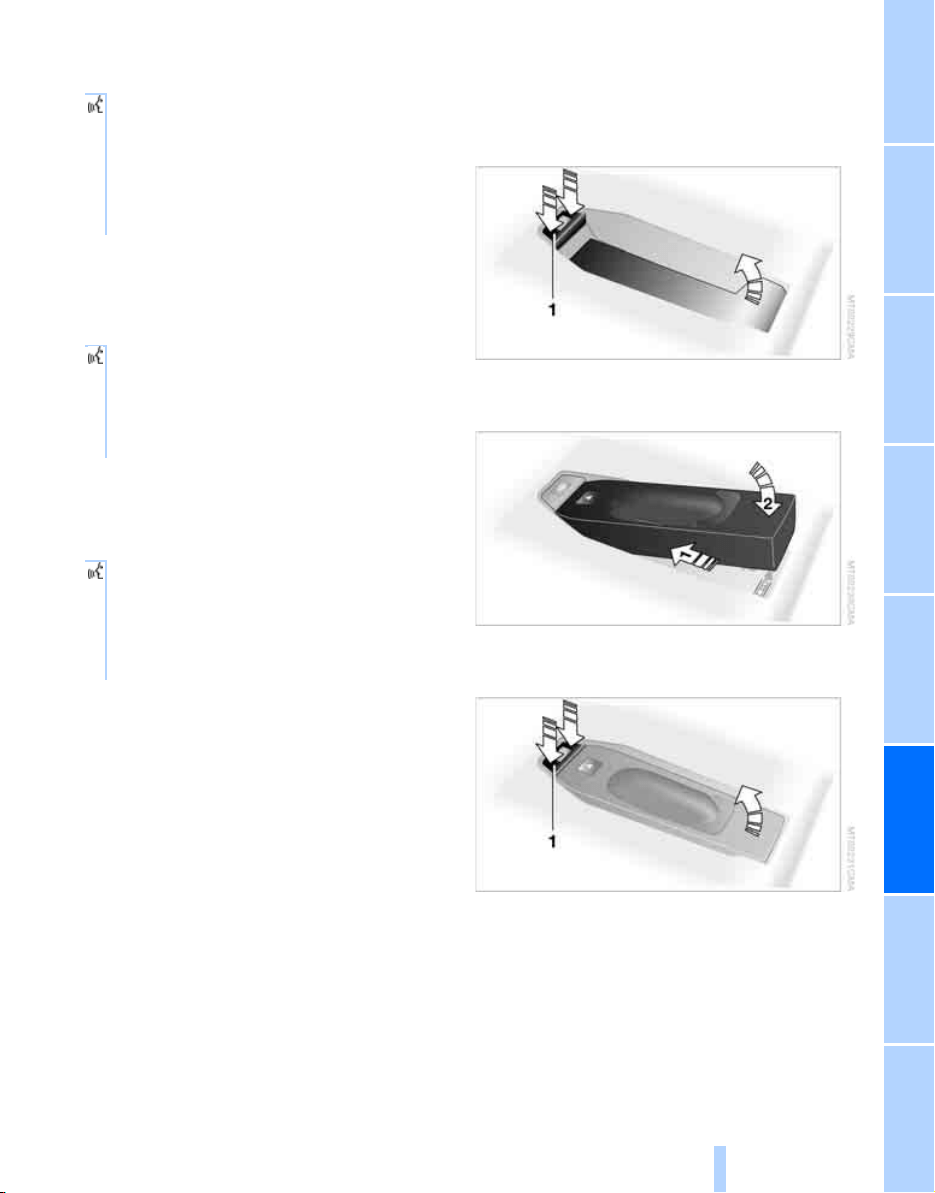
191
EntertainmentReference At a glanceControlsDriving tipsCommunications NavigationMobility
{Delete phone book} deletes all entries in the
phone book.
Have entries read aloud and select:
You can have all the entries of your voice phone
book read aloud in the order of input and select
a certain entry to establish a connection:
Selecting an entry
The connection to the phone number of the
selected entry is established.
Redialing
The {Redial} command opens "Redial".
Notes
Important for voice commands
For voice commands, keep the following in
mind:
> Issue the commands smoothly and at nor-
mal volume, avoiding excessive emphasis
and pauses.
> Keep the doors and windows closed to pre-
vent interference from ambient noise.
> Avoid making other noise in the vehicle
while speaking.
Snap-in adapter inserting/
removing*
1. Press the area 1 around the button and
remove the cover.
2. Insert the snap-in adapter at the front and
press down until it engages.
To remove the snap-in adapter:
Press the area 1 around the button.
Inserting mobile phone
1. Remove the protective cap from the mobile
phone's antenna connector if necessary, so
1. {Delete phone book}.
The dialog for deleting phone book is
opened.
2. Confirm the prompt with {Yes}.
3. Confirm the repeated prompt with
{Yes}.
1. {Read phone book}.
The dialog for reading phone book is
opened.
2. {Dial number} when the desired entry is
read aloud.
1. {Dial name}.
The dialog for selecting an entry is
opened.
2. Say the name when prompted.
3. Confirm the prompt with {Yes}.
Online Edition for Part no. 01 41 2 600 775 - © 08/08 BMW AG
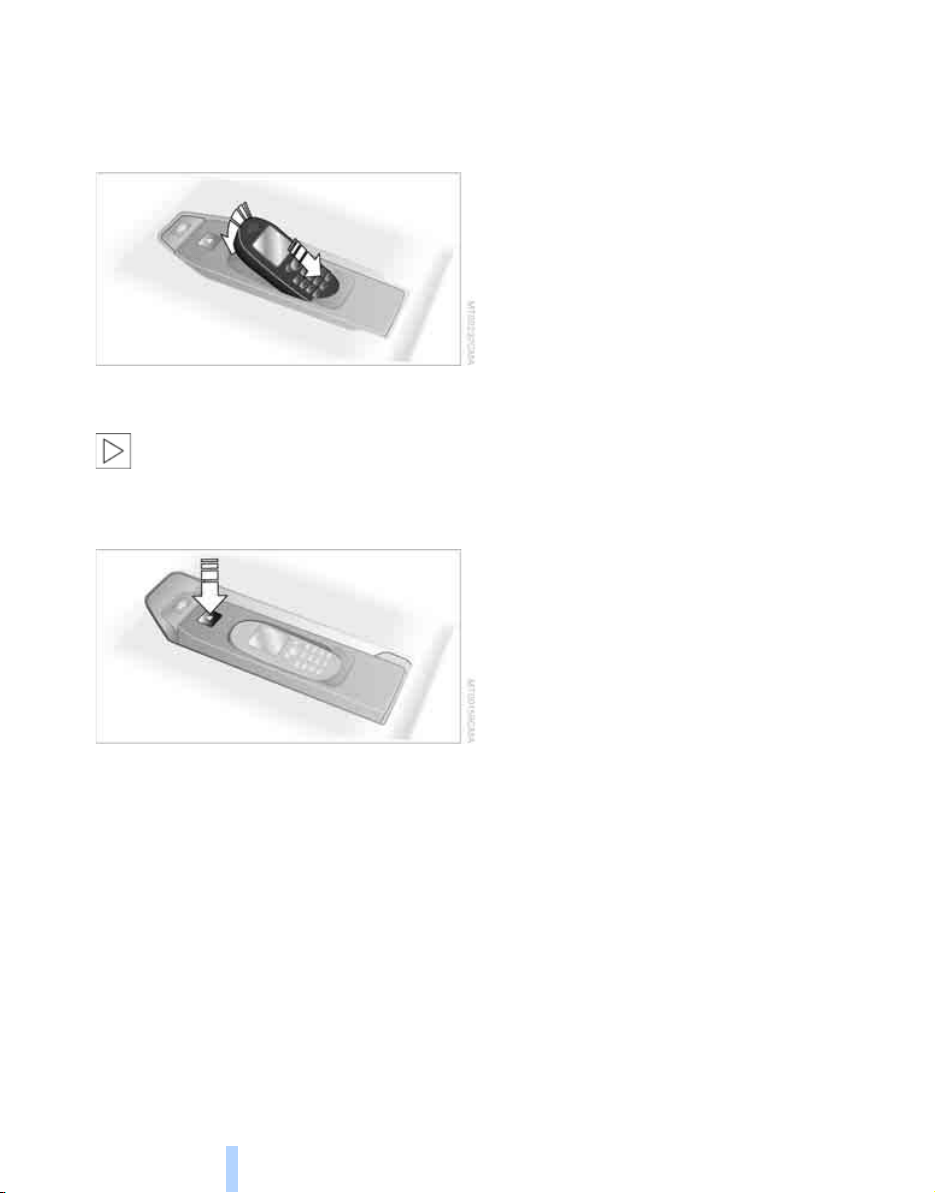
Telephoning
192
that the mobile phone can engage in the
snap-in adapter.
2. Push the mobile phone with the buttons
facing upward toward the electrical connec-
tions and press down until it engages.
The mobile phone's battery is charged from
radio readiness or with the steering unlocked.
To protect the vehicle's batteries, avoid
using the phone when the ignition is
switched off.<
Removing mobile phone
Press button.
Online Edition for Part no. 01 41 2 600 775 - © 08/08 BMW AG

193
EntertainmentReference At a glanceControlsDriving tipsCommunications NavigationMobility
BMW Assist
BMW Assist provides you with various services.
For example, the position data of your vehicle
can be transmitted to the BMW Assist
Response Center if an emergency request
* has
been initiated.
Many BMW Assist services depend on the indi-
vidually agreed contract.
After your contract has expired, the BMW
Assist system will be deactivated by the BMW
Assist Response Center without you having to
visit a BMW center. After the BMW Assist sys-
tem has been deactivated, no BMW Assist ser-
vice will be available. The BMW Assist system
can be reactivated by a BMW center after sign-
ing a new contract.
Requirements
You can use BMW Assist when the following
requirements are met:
> The installed BMW Assist system is logged
on to a mobile phone network. This network
must be capable of transmitting the ser-
vices.
> To transmit position data, the vehicle must
be able to determine the current position.
> In order to activate and update BMW Assist,
a GPS signal must be available.
> You have subscribed to BMW Assist with
your BMW center or with the BMW Assist
Response Center. Activation must be com-
pleted.
> BMW Assist is activated, refer to page 198.
Offered services
The following services are available via
BMW Assist:
> Emergency request, refer to page 233:
When you press the SOS button, a connec-
tion is established to the BMW Assist
Response Center. The BMW Assist
Response Center contacts you and takes
further steps to help you.
> Automatic collision notification:
Under certain conditions, a connection is
established to the BMW Assist Response
Center immediately after a serious acci-
dent. If possible, the BMW Assist Response
Center contacts you and takes further steps
to help you.
> Enhanced roadside assistance:
You can call Roadside Assistance
* of the
BMW Group should you require help in the
event of a breakdown. If possible, the vehi-
cle data and position data are transmitted
during this time.
> BMW Customer Relations:
For information related to your vehicle, call
BMW Customer Relations.
> BMW TeleServices
*:
The data on the service status of your vehi-
cle or on required inspections are transmit-
ted to your BMW center either automati-
cally prior to the due date or when you
request a BMW service appointment.
> Remote door unlock:
Inform the BMW Assist Response Center,
e.g. if your remote control is not available
and you want to have the vehicle unlocked.
> Stolen vehicle recovery:
After your vehicle has been reported to the
police as stolen, the BMW Assist Response
Center can locate its position.
In addition, you can be provided with other ser-
vices, e.g. the concierge service or information
on route planning, traffic conditions, and the
weather. With Critical Calling, you can make a
limited number of calls via the BMW Assist
Response Center, e.g. if you do not have your
mobile phone with you.
Press the SOS button to contact the BMW
Assist Response Center, see below.
You also have access to the BMW Assist con-
cierge service via the Internet.
*
Online Edition for Part no. 01 41 2 600 775 - © 08/08 BMW AG
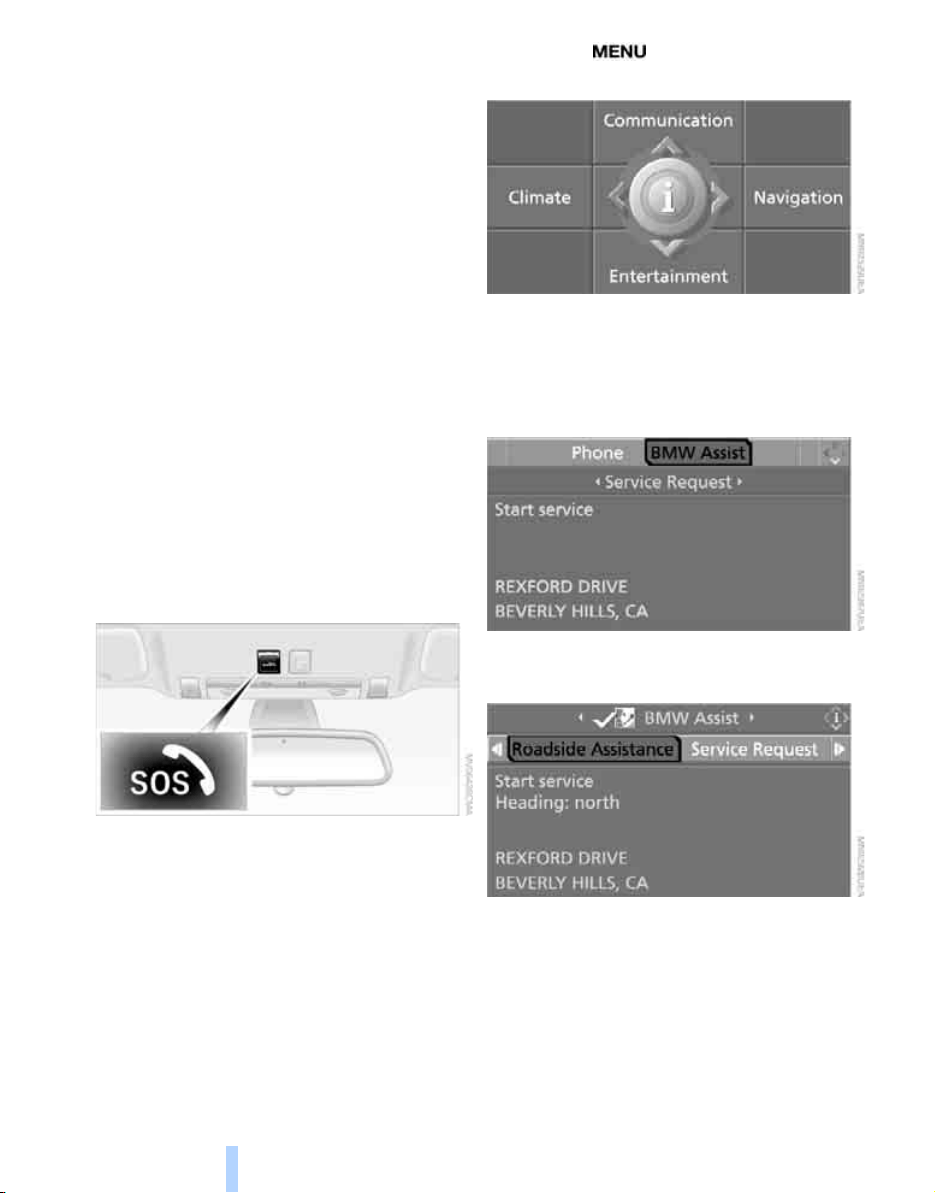
BMW Assist
194
Characteristics of the offered services
The following characteristics apply to the ser-
vices:
> The offered services are country-specific.
> Voice contact is established or data are
transmitted, depending on the equipment
and the country. In some countries, it is
possible to do both.
> The data transmitted can, for example, be
the vehicle data, your current position or the
CBS Condition Based Service data.
Using services
Contacting BMW Assist Response
Center
You can contact the BMW Assist Response
Center via the SOS button.
1. Briefly press protective cover to open.
With some vehicle equipment packages or
in the Convertible, the arrangement of the
switches and indicator lamps may differ
somewhat.
2. Press the button for at least 2 seconds.
The BMW Assist Response Center is con-
tacted.
Roadside assistance
iDrive, for operating principle refer to page 16.
1. Press the button.
This opens the start menu.
2. Move the controller forward to select
"Communication".
3. Change to upper field if necessary. Turn the
controller until "BMW Assist" is selected
and press the controller.
4. Select "Roadside Assistance" and press
the controller.
If the location can be determined, the cur-
rent vehicle position is displayed.
5. Select "Start service" and press the con-
troller.
The BMW Assist Response Center will connect
you to the Roadside Assistance of the
BMW Group.
Online Edition for Part no. 01 41 2 600 775 - © 08/08 BMW AG
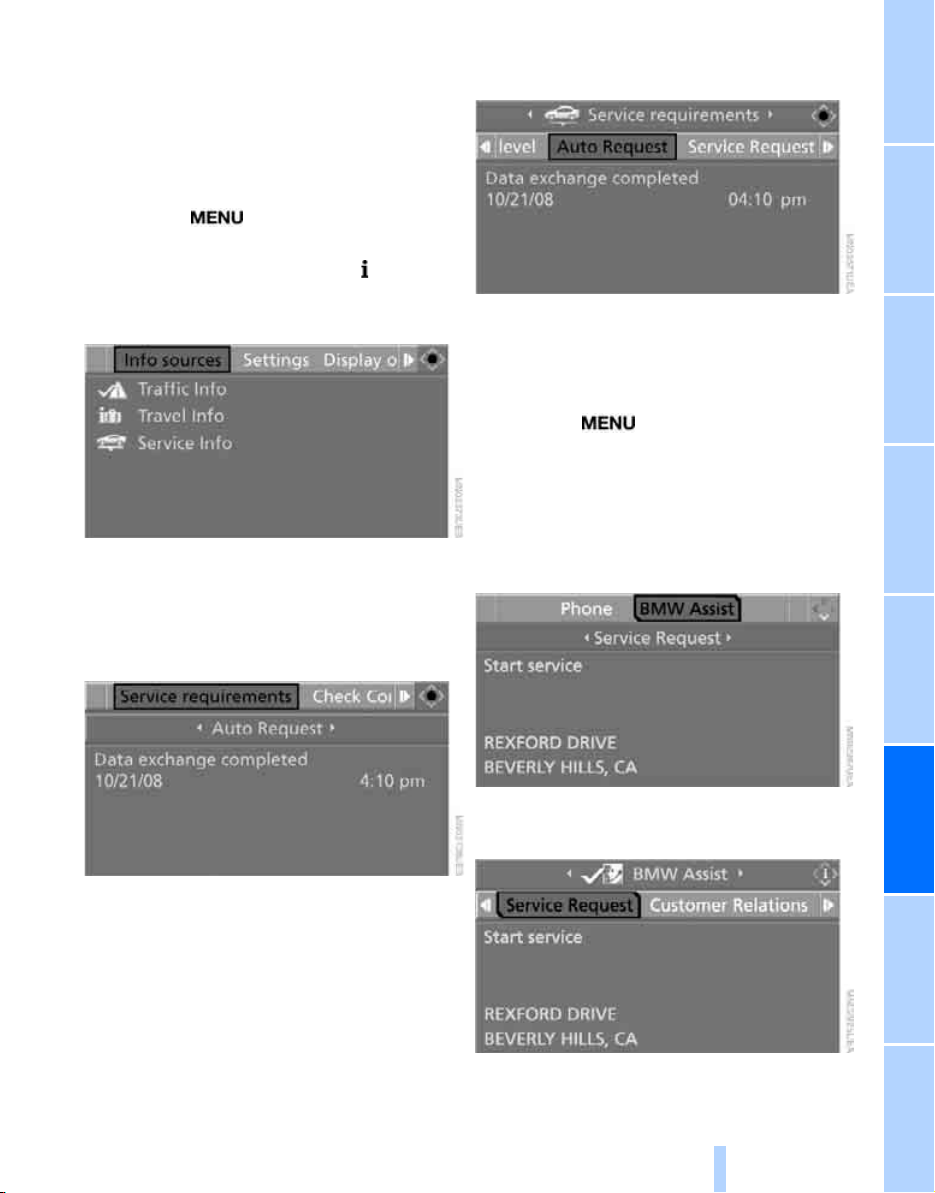
195
EntertainmentReference At a glanceControlsDriving tipsCommunications NavigationMobility
BMW TeleServices*
Automatic service notification*
The data on the service status of your vehicle or
on required inspections are transmitted auto-
matically prior to the due date. You can check
when the BMW center was notified.
1. Press the button.
This opens the start menu.
2. Press the controller to open the menu.
3. Select "Info sources" and press the control-
ler.
4. Select "Service Info" and press the control-
ler.
5. Change to upper field if necessary. Turn the
controller until "Service requirements" is
selected and press the controller.
6. Select "Auto Request" and press the con-
troller.
Manual service notification
You can transmit data regarding your vehicle's
service status to your BMW center when you
wish to arrange a service appointment.
1. Press the button.
This opens the start menu.
2. Move the controller forward to select
"Communication".
3. Change to upper field if necessary. Turn the
controller until "BMW Assist" is selected
and press the controller.
4. Select "Service Request" and press the
controller.
5. Select "Start service" and press the con-
troller.
Online Edition for Part no. 01 41 2 600 775 - © 08/08 BMW AG
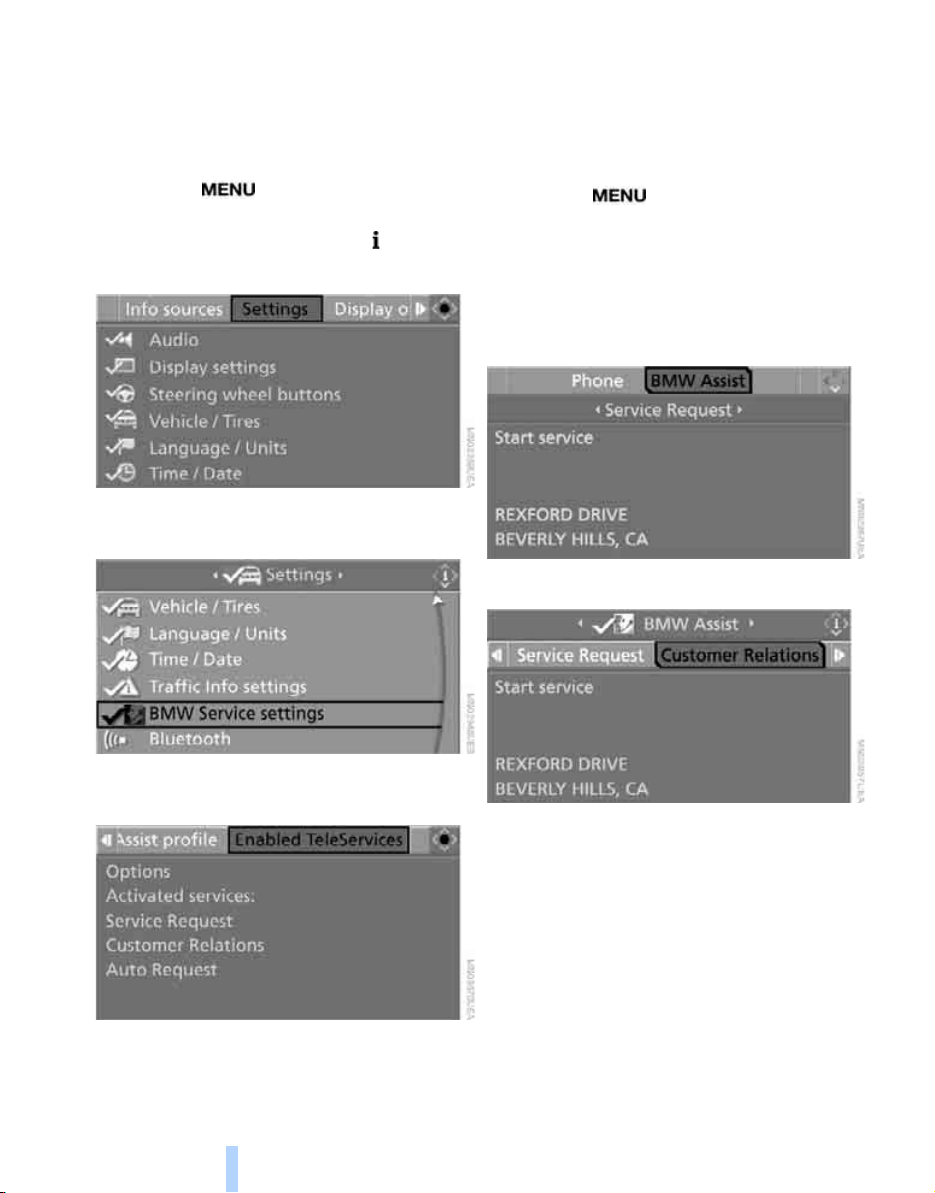
BMW Assist
196
The data relevant for service are transmitted.
Your BMW center will contact you to set up an
appointment for service.
Displaying and updating BMW
TeleServices services*
1. Press the button.
This opens the start menu.
2. Press the controller to open the menu.
3. Select "Settings" and press the controller.
4. Select "BMW Service settings" and press
the controller.
5. Select "Enabled TeleServices" and press
the controller.
The enabled BMW TeleServices are dis-
played.
6. Select "Options" and press the controller.
7. Select "Update services" and press the
controller.
Contacting BMW Customer Relations
For information on all aspects of your vehicle,
you can contact BMW Customer Relations.
1. Press the button.
This opens the start menu.
2. Move the controller forward to select
"Communication".
3. Change to upper field if necessary. Turn the
controller until "BMW Assist" is selected
and press the controller.
4. Select "Customer Relations".
5. Press the controller.
6. Select "Start service" and press the con-
troller.
You will be connected to BMW Customer Rela-
tions by the BMW Assist Response Center.
Concierge service*
When you call the concierge service of BMW
Assist, you can, for example, obtain information
on current events, filling stations or hotels and
have their phone numbers and addresses
transmitted. Many hotels can be booked
Online Edition for Part no. 01 41 2 600 775 - © 08/08 BMW AG
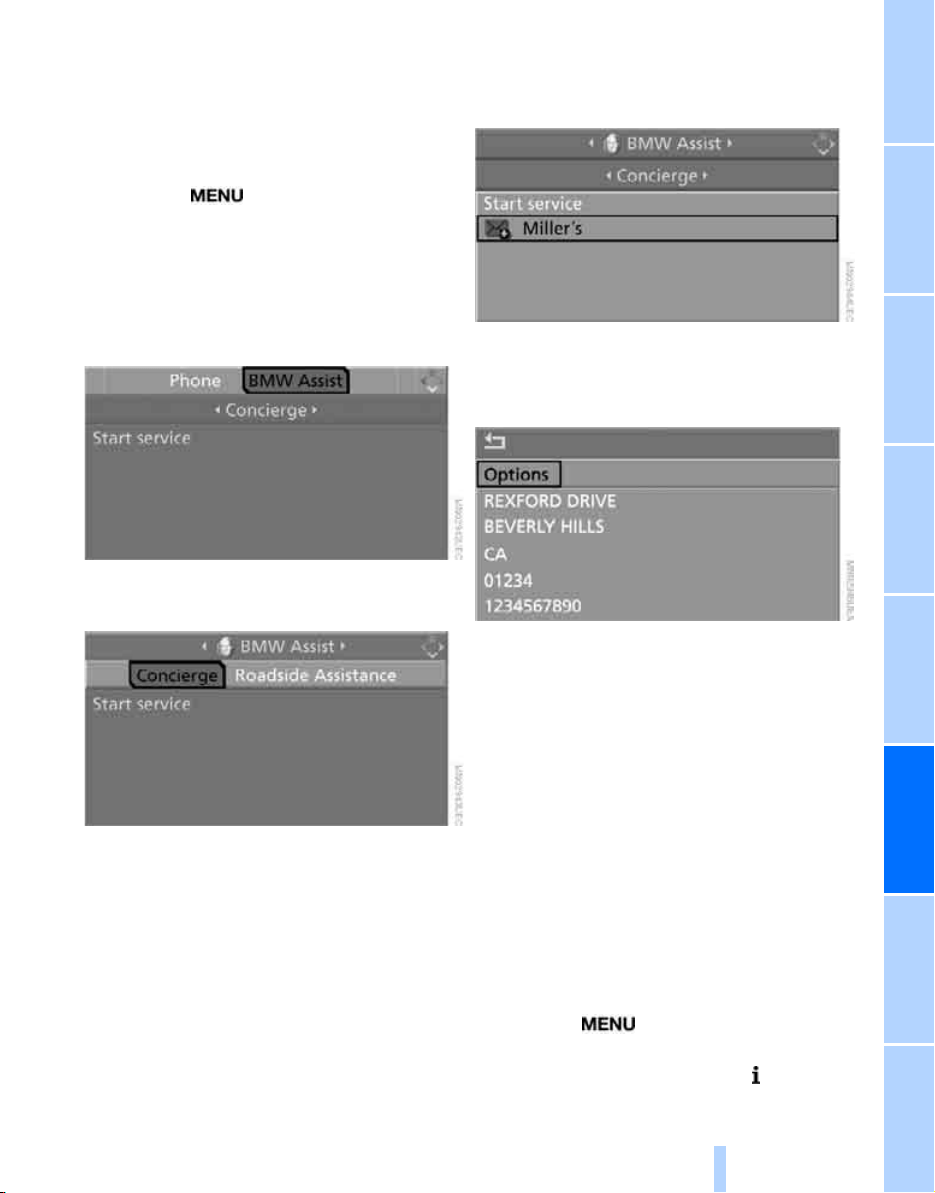
197
EntertainmentReference At a glanceControlsDriving tipsCommunications NavigationMobility
directly through the BMW Assist concierge ser-
vice.
The concierge service must be enabled sepa-
rately by the BMW Assist Response Center.
Calling up information
1. Press the button.
This opens the start menu.
2. Move the controller forward to select
"Communication".
3. Change to upper field if necessary. Turn the
controller until "BMW Assist" is selected
and press the controller.
4. Select "Concierge" and press the control-
ler.
5. Select "Start service" and press the con-
troller.
The BMW Assist Response Center will connect
you with a BMW Assist concierge.
Displaying transmitted data
Select the received message if necessary and
press the controller.
Dialing a phone number or transferring
an address for destination guidance
1. Select "Options" and press the controller.
2. Select a menu item:
> Press "Call" to make a telephone call. A pre-
requisite for this is that your Bluetooth
mobile phone has been paired with the
vehicle.
> Press "Select as destination" to transfer the
address to the navigation system for desti-
nation guidance.
Updating BMW Assist
Displaying and updating services
You will be notified of any changes in the ser-
vices offered by BMW Assist. In this case you
should update the service functions.
1. Press the button.
This opens the start menu.
2. Press the controller to open the menu.
Online Edition for Part no. 01 41 2 600 775 - © 08/08 BMW AG
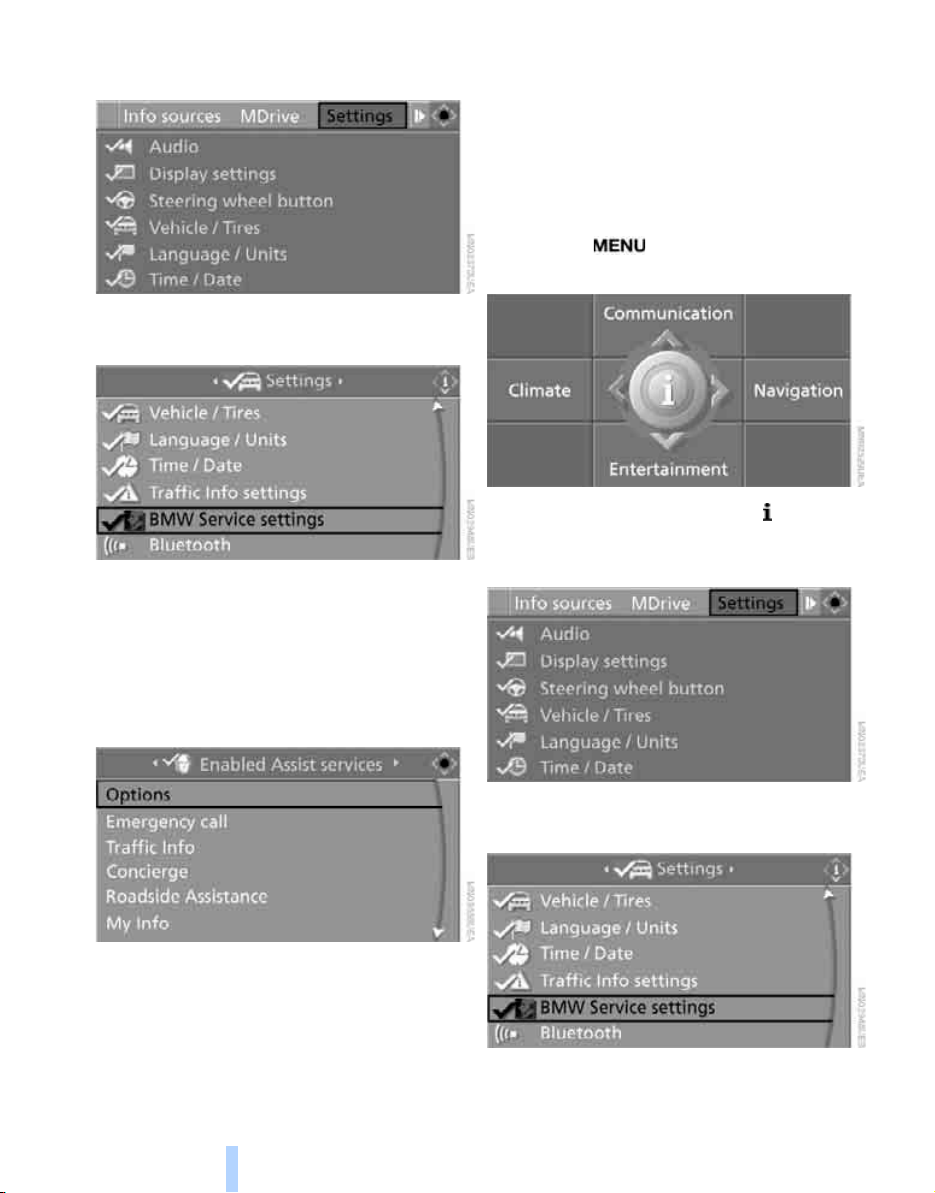
BMW Assist
198
3. Turn the controller until "Settings" is
selected and press the controller.
4. Turn the controller until "BMW Service set-
tings" is selected and press the controller.
5. Change to upper field if necessary. Turn the
controller until "Enabled Assist services" is
selected and press the controller.
The currently available BMW Assist ser-
vices are displayed.
6. If applicable, select "Options" and press the
controller.
7. Select "Update services" and press the
controller.
Activating BMW Assist
BMW Assist must be activated to use the ser-
vices.
Requirements
> Make sure that the vehicle can determine its
current position. Reception is best when
you have an unobstructed view to the sky.
> Leave the ignition switched on during the
activation process.
Activating
1. Press the button.
This opens the start menu.
2. Press the controller to open the menu.
3. Turn the controller until "Settings" is
selected and press the controller.
4. Turn the controller until "BMW Service set-
tings" is selected and press the controller.
Online Edition for Part no. 01 41 2 600 775 - © 08/08 BMW AG
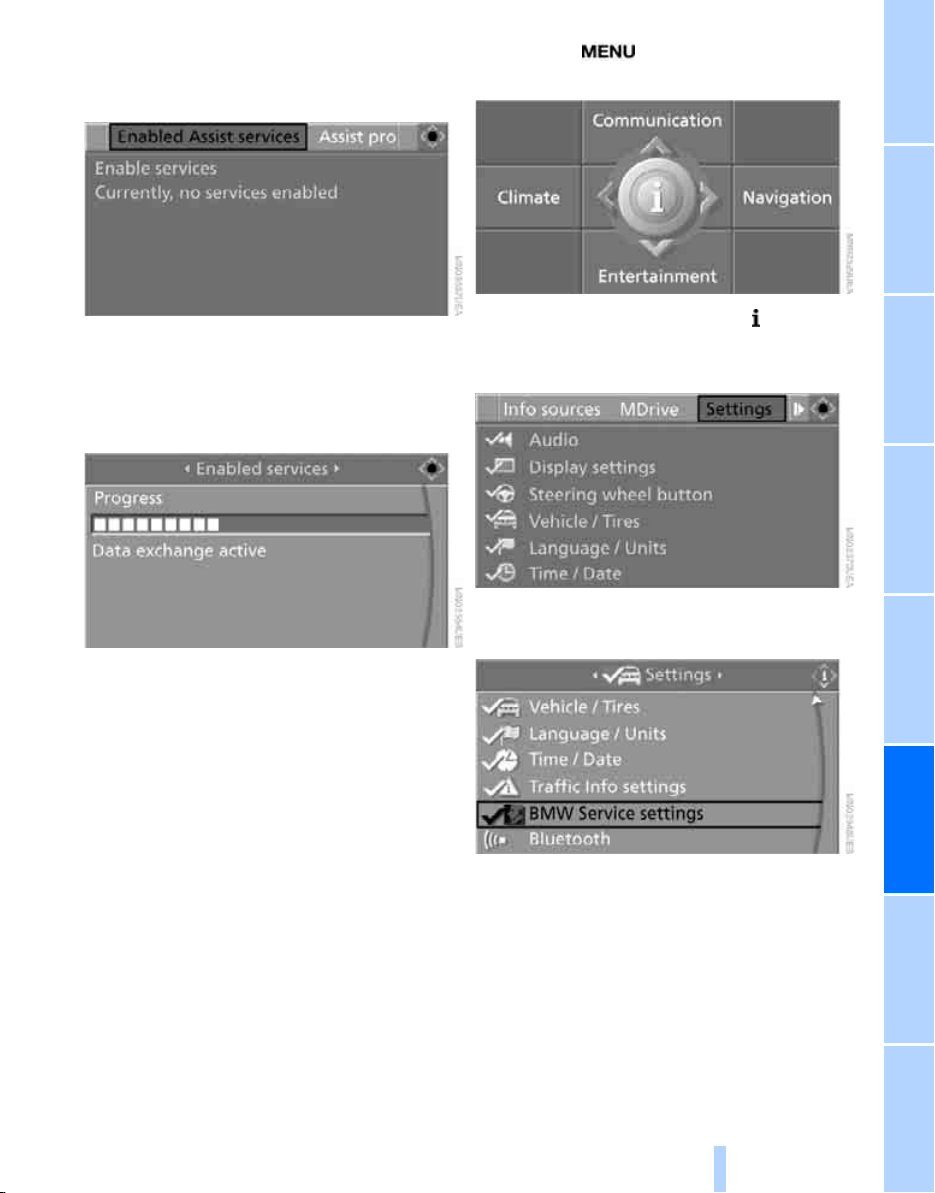
199
EntertainmentReference At a glanceControlsDriving tipsCommunications NavigationMobility
5. Change to upper field if necessary. Turn the
controller until "Enabled Assist services" is
selected and press the controller.
6. Select "Enable services" and press the con-
troller.
BMW Assist is enabled and the data
exchange with the BMW Assist Response
Center begins.
Activation takes a few minutes. The status is
displayed on the Control Display. If you open
another menu, the activation process continues
to run in the background.
Displaying vehicle data
With BMW Assist activated, you can have the
Telematics ID displayed. The Telematics ID is
used to identify your vehicle. These data are
transmitted to the service.
1. Press the button.
This opens the start menu.
2. Press the controller to open the menu.
3. Turn the controller until "Settings" is
selected and press the controller.
4. Select "BMW Service settings" and press
the controller.
Online Edition for Part no. 01 41 2 600 775 - © 08/08 BMW AG

BMW Assist
200
5. Change to upper field if necessary. Turn the
controller until "Profile" is selected and
press the controller.
Online Edition for Part no. 01 41 2 600 775 - © 08/08 BMW AG


Online Edition for Part no. 01 41 2 600 775 - © 08/08 BMW AG

Mobility
This section helps you maintain your car's
mobility by supplying important information
on vital topics, including fuels and lubricants,
wheels and tires, service, maintenance and
breakdown assistance.
Mobility
Online Edition for Part no. 01 41 2 600 775 - © 08/08 BMW AG
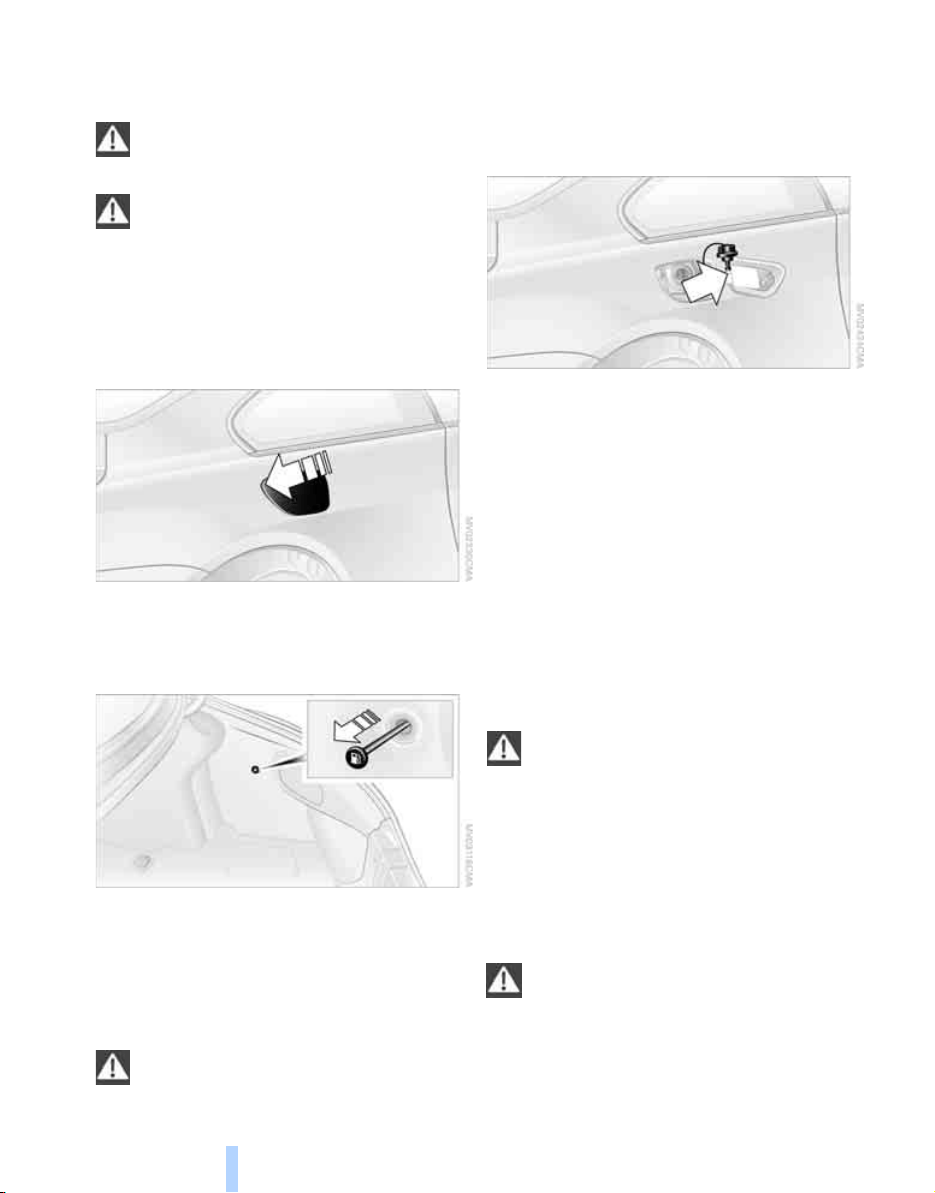
Refueling
204
Refueling
Switch off the engine before refueling,
otherwise no fuel can be filled into the
tank and a message is displayed.<
When handling fuel, always observe all
applicable precautionary measures and
regulations. Never transport reserve fuel con-
tainers in the vehicle. They can leak and cause
an explosion or a fire in an accident.<
Fuel filler door
To open and close: briefly press the rear edge of
the fuel filler door.
Unlocking manually
In the event of an electrical malfunction, you can
release the fuel filler door manually:
In the luggage compartment, pull the knob with
the gas pump symbol on the right side panel.
Observe the following when refueling
When handling fuels, follow the safety
precautions posted at the filling station.
Otherwise, there is a danger of personal injury
and property damage.<
Place the fuel filler cap in the bracket attached
to the fuel filler door.
When refueling, insert the filler nozzle com-
pletely into the filler pipe. Avoid raising the filler
nozzle during refueling, otherwise this
> results in premature pump shutoff
> can lead to reduced efficiency in the fuel-
vapor recovery system
The fuel tank is full when the filler nozzle clicks
off the first time.
Fuel tank capacity
Approx. 18.5 US gal/70 liters, including the
reserve capacity of approx. 4 US gal/15 liters.
Refuel as soon as possible once your
cruising range falls below 30 miles/
50 km, otherwise engine functions are not
ensured and damage can occur.<
Fuel filler cap
Closing
Insert the cap and turn it clockwise until there is
a clearly audible click.
Do not crush the band attached to the
cap; otherwise, the cap may not properly
seal and fuel vapors can escape.<
A message
* is displayed if the cap is loose or
missing.
Online Edition for Part no. 01 41 2 600 775 - © 08/08 BMW AG

Mobility
205
Reference At a glanceControlsDriving tipsCommunications NavigationEntertainment
Fuel specifications
Never used leaded gasoline; it will perma-
nently damage the catalytic converter.
Do not use E85, i.e. fuel that consists of 85%
ethanol, or Flex Fuel. Otherwise permanent
damage to the engine and the fuel supply sys-
tem will result.<
Required fuel
Super Premium Gasoline/AKI 93
Always use this premium grade fuel to obtain
maximum fuel economy and performance.
The minimum approved fuel grade is AKI 91.
Do not use gasoline below the specified
minimum quality, otherwise engine dam-
age can result.<
Use high-quality brands
Field experience has demonstrated significant
differences in fuel quality: volatility, composi-
tion, additives, etc., among gasolines offered for
sale in the United States and Canada. Fuels
containing up to and including 10% ethanol or
other oxygenates with up to 2.8% oxygen by
weight, that is, 15% MTBE or 3% methanol
plus an equivalent amount of co-solvent, will
not void the applicable warranties with respect
to defects in materials or workmanship.
The use of poor-quality fuels may result in
problems relating to drivability and start-
ing, and to a tendency to stall, especially under
certain environmental conditions such as high
ambient temperature and high altitude.
Should you encounter drivability problems
which you suspect could be related to the fuel
you are using, we recommend that you respond
by switching to a recognized high-quality brand
such as gasoline that is advertised as Top Tier
Detergent Gasoline.
Failure to comply with these recommendations
may also result in unscheduled maintenance.<
Online Edition for Part no. 01 41 2 600 775 - © 08/08 BMW AG
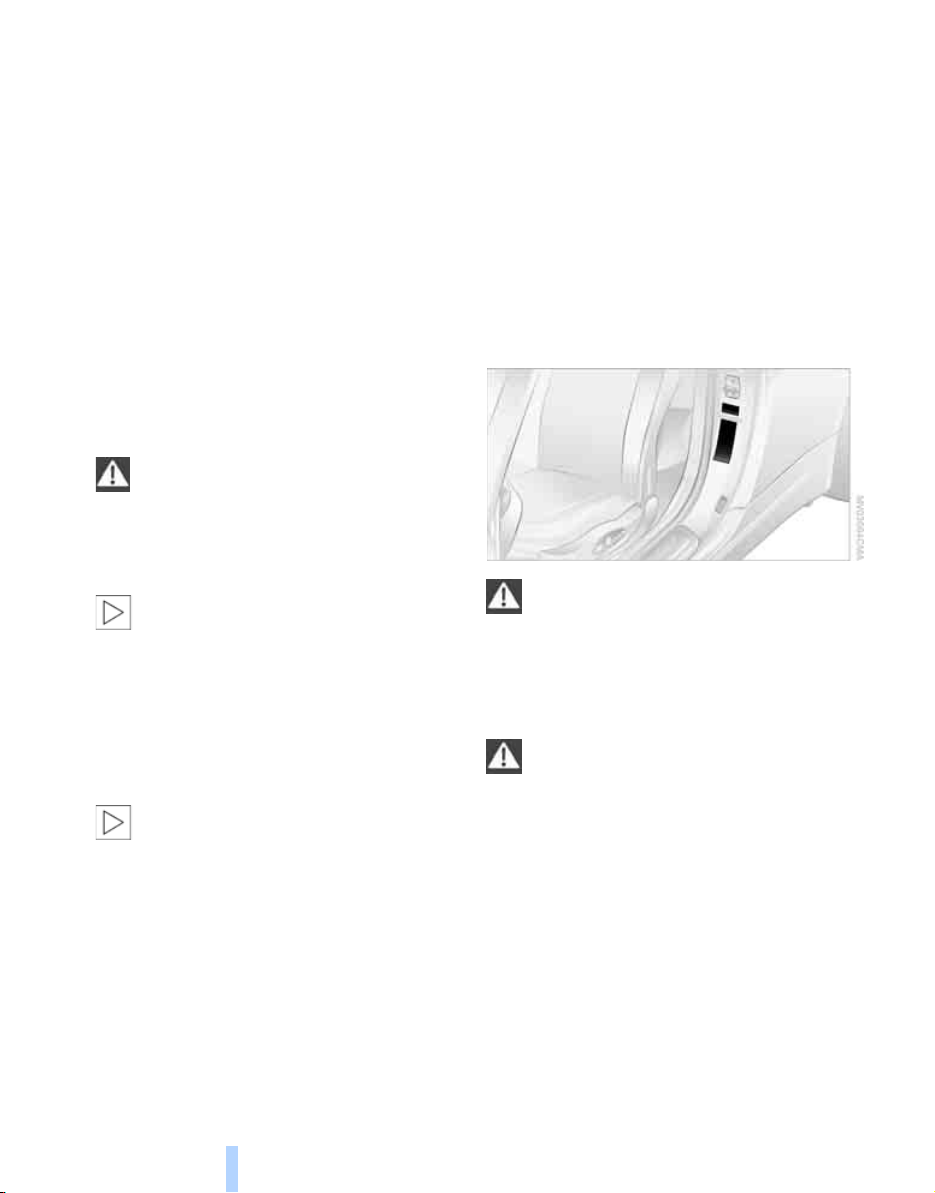
Wheels and tires
206
Wheels and tires
Tire inflation pressure
Information for your safety
The condition of the tires and the maintenance
of the specified tire pressure are crucial not only
to the tire's service life, but also to driving com-
fort and most importantly, driving safety.
Checking pressure
Only check tire inflation pressure when the tires
are cold. This means after a maximum of
1.25 miles/2 km driving or when the vehicle has
been parked for at least 2 hours. When tires are
warm, the tire inflation pressure increases.
Check the tire inflation pressure regularly
and correct if necessary, including on the
spare wheel
*: at least twice a month and before
starting long trips. Otherwise, driving instability
or tire damage, and therefore accidents, can
result from incorrect tire inflation pressures.<
After correcting the tire inflation pressure,
reinitialize the Flat Tire Monitor, refer to
page 87, or reset the Tire Pressure Monitor,
refer to page 89.<
Pressure specifications
The tables below provide all the correct inflation
pressures for the specified tire sizes at ambient
temperature.
The inflation pressures apply to the tire
sizes and tire brands respectively
approved and recommended by BMW; a list of
these is available from your BMW center.<
For correct identification of the right tire infla-
tion pressure for your tires, observe the follow-
ing:
> Tire sizes for your vehicle
> Load conditions
> Maximum allowable driving speed
Tire inflation pressures for driving
up to 100 mph/160 km/h
For normal driving up to 100 mph/160 km/h,
adjust pressures to the respective tire inflation
pressures listed on the following pages in the
column for traveling speeds up to a max. of
100 mph/160 km/h to achieve optimum driving
comfort.
These pressure specifications can be found on
the door post when you open the driver's door.
The maximum permissible speed for
these tire pressures is 100 mph/160 km/
h. Do not exceed this speed, otherwise tire
damage and accidents could occur.<
Tire inflation pressures for driving
above 100 mph/160 km/h
In order to drive at maximum speeds in
excess of 100 mph/160 km/h, please
note the tire pressures for speeds exceeding
100 mph/160 km/h listed in the relevant column
of the table on the following pages and adjust
your tire inflation pressures as needed. Other-
wise, tire damage and accidents could occur.<
Observe all national and local maximum speed
limits, otherwise violations of the law could
occur.
Online Edition for Part no. 01 41 2 600 775 - © 08/08 BMW AG
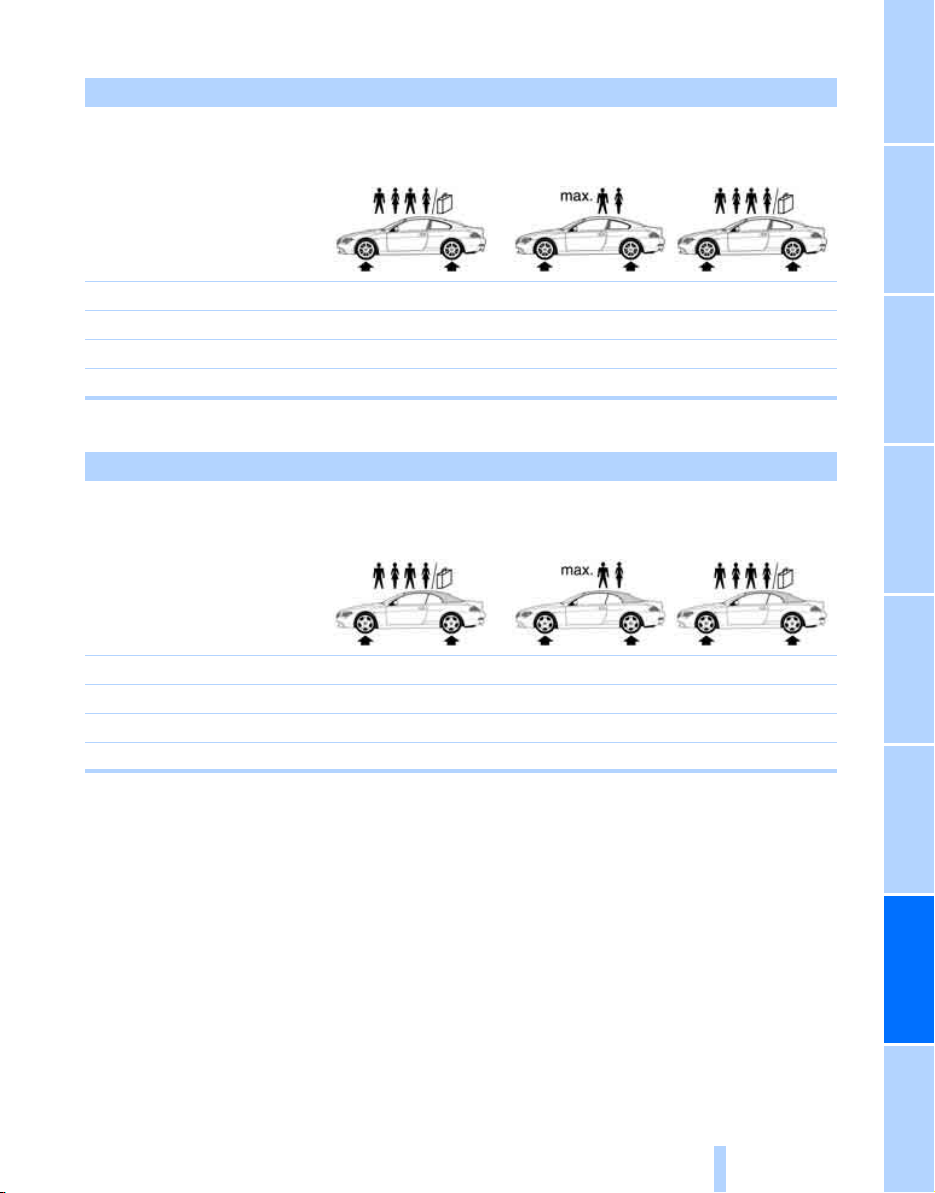
Mobility
207
Reference At a glanceControlsDriving tipsCommunications NavigationEntertainment
Tire inflation pressures for M6 Coupe
Tire inflation pressures for M6 Convertible
Tire size Pressure specifications in psi/kPa
Traveling speeds
up to max. of
100 mph/160 km/h
Traveling speeds including those exceed-
ing 100 mph/160 km/h
All pressure specifications
in the table are indicated in
psi/kilopascal with cold tires.
Cold = ambient temperature
245/45 R 18 100 V XL M+S 35/240 38/260 35/240 38/260 41/280 46/320
255/40 ZR 19 33/230 - 33/230 - 41/280 -
285/35 ZR 19 - 36/250 - 36/250 - 46/320
More details on the permissible load and weights can be found on page 243.
Tire size Pressure specifications in psi/kPa
Traveling speeds
up to max. of
100 mph/160 km/h
Traveling speeds including those exceed-
ing 100 mph/160 km/h
All pressure specifications
in the table are indicated in
psi/kilopascal with cold tires.
Cold = ambient temperature
245/45 R 18 100 V XL M+S 35/240 38/260 35/240 38/260 41/280 46/320
255/40 ZR 19 32/220 - 32/220 - 41/280 -
285/35 ZR 19 - 35/240 - 35/240 - 46/320
More details on the permissible load and weights can be found on page 243.
Online Edition for Part no. 01 41 2 600 775 - © 08/08 BMW AG

Wheels and tires
208
Tire identification marks
Knowledge of the labeling on the side of the tire
makes it easier to identify and choose the right
tires.
Tire size
Speed letter
T = up to 118 mph/190 km/h
H = up to 131 mph/210 km/h
V = up to 150 mph/240 km/h
W = up to 167 mph/270 km/h
Y = up to 186 mph/300 km/h
Z = over 150 mph/240 km/h
Tire Identification Number
Tires with DOT codes meet the guidelines of
the US Department of Transportation.
DOT code:
Tire age
The tire's date of manufacture is indicated on
the sidewall:
DOT ... 1008 indicates that the tire was manu-
factured in week 10 of 2008.
BMW recommends replacing all tires at least
every 6 years, even if some tires may last for
10 years. This also concerns the tire of the
spare wheel
*.
Uniform Tire Quality Grading
Quality grades can be found where applicable
on the tire sidewall between tread shoulder and
maximum section width. For example:
Tread wear 200 Traction AA
Temperature A
DOT Quality Grades
Tread wear
Traction AA A B C
Temperature A B C
All passenger car tires must conform to
Federal Safety Requirements in addition
to these grades.<
Tread wear
The tread wear grade is a comparative rating
based on the wear rate of the tire when tested
under controlled conditions on a specified gov-
ernment test course.
For example, a tire graded 150 would wear one
and one-half, 1γ, times as well on the govern-
ment course as a tire graded 100. The relative
performance of tires depends upon the actual
conditions of their use, however, and may
depart significantly from the norm due to varia-
tions in driving habits, service practices and dif-
ferences in road characteristics and climate.
Traction
The traction grades, from highest to lowest, are
AA, A, B, and C.
These grades represent the tire's ability to stop
on wet pavement as measured under controlled
conditions on specified government test sur-
faces of asphalt and concrete. A tire marked C
may have poor traction performance.
The traction grade assigned to this tire is
based on straight-ahead braking traction
tests, and does not include acceleration, cor-
nering, hydroplaning, or peak traction charac-
teristics.<
e.g.
Nominal width in mm
Aspect ratio in Ξ
Radial belt construction
Rim diameter in inches
Load rating
(not on ZR tires)
Speed code letter
(in front of the R on ZR tires)
245/45 R 18 100 V
285/35 19
ZR
e.g.
Manufacturer code
for tire make
Tire size and tire design
Tire age
DOT xxxx xxx 1008
Online Edition for Part no. 01 41 2 600 775 - © 08/08 BMW AG
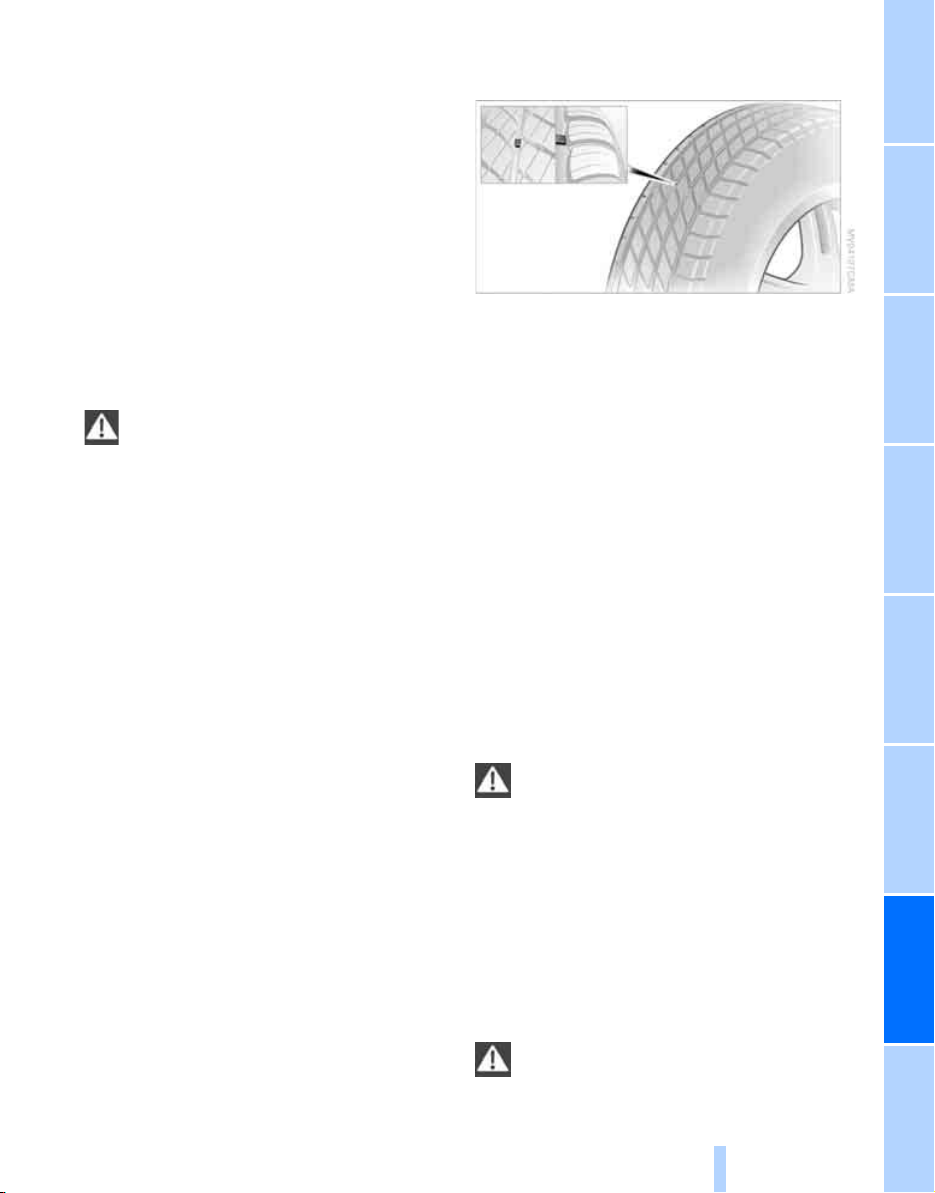
Mobility
209
Reference At a glanceControlsDriving tipsCommunications NavigationEntertainment
Temperature
The temperature grades are A, the highest, B,
and C, representing the tire's resistance to the
generation of heat and its ability to dissipate
heat when tested under controlled conditions
on a specified indoor laboratory test wheel.
Sustained high temperature can cause the
material of the tire to degenerate and reduce
tire life, and excessive temperature can lead to
sudden tire failure. The grade C corresponds to
a level of performance which all passenger car
tires must meet under the Federal Motor Vehi-
cle Safety Standard No. 109. Grades B and A
represent higher levels of performance on the
laboratory test wheel than the minimum
required by law.
The temperature grade for this tire is
established for a tire that is properly
inflated and not overloaded. Excessive speed,
underinflation, or excessive loading, either sep-
arately or in combination, can cause heat
buildup and possible tire failure.<
M+S
Winter and all-season tires.
These have better winter properties than sum-
mer tires.
XL
Indicates specially reinforced tires.
Tire condition
Inspect your tires frequently for tread wear,
signs of damage and for foreign objects lodged
in the tread. Check the tread depth.
Minimum tread depth
The tread depth should not drop below 0.12 in/
3 mm, although, for example, European legisla-
tion only specifies a minimum tread depth of
0.063 in/1.6 mm. At tread depths below 0.12 in/
3 mm, there is an increased risk of high-speed
hydroplaning, even when only small amounts of
water are present on the road surface.
Winter tires noticeably loose their suitability for
winter use below a tread depth of 0.16 in/4 mm.
For the sake of safety, new tires should be
installed.
Wear indicators at the tread-groove base, refer
to arrow, are distributed over the tire's circum-
ference and are marked on the side of the tire
with TWI – Tread Wear Indicator. If the tire tread
has been driven down to the wear indicators, a
tread depth of 0.063 in/1.6 mm has been
reached.
Wheel/tire damage
Please note that low-profile tires cause wheels,
tires and suspension parts to be more suscep-
tible to road hazards and consequential dam-
ages.
Unusual vibrations encountered during normal
vehicle operation can indicate tire failure or
some other vehicle defect. This can, for exam-
ple, be caused by driving over curbs. These
kinds of problems may also be signaled by other
changes in vehicle response, such as a strong
tendency to pull to the left or right.
In these cases, reduce speed immedi-
ately and have wheels and tires thor-
oughly checked. To do so, drive carefully to the
nearest BMW center or tire shop that works
according to BMW repair procedures with cor-
respondingly trained personnel. If necessary,
have the vehicle towed there. Otherwise, tire
damage can be extremely dangerous to vehicle
occupants and other road users.<
New wheels and tires
Only have new wheels and tires mounted
by a BMW center or a repair shop that
works in accordance with BMW guidelines and
Online Edition for Part no. 01 41 2 600 775 - © 08/08 BMW AG
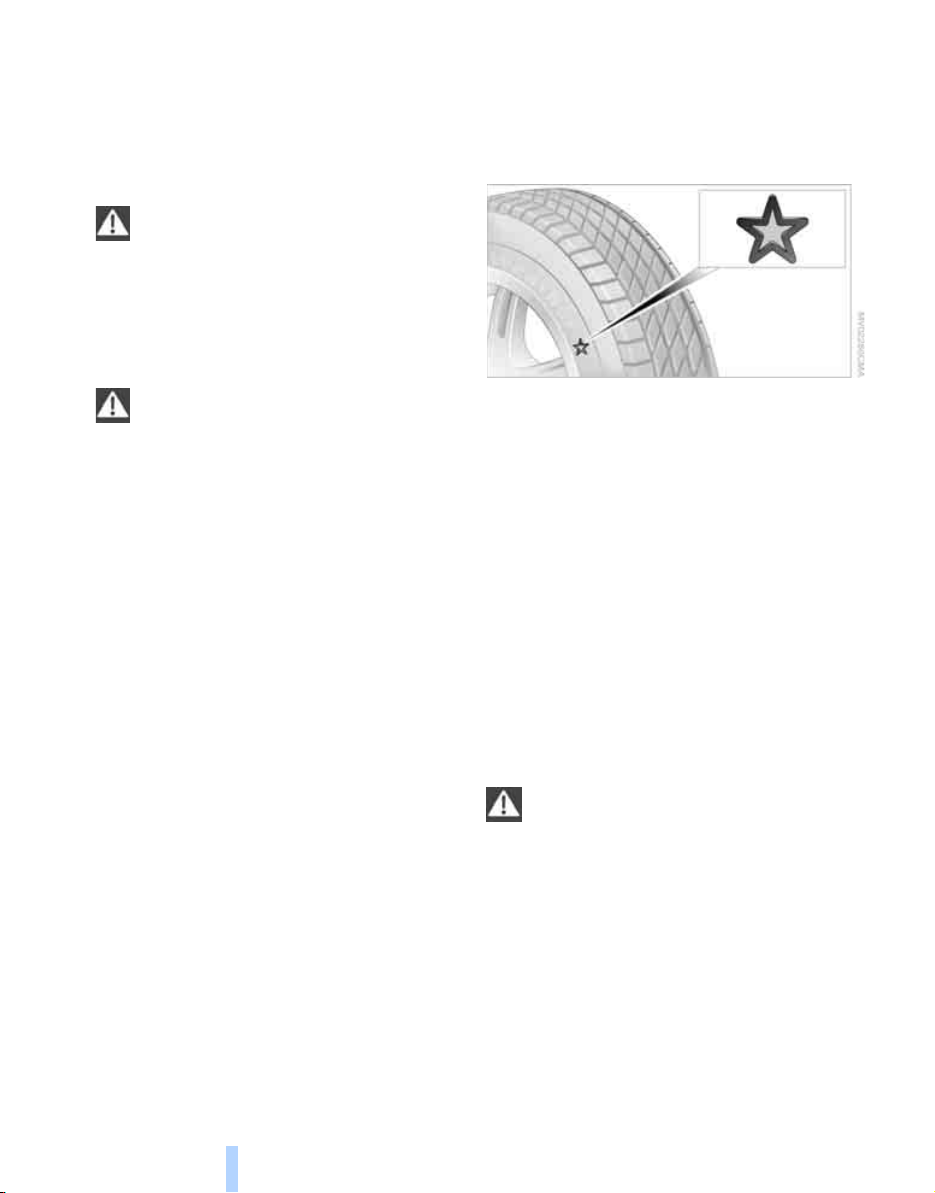
Wheels and tires
210
uses appropriately trained personnel. If this
work is not carried out properly, there is a dan-
ger of subsequent damage and related safety
hazards. Make sure that the new wheels are bal-
anced.<
Retreaded tires
BMW does not recommend that you use
retreaded tires, as driving safety may be
impaired. The causes for this include the possi-
bly different tire casing structures and the often
wide variations in their age, which can result in a
limited service life.<
The right wheels and tires
BMW recommends that you use only
wheel and tire combinations that BMW
has tested and approved for your particular
vehicle. Variations in factors such as manufac-
turing tolerances mean that even wheels and
tires with identical official size ratings could
actually have different dimensions than the
approved units – these differences could lead to
body contact, and with it the risk of severe acci-
dents. When selecting the tires, also ensure
that they have a sufficient load-carrying capac-
ity. If non-approved wheels and tires are used,
BMW cannot evaluate their suitability, and
therefore cannot be held liable for driving
safety.<
You can inquire about the right wheel/tire com-
bination at your BMW center.
The right wheel-and-tire combination is
another vital factor in ensuring reliable opera-
tion of various vehicle systems such as ABS
and DSC.
To maintain good handling and vehicle
response, use only tires of a single tread config-
uration from a single manufacturer. Following
tire damage, have the original wheel and tire
combination remounted on the vehicle as soon
as possible.
Wheels with electronics for
TPM Tire Pressure Monitor
When mounting new tires or converting from
summer to winter tires or vice versa, only use
wheels with TPM electronics, otherwise the
Tire Pressure Monitor cannot detect a flat tire,
refer to page 88. Your BMW center will be
happy to advise you on this subject.
Recommended tire brands
Certain tire makes are recommended by BMW
depending on the tire size. You can recognize
these from the clearly visible BMW marking on
the tire sidewall.
When used properly, these tires comply with
the most demanding standards for safety and
vehicle response.
Special characteristics of winter tires
BMW recommends winter tires for use in cold
winter driving conditions. Although all-season
M+S tires provide better winter traction than
summer tires, they generally fail to provide the
same levels of cold-weather performance as
winter tires.
Watch speed
Always observe the maximum permissi-
ble speed for the winter tires, otherwise
tire damage may occur, which can result in acci-
dents.<
After changing wheels/tires
After changing tires or wheels, the slip detec-
tion of the Sequential Manual Transmission
must become familiar with the changed state.
Reinitialize the system for this purpose:
1. Move the selector lever into the idling
position N on a straight stretch of road at a
Online Edition for Part no. 01 41 2 600 775 - © 08/08 BMW AG

Mobility
211
Reference At a glanceControlsDriving tipsCommunications NavigationEntertainment
speed between 20 mph/30 km/h and
90 mph/150 km/h.
2. Pull both shift paddles for approx. 2 sec-
onds.
If you do not carry out initialization, the system
will automatically learn the changed state grad-
ually during driving. This may be noticeable
from the clutch opening and closing briefly.
Storage
Store wheels and tires in a cool, dry place with
as little exposure to light as possible. Always
protect tires against all contact with oil, grease
and fuels. Do not exceed the maximum tire
inflation pressure indicated on the side wall of
the tire.
Rotating wheels between axles
BMW does not recommend moving the front
wheels to the rear or vice versa, as otherwise
the handling characteristics may be impaired.
With tires of different makes and types
* such a
change is not permissible.
Snow chains*
BMW only tests certain fine-link snow chains,
classifies them as road-safe and recommends
them. Consult your BMW center for more infor-
mation.
Use is only permitted in pairs, with winter tires
of the size 245/45 R 18 on the rear wheels.
Observe the manufacturer's instructions when
mounting snow chains. Do not exceed a speed
of 30 mph/50 km/h with the chains mounted.
Make sure that the snow chains are always suf-
ficiently tensioned. Retighten as needed in
accordance with the chain manufacturer's
specifications.
Do not initialize the Flat Tire Monitor after
installing snow chains as this could cause
the Flat Tire Monitor to malfunction.
After mounting or removing snow chains, the
slip detection of the Sequential Manual Trans-
mission must become familiar with the altered
state. To do this, reinitialize the system, refer to
After changing wheels/tires.<
Online Edition for Part no. 01 41 2 600 775 - © 08/08 BMW AG
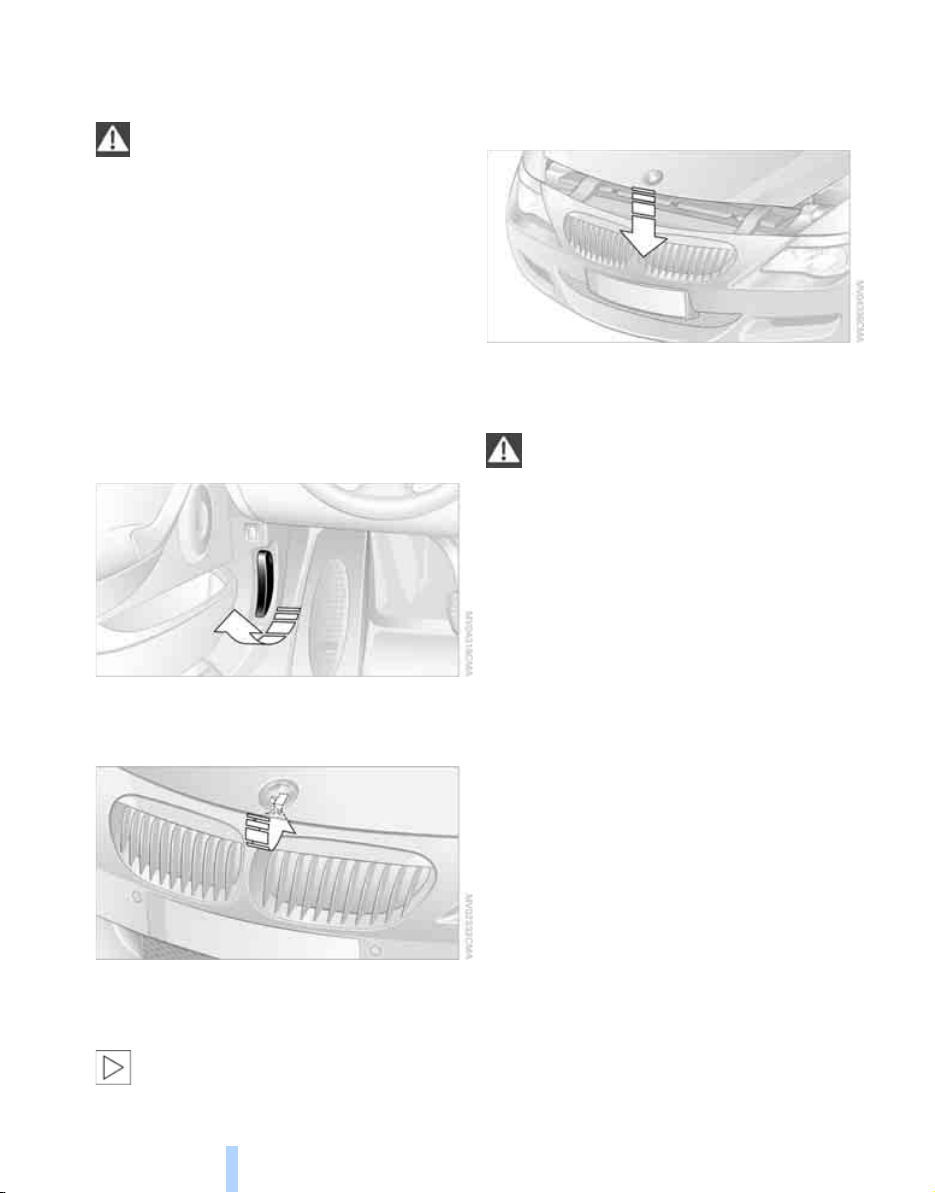
Under the hood
212
Under the hood
Never attempt to perform any service or
repair operations on your vehicle without
the required professional technical training.
If you do not know what repair procedures to
follow, have work on your vehicle done only by
your BMW center or a workshop that works
according to BMW repair procedures with cor-
respondingly trained personnel. If this work is
not carried out properly, there is a danger of
subsequent damage and related safety haz-
ards.<
Hood
Releasing
Pull lever.
Opening
Press the release handle and open the hood. Do
not open the hood until the engine has cooled
down.
You cannot start off with the hood open.<
Closing
Close the hood from a height of approx. 16 in/
40 cm with momentum. It must be clearly heard
to engage.
Make sure that the closing path of the
hood is clear; otherwise, injuries may
result.
If you see any signs that the hood is not com-
pletely closed while driving your vehicle, you
should stop at once and close it securely.<
Online Edition for Part no. 01 41 2 600 775 - © 08/08 BMW AG
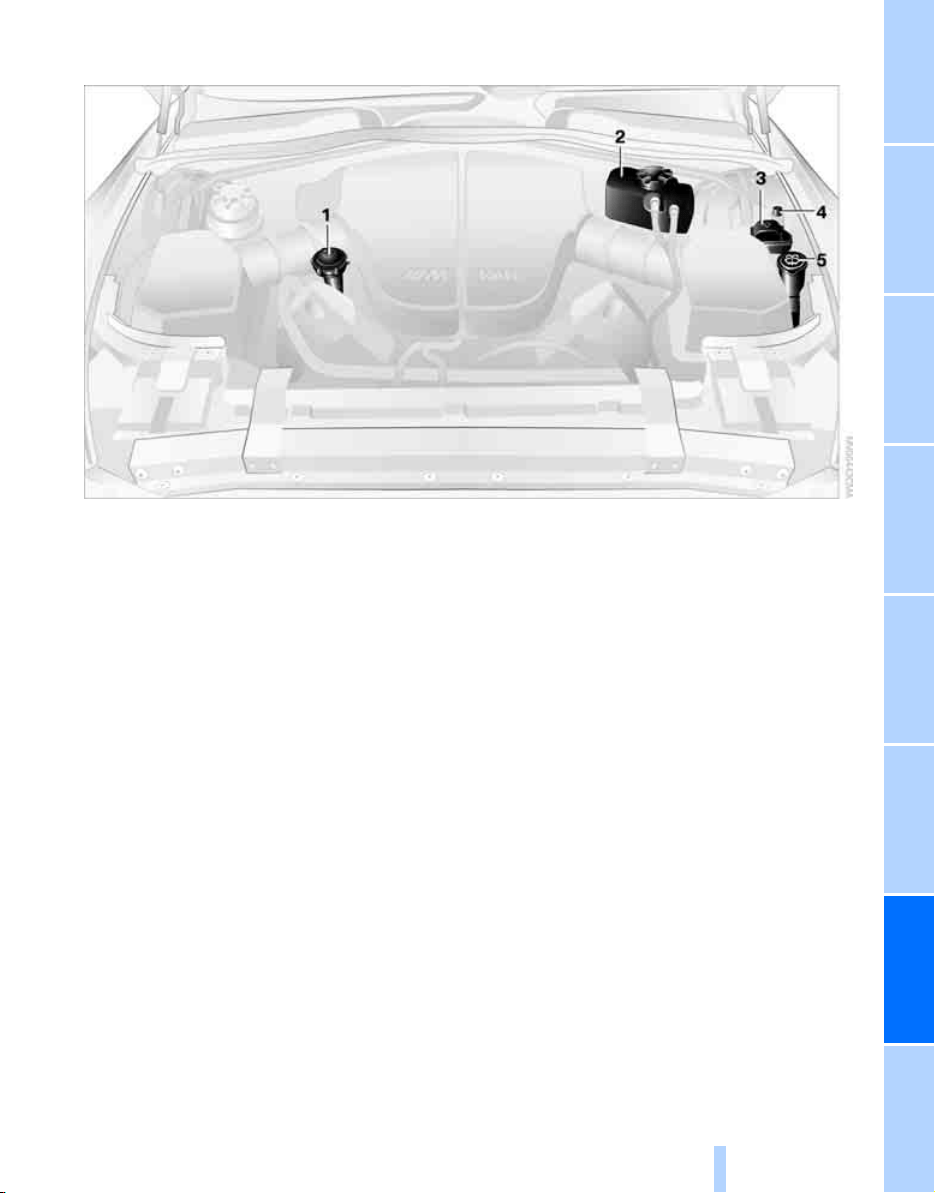
Mobility
213
Reference At a glanceControlsDriving tipsCommunications NavigationEntertainment
Engine compartment
1 Filler neck for engine oil, refer to Adding
engine oil
2 Expansion tank for coolant, refer to
page 217
3 Starting-aid terminal, refer to page 234
4 Body ground/negative terminal
5 Filler neck for washer fluid of the headlamp
and windshield cleaning systems, refer to
page 68
Online Edition for Part no. 01 41 2 600 775 - © 08/08 BMW AG
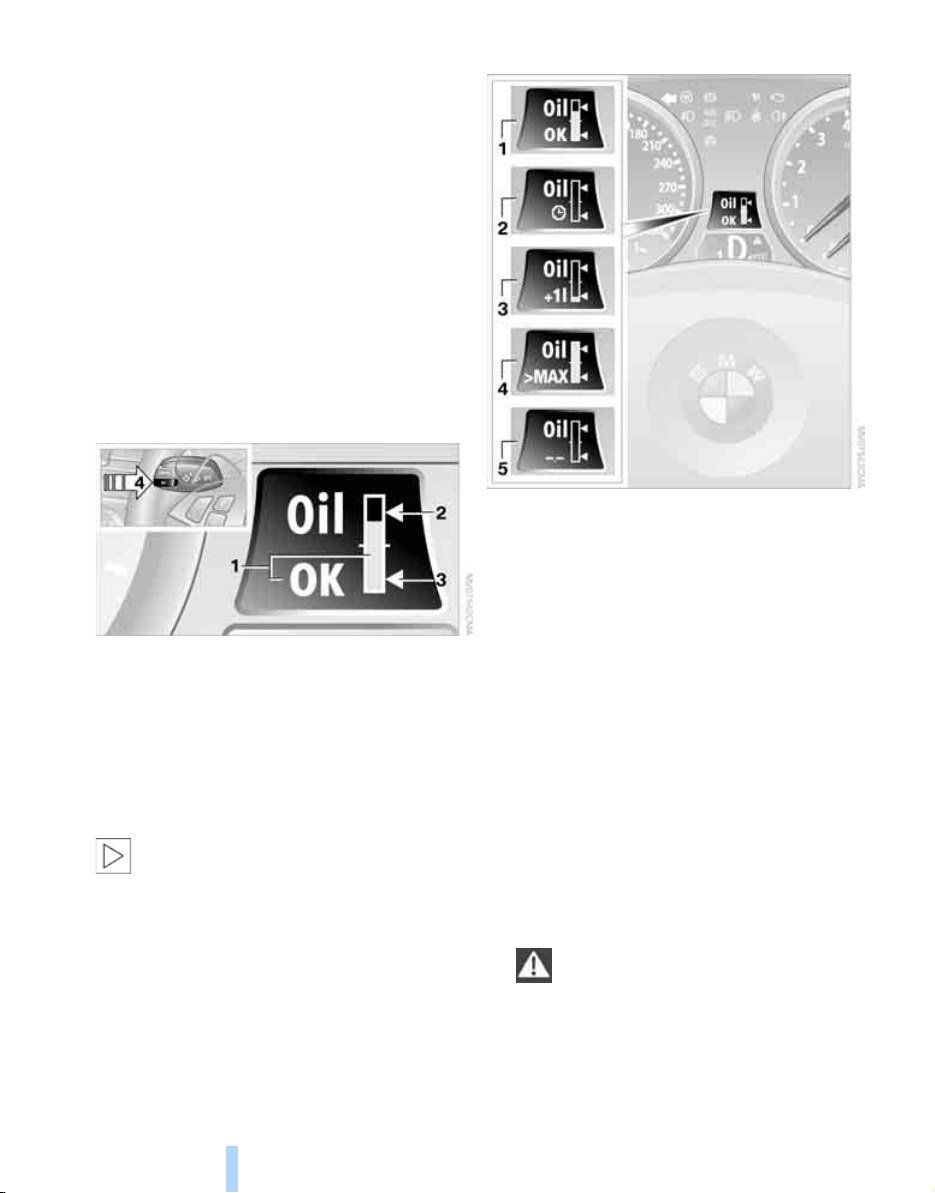
Under the hood
214
Engine oil
The engine oil consumption is dependent on
driving style and driving conditions.
Checking engine oil level
Your vehicle is equipped with an electronic oil
level check.
The oil level can be displayed when the engine
is at operating temperature. Constant short-
distance driving or a very sporty driving style
can make it impossible for a measurement to be
taken.
Displays in instrument cluster
You can display the current oil level in the
instrument cluster.
1 Oil level
2 Maximum marking
3 Minimum marking
4 BC button
Press the button 4 in the turn signal lever
repeatedly until the display for the oil level
appears in the instrument cluster.
Manual transmission: the engine oil level
will be shown in the lower display.<
The oil level must be between the two marks.
A new measurement is automatically taken
after each engine start.
Possible displays
1 Oil level OK
2 Oil level is being determined.
This process can take approx. 1 minute
when stopped on a level surface and
approx. 5 minutes while driving.
If the engine oil has been topped off, the
measurement of the oil level can take up to
30 minutes.
3 Oil level at minimum:
Add a maximum of 1 US quart/1 liter of
engine oil at the next opportunity, refer to
Adding engine oil below. Add at least
0.5 US quart/liter of oil; otherwise, the oil
level check cannot reliably display the new
oil level.
If the oil level displayed is below minimum,
add engine oil immediately. Failure to do so
may lead to engine damage.
4 Oil level too high
Have the vehicle checked immedi-
ately, otherwise engine damage may
result if too much oil has been added.<
5 No value can be determined at this time.
Engine is not yet at operating temperature.
Online Edition for Part no. 01 41 2 600 775 - © 08/08 BMW AG
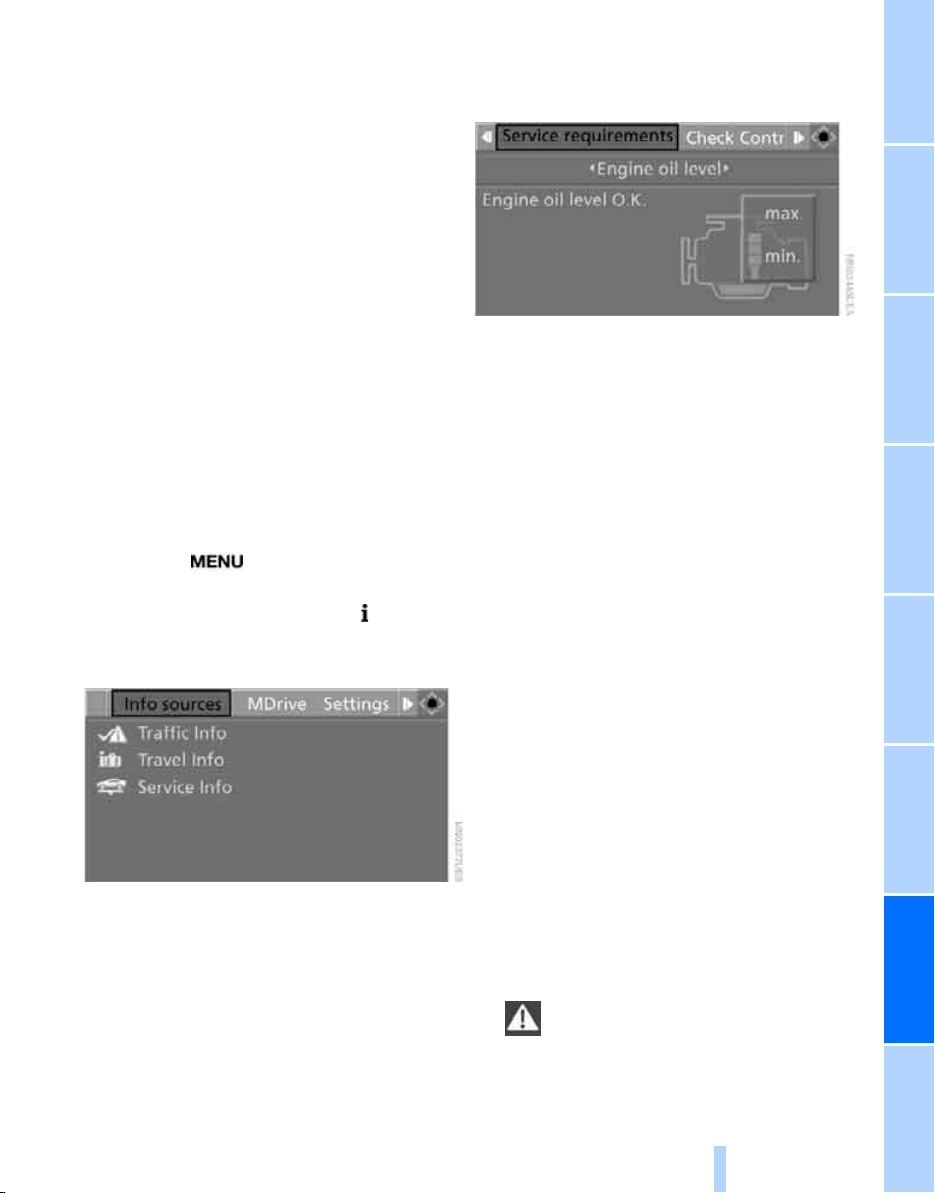
Mobility
215
Reference At a glanceControlsDriving tipsCommunications NavigationEntertainment
Fast measurement
In addition to the automatic measurement, you
can also determine the current oil level manu-
ally, e.g. after adding engine oil, but with a lower
degree of measuring accuracy.
1. With the engine at operating temperature,
i.e. after at least 6 miles/10 km of uninter-
rupted driving, park the vehicle in a horizon-
tal position.
2. Allow the engine to run at idle.
3. Press the BC button on the turn signal lever
repeatedly until the oil level display is
shown in the instrument cluster.
4. Press the BC button for at least 2 seconds.
The oil level is determined. A clock symbol
is displayed during the measurement.
5. After approx. 1 minute the current oil level is
displayed.
Displaying via iDrive
iDrive, for operating principle refer to page 16.
1. Press the button.
This opens the start menu.
2. Press the controller to open the menu.
3. Turn the controller until "Info sources" is
selected and press the controller.
4. Turn the controller until "Service Info" is
selected and press the controller.
5. Change to upper field if necessary. Turn the
controller until "Service requirements" is
selected and press the controller.
6. Change to the second field from the top if
necessary. Turn the controller until "Engine
oil level" is selected and press the control-
ler. The oil level is displayed.
Possible messages
> "Engine oil level O.K."
> "No measurement available: Updating
engine oil level measurement...":
The engine oil level is measured. This pro-
cess can take approx. 1 minute when
stopped on a level surface with the engine
running and approx. 5 minutes while driv-
ing.
If the engine oil has been topped off, the
measurement of the oil level can take up to
30 minutes.
> "Oil level at the minimum! Refill with 1 quart
of engine oil.":
Add a maximum of 1 US quart/liter of
engine oil at the next opportunity, refer also
to Adding engine oil below. Add at least
0.5 US quart/liter of oil; otherwise, the oil
level check cannot reliably display the new
oil level.
If the oil level displayed is below minimum,
add engine oil immediately. Failure to do so
may lead to engine damage.
> "Engine oil level too high":
Have the vehicle checked immedi-
ately, otherwise engine damage may
result if too much oil has been added.<
> "Please observe recalculated service inter-
val for engine oil"
Online Edition for Part no. 01 41 2 600 775 - © 08/08 BMW AG
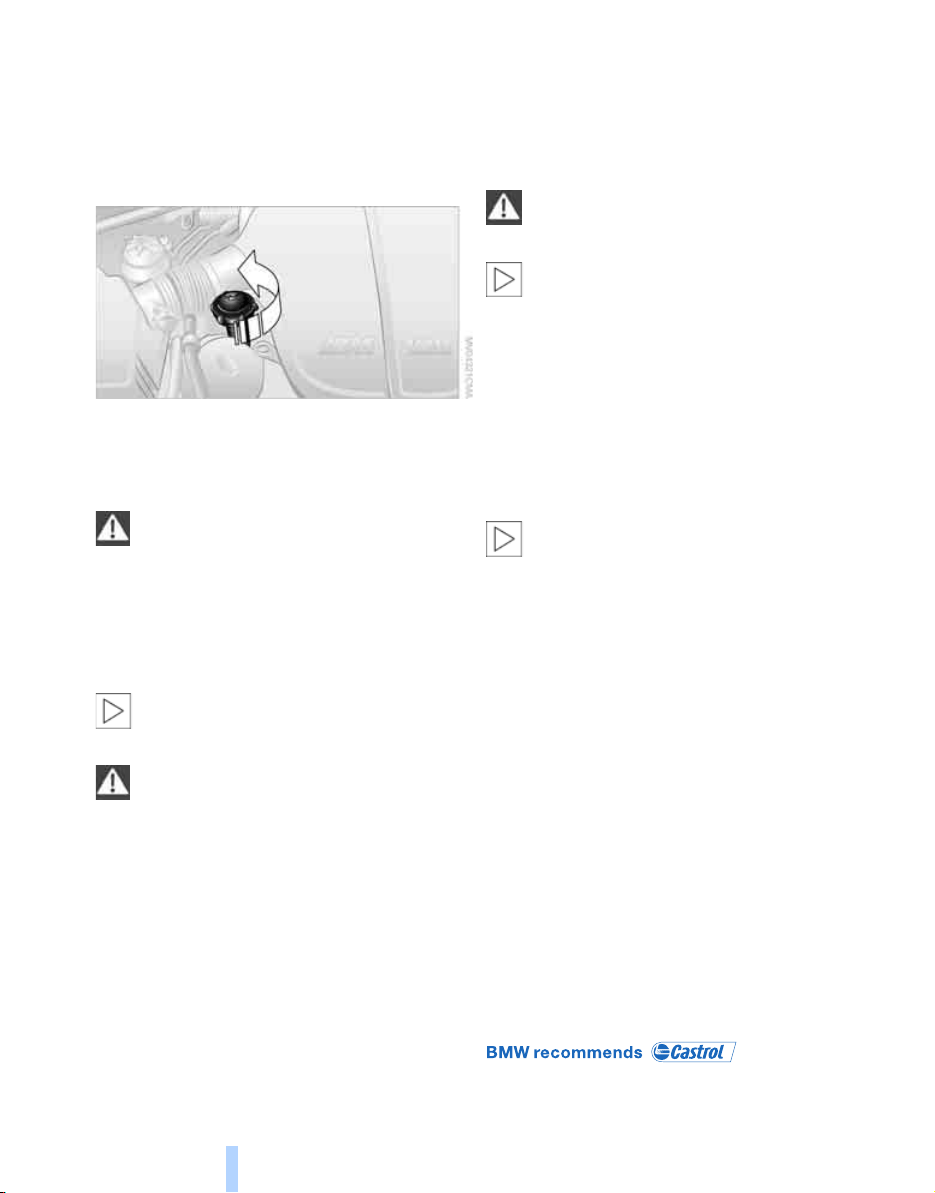
Under the hood
216
Do not add engine oil. Before continuing to
drive, note the recalculated remaining mile-
age until the next oil change service, refer to
Service requirements on page 73. Have the
system checked as soon as possible.
Adding engine oil
Do not add oil until a value slightly above the
minimum of 0.0 US quarts/liters is displayed by
the oil level measurement. In this area a mes-
sage is also shown on the Control Display.
Add oil within the next 125 miles/200 km,
otherwise the engine could be damaged.
Add a maximum of 1 US quart/1 liter of oil; oth-
erwise, the engine may be damaged by adding
too much oil.
Add at least 0.5 US quart/0.5 liter of oil; other-
wise, the oil level check cannot reliably display
the current oil level.<
Please conduct a fast measurement after
adding engine oil to check the oil quantity
added and to update the display.<
Continuous exposure to used oil has
caused cancer in laboratory testing.
For this reason, thoroughly wash exposed areas
of skin with soap and water after such work.
Keep oil, grease etc. out of reach of children and
observe the warnings on the containers to pre-
vent health risks.<
Oil change
Have oil changed only at your BMW center or
at a workshop that works according to BMW
repair procedures with correspondingly trained
personnel.
Approved engine oils
The quality of the engine oil selected has critical
significance for the operation and service life of
an engine. BMW continuously approves spe-
cific oils after confirming their suitability for use
in its vehicles with extensive testing.
Do not use oil additives; under some cir-
cumstances, they can damage your
engine.<
Your BMW center will be happy to answer
detailed questions on BMW High Perfor-
mance Synthetic Oil or approved synthetic
oils.<
You can also call BMW of North America at 1-
800-831-1117 or visit the website at
www.bmwusa.com to obtain this information.
Viscosity grades
Viscosity is a measure of an oil's flow rating and
is specified in SAE grades.
Approved oils belong to the SAE grade
10W-60.<
Alternative oil grades
If BMW High Performance Synthetic Oil is
unavailable, you can add small quantities of
other synthetic oils between oil changes.
Only use oils with the following specifications:
> Viscosity
preferred: SAE 10W-60;
alternative: SAE 10W-40, SAE 5W-50 or
SAE 10W-50
> Specification
API SJ/CF, API SK/CF or higher
Low temperatures
The oils used by BMW from the factory for your
M6 can be used at virtually any ambient tem-
perature. However, if the vehicle is operated for
a longer period at temperatures below –47/
–206, your BMW center will be happy to rec-
ommend a suitable oil.
Online Edition for Part no. 01 41 2 600 775 - © 08/08 BMW AG
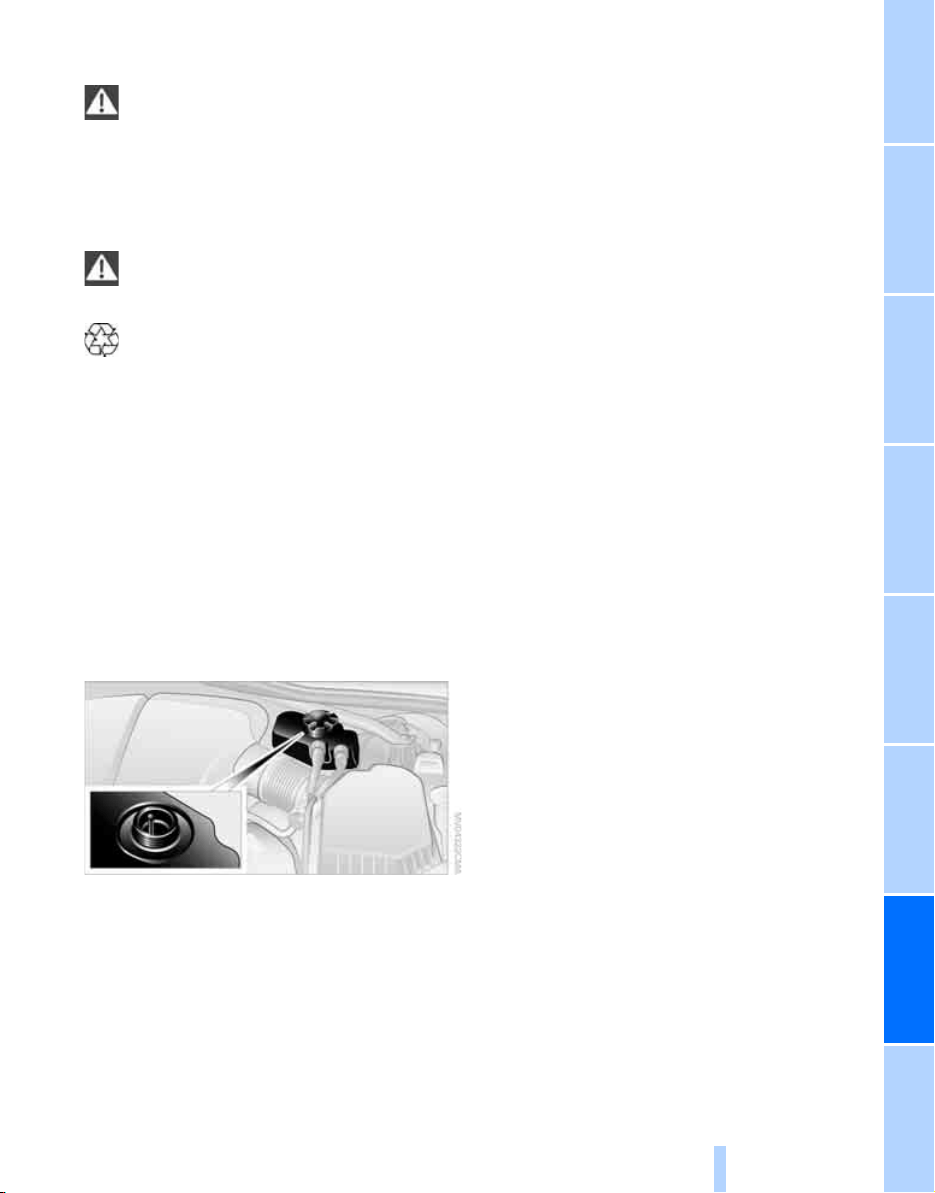
Mobility
217
Reference At a glanceControlsDriving tipsCommunications NavigationEntertainment
Coolant
Do not open the cooling system when the
engine is hot. Escaping coolant can cause
burns.<
Coolant is composed of equal parts water and a
coolant additive. Not all commercially available
additives are suitable for your BMW. Ask your
BMW center for suitable additives.
Only use suitable additives, otherwise
engine damage may result. The additives
present a health hazard.<
Always observe all applicable environ-
mental laws and regulations when dis-
posing of used coolant additives.<
Checking coolant level
1. Do not open the hood until the engine has
cooled down.
2. Turn the cap of the expansion tank counter-
clockwise to allow any accumulated pres-
sure to escape, then continue turning to
open.
3. The coolant level is correct when the upper
end of the float rod is at the same height as
the upper edge of the filler neck, also refer
to the drawing next to the filler neck.
4. If the coolant is low, slowly add coolant up to
the specified level – do not overfill.
5. Turn the cap until it clicks.
6. Have the reason for the coolant loss elimi-
nated as soon as possible.
Online Edition for Part no. 01 41 2 600 775 - © 08/08 BMW AG
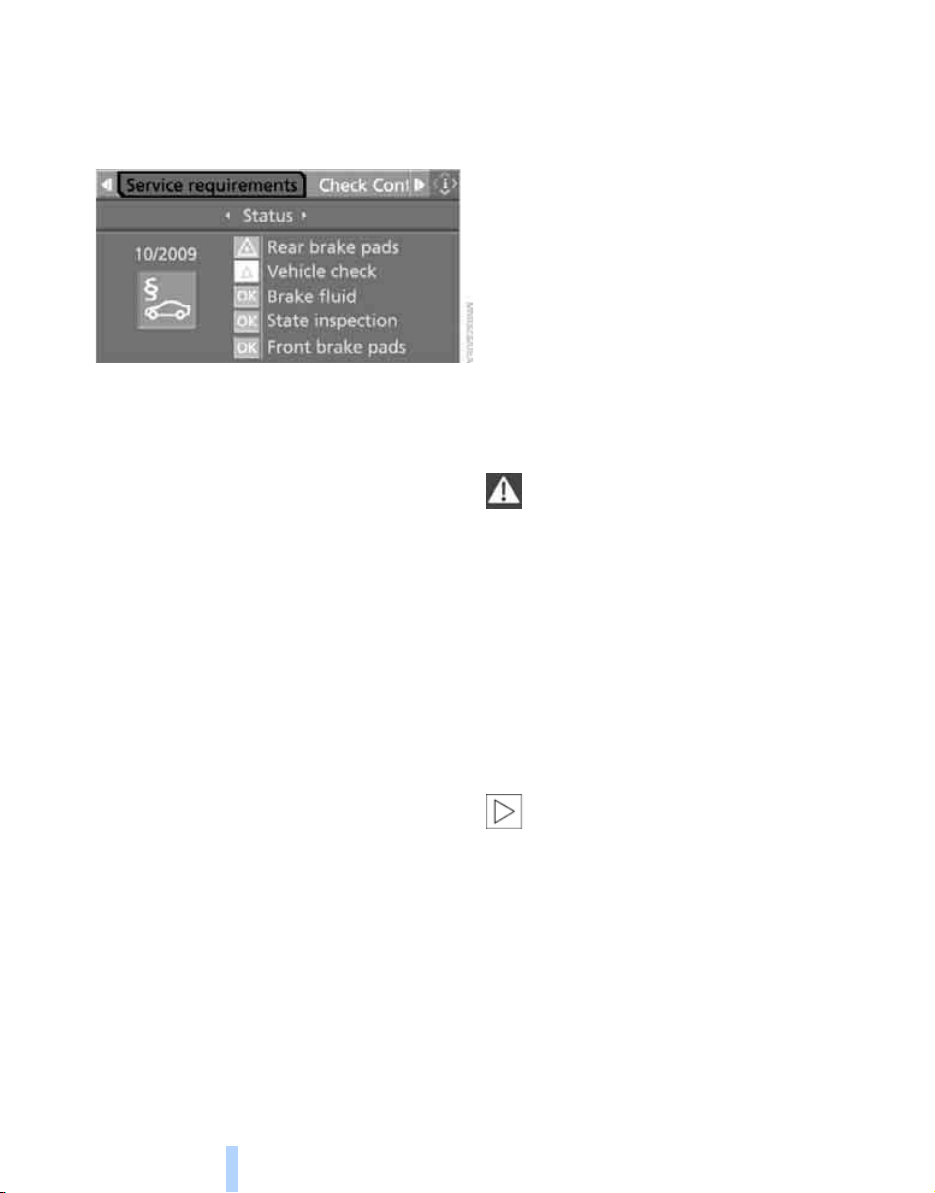
Maintenance
218
Maintenance
BMW Maintenance System
The BMW maintenance system supports the
preservation of the traffic and operating safety
of your BMW. The service schedule also
includes operations related to the vehicle's
comfort and convenience features, such as
replacement of the filters for the inside air.
The ultimate objective is to ensure economical
maintenance by providing the ideal service for
your vehicle.
Should the day come when you decide to sell
your BMW, a complete dealer service history
will prove to be an asset of inestimable value.
CBS Condition Based Service
Sensors and special algorithms take the differ-
ent driving conditions of your BMW into
account. Condition Based Service uses this to
determine the current and future service
requirements. By letting you define a service
and maintenance regimen that reflects your
own individual requirements, the system builds
the basis for trouble-free driving.
You can set the Control Display to show
remaining distances and times of selected
maintenance intervals and legally mandated
deadlines, refer to page 73:
> Engine oil
> Brake pads, front and rear separately
> Brake fluid
> Vehicle check
> Legally mandated inspections depending
on local regulations
Service data in remote control
Your vehicle stores the information required
maintenance continuously in the remote con-
trol during driving. After accessing the data
stored in the remote control, your BMW Service
Advisor can suggest precisely the right array of
service procedures for your own individual vehi-
cle. You should therefore hand over the remote
control you last used to drive to the BMW Ser-
vice Advisor when you take your vehicle in for
service.
Make sure the date is set correctly, refer
to page 79, otherwise the effectiveness
of CBS Condition Based Service is not
ensured.<
Service and Warranty Information
Booklet for US models and
Warranty and Service Guide Booklet
for Canadian models
Please consult your Service and Warranty Infor-
mation Booklet for US models and Warranty
and Service Guide Booklet for Canadian models
for additional information on service require-
ments.
BMW recommends that you have service
and repair operations performed at your
BMW center.
Take the time to ensure that these service pro-
cedures are confirmed by entries in your vehi-
cle's Service and Warranty Information Booklet
for US models and Warranty and Service Guide
Booklet for Canadian models. These entries
verify that your vehicle has received the speci-
fied regular maintenance.<
Online Edition for Part no. 01 41 2 600 775 - © 08/08 BMW AG
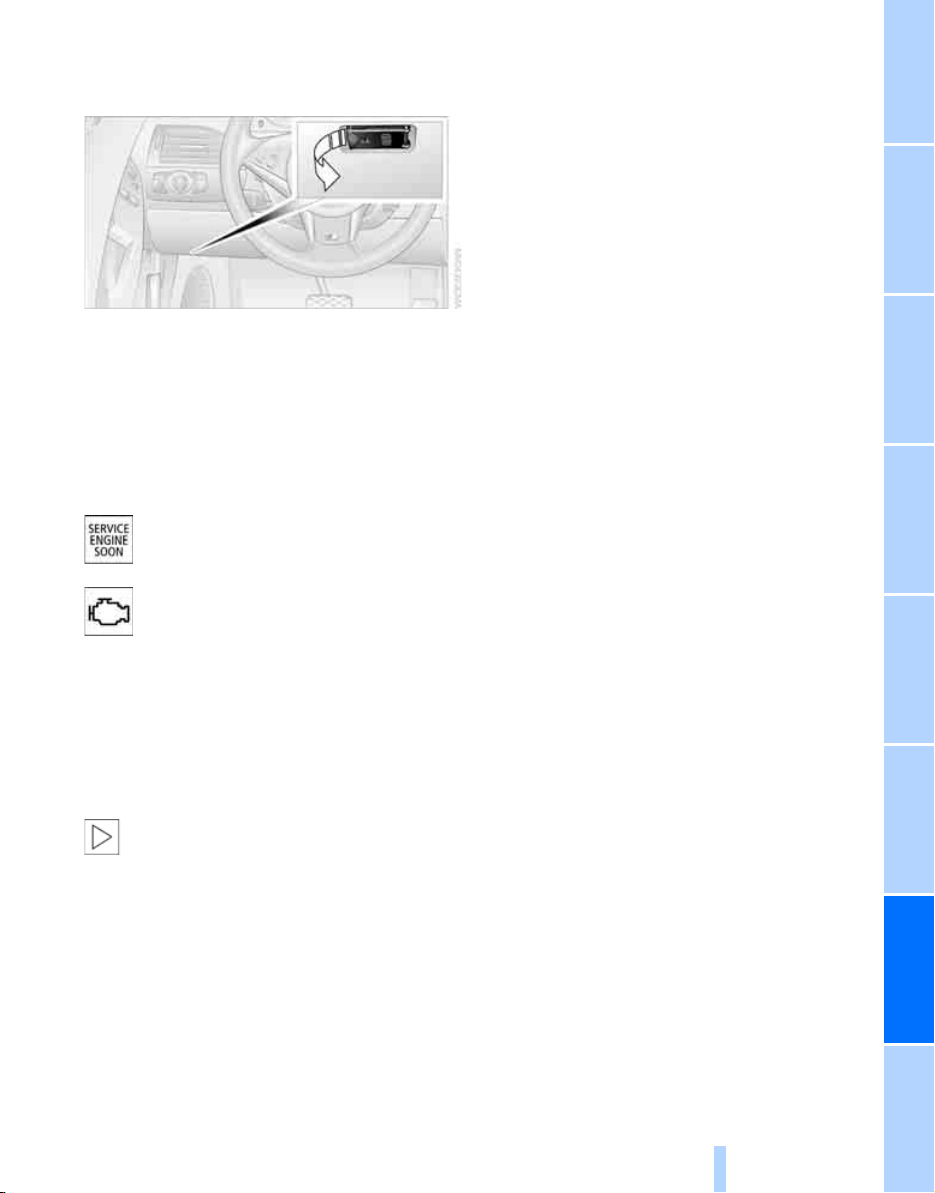
Mobility
219
Reference At a glanceControlsDriving tipsCommunications NavigationEntertainment
Socket for OBD Onboard
Diagnostics interface
Components which are decisive for the
exhaust-gas composition can be checked via
the OBD socket with a device.
This socket is located under a cover on the left
side of the driver's footwell, directly under the
instrument panel.
Exhaust-gas values
The warning lamp lights up. The
exhaust-gas values worsen. Have the
vehicle checked as soon as possible.
Display of the previously described
malfunction on Canadian models.
The lamp flashes under certain condi-
tions. This is a sign of excessive misfiring of the
engine. In this case you should reduce speed
and drive to the nearest BMW center as soon as
possible. Heavy engine misfiring causes seri-
ous damage to the emission-relevant compo-
nents, especially the catalytic converter, within
a short time.
If the fuel filler cap is not properly tight-
ened, the OBD system can detect the
escape of fuel vapor. Then a display lights up. If
the cap is then tightened, the display will go out
within a few days.<
Event Data Recorders
Your vehicle may be equipped with one or sev-
eral measuring and diagnosis modules, or with
a device for recording or transmitting certain
vehicle data or information. If you have also sub-
scribed to BMW Assist, certain vehicle data can
be transmitted or recorded to enable corre-
sponding services.
Online Edition for Part no. 01 41 2 600 775 - © 08/08 BMW AG

Care
220
Care
Car-care products
Regular cleaning and care make a significant
contribution to retaining your BMW's value.
For the cleaning and care of your vehicle, BMW
recommends using only products that BMW
has approved for this purpose.
Your BMW center will be glad to advise you
about products and services for the cleaning
and care of your BMW.
Genuine BMW Care Products are materi-
als tested, laboratory tested, and tested in
actual use. They offer optimum care and pro-
tection for your vehicle.<
Do not use cleaners that contain alcohol
or solvents; they can damage your vehi-
cle.<
Cleaning agents can contain substances
that are dangerous or pose health risks.
You should therefore heed the warnings and
hazard indications on the packaging. Open the
doors or windows on your vehicle whenever
cleaning the interior. Make sure there is suffi-
cient ventilation in enclosed spaces. Use only
products that are formulated for vehicle clean-
ing.<
Exterior care
Washing your vehicle
In the winter months, it is especially
important to ensure that the vehicle is
washed on a regular basis. Otherwise, signifi-
cant soiling and road salt can cause damage to
the vehicle.<
After washing the vehicle, apply the
brakes briefly to dry them. Failure to do so
may lead to a reduction in braking efficiency and
also to corrosion of the brake rotors.<
Car washes
Give preference to cloth car washes.
Do not use high-pressure car washes
because they can cause drops of water to
penetrate in the vicinity of the windshield.<
Before driving into the car wash, make sure that
it is suitable for your BMW. Pay attention to the
following points:
> Dimensions of your vehicle, refer to
page 241.
> If necessary, fold in the outside rearview
mirrors, refer to page 53.
> Maximum permissible tire width.
> The convertible top must not be treated
with wax. Make sure that a program without
wax or a special convertible program is
available.
Preparations for driving into the car wash:
> Deactivate rain sensor to prevent unwanted
wiper activation.
> Remove additional add-on parts, e.g. spoil-
ers or phone antennas, if they could be
damaged.
Sequential Manual Transmission
Before driving into the car wash, make sure the
vehicle is able to roll by making sure to:
1. Insert the remote control into the ignition
lock, even with comfort access.
2. Shift into transmission position N.
3. Release the parking brake.
4. Switch off the engine.
5. Leave the remote control in the ignition lock
so that the vehicle can roll.
Steam cleaners/high-pressure
cleaning jets
When using steam jets or high-pressure
washers, ensure that you maintain suffi-
cient clearance to the vehicle and do not exceed
a temperature of 606.
Insufficient distance or excessive pressure or
temperature can damage parts of the vehicle or
Online Edition for Part no. 01 41 2 600 775 - © 08/08 BMW AG

Mobility
221
Reference At a glanceControlsDriving tipsCommunications NavigationEntertainment
can result in water penetration. Follow the oper-
ating instructions for the high-pressure clean-
ing jets.<
When using high-pressure cleaning jets,
do not remain in one place for a long time
and be sure to maintain a distance of at least
12 in/30 cm from sensors, e.g. Park Distance
Control sensors or radar sensors.<
Hand washing
When washing the vehicle by hand, use plenty
of water and car washing shampoo. Clean the
vehicle with gentle pressure using a sponge or a
washing brush.
Before cleaning the windshield, deacti-
vate the rain sensor or switch off the igni-
tion to prevent unwanted wiper operation.<
Follow local guidelines for washing vehi-
cles by hand.<
Headlamps
Do not rub dry and never use abrasives or
strong solvents to clean the covers.
Loosen dirt, e.g. insects, with shampoo or
insect remover and wash away with plenty of
water.
Use a window de-icer to remove accumulated
ice and snow, not a scraper.
Windows
Use a glass cleaner to clean the inside and out-
side surfaces of the windows and the glass sur-
faces of the mirrors.
Do not use quartz-containing cleansers
to clean glass surfaces of the mirrors.<
Wiper blades
Clean with soapy water and replace regularly to
prevent streaking.
The presence of wax and sealant residues
and dirt on the windows leads to streaking
during wiper operation and results in premature
wear on wiper blades as well as interference
with the rain sensor.<
Convertible top care
The appearance and service life of the convert-
ible top depend on proper care and operation.
Please follow these instructions:
> Never stow the convertible top in the con-
vertible top compartment when it is wet or
frozen, since this can cause water marks,
mildew stains, and scuff marks.
> Remove water marks on the headliner with
a microfiber cloth and interior cleanser.
> When parking for long intervals in enclosed
spaces, make sure there is sufficient venti-
lation.
> Remove bird droppings immediately
because their caustic properties have a cor-
rosive effect on the convertible top and can
damage the rubber seals.
Do not use stain remover, paint thinner,
solvents, gasoline, or the like to remove
stains. These substances can damage the rub-
ber coating. Improper care and cleaning can
cause leaks to develop in the convertible top
and its seams.<
In the event of more serious soiling, use a spe-
cial convertible top cleaner.
When doing so, follow the manufacturer's
directions for use.
After three to five washings, treat the convert-
ible top with sealant.
Caring for the vehicle finish
Regular care helps your vehicle retain its value
and protects the paint from the long-term
effects of aggressive substances.
Regionally occurring environmental factors can
affect and damage vehicle finish. It is therefore
important to tailor the frequency and extent of
your car care accordingly.
Immediately remove particularly aggressive
substances such as spilled fuel, oil, grease,
brake fluid, tree resin, or bird droppings; other-
wise, they may damage your paint.
Online Edition for Part no. 01 41 2 600 775 - © 08/08 BMW AG

Care
222
Repairing paint damage
Repair stone damage or scratches imme-
diately, depending on the severity of the
damage, to prevent the formation of rust.<
BMW recommends having paint damage pro-
fessionally repaired using Genuine BMW finish
materials in accordance with factory guidelines.
Waxing
Sealant is required when water no longer beads
on the clean surface of the paint. Use only prod-
ucts that contain carnauba wax or synthetic wax
to seal your finish.
Rubber gaskets
Treat only with water or a rubber care product.
To avoid noise or damage, do not use
products that contain silicone to care for
rubber gaskets.<
Chrome components
Particularly after exposure to road salt, thor-
oughly cleanse parts like the radiator grille, door
handles, or window frames with plenty of water
with shampoo added to it. For additional treat-
ment, use chrome polish.
Alloy wheels
Depending on your system, braking can gener-
ate dust, which settles on the light-alloy wheels.
Remove this dust regularly with acid-free wheel
cleaner.
Do not use aggressive, acid-containing,
strongly alkaline, or coarse cleansers and
do not use steam cleaners at temperatures
greater than 60°C; otherwise you may damage
your vehicle.<
Outside sensors
Sensors outside the vehicle, such as Park
Distance Control sensors or radar sen-
sors, should be kept clean and free of ice to
maintain their full function.<
Interior care
Upholstery materials/cloth-covered
paneling
Clean regularly with a vacuum cleaner in order
to remove surface dirt.
In the event of more serious soiling such as bev-
erage stains, use a soft sponge or a lint-free
microfiber cloth in combination with suitable
interior cleaners. Follow the instructions on the
packaging.
Clean upholstery material over a large
area extending out to the seams. Avoid
intense friction.<
Open Velcro fasteners on pants or other
items of clothing can cause damage to
the seat covering. Make sure that the Velcro
fasteners are closed.<
Leather/leather-covered paneling
The leather used by BMW is a high quality
natural product. Slight patterns in the
grain are part of the typical properties of a natu-
ral leather.<
Dust and dirt from the road chafe in pores and
folds and result in considerable wear and cause
the leather surface to become prematurely brit-
tle. We therefore suggest that you clean the
leather with a dust cloth or vacuum cleaner at
regular intervals.
Particularly with light-colored leather, make
sure to clean it regularly since it has a greater
tendency to become soiled.
Treat the leather twice a year with a leather
lotion since dirt and grease harm the protective
layer of the leather.
Carpets/luggage compartment
Carpeting, floor mats, and luggage compart-
ment rugs and paneling can be cleaned with a
vacuum or in the event of more serious soiling,
cleansed with an interior cleaner.
Floor mats and luggage compartment rugs can
be removed for cleaning. When inserting into
place, make sure that the seat rails do not pro-
Online Edition for Part no. 01 41 2 600 775 - © 08/08 BMW AG

Mobility
223
Reference At a glanceControlsDriving tipsCommunications NavigationEntertainment
trude over the floor mats; otherwise floor mats
can be damaged.
Fluff on new floor mats is a result of the produc-
tion process and can be removed by repeated
vacuuming.
Plastic components inside
Clean the glass cover of the instrument panel,
imitation leather surfaces, lamp lenses, and
matte components with water and, if necessary,
a solvent-free plastic cleaner.
Fine wooden components
Use a damp cloth to clean fine wooden trim
panels and components. Follow up by drying
with a soft cloth.
Safety belts
Do not use cleansers to clean the safety
belts since this can destroy the web-
bing.<
Inside sensors
Clean inside sensors such as those of the high-
beam assistant using a lint-free cloth moist-
ened with glass cleaner.
Displays
Clean displays like the radio or the Control Dis-
play using a display-cleaning cloth or a soft,
nonabrasive lint-free cloth.
Avoid using excessive pressure when
cleaning displays; otherwise, you could
damage them.<
Never use chemical-based cleansers or
household scouring products. Keep all
liquids away from the equipment. Otherwise
corrosion or damage to surfaces or electrical
components can occur.<
CD/DVD player
Do not use cleaning CDs; they can dam-
age parts of the player.<
Storing your vehicle
When storing your vehicle for longer than three
months, please seek the advice of your BMW
center or a workshop that works in accordance
with BMW guidelines.
Online Edition for Part no. 01 41 2 600 775 - © 08/08 BMW AG
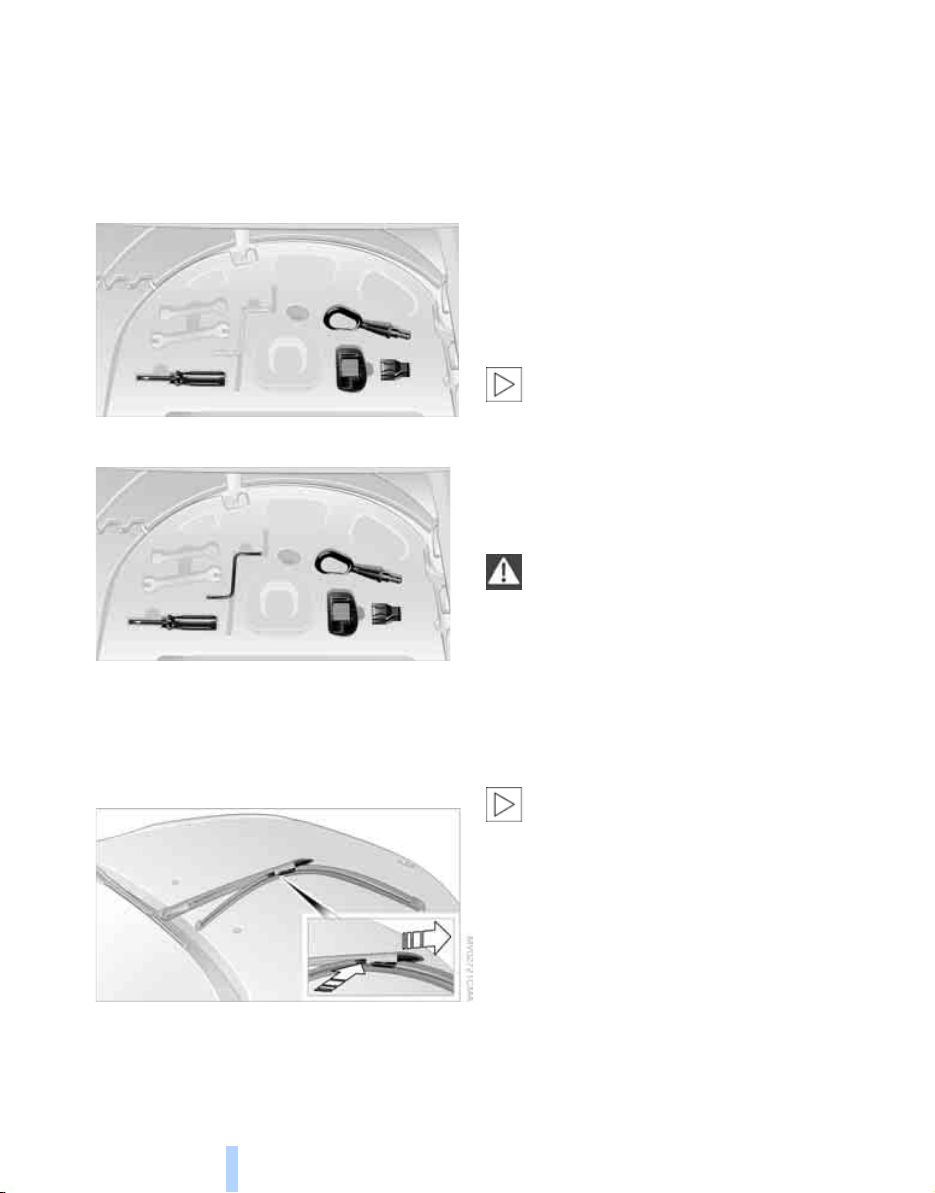
Replacing components
224
Replacing components
Onboard toolkit
Coupe
Convertible
The onboard tool kit is located in the luggage
compartment under the floor mat.
Replacing wiper blades
1. Fold the wiper arm out and grasp firmly.
2. Press the safety tabs together while sliding
the wiper blade toward the front to disen-
gage it.
3. Mount the new wiper blade and slide in until
it is heard to engage.
Lamps and bulbs
Lamps and bulbs make an essential contribu-
tion to vehicle safety. You must be duly diligent
in replacing them. If you are not familiar with the
specified procedures, have the corresponding
work carried out at your BMW center.
Never touch the glass of new bulbs with
your bare fingers, as even minute
amounts of contamination will burn into the
bulb's surface and reduce its service life. Use a
clean cloth, napkin, etc., or hold the bulb by its
metal socket.<
A selection of replacement bulbs is available at
your BMW center.
Whenever you perform any work on the
electrical system, turn off the systems/
consumers involved to prevent short circuits
from occurring. To avoid possible injury or
equipment damage when replacing bulbs,
observe any instructions provided by the bulb
manufacturer.<
For information on how to care for the head-
lamps, please follow the instructions on
page 220.
For bulbs for which changing is not
described, and for checking and adjusting
headlamp aim, please contact your BMW cen-
ter.<
Light-emitting diodes LEDs
Light-emitting diodes installed behind translu-
cent lenses serve as the light source for many of
the controls and displays in your vehicle. These
light-emitting diodes, which operate using a
concept similar to that applied in conventional
lasers, are officially designated as Class 1 light-
emitting diodes.
Online Edition for Part no. 01 41 2 600 775 - © 08/08 BMW AG
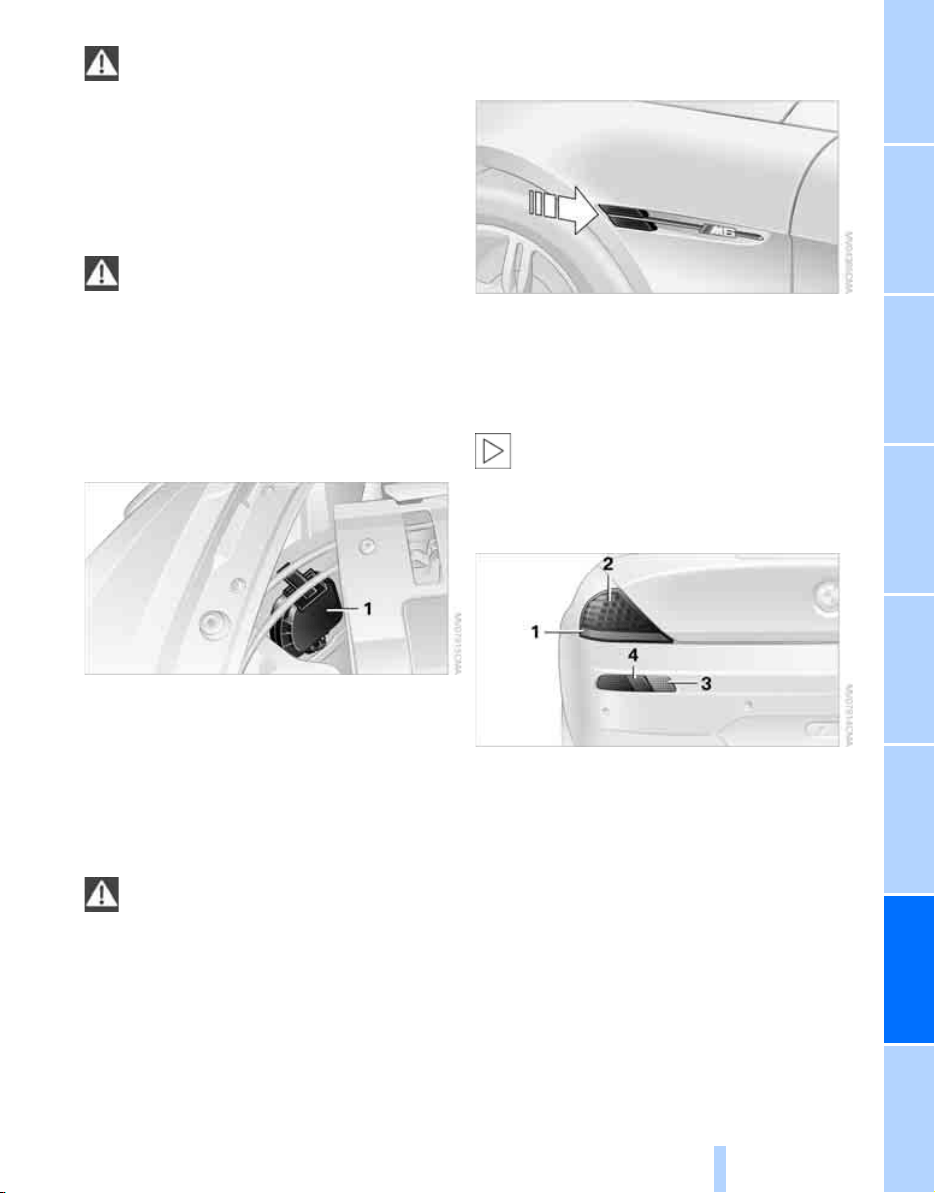
Mobility
225
Reference At a glanceControlsDriving tipsCommunications NavigationEntertainment
Do not remove the covers, and never
stare into the unfiltered light for several
hours, as irritation of the retina could result.<
Xenon lamps
The service life of these bulbs is very long and
the probability of a failure is very low, provided
that they are not switched on and off an unusual
number of times.
Have work on the xenon lighting system
performed only by your BMW center or a
workshop that works according to BMW repair
procedures with correspondingly trained per-
sonnel. Due to the high voltage present in the
system, there is a danger of fatal injuries when
work is carried out improperly.<
Parking lamps, roadside parking
lamps, daytime running lamps
The illustration shows the left-hand side of the
engine compartment.
35-watt bulb, H 8
1. Remove the cover cap 1 by pressing the tab
and removing the cover cap upward.
2. Turn the bulb holder to the left and remove.
3. Remove and replace the bulb.
Always wear gloves and eye protection –
the atmosphere inside the H8 bulb is
pressurized. Otherwise there is a danger of inju-
ries if the bulb is accidentally damaged during
replacement.<
Side-mounted turn signals
5-watt bulb, WY5W
1. Press against the front edge of the lamp
with the tip of your finger, then push it to the
rear, release the snap connection at the
front and take it off the trim strip.
2. Turn the bulb holder to the left by 905 and
remove.
3. Remove and replace the bulb.
Tail lamps
The roadside parking lamps, tail lamps,
brake lamps, and turn signals use LED
technology. The backup lamps are equipped
with long-life bulbs. Please contact a BMW cen-
ter in case of a malfunction.<
1 Turn signal
2 Roadside parking, tail and brake lamps
3 Reflector
4 Backup lamp
Online Edition for Part no. 01 41 2 600 775 - © 08/08 BMW AG
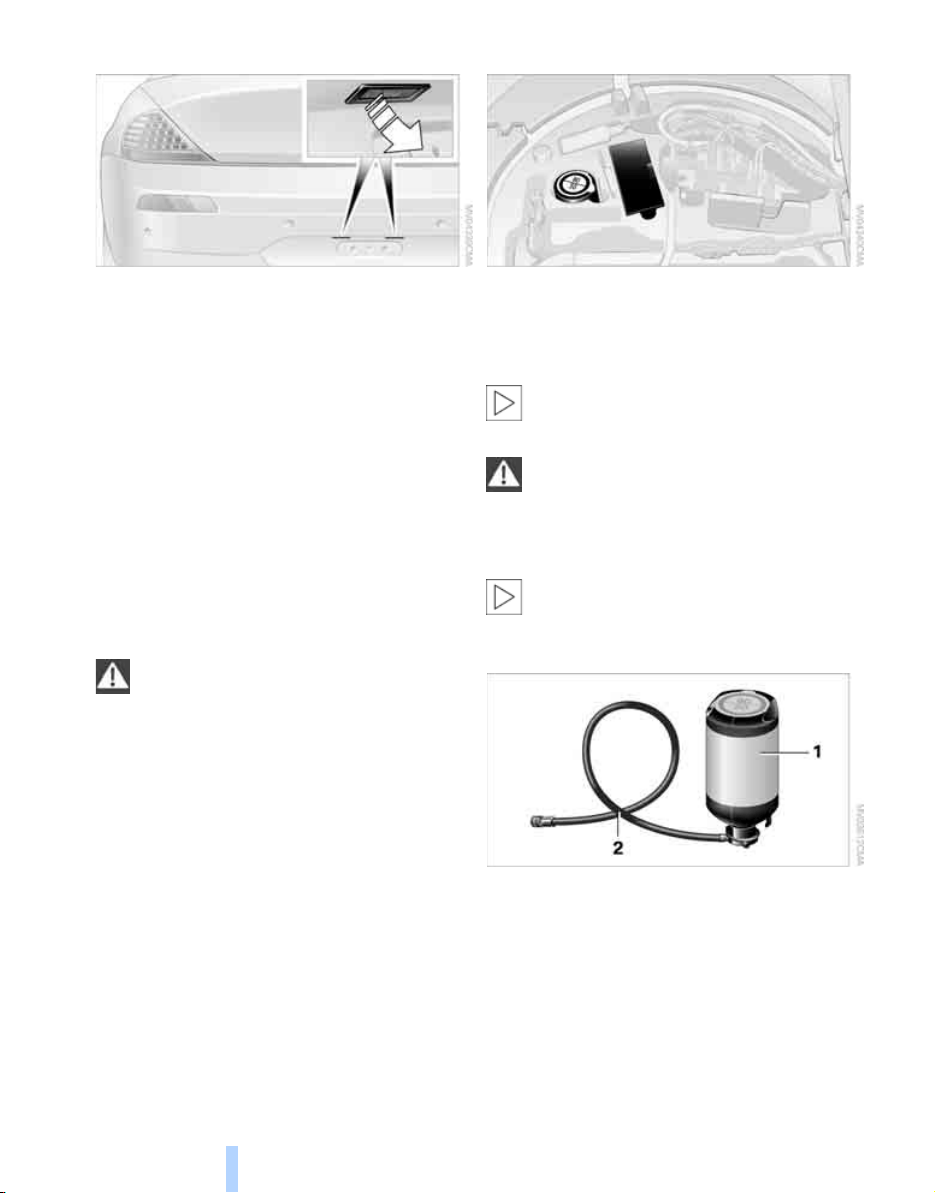
Replacing components
226
License plate lamps
5-watt bulb, W5W
1. Push a screwdriver from the left under the
lamp and pry out the lamp toward the right.
2. Turn the bulb holder to the left by 905 and
remove.
3. Remove and replace the bulb.
Repairing flat tire with
M Mobility System
To repair a flat tire, an M Mobility System is pro-
vided in the BMW M6. Using this system you
can apply a sealant in the inside of the tire, seal
off the damaged area, restore the tire inflation
pressure and then continue driving.
Safety measures in case of a breakdown:
Park the vehicle as far as possible from
passing traffic and on solid ground. Switch on
the hazard warning flashers.
Apply the handbrake and shift into first gear or
reverse with the manual transmission, or move
the selector lever into a drive position with the
sequential transmission. Have all vehicle occu-
pants get out of the vehicle and ensure that they
remain outside the immediate area in a safe
place, such as behind a guardrail.
If a warning triangle
* or portable hazard warning
lamp
* is required, set it up on the roadside at an
appropriate distance from the rear of the vehi-
cle. Comply with all safety guidelines and regu-
lations.<
Preparation
The M Mobility System is located in the cargo
bay under the floor panel flap.
Do not remove foreign bodies which have pen-
etrated the tire if possible.
Corresponding information on using the
M Mobility System are also provided on
the device.<
Before using the M Mobility System,
observe the information on the sealant
bottle.<
Pull the sticker for the speed limit off the sealant
bottle and apply it to the steering wheel.
Please observe the best-by date on the
sealant bottle.<
The M Mobility System consists of
1 Sealant bottle and sticker with speed limit
2 Filling hose from sealant bottle to wheel
Online Edition for Part no. 01 41 2 600 775 - © 08/08 BMW AG
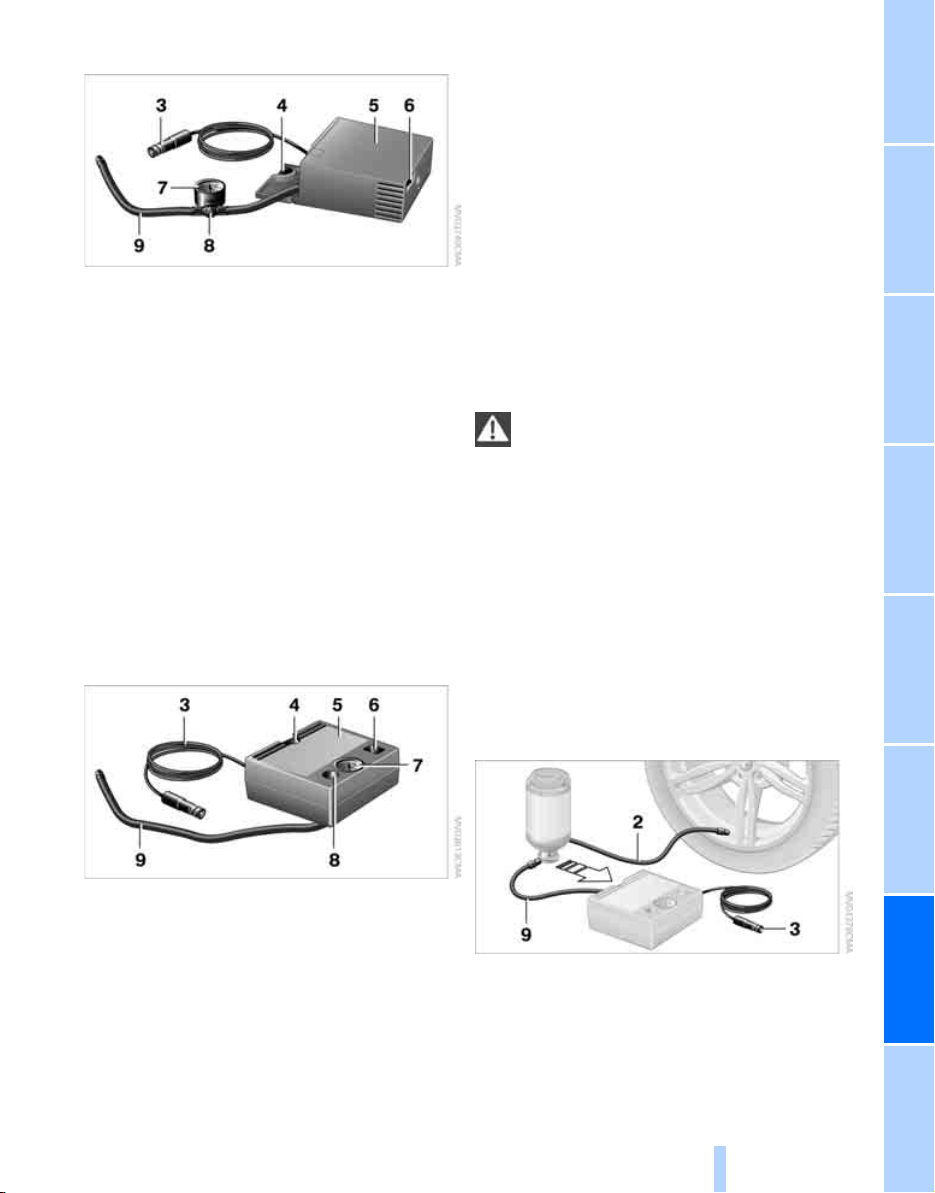
Mobility
227
Reference At a glanceControlsDriving tipsCommunications NavigationEntertainment
Model with pressure gauge on hose*
3 Connector and cable for lighter socket
4 Mounting for sealing bottle
5 Compressor
6 On/Off switch
7 Pressure gauge for indicating tire inflation
pressure
8 Screw on pressure gauge for reducing tire
inflation pressure
9 Connecting hose for connecting compres-
sor and sealant bottle or compressor and
wheel
Connector, cable and connecting hose are
stored in the compressor housing.
Model with pressure gauge integrated
in housing*
3 Connector and cable for lighter socket
4 Mounting for sealing bottle
5 Compressor
6 On/Off switch
7 Pressure gauge for indicating tire inflation
pressure
8 Button for reducing tire inflation pressure
9 Connecting hose for connecting compres-
sor and sealant bottle or compressor and
wheel
Connector, cable and connecting hose are
stored on underside of compressor.
Using M Mobility System
To repair a flat tire with the M Mobility System,
proceed as follows:
> Fill sealant into wheel, refer to page 227.
> Distribute sealant, refer to page 228.
> Produce tire inflation pressure, refer to
page 228.
Filling sealant into wheel
Strictly comply with the specified order,
otherwise highly pressurized sealant
could escape.<
1. Shake sealant bottle.
2. Screw hose 9 onto connection of sealant
bottle.
3. For model with pressure gauge on hose:
Make sure that screw 8 on pressure gauge
is closed.
4. Screw dust cap off valve of defective wheel
and screw filling hose 2 of sealant bottle
onto valve.
5. Insert sealant bottle on compressor hous-
ing so that it is positioned upright.
6. Make sure that the device is switched off,
position 0.
7. Insert connector 3 into lighter socket in
vehicle interior, refer to page 113.
8. With the ignition switched on, refer to
page 60:
Online Edition for Part no. 01 41 2 600 775 - © 08/08 BMW AG

Replacing components
228
Switch on the device and allow to run for
approx. 3 minutes to fill wheel with sealant.
It is not important what inflation pressure
the tire has after filling.
9. Switch off device.
10. Remove connecting hose from connection
of sealant bottle and tire valve.
Stow the M Mobility System in the vehicle
again.
Distributing sealant
Immediately drive approx. 2 miles/3 km so that
sealant is evenly distributed in tire.
Do not exceed a maximum speed of
35 mph/60 km/h. Do not drop below
12 mph/20 km/h if possible.<
Producing tire inflation pressure
1. After approx. 2 miles/3 km, stop at suitable
location.
2. Screw compressor hose 9 directly onto tire
valve.
3. Insert connector 3 in lighter socket in vehi-
cle interior.
4. Correct tire inflation pressure to 29 psi/
200 kPa. With the ignition switched on:
> Increase inflation pressure: Switch on
the device, position I. To check the cur-
rent inflation pressure setting, briefly
switch off the device.
Do not allow compressor to run
longer than 10 minutes, otherwise
the device will overheat and may be dam-
aged.<
> Reduce inflation pressure: press
button 8 or turn screw 8 on pressure
gauge.
If the inflation pressure is not held, drive
the vehicle again, refer to Distributing
sealant. Then repeat steps 1 to 4 once.
Using the M Mobility System can be ineffective
with tire damage from a size of approx. 0.16 in/
4 mm. Please contact the nearest BMW center,
refer to page 234, or a workshop that works
according to BMW repair procedures with cor-
respondingly trained personnel if the tire can-
not be made ready for driving with the
M Mobility System.<
The tire inflation pressure must be at least
29 psi/200 kPa. Otherwise do not con-
tinue driving.<
Continue driving
Do not exceed the permissible maximum
speed of 50 mph/80 km/h, otherwise
accidents can occur.<
Reinitialize the Flat Tire Monitor.
For details, refer to page 87.
Have the defective tire and the sealant bottle of
the M Mobility System replaced as soon as
possible.<
Changing wheels*
Safety precautions in the event of a flat
tire or wheel change: Park the vehicle as
far as possible from passing traffic and on solid
ground. Switch on the hazard warning flashers.
Apply the handbrake and shift into first gear or
reverse with the manual transmission, or move
the selector lever into a drive position with the
sequential transmission.
Have all vehicle occupants get out of the vehicle
and ensure that they remain outside the imme-
diate area in a safe place, such as behind a
guardrail.
If a warning triangle
* or portable hazard warning
lamp
* is required, set it up on the roadside at an
appropriate distance from the rear of the vehi-
cle. Comply with all safety guidelines and regu-
lations.
Change the wheel only on a level, firm surface
which is not slippery. The vehicle or the jack
could slip to the side if you attempt to raise the
vehicle on a soft or slippery surface such as
snow, ice, tiles, etc.
Position the jack on a firm support surface.
Do not use a wooden block or similar object as a
support base for the jack, as this would prevent
it from extending to its full support height and
reduce its load-carrying capacity.
To avoid serious or fatal injury: never lie under
Online Edition for Part no. 01 41 2 600 775 - © 08/08 BMW AG
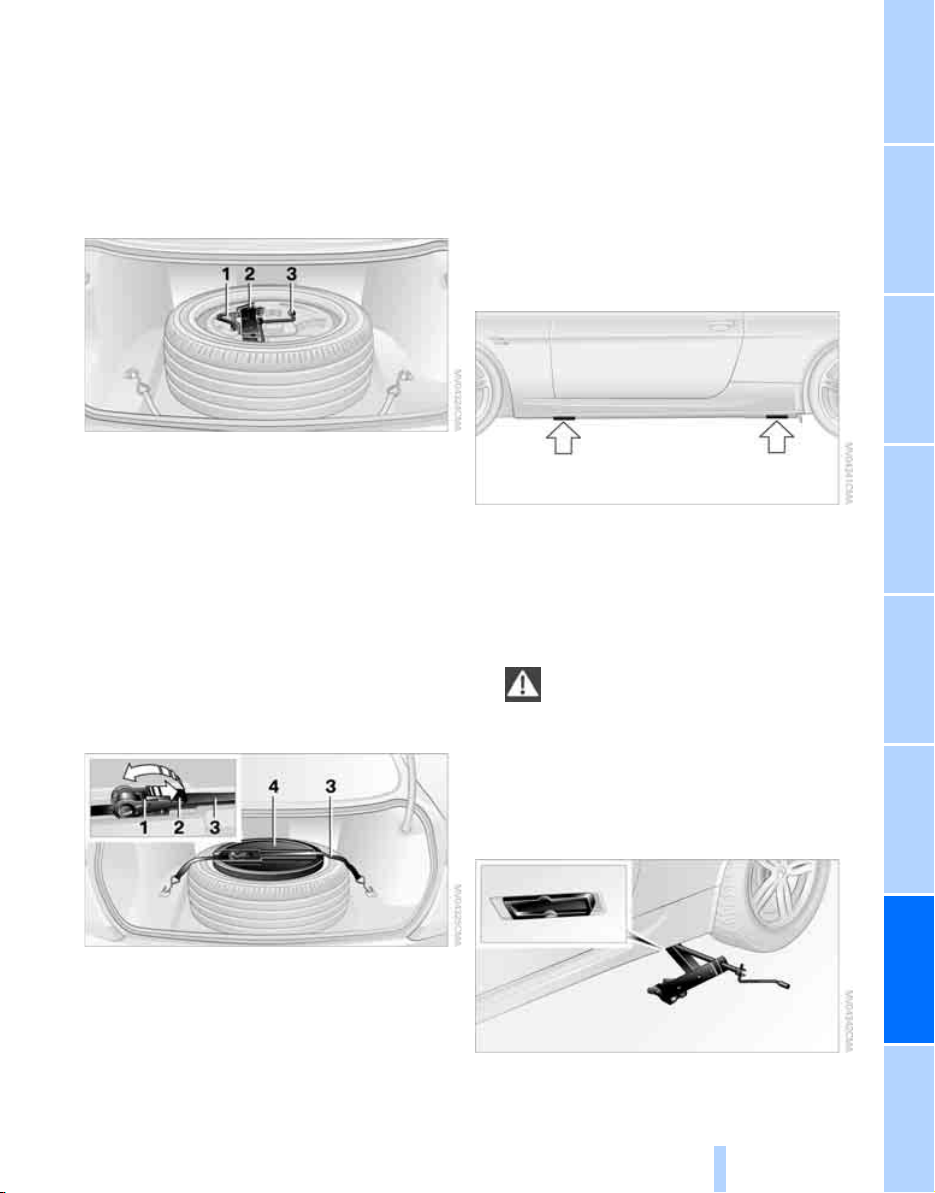
Mobility
229
Reference At a glanceControlsDriving tipsCommunications NavigationEntertainment
the vehicle, and never start the engine while it is
supported by the jack.<
What you will need
To avoid rattling noises later on, note the posi-
tions of the tools before removing them, then
return them to their initial positions after com-
pleting work.
1 Chock
*
2 Vehicle jack*
3 Lug wrench*
The tools are located in the hollow of the spare
wheel.
Spare wheel*
1. Fold up the convertible top compartment
floor, refer to Convertible: increasing lug-
gage compartment capacity, page 37.
2. Pull back lock 1, fold open tensioning lock 2
completely and loosen the belt 3.
3. Remove the cover 4.
4. Take the tool mounting out of the spare
wheel.
5. Remove the spare wheel.
Preparing wheel change
1. Observe the safety precautions above.
2. Prevent the vehicle from rolling:
Place the chock behind the front wheel on
the other side of the vehicle, or on inclines,
in front of this wheel. On steeply inclined
roads, always secure the vehicle against
rolling.
3. Loosen the lug bolts a half turn.
Jacking up vehicle
The jacking points for the car jack are located in
the positions shown.
1. Position the vehicle jack at the jacking point
closest to the wheel so that the entire sur-
face of the jack base rests on the ground
perpendicularly beneath the jacking point.
The vehicle jack is designed for
changing wheels only. Do not attempt
to raise another vehicle model with it or to
raise any load of any kind. To do so could
cause accidents and personal injury.<
2. Guide the jack head into the rectangular
recess of the jacking point when cranking
up, refer to illustration detail.
3. Jack the vehicle up until the wheel you are
changing is raised from the ground.
Online Edition for Part no. 01 41 2 600 775 - © 08/08 BMW AG
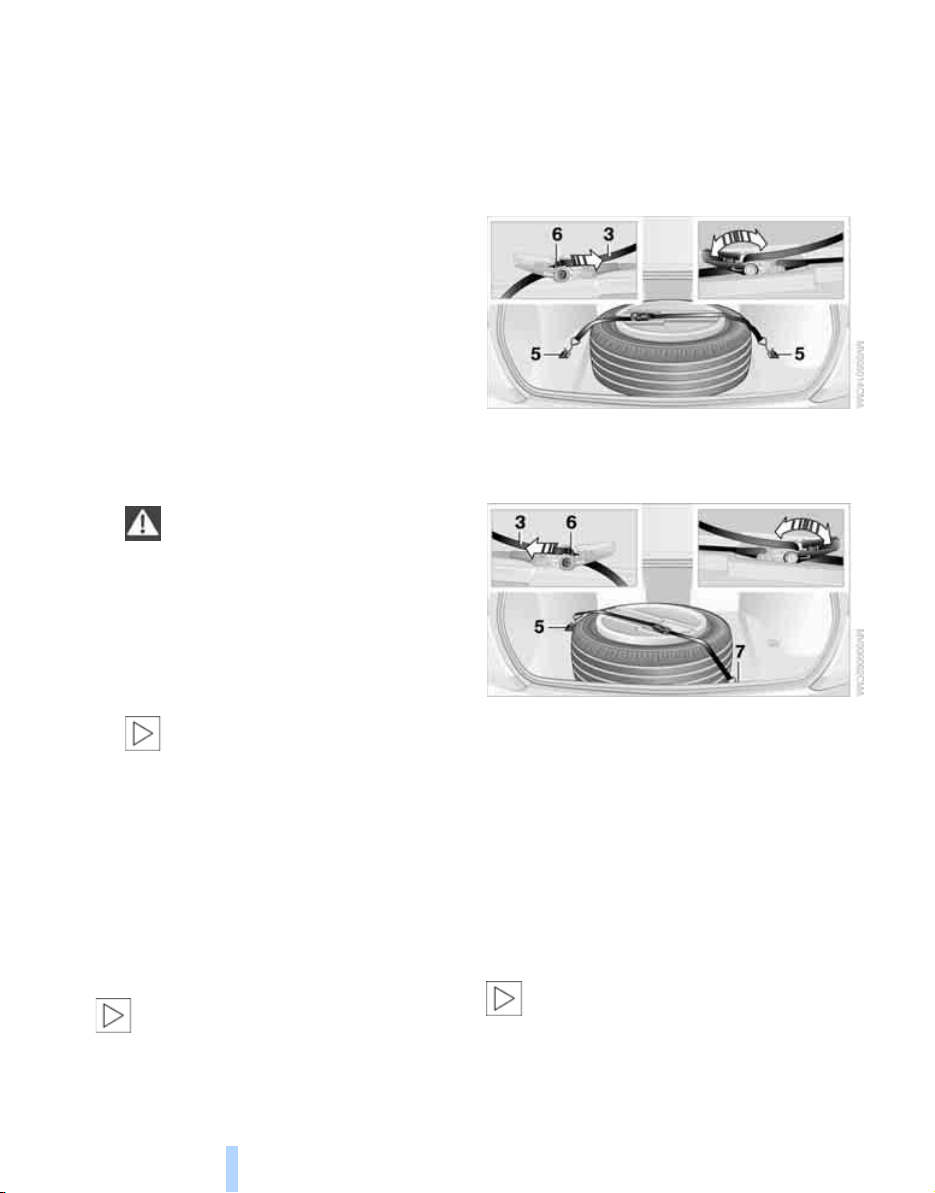
Replacing components
230
Mounting a wheel
1. Unscrew the lug bolts and remove the
wheel.
2. Remove accumulations of mud or dirt from
the mounting surfaces of the wheel and
hub. Also clean the lug bolts.
3. Position the new wheel or spare wheel.
Secure the wheel by screwing at least two
lug bolts into opposite bolt holes.
When you mount wheels other than Genu-
ine BMW light-alloy wheels, different lug
bolts may also be required.
4. Screw in the remaining lug bolts. Tighten all
the bolts securely in a diagonal pattern.
5. Lower the vehicle and remove the jack from
beneath the vehicle.
After mounting
1. Tighten the lug bolts in a diagonal pattern.
To ensure safety, always have the
lug bolts checked with a calibrated
torque wrench as soon as possible to
ensure that they are tightened to the speci-
fied torque. Otherwise, incorrectly tight-
ened lug bolts are a hidden safety risk. The
tightening torque is 88.5 lb ft/120 Nm.<
2. Check and correct the tire inflation pressure
at the earliest opportunity.
Protect valve stems with valve stem
seal caps against dirt and contamina-
tion. Dirt in valve stems is a frequent source
of gradual air loss.<
3. Initialize the Flat Tire Monitor, refer to
page 87, and the Sequential Manual Trans-
mission, refer to After changing wheels/
tires on page 210.
4. Replace the damaged tire as soon as possi-
ble and have the new wheel/tire balanced.
Stowing wheel and tools
Convertible: a rear wheel can only be
transported with the convertible top com-
partment floor folded up.<
1. Lay the wheel in the tool mounting.
2. Lay the cover on the mounting.
3. Coupe: center the wheel and cover relative
to the lashing eyes 5.
Convertible: slide the wheel as far as possi-
ble to the left and to the rear.
4. Coupe: hook the belt into the lashing eyes 5
and lay it in the belt guide which runs in the
center of the lid.
Convertible: hook the belt into the lashing
eyes 5 and 7 and lay it in the belt guide of
the lid which runs offset.
5. Completely open the tensioning lock.
6. Thread the belt 3 through the axis 6 of the
tensioning lock without twisting it and ten-
sion it by hand.
7. Tighten the belt firmly with the tensioning
lock by opening and closing the lock several
times.
8. Fold the tensioning lock closed and stow
the protruding belt end.
Driving with spare wheel
With certain wheel-and-tire combinations
the size of the spare wheel differs from
that of the other wheels. The spare wheel is
equivalent to them in all load and speed ranges.
However, to restore the original state, the nor-
Online Edition for Part no. 01 41 2 600 775 - © 08/08 BMW AG
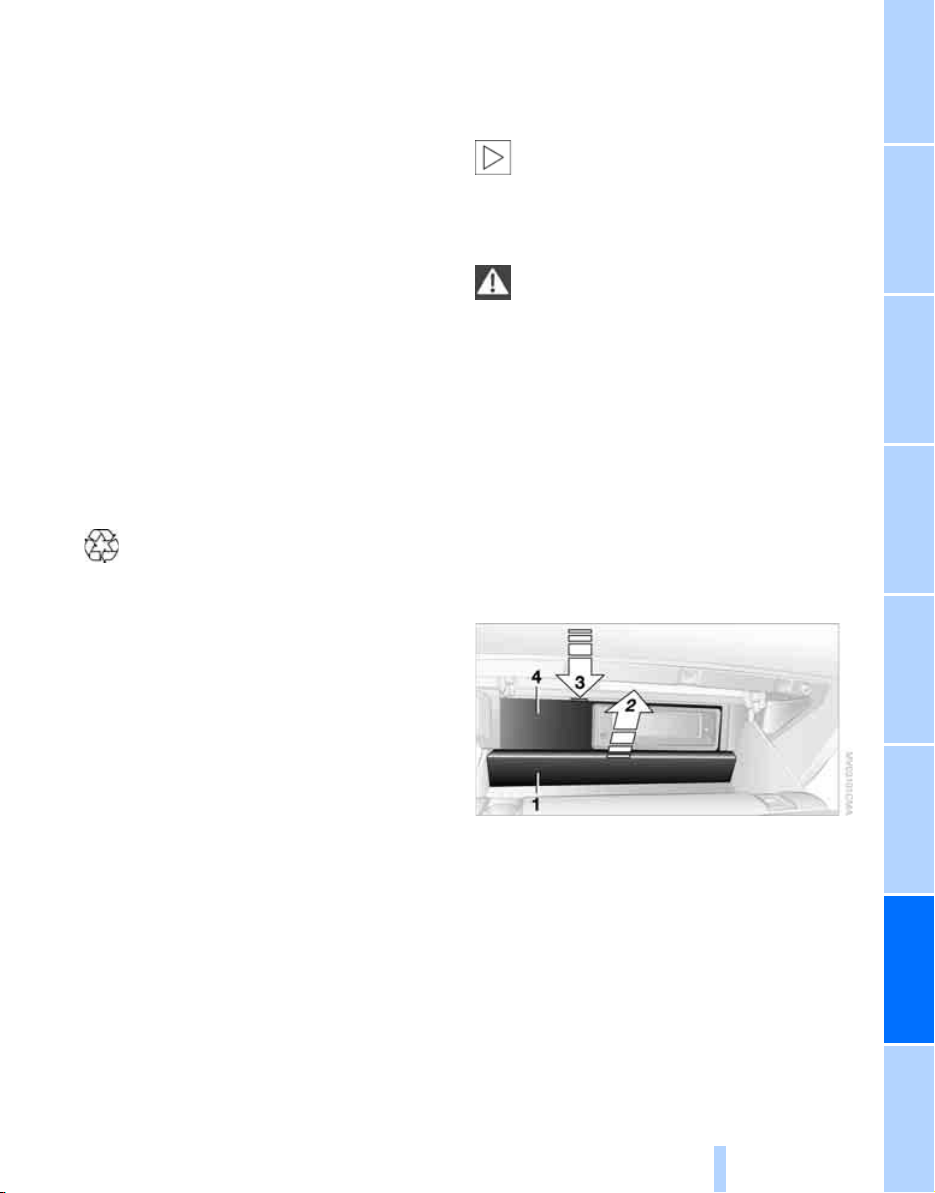
Mobility
231
Reference At a glanceControlsDriving tipsCommunications NavigationEntertainment
mal wheel should be remounted as soon as
possible.<
Vehicle battery
Battery care
The battery is 100% maintenance-free, i.e., the
electrolyte will last for the life of the battery
when the vehicle is operated in a temperate cli-
mate.
Your BMW center will be glad to advise in all
matters concerning the battery.
Charging battery
Only charge the battery in the vehicle via the
terminals in the engine compartment with the
engine switched off. Connections, refer to
Jump starting on page 234.
Disposal
Have old batteries disposed of by your
BMW center or hand them in to a recy-
cling center. Maintain the battery in an upright
position for transport and storage. Always
restrain the battery to prevent it from tipping
over during transport.<
Power failure
Following a temporary power failure, e.g. due to
a discharged battery, the use of some equip-
ment will be restricted, requiring its reinitializa-
tion. In the same way, individual settings are lost
and must be updated again:
> Seat, mirror and steering wheel
* memory
The positions must be stored again, refer to
page 49.
> Time and date
Must be updated again, refer to page 78.
> Radio
Radio stations must be stored again, refer
to page 158.
> Navigation system
You must wait until the system becomes
functional again, refer to page 126.
> Power windows
The pinch prevention system for the power
windows must be reinitialized, refer to
page 40.
Talk to your BMW center before placing
the stored vehicle back in service. <
Fuses
Never attempt to repair a blown fuse and
do not replace a defective fuse with a sub-
stitute of another color or amperage rating, as
this could lead to a circuit overload, ultimately
resulting in a fire in the vehicle.<
Spare fuses and a pair of plastic tweezers are
located in the compartment for the onboard tool
kit, refer to page 224.
Information on fuse allocation is located below
the bracket for the onboard tool kit, see below.
In glove compartment
1. Press the button on the back in the center of
partition 1 and pull out the partition upward,
arrow 2.
2. Press the coupling downward, arrow 3, and
fold the lid 4 forward.
Online Edition for Part no. 01 41 2 600 775 - © 08/08 BMW AG
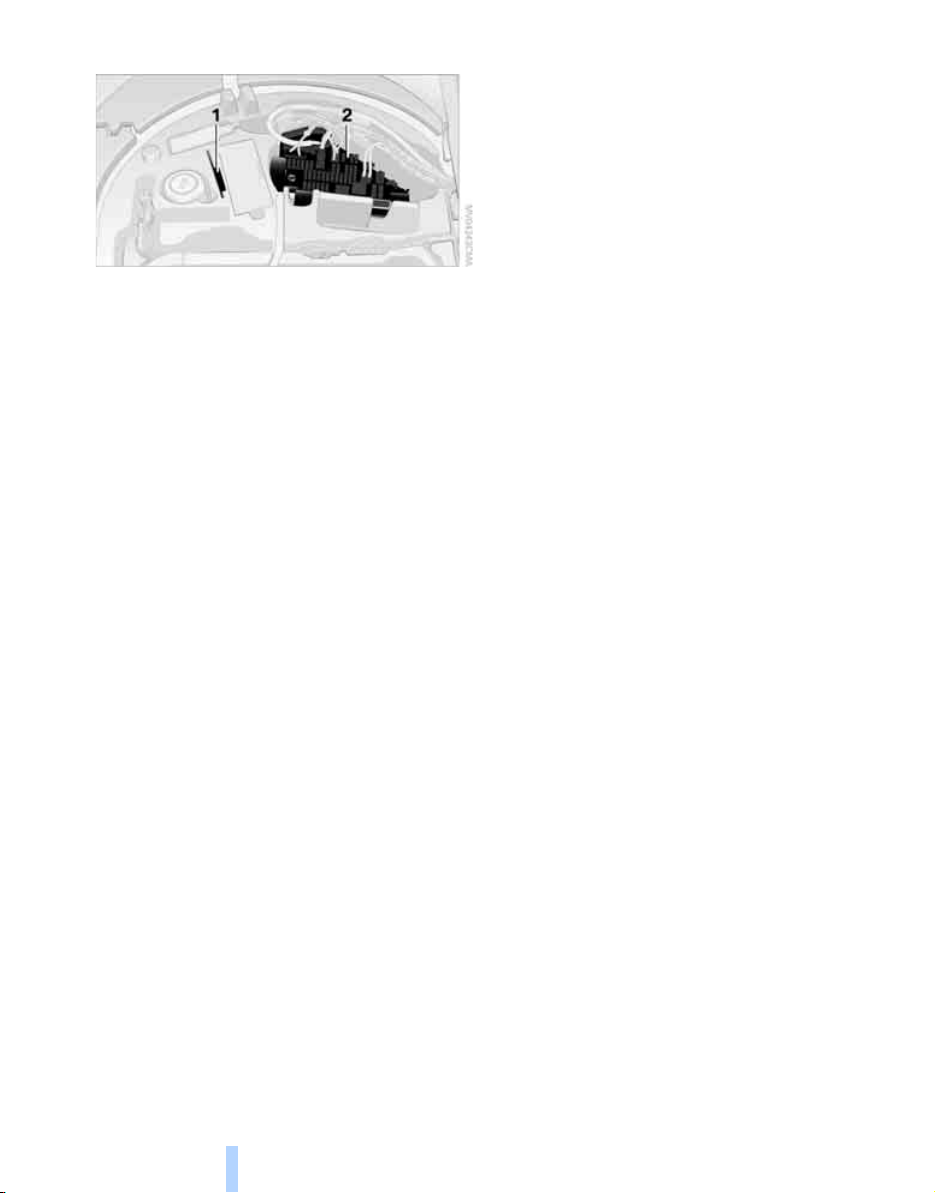
Replacing components
232
In cargo bay
Fold the cover under the floor mat upward and
remove the bracket for the onboard tool kit.
Information on fuse allocation 1 and additional
fuses 2 are provided there.
Online Edition for Part no. 01 41 2 600 775 - © 08/08 BMW AG
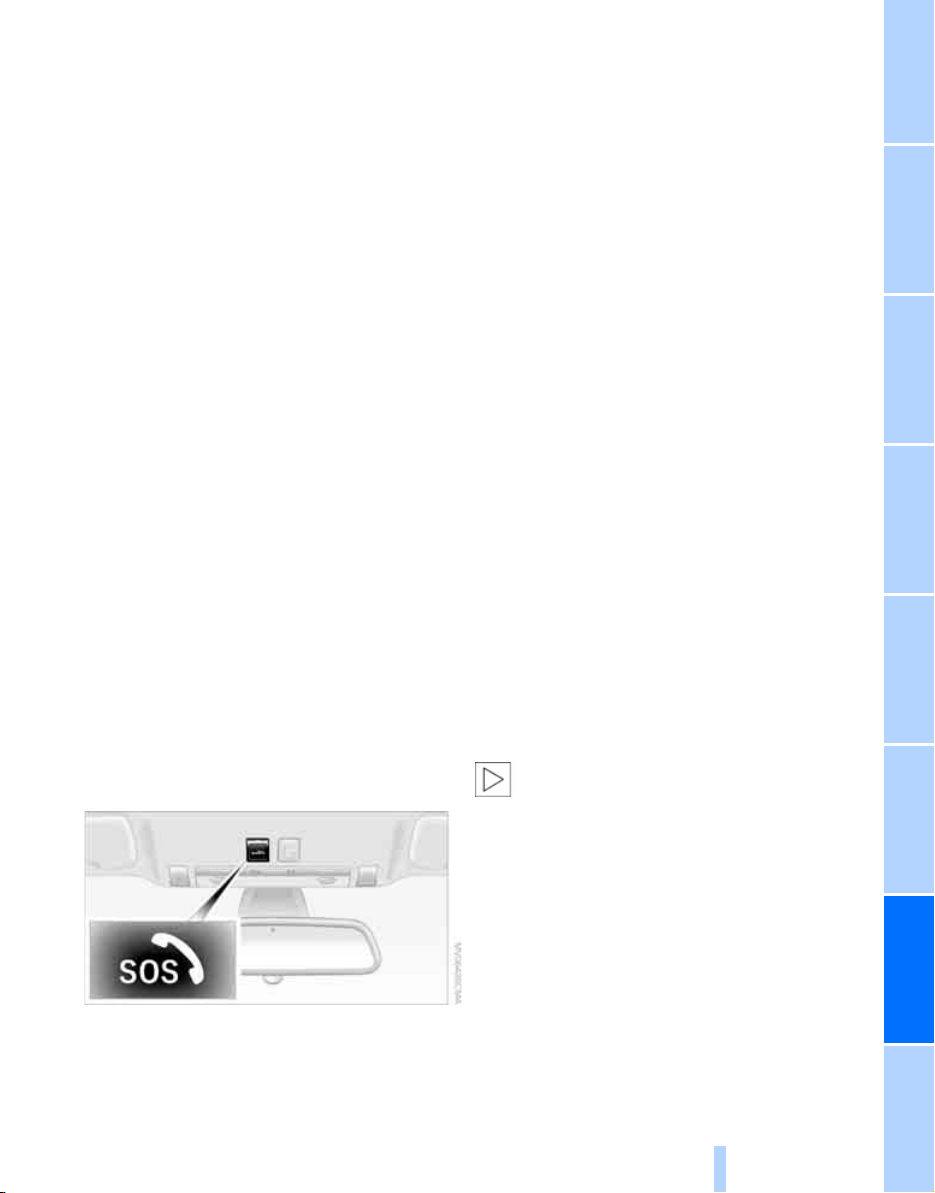
Mobility
233
Reference At a glanceControlsDriving tipsCommunications NavigationEntertainment
Giving and receiving assistance
Emergency request
Conditions for an emergency request:
> Full preparation package mobile phone.
With this equipment, an emergency request
is still possible when no mobile phone is
paired with the vehicle.
> BMW Assist is activated.
Activating BMW Assist, refer to page 198.
> Radio readiness is activated.
> The BMW Assist system is logged on to a
mobile phone network.
> The emergency request system is opera-
ble.
Once your BMW Assist subscription expires,
the BMW Assist system can be deactivated by
a BMW center without you having to visit a
workshop. Once the BMW Assist system has
been deactivated, emergency requests are not
possible. The BMW Assist system can be reac-
tivated by a BMW center after signing a new
contract.
Initiating an emergency request
1. Briefly press protective cover to open.
With some vehicle equipment packages or
in the Convertible, the arrangement of the
switches and indicator lamps may differ
somewhat.
2. Press the SOS button for at least 2 sec-
onds.
The LED in the button lights up. As soon as the
voice connection to the BMW Assist Response
Center has been established, the LED flashes.
When the emergency request is received at the
BMW Assist Response Center, the BMW Assist
Response Center contacts you and arranges
for additional steps to help you.
If conditions allow, remain in the vehicle until
the connection has been established. You will
then be able to provide a detailed description of
the situation.
If the current position of your vehicle can be
determined, it will be transmitted to the BMW
Assist Response Center.
If the LED is flashing but the BMW Assist
Response Center cannot be heard over the
hands-free system, it is possible that the
hands-free system is malfunctioning. The BMW
Assist Response Center may still be able to
hear you, though.
Under certain conditions, an emergency
request is automatically initiated immediately
after a severe accident. Pressing the button
does not interfere with this.
For technical reasons, the emergency request
cannot be guaranteed under unfavorable condi-
tions.
You can also use other services of
BMW Assist with this button, refer to
page 193.<
Online Edition for Part no. 01 41 2 600 775 - © 08/08 BMW AG
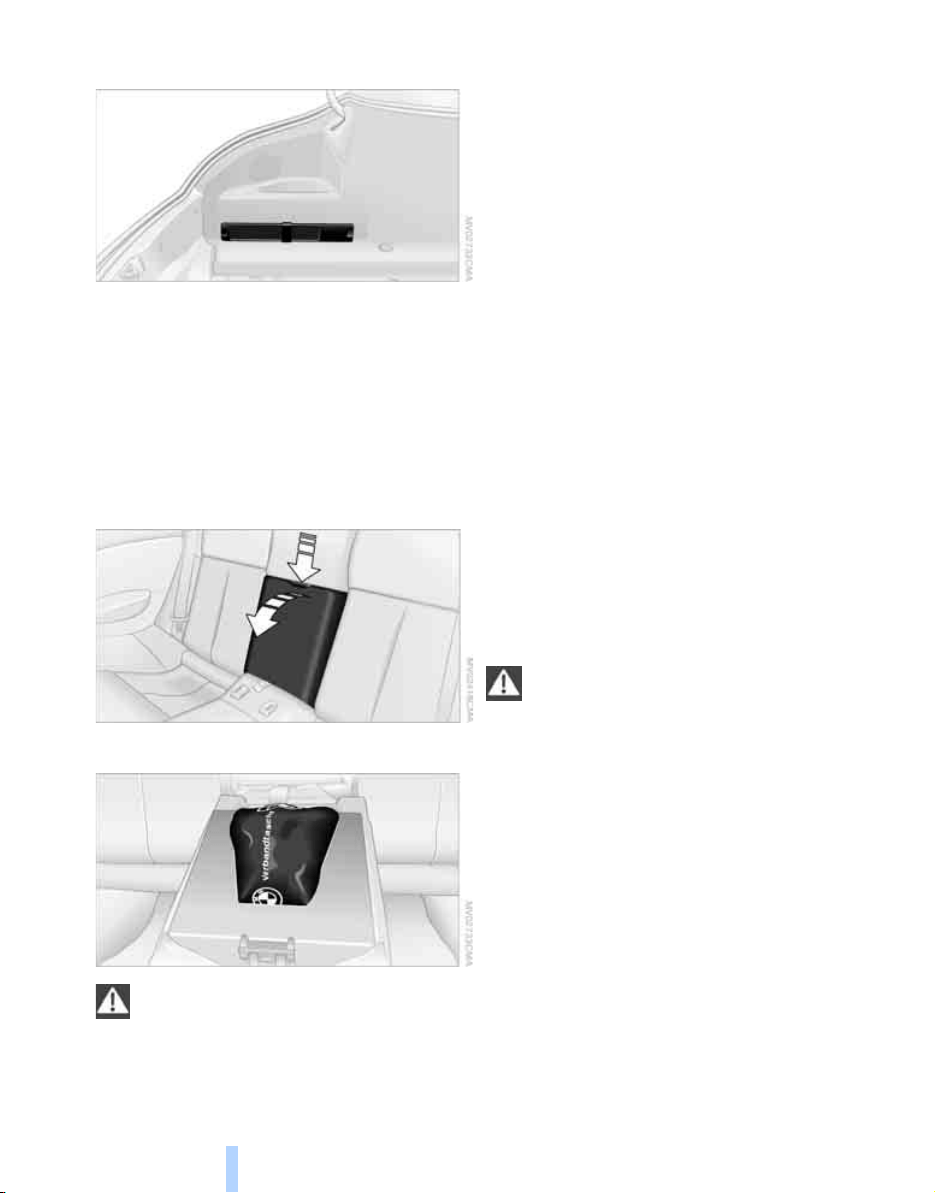
Giving and receiving assistance
234
Warning triangle*
The warning triangle is located on the left-hand
side in the luggage compartment.
First-aid kit*
The first-aid kit is located in the filler element of
the rear seat backrest.
1. Press the button downward and pull the
filler element forward.
2. Take out first-aid kit.
To refit the filler element, insert the two
bottom tabs into the strip and press the
filler element back into place. Make sure that
you do not damage the rear seat upholstery.<
Some of the articles contained in the first-aid kit
have a limited service life. Therefore, check the
expiration dates of the contents regularly and
replace the contents concerned in good time if
necessary.
Roadside Assistance*
The Roadside Assistance of the BMW Group
offers you assistance in the event of a break-
down around the clock, including on weekends
and public holidays.
The phone numbers of the Roadside Assis-
tance in your home country can be found in the
Contact brochure.
With BMW Assist you can contact the Roadside
Assistance of the BMW Group for assistance in
the event of a breakdown directly via iDrive,
refer to page 194.
Jump starting
When your battery is discharged, you can use
two jumper cables to start your BMW with
power from the battery in a second vehicle. You
can also use the same method to help start
another vehicle. Use only jumper cables with
fully-insulated clamp handles.
To avoid the risk of potentially fatal injury,
always avoid all contact with electrical
components while the engine is running. Care-
fully adhere to the following sequence, both to
prevent damage to one or both vehicles, and to
guard against possible personal injuries.<
Preparation
1. Check whether the battery of the other
vehicle has a voltage of 12 Volts and
approximately the same capacitance in Ah.
This information can be found on the bat-
tery.
2. Switch off the engine of the assisting vehi-
cle.
3. Switch off any electrical systems and com-
ponents in both vehicles.
Online Edition for Part no. 01 41 2 600 775 - © 08/08 BMW AG
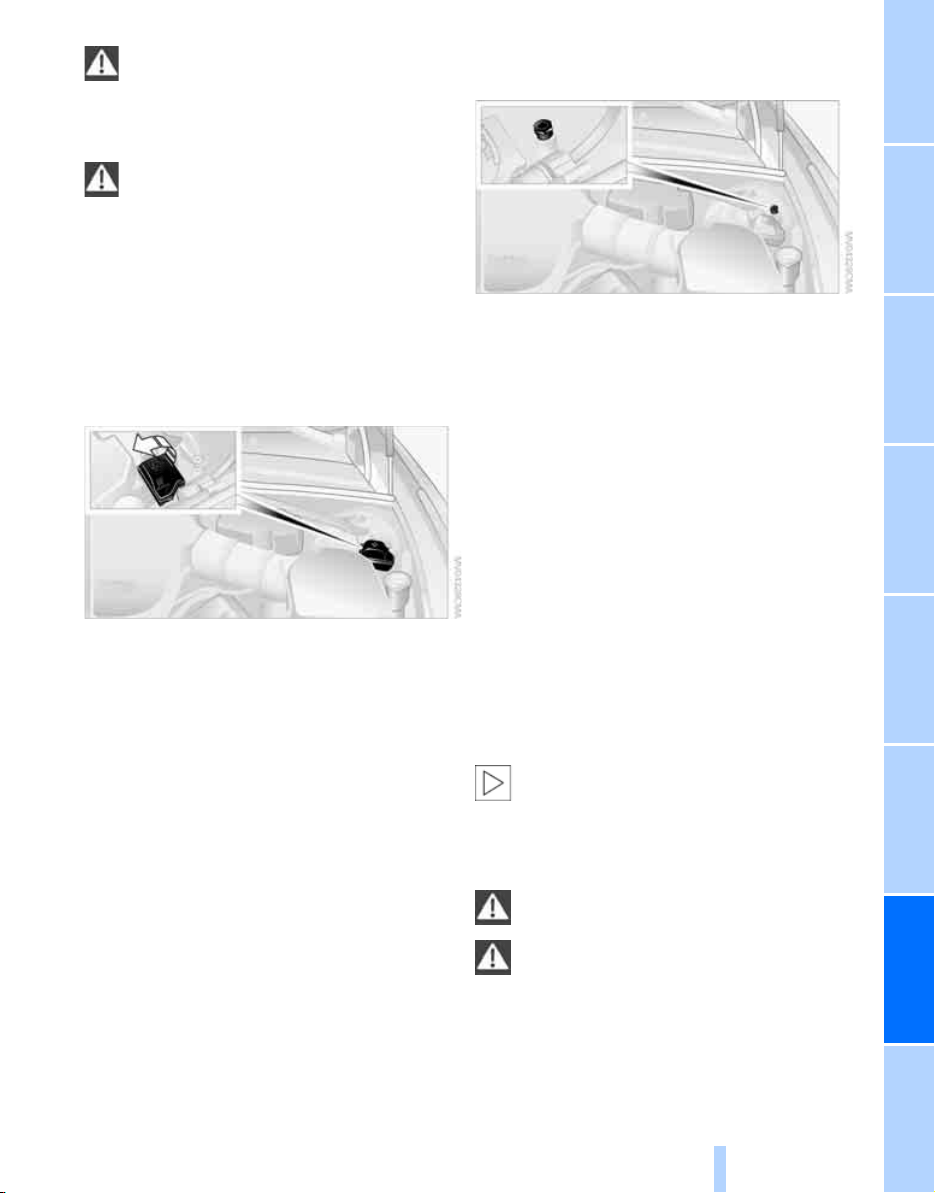
Mobility
235
Reference At a glanceControlsDriving tipsCommunications NavigationEntertainment
There must not be any contact between
the bodies of the two vehicles, otherwise
there is a danger of shorting.<
Connecting jumper cables
To avoid personal injury from sparks, fol-
low this sequence when connecting
jumper cables.<
In your BMW M6, the so-called jump-starting
terminal for jump starting in the engine com-
partment serves as a positive terminal for the
battery, also refer to engine compartment over-
view on page 213. The cover cap is marked with
a+.
1. Fold open the cover of the BMW jump-
starting terminal. To do so, pull the tab.
2. Attach one end of the jumper cable plus/+
to the positive terminal of the battery or a
jump-starting terminal of the vehicle provid-
ing assistance.
3. Attach the second end of the cable to the
positive terminal of the battery or to a start-
ing-aid terminal of the vehicle to be started.
4. Attach one end of the jumper cable minus/–
to the negative terminal of the battery or to
an engine or body ground of the assisting
vehicle.
Your BMW M6 has a special nut as body
ground or negative terminal.
5. Attach the second end of the cable to the
negative terminal of the battery or to the
engine or body ground of the vehicle to be
started.
Starting engine
1. Start the engine on the assisting vehicle
and allow it to run at idle for several minutes
at slightly increased speed.
2. Start the engine on the other vehicle in the
usual way.
If the first starting attempt is not successful,
wait a few minutes before another attempt
in order to allow the discharged battery to
recharge.
3. Let the engines run for a few minutes.
4. Disconnect the jumper cables by reversing
the connection sequence.
Check the battery and recharge if necessary.
Never use spray fluids to start the
engine.<
Tow-starting and towing
Observe applicable laws and regulations
for tow-starting and towing.<
Do not transport any passengers other
than the driver in a vehicle that is being
towed.<
Using tow fitting
The threaded tow fitting is stored in the tool kit
mounted on the inside of the luggage compart-
ment under the floor mat, refer to page 224, and
Online Edition for Part no. 01 41 2 600 775 - © 08/08 BMW AG
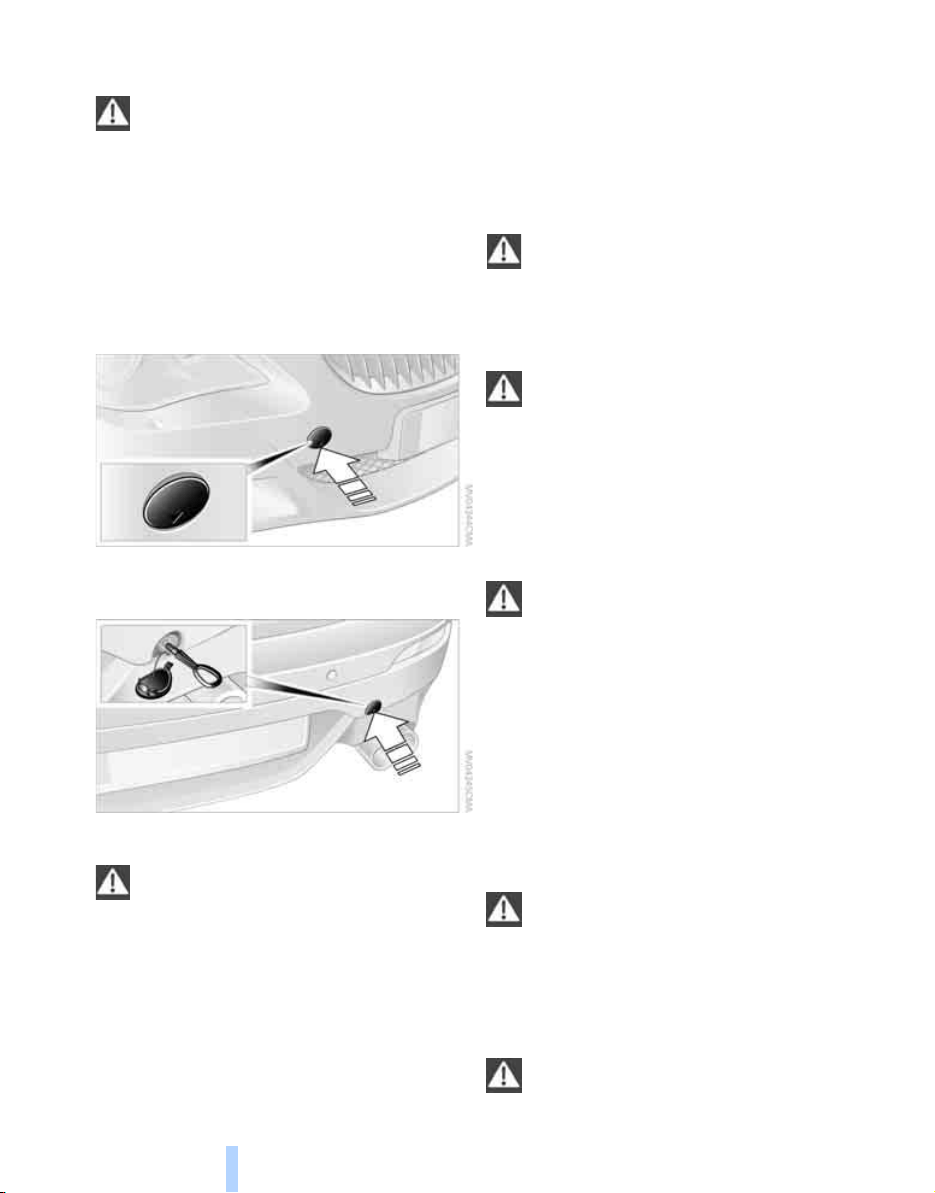
Giving and receiving assistance
236
should always remain in the vehicle. It can be
screwed in at the front or rear of the BMW.
Only use the tow fitting that comes with
the vehicle and screw it in as far as possi-
ble. Use the tow fitting for towing only on roads.
Avoid lateral loading of the tow fitting, e.g. do
not lift the vehicle by the tow fitting. Otherwise
damage to the tow fitting and the vehicle can
occur.<
Access to screw thread
Front: Press the arrow symbol on the cover in
the bumper.
Rear: press the arrow symbol on the cover while
prying out the cover upward by hand.
Being towed
Make sure that the ignition is switched on,
refer to page 60, otherwise the low
beams, tail lamps, turn signals and windshield
wipers would not be available. Do not tow the
vehicle with the rear axle raised, as otherwise
the steering can turn to the left or right.When
the engine is stopped, there is no power assist.
This then requires increased effort for braking
and steering.<
Switch on the hazard warning flashers depend-
ing on the local regulations. If the electrical sys-
tem fails, mark the vehicle to be towed, e.g. with
a sign or warning triangle in the rear window.
Manual transmission
Gearshift lever in neutral position.
Sequential Manual Transmission with
Drivelogic
Make sure that selector lever position N is
engaged with the ignition switched on, as
otherwise the engine can be damaged during
towing.<
Towing methods
Do not lift vehicle by tow fitting or body
and chassis parts; otherwise, damage
may result.<
In some countries, towing with tow bars or
ropes in public traffic is not permitted. Familiar-
ize yourself with the regulations on towing in the
respective country.
With tow bar
The towing vehicle may not be lighter
than the vehicle to be towed, otherwise it
will not be possible to reliably control vehicle
response.<
The tow fittings used should be on the same
side on both vehicles. Should it prove impossi-
ble to avoid mounting the tow bar at an offset
angle, please observe the following:
> Clearance and maneuvering capability will
be sharply limited during cornering.
> When mounted at an angle, the tow bar will
exert lateral forces, tending to push the
vehicle sideways.
Only attach the tow bar to the tow fittings,
as attachment to other vehicle parts can
lead to damage.<
With tow rope
When starting off in the towing vehicle, make
sure that the tow rope is taut.
To avoid jerking and the associated
stresses on vehicle components when
towing, always use nylon ropes or nylon straps.
Online Edition for Part no. 01 41 2 600 775 - © 08/08 BMW AG
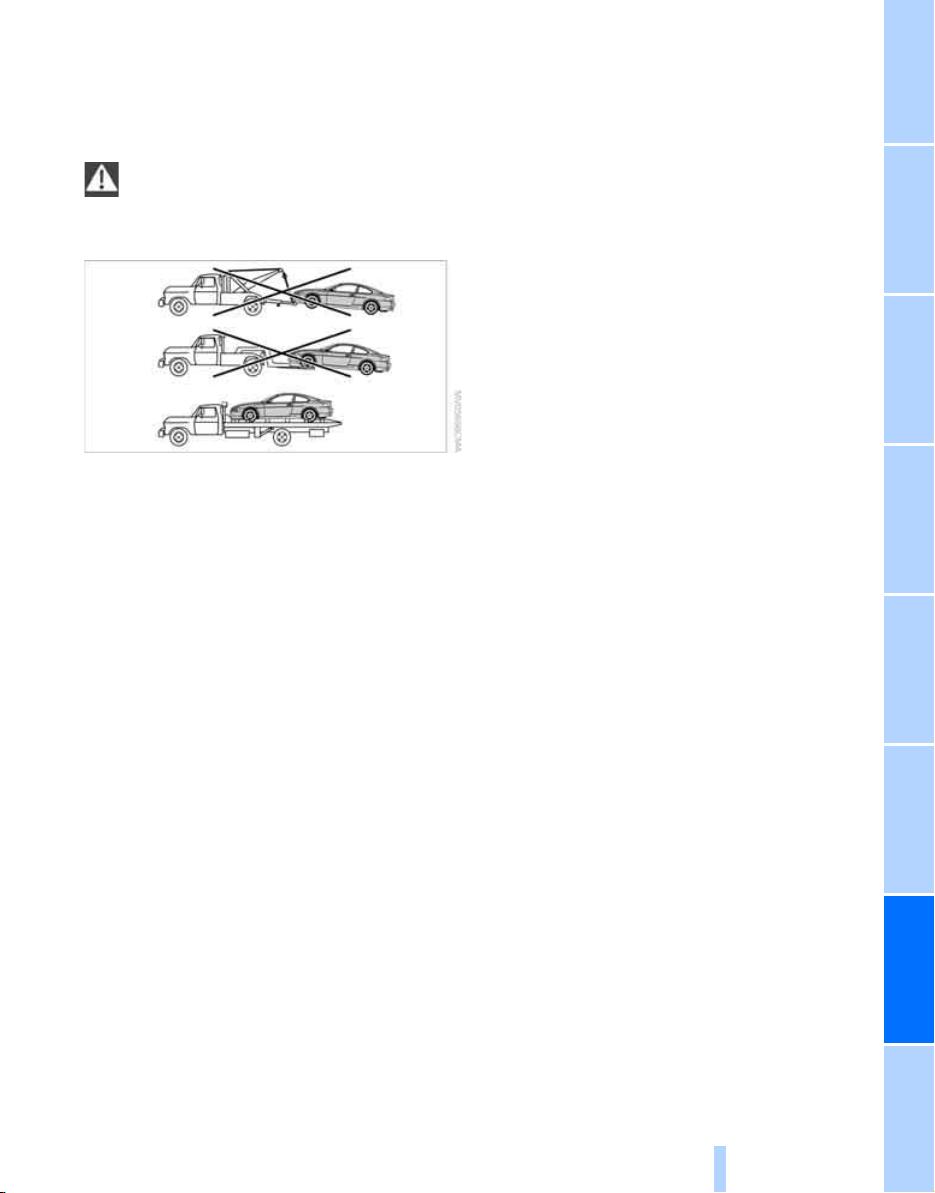
Mobility
237
Reference At a glanceControlsDriving tipsCommunications NavigationEntertainment
Only attach tow ropes to the tow fittings, as
attachment to other vehicle parts can lead to
damage.<
With tow truck
Do not tow the vehicle with only the front
or rear axle raised, as otherwise the
engine may be damaged or the steering can
turn to the left or right.<
Have the vehicle transported on a flatbed sur-
face only.
Tow-starting
Do not tow-start the vehicle if possible, but
instead start the engine by means of jump start-
ing, refer to page 234. Vehicles equipped with a
catalytic converter should only be tow-started
when the engine is cold.
Manual transmission
1. Switch on the hazard warning flashers,
comply with country-specific regulations.
2. Switch on the ignition, refer to page 60.
3. Shift into 3rd gear.
4. Tow-start with the clutch completely
depressed and slowly release the clutch.
After the engine starts, immediately
depress the clutch again completely.
5. Stop at a suitable location, remove the tow
bar or rope and switch off the hazard warn-
ing flashers.
6. Have the vehicle checked.
Sequential Manual Transmission with
Drivelogic
1. Switch on the hazard warning flashers,
comply with country-specific regulations.
2. Switch on the ignition, refer to page 60.
3. Tow-start in selector lever position N.
4. Move the selector lever into the drive posi-
tion and pull toward + within 2 seconds.
The correct gear will be selected and
engaged automatically.
5. Stop at a suitable location, remove the tow
bar or rope and switch off the hazard warn-
ing flashers.
6. Have the vehicle checked.
Online Edition for Part no. 01 41 2 600 775 - © 08/08 BMW AG

Online Edition for Part no. 01 41 2 600 775 - © 08/08 BMW AG

Reference
This chapter contains the technical data,
the short commands of the voice command
system, and the index that will direct you as
quickly as possible to the information you are
looking for.
Reference
Online Edition for Part no. 01 41 2 600 775 - © 08/08 BMW AG

Technical data
240
Technical data
Engine data
M6
Displacement cu in/cmμ 305.1/4,999
No. of cylinders 10
Maximum output hp 500
at engine speed rpm 7,750
Maximum torque lb ft/Nm 383/520
at engine speed rpm 6,100
Online Edition for Part no. 01 41 2 600 775 - © 08/08 BMW AG
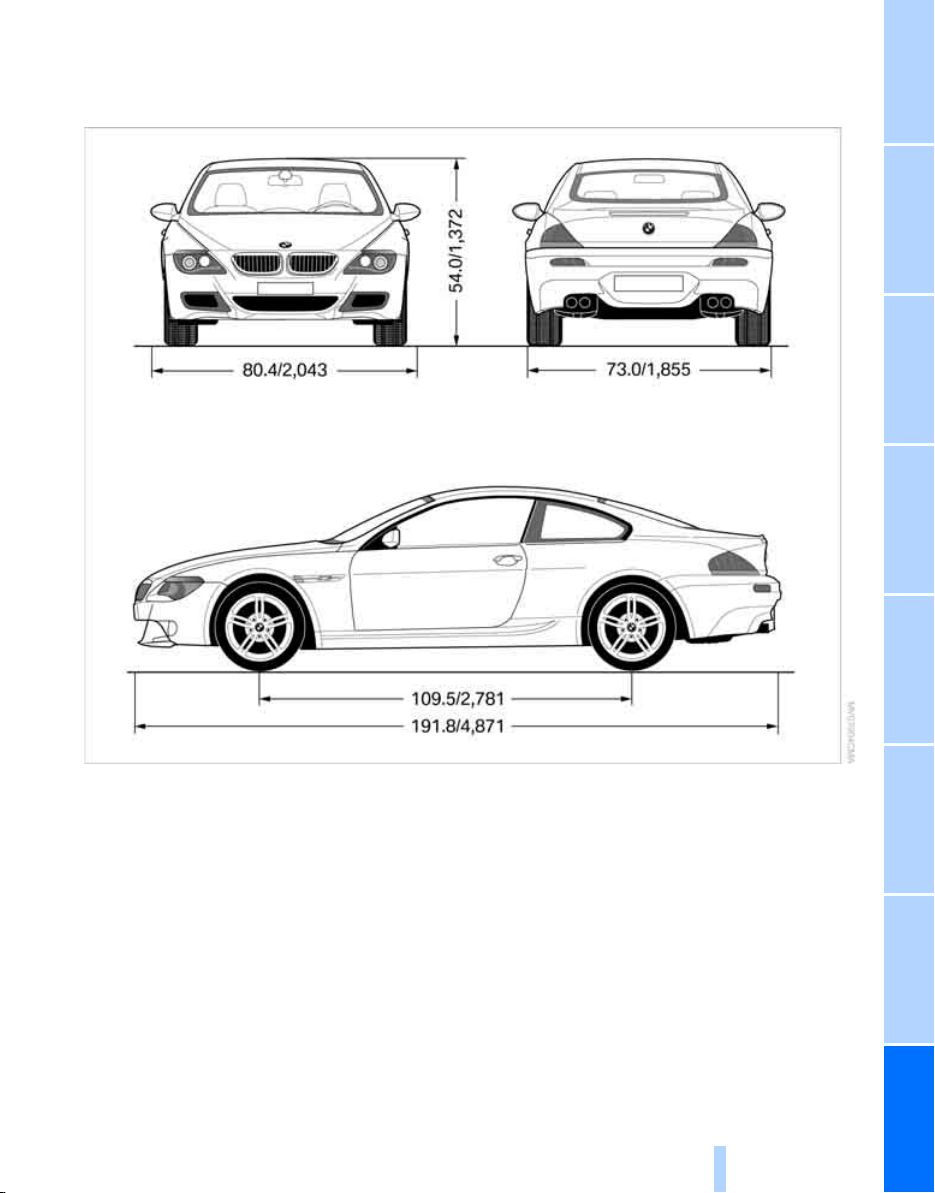
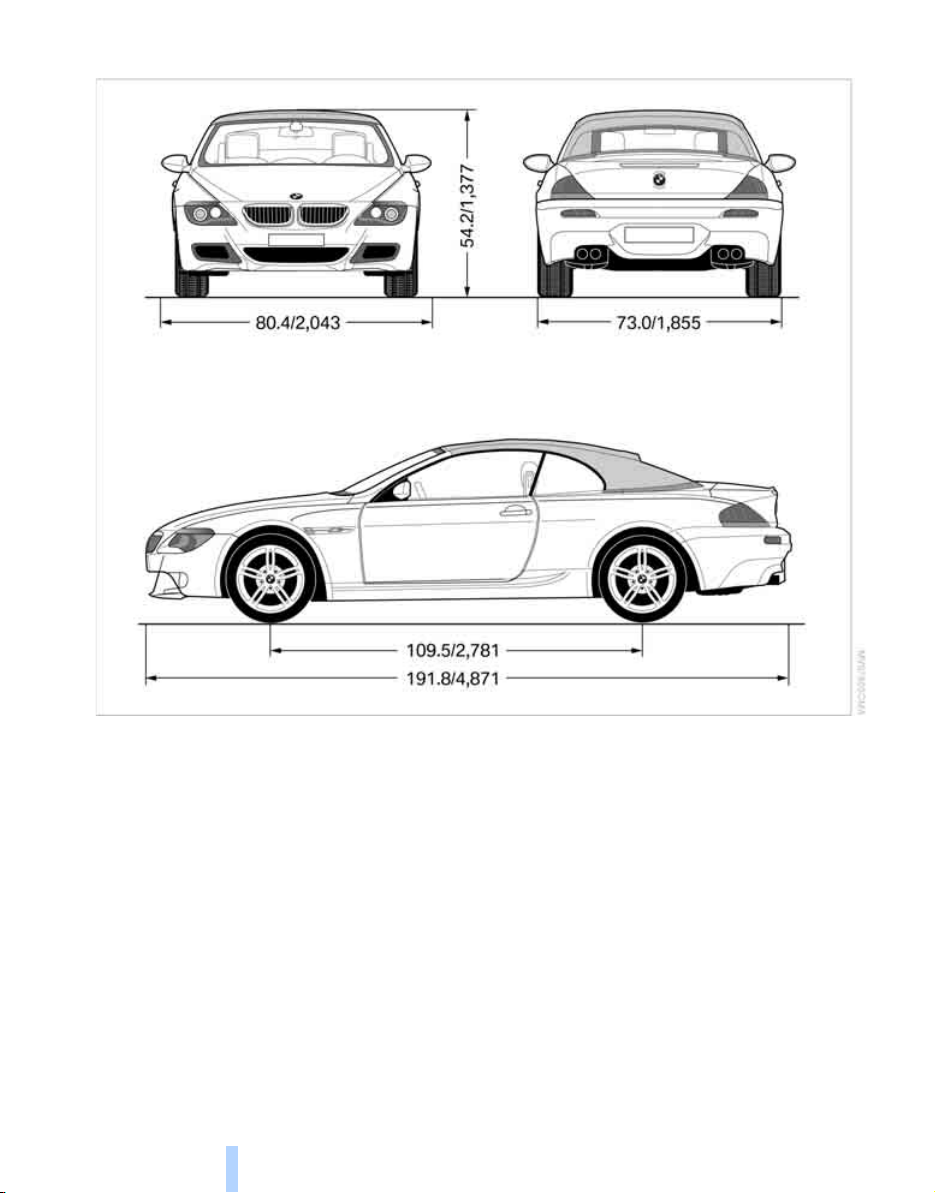
Technical data
242
Convertible
All dimensions given in inches/mm. Smallest turning circle diam.: 41 ft/12.5 m
Online Edition for Part no. 01 41 2 600 775 - © 08/08 BMW AG

Reference
243
At a glanceControlsDriving tipsCommunications NavigationEntertainmentMobility
Weights
Never exceed either the approved axle loads or
the gross vehicle weight.
Capacities
M6 Coupe M6 Convertible
Curb weight lbs./kg 3,909/1,773 4,398/1,995
Approved gross vehicle weight lbs./kg 4,850/2,200 5,247/2,380
Load lbs./kg 941/427 849/385
Approved front axle load lbs./kg 2,403/1,090 2,469/1,120
Approved rear axle load lbs./kg 2,646/1,200 2,844/1,290
Cargo bay capacity cu ft/l 15.9/450 10.6/300
> with raised convertible top compart-
ment floor, refer to page 37
cu ft/l – 12.4/350
Notes
Fuel tank US gal/liters approx. 18.5/70 Fuel grade: page 205
including reserve of: US gal/liters approx. 4/15
Window and headlamp washer
system US quarts/liters approx. 5.3/5
For more details: page 68
Online Edition for Part no. 01 41 2 600 775 - © 08/08 BMW AG

Short commands of voice command system
244
Short commands of voice command
system
With short commands you can run certain func-
tions directly, regardless of which menu item is
selected. Here are the important short com-
mands for the voice command system.
Assistance window
Communication
Navigation
*
Function Command
To open the assistance window 21 {Assistance window}
To select the display in the assistance window 21 {Assistance window map facing north},
{Assistance window map direction of travel},
{Assistance window arrow display},
{Assistance window perspective},
{Assistance window current position},
{Assistance window trip computer} or
{Assistance window onboard info}
To change scale in assistance window 126 {Assistance window scale ... feet} or
{Assistance window scale ... miles}
Function Command
To open phone 185 {Phone}
To dial phone number 185 {Dial number}
To display phone book 186 {A to Z}
To select from the phone book 186 {Call ...} or
{Dial name}
To display "Top 8" 187 {Top 8}
To redial 187 {Redial}
To display "Received calls" 187 {Received calls}
To display "Missed calls" 187 {Missed calls}
To display "Bluetooth" 179 {Bluetooth}
To open BMW Service, Services 193 {BMW service}
Function Command
To open navigation system 126 {Navigation}
To open "Enter address" 128 {Enter address}
To open "New destination" 128 {New destination}
To display "Input map" 133 {Input map}
Online Edition for Part no. 01 41 2 600 775 - © 08/08 BMW AG

Reference
245
At a glanceControlsDriving tipsCommunications NavigationEntertainmentMobility
Onboard info
Entertainment
To display destination list 135 {Destination list}
To display address book 136 {Address book}
To display route criteria 138 {Route preference}
To start destination guidance 140 {Start guidance}
To end destination guidance 140 {Stop guidance}
To display arrow display 126 {Arrow display}
To display map display 142 {Map}, {Map facing north},
{Map direction of travel} or
{Perspective}
To change scale 142 {Scale ... miles} or
{Scale ... feet}
To display roads or towns/cities along route 143 {Route list}
To switch on voice instructions 143 {Navigation info on}
To switch off voice instructions 143 {Navigation info off}
To repeat voice instructions 144 {Repeat navigation info}
To open route 141 {Route menu}
To open "New route" 144 {New route}
To display current position 147 {Current position}
Function Command
Function Command
To open "Car Data" 72 {Car data}
To display computer 72 {Onboard info}
To display trip computer 73 {Trip computer}
To open stopwatch 78 {Stopwatch}
To open speed limit 77 {Limit}
To activate speed limit 78 {Limit on}
To deactivate speed limit 78 {Limit off}
Function Command
Tone control 153 {Audio}
To switch on radio 156 {Radio on},
{FM} or
{AM}
To open "FM" 156 {FM menu}
To open "AM" 156 {AM menu}
Online Edition for Part no. 01 41 2 600 775 - © 08/08 BMW AG

Short commands of voice command system
246
Climate
To open "All stations" 156 {FM all stations}
To select radio station 156 {Station ...}, e.g. {Station WNYC}, or
{Choose station}
To open "Presets" 156 {FM presets} or
{AM presets}
To select preset radio station 156 {Preset ...}, e.g. {Preset 1}
To open "Manual" 157 {FM manual},
{AM manual} or
{Choose frequency},
{Frequency ... Megahertz}
To open strongest radio stations 158 {AM Autostore}
To open "WB" 160 {Weatherband menu}
To switch on weatherband 160 {Weatherband on}
To select a weatherband station 160 {Choose weatherband station}
To open "SAT" 163 {SAT radio menu}
To switch on satellite radio 163 {SAT radio}
To open "Presets" of the satellite radio 164 {SAT radio presets}
To open "All channels" of the satellite radio 163 {SAT radio all channels}
To open "Categories" of the satellite radio 163 {SAT radio categories}
To open CD player 166 {
CD menu}
To switch on CD player 166 {CD}
To open CD changer 166 {CD changer menu}
To switch on CD changer 166 {CD changer}
To select a CD in the CD changer 166 {CD 1...6}
To select music track 167 {CD track ...}
To select a CD and music track in the CD
changer 167
{CD 1...6 track ...}
To switch on audio playback with external audio
device 172
{Audio Aux}
Function Command
Function Command
To open "Vent settings" 104 {Vent settings}
To open "Automatic programs" 103 {Automatic programs}
To open "Parked car ventilation" 107 {Parked car operation}
To open "Automatic ventilation" 107 {Automatic ventilation}
To display activation times 107 {Activation time}
Online Edition for Part no. 01 41 2 600 775 - © 08/08 BMW AG

Reference
247
At a glanceControlsDriving tipsCommunications NavigationEntertainmentMobility
menu
Function Command
To open the menu {Settings menu}
"Display off" 22 {Display off}
To open "Info sources" {Info sources}
To open "Settings" {Settings}
To open "Door locks" 32, 34 {Door locks}
To open "Steering wheel buttons" 55 {Steering wheel buttons}
To open MDrive
* 55 {MDrive}
To open "Lighting" 66, 98 {Lighting}
To open "Service requirements", 195 74 {Service requirements}
To open "Service" 74, 195 {Service}
To open "BMW Service settings" settings 197 {BMW service settings}
To display "Check Control messages" 75 {Check Control messages}
To open "Head-Up Display" 94 {Head-Up Display}
To set brightness of Control Display 80 {Brightness}
To open "Units" 80 {Units}
To open "Language" 80, 126 {Language}
To open "Time" 79 {Time}
To open "Date" 79 {Date}
To open "PDC" 83 {PDC}
To open "FTM" 87 {FTM}
To open "TPM" 89 {TPM}
To display "Bluetooth" 179 {Bluetooth}
Online Edition for Part no. 01 41 2 600 775 - © 08/08 BMW AG

Everything from A to Z
248
Everything from A to Z
Index
"..." Identifies Control Display
texts used to select
individual functions and
refers you to the page where
these texts can be found.
A
ABS Antilock Brake
System 83
– indicator lamp 85
Accepted calls 186
Accessories 6
Accident, refer to Emergency
request 233
Activated-charcoal filter for
automatic climate
control 106
"Activation time" for parked
car ventilation 107
Active front head restraints 50
Adapter for spare key 30
Adaptive brake lamps, refer to
Brake force display 91
Adaptive Head Light 99
"Add digits" in mobile phone
mode 186
Additives
– coolant 217
– engine oil, refer to Approved
engine oils 216
"Address book" in
navigation 136
Address for navigation
– deleting 137
– entering 128, 131
– selecting 137
– storing 136
– storing current position 136
"Add to address book" 136
"Add to destination
list" 131, 133
Adjusting interior
temperature 103
Adjusting the tone during
audio operation, refer to
Tone control 153
Adjusting thigh support 48
"After door opened" 50
"After unlocking" 50
Airbags 91
– deactivating, refer to
Exception for front
passenger seat 58
– indicator/warning lamp 93
– indicator lamp for front
passenger airbags 92
– sitting safely 47
Air distribution
– automatic 103
– manual 104
Airing, refer to Ventilation 106
Air outlets, refer to
Ventilation 106
Air recirculation, refer to AUC
Automatic recirculated-air
control 105
"Air recirculation on / off" 55
Air supply, automatic climate
control
102
Air volume 104
AKI, refer to Fuel
specifications 205
Alarm system 37
– avoiding unintentional
alarms 38
– interior motion sensor 38
– switching off alarm 37
– switching off tilt alarm
sensor and interior motion
sensor 38
– tilt alarm sensor 38
"All channels" 164
"All doors" 32
Alloy wheels 222
All-season tires, refer to
Winter tires 210
"All stations", requesting in
radio mode 156
Alterations, technical, refer to
For your own safety 6
Altering stretch of road 144
"AM" waveband 152, 156
Antenna for mobile phone 178
Antifreeze
– coolant 217
– washer fluid 68
Antilock Brake System
ABS 83
Anti-theft alarm system, refer
to Alarm system 37
Anti-theft system, refer to
Central locking system 31
Approved axle loads, refer to
Weights 243
Approved engine oils 216
Approved gross vehicle
weight, refer to Weights 243
Armrest, refer to Center
armrest 111
Around the center console 14
Around the steering wheel 10
Arrival time
– refer to Computer 72
– refer to Starting destination
guidance 140
"Arrow display" in
navigation 141
"Arrow display pop-up
instructions" 127
Ashtray 113
Assist, refer to
BMW Assist 193
Assistance systems, refer to
Driving stability control
systems 83
Assistance window 21
"Assist. window off" 22
Online Edition for Part no. 01 41 2 600 775 - © 08/08 BMW AG

Reference
249
At a glanceControlsDriving tipsCommunications NavigationEntertainmentMobility
AUC Automatic recirculated-
air control 105
"Audio" 153, 155, 160
Audio 152
– controls 152
– switching on/off 152
– tone control 153
– volume 153
Audio device, external 111
Automatic
– air distribution 103
– air volume 103
– cruise control 68
– headlamp control 97
– service notification 195
– steering wheel
adjustment 49
– storing stations 158
Automatic car washes 120
Automatic climate control 102
– automatic air
distribution 103
– convertible program 103
– switching on and off 106
– ventilation with vehicle
parked 106
Automatic closing of doors,
refer to Automatic soft
closing 35
Automatic curb monitor 54
Automatic lighting
– refer to Automatic headlamp
control 97
– refer to Daytime running
lamps 98
– refer to Interior lamps 101
– refer to Pathway lighting 98
– refer to Welcome lamps 97
Automatic lights
– refer to High-beam
assistant 99
"Automatic programs" 103
Automatic soft closing 35
Automatic station search 157
"Automatic ventilation" 107
AUTO program for automatic
climate control 103
"Auto Request" 195
"Autostore" on the
radio 156, 158
"AUX" 152, 172, 174
AUX-IN connection 111, 172
"AUX IN" in audio mode 172
Average fuel consumption 72
– setting units 80
"Avoid ferries" in
navigation 139
"Avoid highways" in
navigation 139
Avoiding freeways for
navigation 138
Avoiding unintentional
alarms 38
"Avoid tollroads" in
navigation 139
Axle loads, refer to
Weights 243
"A - Z" 186
B
Backrest contour, refer to
Lumbar support 48
Backrests, refer to Seats 47
Backrest width adjustment 48
Backup lamps, replacing
bulbs, refer to Tail
lamps 225
"Balance", tone control 154
Band-aids, refer to First-aid
kit 234
Bass, refer to Tone
control 153
"Bass", tone control 153
Battery
– jump starting 234
– refer to Vehicle battery 231
Battery replacement, remote
control for comfort
access 40
BC button, refer to
Computer 71
Being towed 236
Belts, refer to Safety belts 52
Beverage holder, refer to Cup
holders 112
Blower, refer to Air
volume 104
"Bluetooth" 179
BMW
– Car Shampoo 223
BMW Assist 193, 194, 195
– activating 198
– BMW TeleServices 195
– concierge service 196
– contacting BMW Customer
Relations 196
– displaying vehicle data 199
– offered services 193
– roadside assistance 194
– updating 197
"BMW Contact
Numbers" 188
BMW homepage 4
BMW maintenance
system 218
"BMW Service settings" 198
BMW TeleServices 195
BMW TeleServices services
– displaying 196
– updating 196
BMW website 4
Bottle holder, refer to Cup
holders 112
Bracket for telephone or
mobile phone
– refer to Snap-in adapter 191
Brake assistant 83
Brake force display 91
Brake lamps
– replacing bulbs, refer to Tail
lamps 225
– two-stage 91
Brake rotors
– breaking-in 118
– refer to Braking safely 119
Brakes
– ABS Antilock Brake
System 83
– brake force display 91
– breaking-in 118
– CBC Cornering Brake
Control 83
– handbrake 62
– refer to Braking safely 119
Online Edition for Part no. 01 41 2 600 775 - © 08/08 BMW AG

Everything from A to Z
250
Brake system 118
– brake pads 118
– brake rotors 119
– breaking-in 118
– warning lamp 13, 85
Braking
– electronic brake-force
distribution 83
Braking safely 119
Breakdown
– M Mobility System 226
Breakdown services, refer to
Roadside Assistance 234
Breaking-in brake pads 118
Breaking-in the clutch 118
Breaking-in the differential,
refer to Engine and
differential 118
Break-in period 118
"Brightness" 80, 95
Brightness of Control
Display 80
Button for starting engine,
refer to Start/Stop button 60
Buttons on steering wheel 11
C
California Proposition 65
Warning 6
"Call" 186, 197
Call
– accepting 184
– displaying accepted 187
– ending 185
– in absence 187
– rejecting 185
– starting 185
Calling
– by entering phone
number 185
– from phone book 186
– from Top 8 list 187
– redialing 187
Can holder, refer to Cup
holders 112
Capacities 243
Car battery, refer to Vehicle
battery 231
"Car Data" 72
Care 220
– car-care products 220
– carpets 222
– car washes 220
– CD/DVD player 223
– chrome components 222
– convertible top 221
– displays 223
– exterior 220
– fine wooden
components 223
– hand washing 221
– headlamps 221
– high-pressure cleaning
jets 220
– interior 222
– leather 222
– light-alloy wheels 222
– paint 221
– plastic components 223
– rubber gaskets 222
– safety belts 223
– sensors and cameras 223
– upholstery and cloth-
covered paneling 222
– windows 221
– wiper blades 221
Cargo bay
– capacity 243
– emergency release 37
– opening/closing, refer to
Luggage compartment
lid 36
– opening from inside 36
– opening from outside
36
– opening with remote
control 33
Caring for the vehicle
finish 221
Car key, refer to Keys/remote
control 30
Car phone 178
– installation location, refer to
Center armrest 111
– refer to Mobile phone 178
– refer to separate operating
instructions
Car radio, refer to Radio 156
Car Shampoo 223
Car wash 120
– refer to Before driving into a
car wash 120
Car washes 220
Catalytic converter, refer to
Hot exhaust system 119
"Categories" 164
CBC Cornering Brake
Control 83
CBS Condition Based
Service 218
"CD" 152, 166
CD changer 166
– controls 152
– fast forward/reverse 170
– installation location 170
– random sequence 169
– repeating a track 169
– sampling tracks 168
– selecting a CD 166
– selecting a track 167
– switching on/off 152
– tone control 153
– volume 153
CD player 166
– controls 152
– fast forward/reverse 170
– random sequence 169
– repeating a track 169
– sampling a track 168
– selecting a track 167
– switching on/off 152
– tone control 153
– volume 153
Center armrest, adjusting
height 111
Center console 14
"Central locking" 32
Central locking
– from inside 34
– from outside 32
Central locking system 31
– comfort access 38
– hotel function 35
Changes, technical, refer to
For your own safety 6
Changing language on
Control Display 80
Online Edition for Part no. 01 41 2 600 775 - © 08/08 BMW AG

Reference
251
At a glanceControlsDriving tipsCommunications NavigationEntertainmentMobility
Changing scale for
navigation 142
Changing units of measure on
Control Display 80
Changing wheels 209, 228
CHECK button 76
Check Control 75
"Check Control
messages" 77
Check Gas Cap 204
Checking air pressure, refer to
Tire inflation pressure 206
Child restraint fixing system
LATCH 59
Child restraint systems 58
Child seats, refer to
Transporting children
safely 58
Chock 229
Chrome-plated parts 223
Chrome polish 223
Cigarette lighter 113
Cigarette lighter socket, refer
to Connecting electrical
devices 113
Cleaning your BMW, refer to
Care 220
"Climate" 103
Clock 71
– 12h/24h format 79
– hour signal 79
– setting time and date 79
Closing
– from inside 34
– from outside 32
Closing fuel filler cap 204
Clothes hooks, Coupe 112
Cockpit 10
Cold start, refer to Starting
engine 61
Combined instrument, refer to
Instrument cluster 12
Comfort access 38
– replacing battery, remote
control 40
Comfort closing
– windows, with comfort
access with Coupe 39
– with comfort access 39
"Comfort" with EDC 86
"Communi-
cation" 184, 194, 195
Compact Disc
– refer to CD changer 166
– refer to CD player 166
Compartment for remote
control, refer to Ignition
lock 60
Compartments, refer to
Storage compartments
112
Compressed audio files 166
Computer 71
– clock 71
– displays on Control
Display 72
– hour signal 79
"Concert hall", tone
control 154
"Concierge" 197
Concierge service 196
Condensation, refer to When
vehicle is parked 120
Condition Based Service
CBS 218
"Confirmation" 33
Confirmation signals for
locking and unlocking 33
Connecting car vacuum
cleaner, refer to Connecting
electrical devices 113
Consumption display, refer to
Average fuel
consumption 72
Consumption statistics, refer
to Average fuel
consumption 72
"Continue guidance to
destination?" 141
Control Center, refer to
iDrive 16
Control Display, refer to
iDrive 16
– setting brightness 80
– switching off/on 22
Controller, refer to iDrive 16
Controls, refer to Cockpit 10
Convenient operation
– convertible top 32, 34
– windows 32, 34
Convertible
– convertible program for
automatic climate
control 103
– opening and closing
windows 40
– rollover protection
system 93
– top 42
– wind deflector 45
Convertible top
– closing manually 43
– convenient operation 34
– emergency closing 43
– opening and closing 43
Convertible top care 221
Coolant 217
– checking level 217
– temperature 70
Cooling, maximum 105
Cooling fluid, refer to
Coolant 217
Cooling function, automatic
climate control 105
Cooling system, refer to
Coolant 217
Copyright 2
Cornering Brake Control
CBC 83
Country of destination for
navigation 129
Courtesy lamps, refer to
Interior lamps 101
Cradle for telephone or mobile
phone 111
Cruise control 68
Cruising range 72
Cup holders 15, 112
Curb weight, refer to
Weights 243
"Current position" 147
Current position
– displaying 147
– entering 136
– storing 136
Online Edition for Part no. 01 41 2 600 775 - © 08/08 BMW AG

Everything from A to Z
252
"Customer
Relations" 188, 196
Cylinders, refer to Engine
data 240
D
Dashboard, refer to
Cockpit 10
Dashboard lighting, refer to
Instrument lighting 101
Data, technical 240
– dimensions 241
– engine 240
– weights 243
"Date" 79
Date
– date format 80
– setting 79
"Date format" 80
"Daytime running
lamps" 98, 101
Daytime running lamps 98
– replacing bulbs 225
"Deactivated" 50
Defect
– door lock 34
– luggage compartment lid 36
– tires, refer to Flat Tire
Monitor 87
– tires, refer to Tire Pressure
Monitor 88
Defrosting windows 104
Defrosting windows and
removing condensation 104
Defrosting windshield, refer to
Defrosting windows 104
Defrost position, refer to
Defrosting windows 104
"Delete address book" in
navigation 138
"Delete all numbers" in mobile
phone mode 187
"Delete data" in
navigation 138
"Delete" in mobile phone
mode 187
Destination address
– deleting 137
– entering 128, 131
Destination for navigation
– destination list 135
– entering via voice 131
– entry 128
– selecting from address
book 137
– selecting using
information 134
– storing 136
Destination guidance 140
– bypassing route
sections 144
– canceling voice
instructions 55
– changing specified
route 138
– displaying route
141
– distance and arrival 140
– interrupting 140
– starting 140
– terminating/continuing 140
– voice instructions 143
– volume of voice
instructions 144
Destination list for
navigation 135
Destinations recently driven
to 135
"Details" in audio
mode 168, 174
"Details" in radio mode 164
"Detour" in navigation 147
"Dial" in mobile phone
mode 185
"Dial number" 185
Digital clock 71
Digital radio, refer to High
Definition Radio 160
Dimensions
– Convertible 242
– Coupe 241
Directional indicators, refer to
Turn signals 66
Direction announcements,
refer to Voice
instructions 143
Direction instructions, refer to
Voice instructions 143
Directory, refer to Phone
book 186
Directory for navigation, refer
to Address book 136
Displacement, refer to Engine
data 240
"Display" 80
Display, refer to iDrive
controls 16
Display elements, refer to
Instrument cluster 12
Displaying vehicle data 199
Display lighting, refer to
Instrument lighting 101
"Display off" 22
Displays
– on Control Display, refer to
iDrive 16
– refer to Instrument
cluster 12
"Display settings" 80, 94
Displays on the windshield,
refer to Head-Up Display 94
Disposal
– battery of remote control
with comfort access 40
– coolant 217
– vehicle battery 231
Distance, refer to
Computer 72
"Distance to dest."
72
Distance to destination, refer
to Computer 72
Distance warning, refer to
PDC Park Distance
Control 82
Door entry lighting, refer to
Interior lamps 101
Door key, refer to Keys/
remote control 30
Door lock 34
"Door locks" 32, 74
Doors
– manual operation 34
– remote control 32
DOT Quality Grades 208
Draft-free ventilation 106
Online Edition for Part no. 01 41 2 600 775 - © 08/08 BMW AG

Reference
253
At a glanceControlsDriving tipsCommunications NavigationEntertainmentMobility
Drinks holder, refer to Cup
holders 112
Drivelogic 64
Drive position, engaging, refer
to Selector lever
positions 63
"Driver's door only" 32
Driving lamps, refer to Parking
lamps/low beams 97
Driving programs, refer to
Drivelogic 64
Driving route, refer to
Displaying route 141
Driving stability control
systems 83
Driving through water 119
Driving tips, refer to General
driving notes 118
Dry air, refer to Cooling
function 105
Drying the air, refer to Cooling
function 105
"DSC" 56, 84
DSC Dynamic Stability
Control 84
– indicator lamp 13, 84
– malfunction 85
DTC Dynamic Traction
Control
– indicator lamp 13
DVD for navigation 126
Dynamic Brake Control DBC
– warning lamp 86
"Dynamic route" in
navigation 139
Dynamic Stability Control
DSC 84
– M Dynamic Mode MDM 84
E
Easy entry, refer to Entering
rear 51
Easy entry/exit 54
"EDC" 56
EDC Electronic Damping
Control 86
Eject button, refer to Buttons
in area of CD player 152
Electrical malfunction
– convertible top 43
– door lock 34
– driver's door 34
– fuel filler door 204
– luggage compartment lid 36
– storage compartment, hotel
function 35
Electrical steering wheel
adjustment 54
Electric convertible top 42
Electronic brake-force
distribution 83
Electronic Damping Control
EDC 86
– "Comfort" 86
– "Normal" 86
– "Sport" 87
Emergency operation, refer to
Manual operation
– convertible top 43
– door lock 34
– driver's door 34
– fuel filler door 204
– hotel function 35
– luggage compartment lid 36
Emergency release for
luggage compartment lid in
cargo bay 37
Emergency request 233
Emergency services, refer to
Roadside Assistance 234
"Enabled services" 199
"Enabled TeleServices" 196
"Enable services" 199
"End call" 186
Engine
– breaking-in 118
– data 240
– M Engine Dynamic
Control 65
– overheated, refer to Coolant
temperature 70
– speed 240
– starting 61
– starting, comfort access 38
– switching off 61
Engine compartment 213
Engine coolant 217
Engine oil
– adding
216
– additives, refer to Approved
engine oils 216
– approved oils 216
– checking oil level 214
– fast measurement 215
– interval between changes,
refer to Service
requirements 73
– oil change 216
– oil grades, refer to Approved
engine oils 216
– possible displays 214
– recommended oils 216
– temperature 71
– temperature gauge 71
"Engine oil level" 215
Engine output, refer to Engine
data 240
Engine speed, refer to Engine
data 240
Engine starting, refer to
Starting engine 61
"Enter address" 128, 136
Entering destination via town/
city name 129
Entering intersection,
navigation 130
Entering rear 51
Entering the
address 128, 131
Entering town/city for
navigation 129
Entering zip code for
navigation 130
"Entertainment" 152
Entertainment sound output
on/off 153
Entry map for destination 133
Equalizer, refer to Tone
control 155
"Equalizer", tone control 155
"ESN" 163
ESP Electronic Stability
Program, refer to DSC
Dynamic Stability
Control 84
Event Data Recorders 219
Online Edition for Part no. 01 41 2 600 775 - © 08/08 BMW AG

Everything from A to Z
254
Exhaust system, refer to Hot
exhaust system 119
Exterior mirrors 53
– adjusting 53
– automatic dimming
feature 54
– automatic heating 53
– folding in and out 53
– tilting down passenger-side
exterior mirror 54
External audio device 111
Eye for tow-starting and
towing, refer to Tow
fitting 235
F
Fader, refer to Tone
control 154
"Fader", tone control 154
Failure messages, refer to
Check Control 75
False alarm
– refer to Avoiding
unintentional alarms 38
– refer to Switching off
alarm 37
Fastening safety belts, refer to
Safety belts 52
Fastest route for
navigation 138
"Fast route" in navigation 139
Filler neck for washer fluid 68
Filling bottle, refer to
M Mobility System 226
Filter, refer to Microfilter/
activated-charcoal filter 106
First aid, refer to First-aid
kit 234
First-aid kit 234
Flashing
– during locking/unlocking,
refer to Setting confirmation
signals 33
– triple turn signal
activation 66
Flat tire
– Flat Tire Monitor 87
– M Mobility System 226
– run-flat tires 90
– spare wheel 229
– Tire Pressure Monitor 88
– TPM Tire Pressure
Monitor 88
– warning lamp 88, 90
Flat Tire Monitor 87
– false alarms 87
– initializing system 87
– snow chains 211
– system limits 87
– warning lamp 88
Fluid reservoir, refer to Filler
neck for washer fluid 68
FM, waveband 156
"FM" waveband 152, 156
Folding into raised position
convertible top
compartment floor,
Convertible 37
Footbrake, refer to Braking
safely 119
Footwell lamps, refer to
Interior lamps 101
Forward, fast
– CD changer 170
– CD player 170
For your own safety 6
Freeway, refer to Route
criteria 138
Front airbags 91
Front passenger airbags
– deactivating 92
"FTM" 88
FTM, refer to Flat Tire
Monitor 87
Fuel
– average consumption 72
– display 71
– fuel specifications 205
– high-quality brands 205
– quality 205
– refer to Average fuel
consumption 72
– specifications 205
– tank contents, refer to
Capacities 243
Fuel clock, refer to Fuel
gauge 71
Fuel display, refer to Fuel
gauge 71
Fuel filler door 204
– releasing in the event of
electrical malfunction 204
Full mobile phone preparation
package 178
Full screen display, refer to
Switching assistance
window off 21
Fuses 231
G
Garage door opener, refer to
Integrated universal remote
control 109
Gasoline, refer to Fuel
specifications 205
Gasoline, refer to Required
fuel 205
Gasoline display, refer to Fuel
gauge 71
Gear changes 64
Gear display, refer to Displays
in instrument cluster 64
Gearshift lever
– manual transmission 62
General driving notes 118
Glove compartment 110
GPS navigation, refer to
Navigation system 126
Grills, refer to Ventilation 106
Gross vehicle weight, refer to
Weights 243
Ground clearance 118
Online Edition for Part no. 01 41 2 600 775 - © 08/08 BMW AG

Reference
255
At a glanceControlsDriving tipsCommunications NavigationEntertainmentMobility
H
Handbrake 62
– indicator lamp 13, 62
Hands-free system, refer to
Microphone 14
Hand washing 221
Hazard warning flashers 15
"HD radio" 160
HD radio, refer to High
Definition Radio 160
Head airbags 91
Headlamp
– cleaning tank, refer to
Capacities 243
Headlamp control,
automatic 97
Headlamp flasher 66
Headlamps
– cleaning, refer to Wiper
system 67
– filler neck for washer
fluid 213
– replacing bulbs 224
Head Light, refer to Adaptive
Head Light 99
Head restraints
– active front head
restraints 50
– front 50
– sitting safely 47
"Head-Up Display" 56, 94
Head-Up Display 94
– default view 95
– M view 95
– shift lights 65
Heated
– mirrors 53
– rear window 104
– seats 53
– steering wheel 54
Heating 103
– exterior mirrors 53
– interior 102
– rear window 104
– residual heat 106
– seats 53
– steering wheel 54
Heating with engine switched
off, refer to Residual
heat 106
Heavy cargo, refer to Securing
cargo 121
Height, refer to
Dimensions 241
Height adjustment
– seats 48
– steering wheel 54
High-beam assistant 99
High beams
99
– headlamp flasher 99
– indicator lamp 13
High Definition Radio 160
High-pressure cleaning
jets 220, 221
High water, refer to Driving
through water 119
Hills 119
Holder for cups 112
"Home address" in
navigation 138
Homepage of BMW 4
Hood 212
Horn 10
Hotel function 35
– unlocking manually 35
Hot exhaust system 119
"Hour memo" 79
"House number" in
destination entry 131
Hydraulic brake assist, refer to
Brake assist 83
Hydroplaning 119
– also refer to Minimum tread
depth 209
I
IBOC, refer to High Definition
Radio 160
Ice on roads, refer to Outside
temperature warning 71
ID3 tag, refer to Information on
track 168
Identification mark
– recommended tire
brands 210
– tire coding 208
Idle 63
iDrive 16
– assistance window 21
– changing date and time 79
– changing language 80
– changing menu page 20
– changing settings 78
– changing units of measure
and display type 80
– confirming selection or
entry 20
– controller 16
– controls 16
– displays, menus 18
– operating principle 18
– selecting menu item 20
– setting brightness 80
– start menu 18
– status information 21
– symbols 19
Ignition 60
– switched off 61
– switched on 60
Ignition key, refer to Keys/
remote control 30
Ignition key position 1, refer to
Radio readiness 60
Ignition key position 2, refer to
Ignition on 60
Ignition lock 60
– starting engine with comfort
access 39
i menu 18
Imprint 2
Online Edition for Part no. 01 41 2 600 775 - © 08/08 BMW AG

Everything from A to Z
256
Indicator/warning lamps
– ABS Antilock Brake
System 85
– airbags 93
– brake system 85
– DSC 13, 84
– DTC 13
– Flat Tire Monitor 88
– handbrake 13, 62
– MDrive 13, 55
– M Dynamic Mode 13, 84
– parking lamps/low beams 13
– safety belt warning 52
– TPM Tire Pressure
Monitor 90
Indicator and warning lamps
– overview 13
Indicator lighting, refer to
Instrument lighting 101
Inflation pressure, refer to Tire
inflation pressure 206
Inflation pressure monitoring,
refer to Flat Tire Monitor 87
Inflation pressure monitoring,
refer to Tire Pressure
Monitor 88
Info menu 18
Information
– on another location 134
– on current position 134
– on destination location 134
"Information" in
navigation 134
Information menu, refer to
imenu18
"Information on
destination" 136
"Info sources" 74
Initializing
– Flat Tire Monitor 87
– radio, refer to Storing
stations 158
– refer to Power failure 231
– seat, mirror and steering
wheel memory 49
– time and date 78
"Input map" 133
Installation location
– CD changer 170
– drive for navigation DVD 126
Instructions for navigation
system, refer to Voice
instructions 143
Instrument cluster 12
Instrument lighting 101
Instrument panel, refer to
Cockpit
10
Integrated key 30
Integrated universal remote
control 109
Interesting destination for
navigation 134
"Interim time" 78
Interior lamps 101
– switching on with remote
control 33
Interior motion sensor 38
– switching off 38
Interior rearview mirror,
automatic dimming
feature 54
Intermittent mode of the
wipers 67
J
Jacking points 229
Joystick, refer to iDrive 16
Jumpering, refer to Jump
starting 234
Jump starting 234
K
Keyless-Go, refer to Comfort
access 38
Keyless opening and closing,
refer to Comfort access 38
Key Memory, refer to Personal
Profile 30
"Keypad" 188
Keys 30
– key-related settings, refer to
Personal Profile 30
– spare key 30
Kick-down, refer to Drive
mode 64
Knee airbags 91
Knock control 205
L
Lamps
– refer to High-beam
assistant 99
– refer to Parking lamps/low
beams 97
Lamps and bulbs 224
"Language / Units" 80
"Language / Units" in
navigation 127, 143
"Languages" 81
"Languages" in
navigation 127, 143
Lashing eyes, refer to
Securing cargo 121
Last destinations, refer to
Destination list 135
"Last seat pos." 50
LATCH child restraint fixing
system 59
Leather care 222
LEDs light-emitting
diodes 224
Length, refer to
Dimensions 241
License plate lamp, replacing
bulbs 226
Light-emitting diodes
LEDs 224
Lighter 113
"Lighting" 67, 98
Lighting
– instruments 101
– lamps and bulbs 224
– of the vehicle, refer to
Lamps 97
Light switch 97
"Limit" 77
Loading
– securing cargo 121
– stowing cargo 121
– vehicle 120
Online Edition for Part no. 01 41 2 600 775 - © 08/08 BMW AG

Reference
257
At a glanceControlsDriving tipsCommunications NavigationEntertainmentMobility
Loading, refer to Cargo
loading 120
Load securing equipment,
refer to Securing cargo 121
"Lock after driving" 35
Lock buttons in the doors,
refer to Lokking 35
Locking 33
– confirmation signals 33
– from inside 35
– from outside 33
– without key, refer to Comfort
access 38
Locking and unlocking doors
– confirmation signals 33
– from inside 34
– from outside 32
Low beams 97
– automatic 97
– indicator lamp 13
– replacing bulbs 225
Lower back support, refer to
Lumbar support 48
Lug bolts 229
– tightening torque, refer to
After mounting 230
– wrench 229
Luggage compartment
– hotel function 35
– increasing capacity,
Convertible 37
Luggage compartment lid 35
– emergency operation 36
– emergency release 37
– opening from inside 36
– opening from outside 36
– opening with remote
control 33, 36
– unlocking manually 36
Luggage compartment lid/
tailgate
– comfort access 39
Lumbar support 48
LW, waveband 156
M
M Dynamic Mode MDM 84
– indicator lamp 13, 84
M Engine Dynamic Control 65
– "P 400" 65
– "P 500" 66
– "P 500 Sport" 66
M Mobility System 226
M+S tires, refer to Winter
tires 210
Maintenance 218
– refer to Service and
Warranty Information
Booklet for US models 218
– refer to Service
requirements 73
– refer to Warranty and
Service Guide Booklet for
Canadian models 218
Maintenance system 218
Malfunction
– convertible top 43
– driver's door 34
– fuel filler door 204
– hotel function 35
Malfunction warnings, refer to
Check Control 75
Manual air distribution 104
"Manual" in radio mode 157
Manual operation
– convertible top 43
– door lock 34
– driver's door 34
– fuel filler door 204
– hotel function 35
– luggage compartment lid 36
Manual transmission 62
– tow-starting 237
"Map direction of travel" 142
Map display 142
"Map facing north" 142
Map for navigation
– changing scale 142
– destination entry 133
Map view facing north 142
Master key, refer to Keys/
remote control 30
Maximum cooling 105
Maximum speed with winter
tires 210
MDM, refer to M Dynamic
Mode 84
MDrive 55, 56
"M Dynamic Mode" 85
Measurements, refer to
Dimensions
– Convertible 242
– Coupe 241
Memory, refer to Seat, mirror
and steering wheel
memory 49
MENU, button refer to Start
menu 18
Menus, refer to iDrive 16
Message list, traffic
information 145
Microfilter 106
Microphone
– for telephone 14
– for voice command
system 14
Mirror dimming feature 54
Mirrors 53
– automatic curb monitor 54
– folding in and out 53
– heating 53
– memory, refer to Seat, mirror
and steering wheel
memory 49
"Missed calls" 186
Missed calls 187
Mobile phone
– accepted calls 187
– adjusting volume 184
– calling 185
– ending call 185
– installation location, refer to
Center armrest 111
– missed calls 187
– operation by voice 189
– operation via iDrive 184
– redialing 187
– refer to separate operating
instructions
– Top 8 187
– touch tone dialing, refer to
Tone dialing method 188
Mobile phone, refer to
separate operating
instructions
Mobile phone battery 192
Online Edition for Part no. 01 41 2 600 775 - © 08/08 BMW AG

Everything from A to Z
258
Mobility System 226
Monitor, refer to iDrive 16
Monitoring pressure of tires,
refer to Flat Tire Monitor 87
"Monitor on / off" 55
Most recent mobile phone
numbers 187
MP3
– compressed audio files 166
– USB-audio interface/mobile
phone audio interface 173
Multi-function steering wheel,
refer to Buttons on steering
wheel 11
Multifunction switch
– refer to Turn signals/
headlamp flasher 66
– refer to Wiper system 67
Music tracks
– finding 168
– random play sequence 169
– sampling, scan 168
"Mute on / off" 55
"M View" 94
M view 95
MW, waveband 156
N
"Navigation" 72, 128
Navigation destination
– entering manually 128
– home address 138
– selecting via map 133
Navigation drive, installation
location 126
Navigation DVD 126
Navigation instructions, refer
to Switching voice
instructions on/off 143
Navigation system 126
– address book 136
– bypassing route
sections 144
– destination entry 128
– destination guidance in
assistance window 126
– destination list 135
– displaying current
position 147
– displaying route 141
– entering a destination
manually 128
– entering destination via
voice 131
– last destinations 135
– navigation DVD 126
– route list 143
– searching for a special
destination 134
– selecting destination using
information 134
– selecting destination via
map 133
– selecting route criteria 138
– starting destination
guidance 140
– switching off, refer to
Terminating/continuing
destination guidance 140
– terminating/continuing
destination guidance 140
– voice instructions 143
– volume adjustment 144
"Navigation voice
instructions" 55, 143
Neck support, refer to Front
head restraints 50
"New address" in
navigation 136
"New destination" 128, 133
New remote control 30
"New route" 144
New wheels and tires 209
"Next entertainment
source" 55
"Normal" with EDC 86
Nozzles, refer to Windshield
washer nozzles 68
Nylon rope, refer to Tow-
starting and towing 235
O
OBD socket, refer to Socket
for Onboard Diagnostics
interface 219
Octane ratings, refer to Fuel
specifications 205
Odometer 70
Oil, refer to Engine oil 214
Oil change intervals
– refer to Service and
Warranty Information
Booklet for US models or
Warranty and Service Guide
Booklet for Canadian
models
– refer to Service
requirements 73
"On a new destination" in
navigation 134
Onboard computer, refer to
iDrive 16
"Onboard info" 72
Onboard toolkit 224
"On destination" 134
"On location" 134
Opening and closing
– comfort access 38
– from inside 34
– from outside 32
– using remote control 32
– using the door lock 34
Operating principle, iDrive 18
Operation by voice for mobile
phone 189
– adjusting volume 190
– canceling 189
– commands 189
– correcting phone
number 190
– dialing phone number 190
– placing a call 190
– redialing 191
– voice phone book 190
"Options" 197, 198
Online Edition for Part no. 01 41 2 600 775 - © 08/08 BMW AG

Reference
259
At a glanceControlsDriving tipsCommunications NavigationEntertainmentMobility
Orientation menu, refer to
Start menu 18
Output, refer to Engine
data 240
Outside air, refer to AUC
Automatic recirculated-air
control 105
Outside temperature
display 71
– changing unit of measure 80
Overheated engine, refer to
Coolant temperature 70
Overview
– operating principle 18
– radio control 152
– screen display 21
P
"P 400" 65
"P 500" 66
"P 500 Sport" 66
Panic mode 33
Park Distance Control PDC 82
"Parked car operation" 107
"Parked car ventilation" 107
Parked car ventilation
– activating activation
time 107
– preselecting activation
times 107
– switching on and off
directly 107
Parked car ventilation system
– LED 102
Parking
– vehicle 61
Parking aid, refer to PDC Park
Distance Control 82
Parking assistant, refer to
PDC Park Distance
Control 82
Parking brake, refer to
Handbrake 62
Parking lamps 97
– indicator lamp 13
– replacing bulbs 225
Parts and accessories 6
Passenger-side exterior
mirror, tilting down 54
"Pathway lighting" 98
Pathway lighting 98
"PDC" 83
"PDC display on" 83
PDC Park Distance Control 82
Personal Profile 30
"Perspective" 142
"Phone" 180, 182, 185
Phone book 184
– changing entry 186
– creating and editing voice
phone book 190
– deleting all entries 187
– deleting entry 187
– dialing phone number 186
Phone numbers
– deleting from phone
book 187
– dialing 185
– most recent numbers 187
– selecting in phone book 187
– Top 8 187
Pinch protection system of
power windows 41
Plasters, refer to First-aid
kit 234
Plug-in unit for remote
control, refer to Ignition
lock 60
Polish 223
Pollen, refer to Microfilter/
activated charcoal filter 106
Position, refer to Displaying
current position 147
Position, refer to Storing
current position 136
"POWER" 56
POWER, refer to M Engine
Dynamic Control 65
Power failure 231
Power windows, refer to
Windows 40
Preselecting activation times
of the parked car
ventilation 107
"Presets" in radio
mode 156, 164
Pressure, tires 206
– producing with M Mobility
System 226
Pressure monitoring of tires,
refer to TPM Tire Pressure
Monitor 88
"Profile" 200
Programmable button on
steering wheel 55
Programmable memory
buttons 22
Protective function, refer to
Pinch protection system of
windows 41
R
Radio
– autostore 158
– controls 152
– High Definition Radio 160
– sampling stations 157
– satellite radio 163
– selecting frequency
manually 157
– selecting
waveband 152, 156
– station search 157
– station selection 156
– station with the best
reception 158
– storing stations 158
– switching on/off 152
– tone control 153
– volume 153
– weatherband, refer to
Weather news flashes 160
Radio key, refer to Keys/
remote control 30
Radio position, refer to Radio
readiness 60
Radio readiness 60
– switched off 61
– switched on 60
– with comfort access 39
Radio stations
– storing 158
Rain sensor, windshield wiper
system 67
Online Edition for Part no. 01 41 2 600 775 - © 08/08 BMW AG

Everything from A to Z
260
"Random", random play
sequence 169
"Random all" in audio
mode 170
"Random directory" in audio
mode 170
"RDS" 159
Reading lamps 101
Rear lamps, refer to Tail
lamps 225
Rearview mirrors, refer to
Mirrors 53
Rear window
– heating 104
– opening and closing 41
"Received calls" 186
Reception
– quality 159
– radio stations 159
– regional stations 158
Reception level of mobile
phone, refer to Status
information 21
Recirculated-air mode, refer
to AUC Automatic
recirculated-air control 105
Recirculation of air, refer to
AUC Automatic
recirculated-air control 105
Reclining seat, refer to
Seats 47
Recording times, refer to
Stopwatch 78
Redialing with mobile
phone 191
"Redial" in mobile phone
mode 186
Reflectors, refer to Tail
lamps 225
Refueling 204
Releasing
– hood 212
Releasing the locks, refer to
Unlocking 39
"Relock door if not
opened" 35
Remaining distance, refer to
Cruising range 72
Remaining distance to
destination, refer to
Computer 72
Remote control 30
– comfort access 38
– garage door opener 109
– luggage compartment lid 33
– malfunction 33, 40
– replacing battery 40
Removing condensation on
the windows 104
"Repeat directory" in audio
mode 169
"Repeat" in audio mode 169
"Repeat track" in audio
mode 169
Replacement fuses 231
Replacement of tires
– refer to Changing
wheels 228
Replacement remote control,
refer to New remote
controls 30
Replacing bulbs, refer to
Lamps and bulbs 224
Replacing wheels/tires, refer
to New wheels and tires 209
Reporting safety defects 7
Required fuel 205
Reserve
– warning, refer to Fuel
gauge 71
"Reset" 88, 89
Reset, refer to Resetting tone
settings 155
"Reset" for stopwatch 78
"Reset to default" with
MDrive 56
"Reset" tone settings 155
Residual heat 106
Restraint systems
– for children 58
– refer to Safety belts 52
Retreaded tires 210
Reverse, fast
– CD changer 170
– CD player 170
Reverse gear 63
– manual transmission 62
Road map 142
"Roadside
Assistance" 188, 194
Roadside
Assistance 194, 234
Roadside parking lamps 99
– replacing bulbs, refer to
Parking lamps 225
Rollover protection system on
Convertible 93
– lowering 93
Rope, refer to Tow-starting
and towing 235
Rotary/pushbutton, refer to
iDrive 16
Route 138
– bypassing sections 144
– changing 144
– changing criteria 138
– displaying 141
– displaying arrow display 141
– displaying map view 142
– displaying streets or
towns/cities 143
– selecting 138
Route information, refer to
Destination guidance with
voice instructions 143
Route map, refer to Displaying
map view 142
"Route preference",
changing 138
Route selection 138
Run-flat tires
– continuing driving with a
damaged tire 90
– flat tire 90
S
Safety belts 52
– damage 53
– indicator lamp 52
– reminder 52
– sitting safely 47
Safety belt tensioners, refer to
Safety belts 52
Online Edition for Part no. 01 41 2 600 775 - © 08/08 BMW AG

Reference
261
At a glanceControlsDriving tipsCommunications NavigationEntertainmentMobility
Safety systems
– ABS Antilock Brake
System 83
– airbags 91
– driving stability control
systems 83
– rollover protection system,
Convertible 93
– safety belts 52
Satellite radio 163
– enabling channel 163
– selecting channel 163
– storing channel 163
"SAT" in radio mode 152, 163
"Save current
destination" 138
Scan
– CD changer 168
– CD player 168
– music tracks on CD 168
– radio 157
– stations in radio mode 157
"Scan all" in audio mode 168
"Scan directory" in audio
mode 168
Screen, refer to iDrive 16
Screw thread for tow
fitting 236
SDARS, refer to Satellite
radio 163
Seats 47
– adjusting backrest width 48
– adjusting the seats 48
– heating 53
– lumbar support 48
– memory, refer to Seat, mirror
and steering wheel
memory 49
– sitting safely 47
– storing the setting 49
– thigh support 48
Securing cargo 121
– ski bag 114
"Select as
destination" 134, 197
"Select current speed" 78
Selecting audio sources, refer
to Operation via iDrive 152
Selecting frequency
manually 157
Selecting menu items 20
Selecting route 138
Selection options with
navigation system 138
Selector lever 63
– Sequential Manual
Transmission 63
Selector lever lock, refer to
Shiftlock 63
Sequential Manual
Transmission with
Drivelogic 63
– Drivelogic driving
programs 64
– Drive mode 64
– idle 63
– initializing system, refer to
After changing wheels/
tires 210
– kick-down 64
– reverse gear 63
– Sequential mode 63
– shift lights 65
– shiftlock 63
– towing 236
– tow-starting 237
Sequential mode 63
Service, refer to Roadside
Assistance 234
Service and Warranty
Information Booklet for
US models 218
"Service Info" 74, 195, 215
Service Interval Display
– refer to CBS Condition
Based Service 218
– refer to Service
requirements 73
"Service Request" 188, 195
"Service
requirements" 74, 195, 215
Service requirements 73
– refer to CBS Condition
Based Service 218
"Set date" 79
"Set" in audio mode 152
"Set" on trip computer 73
"Set service date" 75
"Set time" 79
Setting button, refer to
Controls, controller 16
"Settings" 199
Settings
– changing on Control
Display 78
– clock, 12h/24h mode 79
– configuring, refer to
MDrive 55
– configuring, refer to
Personal Profile 30
– date 79
– language 80
– units of measure 80
"Settings" in unlocking 32
Settings menu, refer to
imenu18
"Settings" with BMW
Assist 198
Setting time, refer to
Preselecting activation
time 107
Shifting 64
Shift lights 65
Shiftlock 63
Shift paddles on steering
wheel 64
Shock absorber control, refer
to EDC Electronic Damping
Control 86
Short commands of voice
command system 244
"Short route" in
navigation 139
Short route in navigation, refer
to Selecting route 138
"Show current position" 134
"Show destination
position" 134
Shuffled, refer to Random
– CD changer 169
– CD player 169
Side airbags 91
Side-mounted turn signals,
replacing bulbs 225
Signal horn, refer to Horn 10
Online Edition for Part no. 01 41 2 600 775 - © 08/08 BMW AG

Everything from A to Z
262
Sill panel lighting, refer to
Interior lamps 101
Sitting safely 47
– with airbags 47
– with head restraint 47
– with safety belts 47
Ski bag 113
Slope assistant, refer to
Starting off on uphill
slopes 86
SMG, refer to Sequential
Manual Transmission with
Drivelogic 63
"SMG Drivelogic" 56, 65
Snap-in adapter
– mounting/removing 191
– using 178
Snow chains 211
Socket, refer to Connecting
electrical devices 113
Socket for Onboard
Diagnostics interface 219
Socket for remote control,
refer to Ignition lock 60
Soft closure aid, refer to
Automatic soft closing 35
Song search on CD, refer to
Sampling tracks 168
SOS, refer to Initiating an
emergency request 233
Sound distribution in audio
mode
– front/rear fader 154
– right/left balance 154
Spare
– adapter for spare key 30
– fuses 231
– key 30
– wheel, driving with spare
wheel 230
– wheel, refer to Changing
wheels 228
Special oils, refer to Approved
engine oils 216
Specified oil grades, refer to
Approved engine oils 216
Speed-dependent
volume 154
Speed dial, refer to
Speedometer 12
Speed limit warning, refer to
Speed limit 77
Speedometer 12
"Speed volume", tone
control 154
Speed with winter tires 210
"Sport" with EDC 87
Stability control, refer to
Driving stability control
systems 83
Start/Stop button 60
– starting the engine
61
– switching off the engine 61
"Start" for stopwatch 78
"Start guidance" 131, 140
Starting, refer to Starting
engine 61
Starting assistance, refer to
Jump starting 234
Starting assistant, refer to
Starting off on uphill
slopes 86
Starting difficulties, refer to
Jump starting 234
Starting off
– clutch protection with
manual transmission 86
– on a slippery surface 86
– on uphill slopes 86
Start menu, iDrive 18
"Start route guidance" 134
"Start service" 194
"Start service" with BMW
Assist 197
"State / Province" in
destination entry 129
"State inspection" 75
Station, refer to Radio 156
"Status" 74
Status information on Control
Display 21
Status of this Owner's Manual
at time of printing 5
Steam cleaners 220, 221
Steering wheel
– adjustment 54
– automatic adjustment, refer
to Easy entry/exit 54
– automatic adjustment, refer
to Steering wheel
memory 49
– buttons on steering
wheel 11
– heating 54
– lock, refer to Ignition lock 60
– MDrive button 55
– memory 49
– programmable button 55
– shift paddles 64
"Steering wheel button" 55
"Stop" for stopwatch 78
"Stopwatch" 78
Stopwatch 78
Storage compartments 112
"Store in address book" in
navigation 136
"Store" in radio
mode 159, 164
Storing
223
Storing current position 136
Storing radio stations 158
Storing sitting position, refer
to Seat, mirror and steering
wheel memory 49
Storing tires 211
Storing your vehicle 223
"Street" in destination
entry 130
Summer tires, refer to Wheels
and tires 206
"Surround Settings", tone
control 154
SW, waveband 156
Switches, refer to Cockpit 10
Switching automatically
between high beams and
low beams, refer to High-
beam assistant 99
Switching off
– engine 61
Online Edition for Part no. 01 41 2 600 775 - © 08/08 BMW AG

Reference
263
At a glanceControlsDriving tipsCommunications NavigationEntertainmentMobility
Switching on
– audio 152
– CD changer 152
– CD player 152
– radio 152
Switching on hour signal 79
Swiveling headlamps, refer to
Adaptive Head Light 99
Symbols 4
– indicator/warning lamps 13
– navigation system 146
– status information 21
– traffic information with
navigation system 144
T
Tachometer 70
Tail lamps 225
– replacing bulbs 225
Tank capacity
– also refer to Capacities 243
– fuel tank capacity 204
Target cursor for
navigation 133
Technical alterations, refer to
For your own safety 6
Technical data 240
– capacities 243
– dimensions 241
Telematics, refer to
BMW Assist 193
Telephone
– installation location, refer to
Center armrest 111
– refer to Mobile phone 178
– refer to separate operating
instructions
"Telephone list" 55
Temperature
– adjusting in upper body
region 104
– adjusting with automatic
climate control 103
– changing units of
measure 80
– refer to Coolant
temperature 70
Temperature display
– changing units of
measure 80
– outside temperature 70
– outside temperature
warning 71
Temperature gauge
– engine oil 71
Tempomat, refer to Cruise
control 68
"Text language" 81
"Theater", tone control 154
The individual vehicle 5
Tightening torque of the lug
bolts, refer to After
mounting 230
Tilt alarm sensor 38
– switching off 38
Tilting down of passenger-
side mirror 54
"Time" 79
"Time / Date" 79
"Time format" 79
Timer, refer to Preselecting
activation times 107
"Timer 2" for parked-car
ventilation 107
"Timer 1" for parked-car
ventilation 107
Tire inflation pressure 206
Tire pressure
– loss 89
Tire Pressure Monitor
TPM 88
Tire Quality Grading
208
Tire replacement
– new wheels and tires 209
Tires
– age 208
– air loss 88, 90
– breaking-in 118
– condition 209
– damage 209
– inflation pressure 206
– minimum tread depth 209
– M Mobility System 226
– new wheels and tires 209
– pressure monitoring, refer to
Flat Tire Monitor 87
– pressure monitoring, refer to
Tire Pressure Monitor 88
– replacing 209
– retreaded tires 210
– size 207
– size, refer to The right
wheels and tires 210
– wear indicators 209
– wheel/tire combination 209
– winter tires 210
TMC station, refer to Traffic
information 144
"Tone" 153
Tone dialing method 188
Tone in audio mode
– adjusting 153
– middle setting 155
Tone on locking/unlocking 33
Tools, refer to Onboard
toolkit 224
Top 42
"Top 8" in mobile phone
mode 186
Torque
– lug bolts, refer to After
mounting 230
– refer to Engine data 240
Torque, refer to Engine
data 240
Touch tone dialing, refer to
Tone dialing method 188
Tow bar 236
Tow fitting 235
Online Edition for Part no. 01 41 2 600 775 - © 08/08 BMW AG

Everything from A to Z
264
Towing 235
– methods 236
– tow fittings 235
– with manual
transmission 236
"Town / City" in destination
entry 129
Tow rope 236
Tow-starting 235
TPM Tire Pressure
Monitor 88
– resetting system 89
– system limits 89
– warning lamp 90
Tracks
– random sequence 169
– sampling on CD 168
– selecting with CD 167
Traction control, refer to DSC
Dynamic Stability
Control 84
Traffic information for
navigation 144
– depiction in route map 146
– displaying 145
– during destination
guidance 147
– symbols 146
"Traffic Info settings" 145
Traffic jam
– displaying traffic
information 144
– refer to Bypassing route
sections 144
Transmission
– breaking-in 118
– Drivelogic 64
– Drive mode 64
– idle 63
– kick-down, refer to Drive
mode 64
– manual transmission 62
– reverse gear 63
– Sequential Manual
Transmission with
Drivelogic 63
– Sequential mode 63
– shift lights 65
– starting assistant, refer to
Starting off on uphill
slopes 86
– towing 236
– tow-starting 237
Transporting children
safely 58
Transport securing device,
refer to Securing cargo 121
Tread depth, refer to Minimum
tire tread 209
Treble, refer to Tone
control 153
"Treble", tone control
153
"Trip computer" 73
Trip computer 73
Trip-distance counter
– refer to Trip computer 73
– refer to Trip meter 70
"Triple turn signal" 67
Trip meter 70
– also refer to Trip
computer 73
Trip odometer, refer to Trip
meter 70
Trunk, refer to Luggage
compartment 37
Trunk lid, refer to Luggage
compartment lid 35
Turning circle, refer to
Dimensions 241
Turn signals 66
U
"Unchanged", with MDrive 56
Uniform Tire Quality Grading/
UTQR 208
Units
– temperature 80
Units of measure
– average fuel
consumption 80
Universal garage-door
opener, refer to Integrated
universal remote
control 109
Universal remote control, refer
to Integrated universal
remote control 109
"Unlock button" 32
Unlocking
– from inside 35
– from outside 32
– setting unlocking
behavior 32
– without key, refer to Comfort
access 38
Unlocking without key, refer to
Comfort access 38
"Update services" 198
Upshift display, refer to Shift
lights 65
USB-audio interface/mobile
phone audio interface 173
"USB" in audio mode 174
"Use current location as
address" 136, 138
Used batteries
– refer to Disposal 231
– refer to Replacing battery 40
Using turn signals 66
V
Valve screw caps, refer to
After mounting 230
Online Edition for Part no. 01 41 2 600 775 - © 08/08 BMW AG

Reference
265
At a glanceControlsDriving tipsCommunications NavigationEntertainmentMobility
Vehicle
– battery 231
– breaking-in 118
– loading 120
– measurements, refer to
Dimensions 241
– parking 61
– weights 243
"Vehicle / Tires" in
unlokking 32
Vehicle care, refer to Care 220
Vehicle jack 229
– jacking points 229
Vehicle position, refer to
Displaying current
position 147
Ventilation 106
– draft-free 106
– for cooling 106
– parked car ventilation 106
Venting
– refer to Ventilation 106
Vent outlets of automatic
climate control 102
Vents, refer to Ventilation 106
"Vent settings" 105
Viscosity 216
Voice, refer to Destination
guidance with voice
instructions 143
Voice command system
– overview 24
– short commands 244
Voice instructions for
navigation system 143
– muting 55
– repeating 55, 144
– switching on/off 55, 143
– volume 144
Voice phone book 190
Volume 152
– audio sources 152
– cargo bay 243
– fuel tank, refer to
Capacities 243
– mobile phone 184
– speed-dependent
control 154
– voice instructions 144
– windshield cleaning system,
refer to Capacities 243
W
Warning lamps, refer to
Indicator and warning
lamps 13
Warning messages, refer to
Check Control 75
Warning triangle 234
Warranty and Service Guide
Booklet for Canadian
models 218
Washer fluid
– capacity of the reservoir 68
– wiper system 68
Water on roads, refer to
Driving through water 119
Water penetration 220, 221
Waveband for radio 156
"WB" 152, 160
Wear indicators in tires, refer
to Minimum tread depth 209
Weather news flashes 160
Website BMW 4
Weights 243
Welcome lamps 97
Wheel/tire combination, refer
to New wheels and tires 209
Wheel/tire damage 209
Wheelbase, refer to
Dimensions 241
Wheels and tires 206
Width, refer to
Dimensions 241
Wind deflector 45
Windows 40
– comfort closing with comfort
access 39
– convenient operation 32, 34
– opening and closing,
Convertible 40
– opening and closing,
Coupe 40
– rear window, Convertible 41
Windshield
– cleaning, refer to Wiper
system 67
– defrosting, refer to
Defrosting windows 104
– displays, refer to Head-Up
Display 94
Windshield wash
– automatic, refer to Rain
sensor 67
– capacities, reservoir 243
– filler neck for washer
fluid 213
– nozzles 68
– washer fluid 68
– wiper system 67
Windshield wipers, refer to
Wiper system 67
– wiper blade
replacement 224
Winter tires 210
– setting speed limit 77
– storage 211
Wiper blades
– replacement 224
Wiper system 67
– rain sensor 67
– washer fluid 68
– windshield washer
nozzles 68
"With highways" in
navigation 139
Word matching principle for
navigation 139
Working in the engine
compartment 212
Wrenches/screwdrivers, refer
to Onboard toolkit 224
Online Edition for Part no. 01 41 2 600 775 - © 08/08 BMW AG


Online Edition for Part no. 01 41 2 600 775 - © 08/08 BMW AG

01 41 2 600 775 ue
*BL2600775001*
The Ultimate
Driving Machine
More about BMW
bmwusa.com
Online Edition for Part no. 01 41 2 600 775 - © 08/08 BMW AG