
Online Edition for Part No. 01 41 9 790 377 - © 07/98 BMW AG

318i
318is
323i
Sedan 323is
Coupe 328i
Convertible 328is
Online Edition for Part No. 01 41 9 790 377 - © 07/98 BMW AG

Congratulations, and thank you for choosing a BMW.
Thorough familiarity with your vehicle will provide you with enhanced control and
security when you drive it. Therefore, we have this request:
Please take the time to read this Owner’s Manual and familiarize yourself with the
information that we have compiled for you before starting off in your new car. It con-
tains important data and instructions intended to assist you in extracting maximum use
and satisfaction from your BMW’s unique range of technical features. The manual also
contains information on care and maintenance designed to enhance operating safety
and contribute to maintaining your BMW’s value throughout an extended service life.
This Owner’s Manual should be regarded as a permanent part of the vehicle. When the
vehicle is sold, the manual should remain in the car to furnish the next owner with a
source of important information on operation, safety and maintenance procedures.
This manual is supplemented by a Service and Warranty Information booklet
(US models only). We recommend that you read this publication carefully.
Your BMW is covered by the following warranties:
Ð
New Vehicle Limited Warranty
Ð
Limited Rust Perforation Warranty
Ð
Federal Emissions System Defect Warranty
Ð
Federal Emissions Performance Warranty
Ð
California Emission Control System Limited Warranty
Detailed information on these warranties is contained in the Service and Warranty
Information booklet.
We wish you many miles of driving pleasure and satisfaction.
BMW AG
Online Edition for Part No. 01 41 9 790 377 - © 07/98 BMW AG

4
Notes on the Owner's Manual
We have made every effort to ensure
that you are able to find what you need
in this Owner's Manual as quickly as
possible. The fastest way to find certain
topics is by using the detailed index at
the end. If you require an initial over-
view of your vehicle, this can be found
in the first chapter. The detailed table of
contents immediately following the
index is intended to arouse your curios-
ity about your BMW and stimulate you
to read about it.
If at some time you wish to sell your
BMW, remember to leave the Owner's
Manual with the vehicle; consider it part
of the vehicle.
Should you have any further questions,
your BMW Retailer will be glad to assist
at any time.
Symbols used
a
indicates notes you should defi-
nitely read – for the sake of your own
safety and the safety of others, and to
avoid damages to your BMW.
c
b
indicates notes that alert you to
specific features of your vehicle.
c
A
special information on recycling.
c
c
indicates the end of a block of infor-
mation.
*
indicates special equipment, country-
specific equipment and optional extras.
The individual vehicle
In buying your BMW, you have de-
cided in favor of a model with individu-
alized equipment and fittings. This
Owner's Manual describes all models
and equipment that BMW offers within
the same vehicle range.
We hope you will understand that this
manual describes equipment and fea-
tures which you might not have chosen
for your vehicle. You can easily recog-
nize any differences, as all optional
accessories are marked with an
asterisk
*
.
If your BMW features equipment which
is not described in this Owner's Manual
(e.g., car radio or telephone), (Supple-
mentary) Owner's Manuals are
enclosed. We ask you to read these
manuals, too.
indicates that you should study
the relevant section of this Owner's
Manual in connection with a particular
part or assembly.
© 1997 BMW AG
Munich, Germany
Reprinting, including excerpts, only with
the written consent of BMW AG,
Munich.
Order-No. 01 41 9 790 377
US VIII/97
Printed in Germany
Printed on environment-friendly paper
(recyclable and chlorine-free).
Online Edition for Part No. 01 41 9 790 377 - © 07/98 BMW AG

5
Status when going to press
BMW pursues a policy of continuous,
ongoing development that is conceived
to ensure that our vehicles continue to
embody the highest quality standards
combined with advanced, state-of-the-
art technology. For this reason, it is
possible that the features described in
this Owner’s Manual could differ from
those on your vehicle. We are unable to
completely eliminate the possibility that
errors might have occurred. We there-
fore ask you to accept that no claims of
a legal nature involving the specifica-
tions, illustrations and descriptions can
be considered.
Online Edition for Part No. 01 41 9 790 377 - © 07/98 BMW AG

For your own safety
a
Use unleaded gasoline only.
Fuels containing up to 10% ethanol or
other oxygenates with up to 2.8% ox-
ygen by weight (i.e. 15% MTBE or
3% methanol plus an equivalent
amount of co-solvent) will not void the
applicable warranties with respect to
defects in materials or workmanship.
Field experience has indicated signifi-
cant differences in fuel quality (i.e.,
volatility, composition, additives, etc.)
among gasolines offered for sale in the
United States and Canada. The use of
poor-quality fuels may result in driving,
starting and stalling problems espe-
cially under certain environmental
conditions, such as high ambient tem-
perature and high altitude.
Should you encounter problems while
driving that you suspect could be
related to the fuel you are using,
we recommend that you respond
by switching to a recognized high-
quality brand.
Failure to comply with these recom-
mendations may result in unscheduled
maintenance. Follow the relevant
safety rules when you are handling
gasoline.
c
a
Important safety information!
For your own safety, use genuine
parts and accessories approved by
BMW.
When you purchase accessories
tested and approved by BMW and
Original BMW Parts, you simulta-
neously acquire the assurance that
they have been thoroughly tested by
BMW to ensure optimum performance
when installed on your vehicle.
BMW warrants these parts to be free
from defects in material and work-
manship.
BMW will not accept any liability for
damage resulting from installation of
parts and accessories not approved
by BMW.
BMW cannot test every product from
other manufacturers to verify if it can
be used on a BMW safely and without
risk to either the vehicle, its operation,
or its occupants.
Original BMW Parts, BMW Accesso-
ries and other products approved by
BMW, together with professional
advice on using these items, are avail-
able from all BMW Retailers.
Installation and operation of non-BMW
approved accessories such as alarms,
radios, amplifiers, radar detectors,
wheels, suspension components,
brake dust shields, telephones
(including operation of any portable
cellular phone from within the vehicle
without using an externally mounted
antenna) or transceiver equipment
(e.g., C.B., walkie-talkie, ham radio or
similar) may cause extensive damage
to the vehicle, compromise its safety,
interfere with the vehicle’s electrical
system or affect the validity of the
BMW Limited Warranty.
See your authorized BMW Retailer for
additional information.
Do not use key or remote control to
lock doors or luggage compartment
with anyone inside the car.
"Maintenance, replacement or repair
of the emission control devices and
systems may be performed by any
automotive repair establishment or
individual using any certified automo-
tive part."
c
Online Edition for Part No. 01 41 9 790 377 - © 07/98 BMW AG

7
The following only applies to vehicles owned and operated in the US.
REPORTING SAFETY DEFECTS
If you believe that your vehicle has a defect which could cause a crash or could cause injury or death, you should
immediately inform the National Highway Traffic Safety Administration (NHTSA) in addition to notifying BMW of
North America, Inc., P.O. Box 1227, Westwood, New Jersey 07675-1227, Telephone (201) 307-4000.
If NHTSA receives similar complaints, it may open an investigation, and if it finds that a safety defect exists in a
group of vehicles, it may order a recall and remedy campaign. However, NHTSA cannot become involved in indi-
vidual problems between you, your dealer, or BMW of North America, Inc.
To contact NHTSA, you may either call the Auto Safety Hotline toll-free at 1-800-424-9393 (or 202-366-0123 in
Washington, D.C. area) or write to: NHTSA, U.S. Department of Transportation, Washington, DC 20590. You can
also obtain other information about motor vehicle safety from the Hotline.
Online Edition for Part No. 01 41 9 790 377 - © 07/98 BMW AG

Online Edition for Part No. 01 41 9 790 377 - © 07/98 BMW AG

9
At a glance
Controls and features
Care and maintenance
Advanced technology
Technical data
Owner service procedure
At a glanceControlsCar careRepairsTechnicalDataIndex
Index
Online Edition for Part No. 01 41 9 790 377 - © 07/98 BMW AG

Contents
At a glance
Controls and features
Cockpit 16
Instrument cluster 18
Indicator and warning
lamps 20
Hazard warning system 22
Hazard warning triangle 22
First-aid kit 22
Refueling 23
Fuel specification 23
CARB OBD II interface 24
Tire inflation pressures 25
Locks and security systems:
Keys 30
Electronic immobilizing device 35
Doors 31
Trunk lid 33
Luggage compartment 34
Power windows 35
Sliding/tilt sunroof 36
Convertible top operation 37
Adjustments:
Seats 43
Steering wheel 45
Mirrors 46
Passenger safety systems:
Safety belts 47
Child restraint system 48
Installing child seats 49
Airbags 50
Child-safety locks 52
Rollover protection system –
convertible 52
Driving:
Steering/ignition lock 54
Starting the engine 54
Switching off the engine 55
Parking brake 56
Manual transmission 57
Automatic transmission 58
Turn signals/high beam 60
Wiper/washer system 61
Cruise control 62
Everything under control:
Odometer 63
Tachometer 63
Energy control 63
Fuel gauge 64
Coolant temperature gauge 64
Service Interval Display 64
Multi-Information Display (MID) 66
Outside temperature display
and digital clock 68
Check Control 71
Check Control with outside
temperature display and
digital clock 74
Onboard computer 77
Technology for driving comfort
and safety:
Automatic stability control
plus traction (ASC+T) 84
Online Edition for Part No. 01 41 9 790 377 - © 07/98 BMW AG

11
Contents
Controls and features
Care and maintenance
Lamps:
Parking lamps/low beams 85
Instrument panel lighting 85
Foglamps 86
Interior lamps 86
Reading lamps 86
An inviting climate:
Heated seats 87
Independent ventilation
system 87
Automatic climate control 88
Cabin convenience:
BMW Hi-Fi System 93
Glove compartment 93
Ashtray 94
Coin box, cup holder 94
Cigarette lighter 94
Center arm rest, rear 95
Through-loading system 95
Ski bag 95
Cargo loading 98
Special operating instructions:
Break-in procedures 100
Driving notes 100
Catalytic converter 102
Antilock Brake System
(ABS) 103
Disc brakes 104
Brake system 105
Winter driving 105
Roof-mounted luggage rack 107
Radio reception 108
Mobile phones 108
Hardtop – Convertible 109
Technical modifications
to the vehicle 110
Wheels and tires:
Tire inflation pressures 111
Tire tread 111
Tire replacement 112
Interaxle tire changes 112
The right choice 113
Winter tires 114
Approved wheels and tires 115
Under the hood:
Hood 118
Engine compartment 120
Washer fluids 124
Engine oil 124
Coolant 127
Brake fluid 128
Power steering fluid 128
Vehicle Identification Number 129
Care and maintenance:
The BMW Maintenance
System 130
Caring for your car 131
Cleaning and care
of the convertible top 136
Vehicle storage 137
Online Edition for Part No. 01 41 9 790 377 - © 07/98 BMW AG

Contents
Owner service procedure
Advanced technology
Technical data
Replacement procedures:
Onboard tool kit 140
Windshield wiper blades 140
Lamps and bulbs 141
Master key with
battery lamp 145
Changing tires 146
Battery 149
Fuses 151
In case of electrical
malfunction:
Fuel filler door 152
Sliding/tilt sunroof 152
Assistance, giving and receiving:
Jump-starting 153
Towing the vehicle 154
Towing 154
Airbags 156
Automatic Stability Control
plus Traction (ASC+T) 156
Radio reception 157
Safety belt tensioner 157
Engine specifications 160
Dimensions 161
Weights 163
Capacities 166
Electrical system 167
Drive belts 167
Online Edition for Part No. 01 41 9 790 377 - © 07/98 BMW AG

13
Everything from A to Z 172
Owner service procedures
from A to Z 174
Index
Online Edition for Part No. 01 41 9 790 377 - © 07/98 BMW AG

Online Edition for Part No. 01 41 9 790 377 - © 07/98 BMW AG

15
At a glance
Controls and features
Care and maintenance
Advanced technology
Technical data
Owner service procedure
Index
At a glanceControlsCar careRepairsTechnicalDataIndex
Cockpit 16
Instrument cluster 18
Indicator and warning lamps 20
Hazard warning system 22
Hazard warning triangle 22
First-aid kit 22
Refueling 23
Fuel specification 23
CARB OBD II interface 24
Tire inflation pressures 25
Online Edition for Part No. 01 41 9 790 377 - © 07/98 BMW AG
16
Cockpit
A
TO
360us306
Online Edition for Part No. 01 41 9 790 377 - © 07/98 BMW AG

Controls and featuresMaintenance
At a glanceControlsCar careRepairsTechnicalDataIndex
17
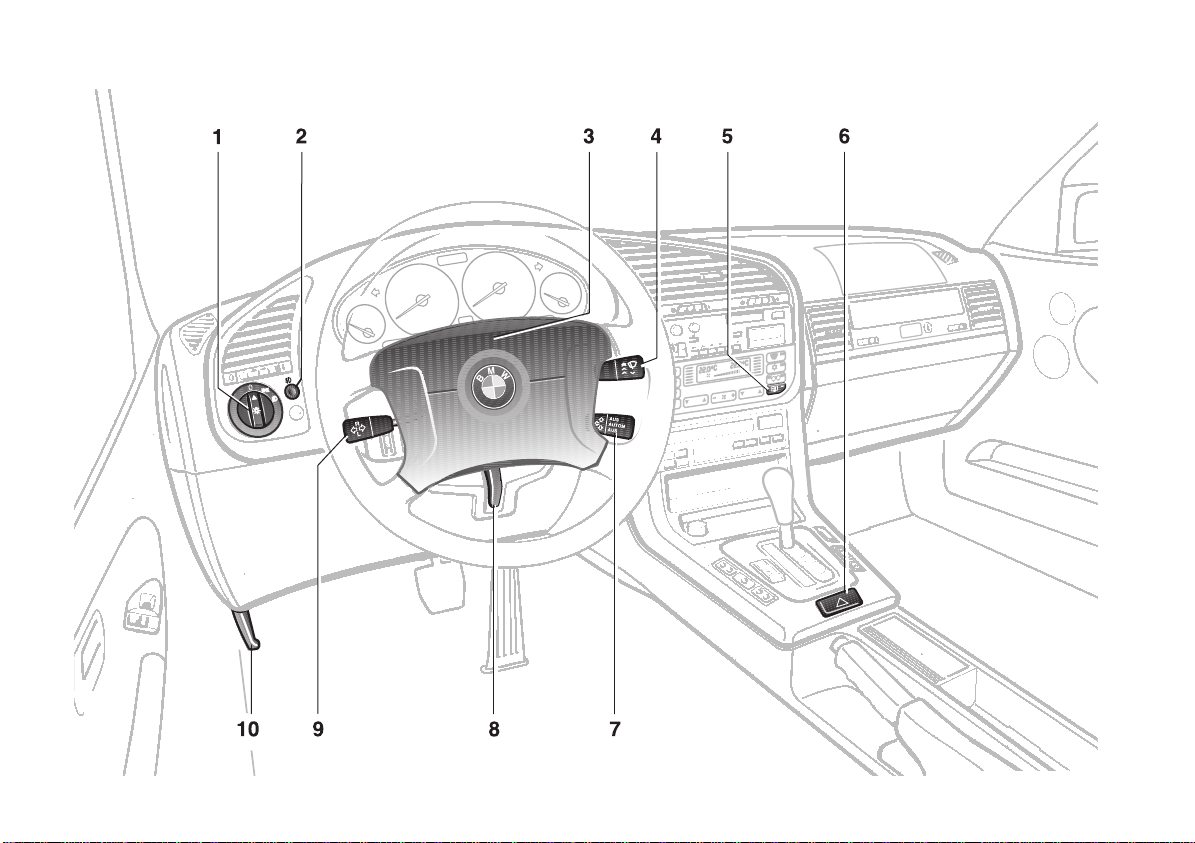
1 Lamp switch 85
2 Foglamps 86
3 Horn, entire surface
4 Wiper/washer lever 61
5 Rear window defroster 91
6 Hazard warning system 22
7 Automatic cruise control
*
62
8 Adjust steering wheel
*
45
9 Turn signals, high beam headlamps
and headlamp flasher 60
10 Engine hood unlocking device 118
Cockpit
Online Edition for Part No. 01 41 9 790 377 - © 07/98 BMW AG
18
Instrument cluster
360us319
Online Edition for Part No. 01 41 9 790 377 - © 07/98 BMW AG

Controls and featuresMaintenance
At a glanceControlsCar careRepairsTechnicalDataIndex
19
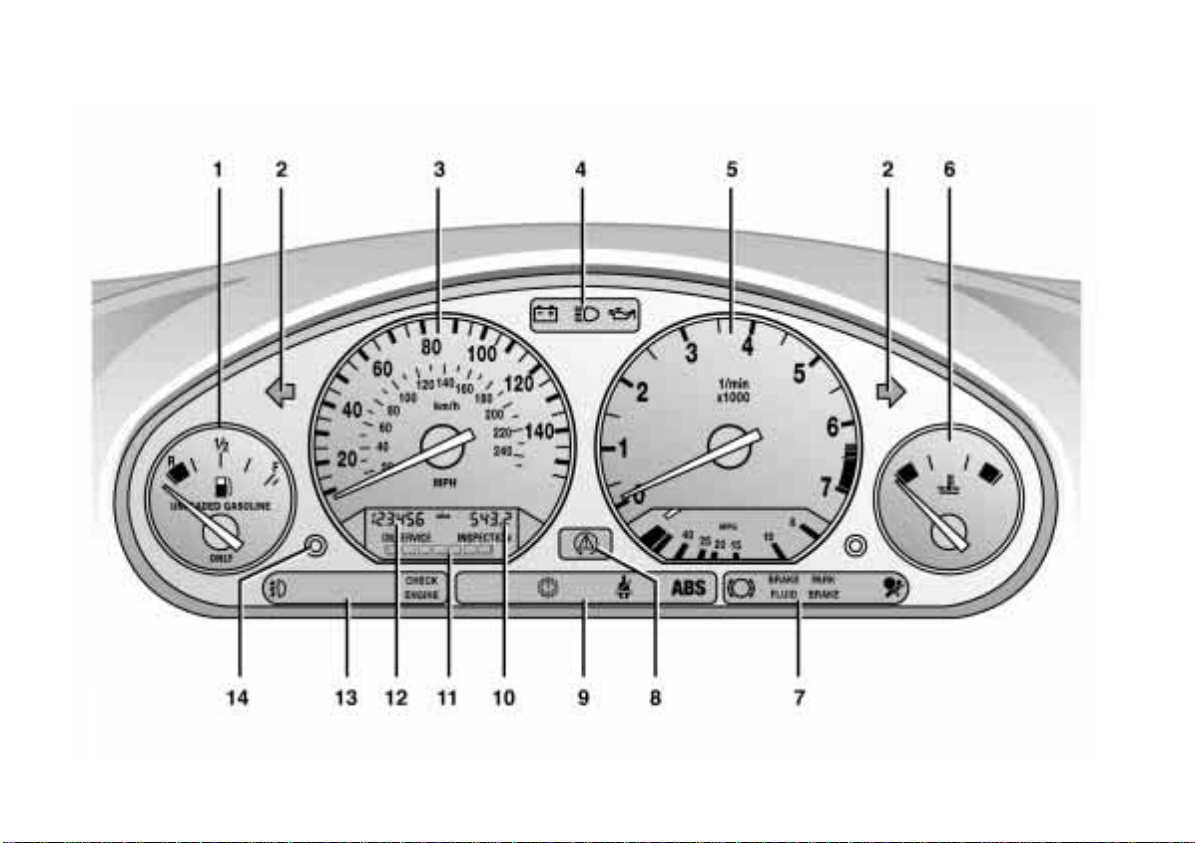
1 Fuel gauge with low-fuel
warning lamp 64
2 Indicator lamp for turn signals 20
3 Speedometer
4 Indicator and warning lamps for
d
Battery charge current 20
d
High beams 20
d
Engine oil pressure 20
5 Tachometer 63
Energy control 63
6 Coolant temperature gauge 64
7 Indicator and warning lamps for
d
Brake pad wear 20
d
Brake system hydraulics 21
d
Parking brake 21
d
Airbag 50
8 Indicator lamp for ASC+T 20
9 Indicator and warning lamps for
d
Automatic transmission
*
20
d
Warning lamp for Check Control
*
71
d
Please fasten seat belts
*
21
d
ABS 20
10 Trip odometer 63
11 Service Interval Display 64
12 Odometer 63
13 Indicator lamps for
d
Foglamps
*
20
d
Emissions-related systems
indicator 21
d
Rollover protection system
*
21
14 Trip odometer reset button 63
Instrument cluster
Online Edition for Part No. 01 41 9 790 377 - © 07/98 BMW AG

20
Turn signal left/right, green
k
Flashes when the turn signals
are in operation.
Battery charge current, red
v
Goes out after the engine has
started.
If the lamp comes on during
normal vehicle operation:
The battery is no longer being charged.
Indicates a defect in the generator drive
belt or the charging circuit.
a
If the V-belt is defective, do not run
the coolant pump; overheating and
potential engine damage would result.
Contact your BMW Retailer.
c
High beam, blue
l
Lights up when the high beams
are switched on or the head-
lamp flashers are activated.
Engine oil pressure, red
w
Goes out after the engine has
started. May come on briefly at
idle when the engine is hot,
but must go out again at higher engine
speed.
If the lamp comes on during normal vehi-
cle operation: stop vehicle and switch off
engine immediately. Check engine oil
level; if necessary, add oil. If oil level is
correct: contact your BMW Retailer.
Foglamps*, green
t
Lights up whenever you switch
on the foglamps.
Airbags, red
p
This lamp turns on for an oper-
ational check when you turn the
ignition key to position 1. If, at
the operation check, it does not go on,
or goes on while driving, have it checked
at your BMW Retailer.
Additional notes: Page 50
Automatic transmission*, yellow
O
Goes out after the engine has
started.
Additional notes: Page 58
ASC+T (Automatic Stability
Control plus Traction), yellow
s
Goes out shortly after the igni-
tion is switched on:
System OK.
Additional notes: Page 84
ABS (Antilock Brake System),
yellow
o
Goes out after the engine has
started. If the lamp comes on
during normal vehicle opera-
tion: ABS has been deactivated in
response to a system malfunction. Con-
ventional braking force remains unim-
paired.
Additional notes: Page 103
Brake pad wear, yellow
#
Lights up when starter is actu-
ated and goes out when the
engine is started.
If the lamp comes on during normal
vehicle operation: replace brake pads
immediately.
aUse only original BMW-approved
brake pads otherwise the vehicle
authorization is no longer valid.c
Indicator and warning lamps
Online Edition for Part No. 01 41 9 790 377 - © 07/98 BMW AG

At a glanceControlsCar careRepairsTechnicalDataIndex
21
Brake hydraulics, red
n
Goes out after the engine has
started.
If the lamp comes on during
normal vehicle operation: low brake
fluid. Additional notes: Page 128
Parking brake, red
m
Goes out after the engine has
started. Comes on when you
engage the parking brake.
Additional notes: Page 56
Emissions-related systems
Y
Lamp goes out once engine
starts.
If this indicator lamp lights up
during normal vehicle operation, either
continuously or intermittently, this indi-
cates a fault in one of the emissions-
related electronic circuits. Although the
vehicle remains operational, you should
have the systems checked by a BMW
Retailer at the earliest possible opportu-
nity.
Please fasten safety belts*, red
q
(With acoustic signal if the
driver’s belt is not buckled).
Lights up briefly when the
ignition key is turned, and then goes out
(in some models it goes out after you
fasten safety belts).
BMW Convertible
Rollover Protection System
*,
yellow
;
Goes out shortly after the igni-
tion is switched on:
System OK.
Indicator and warning lamps
Online Edition for Part No. 01 41 9 790 377 - © 07/98 BMW AG
22
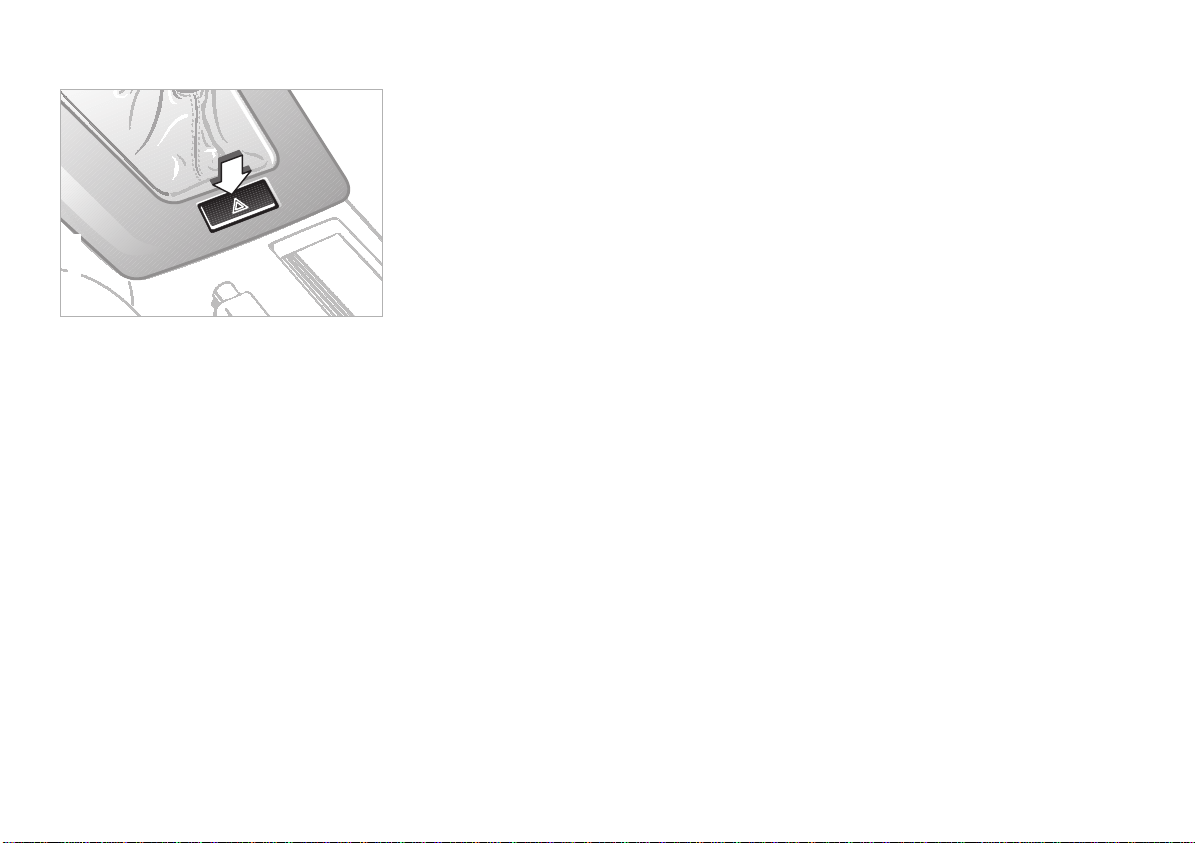
The button flashes intermittently when
the hazard warning lamps are on.
The button is also illuminated whenever
the vehicle lighting is switched on.
The warning triangle can be stored in
the luggage compartment in a storage
shelf at the right for convenient access.
aComply with legal requirements
concerning the need to carry a warning
triangle in the car.c
On the right in the luggage compart-
ment, on a shelf.
aSome of the items in the first-aid
kit are suitable for use for a limited
period only. Therefore you should regu-
larly check the contents and replace
defective articles. These are available in
any pharmacy.
Comply with legal requirements con-
cerning the need to carry a first-aid kit in
the car.c
360de040
Hazard warning system Hazard warning triangle* First aid kit*
Online Edition for Part No. 01 41 9 790 377 - © 07/98 BMW AG
At a glanceControlsCar careRepairsTechnicalDataIndex
23
Refueling Fuel specification
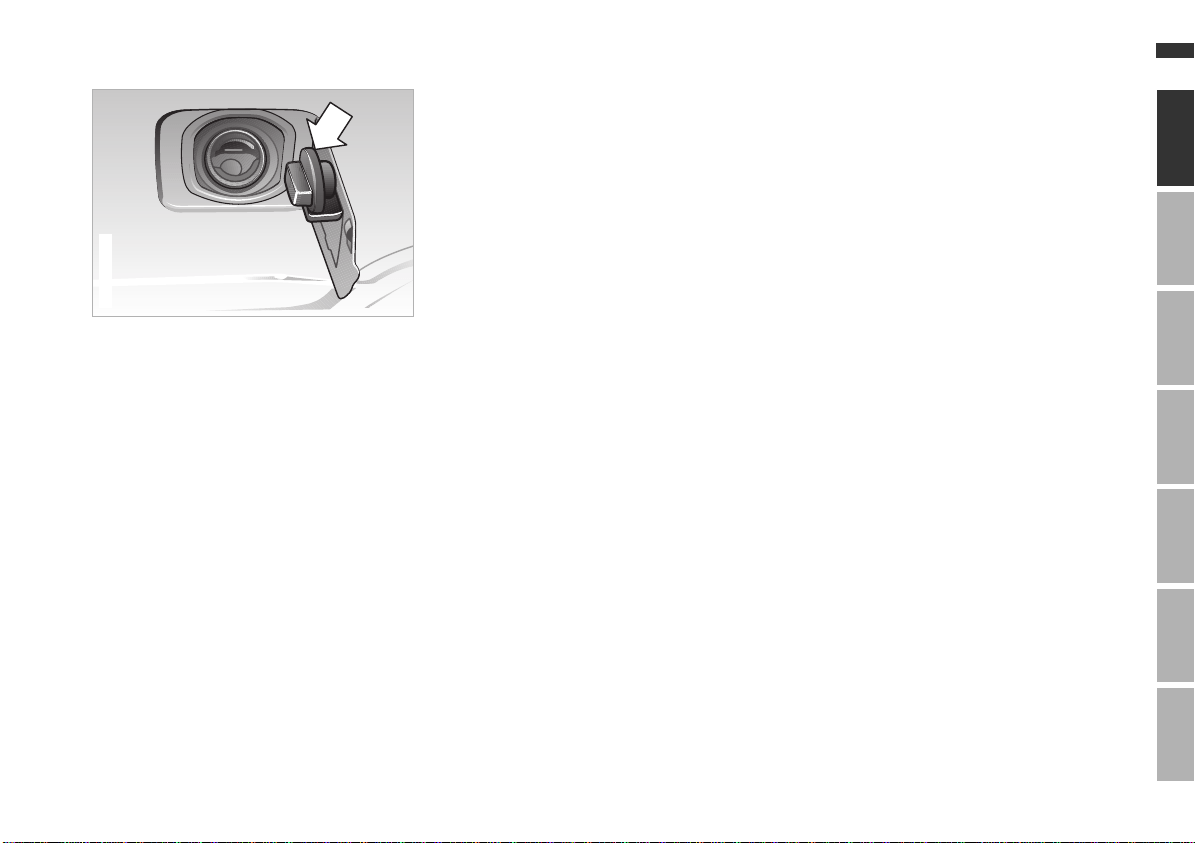
To unlock the filler door in the event of a
central locking system failure, refer to
page 152.
aWhen handling fuel, comply with
the safety regulations displayed by gas
stations.c
Unleaded gasoline only.
Minimum octane requirement: 89 AKI
BMW engines are equipped with knock
sensors and automatically adapt to op-
erate with fuels of different octane rat-
ings, as long as the minimum octane
requirement is met.
Higher octane fuels will provide in-
creased performance and fuel econ-
omy, while the use of gasoline with a
lower octane rating will have an adverse
effect.
aNever use leaded fuel, as it would
cause permanent damage to both the
catalytic converter and the engine-man-
agement system’s oxygen sensors.c
AKI = Anti Knock Index
360de010
Online Edition for Part No. 01 41 9 790 377 - © 07/98 BMW AG
24
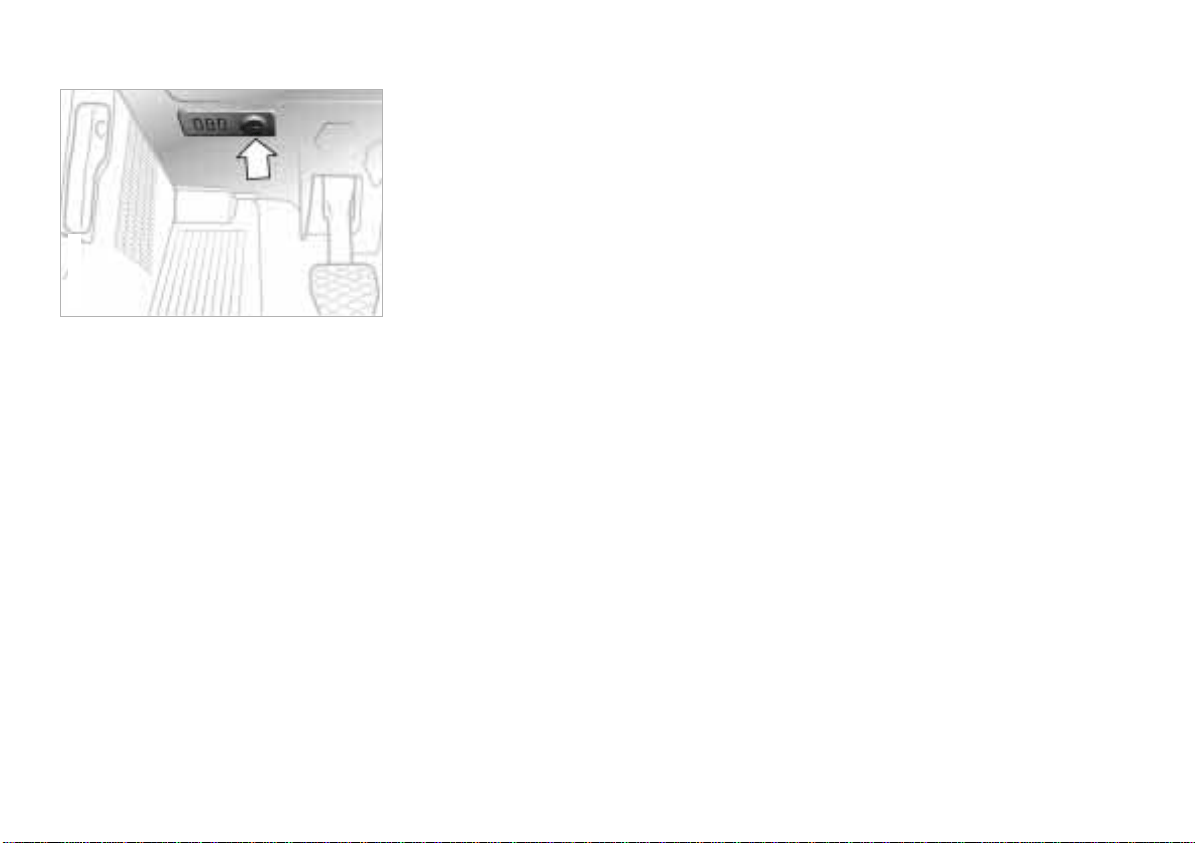
The OBD II interface (data link connec-
tor) is located beneath a cover panel
(with the letters "OBD") near the foot
support in the driver’s side footwell
(arrow).
360us301
CARB OBD II interface
Online Edition for Part No. 01 41 9 790 377 - © 07/98 BMW AG
At a glanceControlsCar careRepairsTechnicalDataIndex
25
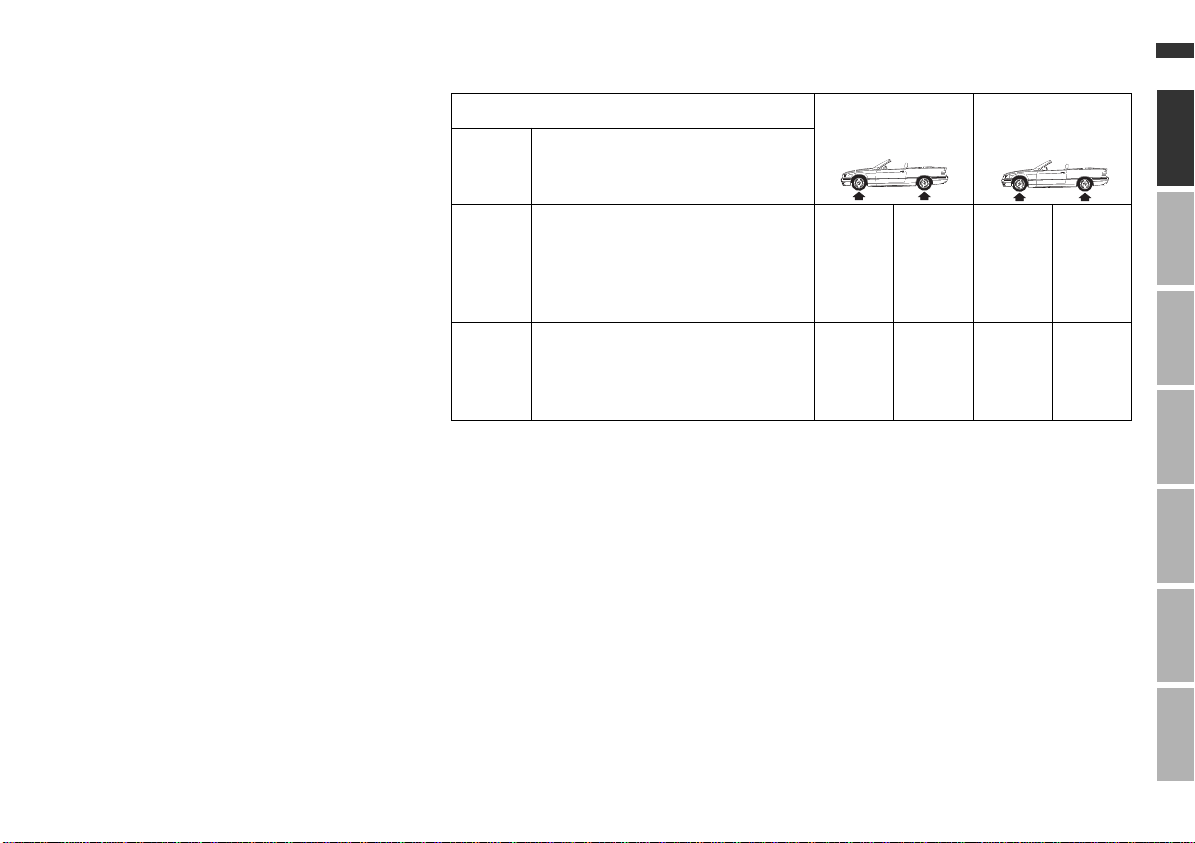
BCBC+C/$BCBC
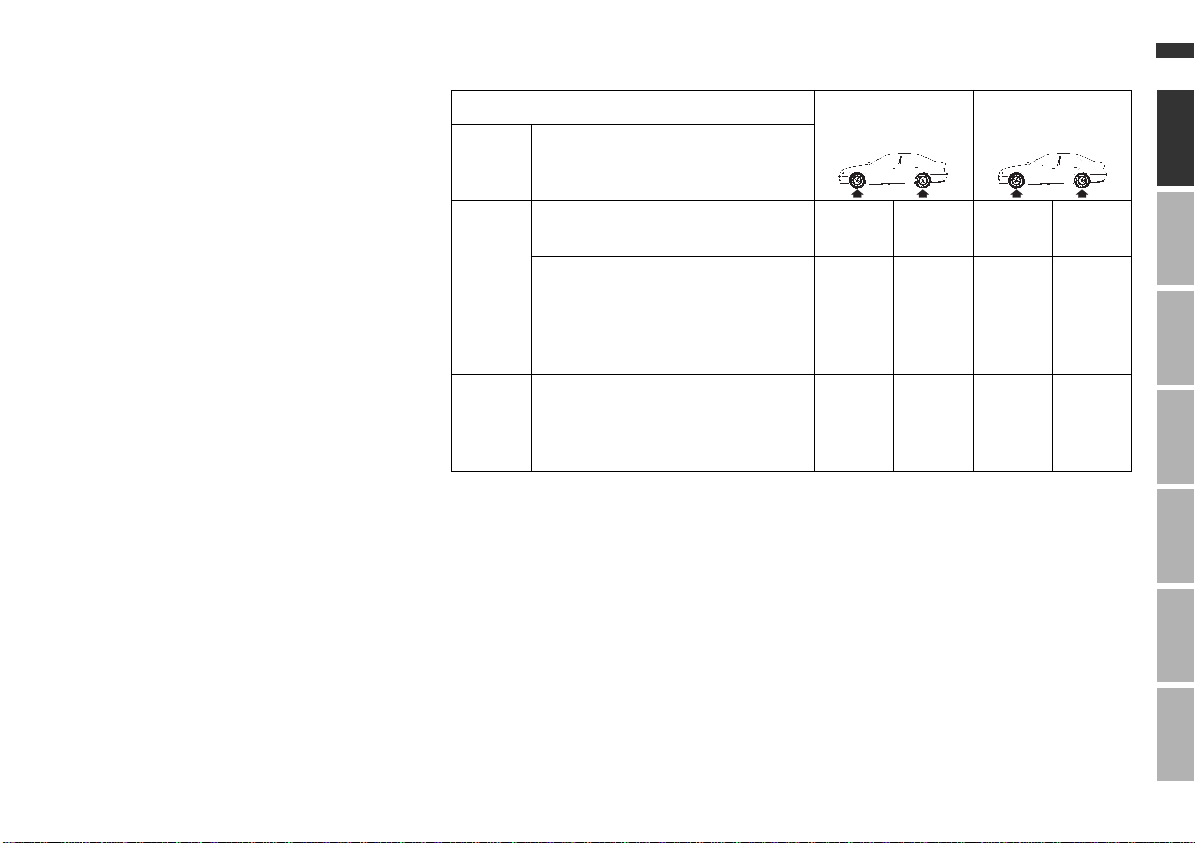
Tire inflation pressures
If the driver's door is open, the infla-
tion pressures are also visible on the
door pillar. Inflation pressures are
indicated in psi (bar) with tires cold
(ambient temperature).
The inflation pressures apply to tires
from BMW-approved manufacturers;
your BMW Retailer will provide you
with this information. Higher pres-
sures may be required for tires from
other manufacturers.
aPeriodically check the inflation
pressure – also of the spare tire – at
least twice each month and before
setting out on an extended trip. Failing
this, incorrect tire pressure may ren-
der the car unstable or cause tire
damage resulting in an accident.c
Sedan models
BMW
model
Tire sizes
Inflation pressures are
indicated in psi (bar)
318i
185/65 R 15 88 Q, T M+S
185/65 R 15 88 T
29
(2.0)
35
(2.4)
36
(2.5)
44
(3.0)
205/60 R 15 91 H
225/55 R 15 92 V
225/50 ZR 16
205/60 R 15 91 Q, H M+S
225/50 R 16 92 Q M+S
29
(2.2)
32
(2.2)
32
(2.2)
39
(2.7)
328i
205/60 R 15 91 H
225/50 ZR 16
205/60 R 15 91 Q, H M+S
225/50 R 16 92 Q M+S
29
(2.0)
33
(2.3)
33
(2.3)
41
(2.8)
See next page for additional models
Online Edition for Part No. 01 41 9 790 377 - © 07/98 BMW AG

26
BCBC+C/$BCBC
Tire inflation pressures (cont.)
Coupe models
BMW
model
Tire sizes
Inflation pressures are
indicated in psi (bar)
318is
323is
205/60 R 15 91 H
225/55 R 15 92 V
225/50 ZR 16
205/60 R 15 91 Q, H M+S
225/50 R 16 92 Q M+S
29
(2.0)
32
(2.2)
32
(2.2)
39
(2.7)
185/65 R 15 88 Q M+S
29
(2.0)
35
(2.4)
36
(2.5)
44
(3.0)
328is
205/60 R 15 91 H
225/50 ZR 16
205/60 R 15 91 Q, H M+S
225/50 R 16 92 Q M+S
29
(2.0)
33
(2.3)
33
(2.3)
41
(2.8)
See next page for additional models
Online Edition for Part No. 01 41 9 790 377 - © 07/98 BMW AG
At a glanceControlsCar careRepairsTechnicalDataIndex
27
BCBC+$BC-
max.
Tire inflation pressures (cont.)
Convertible models
BMW
model
Tire sizes
Inflation pressures are
indicated in psi (bar)
318i
323i
205/60 R 15 91 H
225/55 R 15 92 V
225/50 ZR 16
205/60 R 15 91 Q, H M+S
225/50 R 16 92 Q M+S
29
(2.0)
32
(2.2)
32
(2.2)
39
(2.7)
328i
205/60 R 15 91 H
225/50 ZR 16
205/60 R 15 91 Q, H M+S
225/50 R 16 92 Q M+S
29
(2.0)
33
(2.3)
33
(2.3)
41
(2.8)
Online Edition for Part No. 01 41 9 790 377 - © 07/98 BMW AG

28
Locks and security systems:
Keys 30
Electronic vehicle immobilizer 30
Doors 31
Luggage compartment lid 33
Luggage compartment 34
Power windows 35
Sliding/tilt sunroof 36
Convertible top operation 37
Adjustments:
Seats 43
Steering wheel 45
Mirrors 46
Passenger safety systems:
Safety belts 47
Child restraint system 48
Installing child seats 49
Airbags 50
Child-safety locks 52
Rollover protection system –
convertible 52
Driving:
Steering/ignition lock 54
Starting the engine 54
Switching off the engine 55
Parking brake 56
Manual transmission 57
Automatic transmission 58
Turn signals/high beam 60
Wiper/washer system 61
Cruise control 62
Everything under control:
Odometer 63
Tachometer 63
Energy control 63
Fuel gauge 64
Coolant temperature gauge 64
Service Interval Display 64
Multi-Information Display (MID) 66
Outside temperature display
and digital clock 68
Check Control 71
Check Control with outside
temperature display and
digital clock 74
Onboard computer 77
Online Edition for Part No. 01 41 9 790 377 - © 07/98 BMW AG

At a glance
Controls and features
Care and maintenance
Advanced technology
Technical data
Owner service procedure
At a glanceControls Car careRepairsTechnicalDataIndex
Index
29
Technology for driving comfort
and safety:
Automatic Stability Control
plus Traction (ASC+T) 84
Lamps:
Headlamp switch 85
Instrument panel lighting 85
Foglamps 86
Interior lamps 86
Reading lamps 86
An inviting climate:
Heated seats 87
Independent ventilation
system 87
Automatic climate control 88
Cabin convenience:
BMW Hi-Fi System 93
Glove compartment 93
Ashtray 94
Coin box, cup holder 94
Cigarette lighter 94
Center arm rest, rear 95
Through-loading system 95
Ski bag 95
Cargo loading 98
Online Edition for Part No. 01 41 9 790 377 - © 07/98 BMW AG
30
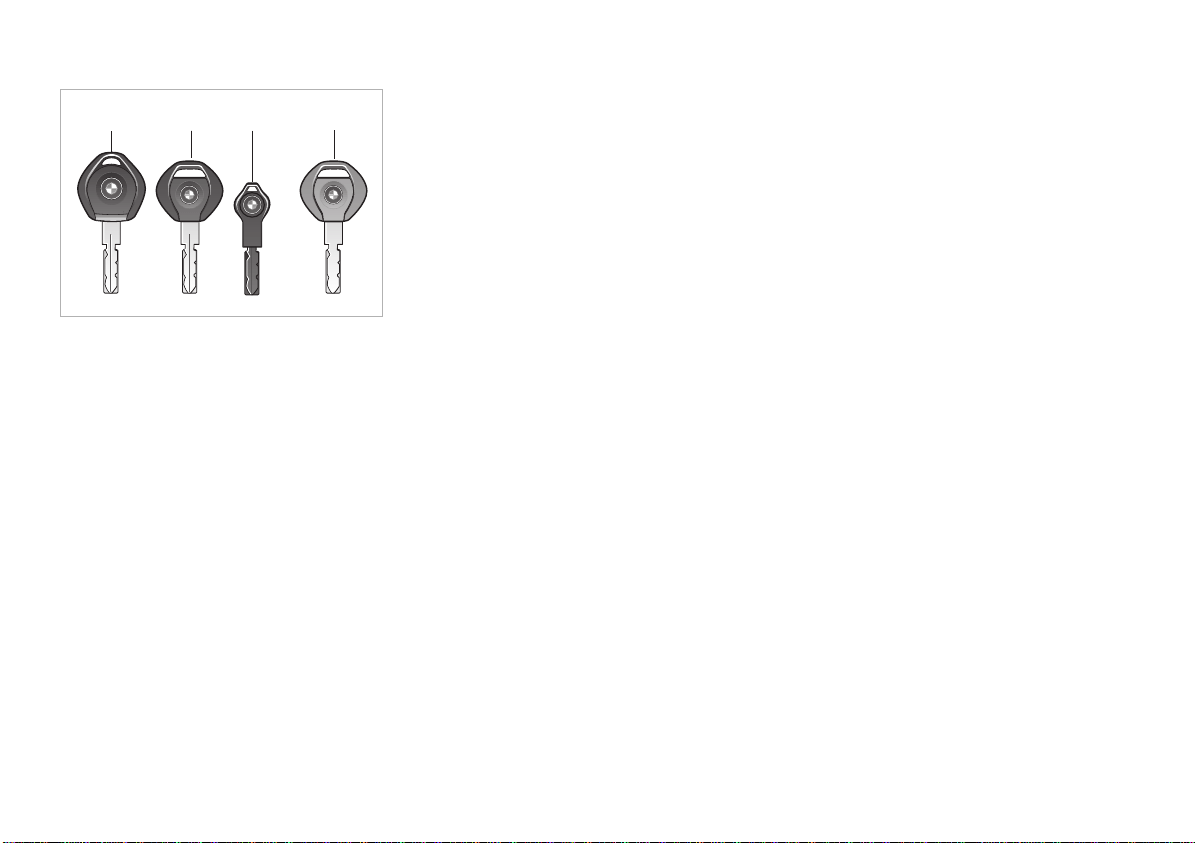
1 Master key with battery-powered
lamp (switch on by pressing the BMW
symbol).
2 Master key without lamp.
3 Spare key to be kept in a safe place
e.g. in your wallet. This key is not
intended for continuous use.
4 Door and ignition key
This key does not operate the locks
for the glove compartment and the
luggage compartment. This is useful
e.g. at a hotel.
The electronic vehicle immobilization
unit increases the anti-theft protection
of your BMW – without additional
adjustment or activation of systems.
This electronic immobilization system is
designed to reduce the susceptibility of
the vehicle to theft by making it impos-
sible to start the engine using any
means other than the special keys fur-
nished with the vehicle.
The system features an electronic chip
integrated within the key as a supple-
ment to the conventional mechanical
locking system.
The lock mechanism itself is actually a
dual-function device, simultaneously
serving as a communications interface
designed to allow the car security sys-
tem to maintain a continuous stream of
variable, vehicle-specific signals with
the electronic circuitry in the key. The
ignition, the flow of fuel and the starter
are enabled only after the key has been
recognized as "authorized".
bExternal force can damage the
electronic circuitry integrated in the key.
Such a key can no longer be used to
start the engine.c
Replacement of a key
Replacement keys are available exclu-
sively through your authorized BMW
Retailer, who is also under obligation to
request verification of vehicle owner-
ship before issuing a substitute key.
Your BMW Retailer can also cancel or
restore the electronic system authoriza-
tion for individual keys (e.g., if a key is
lost). A deactivated key can no longer
be used to start the engine.
For US owners only
The transmitter and receiver units com-
ply with Part 15 of the FCC (Federal
Communication Commission) Regula-
tions. Operation is governed by the fol-
lowing:
FCC ID: LXBEWS
As defined in the regulations, such a
device is not to emit significant interfer-
ence and must also be shielded against
interference from external sources to
prevent unauthorized or inadvertent
activation.
aAny unauthorized modifications
or changes to these devices could void
the user’s authority to operate this
equipment.c
1
4
B
M
W
B
M
W
B
M
W
B
M
W
23
365de122
Keys Electronic vehicle immobilizer
Online Edition for Part No. 01 41 9 790 377 - © 07/98 BMW AG
31
At a glanceControls Car careRepairsTechnicalDataIndex
Operating central locking system
from outside the vehicle
When the front doors are closed, the
activation of a door lock or of the lug-
gage compartment lock with a key
unlocks or locks the following:
d Doors
d Luggage compartment
d Fuel filler door
d BMW Convertible: the glove com-
partment.
The double-lock system is engaged at
the same time. Both the door locks and
release handles remain locked.
aNever use the keys or the remote
control
* to lock an occupied vehicle, as
it would then be impossible to unlock it
from inside.c
Convenience closing
* for power win-
dows and sliding/tilt sunroof: after clos-
ing the doors, hold the key in the lock
position to close the windows and slid-
ing/tilt sunroof. The windows/sunroof
stop moving immediately when you
release the key. To be able to keep the
closing system in view, convenience
closing can only be activated via the
driver's door lock for safety reasons,
even on vehicles with remote control.
Emergency lock operation
(in the event of electrical failure)
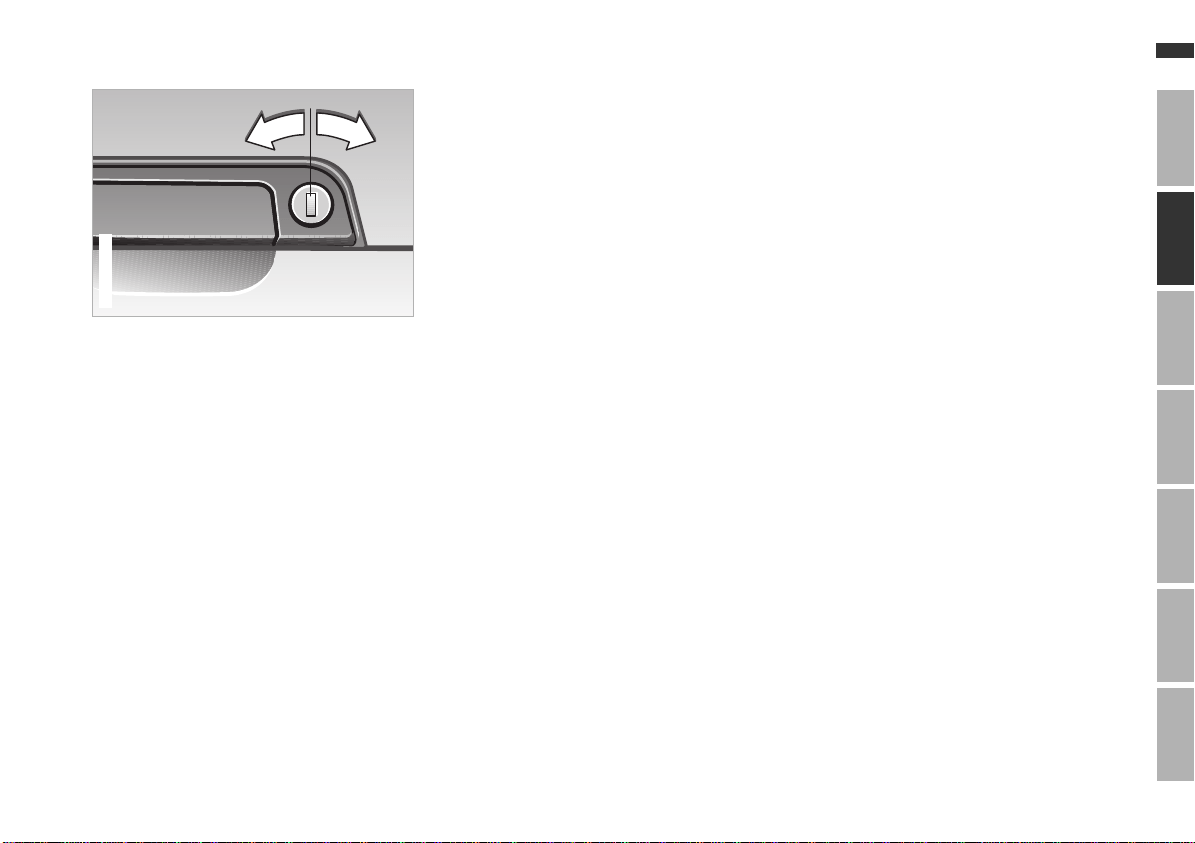
Turn the key to the end positions of the
door lock to unlock/lock the respective
door.
Activating the central locking
system from inside the vehicle
Pressing the lock button of a front door
unlocks/locks the doors and luggage
compartment, but does not arm the
alarm system.
bIf the vehicle is locked from the
inside with this lock button, the fuel
filler door remains unlocked to allow
refueling. On the BMW Convertible, the
glove compartment also remains un-
locked to allow for its use.
It is also possible to unlock the car from
the inside by pulling on one of the front
door handles.c
To preclude accidental locking of the
vehicle
d it can not be locked with the lock
button when the driver's door is open
d the safety button of the passenger
door activates the central locking
system only when both front doors
are locked.
360de011
Doors
Online Edition for Part No. 01 41 9 790 377 - © 07/98 BMW AG
32
aChildren can lock the doors from
inside. Therefore, you should always
remove the key and take it with you to
ensure that you can unlock the car from
the outside at all times.c
In an accident, the central locking sys-
tem automatically unlocks the doors
and the interior lamps switch on.
Depending on the version, the hazard
warning flashers are also activated.
aAvoid using the inside lock buttons
to lock the rear doors while driving, as
these doors would then fail to unlock au-
tomatically in the event of an accident.c
Opening doors from the inside
Pull interior door handle of a front door
twice in succession (the initial pull
unlocks the door, the second opens it).
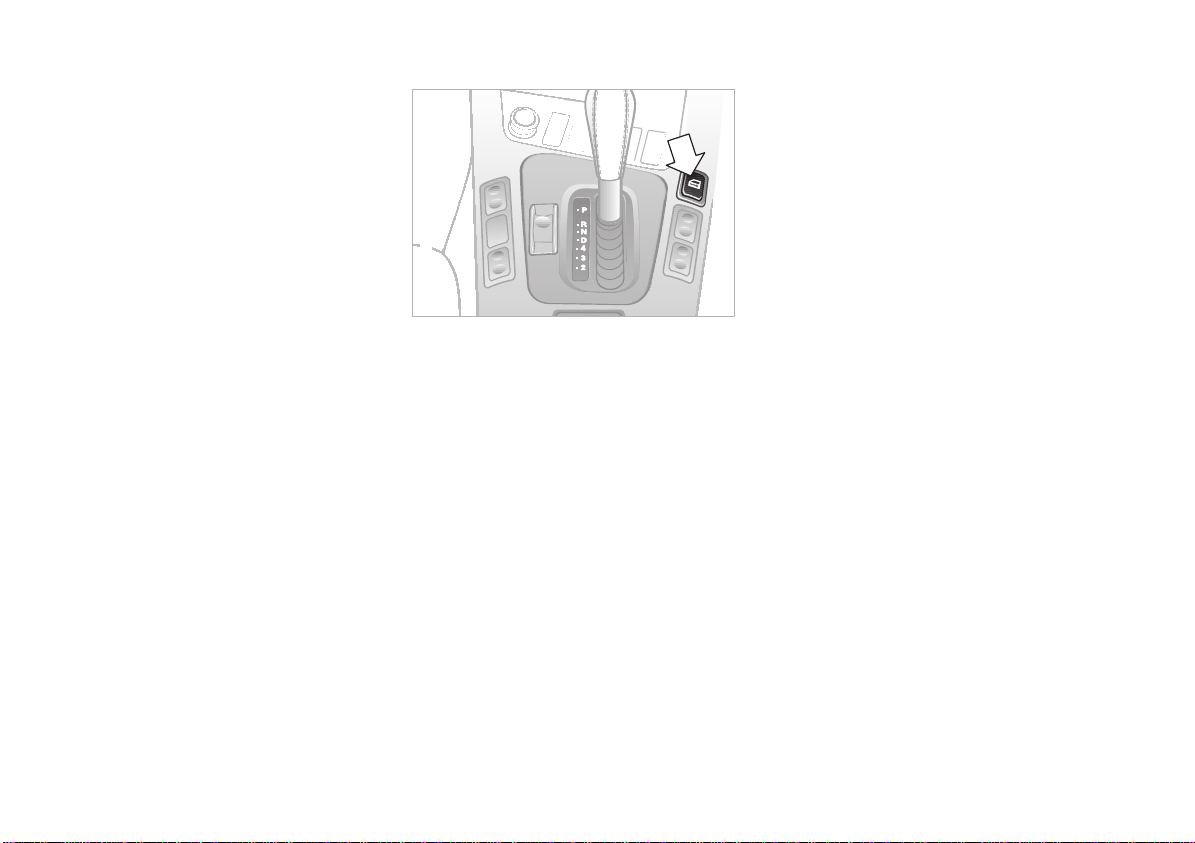
Central locking system button
This button operates the central locking
system when the driver’s door is
closed. It unlocks the doors and lug-
gage compartment, but does not arm
the alarm system.
The fuel filler door remains unlocked to
allow refueling.
The picture shows, as an example, the
shift arrangement for the BMW sedan.
Opening doors from the outside
Lift the handle.
Automatic window lowering
(BMW Coupe, Convertible)
aThe door windows are lowered
somewhat when the doors are opened
and then are raised again immediately
after the doors are locked. This makes it
easier to open the doors, prevents the
rubber door seals from being damaged
and ensures proper seating of the
windows in the rubber door seals after
closing.c
Driver's door lock heating*
Lift the handle of the driver's door for
approx. 3 seconds: the heating
switches on. The switch-on time is
automatically controlled to save power.
S
360us124
Doors
Online Edition for Part No. 01 41 9 790 377 - © 07/98 BMW AG

33
At a glanceControls Car careRepairsTechnicalDataIndex
The lock actuation is only possible with
a master key.
Central locking system
To engage locks
To lock the luggage compartment
separately
The luggage compartment lid is locked
and disconnected from the central lock-
ing system. The luggage compartment
lid then remains locked when the cen-
tral locking system is unlocked with a
door lock or the lock knobs.
Access to the luggage compartment lid
is thus prevented when leaving the door
and ignition key with others (refer to
page 30); this is useful e.g., at a hotel.
To unlock car
Emergency lock operation
(in the event of electrical failure)
Turn the master key to the left as far as
possible: the luggage compartment lid
is unlocked.
After closing, the luggage compartment
lid must be locked again separately.
The luggage compartment lamp
is on when the luggage compartment
lid is open.
=
Turn to the right: The luggage
compartment lid and - if the
front doors are closed - the
doors are locked and the alarm system
is armed.
360de013
>
Turn the master key to the right
until the slot is horizontal, then
extract the key from the lock.
<
Turn to the left: the luggage
compartment lid and the doors
are unlocked.
Luggage compartment lid
Online Edition for Part No. 01 41 9 790 377 - © 07/98 BMW AG

34
To close
The handle recess (arrow) makes it eas-
ier to pull down the luggage compart-
ment lid.
aDo not drive with the luggage lid
open, as exhaust fumes could be drawn
into the interior of the vehicle. Should it
be absolutely necessary to operate the
vehicle with the luggage lid open:
d Raise all windows and shut the slid-
ing/tilt sunroof
d Maximize the air volume of the air
conditioning, refer to page 88.c
Luggage straps
Attach the straps to the floor of the lug-
gage compartment to secure smaller
suitcases.
The luggage straps prevent objects
placed on them from slipping.
The fittings at the corners of the lug-
gage compartment provide you with a
convenient means of attaching luggage
nets
* and flexible straps for securing
suitcases and luggage.
360de302
394de302
Luggage compartment lid Luggage compartment
Online Edition for Part No. 01 41 9 790 377 - © 07/98 BMW AG
35
At a glanceControls Car careRepairsTechnicalDataIndex
Operational from ignition key posi-
tion 1.
d Depress the rocker switch until you
feel resistance:
The window continues to move as
long as the rocker switch is pressed.
d Briefly press the rocker switch to just
beyond the pressure point (one-
touch mode):
The window moves automatically.
Press and let go again to stop move-
ment.
The one-touch mode can be used to
open and close the front windows and
to open the rear windows
*.
On vehicles equipped with front and
rear
* power windows:
There are separate switches located
below the rear windows (except on the
BMW Convertible).
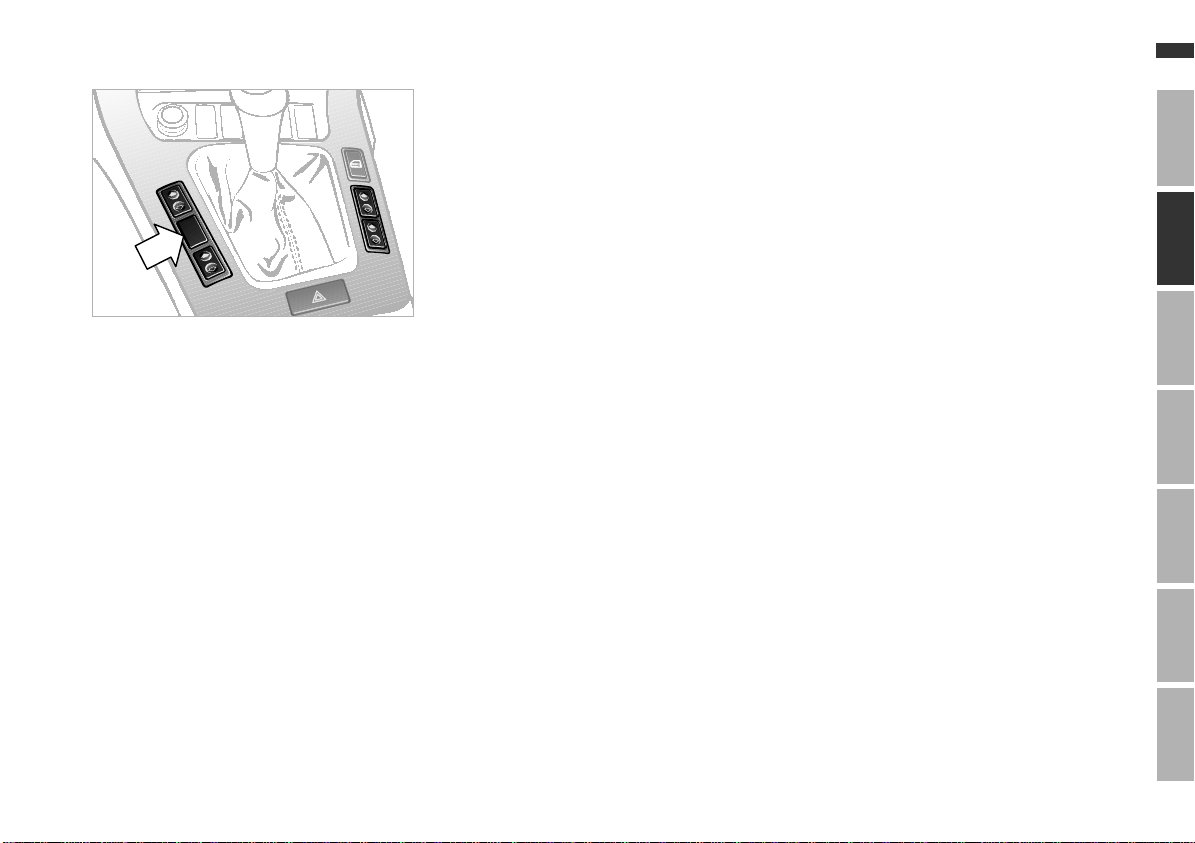
Safety switch* (arrow)
In this way the actuation of the windows
by means of rear switches, e.g., by chil-
dren, can be prevented.
aAlways keep the safety switch
(arrow) in the depressed position when
children ride in the rear seat.
Always remove the key from the ignition
when leaving the vehicle.c
After the ignition is switched off, the
windows remain operational
d with the ignition key at position 1 and
0, or removed, or
d when the front doors are open (max.
15 minutes) or until the front doors
are opened for the first time.
Convenience mode
After closing the doors, hold the key in
the lock position:
Any windows still open will close.
aCareless and inattentive closing of
the windows can lead to injuries.c
Safety feature
If one of the windows encounters resis-
tance while closing, it will respond by
halting and then opening somewhat
again.
You can deactivate this protective func-
tion, (e.g., in case of unauthorized intru-
sion into the vehicle) by pressing the
switch beyond its pressure point and
holding it there.
360us302
Power windows*
Online Edition for Part No. 01 41 9 790 377 - © 07/98 BMW AG
36
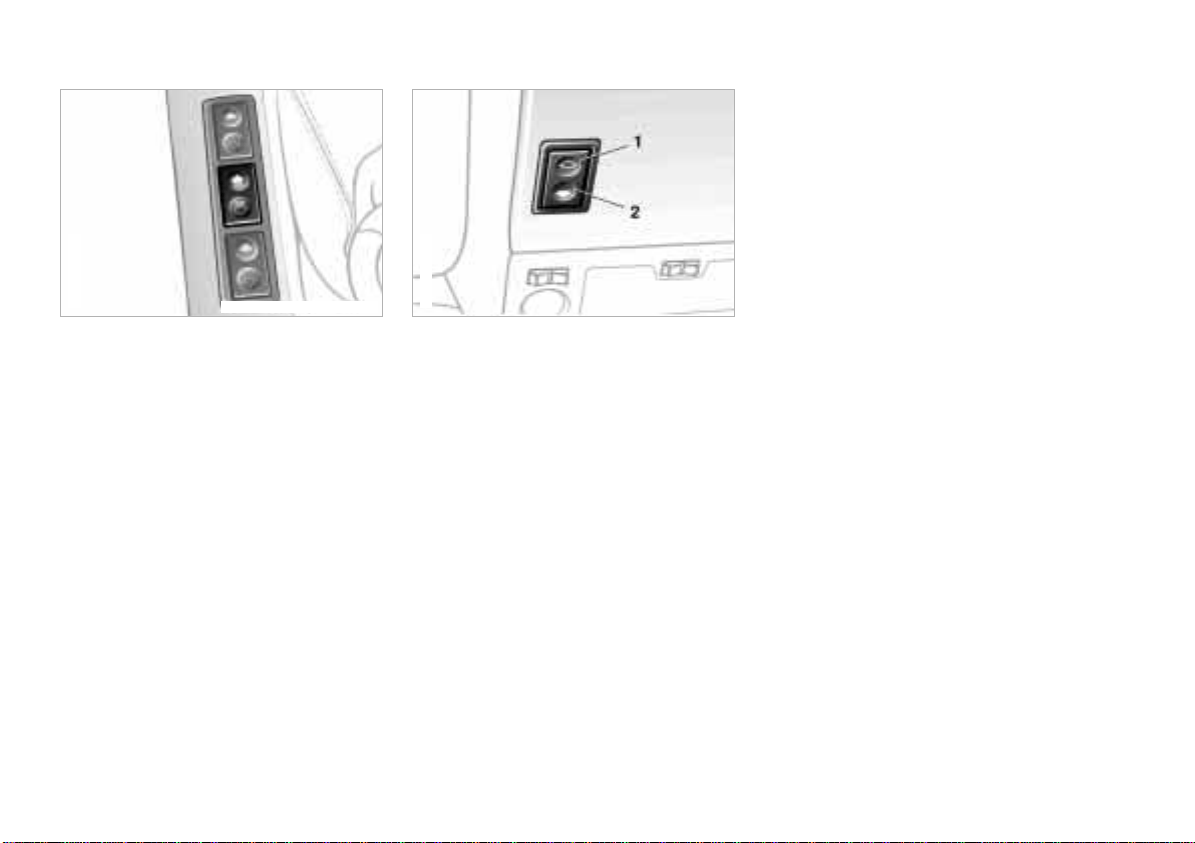
Pressing and holding down the center
button opens or closes all four side win-
dows simultaneously.
During opening, briefly press the rocker
switch to just beyond the pressure
point (one-touch mode): the side win-
dows move automatically. Press briefly
and let go again to stop movement.
Operate in ignition key position 2.
Open and lower
Press recessed button (1) until pressure
point is reached.
Close and raise
Press raised button (2) until pressure
point is reached.
At transition from closing to raising and
vice-versa: system off.
One-touch mode
(only open/raise)
Briefly press the respective button
beyond the pressure point.
The sliding/tilt sunroof moves automati-
cally. Briefly press the button a second
time to stop the sunroof.
bDuring raising, the headliner also
retracts a few inches.c
In the event of an electrical malfunc-
tion, you can also operate the sliding/tilt
sunroof manually, refer to page 152.
After the ignition is switched off, the
windows remain operational
d with the ignition key at position 1 and
0, or removed, or
d when the front doors are open (max.
15 minutes) or until the front doors
are opened for the first time.
Convenient closure*
After closing the doors, hold the key in
the lock position: the still-open sunroof
is closed.
36cde002
BMW Convertible
360de022
Power windows* Sliding/tilt sunroof*
Online Edition for Part No. 01 41 9 790 377 - © 07/98 BMW AG
37
At a glanceControls Car careRepairsTechnicalDataIndex
aCareless closing can lead to inju-
ries.
Always remove the key from the ignition
when leaving the vehicle.c
To avoid unpleasant drafts and pres-
sure variations within the passenger
compartment, you should keep the inte-
rior ventilation outlets open when the
sunroof is open and particularly when it
is raised, and select a higher blower
speed as required.
Manual convertible top
operation
The fabric top offers perfect weather
protection and can be opened and
closed simply and quickly by one
person.
Here are a few tips to ensure that you
have a lot of pleasure with your con-
vertible: It is advisable to close the top
when the vehicle is parked. The closed
convertible top not only protects the
passenger compartment from unfore-
seeable damage from the weather, it
also provides a certain degree of theft
protection.
Even with the top closed, it is always
advisable to keep valuables locked in
the luggage compartment.
Do not mount roof racks on the convert-
ible top.
Please contact your BMW Retailer for
suitable mounting equipment and other
accessories.
aWhen closing the power windows
while driving: always close the rear win-
dows first or all four windows simulta-
neously, otherwise the windows may
not seal tightly at higher speeds.c
Opening convertible top
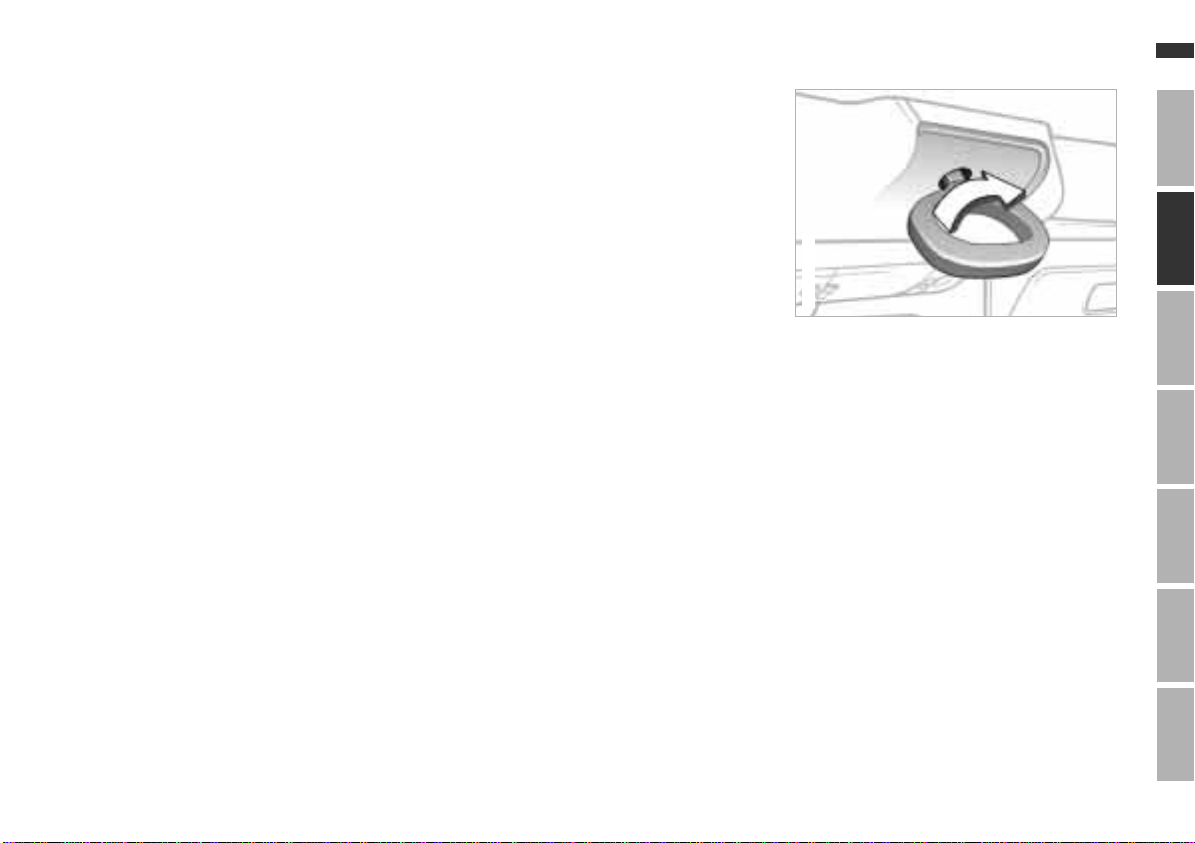
Fold out the unlocking handle and turn
it to the end stop. Raise (relax) the top
approx. 8 in (20 cm).
36cde006
Sliding/tilt sunroof* Convertible top operation
Online Edition for Part No. 01 41 9 790 377 - © 07/98 BMW AG
38
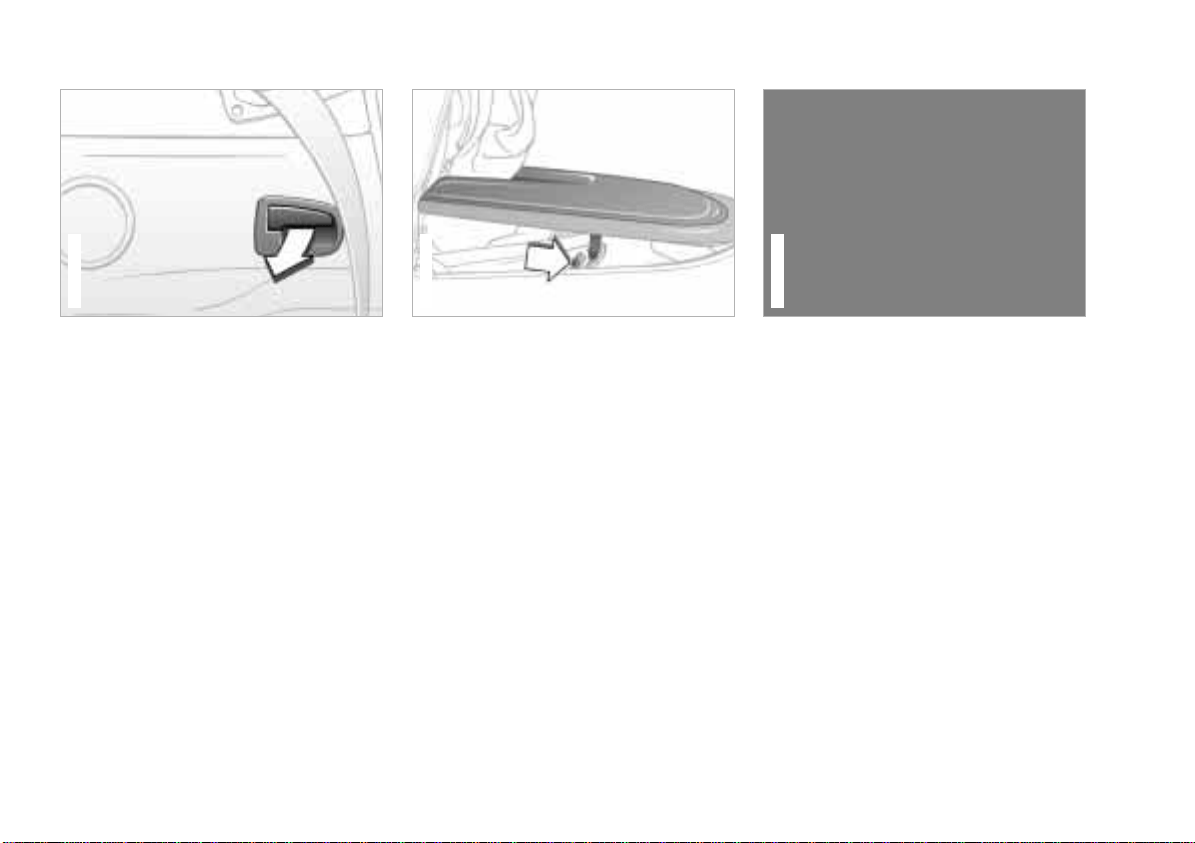
Unlock the convertible top storage
compartment with the handle in the rear
left side panel.
bFrom ignition key position 1 or with
the door open: If the side windows are
closed, they move downward slightly
when the convertible top compartment
unlocking handle is operated.c
aTo prevent damage, it is not possi-
ble to unlock the convertible top com-
partment with the luggage compartment
open.c
Position the rear convertible top bow
vertically and hold in place. Raise the
convertible top compartment lid some-
what and unlock the catch lock by
pushing it to the right. Open the con-
vertible top compartment lid com-
pletely.
Lay the rear convertible top bow in the
convertible top compartment. Lift the
top at the front and also lay down
towards the rear.
In the process, make sure the rear win-
dow is laid down evenly and free of
folds. To prevent the rear window from
being scratched, a soft cloth should be
laid in the window fold.
Close the convertible top compartment
lid by pressing down on both sides until
they are heard to engage securely.
When the convertible top compartment
lid is closed, the central locking system
is automatically unlocked, i.e., the lug-
gage compartment is no longer locked
and can be opened again.
aIf the convertible top compartment
lid is not properly closed, the luggage
compartment can not be opened to pre-
vent damage.
To prevent damage to the convertible
top due to the permanent presence of
moisture, never fold down the top while
wet (also refer to "Car care" starting on
page 136).c
36cde007
36cde008
36cde009
Convertible top operation
Online Edition for Part No. 01 41 9 790 377 - © 07/98 BMW AG
39
At a glanceControls Car careRepairsTechnicalDataIndex
Closing convertible top
Move ignition key into position 1.
Unlock and open the convertible top
storage compartment. Lift out the top
by the side guide piece and the front
top frame.
bFrom ignition key position 1 or with
the door open: If the side windows are
closed, they move downward slightly
when the convertible top compartment
unlocking handle is operated. Move the
side windows into the desired position
or close them after closing the convert-
ible top.c
Position the rear top bow vertically.
Close the convertible top compartment
lid by pressing down on both sides until
they are heard to engage securely. Fold
down the top bow.
When the convertible top compartment
lid is closed, the central locking system
is automatically unlocked, i.e., the lug-
gage compartment is no longer locked
and can be opened again.
Pull the convertible top frame onto the
windshield frame with the locking han-
dle and lock the top by turning the han-
dle until it is heard to engage.
The rear convertible top bow is auto-
matically pressed onto the convertible
top compartment lid and closes water-
tight under tension.
bIf the convertible top or the rear
window begins to flutter at high speeds,
increase the air intake via the ventilation
control to prevent a vacuum from
resulting in the passenger compart-
ment.c
Fully automatic convertible top
operation
*
The fully automatic convertible top per-
fectly combines extremely simple, com-
fortable operation with reliable protec-
tion from the elements. Here are a few
tips to ensure that you have years of
pleasure with your convertible:
It is advisable to close the top when the
vehicle is parked. The closed top not
only protects the passenger compart-
ment from unforeseen weather-related
damage, it also provides a certain
degree of theft protection. Even with
the top closed, it is always advisable to
keep valuables locked in the luggage
compartment.
Do not mount roof racks on the convert-
ible top. Please contact your BMW
Retailer for suitable mounting equip-
ment and other accessories.
To prevent damage, do not operate the
top at temperatures below 325F (0
6).
To protect the battery, it is advisable to
operate the top with the engine running
when possible.
36cde010
Convertible top operation
Online Edition for Part No. 01 41 9 790 377 - © 07/98 BMW AG
40
aThe convertible top operates fully
automatically. Assistance with your
hand is necessary only as an exception
(refer to the note, next column).
Only operate the convertible top with
the vehicle stopped and do not drive off
during operation, as otherwise the pro-
cess will be interrupted. A half-opened
top can cause damage or injuries.
Remove foreign objects from the wind-
shield frame before closing the convert-
ible top, since these may prevent the top
from closing.
Do not lay objects on the convertible
top. They would fall off during top oper-
ation and cause damage or injuries.
When closing the power side windows
during driving, always close the rear
windows first or all four windows simul-
taneously, as otherwise the windows
may not seal tightly at higher speeds.c
aDo not reach into the convertible
top mechanism during opening and
closing. Keep children away from the
swiveling area of the convertible top
during operation.
Releasing the operating button for the
top immediately interrupts the automat-
ic movement. Movement can be contin-
ued in the desired direction by pressing
the appropriate button.c
bIf the convertible top has been
stored in the convertible top compart-
ment for a longer period, e.g., in the
winter when the hardtop is used, it may
be necessary to support the first auto-
matic closing operation by hand:
Should the top come to a stop shortly
before the end of the closing phase (still
open approx. 8 in/20 cm), reach into the
handle depression in the center of the
front convertible top frame and briefly
support the closing process while
pressing the button until it is automati-
cally continued.c
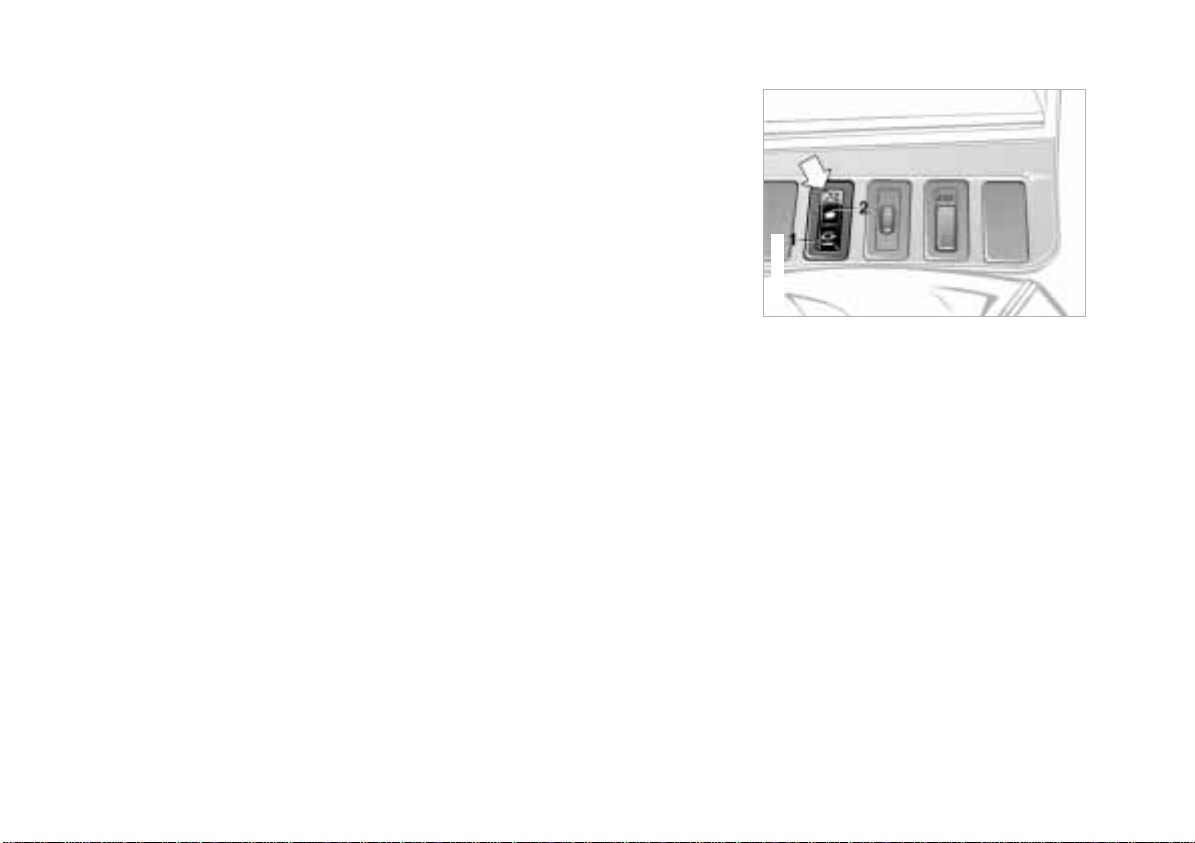
Opening and closing
1 To open
2 To close
Press the convertible top operating but-
ton until the opening or closing process
is completed.
The indicator lamp (arrow) lights up
continuously during convertible top
operation. The indicator lamp flashes
after releasing the button if the opening
or closing process is not yet completed.
36cde020
Convertible top operation
Online Edition for Part No. 01 41 9 790 377 - © 07/98 BMW AG
41
At a glanceControls Car careRepairsTechnicalDataIndex
bThe luggage compartment can not
be opened during convertible top oper-
ation.
The side windows move down slightly
when the convertible top operating but-
ton is pressed; if you continue to press
the button after the indicator lamp goes
out, they move up again as soon as the
opening process is completed.c
aThe side windows must be low-
ered slightly during convertible top op-
eration. If the convertible top operation
is interrupted, do not close the side win-
dows with the power window switches.
If the opening or closing process is in-
terrupted, it may not be possible to open
the luggage compartment.
To prevent damage from continuous
dampness, never fold down the convert-
ible top when wet.c
Convenience closing with the
driver's door lock
Hold the key in the "lock" position with
the door closed.
The windows/sunroof stop moving
immediately when you release the key.
bAt higher speeds, low air pressure
in the passenger compartment can
cause the convertible top or the rear
window to begin to flutter. Increase the
air intake via the ventilation control to
prevent low pressure from resulting in
the passenger compartment.c
Closing convertible top manually
when electrical operation fails
bManual closing is best carried out
from outside the vehicle with the driver's
door open and the driver's seat folded
forward. The rear seat bench must not
be occupied while doing so.c
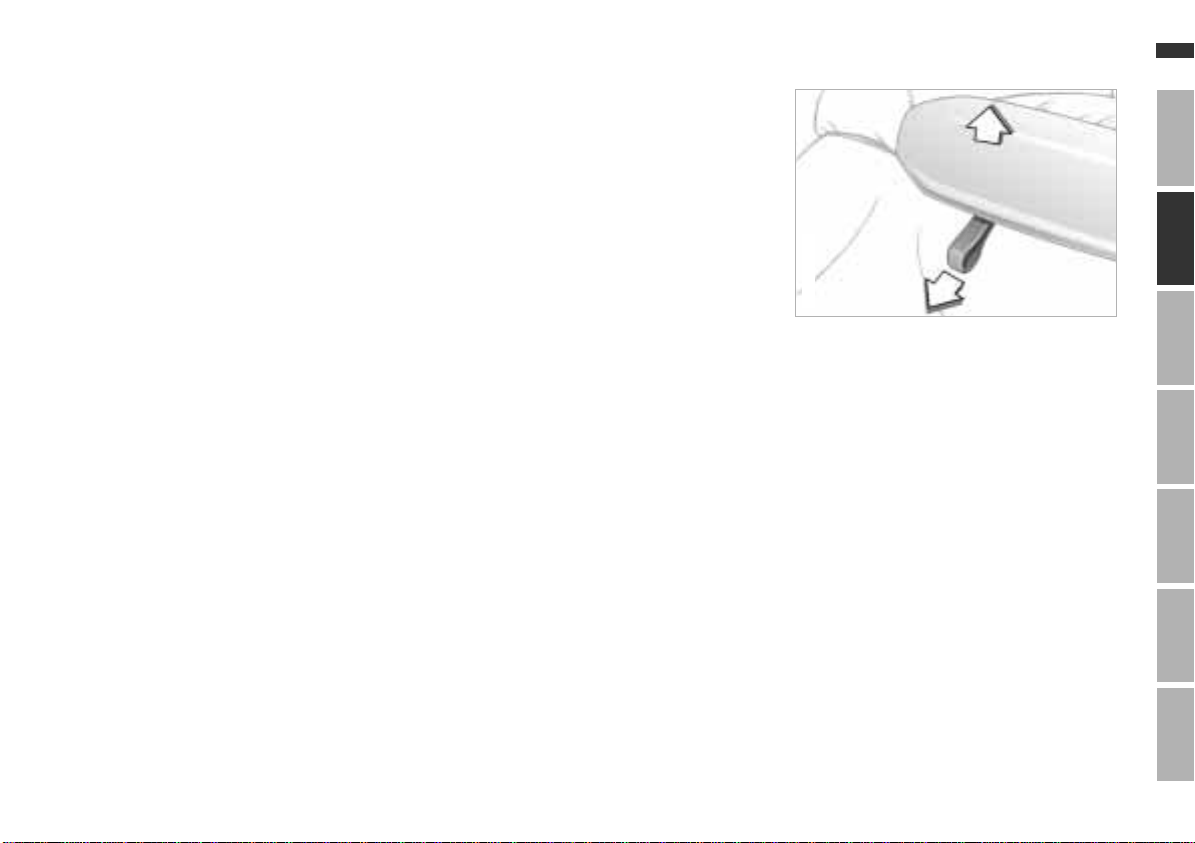
1 Raise the left rear seat. Pull out the
strap until resistance is felt. Now con-
tinue to pull firmly (two audible clicks)
to disengage the drives for the con-
vertible top and convertible top com-
partment lid.
36cde014
Convertible top operation
Online Edition for Part No. 01 41 9 790 377 - © 07/98 BMW AG
42
2 Open the convertible top compart-
ment lid up to the stop with the lug-
gage compartment closed.
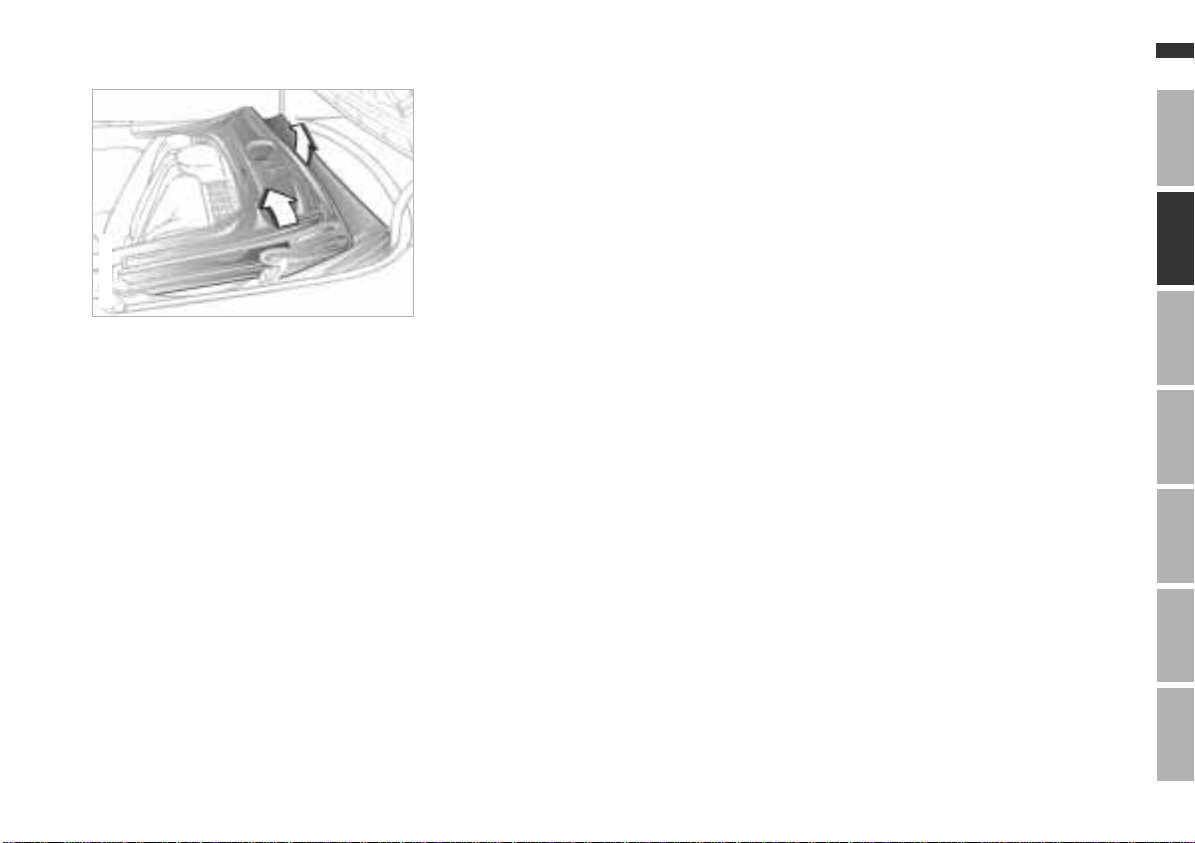
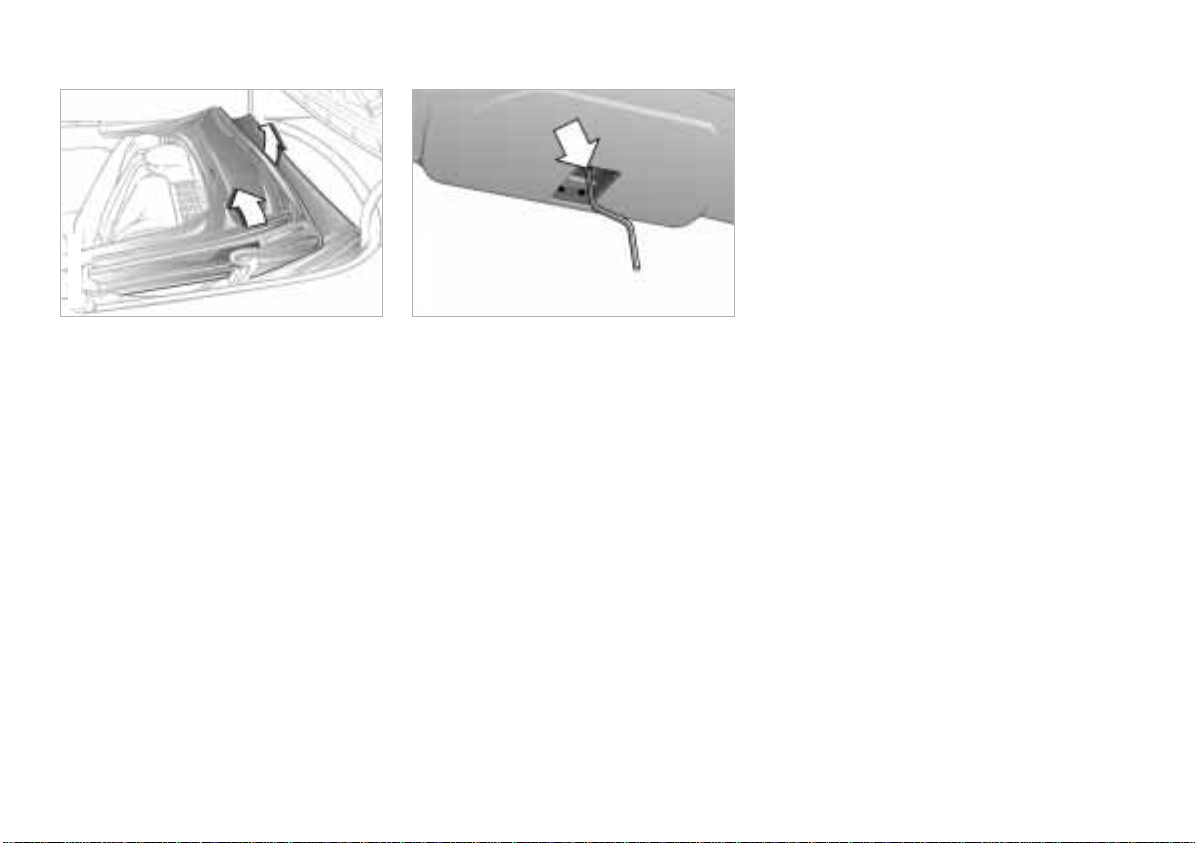
3 Grasp the convertible top on the lat-
eral guide section and on the front
soft-top frame and lift it out (arrow).
Position the rear convertible top bow
vertically and close the convertible
top compartment lid. Now fold down
the rear convertible top bow.
4 Place a screwdriver at the middle of
the cover on the front convertible top
frame, and pry it out of its recess.
5 Using the doubly bent allen key from
the onboard tool kit, place it in the
internal hexagon (arrrow).
6 The closing process is continued by
turning to the left; turn until the front
convertible top frame is locked to the
windshield frame. The rear convertible
top frame is automatically pressed
onto the convertible top compartment
lid and closes watertight under ten-
sion.
To eliminate the malfunction and re-
engage the drives, please see your
BMW Retailer.
aNever open the convertible top
manually in case of an electrical mal-
function. The convertible top compart-
ment lid can not be locked and would
open during driving.c
bPlease follow the instructions for
cleaning and care of the convertible top
in your Owner’s manual from page 136.c
36cde021
36cde022
Convertible top operation
Online Edition for Part No. 01 41 9 790 377 - © 07/98 BMW AG
43
At a glanceControls Car careRepairsTechnicalDataIndex
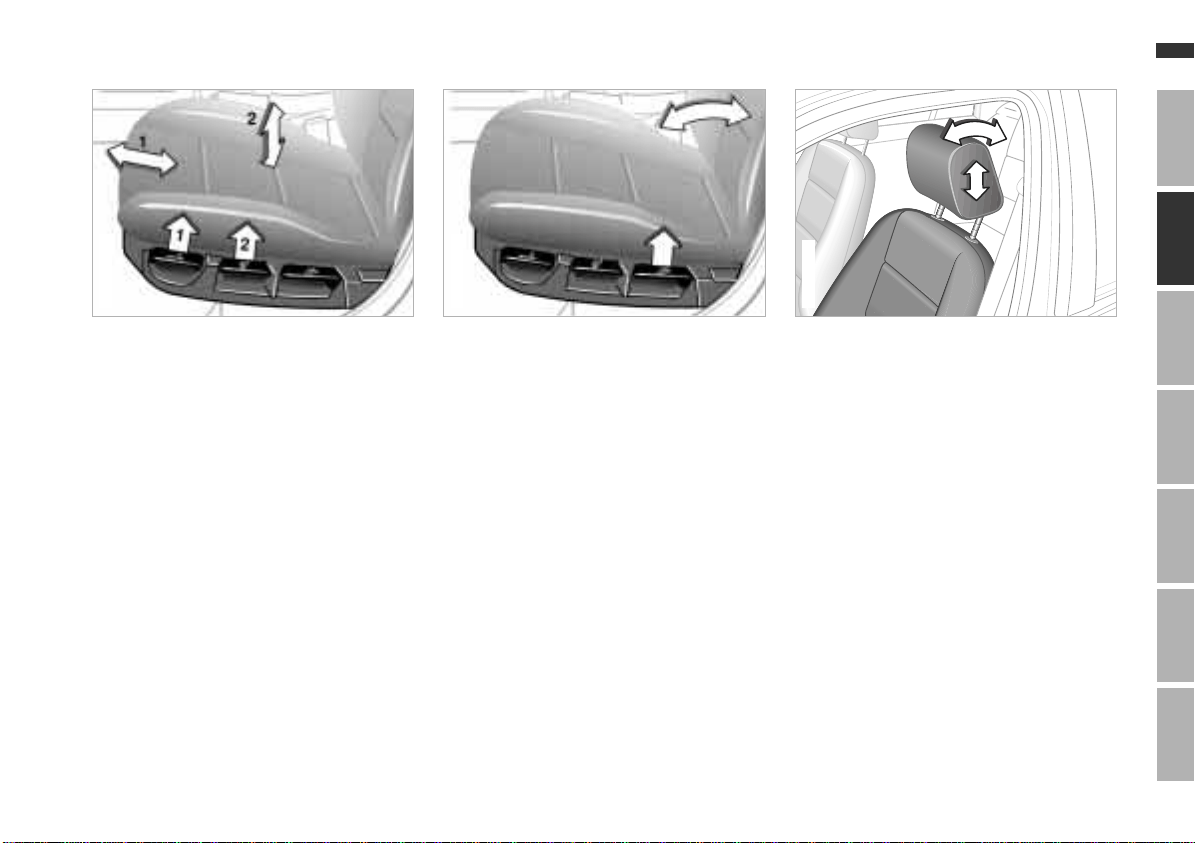
Longitudinal adjustment
Pull lever 1 and slide seat into desired
position.
After releasing the lever, make sure that
the locking device engages properly.
Height adjustment
Pull lever 2 and load or relieve seat as
required.
Backrest angle
Pull lever and load or relieve as required.
bYou can reduce the load on your
spinal column by sitting all the way
back in the seat with your back pressed
firmly against the backrest.
Ideal sitting posture is achieved with
your head extending from your spine in
a straight line.
For long-distance driving, you may wish
to increase the backrest angle slightly
to reduce muscular tension. Please
remember that you should always
remain able grasp the entire periphery
of the steering wheel without straight-
ening your arms.c
Front headrests
Adjust height by pulling out or pushing
in.
Adjust angle by swiveling.
Remove and install the front
headrests
Pull the headrests upward until they
stop.
With a forceful jerk, pull the headrests
out of their supports in the backrests.
Rear head restraints
Adjust height by pulling out or pushing
in.
360de016
360de017
360de303
Seats
Online Edition for Part No. 01 41 9 790 377 - © 07/98 BMW AG
44
aHead restraints reduce the risk of
neck injuries. Always position the head
restraint so that it is centered roughly at
ear level.
Never try to adjust your seat while oper-
ating the vehicle. The seat could re-
spond by moving in a way that you had
not anticipated, causing you to lose
control of the vehicle which could lead
to an accident. The front passenger
should not move the backrest into the
"reclined" position during driving.
While driving, both the driver and the
front passenger should keep the back-
rest relatively upright. Otherwise there is
a danger of the occupants "sliding
through" the belt in the event of an acci-
dent, thus considerably reducing the
protective effect of the belt (see also
safety precautions in the "Safety belts"
section, page 47).c
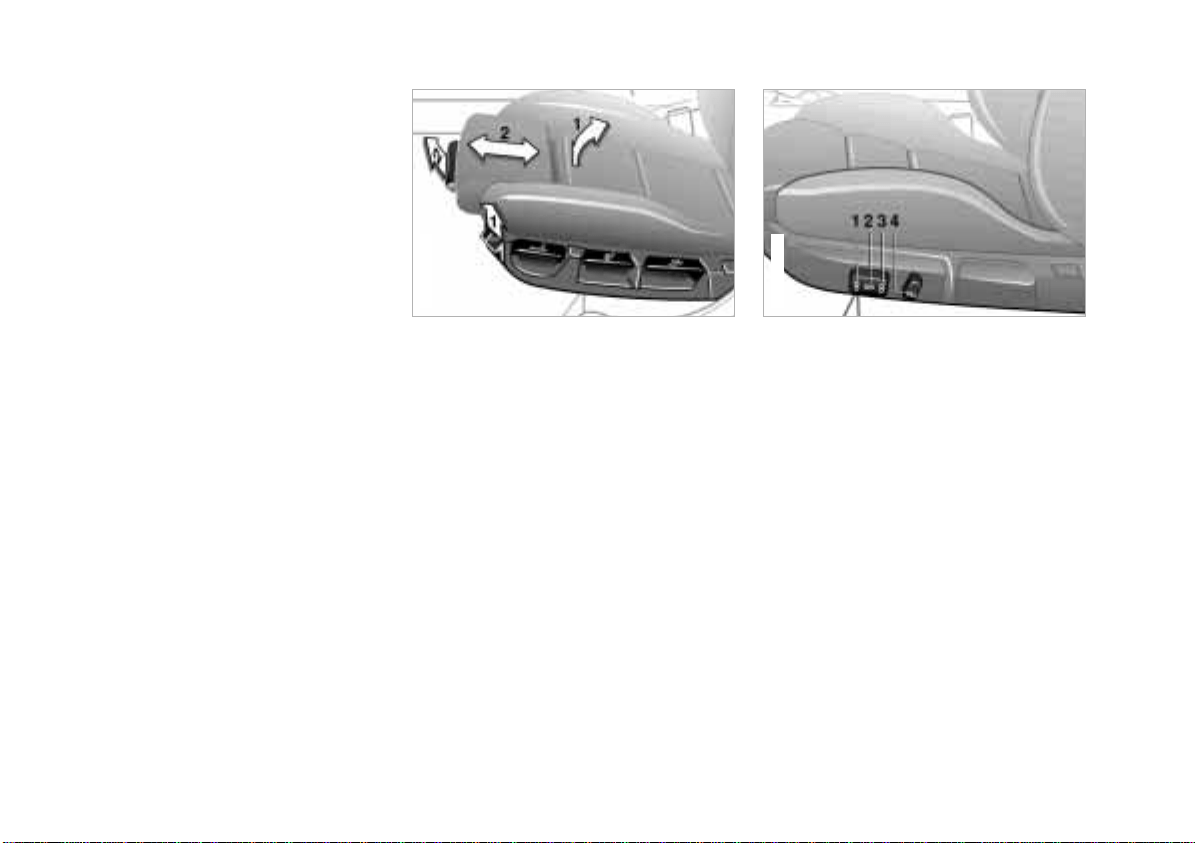
BMW Sports Seat*
Additional adjustments for seat tilt and
thigh support.
Angle adjustment
Pull lever 1 and move seat as required.
Thigh support adjustment
Pull lever 2 and slide front section of
seat into the desired position.
Electrical seat adjustment*
1 Angle adjustment
2 Longitudinal adjustment
3 Height adjustment
4 Backrest angle
The tilt angle of the head restraints -
and on the BMW Sports Seat also the
thigh support - is adjusted manually.
360de018
360de019
Seats
Online Edition for Part No. 01 41 9 790 377 - © 07/98 BMW AG
45
At a glanceControls Car careRepairsTechnicalDataIndex
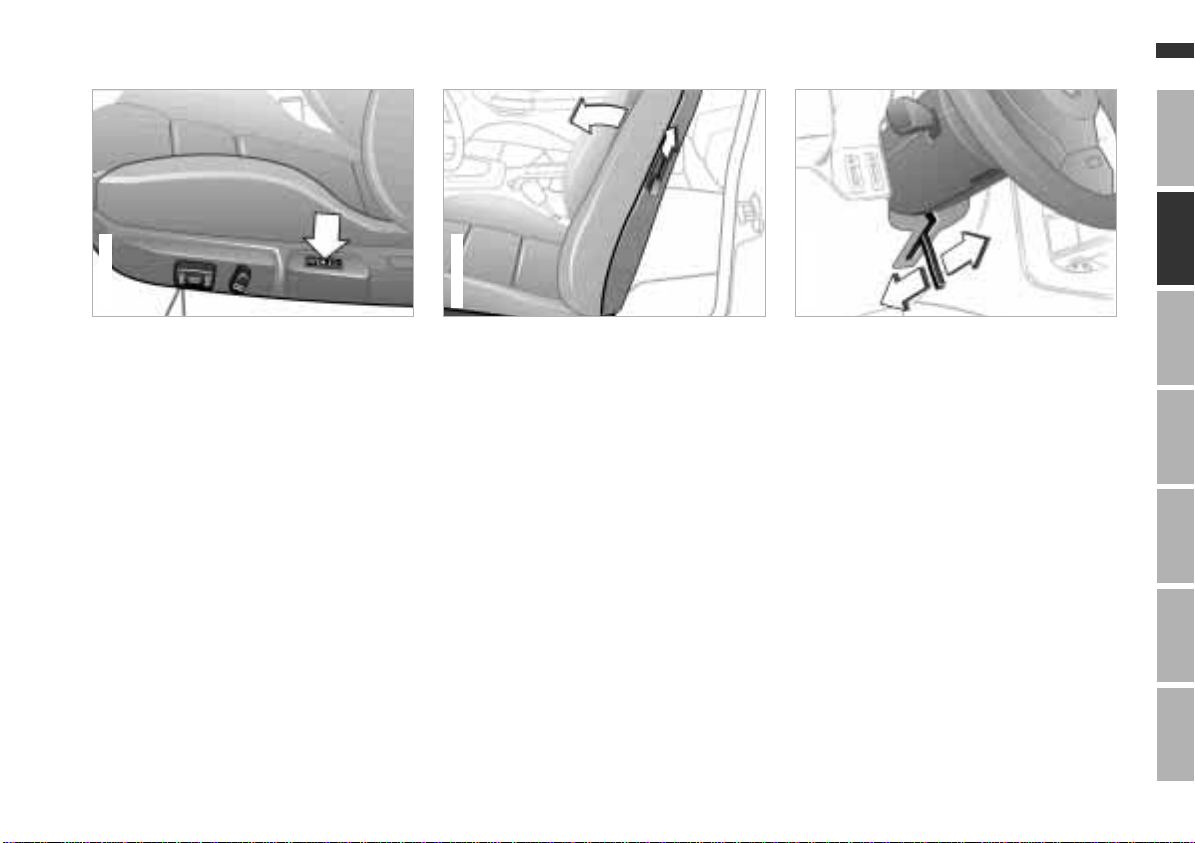
Lumbar support*
Adjust the curvature as desired with the
rocker switch.
You can adjust the backrest's contour
for additional support in the curvature
of your spine's lumbar region.
The upper hips and spinal column
receive supplementary support to help
you maintain a relaxed, upright posture.
Releasing backrest*
Pull up lever: the backrest can now be
folded forward.
The outer levers also serve as a storage
point for the seat belt (not on BMW
Convertible).
aThe front seat backrests must al-
ways be locked during driving.c
d Pull out clamping lever.
d Adjust steering wheel tilt for your
seating position.
d Push the lever back in to clamp the
steering wheel in the new position.
aNever adjust the steering wheel
while driving – accident danger.c
360de020
360de021
360de028
Seats Adjusting steering wheel*
Online Edition for Part No. 01 41 9 790 377 - © 07/98 BMW AG
46
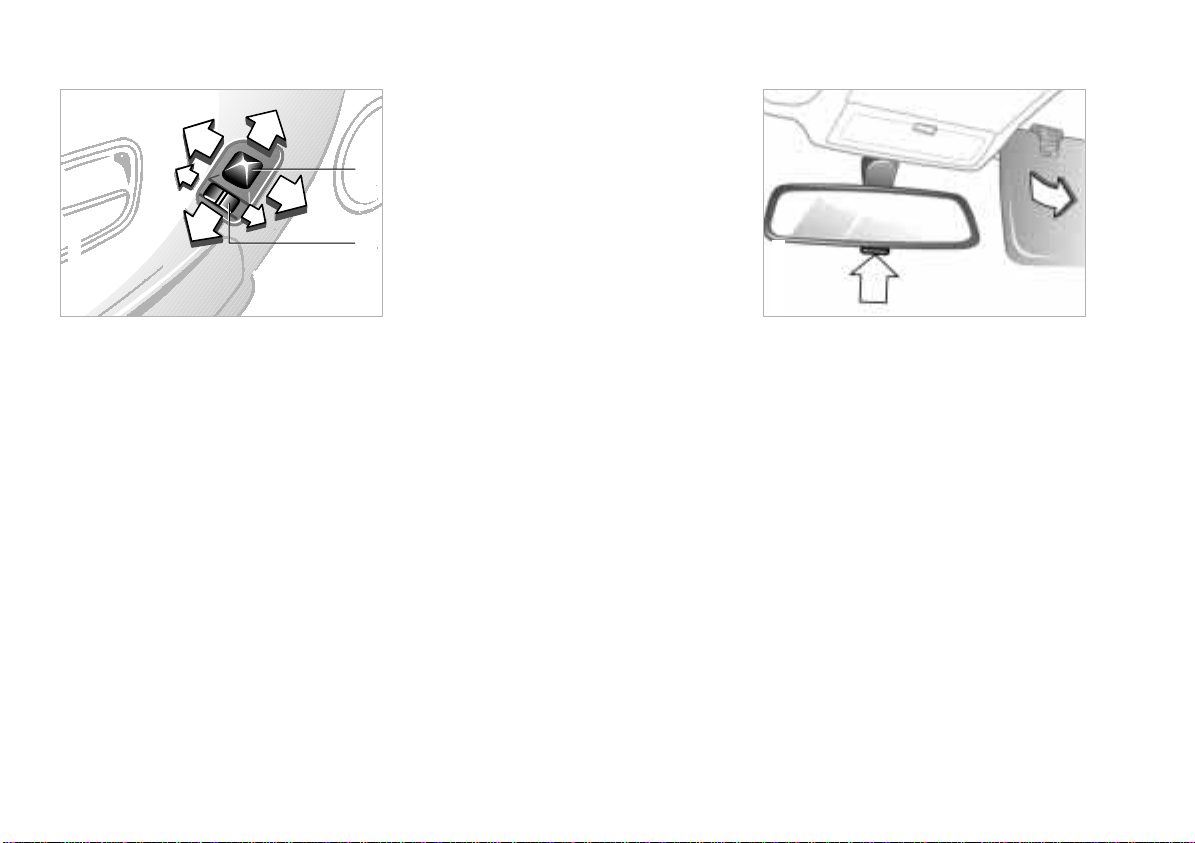
Exterior mirrors
1 Mirror switch for 4-way adjustment.
2 Switch for changing to the other
mirror:
d Push switch to left – driver's mirror.
d Push switch to right – passenger's
mirror.
You can also adjust the mirrors manu-
ally by pressing against the outer edges
of the lens.
aThe mirror on the passenger's side
features a lens with a more convex cur-
vature than the mirror installed on the
driver's door. When estimating the dis-
tance between yourself and other traffic,
bear in mind that the objects reflected in
the mirror are closer than they appear.
This means that estimations of the dis-
tance to following traffic should not be
regarded as precise.c
Electric heaters
Both mirrors are heated automatically
corresponding to the outside tempera-
ture with the ignition key in position 2.
Inside rearview mirror
To reduce glare from behind during
night driving: tilt small lever to dimmed
position.
Lighted make-up mirror
Fold down the sun visor, slide the cover
panel to the side.
The mirror lamps operate from ignition
key position 1 onward.
Sun visors
These can be folded down toward the
windshield or swiveled out against the
side windows.
1
2
360de304
360de030
Mirrors
Online Edition for Part No. 01 41 9 790 377 - © 07/98 BMW AG
47
At a glanceControls Car careRepairsTechnicalDataIndex
Always fasten your seat belt before
starting off.
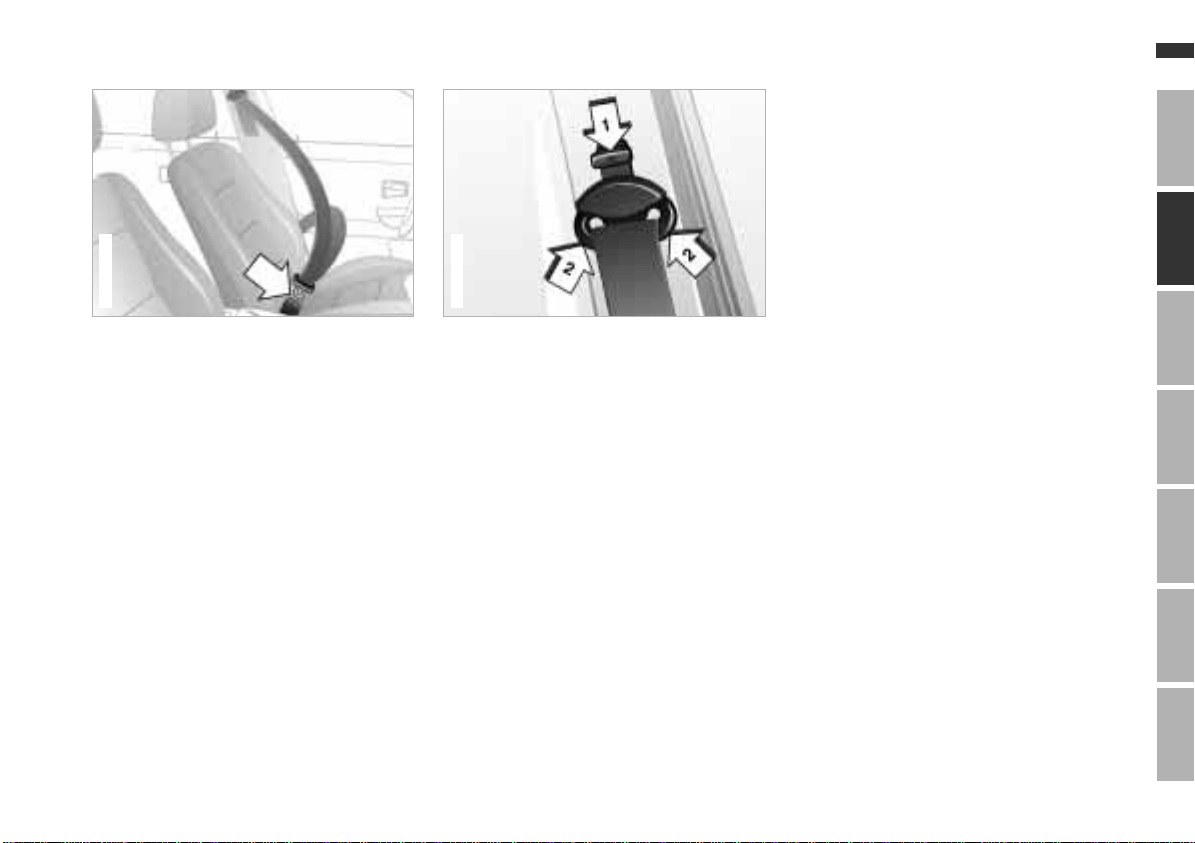
To fasten: make sure you hear the catch
engage in the belt buckle.
To release: press the red button in the
buckle, hold the belt and guide it back
into its reel.
The safety belt inertial mechanism
locks:
d in a sudden stop or crash
d when you pull it sharply
d during abrupt braking and
acceleration
d in curves
d when the vehicle is at an
extreme angle.
The safety belt can be adjusted individ-
ually to different body sizes with the
belt height adjustment:
Downward adjustment (1):
Push button downward.
Upward adjustment (2):
Grasp deflection fitting on ribbed side
sections and slide upward.
aFor your own safety, please ob-
serve the following when putting on the
safety belt, otherwise its protective
function may be impaired. Also ensure
that the other occupants follow these in-
structions.
Never allow more than one person to
wear a single safety belt. Never allow in-
fants or small children to ride in a pas-
senger's lap.
Avoid twisting the belt while routing it
firmly across the hips and shoulder. Do
not allow the belt to rest against hard or
fragile objects in your pockets. The
safety belt must not run across the
wearer's neck, nor should it be trapped
or abraded by coming into contact with
sharp edges or objects.
The belt should rest as firmly as possible
against your body You should avoid
wearing clothing that prevents it from
doing so. Pull the belt periodically to re-
tention it across your shoulder. In the
event of a frontal collision, a loose lap
belt could slide over your hips, leading
to abdominal injury. Due to the in-
creased distance between belt and
body, there would also be a delay before
restraint becomes effective.
360de032
360de033
Safety belts
Online Edition for Part No. 01 41 9 790 377 - © 07/98 BMW AG
48
Expectant mothers should always wear
their safety belts, taking care to position
the lap belt against the lower hips,
where it will not exert pressure against
the abdominal area.
Never attempt to modify the safety
belts.c
For care instructions refer to page 134.
Never install a rear-facing child restraint
system in the front passenger's seat!
Never attempt to modify either the
safety belts or any child restraint sys-
tem.
Should the safety belts be damaged or
stretched in an accident, the entire belt
system - including safety belt tension-
ers - must be replaced and the anchor-
ing mounts inspected at a BMW
Retailer.
If the safety belt tensioner has been
activated, a distance of roughly 0.8 in
(20 mm) will remain between the safety
belt lock and the tensioner module.
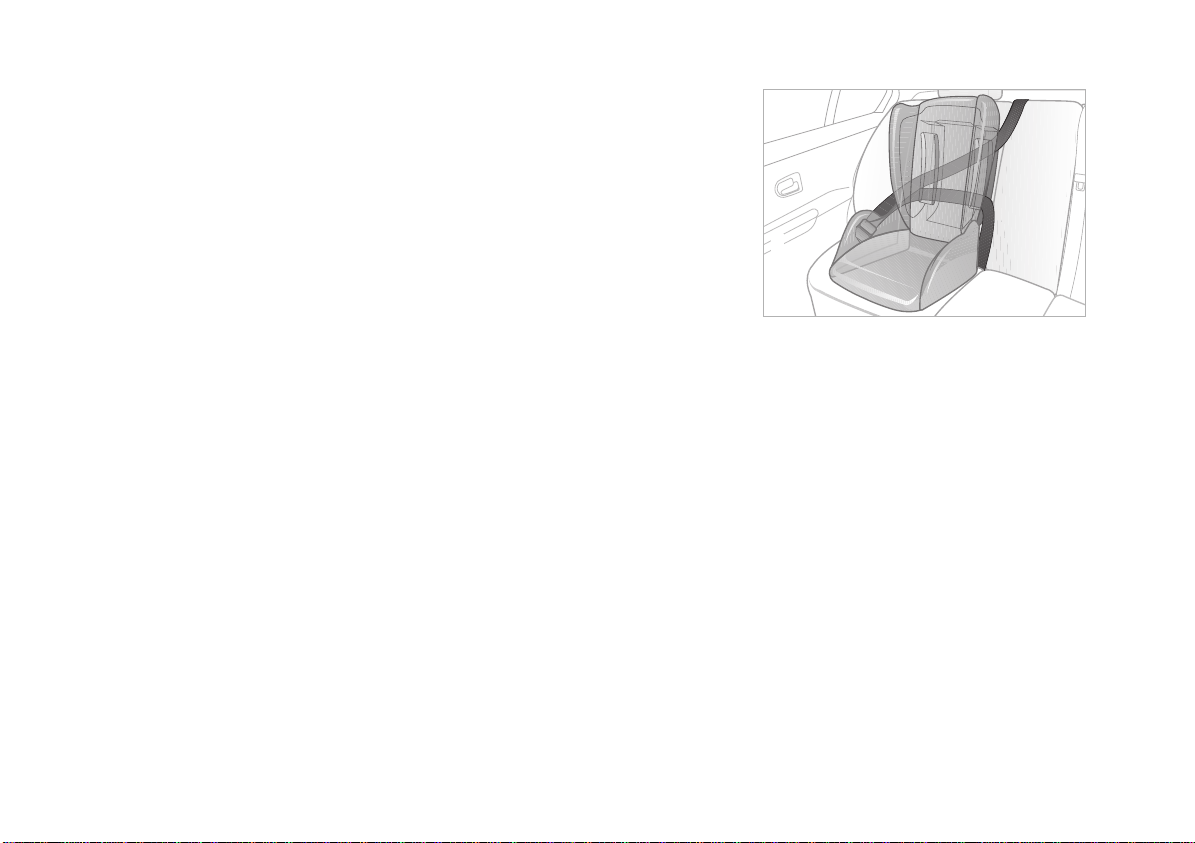
Installing child restraints
To install and secure child restraint sys-
tems, all rear safety belts (and the front
passenger's safety belt) are equipped
with a special locking mode.
A label with operating instructions is
attached to the belt next to the latch
plate.
To lock the belt
Extract the entire length of the belt from
the inertia reel mechanism. Allow the
reel to retract the belt somewhat and
engage the buckle, then tighten the belt
against the child restraint system. The
retraction mechanism is now locked.
Always observe the installation instruc-
tions provided by the manufacturer of
the child restraint system.
360us125
Safety belts Child restraint system
Online Edition for Part No. 01 41 9 790 377 - © 07/98 BMW AG
49
At a glanceControls Car careRepairsTechnicalDataIndex
To release the belt
Release the buckle, remove the child
restraint device and allow the inertia
reel to retract the belt completely.
bPlease also make this information
available to your passengers and urge
them to observe the instructions for
safety belt use.c
For care instructions refer to page 134.
All passengers, and especially children,
should use a restraint device when
riding in the car.
Infants or small children should never
be permitted to ride on a passenger's
lap.
Children should always sit in the rear
seat and use, depending on age, either
a child restraint system or the safety
belts installed in the vehicle. Accident
statistics have shown that children are
safer when properly restrained in the
rear seats than when riding in the front.
Infants and toddlers should be secured
with a child restraint system appropri-
ate for their size.
Children of six years and older should
wear safety belts.
Commercially available child seats
complying with legal standards are
designed to be secured using either a
lap belt or a combined lap-shoulder
belt. Because improperly installed
restraint systems can increase the risk
of injury to children, we strongly urge
you to carefully read and follow the
instructions supplied with the system.
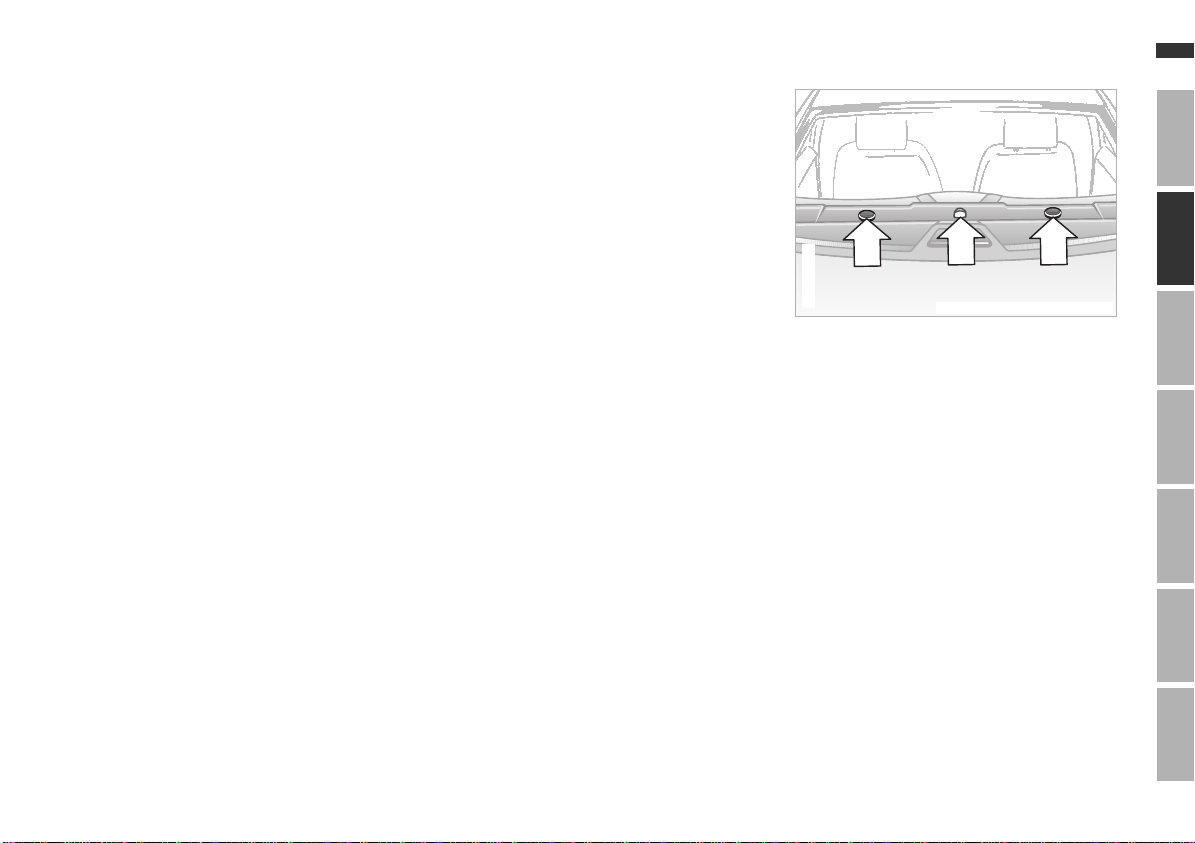
Should the child restraint system of your
choice require the use of a securing or
tether strap, note that three anchoring
points (arrows) have been provided for
mounting it in your vehicle.
Ask your BMW Retailer to perform the
necessary installation work.
360us126
BMW Sedan/Coupe
Child restraint system Installing child seats
Online Edition for Part No. 01 41 9 790 377 - © 07/98 BMW AG

50
aBefore install-
ing any child re-
straint device or
child seat, please
read the follow-
ing:
Never install a rearward-facing child
restraint system in the front passenger
seat of this car.
Your car is equipped with an airbag
supplemental restraint system for the
front passenger. Because the backrest
on any rear-facing child restraint sys-
tem (of the kind designed for infants
under 1 year and 20 lbs.) would be
within the airbag's deployment range,
you should never mount such a device
in the front passenger seat, as the
impact of the airbag against the child
restraint's backrest could lead to seri-
ous or fatal injuries.
If it is necessary for a child (not an
infant) to ride in the front seat, certain
precautions should be taken. First,
move the passenger seat as far away
from the dashboard as possible. This
important precaution is intended to
maximize the distance between the air-
bag and the child. Older children should
be tightly secured with the safety belt.
Younger children should be secured in
an appropriate forward-facing child
restraint system that has first been
properly secured with a safety belt.
We strongly urge you to carefully read
and observe the instructions for instal-
lation and use provided by the child re-
straint's manufacturer whenever you
use such a device.
Always ensure that all occupants (of
all ages) remain properly and securely
restrained at all times.c
All rear seating positions in your vehicle
meet the recommendations of SAE
J1819, an industry recommended prac-
tice for securing child restraint systems
in motor vehicles.
1 Front airbag system, consisting of
driver and passenger airbag
2 Side airbags
*
Protective effect
The front airbags provide additional
protection for the front-seat occupants
in the event of a severe frontal collision
in which the protection afforded by the
safety belts alone would no longer be
sufficient. The side airbags help protect
the front seat occupants in a severe
side impact.
360de305
Installing child seats Airbags
Online Edition for Part No. 01 41 9 790 377 - © 07/98 BMW AG
51
At a glanceControls Car careRepairsTechnicalDataIndex
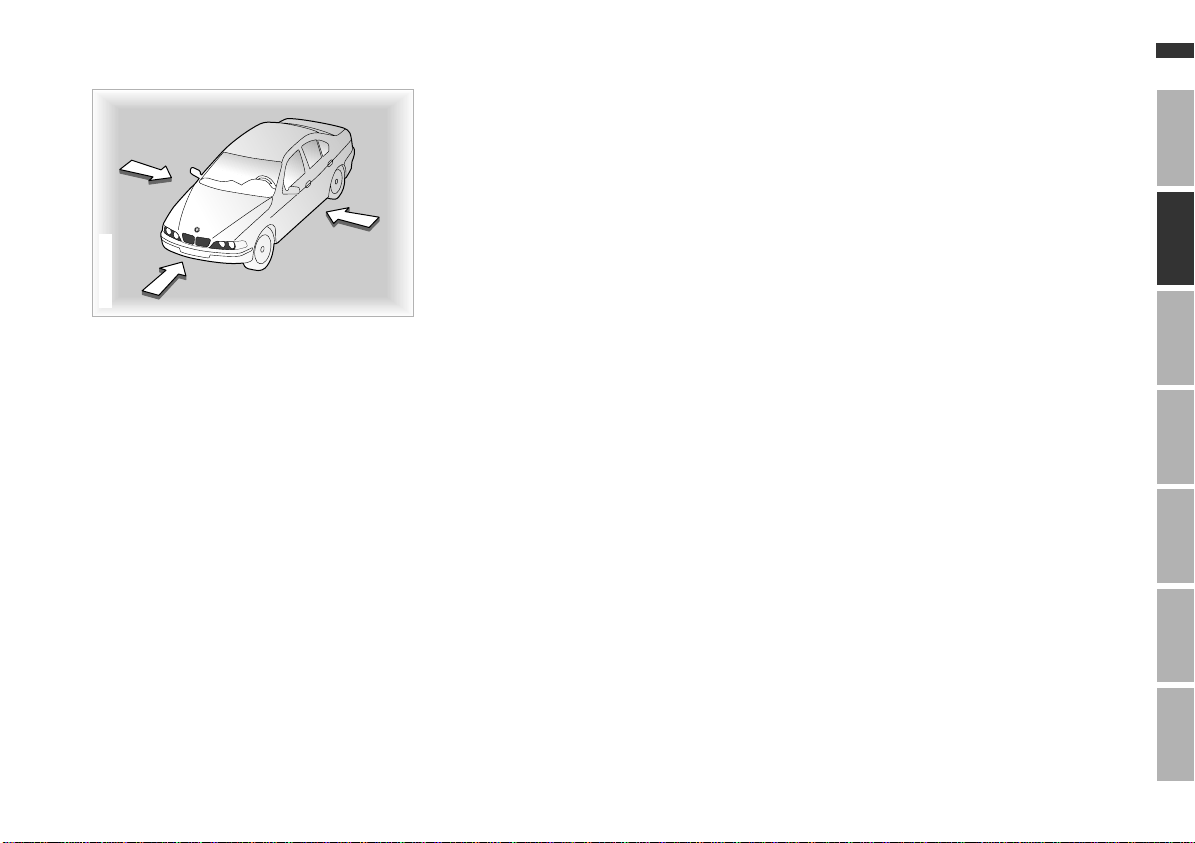
The airbags are triggered by impacts
coming from the directions shown in
the illustration. Note that the supple-
mentary protection against lateral
impact is available only on vehicles
equipped with optional door-mounted
airbags.
Indicator lamp in instrument
cluster
System operational:
d The indicator lamp comes on briefly.
System malfunction:
d The indicator lamp fails to come on.
d Indicator lamp lights up for approx.
4 seconds, goes out briefly and then
lights up again.
A system malfunction could prevent the
system from responding to an impact
occurring within its normal response
range.
Please have your authorized BMW
Retailer inspect and repair the system
as soon as possible.
aFor your own safety, please ob-
serve the following precautions con-
cerning airbags, as otherwise their
protective function may be impaired. We
also request that you make this informa-
tion available to your passengers, and
that you urge them to observe the in-
structions for safety belt use: the air-
bags are a supplemental restraint
device designed to provide extra pro-
tection; they are not a substitute for
safety belts. Wear your safety belt at all
times. The system does not respond to
minor collisions, if the vehicle rolls over,
or if the impact is at the rear of the vehi-
cle. In this situation, only the safety belt
protects you.
When adjusting your seat, select a posi-
tion that provides maximum distance
between you and the steering wheel, the
instrument panel and the door while still
allowing comfortable and safe access to
all vehicle controls.
Always grip the steering wheel on its
rim with your hands at the 9 and 3 o’clock
positions, otherwise hand and arm inju-
ries could occur when the airbag
inflates.
Never allow any objects to obstruct the
area between the airbag and the driver/
passenger.
Do not use the cover panel above the
passenger-side airbag as a storage
area.
Do not glue, cover or in any way alter
the padded covers on the steering
wheel, the instrument panel or the side
trim panels of the front doors.
Do not install a rear-facing child re-
straint device on the front passenger
seat. Children under 12 years of age
should only sit in the back.c
Even when all these guidelines are
observed, there is still a residual risk of
mild facial injuries occurring in isolated
instances of airbag actuation. The igni-
tion and inflation noise may induce a
mild temporary hearing loss in sensitive
individuals.
Airbag information is also located on
the sun visors.
p
The indicator lamp comes on from
ignition key position 1 to indicate
that the system is operational.
390de142
Airbags
Online Edition for Part No. 01 41 9 790 377 - © 07/98 BMW AG
52
Notes on safety
Never attempt to remove the gas gener-
ator for the airbag passenger-restraint
system from the vehicle. Testing and
service procedures are to be performed
exclusively by qualified technicians. In
the event of malfunction, deactivation
or triggering (in response to an acci-
dent), always entrust repair and service
operations to your authorized BMW
Retailer.
Do not modify or tamper with either the
wiring or the individual components in
the airbag system; these include also
the padded covers on the steering
wheel, on the instrument panel or on
the side trim panels of the front doors.
Never apply adhesive materials to these
components and never cover or modify
them in any way. Do not remove or dis-
mantle the steering wheel.
The airbag generator can be disposed
of only by a BMW Retailer.
Unprofessional attempts to service the
system could lead to failure in an emer-
gency or undesired airbag activation,
either of which could result in personal
injury.
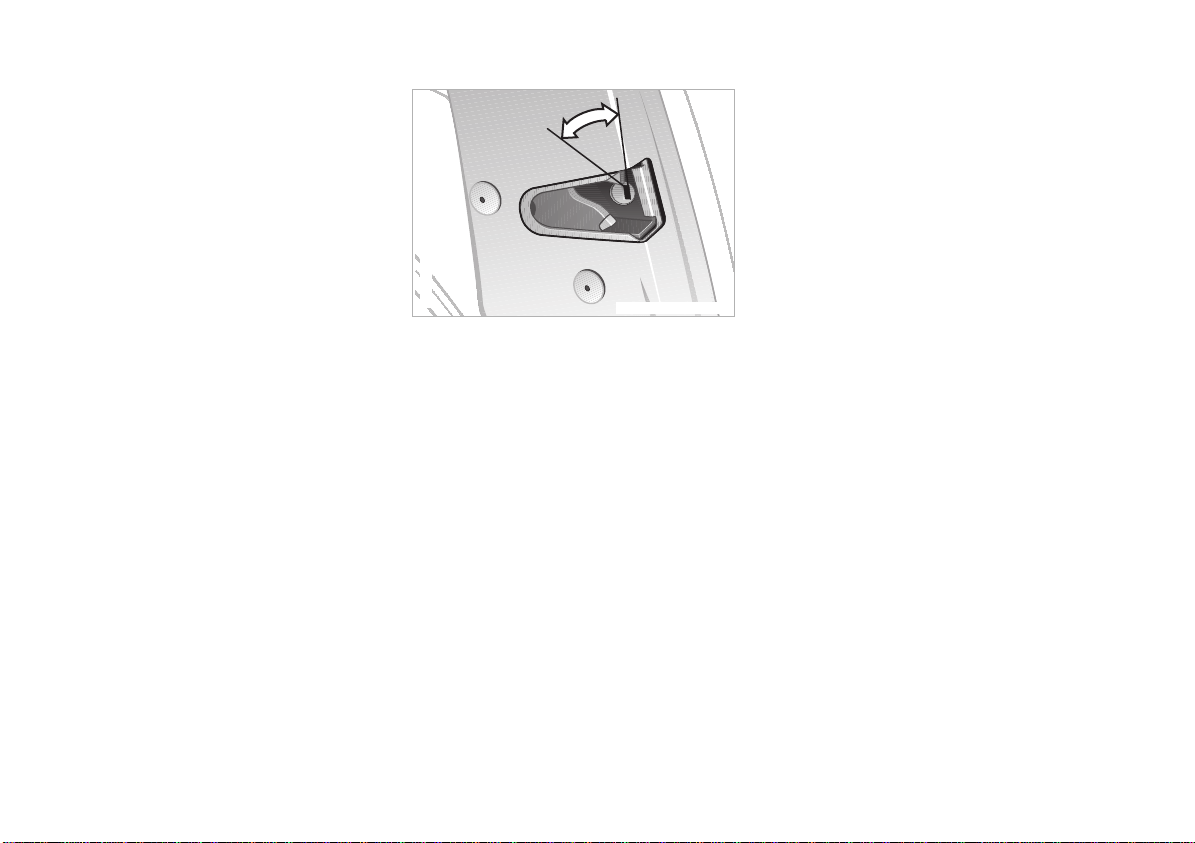
Insert the key in the slot in one of the
rear door latch mechanisms and turn
toward the outside: the door can now
be opened from the outside only.
The rollover protection system is acti-
vated automatically in the event of an
accident or in a critical driving situation
(extreme tilting in the longitudinal or lat-
eral axis, loss of ground contact). The
protective bars located behind the rear
head restraints extend within a fraction
of a second.
In addition to the roll bar integrated in
the windshield frame, the rollover pro-
tection system helps provide all vehicle
occupants, and in particular the rear
passengers, with needed headroom.
bWhen the hardtop* is on, it is
advisable to use "soft" protective cov-
ers, in order to prevent damage to the
luggage compartment lid when the sys-
tem is activated. Please contact your
authorized BMW Retailer for additional
information.c
aAlways keep the space required by
the rollover protection system free of
obstacles.
In the case of minor, non-rollover acci-
dents, passengers are protected only by
the buckled safety belt and the belt ten-
sioner and, depending on the severity of
the accident, the airbag restraint sys-
tem.c
360de012
BMW Sedan
Airbags Child-safety locks Rollover protection system*
Online Edition for Part No. 01 41 9 790 377 - © 07/98 BMW AG
53
At a glanceControls Car careRepairsTechnicalDataIndex
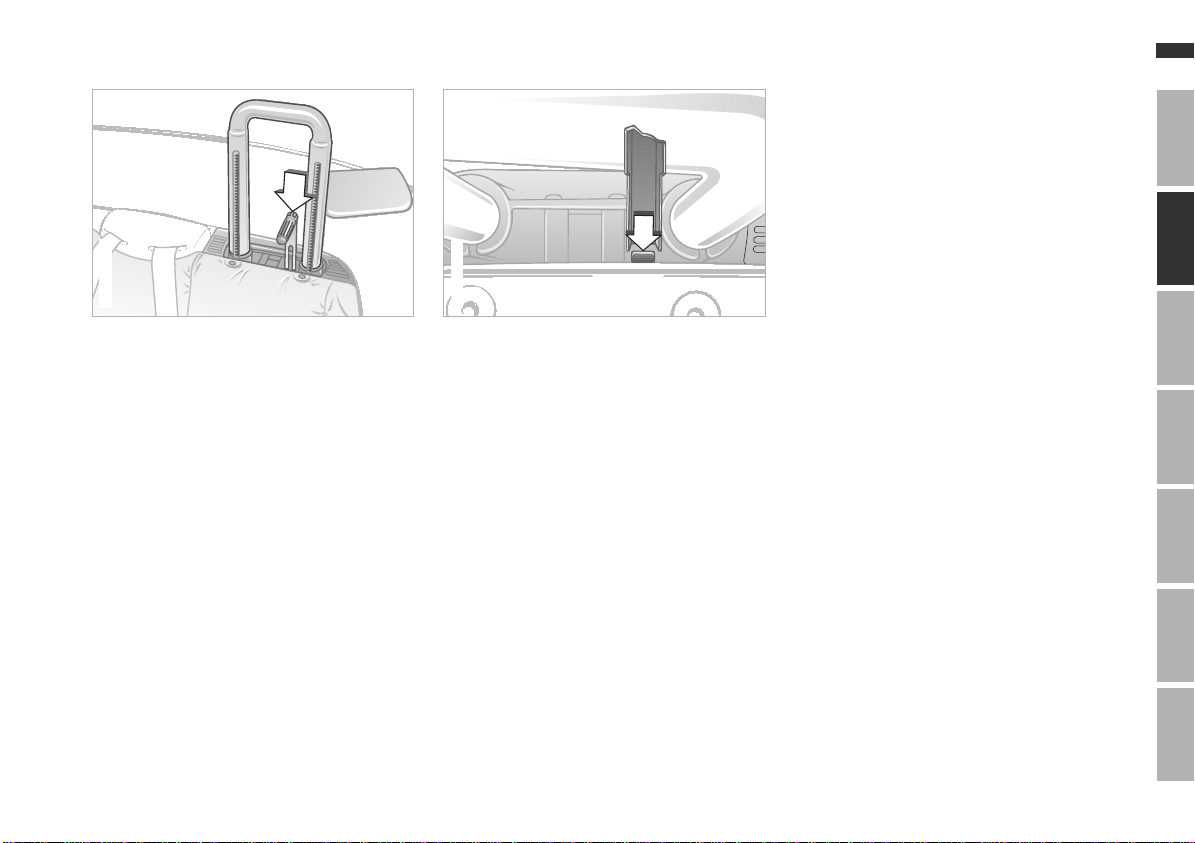
Following an unforeseen, automatic
extension, the rollover protection sys-
tem can be lowered again.
To do this, remove the screwdriver han-
dle and the special tool (stored on the
socket wrench) from the onboard tool
kit and push them together.
d Pull out the head restraint upward.
d Remove the protective cap upward
from the protective bar.
d Push the special tool into the guide
of the click-and-pawl mechanism as
far as possible (handle rests on the
backrest) and hold in place.
d Gently press down the protective bar
until the special tool is loose.
d Pull out the special tool and press
down the protective bar completely
until it audibly engages.
d Remount the protective cap on the
protective bar and push on firmly.
d Push in the head restraint again.
Follow the same procedure for the sec-
ond protective bar.
Have the rollover protection system
checked by a BMW Retailer.
aThe opened convertible top can not
be closed with the rollover protection
system extended.c
Notes on safety
No changes should be made to the indi-
vidual components of the rollover pro-
tection system or to its wiring.
All work on the rollover protection sys-
tem must be carried out by a BMW
Retailer.
Work carried out incorrectly may lead to
the failure or an accidental triggering of
the system.
To check the system and to ensure its
long-term operation, it is imperative that
you observe the maintenance intervals
of the Service Interval Display. The roll-
over protection system must be in-
spected every 2 years at the latest by a
BMW Retailer.
36cde016
36cde017
Rollover protection system* – Convertible
Online Edition for Part No. 01 41 9 790 377 - © 07/98 BMW AG
54
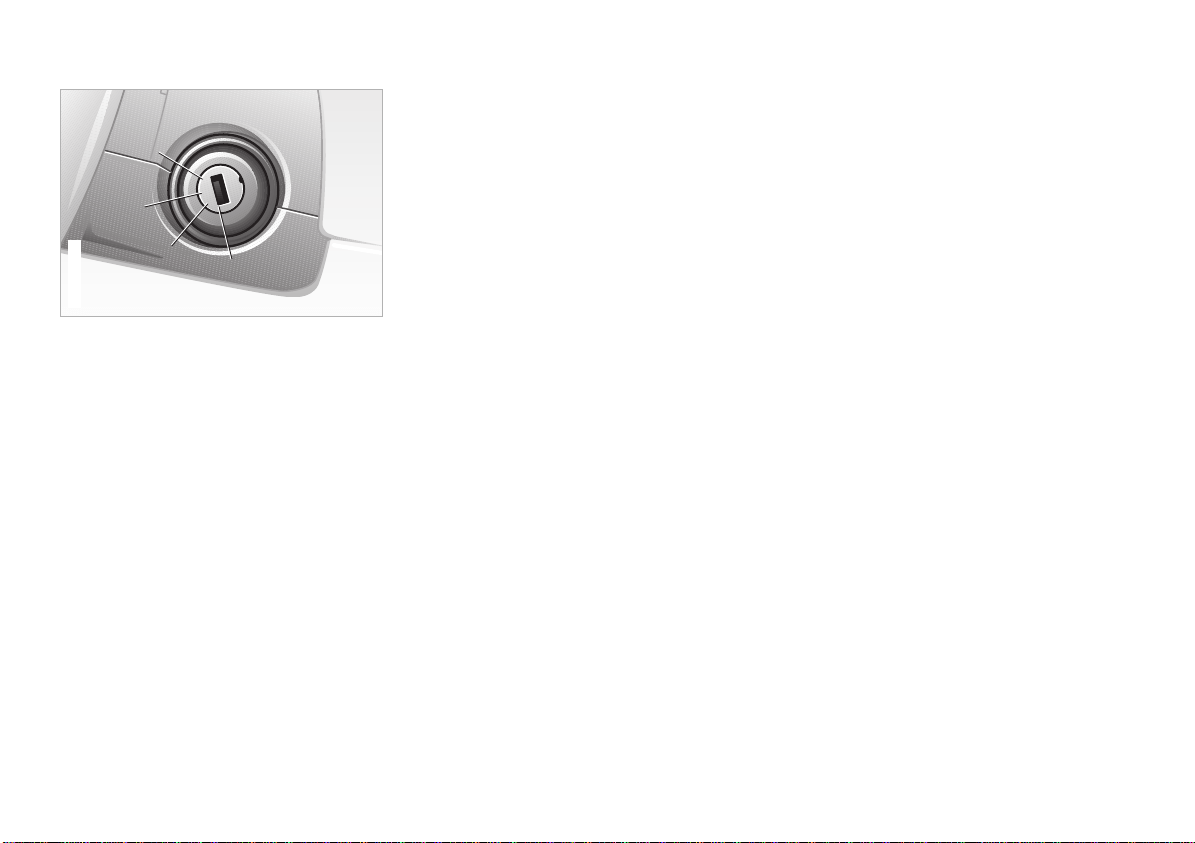
0 Steering lock engaged
The key can only be inserted and
removed in this position.
After extracting the key, turn the steer-
ing wheel a small amount to the left or
right until you hear the lock engage.
Your vehicle is equipped with an inter-
lock; this means that the ignition key
can not be turned into position 0 and
removed until the selector lever is in
position P.
Furthermore, the selector lever is locked
in position P when the ignition key is in
position 0 or removed from the ignition
switch.
To turn the key back into position 0 or
remove it, move the selector lever into
position P first.
1 Steering lock disengaged
You will often find that it is easier to turn
the ignition key from position 0 to 1 if you
move the steering wheel slightly to help
disengage the lock.
2 Ignition on
All electrical equipment and accesso-
ries are available for use.
3 Starter activation
bVehicles with manual transmis-
sion: depress the clutch pedal while
you turn on the ignition, otherwise a
blocking system will prevent the engine
from starting.c
Before starting
d Apply the parking brake.
d The manual-shift gear lever should
be in neutral; the automatic transmis-
sion selector lever should be in P
or N.
d At low temperatures keep the clutch
pedal depressed.
d Start the engine without depressing
the accelerator.
bDo not operate the starter too briefly,
but not longer than approx. 20 seconds.
Release the ignition key as soon as the
engine starts. Do not allow the engine to
warm up by leaving it running while the
vehicle remains stationary. Instead, drive
off immediately at a moderate engine
speed.c
Should the engine fail to start on the first
attempt, e.g., if it is very hot or cold:
d Stop and pause briefly before repeat-
ing the starting procedure. This pre-
vents the spark plugs from becoming
damp.
d Press the accelerator pedal halfway
down while engaging the starter.
1
2
0
3
360de009
Steering/ignition lock Starting the engine
Online Edition for Part No. 01 41 9 790 377 - © 07/98 BMW AG

55
At a glanceControls Car careRepairsTechnicalDataIndex
When starting a cold engine at extreme-
ly low temperatures (+55F/-156 or be-
low) or at high altitudes (above 3,300 ft./
1,000 meters), proceed as follows:
d At the first attempt, keep the starter
engaged for a bit longer (approx.
10 seconds).
d Press the accelerator pedal halfway
down while engaging the starter.
If you operate the vehicle for longer
periods of time at high altitudes and
very low temperatures, put into the
engine an oil with a viscosity of 5W–30
(refer to page 126). Please contact your
authorized BMW Retailer for additional
information.
aNever allow the engine to run with
the vehicle standing in an enclosed ar-
ea. The exhaust gases contain carbon
monoxide, an odorless and colorless,
but highly toxic gas. Breathing the ex-
haust gases poses an extreme health
risk, and can lead to unconsciousness
and death.
Never leave the vehicle unattended with
the engine running, as such a vehicle
represents a serious potential safety
hazard.c
Turn the ignition key to position 1 or 0.
aAlways remove the ignition key
and engage the steering lock before
leaving the vehicle.
Vehicles with manual transmission:
Always engage the parking brake when
parking on slopes and inclined surfaces,
since selecting 1st gear or reverse may
not provide adequate resistance to roll-
ing.
Vehicles with automatic transmission:
Place the selector lever in Park.c
Starting the engine Switching off the engine
Online Edition for Part No. 01 41 9 790 377 - © 07/98 BMW AG
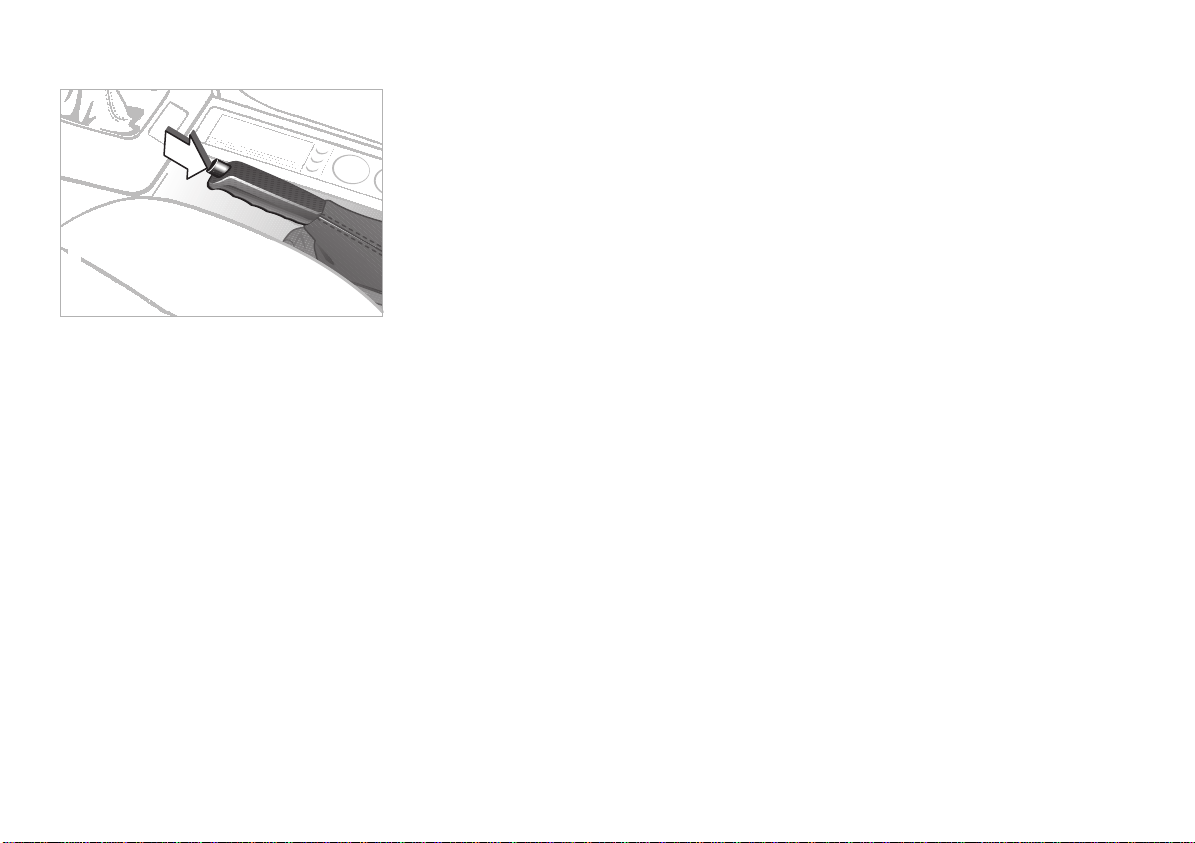
56
To engage
The lock engages automatically when
you lift the lever. The "P" indicator lamp
appears in the instrument cluster when
you turn the ignition key to position 2
(refer to page 21).
To release
Pull up on the lever, then press the
release button and lower the lever.
The parking brake is primarily designed
to prevent the vehicle from rolling while
parked, and acts on the rear wheels.
aShould exceptional circumstances
make it necessary to engage the brake
with the vehicle in motion, do not apply
excessive pressure. Keep your thumb
pressed against the release button while
carefully pulling up the lever to apply
moderate pressure.
Excessive pressure can lead to over-
braking and loss of traction (fishtailing)
at the rear.
The brake lamps do not come on when
the parking brake is engaged.
Vehicles with manual transmission:
Always engage the parking brake when
parking on slopes and inclined surfaces,
since selecting 1st gear or reverse may
not provide adequate resistance to
rolling.
Vehicles with automatic transmission:
Place the selector lever in "Park".c
To avoid corrosion, apply the parking
brake lightly from time to time when
coasting to a standstill, e.g., at a traffic
signal, provided that it is safe to do so.
360us303
Parking brake
Online Edition for Part No. 01 41 9 790 377 - © 07/98 BMW AG

57
At a glanceControls Car careRepairsTechnicalDataIndex
The shift lever's neutral plane (dot in the
illustration) is located between 3rd and
4th gears
Whenever you shift from any gear into
"Neutral", the shift lever will automati-
cally return to the specified gear plane.
Reverse
Select only with the vehicle stationary.
Press the shift lever to the left to over-
come the slight resistance.
Backup lamps
As you do this the backup lamps will
turn on automatically when the ignition
key is in position 2.
aDo not "ride" the clutch to hold the
vehicle in place on slopes; use the park-
ing brake instead. A slipping clutch in-
creases clutch wear.c
360de044
Manual transmission
Online Edition for Part No. 01 41 9 790 377 - © 07/98 BMW AG
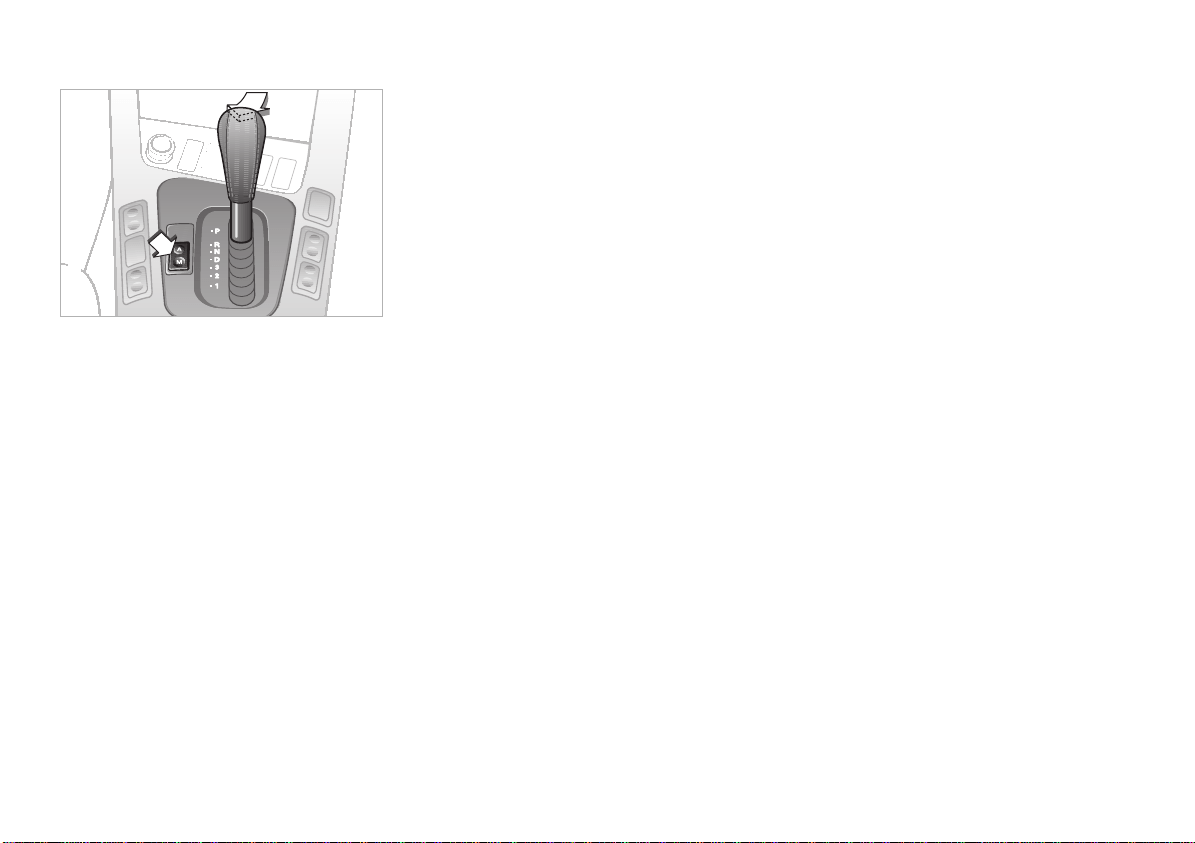
58
Selector lever positions
P R N D 3 2 1
Shift programs
Switch:
d A (Automatic)
d M (Manual)
Shift lever in position 3:
d Sport program
See next page for an explanation of the
programs.
Range selection
A lock prevents inadvertent shifts into
certain selector lever positions. To re-
lease the shift-lock mechanism, press
the button on the front side of the se-
lector handle (arrow).
The engine can only be started in selec-
tor lever position P or N.
bYou must step on the footbrake
with the vehicle stationary before the
selector lever will move out of P or N.
The footbrake must also be depressed
before selecting a drive position, since
the vehicle "creeps" in idle when a drive
position is engaged.
At engine speeds of over 2500 rpm
a lock also prevents shifting out of P
or N.c
However, it is possible to "rock" the car
free by shifting rapidly between D and
R, e.g., should you get stuck in deep
snow or sand.
aPlace the selector lever in position
P or N and firmly engage the parking
brake before leaving the vehicle with the
engine running, otherwise the vehicle
could roll. Never leave the vehicle unat-
tended with the engine running, since
such a vehicle represents a serious po-
tential safety hazard.
If you should accidentally select Neutral
while traveling at high speed, remove
your foot from the accelerator pedal im-
mediately. Wait until the engine is at idle
speed; only then should you select a
gear, otherwise the transmission could
be damaged.c
P - Park
Select only with the vehicle stationary.
Transmission locks to prevent rear
wheels from turning.
R - Reverse
Select only with the vehicle stationary.
N - Neutral
Select only if your journey is interrupted
for a longer period. Select while the car
is being driven only if the vehicle begins
to skid.
360us304
Automatic transmission*
Online Edition for Part No. 01 41 9 790 377 - © 07/98 BMW AG

59
At a glanceControls Car careRepairsTechnicalDataIndex
D - Drive (automatic shift program)
This position is designed for driving
under all normal operating conditions.
All forward gears are selected by the
transmission as necessary.
3 - Sport Program, direct control
This position is designed for perfor-
mance-oriented driving, and features
delayed upshifts for optimal utilization
of the vehicle's power reserves.
When D is engaged, the transmission
may respond to certain conditions by
repeatedly shifting between 3rd and 4th
gears. You can select this position to
suppress upshifts into 4th gear and pre-
vent the transmission from "hunting" in
this way.
2 and 1 - Mountain ascents and
engine braking
Select these positions to prevent un-
desired shifts on mountain roads or
extended uphill and downhill stretches.
These ranges let you use the engine's
braking effect to maximum advantage.
The transmission upshifts only as far as
the selected gear (1st or 2nd).
Do not move the selector lever to either
of these positions when traveling at
speeds of 108 mph (170 km/h) or
above. The transmission downshifts
only at correspondingly low speeds.
"Kickdown" (automatic downshift)
To obtain maximum acceleration, the
accelerator pedal can be depressed
beyond the normal to the full-throttle
position, at which a pressure point must
be overcome.
Shift programs
A - Automatic program
For economical driving. This is the initial
position each time the engine is started.
M - Manual program
This program is for driving conditions
under which the selected gear is to be
retained. The transmission then remains
in this gear both when starting off and
during acceleration. With this program
you drive only in 3rd gear in position D.
It is advantageous, e.g., on slopes or
when towing a trailer, to drive in selec-
tor lever position 1 or 2, or in winter on
slippery roads in selector lever position
3, which enables gentle starts and pre-
vents undesirable shifting.
Automatic transmission*
Online Edition for Part No. 01 41 9 790 377 - © 07/98 BMW AG
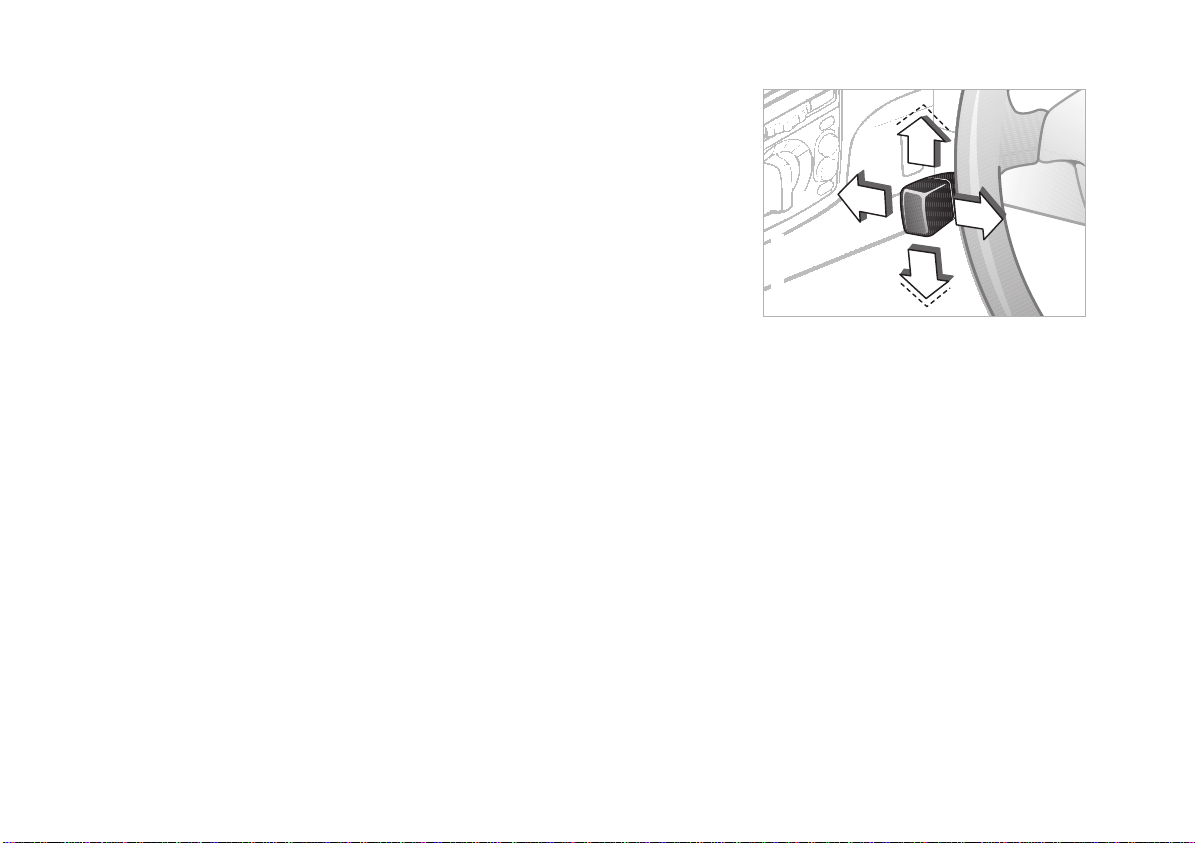
60
Indicator lamp for shift
electronics
d If the lamp fails to go out or
d if it lights up during driving, there is a
malfunction in the shifting electronics
or in the transmission.
Bring the vehicle to a stop, select trans-
mission position "P", set the parking
brake and turn the engine off (ignition
key to position 0).
Wait a few seconds, then start the
engine.
If the indicator lamp goes out after a
few seconds, normal transmission per-
formance has been restored. Drive off
normally.
If the indicator lamp does not go out, all
selector lever positions can still be
selected, however in the forward posi-
tions the vehicle has limited perfor-
mances as it drives only in the 3rd or
4th gear.
If this happens, avoid extreme engine
loads and consult the nearest autho-
rized BMW Retailer.
aNever carry out any work in the
engine compartment without first
ensuring that the transmission is in Park
or Neutral. Never leave children in the
vehicle unattended.c
For information on tow-starting, towing
and jump starting refer to pages 153
and 154.
1 High beam (blue indicator lamp)
2 Headlamp flasher
3 Turn signal indicator (green indicator
lamp and rhythmic ticking of the
blinker relay).
Flashing of the indicator lamp and tick-
ing faster than normal: a turn-indicator
lamp is defective.
To signal briefly
Press the lever up to but not beyond the
lock.
O
Goes out after the engine has
started.
1
2
3
3
360de039
Automatic transmission* Turn signals/high beam
Online Edition for Part No. 01 41 9 790 377 - © 07/98 BMW AG
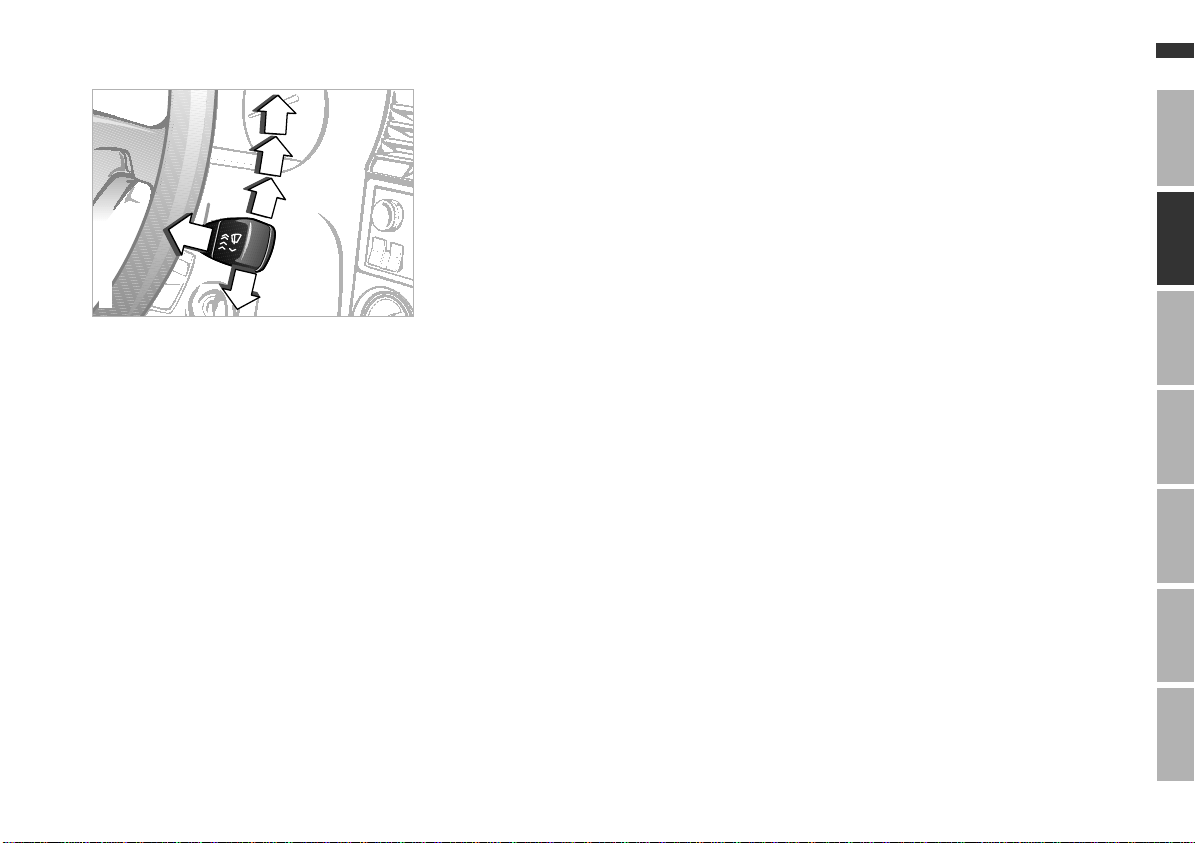
61
At a glanceControls Car careRepairsTechnicalDataIndex
0 Wipers retracted
1 Intermittent wipe
2 Normal wipe
3 Fast wipe
4 Brief wipe
5 Automatic windshield washer
1 Intermittent wipe
The length of the interval is varied auto-
matically according to the car's actual
road speed.
The headlamp cleaning equipment
* can
also influence this interval.
d Shift briefly out of 0 into 1, and back
to 0.
d The time lapse until the switching on
(out of 0 into 1) is the desired interval
(maximum 25 seconds).
Delete the programming:
d approx. 10 seconds after the lever is
in position 0 or
d after switching off the engine.
2 Normal wipe
The wipers automatically revert to inter-
mittent operation when the vehicle is
stationary.
5 Automatic windshield washers
The system sprays washer fluid against
the windshield and actuates the wipers
for a brief period.
(Exception: If you pull the lever briefly,
the system sprays fluid onto the wind-
shield without activating the wipers).
aDo not use the washers when there
is a danger of the fluid freezing on the
windshield, as otherwise your vision
could be obscured. Use antifreeze (refer
to page 124).
Do not use the washers when the reser-
voir is empty, otherwise damage to the
washer pump could result.c
Windshield washer jets*
The windshield washer jets are auto-
matically heated with the ignition key in
position 2.
1
2
3
4
0
5
360us305
Wiper/washer system
Online Edition for Part No. 01 41 9 790 377 - © 07/98 BMW AG
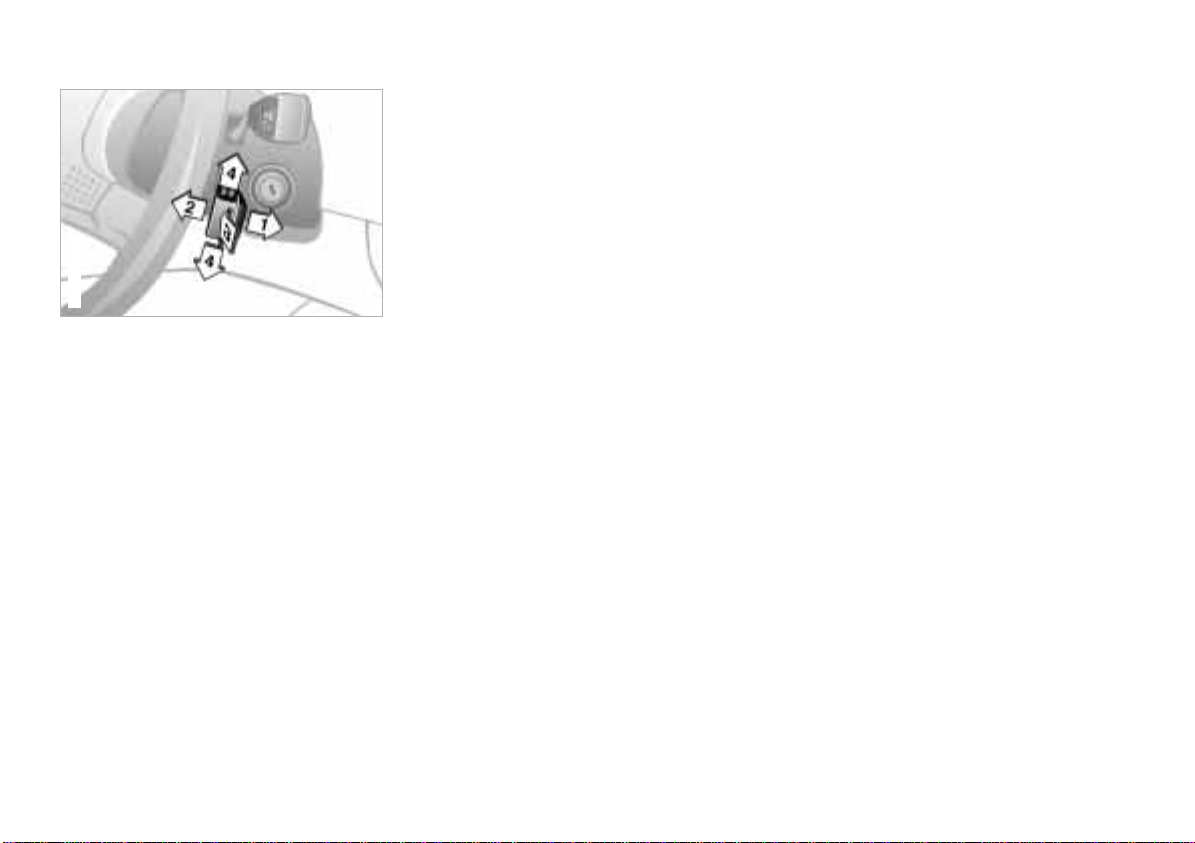
62
You can store and automatically main-
tain any desired vehicle speed above
approx. 25 mph (40 km/h).
The stored speed is deleted when the
motor is switched off.
1 Accelerate
Tap the lever briefly:
The system records and maintains the
current vehicle speed. Every time you
tap the button the speed increases by
approx. 0.6 mph (1 km/h).
Hold the lever in this position:
The vehicle accelerates without pres-
sure on the accelerator pedal. As soon
as you release the lever, the system
records and maintains the current
speed.
2 Decelerate
Hold the lever in this position:
With the cruise control active, the system
automatically reduces the throttle open-
ing to slow the vehicle. As soon as you
release the lever, the system records and
maintains the current speed.
Tap the lever briefly:
Each time you tap it you decelerate
approx. 0.6 mph (1 km/h) if you are
cruising at a controlled speed.
3 Resume
Tap the lever briefly:
The vehicle accelerates to and main-
tains the last speed stored.
4 Off
Tap the lever briefly:
Immediately deactivates the cruise con-
trol.
In addition, the system is also automati-
cally disabled in response to the follow-
ing conditions:
d When you apply pressure to the
brake or clutch pedal, and when you
move the automatic transmission
selector lever from Drive to Neutral,
d if you exceed the programmed speed
by more than 10 mph (16 km/h) for a
period of more than 30 seconds.
The system is switched off and the
stored speed deleted from its memory
when you turn the ignition key to posi-
tion 0.
aRefrain from using the cruise con-
trol on twisting roads, when high traffic
density prevents driving at a constant
speed and when driving on slippery
(snow, rain, ice) or loose (stones, sand)
road surfaces.c
bIf, on a downhill gradient, the
engine braking effect is not sufficient,
the controlled speed can be exceed-ed.
Speed can drop on uphill grades if the
engine output is insufficient.c
360de063
Cruise control*
Online Edition for Part No. 01 41 9 790 377 - © 07/98 BMW AG
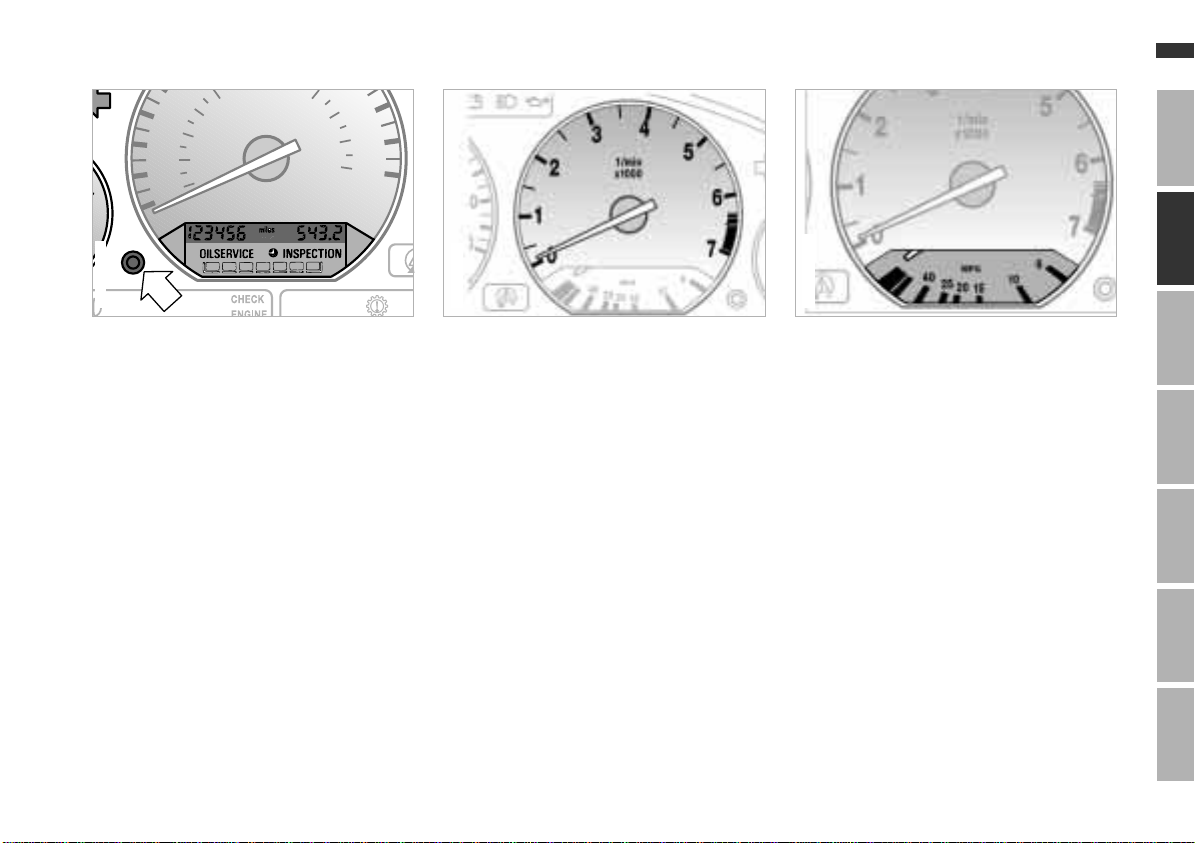
63
At a glanceControls Car careRepairsTechnicalDataIndex
Records the total vehicle mileage
(registers distance in kilometers on
Canadian vehicles).
Trip odometer
Records trip distances up to 999.9 miles
(kilometers).
To reset to zero
Press button.
The displays appear from ignition key
position 1.
To display with ignition switched off:
Press the reset button (arrow).
Never allow the engine to operate with
the needle in the red overspeed sector
of the gauge.
In this range the fuel supply is inter-
rupted to protect the engine, producing
the sensation of a loss of power.
Indicates the current fuel consumption
in mpg (in liters per 100 km on Cana-
dian vehicles).
When the vehicle is stationary, the nee-
dle returns to zero (maximum reading
on Canadian models).
20
40
120
140
km/h
240
220
200
180
160
140
120
100
80
60
40
20
MPH
F
360us320
360us030
360us031
Odometer Tachometer Energy control*
Online Edition for Part No. 01 41 9 790 377 - © 07/98 BMW AG
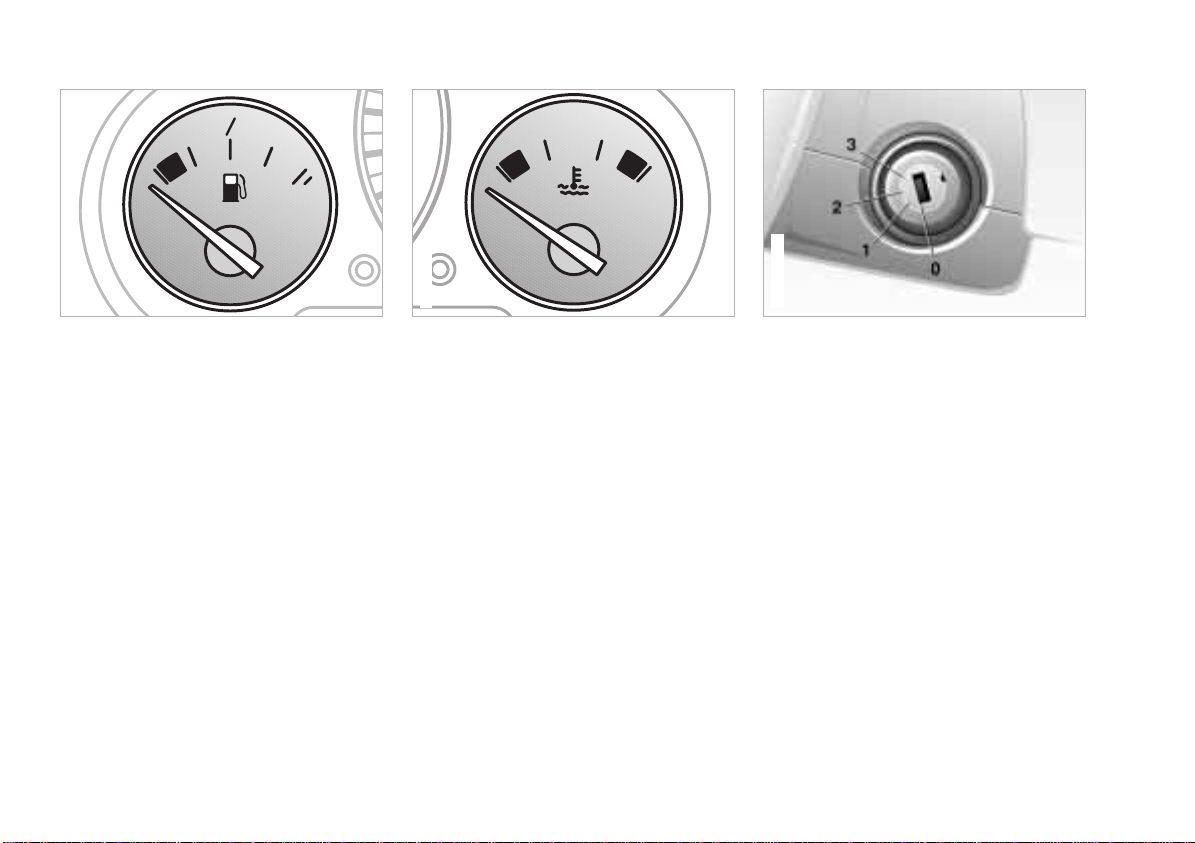
64
When you switch on the ignition, the
indicator lamp comes on briefly to indi-
cate that the system is operational.
If the indicator lamp comes on and
stays on, there are approx. 2.1 gallons
(8 liters) of fuel in the tank.
Tank volume: Page 166.
If the tilt of the vehicle varies, e.g.,
when you are driving in mountainous
areas, this may cause the needle to
fluctuate slightly.
aPlease refuel early, as driving
to the last drop of fuel can result in
damage to the engine and/or catalytic
converter.c
Blue
The engine is still cold. Drive at moder-
ate engine and vehicle speeds.
Red
Indicator lamp comes on, the warning
"COOLANT TEMPERATURE" appears
in Check Control
*: engine overheated.
Switch off the engine immediately and
allow it to cool down.
Between the blue and red sectors
Normal operating range. It is not un-
usual for the needle to rise as far as the
edge of the red sector in response to
high outside temperatures or severe
operating conditions.
Checking coolant level: Page 127.
Green lamps
The number of illuminated lamps
decreases as the time for your next
maintenance visit approaches.
Yellow lamp
This field appears together with
OILSERVICE or INSPECTION.
Maintenance is due. Please contact
your BMW Retailer for an appointment.
Red lamp
Maintenance overdue.
F
R
1
2
UNLEADED GASOLINE
ONLY
360us032
360de007
360us009
Fuel gauge Coolant temperature Service Interval Display
Online Edition for Part No. 01 41 9 790 377 - © 07/98 BMW AG

65
At a glanceControls Car careRepairsTechnicalDataIndex
bHave your BMW Retailer carry out
the maintenance and repair. Your BMW
Retailer is always informed on the latest
maintenance work and repair tech-
niques and equipped with the required
special tools. In addition, the testing of
parts known from experience to be sub-
ject to wear is a permanent part of the
maintenance specifications.c
Service Interval Display
Online Edition for Part No. 01 41 9 790 377 - © 07/98 BMW AG
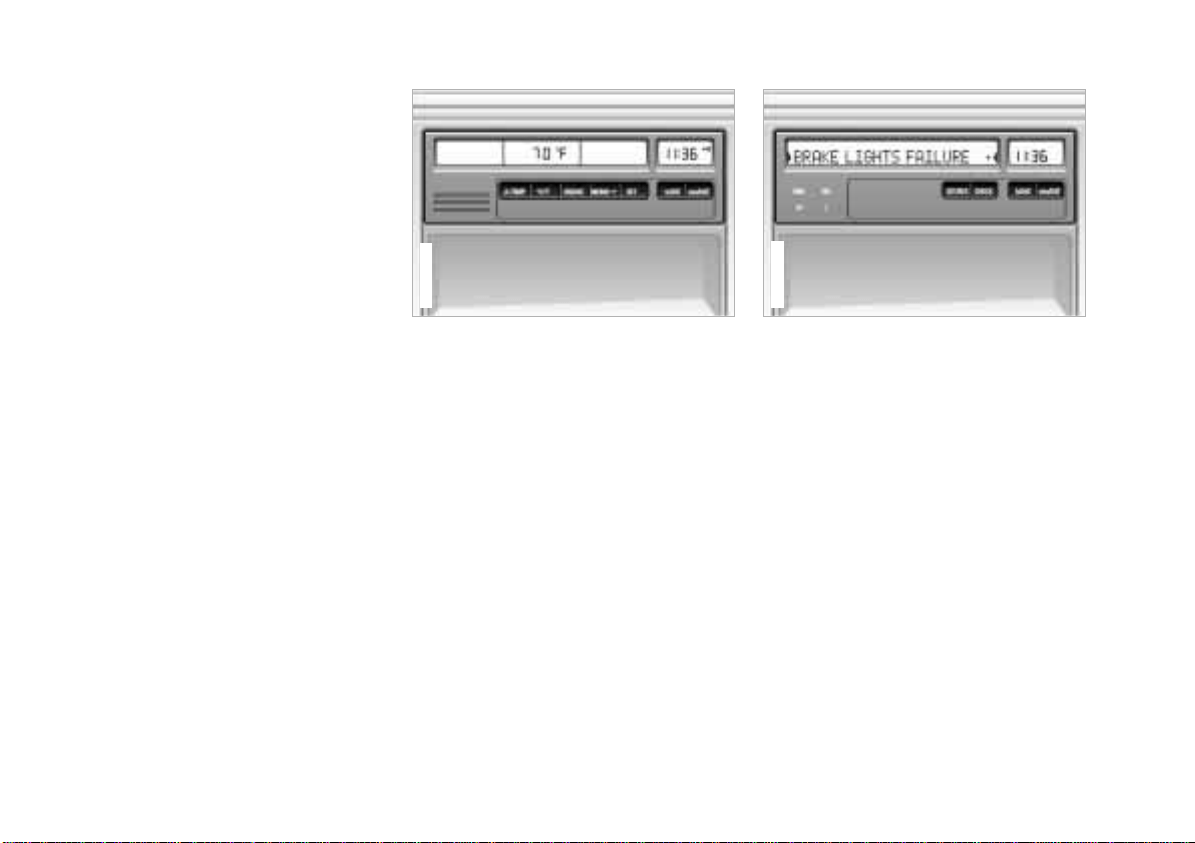
66
With the different versions you can dis-
play not only the time and the date, but
also information e.g., on economical
driving and warnings on defective sys-
tems.
The following applies to all versions:
The unit will reject implausible entries.
When entering numerical values with
the number entry keys, the numerical
value is increased by one each time the
key is pressed and after each additional
half second with the key held down.
Numbers can be entered in any order.
The entries are saved in the memory by
pressing the SET/RES or SET key.
Any interruption in the power supply,
e.g., when changing the battery, will
result in the loss of all data saved in the
memory. After the power supply is
restored, you will need to re-enter the
time, date and any switch-on times, the
distance or speed warning threshold.
Outside temperature display and
digital clock
For explanations and operating instruc-
tions, refer to page 68 ff.
Check Control
For explanations and operating instruc-
tions, refer to page 71 ff.
360us307
360us308
Multi-information display (MID)*
Online Edition for Part No. 01 41 9 790 377 - © 07/98 BMW AG
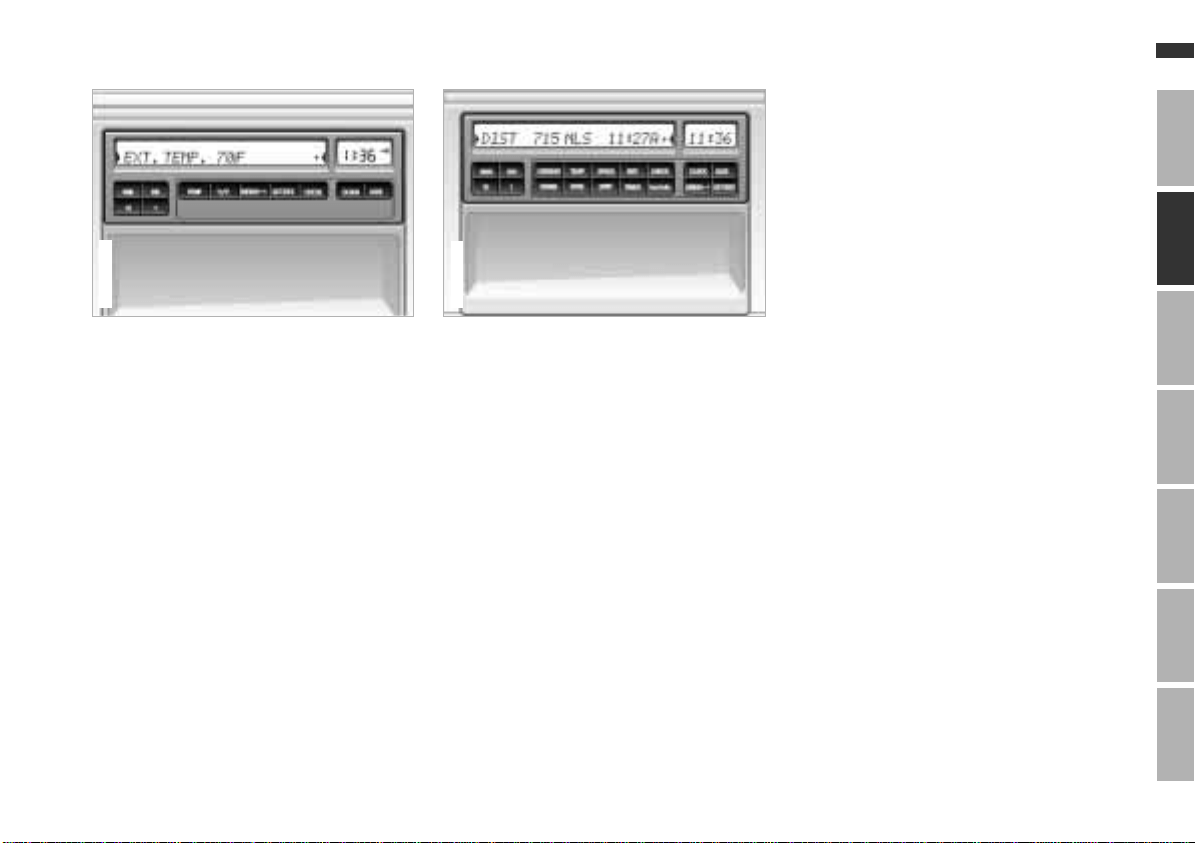
67
At a glanceControls Car careRepairsTechnicalDataIndex
Check Control with outside
temperature display and digital
clock
For explanations and operating instruc-
tions, refer to page 74 ff.
Onboard computer
For explanations and operating instruc-
tions, refer to page 77 ff.
360us309
360us310
Multi-information display (MID)*
Online Edition for Part No. 01 41 9 790 377 - © 07/98 BMW AG
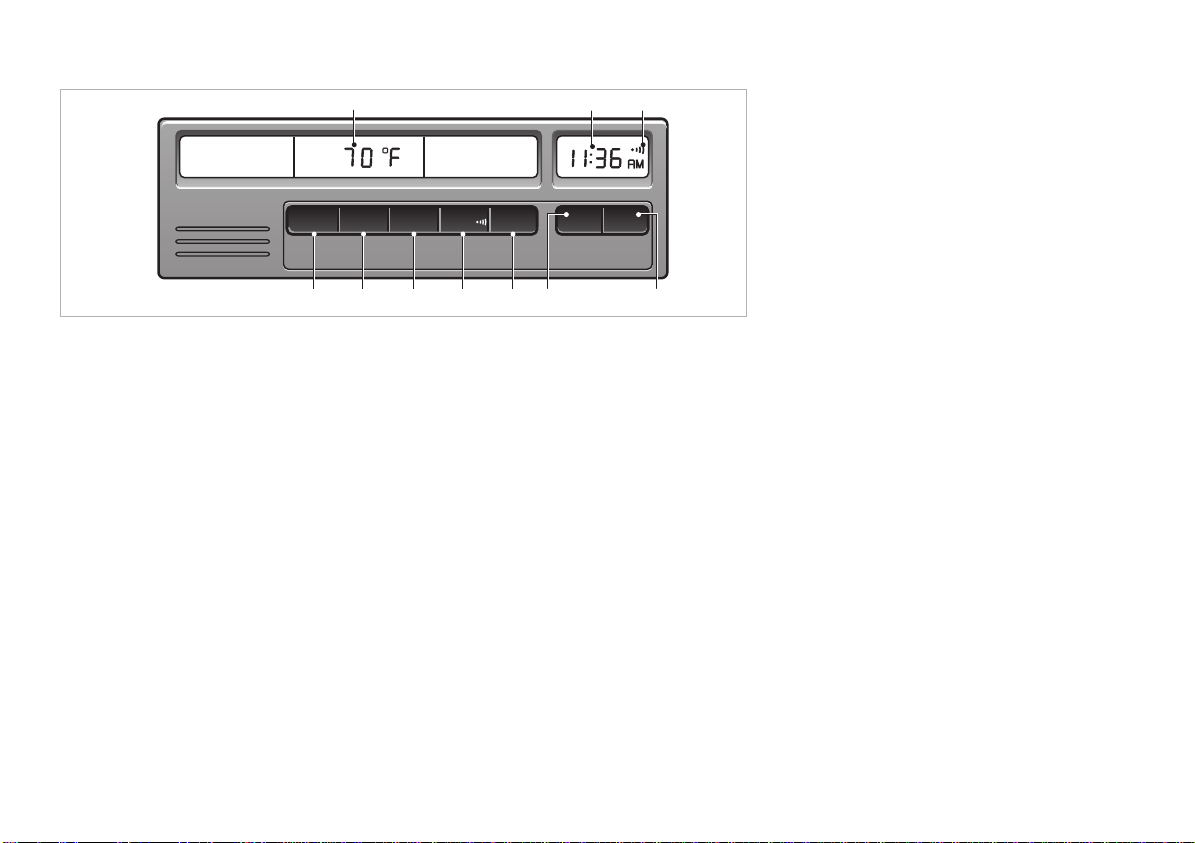
68
You can
d display the time and date
d pre-program an hourly reminder sig-
nal (memo) e.g., a reminder of the
news
d display the outside temperature.
1 Display for outside temperature
gauge
2 Display for time and date
3 Tone symbol for active memo
function
4 Entry key for minutes/date
5 Entry key for hours/date
6 SET key for starting
7 Function key - memo
8 Function key - time/date
9 Scale selection key
10 Function key - outside temperature
10
MEMO
9 8 7 6 5 4
32
1
HR/DAT
A-TEMP
°C/°F SET h/DAT min/DAT
360us109
Outside temperature display and digital clock*
To display time and date
d Press the function key (8).
When the ignition key is in position 0 or
removed, the displays appear for a few
seconds; in ignition key position 1 the
desired value is displayed indefinitely.
You can display the time in 12 or 24 hour
increments; the date can be shown in
European or US sequence. To change
setting:
d Press the HR/DAT key for approx.
3 seconds until the dots in the
display flash.
d Press the scale selection key.
In the 12-hour mode, AM or PM will
appear on the right side of the clock
display.
Online Edition for Part No. 01 41 9 790 377 - © 07/98 BMW AG
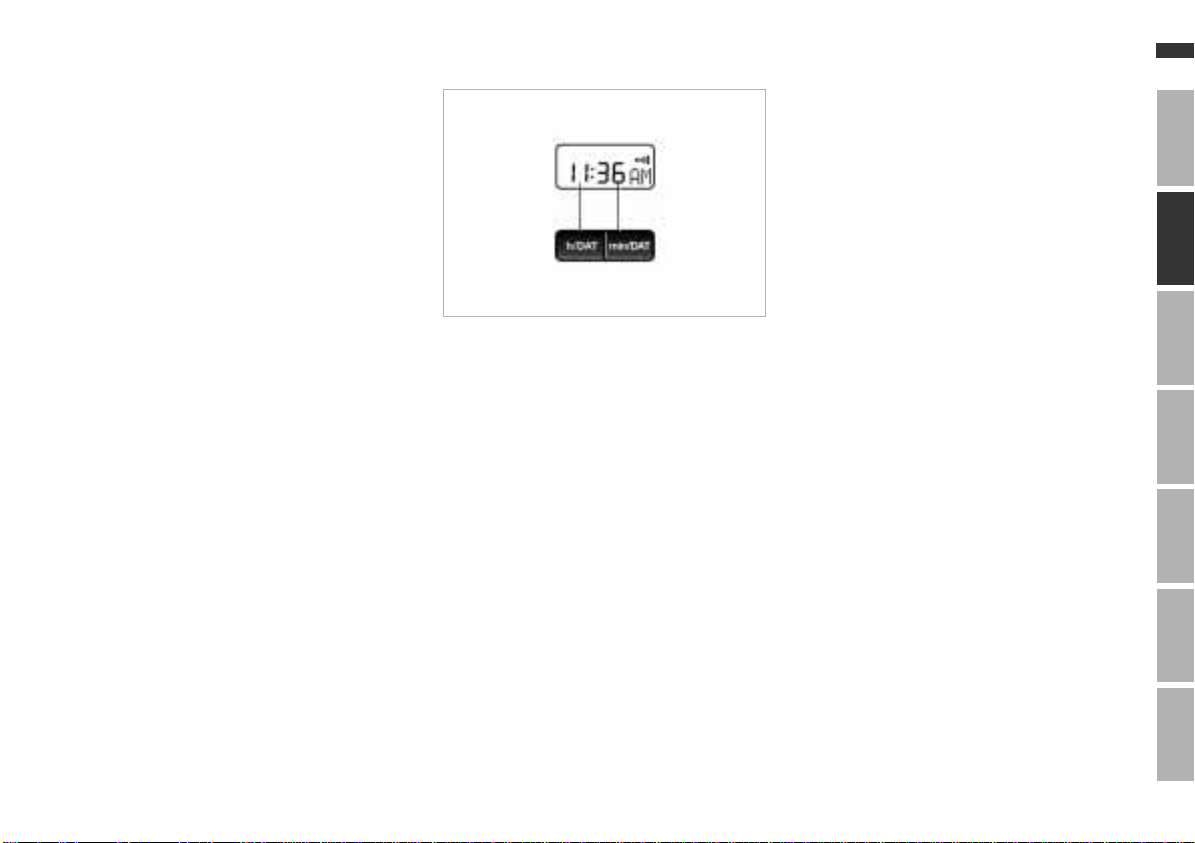
69
At a glanceControls Car careRepairsTechnicalDataIndex
Memo mode
Press the MEMO key to activate or
deactivate the signal. When MEMO is
active, a tone symbol appears in the
right display. The signal sounds every
hour at the pre-programmed time or
without programming 15 seconds
before each full hour.
Outside temperature
Data request: Press TEMP key.
If the outside temperature drops below
37.5 5F (+36), a warning signal sounds,
the temperature display automatically
appears and the unit of measure flashes
for 8 seconds.
The warning is repeated whenever the
temperature has increased to 43 5F
(+66) at least once before falling to
37.5 5F (+36) again.
aThe temperature warning device
does nothing to alter the fact that sur-
face ice can still form at temperatures
above 37.5 5F (+36), e.g., on bridges
and on shade-covered road surfaces.c
Entries
All numbers for the time and date are
entered with the entry keys according
to the following principle: The numbers
can be entered in any order. Each time
the key is pressed, or for each half sec-
ond the key is held down, the numerical
value increases by one.
Pressing the key longer starts the rapid-
advance function.
After a power failure
The dots in the display flash.
d Press the scale selection key as
required.
d Enter the time with the h/DAT and
min/DAT entry keys.
d Press SET. The clock starts.
d Press the HR/DAT key.
d Enter the date with the entry keys.
d Press SET.
d Confirm the year by pressing the SET
key or correct with the entry key and
complete the number entry by press-
ing the SET key.
360us321
Outside temperature display and digital clock*
Online Edition for Part No. 01 41 9 790 377 - © 07/98 BMW AG

70
To reset the time
Press the HR/DAT key in the clock
mode for approx. 3 seconds until the
dots in the display flash. Confirm your
entry by pressing the SET key.
To reset the date
Press the HR/DAT key in the date mode
for approx. 3 seconds until the dots in
the display flash. After entering the date
and year, confirm your entry by press-
ing the SET key.
Programming a reminder signal
Press the MEMO key for approx. 3 sec-
onds until two zeros appear in the min-
utes display. Complete the number
entry (min/Dat increase, h/Dat decrease)
by pressing the SET key.
360de144
h/DAT min/DATHR/DAT SET
360de144
h/DAT min/DATHR/DAT SET
360de144
h/DAT min/DATMEMO SET
Outside temperature display and digital clock*
Online Edition for Part No. 01 41 9 790 377 - © 07/98 BMW AG
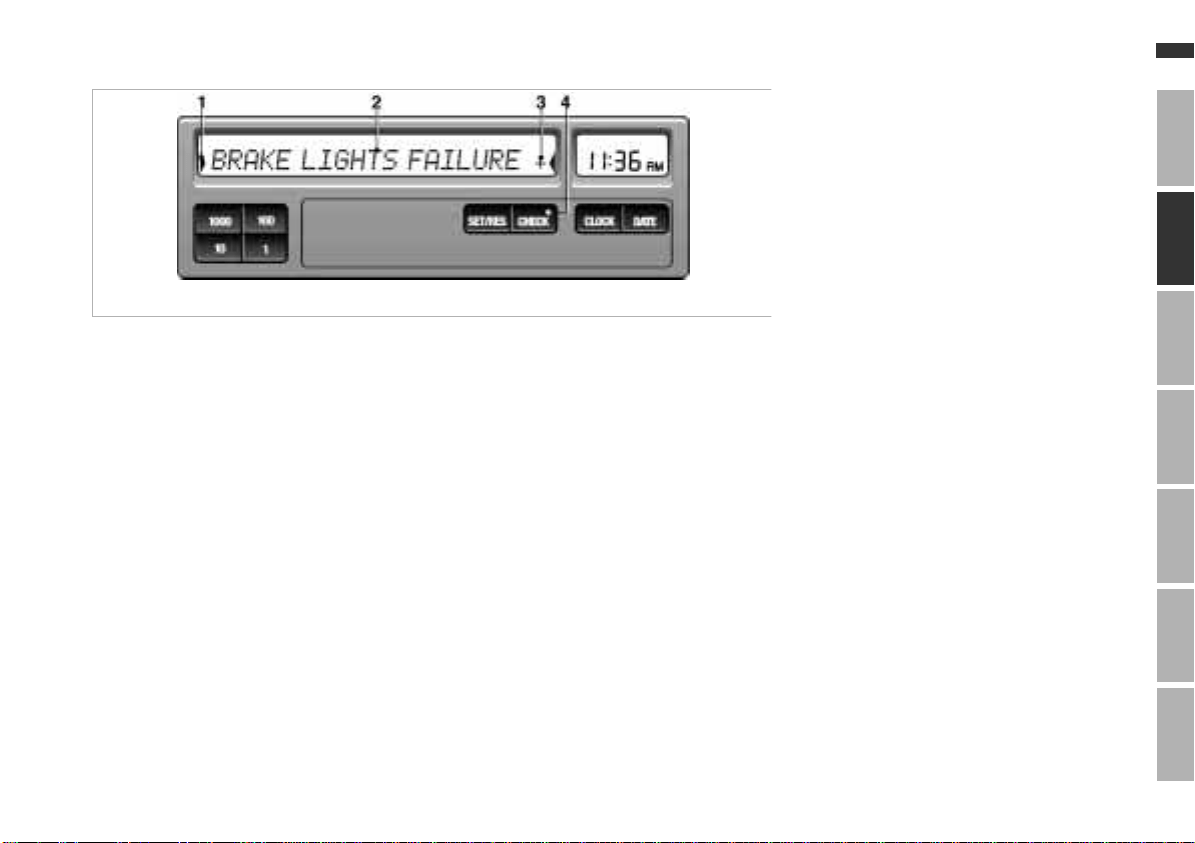
71
At a glanceControls Car careRepairsTechnicalDataIndex
Texts with messages and warnings are
used to alert the driver to defective sys-
tems. In addition, there is a warning
lamp in the instrument panel.
The time and date can be displayed
with the digital clock.
1 Status report symbol
2 Display
3 Plus symbol for additional messages
4 CHECK key
The defective-system messages are
divided into 3 different priorities:
Priority 1
These defects are indicated immedi-
ately with the flashing warning lamp and
the flashing warning symbol (1). Several
simultaneous defects are displayed
consecutively. After 20 seconds or
when the CHECK key is pressed, the
warning lamp in the instrument cluster
stops flashing.
The messages continue to be displayed
until the defects are eliminated and can
not be deleted by pressing the CHECK
key (4).
Brake lamp electrical system
The brake lamps have failed. Fuse or
electrical circuit is defective. Refer to
page 151 or consult your BMW Retailer.
360us110
Check Control*
Brake lamps defective
Brake lamps have failed - bulbs
defective.
Replace bulbs. Refer to page 143.
Priority 2
These defects appear when the ignition
key is in position 2. The warning sym-
bols remain after the message disap-
pears. If the plus symbol (3) appears:
Additional messages are present and
can be displayed by pressing the
CHECK key.
1 Brake lamp defective
A bulb has failed. Refer to page 143.
Low beams defective,
Backup lamps defective,
License plate lamp
Bulb has failed or fuse or electrical
circuit defective. Refer to pages 141,
143, 145 or visit a BMW Retailer.
Washer fluid low
Too low, top up at next opportunity.
Refer to page 124.
Check Control inactive
Messages and warnings can not be
displayed. See BMW Retailer.
Online Edition for Part No. 01 41 9 790 377 - © 07/98 BMW AG

72
Priority 3
These status reports usually appear
after the car is parked and the ignition
key returned to position 0 (if several
messages have been recorded, they will
appear consecutively, with Priority 3
messages following Priority 1 and 2
messages).
Messages remain available for a period
of approx. two minutes after the display
goes out and the ignition key has been
removed, and can be displayed by
pressing the CHECK key.
The messages can also be displayed
before you start driving with the ignition
key in position 2. The texts then go out
after a short time or when you start driv-
ing, and no warning symbols remain.
Messages are not displayed again until
the ignition key is turned to position 0.
If a plus symbol appears: display addi-
tional messages by pressing the CHECK
key.
Check coolant level
Indicates that coolant is almost down to
minimum level. Top up at the next
opportunity. Refer to page 127.
To check the Check Control display
(only when no messages are displayed):
Press the CHECK key with the ignition
key in position 2: CHECK CONTROL
OK appears in the display.
Entries
All numbers for the time and date are
entered with the entry keys according
to the following principle:
The numbers can be entered in any
order. Each time the key is pressed, or
for each half second the key is held
down, the numerical value increases by
one.
To display time and date
d Press the respective function key
(CLOCK/DATE).
When the ignition key is in position 0 or
removed, the displays appear for a few
seconds; in ignition key position 1 the
desired value is displayed indefinitely.
AM
360us322
1000 100 110
Check Control*
Online Edition for Part No. 01 41 9 790 377 - © 07/98 BMW AG
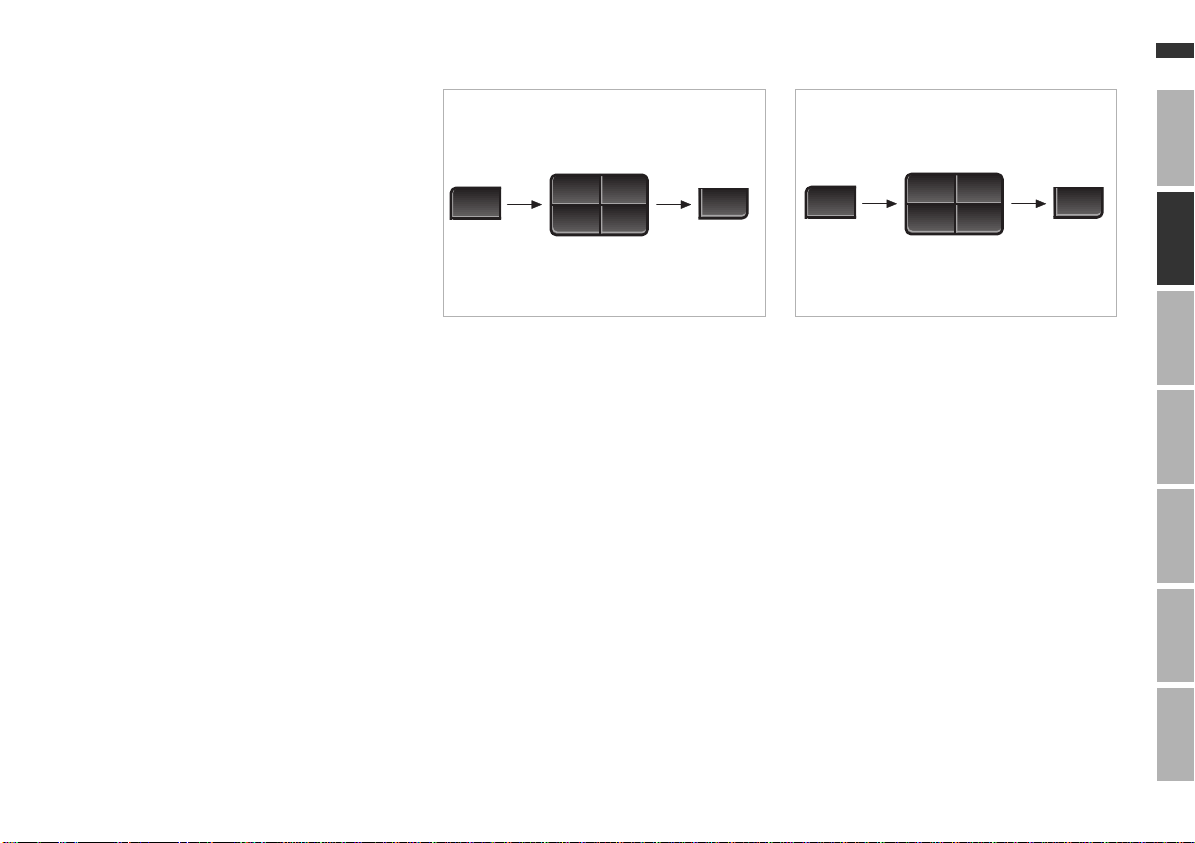
73
At a glanceControls Car careRepairsTechnicalDataIndex
After a power failure
The time display flashes and the follow-
ing appears in the left display: enter
time.
d Enter the time with the entry keys.
d Press the SET/RES key. The clock
starts.
The left display shows: enter date.
d Enter the date with the entry keys.
d Press the SET/RES key.
d Confirm the year by pressing the
SET/RES key or correct it with the
entry key and complete the number
entry by pressing the SET/RES key.
To reset the time
Press the CLOCK key until the left dis-
play indicates: Enter time. The dots
flash.
Complete the number entry by pressing
the SET/RES key.
To reset the date
Press the DATE key until the left display
indicates: Enter date. The dots flash.
Complete the number entry for the date
and year by pressing the SET/RES key.
If necessary, enter the year before
pressing the SET/RES key, as
requested in the display. Leap years are
programmed into the system and there-
fore need not be taken into account.
360de146
SET/RES
CLOCK
1000 100
1
10
360de146
SET/RES
DATE
1000 100
1
10
Check Control*
Online Edition for Part No. 01 41 9 790 377 - © 07/98 BMW AG
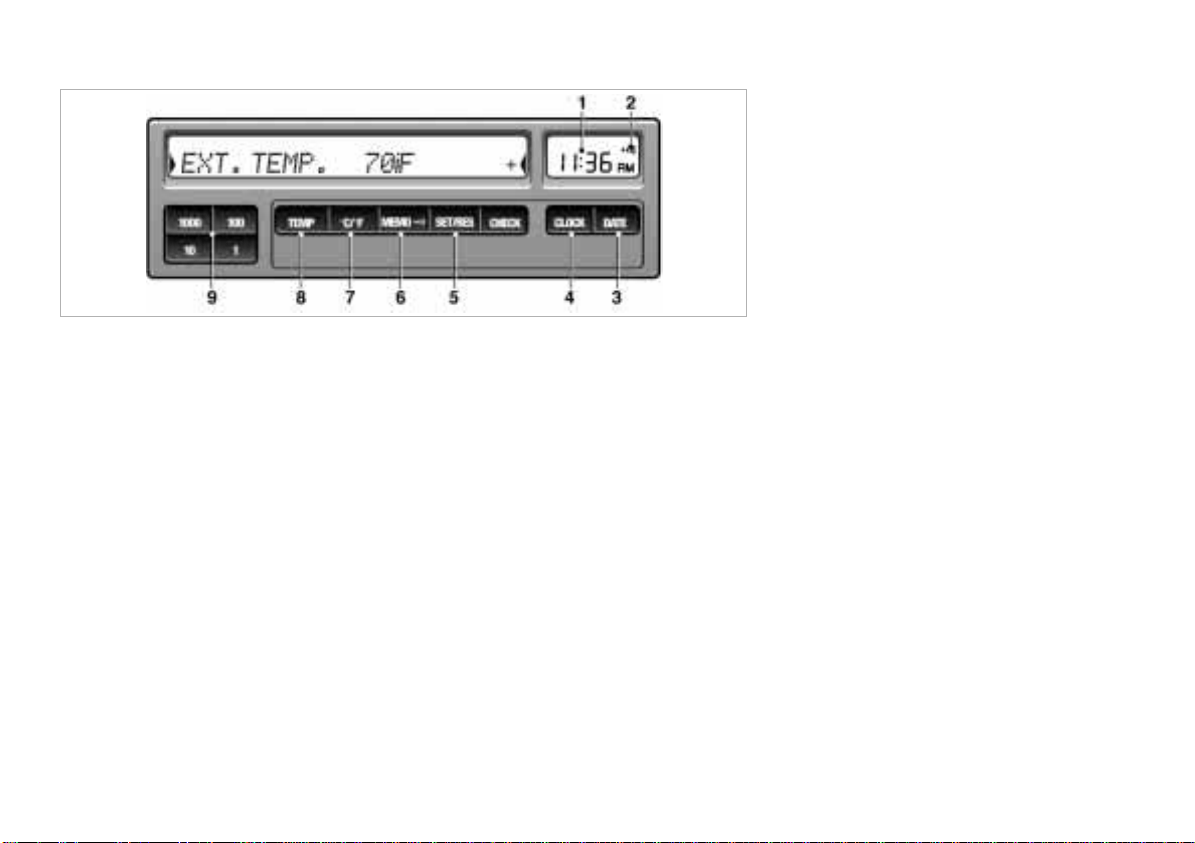
74
The Check Control uses texts with mes-
sages and warnings to alert the driver
to defective systems. In addition, an
indicator lamp is provided in the instru-
ment cluster. For details and operating
instructions, refer to pages 71, 72.
The outside temperature can also be
displayed.
With the digital clock you can
d display the time and date,
d pre-program an hourly reminder sig-
nal (memo) e.g., a reminder of the
news.
1 Digital clock display
2 Tone symbol for active memo
function
3 Function key - date
4 Function key - clock
5 SET/RES key
6 Function key - memo
7 Scale selection key
8 Function key - outside temperature
9 Entry keys for numerical values
360us111
Check Control with outside temperature display and digital clock*
To display time and date
d Press the respective function
key (4/3).
When the ignition key is in position 0
or removed, the displays appear for a
few seconds; in ignition key position 1,
the desired value is displayed indefi-
nitely.
You can display the time in 12 or 24 hour
increments; the date can be shown in
European or US sequence. To change
setting:
d Press time or date function key (4/3)
until the dots flash.
d Press scale selection key (7).
In the 12-hour mode, AM or PM will
appear on the right side of the clock
display.
Memo mode
Switch on and off with the MEMO key.
When MEMO is active, a tone symbol
appears in the right display. The signal
sounds every hour at the pre-pro-
grammed time or without program-
ming 15 seconds before each full
hour.
Online Edition for Part No. 01 41 9 790 377 - © 07/98 BMW AG
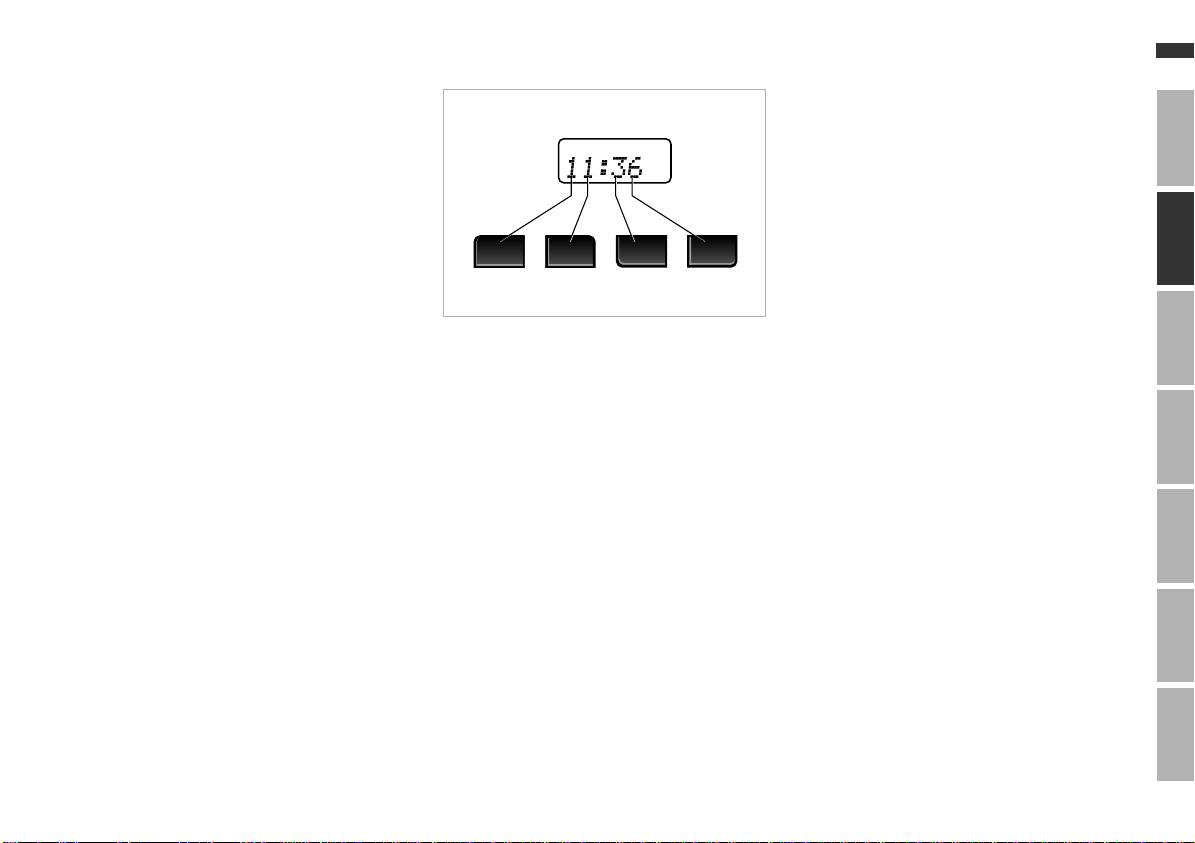
75
At a glanceControls Car careRepairsTechnicalDataIndex
Display outside temperature
Press TEMP key.
If the outside temperature drops below
37.5 5F (+36), a warning signal sounds,
the temperature display automatically
appears and flashes for 8 seconds.
The warning is repeated whenever the
temperature has increased to 43 5F
(+66) at least once before falling to
37.5 5F (+36) again.
aThe temperature warning device
does nothing to alter the fact that sur-
face ice can still form at temperatures
above 37.5 5F (+36), e.g., on bridges
and on shade-covered road surfaces.c
Entries
All numbers for the time and date are
entered with the entry keys according
to the following principle:
The numbers can be entered in any
order. Each time the key is pressed, or
for each half second the key is held
down, the numerical value increases by
one.
After a power failure
The time display flashes and the follow-
ing appears in the left display: "Enter
time".
d Enter the time with the entry keys.
d Press the SET/RES key.
The clock starts.
The left display shows: Enter date.
d Enter the date with the entry keys.
d Press the SET/RES key.
d Confirm the year by pressing the
SET/RES key or correct it with the
entry key; complete the number entry
by pressing the SET/RES key.
AM
360us322
1000 100 110
Check Control with outside temperature display and digital clock*
Online Edition for Part No. 01 41 9 790 377 - © 07/98 BMW AG

76
To reset the time
Press the CLOCK key until the left dis-
play indicates: Enter time.
The dots
flash.
Complete the number entry by pressing
the SET/RES key.
To reset the date
Press the DATE key until the left display
indicates: Enter date.
The dots flash.
Complete the number entry for the date
and year by pressing the SET/RES key.
If necessary, enter the year before
pressing the SET/RES key, as request-
ed in the display. Leap years are pro-
grammed into the system and therefore
need not be taken into account.
Programming a reminder signal
Press the MEMO key for approx. 3 sec-
onds until the left display indicates:
Enter memo. Complete the number
entry by pressing the SET/RES key.
360de146
SET/RES
CLOCK
1000 100
1
10
360de146
SET/RES
DATE
1000 100
1
10
360de146
1000 100
1
10
MEMO SET/RES
Check Control with outside temperature display and digital clock*
Online Edition for Part No. 01 41 9 790 377 - © 07/98 BMW AG

77
At a glanceControls Car careRepairsTechnicalDataIndex
Allows you to select display data for
safe and economical driving.
If your car is equipped with the Check
Control option, texts with information
and warnings are used to alert the
driver to system malfunctions. In addi-
tion, an indicator lamp is provided in the
instrument cluster. For details and
operating instructions, refer to
pages 71 and 72.
With the digital clock you can
d display the time and date,
d pre-program a reminder signal
(memo), e.g., to remind you of news
broadcasts.
Refer to page 74 for information and
details on using the digital clock.
1 Display
2 Arrival time
3 Entry keys for numerical values
4 Information keys
For the onboard computer version
without Check Control, pressing the
CHECK key simply activates all dis-
play elements.
5 Light-Emitting Diodes (LEDs)
6 Scale selection key
7 SET/RES key (start/stop)
360us112
Onboard computer*
Standard displays (no previous
data entries required)
Page
TEMP outside
temperature 78
RANGE estimated cruising
range 79
SPEED average speed 78
CONSUM 2 levels of average
consumption 79
With previous data entries
DIST distance remaining
to destination with
estimated
arrival time 79
LIMIT speed limit warning 80
The following systems are controlled by
the onboard computer: Page
TIMER – 2 switch-on times
for independent
ventilation 81
–independent
ventilation in direct
operating mode or 82
–timer 80
CODE immobilization/
protection from
misuse 82
The onboard computer operates at igni-
tion key positions 1 and 2.
Online Edition for Part No. 01 41 9 790 377 - © 07/98 BMW AG
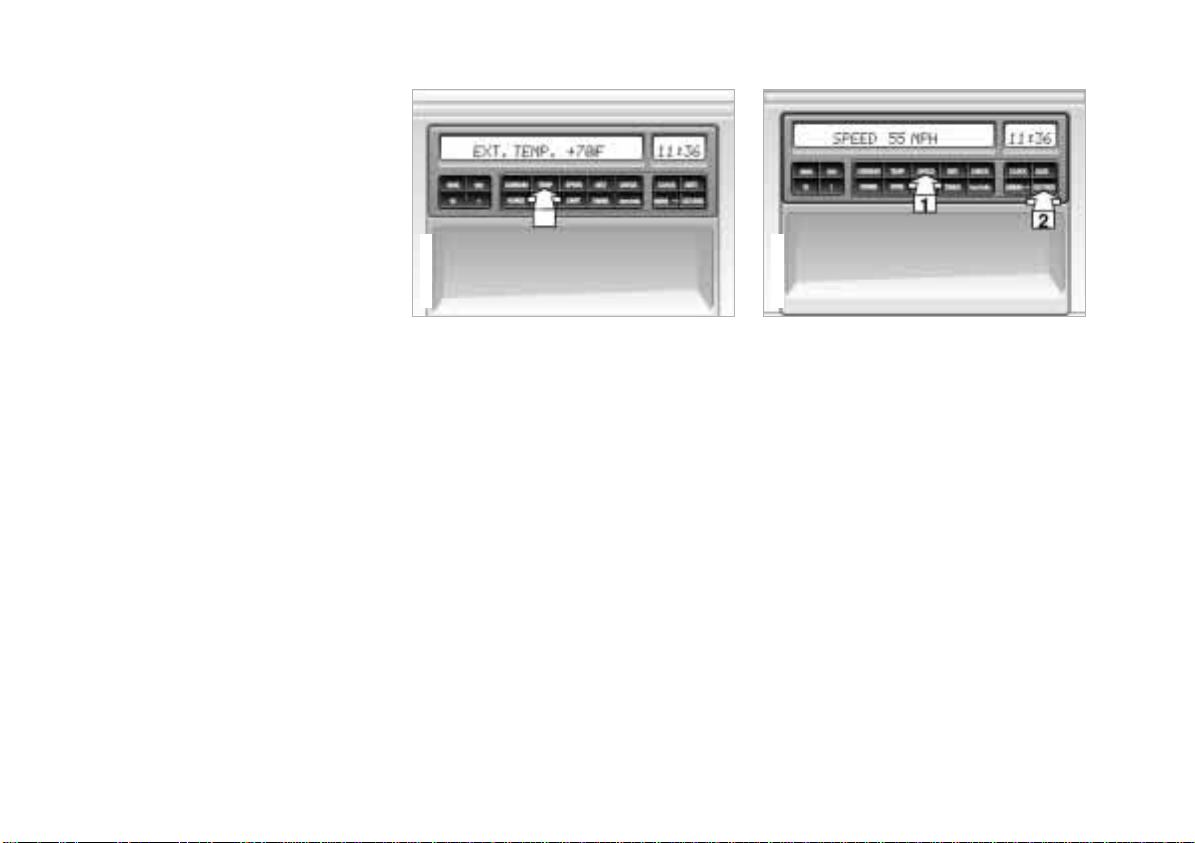
78
In the interest of driving safety, you
should always enter data with the vehi-
cle parked/stationary. The on-board
computer starts its calculations as soon
as the vehicle starts to move.
You can also use the remote control to
select information for display, refer to
page 83.
The scale selection key (6) allows you to
display all information in either metric or
US units.
bMessages of the Check Control
system override the display of the
onboard computer.
With the exception of Priority 1 mes-
sages, the display can be cleared by
pressing the CHECK key.c
If the malfunction display "PPPP"
appears, consult your BMW Retailer.
Outside temperature
Data request: Press TEMP key.
If the outside temperature drops below
37.5 5F (+36), a warning signal sounds;
the temperature display automatically
appears and flashes for 8 seconds.
The warning is repeated whenever the
temperature has increased to 43 5F
(+66) at least once before falling to
37.5 5F (+36) again.
aThe temperature warning device
does nothing to alter the fact that sur-
face ice can still form at temperatures
above 37.5 5F (+36), e.g., on bridges
and on shade-covered road surfaces.c
Average speed
To start calculations:
Key sequence as in illustration.
Data request: press SPEED key.
360us114
360us115
Onboard computer*
Online Edition for Part No. 01 41 9 790 377 - © 07/98 BMW AG
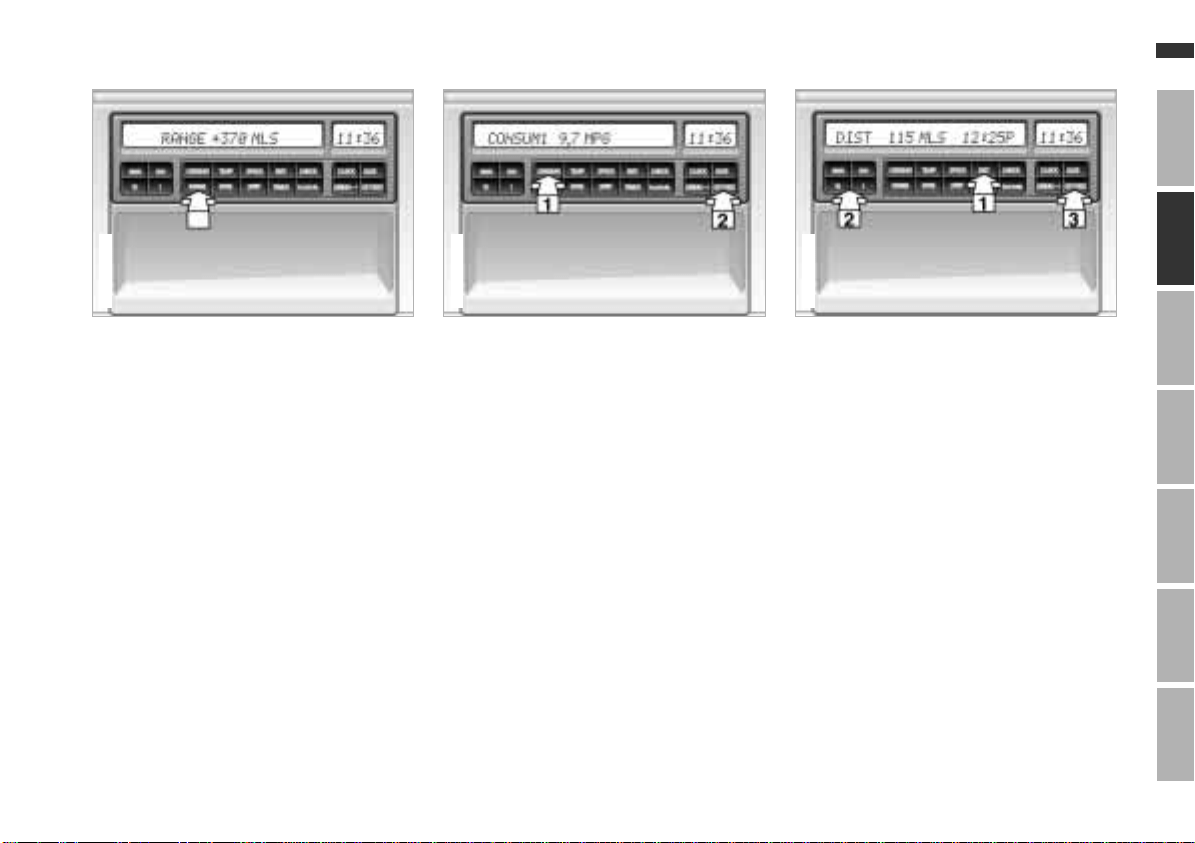
79
At a glanceControls Car careRepairsTechnicalDataIndex
Estimated cruising range
Displays the estimated travel range
based on the remaining fuel. The value
takes into account the way in which
way the car has been driven.
Data request: press RANGE key.
A plus symbol (+) in front of the value
indicates that the cruising range is still
being corrected (measuring tolerance).
If three segments flash in the display,
the cruising range is less than 9 miles
(15 km) and the car should be refueled
as soon as possible.
When you refuel, the onboard computer
registers the action only
d if the fuel amount is over 1.2 gallons
(approx. 4 liters).
d the engine is switched off.
Average fuel consumption
The computer can calculate average
fuel consumption rates simultaneously
for two distances, e.g., for an entire
journey and for a single section of it.
To start calculations for distance 1:
Key sequence as in illustration.
To start calculations for distance 2:
Repeat key sequence as in illustration.
Data request: press CONSUM key.
Press the key repeatedly to switch
between the average consumption of
the 1st and 2nd section of the journey.
At the same time, the display also indi-
cates which consumption (1 or 2) is cur-
rently indicated.
Distance remaining to destination
Displays the distance to the destination.
Available only if the total distance was
entered before the start of the journey.
Enter the distance:
Key sequence as in illustration.
Data request: press DIST key.
At the same time, the estimated time of
arrival is displayed, which is continuously
calculated in accordance with the driving
style.
Any additional mileage extending
beyond the total defined in the initial
entry is indicated by a minus sign.
To change scale:
Press the km/mls key once
d to change the distance
or twice to also
d change the arrival time.
360us116
360us117
360us118
Onboard computer*
Online Edition for Part No. 01 41 9 790 377 - © 07/98 BMW AG
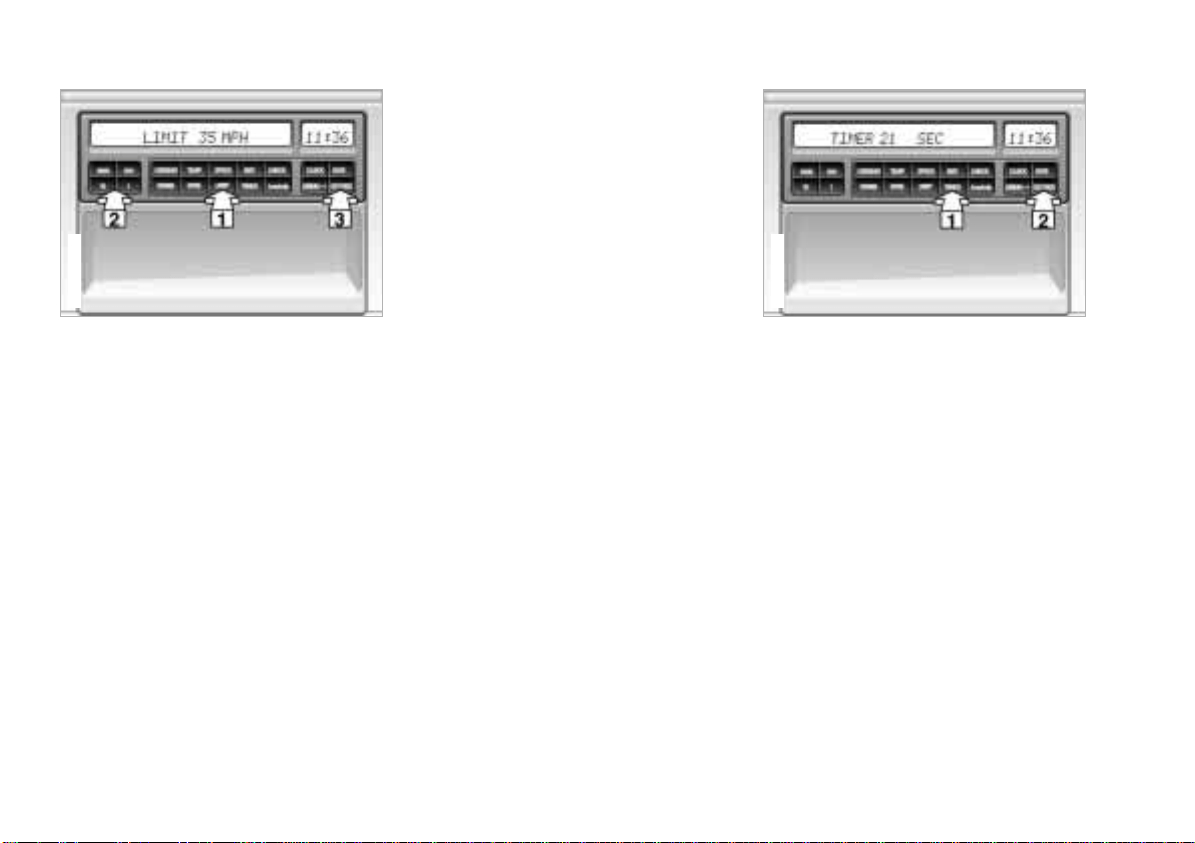
80
Speed limit warning (Limit)
You are alerted when you exceed the
maximum speed that you entered ear-
lier (e.g., posted speed limit). An acous-
tic signal sounds, the corresponding
LED flashes and the stored limit briefly
appears in the display.
Vehicle speed must drop back to at
least 3 mph (5 km/h) below the pro-
grammed speed to reset the system for
repeat warnings.
To enter the speed warning threshold:
Key sequence as in illustration. The
LED lights up.
To cancel speed warning:
d Press the LIMIT key again.
The LED goes out, but the value re-
mains stored and can be reactivated
with the LIMIT key.
To adopt current speed as limit:
d Press the LIMIT and SET/RES keys.
Timer*
The timer can be used only on vehicles
without independent ventilation. The
running time ranges up to 99 hours and
59 minutes. The time is shown in the
display: first in seconds and tenths of a
second, after a minute in minutes and
seconds and after an hour in hours and
minutes.
To start:
Key sequence as in illustration.
The LED lights up and the time runs in
the display.
360us119
360us120
Onboard computer*
Online Edition for Part No. 01 41 9 790 377 - © 07/98 BMW AG

81
At a glanceControls Car careRepairsTechnicalDataIndex
To stop:
When the time is displayed:
d Press the SET/RES key.
If other information is displayed:
d Key sequence as in illustration.
Take intermediate time:
d Press the TIMER key.
The LED flashes, the intermediate time
is displayed and the timer continues to
run.
Display time again:
d Press the TIMER key again.
bThe timer stops with the ignition
key in position 0 and runs again in posi-
tion 1.c
Independent ventilation*
To enter activation times
You can select two starting times for
independent ventilation. After 30 min-
utes the ventilation shuts off again auto-
matically.
Refer to page 87 for important informa-
tion on using the independent ventila-
tion system.
When you press the TIMER key, the
current status of the ventilation appears
in the display.
Enter a switch-on time:
Before you can enter data, the ignition
key must be at position 1 and the digital
clock must be visible in the display.
Repeat key sequence as in the illustra-
tion. (Press the TIMER key twice).
Enter the second switch-on time:
Repeat key sequence as in illustration.
Correct the entered time:
Repeat the key sequence as shown in
the illustration, but enter a different
time.
After you enter the time, an asterisk
∗
appears in the display and the LED
lights up, so that you can ascertain that
a switch-on time has been selected.
During ventilation the LED blinks. It
goes off when you turn the switch off.
Request a previously selected time
(LED lights up):
d For the first switch-on time, press the
TIMER key twice.
d For the second switch-on time, press
the TIMER key three times.
360us311
Onboard computer*
Online Edition for Part No. 01 41 9 790 377 - © 07/98 BMW AG
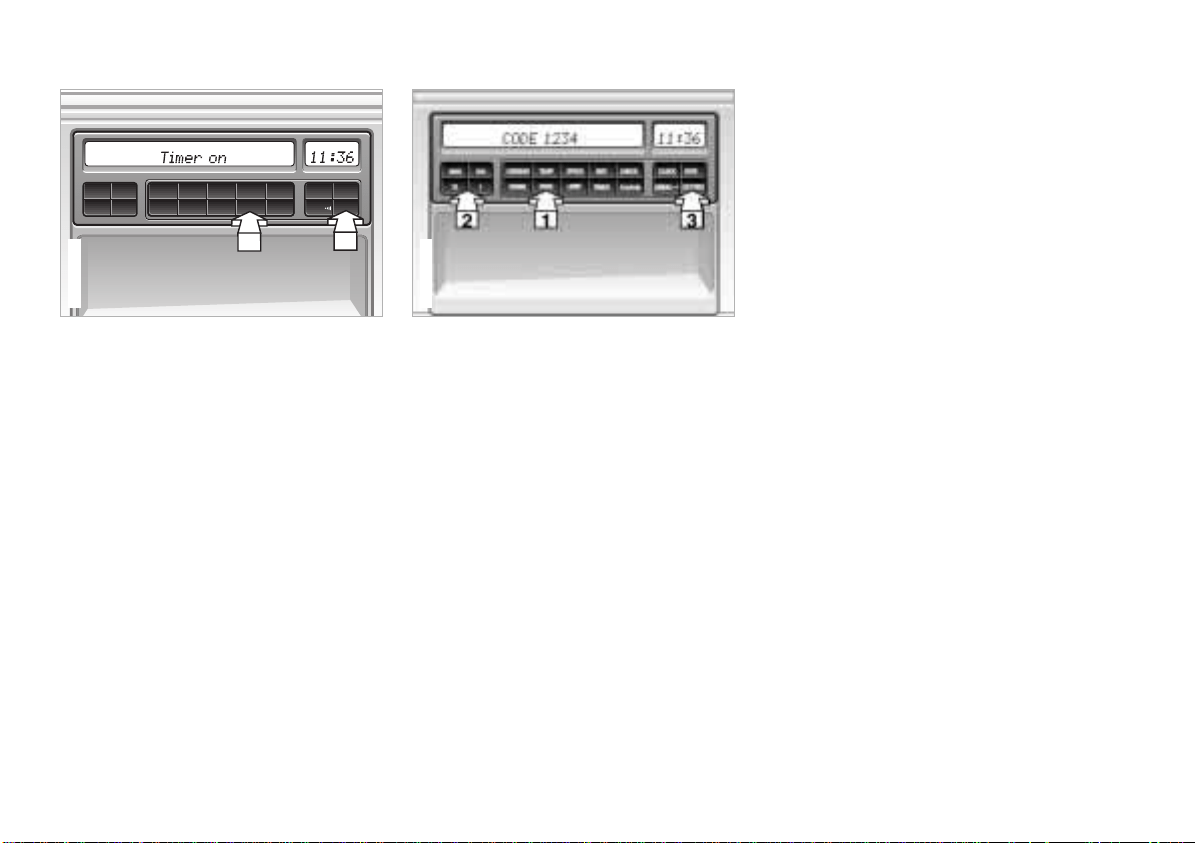
82
Switch on directly
Available only with ignition key at posi-
tion 1.
Key sequence as in illustration.
Switch off directly
In ignition key position 1: key sequence
as in the illustration.
In ignition key position 0: press only the
key SET/RES.
Enter code
In addition to electronic vehicle immo-
bilization (refer to page 30), you can
attain further engine immobilization or
protection against tampering by enter-
ing a code into the onboard computer.
A code number is used to arm the sys-
tem. The code is then required for sub-
sequent starting attempts. Always
remember the code number.
To set (ignition key in position 1):
Press the keys in the sequence illus-
trated and then turn the ignition key into
position 0 or remove the key.
Code numbers from "0000" to "9999"
can be entered. (You will have to re-
enter the code each time you activate
the system).
The LED lights up for up to 36 hours
with the ignition key in position 0 or with
the key removed. If the LED flashes for
10 seconds the engine hood has not
been closed or the radio has been
removed.
To cancel with ignition key in position 1
or 2:
A gong and the display "---- Code"
request you to enter a code.
d Use entry keys to enter the code
number
d Press the SET/RES key
d Start the engine.
The system responds to attempts to
start the vehicle using an incorrect code
or no code at all by preventing the
engine from starting.
2
1
TIMER
km/mls
MEMO
SET/RES
1000 100
10 1
SPEED
CONSUM TEMP DIST CHECK CLOCK
DATE
LIMITRANGE CODE
360us313
360us122
Onboard computer*
Online Edition for Part No. 01 41 9 790 377 - © 07/98 BMW AG
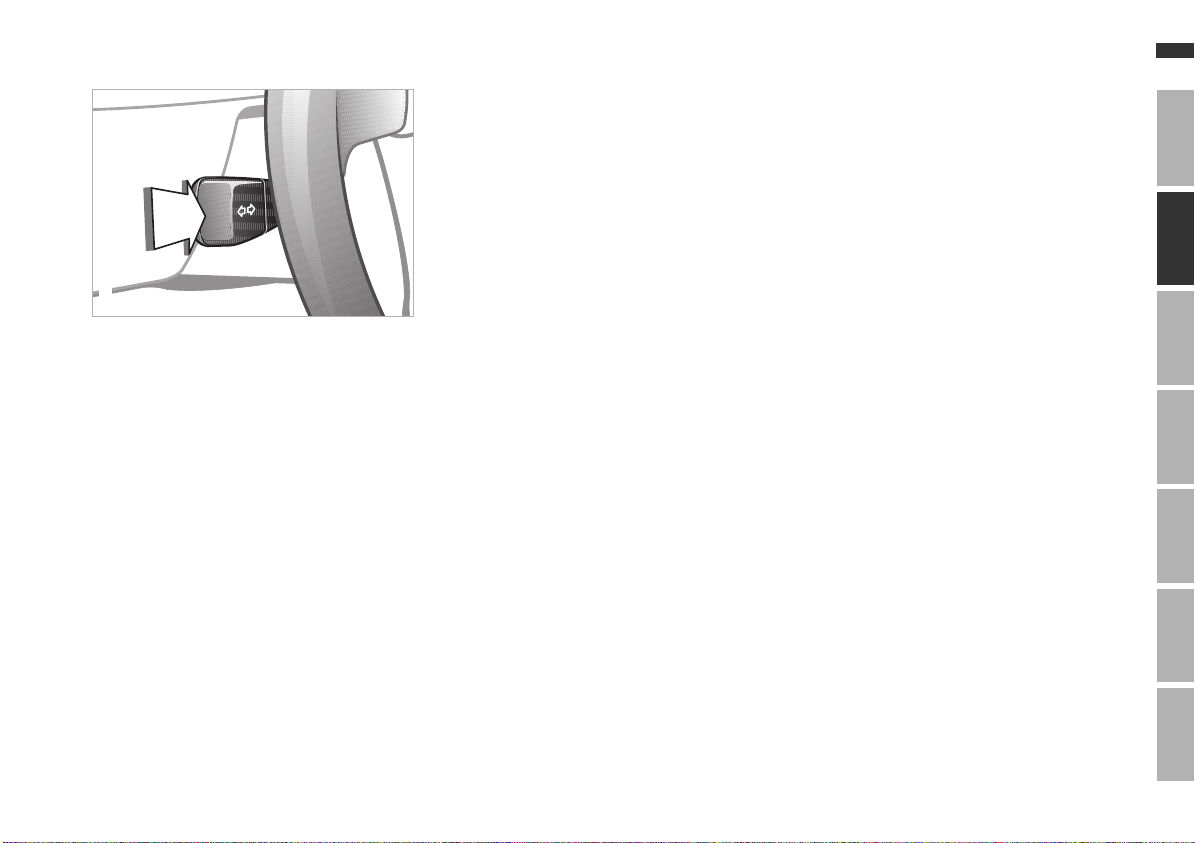
83
At a glanceControls Car careRepairsTechnicalDataIndex
Remote control
You can use the turn signal lever to
select various display sequences for
computer data following entry.
To enter:
d Keep the turn signal lever depressed
until "Prog 1"
appears in the display.
d Press the keys in the sequence in
which you want the information to be
displayed.
Each time you store data, the pro-
gram number in the display changes.
d Press the SET/RES key.
If you wish to display all data:
d Keep the direction indicator
depressed until "Prog 1" appears in
the display.
d Press the SET/RES key.
bFor average fuel consumption 1
and 2 please note the following: If, for
example, both consumptions are to be
displayed, the CONSUM key must be
pressed twice. If, for example, con-
sumption 2 is to be displayed (not con-
sumption 1), press the km/mls key after
pressing the CONSUM key (pressing
the km/mls key repeatedly switches
between consumption 1 and 2 as often
as desired).
Proceed in a similar manner for switch-
on times 1 and 2 for the independent
ventilation
*.c
Data request:
Briefly tap the turn signal lever each
time.
R
L
360de083
Onboard computer*
Online Edition for Part No. 01 41 9 790 377 - © 07/98 BMW AG
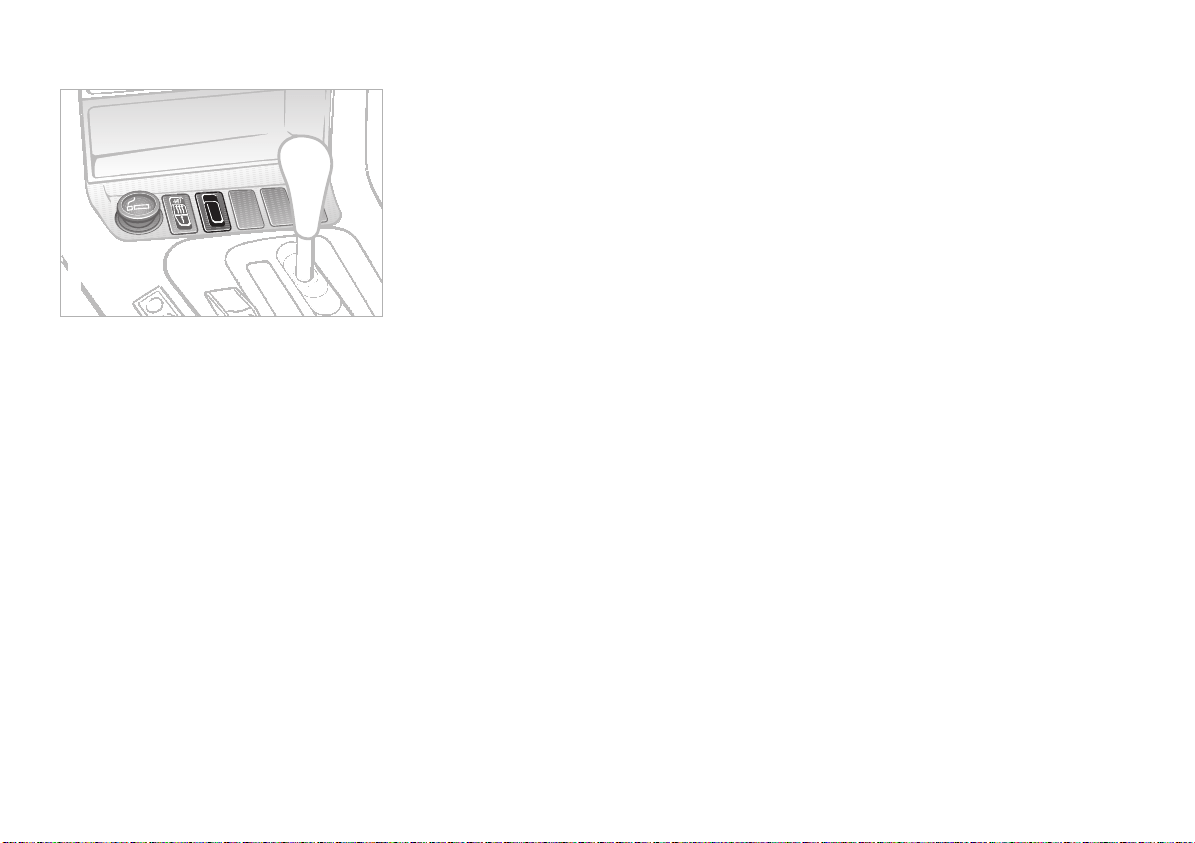
84
Automatic Stability Control plus
Traction (ASC+T)
This system is designed to enhance
operating stability, especially while
accelerating and during cornering.
ASC+T automatically assumes opera-
tion each time you start the engine.
The indicator lamp in the instrument
cluster goes out shortly after you switch
on the ignition.
To deactivate the system
Press the button; the indicator lamp
comes on.
To reactivate the system
Press the button again; the indicator
lamp goes out.
Indicator lamp flashes
The system is actively regulating drive
torque in response to monitored vehicle
operating conditions.
Indicator lamp fails to go out after
the engine is started, or comes on
in the course of normal vehicle
operation
The system has a defect. The vehicle
normally remains operational even with-
out ASC+T. Consult your authorized
BMW Retailer for repair.
When ASC+T is switched off, you drive
with a conventional drive system. We
recommend that you deactivate the
system for increased traction
d when rocking the vehicle or starting
off in deep snow or on loose surfaces
(refer to "Starting off", page 105)
d or when driving with snow chains.
bBut even with ASC+T the laws of
physics can not be suspended. Any
consequences arising from traction loss
due to excessive vehicle speed remain
the responsibility of the driver. We
therefore urge you to avoid using the
additional safety margin of the system
as an excuse for taking risks.c
For more details, please refer to section
"Advanced Technology" on page 156.
ASC
360de064
ASC+T
Online Edition for Part No. 01 41 9 790 377 - © 07/98 BMW AG
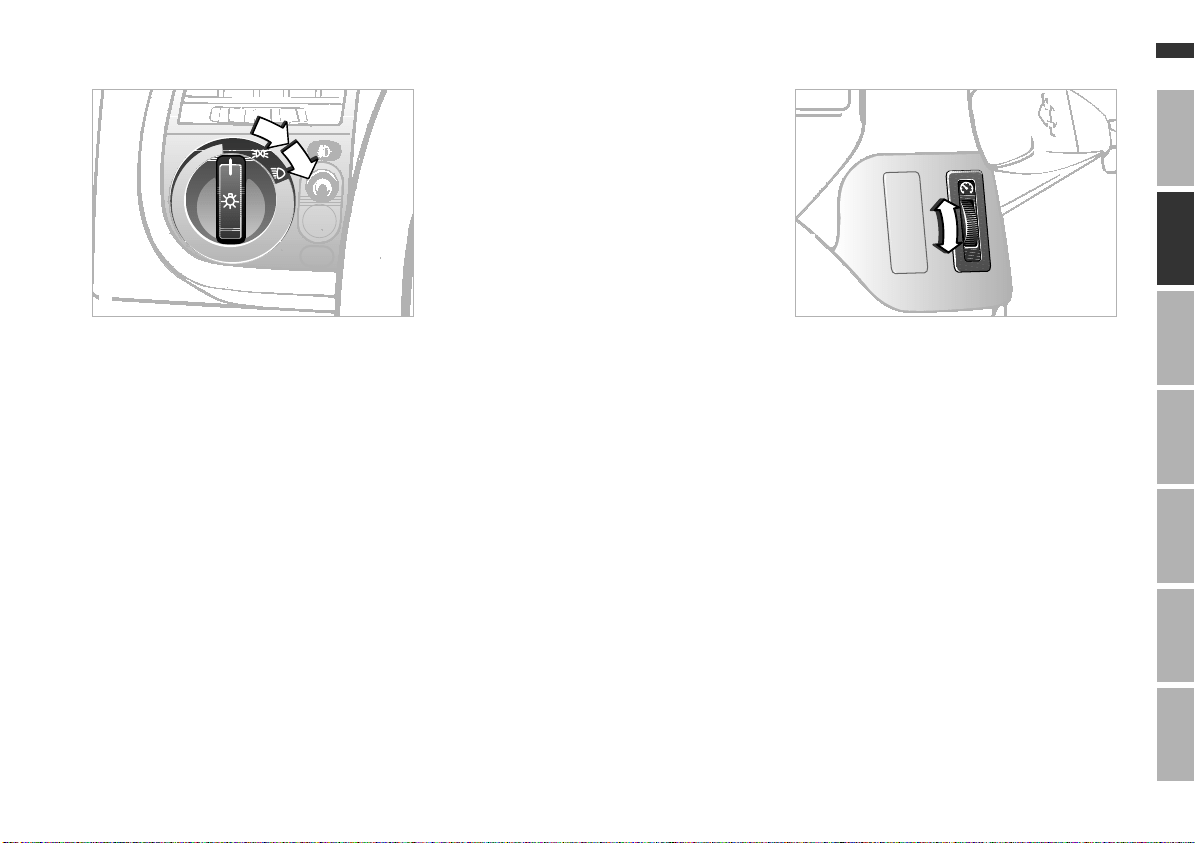
85
At a glanceControls Car careRepairsTechnicalDataIndex
Parking lamps
D
Low beams
LIGHTS ON warning
When you turn the ignition key to 0, a
buzzer sounds for a few seconds after
the driver's door has been opened, if
the lamps have not been turned off.
On vehicles with alpha-numeric Check
Control
*:
This warning comes through the Check
Control, refer to page 71.
Daytime-running lamps switch*
If desired, the lighting switch can be left
in the second position: when the igni-
tion is switched off, the external lighting
is also switched off.
On vehicles with daytime running fea-
ture, the lamps come on whenever the
ignition key is turned to position 2 with
the headlamp switch remaining at 0.
Adjust the illumination intensity by turn-
ing the rotary dial.
E
When you switch off the ignition
without turning off the head-
lamps, only the parking lamps
stay on.
When you return the ignition key to
position 0, a buzzer sounds for a few
seconds to remind you that the lamps
have been left on.
0
360us312
360us323
Parking lamps/low beams Instrument lighting
Online Edition for Part No. 01 41 9 790 377 - © 07/98 BMW AG
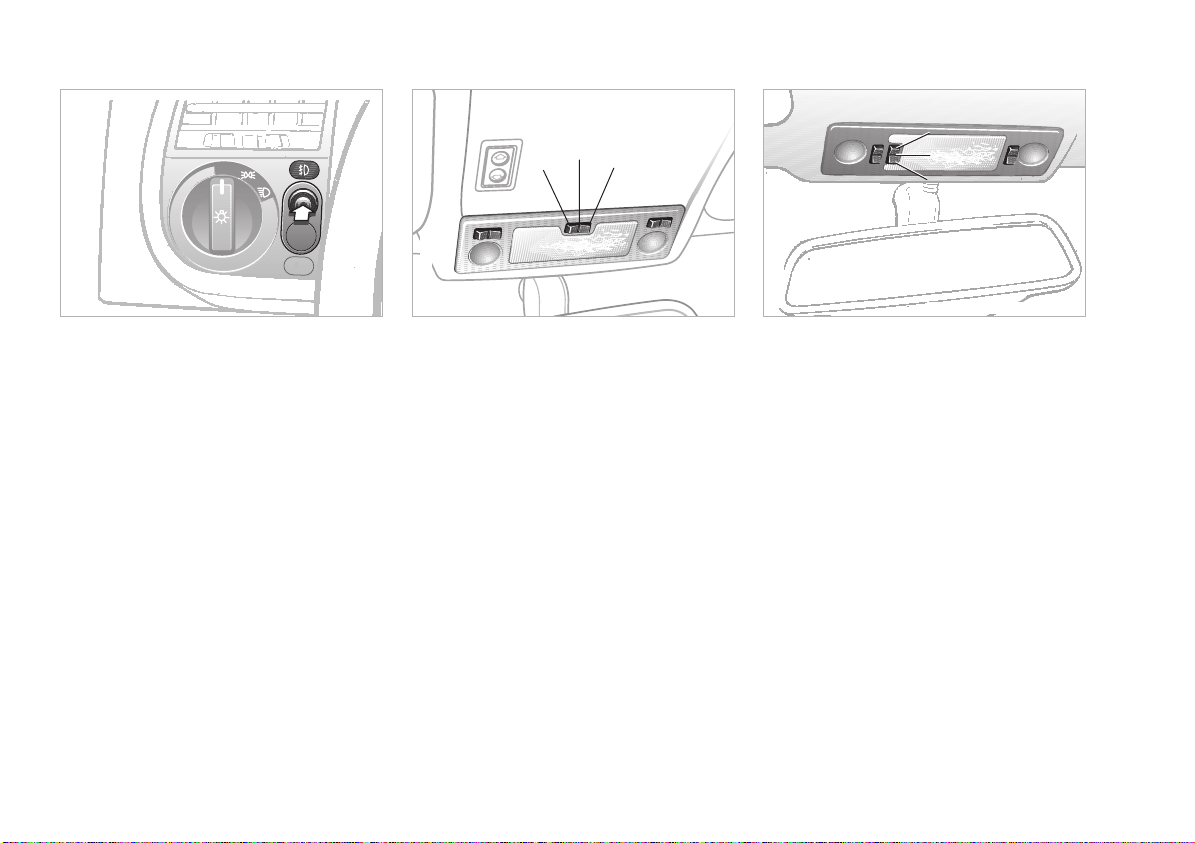
86
Foglamps*
0 Continuously off.
1 Lamps on:
d With door open (switching via door
contact).
d For a few seconds after closing the
door; lamps go out immediately
when the ignition is switched on.
d After the ignition has been switched
off for a few seconds, if the vehicle
lighting was switched on.
d If your car is equipped with the
driver's door lock heating option,
when the driver's door handle is
lifted for a few seconds with the vehi-
cle closed (possible a maximum of
three times).
d Following an accident.
BMW Convertible: With the switch set
to position 1, a safety circuit ensures
that any lamps in the vehicle which may
still be on are switched off automatically
approx. 15 minutes after leaving the
vehicle.
2 Continuously on.
Footwell lamps*
The footwell lamps operate in the same
way as the interior lamp.
Reading lamps*
The reading lamps are located in the
front near the interior lamp and in the
rear
*. They can be switched on and off
with the switch adjacent to each lamp.
t
A green indicator lamp lights
up in the instrument cluster to
indicate that the front foglamps
are on.
0
360us034
0
1
2
360de041
1
0
2
36cde001
BMW Convertible
Foglamps Interior lamps
Online Edition for Part No. 01 41 9 790 377 - © 07/98 BMW AG
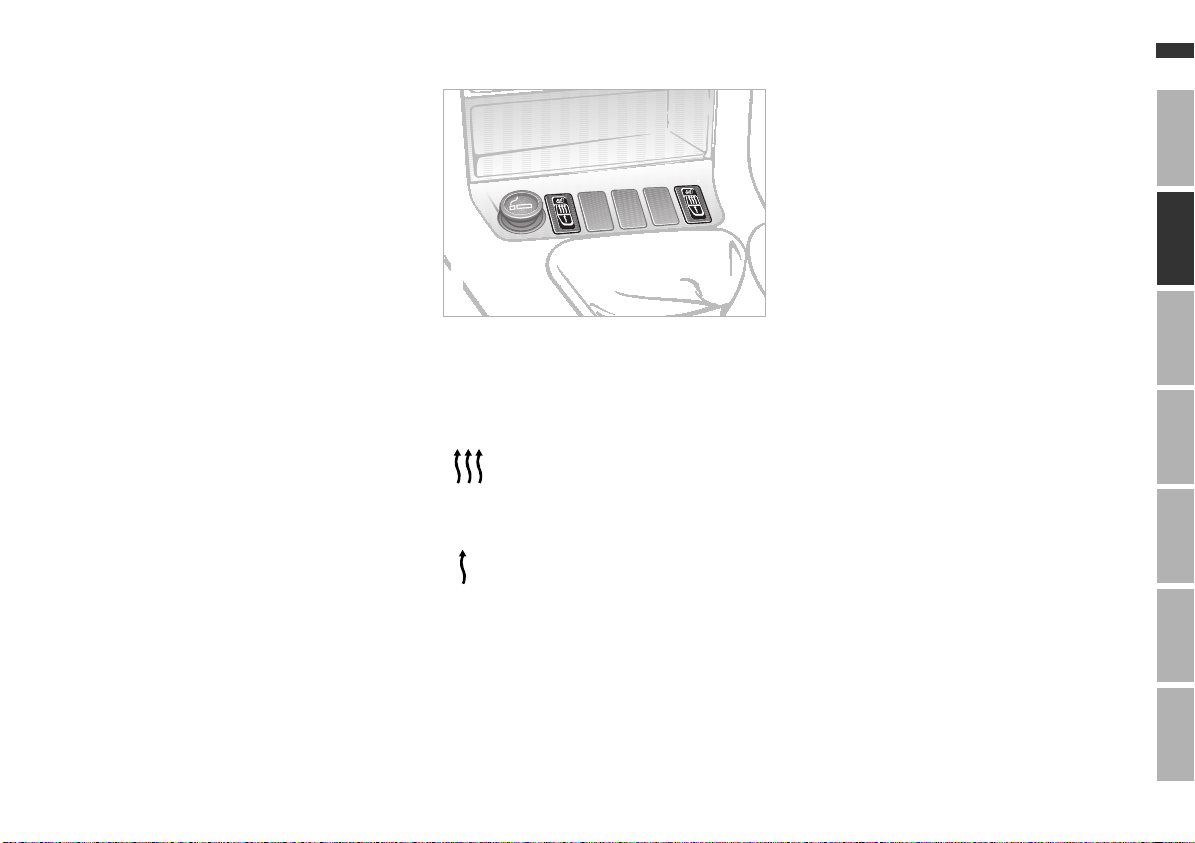
87
At a glanceControls Car careRepairsTechnicalDataIndex
BMW Convertible
The switches for the map reading lamps
next to the interior lamp are operated in
the same manner as the interior lamp
switch.
The seat cushion and backrest can be
heated at ignition key position 2.
Press the switches with the heating
symbols:
To switch over while heating: press the
dimly lit switch.
To switch off prematurely: press the
brightly lit switch.
This ventilates the vehicle's interior and
lowers its temperature using the heater
or the air conditioner fan.
The system is operated by the onboard
computer, refer to page 77.
You can set the time for the system to
start; it will remain active for 30 min-
utes. You can also turn it on and off
directly.
As the system uses a substantial
amount of electric current, you should
refrain from activating it twice in suc-
cession without allowing the battery to
be recharged in normal operation
between use.
The independent ventilation is available
for use when the outside temperature is
above 60 5F (166), but not when driv-
ing.
The air comes out through the vents for
the upper body area. The vents must
therefore be open for the system to
operate.
Rapid heat-up as long as the
switch lights up brightly. Auto-
matic changeover to regular
heating.
Heating as long as the switch
lights up brightly. The heater
switches off automatically.
360de026
Interior lamps Seat heating* Independent ventilation*
Online Edition for Part No. 01 41 9 790 377 - © 07/98 BMW AG
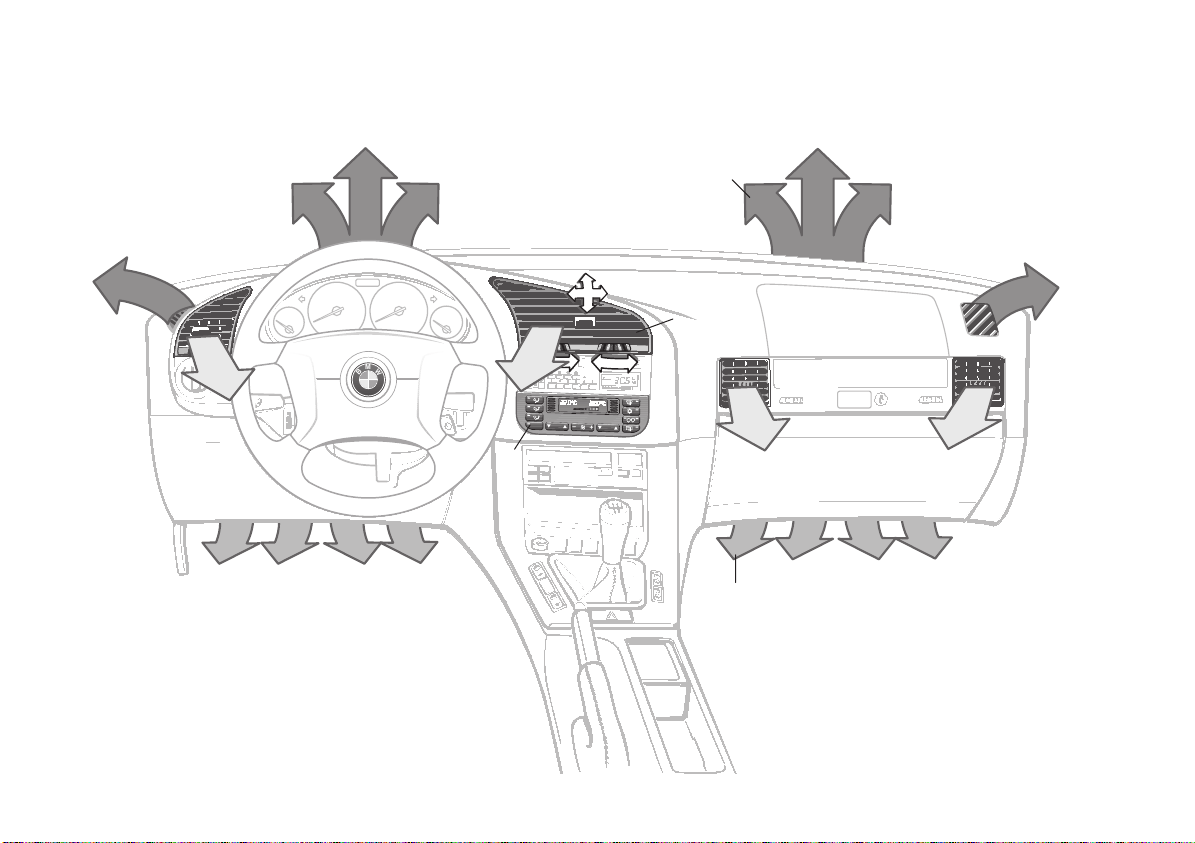
88
Automatic climate control
3
B
M
W
B
M
W
A
AUTO
4
1
2
A
U
T
O
360de306
Online Edition for Part No. 01 41 9 790 377 - © 07/98 BMW AG

89
At a glanceControls Car careRepairsTechnicalDataIndex
1 Air flow directed against windshield
and door windows
2 Air flow toward upper body
The rotary dial on the right affords
continuous opening or closing of the
air supply, the lever changes the
direction of the air flow. The rotary dial
on the left tempers the air coming out
(page 92).
3 Front footwell ventilation
Corresponding vent outlets are also
located in the rear footwell.
4 Controls
Automatic climate control
Online Edition for Part No. 01 41 9 790 377 - © 07/98 BMW AG
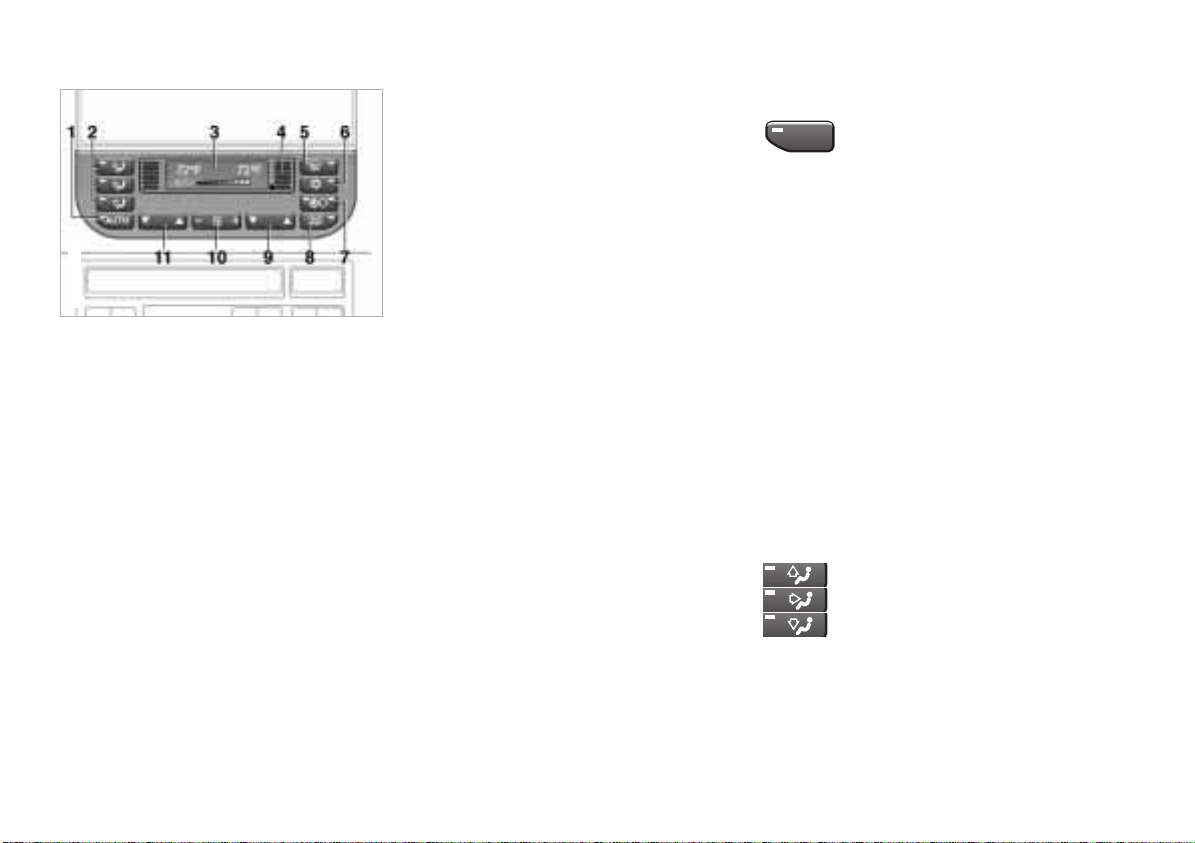
90
Controls
1 Automatic air distribution
2 Individual air distribution
3 Temperature and air flow display
4 Air grill for interior temperature
sensor - please keep clear and
unobstructed
5 To defrost windshield and door
windows
6 Air conditioner
7 Recirculated-air mode
8 Rear window defroster
9 Temperature control – right-hand
side
10 Air supply
11 Temperature control – left-hand side
Air conditioning for comfort
Use the automatic system; switch on
AUTO key1. Select the interior temper-
ature that is comfortable for you, e.g.,
70 5F (226). With exterior temperatures
above 41 5F (56) you can also use air-
conditioning 6. This dries the air and
prevents window mist when e.g., per-
sons with damp clothing are in the vehi-
cle. Adjust vent 2 in such a way that the
air blows past you and does not strike
you directly. Turn the rotary control on
the left under the vents 2 for the upper
body area to a middle setting, so that
you will be driving in cooler air that
does not tire you out.
The following description gives you
additional individual settings.
Automatic air distribution
Individual air distribution
360us314
When you activate the AUTO
mode, the program takes
over the setting of the air distribution
and the air supply and, in addition,
adjusts your temperature pre-selections
to exterior conditions (summer, winter).
This program maintains a comfortable
in-car climate regardless of the season.
Select the interior temperature that is
comfortable for you, e.g., 70 5F (226).
The temperature pre-selections as well
as the lettering AUTO for the air supply
appear in indicator 3.
Open the vent outlets for the upper
body area. Switch on the air conditioner
in warm weather.
The maximum cooling capacity is
achieved when you set the rotary dial 3
(refer to page 92) to cold.
You can cancel the automatic
program by selecting distri-
bution patterns to suit your
individual requirements. You
can direct air toward the windshield and
windows
7, toward the upper body 5
and/or into the footwell
6.
AUTO
Automatic climate control
Online Edition for Part No. 01 41 9 790 377 - © 07/98 BMW AG

91
At a glanceControls Car careRepairsTechnicalDataIndex
To defrost windshield and door
windows
Air conditioner
Circulated air mode/Automatic
recirculated air control (AUC)
*
Press the button repeatedly to run
through the following control sequence:
d Indicator lamps off: outside air flow
operational.
d Left-hand indicator lamp on – AUC
mode: the system detects pollutants
in the outside air and responds by
deactivating the outside air flow as
required. The system then recircu-
lates the air currently within the vehi-
cle.
d Right-hand indicator lamp on: the
flow of outside air into the vehicle is
permanently blocked. The system
then recirculates the air currently
within the vehicle.
aIf the windshields fog over in circu-
lated air mode, switch off the circulated
air mode/Automatic recirculated air
control and increase the air supply. if
necessary.c
Rear window defroster
BMW Convertible: Heated rear-window
blower.
The rear-window blower is always
switched off with the convertible top
down.
When the hardtop
* is in place, press
the rear-window heating button.
Temperature
This program is designed for
rapid removal of ice and con-
densation from the windshield and side
windows.
The air conditioner cools and
dehumidifies incoming air
before reheating it to the selected tem-
perature.
Depending on the weather, the wind-
shield may fog over briefly when the
engine is started.
Switching off the air conditioner at out-
side temperatures below approx. 41 5F
(56) will prevent the windows from
fogging up.
Frequently switching the air condi-
tioner on and off may also promote the
formation of condensation on the win-
dow surfaces.
bCondensation forms in the air
conditioner system during operation,
which then exits under the vehicle. It is
not unusual for a small puddle to form
there.c
You can respond to unpleas-
ant odors in the outside air
by temporarily excluding the outside air.
The system then recirculates the air
currently within the vehicle.
A
The indicator lamp comes
on to confirm that the rear
defroster is operating.
The defroster switches off automatically
after approx. 15 minutes.
On both the driver's and the
passenger's side you can
adjust the specific temperature. The fig-
ures in the display provide a general
indication of interior temperature. We
recommend 70 5F (226) as a standard
setting for comfortable travel, both with
and without the air conditioner. When
you start the vehicle, the system
ensures that the selected temperature
is achieved as quickly as possible and
maintained at a constant level by the
control.
Automatic climate control
Online Edition for Part No. 01 41 9 790 377 - © 07/98 BMW AG

92
Air supply
Draft-free ventilation
You can adjust the vent outlets for the
upper body area to select the optimum
airflow rates and directions for your
own personal requirements:
Use rotary controls 1 to open and close
the vents throughout and infinitely-vari-
able range. Use the levers 2 to adjust
the direction of the air flow.
The rotary control 3 allows you to mix
the air from the outlets for your upper
body by warming or cooling it as
desired:
Turn toward blue – colder
Turn toward red – warmer
Microfilter
The microfilter removes dust and pollen
from the incoming air. The filter is
changed by your BMW Retailer when
you bring your vehicle for maintenance.
A substantial reduction in air flow indi-
cates that the filter needs to be
replaced prematurely.
In the AUTO mode, the air
supply is controlled automat-
ically and AUTO appears in display 3,
refer to the summary on page 90. Using
"+" and "–" you can vary the air flow.
Your setting is indicated by bars, the
automatic control is switched off. You
can reactivate it by pressing the AUTO
key.
When you press "-" during operation at
minimum blower speed all displays are
canceled: the fan, heating and air con-
ditioner are switched off, the air supply
is blocked. By pressing on any key of
the air conditioning you can again
engage the system.
Effective heating and cooling is ensured
at a medium blower speed.
123
360de056
Automatic climate control
Online Edition for Part No. 01 41 9 790 377 - © 07/98 BMW AG
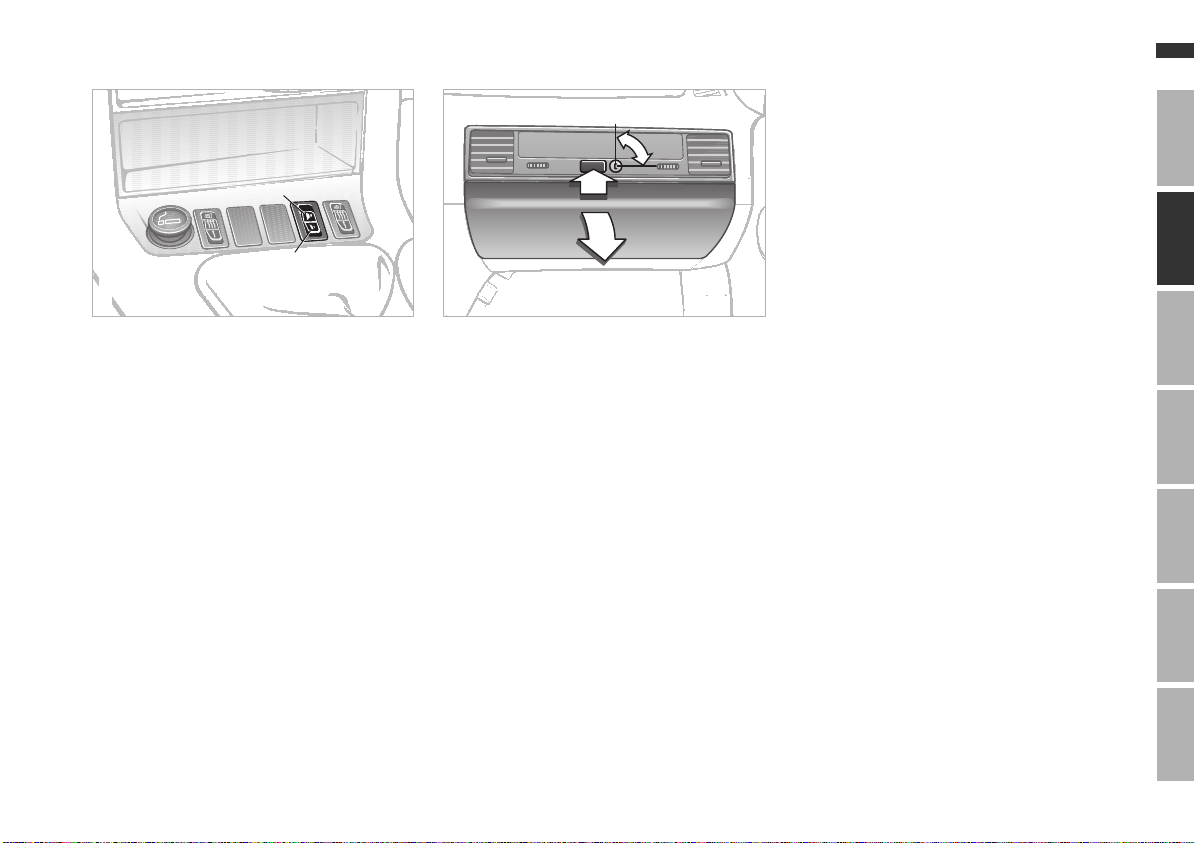
93
At a glanceControlsCar careRepairsTechnicalDataIndex
BMW Hi-Fi System (Harman/
Kardon)
1On
2Off
In the "On" position, the listener is given
the impression of a considerably larger
passenger compartment with an
improved stereo effect in all seats.
This function should be switched off in
the case of poor radio reception due to
the frequent changes between stereo
and mono which result.
BMW Convertible:
You do not have to operate the con-
trols. The system detects whether the
top is open or closed and regulates the
sound automatically.
To open
Press the button and fold down the
door.
The glove compartment lamp switches
on from ignition key position 1.
To close
Fold up door.
To engage locks
Only possible with a master key.
aTo reduce the risk of injury, always
close the glove compartment immedi-
ately after use.c
Rechargeable flashlight
The connection for the rechargeable
flashlight is located on the left side of
the glove compartment.
The flashlight features overcharging
protection, so it can be left in its holder
continuously.
However, it must be removed when the
battery is disconnected or removed.
aEnsure that the flashlight is off be-
fore inserting it in its holder.c
HIFI
1
2
360de057
360de058
BMW Hi-Fi System* Glove compartment
Online Edition for Part No. 01 41 9 790 377 - © 07/98 BMW AG
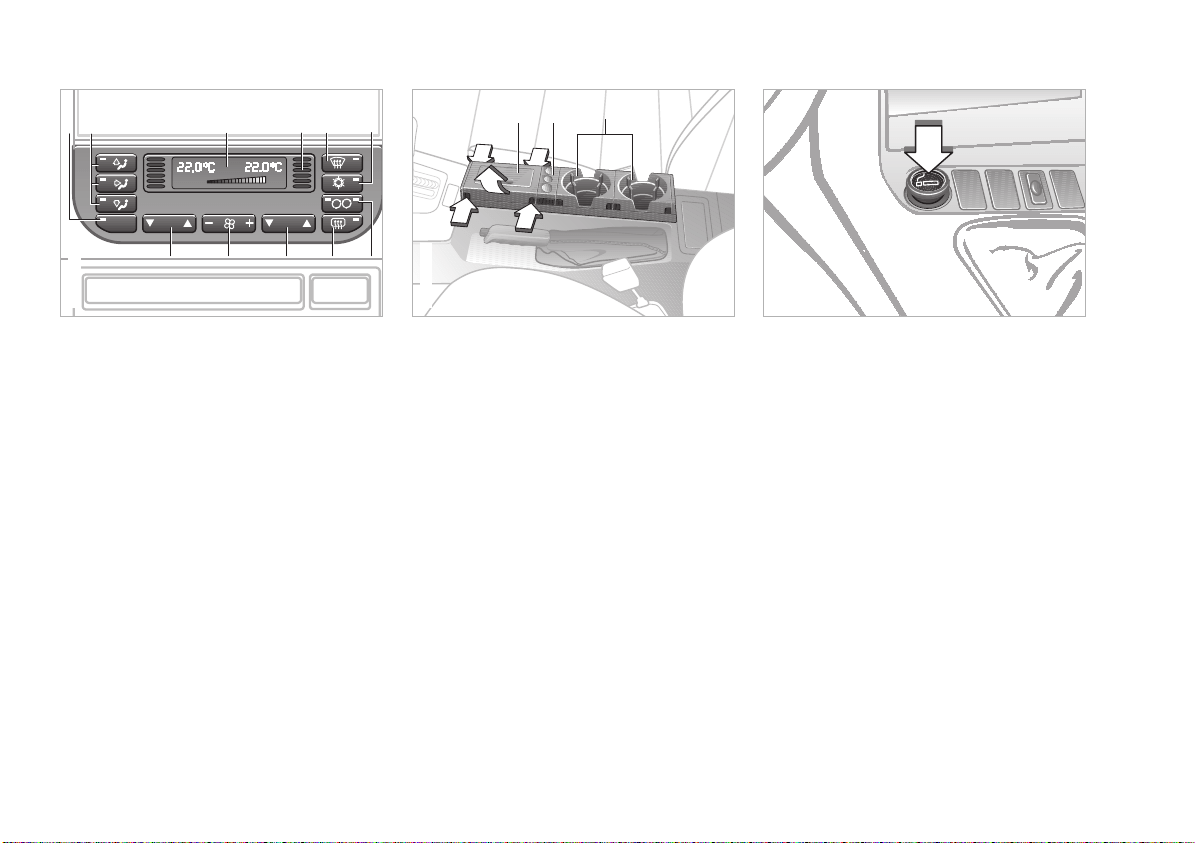
94
To open
Press against the recess (arrow).
To extinguish a cigarette, tap off the ash
and gently press the tip into the funnel.
To empty
Press on the edge of the lid with the
ashtray open: the ashtray insert pops
up and can be removed.
The rear ashtray is operated in the
same manner.
The components ashtray (1), coin box
(2) and the two cup holders (3) can be
arranged as you wish.
Simultaneously press lightly on the
ribbed surfaces (arrows) of the desired
components and pull them upward.
Replace the components in the bracket
in the desired arrangement and clip into
place.
Press in. Remove as soon as the lighter
jumps back out.
aAlways hold the hot lighter by its
plastic knob, as otherwise serious
burns could result.
The cigarette lighter remains opera-
tional when the ignition key has been
removed. For this reason, children
should never be left in the car unat-
tended.c
Cigarette lighter socket
Suitable for attaching power supplies
for flashlights, car vacuum cleaners,
etc., up to a rating of approximately
200 watts at 12 volts.
Inserting plugs of a different shape or
size may damage the socket.
A
AUTO
21 3456
7891011
AUTO
360us315
1
2
3
360us318
360de060
Ashtray Coin box, cup holder Cigarette lighter
Online Edition for Part No. 01 41 9 790 377 - © 07/98 BMW AG
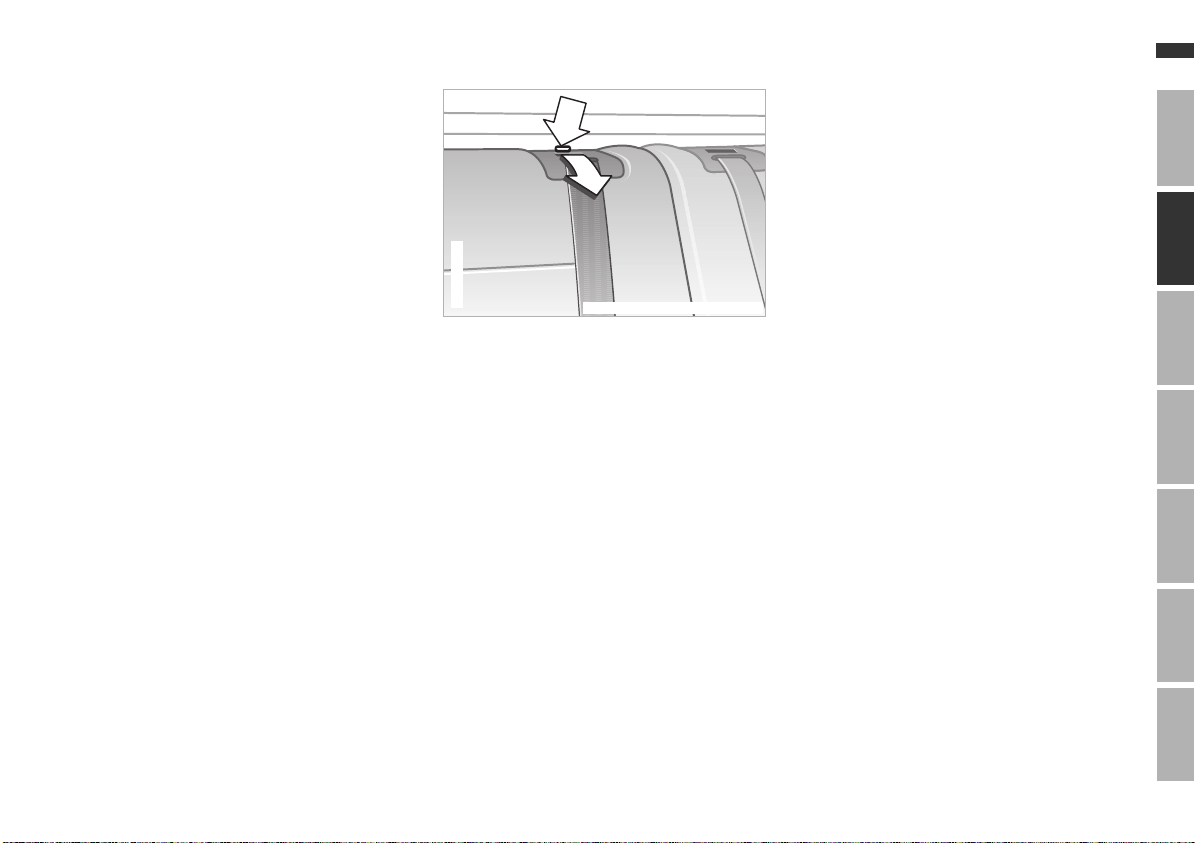
95
At a glanceControlsCar careRepairsTechnicalDataIndex
Pull the strap to fold down the armrest.
To open drawer
*:
Unlock and pull out the drawer by pull-
ing on the drawer handle. The drawer
locks in any position. The cup holder
can be shifted as necessary.
BMW Convertible
Vehicles without ski bag*: Storage
compartment, accessible by removing
the filler piece and releasing the trim
(refer to page 97).
The rear backrest is divided in the cen-
ter. Each side can be folded down sep-
arately to carry long objects.
To release:
Reach into the handle recess, press
down and pull forward.
When folding back the rear backrest,
make sure that the locking device is
properly engaged to ensure proper
operation of the safety belt. The red
slide must move downward.
If the rear backrest is not locked, the
safety belt can not be pulled out.
It makes possible a safe, convenient
transport of 3 to a maximum of 4 pairs
of skis (BMW Convertible, maximum of
2 pairs of skis).
The length of the ski bag in combination
with the additional space in the luggage
compartment makes it possible to trans-
port skis of up to 6.8 ft. (2.10 m) in
length. Because the ski bag contracts
as additional skis are inserted, the bag
is suitable for transporting only two
pairs of skis when both are a maximum
of 6.8 ft. (2.10 m) long.
If the ski bag is not used for longer peri-
ods, it should be stored in a dry place.
It is advisable to wipe off any water
which has collected on the waterproof
ski bag from time to time.
aThe ski bag must not hinder the
driver during driving.c
360de027
BMW Sedan/ Cou
p
e
Center armrest (rear)* Through-loading system* Ski bag*
Online Edition for Part No. 01 41 9 790 377 - © 07/98 BMW AG
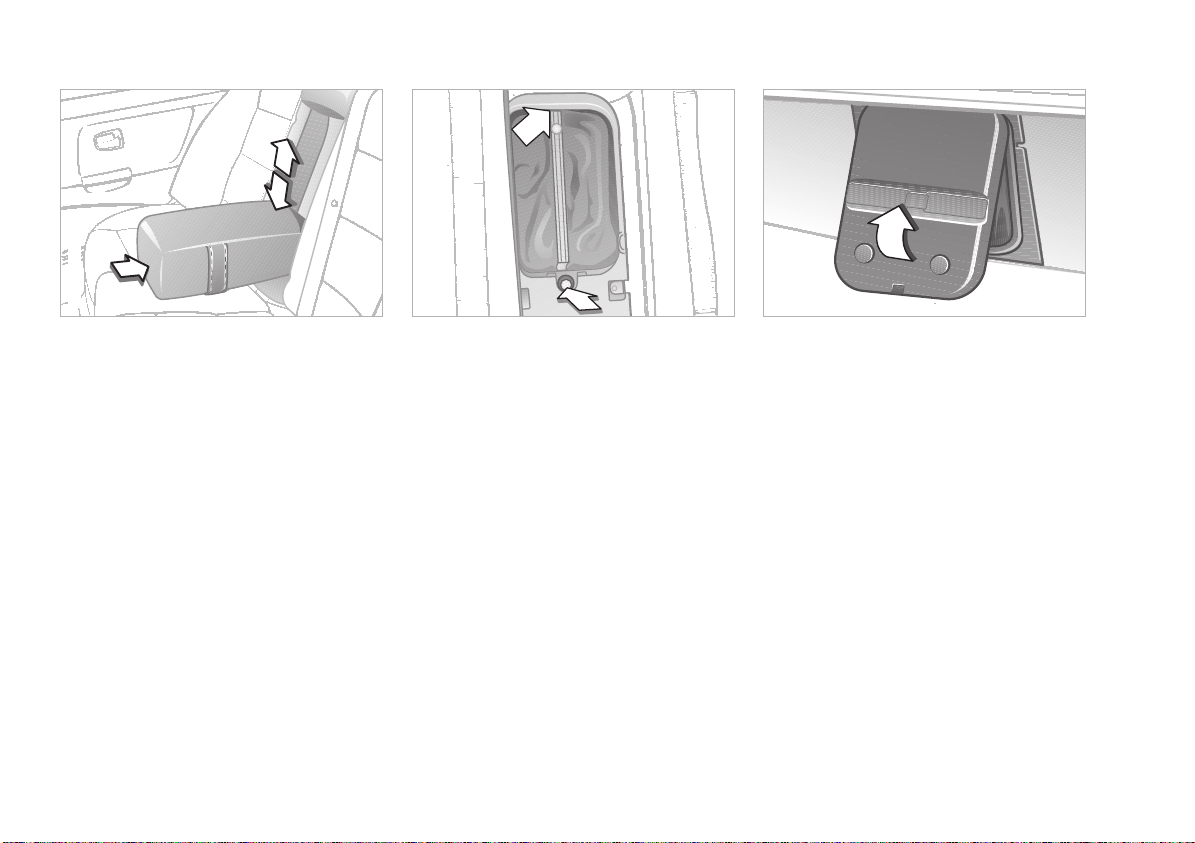
96
BMW Sedan - loading the ski bag
Fold down the center armrest. Detach
from the mounts (1) with one hand,
press slightly toward the rear with the
other hand (2) and remove upward.
Detach the Velcro
strip at the top of
the cut-out trim and lay it on the seat.
bWhen reinstalling the center arm-
rest, guide it into position from above,
then apply downward pressure until you
hear it snap into position (3).c
Press the round button to unlock the
cover panel in the luggage compart-
ment.
Then unhook the retaining strap at the
top and fold it down.
Extend the ski sack between the front
seats. The zipper provides convenient
access to the inside of the sack, and
can also be left open to promote drying.
Use the magnetic retainers to attach the
cover panel to the lower side of the rear
shelf within the luggage compartment.
Please ensure that the skis are clean
before loading them into the bag. Take
care to avoid damage from sharp
edges.
For general information on the ski bag,
refer to page 95.
3
2
1
360de065
360de066
360de067
Ski bag*
Online Edition for Part No. 01 41 9 790 377 - © 07/98 BMW AG
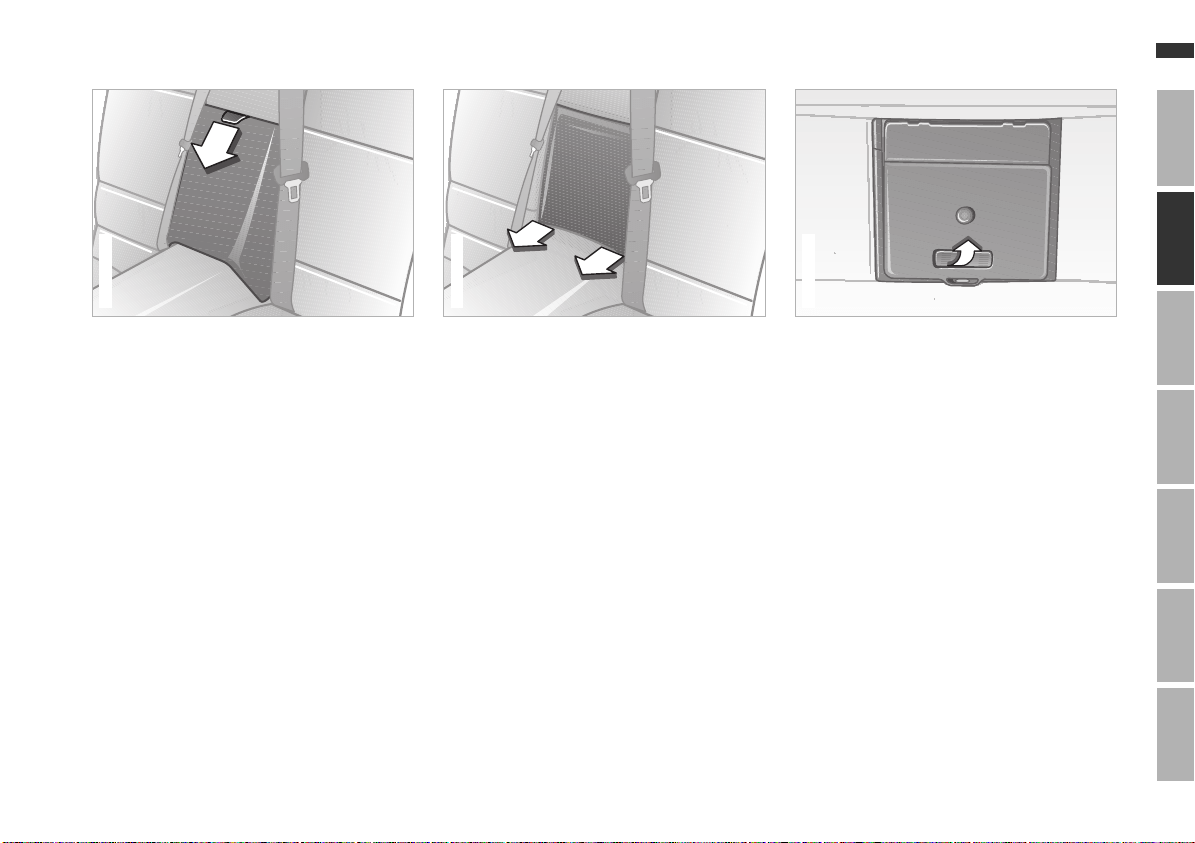
97
At a glanceControlsCar careRepairsTechnicalDataIndex
BMW Convertible - loading the ski
bag
Removing filler piece.
Detach cut-out trim at bottom.
Extend the ski sack between the front
seats. The zipper provides convenient
access to the inside of the sack, and
can also be left open to promote drying.
bWhen remounting the trim, press it
firmly onto the guide rod at the bot-
tom.c
Open the cover panel from the luggage
compartment and use the magnetic
retainers to attach it to the lower side of
the rear shelf within the luggage com-
partment.
bSecure the stored skis or other
objects by tightening down the strap on
the ski bag at the buckle.c
For general information on the ski bag,
refer to page 95.
36cde003
36cde004
36cde005
Ski bag*
Online Edition for Part No. 01 41 9 790 377 - © 07/98 BMW AG

98
Stowing a load
If you are transporting a load in your
BMW
d Stow a heavy load as far forward as
possible - directly behind the back-
rests or the front wall of the luggage
compartment - and on the floor.
d Cover sharp edges and corners.
d Do not pile objects higher than the
top edge of the backrest.
d If the load is heavy and the rear seat
is unoccupied, put the outer safety
belt in its lock.
Securing load
d Secure smaller, lighter items with
retaining straps or draw straps (refer
to page 34).
d For large, heavy items, see your
BMW Retailer for load-securing
devices
*. The lashing eyes on the
corners of the luggage compartment
are used to attach these straps.
d Observe the information enclosed
with the load-securing devices.
aAlways position and secure the
load correctly, otherwise it can endan-
ger the passengers in the event of brak-
ing or swerving.
Do not exceed the permissible gross
weight and axle load (refer to page 163),
otherwise the vehicle's operating safety
is no longer assured and does not com-
ply with traffic laws.
Do not stow heavy or hard objects in the
passenger compartment, otherwise
they would be thrown around during
braking and evasive maneuvers and en-
danger the occupants.c
360us316
Cargo loading
Online Edition for Part No. 01 41 9 790 377 - © 07/98 BMW AG

At a glance
Controls and features
Care and maintenance
Advanced technology
Technical data
Owner service procedure
At a glanceControlsCar careRepairsTechnicalDataIndex
Index
99
Special operating instructions:
Break-in procedures 100
Driving notes 100
Catalytic converter 102
Antilock Brake System (ABS) 103
Disc brakes 104
Brake system 105
Winter driving 105
Roof-mounted luggage rack 107
Radio reception 108
Cellular phones 108
Hardtop – Convertible 109
Technical modifications to
the vehicle 110
Wheels and tires:
Tire inflation pressures 111
Tire tread 111
Tire replacement 112
Interaxle tire changes 112
The right choice 113
Winter tires 114
Approved wheels and tires 115
Under the hood:
Hood 118
Engine compartment 120
Washer fluids 124
Engine oil 124
Coolant 127
Brake fluid 128
Power steering fluid 128
Vehicle Identification Number 118
Care and maintenance:
The BMW Maintenance
System 130
Caring for your car 131
Cleaning and care of the
convertible top 136
Vehicle storage 137
Online Edition for Part No. 01 41 9 790 377 - © 07/98 BMW AG

100
To ensure that your vehicle provides
maximum economy throughout a long
service life, we request that you
observe the following.
Engine and differential
Up to 1,250 miles (2,000 km):
Drive at different engine speeds and
vehicle speeds, but be careful not to
exceed the following engine speed:
4,500 rpm
Refrain from using full throttle and avoid
pressing the accelerator beyond the
kickdown point.
After 1,250 miles (2,000 km) you can
gradually increase the number of revo-
lutions or the speed.
You should also observe these break-in
procedures if the engine or differential
is replaced later in the course of the
vehicle service life.
Tires
Due to technical factors associated with
their manufacture, tires do not achieve
their full traction potential until an initial
break-in period has elapsed. This
means that you should drive with addi-
tional caution for the first 200 miles
(300 km).
Brake system
Brake pads and disks attain their opti-
mal wear patterns only after approx.
300 miles (500 km).
Engine
Do not allow the engine to warm to its
normal operating temperature by leav-
ing it idling with the vehicle parked.
However, when starting in extremely
cold weather it is a good idea to allow
the engine to run at fast idle for about
30 seconds before getting underway;
this precaution ensures adequate lubri-
cation.
Avoid high engine speeds while the
engine is still cold; this helps avoid pre-
mature wear and reduced service life.
When driving under high engine loads
(acceleration, steep hills), try to keep
the engine running above 1,500 rpm.
We recommend downshifting into a
more suitable range, especially when
driving up extended inclines.
It is a good idea to follow extended
periods of low-speed operation (dense
urban traffic, stop-and-go driving) by
maintaining an engine speed consis-
tently above 3,000 rpm for several
miles. This procedure helps prevent
deposits from accumulating in the
engine.
Break-in procedures Driving notes
Online Edition for Part No. 01 41 9 790 377 - © 07/98 BMW AG

101
At a glanceControlsCar careRepairsTechnicalDataIndex
Clutch
Depress the clutch throughout its com-
plete travel range to shift gears. Do not
"ride" the clutch by driving with your
foot resting against the pedal.
aBrakes:
Do not drive with your foot resting on the
brake pedal. Even light but consistent
pedal pressure can lead to high temper-
atures, brake wear and possibly even
brake failure.
Aquaplaning:
A wedge of water can form between
tires and road surface when you oper-
ate the vehicle on wet or slushy roads.
This phenomenon is referred to as
aquaplaning, or hydroplaning, and it is
characterized by a partial or complete
loss of contact between the tires and
the road surface. The ultimate results
are loss of steering and braking control.
Water on the roads:
When driving through water (maximum
depth one foot = 30 cm) always drive at
walking speed, otherwise damage to
the engine, the electrical system and
the transmission can occur.
Rear window shelf:
Never use the rear window shelf to
store heavy or bulky objects. They
could pose a danger to the occupants
when the car is braked heavily.
Clothes hooks:
When suspending clothing from the
hooks, ensure that they will not obstruct
the driver's vision. Refrain from hanging
heavy objects from the hooks, as these
could cause personal injury when the
car is braked heavily.c
Driving notes
Online Edition for Part No. 01 41 9 790 377 - © 07/98 BMW AG

102
The catalytic converter reduces harmful
exhaust emissions.
It is designed for use with unleaded fuel
only.
Even minute quantities of lead would be
enough to permanently damage both
the catalytic converter and the system's
oxygen sensor.
To ensure efficient, trouble-free engine
operation and avoid potential damage:
d Always have your car serviced in
accordance with maintenance
instructions.
d Never continue driving until the fuel
tank is empty.
d Respond to engine miss by switching
off the engine at once.
d Never tow-start the car unless the
engine is cold, or else unburned fuel
may reach the catalytic converter.
Better yet: use jumper cables!
d Avoid other situations in which the
fuel would not be (completely)
burned, for instance:
Frequent, extended, or repeated
starting attempts during which the
engine fails to start. (Switching off
and restarting a healthy engine
causes no damage).
Never let the engine run with any of
the spark-plug cables disconnected.
aAlways observe the above points
to prevent unburned mixture from
entering the catalytic converter. This
could result in overheating, leading to
serious damage.
High temperatures occur on all vehicles
equipped with a catalytic converter.
Heat shields are installed adjacent to
some sections of the exhaust system.
Never remove these shields; do not
apply undercoating to their surfaces.
When driving, standing at idle or park-
ing the vehicle, take care to avoid con-
tact between the exhaust system and
flammable materials (e.g., grass, hay,
leaves, etc.). Such contact could lead to
a fire, resulting in personal injury and
property damage.c
Traveling abroad
Always make sure that unleaded fuel
meeting your engine’s octane require-
ments will be available when planning
trips outside the country. The use of
fuel failing to meet the official octane
requirements could result in engine
damage.
If you are considering traveling to a
country in which unleaded fuel is not
readily available, please remember that
leaded fuel will destroy the lambda oxy-
gen sensor and the catalytic converter
on your BMW. After operation on
leaded fuel, your vehicle will no longer
meet American and Canadian exhaust
emission standards, and there will also
be a loss of fuel economy. Upon your
return to the US or Canada, you will be
expected to comply with legal ordi-
nances requiring that you replace both
the oxygen sensor and the catalytic
converter, and to have the fuel system
flushed to remove any traces of leaded
fuel.
Catalytic converter
Online Edition for Part No. 01 41 9 790 377 - © 07/98 BMW AG

103
At a glanceControlsCar careRepairsTechnicalDataIndex
ABS enhances active safety by helping
to prevent the wheels from locking under
braking. When the front wheels slide, the
driver loses steering control over the
vehicle. Traction loss at the rear wheels
can cause the rear end to break into
uncontrolled oversteer.
ABS is designed to meet two essential
requirements during every application:
d to help provide vehicle stability on all
types of road surface (asphalt,
cement, dirt, moisture, snow and ice).
d to help to retain steering and maneu-
vering capability under the same con-
ditions.
However, certain important consider-
ations must be borne in mind in connec-
tion with these requirements:
Not even ABS can suspend the normal
laws of physics. ABS alone can not pre-
vent accidents when the brakes are
applied without an adequate safety
interval between vehicles, when the car
reaches excessive rates of lateral accel-
eration in curves, or if aquaplaning
occurs. Responsibility for these types of
situations remains in the hands (and feet)
of the driver. You should never allow the
added safety of ABS to lull you into a
false sense of security, or mislead you
into taking increased risks that could
affect your own safety and that of others.
Driving with ABS
The yellow ABS warning in the instru-
ment panel goes out as soon as the
engine is started.
The system becomes operative once the
vehicle exceeds a speed of 5 mph
(8 km/h). The ABS is deactivated when-
ever the vehicle's speed drops below
approx. 2 mph (3 km/h). This means that
the wheels can lock in the final phase of
a braking action - a factor of no signifi-
cance in actual practice.
The ABS system closed-loop control cir-
cuit cycles in fractions of a second. A
pulsation at the brake pedal indicates to
the driver that ABS is active, that is, that
the car is within its maximum braking
range. In addition, the audible pulsation
that accompanies the control operation
calls your attention to the reduced trac-
tion between tires and road surface
(marginal adhesion), and reminds you
that the vehicle's speed should be
reduced to adapt to road conditions.
On road surfaces featuring a loose top
layer on a firmer substratum, e.g., on
gravel or snow, the braking distances
with ABS may be longer than with the
wheels locked. However, ABS continues
to provide enhanced vehicle and steer-
ing control under these conditions.
aTo ensure that the system remains
completely operational, never modify the
ABS. Service procedures on ABS are to
be performed by authorized technicians
only.c
ABS may fail to function with maximum
efficiency when tires of different sizes
are mounted (e.g., winter tires/spare tire;
remount the correct tires at all wheels as
soon as possible).
In the event of a fault, the ABS warning
lamp in the instrument cluster lights up,
refer to page 18. The braking system
then reverts to conventional operation as
on a vehicle without ABS. However,
have the brake system checked by your
BMW Retailer as soon as possible. To
prevent undetected defects and cumu-
lative faults from adversely affecting the
brake system, refer any problems to
your authorized BMW Retailer at the
earliest opportunity.
Antilock Brake System (ABS)
Online Edition for Part No. 01 41 9 790 377 - © 07/98 BMW AG

104
Disc brakes furnish optimum decelera-
tion and braking control as well as
greater fade resistance under heavy
use.
Limited vehicle use, extended periods
with the car parked or in storage and
light loading will increase the tendency
for corrosion to form on the rotors, and
dirt to accumulate on the pads. This
happens because the minimum pres-
sure between the pad and the disc
required for the self-cleaning function
of the disc brakes is not achieved.
If the brake rotors are corroded, they
will tend to respond to braking with a
pulsating effect which even extended
application will fail to cure.
aUse only original BMW-approved
brake pads, as otherwise vehicle autho-
rization is no longer valid.c
Driving notes
While driving in wet conditions and in
heavy rain, it is a good idea to apply
light pressure to the brake pedal every
few miles - Watch traffic conditions to
ensure that this maneuver does not
endanger other road users. The heat
generated in this braking process helps
dry the brake pads and rotors.
Maximum braking force is obtained
while the wheels continue to rotate,
peaking when the wheels remain on the
verge of locking without actually doing
so. ABS maintains this state automati-
cally. If the ABS fails, you should revert
to the staggered braking technique
described above (refer to page 106).
Extended or steep mountain descents
do not necessarily have to lead to
reduced braking efficiency; downshift
to a gear in which only minimal periodic
brake applications are required (you
can move the selector lever to the
appropriate lower range if your car is
equipped with an automatic transmis-
sion).
You can further increase the engine's
braking effect by selecting a lower gear,
downshifting as far as first gear or plac-
ing the selector lever in position 1 (2).
Should engine braking prove inade-
quate, you should still avoid extended,
continuous braking. Instead of main-
taining low to moderate pressure over
an extended period of time, you should
decelerate the vehicle by applying more
substantial force at the pedal (watch for
following traffic!) and then pausing
before repeating the application. This
staggered braking technique allows the
brakes to cool in the intervals between
active braking phases, preventing over-
heating and ensuring that full braking
capacity remains available at all times.
aDo not allow the vehicle to coast by
pressing down the clutch pedal or shift-
ing into neutral while underway. Never
drive with the engine switched
off (!). The engine provides no braking
effect when the clutch is disengaged or
the transmission is in neutral, and there
is no power-assist for brakes and steer-
ing when the engine is not running.
Never allow floor mats, carpets or other
objects to protrude into the area around
the accelerator, clutch and brake pedals
and obstruct their movement.c
Disc brakes
Online Edition for Part No. 01 41 9 790 377 - © 07/98 BMW AG

105
At a glanceControlsCar careRepairsTechnicalDataIndex
Failure of one brake circuit
Pedal travel increases, more pressure is
required at the pedal.
The remaining circuit continues to pro-
vide good braking response.
aIn the event of any malfunction in
the brake system, consult the nearest
BMW Retailer as soon as possible.c
The onset of winter is often accompa-
nied by rapid changes in weather.
Adaptations in driving style should be
accompanied by preparations on the
vehicle itself to ensure that your
progress through the winter remains
safe and trouble-free.
Coolant
Ensure that the coolant contains the
year-round 50:50 ratio of water and
antifreeze with corrosion inhibitor. This
mixture provides protection against
freezing down to approximately -345F
(-376). Replace the coolant every
three years.
Locks
can be made operative again using
BMW lock de-icer. This de-icer also
contains lubricants.
In addition, a treatment with BMW lock
cylinder grease is recommended.
Rubber seals and components
To prevent the weather-stripping from
freezing, apply a spray-on rubber treat-
ment or silicone spray to the door, hood
and luggage compartment lid seals.
bA complete range of car-care
products is available from any autho-
rized BMW Retailer.c
Snow chains
BMW snow chains* can be mounted on
both summer and winter tires. Mount
them in pairs on the rear wheels only
and observe the manufacturer's safety
precautions. Do not exceed a maximum
speed of 30 mph (50 km/h). For maxi-
mum traction, deactivate ASC+T when
driving with snow chains mounted, refer
to page 84.
Starting off
When driving off in deep snow or "rock-
ing" the vehicle to free it, you should
switch off ASC+T, refer to page 84.
Driving on low-traction road
surfaces
Operate the accelerator pedal sensi-
tively, avoid high engine speeds and
shift up to the next-higher gear early.
Shift down into the next lowest gear
when approaching uphill or downhill
grades. Maintain an adequate distance
between yourself and the car ahead.
Brake system Winter driving
Online Edition for Part No. 01 41 9 790 377 - © 07/98 BMW AG

106
Brakes
Winter road conditions substantially
reduce the amount of traction available
between the tires and the road surface;
the resulting - considerable - increases
in braking distance should be continu-
ally borne in mind.
ABS is intended to prevent the wheels
from locking under braking; to help the
vehicle to remain stable and sensitive to
steering. Should the ABS fail, with lock-
ing wheels as a result: Reduce the
pressure on the brake pedal until the
wheels just start to roll again while still
maintaining enough force to continue
braking. Then increase the pressure,
release the pressure when the wheels
lock, reapply pressure, etc.
This staggered braking procedure will
reduce stopping distances while help-
ing you maintain steering control.
It can allow you to steer around hazards
once you have reduced the pressure on
the brake pedal.
aNever downshift to exploit engine
braking when driving on slippery road
surfaces; it could lead to loss of rear-
wheel traction and endanger vehicle
control. ABS and ASC+T can not protect
against such loss of traction, since they
have no effect on this kind of decelera-
tion.c
bDisengage the clutch during hard
braking on road surfaces affording only
poor or uneven traction.c
Loss of lateral traction (sliding)
Release the accelerator pedal and
depress the clutch pedal or push the
selector lever to position N with auto-
matic transmission. Countersteer care-
fully and attempt to regain control of the
vehicle.
Parking
Select 1st or reverse gear. If your car is
equipped with an automatic transmis-
sion, select Park. Engage the parking
brake when parking on hills and
inclined surfaces. To prevent frost and
corrosion from locking the parking
brake liners at the drum, you can dry
them by gently pulling up the lever
while stopping (ensure that you do not
endanger following traffic).
aThe brake lamps do not light up
when the parking brake is applied.c
Winter driving
Online Edition for Part No. 01 41 9 790 377 - © 07/98 BMW AG

107
At a glanceControlsCar careRepairsTechnicalDataIndex
A special luggage system is available as
an option for your BMW. Please
observe the precautions included with
the installation instructions.
Because roof racks raise the center of
gravity of the car when loaded, they
exercise a major effect on its handling
and steering response.
You should therefore always remember
not to exceed the approved roof weight,
the approved gross vehicle weight or
the axle weights when loading the rack.
For specifications refer to "Technical
data", page 163ff.
Make sure that the load is not too heavy,
and attempt to distribute it evenly.
Always load the heaviest items first (on
the bottom).
Make sure there is sufficient space to
raise the sliding/tilt sunroof.
Secure the roof luggage correctly and
securely to prevent it from shifting or
being lost during driving (danger to fol-
lowing traffic).
Drive smoothly: avoid sudden accelera-
tion and braking maneuvers; corner
gently.
The roof load increases the surface
area exposed to the wind: increased
fuel consumption and stress on the roof
are the immediate results.
Roof-mounted luggage rack*
Online Edition for Part No. 01 41 9 790 377 - © 07/98 BMW AG

108
The reception and sound quality
obtained from mobile radios varies
according to a variety of factors, includ-
ing the broadcast range of the transmit-
ter and the directional orientation of the
antenna.
Interference factors such as high-ten-
sion power lines, buildings and natural
obstructions can all lead to unavoidable
reception interference, regardless of
how well the vehicle's sound system is
operating.
Climatic factors such as intense solar
radiation, fog, rain and snow can also
interfere with reception.
Cellular telephones without official BMW
approval can generate radio interfer-
ence. This is noticeable
e.g., as a low-
pitched hum in the loudspeakers.
Please refer to the supplementary oper-
ating instructions provided with your
sound system for detailed information
on its use.
Mobile communications devices (mo-
bile phones, two-way radios, etc.) not
specifically designed for use in your car
may trigger malfunctions in other vehic-
ular systems. BMW can neither test nor
assume responsibility for every individ-
ual product being offered on the mar-
ket. We recommend that you consult
your BMW Retailer before purchasing
any device of this kind.
To ensure that your BMW continues to
provide reliable and trouble-free opera-
tion, refrain from using a cellular tele-
phone or other radio device with an
antenna located inside the passenger
compartment. The antenna should
always be mounted on the outside of
the vehicle.
bBefore loading the vehicle on a
train or driving it through a car-wash,
remove the antenna.c
Radio reception Cellular phones*
Online Edition for Part No. 01 41 9 790 377 - © 07/98 BMW AG
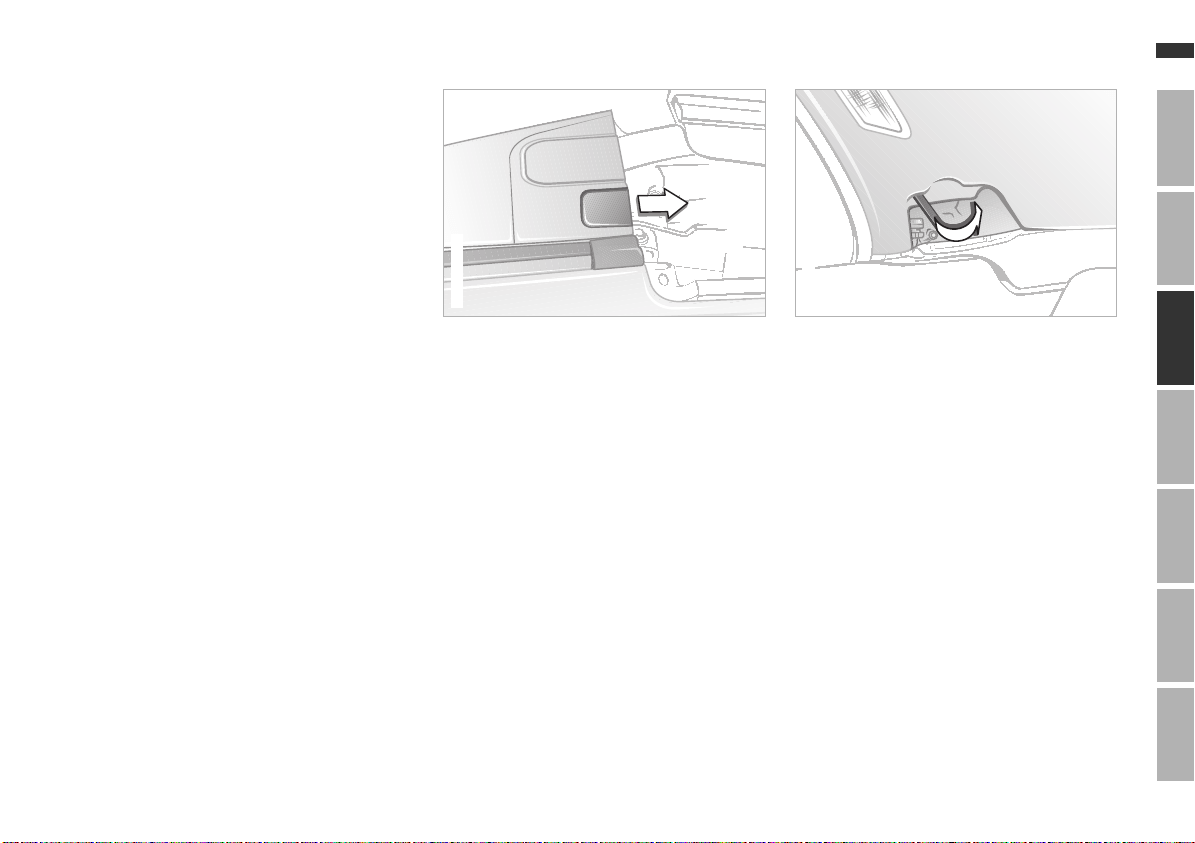
109
At a glanceControlsCar careRepairsTechnicalDataIndex
Even in winter, when the hardtop may
be in constant use, the fabric top does
not need to be removed. Before storing
the fabric top in the convertible top
compartment, it must be absolutely dry
to prevent the formation of water and
mildew spots.
Two persons are required for mounting
and removal. Use extreme care when
working to prevent paint damage and
damage to the body and hardtop.
To make it easier to mount and remove
the hardtops, you can purchase a spe-
cially developed hardtop lift
* from your
BMW Retailer.
Mounting
Lower the side windows and remove
the rod antenna if necessary to prevent
damage.
Unlock the convertible top compart-
ment lid on vehicles with manual con-
vertible top operation, or open the con-
vertible top compartment lid slightly
with the convertible top operating but-
ton on vehicles with electric convertible
top operation, as illustrated.
Remove the trim pieces on both sides
and then close the convertible top com-
partment lid again.
Before positioning the hardtop on the
car, fold down the covers below the
interior lamps at the left and right and
open the locking levers outward.
Now, with somebody else’s help, posi-
tion the hardtop on the mounts.
Close the locking lever at the back by
turning it inward (arrow) up to the stop
behind the trim.
As with the fabric top, fold out the lock-
ing handle inside and lock the hardtop
at the front by turning the handle until it
audibly engages.
36cde018
36cde019
Hardtop* – Convertible
Online Edition for Part No. 01 41 9 790 377 - © 07/98 BMW AG

110
aDo not lift the hardtop by the seals.
Accidentally shifted or pulled-out seals
cause leaks.c
Remove
Proceed as for mounting, however in
the reverse order.
Any BMW Service station will gladly
provide information on the purpose of
technical modifications to the car, the
legal position and the manufacturer's
recommendations. For this purpose,
the Retailer requires the Vehicle Identi-
fication Number and, in some cases,
also the engine number.
Light-Emitting Diodes (LEDs)
Control units, displays and other interior
equipment of your vehicle have LED's
behind protective lenses as a light
source. These LEDs resemble conven-
tional lasers and are classified by law as
"Class 1 light-emitting diodes".
aDo not remove the protective
lens and avoid staring directly at the
unfiltered beam for extended periods
(several hours), as inflammation of the
iris could result.c
Hardtop* – Convertible Technical modifications to the vehicle
Online Edition for Part No. 01 41 9 790 377 - © 07/98 BMW AG

111
At a glanceControlsCar careRepairsTechnicalDataIndex
Information for your safety
The factory-approved radial tires have
been selected to provide optimum
safety and driving comfort on your vehi-
cle.
In a very real sense, both tire life and
your own safety are riding on correct
tire specifications and inflation pres-
sures.
Incorrect inflation pressures are a fre-
quent cause of tire damage. To a great
extent it also influences the ability of
your BMW to hold the road.
aCheck the tire pressures – also in
the spare tire – at least every two weeks,
and before every extended trip.
Incorrect inflation pressures can also
lead to tire damage and accidents.c
Tire tread - tire damage
Inspect your tires frequently for tread
wear, signs of damage and for foreign
objects lodged in the tread. Check the
tread depth.
The tread depth should not be less than
0.12 in (3 mm). Otherwise there is an
increased risk of aquaplaning, even at
relatively moderate speeds and with
only small amounts of water on the
road.
We recommend that you always replace
the tires once the tread wears to 0.12 in
(3 mm). Once the tread has worn to
0.063 in (1.6 mm), tread depth indica-
tors appear.
aNever continue driving on a deflat-
ed (flat) tire. A flat tire greatly impairs
steering and braking response, and can
lead to complete loss of control over the
vehicle.
Avoid overloading the vehicle so that the
permitted load on the tires is not ex-
ceeded. This can cause overheating and
gradual internal damage. The ultimate
result can assume the form of a sudden
air loss.
Unusual vibrations encountered during
normal vehicle operation can indicate
tire failure or some other vehicle defect,
as can variations in normal vehicle
response, such as a pronounced ten-
dency to pull to the left or right. Should
this occur, you should respond by
immediately reducing your speed and
carefully proceeding to the nearest
BMW Retailer or professional tire cen-
ter, or having the vehicle towed in to
have it and its tires inspected.
Tire damage (up to and including blow-
outs) can endanger the lives of both the
vehicle occupants and other road
users.c
Tire inflation pressures Tire tread
Online Edition for Part No. 01 41 9 790 377 - © 07/98 BMW AG

112
To maintain good handling and vehicle
response, use only tires of a single
tread configuration from a single manu-
facturer.
aDo not use retreaded tires, as oth-
erwise driving safety may be impaired.
This is due to the possible variations in
casing structures and, in some cases, to
their extreme age, which can lead to a
decrease in their durability.c
Tread wear patterns differ at the front
and rear wheels according to the indi-
vidual operating conditions. In the inter-
est of safety and optimal vehicle
response, we advise against rotating
tires from front to rear and vice versa.
When considering the potential eco-
nomic benefits of interaxle tire rotation,
you must decide whether the expense
of having the tires rotated is likely to be
amortized during the anticipated exten-
sion in tire life. We recommend that you
discuss the matter with your BMW
Retailer.
Should you decide in favor of rotating
the tires, it is essential to observe the
following:
Leave the tires on the same side of the
vehicle (include spare in rotation pat-
tern as desired).
Braking response and traction may be
adversely affected.
Rotation should always be carried out
at short intervals, max. 3000 miles
(approx. 5000 km).
Following rotation always correct the
tire inflation pressure.
Always replace tires after 10 years,
regardless of use or tread wear.
Spare tires over 6 years old should be
used only in case of emergency. Such a
tire should be replaced by a new tire
immediately, and should not be fitted
together with new tires.
The date on which the tire was manu-
factured is indicated by the code on
the sidewall: DOT ... 327 indicates that
the tire was manufactured in Week 32
of 1997.
Tire replacement Interaxle tire changes
Online Edition for Part No. 01 41 9 790 377 - © 07/98 BMW AG

113
At a glanceControlsCar careRepairsTechnicalDataIndex
Tires and wheels
Use only BMW-approved tires.
Due to the high speeds which this vehi-
cle can reach, the use of specific
brands, specifications and dimensions
is mandatory. Consult any BMW
Retailer for details.
Observe national, provincial and state
regulations.
The tire codes will aid you in selecting
the correct tire. The essential data for
radial tires are as follows:
The speed rating indicates the
approved maximum speed for the tire.
Summer tires:
S = up to 112 mph (180 km/h)
T = up to 118 mph (190 km/h)
H = up to 130 mph (210 km/h)
V = up to 149 mph (240 km/h)
W = up to 167 mph (270 km/h)
ZR = over 149 mph (240 km/h)
Winter tires:
Q M+S = up to 100 mph (160 km/h)
T M+S = up to 118 mph (190 km/h)
H M+S = up to 130 mph (210 km/h)
Use screw-on valve stem caps to
protect the tire valves against dirt. Dirt
in the valves frequently leads to slow
leaks.
Example:
Nominal width
in mm
Aspect ratio in %
Type of radial-code
letter for radial
Rim diameter in inches
Load rating
(not on ZR tires)
Speed rating
(before R on ZR tires)
205/60 R 15 91 H
Codes on steel/light-alloy wheels:
7 J x 15 H 2
Hump width (inches)
Code letter for
flange type
Denotes
drop-center rim
Rim diameter (inches)
Hump of 2 rim shoulders
The right choice
Online Edition for Part No. 01 41 9 790 377 - © 07/98 BMW AG

114
We recommend winter tires (M+S radial
tires) for operation under inclement win-
ter driving conditions. Although all-sea-
son M+S tires provide better winter
traction than standard summer tires
with H, V, W and ZR speed ratings, they
generally fail to provide the same levels
of performance as standard snow tires
in winter driving.
If you fit winter tires, install radial tires
of the same tread configuration and
from a single manufacturer on all four
wheels (better still: on all five wheels).
This ensures safe tracking and steering
response.
Fit BMW-approved winter tires only.
Any BMW Retailer will be glad to pro-
vide you with information on the best
winter tires for your particular driving
conditions.
Winter tires display a perceptible loss in
their ability to cope with winter driving
conditions once the tread wears to
below 0.16 in (4 mm), and should thus
be replaced.
Observe the specified tire inflation
pressures - and be sure to have the
wheel and tire assemblies balanced
every time you change the tires!
aNever exceed the maximum speed
for which the tires are rated.
Unprofessional attempts by laymen to
service tires can lead to damage and ac-
cidents.
Have this work performed by skilled pro-
fessionals only. Your BMW Retailer will
be glad to assist you.c
Store tires in a cool, dry place, away
from light whenever possible. Protect
the tires from contact with oil, grease
and fuel.
Winter tires
Online Edition for Part No. 01 41 9 790 377 - © 07/98 BMW AG

115
At a glanceControlsCar careRepairsTechnicalDataIndex
bSize 185/65 R 15 88 T tires are
only for the BMW 318i Sedan.c
bSizes 225/55 R 15 92 V,
225/55 R 92 Q, T, H M+S, 225/50 ZR 16.
These tires are not suitable for use with
snow chains.c
Modifications to the vehicle are required
before retrofitting tires in the above
dimensions.
Please consult your BMW Retailer.
The use of fine-link BMW snow chains
*
on summer or winter tires is only per-
mitted in pairs on the rear wheels.
Always observe the tire manufacturer’s
safety recommendations when fitting.
Tire specifications Steel rim
(wheel rim)
Light-alloy wheel Rim offset
(mm)
BMW 318is Coupe, 318i Convertible, 318i Sedan
185/65 R 15 88 T 6 J x 15 H2 – 42
185/65 R 15 88 Q, T M+S
6 J x 15 H2 –42
205/60 R 15 91 H
6g Jx15 H2 7 J x 15 H2 47
205/60 R 15 91 Q, H M+S
6g Jx15 H2 7 J x 15 H2 47
225/55 R 15 92 V
6g Jx15 H2 7 J x 15 H2 47
225/50 R 16 92 Q M+S – 7 J x 16 H2 45/46
225/50 ZR 16 – 7 J x 16 H2 45/46
Approved wheels and tires
Online Edition for Part No. 01 41 9 790 377 - © 07/98 BMW AG

116
bSizes 225/55 R 15 92 V,
225/55 R 92 Q, T, H M+S, 225/50 ZR 16.
These tires are not suitable for use with
snow chains.c
Modifications to the vehicle are required
before retrofitting tires in the above
dimensions.
Please consult your BMW Retailer.
The use of fine-link BMW snow chains
*
on summer or winter tires is only per-
mitted in pairs on the rear wheels.
Always observe the tire manufacturer’s
safety recommendations when fitting.
Tire specifications Steel rim
(wheel rim)
Light-alloy wheel Rim offset
(mm)
BMW 323is Coupe, 323i Convertible
185/65 R 15 88 Q M+S
6 J x 15 H2 –42
205/60 R 15 91 H
6g Jx15 H2 7 J x 15 H2 47
205/60 R 15 91 Q, H M+S
6g Jx15 H2 7 J x 15 H2 47
225/55 R 15 92 V
6g Jx15 H2 7 J x 15 H2 47
225/50 R 16 92 Q M+S – 7 J x 16 H2 45/46
225/50 ZR 16 – 7 J x 16 H2 45/46
Approved wheels and tires
Online Edition for Part No. 01 41 9 790 377 - © 07/98 BMW AG

117
At a glanceControlsCar careRepairsTechnicalDataIndex
bSize 225/50 ZR 16 tires are not
suitable for use with snow chains.c
Modifications to the vehicle are required
if retrofitting these tires.
Please consult your BMW Retailer.
The use of fine-link BMW snow chains
*
on summer or winter tires is only per-
mitted in pairs on the rear wheels.
Always observe the tire manufacturer’s
safety recommendations when fitting.
Tire specifications Steel rim
(wheel rim)
Light-alloy wheel Rim offset
(mm)
BMW 328is Coupe, 328i Convertible, 328i Sedan
205/60 R 15 91 H – 7 J x 15 H2 47
205/60 R 15 91 Q, H M+S
6g Jx15 H2 7 J x 15 H2 47
225/50 R 16 92 Q M+S – 7 J x 16 H2 45/46
225/50 ZR 16 – 7 J x 16 H2 45/46
Approved wheels and tires
Online Edition for Part No. 01 41 9 790 377 - © 07/98 BMW AG
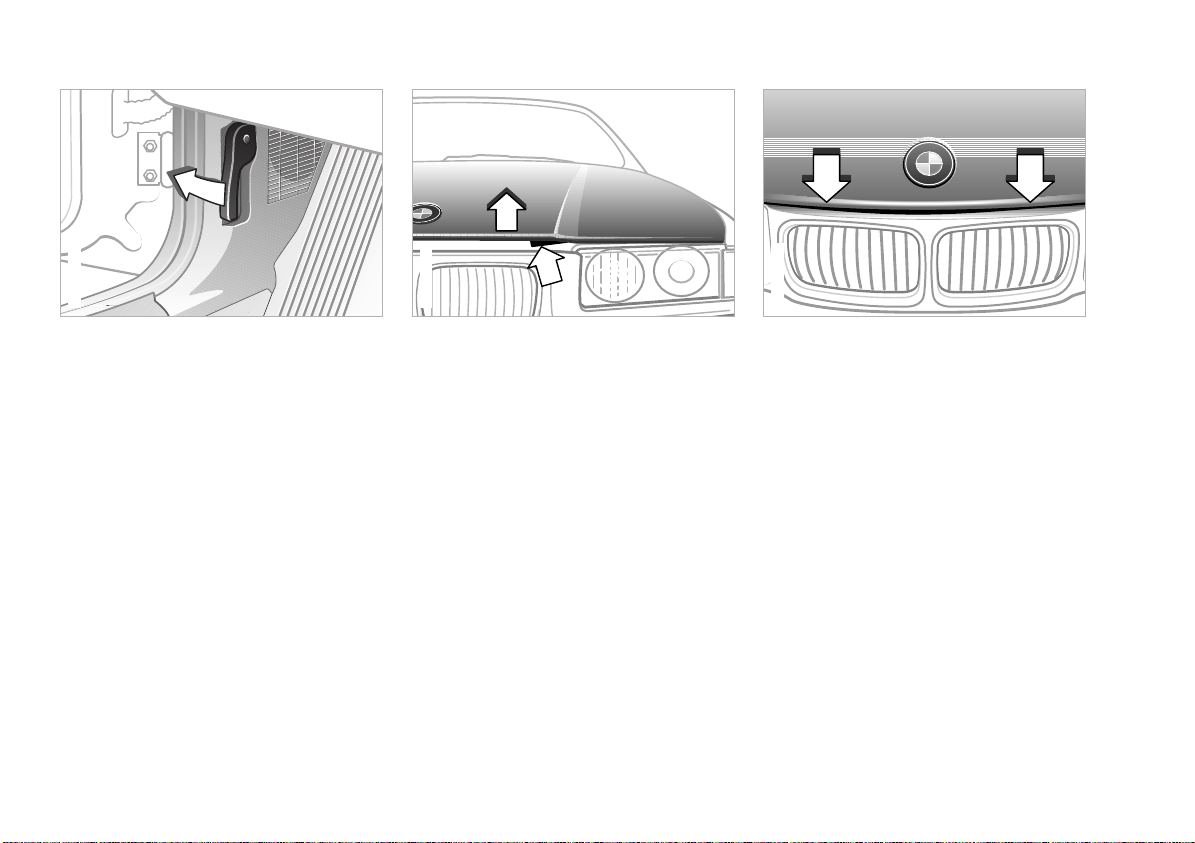
118
Unlocking
Pull the lever located under the left-
hand side of the instrument panel.
aDo not work on your vehicle with-
out appropriate skills. Always switch off
the engine and allow it to cool down be-
fore working in the engine compart-
ment.
Always disconnect the battery before
working on the electrical system. When
working on the vehicle, follow the rele-
vant instructions and information. When
you are not familiar with the relevant
specifications, have service operations
performed by your authorized BMW Re-
tailer. Failure to proceed in an informed,
professional manner when servicing
components and materials constitutes a
safety hazard for yourself and other us-
ers of the public roads.c
To open
Push the release handle – at the front
left under the hood – upward and open
the hood.
To close
Simultaneously press down both sides
of the hood; continue pressing until you
hear the latches engage.
aShould you determine that the
hood is not completely closed while
driving, stop immediately and close it
securely.c
360de085
B
M
W
360de307
B
M
W
360de308
Hood
Online Edition for Part No. 01 41 9 790 377 - © 07/98 BMW AG

119
At a glanceControlsCar careRepairsTechnicalDataIndex
Online Edition for Part No. 01 41 9 790 377 - © 07/98 BMW AG
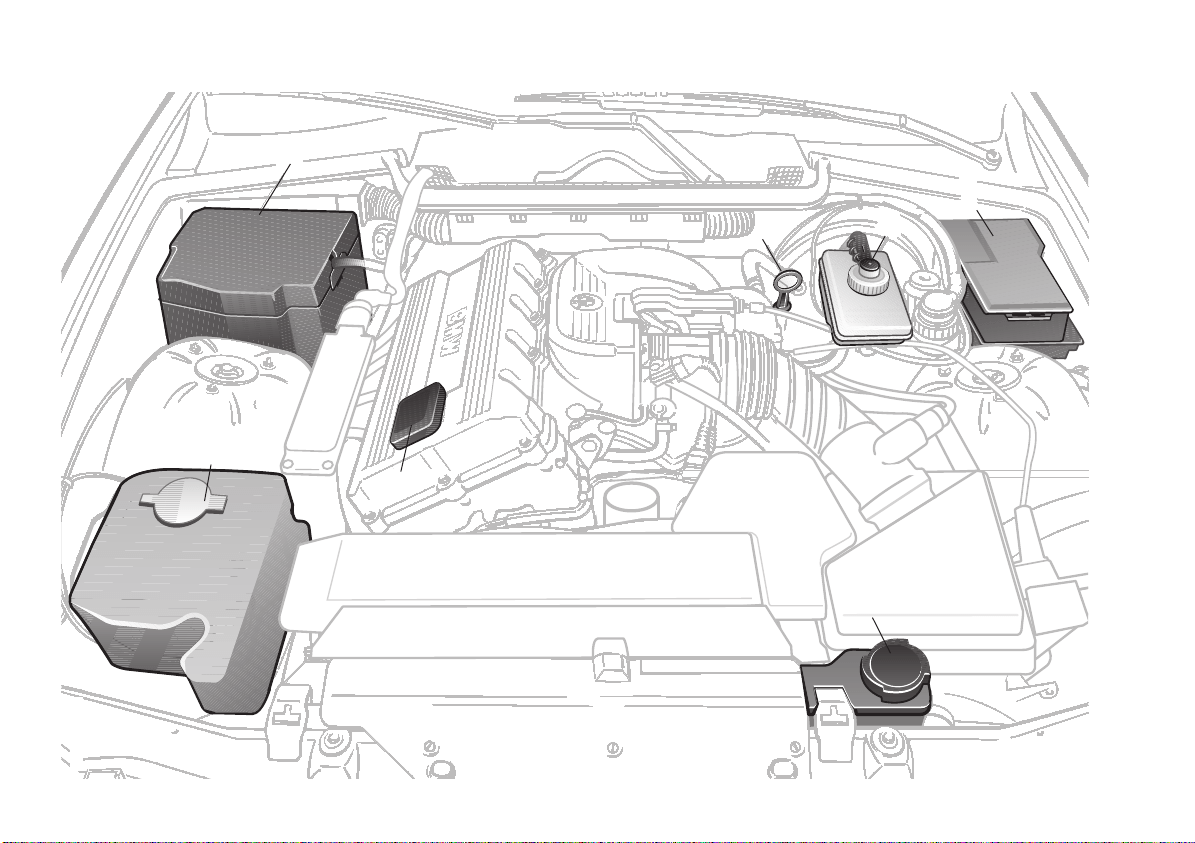
120
Engine compartment BMW 318i, 318is
7
6
5
5
4
3
2
1
4
360de090
Online Edition for Part No. 01 41 9 790 377 - © 07/98 BMW AG

121
At a glanceControlsCar careRepairsTechnicalDataIndex
1 Fuse box
2 Brake fluid reservoir
3 Engine oil dipstick
4 Coolant expansion tank
5 Engine oil filler neck
6 Supply tank for headlamp washer
*
and windshield washer system
7Battery
Engine compartment BMW 318i, 318is
Online Edition for Part No. 01 41 9 790 377 - © 07/98 BMW AG
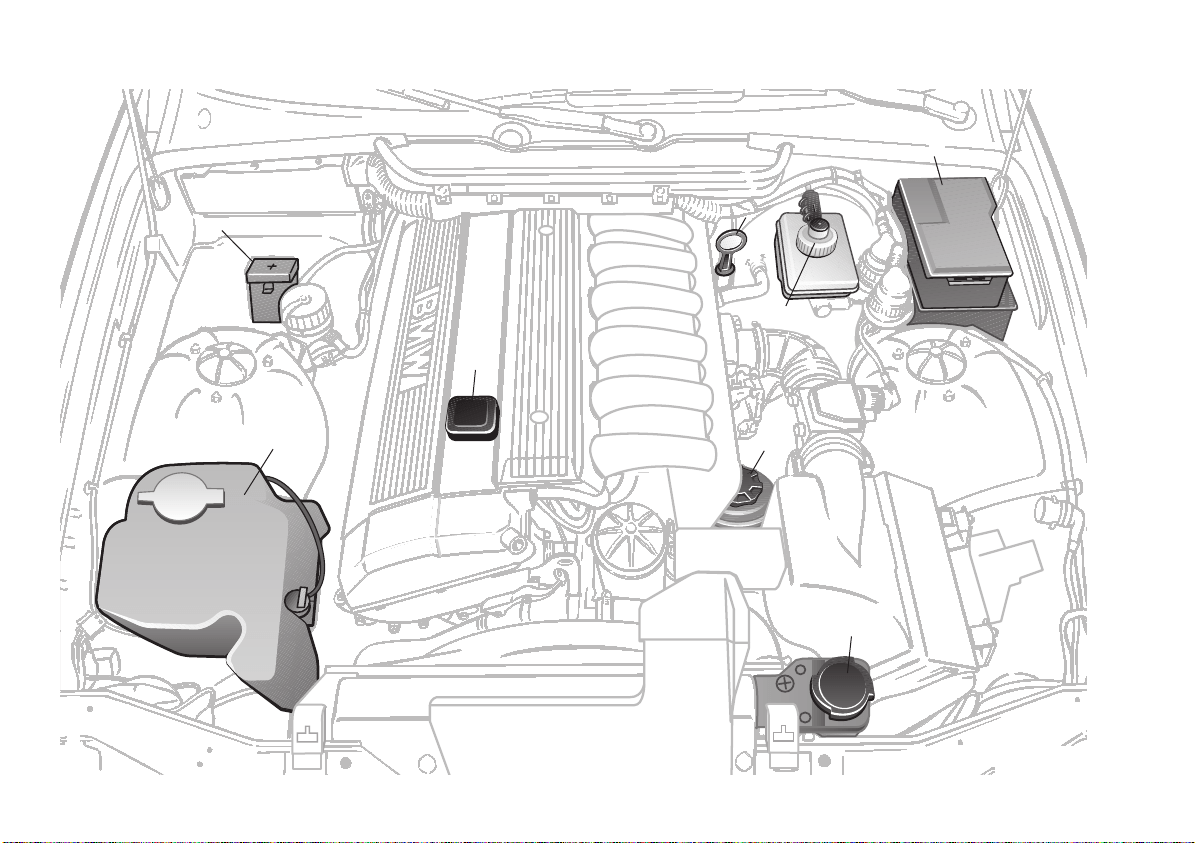
122
Engine compartment BMW 323i, 323is, 328i, 328is
1
3
2
4
5
6
7
8
360de091
Online Edition for Part No. 01 41 9 790 377 - © 07/98 BMW AG

123
At a glanceControlsCar careRepairsTechnicalDataIndex
1 Fuse box
2 Engine oil dipstick
3 Brake fluid reservoir
4 Power steering oil reservoir
5 Coolant expansion tank
6 Engine oil filler neck
7 Supply tank for headlamp washer
*
and windshield washer system
8 Auxiliary terminal for jump starting
Engine compartment BMW 323i, 323is, 328i, 328is
Online Edition for Part No. 01 41 9 790 377 - © 07/98 BMW AG
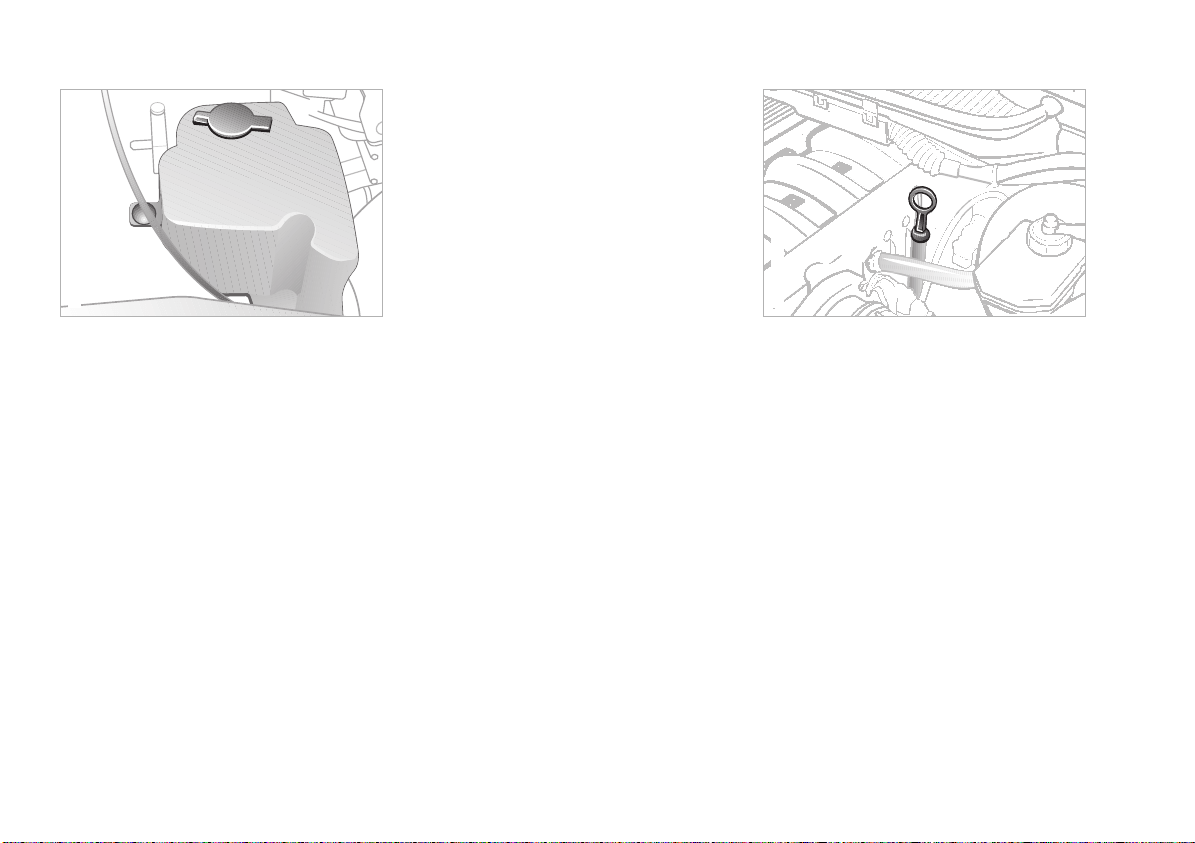
124
Headlamp washer* and
windshield washer
Capacity approx. 2.65 US quarts
(2.5 liters) for the windshield washer or
5.3 US quarts (5 liters) in conjunction
with the headlamp cleaning system.
Fill with water and - if required - with
antifreeze (according to the manufac-
turer's recommendations).
bWe recommend that you mix the
washer fluid before adding it to the res-
ervoir.c
Windshield washer spray
nozzles
The spray from the nozzles should be
directed so as to ensure effective
cleaning, even at high speeds.
Use a needle to adjust the nozzles as
required, or have them adjusted by your
BMW Retailer.
Checking oil level
As with fuel economy, oil consumption
is directly influenced by your driving
style and vehicle operating conditions.
Consequently you should check the oil
level regularly with the vehicle posi-
tioned on a level surface - approx. every
600 miles (1,000 km), or more fre-
quently if your vehicle is driven under
increased demands.
To obtain precise readings:
d Check with engine cold, before start-
ing.
d When checking with the engine
warm, wait briefly for the oil to drain
back down into the oil pan (e.g.,
while refueling).
360de100
360de095
Washer fluids Engine oil
Online Edition for Part No. 01 41 9 790 377 - © 07/98 BMW AG
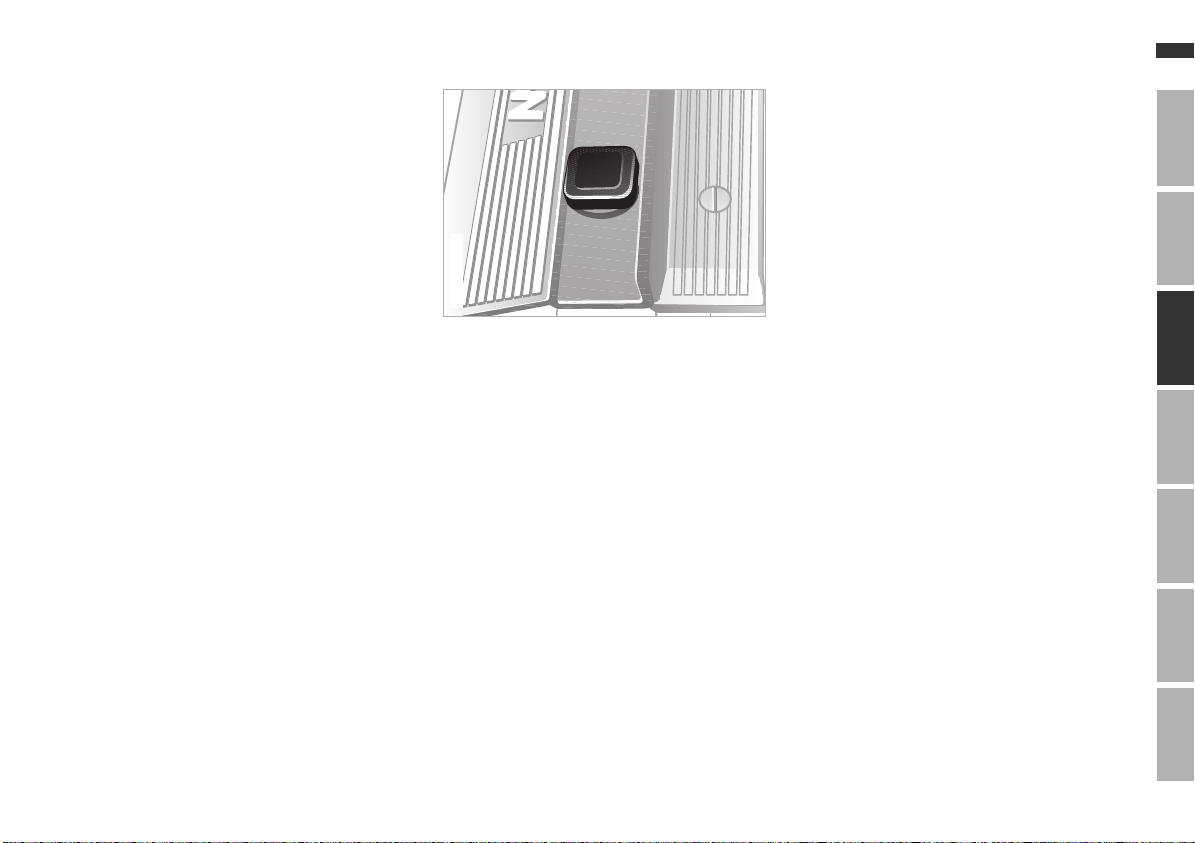
125
At a glanceControlsCar careRepairsTechnicalDataIndex
Measure the oil level:
1 Pull out dipstick and wipe off with a
lint-free cloth, paper tissue, etc.
2 Push the dipstick all the way into the
guide tube and pull it out again.
3 The oil level should be between the
two marks on the dipstick.
Add oil
Wait until the level has dropped to just
above the lower graduation before add-
ing oil. Never wait until the oil drops
below the lower mark.
The space between the two marks on
the dipstick corresponds to approxi-
mately 1.1 US quarts (1 liter). Do not fill
to beyond the upper mark on the dip-
stick. Excess oil harms the engine.
Because it would be consumed within a
short period, it would also result in an
abnormally high rate of oil consump-
tion.
aBMW engines are designed to op-
erate without oil additives; the use of ad-
ditives could lead to damage in some
cases. This also applies to the manual
and automatic transmissions, the differ-
ential and the power steering system.c
Engine oil specifications
Always refer to the API specifications
when selecting oil.
Required quality:
API SH
API-SH/CD
API-SH/CE
Viscosity ratings
Viscosity = Oil flow rating according to
SAE class.
Select the SAE viscosity rating accord-
ing to the average seasonal air temper-
ature.
Consult the table on the following page
to determine the correct SAE viscosity.
You can continue to operate the vehicle
for short periods of time at tempera-
tures beyond the range for the SAE rat-
ing of the oil being used.
AAlways observe all environmental
protection guidelines and regulations
when disposing of used oil.c
Recommendation: have the oil changed
by your BMW Retailer.
360de096
Engine oil
Online Edition for Part No. 01 41 9 790 377 - © 07/98 BMW AG
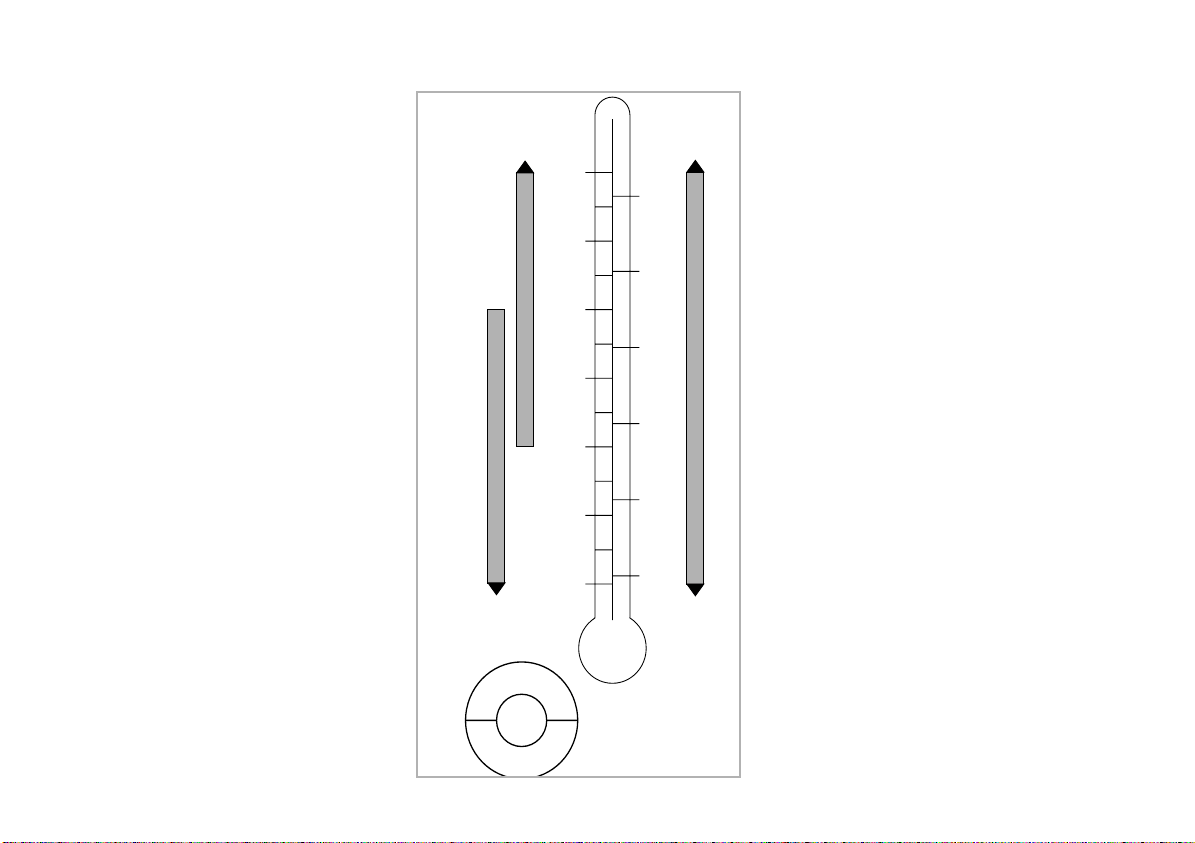
126
aContinuous exposure to used oil
has caused cancer in laboratory testing.
Any skin areas that come in contact with
oil should be thoroughly washed with
soap and water.
Always store oil, grease, etc., out of
reach of children. Observe all warning
labels and information on lubricant
containers.
If you use SAE 15W-40 engine oil in low
temperatures below 145F (-10 6) the
engine may become difficult to start.c
* Special engine oils individually
approved by BMW are the most suited
to your engine. Please contact your
BMW Retailer for details.
.
Engine oil
Special - Oils* most preferable
15W - 40
5W - 30
30
20
10
0
-10
-20
-30
-20
0
20
40
60
80
°C
°F
A
P
I
S
E
R
V
I
C
E
S
G
E
N
E
R
G
Y
C
O
N
S
E
R
V
I
N
G
I
I
SAE
5W-30
365us312
Online Edition for Part No. 01 41 9 790 377 - © 07/98 BMW AG
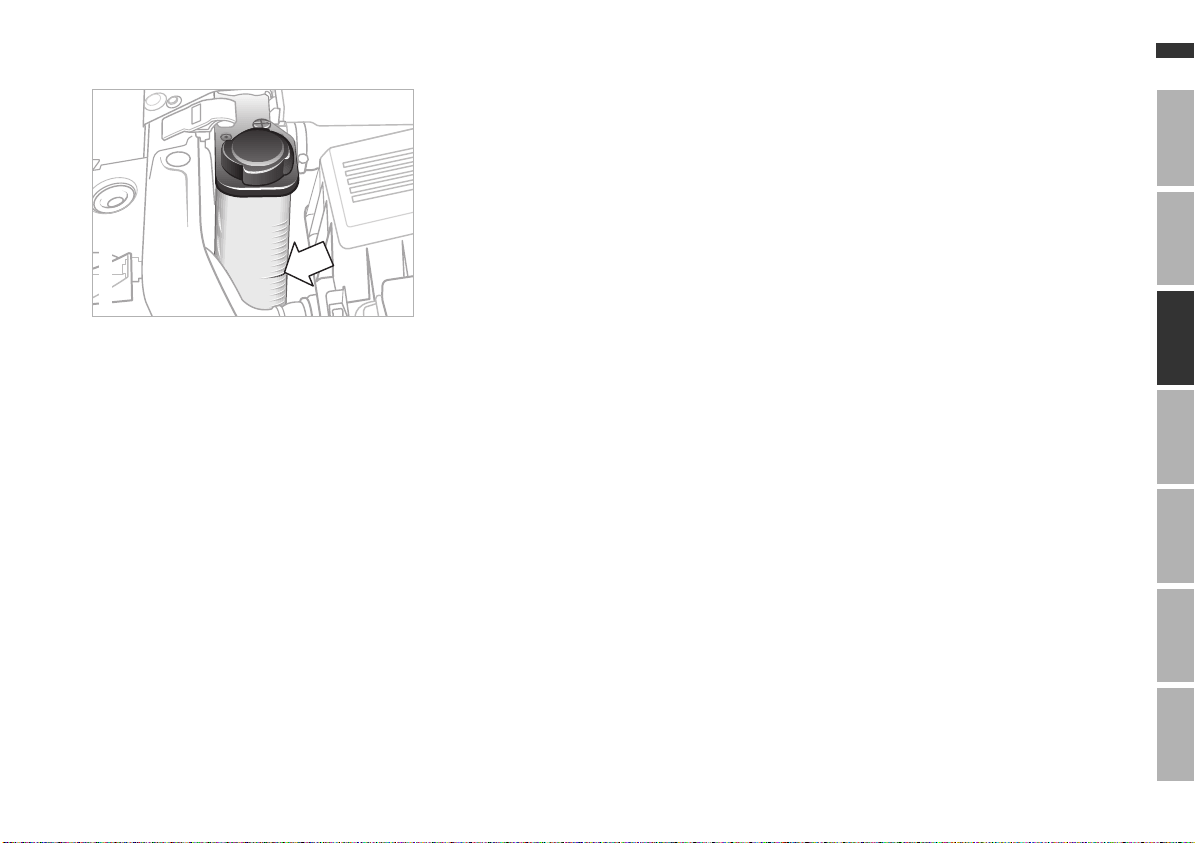
127
At a glanceControlsCar careRepairsTechnicalDataIndex
Coolant level with engine cold: up to
the KALT/COLD mark on the transpar-
ent coolant expansion tank.
The coolant is a mixture of water and
extended-duty antifreeze with corrosion
inhibitor. Always maintain the prescribed
all-season 50:50 mixture ratio for year-
round protection against internal corro-
sion. No other additives are required.
Replace the coolant every three years.
To add coolant
Wait until the engine cools before re-
moving the cap from the expansion
tank. Before unscrewing the cap, en-
sure that the needle on the temperature
gauge is in the blue sector to avoid
scalding.
d Start by turning the cap counter-
clockwise. Pause to allow any accu-
mulated pressure to escape, then
open.
d Add coolant up to the KALT/COLD
mark. Excess coolant drains off
through the overflow line.
aDo not add coolant while the
engine is hot.
To avoid the possibility of damage later
on, never use anything other than
factory-approved nitrite and amino-free
long-term antifreeze and corrosion
protectant. Your authorized BMW
Retailer is familiar with the official
specifications.
Antifreeze with corrosion protectant is
toxic. Always store in original contain-
ers only, keeping them tightly closed.
Store well out of reach of children.
When disposing of it, observe the
applicable environmental protection
laws.
Long-term antifreeze and corrosion
protectant contains the flammable
substance ethylene glycol. You should
therefore avoid spilling it on hot engine
components, as it could catch fire and
cause serious burns.c
AObserve the applicable environ-
mental protection laws when disposing
of used antifreeze.c
360de099
Coolant
Online Edition for Part No. 01 41 9 790 377 - © 07/98 BMW AG
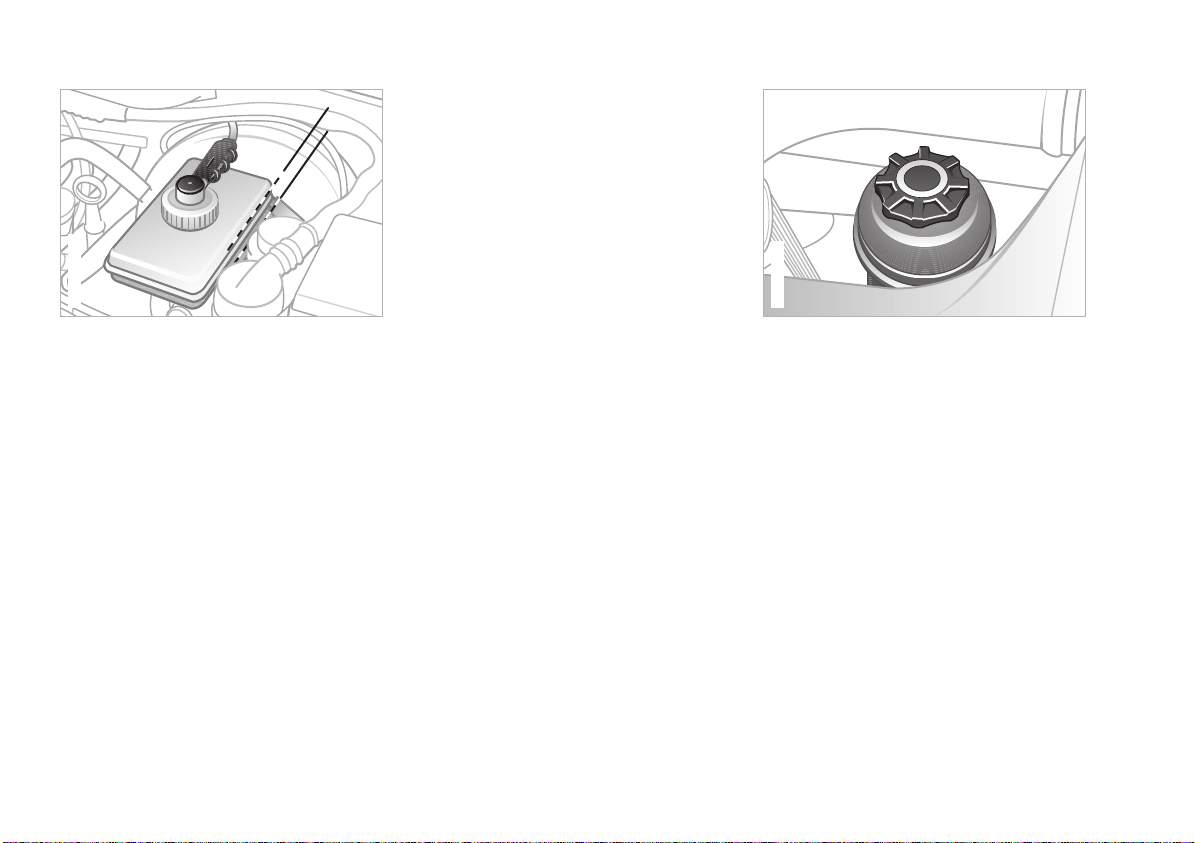
128
Warning lamp for brake hydraulic sys-
tem lights up:
Brake fluid loss resulting in extended
pedal travel.
Fill up to the upper mark (MAX, level
visible from the outside).
Any BMW Retailer can provide you with
information on factory-approved brake
fluids (DOT 4).
aBrake fluid is hygroscopic, i.e., it
absorbs moisture from the atmosphere
over the course of time. To ensure that
your brake system continues to operate
at maximum efficiency, we strongly rec-
ommend that you have the brake fluid
changed at a BMW Retailer every two
years (refer to pages 71, 105 and 138
and to Service and Warranty Information
booklet). Brake fluid is toxic, and also at-
tacks vehicle paintwork. Always store in
the original containers, and keep them
tightly closed, out of reach of children.
When disposing of it, observe the appli-
cable environmental protection laws. Do
not spill brake fluid and do not fill be-
yond the MAX graduation on the reser-
voir. Should it come into contact with
hot engine components, the brake fluid
could catch fire and cause serious
burns.c
APlease observe the applicable envi-
ronmental protection laws when dis-
posing of used brake fluid.c
With the engine off, unscrew the reser-
voir cap, then reinsert it.
The fluid level should be in between the
graduations on the dipstick.
Use ATF to top up as required. Your
BMW Service representative can pro-
vide you with the fluid specifications.
Start the engine. Pour in more fluid as
required, continuing until it reaches to
between the two marks.
Switch off the engine. The fluid may rise
to about 0.2 inches (5 mm) above the
upper mark.
Screw the reservoir cap back on.
bBMW 318i, 318is: Please contact
your BMW Retailer for the required
work.c
MAX
MIN
360de098
360de097
Brake fluid Power steering fluid
Online Edition for Part No. 01 41 9 790 377 - © 07/98 BMW AG
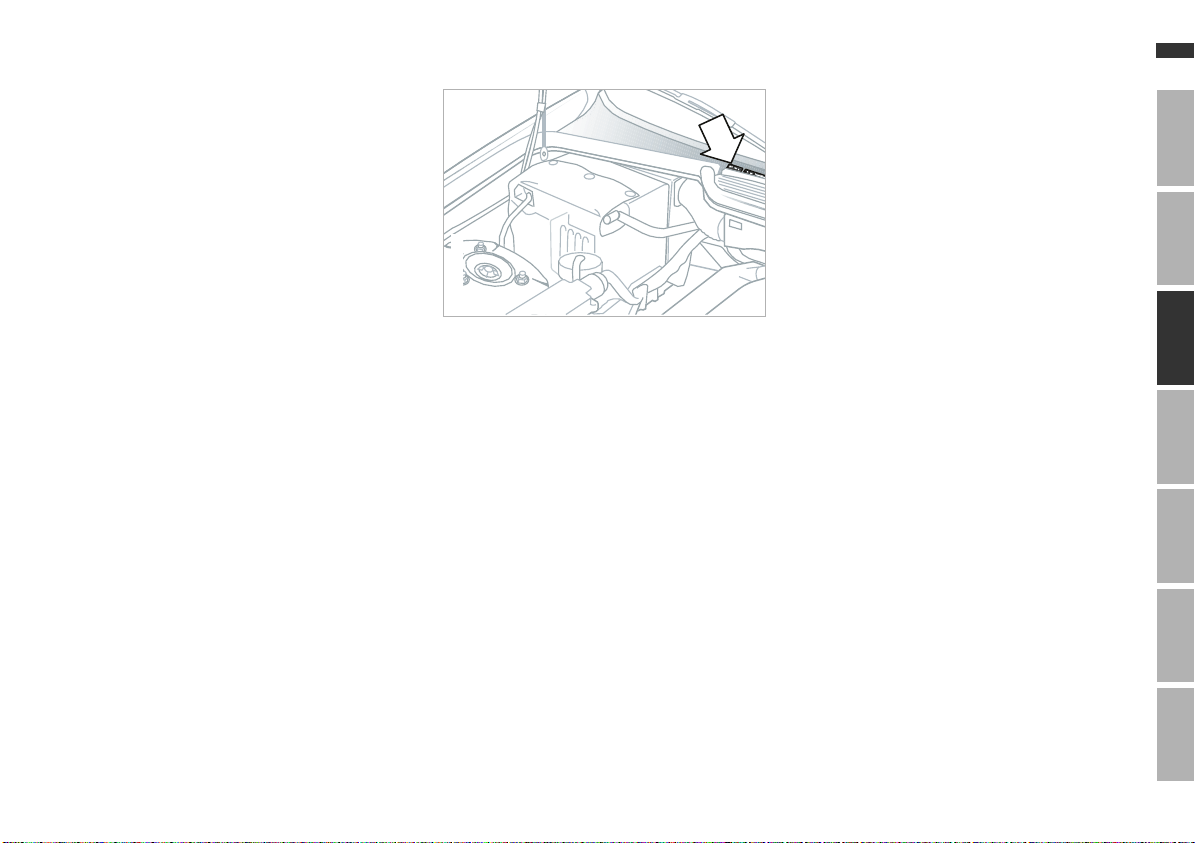
129
At a glanceControlsCar careRepairsTechnicalDataIndex
High steering effort:
Check oil level, refer to previous page.
High steering effort during sudden tran-
sitions:
Please contact your BMW Retailer for
an immediate inspection.
aIf the power steering fails, in-
creased effort will be required to steer
the vehicle.c
In the engine compartment on the right-
hand side of the heater partition panel
(arrow).
The information on the type plate and
the Vehicle Identification Number must
match those contained in the vehicle
papers.
These data are essential for processing
inquiries, expediting service procedures
and when ordering replacement parts.
360de310
Power steering fluid Vehicle Identification Number
Online Edition for Part No. 01 41 9 790 377 - © 07/98 BMW AG

130
The BMW Maintenance System has
been designed as a reliable means of
providing the customer with maximum
vehicle safety and reliability with mini-
mum complication and expense.
Please remember that regular periodic
maintenance plays an essential part in
ensuring continued vehicle security. It
also helps maintain the resale value of
the vehicle.
Service Interval Display
Advanced technology is employed to
calculate the optimal maintenance
intervals, which are then indicated in
the Service Interval Display. While con-
ventional maintenance systems rely on
mileage alone to determine when ser-
vice is due, the BMW Maintenance Sys-
tem reflects the actual conditions under
which the vehicle is operated, because
mileage is not simply mileage:
From the point of view of maintenance,
62,000 miles (100,000 km) accumulated
in short-distance driving are not the
equivalent of the same distance cov-
ered in long-distance highway travel.
The BMW Maintenance System
includes the Engine Oil Service as well
as Inspections I and II.
Determining the maintenance intervals
according to the actual loads on the car
covers every kind of operating situation.
However, drivers who cover only
extremely short distances - substantially
less than 6,200 miles (10,000 km) annu-
ally - should have the engine oil changed
at least once a year, as it continues to
age whether or not the car is used on a
regular basis.
Service and Warranty Information
booklet
Please refer to the Service and War-
ranty Information booklet for additional
information on maintenance intervals
and procedures.
Depending on operating conditions, as
a precaution against rust it may be a
good idea to have the body checked for
stone damage and chips at the same
time.
Please ensure that all maintenance
operations are entered in the Service
and Warranty Information booklet upon
completion. These entries will consti-
tute your proof that the vehicle has
received regular maintenance. They
are also required for warranty claims.
bHave your BMW Retailer carry out
the maintenance and repair. Your BMW
Retailer is always informed on the latest
maintenance work and repair tech-
niques and equipped with the required
special tools. In addition, the testing of
parts known from experience to be sub-
ject to wear is a permanent part of the
maintenance specifications.c
360us009
The BMW Maintenance System
Online Edition for Part No. 01 41 9 790 377 - © 07/98 BMW AG

131
At a glanceControlsCar careRepairsTechnicalDataIndex
Washing your car
Right from the start, you can wash your
new BMW either by hand or in an auto-
matic car wash. BMW Convertible: For
instructions on cleaning and care of the
convertible top, refer to page 136 ff.
To prevent spots, avoid washing when
the hood is still warm, or immediately
after and during exposure to strong
sunlight.
When using an automatic car wash,
ensure that
d no damage occurs to vehicles with
add-on body elements (e.g., spoilers,
telephone aerials). Consult the car
wash operator if necessary
d the vehicle is cleaned with minimum
brush pressure, and that ample water
is available for washing and rinsing.
Loosen and remove stubborn dirt and
dead insects before washing the car.
aAlways maintain an adequate dis-
tance between the spray source and the
vehicle's surface when using spray
wands and high-pressure washers. In-
adequate distance and excessive pres-
sure can damage or weaken the finish,
making it more susceptible to subse-
quent attack. In addition, moisture could
penetrate to vehicle components, lead-
ing to long-term damage.c
Parts of the car which are inaccessible
to the automatic washer - such as door
sills, door and hood edges, etc. -
should be cleaned by hand.
bPlease observe the following
when cleaning the headlamp covers:
d Do not clean by wiping with a dry
cloth (scratches). Never use abra-
sives or strong solvents to clean the
covers.
d Remove dirt and contamination (such
as insects) by soaking with BMW Car
Shampoo and then rinsing with
plenty of water.
d Always use a de-icer spray to remove
accumulated ice and snow – Never
use a scraper!c
In the winter months, it is especially
important to ensure that the car is
washed on a regular basis. Large quan-
tities of dirt and road salt are difficult to
remove, and they also cause damage to
the vehicle.
aAfter washing, the brakes may be
wet and thus less effective! Apply the
brakes briefly to dry them.c
Caring for your car
Online Edition for Part No. 01 41 9 790 377 - © 07/98 BMW AG

132
Exterior finish
To provide effective corrosion protec-
tion, multilayer paintwork is applied at
the factory. Cataphoretic immersion
priming techniques are supplemented
using special body-cavity protectants,
with the application of specially-devel-
oped and extensively tested materials.
The entire underbody is sprayed with a
flexible PVC layer before final compre-
hensive application of a wax-based
protectant.
Regular maintenance makes an impor-
tant contribution to maintaining the
safety and value of your vehicle.
Increasing awareness of the effects of
harmful environmental factors on vehi-
cle finishes have led paint and vehicle
manufacturers to initiate ongoing pro-
grams designed to further improve the
durability of their finishes. Despite the
high quality of the resulting products,
local and regional factors can still have
a negative effect on your car's paint-
work. These should guide you in deter-
mining the frequency and extent of your
efforts to maintain the vehicle finish.
Depending upon material and type of
impact (perforation of paint layer), phys-
ical stresses from sand, road salt,
gravel, etc. can cause corrosion to start
extending beneath the finish, starting at
the point of impact.
Road dirt, tar spots, dead insects, ani-
mal droppings (strong alkali effect) and
tree excretions (resins and pollen) all
contain substances capable of causing
damage when allowed to remain on
your car's finish for any period of time
(spots, etching, flaking, separation in
the top coat).
In industrial areas, deposits from fly ash,
lime, oily soot, sulphur dioxide in pre-
cipitation (acid rain) and other environ-
mental pollutants will damage the car's
surface (usually limited to the external
horizontal surfaces) unless adequate
protection is provided.
In coastal regions, high levels of atmo-
spheric salt and humidity promote cor-
rosion.
In tropical zones, temperatures of over
100 5F (approx. 406) in the shade pre-
vail, in addition to heavy ultraviolet radi-
ation and high humidity. Under those
circumstances, light-colored paints
reach temperatures of up to 175 5F
(approx. 806) and dark paints up to
250 5F (approx. 1206).
Caring for the vehicle finish
As a precaution against damage result-
ing from exposure to aggressive sub-
stances, we recommend that you wash
the car weekly when it is used in an
area with high levels of air pollution or
aggressive natural substances (tree
resin, pollen).
Remove particularly aggressive sub-
stances immediately in order to prevent
changes to, and discoloration of, the
paint. Such substances are e.g., gaso-
line spilled during refueling, oil, grease,
brake fluid and bird droppings.
Any contamination remaining on the
surface of the vehicle will be especially
conspicuous after washing. Use clean-
ing fluid or alcohol with a clean cloth or
cotton pad to remove. You can use tar
remover to remove any spots on the fin-
ish of the vehicle, but should never
apply it or any other aggressive
cleanser to lenses or headlamp covers.
These areas should then be waxed to
maintain protection.
bA full range of car-care products is
available from your BMW Retailer.c
Caring for your car
Online Edition for Part No. 01 41 9 790 377 - © 07/98 BMW AG

133
At a glanceControlsCar careRepairsTechnicalDataIndex
Waxing your car
Protect the finish using carnauba or
synthetic-based waxes only.
The best way to determine when the
finish needs to be waxed is by noting
when water stops beading on the sur-
face.
You can use a glass cleaner to remove
any wax or silicone that may have been
left on the windows during waxing.
bA full range of car-care products is
available from your BMW Retailer.c
Paint damage
You can touch up small areas of dam-
age with BMW spray paint, a BWM
touch-up stick or BMW paint tape.
The paint color code for your car is pro-
vided on a sticker located next to the
type plate and on the first page of your
Service and Warranty Information book-
let.
Damage caused by flying stones,
scratches, etc. must be touched up
without delay to prevent rust from form-
ing.
If corrosion has started to form in an
area with paint damage, remove all rust
and clean the area, then prime the area
with a BMW Primer Stick. Finally, apply
the finish coat. Wait a few days, then
polish the repaired area. Finish by
applying a wax preservative.
More extensive paint damage should be
professionally repaired in accordance
with the manufacturer's instructions.
Your BMW Retailer uses original BMW
finish materials in accordance with offi-
cial repair procedures.
Caring for other vehicle compo-
nents and materials
Light-alloy wheels* should be treated
with alloy wheel cleaner, particularly dur-
ing the winter months. Refrain from using
aggressive products containing acids,
strong alkalis or abrasives. Alloy wheels
should not be cleaned with a steam jet
operating at temperatures in excess of
140 5F (606) (note manufacturer's
instructions).
You can use window and glass cleaner to
clean inside window surfaces and mir-
rors without smearing and streaking.
Never use polishing pastes or abrasive
(quartz) cleansers on mirror lenses.
Clean plastic parts, imitation leather sur-
faces, the roof lining, the lenses of lamps,
the glass cover of the instrument panel
and all dull black sprayed parts with
water or products for the care of plastics.
Avoid soaking the headliner. Never use
solvents such as lacquer thinner, heavy-
duty grease remover, fuels, etc.
Rubber components should be cleaned
with water only; a rubber treatment or sil-
icone spray may also be applied.
Clean the wiper blades with soapy water.
The wiper blades should be replaced
twice a year, before and after the cold
season.
Caring for your car
Online Edition for Part No. 01 41 9 790 377 - © 07/98 BMW AG

134
The safety belts should be cleaned with
a mild soap and water solution without
being removed from the car. Never
attempt chemical or dry cleaning, as
damage to the belt fabric could result.
After cleaning, never allow the inertia
reel to retract the belts until they are
completely dry. Dirty safety belts pre-
vent the inertia reel mechanism from
retracting the strap properly, and thus
constitute a safety hazard.
Heavily soiled floor carpets and mats
*
can be cleaned with an interior cleaner.
The floor mats can be removed from the
vehicle for cleaning.
Please use only a damp cloth to clean
wooden fascia panels and components.
Follow up by drying with a soft cloth.
bProducts for cleaning and care are
available from your BMW Retailer.c
Care of upholstery materials
Depressions resulting in the upholstered
materials in the course of everyday use
can be brushed up by brushing with a
lightly dampened brush "against the
nap".
The tendency of the pile to lie in a par-
ticular direction on velour upholstery is
not a quality defect, and, just as on
home textiles or clothing, can not be
avoided.
Fuzz on upholstery materials, rubbed-in
fabric or suede residues can be removed
with a fuzz or Velcro
brush. A cleaning
glove is available for particularly "stub-
born" fuzz. Stains and fairly large areas
of dirt should be cleaned off without
delay, using lukewarm water and an
interior cleaner, stain remover or clean-
ing-grade benzene. Brush the fabric
afterwards to restore its appearance.
If the upholstery is to be exposed to
intense sunlight or if the vehicle is to be
stored for an extended period, cover all
seats to prevent fading.
bA full range of car-care products is
available from your BMW Retailer.c
The build-up of an electrostatic charge
on the seat covers, particularly if atmo-
spheric humidity is low, can give the
occupants an unpleasant electric shock
if they touch metal body parts after
leaving the vehicle. Although this is not
dangerous in any way, it can be
avoided by touching a bare or polished
metal part of the car while getting out.
If necessary, anti-static products can
be used to eliminate this effect to a
large extent.
Caring for your car
Online Edition for Part No. 01 41 9 790 377 - © 07/98 BMW AG

135
At a glanceControlsCar careRepairsTechnicalDataIndex
Leather care
The leather upholstery* used by BMW
is a natural product of the highest qual-
ity, processed using state-of-the-art
methods to ensure that it will maintain
its high quality for years to come, pro-
vided that it is properly cared for.
Because this product is manufactured
using natural materials, you must make
allowance for its special characteristics
as well as for the peculiarities of its use
and care.
Regular periodic cleaning and care are
essential, as dust and road dirt act as
abrasives in the pores and creases of
the material. This leads to wear spots
and premature brittleness on the sur-
face of the leather. We therefore sug-
gest that you clean the leather with a
vacuum cleaner or dust cloth at frequent
intervals.
For cleaning, use BMW leather cleaning
foam.
As dirt and grease can slowly attack the
protective layer of the leather, the
cleaned leather surfaces must be
treated with BMW Leather Care. This
serves also as an anti-static agent.
To protect against moisture and water
you can treat the leather with BMW
Impregnating Agent.
We recommend that you perform this
procedure twice a year on leather ex-
posed to normal use.
Spills should be wiped up immediately.
Remove grease and oil stains without
rubbing, but rather by dabbing with
spot remover.
If the upholstery is to be exposed to
intense sunlight or if the vehicle is to be
stored for an extended period, cover all
leather surfaces (or, better yet, the win-
dows) to prevent fading.
aCleaning agents can contain dan-
gerous or unhealthy ingredients. There-
fore always observe the warnings and
danger notices on the package.
Open the doors or windows on your ve-
hicle when cleaning the interior.
Never clean your vehicle with solvents
or other materials not specifically in-
tended for this application.c
Caring for your car
Online Edition for Part No. 01 41 9 790 377 - © 07/98 BMW AG

136
Care
The appearance and life of the convert-
ible top are highly dependent on its
proper care and operation. You should
pay particular attention to the following
instructions if your care has a light-col-
ored top.
Protect the vehicle from exposure to
intense sunlight whenever possible by
parking it in the shade to prevent the
paint, rubber and fabric-covered parts
from being attacked.
Never fold up the convertible top and
store it in the convertible top compart-
ment when wet, dirty or frozen, as mil-
dew stains and rub spots may result.
To prevent the formation of a fold in the
rear window and mildew stains, do not
leave the top folded up in the convert-
ible top compartment for longer peri-
ods.
If the vehicle is temporarily stored in a
close room, ensure that the top is dry
and provide sufficient ventilation.
Clean off bird droppings immediately,
as they attack the convertible top and
cause the rubber seals to swell due to
their caustic characteristics.
Besides water, only treat rubber seals
with talcum powder, rubber care prod-
ucts or silicone spray, particularly when
they feel dry or tend to stick.
Noises, e.g., squeaks, can be elimi-
nated with a lubricant spray.
Never use sharp-edged objects to
clean the rear window of snow and ice.
The use of de-icing spray is not permit-
ted. Due to the danger of damage and
discoloration, do not apply adhesive
tape, stickers etc. to the window or
cover it with plastic film.
The convertible top and its seams may
become leaky as the result of improper
care and cleaning and from the strain of
long use, and depressions and dirt can
result. All warranty claims are void in
these cases. Please take your vehicle to
your BMW Retailer for servicing.
Washing your car
You can wash your BMW Convertible in
automatic car washes. Here preference
should be given to brushless systems.
If a brushless car wash is unavailable
and brush car wash must be used,
modern systems with soft brushes are
preferable. Do not select special wax-
ing programs. The small amount of
beading wax always used in automatic
car washes will not harm your vehicle's
finish.
In the case of more extensive dirt,
which is especially visible on light-col-
ored top materials, clean the top with
the BMW Convertible Cleaning Set.
Please proceed as follows:
Spray the top with the cleaning agent
and then rub with a well-dampened
sponge using circular motions until a
foam develops. Then you can finish
washing the vehicle in an automatic car
wash. After three to five washings the
top should be treated with a special
impregnating spray. Please follow the
instructions on the spray can.
Cleaning and care of the convertible top
Online Edition for Part No. 01 41 9 790 377 - © 07/98 BMW AG

137
At a glanceControlsCar careRepairsTechnicalDataIndex
Never use spot remover, paint thinner,
solvents, gasoline etc. to remove spots
from the convertible top and from the
rear window, as these substances
destroy the rubber seals and lead to
leaks. Use only BMW-approved clean-
ers.
In addition to the advantage of being
extremely flexible, the rear window also
has the disadvantage of having a rela-
tively soft surface. For this reason, only
clean the rear window with a soft, anti-
static cloth or with BMW Convertible
Rear Window Cleaner.
If you wash the vehicle frequently in
brush car washes, and in particular in
those with hard brushes, faint scratches
in the rear window may result. With the
window replacement system you can
replace a heavily scratched window at a
relatively low price. Please contact your
authorized BMW Retailer for additional
information.
bA full range of car-care products is
available from your BMW Retailer.c
aCleaning agents can contain sub-
stances that are dangerous or bad for
your health. Therefore always observe
the warnings and danger notices on the
package.
Open the doors or windows on your ve-
hicle when cleaning the interior.
Never clean your vehicle with solvents
or other materials not specifically in-
tended for this application.c
Hardtop:
Please follow the instructions for car
care from page 131.
If the vehicle is to be temporarily stored
for more than three months, have the
following maintenance performed by
your BMW Retailer:
1 Cleaning, preservation and retreat-
ment of the engine, engine compart-
ment, underbody, axles and
subassemblies in accordance with
the factory specifications. Vehicle
washing with interior cleaning fol-
lowed by paint and chrome care.
Clean rubber seals of the hood, lug-
gage compartment lid and doors and
rub with either talcum powder or
glycerine oil.
2 Change engine oil and oil filter at
operating temperature. As an addi-
tional corrosion protection measure,
an anti-corrosive agent can be added
to the engine in accordance with the
manufacturer's instructions.
3 Check the coolant level and concen-
tration and top up if necessary.
4 Check the acid level in the battery
cells and add distilled water if neces-
sary.
5 Increase the tire inflation pressure to
50.9 psi (3.5 bar).
Cleaning and care of the convertible top Vehicle storage
Online Edition for Part No. 01 41 9 790 377 - © 07/98 BMW AG

138
Conduct the following work immedi-
ately prior to storing the vehicle:
1 Activate the parking brake and foot-
brake to dry them; this will prevent
the brake disks and drums from cor-
roding.
2 Store the vehicle in a dry, well-venti-
lated room, shift into reverse gear or
set the selector lever to position P
and chock the wheels to prevent roll-
ing. Do not set the parking brake.
3 Remove the battery, recharge and
store in a cool, frost-free room.
During storage, recharge the battery
every three months, as otherwise it will
become unusable. Every time the bat-
tery is discharged, especially over
extended periods, its service life is
reduced.
Removing vehicle from storage
Recharge the battery and replace if
necessary.
Then have Inspection I carried out by
your BMW Retailer.
aStorage periods during which the
battery is disconnected are not taken
into consideration by the Service Inter-
val Display for changing the brake fluid.
Therefore, make sure that the brake fluid
is changed every two years at the latest,
regardless of the display. Additional
notes: refer to page 128.c
Vehicle storage
Online Edition for Part No. 01 41 9 790 377 - © 07/98 BMW AG

At a glance
Controls and features
Care and maintenance
Advanced technology
Technical data
Owner service procedure
At a glanceControlsCar careRepairsTechnicalDataIndex
Index
139
Replacement procedures:
Onboard tool kit 140
Windshield wiper blades 140
Lamp and bulbs 141
Master key with battery lamp 145
Changing tires 146
Battery 149
Fuses 151
In case of electrical
malfunction:
Fuel filler door 152
Sliding/tilt sunroof 152
Assistance, giving and receiving:
Jump-starting 153
Towing the vehicle 154
Towing 154
Online Edition for Part No. 01 41 9 790 377 - © 07/98 BMW AG
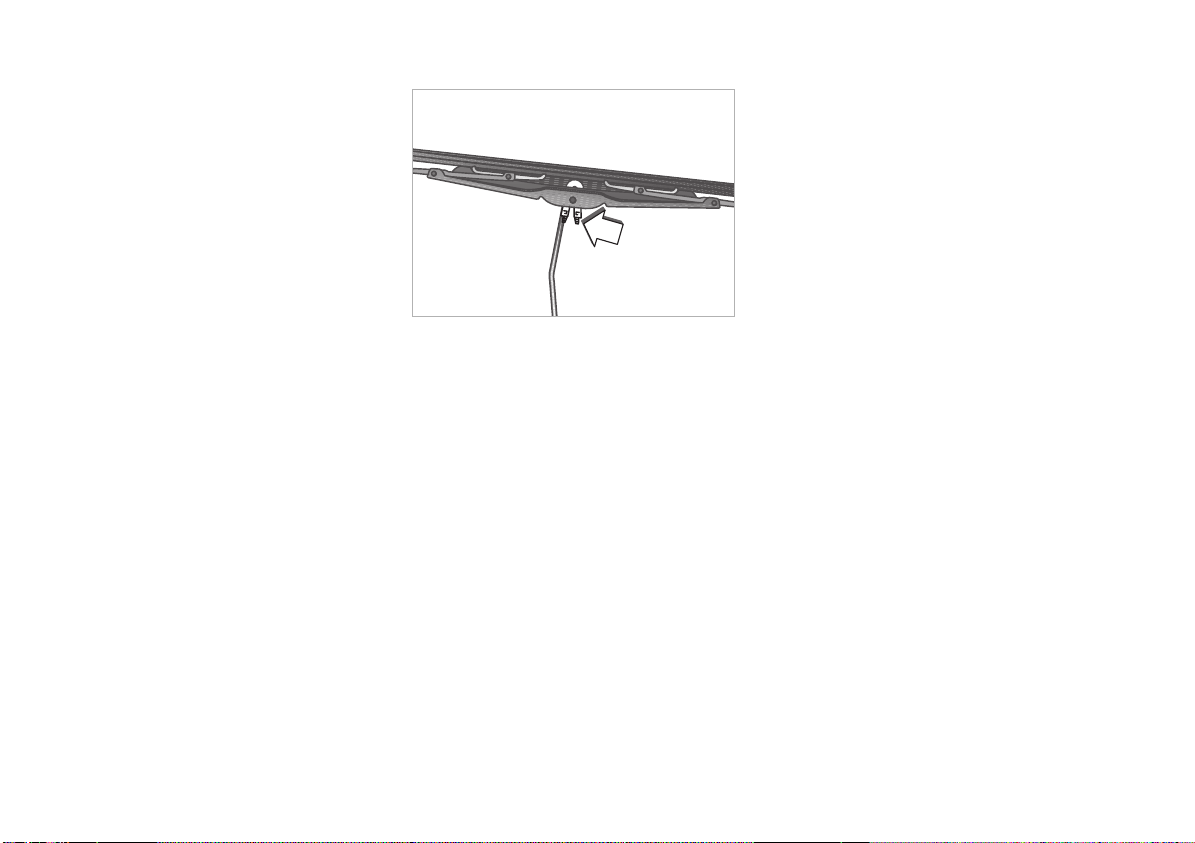
140
Under the luggage compartment lid.
Unscrew the wingnut for access.
Lift the wiper arm, press the locking
spring and pull off the wiper blade, pull-
ing along the wiper arm.
360de114
Onboard tool kit Windshield wiper blade replacement
Online Edition for Part No. 01 41 9 790 377 - © 07/98 BMW AG
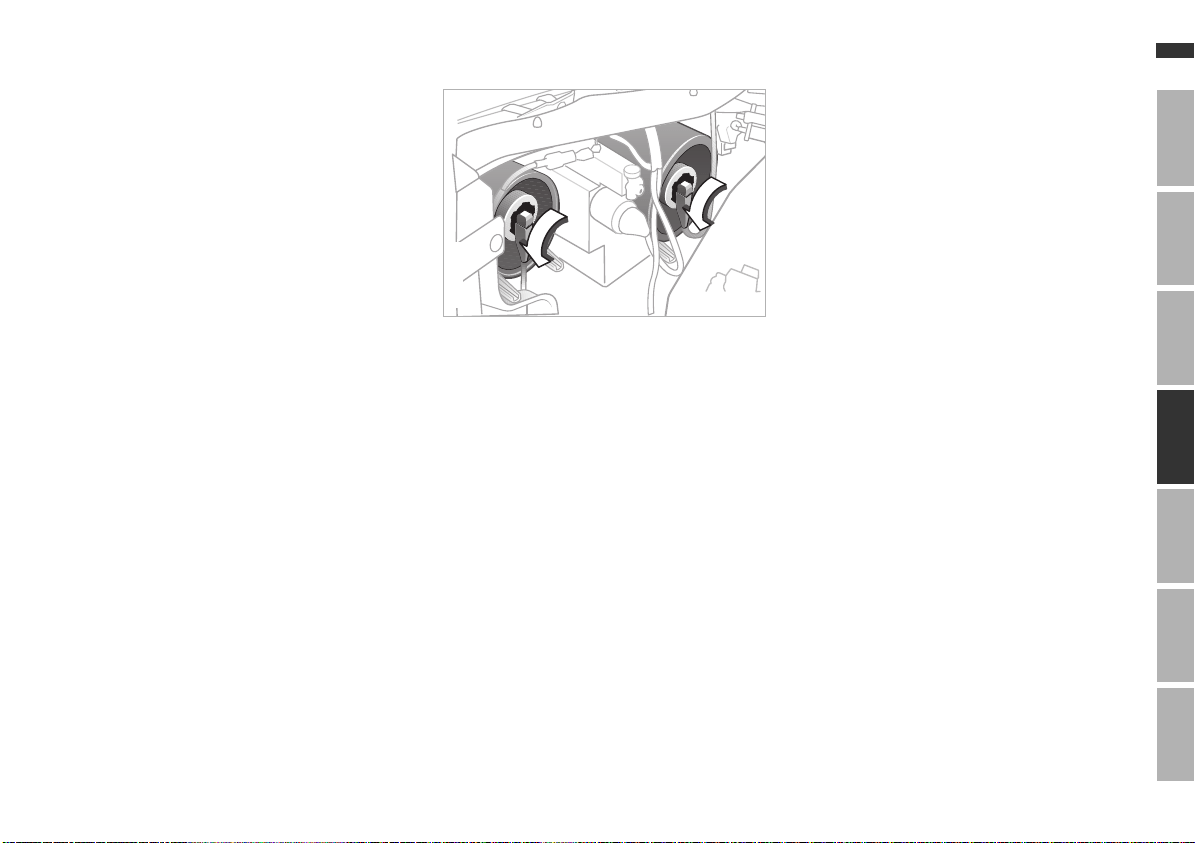
141
At a glanceControlsCar careRepairsTechnicalDataIndex
The lamps and bulbs on your car play a
vital role in ensuring road safety, a fact
which you should always bear in mind
in caring for them. Carefully observe the
following instructions during bulb
replacement, referring any procedures
with which you are not familiar to your
BMW Retailer.
bNever touch the bulb glass of a
new lamp with your bare hands. Use a
clean cloth, paper napkin, etc. or hold
the bulb by its metallic base.c
A replacement bulb set is available from
your BMW Retailer.
aTo prevent short circuits, always
switch off all electrical systems and
components, or disconnect the negative
terminal of the battery, before working
on them.
To prevent injuries and damage, always
observe any instructions provided by
the bulb manufacturer.c
Low and high beams
Low beam: HB4, 55 watts
High beam: HB3, 65 watts
aEach bulb is pressurized; always
wear gloves and eye protection! Failure
to observe this precaution could lead to
injury if the bulb is accidentally dam-
aged during replacement.c
d Turn the bulb holder to the left and
remove.
d Replace the bulb.
Parking lamp
5 watt bulb
d Press in the upper tab of the bulb
holder to release and remove.
d Pull out the bulb holder.
d Pull off the bulb and replace.
bPlease observe the following
when cleaning the headlamp covers:
d Do not rub them dry and do not apply
scouring or caustic cleaning agents.
d Remove dirt and contamination (such
as insects) by soaking with BMW Car
Shampoo and then rinsing with
plenty of water.
d Always use a de-icer spray to remove
accumulated ice and snow – Never
use a scraper!c
360us089
Bulb replacement
Online Edition for Part No. 01 41 9 790 377 - © 07/98 BMW AG
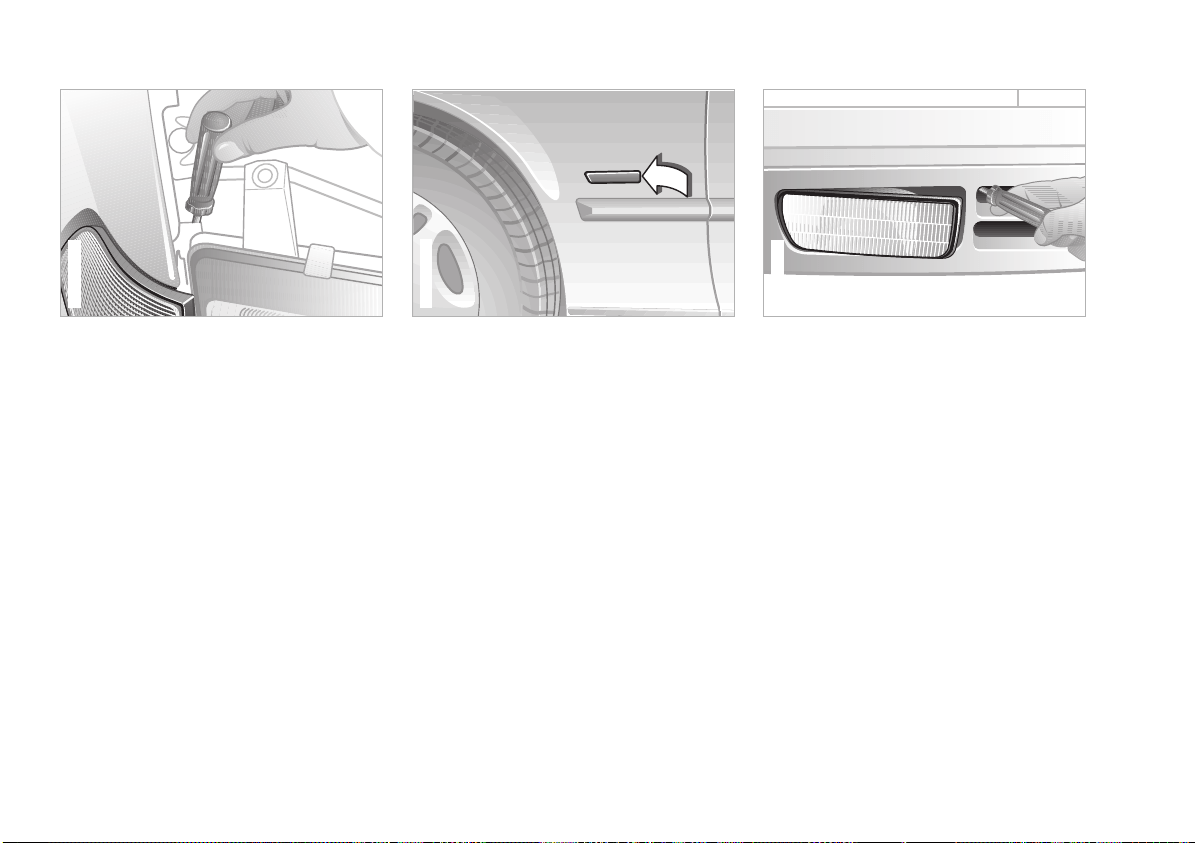
142
Front turn signals
21 watt bulb
d Release the hooks with a screw-
driver.
d Remove the lamp from the front.
d Release the bulb holder and remove.
d Apply gentle pressure to the bulb
while turning it to the left to remove.
d After replacing the bulb, re-insert the
lamp and push it back until it
engages audibly twice.
Side turn signals*
5 watt bulb
d Use finger pressure against the rear
edge of the lens (arrow) to press it
forward for removal.
d Press gently on the bulb and turn it to
the left to remove.
Foglamps*
H1 55 watt bulb
d Release the lamp bracket with a
screwdriver.
d Pull the foglamp out toward the front
d Turn the plastic cap on the back of
the lamp to the left and remove.
d Pull off the plug.
d Release the wire spring.
d Replace bulb.
d After replacing the bulb, guide in the
lamp again and press on firmly until it
audibly engages.
bThe retainer must be in the "Open"
position, otherwise the foglamp can not
be guided in.c
360de116
360de148
360de117
Bulb replacement
Online Edition for Part No. 01 41 9 790 377 - © 07/98 BMW AG
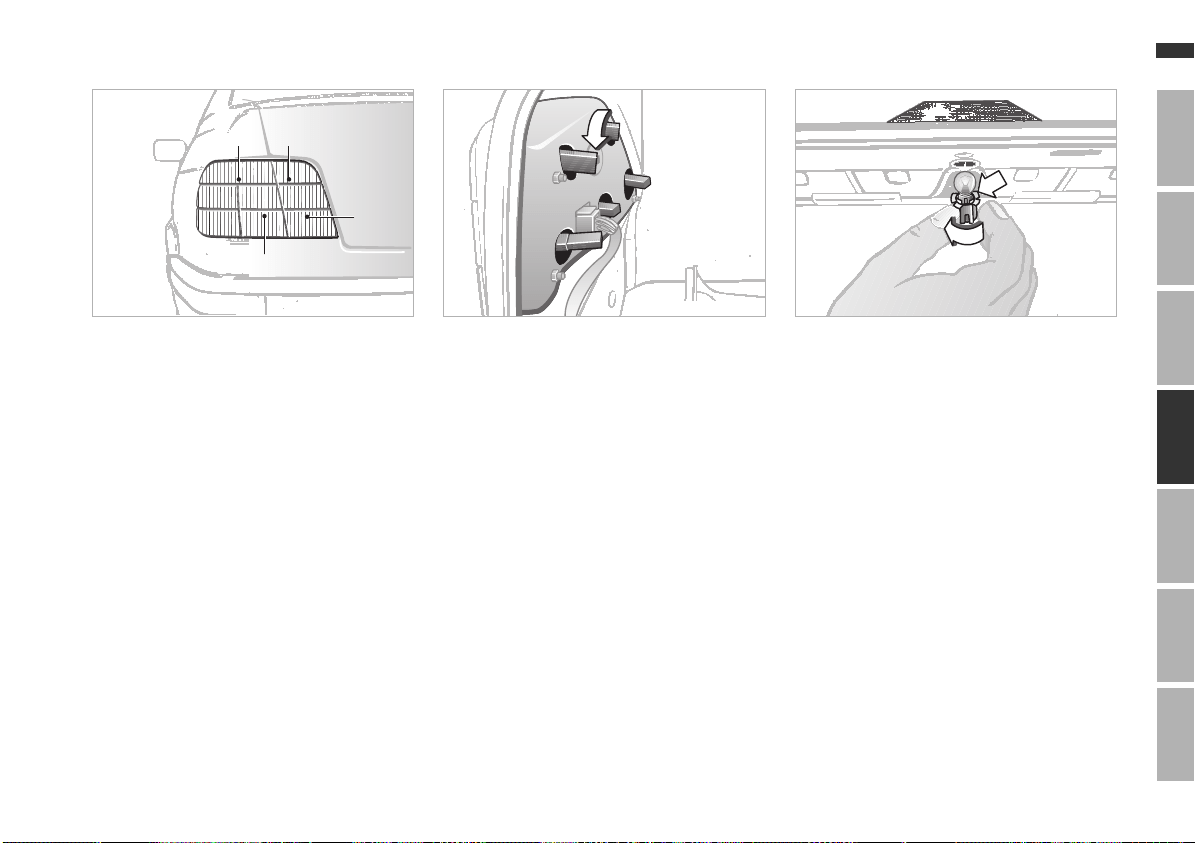
143
At a glanceControlsCar careRepairsTechnicalDataIndex
Taillamps
1 Turn signal yellow
21 watt bulb
2 Backup lamp white
21 watt bulb
3 Brake lamp red
21 watt bulb
4 Taillamp red
5 watt bulb
d Remove the lamp cover after releas-
ing the locking device.
d Once you have found the lamp
holder for the defective bulb, push it
gently to the rear while turning to the
left to remove.
d Use the same procedure to remove
the bulb.
Center brake lamp*
21 watt bulb
d Open the luggage compartment lid.
d Push the bulb holder's release knob
gently to the rear while turning to the
left to remove.
d Use the same procedure to remove
the bulb.
BMW Convertible:
LED strip in luggage compartment lid.
Please contact a BMW Retailer in the
case of a malfunction.
12
3
4
360us093
360de119
360de120
Bulb replacement
Online Edition for Part No. 01 41 9 790 377 - © 07/98 BMW AG
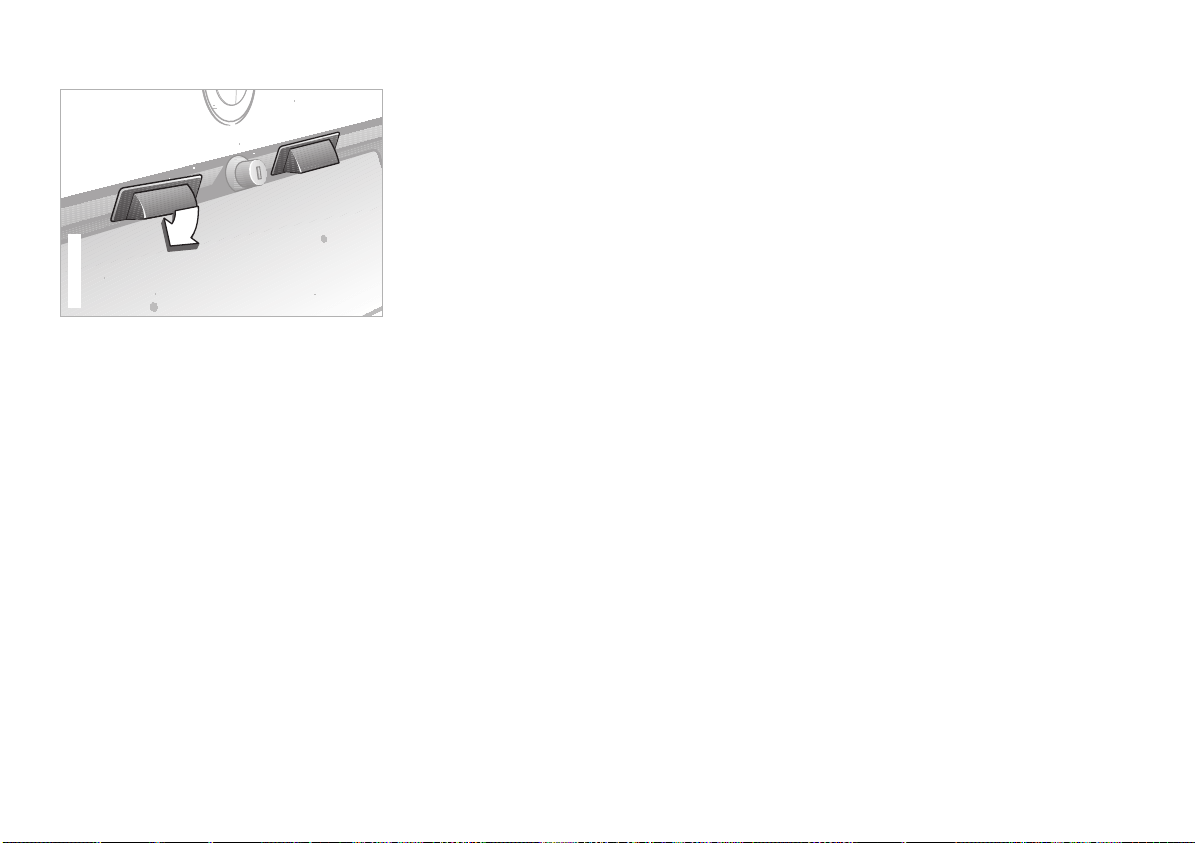
144
License plate lamps
5 watt bulb
d Screw out the screws and remove
the handle.
d Press the bulb holder to the left and
remove.
d Extract the bulb from the contacts.
Front interior lamp
Interior lamp with reading lamps:
(Bulbs 10 watt)
d Interior lamp: use a screwdriver to
press out the lens at the left recess.
Extract the bulb from the contacts.
d Reading lamp: remove the entire
lamp from the trim, remove the con-
tact strip and gently press against
the lamp while turning it to the left to
remove.
bWhen reinstalling first, engage the
housing then the lens.c
Rear interior lamps
BMW Sedan, Coupe
Without reading lamp
5 watt bulb
d Pull the lamp out of the trim.
d Fold up the reflector and remove the
bulb.
With reading lamp
*
6 watt bulb
d Pull the lamp out of the trim.
d Fold up the PCB and remove the
bulb.
Illuminated make-up mirror*
10 watt bulb
d Remove lamp housing (use a screw-
driver if necessary).
d Replace bulb.
360de121
Bulb replacement
Online Edition for Part No. 01 41 9 790 377 - © 07/98 BMW AG

145
At a glanceControlsCar careRepairsTechnicalDataIndex
Luggage compartment lamps
BMW Sedan, Coupe
10 watt bulb
Lamp on underside of rear shelf:
d Use a screwdriver to pry out the lamp
at the recess.
d Replace bulb.
BMW Convertible:
5 watt bulbs
There is one lamp each in the bulb cov-
ers of the rear lamps.
d Use a screwdriver to pry out the lamp
at the recess.
d Replace bulb.
Glove compartment lamp
5 watt bulb
d Use a screwdriver to pry out the lamp
forward.
d Replace bulb.
Footwell lamps*
5 watt bulb
d Use a screwdriver to pry the lamp out
of the lower instrument panel trim.
d Replace bulb.
Replace battery
If lamp intensity drops, renew the bat-
tery to safeguard against acid escaping.
To change the battery, use a screw-
driver to remove the cover on the back
of the key.
Insert a new battery of the same type
(CR 2025) - as shown in the picture - so
that it touches the contacts.
Snap the cover back on and press it in
evenly.
ABring old batteries to a collection
point or your BMW Retailer.c
365de132
Bulb replacement Master keys
Online Edition for Part No. 01 41 9 790 377 - © 07/98 BMW AG
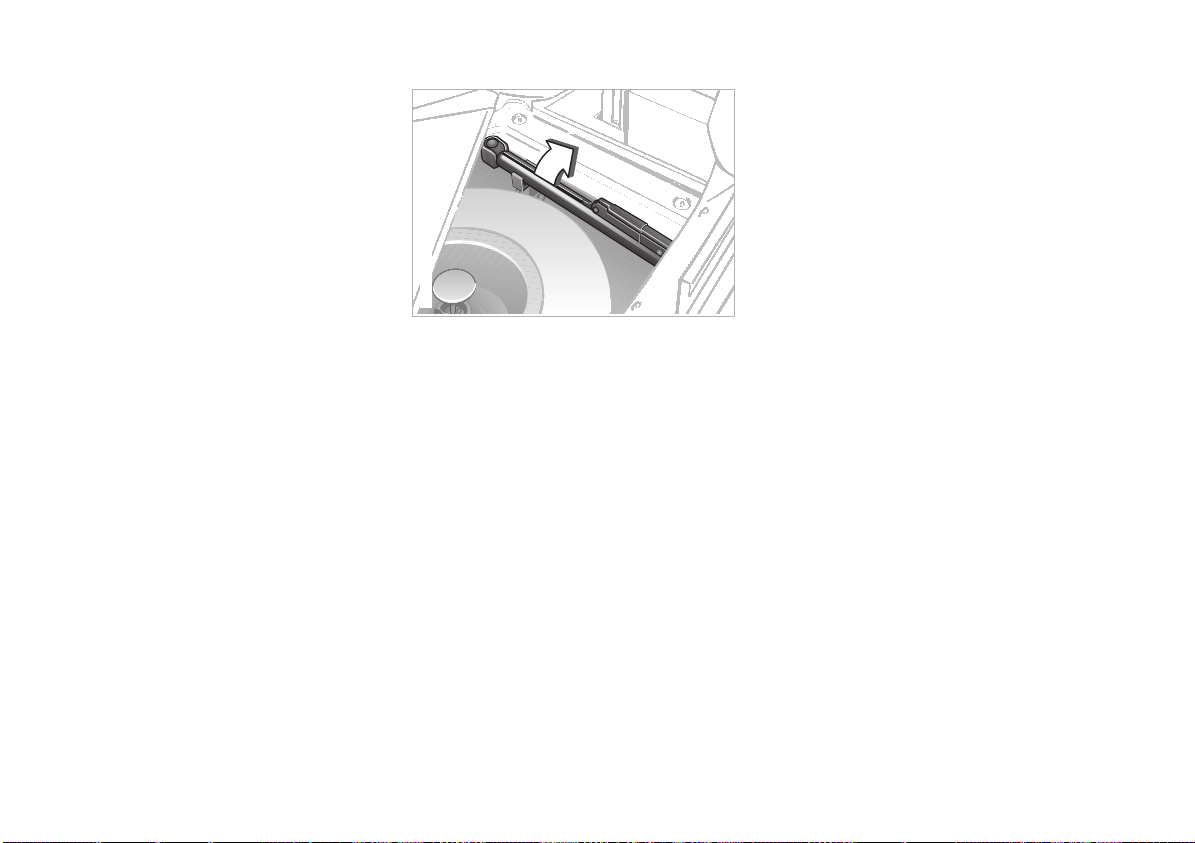
146
aChange tires only on a flat, hard
surface affording good traction. Avoid
jacking the car on a soft or slippery sup-
port surface (snow, ice, loose gravel,
etc.), as it could slide sideways.
Take extra care to ensure that the base
of the jack is positioned on a solid sup-
port surface.
Never use wooden blocks or similar
objects to support the base of the jack,
as the weight of the car could exceed
their support capacity.
Never lie beneath the vehicle or start
the engine while the car is supported by
the jack - risk of fatal injury.
Additional precautions to observe when
changing flat tires:
When pulling over on the roadside to
change a tire, always try to park the car
as far as possible from passing traffic.
Switch on the hazard flashers.
All passengers should be outside the
car and well away from your immediate
working area (e.g., behind the guard-
rail).
Turn the steering wheel to the straight-
ahead position, remove the key and
engage the steering lock. Shift into 1st
or reverse (selector lever in Park with
automatic) and engage the parking
brake.
If a warning triangle or portable hazard
warning lamp is available, set it up on
the roadside at an appropriate distance
from the rear of the vehicle. Observe all
safety guidelines and regulations.c
bTo avoid rattling noises, note the
positions of the tools and return them to
their original positions.c
To change the tire you will need
Car jack
In the luggage compartment below the
floor mat at the right next to the spare
tire.
After using, screw the jack all the way
back down and insert it in its holder.
Spare wheel and hexagon
adapter
*
Both are stored in the luggage com-
partment below the floor mat. Take out
the floor mat. Remove the hexagon
adapter (only on models with light-alloy
wheels with wheel lug cover in the
shape of a large hexagon nut), unscrew
the wing nut by hand and remove the
wheel.
Wheel stud wrench
In the luggage compartment at the right
on the box.
Screwdriver
In onboard tool kit beneath luggage
compartment floor panel.
bThe storage shelf in the spare tire
can be used to store small parts. To
avoid rattling noises, you can place
cloths between them.c
360de106
Changing tires
Online Edition for Part No. 01 41 9 790 377 - © 07/98 BMW AG
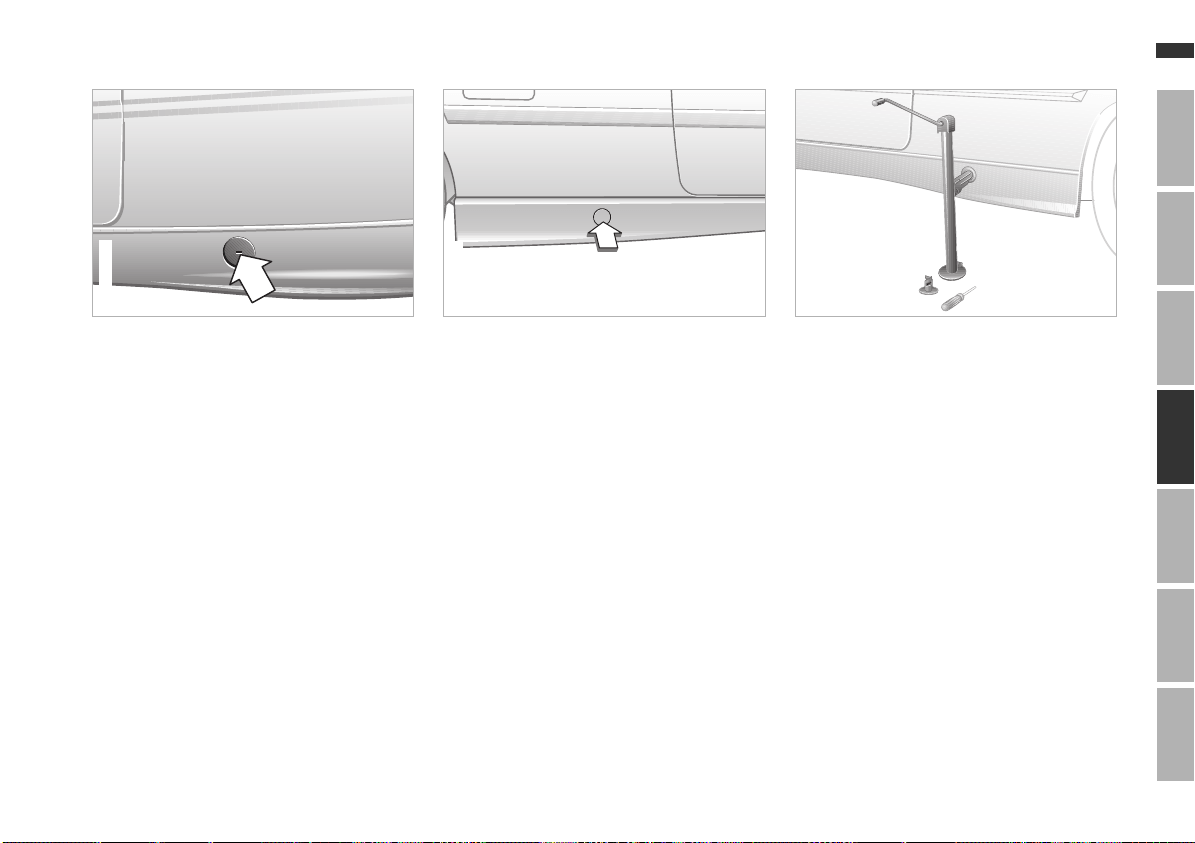
147
At a glanceControlsCar careRepairsTechnicalDataIndex
Procedure
1 Wheel bolt cover* removal.
Steel disk wheel: remove wheel cover
by hand. Light-alloy wheel with lug
cap in the shape of a large hexagon
nut: position the hexagon adapter on
the lug bolt cover, apply the lug
wrench and turn it to the left.
2 Loosen lug bolts 1/2 turn.
3 Remove the respective cover cap
from the jacking point. Depending on
the vehicle version, remove the pro-
tective cap either by inserting the
screwdriver into the slot and turning
to the left (arrow in left illustration) or
by pressing in the cap on the bottom
(arrow in illustration above).
4 Insert the jack all the way into the
support while ensuring that the base
of the jack is securely positioned on
the road surface. Always chock the
wheels to prevent the vehicle from
rolling.
5 Turn the handle to raise the jack until
the wheel is free of the ground.
aThe vehicle jack is designed for
changing tires only. Never use it to raise
another vehicle model or a load of an-
other kind, since that could result in ac-
cidents and personal injury.
Never lie beneath the vehicle when it is
supported by the jack – risk of fatal inju-
ry!c
6 Unscrew the lug bolts and remove the
wheel.
360de108
365de061
360de109
Changing tires
Online Edition for Part No. 01 41 9 790 377 - © 07/98 BMW AG
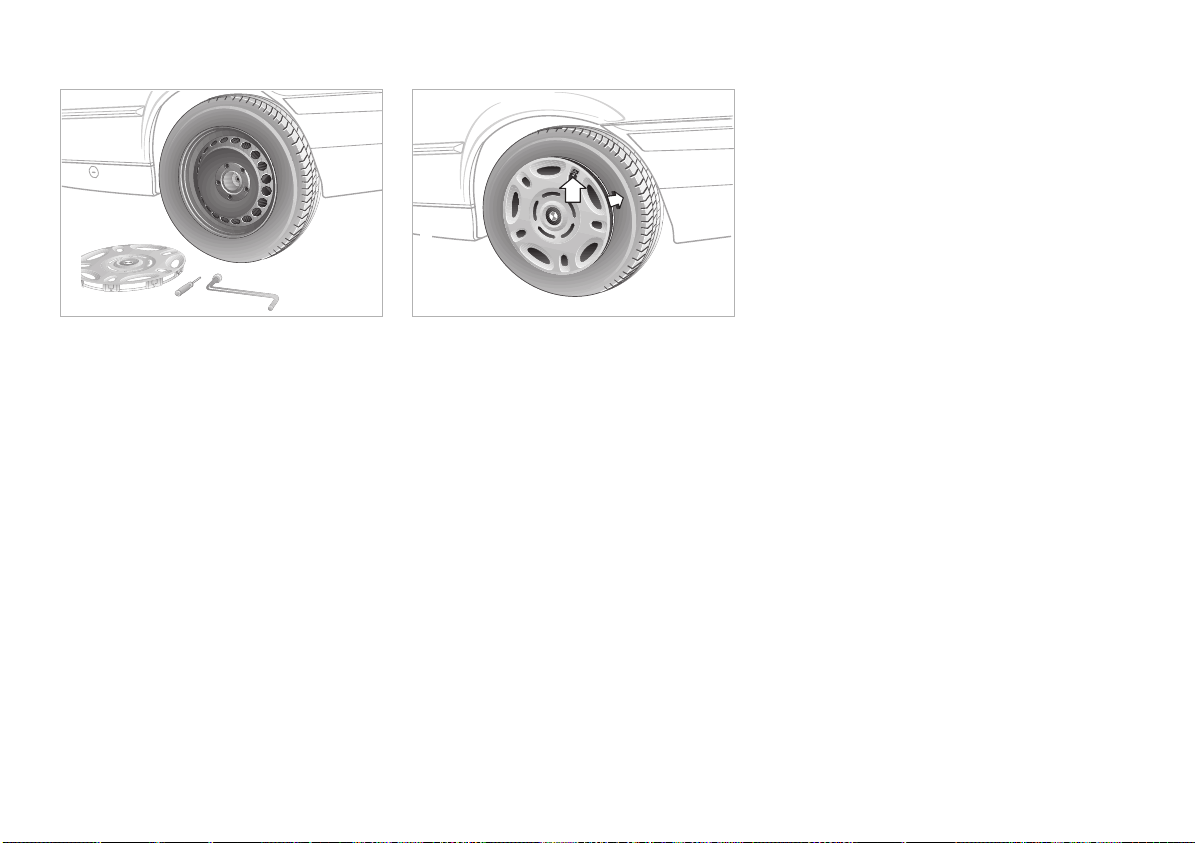
148
7 Lift the new or spare tire into posi-
tion, secure by screwing at least two
lug bolts into opposite sockets and
remove the alignment tool.
8 Screw in the remaining lug bolts,
then tighten down all the lug bolts,
working in a cross pattern.
9 Lower the vehicle, remove the jack
and screw the cover back into the
jack opening with the screwdriver.
10 Tighten the lug bolts, working in a
cross pattern.
aTo ensure safety, have the lug
bolts tested with a calibrated torque
wrench (torque specification is 72 lbs-ft/
100 Nm) at the earliest opportunity. If
you have mounted a new wheel
(e.g., the spare tire) for the first time,
check the lug nut torque after approx.
600 miles (1,000 km).c
11 Mount wheel cover. Position the
wheel cover with the valve opening
over the valve stem in the rim and
press with both hands starting from
the valve stem and moving around
the entire circumference of the
wheel cover.
When storing the wheel, ensure that
you do not damage the retaining pin in
the spare tire recess.
When light-alloy wheels other than
Original BMW light-alloy wheels are fit-
ted to the car, it may be necessary to
use different lug bolts.
Have the defective tire repaired and
balanced at the earliest opportunity.
360de110
B
M
W
360de111
Changing tires
Online Edition for Part No. 01 41 9 790 377 - © 07/98 BMW AG
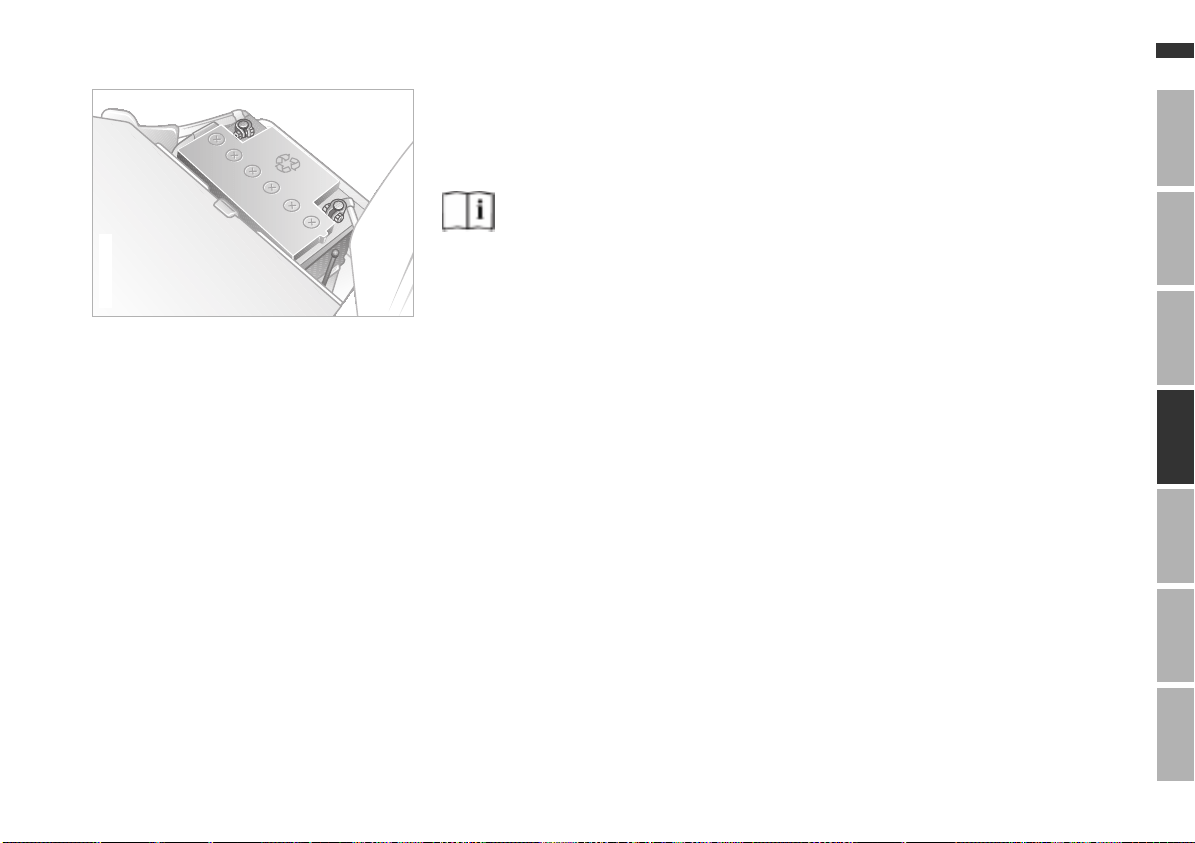
149
At a glanceControlsCar careRepairsTechnicalDataIndex
The battery is located behind the right-
side trim panel in the luggage compart-
ment. A separate positive terminal in
the engine compartment is available for
jump-starting (also refer to page 153).
Only certain battery types may be used
on the BMW convertible. Consult your
BMW Retailer for details.
The battery is maintenance-free, mean-
ing that the electrolyte will normally last
for the life of the battery.
Should the electrolyte drop to below
the minimum level - e.g., during extend-
ed operation in hot climates - add dis-
tilled water (no acid!).
Electrolyte level: Up to the "MAX" mark
on the outside of the battery in each
cell, approx. 0.2 inches (5 mm) above
the top of the plates.
Keep the top of the battery clean and
dry.
Symbols
You will find the following symbols on
your car battery. To avoid injury, please
observe the corresponding precautions
whenever you work with or near the
battery.
360de125
Before working with the battery,
read the following:
R
Wear eye protection. Avoid let-
ting acid or lead particles come
into contact with your eyes, your
skin or your clothing.
S
Battery acid is extremely corro-
sive. Wear eye protection and
protective gloves. Do not tilt the
battery; acid could emerge from the
ventilation openings.
T
Ensure that children keep well
away from batteries and battery
acid.
U
Never allow sparks or open
flame, and do not smoke in the
vicinity of the battery. Avoid
sparks from electrical cables and
equipment. Never short-circuit the bat-
tery terminals. There is a danger of
injury from powerful sparks.
V
A highly-explosive gas is gener-
ated when the battery is
charged.
W
If you happen to get acid in your
eyes, rinse thoroughly for sev-
eral minutes with clear water.
Then consult a physician immediately. If
you get acid spray on your skin or cloth-
ing, apply soap immediately to neutral-
ize the acid, then rinse with plenty of
water. If electrolyte is accidentally
ingested, consult a physician immedi-
ately.
X
To protect the casing against
ultraviolet radiation, avoid
exposing it to direct sunlight.
A discharged battery can freeze; always
store the battery in areas where the
temperature remains above freezing.
Battery
Online Edition for Part No. 01 41 9 790 377 - © 07/98 BMW AG

150
Removal and installation
aDo not disconnect the battery
cable from its terminal while the engine
is running, as the resulting voltage surge
would destroy the vehicle's electronic
systems.c
When disconnecting, start with the neg-
ative terminal, then proceed to the pos-
itive side. Unscrew the battery retaining
clamp.
When installing the battery, connect the
positive terminal first, then proceed to
the negative pole.
aWhen installing, always ensure that
the battery is properly mounted.
Otherwise it will not be sufficiently
secured in an accident.c
Charging the battery
Always ensure that the engine is off
before recharging an installed battery.
aTo avoid short circuits, always
disconnect the cable from the battery's
negative terminal before working on the
electrical system.c
On vehicles with a connecting point in
the engine compartment, it is easiest to
charge the battery by using this con-
necting point (positive pole), and a
ground in the engine compartment
(refer to "Jump-starting" on page 153).
If you are planning to remove the vehi-
cle from service for more than four
weeks, you should disconnect the bat-
tery at the negative terminal.
If you intend to store your car for longer
than six weeks: remove the battery,
charge it and store it in a cool (but frost-
free) room. Recharge the battery after
three months at the latest, as it will oth-
erwise be damaged beyond use. Every
time the battery is discharged, espe-
cially over extended periods, its service
life is reduced.
ABring used batteries to an autho-
rized collection point or a BMW Re-
tailer. Always maintain the battery in an
upright position for transport and stor-
age. Secure the battery against tilting
when transporting.c
aStorage periods during which the
battery is disconnected are not taken
into consideration by the Service Inter-
val Display for changing the brake fluid.
Therefore, make sure that the brake fluid
is changed every two years at the latest,
regardless of the display. Additional
notes: refer to page 128.c
Battery
Online Edition for Part No. 01 41 9 790 377 - © 07/98 BMW AG
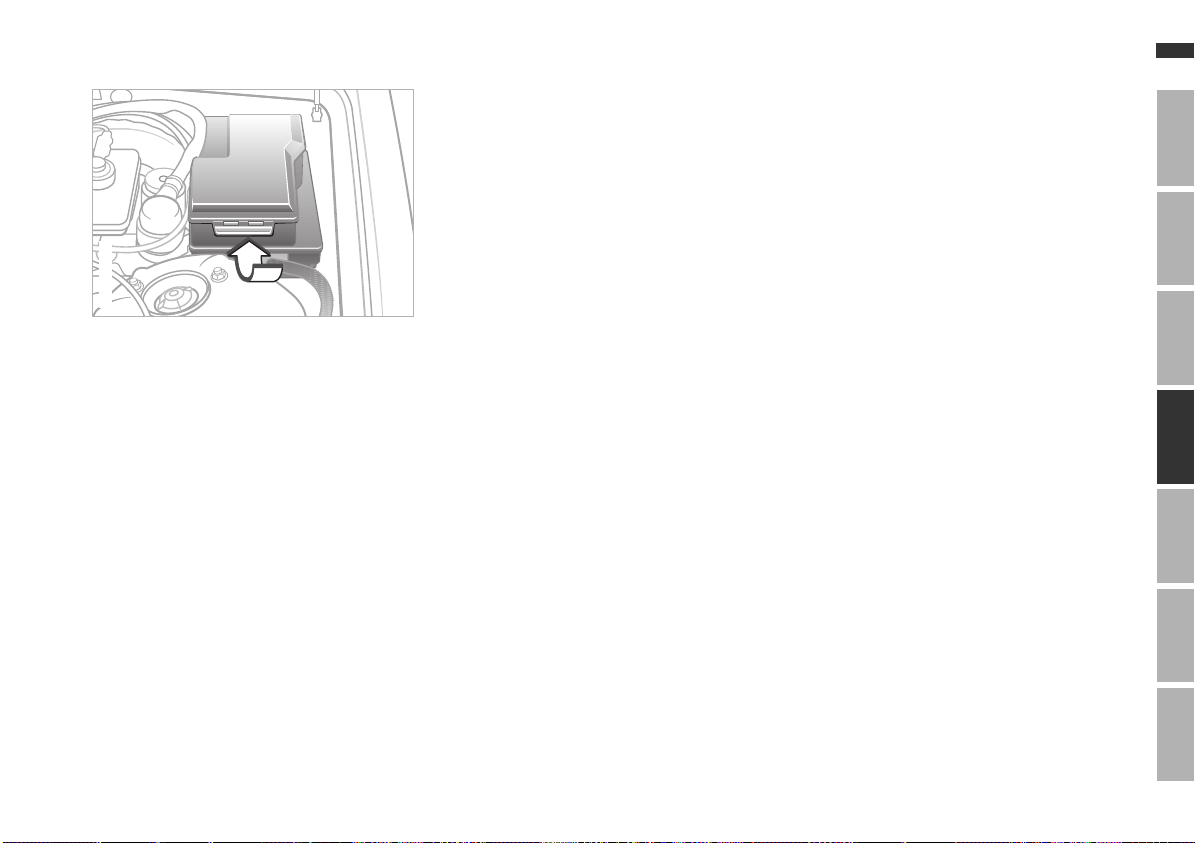
151
At a glanceControlsCar careRepairsTechnicalDataIndex
If an electrical device fails, switch it off
and check the fuse.
The fuse box (electrical distribution
center) with spare fuses, relays and
plastic tweezers, is located on the left-
hand side of the engine compartment.
d Press the retaining flap in and lift off
the cover.
d Remove the fuse of the defective
consumer from the socket with the
plastic tweezers.
d If the fuse is burned through (the
metal wire will have melted and sep-
arated), replace it with a new fuse of
the same ampere rating.
A list of the fuses with their respective
ampere ratings and the equipment in
their circuits is provided in the fuse box
lid.
aDo not patch burned out fuses or
replace them with fuses of a different
color or ampere rating, since this could
cause an overload on an electrical wire
and lead to fire in the vehicle.c
If the fuse continues to burn through,
refer the problem to a BMW Retailer for
repair.
360de102
Fuses
Online Edition for Part No. 01 41 9 790 377 - © 07/98 BMW AG
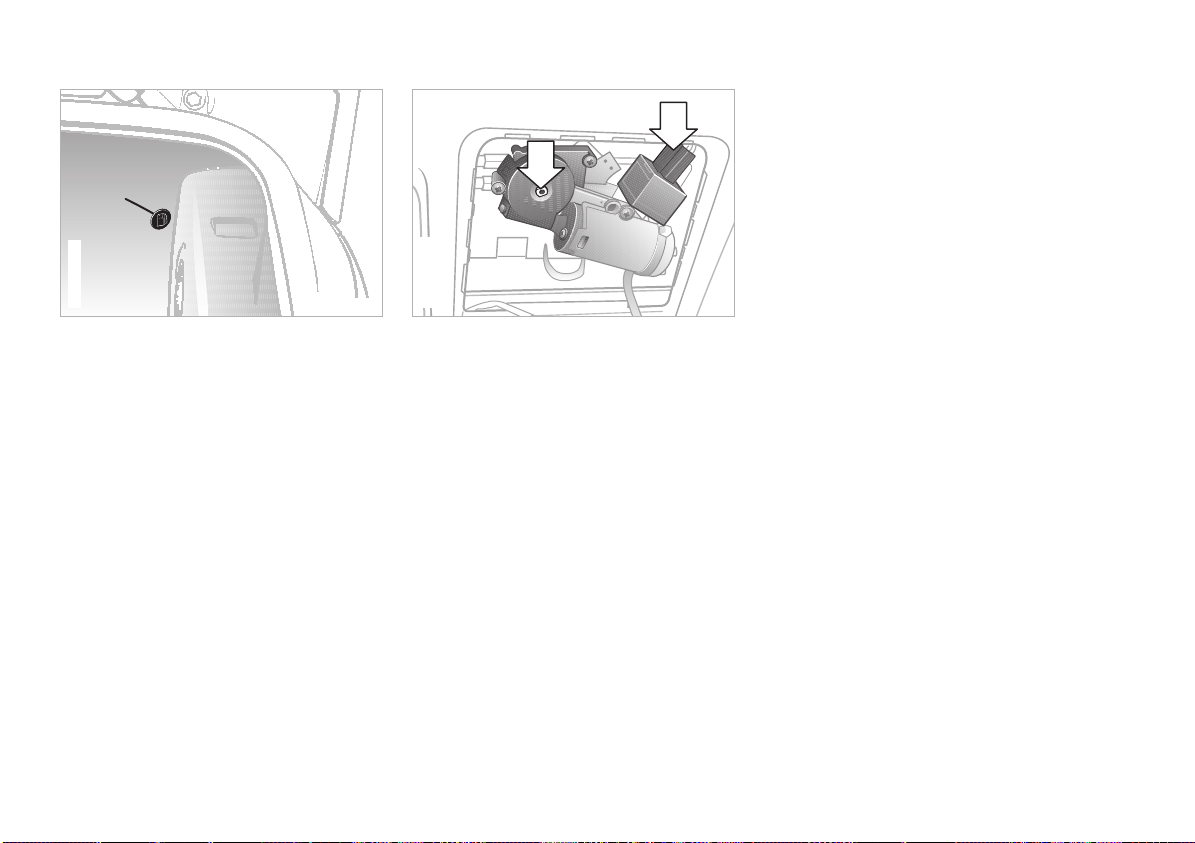
152
Unlock tank filler door
Pull the handle with the fuel pump sym-
bol on the right trim panel in the lug-
gage compartment.
Sliding/tilt sunroof
d Press out the interior lamp with a
screwdriver at the left recess.
d Remove the cover panel.
d Remove the Allen wrench from the
onboard tool kit, insert it in the hexa-
gon head (arrow 1) and turn the slid-
ing/tilt sunroof in the desired
direction.
bTurning is easier if the plug
(arrow 2) is pulled out beforehand.c
Have the malfunction rectified by your
BMW Retailer at the earliest opportu-
nity.
360de112
2
1
360de113
Manual activation in the event of electrical failure
Online Edition for Part No. 01 41 9 790 377 - © 07/98 BMW AG
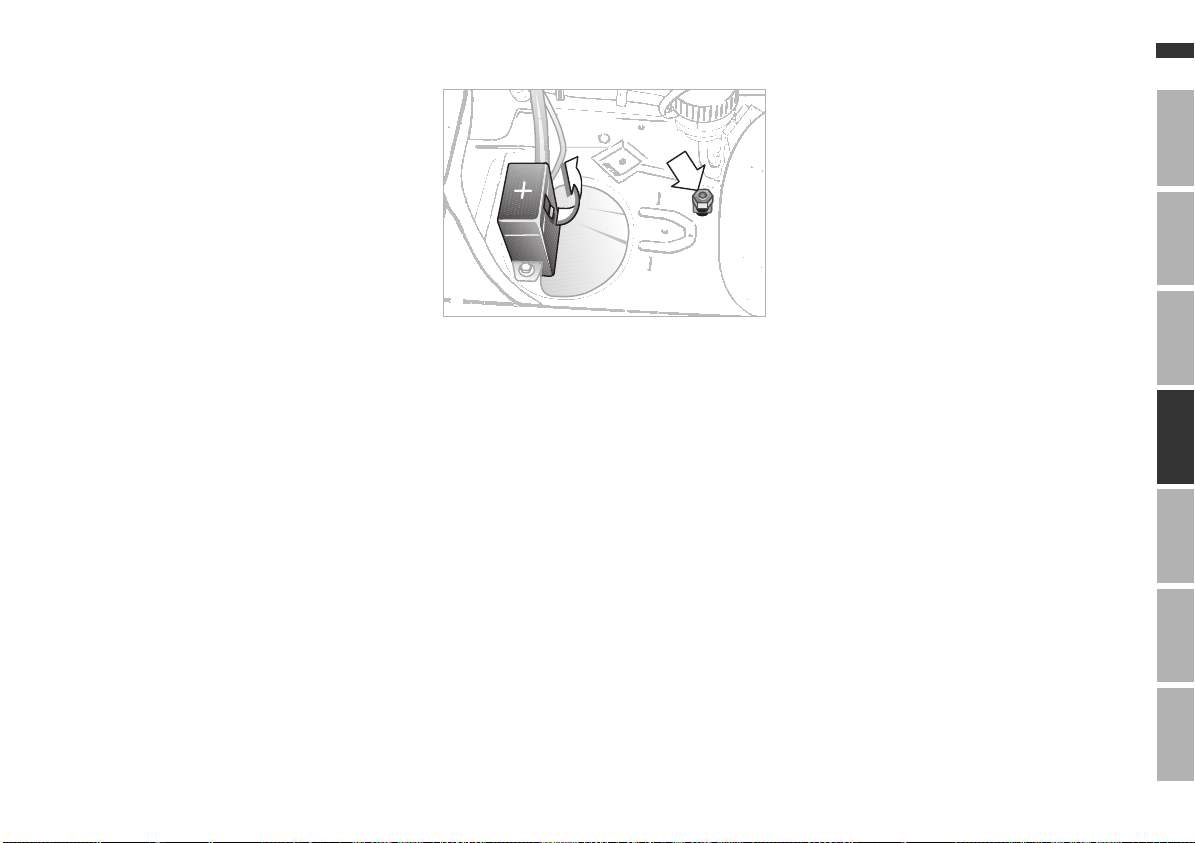
153
At a glanceControlsCar careRepairsTechnicalDataIndex
Never use spray starter fluids to start
the engine.
When the battery is discharged, you
can use two jumper cables to start your
car with power from the battery in a
second vehicle. Always use jumper
cables with fully insulated handles on
the terminal clamps.
aWhen the engine is running, con-
tact with electrical conductors and com-
ponents is dangerous and can be fatal.c
Carefully observe the following instruc-
tions to avoid personal injury as well as
damage to one or both vehicles:
1 Ensure that the battery on the sup-
port vehicle is also rated at 12 volts,
and that the capacity (Ah) is roughly
comparable (printed on casing).
2 Leave your battery connected to the
car's electrical system.
3 The bodies of the two vehicles must
not touch, or a short circuit could
result.
4 Start by connecting the positive ter-
minal of both batteries with a jumper
cable. If the battery of the BMW is not
installed in the engine compartment,
a supplementary positive terminal is
provided in the engine compartment
(the cover is marked "+", remove by
pulling tab, see arrow 1 in illustration).
Then connect up the batteries' nega-
tive poles. Attach the cable to either
the support vehicle's negative battery
terminal, or to a suitable ground on its
engine or bodywork. On the BMW
there is a special nut, refer to arrow 2;
the nut might also be located further
forward, on the suspension strut
dome.
aObserve the same sequence for
connecting the jumper cables when
helping other vehicles; this will help pre-
vent sparks from being generated at the
battery.c
5 If the battery on the support vehicle is
weak, start the engine and let it run.
Start the engine on the vehicle need-
ing the jump-start, and allow it to run
as usual. If necessary repeat the
attempt to start after a few minutes;
this allows for current intake by the
discharged battery.
Before disconnecting the jumper
cables from your BMW, turn on the
lamps, rear window defroster and
highest blower speed to prevent a
voltage surge at the voltage regulator.
Then disconnect the jumper cables in
reverse sequence.
Depending on the cause of the fault,
recharge the battery.
1
2
360de105
Jump-starting
Online Edition for Part No. 01 41 9 790 377 - © 07/98 BMW AG
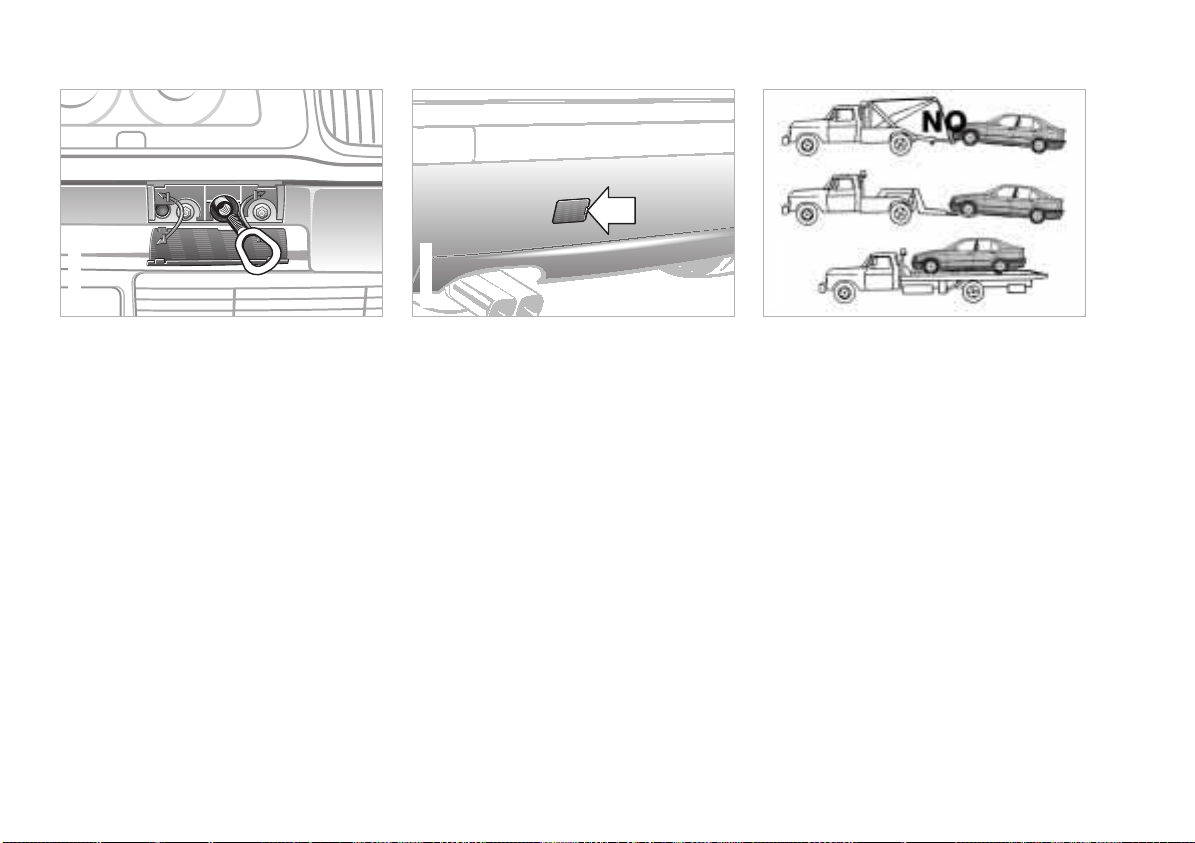
154
Tow fittings
The screw-in tow fitting is stored in the
onboard tool kit; ensure that it remains
with the vehicle at all times. It can be
screwed in to either the front or the rear
of the vehicle and is intended for towing
only on a roadway.
Access to tow sockets
Front:
Pry out the cover with a screwdriver.
Rear:
Pry out the cover with a screwdriver.
aEnsure that the tow fitting is
screwed in tightly.c
Vehicles with automatic transmission:
d Selector lever on N.
Towing speed:
maximum 30 mph (50 km/h).
Towing distance:
maximum 30 miles (50 km).
aThe steering and brakes are with-
out power assist when the engine is off.
This means that increased effort is re-
quired for steering and braking.c
Towing with a commercial tow
truck
Never use sling-type equipment to
transport the vehicle.
Use wheel lifts or transport the vehicle
on a flatbed truck.
Please observe all applicable national,
state, provincial and local towing laws.
aNever allow passengers to ride in
a towed vehicle.c
360de103
360de104
360us128
Towing the vehicle Towing
Online Edition for Part No. 01 41 9 790 377 - © 07/98 BMW AG

At a glance
Controls and features
Care and maintenance
Advanced technology
Technical data
Owner service procedure
At a glanceControls Car careRepairsTechnicalDataIndex
Index
155
Airbags 156
Automatic Stability Control
plus Traction (ASC+T) 156
Radio reception 157
Safety belt tensioner 157
Online Edition for Part No. 01 41 9 790 377 - © 07/98 BMW AG

156
Deceleration sensors continuously
monitor the physical forces acting upon
the vehicle. If a frontal impact results in
deceleration, for which the protection
afforded by safety belts no longer suf-
fices, the gas generators of the driver's
and the passenger's airbags ignite
simultaneously. The passenger's air-
bag is activated only when a special
sensor indicates that the front passen-
ger's seat is occupied.
In the event of a severe side impact the
side airbag
* is activated on the side on
which the impact occurred.
The airbags, which are under the cover
of the steering wheel, in the instrument
panel or the side trim panels of the front
doors, are deployed and inflated by the
gas within a few milliseconds. In the
process they tear or push apart the pro-
grammed separation points in their
upholstered covers.
Because the inflation process must be
virtually instantaneous, it is necessarily
accompanied by a certain amount of
ignition and inflation noise. The gas
which the system employs to inflate the
airbag is not dangerous, and the asso-
ciated smoke is quickly dissipated.
The entire process is completed within
one twentieth of a second.
Automatic Stability Control plus Trac-
tion helps maintain stable and con-
trolled vehicle response by inhibiting
slip at the drive wheels.
The system employs special sensors to
monitor wheelspeed and relay the data
to the system's electronic control unit,
which uses this information to calculate
slip rates at the individual wheels.
Depending on the driving situation, two
forms of remedial action can then be
taken by the system: it reacts to slip-
page caused by large amounts of
excess torque by instructing the engine
management system to reduce power
output. As a supplementary measure,
the system will also respond to an
especially pronounced tendency to-
ward traction loss at either of the drive
wheels with automatic individual appli-
cation of the affected wheel's brakes.
This achieves a locking action compa-
rable with a controlled limited-slip dif-
ferential. This brake action is active up
to 25 mph (40 km/h). From 25 mph
(40 km/h) upward, a diminished brake
action improves the traction up to
60 mph (100 km/h).
390de012
Airbags ASC+T*
Online Edition for Part No. 01 41 9 790 377 - © 07/98 BMW AG

157
At a glanceControls Car careRepairsTechnicalDataIndex
AM provides substantially longer recep-
tion ranges than FM. AM broadcast sig-
nals, propagated at ground level in the
form of surface waves, are also reflected
from the ionosphere as atmospheric
waves.
Frequency-modulation (FM) provides
substantially better sound quality than
AM. However, because FM transmis-
sions rely on line-of-sight broadcast
waves, their effective reception range is
limited.
Although numerous factors combine to
impose inherent limitations on the
reception quality available from mobile
radios, specially designed systems can
be employed to minimize their effects:
The Antenna Diversity system employs
several FM antennas integrated within
the rear window to provide three sepa-
rate sources for receiving broadcast
waves. An integral processor automati-
cally selects the antenna with the best
FM reception quality at any given time.
Because the ongoing antenna selection
process is completed within millisec-
onds, it remains inaudible to the radio
listener.
The safety belt tensioner responds to
collisions by tightening the belts to
ensure that occupants remain firmly
positioned in their seats. A gas-pres-
sure system retracts the buckle assem-
bly to tension the shoulder and lap belts
within fractions of a second, preventing
the driver and passenger from slipping
forward.
360de084
390de108
Radio reception Safety belt tensioner
Online Edition for Part No. 01 41 9 790 377 - © 07/98 BMW AG

158
Online Edition for Part No. 01 41 9 790 377 - © 07/98 BMW AG

At a glance
Controls and features
Care and maintenance
Advanced technology
Technical data
Owner service procedure
At a glanceControls Car careRepairsTechnicalDataIndex
Index
159
Engine specifications 160
Dimensions 161
Weights 163
Capacities 166
Electrical system 167
Drive belts 167
Online Edition for Part No. 01 41 9 790 377 - © 07/98 BMW AG

160
Engine specifications
BMW 318i Sedan
BMW 318is Coupe
BMW 318i Convertible
BMW 323is Coupe
BMW 323i Convertible
BMW 328i Sedan
BMW 328is Coupe
BMW 328i Convertible
Displacement
Number of cylinders
cu.in (cmm) 115.6 (1,895)
4
152.2 (2,494)
6
170.4 (2,793)
6
Maximum output
at engine speed
hp
kW
rpm
138
103
6,000
168
125
5,500
190
142
5,300
Maximum torque
at engine speed
lb-ft (Nm)
rpm
133 (180)
4,300
181 (245)
3,950
206 (280)
3,950
Compression ratio ε 10 10.5 10.2
Stroke
Bore
in. (mm)
in. (mm)
3.29 (83.5)
3.35 (85)
2.95 (75)
3.31 (84)
3.31 (84)
3.31 (84)
Fuel-injection system Digital-electronic engine-management system
Online Edition for Part No. 01 41 9 790 377 - © 07/98 BMW AG

At a glanceControls Car careRepairsTechnicalDataIndex
161
BMW 318i
Sedan
BMW 318is
Coupe
BMW 318i
Convertible
Length in. (mm) 174.5 (4,433) 174.5 (4,433) 174.5 (4,433)
Width in. (mm) 66.9 (1,698) 67.3 (1,710) 67.3 (1,710)
Height (unloaded) in. (mm) 54.8 (1,393) 53.8 (1,366) 53.1 (1,348)
Wheelbase in. (mm) 106.3 (2,700) 106.3 (2,700) 106.3 (2,700)
Track, front in. (mm) 55.8 (1,418) 55.4 (1,408) 55.4 (1,408)
Track, rear in. (mm) 56.3 (1,431) 55.9 (1,421) 55.9 (1,421)
Minimum turning circle
D ft. (m) 35.4 (10.8) 35.4 (10.8) 35.4 (10.8)
BMW 323is
Coupe
BMW 323i
Convertible
Length in. (mm) 174.5 (4,433) 174.5 (4,433)
Width in. (mm) 67.3 (1,710) 67.3 (1,710)
Height (unloaded) in. (mm) 53.8 (1,366) 53.1 (1,348)
Wheelbase in. (mm) 106.3 (2,700) 106.3 (2,700)
Track, front in. (mm) 55.4 (1,408) 55.4 (1,408)
Track, rear in. (mm) 55.9 (1,421) 55.9 (1,421)
Minimum turning circle
D ft. (m) 35.4 (10.8) 35.4 (10.8)
Dimensions
Online Edition for Part No. 01 41 9 790 377 - © 07/98 BMW AG

162
BMW 328i
Sedan
BMW 328is
Coupe
BMW 328i
Convertible
Length in. (mm) 174.5 (4,433) 174.5 (4,433) 174.5 (4,433)
Width in. (mm) 66.9 (1,698) 67.3 (1,710) 67.3 (1,710)
Height (unloaded) in. (mm) 54.8 (1,393) 53.8 (1,366) 53.1 (1,348)
Wheelbase in. (mm) 106.3 (2,700) 106.3 (2,700) 106.3 (2,700)
Track, front in. (mm) 55.4 (1,408) 55.4 (1,408) 55.4 (1,408)
Track, rear in. (mm) 55.9 (1,421) 55.9 (1,421) 55.9 (1,421)
Minimum turning circle
D ft. (m) 35.4 (10.8) 35.4 (10.8) 35.4 (10.8)
Dimensions
Online Edition for Part No. 01 41 9 790 377 - © 07/98 BMW AG

At a glanceControls Car careRepairsTechnicalDataIndex
163
BMW 318i
Sedan
BMW 318is
Coupe
BMW 318i
Convertible
Vehicle weight empty
(including driver, ready for operation, with full tank of fuel,
options not included)
with manual transmission
with automatic transmission
lbs (kg)
lbs (kg)
2,954 (1,340)
3,042 (1,380)
2,987 (1,355)
3,075 (1,395)
3,153 (1,430)
3,230 (1,465)
Approved gross vehicle weight
with manual transmission
with automatic transmission
lbs (kg)
lbs (kg)
3,924 (1,780)
4,012 (1,820)
3,957 (1,795)
4,045 (1,835)
3,990 (1,810)
4,068 (1,845)
Approved front axle load lbs (kg) 1,830 (830)
1,830 (830) 1,830 (830)
Approved rear axle load lbs (kg) 2,304 (1,045) 2,337 (1,060) 2,348 (1,065)
Maximum payload lbs (kg) 970 (440) 970 (440) 838 (380)
Approved roof load capacity lbs (kg) 165 (75) 165 (75) 88 (40)
Never exceed either the approved axle weights or the gross vehicle weight.
Luggage compartment capacity cu. ft. (liter) 15.4 (435) 14.3 (405) 8.1 (230)
Weights
Online Edition for Part No. 01 41 9 790 377 - © 07/98 BMW AG

164
BMW 323is
Coupe
BMW 323i
Convertible
Vehicle weight, empty
(incl. driver, ready for operation, with full tank of fuel,
options not included)
with manual transmission
with automatic transmission
lbs (kg)
lbs (kg)
3,075 (1,395)
3,175 (1,440)
3,296 (1,495)
3,373 (1,530)
Approved gross vehicle weight
with manual transmission
with automatic transmission
lbs (kg)
lbs (kg)
4,045 (1,835)
4,145 (1,880)
4,134 (1,875)
4,211 (1,910)
Approved front axle load lbs (kg)
1,929 (875) 1,984 (900)
Approved rear axle load lbs (kg) 2,337 (1,060) 2,359 (1,070)
Maximum payload lbs (kg) 970 (440) 838 (380)
Approved roof load capacity lbs (kg) 165 (75) 88 (40)
Never exceed either the approved axle weights or the gross vehicle weight.
Luggage compartment capacity cu. ft. (liter) 14.3 (405) 8.1 (230)
Weights
Online Edition for Part No. 01 41 9 790 377 - © 07/98 BMW AG

At a glanceControls Car careRepairsTechnicalDataIndex
165
BMW 328i
Sedan
BMW 328is
Coupe
BMW 328i
Convertible
Vehicle weight, empty
(incl. driver, ready for operation, with full tank of fuel,
options not included)
with manual transmission
with automatic transmission
lbs (kg)
lbs (kg)
3,131 (1,420)
3,208 (1,455)
3,142 (1,425)
3,230 (1,465)
3,395 (1,540)
3,472 (1,575)
Approved gross vehicle weight
with manual transmission
with automatic transmission
lbs (kg)
lbs (kg)
4,101 (1,860)
4,178 (1,895)
4,112 (1,865)
4,200 (1,905)
4,233 (1,920)
4,310 (1,955)
Approved front axle load lbs (kg)
1,940 (880)
1,940 (880)
1,995 (905)
Approved rear axle load lbs (kg) 2,348 (1,065) 2,370 (1,075) 2,425 (1,100)
Maximum payload lbs (kg) 970 (440) 970 (440) 838 (380)
Approved roof load capacity lbs (kg) 165 (75) 165 (75) 88 (40)
Never exceed either the approved axle weights or the gross vehicle weight.
Luggage compartment capacity cu. ft. (liter) 15.4 (435) 14.3 (405) 8.1 (230)
Weights
Online Edition for Part No. 01 41 9 790 377 - © 07/98 BMW AG

166
Quarts (Liter) Notes
Fuel tank
of which reserve
approx. 17 gal. (62)
approx. 2 gal. (8)
Fuel specification: Page 24
Windshield washer system
with headlamp washer system
approx. 2.6 (2.5)
approx. 5.3 (5.0)
For details: Page 124
Cooling system including
heater circuit
6.9 (6.5) - 318i, 318is
11.1 (10.5) - 323i, 323is, 328i, 328is
For details: Page 88
Engine oil and filter change 5.2 (5.0) - 318i, 318is
6.9 (6.5) - 323i, 323is, 328i, 328is
Approved HD oil
Specifications: Page 126
Shift, Automatic- and final drive – Lifetime fluid, no fluid change required.
Capacities
Online Edition for Part No. 01 41 9 790 377 - © 07/98 BMW AG

At a glanceControls Car careRepairsTechnicalDataIndex
167
Battery
BMW 318i, 318is 12 V, 65 Ah
BMW 323i, 323is,
328i, 328is 12 V, 75 Ah
BMW Convertible 12 V, 70 Ah
Spark plugs
Dual electrode:
Bosch F7 L DC R or
NGK BKR 6 EK
AC generator - Water pump -
Power steering
BMW 318i, 318is
Ribbed V-belt 6 PK x 1733
BMW 323i, 323is, 328i, 328is
Ribbed V-belt 6 PK x 1555
Air conditioning compressor
BMW 318i, 318is
Ribbed V-belt 4 PK x 889
BMW 323i, 323is, 328i, 328is
Ribbed V-belt 5 PK x 906
Electrical system Drive belts
Online Edition for Part No. 01 41 9 790 377 - © 07/98 BMW AG

168
Online Edition for Part No. 01 41 9 790 377 - © 07/98 BMW AG

At a glance
Controls and features
Care and maintenance
Advanced technology
Technical data
Owner service procedure
At a glanceControls Car careRepairsTechnicalDataIndex
Index
169
Everything from A to Z 170
Owner service procedures
from A to Z 175
Online Edition for Part No. 01 41 9 790 377 - © 07/98 BMW AG

170
Note: This index does not correspond to the original manual in all details
A
ABS (Antilock Brake
System)
103
Acceleration values
163
Activated charcoal filter
92
Adjusting steering wheel
45
Air conditioner
91
Air distribution
90
Air pressure
111
Air supply
92
Airbag
50
Aluminum wheel
115
Antifreeze
105, 127
Antifreeze,
Radiator
105, 127
Antifreeze,
radiator
127, 105
Anti-lock braking system
ABS
103
Aquaplaning
100, 111
ASC+T Automatic stability
control plus
Traction
Traktion
10, 84
Ashtray
94
AUC Automatic
recirculated-air control
91
Automatic car washes
131
Automatic recirculated-air
control AUC
91
Automatic stability control
plus traction
ASC+T
10, 84
Automatic transmission
58
Capacity
166
Filling capacity
166
Autoradio
108
Average fuel
consumption
79
Average speed
78
Axle load, permissible
163
B
Backrest unlock 45
Backup lights
57, 143
Battery
149, 167
Removal and
installation
150
Symbols
149
Battery capacity
167
Battery change
Key
145
Battery charge current
20
Battery electrolyte
149
Battery, discharged
153
Belts
47
blower
92
BMW Convertible
Car wash
136
Care
136
Electrical
Convertible top
actuation
39
Emergency closure
41
Fully automatic
Convertible top
actuation
39
Hardtop
109
Manual convertible top
Actuation
41
Manual convertible top
actuation
37
Rear window
Ventilation
91, 105
Rollover protection
system
52
Ski bag
97
Storage compartment
95
Vehicle
decommissioning
137
BMW Convrtible
Electrical windows
Lifters
36
BMW Hi-Fi System
93
BMW Sport seat
44
Brake fluid
128
Brake lights,
Replace bulbs
143
Brake pads
20
Brake system hydraulic
circuits
21
Brake-in procedure
100
Brakes
104
Defects
128
Interference
105
Braking system
105
Breaking in vehicle
100
Bulb replacement
141
C
Car battery 149
Car wash
131
CARB OBD II interface
24
Care of upholstery
134
Care of wool velour
134
Care, exterior
132
Care, interior
133
Care, vehicle exterior
132
Catalytic converter
102
Cellular phone
108
Center armrest
95
Central brake light
143
Central locking system
31
Central locking system
button
32
Central locking unit
31
Changes,
technical
6
Charge-current indicator
light
20
Charging the battery
150
Check air pressure
25
Check control
71
Check Control with outside
temperature gauge and
digital clock
74
Check engine oil level
124
CHECK key
71
Check oil level
124
Childproof door locks
52
Child-restraint system
48
Cigarette lighter
94
Everything from A to Z
Online Edition for Part No. 01 41 9 790 377 - © 07/98 BMW AG

171
At a glanceControls Car careRepairsTechnicalDataIndex
Note: This index does not correspond to the original manual in all details
Clock
66, 67, 68, 69
Cockpit
16
Coinbox
94
Computer
77, 78, 79, 80,
81, 82, 83
Consumption display
64
Convenient closure
31
Convertible, refer to BMW
convertible
Coolant
105, 127, 166
Coolant, Antifreeze
105
Cooling system
166
Cruise control
62
Cruising range
79
Cup holder
94
D
Dashboard 16
Dashboard lighting
85
Data
Dimensions
161
Engine
160
Road performance
163
Weights
163
Data, technical
160
Date
68, 72, 74
Daytime light switch
85
Decommissioning of the
Vehicle
137
Deep water
101
Defrost windshields
91
Defrost, windshields
91
Defrosting position
91
Diesel
Injection system
19
Interference
19
Digital clock
66, 67, 68, 69
Dimensions
161
Dipstik, engine oil
124
Disc brakes
104
Disconnect the battery
150
Display lighting
85
Distance, remaining
79
Door keys
30
Door locks
31
Doors, emergency actuation
31
Drive belts
167
Driver's airbag
50
Driving hints
100
Driving in winter
105
E
Electric window actuator 35
Electrical seat
Adjustment
44
Electrical system
167
Electrolyte
149
Electronic unit
Vehicle immobilization
30
Elements of operation
16
Emergency actuation,
Central locking system
31
Tank cover
152
Energy Control
63
Engine coolant
166
Engine data
160
Engine oil
124
Capacity
166
Filling capacity
166
Engine oil additives
125
Engine oil consumption
124
Engine oil level
20
Engine oil pressure
20
Eyelets, tow starting and
Towing
154
F
Failure message 71
Failure of an electrical
device
151
Fault display
71
Filler cap cover
23
Filling capacity
166
Final drive
Capacity
166
Filling capacity
166
First aid
22
First aid kit
22
Flashers
60
Flat tire
111, 146
Flower pollen
92
Foglight
86
Foglights, replace bulb
142
Folding
Rear backrest
95
Footbrake
104
Footwell light,
Replace bulb
145
Footwell lights
86
Front seat, position
43
Fuel
Preparation
160
Processing
160
Fuel consumption indicator
63
Fuel gauge
64
Fuses,
Replacing
151
G
Glove compartment 93
Glove compartment light,
bulb replacement
145
Gross weight,
permissible
163
H
Hand light 93
Handbrake
56
Hazard warning system
22
Hazard warning triangle
22
Head restraint
43
Headlight cleaning System
124
Headlight cleaning system
166
Headlight covers, care
131
Headlight flasher
60
Heated seats
87
Height
161
Hi-Fi System
93
High beams
60
Highbeam headlights,
Replace lights
141
Hood release
118
Horn
17
Everything from A to Z
Online Edition for Part No. 01 41 9 790 377 - © 07/98 BMW AG

172
Note: This index does not correspond to the original manual in all details
I
Ice warning 66
Identification mark, tires
113
Ignition
54
Ignition key
30
Ignition switch
54
Independent ventilation
81
Indicator lights
20
Inflation pressure
25, 111
Inside mirror
46
Inside rearview mirror
46
INSPECTION
64
Installing child seats
49
Instrument
18
Instrument lighting
85
Interior lights
86, 144
Interior lights,
Replace bulbs
144
Intermittent wiper switch
61
J
Jack 146
Jump start
153
K
Keys 30
Kickdown
59
L
Leather care 135
LED Light-emitting diodes
110
Length
161
License plate light,
Replace bulb
144
Light switch
85
Light-emitting diode LED
110
Limit
80
Loading
98
Lock buttons
31
Locks, care
105
Lowbeam headlight
85
Lowbeam headlights,
Replace lights
141
Low-fuel warning light
64
Luggage straps
34
Lumbar support
45
M
M+S-Tires 114
Maintenance
64, 130
Make-up mirror
46
Manual transmission
57
Capacity
166
Manually controlled
recirculated-air
91
Maximum speed
163
Micro-filter
92
MID Multi-information
display
66, 67, 68, 69
Mirror heating
46
Mirrors
46
Multifunction switch
60
Multi-information display
MID
66, 67, 68, 69
O
Odometer 63
Oil
Capacity
166
Oil additives
125
Oil change interval,
Refer to the service
booklet
124
Oil consumption
124
Oil dipstick
124
Oil filter change
166
Oil filter renewal
166
Oil level, indicator light
20
Oil pressure, indicator light
20
OIL SERVICE
64
Oil, power steering
128
On-board computer
77, 78,
79, 80, 81, 82, 83
Operating
31
Outside rearview mirror
46
Outside temperature
66, 78
Display
66
Outside temperature
indicator
68
P
Paintwork, care 132
Paintwork, dirt and
contaminants
132
Paintwork, minor repairs
133
Paintwork, waxing
133
Parking brake
56
Parking light
85
Parking light,
Replace bulb
141
Parking lights
60
Parking, Winter
106
Passenger airbag
50
Payload, maximum
163
Pocket light
93
Power door locks
31
Power steering, oil
128
Pressure, tire
25
Pressure, tires
111
Procedure
147
R
Radiator 166
Reading lights
86
Rear backrest,
folding
95
Rear foglight
86, 143
Reclining seat
43
Refueling
23
Remote control
On-board computer
83
Remove mist
Windshields
91
Replacement keys
30
Reverse
57
Rims
113, 115
Road performance
163
Roof load, approved
163
Roof load, permissible
163
Roof rack
107
Roof-mounted luggage rack
107
Rubber parts
105
Rubber seals and
Everything from A to Z
Online Edition for Part No. 01 41 9 790 377 - © 07/98 BMW AG

173
At a glanceControls Car careRepairsTechnicalDataIndex
Note: This index does not correspond to the original manual in all details
components
105
S
SAFETY DEFECTS 7
Seat heaters
87
Seat, electric
44
Seat, mechanical
43
Seatback release
45
Seatbelts
47
Seats, adjustment
43
Selector lever, automatic
transmission
58
Service Interval Display
64
Shift programs
59
Side airbag
50
Sliding
106
Sliding/tilt sunroof
36
Close in case of electrical
fault
152
Slippery roads
105
Snow chains
105
Spare key
30
Spare keys
30
Spare tire
112, 146
Spark plugs
167
Special oils
125
Speed warning activation
threshold
80
Sport seat
44
Start
54
Start the engine
Preheating
54
Starting assistance
153
Starting problems
102
Steel wheel
115
Steering
128
Steering lock
54
Steering wheel lock
54
Stopwatch
80
Storage shelves
93
Summer tires
113
Sun visor
46
Switching off the engine
55
Switching off the vehicle
55
Symbols
4
Battery
149
T
Tachometer 63
Tailgate
33
Taillights
143
Taillights,
Replace bulbs
143
Tank cover
Unlock in case of
electrical fault
152
Technical Data
160
Technical data
160
Telephone
108
Temperature
91
Temperature display
66
Temperature layering
92
Tempomat
62
Thigh support
Ajustment
44
Third brake light
143
Through loading system
95
Timer
81
Tire change
146
Tire damages
111
Tire inflation pressure
25,
111
Tire inscription
113
Tire replacement
112
Tire sizes
115
Tire tread
111
Tool kit
140
Tools
140
Tow starting
154
Towing
154
Towing eyelets
154
Track
161
Trailer load, permissible
163
Trailer nose weight,
permissible
163
Transmission
57
Traveling abroad
102
Tread depth, tires
111
Trip
63
Trip distance recorder
63
Trip odometer
63
Trunk
Capacity
163
Trunk lights,
Replace bulb
145
Turn on
54
Turn signal indicator
60
Turn signal,
Replace bulb
142
Turn signals
143
Turning circle
161
Turning radius
161
U
Unloaded vehicle weight
163
Unlocking and locking doors
31
Used batteries
150
V
Vehicle care, interior 133
Vehicle decommissioning
137
Vehicle identification
129
Vehicle identification
number
129
Vehicle immobilization unit
30
Vehicle paintwork
132
Vehicle weight
163
Ventilate at a standstill
81
Ventilation, draft free
92
W
Warm feet - cool head 92
Warning
71
Warning Light-On
85
Warning lights
20
Washer fluid
Add
124
Fill up
166
Washer fluid reservoir
Everything from A to Z
Online Edition for Part No. 01 41 9 790 377 - © 07/98 BMW AG

174
Note: This index does not correspond to the original manual in all details
Fill up
166
Washer reservoir
Fill up
124
Washing your car
131
Water on the roads
101
Waxing, paintwork
133
Weights
163
Wheel bolts
147
Cover
147
Wheel lug wrench
146
Wheel rotation on the
Axles
112
Wheel trim
147
Wheelbase
161
Wheels and tires
113, 115
Wheelslip control, refer to
ASC+T
10, 84
Width
161
Window
31
Window actuator,
Safety switch
35
Window actuator, electric
35
Window mist
Remove
91
Windshield cleaning
Automatic program
61
Windshield washer fluid
reservoir
Fill up
124, 166
Windshield washer jet,
Heating
61
Windshield washer nozzle
adjustment
124
Windshield wiper blade
replacement
140
Windshield wipers
61
Winter operation
105
Winter tires
113
Wiper blade replacement
140
Wiper/washer system
61
Wipers
61
Work in the engine
compartment
118
Everything from A to Z
Online Edition for Part No. 01 41 9 790 377 - © 07/98 BMW AG

175
At a glanceControls Car careRepairsTechnicalDataIndex
Note: This index does not correspond to the original manual in all details
A
Add coolant 127
Adding oil 125
Adjusting washer
nozzles 124
Antifreeze, use 127
B
Backup lamp,
replace bulb 143
Battery,
charging 150
Battery change,
master key 145
radio remote control 145
Battery,
add distilled water 149
discharged 153
Brake fluid, add 128
Brake lamps,
replace bulb 143
Brakes, defects 105
C
Check air pressure 24
Check Control 70
Check engine oil level 124
Coolant, add 127
D
Defrost windshields 91
Difficult steering 129
Door, emergency
actuation 32
E
Electrical fault
Sliding/tilt sunroof 152
Fuel filler door 152
Emergency actuation,
Door 32
Sliding/tilt sunroof 152
Fuel filler door 152
External starts 153
F
Failure messages 70
Failure of an
electrical device 151
Fault displays 70
First aid 21
Fittings, tow-starting and
towing 154
Flat tire 146
Foglamps,
replace bulb 142
Footwell lamp,
replace bulb 145
G
Glove compartment lamp,
replace bulb 145
H
Hazard warning system 21
Hazard warning triangle 21
Headlamp cover, care 141
Help in case of a
breakdown 153
High beam headlamps,
replace lamps 141
I
Indicator lamps 19
Inflation pressure 24
Interior lamps,
replace bulbs 144
K
Key, battery change 145
L
License plate lamp,
replace bulb 144
Low beam headlamps,
replace lamps 141
Luggage compartment lid,
emergency actuation 32
Luggage compartment
lamps, replace bulb 145
M
Maintenance 63
O
Onboard tool kit 140
P
Parking lamp,
replace bulb 141
Power steering,
add oil 128
Pressure, tires 24
Protective glazing,
care 131
R
Rear foglamps,
replace bulb 142
Remove mist on
windshields 91
Replace bulbs 141
Replace fuses 151
S
Sliding/tilt sunroof,
close in case of power
supply interruption 152
Snow chains 105
Starting difficulties 102, 153
Starting with a discharged
battery 153
T
Taillamp 143
Taillamp,
replace bulb 143
Tire change 146
Tire damage 111
Tools 140
Owner service procedures from A to Z
Online Edition for Part No. 01 41 9 790 377 - © 07/98 BMW AG

176
Note: This index does not correspond to the original manual in all details
Top up windshield washer
fluid reservoir 124
Towing 154
Tow fittings 154
Tow-starting 154
Turn signal,
replace bulb 142
U
Unlock tank cover
in the event of
electrical fault 152
Unlocking hood 118
Use antifreeze,
radiator 127
W
Warning lamps 19
Washer fluid, top up 124
Window mist, remove 91
Owner service procedures from A to Z
Online Edition for Part No. 01 41 9 790 377 - © 07/98 BMW AG

So that you will have important specifi-
cations available when you stop to re-
fuel, we recommend that you supple-
ment this table with data which apply to
your vehicle.
Fuel
For a description, refer to page 23
Engine oil
For a description, refer to page 125
The space between the
two marks on the
dipstick corresponds to approx.
1.1 US quarts (1 liter).
Designation
AKI: Minimum
AKI: For rated performance
AKI: For enhanced
performance
Quality
Tire inflation pressures
For a description, refer to page 25
Summer Winter
Front Rear Front Rear
4 persons
5 persons or 4 plus luggage
Refueling
Online Edition for Part No. 01 41 9 790 377 - © 07/98 BMW AG

The Ultimate Driving Machine
01 41 9 790 377 US-en
We wish you an enjoyable
driving experience.
Online Edition for Part No. 01 41 9 790 377 - © 07/98 BMW AG