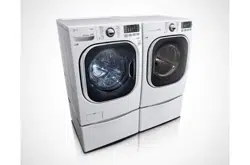
P/No.: 3828EL4001H
DLE0442W/DLG0452W
DLE0442S/DLG0452S
DLE0442G/DLG0452G
DLE5944WM/DLG5955WM
DLE6942W/DLG6952W
Thank you for buying a LG Dryer.
Please read your manual carefully, as it provides instructions
on safe Installation, Use and Maintenance.
Record the Model and Serial Numbers, and retain the
manual for future reference.
For more information, visit our website at http://us.lge.com
1-800-243-0000
24 HOURS A DAY, 7 DAYS A WEEK FOR LG CUSTOMER SERVICE
Owner's Manual
Electrial and Gas Dryer
PRODUCT FEATURES
TABLE OF CONTENTS
22
PART1. IMPORTANT WARRANTY AND SAFETY INSTRUCTIONS .................................................................................................................3
PART2. SPECIFICATIONS ...................................................................................................................................................................................8
PART3. INITIAL STEPS FOR INSTALLING YOUR DRYER ...............................................................................................................................9
PART4. ACCESSORIES INSTALLATION .........................................................................................................................................................13
PART5. ELECTRICAL REQUIREMENTS FOR ELECTRIC DRYER ............................................................................................................14-17
PART6. ELECTRICAL REQUIREMENTS FOR GAS DRYERS .........................................................................................................................18
PART7. GAS REQUIREMENTS AND INSTRUCTIONS.....................................................................................................................................19
PART8. EXHAUST REQUIREMENTS AND MAINTENANCE.......................................................................................................................20-21
PART9. OPERATING YOUR DRYER............................................................................................................................................................22-27
PART10. TROUBLESHOOTING GUIDE .......................................................................................................................................................28-30
LG DRYER LIMITED WARRANTY .....................................................................................................................................................................31
OUTSTANDING PERFORMANCE
Not to mention unmatched big capacity, you can benefit from good
time efficiency, quiet operation and energy saving system.
STAINLESS STEEL DRUM
Stainless steel drum doesn’t generate any rust by nature so that
rust-free drum keeps clothes away from stain all time.
ARTISTIC DESIGN
Modern front panel look and big crystal-clear glass door make your dryer look stylish.
DIGITAL FABRIC CARE
Multi-Level temperature control takes better care of your clothes
EASY OF USE
An entire selection of user-friendly functions make operating the dryer easy.
USING THE RLM (REMOTE LAUNDRY MONITOR)
The RLM monitors status of your washer and/or dryer. You can plug the display unit into any power
outlet in your home. The RLM Display Unit can be purchased separately for this dryer.
1
2
3
4
5
6
(DLE5944WM, DLG5955WM)
What are Sensor Dry and Time Dry?
Your dryer provides sensor drying and time drying programs.
Sensor Dry : Dryer senses electronically laundry humidity and it automatically determines operation time
based on the dryness of the load and the selected program. At times, you can see sudden increase or
decrease on operation time. It happens because a sensor will detect laundry humidity with a certain period.
Sudden change on operation time is not a malfunction.
Time Dry : Time Dry is that you can set operation time manually to complete drying. Or use Time Dry to have
drying performance if clothes are still damp after sensor dry cycle is finished. Time Dry is more effective for
heavyweight and bulky items such as king-size bed sheets and thick work clothes.
3
IMPORTANT WARRANTY AND SAFETY INSTRUCTIONS Part 1
• Do not install a clothes dryer with flexible
plastic venting materials. If flexible metal (foil
type) duct is installed, it must be of a specific
type identified by the appliance
manufacturer as suitable for use with clothes
dryers. Flexible venting materials are known
to collapse, be easily crushed, and trap lint.
These conditions will obstruct clothes dryer
airflow and increase the risk of fire.
• Do not store or use gasoline or other
flammable vapors and liquids in the vicinity
of this appliance or any other appliances.
• Installation and service must be performed
by a qualified installer, service agency, or
the gas supplier.
• Install the clothes dryer according to the
manufacturer’s instructions and local codes.
Your Safety and the safety of others are very important.
BASIC SAFETY PRECAUTIONS
DANGER
You can be killed or seriously injured if you don’t Immediately follow instructions.
You can be killed or seriously injured if you don’t follow instructions.
To reduce the risk of fire, electric shock or injury to persons when using your appliance, follow basic
precautions, including the following :
WARNING
WARNING
We have provided many important safety messages in this manual and on your appliance. Always read and obey
all safety messages.
All safety messages will tell you what the potential hazard is, tell you how the reduce the chance of injury, and tell you what
can happen if the instructions are not followed.
This is the safety alert symbol.
This symbol alerts you to potential hazards that can kill or hurt you and others.
All safety messages will follow the safety alert symbol and either the word DANGER or WARNING.
These words mean:
READ ALL INSTRUCTIONS BEFORE USE
For your safety, the information in this manual must be followed to minimize the risk of fire or
explosion, electric shock, or to prevent property damage, personal injury, or loss of life.
WARNING
1. Do not try to light a match or cigarette, or turn on any gas
or electrical appliance.
2. Do not touch any electrical switches.
Do not use any phone in your building.
3. Clear the room, building, or area of all occupants.
4. Immediately call your gas supplier from a neighbor’s
phone. Follow the gas supplier’s phone. Follow the gas
supplier’s instructions carefully.
5. If you cannot reach your gas supplier, call the fire
department.
WHAT TO DO IF YOU SMELL GAS
To reduce the risk of fire, electric shock, or injury to persons when using the appliance, follow basic
precautions, including the following:
WARNING
SAVE THESE INSTRUCTIONS
4
IMPORTANT WARRANTY AND SAFETY INSTRUCTIONS Part 1
This act requires the governor of California to publish a list of substances known to the state to cause cancer, birth defects,
or other reproductive harm and requires businesses to warn customers of potential exposure to such substances.
Gas appliances can cause minor exposure to four of these substances, namely benzene, carbon monxide, formaldehyde,
and soot, caused primarily by the incomplete combustion of natural gas or LP fuels.
Properly adjusted dryers will minimize incomplete combustion. Exposure to these substances can be minimized further by
properly venting the dryer to the outdoors.
READ ALL INSTRUCTIONS BEFORE USE
CALIFORNIA SAFE DRINKING WATER AND TOXIC ENFORCEMENT ACT
To reduce the risk of fire, electric shock, or injury to persons when using the appliance, follow basic
precautions, including the following:
WARNING
For your safety, the information in this manual must be followed to minimize the risk of fire or
explosion, electric shock, or to prevent property damage, personal injury, or loss of life.
WARNING
• Read all instructions before using the dryer.
• Before use, the dryer must be properly installed as described in
this manual.
• Do not place items exposed to cooking oils in your dryer. Items
contaminated with cooking oils may contribute to a chemical
reaction that could cause a load to catch fire.
Do not dry articles that have been previously cleaned in, washed
in, soaked in, or spotted with gasoline, dry-cleaning solvents, other
flammable or explosive substances as they give off vapors that
could ignite or explode.
• Do not reach into the dryer if the drum is moving.
• Do not repair or replace any part of the dryer or attempt any
servicing unless specifically recommended in this Use and Care
Guide or in published user-repair instructions that you understand
and have the skills to carry out.
• Do not tamper with controls.
• Before the dryer is removed from service or discarded, remove the
door to the drying compartment.
• Do not allow children to play on or in the dryer.
Close supervision of children is necessary when the dryer is used
near children.
• Do not use fabric softeners or products to eliminate static unless
recommended by the manufacturer of the fabric softener or
product.
• Do not use heat to dry articles containing foam rubber or similarly
textured rubber-like materials.
• Keep area around the exhaust opening and adjacent surrounding
areas free from the accumulation of lint, dust, and dirt.
• The interior of the dryer and exhaust vent should be cleaned
periodically by qualified service personnel.
• Do not install or store the dryer where it will be exposed to the
weather.
• Do not reach into the dryer while parts are moving.
• Always check the inside of the dryer for foreign objects
• Clean lint screen before or after each load.
BASIC SAFETY PRECAUTIONS
To reduce the risk of fire, electric shock or injury to persons when using your appliance, follow basic
precautions, including the following :
WARNING
GROUNDING INSTRUCTIONS
This appliance must be grounded. In the event of malfunction
or breakdown, grounding will reduce the risk of electric shock
by providing a path of least resistance for electric current.
This appliance must be equipped with a cord having an
equipment-grounding conductor and a grounding plug. The
plug must be plugged into an appropriate outlet that is
properly installed and grounded in accordance with all local
codes and ordinances.
WARNING -
Improper connection of the equipment- rounding
conductor can result in a risk of electric shock. Check with a
qualified electrician or service person if you are in doubt as to
whether the appliance is properly grounded.
Do not modify the plug provided with the appliance.
If it will not fit the outlet, have a proper outlet installed by a
qualified electrician.
This appliance must be connected to a grounded metal,
permanent wiring system or an equipment-grounding conductor
must be run with the circuit conductors and connected to the
equipment-grounding terminal or lead on the appliance.
SAVE THESE INSTRUCTIONS

5
IMPORTANT WARRANTY AND SAFETY INSTRUCTIONS Part 1
• Properly ground dryer to conform with all governing
codes and ordinances. Follow details in the installation
instructions.
Electrical shock can result if the dryer is not properly
grounded.
• Before use, the dryer must be properly installed as
described in this manual.
Electrical shock can result if the dryer is not properly
grounded.
• Install and store the dryer where it will not be exposed
to temperatures below freezing or exposed to the
weather.
All repairs and servicing must be performed by an
authorized servicer unless specifically recommended in this
Owner's Guide. Use only authorized factory parts. Failure
to follow this warning can cause serious injury,fire,
electrical shock or death.
• Do not install the washer in humid spaces to reduce
the risk of electric shock.
Failure to follow this warning can cause serious injury,fire,
electrical shock or death.
• Connect to a properly rated, protected, and sized
power circuit to avoid electrical overload.
Improper power circuit can melt, creating electrical shock
and/or fire hazard.
• Remove all packing items and dispose of all shipping
materials properly.
Failure to do so can result in death, explosion, fire or burns.
• Place dryer at least 18 in. above the floor for a garage
installation.
Failure to do so can result in death, explosion, fire or burns.
Exhaust/Ducting:
• Gas dryers MUST be exhausted to the outside.
Failure to follow these instructions can result in fire or
death.
• The dryer exhaust system must be exhausted to the
outside of the dwelling.
The dryer is not exhausted outdoors, some fine lint and
large amounts of moisture will be expelled into the laundry
area. An accumulation of lint in any area of the home can
create a health and fire hazard.
• Use only rigid metal or flexible metal 4in. Diameter
ductwork inside the dryer cabinet or for exhausting to
the outside.
Use of plastic or other combustible ductwork can cause a
fire. Punctured ductwork can cause a fire if it collapses or
becomes otherwise restricted in use or during installation.
• Ductwork is not provided with the dryer, and you
should obtain the necessary ductwork locally. The end
cap should have hinged dampers to prevent back draft
when the dryer is not in use.
Failure to follow these instructions can result in fire or
death.
• The exhaust duct must be 4 in. (10 cm) in diameter with
no obstructions. The exhaust duct should be kept as
short as possible. Make sure to clean any old ducts
before installing your new dryer.
Failure to follow these instructions can result in fire or
death.
READ ALL INSTRUCTIONS BEFORE USE
SAFETY INSTRUCTION FOR INSTALLATION
To reduce the risk of fire, electric shock, or injury to persons when using the appliance, follow basic
precautions, including the following:
WARNING
For your safety, the information in this manual must be followed to minimize the risk of fire or
explosion, electric shock, or to prevent property damage, personal injury, or loss of life.
WARNING
6
IMPORTANT WARRANTY AND SAFETY INSTRUCTIONS Part 1
• Rigid or semi rigid metal ducting is recommended for
use between the dryer and the wall. In special
installations when it is impossible to make a
connection with the above recommendations, a UL-
listed flexible metal transition duct may be used
between the dryer and wall connection only. The use of
this ducting will affect drying time.
Failure to follow these instructions can result in fire or
death.
• DO NOT use sheet metal screws or other fasteners
which extend into the duct that could catch lint and
reduce the efficiency of the exhaust system. Secure all
joints with duct tape. ¶U For complete details, follow
the Installation Instructions.
Failure to follow these instructions can result in fire or
death.
• Do not, under any circumstances, cut or remove the
ground prong from the power cord.
To prevent personal injury or damage to the dryer, the
electrical power cord must be plugged into a properly
grounded
• For personal safety, this dryer must be properly
grounded.
Failure to do so can result in electrical shock or injury
• Refer to the installation instructions in this manual for
specific electrical requirements for your model.
Failure to follow these instructions can create electrical
shock and/or a fire hazard.
• This dryer must be plugged into a properly grounded
outlet.
Electrical shock can result if the dryer is not properly
grounded.
• Have the wall outlet and circuit checked by a qualified
electrician to make sure the outlet is properly
grounded.
This will prevent shock hazard and assure stability during
operating.
• The dryer should always be plugged into its own
individual electrical outlet which has a voltage rating
that matches the rating plate.
This provides the best performance and also prevents
overloading house wiring circuits which could cause a fire
hazard from overheated wires.
• Never unplug your dryer by pulling on the power cord.
Always grip plug firmly and pull straight out from the
outlet.
The power cord can be cut by any movement of the core,
resulting in electrical shock.
• Repair or replace immediately all power cords that
have become frayed or otherwise damaged. Do not use
a cord that shows cracks or abrasion damage along its
length or at either end.
These power cord can melt, creating electrical shock
and/or fire hazard.
• When installing or moving the dryer, be careful not to
pinch, crush, or damage the power cord.
This will prevent injury and damage to the dryer from fire
and electrical shock.
READ ALL INSTRUCTIONS BEFORE USE
SAFETY INSTRUCTION FOR INSTALLATION (cont.)
SAFETY INSTRUCTION FOR CONNECTING ELECTRICITY
To reduce the risk of fire, electric shock or injury to persons when using the appliance, follow basic
precautions, including the following :
WARNING
For your safety, the information in this manual must be followed to minimize the risk of fire or
explosion, electric shock, or to prevent property damage, personal injury, or loss of life.
WARNING
7
The warranty for your dryer is located at the end of this manual. Warranty Service is
available by contacting your nearest LG Service Center. If this product is installed and
operated according to the instructions in this manual, LG will repair or replace any parts
defective in material or workmanship throughout the warranty period, beginning with the
date of purchase.
Warranty Restriction: If the dryer is subjected to other than single family use, all warranty
coverage is effective for only 90 days.
You will need the complete model and serial number when requesting warranty service. proof of
purchase date is required.
Use the space below to record the model number and serial number of your new LG dryer.
Model Number.
Serial Number.
Date of Purchase
Staple your receipt here for convenience when contacting service.
IMPORTANT WARRANTY AND SAFETY INSTRUCTIONS Part 1
SEEKING WARRANTY SERVICE
WARNING!
For your safety, the recommendations in this manual must be followed. To reduce the risk
of fire or explosion, electric shock or to prevent property damage, personal injury, or death
when using your appliance follow basic precautions.
8
Part 2 SPECIFICATIONS
■ Type : Electric and Gas Dryer
■ Rating : Please refer to the rating label regarding detailed information.
■ Size : 27 x 30 x 42.75(inch)
■ Capacity : IEC 7.3cu.ft. (22.5 lb)
■ Weight : 126 Ibs (57.2 kg)
Specifications are subject to change by manufacturer.
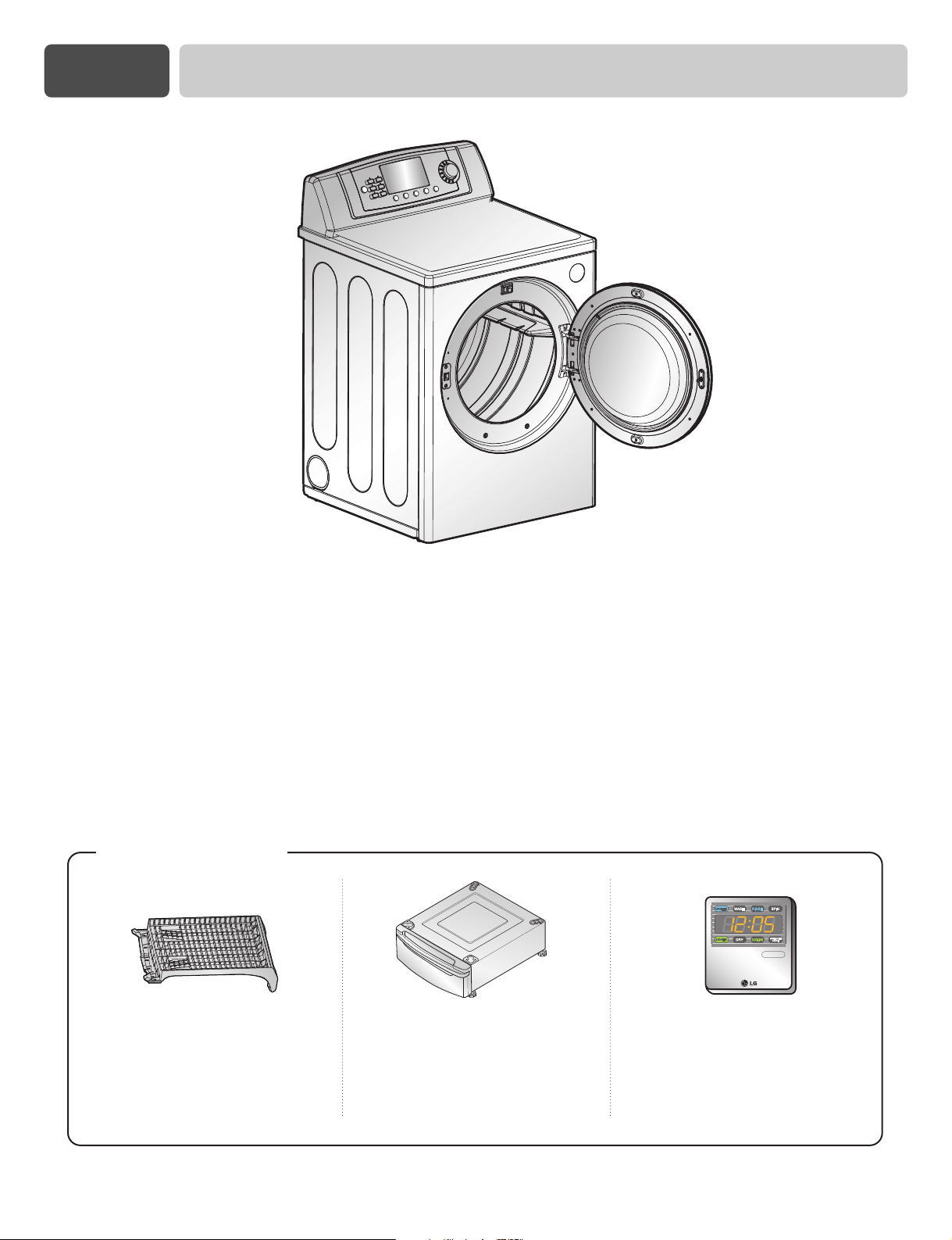
■ ACCESSORIES
Dryer rack (1 each)
See page 26 for how to use. See page 14 for how to use.
Pedestal (1 each)
Purchased Separately
Remote Laundry
Monitor
Purchased Separately
(DLE5944WM, DLG5955WM)
9
Part 3 INITIAL STEPS FOR INSTALLING YOUR DRYER
In addition to the following warnings, please refer
to manual section on Exhaust Requirements and
Maintenance. IMPORTANT: To reduce the risk of
fire, combustion, and gas accumulation, the dryer
must be vented to the outdoors. Please follow the
instructions (and all others in this manual) very
carefully.
• Do not use thin plastic or foil ducting.
• Rigid or semi-rigid metal ducting is recommended
for use as transition ducting between the dryer and
and the wall. In special installations when it is
impossible to make a connection with the above
recommendations, then a UL-listed flexible metal
transition duct may be used between the dryer and
wall connection only. The use of this ducting will
affect dry time.
• Position the Dryer such that the exhaust duct run is
as short as possible.
• Clean old ducts before installing this dryer
• The male end of each section of exhaust duct must
point away from the dryer
• Use as few elbow joints as possible.
• Use duct tape on all duct joints
• Insulate ductwork that runs through unheated
areas in order to reduce condensation and lint
build-up on pipe walls; and
• PLEASE BE AWARE THAT FAILURE TO
EXHAUST THE DRYER CORRECTLY WILL
VOID THE DRYER’S WARRANTY.
WARNING!
• Use a heavy metal vent.
• Do not use a plastic vent.
• Do not use a metal foil vent.
• Failure to follow these instructions can
result in death or fire.
• Clean old ducts before installing this dryer
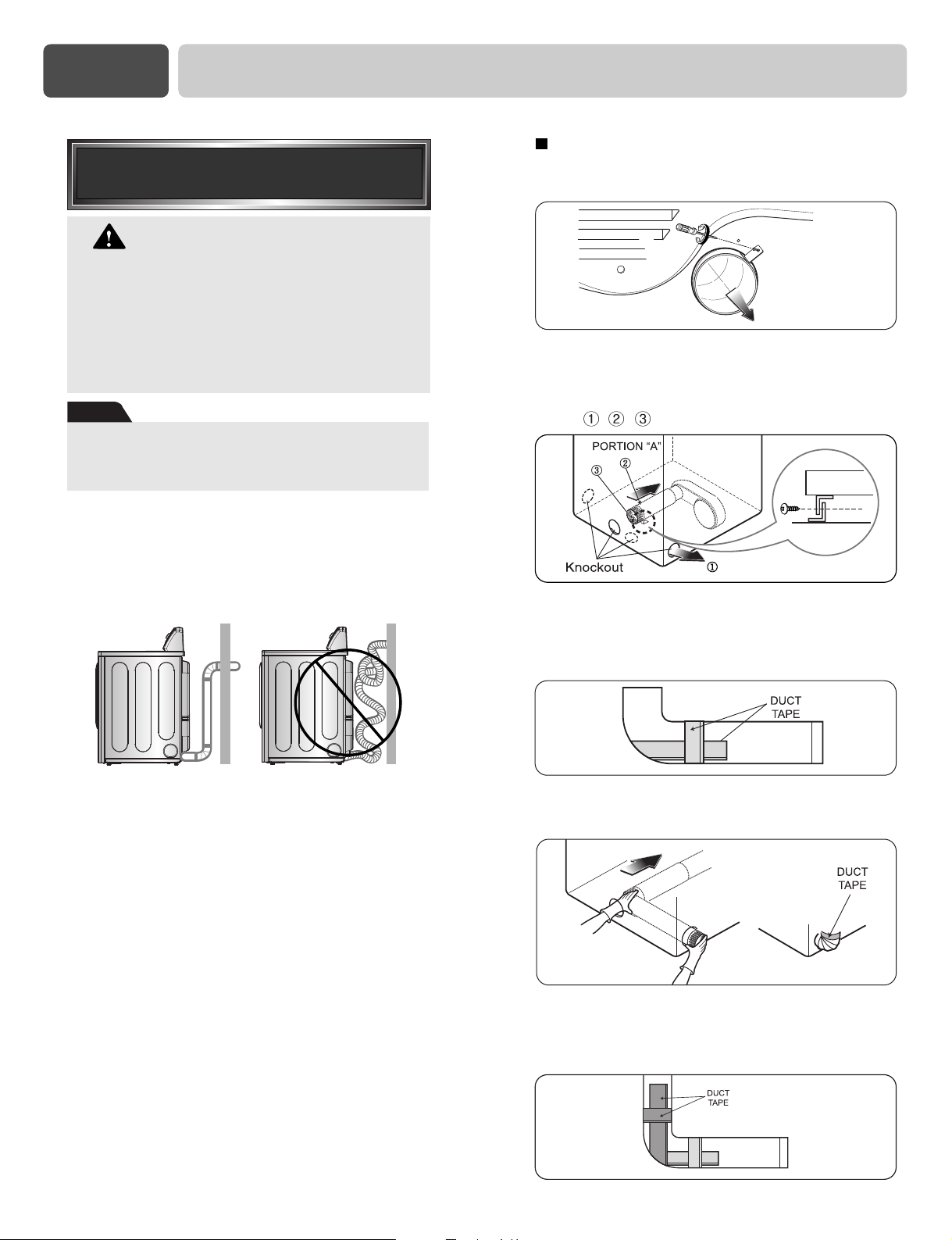
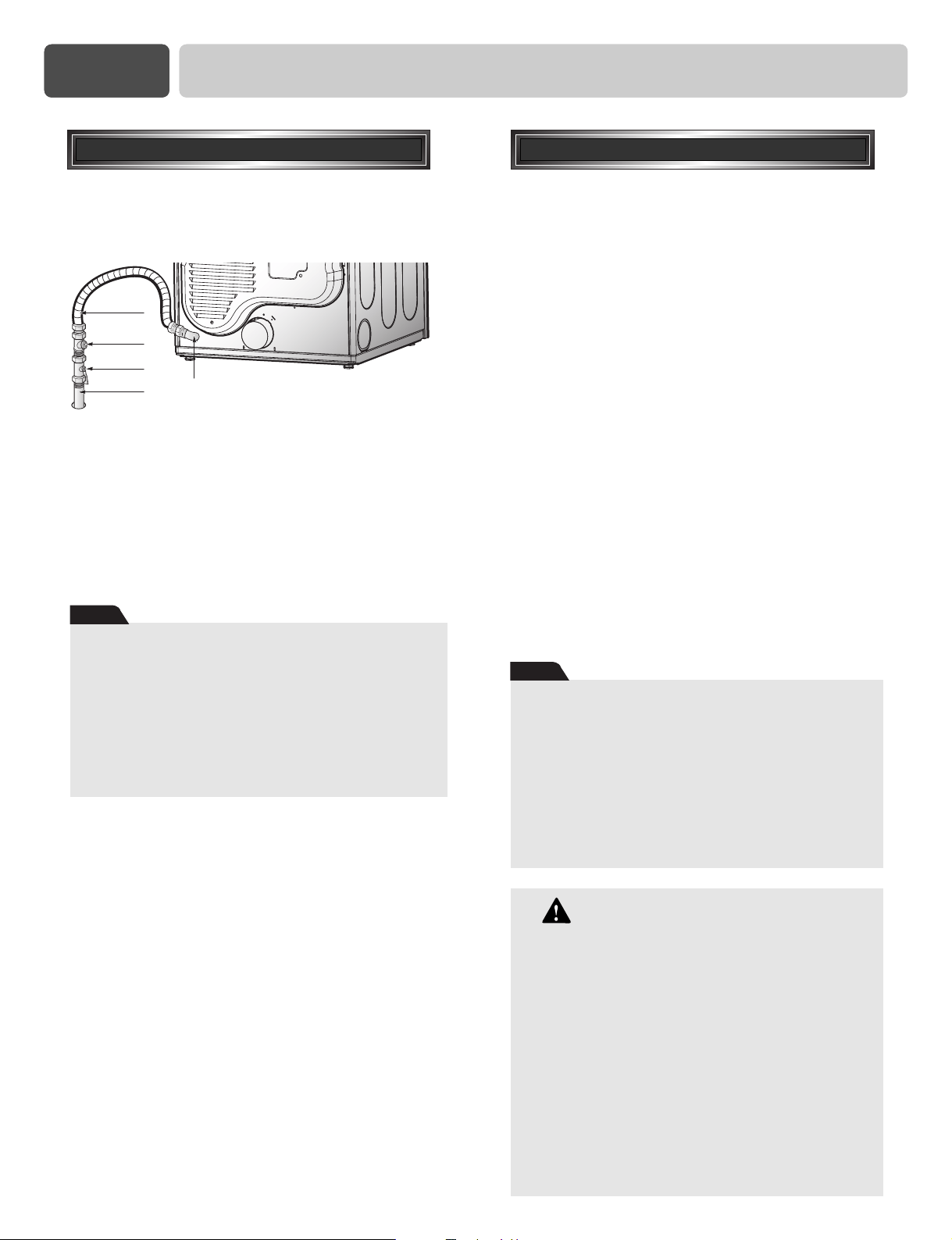
ALTERNATE EXHAUST DIRECTIONS
1.
Remove a screw and exhaust duct.
2-1.
Detach and remove the knockout that
matches the desired venting direction
(Right side not available on Gas Dryers)
, , the order of work.
2-2.
Reconnect the duct to the blower
housing and attach the duct to the
base.(Duct is a SVC part)
3-1.
Pre-assemble 4" elbow with 4" duct.
Wrap duct tape around joint.
3-2.
Insert elbow duct assembly first through the
side opening and connect the elbow to the
internal duct.
STEP 3 Connecting the Exhaust
and Venting System.
Vent end will face to the outside home and
improper taping and unstable installation of vent
will cause undesirable drying performance.
Note
10
Part 3 INITIAL STEPS FOR INSTALLING YOUR DRYER
(Gas dryer only). In addition to the following,
please refer to manual section on Gas Requirements
and Instructions.
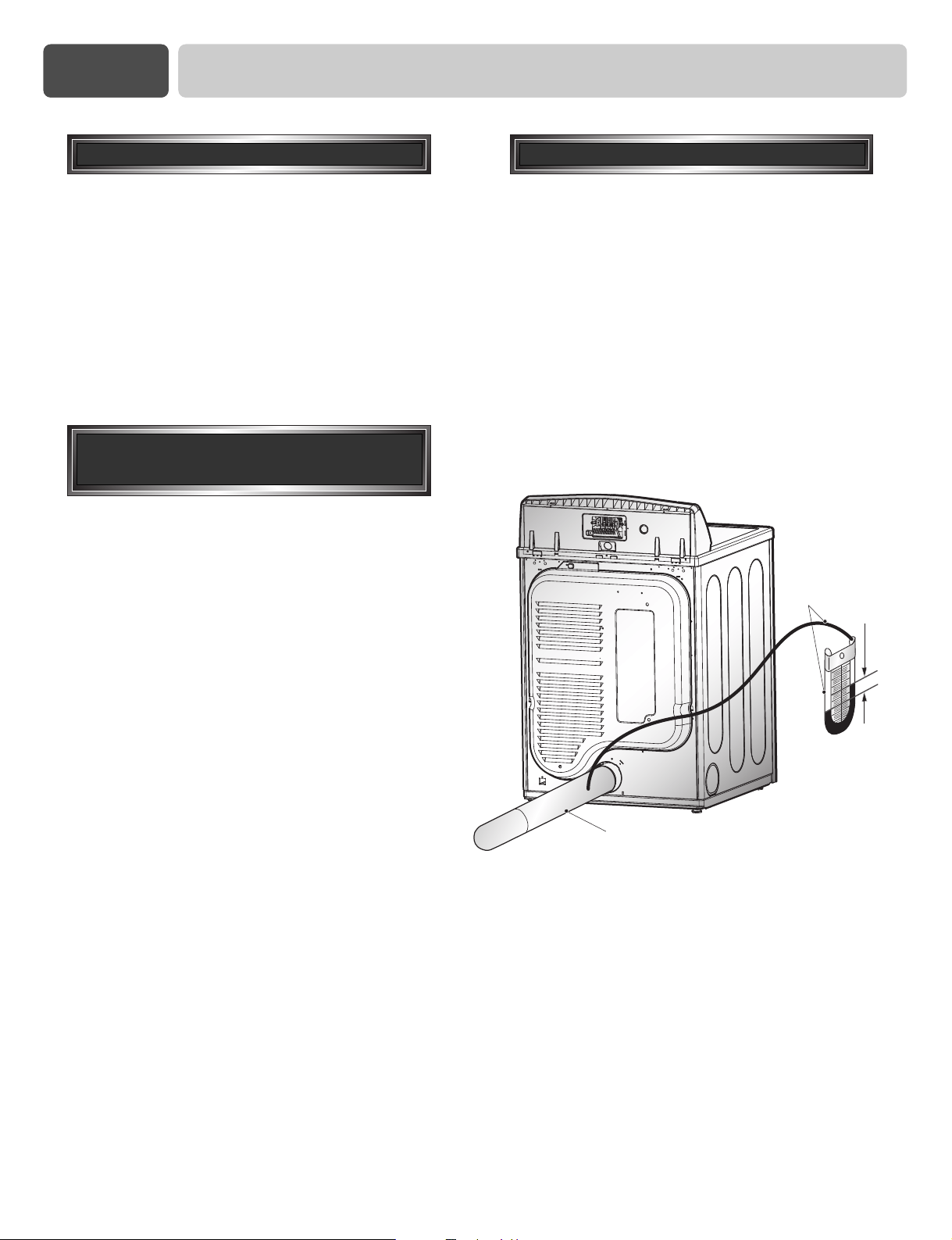
1. Confirm that the type of gas available in your laundry
room is appropriate for the dryer. The dryer is prepared
for Natural Gas with a 3/8" NPT gas connection.
2. Remove the shipping cap from the gas connection at the
back of the dryer. Make sure that you don’t damage the
threads of the gas connection pipe when you remove the
shipping cap.
3. Connect the dryer to your laundry room’s gas supply
using a new flexible stainless steel connector (as noted
below, only use a new stainless steel flexible connector
if allowed by your local codes).
4. Securely tighten all connections between the dryer and
your laundry room’s gas supply. Turn on your laundry
room’s gas supply and check all pipe connections (both
internal and external) for gas leaks with a non-corrosive
leak detection fluid. Refer to Part 7(page 20)
5. For LP (Liquefied Petroleum) gas connection, refer to
this manual’s section entitled Gas Requirements and
Instructions.
1. New stainless steel flexible connector. Use this type of
connector only if allowed by local codes. Use Design AGA
Certified Connector.
2. 1/8" NPT Pipe Plug (for checking inlet gas pressure)
3. Equipment Shut-Off Valve-
Installed within 6’ (1.8 m) of dryer
4. Iron Pipe. Shorter than 20’ (6.1 m)
Use 3/8" pipe. Longer than 20’ (6.1 m) - Use 1/2" pipe.
5. 3/8" N.P.T. Gas Connection
Following are several warnings and instructions
concerning making the electrical connection for electric
dryers. More detailed information concerning the
electrical connection is provided at the manual section
entitled Electrical Requirements For Electric Dryer and
it is important that you thoroughly review that section,
and the remainder of this manual, before taking any
steps to install or use this dryer.
1. Use only a new U.L. listed No. 10 (copper wire only)
three conductor power supply cord kit rated 240
Volts (minimum) 30 Amperes and labeled as suitable
for use in a clothes dryer.
2. Four-wire cord is required for manufactured (mobile)
home installations and use and where local codes do
not allow grounding of this appliance through
neutral.
3. Electrical Plug Connections.
4. For additional instruction on connecting the dryer to
an electrical power source, please refer to this
manual’s section on Electrical Requirements and
Electric Dryer.
2
3
5
1
4
WARNING!
• Use a new UL approved 30 amp power supply
cord or 10 gauge solid copper wire.
• Use a UL approved strain relief.
• Disconnect power before making electrical
connections.
• Connect neutral wire(white or center wire) to
center terminal.
• Ground wire(green or bare wire) must be
connected to green ground connector.
• Securely tighten all electrical connections
• See installation instructions for complete
instructions.
•
Failure to do so can result in fire or electrical
shock.
STEP 4
Connection of Gas Supply
Make sure the burner nozzle is proper for the type of
gas you are provided with.
For instance, using LPG with LNG nozzle will result
in death, fire or explosion. Or using LNG with LPG
nozzle will not ignite burner.
If needed, nozzle conversion should be done by a
qualified service technician and mark or put the
label of the current type of nozzle on the dryer.
Note
Burner input requirements
If your house is located at the elevation up to 10,000
feet.
Adjusting burner input setting is not needed in this
elevation because A.G.A certifies this dryer will not
have any problem with the B.T.U rating at this altitude.
If your house is at above 10,000 feet, you are required
to adjust a four percent(4%) reduction of the burner
B.T.U rating indicated on the model/serial rating plate.
Note
STEP 5
Electrical Plug Connections
11
Part 3 INITIAL STEPS FOR INSTALLING YOUR DRYER
Prior to the first use of this appliance, use all-
purpose cleaning products or a solution of detergent
and water, with damp clothes to remove from the
inside of the dryer drum/drying compartment any
dust or dirt that may have accumulated the inside of
the dryer. Plug-in your dryer after reviewing the
following parts on your dryer’s Electrical
Requirements.
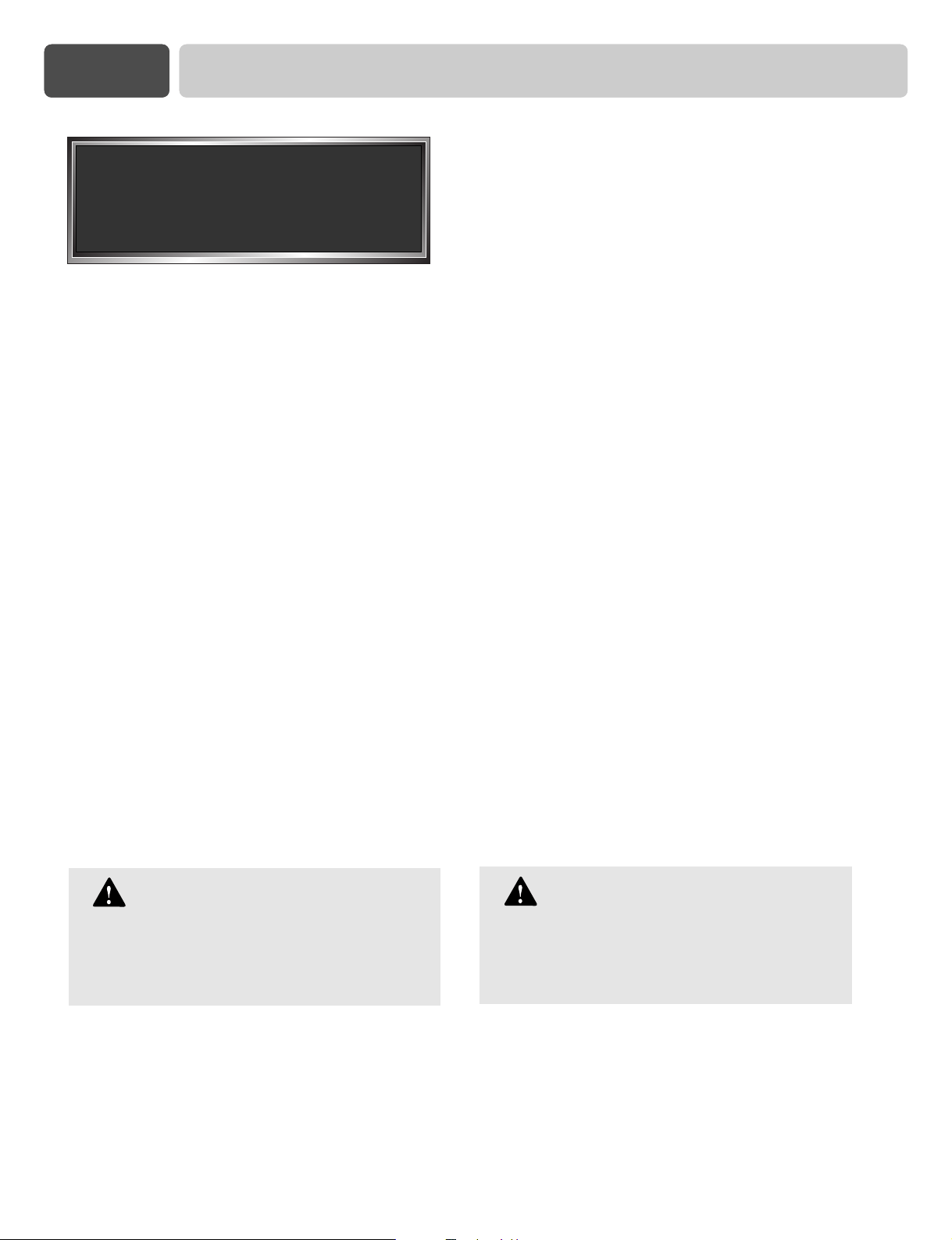
Effective dryer operation requires appropriate dryer
airflow. The adequacy of the airflow can be
measured by evaluating the static pressure. Static
pressure in the exhaust duct can be measured with a
manometer, placed on the exhaust duct
approximately 2 ft. (60.9 cm) from the dryer. Static
pressure in the exhaust duct should not exceed 0.6
inches (1.5 cm). The dryer should be checked with
the dryer running with no load.
Confirming Heat Source in Gas Dryers
Close the door to the dryer drum/drying
compartment and, after completing all steps in this
manual for proper installation of this dryer, start the
dryer on a heat setting, as described more fully in
the operating instructions that accompany the dryer.
After the dryer starts, the igniter will glow red and
the main burner will ignite.
Warning: If all air is not purged from the gas line,
the gas igniter may go off before the gas and the
main burner have ignited. If this happens, the
igniter will re-attempt gas ignition after
approximately two minutes.
Confirming Heat Source in Electric Dryers
Close the door to the dryer drum/drying
compartment and, after completing all steps in this
manual for proper installation of this dryer, start the
dryer on a heat setting, as described more fully in
the operating instructions that accompany the dryer.
The exhaust air or the exhaust pipe should be warm
after the dryer has been operating for three minutes.
2
1
Measuring Static pressure
0.6 inche (1.5 cm)
MAXIMUM STATIC
PRESSURE IN
WATER COLUMN
STEP 6
Preparation of the Dryer.
STEP 8
Dryer Airflow.
STEP 7
Confirming Heat Source
Operation.
Manometer
Exhaust Duct
12
Part 3 INITIAL STEPS FOR INSTALLING YOUR DRYER
The following instructions are applicable to
installations of the dryer in a manufactured or
mobile home. Any installation in a manufactured or
mobile home must comply with the Manufactured
Home Construction and Safety Standards Title 24
CFR, Part 32-80 or Standard CAN/CSA0Z240 MH
and local codes and ordinances. If you are
uncertain whether your proposed installation will
comply with these standards, please contact a
service and installation professional for assistance.
The following instructions apply to any installation
of the dryer in a manufactured or mobile home:
1) The gas dryer must be permanently attached to
the floor.
2) The electrical connection for an electric dryer
must be a 4-wire connection. More detailed
information concerning the electrical connection
is provided at the manual section entitled
Electrical Requirements for Electric Dryer
3) To reduce the risk of combustion and fire, the
dryer must be vented to the outside.
4) Electric dryers may be vented to the outside
using the back, left, right, or bottom panel.
5) Gas dryers may be vented to the outside using the
back, left, or bottom panel. Gas dryer may not be
vented to the outside using the right side panel
because of the burner housing.
6) The dryer exhaust duct must be affixed securely
to the manufactured or mobile home structure,
and the exhaust duct must be made of a material
that will resist fire and combustion, and it is
recommended that you use a rigid or flexible
metal pipe.
7) DO NOT connect the exhaust duct with any other
duct, vent, chimney, or other exhaust duct.
8) Make sure the dryer has adequate access to
outside fresh air to ensure proper operation. The
opening for outside fresh air must be at least 25
in
2
(163 cm
2
).
9) It is important that the clearance of the duct from
any combustible construction be at least 2 inches
(5 cm), and, when venting the dryer to the
outdoors, the dryer can be installed with a
clearances of 1 inch at the sides and back of the
dryer.
10) Please be aware that venting materials are not
supplied with the dryer. You should obtain the
venting materials necessary for proper
installation.
WARNING!
DO NOT connect exhaust ducts with
metal screws or fasteners that extend
into the duct.
WARNING!
DO NOT vent the exhaust duct under the
manufactured or mobile home.
STEP 9
Additional Instructions
for Installation of Your
Dryer in a Manufactured
or Mobile Home.
13
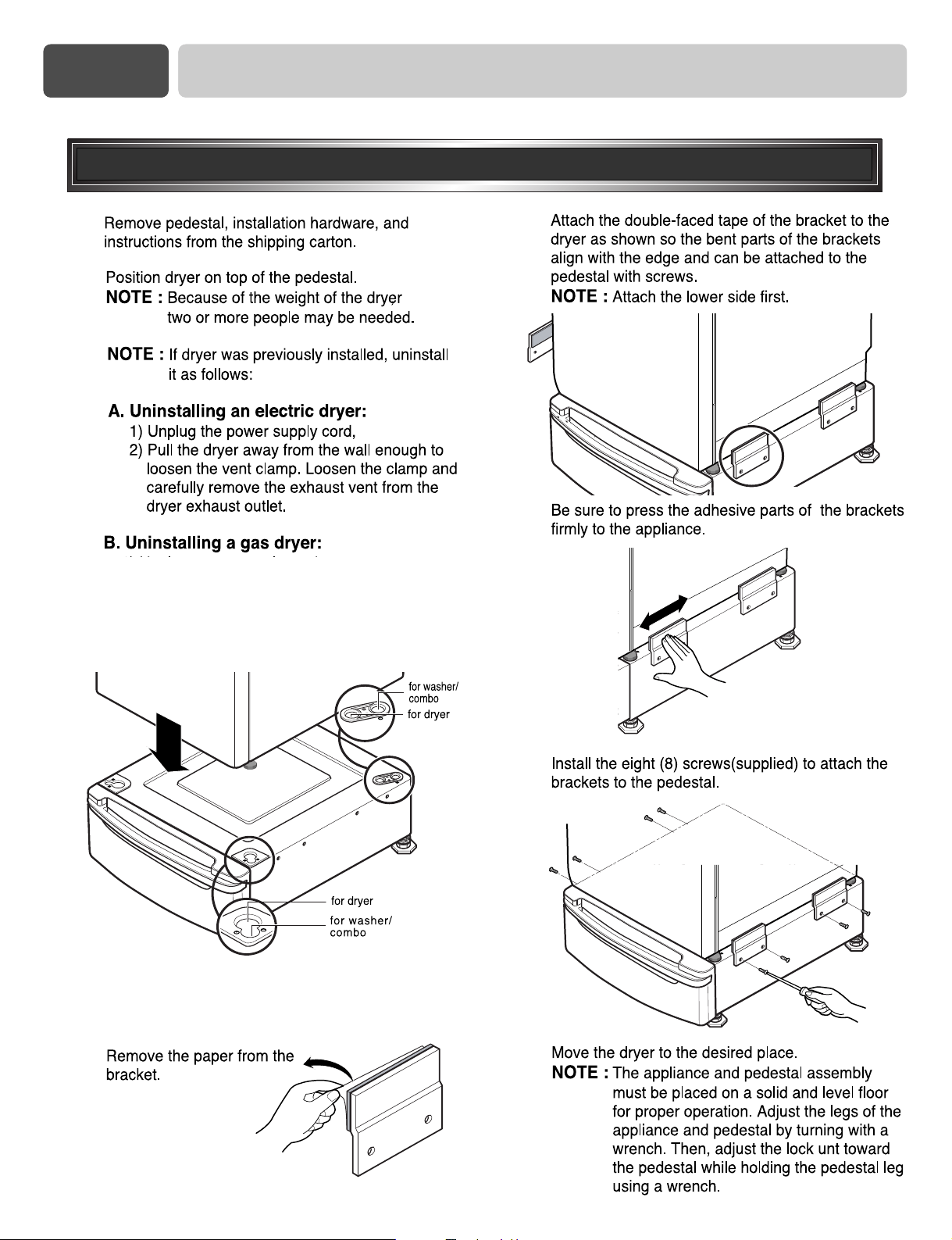
Part 4 ACCESSORIES INSTALLATION
Pedestal Installation Instructions
3
1 4
5
6
7
2
1) Shut off Gas
2) Unplug Power Cord
3) Disconnect Gas Line from Dryer
4) Pull away and loosen vent clamp.
Disconnect venting.

14
Part 5 ELECTRICAL REQUIREMENTS FOR ELECTRIC DRYERS
Following are additional instructions regarding electrical connections and requirements for electric dryers.
Important Warning: To help prevent fire, electric shock, serious injury or death, the wiring and grounding
must conform to the latest edition of the National Electrical Code, ANSI/NFPA 70 and all applicable local
regulations. Please contact a qualified electrician to check your home’s wiring and fuses to ensure that your home
has adequate electrical power to operate the dryer.
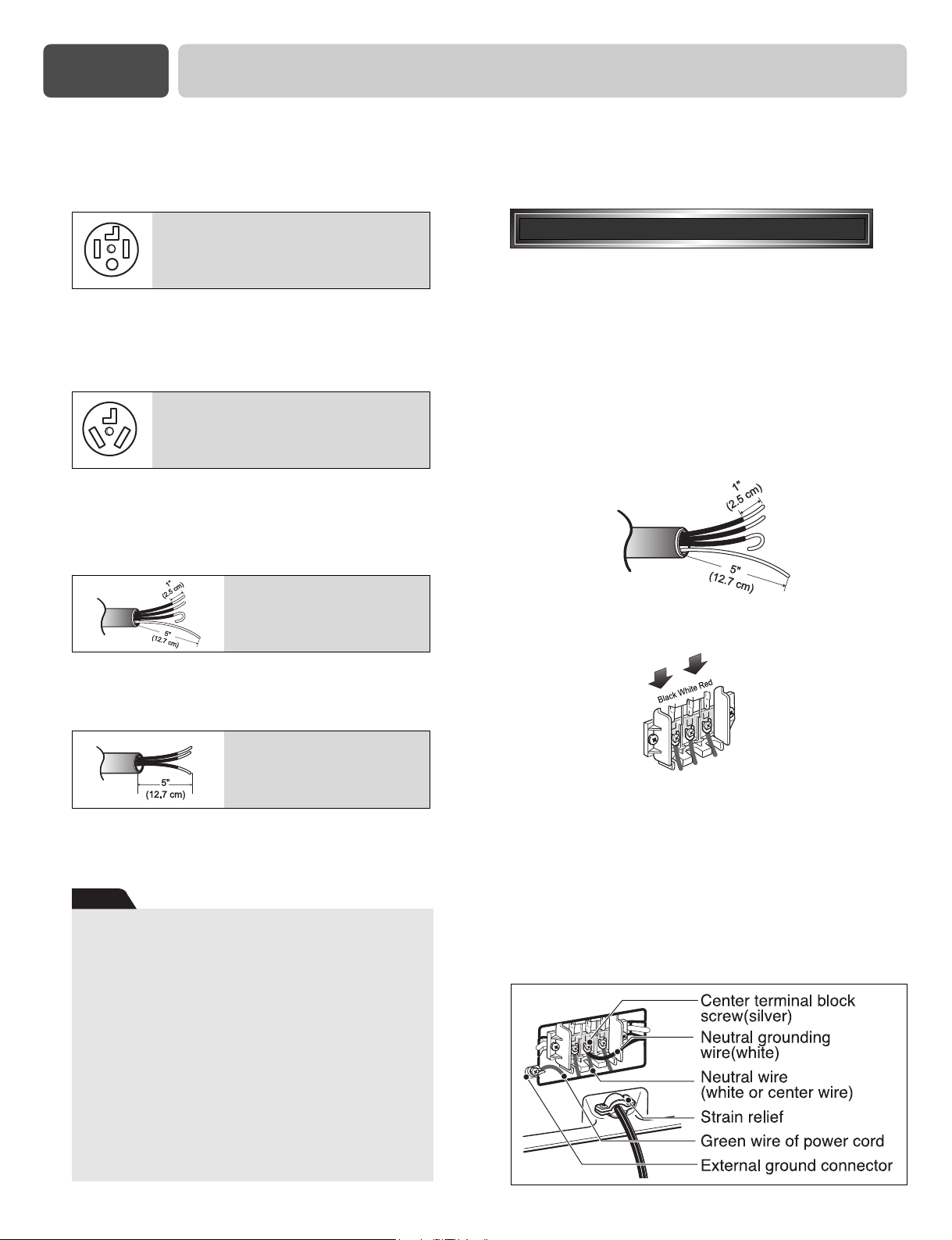
120V/ 208V, 60 Hertz, 3-Wire Installation
120V/ 240V, 60 Hertz, 3-Wire Installation
Instructions for Grounding of your Electric
Dryer:
a) Please note that the wiring diagram is provided
Inside the dryer cabinet.
b) This dryer must be connected to a grounded
metal, permanent wiring system; or an
equipment-grounding conductor must be run
with the circuit conductors and connected to the
equipment-grounding terminal or lead on the
dryer.
c) The dryer has its own terminal block that must
be connected to a separate branch, 60 Hertz,
single phase circuit, AC (alternating current)
circuit, fused at 30 Amperes (the circuit must be
fused on both sides of the line). ELECTRICAL
SERVICE FOR THE DRYER SHOULD BE
OF MAXIMUM RATE VOLTAGE LISTED
ON THE NAMEPLATE. DO NOT CONNECT
DRYER TO 110, 115, OR 120 VOLT
CIRCUIT.
d) If branch circuit to dryer is fifteen feet (4.50 m)
or less in length, use U.L. (Underwriters
Laboratories) listed No. 10 A.W.G. wire
(copper wire only), or as required by local
codes. If over fifteen feet (4.50 m), use U.L.
(Underwriters Laboratories) listed No. 8
A.W.G. wire (copper wire only), or as required
by local codes. Allow sufficient slack in wiring
so dryer can be moved from its normal location
when necessary.
e) The power cord (pigtail) connection between wall
receptacle and dryer terminal block IS NOT
supplied with dryer. Type of pigtail and gauge of
wire must conform to local codes and with
instructions mentioned on the following pages.
f) The method of wiring the dryer is optional and
subject to local code requirements. Refer to
examples on next page.
g) You must select the method by which to wire
your dryer according to local code and ordinance
requirements. Sample methods are included in
the following pages.
WARNING!
Label all wires prior to disconnection
when servicing the dryer, because
wiring errors can cause serious injury
to you and your dryer.
15
Part 5 ELECTRICAL REQUIREMENTS FOR ELECTRIC DRYERS
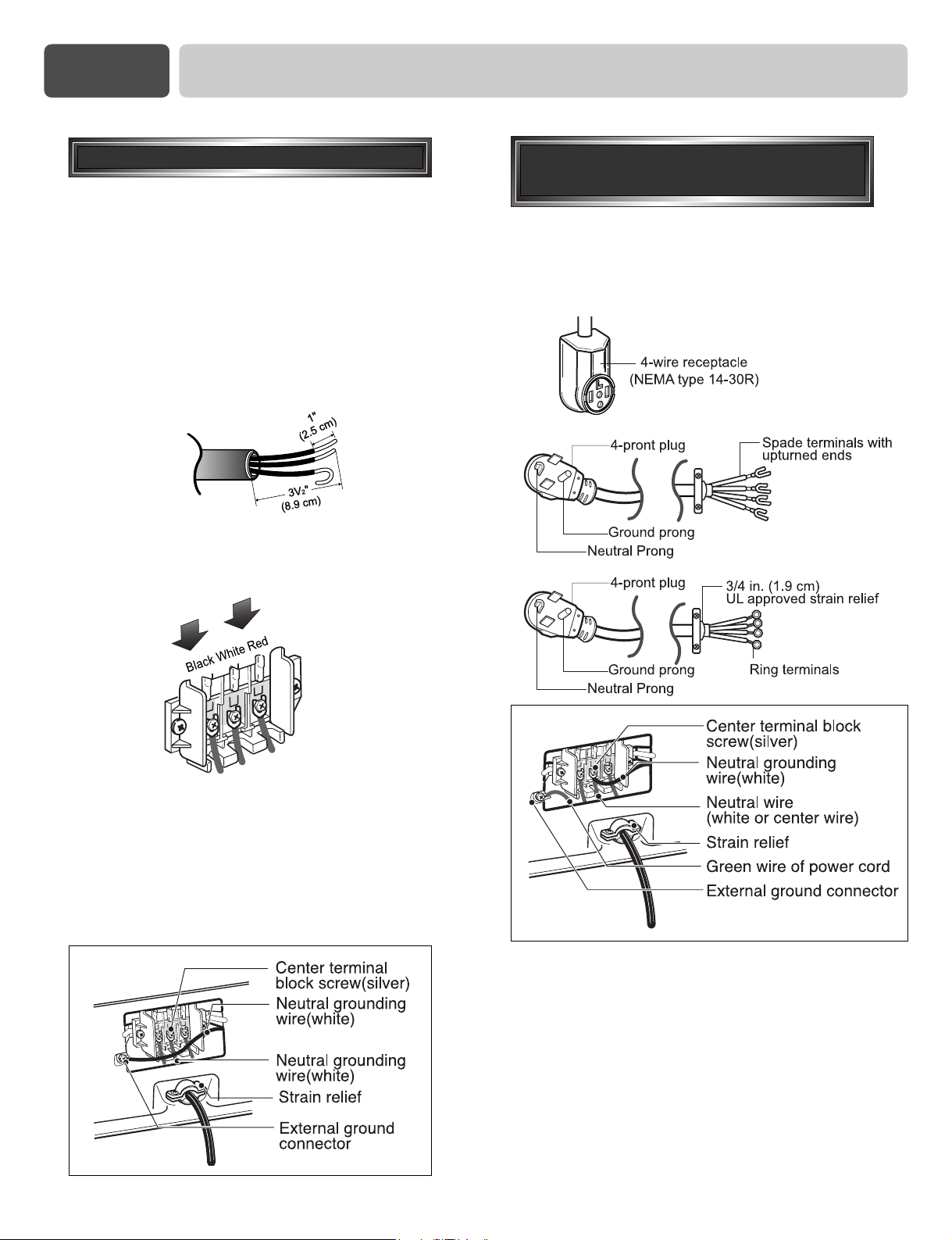
Use the instructions at this section if your home has
a 3-wire receptacle (NEMA type 10-30R) and you
will be using a UL listed, 120/240 volt minimum,
30 amp, dryer power supply cord.
Review the following options to determine the appropriate electrical connection
for your home:
If this type is available at your home. you will be
connecting to a fused disconnect or circuit breaker
box
Important : Grounding through the neutral conductor is
prohibited for (1) new branch-circuit installations, (2) mobile
homes, and (3) recreational vehicles, and (4) areas where
local codes prohibit grounding through the neutral conductor.
Prepare minimum 5ft(1.52m) of length in order for dryer to
be replaced.
First, peel 5 inch (12.7cm) of covering material from end.
Make a 5 inch of ground wire bared. After cutting 1
1
/2 inch
(3.8cm) from 3 other wires. peel insulation back 1inch
(2.5cm). Make ends of 3 wires a hook shape.
Then, put the hooked shape end of the wire under the
screw of the terminal block(hooked end facing rightward)
and pinch the hook together and screw tightly.
Use the instructions at this section if your home has
a 4-wire receptacle (NEMA type 14-30R) and you
will be using a UL listed, 120/240 volt minimum,
30 amp, dryer power supply cord.
If this type is available at your home. you will be
connecting to a fused disconnect or circuit breaker
box
1. Connect neutral wire(white) of power cord to center
terminal block screw.
2. Connect red and black wire to the left and right
terminal block screws.
3. Connect ground wire(green) of power cord to external
ground screw and move neutral ground wire of
appliance and connect it to center screw.
4. Make sure that the strain relief screw is tightened.
and be sure that all terminal block nuts are on tight and
power cord is in right position.
3-wire direct
4-wire receptacle
(NEMA type14-30R)
3-wire receptacle
(NEMA type10-30R)
4-wire direct
4-wire connection : Direct wire
• Screw power supply wire to the terminal block.
Colored wire should be connected to same color
screw. Wire color indicated on manual is
connected to the same color screw in block.
Otherwise, excessive current is applied resulting
in damages on product and heating failure.
• Appropriate screwing is essential. Imcomplete
screwing also may cause loose connection or
unscrewing because of excessive screw
abrasion.
• Loose screwing may cause connection error,
which result in death, fire or serious injury.
Note
16
Part 5 ELECTRICAL REQUIREMENTS FOR ELECTRIC DRYERS
Important :
Grounding through the neutral conductor
is prohibited for (1) new branch-circuit installations,
(2) mobile homes, and (3) recreational vehicles, and
(4) areas where local codes prohibit grounding through
the neutral conductor.
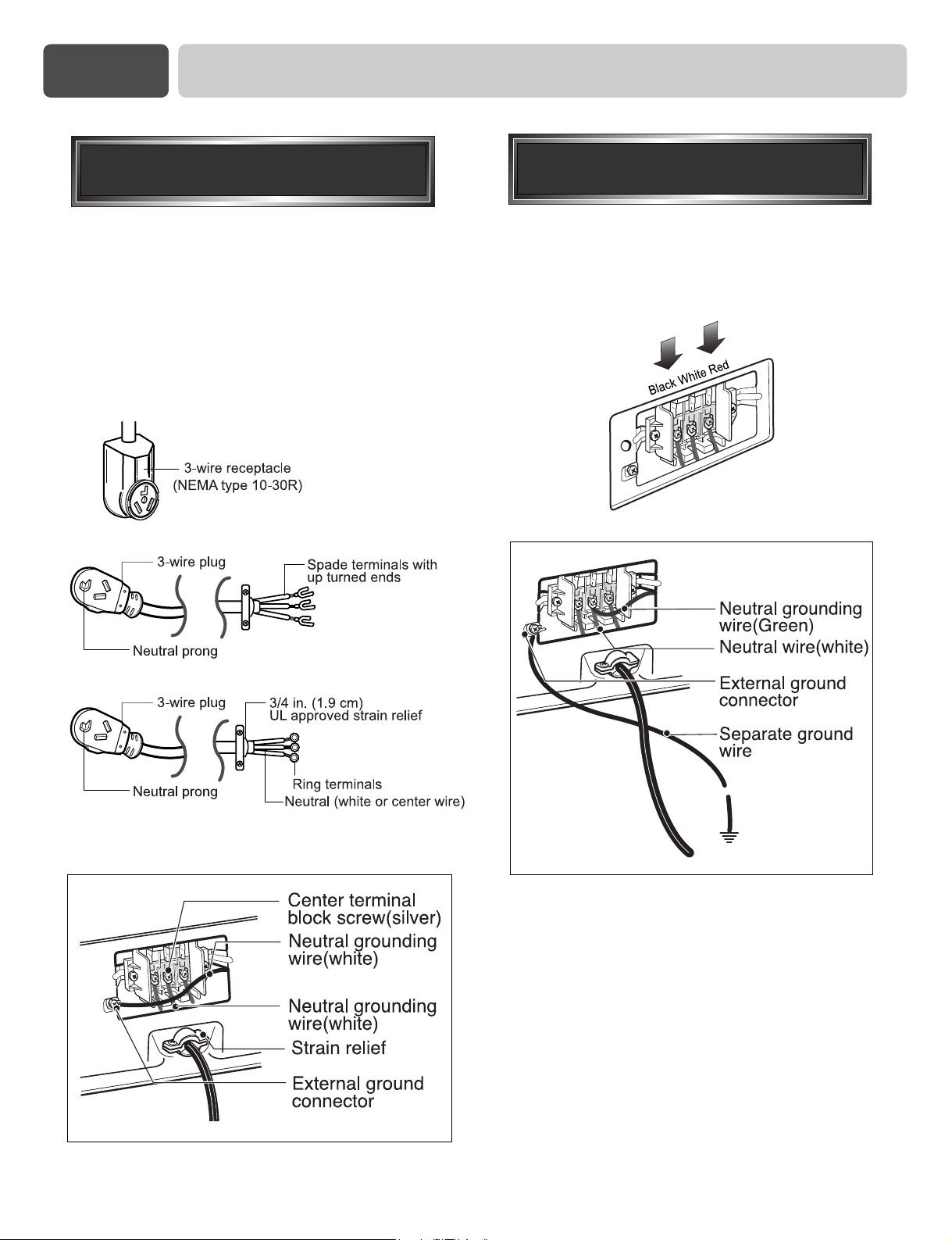
Prepare minimum 5ft(1.52m) of length in order for
dryer to be replaced.
First, peel 3
1
/2 inch (8.9cm) of covering material
from end and bare 1 inch from the ends.
1. Connect neutral wire(white) of power cord to
center terminal block screw.
2. Connect red and black wire to the left and right
terminal block screws.
3. Make sure that the strain relief screw is tightened
and be sure that all terminal block nuts are on
tight and power cord is in right position.
Then, put the hooked shape end of the wire under
the screw of the terminal block(hooked end facing
rightward) and pinch the hook together and screw
tightly.
3-wire connection : Direct wire
1. Connect neutral wire(white) of power cord to
center terminal block screw.
2. Connect red and black wire to the left and right
terminal block screws.
3. Connect ground wire(green) of power cord to
external ground screw and move neutral ground
wire of appliance and connect it to center screw.
4. Make sure that the strain relief screw is tightened.
and be sure that all terminal block nuts are on
tight and power cord is in right position.
• lf your local codes or ordinances do not allow the
use of a 3 wire connection, or you are installing
your dryer in a mobile home, you must use a 4-
wire connection.
Option 1: 4-wire connection with
a Power supply cord.
17
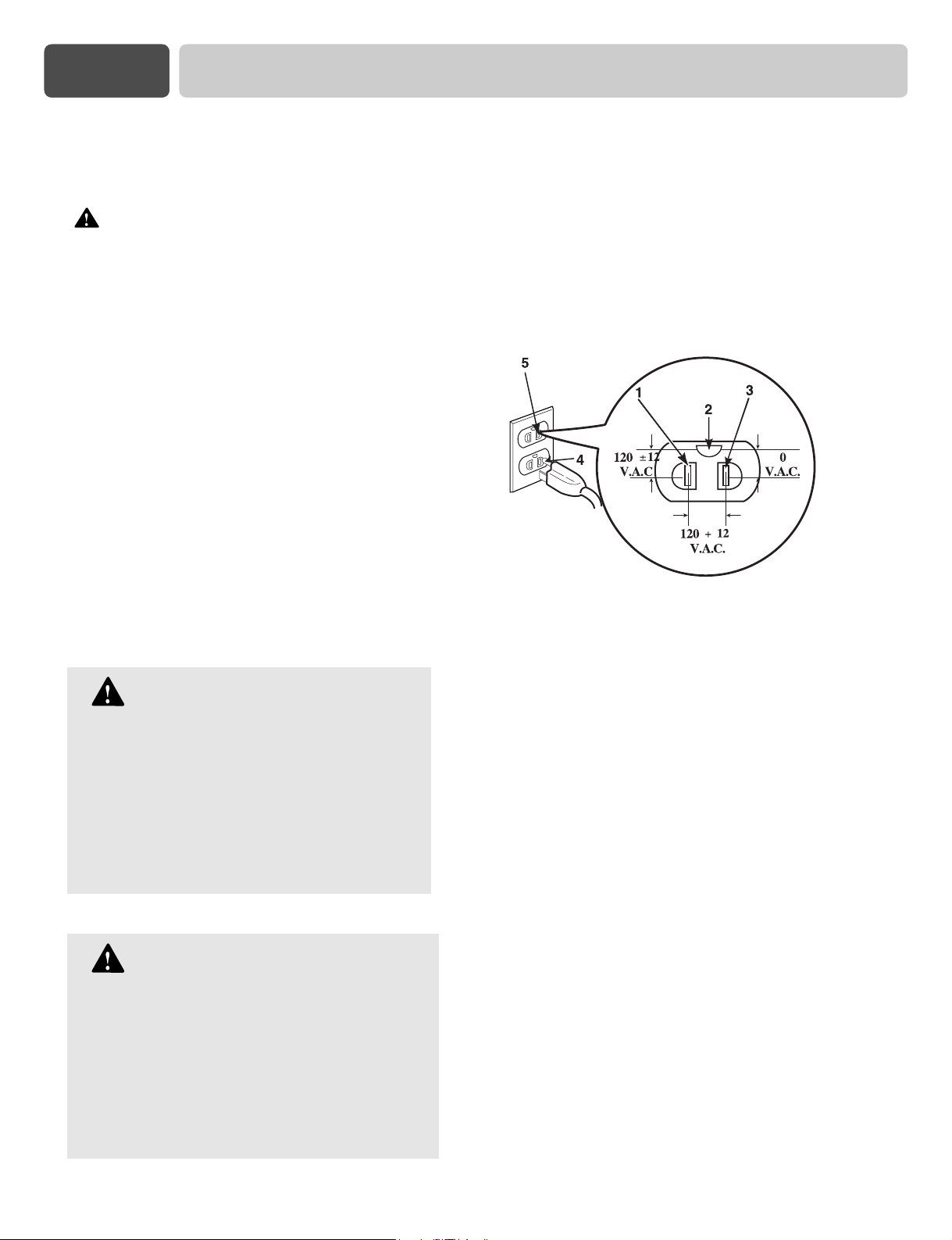
1. Connect neutral wire(white) of power cord to
center terminal block screw.
2. Connect ground wire of appliance and neutral
wire of power cord to center terminal block
screw.
3. Connect red and black wire to the left and right
terminal block screws.
4. Make sure that the strain relief screw is tightened.
and be sure that all terminal block nuts are on
tight and power cord is in right position.
5. Connect a independent ground wire from external
ground connector to proper ground.
Part 5 ELECTRICAL REQUIREMENTS FOR ELECTRIC DRYERS
lf your local codes or ordinances permit the
connection of a frame-grounding conductor to the
neutral wire, use these instructions. If your local
codes or ordinances do not allow the connection of
a frame-grounding conductor to the neutral wire,
use the instructions under Section 3: Optional
3-wire connection.
Option 2: 3-Wire Connection with
a Power Supply Cord
• If your local codes or ordinances do not allow the
connection of a frame-grounding conductor to the
neutral wire, use the instructions under this
section.
Option 3: Optional 3-wire
connection.
18
Part 6 ELECTRICAL REQUIREMENTS FOR GAS DRYERS
120 Volt, 60 Hertz, with 3-Prong Grounding Plug
Following are additional instructions regarding electrical connections and requirements for gas dryers.
Important Warning: To help prevent fire, electric shock, serious injury or death, the wiring and grounding
must conform to the latest edition of the National Electrical Code, ANSI/NFPA 70, or the Canadian Electrical
Code, CSA C22.1, and all applicable local regulations. Please contact a qualified electrician to check your home’s
wiring and fuses to ensure that your home has adequate electrical power to operate the dryer.
Electrical Requirements for Your Dryer:
a) Please note that the wiring diagram is provided
inside the dryer control hood. Label all wires
prior to disconnection when servicing the dryer,
because wiring errors can cause serious injury to
you and your dryer.
b) Your dryer is designed to be used on a separate
branch, polarized, three-wire, effectively
grounded, 120 Volt, 60 Hertz, AC (alternating
current) circuit protected by a 15 Ampere fuse,
equivalent fusetron or circuit breaker.
c) Use separately fused circuits for washers and
dryers, and DO NOT operate a washer and a
dryer on the same circuit.
a) The dryer has a three-prong plug to help guard
against shock. The plug should be plugged
directed into a properly grounded three-prong
receptacle that is rated 120 Volts AC (alternating
current) 15 Amps. This plug, in order to be
properly and fully effective, must be plugged into
a properly installed outlet that is grounded in
accordance with all local codes and ordinances.
b) The dryer must be grounded in order to reduce
the risk of electric shock, including a
malfunction or breakdown.
c) If your laundry room does not meet the
specifications required by this manual, or if you
are uncertain whether or not your laundry room
meets these specifications, please have a
qualified service person or company, for example
a qualified electrician or your local electric
company, review your laundry room’s electrical
supply for any problems.
WARNING!
Do not overload the circuit by operating
other appliances on the same circuit when
this appliance is operating, by using an
extension cord to connect the dryer to the
power source, or by using any adapter to
allow additional cords to connect to the
same outlet.
STANDARD 120 VOLT, 60 HERTZ, 3-WIRE
EFFECTIVELY GROUNDED CIRCUIT
1 L1
2 Ground
3 Neutral Side
4 Round Grounding Prong
5 Neutral
WARNING!
DO NOT modify the plug provided with
the dryer. If it does not fit the outlet in your
laundry room, a proper outlet will need to be
installed in your laundry room by a qualified
service person or company.
19
Part 7 GAS REQUIREMENTS AND INSTRUCTIONS
Following are important instructions and information concerning the requirements for the gas supply and service for
gas dryers. Important Warning: The gas supply and service for a gas dryer must comply with all local codes
and ordinances. In the absence of any local codes or ordinances in your area, the gas supply and service for your gas
dryer must comply with the latest edition of the National Fuel Gas Code, ANSI Z223.1/NFPA 54.
1. Gas supply requirements: Liquefied Petroleum
(L.P.) Gas (2,500 Btu/ft3 (93.1 MJ/m3)) service
must be provided at 10 + 1.5 in. water column
pressure.
2. Do not attempt to connect Dryer to Liquified
Petroleum (LP Gas) Gas service without a
qualified professional.
3. Isolate the dryer from the gas supply piping
system by closing its individual manual shut-off
valve, during any pressure testing of the gas
supply system at test pressure equal to or less
than 2/1 psi (3.45 kPa).
4. Supply Line Requirements. Your laundry room
must have a rigid gas supply line to your dryer.
In the United States, an individual manual shutoff
valve MUST be installed within at least 6 feet
(1.8m) of the dryer, in accordance with the
National Fuel Gas Code ANSI Z223.1. A 1/8 in.
N.P.T. pipe plug must be installed as shown.
5. If using a rigid pipe, the rigid pipe should be 1/2
inch IPS. If acceptable under local codes and
ordinances and when acceptable to your gas
supplier, 3/8 inch approved tubing may be used
where lengths are less than 20 feet (6.1m).
Larger tubing should be used for lengths in
excess of 20 feet (6.1m). It is also important that
you use pipe joint compound that is insoluble in
LP gas.
6. To reduce the danger of gas leaks, explosion, and
fire, please follow and observe the following
instructions and WARNINGS:
• Connect the dryer to the type of gas shown on the
nameplate;
• Use new flexible stainless steel connectors;
• Use Teflon tape and pipe joint compound
insoluble in LP gas on all pipe threads;
• Purge gas supply of air and sediment before
connecting the gas supply to the dryer; in order to
prevent gas valve contamination, before tightening
connection between gas supply and dryer, purge
remaining air until odor of gas is identified; and
• DO NOT use an open flame to inspect for gas
leaks; instead, use a non-corrosive leak detection
fluid.
WARNING!
• Use a new AGA or CSA approved gas
supply line.
• Install a shut-off valve.
• Securely tighten all gas connections.
• If connected to LP, have a qualified person
make sure gas pressure does not exceed
13 in. water column.
• Examples of a qualified person include
licensed heating personnel, authorized gas
company personnel, and authorized service
personnel.
• Failure to do so can result in death,
explosion, or fire.
WARNING!
DO NOT attempt any disassembly of the
dryer, any disassembly requires the
attention and tools of an authorized and
qualified service person or company.
20
Part 8 EXHAUST REQUIREMENTS AND MAINTENANCE
Recommended
Use Only for Short Run Installations
4”
(10.2 cm)
4”
(10.2 cm)
2-1/2”
(6.35 cm)
Following are important instructions and information concerning the exhaust requirements for your dryer.
Warning: DO NOT exhaust dryer air into an enclosed and unventilated area, such as an attic, wall, ceiling,
crawl space, chimney, gas vent, or concealed space of a building. To reduce the risk of fire, DO NOT exhaust the
dryer with plastic or thin foil Ducting. Failure to do so can result in death, explosion, or fire.
1. Venting materials are not provided with the dryer and
you should obtain the necessary venting materials
locally. For example, the outer end of exhaust pipe
must have a weather hood with hinged dampers to
prevent back-draft when the dryer is not in use.
2. Use only 4-in. (10 cm) rigid or fl exible metal
ductwork inside the dryer cabinet and for venting
outside. Failure to follow these instructions can result
in fi re or death.
3. The exhaust duct must be 4 in. (10 cm) in diameter
with no obstructions. The exhaust duct should be kept
as short as possible. Make sure to clean any old ducts
before installing your new dryer. Failure to follow
these instructions can result in fi re or death.
4. Rigid or semirigid metal ducting is recommended for
use between the dryer and the wall. In special
installations when it is impossible to make a
connection with the above recommendations, a UL-
listed fl exible metal transition duct may be used
between the dryer and wall connection only. The use
of this ducting will affect drying time. Failure to
follow these instructions can result in fi re or death.
5. DO NOT use sheet metal screws or other fasteners
which extend into the duct that could catch lint and
reduce the effi ciency of the exhaust system. Secure
all joints with duct tape. Failure to follow these
instructions can result in fi re or death.
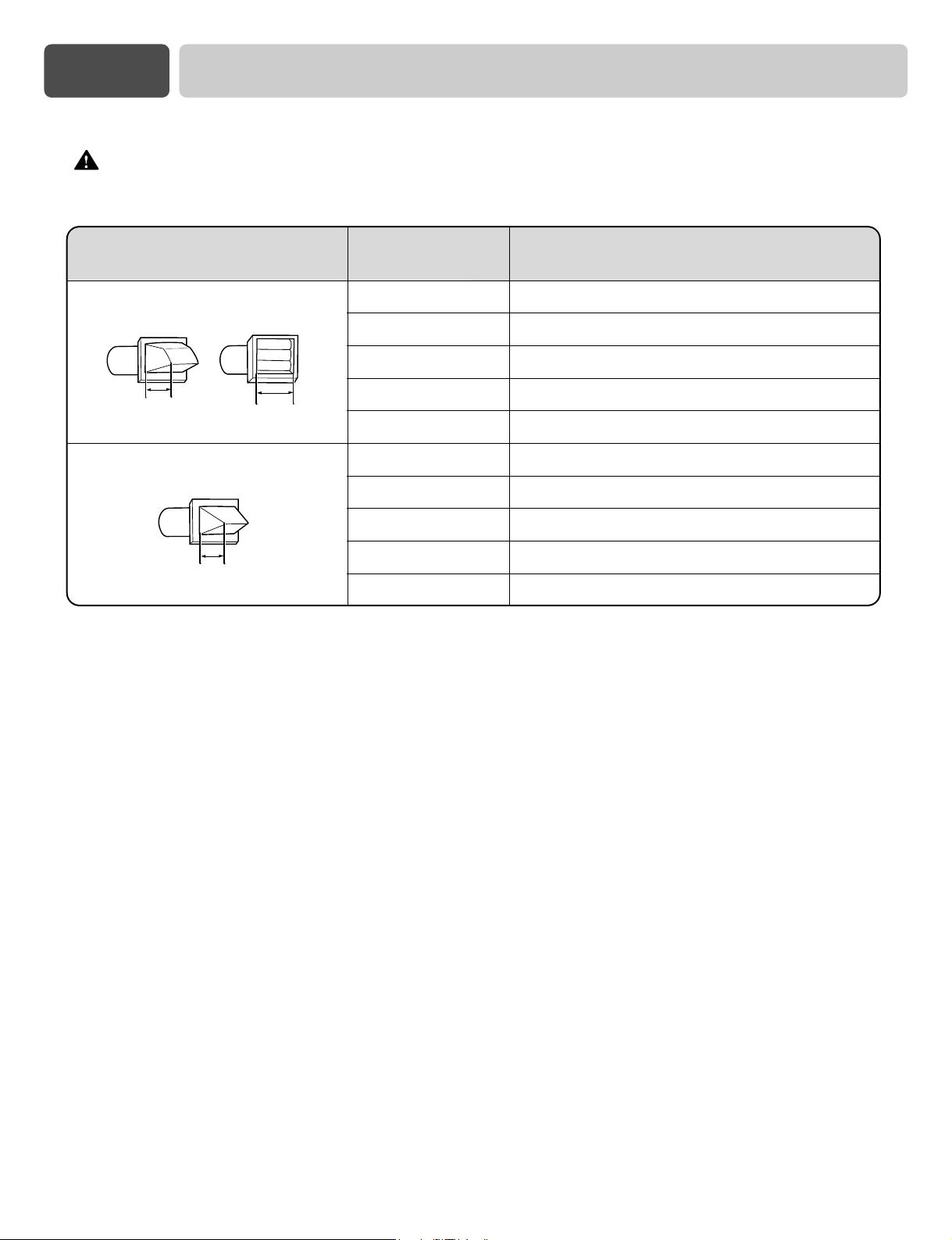
6. To maximize operating results, please observe the
duct length limitations noted in the chart above.
Failure to follow these instructions can result in fi re
or death.
7. The Total length of flexible metal duct shall not
exceed 8 ft. (2.4m)
8. In Canada, that only those foil-type flexible ducts, if
any, specifically identified for use with the
appliance by the manufacturer shall be used. In the
United States, that only those foil-type flexible
ducts, if any, specifically identified for use with the
appliance by the manufacturer and that comply with
the Outline for Clothes Dryer Transition Duct,
Subject 2158A, shall be used.
Number of 90°
Elbows
Weather Hood Type
Maximum length of 4” (10.2 cm) diameter rigid
metal duct
NOTE: Deduct 6 ft. (1.8 m) for each additional elbow. It is not recommended to use more than four 90° elbows.
65 feet (19.8 m)
55 feet (16.8 m)
47 feet (13.7 m)
36 feet (11.0 m)
28 feet (8.5 m)
55 feet (16.8 m)
47 feet (13.7 m)
41 feet (12.5 m)
30 feet (9.1 m)
22 feet (6.7 m)
0
1
2
3
4
0
1
2
3
4
Exhaust Requirements and Instructions:

21
Part 8 EXHAUST REQUIREMENTS AND MAINTENANCE
Exhaust and Dryer Maintenance
1. After one year of use, the interior and complete
exhaust system of the dryer should be examined
and cleaned if necessary.
2. Before one year of use, when drying performance
has been suddenly unsatisfied in the past several
cases, please examine and clean the exhaust duct
for better drying performance.
3. Check the weather hoods frequently to ensure
the dampers are moving freely, that the dampers
are not pushed in and that nothing has been set
against the dampers.
4. A qualified service person or company should be
used to perform this maintenance.
5. A Flexible Metal Vent Kit, available at extra cost,
can be used to exhaust the dryer when it is placed
in hard to reach places. This Kit comes in two
pieces, one of which is attached to the dryer and
the other is attached to the wall exhaust outlet.
Following attachment of the two separate pieces
to the dryer and the wall, the dryer may be
returned to its final position, after which the two
pieces themselves can be connected.
7. Ordinarily, the dryer drum will need no care.
Wipe the exterior of the dryer as required, and
always immediately wipe the exterior of the
dryer in the event any detergent, bleach, or other
washing products is spilled on the dryer, because
these products may cause permanent damage to
the exterior finish of the dryer.
8. Clean the control panel with a damp cloth as
necessary. Warning: spray pre-wash products
may damage the finish of the control panel.
9. Please clean the lint filter either before drying
each load or after drying each load.
10. Always make sure the lint filter is clean before
starting a new load, because a clogged lint filter
may increase drying times.
11. Annually remove the lint filter and attach it to
the vacuum duct. See item #2 above.
12. Please note that the wiring diagram is provided
inside the dryer control hood. Label all wires
prior to disconnection when servicing the dryer,
because wiring errors can cause serious injury
to you and your dryer.
Cleaning the Lint Screen
1. Clean the lint filter either before drying each load
or after drying each load. Always make sure the
lint filter is clean before starting a new load,
because a clogged lint filter may increase drying
times.
2. To clean, pull the lint screen straight up and roll
any lint off the screen with your fingers.
Do not rinse or wash screen to remove lint,
because wet lint is hard to remove. Push the lint
screen firmly back into place.
3. Always ensure the lint screen is firmly secured
before running the dryer. Running the dryer with
a loose lint screen may cause overheating and
damage to the dryer and articles being dried.
4. Some articles of clothing may shed more lint than
others (towels for example), causing the Lint
Screen to rapidly fill. Remove lint from the lint
screen before and after drying these articles, such
as new towels.
5. In the event lint falls off of the lint screen and
into the dryer during removal, inspect the exhaust
hood and remove any lint.
6. Laundry detergent and fabric softener residue can
build up on the lint screen, causing longer drying
times. The screen is likely blocked if lint falls off
the screen. In order to prevent this type of build
up, and help ensure proper operation of your
dryer, clean the lint screen with a nylon brush
every six months or, if necessary, more
frequently. The lint filter can also be washed as
follows:
a) After rolling the lint off of the screen with your
fingers, wet both sides of the screen with hot or
warm water.
b) Wet a nylon brush with hot water and liquid
detergent and scrub the lint screen with the brush
to remove the buildup of detergent and fabric
softener.
c) Repeat as necessary.
d) After the residue has been removed, rinse screen
with hot water.
e) After drying the lint screen with a clean towel,
firmly replace the lint screen in your dryer.
WARNING!
Disconnect the dryer’s electric power
prior to any cleaning or maintenance.
22
Part 9 OPERATING YOUR DRYER
Following are instructions for starting and using your new dryer. Please refer to specific sections of this manual for
more detailed information. Important Warning: To reduce the risk of fire, electric shock, or injury to person, read
this entire manual, including the Important Safety Instructions, before operating this dryer.
WARNING!
Fire Hazard
No washer can completely remove oil.
Do not dry anything that has ever had any
type of oil on it (including cooking oils).
Items containing foam, rubber, or plastic
must be dried on a clothesline or by using
an Air Dry Cycle. Failure to follow these
instructions can result in death or fire.
WARNING!
Explosion Hazard
Keep flammable materials and vapors, such
as gasoline, away from dryer.
Do not dry anything that has ever had
anything flammable on it (even after
washing). Failure to follow these instructions
can result in death, explosion, or fire.
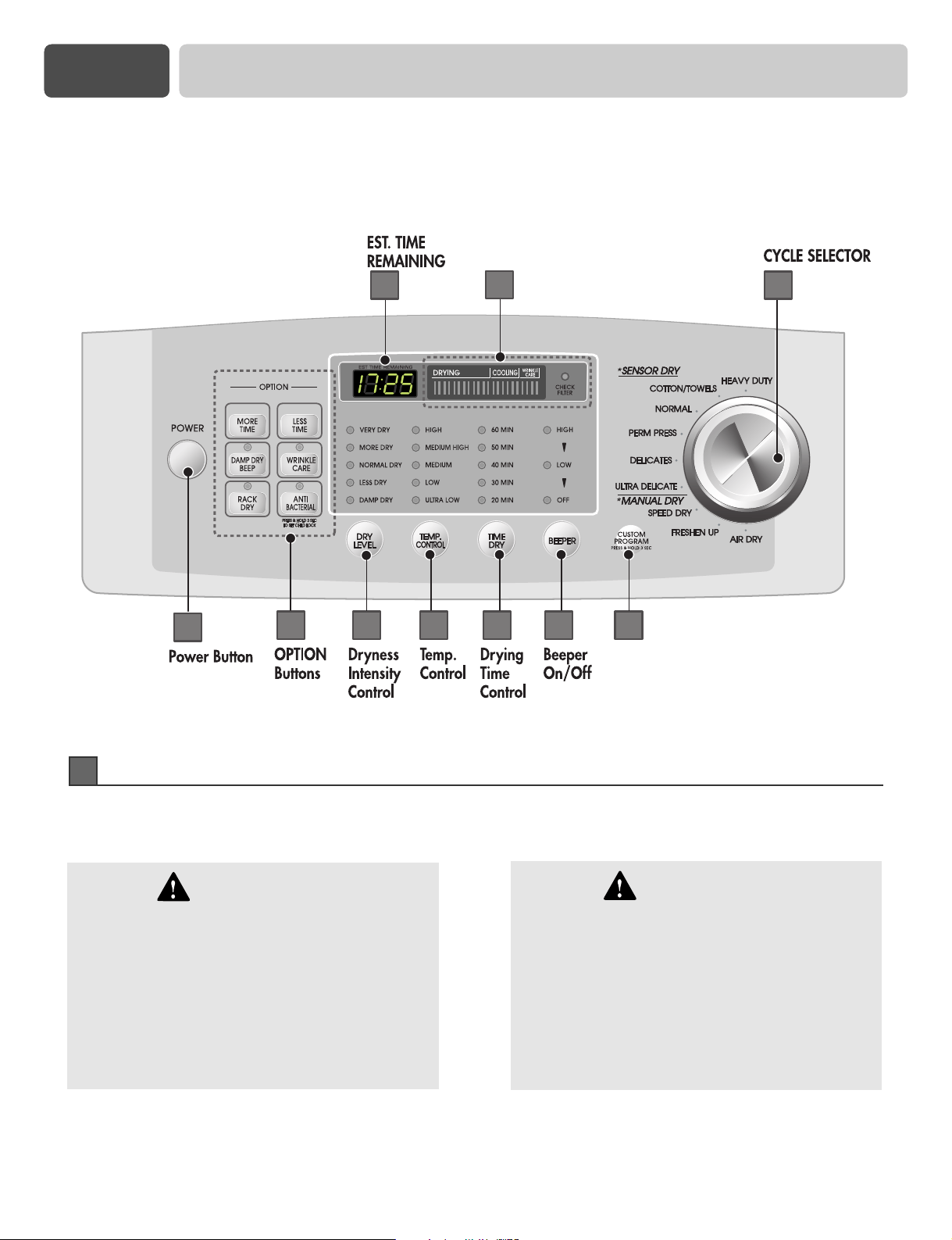
• Use this button for power on or off.
11
Power Button
1
23456
7
8910
Status/Clean Filter/
Wrinkle Care Indicator
Custom Program
23
Part 9 OPERATING YOUR DRYER
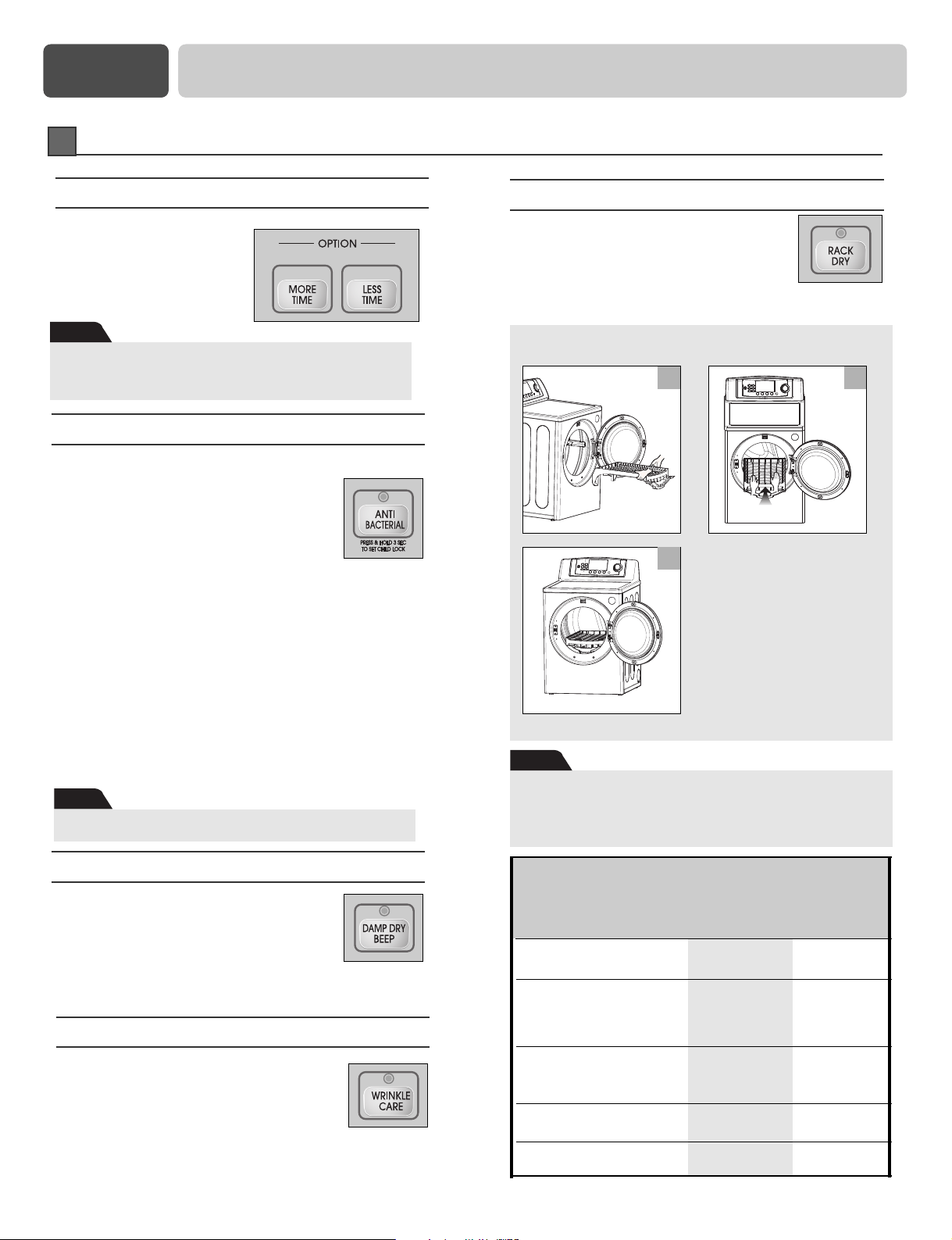
• Press MORE TIME or
LESS TIME until the
desired drying time is
set.
Time change button is available only with Manual
Dry, Time Dry and Rack Dry programs.
Note
22
Option Button
4. Wrinkle Care
This option helps to prevent the wrinkle
on your laundry.
When you select the wrinkle free option,
the dryer will periodically tumble for up
to three hours after the cycle has completed.
You can use this option in case that you can not
remove laundry after drying is done.
2. Anti Bacterial
1. More Time / Less Time
This option reduces bacteria under high temperature
during the cycle.
This option can only be used with the Heavy
Duty, Cotton/Towels and Normal cycles.
3. Damp Dry Beep
When you select the damp dry beep
option, a beep will alert you when your
load is approximately 80% dry.
This notice will allow you to remove lightweight items
that are dry or other items that you may wish to iron.
Do not use this cycle with delicate fabrics.
Note
● Child Lock
Child Lock can be used to prevent your children
from undesirable use on control panel while the
dryer is running.
When Child Lock is enabled, all the button will be
locked and Child Lock glows.
To lock Child Lock, Press and hold Anti Bacterial
for 3 seconds, A single beep tone is heard and CL is
displayed on the status window.
To unlock Child Lock, press and hold Anti Bacterial
for 3 seconds again.
5. Rack Dry
Rack Dry is designed for use with items
which are not available for tumble
drying such as sweaters, silk or lingerie.
Sneakers also will be great with this option.
■ To use the RACK DRY
1.Open the door.
Hold the dryer rack with
both hands.
2. Put the dryer rack into
the drum
3. Make sure Dryer RACK
is evenly spaced right
onto the drum inside
and door rim.
1
3
2
Low
20
20/30
50/30
50
20
Low/Ultra
Low
Air Dry/
Ultra Low
Air Dry
Air Dry
* Reset time as needed to complete drying.
Suggested Items
for Rack Drying
Temperature
Setting
Suggested
Time*
(Minutes)
Washable wool items
Stuffed toys with
cotton or polyester
fiber filling
Stuffed toys, foam
rubber filled.
Foam rubber pillows
Athletic shoes
Don’t use Rack for normal tumble drying. Rack Dry
is shipped in place in your dryer so remove rack for
normal laundry.
Note
24
Manual Dry
Cycles Load Type
Temp.
High
Medium
High
Air Dry
Default Time*
(Minutes)
25
20
30
SPEED DRY
SMALL LOADS
FRESHEN UP
Remove Wrinkles
AIR DRY
Manual Preset Cycle Settings
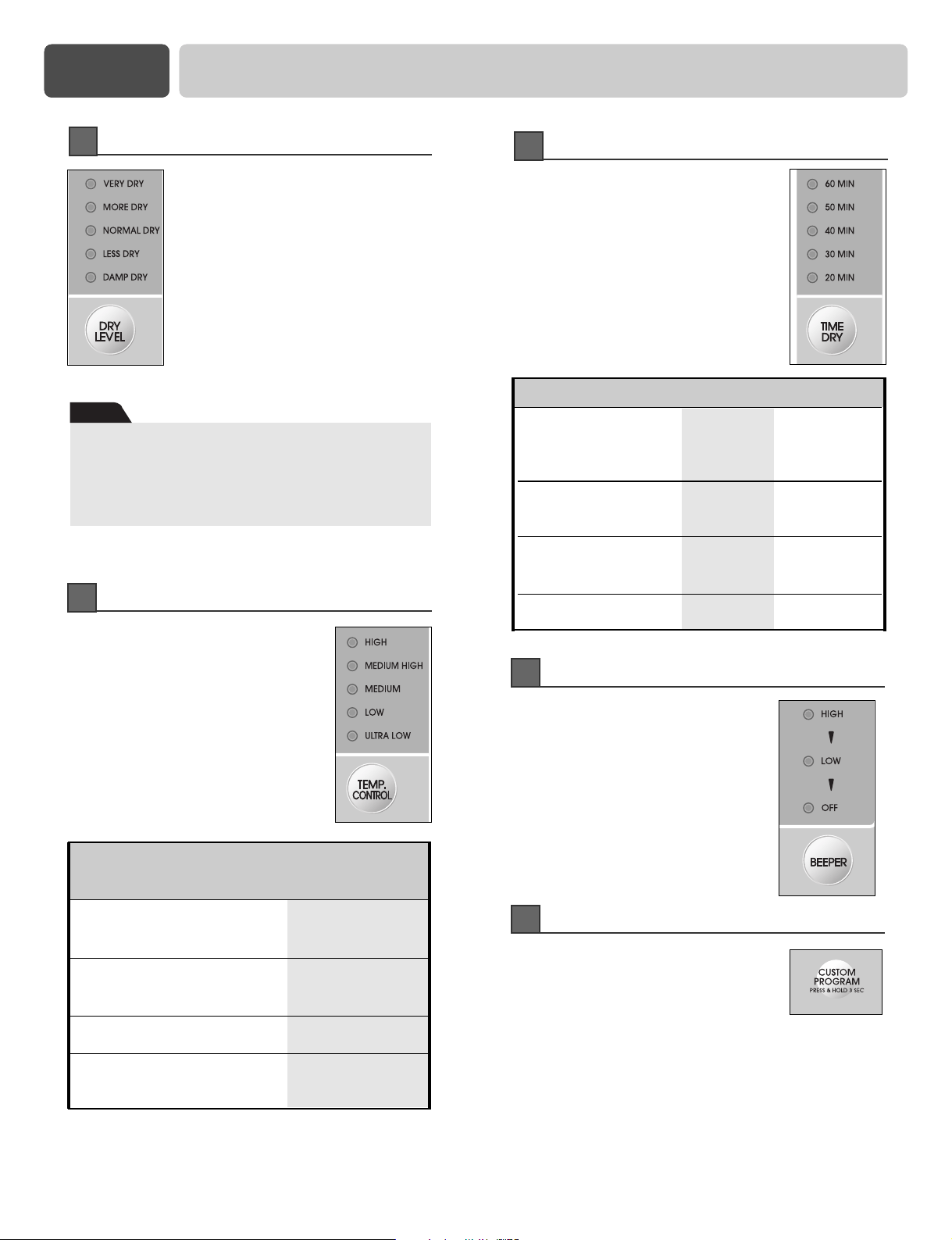
The BEEPER controls the
volume of the beep that is made
when you press any of the
buttons on the control panel and
the termination of any cycle is
indicated.
Press BEEPER to adjust the
sound level or turn off the signal.
66
Beeper
Use Time Dry Option to change
Drying Time on your own.
You can select the desired operation
time manually by pressing Time Dry
button which ranges from 20 to 60
minutes.
55
Time Dry
Part 9 OPERATING YOUR DRYER
Custom Programming Set up your
favorite combination
of settings and save them here for one-
touch recall.
1. Select a cycle
2. Change DRY LEVEL and TEMP. CONTROL.
3. Select OPTIONS you want.
4. Press and hold the CUSTOM PROGRAM.
To recall your stored CUSTOM PROGRAM
Press CUSTOM PROGRAM button, then press
START/PAUSE.
77
CUSTOM PROGRAM
Use Temp. Control Option to
select temperatures for the
Manual Cycles. Press TEMP.
CONTROL until the desired
temperature setting glows.
Temperature modifiers cannot
be used with the Sensor Dry
Cycles.
Type of Load Default Time*
(Minutes)
Foam rubber-pillows,
padded bras, stuffed toys
20 - 30
20 - 30
40 - 50
10 - 20
Plastic-Shower curtains,
tableclothes
Rubber-backed rugs
Olefin, polypropylene,
shear nylon
44
Temp. Control
• Use this button to set dry level
• First, select sensor dry cycle.
• Select dry level to adjust how
much you want to dry the
load. As the cycle runs, the
control senses the dryness of
the load and adjusts the time
automatically based on the
selected dryness level.
33
Dry Level
DRY LEVEL selections can only be made while
using Sensor Dry Cycles. Selecting
MORE Dry or LESS Dry automatically adjusts the
needed time which is already sensed.
Note
25
Part 9 OPERATING YOUR DRYER
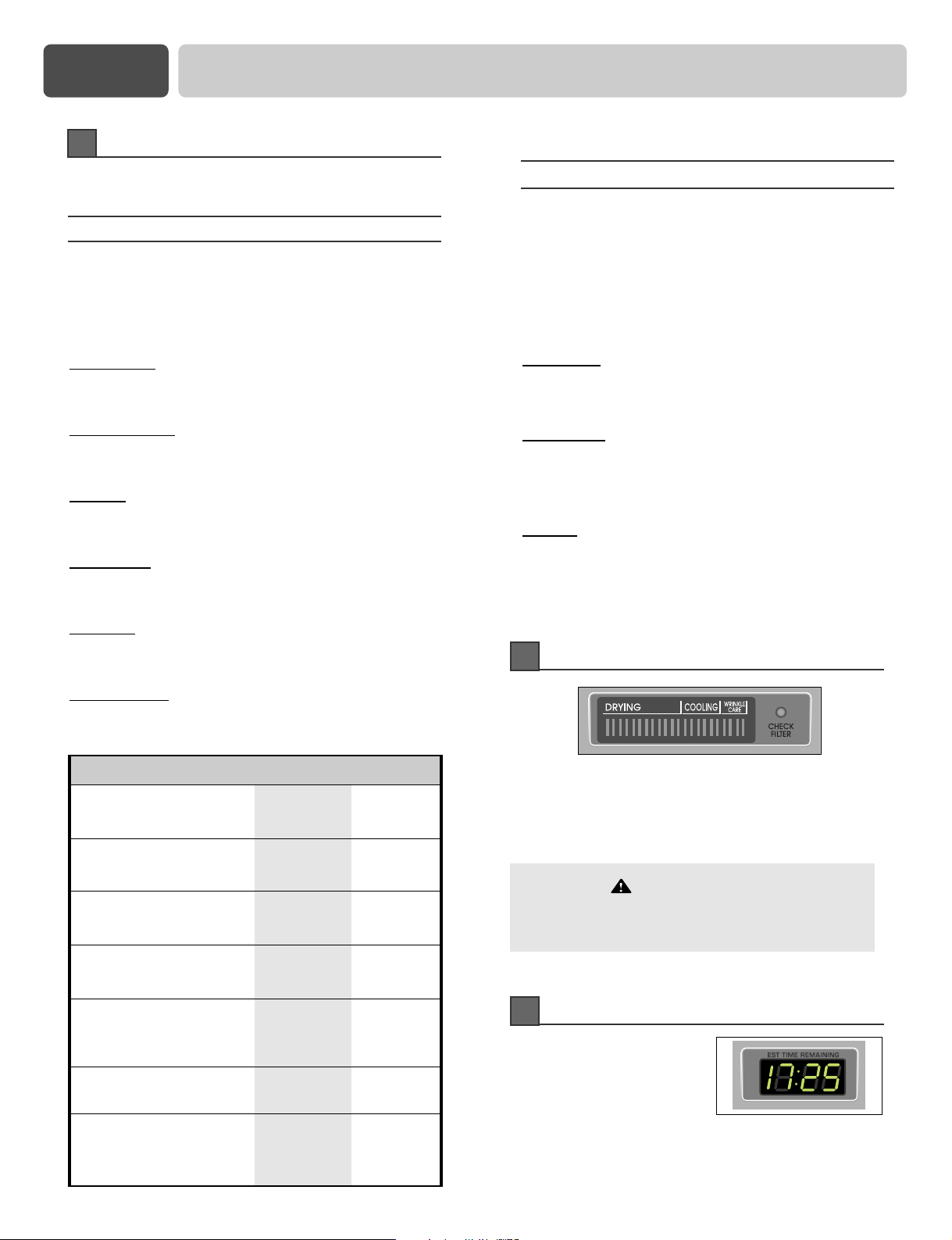
• It shows status of drying operation.
When Wrinkle Care is selected, this option light
will glow. When power is on, Clean Filter flashes
until start/pause is selected.
WARNING!
For better drying performance and safety,
clean lint filter every single use.
99
Status/Clean Filter/Wrinkle Care Indicator
• By dialing the knob, select the desired cycle based
on laundry types and conditions.
22
Cycle Selection
88
Cycle Selection
Sensor Dry Cycles allow you to match the cycle to
the load you are drying. Each cycle dries certain
fabrics at the recommended temperature. A sensor
detects the moisture in the load and automatically
adjusts the drying time for optimal drying
Heavy Duty
Use this cycle to get high heat for heavy fabrics such
as jeans, corduroys or work clothes
Cotton/T
owels
Use for drying denims, towels, heavy cottons
(medium-high heat)
Nor
mal
Use for drying sturdy fabrics such as work casual
clothes (medium heat)
Per
m press
Use for permanent press and synthetic items
(medium-heat)
Delicates
Use for drying synthetic fabrics, washable knit
fabrics and no-iron finishes (low heat)
Ultra Delicate
Use to gently dry items such as workout wear, shear
and lace items (extremely low heat)
1. Sensor Dry Cycles
2. Manual Dry Cycles
Use Manual Cycles to select a specific amount of
drying time and a drying temperature. When a
Manual Cycle is selected, the ESTIMATED TIME
REMAINING display shows the actual time
remaining in your cycle. You can change the actual
time in the cycle by pressing MORE TIME or LESS
TIME.
Speed Dr
y
Use for small loads or loads that need a short drying
time.
Fr
eshen Up
Use this cycle to remove wrinkles from items, such
as clothes packed in a suitcase or items wrinkled
from being left in the dryer too long.
Air Dr
y
Use the Air Dry Modifier for items that require
drying without heat such as rubber, plastic and heat-
sensitive fabrics.
Sensor Dry
Cycles Load Type
Temp.
High
Medium
High
Medium
Low
Low
Ultra
Low
Time*
(Minutes)
54
55
41
36
32
34
HEAVY DUTY
Jeans, heavyweight
COTTON/TOWELS
Towel, denim pants
NORMAL
Work clothes,corduroys
PERM PRESS
Synthetics , permanent
press
DELICATES
Lingerie, sheets, blouses
ULTRA DELICATE
Shear, workout wear
and lace items
Sensor Dry Preset Cycle Settings
• The Display shows the
estimated time remaining.
In addition to this, if the
dryer has some problem, it
displays error messages.
1100
Estimated Time Remaining
26
4. To use a sensor dry cycle
• Select a Manual Dry Cycle.
• Press MORE TIME or LESS TIME until the
desired drying time is displayed. Tap MORE TIME
or LESS TIME and the time will change by 1
minute interval.
• Press TEMP. CONTROL until the desired
temperature indicator glows.
• (OPTIONAL STEP) If desired, select OPTIONS.
For more details, see Options.
• Press START/PAUSE. Be sure the door is closed.
• If you do not press START/PAUSE within 10
minutes of selecting the cycle, the dryer
automatically shuts off.
• If you wish to end your drying cycle after pressing
START/PAUSE, press START/PAUSE again.
To stop your dryer at any time
Press START/PAUSE or open the door.
5.
Pausing or restarting To pause the dryer at
any time
Open the door or press START/PAUSE once.
To restart the dryer
Close the door. Press START/PAUSE.
Drying will continue from where the cycle
was interrupted if you close the door and press
START within 10 minutes. If the cycle is
interrupted for more than 10 minutes, the dryer
will shut off. Select new cycle settings before
restarting the dryer.
Note
The MORE TIME or LESS TIME feature can be used
with Manual Dry, Time Dry and Rack Dry Cycles.
Note
WARNING!
Improper wire connection or related wiring error
will can cause fire or electric shock or death.
Part 9 OPERATING YOUR DRYER
1. Before use
• Clean lint screen before or after each cycle.
• Place laundry into dryer and shut door. See Loading.
• Turn the knob to select the drying cycle you want.
The preset setting for Sensor Dry Cycles or Manual
Cycles will glow. The estimated or actual cycle time (in
minutes) will show in the display.
2. Loading
• Determine load size by the amount of space the load
requires rather than the weight of the load.
• Avoid overloading the dryer.
Following these instruction can help reduce your utility
bill, prolong the life of your clothes, and decrease the
likelihood of uneven drying and wrinkle.
3. To use a sensor dry cycle
• Select DRY LEVEL to adjust how dry you want
the load. As the cycle runs, the control senses the
dryness of the load and adjusts the time
automatically for the selected dryness level.
• Select the desired Options.
• Press START/PAUSE
Heavy Work Clothes
4 jeans
4 workpants
4 work shirts
2 sweatpants
2 sweatshirts
Cotton/Towels
10 bath towels
10 hand towels
14 wash cloths
Mixed Load
3 sheets (1 king, 2 twin)
4 pillowcases
3 shirts
3 blouses
9 T-shirts
9 shorts
10 handkerchiefs
Following are sample loads for Super Capacity
Dryers:
DRY LEVEL selections can only be made while
using Sensor Dry Cycles. Selecting MORE Dry or
LESS Dry automatically adjusts the sensed time
needed.
Note
❁ Starting your dryer
27
Part 9 OPERATING YOUR DRYER
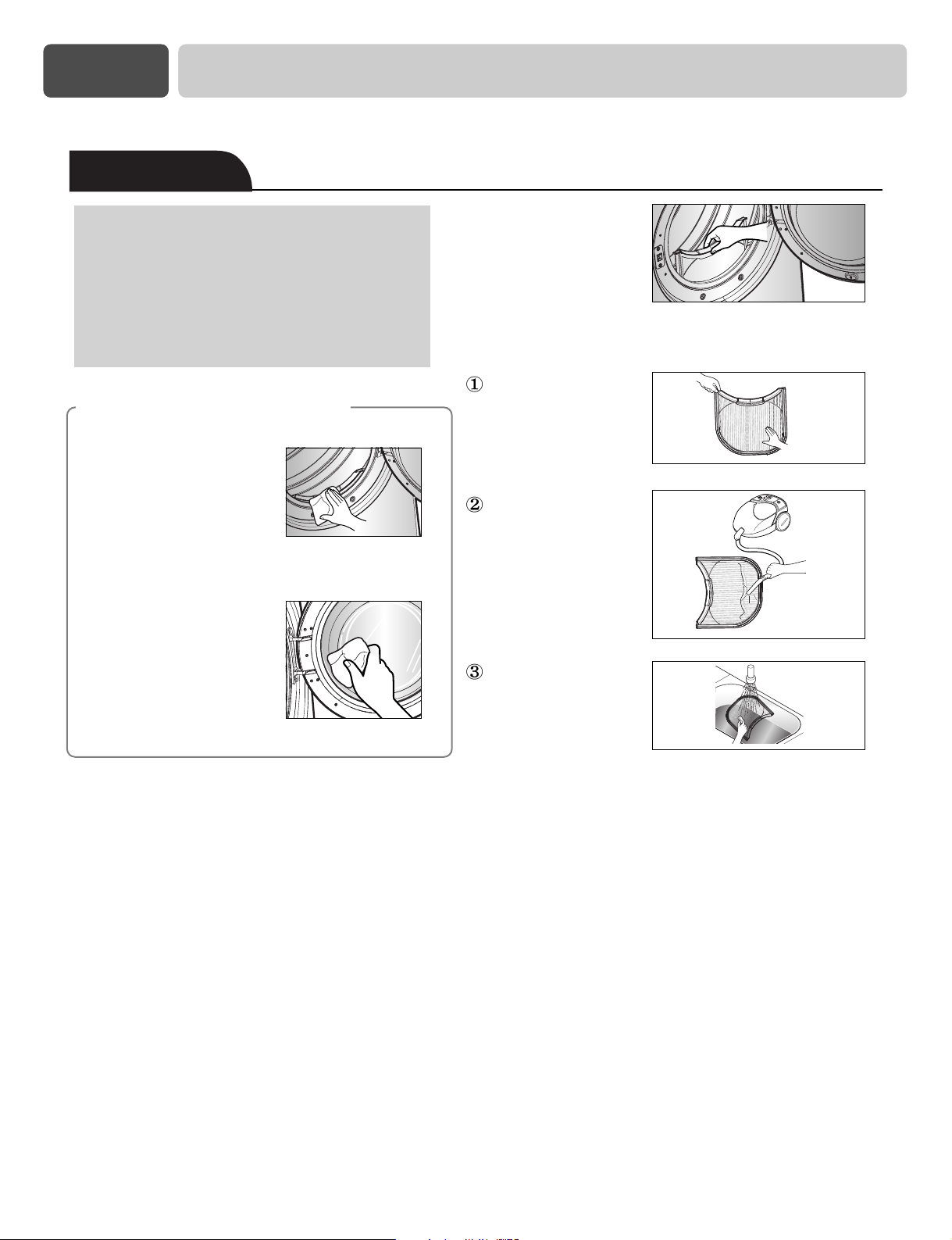
Clean lint filter
Clean the lint filter after each use and check it
before use. Not cleaning or emptying the filter
will increase drying time and energy
consumption, therefore dryer life expectancy
could be shortened after all.
1.Open the door
and pull the filter
straight up
1. Wipe out the door
opening. Otherwise,
build-ups of dirty and
foreign objects will
damage sealing of
door.
2. Clean the transparent
glass door to keep
inside view clear
through the glass.
Run the fingers
across the filter
2.Clean the filter using one of following ways in cases.
Vacuum the lint filter
Wash the lint
screen in warm,
soapy water.
Dry thoroughly and
replace.
■ Clean the door and its opening
Maintenance
28
Part 10 TROUBLESHOOTING GUIDE
Troubleshooting Tips
Save time and money! Review the charts on the following
pages first and you may not need to call for service.
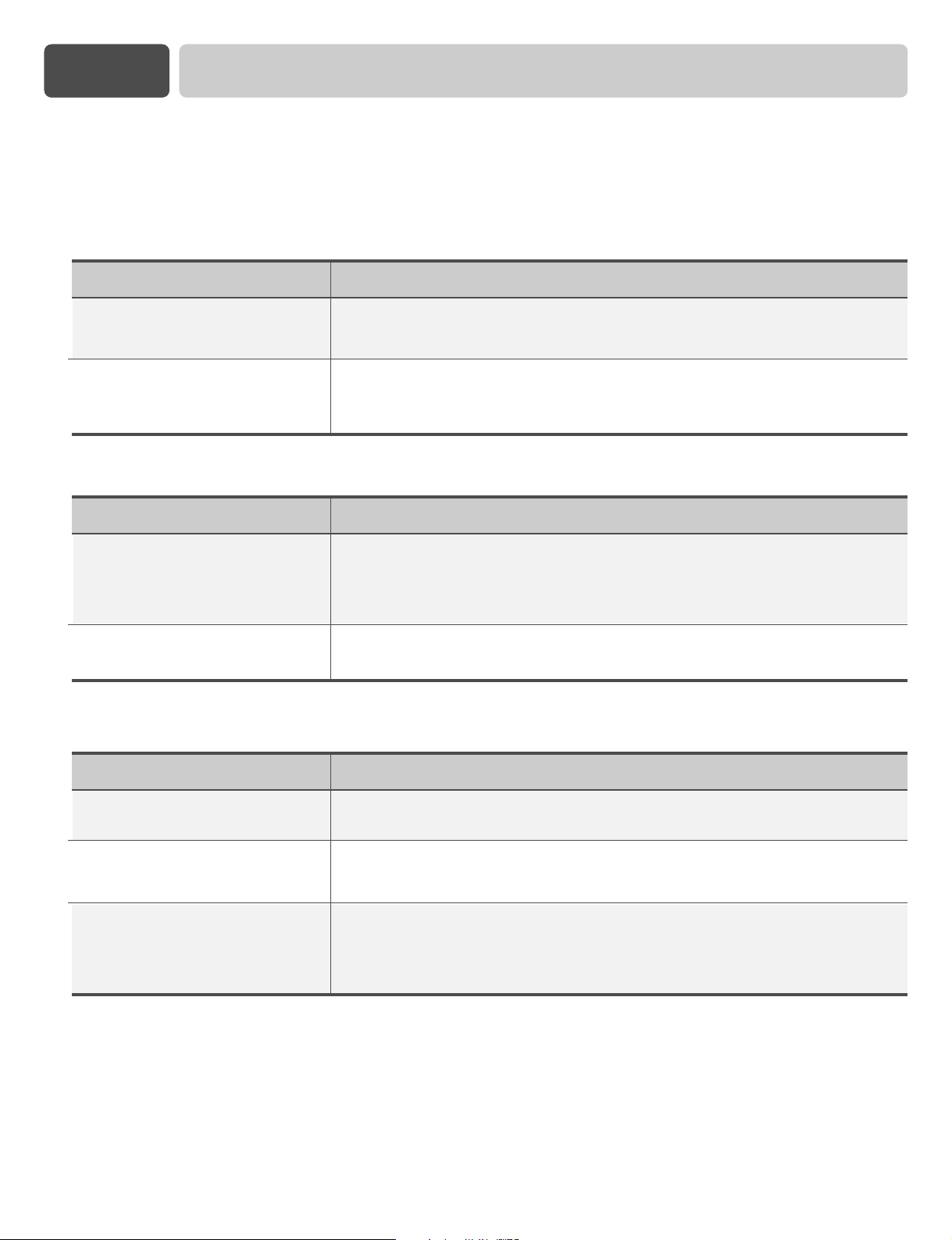
1.Problem:My Dryer Won ’t Start
• Is the dryer plugged in?
• Is the fuse blown, or is the circuit
breaker tripped?
Confirm that the dryer’s plug is securely and completely pushed into the laundry
room’s power outlet
Check your home’s or laundry room’s fuse box/circuit breaker box and replace the
fuse or reset the circuit breaker. (IMPORTANT: electric dryers generally use two
fuses or breakers.)
Question What to Do
2.Problem:My Dryer Doesn ’t Heat
Question What to Do
• Is the fuse blown, or is the circuit
breaker tripped?
• Is the gas supply or service
blocked or off?
If the fuse is blown or the circuit breaker tripped, the dryer might tumble but not
heat. Check your home’s or laundry room’s fuse box / circuit breaker box and
replace the fuse or reset the circuit breaker. (IMPORTANT: electric dryers generally
use two fuses or breakers.)
Confirm that the house gas shutoff and the dryer gas shutoff are both fully open.
3.Problem:There are Greasy Spots on My Clothes
Question What to Do
• Did you follow the instructions on
your fabric softener product?
• Are you drying clean and dirty
clothes together?
• Were your clothes entirely clean?
Confirm and follow the instructions provided with your fabric softener product.
Make sure to use your dryer to dry only clean items, because dirty items can soil
clean clothes placed in the same load or later placed in the dryer drum.
Stains on dried clothes are actually stains that weren’t cleansed during the washing
process. Please review and confirm that you are following your washing
instructions and that the clothes are being completely cleaned.
29
Part 10 TROUBLESHOOTING GUIDE
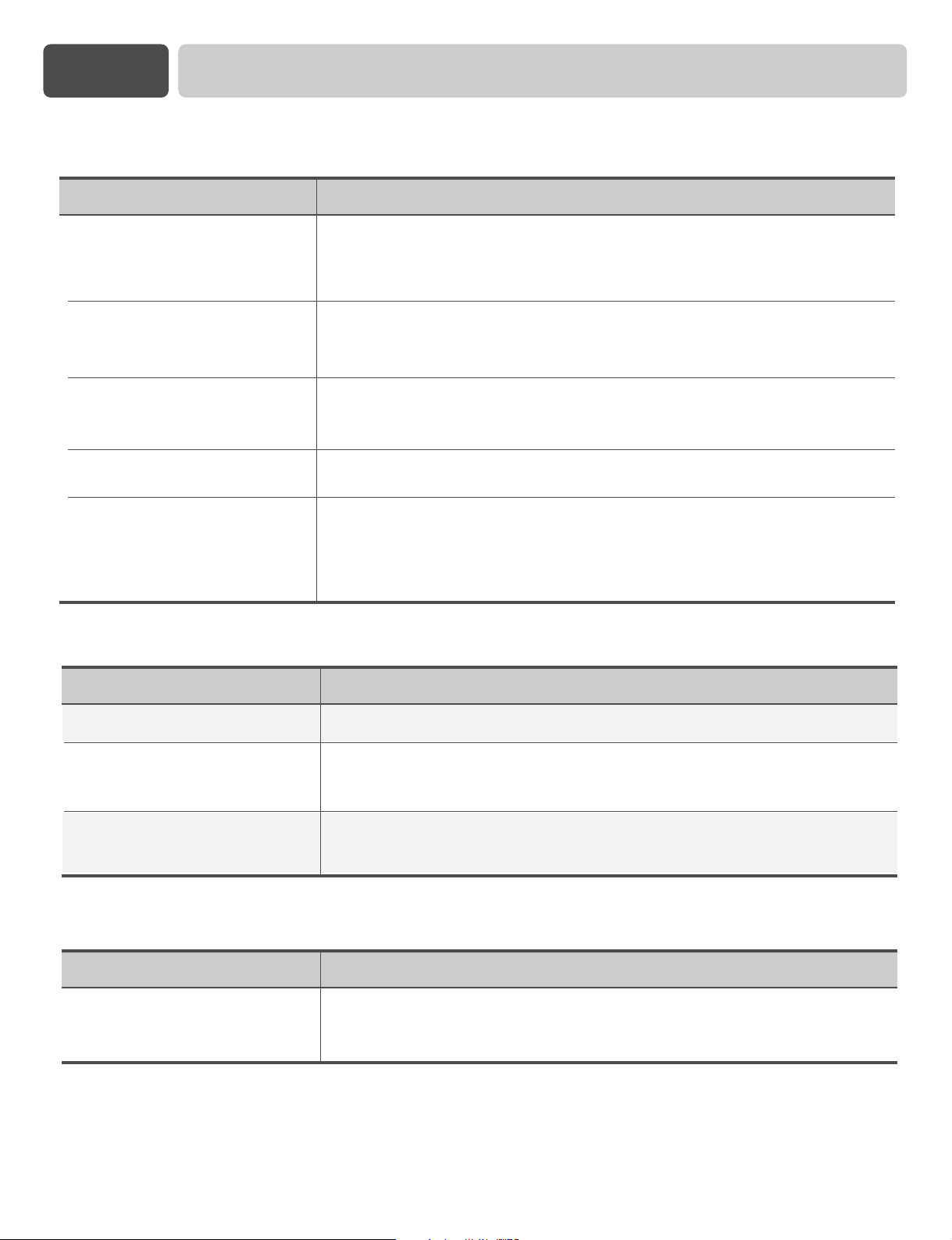
5.Problem:There is static in my clothes after drying
Question What to Do
4.Problem:There is Lint on my Clothes
Question What to Do
Please refer to the manual section on cleaning the lint filter, and please confirm that the
lint filter is clean. It is important that the lint filter is clean before each new load of
laundry.
In order to reduce the amount of lint in a load of laundry, sort lint producers (like a
fuzzy white cotton towel) separately from clothes that might catch lint (such as a pair
of black linen pants).
See comments below under There is static in my clothes after drying.
Divide your larger load into smaller loads.
Sometimes a person might forget to take a piece of paper or a tissue out of the pocket
of a pair of pants, and this paper, tissue, or similar material can cause excess lint in a
load of laundry. Confirm that the pockets of pants, shirts, and other articles of clothing
are empty before washing and drying.
• Is your lint filter full?
• Did you properly sort your load of
laundry?
• Do your clothes have excess static
electricity?
• Did you overload your dryer?
• Did you place any paper, tissue, or
other similar material in the load?
• Did you use fabric softener?
• Did you over dry the load of
laundry?
• Are you drying synthetic, permanent
press and blends?
Try using a fabric softener to reduce static electricity.
Over-drying a load of laundry can cause a build up of static electricity. Try
using a fabric softener or adjust your settings and use a shorter drying time.
These materials can cause static to build up in a load of dried clothes. Try
using a fabric softener.
6.Problem:The drying time is not consistent
Question
• Are you using consistent heat
settings and consistent load sizes?
The drying time for a load will vary depending on the heat setting, the type of heat
used (electric, natural or LP gas), the size of the load, the type of fabrics, the wetness
of the clothes and the condition of the exhaust ducts and lint filer.
What to Do
30
Part 10 TROUBLESHOOTING GUIDE
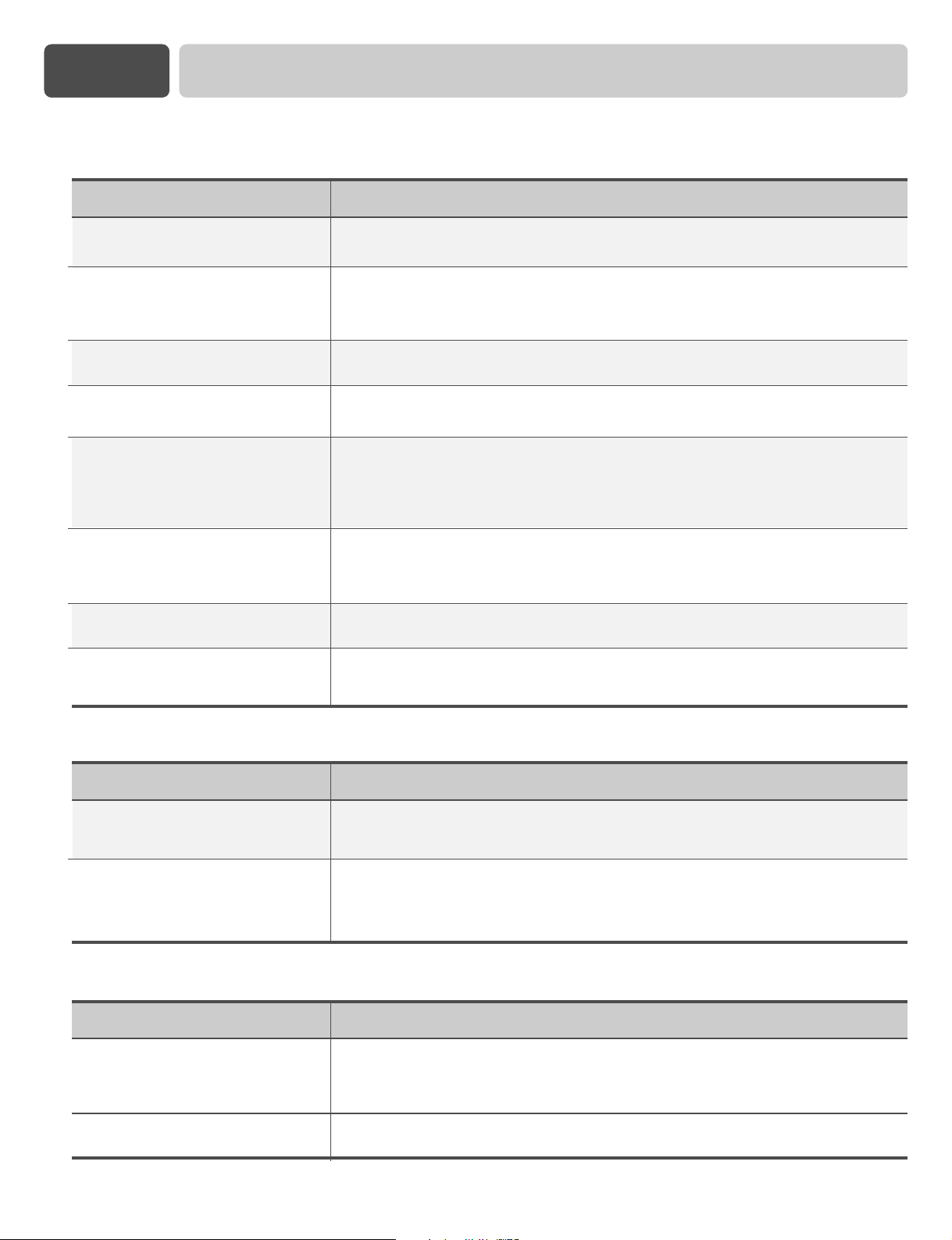
7.Problem:It takes too long for my clothes to dry
Question What to Do
• Did you properly sort your loads of
laundry?
• Are you drying large loads of heavy
fabrics?
• Are the dryer controls properly set?
• Is the lint filter clean before each
new load of laundry?
• Are the exhaust ducts clear and
properly configured?
• Is the fuse blown, or is the circuit
breaker tripped?
• Did you overload your dryer?
• Did you under load your dryer?
Separate heavy weight items from light weight items when creating loads.
Heavy fabrics take longer to dry because they tend to retain more moisture. To help
reduce and maintain more consistent drying times for large and heavy fabrics,
separate these items into smaller loads of a consistent size.
Use the appropriate control settings for the type of load you are drying.
Please confirm that the lint filter is clean prior to each new load of laundry.
Confirm through review of the appropriate sections of this manual that the exhaust
venting ductwork is properly configured. Confirm that the venting is free of
obstructions. Confirm that the outside wall dampers are moving freely, that the
dampers are not pushed in, and that nothing has been set against the dampers.
Check your home’s or laundry room’s fuse box/circuit breaker box and replace the
fuse or reset the circuit breaker. (IMPORTANT: electric dryers generally use two
fuses or breakers.)
Divide your larger load into a number of smaller loads.
If you are only drying a handful of items, add a few extra pieces to help ensure
proper tumbling action.
8.Problem:My clothes are wrinkled
Question What to Do
• Are you over drying your laundry?
• Are you removing your laundry
from the dryer soon after the
drying cycle is complete?
Over drying a load of laundry can lead to wrinkled clothes. Try a shorter drying
time, and remove items while they still retain a slight amount of moisture.
Remove your laundry from the dryer after the drying cycle ends and either hang or
fold the items.
9.Problem:My clothes are shrinking
Question What to Do
• Are you following the care
instructions for your garment?
• PLM problem
To avoid shrinkage, please carefully follow the care and use instructions for your
garment, because some fabrics will naturally shrink when washed. Other fabrics
can be washed but will shrink when dried in a dryer.
See the Owner’s Manual of RLM & PLC modem.
31
LG DRYER LIMITED WARRANTY – USA

DLE0442W/DLG0452W
DLE0442S/DLG0452S
DLE0442G/DLG0452G
DLE5944WM/DLG5955WM
DLE6942W/DLG6952W
Gracias por comprar una Secadora LG. Por favor lea su
manual correctamente, ya que
contiene informaciòn importante de una instalaciòn segura,
Uso y mantenimiento. Guarde el modelo y nùmero de serie y
conserve su manual para futuras referencias.
Para más información, visite nuestro sitio web http//us.lge.com
1-800-243-0000
para el Servicio LG (Atención al Cliente) 24 horas al día, 7 días a la semana
MANUAL DEL PROPIETARIO
Secadora de Eléctrica y Gas
2
CARACTERÍSTICAS DEL PRODUCTO
CONTENIDO
PARTE 1. GARANTÍA E INSTRUCCIONES DE SEGURIDAD IMPORTANTES...................................................................................................3
PARTE 2. ESPECIFICACIONES.............................................................................................................................................................................8
PARTE 3. PASOS INICIALES PARA LA INSTALACIÓN DE SU SECADORA.. ..................................................................................................9
PARTE 4. INSTALACIÓN DE ACCESORIOS.. ....................................................................................................................................................13
PARTE 5. REQUERIMIENTOS ELÉCTRICOS PARA SECADORA ELÉCTRICAS.......................................................................................14-17
PARTE 6. REQUERIMIENTOS ELÉCTRICOS PARA SECADORAS A GAS....................... ..............................................................................18
PARTE 7. REQUERIMIENTOS E INSTRUCCIONES SOBRE EL GAS...............................................................................................................19
PARTE 8. REQUERIMIENTOS Y MANTENIMIENTO SOBRE EL ESCAPE..................................................................................................20-21
PARTE 9. USANDO SU SECADORA..............................................................................................................................................................22-27
PARTE 10. GUÍA PARA LA SOLUCIÓN DE PROBLEMAS...........................................................................................................................28-30
GARANTÍA LIMITADA DE LA SECADORA LG...................................................................................................................................................31
DESEMPEÑO EXTRAORDINARIO
Sin mencionar su incomparable gran capacidad, puede beneficiarse por su Eficiencia en tiempo,
operaciòn silenciosa y su sistema de ahorro de energìa
TINA DE ACERO INOXIDABLE
Las tinas de acero inoxidable no se oxidan por naturaleza asì que el òxido nunca se presentarà en sus
prenda
DISEÑO ARTÍSTICO
Atractivo y moderno panel frontal y gran puerta de cristal limpio para ue su secadora tenga el mejor aspecto.
CUIDADO DIGITAL DE LOS TEJIDOS
Calentador con control de la temperatura multinivel para cuidar mejor sus prendas más queridas.
FACILIDAD DE USO
Una amplia selección de funciones sencillas de usar para facilitar la operación de la secadora.
USO DEL RLM (MONITOR REMOTO DE LA SECADORA)
El RLM controla el estado de su lavadora y/o secadora. Puede conectar la unidad de visualización en
cualquier toma de su casa. La Unidad de Visualización RLM puede comprarse separadamente para
esta secadora.
1
2
3
4
5
6
Qué significa secado por sensor o secado por tiempo?
Su secadora le proporciona la posibilidad de programar acciones de secado por sensor o por tiempo.
Secado por sensor: La secadora detectará automáticamente la humedad de la colada y determinará el
tiempo de funcionamiento necesario basándose en el nivel de sequedad de la carga y el programa
seleccionado. En ocasiones, podrá observar un incremento o disminución repentinos del tiempo de
operación. Si esto ocurriera, será debido a que el sensor detecta la humedad de la colada dentro de un
período de tiempo determinado. Un cambio repentino en el tiempo de operación no significa un mal
funcionamiento.
Secado por tiempo: Significa que puede programar el tiempo de operación manualmente para completar el
secado. Alternativamente, puede usar esta función para secar la ropa si las prendas aún están húmedas
pese a haber terminado un ciclo de secado. El secado por tiempo es más efectivo cuando tenga prendas
pesadas u objetos voluminosos como sábanas de camas tamaño superdoble o ropa de trabajo gruesa.
(DLE5944WM, DLG5955WM)
3
GARANTÍA E INSTRUCCIONES DE SEGURIDAD IMPORTANTES
Parte 1
• No instale una secadora junto a materiales de ventilación
plásticos flexibles. Si se instala un conducto flexible
metálico (de tipo lámina de metal), éste deberá cumplir las
especificaciones determinadas por el fabricante del
electrodoméstico para su uso con secadoras.Se sabe que
los materiales de ventilación flexibles se contraen, se
agrietan con rapidez y atrapan pelusas. Estas condiciones
obstruirán el flujo de aire de la secadora y aumentarán el
riesgo de incendio.
• No guarde ni use gasolina ni otros vapores inflamables ni
líquidos en las cercanías de este u otro electrodoméstico.
• La instalación y el servicio se deben ser llevadas a cabo por
parte de un instalador cualificado, agencia de servicio, o el
suministrador del servicio de gas.
• Instale la secadora según las instrucciones del fabricante y
las normativas locales.
Su seguridad y la de otros es muy importante.
PRECAUCIONES BÁSICAS DE SEGURIDAD.
PELIGRO
Si no cumple con las instrucciones de inmediato puede correr peligro de muerte o de lesiones graves.
No cumplir las instrucciones puede ocasionarle la muerte o lesiones graves.!!
Para reducir el riesgo de incendio, descarga eléctrica o daños a usuarios del aparato, siga las
precauciones básicas, incluidas las siguientes:
ADVERTENCIA
ADVERTENCIA
Hemos incluido muchos mensajes de seguridad importantes en este manual y en el aparato. Lea y cumpla en
todos los casos estos mensajes de seguridad.
Todos los mensajes de seguridad le informarán de peligros potenciales, cómo reducir las posibilidades de riesgo, y le
informarán qué pasaría si no se siguen las instrucciones.
Éste es el símbolo de alerta de seguridad.
Este símbolo le alerta de los peligros que podrían matarle a usted o a otros.
Todos los mensajes de seguridad aparecerán después del símbolo de alerta y la palabra "PELIGRO" o "ADVERTENCIA".
Estas palabras significan:
LEA TODAS LAS INSTRUCCIONES ANTES DE UTILIZAR
Por su seguridad, la información de este manual debe seguirse para reducir al mínimo el riesgo de incendio o
explosión, descargas eléctricas, o para evitar daños a la propiedad, lesiones personales o pérdida de vida humana.
ADVERTENCIA
1. No intente encender un fósforo ni un cigarrillo, ni ponga en
marcha ningún aparato de gas o eléctrico.
2. No toque ningún interruptor eléctricos.
No utilice ningún teléfono de su edificio.
3. Despeje la sala, el edificio, o el área de todos los
inquilinos.
4. Llame inmediatamente a su suministrador de servicio de
gas utilizando el teléfono de un vecino. Siga el teléfono del
suministrador del servicio de gas. Siga las instrucciones
del suministrador del servicio de gas.
5. Si no puede ponerse en contacto con su suministrador del
servicio de gas, llame al cuerpo de bomberos.
QUÉ A HACER SI HUELE GAS
Para reducir el riesgo de incendio, descarga eléctrica o daños a personas al utilizar el aparato,
siga las precauciones básicas, incluidas las siguientes:
ADVERTENCIA
GUARDE ESTAS INSTRUCCIONES
4
GARANTÍA E INSTRUCCIONES DE SEGURIDAD IMPORTANTES
Parte 1
Esta ley requiere al gobernador de California publicar una lista de las sustancias cancerígenas conocidas al Estado,
defectos de nacimiento, u otros daños al sistema reproductivo y obliga a las empresas a advertir a sus clientes de la posible
exposición a tales sustancias.
Los aparatos que usen gas pueden causar exposiciones de pequeña importancia con cuatro de estas sustancias: benceno,
dióxido de carbono, formaldehído, y hollín, causadas primordialmente por la combustión incompleta del gas natural o de
combustibles del LP
Las secadoras con ajustes correctos reducirán al mínimo la combustión incompleta. La exposición a estas sustancias puede
ser reducida al mínimo aún más mediante la ventilación correcta de la secadora al aire libre.
LEA TODAS LAS INSTRUCCIONES ANTES DE UTILIZAR
LEY EN VIGOR SOBRE LA TOXICIDAD Y POTABILIDAD DEL AGUA EN CALIFORNIA
Para reducir el riesgo de incendio, descarga eléctrica o daños a personas al utilizar el aparato,
siga las precauciones básicas, incluidas las siguientes:
ADVERTENCIA
Por su seguridad, la información de este manual debe seguirse para reducir al mínimo el riesgo de incendio o explosión,
descargas eléctricas, o para evitar daños a la propiedad, lesiones personales o pérdida de vida humana.
ADVERTENCIA
•LEA TODAS LAS INSTRUCCIONES ANTES DE USAR LA SECADORA.
•A
NTES DE USAR, LA SECADORA DEBE INSTALARSE CORRECTAMENTE SEGÚN LO
DESCRITO EN ESTE MANUAL
.
•N
O INTRODUZCA ARTÍCULOS EXPUESTOS A ACEITES DE COCINA EN SU SECADORA.
L
OS ARTÍCULOS CONTAMINADOS CON ACEITES DE COCINA PUEDEN CONTRIBUIR A
UNA REACCIÓN QUÍMICA QUE PODRÍA
.PROVOCAR UNA CARGA Y OCASIONAR UN
INCENDIO
. NO SEQUE ARTÍCULOS QUE PREVIAMENTE SE HAYAN LIMPIADO, LAVADO,
EMPAPADO, O SE HAYAN MANCHADO CON GASOLINA, DISOLVENTES DE LA LIMPIEZA
EN SECO
, OTRAS SUSTANCIAS INFLAMABLES O EXPLOSIVAS PUESTO QUE EMITEN
VAPORES QUE PODRÍAN PROVOCAR IGNICIÓN O ESTALLAR
.
•N
O TOQUE LA SECADORA SI EL TAMBOR SE ESTÁ MOVIENDO.
•N
O REPARE NI SUBSTITUYA NINGUNA PIEZA DE LA SECADORA Y NO INTENTE REALIZAR
TAREAS DE MANTENIMIENTO A MENOS QUE SE RECOMIENDE ESPECÍFICAMENTE EN ESTA
G
UÍA DE CUIDADO Y
U
SO O EN LAS INSTRUCCIONES PUBLICADAS DE REPARACIÓN POR
PARTE DEL USUARIO QUE USTED ENTIENDA Y ESTÉ CAPACITADO PARA LLEVAR A CABO
.
•NO TRATE DE FORZAR LOS CONTROLES.
•A
NTES DE SACAR DE SERVICIO A LA SECADORA O DESHACERSE DE ELLA, QUITE LA
PUERTA DEL COMPARTIMIENTO DE SECADO
..
•N
O PERMITA QUE OTROS NIÑOS JUEGUEN CERCA DE LA SECADORA. ES NECESARIO
SUPERVISAR ESTRECHAMENTE A LOS NIÑOS CUANDO LA SECADORA SE UTILICE
CERCA DE ELLOS
.
•N
O UTILICE SUAVIZADORES O PRODUCTOS PARA ELIMINAR LA ESTÁTICA EXCEPTO
CUANDO SEA RECOMENDADO POR EL FABRICANTE DEL SUAVIZADOR O DEL
PRODUCTO
.
•N
O UTILICE CALOR PARA SECAR ARTÍCULOS QUE CONTENGAN CAUCHO DE ESPUMA O
MATERIALES DE TEXTURA SIMILAR AL CAUCHO
.
•M
ANTENGA EL ÁREA CIRCUNDANTE A LA ABERTURA DEL ESCAPE Y DE LOS
ALREDEDORES LIBRE DE LA ACUMULACIÓN DE LA PELUSA
, DEL POLVO, Y SUCIEDAD.
•P
ERSONAL DE SERVICIO CUALIFICADO DEBE LIMPIAR EL INTERIOR DE LA SECADORA Y
DEL ESCAPE PERIÓDICAMENTE
.
•N
O INSTALE NI ALMACENE LA SECADORA EN UN LUGAR EN EL CUAL QUEDE EXPUESTA
A LAS CONDICIONES ATMOSFÉRICAS
.
•N
O TOQUE LA SECADORA MIENTRAS LAS PIEZAS SE ESTÉN MOVIENDO.
•C
OMPRUEBE SIEMPRE EL INTERIOR DE LA SECADORA PARA VERIFICAR SI HAY
OBJETOS EXTRAÑOS
.
•L
IMPIE LA PELUSA DE LA PANTALLA ANTES O DESPUÉS DE CADA CARGA.
PRECAUCIONES BÁSICAS DE SEGURIDAD.
Para reducir el riesgo de incendio, descarga eléctrica o daños a usuarios del aparato, siga las
precauciones básicas, incluidas las siguientes:
ADVERTENCIA
INSTRUCCIONES PARA LA TOMA A TIERRA
Este aparato debe tener una toma a tierra adecuada. En caso
de un mal funcionamiento o avería, disponer de toma a tierra
reducirá el riesgo de descargas eléctricas proporcionando una
trayectoria de menor resistencia para la corriente eléctrica. Este
aparato debe ir equipado con un cable que tenga un conductor
de toma a tierra del equipo y un enchufe con toma a tierra. El
enchufe debe ir conectado en un tomacorriente apropiado
debidamente instalado y con una toma a tierra que cumpla
todos los códigos y ordenanzas locales.
ADVERTENCIA -
La conexión incorrecta del conductor de toma a
tierra del equipo puede dar lugar a un riesgo de descarga eléctrica.
Compruebe con un electricista cualificado o un personal del servicio
si duda de si el aparato dispone de una toma a tierra correcta.
No modifique el enchufe proporcionado con el aparato.
Si no cabe el enchufe en el tomacorriente, solicite a un electricista
cualificado la instalación de un enchufe apropiado.
Este aparato debe conectarse a un metal con toma a tierra, sistema
permanente de cableado o debe tenderse un conductor de toma a
tierra del equipo con conductores del circuito y conectarse al
terminal de toma a tierra del equipo o hacia el aparato.
GUARDE ESTAS INSTRUCCIONES
5
GARANTÍA E INSTRUCCIONES DE SEGURIDAD IMPORTANTES
Parte 1
• La secadora, con toma a tierra adecuada, debe cumplir
con todos los códigos y ordenanzas en vigor. Siga los
detalles de las instrucciones de instalación.
Puede ocurrir una descarga eléctrica si la secadora no
dispone de una toma a tierra correcta.
• Antes de usar, la secadora debe instalarse
correctamente según lo descrito en este manual.
Puede ocurrir una descarga eléctrica si la secadora no
dispone de una toma a tierra correcta.
• Instale y almacene la secadora donde no quede
expuesta a las temperaturas bajo cero ni a la
intemperie.
Todas las reparaciones y el mantenimiento deben ser
realizadas por un técnico de servicio autorizado excepto
allí donde esta Guía del propietario lo recomiende de otra
manera. Utilice solamente piezas autorizadas de fábrica.
No seguir esta advertencia puede causar lesiones serias,
un incendio, un descarga eléctrica o incluso la muerte.
• No instale la lavadora en espacios húmedos para
reducir el riesgo de descarga eléctrica.
No seguir esta advertencia puede causar lesiones serias,
un incendio, un descarga eléctrica o incluso la muerte.
• Conecte a un circuito de la potencia nominal correcta,
protegido, y con la potencia adecuada para evitar una
sobrecarga eléctrica.
Un circuito incorrecto puede derretirse, creando una
descarga eléctrica y/o riesgo de incendios.
• Quite todos los artículos del embalaje y elimine todos
los materiales de envío correctamente
No hacerlo podría ocasionar la muerte, una explosión o
quemaduras.
• Coloque la secadora por lo menos 18 pulgadas sobre
el piso en el caso de una instalación en un garaje.
No hacerlo podría ocasionar la muerte, una explosión o
quemaduras.
Escape/Conducto:
• Las secadoras de gas SE DEBEN conducir su escape
al exterior.
No seguir estas instrucciones puede dar lugar a un
incendio o incluso la muerte.
• El dispositivo de escape de la secadora se debe
canalizarse al exterior de la vivienda.
Si la secadora no conduce su escape al exterior, se
expulsarán área al área del lavadero algo de pelusa fina y
grandes cantidades de humedad. Una acumulación de
pelusa en cualquier área del hogar puede crear un riesgo a
la salud y de incendios.
• Utilice solamente un conducto de metal rígido o metal
flexible de 4 pulgadas con un diámetro en el interior
del armario de la secadora o para conducir el escape al
exterior.
El uso de plástico o de otro conducto combustible puede
causar un incendio. La existencia de orificios en el
conducto puede causar un incendio si queda atrapado en
funcionamiento o durante la instalación
• El conducto no se entrega con la secadora. Usted es el
responsable de instalar el conducto necesario en el
lugar de instalación. La tapa del extremo debe
disponer de abisagradores con amortiguación para
evitar corrientes de aire a contraviento cuando la
secadora esté parada.
No seguir estas instrucciones puede dar lugar a un
incendio o incluso la muerte.
• El conducto del escape debe tener 4 pulgadas (10
centímetros) de diámetro sin obstrucciones.
El conducto del escape debe ser lo mas corto posible.
Cerciórese de limpiar cualquier viejo conducto antes
de instalar su nueva secadora.
No seguir estas instrucciones puede dar lugar a un
incendio o incluso la muerte.
LEA TODAS LAS INSTRUCCIONES ANTES DE UTILIZAR
INSTRUCCIÓN DE SEGURIDAD PARA LA INSTALACIÓN
Para reducir el riesgo de incendio, descarga eléctrica o daños a usuarios del aparato, siga las
precauciones básicas, incluidas las siguientes:
ADVERTENCIA
Por su seguridad, la información de este manual debe seguirse para reducir al mínimo el riesgo de incendio o explosión,
descargas eléctricas, o para evitar daños a la propiedad, lesiones personales o pérdida de vida humana.
ADVERTENCIA
6
GARANTÍA E INSTRUCCIONES DE SEGURIDAD IMPORTANTES
Parte 1
• Se recomienda el uso entre la secadora y la pared de
un conducto rígido o semirrígido. En especial, en
aquellas instalaciones en las que sea imposible
realizar una conexión siguiendo las recomendaciones
antedichas, puede utilizarse un conducto de transición
metal flexible de norma UL entre la secadora y la
conexión de la pared solamente. El uso de este tipo de
conducto afectará al tiempo de secado.
No seguir estas instrucciones puede dar lugar a un
incendio o incluso la muerte.
• NO utilice los tornillos del metal de hoja u otros
amarres que se extienden al conducto puesto que
podrían recoger pelusa y reducir la eficiencia del
dispositivo de escape. Asegure todas las juntas con
cinta para conductos. Para más detalles, siga las
instrucciones de instalación.
No seguir estas instrucciones puede dar lugar a un
incendio o incluso la muerte.
• Bajo ninguna circunstancia deberá cortar o eliminar la
tercera patilla (de toma a tierra) del cable de
alimentación.
Para evitar lesiones personales o daños a la secadora, el
cable de corriente eléctrica se ir conectado debidamente y
contar con una toma a tierra adecuada.
• Por su seguridad personal, esta secadora ha de tener
una toma a tierra adecuada.
No hacerlo podría ocasionar descargas eléctricas o
lesiones.
• Consulte las instrucciones de instalación de este
manual para los requisitos eléctricos específicos de su
modelo.
No seguir estas instrucciones puede ser causa de una
descarga eléctrica y/o un riesgo de incendios.
• Esta secadora ha de ir conectada a un tomacorriente
con una toma a tierra adecuada
Puede ocurrir una descarga eléctrica si la secadora no
dispone de una toma a tierra correcta.
• Solicite que un electricista cualificado compruebe la
toma a la pared y el circuito para asegurarse de que la
toma a tierra está correctamente realizada.
Esto evitará peligros de descargas y asegurará la
estabilidad durante el funcionamiento.
• La secadora siempre ha de ir conectada a su propio
tomacorriente eléctrico individual con una potencia
nominal que coincida con la de la placa.
Una instalación así proporciona el mejor rendimiento y
también evita la sobrecarga de los circuitos de cables
domésticos, lo que podría provocar riesgo de incendio
debido a unos cables recalentados.
• Nunca desenchufe su secadora estirando del cable de
alimentación.
Sujete siempre firmemente el enchufe y sáquelo de la
toma sin agitarlo de lado a lado.
El cable de alimentación puede cortarse como
consecuencia de un movimiento del núcleo, provocando
una descarga eléctrica.
• Repare o cambie de inmediato todos los cables de
servicio eléctrico que se hayan pelado o dañado. No
utilice cables que muestren grietas o daños por
abrasión por su extensión o en cualquier extremo.
Un circuito incorrecto puede derretirse, creando una
descarga eléctrica y/o riesgo de incendios.
• Al instalar o mover la secadora, tenga cuidado de no
pisar, machacar, o dañar el cable eléctrico.
Esto evitará lesiones y daños a la secadora por fuego y
descargas eléctricas.
LEA TODAS LAS INSTRUCCIONES ANTES DE UTILIZAR
INSTRUCCIÓN DE SEGURIDAD PARA LA INSTALACIÓN (CONT.)
INSTRUCCIÓN DE SEGURIDAD PARA LA CONEXIÓN DE ELECTRICIDAD
Para reducir el riesgo de incendio, descarga eléctrica o daños a usuarios del aparato, siga las
precauciones básicas incluidas las siguientes:
ADVERTENCIA
Por su seguridad, la información de este manual debe seguirse para reducir al mínimo el riesgo de incendio o explosión,
descargas eléctricas, o para evitar daños a la propiedad, lesiones personales o pérdida de vida humana.
ADVERTENCIA
7
GARANTÍA E INSTRUCCIONES DE SEGURIDAD IMPORTANTES
Parte 1
BÚSQUEDA DE ASISTENCIA SOBRE LA GARANTÍA
Encontrará la garantía de su secadora en la parte final de este manual. El servicio de
garantía está disponible contactando con su Centro de Servicio LG más próximo. Si este
producto se instala y se opera siguiendo las instrucciones de este manual, LG reparará o
recambiará cualquier pieza defectuosa en material o mano de obra a lo largo del período
cubierto por la garantía, comenzando desde el día de compra.
Restricción de la Garantía : Si la secadora es utilizada para otro propósito
que no sea el uso familiar privado, toda cobertura de la garantía es
efectiva por sólo 90 días.
Necesitará el número de modeloo y de serie completo al solicitar la
garantía de servicio. Es necesaria la prueba de la compra (ticket o
recibo).
Utilice el siguiente espacio para anotar el número de modelo y de serie de
su nueva secadora LG.
Modelo Número
Número de Serie
Fecha de Adquisición
Para su seguridad, debe seguir las recomendaciones de
este manual. Para reducir el riesgo de incendio o explosión, o choque eléctrico, o para
prevenir daños a la propiedad, lesiones personales, o muerte cuando use su artefacto, siga
las precauciones básicas, incluyendo las siguientes.
ADVERTENCIA!
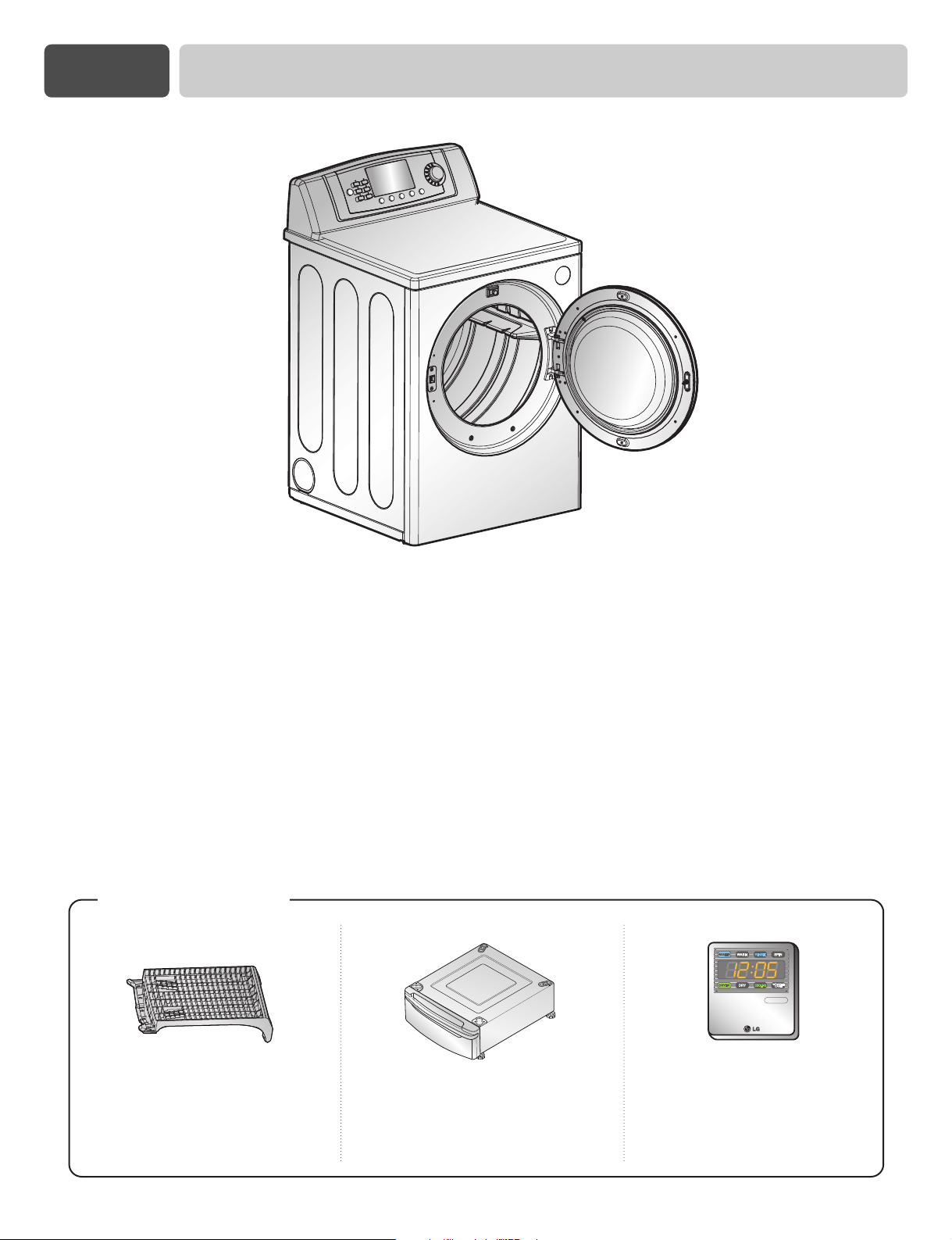
8
Parte 2 ESPECIFICACIONES
■ Nombre : Secadora Eléctrica y de Gas
■ Suministro de Energìa : Favor de consultar la etiqueta de
medición referente a la
información detallada
■ Tamaño : 27 x 30 x 42.75(inch)
■ Capacidad de la Secadora : IEC 7.3cu.ft. (22.5 lb)
■ Peso : 126 Ibs (57.2 kg)
■ ACCESORIOS
Parrilla de secado (1) Pedestal (1)
comprado separadamente
Monitor remoto de la colada
Se adquiere por separado
Vea la página 26 para su uso Vea la página 14 para su uso
(DLE5944WM, DLG5955WM)
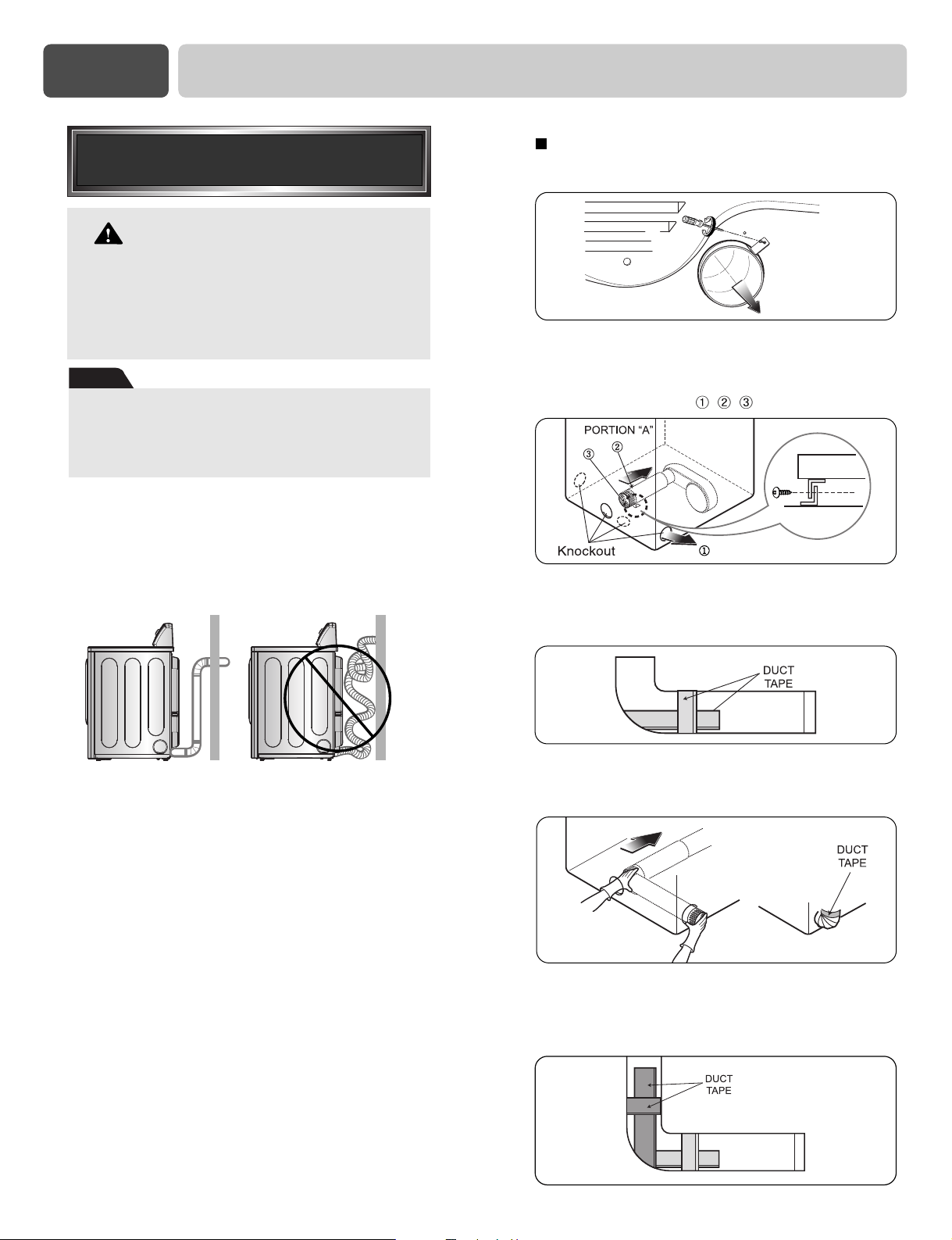
9
Parte 3
PASOS INICIALES PARA LA INSTALACIÓN DE SU SECADORA
Además de las siguientes advertencias, por favor
refiérase a la sección del manual sobre Requerimientos y
Mantenimientodel Escape. IMPORTANTE: Para
reducir el riesgo de incendio, combustión y acumulación
de gas, la secadora debe estar ventilada hacia la
intemperie. Por favor siga las siguientes instrucciones
(y todas las otras en este manual) muy cuidadosamente.
• No use ductos de plástico o de lámina delgada.
• Los conductos metálicos rígidos o semi-rígidos se
recomiendan para usarse como conductos de transición
entre la secadora y la pared. Especialmente en las
instalaciones donde es imposible hacer la conexión con las
recomendaciones anteriores, un conducto metálico flexible
listado UL puede usarse solamente entre la conexión de la
secadora y la pared. El uso de estos conductos afectará el
tiempo de secado.
• Coloque la secadora en tal posiciòn que el ducto corra de
la menor forma posible.
• Limpie los ductos viejos antes de instalar esta secadora.
• El extremo macho de cada sección del ducto de escape
debe apuntar contrario a la secadora.
• Use las menores conyucturas posibles.
• Utilice cinta selladora de ductos en todas las uniones de
ductos.
• Aísle la instalación de escape que pase a través de áreas sin
calentamiento con el fin de reducir la condensación y la
acumulación de pelusas en las paredes de la tubería; y
• POR FAVOR TENGA CUIDADO YA QUE DE NO
INSTALAR CORRECTAMENTE EL SISTEMA DE
ESCAPE ANULARÁ LA GARANTÍA DE LA SECADORA
ADVERTENCIA!
• Utilice material para ventilación de metal pesado
• No utilice material para ventilación de plástico.
• No utilice material para ventilación de lámina de metal
• Si no cumple con estas instrucciones puede resultar
en muerte o incendio.
DIRECCIONES ALTERNAS PARA EL
1.
Quite el tornillo y el ducto de escape.
2-1.
Separe y extraiga la seguridad de la parte inferior,
izquierda o derecha según desee. (La ventilación
del lado derecho no está disponible en la
secadora a gas).
, , es el orden del trabajo.
2-2.
Reconecte el otro conducto (11 pulgadas o 28 cm)
al alojamiento del soplador y acople el conducto a
la base. (El conducto es una pieza SVC).
3-1.
Arme previamente un codo de 4 con un ducto de 4".
Envuelva la cinta selladora para ducto alrededor de la
unión.
3-2.
Inserte el montaje del ducto, el codo primero a
través de la abertura lateral y conecte el codo al
ducto interno de la secadora.
PASO 3 Conexión del Sistema
de Escape y Ventilación
El extremo de la ventilación mirará hacia el lado
externo y el mal roscado o una instalación
inestable de la ventilación provocarán niveles de
secado no deseados.
Nota
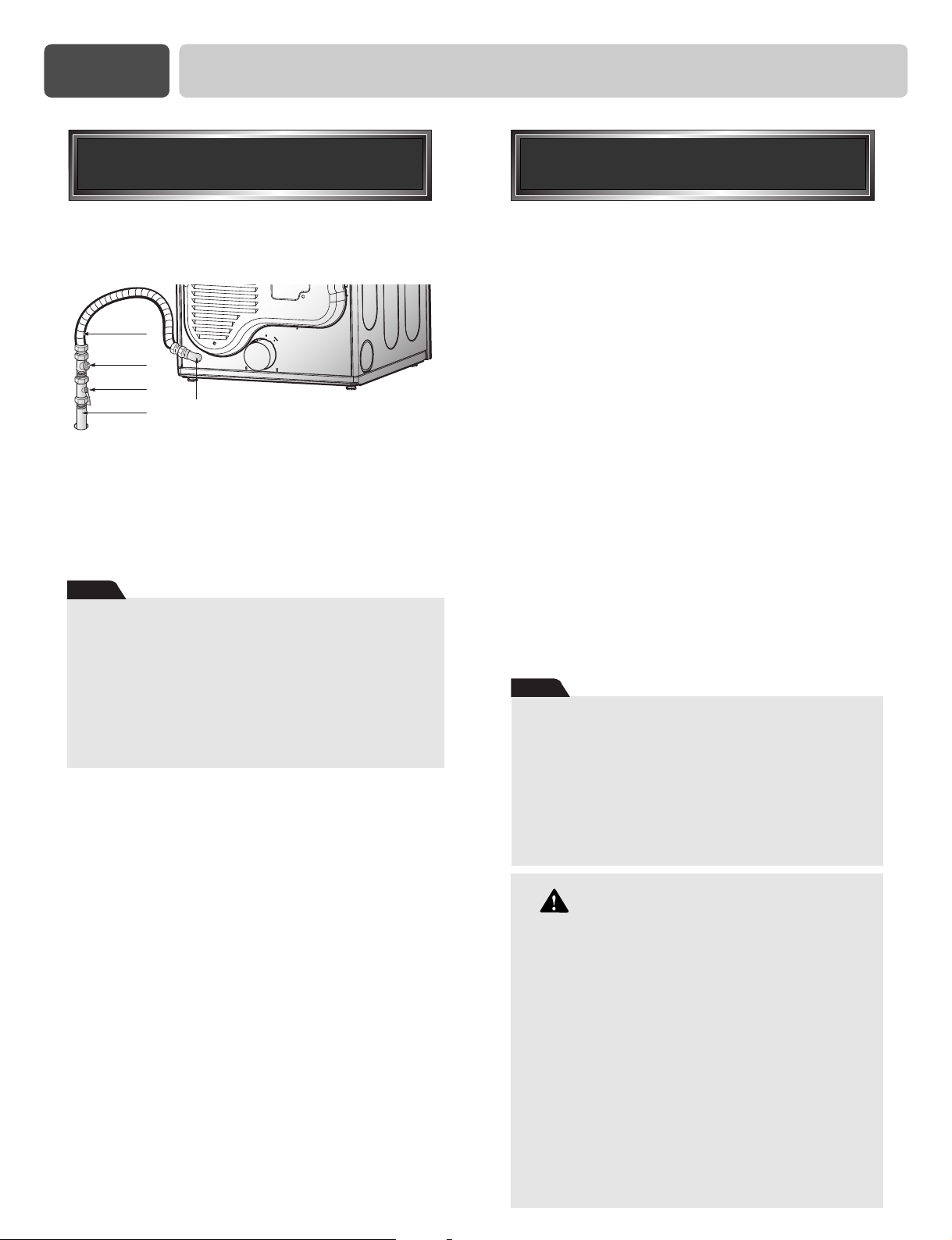
10
Parte 3
PASOS INICIALES PARA LA INSTALACIÓN DE SU SECADORA
(Secadora a Gas solamente). Además de lo siguiente, por
favor refiérase a la sección del manual sobre
Requerimientos e Instrucciones del Gas.
1. Confirme que el tipo de gas disponible en su cuarto de
lavado sea el adecuado para su secadora. La secadora
está preparada para Gas Natural con una conexión de
gas NPT de 3/8".
2. Remueva la tapa protectora de la conexión de gas
detrás de la secadora. Asegúrese de no dañar la rosca
de la tubería de la conexión de gas cuando remueva la
tapa protectora.
3. Conecte la secadora al suministro de gas en su cuarto
de lavado utilizando un conector nuevo flexible de
acero inoxidable (como se mencionó antes, sólo use un
conector nuevo flexible de acero inoxidable si es
permitido por códigos locales)
4. Asegúrese de apretar todas las conexiones entre la
secadora y el suministro de gas en su cuarto de lavado.
Abra el suministro de gas en su cuarto de lavado y
verifique todas las conexiones de la tubería (internas y
externas) para detectar fugas de gas utilizando un
detector líquido de fugas no corrosivo.
5. Para una conexión a gas LP (Petróleo Licuado),
refiérase a la sección de este manual sobre
Requerimientos e Instrucciones del Gas.
1. Conector flexible nuevo de acero inoxidable. Utilice este tipo de conector
sólo si es permitido por los códigos locales. Use un conector de diseño AGA
Certificado.
2. Conector de tubo NPT de 1/8" (para verificar la presión de entrada de gas)
3. Válvula de Cierre de Equipo instalada a una distancia de
6’ (1.8 m) de la secadora.
4. Tubería de hierro. Más corta de 20’ (6.1 m) Use tubería de 3/8" . Más larga
de 20’ (6.1 m) - Use tubería de 1/2".
5. Conexión de Gas N.P.T de 3/8" .
A continuación encontrará advertencias e instrucciones
concernientes a la confección de la conexión eléctrica
para secadoras eléctricas. Información detallada adicional
concerniente a la conexión eléctrica es suministrada en la
sección del manual Requerimientos Eléctricos para la
Secadora Eléctrica y es importante que usted lea esta
sección completamente, así como el resto del manual,
antes de tomar algún paso para instalar o usar esta
secadora.
1. Use solamente un cordón de alimentación nuevo
listado No. 10 por U.L.(alambre de cobre únicamente)
de tres conductores clasificado para 240 Voltios
(mínimo) 30 Amperios y que está indicado de uso
aceptable para una secadora de ropa.
2. Un cordón de 4 alambres es requerido para
instalaciones y uso en casas prefabricadas (móvil) y
donde los códigos locales no permitan conexión a
tierra de este aparato a través del neutral.
3. Electrical Plug Connections
Conecciòn Elèctrica
4. Para instrucciones adicionales de como conectar la
secadora a una fuente eléctrica, favor refiérase a la
sección de este manual sobre Requerimientos
Eléctricos para Secadora Eléctrica.
ADVERTENCIA!
• Use un cordón de alimentación nuevo aprobado por
U.L. de 30 amp.o alambre de cobre sólido calibre 10.
• Use un liberador de tensión aprobado por UL .
• Desconecte la corriente antes de hacer las
conexiones eléctricas.
• Conecte el alambre neutral (alambre blanco o
central) al terminal central.
• El alambre a tierra alambre verde o descubierto)
debe conectarse al conector a tierra verde.
• Asegúrese de apretar todas las conexiones
eléctricas.
• Vea las instrucciones de instalación para unas
instrucciones completas.
• De no seguir estas advertencias puede resultar en
incendio o choque eléctrico.
2
3
5
1
4
PASO 5
Electrical Plug Connections
Conecciòn Elèctrica
PASO 4
Conexión del Suministro
de Gas
Asegúrese de que la boquilla del zumbador es la adecuada
para el tipo de gas que utiliza.
Por ejemplo, usar LPG con una boquilla LNG ocasionaría la
muerte del usuario, el incendio o una explosión. Del mismo
modo, LNG con una boquilla LPG no provocarán la ignición
del quemador.
Si fuese necesario, la conversión de la boquilla debería
realizarla un técnico de servicio cualificado y marcar o poner
la etiqueta del tipo actual de boquilla en la secadora.
Nota
Requisitos de admisión al quemador
Si su casa está situada en alturas hasta los 10.000 pies.
Ajustar la admisión al quemador no es necesario en estas
elevaciones porque A.G.A. certifica que esta secadora no
tiene problemas con los rangos BTU a estas alturas.
Si su casa está situada a alturas superiores a los 10.000
pies, necesitará ajustar un cuatro por cien (4%) de
reducción en el quemador, que es el rango indicado por el
BTU en la placa de modelo/rango de serie.
Nota
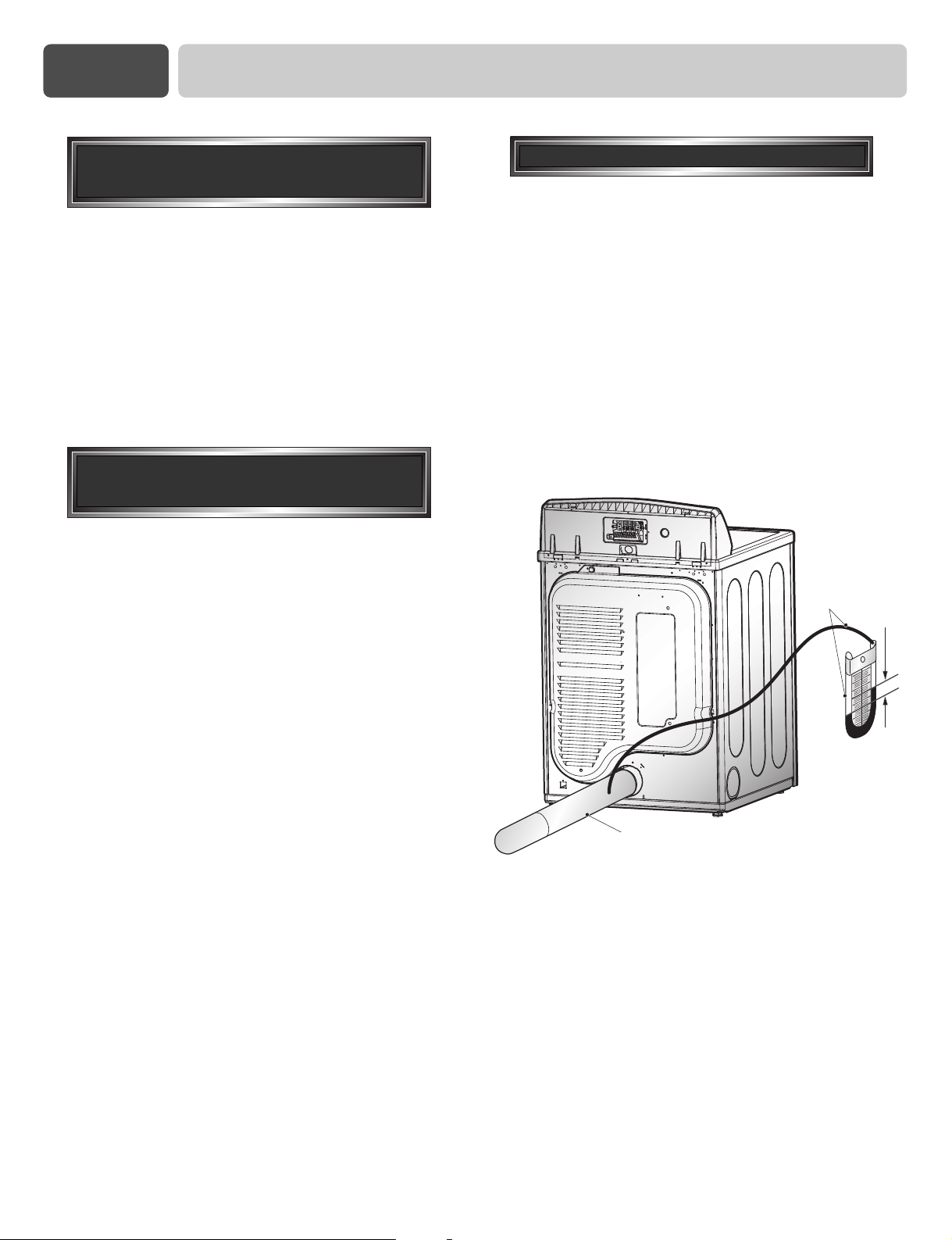
11
Parte 3
PASOS INICIALES PARA LA INSTALACIÓN DE SU SECADORA
Antes de usar por primera ves esta
secadora, utilice un producto
limpiador para todo propósito, o una
solución de detergente y agua, con un
paño húmedo para remover de la parte
interior del tambor de la secadora
/compartimiento de secado cualquier
polvo o sucio que se haya podido
acumular dentro de la secadora.
Enchufe su secadora después de haber
La efectiva operación de la secadora
requiere de un flujo de aire adecuado.
El flujo de aire adecuado puede ser
medido evaluando la presión estática.
La presión estática en el ducto de
escape puede ser medida con un
manómetro, colocado en el ducto de
escape aproximadamente a a 2 pies
(60.9 cm) de la secadora. La presión
estática en el ducto de escape no debe
exceder 0.6 pulgadas (1.5 cm). La
Confirmación de la Fuente de Calor en
Secadoras a Gas
Cierre la puerta al tambor /
compartimiento de secado de la
secadora y después de haber
completado todos los pasos de este
manual para la instalación correcta de
esta secadora, encienda la secadora en
temperatura caliente, como mejor se
describe en las instrucciones de
operación provistas con la secadora.
Después que la secadora se enciende,
el encendedor resplandecerá en rojo y
el quemador principal encenderá.
Advertencia: Si no todo el aire es
purgado fuera de la línea de gas, el
encendedor podría apagarse antes de
que el gas y el quemador principal se
hayan encendido. Si esto sucede, el
encendedor intentará encender el gas
después de aproximadamente dos
minutos.
Confirmación de la Fuente de Calor en
Secadoras Eléctricas
Cierre la puerta al tambor /
Compartimiento de secado de la
secadora y después de haber
completado todos los pasos en este
Medición de la Presión Estática.
0.6 pulgadas (1.5 cm)
PRESIÓN ESTÁTICA
MÁXIMA EN
COLUMNA DE AGUA
2
1
PASO 8
Flujo de Aire
PASO 7
Confirmación de la Operación
de la Fuente de Calor.
PASO 6
Preparación de la
Secadora
Man ó ro
Ducto de Escape
12
Parte 3
PASOS INICIALES PARA LA INSTALACIÓN DE SU SECADORA
Las siguientes instrucciones se
aplican a instalaciones de la secadora
en casas prefabricadas o móvil. La
instalación en una casa prefabricada o
móvil debe cumplir con los estándares
de Seguridad y Construcción de Casas
Prefabricadas, Título 24 CFR, Parte
32-80 o el Estándar CAN/CSA0Z240
MH y los códigos y ordenanzas
locales. Si no está seguro de que la
instalación cumplirá con estos
estándares, por favor contacte a un
profesional de mantenimiento e
instalación para que le ayude.
Las siguientes instrucciones se
aplican a cualquier instalación de la
secadora en una casa prefabricada o
móvil
1) Las secadoras a gas deben estar
fijas al piso permanentemente.
2) La conexión eléctrica para una
secadora eléctrica debe ser de
conexión de 4 alambres.
Información adicional detallada
4) Las secadoras eléctricas pueden ser
ventiladas hacia el exterior usando
el panel trasero, izquierdo, derecho
o inferior
5) Las secadoras a gas pueden ser
ventiladas hacia el exterior usando
el panel trasero, izquierdo o
inferior. Las secadoras a gas no
pueden ser ventiladas al exterior
usando el panel del lado derecho
debido a la cubierta del quemador.
6) El ducto de escape de la secadora
debe estar fijo a la estructura de la
casa prefabricada o móvil, y el
ducto de escape debe estar hecho
de un material que resista fuego y
combustión, y es recomendable que
utilice una tubería de metal
flexible o rígido.
7) NO conecte el ducto de escape con
ningún otro ducto, ducto de
ventilación, chimenea u otro ducto
de escape.
8) Asegúrese que la secadora tenga un
buen acceso al aire fresco del
exterior para una operación
adecuada. La abertura para el aire
fresco del exterior debe ser de por
lo menos 25 pulgadas (163 cm).
9) Es importante que el espacio libre
del ducto de cualquier construcción
combustible sea de por lo menos 2
pulgadas (5 cm), y cuando ventila la
secadora hacia la intemperie, la
secadora puede ser instalada con un
ADVERTENCIA!
NO conecte los ductos de escape con tornillos
de metal o sujetadores que se extiendan
dentro del ducto.
ADVERTENCIA!
NO ventile el ducto de escape hacia abajo
de la casa prefabricada o móvil.
PASO 9
Instrucciones Adicionales
para la Instalación de su
Secadora en una Casa
Prefabricada o Móvil.
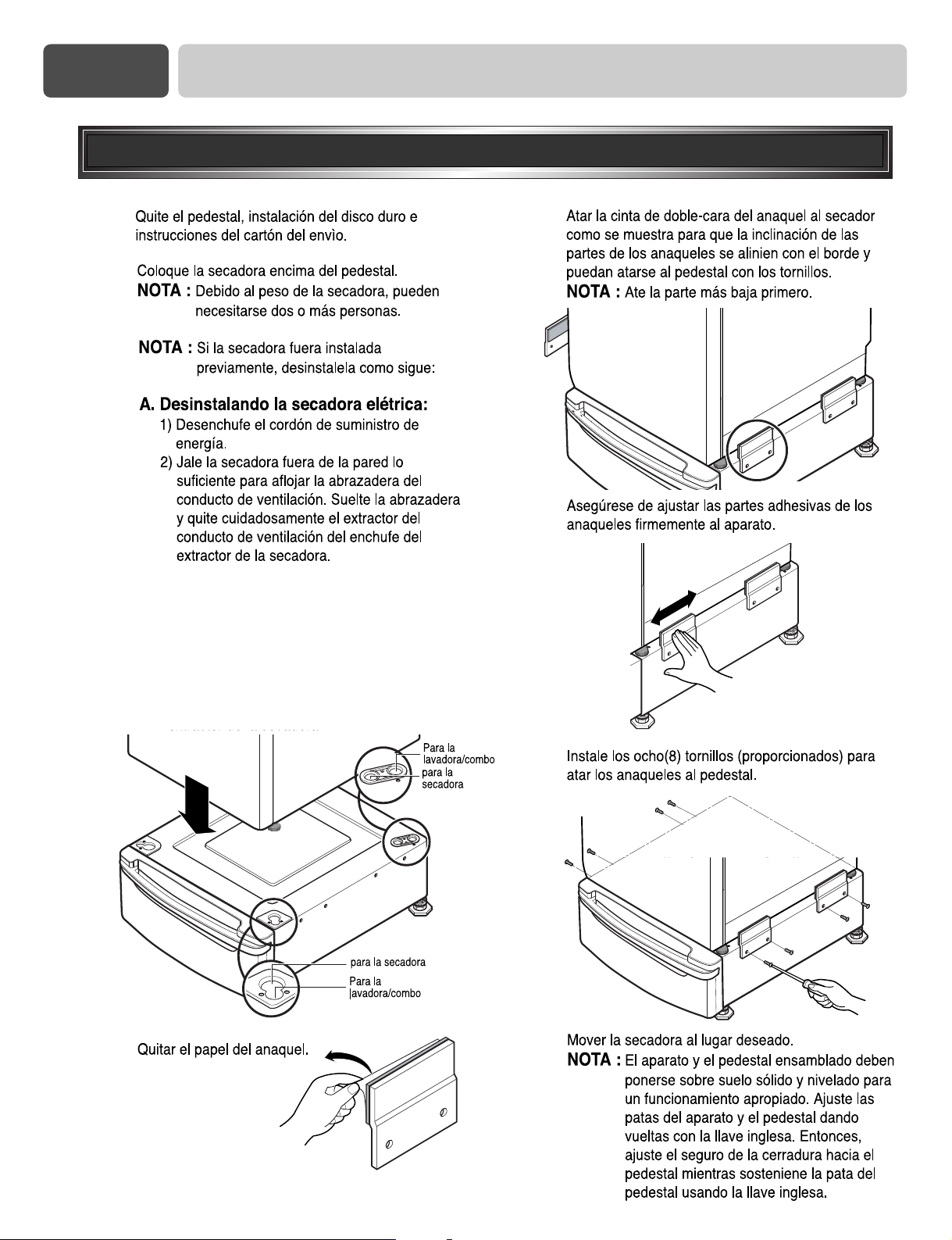
13
Parte 4 INSTALACIÒN DE ACCESORIOS
Instalacion de la secadora (Cinta de tipo doble-cara)
3
14
5
6
7
2
1. Cierre el gas
2. Desenchufe el cable de alimentación.
3. Desconecte la línea de gas de la secadora.
4. Deje a un lado y afloje la brida de ventilación.
Desconecte la ventilación.
B. Desinstalación de una secadora a gas:

14
Parte 5
REQUERIMIENTOS ELÉCTRICOS PARA SECADORAS ELÉCTRICAS
Las siguientes son instrucciones adicionales sobre las conexiones y requerimientos
eléctricos para las secadoras eléctricas.
Advertencia Importante: Para ayudar a prevenir incendios, choque eléctrico,
lesiones serias o muerte,
el cableado y la conexión a tierra deben estar de acuerdo con la edición más
reciente del código Eléctrico Nacional, ANSI/NFPA 70 y todas las regulaciones
locales aplicables. Por favor contacte a un electricista calificado para verificar el
cableado y fusibles de su casa y para asegurar que tiene la energía eléctrica
adecuada para el funcionamiento de la secadora.
120V/208V, 60 Hertz, Instalación de 3-Alambres
Instrucciones para la Conexión a Tierra de
su Secadora Eléctrica:
a) Por favor note que el diagrama de
cableado está localizado dentro de
la cubierta del control de la
secadora.
b) Esta secadora debe ser conectada
a un metal con conexión a tierra,
sistema de cableado permanente, o
un conductor equipo-tierra debe
correr con los conductores de
circuito y estar conectado al
terminal equipo-tierra o línea
principal de la secadora.
c) La secadora tiene su propia caja
terminal la cual debe estar
conectada a una línea separada,
60 Hertz, circuito de fase
sencilla, circuito AC (corriente
alterna), con fusible de 30
Amperios (el circuito debe tener
fusibles en ambos lados de la
línea). EL SERVICIO ELÉCTRICO
PARA LA SECADORA DEBE SER
DEL MÁXIMO RANGO DE
VOLTAJE DESCRITO EN LA
PLACA. NO CONECTE LA
SECADORA A UN CIRCUITO DE
110, 115, Ó 120 VOLTIOS.
d) Si la distancia entre la caja de
circuito y la secadora es de 15
pies (4.50 m) o menos, use un
cable No. 10 A.W.G. (de cobre
únicamente) listado por U.L.
(Underwriters Laboratories), o
como lo requieran los códigos
locales. Si es de más de 15 pies
(4.50 m), use un cable No. 8
A.W.G. (de cobre únicamente)
listado por U.L (Underwriters
e) La conexión del cordón de
alimentación (cable flexible) entre
el tomacorriente y la caja terminal
de la secadora NO ES suministrada
con la secadora. El tipo del cable
flexible y el calibre del alambre
deben estar conforme con los
códigos locales y con las
instrucciones de las páginas
siguientes.
f) El método de cableado de la
secadora es opcional y sujeto a los
requerimientos del código local.
Refiérase a los ejemplos en la
próxima página.
ADVERTENCIA!
Etiquete todos los cables antes de
desconectarlos para darle mantenimiento a la
secadora, ya que errores en el cableado
pueden causar lesiones serias a usted y dañar
su secadora.
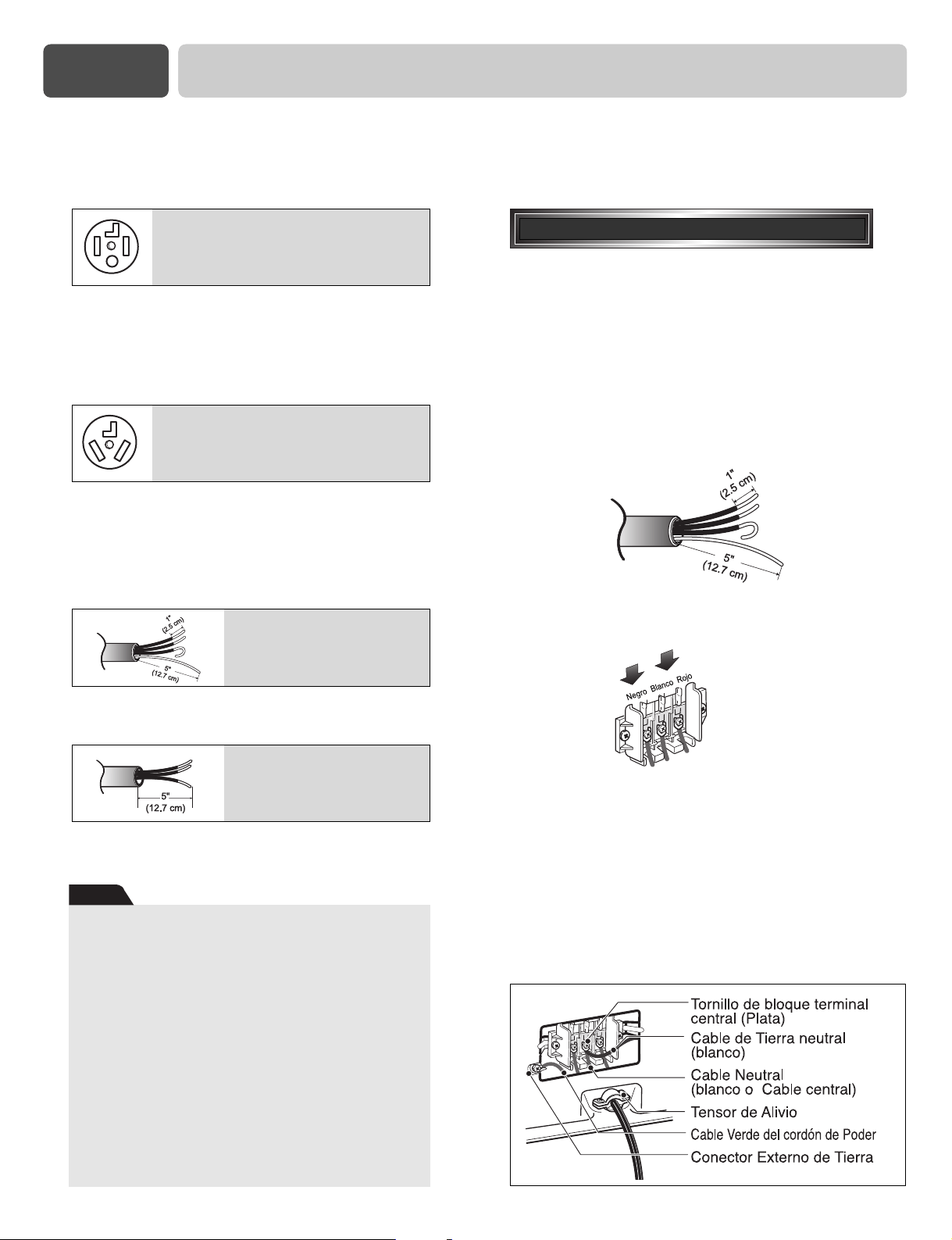
15
Parte 5
REQUERIMIENTOS ELÉCTRICOS PARA SECADORAS ELÉCTRICAS
Utilice las instrucciones en esta
sección si su casa tiene un
tomacorriente de 3-alambres (Tipo
NEMA 10-30R) y si usará un cordón
de alimentación para secadora listado
por UL, de
Revise las siguientes opciones para determinar la conexión eléctrica adecuada
para su casa:
Utilice las instrucciones en esta
sección si su casa tiene un
tomacorriente de 4-alambres (Tipo
NEMA 14-30R) y si usará un cordón
de alimentación para secadora listado
por UL,
Si este tipo està disponible en su
casa, lo conectarà a una caja de corto
Si este tipo està disponible en su
casa, lo conectarà a una caja de corto
circuito o una pipa desconectada
Importante : Contacto por conductor neutro esta prohibido
por(1) nuevas instalciones de branch- circuito (2) las casas de
mobiles (3) vehiculo recreacional y (4) areas donde los codigos
locales prohibe contactar por el conductor neutro.
Prepare un mínimo de 5 ps (1.52 m) de longitud para poder
reemplazar la secadora.
Primero, despegue 5 pulg (12.7 cm) de la cubierta del cable
desde el final. Descubra 5 pulgadas del cable de tierra. Después
de cortar 11/2 pul (3.8cm) de los otros 3 cables, aisle lo
despegado. atràs 1pul (2.5cm). haga los finales de los cables en
forma de gancho.
Luego, ponga el final de esas puntas
debajo del tornillo de la terminal (la parte
de la punta con forma de gancho
mostrandose derecho) y una el cable con
1. Conecte un cable neutral (blanco) al cordón
de poder para centrar la terminal del
tornillo.
2. Conecte un cable rojo y otro Negro en las
terminales izquierdas y derechas de los
tornillos.
3. Conecte el cable de tierra(verde) del
cordón de poder al tornillo de tierra
externo y mueva el cable de tierra neutral
fuera del aparato y conéctelo al tornillo
Tomacorriente de 3-alambres
(Tipo NEMA 10-30R)
Tomacorriente de 4-alambres
(Tipo NEMA 14-30R).
3-cables directos
4-cables directos
Conexiòn de 4-cables: Cableado directo
• Atornille el cable de la alimentación al bloque
terminal. El cable de color debería conectarse a los
tornillos del mismo color. El color del cable indicada
en el manual está conectado al tornillo del mismo
color del bloque. De lo contrario, se aplicará una
corriente excesiva que ocasionará daños al producto
y un fallo en la calefacción.
• Es esencial un buen atornillamiento. Atornillar
incompletamente puede causar que las conexiones
se aflojen o que se desatornillen debido a una
abrasión excesiva de los tornillos.
• Atornillar con poca tensión puede provocar errores
de conexión que pueden ocasionar la muerte,
incendios o lesiones de consideración.
Nota
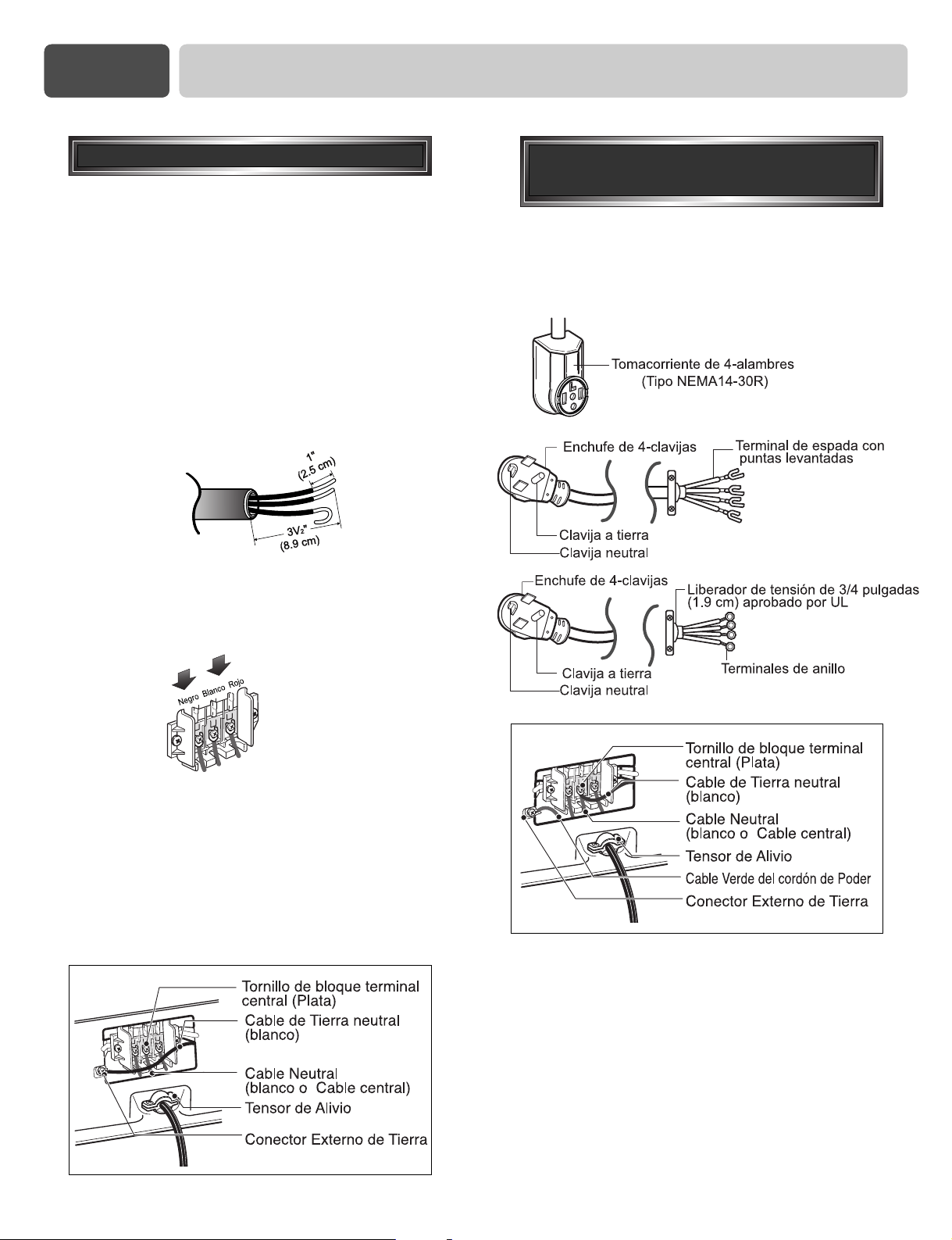
16
Parte 5
REQUERIMIENTOS ELÉCTRICOS PARA SECADORAS ELÉCTRICAS
Importante : Contacto por conductor
neutro esta prohibido por(1) nuevas
instalciones de branch- circuito (2) las
casas de mobiles (3) vehiculo recreacional
y (4) areas donde los codigos locales
prohibe contactar por el conductor neutro.
Prepare un mínimo de 5 ps (1.52 m) de
longitud para poder reemplazar la
secadora.
Primero, despegue 5 pulg (12.7 cm) de
la cubierta del cable desde el final.
Descubra 5 pulgadas del cable de tierra.
Después de cortar 11/2 pul (3.8cm) de
los otros 3 cables, aisle lo despegado.
Luego, ponga el final de esas puntas
debajo del tornillo de la terminal (la
parte de la punta con forma de gancho
mostrandose derecho) y una el cable
con el tornillo fuertemente.
1. Conecte un cable neutral (blanco)
al cordón de poder para centrar la
terminal del tornillo.
2. Conecte un cable rojo y otro Negro
en las terminales izquierdas y
derechas de los tornillos.
3. Asegúrese que el tornillo de alivio
de tensión este apretado. Asegure
Conexiòn de 3-cables: Cable Directo
Opción 1
Conexión de 4-alambres con
un Cordón de Alimentación.
1. Conecte un cable neutral (blanco)
al cordón de poder para centrar la
terminal del tornillo.
2. Conecte un cable rojo y otro Negro
en las terminales izquierdas y
derechas de los tornillos.
3. Conecte el cable de tierra(verde)
del cordón de poder al tornillo de
tierra externo y mueva el cable de
tierra neutral fuera del aparato y
conéctelo al tornillo central.
4. Asegúrese que el tornillo de alivio
de tensión este apretado. Asegure
• Si los códigos y ordenanzas locales
no permiten el uso de una conexión
de 3 alambres, o está instalando la
secadora en una casa móvil, debe
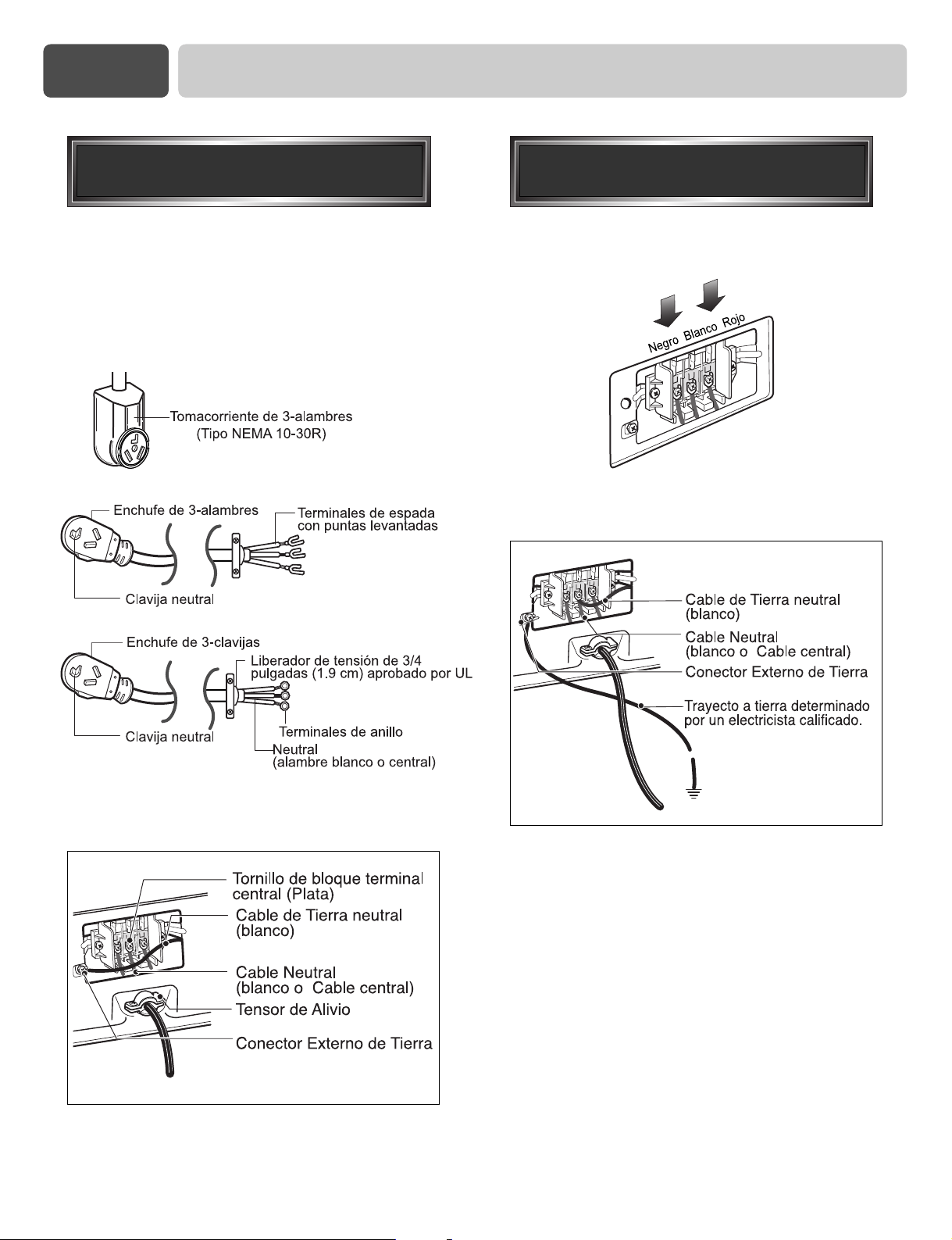
17
Parte 5
REQUERIMIENTOS ELÉCTRICOS PARA SECADORAS ELÉCTRICAS
Si los códigos y ordenanzas locales
permiten la conexión de un conductor
estructura-tierra al alambre neutral,
utilice estas instrucciones. Si los
códigos y ordenanzas locales no
permiten la conexión de un conductor
estructura-tierra al alambre neutral,
utilice las instrucciones bajo la
Sección 3: Conexión opcional de 3-
Opción 2
Conexión de 3-alambres con
un Cordón de Alimentación.
Opción 3
Conexión Opcional de
3-alambres.
• Si los códigos y ordenanzas locales
no permiten la conexión de un
conductor estructura-tierra a un
cable neutral, utilice las
1. Conecte un cable neutral (blanco) al
cordón de poder para centrar la
terminal del tornillo.
2. Conecte el cable de tierra(verde)
del cordón de poder al tornillo de
tierra externo y mueva el cable de
tierra neutral fuera del aparato y
conéctelo al tornillo central.
3. Conecte un cable rojo y otro Negro
en las terminales izquierdas y
derechas de los tornillos.
4. Asegúrese que el tornillo de alivio
de tensión este apretado. Asegure
que todo el bloque de tuercas esten
bien apretados, y el cable eléctrico
de poder este en la posición
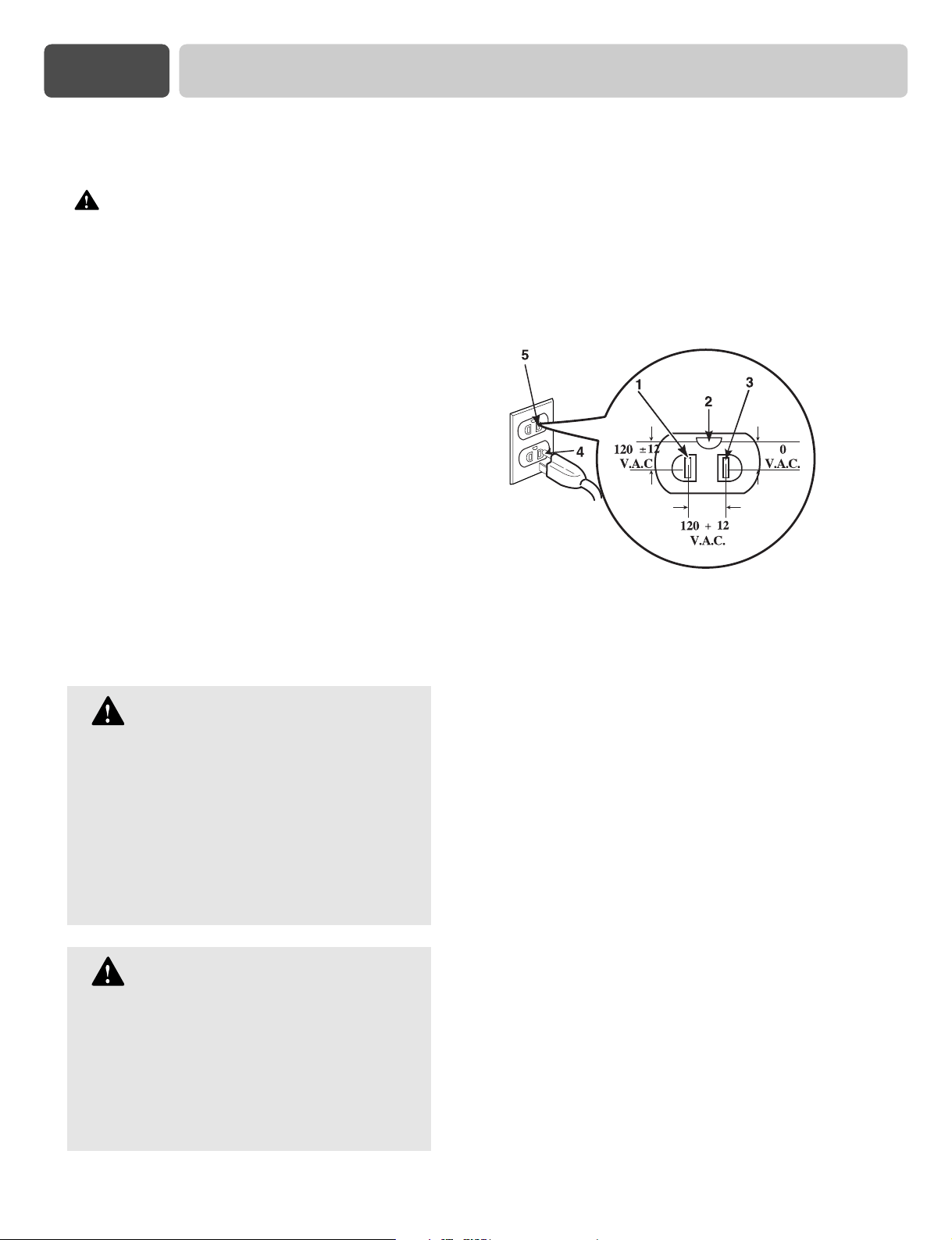
18
Parte 6
REQUERIMIENTOS ELÉCTRICOS PARA SECADORAS A GAS
120 Voltios, 60 Hertz, con Enchufe de 3-Clavijas con Conexión a Tierra
Las siguientes son instrucciones adicionales sobre las conexiones y requerimientos eléctricos para las secadoras a gas.
Advertencia Importante: Para ayudar a prevenir incendios, choque eléctrico,
lesiones serias o muerte, el cableado y la conexión a tierra deben estar de acuerdo
con la edición más reciente del código Eléctrico Nacional, ANSI/NFPA 70, o el
Código Eléctrico Canadiense, CSA C22.1, y todas la regulaciones locales aplicables.
Por favor contacte un electricista calificado para verificar el cableado y fusibles de
su casa y asegurar que tiene la energía eléctrica adecuada para el funcionamiento de
la secadora.
Requerimientos Eléctricos para su Secadora:!
a) Recuerde que el diagrama de
cableado se encuentra dentro de la
caperuza de control de la secadora.
Etiquete todos los cables antes de la
desconexión al realizar tareas de
servicio porque errores en el
cableado pueden ser causa de serias
lesiones para usted y para su
secadora.
b) Su secadora está diseñada para ser
operada en un circuito separado,
polarizado, de tres alambres
efectivamente conectados a tierra,
120 Voltios, 60 Hertz, AC (corriente
alterna) circuito protegido por un
a) La secadora tiene un enchufe de tres
clavijas para protección contra
choques eléctricos. El enchufe debe
ser conectado directamente a un
tomacorriente para tres clavijas
debidamente conectado a tierra
clasificado para 120 Voltios AC
(corriente alterna) 15 Amperios. Este
enchufe, para que sea debidamente y
completamente efectivo, debe estar
enchufado en un tomacorriente
debidamente instalado que esté
conectado a tierra de acuerdo a todos
los códigos y ordenanzas locales.
b) La secadora debe estar conectada a
tierra con el fin de reducir el riesgo
de choques eléctricos, incluyendo
mal funcionamiento o avería.
c) Si su cuarto de lavado no cumple con
las especificaciones requeridas por
este manual, o si no está seguro de
que su cuarto de lavado cumple con
ADVERTENCIA!
No sobrecargue el circuito operando otros
artefactos en el mismo circuito cuando este
artefacto está funcionando, utilizando una
extensión eléctrica para conectar la secadora
a la fuente de energía, o utilizando cualquier
adaptador que permita que se conecten
cordones adicionales al mismo
tomacorriente.
CIRCUITO ESTÁNDAR DE 120 VOLT,60 HERTZ,
3-ALAMBRES EFECTIVAMENTE CONECTADO A
TIERRA.
1 L1
2 Tierra
3 Lado Neutral
4 Clavija Redondeada a Tierra
5 Neutral
ADVERTENCIA!
NO modifique el enchufe provisto con la
secadora. Si éste no encaja en el
tomacorriente de su cuarto de lavado, un
tomacorriente adecuado necesitará ser
instalado por un técnico o compañía
calificada.
19
Parte 7 REQUERIMIENTOS E INSTRUCCIONES SOBRE EL GAS
Las siguientes son instrucciones e información importante concernientes a los
requerimientos para el suministro y servicio del gas para las secadoras a gas.
Advertencia Importante: El suministro y servicio del gas para las secadoras a gas
debe cumplir con los códigos y ordenanzas locales. Si no existen códigos y
ordenanzas locales en su área, el suministro y servicio del gas para su secadora a gas
1. Requerimientos del suministro de
gas: El servicio de Gas Petróleo
Licuado (L.P.) (2,500 Btu/ft3 (93.1
MJ/m3)) debe ser suministrado a una
presión de columna de agua de 10 +
1.5 pulgadas.
2. No intente conectar la Secadora al
Servicio de Gas Petròleo Lìquido (LP
Gas) sin personal calificado.
3. Aísle la secadora del sistema de
tuberías del suministro de gas
cerrando la válvula individual de
cierre manual, durante las pruebas de
presión del sistema de suministro de
gas a la presión de prueba igual o
menor que 2/1 psi (3.45 kPa).
4. Requerimientos de la Línea de
Suministro. Su cuarto de lavado debe
tener una línea rígida de suministro
de gas hasta la secadora. En USA,
una válvula individual de cierre
Instrucciones y ADVERTENCIAS:
• Conecte la secadora al tipo de gas
indicado en la placa de la secadora;
• Utilice conectores nuevos flexibles de
acero inoxidable;
• Utilice cinta de Teflón y sellador de
uniones insoluble en gas LP en todas
las roscas de las tuberías;
• Purgue el suministro de gas de aire y
sedimentos antes de conectarlo a la
secadora; con el propósito de evitar
contaminación de la válvula de gas,
antes de apretar la conexión entre el
suministro de gas y la secadora,
purgue el aire que queda hasta que el
olor a gas sea detectado; y
• NO use una flama para detectar fugas
de gas; en su lugar, utilice un líquido
detector de fugas no corrosivo.
ADVERTENCIA!
• Utilice una línea nueva de suministro de gas
aprobada por AGA o CSA.
• Instale una válvula de cierre.
• Asegúrese de apretar todas las conexiones de
gas
• Si está conectado a LP, haga que un técnico
calificado se asegure que la presión de gas no
exceda la columna de agua de 13 pulgadas.
• Ejemplos de los técnicos calificados incluyen
personal con licencia sobre calefacción
personal autorizado de la compañía de gas, y
personal autorizado de servicio.
• De no cumplir lo aquí indicado puede
ocasionar
la muerte, explosión o incendio.
ADVERTENCIA!
NO intente desmontar la secadora,
esta acción requiere la atención y
herramientas de un técnico o compañía
autorizada y calificada.
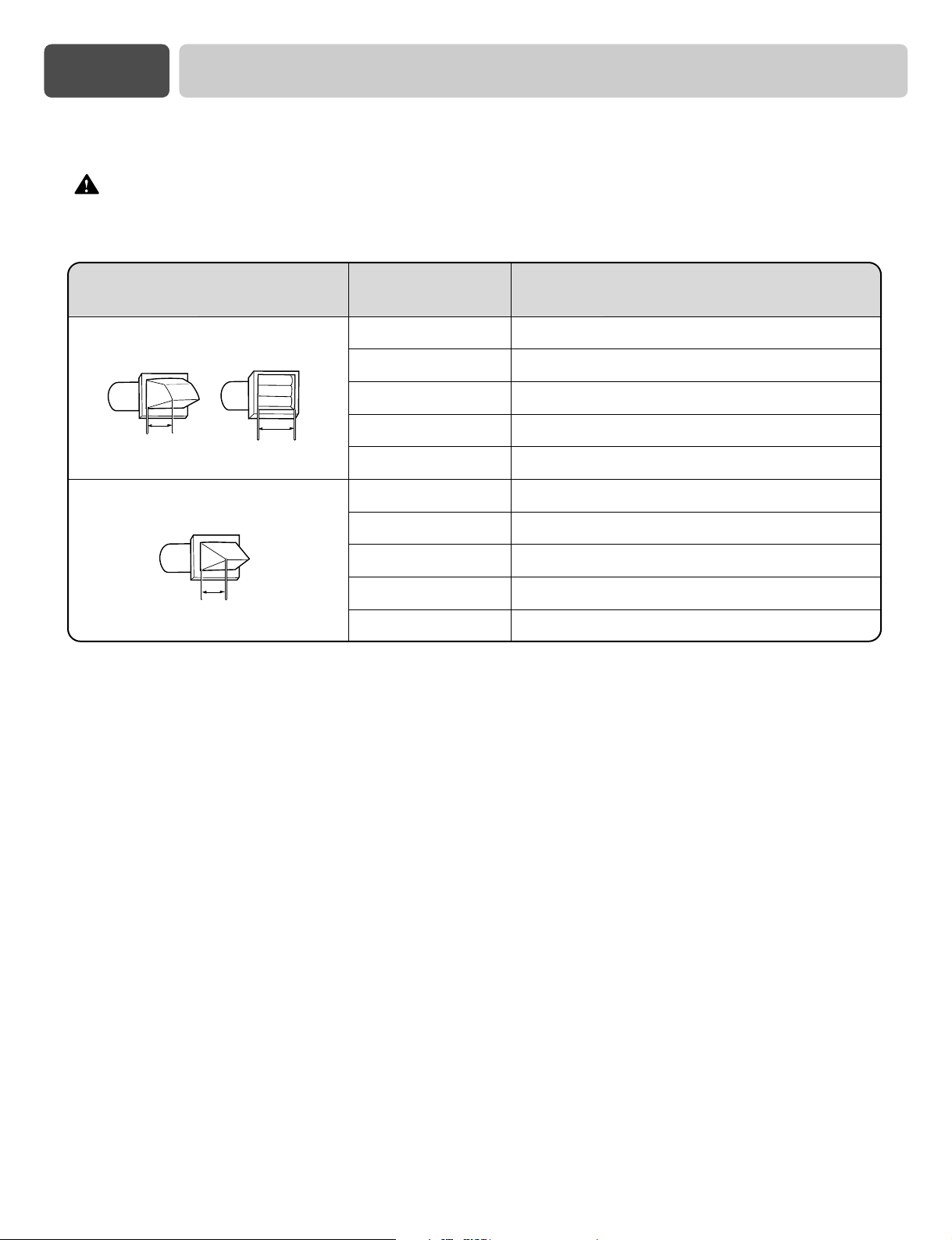
20
Parte 8
REQUERIMIENTOS Y MANTENIMIENTO SOBRE EL ESCAPE
Las siguientes son instrucciones e información importante concernientes a los
requerimientos del escape para su secadora.
Advertencia: NO dirija el escape de la secadora hacia un área cerrada y no
ventilada, como un ático, pared, techo, sótano, chimenea, salidas de gas, o espacio
oculto de un edificio. Para reducir el riesgo de incendio, NO utilice ductos de
plástico o lámina delgada para el escape de la secadora. De no cumplir lo aquí
Recomendado
Úsese únicamente para instalaciones de
carrera corta
4”
(10.2 cm)
4”
(10.2 cm)
2-1/2”
(6.35 cm)
1. Los materiales para la ventilación no son
suministrados con la secadora y usted deberá
obtener los materiales necesarios localmente.
Por ejemplo, el extremo exterior de la tubería
de escape debe tener una campana con
compuertas con bisagras para evitar corrientes
de aires cuando la secadora no está en uso.
2. Únicamente use un sistema de conducto rígido
y de metal flexible de 10 cm (4 pulg.) dentro
del gabinete de la secadora y para ventilación
al exterior. Si no se siguen estas instrucciones
se podrá producir incendio o muerte.
3. El conducto de escape deberá tener 10 cm (4
pulg.) de diámetro sin obstrucciones. El
conducto de escape deberá mantenerse lo más
corto posible. Asegúrese de limpiar cualquier
tipo de conducto antiguo antes de instalar su
secadora nueva. Si no se siguen estas
instrucciones se podrá producir incendio o
muerte.
4. Se recomiendan conductos rígidos o
semirígidos para usar entre la secadora y la
pared. En instalaciones particulares cuando es
imposible realizar una conexión siguiendo las
recomendaciones antes indicadas, únicamente
5. NO utilice tornillos de lámina de metal
ni otro tipo de aseguradores que
extiendan dentro del conducto y puedan
atrapar pelusa y reducir la eficiencia
del sistema de escape. Asegure todas
las uniones con cinta adhesiva
impermeable. Si no se siguen estas
instrucciones se podrá producir
incendio o muerte.
6. Para maximizar los resultados de
funcionamiento, siga las limitaciones
de longitud del conducto indicadas en
el cuadro de arriba. Si no se siguen
estas instrucciones se podrá producir
incendio o muerte.
7. La longitud total del conducto
metálico flexible no deberá superar los
2,4 m (8 ft)
8. En Canadá, sólo se deberán usar
conductos flexibles de lámina de metal,
si se precisasen, específicamente
identificados por el fabricante para su
Número de
Codos de 90°
Tipos de Campana
Longitud máxima del ducto de metal rígido
de 4" (10.2 cm) de diámetro
NOTA : Deduzca 6 pies (1.8 m) por cada codo adicional. No se recomienda usar más de 4 codos de 90°.
65 pies (19.8 m)
55 pies (16.8 m)
47 pies (13.7 m)
36 pies (11.0 m)
28 pies (8.5 m)
55 pies (16.8 m)
47 pies (13.7 m)
41 pies (12.5 m)
30 pies (9.1 m)
22 pies (6.7 m)
0
1
2
3
4
0
1
2
3
4
Requerimientos e Instrucciones del Escape

21
Parte 8
REQUERIMIENTOS Y MANTENIMIENTO SOBRE EL ESCAPE
Mantenimiento del Escape y la Secadora
1. Después de un año de uso, el interior y todo el sistema
de escape de la secadora debe ser examinado y
limpiado si es necesario.
2. Antes de que transcurra un año de uso, si el
rendimiento del secado ha bajado repentinamente a
niveles insatisfactorios, examine y limpie el conducto
de salida para conseguir un mejor nivel de secado.
3. Verifique la campana frecuentemente para asegurarse
que las compuertas se están moviendo libremente, que
no hayan sido empujadas hacia adentro, y que nada
haya sido recargado contra las compuertas.
4. Un técnico de servicio o compañía calificada debe ser
utilizada para realizar este mantenimiento.
5. Un equipo de Ventilación Flexible, disponible a costo
extra, puede utilizarse cuando el escape de la secadora
esta situado en lugares difíciles de alcanzar. Este
equipo viene en dos piezas, una se adjunta a la
secadora y la otra a la salida del escape de la pared.
Después de haber fijado las dos piezas por separado a
la secadora y a la pared, la secadora puede retornar a
su posición final, para luego conectar las dos piezas
entre si.
7. Usualmente, el tambor de la secadora no necesita
cuidado. Limpie el exterior de la secadora cuando sea
necesario, y siempre inmediatamente cuando se
derrame en la secadora cualquier detergente,
blanqueador, u otro producto para lavar, debido que
estos productos pueden causar daños permanentes al
acabado exterior de la secadora.
8. Limpie el panel de control con un paño húmedo
cuando sea necesario. Advertencia: los productos de
pre-lavados en spray pueden dañar el acabado del
panel de control.
9. Por favor limpie el filtro de pelusa antes o después de
secar cada carga.
10. Siempre asegúrese que el filtro de pelusa esté limpio
antes de empezar una nueva carga, debido a que un
filtro de pelusa obstruido puede aumentar el tiempo
de secado.
11. Anualmente remueva el filtro de pelusa y colóquelo
bajo el ducto de la aspiradora. Vea el ítem #2 arriba.
12. Por favor note que el diagrama de cableado se
localiza dentro de la cubierta de los controles de la
secadora. Etiquete todos los cables antes de
desconectarlos al darle mantenimiento a la secadora,
debido a que errores en el cableado pueden causar
lesiones serias a usted y daño a su secadora.
Limpieza de la Malla de Pelusa
1. Limpie el filtro de pelusa antes o
después de haber secado cada carga.
Siempre asegúrese que el filtro de
pelusa esté limpio antes de empezar
una nueva carga, debido a que un
filtro de pelusa obstruido puede
aumentar el tiempo de secado.
2. Para limpiarlo, tire de la malla de
pelusa hacia arriba y enrolle la
pelusa fuera de la malla con los
dedos. No enjuague o lave la malla
para remover la pelusa, debido a que
la pelusa mojada es difícil de quitar.
Empuje la malla de pelusa
firmemente de vuelta a su lugar.
3. Siempre asegúrese que la malla de
pelusa esté firmemente colocada
antes de operar la secadora. Operar la
secadora sin la malla de pelusa puede
causar sobrecalentamiento y causar
daño a la secadora como a los
artículos que está secando.
4. Algunas prendas pueden vertir màs
pelusa que otras (toallas por
ejemplo), ocasionando que el filtro
atrapapelusa se llene muy ràpido.
Remueva la pelusa de la malla de
pelusa antes y después de haber
secados estos artículos, tales como
toallas nuevas.
5. En el caso que la pelusa se caiga de
la malla dentro de la secadora
durante la remoción, verifique el
conducto de escape y quite cualquier
pelusa.
6. El detergente para lavar y los
residuos del suavizante de tela se
pueden acumular en la malla de
pelusa, causando tiempos de secado
más largos. La malla probablemente
se bloqueará si cae pelusa sobre ella.
Con el fin de prevenir este tipo de
acumulación, y ayudar a asegurar un
funcionamiento adecuado de su
secadora, limpie la malla de pelusa
con un cepillo de nailon cada seis
meses, o si es necesario, más
frecuentemente. El filtro de pelusa
también puede lavarse de la siguiente
manera:
a) Después de haber enrollado la pelusa
fuera de la malla con los dedos, moje
ambos lados de la malla con agua
caliente o tibia
ADVERTENCIA!
Desconecte la energía eléctrica de la secadora
antes de efectuar limpieza o mantenimiento.
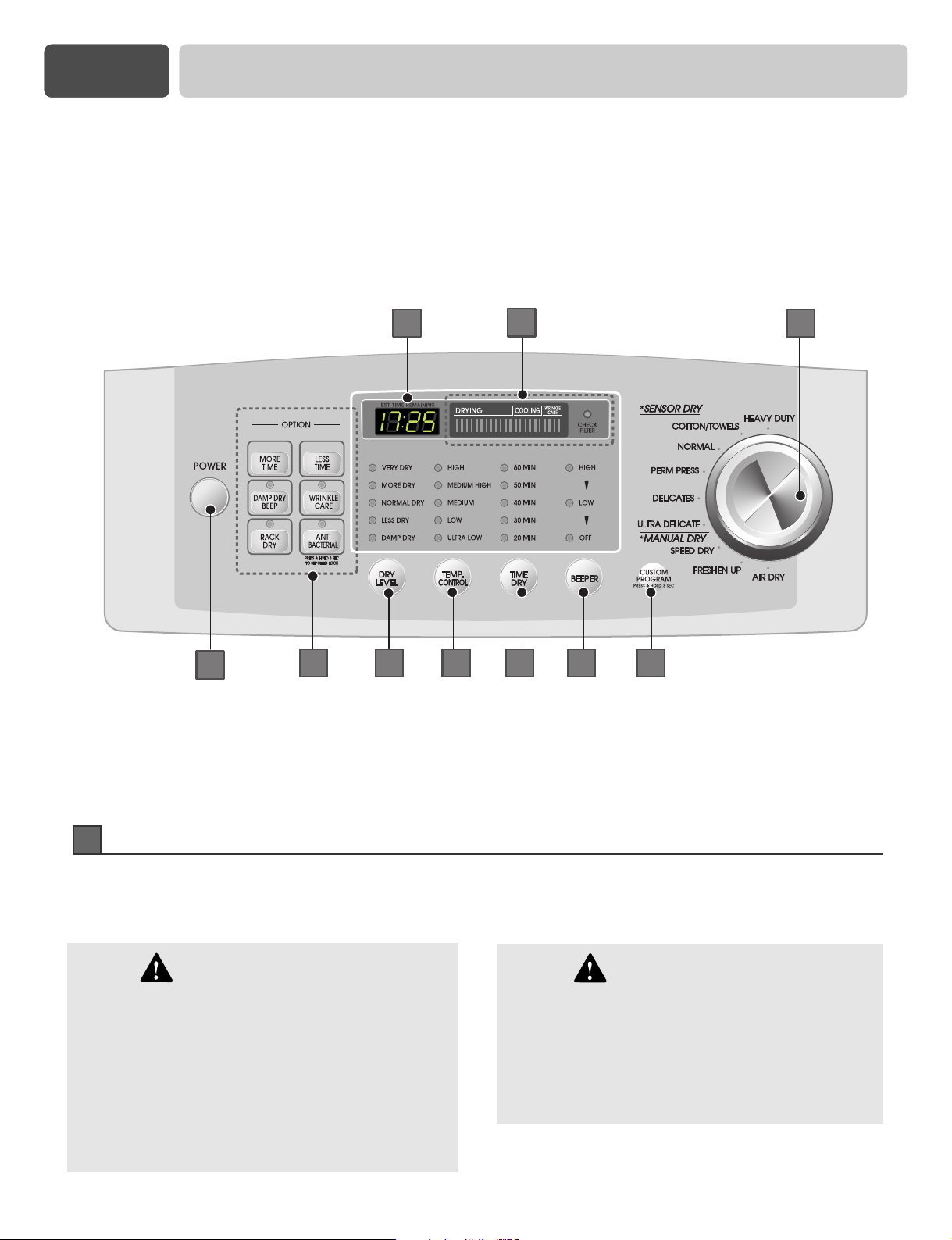
1
23456
7
8910
Status/Clean Filter/
Wrinkle Care Indicator
Custom Program
22
Parte 9 USANDO SU SECADORA
Las siguientes son las instrucciones para encender y utilizar su nueva secadora. Por favor refiérase a las secciones especificas de
este manual para información más detallada. Advertencia Importante: Para reducir el riesgo de incendio, choque eléctrico, o
lesiones personales lea este manual completamente, incluyendo las Instrucciones de Seguridad Importantes, antes de operar esta
secadora.
ADVERTENCIA!
Peligro de Incendio
Ninguna lavadora puede remover por completo el
aceite.
Nunca seque nada que haya tenido contacto con
algún tipo de aceite (incluyendo aceite de cocinar).
Artículos que contengan espuma, hule, o plástico
deben secarse en un tendedero o utilizando un
Ciclo de Aire. El no llevar a cabo estas
instrucciones puede resultar en muerte o incendio.!
ADVERTENCIA!
Peligro de Explosión
Mantenga materiales y vapores inflamables como
gasolina, lejos de la secadora.
No seque nada que haya tenido contacto con
algo inflamable (aún habiéndolo lavado).
El no llevar a cabo estas instrucciones puede
resultar en muerte, explosión, o incendio.MUY
• Use este botón para encender o
11
Botón de encendido
SELECTOR DE CICLO
Botón de
encendido
Control de
la
intensidad
del secado
Control
temp.
Control
tiempo
secado
Zumbador
enc/apag
PROGRAMA
PERSONALIZADO
Botones
OPCIÓN
TIEMPO REST.
ESTIMADO
Indicador estado/
limpiar filtro/cuidado arrugas
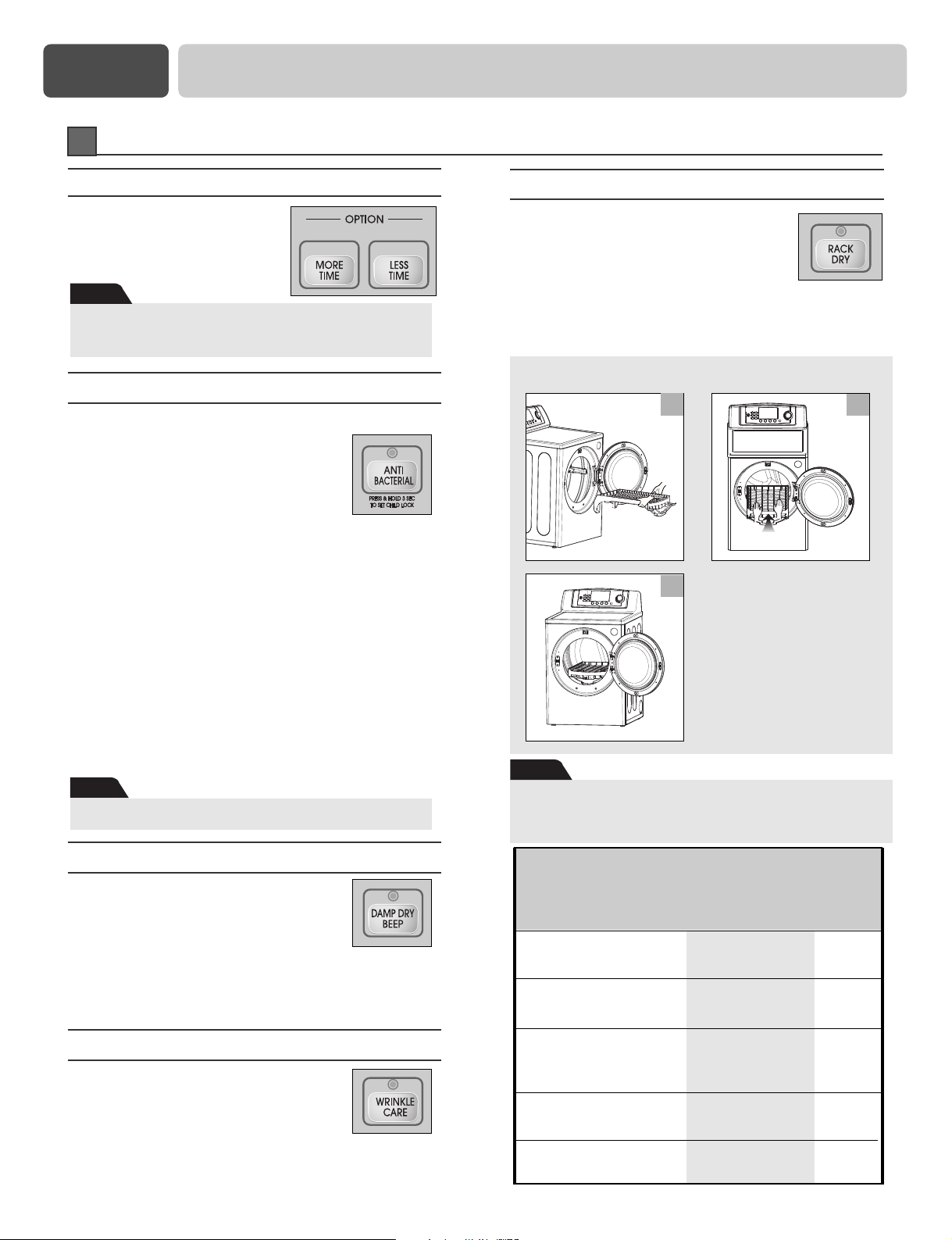
23
Parte 9 USANDO SU SECADORA
• Pulse MORE TIME o
LESS TIME hasta
ajustar el tiempo de
secado deseado.
El botón de cambio del tiempo está disponible sólo con
secado manual, secado por tiempo y secado por nivel.
Nota
22
Botón de cambio de tiempo
1. MORE TIME, LESS TIME
4. Cuidado arrugas
Esta opción le ayuda a evitar
que queden arrugas en sus
prendas de vestir.
Cuando seleccione la opción
libre de arrugas, la secadora dará vueltas
periódicamente hasta 3 horas una vez
completado el ciclo.
2. ANTI BACTERIAL
Esta opciòn sòlo puede ser utilizada
con NORMA, HEAVY DUTY,
CONNTON/TOWELS
[TRABAJO HEAVY DUTY,
ALGODÓN/TOALLAS], y
ciclos
Esta opciòn reduce algunos tipos de
bacterias.
El proceso ANTI BACTERIAL produce
altas temperaturas durante el ciclo.
● Control paterno
El control paterno puede usarse para evitar que sus niños hagan
un uso indebido del panel de control mientras la secadora está
funcionando.
Cuando el control paterno está activado, todos los botones
estarán bloqueados y el botón del control paterno se iluminará.
Para bloquear
Pulse y mantenga pulsado Anti Bacterial por 3 segundos.
Oirá
un tono de zumbador y verá aparecer CL en la ventana de estado.
3. Beeper de Secado Húmedo
Cuando selecciona la opción
de Alarma de Secado
Húmedo, una alarma lo
alertará cuando su carga esté
aproximadamente al 80% seco.
Esta alarma le permitirá retirar las
prendas ligeras que estén ya secas u
No utilice este ciclo con las telas delicadas.
Nota
5. Rack Dry[Secado con Parrilla]
El perchero de secado viene incluido en su
secadora. Retire y deseche el material envolvente
antes de usarlo. Use el Rack Dry[Secado con
Parrilla] para artículos que usted no quiera secar
dando vueltas, así como suéteres. Cuando use el
perchero de secado con calor, el aire caliente dentro de la secadora
fluirá en una trayectoria concentrada que permitirá un secado
uniforme y eficiente. Utilice el Tempo de Secado para determinar el
tiempo de secado deseado.
■ PARA USAR LA PARRILLA DE SECADO
1. Abra la puerta
Sostenga la parrilla de
secado con ambas manos
2. Inserte la parilla de secado
dentro de la tina
3. Asegùrese que la parilla
estè bien puesta dentro de
la tina
1
3
No use Rack para un secado normal. El secado con niveles
se envía colocado en su sitio en su secadora, de modo que
debe sacar la estantería para secados normales.
Nota
Artículos
sugeridos para
secado con
Parrilla
Temperatura Tiempo
Sugerido*
(Minutos)
Prendas de Lana lavables
Low
[Bajo]
20
20/30
50/30
50
20
Low/Ultra Low
[Bajo/Ultra Bajo]
Air Dry[Aire Seco]
Ultra Low[Ulta
Bajo]
Air Dry
[Aire Seco]
Air Dry
[Aire Seco]
Juguetes rellenos de
algodón o de poliéster
Juguetes
rellenos de hule
espuma
Almohadas de
hule espuma
Zapatos
* Reinicie el tiempo lo necesario para completar el secado.
2
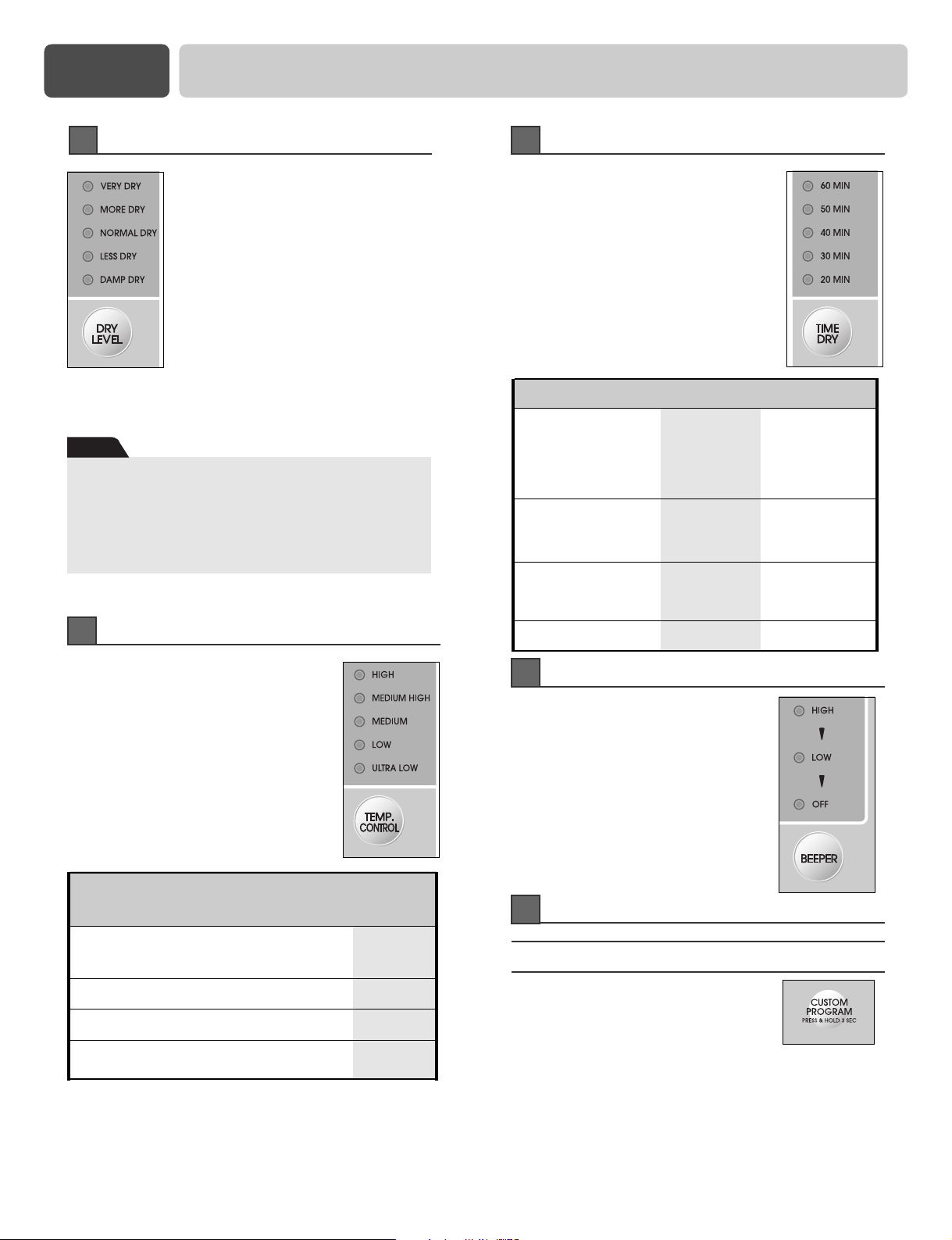
24
Tipo de Carga TIEMPO FIJADO EN
FABRICA (MINUTOS)
Características Predeterminadas del Ciclo Manual
Seco
Manualmente
Carga de Ciclos
Tipo
TEMP. TIEMPO
FIJADO EN
FABRICA*
(MINUTOS)
SPEED DRY
[Secado Rápido]
Cargas Pequeñas
FRESHEN UP
[Fresco]
Quita Arrugas
AIR DRY[Aire Seco]
High[Alto]
Medium HIgh
[Medio Alto]
Aire Seco
25
20
30
Almohadas de hule espuma, sostenes y
juguetes con relleno
Cortinas de Baño (plástico), mantelerìa
Tapetes de goma
Olefin, polipropileno, nailon puro
20 - 30
20 - 30
40 - 50
10 - 20
La beeper[Alarma]
controla el volumen de la
señal que se emite cuando
se presiona algún botón
en el panel de control y
cuando la conclusión de
algún ciclo es indicado.
Presione beeper[Alarma]
para ajustar el nivel del
sonido o para apagar la
señal.
Use la opción de control
del tiempo para
seleccionar las
temperaturas par alos
ciclos manuales. Pulse
TEMP CONTROL hasta
que se ilumine el ajuste
de temperatura. Los
modificadores de la
temperatura no pueden
usarse con los ciclos del
66
beeper[Alarma]
Opción seca del tiempo del
uso para cambiar tiempo
de secado en sus el propios
usted puede seleccionar el
tiempo deseado de la
operación manualmente
presionando el botón seco
del tiempo que se extiende
a partir del 20 a 60
55
Time Dry [Tiempo secado]
44
Control temp.
Parte 9 USANDO SU SECADORA
1. PROGRAMA PERSONALIZADO
Programación personalizada para ajustar
su combinación favorita de distintos
ajustes y guardarlos aquí para rellamarlos
con un simple toque de un botón.
1. Seleccione un ciclo.
2. Cambie DRY LEVEL y TEMP CONTROL.
3. Seleccione OPTIONS, las que desee.
4. Mantenga pulsdao CUSTOM PROGRAM.
Para volver a llamar su CUSTOM PROGRAM
(PROGRAMA PERSONALIZADO) guardado
Pulse CUSTOM PROGRAM y, a continuación,
START/PAUSE.
77
Programa Personalizado
• Use este botón para
ajustar el nivel de
secado.
• Primero, seleccione el
ciclo de secado por
sensor.
• Seleccione el nivel de
secado para ajustar
cuánto desea secar la
carga. Según se ejecuta
el ciclo, el control
detecta el nivel de
sequedad de la carga y
33
Control de la intensidad del secado
Las selecciones de NIVEL DE SECADO sólo pueden
realizarse mientras se usan ciclos de secado por
sensor seleccionando MORE (más) secado o LESS
(menos) secado para ajustar automáticamente el
tiempo necesario ya detectado.
Nota
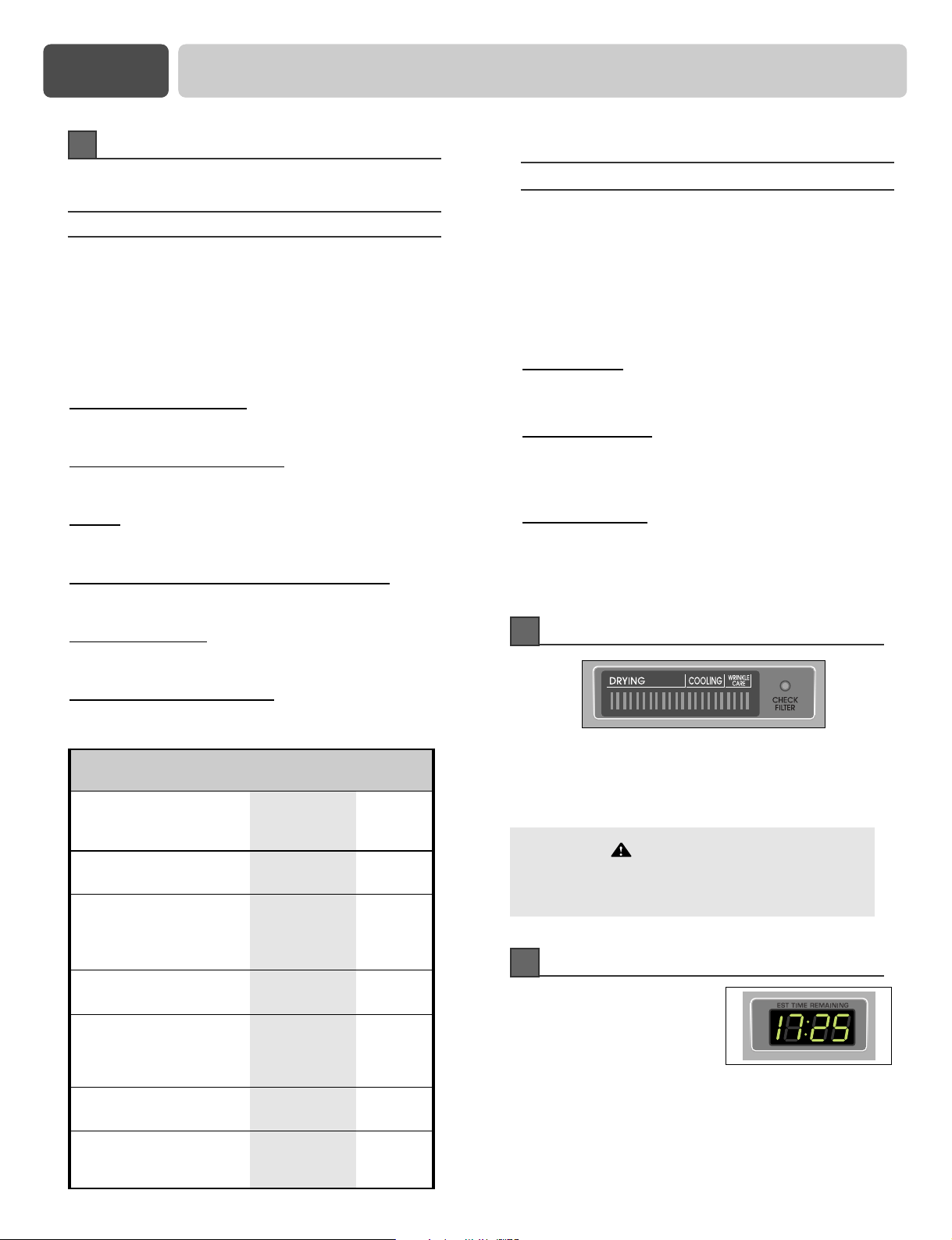
25
Parte 9 USANDO SU SECADORA
• Muestra el estado de la operación de secado.
Cuando se seleccione el cuidado de arrugas, esta opción
se iluminará. Cuando el encendido esté activado, limpiar
filtro parpadeará hasta que se seleccione arrancar/pausa.
ADVERTENCIA!
Para lograr un mejor secado y seguridad, limpie
el filtro de pelusillas o hilos con cada uso.
99
Indicador estado/limpiar filtro/cuidado arrugas
Tipos de Cargas del
Ciclo de Sensor Dry
[sensor de secado]
Temperatura
Tiempo*
(Minutos)
Características Predeterminadas del Ciclo de Sensor
Dry[sensor de secado]
HEAVY DUTY[PESADO]
Jeans, carga pesada
COTTON/TOWELS
[ALGODÓN/TOALLAS]
Toallas, pantalones de
algodón
NORMAL
Ropa de Trabajo, pana
PERM PRESS
[PLANCHADO PERMNENTE]
Sintéticos, planchado
permanente
DELICATES[DELICADOS]
Ropa Interior, playeras, blusas
ULTRA DELICATE
Prendas de ejercicio,
encaje, etc
High[Alto]
Medium High
[Medio Alto]
Medium[Medio]
Low[Bajo]
Low[Bajo]
Ultra Low
[Ultra Bajo]
54
55
41
36
32
34
• Marcando con la perilla, seleccione el ciclo deseado
basándose en los tipos de colada y las condiciones existentes.
2288
Selección de ciclo
Seleccione el ciclo de secado que concuerde con el tipo de carga
que desea secar.
(Vea la tabla de Características Preestablecidas de los Ciclos
Sensor Dry[sensor de secado] y Manual. Los Ciclos de Sensor
Dry[sensor de secado] le permiten ajustar el ciclo con la carga
que está secando. Cada ciclo seca ciertas telas a la temperatura
recomendada. Un sensor detecta la humedad en la carga y ajusta
automáticamente el tiempo de secado para un secado óptimo.
Heavy duty(carga Pesada)
Use para secar algodón, toallas, algodones fuertes
(temperatura media-alta)
Cotton/Towels Algodón/Toallas
Use este ciclo para obtener temperatura medio-high para
secar toallas, mezclilla.
Normal
Use para secar telas firmes como ropa de trabajo casual
(temperatura mediana)
wrinkle care (Perm Press)(cuidado anti-arrugas)
Use para planchado permanente y para prendas sintéticas
(temperatura media)
Delicates (Delicados)
Use para secar telas sintéticas, tejidos lavables y telas de
no planchar (temperatura baja)
Ultra delicates (Ultra delicatos)
Use para secar delicadamente prendas de ejercicio, encaje,
etc (temperatura ultra baja)
1. Ciclo de Sensor Dry[sensor de secado]
2. Ciclos Manuales
Use los Ciclos Manuales para seleccionar una cantidad
especifica de tiempo de secado y una temperatura de
secado. Cuando un Ciclo Manual es seleccionado, la
pantalla del estimated time remaining(Tiempo Restante
Estimado) muestra el tiempo actual restante en su ciclo.
Usted puede cambiar el tiempo actual presionando los
botones more time y less time(Más Tiempo y Menos
Tiempo).
Secado Rápido
Use para cargas pequeñas o cargas que necesiten poco
tiempo de secado.
Freshen up [Fresco]
Use este ciclo para eliminar arrugas de las prendas, tales
como aquellas guardadas en maletas o prendas arrugadas
por haberse quedado mucho tiempo en la secadora.
Air dry [Aire Seco]
Use el Modificador de Air Seco para prendas que no
necesiten calor para secarse como el hule, plástico y telas
sensibles al calor.
• La pantalla muestra
el tiempo restante
estimado.
Además de ello, si la
secadora tiene algún
problema, aparecerán
mensaje de error en
pantalla.
1100
Tiempo rest. estimado
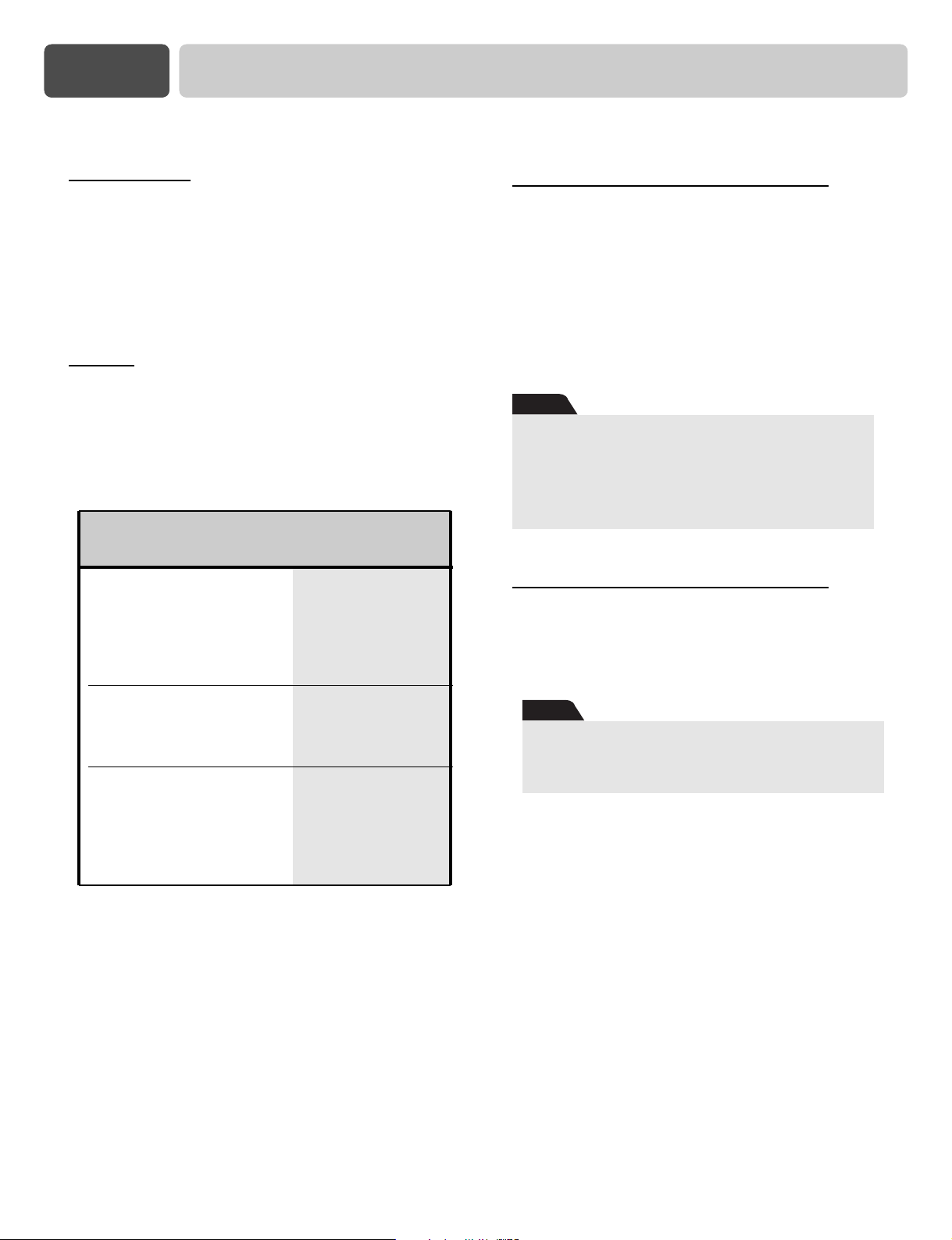
26
4. Para usar un ciclo de secado por sensor
• Seleccione un ciclo de secado manual.
• Pulse MORE TIME o LESS TIME hasta
que el tiempo de secado aparezca en
pantalla. Seleccione MORE TIME o
LESS TIME y el tiempo cambiará en
• Pulse TEMP. CONTROL hasta que se
ilumine el indicador de temperatura
deseado.
• (PASO OPCIONAL) Si lo desea,
seleccione OPTIONS.
Para más detalles, consulte Opciones.
• Pulse START/PAUSE. Asegúrese de que
la puerta está cerrada.
• Si no pulsa START/PAUSE antes de que
pasen 10 minutos una vez realizada la
selección del ciclo, la secadora se
apagará automáticamente.
• Si desea terminar su ciclo de secado
una vez pulsado START/PAUSE, pulse
La función MORE TIME o LESS TIME puede usarse
con secado manual, secado por tiempo y secado
rack (con niveles).
Nota
Parte 9 USANDO SU SECADORA
1. Antes de usar
• Limpie la pantalla de hilos antes y
después de cada ciclo.
• Coloque la colada en la secadora y
cierre la puerta. Consulte el apartado
de carga.
• illegible parts - cannot read properly -
please re-send
2. Car
ga
• Determine el tamaño de la carga por la
cantidad de espacio que la carga
requiere más bien que el peso de la
carga.
• Evite de sobrecargar el secador.
Después de estos la instrucción puede
3. Para usar un ciclo de secado por sensor
• Seleccione DRY LEVEL para ajustar
el nivel de sequedad que desea
alcanzar en la carga. Según se
ejecuta el ciclo, el control detecta
la sequedad existente en la carga y
ajusta el tiempo automáticamente
para alcanzar el nivel seleccionado.
• Seleccione las opciones deseadas.
Las selecciones de NIVEL DE SECADO sólo pueden
realizarse mientras se usan ciclos de secado por
sensor seleccionando MORE (más) secado o LESS
(menos) secado para ajustar automáticamente el
tiempo necesario ya detectado.
Nota
❁ Arranque de seu secadora
Heavy Work Clothes
[Ropas de Uso
Pesado]
4 pantalones
vaqueros
2 pantalones de
ejercicios
2 sudaderas
Towels[Toallas]
10 toallas de baño
10 toallas de mano
14 paños para
Mixed Load[Carga
Mixta]
3 sabanas (1 grande, 2
medianas)
4 fundas de almohadas
3 camisas
3 blusas
9 camisetas
9 calzoncillos
10 pañuelos
Los siguientes son ejemplos de
cargas para Secadoras de Súper
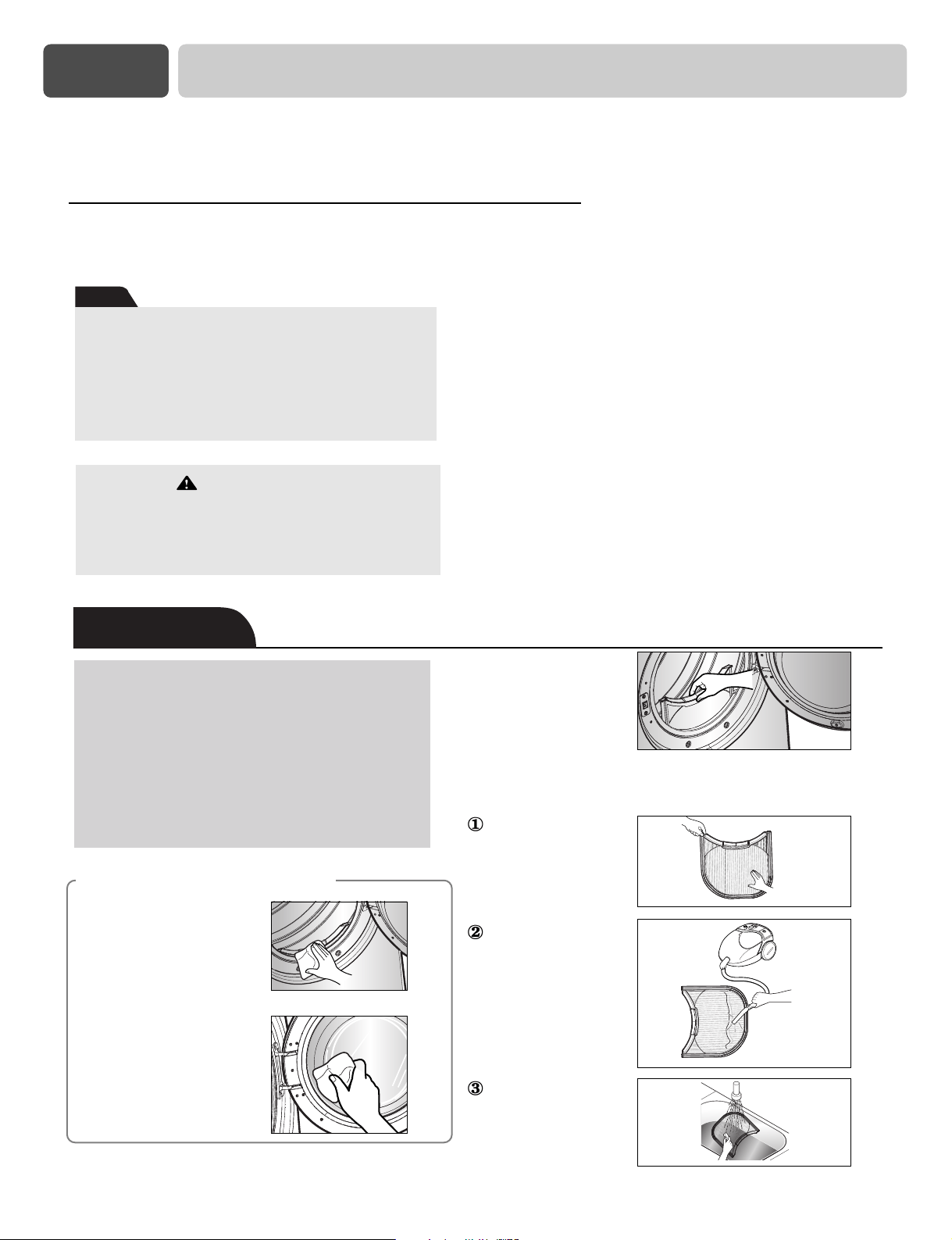
27
Parte 9 USANDO SU SECADORA
No es muy difìcil mantener cuidada
su secadora.
Todo lo que tiene que hacer es
seguir los siguientes pasos.
Limpie el filtro y asegúrese de
tenerlo limpio antes de cualquier
uso.
No limpiarlo ocasiona que el
secado sea màs tardado y gaste màs
energìa
1. Abra la puerta y
jale el filtro
atrapapelusa
Usar los dedos a
traves del filtro
2. Limpiar el filtro usando una de las siguientes
formas en los casos.
Aspire el filtro
Lave el filtro con
jabòn y agua
caliente.
Seque fuertemente y
reemplace.
■ Limpiar el filtro atrapapelusa
Mantenimiento
2.Limpie la puerta
transparente para
mantener una vista
clara a traves del
vidrio.
1.Limpie la apertura de la
puerta De otra manera,
se genera polvo y
residuos que pueden
dañar la cerradura de la
puerta
5. Pausar o reiniciar. Para pausar la secadora en cualquier momento
Abra la puerta o pulse START/PAUSE una vez.
Para reiniciar la secadora
Cierre la puerta. Pulse START/PAUSE.
El secado continuará desde el punto en el que se
interrumpió el ciclo si cierra la puerta y pulsa
START antes de que pasen 10 minutos. Si el ciclo
se interrumpió más de 10 minutos, la secadora se
apagará. Seleccione nuevos ajustes de ciclo antes
de reiniciar la secadora.
Nota
ADVERTENCIA!
La conexión indebida del cable o un error de
cableado relacionado puede provocar incendios,
descargas eléctricas o incluso la muerte.
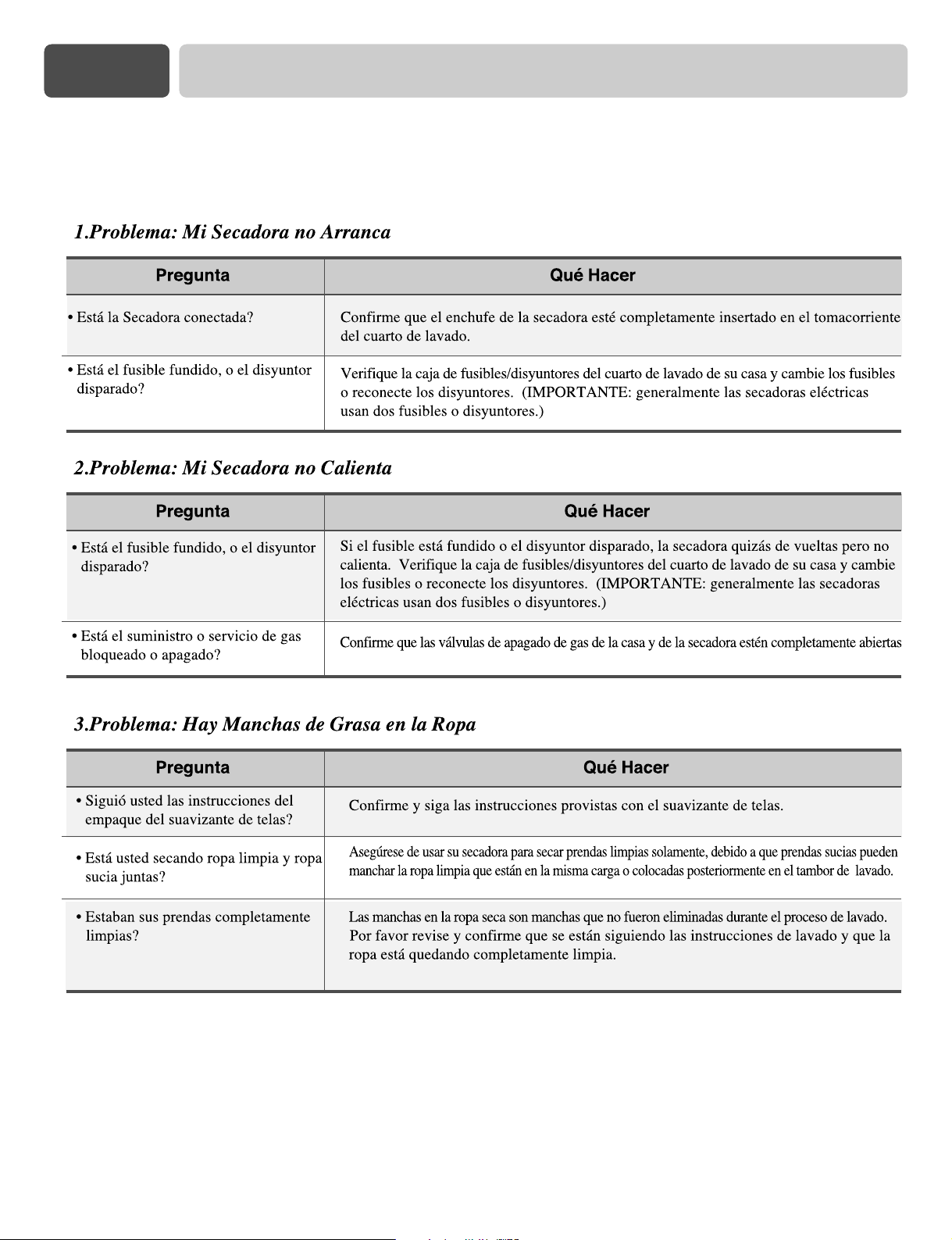
28
Parte 10 GUÍA PARA LA SOLUCIÓN DE PROBLEMAS
Consejos para la solución de problemas
Ahorre tiempo y dinero! Primero revise las tablas en las siguientes
p áginas y quizás no necesite llamar a servicio.
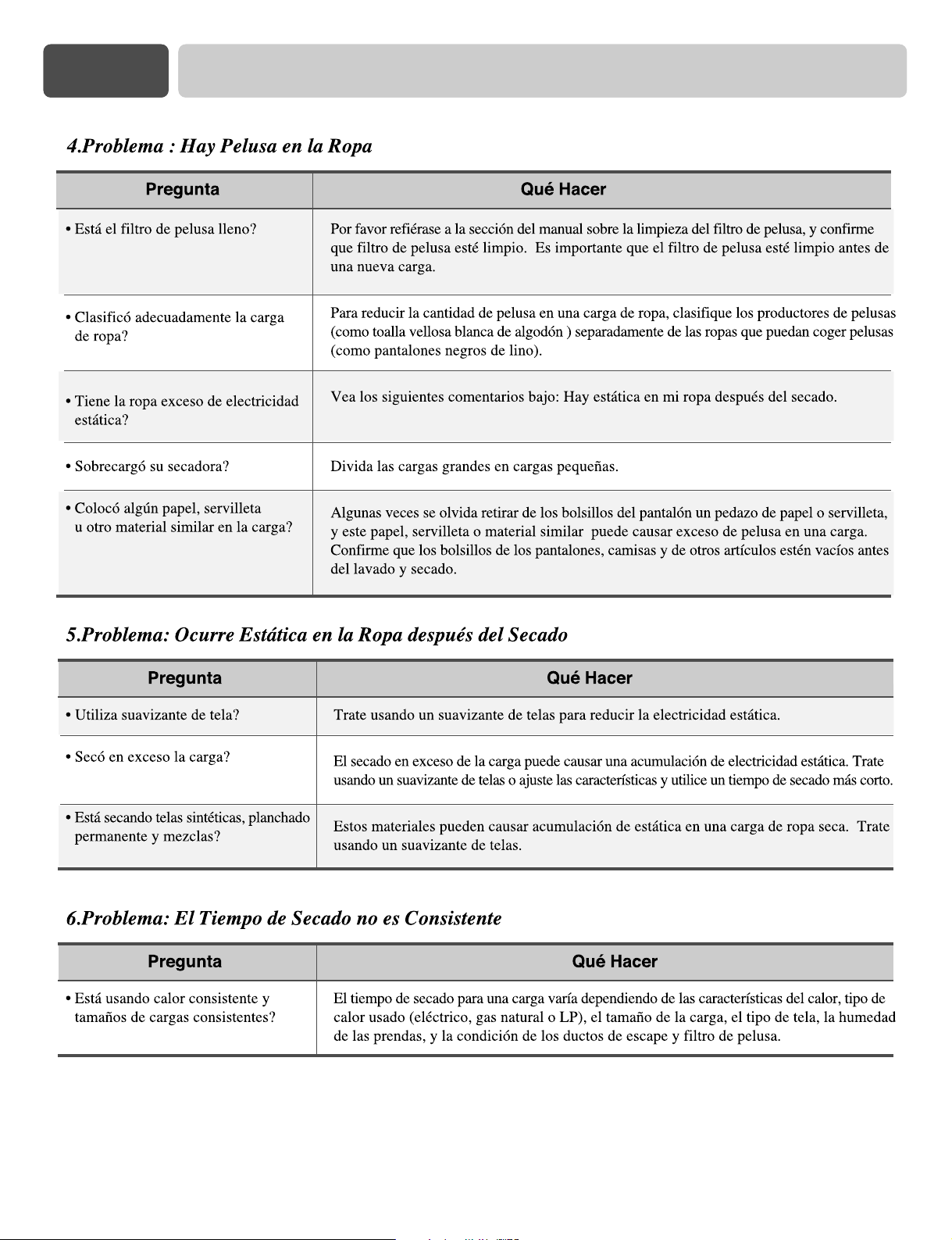
29
Parte 10 GUÍA PARA LA SOLUCIÓN DE PROBLEMAS
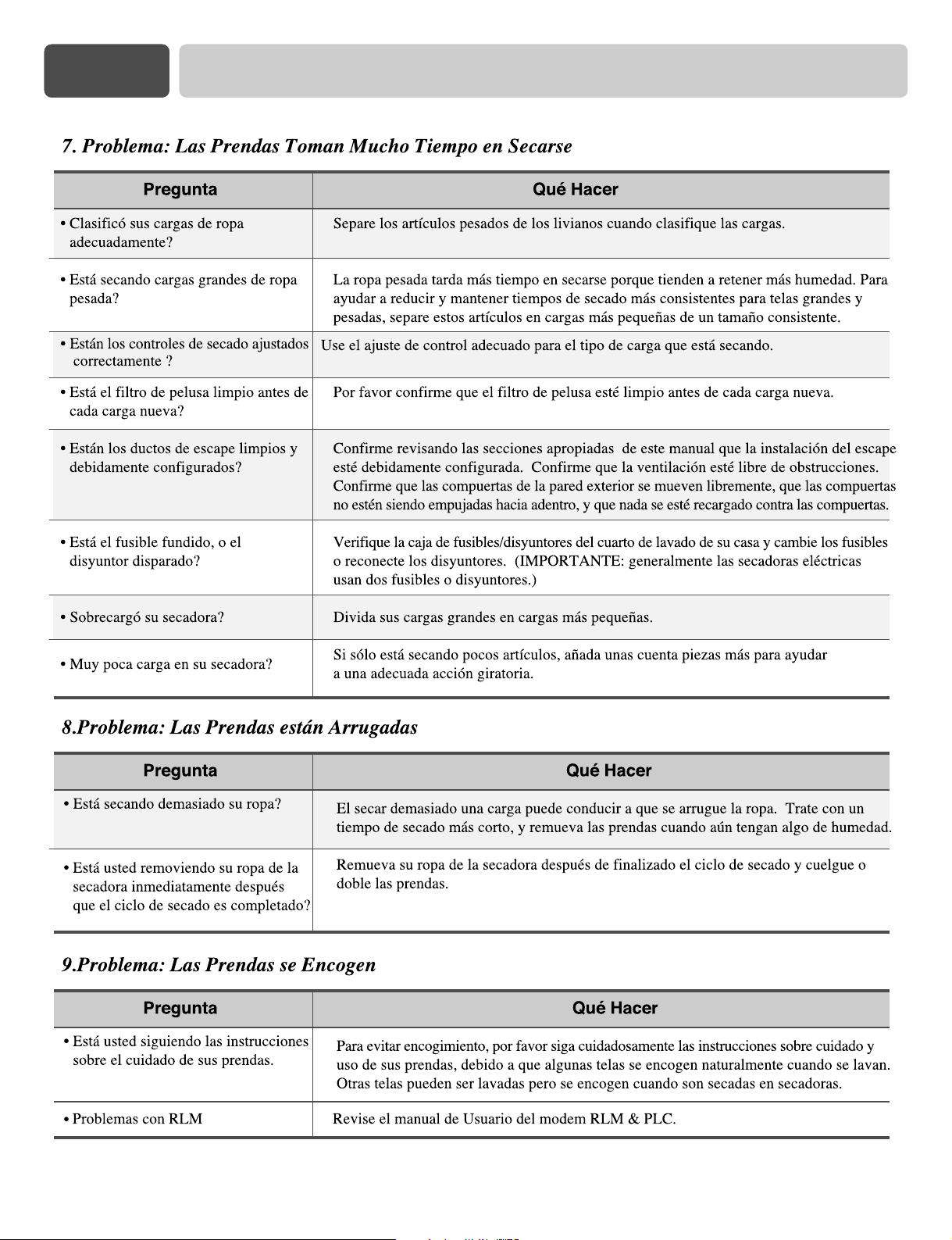
30
Parte 10 GUÍA PARA LA SOLUCIÓN DE PROBLEMAS
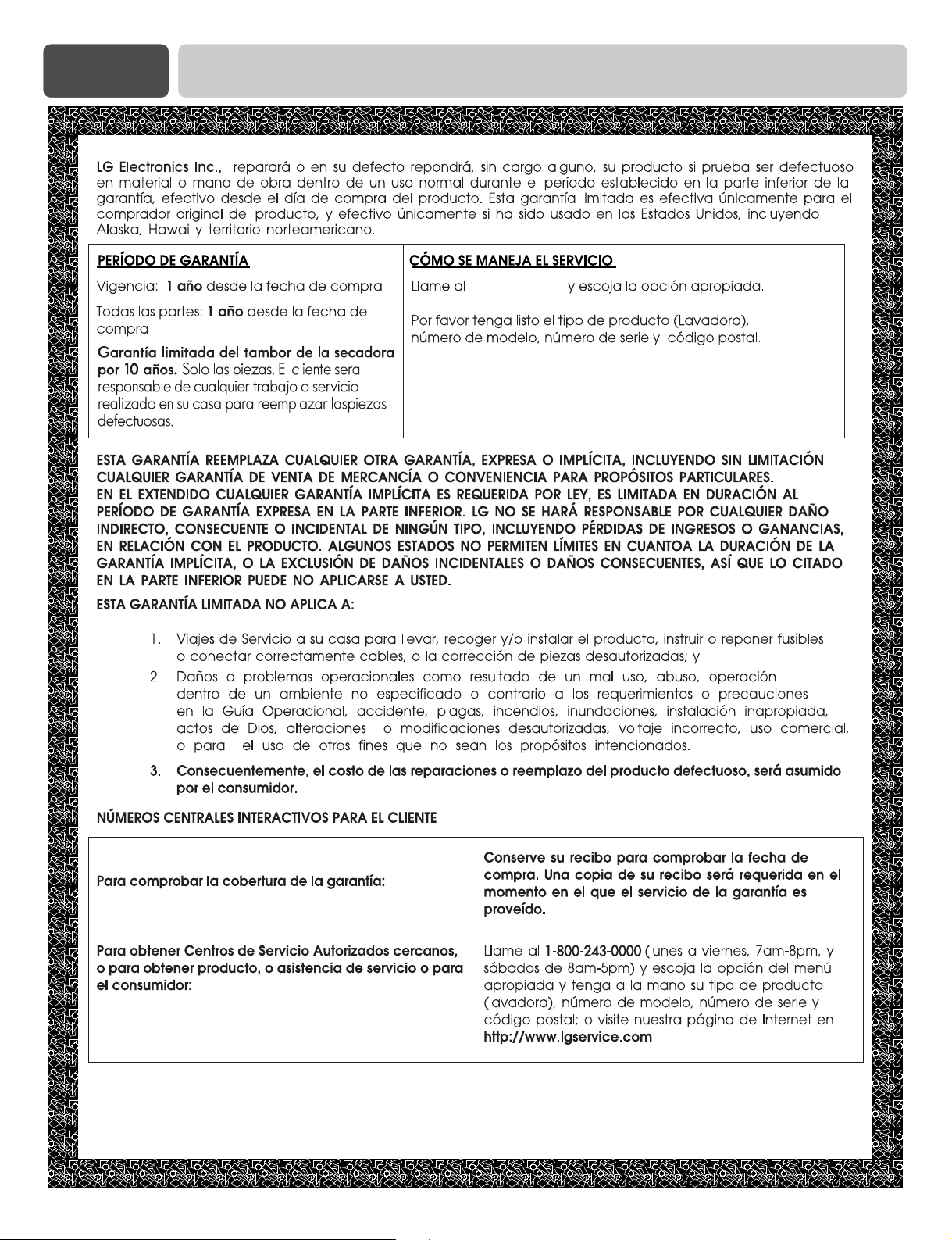
31
GARANTÍA LIMITADA DE LA SECADORA LG-USA
1-800-243-0000