OWNER’S MANUAL
2017
2017 FIAT 124 SPIDER ABARTH
Fourth Edition
Printed in U.S.A.
©2016 FCA US LLC. All Rights Reserved.
FIAT is a registered trademark of FCA Group
Marketing S.p.A., used under license by FCA US LLC.
17BAFX124-126-AD
FIAT
®
124 SPIDER ABARTH

VEHICLES SOLD IN CANADA
With respect to any Vehicles Sold in Canada, the name FCA
US LLC shall be deemed to be deleted and the name FCA
Canada Inc. used in substitution therefore.
DRIVING AND ALCOHOL
Drunken driving is one of the most frequent causes of
accidents.
Your driving ability can be seriously impaired with blood
alcohol levels far below the legal minimum. If you are
drinking, don’t drive. Ride with a designated non-
drinking driver, call a cab, a friend, or use public trans-
portation.
WARNING!
Driving after drinking can lead to an accident.
Your perceptions are less sharp, your reflexes are
slower, and your judgment is impaired when you
have been drinking. Never drink and then drive.
This manual illustrates and describes the operation of
features and equipment that are either standard or op-
tional on this vehicle. This manual may also include a
description of features and equipment that are no longer
available or were not ordered on this vehicle. Please
disregard any features and equipment described in this
manual that are not on this vehicle.
FCA US LLC reserves the right to make changes in design
and specifications, and/or make additions to or improve-
ments to its products without imposing any obligation
upon itself to install them on products previously manu-
factured.
Copyright © 2016 FCA US LLC

DEAR CUSTOMER
Dear Customer,
We would like to congratulate and thank you for choosing a Fiat 124 Spider.
We have written this Owner’s Manual to help you get to know all the features of your vehicle and use it in the best possible way.
Here you will find information, advice and important warnings regarding use of your vehicle and how to achieve the best
performance from the technical features of your vehicle.
You are advised to take the time to read these publications carefully before taking to the road for the first time, to become
familiar with the controls and above all with those concerning brakes, steering and transmission; at the same time, you can
understand the vehicle behavior on different road surfaces.
This document also provides a description of special features and tips, as well as essential information for the safe driving, care
and maintenance of your vehicle over time.
After reading it, you are advised to keep the Owner’s Manual inside the vehicle, for an easy reference and for making sure it
remains in the vehicle should it be sold.
In the attached Warranty Booklet you will also find a description of the Services that FCA offers to its customers, and the detail
of the terms and conditions for maintaining its validity.
We are sure that these will help you to get in touch with and appreciate your new vehicle and the service provided by the
people at FCA.
Enjoy reading. Happy motoring!
Note: This Owner’s Manual describes all models of the vehicle; please consider only the information relevant to your vehicle’s
trim level, engine and model. All data contained in this publication are purely indicative. FCA can modify the vehicle model
described in this publication at any time, for technical or commercial purposes. For further information, contact your authorized
dealer.

Read This Carefully
REFUELING
Only refuel with unleaded gasoline with a recommended rating of 91 octane. A rating less than 87 octane is not acceptable. Do not use
gasoline containing methanol or ethanol E85. Using these mixtures may cause misfiring and handling issues, as well as damage fundamental
components of the fuel supply system.
STARTING THE ENGINE
If equipped with a manual transmission: Be sure that the parking brake is engaged; place the gear selector in NEUTRAL, fully depress the
clutch pedal without pressing the accelerator, and then push the ignition button. The engine will start as soon as the ignition is pushed.
If equipped with an automatic transmission: Be sure that the parking brake is engaged and that the gear selector is in PARK (P) or
NEUTRAL (N), depress the brake pedal, and then push the ignition button. The engine will start as soon as the ignition is pushed.
PARKING ON FLAMMABLE MATERIAL
The catalytic converter develops high temperatures during operation. Do not park the vehicle on grass, dry leaves, pine needles or other
flammable material: fire hazard.
RESPECTING THE ENVIRONMENT
The vehicle is equipped with a system that carries out a continuous diagnosis of the emission-related components in order to help protect the
environment.
ELECTRICAL ACCESSORIES
Contact your authorized dealer if you decide to add electrical accessories (with the risk of gradually draining the battery) after buying the
vehicle. They can calculate the overall electrical requirement and check that the vehicle's electric system can support the required load.
SCHEDULED SERVICING
Correct maintenance of the vehicle is essential for ensuring that it maintains its performance and its safety features, its environmental
friendliness and low running costs are unchanged over time.

How To Use This Manual
ESSENTIAL INFORMATION
Each time directions (left/right or forward/backwards) are listed, they are determined by facing forward from the rear of the
vehicle or as from the point of view of being seated inside the car. Special cases not complying with this rule will be properly
specified in the text.
The figures in the Owner’s Manual are provided by way of example only: this might imply that some details of the image do not
correspond to the actual arrangement of your vehicle. In addition, the Owner’s Manual has been conceived considering vehicles
with steering wheel on the left side; it is therefore possible that on vehicles with steering wheel on the right side, the position of
some controls or elements is not exactly mirror-like with respect to the figure.
To identify the chapter with the information needed you can consult the index at the end of this Owner’s Manual.
Chapters can be rapidly identified by graphic tabs, at the side of each odd page. A key showing the order of the chapter and
the corresponding tab symbols appears on another page.
SYMBOLS
While reading this Owner’s Manual you will find a series of WARNINGS to prevent procedures that could damage your vehicle.
There are also CAUTIONS that must be carefully followed to prevent incorrect use of the components of the vehicle, which
could cause accidents or injuries.
Therefore, all WARNINGS and CAUTIONS must always be carefully followed.
WARNINGS and CAUTIONS are recalled in the text with the following symbols:
Personal Safety
Vehicle Safety

Vehicle Modifications / Alterations
Warning!
Any change or alteration of the vehicle might seriously affect its safety and road holding, thus causing accidents, in which the occupants
could be fatally injured.
ACCESSORIES PURCHASED BY THE OWNER
If after buying the vehicle, you decide to install electrical accessories that require a permanent electrical supply (e.g. radio,
satellite anti-theft system, etc.) or accessories that burden the electrical supply, contact your authorized dealer, whose
personnel will check whether the vehicles's electrical system is able to withstand the load required , or whether it needs to be
integrated with a more powerful battery.
Note: Use only floor mats that leave the pedal area unobstructed and that are firmly secured so that they cannot slip out of
position and interfere with the pedals or impair safe operation of your vehicle in other ways.
INSTALLING ELECTRICAL / ELECTRONIC DEVICES
The following regulatory statement applies to all radio frequency (RF) devices equipped in this vehicle:
This device complies with part 15 of the FCC Rules and with Industry Canada license-exempt RSS standard(s). Operation is
subject to the following two conditions:
1. This device may not cause harmful interference.
2. This device must accept any interference received, including interference that may cause undesired operation.
Note: Changes or modifications not expressly approved by the party responsible for compliance could void the user’s authority
to operate the equipment.
RADIO TRANSMITTERS AND MOBILE PHONES
Radio transmitter equipment (vehicle mobile phones, CB radios, amateur radio etc.) cannot be used inside the vehicle unless a
separate aerial is mounted externally.
Transmission and reception of these devices may be affected by the shielding effect of the vehicle body. As far as the use of
EC-approved mobile phones is concerned (GSM, GPRS, UMTS, LTE), follow the usage instructions provided by the mobile
phone Manufacturer.

The use of these devices inside the vehicle (without an external aerial) may cause the electrical systems to malfunction. This
could compromise the vehicle safety in addition to constituting a potential hazard for passengers' health.
If mobile phones/laptops/smartphones/tablets are inside the vehicle and/or close to the electronic key, a reduced performance
of the Advanced Keyless Entry System may occur.
CELL PHONE WARNING
Note: Please comply with the legal regulations concerning the use of communication equipment in vehicles in your country.
Use of any electrical devices such as cell phones, computers, portable radios, vehicle navigation or other devices by the driver
while the vehicle is moving is dangerous. Dialing a number on a cell phone while driving also ties-up the driver's hands. Use of
these devices will cause the driver to be distracted and could lead to a serious accident. If a passenger is unable to use the
device, pull off the right-of-way to a safe area before use. If use of a cell phone is necessary despite this warning, use a
hands-free system to at least leave the hands free to drive the vehicle. Never use a cell phone or other electrical devices while
the vehicle is moving and, instead, concentrate on the full-time job of driving.


GRAPHICAL TABLE OF CONTENTS
GETTING TO KNOW YOUR VEHICLE
GETTING TO KNOW YOUR INSTRUMENT
PANEL
SAFETY
STARTING AND OPERATING
IN CASE OF EMERGENCY
SERVICING AND MAINTENANCE
TECHNICAL SPECIFICATIONS
CUSTOMER ASSISTANCE
INDEX


GRAPHICAL TABLE OF CONTENTS
FRONT VIEW
01020304-000-100AB
Front View
1 — Wheels And Tires 3 — Headlights 5 — Convertible Top
2 — Windshield Wiper Blades 4 — Engine Compartment
9

REAR VIEW
01020304-001-100AB
Rear View
1 — Decklid 3 — Exterior Mirror
2 — Taillight 4 — Wheels/Tires
10
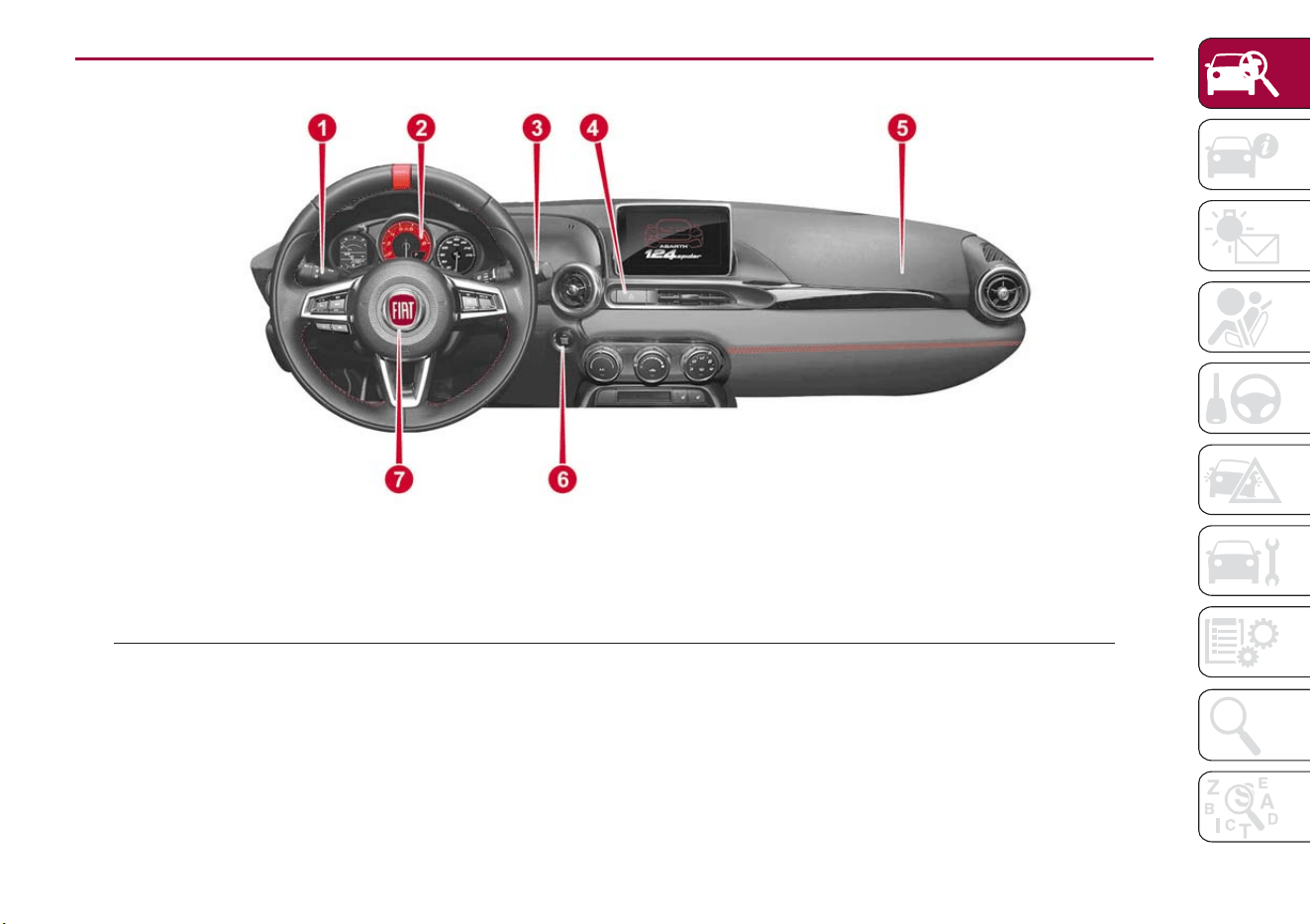
INSTRUMENT PANEL
02010200-129-555AB
Instrument Panel
1 — Turn Signal/High Beams Lever 4 — Hazard Warning Lights Button 7 — Driver Air Bag
2 — Instrument Cluster 5 — Passenger Air Bag
3 — Windshield Wiper And Washers 6 — Ignition Switch
11

INTERIOR OVERVIEW
01020304-002-100AB
Interior Overview
1 — Instrument Cluster 4 — Climate Control System 7 — Seats
2 — Steering Wheel 5 — Transmission Gear Selector 8 — Radio Controls
3 — Radio Systems 6 — Parking Brake
12

GETTING TO KNOW YOUR VEHICLE
KEYS ....................14
IGNITION SWITCH ............20
ADVANCED KEYLESS ENTRY
SYSTEM — IF EQUIPPED .......22
VEHICLE SECURITY ALARM
SYSTEM — IF EQUIPPED .......24
DOORS...................27
SEATS ...................33
NON-ADJUSTABLE HEAD
RESTRAINTS ...............34
STEERING WHEEL ...........35
MIRRORS .................35
EXTERIOR LIGHTS ...........38
WINDSHIELD WIPERS / WASHER .42
CLIMATE CONTROL SYSTEM ....44
POWER WINDOWS ...........56
HOMELINK — IF EQUIPPED .....58
INTERNAL EQUIPMENT ........60
TRUNKLID ................65
TRUNK EMERGENCY RELEASE . . .67
HOOD ...................68
CONVERTIBLE TOP (SOFT TOP) . .69
ELECTRIC POWER STEERING ....73
ENVIRONMENT PROTECTION
SYSTEMS .................73
13

KEYS
Key Fob
A code number is stamped on the plate
attached to the key set; detach this
plate and store it in a safe place (not in
the vehicle) for use if you need to make
a replacement Emergency Key.
Also, write down the code number and
keep it in a separate safe and
convenient place, but not in the vehicle.
If your key fob is lost, contact an
authorized dealer and have your code
number ready.
Note: Your key fob configuration may
vary with different feature button icons
as well as the total number of feature
buttons depending on your vehicle
options/features. Key fob example as
shown.
To use the Emergency Key, push the
mechanical latch on the back side of
the key fob and pull the emergency key
out that's housed inside the key fob.
Note:
Always keep a spare key fob in
case one is lost. If a key fob is lost, see
an authorized dealer as soon as
possible.
The driver must carry the key fob to
ensure the Keyless Entry System
functions properly.
Warning!
Before exiting a vehicle, always shift the
automatic transmission into PARK or the
manual transmission into FIRST gear or
REVERSE, apply the parking brake, turn the
engine OFF, remove the key fob from the
vehicle and lock your vehicle.
Never leave children alone in a vehicle,
or with access to an unlocked vehicle.
Allowing children to be in a vehicle
unattended is dangerous for a number of
reasons. A child or others could be
seriously or fatally injured. Children should
be warned not to touch the parking brake,
brake pedal or the gear selector.
Do not leave the key fob in or near the
vehicle, or in a location accessible to
children. A child could operate power
windows, other controls, or move the
vehicle.
Do not leave children or animals inside
parked vehicles in hot weather. Interior heat
build-up may cause serious injury or death.
04010100-361-002AB
Key Fob
1 — Emergency Key
2 — Key Fob
3 — Key Code Number Plate
14
GETTING TO KNOW YOUR VEHICLE

Key Fob Functions
With A Vehicle Security Alarm
System
The hazard warning lights flash when
the vehicle security alarm system is
armed or disarmed.
With Advanced Keyless Function
A beep can be heard for confirmation
when the doors, trunk lid, and the fuel
filler door are locked/unlocked using the
key fob. The beep indication volume
can be adjusted or turned off.
Use the following procedure to change
the beep setting:
1. Verify or place the ignition in the OFF
position and close both of the doors
and the trunk lid.
2. Open the driver's door.
3. Within 30 seconds of opening the
driver's door, push and hold the lock
button on the key fob for five seconds
or longer.
Note:
Both of the doors, the trunk lid, and
fuel filler door will lock and the beep
sound activates at the currently set
volume (if the beep is currently set to
not activate, it will not activate).
The setting changes each time the
lock button on the key fob is pushed
and the beep sound activates at the
set volume (if the beep sound has
been set to not activate, it will not
activate).
Setting change is completed by doing
any one of the following:
Placing the ignition to ACC or ON
position.
Closing the driver's door.
Opening the trunk lid.
Not operating the key fob for ten
seconds.
Pushing any button, except the lock
button on the key fob.
Pushing a request switch on the
exterior door handle.
Note: Refer to “Lock/Unlock With
Advanced Keyless Entry Function —
If Equipped” in “Doors” for further
information.
The operation indicator light flashes
when the buttons are pushed.
Key Fob Buttons
Lock Button
To lock the doors, trunk lid, and the fuel
filler door, push the lock button and the
hazard warning lights will flash once
and a beep will be heard.
Unlock Button
To unlock the doors and the trunk lid,
push the unlock button and the hazard
warning lights will flash twice.
The system can be set to unlock both
doors. Use the following procedure to
change the setting:
1. Place the ignition in the OFF position
and close both of the doors and the
trunk lid.
2. Open the driver's door.
3. Within 30 seconds of opening the
driver's door, push and hold the unlock
button on the key fob for five seconds
or longer.
Note: The sound of the doors
locking/unlocking can be heard. After
this, the system changes the setting
each time the unlock button is pushed
(the sound of the doors locking/
unlocking can be heard).
15
The setting change can be
completed by doing any one of the
following:
1. Placing the ignition in the ACC or
ON position.
2. Closing the driver’s door.
3. Opening the trunk lid.
4. Not operating the key fob for ten
seconds.
5. Pushing any button except the
unlock button on the key fob.
6. Pushing a request switch on the
exterior door handle.
Trunk Button
To open the trunk lid, push and hold the
trunk button until the trunk lid opens.
Panic Button
To turn the Panic Alarm feature on or
off, push and hold the panic button on
the key fob for at least one second and
release. When the Panic Alarm is on,
the headlights will turn on, the park
lights will flash, the horn will pulse on
and off, and the turn signal lights will
flash.
Note: The panic button will work
whether any door or the trunk lid is
open or closed.
Turning On The Alarm
Pushing the panic button for one
second or more will trigger the alarm for
about two minutes and thirty seconds,
and the following will occur:
The horn sounds intermittently.
The hazard warning lights flash.
Turning Off The Alarm
The alarm will stop by pushing any
button on the key fob.
Operational Range
The system operates only when the
driver is in the vehicle or within
operational range while the key fob is
being carried or on your person.
Starting The Engine
Starting the engine may be possible
even if the key fob is outside of the
vehicle and extremely close to a door
and window, however, always start the
engine from the driver's seat.
If the vehicle is started and the key fob
is not in the vehicle, the vehicle will not
restart after it is shut off and the ignition
is placed in the OFF position.
The trunk is out of the assured
operational range, however, if the key
fob is operable the engine will start.
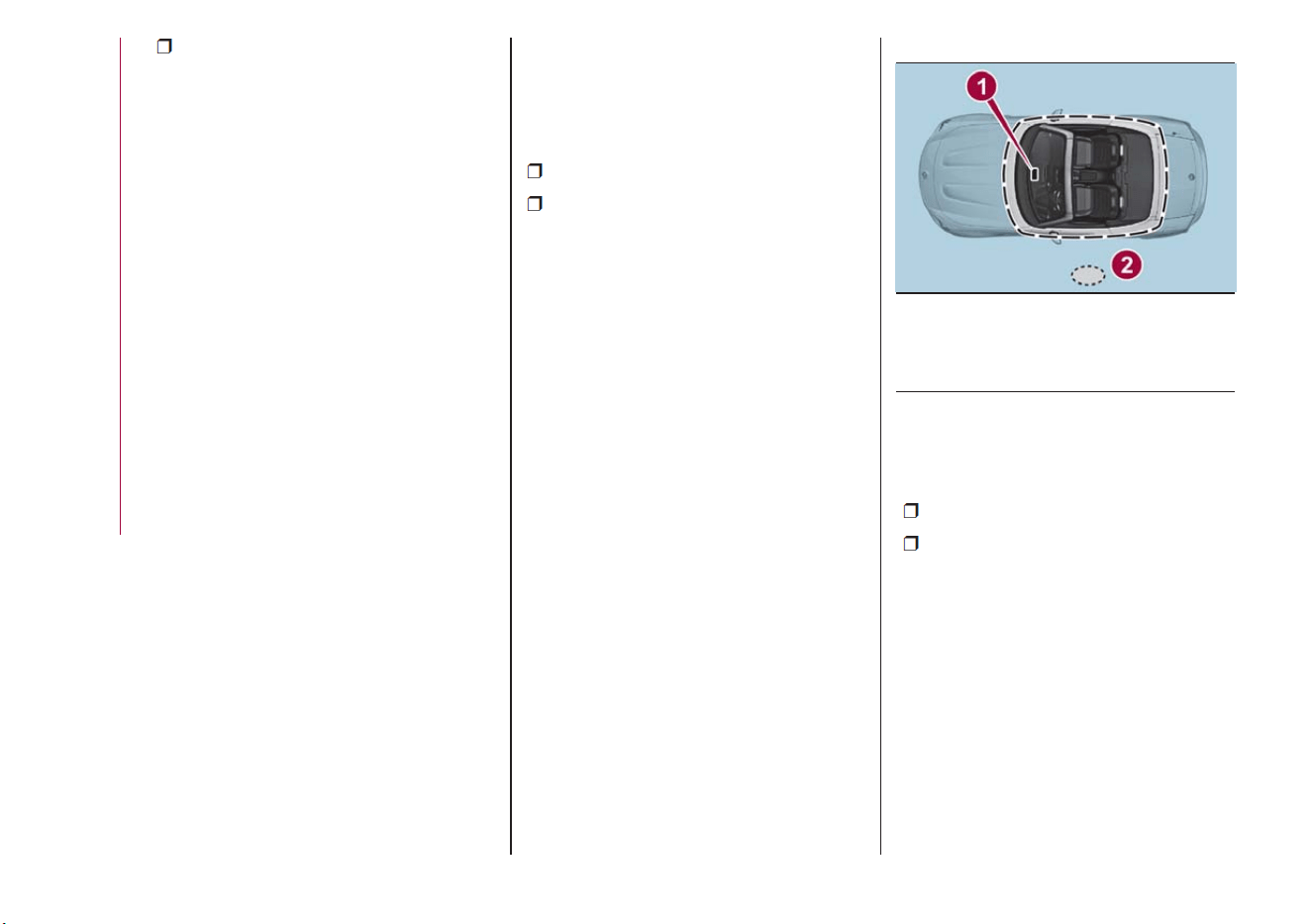
Key Fob Antenna Location
Note: The engine may not start if the
key fob is placed in or around the
following areas:
Around The Instrument Panel
In The Storage Compartments
Key Suspend Function
If a key fob is left in the vehicle, the
functions of the key fob left in the
vehicle are temporarily suspended to
prevent unlawful use of the vehicle.
To restore the functions, push the
unlock button on the functions-
suspended key fob left in the vehicle.
04010202-12R-001
Key Fob Antenna Location
1 — Interior Antenna
2 — Operational Range
16
GETTING TO KNOW YOUR VEHICLE

Key Fob Battery
Replacement
If the buttons on the key fob are
inoperable and the indicator light does
not flash, the battery power level may
be low or discharged.
Replace with a new battery
(CR2025 type) before the key fob
becomes unusable.
The following conditions indicate that
the battery power is low:
Indicator light (green) flashes in
the instrument cluster for about
30 seconds after the engine is placed in
the OFF position.
The system does not operate and
the operation indicator light on the key
fob does not flash when the buttons are
pushed.
The system's operational range is
reduced.
Note: Replacing the battery at an
authorized dealer is recommended to
prevent damage to the key fob. If
replacing the battery by yourself, follow
the instruction below.
Replacing The Key Fob Battery
Proceed as follows:
1. Push the mechanical release button
and remove the emergency key.
1 — Key Fob Case With Mechanical
Release Button
2 — Emergency Key
2. Insert a coin, a flat blade screw
driver, or the tip of your emergency key
into the now exposed slot and carefully
pry in the direction of the arrows to
open the cover (3) slightly.
3. Insert a coin, a flat blade screw
driver, or the tip of your emergency key
into the side gap and carefully pry in the
direction of the arrow to open the cover
(4).
07031301-361-002
Emergency Key Removed
07031301-362-002
3 — Pry Case Left Side
07031301-363-002
4 — Pry Case Right Side
17

4. Separate the key fob case, then
remove the battery.
3 — Key Fob Case
5 — Key Fob Battery
5. Insert a new battery with the positive
pole facing up. Then, cover the battery
with the battery cap.
6. Close the cover and reinsert the
Emergency Key.
Note: Be careful not to allow the
rubber ring shown in call-out (6) to be
scratched or damaged. If the rubber
ring comes out, reinstall it before
inserting a new battery.
Engine Start Function
When Key Fob Battery Is
Discharged
When starting the engine by holding the
key fob over the keyless ignition
START/STOP button due to a
discharged key fob battery or a
malfunctioning key fob, be careful not
to allow the following, otherwise the
signal from the key fob will not be
received correctly and the engine may
not start:
Metal parts of other key fobs or
metal objects touch the key fob.
Spare key fobs or key fobs for other
vehicles equipped with an immobilizer
system touch or come near the key .
Devices for electronic purchases, or
security passage touch or come near
the key fob.
07031301-364-003
Remove Back Cover For Battery
Replacement
07031301-367-001
6 — Install New Battery
05010201-KY1-001AB
No Keys Touching The Key Fob
05010201-KY2-001AB
No Key Fob Touching The Key Fob
18
GETTING TO KNOW YOUR VEHICLE

If the engine cannot be started due to a
discharged key fob battery, the engine
can be started using the following
procedure:
1. Continue to depress the brake pedal
firmly until the engine has completely
started.
2. Manual Transmission: continue to
depress the clutch pedal firmly until the
engine has completely started.
3. Verify that the keyless ignition start
indication light (green) flashes.
4. Touch the keyless ignition
START/STOP button using the
backside of the key fob while the
keyless ignition start indicator light
(green) flashes.
5. Verify that the keyless ignition start
indicator light (green) turns on.
6. Push the keyless ignition
START/STOP button to start the
engine.
When touching the keyless ignition
START/STOP button using the backside
of the key fob as shown in the illustration,
touch the keyless ignition START/STOP
button with the lock switch side of the
key fob facing up.
The engine cannot be started unless the
clutch pedal is fully depressed (manual
transmission) or the brake pedal is fully
depressed (automatic transmission).
If there is a malfunction with the keyless
ignition START/STOP button function,
the keyless ignition start indicator light
(amber) flashes. In this case, the engine
may start, however contact an
authorized dealer as soon as possible.
If the keyless ignition start indicator light
(green) does not illuminate, perform the
operation from the beginning again. If it
does not illuminate contact an
authorized dealer.
To change the ignition position without
starting the engine, perform the following
operations after the keyless ignition start
indicator light (green) turns on:
1. Release the clutch pedal (manual
transmission) or brake pedal (automatic
transmission).
2.
Push the keyless ignition START/STOP
button to change the ignition position. The
ignition cycles in the order of ACC, ON,
and OFF each time the keyless ignition
START/STOP button is pushed.
Note: To change the ignition position
again, perform the operation from the
beginning.
Emergency Operation For Starting
The Engine
If the key warning light (red) illuminates,
or the keyless ignition start indicator
light (amber) flashes, this could indicate
that the engine may not start using the
usual starting method. Contact an
authorized dealer as soon as possible.
If this occurs, the engine can be
force-started. push and hold the keyless
ignition START/STOP button until the
engine starts.
Other procedures necessary for starting
the engine such as having the key fob
in the vehicle, and depressing the
clutch pedal (manual transmission) or
the brake pedal (automatic
transmission) are required.
05010201-L12-001AB
Discharged Key Fob Battery Start
Procedure
19

Key Fob Cautions
Because the key fob uses low-intensity
radio waves, it may not function
correctly under the following conditions:
The key fob is carried with
communication devices such as cellular
phones.
The key fob contacts or is covered
by a metal object.
The key fob is near electronic
devices such as personal computers.
Non-FCA genuine electronic
equipment is installed in the vehicle.
There is equipment which discharges
radio waves near the vehicle.
The key fob may consume battery
power excessively if it receives
high-intensity radio waves. Do not place
the key fob near electronic devices
such as televisions or personal
computers.
To avoid damage to the key fob, DO
NOT:
Drop the key fob.
Get the key fob wet.
Disassemble the key fob unless
replacing battery.
Expose the key fob to high
temperatures on places such as the
instrument panel or engine
compartment, under direct sunlight.
Expose the key fob to any kind of
magnetic field.
Place heavy objects on the key fob.
Put the key fob in an ultrasonic
cleaner.
Put any magnetized objects close to
the key fob.
General Information
The following regulatory statement
applies to all Radio Frequency (RF)
devices equipped in this vehicle:
This device complies with Part 15 of the
FCC Rules and with Industry Canada
license-exempt RSS standard(s).
Operation is subject to the following
two conditions:
1. This device may not cause harmful
interference.
2. This device must accept any
interference received, including
interference that may cause undesired
operation.
Note: Changes or modifications not
expressly approved by the party
responsible for compliance could void
the user’s authority to operate the
equipment.
IGNITION SWITCH
Push Button Start
Positions
The system operates only when the key
fob is within operational range.
Each time the keyless ignition
START/STOP button is pushed, the
ignition cycles in the order of OFF, ACC,
and ON. Pushing the START/STOP
button again from ON position cycles
the ignition to the OFF position.
Note:
The engine starts by pushing the
keyless ignition START/STOP button
while depressing the clutch pedal
(manual transmission) or the brake
pedal (automatic transmission). To
change the ignition position, push the
keyless ignition START/STOP button
without depressing the clutch or brake
pedal.
05010101-L12-001AB
Keyless START/STOP Ignition
Button
20
GETTING TO KNOW YOUR VEHICLE

Do not leave the ignition in the ON
position while the engine is not
running, doing so could result in the
battery being discharged. If the ignition
is left in ACC position (for automatic
transmission, the gear selector is in the
P position, and the ignition is in ACC),
the ignition cycles to the OFF position
automatically after about 25 minutes.
OFF
The power supply to electrical devices
turns off and the keyless ignition start
indicator light (amber) also turns off. In
the OFF position, the steering wheel is
locked.
ACC (Accessory)
Some electrical accessories will operate
and the indicator light (amber)
illuminates. In the ACC position, the
steering wheel is unlocked.
The Keyless Entry System does not
function while the keyless ignition has
been placed in the ACC position, and
the doors will not lock/unlock even if
they have been locked manually.
ON
This is the normal running position after
the engine is started.
Note: The indicator light (amber) turns
off (the indicator light amber illuminates
when the ignition has been placed in
the ON position and the engine is not
running).
Some indicator lights/warning lights
should be inspected before the engine
is started.
When the keyless ignition has been
placed in the ON position, the sound of
the fuel pump motor operating near the
fuel tank can be heard. This does not
indicate an abnormality.
Warning!
Never use the PARK position as a
substitute for the parking brake. Always
apply the parking brake fully when exiting
the vehicle to guard against vehicle
movement and possible injury or damage.
When leaving the vehicle, always make
sure the ignition is in the OFF mode,
remove the key fob from the vehicle, and
lock your vehicle.
Never leave children alone in a vehicle,
or with access to an unlocked vehicle.
Allowing children to be in a vehicle
unattended is dangerous for a number of
reasons. A child or others could be
seriously or fatally injured. Children should
be warned not to touch the parking brake,
brake pedal or the transmission gear
selector.
Do not leave the key fob in or near the
vehicle, (or in a location accessible to
children), and do not leave the ignition in
the ACC or ON/RUN mode. A child could
operate power windows, other controls, or
move the vehicle.
Be sure the parking brake is fully
disengaged before driving; failure to do so
can lead to brake failure and a collision.
Always fully apply the parking brake when
leaving your vehicle, or it may roll and cause
damage or injury. Also be certain to leave the
transmission in PARK. Failure to do so may
allow the vehicle to roll and cause damage or
injury.
Driving the vehicle with the parking brake
engaged, or repeated use of the parking
brake to slow the vehicle may cause serious
damage to the brake system.
21

ADVANCED
KEYLESS ENTRY
SYSTEM — IF
EQUIPPED
Advanced Keyless Entry
System
The Advanced Keyless Entry System is
an enhancement that allows you to
lock/unlock the doors, trunk lid, fuel
filler door, and opens the trunk lid with
the slow and careful push of a button.
The Advanced Keyless Entry System
allows the driver to START/STOP the
ignition with the push of a button as
long as the key fob is in the passenger
compartment.
If equipped, the vehicle security alarm
system may be armed/disarmed with
the push of the lock/unlock button
located on the key fob.
System Malfunctions/Warnings
System malfunctions or warnings are
indicated by the following warning lights
or beeps (refer to “Getting To Know
Your Instrument Panel” for further
information) :
Warning Light (Red)
Ignition Not Turned OFF Warning
Beep
Key Fob Removed From Vehicle
Warning Beep
Request Switch Inoperable Warning
Beep
Key Fob Left-In-Trunk Warning Beep
Key Fob Left-In-Vehicle Warning
Beep
If you have a problem with the key fob,
or the key fob is lost or stolen, contact
an authorized dealer as soon as
possible for a replacement and to make
the lost or stolen key fob inoperative.
Note: Changes or modifications not
expressly approved by the party
responsible for compliance could void
the user's authority to operate the
equipment.
The Advanced Keyless Entry
System operational range may vary
due to local weather conditions.
The Advanced Keyless Entry
System is fully operational (door/trunk
lid/fuel filler door lock/unlock) when the
ignition is placed in the OFF position.
The Advanced Keyless Entry System
does not operate if the ignition is
placed to any position other than the
OFF position.
If the key fob does not operate when
pushing a button, the operational range
becomes too small, or the warning light
does not illuminate or flash, the battery
may be weak or discharged. To install a
new battery, refer to “Key Fob Battery
Replacement.”
Battery life is about one year.
Replace the battery with a new one if
the
Warning light (green) flashes in
the instrument cluster. Replacing the
battery about once a year is
recommended because the
Warning light may not illuminate or
flash if the battery is low or discharged.
Additional key fobs may be
obtained at an authorized dealer. Up to
six key fobs may be used with the
Advanced Keyless Entry System per
vehicle. Bring all key fobs to an
authorized dealer when additional keys
are required.
The Advanced Keyless Entry function
allows you to lock/unlock the door,
trunk lid, and fuel filler door, or open the
trunk lid while carrying the key fob.
Warning!
Radio waves from the key fob may affect
medical devices such as pacemakers:
before using the key fob near people who
use medical devices, ask the medical
device manufacturer or your physician if
radio waves from the key fob will affect the
device.
22
GETTING TO KNOW YOUR VEHICLE
Note: The Advanced Keyless Entry
System functions can be deactivated to
prevent any possible adverse effect on
a user wearing a pacemaker or other
medical device. If the system is
deactivated, you will be unable to start
the engine by carrying the key fob.
Contact an authorized dealer for
details. If the Advanced Keyless Entry
System has been deactivated, you can
start the engine by following the
procedure indicated when the key fob
battery becomes discharged.
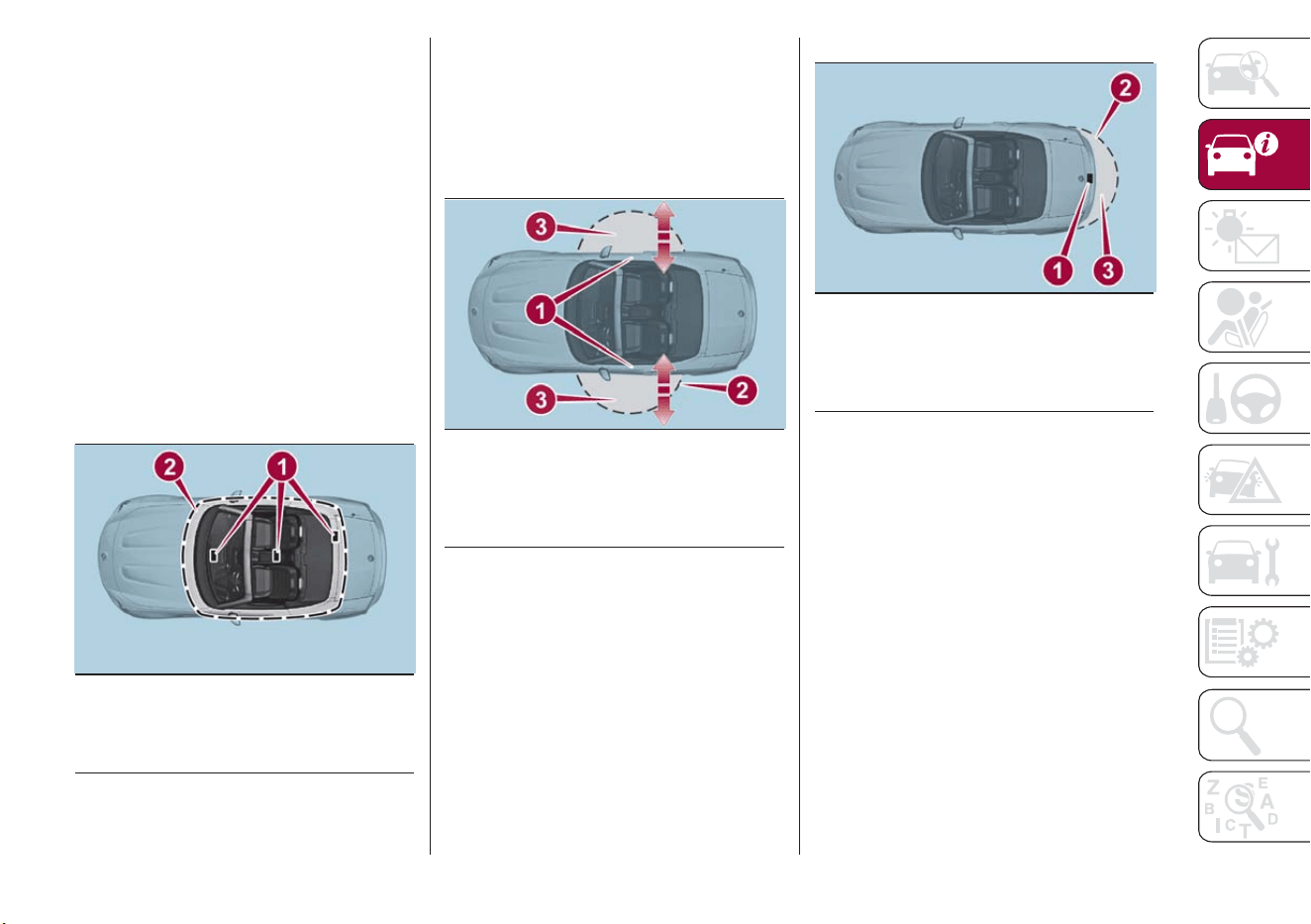
Operational Range
The system operates only when the
driver is in the vehicle or within
operational range while the key fob is
being carried.
Note:
When the battery power is low, or
in places where there are high-intensity
radio waves or noise, the operational
range may become narrower or the
system may not operate.
Locking/Unlocking The Doors And
The Trunk Lid
Note: The system may not operate if
you are too close to the windows or
door handles.
Opening The Trunk Lid
04010202-12S-002
Advanced Keyless Entry Sensors
1 — Interior Antenna
2 — Operational Range
04020201-12A-003
Request Switch Door Functions
1 — Exterior Antenna
2 — Operational Range
3 — Distance (31 inches)
04020202-12A-003
Electronic Trunk Release
1 — Exterior Antenna
2 — Operational Range
3 — Distance (31 inches)
23

General Information
The following regulatory statement
applies to all Radio Frequency (RF)
devices equipped in this vehicle:
This device complies with Part 15 of the
FCC Rules and with Industry Canada
license-exempt RSS standard(s).
Operation is subject to the following
two conditions:
1. This device may not cause harmful
interference.
2. This device must accept any
interference received, including
interference that may cause undesired
operation.
Note: Changes or modifications not
expressly approved by the party
responsible for compliance could void
the user’s authority to operate the
equipment.
VEHICLE SECURITY
ALARM SYSTEM —
IF EQUIPPED
Modifications And
Add-On Equipment
FCA cannot guarantee the immobilizer
and the vehicle security alarm system
operation if the system has been
modified or if any add-on equipment
has been installed.
Note: To avoid damage to the vehicle,
do not modify the system or install any
add-on equipment to the immobilizer
and the vehicle security alarm system
or the vehicle.
Immobilizer System
The immobilizer system allows the
engine to start only with a key fob the
system recognizes.
If someone attempts to start the engine
with an unrecognized key fob, the
engine will not start, thereby helping to
prevent unlawful vehicle use.
If you have a problem with the
immobilizer system or the key fob,
contact an authorized dealer.
To avoid damage to the key fob, do not:
Drop the key fob.
Get the key fob wet.
Expose the key fob to any kind of
magnetic field.
Expose the key fob to high
temperatures on places such as the
instrument panel, hood, or under direct
sunlight.
Note:
Changes or modifications not
expressly approved by the party
responsible for compliance could void
the user's authority to operate the
equipment.
If the engine does not start with the
correct key fob, and the
warning
light keeps illuminating or flashing, the
system may have a malfunction.
Contact an authorized dealer.
The key fobs carry a unique
electronic code. For this reason, and to
assure your safety, obtaining a
replacement key fob can only be done
through your authorized dealer, and will
require some waiting time.
Always keep a spare key fob in
case one is lost. If a key fob is lost,
contact an authorized dealer as soon
as possible.
If you lose a key fob, an authorized
dealer will reset the electronic codes of
your remaining key fobs and
immobilizer system. Bring all the
remaining key fobs to an authorized
dealer to reset. Starting the vehicle
with a key fob that has not been reset
is not possible.
24
GETTING TO KNOW YOUR VEHICLE

Operation
The engine may not start and
warning light may illuminate or flash
if the key fob is placed in an area where
it is difficult for the system to detect the
signal, such as on the instrument panel.
Move the key fob to a location within
the signal range, cycle the ignition off,
and then restart the engine.
Note: Signals from a TV, radio station,
transceiver, or mobile telephone could
interfere with your immobilizer system. If
you are using the proper key fob and
the engine fails to start, check the
warning light.
Arming
The system is armed when the ignition
is cycled from the ON to OFF position.
The
warning light in the instrument
cluster flashes every two seconds until
the system is disarmed.
Disarming
The system is disarmed when the
ignition is placed in the ON position with
the correct programmed key fob. The
warning light illuminates for about
three seconds and then turns off. If the
engine does not start with the correct
key fob, and the
warning light
remains illuminated or flashing, try the
following:
Make sure the key fob is within the
operational range for signal
transmission.
Cycle the ignition off, and then restart
the engine. If the engine does not start
after three or more tries, contact an
authorized dealer.
Note:
If the warning light flashes
continuously while you are driving, do
not turn the engine OFF. Contact an
authorized dealer and have it checked.
If the engine is shut off while the
warning light is flashing, you will
not be able to restart it.
Because the electronic codes are
reset when the immobilizer system is
repaired, the keys are needed. Make
sure to bring all the key fobs to an
authorized dealer so that they can be
programmed.
Vehicle Security Alarm
System — If Equipped
If the vehicle security alarm system
detects an inappropriate entry into the
vehicle or the intrusion sensor detects
movement in the vehicle which could
result in the vehicle or its contents
being stolen, the alarm alerts the
surrounding area of an abnormality by
sounding the siren/horn and flashing
the hazard warning lights.
The system will not function unless it's
properly armed. So when you leave the
vehicle, follow the arming procedure
correctly.
Siren/Horn Triggering Conditions
The siren/horn sounds intermittently
and the hazard warning lights flash for
about 30 seconds when the system is
triggered by any one of the following:
Unlocking a door with an inside
door-lock knob.
Forcing open a door, the engine
compartment or the trunk lid.
Opening the hood by operating the
hood release handle.
Placing the ignition in the ON position
without starting the engine.
With the intrusion sensor: the
intrusion sensor detects a movement in
the vehicle.
The system will be triggered again (up
to ten times) if one of the above
conditions remains.
The trunk lid will not open when the
vehicle security alarm system is
activated.
If the battery becomes drained while
the vehicle security alarm system is
armed, the siren will activate and the
hazard warning lights will flash during
the battery charging or replacement
process.
25

How To Arm The System
Close the windows and the
convertible top securely.
Place the ignition in the OFF position.
Make sure the engine compartment,
convertible top, the doors, and the
trunk lid are closed.
Push the lock button on the key fob
or lock the driver's door from the
outside with the emergency key. The
hazard warning lights will flash once.
With The Advanced Keyless Entry
function: push a request switch. The
warning light in the instrument
panel flashes twice per second for
20 seconds. After 20 seconds the
system is fully armed.
The vehicle security alarm system can
also be armed by activating the auto
re-lock function with all the doors, the
trunk lid and the engine compartment
closed.
The system will disarm if one of the
following operations takes place within
20 seconds after pushing the lock
button: To rearm the system, perform
the arming procedure again.
1. Unlocking any door.
2. Opening any door.
3. Opening the engine compartment.
4. Placing the ignition in the ON
position.
The hazard warning lights will flash
once to indicate that the vehicle
security alarm system is armed when
the doors are locked by pushing the
lock button on the key fob, or using the
emergency key.
Note:
If any door or trunk lid remains
closed for 30 seconds, the doors, and
trunk lid automatically re-lock and the
vehicle security alarm system arms
even if a window open or the
convertible top is left down.
To reactivate the intrusion sensor,
turn off the armed vehicle security
alarm system and then rearm it.
The intrusion sensor is operational
when the vehicle security alarm system
is armed. To cancel the intrusion
sensor, push the intrusion sensor
cancel button each time the vehicle
security alarm system is armed.
To Turn Off An Armed System
An armed system can be turned off
using any one of the following methods:
Pushing the unlock button on the key
fob.
Starting the engine with the keyless
ignition START/STOP button.
With The Advanced Keyless Entry
function: pushing a request switch on
the exterior door handles.
Note: When the doors are unlocked by
pushing the unlock button on the key
fob while the vehicle security alarm
system is turned off, the hazard
warning lights will flash twice to indicate
that the system is turned off.
To Stop The Alarm
A triggered alarm can be turned off
using any one of the following methods:
Pushing the unlock button on the key
fob
Starting the engine with the keyless
ignition START/STOP button
With The Advanced Keyless Entry
function: pushing a request switch on
the exterior door handles or the electric
trunk release while the key fob is being
carried.
The hazard warning lights will flash
twice.
26
GETTING TO KNOW YOUR VEHICLE
DOORS
Lock/Unlock With
Emergency Key
Both doors, trunk lid, and fuel door lock
automatically when the driver's door is
locked using the emergency key.
Lock With Emergency Key — Insert
key into driver’s door and turn to the left
(toward front of car).
Unlock With Emergency Key —
Insert key into driver’s door and turn to
the right (toward back of car).
They both unlock when the driver's
door is unlocked using the emergency
key.
Turn the emergency key toward the
front to lock, toward the back to unlock.
Caution!
An unlocked vehicle is an invitation for
thieves. Always remove key fob from the
vehicle and lock all doors when leaving the
vehicle unattended.
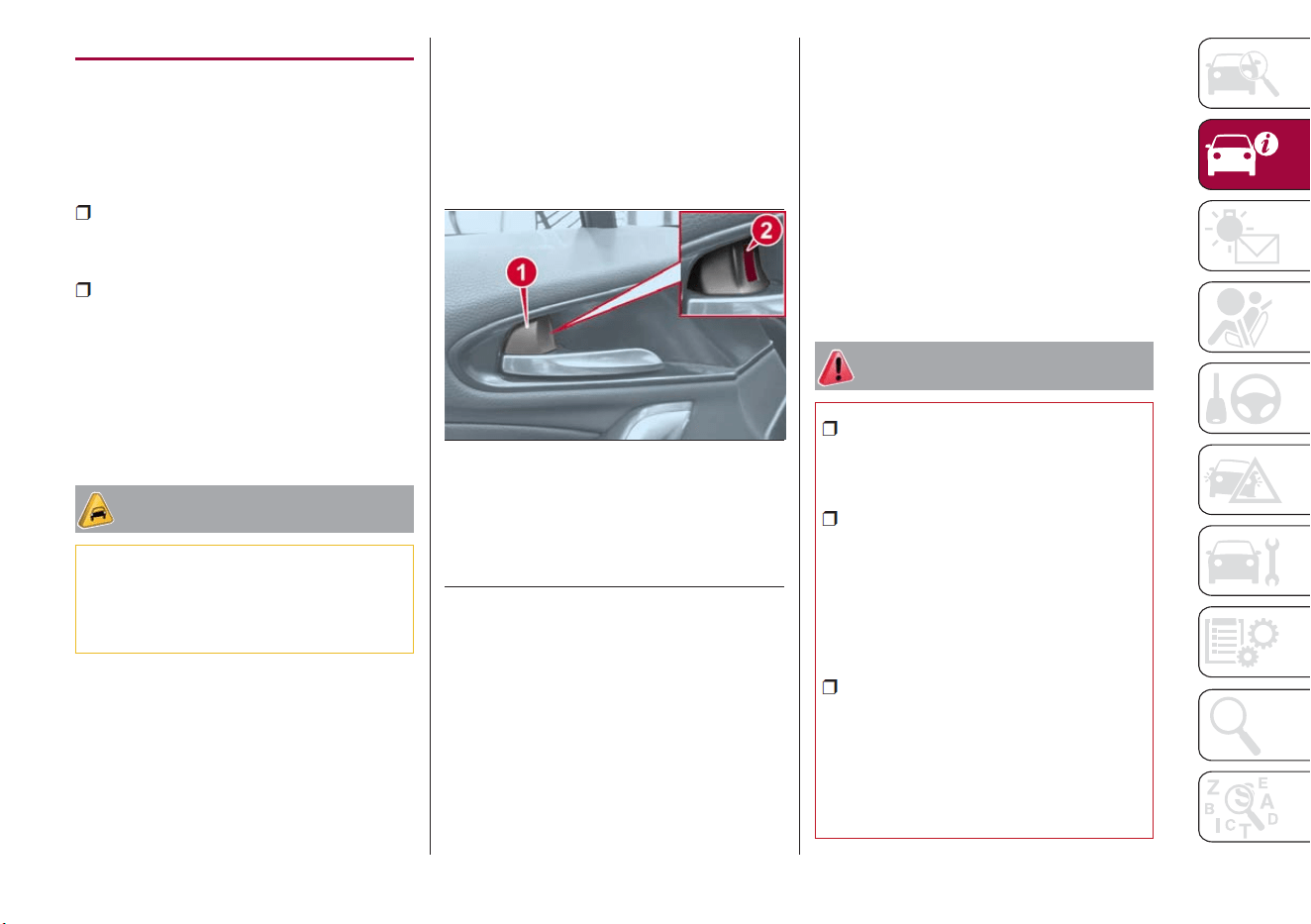
Manual Lock/Unlock
Knob
Operation From Inside
To lock any door from the inside, push
the door-lock knob. To unlock, pull it
outward. This does not operate the
other door locks.
Note: The red indication can be seen
when the door-lock knob is unlocked.
Operation From Outside
To lock the passenger door with the
door-lock knob from the outside, push
the door-lock knob to the lock position
and close the door (holding the door
handle in the open position is not
required).
Note: When locking the door this way,
be careful not to leave the key fob
inside the vehicle. The driver's door
lock knob cannot be used while the
driver's door is open.
Warning!
For personal security and safety in the
event of a collision, lock the vehicle doors
before you drive as well as when you park
and leave the vehicle.
When leaving the vehicle, always remove
the key fob from the vehicle and lock your
vehicle. If equipped with Advanced Keyless
Entry, always make sure the keyless ignition
is in “OFF” position, remove the key fob from
the vehicle and lock the vehicle.
Unsupervised use of vehicle equipment may
cause severe personal injuries or death.
Never leave children alone in a vehicle,
or with access to an unlocked vehicle.
Allowing children to be in a vehicle
unattended is dangerous for a number of
reasons. A child or others could be
seriously or fatally injured. Children should
be warned not to touch the parking brake,
brake pedal or the gear selector.
04030107-L21-001AB
Inside Door-Lock Knob
1 — Door Knob Lock Position (Red
Indicator Not Seen When Locked)
2 — Door Knob Unlock Position (Red
Indicator Seen When Unlocked)
27

Do not leave the key fob in or near the
vehicle, or in a location accessible to
children, and do not leave the ignition of a
vehicle equipped with Advanced Keyless
Entry in the ACC or ON/RUN positions. A
child could operate power windows, other
controls, or move the vehicle.
Central Lock/Unlock
Both doors, trunk lid, and fuel door lock
automatically when the lock rocker
switch is pushed with both doors
closed.
Note:
The doors, trunk lid, and the fuel
filler door cannot be locked while any
other door is open.
The key fob may not be able to be
detected by the vehicle keyless-go
system if it is located next to a mobile
phone, laptop or other electronic
device; these devices may block the
key fob’s wireless signal and prevent
the keyless-go system from starting
the vehicle.
Both unlock when the unlock rocker
switch is pushed.
Note: The doors, trunk lid, and the fuel
filler door cannot be locked while any
other door is open.
Double Locking System
— If Equipped
The double locking system is designed
to prevent someone who has broken
into your vehicle from opening the door
from the inside. If you have any
problems with the double locking
system, contact an authorized dealer.
System Activation
Proceed as follows:
1. Close both the windows and the
convertible top.
2. Place the ignition in the OFF position
and take the key fob with you.
3. Close both doors and trunk lid.
4. Insert the emergency key in the
driver's door, turn the emergency key to
the lock position (counter
clockwise/left), and return it to the
center position. Then turn it to the lock
position (counter clockwise/left) again
within three seconds.
5. The
indicator light illuminates for
about three seconds to indicate that the
system has been activated.
The system can be activated by
pushing the lock button on the key fob
twice within three seconds.
With The Advanced Keyless
Function: the system can be activated
by pushing the request switch on the
exterior door handle twice within three
seconds.
Note: The system cannot be activated
when any door is open.
04030105-12D-002
Central/Power Door Lock Switch
04030102-12A-001
Emergency Key Lock Procedure
28
GETTING TO KNOW YOUR VEHICLE
System Deactivation
Unlock the driver's door or place the
ignition in the ON position. If the power
supply is interrupted (fuse blows or the
battery is disconnected), the system
can only be deactivated by unlocking a
door with the emergency key.
Lock/Unlock With
Advanced Keyless Entry
Function — If Equipped
Both doors, trunk lid, and the fuel filler
door can be locked/unlocked by
pushing the request switch on the
exterior door handle while the key fob is
being carried.
To Lock
To lock the doors, trunk lid, and the fuel
filler door, push the request switch on
the exterior door handle and the hazard
warning lights will flash once.
A beep sound will be heard once.
To Unlock
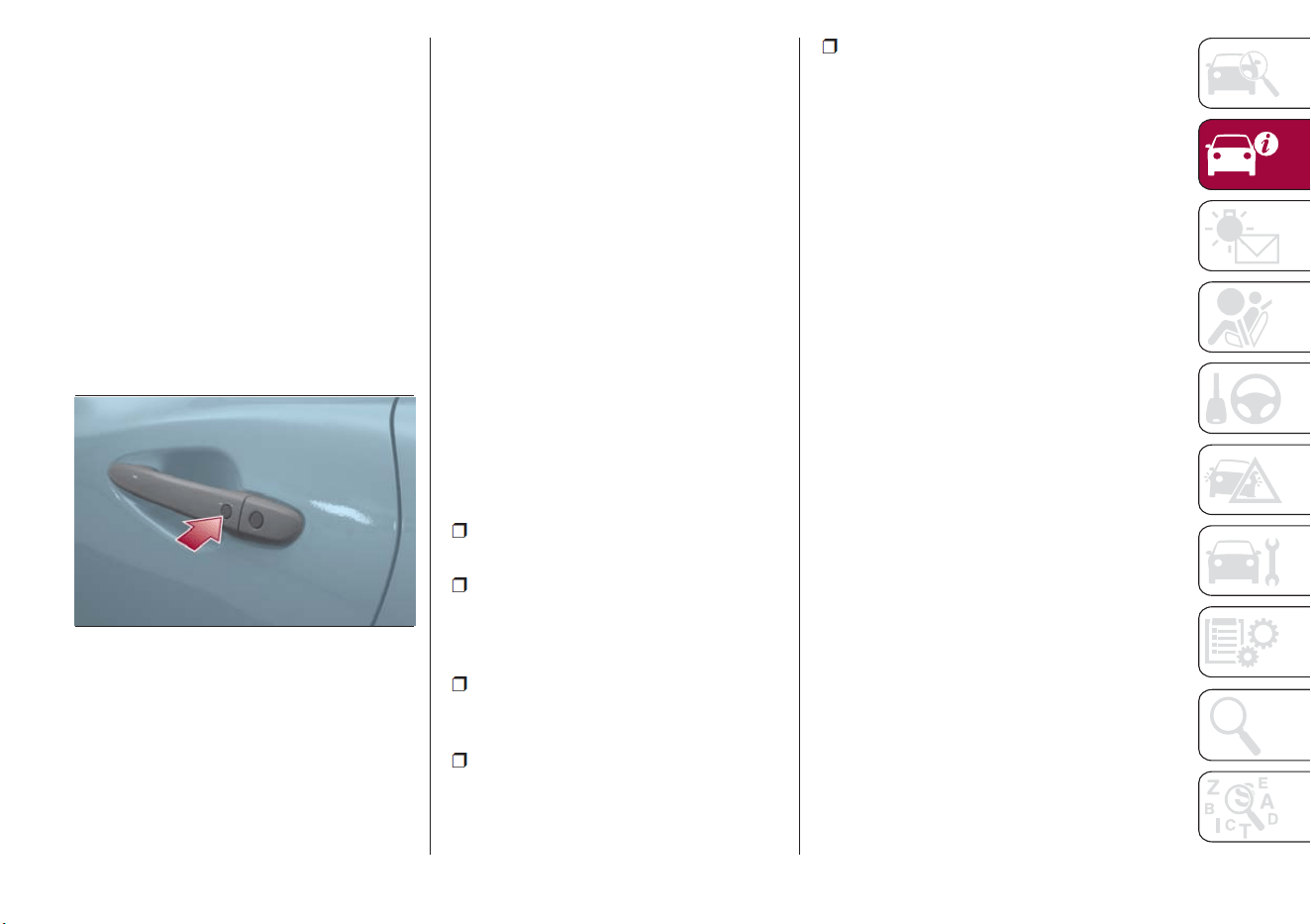
Driver's door request switch located on
the exterior door handle.
To unlock the doors, trunk lid, and the
fuel filler door, push the request switch
on the exterior door handle and the
hazard warning lights will flash twice.
To unlock both doors and the fuel filler
door, push the request switch on the
exterior door handle again within three
seconds and two more beep sounds
will be heard.
Front Passenger Door Request
Switch:
To unlock both doors and the fuel filler
door, push the request switch on the
exterior door handle. A beep sound will
be heard twice and the hazard warning
lights will flash twice.
Note:
Confirm that both doors, and the
fuel filler door are securely locked.
For the trunk lid, move it without
pushing the electric trunk lid opener to
verify that the trunk lid has not been
left open.
Both doors and the fuel filler door
cannot be locked when any door is
open.
It may require a few seconds for the
doors to unlock after the request
switch on the exterior door handle is
pushed.
The key fob may not be able to be
detected by the vehicle keyless-go
system if it is located next to a mobile
phone, laptop or other electronic
device; these devices may block the
key fob’s wireless signal and prevent
the keyless-go system from starting
the vehicle.
A beep sound is heard for confirmation
when the doors, and fuel filler door are
locked/unlocked using the request
switch on the exterior door handle. If
you prefer, the beep sound can be
turned off.
The volume of the beep sound can also
be changed. Use the following
procedure to change the setting:
1. Place the ignition in the OFF position
and close both of the doors and the
trunk lid.
2. Open the driver's door.
3. Within 30 seconds of opening the
driver's door, push and hold the lock
button on the key fob for five seconds
or longer. The doors, and fuel filler door
will lock, an audible beep will activate at
the currently set volume (if the beep
sound is currently set to not activate, it
will not activate). The setting changes
each time the lock button on the key
fob is pushed and the beep sound
activates at the set volume (if the beep
sound has been set to not activate, it
will not activate).
04000098-121-555
Request Switch On Exterior Door
Handle
29

4. The setting change is completed by
doing any one of the following:
Place the ignition in the ACC or ON
position.
Closing the driver's door.
Opening the trunk lid.
Not operating the key fob for ten
seconds.
Pushing any button except the lock
button on the key fob.
Pushing a request switch on the
exterior door handle.
With Vehicle Security Alarm System
The hazard warning lights flash when
the vehicle security alarm system is
armed or disarmed (refer to “Vehicle
Security Alarm System” found in
“Getting To Know Your Vehicle” for
further information).
The setting can be changed so that the
doors and the fuel filler door are locked
automatically without pushing the
request switch on the exterior door
handle, (refer to “Personalization
Features” section in “Getting To Know
Your Instrument Panel” for further
information).
Auto-Lock Function
A beep sound is heard when both
doors are closed while the key is being
carried. Both doors, the trunk lid, and
fuel door are locked automatically after
about three seconds when the
Advanced Keyless Entry key fob is out
of the operational range.
The hazard warning lights will flash
once (even if the driver is in the
operational range, both doors, trunk lid,
and the fuel filler door are locked
automatically after about 30 seconds).
If you are out of the operational range
before the doors and the trunk lid are
completely closed or another key fob is
left in the vehicle, the auto-lock function
will not work.
Always make sure that both doors and
the trunk lid are closed and locked
before leaving the vehicle. The
auto-lock function does not close the
power windows.
Auto Re-Lock Function
After unlocking with the request switch
on the exterior door handle, both doors,
and the fuel filler door will automatically
lock if any of the following operations
are not performed within about
60 seconds.
If your vehicle has a vehicle security
alarm system, the hazard warning lights
will flash for confirmation.
The time required for the doors to lock
automatically can be changed (refer to
“Personalization Features” in “Getting
To Know Your Instrument Panel” for
further information).
Opening a door or the trunk lid.
Placing the ignition in any position
other than the OFF position.
Locking/Unlocking With A Key Fob
Both doors, trunk lid, and the fuel filler
door can be locked/unlocked by
operating the keyless entry system key
fob: refer to “Keyless Entry System” in
“Keys” for further information.
Locking/Unlocking With Door-Lock
Switch
Both doors and the fuel filler door lock
automatically when the lock side is
pushed. They unlock when the unlock
side is pushed.
To lock both the doors and the fuel filler
door from an open door, push the lock
side of the door lock switch and then
close the door.
Note: When locking the doors this
way, be careful not to leave the key fob
inside the vehicle.
30
GETTING TO KNOW YOUR VEHICLE

Auto Lock/Unlock Function — If Equipped
When the vehicle speed exceeds 12 MPH (20 km/h), both doors, and fuel filler door lock automatically.
When the ignition is placed in the OFF position, both doors, and fuel filler door unlock automatically.
These functions can also be disabled so that they do not operate.
Auto Lock/Unlock Function Setting Change Using Door-Lock Switch (With Door-Lock Switch)
The doors, and fuel filler door can be set to lock or unlock automatically by selecting any one of the functions from the following
table and using the door-lock switch on the interior door panel. There are only a total of six auto lock/unlock settings available
for automatic transmission vehicles, and three for manual transmission vehicles. Be sure to push the unlock side of the driver's
door-lock switch the correct number of times according to the selected function number. If the switch is mistakenly pushed
seven times on an automatic transmission vehicle or four times on a manual transmission, the procedure will be cancelled. If
this occurs, start the procedure from the beginning.
Function Number Function (*)
1 The auto door-lock function is disabled.
2
Both the doors, and the fuel filler door lock automatically when the vehicle speed is about 12 MPH
(20 km/h) or more.
3
Both the doors, and the fuel filler door lock automatically when the vehicle speed is about 12 MPH
(20 km/h) or more. Both the doors, trunk lid, and the fuel filler door unlock when the ignition is
cycled from the ON to OFF position.
4
Automatic Transmission Vehicles Only: when the ignition is placed in the ON position and the
gear selector is shifted from park (P) to any other gear position, both the doors, and fuel filler door
lock automatically.
5
Automatic Transmission Vehicles Only: when the ignition is placed in the ON position and the
gear selector is shifted from PARK (P) to any other gear position, both the doors, and the fuel filler
door lock automatically. When the dear selector is shifted to PARK (P) while the ignition is placed in
the ON position, both the doors, and the fuel filler door unlock automatically.
6
Automatic Transmission Vehicles Only: both the doors, and the fuel filler door lock
automatically when the vehicle speed is about 12 MPH (20 km/h) or more. When the gear selector
is shifted to PARK (P) while the ignition is placed in the ON position, both the doors, and the fuel
filler door unlock automatically.
(*) For other settings for the auto door lock function contact an authorized dealer.
Note: Function number 3 is the factory setting for your vehicle.
31

Settings Changing
Settings can be changed using the
following procedure:
1. Safely park the vehicle. Both doors
must remain closed.
2. Place the ignition in the ON position.
3. Push and hold the lock side of the
driver's door-lock switch within
20 seconds of placing the ignition in the
ON position, and make sure a beep
sound is heard about eight seconds
afterwards.
4. Refer to the auto lock/unlock
function setting table, determine the
function number for the desired setting.
Push the unlock side of the driver's
door-lock switch the same number of
times as the selected function number
(example: if you select function 2, push
the unlock side of the switch only two
times).
5. Three seconds after the function
setting has been changed, a beep
sound will beep in the amount of the
selected function number (example:
Function number 3 = three beep
sounds).
Automatic Transmission Vehicles
The doors cannot be locked or
unlocked while the setting function is
being performed.
The procedure can be cancelled by
pushing the lock side of the door-lock
switch.
Note:
The vehicle lock-out prevention
feature prevents you from locking
yourself out of the vehicle. Both doors,
trunk lid, and the fuel filler door will
automatically unlock if they are locked
using the power door locks with any
door open. If both the doors are closed
even though the trunk lid is open, both
the doors and the fuel filler door will
lock.
Door Unlock (Control) System
With Collision Detection —
If Equipped: this system automatically
unlocks the doors, trunk lid, and the
fuel filler door in the event the vehicle is
involved in an accident to allow
passengers to get out of the vehicle
immediately and prevent being trapped
inside. While the ignition is placed in
the ON position and in the event the
vehicle receives an impact strong
enough to inflate the air bags, both the
doors, the trunk lid, and fuel filler door
are automatically unlocked after about
six seconds have elapsed from the
time of the accident. The doors, trunk
lid, and the fuel filler door may not
unlock depending on how an impact is
applied, the force of the impact, and
other conditions of the accident. If
door-related systems or the battery is
malfunctioning, the doors, trunk lid,
and the fuel filler door will not unlock.
When opening a door, the power
windows open a little automatically.
When closing the door, the power
windows close automatically. This is a
function for improving the sealing of the
window, and it does not mean there is a
problem. If the vehicle battery is
disconnected for vehicle maintenance or
other reasons, the power windows will
not open or close automatically. If the
power windows do not open or close,
the automatic open/close mechanism
for the windows must be reset.
32
GETTING TO KNOW YOUR VEHICLE

SEATS
Manual Adjustment
Forward / Rearward
To move the seat forward or rearward,
pull the adjustment bar. Release the bar
once the desired position is reached.
Using body pressure, move forward
and rearward on the seat to be sure
that the seat adjusters have latched.
Height
To adjust the height for front edge of
the seat bottom, rotate the dial to the
desired position.
Seat Recline
To recline the seatback, lift up the
recline lever and lean back until the
desired position has been reached,
then release the lever. Make sure the
lever returns to its original position and
the seatback is locked in place by
attempting to push it forward and
rearward.
Warning!
Adjusting a seat while driving may be
dangerous. Moving a seat while driving
could result in loss of control which could
cause a collision and serious injury or
death.
Seats should be adjusted before
fastening the seat belts and while the
vehicle is parked. Serious injury or death
could result from a poorly adjusted seat
belt.
Do not ride with the seatback reclined
so that the shoulder belt is no longer
resting against your chest. In a collision you
could slide under the seat belt, which could
result in serious injury or death.
Heated Seats
On some models, the front driver and
passenger seats may be equipped with
heaters in both the seat cushions and
seatbacks. The controls for the front
heated seats are located on the center
instrument panel below the climate
controls.
The heated seats have three settings:
High, Medium, and Low. Push the
switch once to turn the heated seats on
High, twice for Medium, and three times
for Low. Pushing the switch a fourth
time will turn the heated seat off.
Note:
If the ignition is switched OFF while
the seat warmer is operating (High,
Mid or Low), and then switched ON
again, the seat warmer will
automatically operate at the
temperature set before switching the
ignition OFF.
Use the seat warmer when the
engine is running. Leaving the seat
warmer on for long periods with the
engine not running could discharge the
battery.
03010202-12A-003AB
Manual Seat Adjustment
1 — Adjustment Bar
2 — Height Dial
3 — Recline Lever
33

The temperature of the seat warmer
cannot be adjusted beyond High, Mid
and Low.
Once a heat setting is selected,
heat will be felt within two to five
minutes.
Warning!
Persons who are unable to feel pain to
the skin because of advanced age, chronic
illness, diabetes, spinal cord injury,
medication, alcohol use, exhaustion or
other physical condition must exercise care
when using the seat heater. It may cause
burns even at low temperatures, especially
if used for long periods of time.
Do not place anything on the seat or
seatback that insulates against heat, such
as a blanket or cushion. This may cause
the seat heater to overheat. Sitting in a seat
that has been overheated could cause
serious burns due to the increased surface
temperature of the seat.
Caution!
Do not use organic solvents to clean the
seat. It may damage the seat surface and
the heater.
NON-ADJUSTABLE
HEAD RESTRAINTS
The non-adjustable head restraints are
form fitted into the upper structure of
the seatback, and are designed to
reduce the risk of injury by restricting
head movement in the event of a rear
impact. The seatback should be
properly adjusted to an upright position
where the head restraint is positioned
as close as possible to the back of the
occupant’s head.
Warning!
Be certain that the seatback is locked
securely into position. Otherwise, the seat
will not provide the proper stability for
passengers. An improperly latched
seatback could cause serious injury.
03010203-L12-002
Heated Seat Switches
34
GETTING TO KNOW YOUR VEHICLE

Driver And Passenger
Head Restraints
Your vehicle is equipped with
non-adjustable head restraints on the
driver's and passenger's seatbacks.
The non-adjustable head restraints
consist of a trimmed foam covering
over the upper structure of the
seatbacks and are intended to help
protect occupants from neck injury.
Adjust the seatbacks to their upright,
on-road positions so that the head
restraint is positioned as close as
possible to the back of the occupant’s
head.
Warning!
Be certain that the seatback is locked
securely into position. Otherwise, the seat
will not provide the proper stability for
passengers. An improperly latched
seatback could cause serious injury.
STEERING WHEEL
Steering Wheel
Adjustment
To change the angle of the steering
wheel:
1. With the gear selector in the PARK
position, pull the lock release lever,
located under the steering column,
downward.
2. Tilt the steering wheel to the desired
position.
3. Push the lock release lever upward
to lock the steering column.
4. Attempt to push the steering wheel
upward and downward to ensure it is
locked before driving.
Warning!
Do not adjust the steering column while
driving. Adjusting the steering column while
driving or driving with the steering column
unlocked could cause the driver to lose
control of the vehicle. Be sure the steering
column is locked before driving your
vehicle. Failure to follow this warning may
result in serious injury or death.
04050101-12A-001AB
Manual Tilt Adjustment
1 — Lock Release Lever
35

MIRRORS
Outside Mirrors
Be sure that all inside and outside
mirrors are adjusted to the desired
position prior to driving the vehicle.
Mirror Types:
Flat Type (Driver Side): flat surface
mirror.
Convex Type (Passenger Side): this
mirror has a slight curve.
Note: The passenger side convex
outside mirror will give a much wider
view toward the rear of the vehicle, and
especially of the adjacent lane.
The outside mirrors may be equipped
with a heated mirror system. Refer to
“Climate Controls” for more information.
The perceived distance of objects in the
outer and inner regions of the wide
angle mirror is different.
Warning!
Vehicles and other objects seen in the
passenger side convex mirror will look
smaller and farther away than they really
are. Relying too much on your passenger
side mirror could cause you to collide with
another vehicle or other object. Use your
inside mirror when judging the size or
distance of a vehicle seen in the passenger
side mirror.
Inside Day / Night Mirror
Rear View Mirror Adjustment
Before driving, adjust the rear view
mirror to center on the view through the
rear window.
Note: Before adjusting the manual
mirror, place the mirror in the “day
driving position” (see below).
Reducing Glare From Headlights
1. Push the lever forward for day
driving (A position).
2. Pull the lever rearward to reduce
glare of headlights from vehicles at the
rear (B position).
04060102-ADJ-001
Manual Mirror Adjustment
04060102-MAN-002AB
Mirror Adjustment Lever
1 — Mirror Adjustment Lever
A — Day Driving Position
B — Reduced Glare Position
36
GETTING TO KNOW YOUR VEHICLE
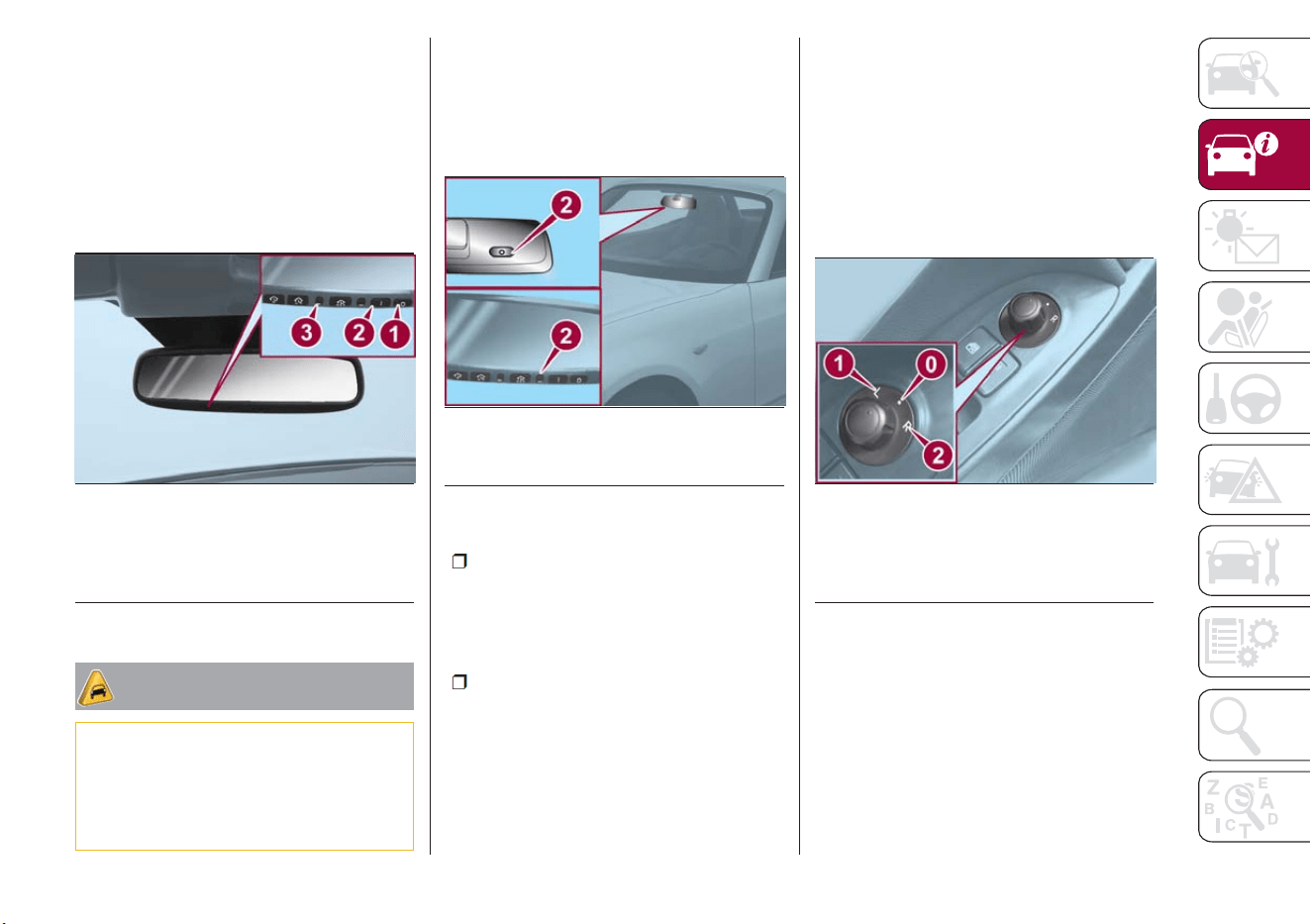
Automatic Dimming
Mirror — If Equipped
The automatic dimming mirror
automatically reduces glare of
headlights from vehicles at the rear
when the ignition is switched ON.
Push the off button ( O ) to cancel the
automatic dimming function. The
indicator light will turn off.
Caution!
To avoid damage to the mirror during
cleaning, never spray any cleaning solution
directly onto the mirror. Apply the solution
onto a clean cloth and wipe the mirror
clean.
Push the off button ( O ) to cancel the
automatic dimming function. The
indicator light will turn off.
To reactivate the automatic dimming
function, push the on button ( I ). The
indicator light will illuminate.
Note:
Do not use glass cleaner or
suspend objects on or around the light
sensor. Otherwise, light sensor
sensitivity will be affected and may not
operate normally.
The automatic dimming function is
canceled when the ignition is switched
ON and the gear selector is in
REVERSE.
Power Mirrors
The ignition must be in the ACC or ON
position to adjust the outside power
mirrors.
Rotate the mirror switch to the left(L)
orright(R)toselect which mirror to
adjust.
Push the mirror control switch in the
direction of the desired position.
After adjusting the mirror, lock the
control by rotating the switch to the
center position to prevent accidental
movements.
04060102-36E-666
Automatic Dimming Mirror Buttons
1—Off
2—On
3 — Light Sensor
04060102-121-666
Light/Rain Sensor
2 — Light Sensor
04060101-L12-001
Power Mirror Switch
0 — Center Position
1 — Left Position
2 — Right Position
37

Folding Mirrors
Manually fold the outside mirror
rearward until it is flush with the vehicle.
Your vehicle may be equipped with a
driver side automatic-dimming mirror.
The automatic-dimming door mirror is
linked with the automatic-dimming
rearview mirror inside the vehicle to
automatically reduce headlight glare
from vehicles at the rear. Refer to
“Automatic Dimming Mirror” in this
section for further information.
Note: The passenger door mirror does
not have the automatic-dimming
feature.
EXTERIOR LIGHTS
Headlights
Rotate the headlight switch to
activate/deactivate the headlights, other
exterior lights and dashboard
illumination.
When the lights are turned on, the
indicator in the instrument cluster
illuminates.
Note: To prevent discharge of the
battery, do not leave the lights on while
the engine is OFF.
04060101-12R-001AB
Outside Folding Mirror
05030101-132-001AB
Headlight Switch
1 — Headlight Switch
2 — Fog Light Switch
38
GETTING TO KNOW YOUR VEHICLE

Headlight Operation
Without Auto-Light Control
Switch Position OFF Daytime Running Lights High Beams
Ignition Position ON ACC Or OFF ON ACC Or OFF ON ACC Or OFF
Headlights Off Off Off Off On Off
Daytime
Running Lights On Off Off Off Off Off
Tail Lights / Position Lights /
License Plate Lights /
Instrument Panel Illumination
Off Off On On On
On
(*)
(*) If the driver's door is opened, or 30 seconds have elapsed with the lights turned on, the lights turn off.
With Auto-Light Control
Switch Position OFF AUTO
Daytime Running
Lights
High Beams
Ignition Position ON
ACC Or
OFF
ON
ACC Or
OFF
ON
ACC Or
OFF
ON
ACC Or
OFF
Headlights Off Off
Auto
(*)
Off Off Off On Off
Daytime Running Lights On Off
Auto
(*)
Off Off Off Off Off
Tail Lights / Position Lights / License Plate
Lights / Instrument Panel Illumination
Off Off Auto
On
(**) /
Off
(***)
On On On
On
(****)
(*) The headlights and other light settings adjust automatically depending on the surrounding brightness detected by the sensor.
(**) While the lights are turned on, they will remain on even if the ignition is switched to a position other than ON. If the driver’s door is opened, or 30 seconds have
elapsed with the lights turned on, the lights turn off.
(***) When the ignition is switched to a position other than ON, the lights will not turn on even if the headlight switch is switched to AUTO.
(****) If the driver’s door is opened, or 30 seconds have elapsed with the lights turned on, the lights tur n off.
39

Daytime Running Lights
(DRL)
The daytime running lights turn on
automatically when the vehicle starts
moving.
They turn off when the parking brake is
engaged or the gear selector is shifted
to the PARK position (if equipped with
automatic transmission).
Note: In some markets, the daytime
running lights can be deactivated. Refer
to “Personalization Features” in “Getting
To Know Your Instrument Panel” for
further information.
High Beams
The headlights can be switched
between high and low beams by
pushing the headlight switch lever
forward for high beams, and pulling the
lever rearward to return to low beams.
When the headlight high beams are on,
the
high beam indicator is
illuminated in the instrument cluster.
Flash To Pass
You can signal another vehicle with your
headlights by partially pulling the
headlight lever toward the steering
wheel. This will cause the high beam
headlights to turn on until the lever is
released.
The
high beam indicator in the
instrument cluster illuminates while the
high beams are active.
Automatic Lighting
When the headlight switch is in the
AUTO position and the ignition is
switched ON, the light sensor will
detect the surrounding light levels and
automatically turns the headlights, other
exterior lights and dashboard
illumination on or off.
Note: Do not shade the light sensor by
placing a sticker or a label on the
windshield. Otherwise the light sensor
will not operate correctly.
The light sensor also works as a rain
sensor for the auto-wiper control. Keep
hands and scrapers clear of the
windshield when the wiper lever is in
the AUTO position and the ignition is
switched ON, as fingers could be
pinched or the wipers and wiper blades
damaged when the wipers activate
automatically. If you are going to clean
the windshield, be sure the wipers are
turned off completely when the engine
is running.
Note:
The headlights, other exterior lights
and dashboard lights may not turn off
immediately even if the surrounding
area becomes well-lit because the light
sensor determines that it is night time if
the surrounding area is continuously
dark for several minutes such as inside
long tunnels, traffic jams inside tunnels,
or in indoor parking lots. In this case,
the lights turn off if the light switch is
turned to the OFF position.
When the headlight switch is in the
AUTO position and the ignition is
switched to ACC or OFF, the
headlights, other exterior lights and
dashboard illumination will turn off.
The dashboard lights can be
adjusted by rotating the knob in the
instrument cluster. The day/night mode
can be changed by rotating the knob
until a beep sound is heard.
The sensitivity of the automatic
lightsmaybechangedbyan
authorized dealer.
05030101-12A-003
Light Sensor
40
GETTING TO KNOW YOUR VEHICLE
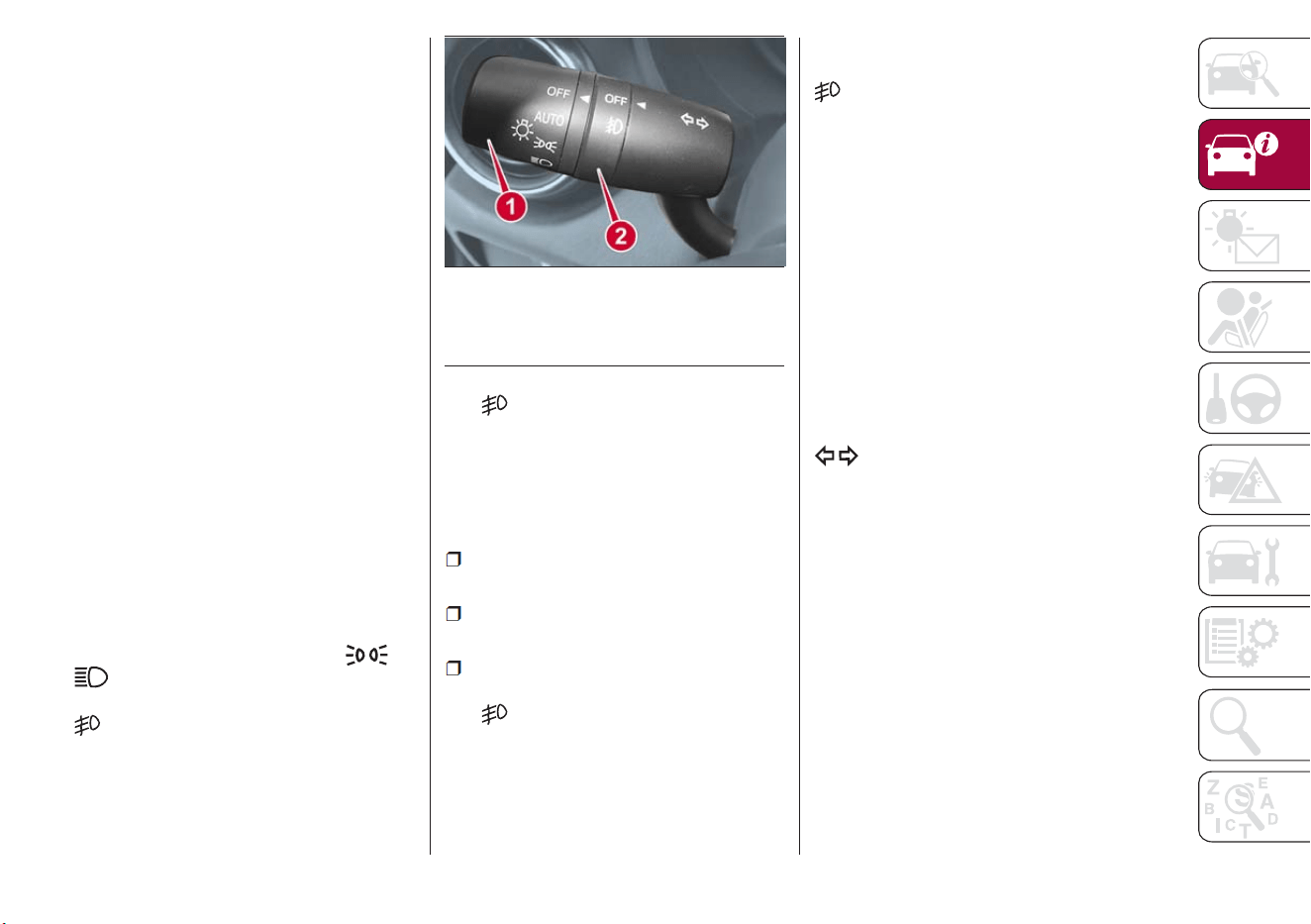
Follow Me Home
The Follow Me Home Light System
turns on the headlights (low beams) for
a period of time after the ignition is
switched OFF.
System Activation
With the ignition switched to ACC or
OFF, pull the headlight control lever
rearward and the low beam headlights
will turn on.
The headlights turn off after a period of
time after all doors are closed.
The time until the headlights turn off
after all of the doors are closed can be
changed through the Connect system.
The headlights turn off if the lever is
pulled again while the headlights are on,
or after three minutes of no further
action after the first pull of the lever.
Front Fog Lights
The front fog light can be activated
when the ignition is in the ON position
and the headlights or parking lights are
on.
Activation
Turn the headlight switch to the
or
position.
Rotate the fog light switch to the
position.
The
fog light indicator in the
instrument cluster illuminates while the
front fog lights are on.
Deactivation
Perform one of the following operations
to turn off the front fog lights:
Rotate the fog light switch to the OFF
position.
Turn the headlight switch to the OFF
position.
Switch the ignition to a position other
than ON.
The
fog light indicator in the
instrument cluster goes off when the
front fog light is turned off.
With Auto-Light Control
When the fog light switch is in
position and the headlight switch is
in AUTO position, the front fog lights will
stay on.
Turn Signals
The ignition must be in the ON position
to use the turn signals and lane change
assist.
Move the signal lever down (for a left
turn) or up (for a right turn). The signal
will self-cancel after the turn is
completed.
If the indicator light continues to flash
after a turn, manually return the lever to
its original position.
The turn signal indicators (green)
in the instrument cluster flash
according to the operation of the turn
signal lever to show which signal is
active.
Note: If an indicator light stays on
without flashing or if it flashes
abnormally, one of the turn signal bulbs
may be burned out.
05030101-132-001AB
Headlight Switch
1 — Headlight Switch
2 — Fog Light Switch
41

Lane Change Assist
Move the lever halfway toward the
direction of the lane change (until the
indicator flashes) and hold it there. It will
return to the off position when released.
Three-Flash Turn Signal
After releasing the turn signal lever, the
turn signal indicator flashes three times.
The operation can be cancelled by
moving the lever in the direction
opposite to which it was operated.
The three-flash turn signal function can
be turned on or off using the
personalization function in the radio.
Adaptive Front Lighting
System (AFS) — If
Equipped
This system directs the main headlight
beams and adapts it to the driving
conditions around bends and turns,
continuously and automatically.
The system directs the headlight beam
to illuminate the road in the best way,
taking into account the speed of the
vehicle, the bend or corner angle and
the speed of steering.
The Adaptive Front Lighting System is
automatically activated when the
vehicle is started.
Leaving Home Light
System
The Leaving Home Light System turns
the headlights on when the unlock
button on the key fob is pushed while
away from the vehicle.
Activation
With the ignition switch in the OFF
position, and the headlight switch is in
the
or position, the
headlights will illuminate when the
unlock button on the key fob is pushed,
and the vehicle receives the signal.
The headlights turn off after
30 seconds.
The following lights turn on when the
Leaving Home Light System is
operated: low beams/parking lights/tail
lights/license plate lights.
Operation of the Leaving Home Light
System can be turned on or off through
the Connect system.
When the lock button on the key fob
is pushed, and the vehicle receives the
signal, the headlights turn off.
When the headlight switch is in a
position other than
or ,the
headlights turn off.
Headlamp Leveling
System — If Equipped
On some models, the angle of the
headlights will be automatically adjusted
when turning on the headlights.
Adjusting The Headlight
When Abroad
Dipped headlights are adjusted for
driving in the country where the vehicle
was originally purchased.
When travelling in countries with
opposite driving direction, to avoid
flashing the drivers on the other side of
the road, you need to cover areas of
the headlight. For this operation contact
an authorized dealer.
42
GETTING TO KNOW YOUR VEHICLE

WINDSHIELD
WIPERS / WASHER
Windshield Wipers And
Washer
The windshield wiper/washer lever is
located on the right side of the steering
wheel. The ignition must be in the ON
position to use these features.
Windshield Wipers
Activate the windshield wipers by
pushing the wiper lever up or down.
With Intermittent Wiper
Set the lever to the intermittent position
and choose the interval timing by
rotating the center switch.
Switch positions:
or MIST: operation while
pushing the lever upward
OFF: stop
--- or INT: intermittent operation
— or LO: low speed operation
= or HI: high speed operation
With Auto-Wiper Control
When the wiper lever is in the AUTO
position, the rain sensor will sense the
amount of rainfall on the windshield and
turns the wipers on or off automatically
(off/intermittent/low speed/high speed).
Switch positions:
or MIST: operation while
pulling up lever
OFF: stop
AUTO: auto control operation
— or LO: low speed operation
= or HI: high speed operation
Adjusting Rain Sensor Sensitivity
The sensitivity of the rain sensor can be
adjusted by rotating the switch on the
wiper lever.
From the center position (normal),
rotate the switch downward for higher
sensitivity (+) (faster response) or rotate
it upward for less sensitivity (-) (slower
response).
Note: Do not shade the rain sensor by
placing a sticker or a label on the
windshield. Otherwise the rain sensor
will not operate correctly.
When the wiper lever is in the AUTO
position and the ignition is switched
ON, the wipers may move automatically
in the following cases:
If the windshield above the rain
sensor is touched or wiped with a cloth.
If the windshield is struck with a hand
or other object from either outside or
inside the vehicle.
Warning!
Keep hands and scrapers clear of the
windshield when the wiper lever is in the
AUTO position and the ignition is switched
ON as fingers could be pinched or the
wipers and wiper blades damaged when
the wipers activate automatically.
If you are going to clean the windshield,
be sure the wipers are turned off. This is
important when clearing ice and snow.
Switching the auto-wiper lever from the
OFF to the AUTO position while driving
activates the windshield wipers once,
after which they operate according to
the rainfall amount.
The auto-wiper control may not operate
when the rain sensor temperature is
about 14 °F (–10 °C) or lower, or about
185 °F (85 °C) or higher.
05030101-122-001
Windshield Wiper Lever
1 — Rain Sensor Adjustment
43
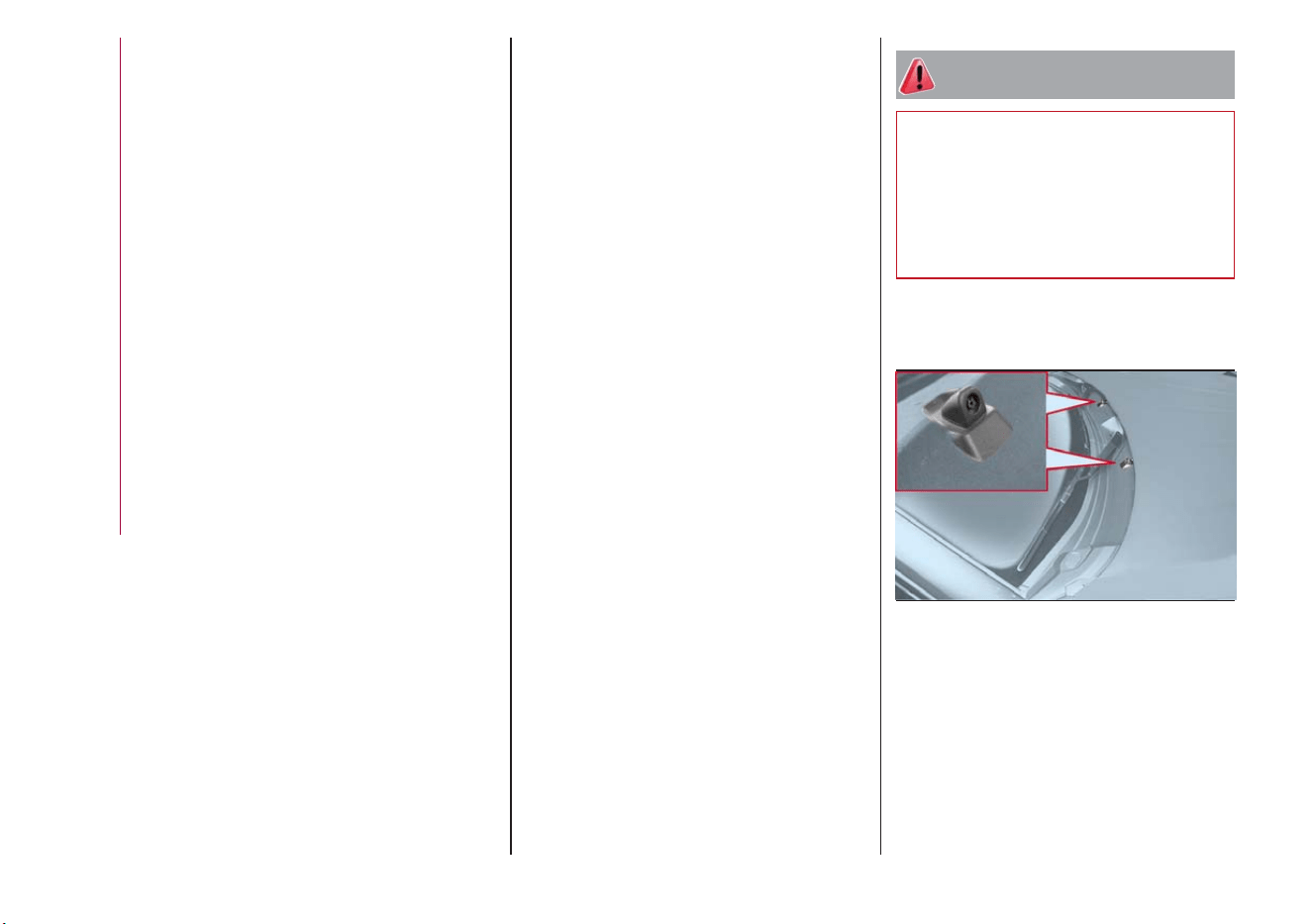
If the windshield is coated with water
repellent, the rain sensor may not be
able to sense the amount of rainfall
correctly and auto-wiper control may
not operate properly.
If dirt or debris (such as ice or debris
containing salt water) adheres to the
windshield above the rain sensor or if
the windshield is iced, it could cause
the wipers to move automatically.
However, if the wipers cannot remove
this ice, dirt or debris, the auto-wiper
control will stop operation. In this case,
set the wiper lever to the low speed
position or high speed position for
manual operation, or remove the ice,
dirt or debris by hand to restore the
auto-wiper operation.
If the auto-wiper lever is left in the
AUTO position, the wipers could
operate automatically from the effect of
strong light sources, electromagnetic
waves, or infrared light because the rain
sensor uses an optical sensor.
It is recommended that the auto-wiper
lever be switched to the OFF position
other than when driving the vehicle
under rainy conditions.
The auto-wiper control functions can be
turned off.
Because heavy ice and snow can jam
the wiper blades, the wiper motor is
protected from motor breakdown,
overheating and possible fire by a circuit
breaker. This mechanism will
automatically stop operation of the
blades, but only for about five minutes. If
this happens, turn off the wiper switch
and park off the road and remove the
snow and ice. After five minutes, turn on
the switch and the blades should operate
normally. If they do not resume
functioning, contact an authorized dealer
as soon as possible. Pull off to the side
of the road to a safe location. Wait until
the weather clears before trying to drive
with the wipers inoperative.
Windshield Washer
Pull the wiper/washer lever rearward
and hold it to spray washer fluid onto
the windshield.
With the wiper lever in the OFF,
intermittent, or AUTO position, the
wipers will operate continuously until
the lever is released.
Warning!
Sudden loss of visibility through the
windshield could lead to a collision. You
might not see other vehicles or other
obstacles. To avoid sudden icing of the
windshield during freezing weather, warm
the windshield with defroster before and
during windshield washer use.
If the fluid level is normal and the
washer does not work, contact an
authorized dealer.
With Headlight Washers
When the headlights are on, the
headlight washers operate
automatically once every fifth time the
windshield washer operates.
04110109-115-001AB
Windshield Washer Nozzles
44
GETTING TO KNOW YOUR VEHICLE
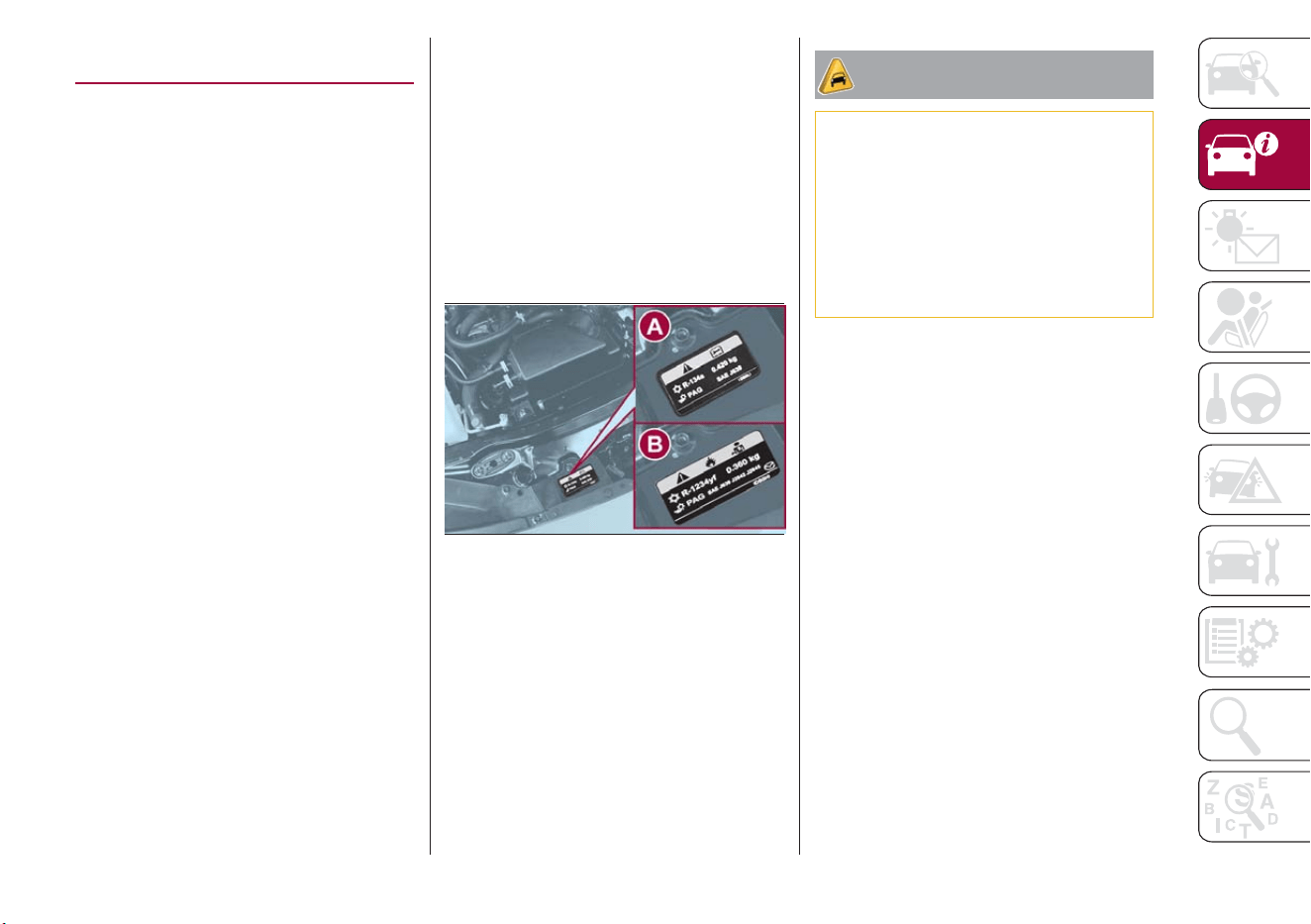
CLIMATE CONTROL
SYSTEM
Operating Tips
The air conditioning system will only
operate with the engine running.
To prevent the battery from being
discharged while the engine is off, do
not leave the Blower Control Knob on
for extended periods of time.
To improve system efficiency, clear all
obstructions (leaves, snow and ice)
from the hood and the air inlet in the
grille.
Use the air conditioning system to
defog the windows and dehumidify the
air.
Recirculation mode should be used
when driving through tunnels, while in a
traffic jam, or when you would like to
quickly cool the interior.
Use the outside air position for
ventilation or windshield defrosting.
If the vehicle has been parked in direct
sunlight during hot weather, open the
windows to let warm air escape, and
then run the air conditioning system.
To keep the internal parts lubricated
and the system running smoothly, run
the air conditioner about 10 minutes at
least once a month.
Have the air conditioner checked before
the weather gets hot. A lack of refrigerant
may make the air conditioner less
efficient. The refrigerant specifications are
indicated on a label (A or B depending
on the market) attached to the inside of
the engine compartment. Check the label
before refilling the refrigerant. If the wrong
type of refrigerant is used, it could result
in a serious malfunction of the air
conditioner. For details, contact your
authorized dealer.
Caution!
The system uses a coolant that is compatible
with the laws in force in the countries where
the vehicle is sold, R134a or R1234yf
(indicated on a specific plate in the engine
compartment). The use of other coolants
affects the efficiency and condition of the
system. Also the compressor coolants used
must be compatible with the indicated
coolant.
06010100121001
Label Location
45

Vent Operation
Adjusting The Vents
To adjust the direction of air flow, move
the vent adjustment knob.
Note: When using the air conditioner in
humid conditions, fog may blow from
the vents. This is a result of humid air
being suddenly cooled and does not
indicate a system malfunction.
Center Vents (Driver) and Side
Vents
Center and side vents are located on
the dashboard.
Air vent open/close: the air vents can
be fully opened and closed by using
knob1(A=open/B=close).
Air flow direction adjustment:use
knob 1 to adjust the center vents to the
desired position.
Center Vents (Front Passenger)
Center vents are located on the
dashboard.
Air vent open/close: use the Center
Vent tab 1 to open/close the center
vents(A=open/B=close).
Air flow direction adjustment: use the
Center Vent tab 1 to adjust the center
vents to the desired position.
06010201-033-001
Side Air Vents
06010201-033-666
Operating the Side Air Vents
1 — Air Vent Knob
A — Open Position
B — Closed Position
06010201-121-001AB
Central Air Vent
06010201-121-777AB
Operating The Central Air Vent
1 — Center Vent Tab
A — Open Position
B — Closed Position
46
GETTING TO KNOW YOUR VEHICLE

Airflow Mode
06010202-121-002
Airflow Locations
1 — Fixed Upper Air Diffuser
2 — Adjustable Side Air Vents
3 — Adjustable Center Air Vent
4 — Floor Vents
47

Manual Climate Control System
With MAX A/C function
06010300-122-002
Manual Climate Controls With MAX A/C
1 — Temperature Control Knob 4 — Rear Window Defrost Button
2 — Blower Control Knob 5 — Air Recirculation Button
3 — Mode Selector Knob 6 — A/C Button
48
GETTING TO KNOW YOUR VEHICLE
Controls
1 – Temperature Control Knob
This dial controls the interior temperature
of the vehicle.
Turn it clockwise for hotter temperatures
and counterclockwise for colder
temperatures.
MAX A/C – If Equipped:
When the
Mode Selector Knob is set to
or ,
the Blower Control Knob is in a position
other than 0, and the temperature
control knob is in the maximum cold
position, the Recirculation Button will
activate and the A/C will turn on
automatically. If A/C is not desired,
press the A/C Button to turn it off.
2 – Blower Control Knob
The blower has seven speeds. Turn the
knob clockwise to increase blower speed
or counterclockwise to decrease blower
speed.
3 – Mode Selector Knob
Turn the Mode Selector Knob to select
the air flow mode.
The mode selector dial can be set at the
intermediate positions (●) between each
mode.
Set the knob to an intermediate position
if you want to split the air flow between
the two modes.
For example, when the Mode Selector
Knob is at the intermediate position (●)
between the
and positions, air
flow from the floor vents is less than
that of the
position.
4 – Rear Window Defrost Button
The Rear Window Defrost Button clears
fog and frost from the rear window. The
ignition must be on to use the defroster.
Push the button to turn on the Rear
Window Defroster. The Rear Window
Defroster operates for about
15 minutes and then turns off
automatically. The button LED will
illuminate when the defroster is
operating.
To turn off the Rear Window Defroster
before the end of 15 minutes, push the
button again.
Caution!
Failure to follow these cautions can cause
damage to the heating elements:
Use care when washing the inside of the
rear window. Do not use abrasive window
cleaners on the interior surface of the
window. Use a soft cloth and a mild
washing solution, wiping parallel to the
heating elements. Labels can be peeled off
after soaking with warm water.
Do not use scrapers, sharp instruments,
or abrasive window cleaners on the interior
surface of the window.
Keep all objects a safe distance from the
window.
Note:
Before opening the convertible top,
make sure the Rear Window Defrost
Button is turned off. Otherwise, the
heat generated from the defroster
could damage the convertible top and
the internal material.
This defroster is not designed for
melting snow. If there is an
accumulation of snow on the rear
window, remove it before using the
defroster.
Mirror Defroster — If Equipped:
To turn on the mirror defroster, turn the
ignition ON and push the Rear Window
Defroster Button.
5 – Air Recirculation Button
Push the Air Recirculation Button to
select between outside air and
recirculated air positions.
Recirculated Air Position: (LED on)
Outside air is shut off when this position
has been activated. Use this position
when going through tunnels, driving in
congested traffic (high engine exhaust
areas), or when quick cooling of the
vehicle is desired.
Outside Air Position: (LED off)
Outside air is allowed to enter the
cabin. Use this mode for ventilation or
windshield defrosting.
49

Note: Do not use the Outside Air
Position in cold or rainy weather is
dangerous as it will cause the windows
to fog up. Your vision will be hampered,
which could lead to a serious accident.
6 – A/C Button
Push the A/C Button to turn on the air
conditioner.
The LED on the switch will illuminate
when the Blower Control Knob is in any
position except the OFF position.
Push the button again to turn off the air
conditioner.
Note: The air conditioner may not
function when the outside temperature
approaches 32 °F (0 °C).
Heating
Proceed as follows:
1. Set the Mode Selector Knob to the
position.
2. Set the Air Recirculation Button to
the outside air position.
3. Set the Temperature Control Dial to
the hot position.
4. Set the Blower Control Knob to the
desired speed.
5. If dehumidified heating is desired,
turn on the air conditioner.
If the windshield fogs up easily, set the
Mode Selector Knob to the
position.
If cooler air is desired at face level, set
the Mode Selector Knob to the
position and adjust the Temperature
Control Knob to maintain comfort.
The floor vents will blow warmer air
while the side air vents will blow cooler
air (except when the temperature
control dial is set at the maximum hot
or cold position).
Cooling (With Air
Conditioner)
Proceed as follows:
1. Set the Mode Selector Knob to the
position.
2. Set the Temperature Control Knob
to the cold position.
3. Set the Blower Control Knob to the
desired speed.
4. Turn on the air conditioner by
pushing the A/C Button.
5. After cooling begins, adjust the
Blower Control Knob and Temperature
Control Knob as needed to maintain
comfort.
Note:
If the air conditioner is used while
driving up large hills or in heavy traffic,
monitor the Engine Coolant
Temperature Warning Light to see if it
is illuminated or flashing. The air
conditioner may cause engine
overheating in these situations. If the
warning light is illuminated or flashing,
turn the air conditioning off
immediately.
When maximum cooling is desired,
set the Temperature Control Knob to
the extreme cold position, push the Air
Recirculation Button to activate the
recirculated air position, and then turn
the fan control dial fully clockwise.
If warmer air is desired at floor level,
set the Mode Selector Knob to the
position, and adjust the
Temperature Control Knob to maintain
comfort.
The floor vents will blow warmer air
while the side air vents will blow cooler
air (except when the temperature
control dial is set at the maximum hot
or cold position).
50
GETTING TO KNOW YOUR VEHICLE

Ventilation
Proceed as follows:
1. Set the Mode Selector Knob to the
position.
2. Set the Air Recirculation Button to
the outside air position.
3. Set the Temperature Control Knob
to the desired position.
4. Set the Blower Control Knob to the
desired speed.
Windshield Defrosting
And Defogging
Proceed as follows:
1. Set the Mode Selector Knob to the
Front Defrost
position.
2. Set the Temperature Control Knob to
the desired position.
3. Set the Blower Control Knob to the
desired speed.
4. If dehumidified heating is desired,
turn on the air conditioner.
Warning!
Set the temperature control to the hot or
warm position when defogging (Front
Defrost position). Using the Front Defrost
position with the temperature control set to
the cold position is dangerous as it will
cause the outside of the windshield to fog
up. Your vision will be hampered, which
could lead to a serious accident.
Note:
For maximum defrosting, turn on
the air conditioner, set the Temperature
Control Knob to the extreme hot
position, and turn the Blower Control
Knob fully clockwise.
If warm air is desired from the floor
vents, set the Mode Selector Knob to
the
position.
If equipped with MAX A/C, the
Recirculation Button can be set to the
Recirculated Air position, when the
Blower Control Knob is ON, and the
Mode Selector Knob is set to the Front
Defrost position.
Dehumidifying (With Air
Conditioner)
Operate the air conditioner in cool or
cold weather to help defog the
windshield and side windows.
Proceed as follows:
1. Set the Mode Selector Knob to the
desired position.
2. Set the Air Recirculation Knob to the
outside air position.
3. Set the Temperature Control Knob
to the desired position.
4. Set the Blower Control Knob to the
desired speed.
5. Turn on the air conditioner by
pressing the A/C Button.
Note: One of the functions of the air
conditioner is dehumidifying the air. To
use this function, the temperature does
not have to be set to cold. Set the
Temperature Control Knob to the
desired position (hot or cold), and turn
on the air conditioner to dehumidify the
cabin air.
51

Automatic Climate Control System
06010900-122-999
Automatic Climate Controls — Type A
1 — Temperature Control Knob 4 — Rear Window Defrost Button
2 — Blower Control Knob 5 — Air Recirculation Button
3 — Mode Selector Knob 6 — A/C Button
52
GETTING TO KNOW YOUR VEHICLE
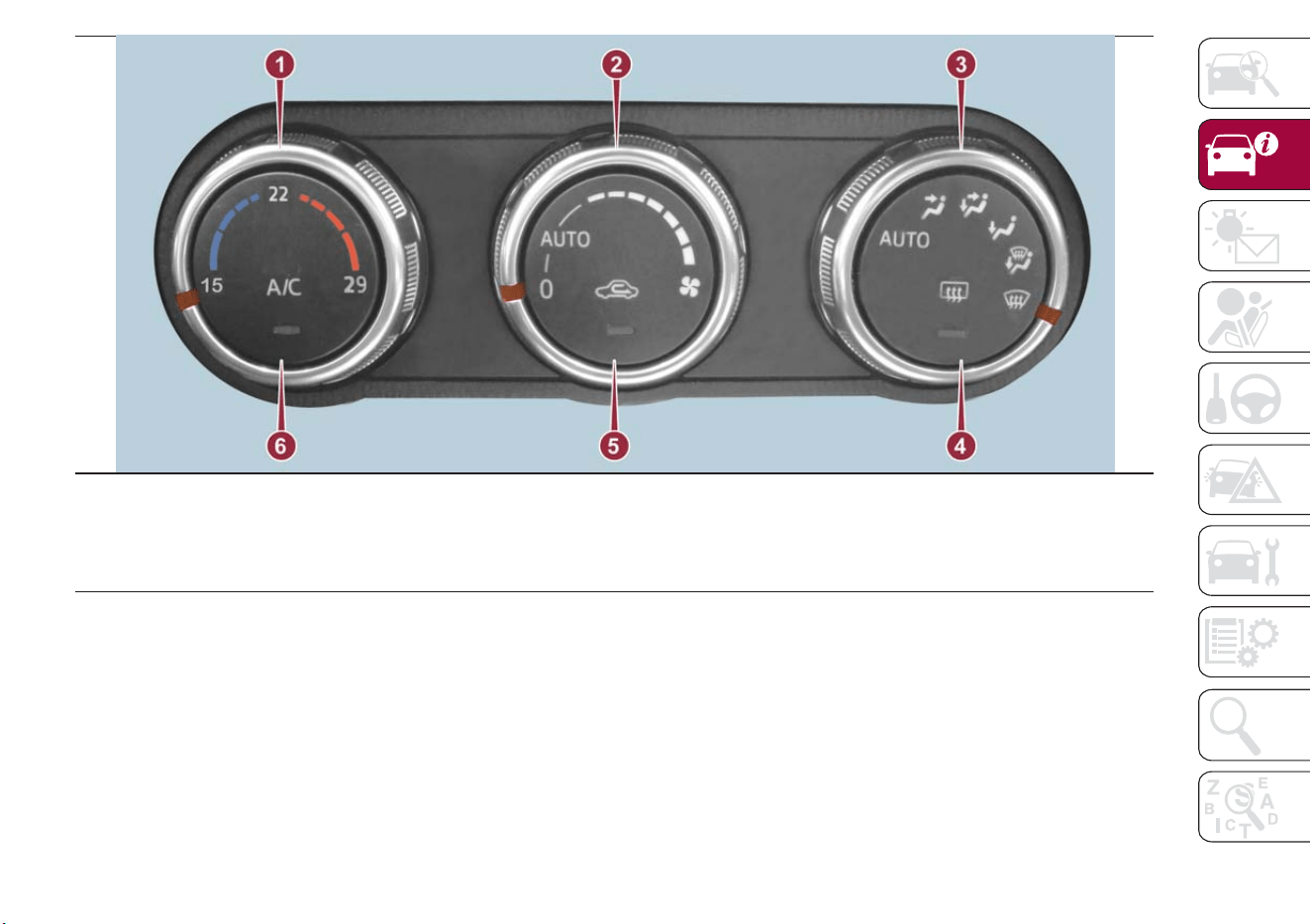
06010900122
Automatic Climate Controls — Type B
1 — Temperature Control Knob 4 — Rear Window Defrost Button
2 — Blower Control Knob 5 — Air Recirculation Button
3 — Mode Selector Knob 6 — A/C Button
53

Controls
1 – Temperature Control Knob
This knob controls internal temperature
of the vehicle. Turn it clockwise for
hotter temperatures and
counterclockwise for colder
temperatures.
2 – Blower Control Knob
The fan has seven speeds. Turn the
clockwise to increase blower speed or
counterclockwise to decrease blower
speed/enter Auto mode.
AUTO Position: The blower speed is
automatically controlled by the system
based upon the set temperature.
0 Position: To turn off the system, set
the dial to 0 position.
3 – Mode Selector Knob
Turn the Mode Selector Knob to select
the air flow mode.
AUTO Position: The air flow
automatically adjusts based upon the
selected temperature.
Note:
With the air flow mode set to the
position, and the Temperature
Control Knob is set to a medium
temperature, the floor vents will blow
warmer air, and the center and side air
vents will blow cooler air.
When the Blower Control Knob is
on, and the Mode Selector Knob is in
the
position, the air conditioner is
automatically turned on, and the Air
Recirculation Button is automatically
set to the outside air position for
windshield defrosting.
4 – Rear Window Defrost Button
The Rear Window Defroster clears fog
and frost from the rear window. The
ignition must be switched ON to use
the defroster.
Push the button to turn on the Rear
Window Defroster.
The Rear Window Defroster operates
for about 15 minutes, and then turns off
automatically.
The button LED will illuminate when the
defroster is operating.
To turn off the Rear Window Defroster
before the end of 15 minutes, push the
switch again.
Caution!
Failure to follow these cautions can cause
damage to the heating elements:
Before opening the convertible top,
make sure the Rear Window Defrost Button
is turned OFF. Otherwise, the heat
generated from the defroster could
damage the convertible top and the internal
material.
Use care when washing the inside of the
rear window. Do not use abrasive window
cleaners on the interior surface of the
window. Use a soft cloth and a mild
washing solution, wiping parallel to the
heating elements. Labels can be peeled off
after soaking with warm water.
Do not use scrapers, sharp instruments,
or abrasive window cleaners on the interior
surface of the window.
Keep all objects a safe distance from the
window.
Note: This defroster is not designed for
melting snow. If there is an
accumulation of snow on the rear
window, remove it before using the
defroster.
54
GETTING TO KNOW YOUR VEHICLE

Mirror Defroster — If Equipped:To
turn on the mirror defroster, switch the
ignition on and push the Rear Window
Defroster Button.
5 – Air Recirculation Button
Press the Air Recirculation Button to
select between outside air and
recirculated air positions.
Recirculated Air Position: (LED On)
Outside air is shut off when this position
has been activated. Use this position
when going through tunnels, driving in
congested traffic (high engine exhaust
areas), or when quick cooling of the
vehicle is desired.
Outside Air Position: (LED Off)
Outside air is allowed to enter the
cabin. Use this mode for ventilation or
windshield defrosting.
Note: Do not use the Recirculated Air
Position in cold or rainy weather. Using
the Recirculated Air Position in cold or
rainy weather is dangerous as it will
cause the windows to fog up. Your
vision will be hampered, which could
lead to a serious accident.
6 – A/C Button
Push the A/C Button to turn on the air
conditioner.
The LED on the switch will illuminate
when the Blower Control Knob is in any
position except the off position.
Push the button again to turn off the air
conditioner.
Note: The air conditioner may not
function when the outside temperature
approaches 32 °F(0°C).
Operation Of Automatic
Air Conditioning
Proceed as follows:
1. Set the mode selector knob to the
AUTO position.
2. Set the Air Recirculation Button to
the outside air position (indicator light
turned off).
Note: If the recirculated air position is
used for long periods in cold weather or
high humidity, the windshield may fog
up more easily.
3. Set the Blower Control Knob to the
AUTO position.
4. Push the A/C button to operate the
air conditioning (indicator light on).
5. Set the Temperature Control Knob
to the desired position.
6. To tur n off the system, set the
blower control knob to the 0 position.
Setting the temperature to maximum
hot or cold will not provide the desired
temperature at a faster rate.
When selecting heat, the system will
restrict air flow until it has warmed to
prevent cold air from blowing out of the
vents.
For an optimal cabin temperature, set
the temperature close to 77º. Adjust to
the desired temperature if necessary.
Windshield Defrosting
And Defogging
Set the mode selector knob to the
position and turn the blower control
knob to the desired speed.
In this position, the outside air position
is automatically selected, and when the
blower control knob is on, the air
conditioner automatically turns on. The
air conditioner will directly dehumidify
the air to the front windshield and side
windows. Air flow amount will be
increased.
Use the temperature control knob to
increase the air flow temperature and
defog the windshield more quickly.
Warning!
Set the temperature control to the hot or
warm position when defogging (Front
Defrost position). Using the Front Defrost
position with the temperature control set to
the cold position is dangerous as it will
cause the outside of the windshield to fog
up. Your vision will be hampered, which
could lead to a serious accident.
55

Sunlight/Temperature
Sensor
The air conditioning system measures
inside and outside temperatures, and
sunlight.
It then sets temperatures inside the
cabin accordingly.
Note: Do not obstruct either sensor.
Otherwise, the air-conditioning system
will not operate properly.
POWER WINDOWS
Power Window Controls
The ignition must be placed in the ON
position for the power windows to
operate.
A power window may no longer
open/close if you continue to push the
switch after opening/closing the power
window.
If the power window does not
open/close, wait a moment and then
operate the switch again.
Note: To prevent burning out the fuse
and damaging the power window
system, do not open or close both
windows at once.
The passenger window can be
operated with each door switch when
the power window lock switch on the
driver's door is in the unlocked position.
06010904333003
Exterior Sensor
1 — Sunlight Sensor
06010904-121-002AB
Interior Sensor
2 — Interior Temperature Sensor
56
GETTING TO KNOW YOUR VEHICLE

Passenger Control Switches
The passenger window can also be
operated using the master control
switches on the driver's door.
Auto-Opening Power Windows
To fully open the window automatically
push the switch completely down. To
stop the window partway pull or push
the switch in the opposite direction and
then release it. The power window
cannot be fully closed while the door is
open.
Power Window System Initialization
Procedure
If the battery was disconnected during
vehicle maintenance, or for other
reasons (such as a switch continues to
be operated after the window is
open/closed), the window will not fully
open automatically.
Resetting of the automatic function can
be performed using the master control
switches or each passenger door
switch.
The power window auto function reset
procedure can be done on both door
switches. The power window auto
function will only resume on the power
window that has been reset:
1. Close the doors and the convertible
top.
2. Place the ignition in the ON position.
3. Make sure that the power window
lock switch located on the driver's door
is not depressed.
4. Push the switch and fully open the
window.
5. Pull up the switch to fully close the
window and continue holding the
switch for about two seconds after the
window fully closed.
6. Repeat steps four and five for the
passenger power window while seated
in the passenger seat.
7. Make sure that the power windows
operate correctly using the door
switches.
After the system has been re-initialized,
passenger window can be fully opened
automatically using the master control
switches. If the automatic power
window operation does not operate
normally while the doors or convertible
top are opened/closed, reset it using
the above procedures.
Engine-Off Power Window
Operation
The power window can be operated for
about 40 seconds after the ignition has
been cycled from ON to the OFF
position with both doors closed. If any
door is opened, the power window will
stop operating.
For engine-off operation of the power
window, the switch must be held up
firmly throughout window closure
because the auto-closing function will
be inoperable.
04070103-LN2-002
Power Window Switches
1 — Driver's Window
2 — Passenger's Window
04070103-L12-001
Power Window Switch Function
1 — Closing-Lightly Pull The Switch Up
2 — Opening-Lightly Hold The Switch
Down
57

Warning!
Never leave children unattended in a
vehicle, and do not let children play with
power windows. Do not leave the key fob
in or near the vehicle, or in a location
accessible to children, and do not leave the
ignition of a vehicle equipped with the
Keyless Entry System in the ACC or
ON/RUN mode. Occupants, particularly
unattended children, can become
entrapped by the windows while operating
the power window switches. Such
entrapment may result in serious injury or
death.
Power Window Lock
Switch
This feature prevents the passengers
power window from operating. Keep
this switch in the locked position while
children are in the vehicle.
1. Locked Position (Button
Pushed): only the driver's power
window can be operated.
2. Unlocked Position (Button Not
Pushed): both power windows on
each door can be operated.
Note: When the power window lock
switch is in the locked position, the light
on the passenger power window switch
turns off. The light may be difficult to
see depending on the surrounding
brightness.
HOMELINK —
IF EQUIPPED
General Information
The HomeLink system replaces up to
three hand-held transmitters with a
single built-in component in the
auto-dimming mirror. Pushing the
HomeLink button on the auto-dimming
mirror activates garage doors, gates
and other devices surrounding your
home.
Note: HomeLink and HomeLink house
icon are registered trademarks of
Gentex Corporation.
Warning!
Vehicle exhaust contains carbon
monoxide, a dangerous gas. Do not run
your vehicle in the garage while
programming the transceiver. Exhaust gas
can cause serious injury or death.
Your motorized door or gate will open
and close while you are programming the
universal transceiver. Do not program the
transceiver if people, pets or other objects
are in the path of the door or gate. Only
use this transceiver with a garage door
opener that has a “stop and reverse”
feature as required by Federal safety
standards. This includes most garage door
04070104-L12-001
Power Window Lockout Switch
1 — Locked Position
2 — Unlocked Position
58
GETTING TO KNOW YOUR VEHICLE

opener models manufactured after 1982.
Do not use a garage door opener without
these safety features. Call toll-free
1-800-355-3515 or, on the Internet at
HomeLink.com for safety information or
assistance.
Pre-Programming The
System
Note: It is recommended that a new
battery be placed in the hand-held
transmitter of the device being
programmed to HomeLink for quicker
training and accurate transmission of
the radio-frequency signal.
Proceed as follows:
1. Verify that there is a remote control
transmitter available for the device you
would like to program.
2. Disconnect the power to the device.
Programming The
System
Note: When programming a garage
door opener or a gate, disconnect the
power to these devices before
programming. Continuous operation of
the devices could damage the motor.
The HomeLink system provides three
buttons which can be individually
selected and programmed using the
transmitters for current, on-market
devices as follows:
1. Disconnect power to the device
being programmed.
2. Position the end of your handheld
transmitter one to three inches (2.5 -
7.5 cm) away from the HomeLink
button you wish to program while
keeping the indicator light in view.
3. Simultaneously press and hold both
the chosen HomeLink and hand-held
transmitter buttons. Do not release
the buttons until step four has been
completed.
4. After the HomeLink indicator light
changes from a slow to a rapidly
blinking light, release both the
HomeLink and hand-held transmitter
buttons.
5. Connect power to the device being
programmed.
6. Firmly press and hold the
programmed HomeLink button for five
seconds, and then release it. Perform
this operation two times to activate the
door or gate. If the door or gate does
not activate, press and hold the
just-trained HomeLink button and
observe the indicator light. If the
indicator light stays on constantly,
programming is complete and your
device should activate when the
HomeLink button is pressed and
released.
Note: To program the remaining two
HomeLink buttons, begin with step
one.
7. If the indicator light blinks rapidly for
two seconds and then turns to a
constant light, continue with
“Programming” steps (see below) to
complete the programming of a rolling
code equipped device (most commonly
a garage door opener).
8. At the garage door opener receiver
(motor-head unit) in the garage, locate
the “learn” or “smart” button. This can
usually be found where the hanging
antenna wire is attached to the
motorhead unit.
9. Press and release the “learn” or
“smart” button (the name and color of
the button may vary by manufacturer).
Note: Complete the programming
within 30 seconds.
04060102-121-999
HomeLink Buttons
1 — First HomeLink Button
2 — Second HomeLink Button
3 — Third HomeLink Button
59

10. Return to the vehicle and firmly
press, hold for two seconds and
release the programmed HomeLink
button. Repeat the “ press/hold/
release” sequence a second time, and,
depending on the brand of the garage
door opener (or other rolling code
equipped device), repeat this sequence
a third time to complete the
programming process. HomeLink
should now activate your rolling code
equipped device.
Note: To program the remaining two
HomeLink buttons, begin with step
one.
For questions or comments, please
contact HomeLink at
www.homelink.com or
1-800-355-3515.
Gate Operator/Canadian
Programming
Canadian radio-frequency laws require
transmitter signals to “time-out” (or quit)
after several seconds of transmission -
which may not be long enough for
HomeLink to pick up the signal during
programming.
Similar to this Canadian law, some U.S.
gate operators are designed to
“time-out” in the same manner.
If you live in Canada or you are having
difficulties programming a gate operator
by using the “Programming”
procedures (regardless of where you
live), replace “Programming The
System” step three with the following:
Note: If programming a garage door
opener or gate operator, it is advised to
unplug the device during the “cycling”
process to prevent possible
overheating.
1. Continue to press and hold the
HomeLink button while you press and
release - every two seconds (“cycle”)
your hand-held transmitter until the
frequency signal has successfully been
accepted by HomeLink (the indicator
light will flash slowly and then rapidly).
2. Proceed with the “Programming”
steps to complete.
Operating The System
Push the programmed HomeLink
button to operate a programmed
device.
The code will continue being
transmitted for a maximum of
20 seconds.
Reprogramming The
System
To program a device to HomeLink using
a HomeLink button previously trained,
follow these steps:
1. Push and hold the desired HomeLink
button. DO NOT release the button;
2. The indicator light will begin to flash
after 20 seconds. Without releasing the
HomeLink button, proceed with
“Programming The System” step one.
Erasing Programmed
HomeLink Buttons
To erase the existing programming from
all three operating channels, push and
hold the two outside buttons 1 and
3 on the auto-dimming mirror until the
HomeLink indicator light begins to flash
after approximately ten seconds.
Verify that the programming has been
erased when you resell the vehicle.
60
GETTING TO KNOW YOUR VEHICLE

INTERNAL
EQUIPMENT
Storage Compartments
Center Console
The center console is located between
the driver’s and passenger’s seats.
Warning!
Keep storage compartments closed when
driving. Driving with the storage
compartments open is dangerous. To
reduce the possibility of injury in an
accident or a sudden stop, keep the
storage compartments closed when
driving.
Caution!
Do not leave lighters or eyeglasses in the
storage compartments while parked under
the sun. A lighter could explode or the
plastic material in eyeglasses could deform
and crack from high temperature.
Seat Side Compartment
The seat side compartment is located
between the seats above the
cupholders.
To open, push the release handle down
to open the seat side compartment.
Insert the emergency key in the lock
and turn it clockwise to lock, counter
clockwise to unlock.
Note:
When using the rear console cup
holders, remove any cups before opening
the seat side compartment. If the seat
side compartment is opened with a cup
present, the lid will hit the cups and may
cause the contents to spill.
Back Trim Storage Compartment
Small items can be stored in the back
trim storage compartment which is
located behind the seats.
06040706-12A-001AB
Center Console Lid
06040717-121-001AB
Seat Side Compartment
1 — Release Handle
2 — Key Hole
06040718-12A-002AB
Back Trim Storage Compartment
61

To use the back trim storage
compartment, slide the seat all the way
forward and fold the seat back forward,
then open the compartment.
When finished, close the compartment
and return the seat to its original
position and secure it.
After returning the seat to its original
position, make sure the seat is secured
by attempting to lightly move it forward
and rearward.
Caution!
Do not forcefully push objects into the rear
storage compartment. Otherwise, the box
could be damaged.
Sun Visors
The sun visors are located at the sides
of the interior rear view mirror. They can
be adjusted forward toward the
windshield, and sideways toward the
side windows, to block sunlight.
Vanity Mirrors
To access the vanity mirror, fold the sun
visor down and lift the cover toward the
seats.
Interior Lights
Overhead Light
The interior light is located in the
headliner in between the sun visors.
The interior light can be set to three
different positions.
Light switch positions:
On : Light is on at all times.
Door : Light is on when any door is
open. Light is on or off when the
illuminated entry system is on.
Off : Light is off at all times.
06040100-L12-001AB
Sun Visor
06040200-12A-002AB
Overhead Light Switch
1—On
2 — Door
3—Off
62
GETTING TO KNOW YOUR VEHICLE

Trunk Light
The trunk light comes on when the lid is
open and turns off when closed.
Note: To prevent the battery from
being discharged, do not leave the
trunk open for a long period when the
engine is not running.
Illuminated Entry System
The overhead light turns on when any
of the following operations occurs with
the overhead light switch in the door
position and the ignition switched OFF:
Turns on for about 30 seconds when
the driver's door is unlocked.
Turns on for about 15 seconds when
a door is opened while a key fob is left
in the vehicle and then the door is
closed.
Turns on for about five seconds
when a door is opened from the outside
with a key fob being carried and then
the door is closed.
The overhead light turns on for about
15 seconds when the ignition is
switched OFF with the overhead light
switch in the door position.
The overhead light turns off immediately
in the following cases:
The ignition is switched ON and both
doors are closed.
The driver's door is locked.
Battery Saver
If any door is left open with the
overhead light switch in the door
position or the trunk lid is left open, the
overhead light or trunk light turns off
after about 30 minutes to prevent
discharge of the battery.
To prevent discharge of the battery, if
the interior lights remain on (the interior
light switch is in the on position), they
will turn off automatically under the
following conditions:
No operations are done for about
30 minutes after the ignition is switched
OFF.
The button on the key fob is
pushed, or the request switch located
on the exterior door handle is pushed to
lock the doors (vehicles with the
advanced keyless function) after the
ignition is switched OFF.
In addition, if the following operations
are performed after turning the interior
lights off, they will turn on again if:
The ignition is switched to a position
other than OFF.
A door is opened.
A door is unlocked.
The operation of the illuminated entry
system can be changed through the
Connect system.
Accessory Socket
The accessory socket is located deep
in the back of the footwell on the
passenger side.
Only use genuine FCA accessories or
the equivalent requiring no greater than
12V (120 W, 10A).
The ignition must be placed in ACC or
ON.
06040200-T12-003
Trunk Light Location
1 — Trunk Light Switch
06040400-L12-002AB
Accessory Socket
63
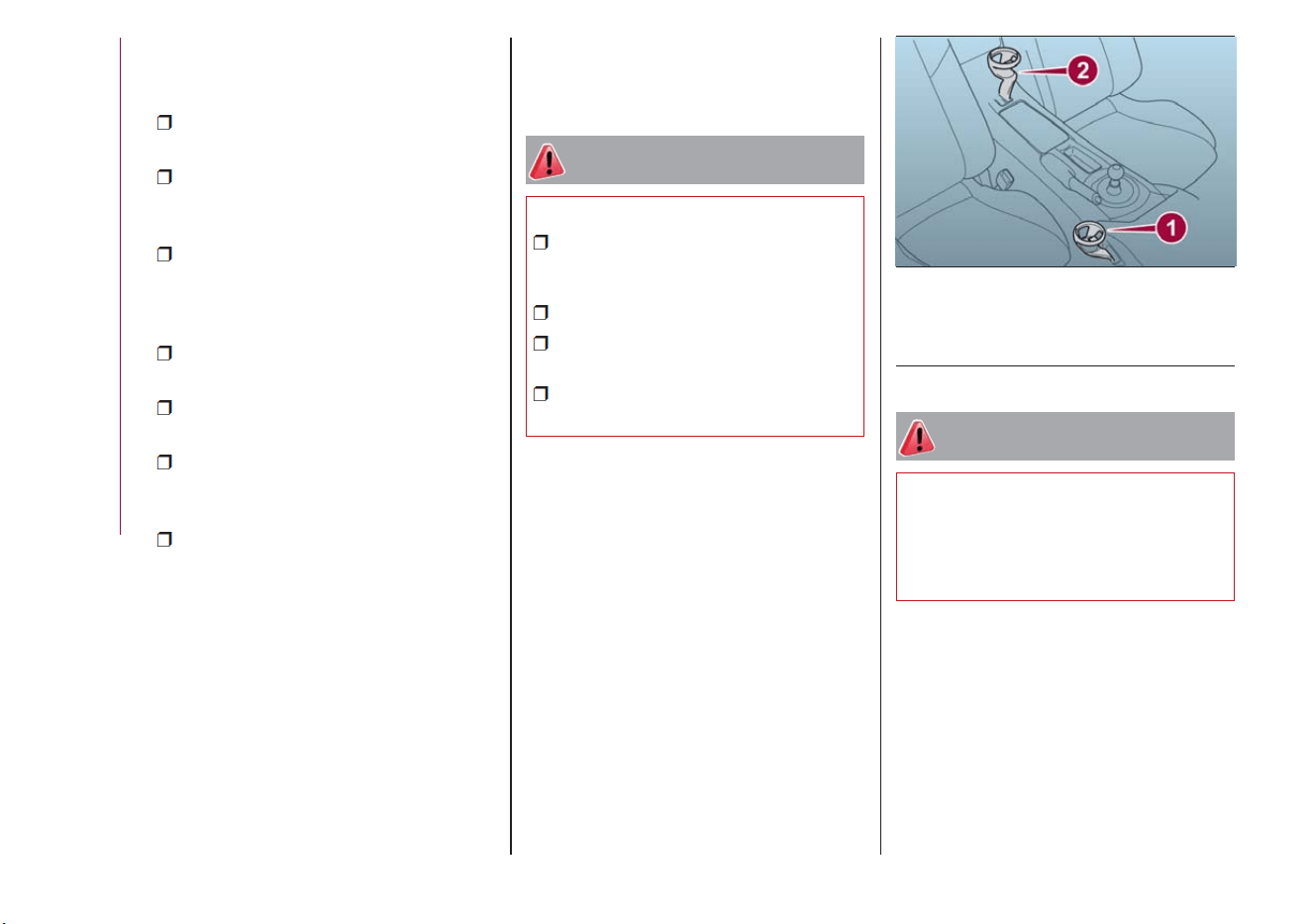
To prevent accessory socket damage
or electrical failure, pay attention to the
following:
Do not use accessories that require
more than 12V (120 W, 10A).
Do not use accessories that are not
genuine FCA accessories or the
equivalent.
Close the cover when the accessory
socket is not in use to prevent foreign
objects and liquids from getting into the
accessory socket.
Correctly insert the plug into the
accessory socket.
Do not insert the cigarette lighter into
the accessory socket.
Noise may occur on the audio
playback depending on the device
connected to the accessory socket.
Depending on the device connected
to the accessory socket, the vehicle's
electrical system may be affected,
which could cause the warning light to
illuminate. Disconnect the connected
device and make sure that the problem
is resolved. If the problem is resolved,
disconnect the device from the socket
and switch the ignition off. If the
problem is not resolved, contact an
authorized dealer.
Note: To prevent discharging of the
battery, do not use the socket for long
periods with the engine off or idling.
Warning!
To avoid serious injury or death:
Only devices designed for use in this
type of outlet should be inserted into any
12 Volt outlet.
Do not touch with wet hands.
Close the lid when not in use and while
driving the vehicle.
If this outlet is mishandled, it may cause
an electric shock and failure.
Cupholders —
If Equipped
Cupholders are available and can be
inserted in the center console on the
passenger side and the rear area of the
center console.
Warning!
Never use a cup holder to hold hot liquids
while the vehicle is moving. Using a cup
holder to hold hot liquids while the vehicle
is moving is dangerous. If the contents
spill, you could be burned.
06040500L21002
Cupholders
1 — Front Cup Holder
2 — Rear Cup Holder (If Equipped)
64
GETTING TO KNOW YOUR VEHICLE

Caution!
Do not place plastic bottles without
caps in the cup holders. Otherwise, the
contents may spill while the vehicle is being
driven.
Do not place excessive weight on the
cup holders such as by resting your hands
or elbows on them. Otherwise, the cup
holders could be damaged.
If a passenger is present, install the front
cup holder to the rear console. Otherwise,
a knee might hit it and cause the contents
to spill.
Removing Cup Holders
Use both hands when removing the
cup holder.
Installing Cupholders
When installing a cupholder, insert it
firmly into the installation hole and make
sure that it is secured in place.
The front cupholder can be removed
and installed to the rear console.
The rear cupholder is designed for use
on the rear console and cannot be
installed to the front side.
06040500-J12AEC1-001
Removing Cupholders
06040500-J12AEC2-001
Installing Cupholders
06040500-L25-002
Correct Cupholder Placement
06040500-L26-001
Incorrect Cupholder Placement
65

Windblocker
This windblocker reduces rear wind
coming into the cabin when driving with
the convertible top down.
TRUNK LID
Opening
Warning!
Before opening the trunk lid, remove any
snow and ice accumulation on it.
Otherwise, the trunk lid could close under
the weight of the snow and ice resulting in
injury.
Be careful when opening/closing the
trunk lid during strong winds. If a strong
gust blows against the trunk lid, it could
close suddenly resulting in injury.
Fully open the trunk lid and make sure
that it stays open. If the trunk lid is only
opened partially, it could slam shut by
vibration or wind gusts resulting in injury.
When loading or unloading luggage in
the trunk, turn off the engine. Otherwise,
you could get burned by the heat of the
exhaust gas.
Using The Remote Release Button
— If Equipped
The remote release button function can
be disabled by locking the doors using
the key fob, emergency key, or a
request switch on the exterior door
handle to prevent an intruder in the
vehicle from opening the trunk lid.
To enable the remote release button
operation, unlock the doors by using
the key fob, emergency key, request
switch on the exterior door handle, or
place the ignition in the ON position.
Note: The remote release button
cannot be disabled by locking the
doors using the door-lock
switch/door-lock knob.
06041000-12A-003AB
Windblocker
04030201-R12-001
Interior Trunk Lid Release Button
66
GETTING TO KNOW YOUR VEHICLE

Using The Electric Trunk Lid
Opener
With the remote release button: a trunk
lid can also be opened while the key
fob is being carried.
Push the electric trunk lid button and
raise the trunk lid when the latch
releases.
Without the remote release button:
unlock the doors and trunk lid, then
push the electric trunk lid opener and
raise it when the latch releases.
With The Advanced Keyless Entry
Function
A locked trunk lid can also be opened
while the key fob is being carried. When
opening the trunk lid with the doors
locked, it may require a few seconds for
the trunk lid latch to release after the
electric trunk lid opener is pushed.
The trunk lid can be closed when the
doors are locked with the key fob left in
the vehicle. However, to prevent locking
the key fob in the vehicle, the trunk lid
can be opened by pushing the electric
trunk lid opener. If the trunk lid cannot
be opened despite doing this
procedure, push the electric trunk lid
opener to fully open the trunk lid after
pushing the trunk lid completely closed.
If the vehicle battery is discharged or
there is a malfunction in the electrical
system and the trunk lid cannot be
unlocked, the trunk lid can be opened
by performing the emergency
procedure.
When Trunk Lid Cannot
Be Opened
If the battery is discharged, the trunk lid
cannot be unlocked and opened. In this
case, the trunk can be unlocked by
taking care of the discharged battery
situation.
If the trunk lid cannot be unlocked even
if the discharged battery situation has
been resolved, the electrical system
may have a malfunction.
Proceed as follows:
1. Close the convertible top and
remove the windblocker.
2. Remove the fasteners on the right
side of the vehicle.
3. Partially peel back the cover on the
right side of the vehicle.
04030201-12A-001
Electric Trunk Release Button
08080100-125-002
Remove Windblocker
08080100-121-004
Remove Fasteners
67

4. Turn and loosen the cap screws until
the screws start to spin free.
Note: Do not pull the screw when
pulling the cap. Otherwise, the screw
may fall off and become lost.
Refer to “Trunk Emergency Release”
located in “Getting To Know Your
Vehicle” for further information.
Closing
1. Use both hands to push the trunk lid
down until the lock snaps shut. Do not
slam it.
2. Pull up on the trunk lid to make sure
it is secure.
TRUNK EMERGENCY
RELEASE
As a security measure, a trunk internal
emergency release lever is built into the
rear tail panel. In the event of an adult
or child being locked inside the trunk,
the trunk can be simply opened by
pulling down the lever and open the
trunk lid. After performing this
emergency measure, contact an
authorized dealer as soon as possible.
Trunk Safety Warning
Warning!
Do not allow children to have access to the
trunk, either by climbing into the trunk from
outside, or through the inside of the
vehicle. Always close the trunk lid when
your vehicle is unattended. Once in the
trunk, young children may not be able to
escape, even if they entered through the
rear seat. If trapped in the trunk, children
can die from suffocation or heat stroke.
08080100-122-001
Cover Removal
08080100-123-004
Trunk Emergency Release
68
GETTING TO KNOW YOUR VEHICLE
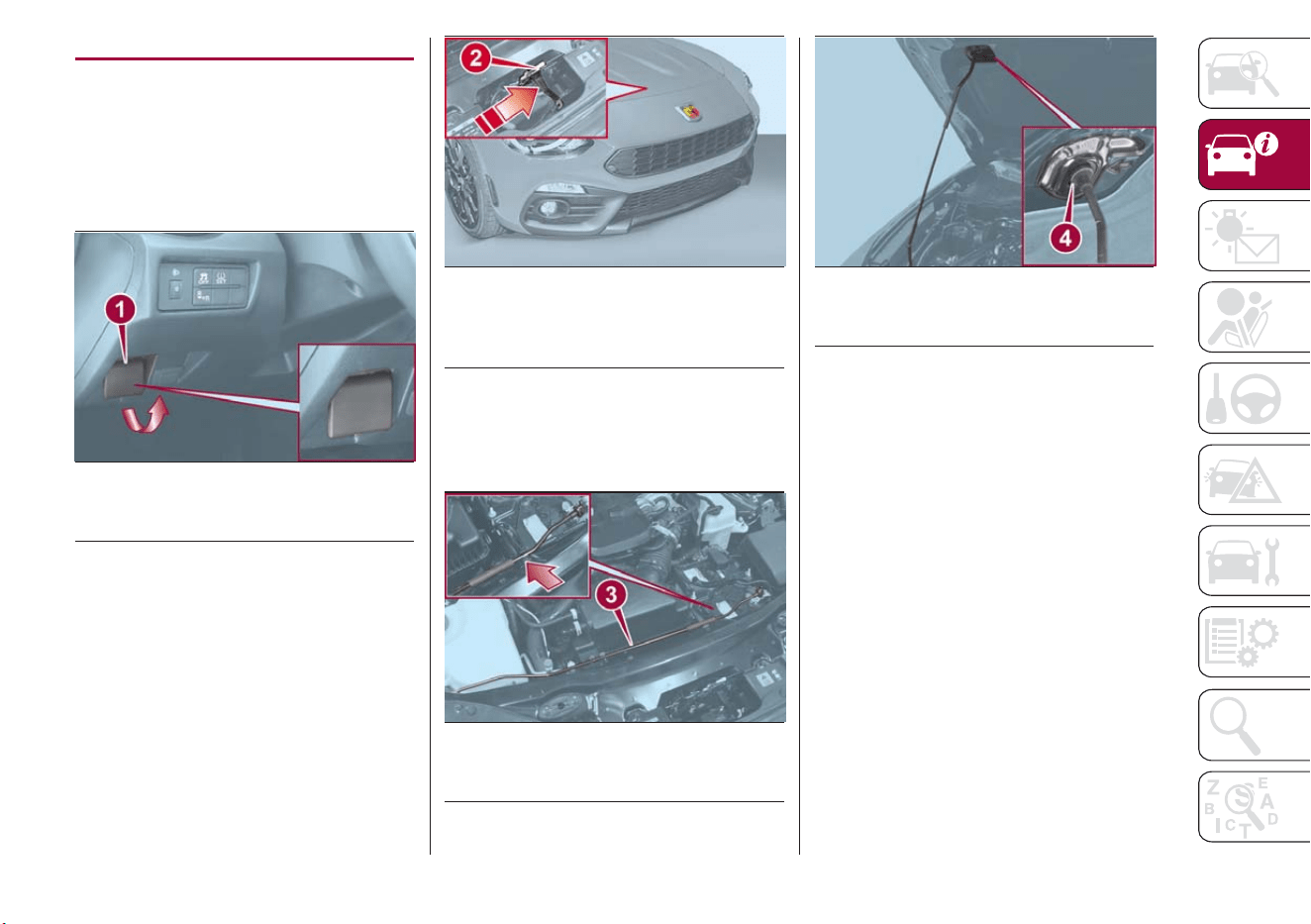
HOOD
Opening The Hood
To open the hood, proceed as follows:
1. With the vehicle in PARK, pull the
release handle located to the left of the
steering wheel, below the instrument
panel.
2. Move to the outside of the vehicle
and insert your hand into the hood
opening, then slide the latch lever to the
right, and lift up the hood.
3. Pull up the support rod from the clip,
and insert it into the support rod hole
indicated by the arrow to hold the hood
open.
Closing The Hood
To close the hood, proceed as follows:
1. Check under the hood area to make
certain all filler caps are in place and all
loose items (e.g. tools, oil containers,
etc.) have been removed.
2. Lift the hood with one hand, and
with the other hand grasp the padded
area on the support rod.
3. Secure the support rod into the rod
clip.
4. Verify that the support rod is
secured in the clip before closing the
hood.
5. Lower the hood slowly to a height of
about 8 inches (20 cm) above its closed
position and then let it drop.
07030201-L12-001
Releasing The Hood Latch
1 — Hood Release Handle
07030201-122-001AB
Sliding The Latch Lever To The
Right
2 — Latch Lever
07030201-130-888
Support Rod Location
3 — Support Rod
07030201-123-002
Inserting Support Rod Into Hole
4 — Support Rod Hole
69
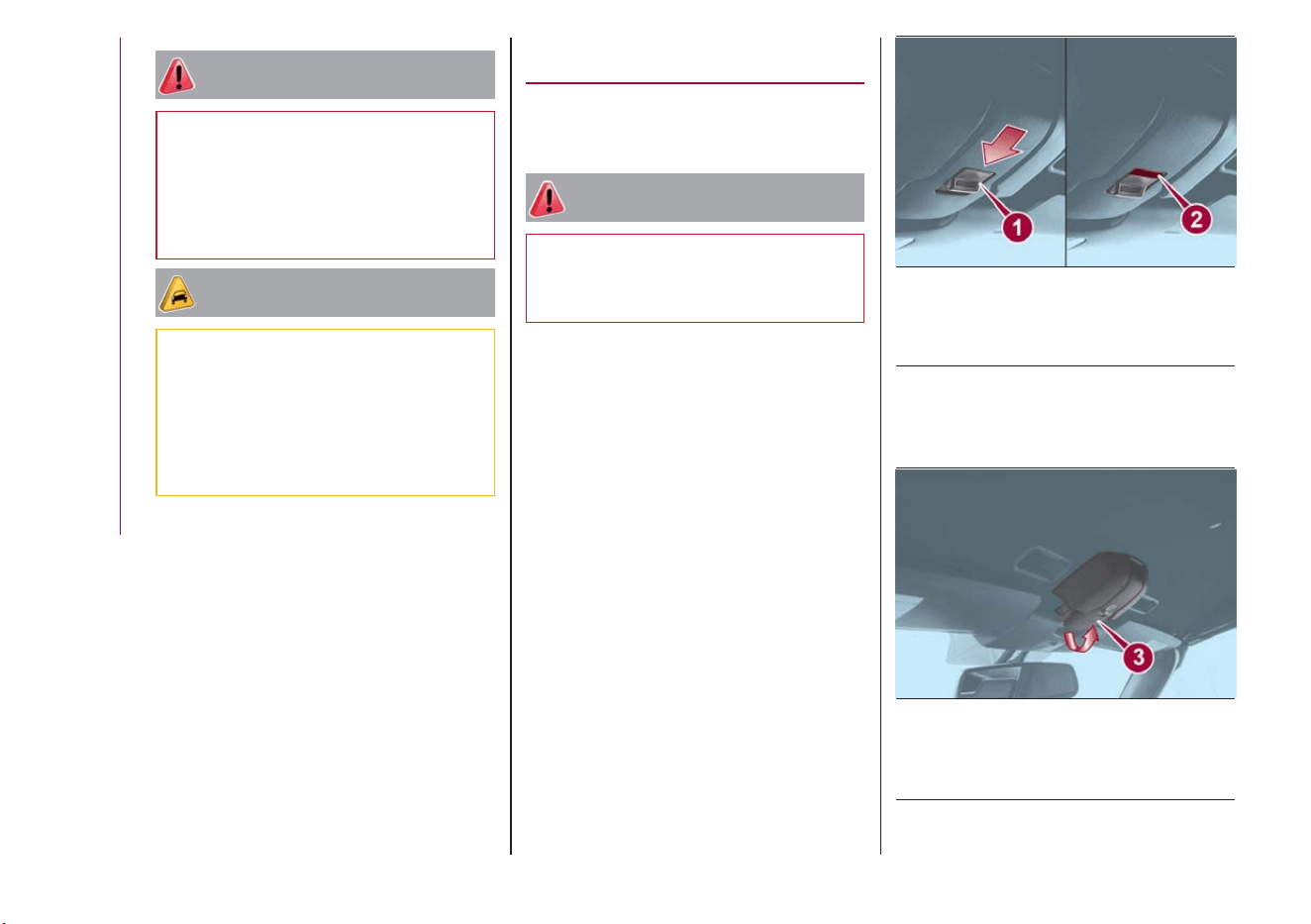
Warning!
Be sure the hood is fully latched before
driving your vehicle. If the hood is not fully
latched, it could open when the vehicle is
in motion and block your vision. Failure to
follow this warning could result in serious
injury or death.
Caution!
To prevent possible damage, do not slam
the hood to close it. Lower hood to
approximately 8 inches (20 cm) and drop
the hood to close. Make sure hood is fully
closed for both latches. Never drive vehicle
unless hood is fully closed, with both
latches engaged.
CONVERTIBLE TOP
(SOFT TOP)
Lowering The
Convertible Top
Warning!
Do not sit on the folded convertible top,
otherwise the convertible top could be
damaged or you may fall off and be injured.
To lower the convertible top, Proceed
as follows:
1. Make sure the parking brake is
applied and the engine is OFF.
2. Make sure there are no objects
which have been placed in the area
where the convertible top is to be
retracted.
3. Push forward on the release latch.
There is a red indicator showing that
the latch is open.
4. With the lock release latch pushed
forward (red indicator visible), pull the
top latch handle rearward to unlock it.
04110102-L36-006
Lock Release Latch
1 — Release Latch Closed
2 — Release Latch Open
04110102-L21-001
Pulling The Top Latch Handle
Rearward
3 — Latch Release Handle
70
GETTING TO KNOW YOUR VEHICLE

5. Remove the striker from the anchor.
Note: The power windows will go
down automatically when the
convertible top is opened. If the power
windows do not go down automatically,
fully open the windows using the power
window switch located on the doors.
6. Standing outside of the vehicle, hold
the convertible top along the front edge
and pull it toward the rear of the vehicle.
To lower the convertible top from inside
the vehicle, use the convertible top
handles.
7. Move the convertible top rearward
and while pushing the rear glass lightly
with your hand.
8. With the back end of the convertible
top pushed down, push the front end
until a latching sound is heard. Lightly
rock the retracted convertible top to
make sure it is securely locked.
Warning!
Always keep your hands and fingers
away from the fastening mechanisms when
moving the convertible top: it is dangerous
to place your hands or fingers near the
fastening mechanisms. Your hands or
fingers could be caught and injured by the
mechanism.
04110102-L22-002
Removing Striker From Anchor
4 — Striker
5 — Anchor
04110102-123-002AB
Convertible Top Handles
6 — Handles
04110102-126-001AB
Retracted Convertible Top
71

Sit in the seat with the seat belt correctly
fastened when the vehicle is moving:
standing in the vehicle, or sitting on the
convertible top storage area or center
console when the vehicle is moving is a
dangerous way to ride. During a sudden
maneuver or collision you could be
seriously injured or even killed.
Raising The Convertible
Top
To raise the convertible top, proceed as
follows:
1. Make sure the parking brake is
applied and the engine is OFF.
2. Pull the unlock lever upward to
disengage the lock.
3. Standing outside of the vehicle, hold
the convertible top along the front edge
and pull it towards the vehicle front. To
raise the convertible top from inside the
vehicle, use the convertible top
handles.
4. While sitting in a seat, grasp the
convertible top handles, and push the
convertible top against the windshield.
Make sure the striker engages with the
anchor, move the top latch slowly, and
then push the top latch upward until a
latching sound is heard.
5. If the red indicator is visible on the
lock release button, the convertible top
is not locked. After locking the
convertible top, verify that the red
indicator is not visible.
04110103-121-004
Unlock Lever Location
1 — Unlock Lever
04110103-L23-002
Convertible Handle Location
2 — Convertible Top Handles
04110103-L24-003
Convertible Top Components
4 — Closing Release Latch
5 — Striker
6 — Anchor
72
GETTING TO KNOW YOUR VEHICLE

Caution!
Driving with the convertible top not fully
locked could damage the convertible top.
Note:
Do not spray water directly near the
seam of the window and convertible
top when flushing away dirt on the soft
top with water. Otherwise, water may
enter the vehicle (refer to “Convertible
Top Maintenance” in “Servicing And
Maintenance”).
The convertible top may be
constricted if it is left retracted for a
long period. Therefore, if the top has
become constricted, it may be difficult
to hook the top latch striker to the
anchor.
Make sure the convertible top is
securely locked by pushing up on it. If
it still sounds loose (rattles) after being
locked by the top latch, contact an
authorized dealer.
Convertible Top
Precautions
Remove leaves or other debris that
may accumulate on and around the
convertible top. If leaves or other debris
block the drain filter, water may enter
the vehicle. Clean the drain filter at least
once a year.
Before lowering or raising the
convertible top, stop in a safe place off
of the road and park on a level surface.
When lowering the convertible top,
make sure objects inside the vehicle are
not blown away by the wind.
Secure all loose objects inside before
driving with the convertible top down.
To help prevent theft or vandalism
and to ensure that the passenger
compartment stays dry, close the
convertible top securely and lock both
doors when leaving the vehicle.
The soft top is made of high quality
material and if it is not maintained
correctly, the material could harden,
becomes stained, or have an uneven
gloss.
Lowering the convertible top while
it's wet can also cause water to drip
into the cabin.
The power windows go down
automatically in conjunction with the
convertible top opening/closing.
However, this is a function for improving
the operability, and it does not mean
there is a problem. If the vehicle battery
is disconnected for vehicle maintenance
or other reasons, the power windows
will not go down automatically. If the
power windows do not go down, the
automatic open/close mechanism for
the windows must be reset.
The windblocker reduces the amount
of wind coming into the cabin from
behind when driving with the
convertible top opened.
Before starting the vehicle make sure
the convertible top is correctly locked.
04110103-124-001
Lock Release Button
6 — Red Indicator
7 — Release Latch Locked
8 — Release Latch Unlocked
73

Caution!
Before opening the convertible top,
make sure the rear window defroster
switch is turned off. Otherwise the heat
generated from the window defroster could
damage the convertible top and the internal
material.
Make sure nothing is on the convertible
top or near the back window when raising
or lowering the convertible top. Even small
objects may interfere and cause damage.
Do not drive through an automatic car
wash; it may damage the convertible top.
Do not raise or lower the convertible top
when the temperature is below 41 °F (5
°C); this will damage the convertible top
material.
Do not lower the convertible top when
it's wet. If the convertible top dries while
folded, it will deteriorate and mold.
Do not raise or lower the convertible top
in a strong wind as it could damage the
convertible top or cause an unexpected
accident.
ELECTRIC POWER
STEERING
Power Steering
Electric power steering is only operable
when the engine is running.
If the engine is off or if the power
steering system is inoperable, you can
still steer, but it requires more physical
effort.
If the steering feels stiffer than usual
during normal driving or the steering
vibrates, contact your authorized dealer.
The
warning light notifies the driver
of system abnormalities and operation
conditions.
Note: Never hold the steering wheel to
the extreme left or right for more than
five seconds with the engine running.
This could damage the power steering
system.
ENVIRONMENT
PROTECTION
SYSTEMS
Emission Control System
This vehicle is equipped with an
emission control system (the catalytic
converter is part of this system) that
enables the vehicle to comply with
existing exhaust emissions
requirements.
Ignoring the following precautions could
cause lead to accumulate on the
catalyst inside the converter or cause
the converter to get very hot. Either
condition will damage the converter and
cause poor performance:
USE ONLY UNLEADED FUEL.
Do not drive your vehicle with any
sign of engine malfunction.
Do not coast with the ignition OFF.
Do not descend steep grades in gear
with the ignition OFF.
Do not operate the engine at high
idle for more than two minutes.
Do not tamper with the emission
control system. All inspections and
adjustments must be made by your
authorized dealer.
Do not push-start or pull-start your
vehicle.
74
GETTING TO KNOW YOUR VEHICLE
Under U.S. federal law, any modification
to the original-equipment emission
control system before the first sale and
registration of a vehicle is subject to
penalties. In some states, such
modification made on a used vehicle is
also subject to penalties.
While the engine is off, the sound of a
valve opening and closing can be heard
at the rear of the vehicle, however this
does not indicate an abnormality. The
vehicle has a self-checking device and
it operates while the engine is off.
Warning!
A hot exhaust system can start a fire if you
park over materials that can burn. Such
materials might be grass or leaves coming
into contact with your exhaust system. Do
not park or operate your vehicle in areas
where your exhaust system can contact
anything that can burn.
75

GETTING TO KNOW YOUR INSTRUMENT PANEL
CONTROL PANEL AND
INSTRUMENTS..............77
MAINTENANCE MONITOR —
IF EQUIPPED ...............83
FUEL ECONOMY MONITOR —
IF EQUIPPED ...............86
WARNING LIGHTS AND
MESSAGES ................88
PERSONALIZATION FEATURES . .107
ONBOARD DIAGNOSTIC
SYSTEM — OBD II ...........111
EMISSIONS INSPECTION AND
MAINTENANCE PROGRAMS . . . .112
76
GETTING TO KNOW YOUR INSTRUMENT PANEL

CONTROL PANEL AND INSTRUMENTS
Instrument Cluster
1 — Odometer/Trip Computer And Trip Computer Button/Dashboard Illumination
2 — Tachometer
3 — Speedometer
4 — Automatic Transmission Info Display
5 — Odometer/Trip Computer Info/Engine Coolant Temperature Gauge/
Fuel Gauge/Outside Temperature/Cruise Control/Info Switch Display
05020103-121-001AB-MPG
Instrument Cluster
77
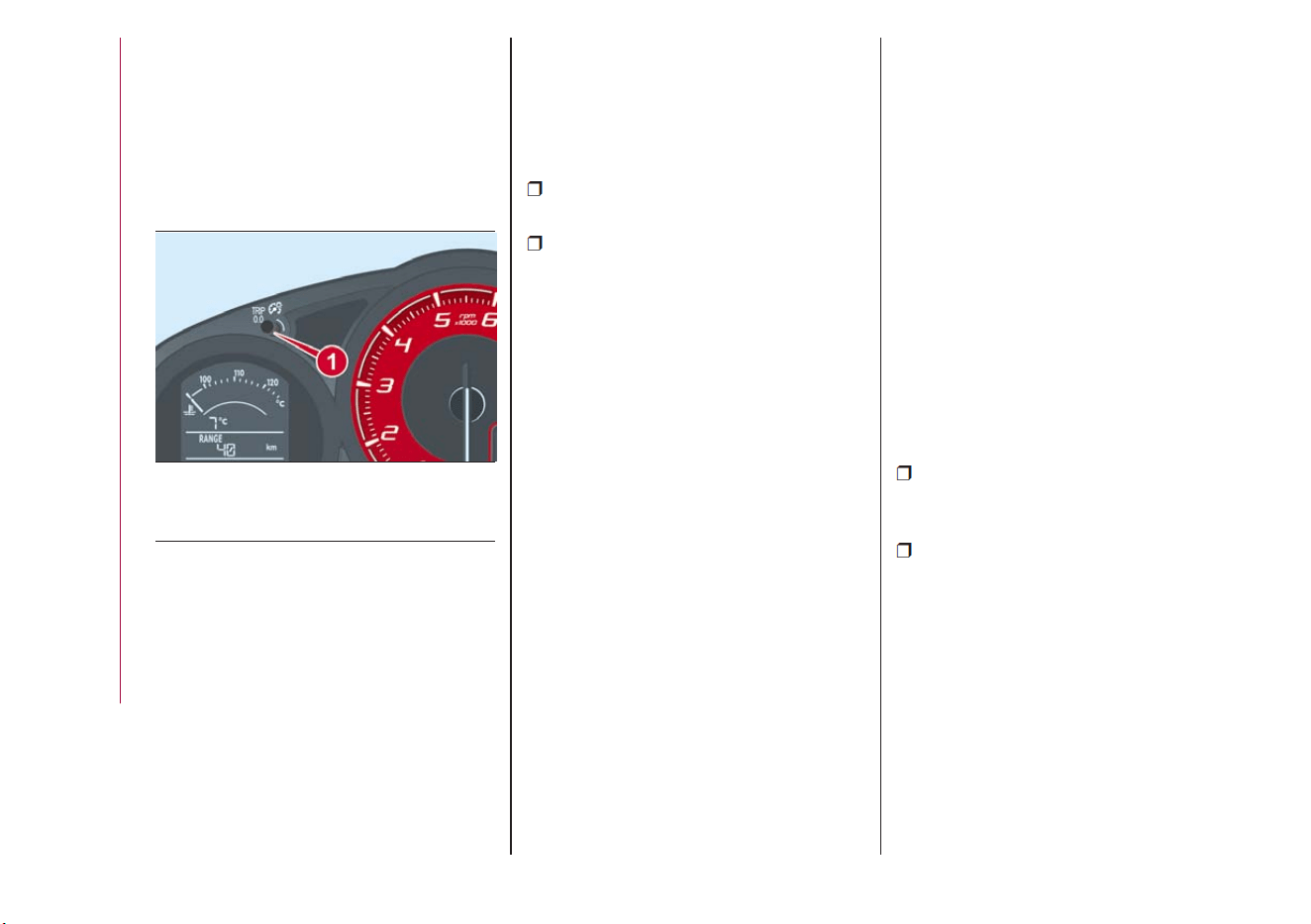
Odometer/Trip Computer
The display mode can be changed from
odometer to “Trip computer A” to “Trip
computer B” and then back to
odometer by pushing the selector while
one of them is displayed.
The selected mode will be displayed.
When the ignition is placed in the ACC
or OFF position, the odometer or trip
cannot be displayed. Pushing the
selector can switch the trip or reset it
for a ten-minute period in the following
cases:
After the ignition is cycled to OFF
from ON.
After the driver's door is opened.
Odometer
The odometer records the total
distance the vehicle has been driven.
Trip Computer
The trip computer can record the total
distance of two trips. One is recorded in
“Trip A”, and the other is recorded in
“Trip B”.
For instance, “Trip A” can record the
distance from the point of origin, and
“Trip B” can record the distance from
where the fuel tank is filled.
When “Trip A” is selected, pushing the
selector again within one second will
change to “Trip B” mode. When “Trip A”
is selected, TRIP A will be displayed.
When “Trip B” is selected, TRIP B will
be displayed.
The trip computer records the total
distance the vehicle is driven until the
meter is again reset. Return it to “0.0”
by depressing and holding the selector
for one second or more.
Use this meter to measure trip
distances and to compute fuel
consumption.
If the fuel economy data is reset using
the fuel economy monitor or Trip “A” is
reset using the trip meter, the fuel
economy data and Trip “A” are reset
simultaneously when the fuel economy
monitor with the trip meter is on.
Note: Only the trip records tenths of
miles (kilometers).
Trip Computer Reset
The trip computer will be erased when:
The power supply is interrupted
(blown fuse or the battery is
disconnected).
The vehicle is driven over
9999.9 miles.
05020102-121-001AB
Odometer/Trip Reset Button
1 — Odometer/Trip Reset Button
78
GETTING TO KNOW YOUR INSTRUMENT PANEL
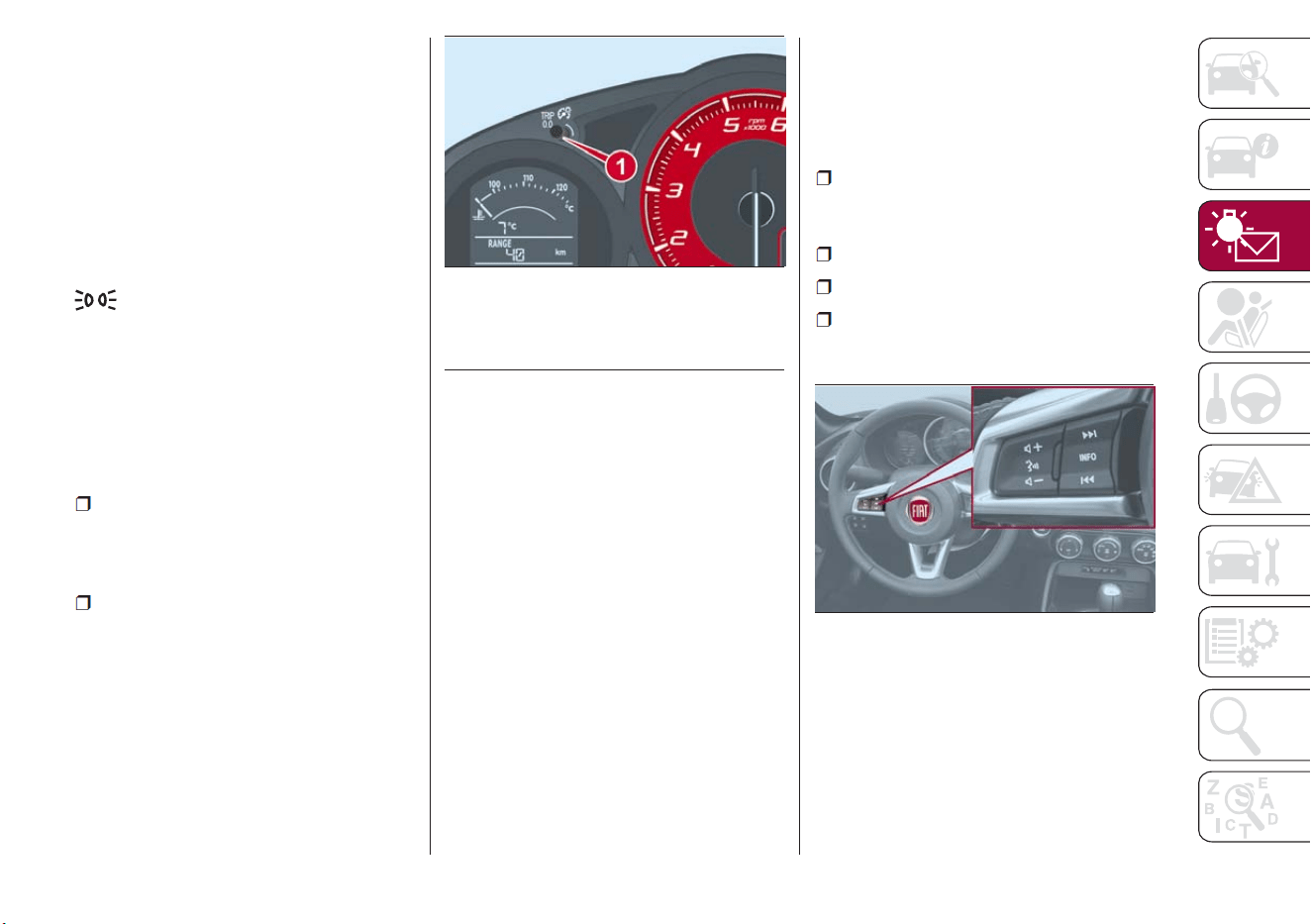
Speedometer
The speedometer indicates the speed
of the vehicle.
Instrument Panel
Illumination
When the position lights are turned on
with the ignition switched ON, the
brightness of the instrument panel
illumination is dimmed. When the
position lights are turned on, the
warning light in the instrument
cluster turns on (see “Headlights” in
“Getting To Know Your Vehicle”
chapter).
Brightness Adjustment
The brightness of the instrument panel
and dashboard illuminations can be
adjusted by rotating the knob:
The brightness decreases by rotating
the knob to the left. A beep sound will
be heard when the knob has been
rotated to the maximum dim position.
The brightness increases by rotating
the knob to the right.
Cancelling Illumination Dimmer
Rotate the knob to the right until a beep
is heard while the instrument cluster is
dimmed with the ignition switched ON.
If the instrument cluster's visibility is
reduced due to glare from surrounding
brightness, cancel the illumination
dimmer.
When the illumination dimmer is
canceled, the instrument cluster cannot
be dimmed even if the position lights
are turned on. When the illumination
dimmer is canceled, the screen in the
center display switches to constant
display of the daytime screen.
Trip Computer And Info
Switch
The following information can be
selected by pushing the INFO switch
with the ignition in the ON position:
Distance-to-empty (approximate
distance you can travel on the available
fuel).
Average fuel economy.
Current fuel economy.
Average vehicle speed.
If you have any problems with your trip
computer, contact an authorized dealer.
05020102-121-001AB
Dimmer Knob
1 — Instrument Cluster Illumination
Dimmer Knob
0620500-122-001
Instrument Cluster Display Controls
79

Distance-To-Empty Mode
This mode displays the approximate
distance you can travel on the
remaining fuel based on the fuel
economy.
The distance-to-empty will be
calculated and displayed every second.
Note:
Even though the distance-to-empty
display may indicate a sufficient
amount of remaining driving distance
before refueling is required, refuel as
soon as possible if the fuel level is very
low or the low fuel warning light
illuminates.
The display may not change unless
you add more than approximately
2.3 gallons (9 liters) of fuel.
The distance-to-empty is the
approximate remaining distance the
vehicle can be driven until all the
graduation marks in the fuel gauge
(indicating the remaining fuel supply)
disappear.
If there is no past fuel economy
information such as after first
purchasing your vehicle or the
information is deleted when the battery
cables are disconnected, the actual
distance-to empty/range may differ
from the amount indicated.
Average Fuel Economy Mode
This mode displays the average fuel
economy by calculating the total fuel
consumption and the total traveled
distance since purchasing the vehicle,
reconnecting the battery after
disconnection, or resetting the data.
The average fuel economy is calculated
and displayed every minute. To clear
the data being displayed, push the
INFO switch for more than 1.5 seconds.
After pushing the INFO switch, “- - -
mpg” (“---L/100km”)willbe
displayed for about 1 minute before the
fuel economy is recalculated and
displayed.
Current Fuel Economy Mode
This mode displays the current fuel
economy by calculating the amount of
fuel consumption and the distance
traveled. Current fuel economy will be
calculated and displayed every two
seconds.
When you've slowed to about 3 MPH
(5km/h),“---mpg”(“---L/100km”)
will be displayed.
0502011019A019
Distance To Empty Display Screen
05020110199019
Current Fuel Economy Display
Screen
80
GETTING TO KNOW YOUR INSTRUMENT PANEL

Average Vehicle Speed Mode
This mode displays the average vehicle
speed by calculating the distance and
the time traveled since connecting the
battery or resetting the data.
Average vehicle speed will be
calculated and displayed every
10 seconds. To clear the data being
displayed, push the INFO switch for
more than 1.5 seconds.
After pushing the INFO switch, “- - -
MPH” (“---km/h”)willbedisplayed for
about 1 minute before the vehicle
speed is recalculated and displayed.
Tachometer
The tachometer shows engine speed in
thousands of revolutions per minute
(rpm).
The range varies depending on the type
of gauge.
Engine Coolant
Temperature Gauge And
Fuel Gauge
Engine Coolant Temperature Gauge
0502011020110C
Average Vehicle Speed Display
Screen
05020103-12A-002AB
Tachometer
1 — Tachometer Display
0502010417A007
Fuel/Temperature Gauge
1 — Engine Coolant Temperature
2 — Fuel Gauge
81

Note: If the high engine coolant
temperature warning light (red) turns
on, there is a possibility of overheating.
Park the vehicle in a safe place
immediately and take appropriate
measures. If the vehicle continues to be
driven, it could cause damage to the
engine.
Fuel Gauge
The fuel gauge 2 shows approximately
how much fuel is remaining in the tank
when the ignition is in the ON position.
We recommend keeping the tank over
1/4 full.
E = Empty
F = Full
If the low fuel warning light illuminates
or the fuel level is very low, refuel as
soon as possible.
Note:
After refueling, it may require some
time for the indicator to stabilize. In
addition, the indicator may deviate
while driving on a slope or curve since
the fuel moves in the tank.
The display indicating a quarter or
less remaining fuel has more segments
to show the remaining fuel level in
greater detail.
The direction of the arrow on the
fuel gauge indicates that the fuel door
lid is on the left side of the vehicle.
Outside Temperature
Display
When the ignition is in the ON position,
the outside temperature is displayed.
Under the following conditions, the
outside temperature display may differ
from the actual outside temperature
depending on the surroundings and
vehicle conditions:
Significantly cold or hot
temperatures.
Sudden changes in outside
temperature.
The vehicle is parked.
The vehicle is driven at low speeds.
Changing The Temperature Unit Of
The Outside Temperature Display
The outside temperature unit can be
switched between Fahrenheit and
Celsius using the following procedure.
Settings can be changed through the
Connect 7.0 radio screen. Refer to
“Personalization Features” in this
chapter.
Note: When the temperature unit
indicated in the outside temperature
display is changed, the temperature
unit indicated in the engine coolant
gauge display changes in conjunction
with it.
Cruise Control Set
Vehicle Speed Display
The vehicle speed preset using the
cruise control is displayed.
05020107345034
Outside Temperature Screen
Display
0502010819A019
Cruise Control Display Screen
82
GETTING TO KNOW YOUR INSTRUMENT PANEL

MAINTENANCE
MONITOR — IF
EQUIPPED
Oil Life Reset
Proceed as follows:
1. Select the icon
on the home
screen to display the “Applications”
screen.
2. Select “Maintenance” to display the
maintenance list screen.
3. Switch the tab and select the setting
item you want to change: “Scheduled,”
“Tire Rotation,” or “Oil Change.”
83
Oil Life Monitor
You can customize settings in the setup display as follows:
Tab Item Explanation
Scheduled
Setting
Notification can be turned on/off.
Time (months)
Displays the time or distance until
maintenance is due. Select this item to set
the maintenance period. “Scheduled Due!” is
displayed in red, and the indicator light will
illuminate in the instrument cluster when the
remaining distance is less than 300 mi
(500 km) or the remaining number of days is
less than 15 (whichever comes first).
Distance (mile or km)
Reset
Resets the time and distance to the initial
values. Once the system turns on, it needs to
be reset whenever carrying out maintenance.
Tire Rotation
Setting Notification can be switched on/off.
Distance (mile or km)
Displays the distance until tire rotation is due.
Select this item to set the tire rotation
distance. “Tire Rotation Due!” is displayed in
red and the wrench indicator light will
illuminate in the instrument cluster when the
remaining distance is less than 300 mi
(500 km).
Reset
Resets the remaining distance to the initial
value. Once the system turns on, it needs to
be reset whenever rotating the tires.
84
GETTING TO KNOW YOUR INSTRUMENT PANEL
Tab Item Explanation
Oil Change
Setting
Notification can be switched on/off.
Distance (mile or km)
Displays the distance until an oil change is
due. Select this item to set the oil change
distance. “Oil Change Due!” is displayed in
red, and the indicator light will illuminate in
the instrument cluster when the remaining
distance is less than 300 mi (500 km).
Reset
Resets the remaining distance to the initial
value. Once the system turns on, it needs to
be reset whenever replacing the engine oil.
Oil life (%)
Displays the engine oil life until an oil change
is due. “Oil Change Due!” is displayed in red
and the indicator light will illuminate in the
instrument cluster when remaining oil life
distance is less than 300 mi (500 km), or
remaining days are less than 15 (whichever
comes first).
Reset
Resets the remaining oil life to 100%. The
system must be reset whenever replacing the
engine oil.
(*) The engine oil flexible maintenance setting is available (only some models). Consult an authorized dealer for details. When the
engine oil flexible maintenance setting is selected, you will see the following items in the display.
The vehicle calculates the remaining oil life based on the engine operating conditions and lets you know when an oil change is
due by illuminating the indicator light in the instrument cluster.
85
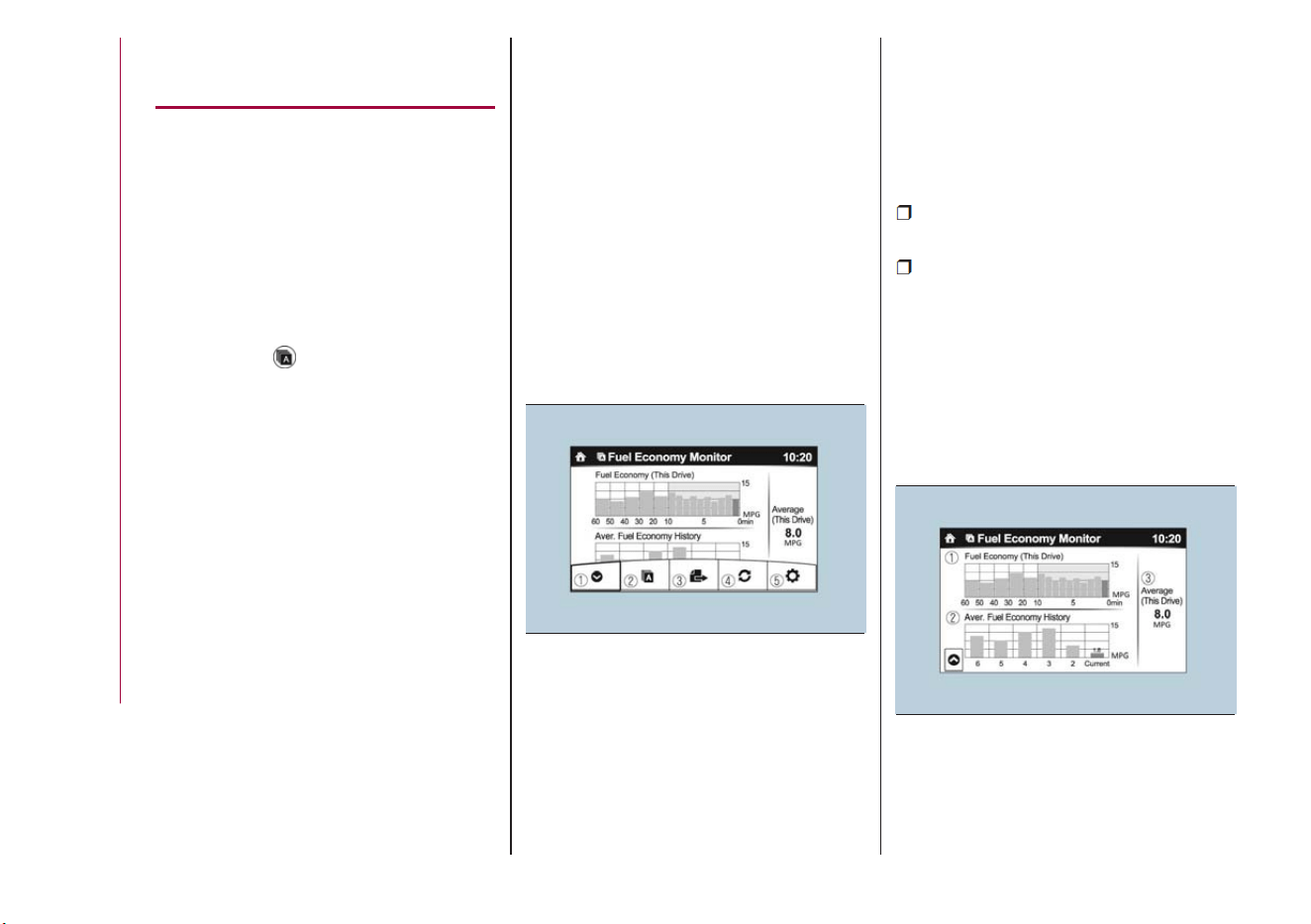
FUEL ECONOMY
MONITOR —
IF EQUIPPED
Description
The “Fuel Consumption” information is
displayed by operating each icon in the
display.
In addition, after completing a trip, the
total energy efficiency to date is
displayed in the ending display when
the ending display is turned on.
Proceed as follows:
1. Select the
icon on the home
screen to display the applications
screen.
2. Select the “Fuel Economy Monitor”.
3. Operate the Multimedia Control
Knob or touch the screen and display
the menu.
Note: When the menu is displayed by
touching the screen, the display is
hidden automatically after 6 seconds.
Select the icon in the menu and
perform the operation. Each icon
operates as follows:
1. Hides the menu display.
2. Displays the application screen.
3. Resets the fuel economy data.
4. Displays the following setting
screen: ending display on/off switching
- On/off switching for function which
synchronizes reset fuel economy data
to trip meter (Trip A).
Fuel Consumption
Display
Information regarding fuel economy is
displayed:
1. Displays the fuel economy for the
past 60 minutes:
Displays the fuel economy every
minute for the past 1 to 10 minutes.
Displays the fuel economy every
10 minutes for the past 10 to
60 minutes.
2. Displays the average fuel economy
over the past five resets and after the
current reset.
3. Calculates the average fuel
economy every minute after vehicle
travel begins, and displays it.
05240100-36A-003
Fuel Economy Display Screen
05240101-36A-004
Average Fuel Economy
Display Screen
86
GETTING TO KNOW YOUR INSTRUMENT PANEL
Note: The fuel economy data can be
reset by doing the following operation:
Push the reset switch from the
menu screen.
When the function, which
synchronizes the fuel economy monitor
and the trip meter, is on, reset Trip A of
the trip meter.
Delete the average fuel economy
information displayed in the trip
computer.
After resetting the fuel economy data,
“-- -” is displayed while the average fuel
economy is calculated.
Ending Screen Display
If the ending display on the fuel
economy monitor is on when the
ignition is cycled from ON position to
the OFF position, the information
regarding the fuel economy is
displayed.
87

WARNING LIGHTS
AND MESSAGES
Warning Lights And
Messages
Note:
The warning light in the instrument
panel appears together with a
dedicated message and/or acoustic
signal when applicable. These
indications are indicative and
precautionary and as such must not be
considered as exhaustive and/or
alternative to the information contained
in the Owner’s Manual, which you are
advised to read carefully in all cases.
Always refer to the information in this
chapter in the event of a failure
indication.
Failure indications displayed are
divided into two categories: serious
and less serious failures. Serious
failures are indicated by a repeated
and prolonged warning "cycle". Less
serious failures are indicated by a
warning "cycle" with a shorter duration.
The display cycle of both categories
can be interrupted. The instrument
panel warning light will stay on until the
cause of the failure is eliminated.
The warning contents can be verified
on the audio system.
Proceed as follows:
1. If the warning light is turned on,
select
icon on the home screen to
display the application screen.
2. Select “ Warning Guidance”to
display the current warnings.
3. Select the applicable warning to
view the warning details.
For the following warning/indicator
lights:
Master Warning Light
Brake System Warning Light
ABS Warning Light
Charging System Warning Light
Engine Oil Warning Light
Electric Throttle Warning Light
Cold Start Warning Light
Check Engine Warning Light
Coolant Temperature Warning Light
Automatic Transmission Warning
Light
Power Steering Malfunction Indicator
Light
Air Bag/Seat Belt Pretensioner
System Warning Light
Check Fuel Cap Warning Light
Low Fuel Warning Light
Seat Belt Warning Light
Door Ajar Warning Light
Low Washer Fluid Level Warning
Light
Tire Pressure Monitoring System
Warning Light
KEY Warning Light
LED Headlight KEY Warning Light
BSM (Blind Spot Monitoring) OFF
Indicator Light
TCS/DSC Indicator Light
DSC OFF Indicator Light
Security Indicator Light
Indicator Light
Passenger Air Bag Deactivation
Warning Light
The light turns on when the ignition is
switched on for an operation check,
and turns off a few seconds later or
when the engine is started. If the light
does not turn on or remains turned on,
have the vehicle inspected at an
authorized dealer.
Note: Only for “Brake System Warning
Light:” the light turns on continuously
when the parking brake is applied.
88
GETTING TO KNOW YOUR INSTRUMENT PANEL
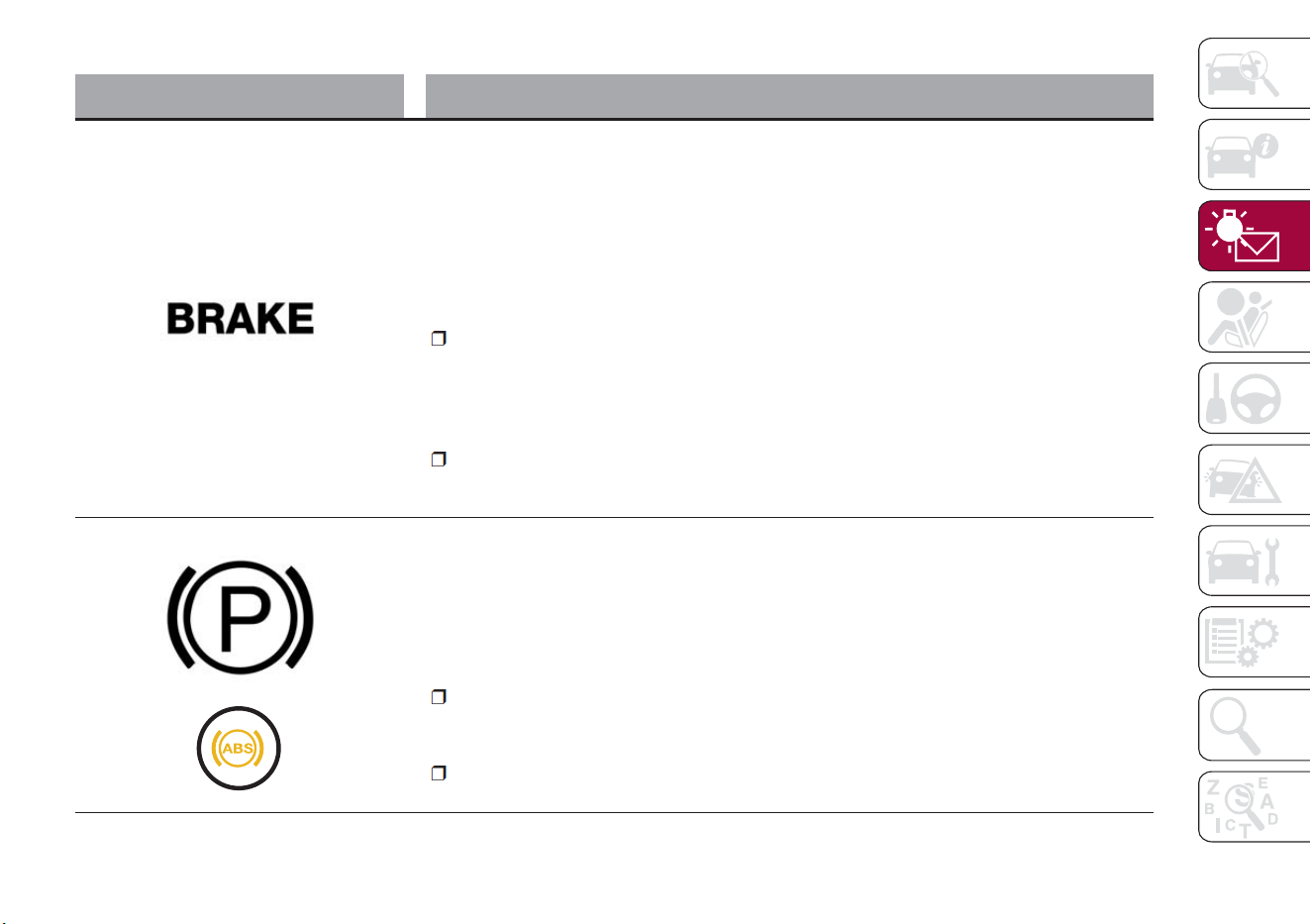
Red Warning Lights
Warning Light What It Means
Parking Brake Warning - Warning Light Inspection/Low Brake Fluid Level Warning
Parking Brake Warning / Warning Light Inspection
The light illuminates when the parking brake is applied with the ignition switched to STAR T or
ON. It turns off when the parking brake is fully released.
Low Brake Fluid Level Warning
If the brake warning light remains illuminated even though the parking brake is released, the
brake fluid may be low or there could be a problem with the brake system. Park the vehicle in a
safe place immediately and contact an authorized dealer.
Note:
Do not drive with the brake system warning light illuminated. Contact an authorized dealer to
have the brakes inspected as soon as possible. Driving with the brake system warning light
illuminated is dangerous. It indicates that your brakes may not work at all or that they could
completely fail at any time. If this light remains illuminated, after checking that the parking brake
is fully released, have the brakes inspected immediately.
The effectiveness of the braking may diminish so you may need to push the brake pedal
more strongly than normal to stop the vehicle.
Stop the vehicle in a safe place immediately and contact an authorized dealer.
EBD (Electronic Brake-Force Distribution) System Warning
If the EBD (Electronic Brake-force Distribution) control unit determines that some components
are operating incorrectly, the control unit may illuminate the brake system warning light and the
ABS warning light simultaneously. The problem is likely to be the electronic brake force
distribution system. Stop the vehicle in a safe place immediately and contact an authorized
dealer.
Note:
Do not drive with both the ABS warning light and brake warning light illuminated. Contact an
authorized dealer to have the brakes inspected as soon as possible. Driving when the brake
system warning light and ABS warning light are illuminated simultaneously is dangerous.
When both lights are illuminated, the rear wheels could lock more quickly in an emergency
stop than under normal circumstances.
89

Warning Light What It Means
Alternator Failure
If the warning light illuminates while driving, it indicates a malfunction of the alternator or of the
charging system. Drive to the side of the road and park off the right-of-way. Stop the vehicle in a
safe place immediately and contact an authorized dealer.
Note:
Do not continue driving when the charging system warning light is illuminated because the
engine could stop unexpectedly.
Low Engine Oil Pressure
This warning light indicates low engine oil pressure.
Note:
Do not run the engine if the oil pressure is low. Otherwise, it could result in extensive engine
damage.
If the light illuminates or the warning indication is displayed while driving:
Drive to the side of the road and park off the right-of-way on level ground.
Turn off the engine and wait five minutes for the oil to drain back into the sump.
Inspect the engine oil level. If it's low, add the appropriate amount of engine oil while being careful not to overf
Start the engine and check the warning light.
Note:
Do
not run the engine if the oil level is low. Otherwise, it could result in extensive engine damage.
If the light remains illuminated even though the oil level is normal or after adding oil, stop the engine immediate
dealer.
Door-Open Warning Light
The light turns on if any door is not closed securely.
Close the door securely.
Warning!
Driving a vehicle with the red brake light on is dangerous. Part of the brake system may have failed. It will take longer to stop the vehicle. You
could have a collision. Have the vehicle checked immediately.
90
GETTING TO KNOW YOUR INSTRUMENT PANEL

Red Warning Lights
Warning Light What It Means
High Engine Coolant Temperature Warning Light
The light flashes when the engine coolant temperature is extremely high, and illuminates when
the engine coolant temperature increases further.
Handling Procedure
Flashing Light: drive slowly to reduce engine load until you can find a safe place to stop the
vehicle and wait for the engine to cool down.
Illuminated Light: this indicates the possibility of overheating. Park the vehicle in a safe
place immediately and stop the engine. Refer to “Overheating” in “In Case Of Emergency” for
further information.
Note:
Do not drive the vehicle with the high engine coolant temperature warning light illuminated.
Otherwise, it could result in damage to the engine.
Air Bag/Seat Belt Pretensioner System Warning
A system malfunction is indicated if the warning light constantly flashes, constantly illuminates or
does not illuminate at all when the ignition is placed in the ON position. If any of these occur,
contact an authorized dealer as soon as possible. The system may not operate in an accident.
91
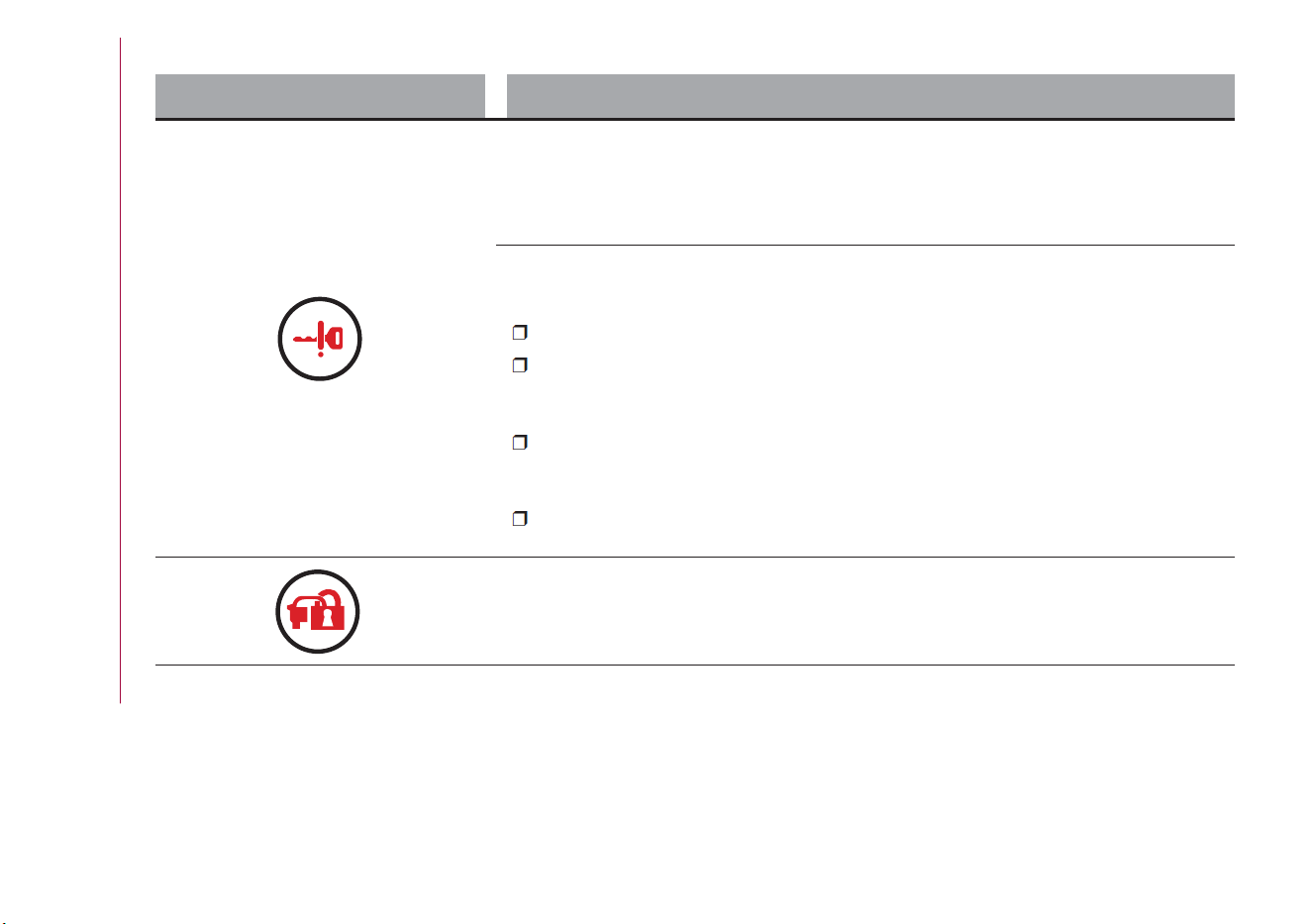
Red Warning Lights
Warning Light What It Means
Key Warning Light — Illuminated
If any malfunction occurs in the keyless entry system, it illuminates continuously.
Note:
If the key warning indicator light illuminates or the push button start indicator light (amber)
flashes, the engine may not start. Contact an authorized dealer as soon as possible.
Key Warning Light — Flashing
Advanced Key Fob Malfunction
Take the appropriate action and verify that the warning light turns off.
The advanced key fob battery is discharged: replace the key fob battery.
The advanced key fob is not within the operation range/is placed in areas inside the
cabin where it is difficult for the key to be detected: bring the advanced key fob into the
operation range.
A key fob from another manufacturer similar to the advanced key fob is in the
operation range: take the key fob from another manufacturer similar to the advanced key out
of the operation range.
Without the ignition switched OFF, the advanced key is taken out of the vehicle,
and then all the doors are closed: bring the advanced key fob back into the vehicle.
Vehicle Security Alarm System
The warning light switches on to report a failure of the vehicle security alarm system. Contact an
authorized dealer as soon as possible.
92
GETTING TO KNOW YOUR INSTRUMENT PANEL

Amber Warning Lights
Warning Light What It Means
ABS Warning Light
If the ABS warning light stays on while you're driving, when the ABS control unit has detected a
system malfunction. If this occurs, your brakes will function normally as if the vehicle had no
ABS. Should this happen contact an authorized dealer as soon as possible.
Note:
When the engine is jump-started to charge the battery, uneven RPM occurs and the ABS
warning light may illuminate. If this occurs, it is the result of the weak battery and does not
indicate an ABS malfunction. Recharge the battery.
The brake assist system does not operate while the ABS warning light is illuminated.
Malfunction Indicator Light
If this light illuminates while driving, the vehicle may have a problem. It is important to note the
driving conditions when the light illuminated and contact an authorized dealer.
The malfunction indicator light may illuminate in the following cases:
The engine's electrical system has a problem.
The emission control system has a problem.
The fuel tank level is very low or approaching empty.
The fuel-filler cap is missing or not tightened securely.
If the malfunction indicator light remains on, or it flashes continuously, do not drive at high
speeds and contact an authorized dealer as soon as possible.
93
Warning!
A malfunctioning catalytic converter, as referenced above, can reach higher temperatures than in normal operating conditions. This can cause
a fire if you drive slowly or park over flammable substances such as dry plants, wood, cardboard, etc. This could result in death or serious
injury to the driver, occupants or others.
Caution!
Prolonged driving with the Malfunction Indicator Light (MIL) on could cause damage to the engine control system. It also could affect fuel
economy and driveability. If the MIL is flashing, severe catalytic converter damage and power loss will soon occur. Immediate service is
required.
94
GETTING TO KNOW YOUR INSTRUMENT PANEL

Amber Warning Lights
Warning Light What It Means
TPMS (Tire Pressure Monitoring System) Warning Light — If Equipped
The warning light switches on and a message is displayed to indicate that the tire pressure is
lower than the recommended value and/or that slow pressure loss is occurring. In these cases,
optimal tire duration and fuel consumption may not be guaranteed.
Should one or more tires be in the condition mentioned above, the display will show the
indications corresponding to each tire in sequence.
Note:
Do not continue driving with one or more flat tires as handling may be compromised. Stop the
vehicle, avoiding sharp braking and steering. Repair immediately using the dedicated tire repair
kit and contact your authorized dealer as soon as possible.
Each tire, including the spare (if provided), should be checked monthly when cold and inflated to
the inflation pressure recommended by the vehicle manufacturer on the vehicle placard or tire
inflation pressure label. (If your vehicle has tires of a different size than the size indicated on the
vehicle placard or tire inflation pressure label, you should determine the proper tire inflation
pressure for those tires.)
As an added safety feature, your vehicle has been equipped with a tire pressure monitoring
system (TPMS) that illuminates a low tire pressure telltale when one or more of your tires is
significantly under-inflated. Accordingly, when the low tire pressure telltale illuminates, you should
stop and check your tires as soon as possible, and inflate them to the proper pressure. Driving
on a significantly under-inflated tire causes the tire to overheat and can lead to tire failure.
Under-inflation also reduces fuel efficiency and tire tread life, and may affect the vehicle’s
handling and stopping ability.
Please note that the TPMS is not a substitute for proper tire maintenance, and it is the driver’s
responsibility to maintain correct tire pressure, even if under-inflation has not reached the level to
trigger illumination of the TPMS low tire pressure telltale.
The TPMS malfunction indicator is combined with the low tire pressure telltale. When the system
detects a malfunction, the telltale will flash for approximately one minute and then remain
continuously illuminated. This sequence will continue upon subsequent vehicle start-ups as long
as the malfunction exists. When the malfunction indicator is illuminated, the system may not be
able to detect or signal low tire pressure as intended. TPMS malfunctions may occur for a variety
of reasons, including the installation of replacement or alternate tires or wheels on the vehicle
that prevent the TPMS from functioning properly. Always check the TPMS malfunction telltale
after replacing one or more tires or wheels on your vehicle to ensure that the replacement or
alternate tires and wheels allow the TPMS to continue to function properly.
95

Caution!
The TPMS has been optimized for the original equipment tires and wheels. TPMS pressures and warning have been established for the tire
size equipped on your vehicle. Undesirable system operation or sensor damage may result when using replacement equipment that is not of
the same size, type, and/or style. Aftermarket wheels can cause sensor damage. Using aftermarket tire sealants may cause the Tire Pressure
Monitoring System (TPMS) sensor to become inoperable. After using an aftermarket tire sealant it is recommended that you take your vehicle
to an authorized dealer to have your sensor function checked.
96
GETTING TO KNOW YOUR INSTRUMENT PANEL

Amber Warning Lights
Warning Light What It Means
Power Steering Malfunction Indicator Light
The light illuminates if the electric power steering has a malfunction. If the light illuminates, stop
the vehicle in a safe place and do not operate the steering wheel. There is no problem if the light
turns off after a while. Contact an authorized dealer if the light illuminates continuously.
Note:
If the indicator light illuminates, the power steering will not operate normally. If this happens,
the steering wheel can still be operated, however, the operation may feel heavy compared to
normal, or the steering wheel could vibrate when turning.
Repeatedly jerking the steering wheel left and right while the vehicle is stopped or moving
extremely slowly will cause the power steering system to go into protective mode which will
make the steering feel heavy, but this does not indicate a problem. If this occurs, park the
vehicle safely and wait several minutes for the system to return to normal.
97

Amber Warning Lights
Warning Light What It Means
Automatic Transmission Warning Light — If Equipped
The light illuminates when the transmission has a problem.
Note:
If the automatic transmission warning light illuminates, the transmission has an electrical
problem. Continuing to drive your vehicle in this condition could cause damage to your
transmission. Contact an authorized dealer as soon as possible.
Master Warning Light
The warning light turns on when the system has a malfunction. Operate the center display and
verify the content.
Cold Start Disable Indicator Light
When the ambient temperature is extremely low, the engine may not crank even when the
engine starting procedure is performed. At this time, the Cold Start Disable Indicator light in the
instrument cluster flashes. However, this does not indicate a problem.
Note:
Place your vehicle in a warm garage until the temperature has risen to a sufficient level to enable
engine starting.
Electric Throttle Control Warning Light
This light informs you of a problem with the Electronic Throttle Control (ETC) system. If a
problem is detected while the engine is running, the light will either stay on or flash depending on
the nature of the problem. Cycle the ignition key when the vehicle is safely and completely
stopped and the transmission is placed in the PARK position. The light should turn off. If the light
remains on with the engine running, your vehicle will usually be drivable; however, see an
authorized dealer for service as soon as possible.
If the light continues to flash when the engine is running, immediate service is required and you
may experience reduced performance, an elevated/rough idle, or engine stall and your vehicle
may require towing. The light will come on when the ignition is first turned to ON/RUN and
remain on briefly as a bulb check. If the light does not come on during starting, have the system
checked by an authorized dealer.
98
GETTING TO KNOW YOUR INSTRUMENT PANEL
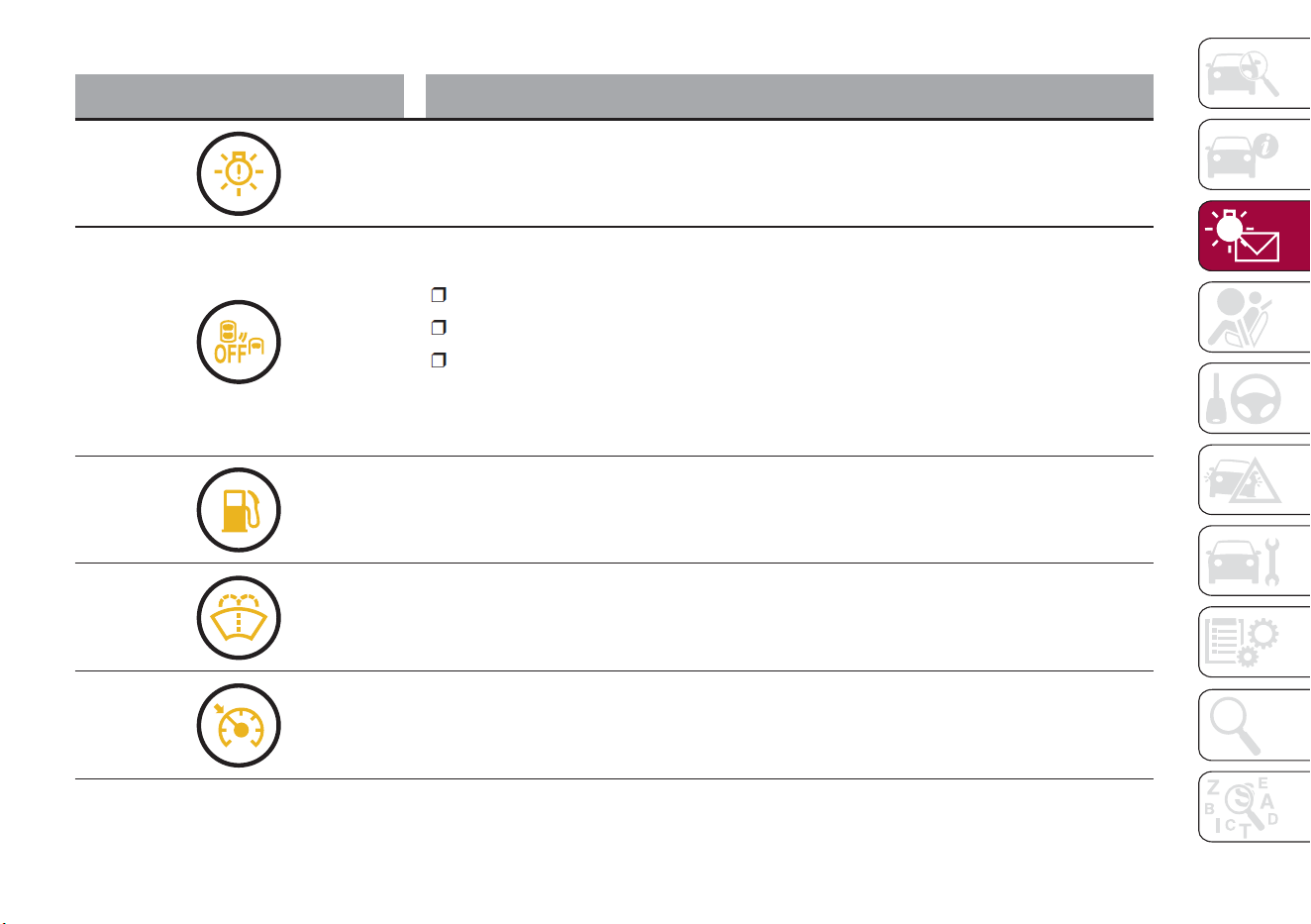
Amber Warning Lights
Warning Lights What It Means
Led Headlight Warning Light
This light illuminates if there is a malfunction in the LED headlight. Contact an authorized dealer
as soon as possible.
BSM (Blind Spot Monitoring) Off Indicator Light — If Equipped
A problem in the system may be indicated under the following conditions:
The light does not turn on when the ignition is placed in the ON position.
The light remains turned on even if the Blind Spot Monitoring (BSM) switch is operated.
It turns on while driving the vehicle.
Contact an authorized dealer as soon as possible.
If the vehicle is driven on a road with less traffic and few vehicles that the radar sensors can
detect, the system may pause (the warning light illuminates). However, it does not indicate a
malfunction.
Low Fuel Warning Light
The light turns on when the remaining fuel is about 2.3 gallons (9.0 liters).
The light illumination timing may vary because fuel inside the fuel tank moves around according
to the driving conditions and the vehicle posture. Add fuel.
Low Washer Fluid Level Warning Light — If Equipped
This warning light indicates that little washer fluid remains. Add washer fluid.
Cruise Control Activation — If Equipped
The warning light illuminates when the cruise control system is activated.
99

Amber Warning Lights
Warning Light What It Means
TCS / DSC System Indicator Light
The warning light turns on when the in case of intervention of TCS/DSC systems. This means
that the vehicle is in critical stability and grip conditions.
DSC Off Indicator Light
The warning light turns on when the DSC system is deactivated.
Loose Fuel Filler Cap Indicator Light
If the check fuel filler cap warning light illuminates while driving, the fuel filler cap may not be
installed properly. Stop the engine and reinstall the fuel filler cap.
100
GETTING TO KNOW YOUR INSTRUMENT PANEL
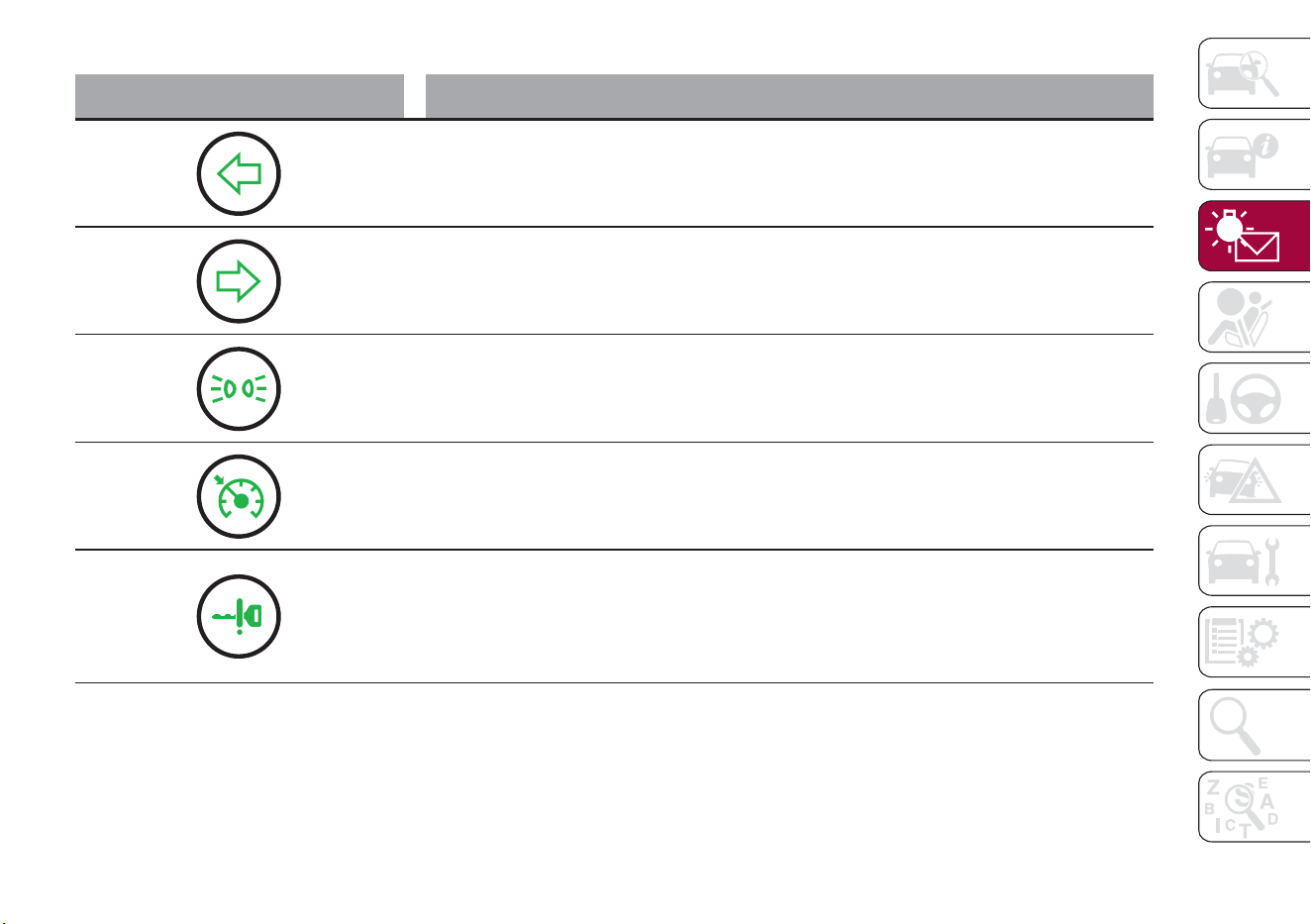
Green Warning Lights
Warning Light What It Means
Left Direction Indicator
The warning light turns on when the direction indicator control lever is moved downwards or,
together with the right direction indicator, when the hazard warning light button is pushed.
Right Direction Indicator
The warning light turns on when the direction indicator control lever is moved upwards or,
together with the left direction indicator, when the hazard warning light button is pushed.
Parking Lights And Normal Beam Headlights
The warning light turns on when parking lights or normal beam headlights are turned on.
Cruise Control — If Equipped
The warning light turns on when a cruising speed has been set.
Key Indicator Light
The warning light turns on when the engine is ready to start.
Warning Light Flashing
When the keyless START/STOP button is pushed from ON to ACC or OFF position, the warning
light may flash for approximately 30 seconds indicating that the remaining battery power of the
key is low. Replace with a new battery before the key becomes unusable.
101

Blue Warning Light
Warning Light What It Means
High Beam Headlights
The warning light switches on when the high beam headlights are turned on.
Low Engine Coolant Temperature Indicator Light
The light illuminates continuously when the engine coolant temperature is low and turns off after
the engine is warm.
If the low engine coolant temperature indicator light remains illuminated after the engine has
been sufficiently warmed up, the temperature sensor could have a malfunction. Contact an
authorized dealer.
102
GETTING TO KNOW YOUR INSTRUMENT PANEL

Warning Light (Red Color) On Dashboard Trim
Warning Light What It Means
Seat Belt Warning Light
The seat belt warning light tur ns on if the driver or passengers seat is occupied and the seat belt
is not fastened with the ignition placed in the ON position.
If the driver or passengers seat belt is unfastened (only when the passenger seat is occupied)
and the vehicle is driven at a speed faster than about 12 MPH (20 km/h), the warning light
flashes. After a short time, the LED stops flashing, but remains illuminated.
If a seat belt remains unfastened, the LED flashes again for a given period of time.
If the driver or passengers seat belt is unfastened after the LED turns on, and the vehicle speed
exceeds 12 MPH (20 km/h), the LED flashes again.
With Passenger Occupant Classification System: to allow the passenger occupant
classification sensor to function properly, do not place and sit on an additional seat cushion on
the passengers seat. The sensor may not function properly because the additional seat cushion
could cause sensor interference.
Without Passenger Occupant Classification System: placing heavy items on the
passengers seat may cause the passengers seat belt warning function to operate depending on
the weight of the item. To allow the passengers seat weight sensor to function properly, do not
place and sit on an additional seat cushion on the passengers seat. The sensor may not
function properly because the additional seat cushion could cause sensor interference. If a small
child is seated on the passengers seat, the warning light may not operate.
Fasten the seat belts.
Warning Light (Amber Color) On Instrument Cluster Trim
Warning Light What It Means
Passenger Air Bag Deactivation Indicator Light
The light turns on when the ignition is switched on for an operation check, and turns off a few
seconds later or when the engine is started. If the light does not turn on or remains turned on,
contact an authorized dealer.
103

Message Indicated On
Display
If a message is displayed in the center
display, take appropriate action (in a
calm manner) according to the
displayed message.
If the following messages are displayed
in the center display, a vehicle system
may be malfunctioning:
Engine Coolant Temperature
High: displays if the engine coolant
temperature has increased excessively.
Charging System Malfunction:
displays if the charging system has a
malfunction.
Temperature Warning:the
following message is displayed when
the temperature around the center
display is high. Lowering the
temperature of the inside of the vehicle
or the temperature around the center
display by avoiding direct sunlight is
recommended.
Stop the vehicle in a safe place and
contact an authorized dealer.
Warning Sound Is
Activated
Lights-On Reminder
If lights are on and the ignition is placed
in the ACC position, or the ignition is
placed in the OFF position, a
continuous beep sound will be heard
when the driver's door is opened.
Note:
When the ignition is placed in the
ACC position, the “Ignition Not Cycled
Off Warning Beep” overrides the
lights-on reminder.
A personalized function is available
to change the sound volume for the
lights-on reminder.
Air Bag/Seat Belt Pretensioner
System Warning Beep
If there is a problem with the air
bag/seat belt pretensioner systems and
the warning light illumination, a warning
beep sound will be heard for about
5 seconds every minute.
The air bag and seat belt pretensioner
system warning beep sound will
continue to be heard for approximately
35 minutes. Contact an authorized
dealer as soon as possible.
Caution!
Do not drive the vehicle with the air
bag/seat belt pretensioner system warning
beep sounding. Driving the vehicle with the
air bag/seat belt pretensioner system
warning beep sounding is dangerous. In a
collision, the air bags and the seat belt
pretensioner system will not deploy and this
could result in death or serious injury.
Contact an authorized dealer as soon as
possible.
Seat Belt Warning Beep
Except Mexico
If the driver's seat belt is not fastened
when the ignition is in the ON position,
a beep sound will be heard for about
six seconds.
If the driver or the passengers seat belt
is not fastened and the vehicle is driven
at a speed faster than about 12 MPH
(20 km/h), a beep sound will be heard
again for a specified period of time.
Until a seat belt is fastened or a given
period of time has elapsed, the beep
sound will not stop even if the vehicle
speed falls below 12 MPH (20 km/h).
104
GETTING TO KNOW YOUR INSTRUMENT PANEL
Note:
To allow the passenger occupant
classification sensor to function
properly, do not place and sit on an
additional seat cushion on the
passengers seat. The sensor may not
function properly because the
additional seat cushion could cause
sensor interference.
If a small child is seated on the
passengers seat, the warning beep
may not operate.
Mexico
If the vehicle speed exceeds about
12 MPH (20 km/h) with the driver or
passengers seat belt unfastened, a
warning beep sounds continuously. If
the seat belt remains unfastened, the
beep sound stops once and then
continues for about 90 seconds. The
beep stops after the driver or
passengers seat belt is fastened.
Until a seat belt is fastened or a given
period of time has elapsed, the beep
sound will not stop even if the vehicle
speed falls below 12 MPH (20 km/h).
Warning!
Placing heavy items on the front
passenger seat may cause the front
passenger seat belt warning function to
operate depending on the weight of the
item.
To allow the front passenger seat weight
sensor to function properly, do not place
and sit on an additional seat cushion on the
front passenger seat. The sensor may not
function properly because the additional
seat cushion could cause sensor
interference.
When a small child sits on the front
passenger seat, it is possible that the
warning beep will not operate.
Ignition Not Switched OFF
If the driver's door is opened while the
ignition is placed in the ACC position, a
continuous beep sound will be heard to
notify the driver that the ignition has not
been placed in the OFF position.
Left in this condition, the keyless entry
system will not operate, the car cannot
be locked, and the battery power will
be depleted.
Key Removed From Vehicle
Warning Beep
A beep sound will be heard six times
and the
warning light (red) will flash
continuously if the ignition has not been
placed in the OFF position, all the doors
are closed, and the key fob is removed
from the vehicle.
This is to notify the driver that the key
fob has been removed from the vehicle
and the ignition has not been placed in
the OFF position.
Note: Because the key fob uses
low-intensity radio waves, the
warning may activate if the key fob
is carried together with a metal object
or it is placed in a poor signal reception
area.
Request Switch Inoperable Warning
Beep — If Equipped With Advanced
Keyless Function
If the request switch on the exterior
door handle is pushed with a door
open, or the ignition has not been
placed in the OFF position, a beep will
be heard for about two seconds to
indicate that the doors, and trunk lid
cannot be locked.
105

Key Left-In-Trunk Compartment
Warning Beep — If Equipped With
Advanced Keyless Function
If the key fob is left in the trunk with all
doors locked and the trunk lid closed, a
beep sound is heard for about ten
seconds to remind the driver the key
fob has been left in the trunk.
If this happens, open the trunk lid by
pushing the electric trunk lid opener
and remove the key fob.
A key fob removed from the trunk may
not function because its functions may
have been temporarily suspended. To
restore the key fob function, perform
the applicable procedure (see
paragraph “Keys” in “Getting to know
your vehicle” chapter).
Key Left-In-Vehicle Warning Beep
(with the advanced keyless function)
If a key fob is left in the vehicle and all
the doors and the trunk are locked
using a separate key fob, a beep sound
is heard for about ten seconds to
remind the driver that the key fob has
been left in the vehicle.
If this happens, open the door and
remove the key fob. A key fob removed
from the vehicle this way may not
function because its functions may
have been temporarily suspended.
Perform the applicable procedure to
restore the functions of the key fob (see
paragraph “Keys” in “Getting To Know
Your Vehicle” chapter).
Vehicle Speed Alarm — If Equipped
The vehicle speed alarm function is
designed to alarm the driver via a single
beep sound and a warning indication in
the instrument cluster that the
previously set vehicle speed has been
exceeded.
You can change the vehicle speed
setting at which the warning is triggered
(see paragraph “Trip Computer” in
“Getting To Know Your Vehicle”
chapter).
Tire Inflation Pressure Warning
Beep — If Equipped
Vehicle With Conventional Tires:the
warning beep sound will be heard for
about three seconds when there is any
abnormality in tire inflation pressures
(see “TMPS” in “Safety” chapter).
Vehicle With Run-Flat Tires
(If Equipped): the warning beep sound
will be heard for about three seconds if
the tire pressures decrease. If the tire
pressure decreases extremely, a beep
sound will be heard for approximately
30 seconds (see “TMPS” in “Safety”
chapter).
Blind Spot Monitoring (BSM)
System Warning Beep —
If Equipped
Driving Forward: the warning beep
operates when the direction indicator
lever is operated to the side where the
Blind Spot Monitoring (BSM) warning
light is illuminated.
Note: A personalized function is
available to change the Blind Spot
Monitoring (BSM) warning beep sound
volume.
Reversing: if a moving object such as
a vehicle or two-wheeled vehicle
approaches on the left or right from
behind your vehicle, the Blind Spot
Monitoring (BSM) warning sound is
activated.
Electronic Steering Lock Warning
Beep
The warning beep operates if the
steering wheel is not unlocked after the
keyless ignition START/STOP button is
pushed.
Speed Limiter Warning Beep —
If Equipped
If the vehicle speed exceeds the set
speed by about 2 MPH (3 km/h) or
more, a warning beep operates
continuously.
The warning beep operates until the
vehicle speed decreases to the set
speedorless.
106
GETTING TO KNOW YOUR INSTRUMENT PANEL
PERSONALIZATION FEATURES
Overview
The following Personalization Features can be set or changed by the customer or by an authorized dealer.
Personalization Features differ depending on the market and specification.
Settings change method
1. Settings can be changed by operating the center display screen
A: Refer to the “Settings” paragraph in Fiat Connect 7.0 Supplement for further information.
B: Refer to “Fuel Economy Monitor” paragraph in this chapter.
2. Settings can be changed by operating the vehicle switches
C: Refer to “Auto Lock/Unlock Function” paragraph in “Getting To Know Your Vehicle” for further information.
D: Refer to “Key Fob” in “Getting To Know Your Vehicle” for further information.
E: Refer to “Lock/Unlock With Request Switch (With The Advanced Keyless Function)” (Doors) in “Getting To Know Your
Vehicle” for further information.
3. Settings can be changed by an authorized dealer (refer to the following table)
X: Refer to your authorized dealer for setting change.
Item Feature Factory Setting Available Settings
Settings Change Method
123
Safety
Blind
Spot
Monitoring
System (if
equipped)
Warning Beep Volume (*) High High/Low/Off A — X
107

Item Feature Factory Setting Available Settings
Settings Change Method
123
Vehicle
Door
Locks
Operation condition of
auto lock/unlock function
Lock: When
Driving/Unlock: IGN
Off
Lock: When
Driving/Unlock: In
Park/Lock: Out of Park
Unlock: In Park/Lock:
Shifting Out of Park/
Lock: When Driving
Unlock: IGN Off/ Lock:
When Driving/Off
ACX
Keyless
Entry
System
Time for locking door
automatically
30 seconds
90 seconds/
60 seconds/30
seconds
A—X
Advanced
Keyless
Entry
System
Time for locking door
automatically
30 seconds
90 seconds/
60 seconds/30
seconds
A—X
Auto-lock function
operation/non operational
Off On/Off A — X
Beep volume when
locking/unlocking
Off or Medium High/Medium/Low/Off A D/E X
Illuminated
Entry
System
Time until interior lights
turn off after closing door
15 seconds
60 seconds/
30 seconds/15
seconds/7.5 seconds
A—X
Time until interior lights
turn off automatically
when any door is not
closed completely
30 minutes
60 minutes/
30 minutes/10 minutes
A—X
Auto-Wiper
Control
Operational/non-
operational
On On/Off (**) A — X
108
GETTING TO KNOW YOUR INSTRUMENT PANEL

Item Feature Factory Setting Available Settings
Settings Change Method
123
Daytime
Running
Lights
(DRL)
Operational/non-
operational
On On/Off — — X
Auto
headlight off
(***)
Time until headlights turn
off
30 second
120 seconds/
90 seconds/
60 seconds/
30 seconds/Off (****)
A—X
Auto-Light
Control
Timing by which lights
turn on
Medium
High/Med.
High/Medium/Med.
Low/Low
A—X
Adaptive
Front
Lighting
System
(AFS)
Operational/non-
operational (***)
On On/Off A — X
Lights-On
Reminder Warning beep volume High High/Low/Off A — X
Coming
Home
System
Time until headlights turn
off
30 seconds
120 seconds/
90 seconds/60
seconds/30 seconds/
Off
A—X
Leaving
Home Light
System
Operational/Non-
operational
On or Off On/Off A — X
Turn Signals Beep volume Low High/Low A — X
Three-Flash
Turn Signal
Operational/Non-
operational
On or Off On/Off A — X
109
Item Feature Factory Setting Available Settings
Settings Change Method
123
System
Language
Language
indicated in
display
English
Depends on market
(****)
A—X
Temperature
Temperature unit
indicated in display
°C °F/°C A — X
Distance
Distance unit indicated in
display
mi or km mi/km A — X
Fuel Economy Monitor
Ending
Display
On/Off Off On/Off B — X
Fuel
Economy
Resetting
Procedure
Linkage/non-linkage with
fuel economy reset and
trip meter reset
Off On/Off B — X
(—) Feature setting change not available.
(*) Only the volume of the warning beep during Blind Spot Monitoring (BSM) operation can be changed. The volume of the
warning beep during Rear Cross Traffic Alert (RCTA) operation cannot be changed.
(**) If the auto-wiper control is set to Off, the wiper lever AUTO position is set to intermittent operation.
(***) Though these systems can be turned Off, doing so will defeat the purpose of the system and FCA recommends that these
systems remain On.
(****) Available only in display from the center display.
110
GETTING TO KNOW YOUR INSTRUMENT PANEL

ONBOARD
DIAGNOSTIC
SYSTEM — OBD II
Your vehicle is equipped with a
sophisticated Onboard Diagnostic
system called OBD II. This system
monitors the performance of the
emissions, engine, and automatic
transmission control systems. When
these systems are operating properly,
your vehicle will provide excellent
performance and fuel economy, as well
as engine emissions well within current
government regulations.
If any of these systems require service,
the OBD II system will turn on the
Malfunction Indicator Light (MIL). It will
also store diagnostic codes and other
information to assist your service
technician in making repairs. Although
your vehicle will usually be drivable and
not need towing, see your authorized
dealer for service as soon as possible.
Caution!
Prolonged driving with the MIL on could
cause further damage to the emission
control system. It could also affect fuel
economy and driveability. The vehicle must
be serviced before any emissions tests can
be performed.
If the MIL is flashing while the vehicle is
running, severe catalytic converter damage
and power loss will soon occur. Immediate
service is required.
Onboard Diagnostic
System (OBD II)
Cybersecurity
Your vehicle is required to have an
Onboard Diagnostic system (OBD II)
and a connection port to allow access
to information related to the
performance of your emissions
controls. Authorized service technicians
may need to access this information to
assist with the diagnosis and service of
your vehicle and emissions system.
Warning!
ONLY an authorized service technician
should connect equipment to the OBD II
connection port in order to diagnose or
service your vehicle.
If unauthorized equipment is connected
to the OBD II connection port, such as a
driver-behavior tracking device, it may:
Be possible that vehicle systems,
including safety related systems, could be
impaired or a loss of vehicle control could
occur that may result in an accident
involving serious injury or death.
Access, or allow others to access,
information stored in your vehicle systems,
including personal information.
For further information, refer to
“CyberSecurity” in “Tips, Controls, and
General Information” in your Owner’s
Manual Radio Supplement.
111
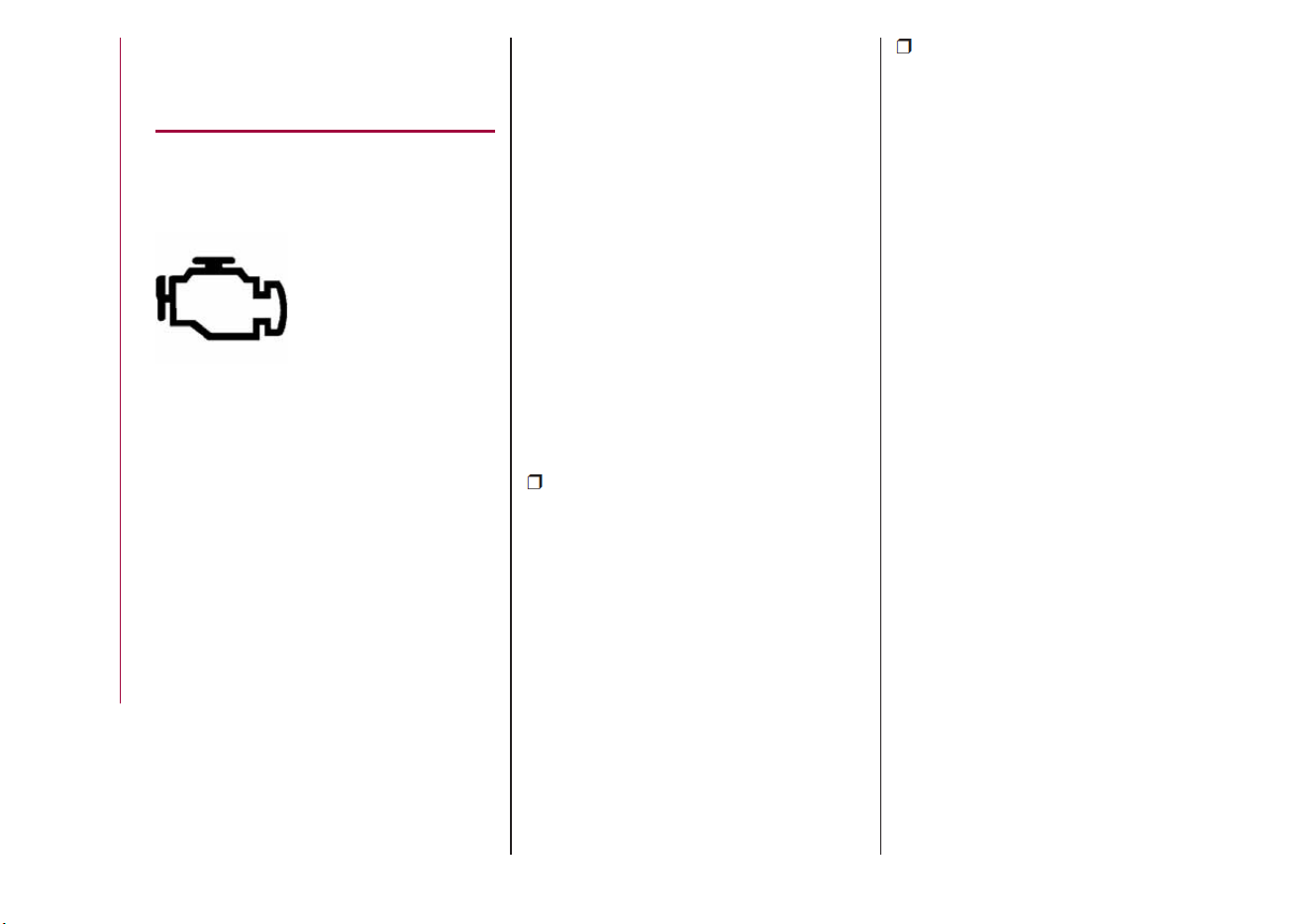
EMISSIONS
INSPECTION AND
MAINTENANCE
PROGRAMS
In some localities, it may be a legal
requirement to pass an inspection of
your vehicle's emissions control
system. Failure to pass could prevent
vehicle registration.
For states that require
an Inspection and
Maintenance (I/M), this
check verifies the
“Malfunction Indicator
Light (MIL)” is
functioning and is not on when the
engine is running, and that the OBD II
system is ready for testing.
Normally, the OBD II system will be
ready. The OBD II system may not be
ready if your vehicle was recently
serviced, recently had a dead battery or
a battery replacement. If the OBD II
system should be determined not ready
for the I/M test, your vehicle may fail the
test.
Your vehicle has a simple ignition
actuated test, which you can use prior
to going to the test station. To check if
your vehicle's OBD II system is ready,
you must do the following:
1. Cycle the ignition switch to the ON
position, but do not crank or start the
engine.
Note: If you crank or start the engine,
you will have to start this test over.
2. As soon as you cycle the ignition
switch to the ON position, you will see
the “Malfunction Indicator Light (MIL)”
symbol come on as part of a normal
bulb check.
3. Approximately 15 seconds later, one
of two things will happen:
The MIL will flash for about
10 seconds and then return to being
fully illuminated until you turn OFF the
ignition or start the engine. This means
that your vehicle's OBD II system is not
ready and you should not proceed to
the I/M station.
The MIL will not flash at all and will
remain fully illuminated until you place
the ignition in the off position or start
the engine. This means that your
vehicle's OBD II system is ready and
you can proceed to the I/M station.
If your OBD II system is not ready, you
should see your authorized dealer or
repair facility. If your vehicle was
recently serviced or had a battery failure
or replacement, you may need to do
nothing more than drive your vehicle as
you normally would in order for your
OBD II system to update. A recheck
with the above test routine may then
indicate that the system is now ready.
Regardless of whether your vehicle's
OBD II system is ready or not, if the MIL
is illuminated during normal vehicle
operation you should have your vehicle
serviced before going to the I/M station.
The I/M station can fail your vehicle
because the MIL is on with the engine
running.
112
GETTING TO KNOW YOUR INSTRUMENT PANEL

SAFETY
SAFETY SYSTEMS ...........114
AUXILIARY DRIVING SYSTEMS . .116
OCCUPANT RESTRAINT
SYSTEMS ................124
SEAT BELT SYSTEMS ........124
CHILD RESTRAINT
PRECAUTIONS .............130
SUPPLEMENTARY RESTRAINT
SYSTEMSRS—AIRBAG......133
EVENT DATA RECORDER (EDR) . .145
CONSTANT MONITORING ......147
113

SAFETY SYSTEMS
Safety Systems
The vehicle has the following safety
systems:
Anti-lock Braking System (ABS)
Traction Contol System (TCS)
Dynamic Stability Control (DSC)
For the operation of the systems, see
the following pages.
ABS System (Anti-lock
Braking System)
The ABS control unit continuously
monitors the speed of each wheel. If
one wheel is about to lock up, the ABS
responds by automatically releasing
and reapplying that wheel's brake. The
driver will feel a slight vibration in the
brake pedal and may hear a chattering
noise from the brake system. This is
normal ABS system operation.
Continue to depress the brake pedal
without pumping the brakes. The
warning light turns on when the system
has a malfunction. Refer to “Warning
Lights And Messages” in “Getting To
Know Your Instrument Panel” for further
information.
Note:
Braking distances may be longer on
loose surfaces (snow or gravel, for
example) which usually have a hard
foundation. A vehicle with a normal
braking system may require less
distance to stop under these
conditions because the tires will build
up a wedge of surface layer when the
wheels skid.
The sound of the ABS operating
may be heard when starting the engine
or immediately after starting the
vehicle; however, it does not indicate a
malfunction.
Warning!
The ABS contains sophisticated
electronic equipment that may be
susceptible to interference caused by
improperly installed or high output radio
transmitting equipment. This interference
can cause possible loss of anti-lock braking
capability. Installation of such equipment
should be performed by qualified
professionals.
Pumping of the Anti-Lock Brakes will
diminish their effectiveness and may lead to
a collision. Pumping makes the stopping
distance longer. Just press firmly on your
brake pedal when you need to slow down
or stop.
The ABS cannot prevent the natural
laws of physics from acting on the vehicle,
nor can it increase braking or steering
efficiency beyond that afforded by the
condition of the vehicle brakes and tires or
the traction afforded.
The ABS cannot prevent collisions,
including those resulting from excessive
speed in turns, following another vehicle
too closely, or hydroplaning.
The capabilities of an ABS equipped
vehicle must never be exploited in a
reckless or dangerous manner that could
jeopardize the user’s safety or the safety of
others.
114
SAFETY

TCS System (Traction
Control System)
Warning!
The capability of the TCS must never be
tested irresponsibly and dangerously, in
such a way as to compromise personal
safety and the safety of others.
The Traction Control System (TCS)
enhances traction and safety by
controlling engine torque and braking.
When the TCS detects driving wheel
slippage, it can lower engine torque and
operate the brakes to prevent loss of
traction. This means that on a slick
surface, the engine adjusts
automatically to provide optimum
power to the drive wheels, limiting
wheel spin and loss of traction.
The indicator light turns on when the
system has a malfunction. Refer to
“Warning Lights And Messages” in
“Getting To Know Your Instrument
Panel” for further information.
TCS / DSC Indicator Light
The
indicator light stays on for a few
seconds when the ignition is placed in
the ON mode.
If the TCS or DSC is operating, the
indicator light flashes.
If the
indicator light stays on, the
TCS, DSC or the brake assist system
may have a malfunction and they may
not operate correctly. Contact your
authorized dealer.
Note:
In addition to the indicator light
flashing, a slight sound will come from
the engine. This indicates that the
TCS/DSC is operating properly.
On slippery surfaces, such as fresh
snow, it will be impossible to achieve
high rpm when the TCS is on.
DSC System (Dynamic
Stability Control)
The Dynamic Stability Control (DSC)
automatically controls braking and
engine torque in conjunction with
systems such as ABS and TCS to help
control side slip when driving on
slippery surfaces, or during sudden or
evasive maneuvering, enhancing vehicle
safety. Refer to “ABS System (Antilock
Brake System)” and “TCS System
(Traction Control System)” in this
chapter for further information.
DSC operation is possible at speeds
greater than 12 mph (20 km/h).
The indicator light turns on when the
system has a malfunction. Refer to
“Warning Lights And Messages” in
“Getting To Know Your Instrument
Panel” for further information.
Note: The DSC may not operate
correctly unless the following are
observed:
Use tires of the correct size
specified for your vehicle on all four
wheels.
Use tires of the same manufacturer,
brand and tread pattern on all four
wheels.
Do not mix worn tires.
Note: The DSC may not operate
correctly when tire chains are used.
TCS / DSC Indicator Light
The
indicator light stays on for a few
seconds when the ignition is placed in
the ON mode. It also illuminates when
the DSC OFF switch is pressed and
TCS/DSC is switched off.
If the light stays on, the TCS, DSC or
the brake assist system may have a
malfunction and they may not operate
correctly. Take your vehicle to an
authorized dealer.
DSC OFF Indicator Light
The
indicator light stays on for a few
seconds when the ignition is placed in
the ON mode. It also illuminates when
the DSC OFF switch is pressed and
TCS/DSC is switched off.
If the light remains illuminated and the
TCS/DSC is not switched off, contact
your authorized dealer. The DSC may
have a malfunction.
115

DSC OFF Switch
Pushtheswitchtoturnoffthe
TCS/DSC. The
indicator light in the
instrument cluster will illuminate. Push
the switch again to turn the TCS/DSC
back on. The indicator light will turn off.
Note:
When DSC is on and you attempt
to free the vehicle when it is stuck, or
drive it out of freshly fallen snow, the
TCS (part of the DSC system) will
activate. Depressing the accelerator
will not increase engine power and
freeing the vehicle may be difficult.
When this happens, turn off the
TCS/DSC.
If the TCS/DSC is off when the
engine is turned off, it automatically
activates when the ignition is placed in
the ON mode.
Warning!
Dynamic Stability Control (DSC) cannot
prevent the natural laws of physics from
acting on the vehicle, nor can it increase
the traction afforded by prevailing road
conditions. DSC cannot prevent accidents,
including those resulting from excessive
speed in turns, driving on very slippery
surfaces, or hydroplaning. DSC also cannot
prevent accidents resulting from loss of
vehicle control due to inappropriate driver
input for the conditions. Only a safe,
attentive, and skillful driver can prevent
accidents. The capabilities of an DSC
equipped vehicle must never be exploited
in a reckless or dangerous manner which
could jeopardize the user’s safety or the
safety of others.
Vehicle modifications, or failure to
properly maintain your vehicle, may change
the handling characteristics of your vehicle,
and may negatively affect the performance
of the DSC system. Changes to the
steering system, suspension, braking
system, tire type and size or wheel size
may adversely affect DSC performance.
Improperly inflated and unevenly worn tires
may also degrade DSC performance. Any
vehicle modification or poor vehicle
maintenance that reduces the effectiveness
of the DSC system can increase the risk of
loss of vehicle control, vehicle rollover,
personal injury and death.
AUXILIARY DRIVING
SYSTEMS
Blind Spot Monitoring
(BSM) System
The Blind Spot Monitoring (BSM)
system is designed to assist the driver
during lane changes by alerting the
driver to the presence of vehicles
approaching from the rear in an
adjacent lane.
The system detects vehicles
approaching from the rear while
traveling in the forward direction at a
speed of 19 mph (30 km/h) or faster,
and will activate the BSM warning lights
equipped within the door mirrors.
If the turn signal lever is operated to
signal a lane change in the direction in
which the warning light is illuminated,
the system warns the driver of a vehicle
in the detection area by flashing the
warning light and activating an audible
alert.
05060301-12A-001
DSC OFF Switch
116
SAFETY
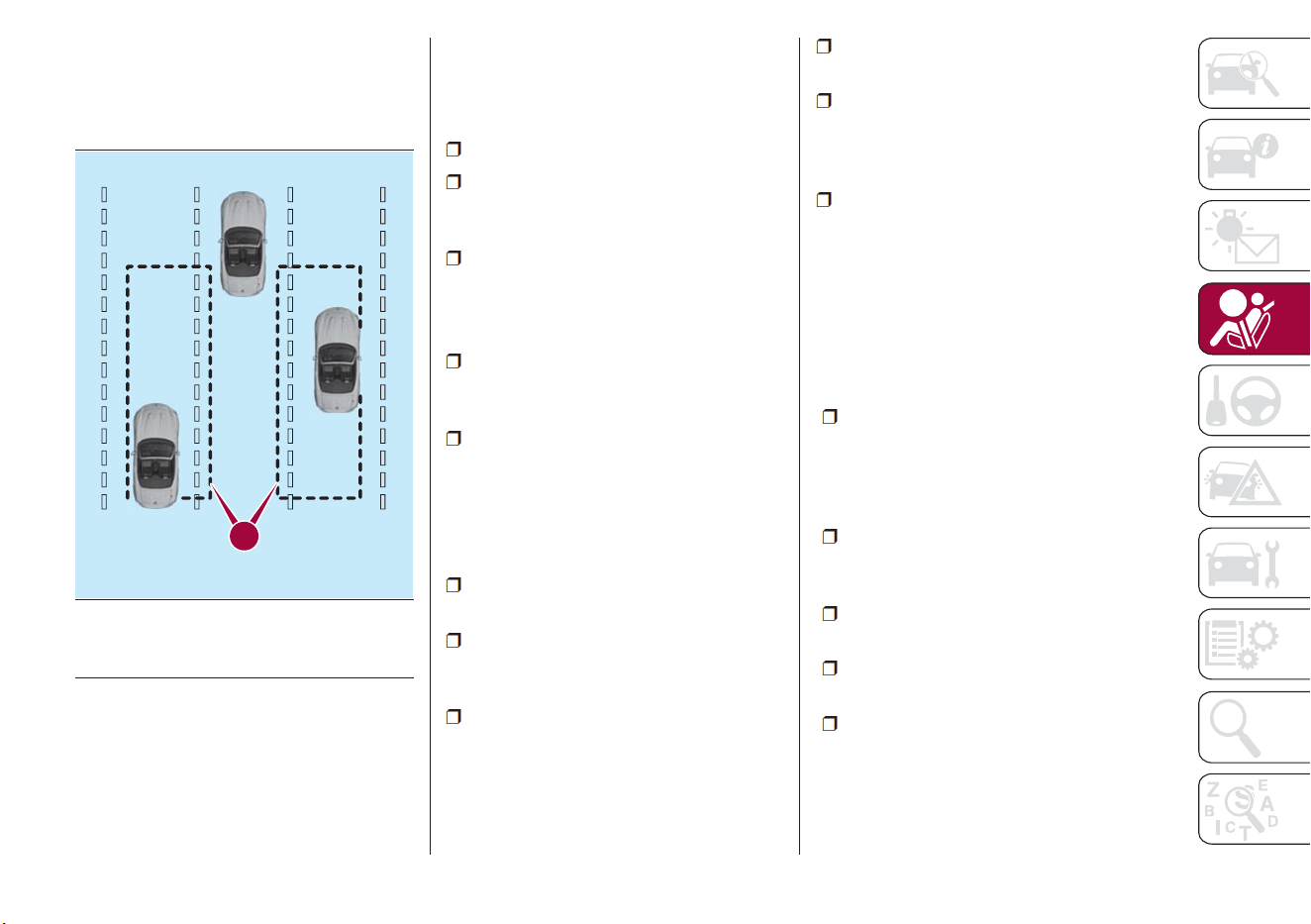
The detection area on this system
covers the driving lanes on both sides
of the vehicle and from the rear part of
the doors to about 164 ft (50 m) behind
the vehicle.
Activation / Deactivation
The Blind Spot Monitoring (BSM)
system will operate when all of the
following conditions are met:
The ignition is ON.
The BSM switch is pushed and the
warning light in the instrument cluster is
turned off.
The vehicle speed is 19 mph
(30 km/h ) or faster.
The BSM system will not operate under
the following conditions:
The vehicle speed falls below about
15 mph (25 km/h) even though the
warning light is turned off.
The gear selector is shifted to
REVERSE.
In the following cases, the warning light
in the instrument cluster illuminates and
operation of the BSM system is
deactivated.
A problem with the system (including
the BSM warning lights) is detected.
A large change in position of a rear
radar sensor on the vehicle has
occurred.
There is a large accumulation of
snow or ice on the rear bumper near a
rear radar sensor . Remove any snow,
ice or mud on the rear bumper.
Driving on snow covered roads for
long periods.
The temperature near the rear radar
sensors becomes extremely hot due to
driving for long periods on inclines
during warm weather.
The battery voltage has decreased.
If the warning light in the instrument
cluster remains illuminated, have the
vehicle inspected at an authorized
dealer as soon as possible.
Note: Under the following conditions,
the rear radar sensors cannot detect
objects, or it may be difficult to detect
them:
A vehicle is in the detection area at
the rear in an adjacent driving lane but
it does not approach. The BSM system
determines the condition based on
radar detection data.
A vehicle is traveling alongside your
vehicle at nearly the same speed for an
extended period of time.
Vehicles approaching in the
opposite direction.
A vehicle in an adjacent driving lane
is attempting to pass your vehicle.
A vehicle is in an adjacent lane on a
road with extremely wide driving lanes.
The detection area of the rear radar
sensors is set at the road width of
expressways.
1
0528070012A002
BSM Detection Areas
1 — Detection Area
117

In the following cases, the activation of
the BSM warning lights and the audible
alert may not occur, or they may be
delayed:
A vehicle makes a lane change from
a driving lane two lanes over to an
adjacent lane.
Driving on steep inclines.
Crossing the summit of a hill or
mountain pass.
The turning radius is small (making a
sharp turn or turning at intersections).
Whenthereisadifferenceinthe
height between your driving lane and
the adjacent lane.
Immediately after pushing the BSM
switch and the system becomes
operable.
If the road width is extremely narrow,
vehicles two lanes over may be
detected. The detection area of the rear
radar sensors is set according to the
road width of expressways.
The BSM warning lights may turn on in
reaction to stationary objects on the
road or the roadside such as guardrails,
tunnels, sidewalls, and parked vehicles.
A BSM warning light may flash or the
audible alert may be activated several
times when making a turn at a city
intersection.
Turn off the BSM system while pulling a
trailer or while an accessory such as a
bicycle carrier is installed to the rear of
the vehicle. Otherwise, the radar’s
sound system waves will be blocked
causing the system to not operate
normally.
In the following cases, it may be difficult
to view the illumination/flashing of the
BSM warning lights equipped on the
door mirrors:
Snow or ice is adhering to the door
mirrors.
The door glass is fogged or covered
in snow, frost or dirt.
The system switches to the Rear Cross
Traffic Alert function when the gear
selector is shifted to the REVERSE
position.
BSM Warning Lights
The BSM warning lights are equipped
on the left and right door mirrors.
The warning lights turn on when a
vehicle approaching from the rear in an
adjacent lane is detected.
When the ignition is switched ON, the
malfunction warning light in the
instrument cluster illuminates
momentarily and then turns off after a
few seconds.
Forward Driving (BSM System
Operation)
The BSM system detects vehicles
approaching from the rear and turns on
the warning lights equipped on the door
mirrors according to the conditions.
Additionally, while a warning light is
illuminated, if the turn signal lever is
operated to signal a turn in the direction
in which the warning light is illuminated,
the warning light flashes.
Reverse Driving (RCTA System
Operation)
The Rear Cross Traffic Alert (RCTA)
system detects vehicles approaching
from the left and right of your vehicle
and flashes the BSM warning lights.
05280701-12A-001
BSM Warning Light
118
SAFETY

Function For Canceling Illumination
Dimmer
When the headlight switch is in the
or position, the brightness of
the Blind Spot Monitoring (BSM)
warning lights is dimmed. If the Blind
Spot Monitoring (BSM) warning lights
are difficult to see due to glare from
surrounding brightness when traveling
on snow-covered roads or under foggy
conditions, push the dimmer
cancellation button to cancel the
dimmer and increase the brightness of
Blind Spot Monitoring (BSM) warning
lights when they turn on.
Refer to “Instrument Panel Illumination”
in “Getting To Know Your Instrument
Panel” for further information.
BSM Warning Beep
The BSM audible alert is activated
simultaneously with the flashing of a
BSM warning light.
BSM Switch
When the BSM switch is pushed, the
BSM and RCTA systems are turned off
and the BSM off indicator light in the
instrument cluster turns on.
If the switch is pushed again, the BSM
and RCTA systems become operable
and the BSM off indicator light turns off.
Note:
When the ignition is switched OFF,
the condition before the system was
turned off is maintained. For example,
if the ignition is switched OFF while the
BSM and RCTA systems are
operational, the BSM and RCTA
systems remain operational the next
time the ignition is switched ON.
The BSM and RCTA systems are
turned off when the battery is
disconnected such as when the
battery terminals or fuses have been
removed and reinstalled. To turn the
BSM and RCTA systems back on,
push the BSM switch.
RCTA (Rear Cross Traffic Alert)
Function
The RCTA system is designed to assist
the driver in checking the area to the
rear of the vehicle on both sides while
the vehicle is in REVERSE by alerting
the driver to the presence of vehicles
approaching the rear of the vehicle.
The RCTA system detects vehicles
approaching from the left and right
sides of the vehicle while the vehicle is
reversing out of a parking space, and
notifies the driver of possible danger
using the BSM warning lights and an
audible alert.
05280703-12A-001
BSM Switch Location
05281200-03A-001
Rear Cross Traffic Alert
1 — Your Vehicle
2 — Approaching Vehicles Left
And Right
119
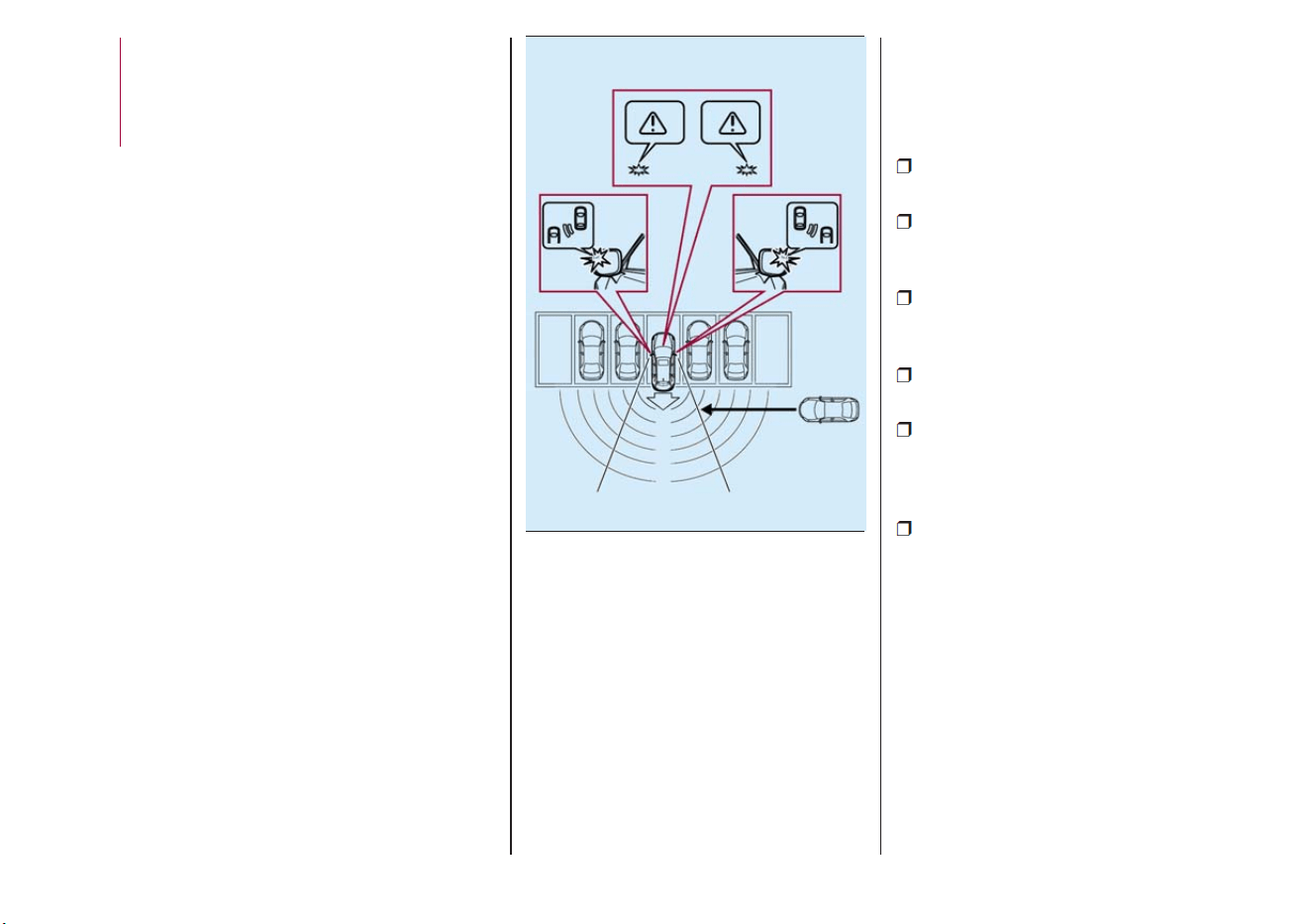
RCTA Operation
The RCTA system operates when the
gear selector is shifted to the REVERSE
position.
If there is the possibility of a collision
with an approaching vehicle, the BSM
warning light flashes and the audible
alert is activated simultaneously.
With Rear View Camera
The Rear Cross Traffic Alert (RCTA)
warning indication in the rearview
monitor also synchronizes with the
Blind Spot Monitoring (BSM) warning
indicator light on the door mirrors.
In the following cases, the BSM off
indicator light turns on and operation of
the system is deactivated. If the BSM
off indicator light in the instrument
cluster remains illuminated:
A problem with the system including
the BSM warning lights has occurred.
A large change in the position of a
rear radar sensor on the vehicle has
occurred.
There is a large accumulation of
snow or ice on the rear bumper near a
rear radar sensor.
Driving on snow-covered roads for
long periods.
The temperature near the radar
sensors becomes extremely hot due to
driving for long periods on inclines
during warm weather.
The battery voltage has decreased.
Have the vehicle inspected at an
authorized dealer as soon as possible.
0528140012A002
RCTA Detection
120
SAFETY

Note: Under the following conditions,
the rear radar sensors cannot detect
objects or it may be difficult to detect
them:
The vehicle speed while in
REVERSE is about 6 mph (10 km/h )
or faster.
The rear radar sensor detection
area is obstructed by a nearby wall or
parked vehicle (reverse the vehicle to a
position where the radar sensor
detection area is no longer obstructed).
A vehicle is approaching directly to
the rear of your vehicle.
The vehicle is parked on an incline.
Immediately after pushing the BSM
switch and the system becomes
operable.
In the following cases, it may be difficult
to view the illumination/flashing of the
BSM warning lights equipped on the
door mirrors:
Snow or ice adheres to the door
mirrors.
The door glass is fogged or covered
in snow, frost or dirt.
Turn off the RCTA system while pulling
a trailer or while an accessory such as a
bicycle carrier is installed to the rear of
the vehicle.
Otherwise, the sound system waves
emitted by the radar will be blocked
causing the system to not operate
normally.
05281200-03A-003
Sensors Obstructed By Nearby
Vehicles
05281200-03A-004
Another Vehicle Approaching
Directly To The Rear Of Your
Vehicle
05281200-03A-005
Your Vehicle Parked On An Incline
121

TPMS (Tire Pressure
Monitoring System)
Tire Pressure Monitoring System —
Abarth
The TPMS system monitors the
pressure for each tire.
If tire pressure is too low in one or more
tires, the system will inform the driver
via the
warning light in the
instrument cluster and by the warning
beep sound.
The tire pressure sensors installed on
each wheel send tire pressure data by
radio signal to the receiver unit in the
vehicle.
TPMS does not alleviate your need to
check the pressure and condition of all
four tires regularly.
Each tire, including the spare (if
equipped), should be checked monthly
when cold and inflated to the inflation
pressure recommended by the vehicle
manufacturer on the vehicle placard or
tire inflation pressure label. (If your
vehicle has tires of a different size than
the size indicated on the vehicle placard
or tire inflation pressure label, you
should determine the proper tire
inflation pressure for those tires.)
As an added safety feature, your vehicle
has been equipped with a tire pressure
monitoring system (TPMS) that
illuminates a low tire pressure telltale
when one or more of your tires is
significantly under-inflated. Accordingly,
when the low tire pressure telltale
illuminates, you should stop and check
your tires as soon as possible, and
inflate them to the proper pressure.
Driving on a significantly under-inflated
tire causes the tire to overheat and can
lead to tire failure. Under-inflation also
reduces fuel efficiency and tire tread life,
and may affect the vehicle's handling
and stopping ability. Please note that
the TPMS is not a substitute for proper
tire maintenance, and it is the driver's
responsibility to maintain correct tire
pressure, even if under-inflation has not
reached the level to trigger illumination
of the TPMS low tire pressure telltale.
Your vehicle has also been equipped
with a TPMS malfunction indicator to
indicate when the system is not
operating properly. When the system
detects a malfunction, the telltale will
flash for approximately one minute and
then remain continuously illuminated.
This sequence will continue upon
subsequent vehicle start-ups as long as
the malfunction exists. When the
malfunction indicator is illuminated, the
system may not be able to detect or
signal low tire pressure as intended.
TPMS malfunctions may occur for a
variety of reasons, including the
installation of replacement or alternate
tires or wheels on the vehicle that
prevent the TPMS from functioning
properly. Always check the TPMS
malfunction telltale after replacing one
or more tires or wheels on your vehicle
to ensure that the replacement or
alternate tires and wheels allow the
TPMS to continue to function properly.
System Error Activation
When the
warning light flashes,
there may be a system malfunction.
Contact your authorized dealer.
A system error activation may occur in
the following cases:
When there is equipment or a device
near the vehicle using the same radio
frequency as that of the tire pressure
sensors.
When a metallic device such as a
non-genuine navigation system is
equipped near the center of the
dashboard, which may block radio
signals from the tire pressure sensor to
the receiver unit.
When using the following devices in
the vehicle that may cause radio
interference with the receiver unit.
A digital device such as a personal
computer.
A current converter device such as a
DC-AC converter.
When excess snow or ice adheres to
the vehicle, especially around the
wheels.
When the tire pressure sensor
batteries are discharged.
When using a wheel with no tire
pressure sensor installed.
122
SAFETY
When using tires with steel wire
reinforcement in the side walls.
When using tire chains.
Tires And Wheels
Note: When inspecting or adjusting the
tire air pressures, do not apply
excessive force to the stem portion of
the wheel unit. The stem portion could
be damaged.
Changing Tires And Wheels
The following procedure allows the
TPMS to recognize a tire pressure
sensor's unique ID signal code
whenever tires or wheels are changed,
such as changing to and from winter
tires.
Note:
Each tire pressure sensor has a
unique ID signal code. The signal code
must be registered with the TPMS
before it can work. The easiest way to
do it is to have your authorized dealer
change your tire and complete ID
signal code registration.
When your authorized dealer
changes your vehicle's tires, they will
complete the tire pressure sensor ID
signal code registration.
If you or someone else changes tires,
you or someone else can also
undertake the steps for the TPMS to
complete the ID signal code
registration:
After tires have been changed, place
the ignition in the ON mode, then back
to ACC or OFF modes.
Wait for about 15 minutes.
After about 15 minutes, drive the
vehicle at a speed of at least 16 mph
(25 km/h) for 20 minutes and the tire
pressure sensor ID signal code will be
registered automatically.
Note: If the vehicle is driven within
about 15 minutes of changing tires, the
warning light will flash because the
sensor ID signal code would not have
been registered. If this happens, park
the vehicle for about 15 minutes, after
which the sensor ID signal code will
register upon driving the vehicle for
20 minutes.
Replacing Tires And Wheels
Note:
When replacing/repairing the tires or
wheels or both, have the work done by
your authorized dealer, or the tire
pressure sensors may be damaged.
The wheels equipped on your
vehicle are specially designed for
installation of the tire pressure sensors.
Do not use non-genuine wheels,
otherwise it may not be possible to
install the tire pressure sensors.
Be sure to have the tire pressure
sensors installed whenever tires or
wheels are replaced.
When having a tire or wheel or both
replaced, the following types of tire
pressure sensor installations are
possible:
The tire pressure sensor is removed
from the old wheel and installed to the
new one.
The same tire pressure sensor is
used with the same wheel. Only the tire
is replaced.
A new tire pressure sensor is
installed to a new wheel.
Note:
The tire pressure sensor ID signal
code must be registered when a new
tire pressure sensor is purchased. For
purchase of a tire pressure sensor and
registration of the tire pressure sensor
ID signal code, consult your authorized
dealer.
123
When reinstalling a previously
removed tire pressure sensor to a
wheel, replace the grommet (seal
between valve body/sensor and wheel)
for the tire pressure sensor.
Caution!
The TPMS has been optimized for the
original equipment tires and wheels. TPMS
pressures and warning have been
established for the tire size equipped on
your vehicle. Undesirable system operation
or sensor damage may result when using
replacement equipment that is not of the
same size, type, and/or style. The TPM
sensor is not designed for use on
aftermarket wheels and may contribute to a
poor overall system performance or sensor
damage. Customers are encouraged to
use OEM wheels to assure proper TPM
feature operation.
Using aftermarket tire sealants may
cause the Tire Pressure Monitoring System
(TPMS) sensor to become inoperable. After
using an aftermarket tire sealant it is
recommended that you take your vehicle to
an authorized dealer to have your sensor
function checked.
After inspecting or adjusting the tire
pressure always reinstall the valve stem
cap. This will prevent moisture and dirt
from entering the valve stem, which could
damage the TPMS sensor.
The following regulatory statement
applies to all radio frequency (RF)
devices equipped in this vehicle:
This device complies with Part 15 of the
FCC Rules and with Industry Canada
license-exempt RSS standard(s).
Operation is subject to the following
two conditions:
(1) This device may not cause harmful
interference, and
(2) This device must accept any
interference received, including
interference that may cause undesired
operation.
Note: Changes or modifications not
expressly approved by the party
responsible for compliance could void
the user’s authority to operate the
equipment.
OCCUPANT
RESTRAINT
SYSTEMS
The most important safety equipment
of the vehicle comprise the following
protection systems:
Seat Belts
SBA (Seat Belt Alert) System
Head Restraints
Child Restraint Systems
Front Air Bags And Side Air Bags
Read the information given in the
following pages with the utmost care.
It is of fundamental importance that the
protection systems are used in the
correct way to guarantee the maximum
possible safety level for the driver and
the passengers.
124
SAFETY

SEAT BELT
SYSTEMS
Buckle up even though you are an
excellent driver, even on short trips.
Someone on the road may be a poor
driver and could cause a collision that
includes you. This can happen far away
from home or on your own street.
Research has shown that seat belts
save lives, and they can reduce the
seriousness of injuries in a collision.
Some of the worst injuries happen
when people are thrown from the
vehicle. Seat belts reduce the possibility
of ejection and the risk of injury caused
by striking the inside of the vehicle.
Everyone in a motor vehicle should be
belted at all times.
Seat Belt Precautions
Seat belts help to decrease the
possibility of severe injury during
accidents and sudden stops. FCA
recommends that the driver and
passengers always wear seat belts.
Mexico
All the seats have lap/shoulder belts.
These belts have retractors with inertia
locks that keep them out of the way
when not in use.
The locks allow the belts to remain
comfortable on users, but they will lock
in position during a collision.
Except Mexico
All of the seat belt retractors are
designed to keep the lap/shoulder belts
out of the way when not in use.
The driver's seat belt has no provisions
for child-restraint systems and has only
an emergency locking mode.
The driver may wear it comfortably, and
it will lock during a collision.
However, the passenger's seat
lap/shoulder belt retractor operates in
two modes: emergency locking mode,
and for child-restraint systems,
automatic locking mode. If you must
use the passenger seat for a child, slide
the passenger seat as far back as
possible and make sure any child
restraint system is secured properly.
Belt retraction may become difficult if
the belts and seat belt guides are
soiled, so try to keep them clean. Refer
to “Lap/Shoulder Belt” in ”Interiors,”
found in Servicing And Maintenance”
for further information.
Warning!
Relying on the air bags alone could lead
to more severe injuries in a collision. The air
bags work with your seat belt to restrain
you properly. In some collisions, the air
bags won’t deploy at all. Always wear your
seat belt even though you have air bags.
In a collision, you and your passengers
can suffer much greater injuries if you are
not properly buckled up. You can strike the
interior of your vehicle or other passengers,
or you can be thrown out of the vehicle.
Always be sure you and others in your
vehicle are buckled up properly.
It is dangerous to ride in a cargo area,
inside or outside of a vehicle. In a collision,
people riding in these areas are more likely
to be seriously injured or killed.
Do not allow people to ride in any area
of your vehicle that is not equipped with
seats and seat belts.
03020100-12A-001
Seat Belt Routing Guide
125

Be sure everyone in your vehicle is in a
seat and using a seat belt properly.
Occupants, including the driver, should
always wear their seat belts whether or not
an air bag is also provided at their seating
position to minimize the risk of severe injury
or death in the event of a crash.
Wearing your seat belt incorrectly could
make your injuries in a collision much
worse. You might suffer internal injuries, or
you could even slide out of the seat belt.
Follow these instructions to wear your seat
belt safely and to keep your passengers
safe, too.
Two people should never be belted into
a single seat belt. People belted together
can crash into one another in a collision,
hurting one another badly. Never use a
lap/shoulder belt or a lap belt for more than
one person, no matter what their size.
A lap belt worn too high can increase
the risk of injury in a collision. The seat belt
forces won’t be at the strong hip and pelvic
bones, but across your abdomen. Always
wear the lap part of your seat belt as low
as possible and keep it snug.
A twisted seat belt may not protect you
properly. In a collision, it could even cut into
you. Be sure the seat belt is flat against
your body, without twists. If you can’t
straighten a seat belt in your vehicle, take it
to your authorized dealer immediately and
have it fixed.
A seat belt that is buckled into the
wrong buckle will not protect you properly.
The lap portion could ride too high on your
body, possibly causing internal injuries.
Always buckle your seat belt into the
buckle nearest you.
A seat belt that is too loose will not
protect you properly. In a sudden stop, you
could move too far forward, increasing the
possibility of injury. Wear your seat belt
snugly.
A seat belt that is worn under your arm
is dangerous. Your body could strike the
inside surfaces of the vehicle in a collision,
increasing head and neck injury. A seat belt
worn under the arm can cause internal
injuries. Ribs aren’t as strong as shoulder
bones. Wear the seat belt over your
shoulder so that your strongest bones will
take the force in a collision.
A shoulder belt placed behind you will
not protect you from injury during a
collision. You are more likely to hit your
head in a collision if you do not wear your
shoulder belt. The lap and shoulder belt are
meant to be used together.
A frayed or torn seat belt could rip apart
in a collision and leave you with no
protection. Inspect the seat belt system
periodically, checking for cuts, frays, or
loose parts. Damaged parts must be
replaced immediately. Do not disassemble
or modify the seat belt system. Seat belt
assemblies must be replaced after a
collision.
Seat Belts And Pregnant
Women
Pregnant Women And Persons With
Serious Medical Conditions
Pregnant women should always wear
seat belts. Ask your doctor for specific
recommendations.
The lap belt should be worn SNUGLY
AND AS LOW AS POSSIBLE OVER
THE HIPS. The shoulder belt should be
worn across your shoulder properly, but
never across the stomach area.
Persons with serious medical
conditions also should wear seat belts.
Check with your doctor for any special
instructions regarding specific medical
conditions.
06050100-CHD-003
Seat Belts And Pregnant Women
126
SAFETY

Emergency Locking
Mode
When the seat belt is fastened, it will
always be in the emergency locking
mode.
In the emergency locking mode, the
belt remains comfortable on the
occupant and the retractor will lock in
position during a collision.
If the belt is locked and cannot be
pulled out, retract the belt once, and
then try pulling it out slowly. If this fails,
pull the belt strongly one time and
loosen, then pull it out again slowly.
Seat Belt With Automatic Locking
Mode
When the seat belt is fastened, it will
always be in the emergency locking
mode until it is switched to automatic
locking mode by pulling it all the way
out to its full length.
If the belt feels tight and hinders
comfortable movement while the
vehicle is stopped or in motion, it may
be in the automatic locking mode
because the belt has been pulled too
far out.
To return the belt to the more
comfortable emergency locking mode,
wait until the vehicle has stopped in a
safe, level area, retract the belt fully to
convert it back to emergency locking
mode and then extend it around you
again.
Automatic Locking Mode
Always use the automatic locking mode
to keep the child-restraint system from
shifting to an unsafe position in the
event of an accident.
To enable seat belt automatic locking
mode, pull it all the way out and
connect it as instructed on the child
restraint system. It will retract down to
the child restraint system and stay
locked on it.
Warning!
The seat belt assembly must be
replaced if the switchable Automatic
Locking Retractor (ALR) feature or any
other seat belt function is not working
properly when checked according to the
procedures in the Service Manual.
Failure to replace the seat belt assembly
could increase the risk of injury in collisions.
Do not use the Automatic Locking Mode
to restrain occupants who are wearing the
seat belt or children who are using booster
seats. The locked mode is only used to
install rear-facing or forward-facing child
restraints that have a harness for
restraining the child.
Lap/Shoulder Belts
Fastening The Seat Belt
1
2
03020201121001
Fastening The Seat Belt
1—SeatBelt
Tongue
2 — Seat Belt
Buckle
127
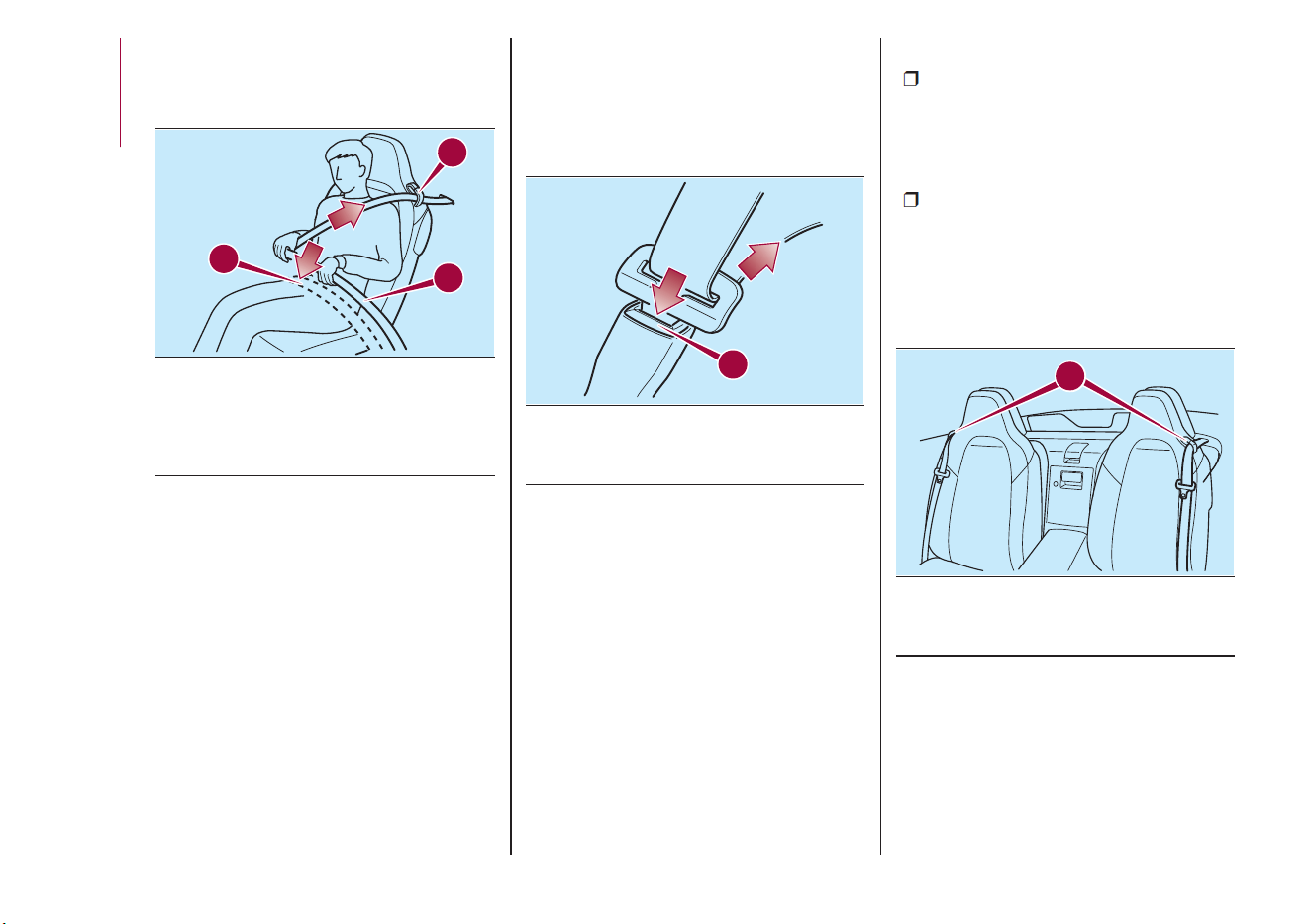
Position the lap belt as low as possible,
not on the abdominal area 2, then
adjust the shoulder belt 3 so that it fits
snugly against your body.
Unfastening The Seat Belt
Depress the button on the seat belt
buckle. If the belt does not fully retract,
pull it out and check for kinks or twists.
Then make sure it remains untwisted as
it retracts.
Note:
If a belt does not fully retract,
inspect it for kinks and twists. If it is still
not retracting properly, have it
inspected: contact an authorized
dealer.
Always wear the seat belt with it
correctly routed in its guide. Wearing a
seat belt without the seat belt routed in
its guide is dangerous because the
seat belt would not be able to provide
adequate protection in an accident,
which could result in serious injury.
1
3
2
03020201122002
Adjusting The Seat Belt
1 — Position Lap Belt Across Lap Area
2 — Lap Belt Routing
3 — Shoulder Belt Routing
1
03020202UNF001
Latching/Unlatching The Seat Belt
1 — Seat Belt Release Button
1
0302020012A001
Seat Belt Routing Guides
1 — Shoulder Belt Routing Guides
128
SAFETY
Seat Belt Warning
Systems
If it detects that the occupant seat belt
is unfastened, the warning light or beep
alerts the occupant.
Referto“WarningLightsAnd
Messages” in “Getting To Knowing Your
Instrument Panel” for further
information.
Refer to “Seat Belt Warning Light” in
“Getting To Knowing Your Instrument
Panel” for further information.
Seat Belt Extender
If your seat belt is not long enough,
even when fully extended, a seat belt
extender may be available to you at no
charge from authorized dealer.
This extender will be only for you and
for the particular vehicle and seat. Even
if it plugs into other seat belts, it may
not hold in the critical moment of a
crash.
When ordering an extender, only order
one that provides the necessary
additional length to fasten the seat belt
properly. Please contact authorized
dealer for more information.
When not in use, remove the seat belt
extender and store it in the vehicle. If
the seat belt extender is left connected,
the seat belt extender might get
damaged as it will not retract with the
rest of the seat belt and can easily fall
out of the door when not in use and be
damaged.
In addition, the seat belt warning light
will not illuminate and function properly.
Warning!
Do not use a seat belt extender unless it
is necessary. Using a seat belt extender
when not necessary is dangerous. The
seat belt will be too long and not fit
properly. In an accident, the seat belt will
not provide adequate protection and you
could be seriously injured. Only use the
extender when it is required to fasten the
seat belt properly.
Do not use an improper extender. Using
a seat belt extender that is for another
person or a different vehicle or seat is
dangerous. The seat belt will not provide
adequate protection and the user could be
seriously injured in an accident. Only use
the extender provided for you and for the
particular vehicle and seat.
NEVER use the extender in a different
vehicle or seat. If you sell your vehicle, do
not leave your seat belt extender in the
vehicle. It could be used accidentally by the
new owner of the vehicle. After removing
the seat belt extender, discard it. Never use
the seat belt extender in any other vehicle
you may own in the future.
Do not use an extender that is too long.
Using an extender that is too long is
dangerous. The seat belt will not fit
properly. In an accident, the seat belt will
not provide adequate protection and you
could be seriously injured. Do not use the
extender or choose one shorter in length if
the distance between the extender's
buckle and the center of the user's body is
less than 6 inches (15 cm).
Do not leave a seat belt extender
connected to the buckle. Leaving a seat
belt extender connected to the buckle
without using the seat belt is dangerous.
When the seat belt extender is connected
to the driver's seat belt buckle (or
passenger) seat, the SRS driver's (or
passenger's) air bag system will determine
that the driver (or passenger) is wearing the
seat belt even if the driver (or passenger) is
not wearing it. This condition could cause
the driver's (or passenger's) air bag to not
activate correctly and result in death or
serious injury in the event of collision.
Always wear the seat belt with the seat belt
extender.
Do not use the seat belt extender when
installing a child restraint system on the
passenger seat. Using a seat belt extender
to fasten a child restraint system on any
seat is dangerous. Always follow the child
restraint system manufacturer's installation
instructions and never use a seat belt
extender.
129

Driver And Passenger
BeltAlert (If Equipped)
Seat Belt Warning Systems
The LED on dashboard trim turns on if
the driver or passenger's seat is
occupied and the seat belt is not
fastened with the ignition switched ON.
If the driver or passenger's seat belt is
unfastened (only when the passenger
seat is occupied) and the vehicle is
driven at a speed faster than about
12 MPH (20 km/h), the
LED flashes.
After a short time, the LED stops
flashing, but remains illuminated.
If a seat belt remains unfastened, the
LED flashes again for a given period of
time. In this case, fasten the seat belt.
Seat Belt Pretensioner
For optimum protection, the driver and
passenger seat belts are equipped with
pretensioner and load limiting systems.
For both these systems to work properly
you must wear the seat belt properly.
The seat belt pretensioners are
designed to deploy in moderate or
severe frontal, near frontal collisions. In
addition, during a side collision, the
pretensioner operates on the side in
which the collision occurs. The
pretensioners operate differently
depending on what types of air bags
are equipped. For details on the seat
belt pretensioner operation, refer to the
“SRS Air Bag Deployment Criteria”
paragraph in this chapter.
When a collision is detected, the
pretensioners deploy simultaneously
with the air bags. For deployment
details, refer to the “SRS Air Bag
Deployment Criteria” paragraph in this
chapter.
The seat belt retractors remove slack
quickly as the air bags are expanding.
Any time the air bags and seat belt
pretensioners have fired they must be
replaced.
With Passenger Occupant
Classification System
In addition, the pretensioner system for
the passenger, like the front and side
passenger Air Bag, is designed to only
deploy when the passenger occupant
classification sensor detects a
passenger sitting on the passenger's
seat.
Note:
These devices are not a substitute
for proper seat belt placement by the
occupant. The seat belt still must be
worn snugly and positioned properly.
The pretensioners are triggered by
the Occupant Restraint Controller
(ORC). Like the air bags, the
pretensioners are single use items. A
deployed pretensioner or a deployed
air bag must be replaced immediately.
Load Limiter
The load limiting system releases belt
webbing in a controlled manner to
reduce belt force on the occupant's
chest.
While the most severe load on a seat
belt occurs in frontal collisions, the load
limiter has an automatic mechanical
function and can activate in any
accident mode with sufficient occupant
movement.
Even if the pretensioners have not fired,
the load limiting function must be
checked by an authorized dealer.
130
SAFETY

CHILD RESTRAINT
PRECAUTIONS
Child Restraints
FCA strongly urges the use of
child-restraint systems for children small
enough to use them.
Before buying any restraint system,
make sure that it has a label certifying
that it meets all applicable Safety
Standards. You should also make sure
that you can install it in the vehicle
where you will use it.
Check your local and state or provincial
laws for specific requirements regarding
the safety of children riding in your
vehicle.
Whatever child-restraint system you
consider, please pick the appropriate
one for the age and size of the child,
obey the law and follow the instructions
that come with the individual
child-restraint system.
A child who has outgrown
child-restraint systems should use seat
belts, both lap and shoulder. If the
shoulder belt crosses the neck or face,
move the child closer to the center of
the vehicle.
A rear-facing child-restraint system
should NEVER be used on the
passenger seat with the Air Bag system
activated. In the event of an impact the
Air Bag activation may cause fatal
injuries to the transported child.
With Passenger Occupant
Classification System
To reduce the chance of injuries caused
by deployment of the passenger Air
Bag, the passenger occupant
classification sensor work as a part of
the supplementary restraint system.
This system deactivates the passenger
front and side Air Bags and also the
passenger seat belt pretensioner
system when the
OFF passenger Air
Bag deactivation indicator light
illuminates.
When an infant or small child sits on the
passenger seat, the system shuts off
the passenger front and side Air Bags
and seat belt pretensioner system, so
make sure the
OFF passenger Air
Bag deactivation indicator light
illuminates. For more details, refer to
"Passenger Occupant Classification
Sensor" in “Supplementary Restraint
System SRS — Air Bag” for additional
information.
Note: A seat belt or child-restraint
system can become very hot in a
closed vehicle during warm weather. To
avoid burning yourself or a child, check
them before you or your child touches
them.
Warning!
Improper installation can lead to failure
of an infant or child restraint. It could come
loose in a collision. The child could be
badly injured or killed. Follow the child
restraint manufacturer’s directions exactly
when installing an infant or child restraint.
After a child restraint is installed in the
vehicle, do not move the vehicle seat
forward or rearward because it can loosen
the child restraint attachments. Remove
the child restraint before adjusting the
vehicle seat position. When the vehicle seat
has been adjusted, reinstall the child
restraint.
When your child restraint is not in use,
secure it in the vehicle with the seat belt or
LATCH anchorages, or remove it from the
vehicle. Do not leave it loose in the vehicle.
In a sudden stop or accident, it could strike
the occupants or seatbacks and cause
serious personal injury.
Child Restraint System
Types
In this Owner Handbook, explanation of
child restraint systems secured with
seat belts is provided for the following
three types of popular child-restraint
systems: infant seat, child seat, booster
seat.
131

Note:
Installation position is determined
by the type of child restraint system.
Always read the manufacturer's
instructions and this Owner Handbook
carefully.
Due to variations in the design of
child restraint systems, vehicle seats
and seat belts, not all child restraint
may fit all seating positions.
Before purchasing a child-restraint
system, it should be tested in the
specific vehicle seating position (or
positions) where it is intended to be
used. If a previously purchased
child-restraint system does not fit, you
may need to purchase a different one
that will.
Infant Seat
An infant seat provides restraint by
bracing the infant's head, neck and
back against the seating surface.
Child Seat
A child seat restrains a child's body
using the harness.
Booster Seat
A booster seat is a child restraint
accessory designed to improve the fit of
the seat belt system around the child's
body.
Warning!
Never allow a child to put the shoulder belt
under an arm or behind their back. In a
crash, the shoulder belt will not protect a
child properly, which may result in serious
injury or death. A child must always wear
both the lap and shoulder portions of the
seat belt correctly.
Child Seat Installation
Position
The passenger lap/shoulder belt can
easily be converted into the automatic
locking mode, which must be done to
hold the child-restraint system.
Note: To check if your seats have side
air bags: FCA vehicles equipped with
side air bag will have an embossed
"SRS AIRBAG" marking on the
outboard shoulder of the seats.
Follow the child restraint system
manufacturer's instructions carefully.
Depending on the type of child restraint
system, it may not employ seat belts
which are in automatic locking mode,
however if it uses an upper tether, it
may not be mounted properly in this
vehicle as there is no safe way to
anchor the tether. Confirm whether the
child restraint system can be used with
seat belts by reading the child restraint
system manufacturer's instructions.
06070809INF001
Infant Seat
03030202CHD001
Child Seat
03030202BOO001
Booster Seat
132
SAFETY
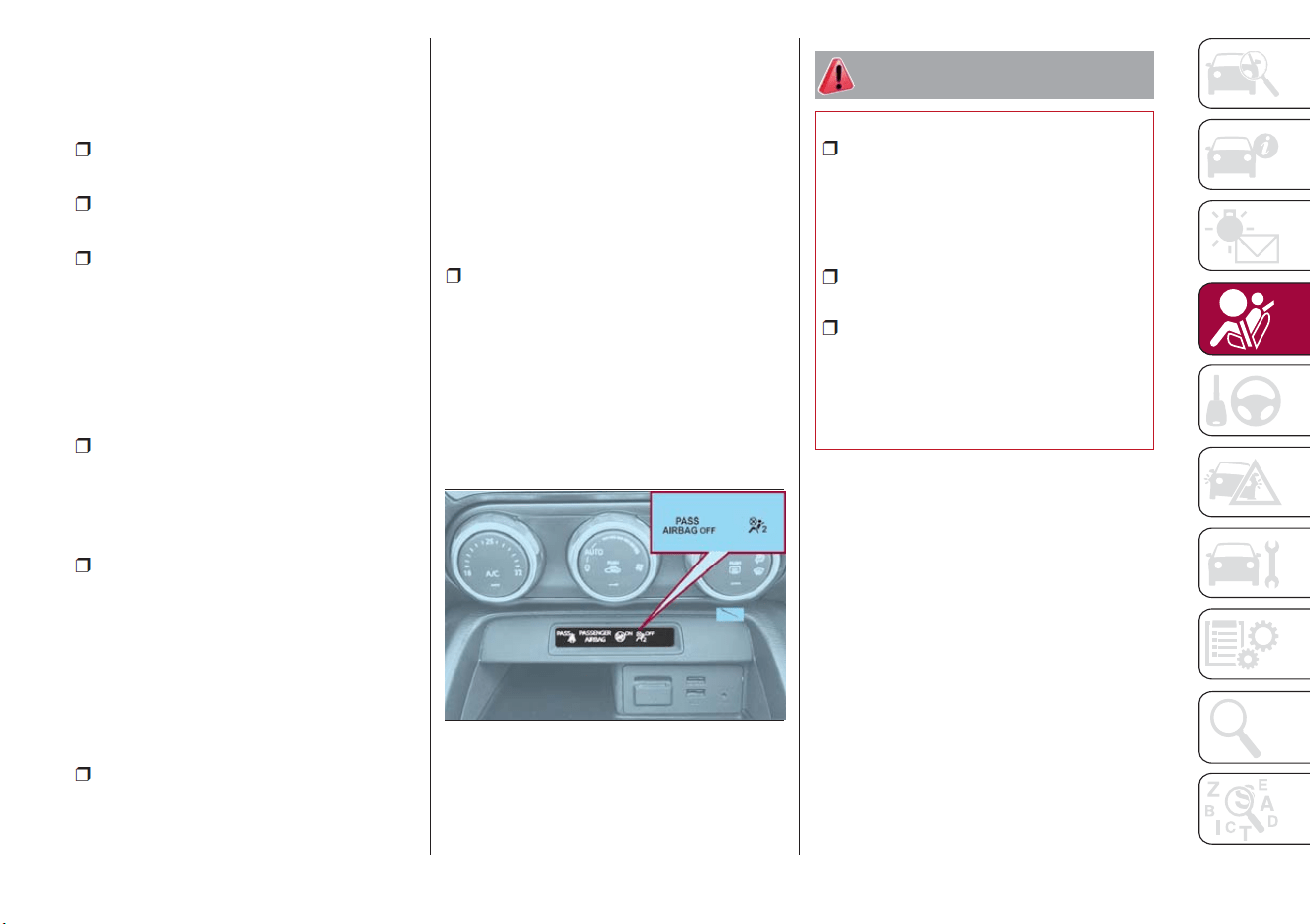
Passengers Seat Child Restraint
System Installation (With Passenger
Occupant Classification System)
Proceed as follows:
Make sure the ignition is switched
off.
Slide the seat as far back as
possible.
Place the child-restraint system on
the seat without putting your weight on
the seat and secure the child-restraint
system with the lap portion of the
lap/shoulder belt. See the
manufacturer's instructions on the
child-restraint system for belt routing
instructions.
To get the retractor into the
automatic locking mode, pull the
shoulder belt portion of the seat belt
until the entire length of the belt is out of
the retractor.
Push the child-restraint system firmly
into the vehicle seat. Be sure the belt
retracts as snugly as possible. A
clicking noise from the retractor will be
heard during retraction if the system is
in automatic locking mode. If the belt
does not lock the seat down tight,
repeat the previous step and also this
one.
Seat your child safely in the
child-restraint system and secure the
child according to the instructions from
the child-restraint system manufacturer.
Note: Inspect this function before
each use of the child restraint system.
You should not be able to pull the
shoulder belt out of the retractor while
the system is in the automatic locking
mode. When you remove the
child-restraint system, be sure the belt
fully retracts to return the system to
emergency locking mode before
occupants use the seat belts.
Place the ignition in the ON position
and make sure the passenger air bag
deactivation indicator light illuminates
after installing a child restraint system
on the passenger seat. If the passenger
air bag deactivation indicator light does
not illuminate, remove the child restraint
system, place the ignition in the OFF
position, and then reinstall the child
restraint system.
Warning!
Never place a rear-facing child restraint
in front of an air bag. A deploying
passenger Advanced Front Air Bag can
cause death or serious injury to a child
12 years or younger, including a child in a
rear-facing child restraint.
Only use a rear-facing child restraint in a
vehicle with a rear seat.
An incorrectly anchored tether strap
could lead to increased head motion and
possibly injury to the child. Use only the
anchorage position directly behind the child
seat to secure a child restraint top tether
strap.
06070400567567
Passenger Air Bag Deactivation
Light
133
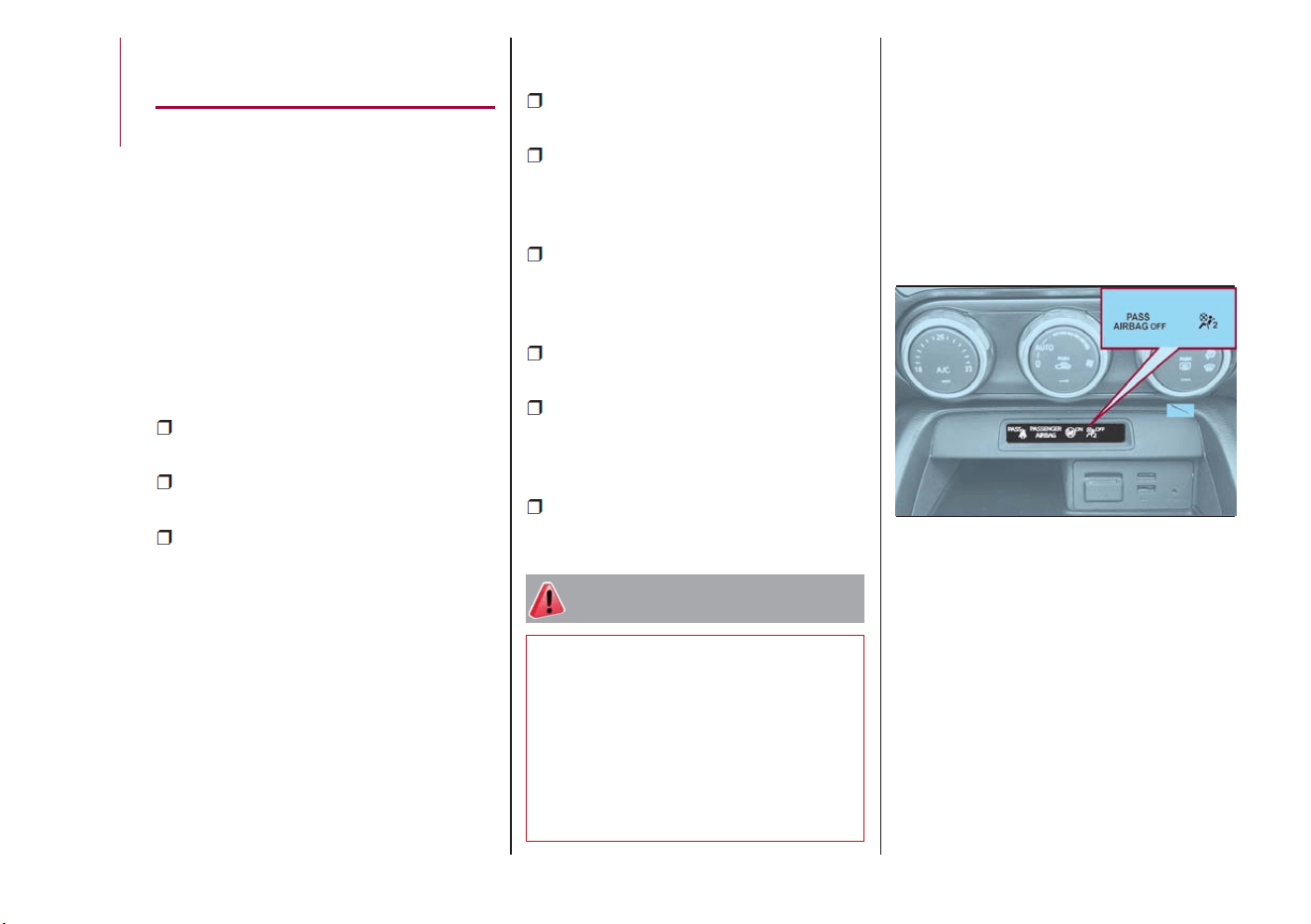
SUPPLEMENTARY
RESTRAINT SYSTEM
SRS — AIR BAG
Description
The front and side Supplementary
Restraint Systems (SRS) include
different types of Air Bags.
Note: Please verify which kinds of Air
Bags are equipped on your vehicle by
locating the “SRS AIR BAG” location
indicators.
These indicators are visible in the area
where the Air Bags are installed.
The Air Bags are installed in the
following locations:
The steering wheel hub (Driver Air
Bag)
The passenger dashboard
(Passenger Air Bag)
The outer sides of the seat backs
(Side Air Bags)
This vehicle has front air bags and
lap/shoulder belts for both the driver
and front passenger. The front air bags
are a supplement to the seat belt
restraint systems.
The Air Bag supplementary restraint
systems are designed to provide
supplementary protection in certain
situations so seat belts are always
important in the following ways.
Without seat belt usage, the Air Bags
cannot provide adequate protection
during an accident. Seat belt usage is
necessary to:
Keep the occupant from being
thrown into an inflating Air Bag.
Reduce the possibility of injuries
during an accident that is not designed
for Air Bag inflation, such as roll-over or
rear impact.
Reduce the possibility of injuries in
frontal, near frontal or side collisions
that are not severe enough to activate
the Air Bags.
Reduce the possibility of being
thrown from your vehicle.
Reduce the possibility of injuries to
lower body and legs during an accident
because the Air Bags provide no
protection to these parts of the body.
Hold the driver in a position which
allows better control of the vehicle.
Warning!
In order for the Side Air Bags to work as
intended, do not install any accessory
items in your vehicle which could alter the
roof. Do not add an aftermarket sunroof to
your vehicle. Do not add roof racks that
require permanent attachments (bolts or
screws) for installation on the vehicle roof.
Do not drill into the roof of the vehicle for
any reason.
If your vehicle is also equipped with
a passenger occupant classification
system, refer to the “Passenger
Occupant Classification System”
paragraph for further information.
If your vehicle is equipped with a
passenger occupant classification
system, the passenger Air Bag
deactivation indicator light illuminates
for a specified time after the ignition has
been placed in the ON position.
Small children must be protected by a
child-restraint system as stipulated by
law in every state and province. In
certain states and provinces, larger
children must use a child-restraint
system. Carefully consider which
child-restraint system is necessary for
your child and follow the installation
directions in this Owner's Manual as
well as the child-restraint system
manufacturer's instructions.
06070400567567
Passenger Air Bag Deactivated
Light
134
SAFETY

Do not use a child-restraint system
which employs an upper tether
because there is no appropriate means
to anchor the tether.
Warning!
If the Indicator Light remains illuminated
for an adult passenger, have an authorized
dealer service the air bag system
immediately. Failure to do so may cause
serious injury or death. If the Indicator Light
is illuminated with the words “PASS
AIRBAG OFF,” the Passenger Advanced
Front Air Bag will not deploy in the event of
a collision.
Never place a rear-facing child restraint
in front of an air bag. A deploying
passenger front air bag can cause death or
serious injury to a child 12 years or
younger, including a child in a rear-facing
child restraint.
Only use a rear-facing child restraint in a
vehicle with a rear seat.
Children 12 years or younger should
always ride buckled up in a vehicle with a
rear seat.
Warning!
Unapproved modifications or service
procedures to the passenger seat
assembly, its related components, seat
cover or cushion may inadvertently change
the air bag deployment in case of a frontal
collision. This could result in death or
serious injury to the front passenger if the
vehicle is involved in a collision. A modified
vehicle may not comply with required
Federal Motor Vehicle Safety Standards
(FMVSS) and/or Canadian Motor Vehicle
Safety Standards (CMVSS).
If it is necessary to modify the air bag
system for persons with disabilities, contact
your authorized dealer.
135

Supplementary Restraint System Components
With Passenger Occupant Classification System
03040300-121-002
With Passenger Occupant Classification System
1 — Driver/Passenger Inflators
And Air Bags
5 — Side Crash Sensors 9 — Passenger Occupant
Classification Sensor
2 — Crash Sensors And Diagnostic
Module (Sas Unit)
6 — Air Bag/Seat Belt Pretensioner
System Warning Light
10 — Passenger Occupant
Classification Module
3 — Seat Belt Pretensioners 7 — Side Inflators And Air Bags
4 — Front Air Bag Sensors 8 — Passenger Air Bag Deactivation
Indicator Light
136
SAFETY

Without Passenger Occupant Classification System
03040300-122-003
Without Passenger Occupant Classification System
1 — Driver/Passenger Inflators
And Air Bags
4 — Front Air Bag Sensors 7 — Side Inflators And Air Bags
2 — Crash Sensors And Diagnostic
Module (Sas Unit)
5 — Side Crash Sensors
3 — Seat Belt Pretensioners 6 — Air Bag/Seat Belt Pretensioner
System Warning Light
137

How The SRS Air Bags
Work
This vehicle has front air bags and
lap/shoulder belts for both the driver
and front passenger. The front air bags
are a supplement to the seat belt
restraint systems. The SRS Air Bags are
designed to provide further protection
for passengers in addition to the seat
belt functions. Be sure to wear seat
belts properly.
Seat Belt Pretensioners
The seat belt pretensioners are
designed to deploy in moderate or
severe frontal, near frontal collisions. In
addition, during a side collision, the
pretensioner operates on the side in
which the collision occurs.
The pretensioners operate differently
depending on what types of air bags
are equipped. For details on the seat
belt pretensioner operation, refer to the
“SRS Air Bag Deployment Criteria”.
Driver Air Bag
The driver's air bag is mounted in the
steering wheel.
When Air Bag crash sensors detect a
frontal impact of greater than moderate
force, the driver's Air Bag inflates
quickly helping to reduce injury mainly
to the driver's head or chest caused by
directly hitting the steering wheel. For
more details about Air Bag deployment,
refer to "SRS Air Bag Deployment
Criteria" in this chapter for further
information.
(With Passenger Occupant
Classification System)
The driver's dual-stage air bag controls
air bag inflation in two energy stages.
During an impact of moderate severity,
the driver's air bag deploys with lesser
energy, whereas during more severe
impacts, it deploys with more energy.
Passenger Air Bag
(Dual Stage)
The passenger Air Bag is mounted in
the passenger dashboard.
The inflation mechanism for the
passenger Air Bag is the same as the
driver's Air Bag, as mentioned above.
For more details about Air Bag
deployment, refer to "SRS Air Bag
Deployment Criteria" in this chapter.
For further details about air bag
deployment, refer to "SRS Air Bag
Deployment Criteria" in this chapter.
06010203-126-123
Driver Side Air Bags
06010204-126-123
Passenger Side Air Bag
138
SAFETY

Side Air Bags
The side air bags are mounted in the
outer sides of the seat backs. When the
air bag crash sensors detect a side
impact of greater than moderate force,
the system inflates the side air bag only
on the side in which the vehicle was hit.
The side air bag inflates quickly to
reduce injury to the driver or
passenger's head and chest caused by
directly hitting interior parts such as a
door or window. For more details about
air bag deployment, refer to "SRS Air
Bag Deployment Criteria" in this
chapter for further information.
Warning!
Occupants, including children, who are
up against or very close to SABs can be
seriously injured or killed. Occupants,
including children, should never lean on or
sleep against the door, side windows, or
area where the side air bags inflate, even if
they are in an infant or child restraint.
Seat belts (and child restraints where
appropriate) are necessary for your
protection in all collisions. They also help
keep you in position, away from an inflating
SAB. To get the best protection from the
SABs, occupants must wear their seat
belts properly and sit upright with their
backs against the seats. Children must be
properly restrained in a child restraint or
booster seat that is appropriate for the size
of the child.
With Passenger Occupant
Classification System
In addition, the passenger side bag is
designed to only deploy when the
passenger occupant classification
sensor detects a passenger sitting on
the passenger's seat.
Warning!
If a child restraint system, child, small
teenager or adult in the front passenger
seat is seated improperly, the occupant
may provide an output signal to the OCS
that is different from the occupant’s
properly seated weight input. This may
result in serious injury or death in a
collision.
Always wear your seat belt and sit
properly, with the seatback in an upright
position, your back against the seatback,
sitting upright, facing forward, in the center
of the seat, with your feet comfortably on
or near the floor.
Do not carry or hold any objects (e.g.,
backpacks, boxes, etc.) while seated in the
front passenger seat. Holding an object
may provide an output signal to the OCS
that is different than the occupant’s
properly seated weight input, which may
result in serious injury or death in a
collision.
06010205-126-123
Side Air Bags
139

Placing an object on the floor under the
front passenger seat may prevent the OCS
from working properly, which may result in
serious injury or death in a collision. Do not
place any objects on the floor under the
front passenger seat.
Warning Light/Beep
A system malfunction or operation
conditions are indicated by a warning.
Refer to the beginning paragraph of
“Warning Lights And Messages” in
“Getting To Know Your Instrument
Panel” for further information.
Warning!
Ignoring the Air Bag Warning Light in your
instrument panel could mean you won’t
have the air bags to protect you in a
collision. If the light does not come on as a
bulb check when the ignition is first turned
on, stays on after you start the vehicle, or if
it comes on as you drive, have an
authorized dealer service the air bag
system immediately.
Passenger Side Front Air Bag And
Child Restraint Systems
Rearward-facing child restraint systems
must NEVER be fitted on the front seat
with an active passenger side air bag
since in the event of an impact the air
bag activation may cause fatal injuries
to the transported child.
ALWAYS comply with the instructions
on the label stuck on the passenger
side sun visor : A = Mexico market/ B =
U.S.A. and Canada market.
Warning!
Do not use accessory seat covers or place
objects between you and the Side Air
Bags; the performance could be adversely
affected and/or objects could be pushed
into you, causing serious injury.
Warning!
Side Air Bags need room to inflate. Do
not lean against the door or window. Sit
upright in the center of the seat.
Being too close to the Side Air Bags
during deployment could cause you to be
severely injured or killed.
Relying on the Side Air Bags alone could
lead to more severe injuries in a collision.
The Side Air Bags work with your seat belt
to restrain you properly. In some collisions,
Side Air Bags won’t deploy at all. Always
wear your seat belt even though you have
Side Air Bags.
03030101-121-001
Sun Visor Air Bag Labels
140
SAFETY

SRS Air Bag Deployment Criteria
This chart indicates the applicable SRS equipment that will deploy depending on the type of collision (the illustrations are the
representative cases of collisions).
Deployed air bags and seat belt pretensioners cannot protect you in another collision. Have the air bags, seat belt
pretensioners, and the seat belt retractor assemblies replaced by an authorized dealer immediately. Also, have the Occupant
Restraint Controller System serviced as well.
SRS Equipment
Types Of Collision
A Severe Frontal/Near
Frontal Collision
A Severe Side Collision (*) A Rear Collision
SRS Equipment
141
SRS Equipment
Types Of Collision
A Severe Frontal/Near
Frontal Collision
A Severe Side Collision (*) A Rear Collision
Seat Belt Pretensioner X (**) (Both Sides) X (**) (Impact Side Only)
No
air bag and seat belt
pretensioner will be activated in
a rear collision
Driver Air Bag X
Passenger Air Bag X (**)
Side Air Bag X (**) (Impact Side Only)
X: the SRS air bag equipment is designed to deploy in a collision.
(*) In a side collision, the seat belt pretensioners and the side air bags deploy (only on the side in which the collision occurs).
(**) Passenger Occupant Classification System: the passenger front and side air bags and the seat belt pretensioner are
designed to deploy when the passenger occupant classification sensor detects a passenger sitting on the passenger's seat.
Note: In a frontal offset collision, the equipped air bags and pretensioners may all deploy depending on the direction, angle,
and rate of impact.
Warning!
Unapproved modifications or service procedures to the passenger seat assembly, its related components, seat cover, or cushion may
inadvertently change the air bag deployment in case of a frontal collision. This could result in death or serious injury to the front passenger if
the vehicle is involved in a collision. A modified vehicle may not comply with required Federal Motor Vehicle Safety Standards (FMVSS) and/or
Canadian Motor Vehicle Safety Standards (CMVSS).
If it is necessary to modify the air bag system for persons with disabilities, contact your authorized dealer.
142
SAFETY

Warning!
Deployed air bags and seat belt pretensioners cannot protect you in another collision. Have the air bags, seat belt pretensioners, and the seat
belt retractor assemblies replaced by an authorized dealer immediately. Also, have the Occupant Restraint Controller System serviced as well.
Warning!
Ignoring the Air Bag Warning Light in your instrument panel could mean you won’t have the air bags to protect you in a collision. If the light
does not come on as a bulb check when the ignition is first turned on, stays on after you start the vehicle, or if it comes on as you drive, have
an authorized dealer service the air bag system immediately.
Placing an object on the floor under the front passenger seat may prevent the occupant classification sensor from working properly, which
may result in serious injury or death in a collision. Do not place any objects on the floor under the front passenger seat.
If there is a fault present in the occupant classification sensor, both the Indicator Light and the Air Bag Warning Light will illuminate to show
that the Passenger Advanced Front Air Bag is deactivated. Should this occur, the Passenger Advanced Front Air Bag will remain deactivated
until the fault is cleared. This indicates that you should take the vehicle to an authorized dealer for service immediately.
143
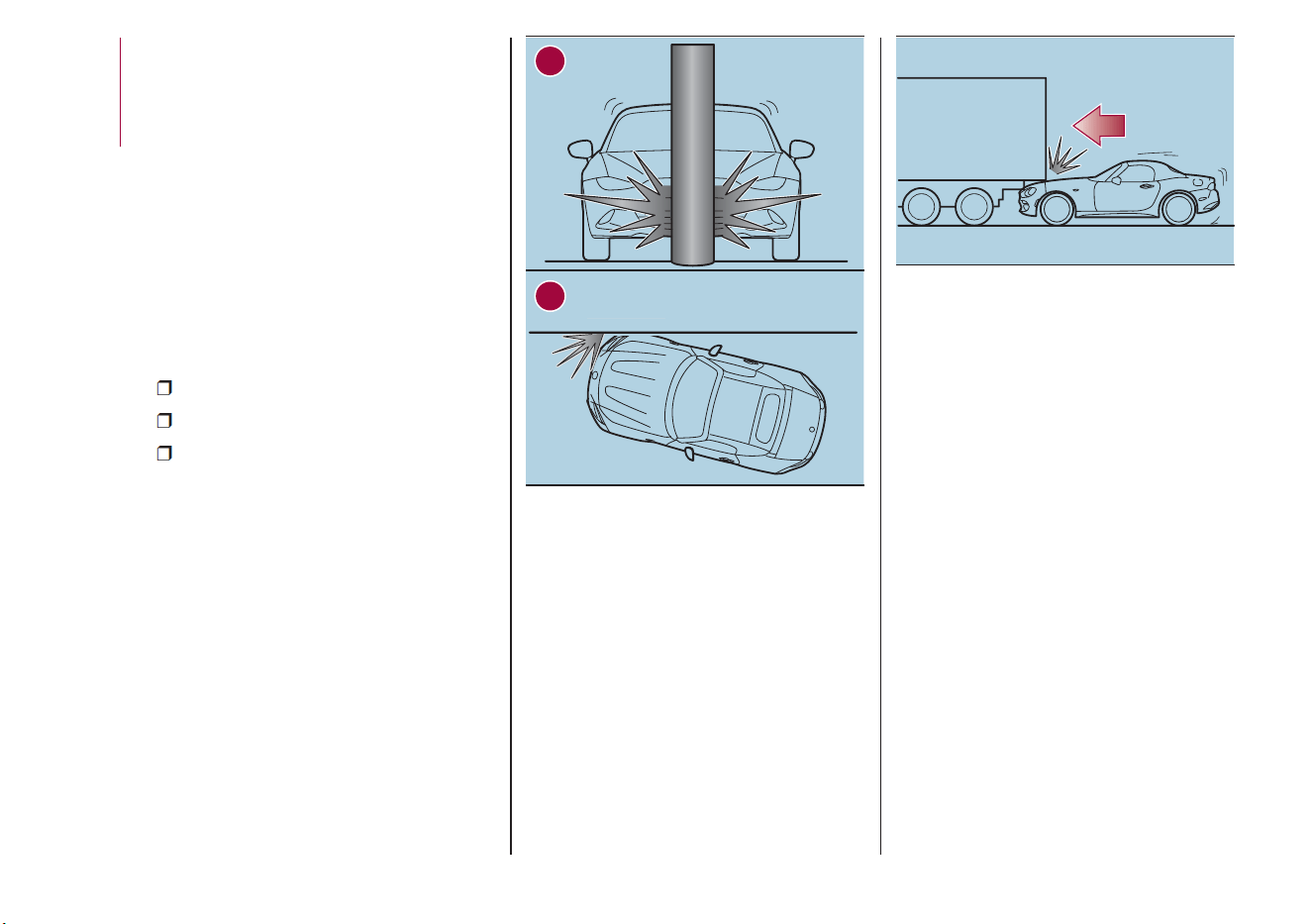
Limitations To SRS Air
Bag
In severe collisions such as those
described in "SRS Air Bag Deployment
Criteria" paragraph, the applicable SRS
air bag equipment will deploy.
However, in some accidents, the
equipment may not deploy depending
on the type of collision and its severity.
Limitations To Front / Near Front
Collision Detection
Front/near front collisions may not be
detected as severe enough to deploy
the SRS air bag equipment:
Impacts involving trees or poles A.
Frontal offset impact to the vehicle B.
Rear-ending or running under a
truck's tail gate.
A
B
03040600-121-001
Front/Near Front Collision
03040600-122-001
Rear End Collision
144
SAFETY

Limitations To Side Collision
Detection
Side collisions may not be detected as
severe enough to deploy the SRS air
bag equipment:
Side impacts involving trees or poles A.
Side impacts with two-wheeled
vehicles B.
Roll-over.
Passenger Occupant
Classification Sensor
Your vehicle is equipped with a
passenger occupant classification
sensor as a part of the supplementary
restraint system. This sensor is
equipped in the passenger's seat
cushion. This sensor measures the
electrostatic capacity of the
passenger's seat.
The SRS unit is designed to prevent the
passenger front and side Air Bags and
seat belt pretensioner system from
deploying if the passenger Air Bag
deactivation indicator light turns on.
To reduce the chance of injuries caused
by deployment of the passenger Air
Bag, the system deactivates the
passenger front and side Air Bags and
also the seat belt pretensioner system
when the passenger Air Bag
deactivation indicator light turns on.
This system shuts off the passenger
front and side Air Bags and seat belt
pretensioner system, so make sure the
passenger Air Bag deactivation
indicator light turns on.
The air bag/seat belt pretensioner
system warning light flashes and the
passenger Air Bag deactivation
indicator light illuminates if the sensors
have a possible malfunction. If this
happens, the passenger front and side
Air Bags and seat belt pretensioner
system will not deploy.
Note: If a passenger is seated as
shown in the following figure the
passenger occupant classification
sensor cannot detect a passenger
sitting on the passenger's seat correctly
and the deployment/non-deployment of
the Air Bags cannot be controlled as
indicated in the passenger Air Bag
deactivation indicator light on/off
condition chart.
Warning!
If a child restraint system, child, small
teenager or adult in the front passenger
seat is seated improperly, the occupant
may provide an output signal to the
occupant classification sensor that is
different from the occupant’s properly
seated weight input. This may result in
serious injury or death in a collision.
A
B
03040600-123-001
Side Collision
03040600-124-002
Roll-Over Collision
145
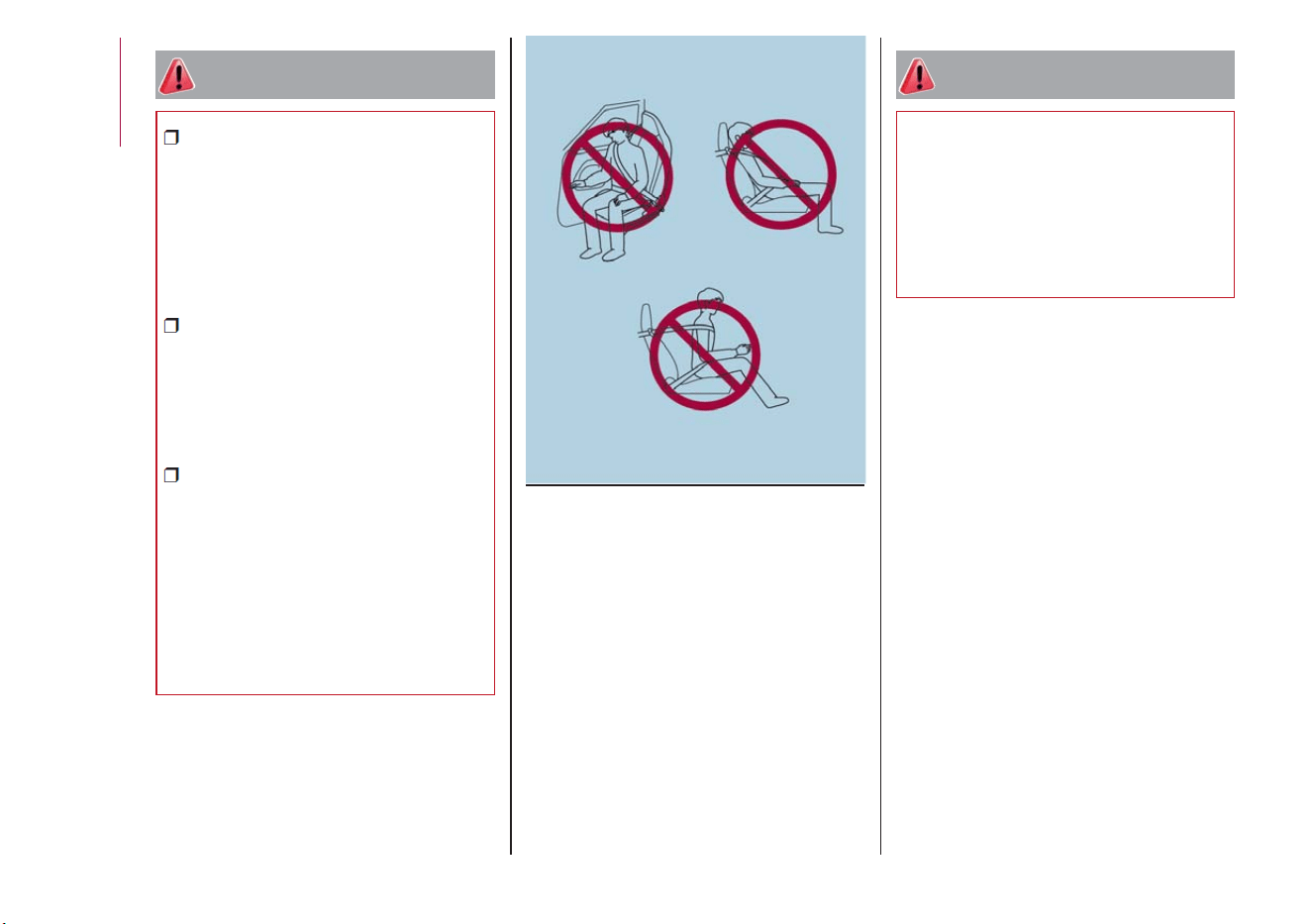
Warning!
Ignoring the Air Bag Warning Light in
your instrument panel could mean you
won’t have the air bags to protect you in a
collision. If the light does not come on as a
bulb check when the ignition is first turned
on, stays on after you start the vehicle, or if
it comes on as you drive, have an
authorized dealer service the air bag
system immediately.
Placing an object on the floor under the
front passenger seat may prevent the
occupant classification sensor from
working properly, which may result in
serious injury or death in a collision. Do not
place any objects on the floor under the
front passenger seat.
If there is a fault present in the occupant
classification sensor, both the Indicator
Light and the Air Bag Warning Light will
illuminate to show that the Passenger
Advanced Front Air Bag is deactivated.
Should this occur, the Passenger
Advanced Front Air Bag will remain
deactivated until the fault is cleared. This
indicates that you should take the vehicle
to an authorized dealer for service
immediately.
Warning!
Do not carry or hold any objects (e.g.,
backpacks, boxes, etc.) while seated in the
front passenger seat. Holding an object
may provide an output signal to the
occupant classification sensor that is
different than the occupant’s properly
seated weight input, which may result in
serious injury or death in a collision.
03040702-12A-001
Passenger Not Sitting Correct
146
SAFETY

Passenger Air Bag Deactivation
Indicator Lights
These indicator lights turn on to remind
you that the passenger front and side
Air Bags and seat belt pretensioner will
or will not deploy during a collision.
Warning!
If the Indicator Light remains illuminated
for an adult passenger, have an authorized
dealer service the air bag system
immediately. Failure to do so may cause
serious injury or death. If the Indicator Light
is illuminated with the words “PASS
AIRBAG OFF,” the Passenger Advanced
Front Air Bag will not deploy in the event of
a collision.
Never place a rear-facing child restraint
in front of an air bag. A deploying
passenger front air bag can cause death or
serious injury to a child 12 years or
younger, including a child in a rear-facing
child restraint.
Only use a rear-facing child restraint in a
vehicle with a rear seat.
Children 12 years or younger should
always ride buckled up in a vehicle with a
rear seat.
Note:
The system requires about
10 seconds to alternate between
turning the passenger front and side
Air Bags and seat belt pretensioner
system on or off.
The passenger air bag deactivation
indicator light may turn on repeatedly if
luggage or other items are put on the
passenger seat, or if the temperature
of the vehicle's interior changes
suddenly.
The passenger air bag deactivation
indicator light may turn on for
10 seconds if the electrostatic capacity
on the passenger seat changes.
The air bag/seat belt pretensioner
system warning light might turn on if
the passenger seat receives a severe
impact.
If the passenger Air Bag
deactivation indicator light does not
turn on after installing a child restraint
system on the passenger seat, first,
reinstall your child restraint system
according to the procedure in this
Owner Handbook. Then, if the
passenger Air Bag deactivation OFF
indicator light still does not turn on,
contact an authorized dealer as soon
as possible.
If the passenger Air Bag
deactivation indicator light turns on
when an occupant is seated directly in
the passenger seat, have the
passenger readjust their posture by
sitting with their feet on the floor, and
then refastening the seat belt. If the
passenger Air Bag deactivation
indicator light remains turned on, slide
the passenger seat as far back as
possible. Contact an authorized dealer
as soon as possible.
06070400567567
Passenger Air Bag Deactivated
147

Passenger Air Bag Deactivation Indicator Light On/Off Condition Chart
If the passenger occupant classification sensor is normal, the indicator light turns on when the ignition is switched ON. The light
turns off after a few seconds. Then, the indicator light turns on or is off under the following conditions:
Condition Detected By The
Passenger Occupant
Classification System
Passenger Air Bag
Deactivation Indicator Light
Passenger Front
And Side Air Bags
Passenger Seat Belt
Pretensioner System
Empty (Not occupied) On Deactivated Deactivated
A
child is seated in a child
restraint system (*)
On Deactivated Deactivated
Adult (**) Off Ready Ready
(*) The occupant classification sensor may not detect a child seated on the seat, in a child restraint system, or a junior seat
depending on the child's physical size and seated posture.
(**) If a smaller adult sits on the passenger seat, the sensors might detect the person as being a child depending on the
person's physique.
If the passenger air bag deactivation indicator light does not turn on when the ignition is switched ON and does not turn on as
indicated in the passenger air bag deactivation indicator light on/off condition chart, do not allow an occupant to sit in the
passenger seat and contact an authorized dealer as soon as possible. The system may not work properly in an accident.
148
SAFETY

Warning!
Never place a rear-facing child restraint in front of an air bag. A deploying passenger front air bag can cause death or serious injury to a
child 12 years or younger, including a child in a rear-facing child restraint.
Only use a rear-facing child restraint in a vehicle with a rear seat.
Children 12 years or younger should always ride buckled up in a vehicle with a rear seat.
Warning!
No objects should be placed over or near the air bag on the instrument panel or steering wheel because any such objects could cause
harm if the vehicle is in a collision severe enough to cause the air bag to inflate.
Do not put anything on or around the air bag covers or attempt to open them manually. You may damage the air bags and you could be
injured because the air bags may no longer be functional. The protective covers for the air bag cushions are designed to open only when the
air bags are inflating.
Relying on the air bags alone could lead to more severe injuries in a collision. The air bags work with your seat belt to restrain you properly.
In some collisions, air bags won’t deploy at all. Always wear your seat belts even though you have air bags.
149

Maintaining Your Air Bag
System
Warning!
Modifications to any part of the air bag
system could cause it to fail when you
need it. You could be injured if the air bag
system is not there to protect you. Do not
modify the components or wiring, including
adding any kind of badges or stickers to
the steering wheel hub trim cover or the
upper right side of the instrument panel. Do
not modify the front bumper, vehicle body
structure, or add aftermarket side steps or
running boards.
It is dangerous to try to repair any part
of the air bag system yourself. Be sure to
tell anyone who works on your vehicle that
it has an air bag system.
Do not attempt to modify any part of
your air bag system. The air bag may inflate
accidentally or may not function properly if
modifications are made. Take your vehicle
to an authorized dealer for any air bag
system service. If your seat, including your
trim cover and cushion, needs to be
serviced in any way (including removal or
loosening/tightening of seat attachment
bolts), take the vehicle to your authorized
dealer. Only manufacturer approved seat
accessories may be used. If it is necessary
to modify the air bag system for persons
with disabilities, contact your authorized
dealer.
EVENT DATA
RECORDER (EDR)
This vehicle is equipped with an event
data recorder (EDR).
The main purpose of an EDR is to
record, in certain crash or near
crash-like situations, such as an air bag
deployment or hitting a road obstacle,
data that will assist in understanding
how a vehicle’s systems performed.
The EDR is designed to record data
related to vehicle dynamics and safety
systems for a short period of time,
typically 30 seconds or less.
The EDR in this vehicle is designed to
record such data as:
How various systems in your vehicle
were operating.
Whether or not the driver and
passenger safety belts were
buckled/fastened.
How far (if at all) the driver was
pushing the accelerator and/or brake
pedal.
How fast the vehicle was traveling.
This data can help provide a better
understanding of the circumstances in
which crashes and injuries occur.
Note:
EDR data are recorded by your
vehicle only if a non-trivial crash or near
crash-like situation occurs; no data are
recorded by the EDR under normal
driving conditions and no personal
data (e.g., name, gender, age, and
crash location) are recorded. However,
other parties, such as law
enforcement, could combine the EDR
data with the type of personally
identifying data routinely acquired
during a crash investigation.
To read data recorded by an EDR,
special equipment is required, and
access to the vehicle or the EDR is
needed. In addition to the vehicle
manufacturer, other parties, such as
law enforcement, that have the special
equipment, can read the information if
they have access to the vehicle or the
EDR.FCA will not disclose any of the
data recorded in an EDR to a third party
unless:
A written agreement from the
vehicle owner or the lessee is
obtained.
Officially requested by the police or
other law enforcement authorities.
Used as a defense for FCA in a law
suit, claim, or arbitration.
150
SAFETY
Ordered by a judge or court.
However, if necessary, FCA will:
Use the data for research on FCA
vehicle performance, including safety.
Disclose the data or the
summarized data to a third party for
research purposes without disclosing
vehicle or owner identification
information.
Recording Of Vehicle Data
This vehicle is equipped with a
computer which records the following
main vehicle data related to vehicle
controls, operation, and other driving
conditions.
Recorded Data
Vehicle conditions such as engine
speed and vehicle speed.
Driving operation conditions such
as accelerator and brake pedals, and
information related to the
environmental circumstances while the
vehicle is driven.
Malfunction diagnosis information
from each on-vehicle computer.
Information related to controls of
other on-vehicle computers.
The recorded data may vary depending
on the vehicle grade and optional
equipment. Voice and images are not
recorded.
Data Handling
FCA and its subcontracting parties may
obtain and use the recorded data for
vehicle malfunction diagnosis, research
and development, and quality
improvement.
FCA will not disclose or provide any of
the obtained data to a third party
unless:
An agreement from the vehicle
owner (agreements from lessor and
lessee for leased vehicle) is obtained.
Officially requested by the police or
other law enforcement authorities.
For statistical processing by a
research institution, after processing
the data so that identification of the
owner or the vehicle is impossible.
CONSTANT
MONITORING
The following components of the Air
Bag systems are monitored by a
diagnostic system:
Crash Sensors, And Diagnostic
Module (Sas Unit)
Front Air Bag Sensors
Air Bag Modules
Side Crash Sensors
Air Bag/Seat Belt Pretensioner
System Warning Light
Seat Belt Pretensioners
Related Wiring
With Passenger Occupant
Classification System
Passenger Air Bag Deactivation
Indicator Light
Passenger Occupant Classification
Sensor
Passenger Occupant Classification
Module — If Equipped
The diagnostic module continuously
monitors the system's readiness. This
begins when the ignition is switched
ON and continues while the vehicle is
being driven.
151

STARTING AND OPERATING
STARTINGTHEENGINE .......153
BRAKE SYSTEM ............154
MANUAL TRANSMISSION ......154
AUTOMATIC TRANSMISSION —
IF EQUIPPED ..............155
SPORT MODE .............160
SPEED CONTROL ...........160
RADAR SENSORS —
IF EQUIPPED ..............163
REAR PARK ASSIST —
IF EQUIPPED ..............164
PARKVIEW REAR BACKUP
CAMERA — IF EQUIPPED ......166
REFUELING THE VEHICLE ......173
VEHICLELOADING ..........176
TOWING TRAILERS ..........178
DRIVING TIPS ..............178
152
STARTING AND OPERATING
STARTING THE
ENGINE
Starting The Engine
Before starting the engine, adjust the
seat, the interior rear view mirrors, and
the door mirrors, and fasten the seat
belt correctly.
Warning!
When leaving the vehicle, always remove
the key fob from the vehicle and lock your
vehicle.
Never leave children alone in a vehicle,
or with access to an unlocked vehicle.
Allowing children to be in a vehicle
unattended is dangerous for a number of
reasons. A child or others could be
seriously or fatally injured. Children should
be warned not to touch the parking brake,
brake pedal or the transmission gear
selector.
Do not leave the key fob in or near the
vehicle, or in a location accessible to
children, and do not leave the ignition of a
vehicle equipped with Advanced Keyless
Entry in the ACC or ON/RUN mode. A child
could operate power windows, other
controls, or move the vehicle.
Do not leave children or animals inside
parked vehicles in hot weather. Interior heat
build-up may cause serious injury or death.
Never press the accelerator pedal for
starting the engine.
Models Equipped With A
Manual Transmission
Proceed as follows:
1. Engage the parking brake and place
the gear selector in NEUTRAL.
2. Place the start button in the ACC
mode.
3. Fully depress the clutch pedal
without touching the accelerator.
4. Place the start button in the ON
mode, push and release it as soon as
the engine starts. If the engine does not
start within 10 seconds, push the start
button to OFF mode and wait for
10-15 seconds before repeating the
starting procedure.
Models Equipped With
An Automatic
Transmission
Proceed as follows:
1. Engage the parking brake and place
the gear selector to P (PARK) or N
(NEUTRAL).
2. Fully depress the brake pedal
without touching the accelerator.
3. Place the start button in the ACC
mode.
4. Place the start button in the ON
mode, push and release it as soon as
the engine starts. If the engine does not
start within 10 seconds, push the start
button to OFF mode and wait for
10-15 seconds before repeating the
starting procedure.
Cold Weather Operation
Regarding Cold Start Disable
When the ambient temperature is
extremely low, the engine may not
crank even when the engine starting
procedure is performed. At this time,
the Cold Start Disable Indicator light in
the instrument cluster flashes. However,
this does not indicate a problem.
Perform the necessary procedures (see
“Warning lights And Messages”
paragraph in “Getting To Know Your
Instrument Panel” chapter).
Regarding Ice Breaker
When the ambient temperature is low,
the start of cranking may be delayed
after engine starting procedure is
performed. At this time, the Cold Start
Disable Indicator light in the instrument
cluster illumintes. However, this does
not indicate a problem.
Refer to your authorized dealer
regarding other related parts which are
to be input such as function name,
operating scenario (condition) of each
function, indicator operation, and user
operation/procedure information.
153

Extended Park Starting
Note: Extended Park condition occurs
when the vehicle has not been started
or driven for at least 30 days.
1. Install a battery charger or jumper
cables to the battery to ensure a full
battery charge during the crank cycle.
2. Place the ignition in the START
mode and release it when the engine
starts.
3. If the engine fails to start within
10 seconds, place the ignition in the
STOP (OFF/LOCK) mode, wait five
seconds to allow the starter to cool,
then repeat the Extended Park Starting
procedure.
4. If the engine fails to start after eight
attempts, allow the starter to cool for at
least 10 minutes, then repeat the
procedure.
Caution!
To prevent damage to the starter, do not
crank continuously for more than 10 seconds
at a time. Wait 10 to 15 seconds before
trying again.
After Starting —
Warming Up The Engine
Proceed as follows:
1. Travel slowly, letting the engine run
at a reduced RPM, without accelerating
suddenly.
2. It is recommended to wait until the
digital engine coolant temperature
indicator starts moving before
demanding full performance.
Stopping The Engine
Proceed as follows:
1. Park the car in a position that is not
dangerous for oncoming traffic, if
equipped with manual transmission
place gear selector in FIRST (1st) or
REVERSE (R) gear, if equipped with
automatic transmission place the gear
selector to PARK (P).
2. Push and release the ignition button
to STOP the engine.
BRAKE SYSTEM
This vehicle has power-assisted brakes
that adjust automatically through
normal use. Should power-assist fail,
you can stop by applying greater force
than normal to the brake pedal. But the
distance required to stop will be greater
than usual.
Note: Always depress the brake pedal
with the right foot. Applying the brakes
with the unaccustomed left foot could
slow your reaction time to an
emergency situation resulting in
insufficient braking operation.
Do not drive with your foot held on the
clutch pedal or brake pedal, or hold the
clutch pedal depressed halfway
unnecessarily. Doing so could result in
the following:
The clutch and brake parts will wear
out more quickly.
The brakes can overheat and
adversely affect brake performance.
Warning!
Riding the brakes can lead to brake
failure and possibly a collision. Driving with
your foot resting or riding on the brake
pedal can result in abnormally high brake
temperatures, excessive lining wear, and
possible brake damage. You would not
have your full braking capacity in an
emergency.
154
STARTING AND OPERATING
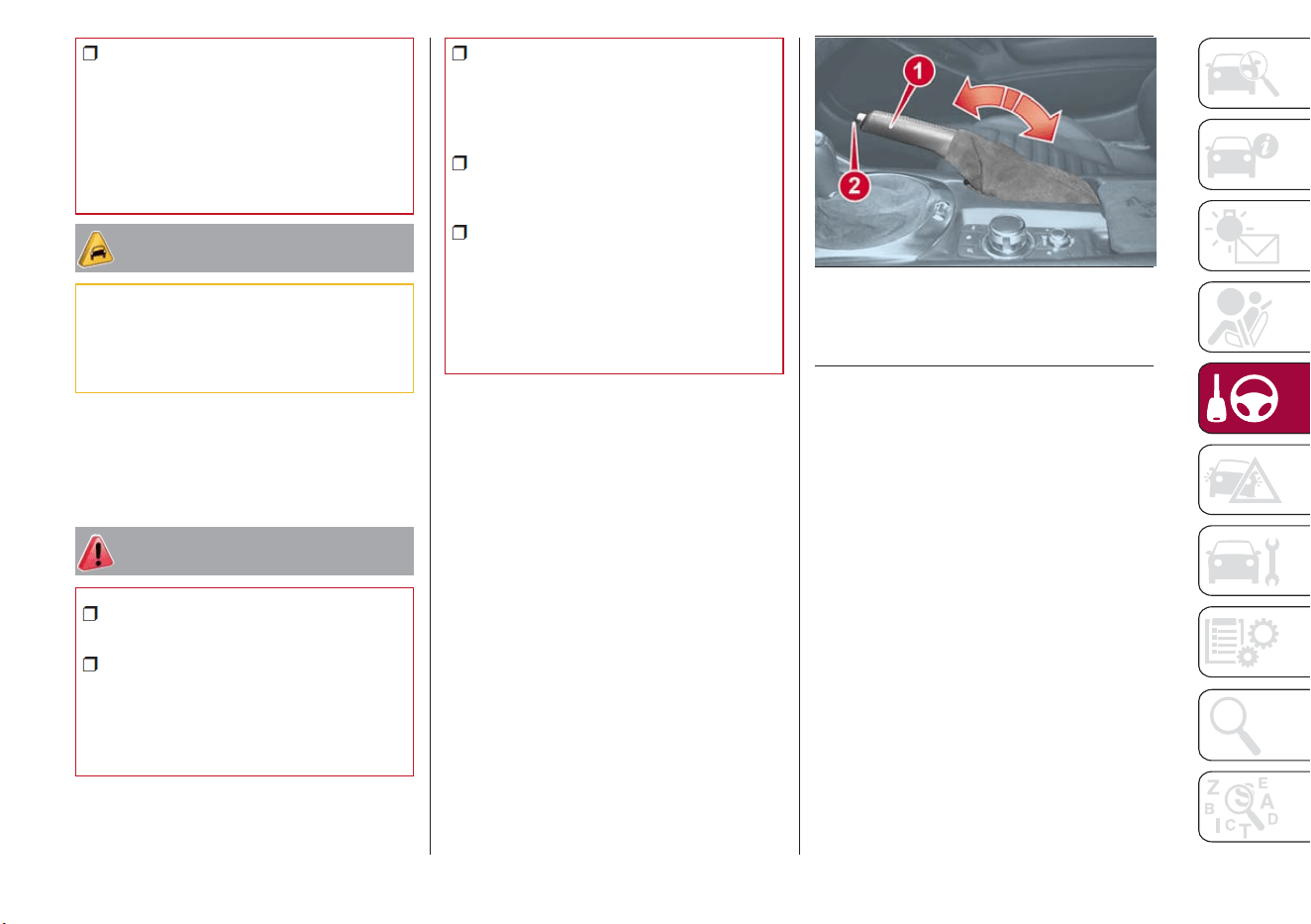
Driving a vehicle with the “Brake
Warning Light” on is dangerous. A
significant decrease in braking performance
or vehicle stability during braking may
occur. It will take you longer to stop the
vehicle or will make your vehicle harder to
control. You could have a collision. Have
the vehicle checked immediately.
Caution!
Wear shoes appropriate for driving in order
to avoid your shoe contacting the brake
pedal when depressing the accelerator
pedal.
Parking Brake
Note: Driving with the parking brake on
will cause excessive wear of the brake
parts.
Warning!
Never leave children alone in a vehicle,
or with access to an unlocked vehicle.
Allowing children to be in a vehicle
unattended is dangerous for a number of
reasons. A child or others could be
seriously or fatally injured. Children should
be warned not to touch the park brake,
brake pedal or the gear selector.
Do not leave the key fob in or near the
vehicle or in a location accessible to
children. A child could operate power
windows, other controls, or move the
vehicle.
Be sure the park brake is fully
disengaged before driving; failure to do so
can lead to brake failure and a collision.
Always fully apply the park brake when
leaving your vehicle, or it may roll and
cause damage or injury. Also be certain to
leave a manual transmission in REVERSE
(R) or FIRST (1st) gear. Failure to do so may
allow the vehicle to roll and cause damage
or injury.
Setting the Parking Brake
Depress the brake pedal and then firmly
pull the parking brake lever fully
upwards with sufficient force to hold the
vehicle in a stationary position.
Releasing the Parking Brake
Depress the brake pedal and pull the
parking brake lever upwards, then
press the release button. While holding
the button, lower the parking brake
lever all the way down to the released
position.
Warning Light
The warning light turns on when the
system has a malfunction. Refer to
“Warning Lights And Messages” in
“Getting To Know Your Instrument
Panel” for further information.
Brake Pad Wear Indicator
When the disc brake pads become
worn, the built-in wear indicators
contact the rotors. This causes a
screeching noise to warn that the pads
should be replaced. When you hear this
noise contact your authorized dealer as
soon as possible.
05050102-12A-001AB
Parking Brake
1 — Parking Brake Lever
2 — Parking Brake Release Button
155

Brake Assist
During emergency braking situations
when it is necessary to depress the
brake pedal with greater force, the
brake assist system provides braking
assistance, thus enhancing braking
performance. When the brake pedal is
depressed hard or depressed more
quickly, the brakes apply more firmly.
Note:
When the brake pedal is depressed
hard or depressed more quickly, the
pedal will feel softer but the brakes will
apply more firmly. This is a normal
effect of the brake assist operation and
does not indicate a malfunction.
When the brake pedal is depressed
hard or depressed more quickly, a
motor/pump operation noise may be
heard. This is a normal effect of the
brake assist and does not indicate a
malfunction.
The brake assist equipment does
not supersede the functionality of the
vehicle's main braking system.
MANUAL
TRANSMISSION
Manual Transmission
Warning!
You or others could be injured if you leave
the vehicle unattended without having the
park brake fully applied. The park brake
should always be applied when the driver
is not in the vehicle, especially on an
incline.
Caution!
Never drive with your foot resting on the
clutch pedal, or attempt to hold the vehicle
on a hill with the clutch pedal partially
engaged, as this will cause abnormal wear
on the clutch.
To engage the gears, press the clutch
pedal fully and put the gear selector
into the required position. The diagram
for gear engagement is shown on the
knob.
Depress the clutch pedal all the way
down while shifting, then release it
slowly.
Your vehicle is equipped with a device
to prevent shifting to REVERSE (R) by
mistake. Push the gear selector
downward and shift to REVERSE (R).
A natural driving posture can be
achieved by lightly gripping the gear
selector from the side without having to
rest your elbow on the center console.
If shifting to REVERSE (R) is difficult,
shift back into neutral, release the
clutch pedal, and try again.
05987654-12A-001AB
Gear Selector
156
STARTING AND OPERATING
With Parking Sensor System
When the gear selector is shifted to the
REVERSE (R) position with the ignition
placed in the ON mode, the parking
sensor system is activated an audible
sound is heard.
Caution!
Keep your foot off the clutch pedal
except when shifting gears. Also, do not
use the clutch to hold the vehicle on an hill
or grade. Riding the clutch will cause
needless clutch wear and damage.
Do not apply any excessive lateral force
to the gear selector when changing from
fifth to fourth gear. This could lead to the
accidental selection of second gear, which
could result in damage to the transmission.
Make sure the vehicle comes to a
complete stop before shifting to REVERSE
(R). Shifting to REVERSE (R) while the
vehicle is still moving may damage the
transmission.
Reverse can only be engaged when the
vehicle is completely stationary. With the
engine running, wait at least two seconds
with the clutch pedal fully pressed before
engaging reverse to prevent damage to the
gears.
AUTOMATIC
TRANSMISSION —
IF EQUIPPED
Shift Interlock
This vehicle is equipped with an
interlock system that holds the
transmission gear selector in PARK (P)
unless the brakes are applied. To shift
the transmission out of PARK (P), the
ignition must be placed in the ON/RUN
mode (engine running or not) and the
brake pedal must be pressed.
Warning!
It is dangerous to shift out of PARK or
NEUTRAL if the engine speed is higher
than idle speed. If your foot is not firmly
pressing the brake pedal, the vehicle could
accelerate quickly forward or in reverse.
You could lose control of the vehicle and hit
someone or something. Only shift into gear
when the engine is idling normally and your
foot is firmly pressing the brake pedal.
Unintended movement of a vehicle
could injure those in or near the vehicle. As
with all vehicles, you should never exit a
vehicle while the engine is running. Before
exiting a vehicle, always apply the park
brake, shift the transmission into PARK,
and turn the ignition OFF. When the ignition
is in the OFF mode, the transmission is
locked in PARK, securing the vehicle
against unwanted movement.
When leaving the vehicle, always make
sure the ignition is in the OFF mode,
remove the key fob from the vehicle, and
lock the vehicle.
Never leave children alone in a vehicle,
or with access to an unlocked vehicle.
Allowing children to be in a vehicle
unattended is dangerous for a number of
reasons. A child or others could be
seriously or fatally injured. Children should
be warned not to touch the parking brake,
brake pedal or the transmission gear
selector.
Do not leave the key fob in or near the
vehicle (or in a location accessible to
children), and do not leave the ignition in
the ACC or ON/RUN mode. A child could
operate power windows, other controls, or
move the vehicle.
Caution!
Damage to the transmission may occur if
the following precautions are not observed:
Shift into or out of PARK or REVERSE
only after the vehicle has come to a
complete stop.
Do not shift between PARK, REVERSE,
NEUTRAL, or DRIVE when the engine is
above idle speed.
Before shifting into any gear, make sure
your foot is firmly pressing the brake pedal.
157
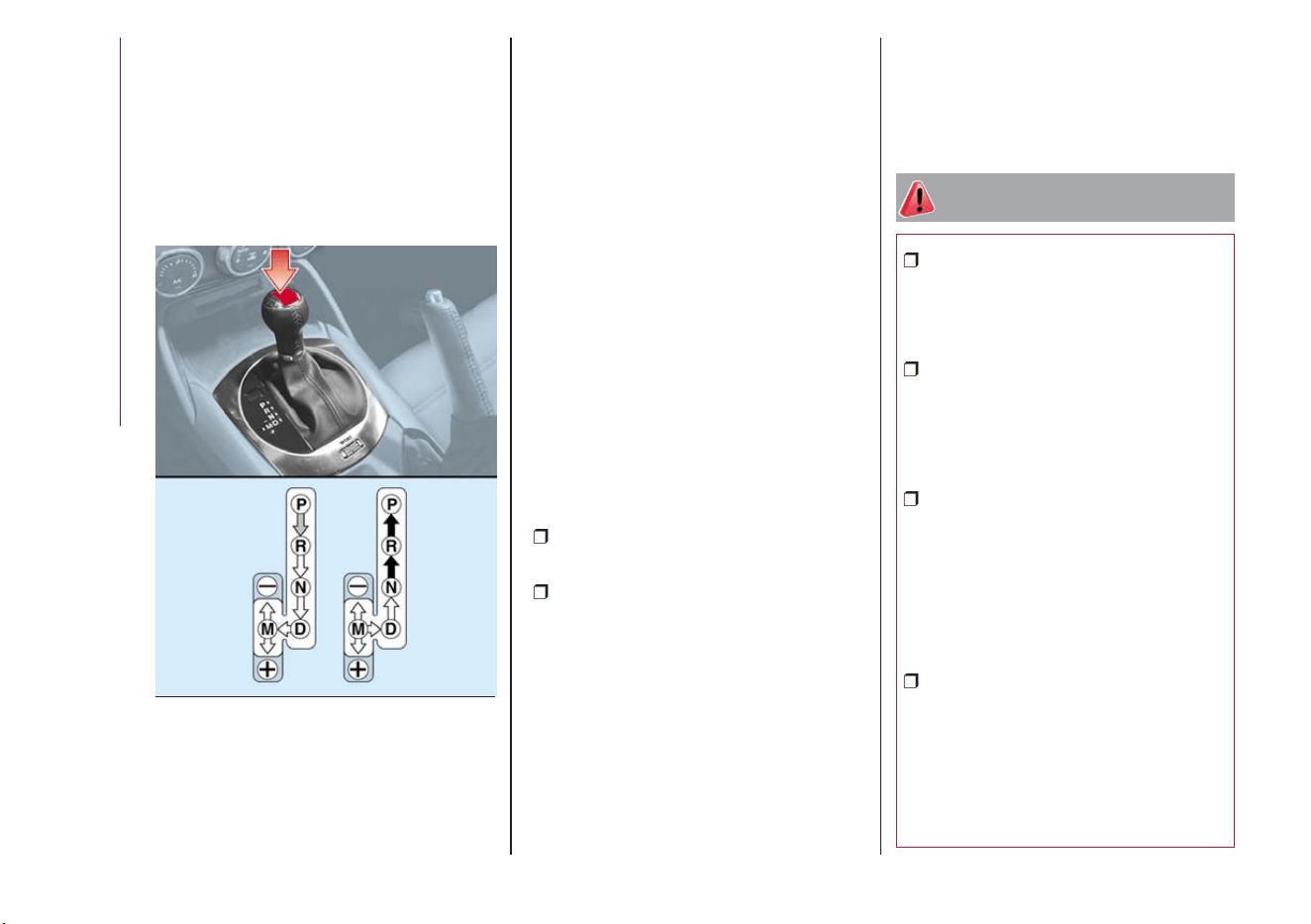
The gear selector must be in PARK (P)
or NEUTRAL (N) to operate the starter.
The transmission gear selector has
PARK (P), REVERSE (R), NEUTRAL (N),
DRIVE (D), and MANUAL (M)(+/–) shift
positions.
The transmission may be shifted freely
from REVERSE (R), to NEUTRAL (N), to
DRIVE (D), to MANUAL (M)(+/–).
Note: Even if you intend to use the
automatic transmission functions as a
traditional automatic, you should also
be aware that you can inadvertently
shift into manual shift mode and an
inappropriate gear may be retained as
the vehicle speed increases. If you
notice the engine speed going higher or
hear the engine racing, confirm you
have not accidentally slipped into
manual shift mode (refer to “Manual
Shift Mode” paragraph in this section).
Shift Position Indication
The gear selector position (PRNDM) is
illuminated when the ignition is placed
in the ON mode.
Note: If one of the following actions is
performed, the gear selector position is
displayed for five minutes even if the
ignition is placed in a mode other than
ON.
The ignition is placed in the OFF
mode.
The driver's door is opened.
Gear Position Indication
In MANUAL (M) shift mode, the “M” of
the shift position indication illuminates
and the number of the selected gear is
displayed.
Gear Selector Positions
PARK (P)
PARK (P) locks the transmission and
prevents the driveshaft from rotating.
Warning!
Never use the PARK position as a
substitute for the park brake. Always apply
the park brake fully when parked to guard
against vehicle movement and possible injury
or damage.
Your vehicle could move and injure you
and others if it is not in PARK. Check by
trying to move the gear selector out of PARK
with the brake pedal released. Make sure the
transmission is in PARK before leaving the
vehicle.
It is dangerous to shift out of PARK or
NEUTRAL if the engine speed is higher than
idle speed. If your foot is not firmly pressing
the brake pedal, the vehicle could accelerate
quickly forward or in reverse. You could lose
control of the vehicle and hit someone or
something. Only shift into gear when the
engine is idling normally and your foot is
firmly pressing the brake pedal.
Unintended movement of a vehicle could
injure those in or near the vehicle. As with all
vehicles, you should never exit a vehicle
while the engine is running. Before exiting a
vehicle, always apply the park brake, shift the
transmission into PARK, and turn the ignition
OFF. When the ignition is in the OFF mode,
the transmission is locked in PARK, securing
the vehicle against unwanted movement.
05210200-LHD12AT-001AB
Gear Selector And Pattern
158
STARTING AND OPERATING

When leaving the vehicle, always make
sure the ignition is in the OFF mode,
remove the key fob from the vehicle, and
lock the vehicle.
Never leave children alone in a vehicle,
or with access to an unlocked vehicle.
Allowing children to be in a vehicle
unattended is dangerous for a number of
reasons. A child or others could be
seriously or fatally injured. Children should
be warned not to touch the park brake,
brake pedal or the transmission gear
selector.
Do not leave the key fob in or near the
vehicle (or in a location accessible to
children), and do not leave the ignition in
the ACC or ON/RUN mode. A child could
operate power windows, other controls, or
move the vehicle.
Caution!
Before moving the transmission gear
selector out of PARK, you must place the
ignition from the LOCK/OFF mode to the
ON/RUN mode, and also press the brake
pedal. Otherwise, damage to the gear
selector could result.
DO NOT race the engine when shifting
from PARK or NEUTRAL into another gear
range, as this can damage the drivetrain.
Note:
Shifting into PARK (P), NEUTRAL (N)
or REVERSE (R) while the vehicle is
moving can damage your transmission.
Shifting into DRIVE (D) or REVERSE
(R) when the engine is running faster
than idle can damage the
transmission.
REVERSE (R)
This range is for moving the vehicle
backward. Shift into REVERSE only
after the vehicle has come to a
complete stop.
With Parking Sensor system: when
the gear selector is shifted to the
REVERSE (R) position with the ignition
placed in the ON mode, the parking
sensor system is activated and an
audible sound is heard.
NEUTRAL (N)
In NEUTRAL (N), the wheels and
transmission are not locked. The vehicle
will roll freely even on the slightest
incline unless the parking brake or
brakes are applied.
Warning!
Do not coast in NEUTRAL and never turn
off the ignition to coast down a hill. These
are unsafe practices that limit your
response to changing traffic or road
conditions. You might lose control of the
vehicle and have a collision.
Note: Do not shift into NEUTRAL (N)
when driving the vehicle. Doing so will
damage the transmission. Press the
parking brake or depress the brake
pedal before moving the gear selector
from NEUTRAL (N) to prevent the
vehicle from moving unexpectedly.
DRIVE (D)
DRIVE (D) is the normal driving position.
From a stop, the transmission will
automatically shift through all available
gears.
MANUAL (M)
MANUAL (M) is the manual shift mode
position. Gears can be shifted up or
down by operating the gear selector.
(Refer to “Manual Shift Mode”
paragraph in this section).
159

Warning!
Do not downshift for additional engine
braking on a slippery surface. The drive
wheels could lose their grip and the vehicle
could skid, causing a collision or personal
injury.
Active Adaptive Shift
(AAS)
Active Adaptive Shift (AAS)
automatically controls the transmission
shift points to best suit the road
conditions and driver input. This
improves driving feel.
The transmission may switch to AAS
mode when driving up and down
slopes, cornering, driving at high
elevations, or depressing the
accelerator pedal quickly while the gear
selector is in the DRIVE (D) position.
Depending on the road and driving
conditions/vehicle operations, gear
shifting could be delayed or not occur,
however, this does not indicate a
problem because the AAS mode will
maintain the optimum gear position.
Shift-Lock System
The shift-lock system prevents shifting
out of PARK (P) unless the brake pedal
is depressed.
To shift from PARK (P):
1. Depress and hold the brake pedal.
2. Turn the ignition to the ON/RUN
mode.
3. Press and hold the lock-release
button on the gear selector.
4. Move the gear selector.
When the ignition is in the ACC or OFF
mode, the gear selector cannot be
shifted from PARK (P).
The ignition cannot be placed in the
OFF mode if the gear selector is not in
PARK (P).
Shift Lock Override
If the gear selector will not move from
PARK (P) using the proper shift
procedure, continue to press the brake
pedal and proceed as follows:
1. Remove the shift lock override cover
using a cloth wrapped flat head
screwdriver.
2. Insert a screwdriver or similar tool
into the Override Access Hole, and
push the override button down.
3. Push and hold the lock release
button on the gear selector and move
the gear selector.
4. Take the vehicle to an authorized
dealer.
05210206-12A-002
Shift Lock Override Access Hole
160
STARTING AND OPERATING

For Some Models
Proceed as follows:
1. Push the lock release button on the
gear selector while also pushing down
on the Shift Lock Override button.
2. Move the gear selector.
3. Take the vehicle to an authorized
dealer.
Manual Shift Mode
The manual shift mode gives you the
feel of driving a manual transmission
vehicle by allowing you to operate the
gear selector manually.
This allows you to control engine rpm
and torque to the drive wheels much
like a manual transmission when more
control is desired.
To change to MANUAL (M) shift mode,
shift the gear selector from DRIVE (D) to
MANUAL (M). To return to automatic
shift mode, shift the gear selector from
MANUAL (M) to DRIVE (D).
You can shift between DRIVE (D) and
MANUAL (M) mode at any time, without
taking your foot off the accelerator.
Note:
If you change to manual shift mode
when the vehicle is stopped, the gear
will shift to M1.
If you change to manual shift mode
while the vehicle is moving it will remain
in the current gear until a manual shift
request is made.
Indicators
Manual Shift Mode Indication
In manual shift mode, the “M” of the
shift position indication in the
instrument panel illuminates.
Gear Position Indication
The numeral for the selected gear
illuminates.
005210206-122-001
Shift Lock Override
05210207-12A-002AB
Instrument Panel
1 — Manual Shift Mode Indication
2 — Gear Position Indication
161

Manually Shifting Up/Down
To shift up to a higher gear, tap the
gear selector rearward once (or tap the
[+] shift paddle on the steering wheel, if
equipped).
To shift down toalowergear,tapthe
gear selector forward once (or tap the
[-] shift paddle on the steering wheel, if
equipped).
Note:
If a requested downshift would
cause the engine to over-speed, that
shift will not occur.
The system will ignore attempts to
upshift at too low of a vehicle speed.
Do not drive the vehicle with the
tachometer needle in the red zone
while in manual shift mode.
During deceleration, the
transmission may automatically shift
down depending on vehicle speed.
You can start out, from a stop, in
first or second gear. Tapping the gear
selector rearward (+) (at a stop) will
allow starting in second gear. Starting
out in second gear can be helpful in
snowy or icy conditions.
Paddle Mode —
If Equipped
Tapping one of the steering
wheel-mounted shift paddles (+/-), if
equipped, while the gear selector is in
DRIVE (D), will activate Paddle Mode (a
temporary manual mode). The current
gear will be displayed in the instrument
cluster, with the "M" also illuminated.
The transmission will revert back to
normal operation (if the gear selector
remains in DRIVE) after a period of time,
depending on accelerator pedal activity.
Note: Because Paddle mode is only
temporary, use of the MANUAL (M)
position is recommended if you need to
drive the vehicle in a particular gear for
long periods.
Driving Tips
Overtaking
For extra power when passing another
vehicle or climbing steep grades, press
the accelerator fully. The transmission
will shift to a lower gear, depending on
vehicle speed.
Note:
The accelerator pedal may initially
feel heavy as it is being pressed, then
feel lighter as it is pressed further. This
change in pedal force controls whether
or not kickdown should be performed.
While the gear selector is in the
MANUAL (M) position and the Dynamic
Stability Control (DSC) is turned off,
manual shift mode does not switch to
automatic shift mode even if the
accelerator pedal is completely
pressed. Tap the gear selector forward
or rearward to select the appropriate
gear.
Climbing steep grades from a stop
To climb a steep grade from a stopped
position:
1. Press the brake pedal.
2. Shift to DRIVE (D) or M1, depending
on the load weight and grade
steepness.
3. Release the brake pedal while
gradually accelerating.
Descending steep grades
When descending a steep grade, shift
to lower gears, depending on load
weight and grade steepness.
Descend slowly, using the brakes only
occasionally to prevent them from
overheating.
162
STARTING AND OPERATING

SPORT MODE
The Sport mode increases steering
feedback to the driver with slight
increase in effort and changes the
transmission shift schedules for more
aggressive shifting. This driving mode is
useful while driving on twisty roads
where more steering precision is
desired in spirited cornering.
To activate Sport mode, toggle the
Sport Mode button forward and hold for
approximately 2 seconds. You will see
“Sport” illuminate in the Instrument
Panel cluster.
SPEED CONTROL
Speed Control
This is an electronically controlled
driving assistance feature that allows
the desired vehicle speed to be
maintained, without having to press the
accelerator pedal.
This feature can be used at a speed
above 25 mph (40 km/h) on long
stretches of dry, straight roads with few
variations (e.g. motorways).
It is therefore not recommended to use
this feature on city roads with traffic. Do
not use it in town.
Warning!
Do not use Speed Control under the
following conditions:
hilly terrain
steep inclines
heavy or unsteady traffic
slippery or winding roads
similar restrictions that require
inconsistent speed
Using the Speed Control under the
following conditions is dangerous and
could result in loss of vehicle control.
Activation / Deactivation
Note:
When the ignition is placed in the
OFF position, the system status before it
was turned off is stored. For example, if
the ignition is placed in the OFF position
while the Speed Control is operating, the
system will be operable when the ignition
is placed in the ON position the next time.
Activating Speed Control
Push the ON button located on the right
side of the steering wheel with the other
Speed Control buttons. The warning light
(amber) in the instrument cluster will
illuminate.
05210101-12A-001AB
SPORT Button
05100101-877-877AB
Speed Control Buttons
163

Warning!
Leaving the Speed Control system on
when not in use is dangerous. You could
accidentally set the system or cause it to
go faster than you want. You could lose
control and have an accident. Always leave
the system off when you are not using it.
Deactivating Speed Control
Push the OFF/CAN button. The
warning light (amber) in the
instrument cluster turns off.
When a speed has been set:the
warning light (green) in the
instrument cluster is illuminated, push
and hold the OFF/CAN button or push
the OFF/CAN button twice to
deactivate.
When a speed has not been set:the
warning light (amber) in the
instrument cluster is illuminated, push
the OFF/CAN button to deactivate.
Setting A Desired Speed
Proceed as follows:
1. Activate the Speed Control device
by pushing the ON button. The cruise
warning light (amber) illuminates.
2. Accelerate to the desired speed,
which must be more than 25 mph
(40 km/h).
3. Set the Speed Control by pushing
the SET (-) button at the desired speed.
The Speed Control is set at the
moment the SET (-) button is pushed.
Release the accelerator pedal
simultaneously. The
warning light
(green) illuminates.
Note: The Speed Control setting
cannot be performed under the
following conditions:
Automatic transmission: the gear
selector is in the PARK or NEUTRAL
position.
Manual transmission: the gear
selector is in the NEUTRAL position or
when the clutch is disengaged (clutch
is depressed).
The parking brake is applied.
Release the SET (-) button at the
desired speed, otherwise the speed will
continue decreasing while the SET (-)
button is pushed and held (except
when the accelerator pedal is
depressed).
Note:
Release the SET (-) button at the
desired speed, otherwise the speed
will continue decreasing while the SET
(-) button is pushed and held (except
when the accelerator pedal is
depressed).
On a steep grade, the vehicle may
momentarily slow down while
ascending, or speed up while
descending.
The Speed Control will cancel if the
vehicle speed decreases below
16 mph (25 km/h) when climbing a
steep incline.
The Speed Control may cancel at
about 9 mph (15 km/h) below the
preset speed such as when climbing a
long, steep incline.
The vehicle’s set speed is displayed in
the instrument cluster.
Increasing Speed
To increase speed using the Speed
Control buttons:
Push the RES (+) button and hold it,
your vehicle will accelerate. Release the
button at the desired speed.
Push the RES (+) button and release
it immediately, to adjust the set speed.
Multiple pushes of the button will
increase the set speed according to the
number of times it is pushed.
164
STARTING AND OPERATING

Increasing speed with a single RES
(+) button operation:
If the instrument cluster display for
vehicle speed is indicated in mph:
speed will increase in 1 mph
increments.
If the instrument cluster display for
vehicle speed is indicated in km/h:
speed will increase in 1 km/h
increments.
To increase speed using
accelerator pedal:
Press the accelerator pedal to
accelerate to the desired speed.
Push the SET (-) button and release it
immediately. This new set speed will be
saved.
Note: Accelerate the vehicle to speed
up temporarily with the accelerator
pedal when the Speed Control is on.
Increasing the speed will not interfere
with, or change the set speed. Take
your foot off the accelerator to return to
the set speed.
Decreasing Speed
To decrease speed using the Speed
Control buttons:
Push the SET (-) button and hold it,
the vehicle will gradually slow down.
Release the button at the desired
speed.
Push the SET (-) button and release
it immediately to adjust the set speed.
Multiple button pushes will decrease
the set speed according to the number
of times it is pushed.
Decreasing speed with a single SET
(-) button operation:
If the instrument cluster display for
vehicle speed is indicated in mph: the
speed will decrease in 1 mph
increments.
If the instrument cluster display for
vehicle speed is indicated in km/h: the
speed will decrease in 1 km/h
increments.
Resume Speed
If any other method besides the
OFF/CAN button was used to cancel
cruising speed (such as applying the
brake pedal or pressing in the clutch
pedal) and the system is still activated,
the most recent set speed will
automatically resume when the RES (+)
button is pushed.
If vehicle speed is below 25 mph
(40 km/h), increase the vehicle speed
up to 16 mph (25 km/h) or more and
push RES (+) button.
Temporarily Canceling
The System
Warning!
Leaving the Speed Control system on
when not in use is dangerous. You could
accidentally set the system or cause it to
go faster than you want. You could lose
control and have an accident. Always leave
the system OFF when you are not using it.
To temporarily cancel the system, use
one of these methods:
Slightly press the brake pedal.
Press the clutch pedal (if equipped
with a manual transmission).
Push OFF/CAN button.
If the RES (+) button is pushed when
the vehicle speed is 25 mph (40 km/h)
or higher, the system reverts to the
previously set speed.
165
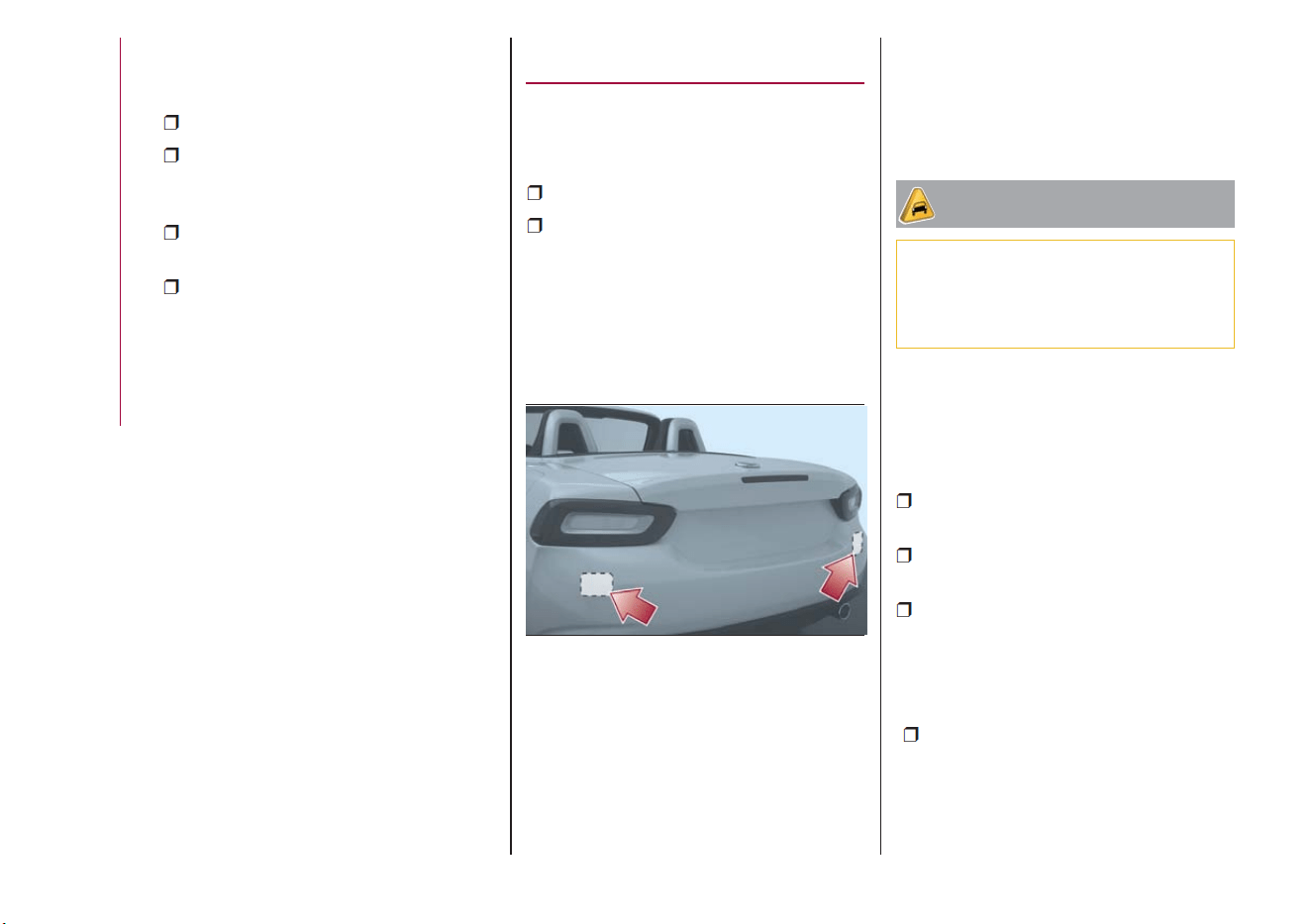
Note: If any of the following conditions
occur, the Speed Control system is
temporarily canceled:
The parking brake is applied.
Automatic Transmission: the
gear selector is in the PARK or
NEUTRAL position.
Manual Transmission: the gear
selector is in the NEUTRAL position.
Automatic Transmission: the
Speed Control cannot be canceled
while driving in manual mode (gear
selector shifted from D to M position).
Therefore, engine braking will not be
applied even if the transmission is
shifted down to a lower gear. If
deceleration is required, lower the set
speed or press the brake pedal.
When the Speed Control system is
temporarily canceled, the speed cannot
be reset.
RADAR SENSORS —
IF EQUIPPED
Rear Radar Sensors
The following systems use the rear
radar sensors:
Blind Spot Monitoring System (BSM)
Rear Cross Traffic Alert (RCTA)
The radar sensors function by detecting
the radio waves reflected off of a vehicle
approaching from the rear, or an
obstruction, sent from the radar sensor.
The radar sensors are installed inside
the rear bumper, one each on the left
and right sides.
Always keep the surface of the rear
bumper near the radar sensors clean so
that the radar sensors operate normally.
Also, do not apply items such as
stickers.
Caution!
If the rear bumper receives a severe
impact, the system may no longer operate
normally. Stop the system immediately and
contact an authorized dealer.
The detection ability of the radar
sensors has limitations. In the following
cases, the detection ability may be
decreased, and the system may not
operate normally:
The rear bumper near the radar
sensors has been damaged.
Snow, ice or mud has adhered to the
radar sensors on the rear bumper.
Operating in weather conditions such
as rain, snow and fog.
Note: Under the following conditions,
the radar sensors cannot detect objects
or it may be difficult to detect them:
Stationary objects on a road or a
road side such as small, two-wheeled
vehicles, bicycles, pedestrians,
animals, and shopping carts.
07080915112112
Radar Sensor Locations
166
STARTING AND OPERATING

Vehicle shapes which do not reflect
radar waves well such as empty trailers
with a low vehicle height and sports
cars.
Vehicles are shipped with the direction
of the radar sensors adjusted for each
vehicle to a loaded vehicle condition so
that the radar sensors detect
approaching vehicles correctly. If the
direction of the radar sensors has
changed, contact an authorized dealer.
The radar sensors are regulated by the
relevant radio wave laws of the country
in which the vehicle is driven. If the
vehicle is driven abroad, authorization
from the country in which the vehicle is
driven may be required.
Note:
For repairs or replacement of the
radar sensors, bumper repairs, paint
work, or replacement near the radar
sensors, consult an authorized dealer.
Turn off the radar system when
pulling a trailer or while an accessory,
such as a bicycle carrier, is installed to
the rear of the vehicle. Otherwise, the
radio waves emitted by the radar will
be blocked causing the system to not
operate normally.
REAR PARK ASSIST
— IF EQUIPPED
Rear Park Assist
Warning!
Do not rely completely on the parking
sensor system and be sure to confirm the
safety around your vehicle visually when
driving. This system can assist the driver in
operating the vehicle in the forward and
backward directions while parking. The
detection ranges of the sensors are limited,
therefore, driving the vehicle while relying
only on the system may cause an accident.
Always confirm the safety around your
vehicle visually when driving.
Parking and other potentially dangerous
maneuvers are, however, always the
driver’s responsibility. When performing
these operations, always make sure that
there are no other people (especially
children) or animals on the route you want
to drive into. The parking sensors are an
aid for the driver, but the driver must never
allow their attention to lapse during
potentially dangerous maneuvers, even
those executed at low speeds.
The Rear Park Assist System uses four
ultrasonic sensors (two rear sensors
and two rear corner sensors) to detect
obstructions around the vehicle while
parking the vehicle in a garage or
during parallel parking when the gear
selector is in REVERSE.
The system is equipped with an assist
device to notify the driver of the
approximate distance from the vehicle
to the surrounding obstruction using a
audible alert.
Note:
Do not install any accessories within
the detection ranges of the sensors. It
may affect the system operation.
Depending on the type of
obstruction and the surrounding
conditions, the detection range of a
sensor may narrow, or the sensors
may not be able to detect
obstructions.
05200100-121-001AB
Parking Sensor Locations
167
The system may not operate
normally under the following
conditions:
Mud, ice, or snow adhered to the
sensor area (operation will return to
normal when removed).
The sensor area is frozen (operation
will return to normal when the ice is
thawed).
The sensor is covered by a hand or
excessive force has been applied to
the bumper.
The vehicle is on a steep incline.
Under extremely hot or cold
weather conditions.
The vehicle is driven on bumps,
inclines, gravel, or grass covered
roads.
Anything which generates
ultrasound is near the vehicle, such as
another vehicle's horn, the engine
sound of a motorcycle, the air brakes
of a large-sized vehicle, or another
vehicle's sensors.
The vehicle is driven in heavy rain or
in road conditions causing water
splash.
A antenna for a radio transmitter is
installed to the vehicle.
The vehicle is moving towards a tall
or square curbstone.
An obstruction is too close to the
sensor.
The following types of obstructions
may not be detected:
Thin objects such as wire or rope.
Things which absorb sonic waves
easily such as rain or snow.
Angular shaped objects.
Very tall objects, and those which
arewideatthetop.
Small, short objects.
Obstructions under the bumper
may not be detected. Obstructions
that are lower than the bumper or thin
which may have been initially detected
but are no longer detected as the
vehicle approaches more closely.
Always have the system inspected
by an authorized dealer if any force is
applied to the bumpers, even in a
minor accident. If the sensors have
been repositioned in any way, they
cannot detect obstructions.
The system may have a malfunction
if the audible signal does not operate.
Contact an authorized dealer.
The beeper which indicates a
system malfunction may not be heard
if the ambient temperature is extremely
cold, or mud, ice, or snow adheres to
the sensor area. Remove any foreign
material from the sensor area.
When installing a trailer hitch,
contact an authorized dealer.
Caution!
Only have repairs on the bumper in the
area of the sensors carried out by a
authorized dealer. Repairs on the bumper
that are not carried out properly may
compromise the operation of the parking
sensors.
Only have the bumpers repainted or any
retouches to the paint work in the area of
the sensors carried out by a authorized
dealer. Incorrect paint application could
affect the operation of the parking sensors.
Sensor Detection Range
The sensors detect obstructions within
the following range:
Lateral Detection Range:
19 inches (50 cm)
Rear Detection Range:
59 inches (150 cm)
System Operation
The system is operational when the
ignition is in the ON position and the
gear selector is shifted to REVERSE.
When an audible signal sounds, the
system is enabled for use.
168
STARTING AND OPERATING

Parking Sensor Audible Alert
The audible alert will sound while the system is operating according to the following chart:
Rear Sensor
Distance Detection Area
Distance Between Vehicle
And Obstruction
Audible Alert (*)
Farthest distance Approx. 59 - 23 inches (150 cm - 60 cm) Slow intermittent sound
Far
distance Approx. 23 -17 inches (60 - 45 cm) Medium intermittent sound
Middle distance Approx. 17 -13 inches (45 - 35 cm) Fast intermittent sound
Close distance Within approx. 13 inches (35 cm) Continuous sound
(*) The rate at which the intermittent audible alert increases as the vehicle approaches the obstruction.
Rear Corner Sensor
Distance Detection Area
Distance Between Vehicle
And Obstruction
Audible Alert (**)
Far distance Approx. 19 - 14 inches (50 - 38 cm) Medium intermittent sound
Middle
distance Approx. 14 - 9.8 inches (38 - 25 cm) Fast intermittent sound
Close distance Within approx. 9.8 inches (25 cm) Continuous sound
(**) The rate at which the intermittent audible alert increases as the vehicle approaches the obstruction.
Note: If an obstruction is detected in a zone for six seconds or more, the audible alert stops, unless the obstruction is within
the close distance zone. If the same obstruction is detected in another zone, the corresponding audible alert is heard.
169

When A Warning Alert Is Activated
The system notifies the driver of an obstacle by activating the audible alert.
Beep How To Check
The audible alert is not heard.
The
system may have a malfunction.
Contact an authorized dealer as soon as possible.
When the engine is turned ON, or if the parking sensor
detects a problem while driving, an intermittent audible
alert is heard one to four times(*).
Remove any foreign material from the sensor area. If the system continues to sound
the audible alert, contact an authorized dealer as soon as possible.
( * ) The number of times the audible alert is heard changes depending on the malfunction location.
170
STARTING AND OPERATING

PARKVIEW REAR
BACKUP CAMERA —
IF EQUIPPED
Operation
The camera is located on the trunk lid,
above the license plate.
Switching The Display To Rear View
Camera Mode:
Place the gear selector in the REVERSE
position, after the ignition is turned to
ON, to switch the display to rear-view
camera mode.
Note:
When the gear selector is moved
from the REVERSE position and put in
any other position, the screen returns
to the previous display mode.
When parking in REVERSE, take
care over obstacles that may be above
or under the camera’s display range.
When the display is cold, the images
could be more blurred than usual,
making it difficult to check the
conditions of the area around the
vehicle. Always use extreme caution and
verify the real conditions of the area
behind the vehicle with you own eyes.
If water, snow, or mud is deposited
on the camera lens, clean it with a soft
cloth. If this does not clean it, use a
mild detergent.
If the camera is subjected to abrupt
temperature changes (from hot to cold
or vice versa), the rear-view monitor
may not work properly.
When replacing tires, contact an
authorized dealer. Replacing the tires
can cause the guide lines that appear
on the display to be misaligned.
Warning!
Always use extreme caution and verify the
real conditions of the area behind the vehicle.
Backing up while looking only at the screen is
dangerous and can lead to an accident or
collision with an object. The rear-view
monitor is simply a system to aid reversing.
The view on the display can show a situation
that differs from the real one.
Do not use the rear-view monitor under
the following conditions:
Roads covered in ice or snow.
When snow chains are mounted or the
temporary space saver spare wheel is fitted.
The rear trunk is not completely closed.
The vehicle is on a sloping road.
Using the rear-view monitor under the
conditions listed above is dangerous and
can cause damage to persons and/or the
vehicle.
Caution!
Do not apply excessive force to the
camera. You could alter the position and
angle of the camera. Do not disassemble,
modify or remove it as this could
compromise the seal.
The camera’s cover is made of plastic.
Do not apply degreasers, organic solvents,
wax or glass polish to the camera’s cover.
If some substance ends up on the cover,
clean it off immediately with a soft cloth.
Do not rub the cover too much, nor
polish it with abrasive compounds or hard
brushes. The cover could be damaged and
create image problems.
If the vehicle has been involved in a
frontal, lateral or rear collision, the rear
parking camera’s alignment (location or
installation angle) may have been altered.
Contact a authorized dealer.
If the display shows "no video signal",
there may be a problem with the camera.
Contact an authorized dealer.
07040110-124-008AB
Rear Camera Location
171
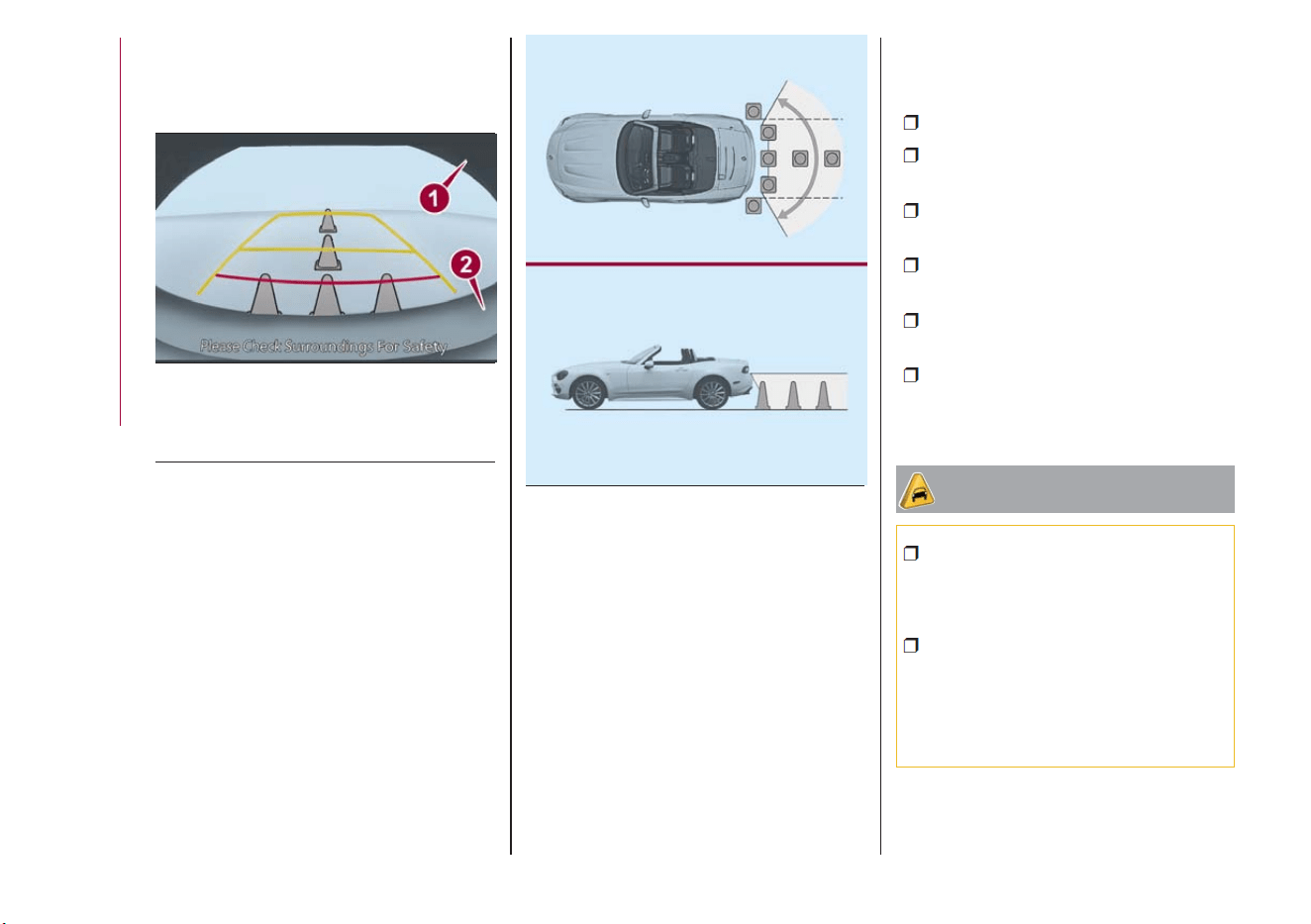
Display
Note: The images on the display can
show a situation that differs from the
actual view.
The field of view varies depending on
the vehicle and the road conditions. The
field of view is limited. Objects below
the bumper or around it’s sides may not
be displayed.
The distance displayed by the camera
view differs from the actual view, as the
rear parking camera is equipped with a
special lens.
The camera could capture any
non-standard accessories installed on
the vehicle. Do not install non-standard
accessories that could interfere with the
camera’s view, such as lights or
reflectors.
Note: If it is difficult to see the display
under the following conditions, it does
not mean that there is a malfunction:
In dark areas.
When the temperature around the
lens is particularly high or low.
When the camera is wet from rain
or due to a high atmospheric humidity.
When there is some foreign deposit
around the camera, such as mud.
When the camera lens reflects
sunlight or a headlight beam.
The image on the display may be
delayed if the temperature around the
camera is low.
Caution!
To avoid vehicle damage, ParkView
should only be used as a parking aid. The
ParkView camera is unable to view every
obstacle or object in your drive path.
To avoid vehicle damage, the vehicle
must be driven slowly when using ParkView
to be able to stop in time when an obstacle
is seen. It is recommended that the driver
look frequently over his/her shoulder when
using ParkView.
07080913987987
Camera View
1—BlockedArea
2 — Rear Bumper
07080913988988
Camera Field Of View
172
STARTING AND OPERATING
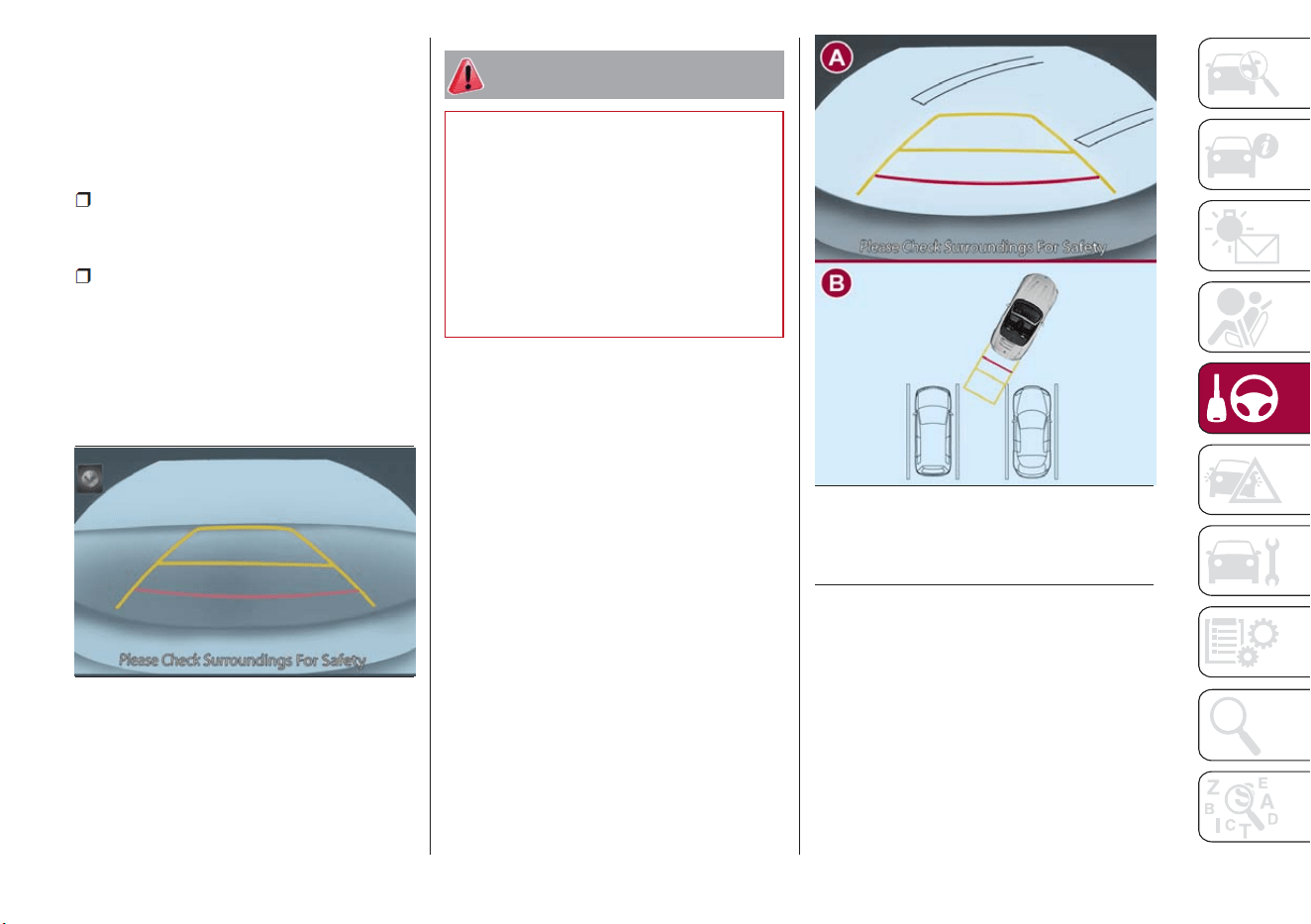
Looking At The Display
The vehicle width guide lines are
displayed on the screen as a reference
to show the width of the vehicle
compared to the width of the parking
space to be entered while in REVERSE.
Vehicle Width Guide Lines: these
guide lines serve as a reference
showing the width of the vehicle.
Distance Guide Lines: these lines
indicate the approximate distance from
the rear of the vehicle (the rear edge of
the bumper). The red and yellow lines
indicates the points at about 19 inches
(50 cm), for the red line and 39 inches
(1 m) for the yellow line, from the rear
bumper (central point of each line).
Warning!
Drivers must be careful when backing up
even when using the ParkView Rear Back
Up Camera. Always check carefully behind
your vehicle, and be sure to check for
pedestrians, animals, other vehicles,
obstructions, or blind spots before backing
up. You are responsible for the safety of
your surroundings and must continue to
pay attention while backing up. Failure to
do so can result in serious injury or death.
Rear View Camera
Operation
The operating modes of the rear view
camera when the vehicle is in
REVERSE vary depending on traffic,
road, and vehicle conditions. Also, the
amount of turning and the duration of
the maneuver vary depending on the
conditions. Therefore, it is important to
check the surrounding conditions and
adapt the steering as necessary.
Note: The images from the rear
parking camera shown on the monitor
are reversed (mirror image).
1. Place the gear selector in the
REVERSE position to switch the display
to rear view camera mode.
2. Check the surrounding conditions
and begin backing up.
3. Once the vehicle starts to enter the
parking space, proceed slowly in
REVERSE while keeping the vehicle
width guide lines away from the two
sides of the parking space.
4. Continue to adjust the steering
wheel until the vehicle width guide lines
are parallel with the two sides of the
parking space.
07080913-111-111
Vehicle Width Guide Lines
07080913989989
Entering Parking Spot
A — Rear Camera View
B — Check Surrounding Area
173
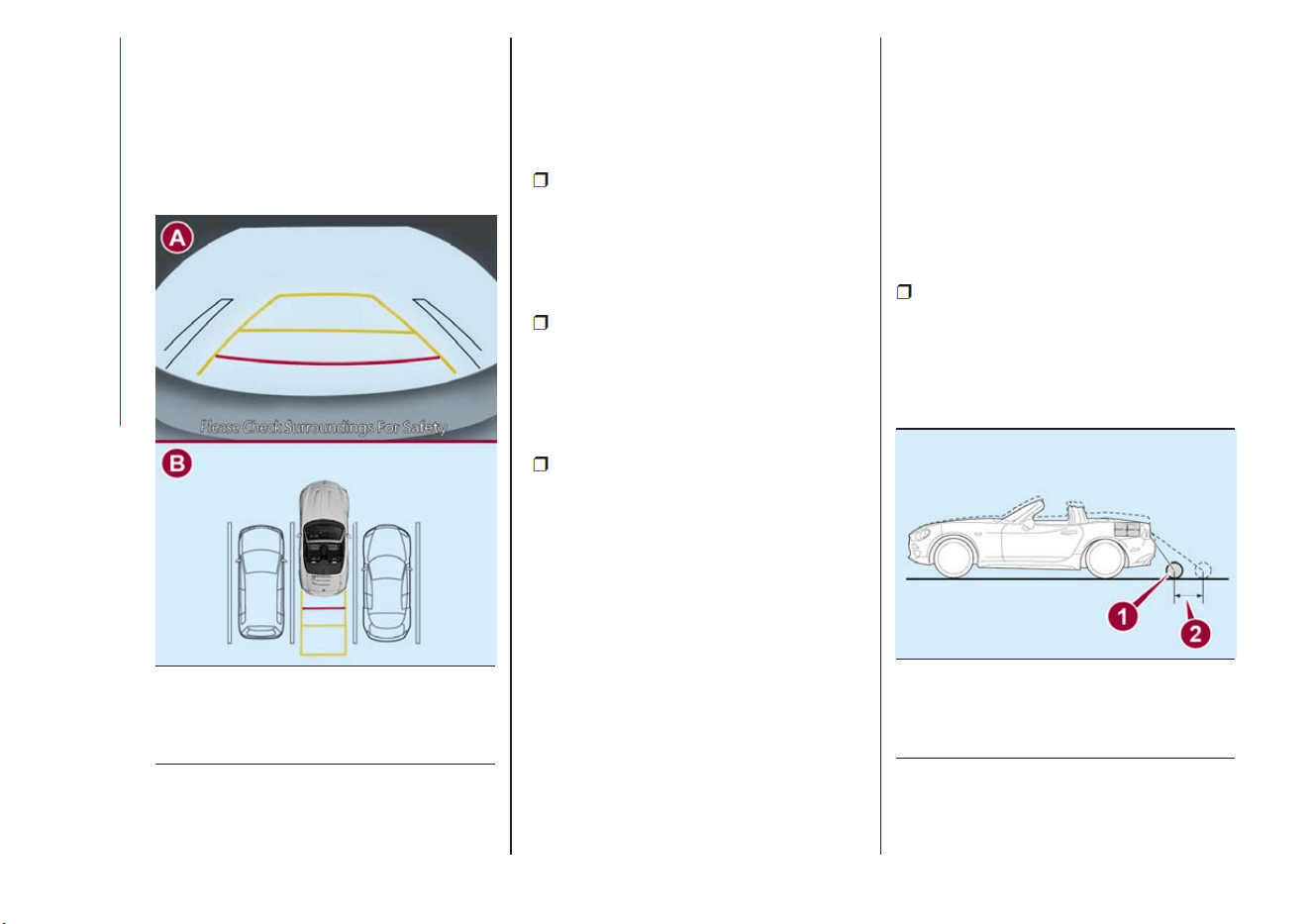
5. Once the guide lines are parallel,
straighten the steering wheel and
reverse slowly into the parking space.
Continue to check the vehicle’s
surroundings and stop in the best
position possible (if the parking space
has dividing lines, check that the vehicle
width guide lines are parallel with them).
6. When the gear selector is moved
from the REVERSE position and put in
any other position, the screen returns to
the previous display mode.
Note:
Since there may be some
differences between the displayed
image and the real conditions, always
visually inspect the area behind the
vehicle, and the surrounding areas, to
make sure they are completely clear.
In the image of the parking space
(or garage) shown above, the rear of
the vehicle and the distance guide lines
may seem parallel on the monitor, but
may not be when the parked vehicle is
inspected.
When you enter a parking space
with a dividing line only on one side,
the dividing line and the vehicle width
guide lines may appear parallel on the
monitor, but may not be when the
parked vehicle is inspected.
Road Conditions And
Displayed Image
There are some differences between
what is shown on the display, and the
actual road conditions.
The different perceptions of distance
could lead to an accident. The
conditions that can lead to the different
perceptions of distance, listed below,
must be taken into consideration:
When The Vehicle Slopes Due To
The Weight Of Passengers And
Load:
When the vehicle is rear heavy, the
object on the screen seems to be
further away than it really is.
07080913990990
Entering Parking Spot
A — Rear Camera View
B — Check Surrounding Area
07080913991991
Loaded Vehicle Camera Angle
1 — Object
2 — Variance
174
STARTING AND OPERATING

When The Road Behind The
Vehicle Slopes Steeply:
When the vehicle is on a steep uphill
(downhill) slope, the object on the
screen seems to be further away than it
really is.
Three Dimensional Object Behind
The Vehicle:
Since the distance guide line display is
based on a flat surface, the distance to
a three dimensional object on the
screen differs from the actual distance.
07080913992992
Downhill Camera Angle
1 — Distance Between The Vehicle
And Object Displayed On The Screen
2 — Actual Distance Between
The Vehicle And Object
3 — Appears Farther Than Actual
Distance
4 — Object At Actual Position
5 — Object On Screen
07080913993993
Downgrade Camera Angle
1 — Distance Between The Vehicle
And Object Displayed On The Screen
2 — Actual Distance Between The
Vehicle And Object
3 — Appears Closer Than Actual
Distance
4 — Object On Screen
5 — Object At Actual Position
07080913994994
Three-Dimensional Object
Camera View
A—ObjectInView
B — Actual Distance To Object
C — Appears Farther Than Actual
175
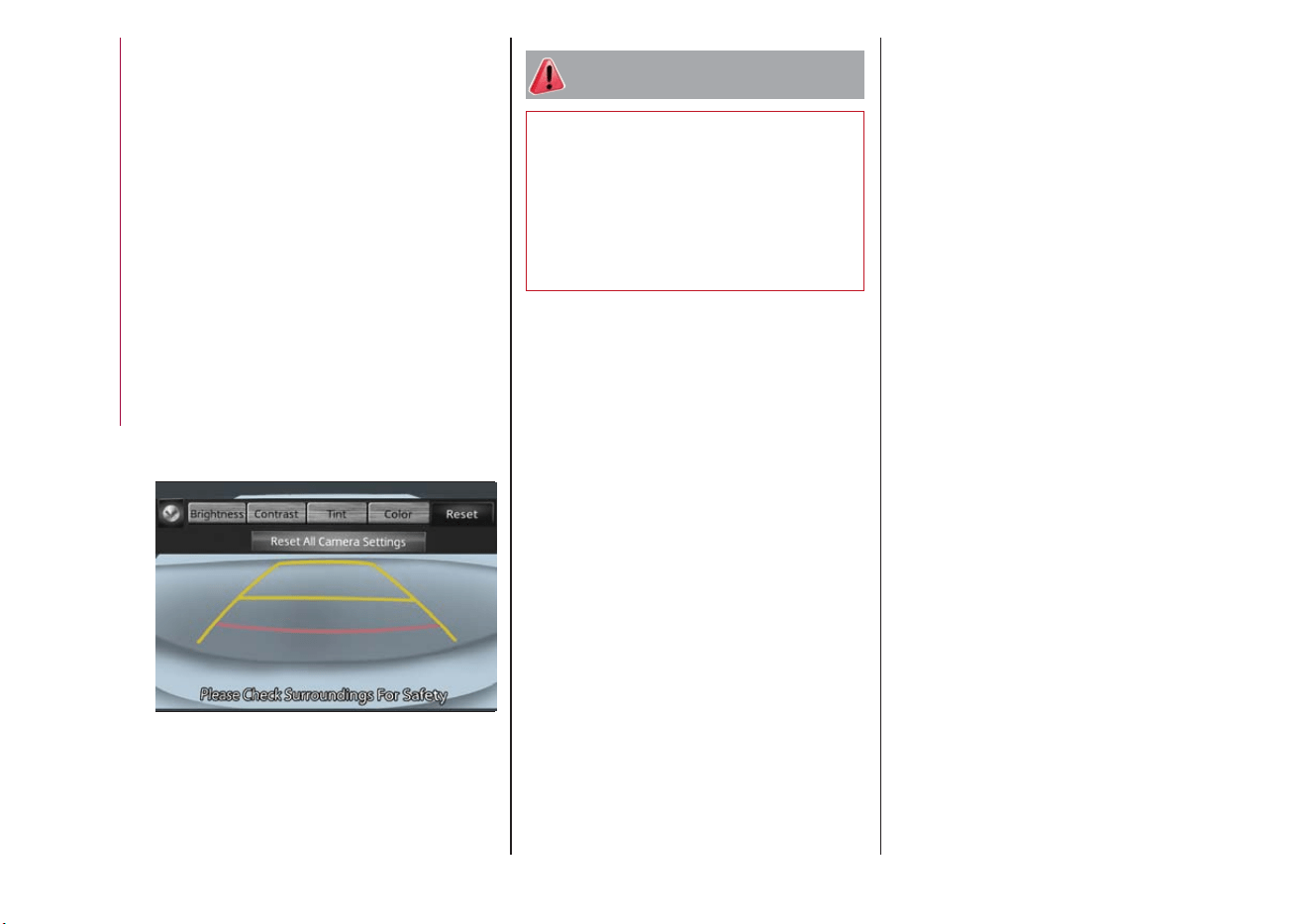
Adjusting The Image
Quality
The image quality can be adjusted with
the gear selector in the REVERSE
position.
Four adjustments can be made:
brightness, contrast, tint and color. Give
attention to the vehicle’s surroundings
while making adjustments:
1. Select the icon on the top left of the
screen to display the tabs.
2. Select the desired tab.
3. Use the cursor to adjust the
brightness, contrast, tint and color. If a
reset is needed, press the reset button.
4. Select the icon on the top left of the
screen to close the tabs.
Warning!
Adjusting the rear-view camera image quality
must always be done when the vehicle is
stationary. Do not adjust the rear-view camera
image quality while vehicle driving. Adjusting
the image quality (brightness, contrast, color
and tint) of the rear-view camera while driving
the vehicle is dangerous since it could distract
the driver and cause a serious accident.
07080914-111-111
Image Quality Adjustments
176
STARTING AND OPERATING

REFUELING THE
VEHICLE
Refueling The Vehicle
Stop the engine before refueling.
Fuel Requirements
Vehicles with catalytic converters or
oxygen sensors must use ONLY
UNLEADED FUEL, which will reduce
exhaust emissions and keep spark plug
fouling to a minimum.
Fuel: Premium unleaded fuel.
Octane Rating
(Anti-knock index): 91
(R + M)/2 method or
above (96 RON or
above) (U.S. federal
law requires that
octane ratings be
posted on gasoline station pumps).
Regular unleaded fuel with an octane
rating from 87 to 90 (91 to 95 RON) can
be used, but this will reduce
performance slightly, such as reduced
engine output, and engine knocking.
Fuel with a rating lower than 87 octane
(91 RON) will negatively affect the
emission control system performance
and could also cause engine knocking
and serious engine damage.
While operating on gasoline with an
octane number of 87, hearing a light
knocking sound from the engine is not
a cause for concern. However, if the
engine is heard making a heavy
knocking sound, see your authorized
dealer immediately. Use of gasoline with
an octane number lower than 87 can
cause engine failure and may void or
not be covered by the New Vehicle
Limited Warranty. Poor quality gasoline
can cause problems such as hard
starting, stalling, and hesitations. If you
experience these symptoms, try
another brand of gasoline before
considering service for the vehicle.
Gasoline blended with oxygenates such
as alcohol or ether compounds are
generally referred to as oxygenated
fuels.
The common gasoline blend that can
be used with your vehicle is ethanol
blended at no more than 15%. Gasoline
containing alcohol, such as ethanol or
methanol, may be marketed under the
name "Gasohol".
Vehicle damage and problems resulting
from the use of the following may not
be covered by the New Vehicle Limited
Warranty:
Alcohol containing more than 15%
ethanol.
Gasoline or alcohol containing
methanol.
Leaded fuel or leaded alcohol.
Reformulated Gasoline
Many areas of the country require the
use of cleaner burning gasoline referred
to as “Reformulated Gasoline”.
Reformulated gasoline contains
oxygenates and are specifically blended
to reduce vehicle emissions and
improve air quality.
The use of reformulated gasoline is
recommended. Properly blended
reformulated gasoline will provide
improved performance and durability of
engine and fuel system components.
Gasoline/Oxygenate
Blends
Some fuel suppliers blend unleaded
gasoline with oxygenates such as
ethanol.
Caution!
DO NOT use gasoline containing methanol
or gasoline containing more than 15%
ethanol (E-15). Use of these blends may
result in starting and drivability problems,
damage critical fuel system components,
cause emissions to exceed the applicable
standard, and/or cause the “Malfunction
Indicator Light” to illuminate. Please
observe pump labels as they should clearly
communicate if a fuel contains greater than
15% ethanol (E-15).
177

Problems that result from using
gasoline containing more than 15%
ethanol (E-15) or gasoline containing
methanol are not the responsibility of
the manufacturer and may void or not
be covered under New Vehicle Limited
Warranty.
E-85 Usage In Non-Flex
Fuel Vehicles
Non-Flex Fuel Vehicles (FFV) are
compatible with gasoline containing up
to 15% ethanol (E-15). Gasoline with
higher ethanol content may void the
New Vehicle Limited Warranty.
If a Non-FFV vehicle is inadvertently
fueled with E-85 fuel, the engine will
have some or all of these symptoms:
Operate in a lean mode.
OBD II “Malfunction Indicator Light”
on.
Poor engine performance.
Poor cold start and cold drivability.
Increased risk for fuel system
component corrosion.
MMT In Gasoline
Methylcyclopentadienyl Manganese
Tricarbonyl (MMT) is a manganese-
containing metallic additive that is
blended into some gasoline to increase
octane. Gasoline blended with MMT
provides no performance advantage
beyond gasoline of the same octane
number without MMT. Gasoline blended
with MMT reduces spark plug life and
reduces emissions system performance
in some vehicles. The manufacturer
recommends that gasoline without
MMT be used in your vehicle. The MMT
content of gasoline may not be
indicated on the gasoline pump;
therefore, you should ask your gasoline
retailer whether the gasoline contains
MMT. MMT is prohibited in Federal and
California reformulated gasoline.
Materials Added To Fuel
Besides using unleaded gasoline with
the proper octane rating, gasolines that
contain detergents, corrosion and
stability additives are recommended.
Using gasolines that have these
additives will help improve fuel
economy, reduce emissions, and
maintain vehicle performance.
Designated TOP TIER
Detergent Gasoline
contains a higher level
of detergents to further
aide in minimizing
engine and fuel system
deposits. When available, the usage of
Top Tier Detergent gasoline is
recommended. Visit
www.toptiergas.com for a list of TOP
TIER Detergent Gasoline Retailers.
Indiscriminate use of fuel system
cleaning agents should be avoided.
Many of these materials intended for
gum and varnish removal may contain
active solvents or similar ingredients.
These can harm fuel system gasket and
diaphragm materials.
Fuel System Cautions
Caution!
Follow these guidelines to maintain your
vehicle’s performance:
The use of leaded gasoline is prohibited
by Federal law. Using leaded gasoline can
impair engine performance and damage
the emissions control system.
An out-of-tune engine or certain fuel or
ignition malfunctions can cause the
catalytic converter to overheat. If you notice
a pungent burning odor or some light
smoke, your engine may be out of tune or
malfunctioning and may require immediate
service. Contact your authorized dealer for
service assistance.
The use of fuel additives, which are now
being sold as octane enhancers, is not
recommended. Most of these products
contain high concentrations of methanol.
Fuel system damage or vehicle
performance problems resulting from the
use of such fuels or additives is not the
responsibility of the manufacturer and may
void or not be covered under the New
Vehicle Limited Warranty.
Note: Intentional tampering with the
emissions control system can result in
civil penalties being assessed against
you.
178
STARTING AND OPERATING

Carbon Monoxide
Warnings
Warning!
Carbon monoxide (CO) in exhaust gases is
deadly. Follow the precautions below to
prevent carbon monoxide poisoning:
Do not inhale exhaust gases. They
contain carbon monoxide, a colorless and
odorless gas, which can kill. Never run the
engine in a closed area, such as a garage,
and never sit in a parked vehicle with the
engine running for an extended period. If
the vehicle is stopped in an open area with
the engine running for more than a short
period, adjust the ventilation system to
force fresh, outside air into the vehicle.
Guard against carbon monoxide with
proper maintenance. Have the exhaust
system inspected every time the vehicle is
raised. Have any abnormal conditions
repaired promptly. Until repaired, drive with
all side windows fully open.
Refueling Procedure
Fuel Filler Door
Note: Always use only a designated
FCA fuel filler cap or an approved
equivalent, available at your authorized
dealer. The wrong cap can result in a
serious malfunction of the fuel and
emission control systems.
When the fuel filler door end is pressed
with the doors unlocked, the fuel filler
door rises.
The fuel filler door operates in
conjunction with the door
locking/unlocking mechanism.
To close, press the fuel filler door until a
click sound is heard.
Note:
Make sure to lock both the doors
when leaving the vehicle.
Lock the doors after closing the fuel
filler door. If the fuel filler door is closed
after locking the doors, the fuel filler
door cannot be locked.
Fuel Filler Cap
To remove the fuel filler cap, turn it
counterclockwise. Attach the removed
cap to the inner side of the fuel filler
door.
To close the fuel filler cap, turn it
clockwise until a click is heard.
04040201-12A-002AB
Fuel Filler Door
04040202-12A-001AB
Fuel Filler Cap
179

Warning!
Never have any smoking materials lit in
or near the vehicle when the gas cap is
removed or the tank is being filled.
Never add fuel when the engine is
running. This is in violation of most state
and federal fire regulations and may cause
the MIL to turn on.
A fire may result if gasoline is pumped
into a portable container that is inside of a
vehicle. You could be burned. Always place
gas containers on the ground while filling.
Do not apply any object/plug to the end
of the filler which is not provided for the
vehicle. The use of non-compliant
objects/plugs could cause a pressure
increase inside the tank, resulting in
dangerous situations.
Do not use a mobile phone near the
refueling pump: risk of fire.
Emergency Fuel Filler
Door Release
If the battery is discharged, the fuel filler
door cannot be opened. In this case,
the fuel filler door can be opened by
taking care of the discharged battery
situation.
If the fuel filler door cannot be opened
even if the discharged battery situation
has been resolved, the electrical system
may have a malfunction.
In this case, the fuel filler door can be
opened using the following procedure
as an emergency measure:
1. Open the trunk and pull the center
section of the plastic fastener and
remove the fastener.
2. Partially peel back the cover inside
the trunk, then pull the emergency
release lever.
08100100-121-002
Trunk Interior
1 — Plastic Fasteners
2 — Cover
08100100-122-001
Fuel Door Emergency Release
3 — Emergency Release Lever
180
STARTING AND OPERATING
VEHICLE LOADING
Certification Label
As required by National Highway Traffic
Safety Administration regulations, your
vehicle has a certification label affixed to
the driver's side door or pillar.
This label contains the month and year
of manufacture, Gross Vehicle Weight
Rating (GVWR), Gross Axle Weight
Rating (GAWR) front and rear, and
Vehicle Identification Number (VIN). A
Month-Day-Hour (MDH) number is
included on this label and indicates the
Month, Day and Hour of manufacture.
The bar code that appears on the
bottom of the label is your VIN.
Gross Vehicle Weight Rating
(GVWR)
The GVWR is the total permissible
weight of your vehicle including driver,
passengers, vehicle, options and cargo.
The label also specifies maximum
capacities of front and rear axle
systems (GAWR). Total load must be
limited so GVWR and front and rear
GAWR are not exceeded.
Payload
The payload of a vehicle is defined as
the allowable load weight a truck can
carry, including the weight of the driver,
all passengers, options and cargo.
Gross Axle Weight Rating
(GAWR)
The GAWR is the maximum permissible
load on the front and rear axles. The
load must be distributed in the cargo
area so that the GAWR of each axle is
not exceeded.
Each axle GAWR is determined by the
components in the system with the
lowest load carrying capacity (axle,
springs, tires or wheels). Heavier axles
or suspension components sometimes
specified by purchasers for increased
durability does not necessarily increase
the vehicle's GVWR.
Tire Size
The tire size on the Vehicle Certification
Label represents the actual tire size on
your vehicle. Replacement tires must be
equal to the load capacity of this tire
size.
Rim Size
This is the rim size that is appropriate
for the tire size listed.
Inflation Pressure
This is the cold tire inflation pressure for
your vehicle for all loading conditions up
to full GAWR.
Curb Weight
The curb weight of a vehicle is defined
as the total weight of the vehicle with all
fluids, including vehicle fuel, at full
capacity conditions, and with no
occupants or cargo loaded into the
vehicle. The front and rear curb weight
values are determined by weighing your
vehicle on a commercial scale before
any occupants or cargo are added.
Loading
The actual total weight and the weight of
the front and rear of your vehicle at the
ground can best be determined by
weighing it when it is loaded and ready
for operation.
The entire vehicle should first be weighed
on a commercial scale to insure that the
GVWR has not been exceeded. The
weight on the front and rear of the
vehicle should then be determined
separately to be sure that the load is
properly distributed over the front and
rear axle. Weighing the vehicle may show
that the GAWR of either the front or rear
axles has been exceeded but the total
load is within the specified GVWR. If so,
weight must be shifted from front to rear
or rear to front as appropriate until the
specified weight limitations are met.
181
Store the heavier items down low and be
sure that the weight is distributed equally.
Stow all loose items securely before
driving.
Improper weight distributions can have
an adverse effect on the way your vehicle
steers and handles and the way the
brakes operate.
Caution!
Do not load your vehicle any heavier than
the GVWR or the maximum front and rear
GAWR. If you do, parts on your vehicle can
break, or it can change the way your
vehicle handles. This could cause you to
lose control. Also overloading can shorten
the life of your vehicle.
TOWING TRAILERS
Trailer Towing
Your car is not designed for towing.
Recreational Towing
An example of "recreational towing" is
towing your vehicle behind a
motorhome.
The transmission is not designed for
towing this vehicle on all four wheels.
Caution!
DO NOT flat tow this vehicle. Damage to
the drivetrain will result. If this vehicle
requires towing, make sure the drive
wheels are OFF the ground.
Towing this vehicle in violation of the
above requirements can cause severe
transmission damage. Damage from
improper towing is not covered under the
New Vehicle Limited Warranty.
DRIVING TIPS
Engine Break-In
Recommendation
No special break-in is necessary, but a
few precautions in the first 620 miles
(1000 km) may add to the performance,
economy, and life of the vehicle:
Do not race the engine.
Do not maintain one constant speed,
either slow or fast, for a long period of
time.
Do not drive constantly at full-throttle
or high engine rpm for extended
periods of time.
Avoid unnecessary hard stops.
Avoid full-throttle starts.
182
STARTING AND OPERATING

Saving Fuel And
Protection Of The
Environment
How you operate your vehicle
determines how far it will travel on a
tankoffuel.
Use these suggestions to help save fuel
and reduce CO
2
:
Avoid long warm-ups. Once the
engine runs smoothly, begin driving.
Avoid fast starts.
Drive at lower speeds.
Anticipate when to apply the brakes
(avoid sudden braking).
Follow the maintenance schedule
and contact your authorized dealer.
Use the air conditioner only when
necessary.
Slow down on rough roads.
Keep the tires properly inflated.
Do not carry unnecessary weight.
Do not rest your foot on the brake
pedal while driving.
Keep the wheels in correct
alignment.
Keep windows closed at high
speeds.
Slow down when driving in
crosswinds and headwinds.
Hazardous Driving
When driving on ice or in water, snow,
mud, sand, or similar hazards:
Be cautious and allow extra distance
for braking.
Avoid sudden braking and sudden
maneuvering.
Do not pump the brakes. Continue to
press down on the brake pedal.
If you get stuck, select a lower gear
and accelerate slowly. Do not spin the
rear wheels.
For more traction in starting on
slippery surfaces such as ice or packed
snow, use sand, rock salt, chains,
carpeting, or other nonslip material
under the rear wheels.
Note: Usesnowchainsonlyonthe
rear wheels.
Floor Mat Safety
Information
Always use floor mats designed to fit
the footwell of your vehicle. Use only
floor mats that leave the pedal area
unobstructed and that are firmly
secured so that they cannot slip out of
position and interfere with the pedals or
impair safe operation of your vehicle in
other ways.
Warning!
An improperly attached, damaged, folded, or
stacked floor mat, or damaged floor mat
fasteners may cause your floor mat to
interfere with the accelerator, brake, or clutch
pedals and cause a loss of vehicle control.
To prevent SERIOUS INJURY or DEATH:
ALWAYS securely attach
your floor
mat using the floor mat fasteners. DO NOT
install your floor mat upside down or turn
your floor mat over. Lightly pull to confirm
mat is secured using the floor mat
fasteners on a regular basis.
ALWAYS REMOVE THE EXISTING
FLOOR MAT FROM THE VEHICLE
before installing any other floor mat.
NEVER install or stack an additional floor
mat on top of an existing floor mat.
ONLY install floor mats designed to fit
your vehicle. NEVER install a floor mat that
cannot be properly attached and secured
to your vehicle. If a floor mat needs to be
04090400-USA-001
Floor Mat Retention Post Location
183
replaced, only use a FCA approved floor
mat for the specific make, model, and year
of your vehicle.
ONLY use the driver’s side floor mat on
the driver’s side floor area. To check for
interference, with the vehicle properly
parked with the engine off, fully depress the
accelerator, the brake, and the clutch pedal
(if present) to check for interference. If your
floor mat interferes with the operation of
any pedal, or is not secure to the floor,
remove the floor mat from the vehicle and
place the floor mat in your trunk.
ONLY use the passenger’s side floor mat
on the passenger’s side floor area.
ALWAYS make sure objects cannot fall
or slide into the driver’s side floor area
when the vehicle is moving. Objects can
become trapped under accelerator, brake,
or clutch pedals and could cause a loss of
vehicle control.
NEVER place any objects under the floor
mat (e.g., towels, keys, etc.). These objects
could change the position of the floor mat
and may cause interference with the
accelerator, brake, or clutch pedals.
If the vehicle carpet has been removed
and re-installed, always properly attach
carpet to the floor and check the floor mat
fasteners are secure to the vehicle carpet.
Fully depress each pedal to check for
interference with the accelerator, brake, or
clutch pedals then re-install the floor mats.
It is recommended to only use mild soap
and water to clean your floor mats. After
cleaning, always check your floor mat has
been properly installed and is secured to
your vehicle using the floor mat fasteners
by lightly pulling mat.
Rocking The Vehicle
Note: Too much rocking may cause
engine overheating, transmission failure,
and tire damage.
If you must rock the vehicle to free it
from snow, sand or mud, depress the
accelerator slightly and slowly move the
gear selector from 1 (D) to R.
Warning!
Fast spinning tires can be dangerous.
Forces generated by excessive wheel
speeds may cause damage, or even
failure, of the axle and tires. A tire could
explode and injure someone. Do not spin
your vehicle's wheels faster than 30 mph
(48 km/h) or for longer than 30 seconds
continuously without stopping when you
are stuck and do not let anyone near a
spinning wheel, no matter what the speed.
Caution!
When “rocking” a stuck vehicle by
shifting between DRIVE and REVERSE, do
not spin the wheels faster than 15 mph
(24 km/h), or drivetrain damage may result.
Revving the engine or spinning the
wheels too fast may lead to transmission
overheating and failure. It can also damage
the tires. Do not spin the wheels above
30 mph (48 km/h) while in gear (no
transmission shifting occurring).
184
STARTING AND OPERATING

Winter Driving
Carry emergency gear, including tire
chains, window scraper, flares, a small
shovel, jumper leads, and a small bag
of sand or salt.
Contact an authorized dealer to check
the following:
Have the proper ratio of antifreeze in
the radiator.
Inspect the battery and its leads.
Cold reduces battery capacity.
Use an engine oil appropriate for the
lowest ambient temperatures that the
vehicle will be driven in.
Inspect the ignition system for
damage and loose connections.
Use winter windshield washer fluid
that will not freeze.
Note:
Remove snow before driving. Snow
left on the windshield is dangerous as
it could obstruct vision.
Drive slowly. Braking performance
can be adversely affected if snow or
ice adheres to the brake components.
If this situation occurs, drive the vehicle
slowly, releasing the accelerator pedal
and lightly applying the brakes several
times until the brake performance
returns to normal.
Do not open or close the soft top when
the temperature is 41 °F (5 °C) or less.
The material of the soft top could be
damaged by freezing.
Do not apply excessive force to a
window scraper when removing ice or
frozen snow on the mirror glass and
windshield.
Never use warm or hot water for
removing snow or ice from windows
and mirrors as it could result in the
glass cracking.
Snow Tires
If your vehicle is equipped with the tire
pressure monitoring system (vehicle
with run-flat tires), the system may not
function correctly when using tires with
steel wire reinforcement in the
sidewalls.
Use Snow Tires on all Four Wheels:
Do not exceed the maximum
permissible speed for your snow tires or
legal speed limits.
When snow tires are used, select the
specified size and pressure.
Tire Chains
Check local regulations before using tire
chains.
If your vehicle is equipped with the
TPMS system, the system may not
function correctly when using tire
chains.
Install the chains on the rear tires only.
Do not use chains on the front tires.
Note:
Chains may affect handling.
Do not go faster than 30 mph
(50 km/h) or the chain manufacturer's
recommended limit, whichever is lower.
Drive carefully and avoid bumps,
holes, and sharp turns.
Avoid locked-wheel braking.
Do not use chains on roads that are
free of snow or ice. The tires and
chains could be damaged.
Chains may scratch or chip
aluminium wheels.
Warning!
Using tires of different size and type (M+S,
Snow) between front and rear axles can
cause unpredictable handling. You could
lose control and have a collision.
185
Caution!
To avoid damage to your vehicle or tires,
observe the following precautions:
Because of restricted traction device
clearance between tires and other
suspension components, it is important
that only traction devices in good condition
are used. Broken devices can cause
serious damage. Stop the vehicle
immediately if noise occurs that could
indicate device breakage. Remove the
damaged parts of the device before further
use.
Install device as tightly as possible and
then retighten after driving about ½ mile
(0.8 km).
Do not exceed 30 mph (48 km/h).
Drive cautiously and avoid severe turns
and large bumps, especially with a loaded
vehicle.
Do not drive for a prolonged period on
dry pavement.
Observe the traction device
manufacturer’s instructions on the method
of installation, operating speed, and
conditions for use. Always use the
suggested operating speed of the device
manufacturer’s if it is less than 30 mph
(48 km/h).
Do not use traction devices on a
compact spare tire.
Driving In Flooded Area
Note: Do not drive the vehicle on
flooded roads as it could cause short
circuit of electrical/electronic parts, or
water enters the engine and causes it
to lock up (hydro-lock) and stall. If the
vehicle has been immersed in water
contact your authorized dealer.
Although your vehicle is capable of
driving through shallow standing water,
consider the following Cautions and
Warnings before doing so.
Warning!
Driving through standing water limits
your vehicle’s traction capabilities. Do not
exceed 5 mph (8 km/h) when driving
through standing water.
Driving through standing water limits
your vehicle’s braking capabilities, which
increases stopping distances. Therefore,
after driving through standing water, drive
slowly and lightly press on the brake pedal
several times to dry the brakes.
Failure to follow these warnings may
result in injuries that are serious or fatal to
you, your passengers, and others around
you.
Caution!
Always check the depth of the standing
water before driving through it. Never drive
through standing water that is deeper than
the bottom of the tire rims mounted on the
vehicle.
Determine the condition of the road or
the path that is under water and if there are
any obstacles in the way before driving
through the standing water.
Do not exceed 5 mph (8 km/h) when
driving through standing water. This will
minimize wave effects.
Driving through standing water may
cause damage to your vehicle’s drivetrain
components. Always inspect your vehicle’s
fluids (i.e., engine oil, transmission, axle,
etc.) for signs of contamination (i.e., fluid
that is milky or foamy in appearance) after
driving through standing water. Do not
continue to operate the vehicle if any fluid
appears contaminated, as this may result in
further damage. Such damage is not
covered by the New Vehicle Limited
Warranty.
Getting water inside your vehicle’s
engine can cause it to lock up and stall out,
and cause serious internal damage to the
engine. Such damage is not covered by
the New Vehicle Limited Warranty.
186
STARTING AND OPERATING
Overloading
Note: Be careful not to overload your
vehicle. The gross axle weight rating
(GAWR) and the gross vehicle weight
rating (GVWR) of the vehicle are on the
Motor Vehicle Safety Standard Label on
the driver's door frame. Exceeding
these ratings can cause an accident or
vehicle damage. You can estimate the
weight of the load by weighing the
items (or people) before putting them in
the vehicle.
Driving On Uneven Road
Your vehicle's suspension and
underbody can be damaged if driven
on rough/uneven roads or over speed
bumps at excessive speeds.
Use care and reduce speed when
traveling on rough/uneven roads or over
speed bumps.
Use care not to damage the vehicle's
underbody, bumpers or muffler(s) when
driving under the following conditions:
Ascending or descending a slope
with a sharp transition angle.
Ascending or descending a driveway
or trailer ramp with a sharp transition
angle.
This vehicle is equipped with low profile
tires allowing class-leading performance
and handling. As a result, the sidewall
of the tires are very thin and the tires
and wheels can be damaged if driven
through potholes or on rough/uneven
roads at excessive speeds.
Use care and reduce speed when
traveling on rough/uneven roads or
through potholes.
187

IN CASE OF EMERGENCY
HAZARD WARNING LIGHTS . . . .190
REPLACING A BULB..........190
REPLACING FUSES ..........197
JACKING AND TIRE CHANGING . .203
TIRE SERVICE KIT ...........207
JUMPSTARTING............216
IF YOUR ENGINE OVERHEATS . . .218
TOWINGTHEVEHICLE........219
EVENT DATA RECORDER (EDR) . .222
188
IN CASE OF EMERGENCY

HAZARD WARNING
LIGHTS
Control
The Hazard Warning Lights should
alwaysbeusedwhenyoustoponor
near a roadway in an emergency.
The Hazard Warning Light switch is
located on the center instrument panel
below the radio. Push the switch to turn
theHazardWarningLightsonoroff.
Note: The Hazard Warning Lights warn
other drivers that your vehicle is a traffic
hazard and that they must take extreme
caution when near it.
When the switch is pushed, the Hazard
Warning Lights are active and all
directional turn signals will flash on and
off to warn oncoming traffic of an
emergency. Push the switch a second
time to turn off the Hazard War ning
Lights. The hazard warning indicator
lights in the instrument cluster will flash
simultaneously.
Note:
The turn signals do not work while
the Hazard Warning Lights are
activated.
Check local regulations about the
use of Hazard Warning Lights while the
vehicle is being towed to verify that it is
not in violation of the law.
If the brake pedal is pressed while
driving on slippery roads, the
emergency stop signal system could
operate causing all of the directional
turn signals to flash.
While the emergency stop signal
system is operating, all of the
directional turn signals automatically
flash rapidly to caution the driver of a
vehicle following behind of a sudden
braking situation.
REPLACING A BULB
General Instructions
Warning!
Before proceeding with the replacement
of the lamp wait for the exhaust pipes are
cool: DANGER OF BURNS!
Modifications or repair of the electrical
system performed incorrectly and without
taking into account the technical
characteristics can cause malfunctions with
the risk of fire.
Halogen lamps contain gas under
pressure, in the event of breakage be
careful of the projection of fragments of
glass.
Halogen lamps must be handled by
touching only the metallic part. If the
transparent bulb is in contact with the
fingers, reduces the intensity of the emitted
light and you can also affect the life of the
lamp. In case of accidental contact, rub the
bulb with a cloth dampened with alcohol
and allow
to dry.
05031100-L12-001AB
Hazard Warning Light Switch
189

Before replacing a bulb check the
contacts for oxidation.
Replace blown bulbs with others of
the same type and power.
After replacing a headlight bulb,
always check its alignment.
To replace the bulb, contact your
authorized dealer.
When a light is not working, check
that the corresponding fuse is intact
before replacing the bulb. For the
location of fuses, refer to the section on
“Replacing Fuses” in this chapter.
Caution!
Use the protective cover and carton for the
replacement bulb to dispose of the old bulb
promptly and out of the reach of children.
Note:
When removing the lens or light unit
using a flathead screwdriver, make
sure that the flathead screwdriver does
not contact the interior terminal. If the
flathead screwdriver contacts the
terminal, a short circuit may occur.
When the weather is cold or damp
or after heavy rain or washing, the
surface of headlights or rear lights may
steam up and/or form drops of
condensation on the inside. This is a
natural phenomenon due to the
difference in temperature and humidity
between the inside and the outside of
the glass which does not indicate a
fault and does not compromise the
normal operation of lighting devices.
The mist disappears quickly when the
lights are turned on, starting from the
center of the diffuser, extending
progressively towards the edges.
190
IN CASE OF EMERGENCY
Replacement Bulbs
Light Bulbs Type Power
Front Position LED
–
Front Side-Maker Lights (If Equipped With Full-LED Headlights) W5W 5 W
Front Positions/Side-Maker Lights (If Equipped With Halogen Headlights) WY5W 5 W
High Beam (If Equipped With Full-LED Headlights) LED –
High Beam/Daytime Running Lights (DRL) (If Equipped With Halogen Headlights) HB3 60 W
Daytime Running Lights (DRL) (If Equipped With Full-LED Headlights) LED –
Low Beam (If Equipped With Full-LED Headlights) LED –
Low Beam (If Equipped With Halogen Headlights) H11 55 W
Front Direction Indicator Light WY21W 21 W
Side Direction Indicator Light WY5W 5 W
Fog Light H11 55 W
Rear Position Lights LED –
Stop Lights LED –
Center High Mount Stop Lamp (CHMSL) LED –
Rear Direction Indicator Light WY21W 21 W
Rear Side Marker W5W 5 W
Reverse Light W21W 21 W
License Plate Light W5W 5 W
Overhead Light 10 W
Trunk Lid Light 5W
191

Light Bulbs
Front Lights
The bulbs are arranged as follows :
Rear Lights
The bulbs are arranged as follows :
Replacing Exterior
Lights
Headlights (low beam)
(If Equipped with halogen bulb)
Proceed as follows:
1. If you are changing the right bulb,
start the engine, turn the steering wheel
all the way to the right, and turn off
engine. If you are changing the left bulb,
turn the steering wheel to the left.
2. Make sure the ignition is placed in
the OFF mode, and the headlight
switch is off.
3. Remove the fasteners in the seven
locations and partially peel back the
mud guard.
4. Turn the cover counterclockwise and
remove it, disconnect the connector
from the unit by pressing the tab on the
connector with your finger and pulling
the connector.
5. Turn the socket and bulb assembly
counterclockwise and remove it.
6. Disconnect the bulb from the
socket.
7. Install the new bulb in the reverse
order of the removal procedure.
04110102-L38-008AB
Head Lights
1 — High Beam with Daytime Running
Lights (DRL)/Position Light/Low Beam/
Side Marker
2 — Front Indicator Light
3 — Fog Light
04110102-L40-010AB
Rear Lights
4 — Position Light/Stop Light/Rear
Direction Indicator Light
5 — Reverse Light — If Equipped
6 — Third Stop Light
08020499000002
Mud Guard
1 — Fasteners
2 — Mud Guard
192
IN CASE OF EMERGENCY
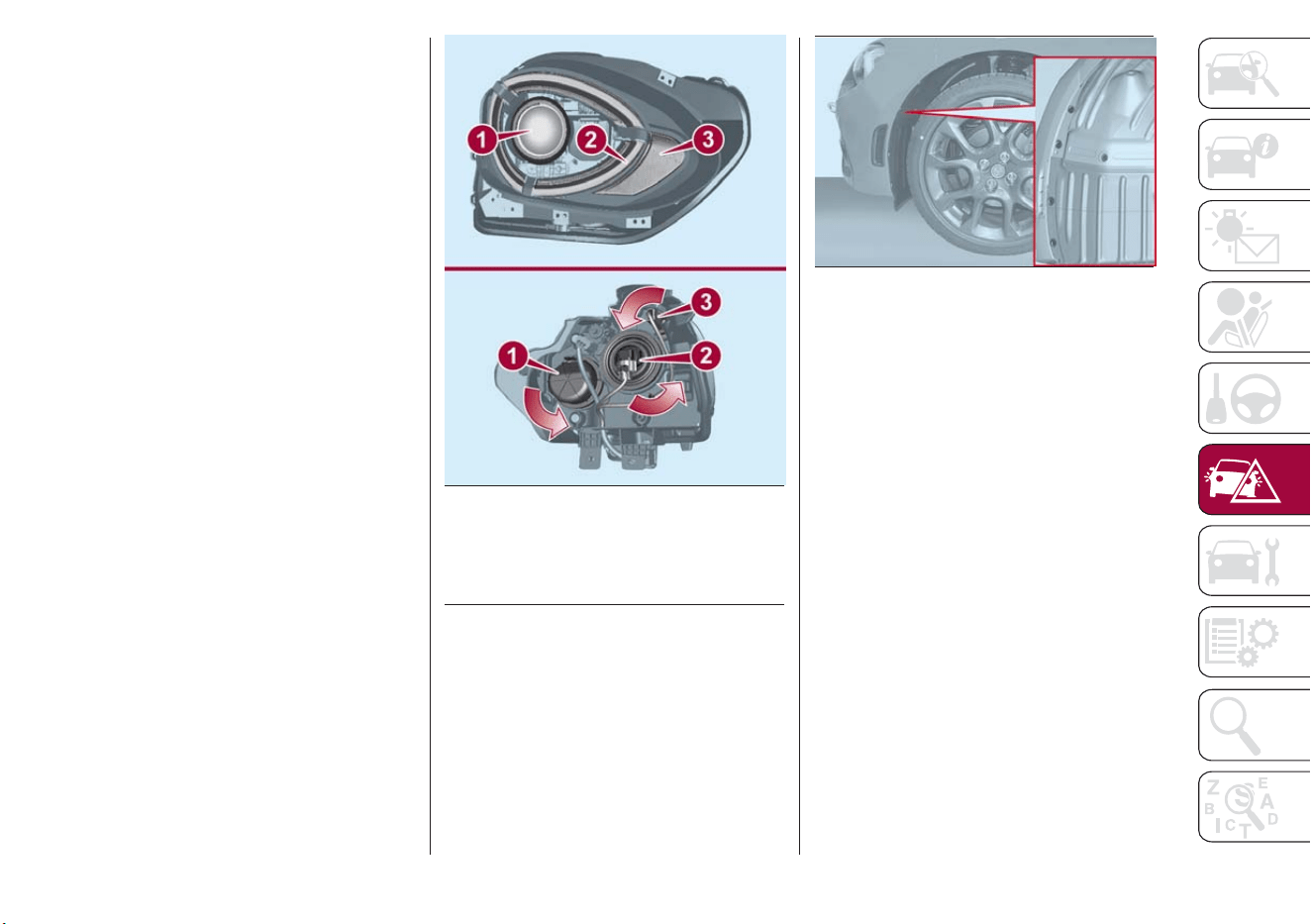
Headlights (High Beam) With
Daytime Running Lights
(If Equipped With LED Lamps)
Proceed as follows:
1. If you are changing the right bulb,
start the engine, turn the steering wheel
all the way to the right, and turn off
engine. If you are changing the left bulb,
turn the steering wheel to the left.
2. Make sure the ignition is placed in
the OFF mode, and the headlight
switch is off.
3. Remove the fasteners in the seven
locations and partially peel back the
mud guard.
4. Turn the socket and bulb assembly
counterclockwise and remove it.
5. Turn the cover counterclockwise and
remove it, disconnect the connector
from the unit by pressing the tab on the
connector with your finger and pulling
the connector.
6. Turn the socket and bulb assembly
counterclockwise and remove it.
7. Disconnect the bulb from the
socket.
8. Install the new bulb in the reverse
order of the removal procedure.
Front Direction Indicator Lights
Proceed as follows:
1. If you are changing the right bulb,
start the engine, turn the steering wheel
all the way to the right, and turn off
engine. If you are changing the left bulb,
turn the steering wheel to the left.
2. Make sure the ignition is placed in
the OFF mode, and the headlight
switch is off.
3. Remove the fasteners in the five
locations and partially peel back the
mud guard.
4. Disconnect the connector from the
unit by pressing the tab on the
connector with your finger and pulling
the connector rearward.
5. Turn the socket and bulb assembly
counterclockwise and remove it.
08020499000010
Head Lamp Assembly
1 — High Beam Lamp
2 — Position Lamp
3 — Daytime Running Lamp
07031501-206-002AB
Mud Guard
193

6. Disconnect the bulb from the
socket.
7. Install the new bulb in the reverse
order of the removal procedure.
Fog Lights
Proceed as follows:
1. If you are changing the right bulb,
start the engine, turn the steering wheel
all the way to the right, and turn off
engine. If you are changing the left bulb,
turn the steering wheel to the left.
2. Make sure the ignition is switched
off, and the headlight switch is off.
3. Remove the fasteners in the five
locations and partially peel back the
mud guard.
4. Disconnect the connector from the
unit by pressing the tab on the
connector with your finger and pulling
the connector.
5. Turn the socket and bulb assembly
counterclockwise, extract the bulb and
remove it.
6. Disconnect the bulb from the
socket.
7. Install the new bulb in the reverse
order of the removal procedure.
Brake lights / Tail lights
Go to your authorized dealer when the
replacement of this lights is necessary.
Side Direction Indicator Lights
Proceed as follows:
1. Make sure the ignition is placed in
the OFF mode, and the headlight
switch is off.
2. If you are changing the right bulb,
start the engine, turn the steering wheel
all the way to the right, and turn off
engine. If you are changing the left bulb,
turn the steering wheel to the left.
3. Remove the fasteners in the five
locations and partially peel back the
mud guard.
4. Disconnect the electrical connector
from the bulb by pressing the tab on
the connector with your finger and
pulling the connector.
5. Remove the lens assembly by
pressing the tab on the unit with your
finger and pulling the unit forward to
compress in the internal catch, then pull
the cluster outwards.
07031501-207-001
Front Direction Indicator Housing
1 — Socket Assembly
2 — Bulb
07031501-208-002AB
Direction Indicator Lamp Connector
194
IN CASE OF EMERGENCY

6. Lift up the lens assembly, and then
remove the cluster and install the new
side direction indicator lens assembly in
the reverse order of the removal
procedure.
Front Side Marker
(If Equipped With Halogen Bulb)
Proceed as follows:
1. Remove the fasteners in the seven
locations and partially peel back the
upper side of the mud guard.
2. Turn the socket counterclockwise,
remove socket assembly then remove
the bulb.
3. Install the new bulb in the reverse
order of the removal procedure.
08020499-000-011AB
Side Direction Indicator
1 — Fasteners
07031501-210-001AB
Side Direction Indicator
2 — Lens Assembly
07031501211001
Side Direction Indicator
3 — Internal Catch
4 — Lens Assembly
08070604-123-100
Front Side Marker
1 — Socket
2 — Bulb Assembly
195

Rear Direction Indicator Lights
Proceed as follows:
1. Remove the retainers and the trunk
lid end trim.
2. Disconnect the connector from the
unit by pressing the tab on the
connector with your finger.
3. Remove the screw and nuts.
4. Pull the taillight housing rearward to
remove it.
07031501-212-002
Trunk Trim
1 — Retainers
07031501214002
Trunk Trim
2 — Connector
07031501213002
Rear Direction Indicator Socket
3 — Connector
07031501-215-001
Taillight Housing Fasteners
4—Screw
5 — Nuts
07031501-216-001AB
Rear of Vehicle
6 — Taillight Housing
196
IN CASE OF EMERGENCY

5. Turn the socket and bulb assembly
counterclockwise to remove from
taillight housing, and remove bulb.
6. Install the new bulb in the reverse
order of the removal procedure.
Reverse Light
Proceed as follows:
1. Make sure the ignition is placed in
the OFF mode, and the headlight
switch is off.
2. Turn the socket assembly
counterclockwise to remove, and
remove bulb.
3. Install the new bulb in the reverse
order of the removal procedure.
Rear Side Marker
Proceed as follows:
1. Push the lens assembly rearward to
compress the internal catch, then pull
the lens assembly outwards.
2. Turn the socket and bulb assembly
counterclockwise to remove, and
remove bulb.
07031501-203-002
Taillight Housing
7 — Socket and Bulb Assembly
07031501-219-001
Reverse Light
1 — Socket Assembly
2 — Bulb
08070605AB
Rear Side Marker
1 — Rear Side Marker Lens Assembly
197

3. Install the new bulb and then
reinstall the socket in the reverse order
of the removal procedure.
License Plate Lights
Proceed as follows:
1. Make sure the ignition is placed in
the OFF mode, and the headlight
switch is off.
2. Slide the unit as shown in the figure
to remove it.
3. Turn the socket and bulb assembly
counterclockwise and remove, remove
bulb.
4. Install the new bulb in the reverse
order of the removal procedure. Insert
catch and push the housing back into
place.
08070606-123-100
Side Marker Housing
2 — Socket and Bulb Assembly
07031501220001
Trunk Lid
1 — License Plate Light Assembly
07031501-221-001
License Plate Light Housing
2 — Socket and Bulb Assembly
198
IN CASE OF EMERGENCY

Replacing Interior Light
Bulbs
Overhead Light
Proceed as follows:
1. Using a suitable tool to prevent
damage to the lens, remove the
overhead light by carefully prying on the
edge of the lens.
2. Disconnect the bulb by pulling it out.
3. Install the new bulb in the reverse
order of the removal procedure.
Trunk Light
Proceed as follows:
1. Using a suitable tool to prevent
damage to the to the lens, remove the
trunk light lens by carefully prying on
the edge of the lens.
2. Disconnect the connector from the
trunk light lens.
3. Disconnect the bulb by pulling it out.
4. Install the new bulb in the reverse
order of the removal procedure.
07031502-201-001
Overhead Light Location
1 — Overhead Light Lens
07031502-202-001
Trunk Light
1 — Trunk Light Lens
07031502-203-001
Trunk Light Housing
2 — Connector
199

REPLACING FUSES
General Information
Warning!
When replacing a blown fuse, always
use an appropriate replacement fuse with
the same amp rating as the original fuse.
Never replace a fuse with another fuse of
higher amp rating. Never replace a blown
fuse with metal wires or any other material.
Failure to use proper fuses may result in
serious personal injury, fire and/or property
damage.
Before replacing a fuse, make sure that
the ignition is off and that all the other
services are switched off and/or
disengaged.
If the replaced fuse blows again, contact
an authorized dealer.
If a general protection fuse for safety
systems (air bag system, braking system),
power unit systems (engine system,
transmission system) or steering system
blows, contact an authorized dealer.
Your vehicle's electrical system is
protected by fuses.
If any lights, accessories, or controls do
not work, inspect the appropriate circuit
protector. If a fuse has blown, the inside
element will be melted. If the same fuse
blows again, go to an authorized dealer
as soon as possible.
Fuse location
Fuses are grouped together in two fuse
boxes located in the interior on the left
side of the vehicle and under the hood.
Interior Fuses
If the electrical system does not work,
first inspect the fuses on the vehicle's
left side.
Proceed as follows:
1. Make sure the ignition is placed in
the OFF mode, and other switches are
turned off.
2. Open the fuse panel cover (located
near the door).
3. Press retaining clip and remove
protection cover.
4. Pull the fuse straight out with the
fuse puller provided on the fuse block
located in the engine compartment.
07031601-121-001
Fuse Panel Cover
07031601-122-001
Fuse Puller
200
IN CASE OF EMERGENCY

5. Inspect the fuse and replace it if it is
blown.
6. Insert a new fuse of the same
amperage rating, and make sure it fits
tightly. If it does not fit tightly, contact
your authorized dealer. If you have no
spare fuses, borrow one of the same
rating from a circuit not essential to
vehicle operation, such as the audio or
outlet circuit.
7. Reinstall the cover and make sure
that it is securely installed.
Note: Always replace a fuse with a
genuine FCA fuse or equivalent of the
same rating. Otherwise you may
damage the electric system.
Underhood Fuses
If the headlights or other electrical
components do not work and the fuses
in the cabin are normal, inspect the fuse
block in the engine compartment. If a
fuse is blown, it must be replaced.
Make sure the ignition is placed in the
OFF mode, and other switches are
turned off and remove the fuse block
cover. If the lock is forcefully opened,
the fuse block cover may come in
contact with the frame when it is
removed and become scratched.
When removing the cover, remove it
slowly according to the following
procedure:
1. Disengage the rear lock by pressing
down on the front tab with your fingers.
2. Remove the front tab while slightly
lifting the front of the cover.
3. Remove the cover while lifting it and
sliding it to the rear.
4. If any fuse but the main fuse is
blown, replace it with a new one of the
same amperage rating.
5. Reinstall the cover and make sure
that it is securely installed.
07031601-ALL-001
Fuses
1 — Normal Fuse
2 — Blown Fuse
07031601-123-001
Underhood Fuse Block
1 — Lock
2 — Cover
07031601-ALL-002AB
Fuse
1 — Normal Fuse
2 — Blown Fuse
201

Fuse Block (Engine Compartment)
07031602-121-001
202
IN CASE OF EMERGENCY
DESCRIPTION FUSE RATING PROTECTED COMPONENT
F01 ENG IG3 5 A Engine Control Systems
F02
ENG IG2 5 A Engine Control Systems
F03 HORN2 7.5 A Horn
F04 C/U IG1 15 A For Protection Of Various Circuits
F05 ENG IG1 7.5 A Engine Control System
F06 — — —
F07 INTERIOR 15 A Overhead Light
F08 — — —
F09 AUDIO2 15 A Audio System
F10 METER1 10 A Instrument Cluster
F11 SRS1 7.5 A Air Bag
F12 — — —
F13 RADIO 7.5 A Audio System
F14 ENGINE3 20 A Engine Control System
F15 ENGINE1 10 A Engine Control System
F16 ENGINE2 15 A Engine Control System
F17 AUDIO1 25 A Audio System
F18 A/C MAG 7.5 A Air Conditioner
F19 AT PUMP H/L HI 20 A Transmission Control System (If Equipped)
F20 AT 15 A Transmission Control System (If Equipped)
203

DESCRIPTION FUSE RATING PROTECTED COMPONENT
F21 D LOCK 25 A Power Door Locks
F22
H/L RH 20 A Headlight (RH)
F23 ENG + B2 7.5 A Engine Control System
F24 TAIL 20 A Taillights/Number Plate Lights/Position Lights
F25 — — —
F26 ROOM 25 A Overhead Light
F27 FOG 15 A Fog Lights
F28 H/CLEAN 20 A Headlight Washer (If Equipped)
F29 STOP 10 A Stop Lights/Rear Fog Light (If Equipped)
F30 HORN 15 A Horn
F31 H/L LH 20 A Headlight (LH)
F32 ABS/DSC S 30 A ABS/DSC System
F33 HAZARD 15 A Hazard Warning Flashers/Direction Indicators Lights
F34 FUEL PUMP 15 A Fuel System
F35 ENG + B3 5 A Engine Control System
F36 WIPER 20 A Windshield Wipers
F37 CABIN + B 50 A For Protection Of Various Circuits
F38 — — —
F39 — — —
F40 ABS/DSC M 50 A ABS/DSC System
204
IN CASE OF EMERGENCY
DESCRIPTION FUSE RATING PROTECTED COMPONENT
F41 EVVT A/R PUMP 20 A Engine Control System
F42
— — —
F43 — — —
F44 FAN2 40 A Cooling Fan
F45 ENG.MAIN 40 A Engine Control System
F46 EPS 60 A Power Steering System
F47 DEFOG 30 A Rear Window Defogger
F48 IG2 30 A For Protection Of Various Circuits
F49 — — —
F50 HEATER 40 A Air Conditioner
F51 — — —
F52 — — —
205

Fuse Block Interior
07031602-03F-002
206
IN CASE OF EMERGENCY
DESCRIPTION FUSE RATING PROTECTED COMPONENT
F01 RHT R 30 A —
F02
RHT L 30 A —
F03 — — —
F04 — — —
F05 F.OUTLET 15 A Accessory Sockets
F06 — — —
F07 AT IND 7.5 A AT Shift Indicator — If Equipped
F08 MIRROR 7.5 A Power Control Mirror
F09 R_DECK R 30 A —
F10 R_DECK L 30 A —
F11 F.WASHER 15 A Windshield Washer
F12 P.WINDOW 30 A Power Windows
F13 — — —
F14 SRS2/ESCL 15 A —
F15 — — —
F16 — — —
207
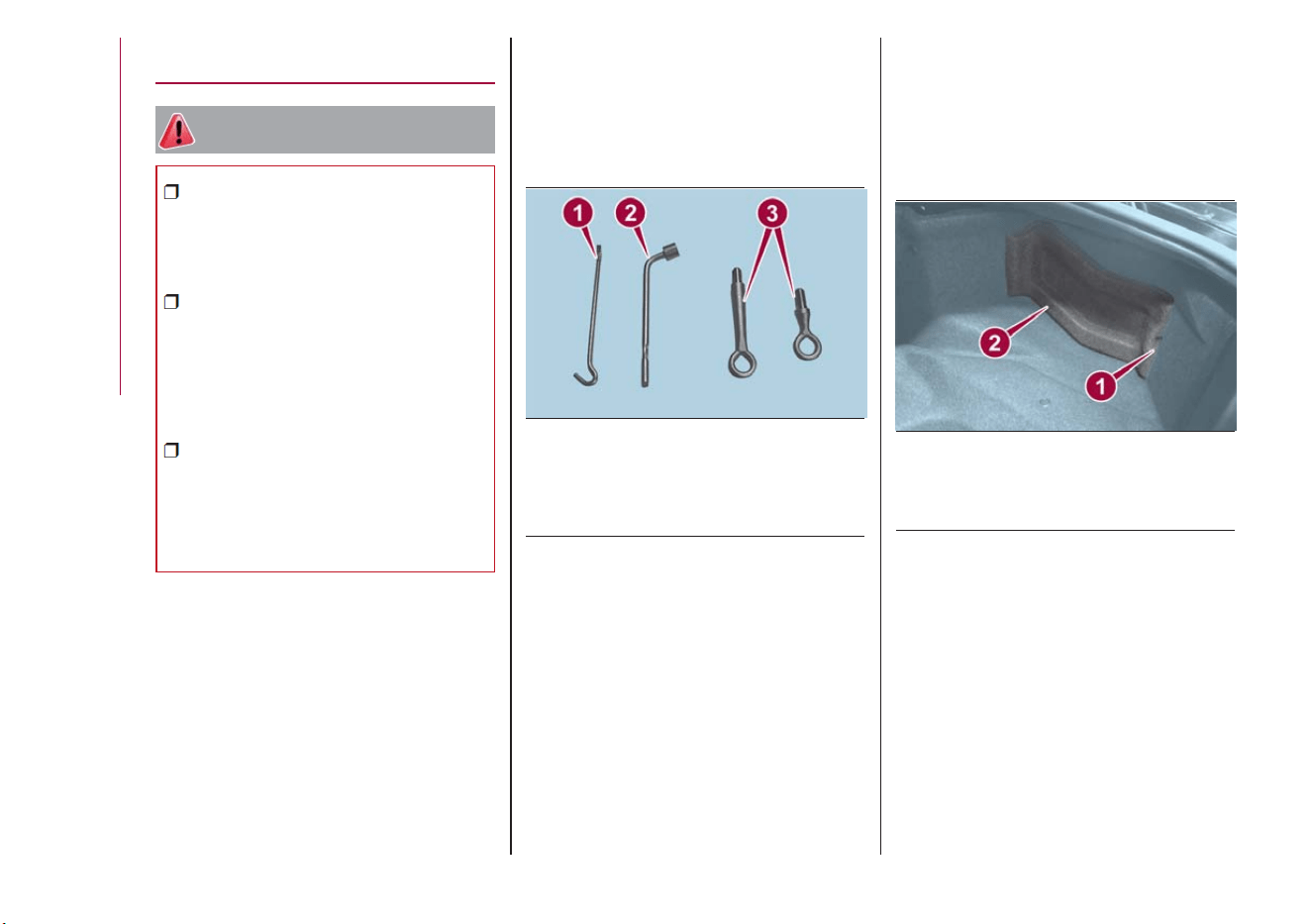
JACKING AND TIRE
CHANGING
Warning!
Do not attempt to change a tire on the
side of the vehicle close to moving traffic.
Pull far enough off the road to avoid the
danger of being hit when operating the jack
or changing the wheel.
Being under a jacked-up vehicle is
dangerous. The vehicle could slip off the
jack and fall on you. You could be crushed.
Never put any part of your body under a
vehicle that is on a jack. If you need to get
under a raised vehicle, take it to a service
center where it can be raised on a lift.
The jack is designed to be used as a
tool for changing tires only. The jack should
not be used to lift the vehicle for service
purposes. The vehicle should be jacked on
a firm level surface only. Avoid ice or
slippery areas.
Tools Location
Your vehicle may be equipped with a
spare tire, jack, lug wrench and tow
eyes. For details, contact an authorized
dealer.
Tools are stored in the trunk.
Preparations For
Jacking
To Remove The Jack
Proceed as follows:
1. In the right side of the trunk, pull the
cover tab to remove cover.
08020100-122-002
Jack Tools
1 — Jack Lever
2 — Lug Wrench (If Equipped)
3 — Tow Eyes (If Equipped)
08020101-124-001
Jack Location
1 — Cover Tab
2 — Jack And Tools Cover
208
IN CASE OF EMERGENCY

2. Turn the wing bolt and jack screw
counterclockwise.
To Secure The Jack
Proceed as follows:
1. Insert the wing bolt into the jack with
the jack screw pointing back, and turn
the wing bolt clockwise to temporarily
tighten it.
2. Turn the jack screw clockwise.
3. Turn the wing bolt completely to
secure the jack.
4. Insert the cover tabs and install the
cover.
Warning!
A loose tire or jack thrown forward in a
collision or hard stop could endanger the
occupants of the vehicle. Always stow the
jack parts and the spare tire in the places
provided. Have the deflated (flat) tire
repaired or replaced immediately.
Maintenance
Always keep the jack clean.
Make sure the moving parts are kept
free from dirt or rust.
Make sure the screw thread is
adequately lubricated.
Conditions Of Non-Use
Temperatures below -40°F (−40°C)
On sandy or muddy ground
On uneven ground
On steep roads
In extreme weather conditions
In direct contact with the engine or
for repairs under the vehicle
On boats
Jacking Instructions
Note: Make sure the jack is well
lubricated before using it.
Warning!
Do not attempt to change a tire on the side
of the vehicle close to moving traffic, pull
far enough off the road to avoid being hit
when operating the jack or changing the
wheel.
Proceed as follows:
1. Stop the vehicle in a position that
does not cause any danger to traffic
and lets you change the tire in safety, as
far as possible from the edge of the
driving lane. The ground must be flat
and sufficiently compact.
2. Turn on the Hazard Warning Lights
and engage the parking brake.
3. For vehicles with automatic
transmission, place the gear selector in
PARK. For vehicles with manual
transmission, place gear selector in
REVERSE and turn the engine to OFF.
4. Stop the engine. The motor must be
kept off as long as the vehicle is lifted
off the ground.
5. Remove the jack and tools.
08020101-122-001
Jack Components
3 — Wing Bolt
4 — Jack Screw
209

6. Block both the front and rear of the
wheel diagonally opposite of the jacking
position. For example, if changing the
right front tire, block the left rear wheel.
Removing A Tire
Warning!
Carefully follow these tire changing
warnings to help prevent personal injury or
damage to your vehicle:
Always park on a firm, level surface as
far from the edge of the roadway as
possible before raising the vehicle.
Turn on the Hazard Warning flasher.
Block the wheel diagonally opposite the
wheel to be raised.
Set the parking brake firmly and set the
transmission in PARK.
Do not let any passenger sit in the
vehicle when it is on a jack.
Do not get under the vehicle when it is
on a jack. If you need to get under a raised
vehicle, take it to a service center where it
can be raised on a lift.
Only use the jack in the positions
indicated and for lifting this vehicle during a
tire change.
If working on or near a roadway, be
extremely careful of motor traffic.
Proceed as follows:
1. Loosen the lug nuts by turning them
counterclockwise one turn each, but do
not remove any lug nuts until the tire
has been raised off the ground.
2. Place the jack under the lift point
closest to the tire being changed with
the jack head squarely under the
jacking location.
3. Turn the jack screw in the direction
shown and adjust the jack head so that
it is close to the jacking location.
4. Continue raising the jack head
gradually by rotating the screw with
your hand until the jack head is inserted
into the lift point.
Caution!
Do not attempt to raise the vehicle by
jacking on locations other than those
indicated in the Jacking Instructions for this
vehicle.
08020300-121-001
Blocking Right Front Tire And Left
Rear Tire
08020301-123-001
Loosen Lug Nuts Counterclockwise
08020301-ALL-003
Raising The Jack
1 — Jack Head
210
IN CASE OF EMERGENCY
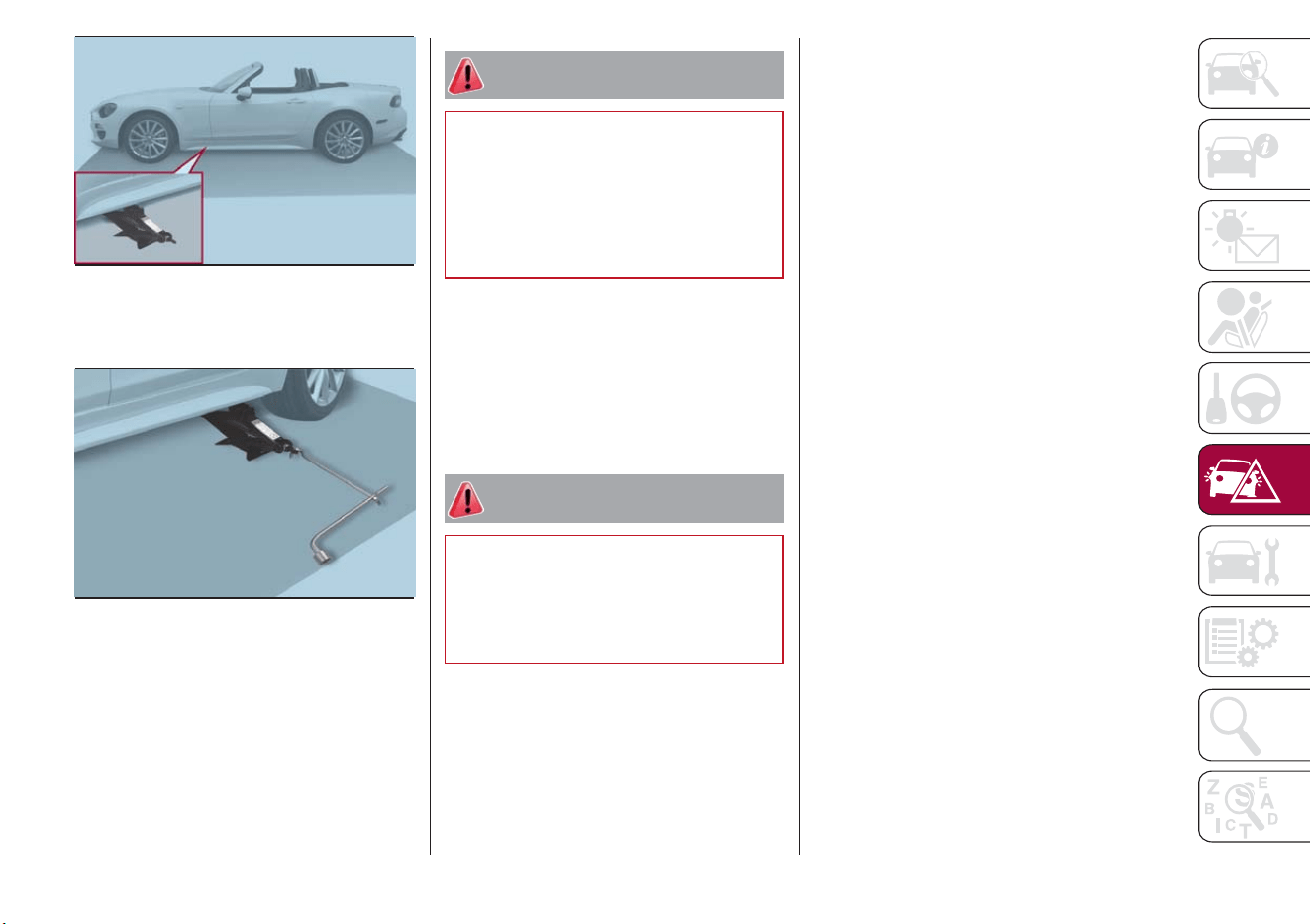
5. Insert the jack lever and attach the
lug wrench to tire jack.
Warning!
Being under a jacked-up vehicle is
dangerous. The vehicle could slip off the
jack and fall on you. You could be crushed.
Never get any part of your body under a
vehicle that is on a jack. If you need to get
under a raised vehicle, take it to a service
center where it can be raised on a lift.
6. Turn the jack handle clockwise and
raise the vehicle high enough so that
the tire is just raised off the ground and
can be removed. Before removing the
lug nuts, make sure your vehicle is
firmly in position and that it cannot slip
or move.
Warning!
Raising the vehicle higher than necessary
can make the vehicle less stable. It could
slip off the jack and hurt someone near it.
Raise the vehicle only enough to remove
the tire.
7. Remove the lug nuts by turning
them counterclockwise, then remove
the wheel.
Locking Lug Nuts — If Equipped
If your vehicle has optional anti-theft
wheel lug nuts, one on each wheel will
lock the tires and you must use a
special key to unlock them. This key will
attach to the lug wrench.
Register them with the lock
manufacturer by filling out the card
provided in the glove compartment and
mailing it in the accompanying
envelope. If you lose this key, contact
an authorized dealer or use the lock
manufacturer's order form, which is
with the registration card.
Accessory wheel locks cannot be used
on steel wheels. This includes situations
when the spare tire is installed. If the
spare tire is installed, one of the original
lug nuts (which should still be in the
vehicle) must be installed in place of the
wheel lock.
To Remove An Anti-theft Lug Nut
Proceed as follows:
1. Obtain the special key for the
anti-theft lug nut.
2. Place the special key on top of the
anti-theft lug nut, and be sure to hold
the key square to it. If you hold the key
at an angle, you may damage both key
and nut. Do not use a power impact
wrench.
3. Place the lug wrench on top of the
key and apply pressure. Turn the
wrench counterclockwise.
08020301-121-001
Front Jacking Location
08020301-ALL-006
Jack With Lug Wrench Attached
211

To Install The Anti-theft Lug Nut
Proceed as follows:
1. Place the special key on top of the
nut, and be sure to hold the key square
to it. If you hold the key at an angle, you
may damage both key and nut. Do not
use a power impact wrench.
2. Place the lug wrench on top of the
special key, apply pressure, and turn it
clockwise.
Mounting The Tire
Proceed as follows:
1. Remove dirt and grime from the
mounting surfaces of the wheel and
hub, including the hub bolts, with a
cloth.
2. Mount the tire and install the lug
nuts with the beveled edge inward, then
tighten them by hand.
Caution!
Be sure to mount the spare tire with the
valve stem facing outward. The vehicle
could be damaged if the spare tire is
mounted incorrectly.
3. Turn the lug wrench
counterclockwise and lower the vehicle.
Use the lug wrench to tighten the nuts
in the order shown.
Warning!
To avoid the risk of forcing the vehicle off
the jack, do not tighten the wheel nuts fully
until the vehicle has been lowered. Failure
to follow this warning may result in serious
injury.
4. After tightening the lug nuts, have
them checked with a torque wrench by
your authorized dealer or service station
to verify correct tightness.
5. Remove the tire blocks and store
the tools and jack.
6. Check the inflation pressure. Refer
to “Recommended Tire Inflation
Pressure” in “Technical Specifications”
for more information.
With TPMS
Do not push the tire pressure
monitoring system set switch after
installing the spare tire. The switch is
only to be pushed after installing the
repaired flat tire or installing a
replacement tire.
Note: To prevent the jack and tool from
rattling, store them properly.
Warning!
A loose tire or jack thrown forward in a
collision or hard stop could endanger the
occupants of the vehicle. Always stow the
jack parts and the spare tire in the places
provided. Have the deflated (flat) tire
repaired or replaced immediately.
08020303-XX4-001
Clean Mounting Surface
08020303-122-001
Lug Nut Tightening Order
212
IN CASE OF EMERGENCY
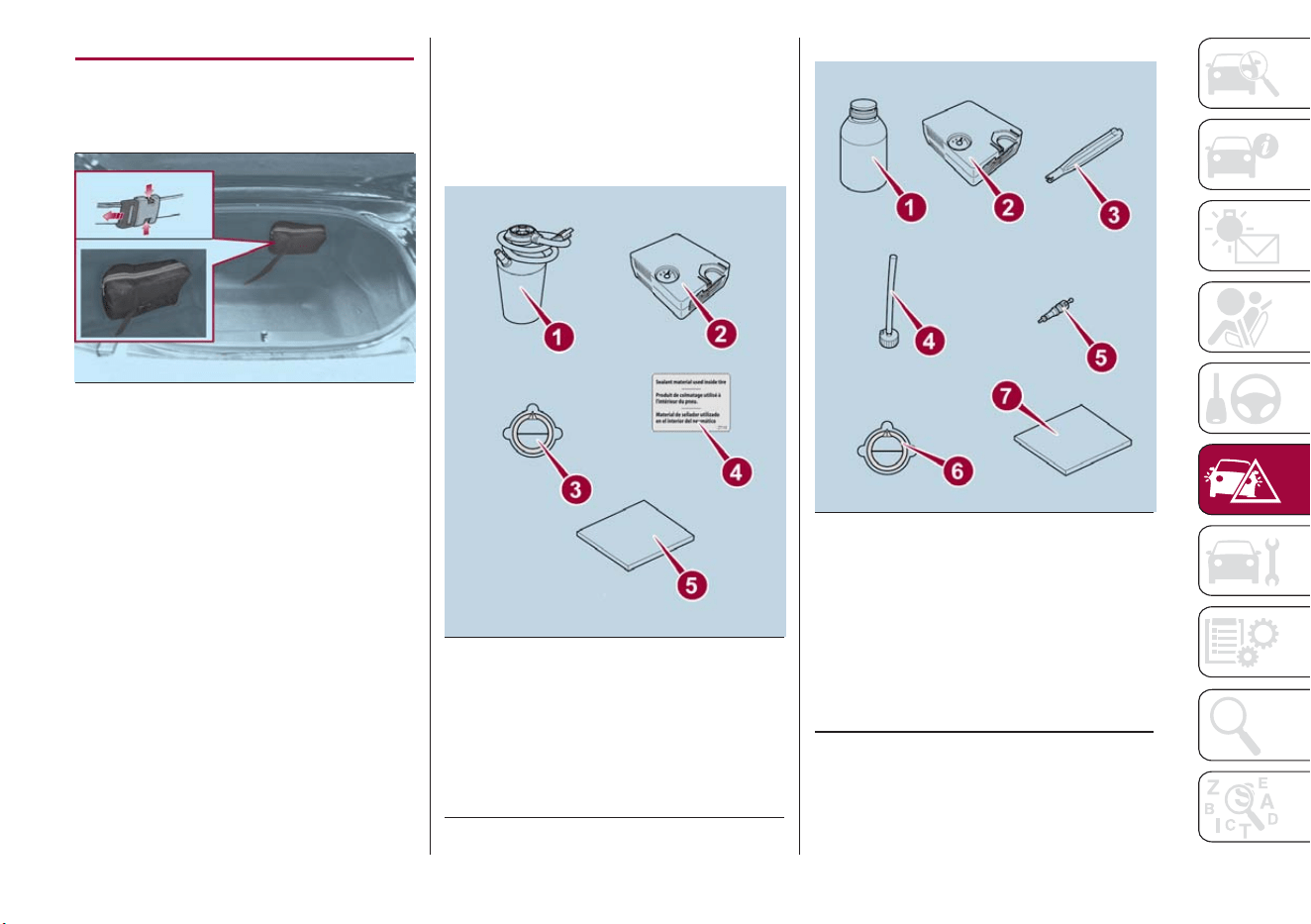
TIRE SERVICE KIT
Tire Service Storage
The Tire Service Kit is located inside the
trunk.
The Tire Service Kit included with your
vehicle is for a temporary repair of a
slightly damaged flat tire resulting from
running over nails or similar sharp
objects on the road surface.
Perform the emergency flat tire repair
without removing the nail or similar
sharp object which punctured the tire.
Note: Your vehicle is not equipped with
a spare tire. In the event of a flat tire,
use the Tire Service Kit to repair the tire
temporarily. When doing the repair, refer
to the instructions included in the Tire
Service Kit. If an emergency repair was
performed on a flat tire using the Tire
Service Kit, contact an authorized
dealer to repair or replace the tire as
soon as possible.
Tire Service Kit
Components And
Operation
The Tire Service Kit includes the
following items:
U.S.A. And Canada Markets:
Mexico Market:
08020202-121-003
Tire Service Kit Location
08070606457457
Tire Service Kit Components —
U.S.A. And Canada Markets
1— Sealant Bottle
2— Compressor
3— Speed Restriction Sticker
4— Repaired Tire Sticker
5— Instructions
08070606456456
Tire Service Kit Components —
Mexico Markets
1— Tire Sealant
2— Compressor
3— Valve Core Tool
4— Injection Hose
5— Spare Valve Core
6— Speed Restriction Sticker
7— Instructions
213

Tire Service Usage
Precautions
The tire sealant cannot be reused. If the
sealant has been used, or is expired,
purchase new tire sealant at an
authorized dealer.
Note: The Tire Service Kit cannot be
used in the following cases. Consult an
authorized dealer if any of these
conditions exist:
The period of effective use for the
tire sealant has expired (the period of
effectiveness is indicated on the bottle
label)
The tear or puncture in the tire
exceeds about 0.16 inches (4 mm)
The damage has occurred to an
area of the tire other than the tread
The vehicle has been driven with
nearly no air remaining in the tire
The tire has come off the wheel rim
Damage to the wheel rim has
occurred
The tire has two or more punctures
Sealing A Tire With Tire
Service Kit
Warning!
Do not attempt to seal a tire on the side
of the vehicle closest to traffic. Pull far
enough off the road to avoid the danger of
being hit when using the Tire Service Kit.
Do not use Tire Service Kit or drive the
vehicle under the following circumstances:
If the puncture in the tire tread is
approximately 1/4 inch (6 mm) or larger.
If the tire has any sidewall damage.
If the tire has any damage from driving
with extremely low tire pressure.
If the tire has any damage from driving
on a flat tire.
If the wheel has any damage.
If you are unsure of the condition of the
tire or the wheel.
Keep Tire Service Kit away from open
flames or heat sources.
A loose Tire Service Kit thrown forward
in a collision or hard stop could endanger
the occupants of the vehicle. Always stow
the Tire Service Kit in the place provided.
Failure to follow these warnings can result
in injuries that are serious or fatal to you,
your passengers, and others around you.
Take care not to allow the contents of
Tire Service Kit to come in contact with
hair, eyes, or clothing. Tire Service Kit
sealant is harmful if inhaled, swallowed, or
absorbed through the skin. It causes skin,
eye, and respiratory irritation. Flush
immediately with plenty of water if there is
any contact with eyes or skin. Change
clothing as soon as possible, if there is any
contact with clothing.
Tire Service Kit Sealant solution contains
latex. In case of an allergic reaction or rash,
consult a physician immediately. Keep Tire
Service Kit out of reach of children. If
swallowed, rinse mouth immediately with
plenty of water and drink plenty of water.
Do not induce vomiting! Consult a
physician immediately.
U.S.A. And CANADA Markets:
Proceed as follows:
1. Pull over to a safe location and turn
on the vehicle’s Hazard Warning Lights.
2. Verify that the valve stem (on the
wheel with the deflated tire) is in a
position that is near to the ground. This
will allow the Tire Service Kit hoses to
reach the valve stem and keep the Tire
Service Kit flat on the ground. This will
provide the best positioning of the kit
when injecting the sealant into the
deflated tire and running the air pump.
Move the vehicle as necessary to place
the valve stem in this position before
proceeding.
214
IN CASE OF EMERGENCY
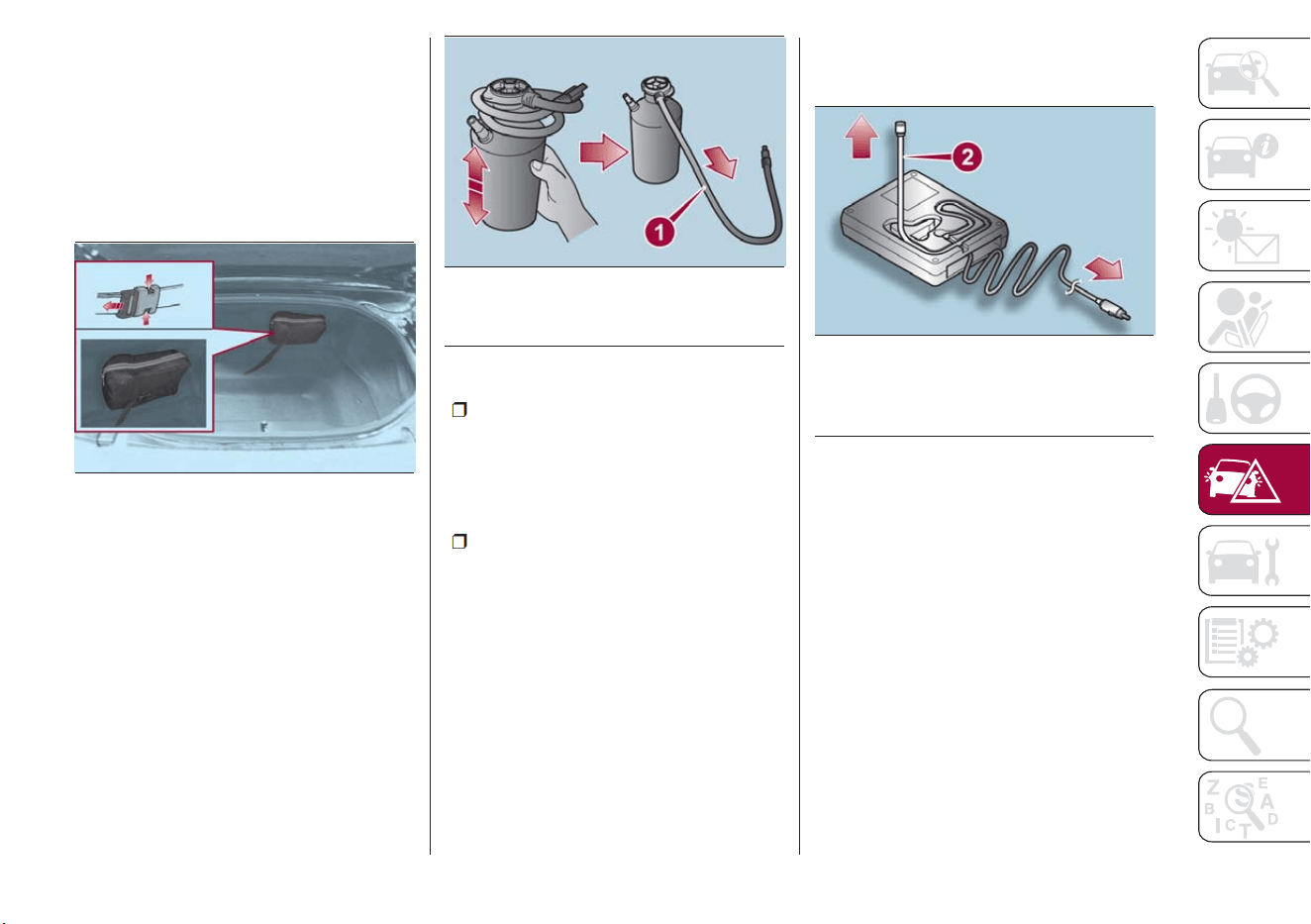
3. Place the gear selector in REVERSE
for a manual transmission, and PARK
for automatic transmission.
4. Apply the parking brake with the
brake pedal pressed and turn the
engine OFF.
5. Unload passengers and cargo, then
remove the Tire Service Kit.
6. Gently shake the sealant bottle to
mix the contents. Then extend the
injection hose.
Note:
Do not shake the bottle
excessively. Otherwise, the sealant
could spray out of the injection hose. If
the sealant contacts clothing or other
objects, you may not be able to
remove it.
The sealant hardens easily, and
injecting it will be difficult under cold
weather conditions (32 °F (0 °C) or
below). Warm the sealant inside the
vehicle to facilitate injection.
7. Pull out the air compressor hose
and the air compressor plug from the
air compressor.
8. Install the air compressor hose,
which was pulled out of the air
compressor, into the injection valve of
the bottle.
08020202-121-003
Tire Service Kit Location
08020202-03A-666
Sealant Bottle With Injection Hose
1 — Injection Hose
08020202-36A-004
Air Compressor With Hose And
Plug
2 — Air Compressor Hose
215

Note: Make sure that the air
compressor switch is off before
inserting the air compressor hose into
the injection valve of the bottle. If the air
compressor hose is not installed to the
injection valve of the bottle securely, the
sealant may leak.
9. Remove the valve cap from the valve
of the flat tire, install the injection hose
to the tire valve, and turn the sleeve to
the right to tighten.
10. Install the bottle to the air
compressor and push it in until the left
and right tabs are engaged securely.
11. Insert the air compressor plug into
the accessory socket inside the vehicle
and place the ignition to ACC.
Note: When inserting the air
compressor plug into or removing it
from the accessory socket, make sure
that the air compressor switch is off.
When turning the air compressor on/off,
use the air compressor switch. Before
checking the tire inflation pressure using
the tire pressure gauge, tur n the air
compressor switch off.
12. The sealant is injected into the tire
when the air compressor is switched
on. After the sealant is injected
completely, wait until the tire inflation
pressure increases to the specified tire
inflation pressure. For the correct
pressure, check the tire inflation
pressure label on the driver's door
frame.
Note: The inflation pressure may
increase to about 43.5 psi (3 Bar)
temporarily to inject the sealant through
the valve. Normally, the inflation
pressure decreases gradually and it
reaches the actual inflation pressure
after about 30 seconds.
08020202-031-670
Install Air Compressor To Sealant
Bottle
3 — Air Compressor Hose
4 — Injection Valve
08020202-03A-004AB
Valve And Valve Cover
5 — Valve Cap
6 — Valve
08020202-031-669
Sealant Bottle Into Air Compressor
7 — Air Compressor Tabs
216
IN CASE OF EMERGENCY

Warning!
Never use the air compressor above 3 Bar
(43.5 psi). Using the air compressor at an
inflation pressure above 3 Bar (43.5 psi)
continuously is dangerous. If the air
compressor overheats, hot air will be
exhausted and you could get burned.
Caution!
If the tire inflation pressure does not
increase, repair of the tire is not possible. If
the tire does not reach the specified tire
inflation pressure within 10 minutes, it may
have received extensive damage. In this
case, the repair using the tire service kit
was not successful.
Do not operate the air compressor for a
continuous 10 minutes or longer because
using it for long periods could cause a
malfunction.
13. Adhere the speed restriction sticker
to an area where it can be viewed easily
by the driver.
Warning!
Do not adhere the speed restriction sticker
to the padded area on the steering wheel.
Adhering the speed restriction sticker to
the padded area on the steering wheel is
dangerous because the air bag may not
operate (deploy) normally resulting in
serious injury. In addition, do not adhere
the sticker to areas where warning lights or
the speedometer cannot be viewed.
14. Adhere the repaired tire sticker to
the wheel of the flat tire.
15. When the tire inflates to the
specified tire inflation pressure, tur n the
air compressor switch off, turn the
sleeve of the injection hose to the left,
and pull it out of the tire valve.
16. Remove the air compressor hose
from the injection valve of the bottle.
Then, install the injection hose to the
injection valve of the bottle to prevent
leakage of any remaining sealant.
Note: The remaining sealant in the
hose may spray out when the hose is
removed. Remove the hose carefully
because you may not be able to
remove the sealant contacting clothing
or other objects.
17. Install the tire valve cap.
18. Place the Tire Service Kit back into
its storage location.
19. Start driving immediately to spread
the sealant in the tire.
08020202-031-667
Repaired Tire Sticker
08020202-031-668
Install Injection Hose
To Sealant Bottle
217

Note: Carefully drive the vehicle at a
speed of 50 mph (80 km/h) or less. If
the vehicle is driven at a speed of
50 mph (80 km/h) or more, the vehicle
may vibrate.
Note: With TPMS System: if the tire
is not properly inflated, the
warning
light will illuminate.
After driving the vehicle for about
10 minutes or 3 miles (5 km), connect
the air compressor to the tire using
Step nine of the procedure, and check
the tire inflation pressure using the tire
pressure gauge on the air compressor.
If the tire inflation pressure is lower than
the specified tire inflation pressure, turn
the air compressor on and wait until it
reaches the specified tire inflation
pressure.
The Tire Service Kit is completed
successfully if the tire inflation pressure
does not decrease. Carefully drive the
vehicle to the nearest authorized dealer
immediately and have the flat tire
replaced. Replacement with a new tire
is recommended. If the tire is to be
repaired or reused, consult an
authorized dealer.
Note:
If an emergency flat tire repair has
been performed using the Tire Service
Kit, FCA recommends that the tire be
replaced with a new one as soon as
possible. If the tire is to be repaired or
reused, contact an authorized dealer.
The wheel can be reused if the
sealant adhering to it is removed.
However, replace the valve with a new
one.
Sealing A Tire With Tire
Service Kit
Warning!
Do not attempt to seal a tire on the side
of the vehicle closest to traffic. Pull far
enough off the road to avoid the danger of
being hit when using the Tire Service Kit.
Do not use Tire Service Kit or drive the
vehicle under the following circumstances:
If the puncture in the tire tread is
approximately 1/4 inch (6 mm) or larger.
If the tire has any sidewall damage.
If the tire has any damage from driving
with extremely low tire pressure.
If the tire has any damage from driving
on a flat tire.
If the wheel has any damage.
If you are unsure of the condition of the
tire or the wheel.
Keep Tire Service Kit away from open
flames or heat sources.
A loose Tire Service Kit thrown forward
in a collision or hard stop could endanger
the occupants of the vehicle. Always stow
the Tire Service Kit in the place provided.
Failure to follow these warnings can result
in injuries that are serious or fatal to you,
your passengers, and others around you.
Take care not to allow the contents of
Tire Service Kit to come in contact with
hair, eyes, or clothing. Tire Service Kit
sealant is harmful if inhaled, swallowed, or
absorbed through the skin. It causes skin,
eye, and respiratory irritation. Flush
immediately with plenty of water if there is
any contact with eyes or skin. Change
clothing as soon as possible, if there is any
contact with clothing.
Tire Service Kit Sealant solution contains
latex. In case of an allergic reaction or rash,
consult a physician immediately. Keep Tire
Service Kit out of reach of children. If
swallowed, rinse mouth immediately with
plenty of water and drink plenty of water.
Do not induce vomiting! Consult a
physician immediately.
218
IN CASE OF EMERGENCY

Mexico Market
Proceed as follows:
1. Pull over to a safe location and turn
on the vehicle’s Hazard Warning Lights.
2. Verify that the valve stem (on the
wheel with the deflated tire) is in a
position that is near to the ground. This
will allow the Tire Service Kit hoses to
reach the valve stem and keep the Tire
Service Kit flat on the ground. This will
provide the best positioning of the kit
when injecting the sealant into the
deflated tire and running the air pump.
Move the vehicle as necessary to place
the valve stem in this position before
proceeding.
3. Place the gear selector in REVERSE
for a manual transmission, or PARK for
automatic transmission.
4. Apply the parking brake with the
brake pedal pressed and turn the
engine OFF.
5. Unload passengers and cargo, then
remove the Tire Service Kit.
6. Gently shake the tire sealant. If the
bottle is shaken after the injection hose
is screwed on, tire sealant could spray
out from the injection hose. Tire sealant
contacting clothing or other objects
may be impossible to remove. Shake
the bottle before screwing on the
injection hose.
Note:
Do not shake the bottle
excessively. Otherwise, the sealant
could spray out of the injection hose,
and if the sealant contacts clothing or
other objects, you may not be able to
remove it.
The sealant hardens easily and
injecting it will be difficult under cold
weather conditions 32 °F (0 °C) or
below. Warm the sealant inside the
vehicle to facilitate injection.
7. Remove the cap from the bottle and
screw on the injection hose with the
bottle's inner cap left on to break the
inner cap.
0802020203A003
Attaching Injection Hose
To Sealant Bottle
219

8. Remove the valve cap from the flat
tire. Push the back of a valve core tool
to the core of the tire valve and bleed
out all of the remaining air.
Note: If there is air remaining in the
tire when the valve core is removed, the
valve core could fly out. Remove the
valve core carefully.
9. Turn the valve core counter
clockwise with the valve core tool and
remove the valve core.
Note: Store the valve core in a place
where it will not get dirty.
10. Insert the injection hose into the
valve.
11. Hold the bottom of the bottle
upright, squeeze the bottle with your
hands, and inject the entire amount of
tire sealant into the tire.
12. Pull out the injection hose from the
valve.
08020202-03A-004AB
Valve And Valve Cover
5 — Valve Cap
6 — Tire Valve
08020202-03A-005AB
Turn Valve Core Counterclockwise
08020202-03A-008AB
Injection Hose Into Valve
08020202-03A-008
Squeeze Sealant Into Tire
08020202-03A-007AB
Turn Valve Core Clockwise To
Reinstall
220
IN CASE OF EMERGENCY
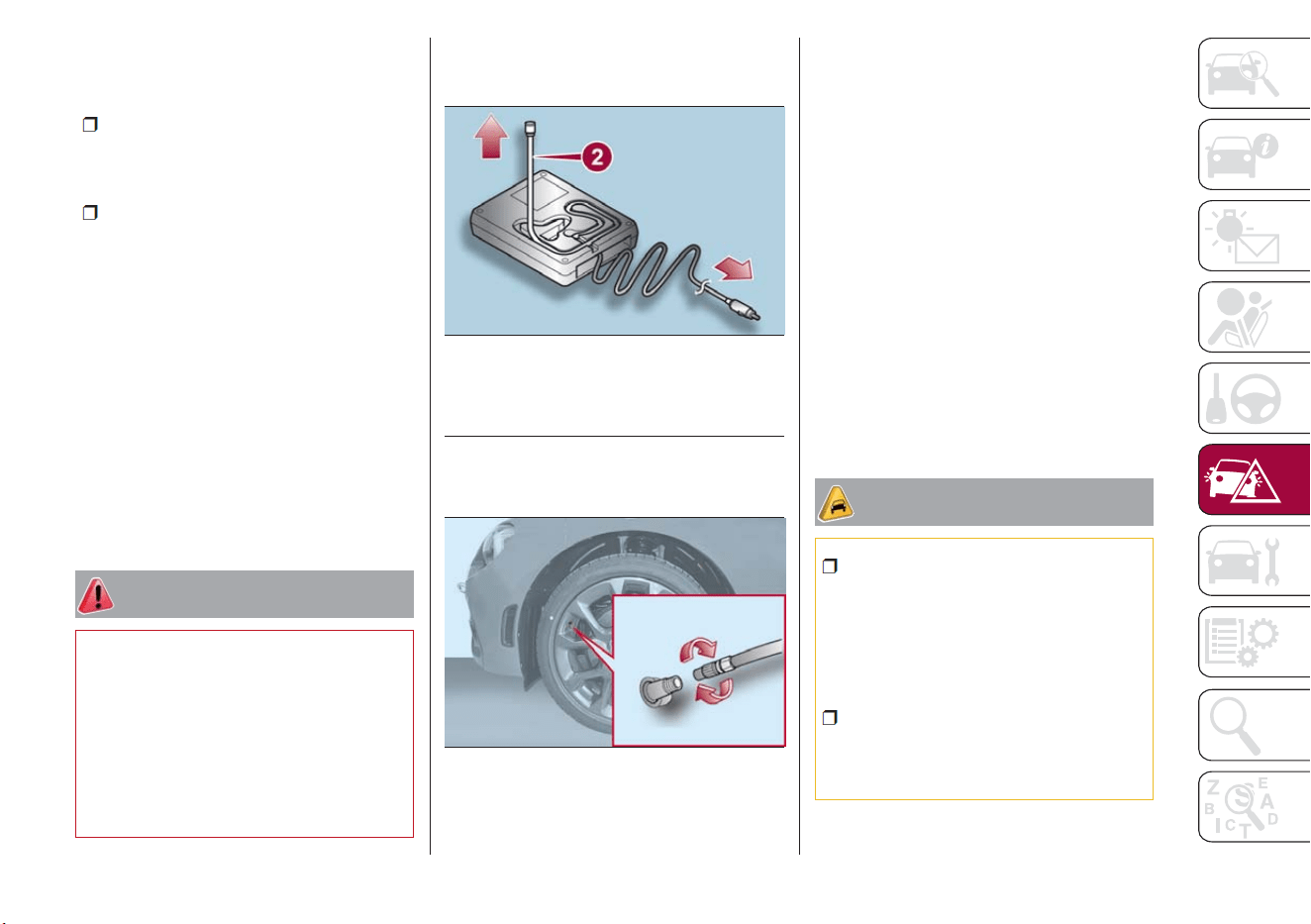
13. Reinsert the valve core into the
valve and turn it clockwise to install.
Note:
The tire sealant cannot be reused.
If the tire sealant kit has been used, or
is expired, purchase new one at an
authorized dealer.
Do not throw away the empty tire
sealant bottle after use. Return the
empty tire sealant bottle to an
authorized dealer when replacing the
tire. The empty tire sealant bottle will
need to be used to extract and
dispose of the used sealant from the
tire.
14. Install the injection hose to the tab
of the bottle to prevent leakage of any
remaining sealant.
15. Adhere the speed restriction sticker
to an area where it can be viewed easily
by the driver.
Warning!
Do not adhere the speed restriction sticker
to the padded area on the steering wheel.
Adhering the speed restriction sticker to
the padded area on the steering wheel is
dangerous because the air bag may not
operate (deploy) normally resulting in
serious injury. In addition, do not adhere
the sticker to areas where warning lights or
the speedometer cannot be viewed.
16. Pull out the air compressor hose
and the air compressor plug from the
air compressor.
17. Install the air compressor hose to
the tire valve.
18. Insert the air compressor plug into
the accessory socket inside the vehicle
and place the ignition to ACC.
19. Turn the air compressor switch on
and inflate the tire carefully to the
correct inflation pressure. For the
correct pressure, check the tire inflation
pressure label on the driver's door
frame.
Note: When inserting the air
compressor plug into or removing it
from the accessory socket, make sure
that the air compressor switch is off.
When turning the air compressor on/off,
use the air compressor switch. Before
checking the tire inflation pressure using
the tire pressure gauge, tur n the air
compressor switch off.
Caution!
If the tire inflation pressure does not
increase, repair of the tire is not possible. If
the tire does not reach the specified tire
inflation pressure within 10 minutes, it may
have received extensive damage. In this
case, the repair using the tire service kit
was not successful.
Do not operate the air compressor for a
continuous 10 minutes or longer because
using it for long periods could cause a
malfunction.
08020202-36A-004
Air Compressor With Hose And
Plug
2 — Air Compressor Hose
08020202-03A-00BAB
Air Compressor Hose Into Valve
221

Note: If the tire has been over
inflated, loosen the screw cap on the air
compressor and bleed some of the air
out.
20. When the tire inflates to the
specified tire inflation pressure, tur n the
air compressor switch off, turn the
sleeve of the air compressor hose to
the left, and pull it out of the tire valve.
21. Install the tire valve cap.
22. Place the Tire Service Kit back into
its storage location.
23. Start driving immediately to spread
the sealant in the tire.
Note:
Carefully drive the vehicle at a
speed of 50 mph (80 km/h) or less. If
the vehicle is driven at a speed of
50 mph (80 km/h) or more, the vehicle
may vibrate.
With TPMS System: if the tire is
not properly inflated, the
warning
light will illuminate.
After driving the vehicle for about
10 minutes or 3 miles (5 km), connect
the air compressor to the tire using
step nine of the procedure, and check
the tire inflation pressure using the tire
pressure gauge on the air compressor.
If the tire inflation pressure is lower
than the specified tire inflation
pressure, turn the air compressor on
and wait until it reaches the specified
tire inflation pressure;
The emergency flat tire repair is
completed successfully if the tire
inflation pressure does not decrease.
Carefully drive the vehicle to the
nearest authorized dealer and have the
flat tire replaced. Replacement with a
new tire is recommended. If the tire is
to be repaired or reused, contact a
authorized dealer.
If an emergency flat tire repair has
been performed using the Tire Service
Kit, FCA recommends that the tire be
replaced with a new one as soon as
possible. If the tire is to be repaired or
reused, contact an authorized dealer.
The tire can be reused if the sealant
adhering to it is removed. However,
replace the valve with a new one.
Replacing The Bottle
Note: The tire sealant has a period of
effective use. Check the period of
effective use indicated on the bottle
labelanddonotuseitifithasexpired.
Have the tire sealant replaced at an
authorized dealer before the period of
effective use has expired.
Inspect the Tire Service Kit at regular
intervals as well as the operation of the
tire compressor.
222
IN CASE OF EMERGENCY
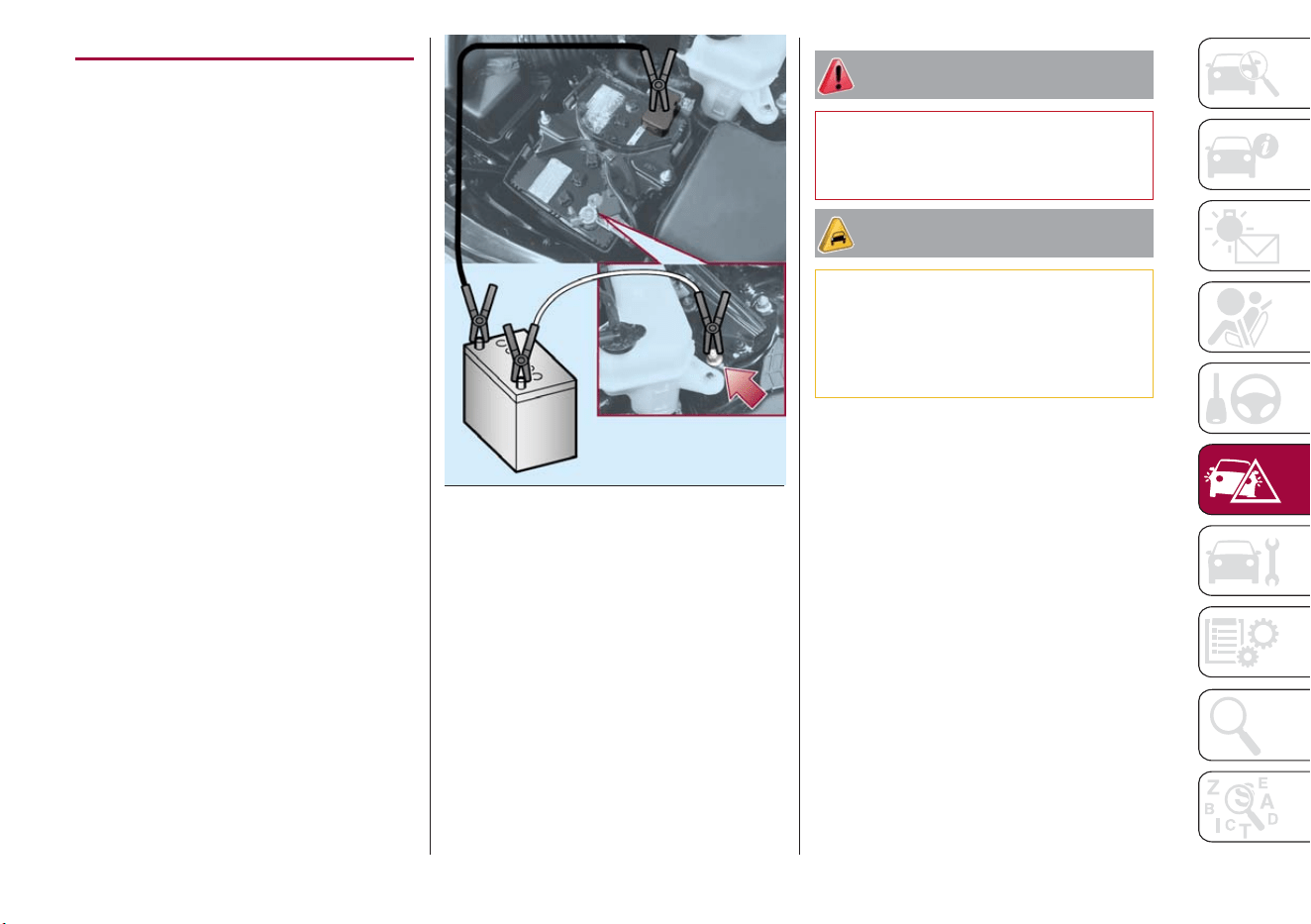
JUMP STARTING
Preparations For Jump
Starting
If the battery is discharged, a jump
starting procedure can be performed
using the battery and the cables of
another vehicle, or using a booster
battery.
Jump starting is dangerous if done
incorrectly, so follow the procedure in
this section carefully. If you feel unsure
about jump starting, it is strongly
recommended that you have a
competent service technician do the
work.
Note: When a booster battery is being
used, comply with the utilization and
precaution instructions specified by the
manufacturer.
Warning!
Do not attempt jump starting if the battery
is frozen. It could rupture or explode and
cause personal injury.
Caution!
Do not use a portable battery booster pack
or any other booster source with a system
voltage greater than 12 Volts or damage to
the battery, starter motor, alternator or
electrical system may occur.
08030100121001
Jump Start Locations
223

Jump-Starting
Procedure
Warning!
Failure to follow this jump starting
procedure could result in personal injury or
property damage due to battery explosion.
Caution!
Failure to follow these procedures could
result in damage to the charging system of
the booster vehicle or the discharged
vehicle.
To jump start the vehicle, follow this
procedure:
1. Remove the positive terminal cover.
2. Make sure the booster battery is
12 Volts and that the negative terminal
is grounded.
3. Turn off the engine of the vehicle
with the booster battery and all
unnecessary electrical loads in both
vehicles.
Warning!
Do not allow vehicles to touch each other
as this could establish a ground
connection and personal injury could
result.
4. Connect the positive end of the
jumper cable to the positive terminal on
the discharged battery.
5. Connect the opposite end of the
positive jumper cable to the positive
terminal on the booster battery.
6. Connect the negative end of the
negative jumper cable to the negative
terminal of the booster battery.
7. Connect the opposite end of the
negative jumper cable to a good engine
ground of the vehicle with the
discharged battery (exposed metal part
of the engine) away from the battery
and the fuel injection system.
8. Start the engine of the booster
vehicle and run it a few minutes. Then
start the engine of the other vehicle.
9. Once the engine is started, remove
the jumper cables in the reverse
sequence.
10. Replace the positive terminal cover.
Make sure cover is secure.
Bump Starting
Never jump start the engine by pushing,
towing or coasting downhill.
Note:
You cannot start a vehicle with an
automatic transmission by pushing it.
Do not push-start a vehicle that has
a manual transmission. It can damage
the emission control system.
08030100-122-001
Positive Terminal Cover
224
IN CASE OF EMERGENCY

Starting A Flooded
Engine
If the engine fails to start, it may be
flooded (excessive fuel in the engine).
Follow this procedure:
1. If the engine does not start within
5 seconds on the first try, wait
10 seconds and try again.
2. Make sure the parking brake is on.
3. Press the accelerator all the way and
hold it there.
4. Press the clutch pedal (manual
transmission) or the brake pedal
(automatic transmission), then push the
push button start. If the engine starts,
release the accelerator immediately
because the engine will suddenly rev
up.
5. If the engine fails to start, crank it
without pressing the accelerator.
If the engine still does not start using
the above procedure, have your vehicle
inspected an authorized dealer.
IF YOUR ENGINE
OVERHEATS
If Your Engine Overheats
In any of the following situations, you
can reduce the potential for overheating
by taking the appropriate action.
On highways — slow down.
In city traffic — while stopped, place
the transmission in NEUTRAL, but do
not increase engine idle speed.
Note: There are steps that you can
take to slow down an impending
overheat condition:
If your air conditioner (A/C) is on,
turn it off. The A/C system adds heat
to the engine cooling system and
turning the A/C off can help remove
this heat.
You can also turn the temperature
control to maximum heat, the mode
control to floor and the blower control
to high. This allows the heater core to
act as a supplement to the radiator
and aids in removing heat from the
engine cooling system.
Warning!
You or others can be badly burned by hot
engine coolant (antifreeze) or steam from
your radiator. If you see or hear steam
coming from under the hood, do not open
the hood until the radiator has had time to
cool. Never try to open a cooling system
pressure cap when the radiator or coolant
bottle is hot.
Caution!
Driving with a hot cooling system could
damage your vehicle. If temperature gauge
reads “H”, pull over and stop the vehicle.
Idle the vehicle with the air conditioner
turned off until the pointer drops back into
the normal range. If the pointer remains on
the “H”, turn the engine off immediately,
and call for service.
225
If Steam Is Coming From The
Engine Compartment:
Do not go near the front of the vehicle.
Stop the engine. Wait until the steam
dissipates, then open the hood and
start the engine.
If Neither Coolant Nor Steam Is
Escaping:
Open the hood and idle the engine until
it cools.
Note:
If the cooling fan does not operate
while the engine is running, the engine
temperature will increase. Stop the
engine and contact an authorized
dealer.
If the engine continues to overheat
or frequently overheats, have the
cooling system inspected. The engine
could be seriously damaged unless
repairs are made. Contact an
authorized dealer.
TOWING THE
VEHICLE
Attaching The Tow Eyes
— If Equipped
Warning!
Stand clear of vehicles when pulling with
tow eyes.
Do not use a chain with a tow eye.
Chains may break, causing serious injury or
death.
Do not use a tow strap with a tow eye.
Tow straps may break or become
disengaged, causing serious injury or
death.
Failure to follow proper tow eye usage
may cause components to break resulting
in serious injury or death.
Caution!
The tow eye must be used exclusively
for roadside assistance operations. Only
use the tow eye with an appropriate device
in accordance with the highway code (a
rigid bar or rope) to flat tow the vehicle for
a short distance to the nearest service
location.
Tow eyes MUST NOT be used to tow
vehicles off the road or where there are
obstacles.
In compliance with the above
conditions, towing with a tow eye must
take place with two vehicles (one towing,
the other towed) aligned as much as
possible along the same center line.
Damage to your vehicle may occur if these
guidelines are not followed.
When towing, only use a facility that can
tow vehicles with low ground clearances as
extensive damage can result by using a
standard tow truck platform.
Proceed as follows:
1. Remove the towing eyelet and the
lug wrench from the luggage
compartment.
2. Wrap a flathead screwdriver or
similar tool with a soft cloth to prevent
damage to a painted bumper, and open
the cap located on the front or rear
bumper.
226
IN CASE OF EMERGENCY

Note: Do not use excessive force as it
may damage the cap or scratch the
painted bumper surface. Remove the
cap completely and store it so as not to
lose it.
3. Securely install the tow eye in front
or rear using the lug wrench or
equivalent.
4. Hook the towing rope to the tow
eye.
Caution!
Tow eyes are for emergency use only, to
rescue a vehicle stranded off road. Do not
use tow eyes for tow truck hookup or
highway towing. You could damage your
vehicle.
When using the tow eyes, always pull
the lead or chain in a straight direction
with respect to the eyelet. Never apply
a sideways force.
Note: Follow the precautions below to
avoid damage to the towing eyelet and
towing hook, vehicle body, or
transmission system when towing:
Do not tow a vehicle heavier than
yours.
Do not suddenly accelerate your
vehicle as it will apply a severe shock
to the tow eye and towing hook or
rope.
Do not attach any rope other than
to the tow eye and towing hook.
08060203-121-001AB
Front Bumper Cap Location
1— Front Bumper Cap
08060203-122-001AB
Rear Bumper Cap Location
08060201-121-001AB
Installing Front Towing Eye
08060201-122-001AB
Installing Rear Tow Eye
227

Emergency Towing
Towing Description
Proper lifting and towing are necessary
to prevent damage to the vehicle.
Government and local laws must be
followed.
A towed vehicle usually should have its
drive wheels (rear wheels) OFF of the
ground. If excessive damage or other
conditions prevent this, use wheel
dollies.
When towing with the rear wheels on
the ground, release the parking brake.
Caution!
DO NOT use sling-type equipment when
towing. When securing the vehicle to a
flatbed truck, do not attach to front or rear
suspension components. Damage to your
vehicle may result from improper towing.
If towing service is not available in an
emergency, the vehicle may be towed
with all four wheels on the ground using
the towing hook at the front of the
vehicle. Only tow the vehicle on paved
surfaces for short distances at low
speeds.
Follow these instructions when towing
the vehicle with all wheels on the
ground:
1. Shift to NEUTRAL for manual
transmission or automatic transmission.
2. Place the ignition to ACC.
3. Release the parking brake.
Note: Remember that power assist for
the brakes and steering will not be
available when the engine is not
running.
EVENT DATA
RECORDER (EDR)
This vehicle is equipped with an Event
Data Recorder (EDR). The main
purpose of an EDR is to record data
that will assist in understanding how a
vehicle’s systems performed under
certain crash or near crash-like
situations, such as an air bag
deployment or hitting a road obstacle.
Please refer to “Occupant Restraint
Systems” in “Safety” for further
information on the Event Data Recorder
(EDR).
228
IN CASE OF EMERGENCY

SERVICING AND MAINTENANCE
INTRODUCTION.............230
ENGINE COMPARTMENT ......236
BATTERY RECHARGING .......240
MAINTENANCE PROCEDURES . . .240
RAISING THE VEHICLE ........242
WHEELS AND TIRES..........243
DEPARTMENT OF
TRANSPORTATION UNIFORM
TIRE QUALITY GRADES .......259
STORINGTHEVEHICLE .......260
BODYWORK ...............260
INTERIORS ................261
229

INTRODUCTION
Be extremely careful and prevent injury
to yourself and others or damage to
your vehicle when using this Owner’s
Manual for inspection and maintenance.
If you are unsure about any procedure it
describes, we strongly urge you to have
a reliable and qualified service shop
perform the work, preferably at your
authorized dealer.
Factory-trained FCA technicians and
genuine FCA parts are best for your
vehicle. Without this expertise and the
parts that have been designed and
made especially for your vehicle,
inadequate, incomplete, and insufficient
servicing may result in problems. This
could lead to vehicle damage or an
accident and injuries.
For expert advice and quality service,
contact your authorized dealer.
Note: Under no circumstances should
oil change intervals exceed 10,000
miles (16,000 kilometers) or 1 year.
To continue New Vehicle Limited
Warranty eligibility and to protect your
investment, it is your responsibility to
properly maintain your vehicle
according to factory recommended
schedules outlined in this Owner’s
Manual. As part of this you must keep
your maintenance records, receipts,
repair orders and any other documents
as evidence this maintenance was
performed. You must present these
documents, should any New Vehicle
Limited Warranty coverage
disagreement occur. Failure to do so
can result in your New Vehicle Limited
Warranty being voided either in whole
or in part.
This evidence may consist of the
following:
The FCA Scheduled Maintenance
Record, refer to the Warranty Booklet,
must be completely filled out showing
mileage, repair order number, date for
each service, and signed by a qualified
automotive service technician who
service vehicles.
Original copies of repair orders or
other receipts that include the mileage
and date the vehicle was serviced.
Each receipt should be signed by a
qualified automotive service technician.
For self maintenance, a statement
that you completed the maintenance
yourself, displaying mileage and the
date the work was performed. Also,
receipts for the replacement parts (fluid,
filters, etc.) indicating the date and
mileage must accompany this
statement.
Note: If you elect to perform
maintenance yourself or have your
vehicle serviced at a location other than
an authorized dealer, FCA requires that
all fluids, parts and materials must meet
FCA standards for durability and
performance as described in this
Owner’s Manual.
Claims against the warranty resulting
from lack of maintenance, as opposed
to defective materials or authorized FCA
workmanship, will not be honored.
Any auto repair shop using parts
equivalent to your vehicle's original
equipment may perform maintenance.
But we recommend that it always be
done by an authorized dealer using
genuine FCA parts. Selecting
“Maintenance Monitor” enables the
system to notify you of your vehicle's
approaching inspection/servicing
period.
Owner Maintenance
Precautions
The owner or a qualified service
technician should make these vehicle
inspections at the indicated intervals to
ensure safe and dependable operation.
Bring any problem to the attention of an
authorized dealer or qualified service
technician as soon as possible.
When refueling perform inspection
of:
Brake and clutch fluid level
Engine coolant level
Engine oil level
Washer fluid level
230
SERVICING AND MAINTENANCE

At least monthly perform inspection
of:
Tire inflation pressures
At least twice a year (for example,
every spring and fall) perform
inspection of:
Engine coolant
Engine oil
As explained in the “Introduction”
paragraph, several procedures can be
done only by a qualified service
technician with special tools.
For details, read the separate Warranty
Booklet provided with the vehicle. If you
are unsure about any servicing or
maintenance procedure, have it done
by an authorized dealer.
There are strict environmental laws
regarding the disposal of waste oil and
fluids. Please dispose of your waste
properly and with due regard to the
environment.
We recommend that you entrust the oil
and fluid changes of your vehicle to an
authorized dealer.
Periodic Checks
Every 620 miles (1,000 km) or before
long trips check and, if necessary, top
off:
Engine coolant level.
Brake fluid level.
Windshield washer fluid level.
Tire inflation pressure and condition.
Operation of lighting system
(headlights, direction indicators, hazard
warning lights, etc.).
Operation of windshield
washer/wiper system and
positioning/wear of windshield wiper
blades.
Every 1860 miles (3,000 km) check
and top off the engine oil level if
required.
Heavy-Duty Use Of The
Vehicle
If the vehicle is used under one of the
following conditions:
Dusty roads.
Short, repeated trips less than 4.4 -
5 miles (7-8km)atsub-zero outside
temperatures.
Engine idling for long periods of time
or driving long distances at low speeds
or long periods of inactivity.
The following checks must be carried
out more often than indicated in the
Scheduled Servicing Plan:
Check front disc brake pad condition
and wear.
Check cleanliness of underhood area
and all door and trunk locks, cleanliness
and lubrication of linkage.
Visually inspect conditions of the:
engine, transmission, lines and hoses
(exhaust/fuel system/brakes) and
rubber elements (hoses/belts/etc.).
Check battery charge and battery
fluid level.
Visually inspect conditions of the
accessory drive belts.
Check and, if necessary, change
engine oil and replace oil filter.
Check and, if necessary, replace
cabin air filter.
Check and, if necessary, replace air
cleaner.
Severe Duty All Models
Change Engine Oil at 4,000 miles
(6,500 km) if the vehicle is operated in a
dusty and off road environment or is
operated predominately at idle or only
very low engine RPM’s. This type of
vehicle use is considered Severe Duty.
231

Scheduled Servicing
Plan
Mileage or time passed
(whichever comes first)
10,000
20,000
30,000
40,000
50,000
60,000
70,000
80,000
90,000
100,000
110,000
120,000
130,000
140,000
150,000
Or Years:
123456789101112131415
Or Kilometers:
16,000
32,000
48,000
64,000
80,000
96,000
112,000
128,000
144,000
160,000
176,000
192,000
208,000
224,000
240,000
Check tire condition/wear
and adjust pressure,
if necessary, check
TIREKIT expiration date
(if provided).
•••••••••••••••
Check operation of lighting
system (headlamps,
direction indicators, hazard
warning lights, luggage
compartment, passenger
compartment, glove
compartment, instrument
panel warning lights, etc.).
•••••••••••••••
Check and, if necessary,
top up fluid levels
(brakes/hydraulic clutch,
windshield washer, battery,
engine coolant, etc.).
•••••••••••••••
232
SERVICING AND MAINTENANCE

Mileage or time passed
(whichever comes first)
10,000
20,000
30,000
40,000
50,000
60,000
70,000
80,000
90,000
100,000
110,000
120,000
130,000
140,000
150,000
Or Years:
123456789101112131415
Or Kilometers:
16,000
32,000
48,000
64,000
80,000
96,000
112,000
128,000
144,000
160,000
176,000
192,000
208,000
224,000
240,000
Check engine control
system operation
(via diagnostic tool).
•••••••••••••••
Visually inspect condition
of: exterior bodywork,
underbody protection,
pipes and hoses (exhaust -
fuel system - brakes),
rubber elements (boots,
sleeves, bushings, etc.).
•••• • • •
Visually inspect conditions
of steering elements and
check their operation.
•••• • • •
Check the front and rear
suspension, tie rods, CV
Joints, and replace if
necessary.
•••• • • •
Check endfloat of wheel
bearings.
•••• • • •
233

Mileage or time passed
(whichever comes first)
10,000
20,000
30,000
40,000
50,000
60,000
70,000
80,000
90,000
100,000
110,000
120,000
130,000
140,000
150,000
Or Years:
123456789101112131415
Or Kilometers:
16,000
32,000
48,000
64,000
80,000
96,000
112,000
128,000
144,000
160,000
176,000
192,000
208,000
224,000
240,000
Check windshield/rear
window wiper blade
position/wear.
•• ••• • • •
Check operation of
windshield washer system
and adjust jets if
necessary.
•• ••• • • •
Check cleanliness of hood
and trunk locks and
cleanliness and lubrication
of linkages.
•• ••• • • •
Check parking brake lever
travel and adjust, if
necessary.
•••••••••••••••
Visually check the
condition and wear of the
front and rear brakes.
•••••••••••••••
Visually inspect condition
of evaporation control
system.
••• • •
234
SERVICING AND MAINTENANCE

Mileage or time passed
(whichever comes first)
10,000
20,000
30,000
40,000
50,000
60,000
70,000
80,000
90,000
100,000
110,000
120,000
130,000
140,000
150,000
Or Years:
123456789101112131415
Or Kilometers:
16,000
32,000
48,000
64,000
80,000
96,000
112,000
128,000
144,000
160,000
176,000
192,000
208,000
224,000
240,000
Visual inspect the
condition and tensioning
of the accessory drive belt.
•• •
Replace the accessory
drive belt.
****
•
Inspect and replace PCV
valve if necessary.
•
Change engine oil and
replace oil filter.
*
In accordance with Oil Change Indicator System OR Severe Duty Mileage, whichever occurs first.
Replace spark plugs
(1.4L Turbo engine).
**
••• • •
****Replace belt every 40,000 miles (60,000 km) for use on dusty roads.
*The oil and oil filter replacement must be carried out when indicated by a warning light or message on the instrument panel, or in any case should not exceed one
year.
**The spark plug change is distance based only, yearly intervals do not apply. The following are essential to ensure correct operation and prevent serious damage to
the engine:
Only use spark plugs of the same make and type which are specially certified for such engines (refer to “Engine” in “Technical
Specifications” for further information).
Strictly comply with the spark plug replacement interval given in the scheduled servicing plan for spark plug replacement.
Contact your authorized dealer if you have any questions.
235

Mileage or time passed
(whichever comes first)
10,000
20,000
30,000
40,000
50,000
60,000
70,000
80,000
90,000
100,000
110,000
120,000
130,000
140,000
150,000
Or Years:
123456789101112131415
Or Kilometers:
16,000
32,000
48,000
64,000
80,000
96,000
112,000
128,000
144,000
160,000
176,000
192,000
208,000
224,000
240,000
Replace engine air filter.# ••• • •
Replace Cabin Air Filter –
If Equipped.
***
•••• • • •
Flush and replace the
engine coolant at 10 years
or 150,000 miles
(240,000 km) whichever
comes first.
••
Replace the timing belt
(1.4L Turbo Engine).
•
#The engine air cleaner should be inspected at every oil change if used in dusty areas.
***Replace every 20,000 miles (32,000 km) or two years. Replacement every 10,000 miles (16,000 km) or one year in dusty conditions or as optional/suggested
replacement.
Warning!
You can be badly injured working on or around a motor vehicle. Do only service work for which you have the knowledge and the right
equipment. If you have any doubt about your ability to perform a service job, take your vehicle to a competent mechanic.
Failure to properly inspect and maintain your vehicle could result in a component malfunction and effect vehicle handling and performance.
This could cause an accident.
236
SERVICING AND MAINTENANCE
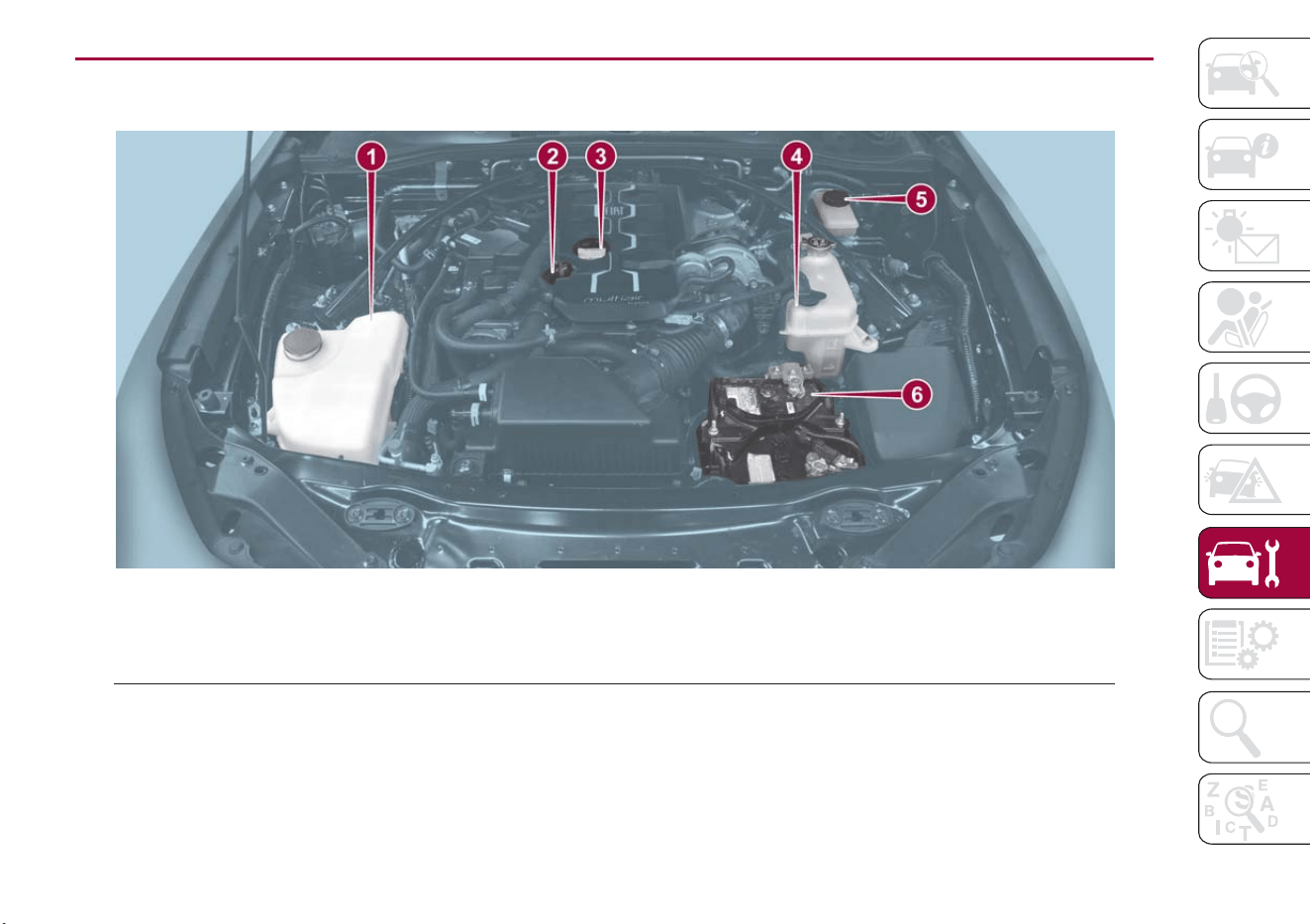
ENGINE COMPARTMENT
Checking Levels
07030300-121-003
1 — Window Washer Reservoir 4 — Engine Coolant Reservoir
2 — Engine Oil Dipstick 5 — Brake/Clutch Fluid Reservoir
3 — Engine Oil Cap 6 — Battery
237

Engine Oil
Warning!
Be very careful when working in the
engine compartment when the engine is
hot: you may get burned.
Do not get too close to the radiator
cooling fan: the electric fan may start;
danger of injury.
Loose clothing might be pulled by
moving parts.
Recommended Oil
Refer to “Fluids And Lubricants” in
“Technical Specifications” for further
information.
Inspecting engine oil level
Proceed as follows:
1. Be sure the vehicle is on a level
surface.
2. Warm up the engine to normal
operating temperature.
3. Turn it off and wait at least five
minutes for the oil to return to the
sump.
4. Pull out the dipstick, wipe it clean,
and reinsert it fully.
5. Pull the dipstick out again and
examine the level. The level is normal if
it is between Low and Full. If it is near
or below Low, open the engine oil
cap/filler 2 and add enough oil to bring
the level to Full.
Note: Do not overfill the engine oil.
This may cause engine damage.
6. Make sure the O-ring on the dipstick
is positioned properly before reinserting
the dipstick.
7. Reinsert the dipstick fully.
Engine oil consumption
During the initial period of use the
engine oil consumption conditions
should stabilize after the first 3000 –
3500 miles (5000 – 6000 km).
Engine Coolant
Warning!
Turn vehicle off and disconnect the fan
motor lead before working near the radiator
cooling fan.
You or others can be badly burned by
hot engine coolant (antifreeze) or steam
from your radiator. If you see or hear steam
coming from under the hood, do not open
the hood until the radiator has had time to
cool. Never open a cooling system
pressure cap when the radiator or coolant
bottle is hot.
Keep hands, tools, clothing, and jewelry
away from the radiator cooling fan when
the hood is raised. The fan starts
automatically and may start at any time,
whether the engine is running or not.
When working near the radiator cooling
fan, disconnect the fan motor lead or turn
the ignition to the OFF mode. The fan is
temperature controlled and can start at any
time the ignition is in the ON mode.
You or others can be badly burned by
hot engine coolant (antifreeze) or steam
from your radiator. If you see or hear steam
coming from under the hood, do not open
the hood until the radiator has had time to
cool. Never try to open a cooling system
pressure cap when the radiator is hot.
07030403-121-001
Engine Compartment
1 — Engine Oil Dipstick
2 — Engine Oil Cap
238
SERVICING AND MAINTENANCE

Inspecting Coolant Level
Note: Changing the coolant should be
done by your authorized dealer.
Inspect the antifreeze protection and
coolant level in the coolant reservoir at
least once a year, at the beginning of
the winter season, and before traveling
where temperatures may drop below
freezing.
Inspect the condition and connections
of all cooling system and heater hoses.
Replace any that are worn or
deteriorated.
Warning!
Do not open hot engine cooling system.
Never add engine coolant (antifreeze) when
the engine is overheated. Do not loosen or
remove the cap to cool an overheated
engine. Heat causes pressure to build up in
the cooling system. To prevent scalding or
injury, do not remove the pressure cap
while the system is hot or under pressure.
Do not use a pressure cap other than
the one specified for your vehicle. Personal
injury or engine damage may result.
The coolant should be at full in the
radiator and between the F (Full) and L
(Low) marks on the coolant reservoir
when the engine is cool.
If it is at or near L (Low), add coolant by
mixing a minimum solution of 50%
Mopar Long Life Coolant Concentrate
for FIAT Spider. Use higher
concentrations (not to exceed 70%) if
temperatures below −34°F (−37°C) are
anticipated. Bring the level to F (Full).
Please contact your authorized dealer
for assistance.
Securely tighten the coolant reservoir
tank cap after adding coolant.
If the coolant reservoir is empty or new
coolant is required frequently, contact
your authorized dealer.
Brake/Clutch Fluid
Inspecting Brake/Clutch Fluid Level
The brakes and clutch draw fluid
from the same reservoir.
Inspect the fluid level in the reservoir
regularly.
It should be kept between the MAX
and MIN lines.
The level normally drops with
accumulated use, a condition
associated with wear of brake and
clutch linings. If it is excessively low,
have the brake/clutch system
inspected. Contact your authorized
dealer.
07030501-121-001
Coolant Reservoir
07030601-121-002
Brake Fluid Reservoir
239
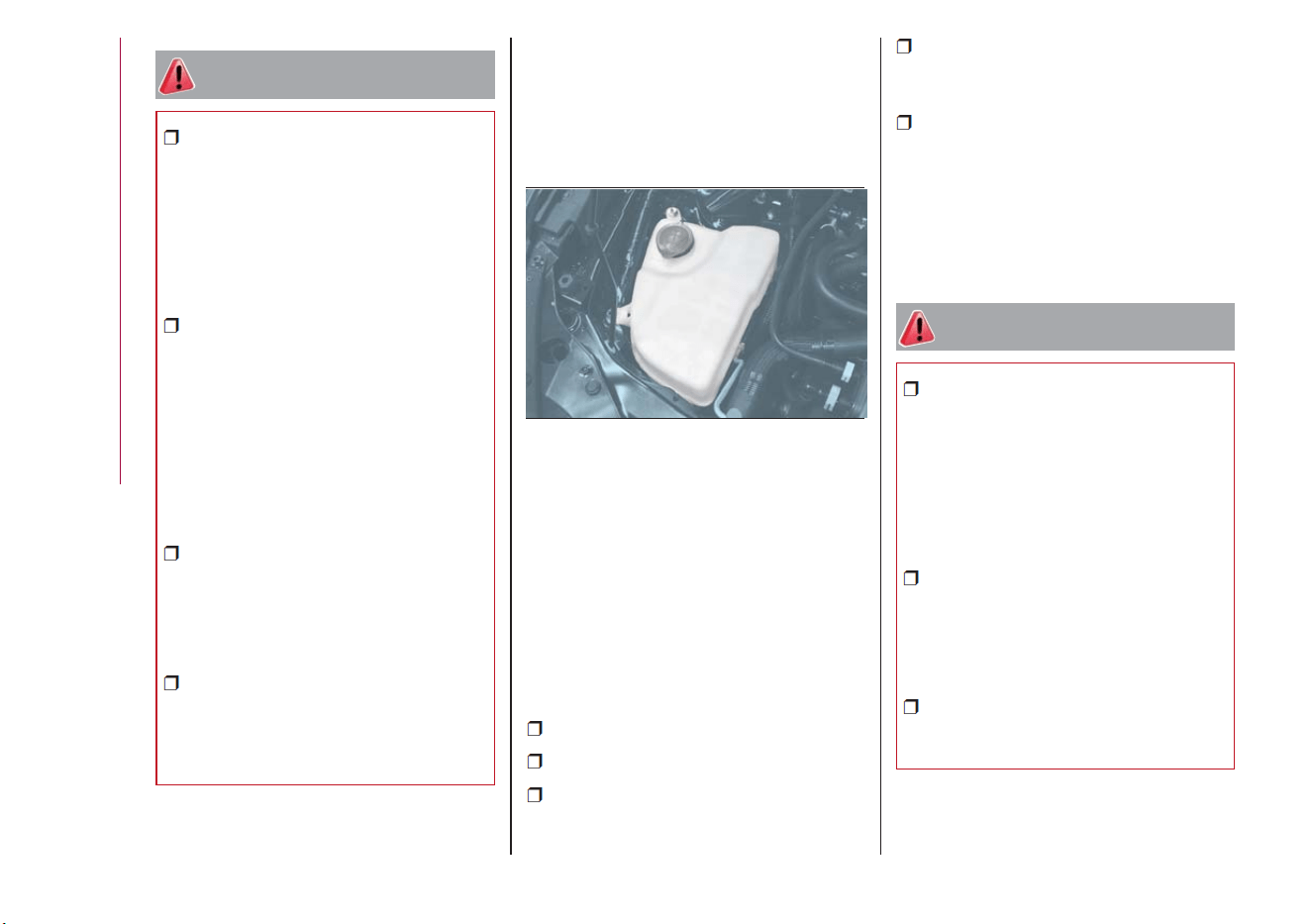
Warning!
Use only manufacturer's recommended
brake fluid. Refer to “Fluids And Lubricants”
in “Technical Specifications” for further
information. Using the wrong type of brake
fluid can severely damage your brake
system and/or impair its performance. The
proper type of brake fluid for your vehicle is
also identified on the original factory
installed hydraulic master cylinder reservoir.
To avoid contamination from foreign
matter or moisture, use only new brake
fluid or fluid that has been in a tightly
closed container. Keep the master cylinder
reservoir cap secured at all times. Brake
fluid in a open container absorbs moisture
from the air resulting in a lower boiling
point. This may cause it to boil
unexpectedly during hard or prolonged
braking, resulting in sudden brake failure.
This could result in a collision.
Overfilling the brake fluid reservoir can
result in spilling brake fluid on hot engine
parts, causing the brake fluid to catch fire.
Brake fluid can also damage painted and
vinyl surfaces, care should be taken to
avoid its contact with these surfaces.
Do not allow petroleum based fluid to
contaminate the brake fluid. Brake seal
components could be damaged, causing
partial or complete brake failure. This could
result in a collision.
Windshield And
Headlight Washer Fluid
Inspecting Washer Fluid Level
Inspect fluid level in the washer fluid
reservoir, open the cap and add fluid if
necessary.
Use plain water if washer fluid is
unavailable. But use only washer fluid in
cold weather to prevent it from freezing.
Automatic Transmission
Control Unit
The transmission oil level should only be
checked at your authorized dealer.
Battery Maintenance
To get the best service from a battery:
Keep it securely mounted.
Keep the top clean and dry.
Keep terminals and connections
clean, tight, and coated with petroleum
jelly or terminal grease.
Rinse off spilled electrolyte
immediately with a solution of water
and baking soda.
If the vehicle will not be used for an
extended time, disconnect the battery
leads and charge the battery every six
weeks.
Battery Replacement
Contact your authorized dealer to
purchase a replacement battery.
Warning!
Battery fluid is a corrosive acid solution
and can burn or even blind you. Do not
allow battery fluid to contact your eyes,
skin, or clothing. Do not lean over a battery
when attaching clamps. If acid splashes in
eyes or on skin, flush the area immediately
with large amounts of water. Refer to
“Jump-Starting Procedure” in “In Case Of
Emergency” for further information.
Battery gas is flammable and explosive.
Keep flame or sparks away from the
battery. Do not use a booster battery or
any other booster source with an output
greater than 12 Volts. Do not allow cable
clamps to touch each other.
Battery posts, terminals, and related
accessories contain lead and lead
compounds. Wash hands after handling.
07030901-121-001
Windshield Washer Fluid Reservoir
240
SERVICING AND MAINTENANCE

BATTERY
RECHARGING
BATTERY CHARGING
PROCEDURE
Warning!
Battery fluid is a corrosive acid solution
and can burn or even blind you. Do not
allow battery fluid to contact your eyes,
skin, or clothing. Do not lean over a battery
when attaching clamps. If acid splashes in
eyes or on skin, flush the area immediately
with large amounts of water. Refer to
“Jump-Starting Procedure” in “In Case Of
Emergency” for further information.
Battery gas is flammable and explosive.
Keep flame or sparks away from the
battery. Do not use a booster battery or
any other booster source with an output
greater than 12 Volts. Do not allow cable
clamps to touch each other.
Battery posts, terminals, and related
accessories contain lead and lead
compounds. Wash hands after handling.
Caution!
It is essential when replacing the cables
on the battery that the positive cable is
attached to the positive post and the
negative cable is attached to the negative
post. Battery posts are marked positive (+)
and negative (-) and are identified on the
battery case. Cable clamps should be tight
on the terminal posts and free of corrosion.
If a “fast charger” is used while the
battery is in the vehicle, disconnect both
vehicle battery cables before connecting
the charger to the battery. Do not use a
“fast charger” to provide starting voltage.
Charge battery as follows:
Before recharging the battery, turn off
all accessories and turn the engine off
by placing the ignition in the OFF mode.
Disconnect the negative battery
cable.
Connect the charger cables to the
battery terminals, observing the polarity
(+,–).
Turn on the charger.
When finished, turn the charger off
before disconnecting the battery.
Reconnect the negative battery
terminal.
MAINTENANCE
PROCEDURES
The following pages contain
instructions on the required
maintenance from the technical
personnel who designed the vehicle.
In addition to these specific
maintenance instructions specified for
routine scheduled servicing, there are
other components which may require
periodic maintenance or replacement
over the vehicle’s life cycle.
Body Lubrication
Ensure that the locks and bodywork
junction points, including components
such as the seat guides, door hinges
(and rollers), trunk and hood are
periodically lubricated with lithium
based grease to ensure correct, silent
operation and to protect them from rust
and wear.
Thoroughly clean the components,
eliminating every trace of dirt and dust.
After lubricating, eliminate excess oil
and grease. Also pay particular
attention to the hood closing devices,
to ensure correct operation.
During operations on the hood, be sure
to perform with the engine cold, also
remember to check, clean and lubricate
the locking, release and safety devices.
Make sure the hood's secondary latch
keeps the hood from opening when the
primary latch is released.
241

Lubricate the external lock cylinders
twice a year. Apply a small amount of
high-quality lubricant directly into the
lock cylinder. If necessary, contact your
authorized dealer.
Wiper Blades
Contamination of either the windshield
or the blades with foreign matter can
reduce wiper effectiveness. Common
sources are insects, tree sap, and hot
wax treatments used by some
commercial car washes.
If the blades are not wiping properly,
clean the window and blades with a
good cleaner or mild detergent; then
rinse thoroughly with clean water.
Repeat if necessary.
When the wiper lever is in the AUTO
position and the ignition is placed in the
ON mode, the wipers may move
automatically in the following cases:
If the windshield above the rain
sensor is touched.
If the windshield above the rain
sensor is wiped with a cloth.
If the windshield is struck with a hand
or other object.
If the rain sensor is struck with a
hand or other object from inside the
vehicle.
Note:
Hot waxes applied by automatic car
washers have been known to affect
the wiper's ability to clean windows.
To prevent damage to the wiper
blades, do not use gas, paraffin, paint
thinner, or other solvents on or near
them.
Be careful not to pinch hands or
fingers as it may cause injury, or
damage the wipers. When washing or
servicing the vehicle, make sure the
wiper lever is in the OFF position.
Replacing Windshield Wiper Blades
When the wipers no longer clean well,
the blades are probably worn or
cracked. Replace them.
When raising both windshield wiper
arms, raise the driver's side wiper arm
first.
When lowering the wiper arms, slowly
lower the wiper arm from the
passenger's side first while supporting
it with your hand. Forcefully lowering
the wiper arms could damage the wiper
arm and blade, and may scratch or
crack the windshield.
Note: To prevent damage to the wiper
arms and other components, do not try
to sweep the wiper arm by hand.
Blade Replacement
Proceed as follows:
1. Raise the wiper arm.
2. Open the clip and slide the blade
assembly in the direction of the arrow.
3. Tilt the blade assembly and remove
it from the arm.
07031101-36A-001
Clip
07031101-36A-002
Blade Assembly and Arm
242
SERVICING AND MAINTENANCE

Warning!
To prevent damage to the windshield let
the wiper arm down easily, do not let it slap
down on the windshield.
4. Pull down the blade rubber and slide
it out of blade holder.
5. Remove the metal stiffeners from
each blade rubber and install them in
the new blade.
6. Carefully insert the new blade
rubber. Then install the blade assembly
in the reverse order of removal.
RAISING THE
VEHICLE
If the vehicle needs to be raised, see an
authorized dealer which is equipped
with arm hoists or workshop lifts.
The vehicle’s lifting points are marked
on the side skirts with the
symbols.
07031101-36A-003
Blade Holder
07031101-36A-004
Metal Stiffeners
07031101-36A-005
Reassemble Blade
243
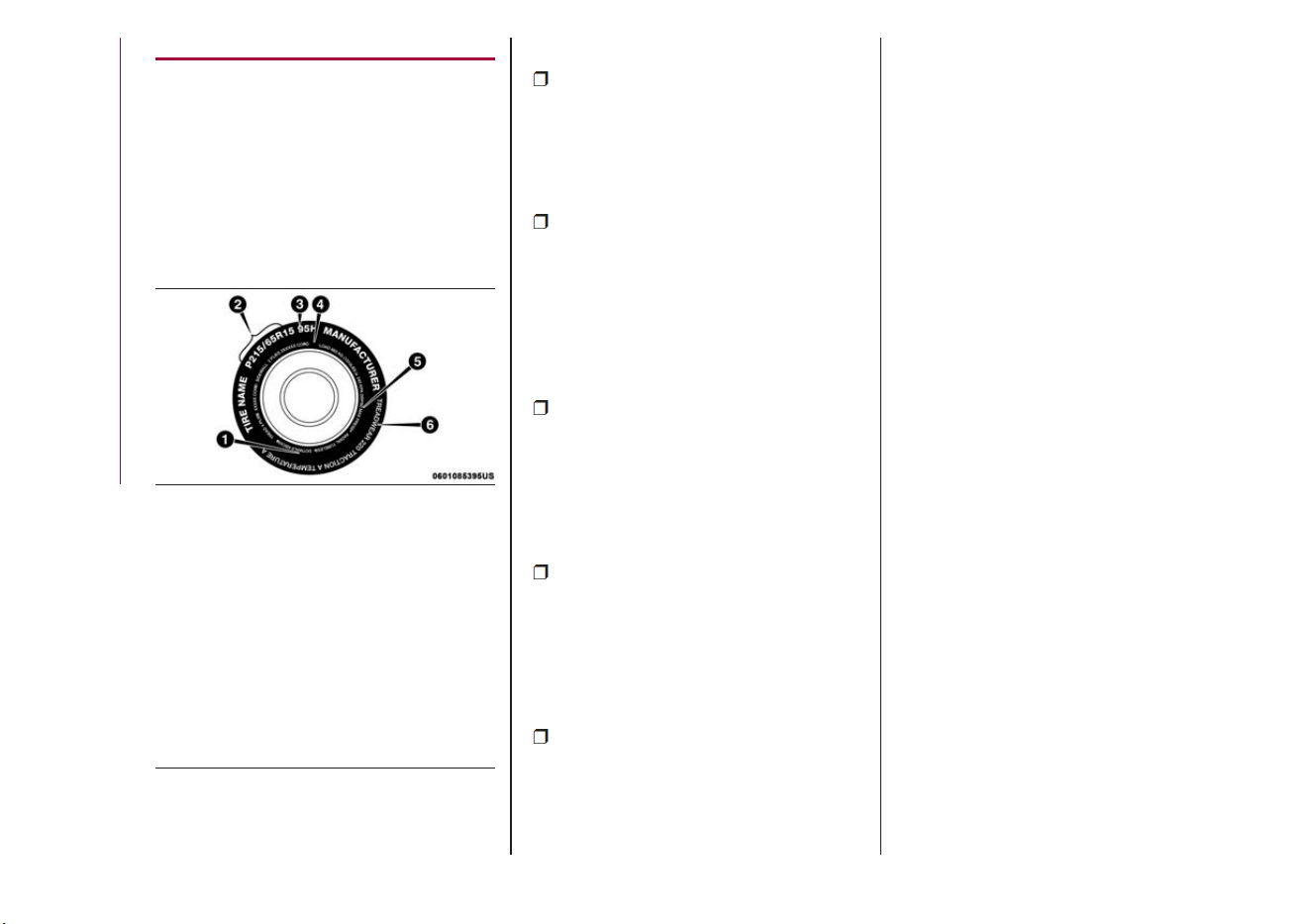
WHEELS AND TIRES
Tire Safety Information
Tire safety information will cover
aspects of the following information:
Tire Markings, Tire Identification
Numbers, Tire Terminology and
Definitions, Tire Pressures, and Tire
Loading.
Tire Markings
Note:
P (Passenger) — Metric tire sizing is
based on U.S. design standards.
P-Metric tires have the letter “P”
molded into the sidewall preceding the
size designation. Example:
P215/65R15 95H.
European — Metric tire sizing is
based on European design standards.
Tires designed to this standard have
the tire size molded into the sidewall
beginning with the section width. The
letter "P" is absent from this tire size
designation. Example: 215/
65R15 96H.
LT (Light Truck) — Metric tire sizing
is based on U.S. design standards.
The size designation for LT-Metric tires
is the same as for P-Metric tires except
for the letters “LT” that are molded into
the sidewall preceding the size
designation. Example: LT235/85R16.
Temporary spare tires are designed
for temporary emergency use only.
Temporary high pressure compact
spare tires have the letter “T” or “S”
molded into the sidewall preceding the
size designation. Example:
T145/80D18 103M.
High flotation tire sizing is based on
U.S. design standards and it begins
with the tire diameter molded into the
sidewall. Example: 31x10.5 R15 LT.
0601085395US
Tire Markings
1 — U.S. DOT
Safety Standards
Code (TIN)
4 — Maximum
Load
2 — Size
Designation
5 — Maximum
Pressure
3 — Service
Description
6 — Treadwear,
Traction and
Temperature
Grades
244
SERVICING AND MAINTENANCE

Tire Sizing Chart
EXAMPLE:
Example Size Designation: P215/65R15XL 95H, 215/65R15 96H, LT235/85R16C, T145/80D18 103M, 31x10.5 R15 LT
P =
Passenger car tire size based on U.S. design standards, or
"....blank...." = Passenger car tire based on European design standards, or
LT = Light truck tire based on U.S. design standards, or
TorS= Temporary spare tire or
31 = Overall diameter in inches (in)
215, 235, 145 = Section width in millimeters (mm)
65, 85, 80 = Aspect ratio in percent (%)
Ratio of section height to section width of tire, or
10.5 = Section width in inches (in)
R = Construction code
"R" means radial construction, or
"D" means diagonal or bias construction
15, 16, 18 = Rim diameter in inches (in)
245

EXAMPLE:
Service Description:
95 =
Load Index
A numerical code associated with the maximum load a tire can carry
H = Speed Symbol
A symbol indicating the range of speeds at which a tire can carry a load corresponding to its load index under certain operating conditions
The maximum speed corresponding to the speed symbol should only be achieved under specified operating conditions (i.e., tire pressure,
vehicle loading, road conditions, and posted speed limits)
Load Identification:
Absence of the following load identification symbols on the sidewall of the tire indicates a Standard Load (SL) tire:
XL = Extra load (or reinforced) tire, or
LL = Light load tire or
C, D, E, F, G = Load range associated with the maximum load a tire can carry at a specified pressure
Maximum Load – Maximum load indicates the maximum load this tire is designed to carry
Maximum Pressure – Maximum pressure indicates the maximum permissible cold tire inflation pressure for this tire
246
SERVICING AND MAINTENANCE
Tire Identification Number (TIN)
The TIN may be found on one or both sides of the tire; however, the date code may only be on one side. Tires with white
sidewalls will have the full TIN, including the date code, located on the white sidewall side of the tire. Look for the TIN on the
outboard side of black sidewall tires as mounted on the vehicle. If the TIN is not found on the outboard side, then you will find it
on the inboard side of the tire.
EXAMPLE:
DOT MA L9 ABCD 0301
DOT =
Department of Transportation
This symbol certifies that the tire is in compliance with the U.S. Department of Transportation tire safety standards and is approved for
highway use
MA = Code representing the tire manufacturing location (two digits)
L9 = Code representing the tire size (two digits)
ABCD = Code used by the tire manufacturer (one to four digits)
03 = Number representing the week in which the tire was manufactured (two digits)
03 means the 3rd week
01 = Number representing the year in which the tire was manufactured (two digits)
01 means the year 2001
Prior to July 2000, tire manufacturers were only required to have one number to represent the year in which the tire was manufactured.
Example: 031 could represent the 3rd week of 1981 or 1991
247

Tire Terminology And Definitions
Term Definition
B-Pillar
The
vehicle B-Pillar is the structural member of the body located behind the front
door.
Cold Tire Inflation Pressure
Cold tire inflation pressure is defined as the tire pressure after the vehicle has not
been driven for at least three hours, or driven less than 1 mile (1.6 km) after sitting
for a minimum of three hours. Inflation pressure is measured in units of PSI (pounds
per square inch) or kPa (kilopascals).
Maximum Inflation Pressure
The maximum inflation pressure is the maximum permissible cold tire inflation
pressure for this tire. The maximum inflation pressure is molded into the sidewall.
Recommended Cold Tire Inflation Pressure
Vehicle manufacturer's recommended cold tire inflation pressure as shown on the
tire placard.
Tire Placard
A label permanently attached to the vehicle describing the vehicle’s loading
capacity, the original equipment tire sizes and the recommended cold tire inflation
pressures.
248
SERVICING AND MAINTENANCE

Tire Loading And Tire Pressure
Note: The proper cold tire inflation
pressure is listed on the driver’s side
B-Pillar or the rear edge of the driver's
side door.
Tire And Loading Information
Placard
This placard tells you important
information about the:
1. Number of people that can be
carried in the vehicle.
2. Total weight your vehicle can carry.
3. Tire size designed for your vehicle.
4. Cold tire inflation pressures for the
front, rear, and spare tires.
Loading
The vehicle maximum load on the tire
must not exceed the load carrying
capacity of the tire on your vehicle. You
will not exceed the tire's load carrying
capacity if you adhere to the loading
conditions, tire size, and cold tire
inflation pressures specified on the Tire
and Loading Information placard in
“Vehicle Loading” in the “Starting And
Operating” section of this manual.
Note: Under a maximum loaded
vehicle condition, gross axle weight
ratings (GAWRs) for the front and rear
axles must not be exceeded.
For further information on GAWRs,
vehicle loading, and trailer towing, refer
to “Vehicle Loading” in the “Starting
And Operating” section of this manual.
To determine the maximum loading
conditions of your vehicle, locate the
statement “The combined weight of
occupants and cargo should never
exceed XXX kg or XXX lbs” on the Tire
and Loading Information placard. The
combined weight of occupants,
cargo/luggage and trailer tongue weight
(if applicable) should never exceed the
weight referenced here.
0806115150US
Example Tire Placard Location
(Door)
0806115151US
Example Tire Placard Location
(B-Pillar)
GUID-054900418-high.tif
Tire And Loading Information
Placard
249

Steps For Determining Correct
Load Limit—
(1) Locate the statement “The
combined weight of occupants and
cargo should never exceed XXX kg
or XXX lbs.” on your vehicle's
placard.
(2) Determine the combined weight
of the driver and passengers that
will be riding in your vehicle.
(3) Subtract the combined weight of
the driver and passengers from XXX
kg or XXX lbs.
(4) The resulting figure equals the
available amount of cargo and
luggage load capacity. For
example, if “XXX” amount equals
1400 lbs. and there will be five
150 lb passengers in your vehicle,
the amount of available cargo and
luggage load capacity is 650 lbs.
(1400-750 (5x150) = 650 lbs.)
(5) Determine the combined weight
of luggage and cargo being loaded
on the vehicle. That weight may not
safely exceed the available cargo
and luggage load capacity
calculated in Step 4.
(6) If your vehicle will be towing a
trailer, load from your trailer will be
transferred to your vehicle. Consult
this manual to determine how this
reduces the available cargo and
luggage load capacity of your
vehicle.
Metric Example For Load Limit
For example, if “XXX” amount equals
635 kg and there will be five 68 kg
passengers in your vehicle, the amount
of available cargo and luggage load
capacity is 295 kg (635-340 (5x68) =
295 kg) as shown in step 4.
Note:
If your vehicle will be towing a trailer,
load from your trailer will be transferred
to your vehicle. The following table
shows examples on how to calculate
total load, cargo/luggage, and towing
capacities of your vehicle with varying
seating configurations and number and
size of occupants. This table is for
illustration purposes only and may not
be accurate for the seating and load
carry capacity of your vehicle.
For the following example, the
combined weight of occupants and
cargo should never exceed 865 lbs
(392 kg).
250
SERVICING AND MAINTENANCE

Warning!
Overloading of your tires is dangerous. Overloading can cause tire failure, affect vehicle handling, and increase your stopping distance. Use
tires of the recommended load capacity for your vehicle. Never overload them.
GUID-054900419-high.tif
251
Tires — General
Information
Tire Pressure
Proper tire inflation pressure is essential
to the safe and satisfactory operation of
your vehicle. Four primary areas are
affected by improper tire pressure:
Safety and Vehicle Stability
Economy
Tread Wear
Ride Comfort
Safety
Warning!
Improperly inflated tires are dangerous
and can cause collisions.
Underinflation increases tire flexing and
can result in overheating and tire failure.
Overinflation reduces a tire's ability to
cushion shock. Objects on the road and
chuckholes can cause damage that result
in tire failure.
Overinflated or underinflated tires can
affect vehicle handling and can fail
suddenly, resulting in loss of vehicle
control.
Unequal tire pressures can cause
steering problems. You could lose control
of your vehicle.
Unequal tire pressures from one side of
the vehicle to the other can cause the
vehicle to drift to the right or left.
Always drive with each tire inflated to the
recommended cold tire inflation pressure.
Both under-inflation and over-inflation
affect the stability of the vehicle and can
produce a feeling of sluggish response
or over responsiveness in the steering.
Note:
Unequal tire pressures from side to
side may cause erratic and
unpredictable steering response.
Unequal tire pressure from side to
side may cause the vehicle to drift left
or right.
Fuel Economy
Underinflated tires will increase tire
rolling resistance resulting in higher fuel
consumption.
Tread Wear
Improper cold tire inflation pressures
can cause abnormal wear patterns and
reduced tread life, resulting in the need
for earlier tire replacement.
Ride Comfort And Vehicle Stability
Proper tire inflation contributes to a
comfortable ride. Over-inflation
produces a jarring and uncomfortable
ride.
Tire Inflation Pressures
The proper cold tire inflation pressure is
listed on the driver's side B-Pillar or rear
edge of the driver's side door.
At least once a month:
Check and adjust tire pressure with a
good quality pocket-type pressure
gauge. Do not make a visual judgement
when determining proper inflation. Tires
may look properly inflated even when
they are under-inflated.
Inspect tires for signs of tire wear or
visible damage.
Caution!
After inspecting or adjusting the tire
pressure, always reinstall the valve stem
cap. This will prevent moisture and dirt
from entering the valve stem, which could
damage the valve stem.
Inflation pressures specified on the
placard are always “cold tire inflation
pressure”. Cold tire inflation pressure is
defined as the tire pressure after the
vehicle has not been driven for at least
three hours, or driven less than 1 mile
(1.6 km) after sitting for a minimum of
three hours. The cold tire inflation
pressure must not exceed the
maximum inflation pressure molded into
the tire sidewall.
252
SERVICING AND MAINTENANCE
Check tire pressures more often if
subject to a wide range of outdoor
temperatures, as tire pressures vary
with temperature changes.
Tire pressures change by approximately
1 psi (7 kPa) per 12°F (7°C) of air
temperature change. Keep this in mind
when checking tire pressure inside a
garage, especially in the Winter.
Example: If garage temperature = 68°F
(20°C) and the outside temperature =
32°F (0°C) then the cold tire inflation
pressure should be increased by 3 psi
(21 kPa), which equals 1 psi (7 kPa) for
every 12°F (7°C) for this outside
temperature condition.
Tire pressure may increase from 2 to
6 psi (13 to 40 kPa) during operation. DO
NOT reduce this normal pressure build
up or your tire pressure will be too low.
Tire Pressures For High Speed
Operation
The manufacturer advocates driving at
safe speeds and within posted speed
limits. Where speed limits or conditions
are such that the vehicle can be driven
at high speeds, maintaining correct tire
inflation pressure is very important.
Increased tire pressure and reduced
vehicle loading may be required for
high-speed vehicle operation. Refer to
your authorized tire dealer or original
equipment vehicle dealer for
recommended safe operating speeds,
loading and cold tire inflation pressures.
Warning!
High speed driving with your vehicle under
maximum load is dangerous. The added
strain on your tires could cause them to
fail. You could have a serious collision. Do
not drive a vehicle loaded to the maximum
capacity at continuous speeds above
75 mph (120 km/h).
Radial Ply Tires
Warning!
Combining radial ply tires with other types
of tires on your vehicle will cause your
vehicle to handle poorly. The instability
could cause a collision. Always use radial
ply tires in sets of four. Never combine
them with other types of tires.
Tire Repair
If your tire becomes damaged, it may
be repaired if it meets the following
criteria:
The tire has not been driven on when
flat.
The damage is only on the tread
section of your tire (sidewall damage is
not repairable).
The puncture is no greater than a ¼
of an inch (6 mm).
Consult an authorized tire dealer for tire
repairs and additional information.
Damaged Run Flat tires, or Run Flat
tires that have experienced a loss of
pressure should be replaced
immediately with another Run Flat tire
of identical size and service description
(Load Index and Speed Symbol).
Run Flat Tires — If Equipped
Run Flat tires allow you the capability to
drive 50 miles (80 km) at 50 mph
(80 km/h) after a rapid loss of inflation
pressure. This rapid loss of inflation is
referred to as the Run Flat mode. A Run
Flat mode occurs when the tire inflation
pressure is of/or below 14 psi (96 kPa).
Once a Run Flat tire reaches the run flat
mode it has limited driving capabilities
and needs to be replaced immediately.
A Run Flat tire is not repairable.
It is not recommended driving a vehicle
loaded at full capacity or to tow a trailer
while a tire is in the run flat mode.
See the tire pressure monitoring section
for more information.
Tire Spinning
When stuck in mud, sand, snow, or ice
conditions, do not spin your vehicle's
wheels above 30 mph (48 km/h) or for
longer than 30 seconds continuously
without stopping.
253

Warning!
Fast spinning tires can be dangerous.
Forces generated by excessive wheel
speeds may cause tire damage or failure. A
tire could explode and injure someone. Do
not spin your vehicle's wheels faster than
30 mph (48 km/h) for more than
30 seconds continuously when you are
stuck, and do not let anyone near a
spinning wheel, no matter what the speed.
Tread Wear Indicators
Tread wear indicators are in the original
equipment tires to help you in
determining when your tires should be
replaced.
These indicators are molded into the
bottom of the tread grooves. They will
appear as bands when the tread depth
becomes a 1/16 of an inch (1.6 mm).
When the tread is worn to the tread
wear indicators, the tire should be
replaced. Refer to “Replacement Tires”
in this section for further information.
Life Of Tire
The service life of a tire is dependent
upon varying factors including, but not
limited to:
Driving style.
Tire pressure - Improper cold tire
inflation pressures can cause uneven
wear patterns to develop across the tire
tread. These abnormal wear patterns
will reduce tread life, resulting in the
need for earlier tire replacement.
Distance driven.
Performance tires, tires with a speed
rating of V or higher, and Summer tires
typically have a reduced tread life.
Rotation of these tires per the vehicle
maintenance schedule is highly
recommended.
Warning!
Tires and the spare tire should be replaced
after six years, regardless of the remaining
tread. Failure to follow this warning can
result in sudden tire failure. You could lose
control and have a collision resulting in
serious injury or death.
Keep dismounted tires in a cool, dry
place with as little exposure to light as
possible. Protect tires from contact with
oil, grease, and gasoline.
Replacement Tires
The tires on your new vehicle provide a
balance of many characteristics. They
should be inspected regularly for wear
and correct cold tire inflation pressures.
The manufacturer strongly recommends
that you use tires equivalent to the
originals in size, quality and
performance when replacement is
needed. Refer to the paragraph on
“Tread Wear Indicators” in this section.
Refer to the Tire and Loading
Information placard or the Vehicle
Certification Label for the size
designation of your tire. The Load Index
and Speed Symbol for your tire will be
found on the original equipment tire
sidewall.
0806104865NA
Tire Tread
1—WornTire
2—NewTire
254
SERVICING AND MAINTENANCE
See the Tire Sizing Chart example
found in the “Tire Safety Information”
section of this manual for more
information relating to the Load Index
and Speed Symbol of a tire.
It is recommended to replace the two
front tires or two rear tires as a pair.
Replacing just one tire can seriously
affect your vehicle’s handling. If you
ever replace a wheel, make sure that
the wheel’s specifications match those
of the original wheels.
It is recommended you contact your
authorized tire dealer or original
equipment dealer with any questions you
may have on tire specifications or
capability. Failure to use equivalent
replacement tires may adversely affect the
safety, handling, and ride of your vehicle.
Warning!
Do not use a tire, wheel size, load rating,
or speed rating other than that specified for
your vehicle. Some combinations of
unapproved tires and wheels may change
suspension dimensions and performance
characteristics, resulting in changes to
steering, handling, and braking of your
vehicle. This can cause unpredictable
handling and stress to steering and
suspension components. You could lose
control and have a collision resulting in
serious injury or death. Use only the tire and
wheel sizes with load ratings approved for
your vehicle.
Never use a tire with a smaller load
index or capacity, other than what was
originally equipped on your vehicle. Using a
tire with a smaller load index could result in
tire overloading and failure. You could lose
control and have a collision.
Failure to equip your vehicle with tires
having adequate speed capability can
result in sudden tire failure and loss of
vehicle control.
Caution!
Replacing original tires with tires of a
different size may result in false
speedometer and odometer readings.
Tire Types
All Season Tires — If Equipped
All Season tires provide traction for all
seasons (Spring, Summer, Fall, and
Winter). Traction levels may vary
between different all season tires. All
season tires can be identified by the
M+S, M&S, M/S or MS designation on
the tire sidewall. Use all season tires
only in sets of four; failure to do so may
adversely affect the safety and handling
of your vehicle.
Summer Or Three Season Tires
— If Equipped
Summer tires provide traction in both wet
and dry conditions, and are not intended
to be driven in snow or on ice. If your
vehicle is equipped with Summer tires,
be aware these tires are not designed for
Winter or cold driving conditions. Install
Winter tires on your vehicle when
ambient temperatures are less than 40°F
(5°C) or if roads are covered with ice or
snow. For more information, contact an
authorized dealer.
Summer tires do not contain the all
season designation or mountain/
snowflake symbol on the tire sidewall.
Use Summer tires only in sets of four;
failure to do so may adversely affect the
safety and handling of your vehicle.
Warning!
Do not use Summer tires in snow/ice
conditions. You could lose vehicle control,
resulting in severe injury or death. Driving
too fast for conditions also creates the
possibility of loss of vehicle control.
255

Snow Tires
Some areas of the country require the
use of snow tires during the Winter.
Snow tires can be identified by a
“mountain/snowflake” symbol on the
tire sidewall.
If you need snow tires,
select tires equivalent
in size and type to the
original equipment
tires. Use snow tires
only in sets of four;
failure to do so may
adversely affect the safety and handling
of your vehicle.
Snow tires generally have lower speed
ratings than what was originally
equipped with your vehicle and should
not be operated at sustained speeds
over 75 mph (120 km/h). For speeds
above 75 mph (120 km/h) refer to
original equipment or an authorized tire
dealer for recommended safe operating
speeds, loading and cold tire inflation
pressures.
While studded tires improve
performance on ice, skid and traction
capability on wet or dry surfaces may
be poorer than that of non-studded
tires. Some states prohibit studded
tires; therefore, local laws should be
checked before using these tire types.
Spare Tires —
If Equipped
Note: For vehicles equipped with Tire
Service Kit instead of a spare tire,
please refer to “Tire Service Kit” in “In
Case Of Emergency” for further
information.
Caution!
Because of the reduced ground clearance,
do not take your vehicle through an
automatic car wash with a compact or
limited use temporary spare installed.
Damage to the vehicle may result.
Spare Tire Matching Original
Equipped Tire And Wheel —
If Equipped
Your vehicle may be equipped with a
spare tire and wheel equivalent in look
and function to the original equipment
tire and wheel found on the front or rear
axle of your vehicle. This spare tire may
be used in the tire rotation for your
vehicle. If your vehicle has this option,
refer to an authorized tire dealer for the
recommended tire rotation pattern.
Compact Spare Tire —
If Equipped
The compact spare is for temporary
emergency use only. You can identify if
your vehicle is equipped with a
compact spare by looking at the spare
tire description on the Tire and Loading
Information Placard located on the
driver’s side door opening or on the
sidewall of the tire. Compact spare tire
descriptions begin with the letter “T” or
“S” preceding the size designation.
Example: T145/80D18 103M.
T,S=Temporary Spare Tire
Since this tire has limited tread life, the
original equipment tire should be
repaired (or replaced) and reinstalled on
your vehicle at the first opportunity.
Do not install a wheel cover or attempt
to mount a conventional tire on the
compact spare wheel, since the wheel
is designed specifically for the compact
spare tire. Do not install more than one
compact spare tire and wheel on the
vehicle at any given time.
256
SERVICING AND MAINTENANCE

Warning!
Compact and collapsible spares are for
temporary emergency use only. With these
spares, do not drive more than 50 mph
(80 km/h). Temporary use spares have
limited tread life. When the tread is worn to
the tread wear indicators, the temporary
use spare tire needs to be replaced. Be
sure to follow the warnings, which apply to
your spare. Failure to do so could result in
spare tire failure and loss of vehicle control.
Collapsible Spare Tire —
If Equipped
The collapsible spare is for temporary
emergency use only. You can identify if
your vehicle is equipped with a
collapsible spare by looking at the
spare tire description on the Tire and
Loading Information Placard located on
the driver’s side door opening or on the
sidewall of the tire.
Collapsible spare tire description
example: 165/80-17 101P.
Since this tire has limited tread life, the
original equipment tire should be
repaired (or replaced) and reinstalled on
your vehicle at the first opportunity.
Inflate collapsible tire only after the
wheel is properly installed to the
vehicle. Inflate the collapsible tire using
the electric air pump before lowering
the vehicle.
Do not install a wheel cover or attempt
to mount a conventional tire on the
collapsible spare wheel, since the wheel
is designed specifically for the
collapsible spare tire.
Warning!
Compact and Collapsible spares are for
temporary emergency use only. With these
spares, do not drive more than 50 mph
(80 km/h). Temporary use spares have
limited tread life. When the tread is worn to
the tread wear indicators, the temporary
use spare tire needs to be replaced. Be
sure to follow the warnings, which apply to
your spare. Failure to do so could result in
spare tire failure and loss of vehicle control.
Full Size Spare — If Equipped
The full size spare is for temporary
emergency use only. This tire may look
like the originally equipped tire on the
front or rear axle of your vehicle, but it is
not. This spare tire may have limited
tread life. When the tread is worn to the
tread wear indicators, the temporary
use full size spare tire needs to be
replaced. Since it is not the same as
your original equipment tire, replace (or
repair) the original equipment tire and
reinstall on the vehicle at the first
opportunity.
Limited Use Spare —
If Equipped
The limited use spare tire is for
temporary emergency use only. This tire
is identified by a label located on the
limited use spare wheel. This label
contains the driving limitations for this
spare. This tire may look like the original
equipped tire on the front or rear axle of
your vehicle, but it is not. Installation of
this limited use spare tire affects vehicle
handling. Since it is not the same as
your original equipment tire, replace (or
repair) the original equipment tire and
reinstall on the vehicle at the first
opportunity.
Warning!
Limited use spares are for emergency use
only. Installation of this limited use spare
tire affects vehicle handling. With this tire,
do not drive more than the speed listed on
the limited use spare wheel. Keep inflated
to the cold tire inflation pressures listed on
your Tire and Loading Information Placard
located on the driver’s side B-Pillar or the
rear edge of the driver’s side door. Replace
(or repair) the original equipment tire at the
first opportunity and reinstall it on your
vehicle. Failure to do so could result in loss
of vehicle control.
257

Wheel And Wheel Trim
Care
All wheels and wheel trim, especially
aluminum and chrome plated wheels,
should be cleaned regularly using mild
(neutral Ph) soap and water to maintain
their luster and to prevent corrosion.
Wash wheels with the same soap solution
recommended for the body of the vehicle.
Your wheels are susceptible to
deterioration caused by salt, sodium
chloride, magnesium chloride, calcium
chloride, etc., and other road chemicals
used to melt ice or control dust on dirt
roads. Use a soft cloth or sponge and
mild soap to wipe away promptly. Do
not use harsh chemicals or a stiff brush.
They can damage the wheel’s
protective coating that helps keep them
from corroding and tarnishing.
Note: Many aftermarket wheel
cleaners contain strong acids or strong
alkaline additives that can harm the
wheel surface.
Caution!
Avoid products or automatic car washes
that use acidic solutions or strong alkaline
additives or harsh brushes. These products
and automatic car washes may damage
the wheel's protective finish. Such damage
is not covered by the New Vehicle Limited
Warranty. Only car wash soap, Mopar
Wheel Cleaner or equivalent is
recommended.
When cleaning extremely dirty wheels
including excessive brake dust, care
must be taken in the selection of tire
and wheel cleaning chemicals and
equipment to prevent damage to the
wheels. Mopar Wheel Treatment or
Mopar Chrome Cleaner or their
equivalent is recommended or select a
non-abrasive, non-acidic cleaner for
aluminum or chrome wheels. Do not
use any products on Dark Vapor or
Black Satin Chrome Wheels. They will
permanently damage this finish and
such damage is not covered by the
New Vehicle Limited Warranty.
Caution!
Do not use scouring pads, steel wool, a
bristle brush, metal polishes or oven
cleaner. These products may damage the
wheel's protective finish. Such damage is
not covered by the New Vehicle Limited
Warranty. Only car wash soap, Mopar
Wheel Cleaner or equivalent is
recommended.
Note: If you intend parking or storing
your vehicle for an extended period
after cleaning the wheels with wheel
cleaner, drive your vehicle for a few
minutes before doing so. Driving the
vehicle and applying the brakes when
stopping will reduce the risk of brake
rotor corrosion.
258
SERVICING AND MAINTENANCE

Dark Vapor Or Black Satin Chrome
Wheels
Caution!
If your vehicle is equipped with Dark Vapor
or Black Satin Chrome wheels DO NOT
USE wheel cleaners, abrasives or polishing
compounds. They will permanently damage
this finish and such damage is not covered
by the New Vehicle Limited Warranty. USE
ONLY MILD SOAP AND WATER WITH A
SOFT CLOTH. Used on a regular basis; this
is all that is required to maintain this finish.
Snow Chains
The use of snow chains should be in
compliance with local regulations of
each country. In certain countries, tires
marked with code M+S (Mud and
Snow) are considered as winter
equipment; therefore their use is
equivalent to that of the snow chains.
The snow chains may be applied only
to the front wheel tires. Check the
tension of the snow chains after the first
few feet have been driven.
Warning!
Using tires of different size and type (M+S,
Snow) between front and rear axles can
cause unpredictable handling. You could
lose control and have a collision.
Caution!
To avoid damage to your vehicle or tires,
observe the following precautions:
Because of restricted traction device
clearance between tires and other
suspension components, it is important
that only traction devices in good condition
are used. Broken devices can cause
serious damage. Stop the vehicle
immediately if noise occurs that could
indicate device breakage. Remove the
damaged parts of the device before further
use.
Install device as tightly as possible and
then retighten after driving about ½ mile
(0.8 km).
Do not exceed 30 mph (48 km/h).
Drive cautiously and avoid severe turns
and large bumps, especially with a loaded
vehicle.
Do not drive for a prolonged period on
dry pavement.
Observe the traction device
manufacturer’s instructions on the method
of installation, operating speed, and
conditions for use. Always use the
suggested operating speed of the device
manufacturer’s if it is less than 30 mph
(48 km/h).
Do not use traction devices on a
compact spare tire.
Caution!
Using snow chains with tires with
non-original dimensions may damage the
vehicle.
Using different size or type (M+S, snow,
etc.) tires between front and rear axle may
adversely affect vehicle driveability, with the
risk of losing control of the vehicle and
resulting accidents.
Tire Rotation
Recommendations
The front and rear tires are subject to
different loads and stress due to
steering, maneuver and braking. For
this reason they are subject to uneven
wear. To resolve this problem, tires
should be rotated at the appropriate
time.
The following rotation methods must
NOT be used with one-way
unidirectional tires! This type of tires can
only be switched from the front axle to
the rear axle and vice versa, keeping
them on the same side of the vehicle.
Rotate one-way unidirectional tires
and radial tires that have an
asymmetrical tread pattern only from
front to rear, not from side to side. Tire
performance will be reduced if rotated
from side to side.
259
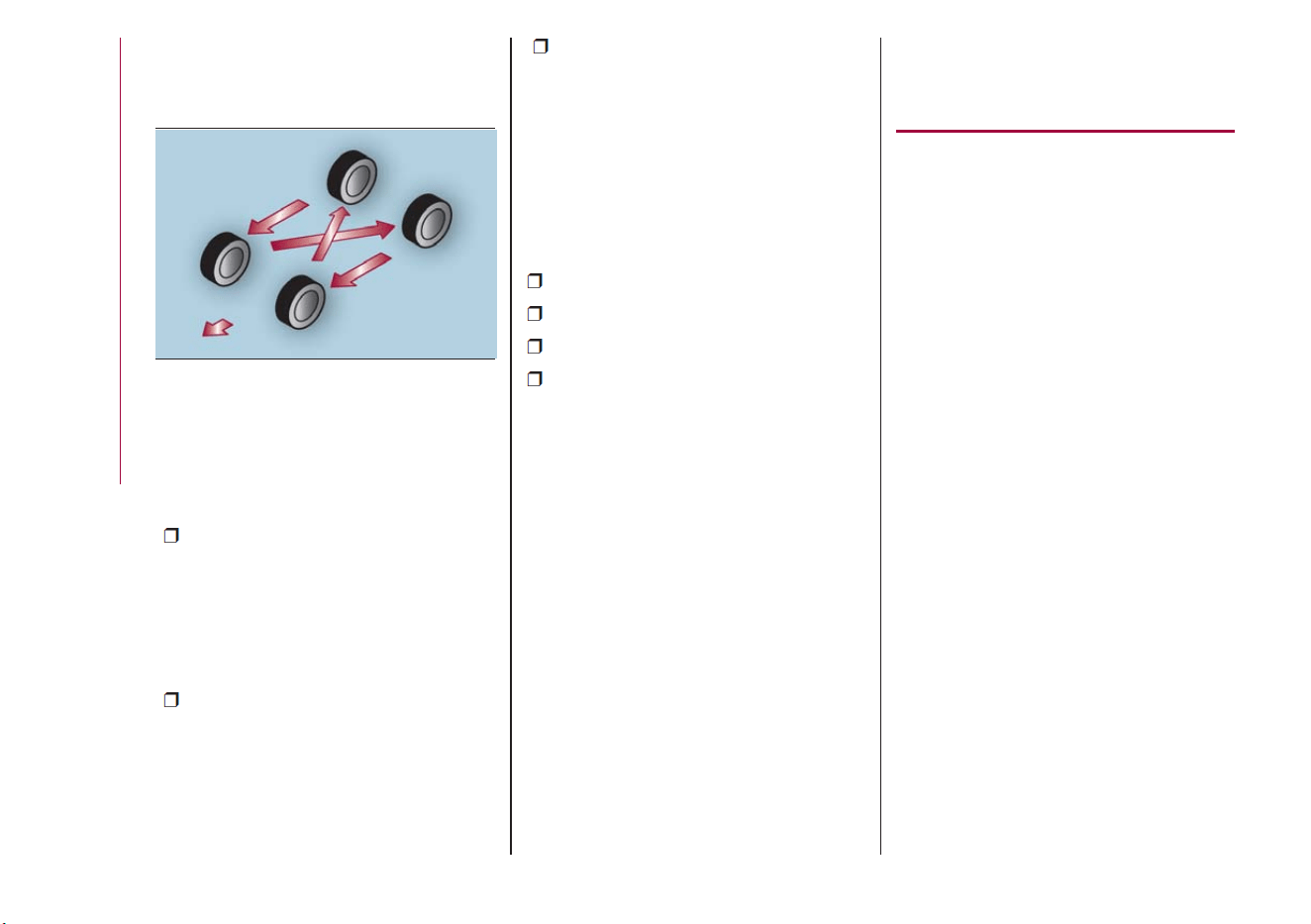
Tire rotation means moving the wheels
to a different position, with respect to
the vehicle. During rotation, inspect tires
for correct balance.
The single wheel will therefore operate
on a different axle and, where possible,
on the opposite side of the vehicle.
Note:
Rotate tires periodically. Irregular tire
wear is dangerous. To equalize tread
wear for maintaining good
performance in handling and braking,
rotate the tires every 6,200 miles
(10,000 km), or sooner if irregular wear
develops.
To equalize tread wear, rotate the
tires every 7,500 miles (12,000 km) at
the latest or sooner if irregular wear
develops. FCA recommends to rotate
every 5,000 miles (8,000 km) to help
increase tire life and distribute wear
more evenly.
Because your vehicle is not
equipped with a spare tire, you cannot
do a tire rotation safely with the jack
that may come with your vehicle if so
equipped. Contact an authorized
dealer for tire rotation.
Also, inspect them for uneven wear and
damage. Abnormal wear is usually
caused by one or a combination of the
following:
Incorrect tire pressure
Improper wheel alignment
Out-of-balance wheel
Severe braking
After rotation, inflate all tire pressures to
specification and inspect the wheel nuts
for tightness.
With Tire Pressure Monitor System
(TPMS)
The TPM system must be initialized
after adjusting the tire pressure, to
make the system operate normally.
Refer to “Tire Pressure Monitoring
System” in “Safety” for further
information.
Rotate unidirectional tires and radial
tires that have an asymmetrical tread
pattern only from front to rear, not from
side to side. Tire performance will be
reduced if rotated from side to side.
DEPARTMENT OF
TRANSPORTATION
UNIFORM TIRE
QUALITY GRADES
The following tire grading
categories were established by the
National Highway Traffic Safety
Administration. The specific grade
rating assigned by the tire's
manufacturer in each category is
shown on the sidewall of the tires
on your vehicle.
All passenger vehicle tires must
conform to Federal safety
requirements in addition to these
grades.
Treadwear
The Treadwear grade is a
comparative rating, based on the
wear rate of the tire when tested
under controlled conditions on a
specified government test course.
For example, a tire graded
150 would wear one and one-half
times as well on the government
course as a tire graded 100. The
relative performance of tires
depends upon the actual
conditions of their use, however,
and may depart significantly from
07031402-FRT-001
Rotation Diagram
260
SERVICING AND MAINTENANCE

the norm due to variations in driving
habits, service practices, and
differences in road characteristics
and climate.
Traction Grades
The Traction grades, from highest
to lowest, are AA, A, B, and C.
These grades represent the tire's
ability to stop on wet pavement, as
measured under controlled
conditions on specified government
test surfaces of asphalt and
concrete. A tire marked C may
have poor traction performance.
Warning!
The traction grade assigned to
this tire is based on straight-ahead
braking traction tests, and does
not include acceleration,
cornering, hydroplaning, or peak
traction characteristics.
Temperature Grades
The Temperature grades are A (the
highest), B, and C, representing the
tire's resistance to the generation of
heat and its ability to dissipate heat,
when tested under controlled
conditions on a specified indoor
laboratory test wheel.
Sustained high temperature can
cause the material of the tire to
degenerate and reduce tire life, and
excessive temperature can lead to
sudden tire failure. The grade C
corresponds to a level of
performance, which all passenger
vehicle tires must meet under the
Federal Motor Vehicle Safety
Standard No. 109. Grades B and A
represent higher levels of
performance on the laboratory test
wheel, than the minimum required
by law.
Warning!
The temperature grade for this tire is
established for a tire that is properly
inflated and not overloaded.
Excessive speed, under-inflation, or
excessive loading, either separately
or in combination, can cause heat
buildup and possible tire failure.
261

STORING THE
VEHICLE
If the vehicle is left inactive for longer
than a month, the following precautions
should be observed:
Park the vehicle in covered, dry and if
possible well-ventilated premises and
slightly open the windows.
Check that the parking brake is not
activated.
Disconnect the negative battery
terminal and check the battery charge.
Repeat this check once every three
months during storage.
If the battery is not disconnected
from the electrical system, check its
state of charge every thirty days.
Clean and protect the painted parts
using protective wax.
Clean and protect the shiny metal
parts using special compounds
available commercially.
Sprinkle talcum powder on the
windshield and rear window wiper
rubber blades and lift them off the
glass.
Cover the vehicle with a fabric or
perforated plastic sheet, paying
particular care not to damage the
painted surface by dragging any dust
that may have accumulated on it. Do
not use compact plastic sheets which
do not allow humidity to evaporate from
the surface of the vehicle.
Inflate the tires at a pressure of
+7.25 psi (+0.5 bar) higher than
recommended on the tire placard and
check it periodically.
Do not drain the engine cooling
system.
Any time the vehicle is left inactive for
two weeks or more, operate the air
conditioning system with engine idling
for at least five minutes, setting external
air and with fan set to maximum speed.
This operation will ensure appropriate
lubrication for the system, thus
minimizing the possibility of damage to
the compressor when the system is
operated again.
Note: After placing the ignition in the
OFF mode and having closed the driver
side door, wait at least one minute
before disconnecting the electrical
supply from the battery. When
reconnecting the electrical supply to the
battery, make sure that the ignition in
the OFF mode and the driver side door
is closed.
BODYWORK
Protection From
Atmospheric Agents
The vehicle is equipped with the best
available technological solutions to
protect the bodywork against corrosion.
These include:
Painting products and systems
which give the vehicle resistance to
corrosion and abrasion.
Use of galvanized (or pre-treated)
steel sheets, with high resistance to
corrosion.
Spraying of plastic parts, with a
protective function in the more exposed
points: underdoor, inner fender, edges,
etc.
Use of “open” boxed sections to
prevent condensation and pockets of
moisture which could favor the
formation of rust inside.
Use of special films to protect
against abrasion in exposed areas (e.g.
rear fender, doors, etc.).
262
SERVICING AND MAINTENANCE

Corrosion Warranty
Your vehicle is covered by Corrosion
Warranty against perforation due to rust
of any original element of the structure
or bodywork. For the general terms of
this Corrosion Warranty, refer to the
Warranty Booklet.
Preserving The
Paintwork
Touch up abrasions and scratches
immediately to prevent the formation of
rust.
Maintenance of paintwork consists of
washing the vehicle: the frequency
depends on the conditions and
environment in which the vehicle is
used.
For example, it is advisable to wash the
vehicle more often in areas with high
levels of atmospheric pollution or salted
roads.
To correctly wash the vehicle, follow
these instructions:
If high pressure jets or cleaners are
used to wash the vehicle, keep a
distance of at least 1.3 ft (40 cm) from
the bodywork to avoid damage or
alteration. Build up of water could
cause damage to the vehicle in the long
term.
Wash the vehicle using a low
pressure jet of water if possible.
Wipe a sponge with a slightly soapy
solution over the bodywork, frequently
rinsing the sponge.
Rinse well with water and dry with a
jet of air or a chamois leather.
Dry the less visible parts (e.g. door
frames, hood, headlight frames, etc.)
with special care, as water may
stagnate more easily in these areas. Do
not wash the vehicle after it has been
left in the sun or with the hood hot: this
may alter the shine of the paintwork.
Exterior plastic parts must be cleaned
in the same way as the rest of the
vehicle.
Note:
Avoid parking under trees; the sap
dropped by trees makes the paint
work go dull and increases the
possibility of corrosion.
Bird droppings must be washed off
immediately and thoroughly as the acid
they contain is particularly aggressive.
Etching caused by acid rain or
industrial fallout
Cause:
Industrial pollutants and vehicle
emissions drift into the air and mix with
rain or dew to form acids. These acids
can settle on a vehicle's finish. As the
water evaporates, the acid becomes
concentrated and can damage the
finish.
The longer the acid remains on the
surface, the greater the chance is for
damage.
Prevention:
It is necessary to wash and wax your
vehicle to preserve its finish according
to the instructions in this section. These
steps should be taken immediately after
you suspect that acid rain has settled
on your vehicle's finish.
Damage caused by bird
dropping/insects/tree sap
Problem:
Bird droppings contain acids. If these
are not removed they can eat away the
clear and color base coat of the
vehicle's paintwork.
When insects stick to the paint surface
and decompose, corrosive compounds
form. These can erode the clear and color
base coat of the vehicle's paintwork if
they are not removed.
Tree sap will harden and adhere
permanently to the paint finish. If you
scratch the sap off while it is hard,
some vehicle paint could come off with
it.
Prevention:
It is necessary to have your vehicle
washed and waxed to preserve its finish
according to the instructions in this
section. This should be done as soon
as possible.
263

Bird droppings can be removed with a
soft sponge and water. If you are
travelling and these are not available, a
moistened tissue may also take care of
the problem. The cleaned area should
be waxed according to the instructions
in this section. Insects and tree sap are
best removed with a soft sponge and
water or a commercially available
chemical cleaner.
Another method is to cover the affected
area with dampened newspaper for one
to two hours. After removing the
newspaper, rinse off the loosened
debris with water.
Water marks
Problem:
Rain, fog, dew, and even tap water can
contain harmful minerals such as salt
and lime. If moisture containing these
minerals settles on the vehicle and
evaporates, the minerals will
concentrate and harden to form white
rings. The rings can damage your
vehicle's finish.
Prevention:
It is necessary to wash and wax your
vehicle to preserve its finish according
to the instructions in this section. These
steps should be taken immediately after
you find water marks on your vehicle's
finish.
Paint chipping
Problem:
Paint chipping occurs when gravel
thrown in the air by another vehicle's
tires hits your vehicle.
How to avoid paint chipping:
Keeping a safe distance between you
and the vehicle ahead reduces the
chances of having your paint chipped
by flying gravel.
Note:
The paint chipping zone varies with
the speed of the vehicle. For example,
when travelling at 55 mph (90 km/h),
the paint chipping zone is 164 ft
(50 m).
In low temperatures, a vehicle's
finish hardens. This increases the
chance of paint chipping.
Chipped paint can lead to rust
forming on your vehicle. Before this
happens, repair the damage by using
FCA touch-up paint according to the
instructions in this section. Failure to
repair the affected area could lead to
serious rusting and expensive repairs.
Follow all label and container directions
when using a chemical cleaner or
polish. Read all warnings and cautions.
Maintaining The Finish
Washing
To help protect the finish from rust and
deterioration, wash your vehicle
thoroughly and frequently, at least once
a month, with lukewarm or cold water.
If the vehicle is washed improperly, the
paint surface could be scratched. Here
are some examples of how scratching
could occur:
The vehicle is washed without first
rinsing off dirt and other foreign matter.
The vehicle is washed with a rough,
dry, or dirty cloth.
The vehicle is washed at a car wash
that uses brushes that are dirty or too
stiff.
Cleansers or wax containing
abrasives are used.
Note: FCA is not responsible for
scratches caused by automatic car
washes or improper washing.
Scratches are more noticeable on
vehicles with darker paint finishes.
When the wiper lever is in the AUTO
position and the ignition is placed in the
ON mode, the wipers may move
automatically in the following cases:
If the windshield above the rain
sensor is touched or wiped with a cloth.
If the windshield is struck with a hand
or other object from either outside or
inside the vehicle.
264
SERVICING AND MAINTENANCE

Note:
Keep hands and scrapers clear of
the windshield when the wiper lever is
in the AUTO position and the ignition is
placed in the ON mode as fingers
could be pinched or the wipers and
wiper blades damaged when the
wipers activate automatically. If you are
going to clean the windshield, be sure
the wipers are turned off completely
(when it is most likely that the engine is
left running) this is particularly
important when clearing ice and snow.
Do not spray water in the engine
compartment. Otherwise, it could
result in engine-starting problems or
damage to electrical parts.
When washing and waxing the
vehicle, be careful not to apply
excessive force to any single area of
the vehicle hood. Otherwise, you could
dent the vehicle.
Do not use automatic car washing
machines and car washing devices
using high water pressure.
Make sure that the fuel door is
closed and lock the doors. Otherwise,
the fuel door may be forcefully opened
by water pressure causing damage to
the vehicle or fuel door.
To minimize scratches on the vehicle's
paint finish:
Rinse off any dirt or other foreign
matter using lukewarm or cold water
before washing.
Use plenty of lukewarm or cold water
and a soft cloth when washing the
vehicle. Do not use a nylon cloth.
Rub gently when washing or drying
the vehicle.
Take your vehicle only to a car wash
that keeps its brushes well maintained.
Do not use abrasive cleansers or
wax that contain abrasives.
Caution!
Do not use steel wool, abrasive cleaners, or
strong detergents containing highly alkaline
or caustic agents on chrome plated or
anodized aluminium parts. This may
damage the protective coating; also,
cleaners and detergents may discolor or
deteriorate the paint.
Pay special attention to removing salt,
dirt, mud, and other foreign material
from the underside of the fenders, and
make sure the drain holes in the lower
edges of the doors and rocker panels
are clean.
Insects, tar, tree sap, bird droppings,
industrial fallout, and similar deposits
can damage the finish if not removed
immediately. When prompt washing
with plain water is ineffective, use a mild
soap made for use on vehicles.
Thoroughly rinse off all soap with
lukewarm or cold water. Do not allow
soap to dry on the finish.
After washing the vehicle, dry it with a
clean chamois to prevent water spots
from forming.
Waxing
Your vehicle needs to be waxed when
water no longer beads on the finish.
Always wash and dry the vehicle before
waxing it. In addition to the vehicle
body, wax the metal trim to maintain its
lustre:
Use wax which contains no
abrasives. Waxes containing abrasive
will remove paint and could damage
bright metal parts.
Use a good grade of natural wax for
metallic, mica, and solid colors.
When waxing, coat evenly with the
sponge supplied or a soft cloth.
Wipe off the wax with a soft cloth.
Note: A spot remover to remove oil,
tar, and similar materials will usually also
take off the wax. Rewax these areas
even if the rest of the vehicle does not
need it.
265

Repairing Damage To
The Finish
Deep scratches or chips on the finish
should be repaired promptly. Exposed
metal quickly rusts and can lead to
major repairs.
Note: If your vehicle is damaged and
needs metal parts repaired or replaced,
make sure the body shop applies
corrosion prevention materials to all
parts, both repaired and new. This will
prevent them from rusting.
Bright-Metal Maintenance
Use tar remover to remove road tar and
insects. Never do this with a knife or
similar tool.
To prevent corrosion on brigh-tmetal
surfaces, apply wax or chrome
preservative and rub it to a high lustre.
During cold weather or in coastal areas,
cover bright-metal parts with a coating of
wax or preservative heavier than usual. It
would also help to coat them with
noncorrosive petroleum jelly or some
other protective compound.
Caution!
Do not use steel wool, abrasive cleaners, or
strong detergents containing highly alkaline
or caustic agents on chrome plated or
anodized aluminium parts. This may result
in damage to the protective coating and
cause discoloration or paint deterioration.
Underbody Maintenance
Road chemicals and salt used for ice
and snow removal and solvents used
for dust control may collect on the
underbody. If not removed, they will
speed up rusting and deterioration of
such underbody parts as fuel lines,
frame, floor pan, and exhaust system,
even though these parts may be coated
with anti-corrosive material.
Thoroughly flush the underbody and
wheel housings with lukewarm or cold
water at the end of each winter. Try also
to do this every month.
Pay special attention to these areas
because they easily hide mud and dirt.
It will do more harm than good to wet
down the road grime without removing
it.
The lower edges of doors, rocker
panels, and frame members have drain
holes that should not be clogged.
Water trapped there will cause rusting.
Aluminium Wheel
Maintenance
A protective coating is provided over
the aluminium wheels. Special care is
needed to protect this coating.
Note: Do not use any detergent other
than mild detergent. Before using any
detergent, verify the ingredients.
Otherwise, the product could discolor
or stain the aluminium wheels.
Caution!
Do not use a wire brush or any abrasive
cleaner, polishing compound, or solvent on
aluminium wheels. They may damage the
coating.
Note: Always use a sponge or soft
cloth to clean the wheels. Rinse the
wheels thoroughly with lukewarm or
cold water. Also, be sure to clean the
wheels after driving on dusty or salted
roads to help prevent corrosion.
Convertible Top
Maintenance
The convertible top is made of a special
high-grade material, but if it's not taken
good care of, hardening, staining, and
loss of lustre will result. Maintain it
under these guidelines.
Washing
Do not wait until the convertible top
gets really dirty before cleaning it. Dirt
that's there too long will cause
deterioration.
Before washing, remove dust and
coarse particulate with a soft brush.
Gently clean the convertible top with
a synthetic neutral detergent, lots of
water, and a soft brush.
266
SERVICING AND MAINTENANCE

Rinse it thoroughly with clean water
to remove all the soap.
Wipe it as dry as you can before the
water dries on it.
Then allow it to dry completely before
lowering it.
Caution!
Automatic and high-pressure car
washes are harmful to a convertible top.
Avoid them.
Do not spray water directly on the area
where the window glass and the
convertible top meet. This would probably
cause water to enter the interior.
Do not spray water directly on the seam
area of the body and the convertible top as
it could result in water penetrating the
interior.
Do not wipe the convertible top using
alcohol, chlorine bleach, or organic
solvents such as thinner, benzene, or
gasoline. Otherwise, they may cause
discoloration or stains.
Too much treatment on the convertible
top can be as damaging as too little. Follow
the manufacturer's directions. Do not over
do it!
Note:
Some leather treatment products
can ruin the convertible top's gloss. Be
careful of the one you choose.
Test on an inconspicuous, small
corner of the convertible top if you are
not sure.
Do not get any car wax on the
convertible top.
If you do, remove it with a good
leather cleaner or mild detergent
(about 5% solution).
Let the convertible top dry
completely before lowering after
applying treatment or dressing.
Drain Filter Cleaning
If leaves or other matter block the drain
filter, water may enter the vehicle. Clean
the drain filter at least once a year.
Proceed as follows:
1. Check the position of the drain filter
with your hand from behind the bow.
2. Remove the drain filter while
pressing the tab.
07040110-122-001AB
Drain Filter
07040110123001
Drain Filter Location
1 — Drain Filter
2—Bow
07040110124001
Drain Filter Tab
267

3. Remove leaves and other matter
accumulated in the drain filter.
4. Reinstall the drain filter in the reverse
order of the removal procedure.
Note: Make sure that the drain filter is
securely attached to its designated
position by pushing it until the tab
locks. Water may enter the vehicle if the
drain filter is not secured to its
designated position. For this operation
go to an authorized dealer.
Plastic Part
Maintenance
When cleaning the plastic lenses of the
lights, do not use gasoline, paraffin,
rectified spirit, paint, thinner, highly
acidic detergents, or strongly alkaline
detergents.
Otherwise, these chemical agents can
discolor or damage the surfaces
resulting in a significant loss in
functionality. If plastic parts become
inadvertently exposed to any of these
chemical agents, flush with water
immediately.
If plastic parts such as the bumpers
become inadvertently exposed to
chemical agents or fluids such as
gasoline, oil, engine coolant, or battery
fluid, it could cause discoloration,
staining, or paint peeling. Wipe off any
such chemical agents or fluids using a
soft cloth immediately.
Caution!
High water temperature and high water
pressure car washers are available
depending on the type of high pressure car
washer device. If the car washer nozzle is
put too close to the vehicle or aimed at one
area for an extended period of time, it
could deform plastic parts or damage the
paint.
Do not use wax containing compounds
(polish). Otherwise, it could result in paint
damage.
In addition, do not use an electrical or air
tool to apply wax. Otherwise, the frictional
heat generated could result in deformation
of plastic parts or paint damage.
INTERIORS
Seats And Fabric Parts
Warning!
Do not use volatile solvents for cleaning
purposes. Many are potentially flammable,
and if used in closed areas they may cause
respiratory harm.
Do not keep aerosol cans in the car: they
might explode. Aerosol cans must not be
exposed to a temperature exceeding
122°F (50°C). When the vehicle is exposed
to sunlight the internal temperature can
greatly exceed this value.
Caution!
Direct contact of air fresheners, insect
repellents, suntan lotions, or hand
sanitizers, to the plastic, painted, or
decorated surfaces of the interior may
cause permanent damage. Wipe away
immediately.
Damage caused by these type of
products may not be covered by your New
Vehicle Limited Warranty.
Rubbing the interior side of the
convertible top vigorously with a stiff brush
or cloth may cause damage.
268
SERVICING AND MAINTENANCE

Vinyl
Remove dust and loose dirt from vinyl
with a whisk broom or vacuum cleaner.
Clean vinyl with a leather-and-vinyl
cleaner.
Fabric
Remove dust and loose dirt from fabric
with a whisk broom or vacuum cleaner.
Clean it with a mild soap solution good
for upholstery and carpets.
Remove fresh spots immediately with a
fabric spot cleaner.
To keep the fabric looking clean and
fresh, take care of it. Otherwise its color
will be affected, it can be stained easily,
and its fire-resistance may be reduced.
Note: Use only recommended cleaners
and procedures. Others may affect
appearance and fire-resistance.
Interior Panels
When the interior panels need to be
cleaned, use soft material such as a
soft cloth soaked in clean water and
wrung out well and lightly wipe off dirt
from the surface.
If a panel requires further cleaning, wipe
dirt off using a soft cloth soaked in mild
detergent (about 5% solution) and wipe
off any remaining detergent using a
cloth soaked in clean water and wrung
out well.
Caution!
Do not wipe leather parts using alcohol,
chlorine bleach, or organic solvents such
as thinner, benzene, or gasoline. Otherwise,
it may cause discoloration or stains.
Note:
Scratches or nicks on the panels
and metallic trim resulting from the use
of a hard brush or cloth may not be
repairable.
Be particularly careful when
cleaning high gloss panels and metallic
trim as they can be easily scratched.
Lap / Shoulder Belt
Warning!
A frayed or torn belt could rip apart in a
collision and leave you with no protection.
Inspect the belt system periodically,
checking for cuts, frays, or loose parts.
Damaged parts must be replaced
immediately. Do not disassemble or modify
the system. Seat belt assemblies must be
replaced after a collision if they have been
damaged (i.e., bent retractor, torn
webbing, etc.).
Clean the webbing with a mild soap
solution recommended for upholstery or
carpets. Follow instructions. Do not
bleach or dye the belts, this may
weaken them.
After cleaning the belts, thoroughly dry
the belt webbing and make sure there
is no remaining moisture before
retracting them.
Plastic And Coated
Parts
Clean interior plastic parts with a damp
cloth (if possible made from microfiber),
and a solution of water and neutral,
non-abrasive detergent.
To clean oily or persistent stains, use
specific products free from solvents and
designed to maintain the original
appearance and color of the
components.
Remove any dust using a microfiber
cloth, if necessary moistened with
water. The use of paper tissues is not
recommended as these may leave
residues.
Instrument panel precautions
Prevent caustic solutions such as
perfume and cosmetic oils from
contacting the instrument panel. They
will damage and discolor the instrument
panel. If these solutions get on the
instrument panel, wipe them off
immediately.
269

Note: Never use alcohol, gasoline and
derivatives to clean the instrument
panel lens.
Caution!
Do not use glazing agents. Glazing agents
contain ingredients which may cause
discoloration, wrinkling, cracks and peeling.
Instrument Panel Top
When cleaning, it is recommended that
you use a clean towel dampened in a
mild detergent to remove debris.
Caution!
If the surface is rubbed harshly, it could
result in the surface being damaged leaving
white scratch marks.
Window Interiors
If the windows become covered with an
oily, greasy, or waxy film, clean them
with glass cleaner. Follow the directions
on the container.
Note: Do not scrape or scratch the
inside of the window glass. It could
damage the thermal filaments.
Caution!
When washing the inside of the window
glass, use a soft cloth dampened in
lukewarm water, gently wiping the thermal
filaments. Use of glass cleaning products
could damage the thermal filaments.
Leather Parts —
If Equipped
Caution!
Do not use Alcohol and Alcohol-based
and/or Ketone based cleaning products to
clean leather seats, as damage to the seat
may result.
Remove dust and sand first using a
vacuum cleaner or other means, then
wipe dirt off using a soft cloth with a
leather cleaner or a soft cloth soaked in
mild soap.
Wipe off the remaining cleaner or soap
using a cloth soaked in clean water and
wrung out well.
Remove moisture with a dry, soft cloth
and allow the leather to further dry in a
well-ventilated, shaded area.
If the leather gets wet such as from
rain, also remove moisture and dry it as
soon as possible.
Note:
Because genuine leather is a natural
material, its surface is not uniform and
it may have natural scars, scratches,
and wrinkles.
To maintain the quality for as long
as possible, periodical maintenance,
about twice a year, is recommended.
270
SERVICING AND MAINTENANCE
Caution!
Sand and dust on the seat surface may
damage the overcoat of the genuine
leather surfaces and accelerate wear
.
Greasy soiling on genuine leather may
cause molding and stains.
Rubbing hard with a stiff brush or cloth
may cause damage.
Do not wipe the leather using alcohol,
chlorine bleach, or organic solvents such
as thinner, benzene, or gasoline. Otherwise,
it may cause discoloration or stains.
If the seats get wet, promptly remove
moisture with a dry cloth. Remaining
moisture on the surface may cause
deterioration such as hardening and
shrinkage.
Exposure to direct sunlight for long
periods may cause deterioration and
shrinkage. When parking the car under
direct sunlight for long periods, shade the
interior using sunshades.
Do not leave vinyl products on the seats
for long periods as they may affect the
leather quality and coloring. If the cabin
temperature becomes hot, the vinyl may
deteriorate and adhere to the genuine
leather.
271

TECHNICAL SPECIFICATIONS
IDENTIFICATION DATA ........273
RECOMMENDED TIRE
INFLATION PRESSURE ........274
ENGINE..................276
TRANSMISSION ............277
BRAKES .................278
SUSPENSIONS .............279
STEERING ................280
DIMENSIONS ..............281
FLUID CAPACITIES ..........283
FLUIDS AND LUBRICANTS .....284
PERFORMANCE ............286
272
TECHNICAL SPECIFICATIONS
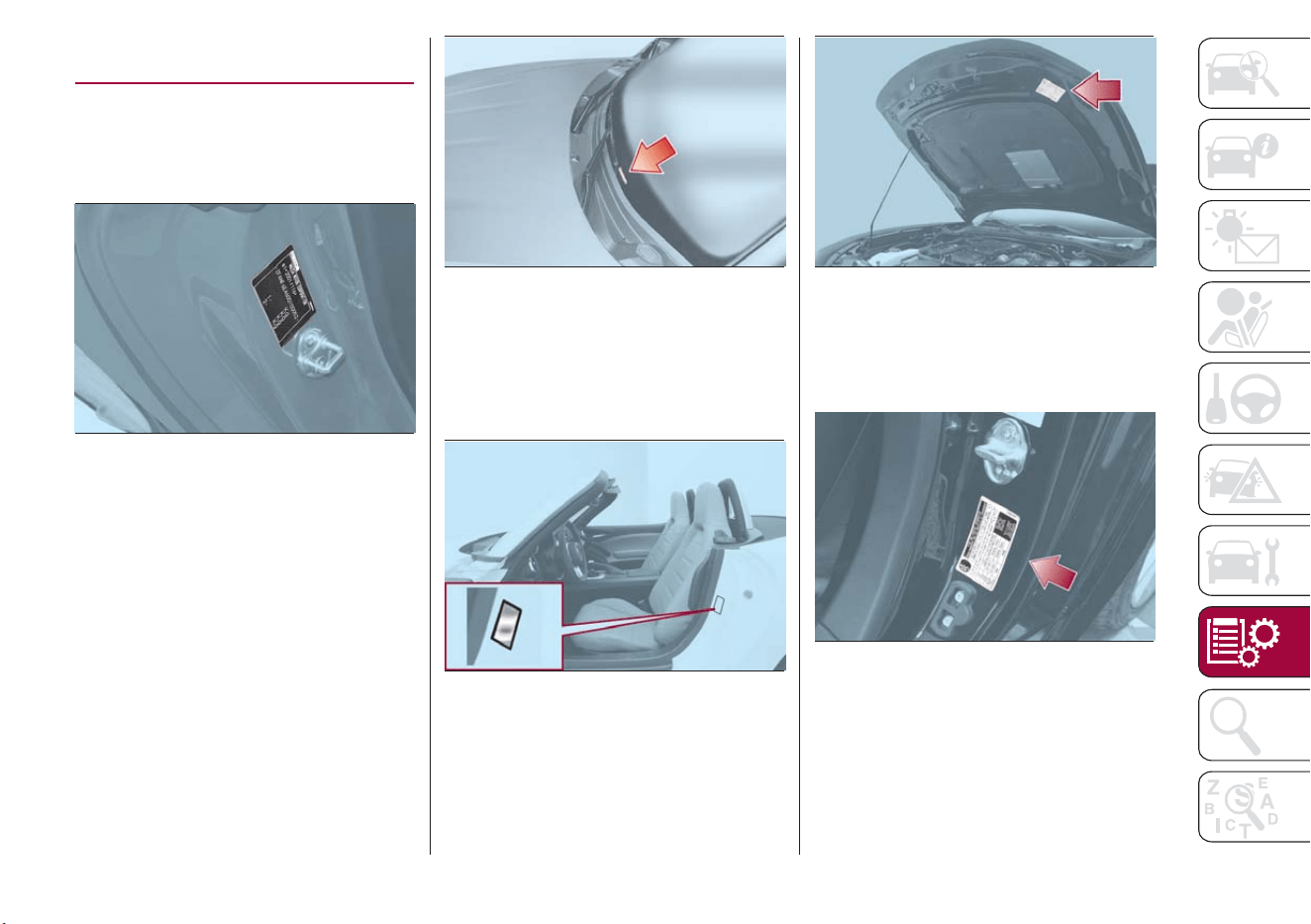
IDENTIFICATION
DATA
Identification Numbers
Model Plate
The model plate is located on the left
side of door pillar.
Chassis Number/Vehicle
Identification Number
The Vehicle Identification Number is
located below the left side (driver side)
of the windshield.
Motor Vehicle Safety Standard
Label
(U.S.A. and Canada)
The motor vehicle safety standard label
is located on the left side of door pillar.
Vehicle Emission Control
Information Label
(U.S.A. and Canada)
The vehicle emission control information
label is located under the hood.
Tire Pressure Label
The tire pressure label is located on the
left side of door pillar.
Engine Number
The engine number label is located on
the engine.
10010103121001
Model Plate Location
10010104-122-001AB
Vehicle Identification Number
10010109-121-001
Motor Vehicle Safety
Standard Label
10010106-121-001
Vehicle Emission Control
Information Label
10010107-121-002
Tire Pressure Label
273

RECOMMENDED
TIRE INFLATION
PRESSURE
On the tire label you will find the
recommended tire inflation pressure in
both psi and kPa for the tires installed
as original equipment on the vehicle.
It is very important that the inflation
pressure of the tires on your vehicle is
maintained at the recommended
pressure.
You should check the tire pressure
regularly to insure that the proper
inflation pressure is maintained.
Note:
Tire pressures listed on the vehicle
placard or tire information label indicate
the recommended cold tire inflation
pressure, measured when the tires are
cold, after the vehicle has been parked
for at least three hours. As you drive,
the temperature in the tire warms up,
increasing the tire pressure.
Always check the tire inflation
pressures on a regular basis according
to the recommended tire inflation
pressure on the tire label and in
conjunction with the information in this
Owner's Manual. Driving your vehicle
with under-inflated tires is dangerous.
Under-inflation is the most common
cause of failures in any kind of tire and
may result in severe cracking, tread
separation or “blowout”, with
unexpected loss of vehicle control and
increased risk of injury. Under-inflation
increases sidewall flexing and rolling
resistance, resulting in heat buildup and
internal damage to the tire. It results in
unnecessary tire stress, irregular wear,
loss of control and accidents. A tire can
lose up to half of its air pressure and not
appear to be flat. It is impossible to
determine whether or not tires are
properly inflated just by looking at them.
Checking Tire Pressure
Proceed as follows:
1. When you check the air pressure,
make sure the tires are cold - meaning
they are not hot from driving even a
mile.
2. Remove the cap from the valve on
one tire.
3. Firmly press a tire gauge onto the
valve.
4. Add air to achieve recommended air
pressure.
5. If you overfill the tire, release air by
pushing on the metal stem in the center
of the valve. Then recheck the pressure
with your tire gauge.
6. Replace the valve cap.
7. Visually inspect the tires to make
sure there are no nails or other objects
embedded that could poke a hole in the
tire and cause an air leak.
8. Check the sidewalls to make sure
there are no gouges, cuts, bulges,
cracks or other irregularities.
274
TECHNICAL SPECIFICATIONS

Glossary Of Terms
Tire Placard
A label indicating the OE (Original
Equipment) tire sizes, recommended
inflation pressure, and the maximum
weight the vehicle can carry.
Tire Identification Number (TIN)
A number on the sidewall of each tire
providing information about the tire
brand and manufacturing plant, tire
size, and date of manufacture.
Inflation Pressure
A measure of the amount of air in a tire.
kPa
Kilopascal, the metric unit for air
pressure.
psi
Pounds per square inch, the English
unit for air pressure.
B-pillar
The structural member at the side of
the vehicle behind the front door.
Original Equipment (OE)
Describes components originally
equipped on the vehicle.
Vehicle Load Limit
The maximum value of the combination
weight of occupants and cargo.
Bead Area of the Tire
Area of the tire next to the rim.
Sidewall Area of the Tire
Area between the bead area and the
tread.
Tread Area of the Tire
Area on the perimeter of the tire that
contacts the road when it's mounted
on the vehicle.
275

ENGINE
Engine
1.4 Turbo Multi Air
Cycle Four
Number
and position of cylinders 4 in line
Piston bore and stroke (mm) 72.0 x 80.4
Total displacement (cm³) 1368
Compression ratio 9.8:1
Maximum power (kW) 122
Maximum power (HP) 164
Corresponding engine speed (rpm) 5500
Maximum torque (Nm) 250
Maximum torque (lb.-ft.) 184
Corresponding engine speed (rpm) 2500
Spark plugs We recommend you use Mopar Spark Plugs.
Fuel
91 Octane Recommended (87 Octane Acceptable) Maximum
15% Ethanol Content
Note: When cleaning the iridium plugs, do not use a wire brush. The fine particulate coating on the iridium alloy and platinum
tips could be damaged.
Warning!
Modifications or repairs to the fuel supply system that are not carried out correctly or do not take the system’s technical specifications into
account, can cause malfunctions leading to the risk of fire.
276
TECHNICAL SPECIFICATIONS

TRANSMISSION
Engine Traction Type Description
1.4 Turbo Multi Air R
WD Manual/Automatic
6-speed manual
(*) / 6-speed
Automatic Transmission(**)
(*) If equipped with manual transmission
(**) If equipped with automatic transmission
277

BRAKES
Engine Front brakes Rear brakes Parking brake
1.4 Turbo Multi Air
V
entilated
(floating type 11 in diameter)
Solid
(floating type 11 in diameter)
Mechanical
(lever type)
Note: Water, ice, and salt spread on the roads may deposit on the brake disks reducing braking efficiency the first time the
brakes are applied.
278
TECHNICAL SPECIFICATIONS
SUSPENSIONS
Engine Front Rear
1.4 Turbo Multi Air Double
wishbone with stabilizer bars Multilink with stabilizer bars
279

STEERING
Engine Turning circle curb to curb, ft (m) Type
1.4 Turbo Multi Air 30.8
(9.4)
Double pinion electric power assist system
(DP - EPAS) - rack and pinion
280
TECHNICAL SPECIFICATIONS
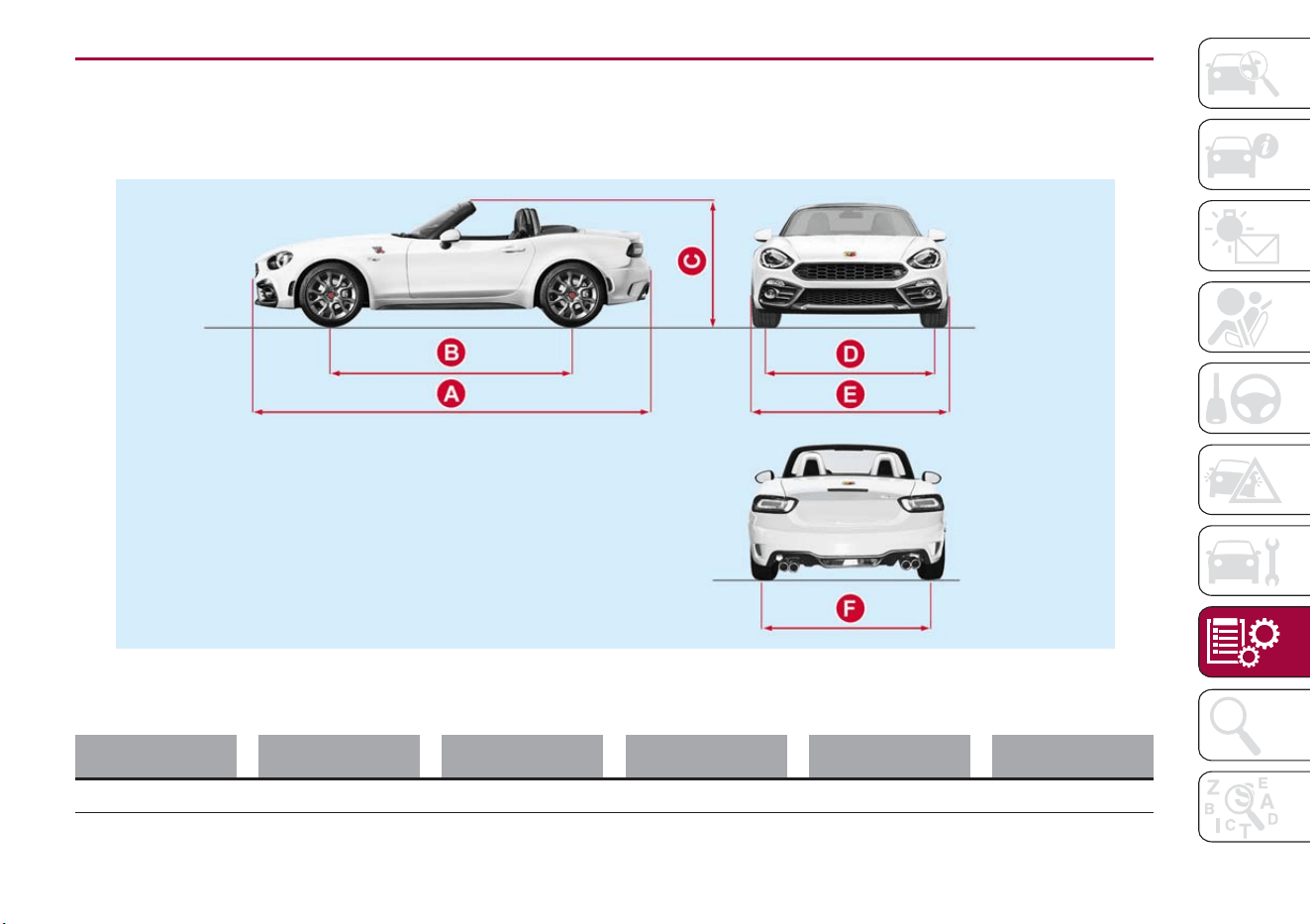
DIMENSIONS
Dimensions
Dimensions are expressed in inches and refer to the vehicle equipped with its standard-supplied tires. Height is measured with
vehicle unloaded.
Trunk Volume: 4.9 cu. ft. (140 Liters)
ABCDEF
159.6 (4054 mm) 90.9 (2309 mm) 48.5 (1232 mm) 58.9 (1496 mm) 68.5 (1740 mm) 59.1 (1503 mm)
10000555-122-333AB
Vehicle Dimension Chart
281

Weights
Curb Weight: 2477 lbs (1124 kg) (if
equipped with manual transmission) /
2516 lbs (1141 kg) (if equipped with
automatic transmission).
282
TECHNICAL SPECIFICATIONS

FLUID CAPACITIES
Item Capacities
Fuel tank 11.9
(gallons) / 45 (liters)
Engine oil (without oil filter replacement) 3.3 (quarts) / 3.2 (liters)
Engine oil (with oil filter replacement) 4.0 (quarts) / 3.8 (liters)
Coolant (with manual transmission) 7.6 (quarts) / 7.2 (liters)
Coolant (with automatic transmission) 7.5 (quarts) / 7.1 (liters)
Manual transmission oil 2.2 (quarts) / 2.1 (liters)
Automatic transmission fluid 7.8 (quarts) / 7.5 (liters)
Rear differential oil 0.63 (quarts) / 0.6 (liters)
Limited slip differential oil 0.63 (quarts) / 0.6 (liters)
Brake fluid (& clutch fluid) 0.57 (quarts) / 0.55 (liters)
283
FLUIDS AND LUBRICANTS
Fluids And Lubricants
Your vehicle is equipped with an engine oil that has been thoroughly developed and tested in order to meet the requirements of
the Scheduled Servicing Plan.
Constant use of the prescribed lubricants guarantees the fuel consumption and emission specifications. Lubricant quality is
crucial for engine operation and duration.
Lubricant Specification Replacement interval
Engine oil
W
e recommend you use API Certified SAE
5W-40 Full Synthetic Engine Oil, meeting the
requirements of FCA Material Standard
MS-12991. Refer to your engine oil filler cap
for correct SAE grade.
According to Scheduled Servicing Plan
Coolant
Mopar Long Life Coolant Concentrate for
FIAT Spider
According to Scheduled Servicing Plan
Manual transmission oil
Mopar Manual Transmission Long Life Gear
Oil for FIAT Spider
Automatic transmission fluid
Mopar Automatic Transmission Long Life
Fluid for FIAT Spider
Rear differential oil
Mopar Long Life Hypoid Gear Oil
for FIAT Spider
Limited slip differential oil
Mopar Long Life Limited Slip Additive
for FIAT Spider
Brake/clutch fluid
We recommend you use Mopar DOT 3.
If DOT 3 brake fluid is not available,
then DOT 4 is acceptable.
If lubricants compliant with the required specifications are not available, products that comply with the minimum required
characteristics can be used for topping up; in this case optimal performance of the engine is not guaranteed.
284
TECHNICAL SPECIFICATIONS

Caution!
Mixing of engine coolant (antifreeze) other than specified Organic Additive Technology (OAT) engine coolant (antifreeze), may result in
engine damage and may decrease corrosion protection. Organic Additive Technology (OAT) engine coolant is different and should not be
mixed with Hybrid Organic Additive Technology (HOAT) engine coolant (antifreeze) or any “globally compatible” coolant (antifreeze). If a
non-OAT engine coolant (antifreeze) is introduced into the cooling system in an emergency, the cooling system will need to be drained,
flushed, and refilled with fresh OAT coolant (conforming to MS.90032), by an authorized dealer as soon as possible.
Do not use water alone or alcohol-based engine coolant (antifreeze) products. Do not use additional rust inhibitors or antirust products, as
they may not be compatible with the radiator engine coolant and may plug the radiator.
This vehicle has not been designed for use with propylene glycol-based engine coolant (antifreeze). Use of propylene glycol-based engine
coolant (antifreeze) is not recommended.
285
PERFORMANCE
Performance
Top speed after the initial period of usage of the vehicle.
Version MPH (km/h)
1.4 Turbo Multi Air 164HP 130 (209.2)
286
TECHNICAL SPECIFICATIONS
CUSTOMER ASSISTANCE
SUGGESTIONS FOR OBTAINING
SERVICE FOR YOUR VEHICLE . . .288
IF YOU NEED ASSISTANCE .....288
WARRANTYINFORMATION.....290
REPORTING SAFETY DEFECTS . .290
PUBLICATION ORDER FORMS . . .291
287

SUGGESTIONS FOR
OBTAINING SERVICE
FOR YOUR VEHICLE
Prepare For The
Appointment
If you are having warranty work done,
be sure to bring the right papers with
you, as well as your warranty folder. All
work to be performed may not be
covered by the warranty. Discuss
additional charges with the service
manager. Keep a maintenance log of
your vehicle's service history, as this
can often provide a clue to the current
problem.
Prepare A List
Make a written list of your vehicle's
problems or the specific work you want
done. If you've had an accident or work
done that is not on your maintenance
log, let the service advisor know.
Be Reasonable With
Requests
If you list a number of items and you
must have your vehicle by the end of
the day, discuss the situation with the
service advisor and list the items in
order of priority. At many authorized
dealers, you may obtain a rental vehicle
at a minimal daily charge. If you need a
rental, it is advisable to make these
arrangements when you call for an
appointment.
IF YOU NEED
ASSISTANCE
The manufacturer and its authorized
dealer are vitally interested in your
satisfaction. We want you to be happy
with our products and services.
Warranty service must be done by an
authorized dealer. We strongly
recommend that you take the vehicle to
an authorized dealer. They know your
vehicle the best, and are most concerned
that you get prompt and high quality
service. The manufacturer's authorized
dealer have the facilities, factory-trained
technicians, special tools, and the latest
information to ensure the vehicle is fixed
correctly and in a timely manner.
This is why you should always talk to an
authorized dealer service manager first.
Most matters can be resolved with this
process.
If for some reason you are still not
satisfied, talk to the general manager or
owner of the authorized dealer. They
want to know if you need assistance.
If an authorized dealer is unable to
resolve the concern, you may contact
the manufacturer's customer center.
Any communication to the
manufacturer's customer center should
include the following information:
Owner's name and address
Owner's telephone number (home
and office)
Authorized dealer name
Vehicle Identification Number (VIN)
Vehicle delivery date and mileage
FIAT Customer Center
P.O. Box 21–8004 Auburn Hills, MI
48321–8004
Phone:
1-888-242-6342
FIAT Canada Customer
Center
P.O. Box 1621
Windsor, Ontario N9A 4H6
Phone: (800) 465-2001 English / (800)
387-9983 French
In Mexico Contact
Av. Prolongacion Paseo de la Reforma,
1240
Sante Fe C.P. 05109
Mexico, D. F.
In Mexico City: 5081-7568
Outside Mexico City:
1-800-505-1300
Puerto Rico And U.S.
Virgin Islands
Customer Service Chrysler International
Services LLC
P.O. Box 191857
San Juan 00919-1857
Tel.: (787) 782-5757
Fax: (787) 782-3345
288
CUSTOMER ASSISTANCE

Customer Assistance
For The Hearing Or
Speech Impaired
(TDD/TTY)
To assist customers who have hearing
difficulties, the manufacturer has
installed special TDD
(Telecommunication Devices for the
Deaf) equipment at its customer center.
Any hearing or speech impaired
customer, who has access to a TDD or
a conventional teletypewriter (TTY) in
the United States, can communicate
with the manufacturer by dialing
1-800-380-CHRY.
Canadian residents with hearing
difficulties that require assistance can
use the special needs relay service
offered by Bell Canada. For TTY
teletypewriter users, dial 711 and for
Voice callers, dial 1-800-855-0511 to
connect with a Bell Relay Service
operator.
Service Contract
You may have purchased a service
contract for a vehicle to help protect
you from the high cost of unexpected
repairs after the manufacturer's New
Vehicle Limited Warranty expires. The
manufacturer stands behind only the
manufacturer's service contracts. If you
purchased a manufacturer's service
contract, you will receive Plan
Provisions and an Owner Identification
Card in the mail within three weeks of
the vehicle delivery date. If you have
any questions about the service
contract, call the manufacturer's
Service Contract National Customer
Hotline at 1-800-521-9922 (Canadian
residents, call (800) 465-2001 English /
(800) 387-9983 French).
The manufacturer will not stand behind
any service contract that is not the
manufacturer's service contract. It is
not responsible for any service contract
other than the manufacturer's service
contract. If you purchased a service
contract that is not a manufacturer's
service contract, and you require
service after the manufacturer's New
Vehicle Limited Warranty expires,
please refer to the contract documents,
and contact the person listed in those
documents.
We appreciate that you have made a
major investment when you purchased
the vehicle. An authorized dealer has
also made a major investment in
facilities, tools, and training to assure
that you are absolutely delighted with
the ownership experience. You will be
pleased with their sincere efforts to
resolve any warranty issues or related
concerns.
Warning!
Engine exhaust (internal combustion
engines only), some of its constituents, and
certain vehicle components contain, or
emit, chemicals known to the State of
California to cause cancer and birth
defects, or other reproductive harm. In
addition, certain fluids contained in vehicles
and certain products of component wear
contain, or emit, chemicals known to the
State of California to cause cancer and
birth defects, or other reproductive harm.
289

WARRANTY
INFORMATION
See the Warranty Information Booklet,
for the terms and provisions of FCA US
LLC warranties applicable to this
vehicle and market.
REPORTING SAFETY
DEFECTS
In The 50 United States
And Washington, D.C.
If you believe that your vehicle has
a defect that could cause a crash
or cause injury or death, you should
immediately inform the National
Highway Traffic Safety
Administration (NHTSA) in addition
to notifying FCA US LLC.
If NHTSA receives similar
complaints, it may open an
investigation, and if it finds that a
safety defect exists in a group of
vehicles, it may order a recall and
remedy campaign. However,
NHTSA cannot become involved in
individual problems between you,
your authorized dealer or FCA US
LLC.
To contact NHTSA, you may call
the Vehicle Safety Hotline toll free at
1-888-327-4236 (TTY:
1-800-424-9153); or go to
http://www.safercar.gov ; or write to:
Administrator, NHTSA, 1200 New
Jersey Avenue, SE., West Building,
Washington, D.C. 20590. You can also
obtain other information about motor
vehicle safety from
http://www.safercar.gov .
In Canada
If you believe that your vehicle has
a safety defect, you should contact
the Customer Service Department
immediately. Canadian customers
who wish to report a safety defect
to the Canadian government should
contact Transport Canada, Motor
Vehicle Defect Investigations and
Recalls at 1-800-333-0510 or go to
http://www.tc.gc.ca/roadsafety/
.
290
CUSTOMER ASSISTANCE

PUBLICATION
ORDER FORMS
To order the following manuals, you
may use either the website or the
phone numbers listed below. Visa,
Mastercard, American Express, and
Discover orders are accepted.
Service Manuals
These comprehensive Service Manuals
provide the information that students
and professional technicians need in
diagnosing/troubleshooting, problem
solving, maintaining, servicing, and
repairing FCA US LLC vehicles. A
complete working knowledge of the
vehicle, system, and/or components is
written in straightforward language with
illustrations, diagrams, and charts.
Diagnostic Procedure Manuals
Diagnostic Procedure Manuals are filled
with diagrams, charts and detailed
illustrations. These practical manuals
make it easy for students and
technicians to find and fix problems on
computer-controlled vehicle systems
and features. They show exactly how to
find and correct problems the first time,
using step-by-step troubleshooting and
drivability procedures, proven
diagnostic tests, and a complete list of
all tools and equipment.
Owner's Manuals
These Owner's Manuals have been
prepared with the assistance of service
and engineering specialists to acquaint
you with specific FCA US LLC vehicles.
Included are starting, operating,
emergency and maintenance
procedures as well as specifications,
capabilities and safety tips.
Call toll free at:
1-800-890-4038 (U.S.)
1-800-387-1143 (Canada)
Or
Visit us on the Worldwide Web at:
www.techauthority.com
291

INDEX
About Your Brakes ...........154
ABS system................114
Active Adaptive Shift (AAS) ......160
Adaptive Front Lighting System
(AFS) ...................42
Additives, Fuel ..............178
Advanced Keyless Entry System
Key Left In Trunk ............22
Key left In Vehicle ...........22
Locking Doors .............22
Passive Entry ..............22
Request Switch ............22
Unlocking Doors ............22
AirBag................134,138
Advance Front Air Bag . . . .134,138
Air Bag Warning Light .......151
Event Data Recorder (EDR) .150,228
FrontAirBag .............151
Maintaining Your Air
Bag System .............150
Air Bag Maintenance ..........150
Air Pressure, Tires ............252
Alarm
Vehicle Security Alarm ......24,25
Alarm (Security Alarm) ........24,25
Aluminium wheel maintenance . . . .266
Automatic Dimming Mirror........37
Automatic Headlights...........40
Automatic Temperature Control
(ATC) ...................52
Automatic Transmission ........157
Auxiliary Power Outlet ..........63
B-Pillar Location .............249
Battery (maintenance)..........240
Battery charging procedure ......241
Battery recharging ............241
Blind Spot Monitoring..........116
Body and underbody warranty . . . .263
Body lubrication .............241
Bodywork (care and maintenance). .262
Boot, Convertible Top Lowering ....70
Boot, Convertible Top Precautions . .73
Boot, Convertible Top Raising .....72
Brake System...............154
Brake/clutch fluid (level check) . . . .239
Brakes ................154,278
Bright-metal maintenance ......
.266
Camera,
Rear...............171
Carbon Monoxide Warning ......179
Center Seat Storage Compartment.......................61
Certification Label ............181
Changing A Flat Tire.....208,209,243
Chart, Tire Sizing.............245
Check Engine Light (Malfunction
Indicator Light) ............112
Checking levels ..............237
Child Restraint ..............131
Child Restraints
Child Restraints ...........131
Clean Air Gasoline ............177
Cleaning
Wheels ................258
Climate Control ..............45
Close The Hood ..............69
Compact Spare Tire...........256
Contract, Service ............289
Convertible Top ..............70
Convertible top maintenance .....266
Cooling
Air Conditioning ............50
Cupholders .................64
Customer Assistance ..........288
Data Recorder, Event ..........150
Daytime Running Lights .........40
Diagnostic System, Onboard .....111
Dimensions ................281
Disabled Vehicle Towing .....226,228
Driver's Seat Back Tilt ..........33
Driving in flooded area .........186
Driving tips ................182
Electric power steering ..........74
Electric Remote Mirrors .........37
INDEX
Electronic Brake Control System
Traction Control System ......115
Electronic Speed Control (Cruise
Control) .................163
Emergency fuel filler door release . .180
Emergency Key ..............17
Emergency, In Case Of .........213
Hazard Warning Flasher ......189
Jacking ..........208,209,243
Jump Starting .........223,224
Overheating .............225
Towing ..............226,228
Emission control system .........74
Emission Control System
Maintenance..............112
Engine ...................276
Exhaust Gas Caution ........179
Fails To Start .............225
Flooded, Starting ..........225
Jump Starting .........223,224
Overheating .............225
Starting ..............20,224
Engine compartment ..........237
Engine coolant (level check) ......238
Engine oil (level check) .........238
Environment protection systems ....74
Essential information ............3
Ethanol ...................177
Event Data Recorder ..........150
Exhaust Gas Caution ..........179
Exterior Lights ...............38
Flash-To-Pass ...............40
Flashers
Hazard Warning ...........189
Turn Signal ...............41
Flooded Engine Starting ........225
Fluid And Lubricants ..........284
Fluid Capacities .............283
Fog Lights..................41
Follow Me Home .............41
Front lights (light bulbs) ........
.192
Fr
ont Wipers
Wiper Operation ...........43
Fuel
Additives ...............178
Clean Air ...............177
Ethanol ................177
Materials Added ...........178
Methanol ...............177
Fuel Consumption Display........86
Fuel Economy Monitor ..........86
Fuel filler cap ...............179
Fuel filler door...............179
Fuse block (engine compartment) . .202
Fuse block (interior) ...........206
Fuses (interior) ..............200
Fuses (underhood)............201
Gasoline, Clean Air ...........177
Gasoline, Reformulated ........177
Gear selector positions .........158
GVWR...................181
Hazard Warning Flasher ........189
Hazardous driving ............183
Head Restraints ............34,35
Headlight ..................38
Headlights
Adjusting The Headlight Abroad.......................42
High Beam ...............40
Passing .................40
Heavy-duty use of the vehicle
(scheduled servicing) ........231
HomeLink (Garage Door Opener) . . .58
Hood Release ...............69
How to use this manual ..........3
Identification Data ............273
Inside Rearview Mirror ..........36
Instrument Cluster Display
Information Display ........77,78
Interior Lights ................62
Interiors ..................268
Internal Equipment ............61
Jack Location ...............208
Jack Operation ........208,209,243
Jump Starting............223,224

KeyFob...................14
Emergency Key ............14
Programming Additional Key
Fobs ...................24
Key-In Reminder..............20
Lane Change And Turn Signals ....41
Lane Change Assist............42
Lap/Shoulder Belts ........125,127
Leaving Home Light System ......42
Life Of Tires ................254
Lights
Daytime Running ...........40
Fog ...................41
Hazard Warning Flasher ......189
Passing .................40
Turn Signal ...............41
Loading Vehicle .............181
Tires ..................249
Locks
PowerDoor ............27,31
Maintaining the finish ..........264
Maintenance Monitor ...........83
Maintenance procedures........241
Malfunction Indicator Light (Check
Engine) .................112
Manual Climate Control System ....48
Heating .................50
Manual transmission ..........156
Manual, Service .............291
Methanol..................177
Mirrors....................36
Automatic Dimming .........37
Electric Remote ............37
Exterior Folding ............38
Outside .................36
Rearview ................36
Occupant Restraints ..........124
Onboard Diagnostic System .....111
Operating Precautions .........111
Outside Rearview Mirrors ........36
Overhead light (bulb replacement) . .199
Overheating, Engine...........225
Overloading ................187
Owner's Manual
(Operator Manual) ..........291
Paint damage touch-up ........266
Parking Brake...............155
Passing Light ................
40
Performance ...............286
Periodic checks (scheduled
servicing) ................231
Personal Settings ............107
Personalization Features ........107
Placard, Tire And Loading
Information ...............249
Plastic part maintenance........268
Power
Brakes .................154
Door Locks ............27,31
Mirrors .................37
Pregnant Women And Seat Belts . .126
Pretensioners
Seat Belts ..............130
Protection from atmospheric
agents (bodywork) ..........262
Radar Sensors ..............166
Radial Ply Tires ..............253
Radio Frequency
General Information ........20,24
Radio transmitter and mobile
phones ...................4
Rear Camera ...............171
Rear lights (light bulbs) .........192
Rear Park Assist System........167
Rearview Mirrors..............36
Recommended Tire Inflation
Pressure ................274
Recorder, Event Data ..........150
Recreational towing ...........182
Reformulated Gasoline .........177
Refueling procedure...........179
Refueling the vehicle ..........177
Reminder, Seat Belt ...........130
Replacement Tires ............254
Replacing a bulb .............189
INDEX

Replacing exterior light bulbs .....192
Replacing fuses .............200
Replacing interior light bulbs .....199
Reporting Safety Defects .......290
Restraint, Head ..............34
Restraints, Child .............131
Safety Defects, Reporting .......290
Safety Information, Tire .........244
safety systems ..............114
Saving fuel and protection
of the environment ..........183
Scheduled servicing...........230
Seat Belt
Energy Management Feature . . .130
Lap/Shoulder Belts ......125,127
Pregnant Women ..........126
Seat Belt Extender .........129
Seat Belt Pretensioner .......130
Seat Belt Reminder .........130
Seat Belt Reminder ...........130
Seat Belts .................125
Child Restraint ............131
Extender ...............129
Front Seat ..............125
Pregnant Women ..........126
Pretensioners ............130
Rear Seat ...............125
Seats .....................33
Adjustment ...............33
Heated .................33
Seatback Release ..........33
Tilting ..................33
Seats and fabric parts (cleaning) . . .268
Security Alarm
Security Alarm ...........24,25
Sentry Key
Key Programming ..........24
Service Assistance ...........288
Service Contract .............289
Service Manuals .............291
Shift Lever Override
...........160
Shift
position indication .........158
Shoulder Belts ...........125,127
Signals, Turn ................41
Snow chains ...............259
Snow Tires ................256
Spare Tire ...........208,256,257
Sport Mode ................163
Starting ................20,224
Engine Fails To Start ........225
Starting And Operating.......20,224
Starting Procedures .........20,224
Starting the engine ...........153
Steering ..................280
Column Lock .............35
Tilt Column ...............35
Wheel, Tilt ...............35
Storage ...................61
Storing the vehicle ............262
Sun Visor ..................62
Supplemental Restraint System -
AirBag ..............134,138
Suspensions ...............279
Symbols....................3
Tilt Steering Column ...........35
Tire And Loading Information
Placard .................249
Tire chains.................185
Tire Markings ...............244
Tire Rotation ...............259
Tire Safety Information .........244
Tire Service Kit ..............213
Tires...............252,256,260
Aging (Life Of Tires) .........254
Air Pressure .............252
Changing .........208,209,243
Compact Spare ...........256
Flat Changing ............213
General Information .....
.252,256
High
Speed .............253
Inflation Pressures .........252
Jacking ..........208,209,243
Life Of Tires .............254

Load Capacity ............249
Pressure Monitor System
(TPMS) ................116
Quality Grading ...........260
Radial .................253
Replacement .............254
Safety ..............244,252
Sizes ..................245
Snow Tires ..............256
Spare Tire .........208,256,257
Spinning ...............253
Tread Wear Indicators .......254
ToOpenDeckLid.............66
ToOpenHood...............69
Towing
Disabled Vehicle ........226,228
Towing Eyes................226
Towing trailers ..............182
TPMS (Tire Pressure Monitoring
System) .................122
Transmission ...............277
Tread Wear Indicators..........254
Trunk Lid
Closing ..................68
Opening .................66
Trunk light (bulb replacement).....199
Turn Signals.................41
Undercoating ...............266
Uniform Tire Quality Grades ......260
Vehicle Loading ..........181,249
Vehicle modifications/alterations .....4
Vent Operation ...............46
Warning Flasher, Hazard ........189
Warranty Information ..........290
Washer Operation ...........43,44
Washers, Windshield ...........43
Wheel And Wheel Trim .........258
Wheel And Wheel Trim Care ......258
Wheels and tires .............244
Window and headlight washer fluid
(level check) ..............240
Window interiors (cleaning) ......270
W
indows
Driver/Passenger Window
Controls .................56
Power Windows ...........56
Window Lockout ...........58
Windshield wiper blades
(replacing) ...............242
Windshield Wipers ............43
Windstop ..................66
Winter driving ...............185
Wiper blades ...............242
Wrecker Towing ..........226,228
INDEX

INSTALLATION OF RADIO TRANSMITTING
EQUIPMENT
Special design considerations are incorporated into this
vehicle’s electronic system to provide immunity to radio
frequency signals. Mobile two-way radios and telephone
equipment must be installed properly by trained person-
nel. The following must be observed during installation.
The positive power connection should be made directly
to the battery and fused as close to the battery as possible.
The negative power connection should be made to body
sheet metal adjacent to the negative battery connection.
This connection should not be fused.
Antennas for two-way radios should be mounted on the
roof or the rear area of the vehicle. Care should be used
in mounting antennas with magnet bases. Magnets may
affect the accuracy or operation of the compass on
vehicles so equipped.
The antenna cable should be as short as practical and
routed away from the vehicle wiring when possible. Use
only fully shielded coaxial cable.
Carefully match the antenna and cable to the radio to
ensure a low Standing Wave Ratio (SWR).
Mobile radio equipment with output power greater than
normal may require special precautions.
All installations should be checked for possible interfer-
ence between the communications equipment and the
vehicle’s electronic systems.
OWNER’S MANUAL
2017
2017 FIAT 124 SPIDER ABARTH
Fourth Edition
Printed in U.S.A.
©2016 FCA US LLC. All Rights Reserved.
FIAT is a registered trademark of FCA Group
Marketing S.p.A., used under license by FCA US LLC.
17BAFX124-126-AD
FIAT
®
124 SPIDER ABARTH