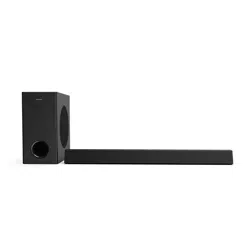
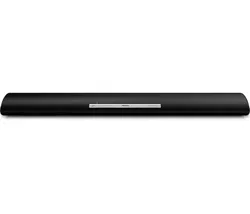
This section includes an overview of the main unit.
1. (Standby-On/Standby indicator)
Switch the SoundBar on or to standby
When the SoundBar is in standby the standby indicator turns red.
2. SOURCE
Select an input source for the SoundBar:
3. Display panel
4. +/- (Volume)
Increase or decrease volume.
Remote control
This section includes an overview of the remote control.
1. (Standby-On)
Switch the SoundBar on or to standby
2. Source buttons
HDMI ARC: Switch your source to HDMI ARC connection.
: Switch to Bluetooth mode.
USB: Switch to USB mode.
OPTICAL: Switch your audio source to the optical connection.
COAX: Switch your audio source to the coaxial connection.
AUDIO IN: Switch your audio source to the MP3 connection (3.5mm jack).
AUX: Switch your audio source to the AUX connection.
3. (Previous/Next)
Skip to the previous or next track in USB mode.
4. (Play/Pause)
Start, pause or resume play in USB mode.
5. BASS +/-
Increase or decrease bass.
6. Volume control
+/-: Increase or decrease volume.
' : Mute or restore volume.
7. SOUND
Select a sound mode.
8. SURROUND ON/OFF
Select surround or stereo sound.
9. AUDIO SYNC +/-
Increase or decrease audio delay
10. DIM
Set the brightness of SoundBar display panel.
11. night
Turn night mode on or off.
12. TREBLE +/-
Increase or decrease treble.
Connectors
This section includes an overview of the connectors available on your SoundBar
1. DIGITAL IN-COAXIAL
Connect to a coaxial audio output on the TV or a digital device.
2. AUX IN (L/R)
Connect to an analog audio output on the TV or an analog device.
3. DIGITAL IN-OPTICAL
Connect to an optical audio output on the TV or a digital device.
4. DC IN
Connect to the power supply.
5. HDMI OUT (ARC) - TO TV
Connect to the HDMI input on the TV.
6. subwoofer
Connect to the supplied subwoofer
7. (USB)
Audio input from a USB storage device.
Upgrade software of this product.
Charge a USB device.
8. AUDIO IN
Audio input from, for example, an MP3 player (3.5mm jack).
Connect and set up
This section helps you connect your SoundBar to a TV and other devices, and then set it up. For information about the basic connections of your SoundBar and accessories, see the quick start guide.
Placement
Place the subwoofer at least 1 meter (3 feet) away from your SoundBar, and ten centimeters away from the wall. For best results, place your subwoofer as shown below
Connect to TV
Connect your SoundBar to a TV. You can listen to audio from TV programs through your SoundBar. Use the best quality connection available on your SoundBar and TV.
Connect to TV through HDMI (ARC)
Your SoundBar supports HDMI with Audio Return Channel (ARC). If your TV is HDMI ARC compliant, you can hear the TV audio through your SoundBar by using a single HDMI cable
1. Using a High Speed HDMI cable, connect the HDMI OUT (ARC)-TO TV connector on your SoundBar to the HDMI ARC connector on the TV.
The HDMI ARC connector on the TV might be labeled differently. For details, see the TV user manual.
2. On your TV, turn on HDMI-CEC operations. For details, see the TV user manual.
Connect audio from TV and other devices
Play audio from TV or other devices through your Soundbar speakers. Use the best quality connection available on your TV, Soundbar, and other devices.
Option 1: Connect audio through a digital optical cable
Best quality audio
1. Using an optical cable, connect the OPTICAL connector on your SoundBar to the OPTICAL OUT connector on the TV or other device.
The digital optical connector might be labeled SPDIF or SPDIF OUT.
Option 2: Connect audio through a digital coaxial cable
Good quality audio
Using a coaxial cable, connect the COAXIAL connector on your SoundBar to the COAXIAL/DIGITAL OUT connector on the TV or other device.
The digital coaxial connector might be labeled DIGITAL AUDIO OUT.
Option 3: Connect audio through analog audio cables
Basic quality audio
Using an analog cable, connect the AUX connectors on your SoundBar to the AUDIO OUT connectors on the TV or other device
Use your SoundBar
This section helps you use the SoundBar to play audio from connected devices.
Before you start
Make the necessary connections described in the quick start guide and the user manual.
Switch the SoundBar to the correct source for other devices.
Adjust the volume
1. Press +/- (Volume) to increase or decrease a volume level.
To mute sound, press (Mute).
To restore the sound, press (Mute) again or press +/- (Volume).
Choose your sound
This section helps you choose the ideal sound for your video or music.
Sound mode
Select predefined sound modes to suit your video or music.
1. Press SOUND to select a sound option from the display panel.
• AUTO: Automatically select a sound setting based on the sound stream.
• POWERFUL: Enjoy thrilling arcade sounds, ideal for action-packed videos and loud parties.
• BALANCED: Experience the original sound of your movies and music, without added sound effects.
• BRIGHT: Spice up your dull movies and music with added sound effects.
• CLEAR: Hear every detail in your music and clear voices in your movies.
• WARM: Experience spoken words and music vocals in comfort.
• PERSONAL: Personalize the sound based on your preferences.
Surround sound mode
Experience an immersive audio experience with surround sound modes.
Press SURROUND ON/OFF to turn surround mode on or off.
• On: Create a surround listening experience.
• Off: Two-channel stereo sound. Ideal for listening to music.
Equalizer
Change the high frequency (treble) and low frequency (bass) settings of the SoundBar
Press TREBLE +/- or BASS +/- to change the frequency
Synchronize video and sound
If the audio and video are not synchronized, delay the audio to match the video.
Press AUDIO SYNC +/- to synchronize the audio with the video.
Night mode
For quiet listening, night mode decreases the volume of loud sounds when audio is played. Night mode is only available for Dolby Digital soundtracks.
Press NIGHT to turn night mode on or off.
Play audio through Bluetooth
Through Bluetooth, connect the SoundBar with your Bluetooth device (such as an iPad, iPhone, iPod touch, Android phone, or laptop), and then you can listen to the audio files stored on the device through your SoundBar speakers.
What you need
• A Bluetooth device which supports Bluetooth profile A2DP AVRCP and with Bluetooth version as 3.0 + EDR.
• The maximum operational range between the SoundBar and a Bluetooth device is approximately 10 meters (30 feet).
1. Press on the remote control to switch the SoundBar to Bluetooth mode.
→ BT is displayed on the display panel, blinking.
2. On the Bluetooth device, switch on Bluetooth, search for and select PHILIPS HTL2161 to start connection (see the user manual of the Bluetooth device on how to enable Bluetooth).
→ During connection, BT on the display panel blinks.
3. Wait until you hear a beep sound from the SoundBar:
→ When the Bluetooth connection
succeeds, BT is displayed on the display panel.
→ If the connection fails, BT on the display panel blinks continuously
4. Select and play audio files or music on your Bluetooth device.
• During play if a call is coming, music play is paused. Play resumes when the call ends.
• If your Bluetooth device supports AVRCP profile, on the remote control you can press to skip to a track, or press to pause/resume play
5.To exit Bluetooth, select other source.
When your switch back to Bluetooth mode, Bluetooth connection remains active.
MP3 player
Connect your MP3 player to play your audio files or music.
What you need
• An MP3 player
• A 3.5mm stereo audio cable.
Using the 3.5mm stereo audio cable, connect the MP3 player to the AUDIO IN connector on your SoundBar.
Press AUDIO IN on the remote control.
Press the buttons on the MP3 player to select and play audio files or music.
USB storage devices
Enjoy audio on a USB storage device, such as an MP3 player and USB flash memory etc.
What you need
A USB storage device that is formatted for FAT or NTFS file systems, and complies with the Mass Storage Class.
An MP3 file on a USB storage device
Connect a USB storage device to this product.
Press USB on the remote control.
Use the remote control to control play
Auto standby
When playing media from a connected device, the SoundBar automatically switches to standby after 15 minutes of button inactivity and no audio/video play from a connected device.
Set display brightness
You can press DIM repeatedly to select a different brightness level of the display panel on this product.
Apply factory settings
You can reset this product to the default settings programmed at the factory
In any source mode, on the remote control press Volume -, BASS -, and TREBLE - in sequence within three seconds.
→ When the factory settings restore is complete, the product automatically switches off and restarts.
Troubleshooting
Main unit
The buttons on the SoundBar do not work.
Disconnect the SoundBar from the power supply for a few minutes, then reconnect.
Sound
No sound from SoundBar speakers.
Connect the audio cable from your SoundBar to your TV or other devices. However, you do not need a separate audio connection when the SoundBar and TV are connected through HDMI ARC connection.
Reset your SoundBar to its factory settings.
On the remote control, select the correct audio input.
Make sure that the SoundBar is not muted.
Distorted sound or echo.
If you play audio from the TV through the SoundBar; make sure that the TV is muted.
Audio and video are not synchronized.
Press AUDIO SYNC +/- to synchronize the audio with the video.
Error message is displayed on the display panel.
When "ERROR" is displayed, it indicates that an input audio format is not supported.
When "USB ERROR" is displayed, it indicates that the connected USB device is not supported.
When "HDMI ARC" blinks, it indicates that the connected TV is not HDMI ARC compliant or an unsupported audio format is detected.
Bluetooth
A device cannot connect with the SoundBar.
The device does not support the compatible profiles required for the SoundBar
You have not enabled the Bluetooth function of the device. See the user manual of the device on how to enable the function.
The device is not correctly connected. Connect the device correctly.
The SoundBar is already connected with another Bluetooth device. Disconnect the connected device, then try again.
Quality of audio play from a connected Bluetooth device is poor.
The Bluetooth reception is poor Move the device closer to the SoundBar or remove any obstacle between the device and the SoundBar:
The connected Bluetooth device connects and disconnects constantly.
The Bluetooth reception is poor Move the device closer to the SoundBar or remove any obstacle between the device and the SoundBar.
Turn offWi-Fi function on the Bluetooth device to avoid interference.
For some Bluetooth, the Bluetooth connection can be deactivated automatically to save power. This does not indicate any malfunction of the SoundBar

 (Standby-On/Standby indicator)
 (Standby-On)
 : Switch to Bluetooth mode.
 (Previous/Next)
 (Play/Pause)
 ' : Mute or restore volume.
 (USB)
(USB)


 (Mute).
 on the remote control to switch the SoundBar to Bluetooth mode.
 to skip to a track, or press
  to pause/resume play